Richmond Planet
Saturday, November 4, 1911
Richmond, Virginia
Page text (machine-generated)
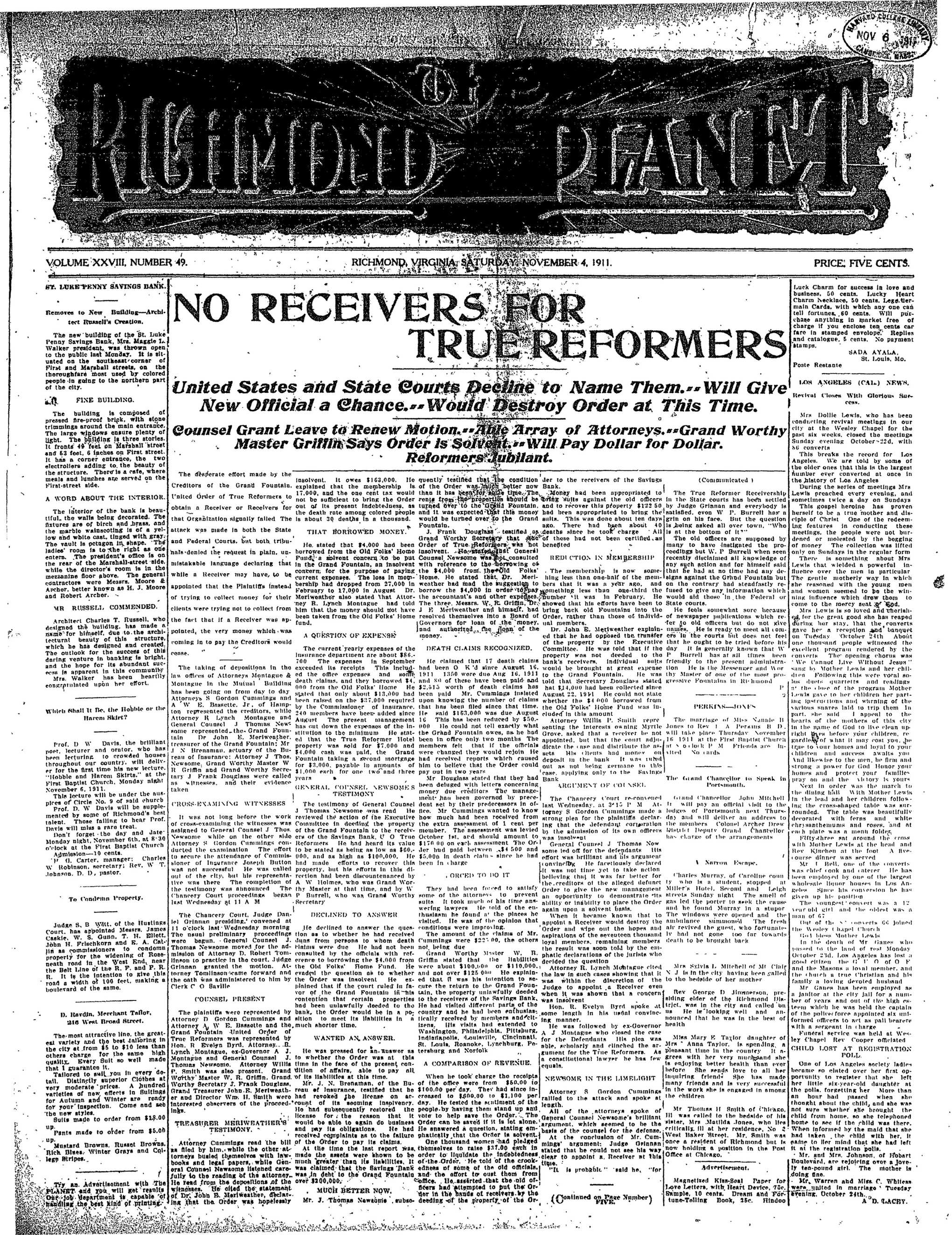
RICHMOND PLANET
VOLUME XXVIII, NUMBER 49.
RICHMOND, VIRGINIA, SATURDAY, NOVEMBER 4, 1911.
PRICE: FIVE CENTS.
Removes to New Building—Architect Russell's Creation.
The new building of the St. Luke Penny Savings Bank, Mrs. Maggie L. Walker president, was thrown open on the public last Monday. It is situated on the southeast-corner of First and Marshall streets, on the thoroughfare most used by colored people in going to the northern part of the city.
FINE BUILDING.
The building is composed of pressed fire-proof brick, with stone trimmings around the main entrance. The large windows ensure plenty of light. The building is three stories. It fronts 49 feet on Marshall street and 53 feet, 6 inches on First street. It has a corner entrance, the two electroliers adding to the beauty of the structure. There is a cafe, where meals and lunches are served on the First-street side.
A WORD ABOUT THE INTERIOR
the interior of the bank is beautiful, the walls being decorated. The fixtures are of birch and brass, and the marble wallinscoting is of a yellow and white cast, tinged with gray. The vault is pecton in shape. The ladies' room is to the right as one entero. The president's office is on the rear of the Marshall-street side, while the director's room is in the mezzanine floor above. The general contractors were Messrs. Moore & Archer, better known as H. J. Moore and Robert Archer.
MR. BUSSELL, COMMENDED.
Architect Charles T. Russell, who designed the building, has made a name for himself, due to the architectural beauty of this structure, which he has designed and created. The outlook for the success of this daring venture in banking is bright, and the hope for its abundant success is apparent in this community. Mrs. Walker has been heartily congratulated upon her effort.
Which Shall It Be, the Hobbie or the
Haren Skirt?
---
Prof. D W Davis, the brilliant poet, lecturer and orator, who has been lecturing to crowded houses throughout our country, will deliver for the first time his new lecture, "Hobble and Harom Skirts," at the First Baptist Church, Monday night, November 6, 1911.
This lecture will be under the auspices of Circle No. 9 of said church. Prof. D W Davis will be supplemented by some of Richmond's best talent. Those failing to hear Prof. Davis will receive a great treat.
Don't miss the day and date: Monday night, November 6th, at 8:30 o'clock at the First Baptist Church Agmision - 10 cents.
H G, Carter, manager; Charles W Robinson, secretary; Rev. W T. Johnson, D. D, pastor.
To Condemn Property.
Judge S. B. Witt, of the Hustings Court, has appointed Messrs. James Caskie, W. S. Gunn, T. H. Ellott, John H. Frischkorn and E. A. Catlin as commissioners to condemn property for the widening of Rose-neath road in the West End, near the Belt Line of the R. F. and P. R. R. It is the intention to give this road a width of 100 feet, making a boulevard of the same.
---
D. Rardin, Merchant Tailor,
210 West Broad Street.
The most attractive line, the greatest variety and the best tailoring in the city at from $5 to $10 less than others charge for the same high quality. Every Suit so well made that I guarantee it.
Tailored to suit you in every detail. Distinctly superior Clothes at very moderate prices. A hundred varieties of new effects in Suitings for Autumn and Winter are ready for your inspection. Come and see the new styles.
Suits made to order from $19.00 up.
Pants made to older from $5.00 up.
Mustard Browns, Russet Browns, Rich Blues, Winter Grays and College Brips.
Try an Advertisement with The PLANET and ypu will get results Our job. Department is capable of handling the best kind of printing.
NO RECEIVERS FOR TRUE REFORMERS
United States and State Courts Decline to Name Them. Will Give New Official a Chance. Would Destroy Order at This Time.
Counsel Grant Leave to Renew Motion. Able Array of Attorneys. Grand Worthy Master Griffin Says Order is Solvent. Will Pay Dollar for Dollar. Reformers Jubilant.
The desperate effort made by the Creditors of the Grand Fountain. United Order of True Reformers to obtain a Receiver or Receivers for that Organization signally failed. The attack was made in both the State and Federal Courts, but both tribunals denied the request in plain, unmistakable language declaring that while a Receiver may have, to be appointed that the Plaintiffs instead of trying to collect money for their clients were trying not to collect from the fact that if a Receiver was appointed, the very money which was coming in to pay the Creditors would insolvent. It owes $162,000. He quently testified that the condition der to the receivers of the Savings explained that the membership is of the Order was much better now Bank. The Money had been appropriated to bring suits against the old officers out of its present indebtedness, as and it was expected that this money had been appropriated to bring the death rate among colored people is about 30 deaths in a thousand.
THAT BORROWED MONEY.
He stated that $4,000 had been borrowed from the Old Folks' Home Fund, a solvent concern to be put in the Grand Fountain, an insolvent concern, for the purpose of paying current expenses. The loss in membership had dropped from 27,000 in February to 17,000 in August. Dr. Meriweather also stated that Attorney R. Lynch Montague had told him that the money should not have been taken from the Old Folks' Home fund.
A QUESTION OF EXPENSE
The current yearly expenses of the Death Claims RECOGNIZED.
REDUCTION IN MEMBERSHIP
The membership is now some-hiding less than one-half of the members that it was a year ago, and something less than one-third of the number it was in February. The showed that his efforts have been to aid those in the Federal or State courts.
He feels somewhat sore because of newspaper publications which refer to old officers but do not give names. He is ready to meet all合谴 that he had opposed the transfer of the property by the Executive Committee. He was told that if the day it is at the bottom of it.
The old officers are supposed by many to have instigated the proceedings but W. P. Burrell when seen recently disclaimed all knowledge of any such action and for himself said that he had at no time had any designs against the Grand Fountain but on the contrary had steadfastly refused to give any information which would aid those in the Federal or State courts.
He feels somewhat sore because of newspaper publications which refer to old officers but do not give names. He is ready to meet all合谴 that he had opposed the transfer of the property by the Executive Committee. He was told that if the day it is at the bottom of it.
The taking of depositions in the law offices of Attorneys Montague & Montague in the Mutual Building has been going on from day to day Attorneys S Gordon Cummings and A W E. Bassette, Jr. of, Hampton represented the creditors, while Attorney R Lynch Montague and General Counsel J Thomas Newsome represented, the Grand Fountain Dr John E. Merwweather, treasurer of the Grand Fountain; Mr J N Brennan, actuary of the Bureau of Insurance: Attorney J Thos. Newsome, Grand Worthy Master W R Griffin and Grand Worthy Secretary J Frank Douglass were called as witnesses, and their evidence taken
CROSS-ENAMINING WITNESSES
It was not long before the work of cross-examining the witnesses was assigned to General Counsel J. Thos. Newsome while on the other side Attorney S. Gordon Cummings conducted the examination. The effort to secure the attendance of Commissioner of Insurance Joseph Button was not successful. He was called out of the city, but his representative was there. The completion of the testimony was announced. The Chancery Court proceedings began last Wednesday at 11 A M.
The Chancery Court, Judge Daniel Grinnan presiding, convened at 11 o'clock last Wednesday morning. The naural preliminary proceedings were begun. General Counsel J. Thomas Newsome moved for the admission of Attorney D. Robert Tomlinson to practice in the court. Judge Grinnan granted the motion. Attorney Tomlinson came forward and the oath was administered to him by Clerk C. O. Saville
COUNSEL PRESENT
The plaintiffs were represented by Attorney D. Gordon Cummings and Attorney W. E. Bassato and the Grand Pountain United Order of True Reformers was represented by Hon. R. Evelyn Byrd, Attorney.. R. Lynch Montague, ex-Governor A. J. Montague and General Counsel J. Thomas Newcomo. Attorney Willis P. Smith was also present. Grand Worthy Master W. R. Griffin. Grand Worthy Secretary J. Frank Douglas. Grand Treasurer John R. Merlweather and Director W. H. Smith were interested observers of the proceed-links.
TREASURER MERIWEATHER'S
TESTIMONY.
Attorney Cummings read the bill as filed by him, while the other attorneys busied themselves with lawbooks and legal papers, while General Council Newaums listened carefully to the reading of the attorney. He read from the depositions of the witnesses. He offered the statement of Dr. John B. Marlweather, declaring that the Order was hopelessly
insolvent. It owes $163,000. He explained that the membership is 17,000, and the one cent tax would not be sufficient to bring the Order out of its present indebtedness, as the death rate among colored people is about 30 deaths in a thousand.
THAT BORROWED MONEY.
He stated that $4,000 had been borrowed from the Old Folks' Home Fund, a solvent concern to be put in the Grand Fountain, an insolvent concern, for the purpose of paying current expenses. The loss in membership had dropped from 27,000 in February to 17,000 in August. Dr Mortweather also stated that Attorney R. Lynch Montague had told him that the money should not have been taken from the Old Folks' Home fund.
A QUESTION OF EXPENSE
The current yearly expenses of the insurance department are about $65,700. The expenses in September exceeded its receipts. This included the office expenses and some death claims, and they borrowed $4,000 from the Old Folks' Home. He stated that only about $13,000 had been raised on the $27,000 required by the Commissioner of Insurance. 240 members have been added since August. The present management has cut down the expenses of the institution to the minimum. He stated that the True Reformer Hotel property was sold for $7,000 and $4,000 cash was paid, the Grand Fountain taking a second mortgage for $3,000, payable in amounts of $1,000 each for one two and three years.
GENERAL COUNSEL NEWSONES TESTIMONY
The testimony of General Counsel J Thomas Newsome was read. He reviewed the action of the Executive Committee in deciding the property of the Grand Fountain to the receivers of the Savings Bank. U O True Reformers. He had heard its value to be stated as being as low as $60,000, and as high as $100,000. He had made efforts to recover this property, but his efforts in this direction had been discountened by A W Holmes, who was Grand Worthy Master at that time, and by W P Burrell, who was Grand Worthy Secretary.
DECLINED TO ANSWER
He declined to answer the question as to whether he had received dumps from persons to whom death plains were due. He had not been consulted by the officials with reference to borrowing the $4,000 from the Old Folks' Home Fund. He evaded the question as to whether the Order was insolvent. He explained that if the court ruled in favor of the Grand Fountain in his contention that certain properties had been unlawfully deeded to the bank, the Order would be in a position to meet its liabilities in a much shorter time.
WANTED AN ANSWER.
He was pressed for an answer as to whether the Order was at this time in the face of the present condition of affairs, able to pay all of its liabilities at this time.
Mr. J. N. Bronaman, of the Bureau of insurance, testified that he had revoked the license on account of its soaming insolvency. He had subsequently restored the license for the reason that it would be able to again do business and pay its obligations. He had received complaints as to the failure of the Order to pay its claims.
At the time the last report was made the assets were shown to be much greater than its liabilities. It was claimed that the Savings Bank was in debt to the Grand Fountain over $200,000.
MUCH BETTER NOW.
Mr. J. Thomas Nawcorn, subso-
quently testified that the condition of the Order was much better now than it has been for some time. The rena it has the properties should be turned over to the Grand Fountain, and it was expected that this money would be turned over to the Grand Fountain.
J. Frank Douglas testified as Grand Worthy Secretary that the Order of True Reformers was not insolvent. He stated that General Counsel Newsome was not consulted with reference to the borrowing of the $4,000 from the Old Folks' Home. He stated that Dr. Merlweather had mad the suggestion to borrow the $4,000 in order to pay the accountant's and other expenses. The three Neesas, W. R. Griffin, Dr. Merlweather had resolved themselves into a Board of Governors for loan of the money, and authorized the loan of the money.
DEATH CLAIMS RECOGNIZED
He claimed that 17 death claims had been O K'd since August 16, 1911 1300 wore duo Aug 16, 1911 and 80 of these have been paid and $2,515 worth of death claims has been paid Mr. Cummings insisted upon knowing the number of claims that has been filed since that time. He said $16,300 was due August 16. This has been reduced by $50,000. He could not tell exactly what the Grand Fountain owes, as he had been in office only two months. The members felt that if the officials were changed they would rejoin. He had received reports which caused him to believe that the Order could pay out in two years.
Mr Douglas stated that they had been deluged with letters concerning money due creditors. The management has been governed by predecessor set by their predecessors in office. Mr Cummings wanted to know how much had been received from the extra assessment of 1 cent per member. The assessment was levied October 1st, and should amount to $170,000 on each assessment. The Order had paid between $4,500 and $5,000 in death claims since he had been in charge.
ORCED TO DO IT
They had been forced to satisfy some of the attorneys to prevent suits. It took much of his time answering lawyers. He told of the enthusiasm he found at the places he visited. He was of the opinion that conditions were improving. The amount of the claims of Mr. Cummings were $221,000, the other not being due. Grand Worthy Master W. B. Griffin stated that the Habitations were about $100,000 or $110,000, and not over $125,000. He explained that it was his intention to secure the return to the Grand Fountain, the property unlawfully deeded to the receivers of the Savings Bank. He had visited different parts of the country and he had been enthusiastically received by members and citizens. His visit had extended to Washington, Philadelphia, Pittsburgh, Indianapolis, Louisville, Cincinnati, St. Louis, Roanoke, Lynchburg, Petersburg and Norfolk.
A COMPARISON OF REVENUE.
When he took charge the receipts of the office were from $50.00 to $100.00 per day. They had since increased to $600.00 to $1,100 per day. He tested the sentiment of the people by having them stand up and vote to help save the Order. The Order can be saved if it is let alone. He answered a question, stating emphatically that the Order is solvent. One thousand women had pledged themselves to raise $37.00 each in order to liquidate the indebtedness of the Order. He told of the crookiness of some of the old officials, and the effort to oust them from office. He asserted that the old officers had attempted to put the Order in the hands of receivers by the deeding of the property of the Or-
der to the receivers of the Savings Bank.
Money had been appropriated to bring suits against the old officers and to recover this property $122 50 had been appropriated to bring the suits. This was done about ten days ago. There had been about 40 deaths since he took charge. All of those had not been certified as benefited.
REDUCTION IN MEMBERSHIP
The membership is now something less than one-half of the members that it was a year ago, and something less than one-third the number 'it was' in February. He showed that his efforts have been to bring back old Fountains into the Order, rather than those of individual members. Dr. John E. Meriweather explained that he had opposed the transfer of the property by the Executive Committee. He was told that if the property was not deeded to the bank's receivers, individual suits would be brought at great expense to the Grand Fountain. He was told that Secretary Douglas stated that $14,000 had been collected since August 22, 1914. He could not state whether the $4,000 borrowed from the Old Polks' Home Fund was included in this amount. Attorney Willis P. Smith representing the interests opening Myrtle Grove asked that the receiver be not appointed, but that the court adjudicate the case and distribute the assets. His clients had money on deposit in the bank. It was rubbed out as not being germane to this case, applying only to the Savings Bank.
ARGUMENT OF COUNSEL
The Chancery Court reconvened last Wednesday, at 3:15 P.M. Attorney S Gordon Cummings made a strong plea for the plaintiffs declaring that the defendant corporation by the admission of its own officers was insolvent.
General Counsel J Thomas Now some led off for the defendants. Its effort was brilliant and his argument convincing. He facetiously declared it was not time yet to take action believing that it was far better for the creditors of the alleged defunct Order to give the new management an opportunity to demonstrate its ability or inability to place the Order again upon a solvent basis.
When it became known that to appoint a Receiver would destroy the Order and wipe out the hopes and aspirations of the seventeen thousand loyal members, remaining members the result was soon told by the emphatic declarations of the jurists who decided the question
Attorney R. Lynch Montague cited the law in such cases showing that it was within the discretion of the Judge to appoint a Receiver even when it was shown that a concern was insolvent.
Hon. R. Evelyn Byrd spoke at some length in his usual convincing manner.
He was followed by ex-Governor A J Montague who closed the case for the Defendants. His plea was able, scholarly and clinched the argument for the True Reformers. As a constitutional lawyer he has few equals.
NEWSOMR IN THE LIMELIGHT
Attorney S. Gordon Cummings
railed to the attack and spoke at
length.
All of the attorneys spoke of
General Counsel Newsome's brilliant
argument, which seemed to be the
basis of the counsel for the defense.
At the conclusion of Mr. Cummings'
argument; Judge Grinman
stated that he could not see his way
clear to appoint a. Receiver at this
time.
( Continued on Page Number ) FIVE.
(Communicated)
The True Reformer Receivership in the State courts has been settled by Judge Grinnan and everybody is satisfied, even W P. Burrell has a grin on his face. But the question is being asked all over town, "Who is at the bottom of it?" The old officers are supposed by many to have instigated the proceedings but W P. Burrell when seen recently disclaimed all knowledge of any such action and for himself said that he had at no time had any designs against the Grind Fountain but on the contrary had steadfastly refused to give any information which would aid those in the Federal or State courts.
He feels somewhat sore because of newspaper publications which refer to old officers but do not give names. He is ready to meet all coners in the courts but does not feel that he ought to be tried before his day. It is generally known that W P. Burrell has at all times been friendly to the present administration. He is the Messenger and Worthy Master of one of the most progressive Fountains in Richmond.
---
PERFINS—JONES
The marriage of Miss Nance B
Jones to Rev I A Persams B D
will take place Thursday November
16 1911 at the First Baptist Church
at Noock P M. Friends are in
lost. No cards.
The Grand Chancellor to Speak in Portsmouth.
Grand Chanteller John Mitchell
will pay an official visit to the
lodges of Portsmouth next Thursday
and will deliver an address to
the members Colonel Archer Drew
District Deputy Grand Chanteller
has charge of the arrangements
Narrow Escape
Charles Murray, of Caroline county who is a student, stopped at Miller's Hotel, Second and Leigh streets Sunday night. The smell of gas led the porter to seek the cause and he found Murray in a stupor. The windows were opened and the ambulance summoned. The fresh blood of the robber who fortunately had not gone too far towards death to be brought back.
---
Mrs. Sylvia L. Mitchell of Mr. Clair N. J. is in the city having been called to the bedside of her mother
Rev George D. Jimmerson, presiding elder of the Richmond District, was in the city and called on us. He is looking well and announced that he was in the best of health
Miss Mary E. Taylor daughter of Mrs. Anna Taylor, is spending, a pleasant time in the country. It agrees with her very much and she is enjoying better health than ever before. She sends love to all her inquiring friends. She has made many friends and is very successful in the work she is engaged in among the children
Mr. Thomas H. Smith of Chicago, III was called to the bedside of his sister, Mrs. Matilda Jones, who lives critically, III at her residence, No. 2 West Baker Street. Mr. Smith was once a resident of Richmond but is now holding a position in the Post Office at Chicago.
Magnetized Kisel-Scal Paper for
Love Letters, with Heart Device, 75c.
Sample, 10 cents. Dream and Fortune-Telling Book, 35c. Hindoo
Luck Charm for success in love and business, 50 cents. Lucky Heart Charm necklace, 50 cents. Lege ternmain Cards, with which any one can tell fortunes, 60 cents. Will purchase anything in market free of charge if you enclose ten cents car fare in stamped envelope. Replies and catalogue, 5 cents. No payment stamps.
SADA AYALA.
St. Louis, Mo.
Poste Restante
LOS ANGELES (CAL.) NEWS.
Revival Closes With Glorious Success.
Mrs Dollie Lewis, who has been conducting revival meetings in our city at the Wesley Chapel for the past six weeks, closed the meetings Sunday evening October 22d, with 86 converts.
This breaks the record for Los Angeles. We are told by some of the older ones that this is the largest number ever converted at once in the history of Los Angeles.
During the series of meetings Mrs Lewis preached every evening, and sometimes twice a day on Sundays.
This gospel heroine has proven herself to be a true mother and disciple of Christ. One of the redeeming features in conducting these meetings, the people were not burdened or molested by the bogging of money. The collection was lifted only on Sundays in the regular form.
There is something about Mrs Lewis that wielded a powerful influence over the men in particular. The gentle motherly way in which she reasoned with the young men and women seemed to be the winning influence which drew them to come to the mercy seat of God.
Mrs Lewis is so loved and thorished for the great good she has reaped during her stay, that the converts gave her a reception and banquet on Tuesday October 24th About one thousand people witnessed the excellent program rendered by the converts. The opening chorus was "We Cannot Live Without Jesus" sung by Mother Lewis and her children. Following this were vocal soloists quartets and readings at the close of the program Mother Lewis gave to her children her parting instructions and warning of the various snarls held to trip them in part, she said. I appoach to the hearts of the mothers of this city in the name of God to live clean upright eyes before your children, regarded of what it may cost you, to urge your homes and loyal to your children and success awaits you. And likewise to the men, he firm and strong a power for God Honor your homes and protect your children严护 your homes and protect your children. And likewise to your life is yours. Next in order was the march to the dining hall. With Mother Lewis in the lead and her children following the cross-shaped table was surrounded. The table was beautifully decorated with ferns and white chrysanthemums and roses, and at each plate was a menu folding. Fifty-three sat around the cross with Mother Lewis at the head and Rev Kitchen at the foot. A live course dinner was served.
Mr I. Bell, one of the convert's was chief cook and caterer. He has been employed by one of the largest wholesale liquor houses in Los Angeles. Since his conversion he has given up his position.
The youngest convert was a 12 year old girl and the oldest was a man of 67.
Out of the 51 convert's 66 joined the Wesley Chapel Church God bless Mother Lowes.
In the death of Mr. Ganes who passed to the land of rest Monday October 23d, Los Angeles has lost a good citizen, the G'U O of F and the Masons a local member, and the church a true Christian and his family a loving devoted husband.
Mr Ganes has been employed as a janitor at the city jail for a number of years and out of the high esteem which he was held the captain of the police force appointed six unformed officers to act as pall bearer with a sorgeant in charge.
Funeral service was held at Wesley Chapel Rev Cooper officiated CHILD LOST AT REGISTRATION
One of Los Angeles society ladies became so elated over her first opportunity to register that she left her little six-year-old daughter at the polls, forgetting her. More than an hour had passed, when she thought about the child, and she was not sure whether she brought the child from home, so she telephoned home to see if the child was there. When informed by the maid that she had taken the child with her, it came to her mind that she had left it at the registration polls.
Mr. and Mrs. Johnson, of Hobart Boulevard, are rejoicing over a joyfully ten-pound girl. The mother is doing fine.
Mr. Warren and Miss C. Whitess were united in marriage Tuesday evening, October 24th.
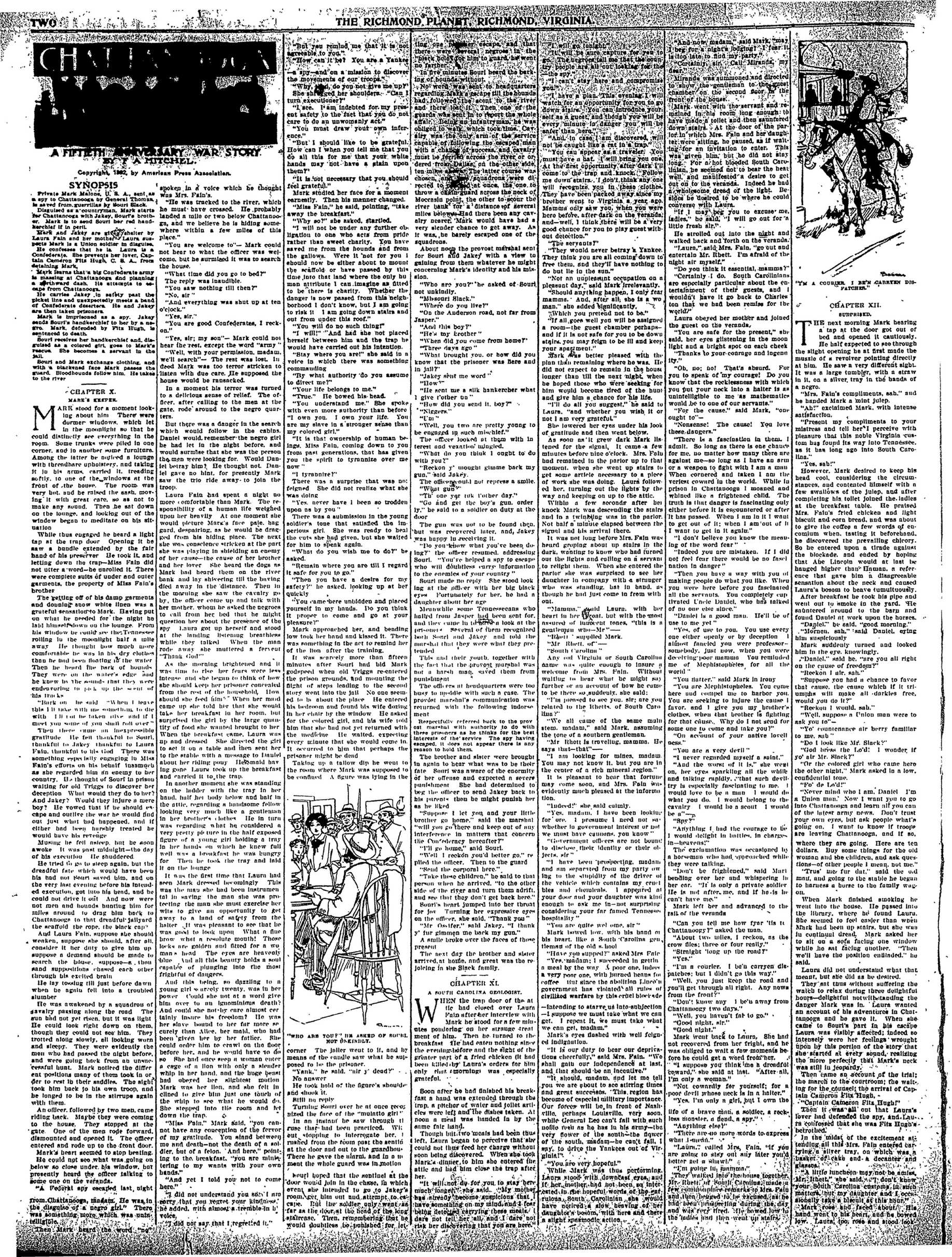
CHALISSONA
A FIFTIETH ANNIVERSARY WAR STORY BY T A MITCHEL.
SYNOPSIS
Private Mark Malone, U. S. A., sent a spy to Chattanooga by General Thomas. Malone disguised as a countryman. Mark starts her Chattanooga with Jakay, Sourie's brother. Mark is to send Souri her red handkerchief. Mark and Jakay are ginger-shatter by Laura Fain and her mother-in-law Laura suspects Mark is a Union soldier in disguise, confesses that he is. Laura is a Confederate officer in Chattanooga and planning a get-wrong dash. He attempts to escape from Chattanooga. He carries Jakay in saray past the Confederate Chattanooga and planning a get-wrong dash. He attempts to escape from Chattanooga. He carries Jakay in saray past the Confederate Chattanooga and planning a get-wrong dash. He and Jakay are then taken prisoner. Mark is imprisoned as a spy. Jakay sends Boursy handkerchief to her by a naked woman. Bits of Pix Hugh, is sentenced to death. Souri resolves her handkerchief and disguises as a colored girl, goes to Mark's house. She becomes a servant in the jail. Boursy and Mark exchange clothing, and with a blackened face Mark passes the blacked handsocks follow him. He takes to the river.
CHAPTER X.
MARK'S KEEPER
MARK stood for a moment looking about him. There were dormer windows, which let in the moonlight so that he could distinctly see everything in the room. Some trunks were piled in one corner, and in another some furniture. Among the latter he nudged a lounge with threedash upholstery, and taking it in his arms, carried it, treading softly, to one of the windows at the front of the house. The room was very hot, and he raised the sash, moving it with great care, as so not to make any sound. Then he sat down on the lounge, and looking out of the window began to meditate on his situation. While thus engaged he heard a light tap at the trap door. Opening it he saw a bundle extended by the fair hand of his preserver. He took it, and letting down the trap—Miss Fain did not utter a word—he unrolled it. There were complete suits of under and outer garments, the property of Miss Fain's brother.
The getting off of his damp garments and dousing snow white linen was a grateful sensation to Mark. Having put on what he needed for the night he had blissed on the lounge. From his window he could see the Tennessee rolling in the moonlight half a mile away. He thought how much more comfortable he was in his dry clothes than he had been floating in the water. Then he heard the bark of bounds. They were on the water's edge and the sounds that they were enduring to pick up the scent of his trucks. "Bark on he said." When I leave this I take with me something to do with. I'll be taken alive and if I meet you some of you shall roll over."
Then there came an impossible gratitude. He felt thankful to Sourl, thankful to Jakey, thankful to Laura Fain, thankful to his friend. There was something especially engaging in Miss Fain's efforts on his behalf as unassumed as she regarded him an enemy to her country. He thought of Sourl in prison waiting for old Triggs to discover her deception. What would they do to her? And Jakey? Would they injure a mere boy? He rowed that if he should escape and outlive the war he would find out just what had happened, and if either had been merciless treated he would have his revenge. But he soon awoke. It was just midnight—the day of his execution. He shuddered.
He tried to go to sleep again, but the dreadful fate which would have been his bad not Sourl saved him, and on the very last evening before his intended execution, got into his head, and he could not drive it out. And now were not men and hounds hunting him for miles around to drag him back to Chattanooga to that dreadful jalladrya the scaffold the rope, the black cap.
And Laura Fain, suppose she should weaken, suppose she should, after all, consider it her duty to give him up suppose a demand should be made to search the house, suppose—a, then sand suppressions chased each other through his excited brain
He lay toging till just before dawn when he again fell into a troubled slumber
He was awakened by a squadron of cavalry passing along the road. The sun had not yet risen, but it was light. He could look right down on them, though they could not see him. They trotted along slowly, all looking worn men who had pressed the evidently men who had pressed from the unsevere hunt. Mark notified the different positions many of them in order to rest in their saddles. The sight took him back to his own troop, and he longed to be in the stirrups again with them.
An officer, followed by two men, came riding back. Maybe they were coming to the house. They stopped at the gate. One of the men rode forward, dismounted and opened it. The officer entered and rode up to the front door. Mark's heart seemed to stop beating. He could not see what was going on below so close under his window, but presently heard the officer talking to some one on the veranda. "A Federal any escaped last, night from Chattanooga, madam. He was in the disguise of a negro girl." There was something more, which was unknotible.
spoken in a voice which he thought was Mrs. Palm's.
"He was tracked to the river, which he must have crossed. He probably landed a mile or two below Chattanooga, and we believe he is hiding somewhere within a few miles of this place."
"You are welcome to"—Mark could not hear to what the officer was welcome, but he surmised it was to search the house.
"What time did you go to bed?"
The reply was inaudible.
"You saw nothing till then?"
"No, sir."
"And everything was shut up at ten o'clock."
"Yes, sir."
"You are good Confederates, I reckon."
"Yes, sir; my son"—Mark could not hear the rest, except the word "army"
"Well, with your permission, madam, we'll search"—The rest was lost. In deed Mark was too stricken to listen with due care. He supposed the house would be ransacked.
In a moment his terror was turned to a delicate sense of relief. The officer, after calling to the men at the gate, rode around to the negro quarters.
But there was a danger in the search which would follow the cabins. Daniel would remember the negro girl and let in the night before, and would surmise that she was the person the men were looking for. Would Daniel betray him? He thought not. Daniel gave no hint, for presently Mark saw the trio ride away to join the troop.
Laura Fain had spent a night no more comfortable than Mark. The responsibility of a human life weighed upon her heavily. At one moment she would picture Mark's face pale, bad gard, despairing, as he would be dragged from his hiding place. The next she was conscience stricken at the part she was playing in shielding an enemy of her cause—the cause of her brother and her lover. She heard the dogs as Mark had heard them on the river bank and lay shivering till the having died away in the distance. Then in the morning she saw the cavalry go by, the officer come up and talk with her mother, whom he asked the negroes to call from her bed that he might question her about the presence of the spy. Laura got up herself and stood at the landing listening breathless while they talked. When the man rode away she muttered a fervour "Thank God!"
As the morning brightened and it was time to rise her fears were less intense and she began to think of how she should keep her prisoner concealed from the rest of the household. How should she feed time? When her maid came up she told her that she would take her breakfast in her room, but surprised the girl by the large quantity of food she wanted brought to her. When the breakfast came, Laura was told to set it on a table and then sent her to the stable with a message to Daniel about her riding pouy. Helenard having gone Laura took up the breakfast and carried it to the trap.
In another moment she was standing on the ladder with the tray in her hand, half her body below and half in the attic, regarding a handsome fellow looking very much like a gentleman in her brother's clothes. He in turn was regarding what he considered a very pretty picture in the half exposed figure of a young girl holding a tray in her hands on which he knew full well was a breakfast he was hungry for. Then he took the tray and laid it on the lounge.
It was the first time that Laura had seen Mark dressed becomingly. This was the man she had been instrumental in saving the man she was protecting the man she must exercise her wits to give an opportunity to get away to a land of safes from the halter. It was pleasant to see that he was good to look upon. What a fine brow what a resolute mouth! Those locks are golden and fitted for a woman's head. The eyes are heavely blue. And all this beauty holds a soul capable of plunging into the most frightful of dangers.
And this being, so dazzling to a young girl so scarcely twenty, was in her power. Could she not at a word give him over to an ignominious death? And could she not by cure almost certainly insure his freedom? He was her slave bound to her far more carefully than Alice, her maid, who had been given her by her father. She could order him to crawl on the floor before her, and he would have to do so. She had once kept a woman enter a cage of a lion with only a slender whip in her hand, and the huge beast had obeyed her slightest motion. Mark was her lion, and she felt inclined to give him just one touch of the whip to see what he would do. She stepped into the room and hit the trap.
"Miss Pain," Mark said, "you cannot have any conception of the fervor of my gratitude. You stand between me and death—not the death of a soldier, but of a felon. And here," pointing to the breakfast, "you are muklering to my wants with your own hands."
"And yet I told you not to come here."
"I did not understand you so I am sorry, that you regret your kindness, he added, with almost a tremble in his voice.
"I did not say that I regretted it."
But you remind me that it is not agreeable to you.
"How can it be? You are a Yankee a spy—and on a mission to discover the movements of our troops."
"Why, and do you not give me up?" She shouted her shoulders. "Can I turn executioner?"
"I see. I am indebted for my present safety to the fact that you do not care to do an unwomanly act."
"You must draw your own inference."
"But I should like to be grateful. How can I when you tell me that you do all this for that your white hands may not have a stain upon them?"
"It is not necessary that you should feel grateful."
I lay one hundred escape, and that the hundred across in the bark below to guard he was no further.
In five minutes Souri heard the barking of bounds without. Now word was sent to headquarters regarding Mark's escape the bounds had followed the scent to the river and there it left. Then one of the guards was sent to towrift the whole arm. Being an infantryman, he was obliged to walk, which took time. Cavity was the only arm of the service capable of following the escaped man with a charge of success, and cavalry be forrissured across the river or ordered from Dallas on the other side ten miles away. The latter course was chosen, and two squadrons were directed to proceed at once, the one to
"I will go in light."
"It will be sure capture the year to go. The negro tell me that the downy people know that he won't take the spy."
"Don't stay here and convey you."
"I have a plan. This evening I will watch for an opportunity for you to go down stairs. You can introduce your self as a guest, and though you will be every minute in a longer you will be under than here."
"I am discussed, will not be ought like a sat in a trap."
"You can appear as a traveler. You must have a hat. I will bring you one at the first opportunity after dark. I'll come to the trap and knock. Follow me down stairs. I don't think any one will receive you. In these clothes."
"And now, madam, said Mark, may I beg for a night's lodging? I fear it is too late to find my party."
"Curtainy, sir. Call Miranda, my dear.
Miranda was summoned and directed to show the gentleman to the guest chamber on the second floor in the front of the parlor in which Mrs. Palin and her daughter were sitting, he paused, as if waiting for an invitation to enter. This was given him, but he did not stay long. For a hot blooded South Carolian, he seemed not to bear the heat well, and manifested a desire to get out on to the veranda. Indeed he had
Mark studded her face for a moment carefully. Then his manner changed. "Miss Fain," he said, polting, "take away the breakfast." "Why so?" she asked, startled. "I will not be under any further obligation to one who acts from pride rather than sweet charity. You have saved me from the hounds and from the gallows. Were it not for you I should now be either about to mount the scaffold or have passed by this time into that land where the only man attribute I can imagine as fitted to be there is charity. Whether the danger is now passed from this neighborhood I don't know, but I am going to risk it I am going down stairs and out from under this roof." "You will do no such thing!"
"I will!" "And had she not placed herself between him and the trap he would have carried out his intention.
"Stay where you are!" she said in a voice in which there was something commanding.
"By what authority do you assume to direct me?"
"Your life belongs to me."
"True." He bowed his head.
"You understand me." She spoke with even more authority than before
"I own you. I own your life. You are my slave in a stronger sense than my colored girl."
"It is that ownership of human beings. Miss Fain, coming down to you from past generations, that has given you the spirit to tyrannize over me now."
"I tyrannize?"
There was a surprise that was not feigned. She did not realize what she was doing.
"Yes, never have I been so trodden upon as by you."
There was a submission in the young soldier's tone that satisfied the imperious girl. She was ready to heal the cuts she had given, but she wafted for him to speak again.
"What do you wish me to do?" he asked.
"Remain where you are till I regard it safe for you to go."
"Then you have a desire for my safety?" he asked, looking up at her quickly.
"You came here unbidden and placed yourself in my hands. Do you think it proper to come and go at your pleasure?"
Mark approached her, and bending low took her hand and kissed it. There was something in the act to reminding her of the lion after the training.
It was scarcely more than fifteen minutes after Sourl had bid Mark godspread when old Viggs re-entered the prison grounds, and mounting the flight of steps leading to the second story went into the fall. No one seemed to be about the place. He entered his bedroom and found his wife dozing in her chair by the window. He asked for the colored girl, and his wife told him that she had not get returned with the medicine. He waited, expecting every minute that she would come in. It occurred to him that perhaps the prisoner might be dead.
Taking up a tallow dip he went to the room where Mark was supposed to be confined. A figure was lying in the
D. B.
"WHO ARE YOU?" HE ARKED OF SOUL,
NOT ONE INDLEY.
corner. The jalter weat to it, and
the candle of the candle saw what he sup-
posed to be the prisoner.
"He said, 'nil'y dead!'"
No answer.
He took hold of the figure's shoulder,
shook it.
Roll no reply
Turning Roll over he at once recoz
sized the face of the "mulatto girl"
In an instruit he saw through it ruse that had been practiced. Wit out, stopping to interrogate her, rushed from the room past the sentil at the door and out to the guardhou. There he gave the ularm, and in a moment the whole guard was in motion. hourl hoped that the sentil at the door would join in the chase, in which event also intended to go to Jake's room, her out and attempt, to escape. But the soldier, only went far as the door at the head of the long staircase. Then, remembering that he would doubtless be punished for let-
the one possesses escape, and that there were several negroes in the black body for him to guard, he went no farther.
In five minutes Bourl heard the barking of bounds, without. He then heard a woman warning a guard who would spill the amphibians had, followed the scent in the river and there leapt it. Then one of the guards was sent in to report the whole alarm. Being an infantryman, he was obliged to walk, which took time. Cavity was the only arm of the service capable of following, the escaped man with a chance of success, and cavalry must be perished across the river or ordered to Dallas, on the other side, ten miles away. The latter course was chosen, and the squadrons, were directed to pursue, at once, the one to throw a cavalry guard across the neck of Mocasin point, the other to scour the river basin for a distance of four miles. Had he followed, he would have cavalry norer. Mark would have had a very slender chance to get away. As it was, he barely escaped one of the soundrons.
About now the provost marshal sent for Bouri and Jakey with a view to gaining from them whatever he might concerning Mark's identity and his mission.
"Who are you?" he asked of Bouri not unkindly.
"Missouri Black."
"Where do you live?"
"On the Anderson road, not far from Jasper."
"And this boy?"
"He's my brother."
"When did you come from home?"
"Three days ago."
"What brought you, or how did you know that the prisoner was Here and in jail?"
"Jakey sent me word."
"How?"
"He sent me a silk bankercher what I give rother on?"
"How did you send it, boy?"
"Niggers."
"Un!"
"Well, you two are pretty young to be engaged in such mislefth."
The officer looked at them with interest and vexation mingled.
"What do you think I ought to do with you?"
"Reckon y' mought gimme back my gun," said Jakey.
The officer could not repress a smile
"What gun?"
"The one yep tak mother day."
"Go and get the boy's gun, orderly." he said to a soldier on duty at the door.
The gun was not to be found then, but was recovered later, and, Jakey was happy in receiving it. "Do you know what you've been doing?" the officer resumed, addressing Sourl. "You're helped a spy to escape who will doubtless carry information to the enemies of your country." Sourl made no reply. She stood looking at the officer with her big black eyes. Fortunately for her, he had a daughter about her age.
Meanwhile some Tennesseeans had fallen from Jasper had been sent for, and they came in time to look a look at them, the recognized both Sourl and Jakey and told the man that they were what they pretended.
This and their youth, together with the fact that the progeny marvel was not a harsh man, saved them from punishment.
The officers at headquarters were too busy to handle with such a case. The provost marshal's communication was returned with the following indorsement.
Respectfully referred back to the provost marshal with authority to do with the affairs of the service. For the best interests of the service. The spy having escaped, it does not appear there is any reason to hold them.
The brother and sister were brought in again to hear what was to be their fate. Sourl was aware of the enormity of her offense and expected a severe punishment. She had determined to beg the officer to send Jakey back to his parents then he might punish her as he liked.
Suppose I let you and your little brother go home? said the marshal "will go there and keep out of any interference in matters that concern the Conspiracy hereder?" "I'll go home," said Sourl. "Well I rockon you'd better go," replied the officer. Then to the guard "Sourl the curernal here."
"Take these children," he said to that person when he arrived. "To the other side of the riger and turn them adrift, and see that they don't get back here." Bourn's heart jumped into her throat for joy. Turning her expressive eyes on the officer, she said. "Thank you." "Mr Ossifer," said Jakey. "I thank y' fur gimmen me back my gun." A smile broke over the faces of those present. The next day the brother and sister arrived, at home, and great was the rejoicing in the Slack family.
CHAPTER XL
WHEN the trap door of the attic had closed over Laura Pain after her interview with Mark he stood for a few minutes pondering on her strange treatment of him. Then he turned to the breakfast. He had eaten nothing since the evening before and the sight of the grim figure killed by Laura's orders for him only that morning was especially grateful.
Boon after he had finished his breakfast a hand was extended through the trap, a pitcher of water and follicle articles were left and the dishes taken. At noon a meal was handed in by the same fatt hand.
Though but two meals had been thus taken, Laura was to perceive that she could thus feed her charge without soon being discovered. When she took Mark's dinner, to him she entered the attic and him close the trap after her.
"It will not do for you to stay here much longer," she said. "My mother, has already become suspicions that I have something to prove, and are asking these meals! I dare not tell her, all, and I dare not that her discovering that you are here."
"I will, are tonight," he said. "I will be sure capture for you to go. The bearers see me that the country people are all our lookers for the country the apy." "I can't stay here and compromise you." "I have a plan. This evening I will watch for an opportunity for you to go down stairs. You can introduce your self as a guest and though you will be every minute in danger you will be anfer than her."
"And, in case, I am discovered, will not be caught like a rat in a trap." "You can appear as a traveler. You must have a hat. I will bring you one. At the last opportunity, I will knock. Follow me on our own stairs. I don't think any one will recognize you in these clothes. They have been packed away since my brother went to Virginia a year ago. Mammals only saw you, when you were hero before, after dark on the yoranda; and—well, I think there will be a very good chance for you to play guest without detection."
"The servants?"
"They would never betray a Yankee. They think you are all coming down to free them, and they'll have nothing to do but lie in the sun."
"Not an unpleasant occupation on a pleasant day," said Mark Irrevocably. "Should anything happen, I only fear mammals. And, after all, she is a woman. She also added significantly."
"Which you pretend not to be."
"If all goes well you will be assigned a room—the guest chamber perhaps—and if it is not safe for you to be down stairs, you may feign to be ill and keep your apartment."
Mark is better pleased with the picture that reeling where he was. He did not expect to remain in the house longer than till the next night, when he hoped those who were seeking for him would become dreded of the hunt and give him a chance for his life.
"I'll do all you suggest," he said to Laura, "and whether you wish it or not I am very grateful."
She lowered her eyes under his look of gratitude and then went below.
As soon as it grew dark Mark listened for the signal, it came a few minutes before nine o'clock. Mrs. Fail had remained in the parlor up to that moment, when she went up stairs to get some article necessary to a piece of work she was doing. Laura followed her, turning out the lights by the way and keeping on up to the attic. Within a few seconds after her knock Mark was descending the stairs and in a twinkling was in the parlor. Not half a minute elapsed between the signal and his arrival there. It was not long before Mrs. Fain was heard groping about up stairs in the dark, wanting to know who had furred out the lights and calling on a servant to relight them. When she entered the parlor she was surprised to see her daughter in company with a stranger who was standing, but in hand, as though he had just come in from with out. "Mamma," said Lauren, with her heart in her coat, but with the most assured of humorous tones, "this is a gentleman who—Mr" —
"Hibit" supplied Mark.
"Mr. Rhett, of —
"South Carolina"
"Any old Virginia or South Carolina
name was quite enough to insure a
welcome from Mrs. Palm. Without
waiting to hear what he might say
further or an account of how he came
to be there so suddenly, she said:
"I'm pleased to see you, sir; are you
related to the Rhetts, of South Carolina?"
"We all came of the same man
steem, madman," said Mark, assuming
the name of a southern gentleman.
"Mr. Rhett is traveling, mamm. He
says that—that"
"I am looking for mines, madman.
You may not know it, but you are in
the center of a rich mineral region."
"It is pleasant to hear that fortune
may come soon, and Mrs. Palm was
evidently much pleased at the information."
"Indeed!" she said calmly.
"Yes, madman. I have been looking
for ore. I presume I need not say
whether in government interest or not
we must have cannons, you know."
"Government officers are not bound to disclose their identity or their objects, sir."
"I have been prospecting, mudam and am separated from my party owing to the stupidity of the driver of the vehicle which contains my crucibles and chancellors. I appeared at your door and your daughter was kind enough to ask me in-not surprising consolator your far famed Tennessee business."
"You are quite well one, sir."
Mark bowed low, with his hand on his heart, like a South Carolina gent, themed of the old school.
"Have you supplied? asked Mrs Fairy. "Yes, mudam; I succeeded in getting a meal by the way. I poor one, index a very poor one, with burned beans for coffee, that since the abolition Lincoln government has violated all rules of civilized warfare by this cruel blockade—intending to starve us into-subjection. I suppose we must take what we can get, mudam."
Mark's eyes dashed with well-foligned indignation.
"It is our duty to bear our deprivations cheerfully," said Mrs. Fain. "We shall gain our independence at last, and that should be an incincent." "It should, madam, and let me tell you, we are about to see attiring times and great successes. This region has become of especial military importance. Our forces will be, in front of Nashville, perhaps Louisville, very soon, while General Lee can fall with such noffle as he has in his army—the very power of the south—the power of the south, midam—he cannot fall. I may, to drive the Yankees out of Virginia."
"You are very hopeful."
While Mark was thus performing, Laura's wound with downcast eyes, and if her mother, had not been, no interested in her, the hopeful words of the girl-ruffles, South, Carolinian, she would have nerved a slow, browning of her daughter's bosom, with here and there a slight armmodic action.
"And now madam," said Mark, "may I beg for a night's lodging." I fear it, too, for the gentleman's aid. "Certainly sir," Call Miranda, my dear.
Miranda was summoned and directed to show the gentleman to the guest chamber on the second floor in the front of the house.
Mark went with the servant and remained in the room long enough to have made a toilet and then sauntered down stairs. At the door of the parlor in which Mrs. Fain and her daughter were sitting, he paused, as if waiting for an invitation to enter. This was given him, but he did not sit long. For a hot blooded South Carolina, he seemed not to bear the heat well, and manifested a desire to go out on to the veranda. Indeed he had been the light of the night. Besides he desired to where he could converse with Laura.
"I if I may beg you to excuse me, ladies, he said, "I will go out for a little fresh air."
He strolled out into the night and walked back and forth on the veranda. "Lawn," said Mrs. Faln, "go out and entertain Mr. Ribbett. I'm afraid of the night air myself."
"Do you think it essential, mamma?" "Certainly I do. South Carolinians are especially particular about the entertainment of their guests, and I wouldn't have it go back to Charles on that we had been remiss for the world."
Laura obeyed her mother and joined the guest on the veranda.
"You are safe for the present," she said, her eyes glistening in the moonlight and a bright spot on each cheek. "Thanks to your courage and ingenuity."
Oh, no; so! That's absurd. For you to speak of my courage! Do you know that the rocklessness with which you put your neck into a halter is as unintelligible to me as mathematically would be to one of our servants."
"For the cause," said Mark, "onought to—"
"Nonsense! The cause! You love these dancers."
"There is a fascination in them. I admit. So long as there is one chance for me, no matter how many there are against me—so long as I have an arm or a weapon to fight with I am a man. When cornered and taken I am the vestest coward in the world. While in prison in Chattanooga I moaned and whined like a frightened child. The truth is that dangar is fascinating only either before it is encountered or after it has passed. When I am in it I want to get out of it; when I am out of it I want to get in it again."
"I don't believe you know the meaning of the word fear."
Indeed you are mistaken. If I did not fear there would be no fascination in danger.
"Then you have a way with you of making people do what you like. When you were before you fascinated all the servants. You completely captivated Uncle Daniel, who had talked of no one else since."
"Daniel is a good man. He'll be of use to me yet."
"Yes, of use to you. You use every one either openly or by deception I almost fancied you were professor-somebody. Just now, when you were deciding poor mamma You reminded me of Mephistopheles, for all the world."
"You flatter," said Mark in irony.
"You are Mephistopheles. You come here and compel me to harbor you. You are seeking to injure the cause I favor, and I give you my brother's clothes, when that brother is fighting for that cause. Why do I not send for some one to come and take you?"
"On account of your native loveliess."
"You are a very devil."
"I never regarded myself a saint."
"And the worst of it is," she wore on, her eyes sparkling all the white and talking rapidly," that such deity is especially fascinating to me. I would love to be a man I would do what you do. I would belong to the cavalry. I would be a scout. I would be a"
"Anything I had the courage to lie
I would delight in battles, in charges
in-heavens!"
The exclamation was occasioned by
a horseman who had approached while
they were talking.
"Don't be frightened," said Mart
bending over her and whispering in
her car. "If is only a private soldier
He is not after me, and if he is he
can't have me."
Mark left her and advanced to the
talk of the veranda.
"Can you tell me how far 'its to
Chattanooga'? asked the man.
"About two miles, I reckon, as the
crow dies; three or four really."
"Straight 'long up the road'"
"Yes."
"I'm a courier. I be'n carryen dispatches; but I didn't go this way."
"Well, you just keep the road and
you'll get through all right. Any news
from the front?"
"Don't know any I be'n away from
Chattanooga two days."
"Well, you haven't far to go."
"Good night, sir."
"Good night."
Mark went back to Iaura. She had not recovered from her fright, and he was obliged to wait a few moments before he could get a word from her.
"I suppose you think I need a dreadful toward," she said at last. "After all, I'm only a woman."
"Not cowardly for yourself; for a poor deed whose neck is in a halter."
"Yes, I'm only a girl, but I own the life of a brave man, a soldier, a rock-less monster, a friend, a spy."
"Anything else?"
"There are no more words to express what I meant."
"Laurin: called Mrs. Fain. 'If you are going to stay out any later you should not be shawl.'"
"I'm not in humiliation."
They walked into the house together.
Mr. Ritchie of Young, Californias made
few appointments to embark on New Palm
and then headed to be excused, as the
had been promenading during the day,
and was very tired. He showed low to
the ladies and then went up stairs.
Dali
"T'M A COURBER I BEN CARREN DIS-
PATCHER."
CHAPTER XII.
SUPPRISED.
HE next morning Mark hearing a tap at the door got out of the room.
bed and opened it cautiously.
He half expected to see through the slight opening he at first made the muscle of a revolver pointing directly at him. He saw a very different sight. It was a large tumbler, with a straw in it, on a silver tray in the hands of a negro.
"Mrs. Fain's compliments, sah," and he handed Mark a mint julep. "Ab!" exclaimed Mark, with intense satisfaction.
"Present my compliments to your mistress and tell her" perceive with pleasure that this noble Virginia custom has found its way into Tennessee, as it has long ago into South Carolina.
However, Mark desired to keep his head cool, considering the circumstances, and contented himself with a few swallows of the julep, and after completing his toilet joined the ladies at the breakfast table. He praised Mrs. Falu's fried chicken and light biscuit and corn bread, and was about to give the coffee a few words of eucommion when, tasting it beforehand, he discovered the prevailing chicory. So he entered upon a trade against the blockade, and ended by hoping that Abe Lincoln would at last be hanged higher than Hunnan, a reference that gave him a disagreeable sensation about the neck and caused him to fall asleep. After breakfast he took his pipe and went out to smoke in the yard. He saddened around to the barn and found Daniel at work upon the horses. "Dapell," he said, "good morning." "Mornen, sah," said Daniel, giving him suspiciously. Mark suddenly turned and looked him in the eye, knowingly.
"Daniel." said he, "are you all right on the cause of freedom?"
"Reckon I alr. sah."
"Suppose you had a chance to favor that cause, the cause which if it triumphs will make all darkies free, would you do it?"
"Reckon I would, sah."
"Well, suppose a Union man were to ask you to—"
"Ye countenance air berry familiar to me, sab."
"Do I look like Mr. Slack?"
"God bless the Lord! I wonder if so' alr. Mr. Slack?"
"Or the colored girl who came here the other night." Mark asked in a low, confidential tone.
"To do Lod!"
"Never mind who I am, Daniel. I'm a Union man. Now I want you to go into Chattanooga and learn all you can of the latest army news. Don't trust your own eyes, but ask people what's going on. I want to know if troops are leaving Chattanooga, and if so, where they are going. Here are ten dollars. Buy some things for the old woman and the children, and ask questions—of other people I mean, not me."
"True, me for dat," said the old man, and going to the stable he began to harness a horse to the family wagon.
When Mark finished smoking he went into the house. He passed into the library, where he found Laura. She seemed to feel easier than when Mark had continued dread. Mark asked her to sit on a sofa facing one window while he sat facing another. "Then we'll have the position enlinded," he said.
Laura did not understand what that meant, but she did as he desired.
They sat tans without suffering the watch to relax during three delightful hours—diligent notwithstanding the danger Mark was in. Laura wanted an account of his adventures in Chantanooga and he gave it. When she came to Souris' part in his escape Laura was easily affected; indeed so intensely were her feelings wrought upon by this portion of the story that she started at every sound, realizing the more perfectly that Mark's neck was still in jeopardy.
Then came an account of the trial; the marshal to the courtroom; the waiting for the counsel; the arrival of Captain Cameron Fits Hugh.
"Captain Cameron Fits, Hugh!" Then it was all out that Laura's lover had defended the spy, and Laura confessed that she was Fitz Hugh's betrothed.
In the midst of the excitement at tendling all this Mrs. Film entered carrying a silver tray, on which was a basket of cakb and a decanter and glasse.
Mrs. Jibbah lunchmen mashed, "I don't know your South Carolina customers, in much matter, but my daughter and I occasionally take a bleuce of this hour." Mark rose, and faced about. His hand went to his heart, and he bowed low. Lauta too rose, and stood look
Heda Ghat Raat ate RAN EO IN ec tae Ca ana Nae NTSC yay ees [1 toe tai Re TROIS tre Ten Z ts POON NST Mic eden m echt fay Seas are aN Es 3 see RACES ROR OCP E GS DVI sk ogan ge Ye ea
eee eee cI hy CO EL CTRBUCH MOND PESNEE:RIGHMOND:VIRGINIA: © S's |”
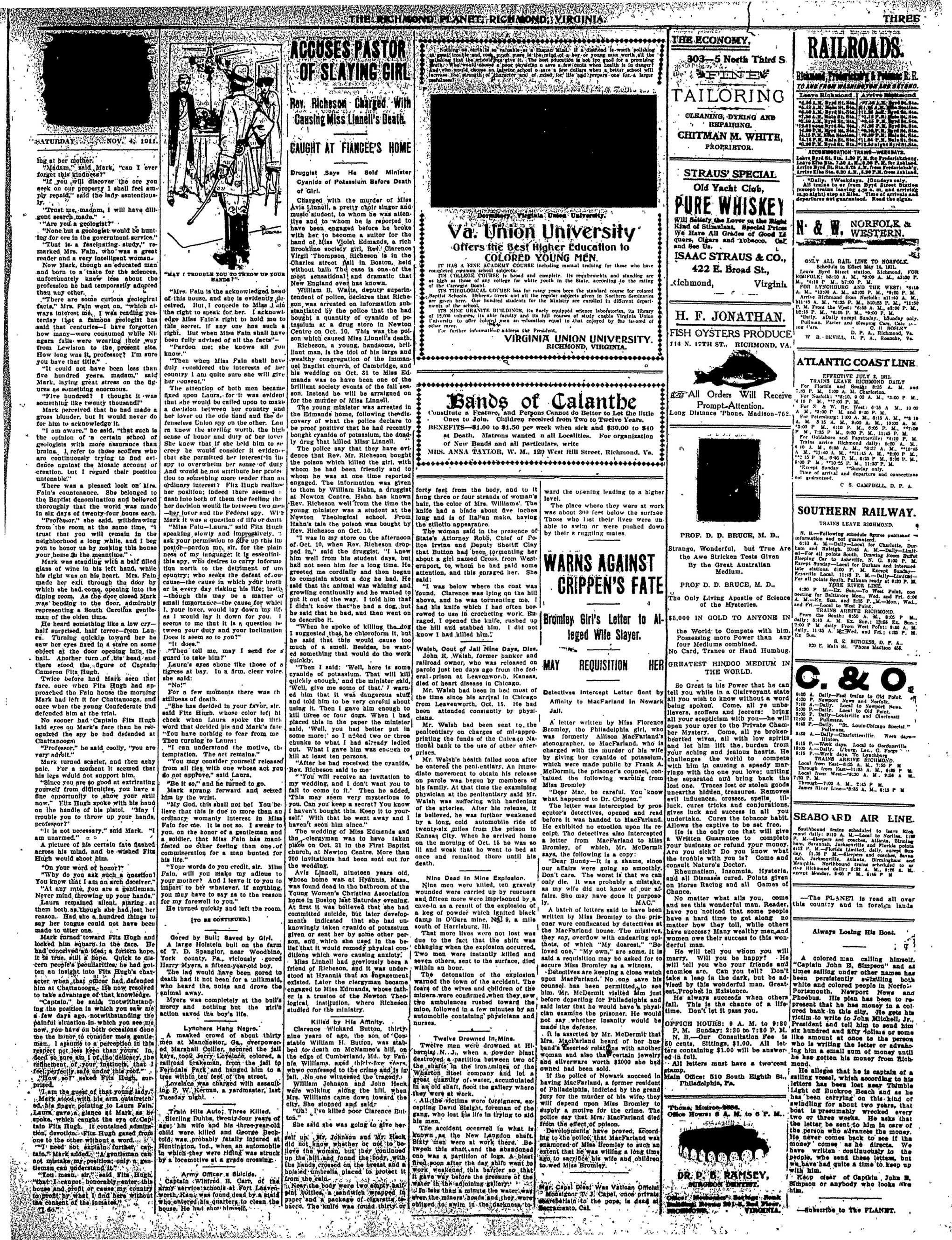
Sciacca RES PASTOR, CEM INA knee
wy le Bera s os| a PS BSCR Raga MAH sch aha Gr A ING HOW Sieatlad le-worh pllbeg’ $ | =a :
ma rele | Soopers. woke ley COU A SPAST! BSF can pa tah: act ince a: tbacrolgd ota: hey."ce Young mam worth all te |
i Bey oR | (OF SLAYING GIRL|} Se esr pera fi eee ng
. @ ye are PERRET AOS LEE Sey Hpi Setubneatasid Se ace estret «mau tort TAILORIN N Be
4 Re Ness) Pe tetsu Win GRINS
sg P| ae Bee |: Caustig Miss Linnells Deal. | 2" _| OLaNtKG, DymG axe | 2x
Sisewaastemenc eure: | MRSS 5) [a { ey : a i cRITMAN wai Pe
OBATURDAYSS EE NOV, 45 1088) MBC Oe AR | Soin ce Erbeneere pnue): 3 f MAN M. ¥ y 1 oe
Yo et ber nightigts” "
oNedam, ald Mark, “can Y ‘ever
forget this Kindbess?* .
“Lf you will discover "thé ore you
sepk On our property 1 aball feel azn:
Ply repaid.” asid the lady sentontious-
ney? 5
ema 1 will have allt
wont search made.” +.
‘Mare youa geologist?’ © |
“None. but a gologiat: would Be bunt-
“Ing for ore in the gorerninent. service.”
“That is a fescinating- study,” re-
marked, Mra, Fatn, who-was a great
reader and a very {intelligent wonan.
Now Mark, though an educated man
and born to a‘taste for the sciences,
unfortunately knew tess about tho
profession bo had temporarily adapted
then auy other,
There are sotie curlous geologteat
tacts,” Mrx, Fain went on, “which at-
rays {oterest me, I was reading yer
terday (hgt a famous grologiat bas
gald that centurfes—I bare forgotten
how mans—were couaumed whlle Ni
agara falla: were wearing ttolr yoy
from Lewiston to the, prosent site.
How tong was it, professor? I'm ante
you bave thar title.” .
“It could aot bave been less than
five hundred yeara. madam,” salt
‘Mark, laying great stress op the Sg:
ures as sumetbing enormous.
“ive hundred? 1 thought st -was
something ike tweuty thousand!”
‘Mark perceived that he bad made a
gross blunder, but It would never do
for Lim to acknowledgo'It,
“I om aware." be anid, “that such ts
the opinion of “e certain schoo} of
geologists with more Gksurance than
brainu 1, refer to those scoffers who
are coptinuouly trying to fod evl-
Gece ngainst the Mosaic account of
‘creation. wut 1 regatd thelr position
untenable.”
‘There was a pleased look on’ Bre.
Fain'a countenatce. She belonged to
the Baptist deaomination and believed
thoroughly that the world was mado
in alx days of twenty-four bours each.
“Proféswor.” she enid, withdrawlog
from the room at the samo time, “I
trust that yoo will cemain tn ‘the
neighborbuod « long white. and [ beg
yon to bovor ua by making this house
‘Your home 2) the. meantime.” +
Mark was standing with a balf filled
glass of wine in bis Jeft hand, while
Bis right was on bis heart, Mrs, Pain
made bor exii through the ddor by
hich she bad.come, opsatig {nto the
dining room, As the dgor closed Mark
was’ bending to the floor, admirably
representing a South Carolfaa gentle-
man of the olden time. .
He beard soniething Uke a low cry—
half surprised. half terror—from Lav:
3. Torolng qaickip toward her be
gow her eyes Oxed {n 4 stare on some
object at the door opeding {nto the
tal, Another turn .of ,ble" bead ‘aud
there stood the,.0gure of Captain
Cameron Fits, Hagb. - f
Twice before had Matk seen that
face. ouce when Fits Hugh bad ap-
proached tha Fain house the moroiog
Mark had léft tt for Chattanooga, and
ouce when the young Confederate tmd
defended bim at the trial.
No roover had-Captaio Fits Hush
Iald eres on Mark’s face than he rec-
ogntetd the spy be bad defended at
Chattanoogm
“Profesor.” he sald. coolly, “you are
very adroit."
Mark turned scarlet, and then asby
pale, For @ moment It seemed that
his legs would fot support him.
“ince sou are go good nt extricating |
yourself from didicnites, sou have 2
fine opportunity to show your skill
now.” Fitz Hugh spoke with bis band
os the handle of ble platol, “Mny {
trouble you to throw up your hands,
Professor?" . eee
“It fa pot necessary,” said Mark. “I
am unarmed” ae, 2
A picture of hie certata fate fasbed
across his mind, and be wished Fits
Hugh would shoot him.
“On your word of houort*
“Why do yoo aik such a question}|
You know tint Iam an arch decelrer."|
“At any mte, Jou are a gentleman,
Never sind throwing up your hands.”
Laura remained wllent, staring. at
them both. ap. though sh¢ bad Jost her
reason,, Had eho. a hundred things to}
say her tongue could not have been
made to utter one, =. * .
‘Mark furned-toward Fits Hogh and|
Woked him squarv.in thd tace. He}
bad'concelved ad fded; @ fortom hope,
it 34 trie, still @ Hope. Quick to die
tem people's’ Pebulltitions be had got.
teg ao inalght into Fits Hugh's char.
acter when ,thaj officer had, defended
him at Chattanoora: He now sere?
to take advantage of-that knowlédge,
“Captain,” be ald ‘notwithatand-
fog the poaltion In which you saw nit'
d-fow days ago, notwithstanding the
paloful sltuation-tn. which you see nie,
now, sou hire ou bétly decastons done
the the honor t6 cotisider mesa gentle,
tide 1 apninis to». petcebtton tn this
av ect Hot Jens Kegs than’ jgurs: 10,
tet gure, aio f pf, tho' delicacy, the
tiifihement, of ;ybur"inetineth, that. 2
e oh oe
an
ye mocpateg tine
“Mrs Falu 1s the ackoowledzed head
of-this houxe, and abe ts evidently gle
colved, But,t concede to Migs 1 alt
‘the right to speak for her. [acknowl
edge Miss Fato’s right to hold me tc
tila, secret. If any voe baa auch
tight. But when sftva Fath aball have
been fully advised of all the facts'—
“Pardon me: she koows all sut
know.”
“Tben wheg Miss Faln sball pave
duly cunaldered the toteresta of be:
country tam quite sure abe will give
hor consent."
‘The attention of both men became
fixed upon Laura,-for'tt was evident
that whe would by called upon to maki
A decision between ler country and
bet lover ou the ove Hand and the de
fensclers Union apy un the other. Lau
ra kuew the sterllig worth, the biz!
sense uf ouor and duty of ber lover
She knew that if sbe Leld bim to se
crecy be would’ consider {t evidenr+
thut she permitted ber lotereat*in the
spy to overmrbelm ber sense -of duty
And would be.not uttribure bor proter
tlou to xoferbing mare tender tha an
ordinary furerem? Fitz Hugh reallzer
her position; fodecd there seemed :
Gash toto both of them the feeling th
her devision would Ife between two aint
her lover and the Federal spy. Wi't
Mark it wae x question uf {Ife ur deatt.
“Miss Falu—Laura.” said Fitz Bugh
speaking, slowly and Impressivels, “
ask your permisnlon to Fe up this tw
poatér—pardon mo, air. for the plain
esa of my inoguage: it ig essential.
thie apy, wlio desires to catry informe
ffgo north to the detriment of um
epuntry: who seeks the defeat of.our
cause—the cause ia which yéar broth
er tn every day raking bis Ife; tavtly
~thiugh this may be a matter of
amall {oiortacce—the cause, for whiel
1, your lover, would lay down tay lif
aa} would jay It down for you. 1
seorun to me that tt sq question te
tween your duty and your taclination
Doex It acem #0 to son?
“Lt dogs.”
-"Thyn" tell me, may I send for
guard to take bial”
Taura’s eyes shone tike those of a
tigress at bay. In x Arm, clear rolce.
abe anid:
“No! -
For a few moinente there wan th
stiilvess of death. 7
~'Bhe baa decided In your favor, alr.
said Fits Binh. whose color tefs i
cheek when Laura apoke the rth
word that decided bin and Mark's fate
“You have nothidg to fear from me
‘Then turalag'to Laurn:
. “I can understand the motive, thi
temptation, ‘The act retains.”
“You may couslder sourself released
from all ties, with one whose act you
fo pot appfore,” said Laura,
“Be tt 50," and he turned to go.
Mark sprang. forward and setzed
him by the wrist,
“My God. thx sball not bot You'be-
Neve that thia {s dué to more than an
ordinary; womanly Interest in Miss}
Fata for ate. 1 ls not $0. I swear to!
yau, on the bonor of a gentleman and
a toldier, that Miss Fain his maol:
féeted no cther feeling than one-of
commiseration for a man bunted for
his Nite." :
“Your words do you credit, slr. Stlss
Fain, will you take my adieue to
your mother? Aud I leave it to-you to|
impart’ to her whatever, if anything, |
youl may have to say as to the reason
for my farewell to you.”
He turned quickly and left the room,
{ro as comrircED,) = I
Sored by Bulls Saved by Girt. .
‘A large Holstein bull on the farm
of T. D. Spangler, near Woodbine,
York county, Pa, viciously - gored
Harry “Myers, a fifteen-yearold boy,
‘The ind would Have boon gored to
death bad {t not beon for » -nilkmatd,
who heard the nolge and drove the
animal away.
BMyors was completely at the bull’s
morcy and nothing but the girl's
action waved the boy's Iife,
Lynochers Hang Negro.”
A mauked crowd of abont thirty
Men at Mancticttor, Ga, cverpower
ed, Marshall Cailler, secured the jail
keys, took, Surry: Loyetads, colored, &
rallyodd brakemlin, from-the jail tp
Ferndale Park*and hxnged hin to
"tren Within tot fest ofthe ntroct,
| davelaca "was chafgod with assault
Lig. BW. Kervan, a yardmaater, last
Tuesday aight. -
“) Train Hits Auto;. Three Killed, ~
} fiterling Dubbs, tweaty-four yeats of
fige;" hts wife apd his three-yearold
‘child wore. killed and George Bech-
told: was, probably fatally Injured at
Huntington, tod, when, an antontoblle
fn whichithey wero riding was struck
‘by a locomotive at « grade crossing.
1 Army OMcer.a Glicide, |
‘ Gabtata :Wintred. 'B, Cars, of thie.
atmy' wtrvice:achoola at Fort Ladven-
{worthy Hank. wad found,dead by.a pietd|
‘Who-entered hie.quiatterg.to clean. the
‘house. He had shor bimesif,--. 0°
OF SLAYING GIL
Pay, tana ih
Gast Wiss nn’ eat,
‘CHUGH AT FIANGEE’S HOME
Drugalat Says He Sold Minister
- Cyanide of Potassium Before Death
| of Girl . .
, Chiarged. with the murder of Hiss
Avis Linnell, a prety chpir atugor and
Music atudont, to whom tie was atten:
Hye and to-whom he ts reported. to
‘have been engaged before he broke
with es become a suitor for the
hand of Biss Violet Edmacds, a rich
Brookline society girl, Rev.' Clarence
‘Vitgil “Thorapson, Richeson !s tn the
Charles stroct il In Boston, beld
without baib Thq case in one-of the
‘most sensatinal} and dramatic that
‘New England ovei hus known.
Willan B, Waits, deputy auperin-
tendent of police, déclates that Riche-
‘gon, Was arrested on Information sub
staxtiated bY the police that the had
‘Dowght & quantity of cyanide of po
tagslum at a drug storo in Newton
‘Centre on Oct. 10. This was the pol-
‘son which caused Mins Linnelf's death.
Richeson, a young, handsouie, bril-
Nant man, is the {dol of his large aud
swealthy congregation of the Imman-
uel Baptist church, of Cambridge, and
his wedding on Oct. $1 to Miss Ed-
mands was to havo been one of the
brilliant society evonta of the fall sea:
son. Instead be will be arraigaod on
for the murder of Miss Linnell.
‘The young minister was arreated in
the Edmands home, following therdis-
covery of what the police declare to
be proof positive that he had recently
bought syanide. of potassium, the dasd-
ly drug That killed Miss Lionell. **
The police say that they bave ovt-
dence that Rev. Mr. Richeson bought
the poison which killed the girl, with
whom be had been friendly and to
whom he was at ono time reported
engaged. The information was given
to thom by William Habn, a druggist
at Newton Centre, Habn bas known
Rev. Richeson well‘trom the time the
young mloister was a student at the
Newton Thoologtea! school. From
Hahn's tale the poisot was bought by
Rey. Richeson on Oct. 10,
“I was in my store on the afternoon
of.Qct. 10, when Rev. Richeson drop-
ped in,” sald the druggist. “I hoew
him well from bis student days, but
had not seon bim for a long time. He
rested me cordfally and then began
to complain about a dog be bad. He
sald that the animal was whining and
srowling continually and he wasted to
put It out of the way, I told bliin that
I didn't know that*be had a» dog, but
he said that bo bad, and then went on
to describe It.
“When he spoke of killing the dog
I suggested thet, he chloroform It, but
ho sald that this would cause too
much of a smell, Besides, bo want-
¢4 something that would do tho work
quickly.
“Then I said: ‘Well, here ts some
cyanide of potassium. That will kil)
quickly enough,’ and the minister skid,
‘Well, give me somo of that.’ 7 warn-
ed him (hat it was dengerous stuff
and told him to be very careful about
usiog it. Then | gave him enough to
Kil tliree or four dogs. When | bad
placed this In the paper the minteter
sald, ‘Well, you had better put in
some more; so I aided two or three
chunks to what I bad aiready Iadied
out. What I gave him was encveh to
Kill at least ten porsons.
“Atter he bad rocelyed the cyanide,
Rey. Ricbeson sald to me"
"You will recolvo an Invitation to
my wedding, and I don't want you to
fall to como to It.' Then ho added,
‘This may scem very mysterione to
you. Can you keep @ secret? You know
{ haven't bought this, Keep It to your-
self.’ With that he went away and I
haven't sedn him since.”
The wedding of Miss Edmends and
tho clergyman was to evo taken
pla on Oct. 31 In the First Baptist
choroh, at Newton Centre. Sore than
700 invitations had been soit out for
the wedding,
Avie Linnell, ninotoen years old,
whose home was. at Hydnnls, Mass.
Was found doad in tha bathroom of the
Young Women’s Chriatian Association
tome in Boston fast Saturday evening.
At first It wax bolfeved that she had
committed aulclde, Bit tator derelop-
ment indicated that sbo bad uo-
knowingly taken cyanide of potassium
given or sent her by sohie other per
gon, at. which she used In the be-
Met'that it would romedy physical con-'
ditions which wero causing anxloty; |
Milas Linnoll had previously been a
(riend of Michoson, and it was under,
stood at Hyannis that an fagagement|
existed. Later tho clergyman bocame
pngesed to Miss Edmands, whose tath-
er in a trustoo of the Newton Theo-
logical, inatijution, where Richeson
studled for the minintry.
Killed by Hie Affinity, . 4
| Clarence Wickard Button, thirty
‘ning yearo of age, the son. of ‘Cop
atablo William H. Butfon, was atab
pd tor death on McNameo's dill, of
the edge of Cumberland, Mu. by Fan:
nfo, Willfamp, axed thirle-fixe YAare
whwo confessed to the crimg add fs In
Jafl, .No.one witnenaed the tragedt.
William Johnion apd Joho Heck
wore waking aldng the till, whex
Kee. Willllars came dows (owird the
clty, She stopped and welds.
“Ob Ive lated poor Clarence But
She sifd she was golng to gI¥o her
deit ups Me, Jotindom and ‘air: Black
did ot, kiow, whether o¢ aot :t0 do
lieve the woman, but’ they ‘continued
up the biji.iaad foand' the :body, .with
the Hiandy,croased on, tse ‘Yeu and
holeiéed-imbrail, placed to protect It
from whe Eatery as SN as
i Noaythe, body warp lwo ekpiy ball
pia Wollink:a ‘eanedloh ‘mrapps. bi
paper ‘and "® package of. clgarstta..té
bacco, The *kulfé was (ound. thirty: or
at sai li seta a ie ft Billa “a wat pteg
<a pres as coe piel barat ota 7 Se Jane. mane worth
that tbe: it, (Tbe beet. tiga fal Bot rood for & promis
(Pets vielen cht Tips" paydlan ortave as frwrcauts wis Geatih fe if Sangeet
datricho redone. Fn, beese school © avers. fee dellere wbeu «be(tst achool il
jlucrrase (be orang 51 paaracte "and of gaind: for! life ‘agd Sperpare’ que fora larger
preven ieinins LE CUE a ie Ala tt ;
PERIGEE SASS UU Rte este yor z
i) .
Fe BTN SR aT BRITTO El MARS Seni ep Ss aot aT fk Ss
NE Boney Vasginia Obie’ Univgraty: *
op LUO gly ce ae me sia & a
Va. Union University’ —
Offers thé Best Higher Education to :
- COLGRED YOUNG MEN.
rr 140 A VINE ACADRIIG COCREE [ncllng menu talbg for thew who bie
enti AS Selene : |
BE Care a and complete te raha aad anil a |
ie ae Ee ee nai Seats Seen ob, tet,
oe oes :
{TS THEOLOGICAL COUUSE bas for many years been the stanfanl course for colored |
faptie Rchoote. Misbcrnsdieek at al the tego enbfecte elt a Northera Semteat
Secchi Se bl ables oe We aac Cael ksCea dee
Ire SINE ORASITE, BUILDINGS, tte Soateeqlppi sence Ubofaoren its bry |
od oar amare erase eat ta seen, ota Rae
Tatcaly “ued gy sae Sn hasten lt rein alg Dy Betta
Seer 2 :
Rie inmate afte tne. Prsdet
* VIRGINIA, UNION UNIVERSITY.
. ¥ RICHMOND, ‘VIRGINIA. ’
.00000000000006000500600060560600000500000000900004
PPPOE S SES SO DOPOD ISS DEPTS TOOL ESO PPEE OS OOS ESO OPE SES OTE
| ‘Bands of Calanthe ;
| Constitute a Reataro, ‘and Pergons Cannot do Better to Let fhe little
} + Ones to Jol, Childreg received from Two to Twelve Years,
: BENEFITS—$1.00 to $1.50 per week when sick and $30.00 to $10
, at Death, Matrons wanted n all Localities, For organization
: of New Band# ond ail particulars, write
: MRS. ANNA TAYDOR, W. M., igo Weat Hill Street, Richmond, Va,
DOSED SSEPEDI GOL DOLES GIO E$60645490006006060406000004
ape Ee ok ara Rea
forty feet from the body, and to It
Aux three or four strands of woman's
hair, the color of Bre. Williams’. The
Knife had a blade about Ave Inches
Jong and fs of Ital'an make. having
the atlleto appearatice
‘Tho woman sald in thy presence of
State's Attorney Robb, Chief of Po-
Nce Irvine and Peputy Shorit Clay
that Button hag ‘been, tormenting her
about x git] mamed Cross, from West:
ertiport, to, whoni be bad pald some
attention, and this enraged her, She
ald:
“I was bolow whero tho coat was
‘found. Clarence was Ising qu the bill
above, and he was totmenting me, |
had Bla knife which f had often bor
rowed to use {0 crocheting work. ia
raged, T opened the kalfe, rusbed up
the hill ax stabbed bim. I did not
cxnow I bad killed him,
Walsh, Oout of Jail Nine Days, Dies,
- dohn R, Walsh, former banker and
railroad owner, who was released on
parole Just ten days ago fron tho fod:
eral-prison at Leavenwor., Kanoas,
died of heart disease ia Chicago.
‘Mr. Walsh bad beon in bee must of
the time alnce bis arrival in Chicago
from Leavenworth, Oct. 15. He bad
boon attended constantly by physi-
clans.
Mr. Walsh bad becn sent tg, the
peniteatiary on charges of ml-appro-
printing the funda of the Calrazo Na-
ttondl bank to the use of ather efter
prises.
Mr. Walsh's béalth falled soon after
he entered the ponlentiary, An [mme-
late movement to obtain his reloase
op parole was begun by members of
his family. At that time tue oxamiolog
physician at the peattontlary said Mfr.
Walsh was suffering with hardening
of the arteries, After bis release, It
is belloved, he was furthor weakened
by & long, cold automobile ride of
twenty-six silos from the prison to
Kansaq City. When he arrived home
‘on the morning of Oct. 16 be was so
Ml and weak that ho went to bed at
once and remained there until bls
death. *
Nine Dead In Mine Explosion.
Nine men were killed, ton gravoly
wounded wore carried up by rescuers
and fitteon more wore Imprisoned by.t
caveln as a result of the explosion at
& keg of powdo? which Ignited black
damp in O'Gara mine, NG} 9 a mile
south of Hartlaburg, Tl
‘That mote lives wero not tot was
due to the fact that the shift was
ebhoglng when the explosion occurred,
Two men wore instantly killed and
seven others, sent to the surface, diod
within av hoor, tt
‘The detonation of the oxploston
wartied tho town of the accldent. The
foarg of the wives and children of the
misiers-woro confirmed when they.aew
tio ambulances rushed toward the
imino, followed in a fow minutes by an
automobile contatning’ physicians and
nurses.
* cates Meewned tn. dtine.
,. Twelve men were drowned at Hi.
‘berqiay.N..3;, when a, gowder bias!
Geatroyed: «partition between two a!
the ahagie in the yes ilies of the
“Wharton Stee! company frid let a
‘wpeRe quantity of. water, accurbulated
ih soe stiaft, food the gallery where
hey wor at Work...
+, AUCthS Wietlms wore foreigners, ex
cepting David Sleight, foreman of the
Sang, who loat hls life tn trying to ata
Dis men.”
‘The accident ocearred tn what ts
wapyn aq. the New Lavgdon shaft.
Bitty “die wero at wotk there,” De
typot: this shaft.and the abandoned
ono was & partition of logs. A- blast
AiFed.poon after the day, shift wedt to
‘work, weakened, thls batiler so. that
tt fis ‘way detdre the pressure ot thé
water thtbaeadjoioing gallery * <1
To: tebs thid, a minute the water:araj
aver:the.m{ners':honda and shoy. wore
obliged. to: swim {n- the; darknoas,"to-
Sime
| fe Bee
WARNS AGAINST
_. GRIPPEN’S FATE
ey Girl's Letter to AL
| Teged Wile Slayer.
AY REQUISITION HER
Detectives Intercept Letter Sent b;
Affinity to MacFarland in Newarl
dail, .
|X lettor written by Miss Florene
Bromley, tbo Philadelphia girl, wh
was formerly Allison MacFarland’
atonographer, to MacFariand, who i
charged with the murder of bla wit
by giving her cyanide of potassium
whieh were mado public by Frank A
MeDormit, the prisoner's counsel, con
“talued the following warning {rou
Miss Bromley
“Depr Mac, bo careful. You “knov
what happened to Dr. Crippen.”
‘The letter was intercepted by pros
ecutor's detectives, openod and rex
before It was handed to MacFurland
He exhibited no emotion upon its re
celpt. Tho detectives also intercepted
@ lotter from MacFarland to Mls:
Bromley, of which, Mr. MeDerml
says, the following Is = copy:
| “Dear Bunty—It Is» shame, since
our affairs were going so smoothly
Don't care. The worst is that wo car
only dle, It was probably a mistake,
ax my wife did not know of our af
falre. She may have done It purpose
yy, MAC.”
A batch of lotters auld to bave beer
written by Miss Bromley to the: pris
oner wore canfucated by detectives at
the MacFarland house. ‘Tho missives,
they nay, overflow with endearing opt:
thets, of which “My doareat,” “Be
loved ou6," “My own,” are some. It i
sald a requisition may bé asked for te
secure Misa Bromley ag a witness,
~Detepilves are Keeping a close watet
pot MacFurland.”No.one save his
counse}. bas been permittedto see
him. Mp, MeDermit visited im Just
before departing for Piiladoiphie. and
sald later that ho would have 's physi:
sian examine tbe prisoner. He would
Rot say .whother Insanity would be
made the defense. .
« ft fe assorted by Mr. McDermit that
Mrs, digeVarland heard of her hus
hand's Waserted elites with another
oman and also thaWcertain jewelry
and allvervare worth $2000 sho bad
owned bad been sold.
It tho policé of Nowark succeod tn
having MacFarland, a former realdent
of Philadelptia, Indicted by the grand
fury for the marder of hia wife; they
Wilt depend upon les Bromley to
tuspty a motive for the crime. The
police say that Afra: BMacFarlend dled
frdin tie effect of pplion.
Devélopnierita: hve proved, &cord|
brig to Atie ‘polfcd; that stacFuriand waa}
enamored-of Mise Bromley to sch ‘an]
extent that 6'sas willfag a 1onx time]
igo, to sacrifice his wite and oblldren!
to,wed Miss Bromiley, ° . |
Migr, Capel Diss Was Vatloan Omtetsi
eee I ape, "on0e: pare
‘@UMBAMaIs to’ the ope; te desd af
‘Gectamante, Cal. ° wl
STHE.ECONOMY,
——
“903-5 North Third S.
gree age
TAILORING
* OLBANING, DYEING AND
“4 * REPAIRING,
CRITMAN M. WHITE,
+ PROPRIRTOR,
: :
: STRAUS’ SPECIAL
Old Yacht Ciob,
Kfar etcetera mame
We Have All Grades of Good Is
or cee amt “Rodacco, =
ISAAC STRAUS &CO.,
| 422 E, Broad St.
| -ichmond, Virgin
a
| H. ¥. JONATHAN,
reece
FISH OYSTERS PRODUCE
1t4.N. 17TH ST, RICHMOND, VA.
RB Al Orders Will Receive
Prompt-Attention.
‘Long Distance "Phone, Madison-762.
rad :
| ; Hy
4 Fa
ES
. fg
I p
PROF. D. D. BRUOB, M. D.,
Strange, Wonderful, but True Are
the Awe Stricken Teate Givon
Strange, Wonderful, but True Ar
the Awe Stricken Teate Givon
By the Great Australien
Medium.
PROF D. D. BRUCE, M. D.,
Tie Only Living Apostle of Science
i. of the Mystories.
$5,000 IN GOLD TO ANYONE ID
the World: to Compete with him
Possessing more Power than 40}
four Sfedlums combined,
No Card, Trance or Hand Humbug
IGREATEST HINDOO MEDIUM IN
THE WORLD.
80 Great fs bis Power that he can
tell you while in a Clairvoyant state
fall you wish to know without @ word
belng spokex. Come, all ye unde
Mevere, scoffera and joerers: bring
jall your ecepticism with you—he will
lopen your eyes to tho Private Cham-
ber Mystery. Come, all yo broker
fnearted wives, all with iow spirits
end Jet bim iift the, burden trom
your aching and Jealous hearts. He
challenges the world to compete
with him ta causing a speedy mar
riage with tho one you love; uniting
the separated amd bring back the
lost one. Traces lost or stolen goods
uncarths hidden, treasures. Removes
evil influences, crosses, spetis, tll-
luck, cures tricks and conjurations,
gives luck and success in all you
undertake. Cures the tobacco habit.
Allows tho captive to be set free,
Ho {a the only one that will give
a Written Guarantee to completo
your businoss or refund your monoy.
Aro you sick? Do you know whet
the trouble with you 1s? Como and
consult Nature's Doctor.
Rheumatiem, Insomnia, Hysteria,
and all Disoascs cured. Points given
on Horge Racing and all Games of
Chance,
No matter what alls you, come
and see this wondorful man. Reader,
have you ‘noticed that some people
have a hard time to gat along no
matter how they toll, while others
havo success? Many wealthy men.and
women owe thelr success to this won:
derful map,
He will tell you wtiom you will
marry, WHI you bo happy? - He
will tell you who your friends aut
enombes aro, Can you tell? Don't
take a loap {n the dark, but be ad:
vieed by this wonderful man, Great.
ost.Prophet In Ealstonco.
He’ always succeeds when others
tall, This {8 the chanco of a Iife
me. Don't Igt tt pass you.
OFFICH HOURS: 0 A, M, to 9:80
P.M. Bunday: 2:30 to 7:80 P, BL’
N. B.—Our Consnitation Foo is
5) cents, Sittings, $1.00. All tet
fare contatning $1.00 will be auswor
ya 16 ful,
~ AML fetters must have s two‘cont
tam. |
fain Office: B10 South Eighth Bt.,
Philadelphie, Pa,
*Podme; Mosroe-ties, +
Ottce Howe: 6 A. M. to OP, M,
1S secant Gig
dR b:8; RAMSEY,
Piola pare”
Sei ce betes ee,
. ‘____THREB
| RAILR DAD pea
af cca pc Lk
nee
AUR raha are bas
Rei eats Sere ear
SU RE eae
etnies etcs oats
SERS eh gis nena
NK & ¥ NOREFOLE &
_ Ms WESTERN.
7 ee
ONLY ALL RAM LINE TO NORFOLK.
Schedule (0 E@ect May 14, 1911.
Leave Byrt Btieet station, Riehmoad, FOR
NOUHOLK: D810 A. ME, °9:00 A My atOQ Pe
Me, lO PM, 1:00" P.M *
Fon LyNouguna Np Tie west: vex
As Me “10:09 A. May 08:00 P.M, "4:80 Be aL
‘Artie Wichnioad thom Nocolk allo A.M,
Due. Mh, 50:89 PM, DIOIES PL My “11:39
Py M. Fron ihe Wat: *6:88 A. My o2:09 P.
VHS Ped, “6:05 P.M, 9500 Fl Me
“Dally, “aDaily except Bunday.,. b8uaday oaly.
Pullman,” Parlor: anu leeping Cary, Cale v=
soe Care oe Bost
D. P, Ay Richmond, Ya.
) Benen, oR "Ronbate, We
——
ATLANTIC COAST LINE.
EEPROTIVE JULY % 1011.
TUAINS LEAVE. RICHMOND DAtLY
For, Florida and Boul 8:18 ALM. and
1.83 PLM f:00 A. Me Charleston,
For Socfolk: “gio, 9 00 A. Me *3:00 PML,
410. Me TO Pe Me
APE Sa BeBe Meet, 14 a, 10 00
a3 29:00 PAL and 90 Pa
For Tetersburg: 1:00'A. 2k, 6:35 A. Mo, S48 10
Aa oe ae ee aa a, es ote
$$:00 PM 410 P.M, 4:08 PA, 1:00
POM, Te3 PM 9:90 BJ, es Bs ae
/ Foe "okiaboro ad Fayeiteviiter #10 Pe
4 Taine arrive. Mchmond dally: 6:20 A." Me
AIA My O:s5 AM, 88:37 AL Ke, SONS
SoM de AAG rn A aL oti eat
Sra 18 PG, Ors PM, is P Md, 8:00 P. ILS
0-00 Pow 0s Pie MNS PML
“Favept Bunday */Suplay only.
Time lof arrival and departure sad consections
oot pittance,
© 8 campoeet. DP a.
————
‘TRAINS LEAVE RIGHMOND. ‘“
formalioe wd ee eaeete Spurs pxblumed —
wofeion and ott natn Set
Se te nae bn
sian Maia ga Maa, er
sera ae wie bee ee
Hens Ge an are ae Be
Ei eat pdlat ad atet
BeTaaina” da Bolen part
Ena eR aS Mee tae
util Raat as
agit i
1a ta TE RE ese
lie tala DOR
Schr eaten ey eso
sora SE EE
TRAINB ARRIVE RICHMOND.
gahtm tbe Souths 6:0 A. He 8:05 Po,
leet uh EE MI re
2:00 Pid daily trom West Pott: $40 eae
any, ae AO MeDWed. and Fei; ts PM.
BE mmo oF ay
920 F. Main 8. "Phone Madizoo éSé. .
=———_—___
C. & O.
9:00 A. Delly—Fast trafsa to Od Polat. A
22 & Reg ti cet op
THO A.—Dally, Local to Newport News, .
ES ICRI deal oar
eee oF at,
a a
2 FE ean cxaes wl”
eat
0 LORE e mon a
ues
fu HE Be om te Qazrtn
"i Rene Deg oe Spo
i Rae eg as
iit tie GMa
teat Sn AEE GOURD
attests A Ea
Eat hrwnts Ae Tt
ee eee aa
Boston a 2
RESTA SA Mile Ss ew
SEABOARD AIR LINE.
fouthbousd trains scheduled to teare Riou
Jor daily: o110 A. M.mLecal to Neca. 1938
P. Metleepere aod coucher, Atlanta, irate
biry, ‘Gausatah Jacksonville and Florida polots
eat’ PM Florida Limited, ‘daly, excepe tex
ray, Und PM “elepery abd conch Sates,
gah. Jictaoovitle, Atlanta, "Binning wat
Mrninnle” “Northbound. traine scheluled to “ar
ise Uchrond dallyt 632 A. Mee 88 a
orerot Monday. 05 PM. Gee
ey
-—The PLANET ts read all over
thie countzy and in forsign lands
a
Always Losing His Boat. *
A colored man calling hinrself,
“Captain John B, Simpeon" and al
times sailing under other names has
been peralatently ewinilling bots
white and colored people in Notfo>
Portsmouth, Newport Nows and
Phodbus, Hits plan hes been to re-
Precent that he hee money in a col-
Ored bank-in this city, He gets his
Yell to write to Johm Mitchell, Jr.,
Proatdent 224 toll bin to wend him
six bandred and itty dotine or some
lke amount at once to the persoa
who ls writing the letter or edvaho-
fog him @ email sum of money until
be hes gotten his monor from Retr
mond.
ue ilo that he te captain of a
culling vootel, which according to his
letters hes been lost near Tomble
Light of Buckroe Beach and as he
haa“beon eatrying' on this- hind of
awindling for about two years, that
boat ts presumably wrecked every
two or three wovks, He aeks that
the letter, be sentto him tn care of
the person who allvaneoe the money,
He never: comes back to’ sce if the
money’ comeg' ag hé directa. We
have written - continuously ta the
pdple, whe wend these léttem, but
ya pave bad quite 4 thme'to. keep up
with him, .
“Keop clear of Captita, John m,
Bichpaon or anybody who looks ite
hime, 7
—Habsorite to The PLANNT.
en.
G
7z3
```markdown
```
Published copy Saturday by JOHN MITHELL, JE., at 21 N. Fourth Street, Richmond, Va.
JOHN MITHELL, JR., ... EDITOR
all communications (วัลน์ธนบรร) for publication should be sent so as to reach us by Wednesday.
TERMS IN ADVANCE
One Copy, per year ..... $1.50
One copy, eight months ..... $0.00
One Copy, six months ..... $0.00
One Copy, four months ..... $0.00
One Copy, three months ..... $0.00
Single Copy ..... $0.00
ADVERTISING RATE
For one inch, one insertion ... $0.50
For one inch, subglimmed insertion ... $0.00
For two inches, three months ..... $0.00
For two inches, six months ..... $0.00
For two inches, twelve months ..... $0.00
Marriage and Vigour Notices, one inch ..... $0.00
Standing and Transient Notices, per liter ..... $0.00
*STAGE STAMPS OF A RIGHER DEMONIN - TION THAN A ADVERTISING RECEIVED ON SUBSCRIPTION.
THE PLANET is loaned weekly. The subscription price is $1.50 per year, in advance.
There are four ways by which money can be sent by mail to any one of the three or more Money Order, and when none of these can be proposed, in the same way as the money order.
MONEY ORDER—You can buy a Money Order at your Post Office, payable at the lichmond Post Office, and we will be responsible for its late arrival.
The cost of money sent by any of these companies, for any for Award, is $1.50 per year.
For Express Monarchies, a safe and concise way for recording money
EXPRESS MONEY ORDER can be obtained at any office of the American Express Co., the United States Express Co., and the Wella Fargo and Co's Express Company. We will be responsible for the Post Office and the Express Office, not within your reach, your Postmaster will register the letter you will do to send us payment.
The cost of money sent by any of the Letter is lost or stolen. It can be trained. You can send money in this form. We cannot be responsible for money sent for a letter in any other way than one of the four ways identified above. If you send your money to any other way you must do it as you own risk.
DENVER, PTC If you do not think TIK PLANET continued for another year after your JD Postal Service has run out, you then notify us by or post a letter to discontinue it. The courts have decided that you will not send your post office to your company who do not order their pay or discontinued at the ex-JD post office in the case of the post office.
If you do not, the payment of the subscription up to date when they order the paper doesn't then turn out.
COMMUNATIONS—When writing to us to review your subscription or to discontinue your paper you should give your name and title to full, and you cannot find your name or our book.
CHARGING OR DOHERS — In order to change your address, a subscriber we must be sent the former as well as the present address.
II
H
Entered at the Post office at Richmond, Va.
as account holder
CENTRALIZED GOVERNMENT
The Supreme Court of the United States handed down an opinion last Monday which will have a far-reaching effect upon the "Jim-Crow" Separate Car laws in the several Southern States, if it is carried to its logical conclusion. It will result in a basis of established equality of service and privileges upon lines wholly within the confines of a State and eliminate many of the abuses from which intra-state passengers suffer
Certainly if a passenger traveling from one State to another must be accorded equal rights and privileges with every other passenger, then passengers traveling from point to point wholly within a State must be accorded the same rights and privileges. The colored passenger from New York being guaranteed equal rights and privileges by the Interstate Commerce Commission sits in the car with the colored passenger traveling wholly within the confines of a Southern State.
The decision was rendered by a unanimous court, with a State's right Democratic Chief Justice presiding. The question raised involved the enforcement of the Federal safety appliance act on railroad branches wholly within the confines of the State. In protecting human lives by its promises and argument, it protects human rights and deals a "body blow" to the cherished right of States and look one long step forward in the march of nationalism, which Hon. William J. Bryan is pleased to term imperialism. It may not be that "God is fighting for Israel" in these cases, but it does look as though great principles are asserting themselves, to the confusion of the politicians and the Negro-haters of the country.
. _____
A QUESTION OF STATE'S RIGHTS
We have noted with much inter- suit it eat the attitude of the bondholders Roosebov who are suing, or Father have sued, into a West Virginia in the name of the defense State of Virginia in order to recover ness of one-third of the bonded indebted- celebr ness due them by the State of Vir- time of ginis, and which amount was virtual- cut hit repudiated by the State of Vir- which ginis on the ground that-West Vir- gents ginis was taken from Virginia and ted St organized into a State, and alleging sacri- that this indebtedness amounting to The about seven million dollars, should stood, be assigned to her. bored The Supreme Court of the United came states decided that this debt should upon a
be paid by West Virginia, but it has not issued any process for the collecting of the money. It is a well-known principle of constitutional law that a State cannot be coerced or be made to pay a debt unless it elects to do in order to protect its credit.
Although the State of Virginia (bondholders), have contained a moral victory, they are now casting about to find a way to make West Virginia pay that seven million dollars, with interest
The Supreme Court, in an opinion hunded down last Monday, denied the motion of Attorney General Samuel W Williams, of Virginia, to determine all questions left open by the decision of last spring and for a rehearing. This, then, emphasizes the doctrine of State's rights. West Virginia can decide whether she will pay the bill or let Virginia and the bondholders sit down and wait another hundred years perhaps. ¢ If the Southernner's position is that a sovereign State cannot be coerced from withdrawing from the Union how can he argue that it can be coerced into paying a debt? But then the government held a different opinion and no doubt these creditors presumed that it would be guided by its civil war attitude.
____0____
TOO DRUNK TO LYNCH
The type of the lynchers in operation in Georgia is well shown in the following telegraphic report
Washington, Ga. Oct 29 - After having confessed that he murdered C S Hollenhead as a merchant and planner, A B Waker negro escaped from a mob which had taken him from the sheriff, after a rope had been placed about his neck, and as the mob was in the act of stringing him up to A limb Hollenhead was killed in his store night, and suspicion fell on Waker. The sheriff arrested Walker and brought him to Washington about 2.30 this morning to the sheriff was taking the negro to jail he was overpowered by a mob of 50 men, and the negro seized
The would-be lynchers started with the negro to the outskirts of the city to lynch him, the negro having confessed to the murder of Holleshead. The members of the mob had plenty of whiskey and drank freely. A rope was put about the negro's neck, and an attempt was made to string him up, but the would-be lynchers were so drunk they fell to the ground. The negro saw his opportunity, and regretting before the members of the mob realized what had happened. Possess have been searching for the negro all day, but he has evaded his pursuers.
This is one time when whiskey subserved a useful purpose. Why should A B Walker again surrender to a sheriff? If the officers of the law is unable to protect him why should he protect himself? The safest and best course to pursue in such cases is to sell one's life as dearly as possible. The best way to punish the lynchers is to shoot them down while they are engaged in their murderous practices. When men generally get nerve to do this and officers of the law are hold enough to hunt down the lawless, the cost and risk what it may without regard to race, color, politics or religion, then a brighter day will dawn for law and order and the sway of the mob will be eliminated in the land.
O
AN ATTACK UPON ROOSEVELT.
From a political standpoint, the suit of the Attorney General of the United States, begun at Trenton, N.J., October 26, 1911, for the dissolution of corporations in restraint of trade, is a suit against the United States Steel Trust in general and an attack upon ex-President Theodore Roosevelt in particular. The ways of these politicians are past finding out, but the very argument in the defense of the distinguished ex-President's position in permitting the acquirement or taking over of the Tennessee Coal and Iron Company by the United States Steel Corporation, is an indirect way of showing up to public adverse criticism the credibility of this foremost citizen of all the world.
It is the evident intention of these gentlemen to dispose of him as a presidential quantity first and to divest him of political influence afterwards, recalling that he is the most valuable asset of any political organization which may oppose the aspirations of the present distinguished occupant of the White House. The suit is an open attack upon Theodore Roosevelt. They have forced him into a position where he can hardly defend himself save from the witness chair-in what promises to be a celebrated litigation. When that time comes it will be too late to benefit him politically in this contest, which is now on between the insurgents and the President of the United States, who is alleged to have sacrificed the interests of the people.
The situation will be better understood, too, when it will be remembered that Hon. William H. Taft became President of the United States upon a platform pledging him to the
support of the policies and performances of ex-President Theodore Roosevelt. We are at a loss as to how he by way of his Attorney General can repudiate this obligation to the extent of reversing and criticising the actions of his predecessor in office, whose official performances he is pledged to support.
It is further asserted that the bill as filed was prepared by Hon. Jacob M Dickinson (Democrat), former Secretary of War in President Taft's cabinet.
It will be seen, then, that the action of the present occupant of the White House is inexplicable. The entire affair emphasizes the fact that it was a political move at this time for a political purpose. The references to ex-President Roosevelt are as follows
There was fear upon the part of the corporation that when the movement became publicly known the government might take steps to prevent its consummation. In view of this, E. H. Gary, the chairman of the executive committee of the corporation, and H. C. Frick, a director went on to reach there Sunday morning November 1, to the President, having previously made an appointment. Without fully disclosing all the facts in regard to the Tennessee stock, its ownership the amount of money estimated as necessary to relieve Moore & Schley, and the arrangements that had already been made to relieve the company of America, they represented that the only thing that would prevent the spread of the panic was for the corporation to acquire the stock of the Tennessee company.
"The President recorded, in a letter to the Attorney General, in their presence, their representations. He stated that said Gary and Frick told him that there was a certain business firm which would fail if help should not be given and that among its assets were a majority of the securities of the Tennessee Company. The firm referred to was undoubtedly Moore & Schley but it did not true that among the assets of the firm were a majority of said securities. No, it was true that said Schley had among his assets a majority or anything approaching the President further said in his letter Judge Gary and Mr Frick informed me that but little benefit will come to the steel corporation from the purchase."
This statement to the President was a misleading one. The property was very valuable. Next to the corporation the Tennessee company had the largest coal and ore properties in the United States of any steel company. A competitor was removed from the corporation. In its report to its stockholders this purchase, said that the terms of the sale, the factory both as to price and manner of payment that the purchase of the property promised benefit to the corporation and that the Tennessee property was very valuable. "The President was not made fully acquainted with the state of affairs in New York, relevant to the transaction," he added. He had been fully advised that he could have known that a desire to stop the panic was not the sole moving cause, but that there was also the desire and purpose to acquire the control of a company, that had recently assumed a position of potential competition of great significance. The President, taken as he was partially into confidence and moved by his appreciation of the situation, and the necessity of the situation, was represented to blu to be the only known remedy, stated that he did not feel it to be his duty to prevent the transaction
"The matter then proved rapidly to consumption. The corporation and its powerful banker allies did not advance the money or lend the bonds of the corporation upon the Tennessee stock, which would have relieved the collateral, so far as the Tennessee collateral was concerned, and which would not have exceeded 000,000 or $800,000. They took the position that nothing would relieve the situation but the corporation taking ever absolutely the majority of the Tennessee stock. This was done, and it acquired also, under the same agreement, additional stock. The corporation exchanged the corporation's own bonds on a basis which paid or owned a stock which Gary a few days before said was not worth more than 60 cents on the dollar
"While as to much of the situation the facts are in doubt, it is certain that the corporation availed itself of the embarrassment of Moore & Schley at a most critical period, and the hammering of the Tennessee garrison and the threatening of a general calamity to acquire the control of a competitor taking on a formidable aspect.
As if to emphasize the duplicity in this attack upon Colonel Theodore Roevosevelt, the news columns of the Washington Post state
The filing of the steel trust suit was a bombshell to official Washington. It is said that only four men knew of it, so closely did the Department of Justice safeguard its action. Attorney General Wickersham, his son, Frank Cole, and J. M. Dickinson, Secretary of War, the government's special counsel in the case, are the first three who were in the secret. It is presumed, of course, that the fourth was the President of the United States.
Special agents of the Department of Justice have been at work on the case, gathering evidence at various times during the last three years. It is the Department of Justice that this evidence so gathered had been supplemented by some of the testimony given before the Stanley committee of the House of Representatives, which Has been conducting an investigation into the Steel Corporation.
It will be also observed that the Stanley Committee, from the report of which much of the information submitted in the suit was obtained.
is A. Democratic committee, and that this "thunder" used was prepared by Hon. J. M. Markinson, a Democratic attorney, to further emphasize the muddle in which President Taft has landed himself, and his party, one has but to quote the double-leaded editorial from the Washington (D. C.) Post, a journal which has consistently supported President Taft and his administration through "owl report as well as good." It says:
"The government's suit against the United States Steel Corporation is the most spectacular piece of trust-busting that has been attempted, and its effect upon the honest business interests of the country will probably be the most intriguing.
The steel trust probably will not suffer, as the fault was discounted long ago, and recently the directors have been shaping the affairs of the corporation to prove beyond question in court that there is not, and has not been, any desire to violate the law.
The chief argument against the steel company as a combination in restraint of trade was that it controlled huge holdings of ore lands under lease. Within a reasonable time after the bureau of corporations had pointed this out the steel company gave notice that it would cancel its largest lease. The company is charged with violating the law in absorbing the Tennessee Coal and Iron Company but it can take refuge in the fact that it was expressly audited so by the then President of the United States. The consensus of opinion among corporation batters is that the steel corporation is not a combination in restraint of trade and no one claims that it is a monopoly.
Some portions of the government's bill against the steel trust are highly rhetorical, and read more like a political campaign document than a sober recital of facts. This has ulterior facts to the charge that the suit is in just plain fashion designed to blanket the work of the Stanley committee and, forestall its report. It is incredible, however, that the government should have been inspired purely by political gloives in this latest and most serious change in the business. The prosecution that the steel company will win in the contest with the government. If it should, who is to recompense it for its expenses of litigation and loss of business? Who will repay business men, in no way connected with the steel trust, who suffer because of this government's aid? Are business men in this country the noncombatants in a region overloaded by armies, to be harraged and ruined without any recourse?
If the steel trust should be beaten, will it not have been beaten in a most clumsy and destructive fashion? Could not the government have accomplished its purpose with equal effectiveness by another method? It seems to the ordinary observer that if the government had served notice only upon the steel company that its officials would have to be reformed and its organization remodeled, on pain of prosecution, the directors of that company would have done anything desired. They have clearly shown their willingness to conform to the law whenever the law was made clear to them.
At heart, the business of the United States is sound and honest. It could not exist if it were made up of dishonest men. The thief and the willful lawbreaker are few and far between. Substantially every man in business private or corporation is trying to obey the law. If he is violating it, he is not only willing, but eager to change his methods. Clear suggestions commands. If you please, from the law department of the government, would be obeyed universally. If given, there would be no need of these violent clashes between the government and its own citizens.
If only the corporation directly attacked were injured, the country could look with quantinity upon the war between government and business in the country is affected—every man in the country chanic Business is a web whose meshes take in every household War between the government and its own people cannot last long. Such strife is an anarchy, and it must cease neatly hope that the suit against the government will last the last that the government will undertake Another and a better method can be found
The Progressive, Republicans, at a recent conference in Chicago, took steps to make the renomination of President Taft by the next National Republican Convention impossible. Their efforts are now over-shadowed by the action of President Taft and his advisers themselves. If the national organization will dare to place him as a candidate for the presidency in the face of, these monumental blunders, which the administration's managers are now making, in the face of a conservative nomination by the National Democratic Convention, his defeat at the polls is a foregone conclusion.
The colored folks of the country have no tears to shed over the outlook. President Taft has deliberately disregarded his oath to make no discrimination against any citizen on account of his race, color or previous condition of servitude, and we cannot see that the colored citizen should give himself any uneasiness on account of his threatened overthrow at the polls.
IS PRESIDENT TAFT WREAKEN.
ING7
The political outlook in the country is of such a kind and character as to attract public attention to any unusual nuance of the 'Chief Executive of the nation'. The telegraphic report from Chicago says:
Chicago, Oct. 20.—President Taft supplied a list of the stamilian Club's luncheon of the stamilian Club's day, by what most of his heirs construed as an admission of thepossibility, of Republican defense in the coming national election. He was an unusually enthusiastic audience of Republicans. Those present, hastened to ascribe the President's utterances to weariness after his long tour of speechmaking, and especially after the three days hard campaign" in Chicago, hard last public utterance in Chicago before leaving for Pittsburgh tonight.
"Now we are at—some 'people think' the crisis in the Republican party with references to its continuance in the guidance of the nation," the President said. "I am hopeful that the good people of the country, who know a good thing when they see it, have only chastened us in an effort to better hereafter, but with no intention of shifting from the state that are fitted to bear the burdens of the present problems and carry them to a successful solution, to those which are unfried, and which have new theories of action that we do not believe in, and that we don't believe the people believe in. "However, if so be it, and they desire to make a change, we shall loyalty support the new government under any conditions, with the hope that we benefit the benefit of the country, but with the consolation that, if after one trial people think they ought to go back to old party that has served them so well in the progressive days of the nation they will do so—we can bear that my friends, that is all."
These pessimistic utterances sent dismay to the hearts of his political followers, betokening and indicating that he had seen beneath the greetings accorded to him the signs of opposition signaling impending defeat for him and his party.
CASELY HAYFORD'S TREATISE
Mr Casey Haysford, in his treatise on "Gold Coast Native Institutions," of which Mr. J. E. Bruce, of Yonkers, N. Y. is agent, continues his narrative. He says
The Inkedoms or Akempims were the King's bodyguard Their chief was Sublir. There were other minor bodies, as the King's scouts and the keepers of the royal arsenal, who properly came under the Department of War.
Mr Hayford explains as follows:
It is obvious why there should have been a Department of War in the local government of Kumasi, since the premier State of the Union must have been strong in order to respect the respect and keep together the several States of the Union.
Every fiftieth day the Adaji custom fell. It was a time of national festival and general rejoicing. The King, on this occasion, distributed among his several chiefs, according to their size, large sums of money. They were collected money for their own self-indulgence, but they were expected, like the stewards in the parable, to trade with the money of their master, so that he had received seven prograns might add seven pergwansa and render a due account when came to such a thought, as a matter of fact, it was boldom that an account was called for.
In this way the State naturally encouraged thrift, and in old days it was quite common to see thousands of cannibals coming down regularly to the masters, which in turn found their way into the very heart of Africa. Kumast then was the centre of a State system which directly fostered trade of the coast and connected it with the trade of the hinterland.
Mr Hayford remarks:
It is curious to note that most of the early wars between the Faniis and Anabants, prior to British advent, were due to the Anabants wishing to trade directly with the conat, the Faniis wishing to act as midtime and therefore sometimes ill treating the Anabants when they came down to the coast, besides actual digits to different persons in the State by the sovereign on these Statio occaecions.
It will be observed that the author has skillfully compared the native form of government with the civilized form of government, placing the two side by side in such a manner as to cause the most obtuse mind to understand, while at the same time elevating the natives to a plane of responsibility and intelligence unheard of before in this portion of the civilized world. To further emphasize this view of the situation and to increase the respect of the white men for native modes and customs, he says:
Kumasi being the capital of the premier State of the Union, it formed the central convict establishments Thilter, month by month, were brought from the tributary towns persons who had been convicted of different offences and were sentenced to be executed. There was a chief'dt the executioners, and it was his duty to act as head-ganler.
But the criminals were not executed as soon as they were brought to Kumail. Some were never killed at all, and in course of time were reprieved. On State occasions, when all the people from the tributary provinces would dock to Kumail, it would execute a large, number of those public executions to die. Such public executions would of course, have a deterrent, effect upon the people of the State. In general,
And when we consider that not
only murder, but genetics like stealing from a farm, rape, stealing an animal from the King's life, selling a real loot of a woman's mappings, immorally of a possessed king, punished with death, the concealable the large number of criminals that would be in the convict settlement at a given time.
Mr. Hayford does not forget his people whom he is called upon to defend, for he remarks:
Let the enlightened reader before moralizing on the Ashanti, recall to mind the fact that persons were hanged in England, for sheep-stealing and witches burned at Smithfield, not a long ago. The Ashanti does not best be treated with undressed sense of the European. He is only yet feeling his way out of darkness. But surely, he is not the savage that he is painted.
He carries his defense of the Ashanti further, when he saves:
Nor is it true that the *Ashanti* waged war for the sake of securing prisoners to immolate at the fetish customs. They had a better eye to business. They sold the prisoners of war, of most of whom, until Europe independently convert, found the theory of European forts and the thesons on the coast, and thence to the plantations of the New World. Could not those who participated in the offences of the *Ashanti* against humanity have had a little patience with them, since they could not help thinking that the work of regeneration in the European was too sudden to be true?
Mr. Hayford is persistent in his effort to clear his people, properly known as his clients, of unjust aspersions. He save
Let me clear this matter of all doubt. The Ashantis waged war among themselves either to preserve the integrity of the Union, or to ward off external attack, where the conflict was with a power outside the Union. The heads of the enemy killed in battle were considered a portion of the trophies of war, but you may be sure—that not all the heads that were brought to Kumasi were heads of executed prisoners. The primarily practiced method of cutting off the head of a fallen foe, which was brought up to the capital to swell the number of skulls in the public areas of Kumasi, over which ill-informed writers have wazed eloquent.
He continued:
Now, I have said that Kumasi was the premier State of the Union. The other principal Federal States were Mampon, Beckwa, Insuta, Juben, Kokofa, Adansal, Akropong, Manasu, Ananti, Akim, Awkul and Mampon, were well general and strong, with internal governments similar to that of Kumasi, which is again simply an elaboration of the Fanti State system, but who were all subject to and owed allegiance to the paramount stool of the Union—namely, the golden stool of Kumasi.
This historical recital reads like the fairy tales of the Arabian Nights, the only difference being that Mr. Hayford has upon every page of his historical narrative the imprint of truth. At the risk of tiring our readers, we will quote further from Mr Hayford's description of the form of government of the Ashtanis.
He says:
At the head of the Native State stands prominently the Ohn (King), who is the Chief Magistrate and Chief Military Leader of the State. He is first in the councils of the country and the first Executive Officer. His influence is only measured by the character of the state, who represents State in all its dealings with the outside world; and, so long as he keeps within constitutional bounds, he is supreme in his own State.
The term "Ohn" is applied to the head of any considerable community of Aborigines, but all kings are the same degree. Hence the distinct name of applying the term "King" to the paramount ruler of a State, and the term "Chief" to subordinate rulers under the King paramount.
The term "Cabboccer" was at one time employed to mark chiefs first importance from minor chiefs, but it has fallen into disuse. It will be good policy to revive the title, and generally to enhance the dignity of the native Chiefs, as their influence for good in a well regulated system of government will be simply incalculable.
Mr. Hayford gives some interesting information concerning the King. It is comparable with our governors and our President. He says:
The office of King is elective. No King, that is to say, is born a King. There are a number of circumstances which may prevent the nearest to the stool from ever sitting thereon. A junior heir to the stool may be selected to sit upon the stool, if a senior heir is a profile, or other incapable of maintaining the king's stool. Nor does a King acquire the indifference to the stool when once he has sat upon it. It is the right of those who placed him thereon to put him off the stool for any just cause.
But no other authority can rightly interfere with his position, if his people are satisfied with him. He holds such position for life, and, with his death, his younger uterine brother is now known as selected to succeed him. Durpia life the King often, indicates who such successor shall be, and generally his wishes are respected.
It may be well to state that Barrister Hayford backs up much of his treaties, with references to standard works, and for this reason his book
become an authority upon this most remarkable subject we have chosen to discuss before the people of the civilized world. The following is one of the most interesting situations in this remarkable narrative of it, shown when a king, who had been束缚ed, and who appealed to the English Court [out his case], but upon a hearing and the submission of testimony as to native custom and practices secured a reversal of the decree and won his case. Here it is:
In the case of Hima Diki vs. Agilman and others, decided as recently as the 7th of February, 1901, by his Honor, Mr. Justice Nicoll, in the Divialonal Court at Axim, Hima Diki, the King of Dixcove, had been deposed by the people of Dixcove, and replaced by 'Anansi Mesah, his. The ex-King sought to recover from the defendants, as representing the Chik and Elders of Dixcove, the stool and the paraphernalia thereof. Said His Honor judging: "I Und (1) that the plaintiff was King of Dixcove and duly insooled; (2), that he was deposed according to native custom about a year ago." Nothing dawnted, the ex-King brought an action to test the feasibility of his destoulment. It came before he learned judge on the 21st day of October 1901, when evidence of a highly important character as to the customary law thereof appertaining was given. Kweka Atan, King of Axim, was called as an expert witness.
Question: "In the case of a town chief, would you tell the procedure in taking him off the stool first when the town complains?"
Answer: "I would only complain to the townpeople, who put on the stool, and we meet, and I am found to be in the wrong. I ask the townmen to beg my family. They beg my family to forgive me. I satisfy them. If I do it again a second time, I forgiveness. The third time you forgive me have opportunity of defending yourself."
Question: "Now when the townpeople complain?"
Answer. "Your family accompany you to the meeting of the townmen, and the townmen put the family what you have done for you to have made your defense and your family bound that you are in the wrong, the fault and yourself be the town to forgive you. They forgive you, and you pity them. If you repeat it four times then they tell the family they don't want you any more, and that ends it. That is the native law and practice.
' The Court reversed itself in the following language:
"I find that the plaintiff was Chief of Dixcore, and that he has never been properly deposed, and is now Chief of Dixcore, sitting on Dixcore stool; and I order the stool to be given up to plaintiff, or some one for him.
Barrister Hayford then discusses the meaning of "to be put on or off the stool." We shall quote further from him in our next issue, and give our readers a clearer insight into the modes and customs of so-called heathen Africa, where the light of our Christian civilization shines dimly and where the glory of native heathenism is at last being gloriously displayed.
Booker's Great Secret of the Mind.
Booker's Great Secret of the Mind.
The secret of every human being is the power which they possess to influence and control others. It is important that you should know just what powers for good you possess, and the time that you are ignorant of this power may be considered lost time and opportunity, as "time and tide will walk on man." Learn all you need to understand that knowledge and wisdom are power. Don't it worth trying for? But they send for the secrets, you will find them just what you need to cultivate a charming and pleasing personality. You have got to have some way of attracting people. Do not let the present doubt and darkness obscure the light that is waiting to shine on you, and will shine on you all the balance of your life. If you take my advice. We take the Bibles as our guide. Now there are diversities of gifts, but the same spirit. And there are differences of administrations, but the same Lord. For to one is given by the spirit the word of wisdom; to another the word of knowledge by the same spirit.
To another faith by the same spirit; to another the gifts of healing by the same spirit.
But all these worketh that one and all these same spirit, dividing to every man his own will.
By studying the secret of will I possess, lovers are brought together; broken-hearted-wives are relieved of their, jealous foreboding; the separated are united, and many bad habitors may secrete teach you how to control you, how to appaculate; how to succeed in wealth and health; how to gain health, wealth and health; just follow the instructions and success and power is yours to have and to hold.
Positively not attention paid to lettuce, one dollar is anclosed.
Address H communications to H. Booker, 308 Wyll avenue, Pittsburgh, Pa.
6
No Receivers for True Refor mers.
(Continued From Page Number ONE)
these Negroes to pull this thing, together. I do not see that there is anything at this time to receive. I decline to grant the motion and with out prejudice to Mr. Cummings. He can renew his motion at any time." Mr. Cummings asked for a decree of reference in order to determine accurately the status of affairs.
Judge Grinnan stated that he believed that there were sufficient grounds to give them another chance.
During the proceeding in the Chancery Court last week Attoneyn Giles B. Jackson displayed a telegram from Attorney R. R. Horner, of Washington, D. C. requesting him to represent him in the proceedings then being instituted. Later, in company with Mr. J. W. Lewis, he arrived here, and after employing Attorney John Lamb and Attorney Conway R. Sanda, they went into the United States Circuit Court (Judge Edmund Waddell presiding) and applied for a receiver.
BETWEEN TWO FIRES.
This action placed the Grand
Fountain between two fires, and for
the time being created consternation
among the attorneys for the Order.
The motion was made Monday, October
30, 1911, and Judge Waddill
adjourned the hearing until Tuesday
at 4 P. M., when he announced that
he would pass upon the question.
When he ascended the bench last
Tuesday he promptly ruled that his
court was without jurisdiction.
AN INTERESTING SCENE.
It was a most interesting scene in the Federal court chamber. On the bench sat Judge Edmund Waddell. There was a chair on the right of him, and one on the left, so arranged for the convening of the Appellate Court with its three judges. At the clerk's desk sat Mr. Joseph P. Brady while Captain Asa Rogers was on the right. At the gateway to the rolling sat Mr S. C. Scott, while at the door sat Mr. Hezekiah Curtis. At the lawyer's table on the left sat Attorney Conway R. Sands, while to his right was Attorney John Lamb, who is admitted to be an authority in the expounding of United States statutes. Attorney Giles B. Jackson did not appear, and Attorney R. R. Horner had left for Washington the evening before, with Mr J. W. Lewis
ABLE ARRAY OF COUNSEL.
On the other side sat Attorney R. Evelyn Byrd, Speaker of the Legislature of Virginia; Attorney R. Lynch Montague, General Counsel J. Thomas Newsome and ex-Governor A. J. Montague. Thesc gentlemen were all versed in law (including civil law). It was this brilliant array of counsel that confronted the complainants and Judge Edmund Waddell, Jr.
MANY AUTHORITIES CITED.
The attorneys for the plaintiffs had 18 volumes of law books on the table before them. In those were slips of paper by which they could turn immediately to the section of law desired. Attorney John Lambl presented a bill for the granting of an injunction and the awarding of a lien to the creditors whom he represented. He wanted it to follow the property of the Grand Fountain even that which had been deeded by the Executive Committee of the Board of Directors of the Savings Bank of the Grand Fountain, United. Order of True Reformers.
SPEAKER BYRD'S STATEMENT.
The contention of Attorney Byrd was that the same questions now raised in this court were up for adjudication In the Chancery Court of Richmond. Attorney J. Thomas New some corroborated this statement and explained the facts in connection therewith in detail. Judge Waddell showed much interest and did not hesitate to ask Attorney Lamb many questions.
WOULDNT INTERFERE.
Judge Waddell showed a marked disinclination to interfere in the case and among other things said: "The only question here is a question of the appointment of a receiver. Boom er or, later the court will have to meet this phase of it. Be that as it may, there is a suit now in the Chancery. Court and testimony is being taken in the case. I do not think that I would be justified in stepping in and interfering."
PLAIN LANGUAGE USED.
"I have so more right to interfere with the right of Judge Grinnan to appoint a receiver than he would have to interfere with my right to appoint a receiver." If Judge Grinnan should, decline to appoint a receiver then I would take the matter up and if I saw KL, appoint a receiver, I do not wish to continue the motion to appoint a receiver, for the reason that to continue this case might be the same, as though I appointed receiver, and need, to injure these people. If I am unwilling to put them
North First St., Richmond, Va., OPENED OCTOBER 2nd, 1911.
THE ACADEMIC DEPARTMENT will prepare its Students to Take up the Study of Law, Medicine and Journalism.
THE COMMERCIAL DEPARTMENT offers a thorough training in Book-keeping, Commercial Law, Stenography and Typewriting.
THE DOMESTIC SCIENCE DEPARTMENT will be in charge of the best Teachers in Dressmaking, Millinery, Housekeeping, Cooking and Fine Laundry Work.
THE MUSICAL DEPARTMENT will embrace Vocal Culture, Piano, Vocalion and Pipe Organ.
AUTOMOBILE INSTRUCTION DEPARTMENT will fit a limited number of young men as Chauffers at Automobile School Opens October 15, 1911.
For particulars and terms apply,
REV. CHARLES HANNIGAN, President, 709 North First Street, Richmond, Virginia.
out of business by any such act or my part.
DECIDED IT AT ONCE.
"I shall decide the matter at once. I have no jurisdiction and my idea is to have it settled at once. The same question confronts me that confronts Judge Grinnan and that, is whether the appointment of a receiver would break the Order up. He is proceeding carefully and he is having testimony taken in the case and he knows more about it than I do."
ATTORNEY LAMB OBJECTS.
Attorney Lamb objected. This seemed to arouse Judge Waddill, who said: "I will not appoint a receiver at this time. You come here with a masseuse three thousand dollars worth of claims out of a total indebtedness of $160,000 and ask me to break this Order, up. I am not going to do it. I wouldn't continue the case when it has a chance to recover and my action would break up the Order." Counsel made another motion which was entertained and will come up before Judge Waddill next Monday.
Farmville (Va.) News.
Farmville, Va., Oct 30, 1911. Editor The Planet. The people in our little town are getting so much news here of late, both foreign and home, through your columns, until we are beginning to feel that The Richmond Planet is ours. The number of subscribers are on the increase, and there are many Planet seekers from the country on the streets Saturday. The good citizens of Farmville have long desired some well established newspaper to take note of the people in this section of the State, from which came some of the first representatives among our people in the State Legislature and Senate of Virginia during the reconstruction period
The representatives, James Bland
Taswell Branch and N. M. Griggs
were all from this town, and whose
names are marked upon the calendar
of time, and will live in the memory
of our people. James Bland was
killed in the city of Richmond when
the Capital building fell and destroyed
many lives. Taswell Branch is
yet alive, and lives in his comfortable home on Chambers street.
Though he is declining in age, yet he is high spirted and delights in recalling the incidents of his public life.
N. M. Griggs has his home and family here. His beautiful modern residence on Main street is a credit to the town, while he resides in Philadelphia filling a position he has held for many years. He still looks like a young man.
A high day in Zion at the First Baptist Church Sunday. A large attendance to witness the baptizing Rev. Adams lead quite a number down into the water. Rev. R. K. McWoodson remained over and preached in 11 A. M. The Lord's Supper was administered at 8 P. M. Misses Pearl Hilton and Clarra B. Matthews came home from their schools to be present at the baptizing.
Deacon P. H. Hilton was seen at his post on Sunday morning.
Rev. N. Jordan has just returned from Kerville, Va., where he has been conducting a successful meeting.
Mrs. S. A; Wilson, of Green Bay, was in town Saturday.
Mrs. S. J. Fears has returned from a visit to friends and relatives of Stoall, N. C., and Holland, Va.
After the tournament riding at the fair grounds on the 28th and at the entertainment given at Ely Street Hall, Miss Pearl Hilton was gowned queen of the occasion.
Revs. McWoodson, R. G. Adams and Mrs. Adams dined with Mrs. Sallie A. Hughes, of Bouth street.
Owing to contraction of a cold of Rev. McWoodson, he and Rev. Adams were unable to accept the invitations to tea from Mrs. George Price and Mrs. Lucy Booker. Mrs. Jacob Casey had both of the Invits to tea.
Mr. George Allen has been reported indisposed, and was indoors for a few days.
*Mrs. Elizabeth Mathaws has been in bed for several days.*
Mrs. Martha West is convalescent.
Mr. Charles Carrington was buried
from his home, South street, on
Thursday morning.
The little daughter of Mrs. Mary
Ward is much improved.
Miss Izabel Foster is out again.
Mrs. Jane Lewis has returned from
a visit to Danville, Va.
Mrs. Julie Womack, of Franklin
SIX DEPARTMENTS.
DEPARTMENT will prepare Journalism.
DEPARTMENT offers a Stenography and Typewrit
SCIENCE DEPARTMENT will nursery, Housekeeping, Cook
DEPARTMENT will embrace
STRUCTION DEPARTMENT
Automobile School Op
and terms apply.
HANNIGAN, President, 70
street, left last week for California.
Miss Luvenia Robinson, who has been attending Ingleside School, beling somewhat indisposed, has been home for a few days
The Mowls Brown College Incident.
Education is development, discipline of mind as well as instruction, assimilation as well as accumulation of knowledge; a waking up and not a going-to-sleep process. It is arousing a pupil to a desire for education and teaching him to educate himself. It is arousing a child to think without thinking for it. it is calling forth all the powers of the child, into harmonious action, it is not acquisition so much as discipline in the act of acquisition: it is simultaneous cultivation of the whole childhood, heart and hand—taste, conscience and will by appropriate exercises, it concerns doing and being as well as knowing.—Fox
"He only can teach who looks down upon the elements of his department, from the heights of broad and solid attainment. Moreover, whatever his knowledge may be, he cannot teach with vigor after he ceases to be a daily learner. He must keep the machinery of his own mind hot with action, if he would excite activity in the minds of his students. Example is better than precept, inspiration is better than instruction. It is not enough that a teacher be learned; he must be earnest, must love his work, and love young men: he must enter into an unfleigned sympathy with the moral life; he must pour out upon them the results of his reading, his thought and experience, with unsparing prologicality, forgetful of himself and his own reputation, over willing, like a true mother, to give up his own mental being if he can only see the life of other souls springing into power under his hand"—Anderson.
THE COLLEGE'S HISTORY.
Morris Brown College is situated in Atlanta, Georgia, fronting on Houston street, Boulevard and Howell. It was purchased in 1881 by Bishop W. J. Galanes, the first thousand dollars coming out of his purse. It is maintained by the three Georgia African Methodist Conferences. Its trustees are ministers and laymen of said conferences. Last year, with the leadership of Bishop C. S. Smith, by the publicity and ministers, supported by the lasty, over thirty thousand dollars were raised for the school. If it receives State aid or enjoys a permanent endowment from Northern philanthropists, it is news to the writer.
During the presidency of Rev. Joseph Flipper, now bishop, an industrial department was added, and Prof. Richard Stimson, the vice-president of the school, was field agent for that department. After the close of the general conference and the elevation of the president of the school to the blahpicrion, Dr. E. W. Lee was elected president. During his administration Prof Stimson severed his connection with Morris Brown, and is now with another Atlanta school.
The presidency of almost every African Methodist school means hurtle. The president hardly has time to hear a single recitation. He must plan to raise funds to meet the Indebtedness of the school, the salaries of himself and teachers, as well as fill the school with students.
MUST VISIT CONFERENCES.
To do this he must visit annual and district conferences, Sunday-school conventions, missionary meetings and all other meetings he is invited to attend.
One Sunday is used each year in September to raise funds for the schools of the connection. The church is divided into educational districts, and all money raised in that particular district goes to the school of that district. A pro rata of each dollar collected per member goes for educational purposes. But often each year the school closes in debt. It is hustle from one year to the next meeting present obligations and preparing for future ones.
The writer is sure that the trustee board; composed of colored men, did not elect Rev. W. A. Fountaine to lower the course of the school. Neither to be the recipients of an endowment from philanthropists. But for the intrinsic worth of the man. He is a financier of no little ability. He has created some hard financial notes, and does not first in the work. He will visit every book and corner of Georgia to get the needed funds to pay the professors in the va-
are its Students to Take up the
a thorough training in Book
writing.
will be in charge of the best T
aking and Fine Laundry Wor
ce Vocal Culture, Piano, Vocal
NT will fit a limited number
opens October 15, 1911.
709 North First Street, Richm
THE NEW YORK TIMES
Finest Equipped Hotel for our people in this country Special Fall and Winter Rates. Table Unairpassed. Private Baths En suite. Prices moderate. Booklet
K. W. DALE.
Great Combina
Send us $2.00 and secure and The Crisis for one year and The Crisis is the magazine Association for the advancement of Make money order pay Company, etc.
Great Combination Offer.
Send us $2.00 and secure the Richmond Planet and The Crisis for one year and thereby save 50 cents. The Crisis is the magazine published by the National Association for the advancement of colored people, etc. Make money order payable to Planet Publishing Company, etc.
rious class-rooms who are teaching Caesar, science, art, literature, sociology, theology and philosophy.
WILL WORK FOR SUCCESS.
Yes, he'll go to the lonely cabin and bring from there Susan, in her cotton or gingham dress, and Jack with callous hands and physique more healthy, and turn them over to the professors—diamonds in the rough—to be transformed, that they may be able to reflect the culture and refinement of educated American ladies and gentlemen.
Grant that Fountaine is only a normal graduate. Can he "deliver the goods?" "Is he a live wired?" The trustees think so. His greatest work has been in that State.
"What does his record pay?" Will he consider this constructive work drudgery? Will he sit" in the office with his foot on a stool mating over some scientific, sociological or philosophic question, or writing a thesis to get a degree from some noted white college, white his faculty goes without pay an" empty dormitories year in for students; and these empty and silent fails must soon be sold under the hammer for lack of funds to meet the mortgages.
Advise the students not to fight effort over a technicality. To trust the to the judgments of their fathers. That must their alma mater has no permanent leit endowment, nor wealthy alumni to fund support her. Neither has she a think guaranteed patronage in that-center schools; some of which are more favorably blessed. Put a "moss babb" a book worm
Hotel Dale
CAPE MAY CITY. NEW JERSEY.
people in this country Special Fall used. Private Baths En suite. Prices E. W. DALE.
nation Offer.
secure the Richmond Planet and thereby save 50 cents. Line published by the Nationalnt of colored people, etc. payable to Planet Publishing
there if you dare. And the school will be relegated to the roar.
UNKNOWN QUANTITIES.
There are many others possibly with a higher-certificate who could fill the bill, but they are the unknown quantity in the equation. Georgia, regulars know their Fountaino. A few wanted my friend Vernon of Kansas. He did bring Quinterl out wonderfully. He had a Kansas legislature at his back and a political prestige, backed by the matchless and intrepid Grant. Others wanted D. J. Jordan. He has Kittrrell, a similar school, with North Carolina, Virginia, Maryland, and the District of Columbia as his supporters.
The average Negro school maintained by its own resources or funds gathered from her people can ill afford a president and field agent. Thus the president has to really act as field agent. If he gathers the funds and by business tact keep the wheels humming he plays no little part in the progress of the school.
Today the president of the Colored Baptist School of this State is here preaching. The county has withdrawn its support from the school. It is gaping for life. An effort is being made to raise funds to tide her over. The president must preach, speak, lecture and soilwhere wherever he can to help secure funds to do this with. Profound thinkers and deep scholars, sometimes will make the sacrifice.
Yours for the good of the cause.
JAMES L. HILL,
Missouri, W. Va.
RICHMOND, VA.
RICHMOND, VA.
Should Be in Every Negro Home. If Encourages Race Pride and Inspires the Colored Youth.
Send 25 Conts for One and $1.00 for (0) Six. Send $2.00 for One Dozen. It is a Great Opportunity for All. Send all Stamps, Post Office Money Order and Registered Letters to
S. S. F., 1251-27th St., Newport News, Va.
You are cordially invited to write us for free particulars, photographs, descriptions, etc.
You can save money
And Offer the Wide Range to Choose From.
A CALL TO ARMS.
Manager Mayo Stephens Speaks Plain.—Determined to Give Richmond Best Ball Team.
It is a long standing fact that Richmond could be made the camping ground between the North and South. It is the best possible city for invasions of the leading colored teams enroute from their Southern training quarters. Why, it would be bosh to think of anything else. Then why cant we be up-to-date in this one particular sport.
The past performances on the dia-
THE NEW YORK TIMES
Manager Mayo Stephens.
mond and the ability the players have displayed in delivering the goods is only an inkling of what we would do with the proper support. Richmond is the best baseball city South of the Mason and Dixon line. This is undisputed. We are in communication with all the leading teams of the United States and the majority would date with us.
A PUBLIC MEETING CALLED.
We wish to invite all those who are interested in our proposition to give to the public better baseball for the coming season and bring to our city the leading colored teams of the United States and Cuba, to meet us at 111 E. Leigh Street Tuesday night November 14, 1911 at 9 P. M and take an active part in the discussion and assist in formulating plans where by we will make Richmond the center of attraction in baseball.
On this occasion we expect to offer a certain amount of shares at reasonable rates to reliable parties
Meet us and let's go into the details of our plans. You will not regret it.
Advocating a better article of base ball for our fans. I remain, yours.
WANTED—At once an Artistic Printer. One who is not afraid of work; strictly honest and reliable. Permanent position to right party. Board range from $8 to $12 per month. Would like to have references. Write The Crescent Printing Co., Columbia, S. C.
Do You Know Her.
I want to locate my niece, Victory Johnson, the daughter of Henry and Rebecca Johnson. She was last seen in Petersburg, Va., in the year 1890. If any one knows of her whereabouts, the same will be appreciated by her uncle.
LLOYD M. BAKER.
Exmore, Va.
Born 117
Wants to Find Her Husband.
I would like to locate my husband,
Joe Scott. He left Richmond, Va.
in 1587 to go to Philadelphia. Pa.
if any one can furnish any information concerning him; please write
MRS. ELLIEN SCOTT
Y. M. C. A. NOTES.
The Y M C A Literary rendered an excellent program (A Mock Court). Every follow enjoyed himself. An appeal was taken. The explanation on the Sunday-school lesson by Prof. J. W. Barco was extremely helpful last Saturday. You are invited to come again. Last Sunday was a very busy day with the men. Remember that the Y M C. A night school is opened for everybody
D. ROBT, TOMLINSON, LL B
Attorney and Counsellor-At-Law. MECHANICS' BANK BUILDING, Room 408. Practices in All of the Courts in Virginia. All Business Strictly Confidential In Trouble and Out of Trouble SEE ME
OWEN & NICKENS.
Contractors.
House Printing and Interior
Decorating.
Floor Wrapping a Specialty
308 W Leigh St. Richmond, Va.
'Phone, Madison 741'-J.
J. HENRY CRUTCHFIELD.
Law Office, 1215 E. Broad St.
Richmond, Virginia.
All Business Promptly Attended To.
JURGEN'S SON
JURGEN'S SON
Before making your Purchase you would do well to call at the Most Reliable Furniture House in the City and See the Fine Line of
REFRIGERATORS,
MATTINGS, OIL-CLOTHS
And in fact everything that is needed in house furnishings.
RUGS AND CARPETS.
Of every description; also the latest designs in ROCKERS
and Special CHAIRS.
and Special CHAIRS. Our goods are the best for the price and the price is very low. C. G. JURGEN'S SON Adams and Broad Streets.
WONDERFUL RESULTS
ON SHORT NOTICE
I have used your Pomade. It's the best thing I ever used for making curly hair lie smooth. I have not finished my first bottle, but can see wonderful results, writes Mrs. Louise E. Hayes of Pineville, S. O.
Try Ford's Hair Pomade for harsh stubborn and unruly hair and Ford's Royal White Skin Lotion for the complexion. Ask your drugstuff for them. Be sure and get the genuine (Ford's) manufactured by the Ozonized Ox Marrow Company, Chicago, Ill.
MAKE YOUR OWN
WHISKEY
AT HOME.
Complete instruction for $1.00.
Makes better product than the kind
you buy; costs only a few pounds;
absolutely inexpensive apparatus. Send
one dollar right now. Money back
if not deliflated. Address:
J. P. GRAHN. Coworking Ark
```markdown
```
(By W. Ashleigh Hawkins in The N. Y. Crisis)
For many years the great majority of the Negroes of Baltimore had their homes their churches and what business places they possessed in the central southern and eastern sections of the city. Here and there in other sections the western northern and northwestern there were fewer resident students, but their homes with few exceptions, were on the narrow alley or streets.
Beginning in the early eighteens a quiet movement to the more favored sections of the city, notably the northwestern was begun and has continued until the present. It was greatly accelerated about 1898 when Sharp-Street Memorial Methodist Episcopal Church one of the oldest if not the oldest and most prominent of our city churches, began the erection at Dolphin and Etting streets of its handsome house of worship, and a few years later when the colored high school was removed from the business section of the city to Dolphin street and Pennsylvania avenue and when Union Baptist Church, one the strongest religious forces in the city, was home on Drudl Hill avenue, but a short distance from the other institutions just mentioned.
Condemnation of large blocks of property in South Baltimore for the use of the Baltimore & Ohio Railroad Company compelled a great number of our people to seek homes elsewhere and the most natural course was to follow this migration to the northwest. The "invasion" of Russians and other foreigners in East Baltimore in like manner forced many of our people there to seek homes elsewhere and with it they went also. Persons coming to the city in search of business, educational or professional opportunities naturally sought the section occupied by the prosperous and where the best houses were to be obtained. In East Baltimore, or Old Town, as it is popularly known, and the other older parts of the city the houses for the most part which were open to rent or purchase by our people were not always modern in their construction and the great appointment, and so when the houses on wide streets with sanitary surroundings, were opened for rent and purchase the opportunity was eager grasped.
Another cause for which the black man is in no way responsible lies in the opening and development of large suburban tracts for residential purposes by the middle class of whites. Their migration to the suburbs threw great blocks of handsome houses on the market, and they had to be disposed of to anybody, and often on any terms. Baltimore-was for years without any great suburbs, and for a long time, the closing deployment of her cable and electric reaching out in every direction, these have grown with great rapidity and often at the expense of city market values.
Drulid Hill avenue on the east, Dolphin street on the south, Gillmore street on the west and North avenue on the north and a territory covering approximately ten blocks square and comprising some of the city's chief residential streets, is the section mostly affected by this Negro "invasion". More or less friction and hardening of the streets "hanged in several" instances harsh measures were taken, such as breaking the window lights, putting tar on the white marble steps, and in other ways mutilating the property in one or two cases the families moving in were frightened away, but the great majority stuck, and after a short time the excrement wore off, the whites either moving themselves or assigning grease to their fat. It was the marked change that no whites in business in this territory have moved on account of this "invasion" except where Negro competition in the same line has made their business unprofitable. Today by far the greater number of grocery and notion stores, the sallons and the tailoring and cleaning establishments are in the hands of white men and they give no indication of their opportunities to make money by these same people whose presence in a neighborhood seems so objectionable to many of their race.
Drudl Hill avenue was, as I have just said, the eastern boundary line of this territory. Occasionally on streets within this section differences would arise when Negro would live, but for the most part there seemed a tacit understanding that this section belonged to the Negro and that he was not to be further disturbed in his possession of the same, provided he was content therewith, and would not further "oncestablish" the Negro in the avenue. One fine morning, however, in the month of June, 1810, the residents of the 1800-block of McCullough street, east of Drudl Hill avenue, woke up to the knowledge that a house therein had been purchased by a colored man, and pretty soon after they witnessed a family moving in. It made no difference that the head of this family was a lawyer in good standing at the bar of this city, that he is a graduate of Yale University, that the wife is an educated woman, a high school graduate, and before her marriage a teacher of ability in the State of Delaware, and admired
family attiring to live decently and
charm in their good environment
with their child.
Immediately a call was issued for a meeting of the greatly offended citizens, most of whom didn't own a property they occupied, nor any other, and with this start for weeks and months these hitherto obscure themselves in the night by their plea to race prejudice, their indignation meetings and newspaper interviews, by consulting at the conduct of hordes of half-grown and badly raised young men, who sought all means of harassing or embarrassing this family and their visitors, and who in turn was not sustained by some, if not all she members of his family is due largely to the patient care of the police officers on this heat, who knew the conditions of the neighborhood well, and who, because of this knowledge, were enabled to subdue a number of young ruffians who had been drawn into the fight, but hadn't the courage to answer for them afterward.
Inspired by this agitation and the opportunity it gave for achieving a little popularity a briefness lawyer named Milton Dashon and George W. West a member of the City Council conceived the West Segregation Law, meant to prevent any further invasions of this character. This law, briefly stated provided a rule for any black man who would move to attorney to occupy a house in a block where 51 per cent or more of the houses there were occupied by whites and slaves. It undertook also to punish the owner or agent of the property renting it. Exception was made in the case of servants. No attempt was made to restrain the sale or purchase of property anywhere or to amble through a long and tedious course through the city, attached to dramatic hearings of those favoring and those opposing the measure it was finally adopted and signed by Mayor Mahool on December 1910.
In a very short time the first arrest was made for evasion thereof. I use the word arrest, but in a strictly legal sense there was no arrest. The police officers with a caution inspired by fear of future persecution differed between themselves, if not the law by simply notifying the accused to appear at a stated time at the station house in less than a month there were just twenty-six of those cases sent to court and in no instance was there the slightest effort to treat those people as criminals. To emphasize the difference, the races in the matter, one justice of the peace, under my observation, finding that the white agent had no property, released him on his own recognizance, and then took him as bondman for his colored tenant. There were some humorous incidents connected with the execution of the white agent, and proved, was most unskillfully drawn. A white person who had temporarily removed from his home while needed repairs were being made to the same found, upon attempting to return, that this wonderful law had placed his house in a block 51 perimeter of his own home could make him a criminal, subject to fine and imprisonment.
In a short time, less than a month, the first case under the law was heard on demurder before Judges Harland and Duffy of the Supreme Bench of this city without the assistance of such法官, this law was declared ineffective and void because it was inaccurately drawn "Steets" were entered by the State's Attorney in all the other "case" on the docket in the Criminal Chapter in the attempt to segregate the Negroes of Baltimore
The partizans of this wrong were not, however, to be outdone by such a thing as an adverse court decision; it seemed to inspire them with a new determination to push further their efforts. Mr. Dashiel intended the effect to see in the court's decision a method of procedure, and forthwith the legislative father of the bill dropped the author of the first measure to seek the aid and assistance of more ominent counsel, and the Hon. William L. Marbury was retained to draw another law. Mr. Dashiel also wanted to make a possible clentage for himself in the matter to allow West or anybody else to drop him thus unceremoniously, and ab in due time he appeared at the door of the City Council, armed with another measure, and seeking its introduction therein. He would have called the attention of West and his followers to the possibility of a break in the ranks of the "segregationists" and of all things, not desiring this, differences were soon patched up and the public were soon patched up and the Hon. Milton Dashiel and the Hon. William L. Marbury rating in their efforts to evolve a law that would stand the tests of the courts.
After some considerable delay, evidencing the trouble these distinguished draughtsman had in getting together a measure satisfactory to themselves, the new ordinance was presented to the City Council and was daily enacted April 7, 1911. It differs from the other is that the new ordinance is to form a co-ordinational requirements; the meaning of the term "block" is defined with greater exactness, and there is a large number of legal phrases thrown in to give it professional color and distinction, but it is the opinion of both lawyers and laymen that it is as illegal as the former, and while skillfully drawn it is meaningless and inseffective. Its author is a rampant lawyer, and the opinion of his kind he has often allowed his prejudices against us to blind him to the force and effect of a legal term.
Shortly after the passage of the second ordinance it was discovered that one of the rufes of the City Council had been overlooked or violated, and to make assurance doubly sure it was reintroduced in the Council, passed again by a strict party vote—All the Democrats voting for it and All the Republicans against it, and on May 15, as one of the last acts of his administration, 'of the city's affairs,' Mayor Mahol mixed
his signature to it, and for the third
those this infamous measure took its
place among our local statutes.
To date two "Arrests" have been
made under the law, one of the vietnam
dismissed and the other awaits
trial at the present term of the Criminal Court. Twelve Negro families instead of one, are living in. in
1800 block of McCullah street, the
court of the banance. Ten idle
houses of the banance. Hundreds in other "mixed" blocks are eating up their values in taxes,
ground rent, insurance, etc., waiting
for white tenants who won't come,
and colored tenants who are doubtful
about any attempt on their part
to test the merits of the new Sog-
regation Law. One small religious
organization has been forced by the
police to cease holding their services
in a "white" block, and a civil suit
involving their rights in this matter
is likely to be called for trial
because the full of no-called
"united blocks," with other united
blocks on both life, or move at
random to the e.d. of time, and no-
body be any the better or worse.
Up to this time the West Segregation law has caused little hardship to any Negro, is giving him triflingOWER and no worry, but on the contrary is causing loss to many Negroes by the refusal or rent their property for want of white buyers, or tenants, and by the refusal of responsible Negroes to take up the burden of testing the validity of the law, leaving that expensive luxury to those who either own or rent the property or sit by while the enemies of both whites and blacks were pushing it through the City Council.
$3.50 Recipe Free,
For Weak Men.
Send Name and Address To-day-
You Be Strong and Happy
Strong and Yugoslav
I have in my possession a prescription for nervous debility, lack of rigor, weakened manhoo, falling memorry and lame back, brought on by excesses, unnatural drains, or the follies of youth, that has cursed so many worn and nervous, men right in homes—without any additional help needed. I have every man who wishes to regain his manly power and virility, quietly and quietly, should have a copy. So I have determined to send a copy of the prescription free of charge, in a plain ordinary sealed envelope to any man who will write me for it.
This prescription comes from a pamphlet that has made me special study manhoo, in the surest-acting combination for the cure of deficient manhoo and vigor failure ever but together.
I think I owe it to my fellow man to send them a copy in confidence so that any man anywhere who is weak and discouraged with repeated failure can be harmed patent medicine, assure what I believe is the *t* quickest-acting restorative, upbuilding, SPOT-TOUCH ING Remedy ever devised, and so cure himself as a home quietly and safely. For this: DR. A. E. ROBINSON, $896 Luck Building, Detroit Mich., and I will send you a copy of this splendid recipe in a plain ordinary envelopes, free of charge. A great many docents have written it, and more merely writing out a prescription like this—but I send it entirely free.
CAROLINE M. SEVERANCE.
"Mother of Women's Clubs"
Registers as a Voter.
Mme. Caroline M. Severance, of Los Angeles, Cal, known as "mother of women's clubs," crowned with the experience of ninety-one years, won her "great victory" when she sorely to her registry as a prospective voter and knew that her fifty-eight years fight for enfranchisement was won. She answered the questions of Mrs. Leslie M. Carriale, who had been promised by the celebrated woman the honor of registering her. Mme. Severance refused to place herself on record as belonging to any political party.
Ely, the Aviator, Falls to Death. Eugene Ely, the aviator, was fatally injured at the state funeral of Macon, Ga., when his machine failed to rise from a sensational dip and plunged with him fifty feet to the ground.
Ely fell in the presence of nearly 8000 persons to the middle of the closure of the race track, after almost clearing the machine by a desperate leap, when he realised his peril.
He died a few minutes later, regaining consciousness just before the end long enough to mutilate:
"I lost control, I know I am going to die."
He circled the track at about thirty miles an hour, as he was completing the circuit alongside a dip.
The machine shot down, with the mendous velocity and the crowd applauded, thinking the aviator would rise, as he had done many times before. But Ely seemed to lose his grip, for the machine continued its downward plunge and he attempted to rise from his seat. In fact, he released the lever altogether and half jumped, barely clearing the aeroplane as it crashed to the ground. The machine was demolished and Ely struck with terrible force.
A LYNCHERS JUST REWARD.
---
(Rithmond, M. V., Times-Dispatch)
A jury in Newark, Ohio, has found a lyncher guilty of murder in the second degree. This verdict means life imprisonment. One lyncher there is who is sorry that he ever accused the law enforcement, and if the sentencing lynchings grows as rapidly as it seems to be growing, there are other lynchers who will come to deep grief. The trials of the Coatesville, Pennsylvania, lynchers are not yet over, and it seems likely that one or more of the lynchers there will be convicted. Statement there against the lynchers is strong.
In the Newark, Ohio case the lynchman man was dragged from the jail. If guilty he would have been punished adequately by law. If the law had been allowed to take its course. A mob, however, took the law into its own hands, and now one of the lynchers rest of his days behind stone walls.
As the Savannah News says, 'lynching would soon cease if the law against lynching were enforced.' Usually little effort is made to apprehend the violators of the law. This has been so because heretofore there has been very little real sentiment against lynching. Every case the best people of the community have opposed this fashion of doing a man to death. But, as the News observes, public sentiment is changing. People are beginning to realize the potential peril of the mob spirit. When that spirit passes beyond control, irresponsible people commit a crime. Law is suspended, and the whim of the mob is substituted therefor.
Lynching will cease when there are in all our States that abiding confidence in the just 'judgment of the law which obtains in Virginia. Mob law is practically unknown in this State,' because the people have faith that the courts will administer the law as it should be administered. Many judges the accused in the late 18th century would long ago have been done to death by the mob, but the law reigns in Virginia.
The Alabama Vote Puzzle.
In electing last fall nine Congressmen, all Democrats, according to the automatic system, Alabama cast a total vote of 66,303, an average of about 10,700 votes to a district. The last census gives Alabama a population of 2,128,093. Only one Alabama in twenty-two goes to the polls. In Northern States the average of one in proportion to population is one in twenty-two. The vote of the Alabama congressional districts in detail is interesting. In six of the nine districts the Democratic candidate ran without opposition, and in one of these less than 6800 votes wore cast. In the disfranchised house of Woodrow. Democratic leader in the house the votes was but 10,114. In Mr. Underwood's district also the proportion of voters to population is only one in twenty. Why the great preponderance of absentee? The disfranchised colored vote accounts for 40 percent, half the white votes of Alabama also are disfranchised somehow, or also disfranchise themselves.
A single St. Louis district, the Tenth, cast a total congressional vote last fall of 87,688, or only a little less than the total of 96,303 in the nine Alabama districts. In the St. Louis district, 65,232 Americans were crammed by a Democratic gerrymander in order to keep the Missouri delegation in the House Democratic by 13 to 8. Alabama and Missouri, by the arrangements referred to, send to the House twenty-two Democrats, three Republicans, and two Democrats, who are disfranchised, while in Missouri they are robbed by the most outrageous gerrymander in the United States. Mr. Underwood offers himself as a political teacher in St. Louis. But the system he represents demands an apologist, not an ex-communist, to stand his sort of politics better than he imagines.—St. Louis Globe-Democrat.
Found Dead.
Oakland, Cal. Oct. 28, 1911.
Mr. DeLogett, colored, a night watchman at the Syndicate Building, a new structure erecting at 1218 Broadway, was found dead in vault 23 of that building at 6145 A. M. on October 1. The vault in which he was found is heath, so no one for the purpose of drying it out, that it will be ready for use by the time the building is completed. It is thought he had gone in there to protect himself from the cool night air, and that he fell asleep, and that he inhaled the fumes from the gas; and when he came to his senses he was too weak to get out, and he fell down. He had been warned against going in the vault to stay any length of time, only long enough to renew the fire.
The Keysville Mutual Home closed an interesting session last Friday, which brought together a large number of representative people from the community. After the welcome address Prof. W. H. Hayes responded in a clear-out pointed argument.
President J. H. Wilson, after a few remarks, introduced J. J. Sheperson to deliver the welcome address, who spoke as follows:
Mr. President, Members of the Keysville Mutual Home. Ladies Gentlemen, Friends and Fellow Citizens:
It is my pleasant duty to welcome you today in name of the people. Keysville and Wichita, whose midst you meet and whose interest you are striving to subserve, in extending to you this welcome I think I am safe in saying that the people are thoroughly in sympathy with you and your work, and the motives which bring you here today in the capacity of the Keysville Mutual Home.
When you meet in this and other similar organizations you are doing just what you are doing, doing throughout this great, wide world. The geniuses of the twentieth century, with their elaborate strides into what was heretofore unknown of electricity, machinery and labor-saving devices, have not only caused a less demand for common labor, but materially reduced wages. I order to meet urgent demands, such as stenness or death, and to keep abraset with the spirit of admonition, to guard the fellow who has been deprived of the value of his labor. The Keysville Mutual Home has wisely provided for this
You are all no doubt familiar with the story of the old man who was about to die and who wanted to leave with his seven sons a lesson that would cause them to stick together He gave them seven sticks, tied together in one bundle, and told them hard, hard, hard said it could not be done. The father then untied the bundle, and broke the sticks one by one with ease. Why, said the boys, anybody can do it that way. And so it is with you, my boys, said the old man, as long as you stick together no one can hurt you, but as soon as you separate you will be broken just as them sticks. In their day and generation! But it would amount to very little for our boys in this, the twentieth century It only teaches that in unless there is strength. We want to build on a broader structure in this day and time—want more detail, for what good would one's strength be if he knew not how to use it. We want to say that you who are engaged in this work are doing more for your members and coworkers than this wise father did for his sons, because you are not only uniting and gaining strength and funds, but are using these on your less fortunate brother—yes, you are raising the fallen. Not only that, you are demonstrating to your sons that you are keeping the Second Commandment—"Thou Shalt Love Thy Neighbor As Thyself."
they have shown a greater love for their fellow-workers. The bedrock principle of all civilized government is to keep the strong from oppressing the weak. Wonderful government! Who wouldn't be glad to work in a job readily support such government, and who wouldn't hasten to sanction such noble spirit and give succor to such worthy cause? But these government's duties are over when they stop the oppressor or set at liberty the oppressed. You go for it, and you eliminate the oppressor, but stand the weak brother on his feet. feed him, protect him, safeguard him and if he dies, bury him, rolling the family of the burden and expense. Who wouldn't be a member of such order? Who wouldn't love and support it and administer to its every need?
And while this is a grand work, a work to bless the lives and homes of those who take hold, it should be remembered that the work can't advertise itself, but it can grow of its own free will: but it requires living mediums to speak its plaudits and to sound its praise. To do this there will be few shining lights of faith, but a good pathway, instead darkness, thorns, thistles, snakes, disappointments and the like will be in evidence on every side. Part of this is due to the fact that a great many of our people have been deceived by bad men and corrupt practices. But you should muster up courage and keep plodding along. What faint heart ever won a fair lady? What lazy farmer had a good crop? What lazy soldier ever won a great battle? The world owes every worthy organization success, but the organizations owes the world an effort to get it.
I again welcome you here today,
and pray you a beneficent session.
Welcome you to arrange for the future welfare of the Keysville Mutual
amend its laws; welcome you to dictate for its good; that it may live long and bless this people; welcome you to our halls, our grassy lawns
and our shady trees; welcome you to our spring and wells. And welcome you to the homes and hearts of the good people of Keysville and vicinity.
Ladies, gentlemen, friends and coworkers, you are welcome.
Richmond, Va., Oct. 24, 1911—
Special.—That the vast majority of
Virginia order-grounds yield oysters
of unquestionable purity, and that
oysters in any form, in the substances
of *a* statement, issued today by
this subject.
In the course of a paper on typhoid fever, read before the Medical Society, of Virginia yesterday, Dr. Williams said. "Several notable outbreaks (of typhoid) have been attributed to raw oysters. Large quantities of water pass through an oyster as it lies in its watery bed. If the water contains micro-organisms, the readily lodge in the substance taken from water polluted with sewage are possible sources of typhoid." As this remark was apparently misunderstood by some who attended the Medical Society meeting, Dr. Williams declared today that he felt the Virginia oyster deserved defence.
"Almost without exception," he said today, "our Virginia oysters are sanitary, and the attempts made to challenge their character a few years ago came from persons interested in "boosting" the market for Northern oysters. The State Health Department has on record that oysters has made careful inspection of their grounds and has found little to criticize. Some grounds which were suspicious and which might cause such outbreaks of typhoid as those to which I referred in my paper have been closed, and no oysters are sent from them to market. The "oystermen are co-operating with health authorities in improving the sanitary aspects of their industry, and they deserve the support of the people. While oysters can cause typhoid, as stated in my paper, they sell doom to the health authorities of our afraid of Virginia oysters. I frequently eat them raw, and regard them as the most sanitary oysters brought to market. The truth of typhoid infection is very simple: It is caused by human flth, no matter how conveyed."
VIRGINIA: In the Hustings Court
(Part 2), City of Richmond,
this 25TH DAY OF SEPT. 1911.
Kate Purdie . . . Plaintiff
vs.
William Purdie . . . Defendant.
In Chancery.
The object of this suit is to obtain
a divorce, a vinculo matrimonii by
the plaintiff from the defendant. And
an amdavit having been made and
filed, that diligence has been used by
and on behalf of the plaintiff to
certain in what county or corporation
is involved, the defendant,
without effort, and that she don't
know his whereabouts: it is ordered
that the said William Purdie,
defendant, appear here within fifteen
days after the duo publication of this
order, and do whatever may be necessary
to protect his interest herein.
A copy—Teste:
W. E. DUVAL, Clerk
B. H. G. Duval, P. C.
William Purdie:
You will take notice that I shall, on the 8th day of November, 1911, at the office of Phil B. Shield, room No. 211, American National Bank Building, situated B. E. corner 10th and Main streets, in the city of Richmond, Va., between the hours of 9 o'clock A. M. and o'clock P. M., but you need to be prepared for dispositions of witnesses, to be read as evidence in my behalf in a certain suit in chancery depending in the Hustings Court (Part 2), city of Richmond, Va., wherein you are defended and I am plainly, and if from any cause the taking of the said depositions be not commenced that day, the depositions be not the same will be that day, the taking of the same will be adjourned and continued from day to day or from time to time at the same place and between the same hours until the same shall have been concluded. Respectfully,
KATE PURDIE,
By Counsel
J. Henry Crutchfield, p q
Office, 1215 E. Broad Street.
Richmond, Va.
VIRGINIA: In the Law and Equity Court, City of Richmond, this 26th day of September, 1911. Lucy Evans ... ... Plaintiff vs.
The object of this suit is to obtain a divorce, a vinculo matrimonii, by the plaintiff from the defendant. And an amdavit having been made and filod that the defendant. Walter Evans, is a non-resident of the State of Virginia, it is ordered that he appear here, within fifteen days after the due publication of this order and do whatever may be necessary to protect his interest herein.
A Copy—Testo:
P. P. WINSTON
Clerk.
Walter Evans:
You'll take notice that I shall, on the 16th day of Nov. 1911, at the office of Phil B. Shield, room No. 211, American National Bank Building, situated B. E. corner 10th and 11th streets, in the city of Richmond Va. with the hours of B. Shield A. M., and 6 o'clock P. M., of that day, proceed to take the depositions of witnesses, to be read as evidence in my behalf in a certain suit in chancery depending in the Law and Equity Court for the city of Richmond, Va., whereby you are defended, and you are acquitted from any cause the taking of said depositions be not commenced on that day or if commenced. Be not concluded on that day, the taking of the same will be adjourned and continued from day to day of from time to time of the same place, and between the same hours, until the same shall have been fulfilled.
LUCY EVANS.
By Counsel
J. Henry Crutchfield, p. 5
Office 1215 B. Broad Street
Rhombond, Va.
WANTED --- International Brooklyn Lions. Louis job for good mechanics. Co. a Plant. Toledo, Ohio. The American King City. Notification to solo.
ANY LADY can earn $10.00 weekly copying sales at your home devestra. Book 200 cents in silver. Tell how. Monarch Manufacturing Company. Washington, C.
WANTED --- Information. Mrs. Mary Meadows. formerly Miss Alexander, when last heard from was living in Philadelphia, Pa. She can learn something of interest to her by addressing Reese Inwood $3 South Adam Street. Poors, ill.
FORD'S HAIR ROMADE
THE FORTY-FOURTH STREET OF OCTOBER NINE THIRD AVE. THE FORTY-FOURTH STREET OF OCTOBER NINE THIRD AVE. THE FORTY-FOURTH STREET OF OCTOBER NINE THIRD AVE. THE FORTY-FOURTH STREET OF OCTOBER NINE THIRD AVE.
TRY-FORD'S ROUGHEAL SKIN LOTION FOR THE COMPLEXION. LESSE THE SKIN WHITE IMMENSELY LIPPED. THE MOST DELICATE SKIN, UNDECEILLED FOR ECCEMA, SALT RHUM, PIMPLES, ROUGHEAL SKIN AND PRECLELS. YOUR DESIGNER SUPPLIES YOU WILL NEED AT THE FURNISHED FOOTLAND. FULL SALED SET IN THE GODDINED. OX-MARROW CO. 324 LAKE LANE. GROUND COIL. AGENT WANTED.
S. W. ROBINSON
19 & 21 N. 18TH St.
Dealer in
Fine Wines, Liquors,
Cigars, &c
ALL STOCK HOLD
AS GUARANTEED.
PROMPT ATTENTION.
Your Patronage Is Respectfully
Solicited.
Alpheus Scott
Church Hill
FUNERAL DIRECTOR AND MR.
BALMUR
Open Day and Night.
Office and Warerooms:
$00614 P Street
Office 'Phone: 2387-1.
Residence 'Phone: 0619;
1234 St. John Street
RIOBOND, VA.
WANTS TO LOCATE HER MOTHER
I would like to know the whereabouts, of my mother, Badie Allen. She went away in 1892 from Oberlan, N. C., two miles from Raleigh, N. C. She was last heard from last October, the first time she since went away. She is the first children, and I am the youngest daughter that is trying to locate her.
My name is SUSIE ALLEN, 913 Walnut Street, Philadelphia, Pa.
A. Hayes,
Office and Ware-Rooms.
727 NORTH SECOND STREET.
Residence, 725 N. 2nd St.
First-class Hacks and Caskets of All Descriptions. I have a Spare Room for BODIES when the Family have not a suitable Place. All counsellors are Given Special Attention. Your Specific Attention is called to the New Style CASKETS. Call and See Me and You shall be Waited on Individually.
SEE
WM. CARTER
721 N. SECOND ST.
For Correct Plumbing,
Steam and Gas Fitting.
Phone, Monroe, 1816.
JOHN M.
Higgins,
DEALER IN
CHOICE GROCERIES,
WINES, LIQUORS
and CIGARS.
PURSE GOODS, FULL, VALUE FOR
THE MORTG.
1610 East Franklin Street.
(Near Old Market).
RICHMOND.
VIRGINIA
Saleon's Hair Dressing can be
secured from the agent, Mr. Joseph
Evans, 1869 Webster Avenue, Fitzb
berg, Pa.
```markdown
```
FROM
BRAZIL
Bahia, Brazil, Sept. 16, 1911.
Mr. John Mitchell, Jr., Editor and
Publisher of The Planet, Rich-
mond, Va., U. S. A.
Dear Editor,—it is almost incredible that only a few months ago there was such loud talk about a race leader among you in the United States. I as yet have not read a single line of reports made by a single reporter from any or all of your colored journals. Nor have I heard or read of your sending any reporter Now, in the name of all common sense, is it not more reasonable that you had actual reports on everything done at that international race meeting than to do some of the senseless things which some of you have proposed to be done by a leader? I know that in America you have colored men of education and you have money, and that this meeting in London, England, is, or was, of vital interest to every individual person of color, whether they be old or young, rich or poor, high or low, male or female—whether they be savage or civil. And this is the only place where, the American Negroes had a good chance to tell your people about all the colored people of the world. As you so often say, the greatest Negro, etc., etc., of the world! I believe that in most cases when one is known to use such remarks, that same person has but little or no real knowledge of the enormity of their expressions. But it is not always confined to the word Negro, as in many cases, the individual does not wish to be known only as a Negro or Negroes—and they are often right in that particular. And thus they the greatest colored, etc., etc., in the world.
SPECIFIC CHARGES
Now these are things which should be corrected if you wish people to credit you with having good judgment. And really when you have a good chance to know something about the world of colored people you fail to take advantage of the opportunity. Now why had not the Negroes of America sent a staff of stonegraphers as fine as could be found, to take note of every word said in public about color in that congress? You all seem to be waiting to copy from white papers. Then one will tell the others as an actual fact what really did happen there. If not this, why do you wait until your delegates return to take their words, when the host he tells you he delegate had any real business to do there he continually remember a very little of what was done or said by others, and the host he tells you when he returns is what some one else has told him, or what he has copied from the newspapers himself.
Now, good people, this is a thing to be ridiculed, and all should be ushamed-of it.
A POINTED QUESTION.
Why do you ask, support of your journals by the poor colored people, when you really give them nothing but what they can get—and even in later times, from the white journals? Do you feel that you are doing your race justice in this particular? Let me warn you all that if some sympathetic white journalist should enter the field with a special for Negroes, you colored journalists would soon have to shut up shop, as has been the case in almost every other walk of life. And this is a fact which all should be ashamed of, too. This is a matter of sorrowful importance, when we note a case a few weeks ago where the Allen's Bureau of Cortespondence & News Exchange which recently opened up in New York city, announced that fifty colored men had been appointed as a committee to select a suitable present which would be tendered the Mayor of New York city by the colored people. This. I saw published in The Richmond Planet in the Allen's letter, and be even named the colored man who would present the cup, as had been decided upon by the committee' as a token of honor in remembrance of kindnesss shown by the Mayor to the colored people of said city. But when I looked for the final report of the affair in The Planet, and especially in the Allen's column, I could not find a single word about it.
TURNED TO WHITE NEWSPAPER
So I turned to my New York World, and there I read with great surprise not a word about Nogroos. The cup was presented by an entirely different man, and the whole affair seemed to be carried on entirely by white people, with the single exception of a letter of congratulation from Admiral Trow, to aid the Trow, to see, I saw where great sympathy was expressed for the would-be assassin of Mayor Gavryl.
Can we imagine this sympathy was caused to be expressed by any other means than the activity of the Irish people in politics and in journalism? What are your people doing with your education? pray tell me! You see the law, with all his money, is almost in vain, as bad as a fz, as the Negro, and all because he has no time to devote to the political conditions of
the country in which he resides. But the Irish, who were ridiculed both in England and America, are rapidly getting the mastery of both. And this was, and is being done, by no other means than non-coaling activity, including mail and actually not lettering. Not twenty-five years ago the Irishman was the dub and joke of both countries, and about that same time you had colored Senators. Congressman. Representatives in the Treasury Department in Washington, and even had a Lisbonant-Governor once. But where are they all now? And you today should be more enlightened than your old fathers were fifty years ago.
MANY TRAITORS.
It seems to me that the Negro race in America has a great many traitors in it. And if one will look close, he would find them among those at the head of the class, too. And among the very first thing the race needs to do is to put a halter on these fellows instead of trying to find among them a more prominent leader. Now do not think that I did not write to your Mr. Allen about his act, and I also told him that* I would write to the Planet; and I the Planet falls to publish this letter I shall write even to some white paper, if I have to pay for a publication with them. These are the things you all have got to do before you can have any respect. And if you do not realize it I will show you how to do it if I have to appeal to the press of other nations. But I would rather you do that through your own press in the United States.
It is said that John Brown died for you, and I suppose that some other good man will have to take the gaff, because your supposed leaders are misleading you, which I hate to say; and I truly hope that I shall never have to say it again. I can point more than one instance where if you looked the matter over properly you would say so, too. You are daily suffering from things you have no thought of: in a much worse condition than you were from your leadership you would be Reformers' organization. If you would support our own journals and demand that they give you interesting news, you all would know more and be able to save yourselves before you are so near gone, as in the case just referred to.
SOUND ADVICE GIVEN.
Leave off the novel business for a while, and write some of those blood-curdling realities you have there in America. It seems almost ridiculous that 12,000,000 Negroes there in America, and not one can see when thousands of men will go to a hill and take out one of your kind and burn or die when they offer things they wish to him. You leave all ties to the white people to do. Well-it is the white people who do the business! And just one Negro, two-thirds white, being appointed Assistant Attorney-General of the United States, has been quite enough to stop all the complaints which all wore so reasonably making a few months ago. But the lynching mob is still on its march to Bunker's Hill, with the gun rope and torch. And they are marking their paths with blood, smoke and fire, also race discrimination, all the way from Galveston, Texas, to Bunker's Hill as they go. They are quite in sight of your capital now, and crime unpunished marks their route.
THE WORK OF THE MOR.
The greatest Negro advisor of all the world is there to see that your people keep calm while the work goes on. When the mob was in Texas he was in Washington. D. C Now, when they are going to Washington to prove the strength of Tillman's statement, your loader is in Texas, back-tracking the mob. But you must not say anything because he only intends to show you the good side. So if you are to lose a million to get a penny, why he is only to tell you about the penny.
Well, I should call this a most worthy leader, don't you? They have negroes with all grades of education who sit still and allow him to do it. When Jesus said "Take up your cross and follow Me." He meant your own responsibilities for justice and right and win the reward offered for right-earnest. Where are your Bible teachers and preachers? He further tells you what to expect. But He also says that "If you cannot do these things, you cannot be My disciples." We all know the way he went if we choose to follow Him. He went the right way, protesting against the wrong and teaching His followers greater things than were known of their adversary. He went right in among the evil-doers and turned over their tables, and also let their birds go free. But you cannot see it right to free your own brothers. Nor will you support your journals to the degree where they can do you the greatest good. Why do you not know that in these times the press is quite as powerful as the cannon, and the pen properly used is equal to the sword? Now I will just ask you all one question, and afterwards I will tell you something.
JUST WANTS TO KNOW.
What good do you think that Mr. W. H. Lewis's appointment will do the race in its present distress? What can he do for you. I meant Now I will tell you that this was done for the very purpose it seems so well to serve to shut the mouths of the Negroes until the coming election is passed. And right here, did not it work very well? I tell you men, you are dead easet. yet. Experience falls to teach you. Can you not see that every stroke of the enemy is to crush the saphrastis of the educated Negro. This is done, then who shall help you? What did the police man say to the boy. You of those proper Negroes. This reminds me of that Negro lawyer they killed in New Orleans sight or ten years ago.
Not one of you is out of the reach of the hawk which is eating the choice with the common and the man who will not speak and act for his brother will deserve the lash when it falls upon his own back. And it seems to be falling fast, too, in every direction.
shall quote facts and figures to you
I believe that you will agree that some of you had better look into the matter before you have lost all in the United States. Again I thank you for this privilege.
Your humble servant.
I B. MOORE.
Bahia, Brazil.
26 Run Jos Capitaines.
is a valuable political ally. They do not think so now, and when there are 100,000,000 whites in this country (there are 90,000,000 now), politically the Negro won't be 1, 2, 3, unless he makes a flank movement without the brass band and heads off the enemy.
There are some people who are in such a hurry to become popular if not famous, that they forget to be nances the idea of it does not worry us, gentlemen is himself preach his sermons sand people be conv the land of the free the brave.
Lot none faint, better things from leadership.
MEN AND THINGS
The New York Journal-American has a department managed by a gentleman who ought to know, but doesn't many things he is called upon to answer by anxious seekers after the truth. This department bears the caption, "Questions Answered."
One day several months ago a correspondent wrote asking Sir Oracle if there had ever been any Negroes elected to Congress? Sir Oracle promptly answered; or thought he had, "that there had been one Negro Congressman elected from Mississippi" John Small—two Negroes elected to the Senate from the same State—H. R. Revels (a full-blooded Negro) and Blanche K. Bruce. Here Sir Oracle's facts gave out, and he rested his tired brain, while his correspondent imagined or believed that his question had been fully answered.
This is a sample of the kind of information (?) Negro readers get from white newspapers, for which we pay from 1 cent to 5 cents per copy
Now, the real facts are (1) that there never was a Negro Congressman elected from Mississippi named John-Small, nor from any other Southern State, (2), that Hiram R. Revels was not a full-blooded Negro, but a brown-skin gentleman, with some African reinforcement, sufficient at least to distinguish him from a white man. He, as did Blanche K. Bruce, represented the State of Mississippi in the United States Senate. Revels being the first man of color to sit as a Senator in that body. There have been three Negroes elected, to the United States Senate; the third was Pinkney Benton Stewart Pinchback, of Louisiana, who was counted quit by a Republican Senate at the suggestion of some squeamish Louisiana Democrats in that body, who did not rellish the idea of having a member of the black and colored races represent the Pelican State in that august assemblage of the multilied wisdom of the nation.
Mr. Pinchback contested his seat, but as the cards were stacked against him he drew the amount usually ally, and he took the fight and took a tril to Europe.
The only Negro named Small ever elected to Congress was Robert Small now collector of the Port of Beaufort, S. C. Small was among the first batch of black men to represent Southern States in the National Congress. If the Sir Oracle of the Journal-American had gone to a little trouble to get a few facts on this subject his correspondent would have gotten a different answer than that given, which was practically no answer. I happened to have known personally every negro Representative in Congress at that time (except Mr. Revels, Robert C. Do Large, of South Carolina, and Nash, of Louisiana). Richard H. Cain, afterwards a Bishop of the A. M. E. Church I knew quite well Robert Brown Elliott of the same State, whose famous speech on the civil rights bill and whose retort courteous to Harris of Virginia created a sensation on the floor at the time; Josiah T Wally of Albama; Hyman, of North Carolina. Lynch, of Mississippi; A. J. Rausler and J. T. Rapler, J. H. Rainsy, BenJ. S. Turner, Jero Havlason, of Alabama, and all the rest of them I know, besides the great army of distinguished colored gentlemen who came to Washington annually with content papers in their garments in which they landed the seats on which they have sat but which they never sat or the few allowed the losers who actually could prove that they ran. The committees on contested elections always saw to it that these contestants got left, and an appropriation of money from the contingent fund of the House was always granted these disconsolate to enable them to "return back home and reward their attorneys."
I am inclined to the opinion that the present generation of Negroes will not see in either branch of Congress Negro Senators or Negro Congressmen to equal the number of those who sat in that body in the early seventies. I think that it is the settled policy of our white brethren to keep the Negro out of Congress, and they will do it if they set their heads to it. Negroes may, in the years to come, develop in some of the States enough political strength to elect one or more Negroes to Senate or House. The respective seats of these Negroes, will be contested and the fate of the contester will be decided by a committee of white members of the House or Senate, with the usual result.
Truly we are just now hanging by our cyclades, politically, and having lost the best opportunity we shall ever again have by reason of our "Ethiopian carelessness and failure to make the most of it. I am moved to believe what Guzot in his "Representative Government" affirms, that "whoover surrenders a single right of franchise will never be permitted to regain it." And it really does look now as if our name is "Jehobod," and that our political glory has departed. And the way things are shaping and sentiment is crystallizing against us North and South. I will be pardoned I hope for saying that our political prospects have gone to seed.
We shall in a few years be robbed of our proud title of "the balance of power" in the pivotal States by 'accessions from' Europe, who are craftily getting the thin edge of the wedge under our political foundation and foregoing to the rear. The Irish, Italian, Hebrew, and Hungarian and other alien races are not only crowding the Negro politically, but industrially, and they are being aided and abetted by the ahwed leaders in both parties, who once thought by
is a valuable political allay. They do not think so now, and when there are 100,000,000 whites in this country (there are 90,000,000 now), politically the Negro won't be 1, 2, 3 unless he makes a flank movement without the brass band and heads off the enemy.
There are some people who are in such a hurry to become popular if not famous, that they forget to be honest in their methods for reaching the goal of their ambition.
Popularity, when married to common sense, is a valuable asset, and ability is never to be sneezed at when it is genuine and diverted into proper channels; but there are some people, who make a fetch of their ability and get themselves disliked by being the first to discover it in themselves and advertising the discovery.
Pride of learning is sometimes as fatal in its effects as small-pox or measles.
Men of real ability are usually paragons of meekness and humility. The men who know the least are generally the noisiest in efforts to discover to the public the pancy of their knowledge. Popularity and common sense are a mighty good pain to which to hitch, neighbor.
BRUCE GRIT
Yonkers, N. Y., Oct. 5, 1911
FROM BALTIMORE
Suffrage Bill Defeated — Ministers
Emphatic.
Baltimore, October 26 — The defeat of the Digge's disfranchising amendment was the tople for a number of ministers in local pulpits Sunday. Among those who urged the people to encompass the defeat of the measure were Rev. Dr Harvey Johnson, who declared that the Democrats were trying to sneak the measure through; Rev. Dr. W. A. C. Hughes, pastor of Sharp-Street Memorial M. E. Church, and Rev Dr. W. M. Alexander, president of the Maryland Suffrage League
"I am an humble preacher of the cross" said Dr. Hughes, "pointing men from heaven and emphasizing all that is grand and noble in life. I am not a politician, but I have learned that the right to express myself in the government is the rightiest bulwark against slavery My pulpit is not a politician's stump, but is the oracle of God to instruct men along civil, social and spiritual lines of life.
"Your manhood demands your energy; your family needs your vote and Jesus Christ demands your energy. Go into the highways an instruct your neighbor. Awake every man to this situation and let us rally to the interest of our State, our homes and our children, that when our bodies He still within the grave our children will rise up and call us blessed."
"The issue advocated by the leading white men of this State," said Dr. Alexander, "is a free exercise of the ballot by all and a account of the ballots by the election officials. In two previous campaigns when amendments were defeated, our franchise was served by white men who with us. Do not forget to cast your vote against the Digge's amendment, for if it passes it will be a long time before colored men in Maryland will have the privilege of voting."
Mass-meetings to urge that disfranchisement be snowed under are being held all over the city this week under the auspices of the Auxiliary Committee to the Republican State Central Committee. This committee is headed by Dr. Ernest Lyon, former Minister to Liberia, and associated with him are 200 of the leading men of the race in the State Headquarters have been established at 414 W. Hoffman street, this city, and nearly $200 has already raised by the committee within the past six days. The committee purposes raising $500 as an earnest of the colored people's interest In the success of disfranchisement, and the success of the Republican State Committee been any contributions from men and women outside of the State will be gladly received.
Among the promissor men on the committee are Councillman Harry S. Cummings, J H Murphy, editor of the Afro-American Ledger, H. E Macbeth, editor of the Baltimore Times, Rev L. Gaines who is treasurer Rev W A C Hughes secretary; H M St Clair, of Cambridge, and Dr W M M Alexander FRANKLIN F JOHNSON. Baltimore Md. 305 N Pine Street
The Question of Leadership.
Buckner's, Vn. Oct 26, 1914
Editor The Planet
The question of leadership has ever been an interesting one from its very beginning, but in your last issue one seems to condemn the idea. We have never expected all men to agree to one national leader. But why any same man should discourage leadership is a mystery. In the first place, what has been accomplished without a leader? We can see nothing. What has been accomplished with a leader? All things.
That the colored people are sadly in need of leadership, does not admit of question: that George Washington came to the front last in time as a leader, we all admit that Grant, Lee, Butler, Summer—yes, and Davis, came in time for the occasions of their times. We will admit.
WANT MORE LEADERS.
We all admit that Dr. Bodker T. Washington has been in the field as a leader. But the call today is for leaders—more leaders—as Stanlund was to the 'polygyna', as John Smith was to the colonies, or as Joseph Smith and Brigham Young were to the Mormons. Just so must the colored people have leaders; and when we refer to Joseph Smith and Young it brings to mind that we have often thought of the 'way our' churches separate, soul and body, by not preparing, for both body and soul.
nances the idea of the leadership. It does not worry us, as this very able gentlemands himself assuming leadership. We only hope that he may preach his sermons until ten thousand people be converted and led to the land of the free and the home of the brave. No one faint, but all look for better things from the question of leadership.
Spires of St Mary's Catholic Church, at Third and Marshall streets, of St Joseph's Catholic Church, colored, on North First street, and of Ebenezer Baptist Church, colored, at Lehigh and Judah streets, were found to be in unsafe condition by Deputy Building Inspector Phillips yesterday, and orders were issued by Building Inspector Beck for sheltar removal.
The spire of St John's German Evangelical Church, at Eighth and Marshall streets, was examined and found to require some repairs, but Marshall streets, in an unhealthy condition the spire of Park Five Meridian Church, at Pine and Franklin streets, was found to be in perfect order, all of dressed heart timber without flaw. The inspection will continue until every wooden spire in the city has been critically examined.
WILL TAKE NO HARSH MEASURES
In view of the uses to which the church, buildings are put, Building inspector Beck says he does not wish to take extreme measures, and in each case he is merely notifying the chairman of the boards of officers, so that the changes can be made without further official action. Unless the notices are ignored, there will be no court proceedings.
In the case of Broad-Street Methodist Church, the spire is held to be in a dangerous condition, the woodwork rotten from the base up, and many of the cross-supports out of place; also that the steepe rocks noticeably in even a moderate wind, immediate steps should be taken, it is said, to brace the steepe with scaffolding, pending its removal. L. T. Christian, chairman of the board of trustees, has called a meeting to consider plans for immediate alterations. Services will be held as usual Sunday in Broad-Street Church, as the situation is not regarded as immediately dangerous, unless in a high wind.
CHURCHES MAY BE USED
In the cases of the First Presbyterian Church and the Sventh-Street Christian Church, where the steeple have been condemned and ordered removed, their condition is regarded as by no means so dangerous. It is probable that the use of the church buildings, pending repairs will not be interfered with. H. W. Wood, president of the board of deacons of the First Presbyterian Church, and T. M. Hundley, chairman of the official board of Seventh-Street Christian Church, have notified Mr. Beck that they have coiled meetings to take up the matter at once. The spires will probably be removed as soon as plans can be drawn for harmonizing the architectural appearance of the fronts of the buildings, in neither case is it unfollicated that the spires will be rebuilt of fireproof material, because the cost involved and to the probability of both churches eventually moving westward
THE HIGHEST IS THE BEST.
The highest spire in the city - that of the Grace-Street Presbyterian Church—has been found to be in excellent order, and the inspector express the highest approval of the class of workmanship found in the spire of Park Place Motholist Church where everything is in first-class order. The repairs needed at St John's German Evangelical Church will not, it is believed, be expensive, nor will they conflict with the building code requirements as to wooden steeples. Ebenezer Baptist Church, colored in now undergoing extensive repairs, and its officers, when shown samples of worm-caten wood chipped from the supporting beams of the spire, assured the inspector that the architects would begin at once on plans for a modified cupola to take the place of the present spire.
In the case of the two Catholic churches examined yesterday St Mary's, at Third and Marshall and St Joseph's, for colored people on North First Street—the apres are not tall, and are perhaps not in absolutely dangerous condition. To make the repairs that would be required, however, would necessitate the tearing of the present work all to pieces replacing a large number of heams—work that would probably be both expensive and in violation of the building code requirement as to fireproof church apres construction.
EXPECTS TO MOVE SHORTLY.
Father Edwards, of St. Mary's, naked whether that atpeele would not stand for five years, saying that by that time the church would probably be moved to the neighborhood of the Benedictine College, in the West End. When shown specimens of worm-entom timber broken from the supporting beams, he agreed it would be necessary to remove the spire at once.
The inspectors have not yet made a report on the condition of Trinity Methodist spire, which has been partly examined. Much of the woodwork in Broad-Street Methodist Church spire was found to be very deceptive, having rotted from the centre, toward the outside, a sharp blow from a hatchet in some instances driving the blade three inches, into worm oaten wood, where the outside looked sound and firm. The examination showed in the case of the First Presbyterian Church steeple that aside from the character of its dimbers, the spire itself was eight or ten inches out of
Funeral Director, Embalmer and Liveryman.
All Orders promptly filbed at short notice by telegraph or telephone. Halls rented for meetings and nices Entertalamants. Plenty of room with all necessary conveniences. Large Picnic or Band Wagons for Hire at reasonable rates and nothing but first-class Carriages, Buggies, etc. Keep constantly on hand fine funeral supplies.
PHOTOS.
We offer you, the Latest and Most Artistic Photos, at a More Moderate Figure than you can obtain elsewhere.
Special Attention Paid to Children. Enlarging and Copying Interior-Flow Work.
We will also be Pleased to Quote you Prices on Exterior and from Old Photos. A Specially.
Geo. O. Brown, PHOTOGRAPHER,
603 North 2nd St., Richmond, Va.
HAIR-VIM CHEMICAL COMPANY, INC.
(Successor to Columbia Chemical Company, of Newport News, Va.)
Manufacturers of HAIR-VIM, HAIR-VIM SOAP, LIQUID HAIR-VIM, BRAU-TE-VIM CREAM AND OWL CORN SALVE.
Beware of Imitations and Imposters Advertising the Goods from Newport News, Va., the Old Home Office.
Good Agents Wanted. Liberal Commissions Paid. Write to-day.
MRS. J. P. H. COLEMAN, Phar. D., President-Manager.
643 Florida Avenue, N. W., Washington, D. C.
Long Distance Phone, North 8250-m.
WELL LIGHTED, WELL VENTILATED OFFICES FOR RENT IN THE NEW MECHANICS' SAVINGS BANK BUILDING.
LIGHT, HEAT AND JANITOR, SERVICE INCLUDED AT A RENTAL OF FROM $5.00 PER MONTH UPWARDS. THIS IS ONE OF THE MOST PALATIAL AND CONVENIENT STRUCTURES IN THE CITY AND THE SERVICE RENDERED IS FIRST-CLASS.
Apply to the AGENTS, or to MECHANICS' SAVINGS BANK,
214 East Clay Street, Richmond, Virginia.
D. J. FARRAR, CONTRACTOR AND BUILDER.
ALL KINDS OF CARPENTRY.
OFFICE ROOM, NO. 405, MECHANICS SAVINGS BANK BUILDING
'Phone Monroe-2037,
RESIDENCE, 610 N. FIRST STREET—SHOP IN REAR.
'Phone, Monroe-2160.
Special Attention Paid to the Taking of Contracts for Building of
Any Style of Architecture. Job Work a Speciality.
THE MAGIC TWO TERM LAUNDRY TURN IN MORE!
THE MAGIC SHAVING DRIER AND HAIR STRAIGHTENER.
MAILED ANYWHERE IN U.S. $100
POSTAGE PAID.
MAGIC HEALER IN MISSISSippi.
LADIES LOOK!
Every lady can have a beautiful and luxurious head of hair if she uses a MAGIC. After a shampoo or both the Magic dries the hair, removing the dandruff and is will be ready to wear the hair, because the comb is never heated. The steel heat pad which heats the hair, is also, put into the frame of the alcohol or gas heater. After the hair is heated the comb goes back into place and is held by a turn of the handle.
The Magic Healer is also suitable for curling hair, has a cool and can be carried in a bag. Magic Alcohol Heater 100. Liberal terms to mention.
Write for Literature today.
Medic Shampoo Drier Co.
Minneapolis, Minnesota
plumb, and since there is little or no
evidence of settling, it must have
been so since it was built by the city
when it was moved under the agreement
which secured for the municipality the site for the City Hall.
Several other steeples are yet to
be examined - Times-Dispatch. Oct
28. 1911
$450.00 ENDOWMENT PAID.
Danville, Va. 1911.
This is to certify that I have
received from John Mitchell, Jr.
Grand Chancellor of the Grand
Lodge of Virginia, Knights of Pythias, N. A, S A, E. A, A and A.
$150 001 One Hundred and Fifty
Dollars, in payment of the death-
claim of Brother Joseph M. Coles,
who was a member of Moravian
Lodge. No. 13, of Danville, Va.
Signed
JAMES L. LUCAS,
Guardian
Witness—
U. S. Cunningham
Sol Sutherlin
Geo W Rison, D. D. G. C
Woman Gets $10,000 Land Prize.
Mary J Kendall, of Rapid City, B. D.
drew No. 1 at the opening of the drawing
for the 4000 prizes in the Rosebud
land allotment No. 1 is estimated, to
be worth $10,000. The drawing will
take three days.
'Phone, 577.
BLACKWELL & BRO.
PRACTICAL, HOUSE AND SION
PAINTERS, GRAINING AND GENERAL CONTRACTORS.
All Work Guaranteed. Cards, Deterrents or Orders. Give Us a Trial You Will Never Regret It.
ADDRESS:
608 St. Peter Street, Richmond, Va.
Telephone, Madison-5688.
OLD PAPERS tlc per hn-
PLANET MESS. Send when in need.
>
THE RICHMOND PLANET, RICHMOND, VIRGINIA.
THE MECHANICS' SAVINGS BANK OF RICHMOND, VIRGINIA, THE VAULT IS ITS HEART.
Our President is an active member of the American Bankers' Association of the United States and in close touch with the Financial Interests of this city and country. We ask for your help and erave for your patronage, because,--we deserve it. Thirty-three Tons of Metal in Vault.
The image provided is too blurry to accurately recognize any text. It appears to be a grayscale photograph of a landscape with a mountainous terrain. There are no discernible features that can be clearly identified.
C
has been exam ined by the State Bank examiners of Virginia.
has been examined by the Audit Company of New York.
亦
We have no need to discuss our soundness and our reliability any more. We have only to request you to bring us your deposits and to urge you to rent a safety deposit box.
Our mammoth Fire and Burglar Proof Round Door Vault which is the "last word" in vault construction tells its own story. Vault experts will tell you about its details of safety. Your own eyes will convince you of the truth of all they say. In addition to all of this we carry a Bank Burglary and Hold-up Insurance, which guarantees us against loss. While not absolutely necessary, save in the matter of "hold-ups" by burglars, it constitutes a double security in safety. Even this is supplemented by our selection of a New York Correspondent, the National Park Bank, a ten million dollar corporation and a Richmond correspondent, the American National Bank, a million dollar corporation. We are in a position to guarantee the safety of the money of our Depositors, and confidence in the safety of the money deposited is the foundation principle of the whole situation. We invite you to continue to open accounts with us. We wish to reach the Half-Million Dollar mark ourselves. We are now just reaching the Quarter of a Million indentation. We discount good Notes with good endorsers. We do not discount bad notes with bad endorsers. We have money to loan right now. If you wish to borrow money and can pay us back, come and see us. If you wish to borrow money and cannot pay us back, go and see some one else.
Our palatial banking house is an ornament to this city. It is at your service. Call and see us for information and for money.
These are our Directors:
THOMAS M. CRUMP,
D. J. CHAVERS,
J. I. CARTER,
JOHN R. CHILES,
W. F. GRAHAM,
E. R. JEFFERSON,
H. F. JONATHAN,
JOHN MITCHELL, JR.,
A. D. PRICE,
P. B. RAMSEY,
THOMAS SMITH,
JOHN T. TAYLOR,
THOMAS H. WYATT,
R. W. WHITING.
Officers: JOHN MITCHELL, JR., President.; H. F. JONATHAN, Vice-President; THOS. H. WYATT, Cashier; THOS. M. CRUMP, Secretary, Board of Directors.
North-West Corner Third and Clay Streets, Richmond, Virginia.
Offices for rent, steam-heated and electrically lighted. Janitor service furnished.