Richmond Planet
Saturday, November 11, 1911
Richmond, Virginia
Page text (machine-generated)
RICHMOND PLANET
THE POET WAY.
By Lucian B. Watkins.
(Dedicated to a Friend)
Come, wend with me the Poet Way—
The Poet Way of drifting dreams:
Ah! breathe this heavenly world of
Here feel the mystic deep o' things
Where fancy finds her fleeting wings.
List to the rapture of the dove,
And sanctify its song with prayer.
Give bury and lo! 'tis living love—
This melting music on the air!
Fall at the feet of Nature's hills,
Surrender to her magic thrill!
Bathe in the teeming mists of spells
Of hidden beauties unexsprest;
Drink deep of nectars from the
wells
Of joy and faith—refreshed and
blest;
Search out the secrets of the years
Of pulsing passions, 'emiles and
tears!
Come, follow where this pathway
heads
O'er the high hills of Ecstasy—
Where hopes have blossomed into
heeds—
Or down the vales of Sympathy.
We'll know life's meanings as we
plod.
```markdown
```
Along The Poet way to God.
DEMOCRATS MAKE
NET GAIN OF FOUR
Complete unofficial returns from every legislative district in the State show that the Democrats made a not-rate, of one member of the State Senate and of three members of the House of Delegates in Tuesday's election. The next Senate will stand thirty-five Democrats and five Republicans. The Republicans will have but nine members of the next House, against thirteen in the last one. The House stands ninety Democrats, nine Republicans and one Independent, against eighty-seven Democrats and thirteen Republicans last time. The Democratic gains in the Ninth District remain the feature of the election returns. There is no question that the district went for that party by a good majority. By many this result is attributed to the fight made for Congress by Henry C. Stuart one year ago, resulting in Democratic organization and enthusiasm. Two Senate districts are taken away from the Republicans, as are three House districts.
SWEPT WASHINGTON.
The Democratic victory in Washington county was overwhelming, and complete, save for one office—the clerkship. Senator A. T. Lincoln is defeated in the First Sonorian District, composed of Washington, Smyth and Bristol, by D. C. Cummings by the abnormous majority of 1,273.
Mr. Stuart's home county of Russell made a clean Democratic sweep, sending Dr. C. W. Grant, a Democrat to the House. The party has also swept Shenandoah, gaining a House seat there and county offices. Many county places in the Ninth have been taken from Republicans, while Congressman Slemp lost his own county on the legislative light.
The loss of Rockingham, where Captain John Paul was elected to the Senate, reduces the Democratic gain in the upper body to one.
House seats regalized by Democrate are those in Boufleourt, Dickerson and Wise, Patrick, Russell, Shonan-Dah and Wythe. On the other hand, the Democrats lost the Montgomery and Radford district and one member in Rockingham to the Republicans, and Louisa to an Independent.
In the Third Senatorial District, Rev. Charles R. Brown, Democrat, is defecated by J. Powell Royall, Republican. The Democrats did not make the expected showing in Tazewell.
John Rutherfoord is elected to the House from Fluvanna and Goodchair by 225 majority over A. H. Taylor, Independent, S. P. Mustard, Republican, comes to the House from Tasewell and Buchanan, A. B. Robertson, Republican, wins in Leo.
Killed Him
Clarksville, Tex., Nov. 6.—Within three hours today after Riley Johnson, a colored man, attacked a young woman at a farm house near Clarksville and clubbed her mother into insensibility, when she responded to her daughter's appeal for assistance, he was captured by a sheriff's pose and shot to death by bystanders, when terrified by threats of lynching, he made a break for liberty,
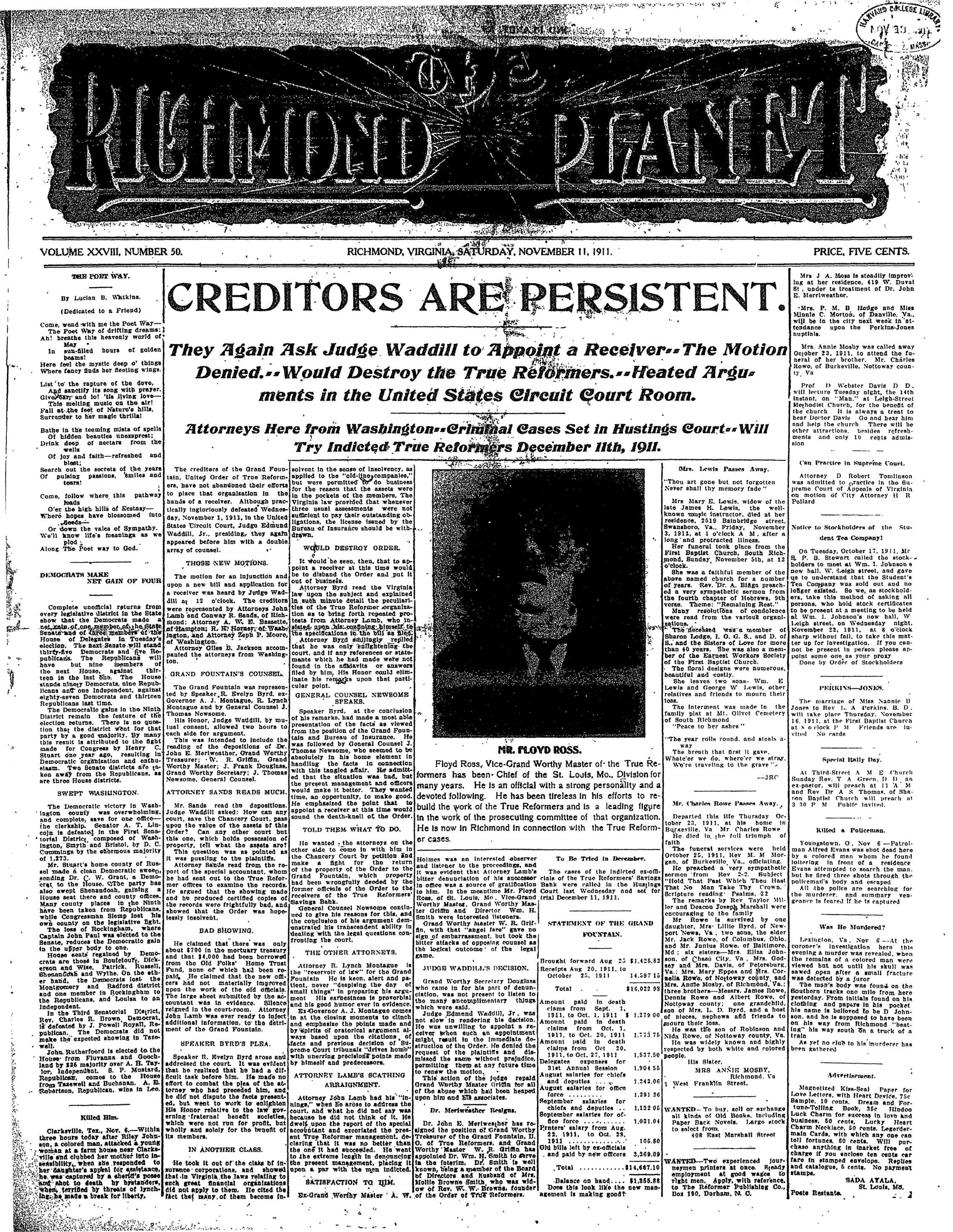
CREDITORS ARE PERSISTENT.
They Again Ask Judge Waddill to Appoint a ReceiverThe Motion Denied.Would Destroy the True Reformers.Heated Arguments in the United States Circuit Court Room.
Attorneys Here from Washington—Criminal Cases Set in Hustings Court—Will Try Indicted True Reformers December 11th, 1911.
The creditors of the Grand Fountain, United Order of True Reformers, have not abandoned their efforts to place that organization in the hands of a receiver. Although practically ingloriously defeated Wednesday, November 1, 1911, in the United States Circuit Court, Judro Edmund Waddill, Jr., presiding, they again appeared before him with a double array of counsel.
solvent in the sense of insolvency, as applied to the "old-line companies," but were permitted to do business for the reason that the assets were in the pockets of the members. The Virginia law provided that whenever three usual assessments were not sufficient to pay their outstanding obligations, the license issued by the Bureau of Insurance should be withdrawn.
WOULD DESTROY ORDER.
Mrs. Lewis Passes Away.
"Thou art gone but not forgotten. Never shall thy memory fade."
Mrs Mary E. Lewis, widow of late James H. Lewis, the well-known music instructor, died at residence, 2619 Bainbridge st. Swansboro, Va., Friday, November 3, 1911, at 1 o'clock A M, after long and protracted illness.
Her funeral took place from First Baptist Church, South.
THOSE NEW MOTIONS.
The motion for an injunction and upon a new bill and application for a receiver was heard by Judge Waddill $a_1$ 12 o'clock. The creditors were represented by Attorneys John Lamb and Conway R. Sands, of Richmond; Attorney A. W. E. Bassette, of Hampton; R. R. Horner; of Waabington, and Attorney Zeph P. Moore, of Washington. Attorney Gilles B. Jackson accompanied the attorneys from Washington.
GRAND FOUNTAIN'S COUNSEL
The Grand Fountain was represented by Speaker, R. Evelyn Byrd, ex-Governor A. J. Montague, R. Lynch Montague and by General Counsel J. Thomas Newsome.
His Honor, Judge Waddill, by mutual consent, allowed two hours to each side for argument.
This was intended to include the reading of the depositions of Dr. John E. Merlweather, Grand Worthy Treasurer; W. R. Griffin, Grand Worthy Master; J. Frank Douglas, Grand Worthy Secretary; J. Thomas Newsome, General Counsel.
ATTORNEY SANDS READS MUCH
Mr. Sands read the depositions. Judge Waddill asked: How can any court, save the Chancery Court, pass upon the value of the assets of this Order? Can any other court but this one, which holds possession of property, tell what the assets are? This question was as pointed as it was puzzling to the plaintiffs. Attorney Sands read from the report of the special accountant, whom he had sent out to the True Reformer offices to examine the records. He argued that the showing made and he produced certified copies of the records were frightfully bad, and showed that the Order was hopelessly insolvent.
BAD SHOWING.
He claimed that there was only about $700 in the mortuary treasury and that $4,000 had been borrowed from the Old Folks' Home Trust Fund, none of which had been repaid. He claimed that the new officers had not materially improved upon the work of the old officials. The large sheet submitted by the accountant was in evidence. Silence reigned in the court-room. Attorney John Lamb was ever ready to infect additional information, to the detriment of the Grand Fountain.
SPEAKER BYRD'S PLEA
Speaker R. Evelyn Byrd arose and addressed the court. It was evident that he realised that he had a difficult task before him. He made no effort to combat the plea of the attorney who had proceeded him, and he did not dispute the facts presented, but went to work to enlighten His Honor relative to the law governing fraternal benefit societies, which were not run for profit, but wholly and solely for the benefit of its members.
IN ANOTHER CLASS.
He took it out of the claws of insurance corporations, and showed that in Virginia the laws relating to such great financial organizations did not apply to them. He cited the fact that many of them become in-
solvent in the sense of insolvency, as applied to the "old-line companies," but were permitted to do business for the reason that the assets were in the pockets of the members. The Virginia law provided that whenever three usual assessments were not sufficient to pay their outstanding obligations, the license issued by the Bureau of Insurance should be withdrawn.
WOULD DESTROY ORDER.
It would be seen, then, that to appoint a receiver at this time would be to disband the Order and put it out of business.
Attorney Byrd read the Virginia law upon the subject and explained in such minute detail the peculiarities of the True Reformer organization as to bring forth repeated protests from Attorney Lumb, who insisted upon his confining himself to the specifications in the bill as filed.
Attorney Byrd smilingly replied that he was only enlightening the court, and if any references or statements which he had made were not found in the affidavits or answers filed by him, His Honor could eliminate his remarks upon that particular point.
GENERAL COUNSEL NEWSOME
SPEAKS
Speaker Byrd, at the conclusion of his remarks, had made a most able presentation of the facts as viewed from the position of the Grand Fountain and Bureau of Insurance. He was followed by General Counsel J. Thomas Newsome, who seemed to be absolutely in his home element in handling the facts in connection with this tangled affair. He admitted that the situation was bad, but the present management and officers would make it better. They wanted time, an opportunity, to make good. He emphasized the point that to appoint a receiver at this time would sound the death-knell of the Order.
TOLD THEM WHAT TO DO.
He wanted the attorneys on the other side to come in with him in the Chancery Court by petition and make a fight for the return of the property of the Order to the Grand Fountain, which property had been wrongfully deeded by the former officials of the Order to the receivers of the True Reformers' Savings Bakh.
General Counsel Newsome continued to give his reasons for this, and the conclusion of his argument demonstrated his transient ability in dealing with the legal questions confronting the court.
THE OTHER ATTORNEYS.
Attorney R. Lynch Montague is the "reservoir of law" for the Grand Fountain. He is keen, alert and patient, never "dispelling the day of small things" in preparing his argument. His earnestness is providential and his good humor ever in evidence. Ex-Governor A. J. Montague comes in at the closing moments to clinch and emphasise the points made and by spirits of oratorical argument always based upon the citations of facts and previous decision of Supreme Court tribunals "drives home" with unerring precision points made by himself and predecessors.
ATTORNEY LAMB'S SCATHING
ARRAIGNMENT.
Attorney John Lamb had his "innings," when he arose to address the court, and what he did not say was because he did not think of it. He dwell upon the report of the special accountant and excoriated the present True Reformer management, declaring that it was no better than the one it had succeeded. He went to the extreme length in denouncing the present management, placing it upon a par with the man indicted.
BATISFACTION TO HIM.
```markdown
```
MR. FLOYD ROSS.
Floyd Ross, Vice-Grand W formers has been Chief of the many years. He is an official devoted following. He has been build the work of the True Refere in the work of the prosecuting He is now in Richmond in coner cases.
Floyd Ross, Vice-Grand Worthy Master of the True Reformers has been Chief of the St. Louis, Mo., Division for many years. He is an official with a strong personality and a devoted following. He has been tireless in his efforts to rebuild the work of the True Reformers and is a leading figure in the work of the prosecuting committee of that organization. He is now in Richmond in connection with the True Reform-
Holmes was an interested observer and listener to the proceedings, and it was evident that Attorney Lamb's bitter denunciation of his successor in office was a source of gratification to him. In the meantime Mr. Floyd Ross, of St. Louis, Mo., Vice-Grand Worthy Master, Grand Worthy Master Griffin and Director Wm. H. Smith were interested listeners.
Grand Worthy master W. R. Griffin, with that "angel face" gave no sign of embarrassment, but took the bitter attacks of opposing counsel as the logical outcome of the legal game.
JUDGE WADDHAL'S DECISION.
Grand Worthy Secretary Douglas who came in for his part of denunciation, was not present to listen to the many uncomplimentary things which were said.
Judge Edmund Waddill, Jr., was not slow in rendering his decision. He was unwilling to appoint a receiver when such an appointment might result in the immediate destruction of the Order. He denied the request of the plaintiffs and dismissed the same without prejudice, permitting them at any future time to renew the motion.
This action of the judge repaid Grand Worthy Master Griffin for all of the abuse which had been heaped upon him and his associates.
Dr. Meriweather Reaigne.
Dr. John E. Meriwether has resigned the position of Grand Worthy Treasurer of the Grand Fountain, J. O. of True Reformers, and Grand Worthy Master W. R. Griffin has appointed Dr. Wm. H. Smith to serve in the interim. Dr. Smith is well known, being a member of the Board of Directors and husband of Mrs. Mollie Browne Smith who was widow of Rev. W. W. Browne, founder of the Order of True Reformers.
Worthy Master of the True Rehe St. Louis, Mo., Division for with a strong personality and a ten tireless in his efforts to reformers and is a leading figure committee of that organization. connection with the True Reform-
To Be Tried in December.
The cases of the Indicted ex-officials of the True Reformers' Savings Bank were called in the Husings Court last Wednesday and set for trial December 11, 1911.
STATEMENT OF THE GRAND FOUNTAIN.
Brought forward Aug 25 $1,425.83
Receipts Aug 20, 1911, to
October 25, 1911 14,597 15
Total $16,022 98
Amount paid in death
claims from Sept. 1,
1911, to Oct. 1, 1911 $1,279 00
Amount paid in death
claims from Oct. 1,
1911, to Oct. 20, 1911 1,773 75
Amount paid in death
claims from Oct 20,
1911, to Oct. 27, 1911 1,537.50
Delegates expenses for
31st Annual Session 1,904 55
August salaries for chiefs
and deputies 1,242.06
August salaries for office
force 1,291 26
September salaries for
chiefs and deputies 1,132 05
September salaries for office
force 1,031.04
Pratters' salary from Aug.
22, 1911, to Oct. 28,
1911 105.80
Old bills left by ex-officials
and paid by new officers 3,369.09
Total ..... $14,667.10
Balance on hand..... $1,355.68
Does this look like the new man-
agement is making good?
"Thou art gone but not forgotten Never shall thy memory fade"
Mrs Mary E. Lowis, widow of the late James H. Lowis, the well-known music instructor, died at her residence, 2519 Bainbridge street, Swansboro, Va. Friday, November 3, 1911, at 1 o'clock A M, after a long and protracted illness.
Her funeral took place from the First Baptist Church, South Richmond, Sunday, November 5th, at 12 o'clock.
She was a faithful member of the above named church for a number of years. Rev. Dr. A. Blaga preached a very sympathetic sermon from the fourth chapter of Hebrows, 9th verse. Theme: "Remaining Rest."
Many resolutions of condolence were road from the various organizations.
"The deceased was a member of Sharon Lodge, I. O. G. S., and D. of S., and the Sisters of Love for more than 40 years. She was also a member of the Earnest Workers Society of the First Baptist Church.
The floral designs were numerous, beautiful and costly.
She leaves two sons - Wm. E Lewis and George W Lewis, other relatives and friends to mourn their loss.
The interment was made in the family plat at Mt. Olivet Cemetery of South Richmond
"Peace to her ashes"
"The year rolls round, and steals a way
The breath that first it gave.
Whate'er we do, wher'er we stray
We're travelling to the grave"
Mr. Charles Rowe Pannen Away.
Departed this life Thursday October 23, 1911, at his home in Burkeville, Va. Mr Charles Rowe. He died in the full triumph of faith
The funeral services were held October 25, 1911, Rev M. M. Morgan, of Burkeville Va., officiating.
He preached a very sympathetic sermon from Rev 2-2. Subject "Hold That Fast Which Thou Haast That No Man Take Thy Crown." Scripture reading: Psalms, 22
The remarks by Rev Taylor Miller and Doacon Joseph Marshall were encouraging to the family.
Mr Rowe is survived by one daughter, Mrs Lillie Byrd, of Newport News, Va., two sons, the elder Mr. Jack Rowe, of Columbus, Ohio, and Mr. Junius Rowe, of Baltimore, Md.; six sisters—Mrs. Eliza Johnson, of Chasio City, Va., Mrs. Godsey and Mrs. Davis, of Petersburg, Va.; Mrs. Mary Eppos and Mrs. Cornelia Rowe, of Nottoway county, and Mrs. Annie Mosby, of Richmond, Va.; three brothers—Messrs. James Rowe, Dennis Rowe and Albert Rowe, of Nottoway county; one grandchild, son of Mrs. L. D. Byrd, and a host of nieces, nephews and friends to mourn their loss.
He was the son of Robinson and Nida Rowe, of Nottoway county, Va.
He was widely known and highly respected by both white and colored people.
His Slater.
MRS ANNIE MOSBY.
Richmond, Va
1 West FranMln Street.
WANTED- To buy, sell or exchange
all kinds of Old Books, including
Paper Back Novels. Large stock
to select from.
WANTED—Two experienced journeymen printers at once. Ready employment at good wages to right men. Apply, with reference, to The Reformer Publishing Co., Box 190, Durham, N. C.
PRICE. FIVE CENTS.
Mrs J A. Moss is steadily improving at her residence, 419 W. Duval St., under to treatment of Dr. John E. Merriweather.
Mrs. P. M. B Hodge and Miss Minnie C. Morton, of Danville, Va. will be in the city next week in attendance upon the Perkins-Jones nuptials.
Mrs. Annie Mooby was called away October 23, 1911, to attend the funeral of her brother, Mr. Charles Rowe, of Burkeville, Nottoway county, Va.
Prof D Webster Davis D D, will lecture Tuesday night, the 14th instant, on "Man," at Leigh-Street Methodist Church, for the benefit of the church. It is always a treat to hear Doctor Davis. Go and hear him and help the church. There will be other attractions, besides refreshments and only 10 cents admission.
Can Practice in Supreme Court
Attorney D Robert Tomlinson was admitted to practice in the Supreme Court of Appellas of Virginia on motion of City Attorney H R Pollard
Notice to Stockholders of the Student Tea Company!
On Tuesday, October 17, 1911, Mr. S. P. B. Stewart called the stockholders to meet at Wm. I. Johnson a new hall, W. Leigh street, and gave us to understand that the Student's Ten Company was sold out and no longer existed. So we, as stockholders, take this method of asking all persons, who hold stock certificates to be present at a meeting to be held at Wm. I. Johnson's new hall, W Leigh street, on Wednesday night, November 22, 1911, at 8 o'clock sharp without fail, to take this matter up for investigation. If you cannot be present in person please appoint some one as your proxy
Done by Order of Stockholders
PERKINS JONES
The marriage of Miss Nannie B
B Jones to Rey L. A. Porkins, B. D.
will take place Thursday, November
16, 1911, at the First Baptist Church
at No clock P.M. Friends are
invited. No cards
Special Rally Day.
At Third-Street A M E Church
Sunday Rev, T A Green, D A, an
ex-pastor, will preach at 11 A M
and Rev Dr A S Thomas, of Sharon
Baptist Church will preach at
3 30 P M. Public invited.
Killed a Policeman.
Youngstown, O. Nov 6 — Patrolman Alfred Evans was shot dead here by a colored man whom he found loitering in front of a residence Evans attempted to search the man, but he fired three shots through the policeman's body and escaped. All the police are searching for the murderer, and summary vengeance is feared if he is captured
Was Ho Murdered?
Lexington, Va, Nov 6--At the coroner's investigation here this evening a murder was revealed, when the remains of a colored man were viewed but not until his skull was sawed open after a small fracture was detected by a juror.
The man's body was found on the Southern tracks one mile from here yesterday. From initials found on his clothing and papers in his pocket his name is believed to be D Johnson, and he is supposed to have been on his way from Richmond "beating" his way south on a truck of a train.
As yet no club to his murderer has been gathered
Advertisement.
Magnolized Kisa-Seal Paper for Love Letters, with Heart Device, 75c Sample, 10 cents. Dream and Fortune-Telling Book, 35c Hindoo Luck Charm for success in love and business, 50 cents. Lucky Heart Charm Necklace, 50 cents. Legerdermain Cards, with which any one can tell fortunes. 60 cents. Will purchase anything in market free of charge if you enclose ten cents car fare in stamped envelope. Replies and catalogue, 5 cents. No payment stamps.
SADA AYALA.
St. Louis, Mo.
Poste Restante.
---
CHAITA
A FIFTIETH ANNIVER
BY F A M
Copyright, 1882, by Ame
11 ANNIVERSARY WAR STORY
BY F. A MITCHELL.
th. 1892, by American Press Association.
CHATTANOOGA
A FIFTIETH ANNIVERSARY WAR STORY
BY F A MITCHL.
Private Mark Malean, C. B. A., sent a spy to Mark by general Thomas H. Baird, a countryman, disguised as a countryman, Mark starts for Chattanooga with Jake. Bourit's brother Mark is to send Bouri red handkerchiefs, Mark and Jake are given shelter by Laura, Pain and her mother Laura suspects Mark is a Union soldier in disguise, Mark is in Chattanooga, Mark is in Confederate. She presents her to Laura a camton Piston Hugh C. B. A. from detailing Mark. Mark innares that a big Confederate army is in Chattanooga and hangs a northward dash. He attempts to escape from Chattanooga. Carries Jakey in safety past the picket fence. He safely meets a band of Confederate deterrents. He and Jakey are then taken prisoner. Mark is imprisoned as a spy takedown and beschieved to her by a negro Mark, defended by Pitis Hugh. is sentenced to death. Bouri receives her handkerchief and, disguised as a colored girl, goes to Mark's residence. She becomes a servant in the jail. Bouri and Mark exchange clothing, and with blackened face Mark passes the grenade joundaife follow him. He takes to the river.
Reaching the pain home, Laura conceals him and gives him food and new clothing. She upgrades him for seeking help. Bourt and Jakey are sent home by the Confederates provost marshal Mark poses as professor Ruett of South Carolina in the Pain home. He sends Little Daniel a nego to Chattanooga, where other military information Captain Fitz Hugh catches unexpectedly, captures Mark
Laura invites that Fitz Hugh permit Mark to escape. He does so, and their engagement is broken. Mark Laura and her mother start for Nassau.
MARK S first impulse after Flitz Hughes departure was to leave the house at once. He tried to say something to Laura to teach her to exercise his own unfortunate skill in dressing with her lover. He could only go to her and taking her hand kissed it without a word. Then he told her that he should take the risk of capture and depart instantly.
He was discourours upon the method of his departure in quick, excited tones, when a horsemau entered the yard, and riding up to the veranda drew a letter from his belt and handed it to a negro who went out to receive it. It was for Mrs Fain. It had been sent through the lines from Nashville where her husband was lying dangerously ill, and begged her to come to him.
After its persusal Mrs Fain deterred to set out the next day, taking with her her daughter and the mad Alice, James would drive them
"You shall go with us, said Lajong to Mark. This is fortunate. In our company you will be far safer than trying to make your way alone. It occurred to Mark that since he was being hunted as a half-starved creature in the disguise of a grocer girl, he was well dressed him traveling as a well dressed mini-traveler with a party of southern men in any other character. At any rate he took this view of it, and when Mrs. Kim announced her intention to go be offered to escort the party to the Urion lines. The offer was accepted, and preparations were made to leave the next morning. Mrs. Palm wrote a note to the officer in command at Chattanooga (to send with the letter she had received from her husband for his pension) to the officer in charge of her daughter and two servants. Mark took the missives and went out to find Daniel, who had just returned from Chattanooga.
"I hear every one taken 'bout sofers go to 'de mort, and dey say dey was goed to Knoxville. Dey was marched 'n marchen all do same way I follored 'n dey brung up at de deport I nor one train after anudder go out full 'o sojers inside and hangen on to de platform on and de roof."
"How many trains did you see go out?"
"Bout forty hundred."
"Daulel, said Mark, smiling at the figures, 'you're smart as a whip. But you'll have to go right back to Chap tanooga, and take this note to the com-manding officer with this letter from your slick master to show him. The note is a rehearsal of a pass for the Union lines. Keep our wits about you, and if he is an easy going sort of a man, you might try to get him to put in three servants in stead of two. At any rate try to ring me in if you can. Do you understand?"
"A beetle Missie Laura learned me."
"Well, read the pass he may give you and ask him to fix it so that it will include me as a servant. But you must use your judgment."
Daniel drove again to Chattanooga.
Mark waited anxiously for his return. Indeed so impatient was he that he thought the negro had been gone twice as long as he had when he saw him drive into the yard. He at once went out to the barn to meet him.
"Any luck?" he asked anxiously.
"I got do pass for misses and do rea, but I didn't get what yo' wanted. I got a paper bry. Melbe it'll do."
"How did you get this?" asked Mark;
surprised.
"I hab to wait while folks was getting passes. Do officer go out to do
TWO
· SYNOPSIS
"I be'n dar"
"What did you learn?"
""Hunt forty hundred."
"Itckon I do, sah"
"Can you read?"
udder room fur a moment. Dis lagen on de desk, 'n luk hit up brung hit away."
"Well," said Mark. "It's not exactly what I want, but ingenuity will have to help me through. You're a trump. Daniel."
In the morning when all was ready for the departure two vehicles were brought around to the door, the one, a two borne carriage, the other Laura's phaeton, drawn by her pony Mrs. Pain entered the driver's seat. Laura's phaeton got into the phaeton. All went well during the first ten or two miles, when Mark received a piece of information which seriously interfered with his plan. Meeting a courier riding toward Chattanooga who looked as if he might be the bear of some important news. Mark halled him and asked if he had anything from the front.
"The junkies air gettin' no right smart," the man replied. "Reckon th' air left Battle creek."
Mark argued that if this were true there would be confusion on that route
and if would be better to take an other. They were not far from the road heading from the Chattanooga pike north to Anderson, on which the Snacks lived. Mark concluded to take this road as far as Anderson, and then strike west with a view to reaching McMinville on the other side of the road. In the last all to all to professor Rhbt, in which confidence and on coming to the road in question Mark led the party northward.
The change of route was unfortunate, much as it would add another day to the Journey. The departure from the 1km residence had been delayed by the preparations till nearly noon. Minnieville was a considerable distance over the mountains, and Mark knew they could not reach it that night. He remembered that they would soon pass the Slacks$, and it was a capital place to pass the night, giving them a good day of twelve hours light on the morrow to pursue their journey. His disappointment at the delay was compensated for by the thought that he would likely learn something of Sourt and Jakey, of whom he had heard nothing since he left them in the Chattanooga jail. At last they drove up at the Slacks gate. Mark handed the robes to Laura and jumped from the phaeton impatiently. Not seeing any one in the room, he proceeded to the rear. The first person he met was Jakey. He took the boy up and hugged him.
"Are you glad to see your big brother, Jakey?"
"Alr't corn ripe?"
Sourl came out of the house, her big eyes gifling and her expressive face radiant with pleasure and excitement. She had heard nothing of Mark he left her in prison. Mark acceded to let both hansonage to joy.
"You una air safe. I know it, she said, almost in a whisper. She could hardly speak for joy.
"For the present, Sourl, thanks to you."
Mark asked no questions then. He knew that they were safe and at home, and he hastened to inform them and the father and mother who came out to welcome him that he was with a party who was unaware of his true character, which they must not be. In the house over night. Then he led them around to the gate. Dandel had meanwhile caught up, and the two vehicles were halted in the road.
"We will spend the night with these good people, said Mark "They are quite willing and will make us as comfortable as possible"
The party alighted and the horses were driven to the barn Mrs. Fain and her daughter were given the room in which Mark had changed his clothes when he went through to the south. He was assigned a bivouac on the gathering barn, or any other place he might select.
Laurin found Mark's uniform and arms concerned beneath the bed.
"What do you suppose it means mamma?" she said
"I fear," replied the mother, "that we shall be murdered before morning. These people are doubtless guerrillas."
An apology for a meal was carried in to Mrs. Fain and Laurin, which they left unattended, preferring a lunch coney they had brought with them in a basket. After supper Laura came out and begged Mark to bring Sourl and Jakey to speak to her. She smoothed Jakey's tumbled hair out of his eye
and asked him if he remembered her Jakey was about to reply in his usual fashion when he checked himself, and for the first "time since Mark had known him answered directly "Bourd stood eying Latra from the corners of her black eyes with a mingled expression of admiration and antagonism Latra spoke to her kindly, but got only monosyllables in reply. After all were asleep that night Mark took Farmer Slack out into the yard, "where they could converse on heard, and developed a plan he had conceived for Bourd and Jakey. "It is dum to your son and daughter," he said, "that I am here at this moment, indeed that I am alive. I be long to a wealthy family and am wealthy myself. It only requires means to make a splendid woman of the girl and a fine man of the boy, for means will produce education, and education is the open door to a desirable career. I am going to teach with you a letter to my father in Ohio, which
1
"I FEAR THAT WE SHALL BE MURDERED BEFORE MORNING."
will contain an order for a sufficient amount of money to insure both Jakey and Sourl an education Take or send them north, present the letter, and you will find everything provided for you Souri may not consent at once, but doubtless she will in time Now I must have pen and paper"
"You uss is a good un, stranger Y treat us when y' gitt no th" Y
"I must write it tonight. I am by no means safe, my neck is in a slur."
The man led the way to his bed room, where the old woman was sleeping. There he produced writing materials, and Mark wrote an order which, whether he lived or not, in sured the future of his two friends, his preservers among the "poor white trash" of Tennessee
In the morning, after the pork and corn bread meal of the country, the travelers again got into the carriages. While they were standing before the gate prior to departure Mark saw Sourl out by the well-house. He went there to bid her goodbye.
"Sourl," he said, "I wish there was some way in which I could show you the gratitude I feel toward you. When I think of my fate, had you not appeared in the nick of time to save me by your wit and daring and sacrifice, I feel that I would like to make some correspondence sacrifice for you."
"Laws, I didn't do nothen. Besides"—she leaned over the well and looked down into its depths—"you uns and me is too differ. You uns is a gentleman, and I air poor white transh."
There was an inexpressible melan choly in her tone.
"Sourl." Mark went on. "I have made an arrangement with your father to make a lady of you. I can't make such a sacrifice, for you as you have made for me, that is impossible; but I can do this if you will act with me and consent to the plan. I shall be off in a moment, and before I go I want you to promise me that you will consent. I am still in danger, and you must grant me this as perhaps a last favor."
The girl hurst into tears.
"Promise."
"I don't keer what I do."
"Do you promise?"
"Has I promise."
With a pressure of the hand he turned away, and stalking to the gate gate into the carriage beside Laura. Daniel and Mrs. Fain had started. Mark followed and had gone but a short distance when he heard Jakey calling to him. He pulled in the pony and waited for he to come up. Jakey was holding something out to him, which, as he drew nearer, Mark recognized as the red silk handkerchief.
"Sourt sent it ter it"
"Tell her that I'll never part with it"
"I don't get the squirrel gun," said the boy
"I all right, Jaker Keep it to re
member me by"
Mark grasped the boy's hand and
then drove on Laura Palen leaned
back on the cushions in silence.
CHAPTER XIV
Mersonon, some twelve miles from the Shacks' house, whence he knew there was a road leading up in the mountains through a place called Altamont, some twenty miles further, to McMinnville. He was informed by people he met on the road that Altamont had been recently occupied in force by the Union troops. With luck they might reach the Union lines, which would doubtless extend several miles from Altamont, that afternoon. "Within six hours," said Mark, "I shall either be safe among Union soldiers or on my way back to Chattanooga."
Laura shuddered, but said nothing. Mark found a very different condition of affairs at Anderson from what he had found along the road. The Confederates had some cavalry force there and more at Dunlap, five miles north. On the road he heard that General Bragg was at Dunlap, but with no troops save cavalry
"I see it all," said the ap to him self "the wily狐 is confronting our forces with a handful of cavalry, while the two divisions of Cheatham and Witers are marching north behind him, and the main force has gone to Knoxville by rail on a line still further east. No wonder our generals are puzzled and watching a line from Bathcreek to Cumberland gap. If the Lord will only let me get through to carry this information, I'll never ask to lie to go on another expedition."
The party were stopped near Anderson by a picket Mrs Falm produced her pass and stated that the two blind were in her company. The officer took no especial care in reading it and when Mark and Laura came up they got anytime through without question. Mark was now anxious about the picket which must be passed in a few minutes, on the road leading west from Anderson. Mrs Falm was still ahead.
and he noticed that all would go as well as all the player just pressed. Not a word was spoken between him and Laura; both greeted saying out of Auderson, but one past the man nickel they would breathe easier. "When they reached it Mrs. Palin had been passed through and gone on. The officer in command, however, had read the pass, carefully. He had not noticed any mention of Mark in it. "Where's your pass?" he asked. "Didn't the lady ahead show it to you?" asked Mark. "Her pass didn't include you."
"I don't it?" Mark feigned surprise.
"Didn't it?" Mark feigned surprise.
"No."
"Oh. I forgot; mite and my wife's is separate," and he drew out the pass of "Thomas Green and wife."
Meanwhile Laura had turned white as a cloth. The officer read the pass, and would doublets, have let them go had he not noticed Laura's agitation.
"You'll have to go back to headquarter and get Major Taliaferro's order on that. He commands at Anderson."
Mark remonstrated. He argued that he would become separated from Mrs. Falu, he urged his wife's desire to reach her sick father. All in vain. He was told that the headquarters were only half a mile down the road and he would lose but little time. He made a virtue of necessity and drove back with apparent good nature.
The commanding officer had gone to Dunlap, five miles away, to pay his respects to General Iragg, and would not be back for an hour or two.
Mark resolved to report his absence to the officer of the plucket post, in the hope that he would not be compelled to use. He drove to the plucket and used his tongue persuasively, but to impose. The more anxious he seemed the more resolved grew the captain.
There seemed to be nothing to do but return and await the arrival of the commanding officer. Mark reluctantly turned the horse's head and drove back to headquarters. Laura's heart sank within her.
It was sunset when Major Talalferoer, a pleasant looking man of twenty-seven or twenty-eight, rode up to the door and entered, the office
"Major Talalferoer" asked Mark.
"At your service, sir."
"Major, I have been detained by the officer at the placket who wants your name on my pass. My wife's mother has gone on, and her daughter is very anxious to join her. It is extremely unfortunate for us to get so far separated from Mrs Fain.
"Fain, of the Fain of Chattanooga?" "The same."
"I have heard of the family but have never had the pleasure of meeting any member of it. One of my friends is engaged in a business that have just parted from him at Junction."
Mark and Laura cast a quick glance at each other—a glance of terror on the part of Laura.
"We are fortunate in falling into your hands," said Mark. "And I beg you will not doxy us a moment." And Mark handed him the pass.
"Certainly not." And the major took up a pen to write his indulgence. First he read the posts carefully. He was thinking of what his friend Fitz Hugh had told him of the Faims. He was under the impression that there was but one daughter from the pass. He had, looking up from the pass, "hasked you better stay here over night? The road is moun-talous and infested by guerrillas. It is positively dangerous to travel." "By no means. What would Mrs. Eain think of our not joining her on the road?" "It is dangerous for her as well as you. I will send a messenger after her and advise her stopping at some farmhouse. I will do better than that. I will send a corporal and half a dozen men to insure her safety till mornings." There was something in the man's tote as it was, that indicated to Mark that he was held for further information. "As you please, major."
"And I shall insist upon your accepting my hospitality. One connected in any way with my friend Fitz Hugh must not want for any comfort I can supply."
The house occupied by Major Talinferro belonged to a family who had gladly given up a portion of it for the safety insured by the presence of a commanding officer. The major was given a room down stairs for an ofice, and a bedroom up stairs. When it was decided that Mark and Laura should remain he gave Mrs. Green, as he called her, the use of the latter for the purpose of arranging her toilet before supper.
When Laura was up stairs Mark was looking out of the window of the major's office. He saw the men ride off with him, and he told his son con sternation another caviarman, with a letter in his belt, mounted his horse and dashed down the road.
Laura came down at that moment, and Mark said to her anxiously, "I am defended on suspicion. I shall be taken back to Chattanooga," and he pointed to the courier.
The color left Laura's cheeks. They had got no near to safety, and now, after so many dangers, the end was at hand. She could scarcely sustain herself as she tuttered into the room occupied as the office.
This is the letter the courier bore northward. It was addressed on the envelope to Captain Cameron Pitz Hugh, near Dunlain:
My dear Cameron, in an impurting to be Tikman Green, with his wife, formerly a Miss Fain of Chattanooga, is here, deceived by the son of something auspicious about the man. The couple are separated from the wife's mother, and the father lies very ill at heart. You do not regard it safe to pass them. Can you help me out of the difficulty? You're very tlly.
WALLACE TALAPERRO.
Major Tikmanfero soon joined Mark and Laura in his office, and offering his arm to Laurn led the way to the supper room. His treatment of both was most deferential, but it failed to deceive either that they wore priteness.
There was a strength of nerve in Mark that would not break while there was hope. He chatted with the host or jailer, whichever he might be call-
will have been treated with pain and
gery. No so Lauren. The situation was
too tiring for her to endure without
some unfamiliarity of anxiety. "She
was told the old girl had been
said to her, and he believed plainly
showed the troubled spirit within.
Mark made no reference to her condition
till after supper. Then, when all
three went out on to the veranda, he
said to her:
"Come, let us take a stroll. You
have been traveling all day, and this
delay troubles you. A walk in the air
will resume you."
Mark assumed with such apparent
carelessness that he was free to walk
about where he liked that Tallafero
had not the will to stop him.
The road led straight from the house
a short distance and then entered a
wood. As soon as they were concealed
behind the trees Mark stopped suddenly
and turned to Laura;
"My God, this is terrible!"
"You are loot!" said Laura faintly. She could scarcely speak the words. "I? Yes. I. But you—what have I led you into? Why was it not over on that morning when it was intended? Then you would not be implicated; now your good name is"— "No one will trouble me," she gasped. "But you—they will drag you"— "You have protected me—a spy. Not only that—that is nothing in comparison with having passed as my wife. There is a blight." "I can bear it." "There is but one way out of this disgrace. You must be married before we return to that house. And to whom?"—his voice changed. from a rapid, excited tone to deepest gloom—"to one who must die—die on the scaffold. At any rate you will be free. You will be a widow."
Laura stood, the very impersonation of despair
"All I can do to gione for this."
Mark went on rapidly, "and it is nothing—is to make you my wife, since I have passed you as such, Laura, will you marry me?"
She looked at him earnestly. Her eyes were big with deep emotion. There was a look in them that he could not understand.
"No!"
"Then I can do nothing for you."
"I will marry only the man who loves me, and whom I love."
"Oh, Laura," he said, "if your heart were only mine, then it would be different. I love you so well, I worship you with such fervor that I would go back to that dreadful fall without a word could I place you where you were before you met me. But you—"
Laura burst into a torrent of tears.
This man, who had so suddenly appeared in her life, who had won her sympathy, who had compelled her admiration, who had absorbed her whole being into his daring, chivalrous, reckless nature--this man loved her, and he was doomed
With a cry she threw her arms around his neck
"Laura, sweetheart," said Mark, en reading her, we have but little time. We know not whom we shall have to face. My true character must soon be known. Will you give yourself to one who will doubtless tomorrow be claimed by"—
Pale as ashes she put her hand over his mouth that he might not speak the word "death"
"Will you? Speak?"
"Yes, now, quick; what can we do?"
"Marry ourselves."
"How?"
Hg grumped her hand. There was a ring upon it—a plain gold band. He took it and putting it on her finger again said:
"I. Mark"
"Is it really Mark?"
"Yes, I am Mark Maynard I, Mark
take you, Laura, to be my wife. Do
you take me to be your husband?"
"do"
"T" we are man and wife in the
sight of God—"
"And for man we care not."
"Man and wife under the law. We are really married."
Scarcely was this hurried ceremony over when a cavalryman came riding toward them to watch Mark.
There was nothing left for them to do but return to the house. As they walked Mark whispered:
"I feel ever all the confidence I have ever felt. I must like to make
P.
"DO YOU TAKEN ME TO BE YOUR HUSBAND?"
He ready. For anything that may happen, my darling, my wife.
I shall doubtless play some bold games.
If I leave you suddenly, meet me (should I succeed to my attempt) within the Union lines. If not, we will meet—in heaven."
T was nine o'clock in the evening.
Major Taliaferro and his guests
were sitting in his office room
chatting. A clatter of horse-
hoofs was heard at the front of the
fence, and some diamonds, mounted on another monument. There was a ramp of canvass, body in the ball, all turned to the open door, and there stood. Captain Cameron, Pits Hugh.
For a moment he regarded Mark and katha 'stretely; then advancing a few steps he bowed low to Laura.
"Captain," said the major ringer, "suppose it is unnecessary to deny to this lady and gentleman that I deemed; it my duty to make sure of their identity before allowing them to pass. The family to which they claim to belong is known to you; therefore I sent to you for information. I see you have answered my inquiry in person. If you vouch for them I shall be happy to pass them in the morning, and shall apologize for their detention at the same time—my excuse being the cause we serve."
All eyes were fixed on Fits Hugh, Mark's and Laura's with ill conceived attentions.
"This was Miss Fain," said Fits Hugh. "She would not be traveling as any man's wife unless she were married to him. If you detain them, you must do so on your own responsibility."
Both Mark and Laura drew a sigh of relief.
"I have no desire to detain them," said Talafero, "after what you have said, but it is altogether too late for them to proceed tonight. The only amends I can make for discommoding them is to make them comfortable. Mrs. Green, your room is ready for you." "Captain," said Mark, "may I beg a cigar? I usually smoke at this time of night." "Hero are cigars, gentlemen," said Talafero, producing a box. "If you smoke, captain," added Mark. "I shall be pleased with your company."
"With pleasure."
Allighted cigars, and Mark and Fitz Hugh strolled out on the veranda. "Captain," said Mark as soon as they were outside. "I have never met a man whom I have so admitted, so honored, as you, and yet I have robbed you of your love. This last act of kindness your magnanimity, is more than indicating your magnanimity, is more than bear I cannot accept anything more, even for her sake. I cannot stay here to be shielded by you and behind her skirts. I am about to leave this veranda and fly to the Union lines Thank God, I have met one who is the soul of honor, in whose charge I leave my wife. Consider her under your care. She will doubleless need all you can give her, for I never expect to see her again. I shall doubleless be captured before tomorrow noon. If you were not my enemy, if you had not resigned, I would love you as a brother."
Without waiting for a reply Mark left the veranda, and in another moment was lost in the darkness.
Captain Fitz Hugh stood on one pet rifled. Should he keep the secret—Laurus's secret? He leamed against a pillar of the veranda and passed his hand over his brow. He could not stab Laura; he could not even bear the man who had left him. He was halfway to Half on hour and elapsed when Tafero, who had been busying him self with some papers, began to woe what had been of the two men He got up and went out on the veranda
"Where's Green?" he asked quickly
"Gone."
"Gone?"
"Yes, gone half an hour ago."
"What does this mean, Cameron?"
"It means that I have been keeping from you what I can keep no longer or I would. This man Green is a Federal epy"
"Cameron—my friend—great God—are you a traitor? There is something back—tell me, quick."
"Twice before he has crossed my path. He was taken and tried at Chattanooga. I was detailed to defend him I had never seen him before. He was found guilty and sentenced to be hanged, but escaped"
"When I met him again it was at the Falcon's house Laura Faim, the woman upbaites, then my betrothed, but now his wife, was concealing him"
"Well?"
"I saw that she was infatuated with him. She claimed him for her guest."
"I—"
"Well, go bu."
"I could not honorably inform on him"
"Oh, Cameron — what absurdity — what idioty — what—"
"This afternoon you sent for me. I canna. I saw the man I had twice before—with my—with the loveliest, the noblest of all women—his wife."
"The major only stared at his friend. he had no words to express his feelings, his sympathy."
"When we came out here he told me that he would accept nothing further for himself at my hands; that he would not abide himself behind a woman's skirts. He walked away before me."
"And you?"
"I permitted him."
Talifarro shuddered. He knew that his friend by his act had placed him set in a terrible position"
"Cameron" he said, "do you know you are liable to be shut for this?"
"I qq."
"I always told you," the unagent sent on anxiously, impatiently, "that your notions of honor were absurd, quixot le."
"The highest sense of honor is never quite itse. It is best fitted for a Christian, a soldier and a gentleman."
"And do you expect me to let this spy go?"
"No. Protect yourself—the cause Send after him. It is I who have convived at his escape, not you. You must not suffer."
"The cause alone is enough."
"Orderly," he called to a man standing by the gown.
The soldier approached and stood at attention.
"Do tell Captain Smith that the man who was here this evening has gone, and I want him followed and brought back. Tell him to send by all the routa."
The man saluted and went away.
"Cameroon," said the major, after giving the order, "and grant that this act of yours may not be known. It will not be, for I am the only one who
known of it, and I will never come my thee."
"I am responsible for the war, and it becomes known that I shall have courage to meet the consequences like a man. The young wife who was left in my charge I leave to you. I would gladly protect her myself, but I prefer to spare her the pain of being under my protection. If her husband is taken and she needs me, send for me."
As soon as he had gone Talferro called a negro woman, and told her to go to the lady's room and ask her (if she had not gone to bed) to come to him as he had a communication to make.
"Madam, said the major deferentially, 'your husband has gone.'"
"Where?" asked Laura, with a blanched cheek.
"He walked away in the presence of Captain Pirs Hugh, who would not detain him or inform me that he had gone till he was obliged to do so."
Laura clasped her hands and mutely breathed a blessing on the man who had spared her husband for her sake.
"How long has he been gone?" she asked.
"More than half an hour."
"Have you ordered his pursuit?"
"I have."
"And he has a start of——"
"Thirty minutes."
"You'll never take him. He bears a charmed life."
"And now, madam, what can I do for you? My friend charged me to see that you have every attention."
"I will go on and join my mother."
"Tonight?"
"Tought-now."
"Your photon shall be at the door in a minute. You must accept my escort. There will be a guard beside."
In ten minutes Laura, Major Talferro seated beside her, six airwolf cavalry men in gray about her, was on her way to join her mother
Mark knew the direction of the roads leading from Anderson, and believed that he could avoid the pickets. Making his way over a space covered with bushes and a low growth of timber, he struck the road by which he had come that day at a point beyond the vedette. Then half a mile's run brought him, out of breath, to a house. The occupant was not alone, and black scout coed by organisation and his girl getting a horse to take him to Slack's, promising to send it back the next day with liberal pay for its use.
He arrived at Slack's shortly before midnight, and his horse fell exhausted in the yard. Slack received him with a shotgun polished through the cracks of the door. Mark made himself known and asked for his uniform and his arms. The old man got them for him, and taking them to the stable Mark put them on. Then he went to the barn, where he saw a mare knew her master when he throw his arms about her neck and seemed as glad to see him as he was to see her.
"Ah Madge, my daring! Once on your back, old girl, and the dill will catch me if he can."
He lost no time in putting the bit in her mouth and strapping on the saddle. Then, putting his foot in the leather covered stirrup, he lifted himself into his seat.
For the first time in ten days Mark felt the comfort of being in the saddle with his arms about him.
A few steps took him out of the barn; then, turning his horse's head in the direction from which he had approached the place with Sourt, he rode a hundred yards. Before going a hundred yards, he stopped and listened. Some sound had caught his ear. It was the gallop of horsemen. He waited, dreading a neigh from his own horse, which he patted to hold her attention. The horsemen passed on down the road.
"tide on, brave boya," said Mark; "if you are after me, the faster you go in that direction the better 'll like it." "In the light of the waning moon he trampled over the shadows of leaves as on a "crazy quilt." He crossed the Sequential by the ford over which Sourl had guided him, and took care not to head too far down the stream, when he encountered the creek near the fall. He struck the road by which he had left Jasper just south of the fork at which Sourl had baited him. Without hesitating a moment he struck out at a brisk canter over the left of the two roads—one leading to Tracy City. Mark had never experienced such sensations as now. On his own feet horse, his carbine slung on his shoulder, his pistol at his side, on the road to the Union canals, a wife whom he arrived safely in him. In case he should survive within him fairly glow with hope? And never had the beautiful Midge borne her rider with such evident exhibition.
[TO BE CONTINUED.]
Bull Cleara Mystery
The mystery of the disappearance of Mrs. Oghionhia Ghioco, a farmer's wife, of Elphinstone, Manitoba, who disappeared two weeks ago, has been cleared.
Her body was found not far from her home and was trampled and torn into a almost unrecognizable mass.
Standing nearby was the cause of her death. The animal had stood guard over the body of his victim, and when routed returned to his position beside it.
Rear Admiral Sangs Dead.
Rear Admiral James H. Sands, U. B. N., retired, who participated in the evacuation of Charleston, died suddenly at his home in Washington of acute indignation. He was sixty-six years old.
He formerly was commandant at the navy yards at Philadelphia, New York, Boston and Washington.
Two Drown in Auto-Dive.
Frank Wasser, of Hollowtown, and his son were riding in an automobile near Easton, Pa., when Mr. Wasser, turned out of the road to pass a team.
The automobile ran over the road and fell into the canal, carrying father and son with it, and both were drowned.
SATURDAY.....NOV. 11, 1811
ASKDISSOLUTION OF STEEL TRUST
Government Files Sult in Trenton Court.
Corporation Directors, to Avoid Suit, Had Voted to Give Up Leaves on Ore Lands and Lower Railway Rates.
Dissolution of the United States Steel Corporation and its subsidiary companies was waived by the government in a suit filed in the United States circuit court in Trenton, N. J.
The petition charges that the steel corporation is an illegal combination in restraint of trade and, therefore, prohibited by the Sherman anti-trust law.
The petition was prepared by Jacob M. Dickinson, former secretary of war, who has been retained by the government as its special counsel in this case.
This sudden and surprising action by the government—one of the most important trust actions over attempted—came simultaneously with the decision of the board of directors of the Steel Corporation.
col its lease of the Great Northern iron ore properties in the Lake Superior region, and to reduce the rates on ore on the two railroads in that region controlled by the trust. The action of the board of directors was taken as an effort to forestall a suit by the government under the Sherman anti-trust law. The petition filed by the government in Trenton charges the Steel Corporation and those subsidiaries which are named as defendants with maintaining or attempting to maintain, a monopoly in the steel business. The evidence upon which the suit is brought was obtained by the special investigators of the department of justice. It is understood that some of the testimony which was given before the Stanley investigation committee of national house of representatives was used, in part, at least, as the basis of this suit. The petition is in equity and was filed in the circuit court.
It contains the usual prayer for injunctions to restrain the defendants from continuing, the monopoly alleged, and asks for such relief as the court may grant. As soon as word was received at the department of justice that the bill had been filed, the following statement was issued:
"A petition was filed in the United States circuit court at Trenton, N. J., against the United States Steel Corporation and its subsidiary companies, charging them with being an unlawful combination in restraint of trade and a monopoly, or attempt at monopoly
```markdown
```
"The petition was prepared by J. M Dickinson, former secretary of war, who was some two months ago retained by the attorney general for the purpose of making careful examination of all the evidence which had been collected by the department of justice, together with that taken by the Stanley committee."
The United States Steel Corporation (steel trust) was organized Feb. 25, 1901, with a capitalization of $1,400,000,000 (including bonds). This marked the last step in the long struggle for unity in production and selling which began with the "rail pool" of 1887
The constituent companies, all of which were organized in the years 1898 to 1900, are Carnegie company, Federal. Steel company, American Steel and Wiro company, American Tin Plate company, with 265 plants; American Steel Hoop company, American Sheet Metal company, American Bridge company, National Tube company, Shelby Steel Tube company and National Steel company.
Bryn Mawr Gets $750,000.
A bequest of $750,000 is made to Bryn Mawr college at Philadelphia, in the will of Miss Emma Carolie Woolrishoffer, of New York, which was dled for probate in that city. Miss Woolrishoffer, who was graduated in the class of 1007, died on Sept. 11 from injuries received in an automobile accident near Binghamton, N. Y. After her graduation she became one of the most prominent social workers in the country, and at the time of her death was secretary of the Women's Trades Union league. She possessed a large fortune. While driving her car near Binghamton, N. Y., on Sept. 11, the machine went over a steep embankment. Miss Woolrishoffer died in the Roosevelt hospital, New York, a few hours after the accident. A woman companion who was with Miss Woolrishoffer in the machine escaped without injury.
Throws Herself to Bears.
In an attempt to end her life while authoring from despondency, Miss Anna Harter, thirty-three years old, is leaped into a pit at the city park at Lima, Ohio, in which were confined two large black bears. The bears, however, refused to harm her, and she was found in the pit some time later by Lee Stuckey, a park attacker. The bears attacked him
when he went to, the woman's rescue and droye him from the pit, but he subdued them with a stream of water from a hose and dragged Miss Harter from the enclosure.
Miss Harter recently lost $5000 and
this is believed to have preyed on her mind. She said she hoped the boars would 'dovour her.
Escapees From Drunken Mob.
After having confessed that he had murdered C. S. Hollenhead, a rich sorchant and planner, of Washington, Ga., A. B. Walker, a negro, escaped from a mob, which had taken him from the sheriff, after a rope had been placed about his neck and as the mob was in the act of stricken him upon a limb. He has not been recaptured.
The negro's escape was made possible by the fact that the members of the mob were too drunk to conduct a lynching properly.
Hollenhead was killed in his storc and guspidion fell on Walker. The sheriff captured Walker and brought him to Washington. As the sheriff was taking the negro to jail he was overpowered by a mob of fifty men and the negro seized
Sydney Ware, who was pardoned after he had served twenty-two years for the murder of Morris Miller, in Lykena, May 4, 1889, was sentenced in Harriburg, Pa. to not more than two years nor less than one year in the eastern penitentiary and one cent fine for the killing of Frederick Kindler, whom he shot at the same time.
Ware pleaded guilty to murder in the second degree and the sentence was pronounced by Judge W Rush Gillan, of Franklin county, specially presiding.
Steps to obtain a pardon for Ware will be taken before the state board of pardons at an early day.
Joseph Pulitzer Dies.
Joseph Pulitzer, proprietor of the New York World, died on board his yacht off Charleston, S C.
Mrs Pulitzer was summoned from New York and reached her husband's bedside half an hour before he died.
Mr Pultzler died of paralysis of the heart induced by gall-stones. He had been in poor health for some time. He was on his way to Jekyl Island, near Brunswick, Ga, where he had a winter home. His wealth is estimated at more than $20,000,000.
Jack Johnson a Mason.
The recent somewhat hurried initiation of Jack Johnson, the negri prize fighter, into a Masonic lodge of Dundee, Scotland, has sailed a storm of protests throughout the country. The grand lodge of Scotland, presided over by the Marquis of Tullibardine, has ordered a searching inquiry into the matter. The Dundees ridicule the interference of the grand lodge and maintain that Joulson is as good as any Scotman
JOHN K. TENER.
Pennsylvania Governor Waa Hat
Up by a Suffragette.
```markdown
```
$ \textcircled{1} $1911 by American Press Association.
BOY HELD FOR MURDER
Lad Shot Playmate, Who Has Since Died.
Joseph Curry, eleven years of age, was arrested in Altoona, Pa., on the charge of murder.
charge of murder
On June 25 Curry shot Herborb E. Woods, a boy of the same age, and the latter died three weeks ago. The boys had been playmates, and it is all leged became involved in a quarrel, which was stopped by Mrs Woods.
The back yards of their homes faced each other Curry took a small rifle and a chance shot struck Woods in the forehead. In falling the lad fractured his skull.
Woods' father lodged the charge, alleging that young Curry had threaten to shoot the whole of the Woods family.
M'FARLAND NOT ARRAIGNED
Alleged Wife Murderer's Lawyer Demands Examination of Indictment. The arrangement of Allison Mac Farland, charged with wife murder, at Newark, N. J. was postponed when a dispute arose between his attorney and the public prosecutor, after the prisoner had been brought into court. At the last minute Mac Farland lawyer demanded time to examine the indictment. After a lively dispute the court granted a delay, but to get a copy of the indictment the defend ant's counsel will have to make a for that application. No date for the arrearment was set.
THE RICHMOND PLANET, RICHMOND, VIRGINIA.
J.K.
1911, by American Press Association
Burglars Kill Man and Loot House. According to a report telephoned to Mrs. Morris Buck, a Wilmington, Del., storekeeper, Peter Drokg and his wife, Polish people, who dealt at Mrs. Buck's store, and a farm hand in their employ, were so badly heated at their home, near Brandywine Springs, by two colored thieves that Drokg died, his wife had one eye gouged out and the farm hand lay in a semi-conscious condition. There were two young children in the house, but they were frightened into the woods, where they remained until daylight. The mother was found in the house, almost helpless.
Following the attack on the men and woman the thieves ransacked the house Drejok sold a large yield of wheat last week, and it is supposed the thieves were after the money he received from this. The attack occurred on the Taylor farm, one of the richest in Mill Creek Hundred, which Drejok had bought for $6000.
No clue to the thieves has been obtained, but a vigorous search for them is being made.
That the two men were not beaten to death immediately was due to the wife of Drejok He was attacked just as he passel through the barn door, with his little son, and the boy ran to the house screaming, the farmer staggered away and the colored men followed him until he fell into a ditch. The farm hand ran to help him, and an instant later he was lying upon the ground, having been struck with a stone. Mrs. Drejok ran to their aid, armed with an axe, and fought the colored men.
Walks Off With $10,000 Worth Jewels.
A sample case containing about $10,000 worth of jewels belonging to W. C. Barry, a member of the wholesale jewelry house of Barry & Co., Newark, N. J. was reported to have been stolen from the lobby of the Palmer house in Chicago.
A man was seen leaving the lobby with the sample case, but persons who saw him stroll out leisurely believed he was its owner until after Barry had reported his loss.
Several persons who saw the stranger said he appeared to be a young man and was fairly well dressed. Barry furnished the police with a description of the jewels, which consisted chiefly of diamond scarlets, diamond rings, diamond watch fobs and diamond lockets.
Cardinals-to-Be Summoned to Rome.
Monsignor Difomede Falconio, the apostolic delegate to the United States in Washington, and Archbishop O'Connell, of Boston, and Farley, of New York, official notice of whose selection as additions to the college of cardinals was received here, probably will call for Rome not later than Nov 10.
Monsignor Falconio received his summons Monday to attend the consistory at Rome, Nov 27. He does not expect to return to America, an his position will be advisory to the pope.
The Rev Bonaventure Ceretti, the auditor of the papal delegation, will act as charge daffaires until the appointment of a delegate to succeed Monsignor Falconio.
Lyncher Feta Life Term.
The jury in the case of Walter Diehl, charged with being a principal in the lynching of Carl Etherington, an antislaunce detective, at Newark, O., brought in a verdict finding the defendant guilty of second degree murder. The verdict carries with it a sentence of life imprisonment. Etherington, who was a native of Washington county, Ky., was lynched in July of last year after he had been dragged from the county jail
Elector For Lincoln Dead.
Isaac Jenkinson, eighty-six years of age, journalist, educator and the last of the Indiana electors for Abraham Lincoln, died in Richmond, Ind., following a fall into the collar of his home. He was born in Piqua, O.
Three Sets of Twins in Seven Years.
Mr and Mrs John Hexamer, of Franklin, Pa., have become the parents of a third set of twins in seven years, there being a boy and a girl each time. All are living
Boy, Dr. Henry C. McCook in Dead
Hav. Rev. Henry C. McCook is Dead.
Rev. Dr. Henry C. McCook, one of the famous family of fighting McCooks, of Ohio, and for thirty-three years pastor of the Presbyterian Tabernacle church, in Philadelphia, died his home in Devon, a Philadelphia suburb. His death followed by a little over a month that of his brother, Colonel J. John McCook.
Nothing on earth is so valuable as a Human Mind. If a discord is worth polishing at great trouble and cost, much more is the mind of a boy, or young man worth all the gallanting that the schools can give it. The best education is not too good for a providing South. Who would choose a poor physician o save a few cents when health is in danger? Or who would choose an inferior school o save a few dollars when a better school will increase the strength of character and of mind for life and prepare one for a larger tumultion?
Va. Union University Offers the Best Higher Education to COLORED YOUNG MEN
IT HAS A FINE ACADEMY COURSE including manual training for those who have completed common school subjects.
IT HAS A FINE COURSE is broad and complete for requirements and standing are as high as those of all college for white youth in the State, according to the rating of the Carnegie Board.
IT'S THELOGICAL COURSE has for many years been the standard course for colored Digital Schools. Helfron and all the regular subjects given in Northern Seminary are included. Hundred students for the Ministry are enrolled in different departments of the school.
IT'S NINE GRANTI BILLINGS, its finest equipped science laboratories, its library of 12,000 volumes, its able faculty and its full courses of study enable Virginia in more than offer colored men an education equal to that enjoyed by the favored of other races.
For further information address the President.
VIRGINIA UNION UNIVERSITY.
RICHMOND, VIRGINIA.
Bands of C
Constitute a Feature, and Persons Car
Ones to Join. Children received
BENEFITS - $1.00 to $1.50 per week
at Death. Matrons wanted n all
of New Bands and all particulars
MRS. ANNA TAYLOR, W. M., 120 W.
CHINA GIVES
CONSTITUTION
Frightened Government Grants
Sweeping Reforms.
MAY COME TOO LATE
of Calanthe
and Persons Cannot do Better to Let the little
children received from Two to Twelve Years.
$1.50 per week when sick and $30.00 to $10
was wanted n all Localities. For organization
and all particulars, write
W. M., 120 West Hill Street, Richmond, Va.
---
Bands of Calanthe
Constitute a Feature, and Persons Cannot do Better to Let the little
Ones to Join. Children received from Two to Twelve Years.
BENEFITS—$1.00 to $1.50 per week when sick and $30.00 to $10
MRN. ANNA TAYLOR, W. M., 120 West Hill Street, Richmond, Va.
Imperial Edict Apologizes For Past Neglect and Glives Free Pardon to All Rebels and Political Offenders.
More edicts from the throne have plunged China deeper into a reign of terror, and a few days will determine the future course of the empire.
Complete capitulation to the demands of the rebels is made, but they declare that the surrender has come too late and that the revolutionists will continue and stop only when the government is in their hands.
The revolutionists are skeptical of the good faith of the throne, and their cause is strengthened by the evident terror that has seized the ruling dynasty.
One of the edicts issued in the name of the infant emperor ends Manchu rule. The transfer of cabinet offices to the native Chinese is ordered, and the throne pledges that hereafter Chinese and Manchu will be treated on equal footing.
This is interpreted to mean that the system of pensions for the Manchus has been cut off. The Manchus are thoroughly armed, and a massacre of the Chinese is feared. The younger Manchu princes are reported ready to lead the slaughter. The Chinese are aroused by the cruelty of the imperial troops in burning Hankow after capture. The reports that the robber forces have recaptured the railroad station at Hankow, have organized and are fighting the advance of the imperial troops, has given, courage to the Chinese. The Manchus fear the investment of the capital by the rebels, while the Chinese are anxious over the possibility of a massacre by Manchus. Both parties are appealing to the logations for protection. The latter are taking precautions against any eventuality. Premier Ching is using his influence to curb any tendency toward violence.
In an imperial edict the throne humbly apologizes for its past neglect and grants an immediate constitution, with a cabinet from which nobles shall be excluded, and a free pardon for the rebels and all political offenders. The government has received reports that the rebels from Talyan-Fu, the capital of Shan-Si province, have marched eastward and cut off General Yin Tcheng's trailway communication with Pekin. Talyan-Fu is 260 miles southwest of Pekin and has been reported before as having joined the rebellion. At Lauchow on the Hoang-Ho, the capital of Kan-Su, it is said that 27,000 soldiers, forming what was designed as the second army for the campaign against the rebels, gave the prince regent the option of immediately granting a complete constitution or seeing Pekin attacked. The assembly, at a secret session, indored the demand for a constitution and, sent a memorial regarding it to the throne.
The demands were signed by all the division and brigade commanders. They are prefaced by the declaration that they will uphold the dynasty if the demands are granted, especially that for, the immediate calling of a full parliament. Parliament must have full power to revise the constitution, the army and
navy must not be used in internal troubles without the consent of parliament, the emperor must no longer have absolute power of life and death and political estates must be pardoned. A responsible cabinet, with a premier, must be chosen by parliament, royalty must forever be ineligible to the cabinet parliament must share treaty making power and must have full power over the budget, the throne must have no power over taxation unless authorized by parliament, there must be no appointive members in the upper house of parliament until the reforms are completed, and the army and navy must have a full voice in their shaping. A wireless message received at Shanghai from the British warships at Hankow says the imperialists are burning the native city of Hankow, and that the entire advance of the government forces is marked with bidiculous brutality. The Americans have been attending to the worst wounded of the imperialists
The reverses of the Chinese rebels at Hankow are not considered at Tokyo, Japan, as sergei Stratgeitly the city is valueless and its possession would heavily handicap the rebels. It is probable that they will strongly toify Wu Chang and make that city their headquarters
REFORMED SYNOD HALTS CHURCH FUSION Table Resolutions For Fusion With Presbyterians.
There will be no union of the Reformed Church in America and the Presbyterian church for at least a year, it is believed.
The conference of the eastern synod of the Reformed church, now being held in Philadelphia, set aside the resolution in favor of a merger which had been presented by a committee of nine.
The motion to table the resolution was made by Rev H H Rupp, of Reading, who asked that the subject be referred to the classics, of which there are twelve in the eastern synod. Mr Rupp's motion caused much discussion, and the president, Rev Paul L. Leibnach, called for a vote.
It was impossible, in the confusion to ascertain the number of votes for and against the motion, and the president asked for a standing vote, which proved a tie Mr. LeLuhchn then decided to allow the report to be set aside, so that a thorough investigation could be made and the details thrashed out by the classics.
The committee of nine was appointed last week to consider the merging of the denominations.
The merger has already been favorably acted upon by the general synod of the Reformed church at its meeting in Canton, O. last May, but each of the six synods will also have to take favorable action. The Presbyterian general assembly voted for the union at its session in Atlantic City last May.
The eastern synod, which is the largest of the six, has 126,000 communicans, but nevertheless the synod members fear absorption when as a smaller body they are united with a larger one
Wounded in assault to Governor. When the thirteenth gun was being being Governor Jared Y. Sanders at Shreveport by a detail from the Caddo Rifles, the gun, a six-inch reefed cannon, exploded, seriously wounding Alfred Godfrey a private in Company I. First regt command, Louisiana National Guard.
---
903-5 North Third St
FINE
TAILORING
CLEANING, DYEING AND
REFAIRING.
CHITMAN M. WHITE,
PROPRIETOR.
STRAUS' SPECIAL
Old Yacht Club.
Will Satisfy the Lover on the Right Kind of Stimulant. Special Prices We Have All Grades of Good L& quorts, Cigars and Tobacco. Call and See Us.
ISAAC STRAUS & CO.,
422 E. Broad St.,
Richmond, Virginia
H. F. JONATHAN.
Virginia
FISH OYSTERS PRODUCE
114 N. 17TH ST., RICHMOND, VA.
All Orders Will Receive
Prompt Attention.
Long Distance Phone, Madison 752
PROF. D. D. BRUCE, M. D.,
Strange, Wonderful, but True Are
the Awe Stricken Tests Given
By the Great Australian
Medium.
PROF D. D. BRUCE, M. D.,
The Only Living Apostle of Science
of the Mysteries.
$5,000 IN GOLD TO ANYONE IN
the World to Compete with him.
Possessing more Power than any
four Mediums combined.
No Card, Trance or Hand Humbug
GREATEST HINDOO MEDIUM IN
THE WORLD.
So Great is his Power, that he can tell you while in a Clairvoyant state all you wish to know without a word being spoken. Come, all you unbelievers, scoffers and jeers: bring all your scionicism with you—he will open your eyes to the Private Chamber Mystery. Come, all you broken hearted wives, all with low spirits and let him lift the burden from your aching and jealous hearts. He challenges `the world to compete with him in causing a speedy marriage with the one you love; uniting the separated and bring back the lost one. Traces lost or stolen goods earths hidden treasures. Removes evil influences, crosses, spells, ill-luck, curses tricks and conjurations, gives luck and success in all you undertake. Cures the tobacco habit. Allows the captive to be set free.
He is the only one that will give a Written Guarantee to complete your business or refund your money. Are you sick? Do you know what the trouble with you is? Come and consult Nature's Doctor.
Rheumatism, Insomnia, Hysteria,
and all Diseases curred. Points given
on Horse Racing and all Games of
Chance.
No matter what altis you, come
and see this wonderful man Reader,
have you noticed that some people
have a hard time to get along no
matter how they tell, while others
have success? Many wealthy men and
women owe their success to this
wonderful man.
He will tell you whom you will
marry. Will you be happy? He
will tell you who your friends and
engineers are. Can you tell? Don't
take a leap in the dark, but be
advised by this wonderful man. Greatest Prophet in Existence.
He always succeeds when others
fall. This is the chance of a lifetime.
Don't let it pass you.
OFFICE HOURS: 9 A. M. to 9:30
P. M. Sunday: 2:30 to 7:30 P. M.
N. B—Our Consultation Fee is
50 cents. Sittings: $1.09. All loters
containing $1.00 will be answered
in full
All letters must have a two-cent stamp.
Iain Office: 510 South Eighth St.
Philadelphia, Pa.
Phone, Monroe-2636.
Office Hours: 8 A. M. to 6 P. M.
Office: Mechanical Savings Bank
Building, Reyns 901-B, Red Floor.
HURMOND,
VIRGINIA.
THREE
Richmond, Frederick's & Potomac R. R.
ACCOMMODATION TRAINING - WENDOAY.
Lave Bryce Bay. B.S.A. 5.25. P.O. F. Fryderikshaw
Bay. B.S.A. 5.25. P.O. Fryderikshaw
Arvie Drive St. B.S.A. 8.25. A. W. Fryderikshaw
Arvie Drive St. B.S.A. 8.25. A. W. Fryderikshaw
Arvie Drive St. B.S.A. 8.25. A. W. Fryderikshaw
*Daily.* | Weekdays. | Sundays only.
All trains to and from *Frydland* are
arriving on *Sunday* and arriving
on *Sunday* at 9 o'clock. stop at *Halte*. Time of arrival and
departures not guaranteed. Read the signs.
N. & W. NORHOLK & WESTERN.
N. & W. NORHOLK & WESTERN.
ONLY ALL RAIL LINE TO NORFOLE.
Schedule in Exact May 14, 1911.
Leave for New York, N.Y. FOR
NOFORK 10 A.M. 10:30 P.M. A.M. 4:30 P.M.
FOR LYNCHBURG AND THE WEST: "8:18
A M. 10:00 A M. 3:00 P M. 20:00 P M.
Arrive Hitchcock from Norfolk all 41 A M.
M. 10:00 A M. 510 25 P M. 11:30
P M. From the West B M. 30:00 P M.
8:15 P M. 0:00 P M. 9:00 P M.
"Daily only except Sundays. B Sunday only."
Daily, alitly except Sunrise, Sunday only.
Pallid, Parlor and Sleeping Cars, Cafe Dining Cars
C. H. BOSLEY
D. P. A. Hillman, Vn.
ATLANTIC COAST LINE
THANKS LEAVE RICHMOND DAILY
For Florida and Florida · 8:15 A. M and
7:35 P. M 1:00 A. M Charleston.
For Florida and Florida · 9:00 A. M * 2:00 P. M,
14 P. M * 9:00 A. M
For N & W Ky West 6:15 A. M 10:00 A.
* 3:00 P. M and 9:00 P. M * 9:18 A. M 8:15 A. M
8:15 A. M 9:00 A. M 10:00 A. M * 3:00 P. M
8:15 A. M 9:00 A. M 10:00 A. M * 7:00 P. M
8:15 A. M 9:00 A. M 11:45 P. M
For Goldsboro Kaye Payette 6:20 A. M
Trains arrive Richmond daily 6:20 A. M
6:00 A. M 4:35 A. M * 8:37 A. M * * 10:45 A. M
4:35 A. M * 8:37 A. M * * 20:00 P. M
* 15 P. M 6:35 A. M 6:35 A. M 10:00 P. M
9:00 P. M * 10:20 P. M 11:30 P. M
* Perk Sunday * * Sunday only
Time of arrival and departure and connections
not guaranteed
C S CAMPELL-D P A
SOUTHERN RAILWAY.
TRAIN LEASE RICHMOND.
N. B—Following schedule figures published
information and set guaranteed.
6 10 A. M—Daily—Local for Charlotte,
Dumah and Raleigh. 10:45 A. M—Daily—Limit-
ed. 10:45 A. M—Daily—Drawing Room,
Sleeping Car. 10:45 A. M—Daily—Limit-
ed. Except Sunday—Local for Durham and inter-
mediate stations. 6 00 P. M. Except Sunday—
Daily—Limitled. 6 00 P. M. Except Sunday—
For all points South Pulham line at 9:50 P.
YORK RYNE RIVER LINE.
4:30 P M - Ex Sun -- To West Point, point,
connecting for Halton Mon., Wed and Fr. 6:00
P M - Ex Sun -- To West Point, point,
and Fr. Locus to West Point.
TRAINS ARRIVE RICHMOND.
From the South: 6:50 A. M. 8:05 P. M.
daffy: 8:00 A. M. Ex Sun: 8:15 P. M. Ex;
2:00 P M daily West Point: 8:00 A. M. Ex
daily: 11:35 A. M. Wed and Fr.; 14:25 P. M.
Ex Sun.
S. E. DURGEOUS. D. P. A.
900 P Main St. 'Phone Madison 456.
C. & O.
9:00 A. Daily-Fast trains to West Point.
4:00 P Newport News and Norfolk.
4:00 A Daily-Local to Newport News.
4:00 P Daily-Local to Old Point.
2:00 P Daily-Local to Cincinnati.
2:00 P Pulliams.
6 35 P — Dally "St. Louis Chicago Special." Pullman.
8.35 A —Dally—Charlotteville. Week days
Hinton
6 15 P - Week day. Local to Gordonville.
6 15 P - Week day. Burge, Lea, C. Forgre.
6 15 P - Week day. Burge, Lea, C. Forgre.
THAINS ARRIVE HIGHMONT.
Local from West - 4:25 A. M. 7:00 P. M.
Through from West - 4:25 A. M. 7:00 P. M.
Local from West - 8:30 A. M. 9:54 A. M.
Thirphe - 7:00 A. M. 8:45 P. M.
Through- 7 00 A M. 7 45 P M.
Jamie River Line- 66 S A M. 6:15 P M.
Southbound trains scheduled to leave Richmond daily 9:10 A.M.—Local to Norfina, 1:38 P.M.—Sleepers and coaches, Atlanta, Birmingham Savannah, Jacksonville and Florida points, 8:12 P.M. Florida Limited, daily, except Sunday 11:25 P.M.—Sleepers and coaches, Savannah, Jacksonville, Atlanta, Birmingham and Memphis Northbound trains scheduled to arrive Richmond daily 6:32 A.M., 9:05 A.M., except Monday, 8:05 P.M., 6:45 P.M.
- The PLANET is read all over
this country and in foreign lands.
Always Losing His Boat.
A colored man calling himself,
"Captain John N. Simpson" and as
times sailing under other names has
been persistently swimming - both
white and colored people in Norfoi-
nortmouth. Newport News and
Phoebe. His plan has been to re-
present that he has money in a col-
dary bank in this city, giving his
victim to write to John Mitchell, r.
President and tell him to send him
six hundred and fifty dollars or some
like amount at once to the person
who is writing the letter or advancing
him a small sum of money until
he has gotten his money from Rich-
mond.
He alleges that he is captain of a nailing vessel, which according to his letters has been lost near Thimble Light off Buckroo Beach and as he has been carrying on this kind of swindling for about two years, that boat is presumably wrecked every two or three weeks. He asks that the letter be sent to him in care of the person who advances the money. He never comes back to see if the money comes as he directs. We have written continuously to the people, who send these letters, but we have had quite a time to keep up with him.
Keep clear of Captain John E. Simpson or anybody who looks like him.
Subscribe to The PLANET.
```markdown
```
Published every Saturday by JOHN MITOELL
JR., at 811 N. Fourth Street, Richmond, Va.
all communications intended for publication
should be sent so as to reach us by Webster,
or by e-mail.
TERMS IN ADVANCE
One trip, eight months. $1.50
One trip, eight months. 1.10
One trip, six months. 8.00
One trip, four months. 5.00
One trip, three months. 4.00
Single trip. 0.20
ADVERTISING RATES.
For one inch one inertion. $ 5.00
For one inch, three inertion. $ 5.00
For two inches, three months. 6.00
For two inches, six months. 10.00
For two inches, nine months. 14.00
For two inches, twelve months. 10.00
Mortgage and Financial Notes, one inch. 10.00
Stainless and Transparent Notes, per line. 10.00
VARIAGE STEAMS OF A HIGHER DESIGNATION THAN TWO CENTS NOT REQUIRED ON SUBSCRIPTION.
(1) PLANT is issued weekly. The subscription price is $5.00 per year, in advance.
There are four ways by which money can be sent at our站 in a Post Office Money Money other and when there is or an kepresent provided in a Registered Letter.
MONEY ORDERS...you can buy a Money Order at your Post Office payable at the Richmond Post Office and we will be responsible for its 'fare a mile'
this the money sent by any of these companies
can be used to make safe and convenient
way for forwarding money
AMERICAN MONEY GUILDERS can be obtained at either of the American Express Co. in the District of Columbia or at the American Company. We will be responsible for REGISTERED LETTER - If a Money Guilder, an American Express Company, or your postmaster will register the Letter you wish to send us on payment of ten cents. Then, if the Letter is lost or stolen it will be paid to American Express to send money in this manner at our risk.
We cannot be responsible for money sent in letters in any other way than one of the four ways mentioned above. If you send your money in any other way, you must do it at your own risk.
RENEWALS, ETC. — If you do not want THE PLANET continued for another year after your subscription has run out, you then notify us by email or by phone. We decided that subscribers to newspapers who do not order their paper discontinued at the expiration of time for which it has been paid are able to pay the payment of the subscription date when they order the paper discontinued.
COMMUNICATION When writing to us to renew your subscription or to discontinue your paper you should give your name and address otherwise we cannot and your name do our business.
HANGL OF ADDRESS In order to change
the address of a subscriber we must be sent the
binder as well as the present address.
Entered at the Post Office at Richmond, Va.
as postal class matter
PEAKER CLARK'S OBSERVATIONS.
Speaker Champ Clark is too frank to be finally successful and too insecure to occupy a leading position in the government. His tongue will ultimately be the basis of not only himself, but his party as well. He is quoted as follows.
Fremont Feb Nov 2 Nine-tenth of the people of this country favor the annexation of Canada." declared Champ Clark, Speaker of the House of Representatives, here to day, "and don't care who hears me say it."
Beginning with a speech here, Speaker Clark was scheduled to make addresses in twenty one towns in the Third Nebraska District in the interest of Daniel V Stevens Democratic candidate for Congress to succeed the late Representative James Latta. The Speaker's remarks concerning annexation of Canada caused considerable comment
"I am willing," he said, "to make this proposition. You let me run for President on a platform calling for annexation of Canada. In so far as this country can accomplish that end and let President Taft run against me opposing annexation and I would carry" every State in the nation."
This talk is the product of the imagination. If there is such a widespread demand for the annexation of Canada, why is it that no political party has engrafted the proposition in its platform? Why is it that Speaker Champ Clark cannot secure the insertion of this plank in his own party's platform? These are questions which if properly answered will place the distinguished Democratic speaker in the rule of a demagogue.
____o____
MR. ROOSEVELT "COMES BACK."
Hon Theodore Roosevelt has not replied specifically to the aspersions of President Taft's administration upon his wisdom and judgment as act forth in the suit for the dissolution of the United States Steel Trust, but he has not misused the opportunity to attack President Taft's cherished and much advocated treaty of arbitration, which is now pending in the United States Senate.
The Chief Executive has been pleading with men, women and children in this country to use their influence to bring about its ratification. Hon Theodore Roosevelt meets this plea in the New York Outlook with the following language:
"It would not be merely feolish.
---
but wicked, for us, as a nation, in agree to arbitrate any dispute that affects our vital interests or our independence or our honor" he says "because such an agreement would amount on our part to a covenant to abandon, our duty to an agreement to surrender the rights of the American people about unknown matters at unknown times in the future. Such an agreement would be wicked if kept, and yet to break it—as it undoubtedly would be broken if the occasion arose—would be only less shameful than keeping it. A self-executing arbitration treaty of such a kind cannot be devised, simply because no such treaty that can be devised will execute itself or ought to be executed by the nation in time of stress.
This, then, is a "body blow" to the doctrine of universal pence and an admission that the nations of the world permeated as they now are with selfishness, cannot be trusted to deal fairly with other nations on the verge of impending hostilities, better known as war. He does not criticize however without suggesting a remedy). Here it is
If as a people we wish to make a genuine advance to promise what can and will and ought to be done—instead of metely making a pretence by promising something which will not and ought not to be performed should the occasion to keep the promise ever arise we should agree definitely to submit to arbitration all disputes that do not involve the vital interests the independence or honor of the nation and we should at the same time make provisions which will tend to bring about a solution of all disputes not covered by the treaty. To this end a provision should be inserted in such treaty that it each party to it claims that a dispute involves its vital interests its independence or its honor provided that neither party take a position that necessitates immediate action by the other upon the request of either party, all questions of fact and all questions of law involved in the dispute shall be referred to arbitrators who shall have no power to decide the dispute, but shall be authorized to pass upon the controllers as to questions of fact and of law and to recommend such adjustments of the dispute as the) may seem just and honorable to both contracting nations
The recommendations of the arbitrators should then be given publicly and, unless rejected within a specified time by one or the other of the contracting parties (in the case of the United States this would mean the President and the Senate on the President and Congress) should become binding upon both.
It seems that this proposition if accepted and engranted in the arbitration treaty now pending would be no stronger than the one now in existence which requires the consent of both of the contending nations before the questions at issue can be submitted to arbitration before the tribunal at The Hague. It simply occasions delay allowing the contending nations cooling time and delaying a threatened clash of arms. Further on Mr. Roosevelt admits this to be his purpose for he says
This would secure in the first peace delay for adequate consideration of the questions at issue, and in the next place a calm and dispassionate discussion of the controversy, and finally it would make it easier for a government to accept a fair solution of a given controversy if there had been popular prejudice against such solution.
Some such plan as that herein suggested if enacted into a treaty, would readily forward the cause of international peace and yet would leave the nation arbiter of its own destiny and would promise nothing which could not be performed, having regard both to the vital question of national duty. On these two questions of honor the nation. If true to itself can never be guided by any outside body and can pay heed to its own conscience and its own sense of right."
This then disposes of President Taft's arbitration treaty by virtually stating that a compliance with its provisions by any self respecting, honorable nation is practically impossible. Mr Roosevelt is stimulating the opposition to President Taft's pet arbitration plan and registering another defeat for one of the most important measures now advocated by the administration at Washington
4 The defeat of Canadian reciprocity by the Canadians themselves, after one of the most spectacular efforts ever seen in this country, and the consequent humiliation and embarrassment of the distinguished occupant of the White House, is to be followed by the weight of the influence of the foremost citizens in all of this land being thrown against the arbitration treaty. It means that William H Taft of Ohio, and Theodore Roosevelt will soon be openly engaged in a deadly political combat. Shall either win or shall both go down to inglorious defeat*
THE ELECTION.
The election last Tuesday in New York, New Jersey, Massachusetts, Ohio and Kentucky mark the beginning of one of the greatest political revolutions in the history of our country. It has special significance with reference to the candidacy for the Presidency of the United States—Hon. William H. Taft, of Ohio; Hon. Woodrow Wilson, of New Jersey; Hon. Judson Harmon, of Ohio.
and Hen. Charles Hughes, of New York.
It is an open question as to whether or not the renomination of President Taff with any hope of his success is well-nigh impossible. Still, the answer comes in the form of a lie that he has been made the query, "Who but Taff?" If he is the tim of one of the most scandalous weakest candidate before the counsellor over perpetrated upon the Republican Party. There is but one place to look for a Republican candidate, and that is within the Republican Party. There is but one place to look for a Republican candidate, and that is within the Republican Party.
CASELY HAYFORD'S TREATING
BEATTIE REMOVED TO STATE PRISON.
Henry Clay Beattle, Jr., went yesterday from the City fall to the death chamber in the State Penitentiary, to await the vengeance of the law, which has decreed that he shall die on the morning of November 27th for the murder of his wife. But while he saw the streets of the city for the last time, perhaps, as he traveled under guard, there is a chance that he will not be executed on the date named by the Circuit formed their duties. The writers took pains to say that both men deserved all the credit which had been given them, and chided that they would be advanced in position. Times-Dispatch, Nov. 8, 1911.
THE SOUTHERN WORKMAN
Hampton, Va.
The current number of the South Workman (published by Hamp-ton Institute) contains an interesting
Ex-President Roosevelt's embarrassing alignments have made his nomination well-nigh impossible. Were it not for his retirement, Hon Charles Hughes would be the logical candidate of the Republican party. Hon Woodrow Wilson is practically eliminated as a presidential quantity and Governor Harmon is now in the limelight as the most probable nominee of the Democratic Party, and he is, undoubtedly the most dangerous candidate that the Republicans will be required to confront. He can command the financial sinew of war, which is so necessary to the success of any party. He is conservative, and he is making a canvass which bids fair to be successful, despite the opposition of the Bryan wing of the party
O
DR. WASHBURTON'S ASSAILANT
ACQUITTED.
The action of the Court of General Sessions of New York, city in acquiring Henry A. Urlrich (whites) who admitted to bear Dr. Booker T. Washinton the great colored educator of Tuskegee Institute. Alabama will go down in history as one of the most flagrant displays of race prejudice ever noted in this country. Urlrich used his fists and a stick and cut Dr. Washington's scalp to store his ear and bruised his face.
The learned educator was charged with hanging around an apartment house at 11:12 East Sixty-third street, New York, where Ulrich lived with another woman, not his wife, but who passed as Mrs Ulrich, but who subsequently gave her name as Mrs Laura Alvarez. The evidence about which there was no contention upon this point showed that Ulrich not only drove Dr Washington from the house but pursued the stealing man inflicting felonious wounds upon him as he ran
There could be no excuse for this even had the distinguished gentleman been guilty of all that he charged. But to show to what extent race prejudice showed itself in this case, one has but to note that the words of a woman of questioning the character and those of a man guilty of a felony were given the same weight as those of the former most colored citizen in all the world whose life has been an open book and whose standing and veracity are recognized and youched for by the leading white and colored citizens of the United States.
Dr Washington explained that he was seeking Mr D C Smith, auditor of Tuskegee Institute, who was supposed to be stopping in that neighborhood. Three justices heard the case. Justices Moss and Zeller voted in favor of acquittal and Justice O'Knoke dissented.
To our mind the question is not whether Dr Washington had any business at this house or not. If all the men in this country care to be assaulted because they are at places where they have no business, our courthouses would be congested with cases. Mrs Alvarez, who is alleged to have been sleeping and staying in the same suite of rooms with a married man, who was not her husband, alleges that she became, highly indignant because another man said to her, "Hello, awethearby."
The man that she accuses denies having said this, and while this man's reputation is the host her reputation is unnavery Still, these white justices recognize her testimony as being superior and of more weight than that of the distinguished educator, and render a decision which tends to cast an aspersion upon the character of Dr Booker T Washington. For our part, we can see naught but the rufk exercise of race prejudice in the whole affair.
A fitting elimax was the arrest of Henry A. Ulrich for deserting his lawful wife in New Jersey, and his incarceration in the Tombs therefor. This man's word was pitted against Dr Booker T. Washington. We are of the opinion that a mistake was made by Dr Washington's counsel in permitting the case to be tried on the eve of an election instead of having it go to trial afterwards.
A decision rendered the day before an election might be different if rendered a day thereafter. The result will necessarily prove injurious to Dr. Booker T. Washington. His enemies will construe it in a light highly discreditable to his record as a gentleman and a scholar. We do not believe that this should be so.
It will take something more than the decision of political judges to have the public believe that this distinguished educator and leader has fallen to a plane where he would resort to the immoral practices of the
street to the extent of wanting. Ulrich's alleged concubine while he had opportunities if he desired which would have barred him from even a thought in this direction. The very idea is unthinkable, and we believe that he has been made the victim of one of the most scandalous outrages over perpetrated upon a citizen of color in this country.
CABLY HAYFORD'S TREATISE.
"Gold Coast Native Institutions," by Barrister Casely Hayford should be in the library of every colored institution in the land. White librarians will not be slow to obtain a copy as a reference work and as a valuable source of information with reference to native customs and traditions.
Mr Hayford answers some questions which will prove of interest to the average reader. He says
Now, what does it mean when a native King is said to be put on or off the stool? What is the idea conveyed by the stool in its concrete sense upon which the King is said to sit? I have said that the King is the First Magistrate of the State, essentially the fountain of justice, and the allusion to him as sitting upon a stool bears out this principle more than anything else. For, you see, in a native State every matter is settled by the bringing together of stools.
When there is a big palauer coming on the people say they are going to bring together stools and woho boo engwa. What actually takes place at the appointed hour of the meeting is that you observe a number of attendants carrying to the public arena a number of native stools of the pattern generally seen in public pictorial prints after a military expedition in the hinterland of the Gold Coast. Each of these stools represents an ancient house in the community, and the King's stool would naturally be the most important and the most ancient stool present. They are now going to hold a palauer and the owners of the several stools will be the councillors, and the occupant of the kingly stool will be the president of the council. It is the King's Linguist who will open the proceedings. It is he who will announce to the assembled people the decision of the Council thus, clearly showing the King to be the First Magistrate of the State.
Author Hyford who may well be called a historian, continues
But what is the origin of the native kingly office and what are the principles which govern the election of a King? The kingly office springs from a period in native history when there was a continual warfare among the different tribes inhabiting the country. The choice of a King was most probably determined by the personal valor, intelligence and capability of the individual to lead the forces of the community in time of war. Such individual was undoubtedly the best man the community could produce. The successful leader would in time of peace be the first man of the community and naturally its head. He would come in for a large proportion of the lands that had been acquired by strength of his arms, and when he died, in accordance with customary law, his nephew would succeed him.
So long as the nephew was a man of character and capacity he would not be disturbed in his leadership of the people, and gradually the kingly office would become an institution, and remain in a given family. But still the community would possess the power of veto in case a given member of the royal family was found incapable of performing the kingly functions. They would say in effect, to the incompetent aspirant. "We appointed your ancestor to the kingly office as a reward for uncommon abilities, and we are prepared to honor his family by seeking election to the kingly office from and by it but we must object to being ruled by an unfit person. We will, through the family council, decide which member of the family shall govern us. if we are dissatisfied with the family's own selection." And thus we arrive at the principles which govern the election of a king
Historian Hayford, upon his own motion asks and answers another question.
Now, how comes it about that there are so many Kings in a given native State? The reason is obvious. Before the country was settled in a peaceful way there were many independent chiefs, each a King in his own province. Inter-tribal strife then began, and gradually the weaker Kings went to the wall and the flatter and strongest became the paramount King of a number of provinces in a given State.
Mr Hayford discusses another phase of the situation, when he asks:
Now what are the rights of the King in respect of the lands of a community? The King, qua King, does not own all the lands of the State. The limits of his proprietary rights are strictly defined. There are first of all lands which are ancestral property of the King. These he can deal with as he pleases, but with the sanction of the members of his family. Secondly, there are lands attached to the stool which the King can deal with only with the consent of the Councillors. Thirdly, there are the general lands of the State over which the King exercises paramounty.
The superiority of intellect and evidences of mental ability and train-
ing, as shown by the author, Casey Hayford, will not amaze the skeptics as to the ability of the educated African, but will puzzle the best scholars in all of this land. Could an explanation be plainer? Could a dissertation and a discussion demonstrate the mastery ability of this scholar any more than is shown in the following citation? He says:
At the outset, we must rid our minds of misconceptions. And here we must carefully distinguish between paramountry and ownership. But is ownership in the Customary Law the same as ownership in Roman Law? If we examine the incidents thereof in the two systems, we shall find that there is an important difference.
In the time of Justinian, at all events, Roman society had advanced beyond the communistic stage. It was possible even then to speak of the owner's right to possess as a right against all the world—a right in rem. Indeed, so far had the notion of exclusive possession gone that a person, sur juris, could pass his property by will. In the early stage of testamentary disposition, it is true the appointment of an heir to continue the legal personality of the testator was the primary idea, but later we come to find the Roman will making the heir a mere trustee for the distribution of property.
But in the Customary Law we have no trace of individual ownership. What the head of a family acquires today in his own individual right will in the next generation be quite indistinguishable from the general ancestral property of which he was a trustee. Even during his lifetime the person on the stool scarcely makes a difference in his own mind between what he receives as of amity property and what he adds thereto by his exertions. And the law of succession furnishes the best reason for the phenomenon. Both what came to the head of the family and what he has made pass, at his death, to his interline brother, cousin, or nephew as the case may be who being the only possible and legitimate successor to the stool-holder, the latter glibly regards as the trustee in one sense and one of the beneficiaries in another sense of all after his death.
He gains further of the qualification in this matter, and explains the difference between Ownership and Paramounty. He explains further, when he says:
In Ashanti when a stranger kills big game on another's land the licensee takes to the licensor a portion of the meat, the latter, in turn, taking to the Head Chief a leg of the animal killed. Again, where a nugget is found in mining, the licensee brings to the licensor a portion of the gold with the nugget, the licensor sending the nugget to the King.
In the two cases, the licensor would be the person having the right to possess, the Head Chief or King merely having a claim to the allegiance of the licensor. Hence the importance of using "tribute" to denote what is contributed to the licensor and the phase "allegiance fee" to what the licensee offers to the over-lord. Tribute would thus be an incident of ownership, while allegiance would be an incident of paramountcy
This, then, is a plain explanation of conditions existing in the truly remarkable country.
It will prove to be a revelation to not only the colored people of the United States but to the white people as well Mr J E Bruce, of Yonkers N Y has done well in introducing it to the reading public, for it must result in raising these so-called barbarians and heathen in the estimation of the civilized people of the world
Washington, Nov. 8 - Speaking today of the present discussion of currency legislation, President Finley, of the Southern Railway Company, said
"The banks of the Southeastern States compare very favorably as to soundness and ability of management with those of any other part of the country. This was demonstrated in the panle of 1907 and the subsequent business depression
"In the South, as in the West, a much larger supply of currency is needed during the crop-maying period than at any other time in the year. The effect of the present banking system is that, during this crop-moving season and as a result of this larger demand, for cash, interest rates tend to advance and credit is curtailed, notwithstanding the fact that the farmers of the South are bringing to market hundreds of millions of dollars worth of cotton and other products on the basis of which credit should expand rather than contract
"Speaking generally, therefore, any plan of currency legislation should not only be such as will stand the strain of conditions beading to create panders, but should also be so framed as to meet peculiar sectional requirements. That's not mean that legislation should be sectional, for any plan that will enable the banks of the South, or of any other locality, to meet their seasonal demands for cash and to expand their credit within safe limits will be beneficial to the entire country.
"It is, I believe, to the interest of the entire country, as well as of the South, that the banking resources of each locality should be made available for commercial transactions in that locality, as far as this can be done consistently with safety and sound banking. In his own operations the Southern Railway Company aims to aid in the carrying out of this policy. So far as it can consistently do so, it allows the money it receives in payment for freight and passenger transportation to remain in the localities in which it is collected, in the shape of deposits in local banks, to be drawn upon from time to time as occasion may require in payment of wages and other obligations."
TO STATE PRISON.
Henry Clay Beattle, Jr., went yesterday from the city jail to the death chamber in the State Penitentiary, to await the vengeance of the law, which has decreed that he shall die on the morning of November 24th for the murder of his wife. But while he saw the streets of the city for the last time, perhaps, as he traveled under guard, there is a chance that he will not be executed on the date named by the Circuit Court of Chesterfield county.
The prisoner's appeal is now before the Supreme Court of Virginia which may decide today, tomorrow or more probably a week hence whether or not a writ of error will be granted. If the writ is denied, Beachte's hope will be glim, for the only agent of the law who can then save him from death is the Governor of the State. But it is regarded as extremely likely that the Governor will grant a reprieve. In that event, however, the regulation stay of thirty days would hardly be given, for that would send the young man to his death on Christmas Eve.
DRIVEN THROUGH QUIET
STREETS
There are conflicting reports as to how Beattie received the news that he must save the city jail for the more gloomy quarters in the big State prison. He was notified late Tuesday afternoon. The matter was kept secret, and properly so, because there might have been a tremendous crowd around the jail yesterday morning had it been known that the convicted wife-murderer was to be transferred. As it happened nobody outside was aware of the order.
Superintendent James B. Wood, of the pentitary, accompanied by James T. Mollins, a guard, at the jail took Beattie in a surrey, the curtains of which were closely drawn and drove him through unfrequented streets to the gray building near the river. The transfer was made before the fact became public.
TEARFUL SCENE IN JAIL
While Beatie was quite cheerful yesterday, it was said by men around the jail that he almost collapsed on Tuesday when notified that he would have to leave his cell within a few hours for the death chamber. His father and other relatives called to see him; and the parting was tearful the grief of the old man being pathetic in the extreme. But the boy showed no signs of horror when he said good-by to those in the jail and departed with Superintendent Wood. After he had been placed in his new quarters he said there was nothing special that he desired, and he prepared himself for such comfort as his surroundings might provide.
Under the law, a prisoner sentenced to death must be placed in the death chamber within fifteen days of the date set for his execution. Had any delay arise it would have served automatically to upset the verdict' of the court. In view of this fact, the authorities were anxious to comply strictly' with the law.
ALWAYS UNDER GUARD
Beattie was not shaved, or so for to don prison strips. He was carefully searched and then locked behind steel bars. Every minute of the night, and day he is constantly under the eye of a guard, which is the most nerve-rracking experience of a man's life. Superintendent Wood has always been most considerate in dealing with death chamber prisoners. Beattie may smoke, he may have such literatures as he fancies, and he be given such food as he may desire, but no meals can be sent him now from his father's home. Under the prison, regulations, his immediate relatives, his lawyers and his minister are permitted to see him. He will be shaved daily, if he likes, by the prison barber, but once a man is placed in the death chamber there is no chance or hope of possibility of self-degratition. The only thing that can save Beattie from his doom is the Supreme Court or the Governor.
GALNED FIFTEEN POUNDS
Bottlete remarked yesterday morning to one of the prison officials that he had gained fifteen pounds while in jail. He is a bit pale, due to the close confinements and lack of exercise, but those who saw him marveled at his nerves. As they looked at him they could not believe the report that he had collapsed on Tuesday, yet it is known that he had set his heart on the idea of remaining in the city jail until his last hope had failed in the courts.
With the case now in the hands of the highest court, there is no way of course, of telling what it might do. The general opinion, however, is that the writ will be denied, just as the opinion is general that Governor Mann will grant a brief respite
While the Beattie case will live in criminal history as the most important murder trial in Virginia, it moved with a swiftness which was a marvel in these days of the law's delay. Mrs Beattie was murdered on the night of July 18. On September 8 Beattie was convicted and sentenced to die on November 24.
WREN AND WILTSHIRE PRAISED
Letters highly commendatory of the work of Detectives Sergente Wren and Wiltshire, who were the malstays in the gathering of evidence against Henry Clay Beattie, Jr., were received by the Board of Police Commissioners yesterday afternoon. Letters came from Luther L. Scherer, who was in charge of the case, and from L. O. Wonderburg, assistant prosecutor, and from Judge Gregory, former Commonwealth's attorney of Chesterfield county.
The three letters expressed the deepest appreciation for the work of the two Richmond detectives, and were also commendatory in their tone of the part taken in the case by the Richmond department. Sergente Wren and Wiltshire were commended for their efficiency and for the faithfulness with which they per-
formed, their duties. The wrifers took praise, he say that both men deserved all the credit which had been given them, and huped that, they would be, advanced. In, position.—Times-Dispatch, Nov. 8, 1911.
The current number of the Southern Workman (published by Hampton Institute) contains an interesting illustrated article on his work in Labrador and Newfoundland by Dr. Wilfred Grenfell, whose latest undertaking is the building of an institute for fishermen at St. John's, Newfoundland. The value of relender in the development of the Eskimo is well told by Lillian E. Zeb in her paper on "Relender Progress in Alaska." Harlan I. Smith contributes a sketch of the wild-rice harvest in Canada and Minnesota, and Gortrude Austin, a most suggestive and enlightening illustrated article on "Danish Schools for Adults."
An exhaustive study of present conditions in Negro education is made by W.ST. B. Williams, who has exceptional opportunities for observing educational facilities in the South being field agent for the Sluter Fund Board, as well as for Hampton Institute. Thomas J. Edwards continues a series of papers on the various classes of Negro farmers in Macon county. Editortals consider the recent meetings at Mohonk and Columbus, O. In the interest of the Indian, and discuss the proceedings of the Universal Races Congress held in London last summer
Announcement Southern Railway
Dining Car Service
Nos. 25 and 26, between Charlottesville and Chattanooga.
Nos. 13 and 14, between Ginclinnat and Atlanta, and between Jesup and Jackedhville
Nos. 23 and 24, between St. Louis and Danville
Nos. 27-7 and 8-28, between Charleston and Cincinnati.
Nos. 5 and 6. between Chattanooga and Atlanta.
Southern Railway has just received some new dining cars which are seventy feet long and contain thirty seats in dining room; are of steel construction, lighted by electricity and finished in mahogany. They are the most modern design and are the most beautifully finished dining cars so far constructed in the United States.
E. H Coapman, vice-president and general manager. S H Hardwick, passenger traffic manager. H. F Cary, general passenger agent.
Get the Habit of reading The PLANET and you will learn something of what is going on in the world Only $1.50 per year.
We have bundles of bundles of old papers. They can be bought for 13 cents per bundle—100 papers to the bundle.
Booker's Great Secret of the Mind.
Booker's Great Secret of the Mind.
The secret of every human being is the power which they possess to influence and control others. It is important that you should know just what powers for good you possess, and the time that you are ignorant of this power may be considered lost time and opportunity, as "time and tide wait on no man." Learn all you can and understand that knowledge and wisdom is power. Isn't it worth trying for? Be frank, send for the secrets, you will find them just what you need to cultivate a charming and pleasing personality.
You have got to have some way of attracting people. Do not let the present doubt and darkness obscure the light that is waiting to shine on you, and will shine on you all the balance of your life if you take my advice. We take the Bible as our guide. Now there are diversions of gifts, but the same spirit.
And there are differences of administration, but the same Lord.
For to one is given by the spirit the word of wisdom; to another the word of knowledge by the same spirit.
To another faith by the same spirit; to another the gift of hearing by the same spirit.
But all these worketh that one and the selfsame spirit, dividing to every man severally as he will.
By studying the secrets which I possess lovers are brought together; broken-hearted wives are relieved of their joyous forebodings; the separated are united and many bad habits cured. My secrets teach you how to control others; how to appease; how to succeed in business; how to gain health, wealth and happiness. Just follow the instructions and success and power is yours to have and to hold. Positively no attention paid in letters unless one dollar is enclosed. Address all communications to H. Booker, 805 Wylie avenue, Fitzburg, Pa.
SATURDAY.....NOV. 11, 1911
From New York
Alten's National News Bureau,
New York City, Nov. 6, 1911.
Dr. Booker T. Washington, the noted Negro educator, and who has made Tuskegee famous as a great educational center, appeared in the Court of General Sessions last Monday to press his charge against Harry Ulrich. The educator looked pale and pallor in the court and seemed to be laboring under great mental strain.
The usual confident air that characterizes Dr Washington was absent, presenting a marked contrast to that of the small wiry Harry Ulrich, who, on the evening of March 19th, assaulted Dr Washington on 63d street, after being charged by his housekeeper, Mrs. Alvares, of being insulted.
True to his word that he would cancel all speaking engagements to appear against Ulrich, Dr. Washington, accompanied by his faithful secretary, Fred R Moore, of the New York Age; Charles W. Anderson, collector of the port; George W. Harris, of the Amsterdam News, his personal attorney, Wilford R. Smith and Cleveland G Allen, national newspaper correspondent and manager of Allen's National News Bureau, served as courtroom staff. The court room was crowded when Dr Washington appeared, due to the prominence of the great educator.
The court showed every consideration to Dr Washington, and all through the proceedings the Tuskegee man was seen that he got fair play. The large host of friends of Dr Washington were confident of his innocence, and believed that a fair trial in court would settle the purpose of Dr Washington's presence in the 63d street neighborhood on the night of the assault. Dr Washington proved a bad witness and became so confused in his statements until he weakened his case.
DID NOT CLEAR MYSTERY.
Dr. Washington failed to clear up the mystery surrounding his presence in the neighborhood; admitted that he was not quite sure of the name of the person he was looking for, and said he remembered entering the house at least twice before he was assaulted. When it was noticed that Dr. Washington was not going to make a good witness for himself, Fegret was expressed on the part of his friends.
Mr Alvarez, who said she was "Rich's housekeeper," and who chanted that Washington with insulting her, while Washington and testified against Dr. Washington.
She did not vary from her first story told the second day after the assault, that Dr. Washington addressed her as "Hello, sweetheart!"
The preliminary cases that preceded the one of Dr. Washington were disposed of quickly in order that Dr. Washington may not be detained. The case opened with Policeman Tenny testifying for Dr. Washington Policeman Tenny was the officer who arrested Dr Washington and Ulrich on the night of the assault. Policeman Tenny, testifying, said: "I was in the neighborhood of 63d street on the evening of March 19th when I heard a cry of 'stop, thief.' I saw two men running and stopped at the end of the street on central part, west, where they were engaged in a scuffle. On arriving on the spot I found Ulrich beating Dr Washington, and on the point of Ulrich, who charged Dr. Washington with pecking into keyholes of his apartment. I arrested them. "I did not know it was Booker T. Washington until after we had gotten to the station house. When we reached the station house Dr. Washington then made his identity known."
Leutenant Quinn, of the West 69th-Street police station, who brought his record book in court in which the entry of the case was recorded, was another of Dr. Washington's witnesses. He said, "When I discovered that Dr. Booker T. Washington was before me I promptly released him and entered a charge against Ullrich for assault. Dr Washington told me then how he was assaulted by Ullrich and taken for a thief." Leutenant Quinn then read from the record book the entry of the case on the evening of the assault of Booker T. Washington against Harry A. Ullrich. Leutenant Quinn made the beat witness for Dr Washington.
DR WASHINGTON A BAD WITNESS.
When Dr. Washington was called to the witness stand to testify in his behalf and tell his side of the story, for the first time since the assault, he had an opportunity to square himself with the race and world and clear up the mystery that has surrounded the incident. When Dr. Washington was called calmly pervaded the court room, and there was an eager scanning of necks to see and hear the great educator try to square himself with the race and the world. The reputation of Dr. Washington as a preacher of indulgence and hearer on the trail above all, his charismatic manners, his family, the great school he has made famous and ten millions of loyal members of his race, who had plodged their allegiance in his leadership and who had become proud of his eminence. Then, again, the reputation of Dr. Washington as being among the four greatest men of the world all figured in the testimony, and placed the educator in a
North First St., Richmond, Va., OPENED OCTOBER 2nd, 1911.
THE ACADEMIC DEPARTMENT will prepare its Students to Take up the Study of Law, Medicine and Journalism.
THE COMMERCIAL DEPARTMENT offers a thorough training in Book-Keeping, Commercial Law, Stenography and Typewriting.
THE DOMESTIC SCIENCE DEPARTMENT will be in charge of the best Teachers in Dressmaking, Millinery, HouseKeeping, Cooking and Fine Laundry Work.
THE MUSICAL DEPARTMENT will embrace Vocal Culture, Piano, Vocalion and Pipe Organ.
AUTOMOBILE INSTRUCTION DEPARTMENT will fit a limited number of young men as Chauffers. Automobile School Opens October 15, 1911.
For particulars and terms apply,
REV. CHARLES HANNIGAN, President, 709 North First Street, Richmond, Virginia.
critical light before the world. As a witness for himself Dr. Washington proved a failure and failed to break down the great bulwark surrounding the mysteries of his presence in the neighborhood on the night of the assault. Dr Washington said he was looking for D. C. Smith, the auditor of his school, whom he thought could be found in 63d street at 11 1-2 Dr. Washington admitted he was not sure of finding him at that address, and admitted that he entered the house twice before being assaulted. In explaining why he ran, he said "I found that Ulrich was getting the best of me, and only ran to get out of his way and to protect myself." When Dr. Washington seemed perplexed in his answers the court was ready to be lenient.
ULRICH TESTIFIES.
Harry A Ulrich, the carpenter and dog fancier, who assaulted Dr. Washington, after the charge of his housekeeper, Mrs. Alvarze, that Dr. Washington insulted her, is a small witry man, and seemed anxious to testify against the educator. Ulrich said that he was in his apartment on the evening of March 19th, when his housekeeper, after returning from exercising the dogs, said that there was a colored man outside, who had followed her Ulrich testified that he found Dr. Washington in the hall-way peeking through the keyholes of his apartment. I stutter back, and in the course of want, and he began to strike at me.
asked Dr Washington what did he our tussle he ran, and I chased him to the end of the street on central part, west, where I continued to beat him. An officer came up and arrested us.
When asked did he know that he was beating Dr Washington at the time of the incident. Ulrich said that he did not, and only knew Dr. Washington when they reached the police station.
Ulrich was so eager to testify that for several times he was restrained by the court. He told of his occupation as a carpenter and dog handler. Mrs. Alvarez, the housekeeper of Ulrich, who charged Dr. Washington with following her and addressing her as "Hello, sweetheart," was also in court, and testified again was also in court and testified against Dr Washington.
She (Old of Dr. Washington following her through the block to Broadway and forcing his attention upon her and addressing her as "Hello, sweetheart." She stated that when she came out of her apartment Dr Washington was standing in front of her apartment peeking in the keyholes. She said she had gone to the end of the block and returned, and found Dr Washington still in the hallway
EMMETT J SCOTT IN COURT
Emmett J. Scott, the brilliant young race champion and private secretary to Dr. Washington, was in court and stood loyally by his chief, Mr. Scott, who on many occasions has been found to be Dr Washington's right-hand friend, was solicitous of Dr Washington's interest in court.
The appearance of Secretary Scott in court did much to cheer and comfort Washington through the long ordinal that he was subjected to in the court. The Metropolis Mr. Scott has a large number of friends who regard him as one of the brilliant young men of the race, and perhaps the most executive young man in the race. At Tuskegee, Mr. Scott, next to Dr. Washington, wields considerable influence.
COLORED POPULATION SAD
OVER VERDICT
The colored population in New York in all circles expressed deep regret over the verdict. A great many of the influential men and women of the race had expressed their entire confidence in Dr Washington's innocence. In the representative club, where the business and professions men gather, gloom pervades the atmosphere. In many homes families with choked emojis discussed the incident. It will be a long time before the race will fully recover from the stuffing effects of the verdict.
TO PROTEST AGAINST LYNCHING
A large mass-meeting to be held under the auspices of the National Association for the Advancement of Colored People, to protest against lynching will be held at the New York City Museum Wednesday evening, November 15th. The meeting promises to be an interesting one, and is the beginning
THE RICHMOND, PLANET, RICHMOND, VIRGINIA.
SIX DEPARTMENTS.
DEPARTMENT will prepare Journalism.
DEPARTMENT offers a Stenography and Typewri
NIENCE DEPARTMENT will serve, Housekeeping, Cook
DEPARTMENT will embrace
TRUCTION DEPARTMENT
Automobile School Op
d terms apply,
HANNIGAN, President, 70
of a series of meetings being held in the North to protest against lynching. The speakers will be Oswald G. Villard, editor of The Evening Post, and a great champion of human rights, Dr W E B. Du Bols, the noted scholar and educator and secretary of the National Association for the Advancement of Colored. and the Rev Dr John Hayes Holmes, pastor of the Church of the Messiah (white), and pronounced the greatest pupil orator in America. The meeting will be a nooble
IN MUSICAL CIRCLES
Activities are seen in musical circles, and the music loving portion of the colored population have some musical treats in store. The crowning social and musical event will be the annual entertainment of the Cleff Club, the famous musical organization, at the Manhattan Casino. The Cleff Club has arranged an unique program, consisting of a minstrel melage and dance fest. A feature will be the playing of the Cleff Club Orchestra, under the direction of President James Reese, of Europe.
Last year fully 10,000 people attended the Cleff Club musicale. Further reference will be made to the event in another issue. The music lovers are looking forward to the violin cel of Miss Marie Wayne, the popular young violinist. The Wayne recital is to be at Crousty Hall Friday evening. December 15th J Nimrod Jones' Orchestra will furnish the music for the occasion
The first appearance of C Carroll Clarke, the noted Denver baritone in a recital, is being looked forward to with much delight. It will be the first appearance of Mr Clarke in New York, and music lovers will have an opportunity to hear one of the race's sweetest baritone soloist Mr Clarke will be presented by the Literary League of Greater New York. He will be supported by nocted New York talent. Other musical events are promised for the year in the Metropolis.
GENERAL NEWS ITEMS
Cleveland G Allen, manager of Allen's National News Bureau, has returned to the Metropolis from a tour which carried him to Toronto Canada, Buffalo and other cities. While in Toronto he reported the proceedings of the Ecumenical Methodist Conference, which held a two-weeks' session in that city The Y M C A has begun its fifth
The Y M C A has begun its fifti
annual bazaar, to last two weeks
FROM BLUE RIDGE
Blue Ridge, Va. Nov 6, 1911
Editor The Planet
The revival at the First Baptist Church, conducted by Rev J. E Phillip, B D. of Ronnoke, Va., is still going on. Five were received last night as candidates for baptism.
The church is spiritually revived and we are looking for much good as a community.
Rev Philip, the pastor, is recognized by his members as a man of power in the gospel and able to do much good among our people.
Our Sundayschool, under the management of R H. Moore, is doing well.
Our public school is well taught by Miss Mattie Lewis, of Lynnhurst, Va.
Mr N Burford is engaged in the dry goods and grocery business He is doing well on Bridge street.
Mr N D Patterson is located on Patterson' Hill with his fine confectionery J. T Patterson and wife's busy restaurant is up near the Samaritan Hall.
J. H. William's barber shop can be found on Hop-and-Fetch It Hill. Mrs. Phillis Medley, with her fresh vegetable and poultry business, is located on Back street. P. J. Patterson, the noted ice man, is next door to Williams barber shop. G. L. Preston, Lewis Headerson and R. H. Moore are engaged in the agricultural business, and usually make good crops.
Do You Know Her.
I want to locate my niece, Victory Johnson, the daughter of Henry and Rebecca Johnson. She was last seen in Peterburg, Va. in the year 1890. If any one knows of her whereabouts, the same will be appreciated by her uncle.
LLOYD M. BAKER.
Exxon, Va.
are its Students to Take up
a thorough training in B
writing.
will be in charge of the best
writing and Fine Laundry W
ice Vocal Culture, Piano,
NT will fit a limited num
opens October 15, 1911.
209 North First Street, Rich
CAPE MAY CITY
Fineest Equipped Hotel for outf
and Winter Rates. Table Unsurpa
moderate. Booklet.
Great Combi
Send us $2.00 and s
and The Crisis for one year
The Crisis is the magazine
Association for the advanceme
Make money order
Company, etc.
CAPE MAY CITY, NEW JERSEY.
Finest Equipped Hotel for our people in this country Special Fall and Winter Rates. Table Unsurpassed Private Baths En suite. Price moderate. Booklet.
E. W. DALE.
Great Combination Offer.
Send us $2.00 and secure the Richmond Planet and The Crisis for one year and thereby save 50 cents. The Crisis Is the magazine published by the National Association for the advancement of colored people, etc. Make money order payable to Planet Publishing Company, etc.
SLAYER ACQUITTED.
After three days of hard fighting in the West Side Court, the case against James J. Manuel was given to the jury at 6 P. M. Wednesday and they immediately retired to the jury room
Judge' Allen adjourned the court to Thursday at 10 A. M. at which time the jury brought in their verdict acquitting Manuel of the charge of killing Rev. A. E. Edwards on August 29th, at the parsonage of the Central Baptist Church of which he was th' unfaithful pastor at the time of his death
the jury filed in the court room an expression of gladness could be seen on each jurors face, which was taken by Attorney Hilton and the friends of the defendant that all was well
At no time was Manuel dependent or stoutful of the outcome of the case, and likewise his most intimate friends who have stood by him every hour during his great trouble. Before passing, we wish to pay our humble respects to Judge Hilton, the wise and able attorney who defended the case.
His management of the case was simply perfect. Not a point was left untouched nor word unsaid that was for the benefit of his client. The State made a dogged and determined effort to convict, but Hilton was there to block every move not justified in law. As a criminal lawyer, Judge Hilton is without a peer His manner before the court and jury carried weight and conviction.
The speech of Judge Hilton was one of the most eloquent, masterful and convincing ever delivered in a Denver court.
So complete, masterful and convincing was Mr Hilford's presentation of the case to the jury that Mr Childs, the State's attorney, was completely taken off of his feet and was unable to make his usual strong plan in such cases. Judge Allen, who presided in the case is known by everybody as an abused judge and citizen ripe juper at all times. His instructions were given to the jury at 2 P. M., Wednesday, which were remarkable for their fairness and clearness.
citizens in a most inestimable muni-
ner and has done more to restore to
the race the feeling of confidence
and respect of the other race, which
seemed so nearly lost by the occurr-
ence of this case.
The jury in this case was an ex-
emplary panel of good citizen and
did not come to their conclusions
until they deserve the thanks
of every good citizen and member of
the race. Denver (Col.) Independent
LOS ANGELES (CAL.) NEWS
Los Angeles, Cal. Nov 2, 1911.
Editor The Planet.
Rev. and Mrs. J. L. McCoy are still confined to their beds. The Reverend and has not been able to fill his pult-sit since his return. They are both suffering from rheumatism.
Prof. V. W. Howard, of Studenville, O., has recently come to Los Angeles to take charge of the Wesley M. E. Church choir. The professors is a old friend of St. Kinchens and a graduate from Overton College.
Mr. George W. Whitler, the first colored man to run for council, won a large majority in the primary on the Socialist ticket.
Mr. Frederick Roberts, the first
Hotel Dale
Hotel Dale
NEW JERSEY. people in this country Special Fall issued Private Baths En suite. Pricee E. W. DALE.
nation Offer.
secure the Richmond Planet and thereby save 50 cents. line published by the National nt of colored people, etc. payable to Planet Publishing
colored candidate to run on the Board of Education, was defeated.
Joe Harriman, the candidate for Mayor, on the Socialist ticket, won by a large majority in the primaries Mayor Alexander next Thus-Mayor George Alexander, good government nominee, and Job Harriman, Socialist party candidate, are the opposing candidates for Mayo of Los Angeles at the municipal election of December 5th. There was a total of 45,543 votes cast for Mayor, and Harriman has a seat in 1933 over Mayor Alexander. Mrs. Eisenberg, a Dallas native, Monica, was a guest in our city's week visiting her sister, Mrs. Corrente Hunt Lacey, of 1410 Newton street. We hope you will come again soon, Mrs. Dally
MEMORIAL EXERCISES
On Sunday, October 22d, memorial overcrowds in memory of Justice Harlan were held under the auspices of the Men's Forum. A fitting program had been previously arranged for the occasion. The principal speaker of the afternoon was Judge F E Willis, of the Superior Court of California. Other speakers to appear on the program were W R. Taylor, Lawyers W O Tyler and C S. Darden, also Mr. F M Roberta, Mrs L. Stewart and Emanual Hall song occasion and solicitation of occasion. Many beautiful oncologist graces from Justice Harlan's life as a Christian gentleman, a citizen, jurist, were contributed by the different speakers
Realizing that Justice Harlan had been a staunch friend and an advocate of justice to all of the people of America, regardless of race or color, every person present seemed to have entered into the spirit of the meeting and tried to pay homage to the deceased by some word or sign or the occasional drop of a tear. At the close of the meeting fitting resolution, he read and adopted Copies of the letter were forwarded to the relatives of the deceased and to the Supreme Court of the United States at Washington, D.C. A D LACEY.
$10 SPECIAL SCHOLARSHIP $10
"We Train the Heart and Hand."
For a short time we will give a limited number of scholarships to young men and young women in our Training and Academic Departments for only $10.00, for a term ending in April, 1912.
We teach carpentry, brick masonry, brick-making, drafting, painting, upholstering and many other trades, as well as agriculture and domestic science for girls.
Tila is a chance of a life-time for those who are desirous of a good practical education, and may never occur again.
Write at once. Tomorrow may be too late.
This school is located on the main line of the Seaboard Railroad, in one of the healthiest places in the United States.
We have an Orphan Department where orphan children are taken at all ages. The real small ones are drilled in the kindergarten until they are old enough to enter the trades department.
Write at once, as these special scholarships are being taken advantage of very quickly.
Address the Industrial Union Institute, Southern Pines, N. C. Box, 305.
Try an Advertisement with The PLANBT and you will get results. Our job department is capable of handling the best kind of printing.
---
A NEGRO OF CH
Should Be in Every Negro ages Race Pride Colored
Send 25 Cents for One and $1,000 Doren. It is a Great Opportunity Post Office Money Order
S. S. F., 1251-27th St
Car Load Lov
Fall Fun
Now co
You are cordially invited
culars, photographs
You can save money
And Offer the Wide
Sydnor & H
709-711-713 E. Broad St
RESULTS
pable of
clinting.
MRS. BILEN SCOTT.
1101 Green Street.
Richmond, Va.
Should Be in Every Negro Home. If Encourages Race Pride and Inspires the Colored Youth. Send 25 Conta for One and $1.00 for (6) Six. Bend $2.00 for One Dozen. It is a Great Opportunity for ALL. Send all Stamps, Post Office Money Order and Registered Letters to
You are cordially invited to write us for free particulars, photographs, descriptions, etc.
You can save money
. And Offer the Wide Range to Choose From.
FROM FARMVILLE.
Farmville Va. Nov 6, 1911
Editor The Planet
The great work of the Christian Church was intended to be carried on by the good members of the church and community Christ never intended any other should do this work. The good people of every community have always stood by the church in visitation and giving of their means. This holds true in this day. The best people of the community are church-goers and supporters. Many faithful members of the First Baptist Church have stood by this church, under the leadership of her several pastors, for many years. The church at times has been like a ship upon a stormy sea—there has been a loyal number of members who believed in God. The Church of Christ and their pastor stood for righteousness, and by the help of God has brought the church thus far
The same loyal members who represent the best people of this community are leading in the great work of the church under our pastor, Rev. R. G. Adams, and a board of deacons
A. F. Mason, J. H. Hudson, W. A Hill, P. A Ward, J. D. Miller, Sr.
P. W. Moore, Wellington Scott, P. H. Hilton and A. W. Lancaster.
Mr. and Mrs Jacob Kasey, of Rice street, gave a sociable at their home in honor of Rev R. K. McWoodson, invited guests were Miss Lottie Redd Miss Annie Redd, Miss Ada Hughes, Miss Josephine Brown, Miss Bell Foster, Miss Beatrice Fitzgerald, Miss Frances Spain, Miss Blanche Miller, Mr. and Mrs Wellington Scott, Mr. Johnnie Branch, Mr Jos Foster, Mr Floyd Booker, Mr Hachett Mack.
Mr. J. H. Cousin and James Brown, barbers, are doing business at the same old places. Mrs. J. C. Cartel, Hill street, has been reported ill. Rev Frank Elice furnished music for the church morning and evening. Rev P. M Robinson preached at the First Baptist Church at 8 P. M We are glad to see Mrs. Lillie Scott Bloom, of Keysville Mission School, spending one day at home and attending morning service.
WEST, POINDEXTER & CO
House Painting and Interior Decorating Graining Paper Hanging and Fine Enamelling. First Class Work Only, and Satisfaction Guaranteed $1112_{2}$ N. First St., Richmond, Va.
MONROE SCHOOL.
Monroe School through its principal, Prof H'G Carlton, has reported to the superintendent, Dr J A'C Chandler the following roll of honor for October Fourth Grade Ida Boverly Ellis, Boyd, Sangue Knight
Third B (2) Grade -Bernetta Hatcher, Robert Crawford.
Third A Grade - Walter Jones
Second B (1) Grade -Horace Jackson, Dorothy Polindexer, Joseph Smith, Odella Taylor, Robert Smith, Alice Booker and Mary Bland
Second B (2) Grade -James Jones Mollie Bolling, Harry Archer and Blanche Dorset
Prirat B Grade -Joseph Housan, Sherman Jackson, Louise Wyatt, Sarah Bentley, Hattie Eva Gray, Mattie Miller, Bessie Wattie, Ellen Ken-
WANTHD—At once an Artistic Printer. One who is not afraid of work; stricty honest and reliable. Permanent position to right party. Board range from $8 to $12 per month. Would like to have references. Write The Crescent Printing Co., Columbia, S. C.
Wants to Find Her Husband
I would like to locate my husband,
Joe Scott. He left Richmond, Va.
in 1985 and lived in Delphia,
If any one can furnish me
information concerning him, please write
---
FIVE
PICTURE
CHRIST
Agro Home. It Encourages and Inspires the Need Youth.
For (6) Six. Send $2.00 for One Unity for All. Send all Stamps, and Registered Letters to t., Newport News, Va.
Items of Beautiful Furniture
Coming in.
Letted to write us for free partitions, descriptions, etc.
Range to Choose From.
Hundley, Inc.,
t., RICHMOND, VA.
HAIR HAIR HAIR
NOT-A-NAP AND KINK-NO-MORE.
The Instantaneous Hair 'Straighteners. Good for Bad Hair not Bad for good hair. We have heard of both if not ask your barber, hairdresser, or write up
Richmond, Va
D. ROBT. TOMLINSON, LL B
Attorney and Counselor-At-Law.
MECHANICS' BANK BUILDING.
Room 408
Practices in All of the Courts in Virginia.
All Business Strictly Confidential. In Trouble and Out of Trouble -
SEE ME
OWEN AND NICKENS.
Contractors.
House Painting and Interior
Decorating.
Floor Waxing a Specialty
308 W. Leigh St. Richmond, Va.
'Phone, Madison 741-J.
J. HENRY CRUTCHFIELD.
Law Office, 1215 E. Broad St.
Richmond, Virginia.
All Business Promptly Attended To.
JURGEN'S SON
Before making your Purchase you would do well to call at the Most Reliable Furniture House in the City and See the Fine Line of REFRIGERATORS, MATTINGS, OIL-CLOTHS And in fact everything that is needed in house furnishings. RUGS AND CARPETS. Of every description; also the latest designs in ROCKERS and Special CHAIRS. Our goods are the best for the price and the price is very low. C.G. JURGEN'S SON Adams and Broad Streets.
WONDERFUL RESULTS ON SHORT NOTICE
I have used your Pomade. It's the best thing I ever used for making early hair lie smooth. I have not finished my first bottle, but can see wonderful results, writes Mrs. Louise E. Hayes of Pineville, S.C.
Try Ford's Hair Pomade for harsh stubborn and unruly hair and Ford's Royal White Skin Lotion for the complexion. Ask your druggist for them. Be sure and get the genuine (Ford's) manufactured by the Ozonized Ox Marrow Company, Chicago, Ill.
MAKE YOUR OWN WHISKEY
Complete instruction for $1.60.
Makes better product than the kind
you buy; costs only a few pounds;
requires no special apparatus.
Absolutely lawful and definite. Read
one dollar right now. Money back
if not defianced. Address
I. P. B.
L.
PUT BLAME ON WENDENBURG.
Scribble brush stroke flag
Henry Clay Beattie, it is petition to a writ of error and new trial which probably will be passed upon Anna Supreme Court of Appeals, and which probably will be based upon the evidence of the court's recent allied grounds of error on the part of Walter A Watson, the trial judge.
In the course of the great inquiry which resulted in the conviction of the alleged wife murderer and the attorney Harry M. Smith and the attorney noted numerous exceptions probably fifty or more. But when they came to prepare the petition for the appeal they disdarded the great majority of these and reduced the number to seventeen.
Court opinion as a general thing involve the most technical points of law, and usually it takes a man will versed in the principles of jurisprudence to understand the points they addduce. In Beattie's case however there are at least six such exceptions whose import may readily be gossiped by the lay public.
Perhaps the most interesting of these pertains to a thrilling and sensational portion of the speech of Louis Wendenburg, who assisted Commonwealth Attorney Gregory Gregory in the prosecution of a gangment before Mr Wendenburg with tremendous dramatization said in substance. If you declare this man innocent then let the State dig up the remains of Jeter Phillips, Thomas J. Cluverius and Samuel McFee and apologize to them.
These startling words had hardly fallen from the lips of Mr Wendenburg before Mr Carter was on his feet protesting and asking the court to strike them from the record on the ground that they were grossly improper and calculated to prejudice them.
Judge Watson declined to take any action in the matter and an exception was forthwith noted.
It will not be amiss to say, in connection with the language of Mr. Wendenburg, that it was not original with him. He used the words of the town newspaper which had worked off the figure of speech in question.
A NEAT POINT TO DECIDE
In delivering their arguments before Juries lawyers are expected to stick more or less closely to the record of the case but necessarily they must have a good deal of latitude, especially in the matter of their rhetoric.
Judge Watson did not think Mr Wendelburg's hair raising apostrophe exceeded the bounds of legal propriety, and it is altogether probable he does not think so now.
The question undoubtedly is a neat one that will require the best of judgment for decision Should it be made by the judge or the lawyer might have the effect of making judges the censors of lawyers' arguments just as the postal authorities have undertaken to be censors of the press.
The fact that Messrs Smith and Carter have raised this point as one the accused had before the Supreme Court firmly indicated how ever, that they think there is a good deal in it.
QLALIFICATIONS OF JURORS
Four of the other exceptions pertain to the qualifications of some of the men who sat on the jury. These men. It will be recalled, were examined as to their qualifications for jury service. This line of preliminary questioning is called the examination on "volir dire." As the Boeuf case, once before the arrangement of the accused, had attracted the attention of newspapers throughout the land it was natural that the veniremen examined on their "volir dire" should, in most instances, admit that they had read accounts of the crime and the ingenu. This necessitated a close line of questioning as to whether or not they had formed any opinions from the newspaper reports. Judg Watson exercised the caution on the pane and his rulings. In several instances, were nevertheless excepted to. And now they come up on appeal
TESTIMONY OF MRS OWEN
Two of the exceptions noted pertain to the testimony of Mrs. R. V. Owen, the mother of the murdered woman, who was examined at some length as to the relations existing between Beattie and his wife, and as to the relationship to the couple. And, by the way, it was for its report of this testimony, which, in the eyes of the prosecution was regarded as all-important. that The Richmond Evening Journal was indicted. The design of questioning Mrs. Owen is closely was to show the attitude of Beattie towards his wife. Necessarily some of the interrogatories pertained to homosexual relations domestically existing between the two, but neither the questions nor answers were in any way revolting. Counsel for the prisoner maintain however, that the questions and answers were irrelevant and calculated to prejudice the cause of the accused. And hence the two exceptions.
It does not appear that Judge Watson's action in hurrying the case to the court was a long continuance—was the subject of a bill of exception.
The other, points. Rated by
Messrs. Smith and Carter are some-
thing.
what technical in their nature and
need not be explained in detail here.
CONSIDER ACTION OF THE JUDGE.
The action of Judge Watson in refusing to grant a new trial on the ground that the verdict was contrary to law and evidence also constitutes a ground of exception—in fact, constitutes the basis of the entire appeal. To the point, the appellate judge must take the word in its entirety—there's the 1,700 pages of anographic report and weigh the evidence.
Judge Watson according to his own statements made in open court, have the prisoner the benefit not only of every doubt, but of every close point and therefore it is reasonable court to summon the higher court to summon any jury rate, he is quite easy of conscience. Time and again he stated from the bench that he had been guided largely in his rulings by the full and detailed report of the Supreme Court in the U.S. case. He had a great deal to say about the qualifications of scores and their reading the newspapers. It sustained the trial judge, the late George W. Norris in every partion. To one is prepared to say when the Boston Court will act on the Boston case it is a possibility of the matter being aSome time this week To say, however, is to veneer a more surpise
TO PENITENTIARY NOVEMBER 2
The court meets on Wednesday November 8th, and according to the terms of the statute, which require the prisoner to be taken to the penitentiary fifteen days before his execution, the prisoner ought to be removed from the court later than Thursday November 9th.
The granting of a writ of error by the appellate court, or even an executive act could stay the execution and prevent the removal of bounty to the death chamber. Governor Mann has definitely stated that the act in the case must after the Sturman Court shall have said whether or not it will allow a writ of error
A few days ago Superintendent Wood, of the pentagonal, said that he had received no official notification of the conviction of Beatty and would not under any circumstances for him until he got that information. This document, the mean that others (o.g., the Chesterfield Court) has overlooked the matter. He is simply deferring action until the last minute so that Beatty may be spared as long as possible from the ordal of the death chamber. It may be that the Supreme Court will ask the executive to reshape the prisoner so that the five paddles may act deliberately on the execution and not by the writ of error wound operate as they wish of execution and would afford them the time required to consider the case in all its aspects—Evening Journal, Nov 6, 1911
MOORE-STREET SCHOOL
The principal of Moore School
Prof H G Carlton has reported to
Dr J \ C Chandler superintendent
the following list of pupils on the
roll of honor for the month end
October 21, 1911
Honor pupils are those who have
obtained A on scholarship
based upon the work of the entire
month, who are perfect in deport
ment and who have no unexposed
cases of absence or tardiness against
them
Sixth B Grade Elma Jackson
Sixth \ Grade Lillie Dahney,
Louise Jackson Mildred Johnson,
Laura Johnson Gladys Robinson and
Mary Johnson
Fifth B Grade George Epps Katie
Song Daisy Gray, Irene Lewis,
Eleanor Roy
Fifth \ (2) Grade George
Branch Charles Freeman and Mary
Thompson
Fourth B Grade Milla Davis,
Willie Stevens, Daniel Jackson
Third B (1) Grade Mollie Alsop
Albert Sotts
Third B (12) Grade Annie Hicks,
Lester Sallie Lucerne Wells and
Joseph Mallory
Third A (2) Grade - John Fields,
Lillian Greene and Samuel Walker.
Second B Grade - Arnott Greene,
Thomas Johnson, Joseph Toler, Arela
Walter, Blanche Smith and William
Pollard.
Second A Grade Irene Bryant,
Jessie Hornend and Lorenzo Hill
First B Grade Madeline Garrison
Vola Wilson Hailen Harris, Add
Bolling, Willio Minor, James Chiles,
Arthur Kenney, Levi Clayton, Lucia
Bacon, Augustus Banks and Royal
Pollard.
(1) Grade Robert Brent,
Evelyn Brown, Charlie Baines, Gertrude
Chiles, William Cook, Larry
Davis, Wheathand Grimes, Catherine
Davis, Randolph Dawson, Mary
Green, Lorey Parham, Hazel Lowis,
Corinne Stewart and Louise Wilkerson.
First A (2) Grade - Robert Dickerson,
Beatrice Nelson, John Bailey,
Teresa Warden, Ruth Carrington,
Ruth Carrington, Ruth Carrington,
the Stewart, Rona Kenney, Rosa
Thompson, Teresa Morris, Mary
Brown and Jillia Stroud
$150.00 ENDOWMENT PAID.
Chase City, Va. 1911.
This is to certify that I have received from John Mitchell, Jr.,
Grand Chancellor of the Grand
Lodge of Knights of Pythias,
N. A, S. A, E. A, A, and A.
( $150 000 ). One Hundred and Fifty
Dollars, in payment of the death
claim of Brother Isaac Toone, who
was a member of Bona of Liberty
Lodge, No 77, of Chase City, Va.
Signed:----
W. E. DAVIS.
Executor.
Witness:----
M. D. Dickerson.
Willis Wilson.
L. G. Oliver.
INTERNATIONAL ARBITRATION EMKRGENOX COMMITTEE
THE HORRORS OF WAR IN TRIFOLI
$3.50 Recipe For
Hon. Secretary's Temporary Office.
4 Prince of Wales Terrace, London
Send Name and Address
December 29, 1911
Decembr, a conference of navalists held October 6th, which you were invited to consider the Turkey-Italian War, resolutions were adopted, unanimously urging mediation on the part of the great Powers and the reference of the whole dispute to The Ingue Tribunal.
It was also decided to send a special missionary of the conference to Constantinople and another to Rome to give effect, by personal expression, to the views of the meeting. Mr W T Stead was selected for the Turkish mission, and Sir Thomas Barclay, who presided, was requested to go to Rome but find impossible for him to accept the task, was requested to Mr Fella Moshefeli, who knew in Italy whatever practical results may follow it (gratifying) to know that the effort is appreciated as indicated by the following telegram from the President of the Turkish Parliamentary Peace group
To Mulholland, London
Le Groupe parlementaire Otto man viennent touche de l'ébane lotho et humanitaire manifeste au meeting de protestation organique contre L'augression, l'ascèche view : le meettemoinegue a notre égard, falant must justice aux idees de palex et de solidarité humaine, se empire de sainteance et vous sa profonde reconnexation et vous en mono-tempes den et interpère avec vos honrables, collègues au nom du groupe parlementaire ottoman.
( Translation )
The Ottoman Parliamentary Group extremely touched by the noble and humanitarian manifestations expressed at a Meeting of Protest against the Italian aggression and by the sympathy he showed to us, doing justice to the princeps peace and solidarity of mankind, hasten to express to you their profound gratitude asking you, at the same time to communicate this to your Honorable Colleagues of the Ottoman Parliamentary group.
Reports from Constantinople indicate that Mr Stead's mission has not been in vain, nor do we believe that the other activities of this conference will prove entirely futile. Every step has been carefully considered the greatest care being exercised to avoid anything that might embarrass His Majesty's, or any government in its efforts at mediation. Any mass meetings held will not be either pro-Turkey or anti-Turkey, but for the vindication of The Hague Tribunal as a resource of civilization, entirely adequate to deal with the distressing, dangerous situation that has been created by such an unexpected resort to arms.
ACTIVITY OF THE AMERICAN PEACE FORCES
Professor Dutton who writes this letter was principal of the famous Horace Mann School and is now secretary of the great New York Peace Society, of which Mr Carnegie is president Dr Butler, to whom he refers, is president of Columbia University and among Mr Carnegie's most intimate friends and advisers.
Teachers' College. New York October 14, 1911.
My Dear Mr. Mithiland I have your letter of October 4th with a copy of what you sent to Mr. Carnegie am glad to tell you that Dr. Jupiter representing the Carnegie Endowment has taken up the matter of the treatment of vigorously and incidentally of course the high-handed action of Italy will receive good deal of attention. Meetings are to be held throughout the country, the machinery of the press is to be set in motion our own Peace Society has been delegated to correspond with 100,000 eugenium throughout the United States business and labor organizations are to be invoked, and in fact a good deal of a stir will be made during the next three months.
I here in your feeling Italy's action is simply a lynching and shows the unscrupulous character of some governments. I understand that the war were in a part of the world where Turkey could give Italy a good trouncing," which she would do if land forces were employed.
SAMUEL T DUTTON
John E. Mitholland, Esq.
Kensington West.
London
Correspondence with 100,000
chargers throughout the United
States is a pretty tall order, but no
one who knows Prof Dutton's energy
and the efficiency of his staff will
have any doubt as to results.
Detective Sergeant Jack Wiltshire reported at police headquarters last Monday morning that he had discovered the explanation for the "second blood spot," which gave the officers so much trouble and uneasiness during the Boatte murder investigation trial.
"There was undoubtedly the second blood spot of spray of blood on the Midlothian Turpike, as testified to by the two Robertson boys and mentioned by several others," the detective said this morning, "but I have learned that it had nothing whatever to do with the Boatte murder.
Sometime Wednesday—the day after the murder—several boys visited the scene of the crime. The day after they took out their book. On their way back to tow the carriage of one of the boys began to blood. A number of blood drops fell in the shirt just where the spray of blood was later seen."
1. Paris, Nov. 2—34. Bossardia, special correspondent of the Excelcsi, writing from Tripoli, prefaces his letter by saying that he instinctively appreciates the fact that Tripoli has just been the theatre of one of the rostrest dramas of military history. He continues "I will rid my eyes of it. I am still sick and trembling with fever, day after night. With sinister grandioquence the cannon proclaimed the ubiquity of an nutrifying death it spared none. But it was not this that upset me for we were at war and before coming here we prepared for the grumms of the wounded and the sight of dead but who could ever have imagined what we had had to look upon, the rush to assassinate, the grushes of our men, women and children, the sleeps plus of managed flesh smoking, the wool of Burnuens like human incense burnt before the ruined arm of a deadly bought victory."
M Hosklera goes on to recount scenes of which he was an eye-witness.
An Arab with eyes full of vengeance muttered: 'We were four brothers, now I am alone, but I must have two Italians for each of my brothers.'
HUNDREDS SHOT DOWN.
While going away from the cavey air post I came upon a hundred corps, thrown against a wall, where they had been shot down I hurried away to escape the slight and passed there around a burnt out tree where there around a burnt out tree where they were all dead. One little girl thrust her hedged into a box so as not to see anything. Another had fallen back onto a cactus bloom. A small white rat stopping her among the ruins stopping her entry and turn to uplift its head and howl. Bullets came whistling past and I started away to find myself near a prison hospital. The prisoners had revolted, killed the colonel and some officers, every one of them had been wounded, the wilde were beeprinkled with brains and prints of hands in blood.
"Whatever way I took to avoid corpses I still find them ever around fires in the middle of the market place within a couple of hundred yards of the government palace. His explanation of the miserable business is surely—that a sort of madness had taken place in the city. Their only excuse was that the man they poll certain of victory by reason of overwhelming force, but they had found a subtle slick. They always felt the unseen presence hiding ready with his dagger. You can read the psychology of dread in almost every eye." On the other hand the correspondent says that every dead body still speaks to living Arube who have vowed vengeance the Italian pay the debt of blood "for the man who both methoded one will weep before the end of this campaign," is the prophecy with which he concludes his letter.
```markdown
```
Dr. Boyden Speaks
Editor The Planet
Dear Sir,--We are all pleased to know that we all can depend on you at all times to come with the "straight goods" but we be to correct you when you wrote in The Planet of October 21st that one Woods and another colored man of woods were killed by 75 masked men for an attack two white men. We all got the same information from the white press, the majority of which delight in blackening the defenseless colored men in every way then can. But they offer no proof of the charges, for they want no proof. It was done in order to turn loose those murdersers in Chester and the purpose served well, too, for they fired eleven of the murderers they had in jail for the burning of Walker. That is what the report meant
You ought to know that 99 percent of the white newspapers would go out of business if they couldn't feed upon the innocent blood of black men. They don't believe what they say against the black man. They try to pretend that a white woman and safe in the hands of black men, when in the name time they trust their daughter and hands of the black conchman and black butter every day right in your city. How many white ladies today in the South are away from home weeks at a time, and their daughters are left in the hands of the conchman and butters. So you can see they about agree with these contentions. It is all done to excite race riots to kill off the black man. And in spite of the contention of the damnable white press it has been shown that a black man will defend a white woman a black man to offend her. He often. We agreed to say, will defend a white woman when he ought to be defending his own sisters.
It may sound strange to you, but it is second nature of the black man to defend the white woman, just like it is the nature of 98 per cent of the white press to lie on the black man.
If you please, just lay aside this friendship on the part of the blacks for the sake of argument. If the Norro had no real friendship for the whites, for which it can't be denied, why should the black man have this indelible just for the white or the Anglo-Saxon woman, as they wish the world to beloove? No one can explain, for God is my witness that the colors in this lonely race of mines than any race on earth. Why, the white man has spent 200 years with us, giving us from light brown to lily white.
But God please do deliver us from the illflesh.
Now, for God sake, give us a rest about black men wanting white women for, any reason, while we have white women in my race. You all
$3.50 Recipe Free.
For Weak Men
Send Name and Address, New York,
You Can Have It Free and Be
Strong and Vigorous.
I have in my possession a prescription
for nervous debility, lack of virg-
ory, weakened manhoo, falling memory,
and lame back, brought on by
excesses, unnatural drains, or the
many youth, that has cursed so
many women, that men right
their own homes—without any
internal help or medicine—that I think
every man who wishes to repain his
many power and virility, quickly and
quietly, should have a copy. So I
have determined to send a copy of
the prescription free of charge, in a
plain ordinary sound envelope to any
man who will write me for it.
This prescription comes from a
pharmacist who has made a special
study of men and amused it is
the surest act of enlistment for
the care of deficient manhoo and
vigor failure ever put together.
I think I owe it to my follow man to send them a copy in confidence so that any man anywhere who is weak and discouraged with repeated failures may stop drugging himself with harmful patent medicines, secure what I believe is the quickest-acting restorative, upbuilding, SPOTTOUCHING Remedy ever devised, and so cure himself at home quietly and quickly. Just drop me a line like Dr. R. A. BOBINSON, $995 Luck Building, Detroit Mich, and I will send you a copy of this splendid recipe in a plain ordinary envelopes, free of charge. A great many doctors would charge $2.00 to $5.00 for merely writing out a prescription like this—but I will entirely free.
can see it all is a put up thing on the black man just to get them killed off. You don't see white men killing black women
Why is the woman no good but her black brother is so bad if you will tell us if the charges are true we will rest the case, but you all will kill off this wonderful snake that is wiltting to save the black woman, but wants the man out of the way.
There is no doubt that these sin-accused God-forsaken United States are already damned beyond the slightest hope of redemption. We all suffer the liberty and can speak plainly the truth when we know it to be the truth, for the blood of the innocent colored man is crying aloud to you editors, lawyers, preachers and to all decent white men for help.
May God help us all to do our duty. Thanking you for this space. I am Faithfully yours.
The Pacifists and the War.
The following resolutions were unanimously adopted by a meeting held on October 6 1912 at Mrs. Mitholland's, in London, Sir Thomas Barclay in the chair
I This meeting representing those every country who regard The Hague Convention as the Temple of Justice, the Clandestin of the Paladium of Peace, express their amusement and indignation that two signatories of The Hague Convention should have appealed to arms without being reminded by any other of the forty-one signatories of the existence of The Hague Tribunal, in which they undertook in Article 45 of this resolution that a copy of this resolution be forwarded to the name of this meeting to Sir Edward Gray
2. That the organized governments of the world having failed in their duty, it is necessary that an appeal should at once be made to the nations whom these governments represent in order to remind the world of the existence of The Hague Tribunal to assert its authority and to insist that the present dispute between Italy and Turkey should be referred to The Hague for adjudication in accordance with the principles of justice and right.
3. That this meeting, composed of members of the leading peace and arbitration societies, representatives of organized labor and women's societies, decides to send delegates to Rome and Constantinople to represent to the governments of the warring Powers their obligations and opportunities under the Hague Convention to make a final appeal to each of them to refer the merits of their dispute to arbitration; and, further, that this meeting nominates one of its number to the Rome and W. W. Snead to proceed to Constantinople to fulfill this mission.
Mr Andrew Carnegie, who gave fifty million francs to an ondowment for the abolition of war, telegraphed his entire and hearty support. He expressed his regret that the Powers had not united to compel the settlement of this dispute by The Hague Tribunal.
The countries represented at our conference included Great Britain—England, Ireland, Scotland, Egypt, India, the United States, Germany, France, Sweden, Austria, Turkey, Poland, the following is a list of associations which members either attended or signaled approval by letter of the object of the meeting: International Peace Bureau of Borne, Inter-Parliamentary Union, National Peace Council, Peace Society, International Arbitration League, International Arbitration Bureau of Peace Association, Anglo-German Friends Committee, Trade Union Congress, Independent Labor Party, Social Democratic Association, International Council of Women, National Council of Women, Women's Social and Political Union, Woman's Emancipation League, The Church of England by the Bishop of Wareford and others. The Free Church council, by its secretary, the Rev. F. B. Bayer, representing all the Noncunfederated Societies, The Ethical Societies and The Humanitarian League.
President Prairie Roosevelt in His Speech and Views Mine Explosion Tests.
President Fatt's second swing around the circle as originally planned came to an end in Pittsburgh, Pa., in the autumnal and by far the notoast demonstration he has experienced in all the 12,000 miles he has traveled.
Pittsburg celebrated the centennial of steam navigation on eastern divers, and Mr. Taft was the star attraction in the celebration. According to Superintendent of Police McQuaid there were close to 150,000 persons at the wharf on the Monongahola river when the president was taken aboard the steamboat Virginia to review the "fleet" anchored there.
For five minutes after the presidential automobilo turned down over the colostones to the river bank every barge or motor steamboat, river tug, barge or motor steamboat, miles was tied down. The noise, in italics, reminded the president of target practice by a fleet of battleships with twelve-inch guns.
It died down long enough for Mrs Alice Roosevelt Longworth, to christen a "replica" of the Now Orleans, the first steamboat on western waters, which was navigated down the Monongabala and the Ohio 100 years ago by her great grandfather, Nicholas J. Roosevelt. There was quiet for a moment again while the president spoke briefly, praising former President Roosevelt for his successful efforts on behalf of Panama canal, but when the Virginia, the flagship of the fleet, turned into outback the noise started again. For more than an hour and a half the Virginia, with the president in the pilothouse or on the upper deck, steamed down the Ohio and then back to the wharf. Both banks of these rivers were fined with people.
President Taft refused 'to go on record as favoring women's suffrage. A handsomely dressed young woman approached the clerk at the hotel where the president was lodging and asked to see him. When told he was in the room and could not be disturbed, the clerk requested that she made him. The clerk compiled, and a short time the paper, a petition favoring women's suffrage, was returned without 'out the president's signature or comment.
At that moment the governor of Pennsylvania entered the lobby and was led out to the woman. She hastened to the door and unfolding the document, asked him if he be beloved in women voting.
"I believe in all intelligent persons voting," replied the governor.
"Then sign this, please," she said.
The governor ran his eye over the petition and the names appended, and, hearing to the woman, walked away without a word. The young woman gave her name as Rosie Maritzer, and her residence as Pittsburg. She said she represented the Socialist party.
Ten thousand persons crowded the grand stand at Forbes field and cheered the president as he atod and watched with absorbing interest the expression of the direction of the bureau of nurses, the work of forty rescue teams from all parts of the country. Once he pressed a button which exploded a charge.
Instantly smoke and flame burst from the tong steel gallery erected in the park and a rescue team dashed for the main opening. They were clad in the armor provided for such happenings, and returned quickly with dummies, representing injured men. An ambulance was in waiting, and they carried the "unconscious" victims the驻守's box. He applauded the collapsed. At the close of the experiments he stood to a stand, erected in the field, in company with Secretary of the Interior Fisher, Governor Glascock, of West Virginia, and a number of other distinguished guests. There he made a brief address and presented the winning teams with the trophies they had won.
Fate of Woman in Hands of Taft
Unless President Taft or death intervenes a woman will be hanged in the national capital on Nov. 20. The District of Columbia supreme court affirmed the sentence of death upon Mattie Lomax, colored, condemned to no murdering her husband. A petition presented to the president has been presented to the president for clemency for the woman. The prisoner is now critically ill and may not live to see the day act for his execution.
1911 NOVEMBER 1911
SATWITES
1 2 3 4
5 6 7 8 9 10 11
12 13 14 15 16 17 18
19 20 21 22 23 24 25
26 27 28 29 30
Buried-Alive For Days.
One of the most thrilling rescues in the history of the coal regions of Northumberland county was completed at the Cameron mines, Shamokin, Pa.
Fred Reilly was taken out alive after being buried under tons of dirt since Tuesday forcation. Although he had six broken he will recover.
WANTED—In a business company at the New York city's human care center. On the other hand, he was the first to join the company at the New York city's human care center. On the other hand, he was the first to join the company at the New York city's human care center.
WANTED-Information-Miss Mary Madison, originally Miss Mary Alexander, who board from was living in Philadelphia, Pa. She can learn something of interest to her by addressing Bruce Bracken, 583 South Adam Street, Poorison, Ill.
FORD'S
HAIR POMADE
WANTS HAIR POMADE ONLY THREE TIME
CLOSEST SUN AND MONTH PLANNED
PLAN TO OWN AND USE ON AND STYLE
FORD'S
HAIR POMADE
MASSIVE INFLUENCE ON CURRY
GLASS, SUPPEN AND MARKET POMADE.
EASY TO CLOSE AND POP UP ON
THE LEFT HAND PELT BRONZE
FOR PREVENTION OF HAIR
INFLUENCE ON HAIR. DESIGNED
OF SOUR BOUTONS INTERNATIONAL, BY THE ETERNAL POMADE.
225 AND 50 BOTTLES WITH CHARLES FORD'S MAINTENANCE
EVERY TACKAGE.
TRY FORD'S ROYAL WHITE
SKIN LOTION FOR THE COMPLEXION.
MAKES THE SKIN WHITE IMPERATELY
WHO WILL NOT IRRITATE
THE MOST DILICATE SKIN.
FOR ECCEBA, SALT, RHUM, PIMPLES,
ROUND SKIN, AND FRECKLES. • • •
SOLD BY DRUGGISTS. IF YOUR DRUGGIST CANNOT
FOLLOW THE SPECIFIED SUPPLEMENTS, SAVE
SHELLS AND SAVE SHELLS SINCE 50% OF THE OCCINIZED OXMARROW CO.
LAKE LANE, 800-800, CHICAGO, IL
S. W. ROBINSON
19 & 21 N. 18TH ST.
Dealer in
Fine Wines, Liquors,
Cigars, &c.
ALL STOCK SOLD
AS GUARANTEED.
PROMPT ATTENTION.
Your Patronage is Respectfully
Solicited.
Alpheus Scott
Chaech Hill
FUNERAL DIRECTOR AND HIS
BALMER
Open Day and Night.
Office and Warerooms:
8006½ P Street
Office 'Phone, 2237-L
Residence 'Phone, 6319;
1234 St. John Street
RICHMOND, VA.
WANTS TO LOCATE HER MOTHER
I would like to know the whole-abouts of my mother, Beadie Allen. She went away in 1898 from Oberian, N. C., two miles from Raleigh, N. C. She was last heard from last October, that was the first time since she went away. She has five children, and I am the youngest daughter that is trying to locate her.
My name is SUSIE ALLEN, 913 Walnut Street, Philadelphia, Pa.
A. Hayes,
Office and Ware-Rooms,
727 NORTH SECOND STREET.
Residence, 725 N. 2nd St.
First-class Hacks and Caskets of All Descriptibles. I have a Spare Room for BODIES when the Family have not a suitable Place. All counters have not a Given Special Attention. Your Special Attention is called to the New Style OAK CASKETS. Call and See Me and You shall be Walton on Individually.
SEE
WM. CARTER
721 N. SECOND ST.
For Correct Plumbing,
Steam and Gas Fitting
Phone, Monroe 1816.
JOHN M.
Higgins,
DEALER IN
CHOICE GROCKERIES,
WINES, LIQUORS
and CIGARS.
PURGE GOODS, FULL VALUE FOR
THE MONEY.
1610 East Franklin Street.
(Near Old Market).
RICHMOND. WIREHILL.
Nelson's Hair Dressing can be
Secured from the Agent, Mr. Joseph
Drake, 1603 Webster Avenue, Pit-
burbank, Pa.
---
THE QUARTER
REFORM VICTORY IN PHILADELPHIA
Blankenburg Elected Mayor by Small Majority.
MACHINE WON'T GIVE UP
Republican Strongholds Returned
Greatly Reduced Majorities—Independent Wards to Hear From
Philadelphia Nov. 8 — Latest returns indicate the election of Roxanne Tham kentburg for mayor of Philadelphia by a small majority, but the vote is so close that no candidate will be terminated until the war is can be heard from.
Two-thirds of the district of the city, a mapator of Philadelphia organizes, votes. She gave Earle a lead only until a number of the northern and West Philadelphia wars were to bear from the indications that complete returns would be his lead and give the city of Philadelphia by 10,000 to 14,000.
The Republican committee now claims only Earle will be while the independent governors the claimed 15,000 for Blankert.
DEMOCRAT WINS IN KANSAS
Joseph A Taggart Elected Congressman From Second District Kansas City N.Y. Joseph Taggart, Democrat nominee for congressman from the second Kansas congressional district was elected by 1200 majority returns show that Taggart carried all but three counties Taggart's enemies, it is claimed, tried to create the impression that Taggart's friends were violators of the prohibitory law, but the fight made on him apparently had but little effect Taggart was formerly county attorney of Wyandotte county.
DEMOCRATS WIN KENTUCKY
McCreary, D., Gets Largest Majority
Eyes Given Candidate For Governor.
Louisville, Ky. Nov 8—An elope. b hour inlandale toward the Democratic ticket in Kentucky gave James B. McCreary, the Democratic gubernatorial nominee, the largest majority that any candidate for governor has received in many years. Indications are that his majority will reach 26,000. Both branches of the legislature will be Democratic, incurring Congressman Ollie James election to the United States senate.
SOCIALIST LANDSLIDE
Elect Entire Ticket With One Exception in Schenectady, N. Y.
Schenectady, N Y. Nov 8 - There was a Socialist landslide in Schenectady. The Democratic and Republican parties were virtually buried. Rev. Dr George R Lunn, Socialist candidate for mayor, is elected by a plurality of 2059, and the entire Socialist ticket is elected with the exception of City Judge Marvin Strong, Republican The Socialists also elected eight of the thirteen aldermen, the Democrats electing three and the Republicans two
Virginia's Voting Perfunctory
Richmond, Va. Nov 8 -Clear and warm weather prevailed for Virginia's general election, at which forty state senators, 100 members to the house of delegates and numerous county and city officers were elected Virginia, being almost solidly Democratic and the Democratic primary nominations being practically equivalent to election, the voting was merely perfunctory Little change in party strength was noted
Chicago la Republican
Chicago: Nov 7 — Returns from Republican ballots changed the boasts of Democratic leaders and indicated the election of an equal number of Republican nominees for superior court judge Independent voters won a victory and the election of a non-partisan bench is assured The defeat of Thomas J Dawson, Democrat, was taken as a signal victory for independent voters.
Socialists Show Gain in Connecticut. Bridgeport, Cohn, Nov. 8 — The Republican elected their candidate for mayor by a plurality of 280 The successful candidate is Clifford B. Wilson, a lawyer The surprise of the campaign was the wonderful increase in the Socialist vote, which showed a gain of 600 per cent over two years ago.
Cleveland Electa Democratic Mayor,
Cleveland, O. Nov. 8.—Newton B.
Baker, Democrat, is elected mayor by
16,000 over Hogan, Republican. Baker
ran on the Tom L. Johnson program.
His chief fight was based on the
municipal operation of the electric light
plant following the successful operation
of the three-cent street car fare.
Rosswell's, Nephew Wins.
Herkimer, N. Y. Nov. 8.—Herkimer
elected Theodore Douglas Robinson, nephew of Colpnel Roosevelt, to the assembly by 900 majority. The Republican plurality for justice of the supreme court is 704.
RUDOLPH BLANKENBURG.
[Image of a man in a suit with a bow tie].
POTHIER IS RE-ELECTED
Rhode Island Governor Wine by creased Plurality.
Providence, R I, Nov 8 - The Republican are victorious by pluralities considerably larger than those of a year ago Governor Pothier has made net gains of several hundred over Louis A Waterman, his Democratic opponent, as compared with the figures of a year ago.
The rest of the Republican ticket is elected by pluralities running into the thousands.
In the general assembly the Republican value has been most notable.
brown kaine have been most notable. The issue of the campaign in Rhode Island has been an appeal to the so-called registry voter, the Democratic party platform promising the abolition of the property qualification, which now prevents the registry voter from casting a ballot for city councilman and other officers. The Democrats also opposed a proposed constitutional amendment, which provides for bilingual elections in Rhode Island.
THINKS WELL OF HIMSELF
Joke Candidate in Wilkes-Barre Gives
Banquet to Himself.
Wilkes Barre Pa., Nov 8—John J.
Melbettle, of this city, who, running
as a joke for county treasurer,
received the democratic nomination and
afterward received a substantial In-
duction to withdraw from the ticket,
tendered himself a banquet at a hotel
here in appreciation of his political
strength.
He was toastmaster, host, orator
and everything else. A flower bedek
ed table in the center of the room
with an orchestra awaited him. He
bowed to the imaginary guests, ate his
dinner in majestic state, then as the
toastmaster he introduced himself
with a glowing tribute made a clever
speech, and then heartily applauded
himself.
In his speech he said "It is a rare privilege to have such an honor he stowed upon me by myself, and I appreciate the consideration of the candidate, so I pay tribute to myself and feel elated in knowing what it all means, and I assure you, Mr. McDevitt, that no one appreciates the honor bestowed upon you more keenly than yourself."
DEMOCRATS SWEEP ELMIRA
Elect Mayor, Nine Aldermen, City Judge and County Clerk. Elmira N. Y. Nov 8—The Democrats had a landslide in this city election, reelecting State Committeeman Daniel Sheehan mayor for the fourth term by 1100 plurality. In the council the Democrats have nine aldermen and the Republicans three. The Democrats elect a city judge and county clerk Dr Bush, for the assembly, carried the city by 2000. Sheehan had been bitterly nailed and the city condemned as a back number by his opponents. This attack resulted in favor of Mayor Sheehan
New Mexico Republica
Santa Fe, N. M., Nov. 8. Hon Olaf
Burkum. Republican candidate for
governor of New Mexico, is elected by
a majority of 2000. The voting, at this,
the first election cast by New Mexico,
as a state, is the heaviest in its history.
Tuna county shows a Republican
gain, but in Sanford county, a Rep-
ublican stronghold the Democrats
have made gains.
Governor Harmon Greets Tatt.
Cincinnati Nov. 8--Governor Judson
Harmon, of Ohio, came to Cincinnati
to welcome President Tatt. The gov-
ernor lunched with Mr. Tatt, and the
two, together with former Senator
Foraker, went over in a corner of the
reception room at the business men's
club and stood together laughing and
talking for five minutes.
Six Men Killed in Missouri Mine,
Webb City, Mo, Nov. 8—Six miners
were killed and many more buried or
imprisoned in a cave-in at the Needle-
more mine at Orogo, Jasper county
Mo.
Moboken Elects Democratic Mayor.
Jersey City, N. J. Nov. 8—Cooke
Democrat, has beaten James O'Rourke
for mayor of Hoboken, Wedn. Deals
crat, for sheriff, carried Hoboken by a
large majority.
THE RICHMOND PLANET, RICHMOND, VIRGINIA.
RESULT MIXED IN NEW YORK
TAMMANY WINS IN THE GITY
Elected Judiciary and County Ticket
But Were Defeated in Brooklyn and
Kings County.
New York, Nov 8—The Republi
cans in the state of New York have
captured the only redoubt that was
possibly to capture in this election.
The only state ticket in the field was
the assembly ticket for election to
the lower house of the state legislat
ure.
A year ago—the Democratic land
slide year the New York assembly
stood 87 Democrats to 63 Republicans.
This year the assembly will stand
Republicans, 102. Democrats, 47.
Soothilists.
This means a stinging rebuke, an parenty, to the administration of Governor Dix in spite of Democratic protestations to the contrary, the people of the state seem to agree that with all departments of the state government in the hands of the Democrats, little or nothing has been accomplished. It is probably for this reason, more than any other, that there has been such a marked reversal over the result of last year in passing. It may be observed that many Republicans will regard the winnow of the assembly as of doubtful value in view of the presidential and more important state election in 1912. I sure be the Republican assembly can checkmate a Democratic senate and make it impossible for the Democratic governor to either veto or approve. But the Republican party must assume the responsibility of the acts of a Republican assembly and, therefore, many old and tired Republican leaders in the state did not hesitate to say before that they thought it would be better politics if the Democrats won again this year and the entire responsibility, therefore, placed with the Democratic party.
In New York city there has been a final fight between the allied forces of the Republican party and those following the lead of William Randolph Hearst against a straightout Tammany judiciary and county ticket. Although Hearst and his Republic can allies lost in New York county they made a victory along the line in Brooklyn and Kings county. The fusion county ticket there has a plurality of between 12,000 and 15,000 with the exception of Cropsey, fusion for district attorney and a former police commissioner under Mayor Gavin, who is running against District Attorney Clarke (Cropsey's majority 5,000. For the supreme court the Democrat it gets which was embarrassed by the publication of a story to the effect that Willitt one of the Democrat candidates for the supreme court, had paid to the Democratic or organization in Queens counties $11,000 on the day he received his nomination is beaten to 12,000.
THINK ROBBERS KILLED HIM
Reading Pa. Nov 8 - The death of Charles Segner of Flowville, several days ago, is attributed to the hold up that have been taking place in this closely lately
Mr Segner was found on the Green Tree hill in an unconscious condition, with bruises about the head and body. He delivered a load of charcoal to Hobnion and was on his way home. He stopped at the Green Tree hotel to have his team of mules fed, after which he mounted the saddle mule and started for Flowville.
It is now supposed that while he was driving along over this lonely stretch of woodland some of the persons who have been operating the hold up game later suspected that Mr Segner had the money for the charcoal that was sold and took a vantage of this lonely place on the road to hold him up and rob him.
Mr Segner's head and body bear bruises that indicate the use of a heavy club or possibly a revolver butt. When found his cash was missing. The authorities are investigating.
200 MINERS ENTOMBED
Rescue Work Made Difficult by Fear of Further Collapse
London Nov 8 - A cabling from Johannesburg South Africa 200 miners were entombed in the substance of the Primrose mine
Rescue work was made difficult by the fear of a further collapse
Lynched For Hitting White Man
Lynchon For Hitting White Man.
Meridian, Miss. Nov 8 — "Judge"
Moseley, colored, was taken from
Deputy Sheriff Brown near Lockhart
by a mob of about 60 persons and
lynchon Moseley attacked J H
ington, white, with a stick at Lock
hart on Monday
TO SUPERVISE EDUCATION
New Board Holds Its First Sessions
in Harrisburg Today.
Harrisburg, Pa., Nov. 8.—The state
board of education met here today to
arrange for its taking over of various
lines of supervision of state educational affairs.
The state college and university
council met prior to the meeting to
prepare a list of the accredited
colleges and universities of the state.
The state board will take possession
of permanent quarters in Harrisburg this month and all business will be directed from there.
Dear Mr. Carnagle.—Now is the time for the peace organizations of the world, which you have done so much to stimulate and extend, to assert their power and practical usefulness.
As the recognized Commander-In-Chief of this great army of our advancing civilization, I appeal to you for a call to arms and immediate action. The crisis is acute. Not Tripoli, not Italy, not Turkey, but the peace movement of the world and its noblest monument, The Hague Tribunal is at issue.
I assume, of course, that, like every sensible, fair-minded man of the world, you look upon this war that Italy has begun upon Turkey—the Turkey of progress, not of Abdul Hamid—as nothing less than a damnable outrage, utterly at variance with every cherishable institute of humanity and the enlightened world's desire, indefensible before the bar of that forum which represents the moral government of governments, without which we drift back into barbarism, the rule of force and reign of terror, the days of Tamerlane and Ghengchs Khan. There is nothing in the casus bell, even according to Italy's own statement of the case, which cannot be adjusted by a bit of common-gram diplomacy. Situations ten times more difficult than this Tripoll real estate transaction are settled in the United States business world and that of every progressive nation almost every month without arms, warships, or the effusion of blood. It is merely a matter of "dicker," of give and take, of compromise and concession, the very essence of everyday politics and statecraft.
It can be settled, and will be, if adequate expression be given to healthy, righteous public sentiment, and you can do much to voice that world-wide feeling
As president of the New York society, in which I believe I am a director, you should cable our efficient secretary, Professor Dutton, to start a series of mass meetings Edwin W Mead, General Pillarbury and Moorfield Story of Boston, will cooperate with him gladly so will our friends in Philadelphia and Chicago, St Louis, San Francisco and elsewhere
Tomorrow I go to London The peace societies and other forces of righteousness there I am sure will wheel into line. So will they in Paris
I was there last week. While the thoughtless, Jingo element are disposed to cheer Italy a warlike attitude, sober-minded France is for peace. So is Germany, through which I have been travelling recently, and the best thought of the entire continent. The Naboth Vineyard proposition was really never popular in any age. It is an acquired taste. But in this as in other things, our big Republic can best lead the way and you can best lead our big Republic. If you do, it will be one of your great achievements—possibly the greatest of your remarkable life
I have no apologies to make for I writing you on the subject, for there is nothing personal in my appeal, it is in the name of humanity, and if you have acted already in the matter, or have discovered or may discover some more excellent way to effect the result than that I have suggested why, so much the better, With best wishes personally, I am, as always,
Your Sincerely,
JOHN F. MILHOLLAND
Hon Andrew Carnegie,
Skilton, Castle
MUTINOUS CREW
ATTACKS CAPTAIN
Baltimore, Md., Nov 2 — Captain Frank I. Powell, of the oyster schooner L. B. Platt, of Westmoreland county, Virginia, who for the past two months has been trading in oysters on the Potomac and Raphaelannock rivers, was set upon by members of his negro crew an hour before daybreak this morning and rendered unconscious by blows from a crowbar. The schooner was sailing across the Cheoapeake Bay from Point Lookout, on the Potomac river when the attack was made. Captain Powell is well known at this port, where he has been selling oysters for the past twenty-five years in October he came to Baltimore and shipped a crew of five negroes. During the summer months the schooner Platt, on which the assault occurred, freights lumber and merchant Jie between Baltimore and points along the James river
According to information received in this city from Cambridge, Md., the attack on Captain Powell occurred in the bay just before the vessel reached Hill's Point. Capt. Powell arose about 5 o'clock and sent his mate forward to awaken the negroes asleep in the forepeak, preparatory to beginning the day's work. The mate reported that the negroes refused to leave their bunks. Captain Powell went forward and a few minutes later the mate, who was in the cabin, heard cries.
He found Captain Powell and three negroes engaged in a fight, and a minute later the captain was knocked to the deck. The negroes made their escape in a yawl. Captain Benjamin Mann, of the schooner Lotte Whitt, was hailed, and he took the unconscious form of Captain Powell aboard his vessel and called to Cambridge, where the victim of the mutiny was placed in a hospital, where it is reported his condition is critical.
The Cambridge authorities were notified and Commander Howard, on board the patrol steamer Governor Thomas, sailed from Cambridge with the determination to capture the no-goes. According to advices from Cambridge, Captain Powell late tonight told the physicists that he was assaulted while his back was turned to the negroes after they had promised to go to work.
Subscribe to The PLANET.
(St. Louis Globe-Democrat.)
If the President grow discouraged at the prospects of his party, after being three days in Illinois, the fact is not to be wondered at. The Republicans of that State lose no opportunity for the advertisement of their divisions. They have appeared before, the Senate committees investigating the Lorimer case for no other purpose apparently than the one of airing real or fancied grievances against their follow-partisans. Senator Dillingham, chairman of the Senate committee now in Chicago, said the other day that too much of the committee's time is being consumed in listening to wholly irrelevant matter. We pointed out this fact in the spring, soon after the second investigation had begun, and also the fact that these irrelevancies were all along the line of showing Republican party divisions in Illinois. The President must have heard a great deal of this while in Chicago. His reception in Wisconsin had been much more enthusiastic than he or his friends had been expecting. He reached Chicago in an optimistic frame of mind. But three days under the wet blanket which Republicans in that State keep ready for throwing over everything and everybody coming in their way, had chilled him to the point of saying, in his Hamilton Club address, some things which cannot be accounted for otherwise than as expressing a fear of party defeat next year.
Let him reassure himself. There are figures to reassure him. These factional divisions in Illinois on lines of State politics, and State administration, are, unfortunately, not new. They were as virulent at the election of 1908 as they can be now, or next year. They came, at that time, perilously near defeating Gov Deneen who was then a candidate for reelection. But they came nowhere near a defeat of Mr Taft, the Republican candidate for President. Gov Deneen's plurality was but 23,000 in round numbers, while that of Mr Taft in round numbers, was 179,000. The Deneen vote marked the Republican low-water mark of recent years, but the Taft vote fell short of marking its high-water mark during the same years. What the Taft vote and the Deneen vote indicated, when considered together, was that Illinois Republicans are still far away from the point of allowing their factional differences to obscure or color the wider view they take of wider issues.
It is This stanch and stalwart Republicanism of Illinois which has led the factionists of Illinois to go to the extremes they have shown. An understanding that the loss of Illinois would probably mean the loss of the presidency and with it the loss of many seats at the pole counter, and a further understanding that the loss of Illinois is possible through perpetuation of factions, might give pause to the largest chorus in the discord. If itt the fact that the leaders of this largest chorus have so little fear of that result that they show no sign of an effort to reach harmony, might in itself be a reassurance to the President. It is an old story, but one so pat in this connection that we can not forbear recalling to his mind how the preacher aboard a ship at sea in a gale, who had been told there was no real danger of wreck so long as the sailors continued swearing, returned from a timorous trip to the deck and comforted the cowering ones in the cabin with the cheering words. Thank God, they're swearing yet "if he heard much cussing in Illinois he may hope that the ship of state is still safe
Under pressure from a score of members, most of them natives of the Southern States, who threatened to resign If Dr J H. P Westbrook, a negro physician, was admitted to membership, the directors of the chamber of commerce at their meeting today rejected the application which has been in their hands for several weeks.
Dr Westbrook was aware that his desire to join the chamber had attired up a considerable amount of feeling, and he acquiesced in the action of the board when it was made known to him that unfavorable action would be taken Dr Westbrook has been an applicant for admission to the chamber several times in the last three years. Under the administration of E J. Scholtz as president he was rejected by the directors, and under the present directorate he again applied for election at a time when the chamber was making every possible effort to enlarges its membership. The directors were inclined to reject again, but he appeared before them personally and made such an excellent impression that the application was received, and it was the inception to elect the physician at today's meeting. Word that a negro was to be taken into the chamber reached the ears of some of the Southern contingent, and promptly intimations were made to the directors that twenty resignations of members had been made out and would be presented the moment Dr Westbrook's name was favorably acted upon.
This 'ultimatum' harrassed the board and special meeting was called, at which the matter was 'thoroughly, discussed and in consequence of which the protestants were notified diplomatically that if they would withhold their resignation some means would be found to remove the difficulty. Dr. Westbrook was again consulted and the situation laded before him, and in spite of his eagerness to become a member, of the chamber, he told the board that he would waive all his rights in the matter and efface himself to the extent of abiding by any decision they might reach that would prevent a schism because of the admission of a Negro to the membership of the chamber—Denver Post, Oct. 20.
THE HOME OF THE HUNGARIAN
BEATTIE JOURDS
FIGURE IN APPEAL
In the petition for a writ of error, in the case of Henry C. Beattie, Jr. now before the Supreme Court of Appeals, one of the arguments is directed against the competency of certain jurors, who stated prior to their acceptance as such that they had formed some sort of ophion as to the guilt or innocence of the accused. This is regarded by the attorneys for the defense as one of their strong points.
The argument in the petition runs about in this wise "Hero is a case founded entirely on circumstantial evidence. Venetromen present themselves and tell the court that they have read the stories of the murder and the subsequent events, and that they have made up their minds to some degree in the matter. Having thus considered and weighed those circumstances upon which alone the Commonwealth can rely, they are not competent jurors. In other words, the circumstantial evidence has been already before them, and has had its weight in the formation of a judgment before these men reached the jury box. Therefore, the case should be reversed, and a new trial granted."
MANNER OF SELECTION
While the selection of the jury was in progress, Judge Walter A Watson used great care in ascertaining the extent of the opinions formed by the ventremt. When the person under examination had formed an opinion based upon what he had heard or read, but said that his judgment was changed to the presentation of evidence that he had could give the accused a fair trial, he was generally permitted to serve.
It is of interest to note in this connection that the same point was before the same court in the most famous Virginia case of recent years—that of J Samuel McCue, of Charlottesville, who was convicted and executed for the murder of his wife. In the argument for a writ of error it was alleged that Juror Stockeld was incompetent, "having admitted on his voir dire that he had formed opinion on newspaper evidence; that he could not say that he could give the accused the benefit of the preposition ononce, the presumption been once, the presumption been read about the case. He made the unequivocal statement on his voir dire that he had not only formed, but expressed, an opinion based on the newspaper evidence, that what he had road seemed to him right, and that if these reports turned out to be true, he would certainly take action and a firm stand."
PREVIOUS DECISIONS:
Authorities were quoted on this point in part as follows
"If reasonable doubt exists as to impartiality of jurors, it must be resolved in favor of accused"—DeJarnette vs. Commonwealth
"Vonireman who has formed and expressed opinion as to guilt or innocence of the accused, whether opinion be formed on testimony he has heard, conversation with witnesses or common report, is an incompetent juror."—Armistead's case, 11 Leigh, 663.
"However willing juror who has formed and expressed an opinion may be to trust himself, the law will not trust him."—Wright's case, 32 Gratt, 941.
"When, therefore," proceeded the petition, "Bjockdoll he was afraid I would not be able to give accused benefit of the presumption of innocence, it was equivalent to saying that he would not decide case according to the law and evidence."
NEED INTELLIGENT JURORS
Delivering the opinion of the court, in denoting to McCue a writ of error, Judge James Keith, then, as now, the court's president, said: "The trend of recent decisions is in the direction of limiting, rather than extending, the disqualification of errors by reason of mere opinion. What matters most receives has an effect upon it, and gives with almost infinite gradation from a mere pressure to a fixed belief. The Big Straits every nerve to disassemble
knowledge. By the diffusion of education it hopes to create a higher citizenship and to find the means of repressing vice and crime, but if the courts take an extreme position "upon this subject, and hold that, every opinion shall work a disqualification for service as a juror, the administration of justice will be confided, not to the most intelligent but to the most ignorant of our citizens."
Judge Keith proceeded to draw a distinction between an opinion defined as decided or substantial, or as merely hypothetical. "The difficulty," he said, quoting from Judge Moncurce in 23 Gratt., "is in determining upon any given case whether the opinion be substantial or hypothetical." On this point it is stated in theyllabus that "no fixed and invariable rule can be laid down whereby to cast the competency of jurors, but each case should be determined by its own facts or circumstances, and great weight should be attached by an appellate court to the opinion of the trial judge." Therefore, he concludes, "we have no hesitation in rejecting this assignment of error."—TimesDispatch
Y. M. C. A. NOTES
At 3 30 at the Sixth Mt Zion Baptist Church a large audience joined the Y. M. C. A. in celebration of her 22d anniversary. Program: Singing by the congregation. Scriptures read by Lawyer P J Henry Prayer by Prof J W Barco Music by the choir. Dr John S. Powell, president, made his annual address. Dr O B Howard, of Petersburg. Vn., preached the annual sermon, which was crowded with the very beat of advice. Everybody enjoyed the message. General Secretary S. C. Burrell read his report. Gospel meeting for men, 48; gospel meeting for boys, 49. Meetings in the City jail at 311 Meetings in the City Home 117. Meetings for the Bible classes, 110 Meetings for women, 2. Visiting the penthonium, 101. Converts 564. Music by the choir. Collection. Subscription cards. We are grateful to everybody. The treasurer's report showed that $1,650.96 had been in hand. Disburned $1,650.05. Today at 6 P. M. Come to the explanation on the Sunday-school lesson at the Y. M. C. A. Bring your friend.
The Y M. C. A. Literary was filled with zeal that Friday evening. President John S. Powell made a very timely address to men. All were happy.
Last Saturday at 5 P. M. many were put to hear the explanation on the Sunday-school lesson. The hour was extremely probitable.
I last Sunday was a red-letter-day with the men.
The meeting for workers at 9:30 A. M. at the building was a strong one. Every man was in his place.
At 9 A. M. General Secretary S. C. Burrell spoke the women and men of the ponticentary.
At 10 A. M. the committee for the City Home work was very busy among the inmates. One was led to accept Christ as his personal jourour.
The committee for the city jail was out in large numbers, and much work was accomplished. Sixteen prisoners were won for Christ.
Men, be on time Sunday ready for hard work—and the other man
A special meeting for boys at 4 P. M. at the Y. M. C. A. Mothers, send your boys.
At 3:30 P. M. a mass-meeting for men and women at the Calvary Baptist Church, Fulton, Rev. A. Hobbs, pastor of the church, will preach a special sermon. Subject: "Two Ways." Music by the choir. Tell the woman and man. Be on time. The week of prayer will be continued at the Sharon Baptist Church Monday, Nov. 13th, at 7 P. M. sharp. Only one hour every night during the week.
The Week of Prayer will open at the Y. M. C. A. building Sunday morning with a sunrise prayer meeting. Do not forget this, men. Be on time.
The association needs for the new year $2,200. A special canvass is now being made. Please lend a helping hand.
Do not stop praying for the Y. M. C. A.