Richmond Planet
Saturday, November 25, 1911
Richmond, Virginia
Page text (machine-generated)
THE RICHMOND PLANET
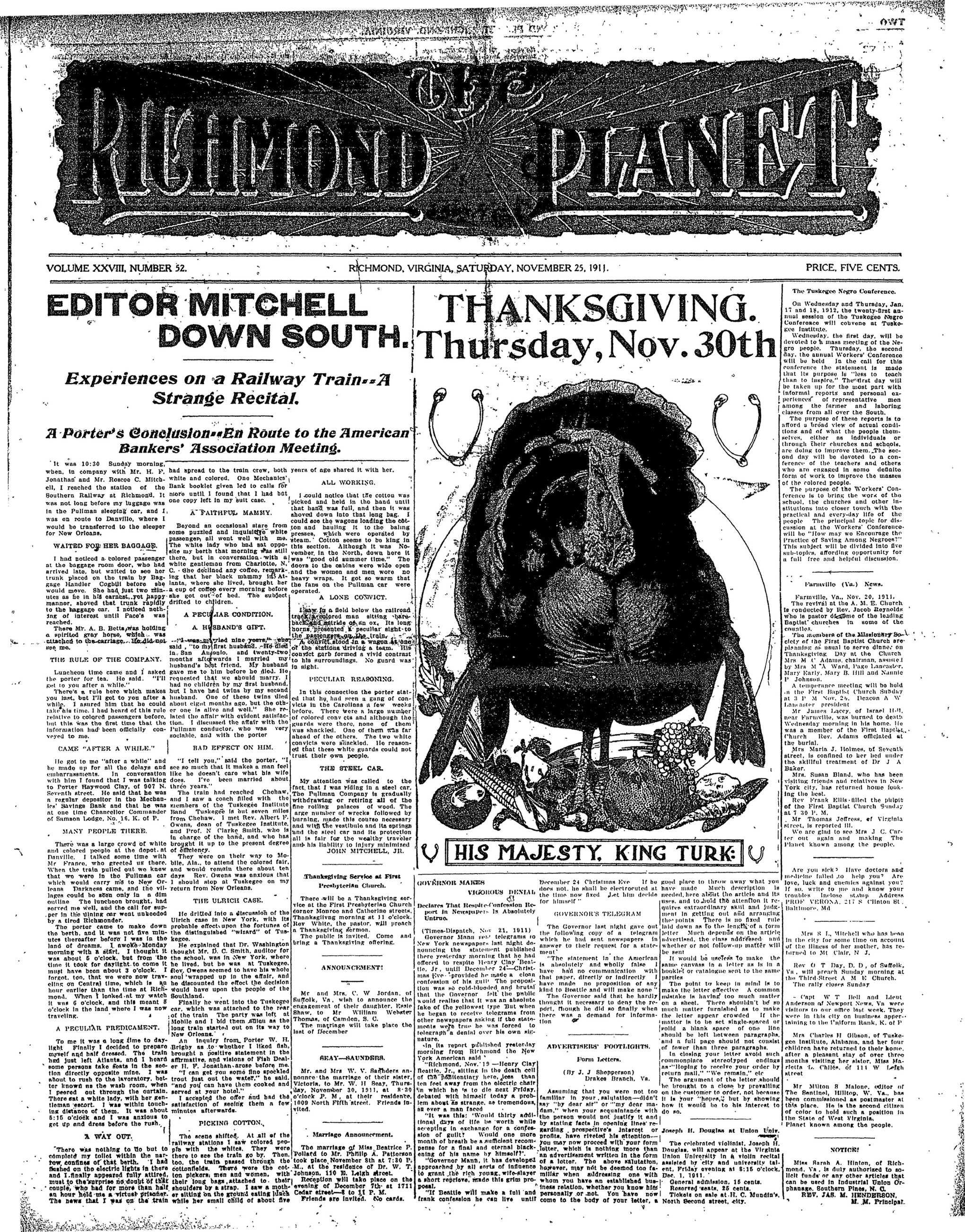
EDITOR MITCHELL DOWN SOUTH.
Experiences on a Railway Train.A Strange Recital.
A Porter's Conclusion-En Route to the American Bankers' Association Meeting.
EDITOR
DO
Experiences of
Stra
A Porter's Conclus
Bankers'
It was 10:30 Sunday morning, when, in company with Mr. H. P. had a Jonathan and Mr. Roscoe C. Mitch- white ell, I reached the station of the Bank Southern Railway at Richmond. It was not long before my luggage was in the Pullman sleeping car, and I was on route to Danville, where I would be transferred to the sleeper for New Orleans.
WAITED FOR HER BAGGAGE.
I had noticed a colored passenger at the baggage room door, who had arrived late, but waited to see her trunk placed on the train by Baggage Handler Cogbull before she would move. She had just two minutes as he in his carnet, yet happy manner, shoved that trunk rapidly to the baggage car. I noticed nothings interest until Pace's was reached. There Mr. A. B. Beta was holding a spirited gray horse, which was attached to the carriage. He did not see me.
THE RULE OF THE COMPANY.
Luncheon time came and I asked the porter for tea. He said, "I'll get to you after a while." There's a rule here which makes you just, but I'll got to you after a while. I assured him that he could resist to color the passengers before, but this was the first time that the information had been officially conveyed to me.
CAME "AFTER A WHILE."
He got to me "after a while" and he made up for all the delays and embarrassments. In conversation with him I found that I was talking to Porter Haywood Clay, of 007 N. Seventh street. He said that he was a regular depositor in the Mechanics' Savings Bank and that he was at one time Chancellor Commander of Samson Lodge, No. 16, K. of P.
MANY PEOPLE THERE
There was a large crowd of white and colored people at the depot at Danville. I talked some time with Mr. France, who greeted us there. When the train pulled out we knew that we were in the Pullman car which would carry me to New Orleans. Darkness came, and the villages could be ason only in a dim outline. The luncheon brought, had served me well, and the call for supper in the uplining car went unhooked by a tired Richmond.
The porter came to make down the berth, and it was not five minutes thereafter before I was in the land of dreams. I awoke-Monday morning with a start. I thought it was about 5 o'clock, but from the time it took for daylight, to come it must have been about 3 o'clock. I forget, too, that we wore now traveling on Contraj time, which is an hour earlier than the time at Richmond. When I looked at my watch it was 6 o'clock, and this meant 5 o'clock in the land where I was now traveling.
A PECULIAR PREDICAMENT.
To me it was a long time to daylight. Finally I decided to prepare myself and half dressed. The train had just left Atlanta, and I heard some persons take foots in the section directly opposite mine. I was about to rush to the invariant, better known as the wash room, when I peered out through the curtain. There sat a white lady, with her gentleman escort. I was within touching distance of them. It was about 5:16 o'clock and I was anxious to get up and dress before the rush.
A WAY OUT.
There was nothing to do but to complete my toilet within the narrow confines of that barrow. I had finished on the electric lights in there and I finally appeared fully attired, must to the surprise no doubt, that I was not half an hour hold me a virtual prisoner. The news that I was on the train
had spread to the train crow, both white and colored. One Mechanics' Bank booklet given led to calls for more until I found that I had but one copy left in my suit case.
A FAITHFUL MAMMY.
Beyond an occasional store from some puzzled and inquisitive white passengers, all went well with me. The white lady who had sat opposite my berth that morning was still there, but in conversation with a white gentleman from Charlotte, N. C. She declined any coffee, remarking that she had been in the inn, where she lived, brought her a cup of coffee every morning before she got out of bed. The subject drifted to children.
A PECULIAR CONDITION.
A HUSBAND'S GIFT.
"I was married nine years," she said, "to my first husband. He died in San Antonio, and twenty-two months afterwards I married my husband's best friend. My husband gave me to him before he died. He requested that we should marry. I had no children by my first husband, but I have had twins by my second husband. One of these twins died about eight months ago, but the other one is alive and well." She related the affair with evident satisfaction. I discussed the affair with the Pullman conductor, who was very sociable, and with the porter.
BAD EFFECT ON HIM.
"I tell you," said the porter. "I see so much that it makes a man feel like he doesn't care what his wife does. I've been married about three years."
The train had reached Chehaw, and I saw a coach filled with the members of the Tuskegee Institute Band Tuskegee is but seven miles from Chehaw. I met Rev. Albert P. Owens, doan of Tuskegee Institute, and Prof. N. Clarke Smith, who is in charge of the hand, and who has brought it up to the present degree of efficiency.
We were on their way to Mobile, Al., to attend the colored fair, and would remind there about ten days. Rev. Owens was anxious that I should stop at Tuskegee on my return from New Orleans.
THE ULRICH CASE.
He drilled into a discussion of the Ulrich case in New York, with its probable effect upon the fortunes of the distinguished "wizard" of Tuskegee.
He explained that Dr. Washington thought Mr. D. C. Smith, auditor for the school, was in New York, where he lived, but he was at Tuskegee. Owens seemed to be in his soul, wrapped in the affair, and did illustrate the effect the decision would have upon the people of the Southland.
Finally he went into the Tuskegee car, which was attached to the rear of the train. The party was left at Mobile and I bid them allon as the long train started out on its way to New Orleans.
An inquiry from Porter W. H. Bright as to whether I liked fish, brought a positive statement in the affirmative, and visions of Fish Dealer H. F. Jonathan arose before I could get you soo's speckled trot, and the water," he said, "and you can have cooked and served at your hotel."
I accepted the offer and had the satisfaction of seeing them a few minutes afterwards.
PICKING COTTON.
The scene shifted. At all of the railway stations I saw colored people with the whites. They were there to see the train go by. Thon, too, the train passed through the cottonfields. There were the cotton pickers, men and women, with their buildings by a strap. I saw a mother sitting on the ground eating jujub while her small child of about five
ALL WORKING.
I could notice that the cotton was picked and held in the hand until that hand was full, and then it was shoved down into that leng bag. I could see the wagons loading the cotton and hauling it to the baling presses, which were operated by steam. Colton seems to be king in this section. Although it was November, in the North, down here it was "good old summer time." The doors to the cabins were wide open and the women and men wore no heavy wraps. It got so warm that the fans on the Pullman car were operated.
A LONE CONVICT.
Lewis. In a fold below the railroad track, colored man sitting back, back and stride on an ox. Its long horns presented a peculiar sight to the passengers on the train. A convict stood in a wagon at one of the stationary driving a team. His convict garb formed a vivid contrast to his surroundings. No guard was in sight.
PECULIAR REASONING
In this connection the porter stated that he, had seen a gang of convicts in the Carolinas a few weeks before. There were a large number of colored convicts and although the guards were there, none of them was shackled. One of them was far away. The other two convicts were shackled. He reasoned that these white guards could not trust their own people.
THE STEEL CAR
My attention was called to the fact that I was wiling in a steel car. The Pullman Company is gradually withdrawing or retiring all of the fine rolling palaces of wood. The large number of wrecks followed by burning, made this course necessary and with the vestibule and its springs and the steel car and its protection all is fair for the wealthy traveler and his liability to injury minimized
Thankgiving Service at First
Presbyterian Church
There will be a Thanksgiving service at the First Presbyterian Church corner Monroe and Catholica streets, Thanksgiving morning at 11 o'clock. Rev White, the pastor, will proach a Thanksgiving sermon. The public is invited. Come and bring a Thanksgiving offering.
ANNOUNCEMENT!
Mr. and Mrs. C. W Jordan, of
Suffolk, Va., wish to announce the
engagement of their daughter, Esale
Webster Thomas, of Camden, S. G.
SEAY—SAUNDERS
Mr. and Mrs. W. V. Saffhadora announce the marriage of their sister, Victoria, to Mr. W. H. Sealy, Thursday, November 30, 1911, at 8:30 p.m. North Fifth street. Invitee: 1009 North Fifth street. Friends invited.
---
. Marriage Appouncement.
The marriage of Miss Beatrice P. Pollard to Mr. Philip A. Patterson took place November 8th at 7:30 P.M., at the residence of Dr. W. T. Johnson, 110 E. Leigh street. Reception will take place on the evening of December 7th at 1711 Cedar street—8 to 11 P. M.
Friends are invited. No cards.
THANKSGIVING. Thursday, Nov.30th
V
HIS MAJESTY. KING TURK:
GOVERNOR MAKES
VIGOROUS DENIAL
Declare That Respite Confession Report in Newspapers Is Absolutely Untrue.
(Times-Dispatch, Nov. 21, 1911)
Governor Mann and telegrams to New York newspapers last night denouncing the statement published there yesterday morning that he had offered to respite Henry Clay Beattie, Jr., until December 24—Christmas give—provided he made a clean confession of his guilt. The request was that the Governor felt the public would realise that it was an absolute fake of the yellow type. But when he began to receive telegrams from other newspapers asking if the statements were true he was forced to telegraph a dental over his own signature.
In its report published yesterday morning from Richmond the New York American said:
"Richmond, Nov. 19—Henry Clay Beattie, Jr., sitting in the death cell of the infiltrant here, less than ten feet away from the electric chair in which he is due next Friday, debated with himself today a problem about as strange, as tromendous, as a man a fact. Would thirty additional days of life be worth while accepting in exchange for a confession of guilt? Would one more month of breath be a sufficient recompense for a final and eternal blackening of his name by himself?"
"Governor Mann, it has developed approached by all sorts of influence to grant the rich young, wife-slayer a short reprieve, made this grim proposal. "If Beattie will make a full and frank confession he can live until
December 24 Christmas Eve. If he
does not, he shall be electrocuted at
the time now fixed. Let him decide
for himself."
GOVERNOR'S TELEGRAM
The Governor last night gave out the following copy of a telegraph which he had sent newspapers in answer to their request for a statement.
"The statement in the American is absolutely and wholly false I have had no communication with that paper, directly or indirectly I have made no proposition of any kind to Boston and will make none."
The Governor said that he hardly thought it necessary to deny the report, though he did so finally when there was a demand for information.
ADVERTISERS' FOOTLIGHTS.
Form Letters
(By J. J. Shopperson) Drakes Branch.
Assuming that you were not too familiar in your salutation—didn't say "by dear air" or "by dear madam," when your acquaintance with the person would not justify it and by stating facts in opening lines regarding prospective's interest or profits, have riveted his attention: you may now proceed with your form letter, which is nothing more than an advertisement written in the form of a letter. The above salutation, however, may not be deemed too familiar when addressing one with whom you have an established business relation, whether you know him personally or not. You have now come to the body of your letter, a
good place to throw away what you have made. Much description is needed, here about the article and its uses, and to hold the attention it requires extraordinary skill and judgment in getting out and arranging the points. There is no fixed rule laid down as to the length of a form letter. Much depends on the article advertised, the class addressed, and whether or not follow-up matter will be sent.
It would be useless to make the same canvass in a letter as is in a booklet or catalogue sent to the same parties.
The point to keep in mind is to make the letter effective. A common mistake is having too much matter on a sheet. There shouldn't be so much matter furnished as to make the letter appear crowded. If the matter is to be set single-spaced or solid a blank space on one line should be left between paragraphs, or in full page should consist of four of lower third paragraphs.
In closing your letter avoid such commonplace stereotyped endings "a-hoping to receive your order by return mail." "We remain." etc.
The argument of the letter should be brought to a close by provelling on the customer to order, not because it is your "hope," but by showing how it would be to his interest to do so.
Joseph H. Douglas at Union Univ.
The celebrated violinist, Joseph H. Douglas, will appear at the Virginia Union University in a violin recital assisted by city and university talent, Friday evening at 8:15 o'clock, Dec. 1, 1911.
General admission, 15 cents.
Reserved seats, 25 cents.
Tickets on sale at H. C. Mundin's, North Second street, city.
PRICE. FIVE CENTS.
The Tuskegee Negro Conference.
On Wednesday and Thursday, Jan. 17 and 18, 1912, the twenty-first annual session of the Tuskogee Negro Conference will covene at Tuskogee Institute.
Wednesday, the first day, will be devoted to a mass meeting of the Negro people. Thursday, the second day, the annual Workers' Conference will be held. In the call for this conference the statement is made that its purpose is "less to teach than to inspire." The first day will be taken up for the most part with informal reports and personal experiences of representative men among the farmer and laboring classes from all over the South.
The purpose of these reports is to afford a broad view of actual conditions and of what the people themselves, either as individuals or through their churches and schools. Their improvement will. The second day will be devoted to a conference of the teachers and others who are engaged in some definite form of work to improve the masses of the colored people.
The purpose of the Workers' Conference is to bring the work of the school, the churches and other institutions into closer touch with the practical and everyday life of the people. The principal topic for discussion at the Workers' Conference will be "How may we encourage the Practice of Saving Among Negroes?" This subject will be divided into five sub-titles, affording opportunity for a full free and helpful discussion.
Farmville (Va.) News.
Farmville, Va. Nov. 20, 1911.
The revival at the A. M. E. Church is conducted by Rev. Jacob Reynolds who is pastor of one of the leading Baptist churches in some of the counties.
The members of the Missionary Society of the First Baptist Church are planning of usual to serve dinner on Thanksgiving Day at the Church Mrs M C Adams, chairman, associel Mrs M A Ward, Pugo Lancaster, Mary Early, Mary B. Hill and Nannie P Johnson.
A temperance meeting will be hold on the First Baptist Church Sunday at 3 P M Nov. 20, Deacon A W Lancaster president
Mr James Lacey, of Israel H, near Farmville, was burned to death Wednesday morning in his home. He was a member of the First Baptist Church Rev. Adams officiated at the burial.
Mrs Marina J. Holmes, of Seventh street, is confined to her bed under the skillful treatment of Dr J A Baker.
Mrs. Susan Bland, who has been visiting friends and relatives in New York city, has returned home looking at Rev Frank Ellis-illited the pilgrimage of the First Baptist Church Sunday at 7 30 P. M.
Mrs Thomas Jeffress, of Virginia street, is reported ill.
We are glad to see Mrs J C. Carter out again and making The Planet known among the people.
Are you sick? Have doctors and medicine failed to help you? Are love, luck and enemies against you? If so, write to me and know your close stabp Address PROF VERONA, 217 S Clinton St. Baltimore, Md
.
Mrs S. L. Mitchell who has been in for some time on account of the illness of her mother, has returned to Mt. Clair, N. J.
Rev O T Day, D. D., of Suffolk, Va., will preside Sunday morning at the Third-Street A M E Church.
The rally closes Sunday.
- Capt W T Bell and Lieut Anderson of Newport News, Va. were visitors to our office last week. They were in this city on business appertaining to the Uniform Rank, K. of P.
Mrs Charles H Gibson, of Tuskegee Institute, Alabama, and her four children have returned to their home after a pleasant stay of over three months visiting her sister, Miss Marietta L. Chiles, of 114 W Leffh street.
Mr Milton B Malone, editor of The Sentinel, Hilltop, W. Va., has been commissioned as postmaster at this place. He is the second citizen of color to hold such a position in the State of West Virginia. Planet known among the people.
NOTICE!
Miss Sarah A. Hinton, of Richmond, Va., is duty authorized to solicit funds or any other articles that can be used in Industrial Union Orphanage. Southern Pines, N. C.
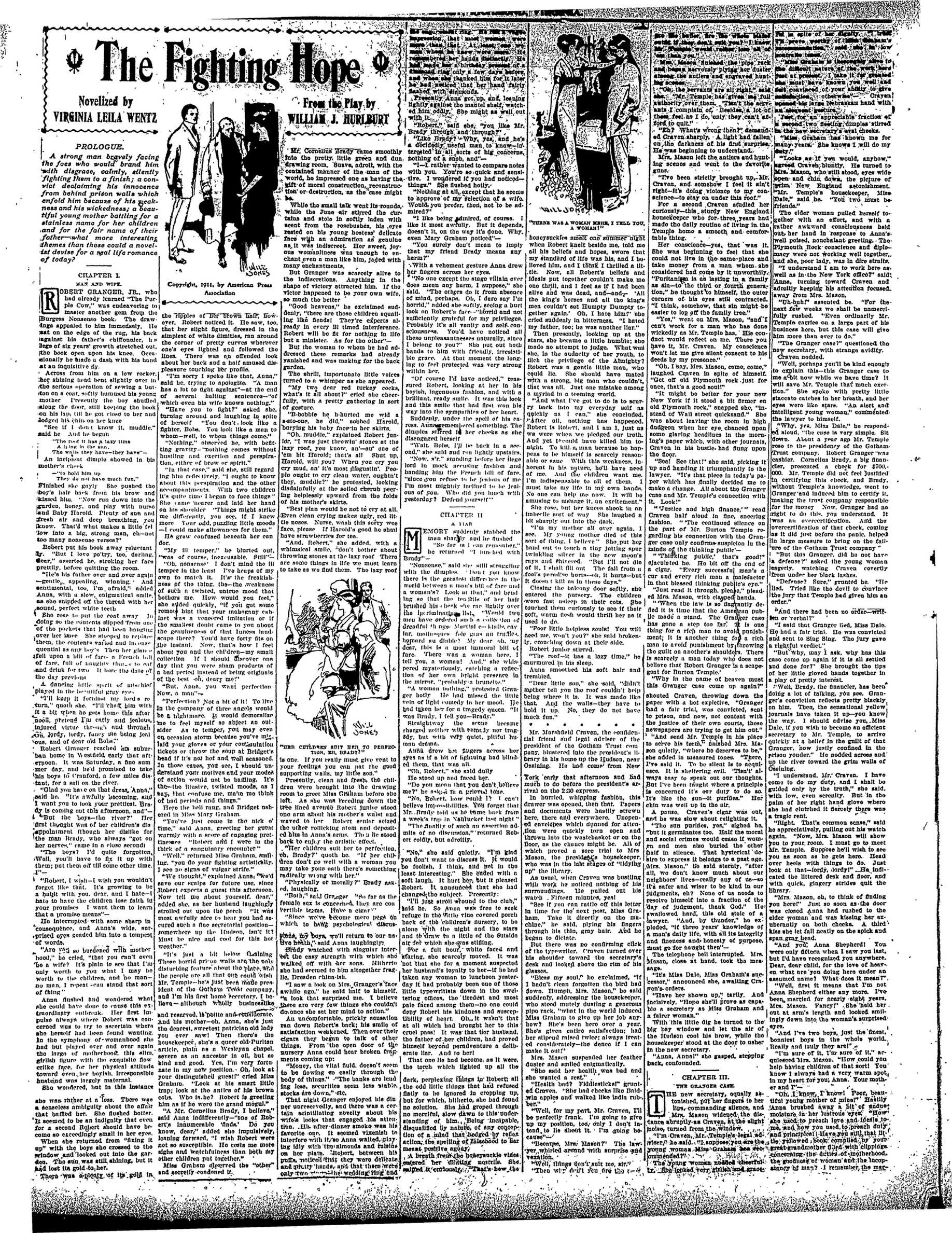
Novelized by VIRGINIA LEILA WENTZ
PROLOGUE.
A strong man bravely facing the foes who would brand him with disgrace, calmly, silently fighting them to a finish; a convict declaiming his innocence from behind prison walls which enfold him because of his weakness and his wickedness; a beautiful young mother battling for a stainless name for her children and for the fair name of their father—what more interesting themes than those could a novelist devise for a real life romance of today?
CHAPTER L
ROBERT GRANGER, JR., who had already learned "The Purple Cow," was endeavoring to master another gem from the Burgess Nonsense book. The drawings appealed to him immediately. He sat on the edge of the rug, his back against his father's chiffon, his legs of six years' growth stretched out, the book open upon his knee. Occasionally he made a dash with his hand at an instruction. Across from him on a low rocker, her shining beat bent slightly over in the serious operation of sewing a button on a coat, softly hummed his young mother. Presently the boy shuffled along the door, still keeping the book on his lap, till he got close to her and lodged his chin on her knee.
"See if I don't know it, muddle" said he. And he began.
"The roof it has a lazy time," he replied. "The whisk they have—they have—"
An incipient simple showed in his mother's check.
"To hold him up."
Finished she garly. She pushed the boy's hair back from his brow and kissed him. "Now run down into the garden, honey, and play with nurse and Baby Harold. Plenty of sun and fresh air and deep breathing, you know. That'd what makes a little feel low into a big, strong man, eh—not too many nonsense verses?" Robert put his book away reluctantly. "But I love pottery, too, darling, dear," asserted he, stroking her face prettily, before quitting the room. "He's his father over and over again—gentle, appealing, winning." And sentimental, too, I'm afraid, added Anna, with a slow, enigmatic smile, as she snapped off the thread with her sound, perfect white teeth. "I must put the coat away. In doing so, I get from one of the packets that had been hanging over her hair. She stopped to rip them, the contents varied and in数量 as any boy's. Then her glance fell upon a bill of fare—a French bill of fare, full of laughter—to eat and drink for two. It here the date of the day previous.
A dancing little spirit of mischief played in the beautiful gray eye. "I'll keep it formidable my lord a return," quoth she. "I'll chill him with it a bit he get home this after noon, pretend I'm catty and jealous, injured virtue through and through, ljordy, lordy, fancy the being jealous, and of dear old Bobs." Robert Granner reached on suburban home in the same Saturday after a meridian day, and bid promised to take his boys to Granford, a few miles distant, for a sail on the river.
"Glad you have on that dress, Anna," said he. "It awfully becoming, and I want you to look your prettiest. Brady is coming out this afternoon, and—" But the boys—the river? Her first thought was of her children's applause through her dislike for the man Brady, who always "got on her nerves" in a close second. Well, you'll have to go it up with them; put them on till some other time."
"Robert, I wish I wish you wouldn't forget like that. It's growing to be a habit with you, dear, and I hate I hate to have the children lose faith in your promises I want them to learn that a promise means"—
He interrupted with some sharp in consequence, and Anna's wide, surprised eyes gouged him into a tempest of words.
"Are you so burdened with motherhood, he cried, that 'treat you can't even be a wife?' it's plain that I am not worthy to the children, and he man—no man, I repeat—can stand that sort of thing."
Anna fushed and wondered what she could have done to cause this extraordinary outbreak. Her first impulse always where Robert was concerned was to try to ascertain where she herself had been found wanting. In the symphony of womanhood she had but played over and over the large of motherhood, this aim, gritial ignition, was for her physical attitude toward even her boyish, irresponsible husband was largely maternal.
She wondered, but in this instance she was rather at a loss. There was a senseless ambiguity about the affair that buffed her. She fushed hotter. It seemed to be an indignity that even for a second Robert should have become so exceedingly small in her eyes. When she returned from "fixing it up" with the boys she crossed to the window and looked into the garden. The sun was still shining, but it had lost its gold to her. There was a splendor of its gold in
Fighting
WILLIE
DORIS
the ripples of her Brown hair. However, Robert noticed it. He saw, too, that her slight figure, dressed in the same outfit, was the corner of pretty curves whowere one's eyes lighted and followed the lines. There was an offended look about her back and a half amused displeasure touching her profile.
"I'm sorry I spoke like that, Anna," said he, trying to apologize. "A man who was the original owner of a seventh building, sentences—of which even his wife knows nothing."
"Have you to fight?" asked she, taring around and laughing in spite of herself. "You don't look like a man to fight. Bola. You look like a man to whom—to whom things come." "Nothing," observed he, with befitting gravity—"mothing comes without hustling and exertion and perspiration, either of brow or spirit." "In that case," said she, still regard him reflectively. "I ought to know about this perspiration and the other accompaniments. With two children it's quite time I began to face things" She came nearer and indl her hand on his shoulder. "Things might strike him hard." He knew more. He odd, puzzling little moods—I could make allowances for them." He grew confused beneath her can do.
"My ill temper," he blurted out, "was of course, incurable. Still." "Oh, nonsense!" I don't mind the ill temper in the least. I heaps of my own to match it. It's the freakishness of the thing. the-the weakness of such a twisted, untrue mood that you can never feel. You also added quickly, "if you got some remorse hint that your mugahog catheter was a veneered imitation or if the smallest doubt came to you about the gentleness of that liness landscape there? You'd have forty fits on the instant. Now, that's how I feel about you and the children--my small collection. If I should. There one of the gentleness products of a bad period instead of being originals of the best-oh, demeet me!" "But, Anna, you want perfection Now, a man..."
"Perfection? Not a bit of it! To live in the company of three angels would be a highmare. It would demoralize me to feel myself so abject an outsider. As to temper, you may even on occasion storm because you might laid your gloves or your conculation tickets or throw the soup at Bridgegirl if it isn't hot and wall seasoned. In those cases, you see, I should understand your motives and my modes of action would not be battling. It's the illusive, twisted motives, as I say, that confuse me, make me think of end periods and things." Here the bell ring, and Bridget ushered in Miss Mary Graham. "You've just come in to the nick of the day, and her great warmth with a score of engaging pretentiousness." Robert and I were in the thick of a sacrificial encounter." Well," returned Mrs Graham, smiling, "you do your fighting artificially, no signs of vulgar strife."
"We thought," explained Anne, "We save our scopes for future use, since Robert expects a guest this afternoon. Now tell me about yourself, dear." added she, as her husband laughingly stroited out upon the porch. "It was most naughtyly nice to hear you had secured such a fine secretarial position—somewhere up the烟屋, isn't it Must dare and cool for this hot weather." "It's just a bit below Coalition Those horrid prison walls are the only disturbing feature about the place, and the people are all that our could wish Mr. Temple—he's just been made president of the Gotham Twist company, and I'm his first home secretary, I believe—although wholly businesslike
and reserved, his polite and condescension.
And his mother—oh, Anna, she's just the dearest, sweetest patrician old lady you ever saw! Then there's the housekeeper, she's a queer old Puritan article, plain as a Wesleyan chapel, severa as an ancestor in oil, but so kind and good. Yes, I'm very fortunate. You're the distinguished guest! Cress Miss Graham. "Look at his smart little trap; look at the antics of his brown colbs. Who is he? Robert is greeting him as if he were the grand mogul." A. Mr. Cornellus Brady, I believe," said Anna indifferently—"one of Robert's inumerable 'inda.' Do you know, dear; added she impulsively, leaning forward. "I wish Robert were not so susceptible. He costs me more than both my other children put together." Miss Graham observed the "other" and secretly condoned it.
From the Play by WILLIAM J. HURLBURT
Mr. Cornelius Brady came smoothly into the pretty, little green and dun drawing room. Sussex, adroit, with the contained manner of the man of the body, he impressed one as having the gift of moral construction, reconstruction or destruction, as the case might.
While the small talk went its rounds, while the June air stirred the curtains and stole in softly inden with scent from the rosebushes, his eyes rested on his young hostess' delicate face with an admiration as genuine as it was indiscreet. Her sweet, joyous womaniness was enough to enchant a man like him, jaded with more ecchinum. was much.
But Granger was scarcely alive to the indiscreetness. Anything in the shape of victory attracted him. If the victor happened to be your own wife, so much the better.
"Good heavens," he exclaimed suddenly, "there are those children squalling like fends! They're experts already in every ill time interference. Robert will be fit for nothing in life but a minister. As for the other"—But the woman to whom he had addressed these remarks had already yanked and was making for the back gallery.
The shrill, importunate little voices turned to a whisper as she appeared. "My two dear red turkey cocks, what's all about?" cried she cheerfully, with a pretty gathering in sort of gesture.
"B-bobble he hurted me wild a-stoone, he did," sobbed Harold, burrying his baby face in her skirts.
"Oh, muddle," explained Robert junior. "I was just thrown'n stones at the lazy roof, you know, an"—one of 'em hit Harold; that's all Sput up, Harold, will you? When you cry you cry mud, an it's most flagrantian. Peo-ton, you know, an"—one of 'em, muddle!" he protested, looking disdainfully at the soiled church piercing helplessly upward from the folds of his mother's skirts.
"Best plan would be not to cry at all. Even clean crying makes ugly, red little noses. Nurse, wash this sorry we face, please. If Harold's good he shall have strawberries for tea. "And, Robert," she added, with a whimsical amide, "better about throwing stones at the laxy roof. There are some things in we must learn to take as we fat them. The laxy roof
WILL JONES
"HER CHILDREN SUIT HER TO PERFECTION, MR. BRADY?" is one. If you really must give rent to your feelings you can pat the good supporting walls, my little son."
Presently, clean and fresh, the children were brought into the drawing room to greet Mrs Graham before she left. As she was feeding down the tree lined around Robert junior stood one arm about his mother's waist and waved to her. Robert senior acted the other rottling atom and deposited him in Anna's arms. Thus he stood in front of her, looking at her. "The children suit her to perfection, brady. Quoth he. "If her children don't go well with a woman you may take your out there something radically wrong with her." "Physically or morally? Brady asked, laughing. "Both, said Greger. "No far as the female sex is concerned they are conventible teams. How a clear." "Since we've become more pigs on which to have psychological discussions, my boys, will return to our two brothers, said Anna laughingly. Watched with singular interest the easy strength with which she walked off with her sons. Hitherto she had seemed to him altogether fragile. Dresden china-lish.
"I saw a look on Mrs. Granger's "Nice awfully ago," he said hilt to himself, "I look that surprised me. I believe there are very few things she could do once she set her mind to action."
An uncomfortable, prickly sensation ran down Robert's back; his smile of satisfaction weakened. Then over their cigars they began to talk of other things. From the open door of the nursery Anna could hear broken fragments coming up:
"Money, the vital fluid, doesn't seem to be flowing so easily through the body of things." "The banks are lead ing less, securities seem less stable stocks are down," etc.
That night Granger enjoyed his dinner, securities seem less stable stocks are down," etc.
His after-dinner smoke was his favorite one. It seemed vixenish to interfere with it as Anna waited, playing idly with its dumbbells and playing on her plate. Robert, between his profits, misdirection they were delicate and pretty hands, and that there were only two hands the wedding ring and
The man was a girl. He was a wage impersonation that was not more than that. At least, and was more than that. He had a little�, he had a little, He had made her a birthday person of a thousand ring only a few days before, and when she thanked him for it later he had poked that her hand fairy shaded with�goodness.
Frequently. Ann for up, and, leaming lightly against the manlet shelf, watched him, odily. She might as well, out with it.
For the better for The whole blind set it, she don't suit you! I know the Vessels would rather have all of the than you.
Miss, Mossy finished the pipe rack and began nervously plying her d�ies along the anities and he had�ed him. "Oh, the perrants are all right," said Mr Temple, his given my full authority over them. "Tin' the service, I complain of," Besides a lot of them feel as I do, only they can't af-
Til in spite of her dignity, or irrit's my pure, worthy of vines, the manlet's "and I am the view of the manlet," and the manlet is the way he's from the same way to him.
He is all about a life, the world, here just at present. I take it for�ated she must have known you well and that convicted of your ability to give the manlet, otherwise," Crayen opened his large Nebraska hand with an excess of gesture.
"Robert," said she, "you like Mr. Brady through and through."
"Like Brady?" Why, yes, and he's a decidedly useful man, to know-interested in all sorts of big concerns, nothing of a snob, and—"
"I—I rather wanted to compare notes with you. You're so quick and sensitive. I wondered if you had noticed—things." She pushed hotly.
"Nothing at all, except that he seems to approve of my selection of a wife. Would you prefer, then, not to be adamant?" She like being admired, of course. I like it most awfully. But it depends, doesn't it, on the way it does. Why, even Mary Graham pooled—"
"You surely don't mean to imply that my friend Brady means any harm."
"With a vehement gesture Anna drew her fingers across her eyes.
"No one except the stage player ever does mean any harm, I suppose," she said. "The others do it from absence of mind, perhaps. Oh, I dare say I'm like Robert. I don't look on Robert's face--third and not sufficiently grateful for my privileges. Probably it's all vanity and self-consciousness. You'd have noticed all these unpleasantnesses naturally, since I belong to you." She put out both hands to him with friendly, freestriking At. At that moment the longing to feel protected was very strong within her. "Of course I'd have noticed," reassured Robert, looking at her in his boyish, ingenious fashion, and with a brilliant, ready smile. It was this look and this smile that that first won his way into the sympathies of her heart. "I am a woman," she said. Aiming concerned something. The dimples suffered her cheeks as she disengaged herself
"Walt. Bob. I'll be back in a see-ond," she said and run lightly upstairs. "Now, sr." standing before her hege lord in mock accusing fashion and him him the French bill of fare. "since you are the French bill of fare. I'm most mightily inclined to be jealous of you. Who did you lunch with yesterday? Defend yourself."
CHAPTER II
MEMORY suddenly stabbed the man thinly and he fushed. "No far as I can remember," he returned "I tumbled with Brady" "Nonsense," said she still struggling with the dipsup. "Don't you know that the world between a man's bill of fare and a woman's? Look at that," and bending so that the tenile of her hair brushed his check she ran lightly over the himinature list. "Would two men have ordered such a collection of decreal things: Martial cockery, cray far, mollusques fole gras an trumpet, hernard nu abiure? My dear oh, my dear, this is a most immoral bill of fare. There was a woman here. I tell you, a woman. And," she whispered mysteriously, catching a reflective gaze of pressure in the mirror, "probably the murder." "A woman nothing," proclaimed Granger hotly. He had missed the little vein of light counted in her mood. He had taken her for a tragedy queen. "It was Brady, I fell you-Brady."
Straightway the scene became charged mother with comely nor tragedy, but with very quiet, pitiful human drama.
Ashnul drew bet ziggers across her eyes as if a bit of lightning had blinded them, that was all.
Mary stood dully. He stood up and faced her.
"Do you mean that you don't believe me" he asked in a grieved tone.
"No, Robert, how could I? I can't believe impossibilities. You forget that Mr. Brady told us he came back from a week's trip in 'Hulester last night'."
"The funnity of such an assertion admits of no discussion." returned Robert coldly, but adroitly.
"So," she said quietly. "I must you don't want to discuss it. It would be coolish. I think, and not in the least interesting." She ended with a soft laugh. It hurt her, but it pleased Robert. It announced that she had changed the subject. Presently: "I will just stroll around to the club," said he. So Anna was free to seek refuge in the little vine covered porch back of the children's nursery, to be surrounded by the stars and to draw in a little of the outside air for which she was adding.
For a full hour, white faced and staring, she scarcely moved. It was not that she for a moment suspected her husband's loyalty to her—If he had taken any woman to lunchoon yesterday it had probably been one of those little typewriters down in the swiveling offices, the tiredest and most pale faced among them—no one could deny Robert his kindness and susceptibility to heart, and that heart that which had brought him to this cruel past. It was that sir husband, the father of her children, had proved himself beyond perdurement a deliberate lur. And to her that One one he had become, as it were, the torch which lighted up all the dark, perplexing things in Robert; all the odd little things that had refused fully to be ignored in cropping up, but for which, hitherto, she had found no solution. She had been drawn to this understanding of him. Inable, incapable, disqualified by nature, of any concepción of a mind that had bogged through action; the spelling of filialhood to fan meant positive anger.
A breath from the honeysuckle vines
is so sweet and delicate, how she
can be so beautiful.
WILL JONES
"THERE WAS A WOMAN MEMORI, I TELL YOU,
A WOMAN"
"There was a woman when I tell you, a woman!"
bonoysuckles smell one summer night when Robert knelt beside me, told me all his beliefs and hopes, swore that my standard of life was his, and I believed him, and I stink I thrilled a little. Now, all Robert's beliefs and ideals put together couldn't make me one thrill, and I feel as if I had been alive and was dead, and—and—'All the king's horses and all the king's men couldn't set Humpty Dumpty together again.' Oh, I hate him!" she cried suddenly in bitterness. "I hated my father, too; he was another liar."
Then presently, looking up at the stars, she became a little humble; she made no attempt to judge. What was she, in the audacity of her youth, to litch the privilege of the Almighty? Robert was a gentle little man, who could lie. She should have mated with a strong, big man who couldn't, that was all. Just one mistnake among a myriad in a teeming world.
"And what I've got to do is to seurry back into my everyday self as quickly as I can," she concluded. "After all, nothing has happened. Robert is it honest, and I am I, just as we were when we pledged our trust. And yet I could have killed him to tipulate a kill, a man because he hobbles to the house, a reasonable or same. With this we reherent in his future, he will have need of me. And the children want me, I am indispensable to all of them. I must take my life in my own hands. No one can help me now. It will be amusing to manage it, an excitement." She rose, but her knees shook in an imbecile sort of way. She laughed a bit sharply out into the dark. "I'm my mother all over again, I see. My young mother died of this thing, I believe." She put her hand out, with a thin spitting twister swolling her rysa and glittered. "But I'll not die of it, I shall fill out. The fall from a fool's perseidse hurts-so, it hurts--but it does not kill us in it, it hurts."
Closing the balcony door softly, she entered the purse. The children were fast sleep in their cots. She touched them curiously to see if their soft, warm flesh would thrill her as it used to do.
"Poor little helpless soul! You will need me, won't you?" she said brokenly, crumbling down at their side.
Robert junior stirred.
"The roof—it has a lazy time," he murmured in his sleep.
Aunna smoothed his soft hair and trembled.
"Dear little son," she said, "didn't mother tell you the roof couldn't help being where it is. It is wad made like that. And the walls—they have to hold it up. No, they do not have much fun."
Mr. Marshall Craven, the confidential friend and legal adviser of the president of the Gotham Trust company, blistered into the president's library in his home up the Hudson, near Osseining. He and come from New York city that afternoon and had much to do before the president's arrival on the 2:30 express.
In hurried, whipping fashion, this drawer was opened, then that. Papers and documents were hastily strewn here, there and everywhere. Unopened envelopes which dunned for attention were quickly torn open and thrown into the wastebin or on the floor, as the chance might be. All of Mason's housekeeper, Mason the president's housekeeper, who was in the last stages of "tidying up" the library.
As usual, when Craven was busting with work he noticed nothing of his surroundings. He pulled out his watch. Fifteen minutes, yes!
"See if you can rattle off this letter in time for the next post, Miss Grayman." He said, lying on the chin. "I said, lying on the chin through his thin, gray hair. And he began to dictate.
But there was no confirming click of the typewriter. Craven turned over his shoulder toward the secretary's desk and looked above the rim of his glasses.
"Bless my soul" he exclaimed, if I could clean forgotten the bird had down. Tumph, Mrs. Mason, he said suddenly, addressing the housekeeper, who stood mutely dusting a generous pipe rack. "what in the world induced Miss Graham to give up her job anyone?" She's been her over a year. She's given entire satisfaction; had her aliphated twice always treated considerably—the dance if I can match her. Mrs. Mason suspended her feather duster and smiled enigmatically.
"She said her health was bad and who wanted a rest."
"Health bad? Fiddlestick's" grunted Craven. "She had checks like Baldwin apples and walked like India rubber." "Well, for my part, Mr. Craven, I'm be perfectly frank. I'm going to give up my position, too, only I don't intend to, to lie about it. I'm going because"— "Become Mrs. Mason?" The lawyer, whisked around with surprise and vexation. "Well, things don't suit me, sir." "Then we'll don't fire the r-
grew the better. Are the Whole blamed outfit? if they don't like you? I know. I'm. Example: wrestler, hunter, all of me than you.
Mr. Temple, unloaded the pipes rack, and they were playing around among the antlers and thunting scenes.
"Oh, the servants are all right," said one. Mr. Temple, has given me full authority over them. "That the servants I complain of. Besides, a lot of them, feel as I do, only they can't afford to quit."
"Oh? What's wrong then?" demanded Craven sharply. A light had fallen. He was surprised. He was beginning to understand. Mr. Mason left the antlers and hunting scenes and went to the favorite gun.
"Two been strictly brought up. Mr. Craven, and somehow I feel it's right--it's doing violence to my science--to stay on under this root."
For a second Craven studied her curiously, this sturdy New England housekeeper who for three, years had made the daily routine of living in the Temple home a smooth and comfortable thing.
Her conscience—yes, that was it. She began to feel that she could in the same place and take money from the temple, considered had come by it unworthy, "Puritanism is as lasting in a family as sin—to the third or fourth generation," he thought to himself, the outer corners of his eyes still contracted. "I think, somehow, that sin might be easier to top off the family tree." "Yes," went on Mrs. Mason, "and I can't work for a man who has done wickedly as Mr. Temple has. His conduct would reflect on me. There you have, Mr. Craven. My conscience should be Mr. Craven. I consent to his deeds by my presence."
"Oh I say, Mrs. Mason, come, come, laughed Craven in spite of himself. 'Get off old Plymouth rock just for once, that's a good soul!'
"It might be better for your new New York if it stood a bit firmer en旧 Plymouth rock," snapped she, "instead of Wall street quicksand." She was about leaving: the room in high dugdon when her eye, chanced upon some glaring headlines in the morning's paper which, with other journals, Craven in his bustle had funged upon the floor.
"Seel that," she said, picking it up and handling it triumphantly to the lawyer's that place in today's paper, which was finally decided me to make a change. All about the Granger case and Mr. Temple's connection with it. Look.
"Justice and high finance," read Craven half aloud in fine, sneering fashion. "The continued silence on the part of Mr. Burton Temple regarding his connection with the Granger case only confirms suspicion in the minds of the thinking public"- "thinking public," that's good! oblaceted he. But off the end of a cigar. "Every successful man's cur and every rich man a maufactor in that blessed thinking public's eye."
"Just read it through, please," pleaded Mrs. Mason, with clapped hands. "When the law is so significantly defined it is time that the American public made a stand. The Granger case has taken too long." It is one thing for a fight to involve punishment; it is another thing for a rich man to avoid punishment by throwing the guilt on another's shoulders. There is scarcely a man today who does not believe that Robert Granger is a scapegoat for Burton Temple.
this Grauger case come up again?" shouted Craven, throwing down the paper with a hot expletive. "Granger had a fair trial, was convicted, sent to prison, and now, not content with the justice of their own courts, these newspapers are trying to get him out." "And send Mr. Temple in his place to serve his term," finished Mrs. Mason quietly, "where he deserves to be," she added in measured tones. "There, I've said it. To be silent is to acquiesce. It is sheltering evil. 'Tisn't always easy to speak out our thoughts. But I've been taught where a principle is concerned it's our duty to do so. It's like the sun—it purifies." Her chin was well up in the air.
A pause. Craven's cigar was out, and he was slow about relighting it.
"The sun purifies, yes," sighed he, "but it germinates too. Half the moral and social crimes would cause if women and men also burned the other half in silence. That hysterical desire to express it belongs to a past age. Mrs. Mason," he said sternly, "after all, we don't know much about our neighbors' lives—really all of us—so it's safer and wiser to be kind in our judgments, eh? None of us needs to resolve himself into a fraction of the day of judgment, thank God." He swallowed hard, this old stolc of a lawyer. "And, by thunder," he exploded, "if three years' knowledge of a man's daily life, with all its integrity and fitness and bond of purpose, must go for anyone," he telephone bell interrupted. Mrs. Mason, close at hand, took the message. "Have her shown up," tarly, And inclusively, "Hope she'll prove as capable a secretary as Miss Graham and a falter woman."
With this little dig he turned to the big bay window and let the air of the Hudson cool his brow, while the housekeeper stood at the door to usher in the guests. "Anna, Ann!" she gasped, stepping back, confused.
T THE new secretary, equally astonished, put her fingers to her lips, commanding silence, and Mrs. Mason widened, the distance abruptly as Craven, at the slight noise, turned from the window. "I'm Craven, Mr. Temple's legal adviser," he said. "I suppose you are the young woman. Miss Graham has been pennounced!" The young woman nodded cheerfully, the looked very grish and grace.
In an epileptic of his dignity, I told Mr. Graham, worthy of little Graham, his recommendations, said he in low control terms.
"Miss Graham is thoroughly alive to the difficult nature of the work here just at present. I take it for granted she must have known you well and safe convinced of your ability to give assistance," otherwise—" Craven opened his large Nebraska hand with an elegant gesture.
Just for an appreciable fraction of a second two feeling, dimples stirred in the new secretary's eval cheeks.
"Miss Graham has known me for years. She knows I will do my duty."
"Looks as if you would, anyhow," agreed Graham, bluntly. He turned to Mrs. Masan, who still stood, eyes wide open and chin down, the picture of print, New England astonishment.
"Mr. Temple's hostskeeper, Miss Dale," said he. "You two must be friends."
The older woman pulled herself together with an effort, and with a rather awkward consciousness held out her hand in response to Annna's well polished, nonchalant greeting. The Plymouth rock consciousness and diplomacy were not working well together, and I didn't understand. "I understand I am to work here as well as in the New York office" said Anna, turning toward Craven and adultly keeping his attention focused, away from Mrs. Mason.
"Unhuh" assented be. "For the next few weeks we shall be unmercifully rushed. "Even ordinarily Mr. Temple carries on a large part of his business here, but this case will give him more than ever to do." In questioned the now secretary, with strange avidity, Craven nodded.
"Well, perhaps you'll be kind enough to explain this—this Granger case to me a bit now while we have time? It will save Mr. Temple that much exertion." She spoke with pretty little staccato catches in her breath, and her eyes were like stars. "An alert and intelligent young woman," commented the lawyer to himself.
"Why, yes. Miss Dale," he responded aloud. "The case is very simple. Sit down. About a year ago Mr. Temple rose to the presidency of the Gotham Trust company. Robert Granger was cashier. Cornelius Brady, a big financial officer, presented a check for $700,000. Mr. Temple did not feel justified in certifying this check, and Brady, without Temple's knowledge, went to Granger and induced him to certify it, making the trust company responsible for the money. Now, Granger had no right to do this, you understand. It was an overcertification. And the overcertification of that check, coming as it did just before the panic, helped in large measure to bring on the failure of the Gotham Trust company."
"But this Granger, did he not have a defense?" asked the young woman eagerly, watching Graven coverly from under her black lashes. "Defense? Sure." grunted he. "He lied. Tried like the droll to convince the jury that Temple had given him an order." "And there had been no order—written or verbal?" "I said that Granger lied, Miss Dale. He had a fair trial. He was convicted and sent to Sig Sing. The jury gave a rightful verdict. I ask, why has this case come up again if it is all settled and done for?" She brought the tips of her little gloved hands together in a play of pretty interest.
"Woll, Brady, the funnaker, has been doing a lot of talking, you see. Granger's conviction redefenses pretty blackly, on him. Then, the sensational yellow journals have taken it up-you know the way. I should advise you, Miss Wright, you wish to become an efficient secretary to the Mr. Simple to quickly at a belief in the guilt of that Granger, how justly confined in the prison you弱." He nodded across and up the river toward the grim walls of Ossining.
"I understand, Mr. Craven. I have come to do my duty, and I shall be guided only by the truth. But she also has the palm of her right hand glove where she had clutched it discreetly there was a tragic rent.
"Right. That's common sense," said he appreciatively, pulling out his watch again. "Now, Mrs. Mason will show you to your room. I must go to meet Mr. Temple. Suppose hell wish to see you, but you are going over heels with things to do. Just look at that—lordy, lordy." He indicated the littered desk and floor, and with quick, ginger strides quit the library.
"Mrs. Mason, oh, to think of ending you here!" Just so soon as the door was closed Anna and rushed to the elder woman and was missing her. She checked the third kiss she let fall neatly on the spick and anan gray head.
"And you, Anna Shepherd! You were only fifteen when I saw you last, but I'd have recognized you anywhere. Dear, dear child, for the love of heaven what are you doing here under an assumed name? What does it mean? "Well, first it means that I'm not Anna Shepherd, but I have been married for nearly eight years, Mrs. Mason. Fancy! She's held out at arm's length and looked smilingly down into the woman's surprised eyes. "And I've two boys, just the finest, bonniest boys in the whole world. Really and truly they are! "I'm sure of it. I'm sure of it," enquired Mrs. Mason. "How could you help having a child at all? You I have and a very warm spot, in my heart for you, Anna. Your mother and I."
"Oh, I know, I know. Poor, beautiful young mother of mind!" Healthy Anna brushed away a bit of mud and moisture, in her lustrous eyes. "How she used, to preach love and ideals to me, and how you used, to preach daily and principled! Have you mind, that it lit the yellow book, compiled by your great-great mother third with clippings concerning the duties of motherhood, the goodness of woman and the incapacity of man? I remember the man
```markdown
```
girl of the book were known, with old recipes for the dressing of meats, the preserving of fruits, the brewing of gunning cordials, all of which struck me as ministering to at least one constancy in man—his devotion to a good dinner, chi?" Anna laughed at the recollection.
"Yes, I will have it. And speaking of dinners, have you, grown to be a good little housewife? I suppose your husband—but, by the way, you haven't yet told me your husband's name?
A vivid crimson surged to Anna's face, her slim neck, her little ears and open brow. Then she throw back her pretty, patrician head proudly.
"My husband's name is Robert Granger."
They stared for an instant at each other, woman to woman. Then Mrs. Mason gasped:
"Robert Granger, the man"—
The young wife looked at her old friend almost sternly.
"The man who is in prison serving a term that Burton Temple should be serving. Oh, Mrs. Mason, what have I done? You must guard my confidence sacredly—you must! You will, won't you—you will!" She was white now and wide eyed with the import of it all.
"Why, yes, dear; of course—of course. But tell me, I don't understand. Why are you here?"
"I am here, Mrs. Mason, to find some evidence that will clear my husband's name and that will send the guilty man to Sing Sing in his place." The soft insistence with which she pronounced her purpose was more startling than any violence could have been.
"How did you get Mary Graham's position?" pursued Mrs. Mason.
"You see, Mary and I have been friends, real friends, for years. We studied stenography in the same school ten years ago. We've kept up with each other ever since. When—when all this trouble came I asked her to help me, to see if she couldn't find some clew, something that would help somehow. It seems like a mercellful providence that she had been sent here. She tried, but she couldn't. Finally she suggested that I come myself. She made a plan of ill health, and so it was quite simply managed, you see."
"But the children, Anna?"
"Oh, it nearly broke my heart to leave them! But I had to, you see. There's no one else to do the fighting for their father's honor. If I can only find some evidence."
"You think there is hope of finding some?"
"Oh, there is hope. But I've got to fight for it and, dear God, I'm going to! I'm going to meet this Burton Temple, and I'm going to fight him. I'll be his faithful secretary, but I'll spy upon him; I'll be his shadow. There must come some unguarded moment when his mask will fall. I'll do his bidding, oh, yes, my hands riding his desk. He'll know what it is to have an outraged mother spying at his side"
"B-sh, dearle! Some one will hear. You're overwrought."
"There is something almost tigerish in mother love, isn't there, Mrs. Mason? That's how I feel sometimes, quite like a tigress. I wonder if you can understand the agony of it when my boys ask me about their father, 'Where's father?' Why does he stay so long? 'When's he coming home?' And I have to look into their baby faces and lie to them. When they give me their morning kiss I lie to them. When they say their prayers I lie. I even let the little tigs lie to God. And, oh, the questions they can ask! Of course, I know that God, being God, will understand—that he alone can make allowances for a mother's love and lies, but the most miserable part of it is that soon these lies will be no good. Now I can delude them by some trumped up story of travel and foreign lands, but soon at school they will be told, they will be taunted. Oh, the torture!"
Mrs. Mason, wishing to distract her attention from this tragic tale, said:
"But their father, tell me a little about him. I know, however unjustly he may be suffering at present, that he is in reality a strong, forceful man, a man who can do big things. I always knew my little Anna would marry a man like that"
There was a slight pathetic uplifting of the lovely, eyebrows, then an indescribably delicate smile, with just the faintest hint of sadness, as Anna Granger slowly shook her head.
"No; Bobs isn't that kind at all," she said. "He's of the gentle, sweet, appealing not, not forceful, and he'll never do big things, but there are other qualities which can make up for forcefulness, don't you think? And he's clever. He was advanced rapidly in the Gotham Trust company. Only—sometimes when I'm very tired and spent—I long for the lion strength. It's dreadful for a woman as young as I am to feel so utterly wary"—
She walked unthinkingly over to the big bay window. There beyond the blue-flowing Hudson, the grim prison walls smote her vision.
"Oh, what was I saying?" she cried, with a little penitent sob. "I feel like a traitor to Robert. Poor, dear boy, suffering up there for another crime. He may have his—his weaknesses and failings—which of us has not? But at least he isn't the sort ever to be guilty of theft, and he's just the best father and husband in the world. Forget that I said, Mrs. Mason. You will not you?"
"To be sure, dear—to be sure. I think you're a noble woman. Anna—a
mature wife. And, what's better, a brave mother. And, she added quietly with herself for a few seconds, while Anna gathered her poise. Possibly providence had decreed that she remain under this uncongenial roof for the sole purpose of watching over this poor, motherless girl. Then: "Won see, dear, when you came I had just decided it was my duty to leave, Mr. Temple. Now I am going to stay and help you in your brave deevan. I'll stay; at least till his mother guek back, she's abroad now, and
WILL JONES
"THIS BUROV TEMPLE?" SHE STAMMERED
INQUIRIOUSLY.
oh, such a woman! You'd love her, Anna. Poor thing, she just worships her son. Sent to me the other day for an old photograph of his which she'd forgotten. While I think of it I'll take it out of the album now." "Let me see what he looks like, this man," saill Annna, as Mrs. Mason lifted out a print from the book. "It was taken some ten years ago, I believe, but it's a good likeness." Mrs. Mason remarked as she handed it to her. Anna gin seed at it, then stepped back breathing hard. "This Burton Temple?" she stammered incredulously. Mrs. Mason was occupied in replacing the album and did not notice how her face had suddenly gone white, nor did she hear the pain of her under the breath whisper. "The old, unknown prince of my dreams." Anna throw the photograph down in a little paroxysm of Cidain. "Don't like his face?" queried Mrs. Mason, looking up.
"It isn't that" She laughed bitterly, the sort of laugh which had first visited her lips a year ago among the honeycandle vines. "It's another ideal amashed, that's all. Mrs Mason, do you know," she tapped the likeness contemptuously, "I used to pass this man nearly every day when I was in Forbes office that was the first and only stenographer's position I ever held—coming in and out of the Exchange building. I never knew who he was, but there was a something about him, a set of the jaw, a swing of the shoulders, all integrity and force—something that stamped him to mo as vital and eager, a prince among men. He carried his head up, his chin forward. He seemed to be clearing his way manfully through life. He was the fairy prince of my girlish dreams. Oh. I wish I wish it hadn't been he!" "There was a-vary childish tremble in the brave mouth, but she went on:
"Amid all the incriminating mud they cast at the big successful men of the day I've always clasped this man's picture to my heart, saying, 'There's one at least who is fine and straight and big.'"
There was an unutterable, dumb loneliness in the young face, a fortiori lingering of the fingers, as unconsciously she touched the discarded picture once again. One has seen a woman look just in the same way as she has touched the clothes of her little dead child.
"And now, instead of being fine and straight and big, he's unprincipled and scheming and vicious, like all the rest Bang goes another ideal, Mrs. Mason. He's the man who has branded the father of my boys as a thief."
"Sah!" cried Mrs. Mason warningly again. There were heavy strides coming down the corridor. The door of the library opened, abruptly. Anna Granger had just time to collect herself as the president of the Gotham entered, followed by Cato, his huge masstiff.
"You'll have to jump right in and take up the work where my secretary left off, Miss Dale," said he after the few preliminaries of courtesy had been exchanged. "I shall give you," warring his hand vaguely, "the keys to the city. There are no limitations. You will receive my mall and open it." He paused for a second. "No; there is one source of communication I wish to remain private. Anything coming to me from the New York detective bureau you will kindly hand to me unopened."
"Precisely, Mr. Temple," agreed the new secretary without the quiver of an eyelash. The president of the Gotham Trust company continued:
"From now on I shall have, an unusual amount of exacting business in connection with this Granger case. You may have heard of it?" "Yes," assented she, unbuttoning her glove.
"Another thing, Miss Dale—a large portion of the time I shall require you to be up here. There are some days, of course, when you will be free to go to your own home, but practically I shall want you to live in this house. My mother is abroad just now. I'm sorry. Mrs. Mason will make you comfortable in her absence. I trust, and now she will show you to your room. Come down again when you've settled yourself if you are not too tired. There's plenty of work waiting, I see." He turned to his much filtered desk as his housekeeper conducted Anna to her room, and Cato settled down before the fireplace.
THE RICHMOND PLANET, RICHMOND, VIRGINIA.
Coroner's Jury Fina, Officials of Plant
Guilty of Negligence.
George C. Bayless, president, and
Frederick J. Hamlin, superintendent
of the Bayless Fibp and Paper company,
whose dam at Austin, Pa. burst
on Sept. 30, bringing death and
destruction, were found guilty of gross
negligence by the coroner's jury.
T. C. Hatton, the engineer in charge
of the construction of the dam, was
the chief witness.
Pay $5,000,000 to Schools
The state treasury of Pennsylvania has reached the five million dollar mark in the payment of money for school districts, over 2200 districts having been paid thus far. This money comes from the 1909 appropriation. There are about 2500 districts in the state, and payments are being made at the rate of a quarter of a million dollars a day.
Two-Year Sentence For "Lazy" Father Edward Westlake was sentenced to two years in jail at Sacramento, Cali. by Judg Hayes as a "lazy" father. The law provides that a husband or father who fails to provide for his family shall be put at work for the county and $1.50 a day be paid to his family.
Pin Wound Causes Woman's Death.
Miss Ellen Enright died from blood poisoning at St. Francis hospital, in Trenton, N. J. shehera had been sent a few days ago. About three weeks ago she ran a rusty pin into her foot.
Tobacco Trust Plan Gets O. K.
The United States circuit court for the Southern district of New York approved the plan submitted by the American Tobacco company and other defendants for the disintegration of the tobacco trust, in conformity with the decree of the United States supreme court.
New York, Nov. 9. — The United States circuit court for the southern district of New York approved the plan submitted by the American Tobacco company and other defendants for the disintegration of the tobacco trust, in conformity with the decree of the United States supreme court.
The approval was with modifications, growing out of the recent argument before the court in which Attorney General Wickersham insisted, among other things, that the court maintain jurisdiction for five years, so that if the plan did not result in the establishment of genuine competition, the government could come into the court at any time to ask for additional relief. The court, in its decision, says that provision should be made in carrying out the plan for keeping intact the books and records of the American Tobacco company, and its present constituents and branches, so that they shall be available and subject to explanation to the same extent as at present, in suits for accounting and other existing litigation.
Court Denies Beattie's Appeal.
The Virginia supreme court of appeals in Richmond has denied the petition for a writ of error by Henry Clay Beattie, Jr., convicted of murdering his young wife last July.
This decision on the appeal from the judgment of the Chesterfield court, which sentenced him to die in the electric chair on Nov. 24, is final Clemency or reprobe by Governor Mann only can save the condemned man.
Beattie's last hope of judicial interference was dashed when the supreme court announced that "the trial court was plainly correct in its ruling, and the appeal is therefore denied."
No further comment was made upon the case. All five judges were seated when James Keither, the president, handed the declamation to the clerk. None of the interested lawyers was present.
Powerful influences are said to be at work upon Governor Mann for and against either commutation or pardon. It is not believed that he will intervene.
Deattie's father told him of the decision of the court. The old man was trembling and in tears. The murderer was unmoved. He lighted a cigarette and then proceeded to discuss the possibility of executive interference
25 Years For Girl Attacker
Less than five days after he had attacked Miss Carrie Barnes, nineteen years of age, of Hopwood, Thomas Wade, colored, forty-three years of age, of Uniontown, Pa, who pleaded guilty, was sentenced by Judge J. Q. Van Swearingen to twenty-five years in the western pontifient at solitary confinement and hard labor.
This is the total of the maximum penalty for each of the five charges against Wade. "If we had the authority we would sentence you to death."
said the court as the colored man stood trembling at the bar.
Miss Barnes is clork at the Union Supply store at Wynn, and was on her way to the street car line Saturday night when attacked by the colored man. He was armed with a shotgun. For three hours she battled with him in a dark and lonely hollow and was finally rescued by her father and several other men.
Aviator Rodgers Injured
While in flight from Pasadena, Cal., to the ocean, formally completing his oceans to open journey, Aviator Calibraith P. Rodgers was severely hurt when his aeroplane crashed to earth at Compton, ten miles from Los Angeles.
Physicians say that his injuries will not prove serious, although he will not be able to complete his flight for several days. Rodgers was caught under the aeroplane and bruised.
Olive Girl 85000 Heart Balm
Kate Prestax, twentieth years of age, was awarded $8000 by a federal jury in Scranton, PA, in her bracelet of promise suit, against, Jacob Rust, vixe, of Oliphant, a wealthy widow, for whom she worked as housekeeper, the largest branch of promise vexes in Pennsylvania.
Nothing on earth is so valuable as a human mind. If a diamond is worth polishing at great trouble and cost, much more is the mind of a boy or young man worth all the polishing that the schools can give it. The best education is not too good for a promising youth. Who would choose a poor physician o save a few cents when health is in danger? And who would choose an inferior school o save a few dollars when a better school will increase the strength of character and of mind for life and prepare one for a larger usefulness?
Va. Union University Offers the Best Higher Education to
COLORED YOUNG MEN
IT HAS A FINE ACADEMY COURSE
completed common school subjects.
IN COLLEGE COURSE is broad and
as high as those of any college for white
of the Carnegie Board.
ITS THEOLOGICAL COURSE has for me
Baptist Schools, Hallowes Creek and all the
are given here. One hundred students for
men of the school.
IT HAS NINE GRANITE BUILDINGS, its a
of 18,000 volumes its able faculty and the
University to offer colored men an educa
other races.
For further information, address the P.
VIRGIN
Bands of
Consistuate a Feature, and Persp
Ones to Join Children rec
BENEFITS—$1.00 to $1.60 per
at Death. Matrons wanted
of, New Bands and all part
MRS. ANNA TAYLOR, W. M., 1
ACADEMIC COURSE including manual training school subjects.
COURSE is broad and complete. Its requirements many college for white youth in the State, and.
ALL COURSE has for many years been the standard Greek and all the regular subjects given to hundred students for the Ministry are enrolled.
THE BUILDINGS, its finely equipped science is a able faculty and its full course of study colored men an education equal to that enjoyed nation, address the President,
VIRGINIA UNION UNIVERSITY
RICHMOND, VIRGINIA
Ends of Calam
feature, and Parapsus Cannot do Better
in Children received from Two to
100 to $1.60 per week when sick and Matrons wanted n all Localities.
Ads and all particulars, write
YLOR, W. M., 120 West Hill Street
1919 COLLEGE COURSE is broad and complete, its requirements and standing are as high as those of any college for white youth in the State, according to the ruling law.
ITS THEOLOGICAL COURSE for many years been the standard course for colored Baptist Schools. Hebrew, Greek and all the regular subjects given in Northern Seminaries are given here. One hundred students for the Ministry are enrolled in different departments of the school.
ITS NINE GRANITE BUILDINGS, its finely equipped science laboratories, its library of 12,000 volumes, its able faculty and its full courses of study enable Virginia Union University to offer colored men an education equal to that enjoyed by the favored of other races.
---
---
Bands of Calanthe
Bands of Calanthe
AGENTS FOR THE PLANET
Peter Thompson, 422 E. Marshall Street.
Wm. H. Scott, 2218 E. Main St.
Miss Ruth Cary, 1018 N. 2d St.
R. B. Sampson, 523 N. 2d St.
J. J. Nixon, 405 1-2 W. Leigh St.
N. Winston, 537 Brock Ave.
J. S. M. Singleton, 28th and 9-Mile Road.
C. D. Griffin, 224 S. 2d St.
William B Smith, 3 W. Leigh St.
Tom Bird.
Thomas Page, 816 State Street.
James L. Stewart, 426 Brook Ave.
David Page, Sr., 922 N. 31st St.
12d St.
W. Leigh St.
State Street.
126 Brook Ave.
N. 31st St.
1804 Wythe A
PHILADE
E P. Mackens, J
James E Warwil
Mrs Lavinia Ald
Street.
M. C. Waller, 1100 W. Leigh St.
P. Eggleston, 701 W. Leigh St.
LONG BRANCH, N. J.
Jesso W. Shreaves, 88 Liberty St.
HACKENSACK, N. J.
J. W. White. 832 Tromont St.
C. Branum. 657 Shawmut Ave.
John H. Ashby, 135 Stouben St.
Samuel Williams, 81 Fleet Place.
WILMINGTON, N. C.
Wm. H. Moore.
NORFOLK, VA.
Charles S. Morris, 386 Bank St.
John DoBona, 610 Church St.
Thomas E. W. Perry, 2 Jones
Place.
ALANTA, GA.
J. H Allon, 120 S. Augusta St.
A. C. Mabrey, 127 E. Main St.
FARMVILLE, VA.
Rev. R. G. Adams, 218 South St.
TOLEDO, OHIO.
Green Eaton, 646 E. Central Ave.
DEMOPOLIS, ALA.
Miss Annie L. Spencer, Box 224.
CHICAGO, IL.
R. M. Harvey, 3924 State Street.
BLUE RIDGE SPRINGS, VA.
Miss Marion Minter.
CAPE CHARLES, VA.
J. L. Cabaniss.
CLEFTON FORGE, VA.
J. N. Thomas, Box 406
DALLAS, TEXAS.
Gilmera & Balkimore,
717 Fairmount Street.
OINOINNATI, O.
H. B. Brooks, 510 Y. 9th St.
MINNEAPOLIS, MINN.
Clarence Williams
1411 Ross Street.
Hopkins Book Concern.
STAUNTON VA.
including manual training for those who have
a complete. Its requirements and standing are
youth in the State, according to the rating
many years been the standard course for colored
regular subjects given in Northern Seminaries
the Ministry are enrolled in different depart-
nially equipped science laboratories. Its library
courses of study enable Virginia Uni-
nion equal to that enjoyed by the favored of
president.
NIA UNION UNIVERSITY.
RICHMOND, VIRGINIA.
Calanthe
We Cannot do Better to Let the little
volved from Two to Twelve Years,
wreck when sick and $80.00 to $40
in all Localities. For organization
circulars, write
20 West Hill Street, Richmond, Va.
WASHINGTON, D. C.
J. S. Jonos, 1020 U St., N. W.
Columbia News Agency, 921-D St.
N. W.
N B Blount, 22 W, Worth St.
PITTSBURG, PA.
Jos. Evans, 2815 Webster Ave.
Mrs Annie Greenwood,
1804 Wylie Avenue.
PHILADELPHIA, PA.
E P. Mackens, 1116 Pine Street.
James E Warwick, 254 S. 11th St.
Mrs Lavinia Aldridge, 521 S 12th
Street.
Rev. W. Hearl Robinson, 420 S 11th
Street
Justus Rodgers, 1512 S. 18th St.
DANVILLE, VA.
Harry A. Clark, 117 Craghead St.
PROVIDENCE, R I.
Douglass A. A., P. A., 910 Westminster Street.
NEW YORK, N. Y.
E H Green, 48 E. 132d St.
E A. Williams, 200 W. 63d St.
J E. Schmidt, 268 W. 35th St.
Mrs. Laura Dow, 77 E. 116th St.
SALT LAKE CITY, UTAH.
Charles Ludwig, P. O Box-1776.
LOUISVILLE, KY.
Jesse E Brown, 1216 W. Green St.
DALTIMORE, MD.
Mrs. G H. Carter, 502 W. Biddle
A. Conley, 7 Potter Street.
ST. LOUIS MO.
W. A. Price, 5 N. 14th St.
HUNTINGTON, W. VA.
Wm. C. Claybrook, 821 18th St.
DRAKES BRANCH, VA.
LOS ANGELES, CAL.
A. D. Lacor, 700 San Pedro St.
NEW ORLEANS, LA.
A. O. Smith, 202 S. Rampart St.
ASBURY PARK, N. J.
Rouzeborry Bell, 118 Blyvan Ave.
MONESSBEN, PA.
Smith & Williams, 600 Sixth St.
TAMPA, FL.
A. A. Rahning, 906 Scott St.
PARMVILLE, VA.
J. C. Carter, Box 133.
LEESBURG, VA.
Miss Cora L. Wright.
NEWARK, N. J.
Wm. H. Nelson, 99 High St.
FLORENCE, G. C.
B. E. Webster,
GRAHAM, VA.
Miss B. E. Butler.
Special Correspondents and Agents
F. Z. S. Peregrino,
111 Lopp Street,
Cape Town, S. A.
J. S. Moore
26 Kua dos Capitães,
Bahia, Brazil.
THE ECONOMY,
303-5 North Third St
FINED
CLEANING, DYEING AND REPAIRING.
CHITMAN M. WHITE,
PROPRIETOR.
STRAUS' SPECIAL
Old Yacht Club,
PURE WHISKEY
Will Satisfy the Lover on the Right Kind of Stimulant. Special Prices We Have All Grades of Good Liquors, Cigars and Tobacco, Call and See Us.
ISAAC STRAUS & CO.,
422 E. Broad St.,
Richmond, Virginia
H. F. JONATHAN.
FISH OYSTERS PRODUCE
114 N. 17TH ST., RICHMOND, VA.
All Orders Will Receive
Prompt Attention.
Long Distance Phone: 252
```markdown
```
Strange, Wonderful, but True Ara
the Awo Stricken Toets Given
By the Great Australian
Modium.
PROF D. D. BRUCE, M. D.,
The Only Living Apotheke of Science
of the Mysteries.
$5.000 IN GOLD TO ANYONE IN
the World to Compete with him.
Possessing more Power than any
four Mediums combined.
No Card, Trance or Hand Humbug.
GREATEST HINDOO MEDIUM IN
So Great is his Power that he can tell you white in a Clairvoyant state all you wish to know without a word being spoken. Come, all yo unbellowers, scoffers and jeers; bring all your scapellism with you—he will open your eyes to the Private Chamber Mystery. Come, all yo brokenhearted wives, all with low spirits and let him lift the burden from your aching and joyous hearts. He challenges the world to compete with him in causing a speedy marriage with the one you love; uniting the separated and bring back the lost one. Traces lost or stolen goods unearths hidden treasures. Removes evil influences, crosses, spills, ill-fuck, curses tricks and conjurations, gives luck and success in all you undertake. Cures the tobacco habit. Allows the captive to be set free. He is the only one that will give a Written Guarantee to complete your business or refund your money. Are you slick? Do you know what the trouble with you is? Come and consult Nature's Doctor.
Rheumatism, Insomnia, Hypertension,
and all Diseases cured. Points given
on Horse Racing and all Games of
Chance.
No matter what alls you, come
and see this wonderful man. Reader,
have you noticed that some people
have a hard time to get along no
matter how they toll, while others
have success? Many wealthy men and
women owe their success to this
wonderful man.
He will tell you you will mary,
Will you be happy? He
tell you who your friends and
enemies are. Can you toll? Don't
take a leap in the dark, but be
advised by this wonderful man. Greatest
Prophet in Existence.
He always succeeds when others
fail. This is the chance of a lifetime.
Don't let it pass you.
OFFICE HOURS: 9 A. M. to 9:30
P. M. Sunday: 2:30 to 7:30 P. M.
N. B.-Our Consultation Fee is
50 cents. Sittings. $1.00. All
letters containing $1.00 will be answered
in full.
All letters must have a two-cent stamp.
Main Office: 510 South Eighth St.
Philadelphia, Pa.
'Phone, Monroe-2636.
Office Hours: 8 A. M. to 6 P. M.
DR. P. B. RAMSEY,
SURGEON DENTIST.
Office: Mechanics' Savings Bank
Buffeting, Rows 301-5, Bed Piece,
BLOOMSBURG, VIRGINIA.
RAILROADS.
ACCOMMODATION TRAINS - WEEKDAYS.
Accommodation
Leave Elsie Bldg. 7.40 A.M. to 8.30 P.M. Friend
Arrive Byrd St. Bldg. 8.25 A.M. From Friendlebrady.
Arrive Elsie Bldg. 8.30 A.M. From Afton.
*Daily. *We weekdays. *Sundays only.
All trains to or from Byrd Strait Station
(excursion) are go-night at Zibua. Time of arrival and
departure not guaranteed. Read the signs.
N. & W. NORFOLK & WESTERN.
ONLY, ALL, RAIL LINE TO NORFOLK.
ONLY ALL HAIL LINE TO NORFOLK
Leave Bryst Street station, NORFOLK, FOR NORFOLK: b8:10 A. M. "0:00 A. M. p:10 P. M.
"4:10 P. M. b:70 P. M. P.
FOR LYNCHBURG AND THE WEST: "6:18 P. M.
FOR LYNCHBURG AND THE WEST: Arrive Richmond from Norfolk: a11:10 A. M. b:11:46 A. M. "6:85 P. M. b10:15 A. M. "11:40 P. M. From the West: "6:58 A. M. a:20 P. M. M. "6:05 P. M. "9:00 P. M.
Daily, except except Sunday, Sunday only.
Pulman, Parlor and Sleeping Car, Nursing Car.
C. H. BOSLEY
D. P. A. Richmond, Vt.
D. P. A., Richmond, Va.
W. B. BEVILL, Q. P. A., Boone, Va.
ATLANTIC COAST LINE
TRANS LEAVE RICHMOND DAILY.
For Florida and South: 8:15 A.M. M. a. and
2:00 P.M. M. Charleston.
For Norfolk: ***$10.00 A. M. *2:00 P. M.**
14 P. M. ***$0.00 P. M.**
For N. & W. Rye: West: 8:15 A.M. 10:00
A. M. and 12:00 P. M.
For Petersburg: 8:15 A.M. ***$2.00 A. M.**
8:15 A.M. 9:00 A.M. 10:00 A.M.
***$2.00 A. M.** 10:00 A.M. 6:05 P.M. ***$2.00 A. M.****
10:00 A.M. 6:05 P.M. ***$2.00 A. M.****
For Goldsboro and Payetteville: 11:15 A.M.
Trina leaves Richmond daily: 5:20 A.M.
10:55 A.M. ***$8.37 A. M.** ***$10.45 A. M.****
10:55 A.M. ***$8.37 A. M.** ***$10.45 A. M.****
***$15 P. M.** 6:05 P.M. 6:35 P.M. 8:00 P.M.
9:00 P.M. ***$0.25 P. M.** 11:30 P.M.
Sunday only
Time of arrival and departure and connections
not guaranteed.
G. S. CAMPBELL, D. P. A.
SOUTHERN RAILWAY
TRAINS LEAVE RICHMOND.
N. B.-Follow schedule figures published
information and not guaranteed.
6 10 A. M.-Daily-Local for Charlotte, Durham
10 45 A. M.-Daily-Limited-
For all meetings in hotel Room
Sleeping Car to Asheville, N. C.
Except Sunday-Local for Durham and inter-
munities.
9 00 F. M.-Except Sunday-
Keystone, N. C.
9 00 F. M.-Daily-Limited.
For all points South. Pulman line
9:30 P. M.
YORK RIVER LINE.
150 m. P. Kx. Sun.-To West Point, con-
cording for Baltimore Mon., Wed. and Pri. 6:08
A. Kx.-Rx. Sun. and 2:16 P. M.-Wed.,
and Pri.-Local to West Point.
ARRIVEE RICHMOND.
From the South. 8:40 A.M. to M. 5:00 P.M.
daily. 8:40 A.M. M. Kx. Sun.; 12:55 Rx. Sun.
8:00 M. daily. From West Point: 8:20 A.M.
11:35 A.M. W. Sun. and Fri.; 4:25 P.M.
M. Kx. Sun.
S. E. BURGESS, D. P. A.
0:00 P. Main St. "Phones Madison 64.
C. & O.
A. Daily—Fast trains to Old Point.
4:00 P. Newport, Mass.
1:40 A. Daily—Local to Newport News.
4:00 P. Daily—Local to Old Point.
8:00 D. Daily—Louisville and Cincinnati.
11:00 P. Pullman.
6:45 P. Daily "St. Louis Chicago Special."
Hilton.
8:20 A. Daily—Charlotteville. Week days—Hinton.
1:15 P. New days. Local to Gonfourville.
10:00 A. Daily—Corge.
1:15 P. Week days. To Lynchburg.
TRAINS ARRIVE RICHMOND.
Local from South. 8:40 A.M. to M. 5:00 P.M.
Through from East—11:35 A.M. to M. 4:55 P.M.
From West—8:30 A.M. to M. 8:58 A.M.
1:20 P. Through 7:00 A.M. to M. 2:45 P.M.
James River Line—8:25 A.M. to M. 6:15 P.M.
SEABOARD AIR LINE
Southbound trains scheduled to leave Bickermond daily: 9:10 A.M. - M.-Local to Norfolk, 11:30 A.M. - M.-Local to Birmingham, Savannah, and back coaches, *Atlanta*, Birmingham, 11:25 A.M. - M.-Local to Norfolk, 12:15 A.M. - M.-Florida Lined, daily, exect day 11:35 A.M. - M.-Sleepers and coaches, Savannah, Jacksonville, Atlanta, Birmingham and back coaches scheduled to arrive Bickermond daily: 8:33 A.M. - M.-except Monday, 8:30 A.M. - M.-4:45 P.M.
— The PLANET is read all over
this country and in foreign lands.
Always Losing His Boat
A colored man calling himself, "Captain John E. Simpson" and at times sailing under other names has been persistently swimming both white and colored people in Norfolk> Nortonmouth, Newport News and Phoebe Hill plan has been to represent that he has money in a colored bank in this city. He gets his victim to write to John Mitchell, Jr., President and tell him to send him six hundred and fifty dollars, or some like amount at once to the person who is writing the letter or advising him a small sum of money until he has gotten his money from Richmond.
He alleges that he is captain of a sailing vessel, which according to his letters has been lost near Tolmie Light off Buckroe Beach and as he has been carrying on this kind of swindling for about two years, that boat is presumably wrecked every two or three weeks. He asks that the letter be sent to him in care of the person who advances the money. He never comes back to see if the money comes as he directs. We have written continuously to the people, who send these letters, but we have had quite a time to keep up with him.
Keep clear of Captain John M. Simpson or anybody who looks like him.
```markdown
```
Published every Saturday by JOHN MITCHKILL,
JR., at 821 N. Fourth Street, Richmond, Va.
EDITOR
all communications introduced for publication
should be sent so as to reach us by Wednesday.
TRIMS IN ADVANCE.
One Copy, per year . . . $1.50
One Copy, eight months . . . $1.00
One Copy, six months . . . $0.80
One Copy, four months . . . $0.60
One Copy, three months . . . $0.50
Single Copy . . . $0.48
ADVERTISING RATES.
For one inch, one insertion . . . $.50
For one inch each subsequent insertion . . . 10
For two inches, six months . . . $0.80
For two inches, six months . . . 10.00
For two inches, also month . . . 10.00
For two inches, also month . . . 10.00
Marriage and Formal Notice, one inch . . . 10.00
Standing and Transient Notices, one line . . . 10.
MARKET STAMPS OF A HIGHER DENOMINATION THAN TWO CENTS NOT RECEIVED ON SUBSCRIPTIONS.
THE PLANET is issued weekly. The subscription price is $1.00 per year, in advance. There are four ways of which money can be sent by mail or risk: In a Post Office Money Order, by Bank Check or Draft, or an Express Money Order, by a Postmaster's Letter.
MONEY ORDERS-You can buy a Money Order
or Office Order, pay cash, or make a check
Office Order, or send an acceptable
late arrival. The Money Order sent by any of these companies
The Express Money Order is a safe and convenient way for forwarding money
can be obtained at any office of the American Express Co, the United States Express Co. and the Wells Fargo
RESTORED LETTER-If a Money Order, Post Office or an Express Office is not within
RESTORED LETTER, you must send a Letter you with to send on payment of ten cents. Then, if the Letter is not stolen, it
can you send money in this manner at our risk.
We cannot be responsible for money sent in. If you send your money four days mentioned above. If you send your money to any other way, you must do it at your own expense.
BENEWAL, HFC—If you do not want THE PLANET continued for another year after your submission to the Board by the Federal Card to discontinue it. The courts have decided that subscribers to newspapers who do not submit their subscription which it has been paid are told liable for the payment of the subscription up to date when they order the paper discount. COMMUNICATIONS—When writing to us to even send your paper, you should give your name and address in full, otherwise we cannot find your name on our CHANGE OF ADDRESS—In order to change the address of a subscriber we must be sent the former as well as the present address.
Entered at the Post Office at Richmond, Va., as second-class matter.
THE POLITICAL SITUATION
There can no longer be any room to doubt but what Hon Theodore Roosevelt is a living factor in the political equation at this time, and that he resents being shelved or placed out of commission, so to speak. He is the active leader of a following which promises to give trouble in the next national election unless this following can control the next National Republican Convention or direct its policies
The situation is reaching an acute stage. It is veering out to the point where it will be admitted that President Taft's election is impossible and that his nomination would be worse than useless. In the meantime the distinguished Ohloan's managers are unassay. They had eliminated, as they thought every available candidate for the presidency. With the acceptance of the judicial toga by Governor Hughes and his elevation to the bench of the Supreme Court of the United States the last dangerous rival had been relegated to the political catacomb of the nation.
As for ox-President Roosevelt, he had done for himself what no one could have easily done for him. By a series of political blunders, his political star had set. Then followed a series of blunders on the part of President Taft himself, closely akin to those made by the great Roosevelt. In his efforts to placate the West with its socialistic and populistic theories, he leaned too far backward and disgusted the East with its millionaires and its millions. He disturbed business conditions and caused a depreciation of values so monumental in its nature to rival the losses occasioned by war, postlence and famine.
This action was taken evidently by President Taft with a view towards heading off the progressive faction of the Republican party in general and ox-President Roosevelt and*Governor Woodrow Wilson in particular.
The effort fell flat, so to speak, for the distinguished statman seems to have lost his skill and his speeches brought forth cries of doration from those Democrats and progressive Republicans whose policies he had appropriated to his own use and condemnation from the conservative business interests of the country whose property he was endangering and threatening.
The meeting of the Progressive Republicans in Chicago recently opened President Taft's eyes to the fact that the "prince of political leaders,"
whose political remains were presumed to be ambushed at Oyster Bay New York, were showing signs of life and returning animation, the first observable to the naked eye since its signal defeat in New York State. As a slight notification that it would be best for ex-President Roosevelt that he should "stay dead," Attorney General Wickersham, President Taft's official mouthpiece, announced to the United States Court and to the country that ex-President Theodore Roosevelt, while in office had been deceived by the United States Steel Trust.
At the time Mr. Roosevelt declined to say a word, but his recent article in the New York Outlook gives vent to his feeling in language which is unmistakable. He doubles that he was deceived by the United States Steel Trust, and virtually declares that if he had the same questions presented to him again in connection with similar conditions he would do just as he did before. He supplements this with declarations of conservatism and with expressions of anxiety for the welfare of the business interests in general, which if accepted at their faco value would make him the logical candidate of the Republican party for the presidency in 1912.
But with recollections of his instability during his former occupancy of the presidential-chair will the business men of the country caro to trust him again, when it is known that he has the knack of going off half-cocked and at a time when no one can check him in his mad career? This is the situation as we see it.
If the business interests are afraid of President Taft, are they not more approachive with reference to ex-President Roosevelt? Are they not "birds of a feather"? If they are then the country or the business man of the country will turn to Governor Judson Harmon, of Ohio, as the safest and sanest man to nominate, and with the acceptance and nomination of him by the Democratic party will come money and conservative Republicans, the latter to offset the loss of the Bryan vote which will necessarily follow, if he be named to carry the Democratic banner in the next presidential contest.
---
CASELY HAYFORD'S TREATISE.
Author Casey Hayford, in his Gold Coast Native Institutions, proceeds to discuss the people, and in this connection says
They are, generally speaking, intelligent, and take great interest in all political matters, and around them. This is not to be wondered about, every Gold Coast and Ashnui mother takes a pride in educating her sons in the traditional history of the country. If the son is intelligent, he will have graphically portrayed to him in what that a native mother only can see in the political situation of the day, and he will retain every scrap of information thus imparted to his dying day—such wonderful memory the average native has. I have often been surprised at the accuracy with which aillerate witness has described in court his geneological line from remote maternifamilies down to himself.
When he has exhausted the list and his counsel can breathe more freely, to the question, "Who told you your family history?" the answer is often returned. "My grandmother told me," the probability being that he first learnt the story at his mother's knees.
This, then, brings into the illumlight and emphasizes in no uncertain tones the power and influence of women. This, interesting writer continues.
And they are a people with no mean history. Driven southwards by their more powerful brothers, the Ashanti, they have shown in the struggle for existence some of the forces of their character. Cautious, slow and diplomatic, Constan is sometimes by the ignorant foreigner labelled "stupid," but when this stupid piece of human mechanism is examined with a calm and impartial judgment it is found that he has high qualities which make it easily for existence amidst its own environments the survival of the fittest.
Moreover, they are conscious of their destiny and they are working steadily towards its attainment. Where so-called stronger and more intelligent races have gone under under British rule or protection, losing all they hold dear of liberty and political rights, these people have from the first held tenacity to an uncontol right, political and otherwise. The force of logic which no deconct British cabinet can withstand; and, today, the condition is unique in the history of British Dependencies and of political conception, as far as they relate to so-called subject races. And yet certain wisences dub them "stupid" and find no ophthet strong enough to express their contempt of this coming people of the African continent.
Was there over a more enthusiastic advocate of a people's cause? He continues:
And they are a progressive people, but they add a grain of salt to such progressive tendencies, which they affect in the way of a sort of natural conservatism. It is not quite thirty years since a ligh School was go on regularly working, which did not than eight years. With such meagre advantages the sons of the soil have since computed successfully for the
highest honor in art, law medicine is the examination on the Sunday an instance, the teachers also called in the practice of every profession Y. M. A. at the attention to the fact that they are they are to the fore, which only Man beats time Sunday ready for required to pay for substitutes when hard work and the other man 9:30 A. M. workers meeting at the or cause. Teachers rose all, over the room to tell of instances where they The boys will have a special meet had been ill or absent for a few days ing at 4 F. M. at the building. Mo-when no substitute had been employed—when other teachers had Women and men are invited to the done their work—and yet the great
AID TAPT TRUST PLAN
Receivet does not know, indeed I doubt very much, even under the circumstances of the teachers Have With Him—Doppes liens have made me, however other confessor with perfect care
(Washington, D. C., Port)
That all the Democrats will not lend their support to the radical SUMMONED BY COMMITTEE
He may adopt European culture European tastes, European comforts and amenities, but, take him for all in all, he remains at heart a Gold Coast man, ready to serve his country at any moment with all the resourcefulness, tact and practical common sense of his nature.
This, then, is a tribute by a native African barrister or attorney-at-law, as we would call it, to his own people. It is a plea which emanates in the brain and penetrates the heart. Even Englishmen must be affected thereby.
We shall continue this recital in our next issue.
Los Angeles (Cal.) News.
Los Angeles, Cal., Nov. 17, 1911.
Wife, Wm. Pane, of Pasadena, who has been for some time, passed to her rest on Sunday, Nov. 12th.
The Clover Lloyd Medical Club will have its grand opening December 13th. An entire new feature for the people of Los Angeles. Come and help swell the audience.
The Foresters' annual sermon was preached by Rev. McCoy at the Second Baptist Church Sunday afternoon, November 12th.
The musical and Literary at A. M.
E. Zion Church, under the direction of
A. M. Zion and Mrs. A. L.
Pottis, a success and the
program well rendered
HARRIMAN CROWD TRIES TO
BREAK UP MASS MEMETING
Boasts uttered openly yesterday by Harriman adorbents that they would "pack" the Good Government. rally last night were failed when attempts were made to disrupt the monster meeting in Tomei Auditorium.
The same tactics were used at the onsite meetings at Choral Hall and Walker Theatre. Police had to be called to the former place to quell the disturbance while Marshall Stinson was addressing the crowd.
Men and women wearing Harriman buttons were so disgusted with the rowdyism of the disturbance, particularly at the Walker Theatre, that they throw away their buttons as they came out.
One woman who threw her Harriman button away at the Walker Theatre entrance asked a Good Government man at the door for an Alexander button. "I did not, know it was anything like this," she said. "I can't vote with a mob like that." A young man approached President S C Graham of the Good Government organization as he came out with Mayor Alexander. "I saw you on the platform," said the young man, "and want to tell you that I am ashamed and I am shocked. I have been shouting for Harriman for a month, but this is too much for me." Women who attended meetings wore more emphatic than the men in their denunciation of the rough and unfair tactics employed by the opposition to Good Government.
NEGROES APPLAUD MAYOR
Fifty prominent Negro men of the city, including the general committee of the Colored Good Government Club, warmly applauded a brief speech by Mayor Alexander at the door on the second floor of the Wilson building on the afternoon of the 16th instance. The new headquarters of the Negro Good Government Workers were opened for the first time yesterday, and the campaign in bobath of the good government ticket opened. The K of P. Drill hold at Blanchards Hall November 14th, was a great success. The hall was filled to its capacity.
THE Y. M. C. A. NOTEN
The week of prayer was a great success. The men who out in their ovalled and tinner buckets. The ovalled and tinner buckets. The Lord blessed us in the morning. The literary of the association met at the building last Friday evening. The subject for discussion was the "Man That Wins." The report for the canvass was good. The men are to get to the $2,200 which is needed at. Last Sunday was a busy day with the boys and men.
An excellent meeting was held at the Y. M. C. at 9:30 A. M. by the vowel
At 10 A. M. special meetings were held at the City Home.
The jail committee found much work to be done at the city jail at 10 A. M. Results were that 9 prisoners accepted Jesus Christ as their personal saviour. P. of C. B. Gasson conducted the boys' meeting at 4 P. M. at the Y. M. C. A. The meeting was a good one.
The mass meeting for the women and men at 2:30 P. M. at the First Baptist Church, South, Richmond, will not be forgotten very soon. Dr. W. T. Johnson was at his best for the glory of God and the salvation of the choir of the church addd much to the meeting, with soul stirring music. The jury was excellent. Collection good. Much interest was manifested in the subscriptions. The meeting was one of the best.
Women and men are invited to the great mass meeting for women and the great mass meeting for the Second Baptist Church, Dr. Z. D. Z. Johnson, professor of the church, will preside a special sermon on "Nothing But Lenox. Who choir of the church will tell the 'other woman- and man. 3:30 P. M. sharp. Be on time.
The ladies will give all men a Thanksgiving Tea Thursday, November 30th. Thanksgiving Night—at the X. M. C. A. from 7 P. M. to 10 P. M. Everything will be free. See that the other man comes. An open hand for all men. Come around and have a time. Free for all men. The Y. M. C. A. night school is open for everybody. This is your opportunity. Come.
An early meeting for men at the Y. M. C. A. Thanksgiving morning at 10 o'clock. Give God the first fruits of the day.
Do not stop praying for the Y.
MK C. A.
A SORROW
By Lucian B.
O country of me
Much is thy frate
To me and
More wilt thou
For liberty; O
What is thy pro-
To peace o
Our fathers' swow
Rolled in that a
From rod a
John Brown ane
For what their
Their blood in a
Our cause b
Then let us sing
One breath of b
One little so
We love thy less
In spite of those
Thy transient sk
Our joys pro
We look to hope
Sometimes—it se
We see its g
O may it prove g
Our sun of liberty
A freedom that i
Lord God of
Several sharp titles between Superintendent of Schools J. A. C. Chandler, teachers in the public schools and members of the committee marked a hearing on the petition of elementary white teachers in the elementary white teachers in an increase in pay before a Subcommittee on Ordinance, Charter and Reform last night. Dr. Chandler took exception to a question by Mr. Hirschberg, of the committee, in regard to dating back certificates, only he vehemently denied, but asserted a reflection on his integrity. Mr. Hirschberg said that he referred to the certificate of Miss Dickerson, who was present, but who did not have the paper with her, and Dr. Chandler made an extended statement of made an extended statement of certificates are issued and counterigned, all of which was satisfactory to committee.
STATE LAWS COMPLICATED.
Although the matter of salary increase was the only problem before the committee, the discussion took on a wide range, the various grades of certificates and the involved and complicated State laws on the subject of schools coming in for condemnation. Captain Carlton McCarthy, who was present, stated that no one understood the certificate system, which was teaching teachers almost to distrust the compulsions. He described the State school laws as a "moss"—a mass of confusion, which no one really understood, and assorted that the teachers were being factored and annoyed by all manner of petty and tyrannical restrictions and sonnoless requirements.
It developed apart the spat between Mr. Hirschborg and Dr. Chandler that Miles Dickerson's certificate in 1912, the five-year type, expiring in 1921, was in nowis affected by the countenancing the superintendent. It also developed that she was not a member of the association seeking the increase in pay.
Another complaint of the teachers was that several of them now teaching on the five-year certificates, properly indorsed by the superintendent, have since seured through suppoilers a summer study life certificates which Dr. Chandler time refused to indorse. Miss McCarthy showed a life certificate she had held nearly three years, not yet signed by the superintendent. Dr. Chandler explained that she was already down on the records as teaching under a five-year certificate, which had not expired.
PAY STOPPED WHEN ABSENT.
room to tell of instances, over-written to tell of instances, when he had been ill or absent for a few days when no substitute had been employed—whom other teachers, had done their work—and yet when the pay for the substitute was deducted from their weekly wage. It was also argued as ground for an increase that teachers were required to take courses at summer normal schools, Dr. Chandler stated that the teachers were misinformed—that they were not required to attend the summer normal schools, given the alternative of attending the station of standing certain prescribed State examination.
Mr. Corley, of the School Board advocated an increase of pay for all the teachers, but said that instead of making it on the basis the teachers proposed he would prefer to have it on an 'annual basis'—the teachers be paid for the full nine months when specified summer vacation. Mr. Corley agreed that there should be a general Chairman, Pollock ruled that the option before the subcommittee was the petition of the woman teachers in
DROROW SONG.
Bucian B. Watkins.
try of my birth,
is thy freedom worth
me and mine!—
wilt thou have me pay
berry? O pray?—
thy price? thy way
peace divine?
mothers' sweat and blood
in that crimson flood
in rod and war!
own and Lincoln died
at their souls decried!—
good in martyr-tide
because flowed for!
us sing to thee
path of harmony—
little song!—
thy lessons true,
of those we rue,
scient skies of blue
joys prolong!
to hope's faint star,—
it seems—afar
see its ghost!
prove to be
of liberty,—
that is free,
God of Host!
It was brought out through quotations addressed to Dr. Chandler that Director of Music Mercer is paid $1,400 a year, giving a half-hour a day two days in the week at the white High School and similar time at the colored High School. Three women conduct the music work in the elementary schools. A supervisory woman and the primary and kindergarten groom is paid $2,000 a year—more than the principals receive. Dr. Chandler come here from Rochester, where she received $2,500. A demonstrator of penmanship at $2,000 a year and several other supervisory officers, a man and a woman to teach Swedish physical exercise at $1,100 a year, a physical training and instructors, inillinary, manual training and亦尔 other courses are taught. The committee asked Dr. Chandler furnish it a list of all such supervisory teachers with their salaries, in the hope that by cutting off such positions the amount to be expended in increasing pay of regular teachers may not be so large. Teachers spoke not from all parts of the chamber to say the importance of these supervisory officers had been in their grades for a year or more, or, if there at all, for from five to ten minutes.
In the class of women teachers in the elementary grades there no 288 teachers at present, of whom 137, who have taught five years or over, receive $855 and now seek $900. For those who receive $540, having taught less than four years and ask $810. Twenty have taught teachers at $405; nine three years at $450; nine two years at $405, and there are twenty-five first-year teachers at $360, who now ask $540. The total increase in the payroll asked by those 288 out of the 468 teachers employed by the city is $56,620. With the first-year teachers graded up with the lawances made for professional certifications after the sixth year, the annual cost of the increase asked will be $61,000.
The subcommittee will most again
clock to go further into matters.
Twenty-four Hours Quicker Time to California.
Beginning December 4, the New York, Atlanta and New Orleans Limited, over southern Railway, will connect on Mondays and Thursdays at Orleans with the "Sunset Limited" Orleans and San Francisco. Connecticut Richmond 11:48, P. M. Pullman, Keeping Car. Observation Smokey Car. Dining Car. Equipment luxurious in every detail.
AID, TAFT, TRUST, PLAN
Stanley Tells President Many Democrats Are With Him-Dyposs Honry Substitute.
(Washington, D. C., Post)
That all the Democrats will not jealousy support to the radical "jail-the-trust-magisterate bill," offered by Reporter Henry Texas, as a substitute for the Sherman law, and that a large proportion of the majority members of the House will support the President in his effort to keep the Sherman law on the statute books, was the unconscious taken to the White House yesterday by Representative Stanley, chairman of the steel investigating committee.
"I agree with you," said Chairman Stanley to the President, "that it is unjust and likely to work harm to take from the statute books a law that has been variously interpreted for 21 years and is only now being used to the people. I agree with you the Sherman law is a wise law so long it is not nado abortive, as has been the case with the dissolution of the tobacco trust." The President said that the government will not cause to watch the tobacco trust with a Jealous eye to see whether or not the dissolution live up to the spirit as well, as the laws of the law. President Taft said that the government has a year in which to carry the matter back to the courts for a more drastic ruling should the dissolution prove to be merely a separation in theory and not in fact.
WILL RESTORE COMPETITION
It is boviled now by the President and the Attorney General that the dissolution, as arranged by the attorneys for the trust and approved by the court, will restore competition and remove control of all the separate companies from a central source of power.
He left the White House Chairman Stanley, on request of the President, had agreed to without judgment on the question of whether or not the working of the Sherman law had been abortive until he had read the Attorney General's brief and the full decree of the New York court.
Attorney General Wickersham wired to New York last night for a copy of the brief and the decree so the Stanley might see just what the government has accomplished and what further steps can be taken should the present dissolution result merely in a restoration of the old conditions.
Mr. Stanley had a long talk with John W. Yerkes, former collector of internal revenue and now attorney for the Independent Tobacco Manufacturers' Association, yesterday, Armed with information resolved from Yerkes, the chairman of the steel committee frangibly told the President that while he approved of the Sherman law, he did not approve of the anchor in which the trust attorney's armomed the dissolution of the tobacco. However, he said he would hold his judgment in abeyance until he had read the brief of the Attorney General and the court decree.
DISAPPROVES HENRY BILL.
Mr. Stanley told the President he believed there should be some amendments to the Sherman law, specifically defining the wrongful acts that lead to monopoly. "He said he did not believe that Representative Henry's bill should, or even could, be amended to the Democrats in the House. He did not approve of it, nor of Congressman Wilson's plan for the repeal of the Sherman law and the establishment of a commission to investigate the subject.
The interview with the President was generally regarded as throwing an important light on the attitude of the Democrats toward the corporation-control problem at the approaching session. Not only from Chairman Stanley, but from other sources he plain that there is by no means a number of votes to insure the passage of the radical bill introduced by Representative Henry, providing for heavy fall sentences.
On the broad proposition of keeping the Sherman law intact, President Taft will have a great many of the Democrats, as well as the Republicans, with him. The differences will arise on the question of the kind of amendments. This fight will come over the proposed Federal incorporation bill, suggested by President Taft.
The sharp disagreement among the Democrats over the kind of corporation legislation that should be enacted will give to Ocean W. Underwood chairman of the ways means committee, the opportunity to force that whose issue into second place and push the tariff into the foreground.
LETTER PREDICTS POLICY.
One of Mr. Underwood's friends in Washington has received a letter from him, with the following significant comment:
"The victory in Massachusetts will be quite encouraging, as the fight, as I understand, was made almost entirely on the tariff issue, and shows what we can do on that issue, even the Republican State. I am thoroughly satisfied in my mind that the tariff is the issue we ought to push to the front this winter, and keep it there. If we hold it will prove a winning card."
When Mr. Stanley was leaving the White House he was asked about Colonel Roosevelt's editions. Said he:
"Despite that able editorial, I doubt very much, that it any man will be able to make up the minds of an American people regarding the steel Col. Rodsavelv is evidently very much of the opinion that the steel trust is the best manufacturing concern. He has that opinion before, and simply reiterates it in his editorial. I have expressed my doubts as to that fact: after our investigation, I still have, probably some things, I think there are probably some things, which the colonial does not know, which the government trust. I think there are probably some things, which the government knows in its case, which Colonel
Brown, at does not know, indeed, I
doubt, very, very, even under, the
crowns of the face of the
temperament, that Pike or another
have made him. Brown, more, either
confesser with perfect tender.
SUMMONED BY COMMITTER.
Officials of the Dalat, Dahlah, and Iron Mountain Railroad, and the Dalat, Mokata, and Northern Railroad, the lines in the Lake Superior railroad owned by the steel trust, have been summoned to appear before the House Committee of inquiry into the United States Steel Corporation, which resumes hearings next Monday.
1. Representative Stanley, chairman of the committee, announced yesterday that the inquiry for some time will be directed into the transportation charges for the shipment of ore, which, it is contended, are exorbitant greatly to the disadvantage of industry in the ports.
The investigation probably will continue until the holidays. Andrew Cernogle, and probably J. Plerpont Motgan, will testify before the hearings are concluded.
Child's Life Worth $100.
A jury in the Wilmington, Dole, courts valued the life of a child two years of age at $100 and awarded damages to this amount to Ettore Gismondi, father of the small girl who was killed by a car of the People's狱线 last August. The child was killed, it was testified, as a result of the car being run rocklessly. Blahop Mackay-Smith Dies Suddenly. Blahop Alexander Mackay-Smith, of the Protestant Epacropal diocese of Pennsylvania, and one of the most prominent churchmen in the United States, suddenly at the epacropal residence South Twenty-second street, Philadelphia. Donth was due to heart disease. He was sixty-one years old.
Bishop Mackay-Smith had not been in good health for several years, and early this year signified his intention of resigning as, bishop of the diocese. In carrying out his wishes the diocesan convention elected Rev. Dr. Phillips Mercen Rhinolanded, of Boston, bishop condijator and Rev. Thomas J. Garland suffragan bishop. They were consecrated on Oct. 28 and Bishop Mackay-Smith was to have retired from his episcopal office in February.
Bishop Mackay-Smith leaves a widow and three daughters. His wife was Misa Virginia Stewart.
Gives Cardinal $50,000.
One of the largest private gifts over made through or to the Catholic church in Baltimore, was made to Cardinal Gibbons, when J. J. Ryan, or of Philadelphia, in person, at the once peculiar residence in Baltimore, placed the cardinal's hand $5,000 for the founding of the in the now Gibbons Memorial Hall of the Catholic university in Washington. The method of making the presentation is as remarkable as the gift, as it came to Cardinal Gibbons absolutely unannounced. The entire transaction required only a few minutes. Of the stipulations of the gift was that it be kept an absolute secret. For that reason no information would be given at the archiocapital residence.
Kill President of Santo Domingo
Ramon Caceres, president of Santo Domingo, was assasinated by political malcontents in San Domingo city, according to reports to the state department in Washington. No uprising has followed as yet.
As the constitution of the Republic of Santo Domingo makes no provision for a vice president, it will be necessary for the cabinet to call an extraordinary session of congress to provide for a special election.
In the interim the cabinet will discharge the duties of the president.
Booker's Great Secret of the Mind.
The secret of every human being is the power which they possess to influence and control others. It is important that you should know just what powers for good you possess, and the dimes that you are ignorant of this power may considered lost time and opportunity, a time and tide wait on no man." Learn "all you can and understand that knowledge and wisdom is power. 'Nit't it worth trying for? Be frank, send for the secrets, you will find them just what you need to cultivate a charming and pleasing personality.
You have got to have some way of getting people. Do not let the present be and darkness obscure the light that is sitting to shine on you, and will shine on you all the balance of your life if you take my advice. We take the Bible on our guide. Now there are diversities of gifts, but the same spirit.
And there are differences of administrations, but the same Lord. For to one is given by the spirit the word of wisdom; to another the word of knowledge by the same spirit.
To another faith by the same spirit; to another the gifts of healing by the same spirit.
But all these worketh that one and all same spirit, dividing to every man as he will.
By studying the which I possess lovers are brought together; broken-hearted wives are relieved of their jealous, foreboding; the separated are united and many bad habit are secrets, teach you how to control others, especially; gain to succeed in business, gain health, wealth and happiness.
Just follow the instructions and success and power is yours to have and to hold.
Positively no attention paid to letters unless one dollar is enclosed.
Address all communications to M.
Booker, 808 Willey avenue, Pittzburg
AT THE NATION'S METROPOLIS
Mrs. Maggle L. Walker, Noted Woman Orator and Race Champion, Coming to the Metropolis.
Allan's National News Bureau,
New York City, Nov. 20, 1911.
Preparation is being made by the Independent Order of St. Luke, the strong and influential secret organization, with headquarters at Richmond, Vn., and of which Mrs. Maggle L. Walker, president of the St. Luke Penny Bank, is treasurer, for a large mass-meeting to be held at Mt. Olivet Baptist Church Wednesday evening, November 29. Effort is being made to make this of the most notable meetings ever held in the Metropolis in the interest of the great organization, and the members and friends of the great Order of St. Luke, are looking forward with much delight to the meeting.
The meeting will be a notable one, and besides its direct relation to the members of the Order of St. Luke, it will be interesting from a racial viewpoint.
The principal address will be delivered by Mrs. Maggie L. Walker, of Richmond, Va., and one of the most notable women in the race. The subject of Mrs. Walker's address will be on "Race Unity," and those who know the ability of Mrs. Walker as a speaker anticipate a strong and helpful address. Few women of the race enjoy a larger and more national reputation than Mrs. Walker. She is well known as a notable club woman, and is identified with many helpful movements pertaining to race uplift. As a speaker, she is widely known and has delivered several notable addresses in the Metropolis. Her visits to the Metropolls are generally looked forward to with much delight. In the city of Richmond, her home town, she wields considerable influence.
Along with Mrs. Walker will be many other interesting features, both of a literary and musical nature. Prominent among the speakers will be the following well known clergymen and laymen: Rovs. G. H. Slmms, A. C. Powell, W. H. Brooks, R. M. Bolden, Dr. H. S. Reed, O. T. Walker, Madam Price, J. C. Thomas, W. David Brown, James H. Anderson, of the Amsterdam News; A. F. Anglo, of Philadelphia; Rev. W. H. Bookor; T. J. Bell, Dr. Gustavus Henderson; Dr. James Cabillus, Mrs. Besslo Anderson, of Washington; Mrs. Annie Bryant, of Philadelphia; Mrs. H. E. Tolliver, H. C. Bishop, F. A. Cullen, Dr. David C. Moon, R. C. Ransom, W. P. Hayes, Roscoe C. Simmons, Hon. Charles W. Anderson, J. D. Carr, Fred R. Moore, of the New York Ago; C. F. Carr, Z. D. Lewis, Richmond, Va.; Madam Bocks, Mrs. Georgian Queen, Rev. Moss, Brooklyn; Edward J. Buchanan, A. C. Garner, Hattie Marshall Barre and Rev. Dr. J. H. McMullon.
Special music will be furnished by the St. Luke Choir, assisted by the following well-known artists: Mme. Luka Robinson Jones, Mrs. Daly Taplay, Miss F. Hollis, Mme. Bessie H. Johnson, Miss Audie Royall, Mme. Mary A. Johnson, and the famous St. Luke Quattette.
Mrs. Mildred A. Cross, of Richmond, Va., and rated as one of the most prominent singers of the race, will also be present to sing.
Henry Darnell, one of the prominent members of the Order, will preside. Mr. Darnell is confident of a large and successful meeting and hopes that a large addition to the membership will be added on the evening of the meeting. Mr. Darnell bolloughe that the meeting will be the means of creating greater interest in the Metropolis in the Order of St. Luke.
Special inducomons will be made to interest men and women to join the society. Six degrees will be given on the evening of the meeting, which will be a feature of the meeting.
The Independent Order of St. Luke has a strong hold in the Metropolis, and is one of the organizations that wields considerable influence in the Metropolis. Some of the most prominent men and women of the race are members of the order that the combers aim to build up a strong and powerful, organization that will be a credit to the race and the Order.
MISS CAMPBELL TELLS ABOUT
HER WORK.
Miss Grace Campbell, the first colored woman to be appointed probationer officer to look after the cases of unfortunate colored girls and women, and a well known settlement worker, told about her work in the New York courts last Sunday afternoon at the Y. M. C. A. A large and representative gathering crowded the auditorium to hear Miss Campbell tell about her work in saving the unfortunate colored girls and women who come under her supervision in the courts. It was a sad story. Vapil. Secretary. Bell presided and conducted the song service. M. V. Williams, of the membership committee, read the Scripture and offered prayer. On the rostrum wore A. M. Robinson, Rev. Dr. Wilson, of North Carolina Dr. C. Leroy Butler, the noted evangelist, and the assistant secretary J. Hewlett.
North First St., Richmond, Va., OPENED OCTOBER 2nd, 1911.
THE ACADEMIC DEPARTMENT will prepare its Students to Take up the Study of Law, Medicine and Journalism.
THE COMMERCIAL DEPARTMENT offers a thorough training in Book-keeping, Commercial Law, Stenography and Typewriting.
THE DOMESTIC SCIENCE DEPARTMENT will be in charge of the best Teachers in Dressmaking, Millinery, Housekeeping, Cooking and Fine Laundry Work.
THE MUSICAL DEPARTMENT will embrace Vocal Culture, Piano, Vocalion and Pipe Organ.
AUTOMOBILE INSTRUCTION DEPARTMENT will fit a limited number of young men as Chauffers. Automobile School Opens October 15, 1911.
For particulars and terms apply,
REV. CHARLES HANNIGAN, President, 709 North First Street, Richmond, Virginia.
present Miss Campbell. Ho- called Miss Campbell one of the most prominent women in the race, and said that as a race we should feel proud of Miss Campbell. "She has the responsible position of shaping the lives of our young girls and women who come under her supervision." Miss Campbell, who is a forceful and earnest speaker, began her address by telling of the great need of a probation home for colored girls and women who have been released from the courts on probation. If there was a home for young women on probation, there would be a chance of them finding employment and to lead useful lives. There are daily in our courts sad cases of young girls who have fallen, and many of them are only waiting for some one to speak a kind word to them. Another sad thing, Miss Campbell, is the lack of State appropriations for colored probationers. Many of the white institutions do not like the idea of taking the colored girls out of the probation and released on probation. The great question today is what shall we do to save society? The master of society is the saving of the child. The disliking child is the one that gives the State the greatest amount of care and attention, more especially the colored child, who has had not the opportunity to be protected.
The address of Miss Campbell was thoroughly enclosed, and at the conclusion an informal reception was tended her. Rev. Dr. C. Leroy Butler, formerly pastor of St James Presbyterian Church, was next presented, and made an interning address. The address of Dr. Butler was commandatory of the splendid work Miss Campbell was doing in her work as probation officer.
AT ST MARKS LYCEUM.
Last Thursday evening at St. Marks Lycium one of the oldest literary organizations in the country, the exercises were interesting, John E. Robinson, president of the organization, presided. The principal address was delivered by Dr. E. P. Roborts, one of the most successful physioans of the race. Dr. Roborts spoke on the opportunity the young man and women of the race had in making whatever they desired of themselves.
Dr. Roborts displaced the fact that the Negro was losing out in the larger cities of the North.
METHODIST BROTHERHOOD
MEETS.
The first meeting of the St. Marks Brotherhood hold their first meeting and dinner last Monday evening in the lecture room of St. Marks M. E. Church.
The large and spacious lecturo-room of the church was converted into a handsome dining-room; and the evening was profitably spent. Fully 150 earnest Christian men, members of the Brotherhood, were present.
The aim of the movement is to organize a strong brotherhood among the man of the city of every domination and every walk of life.
A feature of the meeting was the strong and helpful addresses of some of the noted clergymen present, among them being several prominent white divines. The addresses all bore upon the great necessity of unity and how men and races should organize into a great brotherhood. Dr. Reisner (white), pastor of the Graco M. E. Church, whogreat applause from the audience when he sailed: The time has come when every race must come together into brotherhood movements.
Robert T. Brown, president of the Brotherhood, presided, and made a brief introductory address, in which he outlined the aim and policy of the movement. He made a special appeal to men to ally themselves with the movement. The Brotherhood Quartetto sang, several solitions.
A recitation on Brotherhood was made by James E. Bishop. The first speaker was Rev. Dr. J. E. Price, pastor of the Washington Helghts M. E. Church. Dr. Price, who is one of the prominent white divines, praised Dr. Brooks in the beginning of his address. No man in the great Methodist Church is respected more highly for his Christian integrity than Dr. Brooks. I am glad to he here at this meeting, and hope that this Brotherhood movement will be the means of bringing the races together.
Speaking of the necessity of organizing a strong brotherhood, Dr. Price said: It was natural for men to come together, in such movements, as man is a social being. The address of Dr. Price was thoroughly enjoyed, and was an earnest
SIX DEPARTMENTS.
DEPARTMENT will prepare
Journalism.
L DEPARTMENT offers a
Stenography and Typewri
SCIENCE DEPARTMENT will
inery, HouseKeeping, Cook
DEPARTMENT will embrace
STRUCTION . DEPARTMENT
At Automobile School Op
and terms apply,
HANNIGAN, President, 70
C. C. Clarke, the promising bartone of Donov, sang several selections.
H. F. Smith, dressed as a cow boy, gave a sketch portraying the wild life on the Western plains.
The next speaker was Eugene K. Jones, formerly of Richmond, Va., and now of the Interurban Committee. Mr. Jones spoke of the necessity of there being consecrated men to lead in this great Christian movement. Mr. Jones deplored the fact that society exected from women a different standard of morality than of men. "The church has not done its full duty," said Mr. Jones, "and it will never exert its influence until sectarianism is broken up."
The speaker said that the home life of the race ought to be improved. Another thing, the speaker, is the lack of homes of refuge whose colored girls and women can go.
The last speaker was Rev. Dr. Relserer (white), vice-president of the Methodist Brotherhood and pastor of Grace M. E. Church.
"The colored man has now got his children, and great things are expected of him at this age."
The address of Dr. Relsner won great applause, and was pronounced the most famous addresses ever heard at. St. Marks.
COL. SIMMONS BACK.
Colonel Roscoe Conkling Simmons, the brilliant young journalist and race champion, returned to the city last week from a speaking tour, which carried him through the principal cities of the progressive State of Virginia. Colonel Simmons is loud in his praise of the progress the race is making is Virginia, and said all through his tour he was treated with the utmost consideration. He had a good word to say about Editor Mitchell of The Planet, and called him one of the fearless champions of the race. He also praised Mr. Young, the editor of the Norfolk Guide and Journal, who arranged his speaking dates for him in the State.
Colonel Simmons has many friends in the Metropolis, and is constantly in demand as a speaker. At the celebration of the Wendell Phillips anniversary at St. James Presbyterian Church Colonel Simmons delivers the principal address.
GENERAL NEWS ITEMS.
A conference of the Social Workers will be held in the assembly room of the United Charities Building Monday afternoon and evening, December, 4th. The meeting will be under the auspices of the National Longue on Urban Committee. The afternoon topic will be the "Care of Children," and the evening topic, "Co-operation in Social Betterment Activities." Some of the most prominent social workers of both races will address the meeting.
Preparation is being made for the celebration of the 103d anniversary of Abyssina Baptist Church at Manhattan Casino. The pastor, "Dr. Powell, nativelaptus a successful celebration of a proud life and musical treat has been profiled." The Y. M. C. A. closed its fifth annual basilar last Friday evening and reported a successful end.
CLEVELAND G. ALLEN,
Correspondent.
FIRST SECTION OF BANKERS
SPECIALS OFF FOR CONVENTION
Red Special, With Many Prominent Bankers Aboard, Will Stop at Nashville and Chattanooga.
(Wall-Street Journal, Nov. 16, 1911)
The first section, known as the Red Special, of the four special trains de luxo that have been chartered by members of the American Bankers' Association, left night via the New York Central Lines for New Orleans, where the thirty-seventh annual convention of the association will be held November 20 to 24, with 400 members from this territory have made arrangements to make the trip.
Nashville will be the first stop, where the bankers will be entertained by, the local banks of that city and a visit will be made to the home of President Jackson. Another stop will be made at Chattanooga to visit Lookout Mountain.
It is expected, that, the attendance this year will be larger than usual owing to: the, widespread-interest in the monetary sitation, the discussion of the Anchrish plan for currency reform and the plan for currency plan has been arranged for the handover to, what it canal some.
are its Students to Take us
a thorough training in I
writing.
will be in charge of the best
Making and Fine Laundry W
ice Vocal Culture, Piano,
NT will fit a limited num
opens October 15, 1911.
09 North First Street, Ri
Finest Equipped Hotel for our people in this country. Special Fall and Winter Rates. Table Unsurpassed. Private Baths En suite. Prices moderate. Booklet. E. W. DALE.
Great Combi
Send us $2.00 and s
and The Crisis for one year
The Crisis is the magazine
Association for the advanceme
Make money order
Company, etc.
Great Combination Offer.
Send us $2.00 and secure the Richmond Planet and The Crisis for one year and thereby save 50 cents.
Make money order payable to Planet Publishing Company, etc.
The other three sections will leave the Grand Central Terminal as follows: Two White Sections on Friday and the Blue Section on Saturday.
Among the prominent men leaving on the Red Section today are C. A. Ruggles, manager of Boston Clearing House; Lewis E. Plerson, president Irving National, Exchange Bank; Dr. J. G. Schurman, president Cornell University; Col. F. E. Farnsworth, general secretary of the American Bankers' Association, and W. J. Henry, secretary of the New York State Bankers' Association.
The White Section will include W. C. Pollion, vice-president Bankers Trust Co.; Charles Billott Warren, vice-president National Bank; J. A. Harrington Jr., vice-president Franklin National Bank; J. H. Mason, vice-president Commercial Trust Co.; A. A. Jackson, vice-president Glirard Trust Co., and William Y. Conrad, Central National Bank, the latter four from Philadelphia.
On the Blue and Green Section leaving Saturday will be Benjamin Strong, Jr., vice-president Bankers Trust Co.; L. G. Kaufman, president of Chatham & Phenix National Bank; Paul M. Wärburg, of Kuhn, Loeb & Co.; Charles G. Norton, vice-president First National Bank; H. A. Smith, vice-president of National Bank of Commerce and W Prentiss Parker, of Kidder, Penbody & Co. Boston.
COLONEL ROOSEVELT
ACTS IN BEHALF
OF INDEPENDENTS
New York, Nov. 17 — Colonel Theodore Roosavelt's violent attack upon the decree of the United States Circuit Court for the Southern District of New York, approving the tobacco trust's plan of disintegration and reorganization, was directly inspired by attorneys or independent tobacco interests opposing that plan. The International News Service makes this statement upon the attorneys of the independent interests. It was he who appended to the ex-President for aid in the efforts being made by the independents to induce Attorney General Wickersham to carry the Circuit Court's approval to the Supreme Court at Washington for review.
The successful effort to enlist Colonel Roosevelt's help was initiated several days before the independents, through their leading counsel, Felix H. Lovy, sent urgent telegraphs to President Taft at Cincinnati to order his Attorney General to appeal the case. The first telegraph to the President was sent November 6. Two days previously, which was Saturday, November 4, counsel for the independents sent a telegraph from this city to Colonel Roosevelt at Oyster Bay, setting forth torsely the apprehension of the independent interests that the Attorney General "misunderstood" the mandates of the Supreme Court, and that Mr. Wickorsham would in all probability give his assent to the plan devised by the tobacco trust. Colonel Roosevelt promptly replied that he would be pleased to see the sender of the telegraph at Oyster Bay the next day, at 6:30 in the afternoon, which was Sunday November 6.
MAKES PILGRIMAGE TO SAGA-
At the appointed time the attorney appointed, at Sagamore Hill, and for several hours he was in conference with the ex-President. At first Colonel Roosevelt impressed his visitor with the idea that he "would be a man of the case; that whatever the Circuit Court's dual decision might be would have to be accepted by the independent."
Hotel Dale
Hotel Dale
CAPE MAY CITY, NEW JERSEY.
nation Offer.
secure the Richmond Planet and thereby save 50 cents. fine published by the Nationalnt of colored people, etc. payable to Planet Publishing
ents, and that he (the colonel) could not possibly hope to be of any service in influencing the action to be taken.
At that time it was generally thought that Circuit Court Judges Lacombo, Coxe, Ward and Noyes would hold the entire matter under consideration for fully a month. Before the counsel or the independent interests departed from Sagamore Hill he had so impressed Colonel Roosevelt with the justice of his clients' demand for the case to be carried up to the Supreme Court for review that the ex-President promised to make the adaption of that course. Afterward ceded that the most effective method to secure the desired result was the elaborate editorial analysis of the case which was given out to the press of the country on Thursday.
The editorial was submitted to the lawyer for the independents a week ago today. The attorney went over it carefully with the ex-President and suggested several amendments and additions, all of which were adopted by the illustrious writer in the form approval by the lawyer. Colonel Roosevelt's literary effort financed was turned over to the printers of the newspaper. The ex-President is connected, and it appeared in the columns of that periodical a day after it had been given out for general publication.
The International News Service also learned today that the independent tobacco interests have not despaired of getting the Circuit Court's decree before the Supreme Court at Washington for review. To achieve this end one of two ways are now being considered by their attorneys. Mandamus proceedings may be instituted in the Supreme Court directing the Circuit鬼才 to reopen the case long enough for the independent protestants to the trust's plan to be made parties to the litigation.
If this proposal should not avail, then some of the attorneys for the independents, probably either Folix H. Lovely, of New York, or Louis D. Brandels, of Boston, will appeal directly to the Supreme Court for redress. This could be done by the simple and well established procedure of one or more of the lawyers concerned presenting themselves before the august tribunal at Washington an "amicus curtis" or friends of the lawyers involved in the attention of the Supreme Court to the alleged injustice about to be inflicted upon a large body of citizens should the Circuit Court's decree be carried out before the court of last resort and reviewed it.
It is confidently believed by attorneys for the independents that through one or the other of these alternatives the tobacco trust's plan or reorganization could be forced into the Supreme Court for review. It is further confidently believed by them that should the court at Washington be afforded this opportunity, the Circuit Court judge, who have approved the plan, would be ordered either radically to revise the plan, as suggested by Attorney-General Wickersham, or to resort to the extreme measure provided by the Supreme Court, which was the appointment of a receiver for the defendant.
Johnstown Veteran Blaip.
Abe Schilley, a Civil War veteran, was shot and killed in a fifth avenue hotel in the section of Jobnstown, Pa., known as Cambria City. Louis Wagner, a politician, was overpowered and taken to the police station in connection with the tragedy, after holding five policemen at bay for a time in the hotel.
Should Be in Every Negro Home. If Encourages Race Pride and Inspires the Colored Youth. Send 25 Conts for One and $1.00 for (U) Six. Send $2.00 for Ono Dozen. It is a Great Opportunity for All. Send all Stamps, Post Office Money Order and Registered Letters to
You are cordially invited to write us for free particulars, photographs, descriptions, etc.
Nephew of Mrs. Fred D. Grant Slaina
A M. Mackey, a nephow of Mrs.
Fred Dent Grant and of Mrs. Pattar
Palmer, of Chicago, was stabbed to
death by John J Joneses, a striking
shopman, at Sedalia, Mo Mackey
owned a taxiab and carriage company
Jones stabbed Mackey while
the latter was trying to stop a pair of
horses from running away
Aviator Falla 400 Fect.
Keld Belton, a former English army officer, studying aviation at the Pullman field in Chicago, fell 400 feet in an aeroplane. He suffered injuries which physicians say may be fatal.
S100.00 ENDOWMENT PAID.
Suffolk, Va., Nov. 21, 1911.
This is to certify that I have received from John Mitchell, Jr.,
Grand Worthy Counselor of the
Grand Court of Virginia, Order of
Calantho ($100,00). Ons Hundred
Dollars, in payment of the doctailm of Shater Mary White, who was a member of Bethel Court, No. 99, of
Suffolk, Va.
Witnesses. --
Lucy Hatcher
Cella Norslieff.
John M. Booths, W. C.
$100.00 Death Claim Paid.
Richmond, Vn., Nov. 18, 1911.
This is to certify that I have received from the Windows and Orphans Relief Department, of District Grand Tabernacle, No. 2, of the General Grand Accepted Order of Brother and Sisters of St. Clare and Clare ($4,500,000) and Dollars by hand of Willis Wyatt. Deputy, in payment of the death claim of Sister Martha Taylor, who was a member of Mt. Sinai Tabernacle, No. 2, of Love and Charity.
Witnesses —
Thomas H. Wyntt,
Walter T. Davis,
Willis Wyntt.
---
This is to certify that I have received from the Widows and Orphans Rolloff Department, of District Grand Tabbernacle, No. 2, of the General Grand Accepted Order of Brothers and Sisters of Love and Charity ($100.00). One Hundred Dollars, by hand of Wills Wyatt, Doputy, in payment of the death claim of Sister Sarah Brown, who was a member of Corner Stone Tabbernacle, No. 40, of Richmond, Va.
Signed—
W. I. JOHNSON,
Attorney for J. G. Smith.
E. R. JEFFDRSON, M. D.
Witnessed:—
Thomas Minor,
Thomas H Wyatt.
Willis Wyatt.
$10 SPECIAL SCHOLARSHIP $10
"We Train the Heart and Hand."
For a short time we will give a limited number of scholarships to young men and young women in our Training and Academic Departments for only $10.00, for a term ending in April, 1912.
We teach carpentry, brick masonry, brick-making, drafting, painting, upholstering and many other trades, as well as agriculture and domestic science for girls.
This is a chance of a life-time for those who are demirous of a good practical education, and may neverOccur in college.
Written in once. Tomorrow may be to late.
This school is located on the main line of the Seaboard Railroad, in one of the hottest places in the United-States.
We have an Orphan Department,
where brphan children are taken at
all ages. The real small ones are
drilled in the kindergarten until
they are old enough to enter the
trades department.
Write it once, an three special
scholarships are being taken advantage
of very quickly.
Address the Industrial Union
Institute, Southern Places, N. C. Box,
205.
NOT-A-NAP AND KINK-NO-MORE.
The Instantaneous Hair Straighteners. Good for Bad Hair not Bad for Good Hair. You have heard of both—if not ask your barber, hair-dresser, or write us.
NOT-A NAP MANUFACTURING CO.
20 Wost Leigh Street.
Richmond, Va.
D. ROBT, TOMLINSON, LL B
Attorney and Counsellor-At-Law.
MECHANICS' BANK BUILDING,
Room 408.
Practices in All of the Courts in Virginia.
All Business Strictly Confidential. In Trouble and Out of Trouble—
SEE MB.
OWEN AND NICKENS
Contractors.
House Painting and Interior
Decorating.
Floor Waxing a Specialty.
108 W. Leigh St. Richmond, Va.
'Phone, Madison 741—J.
J. HENRY CRUTCHFIELD.
HENRY GROTHFIELD.
ATTORNEY-ATLAW.
Law Office, 1215 E. Broad St.
Richmond, Virginia.
All Business Promptly Attended To.
JURGEN'S SON
Before making your Purchase you would do well to call at the Most Reliable Furniture House in the City and See the Fine Line of REFRIGERATORS, MATTINGS, OIL-CLOTHS And in fact everything that is needed in house furnishings. RUGS AND CARPETS. Of every description; also the latest designs in ROCKERS.
and Special. CHAIRS. Our goods are the best for the price and the price is very low. C. G. JURGEN'S. SON Adams and Broad Streets.
WONDERFUL RESULTS
ON SHORT NOTICE
I have used your Pomade. Its the best thing I ever used for making curly hair loe smooth. I have not finished my first bottle, but can see wonderful results, writes Mrs. Louise E. Hayes or Pheville, S. C.
Try Ford's Hair Pomade for harsh stubborn and unruly hair and Ford's Royal White Skin Lotion for the complexion. Ask your drugstist for them. He or she and get the genuine (Ford's) manufactured by the Ozonized Ox Marrow Company, Chilong, Il.
MAKE YOUR OWN WHISKEY
AT HOME.
Complete instruction for $1.00.
Makes better product than the kind you buy; costs only a few pennies; requires no special apparatus. Absolutely lawful and delicious. Fund one dollar right now. Money back if not delighted. Address
J. P. CLARK. Conway, Ark.
THE RICHMOND PLANET, RICHMOND, VIRGINIA.
Whether we consider Africa in the character and magnitude of its topographical outlines, or in the force and number of its mud and rushing rivers; whether in the nature and wonder of its cataracts that fall and foam, or in the majesty and glory of its mountains, lifting their summit above the clouds; whether in the luxurious wealth and variety of its flora and fauna, or in the beauty and splendor of its rising and setting sun, painting the landscapes in color, or creating the dramatic purging the clouds in the forming and floating by, or whether in the serious study of the many sociological and religious problems which effect the character, culture and destiny of its splendid and robust races, to the layman as well as to the student, Africa is always fascinating and delightful.
BRIEF ORIGIN OF ISLAM IN WEST AFRICA.
The history of Islam in West Africa is more than interesting. The weight of authority seems to be that Islam probably crossed the Sahara about the 11th century, A. D., although the Tarik, a history of the Western Sudan written in the 17th century by Amir Es Saiard, contains a reference to a prince of the Songhai Kingdom, who about 1000 A. D. became a follower of Muhammad. Upon the authority of Leo Africanus we believe that many of the African races accepted the tenets of Muhammad during the reign of Uslf Ibn Tashaah, the founder of Morocco, as early as 1062 A. D. Dr Barth, a German traveler, describes the introduction of Islam into Borneu to the year 1086, during the reign of Hume who perhaps died on his way to or from the city of Mecca Mr. Morel, a noted English authority on West African affairs, is of the opinion that Islam was in the region of the Senegal about the 9th century A. D., and pressing enward reached Gao on the Niger near the opening of the 11th century, and continued in a triumphal march to the great African (Negro) kingdom of Kanem.
But whichever way it came, it came from without, and was felt among the Blacks of the Niger Bond in the 11th century, and upon such eminent authorities as Morel, Dr Bols, Blyden and others Islam became an important factor in the religious faith and practice of the finer Black races of the continent. It is said that throughout the northern half of Africa, the Koran, its sacred book, is read from the "Atlantic to the Red Sea, and from the Mediterranean to the Congo." Dr. Blyden in these words, well likened its phrases to the English drum boat described so poetically by Daniel Webster.
They keep company with the hours and from lofty minnarets encircle the globe with one unbroken strain of the mollifuous sounds of Arabia—Alhau Akbar, Allahu Akbar
ISLAMIC INFLUENCE IN ARABIA.
There has been a great deal of discussion as to the character and effect of Islam. Palgrave sums it up in these words
Islam is in itself stationary, and was formed thus to remain; sterile like its God, lifeless like its first principle in all that constitutes life—for life is love, participation and progress, and of these the Koranate duty has none. It justly repudiates all change, all developments to borrow the whole words of Lord Jesus, the written book is there the dand man's hand, stiff and motionless; whatever savors of vitality is by that alone convicted of horrors and detection.
The writer of this passage had in mind the effect and character of Islam in Arabia, and it may not be seriously disputed that there is some truth in what he says if his characterization is extended to mankind in general. But when we come to consider Islam in its effect upon the black races (Negro) in Africa, we are confronted with a new and different situation; and I am afraid that the description of Palgrave will have to be considerably modified before it harmonizes with the actual facts.
CONTROVERSY OVER ISLAM
IN AFRICA.
It is vory much to be regretted that a great and heated controversy over the character and effect of Islam upon the African blacks has tended vory much to obscure the truth from many interested persons who have not had the privilege to study the question on the ground. Thompson, Smith, Rootus, Du Bols and Blydon are among the recognized leaders of those who take the position that in mental and social culture Islam has greatly improved the African, while Ronna, Noble, Blierzor, Church and Preuman—names quite as prominent in the discussion of African religious problems—ontain just the opposite view. Those who cannot enjoy the opportunity of investigating the situation personally in Africa will find the truth perhaps divided among the members of and between the two schools to which I have referred in a general way. The views of most of the writers are weakened by what seems a desire to champion or discredit Christianity or Islam more than to discover and disclose the whole truth without regard to what might be its effect upon religious thought toward Africa and its races. And yet more and more one school seems to have a little advantage over the other. So that a hurried review of the controversy in a general way will not only enable
WEST AFRICAN CULTURE.
point, but will throw considerable light upon the particular questions under more immediate consideration. Spoken of the Arabian faith upon its entrance into the Sudan (African Black Delt), Mr. Morrith gives the important testimony of Joseph Thompson:
Under the fostering impulse and care of the now religion these backward regions commenced an upward progress.
Mr. Thompson's testimony cannot be brushed aside without some reason, for about 1884, he visited that portion of the African Black Delt now known as Northern Nigeria, and he was deserved by so able and voluminous, a writer as Noble—entertaining just the opposite view—us.
A scientific observer and the humanists the noblest of African explorers since Livingston.
1. BOSWORTH SMITH
Mr Bosworth Smith, a remarkable Englishman in that he pored over the pages of the Koran, the works of African travelers and savants until he was not only able to appreciate the spirit of Islam, but he entered into it at a time and in a manner which, Mr Drlyden says. But for the natercedent labors of Lane, Spranger, Deutsch, and Well, would be intending in a Western scholar and Englishman.
White lecturing in 1874 at the Royal Institution of Great Britain, Mr Smith weighed and described the effect of the Muslim faith upon the African blacks with much of the accuracy of one who had spent some time in observation and study on the ground. And just to indicate his main position I will quote only a few lines
Christian travelers, with every wish to think otherwise, have remarked that the Negro who accepts Muhammadianism acquires at once a sense of the dignity of human nature not commonly found even among those who have been brought to accept Christianity
2 M ELISIE RECLES.
The Geographica Universiella of M. Elsie Reclus is a classic, in African literature.
By it the author made the scientific world debtor for a vast treasure-house of natural science in its African aspects and relations.
The author of this very valuable and important work speaks of the influence of Islam upon the African races in the Black Beit in these words
In Nigeria the propagation of Islam coincides with important political and social changes. Large states were founded in regions fithterto a prey to a hundred hostile savage tribes. Manners softened. Solidarity spring up between communities formly engaged in cosaseless war. Muhammadanism enjoys more material cohesion in Africa than in Asia * * * Their common belief tones everywhere to diffuse the social idea, habit, space and time. * * * A Mocha the most zealous pilgrims, those subject to most frequent fits of religious frenzy are the Negroes of Wadel and Bornu and the inhabitants of northwest Absyssinia Notwithstanding the difficulties of the journey, thousands of Tukurus undertake the pilgrimage every year. In West Africa the propagators of Islam are Negroes.
There is no question but what M. Reclus is an able scholar. He was twenty years preparing what is now regarded as the most complete geography of the world. And it is extremely unlikely, after the most extensive traveling, endowed with the qualifications to reader the most ominent services to the world of science, that M. Reclus was entirely mistaken in his estimate of the scope and influence of Islam upon the Africans, contrary to conventional opinion, and describe it with such force and minuteness without such convincing facts as would appeal to every rational mind unaffected by the prejudice of religious bias
3 DR EDWARD W. BLYDEN.
Dr. Blyden, the well known and eminent West African scholar, wrote in Frazer's Magazine in 1875 that: Muhammadanism in Africa counts in its ranks the most energetic and enterprising tribes. It claims as adherents the only people who have any form of social polity or bond of social organization. It has built and occupies the largest cities in the heart of the continent. Its laws regulate the most powerful kingdoms—Futah, Masina, Hausa, Bornu, Wadal, Dafur, Kordofan, Senan, etc.
Thirty years afterwards, describing the sway of the Koran in Africa, this distinguished writer said:
If there were a railway from West Africa to the Red Son, and you wished to avail yourself of it to journey to Egypt during the fast—(you might accomplish the journey perhaps in seven days)—you would during those seven days pass through a region where you would find every man, woman and child in good health observing the fast. On the entire route, 4000 miles—you would not notice that the fires were out in the daytime. Sixty millions of people fasting at the same time! I believe that more than half of these are Negroes.
Blydon was not only a scholar but had enjoyed exceptional advantages for observation and comparison in the United States, the West Indies, South America, Egypt, Syria, West and Central Africa.
As director of the Department of Muhammadian Education, Dr Sierra Leone has had the most favored opportunities for ascertaining the influence of Islam upon the African Muslims. And with a scholarship further broadened and enriched, with thirty years of study and observation of life and letters in Africa and the world, Dr. Blydon speaks on this question with an authority which must command respect if it cannot secure conviction.
4. M. DU BOIS.
M Du Bois, the author of Timbuktu the Mysterious and who spent some time in traveling among the Muslims of the Sudan, secured some very valuable manuscripts, and employed these words concerning the intellectual culture of the followers of the Meccan prophet in the African Black Belt.
We possess the biographies of several hundreds of these learned men, and all are related to one another in a more or less direct line. A cerebral refinement was thus produced among a certain proportion of the Negraic population which has had surprising results, as we shall see later, and which gives the categorical lie to the theorists who insist upon the inferiority of the black races.
AGAINST ISLAM AS A BELPFLU
INFLUENCE IN AFRICA.
Against the views and position taken by Thompson, Smith, Reclus, Blyden and Du Bols, we have a long and splendid, line of able and resourceful writers headed by Bierzen, Church, Ronan and Freeman, who for the most part have formed their conclusions - from the observations of others, and who have not traveled and studied the African in his religious life as much and as long as Thompson, Du Bols and Blyden. Yet their conclusions in many respects are sound and their distance and view point have enabled them to bring to their works a charm and interest which perhaps a closer view would obscure.
Mr Noble tries to take a very liberal interpretation of the African races, of the Sudan, and M. Reunan is renowned for his vigorous and tronchant criticisms, so that a citation from each of these will be sufficient to indicate the general trend of opulon against Islam in Africa.
1 M BENAN
The influence of Islam is summed up by Rean in these words
On ground none of the best Islams has done as much harm as good. It has stilled everything by its arid and desolating simplicity * * * * The essential condition of a diffused civilization is the destruction of Islam. The product of an inferior and meager combination of human elements, its conquests have all been on the average plane. Savage races have been incapable of rising to it. It has not satisfied the people who carried in-themselves the seeds of a stronger civilization.
As applied to man generally this quotation seems to express the great trend and weight of opinion among those competent * * * * judge-hurtir in schools upon the different religious schools upon the great masses of the human race. But it embodies a generalization which ignores the truth that the same religious system will affect different social groups differently in different genres of religious culture.
2. NOBLE.
In the opinion of Ronan, Noble agrees, and after, as he says, turning "from the polemics of partitions such as missionaries, theologians, and travelers," and in the light of history examining the worries of such students and scholars as August Mueller, Theodor Nödelke, Wilhelm Spitta, Dean Stanley and Wellhausen, he proceeds to judge the worth and the work of Islam in Africa. And after portraying the merits and defects of Islam as an African missionary, among his conclusions he states the following:
Islam has been slow in operation, superficial and unsatisfying in actual achievements. Its African conquests though larger in area than Europe, cost nearly thirteen hundred years of effort, are more nominal than real and relatively number but few adherents. As an ethical, spiritual and state-building force it has proved a failure. In Egypt, North Africa and Northern Sahara it supplanted a superior civilization; in the Sudan the Muslim brought culture little after that of the Negro. In the lands of the Negro the Muslim success consists of Arabi immigrations; the conversion of five or six influential tribes; and their conquests of others.
INDICTMENT AGAINST ISLAM.
It is said that Islam requires no change of heart or life, that its acceptance is made easy by the simplicity and poverty of its creed; and that its social force is greater than its spiritual potency. They say when charged with political authority the spirit of Islam is military, and that its missionary spirit was just born in the 24th century; that
Islam is the Holy War, and that it regards the sword as the beat missionary. With the force of much truth it is observed and pointed out that Islam makes concisions to African believers, substitutes the Muslim minister for the medicine man among the pagans, and replaces the African native fetches with Koranio verses as amulets. And yet, after all Mr. Moroi who, as editor of the West African Mall, must keep in touch with conditions and life in West Africa, makes the following significant statement, which in a measure discloses how deeply and profoundly Islam has influenced the life and character of the African:
Individually and collectively the Negro has progressed since Islam crossed the desert, and just as to the Negro fetch of the forest and the swamp religious conceptions permeo every act, preside over every undertaking, and insinuate themselves into every incident of his daily life, so Islam, where it has inad permanent hold upon the Negro, claims from him an allegiance entro and complete.
AFRICAN FEALTY TO ISLAM.
Mr. Morel cities the authority of a clergyman of the Church Missionary Society, who describes a coessential stream of Hausa pilgrims continually passing through Trilpoll on the way to Mecca after a worelism tramp across the desert, and reminds us of that larger but still coessential stream of Africans from all parts of West Africa, which pours across the drifting and scoring sands of the Sahara for the precious sight of Mecca. it matters but little if the Fulah, Mandingo, Yolof, Egypt-Sudanese followers and the Zanzibar Muhamudans have records as warriors, or that Islam is discredited from Kartum to Wadelin by Folkin and Wilson, with the Hausas by Barth, the Futa highlander and Mandingos by Lenz, and the Bambara and Yolof by Brun-Ronnand, when the evidence from resident students and authorities are increasing that among the blacks of West Africa and the Sudan, Islam with all its faults—and it has many—is an important and encouraging factor where it has taken root.
Islam does not uplift in the opinion of the writer as Christianity would if embraced and established to the same extent, but Islam is a great and marked improvement upon the pure African pagan. The writer has taken the opportunity to look into the social and religious conditions of the Bassas, Goras, Kipwela and other pagan tribes on the West African coast, and in industrial skill, self-respect, intellectual energy and attainments, these tribes are far inferior to the Val and Mandingo Muslims. Whether the superiority of Islamic tribes in Africa has been the direct result of the introduction of the Meccan faith, or whether these tribes because of their superiority have been able to embrace the new religion, is still an open question. But that Islamic influence is a fundamental factor in the life of the African in the Sudan and has made some valuable contributions to African life and Sudanese culture are no longer open to serious dispute or refutation from those who have familiarized themselves with the situation on the ground.
SOME EVIDENCES OF ISLAMIC
BENEFIT.
The writer found a Black Muskulman within twenty miles of the West African coast with nearly one hundred and fifty volumes in Arabic covering a wide range of subjects. Fifty of these volumes were written by African (Nogro) authors on law, theology, music, grammar, rhetoric and medicine.
It is very improbable that the African black races would master Arabic, a foreign language, with such proficiency as would enable them to produce authors in this alien tongue, and this too on such varied and important subjects without being themselves benefited and impressed by not only the language, but the literature and culture of Arabia.
In glancing over the list of books it includes, the would be natural to examine among the black peoples to whom Arabian language and literature had been brought through the missionary and military efforts of Islam. There are seven books in law, five in science and medicine, seven in grammar and rhetoric, fourteen in music and seventeen in theology.
The black race is well known to be highly musical, and its authorship in this fine art as far as the Muqmil library will disclose, shows that the language was made to pay tribute to the African's nature and respond to one of his greatest ploidures.
But great as sooms to be the tendency of African authorship in music—where you would naturally expect to find it—it appears to be even more natural to expect and to find it. The Koran inspired the learning of the Arabian language and questions of religion considera thorin would most likely attract the greatest authorship among the proselyted peoples—af least, for a time.
ISLAMIC INFLUENCE AMONG THE
AFRICAN VAIS.
Islam is a potent, force in the religious life and practice of the Vals. Whether the Vals accepted this faith before or since they, came down from the far interior is not material now. The Vals, Mandingos, Bambaras, and - Mendis, belong to the Sosos and Mandis belong to the Mands family, and occupy the territory behind Liberia and Slovenia including Kosovo, Croatia, and Niger. This is why we import
group of the African black races and the ethnic family touches the West African coast at two points—once in Liberia and once north of Sierra Leone.
Speaking of the Vals, Rev. S. W. Kooile said fifty years ago that not more than one-fourth of them wore Nimhamudus. The number as much larger now. A Christian missionary who had worked among the Vals for a number of years estimated that 95 per cent of the tribe are Nimhamudus. They estimate no doubt a little high. The writer many Vals who were still pagans, and from observation and other sources of information approximates the pagan Vals-to be about one-third of the Val population. 7
In most of the towns and some of the half-towns the Muhammudans have schools and mosques, and are generally regarded as being considerably superior to their pagan brothers. In the schools the boys are taught Arabic and some of them become quite proficient in it. Instruction is given in Arabic in order that the Koran above all other books may be read, and yet when once learned other works of Arabian literature are read and studied.
In the mosques the adherents of Islam may be seen praying five times a day, but wherever they are they pray before sunrise, at noon, in the afternoon, in the evening, and just at night. It is said, when praying, that Muhammad turned his face to the West, because, as he said, from that quarter crowds will enter the religion of Islam and be among the most faithful of its adherents.
Admutrably the prophecy has been fulfilled. But the Vals in praying turn their faces to the East toward Kanba, a sacred shrine in Mecca, beloved to be a special gift of God and the favorite praying place of Ismail and Abraham. Val Mussulmen seem to be deeply possessed by their religion and their practice corresponds to what they profess. For thirty days they hold the annual fast of Ramadhan, at the close of which they celebrate the festival of Bairam. With one as leader, gathered in a group for hours the writer has listened to them chanting from memory the sacred lines of the Koran.
MORAL AND RELIGIOUS INFLUENCE OF FETICHISM.
Although African paganism teaches many superstitious beliefs and is founded upon the false hypothesis that man is surrounded by malignant and invisible spirits and that it is necessary for him to make regular sacrifices to them in order that his life and fortune may be secure from their injury and revenge, yet when thoroughly understood as it operates upon the African's mind and in its general influence and social pressure, one of its chief natural effects is to give spiritual training in many of the essentials of morals as we understand the term:
To do good to others, to sacrifice for their benefit your own wishes; to love your neighbor as yourself; to forgive your enemies, to restrain your passions; to honor your parents to respect those who are set over you, these, and a few others are the sole essentials of morals
So that African fetishism in its ultimate analysis is not such a dubious and degrading superstition as is generally believed by Christian-thinking nations of the West. It is only one of the African institutions where common object is to treat the individual with ideas and rules of thought and conduct as they enter into and constitute African life under the interesting phenomena of physical and social conditions. And it is now becoming more generally recognized that African institutions should be altered only after they have been thoroughly understood, and then with the greatest of care and caution as there are few of them which do not register some social advantage or benefit in the family or tribal life of the African. The African ju ju, which seems to give the false impression that the Gods, who fully comprehended in all its phases and unified elicits the fact that the African struggling through the centuries has found in his own way the same God whom we serve and who made the heaven and the earth and all that in them is from monera to man and from atom to star. And the deep spiritual nature of the African with his cheerful smile and happy disposition under circumstances which distress and despair other races may be traced to the contributing influence of African fetishism.
ISLAM AS A MORAL FORCE IN WEST AFRICA.
It is because African fetishism onts into almost every phase of African life that its moral influence is important. But the moral influence of Islam is even more important, because Islam imparts a religious soul and gives scope for intellectual onusiasm which are incompatible with the nature and character of fetishism. In the customs, ceremonies, deaths, dances and social functions the influences of Islam are easily noticed by competent observers throughout West Africa. Everywhere Islam presents evidences of being indigenous to the soil. It gurwards few things indispensable to Muhammadanism, but compromises upon many important to the African. It is, therefore, a vital and living force, interesting in, no, particular, more than in its moral aspect. They are substantially the same among the
Vals as among the other Muhammudan tribes of the black races. The moral code of the Islamic Prophet is fashioned after the Shiahite laws in two series of five precepts each. These precepts are well known by the Val and other West African Mussolmen, who take pride in committing the Koran to memory. Among the precepts might be mentioned the following:
(1) To acknowledge no other gods but God; (2) to show respect to parents; (3) not to kill children on account of dread of starvation; (4) to preserve chastity; (5) to protect the life of others except where justice demands the contrary; (6) to keep involve the property of orphans; (7) to employ just weights and measures; (8) not to overburden slavos; (9) judges to be impartial; (10) to keep oaths sacred and the covenants with God.
Such are the important moral principles or precepts which are taught by the Islamic priests among the Vals. Their influence has given a higher standard and tone to the life of the Muhammadan than the pagan Vals. But the fact that Islamic teachings do not disturb the institutions of polygamy and slavery there is not that scope and field for the development of moral excellence which obtains among Christian nations. The knowledge of the Koranic faith, with its moral code and concomitants of Arabian culture and arts, impart to the Muslim Vals a higher order of individual intelligence and moral consciousness. It may be noticed in the personal dignity and importance which characterize the individual bearing and conduct of Muhammadan adherents. It may be observed in the attitude taken by Muhammadan many factions in tribal customs and national institutions and functions. And in nothing is it so striking as in the absinthe from strong drink, gambling and the common vices of pagan peoples. There is a marked scarcity of means for dissimulating the knowledge of the Koran which prevents the fullest diffusion of Koranic morals. So that while the moral standard is much higher among Muslims than the pagan Vals, the degree of its excellence varies with the intelligence and opportunities of the former class to understand and absorb the new religion in its different phases.
SOME REASONS WHY ISLAM IS WIDELY ACCEPTED BY AFRICANS.
There are other reasons why Africans feel and entertain such strong attachment to Islam. Among other things it is taught that the African black races have a high and honorable part in the history and notable achievements of the Muhammudian faith. By the best informed Muhammudians the people are made to feel a pride in the fact that the black races are recognized in the Koran, which contains a chapter inscribed to an African (Negro). The people are told that Muhammud was in part descended from an African and had a black man as a confidant in Arabic. He is also known to the men signed prominently in the military and religious progress of Islam, and on one occasion slow a rival of Muhammud. It is said that the Prophet greatly admired a black poet of anti-Islamic times and expressed his deep regret that he had never seen him.
The Africans thus feel a close relationship to the Koranio faith. As their kinmen they name their children after Muhammad and the prophets. As equals they delight to think of and, communicate with the great masters of their faith, many
of whom are black men. Often little African black men have been seen writing in Arabic the important names of the Karen that with all the pride of distinguished ancestors, with the names of great black men, remembered as renowned in the Islamic land, with all the Islamic which, knowledge of the Karen and its language gives, the Muhammadian teacher and missionaries have been going forth daily for centuries without money and without price to teach and widen the -Influence of Islam among their pagan Africans. So that it can no longer be successfully dupe that Muhammadianism is a vital and lying force among the millions of the African Black Belt.
SOME INTELLECTUAL ASPECTS
OF ISLAM IN AERICA.
Aside from the religious and general influence of Islam in Africa it has some intellectual aspects which might be considered in some of its broader features. We now know that for centuries from Egypt, Nubia, Abyssinia, and the Barbary States, streams of Arabian culture omitted into the African Black Belt in many intellectual forms; pilgrimages obtained special learning from Mecca and Medina, and secured from Cairo much of the civilization of the East. When the Saracens were the alqra from Spain, the Moorish scholars and poets carried to the blacks in the African Sudan the intellectual wealth and harvests of Gronada and Cordova.
(TO BE CONTINUED)
$20.0 ENDOWMENT PAID.
Jersey City, N. J. Nov. 10., 1911.
This is to certify that I have received from John Mitchell, Jr.,
Grand Worthy Counselor of the
Grand Court of Virginia, Order of
Calanthe ($20.00). Twenty Dollars,
in payment of the death claim of
Louise Staples, who was a
member of Harmonious Court, No. 127,
of Danville, Va.
Signed:
GERTRUDE STAPLES.
[ ] Beneclary.
$50.00 ENDOWMENT PAID.
Newport News, Vn., 1912.
This is to certify that I have received from John Mitchell, Jr.,
Grand Chancellor of the Grand
Lodge of Virginia, Knights oof Py-
thias, N. A., S. A., E., A., A, and A.
($450.00). Fifty Dollars, in payment of the death claim of Brother Edward Jackson, who was a member of Damon Lodge. No 12, of Newport News, Vn.
Signed:—
R D SMITH.
Witness:—
E. H. Williams.
Phil Brown.
$3.50 Recipe Free.
For Weak Men.
Send Name and Address To-day
You Can Have It Free and Be
Strong and Vigorous.
I have in my possession a prescription for nervous debility, lack of vigor, weakened manhoo, falling memory and lame back, brought on by excesses, unnatural drains, or the follies of youth, that has cured so many worn and nervous men right in their own homes—without any additional help or medicine—that I think every man who wishes to regain his many power and virility, quickly and quietly, should have a copy. So I have determined to send a copy of the prescription' free of charge, in a plain ordinary enveloppe to any man who will write me for it.
This prescription comes from a physician who has made a special study of men and I am convinced it is the surrest-acting combination for the cure of deficient manhood and vikor failure over nut together.
I think I owe it to my follow man to send them a copy in confidence so that any man anywhere who is weak and discouraged with repeated failures may stop drugging himself with harmful patent medicines, secure what I believe is the quickest-acting restorative, upbuilding, SPOT TOUCH ING. Remedy ever devolved; and so cure himself at home quietly and safely. I will send you this: DR. A. E. ROBINSON $895 Luck Building, Detroit Mich., and I will send you a copy of this splendid recipe in a plain ordinary envelope, free of charge. A great many doctors would charge $3.00 to $5.00 for morally writing out a prescription like this—but I send it entirely free.
SEE
WM. CARTER
721 N. SECOND ST.
For Correct Plumbing,
Steam and Gas, Fitting
'Phone, Monroe 1816.
JOHN M.
Higgins,
DEALER IN
CHOICE, GROCERIES,
WINES, LIQUORS
and CIGARS.
PURE GOODS, FULL VALUE FOR
THE MONEY.
1610 East Franklin Street,
(Near Old Market.)
RICHMOND, VIRGINIA.
THE RICHMOND PLANET RICHMOND, VIRGINIA
Washington, D. C., Nov. 9, 1911. The Director of the Census issued today a preliminary statement of the white and negro population of continental United States, as shown by the returns of the Thirteenth Decennial Census, taken as of April 15, 1910. These figures have been prepared under the supervision of Mr. Wm. C. Hunt, chief statistician for population in the Bureau of the Census, and are subject to later revision.
According to the returns of the Thirteenth Census, the population of continental United States (that is, excluding Alaska, Porto Rico and other outlying possessions), which was 91,872,266 in 1910, is subdivided as to color, as follows: White, 81,732,887, or 83.9 per cent; negro, 9,828,294, or 10.7 per cent; all other persons (Indians, Chinese, Japanese, etc.), 411,286, or 0.4 per cent. These figures for 1910 are compared with similar figures for each of the three preceding Federal censuses in Table No. 1 below.
At each succeeding Federal census here considered, the white population has constituted a somewhat larger percentage of the total population, with a corresponding decrease in the percentage for the negro population. The whites now constitute 88.9 per cent of the total population as compared with 86.5 per cent in 1880, whereas, the negroes now constitute only 10.7 per cent of the total population, as compared with 13.1 per cent in 1880.
The following table shows the seasonal increase in the white and negro population of continental United States since 1880. In figuring the increase from 1880 to 1890, the population (117,368 whites and 93,636 negroes) specially enumerated in Indian Territory and on Indian reservations in 1890 as excluded, as similar figures for 1880 are not available.
IMMIGRATION IN RELATION TO WHITE INCREASE.
There has been an increase in white population since 1900 of 14, 923,491, or 22.3 per cent., as compared with an increase in negro population of 994,300, or 11.3 per cent. The excess in the percentage of increase for the whites is, of course, due in part to the large immigration of foreign-born whites during the decade. There is practically no immigration of negroes.
It is possible, however, to determine approximately what the increase of the white population would have been apart from immigration. From a preliminary tabulation the Census Bureau has ascertained that of the entire number of foreign-born white persons who were enumerated at the Thirteenth Census, about 5,000,000, or 37 per cent, were reported as having come to this country since 1900. If this number is deducted from the increase in the white population, the latter then becomes less than 10,000,000, instead of 14,923,491, while the percentage of increase is not quite 15 per cent, instead of 22.3 per cent. This figure, 15 per cent, is fairly comparable with the 11.8 per cent by which the negroes increased, since each percentage may be accepted as representing approximately the natural rate of increase—that is, the increase resulting from the excess of births over deaths.
In making these computations, however, no allowance has been made for native white persons who may have emigrated from the United States. But, no against this, no allowance either has been made for the children born in this country whose parents have come to this country since 1900, and who almost certainly exceed the number of emigrants.
DECREASING RATE OF INCREASE OF WHITES. EXOLUSIVE OF IMMIGRANTS.
Similar figures for the preceding decade, 1830—1900, show that, at the census of 1000 there were about 2,570,000 foreign white persons then reported as having been in the United States less than 10 years; excluding this number, the increase in the white population from 1890 to 1900 would have been about 9,130,000, instead of 11,707,928, or slightly more than 16 per cent. The percentage of increase for the white population, excluding immigrants, was thus less from 1900 to 1910 than from 1890 to 1900, whereas, for the total white population the rate was higher in the later decade than in the earlier. No similar tabulation regarding length of residence in the United States was made at the census of 1890, and so no direct computations for the decade 1880-1890 can be made, but rough estimates indicate that the increase in the white population, exclusive of immigrants; from 1880 to 1890 was less than 20 per cent, but higher than from 1890 to 1890.
Excluding immigrants the rate of increase of whites has decreased during each decade.
THE PERCENTAGE OF INCREASE IN NEGRO POPULATION.
As against these changes in the percentage of increase for the white population, the census shows for the negro population an increase of 11.3 per cent from 1900 to 1910, as compared with an increase, on the face of the returns, of 18 per cent from 1890 to 1900, and of 13.5 per cent from 1890 to 1900. That the rate
for 1890 to 1900 should, greatly exceed that for the preceding decade and also that for the following decade seems improbable on general principles, and it has been contended by certain statistical writers that it is indicative of a deficient enumeration of the megro population in 1890.
However that may be, these computations show conclusively that the higher rate of increase for the white population, as compared with the negro during the period under review, is not wholly due to the effects of immigration. The natural increase of the white population is on the whole noticeably greater than that of the negro.
WHITE AND NEORO POPULATION
PROPORTIONS IN THE SOUTH
Table No. 2 shows the total population of the South, and the proportion of white and negro, respectively, at each of the last four Federal censuses.
South in 1910, as shown by this table, the whites constituted 63.9 percent and the negroes 29.8 percent, as compared with 67.4 percent, and 32.3 percent, respectively, in 1900, and with 63.9 and 36 per cent, respectively, in 1880. The gain since 1880 in the proportion of the white-population of the South is the result largely of higher natural increase among whites than negroes, although it is to some extent just to the migration of negroes to States outside the South. Neither interstate migration nor immigration from foreign countries has added very largely to the white population of the South. The natural increase of the white population is considerably higher in the South than it is in the North.
During the last decade, 1900-1910 the white population of the South increased 4,025,803, or 24.4 per cent as compared with an increase of 826,421, or 10.4 per cent, for the negro population of the South.
CONDITIONS IN THE COUNTRY
OUTSIDE OF THE SOUTH.
For the remainder of the country outside of the South there has been an increase in white population during the decade from 50,287,226 to 61,185,114, the growth thus being 10,897,888, or 21.7 per cent. The negro population outside the South has grown from 911,026 to 1,078,984, or by 167,379, equal to 18.4 per cent.
As already explained, the increase of the white population in the North and West is largely influenced by foreign immigration, while the increase of the negro population in those sections is in part the result of the migration of negroes from the South.
DETAILS FOR THE SOUTH, BY STATES.
The statistics of the white and negro population of the South, based upon the returns of the censuses of 1910 and 1900, are presented in detail by States, in Table No. 3.
This summary shows, first, that in South Carolina and Mississippi the negroes exceeded the whites at both censuses, although the proportion of 1910 is somewhat smaller than in 1900; and, second, that in West Virginia, Arkansas and Oklahoma the negroes constituted a slightly larger proportion of the total population in 1900 than in 1900, principally as the result of the migration of negroes from other States.
This table shows further that in every Southern State, with the exception of West Virginia, Arkansas and Oklahoma, the whites had a higher rate of increase than the negroes.
In Maryland, Kentucky and Tennessee there has been since 1900 an actual decrease in the number of negroes; and in Delaware and Virginia there has been only a slight increase in negroes, namely, 1.6 per cent in each case. Those are all border States, and the facts stated are doubtless due largely to the migration of negroes from those States, partly, perhaps, to the more Southerly States, but more particularly to States entirely outside of the South. The full significance of the changes in the relative, numbers of the two races in the South cannot be definitely stated until more complete statistics are available, particularly those showing the interstate migration of the native-born population.
CONTROL OF TRUSTS
URGED BY ROOSEVELT
Declares It Province of National Government to Exercise Supervision Over All Industrial Organizations—Refers to Suit Against Steel Corporation.
New York, Nov. 16.—Recent litigation and legislation to regulate the trusts is discussed and a remedy to meet the present situation is suggested by Theodore Roosevelt in an editorial entitled "The Trusts, the People and the Square Dual," published today in the Outlook.
"The guilt against the stool trust by the government," Mr. Roosevelt begins, "has brought vividly before our people the need of reducing to order our chaotic government policy as regards business." He concludes with the following recommendation:
"The national government, exorcises control over interstate commerce, railways, and it can in similar fashion, through an appropriate governmental body, exorcise control over all industrial organizations engaged in interstate commerce. This control should be exorcised, not by the courts, but by an administrative bureau or board, such as the Bureau of Corporations or the Interstate Commerce Commission; for the courts cannot with advantage, permanently perform executive and administrative functions." Before taking up his general theme Mr. Roosevelt pauses to deny that the reports of the Steel Corporation insisted him while he was President. Referring to the suit against the steel trust, he says:
"One of the grounds for the au-
tion is the acquiescence by the fiefal Cor-
r."
poration of the Tennessee Coal and Iron Company; and if it had been allowed on the authority of the government officials engaged in carrying on the suit, that as regards this transaction I was misled by the representatives of the Steel Corporation and that the facts were not accurately or truthfully laid before me. This statement is not correct. I believed at the time that the facts in the case were as represented to me on behalf of the Steel Corporation, and my further knowledge has convinced me that this was true. I believed at the time that the representatives of the Steel Corporation told me the truth as to the change that would be worked in the percentage of the business which the proposed acquisition would give the Steel Corporation, and further inquiry has convinced me that they did so. I was not misled.
"The representatives of the Steel Corporation told me the truth as to what the effect of the action at that time would be, and any statement that I was misled or that the representatives of the Steel Corporation did not thus tell me the truth as to the facts of the case is not in accordance with truth.
Returning to the main subject Mr. Roosevelt continues.
. LAW SUITS NOT REMEDY.
"To attempt to meet the whole problem not by administrative governmental action, but by a succession of law suits is hopeless from the standpoint of working out a permanently satisfactory solution.
"Moreover, the results sought to be achieved are achieved only in extremely insufficient and fragmentary measure by breaking up all big corporations, whether they have behaved well or ill, into a number of little corporations, which it is perfectly certain will be largely and perhaps altogether, under the same control. Such action is harsh and mischievous. If the corporation is guilty of nothing except its size; and whereas in the case of the Standard Oil, and especially the tobacco trusts, the corporation has been guilty of immoral and moral practices, there is need for far more drastic and thoroughgoing action than any that has been taken, under the recent decree of the 'Supreme Court.'
"In the case of the tobacco trust, for instance, the settlement in the Circuit Court, in which the representatives of the government, seemed inclined to concur, practically leaves all of the companies still substantially under the control of twenty-nine original defendants. Such a result is lamentable from the standpoint of justice. The decision of the Circuit Court, if allowed to stand, means that the tobacco trust has merely been obliged to change its clothes; that none of the real offenders have received any real punishment.
"Surely, miscarriage of justice is not too strong a term to apply to such a result when considered in connection with what the Supreme Court said of this trust.
The effort to prohibit all combinations, good or bad, is bound to fail, and ought to fall; when made it merely means that some of the worst combinations are not checked and that honest business is checked. Our purpose should be, not to strangle business as an incident of strongling combinations, but to regulate big corporations in thoroughgoing and effective fashion, so as to help legitimate business as an incident to thoroughly and completely safeguarding the interests of the people as a whole.
SITUATION NOT SATISFACTORY
"Few will dispute the fact that the present situation is not satisfactory, and cannot be put on a permanently satisfactory basis unless we put an end to the portion of groping and declare for a fixed policy, a policy which shall clearly define and punish wrongdoing, which shall put a stop to the inquiries done in the name of business, but which shall be strict equity to business. We demand that big business give the people a square deal; in return we must insist that when any one engaged in big business honestly endeavors to do right he shall himself be given a square deal; and the first, and most elementary kind of squared deal is to give him in advance full information as to just what he can, and what he cannot, legally and properly do.
"Not only should any huge corporation which has gained its position by unfair methods, and by interference with the rights of others, by demoralizing and corrupt practices in short, by sheer baseness and wrongdoing be broken up, but 'it should be made the business of some administrative' governmental body, by constant supervision to see that it does not come together again; save undy, such strict, control, as shall insure the community, against all re-
position of the bad conduct—and if they never be permitted to assemble its parts as long as these parts are under the control of the original offenders, for actual experience has shown that these men are from the standpoint of the people at large, unfit to be trusted with the power implied in the management of a large corporation. But nothing of importance is gained by breaking up a hugh interstate and international industrial organization which has not offended otherwise than by its size into a number of small concerns without any attempt to regulate the way in which those concerns as a whole shall do business. Nothing is gained by depriving the American nation of good weapons, wherowith to fight in the great field of international industrial competition.
PREMIUM, ON SHARP PRACTICE.
"To sum up, then: It is practically impossible, and, it, possible it would be mischievous and undesirable to try to break-up all combinations, merely because they are large and successful, and, to put, the business of the country back into the middle of the eighteenth century conditions of unregulated competition between small and weak business concerns. Such an effort represents not progressiveness, but an unintelligent, though doubtless well-meaning terrorism. Moreover the effort to administer a law merely by lawsuits and court decisions is bound to end in signal failure, and meanwhile to be attended with delays and uncertainties, and to put a premium upon legal sharp practices.
Such an effort does not adequately punish the guilty, and yet works great harm to the innocent.
else. "Moreover, it entirely fails to give the publicity which is one of the best by-products of the system of control by administrative officials, publicity, which is not only good in itself, but furnishes the data for whatever further action may be necessary. We need to formulate immediately and definitely a policy which, in dealing with big corporations that behave themselves and which contain no menace save what is necessarily potential in any corporation which is of great size and very well managed, shall aim at their destruction, but at its regulation and supervision, so that the government shall control them in such fashion as amply to safeguard the interests of the whole public, including producers, consumers and wage workers. This control should, if necessary, be pushed in extreme cases to the point of exercising control over the monopoly prices, as rates on railways are now, although this is not a power that should be used, when it is possible to avoid it. The law should be clear, unambiguous certain, so that honest men may not find that unwillingly they have violated it. In short, our aim should be not to destroy, but effectively and in thoroughgoing fashion to regulate and control, in the public interest the great instrumentalities of modern business, which it is destructive of the general welfare of the community, destroy, and which nevertheless it is vitally necessary to that general welfare to regulate and control. Competition will remain as very important factor which once was destroyed the unfair business methods, the criminal interference with the rights of others, which alone enabled certain swollen combinations to rush out their competitors—and incidentally, the "conservatives" will do well to remember that those unfair and infrequent methods by great masters of corporation capital have done more to cause popular discontent with the proportional classes than all the orations of all the Socialist orators in the country: put together."
SUPREME COURT DECISION.
A Question of Race and Color.
Children whose stepfather has negro blood in his veins, although themselves of aristocratic lineage and forced to associate with blacks, cannot be taken from their mother in the absence of drunken or vicious surgundings, according to a decision of the court Thursday, the 16th Instant. By the decree, the two children affected are taken away from the Children's Home Society of Virginia and returned to the custody of their mother.
Under the law of Virginia, the Children's Home Society began procedures to gain the persons of Madeline Grasty, aged twelve, and Ruby Grasty, aged ten, from their mother Lucy Moon. The latter was a Miss May, a granddaughter of George Christopher Glimer, one of the foremost citizens of the State of his day. She first married I. B. Grasty, who died, leaving her with the two children in institute circumstances. She then went to live with a brother, and later went to Washington with John Moon, to whom she was married. Moon's mother, Margaret Moon, admits that she has one-eighth negro blood, her son having one-sixteenth. John Moon, Sr., is the father of a number of children, whose mother is this Margaret Moon, and to each child he gave a separate estate. One sister of John Moon, Jr., married a colored man; others married white people in other States.
The justice of the peace gave the society custody of the children, this being uphold by the Circuit Court of Albemarle county. It was brought out in evidence that the two children wore sent to the Miller Manual School and that the mother, wishing them back, represented them to be colored, as their stopfather is. It was not shown that the parents are drunkenards or that vice reigns in the surroundings.
Judge Buchanan In his opinion says that the marriage of a mother into a lower social scale than her own is not sufficient reason for taking away her children. It is not claimed that Johnf Moon is a negro, for he has less than one-fourth of African blood. Under the circumstances, the court directs that the girls remain with their mother.
The
QUEST
of the
SILVER
FLEECE
WILLIAM E. BURGHARDT DU BOIS
A story of the land "behind the veil," a story
that will make you weep — and also make
you glad of the fine, strong pen wielded
by this champion of his brother in blood.
BLACKS AND WHITES PROTEST
A number of pretty quadroon girls dressed in Quaker gray gowns led three hundred or more persons, four-fifths of whom were negroes, to their work in the Ethical Culture Hall sixty-fourth store, and Central Park West, last night, where a meeting was held to protest antislavery lynching. Oswald Garrison Villegas predated. On the stage were also Dr. W. E. B. Bolz, a negro; the Roy. Dr. John L. Elliott, the Rev. John Haynes Holmes, the Roy. Hutchins, C. Bishop and Mrs. Florence Kelly.
The first speaker was Dr. Du Bols. The doctor, a tall slight man with a vandyke board—he reminded one of H. O. Tanner, the negro painter of Biblical subjects—interested his hearers with a talk of conditions in the South. Throughout his remarks he referred from time to time to newspaper clippings about various lynchings and paid especial attention to the recent lynchings in Oklahoma. When a crime is committed, the doctor said, the local paper, North and South, called attention to the fact that a "strange colored man was seen in the vicinity". The result, the doctor said, is that a mob starts out to look for any "strange colored man."
The next speaker was the Rev. John Haynes Holmes. The Rev. Mr. Holmes is the typical Southern orator, flowery and fiery. He is a young man, who faced his audience last night in a black sack suit, and he never hesitated for a word. The negroes present applauded him frequently.
"The time will come," said the speaker, "up and down the land, when America will understand a nugro is a child of God and entitled to the gifts of God. The time will come too when the Jim Crow law will be repealed. The time will come when all men black or white, will be absolutely equal."
The Rev. Dr. John Lovejoy Elliott followed the Rev. Mr. Holmes Dr. Elliott aroused much enthusiasm among the negroes present when he said a man should be sent South to investigate the relations between the whites and blacks and to report the results of his investigation to the National Association for the Advancement of Colored People, under whose auspices the meeting last night was held.
"And I expect," continued Dr. Elliott, "that men and women here tonight will help us out financially to secure such an investigation."
Much applause greeted Dr. Elliott's suggestion. While he continued to speak the young girl ushers passed through the audience collecting money for the expenses of the proposed investigation.
"I should like to see those present who believe with me that such a fund should be raised," said Dr. Elliott, "show their willingness to contribute by raising their hands."
Several hands immediately were raised.
"I am delighted to see," said the doctor, "that there are more black hands raised than white." And from that time on the "black hands" dropped more silver into the collection baskets than the white hands did. The total of the amount raised was not announced.
Mrs. Florence Kelly followed Dr. Elliott. Mrs. Kelly began by saying that every vacant seat in the hall should be occupied by a white woman. Mrs. Kelly continued that she doubted that the burning of a man's body is worse than the destruction of the body and soul of young girls, which happens every day in this city and in which we seem to acquiesce. Then Mrs. Kelly waded into politics, especially antragatto politics. The Roy. Hutchins C. Bishop followed Mrs. Kelly and he was the last speaker of the evening.—N. Y. Sun, Nov. 16, 1911.
BATHER STARTLES SHORE
Woman Took a Bath, She Said, as Part of a "Cure."
Promonaders on the boardwalk in Chelsea, a suburb of Atlantic City, N. J., were stranded by a gray-haired woman suddenly appearing on the beach, clothed in a filmy wrapper, but without shoes or stockings.
While the crowds on the "walk" stopped and grasped she boldly plunged into the surf, remaining in the water for fully fifteen minutes. The temperature of the air at the time was thirty-six degrees, but the bather didn't seem to mind it.
A policeman finally appeared and compelled the woman to leave the beach. She explained that she was taking a "cure."
First-class Hacks and Caskets of All Descriptions. I have a Spare Room for BODIES when the Family have not a suitable Place. All country Orders are Given Special Attention. Your Special Attention is called to the New Style OAK CASKETS. Call and See Me and You shall be Waited on Individually. 'These, Madison 2760.
60 YEARS EXPERIENCE
PATENTS
TRADE MARKS DESIGNS
COPYRIGHTS & CO.
quickly asserts our opinion free whether an invention is possibly patented. Communitions strictly confidential. MARKS & CO. sent free. Oldest agency for securing patents. Patents taken, brought, or revived special notice, without charge in the
Scientific American.
A handsomely illustrated weekly. Largest collection
year's four months. $L. Sold by all newsagents.
MUNN & Co. 381 roadway. New York
Branch 10.
Funeral Director, Embalmer and Liveryman. All Orders promptly filled at short notice by telegraph or telephone. Halls rented for meetings and nice Entertainment. Plenty of room with all necessary conveniences. Large Plenice or Band Wagons for Hire on reasonable rates and nothing but first-class Carriages, Buggles, etc. Keep constantly on hand fine funeral supplies.
PHOTOS.
We offer you, the Latest and Most Artistic Photos, at a More Moderate Figure than you can obtain elsewhere.
Special Attention Paid to Children. Enlarging and Copying Interior View Work.
We will also be Pleased to Quote you Prices on Exterior and from Old Photos, A Specialty.
Geo. O. Brown, PHOTOGRAPHER,
603 North 2nd St., Richmond, Va.
HAIR VIM
TRY DE
HAIR-VIM CHEMICAL COMPANY, INC.
(Successor to Columbia Chemical Company, of Newport News, Va.)
Manufacturers of HAIR-VIM, HAIR-VIM 804P, LIQUID HAIR-VIM, BEAU-TE-VIM CREAM AND OWL CORN SALVE.
Boware of Emittations and Impostors Advertising the Goods from Newport News, Va., the Old Home Office.
Good Agents Wanted. Liberal Commissions Paid. Write to-day.
MRS: J. P. H. COLEMAN, Phar. D., President-Manager.
643 Florida Avenue, N. W., Washington, D. C.
Long Distance Thone, North 8250-m.
WELL LIGHTED, WELL VENTILATED OFFICES FOR RENT IN THE NEW MECHANICS' SAVINGS BANK BUILDING.
LIGHT, HEAT AND JANITOR SERVICE INCLUDED AT A RENTAL OF FROM $6.00 PER MONTH UPWARDS. THIS IS ONE OF THE MOST PALATIAL AND CONVENIENT STRUCTURES IN THE CITY AND THE SERVICE RENDERED IS FIRST-CLASS
D. J. FARRAR, CONTRACTOR AND BUILDER. ALL KINDS OF CARPENTRY. OFFICE ROOM, NO. 405, MECHANICS SAVINGS BANK BUILDING Phone Monroo-2487. RESIDENCE, 610 N. FIRST STREET—SHOP IN REAR. Phone, Monroo-2160. Special Attention Paid to the Taking of Contracts for Building of Any Style of Architecture: Job Work a Specialty.
because the dome is server heated. The steel hoolight bar which bears the bar is, put in, and then the dome is run gas heater. The Aluminum Comb is easily detached from the heating bar, then after the bar is hosted. The Aluminum Comb is easily detached from the heating bar, then after the bar is hosted. The Magic Heater is sold in a hand bag. The Magic Heater is sold in a hand bag. Magic Alcohol Heater is sold in a hand bag. Magic Wine Literature today.
Magic Shampoo Drier Co.
Minneapolis, Minnesota
Every man should aim to own a home. Here is your opportunity. Will you let it pass? B. A. CEPHAS, REAL ESTATE AGENT 602 NORTH SECOND STREET, RICHMOND, VA.
TOMB
```markdown
```
6
```markdown
```
NATURDAY.....NOV. 25, 1911
territory
BEHEADS SON,
CUTSOWNTHROAT
```markdown
```
gains-Dont miss this Sale.
Beginning Fri., Nov., 26th.
MEN'S $500 SHOES—THIS SALE ..... $3.50
MEN'S $400 SHOES—THIS SALE ..... $3.00
MEN'S $350 SHOES—THIS SALE ..... $2.50
WOMEN'S $500 SHOES - THIS SALE ..... $3.50
WOMEN'S $400 SHOES THIS SALE ..... $3.00
WOMEN'S $350 SHOES—THIS SALE ..... $2.50
210 E. BROAD. ST. RICHMOND. VA If You are looking for bargains-Dont miss this Sale. Beginning Fri. Nov. 26th
```markdown
```
Charles II Mother thirty six years* old, a well known boss man, but of Reading. I'm white temporarily in man, practically severed the head of his ten year old son, Lewis, attempted to kill his wife, and then ended his own life by killing his throat
Awakes to Find Husband Had Severed
Lad's Head and Ran From House
In Her Front
MI L N'S $ 5 0 0 SHOES—THIS SALE . . . $ 3.50
MI L N'S $ 4 0 0 SHOES—THIS SALE . . . $ 3.00
MI L N'S $ 3 5 0 SHOES - THIS SALE . . . $ 2.50
WOM L N'S $ 5 0 0 SHOES - THIS SALE . . . $ 3.50
WOM L N'S $ 4 0 0 SHOES - THIS SALE . . . $ 3.00
WOM L N'S $ 3 5 0 SHOES—THIS SALE . . . $ 2.50
BO YS $ 3 5 0 SCHOOL SHOES . . . $ 2.50
BO YS $ 3 0 0 SCHOOL SHOES . . . $ 2.00
GIRL'S $ 4 0 0 High Cut College Boots & Shoes for. . . $ 3.00
GIRL'S $ 5 5 0 SHOES for . . . $ 2.50
Because of the many robberies in the city re crime, the mother kept in a rear room with her son, while her husband, treated a front room Mrs Muther was, awakened by the foot band, who was standing at the foot end of the riving 'oh, Dod, have merry on my soul' In his band he beheld.
10 West Leigh Street, Richmond, Virginia LARGE CAPACITIES WARE ROOMS FILLED WITH THE LATEST DESIGNS FROM THE BEST MAN FACTORIES IN THE UNITED STATES PROMPT AND POLITE SERVICE ORDERS RESPONDED TO DAY OR NIGHT. Determined to furnish the very BEST service at the LOWEST Rates possible, the Patronage of the Public is Solicited
---
We carry these shoes in all leathers and colors and made up in the latest styles and cuts. Shoes for the whole family LADY ATTENDANT. Phone Mad. 4964
.
V
A
```markdown
```
The wife did not like France with great Wiltshire. We were from a good family, indeed. I was a sixteen year old woman sit family, indeed. I was a sixteen year old woman sit other availance. When he returned he was in the city. It was all tough recently, he had come to mind of widow-mans in the city.
Melissa was very kind of his family and she was ever so sorry from the house he "took taking his family with him," she was, "to temperature and hold a gift for him, which was a machine of a kirtle, still playing thousands of flames," he was an inventor, genius and had, "renewed many impressions for living man
date release came to the failure of the crops in two years Russian provinces. This announcement was made in the document by Premier Kokovzoff, in response to interpolations concerning reports that famine threatened a wide
in a store, Mr. W. or all her husband, all his company, all great pair in a store for a week, or more, all were new in signs of insanity, the script is that he should have more violence, income. Some behavior, he was a hand Some behavior, he tried for his age and was a great aunt. In the right borkhorn.
TO MY CUSTOMERS AND READERS OF THE PLANET: I wish to announce that from NOW until THANKS. GIVING I WILL SELL all my MILLINERY at Very LOW!ST PRICES, as I have so Large a Stock and need money at once. We have the Very Latest Styles and Shapes in Trimmed and Untrimmed Hats. You will be shown the best attention, and waited on promptly and shown our very best goods. Be sure to come to me before having at other stores for your orders.
Boy Confesses Murder
Calmly admitting that he殴盯
and exonerated the man responsible for
and robbed the man of Passes Missouri
Irven Binger on the Ia. hawana
railroad Waltier It hit her a youth
eighteen year
Kingston It was just another
rest by himself the M A凯特
in Sranti In
In a small town in which
he made the protective Rafter Fish
aid
HAIR PARLORS.
To the Friends, Customers and the Public in General:
MRS ROJA W WATSON Invites you to her Hair Parlors 512
St James Street You can be supplied with Brushes, Puffs Trans-
formations and Pomnadours. Combins made in Brads and Puffs
on short notice. Straightening and Shampooing a Specialty.
Straightening Combs, Ornaments for the Hair, Hair Grease
and preparations of all kinds for the skin 'Phone Monroe 3874
812 ST. JAMES STREET.
HUJIMOND, VIRGINIA.
You will be shown the best attention, and waited on promptly and shown our very best goods. Be sure to come to see me before buying at other stores, for you will certainly save money and get exactly the hat you want. Over 500 Styles to Choose From.
I'll be doing his tobacco but failed to
took out himself one of those warm
days. I had little time and one of
these all willed over for $4
from $11.11. When I went to
career I did a horrible death.
We won't want to be the clothing doctor
and go to the clothing doctor and
get your winter equip for yourself
and fama. You will and there
have done quite for haves and gifts
careers and on occasions per suit same
things in men and women as we
have done again from $1 to $6
The premier explained that the premier had failed completely in twelve projections, and partially in eight others for the 12,000,000 inhabitants of the affluent territories in inhabitants are in need of immediate help. He noted that we would require the premier and the expenditure of $600,000 of which the imperial $600,000 have to find $144,000,000. Half of this total was necessary alone for supplies already sent to the provinces.
"I raid at the door of the car and me super it later opened it and let me in a ride and said. So down and make yourself at home I sat down on a milk cart in the middle of the car I was there about two min out
Mona suits all wool from $c 70 to
$15 you make up in the log log suit
you will find in there a good
choice of Working Pants and Hairy
Hijabs. Pants all wool from $1 00
10
TRY FORD'S ROYAL WHITE
SKIN LOTION FOR THE COMPLEXION,
MAKES THE SKIN WHITER INMEDIATELY
UPON APPLICATION, WILL NOT IRRITATE
THE MOST DILUTE SKIN, UNEXPLICATED
OCCEILIA, SALY HEINA, PIMPLES,
ROUGH SKIN, AND FRECKLES.
SOLID BY DRUGSTM. IF YOUR DRUGSTM CANNOT
SUPPLY YOU WE WILL ENDURE TO YOU SMART AT
THE MOST MAXIMUM LIMITS. TILLED BY MARRIAGE
ED. THE ONE YOU DESIGNED. MARRIAGE
ED. 8232 123 0270 0300
AGENTS WANTED.
We Carry a Full Line of Cards for All Holidays. Cards Sent
Postpaid on Receipt of Ten Cents. Address
INTERPRISE POSTCARD COMPANY,
2112 Eighth Street, N. W. Washington, D. C.
20 Assorted Post-cards 10cts CONSISTING OF LOVE AND COMIC TOPICS AND ALSO SCENES OF WASHINGTON. We Carry a Full Line of Cards for All Holidays. Cards Sent Postpaid on Receipt of Ten Cards. Address
The Farmers and Hard Working People will make a big mistake by not prioritizing this store. We figure you can save from 10 to 20 percent on the dollar by trading those at the same time you will be buying up one of our race. Please call and see him before ordering your money elsewhere. All goods guaranteed or money infunded
1 J MILLER PROP
1 J Broad St (Wrong Side Boulevard, Vaughan)
11 lines is a footish and is an
gagged one in a ninja. Since Nov
7 three of his best burges have died
13 asked that the police look into 14
matter saying that he had a swift hit
at the feet. 15 and in all something was
wrong with him
"I planned this whole thing as I know the manager at the point as I know I could get off when the train stops up around the carve which is in the yard in Saturdays.
"For about a year I helped at the express company I helped at Kingston, and I have been employed by the National Express company at Grantham for the past two weeks and resigned on Saturday."
STRUGTUIT YOUR OWN HAIR WITH
CERUTI'S Cultivator COMB
The latest and best Cultivator and Stribrighter
In the World
FORD'S
HAIR POMADE
MAKES YOUR LIGHT AND CURTAIN
GASTER SALTER AND MORE FURLISH.
LAY TO CHAIR AND MAY BE IN ANY
STYLE.
THE LONGTH TAIL POMADE WORKED
FOR THE REVENUE OF INVITATION AND TUXEDO FOR
JEWELRY FROM INVITATION AND GET COVERED UP BY
10S AND 50 BOTTLES WITH CHARLES FORD'S MAKE
OF EVERY PACKAGE.
Has a Political 'Hex'
The president remarkable complaint over mania to the Harrison's Pa. position was that entered by Governor Ihnsei a resident of Yong Seoul world who asked that the executive be held in prison of a year of political prison that has placed
"Norper was battling over his dek
Just as we ran on the wheels' blow
and the train went around the curve
I got up and went right in the
back of the brail I dropped on his
back. Then I grabbed hold of
the packages that I thought had move
in them.
If your hair falls out, it should be the temple
is affected by the birthmark of the temple
otherwise. Secure it at once on one of African Oreille
and tap the hair. For African Oreille and
tap the hair.
The Cindi of highly magnified steel, milder,
perfectly sanitary and constructed
on wristless harmens, it fills the scalp
dandruff by destroying the gums, cultivate the
nose and produces a new and improved
green hair. CHAMPOO
WANTED—100 With Cream & Champoo
earn from $2 to $10 a day.
Call or addres
Beattle Must Die For Stlaying Wife.
Henry Ciny Ibettle, Jr., must die in the eleventh chair in the state posteriorly in Hibernau, Va. on Plymouth, Nov. 21 for the murder of his wife, Louise Ibettle in July 1898. The first hope of the condemned man of escaping this poultry for his crime or of even winning a short repute, perished when Iovernor Mann refused to interfere in spy in the
Courtresses Killing Husband.
Mrs. Hocking, aged thirty
twenty, was in criminal court in New
Hawthorne, to formally plumb guilty
to murder her husband Joseph H.
kline will be at work in a Mary
stale hotel five and was sentenced to
imprisonment for life in the state prison
at Weber'sId.
Mrs. Hocking was foolish of her
husband. They quarreled violently at
her which she must him by appoint
ment and shot him dead while he
begged for mercy.
. China Emperor's Mother Elopes.
. Princess Imai mother of the baby emperor of China, and wife of two emperor treasants, has eloped with an actor, Yung Shu Lu according to China newsapers received in San Francisco, Oal.
A number of newspapers published in China refer to the "disgrace that has come to the royal family," but only one, the Min Lu Tu, the largest newspaper published in China, gives the princess' name and an account of the elopement.
The mother of the emperor, the paper says, fell in love with the actor and corresponded with him for some time before the rebellion began. The paper draws the conclusion that the princess believed that the Manchu cause was lost and decided to neo.
The princess is said to have taken a fortune in jewels with her and to be living with Yung in Mukden.
WEST, POINDEXTER & OO
House Painting and Interior Decorating. Graining. Paper Hanging and Fine Enameling. First Class Work Only, and Salts.
Admiral Taylor a Suicide.
Admiral Taylor John Naiman Taylor
Rear Admiral John Naiman Taylor
his V. N. in, retired, shot himself in
his residence in Washington, dying
in half an hour. He was eighty-two
years old.
Dispondency over his failing health
is believed to have prompted the suicide.
Davis gives College $100,000.
It was announced that at a special meeting of the trustees of the Davis and Elkins college in Elkins, W Va, a gift of $100,000 was made by ex Secretary Ihnry U Davies.
Vacancies if the board of trustees were filled by the election of ex-Sonor Davis Elkins to succeed his father, the late Stephen II Elkins, Dr H I, M. Meredith, of Clarksville, and R. Chagfey Elkins.
Robert Levine, 54, years old, was killed in custody and his brother, fidley, aged four, was probably fatal injury in the skier constating accident of the wagon in constating, Pa. They were coaching on pine street and they were approached the foot of the hill a locked stone wagon drove across the street the constarts crashing into the bind wheel. Robert was killed the constarts driver of the wagon aureaueded him self and was released on his own ro cognition.
VIRGINIA In the Law and Equity
Court, City of Richmond, this 14th
day of November, 1911
daria Braxton . . . Plaintiff
vs.
W. S. Braxton . Defendant
1112½ N. FIRST St., Richmond, Va.
Subscribe to The PLANET.
Kills Her load shotgun to Save Husband.
With a loaded shotgun in his hands and uttering throngs to kill the whole family, Frank Young, fifty 76ers old, was daughter down, Mrs. Marion Mills, killed by his daughter, Mrs. Filii, killed by the latter's home, near Filii, Mich. Kris Mills says she shot to save the life of her husband, with whom her father had grappled. }
The object of this suit is to obtain a divorce, a vinculo matrimonii, by the plaintiff from the defendant. And an addict having been made and fled that the defendant, W B Draxon, is a non-resident of the State of Virginia, it is ordered that the appoiner herein within fifteen days after the due-publication may be necessary to protect his interest herein.
A Convict-Clerk.
GILES B. P. JACKSON, P. q.
P. J. WINSON, Clerk.
B. P. KISSON, P. q.
Henryk Blienklawicz Shot
A dispatch from Lemberg, Hungia,
says that lllenky Blienklawicz, the novelist, author of "Qio Vadle," was
whole shooting presents.
The shooting was done by another
of the shooter, who aimed at a another
of the shooter. Some of the shot lodged in the
novelist's torchest near the left eye
and his knee also was injured. He is
now in a hospital at Waray.
It had not been expected that he would commute fleaattie a sentence to life imprisonment, but the 'young man a friend' had housed more time would be granted in which to renew their pleas for elephanty. Fleaattie a father told the prisoner in the death cell of 'the penitentiary that the governor had refused all aid. Bentintr reeled the news in allonce, the guards say, but his iron nerve gave at last, and he was likely affected at the loss of his last hope.
0000000 Face Famine in Russia
Eight million are in need of immo