Richmond Planet
Saturday, December 9, 1911
Richmond, Virginia
Page text (machine-generated)
THE RICHMOND PLANET
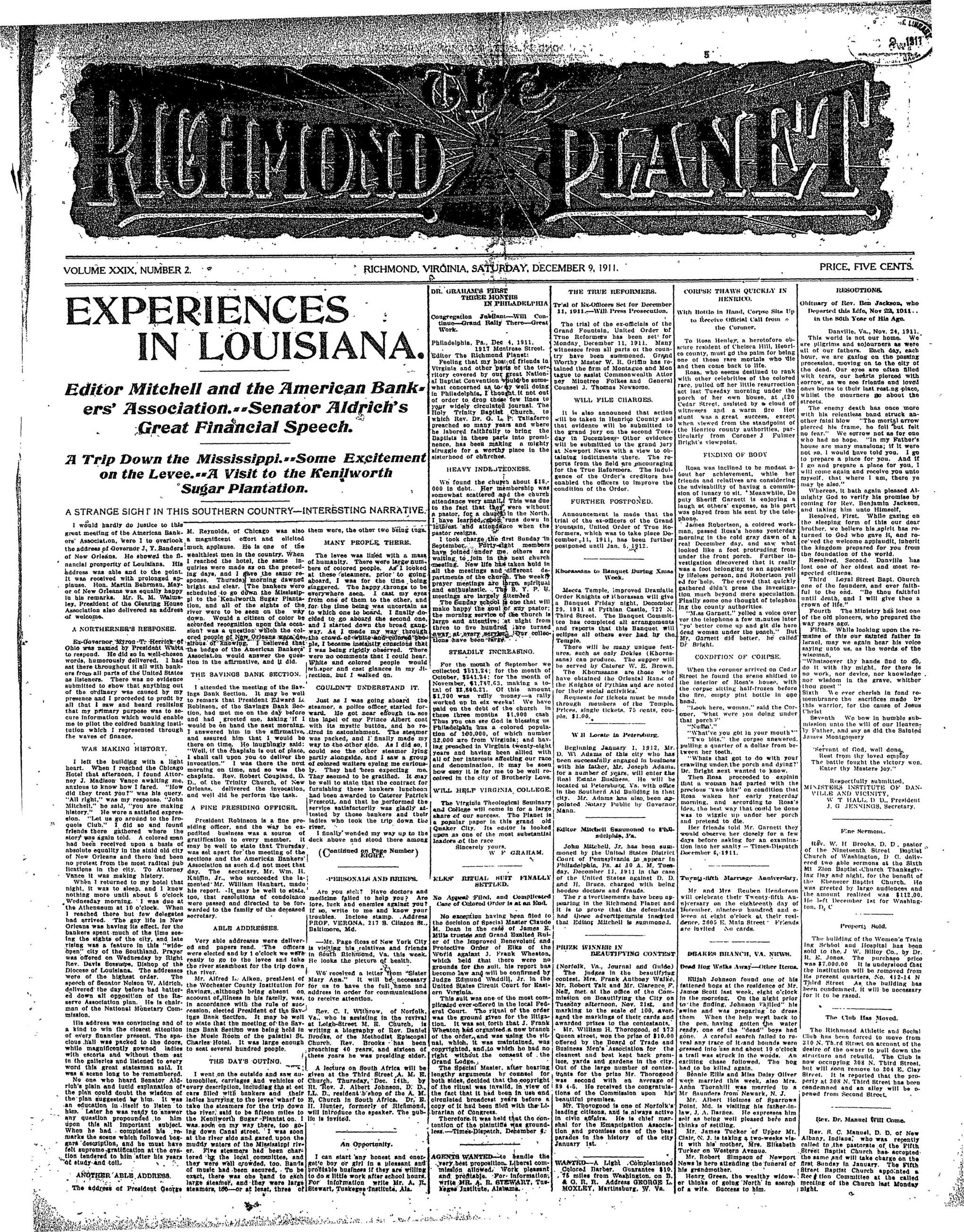
EXPERIENCES IN LOUISIANA.
Editor Mitchell and the American Bankers' Association. Senator Aldrich's Great Financial Speech.
A Trip Down the Mississippi. Some Excitement on the Levee. A Visit to the Kenilworth Sugar Plantation. A STRANGE SIGHT IN THIS SOUTHERN COUNTRY-INTERESTING NARRATIVE.
VOLUME XXIX, NUMBER 2.
EXPER
IN
Editor Mitchel
ers' Associa
Great
A Trip Down the
on the Levee
S
A STRANGE SIGHT IN THIS
I would hardly do justice to this great meeting of the American Bankers' Association, were I to overlook the address of Governor J. Y. Sanders of New Orleans. He showed the financial prosperity of Louisiana. His address was able and to the point. It was received with prolonged applause. Hon. Martin Behrman, Mayor of New Orleans was equally happy in his remarks. Mr. R. W. Mallew, President of the Clearing House Association also delivered an address of welcome.
A NORTHERNER'S RESPONSE.
Ex-Governor Wynn-Tr. Herrick of Ohio was named by President Walter to respond. He did so in well-chosen words, humorously delivered. I had sat there throughout it all with bankers from all parts of the United States as listeners. There was no evidence submitted to show that anything out of the ordinary was caused by my presence and I proceeded to profit by all that I saw and heard realizing that my primary purpose was to secure information which would enable me to pilot the colored banking institution which I represented through the waves of finance.
WAB MAKING HISTORY.
I left the building with a light heart. When I reached the Chicago Hotel that afternoon, I found Attorney J. Madison Vance awakening me, anxious to know how I fared. "How did they treat you?" was his query. "All right," was my response. "John Mitchell," he said, "you are making history." He wore a satisfied expression. "Lot us go around to the Iroquois Club." I did so and found friends there gathered where the story was again told. A colored man had been received upon a basis of absolute equality in the stair old city of New Orleans and there had been no protest from the most radical pubinations in the city. To Attorney Vance it was making history. When I returned to my hotel that night, it was to sleep, and I know nothing more until about 5 o'clock Wednesday morning. I was due at the Athemeneum at 10 o'clock. When I reached there and few delegates had arrived. The gay life in New Orleans was having its effect, for the bankers spent much of the time seeing the heights of the city and later rising was a feature in this "wide-open" city of the Southland. Prayer was offered on Wednesday by Right Rev. Davis Sessums, Bishop of the Diocese of Louisiana. The addresses were of the highest order. The speech of Senator Nelson W. Aldrich, delivered the day before had battered down all opposition of the Reserve Association plan. He is chairman of the National Monetary Commission.
His address was convincing and of a kind to win the closest attention of every financier present. The spacious hall was packed to the doors, while magnificently gowned ladies with escorts and without them sat in the galleries and listened to every word this great statesman said. It was a scene long to be remembered. No one who heard Senator Aldrich's plain and incud explanation of the plan could doubt the wisdom of the plan suggested to him. It was evident in itself to listen to him. Lately he questioned to him any question propounded to him upon this all important subject. When he had completed his remarks the scene which followed begs description, and he must have felt supreme gratification at the oration tendered to him after his years of study and toll.
ANOTHER ABLE ADDRESS.
The address of President George
M. Reynolds, of Chicago was also a magnificent effort and elicited much applause. He is one of the wealthiest men in the country. When I reached the hotel, the same inn in the city preceded me, and I gave the same response. Thursday morning dawned bright and clear. The bankers were scheduled to go down the Mississippi to the Kenilworth Sugar Plantation, and all of the sights of the river were to be seen on the way down. Would a citizen of color be accorded recognition upon this occasion was a question which the colony of Knowledge I believed that the badge of the American Banker Association would answer the question in the affirmative, and it did.
THE SAVINGS BANK SECTION.
I attended the meeting of the Savings Bank Section. It may be well to remark that President Edward L. Robinson, of the Savings Bank Section, had met me on the day before and had, greeted me, asking 'If I would be on hand the next morning, I answered him in the affirmative, and assured him that I would be there on time. He laughingly said: "Well, if the chaplain is of place, I shall call upon you to deliver the invocation." I was there the next morning on time, and so was the chaplain. Rev. Robert Coupland, D. D., of the Trinity Church, of New Orleans, delivered the invocation, and well did he perform the task.
A FINE PRESIDING OFFICER.
President Robinson is a fine presiding officer, and the way he expedited business was a source of gratification to every member. It may be well to state that Thursday was set apart for the meeting of the sections and the American Bankers' Association as such d.d. not meet that day. The secretary, Mr. Wm. H. Kulfin, Jr., who succeeded the lamented Mr. William Hanhart, made his report. It may be well to state, too, that resolutions of condolence were passed and directed to be forwarded to the family of the deceased secretary.
ABLE ADDRESSES
Very able addresses were delivered and papers read. The officers were elected and by 1 o'clock we were ready to go to the licees and take the river steamboat for the trip down the river.
Mr. Alfred L. Alken, president of the Wocheater County Institution for Savings, although being absent on account of illness in his family, was, in accordance with the rule of succession, elected President of the Savings Bank Section. It may be well to state that the meeting, of the Savings Bank Section was being held in the Muscle Room of the palatial St. Charles Hotel. It was large enough to seat several hundred people.
THE DAY'S OUTING.
I went on the outside and saw automobiles, carriages and vehicles of every description, including the stet cars filled with bankers and their ladies hurrying to the lover's wharf to take the steamers for the trip down the river, said to be fifteen miles to the Kenworth Sugar-Plantat on. I was soon on my way there, too going down Canal street. I was soon at the river side and good upon the steamers. I walked with the steamer. Five steamers had been chartered by the local committee, and they were well crowded, too. Bands of music had been secured. To be exact, there was one hand to each large steamer, and they were large steamers, 100—or at least, three of
MANY PEOPLE. THERE.
The levees was lined with a mass of humanity. There were large numbers of colored people. As I looked at these steamers, prior to going aboard, I was for the time, being staggered. The happy throngs to be everywhere seen. I cast my eyes from one of them to the other, and for the time being was uncertain as to which one to be board. I finally decided to go aboard the second one, and I started down the broad gangway. As I made my way through the crowd of white and colored people, I became instantly conscious that I was being rigidly observed. There were no comments that I could hear. White and colored people would whip, spor and cast glances in my direction, but I walked on.
COULDN'T UNDERSTAND IT.
Just as I was going aboard the steamer, a police officer started forward. He got near enough to see the lapel of my Prince Albert cont with its mystic button, and he retrofit in astonishment. The steamer was packed, and I finally made my way to the other side. As I did so, I could see the other steamer lying partly alongside, and I saw a group of colored waiters cyling me curiously. They had been expecting me. They seemed to be gratified. It may be wall to state that the contract for winning their bachelor had been awarded. Caterer Patrice Prescott, and that he performed the service satisfactorily was gladly attested by those bankers and their ladies who took the trip down the river. I finally wended my way up to the deck above and stood there among
(Continued on Page Number)
EIGHT.
PERSONALS AND BRIDES
Are you sick? Have doctors and medicine failed to help you? Are lore, luck and enemies against you? If so, write to me and know your troubles. Inclose stamp. Address PROF. VERONA, 217 S. Clinton St., Baltimore, Md.
—Mr. Page Ross of New York City is visiting his relatives and friends in South Richmond, Va. this week. He looks the picture of health.
We received a letter from "Sister Mary Am." It will be necessary for us to have the full, hame and address in order for communications to receive attention.
Rev. C. I. Withrow, of Norfolk, Va., who is assisting in the revival at Lolph-Street M. E. Church, is writing a biography of Rev. Daniel Brooks, of the Methodist Episcopal Church. Rev. Brooks has been preaching 40 years, and sixteen of these years he was presiding elder.
A lecture on South Africa will be given at the Third Street A. M. E. Church, Thursday, Dec. 14th, by Rt. Rev. J. Albert Johnson, D. D. M. E. Resident-bishop of the A. M. E. Church in South Africa, Dr. E. H. Hunter, formerly of Richmond, will introduce the speaker. The public is invited.
An Opportunity.
I can start any honest and energetic boy or girl in a pleasant and profitable business if they are willing to do a little work after school hours. For information write Mr. A. R. Stewart, Taukegae Institute, Ala.
DR. GRAHAMS FIRST
THREE MONTHS
IN PHILADELPHIA
Congregation Jubilant—Will Continue—Grand Rally There—Great Work.
Philadelphia, Pa., Dec. 4, 1911,
1917 Montrose Street.
Editor The Richmond Planet:
Feeling that my host of friends in Virginia and other parts of the territory covered by our great National Baptist Convention would be somewhat concerned as to my well doing in Philadelphia. I thought, it not out of order to drop these few lines to your widely circulated Towel, The Holy Baptist Church, to which Rev. Dr. G. L. P. Taitafero preached so many years and where he labored faithfully to bring the Baptists in these parts into prominence, has been making a mighty struggle for a worthy place in the sisterhood of churches.
HEAVY INDESTEEDNESS.
We found the church about $18,000 in debt. Her membership was somewhat scattered and the church attendance very small. This was due to the fact that they were without a pastor, for a church in the North. I have learned, too, runs down in lustre and attendance when the pastor resigns.
I took charge, the first Sunday in September. Forty-eight members have joined under me. others are waiting to join in the next month, meeting in hold in meetings and different departments of the church. The weekly prayer meetings are large, spiritual and enthusiastic. The B. Y. P. U. meetings are largely attended
The Sunday school is one that will make happy the soul of any pastor; the morning service of the church is large and attentive; at night from three to five hundred are turned into classrooms with their collocations have been large.
STEADILY INCREASING.
For the month of September we collected $111.24; for the month of October, $541.34; for the month of November, $1,747.63, making a total of $2,860.21. Of this amount $1,700 was really money—a rally worked up in six weeks! We have paid on the debt of the church in these three months $1,900 cash. Thus you can see God is blessing us Philadelphia has a colored population of 22,000,000 are from Virginia; and having preached in Virginia twenty-eight years and having been allied with all of her interests affecting our race and denomination, it may be seen how easy it is for me to be well received in the city of Brotherly Love.
WILL HELP VIRGINIA COLLEGE.
The Virginia Theological Seminary and College will come in for a large share of our success. The Planet is a popular paper in this grand old Quaker City. Its editor is looked upon as one of the most substantial leaders of the race. Sincerely yours, W. F. GRAHAM.
ELKST RITUAL NUIT FINALLY SETTLED.
No Appeal Filed, and Complicated Case of Colored Order is at an End.
No exception having been filed to the decision of Special Master Claude M. Dean in the case of James E. Mills trustees and Grand Exiled Ruler of the Improved Benevolent and Protective Order of Elks of the World against J. Frank Wheaton, which hold that there were no grounds for the suit, his report has become law and will be confirmed by Judge Edmund Waddill, Jr. in the United States Circuit Court for Eastern Virginia.
This suit was one of the most complicated ever offered in the local Federal Court. The ritual of the order was the ground given for the litigation. It was set forth that J. Frank Phaney and argued a new branch of the order, and was using the ritual, which, it was maintained, was copyrighted, and so which he had no right without the consent of the Grand Lodge.
The Special Master, after hearing lengthy arguments by counsel for both sides, decided that the copyright of the ritual was invalid, in view of the fact that it had been in use and circulated broadcast years before a librarian issued with the Librarian of Congress. Therefore it was held that the contention of the plaintiff was groundless — Times-Dispatch, December 6.
AGENTS WANTED—to handle the very best proposition. Liberal commission allowed. Work pleasant and profitable. For information; write MR. A. R. STEWART, Tuskegee Institute, Alabama.
THE TRUE REFORMERS.
Trial of Ex-Officers Set for December 11, 1911—Will Press Prosecution.
The trial of the ex-officials of the Grand Fountain, United Order of True Reformers has been set' for Monday, December 11, 1911. Many witnesses from all parts of the country have been summoned. Grand Worthy Master W. R. Griffin has retained the firm of Montague and Monague to assist Commonwealth Attorney Minetree Folkes and General Counsel J. Thomas Newsome.
WILL FILE CHARGES
It is also announced that action will be taken in Henrico County and that evidence will be submitted to the grand jury on the second Tuesday in December. Other evidence will be submitted to the grand jury at Newport News with a view to obtaining indictments there. The rotten pigs are placed for the True Reform. The indulgence of the Order's creditors has enabled the officers to improve the condition of the Order.
FURTHER POSTPONED
Announcement is made that the trial of the ex-officers of the Grand Fountain, United Order of Take Formers, which was to take place December 11, 1911, has been further postponed until Jan. 6, 1912.
Khorassans to Banquet During Xmse
Week.
Mecca Temple, improved Drauntile Order Knights of Khorassan will give a Banquet Friday night, December 29, 1911 at Pythian Castle, 727 N. Third Street. The Banquet Committee has completed all arrangements and reports that this Banquet will ellipsis all others ever had by the Temple.
There will be many unique features, such as only Dokles (Khorassan) can produce. The upper will be so decorated that Browns of the Khorassans are those who have obtained the Oriental Bank of the Knights of Pythias and are noted for their social activities.
Requests for tickets must be made through members of the Temple Prices, single tickets, 75 cents, couple, $1.00.
WILL Locate in Petersburg.
Beginning January 1, 1912, Mr. D. W. Adams of this city who has been successfully engaged in business with his father, Mr. Joseph Adams, for a number of years, will enter the Real Estate Business. He will be employed by the corporation in the Southern Building in the city. Mr. Adams has also, been appointed Notary Public by Governor Mann.
Editor Mitchell Sammonon to Will
nicholls, Pa.
John Mitchell, Jr. has been summoned by the United States District Court of Pennsylvania to appear in Philadelphia, Pa. at 10 A. M. Tuesday, December 11, 1911 in the case of the United States against D. D. and H. Bruce, charged with being hoodwow doctors and frauds. He is also appearing in the Richmond Planet and it is to prove that the defendants had these advertisements inserted that Editor Mitchell is summoned.
PRIZE WINNER IN
BEAUTIFYING CONTEST
(Nortfolk, Va., Journal and Guide)
The judges in the beautifying contest, Mrs. Frank Anthony Walker, Mr. Robert Talt and Mr. Clarence F. Nell, met at the office of the Comptroller for beautifying the City on Tuesday afternoon at 2:15 a.m. and marking to the scale of 100, averaged the markings of their cards and awarded prizes to the contestants, Mr. William H. Thorogood, of 173 Queen street, won the prize of $10.00 offered by the Board of Trade and Business Men's Association for the cleanest and best kept back promis, yards and gardens in the city. Out of the large number of contestants for the prize Mr. Thorogood was second with an average of 89 4-5. He received the congratulations of the Commission upon his beautiful premises.
Mr. Thorogood is one of Nortfolk's leading citizens, and is always active in the City. He is chief marshal for the Emporium formation and promises one of the best parades in the history of the city January 1st.
WANTED—A Light. Complexioned Colored Barber. Guarantee $10. 75 miles from Washington. on B. & O. R. R. Address GEORGE L. MOXLEY. Martinburg, W. Va.
CORPSE THAWS QUICKLY IN HENRICO.
With Bottle in Hand, Corpse Stirs Up to Receive Official Call from the Coroner.
To Rosa Henley, a heretofore obseure resident of Chelsea Hill, Henrico county, must go the palm for being one of those rare mortals who die and then come back to life.
Rosa, who seems destined to rank with other celebrities of the colored race, pulled off her little resurrection act last Tuesday morning under the porch of her own house, at [220 Cedar Street, assisted by a cloud of witnesses and a warm fire Her stunt was great, except when viewed from the standpoint of the Henrico county authorities, particularly from Coroner J Fulmer Britch's viewpoint.
FINDING OF BODY
Rosa was inclined to be modest about her achievement, while her friends and relatives are considering the advisability of having a commission of lunacy to sit. "Meanwhile, Deputy Sheriff Garnett is enjoying a laugh at others' expense, as his part was played from his sent by the telephone.
James Robertson, a coldred workman, passed Rosa's house yesterday morning in the cold gray dawn of a real December day, and saw what looked like a foot protruding from under the front porch. Further investigation discovered that it really was a foot belonging to an apparently lifeless person, and Robertson yelled for help. The crowd that immediately killed him was the investigation much beyond mere speculation. Finally some one thought of telephoning the county authorities.
"Miss Garnett," yelled a voice over ver the telephone a few minutes later "yo better come up and git dhore dead woman under the porch." But Mr. Garnett did better, he called Dr. Bright.
CONDITION OF CORPSE.
When the coroner arrived on Codar Street he found the scene shifted to the interior of Rosa's house, with the corpse sitting half-broken before the fire, empty pint bottle in one hand.
"Look here, woman," said the Coroner, "what were you doing under that porch?"
"Nuffa!"
"We've got you in your mouth."
"Two bits," the corpse answered, pulling a quarter of a dollar from between her teeth.
"Whata that got to do with your crawling under the porch and dying? Dr. Bright next wanted to know.
Then Rosa proceeded to explain that a woman had parted with the previous "two bits" on condition that Rosa waken her early yesterday morning, and according to Rosa's idea, the best way that could be done was to wiggle up under her porch and dive into her sanctity — Times-Dispatch December 6, 1911.
Twenty-fifth Marriage Anniversary
Mr and Mrs Reuben Henderson will celebrate their Twenty-fifth anniversary on the eighteenth day of December, nineteen hundred and eighteenth at their residence, 2005 E. Main Street. Friends are invited. No cards.
---
DBAKES BRANCH, VA, NEWS.
Dead Hog Walks Away—Other Items
Bilshin Johnson found one of his fattened hogs at the residence of Mr. James Scott last week, eight o'clock in the morning. On the night prior to the finding, Johnson killed" his swine and was preparing to dress them. When the help went back to the pen, having gotten the water ready, one of the "dead" boys had gone. A careful search failed to reveal any trace of us and about 10 o'clock were pressed into his and about 10 o'clock in the woods. An exciting chase followed. The hog had to be killed again. Bonnie Ellis and Miss Daisy Oliver work married this week, also Mrs. Anna Thornhill was married to a Mr. Saunders from Newark, N. J. Mr. Albert Holmes of Sparrow Point, M. is visiting his father-in-law, J. A. Barnes. He expresses him self as being well pleased here and thinks of settling. Mr. James Tucker of Upper Mt. Clair, N. J. is taking a two-weeks visit with his mother, Mrs. Elizabeth Tucker of Newark. Mr. Robert Simpson of Newport News is here attending the funeral of his grandmother. Henry Green, the wealthy widower thinks of going North in search of a wife. Success to him.
PRICE. FIVE CENTS.
RESOUTION
Obituary of Rev. Ben Jackson, who Departed this Life, Nov 22, 1911... in the 80th Year of His Age.
Danville, Va., Nov. 24, 1911.
This world is not our home. We are pilgrims and souleurons as were all of our fathers. Each day, each hour, we are gazing on the passing procession, moving on to the city of the dead. Our eyes are often filled with tears, our hearts ploured with sorrow, as we see friends and loved ones born to their last resting place, whilst the mourners go about the streets.
The enemy death has once more with his relentless hand struck another fatal blow "The mortgl arrow pierced his frame, he fell but felt no fear." We sorrow not as for one who had no hope. "In my Father's house are many mansions; if it were not so, I would have told you. I go to prepare a place for you. And if I go and prepare a place for you, I will come again and receive you unto myself, that where I am, there ye may he also."
Whereas, it hath again pleased Almighty God to verify his promise by coming for Rev. Benjamin Jackson, and taking him unto Himself.
Resolved. First. While garing on the sleeping form of this our dear brother, we believe his spirit has returned to God who gave it, and received the welcome applaudit, inherit the kingdom prepared for you from the foundation of the world.
Resolved. Second. Danville has lost one of her oldest and most respected citizens.
Third Loyal Street Bapt. Church one of the founders, and ever faithful to the end. "Be thou faithful until death, and I will give thee a crown of life."
Fourth The Ministry has lost one of the old pioneers, who prepared the way years ago.
Fifth While looking upon the remains of this our saluted father in larnal, may we again hear his voice saying unto us, as the words of the wiseman,
"Whosoever thy hands find to do, do it with thy might, for there is no work, nor device, nor knowledge nor wisdom in the grave, whither thou goest."
Sixth We ever cherish in fond remembrance the sacrifices made by this warrior, for the cause of Jesus Christ.
Seventh We how in humble submission unto the will of our Heavenly Father, and say as did the Saluted James Montgomery
"Servant of God, well done,
Rest from thy loved employ
The battle fought the victory won.
Enter thy Masters joy."
Respectfully submitted,
MINISTERS INSTITUTE OF DANVILLE AND VICINITY,
W T HALL, D D., President
J. G. JENNINGS, Secretary.
Fins Sermont.
**8t. W. H Brooks, D. D., pastor of the Ninetenth Street Baptist Church of Washington, D. G. delivered two able sermons at the Sixth Mt Zion Baptist Church Thanksgiving Day and night, for the benefit of the street by Baptist Church. He was greeted by the congregation the amount realized was $112.00. He left December 1st for Washington, D. C.**
Property Sold.
The building of the Women's Training School and Hospital has been sold to the J. W. Billy Co., by Dr. R. E. Jonas. The purchase price was $7,000.00. It is understood that the institution will be removed from its present quarters. No. 412-14 N Third Street. As the building has been condemned, it will be necessary for it to be raised.
The Club Has Moved
The Richmond Athletic and Sochi Club has been forced to move from 310 N. Third Street on account of the desire of the owner to pull down the structure and rebuild. The Club is now occupying 308 N. Third Street, will soon remove to 204 E. Clay Street, that the property at 308 N. Third Street has been condemned and an alley will be opened from Second Street.
Lev. Dr. Manuel Vill Come.
Rev. R. C. Manuel, D. D. of New Albany, Indiana, who was recently called to the pastorate of the Fifth Street Baptist Church has accepted the same and will take charge on the first Sunday in January. The Fifth Street Baptist Church appointed a Reception Committee at the called meeting of the Church last Monday night.
---
SYNOPSIS
Anna Granger, devoted mother of two small children, discovers that her husband is a weak character and that he has lied to her about a woman.
Posing as Miss Dale, she becomes etenographer to Burton Temple, through which she learns that her husband has been poisoned. She thinks Temple is the guilty man and is acting the spy to clear her husband's name for his sake and that of her children.
Anna discovers that Temple was one of her girlhood aide's. Thinking her a sinister cellar bar her husband was a liar and perjurer.
Temple has detectives on the trail of Brady, an accomplice of Granger, looking for evidence. Anna is searching for evidence against Temple, who becomes interested in her.
Despite herself, Anna becomes fond of Temple, although determined to convict her husband of the crime. Temple detectives discover Rose Fanchon, his woman for whom Granger was a thief.
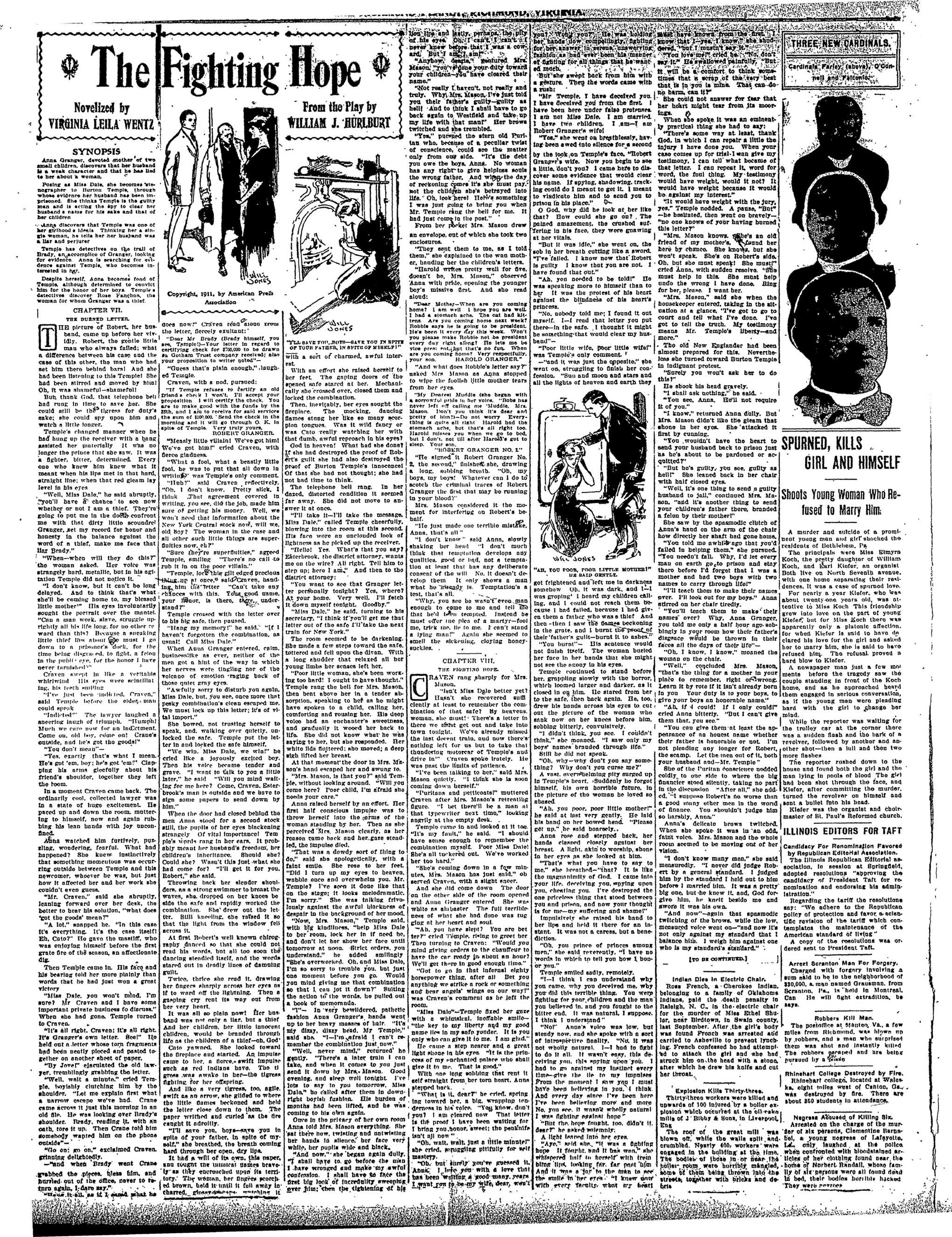
CHAPTER VII.
THE BURNED LETTER
THE picture of Robert, her husband, came up before her vividly. Robert, the gentle little man who always failed; what a difference between his case and the case of this other, the man who had set him there behind bars! And she had been listening to this Temple She had been stirred and moved by him Oh, R was shameful—shameful But thank God, that telephone bell had rung in time to save her. She could still be the tigeress for duty's sake; she could spy upon him and watch a little longer.
Temple's changed manner when he had hung up the receiver with a hang assisted her materially. It was no longer the prince that she saw. It was a fighter, bitter, determined. Every one who knew him knew what it meant when his lips met in that hard, straight line; when that red gleam lay level in his eyes.
"Well, Miss Dale," he said abruptly, "you'll have a chance to see now whether or not I am a thief. They're going to put me in the doxx confront me with that dirty little scoundrel Granger, set my record for honor and honesty in the balance against the word of a thief, make me face that Ilar Brady."
"When—when will they do this?" the woman asked. Her voice was strangely hard, metallic, but in his agitation Temple did not notice it.
"I don't know, but it can't be long delayed. And to think that what's what she'll be coming home to, my blessed little mother!" His eyes involuntarily sought the portrait over the mantel. "Can a man work, slave, struggle upright all his life long, for no other reward than this? Because a sneaking little thief lies about the must I go down to a prisoner's dock, for the time being disgraced, to fight, a felon in the public eye, for the honor I have never tarnished!"
Craven swept in like a veritable whitewind. His eyes were scintillating, his tooth smiling. "I've just been indicted, Craven," said Temple before the elder, man could speak. "Indicted!" The lawyer laughed a sneering laugh of triumph. "Humph! Much we care now for an indictment. Come on, old boy, come out! Crane's outside, and he's got the good!"
"You don't mean"—
"Yes, exactly that's what I mean. He's got 'em, boy; he got 'em!" Clapping his arms gclefully about his friend's shoulder, together they left the room.
In a moment Craven came back. The ordinarily cool, collected lawyer was in a state of hugo excitement. He paced up and down the room, muttering to himself, now and again rubbing his lean hands with joy unconfined.
Ahnai watched him furiously, puzzling, wondering, fearful. What had happened? She knew instinctively that something momentous was occurring outside between Temple and this newcomer, whoever he was, but just how it affected her and her work she couldn't even guess.
"Mr. Craven," said she abruptly, leaning forward over her desk, the better to hear his solutlon, "what does not the good's mean?"
"A lot," snapped he. "In this case it's everything. It's the case itself. Eh, Cato?" He gave the mastiff, who was enjoying himself before the first grate fire of the season, an affectionate dig.
Then Temple came in. His face and his bearing told her more pininy than words that he had just won a great victory.
"Miss Dale, you won't mind. I'm sure? Mr Craven and I have some important private business to discuss." When she had gone, Temple turned to Craven.
"It's all right. Craven: it's all right. It's Granger's own letter. Soel." He held out a letter whose torn fragments had been neatly placed and pasted together on another sheet of paper.
"By Jove!" calculated the old lawyer, grimly grabbing the letter.
yer, tremblingly grabbing the letter.
"Well, wait a minute," cried Temple, boyishly clutching him by the shoulder. "Lot me explain first what a narrow escape we've had. Crane came across it just this morning in an old file. He was looking over Brady's shoulder. Brady, reading it, with an oath, tore it up. Then Crane told him somebody wanted him on the phone outside."
"Go on; go on," exclaimed Craven, grinning delightedly.
"and when Brady went Crane grabbed the pieces, bless him, and hurried out of the office, never to return again, I dared say."
it will be if I caused what he
Fighting Hope
WILL DONES
Copyright, 1911, by American Press Association
does now? Craven read aloud xrom the letter, fiercely exultant:
"Dear Mr. Brady (Brady himself, you see, Temple)? Your letter in regard to certifying choice $10,000 to be drawn to Gotham Trust company received; also your proposition to writer noted—
"Guess that's plain enough," laughed Temple.
Craven, with a pod, pursued:
If Temple causes us to identify an old friend's check I won't. I accept your proposition. I will certify the check. You are to make good with the funds by the 8th, and I am to receive for said services the sum of 110,000. Send the check in the morning and it will go through O.K. in spite of Temple. Very truly yours.
**Means little vilain!** We've got him. We've got him! cried Craven, with serco gladness.
"What a fool, what a beautiful little fool, he was to pmt that all down in writing?" was Temple's only comment.
"Hub!" said Craven, reflectively.
"Oh. I don't know. Pretty slick. I think. That agreement covered in writing, you see, did the job, made him sure of getting his money. Well, we won't need that information about the New York Central stock now, will we, old boy? The woman in the case and all other such little things are superfluities now, eh?"
"Sure they are superfluities," agreed Temple, smiling. "There's no call to rub it in on the poor villain."
"Temple, lock this girl gilded precious thing up at once," said Greene, handing him the letter "Cant take any chances with this. You good mume, your honor, is there, there, understand."
Temple crossed with the letter over to his big safe, then paused.
"Hang my memory!" he said. "If I haven't forgotten the combination, as usual! Call Miss Dale."
When Anna Granger entered, calm, businesslike as ever, neither of the men got a hint of the way in which her nerves were tingling nor of the volcano of emotion raging back of those quiet gray eyes.
"Awfully sorry to disturb you again. Miss Dale, but, you see, once more that pesky combination's clean escaped me. We must lock up this letter; it's of vital import."
She bowed, not trusting herself to speak, and, walking over quiet, unlocked the safe. Temple put the letter in and locked the safe himself.
"We wih. Miss Dale, we winn!" he cried like a joyously excited boy. Then his voice became tender and grave. "I want to talk to you a little later," he said. "Will you mind waiting for me here? Come, Craven, Esterbrook's man is outside and we have to sign some papers to send down by him."
When the door had closed behind the men Anna stood for a second stock still, the pupils of her eyes blackening strangely. Of vital importance! Temple's words rang in her ears. It probably meant her husband's freedom, her children's inheritance. Should she? Could she? Wasn't this just what she had come for? "I'll get it for you, Robert," she said.
Throwing back her slender shoulders, as a strong swimmer to breast the waves, she dropped on her knees be side the safe and rapidly worked the combination. She drew out the letter. Still kneeling, she raised it so that the light from the window fell across it.
At first Robert's well known choreography danced that she could not read his words, but all too soon the dancing steadied itself, and the words stared out in deadly lines of damning guilt.
Twice, thrice she read it, drawing her fingers sharply across her eyes as if to ward off the lightning. Then a gasping cry rent its way out from her very heart.
It was all so plain now! her husband was not only a liar, but a thief. And her children, her little innocent children, would be branded through life as the children of a thief—oh, God! Cato yawned. She looked toward the fireplace and started. An impulse came to her, a force, swift impulse such as red Indians have. The thigress was awake in her—the tigress fighting for her offspring.
And like a very tigress, too, agile,
swift as an arrow, she glided to where
the little names beckoned and held
the letter close down to them. The
paper writhed and curled as the fire
caught it adroitly.
"I'll save you, boys—save you in
spite of your father, in spite of my
self," she breathed, the breath coming
hard through her open, dry lips.
It had a will of its own, this paper,
and sought the tenuous names bravely
as they enriched upon its territory.
The woman, her fingers scorched
brown, held it until it fell away in
charred, glossy draughts, watching it
WILL
JONES
"ILL SAVE YOU, NOTHING - SAVE YOU IN EPTHE OF YOUR PATIER, IN SPIRIT OF MISSEL!" with a sort of charmed, awful interest.
With an effort she raised herself to her feet. The gaping doors of the opened safe satred at her. Mechanically she crossed over, closed them and locked the combination.
Then, inevitably, her eyes sought the fireplace. The mocking, dancing flames stung her like so many scorpion tongues. Was it wild fancy or was Cato really watching her with that dumb, awful reproach in his eyes? God in heaven! What had she done if she had destroyed the proof of Roberts guilt she had also destroyed the proof of Burton Temple's innocence Of that she had not thought; she had not had time to think.
The telephone bell rang. In her dazed, distorted condition it seemed far away. She did not move to answer it at once.
"I will take it—I will take the message, Miss Dale." called Temple cheerfully, blowing into the room at this second. His face wore an unclouded look of lightness as he picked up the receiver. "Hello! Yes. What's that you say? Esterbrook, the district attorney, wants me on the wire? I am." And then to the district attorney: "You want to see that Granger letter personally tonight? Yes, where? At your home. Very well. I will fetch it down myself tonight. Goodby." "Miss Dale," he said, turning to his secretary, "I think if you'll get me that letter out of the safe I'll take the next train for New York." The room seemed to be darkening. She made a few steps toward the safe, totered and fell upon the divan. With a long shudder that relaxed all her young limbs her senses left her.
"Poor little woman, she's been working too hard! I ought to have thought." Temple rang the bell for Mrs. Mason, then bent above her in a tender absorption, speaking to her as he might have spoken to a child, calling her, comforting and roaring her. His deep voice had an enchanter's sweetness, and gradually it wooded her back to life. She did not know what he was saying to her, but also responded. Her white lids flipped; she moved; a deep sigh lifted her breast.
At that moment the door in Mrs. Mason's hand escaped her and swung to. "Mrs. Mason, is that you?" said Temple, without looking around. "Will you come here? Poor child, I'm afraid she needs your care."
Anna raised herself by an effort. Her first half conscious impulse was to throw herself into the arms of the woman standing by her. Then as she perceived Mrs. Mason clearly, as her reason came back and her gaze steadied, the impulse died.
"That was a dowdy sort of thing to do," said she apologetically, with a faint smile. She rose to her feet. "Did I turn up my eyes to heaven, wobble once and overwhelm you. Mr. Temple? I've seen it done like that on the stage; it looks meidommatic. I'm sorry." She was talking frivolously against the awful blackness of despair in the background of her mood. "Now, Mrs. Mason," Temple said, with big kindness. "help Miss Dale to her room, lock her in if need be, and don't let her show her face until tomorrow at noon. Strict orders, you understand." he added smilingly. "She's overworked. Oh, and Miss Dale, I'm so sorry to trouble you, but just one moment before you go. Would you mind giving me that combination so that I can jot it down?" Suiting the action of the words, he pulled out a book of memoirs.
"I— In very bewildered, pathetic fashion Anna Granger's hands went up to her heavy masses of hair. "It's my dizzy, dizzy head, Mr. Temple," said she. "I—I'm afraid I can't remember the combination just now." "Well, never mind," returned he gently. "There's a later train I can take, and when it comes to you just send it down by Mrs. Mason. Good evening, and sleep well tonight. I've lots to say to you tomorrow. Miss Dale," he called after them in downright boyish fashion. His burden of months had been lifted, and he was coming to his own again.
Ovee in the privacy of her own room Anna told Mrs. Mason everything. She sat there now, twisting and unwinding her hands in silence; her face very white, her pupila wide and black.
"And now," she began again dully. "I shall have to go before the man I have wronged and make my awful confession. I shall have to face the first big look of incredulity sweeping over him; then the tightening of his
Mon June and justly, perhaps, the pity of his eyes. Oh. I can't. I can't. never knew before that I was a coward. But I am, and," "Anyhow, dear," featured Mrs. Mason, "you endorse your duty toward your children—you have cleared their name."
"Not really I haven't, not really and truly. Why Mrs. Mason, I've just told you their father's guilty—gullity as hell. And to think I shall have to go back again to Westfield and take up my life with that man!" Her brows twitched and she trembled.
"Tea," pursued the stern old Puritan man, because of a peculiar twist of conscience, could see the matter only from one side. "It's the debt you owe the boys. Anna. No woman has any right to give helpless souls the wrong father. And whipped the day of reckoning comes it's she must pay, not the children she's betrayed into life. Oh, look here! Herb's something I was just going to bring you when Mr. Temple rang the bell for me. It had just come in the post." From her pocket Mrs. Mason drew an envelope, out of which she took two enclosures.
"They sent them to me, as I told them," she explained to the wan mother, handing her the children's letters. "Harold writes pretty well for five, doesn't be, Mrs. Mason," observed Anna with pride, opening the younger boy's missive first. And she read aloud:
"Dear Mother—When are you coming home? I am well, I hope you are well. I had a stomach ache. The cat had kittie. Are you coming home next week? Robbie is coming. He's been it every day this week. Won't you please make Robbie not be president every day right along? He lets me be vice president, that's no fun. When are you coming home? Very respectfully, your son. HAROLD ORANGER.
"And what does Robbie's letter say?" asked Miss Mason as Anna stopped to wipe the foolish little mother tears from her eyes.
"My Dearest Muddle (she began with a sorrowful pride in her voice). Bob has been a great teacher. Mason. Don't you think it's dear and pretty of it呢? Do not worry. Everything is quite all right. Harold had the stomach ache, but that's all right too. Harold misses you when we go to bed, Harold misses you after Harold's got to sleep. Your son.
"HOBERT GRANGER NO. 1"
"He signed it. Robert Granger No. 2. the second," finished, abe, drawing a long, sobbing breath. "Oh, my boys, my boys! Whatever can I do to scotch the criminal traces of Robert Granger the first that may be running in your blood?"
Mrs. Mason considered it the moment for interfering on Robert's behalf.
"He just made one terrible mistake, Anna, that's all."
"I don't know" said Ann, slowly shaking her head. "I don't much think that temptation develops any qualities, good or bad, not a temptation at least that has any deliberate consent of the will. No. It doesn't develop them. It only shows a man what he already is. Temptation's a test, that's all.
"Why, you see he wasnt even man enough to come to me and tell me that he'd been tempted. Instead he must offer me plea of a martyr-foo me, trick me, he to me. I can't stand a lying man!" Again she seemed to smell the sickening, cloying honey-suckles.
CHAPTER VIII.
RAVEN rang sharply for Mrs. Mason.
"I don't Miss Dgle better yet?"
Hasn't she recovered sufficiently at least to remember the combination of that safe? By heavens, woman, she must! "There's a letter in there we must get out and take into town tonight. We've already missed the last decent train, and now there's nothing left for us but to take that thundering motorcar of Temple's and drive in" Craven spoke fraternity. He was past the limits of patience.
"I've been talking to her," said Mrs. Mason quietly. "I think she is soon coming down herself."
"Puritans and petticoats" muttered Craven after Mrs. Mason's retreating figure. "I bet there be a man at that typewriter next time," looking angry at the empty desk.
Temple came in and looked at it too. "It's my fault," he said. "I should have sense enough to remember the combination myself. Poor Miss Dale! She's all tuckered out. We've worked her too hard."
"She's coming down in a few minutes, Mrs. Mason has just said," observed Craven, with a slight sneeer.
And she did come down. The door on the other side of the room opened and Anna Granger entered. She was white as alabaster. The full terribleness of what she had done was tugging at her heart and soul.
"Ah, you have slept? You are bet ter?" cried Temple, rising to greet her. Then turning to Craven: "Would you mind giving orders to the chauffeur to have the car ready in about an hour? We'll get there in good enough time."
"Got to go in that infernal eighty horsepower thing, after all. Bet you anything we strike a rock or something and bear angels' wings on our way!" was Craven's comment as he left the room.
"Alas Dalo" - Temple fixed her gaze with a whitish-tint, inoffable smile—"the key to my liberty and my good name lies in my so tender. It is you only who can give it to me. I am glad." He came a step nearer and a great light shone in his eyes. "It is the princess of my chanted palace who shall give it to me. That is good." With one long solling that rent it self straight from her torn heart, Anna stepped back.
"What is it, dear?" he cried, springing toward her, a big, wrapping tenderness in his voice. "You know, don't you? I am cleared now. That letter is the proof I have been waiting for I bring you, honour, sweet; the pankrifia isn't all now."
"Oh, wait, wait, just a little minute" she cried, struggling pitifully for self mastery.
"Oh, but almost you've greeted it. Ankha. I love you with a love that has been waiting, a good many, years. I want you to be my wife, dear, want it."
you! "Wow, you!" "He was holding her hands now compellingly, fighting for her answer," in secrecy, unawareness fashion as had ever been his master of fighting for all things that he wanted much. But she swept back from him with a gesture. Then the words came with a rush: "Mr Temple, I have deceived you. I have deceived you from the first. I have been here under false protections. I am not Miss Dale, I am married. I have two children. I am-I am Robert Gruner's wife! "Yes," she went on breathlessly, having been awed into silence for a second by the look on Temple's face, "Robert Gruner's wife. Now you begin to see a little, don't you? I came here to discover some evidence that would clear his name. If spying, shadowing, tracking could do I meant to get it. I meant to visiude him and to send you to prison in his place."
O God, why did he look at her like that? How could she go on? The paired amazement, the crushed suffering in his face, they were gnawing at her vitals.
"But it was idle," she went on, the sob in her breath cutting like a sword. "I've failed. I know now that Robert is guilty. I know that you are not. I have found that out."
"Ah, you needed to be told!" He was speaking more to himself than to her. It was the protest of his heart against the blindness of his heart's princess.
"No, nobody told me; I found it out myself. I—I read that letter you put there—in the safe. I thought it might be something that would clear my husband"—
"Poor little wife, poor little wife!" was Temple's only comment.
—and it was just the opposite," she went on, struggling to finish her confession. "Sun and moon and stars and all the lights of heaven and earth they
WILLIAMS
"ALL YOU FOOD, FOOD LITTLE MOTHER!" HE BAID GENTLE.
got frightened and left me in darkness somehow. Oh, it was dark, and I—I was groping! I heard my children calling, and I could not reach them because I had failed, because I had given them a father who was a thief. And then—then I saw the games beckoning in the grate, and I burnt the proof of their father's guilt—burnt it to ashes.
"You burnt!" — His sentence would not finish itself. The woman buried her face in her hands that she might not see the nymph in his eyes.
Temple continued to stand before her, grappling slowly with the horror, which loomed larger and darker, as it closed in on him. He stared from her to the safe, then back again. He, too, drew his hands across his eyes to cut out the picture of the woman who sank now on her knees before him, sobbing bitterly, convulsively.
"I didn't think, you see. I couldn't think," she monounced. "I saw only my boys names branded through life." Still he did not speak.
"Oh, why—why don't you any something? Why don't you curse me?" A vast, overwhelming pity surged up in Temple's heart. Suddenly he forgot himself, his own horrible future, in the picture of the woman he loved so abased.
"Ah, you poor, poor little mother!" he said at last very gently. He laid his hand on her bowed head. "Please get up," he said邦靠然.
Anna rose and stepped back, her hands clasped closely against her breast. A light, skin to worship, shone in her eyes as she looked at him.
"That's what you have to say to me," she breathed—"that? It is like the magnanimity of God. I came into your life, deceiving you, supposing upon you, cheating you. I've destroyed the one precious thing that stood between you and prison, and now your thought is for me—my suffering and shame!"
Impatiently she raised his hand to her lips and held it there for an instant. It was not a caress, but a benediction.
"Oh, you prince of princes among men," she said reverently, "if have no words in which to tell you how I honor you."
Temple emiled sadly, remotely.
"I—I think I can understand why you came, why you deceived me, why you did this terrible thing. You were fighting for your children and the man you believed in, and you fought to the bitter end. It was natural, I suppose. I think I understand."
"Not" Anna's voice was low, but stony now, and she spoke with a sort of introspective finality. "No. it was not wholly natural. 1-1 had to fight to do it all. It wasn't easy, this deceiving you, this spring upon you. I had to go against my instinct every time-give the lie to my impulses. From the moment I saw you I must have been believing in you. I think. And every day since I've been here I've been believing more and more No. you see. It wasn't wholly natural I was fighting against hope."
"But the hope fought, too, didn't it. dear?" he asked molemily: A light leaned into her eyes. "Aye," said she, "it was a fighting hope It fought, and it then won," she whispered half to herself with their biting lint, looking far, far past him. And it was a jor to the man to see the smile in her eyes: "I know now with every severity, what my heart
must have known from the first. I know that I was I know that she shudowed, but I mustn't say it. "You love and" cried he. "No, don't say it." He swallowed painfully. "But it will be a comfort to think sometimes that is scrap of the very best that is in you is mine. That can do no harm, can it?" She could not answer for fear that her heart might tear from its moorings. When she spoke it was an eminently practical thing she had to say:
When she spoke, it was an essentially practical thing she had to say:
"There's some way at least, thank God, in which I can repair a little the injury I have done you. When your case comes up for trial, I can give my testimony, I can tell what became of that letter. I can repeat it, word for word, the foul thing. My testimony would have weight, would not it? It would have weight because it would be against my interest."
"It would have weight with the jury, yes." Temple nodded. A pause, "But"—he hesitated, then went on bravely—"no one knows of your having burned this letter?"
"Mrs. Mason knows, she's an old friend of my mother's. I found her here by chance. She knows, but she won't speak. She's on Robert's side. Oh, but she must speak! She must"—cried Ann, with sudden resolve, "She must help undo the wrong I have done. Ring for her, please. I want her."
"Mrs. Mason," said she when the housekeeper entered, taking in the situation at a glance. "I've got to go to court and tell what I've done. I've got to tell the truth. My testimony means Mr. Temple's liberty—and more."
The old New Englander had been almost prepared for this. Nevertheless she turned toward Burton Temple in indignant protest.
"Surely you won't ask her to do this!"
He shook his head gravely.
"I shall ask nothing," he said.
"You see, Anna. He'll not require it of you."
"I know," returned Anna dully. But Mrs. Mason didn't like the steam that shone in her eyes. She attacked it first by cunning.
"You wouldn't have the heart to send your husband back to prison just as he's about to be pardoned or acquitted?"
"But he's guilty, you see, guilty as hell!" She leaned back in her chair with half closed eyes.
"Well, it's one thing to send a guilty husband to jail," continued Mrs. Mason, "and it's another thing to send your children's father there, branded a felon by their mother."
She saw by the spasmatic clutch of Anna's hand on the arm of the chair how directly her shaft had gone home.
"You told me anwhil'ago that you'd failed in helping them," she pursued.
"You needn't fall. Why, I'd let every man on earth go to prison and stay there before I'd forget that I was a mother and had two boys with two names to carry through life!"
"I'll teach them to make their names over. I'll look out for my boys." Anna stirred on her chair tredly.
"You'll teach them to make their names over? Why. Anna Granger, you told me only a half hour ago, bobbing in room how their father's disgrace would be thrown in their faces all the days of their life!"
"Oh, I know, I know," moaned the woman on the chair.
"Well," concluded Mason. "that's the thing for a mother in your place to remember, right or wrong. Learn it by vote if it isn't already born in you. Your duty is to your boys, to give your son an honorable name."
"Ah, if I could! If I only could!" cried Anna bitterly. "But I can't give them that, you see."
"You can give them at least the appearance of an honest name whether their father is honorable or not. I'm not pleading any longer for Robert, the scamp. Let the men out of it, both your husband and-Mr. Temple."
She of the Puritan conscience nodded coldly, to one side to where the big financier stood silently, taking no part in the discussion. "After all," she added, "I suppose itbbert's no worse than a good many other men in the word of finance. You shouldn't judge him so harshly. Anna."
Anna's delicate brows twitched. When she spoke it was in an odd, faint voice. Mrs. Mason and the whole room seemed to be moving out of her vision.
"I don't know many man," she said measuredly. "I never did judge Robert by a general standard. I judged him by the standard I held out to him before I married him. It was a pretty big one, but he knew it, and God forgive him, he knelt beside me and swore it was his own.
"And now"—again that spasmatic twitching of the brows, while the low, measured voice went on—and now it's not only against my standard that I balance him. I weigh him against one who is my standard's standard."
[TO BE CONTINUED.]
Indian Dilea In Electric Chair.
Indian Dies in Electric Chair
Ross French, a Cherokee Indian, belonging to a family of Oklahoma Indians, paid the death penalty to Raleigh, N. C., in the electric chair for the murder of Miss Ethel Shular, near Birdtown, in Swain county, last September. After the girl's body was found French was arrested and carried to Asheville to prevent lynching. French confessed he had attempted to attack the girl and she had struck him on the head with a stone, after which he drew his knife and cut her throat.
Explosion Kills Thirty-three.
Thirty-three workers were killed and upwards of 100 injured by a bollon explosion which occurred at the oil-tank mills of J Bibby & Sons, in Liverpool, Eng.
The roof of the great mill was blown off, while the walls split and crumbled. Nearly 400, workers were engaged in the building at the time.
The bodies of those in near the bollon room, were horribly mangled, some of them being thrown into the streets, together with bricks and debris.
THREE NEW CARDINALS.
Cardinals, Forties, (above), Q'Gunnell and Fafconto.
SPURNED, KILLS GIRL AND HIMSELF
Shoots Young Woman Who Refused to Marry Him.
A murder and suicide of a prominent young man and girl shocked the residents of Botheleham, Pa.
The principals were Miss Elmyrn Koch, the pretty daughter of William Koch, and Karl Klofer, an organist Both live on North Seventh avenue, with one home separating their residences. It was a case of spurned love. For nearly a year Klofer, who was about twenty-one years old, was attentive to Miss Koch This friendship grew into love on the part of young Kloef, but for Miss Koch there was apparently only a platonic affection. for when Kloef is said to have de clared his love for the girl and asked her to marry him, she is said to have refused him. The refusal proved a hard blow to Kloef.
A newspaper man just a few moments before the tragedy saw the couple standing in front of the Koch home, and as he approached heard them engaged in serious conversation, as if the young man were pleading hard with the girl to change her mind.
While the reporter was waiting for the trolloy car at the corner there was a sudden flash and the bark of a revolver, followed by another and another shot—then a hull and then two more flashes.
The reporter rushed down to the house and found both the girl and the man lying in pools of blood. The girl had been shot through the face, and Klefer, after committing the murder, turned the revolver on himself and sent a bullet into his head.
Klefer was the organist and choirmaster of St. Paul's Reformed church.
ILLINOIS EDITORS FOR TAFT
Candidacy For Ronomingism Favored by Republican Editorial Association.
The Illinois Republican Editorial association, in session at Springfield, adopted resolutions "approving the candidacy of President Taft for nomination and endorsing his administration."
Regarding the tariff the resolutions say: "We adhere to the Republican policy of protection and favor a scientific revision of the tariff which contemplates the maintenance of the American standard of living."
A copy of the resolutions was ordered sent to President Taft.
Arrest Scranton Man For Forgery.
Charged with forgery involving a sum said to be in the neighborhood of $30,000. a man named Grausman, from Scranton, Pa., is held in Montreal, Can He will fight extradition, he says.
Robbers Kill Man.
The postoffice at Manton, Va., a few miles from Richmond, was blown up by robbers, and a man who surprised them was shot and instantly killed. The robbers escaped and are being pursued by a bristle.
Rhinehart College Destroyed by Fire. Rhinehart college, located at Wakeka, eight miles west of Canton, Ga., was destroyed by fire. There are about 860 students in attendance.
Negress Abused of Killing Blk. Arrested on the charge of the murder of six persons, Clementine Harnbel, a young nongress of Lafayette, La., only laughed, at the police when confronted with bloodstained articles of her clothing found near the home of Norbert Randall, whose family of six persons were all found dead in bed, their bodies horrific hacked. They were persons.
```markdown
```
NEW CARDINALS ARE CONFIRMED
Three Americans Among Those Made Princes of Church.
Simple But Impressive Ceremony
Marks the Aasant of Sacred College
to Nominations—Pope Delivere an
Allocation.
The secret consistory creating nineteen new cardinals, three Americans among them, was held by Pope Plus X in Rome. The ceremonial was exceedingly impressive. The grand public consistory will be held on Thursday.
It was announced that besides the new cardinals receiving the red hat the pope created one, whom he reserved "in pectoris" (kent secret).
This departure from the known program gave rise to all sorts of rumors, including one that Archbishop Ireland, of St. Paul, would receive a red hat. Official denial of this purpose or that any other American prelate in addition to those proclaimed would be elevated, was authorized at the Vatican it is supposed that the usnamed cardinal is Monsignor Filippo Giustini, secretary of the Congregation of Sacrament. The name, however, will not be revealed until a later consistory, at the option of the pope, and it is possible that this may not be until after the death of the reigning pontiff. The Gospel ordered the
The Pope Looked Careworn.
Of those thus honored three are citizens of the United States: Monsignor John M. Farley, archbishop of New York; Monsignor William O'Cannell, archbishop of Boston, and Monsignor Dionede Falconio, apostolic delegate to the United States. Thus, with Cardinal Gibbons, America will have now for the first time a representation of four in the cardinalate which, probably much as now constituted, will elect a successor to the reigning pontiff.
As he entered the hall of the consistory where the ceremony took place, the popo's step was less sure, and the careworn face of his holiness bore signs of his recent illness that and come to stay. Nevertheless he withstood the fatigue of the long and trying ordeal bravely, with a smile for each and a word for several in the long procession that passed before the palan throne.
The ceremony, though comparatively simple, was carried out with a stately dignity and form that has characterized the institution from the earliest days. Save for those participating it might have been a scene from the thirteenth or fourteenth century. In olden times the Sacred College met in secret consular, and there discussed and finally decided upon the Pope's nominations. Frequently objections were raised to candidates and their names were never proclaimed. Hence the privacy of the meeting.
In the hall of the consistory those whom duty or privilege brought there chatted for a few moments, noting sadly the passing of several who had been present on the last similar occasion.
Presently the door at the rear of the hall was opened and the Noble Guards appeared, making way for the white-clad figure of his holiness Followed by Swiss Guards and his suite, the pontifit paused for a moment at the threshold while those present, bent the knee. With a smile he greeted them and then walked to the throne. The procession before the throne followed immediately Each dignitary, according to precedence, approached in turn, and, kneeling, kissed the palal ring It was a long and tedious ceremony, which Plus X. bore with great patience
Unwritten Law, Falls to Save Him. Standing in the prisoner's dock in the court of quarter sessions in Philadelphia, Frank McMahon, who on May 4 last shot and killed Gorgeo Loarry for betraying his laughter, heard the jury declare him to be guilty, of voluntary manslaughter.
The commonwealth had demanded a verdict of murder in the first degree, but the midst verdict possible under the verdict, outside of actual acquittal, was given instead, and for this reason, and in view of the evidence, it was regarded by lawyers as really a victory for the defense, its defense was based mainly on the "unwritten law." Should this verdict stand McMahon faces the punishment of a fine not exceeding $1000 or imprisonment not exceeding twelve years. C. Stuart Patterson, Jr., for the defense, moved for a new trial on the announcement of the verdict and will argue on the appeal in a few days.
Judge Brooke's charge was generally regarded as unfavorable to the prisoner, for he warned the jury against permitting their sympathies to sway them, and told them that it was their duty to render a verdict, in accordance with the law and the evidence, however painful that duty might be.
Find Man's Body in Wine Cask.
The body of an unidentified Italian,
who had been strangled, mutilated,
then jammed into an old wine cask.
hardly big enough to hold him, was alongside the Old Hook road, in Norwood, near Philadelphia. For three days children had played with the cask, rolled it about and had tried to open it. The chance blow from a hatchet by a man hunting firewood revealed the body and opened up a murder mystery of the most baffling kind. Whether the man is the victim of the vengeance of an Italian secret society or had been killed in a private feud, detectives are uncertain. He had been garroted by a loop of rope being thrown around his neck and then tightly twisted until breathing was stopped. Detectives think that more than one man is implicated in the murder, because of the difficulty a single man would have in so killing the victim, in forking his body into the cask and in taking it to the place where it was found.
Agents of an Italian secret society are thought to have killed the man in an Italian lab camp and then hauled him to the Old Hook road, between Norwood and Sharon Hill, in a wagon. Antonio Rori identified the body as that of his cousin, Guessepi Zonf, who disappeared from Sayre, Pa., about six months ago.
Election Board Guildy.
Edward D. Egan, James Wright and Thomas Loney, member of the election-board of the Sixth district of Larksville borough, were convicted in court in Wilkes-Barre, Pa., of committing fraud at the recent election.
The specific charges against the defendants were that they failed to return affidavits of non-registered voters and improper care of the ballot box. The condition of the contents of the box when brought into court were very filth.
When the defendants were arraigned Judge Garman scored them severely and sacked crooked elections were in the same class as murder. The judge's charge undoubtedly did much to convict the three election officers.
Other election officers are awaiting trial on similar charges.
Sick Man Burned to Death.
David G. Buck, seventy-two years old, was found burned to death at the residence of his daughter, Mrs Mary Smith, on West Basin street, Norristown, Pa.
The aged man had been ill for some time and had been confined to his bed. While the daughter went shopping the house was left in charge of a five-year-old son of Mrs. Smith.
The police say that the boy set fire in some manner to the bed clothing. He then crawled out of a window and was found on the front porch by the firemen. The body of Buck was found on the floor of the bedroom
GRIEVING WIFE FREE OF MURDER CHARGE Woman Who Shot Husband, to Save His Soul Acqolitted.
Mrs. Frances O'Shaughnessy, the young woman who killed her husband George, to save his soul from hell, was acquitted by a jury in Judge Foster's part of general sessions court in New York, where she had been on trial for murder in the first degree.
She was acquitted on the ground of insanity and was remanded to the Tombs, to be examined to decide whether it will be safe to discharge her from custody.
Her confession was that she killed her husband in order to save his soul from hell, and that his much to do with the verdict.
Mrs. O'Shaughnessy is twenty-four years old. Her husband was twenty-five. They had been married only a little more than a year and were looking forward to the birth of her first child, when she noticed that he was less devoted.
Once she met him on the street with Tessie Hayce, the cannaker of the store where he worked, and Tessie was carrying the silver mash-bag that George had intended to give his wife on the anniversary of their marriage. After that George told his wife that he was infatuated with Tessie Hayce and wanted to get a divorce Mrs. O'Shaughnessy felt that her husband was planning to desert thor and was meditating a mortal sin. She is a Roman Catholics and was deeply religious. She thought of suicide did decide against it, as that slm might never be forgiven her She prayed constantly for guidance, and finally she came to the conclusion that George might be saved from his terrible sln if he should die before he was fully committed to it.
On May 5 last, the day after she had found a bundle of letters under his pillow written by Tesalie Hayes and showing that George intended to abandon her in England and return to Tesalie, she found a revolver and took it home. When George came in and scoffed at her entreaties to return to her she shot him
President's Engagements:
President Taft has accepted invitations to dinners of the Ohio society in New York on Jan. 27 and the Tipponwock club at Cleveland on Jan. 29.
Taft Receives Russia's Ambassador,
President Taft interrupted the longest cabinet session of his administration to receive the new Russian ambassador, George Bakhmetjoff. The envoy was received in the blue room at the White House in the presence of the president's aides and the attaches of the ambassy
Hunter Killed by Friend.
Johnston Hardester, twenty-three years of age, was shot and instantly killed by his friend, George Massey, while they were gunning in swamps near Laurel, Del. Massey shot at a covey of birds, not knowing his friend was in that direction. Hardester's young wife is prostrated and Massey is almost crazed.
Barker Says He "Made a Bargain" With Them In 1904.
Surprising Statement Made by Philadelphia Banker Before Senate Committee on Interstate Commerce.
Wharton Barker, a retired banker of Philadelphia, sprung a sensation on the sonate committee on interstate commerce in Washington when he alleged that a New York financier told him in 1804 that the financial interests would support Theodore Roosevelt for-president because the latter had "made a bargain" with them "on the railroad question."
Mr. Burker's statement came in the midst of a vigorous attack on the "money trust," in which he alleged also that President Roosevelt had been given details of the impending panic of 1907 several months before it happened, but took no action to prevent it.
He declared that the Aldrich currency plan was the handiwork, not only of former Senator Aldrich, but of a Mr. Warburton, of the banking firm of Kuhn, Loeb & Co., of New York, and that a fund of $1,000,00 had been started to insure its adoption.
"Three of four weeks before the election in 1904," said Mr. Barker, "I met one of the most distinguished money kings in New York; a man now dead. He said to me: "We are going to elect Roosovelt." I expressed surprise. He said that they had frightened Roosovelt so he had made a bargain with them."
Members of the committee looked somewhat incredulous, and Mr. Barker added:
"I wish Mr. Roosovelt wore here."
"I wish bo' wore," said Senator Townsend; "it would be interesting."
Mr. Barker continued:
"He is to hollor all he wants to,' he told me, 'but by and by a railroad bill will be brought in by recommendation of the president, cutting off rebates and free passes, which suits us who own the railroads, permitting pooling arrangements and providing for maximum rates."
The railroad man added, said Mr. Barker, that under the latter authority it would be possible to add from $300,000,000 to $400,000,000 to the total freight charges paid by the American public.
"I told him I didn't believe Roosevelt made any such agreement," said Mr. Barker, "but when the annual message' of 1905 went to congress he recommended most of these things. I wrote to President Roosevelt and told him what I heard. It was the only letter of mine Mr. Roosevelt over failed to answer."
Members-of the committee asked Mr. Barker to give the name of the financial man who had told him that Roosevelt was to be罢了.
"I cannot do it," said Mr. Barker, "but subsequently somebody was alleged to have stolen some correspondence between Mr. Harriman and the president, telling of $250,000 put up for election expenses in the city of New York."
Mr. Barker said that in October, when the financial upheaval reached its crisis, he urged President Roosevelt to distribute the $145,000,000 of cash on hand in the treasury among the banks of Chicago, Philadelphia, Boston and other large cities
"He wanted to do it," he said, "but he called in Mr. Knox and Mr. Cortelou and Mr. Root, and the result was the whole amount went into Wall street."
The Philadelphia man declared that those who backed the Aldrich monetary plan had bogged a "propaganda" in which it was proposed to spend a million dollars to secure, the indorsement of the proposed currency legislation.
"Monday a banker in Philadelphia started to collect that city's share of the money, $100,000," he said. He urged a law that would compel national banks to hold their legal reserve in cash, instead of having the power to rodepost part of it in the banks of New York.
---
Boy Shoots Chum in Fight
Claude Booth, a lad of twelve years,
and a son of Frank Booth, of Salisbury,
Md, is lying in a critical condition in the Peninsula hospital, as a result of being shot, it is said, by Ralph McAllister, of about the same age, in South Salisbury.
A fight ensued between the two lads and McAllister, got his rifle and shot Booth, the police say, with a 22-caliber bullet.
The bullet entered Booth's jaw on the right side and came out on the left side of the boy's face. The boy was rushed to a hospital, where he is not expected to live.
McAllister was taken into custody by teh police and told to await the result of the wound.
$150,00 Endowment Paid.
Pocahontas, Va., Doc. 4, 1911.
This is to certify that I have received from John Micklech, Jr., Grand Chancellor of the Grand Lodge of Virginia, Knights of Pythias, N. A. S. A., E., A., A. and A. ($150.00).
One Hundred and Fifty Dollars in payment of the death-claim of Broth or P. H. Fulton, who was a member of Pocahontas Louge, No. 41, of Pocahontas, Va.
Signed—Lizzie B. *Fulton*, Beneficency.
Cudde F. Brown, W. G.
Mountain Pride Court, No. 62
S. L. Brown, M. of F.
D. C. Johnson, D. D. G. C.
Nothing can earthly be valuable as a Human Mind. If a diamond is worth polishing at great trouble and even much more is the mind of a boy or young man worth all the polishing that the school can give it. The best education is not too good for a promising youth. Who would choose a poor physician or save a few cents, when health is in danger? And who would choose an inferior school or save a few dollars when a better school will increase the strength of character and of mind for life and prepare one for a larger tenure!
IT HAS A FINE ACADEMY COURSE including manual training for those who have completed common school subjects. ITS COLLEGE COURSE is broad and complete. Its requirements and standing are an abstraction. Any college for white youth in the State, according to the rating of the Carnegie Board.
ITS THEOLOGICAL COURSE has for many years been the standard course for colored Baptist Schools. Hebrew, Greek and all the regular subjects given in Northern Bermines are given here. One hundred students for the Ministry are enrolled in different departments of the school.
ITS NINE GRANITE BUILDINGS, its finely equipped science laboratories, its library of 12,000 volumes, its able faculty and its full courses of study enable Virginia Union University to offer colored men an education equal to that enjoyed by the favored of other news.
For further information, address the President,
VIRGINIA UNION UNIVERSITY.
RICHMOND, VIRGINIA.
Bands of Calanthe
Bands of Calanthe
Constitute a Feature, and Persons Cannegie Better to Let the Little Ones to Join. Children received from Two to Twelve Years.
BENEFITS $1.00 to $1.50 per week when sick and $30.00 to $40
at Death. Matrons wanted n all Localities. For organization
of New Bands and all particulars, write
MRS. ANNA TAYLOR, W. M., 190 West Hill Street, Richmond, Va.
AGENTS FOR THE PLANET.
Peter Thompson, 422 E. Marshall Street.
Wm. H. Scott, 2218 E. Main St.
Miss Ruth Cary, 1018 N. 2d St.
R. B. Sampson, 523 N. 2d St.
J. J. Nixon, 405 1-2 W. Leigh St.
N. Winston, 537 Brook Ave.
J. S. M. Singleton, 28th and 9-Mile Road.
C. D. Griffs, 224 S. 2d St.
William B. Smith, 3 W. Leigh St.
Tom Bird.
Thomas Page, 815 State Street.
James L. Stowart, 426 Brook Ave.
David Page, Sr., 922 N. 31st St.
Clarence Williams
1411 Ross Street.
M. C. Waller, 1100 W. Leigh St.
P. Eggleston, 701 W. Leigh St.
LONG BRANCH, N. J.
Jesse W. Shreaves, 88 Liberty St.
HACKENSACK, N. J.
D H. Hassell, R. R. Ave., Nr Clay St.
BOSTON, MASS.
J. W. White, 832 Tremont St.
C. Braum, 657 Shawmut Ave.
BROOKLYN, N. Y.
John H. Ashby, 135 Steubon St.
Samuel Williams, 81 Fleet Place.
TARHORO, N. C.
Wm. H. Moore.
NORFOLK, VA.
Charles S. Morris, 386 Bank St.
John DoBona, 610 Church St.
Thomas. E. W. Perry, 2 Journe
Place.
ATLANTA, GA.
Hopkins Book Concern.
STAUNTON VA.
J. H. Allen, 120 S. Augusta St.
A. C. Mabrey, 127 E. Main St.
FARMVILLE, VA
Rev R. G. Adams, 218 South R.
TOLEDO, OHIO.
Green Eaton, 646 E. Central Ave.
DEMOPOLIS, ALA.
Miss Annie L. Spencer, Box 224.
CHIACO, IL.
R. M. Harvey, 3924 State Street.
BLUE RIDGE SPRINGS, VA.
Miss Marion Minter.
CAPE CHARLES, VA.
J. L. Cabanis.
CLIFTON FORGE, VA.
J. N. Thomas, Box 406
DALLAS, TEXAS.
Gilmore & Baltimore,
717 Fairmount Street.
CINCINNATI, O.
H. B. Brooks, 510 Y. 6th St.
MINNEAPOLIS, MINN.
M. G. Rutledge, Sr. 314 B. 3d St.
Columbia News Agency, 921-D St.
N. W.
RALEIGH, N. C.
N. B. Blount, 22 W. Worth St.
PITTSBURG, PA.
Jos. Evane, 2815 Webster Ave.
Mrs. Annie Greenwood.
E. P. Mackens, 1116 Pine Street.
James E. Warwick, 254 S. 11th St.
Mrs. Lavinia Aldridge, 521 S. 12th Street.
Rev. W. Henri Robinson, 420 S 11th Street.
Justus Rodgers, 1512 S. 18th St.
DANVILLE, VA.
Harry A. Clark, 117 Craghead St.
PROVIDENCE, R. I.
Douglass A. A., P. A., 910 Westminster Street.
NEW YORK, N. Y.
E. H. Green, 48 E. 1321 St.
E. A. Williams, 200 W. 63d St.
J. E. Schmidt, 263 W. 85th St.
Mrs. Laura Dow, 77 E. 116th St.
SALT LAKE CITY, UTAH.
Charles Ludwig, P. O. Box 1776.
LOUISVILLE, KY.
Jesse E. Brown, 1216 W. Green St.
BALTIMORE, MD.
Mrs. G. H. Cartor, 602 W. Biddle St.
A. Conloy, 7 Potter Street.
ST LOUIS MO.
W. A. Price, 6 N. 14th St.
HUNTINGTON, W. VA.
Wm. C. Claybrook, 821 18th St.
DRAKES BRANCH, VA.
303-5 North Third St
FINED
CLEANING, DYEING AND REPAIRING.
CHITMAN M. WHITE,
PROPRIETOR.
STRAUS' SPECIAL
Old Yacht Club.
Will Satisfy the Lover on the Right
Kind of Stimulant. Special Prices
We Have All Grades of Good La
quorts, Cigars and Tobacco, CAF
and See Us.
ISAAC STRAUS & CO.,
422 E. Broad St..
H. F. JONATHAN.
FISH OYSTERS PRODUCE
134 N. 17TH ST., RICHMOND, VA.
All Orders Will Receive
Prompt-Attention.
Long Distance 'Phone, Madison-752.
PROF., D. D. BRUCE, M. D.,
Strange. Wonderful, but True Are
the Awe Stricken Tests Given
By the Great Australian
Medium.
The Only Living Appalte of Science
of the Mysteries.
$5,000 IN GOLD TO ANYONE IN
the World to Compete with him.
Possessing more Power than any
four Mediums combined.
No Card, Trance or Hand Humbug.
GREATEST HINDO MEDIUM IN
THE WORLD.
So Great is his Power that he can toll you while in a Clairvoyant state all you wish to know without a word being spoken. Come, all ye unbelievers, scoffers and jeers; bring all your scicoptism with you—he will open your eyes to the Private Chamber Mystery. Come, all ye broken hearted wives, all with low-spirits and let him lift the burden from your aching and jealous hearts. He challenges the, world to compete with him in causing a speedy marriage with the one you love; uniting the separated and bring back the lost one. Traces lost or stolen goods unearths hidden treasures. Removes evil influences, crosses, spells, illuck, cures tricks and conjurations, gives luck and success in all you undertake. Cures the tobacco habit. Allows the captive to be set free.
Ho is the only one that will give a Written Guarantee to complete your business or refund your money. Are you sick? Do you know what the trouble with you is? Come and consult Naturo's Doctor.
Rhumatism, Insomnia, Hysteria,
and all Diseases cured. Points given
on Horse Racing and all Games of
Chance.
No matter what ails you, come
and see this wonderful man. Reader,
have you noticed that some people
have a hard time to get along no
matter how they toll, while others
have success? Many wealthy men and
women owe their success to this
wonderful man.
He will toll you whom you will
marry. Will you be happy? He
will tell you who your friends and
enemies are. Can you toll? Don't
take a leap in the dark, but be
advised by this wonderful man, Greatest Prophet in Existence.
He always succeeds when others
fall. This is the chance of a lifetime. Don't let it pass you.
OFFICE HOURS: 9 A. M. to 9:30
P. M. Sunday: 2:30 to 7:30 P. M.
N. B.—Our Consultation Fee is
50 cents. Sittings, $1.00. All lot-
ters containing $1.00 will be answer-
ed in full.
All lotters must have a two-cent
stamp.
Main Office: 510 South Eighth St.,
Philadelphia, Pa.
'Phone, Monroe-2636,
Office Hours: 8 A. M. to 6 P. M.
DR. P. B. RAMSEY,
SURGEON DENTIST.
Office Mechanics Savings Bank
Building, Rooms 201-5, 2nd Floor.
BHORDON, VIRGINIA.
THRHS
RAILROADS.
ACCOMMODATION TRAINS - WEEKDAYS
Leave Brydge St. Bla. 1.10 M. P. for Frederickburg.
Arrive Brydge St. Mt. 8.25 A. M. from Frederickburg.
Arrive Kirkwood St. C. 6.30 A. M. 6.30 P. M. from Ashland.
*Daily, 1 weekdays, 1 Sunday only.
All trains to or from Brydge Street Station
(except trains leaving 4.50 a.m. and arriving
at Brydge Street Station) are not guaranteed. Read the
algn.
N. & W. NORFOLK & WESTERN.
N. & W. NORFOLK & WESTERN.
ONLY ALL RAIL LINE TO NORFOLE
Schedule in Kirst May 14, 1911.
Leave Richmond for Richmond, FOR
NORFOLK: b:10 A.M. M: 9:00 P.M.
M: 4:10 P.M. M: b17:00 P.M.
M: 4:10 P.M. M: b17:00 P.M.
Arrive Richmond from Norfolk: a:12:40 A.M.
b:11:40 A.M. M: 4:35 P.M. M: b10:25 P.M. M: 4:18
P.M. M: 4:35 P.M. M: b10:25 P.M.
b:11:40 P.M. M: 4:35 P.M. M: b10:25 P.M.
b:11:40 P.M. M: 4:35 P.M. M: b10:25 P.M.
Daily, a daily except Sunday. biday only,
Pullman, Parlor and Sleeping Car. Cars Dus-
ting Car.
D. P. A. Richmond, M.
ATLANTIC COAST LINE
7:53 P.M. M. 1:00 A.M. M. Charleston.
8:00 P.M. M. 1:00 A.M. M. 8:00 P.M. M.
4 10 P.M. ++7:00 P.M.
For N, W & W. By Wet: 6:15 A. M, 10:00
A. M, 3:00 P M, and 9:20 P. M.
For Peterburg: 1:00 A.M. P. M. *M. *29:18 A.M.
A. M. 1:55 A.M. P. M. 10:00 A.M.
8:00 P.M. 4:10 P.M. 8:05 P.M. *7:06 P.M.
9:00 P.M. 9:30 P.M. 11:45 P.M.
For Goldbearden: 9:00 A.M. P. M. *11:45 P.M.
Trains arrive Richmond daily 8:20 A.M.
6:40 A.M. 6:55 A.M. *8:37 A.M. *10:48 A.M.
11:40 A.M. *11:45 A.M. *2:00 P.M.
*2:15 P.M. 8:00 P.M.
9:00 P.M. *10:25 P.M. 11:30 P.M.
*Except Sunday. *Sunday only.
Time of arrival and departure and connections
not guaranteed. G. E. CAMPBELL, D. P. A.
SOUTHERN RAILWAY
SOUTHERN RAILWAY
TRAINS LEAVE RICHMOND.
N. B.-Following schedules figures published
information is guaranteed.
6:10 A. M.-Daily. Charlotte, Durham
bam and Raleigh. 10:45 A. M.-Daily. Durham
For all points. South. Drawing Room Buffet
Sheriff to Asheville, N. C. 8:00 P. M.
Except Sunday to Asheville, N. C. 8:00 P.
Sunday to Asheville, N. C. 8:00 P.
Keyville-Local. 11:45 P. M.-Daily. Sunday
for all points South. Pullman ready at 8:00 P.
M. JOHN RIVER LINK.
4:30 P. M.-To West Point.
connecting for Baltimore Mon., Wed. and Fri. 4:30
A. M.-Ex. Sun. and 2:15 P. M.-Mon., Wed.
and Fri.-Local to West Point.
# ARNIVAL RICHMOND.
From the South: 8:00 A.M. to 10:00 P.M.
daily; 8:40 A.M. Eax. Sun; 12:50 Eax. Sun;
2:00 P. M. daily From West Point; 9:30 A.M.
M.午; 11:35 A.M. W. Wed. and Fr.; 4:15 P. M.
Eax. Sun.
B. F. BURGESS, D. P. A.
9:20 E. Main St. "Phone Madison 654
9:00 A. Daily - Fast trains to Old Point.
9:40 P. Newport News and Norfolk.
9:00 - Daily Local to Newport News.
8:00 P. Daily Local to Old Point.
2:00 P. Louisville and Cincinnati.
11:00 P. Pullman.
6:45 P. Daily "St. Louis-Chicago Special"
Hinton.
8:30 A.-Daily-Charlotteville. Week days-
Hinton.
5:15 P. daily days. Local to Gordonville.
A.-Daily-Lurg Lurg. C. Forges.
9:15 P. weekly days.
TRAINS ARRIVE HICHMOND:
Local from East—11.35 A. M. 7:50 P. M.
Through from West—11.35 A. M. 9:54 P. M.
From West—18.30 A. M. 9:54 P. M.
Through—7.00 A. M. 14:54 P. M.
through—7:00 A M. 8:45 P. M.
James River Line—8:25 A M. 8:15 P. M.
SEABOARD AIR LINE
Bishopland school trained; to leave Richmond daily: 9:10 A.M. *M.-Local to Norton, Lincoln* and coaches, Atlanta, Birmingham, Atlanta, Florida and Florida daily: 12 P.M. *M.-Florida Limited* and coaches, Birmingham daily: 11:35 P.M. *M.-Bleeper and coaches*, Birmingham and Jacksonville, Atlanta, Birmingham and Memphis and Bishopland school trained to arrive Richmond daily: 8:52 P.M. *M.-Local to Norton, Lincoln* and coaches, Birmingham,
—The PLANET is read all over
this country and in foreign lands.
Always Losing His Boat
A colored man calling himself,
"Captain John E. Simpson" and all times sailing under other names has been persistently swirling both white and colored people in Norfolk,
Portsmouth, Newport News and Phoebus. His plan has been to represent that he has money in a colored bank in this city. He gets his victim to write to John Mitchell, Jr.,
President and tell him to send him six hundred and fifty dollars, or some like amount at once to the person who is writing the letter or advancing him a small sum of money until he has gotten his money from Richmond.
He alleges that he is captain of a sailing vessel, which according to his letters has been lost near Thinble Light of Buckroe Boach and as he has been carrying on this kind of swindling for about two years, that boat is presumably wrecked every two or three weeks. He asks that the letter be sent to him in care of the person who advances the money. He never comes back to see if the money comes as he directs. We have written continuously to the people, who send these letters, but we have had quite a time to keep up with him.
Keep clear of Captain John B. Simpson or anybody who looks give him.
z . . ire mictanns puctropregynng wages“ SRE ATS ET
aa iii i THE RICHMOND PLANET, ‘RIGHMOND: VIRGINIAN 2
ees re
wer lpie eam THAT PRESIDEN | : on wee MURS.
m se FIAT, SEESSAUE. MONROB 6OHOOT. MEN THINGS: ge) y Om | leteaenes
“ |. ; . ae 1 te AS eS | we ee
BS 3 * ‘ a tir. ORS ia weet lt a
7 Bi | Prosigent retv's message to ot ah Prot HG, Onriton: bes soporte, "| (BY Rryes Grit) - LUGE» - i; . Make you.
Petes: | Congress of the United States, while C4 to the supurlt ¢ . 2 * Shanta Sefer) : 2 +
perintondent, Dr. J. A. C. * .
7a = aa Hot dobling with any new subjects, Chandler, the following roll of hon: WO can with:a-patletco for a,mp- ~ “-PAR:AWAY -_ 5 P.
> BEENCEMET | |"eeme to bavo mado gpfavorablo Bes oF for Gctober: ‘ ri acter oe oa slag GUN ‘ ate a ; We tequir at
GMES. pression upon tho country. It shows,| Fourth B Grade—Willam Jack- O¢% of ap bo 7 i ‘ e require a re}
, AN Be [oousn, tno bots he Gad hie ad-$00 208, Beverly mma Garnett, OF wBlpy God charters, cemctes 6nd Bee i. 41% ts ta touch with Its be
< RMEsAs = mlolutcatton are on the defensive. ile] “Fourth A Grade—amattle Jasper, Of staving, Diacks and democratic ‘a: | . THE CRISIS, the
= Magee continued defenso of tho Suprome Louise Jones, Elizaboth Lewis, Al- whites, r Gl work'ts dignified and
oS @™ iCourt of tho United States in Its de- bortanHayer, George Mitchell, Thos, ANd all thls plebsld polloy that’ . os ork'ts dig RIS
5 2 Felstons {n (bo Trust cases and ,the; Patterson. ‘ . selans oe Avpress THE.C.
2 eee at at prone Se°90d, (2), Gtede Molle Bot 4m free contusion o'er Columbla's & :
roading Into the stututes of proviu-liing, Annic Booker, James Joncu. plains. 7 7 Bahia, Brasil,
Sythe every Ratinay ty JON MITOUELS jong which do not oxiat thore, to-| Sccoud B (1) Grade—Josoph TO thlak that man, thou Just snd Oct. 6, 1921, | Soeoesroroorsooreress
: Ugether with the construction of a iulthy Robert Suilth, Jobo Smith> siigule Sind Gee. ro th ne Mr. Joba Bitehetl, Sty Reobmond, | erento
cece Fe * wwoutd |erH ‘kaon, Mary Fiolds, 5 fore thoo with & ai U. B.A. ' =
JON MRGH, ait. BOR LL er of trade would (eg Hooker, Blanche ‘Dengan, bor, tyrant’s rod Dear Sir—I am now going to SOP+PEOHOeESOSOOOSLO
st seom to Indieute that ho was in a(geny Poindexter, Odella Taylor and O'Cr creatures Ike bimself with write you a porsonal letter, and I will BA Ss.
————— inrice mionture responsible for thin) Mury Bland, souls from thes. nay at tho'atart that I do not know - :
Vyndleal departure from fornier Ju-|~ Secotd A (2) Grado—etizaborn Yot dogo to beast of portect Udorty nor do } much caro, it I can be of The Dunba
21 grpeualetio Intendad fog palliation Vicia) opinions of that august trib-|SwHh, Charles Freoland, Charles Away, Kway, ‘¥d rathor hold my material advantage to what Is right. :
Sea CR wy Reet tele Burrell, Cuariou Higginbotham. " neck Tam going to tolfvou something Athleti
= unal. ‘Second A (1) Geede—lrone Par- By doubtful tenure from o Sultan's about tho difforence between Nogro A. A. SQUAD, NO. 1
GO |_ 1 tetids cotor to the charge that} aon. *$ ' beck: : and whito organizations, The whites ¢ D- T- 4. 4: SQUAD, NO.
TERMITE ADVANCE, [ie sacortatned the views of hin ap-|, First R Grado —ltattle, Bra Gray, 8 chines, snore luerty hex scareo organza for, the progroas, of ise $ diss Mane» Ausions. Ce
vointeen: se uained thom for|Loulse Wyatt, Bossio Watts, Ger- een name; plans to manipulate and control the ¥ Followed by the D. T. A.
et Genre oe rmeai ng — ie berore i os ee - £ trnde Jones, Violee Chiles, Bliso Rea. NOt any right but that of ruljng matorlal world, and for matual ald va. V. U. U, BASKET.
Ona Cony, ax aionthe sje cae poaltions upon the: Vege . ny, Ophelia Booker, Sherman Jack- claimed: in same. > Squads No. 1 and 2 will 1
Sor Govr, Tour months." = 41 2 promo Court Couple with this hf#/son, Jovepl, Houses, Mattlo Alilior, Than thus to live where boasted Now, you may know moro about P. M. DOORS OPEN at
Gee cape, the mestte ons Fo" fallure to appoint tho Inte Mr Jus-/Aniie 1, Johnson, Louise Curtis and Freedom waves what I'am going to talk about than $> Games Muslo. Furnished
K Werte oe eee ee ce oe eee sahmaea Her tunstion flag {a mockery over I do myself, because you are gotting $ Sale. SHH PLACARD.
ADVERTISING RATER
ror coe lack ope Irweetloaevres ss vee #0
For oe Lach cack mubeequeint iuarrtion” . 40
For tre fncbea, three months wacrese = <1 6.00
Foe Gro focben, sfx month, -.c00 2s: Zesss 10.09
For Sno fochon: ale montha. 2c; cess +t ss. 1408
Yor two lnchan, Geelse moathe.: sot... 2009
Mirage tad Pureral Hitlers, oor (Geb. <9
Ruafing sist Trandeot Notte, per Une .. 110
—————
SASTAGE STINE OF A_TUOHER DENOMINE.
SION THAN TWO CESTS NOT HECKIVED
ON SUNSOuIPTIOSS.
‘THK PLANET Us Lewed weekly The subscripr
LUgn peice la $1.60" per Joa, Im aslvance,
There are (our ways by ‘which mooey exe be
scat by mail at our tisk, to n Post Ottce Money
Groen,’ ty Bank ‘Check or Draft et an. Expres
Moors Dniers ani when done uf Uheve ean be
becctals Toa Keglaterm! Leer
HONEY" OMDEUN—You can Puy a Money Ont
a Jour Vor. Ofice, payable at tbe Michmond
Pod Oier, and ee will Ue remoasible for 10
Gite areal
ule tor money seat by any uf these companies
fhe Expres Hoar? Onlct te « atte aad cooven-
feat way Tor forwardiog money.
TAVINGS MONET ORDERS can be obtained
avany ofice Of the American, Express Co. the
United Seates xprem Cox, wl the Wells Pango
SaI'Co.Ss Brprees Goosiang "We will be rorpao-
ULAISTeUED LETTER MI a Money Onier
Pest Ofiee or ak Hapreas Otice is ot, withis
[eee ia Peete ci Merits
fer gow wie to eend us oo payrieat of ten
eeala Theos It the ‘Letter ts tort oF stolen, it
nibs teaeht. ‘You can send money ia. {bia
Stoner at out tak.
We ‘cavoot be reeponalble for money sent, {9
letters To any ater way thas one of the four
iaye mentions above, if you ecad Your muoey
Geos cee wr, You eset do WC at our ome
ike
RENVSFALS, ¥TC.—IC you do cot want TILL
PLANET continual for another year after yout
Luvecrtytion hae rue cut. you then ootlty OF by
Peal Gand to diacoatioua It. The courts bave
Secret that ibacribers to necepapers who Uo
bat over thee peur ienciaued” at Bh te
Eien poe lor aie 1a ne, te
Pi flabi. Woe the peyiuen: of tbe vudacrptlon
Grrte date whee they order tbe paper discon
Mawr
MUNMUSICATIONS. “When writing to wt to
cxsce your submiption oF {0 dtecontioue, Four
Saver, ou aoould ‘give your raise am dlerss
Pita Tetherwise we exnuck Aol your name oo
br boos,
AISNUE OF AUDIERS.—In onler to change
eens ulcribec meme eet the
Kenwee ae well ax tbe prearat eddies
——_————$<—
Entered at the Post OBce at Meborond, Ves
as ercorst clams walter.
—_—= eee
BATURDAY = ......DEC. 9, 1011
TUE GREAT AMERICAS PAINTER
We have received , Heligio’s
Paintiags” by Henry O Tauner, th
Amortean citlzen of color. It en
braces balf-tono tllustrations of sov
eral at bis celebrated paintings
whic rank with the est produc
tlonn of tho world’s artists. The
following will prove to be of Inter
cat =
Honry Qasawa Tanner, accordins
to tho highest authority in the world
of art, occuples 2 place In the vers
first rank of modern American pain:
tors of Biblical subjects.
Ho was born In Pittsburg, Po
Juno 217 1859 Ie has _achioved
inta position through his own marked
ability, which wax fostered by bk
devoted parents, Bishop ant Mr B
7, Tanner of the A. M. EB. Church
In 1880 and 1881 he atudied at the
Ponaaylvania Acadomy of Fino Arta
Phitadolphta, a pupil of Thomas Ex
Kine and Thomas Hovodon He
wont to fark in 1891, where he
atudled under Jean Paul Laurence.
and tater under Bonjamin Constant
\Flvo yearn later, in 1896, he won
‘first recognition tn tho Parix Salon
with hia painting “Daniel In tho
Ifon's Don,” for which he recelved
honorablo mention
‘The noxt year camo his “Roisin
of Laxsrop,” which was awarded
gold modal at the Salon, ang hnme-
lately purchased by the French gov-
ernment for tho Luxembourg (al-
Jory, whero tt now bangs,
To 1898 bie “Anounclation” "was
extfbitet! {nthe Pennaylvanta Acad-
emy of Pino Arts, and purchased for
the famoux Witistoch collectlan In
Falemount Park, Philadelphia
fn 1899 ho Aalehed “Judas.”
which wan oxbibited at tho Carnexlo
Tetitute In Pitteburg and purchased
for tts collection.
‘Thon etmo bis groot painting
“Nicadomus,"* which was bought by
the Ponngylranta Acadgmy of Fin
Arta,
‘At the Paris Baton. in 1900 ho
again racotved recognition, and In
the @mwo yoar ho wns awarded the
Walter Lipplacott prize in Philadet-
phi,
‘Hie “Dante! in the Lion‘s Den"
won the socond medal at the Paris
Exposition of 1900, and at the Pan-
Amortoaa Reposition at Buifato, in
1901, fo Ikewino racolved the nconit
modat for tho samo pictute.
‘The booklet ts highly creditable
and will provo of groat intorost,
Whon thess masterpieces aro innued
fp odors, no doubt a bottor {doa can
bo ‘ottalued of the magnificence of
thors groat‘prodactions, Wo aro of
tha. optefon, though, that tovery
Amorfcan, regardless of raco or color
ntti feet a-funt pride in the wonder-
fal adiluvanents of thik great
puintie, Oe SO
THAT PRRSYDENTIAL 3OESSAGE
Prosident Taft's message to the
Congress of the United States, while
Hot dobling with any now subjects,
seems to havo mado gpfavorable t'n-
pression upon tho country. It shows,
though, that both he and bie ad-
mialatratton are on the dofenstvo. Hite
continued defense of the Supreme
|Court of tho United States in its de
‘elsions {n the Trust cases and ,the
|reading Into the stututos of provis
fons which do not exist thore, to
trother with the construction of ‘2
reasonable restratat of trade” would
seom to Indicate that ho was in a
Inrge miongure responsible for this
‘radical departure from former Ju-
ielal opinions of that august trib-
uno}.
| He tetide color to the hares that
Fhe ascortained the views of his ap-
polntees before he wained them for
positions upon the berch of the Su-
prome Court. Couple with this his
fallure to appolnt the Inte Mr Jus-
Uco Hurlan to tho posttion of Chet
Justice, although hoe had been dts
charging the dutles of that offic and
the conclusion Is Irrealatible that {¢
he did not knowingly set him nalde
fon account of hia consclentious viows
upon great legal questions, his ad-
vivors hag s{ done without his know!-
edie
| Ht te evident to even the Tuy aulnd
that President Tat ts very much
[worrted over the political outlook,
‘which xeems to Indicate that he has
‘wrecked Iilx party Tho greatext po-
Hueal wader in the country, better
known 4s Colonel Theodore Roosevelt
inay Ue sald to be openly antagonte-
tic to him, and with people In every
section of the United States, oxpresy-
ing their Gisgust over oxtuting pollt-
feat conditions. {1 would seem that
with xane netion on tho part of the
Demoeratie Party, a change In ad-
mintsteution ts fuevitable. +
It may be well to remark that ex-
President Roosevelt announced that
ho 1s not a candhfite for the noml-
nation ‘There fy good reason for
thts declaration He see# the storm
rising, and while he might be con-
ridered a wrecker of the party, If he
obtained the nominatton In 1912, he
mixht be conuldered dhe Saviour of
fn 1916 Events are shaping them
xelves rapidly, however It looks
liko the distinguished oveupant of the
White House will be resiomnated
and defeated We do not fust now
call to infnd a politteal lender who
fs as strong of le, or as Wek as he
seems to be
Time may ware changes, but It
svems to us that i will be a long
{ume and then it will be too Inte to
save the Republican Party of the nas
tou and the President, which ‘Theo-
ory Hooreselt forced upon the peo"
ple of thle country |
TUE MON AMAIA CONFESSIONS,
Se saw the Times Bulldiog in Lo
Angeles Inst year while in attendance
of the meetings Of the Americar
Bankers’ Assovlation and we saw th
bodies being taken from the rulhs
The astounding confession of gull
on the pari of James Barnabus 3M
'Namara was all the tore remarkable,
His brother John J | McNamara con.
Tenses that he was guilty of blowing
tip the lewellyn Iron Works ‘The
‘inn who gets Ute credit for this re-
uarkable denouement Ix Detoctty,
Willtan J. Burna, who now goes for.
ward to @rst place aa Amerien's lead-
Ing detective
To have Serreted out this crline
and run down the porpetrutors of the
outrages te wellenigh miracutous — Tt
fy a double barrelled charge which
etrock In (wo directions. It atruck
the perpetrators of the outrages and
wixo the labor unfons, Tho latter con
iributed to the defena» fund by the
ctuployment of counnel for thesc
xuilly mon, ‘This Unke the labor oF-
vantzationx with the eriminals ond
1A Inrgo menmure maxex thor large-
ty responsthle for the crimes which
they committed ‘The rank and file
of organized Jabor have been cruelly
decelved :
Organized labor Is an oxsenttal
feature in our national fe to com-
bat the selfish grusping tendencies of
many capitaiiets, but when It oatab-
Ushew Itarenmpalgn upon the baaie of
murder and arson, then nll good cit-
zona will Join any combination to
bring about an improved condition
of affairs Theso guilty mon havo
struck a blow at organized Jabor from
which it will take a docado to ro-
cover.
We are astounded at tho disclon-
ures and wo are of the oponton that
nu Investigation Inatdo of tho organ-
ization Is ernontially necessary to
the ond that a different class of tond-
era may be brought to the front in
the management of tho organization's
afatra,
We have beon of the optafon that
Mr. Bamuol Gompers has boon. too
rampant and that ho has boon too
contemptuous of the Courts of the
land. His action has brought about
n contempt for the aw and a dis-
position on tho part of, bis ‘tdilowors,
(ovdimegard It ‘The recent dteclos
urea aro tho logical result of sich
folly: as ww. ® |
MONROE SCHOOL.
» Monroe School, through its princl:
pal, Prof. H, G. Carlton, baa report.
ed to the superintendent, Dr. J. A. C.
Chandler, the following roll of hon:
or for October; -
| Fourth B Grade—Willlam Jack.
son, Ida Bevorlyn Emma Garnett,
Jennie Maden:
| Fourth A Grade—2fattle Jaspor,
‘Louise Jones, Elizabeth .Lewis, Al-
bortarHayes, George Mitchell, Thos.
Patterson. 7 .
Second B (2) Gtade—Mollle Lol-
ling, Aunic Booker, James Joncx.
Second B (1) Grade—Joseph
Suith, Robert Guith, Jobo Smi{th-
jer, Horaco Jackson, Mary Fiolds,
Allce Booker, Blanche Dougigs, Dor.
othy Poindexter, Odolia Taylor and
‘Mury Bland,
Second A (2) Grado—Elizabeth
Smith, Charles Freoland, Charlee
Burrell, Ckarion Higginbotham,
Second A (1) Geade—treno Par.
son. a)
First B Grade—Hattlo, Eva Gray,
Loulse Wyatt, Bossio Watts, Ger-
trude Jones, Violet Chiles, Eliso Kea.
ny, Ophelis Booker, Storman Jack.
son, Joseph, Houses, Mattlo Millor,
Annie L, Johnson, Louise Curtis and
Corinae” Johnvon,
Firet A (2) Grade—Edward C.
Payne, Loulue Mickeus, Mamlo Red-
wood,
First _A Grode— Robert Smith and
Fdlth Burford, *
MOORE SUHOOL. . -
‘Tho principal of Moore School, Mr.
H. G Curlton, has reported to Dr
J. A. C. Chandler, superintendent
the folowing Ist of pupils on the
roll of honor for tho month ending
Novembor 30, 1911
. Seventh A Grade—-Harro Howard
Reginald Jackson, Andrew Walker
Ollie Mosby and Ltoyd Carter. +
Sith B Grado—E}ma Jackson,
Sixth A Grade—Liltle Dabuey,
Louise Jackson, Mildred Johnson.
Fifth D Grade—George Epps, Elen
nor Koy, Irtne Lewis, Katlo Seay.
Fitth “A (1) Grade—Wintom Tar.
rie
| Fifth A (2) Grade—Charles Frev:
man. Eia Cbristlan, Marie Tucker.
Fourth B Grade—Nolla Davis.
Fourth A (1) Grado—Ruby Book
er, Floyd Booker, Julian Johnson.
Fourth A (2)" Grado—Thomo:
Goode, Willian Jackson
Third BCL) Grade—flltian Al-
Jew :
Tied Bo 12) Grade'—Lucretin
Wolls, Sarab Johnson, Joseph Mal-
lory, Leteher Sullie, Cornelia Archer.
Third A (1) Grade —Bettle Brew:
or :
‘Third A (2) Grade Edward Ran-
doiph, Samuel Walker, Loutse Dun-
sun. Lilllan Greene, Jennie “Venable.
Second B Grade—Thoniay Jobn-
son. Juxeph ‘Toler, Willle Wallgr, Ar-
nett Greene, Robert Mosby, Willluga
Bradley, Besste Hucels, Evale John-
son, Aretha Lixking, Biancho Smith,
Aretha Waller.
Second A Grade—Lorenzo Itt,
Jens. Herndon. Dela Epps.
First D Grade—Madeline Garrt-
son, Viola Wilson, Arthur Kenney,
Augustus Banks, Levi Clayton, Jas.
Chiles Anderson Jackson
First A (1) Grade—Robert
Brent Charile Halley, Bvelyn Brown,
EVazaheth Cover. Wheatland
Grimes, Catherine Davis, Alphonso
Turner, Olivia Fields, Lucy Davis,
Willtant Cook. \itbert ‘Morris
First A (2) Grade-—John Batley,
Robert Dickerson, Mary Brown, Nel-
ile Winton, Irma Hopxtne, ‘Ruth
Carrington, ‘Rosh Kiuney, lola Sar-
tm..Turesa Morin. Rona’ Thompson,
Jui Stroud
Florence (s. C.) News.
Florence, 8 ©, Doe 2, 1911:
233 Martboro Streot
This has been quite a buay week
among our peoplo in this acction.
Among the A. M. bE. brethren return
{ng from annuni conference at&t
Paul. 8 C, and our M. E. brethres
en route home from thelr snoual
kathering at Sumter, 8 C. We arc
Hequainted with ntoxt of the minis
tors and lay Uclegates of this part o
the State. Alt report having had o
auccensturl_mecting.
Rev. W. S. Thompson Is back al
Cumberland ME Church.
Rev Lewls returns to the A AT, B
elty charge
Reva T. J Pulton. J. 6. Wiaon
and CR. Brown rewain district su.
porlntendont.
The following persons haye signed
a call for a mans-teeting of the col-
orew citizens of Floronce,.to he held
on Tuesday night, Decembor 12th, In-
mtant, at Dr J. 1 Levy's Hall to ar.
Tanke for tho celebration of Eman.
clpation Day, of Monday, January 1,
1912.
Reva. E.R, Roborts, J. B. Wilaon,
Thompson, Lewls, Fulton, N. C.;
Cornell, 1 C. Cooper, C. T. Taylor
JL, Smart, GR. Rrown, 1. R. Rob-
Inson, J. J. Rance, Dra. J. It. Levy,
Strother aud Wm F. Hohnes, Mr.
T. W. Jefferson, 8 P Simmons, Gon.
Robinson. ° WP Rogers, May WIt-
hime, RP Scott, . Reed, Joseph
Fleginr, E Millet, Tamp ‘Brown,
Mack Doupings, JW Norwood, Han-
ay Douglass, David William, J. 2.
Meflirter. J. 1 Ruchanan
Wo hope to mako it the mont sue-
cessful in the history of thle part of
the Stata.
Rospectfully,
B. B, Wobster, 8e0. Committee,
$100.00 KNDOWMENT PAID.
Potorsburg, Va., 1911.
an 4,
| ‘This te to cortity That wo havo ro
colved from John Mitchell, Jr
Grand Worthy Counsellor of — the
Grand Court of Virginia, Ordor o!
Calantho ($100.00), One| Hundred
Dollars, In payment of tho oath.
claim of Bistor Clara V. Luhdy, whe
was a mombor of Arnata'a Court
No. 72, of Potoraburg, Va.
Stened:—
ARCHER LUNDY, ~*~
CLARA LUNDY. +
~~ Bonepicsries.
~ Witnenids: * ‘
“oblate, W. Coton,
0B Lowiy,
~ "Marth Herries Dept.
a Bee,
"(By pryce Grit) -
rights,
Of slaving biseks and democratio
whites,
And all this" pebald polley that
reigns
In froe confusion o'er Columbia's
plains.
To thiok that man, thou Just and
Gentle God,
Should stand bofore theo with s
tyrant’s rod
O'or creatures Ike bimsstt with
wouls from thes.
Yot Wage to bbast of portect Mborty
Away, way," T'd rothor hold my
_ neck
By doubtful tenure from a Sultan's
. beck: z
‘In chines, whore liberty hos scarce
doen namey,
Nor any right Dit that of ruljag
claimed.
‘Than thus to live where donsted
Freedom waves
Her funstion fag in mockery over
slavos;
Whero motley laws (admitting 20
degrees) :
Butwlst the basoly waved and madly
fro, 7
Allke the bondage and tho Iconiso
ult
‘The Vtavo mado ruler and the man
| mage brute
‘Thomas Moore, on his visit to
America maw democracy Io tho-zenlth
of its power and :hideousnoss, and
he wrote lls impressions of what be
saw und what he felt’ The pleturo
is complete.
“Tho Etbloplan cannot change bls
wkin, nor the leopard bis spots.”
A‘ political party cannot chango
its principles and retain the respect
and confldence of its votarics. The
Democratle party 18 tho samio in
principle today as 1t wax when Tom
Moore wrote this graphic poom do-
neriptive of it. And yet there are
soma colored men who proclaim from
the housotops thelr devotion to ite
principles Aa “Puck vaffiently ob-
Kerven
“What foole these mortals be——
“Tis true, ‘Us pity. and pity ‘ts ‘tls
true,”
oe
t have d felend, a baritone solo-
{nt who 18 employed by (wo large
phonograph companies to sing tnto
thelr records’ tho newent and latest
sougs. Somo Hime ago he asked for
the privilege of singihe a few clas
lal aelections into the recelvor,
which wus granted One song a
sacred wong— rovayed by a great
many baritone solonits, who do. not
alwayy auccessfully rexeh the high
notes, wan sung by this young Ne-
gro, And sung s0 Well that the man-
ager was highly clated
«A white Baritone sofolst hnd_ also
made n record of this song, and the
two were compared The Negro
sololst’s rendition of it was pronounce:
ed perfect. The bandmnstor of tho!
company heard it also and agreed
that {t Wis sung better by tho Nogro
than by the white man. “Bat,” sald
he “we cannot let a nigger be feat-
nred by this company ax a better
Inger hun a white man. ‘Thia
won't do" And he blixingly de-
stroyed that record.
When the Negro singer came to
henr himself slog he was surprised to
learn that the record had boen lost.
The colored porter who overheard
(ie conversation on the subject, natd
iat the colored man's record had
wen deliberately dentrayed by the
bandmaater
This 1s only another proof of the
nceret and fnnato fear of white men
of muccessful rivalry, and of thotr
wottied parpoto to represa tho Ne-
kro who shows evidences of dovelop-
ment in tho highor roaches of thought
and action. ‘
It in cowardly and unmanty, but tt
Ix tone in ane form or anothor somo-
whofe in thls country every day é
(ho year
Mr’ H. O. Tanner, the eminent No-
gro painter, ix not tho only Negro
Who has beon honored by having his
waintings hung tn the Louvre at
Paria. Long hefore Mr. Tanner won
thin recognition of his art, « Cuban
Negro painter named Whito had o
number of pleturex on jts wall. and
they are still thora. White In a typ-
leal Negro, black ‘to the pottt of bitte-
news
The Nexto Rocloty for {tintoricat
Renearch haa recantly come into pox-
sension of a novo) published In 1866
called Rochuck, author's name not
given, which ia'a completo story of
the Nat Turner fnsurroctfon in Vir-
ginfn in 1823 ajso ono by G P. R.
Jamies on tho samo subject, written
at_rn oariter dato,and containing
much hintorleal data. Tho Tottors of
Ixtinrotin Sincha (6th odit'on, Lon-
fon), with portrait: Haytlan’ papare
ny the noted Princo Sandors, called
the Diack Irince, and a completo sot
of Barth” travole in Africa. ‘This
brings the” soctoty’s collection of
yoke up to two hundred yolumon.
The Hon James C. Smith, postmas-
fer-genoral of Blerra Laorio, W. A.,
sho in 0 corresponding mombor of
ho soolety, is soon to publish nno-
her book, undor tho title of “Work
d. HENRY GRUTGHFIELD,
+ anmoiivmeanraw. «|
Jaw.OMse; + A815 1, Broad 6t
Richmond, ‘Virginia, :
‘AN Dosiness Prokupily Attended To.
FROM,
CPARAWAY
7 he penal:
fe ee Blas ne eee
write you a personal letter, and I will
say at the start that I do not know
nor do J much care, {f I can be of
material advantage to what 1s right.
T am going to telfyyou something
about tho difforence between Nogro
and white organizations. Tho whitos
organize for tho progross of thelr
plans to mantpulate and control the
matorlal world, and for mutual ald
fn some. 9
Now, you may know moro about
what 1’ am gotng to talk about than
1 do myself, because you are getting
Jnto Hno, shape for being talked to.
But as things aro jn such fino shape
today, there fx but little need to
spend usoloss monoy. — Therofare,
you may have and may vor bo over-
looked, But vollove you, mo or no,
1 tell you that there fs an organten-
Mon much stronger than the Knights
of Pytblas, and ts doing a much more
dendly work. And the cat’s paw {8
among you. And as this organiza-
tlon dtS not begin In Amorica, nor
had It to do with the Negro’s votes;
bot for something far moro tmport-
ant than you have yet dresmed of
probably ‘This samo organization ts
xurely moro than fifty years old in
America, and iy one of the strongest
Snflueneva thor’, barring none) But
tho Negro hus been ono of the great-
est obstactus (0 {ts progress, Voth in
Europo and America. Ang’ peoplo
who have tried to hgip you in most
cases bavo only sorved' to makg you
the more conspicuous. They have
not only done this, but have ondén-
gored thomsclves ‘and have causod
many of thelr own number to go
early to thelr graves. And a great
many knew something of the ovil
while others simply know nothing.
And tn the higher realms of this s0-
elet# today there aro but few of
their own number permitted.
This organization today Is doing
one of the moxt succeastul operations
of any the world over. First, bo-
cause it Is escaping nothing without
younding It, Aud If posalble gets ab-
solute hold on It. It has America
Aimost paralyzed Into Itn pri; bo-
cure (here {8 a0 mun too strong for
this folk to glve a trial, nor fs there
Any position too secure for thom, nor
fe any money too. great to pay for
what they want) And they aro wil-
lng to pay with moriey If posstblo;
and If this cannot be affected, why
then the next best thing Is dono. But
Se io wise, because it 18 successfully
trying to get a grip upon ovory pos-
sible means of subsistence and pow-
or. They bavo # falrly good hold
upon tho army, navy and in your
Jaw making departments {n Amerl-
ca They have ocedns of poor, but
the poor In looked after through thelr
very poverty. and work is made and
controtied for them And they ato
nover told to give up one point nor
to keen out of politica, but are en-
couraged in all They havo men {a
all walks of life, who will not hesi-
(ate at anything possible to carry
thelr pofnt. It Is thle samo orgaol-
zation who aro centerizing the prej-
dice of the world against tho caro-
lena Negro. These pooplo laugh you
to scorn when you parade: in the
street with your fraternal banners,
playing to the wind—and only pian
deeper to oradicate this powor a9
8000 As pouslble. But an they well
know, every (mportant thing you do
and consider you quite harmless in
thin respect unless somo one might
arouse your mind to highor aspira-
tions, you will easily stand for ano-
ther day, and, ff possible, wipe you
aut by other moans,
This Is the cause for your exclu:
sfons fram placos of gaining a livell-
hood. Men who wenr your badges
aro in league against you, Somo
will condoacend to vialt you fn your
meetings, for two very important
romonn—one to egniirm 9 fepllos.
among you of thelr friondshin; and
the other In to ascortain just what
you are doing. And this givos thom
one other advantage. " Thoy know
Juxt who are your strongest charac-
tere gid how to eafele thom
And may 1 remark junt hore
that ausceptabiiity of the Nogro in
nls rorpect {9 tho most remarkable
thing of all Why, mon will tell
thon in plain worda that tho maln-
iden $n to“keep tho Negro In his plac,
but an ho fs an exceptional ono thera
are many pluma for hin kind to
pick.
Ani hore imaging a Nogro tolling
A white man anything ike this about
his race And this Negro in thon
toll that the white man in bis bost
friend, and that ho porngnally In one,
only that such classos of Nogroos aro
no Raod, and they aro sorry that
rome of tha whito peoplo have beon
compelled to take such stronuous
mennn in dofending the moral rights
of the whites, But such mon as
flmaolf should nat fool thls an a con-
rorn to himnolt aa ho In not of that
particular stamp. But as each indiy-
idual tn trontod according to his awn
particular weakness, thoroforo; this
in the genorat dixcourse chosen for
Negroes, ‘Tho Ignorant is taught
agalnnt the intoliigont, and the min-
utert crumb {s quite onough to sovor
tho most cordint tles betwoon this
Nogro and his race. And this fs why
ome of tho most conimon things for
others aro. ike mountain for the
Nogrops. '
Tasy hofe that you. fh too ebal-
low to oxpect ble fish, And sour
Em BEARER Re
ie RRL tees, Nn
Make your Spare moments::/
[ -° Profitaiiles,"*'*s\-
_ “We require a representation - in “RICHMOND who ,
is In touch with {ts best citizens to take subscriptions for
THE CRISIS, the national Negro Magazine, The
work ts dignified and profitable. ’ uo
Avpress THE.CRISIS, 20 Vesey St,, New York, N. Y
= ;
. BASKEL BALL |
The Danbar Technical
Athletic Association, viz,
D. T. A. A. SQUAD, NO. t ™ ‘D, T, A. A. EQUAD, NO. 2.
‘Miss MARY #. Auuons, Capt. Miss Peaxt L. Huan, Capt.
Followed by the D. T. A. A. MEN'S SQUAD, It B. T. WALKER, Capt
ys. V. U. U, BABKET BALL TEAM, A. F, STEPHENS, Capt.
Squads No, 1 and 2 will be called to Order by the Referees at 8:15
P. M. DOORS OPEN at 7:30. A ogee Reception after the
2 Games. Muslo Furnished by the Univotsity Orchestra. ‘Tickets on
Sale. 8BH PLACARD.
J, ANDERSON DAViS, W. L. MARSHALL,
President D. T: A. A. Manager V. U. U. Team.
I Sequre vou reszzvel ants oom or come carly to avoid the big crowd
MEET FRIDAY, DECEMBER 11, lott AT -
JOHNBON'S AUDITORIUM, WEST LEIGH STREET. 7
$04O99544650O55O004000$49960606600050000666600000004
which you aro éompelied to, know
about, but will only basten an ub-
timely ond to my life, But I say,
watch, On account of my health
and other conditions, I have not dono
much In perfecting those outlines
about business conditions In. Brasil
But I hope that 1 am bettor now. I
know much, howover, which I am not
permitted to divulge.
{am your humble sorvant
1.9. MOORE,
Babla,' Brazil,
ec er
‘os Angeles (Cal.) News.
Los Angeles, Cal., ‘Nov. 29, 1921.
Miss Anita Paitlo Drown’ made
her appearance for the first time in
Los Angeles at the A. M. E. Church
Wetnesday ovoning, Nov. 22d, and
‘was greeted by a full house. | Tho
aweot volcud singer stands at the
head of her class, and was encorod
repeatedly.
The Western Baptist Association
bas recontly published. ite first vol-
umo of thelr Baptist Herald, which
Will io ax the sentiment make of tho
Pacifle Coast Baptist, They have
choson for tholr cdltor Goorgo A.
Wiliams, who will no doubt make
ono ot the most active nowspaper
men of the coast. Mr. Williams is
ane of those men who bolfove in
doing things—and fn short, fs a
good hustlor- We trust this will be
the means of uniting tho Baptista on
tho Pacifle Const and bringing about
& bettor fellowsbtp. The advisory
board {s Rey. R. W, Johnson, Rov,
R. D. Arline, Réy. Gs H. Andorson,
Rov. J. T. Hill, Rev. J. 8, MeCoy,
Roy. J. 8. Kilsoy, Rov. T. A. Harrts,
Rov. F. W. Coopor and Rev. J D
Gordon.
‘The Texas Clubs avo thoir first
banquet on the ovening of Monday,
Nov. 27th, and overy county and city
in the Lono Btar Btate was roproscnt-
od. there boing about one bundred
and M{ty persons prosont...The club
was organized in the enrly part of
this year, 1911, afd elected Mr. Jan,
Aloxander for’ Governor and Mra.
KK. Stovall for Secretary. They havo
teen very actiye in their work ever
since tholr organization, and have
succeeded in caring for the mombors
of their native Stato by securing po-
sitions for them, and look after thelr
wolfare in gonoral. It Js the pur-
pose of this club to moot every Tox-
an {f possible and try to Intorost
thom in tho welfaro of tho club and
its purpose, The club tlosts every
second and fourth Monday of tho
month at the Wesloy Chapol BM. E.
Church,
For the past two Sundays tho pul-
pits of Los Angolos have bocn tuk-
ing Rroat Intorest in the present city
oloction. ‘Thero has nevor boon
timo in the history of Los Angolos
when the public at largo bas mani-
fested as much intorost In a city
compalgn as-in tho present, On
Monday ovening, tho 27tb, nearly
ovory colored pastor In the city at-
tended the mass-moeting at tho
EIK's Hall: ‘ulso somo of our prom-
Inont lawyers and business mon. All
tha Nogroes, baltoving in a cloan city
want another term of tho “Good
Govornment." In CY fret torm of
tha good Ravernmont laws tho rod
Nght district, together with other
vicos, was clonol.
Some trouble ts predicted tor oloc-
Won day, eo tho Mayor has preparod
kowlso to havo avery polling placo
well guarded by plain clothes omcors,
(ogothor with uniformed mon, Noarly
throd hundred citizons havo boon ap-
polotog. to assist the.pellce to maln-
raining order.
Rey. J. L. MePhorson, of Spokane,
Wash., who has beon cénducting re-
vival sorvieos at Mt. Zion Baptist
Church, closod Sunday, Nov. 26th,
with olktiteen additions to the churoh
Ths pastor, Rov. T. J. HM, had train-
ed one hundred voices to asslat tho
evangelist; ovory one who visited tho
church during {ts revival sorvices
was tolighted fn tho manner in
which they wore conducted atid en-
joyed tho ainging.
Thore will bo Thanksgiving sery-
lees at our various churches in the
"ity, and turkey dinners sorved to &
row. :
Wo aro still having mid-summor
wonther and wearing light wraps In
he evening.
Road our next fssuo ‘tor {he re
urns of tho election,
The concert by tho Clover oat
club has bepn postponed to an In-
jofinite unto, :
. A. D. LACBY.
- ours QNR YEAR IN PRISON .
Aftveted Union Veteran Hentenced
"Bor Shading Negro, 4
" (Righinond’ Times-Dispatch) |
Sullolk, Vas, Doo. 4—In' Isle of
Wight Clroult Court this ‘afternoon
Jadge,B. -D. White prealding, W. W.
Hargrove, an aged and alfilcted
Union votoran, was glven one yoar
in Gtato's prison for shooting Thos.
Vollines, a negro, while tho latter
was bathing in Jamos rlver, A riflo
bullet waa shot through tho face
and nack of Voliines, who can yet
open bis mouth only’ a fraction of
an Inch. Vellines was bathing {n:tho
river with a plenfe party from Smith
fold whon the shot was fred. ‘Tho
dofondast, who was a watchman on
oystor grounds, claimed that tho
shooting was accidental. But for
bis ago and affiiction tho tora: would
havo beon muth longer,
Man found -
Frozen to Death
He sald bis tobacco but failed to
suy for himself one of those warm
96 cents Undersu!t and ono of
those long, all-wool Overconts for
$6.50 60 he died a horrible doath,
We now wara those who aro living
to go and soo thie clothing doctor and
ot your wintor supplies for yourself
and family. You will find ‘thore
heavy fleece sults for boys and girls
60 cents and 60 cents ‘por sult, same
thinge jn mon and woman, 98 cents.
Boys’ school sulta from $1.60 to $6
and $7.
Men’e sults all-wodl, from $6.50 to
$18.60, mado up In tho pog log style.
You will also find there s good
ine of Working Pants anti Heavy
Shirts, Pants, from $1.00 to $1.98.
The Farmers and Herd Working
Peoplo will mako a .big mistake by
not ‘patronizing this store. We fg-
uro you can eave from 10 to 20 por,
cont on the dolar by trading thore
aod ot the samo, time you will be
building up one of our race.
Plonso call and seo him before
spending your monoy elsowbere. All
goods guaranteod or monoy rotunded
1, J. MILLBR, Prop.
314 E. Broad Bt. (Wrong Sido)
Richmond, Virginia,
Mr. Danfol W. Adame of this city
‘will locate Jn Petoraburg, Va., whore
ho will enter the Real Estate flold,
Booker’s Great
Secret of the
Mind.
‘Tho socret of every human belng
fs the power which thé} possoxs to
Infuefito and control others. It Is
Important that you should know just
what powers for good you possoss,
and tho timo that you are ignorant
bf this powor ray bo considered lost
tlmo and opportunity, as “time and
tide walt on no man.” Leara all you
can and understand that knowledge
and wisdom ts powor, Isn't It worth
trylog fort Bo frank, sen for the
secrets, you will find thom just what
Jou nood to cultivate a charming and
Dleasing personallty.
You havo got to havo some way
of attracting peopl. Do not lot the
prosont doubt and darkness obscure
tho light that 1s waiting to shine on
you, and will shine on you all the
balznce of your Ife tf you tako my
advice, Wo take tho Bible as our
guldo. Now thera aro diveraitios of
gifts, but tho same spirit.
And thero are differences of ad-
ministrations, but the samo Lord.
For to ons fs givon by the apirit
the wotd of wisdom; to another the
word of knowlodgo by the samo gpir-
it
‘To anothor faith by the sume apir-
It; to dnothor the gifts of healing by
tho same spirit,
But all thess worketh that one
and tho solfeamo spirit, dividing to
ovors-man sovorally aa ho will,
By studying the secrete which “I
ponscas lovers are, brought together:
brokon-hoarted wivos are relleved of
thotr featous forebodings; the sepa-
rated aro united and many bad bab-
Its cured. By socrota teach "you how
to control others; how fo speculate;
bow to auccecd tn business; how to
gain health,?woalth and happloess,
Just follow ths instructions amd su-
cots and power Is Yours to-bave and
to hold, * s
Ponitively no attention pata to, let-
tets unlest ont dollar ts enclosed.
Address all communteations to" B.
Dooker, 206 Wylle avenge, Pittsburg,
2
OWEN AND AICKENS,
Monee Petitlag Sod aettok
<2 9 Decoration,
toa We datptat * tates, Wa
“Phone, Kadusdn, 7413.
```markdown
```
John J. (Above) and James B.
Who Plead `Dulity.
M. H. H.
LIFE TERM FOR J. B. M'NAMARA
JUHN J. GETS FIFTEEN YEARS
Court Declares Brothers Were Murderers at Heart and Deserved No Clemency—James B.'s Confession Denied Intent to Kill.
Life imprisonment in San Quentin, the prison opposite San Francisco, on a rock-bound strip of the northern shore of San Francisco bay, was the punishment meted out to James McNamara by Judge Walter Bordwell in Los Angeles. It is the penalty McNamara will pay for the dynamiting of the Los Angeles Times building, Oct. 1, 1910, which caused the death of twenty-one employees of that paper. John J. M. McNamara, his brother, secretary of the International Association of Structural Iron Workers, was sentenced to serve fifteen years in the same prison. He pleaded guilty to participation in the dynamiting of the Llewellyn iron works, the Christmas following the Times explosion.
Both men will be kept in Los Angeles until they appear before the federal grand jury, which is to begin a nation-wide probing of the dynamites' organization.
The prisoners stood up under sentence bravely. Neither broke down, although James B. was on the verge of toars. John J., the elder of the brothers, was calm, but weak, and swayed as if about to faint while being sentenced. James B. during the charge of Judge hordwall, trembled visibly when the Judge spoke these words.
"There is no ray of comfort to be obtained in your assertion that you did not intend to destroy life. Such an assertion is a mockery."
It may have been that James J. feared the worst—hanging—when the judge spoke those portentious words. The tears came to his eyes. When he first stood up to receive sentence his cheeks wore flushed. As the court spoke, the flush gradually left until the moment when the auspense was over and the court had said that he would hot.hang. He sat down with an air of rollel.
As for John J. McNamara there was a different man. Tall and handsome, in a way, with squared shoulders and his hands folded behind his back, he stood before the court comparatively unconcerned. He, too, was rushed of countenance. It plainly showed through the prison pallor.
"What is your full name?" asked judge Bordwell.
"John Joseph." he replied.
"John Joseph 'McNamara'" pursued the court.
"Yes!" replied the prisoner.
"Not once did John J. raise his eyes toward the bunch. Rather they were downcast. Nor did he turn his gaze in the direction of the crowd. He looked, directly down and before him at the court reporters.
John J. was the stronger of the two, if there was any perceptible difference. When he answered the question of the court it was in a subdued voice. To John J. McNamara the court addressed practically the same remarks as he did to his brother.
Before sentence was pronounced the district attorney read James B. McNamara's confession to the court. It was as follows:
"I, James B. McNamara, defendant in the case of the people having horrific plead guilty to the crime of murder, desire to make this statement of facts:
"And this is the truth. On the night of Sept. 30, 1910, at 5:45 p.m. I placed in ink alley, a portion of the Times building, a suitcase containing sixteen sticks of 80 per cent dynamite, set to explode at 1 o'clock the next morning. It was my intention to injure the building and scare the owners. I did not intend to take the life of any one. I sincerely regret that these unfortunate men lost their lives. If the giving of my life would bring them back I would gladly give it. In fact, in pleading guilty to murder in the first degree, I have placed my life in the hands of the state.
(Signed) "JAMES B. M'NAMARA." "Is that statement correct?" the court asked. "It is." said McNamara
"Then the court finds," said the judge, "that the degree of guilt of the defendant is murder in the first degree. James B. McNamara, you may stand up," he said.
Judge Bordwell commented on McNamara's declaration that he did not intend to destroy life.
"The circumstances are against the statement," he said. "A man who will place sixteen sticks of dynamite in a place where you, as a printer, knew gas was burning on the many places, and knew many toilings must have had no regard for life; must have been a murderer at heart and undeserving of clemency."
For reasons other than such a plea of non-Intent, Judge Bordwell declared he would impose the penalty of imprisonment for life.
John J. McNamara came next: The Nielwellyn Iron works indictment was read to him by the judge. He said he had nothing to say.
District Attorney Fredorick, however, said that, as in the other cases, the plan of guilty permitted consider
Judge Bordwell declared that the strictures against James B. McNamara also apply to him. Clemency, he declared, was not because of meril as to intent. He then imposed a sentence of fifteen years in San Quentin penitentiary.
BURNS ON CONFESSION
Says J. B. McNamara Told Only Part of the Truth.
Shown James B. McNamara's discussion of the Los Angeles Times dynamiting in Cleveland, William J. Burns, the detective, declared that it is only partly true.
"Why don't Jim McNamara tell how he knocked off the gas jets and flooded with gas the place where the suitcase filled with dynamite was put?" he asked. "If he told that, then could he convince any one that he did not intend the entire destruction of the Times building and its occupants?"
Burns also made another attack on Samuel Gompers, declaring that the president of the American Federation of Labor knew of the McNamara's guilt long before it was publicly confessed.
"Just after the arrest of the McNamara," said Burns, "Gompara made an attack on me, calling the whole thing a 'put up job' Then Gompers came to Indianapolis and consulted with the executive board of the international Association of Bridges and Structural Iron Workers, which, there evidence to show, had voted to pay John J McNamara $1000 per month, for which he should render no accounting, and which, there is evidence to show, was used in the dynamiting operations of the McNamara and Orte McManual."
M'Namared' Mother Weeps.
Mrs. Mary McNamara, the mother of James II. and John J. McNamara, wept when the news of the sentences imposed on her sons was conveyed to her at the McNamara home in Cincinnati, "I can't stand anything that may come now," she stated after the first grief over the news of her boys' plan of guilty had worn off, but the knowledge that they had been actually sentenced overcame her. Mrs. McNamara has been ill since received the news that her sons had confessed
RETURNS $3000 TO U. S.
Hoke Smith Pays Into Federal Treasury His Salary as Senator. The federal treasury will be $20000 richer because Senator, Hoke Smith, of Georgia, decided that he could not accept pay for being a United States senator and a governor at the same time. Senator Smith was elected on July 12, and his salary from the government started at that date. He chose the state of Georgia's money, however, and turned back about $20000 accrued salary to which he was on titled as senator.
Drone Dead at Wedding.
Daniel R. Landis, a prominent farmer of Skippea, a near Norristown, died as he sat in a chair welcoming guests to the wedding dinner of his daughter, Anna, who was married to Blaise Bechtel, of Harleysville. The big dinner was postponed of necessity, and the guests, who were relatives and friends for miles around, went home sorrowful. 'Landis' death
THE RICHMOND PLANET, RICHMOND, VIRGINIA.
Jurist Who Sentenced McNamaraes In Los Angeles.
M.
occurred in the midst of the wedding festivities.
Awakes After Fifteen-Day Sleep.
After a sleep, which began Nov
21, Mrs. L. J. Parmenter, of Des
Molinas, Ia., was awakened. She said
she felt as well as if she had awakened
from an ordinary sleep.
John D. Quilts as Head of Oil Trust.
John D. Rockefeller resigned as
president and director of the Standard
Oil Company of New Jersey.
John D. Archbold was elected pres-
ident in Mr. Rockefeller's place.
The changes in the executive heads
are due to the desire of men who
have grown old in the development of
the oil industry to be relieved of the
burden inseparable from the manage-
ment of affairs under the new conditions.
A majority of the officers and directors who for years have been associated with Mr. Rockefeller in the control of the Standard Oil Company of New Jersey also handed in their resignations. These included. William Rockefeller, as vice president and director; C. M. Pratt, as vice president, William G. Rockefeller, as assistant treasurer; H. C. Folger, Jr., as secretary and assistant treasurer, and H. M. Flagler, L. J. Drake and E. T. Bedford, directors. Mr. Archbold, the new president, also resigned as vice president. The board of directors is reduced from fourteen to nine members.
Two new vice presidents were elected: A. C. Bedford and W. C. Teakau. The other vice president, J. A. Moffett, remains in office.
Woman Polsoned by "Bat."
A "rat" she wore in her hair resulted in the death of Mrs. Sarah Adler, a married woman, thirty years old, who expired in great agony at the Crozer hospital in Chester, Pa., her death being due to mercurial poisoning. Physicians who attended the woman declare that the case was a most popular one. The "rat" caused a skin disease to break out on her head. To cure the rash Mrs. Adler annointed her head with a salve. Instead of healing, the infection became wore, the mercurial substance in the salve aggravating her condition and eventually causing her death.
Lawrence Stinger, of Templeville, Md., who was whipped for wife beating by Sheriff Dolnhay, in compliance with the sentence of the circuit court on Nov 25, and while serving a six months sentence in the Centreville jail, has no grieved over his disgrace during the past week that he has become insane and will be sent to the state institution for treatment.
Two Battles In Trinell
Two battles were fought in the suburbs of Benghazi and Derna, Afrien, respectively. Both resulted in victories for the Italians. The total loss of the Italians was 100 killed and wounded in both combats. At Benghazi the Turks and Arahs lost 400 killed, while at Derna they had 800 killed and wounded.
Mrs. Ellen Sherrill Babcock, mother of Mrs James S Sherman, wife of Vice President Sherman, died at the summer home in Whitesboro, near Utica, N. Y.
GENERAL MARKETS
PHILADELPHIA — FLOUR quiet;
winter clear, $3.85@4.10; city m. ill.
fancy; $ 9.55@8.28.
RYE FLOUR steady, at $5.15@5.40
per barrel.
WHEAT qulgt? No. 2 red. @19¢@46
ORM arm? No. 2 yellow. @13¢@4
@84¢
OATS steady; No. 2 white, 540;
64%; tower grades, 53c.
FOULTRY Live: steady; bens. 11¹¹
14¹⁴; old roosters. 9¹⁴; turkeys. 15¹⁵
16¹⁶; Dressed fruit; choice fowl. 15¹⁶; roosters. 10¹⁴; turkeys. 20¹⁶
22¹⁷
BUTTER steady; extra cremary
406. pet lb.
Live Stock Markets.
SHEEP lower, prism wethers, $2.25
$3.40; culfs, and common $16.10; $1.50
HIGHER; prism heavens, $8.55
$8.60; medium, $6.25; $4.00; heavy
Yorkers, $6.25; $6.20; light Yorkers,
$6.25; pizza, $5.40; pizhou,
$5.75;
DEFENDS "RULE OF REASON"
Gays Anti-Trust Law Protects Business and "Mare Size of a Corporation is no Sln Against the Law."
Federal incorporation for "big business" in interstate trade and other legislation to supplement, the Sherman anti-trust law are urged by President Taft in his third annual message sent to the two houses of congress. The message is devoted solely to a discussion of the trust problem, and is one of the shortest annual messages sent to congress in many years, comprising only about 6000 words.
Mr. Taft defends vigorously the Sherman law as interpreted by the supreme court in the oil and tobacco trust cases, declares emphatically against the repeal or amendment of the statute, and contends that this act "must continue to be the line of distinction for legitimate business."
The president opposes any tendency toward trying "another experiment for another term of years" now that the Sherman law's object is near achievement, and asserts that any effort at regulation or control of prices would be a long step toward state socialism."
Among the recommendations made by President Taft are demands for a law specifically defining "restraint of trade and suppression of competition," a Federal corporation commission and a federal incorporation act. He upholds the Sherman law and defends the results of litigation under that measure.
In defending the action of the supreme court in the Standard Oil decision, in reading the word "unreasonable" into the law, President Taft deplored the agitation for the repeal of the law which has sprung up since the Standard and American tobacco trusts were dissolved.
One feature of the message is contained in a paragraph in which President Taft disavows the intention of the government in confiscating property of offending corporations. The president calls attention to the fact that imprisonment is one form of punishment provided for In the anti-trust law for offenders. Mr. Taft declares that the Sherman law protects business, and says thus "the more size of a corporation is sin against the anti-trust law". In his plan for supplemental legislation to the Sherman law, the president says that it would be a great aid to the government in bringing future anti-trust suits because the proceedings could charge a mlademoner instead of the cumbersome method of charging a conspiracy and naming an unusually large number of defendants.
Mr Taft advocates that the bureau of corporations he a tribunal of the dignity and power of the comprolier of currency, and modeled after the interstate commerce commission. He calls the antitrust law "the expression of effort of liberty-loving people to preserve equality of opportunity" "For twenty years," he said, "this statute (Sherman law) was on the statute books. All knew its general purpose and approved. Many of its violators were cynical over its assumed impotence."
WOUNDED NEGRO HANGED
Murdered Man's Brother Shot Him in Court.
Bleeding from wounds indicted on him by the brother of his victim, T B. Walker, a negro, was hanged at Washington, D. for the murder of Charles P. Hollinghead, a wealthy planter.
Walker was shot while he was standing before the judge in the superior courtroom being resentenced to the gallows. Just before the judge concluded the sentence, John C Hollinghead, brother of the murdered man, ross from his seat, drew a pistol and fired point blank at the negro. The bullet took effect in the negro's face, entering his right check, going through his mouth and came out below the left jaw. The negro fell to the floor, but doctors decided he was not fatally wounded, and after the face was bandaged he was lifted from the floor and supported while the judge finished the death sentence, ordering that the negro be hanged at 2 o'clock in the afternoon.
With a bloody handace about his face the negro was assisted to the scaffold at the hour named and was executed. John C. Hollinghead who shot the negro, collapsed after hitting the shot, and is under the care of physicians. He will not be prosecuted for shooting the bezoo.
School Jacky Sharp Attended.
If one had to select a single Thackeray airline in London for a pilgrimage it might well be Walpole House, or Chickwick hall. This was not only the house where Thackeray as a nervous, shortsided boy was placed at school with Dr. Turner and was so miserable that he tried to rub away. It possesses that other interest which makes the science of Mr. Pickwick's imaginary adventures more historic than those of Dickens' real life, for Walpole House is certainly Miss Pinkerton's academy, and here is the spot where Fuzzy Sharp scandalously hunted back the dictionary. Lloyd Sanders, studying Old Chickwick, indeed made that Thackeray borrowed some detaila for Miss Pinkerton from other houses. But Walpole House is the basa here, too, when it was a boarding house Daniel O'Channell ate the dinners, and here Charles I. Duchesse of Cleveland probably ended her days - London Chipchilla.
The Pope at Public Consistory Bestows Insignia.
A Great Assemblage Throngs St. Peters to See the Picturesque, Ceremony.
The final and most impressive ceremony connected with the creation of the new cardinals took place at the great public consistory at the Vatican in Rome, when fourteen princes of the church, including the three American prolates, Cardinals Falconto, Farley and O'Connell, were invested with the red hat, indicating their rank. Much attention was focused on the movements of the American cardinals, and large crowds assembled around the doors of the Hotel Bristol to see Cardinal Farley enter his carriage; about the Hotel Quirinal, where Cardinal O'Connell is stopping, and about the monastery of San Antonio, whose Cardinal Falconto rots with his brother Franciscan monks.
Inside the Vatican unusual excitement was evident, as for four years no consistory had been held and for centuries not so many creations had occurred at one time. Every available space in all the rooms and corridors along which the papal procession was to pass and in the Hall of Bautification, where the consistory was to be held, was occupied.
After all had taken their allotted places, distant strains of vocal music were heard and the low approaching murmur of many voices announced the arrival of the papal procession. The picture which then unrolled itself was magnificent.
First came a jawed cross hold aloft by a white-clad figure. Following came a group of Swiss Guards in their uniforms of red, black and yellow, designed by Michael Angelo, the men carrying halbars. Then came the Blatino Choir, led by Abbo Perosl, singing as they marched, and, after them, ecclesiastics of all orders priests in black, monks in brown and white, heads of religious congregations and members' of the papal court dressed in quantit Elizabethan costumes.
Behind were the cardinals of the Curia, about twenty in number, adigised and solemn. Then followed a detachment of noble guards. Directly afterward came the venerable figure of Plus X in full pontifical robes blessing the kneeling multitude as he passed. The procession closed with another detachment of guards.
When all were seated intense alliance fell upon the assemblage, broke en by the rising to their foot of the cardinals of the Curin, who advanced to do homage to the pope and then to introduce into the papal presence the new princes of the church The veritable group which now entered drown the gaze of all present. The American prelate, John M. Farley, archbishop of New York, William O'Connell, archbishop of Boston, and Dionade Falconte, formerly apostolic delegate at Washington, were eagerly pointed out. They, with the other cardinals just created, approached the papal throne, and one by one knelt before Plus X., kissing his hand and foot and receiving the papal embrace. They were then led to the places set apart for them to the accompaniment of music by the Slisting Choir.
The new cardinals then again ad-anced separately to the foot of the throne to receive their red hats, which were held over the head of each recipient by the master of ceremonies while the pontiff repeated the usual Latin formula for such occasions, atter which he embraced the suppliant kneeling before him.
Taft Expects Lower Duties
In the current issue of The Outlook there appears an article entitled "President Taft's Own View, An Authorized Interview," in which the president discusses current topics with an interviewer as follows: "Speaking of the tariff issue, Mr President, if you could begin your administration again, would you repeat your Winnipeg speech tomorrow?" the interviewer asked. "In phraseology, no, in effect, yes. Had I known as much as I do now, I should have realised that there are some things one cannot leave to be taken for granted
"I if I had prepared it two or three weeks before and revised it deliberately, as I ought to have done, I should have clarified several passages. And, particularly, I should have changed the sentence where I proclaim the Payno tariff act the best ever passport. The comparative word would have been a better description than the auxiliary, for, whatever its shortcomings, the act still contains lots of criticism than its predecessors, and it did, as a whole, revise the existing schedules downward.
"I have no fault to find with either: Democrates or insurgents for trying to reduce any duties they chose, what I object to is disturbing the business of the country today, when there is nothing better than guesswork to proceed upon, and then disturbing it a fresh six months later when the best available information is before me. I do not join in the charge of inconsistency against the Democrates for compromising with LaFollotte-on the woo schedule instead of standing by their own
figures. If they could not get all the reduction they asked for, they were quite justified in taking what they could get.
"My chief criticism on their tariff activities last session was that they wore, willing to send to me legislation so crude and ill digested; that they must have known, if they had paused to think, that I could not possibly approve it."
"Is your tariff reduction program
Should Be in Every Negro Home. It Encourages Race Pride and Inspires the Colored Youth. Send 25 Cents for One and $1.00 for (6) Six. Send $2.00 for One Dozen. It is a Great Opportunity for All. Send all Stamps, Post Office Money Order and Registered Letters to S. S. F., 1251-27th St., Newport News, Va.
You are cordially invited to write us for free particulars, photographs, descriptions, etc.
You can save money
And Offer the Wide Range to Choose From.
Sydnor & Hundley, Inc.,
709-711-713 E. Broad St., RICHMOND, VA.
Hotel Dale
NEW JERSEY. people in this country. Special Fall used. Private, Baths En suite. Prices E. W. DALE.
nation Offer.
secure the Richmond Planet and thereby save 50 cents. Line published by the National int of colored people, etc. payable to Planet Publishing
CAPE MAY CITY, NEW JERSEY.
Finest Equipped Hotel for our people in this country. Special Fall and Winter Rates. Table Unsurpassed. Private, Baths En suite. Prices moderate. Booklet.
E. W. DALE.
Great Combination Offer.
Send us $2.00 and secure the Richmond Planet and The Crisis for one year and thereby save 50 cents.
The Crisis is the magazine published by the National Association for the advancement of colored people, etc. Make money order payable to Planet Publishing Company, etc.
$10 SPECIAL SCHOLARSHIP $10
"We Train the Heart and Hand."
For a short time we will give a limited number of scholarships to young men and young women in our Training and Academic Departments for only $10.00, for a term ending in April, 1912.
We (each carpentry, brick masonry, brick-making, drafting, painting, upholstering and many other trades, as well as agriculture and domestic science for girls.
This is a chance of a life-time for those who are deprived of a good practical education, and may never occur again.
Write at once. Tomorrow may be too late.
This school is located on the main line of the Seaboard Railroad in one of the healthiest places in the United States.
We have an Orphan Department,
where orphan children are taken at
all ages. The real small ones are
druited in the kindergarten until
they are old enough to enter the
trades department.
Write at once, as these special
scholarships are being taken advantage
of very quickly.
Address the Industrial Union
Institute, Southern Pines, N. C. Box,
305.
Subscribe to The Planet.
JURGEN'S SON
Before making your Purchase you would do well to call at the Most Reliable Furniture House in the City and See the Fine Line of REFRIGERATORS.
REFRIGERATORS,
MATTINGS, OIL-CLOTHS
And in fact everything that is
needed in house furnishings.
RUGS AND CARPETS.
Of every description; also the
latest designs in ROCKERS
and Special CHAIRS.
Our goods are the best for
the price and the price is very low.
C. G. JURGEN'S SON
Adams and Broad Streets.
WONDERFUL RESULTS
ON SHORT NOTICE
I have used your Pomade. Its the best thing I ever used for making curly hair like smooth. I have not finished my first bottle, but can see wonderful results, writes Mrs. Louise E. Hayes or Pineville, S. O.
Try Ford's Hair Pomade for harsh stubborn and unruly hair and Ford's Royal White Skin Lotion for the compaction. Ask your druggist for them. Be sure and get the genuine (Ford's) manufactured by the Ozonized Ox Marrow Company, Chicago, Ill.
based on the theory that it will bring about a corresponding reduction in the cost of living."
"I think that effect is greatly over estimated. My chief objection to a needlessly high tariff if that it lures monopoly it holds forth a constant temptation to the formation of little trust, which often are more directly oppressive to the consumer than big ones."
Bursting Boiler Wrecks Steamer. Five men, including the master of the vessel, were killed, two wer tribly injured and eight were rescued in a thrilling manner when the steamer Diamond was blown to pieces by a bollor or explosion in the Ohio river. near Davis Island dan, five miles below Pittsburgh.
Only one body has been recovered, that of a victim who was hurled into a barge that was being towed upstream. The others are lost in the gnarled and twisted iron and timbers of the vessel, which sank almost immediately in midstream. The fact that many members of the crew were asleep above decks prevented all hands from being lost in the disaster, which was one of the worst in the history of the Pittsburgh harbor. The Diamond took a tow of coal boats to East Liverpool, and was returning, upstream when the disaster occurred. Under a sow head of steam the vessel was preparing to enter the locks at the dam when it came a terrific explosion, and the forward part raised high in the waters. Giant timbers of the boat snapped like matchwood, and were sent flying out into the river. Almost immediately the Diamond began to sink.
D. ROBT. TOMLINSON, LL B
Attorney and Counsellor-At-Law.
MECHANICS' BANK BUILDING,
Room 408.
Practices in All of the Courts in Virginia.
All Business Striely
Confidential. In Trouble
and Out of Trouble—
SEE ME.
NOT-A-NAP AND KINK-NO-MORE.
The Instantaneous Hair Straighteners. Good for Bad Hair not Bad for Good Hair. You have hoard of both. If not ask your barber, hair-dresser, or write us.
NOT-A NAP MANUFACTURING CO.
20 West Lolgh Street.
Richmond, Va
AT HOME.
Complete instruction for $1.00.
Makes better product than the kind
you buy; costs only a few pennies.
requires no special apparatus. Absolutely lawful and admissible. Send
one dollar right now. Money pack
f not deligible. Address
I. E. CLARK. Cowork Art
Subscribe to The PLANET.
PRESIDENT TAFT'S OWN VIEW.
.
(收 Y. Outlook)
In the glow of an open wood fire resting in his cottage at the Virginia hot Springs, after a trip of forty nine days with three hundred and sixty speeches to its credit, President Taft chatted lusively with an old friend about his experiences in London. The talk was frank, unstudied, direct, and President's perceptions being drawn out by questions asked or comments passed on the spur of the moment, fow of which call for repetition here. This outline, written from memory, I obtained permission to present to the readers of The Outlook, because it seemed to me likely to convey to, the public, the facts of our National life than could be derived from any more formal presentation of over the same subject matter.
in response to a suggestion as to the difficulties some of his predecessors had had in starting their administrations, the President said.
"Though I had had some executive experience in the Philippines and as Secretary of War, it was no adequate preparation for the multifarious duties of the presidency. My first task was to gather material for my Cabinet."
"You have been criticized, Mr. President," said the visitor, "for stringing two Democrats into a Republican Cabinet."
"And I plead guilty to one. You must remonster that I was elected by Democratic votes, probably polling almost as many as McKinley did in 1896. Let's see. I carried Greater or New York; came within one hundred and fifty votes of carrying Boston; carried Missouri, including in 15,000 plurality in St Louis, and carried one elector in Maryland, and carried another in North Carolina, and more than in the counties of Georgia. Of this last feat I am especially proud, because my highest political ambition has been, and still is, to take the sting out of the relations between North and South. I have no Quixotic idea of being able to break up the Solid South myself, but I am trying to lay in that section a strong foundation on which our party can build, so that another decade may perhaps Dickinson, the finest type of Southern Democrat. I aimed to honor the South; but I suspect that some of his party friends made him feel uneasy in what they affected to regard as a false position politically. However, my selection of Lurton and Lamar for the Supreme Bench and my promotion of White to the Chief Justicehip I rejoiced to make because I was giving great strength to the State that same time showing to the State that Republican Administration its outlone men were not denied a part in the highest offices and functions of government.
"What I have done in this line has been without the sacrifice of any interest of my own party. I have appointed many Nogroes to office, and have given some of them, like Lewin, Napier, Johnson and McKinley, to Washington. What I have not done is to force them upon unwilling communities in the South itself. I have appointed none where I knew that race feeling was strong; and I have preferred giving large offices to well-quoted Nogroes of the higher class to scattering lot of petty ones. This is not because I lack sympathy with the Nogroes, but because I want to see them advance. The worst thing I could have done for them was to keep ally any ill feeling their white邻居 chorlized toward them; but it offends their self-respect and spurs them to more thorough preparation for service if they see political honors going to their worth-feeders.
"The other Cabinet officer you had in mind, I suppose, was MacVengh? I question whether any one who knows would call him a Democrat As MacVengh was an Administration As MacVengh was an Administration to Cleveland only on the tariff issue and voted for McKinley, Roosevelt and myself he does not impress me as anything but a Progressive Regular."
"Speaking of the tariff issue, Mr. McKinley you could begin your Publication again, would you post your, Winona speech tomorrow?"
"In phrasiology, no. in effect, yes. Had I known as much then as I do now, I should have realized that there are some things one cannot leave to be taken for granted I dictated that speech to a stonemotor, a motorcycle rider, a police officer and glanced through it only enough to straighten its grammar; it was sent out by the press with correspondingly little corony, so that the papars received it in all sorts of shapes. If I had prepared it two or three weeks before and revised it deliberately, as I ought to have done, I would have been a sage. And, particularly, I should have changed the sentence whose I proclaim the Payno tariff act the best over passed. The comparative would have been a better description than the supravalent: for whatever its shortcomings, the act still contains less- to-be memorized, and it did as a whole reissue the old schedules downward."
"Supporting, for argument's sake, that your Tariff Board should bring in a report hostile to any change whatever in the wool schedule, would you be governed by that conclusion, regardless of the position you took on the popgun wool and woolen bill!" The contingency is 'emoto. I think objection to the linear circle of predation conceals that the wool that woolen tariff mended' trimming down the only question being as to the embutent, and method. I had no fault to find, with either Democrat or Insurgent, for trying to reduce any burden they chose; what I object
to is disturbing the business of the country today, when there is nothing better than guesswork to proceed upon, and then disturbing it afresh six months later when the host available information is before us, . . . I do not join in the charge of inconvenience when the host compromising with La Follette on the wool schedule instead of standing by their own figures. If they could not get all the reduction they asked for, they were quite justified in taking what they could get. My wife last session that they were willing to send to me legislation so crude and ill digested that they must have known if they had paused to think, that I could not possibly approve it. "Is your tariff-reduction program based on the theory that it will bring about a corresponding reduction in the cost of living?"
"I think that that effect is greatly overestimated. My chief objection to a needlessly high tariff is that it nourishes monopoly. It holds forth a constant temptation to the formation of little trusts, which often are more directly oppressive to the consumer than big ones. For example, we have found local lumber markets controlled by retail lumber trusts, growing out of the big trusts which dictate prices to the wholesale trade and which draw their chief support from duties which I believe quite necessary for purposes of "witness protection." And the moe principle holds good everywhere you look."
Was your adoption of a low tariff policy due to any recent change of mind?"
"I have long been convinced that we were overriding the tariff business. The Republican platform of 1908 gave expression to this view, for it committed the party of protection to a revision. I have been trying honestly to keep faith with the people who elected me on that understanding. Of course, we were the only right to be opposition from the extreme right Republicanists Republicans in Congress, and not a few of my friends have blamed me for not breaking with them, throwing down the gage of battle, and vowing that I would stand or fall by the low-tariff issue. They fail to reflect, however, that I was not only President of the United States but head of the party to which these men belonged. I could not hope to assist my son on the Democrats, and my wife was lost for good, begun unless, by patient effort, I could get reinforcements from the ranks of protection Republicans. Some of these men were amenable to argument and they had long been leaders in Congress. One must not lose sight of the fact that, while I was pledged to insist upon lower tariff duties, there were many Republicans who chose to move to protect the industries of the country just as strong as mine to comply with my construction of the platform. Former Presidents had worked with these party leaders in Congress, with whom they were not in entire sympathy. In order to make progress. Looking back now on the record of those first few months, I do not see that I could have done otherwise, for, however far the otherwise, I will often fall an ideal standard. I have had the Regular Republicans I have had chiefly to lend for support.
"In spite of such handicaps, I did secure tariff reductions on a number of items. Including several raw materials. I Induced Aldrich to cut down his amended cotton schedule about ten per cent. I made a like attempt with wool, but it wouldn't work in either house. I got hides from ore and, a lower duty on coal, from iron and a scrap item. The Payne bill had passed the Senate in the shape in which it passed the House, there would have been little serious censure of it in the country at large. I realize now, though, that I made one mistake. I ought to have made as strong a point on paper as I did on hides. Chairman Payne in the House did not like to go down to a $2 duty on paper, but I thought it rather than cause a split. Mr La Rosei I suited as to the amount of duty needed on paper, and he thought $2 was too low for immediate application and wanted a sliding scale of duties from a higher rate. As it was, we compromised on $3.76. The Tariff Board has found a difference of $6 a ton in the cost of producing paper in Canada and the United States, to be to the $2 we could have stuck to the $2 House bill, with the condition attached of free raw material from Canada, we should have done the right thing.
"But I could not get free lumber, either. The only way I procured any substantial reduction from $1.50 was by sending the Conference Committee an intimation that I should vote the bill if it carried a lumber by either than it 12 25 took a similar amount than it 12 25 took a regarding gloves, on some classes of which an increase and been proposed for the benefit of an 'infant industry.' Some of my critics will ask: 'If you could do so much in these instances by swinging your vote club why did you not use the same weapon all along the line?' It is an instance of a stand on a moral issue between the veto and wrong, on or one of plain common sense like the question of the recall of the judiciary; but, with fifteen crowded tariff schedules to overhaul at short notice, a President can hardly be expected to make a radical fight over each detail that strikes him as unwise; and it would be the height bill because a few items appeal to his individual judgment. Besides, the tariff question is one on which intelligent men may differ, Gilford Pinchot, for instance, throw his influence into the scale for the retention of a $2 duty on lumber, instead of backing a general effort to put it on the free list. This con
recession to the lumber interest doubtless was regarded by him as justified by his need of the support of the big lumbermen in prosecuting his forestry work. The bill, carried only a $1 duty, was the first legislative program in the regular session of the Sixty; first Congress."
"There were three measures before the regular session of the Sixth-first Congress which I considered of prime importance: the Railroad Bill, the Postal Savings Bill and the Conservation Bill. On the first, the insurgent opposition rendered some of the provisions more drastic against the railroads in lengthening the Commerce Commission could suggest a proposed increased rate from sixty days to ten months before rendering a decision, if necessary, and also in making a change in the long and short haul clause in the interest of the interior shipper. They also excluded some useful limitations upon the railway companies. I had recommended that no railway company be allowed to acquire stock of a competing company, but with such provisions for resolving arrangements already existing as would avoid further complications in accordance with the Republican platform and Mr. Roosevelt's frequent recommendation, that competing railroads be permitted to make thirty-day agreements as to the rates they would charge between common points, from which either of the parties could recede at will. The insurgents insisted on throwing out both these features, because they found something in them inconsistent with the Sherman Act, which in those days was regarded as the Ark of the Covenant instead of a larger object. Although proposals were progressive, I accepted a half-loaf rather than no bread, and signed the bill.
"Into the Postal Savings Bill the Senate Insurgents tried to inject an amendment which would have left me no escape from a veto. They wanted to 'stake down' the deposits in neighborhoods where made, forbidden to sell, the money to move the money except in an emergency of war. This was an intolerable proposition, because it would have greatly embarrassed the Government and would have seriously interfered with its ability to meet at once its obligations. The only way it was beaten was by mustering the men in the Regulars, and then it was a bloody war. "But your Conservative measure survived?" "Yes to my great relief, for it not only gave me the opportunity to withdraw about seventy million acres of land on my own account, but validated the withdrawals already made which, if carried into court might kept us in suspense for a long period.
"Perhaps I ought to say here that there was another interference by the Insurgents with my railroad program. I wanted to have the companies prohibited from issuing securities to the government of the Interstate Commerce Commission. This the Insurgents finally, with the aid of the Democrats, defeated, but we procured the substitution of a provision authorizing me to appoint the Stock and Bond Commission, of which President Hadday is now chairman of the Toughen Commission. The Hadday Commission is composed of strong men, and will probably get at the kernel of the matter."
"Apropos of commissions, was it not you who proposed turning over to one the whole question of postal rates for newspapers and magna-
"It was, and I had a hard time getting in my way, and I believe it will result in the only possible satisfactory solution of this voxad issue. I know what you are going to ask next. Why did I appoint you as the president? I toll you. I wanted some one whose opinion would have the weight of judicial authority. Besides, Justice Hughes won his reputation at the bar by his gift for boring to the innermost core of a subject, and that is the only way we can settle this postage question. Certainly the judgment of Justice Hughes, Justice Hughes, President Lowell, of Harvard and Mr Wheley, President of the Chicago Association of Commerce, made up after full hearing and argument from both sides, is one which all fair-minded men will be willing to accept." Justice Hughes, there is your Tariff Board. You have been sharply criticized for making it up of men who are not tariff experts."
"And that is true; they are not. If I had been appointing a board of tariff experts I could not have got along with less than twenty-five, in order to do justice to all branches of the subject. What I undertook to do was to make up a board of trained investigators, capable of managing a thorough injury into costs of production and of annoying its elements. We friends in leading universities, making each to give me a list of the economists considered by them best equipped for the task in hand. Professor Emory's name was on all the lights, and at the top half of them, so I made him chairman of the Board. Page, comes from the University of Virginia; Sandors is an authority on agriculture; Reynolds in intortaining and enforcing the tariff laws for four years, had presumably learned the ins and outs of that business; Rogers in regard to about South African Representative in Congress in my day. Those men make no protense of being tariff experts; they employ all the expert help they need. Their report will go into all sorts of details, like the percentage wool shrinks with the removal of its natural grease, what proportion of natural bears to material in the cost of production in the various departments of manufacture here and abroad, and so it will furnish summaries
Additional Fast Trains to from Washington
The R., F. & P. R. R. and W. S. Ry. announce the operation of two new fast trains, with parlor cars, between Richmond and Washington, commencing Monday, November 29th, on the following schedule:
Leave Washington . . . 4:05 P. M., except Sundays.
Due Byrd Street Station . . . 6:50 P. M., except Sundays.
Both trains stop at Elba Station.
Immediate connection at Washington to Edison principal Northern, Eastern
and Western cities
These new transs are merely added to the already excellent schedule maintained by the Richmond-Washington Line, and will double make its service still more popular with the traveling public. W. P. TAYLOR, Traffo Manager.
of its findings in statistical tables for ready comparison.
"Again, there is my economy commission. If as I expect, it can tell us how to run the Government so as to get the largest returns for the smallest outlay, I hope Congress will give it an extension of three years to demonstrate its conclusions experimentally. Speaking of economy reminds me of what we have accomplished even without the aid of any board. On entering office I warned every Cabinet member and bureau chief that I should hold him individually responsible for cutting to the bone the expenditures under his control. On July 1, 1909, we faced a deficit of $66,000,000; July 1, 1910, saw that changed to a surplus of $14,000,000, and by July 1, 1911, the surplus had fisen to $47,000,000.
"Pardon me, Mr. President, but do I understand that you attribute all this to your administrative economist?"
"Oh no; I am coming to that. Just now, though, I want you to note that the normal increase of Government expenditures each fiscal year is about four per cent; yet the expenditures each fiscal year are about 10 per fiscal year ending June 30, 1909; hirshrung by June 30, 1911, to $654,000.000, an actual decrease instead of the normal increase. This scaling-down process for the fiscal year 1911 involved cutting the estimates made by Department honds $50,000." "But to come back to your question I fully realize, and I wish our people would, that the present prosperity of the Treasury is due in
Additional
to from W
The R., F. & P. R. R. and W. S. R. y. fast trains, with parlor cars, betting on the following North
NORTH
Leave Byrd Street Station, 3
Dup Washington ..... 6
SOUTH
Leave Washington. Due Byrd Street Station .. 6
Both trains stop m
Immediate connection at Washington and Western cities
These new trains are merely added to the by the Richmond-Washington Line, and w popular with the traveling public.
no small measure to the existing tariff which, notwithstanding all its benefits, is a revenue-producer. There is a good reason for that act. It gave us a maximum and minimum tariff proviso which I deem of the highest importance, and which tended to increase our foreign trade substantially. It gave free trade with the Philippines, which had made the islands more dependent on imports without injury to any American industry. It gave authority that I used to create and appoint a Tariff Board, which, though not the commission I sought, is doing a most useful work, and it imposed a corporation tax on which I had set my own policy, and thus I deserved of getting through. And thereby hangs a tale.
"More revenue was needed in the first session of the Sixty-first Congress in 1909, and the Congressman in charge of the tariff bill were casting about for something that would be unpopular. Taxes on tea and coffee were proposed, but held back for fear that the public would not stand for further burdons on its breakfast table. Speaker Cannon wanted to try an income tax again, if we could get up something that would "stick." We had to set the tax on tea and set Wickersham to drafting a tax billing the net profits of corporations. The Ways and Moans Committee had pretty nearly finished its work on the tariff bill when I sent up Wickersham's draft. They promptly declared they would have none of it; so tea, coffee and cardboard were the ones out together, and an inheritance tax substituted.
"But when the bill reached the Senate the States began to be heard from. Almost all of them had inheritance taxes of their own, and feared a Federal tax of the same sort might in some way embarrass them in collecting this. Senator rocochet recalled that he right—we could raise enough revenue without resorting to anything which would make trouble. He laughed, though, at my corporation tax plan. There was strong pressure from the Democrats and some of the Republicans, including all the inarguents, for the revival of the old senator, for the revival of the senator of the Supreme Court had changed since its decision that the act of 1694 was unconstitutional, and hence we might hope for a different decision. I have always been in favor of an income tax laying power in the General Government, because it may some time be needed for the senator to think the proper way to secure it, having a due regard for the prestige of the Supreme Court. I did not wish, for the sake of its dignity, to see it forced to traversed the same old ground in order to reach the same conclusion; and if its views had changed in the interval, did not wish to be forced to self, as long as there was another way of resolving the desired end by a Constitutional amendment."
"Presently, in the fear of the in-
come tax law's passing, Mr. Aldrich [coosed laughing at my plan for a corporation tax and came down to see me about it. 'Can you induce enough doubtful Senators, if you put the corporation tax in the bill and adopt a constitutional amendment permitting an income tax, to defeat the general income tax law; purposefully no doubt more important' he enquired. I expressed my belief that I could, and the sequel showed I was right. I am proud of having taken such a part in securing the corporation tax. It has proved in some respects a most valuable fiscal asset. At one per cent it raises $23,000,000 a year, and if we need $65,000,000 or $84,000,000 in an emergency all we shall have to do: is to increase the tax to two or three per cent. Being the largest dividends are declared, it is least felt by the persons on whom it ultimately falls. As those must be a surplus of income. over expenditure before the tax applies, it taxes success and not failure. It costs next to nothing to collect—sparately more than the expense to the Government of carrying a few letters back and forth. Finally, it is a means of keeping the Government always in power. In providing the country, which have to furnish us with statistics, that may be made useful for many other purposes than those of taxation."
"Now that you have launched your project for a Constitutional amendment, you probably have in mind some particular form of general income tax to recommend to Congress when it is free to act?"
"in a way yes. I believe, on prin-
Fast Trains
Washington
announce the operation of two new
between Richmond and Wash-
sonday, November 27th,
ing schedule:
IWARD
3:50 P. M., except Sundays.
6:35 P. M., except Sundays.
IWARD
4:05 P. M., except Sundays.
6:50 P. M., except Sundays.
at Elba Station.
to end soon principal Northern, Eastern
the already excellent schedule maintained
will doubless make its service still more
W. P. TAYLOR, Traffic Manager.
diplo. in a general income tax. The only good arguments against it are that it is inquisitorial, and that it offers a temptation to perjury. But I would not resort to the ordinary income tax except in an ometegy like war, when I would have it graduated, so that those citizens who had most at stake should bear a correspondingly large share of the burden of the common defense. In time of peace I would avoid temptation to perjury and would confine the Government to taxes that do not involve inquisitorial methods in their collection.
"Do you account the matters you have mentioned as the chief milestones of progress during your Administration.
"Those which stand out most prominently, rather. There are others. We have procured legislation of great value to workingmen, affecting the liability of employers in cases of injury to their help, strengthening the law relative to safety appliances on railroads, and authorizing a workman's compensation commission. I cannot at the moment be certain that I can afford it certainly. I look with special pride on the consummation of our treaty with Japan, due chiefly to the skill and acute mind of Knox, for I feared it might fall on account of the popular prejudice against the Japanese on the Pacific Coast, which might lead to a misunderstanding of its provisions. Fortunately, the treaty came along just when the bill for the World's Fair at San Francisco was under way and rode in on the same wave. California sentiment was so-toned up by the prospect of the earth thrown from all quarters of the earth that the majority of the treaty were clearly seen and none of the Coast Senators obstructed the ratification.
"There is another item which might not appeal to you very strongly, but by which, with my experience at the bar and on the bench, I set much store. I refer to my message to Congress in which I urged reformed court procedure to secure quick decision and reduced expense of litigation, and pointed out that the Supreme Court might lead the way under its statutory power to revise the rules of the Federal courts of county, which had been changed by bill 1115 over years." "Now that you mentioned Supreme Court, Mr. President, I suppose you have noticed Mr. Bryan's comments on your appointment of Chief Justice White?"
"All that I have to say about my judicial appointments is that I have regarded my duty in respect to them as the most sacred with which I am charged, and that I have spared no effort to secure for the Supreme Court the most important I could get, with the fullest appreciation of the fact that the Federal courts, and especially the Supreme Court, constitute the chief bulwark of the institutions, of civil liberty created by the Constitution."
"Now, Mr. President, something of the future. What do you purpose treating as your calendar of uniform duties?"
your term!"
"In the domestic Field I suppose reductions in the woolen and cotton schedule of the tariff will go in the top of the calendar. These will be founded, as far as my recommendations are concerned, on the report of the Tariff Board. I have heard it instituted that Congress will not head the suggestions of an executive board As to that I have. What I shall do is to put the whole thing up to Congress, and leave the members to settle with their constituents if they prefer not to act. In the House the Democratic majority have always professed themselves ready to accept any reductions they can get, and I am going to give faith. Where the Insurgents will stand I am not prophet enough even to surmise.
"For another thing, we ought to obtain some legislation which will enable Alaska to develop without infringing on our broad policy of conservation. Then there is the question of what peace treaties with England and France, and the fiscal treaties with Honduras and Nicaragua, which in their way are peace treaties also, as their purpose is to remove one of the most prolific causes of war."
"In all your speaking for the arbitration treaties, I suppose you have kept in wow the possibility that you can make them unacceptable to England and France?"
"Strictly speaking, the Sonata does not amend treaties. The most that it can do is to inform me that it cannot consent to them as drawn, but that tronties of like purport, that which is not consented to or omitted, would meet with favorable consideration. Then it is for me to decide what further steps I will take. If I am satisfied that the proposed changes would not meet the approval of the other nations concerned I can simply notify them, put the treaties into a pigeonhole, and then do the work. I was done in the last Administration with certain arbitration treaties to which the Senate would not agree. I saw somewhere a comment on the ponding situation, to the effect that I would have saved myself trouble. If I had asked the advice of the Sonate before executing the treaties, to the Japanese treaty, and it was most successful; but in respect to these treaties, they were really made in public by a speech of mine and by an acceptance in public by England through Sir Edward Grey, and by France through M. Jussorand. All that was needed was the acceptance of expressions and details by Mr. Knox, Mr. Bryce and M. Jussorand, and this was made public at once, on the 11th of May last."
"Before we leave the subject of foreign relations, have you ever published your'reasons for concentrating troops on the Mexican border last spring"? "Not formally, perhaps, but I did take the precaution to put into the records a letter I wrote to General Leonard Wood in order, congratulating him on the way the affair was handled. In that I had sketched the story of its origin.
| "The whole thing was done between two days. Congress was in recess, and Knox was out of town. I had no one to counsel with on foreign matters. Disquelling rumors from Mexico were reaching me, and as Mr. Wilson, our Ambassador, told me, our ambassador alluded of his mother, came to see me and revealed his fears in full. I became convinced that the robellion was much more sorrowful than we had suspected, and that, no matter how it might end, for the time being a good many Americans in Mexico wore in danger. It seemed to me my duty was clear. Under all the conventions quietly with my province as Commander-in-Chief to order the army out for maneuvers; so I put that face upon it, and ordered 16,000 troops to the Southern frontier. Simultaneously I took, care to assure the Mexican authorities that the move had no significance which could be tortured into hostility to the Government of Mexico. Also, I would pay the slightest thing to be done by their men which would bear such a construction.
"The action was a complete success. A few Americans in Mexico suffered at the hands of bandits and enough shots were fired into our territory to have incited a hot-handed commander to retaliate, but nothing of the sort took place. Officers and men obeyed orders explicitly, and in spite of occasional provocation, the border was now crossed. Amorific parties in Mexico were satisfied of our good faith and the moral effect on the rashen element of our having a large, fresh and well-disciplined armed force at hand for instant action in an emergency was great. The border engagements in which a number of citizens on our own territory were killed and wounded would have required but for the presence of a large force near, the border, an instant movement of troops from all over the country to meet the threatened emergency, and such a movement under the command of a sinister significance which was entirely avoided by the earlier mobilization when no exclining cause was apparent."
"How about monetary measures next session?"
"As I am just now drafting a message in which I deal with this, and with trusts, Federal incorporation, limited legislation, public health, expedition in court procedure, parcel post, and other live future policies, it would be wiser to delay their statement."
"You were disappointed, of course at the fate of your reciprocity program?"
"I was, but it has not changed my opinion. I have always been in favor of reciprocity with Canada. I learned my lesson from the lips of Benjamin Butterworth, the member of Congress from my district for several terms, who devoted the time in his life to the business in his favor about the country. I see no objection myself to entire free trade, between the two countries that lie for four, thousand miles, with a common border, and in
which the conditions of labor, soil, and resources are the same in the natural trade and in Canada, and the hard work and hard country, is quite like any and I do not see that unlimited reciprocity would do more than help both countries by the natural trade that would follow across the present artificial line. I cannot see, either, that it a departure from the protective policy that the Republican party is pledged to in view of the similarity of its policies in respect to production in the farm, and an vote sure that the farming community would and their unpleasant fears on this side and their superlative expectations on the other side altogether unjustified, and that the improvement which such changes work would be gradual and would stand prices on both sides without particularly reducing them to the profit of producers. Of course, I found them divided, as I found some division among the Democrats, though most of the Democratic party favored a reduction in through a reciprocity agreement, in favor of lower duties generally. The interests and the lumber interests succeeded in grousing the fears of the farmers. However, we greeted, and the bill was passed. If any way we were frightened by ghosts, it was the Canadian electorate at the ghost of annexation, which never could come by book or crook, for many reasons, the chief of which is that we do not desire it and Canada itself would never consent to it. Moreover it would be impossible for us to take the Canadian government with certain of the obligations as to the union of Church and Canada. The defeat of reciprocity was a great disappointment to me, because I considered that it was oop-making legislation, which would vindicate itself in less than a year as not destructive, and in a decade as so full of benefit to both countries that no one would think of repealing it after a 10 years' trial. I might also plan o' mice' and gang men' plans of o' mice' and my political friends think that its defeat was rather a help to me politically than otherwise. However this may be, the failure was a great disappointment."
"I assume that you know that it has been widely hinted that your tour was the opening of your campaign for re-election?" "Certainly, as is the case with all Administrations, much of what I have done since I have been in office has bad some political color put by those who were inclined to be critic. The truth is, however, that political considerations have not welged heavily time. I have tried to do in each case who seemed to me the wisest thing, regardless of its effect upon my own future. Indeed, in more than one instance I have been perfectly conscious whose bad blood would be stirred by some act of mine or some refusal to act. The circumstances that the same persons who hail me, after one application of equal justice, find seeing conservative patriarch, denounce me after the next as an unreasoning radical, does not greatly disturb my equanimity. I set that down as 'all in a day's work.'
"I am very grateful for the honors. the people have given me. I do not affect to deny the satisfaction I should feel if, after casting up the totals pro and con, and striking a balance, they should decide that my first term had been fruitful enough of good to warrant their enlisting me for another. Any map would be proud of such a verdict. But I have I have been willing, nor shall I be to purchase it at the sacrifice of my freedom to my duty as I so it. My happiness is not dependent on holding any office; and shall go back to private life so that heartburns if the people, after an prejudiced review of my Administration, conclude that some one also can serve them to their greater advantage."
Farmville ( Va.) News
Farmello, Va., Dec. 4, 1911.
Services were conducted at First Baptist Church on Thanksgiving Day by the pastor, Rev. Adams. The din-
ing of the church, given by the stalors of the pastor, was a success.
Mr. and Mrs. H. Blind, of Ef-
l street, gave their son, Daniel Hail,
a birthday party on the 29th of Novem-
ber. The lad is rapidly climbing in his quoite. Quite a number of presents as tokens of respect were given by the invited guests, his friends.
John Brown, of Virginia street while killing hogs last wook, had a very and accident, by getting his og broken.
Mr. Joseph Booker, of South street is still confined to his home, having been slick for some time.
Rev. Adams took ten with Mr. and Mrs. Henry Doans, of Now Town.
Mrs. Nannie Brown has been lift for some weeks, under the treatment of Dr. We are proud that so many of our people kept well on Thanksgiving Day and a few dawn thereafter.
Our insurance man, all save one; and both doctors left the town. One of the doctors we learned wont as far as Washington, D. C., to so a
The other went to Powhatan county, looking after a patient. The insurance man was anxious to do business he passed to Richmond and found a lady teaching school, and asked her to take a policy. 'Well, we will say this, they can't fool all the people all the time.
Miss Olha B. Mathews, a graduate from one of the New York schools will attend the State examination for trained nurses in the city of Richmond this week. We wish her much success.
Mr. Robert Mayo has returned from New York city looking well. He says "old Virginia is good enough for him."
— Nelson's Hair Dressing can be secured from the nearest Mr. Joseph Evans, 2602 Webster Avenue, Pittbury, Pa.
Mrs. Miller Gets Judgement.
Mrs. Minovka Miller, Colored, Gets
Vordict Against Paterson Show for
$500—Was Refused Admission
Unless She's Failed Twenty-five Cents,
When Usual Foe Was Five Cents,
Paterson N.J.
In the Passaic district court last night Judge W. Carrington Caball gave a judgment of $500 and costs to Mrs. Minerva Miller, of Elison street, who sued the Paterson Show house, of 136 Market, street, on charge of trying to make her pay twenty-five cents' admission to the theater because she was a colored woman. The case was one of the most dramatic ever tried in Passaic. It opened at 2 o'clock yesterday afternoon and was not completed until close on to 9 o'clock in night, with half an hour intermission about 5 o'clock. The verdict is the full penalty allowed by the law of this State. There were no precedents by which to be gullet, for this was the first time in the history of the country that this particular point has been decided.
Mrs. Minerva Miller took the stand in her own boiluff. Counsel for the plaintiff was Joseph A. Furroy and Robert F. Buckley, James F. Carroll for the defendant. Sidney Turner acted as stenographer or in the case and took a complete report.
Mrs. Miller stated that on Sept. 22, in company with Miss Anderson and Mrs. Newman, she went to the son Show house, and handing fifteen cents to the cashier was told that the price for colored folks was twenty-five cents. Mrs. Miller said that the statement startled her and she asked why they had managed, and the cashier said, "It is the order of the boss, charge all colored people for twenty-five cents." Mrs. Miller said that she then went to the corner of Market and Main streets and there saw a Thomas Praxton, with whom she returned to the theatre and again attempted to gain admission for five cents, but was refused. Mr. Praxton was also personally refused.
Thomas Praxton was the next witness for the philtint. He told the court of how he met Mrs. Miller and the other two young women, of being told that they were refused admission to the theatre unless they paid twenty-five cents. "I told Mrs. Miller that I could get her in for five cents," stated Mr. Praxton, and upon going, and laying his five cents on the window the cashier also refused him admission. Recorder Carroll, upon cross-oxaminating the witness, tried to prove the fact that Mrs. Miller was not a colored woman, but that there was some white blood in her. In trying to prove this fact, he asked Mr. Praxton how did he know that Mrs. Miller was, a colored woman.
"I can tell she's colored by looking at her," stated Mr. Praxton. "Well how do you know she's a colored woman," asked Recorder Carroll. "I'm sure she's not a man," answered Mr. Praxton. Mrs. Miller was again placed on the stand and Recorder Carroll, upon asking her if she was colored, she said: "Yes, I am a nrogro and you can tell it by the flat nose and kinky hair." She stated that her father, who was a minister, is known throughout the city, and has appeared in every country. He is one of the oldest ministers among the colored people, having during the days of slavery preached on the cotton-fields of the colored slaves.
Recordor Carroll asked that a non-suit be given on the ground that the case should have been brought against the cashier and not Mr. Stapleton, the owner. This was overruled. Mr. Buckley read several cases from other States and also quoted the statutes of the various States. Mrs. Lona Moero was the first witness to be called for the plaintiff. She stated that no one was refused admission to the court and at no time did she state that twenty-five cents was charged for the case. Mrs. Moore states that she remembers the evening in question, but could not tell just which colored woman came to the box, as they all look alike to her.
"We never refuse admission unless the theatre is crowded, and then I am required to stop the sale of tickets until the crowd goes out. This was the case on that particular evening," stated Mrs. Moore: Mrs. Moore denied the story of the pigs'nts when they stated that she would not let them in, but allowed white people to go in for five conts. Asked how she remembers that night, Mrs. Moore said by the picture they were presenting, which was in added attraction. Mr. Adams, the manager, was next called, and he stated that no one was refused admission unless he was in toxicated or crazy. He stated that Mrs. Miller was not refused admission if the theatre was not crowded.
Robert Taylor, an insurance and real estate dealer, who attends the afternoon and evening performances at the theatre, proved an excellent witness for the defendant. On the night of the occurrence, he stated, he was in the booth, and Mrs. Miller handed in fifty cents, and Mrs. Moore said "no seats" as she was abiding by the orders from Mr. Adams, who stated that the house was filled. Mrs. Anna Ray testified that, on the previous night she, in company of her husband, went to the Paterson Show house. Her husband laid down fifty cents, and when no chance was received he went to the cashier and asked what the trouble was, and she answered that they charged twenty-five cents for colored folks. Another colored person to testify that the previous night the twenty-five cents was being charged to colored people, Mr. Henderson, was also refused, and when he went over to
again, and was again refused.
When both sides had all their testimony in, Robert F. Buckley addressed the court in one of the most eloquent, convincing and stirring summings-up heard in the Passaic District Court, when, in part, he said:
"Any discrimination founded upon the race or color of the citizen is unjust and cruel, and can have no sanction in the law of this State. If the rights and privileges of the colored citizen are to be restricted by the whims and at the pleasure of those who engage in public business who hold public engagements as an aid to the defence, this case, then the rights of the colored citizen and the great freedom to him of which we boast will goon be relegated to oblivion, and the shackles of slavery will again be welded on this unfortunate race of human belongs.
"The members of the African race born or naturalized in this country, are citizens of the States who thereby reside and of the United States. Both justice and the public interest concur in a policy which shall elevate them as individuals and relieve them from oppressive or degrading discrimination, and which shall encourage and cultivate a spirit which shall make them self-respecting, contented and loyal citizens, and give them a fair chance in the struggle of life, weighted, as they are at best, with so many disadvantages. It is evident that to exclude colored people from places of public resort on account of their race is to fix upon them a brand of inferiority, and tends to fix their position as a service and dependent people. It is, of course, impossible to enforce social equality by law. But the law in question insures to colored citizens the right to administration, on equal terms with others, to public places, theaters and places of public amusement."
Judge Caboll's decision in full was as follows:
"The fact of the case is shown by a fair preponderance of evidence, that, one Minerva Miller, on the night of Sept. 22 last, went to the place of the Paterson show conducted by the defendant, and applied for admission thereto and tendered the usual price for admission, five cents and was refused admission, the statement being made by the ticket seller in charge thereof that twenty-five cents is charged to colored persons. The plaintiff claims there was a discrimination forbidden by law. The argument of the defendant in the course of motions for dismissing the proceedings on non-uit, is directed entirely to the common law right, but we are not dealing with the common law, but with a statute framed to cure an civil grown up under the common law.
"A statute has been passed in New Jersey and it is under the statute that this action is brought; the conditions under the common law were the evil the statute was designed to remedy. The common law permitted the owner of a place of public amusement to deny admission to any person or many class of persons for any reason or for any whim. At a time when colored persons were denied the freedom that of right belongs to all men and were generally not on terms of equality before the law with white persons, they were denied equal treatment in places of public resort; when slavery was abolished and when the previous condition of virtue became no longer a bar to civil equality, it was natural that all discrimination based on these reasons should cease in public places, but it was found that some refused to recognize the new order of equality before the law of all men and their continued discrimination in public places became a great evil and a gross injustice calling for legislative interference.
"In 1875 the United States congress passed a civil right bill finalizing a denial of equal accommodation in certain places of public resort. This was subsequently declared by the United States Supreme Court a matter beyond the control of congress, but within the power of the several States (27 L. Ed. 828). Many States, including Arkansas, California, Colorado, Illinois, Indiana, Florida, Massachusetts, Michigan, Minnesota, New York, Nebraska, Ohio, Rhode Island and South Carolina, enacted in substance the act of congress, so declared a matter exclusive of State jurisdiction, our own State of New Jersey being well in front, May, 1884 (Gen. St. p. 804), with the act now bequeathed. This act has never, as far as the court has knowledge, been construed in New Jersey, possibly because it and there has happily been little occasion to invoke. But civil rights statutes similar to ours, all based on the United States civil rights act of 1875, have been considered by the courts of many other States and have invariably been sustained. In People vs. King (1 L. R. A. 203), the New York supreme court decided (1888) that a refusal to sell to a colored person on the ground that he was a colored person a ticket of admission to a skating rink was a violation of the penal code; in Farguson vs. Glos (Michigan supreme court, Oct. 10, 1890), a restaurant keeper was held under such a civil rights statute for excluding a colored person from equal accommodations in the restaurant because he was a colored person."
In Joseph va. Bidwell (28 La
Inn, 882) and in Donnell va. State
(48 Mississippi) 661), it was hold
that the propriator of a theatre is
liable in damages for refusal to ad-
mit a colored person: in Payless va.
Curry (128 Illinois 287), the proprietor
was held liable for refusal to
admit a colored person to the several
graves of seats in a theatre.
So that there seems no reason
why the civil rights statute enacted in New Jersey should not be given its full force. The legislature alone can determine the propriety of limiting the former absolute control of the owner of a show; the legislature has limited that control; it has forbidden discrimination based on color, it has penalized a violation, and it is for this court to enforce the law, not to permit its breach through quibbles to go unpunished or to encourage the evasion of the law. There is no doubt from the plaintiff's case that the spirit of the act as well as the letter has been violated and the person guilty of that violation must be punished. This defendant was the owner of the show which the unlawful discrimination was committed, and he must be able to believe that he know of the violation and directed it. The law should hold him responsible and the court bolloves it does. Judgment is entered for the plaintiff for the sum of five hundred dollars.
"The rule to be applied here is not that penal statutes should be strictly construed, but that a statute protecting citizens in their rights should be reasonably construed in favor of common human rights." Recorder Carroll stained to a Call representative that he would appeal his case to the supreme court.
HENRY C. BEATTIE, JR.
Executed at Richmond, Va., For Murder of His Wife.
Copyright by Homer & Clark.
BEATTIE'S FULL CONFESSION
TELLS DETAILS OF
SLAYING OF HIS WIFE.
Explains How He Contemplated Act
Two Weeks Before Tragedy.
It is no longer uncertain that before explaining his terrible crime in the electric chair at the State prison, Henry Clay Beatle, Jr., left behind him something more in detail of the killing of his wife than the more confession given to the world by his spiritual adviser.
Today the existence of a second and more circumstantial confession of his crime, made by Henry Beatle and turned over to the Rev. Benjamin Dennis, is widely spoken of. Such a confession is said to have been actually seen by one of the pall-bearers at the Beatle funeral.
In this confession Boattie is said to have gone at length into a history of the contemplation and commission of the killing, telling how he had contemplated the tragedy two weeks before the commission of suicide and setting forth the manner in which the fatal shot was fired.
Two weeks before the bloody midnight act was committed, Boatte had definitely and finally determined to do away with his wife, according to the confession. With this intention he induced Paul Boatte to obtain the gun, which weapon he placed by the side of Midlothian turpike within easy distance of the highway. For a week before the killing Boatte noticed what he took to be a great change in the disposition of his wife, who appeared more placid and less irritable. So much was this the case that on the very night of the killing Boatte was almost dissuaded from a commission of the crime by the apparent happiness exhibited by the doomed woman, the confession relates.
BEATTIE PUTS OUT LIGHTS.
When the final, fatal auto ride was begun and that part of the turnpike reached at which the crime was to be committed, Beattie saw that the lamps to his machine were extinguished and brought the car to a stop, the confession goes on. Leaving, the machine the young husband advanced into the underbrush by the side of the road to the alump where the single-barrelled gun was secreated.
On returning to the car, he saw Mrs. Boattie, about to alight. She had, one foot, in the automobile and another on the running board. Her back was turned to him. As he advanced upon her she turned her head
and looked fall at him. It was at the moment that he fired, according to the contession, the gun and shot upon back, in the middle of a striving, with some jealousy. Beattie denied that he struck his wife with the gun before fighting at her.
EXPLAINS GRIT IN HAIR.
He attributes the concussion at the base of the skull to the fall of the body from the car. It was in this manner that grit and small particles of dirt attached themselves to the hair. Beatte's confession denied that he sat upon any portion of the body while returning with his dead wife through the night to the home of Tom Owen in his auto car. Beatte also states in his confession that the newspaper accounts of the tragedy, which essentially occur in the more important facts, did him a great injustice with regard to details. He is said to have stated that to some extent his marriage with Miss Owen was forced upon him, although he does not use this circumstance as any extinction of or excuse for his crime.—Richmond (Vn.) News Loader, Doc. 1, 1911.
BAD RUM SOLD IN "BIBLES."
Oklahoma Bootleggers. Hide Potson in book-Covered Flask.
Davis, Ok., Nov. 18.—The very latest schome of the "bootlegger" has been exposed by the Deputy Sherrif Mook A rather sanctified-looking old cripple with a book finder his arm, bibled by jokers in the Bible, "was seen at the several mining camps in the Arbuckle Mountains eight miles southwest, and the officer, supposed he was a preacher.
But "booze" is in evidence everywhere, and Sheriff Liff Mook soon found a lot of "empty bibles" lying around. The "bible" is of heavy carboard and contains a short pint flask of the rankest "buthead" whisky ever sold in the State. A local chemist analyzed the stuff and pronounced it brown sugar, plug tobacco, arsenic and pepper.
One of the officers says thousands of bottles of "bonded" bottles of of bottles of "bonded" bottles of "whiskey" had been sold in Oklahoma since statehood, but a poisonous liquid had been substituted for the rum. The scheme was to melt a hole in the bottom of the bottle and extract the real whiskey and substitute the inferior stuff. An electric needle was used for cutting the bottle and sealing it up again
JEALOUS MAN MURDERS FIVE
KILLED ALL IN THE HOUSE
When Wife Refused to Return Italian
Killed Her, His Two Children, Two
Relatives and Himself.
Six lives were sacrificed at Lodi,
near Hackenack, N. J., because of
the insane jealousy of Ignazo Plesia,
including his own, and all because
his pretty wife refused to return to
his home.
He called at the home of Sebastian
Pecorino, on Union street, Lodi, where
his wife and two children were stay-
ing with relatives, and killed all he
found in the house.
The dead are: Mrs Antonio Pocorino, aged seventy eight years, the grandmother of the Mrs. Plesia, shot through the heart; Mrs. Anna Pocorino, aged sixty five years, mother-in-law of Sebastian Pocorino, shot in the head; Mrs. Concattino Plesia, aged twenty-seven years, wife of the murderer, shot in the breast and through the heart; Fudolo, seven years old, the daughter of Plesia, shot twice in the head; ignazo Plesia, thirty years old, shot in the head a suicide. Mrs. Plesia's husband had abused his pretty wife who over since their marriage in New York city eight years ago. Two days ago she had him arrested for beating her. Following his arrest, Mrs Plesia left his home on Garaldhi avenue, Lodi, and went to live with the Pocorino family, where her aged grandmother lived.
Joseph and Sebastian Pecorino conduct a barber shop and candy store in the same building in which they live. Mrs. Plescia obtained work in the Alexander dyo works and was happy with her two children. Monday Plescia mot his wife and asked her to return to him. and she emphatically refused to do so. She was just about to return to work on Tuesday afternoon when Plescia entered the Pecorino house. He carried bananas, which he told a local storekeeper were for his children. No one knew what argument followed after he reached the living rooms back of the barber department, for all who wore there were killed.
Besbastian Pecorino was in the cellar chopping wood when Plesch entered on his murderous visit. He said: "I know what was happening the minute I heard the shots, and, being unarmed, I hurried from the cellar and ran down the street crying the alarm. I went to Recorder Kerr's office and said my people were being murdered. When I came back to the house everybody was dead."
Secretary Knox's Son to Wad.
A marriage license has been issued in New York city in Hugh Smith Knox, son of the secretary of state, and Miss Katherine McCook, daughter of the late General Annah M. McCook Young Knox gave his as a twenny, eight, Miss. McCook said she was twenty-two. She Ives in New York. The state of the wedding has not been announced.
Anniversary, Celebration and Banquet
Waverly No. 180, Knights
of Pythias, celebrated their first
anniversary Thursday evening, November
30th, at the Masonic Hall.
The following program was rendered:
Blinging opening ode by the Lodge.
Baptism, candle burning and prayer by
prelate J. A. Williamson.
Singing All Hall the Power of
Jesus' Name.
Introductory address by G. W.
Peace, Chancellor Commander.
Annual report of lodge by W. D.
Elam, M. of F.
Singing "My Country."
Address principles of the Order by W. T. Rumn.
Singing "Travelkg to the Better Land."
Addresses were also delivered by the following distinguished persons: Rov. B. J. Richardson, Mr. R. T. Taylor, Miss Maud Lewis and Miss Louise Winston, after which the committee on refreshments Miss Bessie B. Banks, Laura Ridley and A. V. Pope revealed the table loaded with good things, of which everybody was bountifully served by the chaperon, Mr. W. G. Banks, and all returned home proud of progress that the "Knights of Pythias" were making in Wavler.
G. W. PEACE, C. C.
W. D. ELAM, M. F.
$3.50 Recipe Free.
For Weak Men.
Send Name and Address Today—
You Can Have It Free and Be
Strong and Vigorous.
I have in my possession a prescription for nervous debility, lack of vigor, weakened manhoo, falling memory and lame back, brought on by excesses, unnatural drains, or the follies of youth, that has cured so many worn and nervous men right in their own homes—without any additional help or medicine—that I think every, man who wishes to regain his many power and virility, quickly and quietly, should have a copy. So I have determined to send a copy of the prescription free of charge, in plain ordinary seated envelope to any man who will write me for it.
This prescription comes from a physician who has made a study of man and I am convinced it is the surgest-acting combination for the cure of deficient manhood and vigor failure ever put together.
I think I owe it to my fellow man to send them a copy in confidence as that any man anywhere who is weak and discouraged with repeated failures may stop drugging himself with harmful patent medicines, secure what I believe is the quickest-acting restorative, upbuilding, SPOT TOUCH ING Remedy ever devised and the most quickly just drop on it, just drop me a like like this: DR. A. E. BOBINSON, $399 Luck Building, Detroit Mich., and will send you a copy of this splendid recipe in a plain ordinary envelope free of charge. A great many doctors would charge $3.00 to $5.00 for morely writing out a prescription like this—but I send it entirely free
The
QUEST
of the
SILVER
FLEECE
WILLIAM E. BURGHARDT DU BOIS
A story of the land "behind the veil," a story
that will make you weep—and also make
you glad of the fine, strong pen wielded
by this champion of his brother in blood.
AT. ALL BOOKSTORES
A. C. McCLURG & CO. Publishes
New York CHICAGO San Francisco
SEE
WM. CARTER
721 N. SECOND ST.
For Correct Plumbing,
Steam and Gas Fitting
Phone. K.rose-1216.
JOHN M.
Higgins.
DEALER IN.
CHOICE. GROCERIES,
WINES, LIQUORS
and CIGARS.
PURE GOODS. FULL VALUE FOR
THE MONEY.
1610 East Franklin Street
(Near. 04d Market.)
RICHMOND. VIRGINIA
Funeral Director, Embalmer and Liveryman.
All Orders promptly allied at short notice by telegraph or telephone. Halls rented for meetings and nice Entertainment. Plenty of room with all necessary conveniences. Large Picnic or Band Wagon for Hire at reasonable rates and nothing but first-class Carrhlages, Buggies, etc. Keep constantly on hand fine funeral supplies.
PHOTOS.
We offer you, the Latest and Most Artistic Photos, at a More Moderate Figure than you can obtain elsewhere.
Special Attention Paid to Children. Enlarging and Copying Interior View Work.
We will also be Pleased to Quote you Prices on Exterior and from Old Photos. A Specially.
Geo. O. Brown, PHOTOGRAPHER,
603 North 2nd St., Richmond, Va.
HAIR-VIM
TRADE
HAIR-VIM CHEMICAL COMPANY, INC.
(Successor to Columbia Chemical Company, of Newport News, Va.)
Manufacturers of HAIR-VIM, HAIR-VIM SOAP, LIQUID HAIR-VIM, BEAU-TE-VIM ORRAM AND OWL CORN SALVE.
Beware of Inittations and Imposters Advertising the Goods from Newport News, Va., the Old Home Office.
Good Agents Wanted: Liberal Commissions Paid. Write to-day.
MRS. J. P. H. COLEMAN, Phar. D., President-Manager.
643 Florida Avenue, N. W., Washington, D. C.
Long Distance Phone, North 8250-m.
OFFICES FOR RENT.
WELL LIGHTED, WELL VENTILATED OFFICES FOR RENT IN THE NEW MECHANICS' SAVINGS BANK BUILDING.
LIGHT, HEAT' AND JANITOR SERVICE INCLUDED AT A RENTAL OF FROM $5.00 PER MONTH UPWARDS. THIS IS ONE OF THE MOST PALATIAL AND CONVENIENT STRUCTURES IN THE CITY AND THE SERVICE RENDERED IS FIRST-CLASS.
D. J. FARRAR, CONTRACTOR AND BUILDER.
ALL KINDS OF CARPENTRY.
OFFICE ROOM, NO. 405, MECHANICS SAVINGS BANK BUILDING
'Phone Monroe-2807.
RESIDENCE, 610 N. FIRST STREET—SHOP IN REAR.
Phone, Monroe-2160.
Special Attention Paid to the Taking of Contracts for Building of
Any Style of Architecture. Job Work a Specialty.
The Magic with not hurt or leave the hair, because the combs serve heated. The stool heating bar which leave the hair is always put into the flame of the alcohol or gas together.
The Aluminium Combs easily detached from the heating bar, then after the bar is heated the comb goes back into place and is held by a turn of the handle.
The Magic Heater is also suitable for during iron, has a cover and can be carried in a hand bar. Magic Thampoo Drier $100. Magic Alcohol Heater $250. Liberal terms to agents. Write for literature today.
OLD PAPERS 15c per hp
PLANET Office. Send when in stock.
SEVEN
A. Hayes,
Residence, 725 N. 3rd St.
First-class Hacks and Caskets of
All Descriptions. I have a Spare
Room for BODIES when the Family
has not a suit. All com-
mons are Given Special Attention.
Your Special Attention is called
to the New Style OAK CASKETS.
Call and See Me and You shall be
Watched on Individually.
60 YEARS
EXPERIENCE
PATENTS
TRADE MARKS
DESIGN
COPYRIGHTS &C
Anyone sending a sketch and description may
contact the Patent Office to obtain patentability. Documents
are strictly confidential. HANDBOOK on Patents
and free clutter-free free documents. Patents taken through Auckn. & C., receive
special notice, without charge in the
Scientific American.
A handsomely illustrated weekly. Largest citation
from months. A. Bokh. Yorkshire. MUNH & Co. 301 Broadway, New York
Richmond, Va
---
EIGHT
THE YULET
Hobold a spacious apartment, richly furnished, in the centre of which a magnificent throne, the base of which contains a stone, beautifully carved and suitably inscribed from every European country in the world, and seated upon this throne the white heir presumptive surrounded on either side by blue-eyed Saxons. Back of and on all sides of this throne the flags of all nations except Haytil, Hawaii, Africa, Japan, China and Brazil, hung in graceful folds about it. Immediately in front of the heir presumptive and his retinue of attendants, a company of White Angels with harps, timbrels, lutes and other heavenly instruments, who are playing for the edification and delectation of his gracious majesty—the heir presumptive—Kipling's "white man's burden" which was set to music by one of the "Angels who was an instructor in music when on earth."
Soon this charming selection gives place to the National Anthem of all the European countries and another company of Angels, all white, fifty from each country form a circle around the heavenly orchestra and unite their melodious voices in singing these patriotic airs, after which some celestial fire works are set off. When this is over his gracious majesty—the heir presumptive—rises from the great white throne and waves his royal hand for silence delivers a brief address in which he takes occasion to pay a graceful tribute to the "unconquered and unconquerable Anglo-Saxon race," its prowess in war, its progress and enterprise in peace and its great humanity. While he is speaking an immense personal pronoun "I" brilliantly illuminated with electric bulbs is suspended back of the royal throne lighting up the scene for leagues. In a blaze of glory
The speech is received with three rousing angelic cheers that shake the rafters of the New Jerusalem, and make the stars twinkle. This ceremony over, the their presumptive, attended by his retainers descends from the throne and taking up a position at the head of the company, a bodyguard of grenadiers all six-footers form a line of march and the band strikes up. See the Conquering Hero Comes."
The Grand Marshall seated upon a magnificent Arabian astee, pure white, with flowing mane and tall leads the way to the Negro section, which is about 23 leagues distant from the restricted white section. A counter is dispatched to notify Director General Brown that his, great white brothers are coming to pay his people a friendly call.
When the company reaches the Negro section, Director-General Brown with his attendants meet the heir presumptive and his escort outside the gates and after making oblance to his highness in proper form, orders the ponderous gates of solid brass, thrown open and taking his place behind the heir presumptive conducts him and his company into Negro heaven where are gathered all the black and saddle colored races that ever inhabited the earth.
On the approach of the great white Chief to the immense stand erected in the centre of the great plaza fronting the Negro building, at a signal the black, red brown and chocolate coloured inhabitants form a line on either side of the grandstand and with their right arms extended at an angle of forty-five degrees salute the great white chief by clapping both hands together three times in succession and howling low after the Mo hammedan fashion, when the final salute is given
The novelty of this welcome great I pleased the white brethren and the their presumptive expressed a desire to hear his black brethren sing. Therupon Director-general Brown gave another signal and 5000 picked singers in every variety of costume, black robes red turbans fezes, and other picturesque head-gear formed a circle in the centre of the plaza. An immense black board by some mechanical arrangement was suspend within the range of vision of the singers, on which in every language spoken by these blacks were written the words.
O when I come to die O when I come to die
O when I come to die, give me Jesus Give me Jesus give me Jesus You may have all this world, Give me Jesus
All the blacks except the Indians, who are copper colored, Filipinos, Cubans, Mohammedans, Japanese, Zulus Matabeleans, Yorubaans, Chinese and a few South Sea Islanders joined heartily in the singing, the others not singing were using their eyes and thinking. When it was all over the great white chief directed his treasurer to distribute among these sable choriators 1000 talents of gold and 1000 talons of silver. When the distribution had been made the great white chief - graciously condescended to make a short address to the black brotheen wherein he complimented them on their neat personal appearance, on the orderliness and cleanliness of the Negro section, on their docility and meekness, and on the excellence of their singing.
He told them that Heaven was a tolerably big place to live in and hoped they would appreciate the privilege which had been given them to take up their abode there with wh to people. He dwelt particularly on the sin of ambition and adjured them by all that is holy to oware of the tempter and to be satisfied with their ot.
"Michael," he said, "had paid the penalty of his rash ambition to become a ruler by being thrust from his beautiful place. You black fathers, said he, are the happiest
people on earth or in heaven; the magnificent song you have just sung so beautifully and with so much soul and, unction indicates the state of your minds and discovers also that you are satisfied to leave the manage most of the larger concerns of this colostal and pleasant existence to us, who have had the larger experience both on earth and in heaven. This is well, and is most creditable to your Christian piety, character and resign- on to the deeds of fate."
The Indians, Filipinos, etc. etc did not enthuse over his speech. They stood looking into space like statues and their countenances were a study. The other black and browns raised a faint cheer at its conclusions and finished the gold and silver in their pockets. Then they sang another song, the chorus of which was
Look up yonder, what do I see.
A milk white angel after me.
Glory glory, glory, hallelujah.
This over, the white Christians reformed the line of march and returned to the white folks heaven convinced that the color line in New Jerusalem was as complete a success as the most exclusive white Christian on earth could wish. On reaching his palace the great white chief causted his chief scribe to write the following message to the white churches of Europe and America
"Paradise on the Heights
To the White Christian Churches of the World—Greeting
"Grace, mercy, peace and power to you and all our fathers kindred. It hath been said in times of old that there is an indiscriminate gathering around the throne, of all the various people of earth. But this is not the real truth, for since the Anglo-Saxons have entered this kingdom, they have introduced man, reforms here and made many changes in the government of the kingdom which have been conductive to the peace and happiness of all the diversified races here abiding.
"Under our wise and beneficent rule we have separated the blacks, and kindred races from the whites, giving the former a section of the Kingdom which on account of its equable climate is particularly adapted to them. Here they are happy and contented, and grateful for the many blessings which heaven hath showed upon them.
Those on earth who may contemplate visiting the Kingdom, may now do so without the slightest fear of coming into personal contact with the blacks or any of the darker races. This is practically a white man's heaven.
The heir presumptive hopes this message will be communicated to Gov. Blease of S.C. Senator Vardaman of Mississippi and our dear Brother Thomas Dixon, whose "class arc, the Devil dots" we have read here.
By authority of the Heir Presumptive
MITE-A-GALL' Premier
Attest Bruce-Gritt
Negro In Lynched.
Vallant, Okla. Dec 5 -- A mob forced an entrance to the jail here today secured a young negro who refused to give his name, and handed him to a tree at the fair grounds, near the town. The negro was arrested on the charge of assaulting the twelve-year-old daughter of Lee Saunders, of this place. The mob dispersed, leaving the body of the negro swaying in the wind
Christmas Holiday Excursion Fares
via SOUTHERN RAILWAY,
Premier Carrier of the South.
Southern Railway announces exceedingly low fares from all points
on its lines to points in Alabama
Florida, Georgia, Louisiana Mississippi,
North Carolina, South Carolina,
Tennessee and Virginia.
Tickets on sale commencing December 15, 1911 for final limit returning
January 8, 1912. For detailed information apply to nearest Southern
Railway Ticket Agent or write
S E BURGESS, District Passenger
Agent Rithmond, Virginia.
---
ITCHING LAET
Do your feet itch? If no, my new discovery 'Jack Jr. No 1 is a safe sure and speedy cure for any case, no matter what you have tried and failed. Most cases yield to Jack Jr. No 1 within 24 hours.
Half size, 25 cents. Full size, enough to cure any case 50 cents, delivered in the United States, charges prepaid.
Call or send stamps or money order to Dr JACOB, 120 North N Y Avenue, Atlantic City, N J
Wants to Locate Her Husband.
I would like to know the whereabouts of my husband, George Booker of low stout build, yellow complexion, dark brown hair and a full brown mustache. He left me with four children at Midlothian, Va. five years ago, last April. If any one knows of his whereabouts or can furnish any information concerning him, the same will be gratefully received. Addressee
MRS. KATIE C. BOOKER.
311 E. Canal Street,
Richmond, Va.
Receives Gift From Baroness Uchida
Mrs. Tatt, wife of the president
greatly pleased by a gift sent to
by the Irinaeas Uchida wife of
Japanese politician, who was
surely recalled to serve in the
elegant office at Tobio. The gift is
a nugget collection of iris bulbs, with
collection of delicate water color
sketches accompanying each varl
showing how the flower looks in full
bloom. In coloring the iris surpasses
the orchid
FOR XMAS GIFT Send your best
friend The Planet for one year it
will only cost you $1.50 and will
be a weekly reminder of your friend-
ship.
the bankers. Several of them made inquiries concerning the Mechanics' Savings Bank, and I distributed my booklets to them, while answering their many questions relative to finance among my people. These wealthy white people were friendly, and I did not observe any disposition to "elbow me" or to make me uncomfortable. On the contrary, the query was constantly made as to whether I was enjoying myself. I answered in the affirmative, and yet I had that feeling of anxiety fearing that some mistake on my part would mar the trip or produce unpleasantness, and as a result the entire race which I represented in general and our banking institution in particular might suffer.
A STRANGE SNIGHT
This representation of a race, however, was presumed, it was a fact without legal or legislative authority so to do. As a matter of fact, I represented only the Mechanics' Savings Bank of Richmond, but the white people of the country would not see it in that light. I stood up for some time, looking out upon the wharf, and then I became conscious of the fact that something unusual was happening in my being there. I realized that there were white and colored people, who had never seen a colored person upon a first-class Mississippi steamboat, with every eight and privilege of the wealthy white people with whom I was affiliating. I saw colored men pointing me out, and then I saw white men doing the same thing as they stood on shore.
I turned around and looked to the rear and I saw many doing the same thing. I sank down in a vacant chair, and for the time being was lost in contemplation.
A MASTER'S TROUBLES
The steamer swung out in the river and started to turn around. The Master, a fine looking, typical Mississippi steamboat captain, called out, "Give two short and one long." The hoarse roar of the steamboat whistle followed. There was no response. He repeated the order, and there was an almost immediate response. In a few moments a tug responded and assisted the steamer in turning around and in reaching shore again. Another tug came up also, but its services were not needed. It was then learned that the rope attached to the steering gear had snapped, and this would be soon repaired. In the meantime the other steamers had gone up the river.
A COLORED FEMALE HAPPY
As I sat there on the forward part of the streamer I was again the chief object of observation. A colored woman was overjoyed as she pointed me out to her associates. A colored man who seemed to be the deckhand, came to the Master in a respectful manner and informed him that his Madame said that she would send it. He spittingly remarked that he had sent for his overcoat as he was of the opinion that it would rain. It is needless to say that he proved himself to be a good weather prophet, as subsequent events showed. I had interested myself gazing at the colored deck hands below obeying the orders of the Master and his mates, hauling in the lines with all of the ease and agility for which men of that kind and character are noted
COLORED MEN OBEY ORDERS.
there was no sullenness on their part and the white officers understood them well. It showed why the average Southerner preferred black labor. He understood these men and they understood him. The boat swing off with its two long raised platforms or gang planks in front. As it did so, every vessel in the river and all of the working plants set up a din of noise from the metallic throats of the steam whistles. We were on our way down the river now and I sat next to a white banker, who lived in that vicinity, and he explained the sights as we passed. On the left we saw the obelisk shaft which marked the site of the battle of New Orleans. I saw the Orphan Asylum where the black robed nuns of the Roman Catholic Church and their wards waved a greeting. I saw the floating dock with a vessel raised out of the water.
THE LAND OF SUGAR CANE
Soon thereafter I saw the fields of Sugar cane, which any eaterner would take for fields of waving corn. Then the steady movement of the stenanthum followed. We saw other sugar works, with its Negro help and its peculiarities of Southern life. I was here, alone the only colored representative amongst this vast aggregation of capital. Surely, it was God's hand in all of this. I had made no effort to get here. Some unseen power had landed me in the midst of all of this wealth, and I had learned to so conduct myself as to appear to have been used to scorn of this kind all of my life. I felt in a large measure independent, for I was paying my own way. Still, I was enjoying courtesies which money could not buy. I was being honored in a way, no effort on my part could achieve. It was not without reason then that I gave utterance to McKinley's last words, as he passed away "It's God's way. His will be done, not ours."
FIRED THE SHOT GUNS
I looked down the river and I saw large sugar works on the left I saw on, the right a typical Southern seen. I saw four Southern white men at a neptha launch landing with shot guns. There were other white men, and there was the typical group of Negro plantation labor. The white men were firing their shot guns in alteration, saluting the delegation of bankers. They were welcoming us to the neighborhood. Soon a landing was made. I saw on
the banks several white man and many colored, I saw the women and their pickabankhins, or little children. The bankers and their families went to the land and had food and the amusement of the plantation hands and the overseers was apparent. They did not disguise it. They touched each other and looked after me after I had passed them.
AN ACCOMMODATING WAITER.
The road was dusty, but we did not have, far to go. Many bankers were jolly. They had over, reason to be. Caterer Proscott's corps of assistants had done the work. I failed to stake, too, that prior to landing a waterer had approached me on the deck of the steamer and had asked me if I had been served with luncheon. I answered in the negative. I had not been real hungry during ten years before. I was hungry then. He rotried and brought me a plate filled with a tempting repast. I also. He had coffee also and asked if I would like some champagne. He would see if he could get some if it were not all gone. He returned with a quart bottle well-nigh filled.
A CHANGE FOR THE BETTER.
I make the confession right here: I laid my temperance proclivities for the time being figuratively speaking upon the deck of that steamboat and I drank—until I wanted no more. When I completed that repeat and had tipped that waiter I felt like a new man. All of my anxieties had disappeared, and I believed that I was a banker indeed. It may be well to state that while the waiter insisted that I should empty the bottle, that I was a long ways from so doing. It will be understood then that when I was marching down the road to the sugar works on the Kenilworth Plantation I was unmindful of any embarrassment which this stargazing habit of the natives would entail. I had gone but little further, when I saw the 'hands' in the field cutting down the sugar cane and stripping it with the cane knife. This has a little about five inches wide at the end or point, and about twelve inches long. They handle it dexterously, and the work is done in a jiffy."
WANTED TO GO NORTH
We saw bankers talking to them and taking souvenir canes right out of the fields. These colored women wore the typical head dress of Southern life, their heads being tied up with bandanna handknots or cloths. They smiled as the bankers passed. As we went further one of the bankers laughingly said that one of the women had asked him to take her up North. He had told her he would see her when he came back that way again. It was doubtful if she would ever see him again. We could now see the sugar works. In fact, we were there at them, for the cane was being hauled and dumped into the hopper, which was like a trend mill, but which carried the stalks up to the crusher, where it became a mass of pulp, and then on to the tanks, where it was molasses and sugar.
' FOLLOWED THE ROPE "
A large sign with the injunction,
"Follow the rope" could be seen,
and I followed the rope with, that
struggling mass of wealthy human-
ly Colored men were generally
employed with white overseers. A
white employee offered me some of
the molasses and sugar to taste and
then it was explained that at this
point the molasses was separated
from the sugar. I could see brown
sugar in a large vat which looked
like a huge coal car. We passed on
rapidly and soon found ourselves
again on the outside. The storm pre-
dicted by the Master of the steamer
Natchez was upon us. I had bought
my overcant, as the evenings were
cool, and I mustered it into service.
I wore my Stetson fedora and adopted
the plan of covering head, head
and ears and started on my return
trip to the steamer. Many of the
hankers turned back and never saw
the sugar works.
WAS HAPPY WITH THE CANE
I picked up a long stalk of sugar cane. As I went along, I saw one of the waiters who seemed to be well on in years with a pile of sugar cane stalks on his way to the steamer. He would sell these to bankers, who did not come to landing, and thus do well. He paid no attention to the down pouring rain, but hummed a song as he trudged onward. It was evident to our mind that the handling of so much intoxicating liquid had caused the fumes thereof to slightly affect him just as the actual stuff had affected some of the bankers, who were equally as jolly. We reached the steamer to find that the one on which we came was the only one that remained at the wharf.
FAREWELL VHISTLE
I was soon aboard and shortly threater the warning whistle was repeatedly sounded and a few minutes later the stenner swung out in the stream and started on its journey up the river to New Orleans. But not before the same party of white men on the other side of the river had fired their shot-gun salutes. They did not seem to pay any attention to the down-pouring rain. It was apparently fair weather to them. I was on the lower deck talking to a white banker from Missouri, who explained that he had organized a bank and sold it at a profit of fifty thousand dollars, although he organized it with a capital of only five thousand dollars.
I MUST TELL THEM
A colored waiter approached in a most respectful way and informed me that a gentleman on the other side of the stairman desired me to come there at once. Excusing myself, I wont over and found one of the most influential bankers in the city of Richmond in the midst of a party of northerners, to whom he was vehemently talking. He smiled when he saw me, and he proceeded to introduce me to those northern bankers, and asked me to tell them how my people got along with the white people of our locality. I pro-
eeded to so do, but not before he had told them that his banking institution would back John Mitchell for anything he wanted and would stand by his institution; "Mitchell is all wool and a yard wide," he exclaimed enthusiastically. He comes out of the best families in Virginia and he is one of us."
COLORED WAITERS REAR, TOO.
I began to feel embarrassed at this enthusiastic greeting, and talked on I turned to leave after exousing myself, and found a solid, row of colored waiters lined up listening to the enthusiastic statements of the white banker, who was associated with the finest banking house in Richmond, and who was one of its chief officers. Their faces were radiant over the tribute tendered to me and the institution which I represented. I gave out some booklets of the Mechanics Savings Bank. There were calls for more, and finally the last one disappeared. Some one touched me and called my attention to a stately looking banker. I was afterwards told that he was President of one of the largest banking houses in New Orleans. He was accompanied by two or three ladies. He asked for my card. I gave it to him.
HAD ASKED QUESTIONS.
He then requested that I let him have a booklet." I had given all away, but borrowing one from a waiter, which I had previously given him, I handed it to him. I got away and on the other side of the stoaer I was able to give myself up to a few momente reverie. It did not last long, for a few moments later my Richmond friend came to me. "John," he said, "I have been asked all sorts of questions about you. I have told them who you are, and given them to understand that we would stand by you for anything you wanted. I have told them that you are all right. One said to me, 'But he is a nigger.' I told him that you were one of us. You were a colored man."
JUST WANTED THEM TO KNOW.
I wanted you to meet some of these Yankees. They do not understand how we get on together with our colored people. I had you meet those northerners on the other side of the boat and I shall want you to meet some more of them. I want them to see you and to understand how we treat you." I appreciated the support of this devoted Virginian. It was a practical demonstration of my oft-repeated statement that a southerner is anything but a hypocrite. If he is against you, he is mightily against you, but if he is for you, he is for you all the way through. Here we were in Louisiana, where race prejudice is intensified and the advocate, the champion was a southerner, ready to speak out and defend one of his own locality.
A CAUTIOUS QUERY
It was a mystery to the Northerner. It was well understood by the Southerner I was from the South The South had put me in the American Bankers' Association, and the Southerner was standing by me not only as against his northern friend, but also against those Negro-haters of his own section. A white banker approached me kindly but cautiously "Does Tuskegee Institute claim the credit for the honor of your membership here in the American Bankers' Association?" he asked I smiled and informed him that I had been educated in the public schools of Richmond Va., being a graduate of the Richmond Normal and High School Darkness had covered the earth when I reached the ing. The rain had ceased. I was slightly wet, but walked up Canal street, looking in the windows, and finally reached the Chicago Hotel, where Proprietor A O. Smith, attired in his customary white vest and Prince Albert coat, was seated at a table covered with a snow white table cloth.
ABOARD THE FLAGSHIP
He wanted to know about it and so did Attornoy Vance, who with his friends were there to get a report. Again Vance smiled and again he remarked quietly, "John Mitchell, you are doing us a world of good down here. You are making history" Later Caterer Proscott entered. The waiters had told him about it, and his face was radiant. "Mr. Mitchell, you were aboard the flagship of the fleet. The reports made of you were highly gratifying. Every one of my men are jubilant. No, nothing like it has ever been seen before on the Mias salpii river." I did not know it. I was being carried forward by some unseen power. I had been the subject of discussion and the information that a Negro banker had enjoyed all of the hospitalities afforded that day caused a sensation among the colored people and much astonishment among some white people
AN UNEXPECTED VISIT
"It was reported to me," said Proprietor A. O. Smith, "that you were not coming to New Orleans." It was at a late hour when I retired and rested my head upon a pillow where oblivion followed, and with the dawn of the Friday morning's sun wondered what was in store for me this my last official day in New Orleans, Louisiana.
JOHN MITCHELL, JR.
$150.00 ENDOWMENT PAID.
Staunton, Va. Dot 4, 1911.
This is to certify that I have received from John Mitchell, Jr.
Grand Chancellor of the Grand Lodge of Virginia, Knights of Pythias, N. A., S. A., E., A., A. and A. ($150.00), One Hundred and Fifty Dollars, in payment of the heathclaim of Brother James Henderson, who was a member of Brotherly Love Lodge, No. 78, of Staunton, Va.
SIX DEPARTMENTS.
THE ACADEMIC DEPARTMENT
Will Prepare Its Students to Take up the Study of Law, Medicine and Journalism.
THE COMMERCIAL DEPARTMENT
Offers a Thorough Training in Book-kooping, Commercial Law, Steengraphy and Typewriting.
THE DOMESTIC SCIENCE DEPARTMENT
Will be in charge of the Best Teachers in Dressmaking, Millinery, Housekeeping, Cooking and Fine Laundry Work.
THE MUSICAL DEPARTMENT
Will Embrace Vocal Culture, Piano, Vocallon and Pipe Organ.
AUTOMOBILE INSTRUCTION DEPARTMENT
Will fit a limited number of young men as Chauffers.
For particulare and terms apply.
REV. CHARLES HANNIGAN, President,
709 North First Street, Richmond, Va.
20 Assorted Post-cards 10cts
CONSISTING OF LOVE AND COMIC TOPICS AND
ALSO SCENES OF WASHINGTON.
We Carry a Full Line of Cards for All Holidays. Cards Sent
Postpaid on Receipt of Ten Cents. Address
ENTERPRISE POSTCARD COMPANY,
2112 Eighth Street, N. W. Washington, D. C.
W. I. Johnson,
FUNERAL DIRECTOR, EMBALMER AND
LIVERYMAN.
10 West Leigh Street, Richmond, Virginia.
LARGE CAPACIOUS WARE-ROOMS, FILLED WITH THE LATEST
DESIGNS FROM THE BEST MANUFACTORIES IN THE UNITED
STATES. PROMPT AND POLITE SERVICE. ORDERS RESPOND-
ED TO DAY OR NIGHT.
Determined to furnish the very BEST service at
the LOWEST Rates possible, the Patronage of
the Public is Solicited.
LONG DISTANCE 'PHONE, MADISON—686.
WILL DO IT WITH NIRST APPLICATION. INCREASE VITALITY. HOT IRONS. PULLING. METALLIC COMB. Guaranteed under Food and Drugs Act. Will not Injure the Hair. PRIOE $1.00 BOX. Use STRAIGHT HAIR PRESERVER afterwards to Promote Fine Lustre and Full Growth of Hair. PRIOE 500. BOX.
To the Friends, Customers and the Public in General:—
MRS. ROSA E. WATSON Invites you to her Hair Parlors, 812
St. James Street. You can be supplied with Braids, Puffs, Trans-
formations and Pompadours. Combings made in Braids and Puffs
on short notice. Straightening and Shampooing a Specialty.
Straightening Combs, Ornaments for the Hair, Hair Greases
and preparations of all kinds for the skin. 'Phone Monroe 8874.
812 ST. JAMES STREET, RICHLOND, VIRGINIA.
VII
FORD'S ROUGH WHITE
SKIN LOTION FOR THE COMPLEXION.
MAKES THE SKIN WINTER INHERENT,
APPEARS IN MIRROR INTRODUCTION
THE MOST DELICATE SKIN. UNEXCEELED
FOR ECZEMA, SALT RHEUM, PIMPLES,
ROUGH SKIN AND FRECKLES. • •
SOLD BY DRUGGISTS. IF YOUR DRUGGIST CANNOT
SUPPLY YOU WE WILL SEND YOU TO PLAY AT THE
SKIN. THE OZONIZED OX MARROW CO.
832 LAKE ST. DEPT. 030
CHICAGOILL
AGENTS WANTED.
VIRGINIA. in the Law and. Equity
Court. City of Richmond, this 14th
day of November, 1913.
daria Braxton. • • Plaintiff
vs.
W B. Braxton. • • Defendant.
IN CHANVERY
The object of this suit is to obtain a divorce, a vinicola matrimonii, by the plaintiff from the defendant. And an affidavit having been made and filed that the defendant, W. S. Braxton, is a non-resident of the State of Virginia, it is ordered that he appear here within fifteen days after the due.publication of this order and do.whatever may be necessary to protect his interest herein.
A Copy—Teate:
P. P. WINSTON, Clork.
GILES B. JACKSON; p. q.
STRAIGHTEN YOUR OWN HAIR WITH CERUTI'S Cultivator COMB The Latest and Best Cultivator and Straightener In the World.
If your hair falls out, it is thin about the temples is affected by the harshness of the climate or obstruction. Because at once one of Mina Gertuil's Cultivator's hairs is cut off of her African Cream and Tar Shampoo, Will laughed at her. The Cervil Cultivator Comb is her invention. It is made of highly magnetized steel, mickel plated, is perfectly sanitary and constructed on a specific line. Absolutely harmless. It rides the scalp of dandruff by destroying the germs, cultivator the roots of the hair and produces a new and luxurious growth of soft, silken hair.
PRICE $3.00 With Cream & Shampoo WANTED—100 Livo Agents—Agents earn from $3 to $10 a day.
Call or address
F. S. GRANT, Manager.
O W. 184th Street, New York City.
WEST, POINDEXTER & CO
House Painting and Interior Decorating. Graining. Paper Hanging and Fine Enameling. First Class Work Only, and Satisfaction Guaranteed.
1111334 N. First St., Richmond, Va.
Subscribe to The PLANET.