Richmond Planet
Saturday, December 16, 1911
Richmond, Virginia
Page text (machine-generated)
THE RICHMOND PLANET
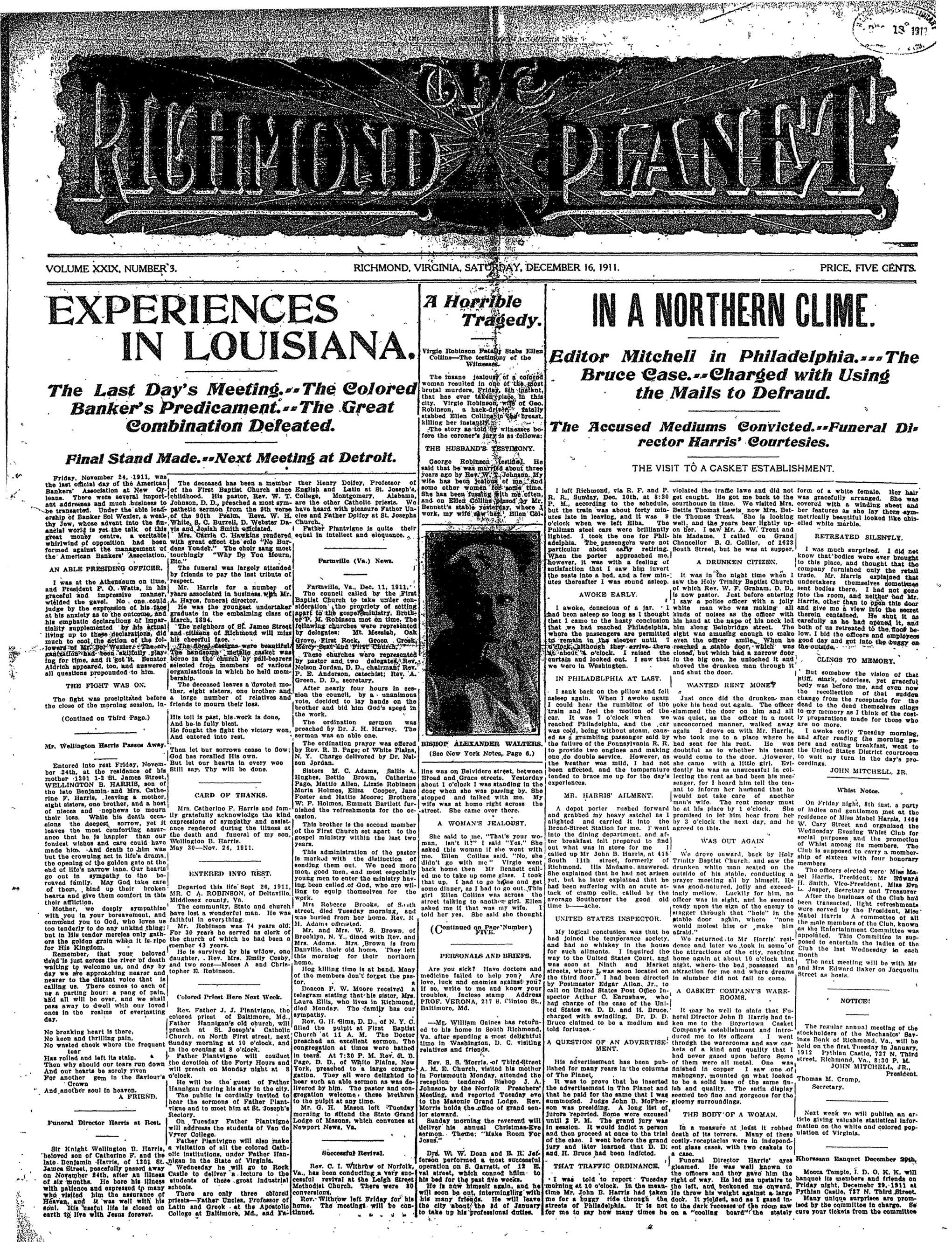
EXPERIENCES IN LOUISIANA.
The Last Day's Meeting.--The Colored Banker's Predicament.--The Great Combination Defeated.
Final Stand Made. ---Next Meeting at Detroit.
VOLUME XXIX. NUMBER 3.
EXPERI
IN
The Last Day
Banker's Pre
Comb
Final Stand Ma
Friday, November 24, 1911, was the last official day of the American Bankers' Association at New Orleans. There were several important addresses and much business to be transacted. Under the able leadership of Banker Sol Wexler, a wealthy Jew, whose advent into the financial world is yet the talk of this great money centre, a veritable whirlwind of opposition had been formed against the management of the 'American Bankers' Association.
AN ABLE PRESIDING OFFICER.
I was at the Athenaeum on time, and President F. O. Watts, in his graceful and impressive manner, wielded the gavel. No one could judge by the expression of his face at his anxiety as to the outcome, and his emphatic declarations of impartiality supplemented by his actual living up to these declarations, did much to cool the action of the followers of Mr. Soil Worsters. The gestation had been extraily playing for time, and it got it. Beaton Aldrich appeared, too, and answered all questions propounded to him.
THE FIGHT WAS ON.
The fight was precipitated before the close of the morning session, in (Continued on Third Page.)
Mr. Wellington Harris Passes Away
Entered into rest Friday, November 24th, at the residence of his mother: 1201 1-2 St. James Street, WELLINGTON B. HARRIS, son of the late Benjamin and Mrs. Catharine F. Harris, leaving a mother, eight sisters, one brother, and a host of nieces and nephews to mourn their loss. While his death occasions the deepest sorrow, yet it leaves the most comforting assurance that he is happier than our fondest wishes and care could have made him. And death to him was but the crowning act in life's drama, the opening of the golden gate at the end of its narrow lane. Our hearts go out in sympathy to the bereaved family. May God take care of them, blind up their broken hearts and give them comfort in this their affliction.
Mother, we deeply sympathize with you in your bereavement, and command you to God, who loves us too tenderly to do any unkind thing; but in His tender mercies only gathers the golden grain when it is ripe for His Kingdom.
Remember, that your beloved dead is just across the river of death waiting to welcome us, and day by day we are approaching nearer and nearer to the distant voice that is calling us. There comes to each of us a parting hour: a pang of pain, and all will be over, and we shall pass away to dwell with our loved ones in the realms of everlasting day.
No breaking heart is there,
No wasted chook where the frequent
dear
Has rolled and left its stair.
Then why should our tears run down
And our hearts be norly riven
For another gem in the Bavour's
Crown
And another soul in heaven.
A FRIEND.
Funeral Director Harris at Rest.
Sir Knight Wellington B. H. Harris,
beloved son of Catherine F. and the late Benjamin Harris, of 1201 St.
James Street, peacefully passed away on November 24th, after an illness
of six months. He bore his illness with patience and expressed to many
who visited him the assurance of Heaven, and it was well with his
soul. His useful life is closed on earth to live with Jesus forever.
The deceased has been a member of the First Baptist Church since childhood. His pastor, Rev. W. T. Johnson, D. D., prescheduled a most sympathetic sermon from the 9th verse of the 90th Psalm, Reva, W. H. White, S. C. Burrell, D. Webster Davis and Josiah Smith emulated.
Mrs. Carrie C. Hawkins rendered with great effect the solo "No Burdens Youndek." The choir sang most touchingly "Why Do You Mourn, Etc."
The funeral was largely attended by friends to pay the last tribute of respect.
Mr. Harris for a number of years associated in business with Mr. A. Hayes, funeral director.
He was the youngest undertaker graduate in the embalming class of March, 1894.
The neighbors of St. James Street and citizens of Richmond will miss his cheerful face.
The fond designs were beautiful. The handmade metallic casket was born in the church by pall-bearers selected from members of various organizations in which he held membership.
The deceased leaves a Unvoted mother, eight sisters, one brother and a large number of relatives and friends to mourn their loss.
His toll is past, his work is done, and he is fully blest.
He fought the fight the victory won, And entered into rest.
Then let bur sorrows cease to flow
God has recalled His own.
But let our hearts in every woe
SUl say. Thy will be done.
CARD OF THANKS.
Mrs. Catherine F. Harris and family gratefully acknowledge the kind expressions of sympathy and assistance rendered during the illness at the death and funeral of my son, Pollination, on November 24, 1811.
ENTERED INTO BEST.
Departed this Life Sept 26, 1911,
MR. C. A. ROBINSON, of Deltaville,
Middlesex county, Va.
The community, State and church
have lost a wonderful man. He was
faithful in everything.
Mr. Robinson was 74 years old;
For 30 years he served as clerk of
the church of which he had been a
member 43 years.
He is survived by his widow, one
daughter, Rev. Mrs. Emily Cosby,
and two sons—Moses A and Christopher E. Robinson.
Colored Priest Hero Next Week.
Rev. Father J. J. Plantvigno, the priest of Baltimore, Md. Father Hannigan's old church, will preach at St. Joseph's Catholic Church, on North First street, next Sunday morning at 10 o'clock, and in the evening at 8 o'clock. Father Plantvigno will conduct the devotion of the Forty Hours and will preach on Monday night at 8 o'clock.
He will be the guest of Father Hannigan during his stay in the city. The public is cordially invited to hear the sermons of Father Plantvigno and to meet him at St. Joseph's Recory.
On Tuesday Father Plantvigno will address the students of Van the Vyrer College.
Father Plantvigno will also make a visitation of all the colored Catholic institutions, under Father Hannigan in the State of Virginia.
Wednesday he will go to Rock Castle to deliver a lecture to the students of these great industrial schools.
There are only three colored priests—Father Uncles, Professor of Latin and Greek at the Apostolic College at Baltimore, Md., and Fa-
RICHMOND, VIRGINIA, SATURDAY, DECEMBER 16, 1911.
thur Henry Dolfey, Professor of English and Latin at St. Josephs, College, Montgomery, Alabama, are the other Catholic priests. We have heard with pleasure Father Uncles and Father Dolfey at St. Josephs Church. Father Plantvigne is quite their equal in intellect and eloquence.
Farmville (Va.) Newa.
Farmville, Va., Dec. 11, 1811.
The council called by the First Baptist Church to take under consideration the propriety of setting apart to the gospel ministry. Brother of P. M. Robinson met on time. The following churches were represented by delegates: Mt. Messiah, Oak Grove, First Rock, Groom Creek, Harvey Seat and First Church.
These churches were represented by pastor and two delegates, Rev. Nelson Jordan, D. D., chairman; Rev. P. E. Anderson, catechist; Rev. A. Green, D. D., secretary.
After nearly four hours in session the council, by a unanimous vote, decided to lay hands on the brother and bid him God's speed in the work.
The ordination sermon was preached by Dr. J. H. Harvey. The sermon was an able one.
The ordination prayer was offered by Rev. R. B. Page; of White Plains, N. Y. Charge delivered by Dr. Nelson Jordan.
Sisters M. C. Adams, Sallie A. Hughes, Bottle Brown, Catherine Page, Mattie Allen, Lizzie Robinson Maria Holmes, Eliza Cooper, Jane Foster and Hattie Moore; Brothers W. F. Holmes, Emmett Bartlett furnished the refreshments for the occasion.
This brother is the second member of the First Church set apart to the gospel ministry within the last two years.
This administration of the pastor is marked with the distinction of sending them out. We need more men, good men, and most especially young men to enter the ministry having been called of God, who are willing to equip themselves for the work.
Mrs Rebecca Brooks, of South street, died Tuesday morning, and was buried from her home. Rev. R. H. Adams, allocated.
Mr. and Mrs. W. S. Brown, of Brobyn N. Y., united with Rev. and Mrs. Adams. Mrs. Brown is from Danville, their old home. They left this morning for their northern home.
Hog killing time is at hand. Many of the members don't forget the pastor.
Doacon P. W. Moore received a telegram stating that his sister, Mrs. Laura Ellis, who lives in Richmond, died Monday. The family has our sympathy.
Rev. G. H. Sims, D. D., of N. Y. C. filled the pulpit at First Baptist Church at 11 A. M. The Doctor preached an excellent sermon. The congregation at times wore baths in tears. At 7:30 P. M. Rev. R. B. Page, D. D., of White Plains, New York, preached to a large congregation. They all were delighted to hear such an able sermon as was delivered by him. The pastor and congregation welcome, these brothren to the pulpit at any time.
Mr. G. H. Mason left Tuesday morning to attend the Stato Grand Lodge of Masons, which convenes at Newport News, Va.
Successful Revival
Rev. C. I. Withrow of Norfolk, Va., has been conducting a very successful revival at the Leigh Street Mothodist Church. There were 20 conversions.
Rev. Withrow left Friday for his home. The meetings will be continued.
Virgile Robinson Fataly Stabs Ellen Collins—The testimony of the Witnesses.
The insane jealousy of a colored woman resulted in one of the most brutal murders. Friday, 8th instant, that has ever taken place in this city. Virgile Robinson, wife of Geo Robinson, a hack-driven, fatally stabbed Ellen Collins in the breast, killing her instantly.
The story as told by witnesses before the coroner's jury is as follows:
THE HUSBAND'S TESTIMONY.
George Robinson testified. He said that he was married about three years ago by Byr. W. J. Johnson. My wife has been jealous of me, and some other women for some time. She has been fussing with me often, and on Ellen Collins passed by Mr. Bennett's stable yesterday, where I work, my wife saw her. Ellen Col-
BISHOP ALEXANDER WALTERS
(See New York Notes, Page 6.)
lins was on Belvidore street, between Broad and Grace streets. Yesterday about 1 o'clock I was standing in the door when she was passing by. She stopped and talked with me. My wife was at home right across the street. She came over there.
A WOMAN'S JEALOUSY.
She said to me. "That's your woman, isn't it?" I said "Yes." She asked this woman if she went with me. Ellen Collins said. "No, she didn't go with me." Virglo went back home then. Mr Bennott called me to take up some glass. I took that up. I had to go home and get some dinner, as I had to go out. This girl Ellen Collins was across the street talking to another girl. Ellen asked me if that was my wife. I told her yes. She said she thought
PERSONALS AND BRIEFS
Are you sick? Have doctors and medicine failed to help you? Are love, luck and enemies against you? If so, write to me and know your troubles. Inclose stamp Address PROF. VERONA, 217 B. Clinton St., Baltimore, Md.
—Mr. William Gaines has returned to his home in South Richmond, Va. after spending a most delightful time in Washington, D. C. visiting relatives and friends.
Rev. B. S. Morris, of Third Street A. M. E. Church, visited his mother in Portsmouth Monday, attended the reception tendered Bishop J. A. Johnson by the Norfolk Preschool's Meeting, and reported Tuesday ove to the Masonic Grand Lodge. Rev. Morris holds the office of grand senior steward.
Sunday morning the reverend will deliver his annual Christmas-Eve sermon. Theme: "Make Room For Jesus."
Drs. W. W. Doan and E. B. Jefferson performed a most successful operation on B. Garrett, of 12 E. val street, which conned him to his bed for the past five weeks.
He is now himself again, and he will soon be out, intermingling with his many friends. He will leave the city about the 3d of January to take up his professional duties.
IN A NORTHERN CLIME.
Editor Mitchell in Philadelphia. The Bruce Case. Charged with Using the Mails to Defraud.
The Accused Mediums Convicted.--Funeral Director Harris' Courtesies.
THE VISIT TO A CASKET ESTABLISHMENT.
I loft Richmond, vla R. F. and P.
R. R., Sunday, Dec. 10th, at 8:30
P. M., according to the schodule,
but the train was about forty minutes late in leaving, and it was 9 o'clock when we left Elba. The Pullman steel cars were brilliantly lighted. I took the one for Philadelphia. The passengers were not particular about early retiring. When the porter approached me, however, it was with a feeling of satisfaction that I saw him invert the seats into a bed, and a few minutes thereafter I was sound asleep.
AWOKE EARLY
I awoke, conscious of a jar. 'I had been asleep so long as I thought that I came to the hasty conclusion that we had reached Philadelphia, where the passengers are permitted to remain in the sleeper until 7 o'clock. Although they arrive there we about 6 o'clock. I raised the curtain and looked out. I saw that we were in Washington.
IN PHILADELPHIA AT LAST.
I sank back on the pillow and fell asleep again. When I awoke again I could hear the rumbling of the train and feel the motion of the car. It was 7 o'clock when we reached Philadelphia, and the car was cold, being without steam, caused as a grumbling passenger said by the failure of the Pennsylvania R. R. to provide two engines and making one do double service. However, as the weather was mild, I had not been affected, and the temperature tended to brace me up for the day's experiences.
MR. HARRIS' AILMENT.
A depot porter rushed forward and grabbed my heavy satchel as I alighted and carried it into the Broad-Street Station for me. I went into the dining department, and after breakfast felt prepared to find out what was in store for me I called up Mr John B. Harris, at 415 South 11th street, formerly of Richmond. His Madame. answered. She explained that he had not arisen yet, but he later explained that he had been suffering with an acute attack of cramp coll, called by the average Southerner the good old time b——ache.
UNITED STATES INSPECTOR
My logical conclusion was that he had joined the temperance society, and had no whiskey in the houses for such alliments. I inquired the way to the United States Court, and was soon at Ninth and Market streets, where I was soon located on the third floor. I had been directed by Postmaster Edgar Allan, Jr., to call on United States Post Office Inspector Arthur C. Earnshaw, who had charge of the case of the United States vs. D. D. and H. Bruce, charged with swindling, Dr. D. D. Bruce claimed to be a medium and told fortunes.
A QUESTION OF AN ADVERTISEMENT.
His advertisement has been published for many years in the columns of The Planet.
It was to prove that he inserted the advertisement in The Planet and that he paid for the same that I was summoned. Judge John D. McPherson was presiding. A long list of jurors reported. Some were excused until 2 P. M. The grand jury was in session. It would indict a person and then proceed at once to the trial of the case. I went before the grand jury and later learned that D. D. and H. Bruce had been indicted.
THAT TRAFFIC ORDINANCE
I was told to report: Tuesday morning at 10 o'clock. In the meantime Mr. John B. Harris had taken me for a buggy ride through the streets of Philadelphia. It is not for me to say how many times he
violated the traffic laws and did not got caught. He got me back to the courthouse in time. We visited Mrs. Bettle Thomas Lewis now Mrs. Bettle Thomas Trent. "She is looking well, and the years boar lightly up on her. I saw Mr. A. W. Trent and his Madame. I called on Grand Chancellor B. G. Collier, of 1623 South Street, but he was at supper.
A DRUNKEN CITIZEN.
It was in the night time when I saw the Holy Trinity Baptist Church of which Rev. W. F. Graham, D. D., is now pastor. Just before entering I saw a police officer with a jolly white man who was making all kinds of noises as the officer with his hand at the nape of his neck led him along Balmbridge street. The sight was amusing enough to make even the officer smile. When he reached a stable door, which was closed, but which had a narrow door in the big one, he unlocked it and shoved the drunken man through it and shut the door.
WANTED RENT MONEY
Just once did the drunken-man poke his head out again. The officer slammed the door on him and all was quiet, as the officer in a most unconcerned manner, walked away again. I drove on with Mr. Harris, who took me to a place where he had sent for his rent. He was doubtful as to whether his tenant would come to the door. However she came with a little girl. Evidently he was as unsuccessful in collecting the rent as had been his messenger, for I heard him tell the tenant to inform her husband that he would not take care of another man's wife. The rent money must be at his place by 1 o'clock. She promised to let him hear from her by 3 o'clock the next day, and he agreed to this.
WAS OUT AGAIN
We drove onward, back by Holy Trinity Baptist Church, and saw the drunken white man seated on the outside of his stable, conducting a prayer meeting all by himself. He was good-natured, jolly and exceedingly mellow. Luckily for him, no officer was in sight, and he seemed ready upon the sign of the enemy to singer through that "hole" in the stable door again, where "none would molest him or, make him afraid."
We returned to Mr Harris' residence and later we took in some of the attractions of the city, reaching home again at about 10 o'clock that night, where the bed, possessed an attraction for me and where dreams in slumber did not fail to come.
A CASKET COMPANY'S WARE-ROOMS.
It may be well to state that Furheral Director John N. Harris had taken me to the Uppertown Casket Company's establishment and introduced me to its officers. I went through the warrooms and saw caskets of a kind and quality that I had never gazed upon before. Some of them were all metal. One was finished in copper. I saw one of mahogany, mounted on what looked to be a solid base of the same mullah and quality. The satin display seemed too fine and gorgeous for the gloomy surroundings.
THE BODY OF A WOMAN
In a measure at least it robbed death of its torrors. Many of these costly-receptacles were in indopendent glass cases, with two caskets to a case.
Funeral Director Harris' eyes gloomed. He was well known to the officers and they gave him the right of way. He led me upstairs to the left, and beckoned me onward. He threw his weight against a large door. It yielded, and as I gasped into the dark facades of the room saw on a "cooling board" the stately
CLIME.
Delphia. The with Using haud.
ed. Funeral Diseases.
SHMENT.
form of a white female. Her hair was gracefully arranged. She was covered with a winding sheet and her features as she lay thors symmetrically beautiful looked like chiselled white marble.
RETREATED SILENTLY
I was much surprised. I did not know that bodies were ever brought to this place, and thought that the company furnished only the retail trade. Mr. Harris explained that undertakers themselves sometimes sent bodies there. I had not gone into the room, and neither had Mr. Harris, other than to open this door and give me a view into the secret therein contained. He shut it, as carefully as he had opened it, and both of us retreated to the floor below. I bid the officers and employed good day and got into the buggy on the outside.
CLINGS TO MEMORY.
But somehow the vision of that stiff, stark, odorless, yet graceful body was before me, and even now the recollection of that sudden change from the receptacle for the dead to the dead themselves clings to my memory as I think of the cozy preparations made for those who are no more. I awoke early Tuesday morning, and after reading the morning papers and eating breakfast, went to the United States District courtroom to wait my turn in the day's proceedings.
JOHN MITCHELL, JR.
Whist Notes.
On Friday night, 8th last, a party of indies and gentlemen met at the residence of Miss Mabel Harris, 1408 W. Cary Street and organized the Wednesday Evening Whist Club for social purposes and the promotion of Whist among its members. The Club is supposed to carry a membership of sixteen with four honorary members. The officers elected were Miss Mabel Harris, President; Mr Edward H. Smith, Vico-President, Miss Eva L. Jasper, Secretary and Treasurer. After the business of the Club had been transacted, light refreshments were served by the President, Miss Mabel Harris. A commotee of all the male members of the Club, known as the Entertainment Committee was appointed. This Committee is supposed to entertain the ladies of the Club the last Wednesday in each month. The next meeting will be with Mr and Mrs Edward Baker on Jacqueline Street as hosts.
NOTICE!
The regular annual meeting of the stockholders of the Mechanics' Savings Bank of Richmond, Va., will be held on the first Tuesday in January, 1912 Pythian Castle, 727 N. Third street, Richmond, Va., 8:30 P. M. JOHN MITCHELL, JR., President. Thomas M. Crump, Secretary.
Next week we will publish an article giving valuable statistical information on the white and colored population of Virginia.
Khorassan Ranquet December 29th.
Mooca Temple, I. D. O. K. K. will banquet its members and friends on Friday night, December 29, 1911 at Pythian Castle, 727 N. Third Street. Many unique surprises are promised by the committee in charge. Secure your tickets from the committee
SYNOPSIS
Anna Granger, devoted mother of two small children discovers that her husband is a weak character and that he has lied to her about a woman.
Poising as Miss Dale, she becomes steigrapher to Burton Temple, through which she discovers that her husband is prisoned. She thinks Temple is the guilty man and is acting the spy to clear her husband's name for his sake and that of her children.
Anna discovers that Temple was one of her girlhood aide. Thinking her a single girl, Anna of her her husband was a liar and perjurer.
Temple has detectives on the trail of Brady, an accomplice of Granger, looking for evidence. Anna is searching for evidence against Temple, who becomes interested in her.
Despite herself Anna becomes fond of Temple, although determined to convict her, Anna of her boyfriend's detectives glimpses her the woman for whom Granger was a thief.
2
CHAPTER IX
BACK FROM PRISON
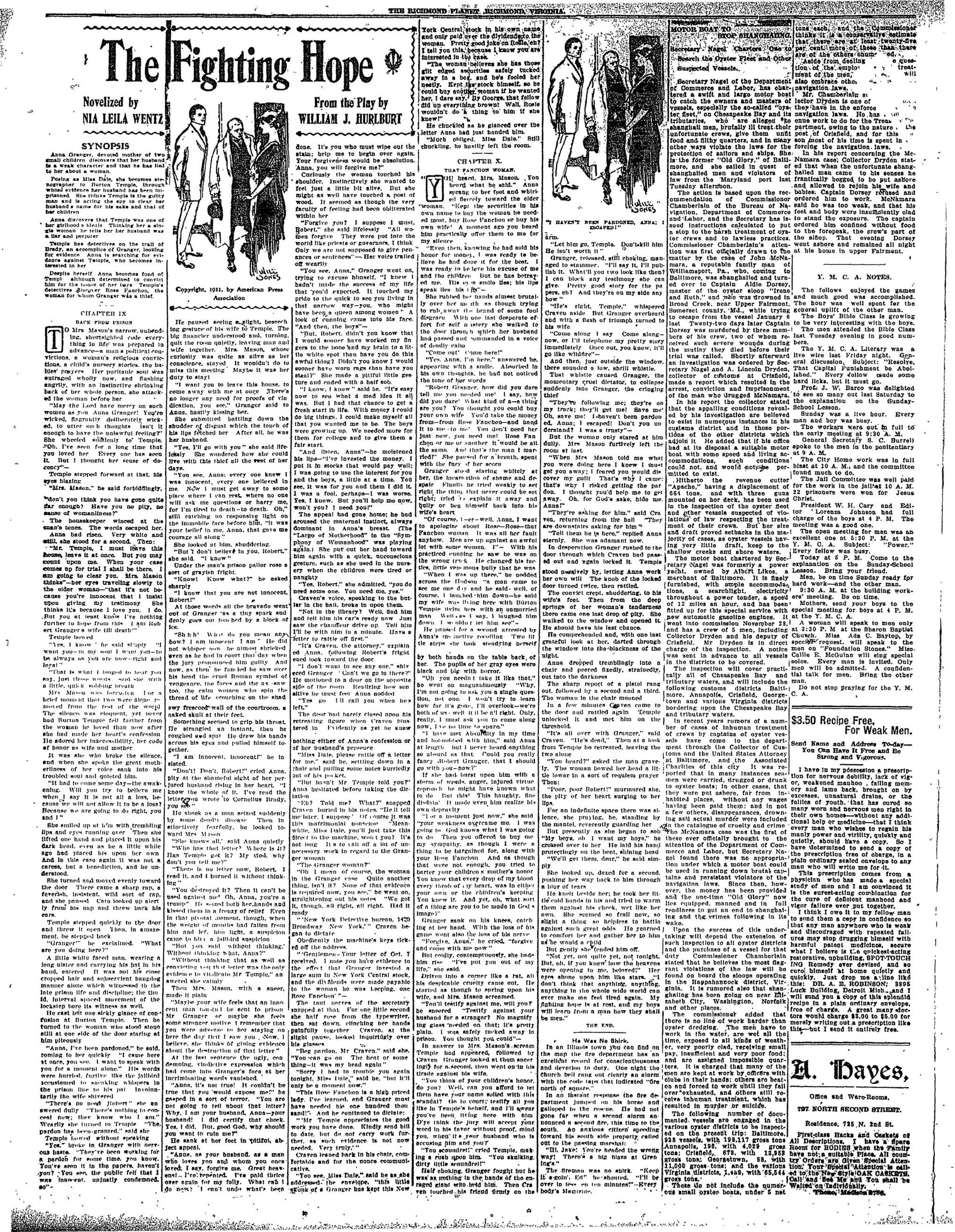
TO Mrs Mason's narrow, unbending, shortsighted code everything in life was prepared in advance—a man political convictions, a woman's religious convictions, a child's nursery stories, the babies' prayers. Her puritanic soul was outraged wholly now, and flushing angry, with an instinctive shrinking back of her whole person, she attacked the woman before her.
"May the Lord have mercy on such women as you Anna Granger! You're wicked, fragmentally deliberately wicked, to utter such thoughts! isn't it enough to have the unlawful feeling?" She wheeled suddenly to "Temple. 'Oh, I've seen for a long time that you loved her. Every one has seen it. But I thought her sense of decency."
Temple stepped forward at that, his eyes blazing.
"Mrs. Mason," he said forbiddingly,
don't you think you have gone quite far enough? Have you no pity, no sense of womanliness?
The housekeeper winced at the man's tone. The words escaped her. Anna had risen. Very white and still, she stood for a second. Then: "Mr. Temple. I must leave this house, leave it at once. But you may count upon me. When your case comes up for trial I shall be there. I am going to clear you. Mrs. Mason thinks—her eyes traveling slowly to the older woman—"that it's not because you're innocent that I insist upon giving my testimony. She thinks it's because I love you. I do. But you at least know I've nothing further to hope from this. I am Robert Granger's wife till death." Temple bowed. "Yes, I know," he said simply. "I want you—in my soul I want you—to be always as you are now-right and loyal." "That is what I longed to hear you say, just those words, and she with a little, public soliding breath."
Mrs. Mason was tortured. For a brief moment that they were alone removed from the rest of the world. The silence was eloquent, yet never had Burton Temple felt further from the woman he loved than now after she had made her heart's confession. He adored her inaccessibility, her code of honor as wife and mother.
It was she who broke the silence, and when she spoke the great motherliness of her voice sank into his troubled soul and quieted him.
"It had to come some day—the awakening. Will you try to believe me when I say it is not all a loss, because we will not allow it to be a loss? Because we are going to do right, you and I."
She smiled up at him with trembling lips and eyes running over. Then she lifted one hand and placed it upon his dark head, even as he a little while ago had placed his upon her own. And in this case again it was not a caress, but a benediction, and he understood.
She turned and moved evenly toward the door. There came a sharp rap, a feverish, insistent, wild sort of rap, and she paused. Cato looked up alertly from his nap and threw back his ears.
Temple stepped quickly to the door and threw it open. Then, in amazement, he stepped back
"Granger!" he exclaimed. "What are you doing here?"
A little white faced man, wearing a long shirt and currying his hut in his hand, entered. It was not his close cropped hair and subservient bangdang manner alone which witnessed to the late prison life and discipline; the timid, interval spaced movement of the lockstep bore its witness as well.
He cast bit one sleek glance of confusion at Burton Temple. Then he turned to the woman who stood stall at one side of the door staring at him plelessly.
"Anna, I've been pardoned," he said, coming to her quickly. "I came here at once, you see. I want to speak with you for a moment alone." His words were hurried, furious like the jailbird accustomed to snacking whispers in the prison line to his pat. Involuntarily the wife shuttered.
"There's no need Robert" she anew sworded daily. "There's nothing to conceive now; they know who I am."
Wearly she turned to Temple. "The pardon has been granted," said she. Temple howd without speaking. "Yeah," broke in dranger with nervous haste. "They've been working for a pardon for some time, you know. You've seen it in the papers, haven't you? You see, the public felt that I was innocent, unjustly condemned, so."
Fighting
WILLIE
DONES
Copyright, 1911, by American Press Association
He paused seeing a light, beseeching gesture of his wife to Temple. The big mancher under and, turning, quit the room quietly, leaving man and wife together. Mrs. Mason, whose curiosity was quite as alive as her conscience, stayed. It wouldn't do to miss this meeting. Maybe it was her duty to stay!
"I want you to leave this house, to come away with me at once. There's no longer any need for proofs of vindication, you see." Granger said to Anna, hastily kissing her.
She submitted battling down the shudder of disgust which the touch of his lips fetched her. After all, he was her husband.
"Yes, I'll go with you" she said lifelessly. She wondered how she could live with this threat all the west of her days.
"You see, Anna; every one knew I was innocent, every one believed in me. Now I must get away to some place where I can rest, where no one will ask me questions or harry me, for I'm tired to death-to death. Oh" still catching no responsive light on the immobile face before him. "It was your belief in me, Anna, that gave me courage all along." She looked at him, abuddering. "But I don't believe in you, Robert." she said. "I know." Under the man's prison pallor rose a sort of grayish fright. "Know! Know what?" he asked sharply. "I know that you are not innocent, Robert!" At those words all the bravado went out of Granger as a thy spark and denly goes out touched by a block of ice.
"Shhh! What do you mean anyhow? I am innocent I am." He did not whisper now he almost shrieked even as he had in court that day when the jury pronounced him guilty. And now, as then he familed he saw over his head the cruel Roman symbol of vengeance, the faces and the ax-saw too, the calm women who spin the thread of life crunching on the shadow frescoed wall of the courtroom, a naked skull at their feet.
Something seemed to grip his throat. He strangled an instant, then he coughed and spat. He drew his hands across his eyes and pulled himself together.
"I am Innocent, Innocent!" he insisted.
"Don't! Don't, Robert!" cried Anna, pity at the shameful sight of her perfured husband riling in her heart. "I know the whole of it. I've read the letter you wrote to Cornelius Brady, you said."
He shook as a man seized suddenly by some deadly disease. Then in effectively fearfully, he looked toward Mrs Mison.
"She knows all," said Anna quietly. "Who has that letter? Where is it? Has Temple got it? My God, why don't you tell me?"
"There is no letter now, Robert. I read it, and I burned it without thinking."
"You destroyed it? Then it can't be used against me! Oh, Anna, you're a trump! He soiled both her hands and kissed them in a freeway of relief. In that plaintful moment, though, when the weight of mouth had fallen from him and lef, he light, a suspicion came to him a latticed suspicion.
"But you said without thinking. Without thinking what, Anna?"
"Without thinking that as well as completing that letter was the only evidence to violate Mr Temple," an answered she calmly.
Then Mrs. Mason, with a sneer, made it plain.
"Maybe your wife feels that an innocent man must be sent to prison. Mr Granger or maybe she feels some stronger motive. I remember that you were adverse to her staying on here the day that I saw you. Now, I believe, she thinks of giving evidence about the destruction of that letter."
At the last sentence the ugly, condemning, vindictive expression which had come into Granger's face at her incriminating vaniabled.
"Anna, it's not true! It couldn't be true that you would expose me!" he gasped in a sort of terror. "You are not going to tell about that letter? Why, I am your husband, Anna—your husband! I did certify that check. Yes, I did. Good God, why should you want to ruin me?"
He sank at her feet in pitifoh, object appeal.
"Anna, as your husband, as a man who loves you and whom you once loved, I forgive me. Great heartiness. I're repented. I've paid thrice over again for my folly. What can I do now? I can't understand what been
Hope
#
From the Play by WILLIAM J. HURLBURT
done. It's you who must wipe out the stain; help me to begin over again. Your forgiveness would be absolution. Anna, you will forgive me."
Curiously the woman touched his shoulder. Instinctively she wanted to feel just a little bit alive. But she might as well have touched a post of wood. It seemed as though the very faculty of feeling had been obliterated within her
"Forgive you! I suppose I must, Robert." she said lifelessly "All women forgive. They were put into the world like priests or governors. I think Only we are not supposed to give penances or sentences"—Her voice trailed off wearily.
"You see, Anna," Granger went on, trying to excuse himself, "I knew I hadn't made the success of my life that you'd expected. It touched my pride to the quick to see you living in that narrow way—you, who might have been a queen among women." A look of cunning came into his face. "And then, the boys"—
"But, Robert, didn't you know that I would sooner have worked my fingers to the bone and my brain to a little white spot than have you do this awful thing? Didn't you know I would sooner have worn rags than have you stalk?" She made a pitiful little gesture and ended with a half苏.
"I know, I know," said he. "It's easy now to see what a mad idea it all was. But I had that chance to get a fresh start in life. With money I could do big things. I could make myself all that you wanted me to be. The boys were growing up. We needed more for them for college and to give them a fair start.
"And listen. Ann"—he moistened his lips—"I've invested the money. I put it in stocks that would pay well; I was going to use the interest for you and the boys, a little at a time. You see, it was for you and them I did it. I was a fool, perhaps—I was worse. Yes, I know. But you'll help me now, won't you? I need you!" The appeal had gone home; he had aroused the maternal instinct, always dominant in Anna's breast. (The "Largo of Motherhood" in the "Symphony of Womanhood" was playing again.) She put out her hand toward him again with a quick, unconscious gesture, such as she used in the nursery when the children were tired or naughty. "Yes, Robert." she admitted, "you do need some one. You need me, yes." Craven's voice, speaking to the butler in the hall, broke in upon them.
"Not in the library? Well, and him and tell him his car's ready now. Just saw the chaundair drive up. Tell him I'll be with him in a minute. Have a letter to rattle off first."
"It's Graven, the attorney," explained Anna, following Robert's fright ened took toward the door.
"I don't want to see any one." shivered stranger. "Can't go in there?" He motioned to a door on the opposite side of the room. Realizing how senil he must feel Anna nodded.
"Yes go. I'll call you when he left."
The door and barely closed upon his retreating figure when Graven blistered in. Faintly as get he knew nothing either of Anna's confession or of her husband's pressure.
"Miss Date, please rattle off a letter for me," said he, setting down in a chair and pulling some notes hurriedly out of his pocket.
"But hasn't Mr Temple told you?' Anna hesitated before taking the dictation
"Eh? Told me? What?" snapped Craven buried in his notes. "He'll tell me later, I suppose." Of course it was this multifeminial nonsense "Mean-white, Miss Tale, you'll just take this direct to the machine, won't you? It's not long. It is to call off a lot of unnecessary work in regard to the Granger woman"
"The Granger woman?"
"Oh I mean of course, the woman in the Granger case. Quite another thing, isn't it? None of that evidence is required now, you see." he went on, straightening out his notes "We got it, though, all right, all right. Had it ready"
"New York Detective bureau, 1420 Broadway New York," Craven began to dictate
Obediently the machine's keys ticked off the address.
"Gentlemen- Your letter of Oct. 7 received. I note you have evidence to the effect that Granger invaded a large sum in New York Central stock, and the dividends were made payable to the woman he was Leeping, one Rose Fanchon."—
The taint nerves of the secretary snapped at that. For one little second she half rose from the typewriter, then sat down, clenching her hands painfully together. Craven, at the slight pause, looked inquiringly over his glasses.
"Beg pardon, Mr Craven." said she, "You can go on. The heat or some thing-it was my head again."
"Sorry I had to trouble you again tonight. Miss Little," said he, "but it only be a moment now."
"This Rose Fanchon is a high priced lady. I've learned, and Granger must have needed his one hundred thou sand!" And he continued to dictate.
"Mr Temple appreciates the good work you have done. Kindly send bill to date, but do not carry work further, as such evidence is not now needed. Very truly." Craven leaned back in his chair, comfortable and for the nonce communicative. "You see, Miss Dale," said he as she addressed the envelope, "this little skunk of a Granger has kept this New
York Central stock in his own name and only paid over the dividend to the woman. Pretty good joke on Rosie, she! I tell you this, because I know you are interested in the case.
"The woman believes she has those gilt edged securities safely tucked away in a box, and he's fooled her neatly. Kept the stock himself, so he could buy another woman if he wanted her, I dare say. By George, that fellow did up everything brown. Wall Rose wouldn't do a thing to him if she knew."
He chuckled as he glanced over the letter Anna had just handed him.
"Much obliged. Miss Dale." Still chuckling, he neatly left the room.
CHAPTER X
THAT FUNCTION WOMAN.
"I'll heard, Mira, Mason. You heard what he said." Anna swung to her foot and whirled fiercely toward the older woman. "Keep the securities in his own name to buy the woman he needed most, buy Rose Fanchon or buy his own wife." A moment ago he heard him practically offer them to me for my silence. "Even then, knowing he had sold his honor for money, I was ready to believe he had done it for the best. I was ready to be lie his excuse of me and the children. But he has betrayed me. His wife sudio lies; his lips speak lies his life"—
She rubbed her hands almost brutally over her mouth as though trying to rub, uav the brand of some foul disgrace. With one last desperate effort for self in mystery she walked to the door through which her husband had passed and commanded in a voice of deadly calm. "Come out" come here!"
"Yes, Anna. I'm here." answered her, appearing with a smile. Absorbed in his own thoughts, he had not noticed the tone of her words.
"Robert Granger, how did you dare tell me you needed me? I say, how did you dare? What kind of a—thing are you? You thought you could buy your own wife. You'd take the money from—from Rose Fainchon—and hand it to me. You don't need her just now, you need me! Rone Fainchon or me or another it would be all the same. And that's the man I married!" She paused for a breath, spent with the fury of her scorn.
Granger stood staring whitely at her, the incarnation of shame and despair. Fainchon tried weekly to set right the thing that never could be set right; tried to explain it away and bully or beg himself back into his wife's heart.
"Of course, I—er—well. Anne, I want to apologize about Rose—Rose—that Fanchon woman. It was all her fault anyhow. Men are up against an awful lot with some women. I—With his practiced counting he saw he was on the wrong track. He changed his tactics, little vicious bully that he was." "When I was up there," he nodded across the fludon "in man came to see me one day and he said—well, of course, I laughed him down—he said my wife was living here with Burton Temple him here with an unmarried man. Well as I say, I laughed him down I wouldn't let him see"—
He jumped for a second arrested by Anna's insensitive reciling. Two lit the steps she took steadying herself
by both hands on the table back, of bar. The pupils of her gray eyes were black and big with horror.
"Oh you needn't take it like that." he went on magnanimously "Why, I'm not going to ask you a single question, not one. I won't try to learn how far it's gone. I'll overlook—we're both of us, well it will be right. Only, really, I must ask you to come along now, I do no time to spare."
"I have not Absurdity in my time and horribly with him," said Anna at length, but I never heard anything so absurd as that. Could you really fancy Robert Granger, that I should go with you—now?
If she had hurried upon him with a storm of words, anger, injured virtue reproach he might have known what to do But this! This haughty, fine disdain! It made even him realize his own derepathy.
"For a moment just now," she said "your weakness ogreme me. I was going to God knows what I was going to do. Then you offered to buy me my sympathy, as though I were a thing to be bargained for, along with your Rose Fawnion. And as though that were not enough, you tried to barter your children's mother's honor. You knew that every drop of my blood every throb of my heart, was in either your own or the children's keeping You knew it. And yet, oh, what sort of a thing are you to be made in God's image?"
Granger sank on his knees, catching at her hand. With the loss of his game went also the loss of his nerve "Forgive, Anun!" he cried "forgive and come with me now"
But coldly, contemptuously, she hade him rise "I've put you out of my life." she said.
Driven into a corner like a rat, all his despicable cruelty came out. He started as though to spring upon his wife, and Mrs. Mason screamed.
"You'll testify against me, will you? He answered "Testify against your husband for a stranger?" No magnifying glass modeled on that; it's pretty plain. I was safely tucked away in prison. You thought you could."
In answer to Mrs. Mason's scream Temple had appeared, followed by Craven Granger looked at them cheerfully for a second, then went on in his tirade against his wife.
"You think of your children's honor, do you? Well, can you afford to let them have your name sown with this scandal? (Go to court; testify all you like in Temple's behalf, and I will wear you've been living here with him) Dye think the jury will accept your word in his favor without proof, mind you, when it's your husband who is accusing him and you?"
"You scoundrel!" pitted Temple, making a rush upon him. "You skulking, dirty little aroundrel!" Half choking, Granger fought but he was an anything in the hands of the enraged giant who hid him. Then Crawen touched his friend firmly on the
WILLIE DONES
"I HAVEN'T BEEN PARDONED, ANNA; I ESCAPED!" arm.
"Let him go, Temple. Don't kill him. He isn't worth it."
Granger, released, still choking, man aged to stammer. "I'll say it. I'll pub lish it. What'll you two look like then I can block any testimony she can give. Pretty good story for the papers. eh? And they're on my side any how"
"He's right, Temple," whispered Graven aside. But Granger overheard and with a flash of triumph turned to his wife.
"Come along I say. Come along—now, or I'll telephone my pretty story immediately. Once out, you know, it'll go like wildfire".
And then, just outside the window, there sounded a low, shrill whistle.
That whistle caused Granger, the momentary cruel dictator, to collapse suddenly into Granger, the cringing thief
"They're following me; they're on my truck; they'll get me! Save me! Oh, save me! I haven't been pardoned, Anna! I escaped! Don't you understand? I was a trusty"—But the woman only stared at him dully. Mrs Masonfurtely left the room at last.
"When Mrs Mason told me what you were doing here I knew I must get you away; I feared you would discover my guilt. That's why I came that's why I risked getting the paradox. I thought you'd help me to get away. Oh, for God's sake, hide me. Annal"
"They're asking for him," and Craven, returning from the hall. "They are downstairs asking for him."
"Tell them he is here," replied Anna sternly. She was adamant now.
In despair Granger rushed to the door through which Craven had passed out and locked it. Temple
stood passively by, letting Anna work her own will. The knob of the locked door turned twice, then rattled. The convict crept, sbuddering, to his wife's foot. Then from the deep springs of her woman's tenderness there came one last drop of pity. She walked to the window and opened it. He should have his last chance.
He comprehended and, with one last grateful look at her, darted through the window into the blackness of the night.
Anna dropped tremblingly into a chair and peered fixedly, strained, out into the darkness.
The sharp report of a pistol rang out, followed by a second and a third. The woman in the chair mounded.
In a few minutes Gwen came to the door and rattled again. Temple unlocked it and met him on the threshold.
"It's all over with Granger," said Craven. "He's dead." Then at a look from Temple he retreated, leaving the two alone.
"You heard?" asked the man gravely. The woman bowed her head a little lower in a sort of requiem prayer Then:
"Poor, poor Robert!" murmured she, the pity of her heart surging to her lips.
"We'll get them, dear," he said simply.
She looked up, dazed for a second, pushing her way back to him through a blur of tears.
He knelt beside her; he took her little cold hands in his arms and tried to warm them against his cheek, wet like her own.
She seemed so frail now, so slight a thing so helpless to battle against such great odds. He scanned to comfort her and gather him to him as he would a child.
But gently she fondled him off.
"Not yet, not quite yet, not tonight. But, oh, if you knew how the heavens were opening to me, beaved!" Her eyes upon him like stars.
"I don't think that anything, anything, anything in the whole wide world can ever make me feel tired again. My fighting hope is at rest, and my boys will learn from a man how they shall be men."
THE END.
He Was No Bbick
In an Illinois town you can find on the map the fire department has an excellent record for conscientiousness and devotion to duty. One night the church bell rang out clearly an alarm with the code tags that indicated "fire north of squire."
In an instant response the fire department jumped on his horse and galloped to the rescue. He had not gone far when a second alarm announced a second fire, this time to the south. An anxious citizen speeding toward his south side property called out to the passing marshal:
"Jake! You're headed the wrong way! There's a big blaze at Glen inga."
The fireman was no shirk. "Keep it a-goin', Ed!" he shouted. "I'll be over in less than ten minutes!"--Every body's macvine.
MOTOR BOAT TO
STOP SHANGHAIING.
Secretary Nagel Charters, One to
Search the Oyster Fleet and Other
Suspected Vessels.
Secretary Nagel of the Department
of Commerce and Labor, has char-
tered a swift and large motor boat
to catch the owners and masters of
vessels, especially the so-called "oyster
fleet," on Cheesapeake Bay and its
tributaries, who are alleged to
shanghail men, brutally ill treat. their
unfortunate crews, give them unk
food and filthy quarters, and in many
other ways violate the laws for the
protection of sailors and ships. She
is the former "Old Glory," of Baltimore, and she sailed in quest of shanghail men and violators of
law from the Maryland port last
Tuesday afternoon.
The action is based upon the recommendation Chamberlain of the Bureau of Navigation, Department of Commerce and Labor, and the Secretary has issued instructions calculated to put a stop to the harsh treatment of oyster crews and to laxless practices. Chamberlain Chamberlain's attention was first officially drawn to the matter by the case of John McNamara, a reputable family man of Williamsport, Pa., who, coming to Baltimore, was shanghailed and turned over to Captain Aldie Dorsay, master of the oyster ship "Irene and Ruth," and who was drowned in Broad Creek, near Upper Falmont, Somerset county, Md., while trying to escape from the vessel January 6 last. Twenty-two days later Captain Dorsay was murdered by three members of his crew, two of whom received such severe wounds during the mutiny they died before their trial was called. Shortly afterward an investigation was ordered by Secretary Nagel and A. Lincoln Drydon, collector of customs at Cristlone, made a report which resulted in the arrest, conviction and imprisonment of the man who drugged McNamara.
In his report the collector stated that the appalling conditions revealed by his investigation are believed to exist in numerous instances in his customs district and in those portions of the other districts which adjoin it. He added that if his office had at its disposal a suitable motor boat with some speed and living accommodations, such conditions could not, and would not be permitted to exist. Hitherto the revenue cutter "Apache," having a displacement of 664 tons, and with three guns mounted on her deck, has been used in the inspection of the oyster foot and other vessels suspected of violations of law respecting the treatment of their crews. But her size and draft proved setbacks in the majority of cases, as oyster vessels having very little draft, keep to the shallow creeks and shore waters.
The motor boat chartered by Secretary Nagel was formerly a power yacht, owned by Albright Likos, a merchant of Baltimore. It is finally furnished, with ample accommodations, a searchlight, electricity throughout a power tender, a speed of 12 miles an hour, and has been fitted up for this special service with new automatic gasoline engines. It went into commission November 28, and has a crew of 5 men, including Collector Dryden and his deputy of Saffield. Mr Dryden is in direct charge of the inspection. A notice was sent in advance to all vessels in the districts to be covered. The inspection will cover practically all of Chesapeake Bay and tributary waters, and will include the following customs districts Baltimore, Annapolis, Crisfield, Georgetown and various Virginia districts bordering upon the Chesspeake Bay and tributary waters.
In recent years rumors of a number of cases of inhuman treatment of crews by captains of oyster vessels have come to the department through the Collector of Customs and the United States Attorney at Baltimore, and the Associated Charities of this city. It was reported that in many instances seamen were carried, drugged or drunk to oyster boats; in other cases, that they were put ashore, far from inhabited places, without any wages having been paid them; and in not a few others, disappearances, drowning and actual murder were included in the catalogue of cruelty and crime. The McNamara case was the first of these over officially brought to the attention of the Department of Commerce and Labor, but Secretary Nagel found there was no appropriation under which a motor boat could be used in running down brutal captains and persistent violators of the navigation laws. Since then, however, the money has been provided and the one-time "Old Glory" now lies equipped, manned and in full readiness to put an end to shanghaiing and the crimes following in its wake.
Upon the success of this undertaking will depend the extension of such inspection to all oyster districts and the purchase of a vessel for that duty. Commissioner Chamberlain stated that he believes the most fragrant violations of the law will be found on board the sloops operating in the Rappahannock district, Virginia. It is rumored also that shangaling has been going on near Elizabeth City, Washington, Norfolk and other places.
The commissioner added that thore is no line of work harder than oyster dredging. The men have to work in the water, are not all the time, exposed to all kinds of weather, very poorly clad, receiving small, insufficient and very poor food; and are assigned impossible quarters. It is charged that many of the men are kept at work by officers with clubs in their hands; others are beaten and forced to work until they fall over "exhausted, and others still receive inhuman treatment, which has resulted in murder or suicide.
The following number of documented vessels are engaged in the various cystar districts to be inspected on the present trip: Baltimore, 928 vessels, with 198,117 gross tons Annapolis, 195, with 4,039 gross tons; Grisfield, 678, with 12,958 gross tons; Georgetown, 58, with 11,000 gross tons; and the various Virginia districts, 1,459, with 65,544 gross tons.
These too not include the numerous small oyster boats, under 5 net
tons each, and the Commissioner thinks it is a conservative estimate that there are at least twenty-five per cent more of these than there are of the othersnum od.
Aside from dealing a question of the employ treatment of the men will also embrace other navigation laws.
Mr. Chamberlain at doctor Dyden is one of they have in the enforce navigation laws. Ho hns onue work to do for the Treas. pariment, owing to the nature the post of Orsfield, and for this son most of his time is spent in forcing the navigation laws.
In his report concerning the McNamara case; Collector Dryden stated that when the unfortunate shanghailed man came to his senses he frantically bogged to be put anore and allowed to rejoin his wife and babies: Captain Dorsey refused and ordered him to work. McNamara said he was too weak, and that his feet and body were insufflently clad to stand the exposure. The captain ordered him confined without food to the forepeak, the crow's part of the slop. That evening Dorsey wont ashore and remained all night at his home in upper Fairmont.
Y. M. C. A. NOTES.
The follows enjoyed the games and much good was accomplished. The hour was well spent for the general uplift of the other man. The Boys' Bible Class is growing to be very interesting with the boys. The men attended the Bible Class last Tuesday evening in good numbers. The Y. M. C. A. Literary was a live wire last Friday night. General discussion, Subject: "Resolve, That Capital Punishment be Abolished." Every follow made some hard licks, but it must go. Prof J. W. Barco was delighted to see so many out last Saturday to the explanation on the Sunday-School Lesson. Sunday was a live hour. Every man and boy was busy. The workers were out in full to the early meeting at 9:30 A. M. General Secretory S. C. Burrell spoke to the men in the ponitentary at 9 A. M.
The City Home work was in full blast at 10 A. M., and the committee found much to do.
The Jail Committee was well paid for the work in the jail at 10 A. M. 32 prisoners were won for Jesus Christ.
President W. H. Cary and Editor Lorenza Johnson had full charge of the boys at 4 P. M. The meeting was a good one.
The open meeting for men was an excellent one at 5:30 P. M. at the Y. M. C. A. Subject: "Power." Every fellow was busy.
Today at 5 P. M. Come to the explanation on the Sunday-School Lesson. Bring your friend.
---
9:30 A. M. at the building workers' meeting. Be on time.
Mothers, send your boys to the special meeting for boys at 4 P. M. at the Y. M. C. A.
A woman will speak to men only
9:30 P. M. at the Sharon Baptist Church. Miss Ada C. Baytop, by special request, will speak to the men on "Foundation Stones." Miss Caille E. McGuinn will sing special solos. Every man is invited. Only men will be admitted. A confidential talk for men. Bring the other man.
Do not stop praying for the Y. M. C. A.
$3.50 Recipe Free.
For Weak Men.
$3.50 Recipe Free.
For Weak Men.
Send Name and Address To-day
You Can Have It Free and Be Strong and Vigorous.
I have in my possession a prescription for nervous debility, lack of vigor, weakened manhoo, falling memory and lama back, brought on by excesses, unnatural drains, or the follicles of youth, that has cursed so many worn and nervous men right in their own homes—without any additional help or medicine—that I think every man who wishes to regain his many power and virility, quickly and quietly, should have a copy. So I have determined to send a copy of the prescription tree of charge, in a plain ordinary envelope to any man who will write me for it.
This prescription comes from a physician who has made a special study of man and I am convinced it is the surent-acting combination for the cure of deficient manhood and vigor failure ever put together.
I think I owe it to my follow man to send them a copy in confidence so that any man anywhere who is weak and Discouraged with repeated failures may stop drugging himself with harmful patent modifiers, secure what I believe is the quickest-acting restorative, upbuilding, BPOT TOUCH ING. Remedy ever devised and so quickly himself as home quietly and quickly with the help of this: DR. A. E. ROBINSON; 3895 Luck Building, Detroit Mich.; and I will send you a copy of this splendid recipe in a plain ordinary envelope, free of charge. A great many doctors would charge $3.00 to $5.00 for merely writing out a prescription like this—but I send it entirely free.
A. Hayes,
Residence, 725 N. 2nd St.
First-class Hacks and Caskets of
All Description. I have a Spare
Basket of Baskets. I have
have not a suitable Place. All
Orderies are Given Special Attention.
Your Special Attention is called
to the New Style/DAK CASKETS.
Call and See Me and You shall be
Watched on Individuality.
Thomo, Madison 8766.
The KINGDOM
OF
SLENDER
SWORDS
The Celebrated Romance
of the Japan of Today
By Hallie Erminie Rives
A Literary Treat
for Our Readers
Commences next week on Page 2.
北水道
SATURDAY DEC. 10, 1011
Experiences in Louisiana
Continued From First Page.
amuch as the debate on the change of the constitution was made the regular order for 11 o'clock. As now constituted, it takes a member just three years to reach the president's chair of the American Bankers' Association. He must first be a member of the Executive Council. He must be elected chairman of the Executive Council. The chairman becomes Vice-President of the American Bankers' Association, the year following, and then the year thereafter. It is customary to elect the Vice-President to the Presidency.
A CHANGE OF CUSTOM.
This is the custom, however, and the Association when it so wills can elect a member from the floor. Mr. Sol Wexler made the fight to break down this custom and elect direct from the floor. He was a candidate himself for the position of chairman of the Executive Council and there-
bright line for the presidency. When he saw that the combination against him was too strong he made one of the most vitriolic addresses over heard upon the floor of the American Bankers' Association. It was a caustic criticism of the present management.
THAT TOMBSTONE EPITAPH.
I sat there an interested listener. The organization did not produce many orators. One of the bankers for the organization, however, made a few remarks in which he said that the present prosperous condition of the Association was a result of the present system. He was of the opinion that the Association should let "well onough alone." There was a man who saw an opitaph upon a tombstone:
"I was well,
I wanted to be better,
I went to a doctor,
I took the medicine.
Now—I am dead."
AN EMBRRASSING PREDICA-MENT.
The voting, was on. I did not care to mix in the contest. What could I do? I must either vote or yield up a right and a privilege voucheased every active member. I did not wish to shirk a responsibility. But how should I vote? That was the question. The distinguished Louisiana man attacked the administration, although a Southerner was President. To vote for a change of the Constitution would place the only active colored member of the American Bankers' Association in the attitude of attacking the President, and the Northern members of his cabinet.
INSURGENTS LOSE
To vote against a change would be
a vote of confidence in the present administration. I stood up and voted., My vote was counted. Three times the vote was taken, and each time I was recorded without question. The strain was over. Banker Wexler had a obar majority. A banker next to me announced that he had won. "It takes a two-third vote to change the constitution" I remarked. It was only a few minutes later that some banker arose and made that point of order. The chair sustained it, for the vote was a long way from being two-thirds, although Mr. Wexler had made a brilliant fight. The constitution was not changed, and applause greeted the announcement of the vote, which meant the defeat of the insurgents this year and next year at Detroit, Mich.
Recoos was taken and I hurried up the street to the hotel where I had lunchoon and thought over the stirring scenes which I had just witnossed.
$50.00 ENDOWMENT PAID.
Lamborts Point, Va., Doc. 5, 1911
This is to certify that I have received from John Mitchell, Jr.
Grand Chancellor of the Grand Lodge of Virginia, Knights of Pyths, N. A., S. A., E., A., A. and A. ($50.00).
Fifty Dollars, in payment of the death claim of Brother Henry Weston, who was a member of Edgewater Lodge, No. 176, of Lamborts Point, Va.
Witnesses:—
Jessie Cheeso
Walter, Clary
Walter R. Henry.
Nothing on earth is so valuable as a Human friend. If a diamond is worth polishing at great trouble and cost, much more is the mind of a boy or young man worth all the polishing that the schools can give it. The best education is not too good for a providing youth. Who would choose a poor physician o save a few cents when health is in danger? And who would choose an inferior school o save a few dollars when a better school will increase the strength of character and of mind for life and prepare one for a larger mischief.
THE FEDERAL RESERVE OF MONEY
Dormitory, Virginia U.
Va. Union U.
Offers the Best High
COLORED YO
IT'S HAS A FINE ACADEMY COURSE including complete common school subjects.
ITS COLLEGE COURSE is broad and complex as high as those of any college for white youth of the Carnegie Boat.
ITS THEOLOGICAL COURSE has for many Baptist Schools. Hebrew, Greek and all the areas are given here. One hundred students for the media of the school.
ITS NINE GRANITE BUILDINGS, its faculty of 12,000 volumes, its able faculty and its full University to offer colored men an education other races.
Va. Union University Offers the Best Higher Education to COLORED YOUNG MEN
IT HAS A FINE ACADEMY COURSE including manual training for those who have completed common school subjects.
ITS COLLEGE COURSE is broad and complete. Its requirements and standing are as high as those of any college for white youth in the State, according to the rating
OF THE CATHEDRAL OF ITS THEOLOGICAL COURSE has for many years been the standard course for colored Baptist Schools. Hebrew, Greek and all the regular subjects given in Northern Beginnings are given here. One hundred students for the Ministry are enrolled in different depart-
ITS NINE GRANITE BUILDING, its finely equipped science laboratories, its library of 12,000 volumes, its able faculty and its full courses of study enable Virginia Union University to offer college men an education equal to that enjoyed by the far佬 of other ranks.
For further information address the President,
VIRGINIA UNION UNIVERSITY.
RICHMOND, VIRGINIA.
Bands of
Constitute a Feature, and Persons
Ones to Join. Children receive
BENEFITS—$1.00 to $1.50 per week
at Death. Matrons wanted n
of New Bands and all particu
MRS. ANNA TAYLOR, W. M.; 190
Isss of Calanthe
and Persons Cannot do Better to Let the little
children received from Two to Twelve Years.
$1.50 per week when sick and $80.00 to $40
wanted in all Localities. For organization
and all particulars, write
W. M.; 120 West Hill Street, Richmond, Va.
PLANET.
A.
High Street.
D. Marshall
Main St.
WASHINGTON, D. C.
J. S. Jones, 1020 U St., N. W.
Columbia News Agency, 921-D St.
N. W.
RALEIGH, N. C.
N. B. Blount, 22 W. Worth St.
PITTSBURG, PA.
---
Bands of Calanthe
Constitute a Feature, and Persons Cannot do Batter to Let the little Ones to Join. Children received from Two to Twelve Years.
BENEFITS—$1.00 to $1.50 per week when sick and $80.00 to $40 at Death. Matrons wanted n all Localities. For organization of New Bands and all particulars, write
MRS. ANNA TAYLOR, W. M.; 120 West Hill Street, Richmond, Va.
AGENTS FOR THE PLANET.
W. H. White, 601 W. Leigh Street.
Peter Thompson, 422 E. Marshall Street.
Wm. H. Scott, 2218 E. Main St.
Miss Ruth Cary, 1018 N. 2d St.
R. B. Sampson, 523 N. 2d St.
J. J. Nixon, 405 1-2 W. Leigh St.
N. Winston, 537 Brook Ave.
C D. Griffin, 224 S. 2d St.
William B Smith, 3 W. Leigh St.
Tom Bird.
Leigh St.
E P. Mackens, 1116 Pine Street.
Ave.
James E. Warwick, 254 S. 11th St.
t.
Mrs Lavinia Aldridge, 521 S. 12th
Street.
Leigh St.
DANVILLE, VA.
Street.
Harry A' Clark, 117 Craghead St.
Brook Ave.
PROVIDENCE, R I.
Thomas Pago, 815 State Street.
James L. Stewart, 426 Brook Ave.
David Pago, Sr., 922 N. 31st St.
Clarence Williams
1411 Ross Street.
M. C. Waller, 1100 W. Leigh St.
P. Eggleston, 701 W. Leigh St.
LONG BRANCH, N. J.
Jesse W. Shreaves, 88 Liberty St.
HACKENSACK, N. J.
D H Hassell, R. R. Ave., Nr Clay St.
BOSTON, MASS.
W. A. Price, 6 N. 14th St.
DRAKES BRANCH, VA.
Clom Green.
LOS ANGELES, CAL.
A. D. Lacoy, 790 San Pedro St.
NEW ORLEANS, LA.
A. O. Smith, 202 S. Rampart St.
ASBURY PARK, N. J.
Ronzeberry Bell, 128 Sylvan Ava.
MONESSEN, PA.
Smith & Williams, 602 Sixth St.
FARMVILLE, VA.
J. C. Carter, Box 133.
LEESSURG, VA.
Miss Cora L. Wright.
NEWARK, N. J.
Wm. H. Nelson, 99 High St.
FLORENCE, B. C.
E. B. Webster,
GRAHAM, VA.
Miss B. E. Butler.
Special Correspondents and Agents
V E. Howard.
WILMINGTON. N. C.
Wm. H Moore.
NORFOLK, VA.
Charles S Morris, 386 Bank St.
John DeBona, 610 Church St.
Thomas E. W. Perry. 2 Jones
Place.
ATLANTA, GA.
Hopkins Book Concern.
STAUNTON VA.
J. H. Allen, 120 S. Augusta St.
A. C. Mabroy, 127 E. Main St.
FARMVILLE, VA.
Rev. R. G. Adams, 318 South St.
TOLEDO, OHIO.
Green Eaton, 646 E. Central Ava.
DEMOPOLIS, ALA.
Miss Annie L. Spencer, Box 324.
CHICAGO, IL.
1 2 3 4 5 6 7 8 9
J. W. White, 832 Tremont St.
C. Branum, 657 Shawmut Ave.
BROOKLYN, N. Y.
John H. Ashby, 135 Steubon St.
TARBORO, N. C.
Jos. Evans, 2815 Webster Ave.
PHILADELPHIA, PA.
Douglas A. A., P. A., 910 Westminster Street.
NEW YORK, N Y.
E. A. Williams, 200 W. 63d St
J E. Schmidt, 263 W. 35th St.
SALT LAKE CITY, UTAH.
Charles Ludwig, P. O. Box 1776.
LOUISVILLE, KY.
Josso E Brown, 1218 W. Green St.
BALTIMORE, MD.
Mrs. G. H. Carter, 502 W. Biddle St
ST. LOUIS MO.
F. Z. B. Peregrino,
181 Lopp Street,
Cape Town, S. A.
J. S. Moore
28 Kua Soa Capitaa,
Bahia, Brazil.
THE ECONOMY
303-5 North Third St
FINE
TAILORING
CLEANING, DYEING AND
REPAIRING.
CHITMAN M. WHITE,
PROPRIETOR.
STRAUS' SPECIAL
Old Yacht Club,
PURE WHISKEY
Will Satisfy the Lover of the Right Kind of Stimulant. Special Prices We Have All Grades of Good Liquors, Cigars and Tobacco. Call and See Us. ISAAC STRAUS & CO.,
422 E. Broad St.,
Richmond, Virginia
H. F. JONATHAN.
FISH OYSTERS PRODUCE
114 N. 17TH ST., RICHMOND, VA.
All Orders Will Receive
Prompt Attention.
Long Distance Phone, Madison-752.
Subscribe to THE PLANET.
60 YEARS' EXPERIENCE
PATENTS
TRADE MARKS DESIGNS
COPYRIGHTS & C'
Anyone sending a sketch and description may quietly assemble our opinion free whether ar-
tificial or not, and may pay the cost of the work directly confidential. HANDBOOK on Patents
and free. Obliteration of patent and patent
sound taken through Mason & patent
special notice, without charge, in the
Scientific American
A handsome illustrated family
magazine. Tues. 9 p.m.
four months. $1. Sold by all new
advertisers
MUNN & Co. 30 Broadway, New York
Broadway, N. W. Washington, D.C.
S. W. ROBINSON
19 & 21 N. 18TH ST.
Dealer in
Fine Wines, Liquors,
Cigars, &c
ALL STOCK SOLD
AS GUARANTEED.
PROMPT ATTENTION.
Your Patronage is Respectfully
Solicited.
Alpheus Scott
Church Hill
FUNERAL DIRECTOR AND EM-
BALMER
Open Day and Night.
Office and Warerooms:
8000½ P Street
Office 'Phone, 2337-L
Residence 'Phone, 6619;
1224 8t.-John Street.
RICHMOND, VA.
OLD PAPERS 15c per hundred at The PLANET Office. Send when in need.
JOHN M.
Higgins,
DEALER IN
CHOICE GROCERIES,
WINES, LIQUORS
and CIGARS.
PURE GOODS, FULL VALUE FOR
THE MONEY.
1610 East Franklin Street.
(Near Old Market)
RICHMOND, VIRGINIA
'Phone, Monroe-263d.
Office Hours: 8 A. M. to 6 P. M.
Office: Mechanics Savings Bank
Building, Rooms 201-8, Bed Floor.
MICHIGAN.
VIRGINIA.
Subscribe to The Planet.
RAILROADS.
N. & W. NORFOLK & WESTERN.
ONLY P. M. HA MAIN HOUSE
Bohlehaven Bohlehaven 14. 1911
Leave Byral Street station, Richmond, FOR
NORFOLK. b8:10 A. M. "6:00 A. M. a2:30 P. M.
* 10 P. M. b7:00 P. M.
FOR LYNCHSHIRE AND THE WEST: * 6:10
A. M. 10:00 A. M. 3:00 P. M.
FOR LYNCHSHIRE AND THE WEST: * 6:10
A. M. 10:00 A. M. 3:00 P. M.
b11 14 A. M. "6:55 P. M. b10 15 P. M. "7:12
P. M. From the West: * 6:55 A. M. "6:20 P. M.
b2 15 P. M. "6:05 P. M. "9:00 P. M.
* dabally ably except Sunday. b15day only.
Pullman, Parlor and Shrimp in-
tailing Car. D. P. A. Richmond, VA.
ATLANTIC COAST LINE
EFFECTIVE JULY 2, 1811
TRIUMB LEAVEN HICHIOMO DAILY.
For Florida, 10:15 A.M. 1 A.M. and
7:35 P.M. 1:00 A.M. Charleston.
For Norfolk "8"10, 9 A.M. "8"20, P.M.
4:10 P.M. "7"20 P.M
For N & W West; 6:15 A.M. 10:00 A.M.
10:00 A.M. 10:00 A.M.
For Petersburg; 10:00 A.M. 6:15 A.M. "8"10
A.M. 8:15 A.M. 9:00 A.M. 10:00 A.M.
"8"00 P.M. 4:10 P.M. 6:05 P.M. "7"00
P.M. 7:35 P.M. 9:00 P.M. 11:45 P.M.
Goldbelt and Fayleville"; "4"10 P.M.
Triton; "8"00 P.M. 6:55 A.M. "8"57 A.M. "10"48
A.M. "11"40 A.M. "11"45 A.M. "2"00 P.M.
"2"15 P.M. 6:05 P.M. 6:35 P.M. 8:00 P.M.
0:00 P.M. 10:25 P.M. 11:30 P.M.
*Accept arrival and departure and connection
not guaranteed.
O. S. CAMPBELL, D. P. A.
SOUTHERN RAILWAY.
TRAINS LEAVE RIGHMOND.
N. B.-Following schedule figures published
information and not guaranteed.
6 10 A. M.-Daily-Local for Charlotte, Durham
ham and Raleigh. 10 45 A. M.-Daily-Limited-
For all points South. Drawing Room Buffet
Nephew car to Asheville, N. C. 0 200 P. M.
M. Erie University-Local for burial and intermed-
iate station. 4 00 P. M.
Kevillea local. 11 45 P. M. M.-Daily-Limited-
For all points South. Pullium ready at 9:30 P. M.
YORK RIVER LINE.
4:30 P M—Ex. Sun—To West Point, connecting for Baltimore Mn. Wed, and Fri. 6:00 A. M—Ex. Sun, and 3:15 P M—Mon., Wed, and Fri.—Local to West Point
TRAINS ARRIVE RICHMOND.
From Sun. M. 8:05 P. M.
daily, 8:10 A. M. Ex. Sun.
2:00 P. M daily From West Point; 9:00 A.
daily, 11:35 A. M. Wed and Fr; 4:20 P. M.
Ex. Sun.
S. E. B. BURGESS, D. P. A.
E. Main St. Phone: 454.
C. & O.
9 00 A Daily-Fast trains to Old Point.
4 00 N Newport News and Norfolk
4 00 A Daily Local to Newport News.
5 00 A Daily Local to Old Point
2 00 D Daily-Louisville and Cincinnati.
11 00 P Pullman.
6 45 P—Daily "St. Louis Chicago Special"
Pullman.
8 30 A—Daily—Charlotteville Week days—
tonon
15 15 P—Week days Local to Gardnville.
10 00 A Daily L'burg, Lea, O Forge.
15 15 P—Week days To Lynchburg
TRAINS ARRIVE RICHMOND
Local from East 8:25 A M. 7:00 P. M.
Through from East-11:35 A M. 8:58 P. M.
Local from West-8:30 A M. 8:68 A. M.
7 20 P M.
Through 7:00 A M. 2:45 P. M.
James River Line-8:25 A M. 6:15 P. M.
SEABOARD AIR LINE.
Southbound trains scheduled to leave Richmond daily; 9 10 A. M. - Local to Norfolk; 12 3 P. M. - Sleeper and coaches, Atlanta, Birmingham; 12 3 P. M. - Sleeper and coaches, Atlanta; 12 12 P. M. Florida Hatties, daily, except Sunday; 11 35 P. M. - Sleeper and coaches, Burbanknah Jackstville, Atlanta, Birmingham and coach; 11 35 P. M. Southbound trains scheduled to arrive Richmond daily; 5 10 A. M. - Local to Norfolk; 12 3 P. M.
- The PLANET is road all over this country and in foreign lands.
Always Losing HIs Boat
A colored Lan calling himself,
"Captain John E. Simpson" and s
time sailing under other names has
been persistently swimming both
white and colored people in Norfo.
Portsmouth, Newport News and
Phoebus. His plan has been to re-
present that he has money in a col-
ored bank in this city. He gets his
victim to write to John Mitchell, Jr.
President and tell him to send him
six hundred and fifty "ollas" or some
like amount at once to the porso
who is writing the letter or advan-
cing him a small sum of money until
he has gotten his money from Rich-
mond.
He alleges that he is captain of a sailing vessel, which according to his letters has been lost near Thimble Light off Buckroar Beach and as he has been carrying on this kind of swindling for about two years, that boat is presumably wrecked every two or three weeks. He asks that the letter be sent to him in care of the person who advances the money. He never comes back to see if the money comes as he directs. We have written continuously to the people, who send these letters, but we have had quite a time to keep up with him.
Keep clear of Captain John B. Simpson or anybody who looks like him.
—Subscribe to The PLANET.
HELLER
Published every Saturday by JOHN MITCHELL,
JR., at 811 N. Fourth Street, Richmond, Va.
JOHN MITCHELL, JR... EDITOR
all communications intended for publication
should be sent so as to reach us by Wednesday
---
One Copy, per year
One Copy, eight months
One Copy, six months
One Copy, four months
One Copy, three months
Single Copy
ADVERTISING RATES.
For one inch, one insertion . . . $2.50
For one inch each subsequent insertion . . . 10
For two inches, three months . . . 6.00
For two inches, six months . . . 10.00
For two inches, twelve months . . . 10.00
For two inches, twelve months . . . 10.00
Marriage and Funeral Notices, one inch . . . 50
Stamping and Translated Notices, per line . . . 10
*STAGE STATUS OF A HIGHER DENOMINATION TRIAN TWO CENTS NOT RECEIVED ON SUBSCRIPTIONS.
THE PLANET is issued weekly. The subscription price is $50 per year, in advance. There are four ways by which money can be sent by mail at our risk. In a Post Office Money Order, by Bank Check or Draft or an Express Money Order, and when none of these can be pursued in the Institution Letter. MONEY CHILDREN - You can buy a Money Order at your Post Office, payable at the Richmond Post Office, and we will be responsible for its late arrival.
EXPRESS MONEY ORDERS can be obtained
United States Express Co. and the Wells Fargo
and Co.'s Express Company. We will be respon-
sible REGISTERED LETTER - If "a" Money Order,
your request, your Postmaster will register the
letter you wish to send us on payment of ten
cents. Then, if the Letter is lost or stolen,
you can send a copy money in this
envelope at our office.
RENEWALS, ETC.—If you do not want THE PLANER continued for another year after your subscription has run out, you then notify us by e-mail or by phone. If you decide that subscribers to newspapers who do not order their paper discontinued at the expiration of time for which it has been paid are held liable for the payment of the subscription to late when they order the paper discontinued.
COMMUNICATION—When writing to us to renew your subscription or to discontinue your paper, you should give your name and address to the otherwise we cannot find your name or our books.
CHANGE OF ADDRESS. - In order to change the address of a subscriber we must be sent the former as well as the present address.
Entered at the Post Office at Bichmond, Vg., as second-class matter.
SATURDAY ..... DEC. 10, 1011
The political outlook is gloomy, but the financial outlook is encouraging.
People who are for the most time hard up for money usually spend money fast when they get it.
Good judgment is not only necessary in business, but it is also very essential out of business.
Politeness always pays in the long run, and colored folks who realize this will live easier and die happy.
We cannot get along in this world simply by trusting God and doing nothing. God permits even praying loafers to starve to death.
Spending money is as much a habit as is saving money The latter is acquired, however, after much practice, while the former comes naturally.
Race prejudice in this country has been steadily on the increase. The toleration of it towards the colored people has led to the exorcise of it with reference to other races.
Some parents make the mistake of regarding their own offspring as children long after they have reached the age of self support. Lincoln was right when he said they should "Root hog or die."
A person who is large enough to work and big enough to eat, should be made to do just a little more than support himself. Those who do just a little less should be made to furnish their own lodging place, do their own feeding and pay their own laundry bills.
President Taft and his administra-
of Shoes, Slippers and Rubbers to be sold at a sacrifice at CAPITOL SHOE AND SUPPLY CO.'S STORE, 210 E. BROAD STREET. COME EARLY AND AVOID THE XMAS RUSH
The largest and the most complete shoe store owned and run by Negroes in the United States. There are 50,000 Negroes in Richmond and vicinity. We want 5,000 of them to patronize this Negro Shoe Store. Have you a heart to understand? Amind to reason? Or a conscience to dictate? Then let us reason together 50,000 people are a big city, can make any business succeed. We have the goods and are selling them right. Won't you give us a part of your shoe business? This store is rightly the pride of the Richmond Negroes and a large number of them have given us support and encouragement. Won't you call to see us and make our store your Headquarters on shopping days? We will be glad to accommodate you.
THE FEDERAL MILITARY AIR FORCE
A. D. PRICE, President. THOMAS M. CRUMP, Secretary. B. L. JORDAN, Auditor. H. B. PHILLIPS, Manager. JOSEPH M. JACKSON, Book-keeper. BERNARD C. ALLEN, Salesman. MISS HATTIE B. CARTER, Saleslady. JOSEPH DABNEY, Salesman. JOSEPH M. HARRIS, Delivery Clerk. Santa Claus will meet the Children at Capitol Shoe Store on Xmas Saturday, Dec., 23, 1911.
Shoes for the
tion are on the defensive, due to the facts that its official head has been rightfully charged with many inconsistencies. He has talked one way and his subordinates have done another. This has created disgust among conservative people and paved the way for Democratic success at the polls next November, unless the National Republican Convention calls a halt and outlines a definitive policy, or the National Democratic Party make a monumental blunder.
---
APPLIES TO THE SEGREGATION LAW.
Mr R E Ireton, in a recent article upon the subject, "Capital and Rate"
Many are inclined to believe that the capitalization of a railroad company affects or is responsible in some way, for its freight and passenger rates. Railroads deny this and several economists support them. Furthermore, the science of ratemaking, if anything so empirical may be called a science, loans to the side of the carriers.
Unfortunately for the railroads their arguments have not been happily chosen at all times; and in denying the bearing of capitalisation on freight or passenger rates, they have been confuted on the point with the plea advanced by them when certain states were about to lower railroad charges, that they would be unable in the event of the threatened reduction, to provide adequate returns upon their invested capital.
He continues:
Thirteenth years ago, the Supreme Court of the United States, in an opinion handed down by Mr. Justice Harlan, held, "That the basis of all calculations as to the reasonable
ness of rates to be charged by a corporation maintaining a highway under legislative sanction must be the fair value of the property being used by it for the convenience of the public . . . What the company is entitled to ask is a fair return upon the value of that which it employs for the public convenience."
He arguos further:
Hastily interpreted this would seem to lend color to the argument of the opponents of the railroads. As a matter of fact it does not. The court never intended that its opinion should be so construed. Its language is merely an exposition of the elementary principle of justice that the exercise of a State's police power should be restrained when it threatened to confiscate private property
This argument, while not so intended, deals with the vital principle affected and endangered by the operation of the segregation law now in operation in this and other cities, which by the exercise of its police powers, proceeds to confiscate the private property of a citizen by denying to him the right of occupying his own premises, if perchance the majority of the residents in the block are white people, and vice versa.
We have insisted all along that it is an elementary principle of justice that the exercise of a State's police power should be restrained when it threatens to confiscate private property.
Let the Planet be your companion during 1912. Send us your subscription Now is the time to begin the New Year right!
Buy Your Home With Your Rent.
EIGHT NEW DWELLINGS,
Six Rooms Each.
TEN FAMILY DWELLINGS.
Three Rooms Each.
KING STREET, CORNER NORTH AVENUE—BARTON HEIGHTS.
$1200 to $1500 for Direllings
$1500 for FLATS.
Ready for Occupancy
A Perfect Hair Dressing and Hair
usko the Hair Soft and Pliable;
keep the Scalp in a clean, healthy
Price 25 Cents. Liberal Sample
A Perfect Hair Dressing and Hair Tonic Combined. Will usko the Hair Soft and Pliable; will cure Dandruff and keep the Scalp in a clean, healthy condition. Price 25 Cents. Liberal Samples Sent on Application.
Quinacomb
A Comb made of special retain the proper degree of tension with QUINADE will be straighten the hair. Price Sold By All Druggists.
A Comb made of specially tempered metal so as to retain the proper degree of heat. Used in conjunction with QUINADE will remove the curl from and straighten the hair. Price 50 Cents. Sold By All Druggists.
---
Quinade
Oklahoma Mob Lynched Negro.
A mob forced an entrance to the fall at Valiant Okla., secured a young negro and hanged him to a tree at the fair grounds, near the town. The man was accused of attacking a twelve-year-old girl.
Grief Over Tragedy Leaves Him Mute.
Grief over the loss of his two little daughters; Ethul and Flossie, who were killed when their sand playhouse caved in at Kansas City, Mo., physolans believe, has destroyed the power of speech of Andrew Hitchinson.
Say Wife Murderer Confessed Crie
Dr. J. F. Suddian, of Jackson, Mich.
who is charged with the murder of
his wife, has made a signed confess
on guilt in the presence of county
officials. The physician's attorneys
said he would plead guilty in the cir-
cuit court Saturday. The punishment
is life imprisonment.
Supposed Pauper Wall Off.
A fortune of $47,000 has been found
in an old leather bag in the home of
Mrs. Salma Koormer at Peru. Inda
who died recently, and who was sup-
posed to be penniless.
We require a representation in RICHMOND who is in touch with its best citizens to take subscriptions for THE CRISIS, the national Negro Magazine. The work is dignified and profitable. ADDRESS THE CRISIS, 20 Vesey St., New York, N, Y.
10 West Leigh Street, Richmond, Virginia. LARGE CAPACIOUS WARE-ROOMS, FILLED WITH THE LATEST DESIGNS FROM THE BEST MANUFACTORIES IN THE UNITED STATES. PROMPT AND POLITE SERVICE, ORDERS RESPONDED TO DAY OR NIGHT. Determined to furnish the very BEST service at the LOWEST Rates possible, the Patronage of the Public is Solicited. LONG DISTANCE PHONE. MADISON-886.
20 Assorted Post-cards 10cts CONSISTING OF LOVE AND COMIC-TOPICS AND ALSO SCENES OF WASHINGTON. We Carry a Full Line of Cards for All Holidays. Cards Sent Postpaid on Receipt of Ten Cents. Address ENTERPRISE POSTCARD COMPANY. 2112 Eighth Street, N. W. Washington, D. C.
Van De Vyver College, North 1st St., Richmond, Va. OPENED OCT. 2nd, 1911
SIX DEPARTMENTS.
THE ACADEMIC DEPARTMENT
Will Prepare Its Studies
Medicine and Journalism
THE COMMERCIAL DEPARTMENT
Offers a Thorough Treat-
Law, Stenography and D
THE DOMESTIC SCIENCE DEPARTMENT
Will be in charge of the
Millinery, Housekeeping
THE MUSICAL DEPARTMENT
Will Embrace Vocal Cultures
AUTOMOBILE INSTRUCTION
Will fit a limited number
SPECIAL NIGHT CLASSES
in the Grammar and Ac-
men and women for a D
For particulars and terms apply
REV. CHARLES
709 Nor
HAIR P
To the Friends, Customers and the
MRS. ROSA E. WATSON in
St. James Street. You can be a
formations and Pompadours, C
on short notice. Straightening g
Straightening Combs, Ornate
and preparations of all kinds for
812 ST. JAMES STREET,
DEPARTMENT
Share Its Students to Take up the Study of Law,
and Journalism.
CIVAL DEPARTMENT
Through Training in Book-keeping, Commercial
Geography and Typewriting.
SCIENCE DEPARTMENT
A charge of the Best Teachers in Dressmaking,
Housekeeping, Cooking and Fine Laundry Work.
PEACE Vocal Culture, Piano, Vocallon and Pipe Organ.
STRUCTION DEPARTMENT
A limited number of young men as Chauffers.
CLASSES
Summer and Academic Grades. We prepare young
women for a Professional Course in our night school
and terms apply.
CHARLES HANNIGAN, President,
709 North First Street, Richmond, Va.
HAIR PARLORS.
Customers and the Public in General:
WATSON invites you to her Hair Parlors, 812
You can be supplied with Braids, Puffs, Trans-
updours. Combings made in Braids and Puffs
straightening and Shampooing a Specialty.
Combs, Ornaments for the Hair, Hair Greases
all kinds for the skin. 'Phone Monroe 3874.
REET,
RICHMOND, VIRGINIA.
Offer a Thorough Training in Book-keeping, Commercial Law, Stenography and Typowriting.
THE DOMESTIC SCIENCE DEPARTMENT
Will be in charge of the Best Teachers in Dressmaking, Millinery, Housekeeping, Cooking and Fine Laundry Work.
THE MUSICAL DEPARTMENT
SPECIAL NIGHT CLASSES
in the City
in the Grammar and Academic Grades. We prepare young men and women for a Professional Course in our night school
For particulars and terms apply.
REV. CHARLES HANNIGAN, President,
709 North First Street, Richmond, Va.
HAIR PARLORS.
To the Friends, Customers and the Public in General:
MRS. ROSA E. WATSON invites you to her Hair Parlors, 812
St. James Street. You can be supplied with Braids, Puffs, Transformations and Pompadours. Combings made in Braids and Puffs on short notice. Straightening and Shampooing a Specialty.
Straightening Combs, Ornaments for the Hair, Hair Greases and preparations of all kinds for the skin. 'Phone Monroe 3874.
812 ST. JAMES STREET, RICHMOND, VIRGINIA.
Contractors.
House Painting and Interior
Decorating.
Floor Waxing a Specialty.
30ß W. Leigh St. Richmond, Va.
'Phone, Madison 741-J.
FORD'S
HAIR POMADE.
MAKES HAIR SHORT OR CURY BLIN
CLASSY SOFTER AND MORE FLEXIBLE.
LASTS TO CURL AND PUT UP IN ANY STYLE.
THE LENGTH OF HAIR POMADE STANDS
J. HENRY CRUTCHFIELD.
Law Office, - 1215 E. Broad St.
Richmond, Virginia.
All Business Promptly Attended To.
Man found Frozen to Death
He sold his tobacco but failed to
buy for himself one of those warm
98 cents Undersuit and one of
those long, hill-wool Overcosts for
$6.50. So he did a horrible death.
We now warn those who are living
to go and see the clothing doctor and
got your winter supplies for yourself
and family. You will find, there
heavy flocce suits for boys and girls
50 cents and 60 cents per suit, same
things in men and women, 98 cents,
Boys' school suits from $1.50 to $6
and $7.
Men's suits all-wool, from $6.50 to
$18.50, made up in the peg leg style.
You will also find there a good
line of Working Pants and Heavy
Shirts. Pants; from $1.00 to $1.98.
The Farmers- and Hard- Working
People will make a big mistake by
not patronising this store. We fig-
ure you can save from 10 to 20 per
cent on the dollar by trading there
and at the same time you will be
building up one of our race.
Please call and see him here.
co. B. P. WINSTON, Clerk. im before GILBS B. JACKSON, p. q.
willing to appear one of our face.
Please call and see him before GILES B. JACKSON, a c.
OWEN AND NICKENS.
ATTORNEY-AT-LAW.
spending your money elsewhere. All
goods guranteed or money refunded
I. J. MILLER, Prop.
314 B. Broad St. (Wrong Side)
Richmond, Virginia.
FORD'S
HAIR POMADE
MAKES HAIR KERLY OR CURLY BLUE,
CASTY, SOFTER AND MORE PLAIN.
EASY TO CHOOSE AND PUT UP IN ANY STYLE.
THE LENGTH WILL PERFECTLY SHEERL
FOR PREVENTING HAIR FROM FALLING AND MOREY AND EDGE
OF SCALE DEVELOPMENT. GET THE GUIDE, PUT THE
25- and 50-BOTTLES WITH CHARLES FORD'S MAKE
EVERY PACKAGE
TRY FORD'S RIVAL WHITE
SKIN LOTION FOR THE COMPLEXION
MAKES THE SKIN WHITER IMEDIATELY
UPON APPLICATION WILL NOT IRRITATE
THE MOST DILICATE SKIN, UNEXCELLED
FOR ECZENA, SALT RHEUM, PIMPLES,
ROUGH SKIN AND FRECKLES.
SOLD BY DRUGGISTS. IF YOUR DRUGGIST CANNOT
BUYYOU YOU WILL SEND IT TO YOU BEING AT
THE FOLLOWING PRICES, LISTED BOTTLE, IN LAKE SALT BOTTLE,
SOL THE OZONIZED OX MARROW CO.
832 LAKE ST. DEPT. 030
CHICAGO, IL
AGENTS WANTED.
VIRGINIA, in the Law and Equity
Court, City of Richmond, this 14th
day of November, 1911.
Harla Braxton, ...Plaintiff
va.
W. S. Braxton, ...Defendant.
IN. CHANCERY.
The object, of this suit is to obtain a divorce, a vinculo matrimonii, by the plaintiff from the defendant. And an affidavit having been made and filed that the defendant, W. S. Braxton, is a non-resident of the State of Virginia, it is ordered that he appear here within fifteen days after the due publication of this order, and do whatever may be necessary to protect his interest herein.
A Copy-Tests:
---
G. O. P. RULES OUT PRIMARIES
Harry S. New, of Indiana, Heads Committee on Convention Arrangements. Taft's Program Goes Through. The Republican national committee at its meeting in Washington defeated the effort of Senator Borah, of Idaho, to inject an optional presidential preference primary plan in the call issued by the committee for the national convention to be held next year to nominate candidates for president and vice president. The committee chose Cottage as the city for the convention, and decreed that the convention should begin on June 18.
The only serious clash of the factions was over the question of primaries. Mr. Borah began his fight in a sub-committee appointed to draft the form of the call and carried it into the session of the full committee in the shape of a minority report. He was defeated by a vote of 42 to 7, and the call was adopted in practically the same language which was used four years ago.
Mr. Borah was practically the 'only champion of the plan, while the opposition was voiced in a studied speech by Arthur I. Vorys, of Ohio, who was supposed to present the views of President Taft.
Senator Borah was supposed in his minority proposition by the committee from Colorado, Delaware, Nebraska, Oregon, South Dakota and Wisconsin. There were four absentees—from Arizona, Nevada, North Dakota and Vermont. All the other states supported the call as framed by the majority of the sub-committee.
the national committee adjourned subject to the call of the chairman. The vote in favor of Chicago as the convention city was overwhelming, the ballot showing: Chicago, 42; Denver, 7; St. Louis, 1; absent, 3. St. Louis formally withdrew from the contest before the voting bogan, but Colonel Cecil Lyon, of Toxas, insisted on casting his ballot for that city. Charles D. Hilles, secretary to the president and manager of the Taft forces, was about the committee rooms during the session, and was gratified to see the Taft program go through without the slightest change. Charles P. Taft, a brother of the president, was an interested spectator of the committee's proceedings.
Colonel Harry S. New, of Indiana, was appointed to head the committee on convention arrangements, as Mr. Hilles had insisted in his conferences with Postmaster General Hitchock and others, who were said to be opposed to the Indiana committeeman. When Mr. Hitchock failed to put in an appearance at the committee, the suggestion was laughingly made that he had been "steam-rolled." The Taft forces also dictated the entire membership of the arrangements committee, which was increased to seven, instead of the usual five. It will select the temporary and permanent chairman and the "keynote orator." The committee is composed as follows: New, Indiana; Vorys, Oblc; Mulvane, Kansas; Murphy, New Jersey; Williams, Oregon; Rosewater, Nebraska, and Duncan, North Dakota. This was all according to the pre-arranged schedule.
SUICIDE LEAPS 19 FLOORS
Body Struck Cigar Stand and Injured
Man Nearby.
J. F. Greek, a machinist, believed
to have been montally unbalanced,
mounted to the nineteenth floor of the
Masonic Temple building in Chicago,
disrobed, crawled out on a beam and
dropped to the rotunda beneath.
The falling body struck the cigar
stand in the rotunda and injured a
man who was standing near. The
body of the suicide was unrecognizable.
Both arms of the man standing
in the rotunda were broken.
The rotunda was crowded when the
man jumped and much, confusion ensued.
Greek was identified by the union
card found in his clothing.
House Committee Would Bash Treaty
The house committee on Foreign
affairs agreed unanimously upon the
Sulzer resolution directing the imme-
diate abrogation of the 1822 treaty
between Russia and the United States,
because of the discrimination by Rus-
sia against American Jewish citizens
in the recognition of passports. The
committee will urge congress to take
quick action on the resolution.
In Fear of Knife, Uses, Breaks Back
Fear of an operation to be performed
caused Miss May. Molley to leap
from a third-floor window of Dr. E. H.
Munnie's sanitarium in Brooklyn. Her
back was broken and it is feared that
she cannot live. She was taken to St.
John's hospital.
County, W. Va., was swept by a fire that destroyed a large portion of the business district of Huntington, W. Va., with a loss of more than $100,060. This was the second disastrous fire within a year.
Heads Republican Committee on Convention Arrangements.
COPYRIGHT BY SUNDERSTEIN WASH. D.
FATAL WRECK IN RAILROAD YARD Two Men Killed, Five Injured and Shops. Burned.
By the running away of a freight train in Carbondale, Pa., yard of the Dohare & Hudson company, two men were killed and five others, injured, two of whom will die, the machine shops of the company set on fire and burned, together with five locomotives.
The injured are in the Emergency hospital at Carbondale. The dead are: Marco Keryk, of Simpson, and Sam Barchio, of Carbondale, both ashpit cleaners.
The injured are. Oscar Hicks, bollor cleaner; Peppo Lucca, Polcio Pereazazil, Joseph Rutan, Philip Calco, all foreigners, and employed in the ash pits.
The train comprised forty cars and had been drawn to the upper end of the yard to be classified. At this point the drawead pulled out on the first car, and all the others went thunderning down the track, jumping as it reached the last pit, where it caught the engine hostlers' shanty, in which most of the men were, and swept it against the machine shop wall.
The overturned stove started a blaze which reached to a gasoline tank inside the shops. Soon the whole mass of wreckage, piled thirty-five feet high, and the shops, which covered an acre of ground, were ablaze. Engines were quickly attached to and pulled away some of the cars, and the Carbondale firemen and the shop service set about conquering the flames. The machine shops were wholly destroyed, the firemen's efforts being more on the burning cars in which the men were buried.
CHILD BEATER SENTENCED
Fashionable Woman Gets 3 Months for Her Brutality.
Mrs. Eaterlinie Virginia Evers, who confessed in New York to the beating of her child ward, Alice Elliott Randolph, known also as Viola Price, upon whose small body for-eight lash wounds and scars were found, and for whom many former mails and neighbors testified that she had told them that she had been beaten nearly once a week by Mrs. Evers, was sentenced to serve three morgans in the penitentiary by the judges of court of special sessions.
Presiding Justice McNery, in imposing the sentence, faced Mrs. Evers and said to her: "I am sorry that it falls to my lot to impose judgment on a woman like you, of such evident refinement and education. Nevertheless the court feels that you have not been sufficiently punished. The sentence is that you be confined in the penitentiary for three months."
On hearing this Mrs. Evers fainted.
Pension Bill Passed by House.
The Sherwood service pension bill, which Secretary of the Interior Fisher has estimated ultimately will involve $75,000,000 annual expenditure, was passed, by the house, 229 to 92. The bill would authorize pensions ranging from $15 to $30 a month, according to length of service, to Union veterans who served ninety days or more.
P(c)l Uses Hatpin to Escape
Ethel Simma, who escaped from the Girl's Industrial school in Wilmington, Dol, some months ago and who was caught, naud a hatpin with telling effect on Officer Daniel Alken and run away. She was recaptured and then forbly detained until she reached the school.
Enda Her Life at Ninety. Margaret Plouse, ninety years old, ended her life by hanging in the spring house at her home in Barnhaven, near Johnstown Pa. She was found by her husband when he returned home.
Next week we will publish a Special Xmas Story, "GARLAND'S GIRLS," by Howard Fielding. Read it.
LOS NGKLES (CAL.) NEWS.
The Greatest Municipal Election in the History of Los Angeles Closed With Success.
One of the most remarkable municipal elections ever hold in Los Angeles became a fact in history on the evening of December 5th.
The most exciting of ballot battles was gloriously won by the Good Government Ticket, thus re-instating Mayor Alexander and his entire posse. Alexander won by a majority of 34,149 over Harriman. Total number of votes for Alexander, 85,738; Harriman, 51,590.
The women voters outclass the men in rapid balloting and achieve great victory for suffrage. The effect of woman suffrage on the election was very noticeable, for the totoh laden, stuffy tooos, barber shops and livery stables heretofore used as voting stations, gave way to schoolhouses and other orderly places.
Not a single case of disorder of sufficiently grave character to warrant the interference of the police was reported. No drunkenness was in evidence.
Of the estimated total registration of 160,000 nearly 140,000 votes were cast in itself, a wonderful showing.
Mr. George W. Whitley, the colored candidate for councillor on the Socialist ticket, ran 21,836. This is a majority over others on the same ticket.
Great credit is due the Socialist for the support they gave their colored brother in the election.
It is generally believed that if the colorado voters had supported Mr. Whitty he would have been easily elected. At any rate, the good government has promised to give us more consideration than ever before. It is also true that Mr. Whitty has so conducted himself during the number of years he has resided in Los Angeles that there were no charges made against him in the case. Rov I. W. Holden, pastor of the Presbyterian Church of our city, has been confined to his bed for the past two weeks with a severe attack of in gripping.
The McNamara brothers case closed on December 2d, when the younger brother, J. J. McNamara, turned State's evidence, and made confession to the district attorney, telling how they had planned to destroy different buildings in various cities. The number of lives lost would estimate about 126. After a brief lecture by the judge, the sentence of fifteen years for J. J. McNamara and a life sentence for J. B. McNamara. The St Phillips Chapter Brotherhood of St Andrew gave their first banquet on Dec 3d in honor of Mr. W. M. Brown, of Boston, Mass. The table was spread for sixteen couples and all enjoyed a well prepared eight-course dinner, served at Dawson's Cafe. Rev. Fathar W T. Clegborn spared no pain to make it an enjoyable evening for his guests.
A wealthy parentage, in seeking a remedy to cure the drunkenness of their only son, answered an advertisement in a San Francisco paper, which said: Mail us a check for $50.00, and we will send you "the only and sure cure for drunkenness. In the return mail note the subscription:
Dear Madam,—In this we wish to acknowledge your check for $50.00, and your son is as follows: If your son will drink plenty of foe water when he is thirsty and take it three times a day before and after meals, with nothing stronger, he will never get drunk again.
Yours truly,
DR. SURECURE.
Mrs. Howard Here.
Mrs. Howard, of Steudonville, O. arrived in our city Sunday, December 3d safe with her six children, to join her husband, Professor William V. Howard, the instructor of Westley Chapel choir. She was welcomed by the Rev. Kincheon and family, together with other church workers. A. D. Lacey.
Drako's Branch (Va.) Nows.
Our girls, since the report of the bear being out, has been circulated, have been trying to make themselves as contented as possible without their follows, and especially at night. Every time a circus comes through a report, is current that a bear got away and is at large in the woods. This has been the case so often that most people did not believe it. Wm. Hall, son of Landon Hall, of Charlotte Courthouse, was chased by a big black thing last week that sniffed and growled on his track. Hall was going from his girl's house and it was so dark he did not care to take time to see what it was: Sunday night Hall, rode horseback to see his girl, but courted so late the horse broke the relas, started home and got in a miro. Hall had another close chase while on his way home. He harnessed another horse, got the neighbor and got the other horse from the miro and nothing more was heard of the bear until Tuesday following, when James Davis, of Keysville, Va., who works at Lomond Allman's saw mill on Rov. Whillfield Clark's place, near Cullen, Va., started from home to his work. It always takes an hour and a day. It is nine miles from Keysville to the mill the road is lonely through the woods and there are few settlers. It was in the daytime. James said that he was only a few miles from Keysville when he heard a growing noise behind, and looking around saw a big vicious looking bear coming at break neck speed on his track. His hair stood on his head, his eyes stuck outward and his voice stopped in his throat. James did not know how far he ran nor how long he was running before he was aware of it.
Said he did not know how fast and with what ease he was running until he tried to take refuge in a barn on the roadside, and ran several yards past it. As he closed the barn his brow clawed on the door, buttle. James said he did not know he was in the roof of the barn, not when
he went up there till Mr. Rogers (white) told him to "come down, the hoar is dead." He did not believe it, and "was some time before he would come down."
Asked why he hollowed so, Davis could not remember anything about it. Mr. Rogers was hunting in the woods near the road and shot the bear at the barn door.
S. P. Lee lost a valuable horse this week. He died very suddenly.
A. A. Lee has been confined to his bed over a week suffering with a bruised hand. Doctors think without careful attention there may be serious results.
Clem. Shepperson, of Sparrow's Point, Md., is visiting his father, William Shepperson, of Charlotte Courthouse.
A. A. Lee growing worse. Gone to hospital.
A Horrible Tragedy.
it was for she had gotten after her before.
HIS WIFE, SAW HIM.
My wife was upstairs at the window. She saw Ellen talking to me. My wife came out and asked Ellen Collins where she lived. Ellen told her loved in the street right near the corner. She talked sort of mad to her, did she? I rockon she did.
She then stuck the knife in her. I spoke to my wife rough when she first came across there. I did not like the way she ran over there. That knife is the one she uses in the kitchen. The knife is a cooking knife, used to cut meat and vegetables.
KITCHEN KNIFE THE WEAPON
The knife was shown. It is about 11 inches long, with a blade about six inches long. The officer had dropped the knife and broken off the point.
THE WITNESS CONTINUED.
"My wife, as far as I know, had never seen Ellen Collins before, for I had not been knowing her long myself. She had never talked to me about her. She had not talked with me about any one specially
POLICE OFFICER SAW IT.
Police Officer Frank IH, Welsh testified. I am a policeman. I saw Virgie Robinson hit this woman, but I did not know she was stabbing her until she pulled she knife out of her. I saw Virgie Robinson and George Robinson talking together about 10 feet from Ellen Collins. I did not hear what they said. I saw Virgie walk over to Ellen and hit her in the breast. I was from 35 to 40 feet from them. I ran over to her. She ran to her husband, and he grabbed her. I hit Virgie on the knuckle with the club and got the knife from her. They were grappling over the knife I went over to Ellen Collins and turned her over. She was dead. It was about three minutes after she was stabbed.
GOT SATISFACTION AT LAST
Virgia said. "George, I've got satisfaction. She won't bother you no more." I arrested them both and phoneled for you and the ambulance it happened at 1:15 P M, near the corner of Belvidero and Brond streets.
Virgia Robinson was present. She said she had no lawyer. The woman I killed was the onq he goes with. She was asked the question again, and she said. "The woman I stabbed is the one he goes with."
THE CORONER'S WARNING.
Coronor Taylor warned her not to talk, as it might be used against her. She is a woman of slender build, tight brown skin complexion and bore the appearance of an ordinary woman. Her hair was short and that she had was tied up. She looked dejected, but not enough to lead one to believe that she realized fully the enormity of the crime with which she stood charged.
TO SEND A MESSAGE.
The testimony having been concluded George Robinson and Virgile Robinson were carried over to the cage in the police Court by two officers. George Robinson spoke to Editor John Mitchell, Jr. requesting him to tell his mother to send Virgile Robinson's mother word about the trouble. "Her mother lives in the country," he said. The door of the iron cage closed upon both of them, they being the only inmates. Then the officer went to Justice John J. Crutchfield, who sat in his office.
HELD AS A WITNESS.
"There is no charge against Geo. Robinson," said the officer "Well," said Justice Crutchfield I, shall hold him under bond as a witness. I'll make it $300." This ended the case for the time being. The wife was held on a charge of murder.
In talking to one of the relatives of the parties concerned, the remark was made as follows: Virgie is a country girl. She claims to have been the victim of a girl. She looks to be twenty-six. She has had much trouble with George and his habit of running after woman, and I believe he is responsible for the trouble. Virgie has had children; one is dead and the other one is with her mother up the country. I have sent a telegram to her mother."
Wants to Locate Her Husband.
I would like to know the whereabouts of my husband, George Booker, of low, stout build, yellow complexion, dark brown hair and a full brown mustache. He let me with four children at Midlothian, Va., five years ago, last April. If any one knows of his whereabouts or can furnish any information concerning him, the same will be gratefully received. Address
MRB: KATIN G. BOOKER,
$11 E. C. CROSSMAN,
Brighton, Va.
Total $ 231,059 81
I. Thomas H. Wyatt, cashier, do solemnly swear that the above is a true statement of the financial capital of the Machine's Savings Bank of Richmond, located in Richmond, in the county of Henrico, State of Virginia, at the close of business on the 5th day of Doc. 1911, to the best of my knowledge and belief.
Correct—Attest.
THOS H WYATT.
JOHN T. TAYLOR.
THOS. M. CRUMP.
D J. CHAVERS.
Sworn to and subscribed before me
by Thomas H. Wyatt, cashier, this
91st day of December, 1911.
J THOMAS HEWIN.
Noble Public.
My commission expires April 11.
1914.
VIRGINIA
In the Law and Equity Court, City of Richmond, this 8th day of Dec., 1911
Harriet A Kelley . . . Plaintint
vs.
Walter R Lomax, etc . Defendant
IN CHANCERY
The object of this suit is to have set aside and declared null and void a certain deed of bargain and sale from Harriot A. Kolley to Walter R. Lomax and Nathaniel Bolling, so far as it applies to Walter R. Lomax, which deed is of record in the clerk's office of the Chaucy Court of the City of Richmond in D. B. 212, B. P. 310, and bearing date on the 1st day of September, 1910. An andavid having been made and filed that the defendant, Walter R. Lomax, is a non-posident of the State of Virginia, it is ordered that he appear here within fifteen days after the duo publication of this order and do whatever may be necessary to protect his interest herein.
A Copy—TESTE:
P. P. WINSTON,
Clerk.
Giles B. Jackson, p. q.
In the Law and Equity Court of the City of Richmond, the 13th day of Dec. 1911.
Clarence H. Chappell . . . Plaintiff vs. . . . . . . . In Chancery.
Julia Chappell . . . . . . . Defendant
The object of this suit is to obtain from the defendant a divorce from the bonds of matrimony.
An affidavit having been made and filed in this suit that the defendant, Julia Chappell, is a non-resident of the State of Virginia, she is hereby required to appear here within fifteen days after due publication hereof and do what is necessary to protect her interest herein.
SEND A BOTHSOHILD:
WILLOW OR FRENCH PLUME.
A Sonsible, Serviceable Gift which will hold Memories Sweet for Years.
WILLOWS.
Inches in length In. in width Price
15 13 $2.50
20 20 $4.50
22 21 $5.95
FRENCH PLUMES—EXTRA FINE QUALITY.
16 inches long. Price.....$2.00
18 inches long. Price.....4.50
20 inches long. Price.....6.95
Send your order at once so as to insure prompt delivery. Money may be sent by U. S. Post Office Money Order or Registered Letter.
All Orders are Specially Packed in Attractive, Holiday b boxes and Expressed to Any Address in the United States at our Expense.
ROTHSCHILD FEATHER CO.
FOR XMAS GIFT Read your best friend The Planet for one year. It will only cost you $1.50 and will be a weekly reminder of your friendship.
Should Be in Every Negro Home. It Encourages Race Pride and Inspires the Colored Youth. Send 25 Cents for One and $1.00 for (0) Six. Send $2.00 for One Dozen. It is a Great Opportunity for All. Send all Stamps, Post Office Money Order and Registered Letters to
You are cordially invited to write us for free particulars, photographs, descriptions, etc.
You can save money And Offer the Wide Range to Choose From.
Hotel Dale
Hotel Dale
NEW JERSEY. people in this country Special Fall issued Private Baths En suite. Prices E. W. DALE.
nation Offer.
secure the Richmond Planet and thereby save 50 cents. fine published by the National int of colored people, etc. payable to Planet Publishing
CAPE MAY CITY, NEW JERSEY.
Fleest Equipped Hotel for our people in this country Special Fall and Winter Rates. Table Unsurpassed Private Baths En suite. Prices moderate Booklet
E. K. W. DALE.
Great Combination Offer.
Send us $2.00 and secure the Richmond Planet and The Crisis for one year and thereby save 50 cents. The Crisis is the magazine published by the National Association for the advancement of colored people, etc. Make money order payable to Planet Publishing Company, etc
STRAIGHTEN YOUR OWN HAIR WITH
CERUTI'S Cultivator COMB
The Latest and Best Cultivator and Stylinger
in the World
If your hair falls out, is thin about the temples is affected by the barbiness of the climate, or after a once in a lifetime Merr. Cultivator Comb. is one of her cream and Tar Shampoo. Will last a lifetime. The Cultivator Cultivator is her invention. It is highly magnetized steel, it钻s into the perfectly sanitary and constructed on scientific lines. Absolutely harmless. It rids the scalp of dandruff by destroying the gyrus, cultivates the skin and increases new and luxurious growth of soft, alliine hair PRICE $3.00 With Cream & Shampoo WANTED—100 Live Agents—Agents earn from $3 to $10 a day. Call or address F. S. GRANT, Manager, G. W. 134th Street, New York City
Subscribe to The Planet.
JURGEN'S SON
JURGEN'S SON
Before making your Purchase you would do well to call at the Most Reliable Furniture House in the City and See the Fine Line of REFRIGERATORS, MATTINGS, OIL-CLOTHS And in fact everything that is needed in house furnishings. RUGS AND CARPETS. Of every description; also the latest designs in ROCKERS
C. G. JURGEN'S SON Adams and Broad Streets.
WONDERFUL RESULTS
ON SHORT NOTICE
I have used your Pomade. Its the best thing I ever used for making curly hair lie smooth. I have not finished my first bottle, but can see wonderful results, writes Mrs. Louise E. Hayes of Pineville, S. C.
Try Ford's Hair Pomade for harsh stubborn and unruly hair and Ford's Royal White Skin Lotion for the complexion. Ask your drugstaff for them. Be sure and get the genuine (Ford's) manufactured by the Ozonized Ox Marrow Company, Chicago, Ill.
Subscribe to The PLANET.
$150.00 ENDOWMENT PAID.
Radford, Va., 1911.
This is to certify that I have received from John Mitchell, Jr. Grand Chancellor of the Grand Lodge of Virginia, Knights of Pr-
Lodge, Virginia.
N. A., B. A., and A.
($150,00). One Hundred and Fifty
Dollars, in payment of the death-
claim of Brother Floyd Lawrence,
who was a member of Lovely Mt.
Lodge, No. 57, of Radford, Va.
Signed:—
ERNEST LAWRENCE,
CHARLIE WILLIE LAWRENCE,
Beneficiaries.
Witnesses'
R. M. Pettis, D. D. G. C.
G. H. Henry, C. C.
Milton M. Mof. F.
C. H. Jones, K. of. R and
S.
$150.00 ENDOWMENT PAID.
Newport News, Va.. 1911.
This is to certify that I have received from John Mitchell, Jr., Grand Chancellor of the Grand Lodge of Virginia, Knights of Pythias, N., A., S. A., E., A., A. and A. ($150.00), One Hundred and Fifty Dollars, in payment of the deathcalm of Brother John May, who was a member of Damn Lodge, No. 12, of Newport News, Va.
Signed:—
MARTHA MAY,
Bonofclary.
Winnossos
E. H. Williams, C. C.
J. E. Byrd, K of R. and S
$100.00 CLADI PAID
Hampton, Va., Dec. 9. 1911
This is to certify that I have received from the Widows and Orphans Rolloff Department, of District Grand Tabernacle, No. 2, of the General Grand Accepted Order of Brothers and Sisters of Love and Charity, One Hundred Dollars ($100.00), by hand of Deputy S. T. Smith, in payment of the death claim of Maria Davis, who was a member of North Star Tabernacle, No. 24, of Hampton, Va.
Signed:—
WILLIAM CHEESMAN,
* Administrator.
Witnesses:—
Aldison Parkor.
M. R. Smith.
D. ROBT, TOMLINSON, LL B
Attorney and Counselor-At-Law.
MECHANICS' BANK BUILDING,
Room 408.
Practices in All of the Courts in Virginia.
All Business Strictly
Confidential. In Trouble
and Out of Trouble
SEE ME.
WEST, POINDEXTER & CO
House Painting and Interior Decor
ating. Graining. Paper Hanging
and Fine Enameling. First
Class Work Only, and Satisf-
Subscribe to The Planet.
FROM BRAZIL
Prof. Moore Writes.
Bahia, Brazil,
October 8, 1911
Mr. John Mitchell, Jr. Editor Richard
Richmond Planet, Richmond, Va.
B. R. A.
Dear Editor,--It is in mild words when I say that it is lamentable how some men in real to escape critics, that they most miserably carry themselves into the most condemnable delusions and expressions This is regrettable at any time and in any case. But more so is it when we consider the awful conditions in which the negro of today exists, and the very miserable statements made by those public speakers and writers of the race people who wish to be and sometimes are, rathed as race leaders. There is but little wonder that they gain one point only to lose too. They lose all sight on justice in their eagerness to have the favor of the man in power. And I note this in most all who will dare to be heard upon one of the most important social questions of today. The world in its miserable wantonness has almost extinguished one race, whom they could not readily trace any more. The same time will helpless to defend itself against the terrible onslaught. I mean here, the Indians of America. And they are contemplating a similar move against the poor negro whose blood can almost be, if no actually traced into the
yelos of the great white Cat of Russia. Some of the people only wait a semi-couon consent to begin the terrible迫降 They have forgotten God! And the mery found in the analysis of verbal speakers and writers of this most trying hour of me of most importance, such as God knows I do, I have not to go very far to point to you another one of these blunders, which I shall always condemn. On the very first page of your issue of September 15th instant, in the very first column, we find one of the most damnable expressions that could be uttered by a man of intelligence upon so great a question—and, if not more, it certainly proves his unfitness to handle such important matters. Here we find a Mr. Peregrine, being asked his opinion upon the race of the people upon the occasion that "If a negro, no god had always said, was unmistakably known to be a raptor or an attempted raptor, he would not have the slightest hesitation in hanging him."
I wonder if that man knew the weight of his words'. There are only three ways to look at this statement, thus, he did not know, did not think, or was too anxious for the favor of white people to care what he was saying. Why, the very fact of him saying "a black man" is bad enough, but when he says what would not be possible, he did not know of the facts, in my mind, disqualifies him as a judge of the smallest matters. I wonder if he ever thought it quite possible for a white man to commit such a crime. And then what should be done, he failed to say. I have gone to the rescue of a woman—yes, a black woman, too, who a white man, yes, men had been and were dogging to this very purpose. Why, there was a case in Massachusetts, United States, where a policeman—a man of a respectable but poor family, and who had a daughter of his own, who was about the same age of a young no one night on her way home and forced her to those ends. And when the girl had made complaint against him, he did not wait, but committed suicide at once.
Suppope this man had been strong enough to have come before the law. Mr. Poregrine forgot to say what should be done with this case. This man had been about six years ago, and was published in the American papers. And they even seemed to express sympathy for him on account of his sick wffe, who had been an invalid for some time, and his young daughter, who was about of the same age as him, by whom he had forever disgraced
But with all due respect to the laws of the State of Massachusetts, I believe that if this policeman had come to the front there would have been little need of him committing suicide. And until your negro leaders can think upon cases of this kind you can see that they all favor by reserving their opinions of judgment. And, further, who is he that he should so willingly take another man's life, at any rate? In a civil country there should be laws made and agreed upon by people of their land, as to what should be done if any one of themselves be found guilty of any crime whatever. And then be led to the judgment of any one man, whoovor he be. When a question of this kind is asked us we would do well to ask our interrogator what the law of that land is, and who made it? As a people in their own country should suffer or prosper by the laws they make to govern themselves. And not be judged by any one man; or out of all due reason by the judgment of any one man. But I believe that I am reasonable when I say that the greater portion of the curvedness which comes upon the negro is the result of the wicked blunders made by men of his own race in their haste to get the good will of white people. And this is just where they lose in everything. And this same way men of ten-soll their sons to the Devil, die and be punished and not remembering that in righteousness is found the greatest of power.
Yours for the right, I am humble,
I. S. MOORE.
Prof. of English.
—Nelson's Hair Dressing can be secured from the Agent, Mr. Joseph Evans, 2603 Webster, Avenue, Pittsburgh, Pa.
Mr John Mitchell, Jr. Editor, Hanker, Ete., Richmond, Va., U S A.:
My Dear Mr. Mitchell.—Thanking you most cordially for all past favors and as it is not my absolute intention to write or speak through organs such as yours. I believe that for the good of the race which The Planet represents, one has constantly got to be held up before them this way to even do them the least good. Now I would rather be writing what I am going to say for the benefit of these Brazilians, and would feel more justified if it were Africa or some such folk. But as it is, I will serve to greater benefit in illustrious America. And this can be justified by you sir, according to publications in your own journal saying nothing about what occurs in others.
And this further teaches you, air the good that you can do yourself and raise through your wonderful organ. My few words shall be upon social economics, hurry all reviewed for the special interest of colored people. As I think this is a science of all importance to the interests of your race, the world over. And I defy you, upon recent publications of letters in your own journal to give you a great opportunity to grow upon or by virtue of your own social and financial experience. Social economics is the most needed science of all to be considered and taught by and to the negro of today. And the great lack of this knowledge only proves to a great extent what a mistake there has been made in not to bring classes to negroes in school. I do not intend to make a detailed argument upon the subject here, but will give a few examples of what is wrong in this in the infotest way. The first thing a man or person should know is that money in itself is worth absolutely nothing. And when this is thought over one would naturally want to know then why do men use it in social affairs? This is how it gets its artificial value—it is given by society to ascertain that bearer whofore is due special privileges to the amount of named social certificate, which is commonly called money which also represents that bearer whofore has not been paid for. And that if any one will satisfy bearer and relieve him of this certificate so will they be just so many obliged or under just so many obligations to same. Thus one can see that its virtue lies in social recognition, and not in the thing itself.
Then one may ask what is society? Society is any and all persons who have agreed to live and associate their common interests for one common good in a manner appropriate to what is their benefit of the whole. Then what rights would one have as a member of such an association?
The absolute right to promote his or her public or private interests and happiness in any and every possible way which does not in any way deter, hort or infringe upon such said rights of others or another And why should these privileges be accorded as personal rights? Because each of such said individuals is only one person who knows society, whose interests and happiness are mutual. And what is the result, if any, of these rights are forbidden? If it if not sooner or later righted, would beyond doubt result in the utter ruin of said society How so? Why, all such persons are agreed by common consent or otherwise to do all in their power to promote the good and well being of all alike. And any individual right taken-from him prevents him in so much to carry out his obligations thus prejudicing the whole, which no one person or part of the association has the right to support Stone or Association. This Why is social equality? This According to Christian philosophy, I would refer one to Jesus, own version of
the subject, which I think is plain enough for all people of intelligence to understand. This you will find will settle all doubt upon the subject. The 20th chapter of St Matthew of the New Testament of Christ's sermons, so profoundly authorized authority and Christian. Now you may want to know from me, Mr Editor, why that I tell you this or call your attention to it? Well I do not think you need this information, but there seems to be so many who do need it. there in America that I thought that I had better take this means, to tell some of them. And more especially to call your personal attention to the reasons and race if you should make your orgair just a little more educational upon these vital occasions.
I note in the New York World just the other day that a white gentleman discussing a certain gentleman of color; the white American gentleman said that he was "quite willing to concede to the negroes all their rights; but he was not willing to give to them social equality." And further I find that in the Planet color, the color of the earth, "not want social equality." And as I remember that Prof. Du Bols has said that anybody who agitated the question or "advocated social equality, was a mischief maker."
Then I say that if this be true, all teachers of the Bible are mischief makers! And Christ, the greatest of them all. Now if at any rate we find that these gentlemen are wrong we have found out a great thing. And it proves two others: First, if they are masters and wrong, why their followers must be worse. And that the young folk should not be subject to such doctrine. And again they must be all your troubles. Second, that the colored people, abould, be educated upon these most wild subjects through newspapers, and magazines. And this would better teach them
the use and value of a journal.
I say, furthermore, sir, that the social conditions of the negro the world over are most alarming for very reasons. I toll you, sir, the very money in the Mechanic's Savings Bank in Richmond, Va., has lost its first value, and will continue to lose until you have gained enough light which belongs to a fifteen, and until all of your race have gained these rights and been taught to use them properly all also is vain. The economical question is not simply how much have you got? But rather what is the value of that which you have? And all of this must be decided by your social standing, or as to how you stand socially. And the relative value between what you have and other social things.
Now, according to certain reports, $15 in the hands of a white man (though he may be a millionaire), or worth $400 in the hands of Dr. Washington, because that white man rich or poor will decide appearance could go in a Pullman car, the distance for about $15, which we are told that Mr. Washington was compelled (for social reasons which dominated him) to pay $15 in the hands of a white man, or no.
Now is this not worth just a little thought? Now can one tell where and how that the Doctor can (by no greater reason) demand this advantage of a white man under any of your common laws? Private rights are accorded to men for the common good of society. But to ride on a public railroad in any and all forms common to public travelers is a personal social right, and should be granted upon absolutely, the same equal terms to all. Now then, if one wishes yet to have a private or reserved car would far, according to the reservation required. And this should be a common right. We note, too, that since Jack Johnson has become the champion of the world price fighting is unpopular. This is a great financial loss to Mr Johnson's associates, no matter who they are.
They would be justified in calling the attention of all British subjects of color to this. And this, would be the proper duty of the colored editors all over the world. As it is, then, who are greatly prejudiced after all. And if they did this it would teach England, the greatest lesson of. And it would only be serving her how much they are assessed for the same, but they have not the same value as that of a white man's.
Now, I feel sure that Mr Johnson had to strictly up to every rule which was required of a white man to "gain his title." And if they thought it was a sure defense for him he would be allowed to light in London. New York or any other place. He would be allowed to light in London. Now can you see, Mr Editor, how far reaching this subject is? And as that Western doctor of yours left it to the public to decide upon his definition of social equality, please put me down as one of the first to say that he is wrong. And I will prove it in any reasonable way, too. I will be gentleman who would grant a man his rights as a citizen, and not grant him social equality should read Matthew 20th. New Testament. Without social equality a man has no civil rights, and without civil rights a man is a slave. And is slave cannot own property against the will of his unmaster. Consequent-ly, he cannot be issued as a man, but a beast. For if he was a man he would simply be one.
And this question effects everything; you or any other man has, does or says. There is no political nor citizen rights when and where there is no social equality. I would also like to refer some of those scribes and pharisees of our day to St Luke, 222, and please read the 27th verse with care, for I think that he was called a misleaf maker, too. They might also read the doctor Captain St John, and can they understand why such a society justifiable there is yet some hope for the founder of our society anyway.
As a believer in absolute equality, I think a man has a right to marry and have one woman all to himself, and that every other man has that same right with some other woman. And that each man has some place where he is exclusive master.
Leaves Sweetheart $60,000
Miss Ula Razelle, a stonographer of Khalamunz, Mich., was notified that Ralph Moecham, of Albany, N.Y., a schoolyard sweetheart, had died, leaving her $6000. Miss Razelle's parents reside at Niles, Mich.
"I never dreamed that he cared so much for me. I did not even know he was sick. I never have he been sick. We kept the kettle warm, we have not corresponded so very much," said Miss Razelle.
"Yes, I am going to quit my post when I get the money," she added. Miss Razelle is twenty six years old.
Admitte Killing HIs Wife.
Alfred Tyler, a staterpreter of Eastport, near Amagapalpa, Me, went on a rampage, and according to his own statement, killed his wife with a hatchet.
Tyler then shot and attempted to kill his son in law and daughter, Mrs William, T. Robinson.
Tyler is under arrest here. He and his wife had been graped for some time, and the police believe this caused the man to become insane.
Asks $1000 and Gets It.
At the command of an unmasted man, who was armed with a revolver, A. D. McLeod, the teller of the Grandview branch of the Royal Bank of Canada, handed over $1000 cash. The robber compelled. Only two clerks were in the bank when the stranger entered. "Give me a thousand," he lacinately ordered, and the taller compelled. The stranger, putting the roll of bills into his pocket, hurried away.
THE RICHMOND PLANET. RICHMOND, VIRGINIA.
AT THE NATION'S METROPOLIS
Race Loaders Getting Together—
Need of Race Unity and Leadership Discussed at Notable Meeting at M. Olivet Baptist Church,
Under Anpies of Order of St. Luke—Address of Mrs. Maggie L Walker On Race Unity Inspires Many to Talk on Subject.
Allens National News Bureau.
New York City, Dec 6, 1911.
The need of race unit and a a troop.
The need of race unity and a strong leadership was discussed at a large public meeting under the auspices of the Department Order of St. Luke last Wednesday evening at M. Olivet Baptist Church. A large representation of the membership of the Order of St. Luke was present, as well as the public.
The aim of the meeting was called to talk over vital problems affecting the welfare of the race in this country. The keynote of the speaker's address was that race unity was the crying need of the hour, and a strong voice was largely in address of Mrs. Maggie L. Walker, the noted woman speaker of R chmond. Va. on "Race Unity" that inspired many of the speakers to talk in the vital subject. Speech music was furnished by the St. Lakes Choir and Quarterly and solos by Miss Milred Roberts RI and Mrs. Robinson of New York, both promising singers of the race. Henry Durrall one of the prominent members of the Order of St. Luke, presided.
THE ON TO WASHINGTON MOVE
VENT AGAIN
The on to Washington movement
has become a reality. More and
more.
Additional Fast Trains to from Washington
The R., F. & P. R. R. and W. S. Ry. a fast trains, with parlor cars, beijing, commencing Mo on the followi
NORTH
Leave Byrd Street Station, 3
Due Washington . . . 6
SOUTH
Leave Washington . . . 4
Due Byrd Street Station . . . 6
Both trains stop
Immediate connection at Washington and Western cities
Three new trains are merely added to by the Richmond-Washington Line, and w popular with the traveling public
The R., F. & P. R. R., and W. S. Ry. announce the operation of two new fast trains, with parlor cars, between Richmond and Washington, commencing Monday, November 27th, on the following schedule:
NORTHWARD
Leave Byrd Street Station, 3:50 P. M., except Sundays.
Due Washington, 6:15 P. M., except Sundays.
SOUTHWARD
Leave Washington, 4:05 P. M., except Sundays.
Due Byrd Street Station, 6:50 P. M., except Sundays.
Both trains stop at Elba Station.
Immediate connection at, Washington to and from principal Northern, Eastern and Western cities
These new trains are merely added to the already excellent schedule maintained by the Richmond-Washington Line, and will doubtless make its service still more popular with the traveling public
W. F. TAYLOR, Traffo Manager.
more each day it gets a brinner grip upon the heart of the the man of the race who are saying in one mighty voice lynching. in this country stop and, the Nrogro must be forced to face the man of the greatest sign of the tangibility of the movement is the way man of every denomination are taking to the movement. It was originally a Baptist movement, which had its birth at the annual session of the National Baptist Convention, which held its session at Providence R. I. The on to Washington movement is one of the greatest movements in the history of the United States, and it is the many man of influence that concered march on Washington with the best men of the race in the ranks will do a great deal to create an interest and favorable sentiment on behalf of the Nrogro. Bishop Alexander Walters, the noted Zion churchman and race champion and who has spoken out on many occasions against the Nrogro of one of the most enthusiastic men interested in the movement. Bishop Walters believed that the only way to stop this acticity is to rise up in arms against it. A large mass-meeting held under the auspices of the movement to protest against lynching will be held Tuesday evening, December 12, at M. Olivet Baptist Church. This meeting is the beginning of a new campaign being ongoing to protest to the nation against these repeated wrongs inflicted upon the Nrogro in this country. The meeting promises to be an interesting one, and will sound the Keynote to be heard in this campaign that will stir the country. According to the committee, P resident Taft had just as well "sit up and take notice"; because the on to Washington army "had the greatest capital." Just how it is to be done will be discussed at the great mass-meeting.
Rov. Dr. J. H. McMullen, pastor of the Little Zion A. M. E. Church, will preside. Addresses will be made by Bishop A. Walters, Dr. V. A. Clayton Powell, Counselor James L. Curtis, Dr. W. E. B. Du Bols, Dr. W. M. Creelit, of Philadelphia; Mrs. M. C. Lawton, of Brooklyn; Rev. V. A. Mark Harvard, Jersey City, Oswego, Villard, of the Doveing Post, and the Rov. Dr. John H. Holmes, pastor of the Church of the Mossiah.
The movement is getting into shape.
DR. BROOKS SCORES MODERN SOCIETY.
Roy. Dr. W. H. Brooks, sator of St. Mark's M. E. Church and pronounced: one of the most distinguished divides in the M. E. connection, spoke out against conventionalities of society last Sunday morning in a strong, passionate call for reform. "The great trouble, with the world today is that it follows the customs and conventionalities of society. The Christian
who gives a Sunday social know that he does wrong, but society demands and he becomes a slayer to its customs.
"The lynchings of today and other activities inflicted upon the race are nothing more than the customs and the treatment was stronger than these customs these wrongs would not be permitted. The time has come when we must break away from these conventionalities and customs. If we undertake to please man we will not be able to please man.
There are several examples of strong men who had to strike out from the crowd in order to assert their larger influence.
Dr. Brooks, who has been the pastor of St Mark's M E. Church 15 years, holds the record for long pastorate in the denomination.
His record is equalled only by one day in the connection—he being a prominent white minister of the Metronolia.
Dr Brooks is force in the life of the Metropolis, and takes an active part in every movement portaiting to race uplift. The rumor of his death is charge created considerable stir in the church circles of New York
REV DR R C. RANSOM'S ORATION.
Rev Dr R C Ransom, pastor of Bachel A M E. Church, in West 25th street, and one of the greatest race champions of the race, was one of the principal speakers at the celebration of the Wendell Phillips Convention, held at historic Plymouth Church, of which Henry Warde Beecher was pastor. Dr. Ransom's oration was pronounced an unequal masterpiece. He spoke as follows 'The tree of lib
announce the operation of two new
between Richmond and Wash-
day, November 27th,
ing schedule :
WARD
1:50 P. M., except Sundays.
1:35 P. M., except Sundays.
WARD
1:05 P. M., except Sundays.
1:50 P. M., except Sundays.
at Elba Station.
to and from principal Northern, Eastern
the already excellent schedule maintained
will doubtless make its service still more
W. P. TAYLOR, Traffio Manager.
erty ill only bear fruit after its kind. It will not flourish when the four birds of tyranny and oppression nest amid its bough? It will not yield vitality or strength to any wild branch of slavery or sordom that may be engrafted on its limbs. There are many, both at home and abroad, who are slow to learn that, while ready to acknowledge our dabbt both to England and to Europe. We are many, both at home and abroad, a new form of government, whose type of democracy is distinctly American. When John Hancock indown his pen and George Washington sheathed his sword, the fathers of our constitution completed the task of launching this republic to take its unique place among the nations of the earth. The compromises growing out of the slavery question, that were inserted in the Constitution, were the chief blessom of their who almost perfect works. This was the realization of their high ideals and the fulfillment of their hopes. It then arranged against each other two hostile forces. It undertook the impossible task of uniting two irreconcilable principles—freedom and slavery.
The Negro question is the pivot around which this nation has resolved at every crucial hour of its history, from the foundation of the government until now. While the white man has not yet asserted judgment, the Negro is now, and ever has been, the sure final test of the strength and progress of American democracy and Christianity. Would you behold the skyline of our Christianity and democracy today? I point you to the present attitude of the Negro. From the adoption of our Poetical Constitution until the abolition of slavery, there, were those who saw and felt the enormity of the crime of ownership in human flesh. Of this increasing company worthy to be called American's immortals, William Lloyd Phillip was the chief, while Wendell Phillip was pre-eminent among those who stood in the foremost ranks.
"Wandell Phillips was not a child of the backwounds. He was born in Boston. He olo not spring from the common people. Providence worked through six generations of the family. He was able to evolve in him an American gentleman of the highest type. He was not a struggle against poverty. The child of wealth he was enveloped by an atmosphere of affection in the most-cultured city in America. A graduate of Harvard, he was admitted to the legal profession with every prospect of a brilliant career.
"While a young man as yet, comparatively unknown, he stood in Faundal Hall and heard James T. Austin, Attorney General of Massachusetts, justify the man who murdered Loyejoe at Alton, Ill. That, with indignation, he mounted the platform and delivered an impromptu reply — reply in soothing terms, and with such crushing effect that at a single stride
he stepped from obscurity to fame, Mrs. Harriet Gibbs Marshall calls the race's attention to the value and study of music.
Mrs. Harriet Gibbs Marshall, the president of the Washington Conservatory of Music, of which she established, and one of the most accomplished musician of the race, in a recent interview gave out the following statement to t bkdcoestasit moment of value and story of music. When approached on this subject Mrs. Marshall grow very enthusiastic, as the profession has become a part of her soul life.
In a voice characteristic of the woman of culture and refinement and as one who knows the profession, Mrs. Marshall said: "The hearing of the best music should be music of all. Good music is not only for the enjoyment and culture of a favored few, but also for the masses who should more and more become elevated and humanized by its effect. This is boiled more in Europe than in America. Abroad all classes have a fair knowledge of the grand opera and great ballet, and the most beautiful street or in the most humble dwellings can be heard melodies whistled or hummed from the most celebrated classic compositions.
"To foster this idea bands and orchestras of able musicians, are supported by the government. In New York settlement work has been conducted by the Jews with success, and just this year a similar project "has been launched among the colored people.
"Chief of Police Kohler, of Cleveland, O., believes that music in the solution of the social problems. Every student says Marshall should study music just as one should study literature not necessarily to become musically familiar with the highest forms of human intelligence and expression. The student to be thoroughly successful as an artist must possess certain qualifications. He must have ambition, intelligence, perseverance, a good ear and a love of the beautiful. With these qualifications and an experienced capable teacher, success is assured. The importance of starting children at an early age under the very best instruction that can be assured cannot be overestimated. The all-too-general belief that any interprienced teacher is good enough for beginners is a sad mistake. Money and time are lost and the child's talent stunted for later on. The teacher cannot correct with much success bad habits and wrong methods.
"The ability and temperament of the young child should all be considered in the method pursued. The parent should be satisfied as to the experience and ability of the teacher and in only rare cases should mother be changed if the child is 'too much' a proper and misfactory development in the shortest possible time.
"Should a change seem necessary the pupil is hardly the one to decide as a thorough knowledge of music and temperament of teachers and pupils is necessary in the selection of a suitable teacher. In a well-ill prepared school of music this problem should not be the parent.
"Parents should not be impatient for quick results
"As old as time is the expression art is long, and so it is. If one would attempt to master an instrument in an artistic manner, eight or ten years are necessary with application to attain satisfactory results. It is painful to witness the anxious pauses it instructed in music imagine their child pursuing progress, when the child is pursuing or methods, with as much speed as is possible, but the impatient parent who does understand ruins the prospect of the child for success by either stopping the instruction or by scouring an inferior teacher, whose reputation is maintained by show
CLEVELAND G. ALLEN,
Correspondent.
Bishop Walter Honored By the Citizens of Washington—Prominent Men of the Nation's Capital Present Prelate With Loving Cup—Signal Recognition of Meritorious Service—Race Champion Cheered—In Address of Response Hits Out at Lynching.
Allen's National News Bureau,
New York, Dec. 11, 1911
Bishop Alexander Walters, the distinguished and noted Zion churchman, one of the greatest race champions in the world and the pride of his race and church, was signally honored last Thursday evening by the citizens of Washington at the Galbraith A. M. E. Zion Church, of which Rev. Dr. S. L. Corrothers is pastor. The Bishop was presented with a beautiful loving cup, as an evidence of the esteem in which he is hold by the citizens of Washington, a signal recognition of meritorious work in the interest of his race. That government was not strictly denominational or partisan was seen in the porousell of the committee of one hundred honored man of the race, who represented every walk of life. It was perhaps one of the most notable demonstrations seen at the Capital, and one of the most prominent functions that has occurred in the history of the race. Bishop Walters who presides over the Ballimore and Ohio Conference, in which is located Washington, has labored so earnestly and around Washington for long number of years. His fearless utterances on many occasions in Washington have inspired his race and his pronounced antipathy for lynching and other unjust discriminations has endeared him to the hearts of the members of the race who reside in Washington.
His leadership has been admired and declared to be the kind oculated to inspire confidence, and the night for manhood rights of the race. The great demonstration on behalf of the colored citizens of Washing-ton wondertin' personal followin' Bishop William in the District of Columbia. The ahrasements of the functions were manned by Rev Dr. Corythrop, the noted pastor of the Galbraith A. M. B. Zion Church;
Some of the most noted speakers of the race addressed meeting, and joined in extolling the name of Bishop Walter, Galebus Church presacred a magnificent scene, and was crowded with a large and representative gathering of Washington's best citizens.
There were men and women who were prominent in government circles, educational work, well known business men, and in short the best Afro-American product, in the city, whose delegation of prominent New Yorkers we also present.
The opening address was delivered by Rev. Dr. Corrothers, Dr. Corrothers in a characteristic address, told of the warm place Bishop Walter has in the heart of his church and race.
He told of the Bishop's fearless stand in the defense of the negro rights and how he has spoken on many occasions for the equal rights of all.
"We do ourselves a great honor," said Dr. Corrothers in prying this tribute to the great champion of our race.
"This magnificent occasion and outpouring of the host citizens of the land and of the race show the great hold the Bishop has upon his fellowmen. Among the others to speak were Professor Kelly Miller, dean of Howard University; Hon. H. H. Lowls, the Assistant Attorney General and R. C. Simmons, editor of the colored citizens of New York.
BISHOP CHEERED
When Bishop Walters, towering in stately form, rose to respond a teeming cheer greeted the great propleate. It was an ovation that any leader would have been proud of and the plauso and choirs testified louder than words the great esteem in which the Bishop is held by the tokens of Washington, and that is received due him for his untiling devotion to the interest of his race. Bishop Whitesman an follows: "I have not language at his command with which to thank you for the loving cup, this token of appreciation for the humble services I have rendered my church and the race at large. I thank you for this splendid tribute which you have given to Dr. Corrothers and myself."
Launching out into his subject, the Bishop said: "I am going to give you a few reasons why the nongroes orrica should not be discouraged, but with hope. I am grateful to theerman of your committee for this kind invitation to be present and address you tonight on the "Open and Closed Doors of the Nogroes of America."
"The rights of the black man to the equal protection of the laws of this great nation began with the enactment of the 13th, 14th and 15th Amendments to the Federal Constitution. This sacred document guarantees to the black man every citizen life, liberty and the joy of happiness." The Fourteenth Amendment guarantees to the black man his color and previous condition of servitude shall not dobear him from the rights for suffrage, and it ought not to dobear him from, any labor for which he is fitted to perform.
"It is the Fourteenth Amendment that we are struggling so hard to have enforced." The Fifteenth Amendment reads as follows: "The rights of the citizens of the United States or any State shall not be denied on account of race, color or previous conditions of servitude."
"When the Southern States were re-admitted into the Union after the late Civil War it was expressly provided as fundamental condition procedured to their rights to representation to Congress, or in the elocution, collegio, that neither of the said States should ever amound the Constitution so as to abridge the rights of any voter residing thorin.
"The Act in question was passed July 28, 1868.
NEGRO HAS BEEN LOYAL
Continuing, Bishop Walters said: "I am sorry to say that while we have fulfilled our part of the contract, government has been derollt in performing its duty towards us. We have been denied the rights of the suffrage in the Southern States, Jim Crowed in the ages and trolloy cars and discrimination against in many ways; denied justice in the courts, and burned to the stake, all because of our color and previous condition of servitude.
HITS OUT AT REPUBLICAN PARTY.
"The Republican party, our outwhite friend, has looked silently on while Mississippi, South Carolina, Alabama, Georgia, Louisiana, North Carolina and Virginia have disfranchised their follow-citizens, and thereby have no the loyalty of the black men to the Republican party in the beginning the G. O. P. stood for human rights, fair play, equal justice to all men, and when such patriotic statesmen as Grant, Summer and Stavens had charge of affairs. The loader of today, from President down, lack backbone. Touching out upon lynching, the Black men in the ballot against the regular operation of the machinery of justice, its opposition to regularly constituted authority a monaco to good government, and therefore, must be suppressed in order to save the nation from ruin. If the States are powrous to suppress mob violence then the Black States should pass laws to suppress lynching mania is becoming general and more fandelish in its methods.
For awhile there was a cossation in this nefarious business; lately it has broken out afresh, and it looks now as if it would undermine our judicial system. Lychning is a national problem and must be dealt with by the nation's courts. There is something radically wrong with the government when a President admits that he is powerless to stop the burning alive of human beings, and when Congress tells you we cannot help you. With a voice that rang out over the nation, there is a hakily a moving that lynching is not served to us as a breakheart dish, and is no longer confined to one location; the whole nation complained on Survivor Page.
We have a Stock Room here in which we carry Book Paper, Bond Paper, Flat Writings, Manilla Paper, Envelopes. Card Board, Wedding Stock. in fact, Every thing in the Printing Line.
We print CALENDARS. Our prices are as low as is consistent with First Class Work. We furnish Invitations for Balls, Weddings and Special Entertainments.
Continued From Sixth Pago
tion has become contaminated with this evil. The main cause of lynching is a low state of civilization on the part of its perpetrators, and a lack of a healthy moral sentiment throughout the nation. Such scenes as have occurred in Newman, Georgia, and the burning of Walker at Coatesville, are disgraceful to the nation.
It isn't usually the crime of negroes on white women, but most anything. Growing optimistic, Birds op Walters said, "While the limitations and restrictions are placed upon us on account of race and color-profidence. The important door of the home is open to us, and we may enter and make it clean, pure and sweet as the home of any other race.
"Today we have 1,000 beautiful homes, homes where right principles are being inculcated in the children; homes where high ideals are set before the race.
"The door of the church is open to us, and we have entered and made amazing advancement in things ecclesiastical and spiritual."
"Again schools and colleges are being managed by colored educators creditably. The newspapers are doing an effective work. We have 30,000 teachers and thousands of young men and women who are learning trades.
Speaking of character, Bishop Walters said: "Character is the first essential in the upbuilding of a race.
Closing his address, Bishop Walters said: "The price of our complete liberty is first of all a sacrifice of money sufficient to carry on the campaign. This means more than is on the surface, but all people who achieved complete rights had to drink to the dregs.
The address of Bishop Walters was declared to be one of the strongest pleas for the equal rights of the race ever heard in Washington.
At the conclusion the Bishop was chosen to the echo, and took his seat in the midst of doffening applause.
Bishop Walters was seen at his Episcopal residence in the Metropolis last week and had a busy year before him. The Bishop's stay in the Metropolis was short, after his long stay in the South conducting his annual conference. His stay was interfered with by an immediate trip to Washington to be present on the occasion of the presentation of the loving cup. The Bishop is due to arrive in the Metropolis within the next few days and promises to give out some interesting statements that will be of interest to the race.
Mrs. Harriet Glbbs Marshall, the president of the Washington Conser
vatory of Music of which she is the founder, and the only school of its kind in the race that seeks to give a purely musical education, in an interview recently gave out an interesting statement on the value and study of music. She discusses about study of music. She discusses almost every phase of the profession and its relation to the student teacher and the race at large. She points out many helpful things which will be of much value to the music teachers and parents who are anxious that their children should have the best instruction. Few musicians of the race speak with greater authority shall. In a voice that was cultured and noted, the cultured and noted and noted the musical critic of authority, Mrs. Marshall gave out the following statement:
The hearing of the best music should be placed within the reach of all Good music is not for the enjoyment and culture of a favored fow, but also for the masses who should more and more become elevated and humanized by its effect. This is believed more in Europe than in America. Abroad all classes have a fair knowledge of grand opera and great master musicians. On the streets or in the most humble dwellings can be heard melodies whistled or hummed from the most celebrated. To foster this idea bands and orchestras of able musicians are supported by the government. In New York music settlement work has been conducted for several years among the Jaws with success, and just this year a similar project has been launched among the colored people.
Every student should study music just as ovey one should study literature, not necessarily to become musicians, but to become familiar with the highest forms of human intelligence and expression. The student to be thoroughly successful as an artist must possess certain qualifications and an experienced and capable teacher success is assured. Chief of Police Kohier, of Cleveland, O., says that the solution of social problems is in music. The importance of starting children at an early age under the very best instruction that can be secured, cannot be overestimated. The all-too general belief that any inexperienced not be overestimated. The all-too general belief that any unexperienced teacher is good enough for beginners is a sad mistake. Money and time are lost, and the child's talent stunted for later on the experienced teacher cannot correct with music success bad habits and wrong methods.
The ability and temperament of the young child should all be considered in the methods pursued. The parent should be satisfied as to the experience and ability of the teacher and only in rare cases should methods of teachers be changed if the child is to have a proper and satisfactory development in the shortest possible time. Should a change seem necessary the pupil is hardly the one to decide as a thorough knowledge of music and temperament is necessary in the selection of suitable teachers. In a
Bill-Heads, Letter and Note Heads, Envelopes, Business & Visiting Cards, Policies, Medical Blanks, Insurance Blanks, Financial Cards, Lodge Books, Labels, Checks, Check Books, Minutes, Pamphlets, Whole Sheet Posters, Handbills, Placards.
We have a supply of Fine Commencement Folders for Graduates of our Educational @ Hospital Institutions. They are here for Your Inspection.
well equipped school of music this problem is solved for the parent. Again parents should not be impatient for quick results. As old as time is the expression art is long, and so it is. If one would attempt to master an instrument in an artistic manner eight or ten years are necessary, with constant application to attain satisfactory results. It is painful to witness the anxious parent untutored in music imagine their child is making no progress when the child is pursuing proper methods, with as much speed as is possible, but the impatient parent who does not understand ruins the prospects of the child for future success, by either ceasing the instruction or by securing an inferior teacher whose reputation is maintained by show work and who guides the pupil no further in their art than a few noisy pieces of etarh and aepeggios or to sing a piece ending on a high note, as the case may be. What we need is more real musicians, not those that can make a noise, imitate, show marynous speed n technique, but the cultured musicians, who knows not simply sight reading and the value of notes and musical terms, but an intelligent knowledge of harmony, counter point, free composition form and phrasing that they may intelligently interpret the thoughts of great artists. Each year more fully equipped musicians are required as in other professions.
Mere God given talent without the ability to protect or develop it or the power to impart to others is not sufficient, is not in demand, and its attraction will be of short duration.
Teachers of method of broad education in music are sought in schools and universities.
Frank Damrosch, the noted musician, says ninety per cent. of the music teachers in the United States are totally incompetent to teach music. Thousands of so called music teachers are not in any way qualified to teach, because they have not been trained to teach.
Mrs. Marshall continues by saying: "The tendency of the age for the cheap and vulgar is alarming. The love of music of the colored people of America and their aptitude for art generally is very marked; therefore, constant hearing and study of the lower forms of music presents a situation more serious than the casual observer will at first think; but all race loving, intelligent citizens should pause and consider whether this germ of talent shall be for our degradation or uplift, whether it shall secure for the people the culture, refinement and respect that art development has given every nation of the globe which has attained it.
WORK OF REV. ACKWORTH.
New. Charles Ackworth, prison chaplain at large for the city of New York and vicinity, and whose work consists in visiting the prisons of the city and administering to the spiritual needs of the inmates, is doing splendid uplift work, and many prisoners have been induced on grot-
You will receive courteous attention and your patronage is earnestly solicited. Out of Town Orders Promptly Attended. If our prices are higher, you can go elsewhere if you can better them in the same grade and class of work. If our prices are lower, we stand ready to accept the business.
We offer you, the Latest and Most Artistic Photos, at a More Moderate Figure than you can obtain elsewhere. Special Attention Paid to Children. Enlarging and Copying Interior View Work.
We will also be Pleased to Quote you Prices on Exterior and from Old Photos, A Specialty.
ting his freedom to live a better life. Rev. Ackworth makes daily visits to the prisons and his visits never fall to encourage the men and women who have lost their grip on life. His coming is generally watched by the men in the prisons with much interest, as it is generally thought that something to give them impetus will be heard from Chaplain Ackworth. Rev. Ackworth has been prison chaplain for many years, having been appointed to the office by Bishop J. W. Galanes of the A. M. E. Church. At the annual conference the report of Rev. Ackworth on prison conditions revealed a sad story of fallon humanity.
Rev. Ackworth is one of the strong men of the A. M. I connection. He was educated at Lincoln University and has pastored some of the largest churches of the connection. His headquarters are at 61 Bible House, Fourth Avenue, where he is associated with Rev Dr. Beckett, who is the missionary secretary of the connection. Rev Ackworth is a noted figure in the spiritual life of the Metropolis, and wields much influence in that circle. Few ministers of the race are doing more practical uplift work than Rev. Ackworth.
COLORED ORPHAN ASYLUM.
The Colorad Orphan Asylum, situated at Rivordale on the Hudson, and a few hours' ride from the Metropolis, is doing much for the orphan boy and girl of the race. The aim of the institution is to provide a comfortable home for orphan boys and girls from the ages of 3 to 14 years. The inmates have over advantage of a good home training, are given a good public school education, and are taught useful trades which will aid them in making a livelihood when they leave the institution. Capable instructors are maintained to direct and supervise the play of the boys and girls. Various amusements and sports, such as the normal boy and girl indulged in, are a part of the play life of the inmates.
The present number at the institution is about 300. In an interview with H. O. Cenrocourt, one of the teachers at the institution, the following statement was made: "The institution is filling a long felt want and doing much to make life comfortable for the unfortunate children who are deprived of their pa-
We have a full line of the Finest Stationery to be obtained anywhere in the United States. We supply Mourning Paper and Envelopes.
Funeral Director, Embalmer and Liveryman. All Orders promptly allied at short notice by telegraph or telephone. Halls rented for meetings and also Entertainments. Plenty of room with all necessary conveniences. Large Picnic or Band Wagons for Hire at reasonable rates and nothing but first-class Carriages, Buggles, etc. Keep constantly on hand fine funeral supplies.
GENERAL NEWS
A large mass meeting was held at Mt. Olivet Baptist Church last Tuesday evening, under the auspices of the "On to Washington Movement" to protest against lynchings The speakers were Dr. W. E B Du Rols, Counselor J L. Curtis, Rovs. W. P. Hayes, A M. Harris, Mrs. M C. Lawton, Dr W M Creditt, Rev Dr Lawton
OFFICES FOR RENT.
Rev. Dr J H McMullen will preside
Your correspondent has received many letters of congratulations on his letters from the Metropolis to The Planet.
The chief event in musical circles will be the recital of C Carrol Clarke, the noted baritone, at Salom M. E Church, Thursday evening, Dec 14.
Dr. W. E B Du Bois still grows popular in the Metropolis The Doctor is a thorough race man, and even lives in a colored neighborhood.
Springlike weather is prevailing in the Metropolis.
The city is still having trouble with the strikers of the Street Cleaning Department.
Your correspondent is getting some warm letters for The Planet.
CLEVELAND G. ALLEN,
Correspondent.
WELL LIGHTED, WELL VENTILATED OFFICES FOR RENT IN THE NEW MECHANICS' SAVINGS BANK BUILDING.
LIGHT, HEAT AND JANITOR SERVICE INCLUDED AT A RENTAL OF FROM $5.00 PER MONTH UPWARDS. THIS IS ONE OF THE MOST BALATIAL AND CONVENIENT STRUCTURES IN THE CITY AND THE SERVICE RENDERED IS FIRST-CLASS.
D. J. FARRAR, CONTRACTOR AND BUILDER. ALL KINDS OF CARPENTRY. OFFICE ROOM, NO. 405, MECHANICS: SAVINGS BANK BUILDING 'Phone Monroe-2037. RESIDENCE, 610 N. FIRST STREET—SHOP IN REAR. 'Phone, Monroe-2100. Special Attention Paid to the Taking of Contracts for Building of Any Style of Architecture. Job Work a Specialty.
WM. CARTER
```markdown
```
LADIES LOOK! Every lady can have a beautiful and nurturing head of hair if she uses a MAIGO. After a shampoo or bath the Magic dries the hair, removing the dandruff; and it will reshape the clearest head of hair.
721 N. SECOND ST.
For Correct Plumbing,
Steam and Gas Fitting
Phone, Marroe-1916.
The Magic will not burn or injure the hat, because the comb is never heated. The steel bouting bar which leaves the hat, is slanted, put into the flame of the alcohol or gas burner. The Aluminum Comb is easily detached from the heating bar, then, after the bar is heated, the comb goes back into place and is held by a turn of the handle. The comb has a qurver and can be carried in a hand bag. Magic Shampoo Drier $1.00. Magic Alcohol Heater $1.00. Liberal terms to agents. Write for literature today.
Magic Shampoo Drier Co.
Minneapolis, Minnesota.
Subscribe to The PLANET.
THE CORLEY COMPANY'S "DRIVE!"
SUCCESSORS CABLE PIANO COMPANY.
213 East Broad St., = Richmond, Virginia.
Richmond's Reliable Piano House. The Largest Music Department Store in the South. OPEN EVENINGS UNTIL CHRISTMAS.
EIGHT
---
Mothers' Hopes Realized.
INNER PLAYERS AND PLAYER-PIANOS. SALE PRICE
Regular Price. Easy Cash or
Terms short time
One Slightly Used 650.00 Kingsbury Inner Player $390.00 $351.00
One Second Hand 250.00 Imperial Player 25.00 22.50
One Good as New 850.00 Cable Inner Player 595.00 535.50
One New 500.00 Regal 350.00 315.00
One New 850.00 Carola Inner-Player 510.00 459.00
One New 700.00 Kingsbury Inner-Player 630.00 557.00
One New 600.00 Harmonola 420.00 388.00
Ten New Orchestra Schubert Player Pianos. Liberal Discount.
Seven New Distinguished Kingsbury Inner-Players Special Discount
515.00 on Easy Terms.
45.00 on Easy Terms.
40.00 on Easy Terms.
50.00 on Easy Terms.
75.00 on Easy Terms.
100.00 on Easy Terms.
150.00 on Easy Terms.
200.00 on Easy Terms.
New Mason & Hamilin and Chicago Cottage ORGANS from $65 Up. Easy Term Second Hand Organs & Square Planos, Splendid Bargains from $10 Up. We Carry the Largest Stock of Player Music South of Washington, D. C. Also we have on hand Several Hundred Player Music Rolls that have been used in Demonstrating - Good as New-These will go rapidly at 35cts per roll.
RECORDS.
Double Face, 75c
Single Face,.... 60c up
We carry a Full Assortment and
the Largest Stock of Victor-Victrolas,
Victor Talking Machines and Victor
Records South of Washington, D. C.
Daughters' Wishes Gratified.
Music Brings Happiness and Cheers the Home----Labor Lightened and the Drudgery of the Household Made a Pleasure----Hundreds of Families will Spend Pleasant Holidays as a Result----Read These Astounding Offers
Musical INSTRUMENTS, Music BOOKS
Popular & Classic MUSIC of All Kinds.
Mandolins, $ 3.00 up.
Guitars, 3.00 up.
Violins, 5.00 up.
Banjos, 2.00 up.
Mandolin Cases, 1.25
Guitar Cases, 1.25
Violin Cases, 4.00
Accordiands, 3.50 up.
Zithers, 2.00 up.
Harmonicas, .05 up
Violin Bows, .75 up.
Music Boxes, 1.00 up
Bugles, 1.59 up.
Music Rolls, .25 up.
Music Satchels, 1.50 up.
Music Stands, .50 up.
ECIAL NOTE: Out-of-Town Business Solicited. Inquiries from country given immediate and personal attention. Any instrument shipped on approval. REMEMBER-we prepay freight to any point—and should instrument not be entirely satisfactory we assume all trouble and expense of returning same.
Drums at All Prices. Music Books of All Kinds and at All Prices. ALL POPULAR MUSIC. TEN CENTS.