Richmond Planet
Saturday, December 23, 1911
Richmond, Virginia
Page text (machine-generated)
RICHMOND PEACOCK
VOLUME XXIX, NUMBER 4.
RICHMOND, VIRGINIA, SATURDAY, DECEMBER 23, 1911
PRICE, FIVE CENTS.
Experiences in Louisiana
Scenes on a Business
Thoroughfare.
A Fine Dinner.—Address at the Central Congregational Church.—Interesting Statistics.—A Reporter's Tribute.—The New Orleans' Picayune's Account of the Meeting.—The Homoward Journey.
(Continued From Last Week.)
I returned to 'the. Athensenum for the afternoon session of the American Bankers' Association. There was much business to be transacted. Officers were to be elected and installed and then the last works would be said. President F. F. Watts of Nashville, Tonn., would be
GENERAL COUNSEL
NEWSOME SPEAKB
In less than a month, the eyes of
the outings Negro race will be turned
in the direction of Richmond. The
State of Virginia will undertake on
January 5, 1913, to determine
whether or not the indicted ex-officials of the True Reformers are guilty of wrecking the great Negro bank and embarrassing the society.
SHALL AWAIT VERDICT.
As the time draws near strenuous efforts are being made to divert the attention of the public from the issues involved in the case by seeking to throw suspicion upon the general counsel of the order. I offer no defense for myself, but shall calmly describe the verdict of the American people. Those who have followed the case know that there is not a single contention upon which the True Reformers base their claims that was not promulgated by me nearly 12 months ago. There is not a single indictment to be tried the evidence to support which is not familiar to me. What the courts will do in the cases is not for me to ask. Indeed, I request that the least the least proper that I should even suggest what the verdict of the jury is likely to be.
THOSE CIVIL SUITS.
As to the civil suits. I shall at the proper time publish my entire correspondence, so that the people may know the facts. One thing is certain. I shall permit no man at this late day to have me resign my office, thus playing in the hands of my enemies and jealous friends(7) who would use the facts of my resignation as of the fact that I am a just heaven claims me before that day. I shall be on hand when the cases are called, and if the machinations of any man or set of men, white or black, seek to prevent me from being heard. I shall let the whole world know it. God alone knows the sacrifices I have made and the humiliations I have been subject to since I became the attorney for the case. My personal matters have been the subject of investigation, by associates subjected for me, and every man has felt it his bounded duty to thrust his advice upon me.
A LAWYER'S OPINION
On coming into Richmond and hearing the general counsel discussed in public and private matters, would imagine that he and not the indicted officer the Reformer and smashed things up generally. One of my brothers of the profession is quoted as saying "The legal affairs of the Order have not been properly conducted "Granted," that is his opinion — lawyers differ, but self-delight fall out, because the Reformer is charged Good. That's exactly what I have had to do, except that instead of being "free of charge" the office has been a "charge" upon me and got me in debt again, since all my loyal Reformers generally and my enemies in particular that when any matter affecting the Intent of the Order comes up in court, I'll be there.
J THOMAS NEWSOME
THORNTON—KYLES
The marriage of Miss lattie B. Kyles to Mr. George A. Thornton will take place at the residence of the bride, 1010 Bt. St. Paul Rt. Monday December 38th, 1911 at 12 o'clock Friends are invited. No cards.
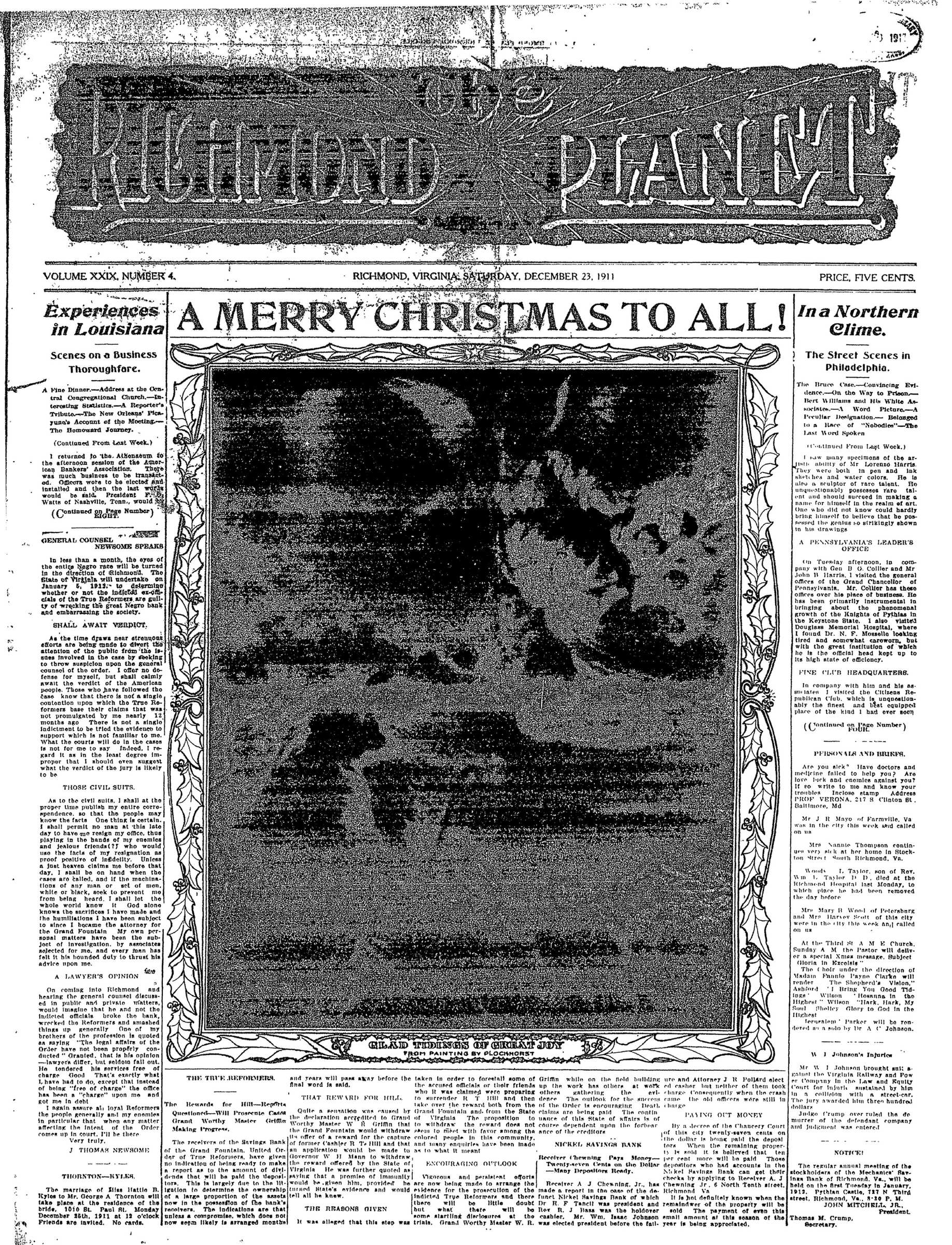
A MERRY CHRISTMAS TO ALL!
GLAD TIDINGS OF GREAT JOY
FROM PAINTING BY PLOCKHORST
THE TRUE REFORMERS
The Rewards for Hill—Reporter Questioned—Will Proscribe Cases Grand Worthy Master Griffin Making Progress.
The receivers of the Savings Bank of the Grand Fountain, United Order of True Reformers, have given no indication of being ready to make a report as to the amount of dividends that will be paid the depositors. This largely due to the limitation determined the ownership of a large proportion of the assets now in the possession of the bank's receivers. The indications are that unless a compromise, which does not now seem likely is arranged months
and years will pass away before the
final word is said.
THAT REWARD FOR HILL
Quite a sensation was caused by the declaration accepted to Grand Worthy Master W. H Griffin that the Grand Fountain would withdraw offer of a reward for the capture of an unauthorized application would be made to Governor W. H Mann to withdraw the reward offered by the State of Virginia. He was further quoted as saying that a promise of immunity from the film, provided he turned State's evidence and would tell all he knew.
THE REASONS GIVEN
It was alleged that this step was
taken in order to forestall some of the accused officials or their friends who it was claimed were proparing and then take over the reward both from Grand Fountain and from the State of Virginia. The proposition to to withdraw the reward does not seem to meet with favor among the colorado people this community, the communities have been made as to what it meant.
ENCOURAGING OUTLOOK
Vicious and persistent efforts are now being made to arrange the evidence for the prosecution of the indicted True Reformers and there there will be little doubt but what there will be some startling disclosures at the trials. Grand Worthy Master W. R.
Griffin while on the field building up the work has others at work others gathering the erk dence. The outlook for the success of the Order is encouraging. Death claims are being paid. The contin ual course of affairs is of course dependent upon the forthward ace of the creditors.
NICKEL SAVINGS BANK
Recever Chewing Pays Money
-Dollar
-Many Repositories Head
Receiver A J Chewning, Jr., has made a report in the case of the defunct Nike Savings Bank of which Dr. R. F Tancell was president and Dr. H. J Witt was the holder of cashier. Mr. Witt was elected president before the fall.
ure and Attorney J R Pollard elect
cashier, but neither of them took
charge. Consequently when the crash
the old officers were still in
charge.
PAYING OUT MONEY
By a decree of the Chancery Court of this city twenty-seven cents on the dollar is being paid the depositors. When the remaining properties in the city are believed that ten percent more will be deposited, the depositors who had accounts in the Naked Savings Bank can get their checks by applying to Receiver A. J. Chewning Jr. 6 North Tenth street, Richmond, Va. It is not definitely known when the remainder of the property will be sold and payment to the small amount at this season of the year is being appraised.
PRICE, FIVE CENTS.
Ina Northern Clime.
The Street Scenes in Philadelphia.
The Bruce Case.—Convincing Evidence.—On the Way to Prison.—Bert Williams and His White Associates.—A Word Picture.—A Perennial Designation.—Belonged to a Race of "Nobodies"—The Last Word Spoken
(Continued From Last Week.)
I saw many specimens of the aristocratic ability of Mr. Lorenzo Harris. Black hair and pores and his skintches and water colors. He is also a sculptor of rare talent. He unquestionably possesses rare talent and should succeed in making a name for himself in the realm of art. One who did not know could hardly believe that he possessed the genius so strikingly shown in his drawings.
A PENNSYLVANIA LEADER'S OFFICE
On Tuesday afternoon, in company with Gen B. G. Collier and Mr. John B. Harris, I visited the general offices of the Grand Chancellor of Pennsylvania. Mr. Collier has these offices, and he has been primarily instrumental in bringing about the phenomenal growth of the Kulights of Pythias in the Keystone State. I also visited Douglass Memorial Hospital, where I found Dr. N. F. Mosselle looking tired and some that carworm, but he gave me good advice, which he is the official head kept up to its high state of efficiency.
FINE CLUB HEADQUARTERS
In company with him and his associate I visited the Citizens Republican Club, which is unquestionably the place of the kind I had ever seen.
(Continued on Page Number)
```markdown
```
PERSONAL AND BRIEF
Are you sick? Have doctors and medicine failed to help you? Are love back and enemies against you? If so write to me and know your troubles Inclose stamp Address PROF VERONA, 217 S Clinton St. Baltimore, MD
Mr J R Mayo of Farmville, Va. was in the city this week and called on us
Mrs Nanite Thompson continues very sick at her home in Stockton Street South Richmond, Va.
Woods L. Taylor, son of Rev. Wm L. Taylor D. D. died at the Richmond Hospital last Monday, to which place he had been removed the day before
Mrs Mary B Wood of Petersburg and Mrs Harvey Scott of this city were in the city this week and called on us
At the Third St A M E Church, Sunday A M the Pastor will deliver a special Xnma message. Subject Gloria in Excelsis The Bold under the direction of Madam Phinno Payne Clarke will render The Shopper's Vision. Ashford "I Bring You Good Tidings" Wilson "Hosanna in the Highest" Wilson "Hark, Hark, My Soul Shelley Glory to God in the Highest
Jeremiah" Parker will be rendered as a solo by Dr A C Johnson.
J Johnson's Injuries
Mr W I Johnson brought suit against the Virginia Railway and Power Company in the Law and Equity Court for fraud and by him in a collision with a streetcar. The jury awarded him three hundred dollars. Juko Crump over ruled the demerur of the defendant company and judgment was entered.
NOTICE
The regular annual meeting of the stockholder of the Mechanics' Savings Bank of Richmond, Va., will be held on the first Tuesday in January, 1913. Pythian Castle, 727 N Third street, Richmond, Va., 820 P. M.
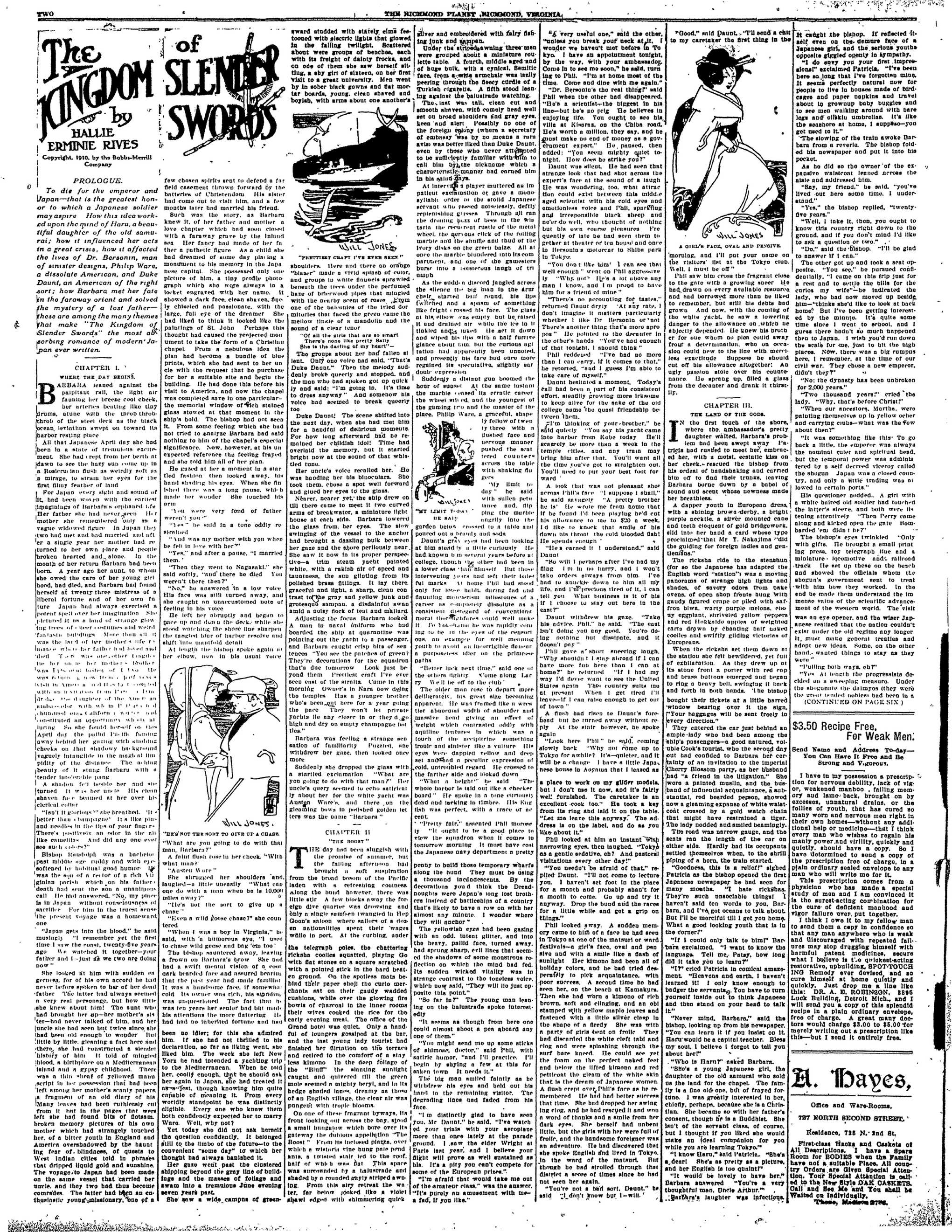
Copyright, 1910, by the Bobbs-Merrill Company
PROLOGUE.
To die for the emperor and Japan—that is the greatest honor to which a Japanese soldier may aspire How this idea worked upon the mind of Haru, a beautiful daughter of the old samurai; how it influenced her acts in a great crisis, how it affected the lives of Dr. Bersonin, man of sinister designs, Philip Ware, a dissolute American, and Duke Daunt, an American of the right sort; how Barbara met her fate in the faraway orient and solved the mystery of a lost father—these are among the many themes that make "The Kingdom of Slender Swords" the most absorbing romance of modern Japan ever written.
体
CHAPTER I.
BARBARA leaned against the palpitant rail, the light air faunting her breeze cool cheek, her arteries beating like tiny drums, atune with the throb throbb of the steel deck as the black ocean, levitating sway on toward its harbor resting place.
All that Japanese April day she had been in a state of tremendous excitement. She had crept from her berth at dawn to see the hazy sun come up in a Rosierland dust as weirdly soft as a mirtage, to strain her eyes for the first filmy feather of land
For Japan every sight and sound of it, had been worn with the earliest imaginations of Barbara or orphaned life. Her father she had never seen. Her mother she remembered only as a vague widowed figure. In Japan they two had met and had married and after a single year her mother had returned to her own place and people broken hearted and alone. In the month of her return Barbara had been born. A year ago her aunt, to whom she owed the care of her young girlhood, had died, and Barbara found her at twenty three mistresses of a liberal fortune and of her own future Japan had always exercised a potent spell over her imagination. She pictured it as a land of strange glowing trees of their costumes and weird fantastic buildings. More than all it was the land of her mother's life, where her father had loved and died. There was one other together the her mother's mother. Another was Ilyas bishop of Liao. He was returned from half a year with in America and the latter continued with an internship from Paris. In France she the daughter of the Nurse and unabashed with whom in California she and constituted an opportunity, wholly aturing. So she found herself on this April day the pallid Faith fuming away behind her gazing with shining cheeks on that shadowy background vaguely intangible in the magical nimpidity of the distance. The nothing beauty of it stung Barbara with a tender intolerable song.
A shadow felt beside her and she turned. It was her uncle. His clean abaven face beamed at her over his clerical collar.
"Isn't it glorious?" she breathed. "It's better than champagne." It is a like and needles in the tips of your fingers. There's positively an odor in the air like camellias. And did any one ever ace such colors?
Bishop Randolph was a bachelor past middle age ruddy and with eye softened by habitual good humor. It was the son of a rector of a rich Viginian parish which on his father death had sent the son an unnaughty call. He had answered. "No, my place is in Japan without consciousness of sacrifice. For him in the truest sense the present voyage was a homeward one
"Japan gets into the blood," he said muzzling. "I remember yet the first time I saw the const. twenty-five years ago. We watched it together—your father and I—just as we two are doing now."
She looked at him with sudden eagerness, for his own accord he had never before spoken to her of her dead father. The latter had always accused a very real personage, but how little she knew about him! The saint who had brought her up—her mother's sister—had never talked of him, and her uncle she had seen but twice since she had been old enough to wonder. But little by little, gleaning a fact here and there, she had constructed a slender history of him. It told of mingled blood, a birthplace on a Mediterranean island and a gypyr childhood. There was a thin sheaf of yellowed manuscript in her possession that had been left among her mother's scanty papers, a fragment of an old diary of his Many leaves had been ruthlessly cut from it but in the pages that were left she had found bits of notamn broken memory pictures of his own mother which had strangely touched her, of a bitter youth in England and America overshadowed by the haunting fear of, blindness, of quests to West Indian cities told in phrases that dripped liquid gold and sunshine. The tainted liquid gold had been made on the same vessel that carried her umbrella, and they two had thus become comrades. The latter had been an enthusiastic young missionary, one of a
of SLENDER SWORDS few chosen spirits sent to defend a far field casement thrown forward by the batteries of Christendom His sister had come out to visit him, and a few months later had married his friend.
Such was the story, as Harburn knew it, of her father and mother a love chapter which had soon closed with a faraway grave by the Inland sea. Her fancy had made of her father a pathetic figure. As a child she had dreamed of some day plating a monument to his memory in the Japanese capital. She possessed only one picture of him, a tiny profile photograph which she wore always in a pocket engraved with her name. It showed a dark face, clean shaven, surely chiseled and passionate, with the large, full eye of the dreamer. She had liked to think it looked like the paintings of St. John. Perhaps this thought had caused the projected monument to take the form of a Christian chapel. From a nebulous idea the plan had become a bundle of blue prints, which she had sent to her uncle with the request that he purchase for her a suitable site and begin the building. He had done this before his visit to America, and now the chapel was completed save in one particular—the memorial window of which stained glass stowed at that moment in the ship's hold. The bishop had not seen it. From some feeling which she had not tried to analyze Barbara had said nothing to him of the chapel's especial significance. Now, however, at his unexpected reference the feeling frayed and she told him all of her plan.
He gazed at her a moment in a star-
tled fashion then looked away, his
hand shading his eyes. When she fin-
ished there was a long pause, with b
made her wonder. She touched his
arm
"You were very fond of father
werent you"
"Yes" he said in a tone oddly re-
strained
"And was my mother with you when he fell in love with her?" "Yes," and after a pause, "I married them."
"Then they went to Nagasaki," she said softly, "and there he died. You weren't there then?" "No," he answered in a low voice. His face was still turned away, and she caught an unacustomed note of feeling in his voice.
He left her abruptly and began to pace up and down the deck, while she stood watching the shore line sharpen the tangled blur of harbor resolve and shift into manifold detail.
At length the bishop spoke again in her bow, now in his usual voice
WILL JONES.
"KEE'S NOT THE MORT TO GIVE UP A CHASE.
"What are you going to do with that man, Barbara?"
A faint flush rose in her cheek. "With what man?"
"Auston Ware"
She shrugged her shoulders 'and laughed a little unacely "What can one do with a man when he is 10.000 miles away?"
"He's not the sort to give up a chase"
"Even a wild goose chase?" she countered.
"When I was a boy in Virginia," he said, with a humorous eye, "I used to chase wild geese and bag 'em too."
The bishop sauntered away, leaving a frown on Inharrh's grow. She had a swift mental vision of a cool dark boarded face and assured bearer that the past year had made familiar. It was a handsome face, if somewhat cold. Its owner was rich, his attendant was unquestioned. The fact that he was ten years her senior and had much attention the more flattering. He had no inherited fortune and had
been no idler; for this she admired him. If she had not thrilled to his declaration, so far as liking went, she liked him. The week she left New York he had intended a yachting trip to the Mediterranean. When he told her, coolly enough, that he should ask her again in Japan, she had treated it as a-feat, though knowing him quite capable of meaning it. From every worldly standpoint he was distinctly eligible. Every one who knew them both confidently expected her to marry Ware. Well, why not?
Yet today she did not ask herself the question confidently. It belonged still to the limbo of the future—to the convenient "some day" to which her thought had always banished it.
Her gaze went past the clustered shipping beyond the gray line of buildings and the masses of foliage and swam into a tremulous June evening seven years past.
She saw a wide campus of green-
THE RICHMOND PLANET, RICHMOND, VIRGINIA.
ward studded with stately almost fez-footed with electric lights that plowed in the falling twilight. Scattered about were groups of benches, each with its freight of daly frocks, and on one of them she saw herself sitting, a aby girl of sixteen, on her first visit to a great university. Men went by in sober black gowns and flat mortar boards, young, clean shaved and boyish, with arms about one another's
WILL JONES
"PHEETLEE SHAPE LVR EVER BREW."
abbutora. Here and there an orange "blazer" made a vivid splash of color, and groups in white flannels sprawled beneath the trees under the perfumed haze of brilier pipes that mingled with the nearby scent of roses. From one of the balconies of the tried doritories that faced the green name the mellow tint of a mandolin and the sound of a clear tenor
"Of all the girls that are so smart There's none like pretty Sally She is the darling of my heart"—
The groups about her had fallen silent. Only one voice had said, "That's Duke Danaut." Then the melody suddenly broke querely and stopped, and the man who had spoken got up quickly and said: "I'm going in. It's time to dress anyway." And somehow his voice had seemed to break querely too.
Duke Daunt! The scene shifted into the next day, when she had met him for a handful of delirious moments. For how long afterward had he remained her childish idol! Time had overlaid the memory, but it started bright now at the sound of that whistled tune. Her uncle's voice recalled her. He was handling her his binoculars. She took them, chose a spot well forward and clued her eyes to the glass.
Nearer, nearer yet, the ship drew on till there came to meet it two curved arms of breakwater, a miniature light house at each side. Barbara lowered the glass from her eyes. The slow swinging of the vessel to the anchor had brought a dazzling bulk between her gaze and the shore perilously near. She saw it now in its proper perspective—a trim steam yacht painted white, with a rakish air of speed and tenuous, the sun glinting from its polished brass fittings. It lay there, graceful and light, a sharp, clean con trast of the gray and yellow junk and grotesque sampan, a disdainful swan amid a noisy dock of teet and mallard.
Adjusting the focus Barbara looked
A man in naval uniform who had
boarded the ship at quarantine was
pointing out the yacht to a passenger,
and Barbara caught crisp bits of
sentence "You see the patches of green"
They're decorations for the aquadion
that's due tomorrow. Look just
beyond them. Prettiest craft I've ever
seen out of the straits. Came in this
morning. Owner's in Nara now doing
the temples. Has a younger brother
who's been, out here for a year going
the pace. They won't let private
yachts lie any closer in or they'd go
high and dry on empty champagne bottles.
Barbara was feeling a strange sensa-
tion of familiarity. Puzzled, she
withdrew her gaze, then looked once more
Suddenly she dropped the glass with a started exclamation "What are you going to do with that man?" The uncle's query seemed to echo satirically about her for the white yacht was Autun Wareau, and there on the gleaming bows in polished golden letters was the name "Barbara."
"THE BOOST"
11:22 day had been sluggish with the promise of summer, but the failing afternoon had brought a soft suspiration from the broad bosom of the Pacific laden with a refreshing cookiness, along the hind however, there was little stir. A few blocks away the foreign dive quarter was drowning and only a single samphire twangled in Hep Goon's saloon where sailors of a dozen nationalities spent their wages while in port. At the curbing, under
the telegraph poles, the chattering ricksha coolies squatted, playing Go with flat stones on a square scratched with a pointed stick in the hard beaten ground. On the spotless mats behind their paper shoji the curio merchants sat on the gaudy wadded cushions, while over the glowing fire bowls of charcoal in the inner rooms their wives cooked the rice for the early evening meal. The office of the Grand hotel was quiet. Only a handful of youngers gossiped at the bar, and the last young lady tourist had finished her dirtion on the terrace and retired to the comfort of a stayless kimono. In the deep foliage of the "Bluff" the slanting sunlight caught and quivered till the green mole seemed a mighty beryl, and in its hedge shaded lanes, dreamy as those of an English village, the clear air was pungent with trouble blooms.
On one of these fragrant bywings, the front looking out across the bay, stood a small hungawl which bore over its gateway the dubious appellation "The Roost." From its included plaza, over which a wisteria vine bung pale pond ants, a twisted skirt led to the roof, half of which was that. This space was surrounded by a talustrade and shaded by a rounded early stripped awing. From this airy retreat the water, far below jooked like a violet shawl edged with shimmering quick
silver and embroidered with fairy fishing junk and gamen.
Under the stitched dawn three men were grouped about a miniature roulette table. A fourth, middle aged and of huge butch, with a cynical, Sanitic face, from a wife armchair was laxly peering through the deezy curdle of a Turkish cigarette. A fifth stood leaning against the balustrade watching.
The last was tall, clean cut and smooth shaven, with comely bead well set on broad shoulders and gray eyes, keen and alert. Possibly no one of the foreign mony (where a secretary of embassy was by no means a run awa) was better liked than Duke Daunt, even by those who never attempted to be sufficiently familiar with him to call him by the nickname which a characteristic manner had earned him in his sound days.
At interview a player muttered as an patient examination or gave a monosyllabic order to the stolid Japanese servant who passed insensitively, defy repellent glueses. Through all run the drowning pizz of bees in the wisteria the recipient rattle of the metal wheel, the curious click of the rolling marble and the shuffle and thud of the ivory disks on the green baize. All at once the marble blundered into its compartment, and one of the gamesters burst into a monstrous laugh of triumph.
As the sudden discord jangled across the silence the big man in the armchair started buff round, his lips swelled and a spasm of something like fright crossed his face. The glass at his eye was empty but he raised it and drained air while the ice in it tinkled and tinkled. He get it down and wiped his lips with a half furry glance about him, but the curious agitation had apparently been unnoticed and presently his face had once more regained its speculative, slightly sarc double expression.
Suddenly a distant gun boomed the hour of sunset. At the same instant the marble ceased its erratic career the wheel wilted, and the youngest of the gaming troop and the master of the place, Philip Ware, a graceful, shape.
is fellow of two
three with a
flushed face and
nervous manner
pushed the sander
counters
across the table
with shaking fingers
100
"My limit to day" he said with sullen pet lance and, flip, pling the marble angrily into the ditch table and
lance and, flip
piling the marble
HE MAIL
angrily into the
garden below crossed to a table and
poured out a brandy and soda.
Daunt's gray eyes had been looking
at him steadily a little curiously. He
had known him several years before at
college, though the other had been in
a lower class than himself. But those
intervealing years and left their taler
ful marks. At home Phil had stood
only for those burgles during fad and
daunting memorabilies milestones of a
career as completely dissolve as a
consistent disregard of conventional
moral thirst. Highlights could well make
it. To look at him he was rapidly coming
to be in the eyes of the consent
ous, an example for well meaning
youth to avoid an inerrigible flavor
a purposeless adher on the primrose
paths.
"Better luck next time," said one of
the others tightly. "Come along Larry.
Well be off to the club."
The older man rose to depart more deliberately, his great size becoming apparent. He was framed like a wristband, abnormal width of shoulder and massive hand giving an effect of weight contrasted oddly with aquiline textures in which was a touch of the aceripine something troubled and slender like a vulture. His eyes were dappled yellow and deep set and had a peculiar expression of cold, untreated regard. He crossed to the farther side and looked down.
"What a height!" he said. "The whole burrow is said out like a checker board." He spoke in a tone currunely dakd and lacking in timbre. His fang fish was perfect, with a trace of acent.
"Pretty fair," assented Phil morroney. "It ought to be a good place to view the squondron when it comes in tomorrow morning. It must have cost the Japanese navy department a pretty
penny to build those temporary wharfs along the bung. They must be using a thousand incendences. By the decorations youd think the Dreadnoughts were Japan's long lost brothers instead of battleships of a country that's likely to have a row on with her almost any minute. I wonder where they will anchor."
The yellowish eyes had been gazing with an odd, intent glitter, and into the heavy, pallid face, turned away, had sprung sharp, cell lines that seemed the shadows of some monstrous reflection on which the mind had fed. Its sudden wicked vitality was in strange contrast to the toneless voice, which now said, "They will lie just opposite this point."
"So far in? " The young man leaning on the balustrade spoke interestedly.
"It seems as though from here one could almost shoot a pea aboard any one of them."
"You might send me up some sticks of shimose, doctor," said Phil, with satiric humor, "and I'll practice. I'll begin by shying a few at this for anken town. It needs it."
The big man smiled faintly as he withdrew his eyes and held out his hand to the remaining visitor. The decrying lines and faded from his face.
"I'm distinctly glad to have seen you, Mr Daunt," he said. "I've watched your trials with your aeroplane more than once lately at the parade ground. I saw the elder Wright at Paris last year, and I believe your flight will prove as well sustained as bla. It's a pity you can't compete for some of the European prizes."
"I'm afraid that would take me out of the amateur class," was the answer. "It's purely an amusement with me a-fad, if you like."
"& very useful one," said the other, "unless you break your neck at it, I wonder we haven't met before in Tokyo. I have an appointment tonight, by the way, with your ambassador. Come in to see me soon," he said, turning to Phil. "I'm at home most of the time. Come and dine with me again." "Dr. Bersonlu's the real thing?" said Phil when the other had disappeared. "He's a scientist—the biggest in his line—but he's no prig. He believes in enjoyment. You ought to see his villa at Kisarra, on the Chiba road. He's worth a million, they say, and he must make no end of money as a government expert." He paused, then added: "You seem mighty quiet tonight. How does he strike you?"
Daunt was silent. He had seen that strange look that had shot across the expert's face at the sound of a laugh. He was wondering, too, what attraction could exist between this misdle aged scientist with his cold eyes and emotionless voice and Phil, sparkling and irresponsible black sheep and noter-do well, who thought of nothing but his own course pleasures. Frequently of late he had seen them to gather at theater of tea house and once in her room's motorcar in Shiba park in Tokyo.
"You don't like him!" I can see that well enough" went on Phil aggressively "Why. Why not?" He's a lot above any man I know, and I am proud to have him for a friend of mine."
"There's no accounting for taste."
returned Dawn dryrig. "At any rate, I don't imagine it matters particularly whether I like Dr. Bernson or not. There's another thing that's more apropos." He pointed to the decaturer in the other's hands. "You've had enough of that tonight. I should think."
Phil reedened. "I've had no more than I can carry. If it comes to that," he retorted, "and I guess I'm able to take care of myself."
Daintest moment. Today's call had been a part of his consistent effort, steadily growing more ikrema to keep alive for the sake of the old college name the quasl friendship between them.
"I'm thinking of your brother," he said quietly. "You say his sachc came into barbor from Kobe today. He'll scarcely be more than a week in the temple cities, and any train may bring him after that. You'll want all the time you've got to straighten out. You'll need to put your best foot for ward."
Aook that was not pleasant show across his face "I suppose I shall," he said savagely "A pretty brother he is" He wrote me from home that if he found I'd been playing he'd cut his allowance to me to $20 a week. I'd like to knock that smile of his down his throat the cold blooded dash He spends enough "
"He's earned it I understand," said Dannet
"No will I perhaps after I've had my fling I'm in no hurry, and I won't take orders always from him. I've had to knuckle down to him all my life, and I'm precious tired of it, I can tell you. What business is it of him if I choose to stay out here in the caint?"
Daunt withdrew his gaze. "Take his advice. Phil," he said. "The east isn't doing you any good. You're doing nothing but dissipate, and it doesn't pay."
Phil gave a short sneering laugh. "Why shouldn't I stay abroad if I can have more fun here than I can at home?" he returned. "If I had my way I'd never want to see the United States again. This country suits me at present. When I get tired I'll leave-if I can raise enough to get out of town."
A flush had risen to Dawn's forebend but he turned away without reply. At the stair however, he spoke again.
"Look here Phil." he spol, coming slowly back. "Why not come up to Tokyo for awhile? It's—a quilter, and it will be a change. I have a little Japanese house in Aoyama that I tensed as
a place to work on my gilder modela,
but I don't use it now, and it's fairly
well furnished. The caretaker is an
excellent cook too." He took a key
from his ring and laid it on the table.
"Let me leave this anyway." The address
is on the label, and do as you
like about it."
Phil looked at him an instant with
narrowing eyes, then laughed. "Tokyo
as a gentle sedative, chh?" And pastoral
visitations every other day!"
"You needn't be afraid of that." replied Daunt. "I'll not come to lecture
you. I haven't set foot in the place
for a month and probably won't for
a month to come. Go up and try it
anyway. Drop the bund and the races
for a little while and get a grip on things."
Phil looked away. A sudden memory came to him of a face he had seen in Tokyo at one of the matsuari or ward festivals—a girl's face, oval and pen-sive and with a smile like a dash of sunlight. Her kimono had been all of holiday colors, and he had tried desperately to pick acquaintance, with poor success. A second time he had seen her, on the beach at Kamakura. Then she had worn a kimono of rich brown, soft and clinging, and an obl stamped with yellow maple leaves and fastened with a little silver clasp in the shape of a freedy. She was with a party of girls sent on frolic. They had discarded the white cleft tabl and clog and were splashing through the surf bare kneed. He could ace yet the foam on the perfect naked feet and below the lifted kimono and red petticoat the gleam of the white skin that is the dream of Japanese women. A flush creep over Phillis face as he remembered. He had better success that time. She had dropped her swinging clog, and he had rescued it and won a word of thanks and a smile from her dark eyes. She herself had unbent little, but the girls with her were full of frolic, and the handsome foreigner was an adventure. He had discovered that she spoke English and lived in Tokyo. In the ward of the matsuari. But through he had strolled through that district a score of times since he had not seen her again.
"You're not a bad sort, Daunt." he said
"I don't know but I will."
"Good," said Daunt. "I'll send a chit to my caretaker the first thing in the
WILL JONES
morning, and I'll put your name on the visitors' list at the Tokyo club. Well, I must be off."
Phil saw him cross the fragrant close to the gate with a growing nose. He had drawn on every available resource and had borrowed more than he liked to remember, but still his debts had grown. And now, with the coming of the white pacht, he saw a lowering danger to the allowance on which he objectly depended. He knew his brother for one whom no plan could away from a determination, who on occasion could now to the line with menilex exactitude. Suppose he should cut off his allowance altogether: An ugly passion stole over his countenance. He sprang up, filled a glass from the decanter and drank it thirstily.
CHAPTER III.
THE LAND OF THE CODE
N the first touch of the shore
where the ambassador's pretty
daughter whited. Barbara's prob
lem had been swept away *Patricia had rudged to meet her*, embraced her, with a moist, ecstatic kiss on her cheek, rescued the bishop from his ordeal of handshaking and carried him off to find their trunks, leaving Barbara borne down by a babel of sound and scent whose newness made her breathless. A dapper youth in European dress, with a shining brown-derby, a bright purple necktie, a silver mounted cane and teeth cloquent of gold bridgewow, slid into her hand a card whose typo proclaimed that Mr Y. Nakajima "did the guiding for foreign ladies and gentlemen."
the rickskis ride to the stenhanu
(for so the Japanese has adapted the
English word "station") was a moving
panoramas of strange high lights and
shades, of savory odors from bake
ovens, of open shop fronts hung with
gaudy figured crape or piled with saf-
ron blown, warty purple melons, choy-
egplant, shriveled yellow peppers
and red hokkaido apples of weighted
cars drawn by chanting half naked
cooils and swiftly gliding victories
of Europeans.
When the rickskis set them down at
the station she felt bewildered, yet full
of exhilaration. As they drew up at
its stone front a porter with red cap
and brass buttons emerged and began
to ring a heavy bell, swinging it back
and forth in both hands. "The bishop
bought their tickets at a little barred
window bearing over it the sign,
"Your haggages will be sent freely in
every direction."
They entered the car just behind an ample-indy who had been among the ship's passengers—a good natured, voluble Cook's tourist, who the second day out had confided to Barbara her certainty of an invitation to the imperial Cherry Blossom party, as her husband had a "friend in the litigation." She wore a painted muslin, and the husband of influential acquaintance, a substantial, red bearded person, showed now a gleaming expanse of white waistcoat crossed by a gold watch chain that might have restrained a tiger. The lady nodded and smiled beamingly. The road was narrow gauge, and the seats ran the length of the car on either side. Hardly had its occupants settled themselves when, to the shrimp piping of a horn, the train started.
"Goodness, this is a relief!" sighed Patricia as the bishop opened the first Japanese newspaper he had seen for many months. "I hate rickshaws. They're such unsociable things I haven't sent ten words to you, Barbara, and I've got oceans to talk about. But I'll be merciful till I get you home. What a good looking youth that is in the corner!" "If I could only talk to blim!" Barbara exclaimed. "I want to know the language. Tell me, Patay, how long did it take you to learn?" "I cried Patricia in comical amazement. Heaven's and earth. I haven't learned it! I only know enough to badger the servants. You have to turn yourself inside out to think Japanese and then stand on your head to talk it."
"Never mind, Barbara." said the bishop, looking up from his newspaper, "You can learn it if you insist on it. Haru would be a capital teacher. Bless my soul, I believe I forgot to tell you about her!" "Who is Haru?" asked Barbara. "She's a young Japanese girl, the daughter of the old samurai who sold us the land for the chapel. The family is a fine old one, but of frayed fortune. I was greatly interested in her, chloe, perhaps, because she is a Christian. She became so with her father's consent, though he is a Buddhist. She isn't the servant class, of course, but I thought if you liked she would make an ideal companion for you while you are learning Tokyo."
"I know Hara," said Patricia. "She's a dear, dear! Rhea's as pretty as a picture, and her English is too quaint!" "It would be lovely to have her," Barbara answered "You're a very thoughtful man. Uncle Arthur." BarBara's laughter was infectious.
It caught the blasphe. It reflected itself even on the demure face of a Japanese girl, and the serious youths opposite giggled openly in sympathy. "I do envy you your first impressions" exclaimed Patricia. "I've been here so long that I've forgotten mine. It seems perfectly natural now for people to live in houses made of bird-cages and paper napkins and travel about in grownup baby buggies and to see men walking around with bare legs and oilskin umbrellas. It's like the seashore at home, I suppose—you get used to it."
"The slowing of the train awoke Barbara from a reverie. The blasphe folded his newspaper and put it into his pocket.
As he did so the owner of the expansive waletone leaned across the aisle and addressed him.
"Say, my friend," he said, "you've lived out here some time. I understand."
"Yes," the bishop replied, "twenty-five years."
"Woll, I take it, then, you ought to know this country right down to the ground, and if you don't mind I'd like to ask a question or two."
"Do," said the bishop, "I'll be glad to answer if I can."
The other got up and took a seat opposite, "You see," he pursued confidentially, "I came on this trip just for a rest and to settle the bills for the curtos my wife"—he indicated the lady, who had now moved up beijing—him "shields me like to look at back home." But I've been getting interested by the minute. It's quite some time since I went to school, and I guess there hadn't so much happened then to Japan. I wish you'd run down the scale for me, just to hit the high places. Now, there was a big rumpus here, I remember, at the time of our civil war. They chose a new emperor, didn't they?"
"No; the dynasty has been unbroken for 2,000 years."
"Two thousand years" cried 'the lady, "Why, that's before Christ!"
"When our ancestors, Martha, were painting themselves up in yellow ocher and carrying clubs—what was the flow about then?"
"It was something like this: To go back a little, the emperor was always the nominal ruler and spiritual bead, but the temporal power was adminis tered by a self decreed viceroy called the shogun. Japan was a closed country, and only a little trading was allowed in certain ports."
His questioner nodded. A girl with a white birthed old soldier had touched the latter's sleeve, and both were its tening attentively. "Then Perry came along and kicked open the gate. Hombared 'em didn't be?"
The bishop's eyes twinkled "Only with gifts. He brought a small printing press, toy telegraph line and a miniature locomotive and railroad track. He set up these on the beach and showed the officials whom the shogun's government sent to treat with him how they worked. In the end he made them understand the immense value of the scientific advancement of the western world. The visit was an eye opener, and the wiser Japanese realized that the nation couldn't exist under the old regime any longer. It must make general treaties and adopt new ideas. Some, on the other hand, wished things to stay as they were."
"Pulling both ways, eh?"
"Yes. At length the progressists decided on a sweeping measure. Under the shogun the dalmys (they were the great wounded nobles) had been in a (CONTINUED ON PAGE SIX.)
(CONTINUED ON PAGE SIX)
$3.50 Recipe Free.
For Weak Men!
Send Name and Address To day—
You Can Have It Free and Be
Strong and Vigorous.
I have in my possession a prescription
for nervous debility, lack of vigor,
weakened manhoo, falling memory
and lame-back, brought on by
excesses, unnatural drains, or the
follies of youth, that has cured so
many worm and nervous men right.
their own homes—without any additional help or medicine—that I think
every man who wishes to regain his
many power and virility, quickly and
quietly, should have a copy. So I
have determined to send a copy of
the prescription free of charge, in a plain ordinary sealed envelope to any
man who will write me for it.
This prescription comes from a
physician who has made a special
study of men and I am convinced it
is the surest-acting combination for
the cure of deficient manhood and
vigor failure ever, put together.
I think I owe it to my fellow man to send them a copy in confidence so that any man anywhere who is weak and discouraged with repeated failures may stop drugging himself with harmful patent medicines, secure what I believe is the quickest-acting restorative, upbuilding, SPOT-TOUCH ING Remedy ever devised, and so cure himself at home quietly and quickly. Just drop me a line like this: DR. A. E. ROBINSON, $885 Luck Building, Detroit Mich., and I will send you a copy of this splendid recipe in a plain ordinary envelope, free of charge. A great many doctors would charge $3.00 to $6.00 for merely writing out a prescription like this—but I send it entirely free.
A. Hayes,
Residence, 725 N. 2nd St.
First-class Hacks and Caskets of
All Descriptions. I have a Spare
Room for BODIES when the Family
have not a suitable Place. All country Orders are Given Special Attention. Your Special Attention is called to the New Style DAK CASKETS. Call and See Me and You shall be Waited on Individually.
Those, Madison 2786.
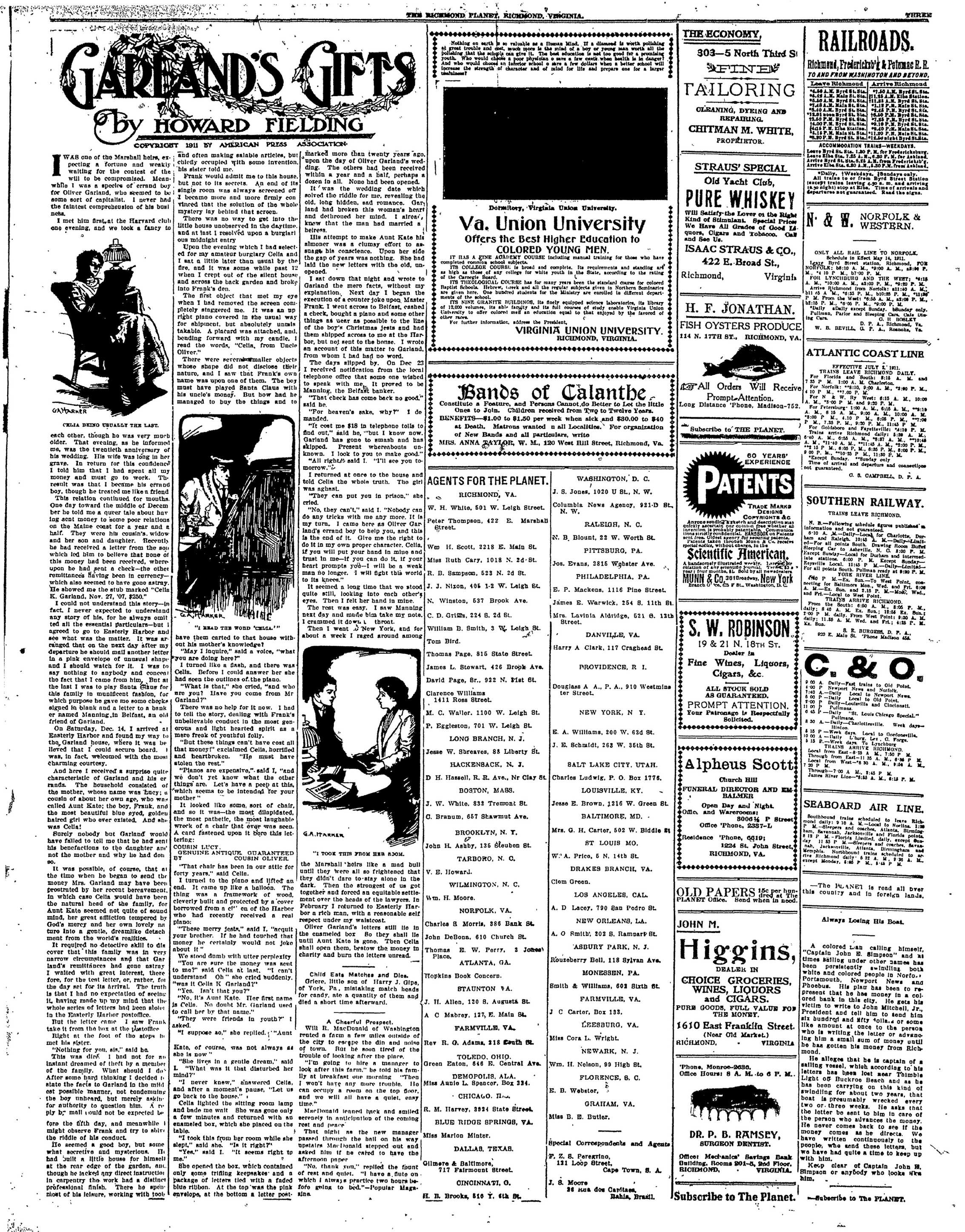
GARLAND'S GIFTS BY HOWARD FIELDING
COPYRIGHT 1911 BY AMERICAN PRESS ASSOCIATION
I WAS one of the Marshall heirs, expecting a fortune and weakly waiting for the contest of the will to be compromised. Meanwhile I was a species of errand boy for Oliver Garland, who seemed to be some sort of capitalist. I never had the faintest comprehension of his business. I met him first, at the Harvard club one evening, and we took a fancy to
GA HARNER
each other, though he was very much older. That evening, as he informed me, was the twentieth anniversary of his wedding. His wife was long in her grave. In return for this confidence I told him that I had spent all my money and must go to work. The result was that I became his errand boy, though he treated me like a friend. This relation continued for months. One day toward the middle of December he told me a queer tale about having sent money to some poor relations on the Maine coast for a year and a half. They were his cousin's widow and her son and daughter. Recently he had received a letter from the son which led him to believe that none of this money had been received, where upon he had sent a check—the other remittances having been in currency—which also seemed to have gone astray. He showed me the stub marked "Celia K. Garland, Nov. 27, '07, $250."
I could not understand this story—in fact, I never expected to understand any story of his, for he always omitted all the essential particulars—but I agreed to go to Easterly Harbor and see what was the matter. It was arranged that on the next day after my departure he should mail another letter in a pink envelope of unusual shape and I should watch for it. I was to say nothing to anybody and conceal the fact that I came from him. But at the last I was to play Santa Claus for this family in mundificent fashion, for which purpose he gave me some checks signed in blank and a letter to a banker named Manning, in Belfast, an old friend of Garland.
On Saturday, Dec. 14, I arrived at Easterly Harbor and found my way to the Garland house, where it was be lieved that I could secure board. I was, in fact, welcomed with the most charming courtesy.
And here I received a surprise quite characteristic of Garland and his erands. The household consisted of the mother, whose name was Eucy; a cousin of about her own age, who was called Aunt Kate; the boy, Frank, and the most beautiful blue eyed, golden haired girl who ever existed. And she was Cella!
Surely nobody but Garland would have failed to tell me that he had sent his benefactions to the daughter and not the mother and why he had done so.
It was possible, of course, that at the time when he began to send the money Mrs. Garland may have been prostrated by her recent bereavement, in which case Cella would have been the natural head of the family, for Aunt Kato seemed not quite of sound mind, her great affection tempered by God's mercy and her own lovely nature into a gentle, dreamlike detachment from the world's sanctities.
It required no detective skill to discover that this family was in very narrow circumstances and that Garland's remittances had gone astray I waited with great interest, therefore, for the test letter, or, rather, for the day set for its arrival. The truth is that I had no expectation of seeing it, having made up my mind that the whole series of letters had been skipped in the Easterly Harbor postoffice.
But the letter came I saw Frank take it from the box at the platoffice Right at the foot of the steps he met his sister. "Nothing for you, sis." said he.
This was dirt. I had not for an instant dreamed of theft by a member of the family. What should I do? After some hard thinking I decided to state the facts to Garland in the most possible manner, not condemning the boy unheard, but merely asking for authority to question him. A reply by mail would not be expected before the fifth day, and meanwhile I might observe Frank and try to abide the riddle of his conduct.
He seemed a good boy, but some what secretive and mysterious. He had built a little house for himself at the rear edge of the garden, and though he lacked any direct instruction in carpentry the work had a distinct professional finish. There he spanned most of his leisure, working with tools
and often making salable articles, but chiefly occupied with some invention, his sister told me.
Frank would admit me to this house, but not to its secrets. An end of its single room was always screened off. I became more and more firmly convinced that the solution of the whole mystery lay behind that screen.
There was no way to get into the little house unobserved in the daytime, and at last I resolved upon a burglarious midnight entry.
Upon the evening which I had selected for my amateur burglar Colla and I sat a little later than usual by the fire, and it was some while past 12 when I crept out of the silent house and across the back garden and broke into Frank's den.
The first object that met my eye when I had removed the screen completely staggered me. It was an up right piano covered in the usual way for shipment, but absolutely unruly takable. A placard was attached, and, bending forward with my candle, I read the words, "Cella, from Uncle Oliver."
There were several smaller objects whose shape did not disclose their nature, and I saw that Frank's own name was upon one of them. The boy must have played Santa Claus with his uncle's money. But how had he managed to buy the things and to
G. A. HARKER
"I READ THE WORD 'CELIA'" have them carted to that house without his mother's knowledge?
"May I inquire," said a voice, "what you are done here?"
I turned like a flash, and there was Cella. Before I could answer her she had seen the outlines of the piano.
"What is that," she cried, "and who are you? Have you come from Mr Garland?"
There was no help for it now. I had to tell the story, dealing with Frank's unbelievable conduct in the most generous and light hearted spirit as a mere freak of youthful folly.
"But these things can't have cost all that money!" exclaimed Cella, horrified and heartbroken.
"He must have stolen the rest."
"Planos are expensive," said I, "and we don't yet know what the other things are. Let's have a peep at this, which seems to be intended for your mother."
It looked like some, sort of chair,
and so it was—the most dilapidated,
the most pathetic, the most laughable
wreck of a chair that ever was seen.
A card fastened upon it bore this lettering:
COUSIN LUCY.
GENUINE ANTIQUE. GUARANTEED
BY
COUSIN OLIVER
"That chair has been in our attic for forty years," said Cella. I turned to the piano and lifted an end. It came up like a balloon. The thing was a framework of wood, cleverly built and protected by a cover borrowed from a cl" en of the Harbor who had recently received a real piano: "These merry jests," said I. "acquit your brother. If he had touched that money he certainly would not joke about it." We stood dumb with utter perplexity "You are sure the money was sent to me?" said Cella at last. "I can't understand Oh" she cried suddenly. "was it Cella K Garland?" "Yes. Isn't that you?" "No. It's Aunt Kate. Her first name is Cella. No doubt Mr. Garland used to call her by that name." "They were friends in youth?" I asked.
"I suppose so," she replied. "Aunt
Kate, of course, was not always as she is now."
"She lives in a gentle dream," said L. "What was it that disturbed her mind?"
"I never knew," answered Cella, and after a moment's pause, "Let us go back to the house."
Cella lighted the sitting room lamp and bade me wait. She was gone only a few minutes and returned with an enameled box, which she placed on the table.
"I took this from her room while she slept," said she. "Is it right?"
"Yes," said I. "It seems right to me."
She opened the box, which contained only some trifling keepsakes and a package of letter tied with a faded blue ribbon. At the top was the pink envelope, at the bottom a letter post-
marked more than twenty years ago, upon the day of Oliver Garland's wedding. The others had been received within a year and a half, perhaps a dozen in all. None had been opened. It was the wedding date which solved the riddle for me, revealing the old, long hidden, sad romance. Gary land had broken this woman's heart and dothrouln her mind. I aloud, know that the man had married a beirress.
His attempt to make Aunt Kate his almoner was a clumsy effort to assuage his conscience. Upon her side the gap of years was nothing. She had laid the new letters with the old, unopened.
I sat down that night and wrote to Garland the mere facts, without my explanation. Next day I began the execution of a counter joke upon Master Frank. I went across to Belfast, cashed a check, bought a piano and some other things as wear as possible to the line of the boy's Christmas jests and had them shipped across to me at the Harbor, but not sent to the house. I wrote an account of this matter to Garland, from whom I had no word.
The days slipped by. On Dec 23 I received notification from the local telephone office that some one wished to speak with me. It proved to be Manning, the Belfast banker.
"That check has come back no good," said he.
"For heaven's sake, why?" I demanded.
"It cost me $18 in telephone tolls to find out," said he, "but I know now. Garland has gone to smash and has skipped. Present whereabouts unknown. I look to you to make good."
"All right," said I. "I'll see you tomorrow.">
I returned at once to the house and told Cella the whole truth. The girl was nghast.
"They can put you in prison," she cried.
"No, they can't," said I. "Nobody can do any tricks with me any more. It is my turn. I came here as Oliver Garland's errand boy to help you, and this is the end of it. Give me the right to do it in my own proper character. Cella, if you will put your hand in mine and trust in me—if you can do it, if your heart prompts you—I will be a weak man no longer. I will fight this world to its knees."
It seemed a long time that we stood quite still, looking into each other's eyes. Then I felt her hand in mine.
The rest was easy. I saw Manning next day and made him take my note. I crammed it down to a throat.
Then I went to New York, and for about a week I raged among among
G.A. HARPER
"I TOOK THIS FROM HER ROOM. the Marshall 'holes like a mad bull until they were all so frightened that they didn't dare to-stay alone in the dark. Then the strongest of us got together and forced an equitable settlement over the heads of the lawyers. In February I returned to Easterly Harbor a rich man, with a reasonable self respect under my waistcoat. Oliver Garland's letters still lie in the enameled box. So they shall lie until Aunt Kate is gone. Then Cells shall open them, browst the money in charity and burn the letters unread.
Child Eats Matches and Dies.
Griere, little son of Harry J. Gips,
of York, Pa, mistaking match heads
for candy, ate a quantity of them and
died a short time afterward.
A Cheerful Prospect:
Will R. MacDonald of Washington rented a farm a few miles outside of the city to escape the din and noise of town. But he soon tired of the trouble of looking after the place.
"I'm going to hire a manager to look after this farm," he told his family at breakfast one morning. "Then I won't have any more trouble. He can occupy a room on the top floor, and we will all have a quiet, easy time."
MacDonald leaned back and smiled eerily in anticipation of the coming rest and peace.
That night as the new manager passed through the hall on his way upstairs MacDonald stepped out and asked him if he cared to have the afternoon paper
"No, thank you." replied the fount of rest and quiet. "I have a flute on which I always practice two hours before going to bed."—I popular magazine.
Nothing on earth is so valuable as a Human Mind. If a diamond is worth polishing at great trouble and cost, much more is the mind of a boy or young man worth all the polishing that the school can give it. The best education is not too good for a promising youth. Who would choose a poor physician o save a few cents when health is in danger, And who would choose an inferior school o save a few dollars when a better school will increase the strength of character and of mind for life and prepare one for a larger usefulness?
Va. Union University Offers the Best Higher Education to COLORED YOUNG MEN
IT HAS A GINE ACADEMY COURSE including manual training for those who have completed common school subjects.
ITS COLLEGE COURSE is broad and complete. Its requirements and standing are as follows: any college for white youth in the State, according to the rating of the Carnegie Basket.
ITS THEOLOGICAL COURSE has for many years been the standard course for colored Baptist Schools. Hebrew, Greek and all the regular subjects given in Northern Seminaries are given here. One hundred students for the Ministry are enrolled in different departments of the school.
ITS NINE GRANITE BUILDINGS, its finest equipped laboratories, its Library of 12,000 volumes, its able faculty and its full courses of study enable Virginia Union University to offer colored men an education equal to that enjoyed by the favored of other races.
For further information, address the President,
VIRGINIA UNION UNIVERSITY.
RICHMOND, VIRGINIA.
of Calanthe
and Persons Cannot do Better to Lot the little
children received from Two to Twelve Years.
$1.50 per week when sick and $80.00 to $40
wants wanted in all Localities. For organization
and all particulars, write
W. M., 120 West Hill Street, Richmond, Va.
PLANET.
High Street.
Marshall
WASHINGTON, D. C.
J. S. Jones, 1020 U St., N. W.
Columbia News Agency, 921-D St.
N. W.
RALEIGH, N. C.
---
Constitute a Feature, and Persons Cannot, do Better to Lot the little Ones to Join. Children received from Two to Twelve Years.
BENEFITS—$1.00 to $1.50 per week when sick and $80.00 to $40
at Death. Matrous wanted n all Localities. For organization
of New Bands and all particulars, write
MRS. ANNA TAYLOR, W. M., 120 West Hill Street, Richmond, Va.
AGENTS FOR THE PLANET.
W. H. White, 501 W. Leigh Street.
Peter Thompson, 422 E. Marshall Street.
Wm H. Scott, 2218 E. Main St.
Miss Ruth Cary, 1018 N. 2d St.
R. B. Sampson, 523 N. 2d St.
J. J. Nixon, 406 1-2 W. Leigh St.
N. Winston, 537 Brook Ave.
C. D. Griffis, 224 S. 2d St.
Lleigh St.
E. P. Mackens, 1116 Pine Street.
Ave.
James E. Warwick, 254 S. 11th St.
Mrs. Lavinia Aldridge, 521 S. 12th
Street.
Lleigh St.
DANVILLE, VA.
Street.
Harry A Clark, 117 Craghead St.
Clarence Williams
1411 Ross Street.
M. C. Waller. 1100 W. Leigh St.
P. Eggleston, 701 W. Leigh St.
LONG BRANCH, N. J.
D H. Hassoll, R. R. Ave., Nr Clay 54
BOSTON, MASS.
R. Mrs. G. H. Carter, 502 W. Biddle St
Con St. ST LOUIS MO.
C. W.' A. Price, 5 N. 14th St.
DRAKES BRANCH, VA.
C. Clem Green.
LOS ANGELES, CAL.
NORFOLK, VA.
Charles B Morris, 386 Bank St.
John DoBonn, 610 Church St.
J. H. Allen, 120 S. Augusta St.
A C Mabrey, 127, E. Main St.
FARMVILLE, VA.
Rev R. G. Adams, 218 South St.
TOLEDO, OHIO.
Green Eaton, 646 E. Central Ave.
DEMOPOLIS, ALA.
Miss Annie L. Spencer, Box 224.
CHICAGO, IL.
R. M. Harvey, 3824 State Street.
BLUE RIDGE SPRINGS, VA.
Miss Marlon Mintor.
DALLAS, TEXAS.
Oilmore & Baltimore,
717 Fairmount Street.
CINCINNATI, O.
South St.
Miss Cora L. Wright.
NEWARK, N. J.
Central Ave.
Wm. H. Nelson, 99 High St.
FLORENCE, S. C.
324.
E. B. Webster,
GRAHAM, VA.
Street.
B, VA.
Miss B. E. Butler.
RICHMOND, VA.
William B. Smith, 3 W. Leigh St.
Tom Bird.
Thomas Page, 815 State Street.
James L. Stowart, 426 Brooke Ave.
David Page, Sr., 922 N. 91st St.
Jesse W. Shreaves, 88 Liberty St. HACKENSACK, N. J.
J. W. White, 832 Tromont St.
C. Branum, 657 Shawmut Ave.
BROOKLYN, N. Y.
John H. Ashby, 135 Steubon St.
TARBORO, N. C.
V. E. Howard.
WILMINGTON, N. C.
Wm. H. Moore.
Thomas
Place.
E. W. Porry, 2 Jones
ATLANTA, GA.
Hopkins Book Concern.
STAUNTON 9A.
H. B. Brooks, 610 Y. 6th St.
N. B. Blount, 22 W. Worth St.
PITTSBURG, PA.
Jos. Evans, 2815 Wgster Ave.
PHILADELPHIA, PA.
PROVIDENCE, R I.
Douglass A. A., P. A., 910 Westminster Street.
NEW YORK, N Y.
E. A. Williams, 200 W. 63d St.
J. E. Schmidt, 263 W. 35th St.
SALT LAKE CITY, UTAH.
Charles Ludwig, P. O. Box 1776.
LOUISVILLE, KY.
Jesse E. Brown, 1216 W. Green St.
BALTIMORE, MD.
A. D Lacey, 790 San Pedro St.
NEW ORLEANS, LA.
Rouzeberry Boll, 118 Sylvan Ave.
MONESSEN, PA.
Smith & Williams, 602 Sixth St.
FARMVILLE, VA.
J C Carter, Box 133.
LEESBURG, VA.
Special Correspondents and Agents
F. Z. B. Peregrino,
121 Loop Street,
Cape Town, S. A.
J. S. Moore
26 Rua dos Capitaes,
Bahia, Brazil.
CLEANING, DYERING AND REPAIRING.
CHITMAN M. WHITE,
PROPRIETOR.
Old Yacht Club.
Will Satisfy the Lover of the Right Kind of Stimuliant. Special Prices We Have All Grades of Good Liquors, Cigars and Tobacco. Call and See Us.
ISAAC STRAUS & CO.,
422 E. Broad St.,
Richmond, Virginia
H. F. JONATHAN.
FISH OYSTERS PRODUCE
114 N. 17TH ST., RICHMOND, VA.
All Orders Will Receive
Prompt Attention.
Long Distance Phone, Madison-752.
Subscribe to THE PLANET
60 YEARS' EXPERIENCE
PATENTS
TRADE MARKS
DESIGN
COPYRIGHTS & C
Anyone sending a sketch and description may quickly ascertain our opinion free whether an invention is patented or not. Copyrights strictly confidential. HANDBORN On Patents sent from Oldest agency for securing patents. Patents taken without charge, in the Scientific American.
A handsomely illustrated weekly. Perfec ration of any scientific journal. Perfec year four months. $L. Bold by all newadvertisers
MUNN & Co. 381 Broadway, New York
Branch C. F. B. Washington D.C.
S. W. ROBINSON
19 & 21 N. 18TH ST.
Dealer in
Fine Wines, Liquors,
Cigars, &c.
ALL STOCK SOLD
AS GUARANTEED.
PROMPT ATTENTION.
Your Patronage is Respectfully
Solicited.
Alpheus Scott
Church Hill
FUNERAL DIRECTOR AND EM BALMER
Open Day and Night.
Office and Warerooms:
8006% P Street
Office 'Phone, 2387-L
Residence 'Phone, Q419;
1224 St. John Street,
RICHMOND, VA.
OLD PAPERS 15c per hp
PLANET Office. Send when in need.
JOHN M.
Higgins,
DEALER IN
CHOICE GROCERIES,
WINES, LIQUORS
and CIGARS.
PURE GOODS, FULL VALUE FOR
THE MONEY.
1610 East Franklin Street.
(Near Old Market.)
RIICHMOND. VIRGINIA
Phone, Monroe-2636,
Office Hours: 8 A. M. to 6 P. M.
DR. P. B. RAMSEY,
SURGEON DENTIST.
Office: Mechanics' Savings Bank
Building, Rooms 201-5, 2nd Floor.
RICHDMOND. VIRGINIA.
Subscribe to The Planet.
THREE
RAILROADS.
ACCOMMODATION TRAINING - WEEKDAYS.
Leave B&B St. 6a, 1:30 p. M. For Frederickburg.
Leave Eba St. 6a, 7.50 A. M., 6.20 p. M. For Ankland.
Arrive Eba St. 6a, 7.50 A. M., 6.20 p. M. For Ankland.
*Daily, | Weekdays, | Sundays only.
All trains to or from B&B Street Station
(except trains leaving 4.50 a. m. and arriving
at B&B Street Station) departures not guaranteed. Read the signs.
N. & W. NORFOLK & WESTERN.
N. & W. NORFOLK & WESTERN.
ONLY ALL RAIL LINE TO NORFOLK.
Schedule in Effect May 14, 1911.
Lexage Byrd Street station, Richmond, FOR
NORFOLK: K10.1 A. M., *9:00 O. M. a,* B20.9 P.
M., *410 P. M.,* b70.0 P. M.
FOR LYNCHBURG AND THE WEST; *8:18
A. M., *10:00 A. M.,* a20.0 P. M., *9:20 P. M.
Arrive Richmond from Norfolk: a11:40 A. M.
b10.9 P. M., *6:35 P. M.,* b10.12 P. M., *11:28
P. M. From Norfolk: a8.55 A. M., a20.8 P. M.
b12.15 P. M., *9:00 P. M.,* b10.0 P. M.
"Daily dally except Sunday, b Sunday only,
Pullman,帕拉和拉曼, Outside the city.
*Dally* a *Dally* except Sunday, b *Sunday* only,
Pulliman, Parlor and Sleeping Cars, c *Daily*
*Dining Car*. D. P. A., Ritchie,
W. B. BEVILL, G. P. A., Ritchie,
Ya.
ATLANTIC COAST LINE
EFFECTIVE JULY 2, 1911
For N & W. Ry West: 6:15 A. M., 10:00 A. M., 7:00 P. M. and 9:50 P. M.
For Petersburg: 1:00 A. M. 6:15 A. M. ***8:18 A. M. 8:15 A. M. 9:00 A. M. 10:00 A. M.**8:00 P. M. 4:10 P. M. 8:05 P. M. ***7:06 P. M. 9:50 P. M. 11:15 P. M.**
For Goldblake: 1:00 A. M. 9:50 A. M. 11:15 P. M. ***7:06 P. M. 9:50 A. M. 11:15 P. M.**
Trains arrive Nicholas: 1:00 A. M. 6:55 A. M. 8:87 A. M. ***10:48 A. M. 6:55 A. M. 8:87 A. M.**10:48 A. M. ***11:40 A. M.**11:40 A. M. ***12:00 P. M. 6:05 P. M. 6:55 P. M. 8:00 P. M. 9:00 P. M. 11:50 P. M.**
*Except Sunday* ***Sunday only***
Time of arrival and departures and connectees not guaranteed.
G. B. CAMPBELL, D. P. A.
SOUTHERN RAILWAY
SOUTHERN RAILWAY
TRAINS LEAVE RICHMOND.
M. B.—Following schedule figures published in information and not guaranteed.
information and not guaranteed.
6:00 P.M. - Local for Charlotte, Durham
and Raleigh. 1:40 P.M. - Limited-
For all points South. Drawing Room
Sleeping Car to Asheville, N. C. 8:00 P.M.
Sleeping day—Local for Durham and interm-
mediate Sunday—Local for Except Sunday—
Riverville Local. 1:14 P.M. - Limited-
For all points South.蒲拉罕 read-
able. YORK RIVER LINE
4:40 P. M.-Ex. Sun.—To West Point, con-
specting for Baltimore Mon., Wed. and Fri. 8:00
P. M.-Ex. Sun. and 2.15 P. M.-MoSe, Wed.
and Fri. 10:00 to West Point.
THANKS TO PETE RICHMOND.
From the South: 8:00 P. M., 8:05 P. M.,
daily; 8:40 A. M. Ex. Sun., 18:55 Ex. Sun.
2:00 P. M. daily, From West Point: 9:20 A. M.
2:00 P. M. daily, From West Point: 4:25 P. M.
Kx. Sun.
B. E. BURGESS, D. P. A.
920 E. Malo St. 'Phone Madison 454.
9 00 A. Daily—Fast trains to Old Point.
9 01 A. Newport News and Norfolk.
7 400 A.-Daily Local to Newport News.
9 01 P.-Daily Local to Old Point.
9 100 P.-Daily-Louisville and Cincinnati.
11 00 P.-Louisiana.
9 100 P.-Missouri.
Lyndsburgh to Lyrhbond
THAINS ARRIVING HIOMOND.
Local from East-8 12 A. M. 7:50 P M.
Through from East-11 35 A. M. 8:58 P M.
Local from West-8 30 A. M. 8:58 A. M.
225 Through-7 00 A. M. 3:45 P M.
James Hiver Line-225 A. M.
SEABOARD AIR LINE
Bouthbound trains scheduled to leave Richmond daily: 9 10 A.M. - Local to Norling. 1:30 P.M. - Sleepers and coaches, Atlanta, Birmingham, Savannah, Jacksonville and Florida points. 5 12 P.M. - Florida Limited, daily, except Bumashay, 11 35 P.M. - Sleepers and coaches, Savannah, Jacksonville, Atlanta, Birmingham and Memphis. Northbound trains scheduled to arrive Richmond daily: 6 32 A.M., 9:20 A.M., except Monday, 5:05 P.M., 5:45 P.M.
The PLANET is read all over this country and in foreign lands.
Always Losing His Boat
A colored Llan calling himself, "Captain John E. Simpson" and as times skiling under other names has been persistently swimming both white and colored people in Norto. Portsmouth, Newport News and Phoebus. His plan has been to represent that he has money in a colored bank in this city. He gets his victim to write to John Mitchell, Jr., President and tell him to send him six hundred and fifty dollars or some like amount at once to the person who is writing the letter or advancing him a small sum of money until he has gotten his money from Richmond.
He alleges that he is captain of a sailing vessel, which according to his letters has been lost near Thimble Light off Buckroo Beach and as he has been carrying on this kind of swindling for about two years, that boat is presumably wrecked every two or three weeks. He asks that the letter be sent to him in care of the person who advances the money. He never comes back to see if the money comes as he directs. We have written continuously to the people, who send these letters, but we have had quite a time to keep up with him.
Keep clear of Captain John H. Simpson or anybody who looks like him.
Subscribe to The PLANET.
Published every Saturday by JOHN MITCHELL
JR., at All N Fourth Street, Hirschwood, Va.
JOHN MITCHELL, JR., EDITOR
all communications intended for publication
should be sent no as to reach us by Wednesday
MERCHES IN ADVANCE
One Copy, per year 11.50
One Copy, six months 1.50
One Copy, six months 3.50
One Copy, four months 4.50
One Copy, three months 4.50
Single Copy 4.50
ADVOCATING RATES
For one inch one insertion 10.00
For one inch each subsequent insertion 4.00
For two inches, three months 10.00
For two inches, six months 10.00
For two inches, nine months 14.00
For two inches, twelve months 20.00
Marriage and Marital Notices, one inch 10.00
Stapling and Translent Notices, per line 10
MORTAGE STAMPING OF A HIGHER DEFINITION
THAN TAMPED NOTES, RECEIVED
ON SUBSCRIPTIONS
THE PLANET is latest weekly. The subscript
the letter is H. 110,000 years, in addition
There are four ways by which money can be sent by mail at our mail. In a Post Office Money Order, the money is sent by a postal service. Money Order, and when none of these can be procured, in a Registered Offer. In a Registered Offer, the money is sent by a Post Office, possible at the Richmond Post Office and we will be responsible for its delivery.
lue for money lent by any of those companies. The Express Money Order is a safe and secure money order. EXPRESS MONEY ORDERS can be obtained at any office of the American Express (to the United States) or Express Money Order (to any office of the United States). We will be responsible for REGISTERED LETTER. If a Money Order, Post Office or an Express Order will Register the Letter you wish to send us on payment of ten cents. Then, if the Letter is lost or stolen it can be trawn. You can send money, in this form, to the American Express.
We cannot be responsible for money sent to letters in any other way than one of the ways mentioned above. If you send your money in any other way, you must do it at your own talk.
HENKWALA, ETC. If you do not want the GATE card issued for another year after your subscription has run out, you then notify us by Postal Caml to discontinue it. The courts have decided that subscriber will not name and address the full cost of their paper and discontinuing at the expiration of time for which it has been paid are liable for the payment of the subscription up to date when they order the paper discontinuing.
COMMUNICATIONS When writing to us to renew your subscription or to discontinue your paper you should give us your name and address otherwise we cannot find your name on our books.
CHANGE OF ADDRESS In order to change the address of a subscriber we must be sent the former as well as the present address.
Entered at the Post Office at Richmond, Va., as second class mailer
SATURDAY DEC 23, 1011
Politeness is a valuable asset with which to begin the New Year's business
The Jews are discriminated against What about the citizens of color?
0
Those people who want war should read the daily history of Italy and Turkey
Worry kills just as many people as disease, because worry produces disease and disease death
Do not be discouraged, but remember that this is a world of disappointment, of trouble trials and event tribulations.
-() ----
President Tatt is determined to be renominated. He is the strongest candidate inside of the Republican Party, and the weakest one outside of it.
____0____
The politicians and the statesmen in this country have attracted the attention of the world to the fact that Russia has been, and is doing, just what this country has been, and is doing, denying admission within our borders to subjects of other countries who are not wanted.
Colored folks should understand that our greatest troubles will be found within. The race must begin the work of self-purification. Many of our leaders disregard fundamental principles and are as unjust to their own people, as are many of the white Negro-haters, whom they abuse and criticize.
0
The reports from Bristol Va. relative to the wholesale selling of their votes by white men, both Republicans and Democrats, would indicate that the attempt to get rid of a venal electorate upon the basis of color, by the disfranchisement of Negroes has proven a dismal failure.
DO YOU EVER
GET DISCOURAGED?
Remember That Your Chances Aro
Apt to Be Brightest Just When
You Think Them
Blackest.
(N Y. Evenlag Journal)
More than one of our readers have written letters expressing discouragement. A man whose letter indicates thought, intelligence and ambition writes, among other things, "I have done my best, I have realised it tried to be of give to other people while looking after my own interests and the interests of my family. Yet I feel that I have made no hardway that all the effort has gone for nothing. Is the world realised it controlled by benevolence or is it controlled by luck and chance?"
The world is ruled by justice. We come into it subject to certain regulations certain fixed punishments for definite transgressions. The laws governing us are eternal and unchanging. When a body falls from a roof it is dashed to the ground and destroyed whether to be the body of an innocent child or that of a murderer. The law of gravitation now no favors.
The same laws for all and the same results from all action, each is the law under which we live. It is just and calculated to make men think, struggle and develop
Discouragement is often a good sign. The man who is not discouraged about himself is satisfied about himself. And satisfaction with one self means lack of growth. The man who is contented has stopped growing. The man who worries and feels discouraged is probably the coming man.
The greatest men that have lived have gone through periods of black discontentment. We wish that our readers could know this and take hearts in their own discouraged hours.
Independence with all his glory still ahead of him was tainted to kill himself at one time. And he was tempted to marry a fat fat off woman without loving her which is even worse.
Henry George whose splendid character has set so good an example to be world, was reduced almost to crime, and he was reduced practically to starvation.
A man far greater than Napoleon or any monarch that ever lived was Abraham Lincoln and his mind, over and over was filled with the deepest discouragement before he had even begun to do his great work for his nation and for the world.
When he was beaten by Douglas in his race for the Senate he really believed that he had earned the career he wrote. He wrote.
I am glad I made the late race. It gave me a hearing on the great and durable question of the age which I could have had in no other way and though I now sink out of sleep and shall be forgotten. I believe I have made some marshs which will tell for the cause of civil liberty long after I am gone.
If Lincoln could sink so low in despondency and rise later to the wonderful work that we owe to him there is no reason for any man to be finally discouraged or give up.
A fine sword takes a great deal of bralming harmering before it has the edge and the temper to cut. And the man who is going to amount to anything must be forced, hammered and sharpened by disappointment, dislusion and discouragement. No man can end through life like a stone butting for the butcher. It takes storms, troubles and discouragement to form a character worth anything.
Get your German neighbor to translate this from Goetho.
Es bildet ein Talent sich in der Stille
Sich ein Charakter in dem Strom über Welt.
Lincoln doing his best, absolutely sincere, was subjected to the vileest abuse in addition to suffering defont.
There was no insult that was not flung at him. There was no shameful accusation not made against his pure character.
Over and over he must have wished himself out of the fight and many times as we know, he was discouraged and felt that his life had failed. Remember that he had lack of confidence in fight with his poverty to keep him back, he had early failure in business through no fault of his own - which lended him with a debt difficult to pay he had poor relatives hanging upon him. But while he did get discouraged, and while he expressed this discouragement he kept on trying and was ready for the next thing as soon as it came
We have quoted this extract from Lincoln's letter today believing that it will give encouragement to other good men temporarily discouraged who need to be reminded that darkness does precede the light. That no man has ever climbed the hill of success and achievements without going through the deep valley of discouragement that lies on this side of the big mountain.
$100.00 ENDOWMENT PAID
1.
Danyville, Va Dec 18 1911
This is to certify that I have received from John Mitchell Jr. Grand Worthy Counselor of the Grand Court of Virginia, Order of Calanthe ($100 00). One Hundred Dollars, in payment of the death claim of Sister Nora Wade, who was a member of Industrial Court, No. 74 of Danville, Virginia.
Hattie O. West, Impaotrix.
U. S. Cunningham.
S. J. Holbrook, Deputy.
---Subscribe to The PLANET.
THE RICHMOND PLANET, RICHMOND, VIRGINIA.
In a Northern Clime.
(Continued From Pare Number)
among the colored people I later visited Mr. A. S. Jones, who conducts a bar at 514 South Fifteenth street. He has just purchased that two houses adjoining his present quarters and expects to conduct a hotel
ONLY TWO IN THE BUSINESS
It was stated that there are only two colored men in Philadelphia. Licensed to sell liquor, Mr. A S Jone is one and Mr Amos M Scott the other and yet thousands of colored people patronize these kind of resorts. It was ten o'clock when I reached Mr Harris' residence, and bid grand Chancellor B G Collier good luck after the evening's experience.
CULD NOT LEAVE
I had hoped to leave that night for Richmond, but it was hoping against hope and so I resigned re-entry. I was going away with a great disappointment.
MANY CASES
I had observed with interest the node of procedure in the United States District Court. White, men charged with various forms of swindling were arraigned before white juries. I saw no colored men among those summoned. One white man had represented an insurance company. Every person who insured and to whom unbenefited was sent into the company as being dead. He went to the person who had become unbenefited and got him to let him have the lapsed policy. He would report the man as dead, make allowances to this effect and a check from the company would follow with the name of the Secretary therein.
ROBBED INSURANCE COM
PANY
He would forge the name of the tenureary and collect the money. The accused man's lawyer set up the plan that he was an epileptic and did not know what he was doing. The jury thought differently, and found him guilty. Then followed the delivery of the sentence by Judge Holland a fine of $5,000 and confinement in the pentughettary for two years.
Another white man advertised that he would loan money on any property anywhere.
He used the United States Bank. The publisher was there to testify that it was by the direction of the accused that the advertisement was inserted. His counsel pleaded that he did not intend to defraud the government. He told that he had a wife and daughter dependent upon him for support.
FINE AND IMPRISONMENT
The jury found him guilty and he was fined $ 5,000 and sent to the penitentiary for two years 'The government inspector appeared against a white machinist, charged with counterfeiting. The evidences of his handwork were jingled upon the table. He hadorne a previous good character and it was alleged that he did not realize fully the enormity of his offense. The Jury found him guilty and Judge Holland stated that he would be light with him as it was his first offense. He directed that he pay the costs of court and sentenced him to nine months' imprisonment. All of the men were led away immediately to the lock-up in the Federal building. I had been given the freedom of the spacious rooms and when not writing for the Planet lounged about awaiting my turn to testify in the Bruce case which up to that time had not been called by the United States Marshal.
BRYCE CASE CALLED
Wednesday morning December 13, 1911 I was in the Federal building on time and went to the court room. After settling cases in which the defendants pleaded guilty, the case of the government against D. D and H Bruce was called. Both of the accused men were represented by who attorney the one representing D. D Bruce. Attorney Scott, I was informed to one of the altesters that the case against H Bruce was made to have the cases of the two brothers tried separately, but judge Holland overruled the motion and the testimony of the witnesses was begun
THE HOOPOO OF THIRTEEN
It may be of special interest to write that here were mediums or alleged fortune tellers, the destroyers or allowed destroyers of conjugation, who believed in signs and symbols, forced to a trial on the thirteenth of the month which must have been as objectiveable to them as a trial would be on a 11 day. What appeared more charismatic was the striking off of one of the panel of jurymen by counsel and the ringing voice of United States Marshal directing that he should take his place. United States District Attorney Walter H. Douglas had carefully prepared his case and none of the points so essential in order to secure a conviction on had been neglected. He called Postoffice Inspector Earnahaw to the stand.
THOSE DECOY LETTERS
He explained that he had sent sentenc- letters to Dr D D Bruce in response to the advertisement in The Planet. These letters were read. One was dated from Greenwood. B. and another from Columbia. G. and another from Columbia. Both were asked or conjured and also about brinching back to them of a lover.
Dr. Bruce's letter in reply informed them that he could do the work for $35.00. Upon their informing him that they did not have that much money, he informed them that they could pay him $10.00 cash and $2.00 in regular installments until the money had been paid. In the meantime he had been play. It may be well to state that the Postmaster Inspector had sighed light.
Dr. Bruce's, letters, in reply, though, went to the postmasters in Georgia and South Carolina, where the postmasters sent them on to the Postoffice Inspector Kearshaw at Philadelphia. In all cases Prof Bruce required a deposit of $1.00 before he would answer questions. Then a letter was sent from Columbus, Tennessee. The postmaster there was advised what to do. This letter was mailed to the Postmaster by Postoffice Inspector Kearshaw at Philadelphia and then mailed from that point to Prof Bruce. The $1.00 was sent
THE AMOUNT WANTED.
Professor Bruce wanted $35.00 A man importing to be a father wanted him to find his daughter, who had it hard. He also wanted good luck and protection against other troubles, he had lost tricked and he wanted it got away. Prof Bruce was to tell that he did not have $7.00 then, he could take it in time. He was told by Bruce to send $9.00 more and $2.00 as he got it. It was explained that his daughter had gotten in trouble with a young man and this was why she off home but that he (Bruce) would later meet above the Postoffice importer, in or the assumed name told him he had found out that this was really why the daughter had left home and he was soiling him the $2.00 for him to work in case and take off the spell
THE CHARM IN EVIDENCE
For Bruce sent a charm he was to wear all the time on his left side. The money was sent by registered letter. The receipts were produced and the charm shown to an annual audience and an interested jury. In the mountaine Attorney Scott sat by the side of Dr D. Bruce and made objections to much of the evidence. Judge Holland listened to him patiently and then after hearing the District Attorney in a court language replied, "Objection overruled." Again and again as the case proceeded the lawyer rose stated his contention. The court asked a few questions and then the same reply came, "Objection overruled." Counsel excepted. In one or two instances the points made were sustained but those present soon tooed for the same declaration. Objection overruled."
POSTMASTER THEREFOOT
As a matter of fact the government had carefully prepared its case and gifted its evidence Counsel for the accused had insisted that the Postmaster, who had done the re-training, should be there to testify. Postoffice Inspector Earnshaw could not know of his own knowledge that the remaining had taken place. The United States District Attorney simply looked amused, for as soon as Postoffice Inspector Earnshaw left the stand that very Postmaster, who had come all the way from Columbus, Tenn. took the stood and testified of the own knowledge that he had mailed and remitted the decoy letters.
WHY I WAS WANTED
Postoffice Inspector Earnahaw had testified that when he went to arrest Dr Bruce and his brother, the former had stated that the advertisement had been continued In The Planet without his order and with out his paying therefor John Mitchell, Jr. Editor of The Richmond (Va) Planet, was called and I took the stand, testifying that the advertisement was first inserted March 17, 1906, had been discounted September 22, 1906, being renewed September 22, 1906, and had been published ever since. Dr D D Bruce had paid for it regularly every three months except for the last three months which did not been paid
FAID FOR ADVERTISEMENT
I informed counsel that he paid for the advertisement by check signed D) D Bruce Attorney Scott wanted to know if I knew that Prof Bruce signed the check. I could not know that, for the reason that he was in Philadelphia and I was in Richmond. The checks went through the bank all right. A colored woman from Staunton testified that she sent Dr Bruce money and her letter was good. A colored woman from Pittsburgh, Pa., testified that the planet also sent him money. Technicolor points were raised by counsel for the defense and proof demanded that Dr Bruce had received the money.
THE CHAIN COMPLETED
The government put a Philadelphia letter carrier on the stand who had delivered the registered letter to Dr Bruce. It was in the afternoon of December 13, 1911, that argument of counsel was heard. Then followed the ringing charge of Judge James B Holland to the jury. The jurors retired and within twenty minutes they had returned with a verdict finding both brothers guilty of using the United States mails to degrade. Counsel for the convicted Dr Bruce announced that he desired to argue some points of law and Judge Holland did not sentence the prisoners but carried the motion over until the next day. The wife of Dr. D Bruce, a tall lady of bright complexion, was an interested listener.
ON THE WAY TO PRISON.
A few moments later the Judge rolled from the bench, the tall form of Dr Bruce followed the United States Marshal to the lock-up in the Federal building, while his brother of short stature followed him. Five hours before both were free men, out on ball, now they were prisoners of the government and would spend their first night within the gloomy
confines of the prison as the wards of Uncle Sam. It may be well to state that they produced no witnesses, and did not testify in their own behalf. I felt sad and wont on the outside where the miltage for the witnesses summoned was being compiled, and the formal discharge from further service noted.
DISH OF FROG LEG8.
I went out on Market street, now crowded with Christmas shopper. I enjoyed myself looking in the brilliantly lighted shop wipdows and seeing the sights in the great John Wan amaker store. I went to the Broad Street Station where I had lunch on Recollections of those frog's legs which had given me so much appetite last year at Columbus. I orose before me and it was not long before I had placed an o fer for what I saw on the bill of fare 'Frog's legs' (2) breaded. I saw the waiter coming. There was no doubt now as to the fact that frog had at some time used those two pairs of legs. You could tell it in the dish
SAW HERT WILLIAMS
A reunion of feeling followed I wished I had not placed the order I would have cannellled the order but I could not I swallowed my disgust and this was soon followed by a mouth full of frog's leg. All antipatha to them vanished. The taste was glorious and I sat there until I had completed the task" and I ate pate and drank cream to conclude this remarkable repast in the dining hall of the Broad Street Station. The waiter had come to know me. One of them said. There is Bert Williams. I did not see him then but later he came in and I stepped forward to greet him. He was playing at the Chestnut Street Opera House in the play Ziegfeld Follies."
BERT WILLIAMS
The reputation of Williams and Walker as comedians is his well night world wide. The death of Walker left him alone. I saw a tall fine looking colored man almost a muatatto in color. He was accompanied by a well dressed colored man of darker completion. Why they were in the railway station I never knew, but after shaking hands with Mr Williams and introducing myself, I gave him one of the booklets of the Mechanics' Savings Bank and turned to Go. Looking backward a moment later, he said, "He's He. He and his companion were standing before the bar conversing, a place which I had not before noticed. Having heard so much about the famous comedian, I decided that I would go that night to hear him.
WENT ALONE TO THE PLAY
I did not get in touch with my host and hostess Mr and Mrs John B Harris in time and therefore had to go on my own hook I walked into the Chestnut Street Opera House and inquired as to prices for reserved seats. I was told that they were $150, $100 and 75 cents I thought that as the best shows on Market Street were 10 cents, with 20 cents for reserved seats, that surely I would be comfortable in a 75 cent "stitting down place". It was marked family circle I proceeded to climb When I had reached the "roof" the last gallery, I found Seat No 15" reserved It was a bench with the numbers marked thereon, and I was given an end seat just the third bench from the front ruffling I could count the ridges in the ceiling.
FEW COLORED FOLKS THERE
There were few colored people here and as the $1.50 hour came white ladies and gentlemen filed in until well night every sent-in in this play house had been taken.
I had "frown high" without knowing it, but from my position I could see plainly and hear distinctly, being an unknown in the City of Brotherly Love, where I could observe to my heart's content the part taken by Bert Williams, the lone colored actor in this aggregation of white talent, which had entertained two contiunits. I might as well admit that this was a fine pauy. The actors were "stars" in their respective spheres. I looked down below to the other reserved seats, those of the $1.50 and upwards kind.
BRUCE'S ATTORNEY THERE
I saw, or think I saw, the smiling countenance of Dr D D Bruce's attorney. He was enjoying himself while the prisoner and his brother were no doubt spending troubled hours in that lookup in that stone Federal building on the corner of North and Market Streets. It would take too much space to describe the play I wanted to see and hear Bert Williams. In the aggregation of actors, chorus girls and men, I saw no sign of him. There was a big yellow dog who attracted much attention and caused much amusement and caused much dog understood his buddiness and asked to wonder after the dog had been kicked and gave forth gonald howls if I was not then looking at the form of Bert Williams.
REALLY BELIEVED IT
I did not know it then I do not know it now, but you certainly will not complain if I tell you that I had my suspicion.
The play was magnificent I would have paid $150 for a seat to witness this great opera which carried with it such a great moral lesson I saw the program and "The Symbols." They represented Every Wife, Happiness, Jealousy, Squabbin, Care, Dress, Excitement, Elegance, Kindness, Gaiety, Loveliness, Grace, Vanity, Magnificence, Magnificent, Every Husband, Rhymes, Rhymes, Gamble and with the white action male and female, answering to these designations, where would you suppose they had placed Bert Williams, the colored comedian, and what symbol had they assigned to him?
THAT STRIKING SYMBOL
We require a representation in RICHMOND who is in touch with its best citizens to take subscriptions for THE CRISIS, the national Negro Magazine. The work is dignified and profitable. ADDRESS THE CRISIS, 20 Vesey St., New York, N.Y.
10 West Leigh Street, Richmond, Virginia.
LARGE CAPACIOUS WARE-ROOMS, FILLED WITH THE LATEST DESIGNS FROM THE BEST MANUFACTORIES IN THE UNITED STATES PROMPT AND POLITE SERVICE, ORDERS RESPONDED TO DAY OR NIGHT.
Determined to furnish the very BEST service at the LOWEST Rates possible, the Patronage of the Public is Solicited.
LONG DISTANCE 'PHONE, MADISON—686.
20 Assorted Post-cards 10cts CONSISTING OF LOVE AND COMIC TOPICS AND ALSO SCENES OF WASHINGTON. We Carry a Full Line of Cards for All Holidays. Cards Sent Postpaid on Receipt of Ten Cents. Address ENTERPRISE POSTCARD COMPANY, 2112 Eighth Street, N. W. Washington, D. C.
rung down. A white gloved hand carefully parted the costly drapery in the middle, then followed a black arm, and then a woolly head and a face as black as charcoal, with glaucony eyes and red and yellow lips, while a body wearing an ill-fitting black Prince Albert coat and pants which might be termed "high water" made a bow to the audience and began to deliver a most sensible and entertaining lecture upon the Symbols. It may be well to state that Bort Williams appeared under the symbol of "Nobody." The lone representative of the race was advertising the undone condition of a people staggering under a load of vituperation and misrepresentation. He was in the play. He was there because the playright had to create a place for him, due to his past reputation and present brilliant attributions, as well as the friendship of the manager and owner who controls Zolgeld Folies.
THAT PARTING LOOK.
When Bert Williams ind concluded the moralizing speech upon the short-comings of married men, he shuffled off from the footlights, amidst the applause of the audience giving a side-splitting look as he disappeared in the wings" of the stage. His last appearance was the occasion of a song, which upon being enced, he returned to stag again. Then a magnificent scene of that New York Central Depot followed, after the regular rendition. It was in the "good old winter time" a colored porter, known as Rufus Redcap, who was none other than Bert Williams, appeared climbing upon the flooded trade. He had a airtight case of a tourist, who was climbing up from below. He had a rope tied around his waist, just as though he was climbing the mountains of the Alps in Switzerland. The porter had the other end
A PORTER'S BLENDER
When they reached the top of the treatie the English tourist puffed and staggered from exhaustion. He told Rufus Redcap (Bert Willeman) that he wanted to catch the train in time. He explained what traip he wanted "Why," said Rufus "that track is No 24, down below." Then followed a look of agony in the countenance of the passenger. He had climbed up. Now he must crawl down, and Rufus did not want to carry his satchel any further. He moreover explained that he was only a substitute porter and didn't much about the trains anyway. The tourist looked down below and remarked how deep it was Rufus Redcap explained that it was shallow, being only 127 feet deep. There were other places where they were blasting which were much
A TOURIST'S MISFORTUNE
The tourist slipped off the trestle and fell below *4*. Then the rope followed him until it was taut. Rufus began pulling in the line until it was piled up on the trestle. Bloom the head of the tourist was seen again as he was puffing. When he was almost up to the top he caught one of the trestleans and asked for a match. Rufus let go the rope to get the match and the tourist, having no support, shot down into space again. Rufus began pulling him up again. When his head appeared the first thing he said was to tell Rufus not to give him a match. Finally he reached the top and talked for quite a while, then he slipped off on the other side, the rope got away from Rufus, a blast of dynamite from the rocks below the rope shot up and Rufus declared that he could see the white man blown over the church steeple, and so he throw the suit case into the space below. Thou audience was convulsed with laughter and the curtain went down while a trottedomous applause greeted Bert Williams.
THE FINAL CHAPTER.
colored costumes. The "Stars" were at the footlights preparatory to the ringing down of the curtain.
My train was to leave at 12:15 A.M. M it was then 11 07. I gathered up my belongings, sprang up the titer of landings, then down the stairway to the street below, then to 415 South Eleventh street. I found Mr. and Mrs. Harris awaiting me. Bidding them good-bye, I took my suit case, boarded a street car, billed Lorenzo Harris adieu and a few minutes later was walking down Market street to the Broad Street Station. It was useless to transfer so an officer said, as I could walk it before a car would take me thorow it entered the station, was shown the way to the Richmond sleeper and found my berth ready.
RESTING AT LAST.
I lay there reading a morning's poster. This lasted just five minutes and I sank to rest on a pillow oblivious of my surroundings, until the porter told me I was near Ashland. I then learned that Rov. J. S. Russell, of Lawrenceville, Va., was aboard. He looked so much like a white man that I did not know him. It was 7:30 when I reached Elba and shortly afterwards I was entering my own residence at Richmond, after my picturesque experience in that northern city.
~~~
JOHN MITCHELL, JR.
University Conference of the Higher Colored Schools.
The sixth annual conference of principals and teachers of the higher Colored Schools of Virginia will be held at Virginia Union University Thursday and Friday, December 28 and 29.
This conference brings together representatives of a score of the highest colored schools in the State Important questions are discussed, which are interesting and profitable not only to the heads of these schools, but to all who are interested in education. This year the discussions, beginning Thursday afternoon at 2:30 o'clock, deal with the relations of the higher colored schools to each other and with summer normal schools. Thursday night at 7 o'clock the topics discussed have reference to manual and industrial training. Friday morning the general educational interests of the colored people will be presented.
Besides two or three members of the State Board of Education, principals and teachers in a dozen of the lending colored schools will present papers. All friends of education are cordially invited to be present at the various sessions of the conference. cordially invited to be present at the various sessions of the conference.
GOOD NEWS FROM MISSOURI
Officers Complimented.
St Louis, Mo., Dec. 17, 1911
Mr John Mitchell, Jr., Editor The
Richmond, Placet
Dear Sir,—Please allow me space in your valuable paper to say a few words about St Louis Division, Hon. Floyd Ross, Vice Grand Worthy Master and Deputy General; Vice Grand Master Floyd Ross holds Big Union meeting in Church. Indicative point to a great awakening in the West for the Order. The Vice Grand Master delivered a thrilling address before his membom. We highly appreciate the election of Chief Ross as Vice Grand Master and Deputy General, and Walter R. Grillin, of Washington, D. C., as Grand Worthy Master, and the Hon J. Frank Douglas as Grand Secretary, the people pledge its support to the present administration of the Grand Fountain, O. U. T. R. Chief Ross paying death claims as follows:
Mrs Jane Sever, of Agorthy Fountain, 1409, $125.00.
Mrs. Harriot Plits, of Clayton
Fountain, 1438, $125.00.
Hoping that the trial of the ex-officers will not be further postponed than Jan. 5, 1912.
Respectfully yours for the redemption of the Grand Fountain.
```markdown
```
AT THE NATION'S METROPOLIS
Metropolis All Ready For Christmas
—The Day to be Notable—Elaborate Church Services—Bishop Walters Back From Washington, Off to Philadelphia —Educational Mass Meeting Held at St. Mark's M. E. Church—A Young Convention.
Allen's National News Bureau.
New York City, Dec 18, 1911.
BISHOP WALTERS BACK.
Bishop Alexander Walters, the noted race champion, returned to the Metropolis last week from Washington, D. C., where he was honored last Thursday evening at Galbriath A. M. E. Zion Church by the presentation of a loving cup by the citizens of Washington.
The Bishop had a good word to say about the citizens of the Nations Capital, who joined in honoring him at the exercises last Thursday evening. The occasion was a notable one and will make history for the race according to the information that reached this bureau. The Bishop's stay in the Metropolis was brief, owing to an urgent engagement in Philadelphia. The Bishop will return in time to spend Christmas at his Episcopal residence with his family.
EDUCATIONAL MASS MEETING
Last Sunny afternoon at St. Mark's M E Church an enthusiastic mass meeting was held in the interest of the West Alabama Institute at Panala, Alabama, of which Prof Arthur W. Mitchell is principal and an institution which was recently destroyed by fire several weeks ago, which resulted in a $10,000 loss. The purpose of the meeting was held to aid in raising sufficient funds with which to robust the school on a larger scale, and do more efficient work George W. Allen presided and special music was furnished by Miss L. K. Walker, of Birmingham, Alabama, and Mrs. Johnson. The speakers were Cloverland G. Allon, Fred R. Moore, of the New York Age, Prof. Arthur W. Mitchell the principal of the school, who told about its needs and the condition of the Negro living in the black belt of Alabama and the South in General.
Prof. Mitchell said in his address how necessary it was for the race to support and contribute to Negro uplift through educational agencies. He told how the school was founded, starting in 1908 with 3 pupils and one teacher.
"We started in borrowed quarters and just before we were wiped out by the fire we had built up a school with property valuation at $10,000 and had erected four splendid buildings. We had 300 pupils and eight teachers.
"In addition to erecting the school buildings we hope to build adoloping a Negro town where the members of the city can be taught upliftful citizenship."
Prof. Mitchell is a young man of much promise and is meeting with much success in his work. Rev Dr. W. I. Brooks, pastor of St. Marka M. E. Church, was also present and made an interesting address.
In a recent interview with Prof. Mitchell, startling facts were revealed about the sad conditions of the surroundings of the race in Alabama. He points out that in Sumter county, which is the Southwestern section, that the greatest amount of ignorance can be found. He told about the one log cabin in which lives the entire family sometimes as many as seven or eight.
"The public school system is inadequate, lasting not more than 4 months at the time," said Professor Mitchell.
He said not more than 41 cents per capita is paid for the education of the average boy or girl. Professor Mitchell tells a sad story of his rise upward. He struggled through Tuskegee Institute and graduated with high honors from the school. He wields much influence in that section, and is regarded as one of the most prominent young educators in the South.
A YOUNG INVENTOR
Richard Moyers is a young man who has shown rare genius as an inventor, and has before him a brilliant future in that direction. He has recently placed on the market an invention called the twin string engine, to be used on aeroplanes and automobiles. The model has been praised by several sceptical men, who believe that the invention will be of much use to the aeroplane and automobile.
At the rooms of the Aeronautical Society last Friday evening, where the model is on exhibition, well known scientific men, among them Harry Atwood, coaugustulated young Moyers on being successful in landing the device.
Mr. Moyers is a Richmond boy, and came to New York several years ago.
He promises to put on the market several other inventions.
Drako's Branch (Va.) . News.
The Farmville correspondent of The Planet struck a hard blow at whisky and its evil in that town a few issues back, stating the determination of some to take a stand against it and fight to the bitter end. This is as it should be; we need
such standpatters in Drake's Branch. But it should be remembered that the time he to fight the enemy hardest is when he makes the biggest efforts to succeed. Think of the sin will be committed and the lives lost by the use of whiskey during the Christmas boundary. It is truly great to reform others and not bow to the tempter. I am reminded here of an old woman who was sick and who told her pastor when he visited her her parrot cursed and used bad language continually and there was need for reformation. Hearing this the parrot made an oath and added: "I want this old woman to die." "I want this old woman to die." The minister bowed his head in silent prayer, then said, I have a parrot that sings and prays all the time. I will take your bird with me, put it in the cage with mine and he will be reformed in a few days.
In a month when the old lady could brace the wind she drove over to the minister's house to see her parrot. As she passed the cage her bird yelled "I want this old woman to die!" "I want this old woman to die!"
The minister's parrot said "I lord hear our prayer. Lot us be not overcome with evil, but rather overcome evil with good."
A unique wedding took place here last week, Wm. Henry Eubanks and Miss Sarah Barnes being the contracting parties. It was on the order of weddings in old days, when people gathered on the highways and watched for the bridegroom to come. No vehicles were used.
Having spent a week's visit with her father, Dabney Smith, of Charlotte Courthouse, Miss Lottie Smith returned to Baltimore this week.
Mrs Ora Huff, of Highwood, Conn. is visiting her mother, Mrs Pantheria Eubank.
M. M. Lee has arrived from the hospital In South Boston and reports that his father, A. A. Lee, is convicence.
Mrs. Louisa Hall, age 98 was buried last Tuesday. She had been in feeble health some time and her death was not unexpected.
Thornton Marshall has bought a farm on Charlotto Courthouse road near the car bridge. He will move to his new home this week.
Sunrise meeting Sunday at Orgain Hill Church.
Christmas tree Tuesday night at Wheeler Presbyterian Church.
Christmas tree Wednesday night at Orgain Hill Church.
Christmas tree Thursday night at St. Michael's Church.
A merry Christmas and a happy New Year.
From Los Angeles, Cal.
Los Angeles, Cal., Dec. 14, 1911—The Mon's Sunday afternoon Forum that has been in existence for a number of years and has always stood for that which is high and no blea. was compelled a few months ago to expel some of its oldest and active members because of the increase of animosity and personal grievances that were displayed at each meeting. This kept the body divided and there was no hope for better conditions, and it is believed that in time might have been some serious trouble. When the cases had been thoroughly investigated, the only solution for the problem was to do away with the peace-breakers.
PEACE THERE NOW
There is no politics or politicians to disturb the harmony of the meetings, and its a pleasure now for any one to visit the men's Sunday Forum where they can hear and be heard, where peace and happiness prevail over all. If you wish to know the current events and know what the world is saying about us, visit the Forum Sundays at 4.00 P. M. We guarantee you an interesting and profitable afternoon at the Odd Fellows Hall at 5th and Wall Streets.
G A R. ENTERTAINED.
The G A R of Los Angeles was the guest of honor at the Wesley Chapel M E Church on Sunday evening. Decumber 11ta at which time they presented to the church and congregation a beautiful American Fling. Following the presentation Rev. Kinchon, the pastor responded and it was endorsed by the Chataquia salute by the entire congregation.
Short addresses were made by the G A. R. Post. Captain F. H. Crumbly spoke. The Hall Jubilee Singers played a prominent part and were called on to render several pieces. An impressive solo was rendered by Little Miss Brooks, the 12 year old daughter of Mrs K. Brooks entitled "By and By." Miss Brooks is the youngest of the eighty-six converts that were converted during the revival of Mother Dollo Lowis.
WE MEET AT THE WALDORF.
As a final closure of the late successful campaign, a number of Los Angeles leading business and professional men attended a five-course dinner at the Waldorf Hotel as guests of R. C. Owens. The roster set of the evening was spent in the delivery of short addresses, Mr. Owens acting as toast-master outlined the puns which he said might be the foundation for the future or when the colored citizens might band industrial institutions of various kinds to afford employment for our young men and women. His romances were highly endorsed by his listeners.
This social gathering may be the outburst of something that may lead the Negro of the Pacific Coast to a higher standing in the commercial world. I am in a position to know from my past experience, of the Negro's condition throughout this country that he has a better opportunity in southern California than in any other State in the Union with all things considered, and a coming together of this kind will mean much to the community.
Miss Nannie Brown was suddenly called to visit her sick mother in West Virginia. It is hoped she will find her mother improving and nothing serious in the end.
A. D. LACEY.
```markdown
```
THE TEDDY BEAR GROUP
THE RAIN
By ROBERTUS LOVE
YOU'VE heard of it "raining cats and dogs."
And certain I am it does rain frogs.
Sometimes, and polly-wollies.
But come and listen to me, my dear,
For I want to ask, Did you ever hear
TIS a wonderful rain I'll tell about,
And there isn't the tiniest bit of doubt
That it comes in Christmas weather
And that all night long the doll drops fall
From up in the sky through the chimneys tall
With no more noise than a feather.
FROM up in the sky where Santa sails
In his airship swift as the sweeping gales
The dolls rain down the flue, dear,
And if you've been good the whole year through
And have done the things that you ought to do. They are all sent down for you, dear.
D. W. Davia to Lecture in Philadelphia, phla, Pa.
"The Down and Outs" will be the subject of a brilliant lecture by the renowned Prof. D. Wobster Davis, D. D., of Richmond, Va., at Shilloh Baptist Church, Lombard Street, above Eleventh, Thursday evening, December 28, 1911, for the benefit of the rally, under the auspices of the Solid Rock Club. John Clinton, Jr., prest-
THE RICHMOND PLANET, RICHMOND, VIRGINIA.
THE DOLL
```markdown
```
dont, Rosa B. Clinton, secretary; F. P. Maxwell, treasurer.
Professor Davis is a scholar, poet author and lecturer of the greatest ability, and white audiences of thousands all over the country flock to hear him wherever he appears.
A thousand will hear him at Shiloh Christmas wook.
Ain't you glad you will be one of them!
Como prepared to laugh and cry!
OF DOLLS
OF DOLLS
[Copyright, 1911, by American Pm Association.]
THERE'S the girlie doll with the flaxen hair,
And the big, fat, growly Teddy bear
That is made for hugs and squeezing,
And the dolly boy with the queer little hat,
And the doggy doll, and the necktied cat,
Which I'm sure is very pleasing.
'TIS a rain, my dear, where you don't get wet
And you can't catch cold at all, and yet
You'd better not be out in it,
But stay asleep in your trundle bed
Till the sun in the east is rosy red
And then jump up that minute!
YES, jump right up in your nightgown white
And see what a rain has fallen at night,
And it won't be polly-wollies.
But there on the hearth where the doll drops fall
You'll find them each and you'll love them all—
And such is the rain of the dollies.
```markdown
```
A great banquet will be held in his
honor.
Rally subscription cards, including
admission to banquet, 25 cents,
$5 in gold to person selling largest
number.
FOR XMAS GIFT Send your best
friend The Planet for one year.
It will only cost you $1.50 and will
be a weekly reminder of your friendship.
A NEGRO PICTURE OF CHRIST
Should Be in Every Negro Home. It Encourages Race Pride and Inspires the Colored Youth. Send 25 Cents for One and $1.00 for (0) Six. Send $2.00 for One Dozen. It is a Great Opportunity for All. Send all Stamps, Post Office Money Order and Registered Letters to
A Perfect Hair Dressing and Hair Tonic Combined We make the Hair Soft and Pliable, will cure Dandruff a keep the Scalp in a clean, healthy condition. Price 25 Cents. Liberal Sample Sent on Application*
A Comb made of specially tempered metal so as to retain the proper degree of heat. Used in conjunction with QUINADE will remove the curl from and tighten the heat of the piece. Sold By All Drills.
Hotel Dale
CAPE MAY CITY, NEW JERSEY.
CAPE MAY CITY, NEW JERSEY.
Finest Equipped Hotel for our people in this country Special Fall and Winter Rates Table Unsurpassed Private Baths En suite Prices moderate Booklet
E. W. DALE.
people in this country Special Fall
assed Private Baths En suite Prices
E. W. DALE.
ination Offer.
secure the Richmond Planet
and thereby save 50 cents.
line published by the National
nt of colored people, etc.
payable to Planet Publishing
RICHMOND PLANET.
Great Combination Offer.
Great Combination Offer.
Send us $2:00 and secure the Richmond Planet and The Crisis for one year and thereby save 50 cents. The Crisis is the magazine published by the National Association for the advancement of colored people, etc. Make money order payable to Planet Publishing Company, etc.
SUBSCRIBE TO THE RICHMOND PLANET.
STRAIGHTEN YOUR OWN HAIR WITH CERUTI'S Cultivator COMB
The Latest and Best Cultivator and Straightener in the World
If your hair falls out, is this about the temples is affected by the harshness of the climate or otherwise. Secure at once one of Mine. Ocruti's Cultivator Combe, a jar of her African Cream and Harsh soap, last a lifetime.
It is made of highly magnetized steel, nickel-plated is perfectly sanitary and constructed on scientific lines.
Absolutely endless. It hits the scalp of dandruff by destroying the germs, cultivate the roots of the hair and produces a new and luxurious growth of soft, silken hair
PRICE $3.00 With Cream & Shampoo
WANTED 100 Live Agents - Agents
earn from $3 to $10 a day.
Call or address
F. S. GRANT, Manager,
6 W. 131th Street, New York City.
Subscribe to The Planet.
JURGEN'S SON
Before making your Purchase you would do well to call at the Most Reliable Furniture House in the City and See the Fine Line of REFRIGERATORS, MATTINGS, OIL-CLOTHS And in fact everything that is needed in house furnishings. RUGS AND CARPETS. Of every description; also the latest designs in ROCKERS
and Special CHAIRS.
Our goods are the best for the price and the price is very low.
C G. JURGEN'S SON
Adams and Broad Streets.
WONDERFUL RESULTS
ON SHORT NOTICE
I have used your Pomade. Its the best thing I ever used for making curly hair be smooth. I have not dipped my first bottle, but can see wonderful results, writes Mrs. Louise E. Hayes of Pineville, S.C.
Try Ford's Hair Pomade for harsh stubborn and unruly hair and Ford's Royal White Skin Lotion for the complexion. Ask your druggist for them. Be sure and get the genguline (Ford's) manufactured by the Ozonized Ox Marrow Company, Chicago, Ill.
Subscribe to The PLANET.
Quinade
Quinacomb
In the Law and Equity Court, City of Richmond, this 5th day of Dec. 1911
The object of this suit is to have set aside and declared null and void a certain deed of bargain and sale from Harriet A. Kelloy to Walter R. Lomax and Nathaniel Boiling, so far as it applies to Walter R. Lomax, which deed is of record in the clerk's office of the Chancery Court of the City of Richmond in D. B. 212, B. P. 310, and bearing date on the 1st day of September, 1910. An affidavit having been made and filed that the defendant, Walter R. Lomax, is a non-resident of the State of Virginia, it is ordered that he appear here within fifteen days after the duo publication of this order and do whatever may be necessary to protect his interest herein
A Copy—TESTE
P. P WINSTON,
Clark
Giles B Jackson, p q
In the Law and Equity Court of
the City of Richmond, the 13th
day of Dec. 1911.
Clarence H. Chappell . Plaintiff
vs. In Chancery,
Julia Chappell . Defendant
The object of this suit is to obtain
from the defendant a divorce from
the bonds of matrimony
An amidavit having been made
and dled in this suit that the defendant
Julia Chappell, is a non-real-
dent of the State of Virginia, she is
herbyly required to appear here with-
in fifteen days after due publication
hereof and do what is necessary to
protect her interest herein.
A Copy--TESTE
P. P. WINSTON,
Clerk.
OWEN AND NICKENS,
Contractors.
House Painting and Interior
Decorating.
Floor Waxing a Specialty
308 W Leigh St. Richmond, Va.
'Phone, Madison 741—J.
D. ROBT. TOMLINSON, LL B
Attorney and Counselor-At-Law,
MECHANICS' BANK BUILDING,
Room 408
Practices in All of the Courts in Virginia
All Business Strictly
Confidential In Trouble
and Out of Trouble
SEE ME
WEST, POINDEXTER & CO
House Painting and Interior Decorating. Grating. Paper Hanging and Fine Enameling. First Class Work Only, and Satisfaction Guaranteed.
11123 N. First St., Richmond, Va.
HIGH GRADE JOB WORK
THE PLANET is the Leading Journal in the Country
```markdown
```
We Do Linotype Work for the Trade.
We print CALENDARS. Our prices are as low as is consistent with First Class Work. We furnish Invitations for Balls, Weddings and Special Entertainments.
We have a Stock Room here in which we carry Book Paper, Bond Paper, Flat Writings, Manilla Paper, Envelopes. Card Board, Wedding Stock. in fact, Every thing in the Printing Line.
DEAD GIRL MAY HAVE EATEN POISONED CANDY
Mulatto Insists She and Seemingly White Daughter Did Not Seek Death.
(Philadelphia, Dec. 12, 1911)
The death of Mary F. Harmon, 18 years old, and the circumstances of the illness of her mulatto mother, Louisa Harmon, 42 years old, in a room in their home at 215 North Fifteenth street, on Sunday, were further shrouded in mystery yesterday when the older woman, conscious for the first time since she was stricken, denied to detectives at her bedside that either she or the girl had attempted suicide.
A half-empty candy box found in the apartment has been seized upon by the police as a possible solution of the puzzling case. No name appears on the box. The contents will be analyzed today.
Detective Emauuel, who is investigating the strange affair, does not place the limit of credence in the statement of Mrs. Harmon. All the police concerned in the case, in fact, are of the belief that the mother and daughter entored into a suicide agreement. They admit, however, that the matter is not cleared up, and that there is a possibility that murder was attempted.
When the woman and the body of the girl, who, although seemingly white, was the mulatto's daughter, were found late Sunday night, the girl had been dead at least three hours. The mulatto lay unconscious on the floor. The girl's body was taken to the _morgue and the mother to the Hahnemann Hospital. Since then it has developed that the young woman was a daughter of John Moyn one time the policy king of Baltimore, and the protector of Louis Harmon, when she lived in that city. The girl inherited Moon's estate, which was worth about $12,000.
MARY HARMON'S LIFE.
The life of Mary Harmon is stranger than fiction. Her mother's struggle to establish the child socially in Baltimore began before Mary knew who she really was. Until her tenth year she attended private schools in the Maryland city, notably Notre Dame, believing that the negro who accompanied her thore dally was as she represented herself to be—a guardian-nurse appointed by her white parents. When she reached her tenth year the woman told Mary that she was really her mother. From that time her manner was changed, and she was subdued in the company of her school companions. Private tutors attended to her musical education and her clothes were of the best.
But finally suspicions formed themselves in the minds of her companions. A faint suggestion of salowness began to manifest itself in her complexion, and after short stays at several schools in Baltimore the mother and daughter moved to this city. A short time after their arrival
here lack of money forced them into modest quarters and the girl into almost complete obscurity.
One of Moan's old Baltimore neigh
One of Moan's old Baltimore
neighbors, who is evidently familiar
with the affairs of the dead policy
king, told a North American corre-
spondent last night a story concerning Mary which would serve to contradict the statement of Mrs. Harmon that the girl is her daughter.
The story is to the effect that Louisa Harmon was Moan, and that another one gave birth to a child, now living, of whom Moan was the father.
As Moan was disposed to show prefer-
ence for that woman, it is said that Louisa Harmon conceived the plan of obtaining through a white woman a child from a foundling institution, which she palmed off on Moan as his child, thus getting a liberal allowance from the policy king.
DENIES SUICIDAL INTENT.
The statement made at the hospital yesterday by the Harmon woman consisted for the most part of the denial of suicidal intent, and the declaration that neither she nor her daughter ever contemplated self-destruction She said that she know no reason for any one to desire the death of her daughter or herself, but added emphatically that it was beyond her to explain what caused her daughter's death and sent the mother to the edge of the grave.
The mother cried plteously for her daughter. She did not seem to realize that the girl was dend.
An autopsy will be performed this morning on the body in the morgue. Following this, Coroner Ford will hold an inquest, at which a report of the analysis of the candy will be made.
THEATRE 18 SCENE
Negro Pays Penalty on Stage, With Victim's Relatives in Boxes.
Jackson, Ga., Dec. 15,—William Turner, a negro preacher, was hanged by due process of law in Kenk's Opera House here yesterday.
Never before, probably was a formal sentence of death carried out in a place of amusement.
Turner was executed for having incited a race riot, in which Josse Singley, a prominent planter, was shot to death. In the private boxes and fronttrqs of the opera house yesterday planter, was shot to death, yesterday many relatives and those who were friends of Singley were soaked.
Other parts of the house were not crowded but only because the sheriff refused to issue many cards of admission, for on the street a throng of whites and negroes, knocked on the closed doors and clamored for admission. The sheriff posted a guard of his deputies to restrain the crowd, whose yearning to see the
THE RICHMOND PLANET, RICHMOND, VIRGINIA.
Bill-Heads, Letter and Note Heads, Envelopes, Business & Visiting Cards, Policies, Medical Blanks, Insurance Blanks, Financial Cards, Lodge Books, Labels, Checks, Check Books, Minutes, Pamphlets, Whole Sheet Posters, Handbills, Placards.
We have a supply of Fine Commencement Folders for Graduates of our Educational & Hospital Institutions. They are here for Your Inspection.
Devoted to the Interests of the Citizens of Color.
hanging was triply intensified by its staging.
JAIL YARD A WET PLACE.
The sheriff had intended to carry out the law's mandate in the jail yard, but he was rather apprehensive that the crowd would break in. Besides, it was raining, the weather was really very disagreeable, so the sheriff decided to hang Turner in the opera house that those most deeply interested, Singley's relatives might not be kept standing in the rain.
The gallows were carried to the opera house and set up in the centre of the stage, and at noon the condemned man, strongly guarded, was marched through the streets from the jail. When all who had cards of admission had taken places, the chief but passive actor in the remarkable scene was led on the stage from the wings.
His eyes, looking amazingly large in their black setting, roved over the audience. Turner, an old man, was self-contained.
"Have you anything to say, Turner?" asked the sheriff. "This is your last chance."
"Yes, sir, Mistor Shoriff," returned the man about to make his final exit. "I have made my peace with God, sir, and I want to say that I did start that riot and—and I fired the shot that killed Mistor Singley, sir."
With a glad oath, a man in the front row, who was leaning forward glancing at Turner, brought his palms together fiercely.
Turner glanced at him and went on.
"And I want to say, Mister Sheriff and gentleman all, that the men of my race had better do what white men tell them to do. Toll the man of my race, Mister Sheriff, to take the advice white men gives them and tell them, too, to keep away from whiskey—for God's sake to keep away from whiskey. And that's all Mister Sheriff."
The drop fell, the audience dispersed. Singey's friends and relatives noisely congratulated one another that Turner had confessed.
$100.00 ENDOWMENT PAID.
Richmond, Va., Dec. 15, 1911.
This is to certify that I have received from John Mitchell, Jr.
Grand Worthy Counselor of the Grand Court of Virginia, Order of Calanthe ($100,00). One Hundred Dollars, in payment of the death-claim of Slater Luvinia, Payno, who was a member of Fulton Court, No. 244, of Richmond, Va.
Signed:—
CHARLES PAYNE,
Administrator.
Witnesses:
A. D. Price.
You will receive courteous attention and your patronage is earnestly solicited. Out of Town Orders Promptly Attended. If our prices are higher, you can go elsewhere if you can better them in the same grade and class of work. If our prices are lower, we stand ready to accept the business.
We will also be Pleased to Quote you Prices on Exterior and from Old Photos, A Specialty.
WHITE COWARD ATTACKS
COLORED GIRL
WITH AXE HANDLE
He Gets Mob and Breaks Into Her House and Beat Her Grandmother, Aged 86, Breaking Both of Her Arms.
(New Orleans, La., Bugloss Journal.)
The first news of the beating up of this family was brought in the city Monday evening, when Frances Flanders, the old negro woman, 86 years of age, almost stumbled into the office of District Attorney Holcombe, and told of the beating up of herself, her two daughters and granddaughter.
Both of her arms were broken, and one was broken in two places. She was in so much pain that she could hardly tell her story.
When she got through Judge Brunot was recited the facts, and an affidavit made out against the four men, in accordance with her story, which charge is one that carried the death penalty.
THE STORY.
As near as the facts can be gathered, the difficulty started Saturday evening in Flonager's store, of Zachary. Frances Flanders, accompanied by her granddaughter, wont to the Fonager store to make a purchase.
Willie Brown made some romark about Ellen Busch sending to the store, getting things and sending them back. He made some reference to Ellen Busch, which her daughter, Joseph.no Busch resented. She told Mr. Brown not to talk that way about her mother. One word led to another and soon the negro, who is about 18 years of age, and Brown wore in a fuss.
He picked up an ax handle and wont after her. The sight is said to have resulted in the negro girl getting the bost of the encounter.
GO TO THE HOUSE.
Saturday night, Brown, accompanied by three of his friends, Chrles Harroll, Ambroso Williams and Irr. J. M. Quinn, is alleged to have gone to Frances Flanders. It is alleged that they took an ax, broke out the windows and then broke down the door, and got inside. The old Negro woman says that when they first came to the house she heard Harroll's voice, and told him that if he had come to arrest her granddaughter, Josephine, for the sight he had had that evening.
she would let him in. Harrell was formerly town marshal of Zachary and the old negro thought that he still was.
She says, however, that when she heard the other voices she knew that they had not come after the woman.
HID IN CLOSET.
The old woman says that before the men could break. In the house the granddaughter who had had the fight with Brown in the evening, was held in a closet. When the four men got in the house they did not find Josephine Busch, but they did find the old grandmother and the two daughters, and they allege that the men proceeded to beat them up.
Mary Clips got out of the house after receiving a couple of blows over the head, one of which nearly put out one of her eyes.
The old negro woman was beat up and her two arms broken. She says that they drew a pistol on her and threatened to kill. Ellen Busch, the mother of the girl who had the fight was also beat up. The negro girl remained away in the closet and was not beaten up any more than she had received during the evening.
The negroes are in Baton Rouge receiving medical treatment for their wounds.
After the warrants were sworn out the men were turned over to the sheriff.
As the four men did not demand a hearing they, will have to remain in jail until the grand jury takes action.
If the grand jury returns an indictment for a crime which does not carry the death penalty, the men can be given bond without a preliminary hearing. Otherwise a hearing will be necessary for them to secure bond.
721 N. SECOND ST.
For Correct Plumbing,
Steam and Gas Pitting
We Do Press Work for the Trade.
We have a full line of the Finest Stationery to be obtained anywhere in the United States. We supply Mourning Paper and Envelopes.
Funeral Director, Embalmer, and Liveryman.
All Orders promptly filled at short notice by telegraph or telephone. Halls rented for meetings and nice Entertainment. Plenty of room with all necessary conveniences. Large Picnic or Band Wagons for Hire at reasonable rates and nothing but first-class Carriages, Buggies, etc. Keep constantly on hand fine funeral supplies.
No. 212 East Leigh Street.
(Residence Next Door.)
OPEN ALL DAY, AND NIGHT—Man on Duty All Night.
---
OFFICES FOR RENT.
WELL LIGHTED, WELL VENTILATED OFFICES FOR RENT IN THE NEW MECHANICS' SAVINGS BANK BUILDING. LIGHT, HEAT AND JANITOR SERVICE INCLUDED AT A RENTAL OF FROM $6.00 PER MONTH UPWARDS. THIS IS ONE OF THE MOST PALATIAL AND CONVENIENT STRUCTURES IN THE CITY AND THE SERVICE RENDERED IS FIRST-CLASS.
D. J. FARRAR, CONTRACTOR AND BUILDER.
ALL KINDS OF CARPENTRY.
OFFICE ROOM, NO. 405, MECHANICS' SAVINGS BANK BUILDING
'Phone Monroe-2037.
RESIDENCE, 610 N. FIRST STREET—SHOP IN REAR.
'Phone, Monroe-2106.
Special Attention Paid to the Taking of Contracts for Building of
Any Style of Architecture. Job Work a Specialty.
The metal boating bar which joins the bar is shown, put into the flame of the alcohol or gun safety. The Aluminum Comb is easily detached from the heating bar, then, after the bar is boarded the comb goes back in place and is held by a form of the handle. The Magic Heater is in a suitable for during frost. It has a cover and can be carried in a hand bag. Magic Shampoo Drier $1.00. Magic Alcohol Heater 10.50. Liberal terms to agree. Write for literature today.
Magic Shampoo Drier Co. Minneapolis, Minnesota
7
EIGHT
LEYER
succeeded by Banker Wm Livingstone of Detroit Mich A messenger came to me and informed me that I was wanted at the door. I went out and met Col Jae Lewis and Dr J A Hardin They in company with Attorney J Madison Vance, had come to take me for an automobile ride through the streets and parks of New Orleans.
COLORED FAMILY THERE TOO
It was after 3 o'clock and I lost no time in reaching the street below and a few moments later was listening to the explanations of Colonel James Lewis who being a veritable landmark himself, could point out to me the places of interest I saw the splendid maqueenums in the centereries and found that ex Governor P B S Pinchback's family owned one of the most attractive I looked at the leaves, where the streets were below the level of the Mississippi river. I had explained to me the great drainage system of New Orleans. I was told why burials had always been made above ground until quite recently Colonel Lewis stated that he had seen burial-made beneath the surface?
PUMP KEPT BUSY
The grave diggers could not work unless a pump was provided and as he threw out the earth another man pumped the water out or kept it down until a sufficient depth was reached. The body was interred and the pump kept going until the body had been covered up again. The drainage system had changed all this now, and graves could now be dug. The sewerage of New Orleans was drained to Lake Pontchartrain. The roadways were fine, the streets well kept and the salubrious climate bracing. The parks and driveways rank with the best in the country. Oh, the grandeur of the scenery, the exhilarating effect of this afternoon's drive'
WANTED LIQUID REFRESHMENTS
But Colonel James Lewis was unhappy. He mildly suggested to Attorney Vance and gently to Dr J A Hardin that according to his inward register, it was about time to stop that automobile. It needed attention at the hands of the chauffeur in front of some place of refreshment. His representations were not noticed, and as the minutes lapsed into twenty minutes, he seemed about to collapse and called their attention to the fact that he needed "medicine." yes needed it badly Dr Hardin's medical knowledge convinced him that it was nothing serious and we went on. Later there was another collapse on the part of Col Lewis. He insisted that he could not go further. He knew the remedy which would produce immediate results and he could then go further.
WOULD NOT HEAR HIM
But Dr Hardin was obdurate and Attorney Vance deaf as a post and as full of smiles as a maiden Col Lewis blurted out, "You know Vance, a few months ago before you got on the water wagon you wouldn't have thought of going this long without refreshments. A cocktail would go mighty good just now and I must have one. I'm old and my blood is thin."
They "junished" the Colonel as while longer and then drew up in front of the Iriguana Club, where I had the satisfaction of soiling Colonel Lewis sipping his cocktail while giving forth expressions of appreciation that would have made a saint laugh.
A COSY HOME
After meeting several members of the club I was soon again in Dr. Hardin's car and went to his residence to see his accomplished Madam and highly educated and attractive daughter She has been trained in music by French masters The Madame was out visiting, but came in later. In the meantime, Miss Yulia Hardin entertained all of us with remarkable selections, while her father prepared refreshments in the palatial dining room. It was an hour later before we left for the Chicago Hotel. Later as I was going out, I met Mr Patrick Prescott, who discussed the events of the week. We walked down Canal street and talked until a late hour, when I returned to the hotel again and went to sleep.
THE WEEK'S WORK ENDED
I felt relieved The American Bankers' Association had adjourned and I had met with no unpleasant experiences Now. I was upon my own resources The powerful influences with which I had affiliated had been practically withdrawn The palatial Bankers' Specials had left Friday night
I had promised to speak at the Congregational Church Sunday night and this would delay me here until Monday morning at 8:30 o'clock The next morning I visited the department stores and spent much of my time inspecting the goods therein contained. I decided that it would be well to secure my sleeping car accommodations in advance.
DIDN'T WANT TO SELL IT.
I entered the L. & N. offices and
after having my ticket validated, I asked for Pullman ticket. There was a hurried consultation between the two gentlemen. They evidently did not understand the badge of the American Bankers' Association upon the lapel of the coat of a colored man. The older of the two said that I had better wait until I got on the train. There might be some vacancies, and I could then secure a berth from the porter or from the conductor. I told him that, while I thanked him for the information, I did not do business that way. I wanted a lower now. He said, "Well, call back about 5 o'clock and I'll see what I can do."
I went at once to the Bureau of Information of the local committee of the American Bankers' Association and asked for the Pullman offices. They told me I went to the corner and just as I was about to go upstairs, saw the office of the Southern Railway
HAD NO TROUBLE
I made myself known to the polite official there. He looked at the ticket and told me about the best train to take. I asked him for a lower berth. He sold it to me. I walked out satisfied and then arranged to remain over in the Crescent City. I saw a large political mass-meeting that night, held in the interest of one of the Democratic candidates for U. S. Senator. The stand phone with electric lights and was decorated with sugar cane, cotton and flaxes. I returned to the Chicago Hotel and after a brief conversation with the hotel propriator went to my room to rest peacefully until the dawn of our late morning sun.
FULLMAN PORTER'S PROFITS
It was cold I prepared my address for the night. While sitting there a visitor entered. He wanted me to share with him a snack which he had recently purchased. He was scheduled for a job as head waiter at Gulfport. He told about the experiences of Paulman porters some of them make he said 'from $150 to $200 per month but a few of them save anything. He named several who had made enough money to go into business for themselves. The mass of them spend all they make. When he left I proceeded with the work of preparing my address. Proprietor Smith entered and we discussed his great hotel and banking scheme which would revolutionize the finances of the colored people of the country.
A FINE DINNER
he carriage came to take me to the dinner which had been arranged for me at the residence of Mrs E P Taylor, 3513 Baronne Street. I have never sat down to a more magnificent repast. It was served in courses. Those present were Mr W E Roberson Mr A J Rose, Dr J E Willis, Mr H M Maxwell Mr P Chestnut, Mr M L Mays, Jr. M R J. I. Lopez and Mr F W La randares.
It was 5 o'clock when I left for the residence of Mr and Mrs Patricia Prescott, where I met Mrs Marie Coca Miss Daisy Bowman and Mrs S C Bowman
THE CONGREGATIONAL CHURCH
Mr Lopez's fine carriage was at central disposal. I was soon at Central Congregational Church, where a most select and cultured audience had gathered to hear me speak.
Rev H H. Dunn, conducted the religious exercises and introduced me to the audience I told of my experiences at sessions of the American Bankers' Association and of how I came to be there. I told of the founding of the Mechanics' Savings Bank and cited statistics as to the producing power of the colored people of the country and of the showing of the colored people of Virginia. I explained that only about ten per cent of the race was doing the "pulling" and accomplished such great results. What would it be when the entire race could be thrown into the equation?
INTERESTING FIGURES
The following figures as read will
no doubt prove to be of interest
Village of Crops Produced by
Negroes 1906
37 p. c. corn $ 75,820,074.40
06 Wheat 3,617,483.97
04 Oats 2,315,770.88
02 Rye 53,399.73
93 Rice 1,204,854.56
05 Hay 297,698.35
09 Potatoes 1,417,926.52
211 Sweet Potatoes 3,192,536.24
389 Cotton 249,681,188.28
102 Tobacco 6,969,729.99
Value for 1906 $343,960 692.89
Value of all other farm products of Negroes 100 411,136.66
Total value of farm products by negroes in 1906 $144,371,829.55
Number of acres of land owned by Colored people of Virginia
1908 1,464,048
1910 1,551,153
Increase in 2 years (acres)
87,105
VALUE OF LAND AND PROPERTY OF COLORED PEOPLE OF VIRGINIA
1908 Assessed Valuation $25,628,336
Actual Valuation 32,035,480
1910 Assessed Valuation 27,768,056
Actual Valuation 34,710,070
Increase in two years 2,139,720
Richmond, Va
Assessed value of property in 1908 $2,613,529
Actual value 3,266,911
1910 -
Assessed valuation 2,878,252
Actual valuation ... 3,597,815
Increase in two years... 264,723
HAD WON FAVOR.
My remarks had occasioned much
favorable-comment evidence by the Pa-
s.
disregard of a time-worn custom by the tendering of applause in a church The white reporter for the New Orleans Picayune seemed much impressed and unusually enthusiastic, joining at times with the audience in the manifestation of approval over my many humorous statements, and the points I made. He evidently wished to place me in a most favorable light with the white people of that station and in doing so in his report to his newspaper he "leaned too far backward" and accredited to me statements I did not aid could not have uttered in view of my attitude upon great questions durikk the past twenty years
$30,000
of Shoes, Slippers and
CAPITOL SHOE
210 E. I
AS THEY SAW ME.
The article was under the heading "Only Negro Banker Delegate here Makes a Unique Talk to Negroes." The article began as follows
In attendance at the recent bankers' convention was one John Mitchell, Jr. the only colored delegate and the only negro member of the association. He is a type of the educated negro and is thought to be the best posted negro on the subject of banking in the United States by the members of the American Bankers' Association. He has been a member of the association for about ten years and has attended every convention in the interest of the bank owned by him. He is president of the Mechanics National Bank, of Richmond Va. with a capital of $100,000 and an institution that is doing a very flattering business under his guidance
He was asked to address the members of the Central Congregational church before leaving for his home. This he did last night before one of the largest crowds which has been in the church in some time. The audience represented the very host element of negroes of the city, and enjoyed the address. Then followed a column of what I was alleged to have said at the meeting
ANOTHER ADDRESS DELIVERED
But I am getting ahead of my story. Mr Lopez's carriage was there and I was soon on my way to the Third Street Baptist Church where I was the subject of a most flattering introduction at the hands of the pastor. Rev J Madison Young formerly of Virginia I spoke and shook hands with many after the services, returning to the Chicago Hotel thoroughly tired out after the days' experiences. As an evidence of how I was considered by some of the colored people there, I was being shaved in a barber shop. When I paid for the service the proprietor remarked Mr Mitchell. I see you have some gold in your purse. Would you mind exchanging a piece with me for some other money?"
KEPT AS. A SOUVENIR.
I told him that the smallest change I had in that kind of money was a ten dollar gold piece "That's all right," he said. He pulled out a roll of bills and extracted therefrom a ten dollar note. I gave him the kraft piece, "I shall keep this," he said.
In talking about it in Proprietor A O Smith's Hotel, some one said, "Why, there are hundreds of colored people here who would just like to shake your hand in order that they might say that they shook hands with the only colored banker who was a delegate to this association."
I had not seen it in this light until now. My last night in New Orleans brought many memories and a wonder if there would be any "bitches" at the final roll call. Would I wind up my career in this beautiful city with credit to myself and no discredit to those who had so signally honored me?
ON THE WAY TO THE STATION
Proprietor A O Smith secured a carriage and accompanied me to the railway station. As strange as it may seem, a white driver held the reins and carried me and my host to the L & N depot. I had hidden Miss E D Smith auleen and thanked her for the many courtesies extended to me. Now I stood on the outside of the Pullman after the porter had carried my luggage aboard and talked about Smith's great hotel scheme which he planned to put in operation within 90 days after he was ready so to do. The hour had arrived. I shook hands with my friend Smith and stepping aboard was soon on my way to the Old Dominion
THE END OF ALL PERFECTION
The rain fell and the fields were lakes in some places, but I looked on with satisfaction, thinking about the scenes in which I had been the central figure and thankking God that the conclusion had been gratifying to my friends and associates I reached Richmond Tuesday night without incident and as I left the train and Roscoe carried my luggage to the carriage which awaited me, the quiet carnal words of Attorney J. Madison Vance were still ringing in my ears "John Mitchell," you are making history while the panoramic scenes and events through which I had just passed, crowded my memory, emphasizing to me at loathe a recital of my remarkable "Experiences in Louisiana."
JOHN MITCHELL, JR.
Full Dress Ball.
The full dress hall which was to have been on Thursday, November 30, 1911. In the new Auditorium of W. I Johnson & Sons. 10 West Leigh streets, will take place Wednesday, December 27.
On account of the postponement, the admission has been reduced to 60 cents a head, $1.00 a coupid.
Tickets at the ticket box of W. J. Johnson & Sons.
We have received an attractive calendar from Frazier & Brown Real Estate-Company, of Pittsburg, Pa.
$30,000,00 STOCK
of Shoes, Slippers and Rubbers to be sold at a sacrifice at CAPITOL SHOE AND SUPPLY CO.'S STORE, 210 E. BROAD STREET. COME EARLY AND AVOID THE XMAS RUSH.
The largest and the most complete shoe store owned and run by Negroes in the United States. There are 50,000 Negroes in Richmond and vicinity. We want 5,000 of them to patronize this Negro Shoe Store. Have you a heart to understand? A mind to reason? Or a conscience to dictate? Then let us reason together 50,000 people are a big city, can make any business succeed. We have the goods and are selling them right. Won't you give us a part of your shoe business? This store is rightly the pride of the Richmond Negroes and a large number of them have given us support and encouragement. Won't you call to see us and make our store your headquarters on shopping days? We will be glad to accommodate you.
Shoes for Children from . . . . $ .50 to $3.50 Rubbers for Children from . . . . .35 to .65
Shoes for Ladies from . . . . 1.00 to 5.00 Rubbers for Ladies from . . . . .50 to .75
Shoes for Gentlemen from . . . . 1.50 to 6.00 Rubbers for Gentlemen from . . . .65 to $1.25
The image provided is too blurry to accurately recognize any text. It appears to be a grayscale photograph of a cityscape with buildings and a bridge in the background.
A. D. PRICE, President. THOMAS M. CRUMP, Secretary. B. L. JORDAN, Auditor. H. B. PHILLIPS, Manager. JOSEPH M. JACKSON, Book-keeper. BERNARD C. ALLEN, Salesman. MISS HATTIE B. CARTER, Saleslady. JOSEPH DABNEY, Salesman. JOSEPH M. HARRIS. Delivery Clerk. Santa Claus will meet the Children at Capitol Shoe Store on Xmas Saturday, Dec., 23, 1911.
```markdown
```
The friends of Mr. Shermon Garrett, our professional nurse, No 12 East Duval street, who was successfully operated upon by Drs. W. W. Dunn and E. R. Jefferson will be glad to know he is well, out again and looking fine, after having been confined to his home for five weeks.
SEND A ROTHSCHILD
WILLOW OR FRENCH PLUME
A Sensible Serviceable Gift Which will hold memories sweet for Yrs. WILLOWS.
Inches in length In. in width Price
15 13 $2.50
20 20 $4.50
22 21 $5.95
French Flumes-Extra Fine Quality
16 Inches long, Price $3.00
18 Inchealong, Price 4.50
20 Inches long; Price 6.95
Send your order at once so as to insure prompt delivery Money may be sent by U. S. Post Office Money Order or Registered Letter
All Orders are Specially Packed in Attractive Holiday Boxes and Expressed to Any Address in the United States at Our Expense.
ROTHSCHILD FEATHER CO.,
185 W. 185th St., New York City.
Khorassan Banquet December 20th
Mccau Temple, I. D. O. K. K. will banquet its members and friends on Friday night, Decembr 29, 1911 at Pythian Castle, 727 N. Third Street. Many unique surprises are promised by the committee in charge. Be cure your tickets from the committee in charge or from any member of the Temple. Caterob W. E. Brown has charge of the banquet table, which promises to be the best yet.
```markdown
```
SKY FORD'S ROYAL WHITE
SKIN LOTION FOR THE COMPLEXION
MAKES THE SKIN WHITEN IMmediately
UPON APPLICATION. WILL NOT IRRITATE
THE MOST DELICATE SKIN. UNEXCELLED
FOR ECZEMA, SALT RHEUM, PIMPLES,
ROUGH SKIN AND FRECKLES. . .
SOLD BY DRUGSTISTS. IF YOUR DRUGSTRICT
SUPPLY YOU WILL WEILD IT TO YOU DIRECT AT
THE FOLLOWING Prices. SMALL SQUARE BOTTLES
LAST SIXTEEN BOXES. THE OZONIZED OR MARROW CO.
LAKE SIXTEEN BOXES. UNICILICAN
AGENTS WANTED
VIRGINIA.In the Law and Equity
Court, City of Richmond, this 14th
day of November, 1911
Marla Braxton. . . . Plaintiff
W. G. Braxton. Defendant
W S Braxton ... Defendant.
IN CHANCERY.
The object of this audit is to obtain a divorce, a vinculo matrimonii, by the plaintiff from the defendant.
And an affidavit having been made and filed that the defendant, W. S Braxton, is a non-resident of the State of Virginia, it is ordered that he appear here within fifteen days after the due publication of this order and do whatever may be necessary to protect his interest herein.
A Copy—Teste:
P. P. WINSTON, Clerk.
GILES D. JACKSON, p. q.
J. HENRY CRUTCHFIELD.
ATTORNEY-AT-LAW.
Law Office, 1215 E. Broad St. Richmond, Virginia. All Business Promptly Attended To.
Van De Vyver College, North 1st St., Richmond, Va. OPENED OCT. 2nd, 1911
SIX DEPARTMENTS.
THE ACADEMIC DEPARTMENT
Will Prepare Its Students to Take up the Study of Law,
Medicine and Journalism.
THE COMMERCIAL DEPARTMENT
Offers a Thorough Training in Book-keeping, Commercial
Law, Stenography and Typewriting.
THE DOMESTIC SCIENCE DEPARTMENT
Will be in charge of the Best Teachers in Dressmaking,
Millinery, Housekeeping, Cooking and Fine Laundry Work.
THE MUSICAL DEPARTMENT
Will Embrace Vocal Culture, Piano, Vocallon and Pipe Organ.
AUTOMOBILE INSTRUCTION-DEPARTMENT
Will fit a limited number of young men as Chauffers.
SPECIAL NIGHT CLASSES
in the Grammar and Academic Grades. We prepare young
men and women for a Professional Course in our night school
To the Friends, Customers and the Public in General:
MRS. ROSA E. WATSON invites you to her Hair Parlors, 812
St. James Street. You can be supplied with Braids, Puffs, Transformations and Pompadours. Combings made in Braids and Puffs on short notice. Straightening and Shampooing a Specially.
Straightening. Combs, Ornaments for the Hair, Hair Groomes and preparations of all kinds for the skin. 'Phone Monroe 3874.
812 ST. JAMES STREET.
RICHMOND, VIRGINIA.