Richmond Planet
Saturday, January 13, 1912
Richmond, Virginia
Page text (machine-generated)
PLANET
VOLUME XXIX, NUMBER 7.
THE TR
REFOR
T
Cases Postponed.
Ready.--Brill
of Coun
ATTORNEY NEWSOME PRE
THAT HE WILL APPEAR
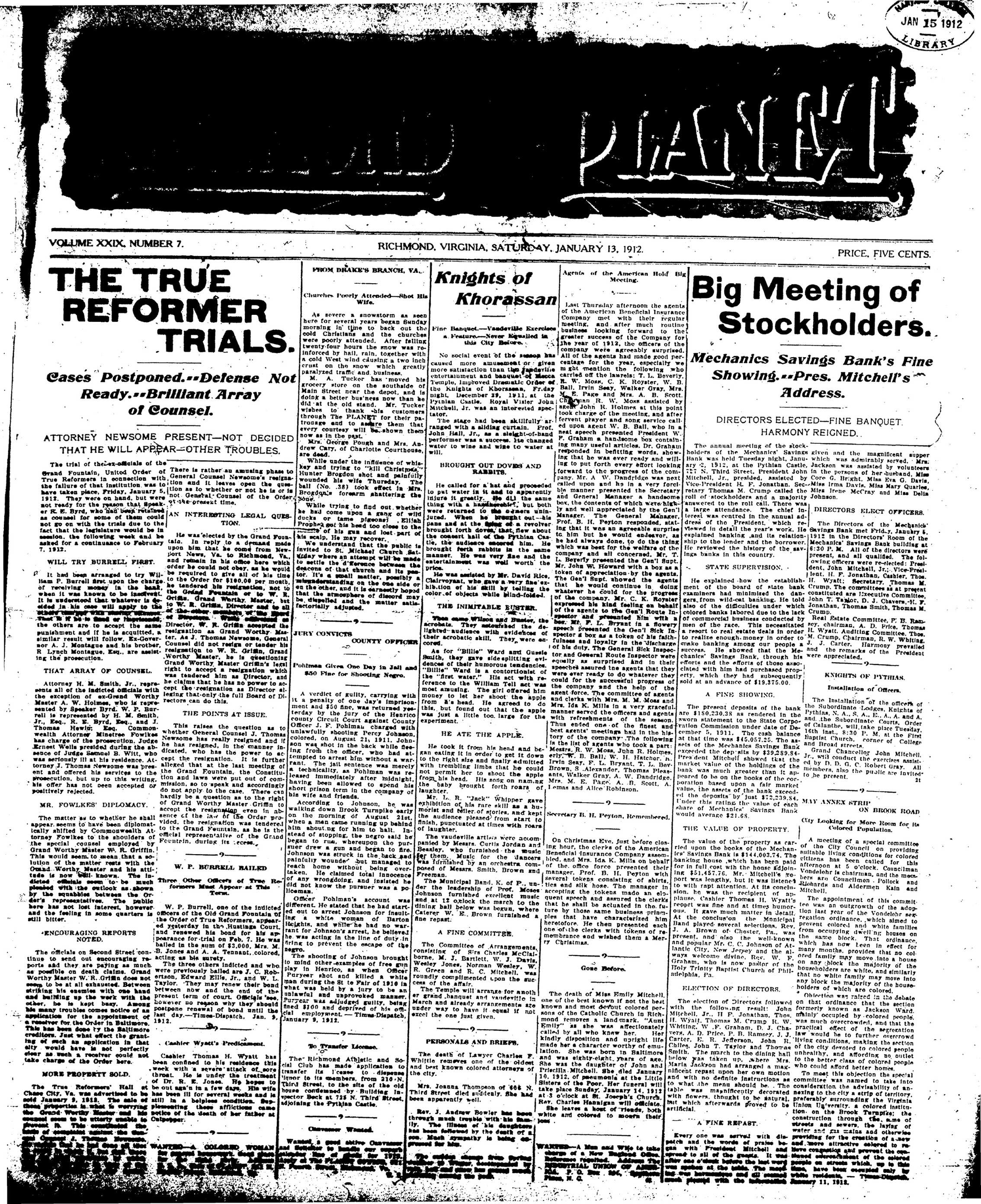
THE TRUE REFORMER TRIALS.
Cases Postponed.--Defense Not Ready.--Brilliant Array of Counsel.
ATTORNEY NEWSOME PRESENT—NOT DECIDED THAT HE WILL APPEAR—OTHER TROUBLES.
Cashier Thomas H. Wyatt has been confined to his residence this week with a severe attack of more throat. He is under the treatment of Dr. R. E. Jones. He hopes to be out again in a few days. His wife has been ill for several weeks and is still in a belpless condition. Supplementing these afflictions came notice of the death of her father at Culpepper.
The trial of the ex-officials of the Grand Fountain, United Order of True Reformers in connection with the failure of that institution was to have taken place, Friday, January 5, 1912. They were on hand, but were not ready for the reason that Speaker R. E. Byrd, who had been retained as counsel for some of them could not go on with the trials due to the fact that the legislature would be in session, the following week and he asked for a continuance to February 7, 1912.
WILL TRY BURRELL FIRST.
It had been arranged to try William P. Burrell first upon the charge of receiving money in the bank when it was known to be in default. It is understood that whatever is decided in his case will apply to the other debtors with similar amount. That is if he is found or imprisoned, the others are to accept the same punishment and if he is acquitted, a similar result will follow. Ex-Governor A. J. Montague and his brother, R Lynch Montague, Esq., are assisting the prosecution.
THAT ARRAY OF COUNSEL
Attorney H. M. Smith, Jr., represents all of the indicted officials with the exception of ex-Grend Worthy Master A. W. Holmes, who is represented by Speaker Byrd. W. P. Burdell is represented by H. M. Smith Jr., Esq., R. E. Byrd, Esq., and J. Thomas Hewitt; Esq. Commonwealth Attorney Minetree Fowkes has charge of the prosecution. Judge Ernest Wells presided during the absence of Judge Samuel B. Witt, who was seriously ill at his residence. Attorney J. Thomas Newsome was present and offered his services to the prosecution, but up to this writing, his offer has not been accepted or positively rejected.
MR. FOWLKES' DIPLOMACY.
The matter as to whether he shall appear, seems to have been diplomatically shifted by Commonwealth Attorney Fowlikes to the shoulders of the special counsel employed by Grand Worthy Master W. R. Griffin. This would seem, to mean that a solution of the matter rests with the Grand. Worthy Master and his attitude is now well-known. The indicated officials seem to be much plumbed with the outlook as shown by the squabbles between the Order's representatives. The public here has not lost interest, however, and the feeling in some quarters is still bitter.
*ENCOURAGING REPORTS NOTED.
The officials on Second Street continue to send out encouraging reports and they are paying as much as possible on death claims. Grand Worthy Master W. R. Griffin does not seem to be at all exhausted. Between striking his enemies with one hand and building up the work with the other, he is kept busy. Among his many troubles comes notice of an application for the appointment of a receiver for the Order in Baltimore. This has been done by the Baltimore creditors. Just what effect the granting of such an application in that city would have is not perfectly clear as such a receiver could not take charge of the Order here.
MORE PROPERTY SOLD
The True Reformers' Hall at Chase City, Va. was advertised to be sold January 9, 1912. The sale of these proportion in what is worrying the Grand Worthy Master and his counsel seems to be utterly unable to prevent it. This coordinated the hands of compulsive against the grand Counsel J. Thomas Howseman, his agents that he had done all that he could in the first and last years of his career by which he was able to prevent the sale.
There is rather an amusing phase to General Counsel Newsome's resignation and it leaves open the question as to whether or not he is or is not General Counsel of the Order of the present time.
AN INTERESTING LEGAL QUESTION.
He was elected by the Grand Fountains. In reply to a demand made upon him that he come from Newport News, Va. to Richmond, Va., and remain in his office here which order he could not obey, as he would be required to give all of his time to the Order for $100.00 per month, he tendered his resignation, not to the Grand Fountain or to W. R. Grifin, Grand Worthy, Master, but to W. R. Grifin, Director and to all of the other members of the Board of Directors. While admitted as Director, W. R. Grifin accepted the resignation as Grand Worthy Master. As J. Thomas Newcombe, General Counsel did not resign or tender his resignation to W. R. Grifin, Grand Worthy Master, he is questioning Grand Worthy Master Grifin's legal right to accept a resignation which was tendered him as Director, and he claims that he has no power to accept the resignation as Director alleging that only the full Board of Directors can do this.
THE POINTS AT ISSUE
This raises the question as to whether General Counsel J. Thomas Newsome has really resigned and if he has resigned, in the manner indicated, who has the power to accept the resignation. It is further alleged that at the last meeting of the Grand Fountain, the Constitution and laws were put out of commission, so to speak and accordingly do not apply to the case. There can hardly be a question as to the right of Grand Worthy Master Griffin to accept the resignation even in absence of the law of the Order provided, the resignation was tendered to the Grand Fountain, as he is the official representative of the Grand Fountain, during its access.
W. P. BURRELL BAILED
Three Other Officers of True Reformers Must Appear at This Term.
W. P. Burrell, one of the indicted officers of the Old Grand Fountain of the Order of True Reformers, appeared yesterday in the Hustings Court and renewed his bond for his appearance for trial on Feb. 7. He was bailed in the sum of $3,000, Mrs. M. B. Jones and A. A. Tennant, colored, acting as his safety.
The three others indicted and who were previously bailed are J. C. Robertson, Edward Ellis, Jr., and W. L. Taylor. They may renew their bond between now and the end of the present term of court. Officials 'see, however no reason why they should postpone renewal of bond until the last day.—Times-Dispatch, Jan. 9, 1912.
FROM DRAKE'S BRANCH, VA.
Churches Poorly Attended—Shot His Wife.
As severe a snowstorm as seen here for several years began Sunday morning in time to back out the cold Christians and the churches were poorly attended. After felling twenty-four hours the snow was reinforced by hail, rain, together with a cold West wind causing a two inch crust on the snow which greatly paralyzed traffic and business.
M. A. Tucker has moved his grocery store on the southside of Main Street near the depot, and is doing a better business now than he did at the old stand. Mr. Tucker wishes to thank his customers through The PLANET for their patronage and to assure them that every courtesy will be shown them now as in the past.
Mrs. George Pough and Mrs. Andrew Cary, of Charlotte Courthouse, are dead.
While under the influence of whisky and trying to "kill Christina," Hunter Brogden shot and painfully wounded his wife Thursday. The ball (No. 38) took effect in Mrs. Brogden's forearm shattering the bone.
While trying to find out whether he had come upon a gang of wild ducks or tame pigeons, Elijah Prophese got his head too close to the entrance of his gun and lost part of his scalp. He may recover.
We understand that the public is invited to 8t. Michael Church Saturday where an attempt will be made to settle the difference between the deacons of that church and its pastor. It's a small matter, possibly a misunderstanding on the one side or on the other, and it is earnestly hoped that the atmosphere of discord may be dispelled and the matter satisfactorily adjusted.
Polltman Given One Day in Jail and $50 Fire for Shooting Negro.
A verdict of guilty, carrying with it a penalty of one day's imprisonment and $50 fine, was returned yesterday by the jury of the Henrico county Circuit Court against County Officer J. F. Pohlman charged with unlawfully shooting Percy Johnson, colored, on August 21, 1911. Johnson was shot in the back while fleeing from the officer, who had attempted to arrest him without a warrant. The jail sentence was merely a technicality, as Pohlman was released immediately after midnight, having been allowed to spend his short prison term in the company of his wife and friends.
According to Johnson, he was walking down Brook Turnpike early on the morning of August 21st, when a man came running up behind him shouting for him to halt. Instead of stopping, the negro said he began to run, whereupon the pursuer drew a gun and began to fire. Johnson was struck in the back and painfully wounded but managed to reach home without being overtaken. He claimed total innocence of any wrongdoing, and insisted he did not know the puruer was a policeman.
Officer Pohlman's account was different. He stated that he had started out to arrest Johnson for insulting a white woman of Barton Height, and white he had no warrant for Johnson's arrest, he believed he was acting in the line of duty in trying to prevent the escape of the negro.
The shooting of Johnson brought to mind other examples of free gun play in Henrico, as when Officer Puryear shot and killed a white man during the St te Fair of 1910 in what was held by a jury to be an unlawful and unprovoked manner. Puryear was adjudged guilty, being fined $100 and deprived of his official employment. — Times-Dispatch, January 9, 1912.
To Transfer License.
The Richmond Athletic and Social Club has made application to transfer its license to dispense liquor to its members, from 210 N. Third Street, to the site of the old house condemned by Bulldog Inspector Beck at 725 N. Third Street, adjoining the Pythian Castle.
Fine Banquet.—Vanderville Exercise
a Feature.—Never Equalled in
this City Before.
No social event of the season has caused more amusement or given more satisfaction than the gondolie entertainment and banquet of Moca Temple, Improved Dramatic Order of the Knights of Khorasan, Fr.day night, December 29, 1911, at the Pythian Castle. Royal Visiter John Mitchell, Jr. was an interested spectator.
The stage had been skillfully arranged with a sliding curtain. Prof. John Hall, Jr., as a sleight-of-hand performer was a success. He changed water to wine and wine to water at will.
BROUGHT OUT DOVES AND
RABBITS.
He called for a hat and proceeded to put water in it and to apparently injure it greatly. He dll the same thing with a haunchkerlet, but both were returned to the owners uninjured. When he brought out his pans and at the rising of a revolver brought forth doves, that flew about the concert hall of the Pythian Castle, the audience entered him. He brought forth rabbits in the same manner. He was very fine and the entertainment was well worth the price. He was assisted by Mr. David Rice, Clairvoyant, who gave a very fine exhibition of his skill by telling the color of objects while blind-folded.
THE INIMITABLE BUNTER.
They came Wilcox and Buster, the acrobats. They astonished the delighted audience with evidences of their acrobatic skill. They were enclosed.
As for "Billie" Ward and Gussie Smith, they gave sideplitting evidences of their humorous tendencies. "Billie" Ward is a contortionist of the "first water." His act with reference to the William Tell act was most amusing. The girl offered him money to let her shoot the apple from his head. He agreed to do this, but found out that the apple was just a little too large for the experiment.
HE ATE THE APPLE
He took it from his head and began eating it in order to get it down to the right size and finally admitted with trembling limbs that he could not permit her to shoot the apple from his head. His song on naming the baby brought forth roars of laughter.
Mr. L. R. "Jack" Whipper gave exhibition of his rare skill as a humorist and teller of stories, and kept the audience pleased from start to finish, punctuated at times with roars of laughter.
The vaudeville artists were accompanied by Mesars. Curtis Jordan and Beasley, who furnished the music for them. Music for the dancers was furnished by an orchestra composed of Mesars. Smith, Brown and Freeman.
The Municipal Band, K. of P., under the leadership of Prof. Moses Johnson furnished excellent music and at 12 o'clock the march to the dining hall below was bogged, where Caterer W. E., Brown furnished a fine repast.
A FINE COMMITTEE
The Committee of Arrangements, consisting of Sirs Charles McClalborne, M. J. Bartlett, W. J. Davies, Wesley Jones, Norman Wesley, W. R. Green and R. C. Mitchell, was roundly complimented upon the success of the affair.
The Temple will arrange for another or grand banquet and vaudeville in March and already arrangements are under way to have it equal if not excel the one just given.
PERSONAL AND BRIKER
The death of Lawyer Charles K. Whittle removes one of the oldest and best known colored attorneys of the city.
Mrs. Joanna Thompson of 666 N. Third Street died suddenly. She had been apparently well.
Rev. J. Andrew Bowler has been through much trouble with his family. The illness of his daughters has been followed by the death of a son. Much sympathy is being expressed for him.
Agents of the American Hold Big Meeting.
Secretary B. H. Peyton, Remembered.
On Christmas Eve, just before closing hour, the clerks of the American Beneficial Insurance Company assembled, and Mrs. Ida K. Mills on behalf of the office force presented their manager, Prof. B. H. Peyton with several tokens consisting of shirts, ties and silk hose. The manager in accepting the tokens made an eloquent speech and assured the clerks that he shall be actuated in the future by those same business principles that have characterized him heretofore. He then presented each one of the clerks with tokens of remembrance and wished them a Merry Christmas.
Gone Before.
The death of Miss Emily Mitchell one of the best known if not the best known and most doubt colored persons of the Catholic Church in Richmond removes a land mark. "Aunt Emily" as she was affectionately called by all who knew her. Her kindly disposition and upright life made her a character worthy of emulation. She was born in Baltimore and was eighty-eight years of age. She was the daughter of John and Priscilla Mitchell. She died January 16, 1912, of pneumonia at the Little Sisters of the Poor. Her funeral will take place Sunday, January 14, 1912 at 3 o'clock at St. Joseph's Church. Rev. Charles Hannigan will officiate. She leaves a host of friends, both white and colored to mourn their loss.
WANTED—A Man and Wife to take charge of a New England Office. Reference required. Address The INDUSTRIAL UNION OF AMERICA, P. O. Box 206, Appleton Plains, N. O.
Big Meeting of Stockholders.
Mechanics Savings Bank's Fine Showing. Pres. Mitchell's Address.
DIRECTORS ELECTED—FINE BANQUET. HARMONY REIGNED.
The annual meeting of the stockholders of the Mechanics' Savings Bank was held Tuesday night, January 2, 1912, at the Pythian Castle. Jackson was assisted by ver. 727 N. Third Street, President John in the persons of her husband, Mitchell, Jr., presided, assisted by Core G. Bright, Miss Eva C. Vico-President H. F. Jonathan. Sec.-Miss Irmia Davis, Mins Mary retary Thomas M. Crump called the Miss Irene McCray and Miss roll of stockholders and a majority answered to the roll call. There was a large attendance. The chief interest was centred in the annual address of the President, which reviewed in detail the year's work. He explained banking, and its relationship to the lender and the borrower. He reviewed the history of the savings banks in this country.
DIRECTORS ELECT OFF
The Directors of the Mechanics' Savings Bank met Friday, Jan. 1912 in the Directors' Room Mechanics' Savings Bank built 6:30 P. M. All of the directors present, and all qualified.
STATE SUPERVISION.
He explained how the establishment of the board of state bank examiners had minimised the dangers from wild-cat banking. He told also of the difficulties under which colored banks labored due to the lack of commercial business conducted by men of the race. This necessitated a resort to real estate deals in order to realize enough money in order to make banking among our people a success. He showed that the Mechanics' Savings Bank, through his efforts and the efforts of those associated with him had purchased property, which they had subsequently sold at an advance of $19,375.00.
A FINE SHOWING
The present deposits of the bank are $180,230.38 as rendered in the sworn statement to the State Corporation Commission under date of December 5, 1911. The cash balance at that time was $45,057.25. The assets of the Mechanies Savings Bank exceeded the deposits by $39,299.84. President Mitchell shuwed that the market value of the holdings of the bank was much greater than it appeared to be on the books of the corporation based upon a fair market value, the assets of the bank exceeded the deposits' by just $72,299.84. Under this rating the value of each share of Mechanies' Savings Bank would average $21.68.
THE VALUE OF PROPERTY.
The value of the property as carried upon the books of the Mechanics' Savings Bank is $144,003.74. The banking house, which has been paid for in full cost with the house adjoin ing $51,457.76. Mr. Mitchell's report was longly, but it was listened to with rapt attention. At its conclusion, he was the recipient of applause. Cashier Thomas H. Wyatt's reopt was fine and at times humorous. It gave much matter in detail. At the conclusion on the Municipal Band played several selections, Rev. J. A. Brown of Choster, Pa., was present, and also the well-known and popular Mr. C. C. Johnson of Atlantic City, New Jersey and the always welcome divine, Rev. W. F. Graham, who is now pastor of the Holy Trinity Baptist Church of Philadelphia, Pa.
ELECTION OF DIRECTORS.
The election of Directors followed with the following result: John Mitchell, Jr., H. F. Jonathan, Thomas H. Wyalt, Thomas M. Crump R. W. Whiting, W. F. Graham, D. J. Chavers, A. D. Price, P. B. Ramney, J. J. Carter, E. R. Jefferson, John R. Chiles, John T. Taylor and Thomas Smith. The march to the dining hall below was taken up, where Mrs. Marla Jackson had arranged a magnificent repeat upon her own motion and with no definite instructions as to what the menu should be. The table was magnificently decorated with flowers, thought to be natural, but which afterwards proved to be artificial.
A FINE REPAST.
Every one was served with dipatch and the words of praise began with President Mitchell and spread to all of the guests. It was after one o'clock before the last word was spoken at the table. The mask had two harmonies and all sound plush placed with the information.
meeting of stockholders.
Savings Bank's Fine Pres. Mitchell's Address.
SELECTED—FINE BANQUET.
TONY REIGNED.
Stock-savings given and the magnificent supper Janu- which was admirably served. Mrs. Castle, Jackson was assisted by volunteers John in the persons of her husband, Miss by Core G. Bright, Miss Eva G. Davis, Sec.-Miss Irma Davis, Miss Mary Quarles, and the Miss Irene McCray and Miss Delta Jority Johnson.
DIRECTORS ELECT OFFICERS
The Directors of the Mechanick's Savings Bank met Frid- y, January 8. 1912 in the Directors' Room of the Mechanics' Savings Bank building at 6:30 P. M. All of the directors were present, and all qualified. The following officers were re-elected: President, John Mitchell, Jr.; Vice-President, H. F. Jonathan, Cashier, Thos. H. Wyatt; Secretary, Thomas M. Crump. The committees as at present constituted are Executive Committee, John T. Taylor, D. J. Chavera,-H. F. Jonathan, Thomas Smith, Thomas M. Crump.
Real Estate Committee, F. B. Ramsey, chairman, A. D. Price, Thomas H. Wyatt. Auditing Committee, Thos. M. Crump, chairman, R. W. Whiting, J. J. Carter. Harmony prevailed and the remarks of the President were appreciated.
KNIGHTS OF PYTHAS
Installation of Officers
The Installation of the officers of the Subordinate Lodges, Knights of Pythias, N. A., S. A., E. A., A. and A. and the Subordinate Courts, Order of Calanthe, will take place Tuesday, 16th inst., 8:30 P. M. at the First Baptist Church, corner of College and Broad streets.
Grand Chancellor John Mitchell. Jr. will conduct the exercises assisted by D. D. G. C. Robert Gray. All members, also the public are invited to be present.
MAY ANNEX STRIP
ON BROOK ROAD
City Looking for More Room for its Colored Population.
A meeting of a special committee of the City Council on providing suitable living conditions for colored citizens has been called for this afternoon at 5 o'clock. Councilman Vondelohr is chairman, and the members are Councilman Pollock and Blokhards and Aldermen Kain and Mitchell.
The appointment of this committee was an outgrowth of the adoption last year of the Vondelohr segregation ordinance, which aimed to prevent colored and white families from occupying dwelling houses on the same block. That ordinance, which has now been in effect for many months, provides that no colored family may move into a house on any block the majority of the householders are white, and similarly that no white family may move into any block the majority of the householders of which are colored.
Objection was raised in the debate on that ordinance that the section formerly known as Jackson Ward, mainly occupied by colored people, was much overcrowded, and that the practical effect of the segregation law would be to further overcrowd living conditions, the section of the city devoted to colored people unhealthy, and affording no outlet to the better class of colored people who could afford better homes.
To meet this objection the special committee was named to take into consideration the advisability of annexing to the city a strip of territory, preferably surrounding the Virginia Union University, a colored institution on the Brook Turnpike; the construction through the same of streets and sewers, the laying of water and gas mains and otherwise providing for the creation of a new and more attractive colored to relieve congestion and prevent the continued establishment of the colored people on streets which, up to this time, have been occupied only by white residents. — Timothy Diguston, January 11, 1912.
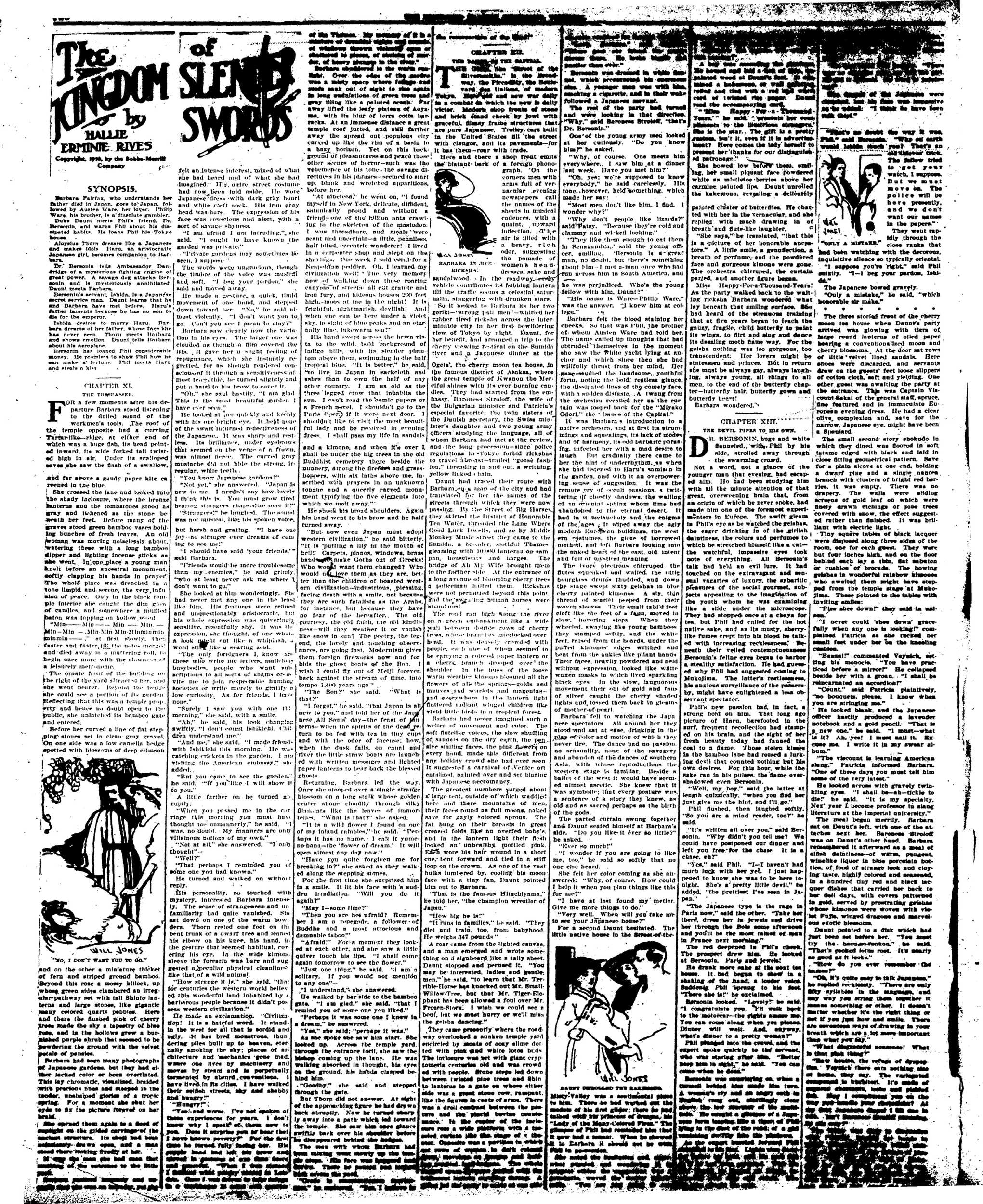
THE KINGDOM by HALLIE ERMINIE RIVES
Copyright, 1996, by the Bobba-Merrill Company
SYNOPSIS
Barbara Palafix, who understands her father died in Japan, goes to Japan, followed by Austen Ware, her lover, Philip Ware, his brother, is a fictional character. Dr. Bermonin, and warns Phil about his displeased habit. He loans Phil his Tokyo house.
Aloysius Thorn dresses like a Japanese and makes idols Haru, an aristocratic Japanese girl, becomes companion to Barbina.
Dr. Bermonin teils Ambasador. Darridge of a mysterious fighting engine of great power. A savage dog attacks Bermonin and a mysteriously annihilated Barbina. Bermonin serves, Iabida, is a Japanese secret service man. Daunt learns that he and Barbina have met before. Haru's father lambages because he has no son to die for the emperor.
Barbina marries Haru. Barbina dreams of her father, whose face she has never seen. Thorn meets Barbina and shows emotion. Daunt tells Harbina about his airplane.
Bermonin has loaned Phil considerable money to show Phil how he can make a fortune. Phil meets Haru and steals a kite.
CHAPTER XL.
THE TRUMPETER.
FOR a few moments after his departure Barbara stood listening to the dulled sound of the workmen's tools. The roof of the temple opposite had a curving Tartarillike ridge, at either end of which was a huge fish. Its head pointed inward, its wide forked tail twisted high in air. Under its scallopedaves she saw the flash of a swallow, and far above a gandy paper kite ca-reened in the blue.
The ornate front of the building on the right of the yard attracted her, and she went nearer. Beyond the bedside, she could see a portion of its garden. Reflecting that this was a temple property and hence no doubt open to the public, she unlatched its bamboo gate and entered.
Before her curved a line of flat step-stepping stones set in clean gray gravel. On one side was a low camelia hedge spotted with blossoms of deep crimson
WILL JONES
"NO, I DON'T WANT YOU TO GO." and on the other a miniature thicket of fern and striped ground bamboo. Beyond this rose a mossy hillock, up whose green sides clambered an irregular-pathway set with tall Shibito lanters and large stones, like gigantic many colored quartz pebbles. Here and there the flushed pink of cherry grees made the sky a tapestry of blue rose, and in the hollows grew a burnished purple shrub that seemed to be powdering the ground with the velvet petals of pansies.
Barbara had seen many photographs of Japanese gardens, but they had either lacked color or been overlated. This lay chromatic, visualized, braided with precision breeze and stepped in the tender, unhaped glories of a tropic spring. For a moment she shut her eyes to fit the picture formed on her braid.
She opened them again to a food of
mighty on the glided carriage of the
nuclear structure. Its shell had been
substantially down in open, and a man
stood there moving freely at her.
If any of the men she had seen that
mighty on the entrance to the little
of
SLENDE
SWORDS
felt an intense interest, mixed of what she had heard and of what she had imagined. "His, outre street costume had now been laid saddle. He wore Japanese dress with dark grey houlter and white cuff stock. His iron gray head was bare. The expression of his face was conscious and alert, with a sort of savage shyness.
"I am afraid I am intruding," she said. "I ought to have known the garden was private."
"Private gardens may sometimes be seen. I suppose."
The words were ungrateful, though the timure of the voice was muscled and soft. "I beg your pardon," she said and moved away.
He made a gesture, a quick, timid movement of one hand, and stepped down toward her. "No," he said almost violently. "I don't want you to, Can't you see I mean to stay?"
"Oh," she said hastily. "I am glad This is the most beautiful garden I have ever seen."
He looked at her quickly and keenly with his one bright eye. It held none of the swart internal reflectiveness of the Japanese. It was sharp and restless. Its brilliance, under eyebrows that seemed on the verge of a frown, was almost none. The curved gray mustache did not hide the strong, irregular, white teeth.
"You know Japanese gardens?"
"You know Japanese gardens?"
"Not yet," she answered. "Japan is new to me. I needn't say how lovely I think this is. You must grow tired bearing strangers shapeful over it." "Stranger?" he laughed. The sound was not musical, like his spoken voice, but harsh and grating. "I have one joy no stranger ever dreams of coming to see me!"
"I should have said 'your friends,'" said Barbara.
"Friends would be more troublesome than my enemies," he said grimly. "who at least never ask me where I don't want to go."
She looked at him wonderingly. She had never met any one in the least like him. His features were refined and unquestionably aristocratic, but his whole expression was quivering, senilitate, resentfully shy. It was the expression, she thought, of one whom a look might cut like a whipplash, a word still like a searing acid.
"The only foreigners I, know are those who write me letters, mailbags busbodies, people who want such scriptures to all sorts of shams or invite me to join respectable humming societies or write merely to gratify a low curiosity. As for friends, I have none."
"Surely I saw you with one till morning," she said, with a smile.
"Ab," he said, his look changing swiftly, "I don't count lishikieh. Child dren understand me."
"And me," she said, "I made friends with lishikieh this morning. He was catching crickets in the garden. I am visiting the American embassy," she added.
"But you come to see the garden," he said, "If you like, I will show it to you.
A little farther on he turned abruptly.
"When you passed me in the carriage this morning you must have thought me unmannerly," he said, "I was no doubt. My manners are only villainous notions of my own."
"Not at all," she answered, "I only thought."
He turned and walked on without reply.
His personality, no touched with mystery, interested Barbara intensely. The sense of strangeness and familiarity had quite vanished. She sat down on one of the warm bowsers. Thorn rested one foot on the bent trunk of a dwarf tree and leaned his elbow on his knee, his hand, in the gesture that seemed habitual, covering his eye. In the wide klimm sleeve the forearm was bare and suggested a peculiar physical cleanliness like that of a wild animal.
"How strange it is," she said, "that for centuries the western world believed this wonderful land inhabited by a barbarous people because it didn't possess western civilization."
He made an exclamation. "Civilization! It is a hateful word. It stands in the west for all that is sordid and ugly. It has bred monstrous, thundering plies built up to heaven, eternally smoking the sky; places of architecture and mechanics gone mad, where one lives by machinery and moves by steam and is perplexedly tormented by abandons, conventions. I have lived in its cities. I have walked their selfish streets, sky and shabby and hungry!" "Hungry!" "Two-and-worse. I've not spoken of these experiences for years. I don't know why I speak of them now to you. Does it surprise you for hear that I have known poverty?" For the first time he turned烈烈 fading hair. His people hard but left the snow and grass. "When I two stained I swallowed pity while stained in love. Once I was driven to believe in architecture in cities with
of the Titian. The meaning of it in a collection of dumbbell edges and spines of windows throws vibrancy out of shattered to pieces, out of shattered out of heavy plamping in the storm." Burdens imploded in the ocean on night. Over the edge of the garden was a murky space where foliage and moss sank out of light to also again in long undulations of green trees and gray tilling like a palmette plough. Far away lifted the leafy plateau of Agrame, with its blur of terns cottage racks. At an immense distance a great temple roof jutted, and still farther away the spread out populous city curved up like the rim of a basin to a hazy horizon. Yet on this background of pleasureness and peace those other scenes of horror—such was the vehemence of his tone, the savage directness in his phrases—seemed to start up, blank and wretched apparitions, before her.
"At nudebones, he went on, I found myself in New York, delicate, diffident, satutically proud and without a friend—one of the billion ants crawling in the skeleton of the mastodon. I was threadbare, and meals 'were scant and uncertain—a little, peninsula, half blind, eccentric wanderer! I lived in a carpenter shop and slept on the shavings. One week I sold coral for a Nephilian paddler. Oh, I learned my civilization well! The very memory now of walking down those roaring canopies of streets, all cat granite and iron fury, and idiotous bones 200 feet high—misses at me in the night! It is frightful, nightmarish, devilish. And when one can be here under a violet sky, in sight of blue peaks and an eternally fine, lime-warm soul."
His hand swept across the hewn vista to the wild, bold background of indigo hills, with its slender phantom above them, swimming in the half tropical blue. "It is better," he said, "to live in Japan in sacklethol and ashes than to own the half of any other country. I am as old as the three legged crow that inhabits the sun. I can't read the comic papers or a French novel. I shouldn't go to the Paris airport. If it were next door, I shouldn't like to visit the most beautiful lady and be received in evening dress. I shall pass my life in sandals and a klimono, and when it's over I shall be under the big trees in the old Buddhist cemetery there beside the munnery, among the fireflies and grasshoppers, with six lilies above me, inscribed with prayers in an unknown tongue and a querely carved monument typifying the five elements into which we melt away."
He shook his broad shoulders. Again his hand went to his brow and he half turned away.
"But now even Japan must adopt western civilization." he said bitterly. "It is putting a lily in the mouth of bell." Carpets, planes, windows, brass bands, and make Goths out of Greek? Who would want them changed? Who would not love them as they are, better than the children of boasted western civilization–industrial, pleasing, facing death with a smile, not because they are such fatalities as the Arabs, for instance, but because they have no fear of the heathen. The old courtyard, the old faith, the old kindness–will they weather it or vanish like snow in sun? The poetry, the legend, the lovely and touching observations, are going fast. Modernism gives them foreign fireworks now and for bids the ghost boats of the Bon. I wish I could fly out of Mellifor, back against the stream of time, into tempo 1,400 years ago."
"The Bon'?" she said. "What is that?"
"I forgot," he said, "that Japan is all new to you," and told her of the Japanese nose. All Souls' day—the feast of funterm—when the spirits of the dead return to be fed with tea in tiny cups—and with the odor of incense; how, when the dusk falls, on canal and river the little straw bons are launched with written messages and lighted paper lanterns to bear back the blessed ghosts.
Returning, Barbara led the way. Once she stepped over a single strange blossom on a long stalk whose golden center shone cloudily through silky filaments like the leaves of immortellies. "What is that?" she asked.
"It is a wild flower I found on one of my intland rambles." he said. "Perhaps it has no name. I call it yum-no-hana—the flower of dream." It will open almost any day now.
"Have you quite forgiven me for breaking in?" she asked as they walked along the stepping stones.
For the first time she surprised him in a smile. It lit his face with a sudden irradiation. "Will you do it again?"
"May I—some time?"
"Then you are not afraid? Remember I am a nongrade, a follower of Buddha and a most atrocious and damnable tuboob."
"Afraid?" For a moment they looked at each other, and she saw a little quiver touch his lips. "I shall come again tomorrow to see the flower."
"Just one thing," be said. "I am a solitary. If you would not mention to any one"—
"I understand." she answered.
He walked by her side to the bamboo gate, "I am glad," she said, "that I remind you of some one you liked."
"Perhaps it was some one I knew in a dream," he answered.
"Yes," she said; "perhaps it was."
As she spoke she saw him start. She looked up. Across the temple yard, through the entrance toil, she saw the bishop coming up the lane. He was walking absorbed in thought, his eyes on the ground, his hands clasped behind him.
"Goodbye," she said and stepped through the gate.
But Tborn did not answer. At eight of the approaching figure he had drawn back abruptly. Now he turned sharply away into a path which led toward the temple. She saw him come gracefully back over his shoulder before it disappeared behind the hedge.
The man with whom Barbara had been taking went slowly up the temple stairs. His face was browed and dusty. There he paused and looked back across the pool.
"There is no consequence here." I shuddered.
CHAPTER XII.
THE GREAT the "street of the Silhouette," is the broadway, the Picturesky, the Bowie-vard, the nations, of modern Tokyo. Historic and new war daily in a combat in which the new is daily victor. Modern shop fronts of stone and brick stand check by jowl with graceful, slimy frame structures that are pure Japanese. Trolley cars built in the United States all the street with clangor, and its pavements—for it has them—rour with trade.
shop front entails a foreign photograph. 'On the corners men with arms full of vernacular evening newspapers call the names of the sheets in musical cadences with a quintet, upward indirection. The air is filled with a heavy, rich odor, suggesting the pomade of women's headwear, sakes and
Here and there a shop front emits the blatant bark of a foreign phonograph. 'On the corners men with arms full of vernacular evening newspapers call the names of the sheets in musical condences, with a quintet, upward inflection. Quite it is filled with a heavy, rich color, surreptitious
sandalwood. In the roadway, every vehicle contributes its folboring lantern till the traffic seems a celestial saturnia, staggering with drunken stars. So it looked to Barbara its her two gorikli "strong pull men" - whirled her rubber kicked ricksha across the intermimable city in her first bewildering view of Tokyo by night. Daunt, for her benefit, had arranged a trip to the cherry viewing-trail on the Sundia river and a Japuness dinner at the
Ogcus', the cherry moon tea house, in the famous district of Abakas, where the great temple of Kwannon the Merciful shrines with its ever burning candles. They had started from the embassy, Baroness Strobel, the wife of the Bulgarian minister and Patricia's special favorite; the twin sisters of the Danish secretary, the Swati minister's daughter and two young army officers studying the language, all of whom Barbara had met at the review, and the long procession—since police regulations in Tokyo forbid rickshaws to travel abroad—trailed "goose fashion," threading in and out, a writhing, yellow linked chain.
Daunt had traced their route with Barbara, a map of the city and had translated for her the names of the streets through which they were now passing. By the Street of Big Horses they skirted the District of Honorable Ten Water, throubled the Lane Where Good Luck Iwells, and so by Middle Monkey Music street they came to the Sumida, a broader, soulful Thames gleaming with 10,000 lanterns on sampan, homescapes and barges. The bridge of Ab My Wife brought them to the farther side. At the entrance of a long avenue of blooming cherry trees a policeman halted them. Rickshaws were not permitted beyond this point and the sweeping human horses were at standstill.
The cold rain high winds the river on a green embankment like a wide yawn between double rows of cherry trees, whose branches interlocked over head. It was densely crowded with people, each one of whom seemed to be carrying a colored paper lantern or a cherry branch dropped over the shoulder. In the times of the loose warm weather klimno bloomed all the flowers of all the springs—golds and maples and scarlets and magenta—and everywhere in the lantern light futtered radiant winged children like vild little birds in a tropical forest. Barbara had never imagined such a welter of movement and color. The soft faintelle voices, the slow shuffling of sandals on the dry earth, the pen, smiling faces, the pink flowers on every hand, made this different from any holiday crowd she had ever seen. It suggested a carnival of Vence or entalized, painted over and set blazing with Japanese necromancy.
The greatest numbers surged about: a large tent, outside of which waddled here and there mountains of men, their face round as full moons, naked save for gargly colored aprons. The fat bung on their breasts in great crested folds like an overfed baby, and in the lantern light their flesh looked an unhealthy poilted pink. Each wore his hair wound in a short creekt forward and tied in a stiff loop on the crown. As one of the vast hulks lumbered by, cooling his moon face with a tiny fan, Daunt pointed him out to Barbara.
"That is the famous Hitachiyama," he told her, "the champion wrestler of Japan."
"How big he is?"
"It itms in families," he said. "They diet and train, too, from babyhood. He weighs 347 pounds."
A roar came from the lighted canvass, and a man emerged and wrote something on its signboard like a tally sheet. Daunt stopped and perused it. "You may be interested, ladies and gentlemen," he said, "to learn that Mr. Terrible-Horse has knocked out Mr. Snail-Willow-Tree, but that Mr. Tiger-Elephant has been allowed a foul over Mr. Frozen-Stork." I wish we could see a boof, but we must hurry or well miss the geisha dancing."
They came presently where the roadway overloaded a sunken temple yard enriched with pink and white lotus buds. The incense was set with giant cypress tombia centurion old and was crowded with people. Stone steps led down between twisted pine trees and Sibin to lanterns to a gate on whose either side was a great stone cow, rampant, like the figure in costs of arms. There was a droll cement between the picture and the plaster bovine counterance. In the center of the incense row was a wide platform with a tauered curtain like the stage of a theater. Occupier was a partition in white cut rows of windows in dark colored movements on plumage and building materials.
Barronne was dressed in white shirt, which presented her uniform shirt. A younger man was with him, smoking a cigarette, and in their hair followed a Japanese servant.
The rest of the party had turned and were looking in that direction. "Why," said Barronne Brotto, "that's Dr. Bercounn."
One of the young army men looked at her curiously. "Do you know him?" he asked.
"Why, of course. One meets him everywhere. I saw him at a dinner last week. Have you met him?"
"Oh, yes. we're supposed to know everybody," he said carelessly. His tone, however, hold something, which made her say:
"Most men don't like him. I find. I wonder why?"
"Why don't people like lizards?" and Patay. "Because they're cold and clammy and wilted looking."
"They like them enough to eat them in Renagambala." said the young officer, smiling. "Bersenius is a great man, no doubt, but there's something about him. I met a man once who had run across him in South America, and
be was prejudiced. Who's the young fellow with him, Daunt?"
"His name is Ware-Philip Ware," was the answer. "I knew him at college."
Barbara felt the blood staining her cheeks. So that was Phil, the brother of whom Austen Ware had told her. The name called up thoughts that had obtruded themselves in the moment she saw the White yacht lying at anchor and which since then she had willfully thrust from her mind. Her gaze stultified the handsome, youthful form, noting the bold: restless glance, the dissipated lines of the comely face, with a sudden distaste. A twang from the orchestra recalled her as the curtain was nosed back for the "Miyako Odorl." the "Dame of the Capital."
It was Barbara's introduction to a native orchestra, and at first its strumming and aquainting, its lack of modes and of harmony, its odd barbaric phrasing, infected her with a mad desire to laugh. But gradually there came to her the hint of underrhythm, as when she had listened to Haru's ammon in the garden, and with it an overpowering sense of suggestion. It was the remote gry of occult passions, a twirting of mostly shadowy, the walling of an oriental sphing whom time had abandoned to the eternal desert. It had in it melancholy and the enigma of the ages. It wiped away the ugly modern European buildings, the westen costumes, the glaze of borrowed method, and left Barbara looking into the naked heart of the east, old, intent and full of mystical meaning.
The heavy plethous chirruped the glutes squeaked and wailed, the ittig bourghass drums thudded, and down the stage swept sixy gelasha in blue cherry painted kinnoson. A slay, thin thread of scarlet peeped from their woven shores. Their small taid feet cleft like the feet of a faint, moved in slow, hovering steps. When they wheeled, swaying like young bamboo they stamped softly, and the white feet, raised from the boards, under the puffed kinnoson edges writhed and bent from the ankles like plant hands. Their faces, heavily powdered and held without expression, looked like white waxen masks in which lived sparkling black eyes. In the slow, languorous movement their obli of gold and rays of silver caught the cherry shaded lights, and tossed them back in gleams of mother-of-pearl.
Barbara fell to watching the Japanese spectators. All around her they stood and sat at ease, drinking in the glaze of color and motion of which they never tire. The dance had no passion, no sensuality, none of the savagery and abundance of the dances of southern Asia, with whose reproductions the western stage is familiar. Beside a ballet of the west it would have seemed almost ancestice. She knew that it was symbolic; that every posture was a sentence of a story they knew, an old and as sacred perhaps as the birth of the gods.
The parted curtale awing together and Daunt seated himself at Barbara's side. "Do you like it ever so little?" he asked.
"Ever so much?"
"I wonder if you are going to like me, too," he said so softly that no one else heard.
She felt her color coming as she answered: "Why, of course. How could I help it when you plan things like this for me?"
"I have at last found my metter. Give me more things to do."
"Very well. When will you take me to see your Japanese home?"
For a second haunt hesitated. The little native house in the street of the
DAVID DEMOULLED THE HARRISON.
Marty-Valley was a sentimental place to him. There he had worked out the models of his first glider; there he had talked with his predecessor of dreams, his "Lady of the Mighty-Loved Flower." The gliders of Phil and restudied him that moment. When he showed to Carla it should not be used still in possession.
She noted the harnessing and glider, when pressed, and modelling it the greatest order the instrument of the generation, waved the harnessing glider. "The new one just worked."
A big was counting the glistening
his brow and held a drip of the thick,
painted wood at Dawn's feet. It also
introduced a machine, or wall gilding,
ruled and tied with a red rib and white
cord of twisted ripe paper. Dawn
read the accompanying card.
"Mum Happy For a Thousand Years," he said, "presents her companions to the limestone strangles. She is the star. The gift is a pretty random, but it, even if it is advertisement? Here comes the lady herself to present her thanks for our distinguished patronage."
She bowed low before them, smiling, her small pliant face powdered white an misterielle berries above her carmine painted lips. Dautt unrolled the kakemono, revealing a delicately painted cluster of butterflies. He chatted with her in the vernacular, and she replied with much drawing in of breath and fute-like laughter.
"She says," he translated, "that this is a picture of her honorable ancestors. A little smile, a geniusction, a breath of perfume, and the powdered face and gorgeous kimono were gone. The orchestra clurped, the curtain paried, and another figure began.
Miss Happy-For-a-Thousand-Years
As the party walked back to the waiting rickshaw Barbara wondered what lay beneath that smiling surface. She had heard of the strenuous training that at five years began to teach the gauzy, fragile, child buttery to paint its wings, to flirt and sing and dance its dazzling moth flame way. For the goblins nothing was too gorgeous, too transcendent: Her lovers might be statesmen and princes. Bolt in return she must be always gay, always laughing, always young, all things to all men, to the end of the butterfly chapter--butterfly hair, butterfly gown and butterfly beetle!
Barbara wondered.
D. BERSONIN, huge and white fanetted, with. Phil by his side, strolled away through the swarming crowd.
Not a word, not a glance of the younger man that evening, had escaped him. He had been studying him with all the minute attention of that great, overwhelming brain that, from an origin of which he never spoke, had made him one of the foremost experimenters in Europe. The swift gleam in Phila's eye as he watched the gelabas, the eager drinking in of the girlish delattiness, the colors and perfumes to which he attested himself like a cat—the watchful, impassive eyes took note of everything. All Berrison's talk had held an evil lure. It had touched on the extravagant and sensual vaginations of luxury, the sybaritic pleasures of the social gourmet, subjects appealing to the imagination of the youth whom he was examining like a slide under the microscope. They had stopped once at a chaya for tea, but Phil had called for the hot native sake, and as its must, sherry-like fumes crept into his blood be talked with increasing recklessness. Beneath their relied contemptuousness Berrison's feline eyes began to harbor a steady satisfaction. He had greeted why Phil had suggested coming to Mukojima. The latter's restlessness, his anxious surveillance of the paincharm, might have enlightened a less observant spectator.
Phil's new passion had, in fact, a strong hold on him. That long ago picture of Harn, barefooted in the surf, frequent recruitment had stamped on his brain, and the sight of her fresh beauty today had fanned the coal to a fame. Those stealin kimes in the bamboo lane had rosed a lurking devil that counted nothing but his own desires. For this hour, while the sake ran in his pulses, the fame over shadowed even Bersonin.
"Well, my boy," mild the latter at length quizzically, "when you find her just give me the hint, and I'll go."
"Pull flushed, then laughed softly, 'So you are a mind reader, too?' he mild.
"It's written all over you," said Bersonin.
"Why didn't you tell me? We could have postponed our dinner and left you free for the chase. It is a chase, eh?"
"Yes," said Phil. "I—I haven't had much luck with her yet. I just happened to know she was to be here tonight. She's a pretty little devil," he added, "the pretentious I've seen in Japan."
"The Japanese type in the rage in Paris now," said the other. "Take her there, dress her in jewels and drive her through the Bobe some afternoon and you'll be the most asked of man in France next morning."
"The red deepened in Phil's cheek. The prospect drew him. He looked at Bercouni, Paris and jewels."
He drank more sake at the next tea house. It had begun to show in a shaking of the hand, a louder voice Suddeng Phil sprang to his feet. "There she is!" he explained.
Barnoah looked. "Lovey!" he said. "I congratulate you. I'll walk back to the motorcars—the rights ammee you. You can come along when you please. Dinner will wait. And, anyway, what's dinner to a pretty woman?" Phil plunged into the crowd, and the expert spoke quickly to the servant, who was starting after him. "Butter keep him in right," he said. "You can come when he does."
Barnoah was stammering on, when a turned beaked him made him turn. A woman's cry and an angry call in English rang out, stallingly clear above the low murmur of the mantlepiece. He caught a glimpse of a Japanese form leasing. A linger of Philling in the dust of the road; of a girl smashing swiftly into the plains.
the way it was.
"Why earth
you? That's an
old throw trick.
The fellow tried
to get your
watch, I suppose.
But we must
move on. The
police will be
here present,
and we don't
want our names
in the papers."
ALC
JONES
They went rapidly through the "only a mistake." close ranks that had been watching with the decorous, inquisitive silence no typically oriental. "I suppose you're right," said Phil sullyty. "I—1 beg your pardon, Ishida."
The Japanese bowed gravely. "Only a mistake," he said, "which honorable air make."
The three storied front of the cherry moon tea house when Danny's party arrived was glowing with them of large round lanterns of oiled paper bearing a conventionalized moon and cherry blossoms. At the door sat rows of little velvet lined sandals. Here shoes were discarded, and servants drew on the guests' feet loose slippers of cotton cloth, soft and yielding. One other guest was awaiting the party at the entrance. This was Captain Viscount-Sakal of the general staff, spruce, fine featured and in immaculate European evening dress. He had a clear olive, compass and, save for the narrow, Japanese eye, might have been a Spaniard.
The small second story skokuro in which they dined was floored in soft futame edged with black and laid in close fitting geometrical pattern. Save for a plain alcove at one end, holding a dwarf pine and a single nugget branch with clusters of bright red berries. it was empty. There was no drapery. The walls were sliding screens of gold leaf on which were finely drawn etchings of pine trees covered with snow, the effect suggested rather than finished. It was brilliant with electric light.
Tiny square tables of black lacquer were disposed along three sides of the room, one for each guest. They were but four inches high, and on the floor behind each lay a thin, flat mattonon or cushion of brocade. The bowing gobles in wonderful rainbow kimonos who awaited them might have stepped from the temple stage at Mikojima. These pointed to the tables with inviting smiles:
"Pine shee down" they said in unison.
"I never could 'see down' gracefully when any one is looking!" complained Patricia as she rucked her small feet under her on the kneeling cushion.
"Banzai!" commented Veysich, setting his monocle. "You have practiced before a mirror." He collapsed beside her with a groan. "I shall be reincarnated an accordion!"
"Count," said Patricia plaintively, "no bouquets, please. I know when you are stringing me."
He looked blank, and the Japanese officer hastily produced a lavender notebook and a gold pencil. "That is a new one." he said. "I must—what is it? Ah, yes! I must call it. Excuse me. I write it in my swear album."
"The viscount is learning American slang." Patricia informed Barbara. "One of these days you must tell him some of the very latest."
He looked across with gravelly twinkling eyes. "I shall be—ah—stickie to die!" he said. "It is my speciality. Nex' year I become professor in a string literature at the imperial university." The meal began merrily. Barbara sat on Daunt's left, with one of the attaches next her. Baroness stifloed was on Daunt's other hand. Barbara remembered it afterward as a meal of eishn daintainness—of warm, pungent, winelike liquor in blue porcelain bottle, of food of strange look and cloaking taste, highly colored and scanned, in a hundred tiny red and black lacquer dishes that carried her back to her doll days, with covers patterned in gold, served by prostrating goblins whose klimnoons were woven with violet Fulfa, winged dragons and marvelous exotic blossoms.
Daunt pointed to a disk which had just been set before her. "You must try the hamun-su-fokon." he said. "That's cooked lion root. It's nearly as good as it looks."
"How do you ever remember the hamun?"
"Oh. It's quite easy to talk Japanese," he replied recently. "There are only fifty syllables in the language, and may way you string them together it means something or other. It doesn't matter whether it's the right thing or not if you just how and smile. There are twoteen ways of drawing in your breath which are a lot more important than what you say."
"What degreeful someone! What is that thing?"
"Hey brother, the return of dyspnea.
Yopichie there is nothing else at home, they say. The raspberry compound in barkbark. It's made of squared chickpeas, lime and pitted fish. May I compliment you on the way you handle your chickpeas? At my day Jacqueline showed I will be in this. Don't business should prevent by the way?"
have brought all this bad."
"I'm dying for an erotic state."
"Oh my God, not erotic! Get on bliss. One can be so fascinating in erotic."
Barbara lambed with the rest. "What a nive l y a are," she mid, "all knowing each other, all friendly! I thought diplomaticists were always poring over international law, books and drawing up musty treatises."
"It's not all cubes and ale," he asserted. "I worked till 3 this morning on a cubo tetragum."
"After the periodrum?"
"Ah, it was spent!" he protested. "It has left me memories of only flowers and creams and muster?"
"You had most of the music, if I remember rightly."
"How unkind! I could no more help it than fly."
"On the glider?"
He lambed again. "Don't forget what is to happen one day with that same machine."
"What is that?"
"I am to搬 down and carry you off. It was your own suggestion, you know."
"But it was to be at the imperial review. That doesn't happen again for a year."
"I won't wait that long!"
She turned her head; her eyes sparkled in the caught light. Her fingers were suttering a square of red paper that had been rolled about her chapstick. On it was a line of tiny characters. "What is that writing?"
"That is a love poem," he answered. "You know a Japanese poem has only thirty-one syllables. You find them everywhere and on everything, from a screen to a fire above. I've seen them printed on toothpick. Your backer composes them as he brings the fish from market, and your ameth writes them at night by a firefly lantern."
"Can you read it?"
He translated: "I thought my loves long hair drooped down from the gate of the sky, but it was only the shadow of evening."
"How delicately, pretty!" she exclaimed. "It's written in hana, the sound alphabet, isn't it?"
"Yes. How much you have learned already."
"Haru has begun teaching me. Let me show you my proficiency." She took his pencil and wrote:
ドント
"There! Who would guess that was Japanese for 'Daunt.' And what an imprisonment you must have made on Hara for her to select your name as my first lesson!"
Across the soft shoo-shoo of epitomized tabl cled feet, the fitting of bright head himsos, the gray badges that flow about the low tables, Daunt felt her beauty thrill him from hand to foot like a mercurial mist and fire. As she dropped her hand to the cushion it had touched him, and for an instant their puces had seemed to throb into one. The tiny incursed cup she took up trembled in her fingers.
She started when the young army officer nearest her said: "Speaking of calling, give me a steam yacht like the one that berthed yesterday at Yokohama. She belongs to a man named Wara. Austen Wara, a New Yorker, I understand. Perhaps you know him, Mike Fainatz."
"I have not him," she answered. The young army officer looked up quickly. He was an enthusiastic yachtsman. "A beautiful vowel" he said. "I noticed her today, but she was too far away to make out her name." "It is the Barbara," said Voynich. "Why," exclaimed Patricia, "that's—She bit her tongue, caught by something in Barbara's face. "Good gracious!" she ended. "My—my foot's nose!" Barbara had felt her flush fading to paleness. She felt a quick relief that none there save Patricia and Daunt knew her first name. In the diversion caused by Patricia's helpless efforts to stand up she stole a glance at Daunt.
A shadow had fallen on his face. He did not look at her, but in his brain the yacht's name was ringing like a knell. She knew Philis brother! Austen Ware's yacht had arrived in Yukon-hana on the same day as her ship. And it was named the Barbera. Yet tonight he had dreamed—what had he been dreaming? These thoughts minded themselves weirdly with the gayboy and someone that he forced himself to reader.
Barbera felt this with an aching sense of resentment. What was he thinking of her? And why should she care so fiercely? The lightness and brittleness of the scene were somehow stillled.
CHAPTER XIV
LIKE THE WRIVER OF A BAR'S WING
The street into which they trooped seemed an oriental open brothee-awaying, chatting people in leisure, light colored kilometers, some carrying created paper umbrellas that go the ends of abert rods, a thousand lights and have floating and waving. But for two of the party the color had lost their warmth and the movement its function.
"I simply can't keep up yet in a ratrath," standard Patricia we, they danced their disoriented show. "Why and walk a little?" The proposal met with a chorus of approval. They cut out together, and presently Narhane found Inevident beside her. Her response did not cost her as she immediately called nervously, nervously awake by the noise surrounding her.
the personal of an empire of violence if it only because he was a captain, ally butt, and with vexity and sympathy. What had there been between them, after all, gave a light subterranean hide with a man who an inscrutable and to send move. So he passed on, adding constant of the hides in his exposition, quite condescension that her own was growing more forced and erased.
The key him, bided them, spoke his name. Dusset started with a cask of rosy liqueur and drew from his pocket a faded pink paper flattened with a hone seal.
"Now stupid of me! My wife have gone woodgathering tonight. Here is a telephone for you. It came soon after we left the embassy, and Mrs. Dandridge, thinking it might be urgent, coat it after to the tea house. He missed us, but new me here on his way back."
Burhara broke the seal and held the message to the candlelight that shone from a low temple entrance. She did not pathe at the moment that it was the temple of the Put-God whose alms she had that evening denied. She had questioned who was the sender, and the knowledge fell like a cool, painful hand on her head.
And, also, on Dawat's also, for me she turned the leaf his gaze, wandering through the temple doorway to the candle marred mirror above the title box, bad sawjitlitya was reflected there in the painfully exact chirography of a Japanese telegraph clerk the signature
On the other side of Tokyo that night Dr. Beroson sat with Phil in his great laboratory. Danger had been laid on a round table at one end of the room. This was now pushed into corner. They sat in deep leather chairs with milt liquor glasses of green creme de moins on a stand between them, with a methyl lamp and cigar. Phil had more than once refilled his glass from the straw braided long necked vessel at his elbow. He was restless and ill at ease.
During the dinner, served at 10, conversation, had been desultory, full of impatience, broken only by the plaintive chap of the haw from its corner. When the cigars and cardinal had been brought by the silent footed Inshi, Bornhain had risen to draw the curtain closely over the window and to lock the door. When he came back he stood before the mantlepiece, his arm laid along it, looking down from his towering height on the other's unquiet hand playing with the chain of the spirit lamp. His face was very white. Phil drew a long, slow breath and looked up. Bornhain spoke. His voice was cold and measured; the only sign of agitation was in the slow, spasmodic working of the great white fingers against the dark wood.
"I have brought you here tonight," he said. "to make you a proposition. I have need of help—of a kind that you can give me. It will require certain qualities which I think you possess—which we possess in common. I have chosen you because you have daring, and because you are not troubled by what the coward calls confidence that fool's name for fear!" Phil touched his dry lips with his tongue. "I have as little of that as the next man," he replied. "I never found I needed much." Bersonian continued: "What I have to say I can say without misleading, for if you told it before the fact there is possibly but one man in Japan who would think you mine, and if you told it after—well, for your own safety you will not tell it them. Your acceptance of my proposition will have a definite effect on your prospects, which. I believe, can scarcely be looked on as bright."
Phil uttered an oath. "You need not remind me of that," he said, with surly emphasis. "I've got about as much prospects as a coolie stewardore. What, what of it?" The cold voice went on, and now it had gathered a sneer:
"You are twenty-three, educated, good looking, with the best of life
WILL JONES
I HAVE CHOOSED YOU."
before you, but dependent on the nig-
gardly charity of a rich brother for
the very bread you eat. Even born
on this shirt of the world where pleas-
ure are cheap. It is only by dist of
debt that you keep your head above
water. Now your sedate relative has
come to sit in judgment on your past
year. What does he care for your
private tastes? What will he do when
he bears the griefs suppers and the
har chita at the club and the resuscite
table at the bungalow? Increase that
guestroom stipend of pots? I fancy not.
"Fill it a cigar with a hand that
shoot." The doctor's contemptuous
words had reward a shattering anger that
raced with the alcohol in his blood.
He, with the tastes of a gentleman, so
pour in a temple rose, while his brother
still stood the glaze in the stammer
pole. The new allowance cut off—
now your sedate relative to the shady
WILL JONES
"WIPA, DACK!" HE GRIBD LOUDLY—"WIPA,
SING!"
quick way to gain it—not by years, but by days—wealth such as you have never dreamed, enough to make your brother pear beneath you. Not only money, but power and place and bonuses, in the stake big enough to play for!
Phil stared at him, fascinated.
"What do you—want to do?" He almost meowed the words.
The expert looked him in the eye a full moment in silence, his fingers crawling and twitching. Then with a quick, leopard-like movement he went to the wall safe, opened it and took out what seemed a square metal box. In its top was set an indicator, like the range finder of a camera. Its very touch seemed to melt his ice control. His paleness flushed; his hand trembled as he set it upon the desk. "Wait!" he said. "Wait!"
He looked swiftly about the room. His eyes rested on the bamboo cage, and a quick gleam shot across his face. He opened the wire door, and the little bird hopped to his finger. He moved a metal pen rack to the very center of the desk and perched the tiny creature on it. It burst into song, warbling full throated, packed with melody. Bersonis set the metal case a little distance away and adjusted it with minute care.
"Bing, Dick," he cried loudly—"sing, sing."
The song stopped. There had come a thrill in the air, a puff of ky wind on Phil's face, a thin chiming like a fairy cymbol. Phil sprang up with a cry. The fisty ball, with its metal perch, had utterly disappeared; only in the center of the desk was a pinch of reddish brown powder like the dust of an emery wheel, laid in feathery whoris.
He stared transfixed. "What does it mean?" he asked horrily.
The doctor's voice leaped now with an evil exultation. "It means that I. Bernouin, have found what physicists have dreamed of for fifty years. I have solved the secret of the love and hatred of atoms. That box is the barnacles of a force beside which the engines of modern war are children's toys."
He grasped Phil's arm with a force that made him wince. The amber eyes glittered.
"At first I planned to sell it to the highest bidder among the powers. I was a fool to think of that. The question that buys it to guard the secret for itself must wall me in a fortress. That would be the reward of Beresina—the great Beresina, who had wrested from nature the most subtle of her secrets! But I am too clever for that. It must be I—I alone—who holds the key! It shall bring me many things, but the first of these is money. I must have funds—unlimited funds. The money I despise, except as a stepping stone, but the money you love and must have. Well, I offer it to you!" Phil's heart was beating hard. The tension of the room had increased; a hundred suffocating atmospheres seemed pressing on it. "How—how"—be stammered.
Bersonia took a paper from his pock
et, unfolded it and laid it on the
stand. It was a chart of Yokohama
harbor. A red square was drawn in
the margin, and from this a fine, nee-
delike ray pointed out across the an-
chorage. With his pencil the doctor
wrote two words on the red square—
"The Roost."
Phil wbrank trembling into his chair.
He seemed to see the other looking at
him over clinking glasses at the club.
while voices spoke from the next room.
"What if one of those friendliness
should go down in this friendly harbor?"
It came from his lips in a this
whisper, almost without his volition,
the answer to the question that had
haunted him that day.
A glimpse like the five of unhealthy altars
came in Bersonia's eyes.
"Not one-two! A bolt from a blue sky that will echo over Europe! And what then? A fury of popular passion in one country; suspicion and alarm in all. Rumors of war, fanned by the yellow press. The bottom dropping out of the market. It means millions at a single coup, for, in spite of diplomatic quibbles, the market is, like a cork. The Paris bores is soaring. Wall street will make new record tomorrow. In London consents are at all. My amps are awaiting my word. I have many, for that is safer. I shall spread selling orders over five countries—British bonds in Vienna and New York and steel and American railways in London. I rist all and you making. Yet if you join hands with me in this we shall share alike, you and I. And with the wish we get now we shall get there. Trust me to know the way. Money shall be direct to you. The plumage of birds of oppression. (Continued on next page.)
```markdown
```
IT HAS A FINE SCHOOL COURSE including manual training for those who have completed common school courses. It includes found, and complete. Its requirements and standing are as follows: the college course for white youth, in the state, according to the rating of the College Board.
FTO THELOGICAL COURSE has for many years been the standard course for educated Baptist Schools. Subway, Greek and all the regular subjects given in Northern Seminaries. Of hundred students for the library are enrolled in different departments of the school.
FTO GRANITE BUILDING, an early equipped school inhamburst, its library of 1,600 volumes, its able faculty and its full course of study enable Virginia Union University to offer more an education equal to that adopted by the second of the schools.
For further information, address the President,
VIRGINIA UNION UNIVERSITY,
BROOKSIDE, VIRGINIA.
Bands of Calantbe
Constitute a Fecture, and Forces Omane Do Better to Let the little Owner to Join. Children received from Two to Twelve Years.
BENEFITS—$1.00 to $1.50 per week when sick and $20.00 to $40 at Bath. Matrons wanted in all Localities. For organization of New Bands and all participants, write
M.M. ANNA TAYLOR, W. M., 120 West Hill Street, Richmond, Va.
AGENTS FOR THE PLANET
Douglass A. A., P. A., 910 Westmlas
ter Street.
NEW YORK, N. Y.
J. W. Anderson, 2182-5th Avenue,
Mrs. Leanna Hamilton, 8 W. 135th St.
Edward Gibson, 114 W. 135th St.
Samuel Hobbs, 228 W. 127th St.
E. A. Williams, 200 W. 63d St.
J. E. Schmidt, 268 W. 35th St.
PLAINFIELD, N. J.
Rev. J. A. Carter, 533 E. 3rd Street.
ROANOKE, VA.
D. W. Jeffers, 704-4th Street.
SALT LAKE CITY, UTAH.
Charles Ludwig, P. O. Box 1776.
LOUISVILLE, KY.
Jesse E. Brown, 1216 W. Green St.
BALTIMORE, MD.
Mrs. G. H. Carter, 502 W. Biddle St
ST. LOUIS MO.
FINE
TAILORING
CLEANING, DYING AND
REPAIRING.
CHITMAN H. WHITE,
PROPRIETOR.
STRAUS' SPECIAL Old Yacht Club
Will Society the Lover on the Right
Kind of Sorrow, Special Prices
We Have All Grades of Good Lif-
quares, Oysters and Xenomite, Call
and See Us.
ISAAC STRAUS & CO.,
422 E. Broad St.,
Richmond, Virginia
H. F. JONATHAN.
FISH OYSTERS PRODUCE
114 N. 17TH ST., RICHMOND, VA.
All Orders Will Receive Prompt Attention.
Long Distance Phone: Madison-752.
Subscribe to THE PLANET.
60 YEARS EXPERIENCE
PATENTS
Trade Manna
Deerings
Scientific American.
A hom�apity Mustrad wethly. Lnted the
rur lery moy, 6L d by all mnders
MNN & Co. 361 Broadway, New York
S. W. ROBINSON
19 & 21 N. 18TH ST.
Dearer to
Fine Wines, Liquors,
Cigars, &c.
ALL STOCK SOLD
AS GUARANTEED.
PROMPT ATTENTION.
Your Paidage is Responsibly Solicited.
Alpheus Scott
Church Hill
FUNERAL DIRECTOR AND MRS. BALMER
Open Day and Night.
Office and Warerooms:
2008% P Street
Office 'Phone, 2887-L
Residence 'Phone, 6619;
1224 84. John Street.
RICHMOND, VA.
OLD PAPERS
PLANTS 9000 seeds
Higgins,
DEALER IN
CHOICE GROCERIES,
WINES, LIQUORS
and CIGARS.
PURE GOODS, FULL VALUE FOR
THE MONEY.
1610 East Franklin Street.
(Near Old Market.)
RICHLMOND. VIRGINIA
DR. P. B. RAMSEY,
SURGON DENTIST.
Office: Macdonald Savings Bank
Buffalo, New York 211-4, Bed Place,
RICHMOND, VIRGINIA.
```markdown
```
# ACCOMMODATION TRANS - NEWORATS
Lovey Byd St. bld. 4.00 B.P. E. H. Prestonbury,
Lovey Byd St. bld. 4.00 B.P. E. H. Prestonbury,
Arrive Byd St. bld. 4.00 A.B. E.H. Prestonbury,
Arrive Byd St. bld. 4.00 A.B. E.H. Prestonbury,
Arrive Byd St. bld. 4.00 A.B. E.H. Prestonbury
*Daily* 1 Weekdays (Sundays only,
*Daily except Monday*)
All train to or from Byd Street Station
(except train leaving 4.00 a.m., 9.00 a.m.
and arriving 15.00 night) stop at Ebb. Time of
arrival and departure not guaranteed. Read
the sign.
N. & W. NORFOLK & WESTERN.
ONLY ALL BAIL LINE TO NORFOLK.
Leave Bryd Street station, Richmond, POR
NORFOLK; 8:30 A. M., 9:30 A. M., 6:30 A. M.
FOR LYNCHBURG AND THE WEST; 9:30 A. M.
A. M., 10:30 A. M., 8:30 A. M., 9:30 A. M.
Arrive Richmond from Norfolk; all 40 A. M.
8:15 A. M., 9:30 P. M., 9:30 P. M., 9:15 A. M.
P. M. From The West; 9:30 A. M., 9:30 A. M.
8:15 P. M., 9:30 P. M., 9:30 P. M.
Unily, a daily except Sunday, Monday only.
Pamela Parker and Skipper Owl, Only Dri-
ing Cars.
D. P. A. H. Richmond Va.
W. R. REVILL, Q. A. Richmond, Va.
ATLANTIC COAST LINE
EXPRESIVEN JULY 8, 1811
TRAINING LEAVE BROADWAY DAILY.
For Florida and South: 8:15 A. M. and
1:20 A. M. on Church Street.
For Norfolk: *9:10 A. M. *9:00 P. M.
4:10 P. M. *7:00 P. M.
For M. & W. Ry. West: 8:15 A. M. 10:00
A. M. 9:30 P. M. and 9:20 P. M.
For Patterson: 1:00 A. M. 6:15 A. M. *8:20
A. M. 10:00 A. M. 6:30 P. M. *8:00 P. M.
4:10 P. M. 4:10 P. M. 9:00 P. M.
For M. 7:35 P. M. 8:20 P. M. 11:45 P. M.
For Goldsboro and Payetteville: *11:00 P. M.
For Sarvey Richmond Daily: 8:20 A. M.
6:40 A. M. 7:20 A. M. *7:20 P. M.
A. M. *11:40 A. M. *11:45 P. M.
A. M. *11:40 A. M. *11:45 P. M.
*2:15 P. M. 6:40 P. M. 6:55 P. M. 9:00 P. M.
8:00 P. M. *19:05 P. M. 11:20 P. M.
The Sunday, *Brownway only*
The Sunday, *Brownway only*
C. S. CAMPBELL, D. P. A.
SOUTHERN RAILWAY.
TRAINS LEAVE RICHMOND.
M. R.—Following schedule book published on information and not guaranteed.
6:10 A. M.-Daily—Local for Charlotte Durham; 6:45 M.-Daily—Limit-tied—For all peltis board—Drawn—For all peltis board—Sleeping Dar to Adelphine, M. R. 6:00 P. M. K. Except Sunday—Local for Durham and Intermed-ion. M. R.—Lelly—For Durham, Atlanta and Birmingham; Martin-Lighted Drawing Room Sleeping Dar, 12:15 P. M.—Daily Limited—For all peltis board—Pullman ready at 8:00 P. M. WORK RIVER LINK.
6:30 P. M. K.—Rex-Sunday—To West Point, connecting for Baltimore Monday, Wednesday and Friday. 6:08 P. M. K. Except Sunday and 8:36 P. M. K. Except Wednesday and Friday—Local to West Point.
TRAINS ARRIVE RICHMOND.
From the South: 6:30 A. M.; 8:00 A. M.; 8:00 P. M.; 8:15 D.—12:36 Knotsport; 8:00 P. M.; maily; 11:36 A. M.; Wednesday and Friday; 8:36 P. M. Knotsport.
R. R. BURGOS, D. P. A.
907 East Main Street. 'Phone, Madison-STL.
C. & O.
9:00 A. Daily—First station to Old Point.
P. Newport News and Norfolk.
7:00 A. Daily. Local to Newport News.
8:00 P. Daily—Local to Old Point.
2:00 P. Daily—Louisville and Chattanooga.
11:00 P. Pullman.
6:45 P. Daily. "Mr. Louis Chicago Special."
Pullman.
8:00 A. Daily—Charlottesville. Work days-o-
Historic.
8:15 P. Work days. Local to Cordovaville.
10:00 A. Daily. L'iburn. Lez. O. Forma.
8:15 P. Work days. To Lynchburg.
TRAVIS ARRIVE RICHMOND.
Local from East—11:00 A. M. 7:50 P. M.
Through from East—11:00 A. M. 6:50 P. M.
Local from West—8:00 A. M. 9:00 P. M.
7:20 P. M.
Through—7:00 A. M. 2:45 P. M.
Jones River Line—8:00 A. M. 6:50 P. M.
SEABOARD AIR LINE
Boutsidebound trains scheduled to have Richmond daily: 9:18 A. M.—Local to Nerlton. 1:38 P. M.—Jacksonville, Jacksonville, Atlanta. Erringham, Ravensah, Jacksonville, North Parks polite. 8:12 P. M.—Florida Limited, daily day. 11:35 P. M.—Stevep and coachee, Savannah, Atlanta, Atlanta, Birmingham and Memphis. Boutsidebound scheduled to arrive Richmond daily: 8:58 P. M.—Stevep Mountain. 8:58 P. M.—6:48 P. M.
The PLANET is read all over this country and in foreign lands
Always Losing His Boot.
A colored Lan calling himself, "Captain John E. Simpson" and all times calling under other names has been. persistently swindling both white and colored people in Norfolk, Portsmouth, Newport News and Phoebus. His plan has been to represent that he has money in a colored bank in this city. He gets his victim to write to John Mitchell, Jr., President and tail him to send him six hundred and fifty tolls, or some like amount at once to the person who is writing the letter or advancing him a small sum of money until he has gotten his money from Richmond.
He alleges that he is captain of a mailing vessel, which according to his letters has been lost near Thimble Light off Buckroe Beach and as he has been carrying on this kind of swindling for about two years, that boat is presumably wrecked every two or three weeks. He asks that the letter be sent to him in care of the person who advances the money. He never comes back to see if the money comes as he directs. We have written continuously to the people, who send these letters, but we have had quite a time to keep up with him.
Knip close of Captain John E.
Shipman or anybody who learns this
him.
Published every Saturday by JOHN MITCHELL,
JR., on Ell N. Fourth Street, Richmond, Va.
JOHN MITCHELL, JR., EDITOR
all communications intended for publication
should be sent to us or reach us by Wednesday.
One Copy, per year ..... $21.80
One Copy, eight months ..... 1.00
One Copy, six months ..... 2.80
One Copy, four months ..... 4.80
One Copy, three months ..... 6.80
Single Copy ..... 6.80
The result of their meeting of the National Democratic Committee shows abundant evidence of this. Gov. Woodrow Wilson is a high-toned gentleman of a theoretical make-up, and who is now almost insanely anxious to be the next President of the United States. He was a close personal friend of the late Grover Cleveland, who if alive would have broken with him forever had he witnessed the scene at the Jackson Day banquet held in the capital city of the nation, where the Jerseyman apostrophized William Jennings Bryan Cleveland's old time enemy, "Politics makes strange bed-fellows," and with Bryan and Wilson in the same bed together, the day of miracles seems to be at hand.
J. HENRY CRUTCHFIELD.
ATTORNEY AT LAW.
Law Office
1214 R. Broad St.
Richmond, Virginia
Nelson's Hair Dressing can be secured from the Agent, Mr. Joseph Evans, 2603 Webster Avenue, Pittsburgh, Pa.
---
TERMS IN ADVANCE
ADVERTISING RATE
For one inch, one inch, six inches ... 0.25
For one inch, one inch, six inches, subsequent inches ... 0.25
For two inches, three months ... 0.65
For two inches, six months ... 1.05
For two inches, nine months ... 1.45
For two inches, twelve months ... 2.05
Harrison and Furness Nation, one inch ... 2.05
Harrison and Furness Nation, per line ... 3.25
VINTAGE STATE OF A HIGHER DEMONSTRATION THAN TWO CENTS NOT RECEIVED ON SUBSCRIPTIONS.
THE PLANET is limited weekly. The subscription price is $1.50 per year, in advance.
tax price is $1.50 per year, in advance.
There are four ways by which money can be
paid by mail at our rich...in our Office or
by Expense Money Order, and when some of these can
be received, in a Negotiated Letter.
MONEY ORDER—You can buy a Money Order
on your Post Office, payable at the Office,
and we will be responsible for its
burial.
able for money sent by any of these companies. The Kipman Money Order is a sale and convenient way for forwarding money.
EXPRESS MONEY ORDERS can be obtained at any office of the American Kipman Co., the United States Kipman Co., and the Wells Pargo and On's Kipman Company. We will be responsible for the delivery of the Kipman Order as not within your reach, your Postmaster will Register the Letter you wish to send us on payment of two cents. Then, if the Letter is lost or stolen, you can also send money in this manner at our site.
We cannot be responsible for money cost in
between any other way than one of the four
ways mentioned above. If you need
any other way, you must do it at your own
own.
BENEWALS, ETO.—If you do not want THE
PUBLICATION, you another year after your
subscription has run out, you then notify us by
Postal Card to discontinue it. The courts have
decided that subscribers to newspapers who
and order their subscription to pay the
discount of the price in which it has been paid are
hold liable for the payment of the subscription
up to date when they order the paper discontinued.
COMMUNICATIONS.—When writing to us to
cover your subscription or to discontinue your
paper, you should give your name and address
in full otherwise we cannot find your name on
our basis.
CHANGE OF ADDRESS.—In order to change
the address of a subscriber we must be sent the
former as well as the present address.
Reserved at the Post Office at Richmond, Va.
in second-class mail.
SATURDAY...JANUARY 18, 1912.
Colored people, who are most critical as to what they want are usually less able and willing to pay for what they get.
Colored men are sometimes discouraged, but now and then they find that their own weakness constitutes the main handicap to their success.
---
Governor William Hodges Mann seems to have graduated from the school for writing messages. The one he sent to the legislature is generally commended.
---
Colored couples will marry when they will not do anything else. Most of them last a couple of years in peace and happiness and then comes a longing for a life of single blessedness.
---
Col. John S. Harwood, the popular Democratic member of the Virginia legislature is announced as a candidate for Congress. If popularity counts, it will be a difficult thing to defeat him.
People who 40 not worry live longest, but as a rule these are people, who do not have much to worry them. A loafer has a good chance of staying longest outside of heaven or the other place.
---
The moving picture shows have had a writing effect in many cities upon the attendances at the churebes. People, who have trouble or lose relatives usually find a church a mighty good place to go for consolation
The Business Journal of New Orleans, La., inaugurated a canvase in the interest of a Doll and Toy Fund Christmas for the poor colored children of the city and made a success of the name. The name of that journal of the 50th ed. shows that the effort was a great success, despite the fact that some of the colored people as novel were antagonistic or disagreeable with reference to it.
A white officer in Henrico county was blind and given one day in jail for shooting a colored man, who had committed no crime and whom he was trying to arrest without a warrant. The only charge against the colored man, practically speaking was that he was running to prevent a white man, who wore no uniform from shooting him. Henrico county is on the upward trend towards improved civilization.
John Mitchell says that an investment of $10,000,000 in strike benefits yielded $500,000,000 in increased wages to miners while he managed their affairs. And yet, returns to capital are called excessive.—Wall Street Journal.
We beg to remind our contemporary that the people pay the amount of both these sources of income. Labor does not draw its profits from capital or rather from the coffers of the capitalist, but from that class of humanity which is moaning under the increased cost of living. President Roosevelt established the system of inspection by the government and the cost of it was landed upon the government, and the meat trust in turn increased the price of its products to every man, woman and child in the country.
Mr. A. J. Foster, of Grove Street, has been ill for several days under the treatment of Dr. J. A. Baker.
Mr. and Mrs. Thomas Anderson, of South Street, Mr. and Mrs. P. W. Moore, of Grove Street, Mr. and Mrs. J. D. Brown, of South Street and Mr. and Mrs. A. J. Foster, each tendered invitations to pastor and wife to dine.
Miss Ethel Paige has returned from Bedford City where she spent a few days visiting friends also Miss Beatrice Fitzgerald from Blackstone, where she visited relatives.
We learn that M. J. A. Carter one of The PLANET'S agents has opened a place on business on Main street and is now prepared to furnish the best of meals.
If you want to know the news of home and country at large, read The PLANET.
This is to certify that I have received from John Mitchell, Jr. Grand Worthy Counselor of the Grand Court of Virgin's, Order of Calanthe. ($100.00) One Hundred Dollars in payment of the deathclafm of Slater Julia A. Young, who was a member of Blooming Lily Court, No. 142 of Richmond.
The coal strike resulted in the raise in the wages of the miner and immediately every home felt the effect by the almost doubling of the price of coal to the consumer. Capital intimates that Labor's profits are excessive and Labor claims that Capital's profits are exorbitant, but the people of the country are disposed to believe that both Capital and Labor are according to them a raw deal," which closely resembles highway robbery.
The outlook for the success of the Democratic Party in the nation was never brighter than it was prior to the meeting last Tuesday of the National Democratic Committee in Washington. The evidences of harmony there displayed existed between Democrats, who had personal differences and not those based upon principles. They were all formally registered in the camp of the progressives of the Democratic Party. The absence of Gov. Judson Harmon, who represents the only Democratic element, that can make victory positively assured in the eastern states portends trouble for the ticket to be nominated at Baltimore.
It seems to us that the outlook for the renomination and election, of President Taft has perceptibly improved. If the signs are to be regarded, then Gov. Woodrow Wilson will be the Democratic stapard bearer of the Democratic Party and he has openly declared that he subscribes to the tenets and teachings of the great Commoner, Hon. William Jennings Bryan. Can a candidate of this type win at the polls? If the Democrats had selected a conservative of the Harmon type, even if not Harmon himself, they could control enough votes to ensure success in the doubtful states of the East and would have been able to overcome the slump in the vote in the states of the Far West.
President Taft is weak, but the question now seems to be whether the Democrats are selecting a candidate who is weaker. The business interests of the country are not ready to trust ex-President Roosevelt again. They would just as soon have William J. Bryan. It seems to us that the placing in the field of the ticket of a third party will be the logical outcome, unless the conditions change. President Taft is so changeable that he may give assurances of a kind and character to his bitterest opponents which will ensure their support at the polis. The Democrats have always been kind enough to the Republican Party to blunder at the present.
COLORED MAN
LEFT HIGH HOTARE
The Late George W. Smith of Broadlands, Leaven Lands and Money to Amount of $110,000.
Urbana, Ill., Jan. 4.—George W. Smith, colored, farmer of the vicinity of Broadlands, who died last week, leaves an estate valued at $110,000, of which $110,000 is real estate.
His will just admitted to probate first directs that the personal property, be sold and the proceeds used in payments of eighty acres of land recently purchased, the remainer, if any to be divided among the heirs, the widow receiving one-third and the seven children the residue.
The children are: Mary E. Smith, L.A. A. Gaines, Anna S. Neal and John M. Smith, all of Broadlands; Fred M. Smith, of Omaha, Neb.; Salona E. Sexton, St. Louis, Mo.; Charles A. Smith, of Longview.
Proceeds from the farm are to be used for paying the indebtedness on the south half of the southeast quarter of section 17, Raymond township, recently purchased. The widow shall retain the homestead and after the above described 50 acres shall have been paid off for she shall have one-third of the net proceeds arising from the land. It is directed that John Smith, son, shall live with his mother and care for her while she lives. At her death he shall be rewarded with an additional share to be determined by the executor.
Four hundred thirty-seven acres of land near Broadlands with the newly purchased 80-acre tract is bequeathed to the children to be divided equally, the express provision being made that the reality shall not be sold until ten years after the widow's death. Another provision is that, in the division of the land, each child shall have that portion of the real estate which lies nearest his or her place of residence, and that John Smith, son, shall receive that portion which includes the home place.
T. W. Merchant.
Jake Cobler.
Jennie C. Ward, D. Deputy.
Richmond, Va., January 3, 1912
This is to certify that I have received from John Mitchell, Jr.
Grand Worthy Counselor of the Grand Court of Virginia, Order of Calanthe, ($100.00) Oasis Hundred Dollars in payment of the death claim of Sister Mary Jackson, who was a member of Blooming Lily Cordt, No. 142 of Richmond, Va.
his
Signed—Andrew X Jackson,
mark
Witnesses:
Ayph Taylor.
John R. Corbill.
W. I. Johnson.
FROM BLUE RIDGE.
Precaution Mention—Gone Before.
We are now in the grasp of bleak weather.
M. M. N. L. Lewis of Lynchburg,
spent the holidays at her home and
has returned to resume her duties
as teacher again. She is making a
fine record and her nature and term
is desired.
On January 22, Mrs. Mary Wilters, the beloved wife of Bennet Newton, passed away after a long life. She was a beloved wife and
Albert Gaines, Charles A. Smith
William W. Smith, and John M.
Smith are appointed executors, it being
directed that they also act as
trustees of the estate.
The will was executed November
30, 1910, in the presence of W. A.
Coolley, Joseph E. Johnson and T. A.
Dicks.
The instrument was admitted
within a few minutes after it had
been filed and the executors were
appointed in accordance with its
terms. The executors gave a bond of
$12,000, with themselves and Mary
E. Smith, Fred L. Smith, Salona E.
Sexton and Anna B. Neal as sureties.
All of the
Oakland, Cal., Jan. 1, 1912.
The Emancipation Proclamation celebration was held at Beth Eaton Church on December 31st, 1911, at 2 P. M. A very large crowd was present. The proclamation was read by Miss Pearl Hinde, President of Nautilus Club. The orator of the day was P. J. C. Randall, L. L. D. of Oakland. Other speakers were, Rev. Brown of Port Tella, Idaho, and Mr. Z. W. Mitchell of Tena, Alaska, who is now stopping for a few days in this city.
Mr. Mitchell is one of the ablest men of our race. He is connected with and a member of three or four of the richest firms in his city. The capital stock of these firms ranges from $800,000 to $4,000,000 and he is the secretary and treasurer for each one of them.
He has been traveling in all parts of the globe including Germany, France, England, Scotland, West Indies and the United States studying the biography of the Negro race. He has been traveling for the past fifteen or eighteen years. He is a man of wide experience. Should his name appear on any program, don't fall to hear him as it is worth while.
P. L. SAULTER.
FARMVILLE NEWS
Wedding Reception—Personal Items—Jan. 9, 1912.
Mr. and Mrs. William Palge of Race Street gave a reception in honor of their son, Mr. R. L. Palge and his bride, Mrs. Delmo Lucas Palge. The affair was grand and attended by a large number of "Farmville's" beat citizens. Bridal presenta numerous and beautiful.
$100.00. Kindwement Paid
Chicago, Ill., Jan. 6.—Jack Johnson, son, world's champion fighter, and Jim Pignam, of Pueblo, Col., "white hope," tonight signed articles for a Salish fight. The host is to take place on or about Monday, July 23, within two hours' railroad ride from Salt Lake City, Utah, on the Nevada side. Johnson is to get $30,000, $1,000 training expenses and one-third of the receipts of the motion pictures. Besides the pictures of the fight Johnson will also receive the lion's share of the "training camp" pictures, for which Chicago promoters have already made a bid. The total net receipts to the champion, he expects will be more than $100,000.
The fight is for the world's championship. Five-ounce gloves are to be used and soft bandage allowed.
"You bet he can. Sometimes he goes away in the morning with the most innocent pair of blue eyes and comes home with both of them black."
SEND A ROTHSCHILD
WILLOW OR FRENCH PLUMER.
1. Someble Serviessable Gift Which
will hold memories sweet for Yrs.
WILLOWS.
Inches in length in. in width Price
15 13 $2.50
20 20 $4.50
23 21 $6.99
French Plumers—Brown Fine Quality
10 inches long, Pride .. $8.90
18 inches long, Price .. $4.90
20 inches long, Price .. $4.90
Send your order at once as so as to
inquire prompt delivery.
Money may be sent by U. S. Post Office
Money Order or Registered Letter.
All Orders are Specially Postpaid
in Attractive Holiday Hours and
Expressmen to Any Address in the
United States or Our Represen-
tative WILD PLUMER CO.
220 W. MAIN ST. NEW YORK CITY.
A referee is to be mutually agree upon. Johnson has expressed a proficiency for "Jack" Weish of San Francisco, that is willing to accept any "good man." Both men prefer Westerner. The battle will be under "straight Marquis of Queensberry" rules. Tim Sullivan, of New York, was agreed upon as stakeholder and forfeits of $30,000 as to be in his hands by February 16. Of this sum "Jack" Curley, the Chicago promoter, who brought the men together, is to put up $10,000 and the fighters $5,000 each. Johnson is to appear in Salt Lake City one month before the fight, and is to train at "Lagoon" a mountain retreat, near that city. Curley selected the quarters, and Johnson consented after being told that a good track for automobile speeding is handy.
Will Cut Out Racing.
Johnson agreed not to engage in motor racing before that fight. He also agrees with Flyns that neither should agree to engage in any equivalent after May 1st without the consent of Curley and the other fighter. The articles provide that the match shall be held "during the month of July, 1912," the exact date to be decided later, and Curley selected July 22 as the tentative date, subject to change, but expressed the opinion that it would stand.
He figured that the Elks' convention will be held in Portland, Ore., July 15, and many of them could make it convenient to be in Nevada on the day chones. Besides, Mormon Day will be held in Salt Lake City, July 14, and that occasion will draw many thousands of visitors.
MONROE SCHOOL
Through its Principal, Prof. H. G. Carlton, has reported to the Supt., Dr. J. A. C. Chandler, the following Roll of Hon r for December:
4 B GRADE—Ida Beverly, Sangue Knight, Jennie Maden.
2 B-2 GRADE—Bernetta Hatcher,
Joseph Winston, Vincent Townes,
Raymond Bland.
3 A GRADE—Jullus Eggleston,
Lottie Frasier.
2 B-1 GRADE—Horace Jackson,
Robert Smith, Joseph Smith, John
Smithers, Alice Booker, Mary Bland,
Dorothy Polindexer, Odella Taylor.
2 B-2 GRADE—Harry Archer, Anle
Booker.
2 A-1 GRADE—Irene Parson.
2 A-2 GRADE—Charles Freeland,
Edna Dunceen, Elizabeth Green, Elli-
sabeth Smith.
1 A-1 GRADE—Stepney Booker,
James Carter, Edith Burford, Alestial Lee.
1 A-2 GRADE—Irma V. Harris,
Elizabeth Jones, Flora Logan, Louise
Mickens, Mamie Jedwood.
$100.00 Endowment Paid.
Lynchburg, Va., Dec. 21, 1911
This is to certify that we have received from John, Mitchell, Jr.,
Grand Worthy Counselor of the Grand Court of Virginia, Order of Calanthe, ($100.00) One Hundred your business control led by men of Dollars in payment of the deathclaim of Sister Maria Hawkins, who was a member of Lynchburg Court.
No. 48 of Lynchburg, Va.
Signed:
Mrs. Julia Hawkins Patterson
Mrs. Florence Hawkins Clayton.
Benechlaries.
$100.00 Endowment Paid
HAIR PARLORE.
To the Friends, Ourselves and the Public in Council:
MRS. BORA R. WATSON invites you to her Hair Parlor, 513 St. James Street. You can be supplied with Braids, Fash, Temporary and Pumpedown. Oversize made in Braids and Fash on short notice. Brightening and Illuminating a Beauty.
Strengthening Hair Ornaments for the Hair, Fash, Fashion and preparations of all kinds for the client.
Please contact us at:
P.O. Box 20, Birmingham Birmingham.
PRESIDENT OF THE WOMAN'S BAPTIST EDUCATIONAL CIRCLE
at St. Mary's Episcopal Church in
which she is the pastor of the
palm. The church will be open
every day. A. B. Patterson, B.A.
from Lake Linn and B.A. from
also a member of the浸渡女
Lodge No. 183 Good Hour Mission
and of the Woman's Baptist Educational
Circle. She is gone but not forgotten.
Some Great Writers Who Were Very Badly Mated.
Among the many unhappy marriages of great writers a rather comprehensive example is that of Edward Bulwer Lytton and Rosina Doyle Wheeler. Miss Wheeler was cultured, educated, virtuous and beautiful when she married the novelist.
But, the honeymoon over, her husband took her to a lonely country house and shut her completely out of society. He insisted upon her hunting up refrences and copying his manuscript. Lady Lytton's life was a long and terrible tragedy.
In course of time she became embittered against both her husband and the son, the "Owen Meredith" of literature. She survived her husband ten years and died friendless and unmourned.
A marked contrast to the glossy life of the Lyttons is the bright and happy life of the Kingiolays. Charles Kingiley, the distinguished clergyman and author, traced his spiritual regeneration to the sustained efforts of Fanny Greatel.
Theirs was a long courtship of five years, and perhaps no wedding life ever more thoroughly attained is the true blessedness of the marriage bead than that of Charles and Fanny Kingiley.
Dante was married to a notorious scold, and when he was in exile he had no desire to see his wife, although she was the mother of his six children.
Dr. Samuel Johnson's wife was old enough to be his mother, but he continued to be under the illusion of the wedding day, when he thought he had married one of the most beautiful women in the world. When she died at the age of sixty-four, he being only forty-three, he mourned her loss as irreparable.
Lord Bacon enjoyed but little domestic bites and "loved not to be with his partner." Dryden "married discord in a noble wife." Addison sold himself to a cross grained old counten.
Shelley's first marriage was unfortunate, but his second was a model of domestic happiness. Molleva was married to a wife who made him most miserable. Rogersan lived a most wretched life with his partner. Stacea, Storne, Churchill. Coloridge. Byron and Charles Dickens have been recorded, in history as "indifferent husband."—Literary Bureau.
Taft Gets Coronation Medal,
James Bryce, the British ambassador,
presented to President Taft a gold medallion commemorative of the coronation of George V. as king of Ireland.
"Did We but Know."
Did we but know our neighbors' thoughts?
We'd have the concent.
Nor would we hold on shins in air.
When we walked down the street
Did we but know our neighbor's thoughts
if all were understood.
The chances are that we would seek
Some other neighborhood.
A Variety. MCG
"She has lovely changeable eyes. Sometimes they are a deep brown, and again they are a hewitching hand."
"My brother Bill can beat that."
"Can he, thought?"
We require a representation in RICHMOND who is in touch with its best citizens to take subscriptions for THE CRISIS, the national Negro Magazine. The work is dignified and profitable.
10 West Leigh Street, Richmond, Virginia. LARGE CAPACIOUS WARD-ROOMS, FILLED WITH THE LATEST DESIGNS, FROM THE BEST MANUFACTURERS IN THE UNITED STATES, PROMPT AND POLITE SERVICE. ORDERS RESPONDED TO DAY OR NIGHT.
Determined to furnish the very BEST service at the LOWEST Rates possible, the Patronage of the Public is Solicited.
LONG DISTANCE PHONE, MADISON—686.
20 Assorted Post-cards 10cts
CONSISTING OF LOVE AND COMIC TOPICS AND
ALSO SCENES OF WASHINGTON.
We Carry a Full Line of Cards for All Holidays. Cards Seat
Postpaid on Receipt of Tea Cents. Address
ENTERPRISE POSTCARD COMPANY.
2112 Eighth Street, N. W. Washington, D. C.
Van De Vyver College,
SIX DEPARTMENTS.
INTRODUCTION Training in Book-keeping, Commercial
Low, Stenography and Typography.
THE DOMESTIC SCIENCE DEPARTMENT
WILL be in charge of the Best Teachers in Dressmaking,
Milinery, Housekeeping, Cooking and Fine Laundry Work.
THE MUSICAL DEPARTMENT
Copyright by William Shawen.
ADMIRAL EVANS
DIES SUDDENLY
Famous Naval Fighter Suc-
cumbs in Washington.
HERO OF MANY SEAS
He Was Striken With an Attack of
Acute Indigestion and Soon Passed
Away.
Rose Admiral Robley. Danglion Evans, familiarly known to the American people as "Fighting Bob" Evans, died at his home in Washington, following an illness of heat than three hours. All attack of acute indigestion, which came after he had eaten his lunchme, was the cause of death. With Admiral Evans at the time of his death were his wife and his daughter, Miriam, and other daughter, the widow of Captain C. M. Hughes of the United States navy. His son, Frank Taylor Evans, is a lieutenant in the navy, attached to the U. S. M. Mehison, now stationed at Olongpa, in the Philippines.
---
Admiral Evans, one of the most popular men in the navy, arose apparently in better health than he had enjoyed for some time. He had lunch, and almost immediately afterward was stricken. A doctor was called hurriedly, but the naval officer lapsed into unconsciousness and died before he arrived.
Admiral Evans started the battleship feet in its record breaking cruise around the world, resigning command at San Francisco because of his approaching retirement from the service. From President Taft down, officials of the government expressed the deepest regret over his sudden demise.
President Taft and all the army and navy officers in Washington attended Admiral Evans' funeral.
Born in Floyd county, Va., Aug. 18, 1844, Robley Dudley Evans went to Washington at the age of eleven to live with his uncle, a newspaper man, open the death of his father, Dr. Samuel Andrew Jackson Evans. It was while attending the public schools in Washington that his yearning for the new first became manifest, as he himself stated in his auto-biography, "A Soldier's Log." Securing an appointment to the naval academy from the Territory of Utah, he entered that institution on Sept. 18, 1840. When war broke out between the states, his mother, assuming that he would take arms for his state against his country, sent in his resignation to Washington and it was promptly accepted. Young Evans was determined, however, to stand by the Union, even against his own family, and had himself reappointed, much to his mother's chagrin. He was graduated in 1863, and served with honour throughout the remainder of the colony.
He became a lieutenant in 1864, a lieutenant commander two years later and a commander in 1878. He resumed the grade of captain in 1893, and so each officer served through the Spanish-American war, commanding the battalion lieutenant of the battalion San Juan. He was promoted to the rank of rear admiral in 1901, then rose if the highest rung in the ladder possible without the aid of a special act of congrue.
Rear Admiral Irvana had been a poor health for some time, and at though suffering from rheumatism when the battalion Foot sited from Hampton Roads in December, 1897, for his world tour, he perished in his determination to gravely his life's ambition to take the foot around Charleston. He was ill during nearly the entire voyage and continued on until his death.
Ground Eyes Out of Old Pair
Irène Futterman, eighty years old, and Robeena, his wife, aged seventy-two years, died at the hands of an enemy in one tiny room over the tangle of clothesline in the rear of the treasement at 101 Nortolk street, New York.
Though neighbors were packed in their tiers above and around them, their blood was shed so secretly some time on Wednesday last, no the police fix the time, that it was not until Sunday that the hundred people in the tense meet knew that for four days a quarrel-ter-uch of pinboard had screened murder from their eyes.
They would not have been discovered then if it had not been that Aaron Putterman, the only son, came down to the Norfolk street tenement to pay a visit to his aged parents.
The body of Isaac, garbed partially in his underclothes, sat on the edge of a couch bed, with the naked shoulders propped against the wall behind. His head was thrown back, so that his long white head of a patriarch tilted raily toward the ceiling. His right eye was gone and the empty socket showed a wound that had penetrated to the brain; such a wound as might have been made by a butcher's steel or some other dull-painted, alder bleed
just pushed viciously upward through the eye and into the brain. There was another wound, which was plainly vicious mutilation, done after death and had been canned and inspired by no possible motive except insane revenge. Over opposite the place where the body of Isaac met was a feathered, with two great feather comforters such as the Russians use, piled high upon it. The police pulled back the thick top covering and found huddled there in the bed the body of Rebecca, in her nightclothes. The woman's right eye was gone. A wound had been made there similar in every respect to the wound that had been the death of Isaac.
Accused of Mail Fraud
Julian Hawthorne son of Nathaniel Hawthorne, and a writer who switched his pen from novels to mining literature a few years ago, appeared with in-Maror Quincy, of Boston, who was assistant secretary of state under Cleveland, and the others associated with them in a number of Canadian projects, before Judge Hough, in the criminal branch of the United States district court in New York and pleaded not guilty to five indictments charging them with using the mails to defraud. The others indicted with Hawthorne and Quincy are Albert Freeman, a promoter; Dr. William J. Morton, a nerve specialist, and John C. McKenzie, secretary-treasurer of most of the companies which the defendants are charged with orginating.
All are charged with misuse of the mails in a scheme to defraud investors in the stock of mining enterprises.
These were Maine corporations, and their Delaware sister, the Hawthorne Silver and Iron Mines, Limited, is held up as the most profitable of all. The district attorney's office believes $1,000,000 was made out of it.
Killa Mother and Hime'elf
Clarence L. Racine, seventeen years old, killed his mother, Mrs. Louis Racine, with a butcher knife, set fire to the house and then stabbed himself to death at Milford, Mars.
The blain was extinguished by firemen. The boy is believed to have been temporarily insane.
There were indications that the mother had made a fighter for her life from the kitchen, where the struggle began, to the bedroom, where firemen found her body, which had been almost decapitated.
WOMAN SHOOTS MERSELF
Mrs. Lettie Buntington-Killie. Herald Breeding Over Son's Suicide.
Mrs. Lettie Buntington, a sister-in-law of Judge Joseph Buntington, a United States circuit court judge of Pit堡 burg, and the wife of Orr Buntington a lawyer of Kittanning, Pa. put an on to Our Life in her apartments at 74 St. Nicholas avenue, in New York, with a beast.
Her son Sidney committed suicide in Philadelphia on Dec. 4, last, and it is thought that brooding over this caused her to kill herself.
Suratine Mould Killa Eight
Eight steel workers met a horrible death and eleven others were seriously injured by the bursting of a gun mounted at the government arsenal at Angouleme, France. Whilst the workers were pouring the metal for the casting of big gun into the mould the gun emitting from it caused a terrible explosion. The gun surrounded the mould were enveloped in the mould in hot metal.
800 U. S. Troops to Go to China.
A battalion of infantry, consist of 500 men, will be sent by the United States to China to help keep these railway communications between Peking and the gun. The force is all that is required in the operation of Wrecking Cannon after a conspiration of the total destruction of Berlin.
DEATH PENALTY
FOR MURDER
After Answering Formal Questions of the Judge, Condemned Man Made No Further Statement.
Rev. Clarence V. T. Richeson, formerly pastor of a Baptist church at Cambridge, Mass., woo on last Saturday condemned to the murder of Miss Avis Linnell, his former dancer, pleaded guilty to murder in the first degree in Boston and was sentenced to die in the electric chair during the week beginning May 19 next.
The case will be taken before the governor in an effort to have this sentence commuted to one of imprisonment for life.
Richeson made no statement. He was in court for only six minutes. His face was pale, but he was perfectly composed. He answered formal questions propounded by Judge Sanderson in the simplest possible way, and when asked if he had anything to say, replied:
"I have nothing further to say than my typed confession."
So weak was Richeson that he had to be carried in a chair, from the Charles street pall to the prisoners' van to be taken to the Suffolk county court house.
Considerable preparation for Richeson's comfort had been made. The prisoner's overcoat was sent over to the jail from the office of William A. Moree, of Richeson's counsel. The coat was brought by a messenger Richeson was dressed in a dark blue suit, the black overcoat which the messenger boy brought and a black deny hat.
Accompanying the jail officers and Richeson down the jail steps were Dr Sargent and Dr. Lothrope. They had been with the prisoner for more than an hour. Richeson was very pale. He seemed very weak, but managed to take his hat and screen his face from view when the photographer pointed their cameras at him. Dr Lothrope, when asked how Richeson was, re-
"Although Richeson is well, still we thought it would be well to take the precaution of carrying him in a chair from the cell to the van in order to save his strength for his arrangement."
Richeson heard the death sentence with little apparent emotion. When brought into court he walked with slight assistance from the officers who escorted him. He was not required to enter the prisoner's cage and remain standing.
District Attorney Polletter read the pastor's written confession and added that he had sufficient evidence to have concurred that the son was guilty of murder in the first degree. He then said that it became evident duty to move for sentence Judge Sanderson read the statutes lying on the case and asked the prosecution if he realised the gravity of his action in pleading guilty, if he consulted counsel, and if he had acted voluntarily. To each of these questions Richeson said "Yes, air."
The court gave the prisoner every opportunity to realize what his action meant not to make any statement, but the prisoner expressed no desire to make any further explanation of his actions. The court then pronounced sentence. Richieon immediately was taken back to the city fall.
Colonial Guffey Keeps His Beat
The lie was passed at the meeting of the Democratic national committee in Washington, and William Jennings Bryan made a threat to "appeal to the people" if overridden by the committee in his fight to unseat Colonel James M. Guffey, the national committee man from Pennsylvania.
This threat, coming immediately after the Bryan-LeFollette conference of Sunday, renewed possession as to the possibility of a third party.
Despite Bryan's protest and threat the national committee voted in favor of Guffey, 20 to 18. F. Lee Mountcastle was retaliated as a member of the committee from Tennessee, only one vote being cast in favor of Mr. Vertres, the contentent.
Colonel Guffey hurled the charge of "Star" at Congressman A. Mitchell Palmer, who is contesting his seat.
The latter replied that he had spoken the truth and that only Guffey's age prevented him from making a personal matter of the affair.
Mr. Palmer had freely charged in his speech to the committee that Colbert Guffey had affiliated with Senator Penrose, the Republican leader of Pennsylvania, and that he had been disloyal to his party.
The committee decided to hold the convention in Baltimore on June 25
Evangelist Has Too Many Wives.
Rev. John T. Ford, an evangelist of the Holiness sect, was arrested while conducting services at Mountain Valley, Ohio, charged with bigamy.
Complaint was filed against the minister by Mrs. Minnie Ford, of Bristol, who alleges at the time Mr. Palmer married a young woman of Champion he had not procured a divorce from her. The minister explained that he was understanding that the Sam Mrs. Ford had gotten a divorce.
KHir Wife and Himself.
During a carousel as to which should get up, first, Lewis Carroll, third, five years old, a miner, -hoe and knife wife, Mary, and then entered to own title by giving a brother his head, at the house, Pa. They have a fox head, gold, which we have a room at the foot of the house.
Wise Over Bryn Betters Democratie National Committee.
EOUITABLE LIFE BUILDING BURNS
Famous Old Magee of Great Insurance Company Destroyed by Flames and Invaluable Accords Are Lost.
The nine-story office building of the Equitable Life Insurance society, in the block between Broadway and Nassau street, in New York—the first great office building erected in New York—was ruined by fire. It was the most destructive office building fire in the city's history.
Six men lost their lives in the falling wreckage. One of these was Battalion Chief William Welsh, of the fire department, who died, carried down by a collapsing floor, as he was leading his men upward toward the Lawyers' club rooms.
William Giblin, president of the Mercantile Safe Deposit company, was saved in the nick of time—dragged through a window whose bars had been sawed through by firemen.
Three Watchmen Caught
Three men, employees in the building, heroically remained to fight the flames with the fire extinguishers, but they were driven finally to the roof. Firemen made a heroic attempt to save them and scaling ladders were run up. Rescuers got as far as the fourth floor when the three watchmen, their forms outlined against the glare of the flames, were seen to kneel and pray and then as the corner of the building on which they were standing fell they jumped to the street. The firemen on the scaling ladders had difficulty in making their way back to the streets. It was then that Johnson, the fire commissioner, discovered the president of the Mercantile Safe Deposit company, imprisoned in the vaults of the company at the corner of Cedar street and Broadway. The man could be seen from the street and his legs were pinned down by a mass of fixtures and debris which had ballen from above.
He was alive and held out his hand to the fireman, who made frantic, although for a long time futile, efforts to break through the heavy steel doors. William Walsh, deputy fire chief, and five firemen were caught when a section of floor in an upper story gave way. The firemen managed to reach a window ledge, from which they were rescued by means of a life line thrown to them, but when they looked bark Walsh had disappeared in the smoking ruins. Efforts were immediately stared at, reach the spot where he was buried, but the spot remained cold-not find him. Buried in the ruins and given up by his companions for dead, Davis, a fireman, his face cut and bleeding and suffering intensely from the cold, crawled out of the cellar. He said he had been more than three hours working his way to the street.
Invaluable Records Lost.
Invaluable records of the Equitable society, of railroad companies and of corporations and law firms housed in the building were destroyed. Securities valued at upwards of $1,000,000,000 were endangered, although they are probably safe in the massive steel vaults now sheathed in ice. The fine law library, containing 35,000 volumes worth perhaps $500,000 and established many years ago by Henry Dawn Hyde as an inducement to lawyers to take quarters in the building, is dismised in ashes. Possibly 100,000 life insurance policies upon which the Equitable, had loaned money were barred. They were in steel boxes which may not have resisted the heat. If they are gone it will take legislation to reproduce them. All in all, the fire no tangled the affairs of corporations with vast interests that it may take years to straighten them out.
The actual money loss was comparatively slight, provided that the Equitable's securities, the securities of the Goeld and Harriman estates and the stocks, and bonds owned by the officers of Thomas F. Ryan, Krua, Lacy & Co, August Belmont & Co, Karmate Brother, William A. Read and others were not charred or injured in the attack, vaults where they were stored, from the Equitable people do not know the building They were going to buy if done given any way and for the actual value to the stock and market values of previously purchased F.
own software and antiquated, and the cost of demolishing it would have been far more, the society's officials said, than the loss in furnishings and equipment. Figuring that way, the society plans its loss at only $250,000, but the value of the law library is not included in the estimate insurance experts guessed that the loss to tenants would amount to perhaps $400,000. So, all told, the loss was perhaps $1,600,000. The fire started in the rear of the Chelsea Hotel and the restaurant, so long run by the Equitable itself, and only severed from it after the insurance investigation. An investigation developed that it originated probably in a wooden stairway near the elevator shaft in the back of the cafe. It is said a gasoline store exploded.
COURT TO DECIDE WOOL PULP TARIFF
In a message to the house of representatives President Tait announces that the United States government would refuse to admit wood pulp from any other countries that Canada will use proper courts have issued the question raised by man European governments under the favored nation clauses of their treaties. After the passage of the Canadian reciprocity bill, by which wood pulp and paper from Canada were admitted free into the United States, all European countries demanded that that wood and print paper also be admitted free. Last month the house adopted a resolution asking the president what nations had made these claims, and the message was in answer to that resolution.
Accompanying the message the president sent to the house letters from Secretary of State Knox and Secretary MacVeagh, containing information as to the countries interested and as to the amount of wood pulp and paper imported into this country since last July when the reciprocity bill was passed.
The president says that the questions of law now raised can be better considered in a court of law, than by executive construction, and continues: "I have therefore directed that the refusal of the treasury department to admit wood pulp and paper, under the joint effects of the Canadian reciprocity act and the favored nation clauses of the treaties with other countries, shall stand as the attitude of the government, pending the consideration of the two questions above stand before the tribunal regularly appointed by law for the consideration of such questions."
ONE DESTROYER SAFE
Mayrant Arrives at Cuban Port—McCall is unreported.
The United States topped boat destroyer Mayrant, which, with the destroyer McCall, has been reported missing since the terrible storm off Cape Hatteras Friday and Saturday, reached Guantanamo bay, according to information received by the navy department. The department also was informed that the Drayton was safe.
Rear Admiral Winslow, commanding the second division of the Atlantic fleet, continues his search of the seas for the McCall.
Seven destroyers are reported at Bermuda, the Terry in Hampton Roads, the Mayrant at Guantanamo bay and the Roe slowly proceeding up the coast to Hampton Roads.
The Burrows and Patterson, which left Newport Jan. 3, were not mentioned by Rear Admiral Winslow, nor weer the tendera Yanktoh and Panther, but it was presumed by naval officials that these vessels had been located by the battleships.
WANTS U. S. TO KEEP SHOP
Congressman Has Bill For Government
Owned Department Stores
Representative Victor L. Berger, Specialist, of Wisconsin, introduced a bill to appropriate $1,000,000 for the establishment of government owned department stores in Washington for the benefit of government clerks. The stores are to be operated on the lines of the commissary stores in the Panama canal zone.
Mrs. Roosevelt About the House.
Mrs. Theodore Roosevelt, who has been ill at her home in Oyster Bay, L. I. for the past two weeks, was so much improved that her physician, Dr George W. Faller, allowed her to get out of bed and be about the house. The physician said that Mrs. Roosevelt passed a very good night. She is weak, however, and it will be several days before she will be allowed to go out of the house.
Wisconsin Income Tax Law Upheld.
The income tax law rejected by the Wisconsin legislature was upheld by the supreme court at Madison.
Five Children Dead With Father.
Five Children of Irwin Carlie, were burned to death and Mr. Carlie was periodically burned in a fire which destroyed their home at Molley, a small town twenty-three miles west of Brainerd, Minn.
Dr. Blue to Be Surgeon General.
President Taft will send to the senate the nomination of Dr. Rupert Blue of South Carolina, an norgreen general of the public health and marine hospital service, succeeding the late Dr. Walter Wyman. Dr. Blue has been connected with the marine hospital service for years.
Presacher Killed by Trauma.
Rev. K. S. Willey, pastor of the Bap. church at St. Burgundy, was killed by an attack of Dudley's fire near St. Thomas, Pa., while driving over a Pennsylvania road crossing.
Should Be in Every Negro Home. It Encourages Race Pride and Inspires the Colored Youth. Send $5 Cents for One and $1.00 for (6) Six. Send $2.00 For One Dome. It is a Great Opportunity for All. Send all Stamps. Post Office Money Order and Registered Letters to
Quinade
A Perfect Hair Dressing and Hair Tonic Combined. Will make the Hair Soft and Pliable; will cure Daudrauf and keep the Scalp in a clean, healthy condition. Price 25 Count. Liberal Sample Sent on Application.
Quinacomb
A Comb made to retain the proper tion with QUINAL straighten the hair. Sold By All Drugs.
A Comb made of specially tempered metal so as to retain the proper degree of heat. Used in conjure- nables QUINX to remove the curl from and straighten the hair. Price 80 Cents. Sold By All Druggists.
Hotel Dale
Great Combo
Send us $2.00 and and The Crisis for one year. The Crisis is the magazine Association for the advancement Make money order Company, etc.
SUBSCRIBE TO THE
CAPE MAY CITY, NEW JERSEY.
Finest Equipped Hotel for our people in this country. Special Fall
and Winter Rates. Table Unsurpassed. Private Baths En suite. Prices
moderate. Booklet.
E. W. DALE.
Great Combination Offer.
Send us $2.00 and secure the Richmond Planet and The Crisis for one year and thereby save 50 cents. The Crisis is the magazine published by the National Association for the advancement of colored people, etc. Make money order payable to Planet Publishing Company, etc.
SUBSCRIBE TO THE RICHMOND PLANET.
Says Bride Tried to Poison Family.
That she poisoned pies with the object of wiping out her husband and his whole family in the charge that has been lodged against Mrs. John Kupk of Egypt, near Allentown, Pa., by her husband.
Mrs. Kupk was formerly Miss Hana Sneyd, of West Catsauaquus, and she and her husband, after their marriage three months ago, went to live with his parents in Egypt. His sister, Ida, is also a member of the family.
A few days ago young Mrs. Kupk baked two grape pies. When they were served it was noticed by the other members of the family, according to their statements, that the pies were liberally beasprinkled with powdered sugar.
The young husband cut out a big wedge of pie, but, he says, the taste was not at all like that mother used to make, but was gritty and bitter. That ended the attempt to eat the grape pies.
Kulp had an analysis made, and then went before Squire Kirchhine, accusing his wife of attempting to kill them all by mixing ground glass and strychnine with the powdered sugar. The wife, who is thirty-five years old, was committed to prison by the squire, but her brother and sister came to her rescue and furnished $600 for her appearance at a bearing on Saturday. The motive, according to the family's statement, is dissension, the assertion being made that they did not get along well and that quarrels were frequent because Kulp's parents and sister objected to the bride.
New Mexico New a State.
New Mexico, the forty-seventh state to enter the Union, ceased to be a territory when President Taft signed the proclamation of statehood:
GENERAL MARKETS
PHILADELPHIA — FLOUR quiet;
winter clear, $3.85 ¢ 4.10; city mills,
fancy, $5.85 ¢ 6.25.
RYE FLOUR firm, at $5 ¢ 5.25 per
bottle.
WHEAT steady; No. 2 red, 96 ¢
97½¢.
CORN quiet; No. 2 yellow, 67½¢.
OATS firm; No. 2 white, 54½¢ 55¢;
lower grades, 63¢.
POULTRY: Live steady; hears 14
16¢; old roosters, 10¢; turkeys, 15¢
16¢. Dressed roost; choice for 14¢, 16¢.
10¢; turkeys, 20¢ 21¢.
BUTTER steady; estil creamy,
41¢ per lb.
BOGS arm; selected, 36 $40.oc.; nearby, $5c.; western, 3.3c.
POTATOES steady, at $1.10 @ 1.13 per b. shell.
Live Stock Markets
FITT BURG (Union Sock Yards)—
Cincinnati, choice, 758-83;
758-82, 758-60.
HIEP higher: prime wethers, $4.40
$4.40; call and common, $50.25;20-
humbs, $4.47; seal calves, $10.15
$10.15; oil field hearns, $2.50;
mediums, $6.26; heavy Yorkers, $8.71;
gat Yorkers, $5.56/6.75; pigs, $4.50
$4.50; roachs, $7.75/6.15.
Hacks OFF Thumb by Divine Command.
In response to what he said he be
heaved to have been a divine command,
Edward Zellars, twenty-one years old,
of Scotdale, near Pittsburg, Pa. cut
off the thumb of his left hand with an
anse as a penance for wrong.
WEST, POIRCENTER & CO
House Painting and Interior Decor-
ating, Graphing, Paper Hanging
and Home Restorating, First
Class Work Only, and Restor-
ation Services.
1209 N. Main St., Midland, Pa.
TY, NEW JERSEY.
Your people in this country. Special Fur-
pressed. Private Baths En suite. Price
E. W. DALR.
Dination Offer.
To secure the Richmond Planet
and thereby save 50 cents.
Magazine published by the National
agent of colored people, etc.
Payable to Planet Publishing
C RICHMOND PLANET.
STRAIGHTEN YOUR OWN HAIR WITH
CERUTI'S Cultivator COMB
The latest and best Cultivator and Straighten
in the World.
N. poor had falls out, in this about the tangible
to affected by the hardness of the elements of
otherwives: for the end of the 18th Century
Cultivator: Onions, a lot of her oldism
and The Shampoo. Will last a lifetime
The Coruti Cultivator Oun is her invention
It is made of highly magnetized steel, shaded
piled, is currently military and constructed
to scientifically
Absolutely harmon. It ride the eagle of
dandruff by destroying the game, solidifies the
peaks of the hair and provides a new and
revenue growth of self, allows him.
PRICE $5.00 With Cream & Shampoo
WANTED—100 Live Agents—Agents
earn from $3 to $10 a day.
Call or address
N. 6. GRANT, Manager,
W. 154th Street, New York City.
Subscribe to The Planet
JURGEN'S SON
Before making your Purchase you would do well to call at the Most Reliable Furniture House in the City and See the Fine Line of
REFRIGERATORS,
MATTINGS, OIL-CLOTHS
And in fact everything that is needed in house furnishings.
RUGS AND CARPETS.
Of every description; also the latest designs in ROCKERS and Special CHAIRS.
Our goods are the best for the price and the price is very low.
C. G. JURGEN'S SON
Adams and Broad Streets.
WONDERFUL RESULTS
ON SHORT NOTICE
I have need your Pomade. It's the best thing I ever need for making early hair hair smooth. I have not finished my first bottle, but can see wonderful smells, writes Mrs Loren R. Hayes on Flinville, S. C.
Try Ford's Hair Pomade for health stubborn and unruly hair and Ford's Royal White skin lotion for the complication. Ask your drugger for them. Be sure and get the guarantee (Ford) manufactured by the Oceanic On Marrow Company, Chicago, IL.
Editor of The Richmond PLANET Richmond, Va., U. S. A.
Dear Editor:—As there are so many things that the people are neglecting all over the world, and especially those of the United States, that any one who, seeing the sad conditions of the race and really wishes to help them can hardly do one thing at a time; and as I should be giving more of my time to the translating of this article for your publication and seeing the rapid growth which being made of my family, I feel it any day and I see no one else doing it to warn you and help you to see the things which seem visible to all, but sadly not headed.
You people surely do not know that your actions in America are greatly influencing the actions of the world. And I often tremble at the rapid pace which is being made by the common enemy of true progress, with his claustrophied social ideas. I feel that your own conscience needs a little awakening to the awful situation of things. And I will tell you, sir, that it is when you are with all other people that you form a desire to do more for the people than any other thing with no little money. Your race needs education such as no one school can give. And if you intend to do all that you can for your race and eventually for your self I tell you, you had better strike out in the lead as none other to my knowledge is making any universal attempt to arrest the enemy in his terrible strides to not only enslave the colored races or race all over the world. And I say, sir, that you can do more with your own hands than with a ble and prepare them for the great troubles which confront them than any college or college educator, or public speaker.
I now I could write these things it
book form and sell them to me,
get myself a great name among
prefer to give them free, and
leave my honor as to what it
is worth to you, and if I were with
you and I speak to you, why
you would like to think that it was
politics, if I did not make something
to sell. But let me tell you that
we can best defend ourselves by defending others. And we can most surely
thusly ourselves by hurting others.
think others:
If a rat runs up your pants, legs,
or a bee gets up your elbows, why
you have to hit the arm; or jog as
the case may be, to get rid of your
tormentor, or else you will have to
endure his tormenting until some other
remedy can be applied. And this
is my philosophy in these many
In order to do the most good, for society first blot out the greatest evil. We best employ our strength when we help the weak and we abuse it when we oppress the weak. Man be he ever so tall, but he is only so high as the foundation upon which he stands. You cannot really away from yourself and live, therefore you must either bring things to yourself or make yourself to things, if you really must, come together, and if you who wish to be respected you must show yourself respect by respecting others. I choose these words a short way to tell you the many important things which all should know, as the best way to teach one what one does not know is to tell one of the things which one knows best.
The fire beaten in a corner, but it has now spread all over the building, and one does not put it out, it will burn in the town. What hurts you in America also hurms me in Brazil, and our community pain will afford the whole world. It will burn.
he has not been lauded.
Now I say that the Negroes must build their race by building good use of their journals and the journals should not make bad use of the people. There is no one kind of education or business great enough for the Negro race nor is there any too small for your education. The
Mr. John Mitchell, Jr.
For if you will only take advantage, air, of your own opportunities you can see with ten millions eyes, and hear with as many ears, and although you speak through but one journalistic mouth your words when timely and properly spoken will be echoed and reechoed a hundred-million times and, each time with more force.
INSTRUCTION IN THE SCIENCES
Now, let me tell you that the No. 1 gross need greatly a school of steam and electric engineering. You need schools of technology of every species. You need greater commercial schools. You should have greater schools of physics and chemistry, and in these said schools the people or students should not be hampered with any inferior dogma, either. You need military schools where the very highness of the rank is the key. You need prominent law schools, where you can teach your children true sociology and universal politics. You should be sending out civil and mechanical engineers every year. You should not be giving them low-rated certificates either. You should teach your people the need of establishing businesses in other countries. You should teach them the need of being their own producers and consumers. You should teach them manufacturing as well as producing that. You should teach them how to make combines, how to coerce, in fact the great law of economy in all its branches.
And in your society meetings, you should do more talking upon how to build up your race as a whole and scoot any small idea which is confined to the doxma of any one country. And I my again, sir, that you and your organ can do more in the life of your people than you Booker T. Washington. You will not have to. To 10.000 to speak to the people of any one State your country, nor to really know what is going on there.
You do not need to wait for news from the Associated Press in order to do your people the most good. What you really need to do, Mr. White, if you will pardon me (and it is no duty of your race in very part of the world) is to get in touch with the outside world and know their needs and tell them what You need more co-operation with yours and similar races all over the world. You need, really, to invent for your people and then teach them how to it. You need to build ships of you to it. You need to go into other parts of the world and see what you can do for other people and what they can do for you.
Your race must learn how to own and control. They must learn how to produce or create businesses for one another. Your ships should be managed with colored sailors. You should use all the capital you can get your hands upon but let always have your business controlled by men of your own race.
I say again that your journals should find some way to pay their own people to tell them exactly what is going on in the other parts of the country and world. You can never get the fullest' value of anything without trying every market. And in this way such as have briefly sketched to you here, you can make money, give employment to your own people and teach them how to do business at the same time.
And in your every move, you will be giving your people an education no school on earth can give and they who learn in this way will not the themselves inferior to any people, and they will prove of great respect, respect the race. By these ways you encourage your children to study.
A GREAT OPPORTUNITY.
You have a Bold and a privilege to make your name the greatest of all living Negro. But, sir, I warn you that these things cannot be done in the way they are given of doing and talking. What I mean is selected race needs to 'keep their body healthy' in the every day environment. I cannot get a real good thing without
paying something for it. You can not expect your race to stick together or unless there is something to stick them. What the Negro needs to learn is how it really pays to feed and care for the cow that gives the milk to support the 'family', and the quicker you learn this, the better.
I say therefore, again, that your able man get too much of your praise and not enough of your physical support. The PLANET should be made a daily and should have a staff of reporters in every part of the world among every class of people, to tell the real existing conditions and in the ways you will soon dispel this growth prejudice. I say that here are things. Brazil which would do any other people in your condition to know and there are things in all parts which you should know.
are. Therefore, I say that every individual should know how to make reports to a journal. They should be taught to practically how to examine and note very least thing, and they can learn by practicing. Therefore, I say that colored children should be taught to send in reports of their daily lives, and when one makes a good report, it should be recomposed, so as to encourage its continuance, as then is more or less always some thing going on which would help to make reports and such news in the hands of the proper editor can be made of much value to all. Now, I wish to say that a matter as these are of much importance to the colored race as it now stands, and should be discussed and redis-cussed, every assemblage of colored people. Let young and old learn the art of the reporter and with the advice of the editor they will be able to learn many other things of far greater value to themselves. I say, that you may really quit acting like so many children and get out and solve your race question like men.
And why should we do this? Because common sense teaches us that we should secure a foundation to build on before we choose a national leader to do the building. Slavery was the worst robbery that ever existed since our Creator created man and woman and the United States government as responsible for that terrible robbery and the wealth that those old slaves piled up for their masters during the slavery has gone down from one white generation to another until the present day.
Mothers and fathers were not the only ones who were robbed during slavery but the innocent babies who were being nursed at their mothers' breast were robbed likewise and if we are an intelligent people, we will put forth an effort to collect this bill and if we are successful then and say prepare Africa for our future homes and become an independent people like other nations.
There is a large number of our people who doubt who have accumulated so much more pride than they have knowledge until they don't want to hear of going to Africa. I believe some future day we all will be proud of Africa and that will be the proper place for us to go if we go anywhere at all.
In the first place it is an honest bill and one that the United States government cannot get around from a moral standpoint. After this bill has been presented for settlement, then we can get busy and choose a national leader if necessary.
There is one thing which our leading men should do and that is to keep an eye upon white friends. We live in a great many ways some of them do us a favor just so they can get a chance to do us harm in some way and is usually underline in some way.
In conclusion I hope every reader of this letter will see the importance of this bill that I have mentioned because it means more than I have the time to explain. at this writing,
MUST NOT WAIT FOR LEADER
Therefore, do not wait for a leader, you may be the one who God has intended to lead. Start in right where you are and do all you can and when you see another doing something you should think how can he help him and in the meanwhile get help from him. This is the science of cooperation, and there is nothing on earth worst among a colored people than true and healthy cooperation, and there are no people on earth more willing to respond to a public demand than colored people. But I say that they have been most abused and imposed upon and greatly by those of their own race. Those only had enough education to get money and labor out of the rest, but they the brains and character to make the best use of it, and thus we find that the colored race is the worst crippled of all races. They can hardly trust themselves, and they are right, too.
Everything that shines, but has not all other value is carried, and shoved of it the Negro, and the lenders will not not mean effort to stop it either. You can ask me to pose that this is sapping the very life out of your race. The Negro must it only earn what a great part the brain and comb play in keeping his hooks in good shape for work. He must learn when, why and how to grease learn wagon. He must learn why that his should be blackened and his best knit of blacking to use on them. But the only examples of other things he should learn with records to his treatment of his own race.
You help yourselves when you help your race and you hurt yourselves when you hurt the least of your race. You hurt your race when you give it a bad name and you help it when you give it a good one. You do better or worse as the case may be, when you prove these things to be true.
THE GREATEST EVIL
newspaper must send such articles to the news and to the press stations that the obliged writer will not willing to do the whole duty to the right kind of a newspaper. Newspapers should have commitment to visit the press and the plot but there is prison as well. The press, should bequire into all of their statements whether or not they are members of your respective orders.
Colored people who have money must go first to foreign parts and establish businesses and then let their own race follow you. Mother should be taught all possible about every walk of life so that they can in turn teach their children, so that the children will be ready to receive and obey the orders of men of business in their own race.
And if one doubts the need of those little things let them account for the reason that colored business then prefer white help, and why that women are more economical business men. You blame the child, but I say that the kind is not to be blamed. It is the kind of training it received at home and it makes but little difference what it learns about books.
HARD TO OUTGROW IT
It is hard for it to outgrow home training and for this reason it is for your special benefit that no parent abuse their children. It is not the club which makes the most respectful child, neither is it the fear it has which makes it the most obedient. Love will do more with one than fear. England has stopped the schools from punishing their children as of yore, and the result is that they are turning out brighter and better-young men.
If one will take the proper care with their little ones, when they have grown up, that will be more desirable companions for others. It is sometimes the loose way in which the colored child is raised which makes the parent think it the improper association or their children and this will prove a draw-back to the colored children all their days. And further, it gives a bad impression for his race and country. All other is nuclear.
It everybody tries to kill a snake, not for what it has done but for what it may do. Now, I truly hope that I am perfectly understood in these homely remarks, but I tell you all that here are some of the real solutions to the race problem, and the quicker you get these and other like things in practice the quicker you have mastered the situation, which seem otherwise insurpassable, again say that your journal can do more real good in six months, than your greatest school or orator can do in five years. And here is why you should give and seek advice through your journal. This is the hope of your race. No one man can do you the good nor the harm that an edition can with his journal. Thus
journal.
Thus I beg you all to part
with me in making or helping
the Richmond PLANET and
Michico's magazine the two greatest
Newspapers in the world. I
am your friend and servant for equal
rights to all.
Pittsburgh, Pa.; Jan. 3, 1912
Editor of The Wall Street Journal
Editor of *The Richmond PLANETE*
I have been leading the different
letters concerning the national leader
and also the very interesting letters
from Brazil and I have summed them
all up very closely and I find
there is only one proper thing to
do and that is for the Afro-American
Government to present to the United States
Government for $255,000,000,
for the number of years they were
held in bondage and the label of their
principles and cartels.
OTHERS DENIED RIGHTS
WHAT THEY SHOULD DO.
A METRO RAILWAY SERVICE TO 5 FROM WASHINGTON.
The R., F. & P. R. R. and W. S. By announce the commencement of two new train trains, with parcel cars, between Richmond and Washington, commencing Monday, November 27th, on the following schedule:
NORTHWARD
Leave Byrd Street Station . . . 3:45 P. M., except Sundays.
Due Washington . . . 6:30 P. M., except Sundays.
SOUTHWARD
Leave Washington . . . 4:05 P. M., except Sundays.
Due Byrd Street Station . . . 6:40 P. M., except Sundays.
Both trains stop at Elmo Station.
Immediate connection at Washington to and from principal Northern, Eastern and Western cities.
These new trains are merely added to the already excellent schedule maintained by the Richland-Washington Line, and will double time its service will more popular with the travelling public.
W. P. TAYLOR, Traffic Manager.
POPULATION OF VIRGINIA
Washington, D. C., Dec. 13, 1911 A preliminary statement of the white and necro population of Virginia, by counties and independent cities, as shown by the return of the Thirteenth Decennial Census, taken of April 15, 1910, was issued today by Director Durand of the Bureau of the Census, Department of Commissaries and Labor. The statistics were prepared under the direction of William C. Hunt, chief statistician for population in the Census Bureau, and are subject to later revision.
The total population of Virginia in 1910 was subdivided as to colors as follows: White, 1,389,809; negro, 671,096; all other persons (Indians, Chinese and Japanese) for 1907. The equivalent figures for 1900 were: White, 1,192,855; negro, 660,722; all other, 607. For 1890 they were: White, 1,020,122; negro, 635,438; all other, 420.
The negro population constituted 32.2 per cent. of the total population of the state in 1910, as against 26.6 per cent. in 1900, and 38.4 per cent. in 1890. There has been an increase for the negro population since 1900 of 10.374, or 1.6 per cent, which than half the rate for the preceding
decade, for which the increase was
25,284, or 4.9 per cent. The white
population practically maintained
the same rate of increase from 1890
to 1910 as from 1890 to 1900, the
increase being respectively 196,954,
or 16.5 per cent., as against 172,
753, or 16.9 per cent.
Not long after his marriage, Greenwood LaFlore returned to Miss Sissipil, where, in 1822, though 22 years of age, he was elected Chief of the Choctaw Nation. The title of Colonel was conferred upon him and he. was given a sword and medal which Thomas Jefferson had bestowed upon a former Chief. The sword was a beautiful blue steel blade with gold mounted handle. The medal was of silver, about 4 inches in diameter and was symbolic of the peace and good will which existed between the United States and the Choctaw Nation.
Greenwood LeFlore's influence ove
vent the Indians was good and spread
through the entire nation.
He was a recognized advocate of educa-
tion for the Indians and under his
leadership the Council enacted laws
for the support of teachers to down
witchery and sorcery, and drew
every homicide a fair trial for the
written Indian law of blood for
blood and life for life. He pro-
hibited the use of intolerants and
encouraged religious and civil ma-
riages, permanent residence, esti-
tivation of the soil and the Christian
religion.
Richmond city had a population
a in 1910 of 127,628, compiling 80,
87 white, 46,732 negroes and 16
other persons (Chinese and In-
dian). The equivalent figures for
a 1900 were of white, 52,738; negro,
32,230; all other, 22... For 1890
they were: White, 9,034; negro,
32,330; all other, 49.
The negro population of Rich-
mond constituted 26.6 per cent. of
the total in 1910, as against 37.9
per cent. in 1900, and 39.7 per
cent. in 1890. During the past decade
the increase in both the whites and
negroes was quite large, which was
due to the annexation of Manchester
since 1900. The increase in the
negroes from 1900 to 1910 was
14,505, or 45.0 per cent., as against
a decrease of 10.0 or 0.3 per cent.
for the preceding decade. The whites
increased during the ten years
28,031, or 53.2 per cent., as comp-
pared with an increase of 7,764 or 7.7
per cent. from 1890 to 1900.
The white and negro population of Virginia in 1910 and 1900 is given for each of the counties and independent cities as follows:
Probably few of the American tourists who visit Malmaison, the chateau near Paris in which the Empress Josephine made her home and who intimately associated with the beauty of her romance of life, are aware that the mannequin Southern mansion bears the same name.
The American Malayan is located about ten miles east of Grandwood, Minnesota, on the line of the Southern Railway in Minnesota. It is a example of modified Colonial architecture standing on one of the hills rising on the famous Yasoo Delta, from an observatory on the roof, view of the surrounding country for many miles is commended.
Copyright, 1997, by the Golden
Mile Company
malen is local
cent of Green
the line of the
Mississippi. It
modified Colle-
ding on one of
the hawks
from the view of
the town.
or many miles
about the
storehouse,
their buildings
with the
ratios
(Shipped from Three Mile.)
should be your plungeboard.
You must be your pretty little sup-
port and they may be padded.
The board is on the ground with
a rubber band. It gets
stretched to the man and then
stretches to the ground and wraps
up your feet.
In the ample grounds about the house are the offices, storehouses, detached kitchen, and other buildings which are always associated with the typical southern plantation home, with manSIONs as palatial in extent, with balconies and balconies in front and on the sides. Most of the furniture was made in Paris of solid mahogany and man-made pieces are exquisitely carved and overlaid with gold leaf. Mirrors in gilded frames are on three sides of the parlor, and the most attiking piece of furniture in the room is a center table of gold, inlaid with tortoise-shell, gold, and mother of pearl.
are exquisite with gold
frame are earlier, and the
furniture in
table of ebony.
1. gold, and
2. marble
block, decor
3. two hand-
parlor cur-
proceded da-
about 1840
more, the last
Nation east
of Green
The door is gold in a linen, plum-
ve color, with long slits. It is
gray, and the frame is on a
paper. A large plaque and plaque
in it now.
The door is down and open to
speak in a long horn. The door is
rounded like a stone, plaque, like
the sound of a bird's claw in the dark.
It was an hour before midnight when
Phil opened the gate of the amu-
raghouse and passed down the
dishwaved street. He walked promptly,
curving at the two doors and
navigating nervously over the lea-
dings, who finds the presence of a glitter-
ing interior.
The marble is of black marble and on it are an ebony clock, decorated with gold leaf, and two handsome candelabras. The parlor curtains are of red silk brocaded damask.
John Flore, the father of Green
wood Flore, was a native of
France, located in Mobile, Ala-
bama, and engaged in trade with the
Indians in 1792. He married Rebecca
Cravat, a benefactor Indian girl,
and their son, Greenwood, was born
on June 2, 1800. Louis Flore
served with distinction in the
of 1813 and subsequently kept an an-
nony to the entertainment of stage pos-
sengers in the old Natches. Trace.
Here John Donley, of Nash-
ville, who had a government contract
for carrying the mail from Nashville
to Natches, became arrested in the
bright and intelligent breed boy
and took him to his home in Nash-
ville where he kept him in school
for six years.
ed in the breed boy
in Nash-
in school
There was no response.
He started back. His face turned a
gray green. He drew back and spat-
ily turned his hand.
But the Japanese did not seem to
have noticed the alien. With me
tray in his hands, he was looking brie-
ally at the southern spay of cuddish
yellow dust on the polished top of the deck.
(Continued on Eighth Page.)
$3.50 Recipe Free.
For Weak Men.
Send Name and Address To Day—
You Can Move It Free and Be
Strong and Vigorous.
I have in my possession a prescription for nervous debility, lack of vigor, weakened memory, falling memory and lame back, brought on by congestion, unnatural strain, or the tilt of youth, that has caused many worn and nervous me one right in their own house—without any additional help or medicine—that I think every man who wishes to regain his fully power and vitality, quickly and quietly, should have a copy. So I have determined to send a copy of the prescription free of charge, in a plain ordinary enveloped to any man who will write me for it.
I think I owe it to my fellow man to send them a copy in confidence that any man anywhere who is weak is shipped with reinforcements. I stop dragging himself with harmful giving suggestions, before what I believe is to give giving vanicous, elaborating, NOT FORUM IN 100 Runs over dwarf and so cure blamed by burgers quickly, just copy and a little else. Dig. A. E. Hunt, 1888, Look Belfast, Dorset, and I will send you a copy of this unvaried judge in a plain ordinary envelope of length. A good answer would change $4.99 to $2.99 for surely writing out a prescription like this—but I send it instantly.
Major Donly was the father of a fair daughter, Rosa, and a youthful attendant was developed between the tutelary, young people. Greenwood LoFleire, with the high sense of honor, governed him through life, told Major Donly of his love for Rosa and made permission to marry her. The Maiden and Mrs. Donly objected on account of the youthfulness of both partners.
"Some time afterwards the young man asked kakeda. Denly what he would do if he were in love and the lady's parents objected to his marrying her. Without, suspecting the design of the question, the major said: "I would steal her and away with her." The young folks promptly acted on this advice and went to the home of a neighbor where they were married. They were soon forgiven.
We'll put out the great news and tell
it in the other chapter. In
quarterly appeal to be pleased that
the news is the main.
In the great room he had left for soda stood by the fireplace. The new one stains and exhibition were still on. He poured out a gown of the light, which he had not just put on and dressed it off. The hot pungent must not be along his apron. He had left inside so mothily removing the dinner curtain. The diner crested the room, mud beneath the bamboo eggs. He drove home the spring door and, whistling, held on his finger.
HIGH GRADE JOB WORK
JOHN MITCHELL, JR., 311 North Fourth Street, Richmond, Va. Long Distance Telephone, Monroe-2213.
We Do Linotype Work for the Trade.
We print CALENDARS. Our prices are as low as is consistent with First Class Work. We furnish Invitations for Balls, Weddings and Special Entertainments.
We have a Stock Room here in which we carry Book Paper, Bond Paper, Flat Writings, Manilla Paper, Envelopes. Card Board, Wedding Stock. in fact, Every thing in the Printing Line.
Colored Town Progressive.
Mound Bayou, Miss., Jan. 6. Representative men were in Mound Bayou from all parts of the State, and a large number from Arkansas, Tennessee and Louisiana were here during the week attending a conference called by the leading citizens of this place looking to the commercial, and business development of Mound Bayou, which is the oldest negro town in the country, and which is making rapid progress along all lines. It now has a population of nearly 1,000, industrious citizens.
Long since Mound Bayou has been considered an important place for the investment of the capital of the members of the colored race. The business enterprises launched have all proven a success. Some of the most successful merchants in the country are here; and in addition to this are to be found one newspaper, one bank, two drug stores, one photograph gallery, three schools, four church a, three insurance companies represented, the Masonic Benefit Association, one library building, and assembly hall, and the only real oil mill owned and operated by negroes is located here.
The meeting held here this week was attended by men of the race with money, men of thought, men who are directly interested in the program of the race from every view added.
The oil mill project is something new among the race, hence they wanted to discuss it, to learning something about its operations, and many of them p robbed stock, after they had learned about it. The mill was erected at the cost of $25,000, all of which has been paid or by subscriptions made by the men and women of the race and organisations through the purchase of stock, leaving a debtlessness of $12,000. The seed house and ware room is a large frame building 244250 equipped with all the latest machinery, while the main building g is a brick two stories high 244250 and has all the latest machinery for carrying on the business of constructing the oil from the cotton seed. It is one of the large mills in the South, and so careful have the promoters been in the work of constructing that the mill will pay a dividend the first year to its investors.
At one time in HIs the migrants are putting forth an effort to do for themselves. They have decided that sitting around compulsively will never help them on their journey, but they must do, and they have entered the dating. In the enterprise they are locked by apprehension of the race around Mount Rushon, who own 20,000 acres of land, and some with good bank security. Also at the heading upwards to be found is Hep. Charles Mighty, proprietor of the Bank of Hampshire Bank and Notary. He is the head of the Hampshire Bank.
in bringing about the spirit on the part of his race to get together and conduct business on a large scale by uniting their money and placing confidence in each other.
The meeting was held in the Oil MiH building, ad was presided over by Rev. A. A. Cosey, D. D., of Mound Bayou. Rev. J. H. Greer, made the opening prayer, and this was followed by an address by Hon. F. T. Montgomery, founder, of Mound Bayou, and the first mayor. Mr. Montgomery, told of the importance of the men and women of his race uniting their efforts for the purpose of building up, and urged that each man and woman take part in every thing which meant for the moral uplift of the negro race in this country.
Rev. A. A. Cosey, was the next speaker, and in his address said that no time in his life had he felt no encouraged about the future of his people in the United States. "We are now thinking and showing to the world that we can unite add that we are interested in our own development."
John W. Francis, president of the Bank of Mound Bayou, spoke and he was followed by Dr. W. F. Kyle, Charles Banks, George H. Mays, Dr. E. C. Morris, of Helena, Ark., and Hon. K. J. T. Settle, of Memphis, Tenn.
Then it was announced that the meeting was opened for business. Subscriptions to the oil mill project followed, and in less than ten minutes fully $2,000 was issued in stock, and the echo meeting held in Carnegie Library at night another large amount of stock was subscribed.
Bill-Heads, Letter and Note Heads, Envelopes, Business & Visiting Cards, Policies, Medical Blanks, Insurance Blanks, Financial Cards, Lodge Books, Labels, Checks, Check Books, Minutes, Pamphlets, Whole Sheet Posters, Handbills, Placards.
We have a supply of Fine Commencement Folders for Graduates of our Educational Hospital Institutions. They are here for Your Inspection.
Memphis; Dr. J. A. Barradin, Marriana, Ark.; James Williams, Marrians, Ark., Dr. W. F. Howard, Vicksburg.
"Wilence" of His Mates Against Him
Hill as Complete as Ever, Though.
At the West Sixty-eighth street
police station exists a complete dem-
silation that it is possible for a
man whom all of his fellows like to
be treated as if everybody hated him.
Samuel J. Battle, the only negro
appointed to the force since Greater
New York became a fact, has passed
through his probationary stage and
emerged a regular petroleum at $800
a year, but from the day he set foot
in the station house not one of his
comrades has spoken to him except
on police business.
He bunks alone in a little room removed from the main dormitory, he gets his turn in line when the house bootblack appears, he reads "The Scarlet Letter" and "Thelma" unmolested and unjeered at, he learns every new rule as fast as new rules appear, he is already regarded as a model cop and is so amiable and polite, albeit, dignified, that any man of the precinct will tell you "Battle's a thorough gentleman," yet in the station house nobody talks to him and on patrol the few who venture to say "Hello, Battle," speak from a corner of the mouth and are sure no other policeman is in sight.
For the "alliance" that began when Battle entered the preclact last June is as deep as ever today, not because Battle is a negro—although that was the reason at first—but because every white policeman is afraid of what would be, said to and about him if he made any attempt to bring the "alliance" to an end. Six months ago, the men thought that Battle could be hazed into resigning, or at least into asking for a transfer. Now they know, he isn't that sort and he has made himself so respected that most of them would be sorry to see him depart, but he remains in Coventry because none of his white males has the courage to suggest to the others that he has earned release.
Battle got his patrolman's certificate last Thursday night from Capt. Cowboy with the captain's best wishes for his success. Cowboy has been skipper in West Sixth-eighth street only a week. He has a reputation for fair dealing. He said yesterday he hadn't heard that Battle was being extradited and if it was true he hoped there would be a change. There is nothing in the rules to entangle a man to talk, to anybody, but as far as the captain is concerned Battle is to be treated like any other patrolman. The purpose is to thank him for his service.
You will receive courteous attention and your patronage is earnestly solicited. Out of Town Orders Promptly Attended. If our prices are higher, you can go elsewhere if you can better them in the same grade and class of work. If our prices are lower, we stand ready to accept the business.
grammar school education. When I came North I went to West Glastonbury, Conn, and found myself the only colored man in town. A boarding house took me in without question and I went to the boss of a cotton mill for a job. He said, "I don't know about this, Hattie. We need men, but we've never employed a negro. "Wel," I said to the boss, "if you've never had a colored man you don't know whether there'll be any trouble or not. Take me on and see." He did, and there wasn't a speck of trouble.
"Eight years ago I became one of those red capped porters at the Grand Central Station. I stayed there until last June and never had a complaint against me. I got to be assistant chief of the porters, married and was content, until one day it struck me that assistant chief was all I could ever hope to be and there wouldn't be any pension when I got to be an old man. So I said to myself I'm going to be a policeman. I took the examination and stood 1938 among 628 men. When my name got to the top of the eligible list I was passed over twice because the surgeon said I had a "murmuring heart," although I am positive my heart never murmured in its whole life. Then Mr. Waldo became Commissioner, the civil service law was enforced and here I am."
Capt. Conboy deported after this recital. Then Battle told The Sun reporter that he hadn't a single complaint to make about his treatment by the other policemen, and an for the captains and lieutenants they seemed to have gone out of their way to be kind to him. He seriously refused to admit that a "slipcase" had been declared against him. He said: "The other officers just go their ways and let me go mine. I haven't say klak." But, the white patrolmen—well the remarks of an Irish one of them who was encountered not far from the station house is a sample of what they said:
"Battle—that nigger cop! I haven't heard of anybody having a word with him except on police business ain't he got on probation, and that's more than six months. I never knew to him myself except when we met at the end of our bourse with no other police care in the viscosity. I didn't not the move
of a grocery cart and an automobile on Central Park West. There were three prisoners, and all I could tend to under the circumstances was two Along comes Battle on his way to the house. Says he: "Want me to take one of them in! Breakin' my rule about not speakin' to him I says: I certainly would be obliged. So he takes the prisoner to the house as cheerful as you please, and if you know how the ordinary police man hates to do anybody else's work you know what that means.
"Another time!" went on the policeman, "a big hotel near here—you know its name—telephoned to Headquarters that a cop was asleep in the cellar. The cop was found to be Battle. He wasn't asleep, and he had been sent to the cellar by the sergeant, but they had him up on charges. Of course Dillon threw out the case. I says after that, I remember, that any hotel that would do that to a darky would do it to a white man, and I'm never goin' inside the old dump again.
"But as for sayin' howdydo' to Battle in the 'station house—not me," concluded the now departing patroi-man.
Battle has had several posts, none of them in the San Juan Hill region. Now he patrols Central Park West from the Circle to sixty-seventh street, and takes his regular turn at night fixed post duty. He says he willing to go to the negro quarter if asked to, or anywhere else. His only worry is that under the regulations he cannot be examined for promotion until five years are up. In his time off he reads: Just now it's Winston Churchill. He likes Hawthorne best of the men, action writers (he says "The Scarlet Letter" was a "revelation") and favors Marie Corleil among the women. He thinks well of Hardy and has recently read "Tem of the D'Urborville." His Memory is accurate on United States history. He has also read Gibbon, but although Rome appeals to him he feels that knowledge of his own country will help him more.—New York Sun, January 8, 1912.
We Do Press Work for the Trade.
We have a full line of the Finest Stationery to be obtained anywhere in the United States. We supply Mourning Paper and Envelopes.
Funeral Director, Embalmer and Liveryman.
All Orders promptly filled at short notice by telegraph or telephone. Halls rented for meetings and also Entertainments. Plenty of room with all necessary conveniences. Large Pleasure or Band Wagons for Hire at reasonable rates and nothing but first-class Carriages, Buggies, etc. Keep constantly on hand fine funeral supplies.
OFFICES FOR RENT.
WELL, LIGHTED, WELL VENTILATED OFFICES FOR RENT IN THE NEW MECHANICS' SAVINGS BANK BUILDING. LIGHT, HEAT AND JANITOR SERVICE INCLUDED AT A RENTAL OF FROM $5.00 PER MONTH UPWARDS. THIS IS ONE OF THE MOST PALATIAL AND CONVENIENT STRUCTURES IN THE CITY AND THE SERVICE RENDERED IS FIRST-CLASS.
D. J. FARRAR, CONTRACTOR AND BUILDER.
ALL KINDS OF CARPENTRY.
OFFICE BOOM, NO. 468, MEMORIANCE SAVINGS BANK BUILDING
Plaza Marvore, 2007.
RESIDENCE, 610 N. FIRST STREET—SHOP IN REAR.
Phone, Monroe-8108.
Special Attention Fuld to the Training of Contractors for Building of Any Style of Architecture. Job Work a Specialty.
MAGIC BOTTLE
MAILED
LADIES LOOK!
SATURDAY. JANUARY 18, 1918
The Kingdom of Slender Swords
(Continued from Sixth Page.)
CHAPTER XV.
BARBARA pushed open the bamboo gate of the simple garden, then paused. The reeve with whom she had talked yesterday sat a little way inside, while before him, in an attitude of deepest attention, stood the diminutive figure on the huge cloak whose morning acquaintance she had made from her window. Thorn was looking at him curiously with his great myoplex eye through a heavy glass mounted with a handle like a lorgnette. Barbara's foot grunted on a pebble as he rose with a started quickness. The child ducked with a jerky audacnness that sent his round, battered but rolling at Barbara's feet. She picked it up and set it on the shaven head.
WILL JONES
"Oh!" she said
bumily, "I beg
your pardon.
I takishk! I put
the rim right in
your eye!"
"Don't mea-
sum it," he re-
turned solemnly,
"I got another."
He stalked to
the gate, faced
about, bobbed
over again and
disappeared.
7. BEG YOUR FAR DON."
Barbara looked after him smilingly. "Is labkichi in straitened circumstances, or is his bent political economy?"
"His father has been ill for a long time," Thorn replied. "He keeps a shop, and in some way the child has heard that they will have to give it up. It troubles him, for he can't imagine existence without it."
"What a pity! I would be so glad to do you think I could give them something."
He shook his head. "After you have been here awhile you will find that simple charity in Japan is not apt to be a welcome thing."
"I am beginning to understand already," she said as they walked along the stepping stones. "that these gentle manneered people do not lack the sterner qualities. Yet how they grace them! The iron hand is here, but it has the velvet glove. Courtey and kindness seem almost a religion with them."
"More," he answered. "This is the only country I have seen in the world whose people when I walk the street do not seem to notice that I am disfigured."
She made no pretense of misunderstanding. "Bellieve me," she said gently, "it is no disgreement. But I understand. My father lived all his life in the dread of blindness."
A faint sound came from him. She was aware without lifting her eyes to his that he was staring at her strangely.
"All his life. Then your father is not living."
"I died before I was born."
She glanced at him as she spoke, for his tone had been muffled and indistinct. There was a deep furrow in his forehead which she had not seen before.
"Do you look like him?"
"No; he was dark. I am like my mother."
Thorn was looking away from her.
"My mother died, too, when I was a Little girl," she added, "so I know really very little about him."
She had forgotten to look for the Flower of Dream.
"Will you tell me that little?" he asked.
"I think I should like to hear."
"I very wisdom talk about him," she said, looking dreamily out across the distance, "but not because I don't like you. You see, knowing so little, I used to dream out the rest, so that he came to seem quite real. Does that sound very childish and painful?"
"Tell me the dream," he answered,
"Mine are always more true than facts."
"He was born," she began, "in the Mediterranean"
She turned her bead. The stone on which Thorn's foot rested had crushed into the water. He staggered slightly in regaining his balance, and his face had the pale, startled look it wore when the pale had first seen her from the roadside. He drew back, and again his hand went up across his face.
"Yes," he said, "Go on."
"In the Mediterranean—just where I don't know, but on an island—and his mother was Romantic. I have never seen Greece, but I like to know that some of it in my blood. His father was American, of a family that had a tradition of gypsy doestest. Perhaps he was born with the "thumb print" on the palm that they call the Romany mark. As a child I used to wonder what it looked like."
She groped up at him, but his face was turned away. He had taken his hand from his beard and slipped it into his same sleeve and laughed rigidly over.
"I also used to try to imagine his mother. I am sure she had a dark and mysterious face, with deep purple lips and like a wild pearl, after she died. She was so beautiful."
"The so common Pen Patron," he responded, "and so Queen had two Agnes Pneumaticae." "You," she said, surprised. "Is the name of the Father, Son and Holy Ghost. You know it." "It is the old Greek orthodox fashion, he said in a low voice. "I should not wonder," she continued. "If she made three little wounds on him as a baby, as I have read Greek mothers do, to place him under the protection of the Trinity. She must have loved him—her first baby boy! And I think the most of what he was came to him from her." Thorn moved his position suddenly, and Barbara saw his shoulders rise in a deep taken breath.
"Love of right and hatred of wrong," he said, "indemnification for the beautiful and the true, faith in man and woman, sensitivity to artful things—all it is most often the mother who makes men what they are. Not our strength or power of calculation, but her heart and power to love! In the twilight of every house one saw the mother mots glowing like fireflies I never had a picture of my mother. I would rather have her portrait than a fortune." His voice was charged with feeling. She felt a strange flutter of the heart and painful and learning sympathy such as she had never felt before. "I wonder what he saw from that Greek cradle," she resumed. "I could never fancy the room so well. I suppose it had pictures. Do you think so?"
He nodded. "And maybe—on one wall—a Greek iron, protected by a silver case. I've seen such that left exposed only the olive brown faces and hands and feet of the figures. Jeremiah when he was very little he used to think the brown Virgin represented his mother and the large eyed child himself."
"Ah!" she cried, and a deeper light came in her eyes. "You have been in Greece? You have seen what he saw!" But he made no reply, and after a moment she went on:
"He had never known what terror was till one day an accident, received in play, brought him the fear of blindness. It must have stayed with him all his life after that, wherever he went—for he lived in other countries. I have a few leaves of an old diary of his. Here and there I feel it in the lines."
She, too, fell silent. "And then?" he said.
"There my dreams end. You see how little I know of him. I don't know why he came to Japan. But he met my mother here, and bore they were married. I should always love Japan, if only for that."
"He—died here?"
"In Nagasaki. My mother went back to America, and there I was born."
She was looking out across the wide space where the roofs sank out of sight—to the foliaged slope of Aoyama. Suddenly a thrill, a curiously complex motion, ran over her. Above those far treetops, sailing in slow, sweeping concentric circles, she saw a great machine, like a gigantic vulture. She knew instantly what it was, and there flashed before her the memory of a day at Fort Logan when a brave young lieutenant had crashed to death before her eyes in a shattered aeroplane.
If Daunt were to fall what would it mean to her! in that instant the garden about her. Thorn, the blue sky above, faded, and she stared dismayed into a gulf in whose shadows lurked the disastrous, the terrifying, the irreparable. "I love him! I love him! It seemed to peel like a temple pelt."
through her brain. Even to herself she could never deny it again.
She became aware of music near at hand. It brought her back to the present, for it was the sound of the organ in the new chapel across the way.
Looking up, she was struck by the expression on Thorn's face. He seemed, listening, to be held captive by some dure recollection. It brought to her mind that bitter cry:
I cannot but remember such things that That were most precious to me!
Bee rose with a sudden swelling of the throat.
"I must go now," she said. "The chapel is to be dedicated this morning. The organ is playing for the service now."
She led the way along the stepping stories to the bamboo gate. As they approached, through the interstices of the farther hedge she could see the figure of the ambassador, with Mrs. Dandridge, among the kinnosen entering the chapel door. In the temple across the yard the baton had begun its tapping, and the dulled, monotonous toment mingled weirly with the soaring harmonies of the organ. With her hand on the paling she spoke agaia:
"One thing I didn't tell you. It was I who built the chapel. It is in memory of my father. See, there is the memorial window. They were putting it in place when I came a little while ago."
She was not looking at Thorn, or she would have seen his face overpressed with a whiteness like that of death. He stood as if frozen to marble. The morning sun on the chapel's eastern side, striking through its open cements, lighted the iridescent rose window with a tender radiance, gliding the dull yellow aurora about the head of the Master and giving life and glow to the face beside him-dark, beardless and penniless tendered-at which Thorn was, staring, with what seemed almost an agony of ingenuity.
"St. John," she said softly, "the disciples whom Jesus loved." She drew from the bosom of her dress the bucket she always wore and opened it. "The face was painted from this—the only picture I have of my father."
His hand twitched as he took it. He looked at it long and carefully at the name curved on his neck. "Barton-Barnard" he said. "She thought his face under the gray umbrella."
"Two are a Buddha, the one you see
the other you don't. And Buddha is the
opposite of the Buddha the other is.
And the two are Buddha."
He put her locked into his hands tenderly. "He will call and tell him, 'We will see it through a hundred experiences!'"
Her eyes were met and smiling. "I am glad you think that," she said. In the chapel the bishop's knelted as it went out over the troubling people.
"We be honest, we want in this place now set apart to thy service thy holy name may be wounded in death and purity through all generations."
The voice rang valiant and clear in the summer bush. It cramped the still lane and entered a window where, in a temple loft, a man sat still and gray and quiet, his hands clinched in his kimono sleeves:
"We humbly dedicate it to thee in the memory of one for the saving of whose soul thou wert lifted upon the cross."
The man in the loft threw himself on his face wilt a terrible cry.
"My child!" he cried in a breaking voice. "My little, little child, whom they have robbed me of—whom I have never known in all these yeary years! You have grown away from me—I shall never have you now! Never—never!"
Behind him the image of Kwan-on, the All-Pitying, towed the sunlight about the room in golden lettered shawns, and beneath his closed and burning lids there seemed to blend and weave—to form bossed letters which had stared at him from the rim of the rose window: "Thou Shalt Have No Other Gods Before Me."
CHAPTER XVL
DAUNT LISTEN TO A 2050.
THE day had dawned suitely, with a promise of summer humidity, and Daunt was not surprised to find the barometer performing inintermediate antics "Confound it!" he muttered irritably as he dreaded. "If it was a month later one would think there was a typhoon waiting around somewhere in the China was."
That morning had seen his first triest of his new fan propeller, and the gilder's action had surpassed his wildest expectations. The flight, of which Barbara had caught a glimpse from Thorn's garden, had been a longer than usual—quite twelve miles against a sluggish upper current—but even that failed to bring its customary glow.
Today Daunt could not exercise with the mass of detail the leeing limbs that plagued him. They peered at him over the edge of the code books and whispered from the margins of decoups dinathes, chuckling matrically.
"Barbara!" she answered. "Nepre acquaintances, often name steam yachts for girls, don't they? Arrived the same day, as her ship, eh? Rather singular coincidence! What a flush she had when Voynich spoke of Phil's brother last night at the tea house. Angry! Of course she was! What engaged girl likes to have the fact paraded, especially when she's practicing on another man? And how about the telegram? How long have you known her, by the way? Two days? Really, now!
closed at noon, and pouch days were half holidays, but Daunt did not go to the embassy. An official letter had arrived from Washington which must be delivered in Kamakura. Daunt seted this excuse, plunged ferociously into tweeds and an hour afterward found himself in a railway carriage thudding gloomily toward the lower bay. In his heart he knew that he was trying to run away—from something that nevertheless traveled with him.
At Kamakura an immediate answer to the letter he brought was not forthcoming, and to kill the time he strolled far down the curved beach.
Daunt knew a tea house on the very lip of the cliff, the Kinkiro—"Inn of the Golden Turtle"—and he bent his steps lazily in its direction. At the hedge he paused an instant. Some one somewhere was humming, low voiced, an air that he had once loved. He pushed open the gate and went on into the tremulous radiance. Then he stopped short.
Barbara was seated above him in the fork of a low camellia tree, one arm laid out along a branch, her green gown blending with a bamboo thicket behind her and her vivid face framed in the blossoms. She met, chin in hand, looking dreamily out across the bay, and the hummed song had a rhythm that seemed to fit her thought—slow and infinitely tender. "Too!" he cried.
She turned with a, startled movement that dissolved into low, delicious laughter.
"Fairly caught," she answered. "I don't often revert far enough to climb trees, but I thought no one but Hair and I was here. Will you come and help me down, Hourglass Plyman?" "Walt," he said. "What was the song you were humming?"
She looked at him with a quick intake of breath, then for answer began to sing, in a voice that presently became scarce more than a whisper: "Forgotten you! Well, if forgetting
If counting each moment with longing
Till the one when I see you again.
If this be forgetting, you're right, dear,
and I forget you them!
Daint's hand fell to his side.
A young girl's face nested in creamy
pink blossoms—a sweet, shy, dusted
face under a mans of curling gold
brown hair. "I remember now," he
mild in a low voice. "I sang it to you
that day."
"I am flattered!" she exclaimed.
"The day before yesterday you had
forgotten that you ever saw poor little
me! It was brun. Clayburne, of
course, that you sang! For you
were my ideal for a long month and a
day."
"It was to you," he mild curiosity.
"I didn't know your name. But I
never forgot the song. I remembered
it that night in the garden which I
first heard you playing."
They waited together ground the
swinging arm, flicking with the
hand. "Please remember you."
Saturday and the Sunday morning.
Susan Brennan, 65, of New York, passed away
from cancer in the hospital.
She knew good and well, and
the living things had been. In the
brightness of her physical presence
hawked and feathery opened his
gait longingly. What man who
owned a stream yacht, knowing her,
would wish to name it the Barbara?
Walking beside her, so near
that by dawn IIM the touch of her
light light distilled his brilliance. It now
Will Jones
ed impossible that he should ever again be other than light bearded. The was no acquaintance of hours, after all. He had known her for seven years. He was in wild spirit. They stopped at a tea house openon all aides and; stirring cross legged on its tatame, drank tea from cartenware pota that bled only a small cupful. They were laughing like two children, down the giggling stone steps. He poluted to a gloomy fissure which ran into the mountain at a little distance. "O maleen, journeying to holy ten," he said, "behold her shrine!" "How disillusioning!" "People had love so sometimes."
She slowly shook her head. "Not all of them," she said softly-- "I am old fashioned enough not to believe that." "We will ask Boston about it," he said.
"Oh, but not 'we'," she cried. "I must go alone. Don't you know the legend? People quarrel if they go together."
"Not in some of my moods. Ask my head boy. Today, for instance"—"Well!" for he had paused.
"I was meditating self destruction when I met you."
"By what interesting method, I wonder?"
"I was about to search for a volcano to jump into."
"I thought that the nearest active crater is a hundred miles away."
"So it is, but I'm an absentminded bagger."
She laughed. "May I ask what inspired today's suicidal mood?"
"It was a telegram."
"Oh!" she colored faintly. "I-I hope it held no bad news."
He looked into her eyes. "I hope not, he said. Something else was on his tongue when "Look!" also exclaimed. "How strange the sea looks off there!"
From where they stood steps were roughly bent into the rock, winding across the face of the cliff. Behind these stone pillars were socketed, carrying an iron chain that hung in rusted festoones. Along this precarious pathway from the cavern an old man was hastily coming, followed by a boy with a sagging bundle tied in a white cloth. "That parcel, no doubt," said Daunt, "contains the day's offerings. Wait! You're not going!" for she had started down the steps.
She had turned to answer when with the suddenness of an explosion a burst of wad fell on them like a flapping weight, spattering them with drops that struck the rock as if hurled from a allogul of melted metal.
Daunt had sprung to her side and was shouting something. But the words were indistinguishable. She shook her head and went on stubbornly, clinging to the chain, a whirl of blown gems. She felt him grasp her arm.
"Go back!" she shrieked. "It's—bad—buck"
As he released her, there came a second's menacing blow, and in it she sprang down the steps and ran swiftly out along the pathway. He was after her in an instant, overtaking her on a small frill board trestle that spanned a pool where the cliff was perpendicular. Here the wind, shaggy with sprains, hurried them together. Dawn threw an arm shot her, clinging with the other hand to the wooden railing. Her hair was a reddish swirl across his shoulder, and her breath, panting against his throat, riddled his skin with a creeping delight.
He bent and shouted into her ear. All she caught was, "Must—cave—next tail!"
She nodded her head, and her lips smiled at bith through the confused obscurity. A thill swept her gill after rain. False on pulse, an emotion like fire and snow in one turgid and chilled her. She clenched her eye with a wild longing that the wind might last forever; that that moment, like the cacayt of an opium dream, might draw itself out to tautile length. Slowly she felt the breath of the remotest oob about them, then suddenly her oob lifted from her foot, and her oob opened into Dumna's. Her check lay against her breast, as it had done in its short moment in the company'gained, the could feel her heart bound under the rough tread.
0
---
Around the house, she sat on the couch, staring at the fireplace. She was so tired she had no idea what to do until she came out and looked around.
"Do you rent?" she said. "What we have here grounded the most important part of how we by coming here together? We are bound to understand."
"Now that I collect, that applies only to lovers," he answered. "Then we—"
"Are quite safe," she quickly finished for him. "Obese. I want to see the stairs. We must find a candle."
He peered into the glowy depths. "I think I see some burning." he said. "We will explore."
A little was inside they came to a small well, with a dipper and a rock of thin blue and white towels to clean the hands of worshipers. On a square pedestal stood a stove Buddha, curiously incrusted by drippings from the roof. Near it was a wooden booth, its front bung with pendants of twisted rice straw and strips of white paper folded in diagonal notches. It held a number of thy wooden toil strung with lighted candles, each of which was malted a paper prayer. A few copper coins they scattered beneath them. Dunt threw two of the candies into wooden holders, and they slowly followed the narrowing feature, guttered by the feet of centuries, between square posts bearing carven texts and small images coated with the sperm droppings from immortalable candles.
She held up her winking light toward his face. "What a desperate absorption" she said laughingly. "You haven't said a thing for five minutes."
"I'm thinking we had better explain at once to Boston that we not lovers. Otherwise we may get the penalty. Perhaps we'd better just tell her what we were going to do it go at that. What do you think?" "That might be the simplest."
"All right, then. I'll say Ben-ten-dear, she wanted to come alone; she really did. We didn't intrud it at all. Be a nice, gracious goddess and don't make her quarrel with me!" "What do you suppose she will answer?" "She will say, Young man, in the same circumstances I should have done exactly the same myself." The passage had grown so low that they had to bend their heads, then all at once, it widened into a concave chamber. The canonning of the wind rumbled fainter and falter. He took her hand and drew her forward. "There is Ben-ten," he said. The Goddess of Love set in a barrel cleft of the rock, ennibled in a dull, gold silence. Beads of moisture aguaged her robe, glittering like brilliants through the money darkness. "Four deity?" said Barbara. "To have to live for ever in a sea cavern! It's a clammy idea, isn't it?"
"That's-- He paused. "I could make a terrible pun, but I won't." "One shouldn't joke about love," she said. "Have you discovered that soot?" She gazed at him strangely without answering. In the wan light his face looked pale. Her unresisting fingers still lay in his; he felt their touch like a breath of fire through all his veins. Her eyes sparkled back the cory witch glow of the handle flames. "You are a green goddess gmoeine he, he said unsteadily. "And I am under a spell." "Ye, yes." she said. "I am Rumpyduger's daughter. I have only to wave my candlestick so to turn you into a jastagite." She suited the action to the word and dropped her candle, which was extinguished on the damp floor. Bending forward to retrieve it, Daunt slipped. The arm he instinctively throw out to save himself struck the wall and his own candle flew from its socket. As he reminded his footing, confused
by the bleak, in-
folding darkness,
he stumbled
against Barbera,
and his face
brushed bern.
in another instant
the touch had
thrilled into a
kiss.
WILL JONES
A moment she lay in his arms, passive, pacing, her unkissed mouth singing with the burn of his tip a. The world was a dense blackness, abot with fire and full of pealing bells, and the beating of her heart was a great wave of sound that throbbed like the iron abod fury of the mea.
"I love you, Barber," he said simply—"I love you."
The stammering utterance pleased the swift, confused sweetness of that first kiss like a lance of desperate gladness. Through the tumbling passion of the words he poured into her heart she could feel his hands teaching her face, her throat, her touched hair.
"Barber! Listen, dear! I must say it! It's stronger than this I am—no, don't push me away! Love me! You must love me!"
With her arms on his breast she had made a movement to release herself. "We are mad, I think!" she breathed. "Then may we never be mad!" "I—you have known me only two days! What—"
"Ah, not! I've known you all these years and have been loving you without really knowing it. I made a woman out of my own fancy that I dreamed alive. In the long winter evenings when I worked at my mods in the little house in Kyrona I used to see her face fill my driftwood blank and to tell her. I cried her my Lady of the Many Divined Princess. I never thought she really understood, but that first night in the ordinary garden I knew that my dream woman two-years-past. Borrowed."
Her hands puffed into her breast and again. They fell to something on the breast. "In the dream, maybe already she opened her breast that they be four years old by her own. But now eight years old by her own." She danced through the room.
It was a light, I beg you!"
"I'm like were notpusting against her cheek. "But I love you too!"
"I-cannot. You-you would hold me cheap. I would be—I am. What? You, it was a tall tree. I was a great brown. Oh, you couldn't help—why, you'd forget the whole thing. You had you had! Don't hold me. No, I don't care what you think! Yes, I can care! Yes, I—I. This is perfectly admirable! Dark? That match it all the worse. What will you—No, be! You must not kiss me again! We must go back. I will go back." She freed, hermit, and he fumbled, for his fallen candle. He wrested a match. The spattering blue dame like her white, languorous face, her fallen hair, her bearing breast. It woutout. He struck another, and the wick blasted up. "Look at me, dear," he said. "Tell me in the light. Will you marry me?" "I cannot answer—now." "Why? Don't you love me?" "I—in so short a time how could I? Let us go now. I don't know myself—nor—nor you." She was trembling, and he noted it with a song of compulsion.
"Tomorrow, sweetheart-will you give me my answer then?"
"Yes." It was almost inaudible.
"At the foreign minister's ball tomorrow night! I'll come to you there, dearest. I—"
He stopped. She had caught her hand to her throat with a wild gesture. "Benten! She—she is frowning at us! Therel Look there!"
"My poor darling! he said. 'You are perverse. She—it was only the shadow! I ought not to have brought you into this dimal hood. You are positively shrewd.'
"Let us hurry," she said, and they went quickly into the warmer air and light of the entrance. The squall had passed with the fateful swiftness of its coming. The waves still gurgled and trembled, but the fury of the wind was over. The quark light had fitted, showing the wet sky a patchy drab, which again was beginning to show glimpses of golden hue.
They walked back to Hari at the tea house beneath the wild, pegman beauty of disheveled cryptomeria, echoing once more the eternal song of the wind—along path strewn with drenched petals and sweet with the moist grains of sodden leaves—then together down the steep pumplin hill and across the planked, walk to the mainland, where a trolley bounced through the springing richelieu, musical new with the mei kayal—mei kayal of the frog. Dautt accompanied them to the through line of the railway. From there he was to return to Kamakura for the answer to his letter.
The one was setting when the Tokyo express pulled into the station. As Hari disappeared into the compartment Dautt took Barbera's hand to help her to the platform. There had been no other first class passengers to embark, and the forward, and of the aphalt was deserved. Her bold flushed face was turned toward him, and there in the deck of the station he bent swiftly and kissed her once more on the lion.
"Dearest, dearest" he said behind his teeth and turned quickly away. In the car as the train fed through the glory of the sunset Barbara closed her eyes, the longer, to keep the light out, and the shorter, the muscular, point of the strong frame, the parted lips, the brown hair curling under the neck of the cloth can.
Her thought drifted into tomorrow when she was to give him her answer. Ah, she knew what that answer would be. She thought of the telegram of the night before, which she had read in the candelighted street Tomorrow Warre also was coming for an answer. She knew what that would be ten. She felt a sudden pity for him. Yet she knew now what windows she had gained in those two swift days—that his was not the love that most deserved it. Dearn's parting kiss clung to her lips like a living power. The hand he had clasped still burned to his touch; she lifted it and held it against her hot face, while the darkening carriage seemed to fill with the deank smell of nasty wind and sea weed mingled with his voice: "Barbarn, I love you! Dearest, dearest!"
She thought the guitare ungrounded by any one. But in the forward car, beyond the glass vestibule door, which to her was only a trembling mirror, a man sat watching with burning eyes. He had been going through the window when the train stopped, had rised to his foot with instant recognition—to clutch back into his seat, his fingers clamped, his hickey tip indrawn and a palor on his fore.
It was Austen Ware, and he had seen that man.
(কোন সংখ্যা)
Sucking Branche Felt Bank Robber
Walking into the bank of Bixby, at Bixby, Gilson miles northeast of Tulsa, Oklahoma, a man at the point of a gun held up Occhair Lippend, seized $700, rushed out of the bank and mounted a Texas branche, which started to hank.
The occhair had given the alarms, and the man was pulled from his hose by a croud that had gathered. He was found to be G. C. Browne, a dickwheeler. He was placed at Tulsa city jail.
Two days to Cobham Pump.
The inventor of Cobham pump, probably from Bixby, brought out a new pump to the bank, but he was unable to operate it. He was placed at Tulsa city jail.
Would like to paint
A two wheeled vehicle
That in your case
You put so much.
-Alliance Harbor.
We'd like to hit
A dime about
You want and bet
Your eights call.
Houston Path.
We'd like to hit
At least two dollars
You didn't take
Broadway dept. collars.
-Washington Age-Harold.
We'd almost dare
To hit our job
You did not call
To shame your wife.
-Chicago Record-Harold.
To Suit the Causalies
Giandol, who was sitting with her young man on the plane, called in to Bhel in the parlor to play them something.
"What shall I play?" the latter called back.
"Oh, anything you can think of that's appropriate."
"Then I'll play something soft," said Ethal, seating herself at the piano—Boston Transcript.
Mis Sentiments.
BEFORE BUYING A CAR.
Great Scott, but they're rustic, these chauffeurs, you know!
It isn't. Lord knows, that we need laws.
But hanging a couple of dozen or so
Would teach 'em respect for the speed laws.
AFTER BUYING ONE.
Hey! Hit 'er up chauffeur! This pose is too slow.
It isn't anything to head laws.
So small or wide open and let the things go.
What's that? Oh, the device with the speed laws!
—Punt.
A Conclusive Arrangement.
"We're mighty particular about table manners when we take summer boarders," said Farmer, Courtesan.
"Have you succeeded in regulating them?"
"To a certain extent. We were so afraid somebody would eat pie with his knife that we decided there would not be any pie."—Washington Star.
Before You Go.
Before you go, dear girl, look well into my eyem.
Before you go.
And think, oh, think, for I surmine
After you go.
You'll write me notes to look for this and that—
That you have left in your hat!
Oh, look, look well into my eyem!
Say you have packed your trunk to matriation.
Then my goodness! To you a long vow-
ture!
-Jacksonville Times-Union.
Hard to Understand.
"Women are a myster' to me," de-
chared the divorce lawyer.
"How now!"
"That woman made me bag the judge
to let her have back her middlename
and then only trump it half an hour."—
Louisville Courier-Journal.
Coup, Shark and Company.
Your first love is middlename the marrying kind.
And is not to become but a past love,
but you give lots of trouble and some
wrongness.
If the love that you wed is your last
love.
—Puck.
Mad No Look of Substitution.
"Perhaps you drink too much coffee," suggested the doctor. "I should advise you to try a substitute."
"Your advice is superfluous," replied the patient. "I have lived in boarding houses twenty-five years."—Philadelphia Record.
- Subscribe to The PLANET.
BROWN'S SUBDIVISION.
5 Minutes Walk From Our Lane.
Own your own home and stop paying rent. I have 42 beautiful lots, located at the head of 28th Street. $100 each to be sold on easy terms. $8.09 cash, 50 cents per week, no taxes, no interest. After the lot is paid for we will build you a home. You pay for name in rent until home is paid for.
For further partitions call and see M. BROWN, 926 R. MAIN STREET.
Second Street.
FORD'S
WM. CARTER