Richmond Planet
Saturday, January 27, 1912
Richmond, Virginia
Page text (machine-generated)
PLANET
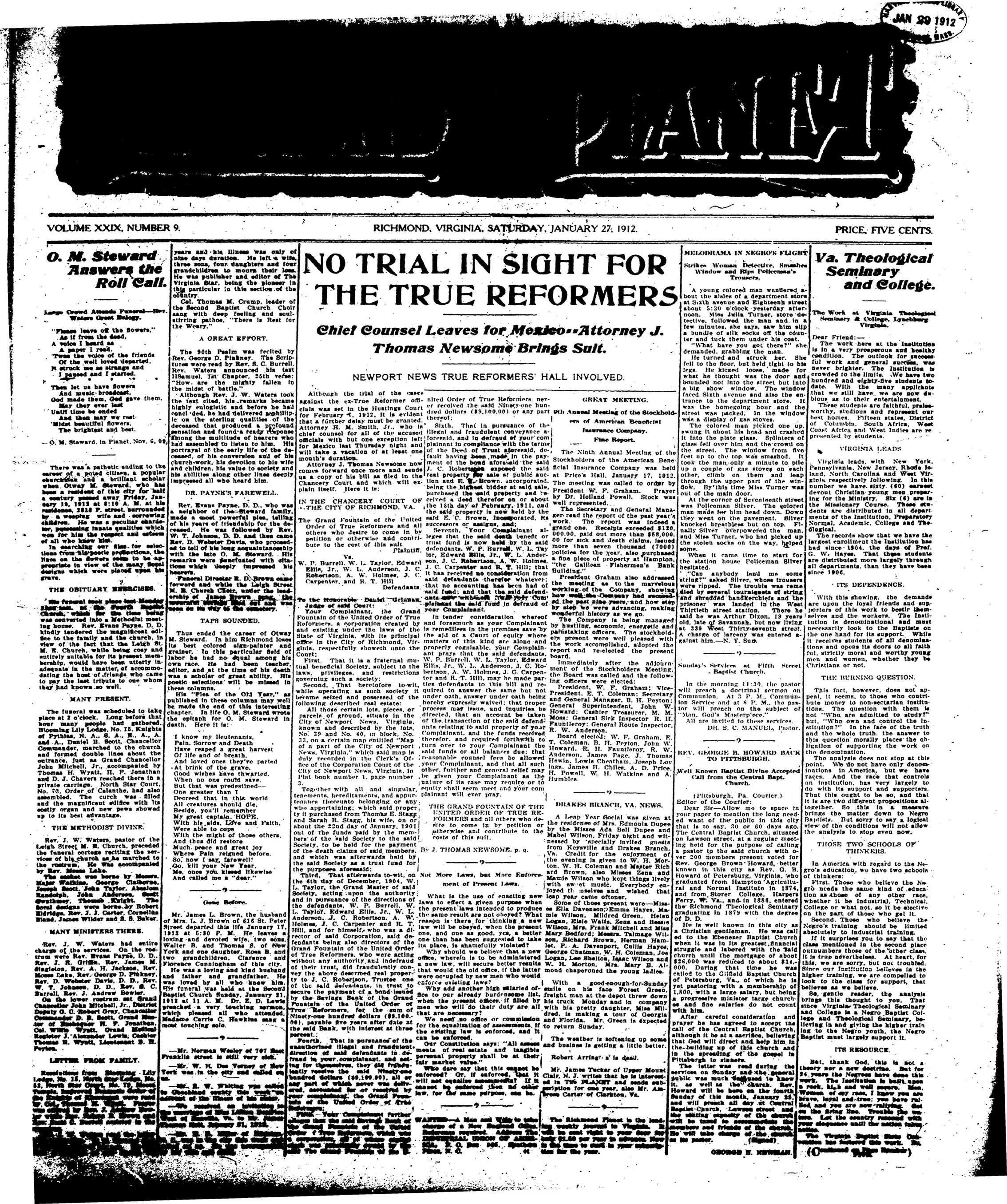
O. M. Steward Answers the Roll Call.
Large Crowd Attends Funeral—New
Waters Great Biology.
"Please leave off the flowers," As if from the dead,
A voice I heard as
A paper I read.
Twins the voice of the friends
Of the well loved departed.
It struck me as strange and
I paused and I started.
Then let us have flowers
And music broadcast,
God made them, God gave them,
May they ever last
Until time be ended
And then may we rest
Mistest beautiful flowers,
The brightest and best.
O. M. Steward, in Planet, Nov. 6, 09.
There was a pathetic ending to the career of a poised citizen, a popular churchman and a brilliant scholar when Otway M. Steward, who has been a resident of this city for half a century passed away Friday, January 19, 1912 at 8:10 A. M. at his residence, 2118 P. street, burrowed by a wooing wife and sorrowing children. He was a peculiar character, possessing innate qualities which won for him the respect and esteem of all who knew him.
In searching our files, for selections from his poetic productions, the lines on the flowers seem to be appropriate in view of the many social designs which were placed upon his grave.
THE OBITUARY EXERCISES.
The funeral took place last Monday night at St. Mary's Fourth English Church, which for the time being was converted into a Methodist meeting house. Rev. Evans Payne, D. D. kindly tendered the magnificent edifice to the family and the church, in view of the fact that the Leigh St. M. K. Church, with winging coats and unbelievable value for its own membership, would have been utterly inadequate in the matter, of accommodating the host of friends who came to pay the last tribute to one whom they had known so well.
MANY PRESENT.
The funeral was scheduled to take place at 2 o'clock. Long before that hour many people had gathered, Blooming Lily Lodge, No. 15, Knights of Pythias, N. A., G. A., E., A., A. and A., Daniel B. Boott, Chancellor Commander, marched to the church and formed double lines about the entrance, just as Grand Chancellor John Mitchell, Jr., accompanied by Thomas H. Wyatt, H. F. Jonathan and D. J. Chavers reached there in a private carriage. North Star Court, No. 73, Order of Calanthe, had also assembled. The curch was filled and the magnificent elfice with its costly organ and new pews showed up to its best advantage.
THE METHODIST DIVINE.
Rev. J. W. Waters, pastor of the Leigh Street, M. B. Church, preceded the funeral cortege reciting the services of his church as he marched to the rerum. He was accompanied by Rev. Meeson Lake.
The casket was borne by Messrs. Major Watkins, George Clarborne, Joseph Scott, John Taylor, Abalom Randolph, John Anderson, Scott Swathmoy, Thomas Knight. The coral donations were borne by Robert Hidridge, Rev. J. J. Carter, Cornelliana Blind, James Wilder and S. S. Baker.
MANY MINISTERS THERE.
Rev. J. W. Waters had entire charge of the services. On the rostrum were Rev. Evans Payne, D. D. Rev. J. R. Griffin, Rev. James M. Singleton, Rev. A. H. Jackson, Rev. Moses Lake, Rev. George D. Pinkney, Rev. D. Webster Davis, D. D. Rev. W. T. Johnson, D. D. Rev. S. C. Burrell, Rev. J. Andrew Bowler. On the lower rostrum sat Grand Chancellor John Mitchell, Jr., District Deputy G. C. Robert Gray, Chancellor Commander D. B. Scott, Grand Master of Broughey H. P. Jonathan. Col. Willie Wyatt. Grand Medical Register J. Alexander Lewis, Caskier Thomas H. Wyatt, Lieutenant B. H. Pyrson.
LETTER FROM FAMILY.
Resolutions from Shipping - Lily
Lodge, No. 15, North Star Lodge, No.
52, North Star Court, No. 79, Moor
Tunnel, Imperial Boulevard, dwarf of
the Kingdom of Renaissance were read
by Gis. Thomas M. Wittig. Papers
were cited by Rev. J. Andrew Brow-
ner with Rev. Nathan R. Brown and
Rev. David G. Burrell submitted to the
them.
years and his illness was only of nine days duration. He left a wife, three sons, four daughters and four grandchildren to mourn their loss. He was publisher and editor of The Virginia Star, being the pioneer in this particular in this section of the country. Col. Thomas M. Crump, leader of the Second Baptist Church Choir sang with deep feeling and soul-stirring pathos. "There is Rest for the Weary."
A GREAT EFFORT
The 90th Psalm was recited by Rev. George D. Pinkney. The Scriptures were read by Rev. S. C. Burrell. Rev. Waters announced his text ISHamuel, TAB Chapter, 25th verse: "How, are the mighty fallen in the midst of battle."
Although Rev. J. W. Waters took the text cited, his remarks became highly categorial and before he had concluded, he had delivered anaphilic on the sterling qualities of the deceased that produced a profound sensation and found a ready response among the multitude of hearers who had assembled to listen to him. His portrayal of the early life of the deceased, of his conversion and of his church-work, his devotion to his wife and children, his value to society and his abilities along other lines deeply impressed all who heard him.
DR. PAYNE'S FAREWELL.
Rev. Evans Payne, D. D., who was a neighbor of the Steward family, made a most powerful plan, telling of his years of friendship for the deceased. He was followed by Rev. W. T. Johnson, D. D. and then came Rev. D. Webster Davia, who proceeded to tell of his long acquaintance with the late O. M. Steward. His remarks were punctuated with attentions which deeply impressed his hearts.
Funeral Director R. D. Brown came forward and while the Leigh Street M. B. Church Chloe, under the leadership of James Brown group, the慰丧 service held out and was seen on the way to the cemetery.
TAPS SOUNDED.
Thus ended the career of Otway M. Steward. In him Richmond loses its best colored sign-painter and grainer. In this particular field of labor he had no equal among his own race. He had been teacher, editor, and at the time of his death was a scholar of great ability. His poetic selections will be missed in these columns.
His "Plea of the Old Year," as published in these columns may well be made the end of this interesting chapter. In life O. M. Steward wrote the epitaph for O. M. Steward in death. Here it is:
I know my lieutenants,
Pain, Sorrow and Death
Have reaped a great harvest
Of life and of breath,
And loved ones they've parted.
At brink of the grave.
God wishes have thwarted.
When no one could save.
But that was preempted—
One greater than I
Decreeed that in this world
All creatures should die.
Beside, you'll remember
My great captain, HOPE,
With his sids, Love and Faith.
Were able to cope
With the might of those others.
And thus did restore
Much peace and great joy
Where Pain reigned before.
So, now I say, farewell!
Go, kill your New Year.
Me, once you kissed likewise
And called me a "dear."
(one Before
Mr. James L. Brown, the husband of Mrs. L. J. Brown of 636 St. Peter Street departed this life January 17, 1912 at 5:30 P. M. He leaves a loving and devoted wife, two sons, Walter B. and Thomas S. of New York and one daughter, Rosa B. and two grandchildren, Clarence and Florence Cunningham of this city. He was a loving and kind husband and father and grandfather. He was loved by all who knew him. His funeral was held at the Second Baptist Church Sunday, January 21, 1012 at 11 A. M. Dr. Z. D. Lewis preached a very touching norman, which pleased all who attended. Madame Carrie C. Hawkins sang a most touching solo.
?
—Mr. Norman Wesley of 707 Nost Franklin street is still very sick.
—Mr. W. H. Das Vernoy of New York was in the city and called on us.
—Mr. R. W. Whiting was called to Checkland county this week an adjournment of the Illinois his father.
—We received an invitation to the marriage of Miss Lillian Bentham West of Birmingham, Va. to Mr. James Bentham North, January 31, 1912.
RICHMOND, VIRGINIA, SATURDAY, JANUARY 27, 1912.
NO TRIAL IN SIGHT FOR THE TRUE REFORMERS
Chief Counsel Leaves for Mexico--Attorney J. Thomas Newsome Brings Sult.
NEWPORT NEWS TRUE REFORMERS' HALL INVOLVED.
Although the trial of the cases against the ex-True Reformer officials was set in the Hustings Court for February 4, 1912, it is evident that a further delay must be granted.
Attorney H. M. Smith, Jr., who is chief counsel for all of the accused officials with but one exception left for Mexico last Thursday night and will take a vacation at least one month's duration.
Attorney J. Thomas Newsome now comes forward once more and sends us a copy of his bill as died in the Chancery Court and which will explain itself. Here it is:
IN THE CHANCERY COURT OF THE CITY OF RICHMOND, VA.
The Grand Fountain of the United Order of True reformers and all others who desire to come in by petition or otherwise and contribute to the cost of this suit.
Plaintiff.
Vs.
W. P. Burrell, W. L. Taylor, Edward Ellis, Jr., W. L. Anderson, J. C. Robertson, A. W. Holmes, J. C. Carpenter, and R. T. Hill
Nitited Order of True Reformers, never received the said Ninety-one hundred dollars ($9,100.00) or any part thereof.
Sixth. That in pursuance of the illegal and fraudulent conveyance a forfeiture, and in deftraud of your complaint in compliance with the terms of the Deed of Trust aforementioned, default having been made, in the payment of the bond aforementioned, the said real property for sale at public auction and E. B. Brown, incorporated, being the highest bidder at said sale, purchased the said property and received a deed therefor on or about the 18th day of February, 1911, and the said property is now held by the E. C. Brown, Incorporated. As successors or assigns, and.
Seventh. Your Complaintant alleges that the said death benefit or trust fund is now held by the said defendants, W. P. Burrell, W. L. Taylor, Edward Ellis, Jr., W. L. Anderson, J. C. Robertson, A. W. Holmes, J. C. Carpenter and R. T. Hill; that it has received no consideration from said defendants therefor whatever.
The Ninth Annual Stockholders of the Aficial Insurance Company at Price Hall, Januay.
The meeting was called President W. F. Gray, Dr. Holland Powell well represented.
The Secretary and gen read the report of work.
The report grand one. Receipts 000.00, paid out more 00 for sick and death more than seven policies for the year, a fine piece of property "the Gallican Fishe Building."
President Graham the meeting as to
Defendants
To the Honorable Daniel Grinnan
Judge of said Court:
Your Complaintant, the Grand
Fountain of the United Order of True
Reformers, a corporation created by
and existing under the laws of the
State of Virginia, with its principal
office in the City of Richmond, Virginia,
respectfully showeth unto the
Court:
First. That it is a fraternal mutual beneficial Society, subject to the laws, privileges, and restrictions governing such a society:
Second. That heretofore to-wit,
while operating as such society it
became seized and possessed of the
following described real estate:
All those certain lots, pieces, or parcels of ground, situate in the
City and Reported by the lot.
No. 39 and No. 40 in block. No.
33, on a certain map entitled "Map of a part of the City of Newport News, Virginia," which said map is duly recorded in the Clerk's Office of the Corporation Court of the
City of Newport News, Virginia. In Plat book number 1, page number 3.
Together with all and, singular, tenements, hereditaments, and appurtenances thereunto belonging or any wife appertaining; which said proper it purchased from Thomas E. Stagg and Sarah R. Stagg, his wife, on or about the 22nd day of January, 1901 out of the funds paid by the members of the said Society to be held for the payment of the death claims of said members, and which was afterwards held by the said Society as a trust fund for the purposes aforesaid:
Third. That afterwards to-wit, on the 6th day of December, 1904, W. L. Taylor, the Grand Master of said Society, acting upon the authority and in pursuance of the directions of the defendants, W. P. Burrell, W. L. Taylor, Edward Ellis, Jr., W. L. Anderson, J. C. Robertson, A. W. Holmes, J. C. Carpenter and R. T. Hill, and for himself, who was a director of said Corporation, sale of the defendant being the directors of the Grand Foundation of the United Order of True Reformers, who were acting without any authority and indefraud of their trust, did fraudulently convey the above described real property to J. C. Robertson, Trustee one of the said defendants, in trust to secure the payment of a bond issued by the Savings Bank of the Grand Pountains of the United Order of True Reformers, for the sum of Ninety-one hundred dollars ($99.100.00), payable five years after date at the said Bank, with interest at three percent:
Fourth. That in pursuance of the unauthorised illegal and fraudulent direction of said defendants in defraud in your, complaint, and setting for themselves, they did fraudulently receive the said Ninety-seven hundred Goltars ($9,100.96), all or any part of which never was delivered, accounted for or received by your complaint. The Grand Pawn of the United Order of Free Bankruptcy. Philip - Your Commandment further allows that the said Savings Bank of the United Order of Tyne Bureaux, which was a corporation, all of whose claims made was presumably caused by the United Order of Tyne Bureaux.
nited Order of True Reformers, never received the said Ninety-one hundred dollars ($9,100.00) or any part thereof;
Sixth. That in pursuance of the illegal and fraudulent conveyance aforeseen, and in defraud of your complaint in compliance with the term of the Deed of Trust afersaid, default having been made, in the payment of the bond afersaid the said J. C. Robertson exposed the said real property for sale at public auction and E. E. Brown, incorporated, being the highest bidder at sale, purchased the said property and received a deed therefor on or about the 18th day of February, 1911, and the said property is now held by the said E. C. Brown, Incorporated. As successors or assigns, and;
Seventh. Your Complaint alleges that the said death benefit or trust fund is now held by the said defendants, W. P. Burrell, W. L. Taylor, Edward Bills, Jr., W. L. Anderson, J. C. Robertson, A. W. Holmes, J. C. Carpenter and R. T. Hill; that it has received no consideration from said defendants therefor whatever; that no accounting has been had of said fund; and that the said defendants have withdrawn the said Complaint the said fund in defraud of your Complaint.
In tender consideration whereof and forasmuch as your Complaintant is remedies in the premises save by the aid of a Court of equity where matters of this kind are alone and properly cognizable, your Complaintant prays that the said defendants W. P. Burrell, W. L. Taylor, Edward Ellis, Jr. W. L. Anderson, J. C. Robertson, A. W. Holmes, J. C. Carpenter and R. T. Hill, may be made parties defendants to this bill and required to answer the same but not under oath, answer under oath being hereby expressly waived; that proper process may issue, and inquiries be directed, that an account be taken of the transaction of the said defendants relating to said property of your Complaintant, and the funds received therefor, and required forthwith to turn over to your Complaintant the said funds or all balances due; that responsible fee be allowed your Complaintant and that all such other, further and general relief be given your Complaintant as the nature of its case may require or to equity shall seem meet and your complaint will ever pray.
THE GRAND FOUNTAIN OF THE UNITED ORDER OF TRUE REFORMERS and all others who desire to come in by petition or otherwise and contribute to the costs of this suit.
By J. THOMAS NEWSOME, P. 9.
Not More Laws, but More Enforcement of Present Laws.
What is the use of enacting new laws to effect a given purpose when the present laws intended to produce the same results are not obeyed? What reason is there, for thinking a new law will be obeyed, when the present one, and one as good, yes, a better one than has been suggested to take its place, is shamefully violated? Why should we believe that a new office, wherein is to be administered a new law, will secure better results that would the old office, if the latter were occupied by new men who would enforce existing laws? Why add another high sultaried office to our already burdensome list, when the present office, if filled by men who will do their duty are all that they need? We need no office or commission for the equalization of assessments, if the existing law is enforced, and it can be enforced. Our Constitution says: "All amounts of real estate and tangible personal property shall be at their fair market value." Who dare say that this cannot be enforced? Or, if enforced, that it will not equalize assessments? If it cannot be enforced then all other law, for the same purpose, can be.
WANTED—A Man and Wife to take charge of a New England Office. Residence required. Address The INDEPENDENT UNIVERSITY OF AMERICA, R. P. Box 305. North Carolina, P. O. Q. 44
GREAT MEETING
The Ninth Annual Meeting of the Stockholders of the American Beneficial Insurance Company was held at Price's Hall, January 17, 1912. The meeting was called to order by President W. F. Graham. Prayer by Dr. Holland Powell. Stock was well represented.
The Secretary and General Manager read the report of the past year's work. The report was indeed a grand one. Receipts exceeded $120,000.00, paid out more than $58,000.00 for sick and death claims, issued more than seven thousand (7000) policies for the year, also purchased a fine piece of property at Hampton, "the Galloian Fishermen's Bank Building."
President Graham also addressed the meeting as to the marvelous working of the Company, showing how well the Company had proceeded by the past nine years and how step by step we were advancing, making wonderful history as we go.
The Company is being managed by hustling, economic, energetic and painstaking officers. The stockholders present were well pleased with the work accomplished, adopted the report and re-elected the present board.
Immediately after the adjournment of the Stockholders Meeting, the Board was called and the following officers were elected:
President, W. F. Graham; VicePresident, E. T. Coleman; Secretary and General Manager, B. H. Peyton; General Superintendent, John W. Howard; Cashier Treasurer, M. M. Moss; General Sick Inspector R. H. Fauntleroy; General Route Inspector, R. W. Anderson.
Board elected: W. F. Graham, E. T. Coleman, B. H. Peyton, John W. Howard, R. H. Fauntleroy, R. W. Anderson, James Page, J. Thomas Hawin, Lewis Cheentham, Joseph Lovings, James H. Chiles, A. D. Price, H. Powell, W. H. Watkins and A. Humbles.
____ , ____
DRAKES BRANCH, VA. NEWS.
A Leap Year Social was given at the residence of Mrs. Edmona Dupee by the Misses Ada Bell Dupee and Mabel Wilson, Friday night and witnessed by specially invited guests from Koysville and Drakes Branch, Va. Credit for the enjoyment of the evening is given to W. H. Morton, W. H. Coleman and Master Rich Brown, also Misses Zena and Mamie Wilson who kept things lively with sweet music. Everybody enjoyed themselves and wished that leap year came oftener.
Some of those present were—Misses Ella Davenson; Emma Hayes, Mamie Wilson, Milred Green, Helen Logan, Elaine Watts, Zena and Bessie Wilson, Mrs. Frank Mitchell and Miss Mary Bedford; Messra Talmage Wilson, Richard Brown, Herman Hamlet, P. A. Davenport, Cullis Hayes, George Chatman, W. H. Coleman, Joe Logan, Logan Shelton, Isaac Wilson and W. H. Morton, Mrs. Mary B. Almond chaperoned the young ladies.
With a good enough-for-Sunday smile on his face Forest Green, freightman at the depot throw down his truck Monday and in company with his pretty daughter, Miss Milred, is making a tour of Georgia and Florida. Mr. Green is expected to return Sunday.
The weather is softening up some and businesses is getting a little better.
Robert Arrington is dead.
Mr. James Tucker of Upper Mount Clair, N. J. writes that he is interested in THE PLANET and sends subscription for one year, also Mr. Amber Carter of Clarkton, Va.
The Richmond Planet is the land-
weekly journal in Virginia. It will be sent right to your door for
only $1.80 per year in advance. Now
is the time to send in your subscription
for the year.
Strikes Woman Detective, Smashes Window and Hips Policeman's Trouwers.
A young colored man wandered about the alley of a department store at Sixth avenue and Eighteenth street about 5:30 o'clock yesterday afternoon. Miss Julia Turner, store detective, followed the man and, in a few minutes, she says, saw him slip a bundle of silk socks off the counter and tuck them under his coat. "What have you got there?" she demanded, grabbing the man.
He turned and struck her. She fell to the floor, but held tight to his legs. He kicked loose, made for what he thought was the door and bounded not into the street but into a big show window. The window faced Sixth avenue and also the entrance to the department store. It was the homegoing hour and the street was packed. In the window was a display of gas stoves.
The colored man picked one up, swung it about his head and crashed it into the plate glass. Splinters of glass fell over him and the crowd on the street. The window from five feet up to the top was smashed. It took the man, only a minute to pile up a couple of gas stoves on each ear, climb on them and leap through up the port of the window. By this time Miss Turner was out of the main door.
At the corner of Seventeenth street was Policeman Silver. The colored man made for him head down. Down they went on the pavement. Silver knocked breathless but on top. Finally Silver overpowered the man, and Miss Turner, who had picked up the stolen socks on the way, helped some.
When it came time to start for the station house Policeman Silver hesitated.
"Can anybody lend me some string?" asked Silver, whose trousers were ripped. The trouble was remixed by several tourguesses of string and shredded banderchefs and the prisoner was landed in the West Thirtieth street station. There he was old, late of Savannah, but now living at 339 West Thirtieth-seventh street. A charge of larceny was entered against him.—N. Y. Suy.
____ " ____
Sunday's Services at Fifth Street Baptist Church.
In the morning 11:30, the pastor will preach a doctrinal sermon on Communion. At 3 P. M. Communion Service and at 8 P. M., the pastor will preach on the subject of "Man, God's Masterpiece."
are invited to these services.
DR. S. C. MANUEL. Pastor
REY, GEORGE B. HOWARD BACK
TO PITTISBURGH.
Well Known Baptist Divine Accepted Call from the Central Bapt. Church.
(Pittsburgh, Pa. Courier.)
Editor of the Courrier:
Dear Sir—Allow me to space in your paper to mention the long needed want of the public in this city that is to say, 30 or 60 days ago. The Central Baptist Church, situated on Lawson street, at a regular meeting held for the purpose of calling a pastor to the said church with over 200 members present voted for Rev. George Brown-Howard, better known in this city as Rev. G. B. Howard of Petersburg, Virginia, who graduated from Hampton Agricultural and Normal Institute in 1874, and from Storer College, Harpers Ferry, W. Va., and in 1886, entered the Richmond Theological Seminary graduating in 1879 with the degree of D. D.
He is well known in this city as a Christian gentleman. He was called ed to the Ebenezer Baptist Church when it was in its greatest, financial struggle and labored with the Bald church until the mortgage of about $26,000 was reduced to about $14,000. During that time he was called to the Giffield Baptist Church of Peterburg, Va., of which he is yet pastoring with a membership of 1,800, with a large salary, but being a progressive minister large churches and fine salaries do not count with him.
After careful consideration and prayer he has agreed to accept the call of the Central Baptist Church, although it be at a sacrifice, believing that God will direct and help him in the-building up of this church and in the spreading of the gospel in Pittsburgh to sinners.
The letter was read during the services on Sunday and the general will be church dignitaries to know it. We will be in the church Howard will be here on the fourth Sunday of this month, January 28 and will preach all day at Central Baptist-Church, Lawson street, and the shifting capacity of the church will be used to accommodate the members and friends of the church. He will take charge of the church in his pastor. (Signature)
PRICE: FIVE CENTS
Va. Theological Seminary and College.
The Work at Virginia Theological Seminary & College, Lynchburg Virginia.
Dear Friend:—
The work here at the Institution is in a very prosperous and healthy condition. The outlook for successful work and general success, was never brighter. The Institution is crowded to the limits. We have two hundred and eighty-five students to face. With the many applicants that we still have, we now dubious as to their entertainment. These students are faithful, praiseworthy, studious and represent our best homes. Fifteen states, District of Columbia, South Africa, West Const Africa and West Indies are represented by students.
VIRGINIA LEADS.
Virginia leads, with New York, Pennsylvania, New Jersey, Rhode Island, North Carolina and West Virginia respectively following. In this number we have sixty. (60) earnest devout Christian young men preparing for the Ministry. Six (6) are in the Missionary Course. These students are distributed in all departments of the Institution, Preparatory Normal, Academic, College and Theological.
The records show that we have the largest enrollment the Institution has had since 1804, the days of Prof. G. W. Hayes. That these students are distributed more largely through all departments, than they have been since 1806.
ITS DEPENDENCE.
With this showlink, the demands are upon the loyal friends and supporters of this work to bestir themselves and the workers. The institution is denominational and must necessarily look to the Baptists on the one hand for its support. While it receives students of all denominations and opens its doors to all faithful, strictly moral and worthy young men and women, whether they be Christians or not.
THE BURNING QUESTION.
This fact, however, does not appeal, it seems, to those who contribute money to non-sectarian institutions. The question with them is not "Who are admitted to study?" but, "Who own and control the Institution?" In the face of the truth and the whole truth, the answer to this question morally places the obligation of supporting the work on the denomination.
The analysis does not stop at this point. We do not have only denominations in America, but we have races. And the race that controls an institution, has very largely to do with its support and supporters. That this ought to be so, and that it is are two different propositions altogether. So this in a measure brings the matter down to Negro Baptists. But sorry to say a logical view of the conditions will not allow the analysis to stop even now.
THOSE TWO SCHOOLS OF THINKERS.
In America with regard to the Negro's education, we have two schools of thinkers:
First. Those who believe the Negro needs the same kind of education as those of any other race, whether it be Industrial, Technical, College or what not, so it be elective on the part of those who get it.
Second. Those who believe the Negro's training should be limited absolutely to industrial training.
If it surprises you to say that the class mentioned in the second place outnumbers those of the other class, it is true nevertheless. At heart, for this, we are sorry, but not troubled. Since we institution believes in the higher training, we are compelled to look to the class for support, that believes as we believe.
Be, gentle reader, the analysis brings this thought to you. That since Virginia Theological Seminary and College is a Negro Baptist College and Theological Seminary, believing in and giving the higher training to the Negro youth, the Negro Baptist must largely support it.
ITS RESOURCE
But, thank God, this is not a theory nor a new doctrine. But for 24 years the Negroes have done this work. The Institution is built upon a rock, high h and wall square. Men, Women of my race, I know you are brave, loyal and true; you have rallied and you are now rallying. But on the firing line. Trouble the women. Let the country respond with your eloquence until the nation takes battles. The Virginia Baptist State Convention has featured this work. Dr. (Continued on page number)
---
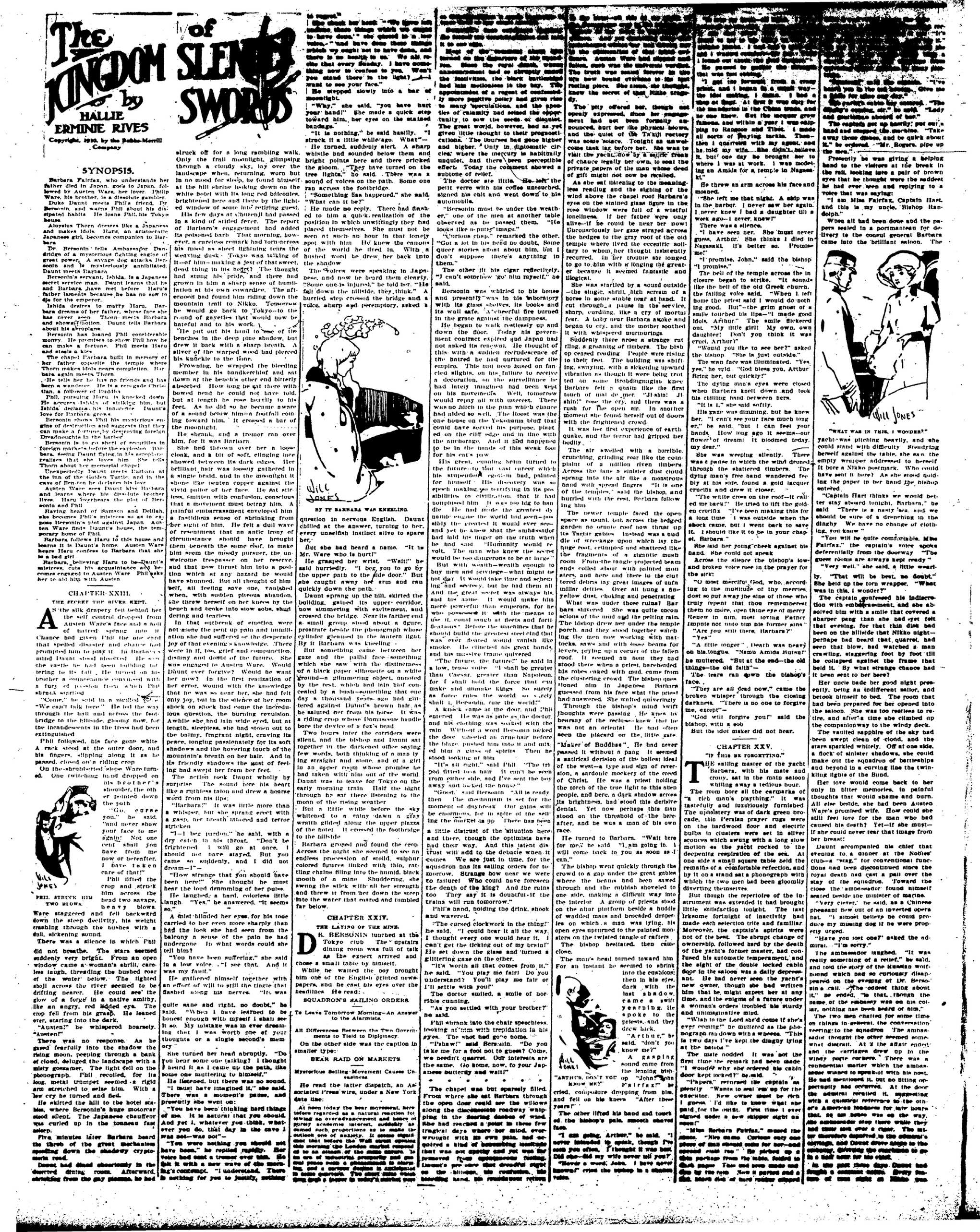
5YNOPSIS.
Barbara Falfax, who understands her father died in Japan, goes to Japan, followed by Auster Ware, her lover, Philip Ware, his brother, is a dissolute gambler. Duke Daunt meets Phila friend, Dr. Daunt and warns Phila about his displeased habit. He lends Phila his Tokyo house. Aloysius Thorn dresses like a Japanese and makes idols. Haru, an aristocratic Japanese girl, becomes companion to Barbara.
Do Barbarain tells Ambrashera. Dr. drides of a mysterious fathing engine of great power. A savage dog attacks Jerocinon and is mysteriously annihilated. Daunt meets Barbara.
Barberin's servant, Ishida, is a Japanese secret service man. Daunt learns that he and Barbara Jawne met before Haru's house, he has no sowl to for the emperor.
Ishida desires to marry Haru. Barbara dreams of her father, whose face she has never seen. Thorn meets Barbara and shows emotion. Daunt tells Barbara about his abruptness.
Barberin has learned Phil considerable money to show Phil how he can make a fortune. Phil meets Haru and steals a kite.
The chapel Barbara built in memory of her father opposes the temple where Thorn makes idols near completion. Barbara again meets Thorn.
He tells she has no friends and has been a renegade Christian, a follower of Budha.
Phil, pursuing Ishida, is knocked down. He acquires Ishida of stalking him, but Ishida declares his innocence. Daunt love for Barbara grows.
Barberin shows Phil his mysterious energy and warns that they can make a fortune by depriving foreign breadmakes in the harbor.
Bergenin is to go so short of securities in foreign markets before the explosion. Barbara, seeing Daunt flying in his apocalyptic realities that she loves him, she tells Thorn about the memorial chapel at Tartan. Barbara at the inn of the Golden Turtle and in the cave of Benten he declares his love. Austen Ware sees Daunt kiss Barbara and learns where his dissolute brother lives. Haru overhears the plot of Bergenin and Phil. Having heard of Samson and Delilah, Haru's Philia mistress so as to expose Bergenin's plot against Japan. Austen Ware finds Daunt's house, the temporary home of Phil. Barbara follows Haru to this house and learns it is Daunt's home. Austen Ware hears Haru confess to Barbara that she is a bad girl. Barbara believing Haru to be Daunt's mistress, cuts his acquaintance and becomes engaged to Austen Ware. Phil takes her to old him with Austen
CHAPTER XXIII.
A the silk drapery felt behind her the self control dropped from Austen Ware's face and a hull of hatred sprang into it. Chance and given Phil the one word that spelled disaster and chance had prompted him to play it. In flares he mind Dunt had absorbed. He saw the battle he had been building to tering to its tail. He turned on his brother a companion connected with a fury of passion from which Phil shriek started
"Come," he said in a murmled voice.
"We can't talk here." He led the way through the hall and across the footbridge to the hillside, glouny now, for the incandescents in the trees had been extinguished.
Phil followed, his face gone white. A rack stood at the outer door, and his fingers, slipping along it as he passed, closed on a riding crop.
On the shrubberied stone Ware turned. One twitching hand dropped on his brother's shoulder, the other pointed down the path
WILL
JAMES
"Go, care
gou," he said,
"and never show
your face to me
migainy." Not one
cent shall you
have from me
nor be after,
I have taken
care of that!"
Phil lifted the crop and struck
him across the head two averse,
beauty blows.
PHIL. STUCK HIM head two savage, two mown. heavy blows. Ware staggered and fell backward down the steep descent, his weight crashing through the bushes with a soil, slackening sound. There was a silence in which Phil did not breathe. The stars seemed suddenly very bright. From an open window came a woman's skirt, careless laugh, threading the bushed roar of the water below. The lighted shell across the river seemed to be drifting nearer. He could see the glow of a forge in a native smithy, like an angry, red dadded eye. The crop fell from his grasp. He leaned over, staring into the dark.
"Aunten" he whispered hoarsely. "Aunten"
There was no response. As he gassed fearfully into the shadow the rising moon, peeping through a bank of cloud, deluged the landscape with a misty gosser. The light fell on the photograph. Phil recolled, for its long, metal trumpet seemed a rigid arm stretched to wipe him. With a low cry he turned and fled.
He stitched the hill to the hotel stair, where Bernonin's huge motorcar stood silent. The Japanese chauffer was curled up in the tonneau fast asleep.
Five minutes later Barbara board the throb of the great mechanism speeding down the shadowy cryptomorin road.
Douglas had dived shortly in the deserted dining room. Afterward, detritus from the any mason he had
of SLENE SWORDS
struck off for a long rambling walk. Only the frail moonlight, glimpse through a cloudy sky, lay over the landscape when, returning, worn but in no mood for sleep, he found himself at the hill shrine looking down on the white hotel with its long red balconies, brightened here and there by the lighted window of some late refiring guest.
His few days at chinchinj had passed in a kind of attituded fever. The report of Harbarn's engagement had added his poisoned barb. That morning, however, a careless remark had torn across his mood as sheight lightning tears the weaving dusk. Tokyo was talking of it—him—making a jest of that sweet, dead thing in his heart. The thought had stung his pride, and there had grown in him a sharp sense of humiliation at his own cowardice. The afternoon had found him riding down the mountain trail to Nikko. Tomorrow he would go back to Tokyo—to the round of gayeties that would now be painful and to his work.
He put out his hand to one of the benches in the deep pine shadow, but drew it back with a sharp breath. A silver of the warped wood had placed his knuckle to the bone.
Frowning, he wrapped the bleeding member in his handkerchief and sat down at the bench's other end bitterly absorbed. How long he got there with bowed head he could not have told, but at length he rose heartily to his feet. As he did he became aware of a sound below him—a footfall coming toward him. It crowded a bar of the moonlight.
He shrank, and a tremor ran over him, for it was Harbarn.
She had thrown over her a loose cloak, and a bit of soft, elonging face showed between its dark edges. Her brilliant hair was loosely gathered in a single braid, and in the moonlight it shone the wetsten copper against the vivid pallor of her face. He sat stricter, smitten with confusion, conscious that a movement must betray him. A painful embarrassment enveloped him a fastidious sense of shrinking from her sight of him. He felt a dull wave of resentment that an antic irony of circumstance should have brought them beneath the same roof, to make him seem the moody purifier, the unwelcome trespasser on her reserve, and that now thrust him into a position which at any hazard he would have shunned. But all thought of him self, all feeling save one, vanished when, with sudden pious abandon, she threw herself on her known by the bench and broke into slow sobs, shuddering and tearing.
In that outbreak of emotion were not alone the pent up pain and humiliation she had suffered or the desperate joy of that evening's knowledge. There were in it, too, grief and compunction, dismay and doubt of the future. She was engaged to Austen Ware. Would Daunt ever forgive? Would he want her now? In the first realization of her error, wound with the knowledge that he was so near her, she had felt only joy, but in the silence of her room shock on shock had come the incredulous question, the burning revolution. Ashle she had in vain eyesed, but at length, sleepiness, she had stoned out to the balmy, fragrant night, craving its peace, longing passionately for its soft shadows and the hovering touch of the mountain's breath on her hair. And in its friendly shadows the gust of feeling had swept her from her feet.
The action took Daunt wholly by surprise. The sound force his heart like a ruthless talon and drew a hoarse word from his lips:
"Barbarum!" It was little more than a whisper, but she sprang erect with a gasp, her breath inflamed and terror stricken.
"I-1 beg pardon," he said, with a dry catch in his throat. "Don't be frightened. I will go at once. I should not have staged. But you came so suddenly, and I did not dream-1-"
"How strange that you should have been here!" She thought he must hear the loud drumming of her pulse. He laughed, a hard, colorless little laugh. "Yes," he answered, "it seems so."
A mist blinded her eyes, for his nose carried to her even more sharply than had the look she had seen from the balcony a sense of the pain he had undergone. In what words could she tell him?
"You have been suffering," she said in a low voice. "I see that. And it was my fault."
He gathered himself together with an effort of will to still the tingle that flashed along his nerves. "It was quite same and right, no doubt," he said. "When I have learned to be honest enough with myself I shall see it. My mistake was in ever dreaming that I was worth one of your thoughts or a single second's memory."
She turned her head abruptly. "Do you hear some one talking? I thought he heard it, I came up the path, like some one muttering to himself."
He listened, but there was no sound. "I must have imagined it," she said. There was a moment's pause, and presently she went on:
"You have been thinking hard things of me. It is natural that you should. And yet I, whatever you think, whatever you do, that day in the save I was not—was not"
"You were nothing, you should not have been," he replied rapidly. Her voice had sent a tremor over him. She felt it with a new wave of the morning's contempt. "I understand. There is nothing for you to justify, nothing
I like about how much "We give you all
the things which we give you, and
have done" "she gave us a few
tales," "and have done these things
which we might not have done, and
there is no health to us." We all
reach that every Sunday. I have something
now to confess to you. Won't
you stand there in the light? I
want to see your face."
He stepped slowly into a bar of moonlight.
"Why," she said, "you have hurt your hand!" She made a quick step toward him, her eyes on the stained bandage.
"It is nothing," he said hastily. "I tremble a little while again. What?"
It is bothering, be and hardly a struck it a little while ago. What"—He turned, suddenly alert. A sharp whistle had sounded below them and bright points here and there pricked the gloom. "They have turned on the tree lights," he said. There was a sound of voices on the path. Some one ran across the footbridge. "Something has happened," she said. "What can it be?"He made no reply. There had flashed to him a quick, realization of the position in which unwittingly they had placed themselves. She must not be seen at such an hour in that lonely spot with him. He knew the canon of the world he fired in. With a hushed word he drew, her back into the shadow.The Voices were speaking in Japanese, and now he heard them clearly. "Some one is injured," he told her. "He fell down the illite, the think."A hurried step crossed the bridge and a voice, sharp and peremptory, asked a
BY IT BARBARA WAR KNEELING.
question in nervous English. Daunt chilled at the answer, turning to her, every unselfish instinct alive to spare her.
But she had heard a name. "It is Mr. Ware who is hurt."
He grasped her wrist. "Walt!" he said hurriedly. "I beg, you to go by the upper path to the side door." But she caught away her arm and ran quickly down the path.
Daunt sprang up the hill, skirted the building, gained its upper corridor, now summertime with excitement, and crossed the bridge. Near its farther end a small group stood about a figure, prostrate beside the photograph whose cylinder glomed in the latent light. By it Harbara was kneeling.
But something came between her gaze and the pallid face—something which she saw with the distinctness of a black paper silhouette on a white ground—a glimmering object, omitted by the rest, which had lain half concealed by a bush—something that one day a thousand years ago had glittered against Daunt's brown hair, as he saluted her from his horse. It was a riding crop whose Damascus handlebore the device of a fox's head.
Two hours later the corridors were silent, and the bishop and Daunt sat together in the darkened office saying few words, both thinking of a man lying straight and alone, and of a girl in an upper room whose promise he had taken with him out of the world. Daunt was to leave for Tokyo on the early morning train. Half the night through he sat there listening to the moon of the raining weather.
But a little while before the sky whitened to a rainy dawn a gray wrath glided along the upper plaza of the hotel. It crossed the footbridge to the hillside.
Bartara grieped and found the crop
Across the night she seemed to see an
endless procession of stolls, sulphur
colored figures linked with thin, rat-
ting chains filling into the humid, black
mouth of a mine. Shuddering, she
sawing the stick with all her strength
and threw it from her down the steep
into the water that roared and tumbled
far below.
CHAPTER XXIV.
THE LAYING OF THE MINE.
D. R. BEERSONN launched at the Tokyo club. The Upstairs dining room was full of talk as the expert arrived and chose a small table by himself.
While he waited the boy brought him one of the English printed newspapers, and he cast his eyes over the headlines. He read:
SQUADRON'S SAILING ORDERS
To Leave Tomorrow Morning—An Answer to the Alarmista
All Differences Between the Two Governments to Yield to Diplomacy.
On the other side was the caption in smaller type:
BEAR RAID ON MARKETS
Mysterious Belling-Movement Causes Unrestfulness
He read the latter dispatch, an Associated Press wire, under a New York date line:
At noon today the bear movement, here before regarded as a natural reaction to sowing an overadvancement and hence of purely academic interest, suddenly as the outlook one of majesty. It seems sign that before the Wall opens upon this morning the London market responds to an attack of the main news. In the era of industrial prosperity and growth, and a corporate environment in all quarters. The news comes from a letter to a newspaper
The image contains a single block of text with no visible characters or images. The text is:
"The image contains a single block of text with no visible characters or images. The text is:
The doctor are little. He left the peritre with his coffee untouched, signed his chit and went down to his automobile.
"Bersonin must be under the weather," one of the men at another table observed as he passed them. "He looks like a putty image."
"Curious clap," remarked the other. "Got a lot in his hold no doubt. Some queer stories allot about him, but I don't suppose there's anything in them."
The other lit his cigar reflectively, "I can't somehow go film myself," he said.
Bersonin was whirled to his house and presently was in his laboratory with its glass shores, its books and its wall safe. A wonderful fire burned in the grate against the dampness.
He began to walk restlessly up and down the floor. Today his government contract expired and Japan had not asked its renewal. He thought of this, with a sudden recurrence of the bared he had nurtured for the empire. This had been based on fanied alights, on his failure to receive a decoration, on the surveillance he had intently imagined had been kept on his movements. Well, tomorrow would repay all with interest. There was no hitch in the pin which chance had added so well. The loot was the one house on the Yokohama bluff that could have served his purpose, planted on the cliff edge and in time with the anchorage. And it had happened to be in the hands of this weak foot for his cats' paw
His great, coming brain turned to the future—to that vast career which his stupendous education had, palates for himself. His discovery was a epoch making, go terrifying in its pos abilities to civilization, that it had nonplanned him. It was too big to ban die. He had made the greatest dynamic engine the world had seen—positively the greatest it would ever see—and yet knew that the ambassador had laid his finger on the truth when he had said "Humanity would revolt. The man who knew the secret would be too dangerous to be at large." But with wealth—wealth enough to buy men and privilege—what might not be did? It would take time and scheming and sensory, but he had them all. And the greatest secret was always his, and his alone. It would make him more powerful than emperors, for he who possessed it with the means to use it, could mount at fleets and fortifications. Before the machines that he should build the greatest steel that was ever flamed would vanish like smoke. He clinched his great hands, and his massive frame quivered. "The future, the future," he said in a low, tense voice, "I shall be greater than Cleaver, greater than Napoleon, for I shall hold the force that can make and unmake kings. So surely as force rules the world so surely shall I, Bershawn, rule the world."
A knock came at the door, and Phil knocked. He was as pale as the doctor, and his clothing was sucked with the rain. Without a word Bertsmith took the door, watched an arm hair before the blaze pushed him into it and mixed him a glass of spirits. Then he stood looking at him.
"It's all right," said Phil. "The trumpet fitted to a hair. It can't be seen from either side, and I've sent the boy away and locked the house."
"Good," said Bertsmith. "All is ready then. The mechanism is set for the moment of daybreak. Our gains will be enormous, for in spite of the selling the market is up. There has been a little distrust of the situation here and there, though the optimists have had their way. And this jastent dish trust will add to the debacle when it comes. We are just in time, for the squadron has its sailing orders for tomorrow. Strange how near we were to nature! Who could have foreseen the death of the king? And the rains too. They say it is doubtful-if the trains will run tomorrow."
Phil's hand, holding the drink, shook and wavered.
"The cursed clockwork in the thing!" he said. "I could hear it all the way. I thought every one would hear it. I can't get the tickling out of my brain! He set down the glass and turned a glittering gaze on the other.
"It's worth all that comes from it," he said. "You play me fair! Do you understand? You'll play me fair or I'll settle with you!"
The doctor smiled, a smile of horrible cunning.
"As you settled with your brother," he said.
"I'll shrink into the chair speechless, looking in from with trepidation in his eyes. The shot had gone home."
"Ishaw!" said Berenain. "Do you take me for a fool pot to guess? Come, we needn't quarrel. Our interest are the same. Go home, now, to your Japanese buttery and wait!"
The chapel was but sparsely filled. From where she sat Barbara through the open door could see the willows along the discomposite roadway whipping in the searing dustes of wind. She had reached a point in three few fragrant days where her mind, everwrought with its own pain, had acquired a kind of boundless insight that was not spotted and not was preserved from epiphanies fusing. She's sure she must dream of sight on the allure, the restraint, the restraint hand, the restraint retinue.
To be least of this is to make the first step to try to find out how to get the right way to the situation.
So, let's put the two lines on to the demonstration of that task and have. Amend We had signed and taken our work was the universal word. The truth was issued never in the use now bound orwhims to the first resting piece. She always, she thought, knew the secret of that Nike tragedy.
The pity offered her, though not especially expressed, since her engagement had not been formally announced, hurt her like physical knowledge, and the quiet of the Taiji rectory was some sound. Tonight an unwelcome task is, before her. She was to visit the yachist, by a gliffit from of chance legally her own, to seat the private papers of the man whose dead of gift might not now be recalled.
As she met Hlening to the meaningless reading and the stinging of the wind above the chapel roof Barbara's eyes on the stained glass figure in the rose window were full of a wistful loneliness. If her father were only alive—if he could be near her now! Unconsciously her gaze strayed across the hedges to the gray roof of the old temple where lived the eccentric solitary to whom her thought insistently recurred. In her trouble she longed to go to, biting with a longing for because it seemed fantastic and illogical.
She was startled by a sound outside—the single, shrill, high scream of a horse in some sturdy near at hand. It cut through a pause in the service, sharp, curding, like a cry of mortal fear. A baby near Barbara awoke and began to cry, and the mother soothed it with whispered murmurings.
Suddenly there arose a strange rutting, a grashing of timbers. The bishop ceased rudging. People were rising to their feet. The building was whirling, swirling, with a slickening upward vibration as though it were being troted on some Brobdingmiah knave. Barbara felt a quint like the first touch of mat do near. "Jil shin! Jil shin!" rose the cry, and there was a rush for the open air. In another moment she found herself out of doors with the frightened crowd.
It was her first experience of earth quake, and the terror had gripped her bodily.
The air swelled with a horrible, crunching, grinding roar like the complaint of a million riven timbers. Across the tame minister dust cloud spring into the air like a monstrous hand with spread fingers. "It is one of the temples," said the bishop, and hurried with the rest, Barbara following him.
The newer temple faced the open space as usual, but across the bedged garden no ornate roof now thrust up the Tarar gubbs. Instead was a bundle of wreckage upon which lay the huge roof, crumpled and shattered like the fragments of a granite mushroom. From the tangle projected beam ended collar with painted monsters, and here and there in the cluttered debris lay great images of una-millar datties. Over all hung a yellow dust, choking and penetrating. What was under those ruins? Barbara shivered. She was quite unconcerned of the mud and the pelting rain. The bishop drew her under the temple porch, and they stood together watching the men now working with mattocks, saws, and with loose beams for laws, prying up a corner of the fallen roof. It seemed an hour they had stood there when a priest, bare-headed his robes naked with mud, came from the clustering crowd. The bishop questioned him in Japanese. Barbara guessed from his face what the priest had answered. She wilted quiveringly. Through the bishop's mind thought were passing. He knew by hearsay of the reckoning that he was not an oriental. He had often seep the placard on the little gate
"Maker of Buddhas." He had never paused it without a pang. It seemed a satirical derision of the holiest ideal of the west—a type and sign of reverence, a sardonic mockery of the creed of Christ. He was a priest holding the torch of the true light to this alien people, and here, a dark shadow across its brightness, had stood this derisive dental. Yet now perhaps this man stood on the threshold of the hereafter, and he was a man of his own race.
He turned to Barham. "Walt here for me, he said. 'I am going in. I will come back to you as soon as I can.'"
The bishop went quickly through the crowd to a gap under the great gables where the beams had been sawed through and the rubbish shoveled to one side, making a difficult way into the interior. A group of priests stood on the altar platform beside a buddle of wadded man and brocaded draperies on which a man was lying, his open eyes upurned to the painted monsters on the twisted tangle of rafters.
The bishop hesitated, then came close.
The man's head turned toward him. For an instant he seemed to shrink
into the cushions;
then in his eyes,
dark, with the
last shadow,
came a swift
yarning, the
spoke to the
priests, and they
draw back.
AIL
JONES
"At burr," he said, "don't you know me?" A gasping sound came from the leaning chair. John "John John Kairfax?"
"ARTHIC, DON'T YOU OP" John John
know MK? Palefar? I
cried, conipouse dropping from blim,
and fell on his knees "After these
years"
The other lifted his hand and touch
ed the bishop's pain, smooth shaved
then.
"I am going, Arthur," he said, "I
never intended to speak, though I
came you often. I thought it was best.
Did she do my wife never tell you?
"Haver a word, John. I have never
known" rived the bishop in a shimmer
voice.
I will not be the one to try to be the best man in the james. I had a good friend and I wanted remember him better. I knew not about the good dog." He passed to guaran the strangest that was first closing.
"I got into the barnyard from a camp print, and I began in a small way the life making. I mean, I had a step at night. At first it was day for the manners in the China trade, and so one knew. But the rooster grew fainter, and within a year I was shipping to Hangoe and Tibet. I made all sorts of playing turtles. Then then I quarreled with my agent, and he told my wife. She didn't salute it, but one day he brought her to where I was at work. I was modeling an Ambla for a temple in Nagamkul."
He throw an arm across his face and moaned.
"She left me that night. A ship was in the barber. I never saw her again. I never knew I had a daughter till a week ago. I never knew."
There was a silence.
"I have been her. She must never guess, Arthur. She thinks I died in Nagamkul. It's better so. Promises me."
"I promise, John," said the bishop "I promise."
The bell of the temple across the incleude began to strike. "It isounde like the bell of the old Greek church, the falling voice said. "When I left home the priest said I would do nothing good. But"—the grim groom of a smile touched his lips—"I made good idols, Arthur." The smile flickered out. "My little girl! My own, own daughter! Don't you think it was cruel, Arthur?" "Would you like to see her?" asked the bishop. "She is just outside." The man face was illuminated. "Yes, yes," he said. "God bless you, Arthur. Bring her, but quickly!" The dying man's eyes were closed when flurtors knelt down and took his chilling hand between hers. "It is it," she said softly. His gaze was dimming, but he knew her. "I can't see your face much longer," he said. "but I can feel your hands. How long ago it seems our flower' of dream! it bloomed today, my dear." She was weeping allently. There was a panne in which the wind drowned through the shattered timber. The dying man's free hand wandered freely by his side, found a gold lacquer crocus and drew it closer. "The white cross on the roof—it called me back!" He tried to lift the golden crocus. "I've been making this for a long time. I was outside when the shock came, but I went back to save it. I should like it to be in your chapel. Barbara." He said her young cheek against his hand. She could not speak.
Across the silence the bishop's low and broken rose rose in the prayer for the sick:
"O most merciful God, who, according to the multitude or thy mercies, do not put away the sins of those who truly repent that those remember them no more, open their eyes of merry Heaven in him, most loving Father impune not unto him his former sins?
"Are you still there, Barbara?"
"Yeah"
"A little longer", Death was heavy on his tongue. "Namu Amida Hutau" he muttered. "But at the end—the old things—the old faith"—
"The tears ran down the bishop's face.
"They are all dead now," came the broken whisper through the closing darkness. "There is no one to forgive me, except"—
"God will forgive you!" said the bishop, with a sob
But the idiot maker did not hear.
"iy fills be FOROKTTING."
THE sailing master of the yacht Barbara, with his mate and crony, sat in the main saloon whiling away a tedious hour. The room bore all the carmarks of a "clich man's plaything." It was tastfully and luxuriously furnished. The upholstery was of dark green brocade, thin lerian prayer rugs were on the hardwood door and electric bulbs in clusters were set in silver scionen which swung with a long slow motion as the yacht rocked to the deepening respiration of the sea. At one side a small square table held the remains of a comfortable reflection, and by it on a stand a phonograph with which the two men had been gloomily diverting themselves.
But though the repertoire of the instrument was extended it had brought little satisfaction tonight. The last lukrisse fortnight of inactivity had made each selection tite and familiar. Moreover, the captain's spirits were not of the best. The abrupt change of ownership, followed hard by the death of the yacht's former master, had confused his automatic temperament, and the sight of the double locked cabin door in the saloon was a daily depressant. He had never seen the yacht's new owner, though she had written him that he might expect her at any time, and the engine of a future under a woman's orders troubled his sturdy and unimaginative mind.
"Wish to the Lord she'd come if she ever coming" he mattered as the photograph rained down with a whine. "This is two days I've kept the dingy light at the bathtub."
The mute nodded. It was not the first time the remark had been made. "I wouldy why she ordered the cabin door kept locked?" he mild.
"Papers," retreated the captain amply. "Wants to sail me up for the executor. New owner must be rich I guess. I'd like to know what she paid, for the suit. First time I ever signed under a new skipper sight on mount."
"Miss Barbara Patrina," maced the maze. "Nine mans. Curtains only one piece of man mans coke for her—and second piece too." He perked up a little posture from the table, fled to the chaparral. Then and been made and then by the door. Now it perched and a little more of hard rubber gripped
The party came into court. "The police came, sir," said "Lady and gentleman aboard of her." The captain put up unruly; put on a hand and scapped the machine. "Take away those drums, and be quick about it." he ordered. "Mr. Rogers, pipe up the nose."
Presently he was giving a helping hand to the visitors at the break in the rail, looking into a pair of brown eyes that he thought were the saddest he had ever seen and replying to a voice that was saying: "I am Miss Fairfax, Captain Hart, and this is my uncle, Bishop Randolph."
When all had been done and the papers sealed in a portmanteau for delivery to the consul general Barbara came into the brilliant saloon. The
"WHAT WAR IN THIS, I WONDER?"
yacht-was pitching heavily, and who could stand with difficulty. Standing herself against the table, she saw the empty wrapper addressed to herself. It bore a Nikko postmark. Who could have sent it here? As she stood holding the paper in her hand the bishop entered.
"Captain Hart thinks we would better stay aboard tonight, Barbara," he said. "There is a nasty sea, and we should be sure of a drumming in the dinghy. We have no change of clothing, you know."
"You will be quite comfortable. Mike Fairfax," the captain's voice spoke deferentially from the doorway "The guest rooms are always kept ready." "Very well," she said, a little wearily. "That will be best, no doubt." She bled up the torn wrapper. "What was in this, I wonder?"
The captain confessed his indirection with embarrassment, and she absolved him with a smile that covered a sharper pang than she had yet felt that evening, for that thin disk had been on the hillside that Nikko night—perhaps had heard that quarrel, had seen that blow, had watched a man crawling, staggering foot by foot till he collapsed against the frame that held it. By what strange chance had it been sent to her here?
Her uncle bade her good night presently, being an indifferent sailor, and betook himself to bed. The poem that had been prepared for her opened into the saloon. She was too restless to retire, and after a time she climbed up the companionway to the windy deck.
The vaulted rappel of the sky had been swept clean of cloud, and the star sparkled whitely. Off at one side, a flock of sinister shadows, she could make out the squadron of battalions and beyond in a curving line the twinkling lights of the Bind.
Her love would come back to her only in bitter memories, in painful thoughts that would shame and burn. All else beside, she had been Austen Ware's promised wife. How could she still feel love for the man who had caused his death? Yet-If she must- if she could never tear image from her breast!
Daunt accompanied his chief that evening to a dinner at the Nobleclub—a "wag" for conventional functions had been discontinued since the royal death had cast a pall over the stay of the squadron. "Toward the close the ambassador found himself seated beside the minister of marine. "Very clever," he said, as a Chinese pheasant flow out of an inverted opera hat. "I almost believes he could produce my missing dog if he were properly urged.
"Have you not one?" asked the admiral. "I'm sorry."
The ambassador laughed. "It was really something of a relief," he said, and told the story of the Russian wolf-hound which had so curiously disappeared on the evening of Dr. Herman's call. "The oddest thing about it," he ended, "is that, though the name of the emperor was on his collar, nothing has been heard of him."
The two men chatted for some time on thine in general, the conversation reverting to the squadron. The ambassador thought the other seemed somewhat distract. At 2 the affair ended and the marriage drew up to the windy port corner. There was a conditional matter which the ambassador wanted to speak with his host. He had mentioned it, but no biting impersonality and occurred. At the door the admiral recited it, suggesting with a quaint reference to the others American leaders for late boards that, as an house was on the way, the admiral stop there while they and their guest over a corner. The latter memorably depicted in the admiral's carting, and David drove angue to the company, driving the necessities to be in a half hour for his relief. As the past three days David and daughter a conscientious citizen. Every company of them must be in a half hour for his relief.
```markdown
```
stamped ineligibly on his mind. The passionate recruitment, the agony of protest that had come to him at the ball when he had received the term framework of his letter to Harrau, returned in double force, opposing a strange new wave of abuse, that his thought should follow her even into the tragic shadow where she now dwelt. Yet for fancy will not be debiled—his brain would again and again circle the same number drummill;
"We have done those things which we ought not to have done." He seemed to hear her any it on the dark milieu. Her voice had mad that in it which_ against his will, had thrilled him. What had she done that she regretted? She had spoken of the day in the cave at Knothnash—had seemed to wish him to believe that she had not then been acting a part. Could anything have happened in that one day's interval so utterly to change her? She had been unhappy, for he had surprised her weeping. What was it she had wished to "confess"?
He let himself into the chamber with his latchety to get his evening's mail. A telegram had been laid on his desk. It was a clipper from Washington, and he opened the safe at once and from the inner drawer took out the official code book. He sat down at one of the deks and began the decoding of the text. For a time he worked mechanically, as it were, with but one half of his brain, tracing each group of figures in the bulky volume, transposing by the secret key, dragging in the complicated process some and coherency from the meaningless digits. Then he sat staring at the result:
Large short selling today in European bourses and in New York (comma) unexplainable on usual grounds (comma) is creating anxiety (period). Can scarcely be explained except on hypothesis that secret group of dealers have suddenly come into possession of information which leads them to consider the international situation (period). Newspapers in importance of anything extraordinary (period) mention and form suddenly puzzled perceptions that the situation does not contain possible element of danger (period). Haaten reply.
A full five minutes Daunt sat monologues, revolving the matter in all its Gartings. Ab answer must be sent without delay. A part of that answer might be found in the departure of the squadron. The newspapers had anounced its receipt of sailing orders but the news had yet to be verified. The naval minister could give this verification.
He went at once to the staircase where the carriage was about to start for the ambassador. He spang in. A little inter he was at the admiral's of facial residence and his chief was perusing the message. After a moment's thought the ambassador read the dispatch aloud. Daunt had made a move to retire, but the admiral stopped him. "Pray don't go yet, he said. 'There is something I should like to say on this matter, and I count on your discretion. Mr. Daunt, as on his excellency's. Since the American government attaches significance to that peculiar incident I think no harm can come from an exchange of opinion. It may help us both.' He paused a moment, his foot tapping the floor.
"The news contained in that telegram," he continued presently, "for the past two days has caused my government great concern. Your excellency will understand when I say that the particular objects of this attack if I may so call it are precisely those securities which would suffer most were Japan's peace or prosperity threatened. There has seemed to be a concurrence in it not purely fortuitous. Back of this selling is no mere opinion. It is too assured for that. Some interest or individual abroad is apparently banking heavily on a belief that Japan is about to enter a period of great stress."
The ambassador spoke for the first time. "Abroad?" he said shrewdly, his face very grave.
The admiral looked at him an instant without speaking. His expression changed swiftly. He rose and went quickly to the telephone in the next room.
"He is talking with the secret service," said Daunt in a low tone. In a few moments their host returned. There was something in his face that made the ambassador's keen eye kindle. "The suggestion was most pertinent," he said. "There is one man in Japan who, exclusive of the commercial codes, has sent in the past two days cipher telegrams to New York, London and Berlin."
He took a short turn about the room in some agitation. "Your excellency, he said, stopping abort, "I make a confident of you. That man is Dr. Bernoulli."
"Pray abusive me," said the admiral quickly, "from an apparent indirection. Dr. Berthonna is my longer in the Japanese service. He contract expired at once today. It will not be renewed. An one of my government I speak to you as the representative of your government concerning a private individual whose acts are in the per view of an truth. The circumstances are extraordinary, but I think the occasion fully justifies this convention."
He rang a bell sharply, and his private secretary escorted. "Bring me," he said in Japan, "report No. 11 of Lieutenant Jodie Moore."
When it was brought to her tardy to a last underwood with red, "Your卑柔性," he said. Intertwined me prognostically this evening by the expense of
The disappointment of your dog. I am going to and Mr. Dugge, who rude Japanese so frequently, to give a running translation of this.
Band took the manuscript—as perfectly executed as an inscription in marital Oblivus—and began to read. As he translated his breath came more quickly, and the ambassador leaned forward across the table. Yet the words chirped nothing more than the curious disappearance from the laboratory of a tiny song bird and a steel pen rest. The close of the narrative drew an exclamation from the ambassador's lips, for it told of feathery sprays of reddish brown powder on the expert's dew, and he seemed to see himself, his study lamp in his hand, bending over curious whorls of dust on his own plaza.
"May I ask," said the admiral, "whether the episode of the dog suggested to your excellency the possibility that your caller might himself be able to solve the mystery of the adult's disappearance?"
The ambassador's reply came slowly, and he nodded his head with deliberate emphasis:
"It did. The more so from our previous conversation. In my study I have the model of a Dreadnought. We were discussing this, and the doctor described the fighting machine of the future—an atomic engine which should utilize some newly discovered law of molecular action, a machine that might be carried in a single hand, to which a battleship would be, as he expressed it. 'I were silly shreds of steel.' He spoke. I thought, with a strange confidence that seemed almost unbalanced. In connection with the conversation the later incident, I confess, left a deep imPRESSION. Yet the idea it suggested was so incredible that I have never snooked of it to any one before."
"Suppose," said the admiral, "that the man we are discussing has actually constructed such a machine. What possible connection can there be between that and a confidence in some near event which will lower Japan's credit in the eyes of the world?"
CHAPTER XXVL
THE ALARM.
BEFORE the ambassador replied there was the sound of voices outside—a sudden commotion and a woman's agitated protestaions. The secretary came in hurriedly and whispered to the admiral. A door slammed in the hall, there was the sound of a short struggle, and a girl burst into the room. She threw herself at the admiral's feet, panting broken sentences. Her kimono was torn and muddled. Her blue black hair was loosened and her face white and pitifully working. Suddenly she saw the ambassador. She lifted her face, swollen with crying, to him.
WILLIE JOURK
"Haru" he explained. "Then, to the admiral "I know the child," he said. "She was companion to one of our house guests till a week ago, when she disappeared from her home." His host made an examination of pity. "It is no byo, no doubt," he said, using the word for the
"HARU' GREEN, he said, using the CLAIMED word for the strange Japanese brain fever which is skin to madness. "She must be cared for a once." He leaned and spoke soothingly to her.
A spasm settled Haru. "They will none of them listen! They will none of them listen!" she screamed in Jap anne. "They call it the fever, and they will not hear! And tomorrow it will be too late! Are all the gods with Bersouni-San?"
At that name the admiral's face changed swiftly. "Leave her with me," he said, "and wait in the anteroom."
He bent and drew the girl to a sit-
ting posture.
"Tell us," he said gently, "what
brought you here?"
As the three men listened to the swift, broken story there was no sound save the rattle of the wind outside the clock of a night watchman and the ticking of the clock on the marble mantel. The crouching form, the sodden garments, the passionate intensity of the aim, clutched hand, the fire in the dark eyes—all best effect to a narrative instinct with terrible truth. The ambassador's knowledge of the colloquial was limited, but he knew enough to grasp the story's main features. It capped the edifice of suspicion and furnished a direful solution to what had been mysterious. Once the admiral's eyes met his, and each knew that the other believed. Terrible as its meaning was—pointing to what black depths of abyssal wickedness—it was true!
The admiral listened with a countenance that might have been carved of metal, but the faces of the others were gray white. Later was to come to both the path and lineing of the marrife this trail girl had laid on the knees of her country's god, but for the hour all one was swallowed up in the horrifying knowledge, struck through with the sharp fact that one of the partners in this devilish enterprise, however repentate, was of their own nation. To Launt this was later added by his own acquaintance with Phil Moncrieux swept him of that worthless, rihid career, the evil intimacy with Morrison, the gradual dominance of the birth, which in the end, had harrowed him.
With a similar appearance of vines by armour in Kirkpatrick-like blades to arm that hortulan—the blind in Kirkpatrick, the slow contortures, the protruding intricate entangle, the final
surrounder. He seemed to see there, her sorrow won, running, pacing, through the wad. He now Pell wakgs at last from the drunken number to what shame and penalty? He shuddered.
When the secretary entered at the crisp sound of the admiral's bell he started at the palid countenances in the room. The Japanese girl stood trembling, half supported by the admiral's arm. The latter spoke in a voice that held no sign of feeling it was to present the young man to the girl in the most formal and elaborate courtey.
"The Ojo-San deligna to be for but an hour the ghost of my mean abode," he said. "Instruct my karel that in that unworthy interval he may offer her august refreshment and afterward prepare he proper escort and conveyance. Meantime send my aid to me."
The secretary's gleam of automobl
ment veiled itself under oriental lashs
and a tinge of color warned the wut-
ness of Hiru's cheek. He bowed to
her profoundly. As he deferentially
opened the door she turned back
awaked and sank suddenly prone in a
deep, sweeping obeance.
An instant the admiral stood looking
after her. "The petal of a plum blossom," he said, "under the hoof of the swine."
His manner changed abruptly as the aid entered. He spoke in quick, curt Japanese in a tone sharp and exact as steel shores snapping through zilic.
"Something has transpired of great moment. There is no time to deal with it by the ordinary channels. It is of the first importance—the first importance—that I reach Yokohama within the hour. You will call up Sibushima and order a special train with right of way. This admits of no delay. Need for my currage at once. You will accompany me. We leave in ten minutes. The aid went out quickly, while he seated himself at his desk and began to write rapidly.
"Two battleships," he said suddenly; wheeling in his seat, "with the human lives on them. Perhaps even war between two or more nations. God of my ancestors! All this to hang on the loyalty of a mere girl!"
The ambassador, pacing the door snapped the lid of his watch. "It must still be close to two hours of suffleur." he said in an agitated voice. "Surely there is time!"
The admiral was consulting an almanac when the aid re-entered. "Here is a telegram," he said. "Put it on the wire at once. It must arrive before us."
"Excellency," said the aid, "the train is not possible. The service to Yokohama ceased at 0 o'clock. The rains—there is a washout."
His chief pondered swiftly. "It must be left to others, then. Call up the emergency long distance for Yokohama and give me a clear wire at once to the governor's residence. I must make the telegraphic instructions fuller." He bent over the desk.
Trepidation was on the aid's face when he returned this time.
"Excellency, the accident to the line was the failure of the bridge over the Rokuga-gawa. It carried both the telegraph and telephone conduits. No wire will be working before noon tomorrow."
The admiral half rose. He stretched out his hand, then drew it back.
"The wireless" exclaimed the ambassador.
The old's troubled voice replied. Whatever the necessity, he knew that it was a crucial one.
"The mast was displaced by today's earthquake." he said. "The system is temporarily useless."
There was a moment of blank silence. The admiral sat staring straight before him. The only sign of agitation was his labored breathing.
"Can a horse get through?" The other shook his head. "Not under three hours. It would have to be by detour, and there are no relays."
"A motorcar?"
"Impossible!" exclaimed the ambassador. "By the long road and in better weather my Mercedes cannot do it under eighty minutes."
The admiral lifted himself from his chair. His eyes were bloodshot, and on his forehead they veins and sprung out in brimming clusters of purple.
"In the name of Shakat! Yokohama harbor but, a handful of miles away and cut off utterly! It must be reached, I tell you! It must be reached!" His voice was low pitched, but terrible in its intensity "Drive to the Naval college and ask for twenty cadets—its swift runners—to be sent after you to Shiminbu. A locomotive can take them as far as the river. If there is no campan they can swim Make demand in my authority. Not a minute is to be lost!" He put what he had been writing into the aids' hand "Hand this in the carriage. It will serve my instruction."
The aid thrust the paper into his breast and vanished. The admiral looked about him through stiffened, half closed eyelids. Then, under the stress it seemed of a mighty udder—the very soul of that overwhelming certainty of the peril awaiting the red dawn on that bungalow roof above the Yokohama anchorage—the racial impassivity, the restraint and repression of emotion that long generations of ingrain habit have made second nature to the Japanese, suddenly crumbled. He struck his hand hard against the desk.
"Has not Japan toiled and borne enough that this shame must come to bear? He deep voice shook. "Your excellency—Mr Daint—in all this land where beremia is backpressed and sacrificed a felin there is no prince of coolie—who to turn under this peril would not give his body to the torture. Yet man we all here help us Darp, man if man but had wings?"
Daint stiffened. He felt his heart best to his tempest. He started to his feet, with an exclamation.
"But man has wings" be cried.
What of the long hours of toll and experiment, the cruel environment on Amazon parade around which he grid or had carried him carrying above the treacherous? (Could he do it?) With an other word he derailed to the land. They would bring feet on the ground and
Hiring:
wak
bor-
shad
Batting an out is so valuable as a Human Player. If a player is worth publishing
at great height and cost, more money is the ideal of a buy or young man worth all the
publishing that the school can give it. The best education is not free good for a promising
youth. Who would choose a poor physician owe a few cents when health is in danger?
Who would choose an inferior school owe a few dollars when a better school will
increase the strength of character and of mind for life and prepare out for a larger
unfortunate?
Dormitory, Virginia Union University.
Va. Union University Offers the Best Higher Education to COLORED YOUNG MEN
COLORED YOUNG MEN
IT IS A HINE ACADEMY COURSE including manual training completed common school subjects.
ITS COLLEGE COURSE is broad and complete. Its requirements as high as those of any college for white youth in the State, as of the Carnegie Board.
ITS THE OLOGICAL COURSE has for many years been the standard at Schools. Hebrew, Greek and all the regular subjects are given here. One hundred students for the Ministry are enrollments of the school.
ITS NINE GRANTITE BUILDINGS, its finely equipped science l of 12,000 volumes, its able faculty and its full course of study. University to offer colored men an education equal to that enjoyed here.
THE ACADEMY COURSE including manual training in school subjects.
COURSE is broad and complete. Its requirements any college for white youth in the state, accord and CAL COURSE has for many years been the standard course. Greek and all the regular subjects given in N hundred students for the Ministry are enrolled in NITE BUILDINGS, its finest equipped science lab its able faculty and its full course of study enail colored men an education equal to that enjoyed
IT HAS A FINE ACADEMY COURSE including manual training for those who have
quintile, prism school, subjects
ITS COLLEGE COURSE: Institutional and complete. Its requirements and standing are as such as those of any college for white youth in the State according to the rating
ITS THEOLOGICAL COURSE has for many years been the standard course for colored Baptist High School. Hebrew, Greek and all the regular subjects given in Northern denominations have been furnished students for the Ministry are enrolled in different departments of the schools. ITS NINE GRANITE BUILDINGS, its finely equipped science laboratories, its library of 12,000 volumes, its faculty and its full course of study enable Virginia Union University to offer colored men an education equal to that enjoyed by the favored of other races.
For further information, e-mail the President,
VIRGINIA BIO
Bands of C
Constitute a Feature, and Person Came
Ones to Join. Children received n
BENEFITS—$1.00 to $1.50 per week w
at Death. Matrons wanted n all
of New Bands and all particulars.
MRS. ANNA TAYLOR, W. M., 190 Wes
VIRGINIA UNION UNI-
RICHMOND, VIRGINIA
lands of Calam
feature, and Persons Cannot do Better to
polia. Children received from Two to Two
1.00 to $1.50 per week when sick and t
Matrons wanted a all Localities. For
lands and all particulars, write
TAYLOR, W. M., 120 West Hill Street, F
Bands of Calanthe
Bands of Calanthe
Constitute a Feature, and Persons Cannot do Better to Let the little Ones to Joln. Children received from Two to Twelve Years. BENEFITS—$1.00 to $1.50 per week when sick and $30.00 to $40 at Death. Matrons wanted in all Localities. For organization of New Bands and all particulars, write MRS. ANNA TAYLOR, W. M., 120 West Hill Street, Richmond, Va.
a quick command to a beito. The wind tossed back the word into the strained quiet.
"Aoyama!" exclaimed the ambassador as the hoofprints, lashed to an anguish of speed, died into silence. "His gilder!"
A sudden hope flashed into the admiral's face.
"The gods of Nippon aid him!" he said.
(To Be Continued.)
AGENTS FOR THE PLANET
W. H. White, 601 W. Leigh Street.
Peter Thompson, 422 E. Marshall Street.
Wm. H. Scott, 2218 E. Main St.
Miss Ruth Cary, 1015 N. 2d St.
R. B. Sampson, 523 N. 2d St.
J. J. Nixon, 405 1-2 W. Leigh St.
N. Winston, 537 Brook Ave.
C. D. Griffin, 224 S. 2d St.
William B. Smith, 3 W. Leigh St.
Tom Bird.
J. S.
Colum
N.
N. B.
Jos. P.
E. P.
James
Mrs.
Thomas Page. 815 State Street.
James L. Stewart. 426 Brook Ave.
David Page. Sr., 922 N. 31st St.
State Street. DANVILLE
426 Brook Ave. Harry A. Clark, 117 C
2 N. 31st St. BEDFORD CITY
J. Warner, Lock 1
M. C. Waller, 1100 W. Leigh St.
P. Eggleston, 701 W. Leigh St.
E. Dandridge, 107 W. Baker Street.
LONG BRANCH, N. J.
Jesse W. Shreaves, 88 Liberty St.
HACKENSACK, N. J.
D H. Hassell, R. R. Ave., Nr Clay St.
OAKLAND, CAL.
P. L. Saulter, 1015-8th Avenue.
ATLANTIC CITY, N. J.
H. T. Everett, 21 N. Kentucky Ave.
PORTSMOUTH, VA.
J. T. P. Cross, 2621 Effingham St.
NEWPORT NEWS, VA.
Richard Robertson, 1810 River-road.
Doughter
J. W.
Mrs. L.
Edward
Samuel
E. A. V
J. E. S
Rev. J.
D. W.
D. O.
Central Ave.
MASS.
BALT LAKE CITY
Charles Ludwig, P. O.
LOUISVILLE
CLEVELAND, O.
E. F. Boyd, 2604 Central Ave.
J. W. White, 832 Tremont St.
C. Branum, 657 Shawmut Ave.
N. Y.
Mrs. G. H. Carter, 502
Stauben St.
N. C.
ST. LOUIS
W. A. Price, 5 N. 14th
John H. Ashby, 125 Steuben St.
TAKBORO, N. C.
NORFOLK. VA.
Charles R. Morris. 236 Bank St.
John DeRona. 610 Church St.
Thomas K. W. Perry. 2 James
Place.
n.
VA.
Augusta St.
Mint St.
MONERSON.
Smith & Williams, 602
FARMVILLE.
J. C. Carter, Box 133.
RICHMOND. VA.
Clarence Williams
1411 Ross Street.
BROOKLYN, N. Y.
V. R. Roward.
Wm. H. Moore.
Hopkins Book Concern.
STAUNTON VA.
WE including manual training for those who have
and complete. Its requirements and standing are
white youth in the State, according to the rating
for many years been the standard course for colored
the regular subjects given in Northern Kentucky
for the Ministry are enrolled in different depart-
fices finely equipped science laboratories, its library
its full course of study enable Virginia Union
education equal to that enjoyed by the favored of
President,
UNIAMIA UNION UNIVERSITY.
RICHMOND, VIRGINIA.
of Calanthe
We cannot do Better to let the little
received from Two to Twelve Years.
or week when sick and $30.00 to $40
and in all Localities. For organization
particular, write
120 West Hill Street, Richmond, Va.
FARMVILLE, VA
Rev. R. G. Adama, 218 South St.
TOLEDO, OHIO.
Green Eaton, 646 E. Central Ave.
DENOPOLIS, ALA.
Miss Annie L Spencer, Box 224.
CHICAGO II .
R. M. Harvey, 5924 State Street.
BLUE RIDGE SPRINGS, VA.
Miss Marion Minter.
DALLAS, TEXAS.
Glimore & Baltimore.
717 Fairmount Street.
CINCINNATI, O.
H. B. Brooks, 510 Y. 6th St.
Columbia News Agency, 921-D St.
N. W;
N. B. Blount, 22 W. Worth St.
PITTSBURG, PA.
Jos. Evans, 2816 Webater Ave.
PHILADELPHIA, PA.
E. P. Mackens, 1116 Pine Street.
James E. Warwick, 254 S. 11th St.
Mrs. Lävinla Aldridge, 621 S. 12th
Street.
DANVILLE, VA.
Harry A. Clark, 117 Craghead St.
BEDFORD CITY, VA.
J. Warnor, Lock Box 65.
PROVIDENCE, R. I.
Douglas A. A., P. A., 910 Westminster Street.
NEW YORK, N. Y.
J. W. Anderson, 2162-55th Avenue.
Mrs. Leanna Hamilton, S W 135th St.
Edward Gibson, 114 W 135th St.
Samuel Hobbs, 228 E. 127th St.
E. A. Williams, 200 W. 63d St.
J. E. Schmidt, 263 W. 35th St.
PLAINFIELD, N. J.
Rev. J. A. Carter, 533 E. 3rd Street.
ROANOKE, VA.
D. W. Jeffery, 704-4th Street.
SALT LAKE CITY, UTAH.
Charles Ludwig, P. O. Box 1776.
LOUISVILLE, KY.
Jesse E. Brown, 1216 W. Green St.
BALTIMORE, MD.
Mrs. G. H. Carter, 602 W. Biddle St
ST. LOUIS MO.
W. A. Price, 5 N. 14th St.
DRAKES BRANCH, VA.
Clem Green.
LOS ANGELES, CAL.
A. D. Lacey, 790 Bas Pedro St.
NEW ORLEANS, LA.
World's News Co., Box 1124.
A. O. Smith, 303 S. Mamport St.
ARBURY PARK, N. J.
Rouseberry Bell, 118 Sylvan Ave.
MONESSEN, PA.
Smith & Williams, 603 Sixth St.
FARMVILLE, VA.
J. C. Carter, Box 123.
THE ECONOMY
FINE
CLEANING, DYING AND REPAIRING.
CHITMAN M. WHITE.
PROPRIETOR.
STRAUS' SPECIAL Old Yacht Club.
Will Satisfy the Lover on the Right Kind of Stimulant, Special Prices We Have All Grades of Good Liquor, Cigars and 'tobacco, Cali and See Us.
ISAAC STRAUS & CO..
422 E. Broad St.,
Richmond, Virginia.
II. F. JONATHAN.
FISH OYSTERS PRODUCE
114 N. 17TH ST., RICHMOND, VA.
All Orders Will Receive
Prompt-Attention.
Long Distance Phone, Madison-752.
Subscribe to THE PLANET.
60 YEARS' EXPERIENCE
PATENTS
TRADE MARKS DESIGN'S
COPYRIGHTS & C
Anyone sending a sleek hard description may be issued a patent. The invention is probably patentable. Communications of such inventions shall be made in the United States. NALSBOOK on Patents and Patents. Patents taken through Mann & Co. receive special notice, without charge, to the Scientific American.
A handsome illustrated weekly. Largest citation of any scientific material. Terms 85 days. Publication immediately. MUNN & Co. 361 Broadway, New York
Broadway, N.Y. Washington, D.C.
S. W. ROBINSON
19 & 21 N. 18TH ST.
Dealer in
Fine Wines, Liquors,
Cigars, &c
PROMPT ATTENTION.
Your Passage is Respectfully
Noticed.
ALPHEUS SCOTT CHURCH HILL
OPEN DAY AND NIGHT.
Office and Warerooms:
3004½ P Street.
Office 'Phone, Madison 2828-7.
Recidence, — 1234 St. John St.
Telephone, Madison 6619.
LADY ATTENDANT.
Richmond, . . . Virginia.
OLD PAPERS for your PLANET need when in need
Higgins,
DEALER IN
CHOICE GROCERIES,
WINES, LIQUORS
and CIGARS.
PURE GOODS, FULL VALUE FOR
THE MONEY.
1610 East Franklin Street.
(Your Old Market.)
AJOHNSON. VIRGINIA.
RAILROADS.
1. Daily except Monday.
All trainings are at Boston Studio (except trains leaving 4:30, 5:30, 6:30, and arriving 12:50-night) stop at kibu. Time of arrival and departures not guaranteed. Read the signs.
N. & W. NORFOLK & WESTERN.
N. & W. NORFOLK & WESTERN.
ONLY ALL RAIL LINE TO NORFOLK.
Schedule in May 14, 1811.
Leave Birmingham Street Station, Richmond, FOR
NORFOLK P. M. 87.00 A. M. 85.00
P. M. 4:10 P. M. 57.00 P. M.
FOR LYNCHBURG AND THE WEST: "8:18 A. M. "10:00 A. M. "a:30 P. M. "9:20 P. M. Arrive Richmond from Norfolk: a11:40 A. M. b11:48 A. M. "a:30 P. M. b10:45 P. M. "11:38 A. M. from the West: "8:53 A. M. a:20 P. M. b2:15 A. M. "a:60 P. M. "9:00 P. M. "b:18ly A. M.
*Tuesday* 11:30 a.m. *Wednesday* 11:30 a.m.
Pulliama, Parrot and
Pollina, C. H. HUMLEY
*Friday* 11:30 a.m.
D. P. A. Richmond, Va.
W. B. BEVILL, G. P. A. Ronnoke, Va.
ATLANTIC COAST LINE
EFFECTIVE JULY 2014
COLLEGE Y. 1911.
TRAINS LEAVE MURDON DAILY.
For Florida and south: 8:15 A. M. and
7:35 P. M. 1:00 A. M. Charleston.
For Northwest: 8:10, 9:00 A. M. *3:00 P. M.
4:10 P. M. **7:00 P. M.
For N. & W. Rv. West: 6:15 A. M. 10:00
For N. & W. Ry. West: 6:15 A. M., 10:08
M. *2:00 P. M. and 8:00 P. M.
For Petersburg 1:00 A. M., 6:18 A. M., ***9:20**
A. M., 8:15 A. M., 9:00 A. M., 10:00 A. M.
***3:00 P. M., 4:10 P. M., 8:05 P. M.,** ***7:20**
A. M., 7:55 P. M., 9:20 P. M., 11:45 P. M.
For Goldsboro and Payetteville: ***6:10 P. M.**
Prince arrive Hitcham daily: **6:38 A. M.**
6:38 A. M., ***8:37 A. M.,** ***10:40**
A. M., 6:38 A. M., ***8:37 A. M.,** ***10:40**
A. M., 8:15 A. M., 11:45 A. M., ***2:00 P. M.**
***2:15 R. M.,** 8:15 P. M., 8:35 P. M., 8:00 P. M.
9:00 P. M., ***10:25 P. M.,** 11:20 P. M.
*Accept Sunday,* ***Sunday only,*
Time of meal and departure and connection
not guaranteed.
SOUTHERN RAILWAY.
THAINS LEAVE RICHMOND,
N. B.-Following satellite figures published
as information and not guaranteed.
c.10 A. M.-Daily-Landl for Charlotte Dur-
bury.
Paint and Railroad. 10:45 A. M.-Daily Lounge
Ballroom. 10:45 P.M. Drawing South. Drawing Room Buffet
Bleeding. Lounge. Laundry. Auberville, N. O. 8:00 P.M.
Except Sunday. Lounge. Intermediate
stations. 6:00 P.M. M.-Lady. For Dessert.
Atlanta and Birmingham, with Electric
Drawing Room Sleeping Car. 11:45 P.M. M.-Lady
Limited-For all points South.-Pollman ready
at 9:00 P.M.
YORK RIVER LINE.
4:30 P.M. E.-E. Sunday.-To West Point, con-
necting for Baltimore Monday, Wellesley
and Friday. 6:00 A. M.-Knapp Sunday and Rith
P.M.-M Monday, Wellesley and Friday.-Lown-
to West Point.
YORK AIRLINE. RICHMOND.
From the South. 6:00 P.M.; 8:40 A.M.
8:05 P.M. M.-daily 12:25 P.M. Wellesley. 7:00 P.M.
M.-daily. From West Point. 6:00 A.M. M.-daily.
11:35 A.M. M.-Wellesley and Friday. 4:25 P.M.
M.-daily.
B. K. BURGER, D. P. A.
907 Past Maid Street, Phone: Madison 772
A. Daily-Past trains to Old Point.
4:00 P. Newport News and Norfolk.
7:40 A. Daily. Local to Newport News
6:00 P. Daily. Local to Old Point.
7:00 P. Daily Louisville and Clintonatt.
11:00 P. Pulitzer.
TRANS AIRLINE RICHMOND
Local from West - 12:35 A. M. 7:00 P. M.
Through from West - 11:35 A. M. 8:38 P. M.
Local from West - 10:30 A. M. 8:44 P. M.
7:00 P. M.
Through: 2:07 A. M. 7:45 P. M.
James River Line: 2:58 A. M. 6:15 P. M.
SEABOARD AIR LINE.
Southbound trains scheduled to leave Richmond daily: 9:10 A.M.-Local to Noelina 1:00 P.M.-Sleepers and coaches, Atlanta, Hiringham, Savannah, Jacksonville and Florida points. S:12 P.M.-Florida E:10:00 daily, except Sunday 11:35 P.M.-Sleepers and coaches, Haringham, Jacksonville, Atlanta, Hiringham and Memphis. Northbound trains scheduled to leave Richmond daily: 5:32 A.M. 9:20 A.M., except Monday, 6:05 P.M., 6:44 P.M.
—The PLANET is read all over this country and in foreign lands
Always Losing His Boat.
A colored lan calling himself, "Captain John E. Simpson" and at times sitting under other names has been persistently swaddling both white and colored people in Norse, Portamouth, Newport News and Phoebus. His plan has been to represent that he has money in a colored bank in this city. He gets his victim to write to John Mitchell, Jr. President and tell him to seed six hundred and fifty dollars, or some like amount at once to the person who is writing the letter or advancing him a small sum of money until he has gotten his money from Richmond.
He alleges that he is captain of a nailing vessel, which according to his letters has been lost near Thimble Light off Buckroe Beach and as he has been carrying on this kind of swindling for about two years, that boat is presumably, wrecked, every two or three weeks. He asks that the letter be sent to him in care of the person who advances the money. He never comes back to see if the money comes as he directs. We have written continuously to the people, who send these letters, but we have had quite a time to keep up with him.
Keep clear of Captain John R. Simpson or anybody who looks him.
Get the habit of reading The Planet.
Published every Saturday by JOHN MITCHELL,
JR., at 811 N. Fourth Street, Richmond, Va.
JOHN MITCHELL, JR., ... EDITOR
all communications intended for publication
should be sent as as to reach us by Wednesday.
TERMS IN ADVANCE
One Copy, per year ..... $1.54
One Copy, eight months ..... $1.00
One Copy, six months ..... $0.80
One Copy, four months ..... $0.50
One Copy, three months ..... $0.40
Single Copy ..... $0.05
ADVERTISING RATE
For one inch, one insertion.....0.50
For one inch each subsequent insertion.....60
For two inches, three months.....6.00
For two inches, six months.....10.00
For two inches, nine months.....14.00
For two inches, twelve months.....20.00
Marriage and Funeral Notice, one inch.....30
Stamping and Transient Notice, per line.....14
PRINTAGE STAMP OF A HIGHER DENOMINATION THAN TWO CENTB NOT RECKIVED ON SUNSCRIPTIONE.
THE PLANET is issued weekly. The subscription price is $150 per year. It advance.
There are four ways by which money can be sent by mail at our rail station: In a Post Office Money Order, by Bills-Check or Drift, or an Expense Money Order, by Check or Drift, or these can be sent by a Post Office Letter.
MONEY ORDER - You can buy a Money Order
or a Check. We accept Post
Post Office, and we will be responsible for its
delivery.
LEXMINE MONEY ORDERS can be obtained at any office of the American Express Corp. On the United States bank, the American Express Company. We will be responsible for money sent by any of these companies. The Express Money Order is a male and convenient way for forwarding money.
BEGINNING LETTER.—If the Money Order, Post Office or an Express Order will Register the letter you wish to send to your payment of the credit. Then, if the Letter is lost or moths, it can be traced. You can send money in this manner at our office.
We cannot be responsible for money sent in any office may be slower than one of the four ways mentioned above. If you send your money in any other way, you must do it at your own desk.
RENewALE, ETC.—If you do not want THIS PLANET continued for another year and you want to send your paper, you will be paid by a personal Card to discontinue it. The courts have decided that subscribers to newspapers who do not order their paper, which has been paid are held liable for the payment of the subscription up to date when they order the paper discount.
COMMUNICATIONS—When writing to us to crease your subscription or to discontinue your paper, you should give your name and address to us, and we cannot give your name or address to books.
CHANGE UP ADJUMPMS...in order to change
the height of the bed, put the mattress
on well as the present height.
SATURDAY...JANUARY 27,1912
THE QUESTIONS ANSWERED.
---
We have received the following letter which explains itself.
'New York, January 10, 1912
John Mitchell, Jr., Esq.
Editor. Richmond Planet.
"Dear Sir:—
"As the result of a debate in our Association, we have decided to refer the following question to you for consideration: Is making a living by the Negro as great 'o-day as it was twenty-five years ago? Is the prejudice against the Negro in the United States greater to-day than it was twenty-five years ago? Thanking you in return, we are
When we first read the letter, we were for the time being "staggered" as to what reply to make and then we decided to answer the questions in a manner which "would serve to enlighten not only these people in New York, but those in other sections of the country.
To the first question we answer that if the query applies to all that country north of the Mason and Dixon line, No. If it applies as does the second question to the entire United States, we answer, Yes.
The Negroes of the United States have greater opportunities now for making a living than they have ever had since the foundation of the government. They are not all making it in the same method and manner as they did twenty-five years ago but they have the opportunity to double their earning capacity to their individual benefit.
White men have left the farms and the Negroes have owned them. These owners have come to the front as the employers of their own people. They have organised racial enterprises, which afford new fields of industrial endeavor for the unemployed. It is true that they have been forced out of hundreds of hotels and off the streets of many cities as minials, but in the language of the Scriptures, where one door has shut another one has opened.
Where colored men drove white men's carriages, in many instances, they are driving their own carriages. Where colored men cleaned up white men's offices, they are new employing other colored men to clean up their own offices. They have invaded the insurance fields and have grown to be wealthy competitors of
---
their white neighbors, commending their humble efforts, however, to their gown race and their own color with the cordial approval of those white men, whom they had been led to believe were their bitterest enemies. They are able to engage in mercantile business and their shoe and dry-goods stores, their millinery establishments, their groceries, their shoe-repairing establishments, their manicuring parlors and hair-dressingemporium compare favorably with any set up by the white race.
The very oppression, the elimination of hundreds as mentals, have "kicked these people upstairs" so to speak and done much to raise them in the scale of industrial independence. This has tended, too, to cause them to engage in financial ventures and to establish trust companies and savings banks. Certainly ther as a whole, the Negro's opportunities are greater to day than they were twenty-five years ago.
We might add that the very discrimination of which we complain has been the greatest lever in producing these results. We need hardly appeal to statistics for a people must be guaged by their industrial and financial wealth. It is the barometer, which marks the progress of the race and is the true guage in determining the increase of opportunities even though local conditions may seem to indicate otherwise. The wealth of the colored people of the country to-day is at least a hundred million dollars greater than it was twenty-five years ago.
As to the question as to whether the prejudice against the Negro is greater to-day than it was twenty-five years ago, it is apparent that it is. We might add that it is more than fifty percent, greater. This accounts for the Negro's progress.
The very effort on the part of the Negro-batter to hinder him in his march upwards has made the Negro all the more determined to reach the goal, and he is doing it despite opposition and persecution and trials and great tribulations. Just in proportion as he increases in wealth and influence the friction increases and will increase until he has given indisputable evidence of his permanent success and then the forces that are now retarding his progress will necessarily give away. Colored people are peculiar. They are disposed to spend five dollars with a white man, where they would not spend fifty cents with a Negro. When prejudice holds away and the white man drives him out refusing to receive the five dollars, he will seek the quiet, but less palatial quarters of the colored man, spend his money grudgingly with his own color and complain of rights denied.
In this way the race prejudice of which we complain has proven a benefit. When the white man will not provide a lodging place for a cofried man a colored man, with an eye to business will do it. The same is true of restaurants and other places of necessity in the Southland. The establishment of these racial establishments among Negroes has necessarily led to the opening of the door of opportunity to other Negroes, who find employment in serving these Negroes, whom the white folks have barred out.
The result is that God turns the unlawful and unchristian acts of the white man into a power of financial good for the Negro. It is this condition which is building up the thrifty Negro financially and enabling him to establish in this country, "a nation within a nation." God only knows the final result.
We must concede that these conditions are unnatural and the end of them no man in this day and generation can torsee. Still, the colored and white people are living here side by side upon terms of friendship, marred now and then by the unusual and mischievous demands of a certain class of poor-wishers, whom these thrifty Negroes are outstripping.
The most progressive of both races recognize the fact that the matter is in God's hands, and that the final chapter will be written in a manner decreed by the fates and in accordance with the ruling of the Omnipotent, who never slumber or sleeps.
We hope that we have answered the questions satisfactorily, but we are ready to back up all that we have said in a general way by a specific citation of statistical information which will set at rest all cavil relative to these much mooted subjects. Solah.
$150.00 Endowment Paid.
Roanoke, Va., January 18, 1912.
This is to certify that I have received from John Mitchell, Jr.
Grand Chancellor of the Grand Lodge of Virginia, Knights of Pythia,
A, A, H, A, A, A, and (1850.00) $150.00 Dollars in payment of the duchial claim of Brother J. H. Brown, who was a member of Key West Lodge, No. 76 of Roanoke, Va.
W. P. Hughen, of Key West, 76
James Wray, Magic City, 181
Dr. I. D. Burrell, D. D. G. C.
READ
AMERICAN BALL PLAYER CHAMP
JOE MUNDERG, CURRAY "BLACK
MATTHEW WEBB," IS PRESENTING
MARVEL.
Has Detected Best of Our League
League Teams on the Island—
His Turret Speed Terror to Boston.
Ball Players Declare No Fighter in
Bass Ball Tail, Barring Water
Johnson. Has as Much "Smoke"
Known in Movies as Madot and
Well Behaved Gentleman.
Baseball fans throughout the United States, in trying to dig up an answer that will explain away the wallopings that have been handed our big league ball teams by the Cubans during the annual winter pilgrimages to the "sunny island," have probably attributed the success of the Cuban players in a great measure to the change of climate, the fact that our players are out of training, being under no stricter discipline, take the games as merely a side issue to a joy trip, and other causes irrelevant to the playing of the Cubans themselves.
While you can work in this stall and probably get away with it, if you happen to be conversing with some guy who has never been south of Oshkosh. Mich. If you happen to stack the tables in front of the desk who has taken his life in his hands by living at one of those Cuban hotels for a spell, and who between the times when he was resting his wristbone on the dashboard of the stair casing and trying to telescope his duodenum into his esophagus has taken a slant into international markets likely into a corner and tell you that you are conversing through your bonnet or words to that effect.
LACK OF CONDITION HURTS.
While change of climate and lack of condition, no doubt, affect our players to some extent in the first few games played on the island during the winter time, those who have played the games on the island and those players have participated in them will tell you that the Cuban success against the class of our big leagues is due in a large measure to their admirable defense. These Cubans aren't such an exclusive excitement with the bludgeon. The Cuban defense is a balloon with a bass fiddle if it was hog-tied to a fence stake and curve pitching gets them swinging like a beer sign in a March wind. But when it comes to putting up a stonewall defense, they've got that little bunch of patriots who performed at Bunker in the country runners. Good pitching and sensational fielding is the big bulk of this answer.
CUBANS' STRONG DEFENSE
There are a few individual exceptions to this weak hitting of the Cuban teams, notably Maranss and Almelaida, who are now with the Cincinnati National League team, but these exceptions are as widely scattered as facts in a political speech. But take these Cuban teams from the sub pitcher to the gatekeeper and they are the most 'sensational performers' among the swinging spikes. Fast as bullets, unsurprising unsurprising judgment on batted balls, they have the most wonderful "whips" of any ball player on earth. Nobody ever saw a Cuban ball player who couldn't line a ball to the mark even if it was from the next province to the home plate, and nobody ever saw a Cuban ball player with a sore arm. Out side of this, they aren't much on deference, either.
It is this strong defense that has been the stumbling block to our teams cleaning up in Cuba, and the team path down there has been Jose Men des, star pitcher of the Almendares team, known in Cuba as "The Black Mathewon."
IS ONLY A YOUNGSTER.
Mendez, although he has been playing ball but four years, has proved a most consistent winner against our big league teams, and he has won his games with very little hitting behind him, always holding our heavy hitters down to a small number of hits and beating them solely on the defensive. The "Black Mathewson" had the pleasure of beating the great white Mathewson during the Giant's recent trip to Cuba going in and leaving Peru in the teammate after the Giants had touched him for four runs and holding the Giants scoreless and giving them but two hits in the final four innings of the game.
Here is what the white Mathewson has to say concerning the "Black Mathewson": "This fellow Mendez is a great pitcher. It's too bad he is a Negro, an his color bars him from the big leagues up in the States. If he was a white man or an Indian he'd be the star of the leagues up there in the States." "Honus" Lobert, who managed the Philies during their recent tour of Cuba said:
"Mender is a wonder, and so is his catcher, Gonzales. If we could give those two coons a good coat of white paint and ring them in with the Phillies next summer we'd win the pennants on the chit chat. "Fred Mender has made against our big league teams that have played in Cuba:
In November, 1908, on the occasion of the first opportunity that had been granted the Cuban teams to measure their efficiency against our major leagues through the first visit of the Cuban team to Cuba, and during Mendel's first season in baseball, he was chosen to pitch the opening game against the Chacanlani team and the first game that any Cuban team had played against our big league in recent years. He showed his ability as a pitcher, but his absolute immensity from state flight by going in and shouting out the Chacanlani team in this game with but one little hit, and that one was a little scratch all over made by Miller Huggins in the ninth inning. Mignon-Francis a star of the Babe Ruth team but one run to who with you, will one that he had to run with you, will even with that great pitching.
47 consecutive innings without allowing the opponents a win, summoning of these batting in the five games against Champlin, and the five games against Key, and the five games against Perez, respectively without vitriol against two additional batting pitches against Harvieu before a run was scored against him. That's the third of defense our followers have to beat when they stack up against the "Black Motherman."
In November, 1910 Mendenhall pitched against Summers in a game with Detroit during the Tigers' tour of Cuba and held Detroit to three hits in six innings, the game ending 2-2 to 1. In this game, Mendenhall was the only ability to hold pitcher by being credited, with eight assists. He followed this up in December, of the same year, when the Philadelphia Athletics who had just won the world's championship by slamming the Chicago Cubs pitcher all over the lot, went on their tour of Cuba, by boating the world's champions, by the ball, by the pitcher, of 5 to 2, holding, the slugging Athletick to five hits. In this game Mendenhall had five assists from the pitcher's box, and struck out five men.
BEATS THE PHILLIES TWICE.
In November, 1921, Mendes pitched against the Philadelphia National League team, and shut them out, 4 to 0, letting them down with four hits and striking out eight men and repeated a week later against the Phillies by beating them again 3 to 1 and giving them five hits, striking out six men. The Phillies, however have the honor of handing Mendes the worst beating he has ever taken from a ball team, when they got to him for thirteen hits on the occasion of his third appearance against them in the fourth inning and made a game in the fourth inning and ended the ball so slippery that Mendes could not control his great speed or work his fast curve.
Then came the chance for the "Black Mathewson" to measure his effectiveness against the white Mathewson when the Giants appeared in Cuba. Mathewson's fadeaway drop had the Cubans at his mercy, they never having anything like it before, so that Mendez, with all his great pitching had little show to win unless he held the Giant's scoreness. Mendez got one victory over his white rival, however, when he went in to relieve Pedroa, whom the Giants had touched for three runs in the first inning after the Giants had got "Mathewson" to the score, and Mendez hold the Giants scoreless and allowed them but two hits in the four innings he pitched, beating them out by the score of 7 to 4.
HAS MADE GREAT RECORD.
Mendez's complete record since 1908, his first season in baseball, is as follows: In 1908, his first season Mendez pitched seven games in the regular Cuban league season and won them all, pitched three games against the Royal Loyal Chase in the United States and won all three, pitched two against the Cincinnati National League team and shut them out in both games, and pitched two against Key West, both of which he won, giving Mendez a clean slate for his first season, 1908, of fourteen games won and none lost, an average of 82.2 percent. We were against a team of our big leaguers and three others were against one of our strongest semi-pro teams. In 1909 Mendez wore eighteen and lost eight, one of his victories being over the Detroit American League team and one of the National and American League players and one from the Indianapolis American Association team.
In 1910 he did all his pitching a against teams from the States winning three and losing none to the Leland Giants, winning two and losing none against the Philadelphia Athletic and losing two and tying one against Detroit. In 1911 he won thirteen and lost three, two of his victories being over the Philadelphia Nationals. Mendez's chief asset in pitching way is terrific speed with a fast-breaking jump to the ball, which he mixes with a fast-breaking curve and excellent control and fine judgment in working the batman. Ball players from the States who have batted against Mendez or tried to, rather, win the ball to ball-to-ball, barring possibly Walter Johnson, who has as much "smoke" as this "Black Mathew" of Cubs.
The thing that causes most wondermment among our players who have played in Cuba, however, is the wonderful ability of Mendes in fielding his position. He is remarkably fast on his feet, and a quick start, has a cool head, and excellent judgment, but now upon any position like a rifle shot, Mendes plays the whole infield position when he is pitching, and it is almost impossible to lay down a safe bunt against him or even a sacrifice, as he will invariably get the ball in time to nail the advance man.
His infield plays to this wonderful fielding ability of Mendes when he is pitching, too, by spreading closer to the foul lines and leaving Mendes to make a pass, so you will at once have difficult it to get base hits on the ground the day Mendes happens to be working.
Jose Mendez is a Cuban Negro, and was born in Carolina, a city ten hours' distance from Havana, on March 19, 1887. He worked as a cigarmaker until he and others disccovered the ballpark he played in that year. The ballpark he played didn't have any great degree of success when the Almendares team of the Cuban League grabbed him and he pitched his first real game of baseball for that team in February, 1888.
He was taken on a tour of the Unit of States with the All-Cuban team in the summer of 1909, and he performs so well against the strong semi-finalists that the Chicago National League team impressed three annual winter invades of Cuba in the fall of 1902 Mendez was selected to pitch the first game.
What he did to the Boks in this game and also in the next one has already been told, and Mendez goes even worse on the pitch. He and Cubans will hit better balls all over any time Mendez invades one of our big League venues, and they have more air and a better chance.
Snow and wind hit his wrists.
The snow on his wrists is so thick he can
not see the snow on his wrists.
He has snow on his wrists.
He has snow on his wrists.
Owing to his movements
holding ability he wends twice as
hard as the average pitcher, even
under the burning rays of a tropical
sun. What a corting hot weather
pitcher he would make up here if he
could only be whitewashed!
One of Morden's best amends is keeping his head under fire, and, while having his bad days the same as every other pitcher has, he minimises the effect of those bad days through his wonderful holding ability and always keeping his head and knowing what to do with the ball when he gets it. He has never been the author of a bone-headed play.
Mendez is known in Havana as a modest and well-behaved gentleman at all times, both on the field of play and off, as he seems to apparently realize that his color bars him from many of the privileges accorded to him. He is constantly smiling, showing his teeth in a broad grin; their white hair forming a vivid contrast with his black skin.
Every cent Mendez earns through his baseball-playing goes, to the support of his mother, whom he can now afford to give every pleasure of the wealthy class of Cubans. Baseball is far more the cooperative basis, the players dividing among themselves and the management the receipts of the games, the batteries getting a half share more than the other players.
Mendez's share in these receipts for the month of November of last year was $584, an every time Mendez works down there they play to capacity, the fans in Havana, white as the sun, the players in Havana as Mathewson" much in the same way as New Yorkers idolize their white one.
It is one of the pathetic instances of life to see this Cuban Negro; possessing all the characteristics of a gentleman, and an ability that would make him one of the great figures of American history; would bring him world-wide fame and popularity and wealth—barred from, reaping the full benefits of these qualifications through the misfortune of birth. The idea dez will always have to be content that to Cuba's "Black Mathewson."
Edward Ellis, Jr. Sues Out Injunction
An injunction was granted last Wednesday by Judge Beverly T. Crump in the Law and Equity Court in the suit of Edward Ellis, Jr., against J. D. Carnal, trustee; J. D. Carnal and J. T. Carnal, composing the firm of J. D. Carnal and Son involving title to four lots of land, the injunction order restraining J. D. Carnal, trustee, from selling a certain lot and dwelling, known as 113 East Leigh street, pending the further order of the court.
The order, which is temporary in choice, holds him further hearing of the case when his list of assets, at 10 at 4 A. M., when the court will hear motions either to dismiss the injunction or to extend sale.
It appears from the papers that Edward Ellis, Jr., claims to be the owner of four pieces of property—one on Navy Hill, one known as 113 on Street, one on Preston Street, and one on Street, Richmond, at the corner of Eighteenth street. All of these properties were listed with Carneal & Son for rental, and, in addition, the owner borrowed $2,500 on same from his agents, giving a deed of trust for him. Mr. Ellis says in his petition that he recently noticed with surprise that an advertisement had been posted in The Times-Dispatch by J. D. Carneal & Son announcing the sale of the property known as 113 East Leigh street for January 23. He protests that the property is his; that the agents have collected the rentals and were directed to apply same toward the property on the deed of trust, and that the property has been no default or failure to meet the terms of the mortgage.
No answer has as yet been filled by Carneal & Son, but it is understood that the firm will claim that there was a default on the mortgage, and that the property was for that reason offered to the firm. The temporary injunction merely announced the agents from prosecuting the announced sale pending a more extended hearing and determination of the real rights of the matter by the court on January 30. The much surprise on the part of prospective hidders and Mr. Carneal was not at all pleased with the outlook.
--Nelson's Hair Dressing can be secured from the Agent, Mr. Joseph Evans, 2021 Webster Avenue, Pittsburgh, Pa.
```markdown
```
Roosevelt Sure of Two Delegates.
The political leaders in Chicago express the belief that by the action that was staken Saturday night, Theodore Roosevelt was assured of his first two delegates to the Chicago convention.
The move was made in the First Illinois congressional district, which in 1808 was the initial one in the state to take an open stand for the nomination of President Taft and which formally instructed delegates in his behalf despite the strong movement for Cannon.
Saturday night's action came at a meeting of the precinct captains of the district. By ballot, the meeting declared that the district's two delegates be instructed for Roosevelt.
Voting resulted as follows: For Roosevelt, 119; Taft, 2; LaPollett, 1; Foraker, 2.
At least 90 per cent of the committee, it is said, will be retested at the April primaries and will repeat Saturday night's action officially when they meet to choose congressional delegates who will designate the na-
Make your spare Profit
We require a representative in touch with its best citizen THE CRISIS, the nation's work is dignified and profitable ADDRESS THE CRISIS, 20 W.
20 Assorted Post CONSISTING OF LOVE AND ALSO SCENES OF We Carry a Full Line of Cards for Postpaid on Receipt of ENTERPRISE POSTC 2112 Eighth Street, N. W.
Van De College North 1st St., N OPENED OCT.
Make your spare moments Profitable.
We require a representation in RIGHMOND who is in touch with its best citizens to take subscriptions for THE CRISIS, the national Negro Magazine. The work is dignified and profitable. ADDRESS THE CRISIS, 20 Vesey St., New York, N. Y.
20 Assorted Post-cards 10cts
CONSISTING OF LOVE AND COMIC TOPICS AND
ALSO SCENES OF WASHINGTON.
We Carry a Full Line of Cards for All Holidays. Cards Sent
Postpaid on Receipt of Ten Cents. Address
ENTERPRISE POSTCARD COMPANY.
2112 Eighth Street, N. W. Washington, D. C.
Van De Vyver College, North 1st St., Richmond, Va.
SIX DEPARTMENTS.
THE ACADEMIC DEPARTMENT
Will Prepare Its Students to
Medicine and Journalism.
THE COMMERCIAL DEPARTMENT
Offer a Thorough Training
Lar, Stenography and Typing.
THE DOMINICIO SCIENCE DEPARTMENT
Will be a change of the B
Military Hospital One
THE MUSICAL DEPARTMENT
Will Build Vocational U
AUTOMOBILE INSTRUMENTS DEPART
Will fit a limited number of
SPONSORIAL NIGHT CLASSES
in the Grammar and Academic
men and women for a Prot
For particulare and term apply.
Then Gavin and Bingham.
The police plane in Bingham
were summoned to determine if
he had railroad map on the new world
of the Lehigh Valley railroad, where
a man was found murdered.
The dead man in George Kroos, of
Alstromtown, N. J., a Russian, who was
formerly employed at Ashore. He
left that place some time ago and went
to Tamaqua, from which town he was
returning when killed.
His pockets had been rised, and over his face was the overcoat of another man; believed to have been his companion.
Baby Born With Four Teeth. A. baby boy, weighing over fifteen pounds and having four fully developed teeth, was born in Chicago to Mr. Martin Mulvihill, wife of a pollinator surgeon.
GENERAL MARKETS
PHILADELPHIA — FLOUR quiet;
winter clear, $3.45 $4.10; city mil-
fancy, $3.58 $3.25;
FLOUR FLOUR, at $5$2.25
barrel
WHEAT quiet; No. 2 red; @9 %16%
CORN steady; No. 2 yellow; 72c.
OATS firm; No. 3 white; 65% @86e;
lower grade; 53%c.
POULTRY: Live steady; hess, 18½
¾18¾c; old roosters, 10c; turkeya
10c; old roosters, 12c; turkeya, 18
¾0c
BUTTER steady; extra creamy,
4½c
Egg arm; selected, 3¾0c; near-
by, 27c; western, 27c
POTATOES steady, at $1.16¾1.18
per bunnel.
Live Stock Markets.
PITTIBURG (Union Stock Yards)—
CATLBURG; choice, 8¾c; prima,
1.69c
$7.25$ 7.60
BREAKER water; prime water $4.25
$6.50; lamps and common, $1.80$; lamps,
$3.50$ 6.65; veal calve, $9.00
3.50.
HOGS steady: prime heavy, $8.40/4.45; mediums $6.40; heavy Yortgen $6.30/6.40; light Yorkers $5.75/6.40; pigs $5/5.50; roughes $5.50/5.75.
Receveit Headquarters Opened.
Theodore Roosevelt presidential nomination headquarters were opened in the Congress hotel in Chicago. Edwin W. Bims has been placed in charge and will be on hand each day to direct the publicity end of the Roosevelt boom. The purpose of the Roosevelt move is an effort to sound the sentiment of the country relative to the advisability of the former president as a candidate at this time.
are moments
table.
Station in RICHMOND who
cons to take subscriptions for
local Negro Magazine. The
le.
Vesey St., New York, N. Y.
Post-cards 10cts
AND COMIC TOPICS AND
WASHINGTON.
For All Holidays. Cards Sent
Ten Cents. Address
CARD COMPANY,
Washington, D. C.
Vyver
lege,
Richmond, Va.
2nd, 1911
To Take up the Study of Law,
in Book-keeping, Commercial writing,
BEST TENURE in Dressmaking,
making and Pine Laundry Work.
Plume, Vegetation and Pipe Organ.
BEST TENURE young sons as Chandlers.
In Grades. We prepare young student Courses in our night school.
---
Va. Theological Seminary and College.
(Continued From Page Number)
R. H. Bowling, of Norfolk, Va. has stood at the head of the Convention for nearly two decades. Dr. Graham now of Philadelphia, has been the head of the Board of Education for about the same length of time and in now its Financial Secretary, Doncon Adulphus Humbles has and now in its strong financial supporter.
We have had all these years men of courage, power, eloquence like Graham, Bowling, Tyrell, J. B. Smith, Howard, Jordan, Mitchell, Humbles, Forbes, Granville Hunt, Creditt, Brown, Gordon, Talferro, Averette, Garland, Bishop Johnson, Anderson Taylor, Norman, Brooks, Harvey Johnson, Powell, J. C. Jackson, Johnson. President of Pennsylvania Convention and many others who still live and a host of true knights 'who have crossed over to join the innumerable army.
OUR MEN ARE LOYAL.
We have men just as loyal and true who have come up with the work like Burka, our present Chairman of Board of Education: Brown, the present Secretary; White, Galvin, Hall, Moses, W. H. Moses, S. A. Moses, J. M. Ashburn, Reed, King, Miller, Taylor, Jones, C. E. and T. J., W. D. Woods, Sharpe, Metse, Wales, Caloway, Hubbard, Watkiss, Morris, Vaughan, Roberts, Lawrence, Timms, Booker, Eps, Simms, Boddle, Austin, a host of others.
Brython, we are still relying on you. Read the report of the first term of our work in another column of this paper, take fresh courage and push out. Our faculty is efficient, loyal and consecrated. Doing con-cientious work. The general conditions are good and in first class order as the report will show.
Let us hear the wolkin ring from now until we meet at Salem.
Your humble servant.
R. C. WOODS.
Pres. of Va. Theo. Sem. & College.
The First Quarterly Report of the President of Virginia Theological Seminary and College, for the Quarter Beginning October 1, 1911 and Ending January 1, 1912.
Mr. Chairman and Members of the Executive Board of the Trustees Board of Virginia Theological Seminary and College:
I have the honor of submitting to you my first quarterly report as President of Virginia Theological Seminary and College.
You will recall that I was elected to this very important and honorable position August 24, 1911, one month and six days before the opening of the school, while my duties as such were to officially begin September 29th the day following the re-inquashing of such duties by the former President.
A DEPLETED TREASURY.
I found on assuming the duties of President, a depleted treasury; and what went further toward blighting our hopes for a successful term, was a fearfully impaired credit, occasioned by debts. We were threatened with suits to collect bills and had other and features to face.
In addition to this, the time upon us for the opening of school; the Summer was past, the harvest for money-getting was gone; and yet we had not the money. The money that had been raised by our loyal Ministers, Churches, District Associations and Conventions had been applied to other sources. With this we found an incomplete faculty.
FORWARD WITHOUT MONEY.
But in the face of all those disadvantages, with faith in God and in the good intentions of the noble men and women who believe in Negro manhood, Negro self-help and the glorious future that awaits the developed Negro, the people who have sacrificed during all these years to foster this cause and with our true, tried and correct and devoted friend, Dennis Adolphus Humbles, rendering every possible assistance, I took courage and went forward without a dollar in hand.
FACULTY.
My first work was to complete the Parity. My effort along this line was to find competent, and thoroughly efficient persons, united in every way for the work, as well as finding professional teachers. I knew from experience the need of finding persons that knew and believed in the spirit of the work, and who would seek in every way to aid to the work. To do this I had to not quickly, but at the same time cautiously. My questions proved great to one another — that the Dean of the Theological School.
TRACHER RECOOMMENDED.
This teacher was recommended to go by a performance that I created in being thoroughly illiterate, but to be proficient and ready to at just a few years had been recompended for one of the most responsible programs in the work. Summaries came as soon as coming from the I. I曼曼and I.曼曼 and I.曼曼.
```markdown
```
the purpose of being able to serve
the institution of the. Emphasize Typical
who has been with us since December
4, 2011. He requires consistent
services in every way. Our Pupil
is loyal, competent, energetic
and alert to the interest of the
school.
STUDENT BODY.
We have the largest Student Body enrolled in the Institution for a number of years. To date we have (285)
Two Hundred and Eighty-five. These are prairieworthy and excellent-students on the whole. Our term has gone on than far without a ripple.
IMPROVEMENTS
All during the history of the school the building has been lighted in all of its departments by lamps at a risk of life and property and these dangers growing with the years. This past fall we have installed electric light throughout the entire building at the very moderate cost of ($230.00) Three Hundred and Thirty Dollars. This adds greatly to the equipment of the institution, enhances the value of the property, lessons the risk by fire and will be the means of our saving quite a bit on our insurance premium. We charge each student 25 cents per month for light.
Our old kitchen was not suitable for kitchen purposes, on account of size, light and other inconveniences, so we took an old-building standing on the campus, remodelled and converted it into a kitchen, joining this to the dining hall by means of an inexpensive building with cement floor this also housing our well. We equipped the new kitchen with new range and other cooking utensils. This was done at an expense of ($496.00). Four Hundred and Seventy-five Dollars for range and carpentering. ($146.38). One Hundred and Forty-sex Dollars and Thirty-eight Cents for cement work and cement on well. ($496.38). Four Hundred and Ninety-six Dollars and Thirty-eight Cents of the above amount has been paid.
On the electric work—wiring and fixtures—we have paid ($275.20) Two Hundred and Seventy-five Dollars and Twenty Cents. We have built a cement walk from the building to 'the car line and paid for same in full. On account of the influx of students we have purchased furniture and other outfits for rooms but this is all paid for.
FINANCIAL CONDITION:
Notwithstanding, that we took up
the work in October without a dollar,
we rejoiced to say to you that our
financial condition is good. We have
paid every teacher every dollar due
them for the quarter just closed.
We have paid our grocery and meat
bills for the three months past down
to $136.60. One Hundred and Thirty-
sixty-Dollars and Sixty Cents. This
amount could have been paid as we
have the money on hand.
We have paid on repairs and improvements ($748.48). Seven Hundred and Forty-eight Dollars and Forty-bite Cents, and to-day have a balance in cash for the term ending January 1, 1912 ($161.17). One Hundred and Fifty One Dollars and Seventeen Cents.
THE FIELD.
When I took up the work I found the field, which has proved to be the institutions principle asset, woefully neglected.
The Pennsylvania Convention gave us as a contribution ($25.00) Twenty-five Dollars; New York ($269.11) Two hundred and Sixty Nine Dollars and Eleven Conts; New Jersey ($45.00) Forty-five Dollars—all pledged renewed interest in every way.
In Virginia, District of Columbia and Maryland, every side is promising, rhode Island is also among our friends. The general condition of the work is good. We are living up to the catalogue. We have the only matriculated College students the. Institution has had since the days of Prof. Hayes.
We are doing commendable class room work. We propose to keep up the standard of the Institutions of our class—the country over. The sanitary conditions are good. We have some needs in this line as in others. The general health conditions are excellent. We have had no sickness of note to date, which is remarkable in so large a body of students.
RECEIPTS FROM OCTOBER 1, 1911
TO JANUARY 1, 1912.
Tution $687.00
Board $2614.00
Churches and Associations $270.79
Old Accounts $62.00
Unclassified Receipts $232.56
Incidents $304.50
Receipts from Loan $150.00
EXPENDITURES $4320.79
School Supplies $203.23
Boarding Department $1122.62
Repairs $324.56
Salaries $1830.19
Addition to Property $310.00
Sundries $278.93
Receipts $4169.62
Expenditures $4169.62
Bills in Treasury $151.17
BILL OF FORMER ADMINISTRATION SETTLORD.
Martin and Jester, out.... $ 49.50
B. H. Dover, old salary... $ 19.50
J. F. Chains, old salary... $ 46.00
C. A. Lindsey, old salary... $ 37.00
W. S. Smith, old salary... $ 30.00
Respectfully submitted
R. C. WOODS, President.
Karen's Military Movement of the
Freightation Church in the United States, Christmasday, Team.
February 6-8, 1920.
SOUTHERN RANFWAT will sell round trip markets at very fine
港务报社, the above convention on February 4, 1920 with South Street return
the Party's 23. 1922. For cost
the same year, the system is now set up.
NURSE PARDONED BY PRESIDENT
Bank Wracker WILL Be Released at Once.
MAY NOT LIVE SIX MONTHS
Commutation Was Granted by Mr. Taft on Report That Prisoner Is Suffering From Incurable Disease.
Charles W. Morse, the former New York banker, who was sentenced to a term of fifteen years in the federal penitentiary at Atlantis, Ga., is now a free man.
President Taft commuted Morse's sentence to expire immediately. This clemency has come so late, however, that Morse probably will never again know what real freedom is.
Brigadier General George H. Torney, chief of the bureau of medicine and surgery of the army, gives Mr. Morse less than six months to live, and in General Torney's opinion the end would come within thirty days if the former financier's confinement as a federal prisoner continued.
It was on this report by the army surgeon that President Taft finally decided to end Norse's confinement, which has extended over practically two years. Attorney General Wickersham concurred in this action, and the commutation of the sentence was announced following a conference at the White House. Here is the official statement given out at the White House:
"The president commuted the sentence of Charles W. Morse to expire at once. This action was taken on the recommendation of the attorney general, based on the following report of Surgeon General Tornney: 'A careful review of these reports make it clear to my mind that he (Morse) is suffering from a combination of diseases due to degenerative changes which are incurable and progressive. The reports show that both the condition of the kidneys and of the heart are growing worse. I regard the attack of cardiac dyspepsia, or heart block, from which he suffered on the morning of the 16th instant, as an omnious occurrence. In my opinion the prisoner’s duration of life will in all probability be less than one month if kept in confinement, and in the event of his release, under commutation of sentence. It is not probable that he will live six months.'
Charles W. Slore was convicted, in the federal court in New York on Nov. 5, 1908, of having misapplied the funds and made false entries in the books og the National Bank of North America, of which he was vice president. He was sentenced the next day to fifteen years in the federal prison at Atlanta. He began service of his sentence of fifteen years at the Atlanta penitentiary in January, 1910, after making an extraordinary legal fight. Before the panic of 1907 Morge's operations were the subject of comment in the financial district. The conservatives feared he was over-extending himself. When the panic came he had a string of four important New York banks, the American Ice company and the Consolidated Steamship company, which was a merger of the coastwise companies.
In the panic he was eliminated from everything and then camo the criminal prosecution. In passing sentence Judge Hough said "that Morshe had used the bank and the depositors' money for his own speculative purpose." If such schemes did not entail severe punishment the public is at the mency of adventurers rich enough to buy up the control of a bank."
Cut All Tariffs on Steel.
Reductions of from 30 to 50 per cent on all items in the iron and steel tariff and placing on the free list iron ore, sewing machines, printing machinery, cash registers, nails and many other articles, against which a tariff is now levied, are proposed in the Democratic steel revision tariff bill, just made public.
The bill was completed by the Democratic members of the ways and means committee on Saturday. Sweeping reductions are made in all of the important items of the iron and steel tariff.
Among the articles now suitable under the Payne-Aldrich bill, which would be placed on the free list are iron ore, existing duty, 5.29 per cent; hoop and band iron and steel, 16 per cent; barbed wire and wire feeling, 7.77 per cent; naile, 17.67 per cent; horsehair, 21 per cent; tungsten ore, 10 per cent; sine ore, 36.57 per cent; cans register, linotype machines, machine tools, printing presses, sewing machines and typewriters, 30 per cent.
The reductions made on finished steel and iron products range in many classes as high as $0 per cent. Democratic Leader Underwood estimates that the bill will reduce the average tariff on steel imports from $4.51 per cent to $2.43 ad valorem; will reduce the government tariff revenue from steel products by $23,907 from 1911, and by $4,000,000 from 1910. Imports of steel products, he said, would be increased by nearly $30,000,000.
Bridges Ordered by Mail
The largest matrimonial order over received in Seattle, Wash., came from Lening, Mich., addressed to the marriage license clerk Chande F. Gagel. The order was for twelve brides for a like number of Michigan men smiling in pennies from twenty-five fifty, and ready to begin housekeeping on some of western Washington's biggest off lands as soon as exhilaration permits.
"We want the land and we want the women," ran the letter. "The land question we have already taken up."
Gagel has written the Lilburn man that he will welcome him later on to the institution of the matrimonial man.
[Name]
THREE COLORED MEN AND WOMAN LYNCHED
A mob numbering 100 men broke into the Harris county jail at Hamilton, Ga., overpowered Jailer E. M. Robinson, took three colored men and one colored woman out and hanged them 'to trees one mile from town. The bodies were filled with bullets. It is estimated that 300 shots were fired. The lynching has aroused the State and word was received from Atlanta that Governor Sloton has ordered a special investigation into the outrage. The colored people were arrested, charged with the murder of Norman Hadley, a well-to-do farmer. Hadley was killed Sunday night as he sat in his home, a shot being fired from the outside. The blacks were tenants on the Hadley farm. They were Belle Hathaway, John Moore, Eugene Haming and "Dusty" Crutchfield.
Sheriff Hadley, uncle of the murder victim, did not believe there would be a lynching, and had gone to Columbus. As soon as he heard of the lynching he returned and began an investigation.
Despite the pleas of Jailer Robinson the mob advanced on the jail and broke the doors down. The terrified prisoners were hustled out at the point of guns and marched outside of the town. There they quickly strung up.
Immediately their writhing bodies became abducted against the sky, revolvers and rifles blazed forth.
The victims protested their innocence to the last. No motive for the killing of Hadley, who was popular, is known.
TRIED TO POISON FAMILY
Suicide Pact Causes Death of Father,
Mother and Baby.
A suicide pact in Torre Haute, Ind.,
contrived by the father and by which
he intended to wipe out a family consisting
of father, mother and three
children, was said by Gertrude McVey,
aged twenty, to explain the death of
William E. McVey, Mrs. McVey and
their five-months-old child.
The bodies of the three were found
in a tworoom shack by neighbors
who were attracted by the tranatic screams of Gertrude, the daughter of the dead couple.
The girl said her father had poured
the poison from a bottle and deliberately gave the child and her mother the poison and then swallowed what was left in the vial.
FINE STANDARD OIL $55,000
Found Guilty of Rebates, But Escape $2,800,000 Penalty.
Judge Hazel, in the United States district court in Buffalo, N. Y., imposed a fine of $55,000 upon the Standard Oil company for violations of the Mirra's law in accepting rebates on shipments of oil from Olean to Burlington, VT.
The Standard was found guilty upon 142 counts and under the provision of the law a maximum penalty of $20,000 was possible in each count which, had such a fine been imposed, would have aggregated $2,800,000. The case occupied the attention of the United States district court for more than a year.
Fired $80 For Killing Squirrels.
George S. Bair, Sr., a Lebanon county gunner, was fired $30 in Reading, Pa., for shooting three gray squirrels out of season, and a penalty of $80 was imposed for clubbing to death a fourth.
Mine Worker to Run Against Cannon,
J. H. Walker, president of the Illinois Mine Workers, has been nominated for congress by the Socialists of the Nighthigh district in Illinois. The district now is represented by former Speaker Joseph G. Cannon.
Man Who Opened Fire on Sumter Dear Captain Jalalan A. Biggravan, a Confederate retainer, seventy four years of age, whose company was in the attack on Fort Sumter in 1861, and who was credited with having fired the Sumter gun on the first. And suddenly while killing of his adversary Grant in the fall of 1861 not published in New York. Apparently then credited on the count of the death.
Ben of Former Secretary of War Wright Also Lost His Life in Collision in Illinois.
Four persons were killed, including some of the most prominent railroad men in the United States, and many others were injured when the Panama Limited, No. 3, running fifty miles an hour, crashed into the rear end and telescoped passenger train No. 25, standing near the station at Kimmundy, Ill., twenty miles from Centralia, Illinois.
"A private car of the Great Northern, in which were the railroad officials, attached to the rear of train No. 25, was demolished.
E. B. Petrice, general solicitor of the Rock Island.
Eldridge E. Wright, of Memphis, Tenn., son of Luke E. Wright, former secretary of war.
The injured include: C. M. Vert, fireman of No. 3, fractured skull; R. J. Sturt, engineer of No. 3, part of hand torn off and bad cut on head, and Jesse Gilbert, fireman of No. 25, hip dislocated and internal injuries.
None of the injured passengers were severely hurt.
The private car was that of F. O. Melcher, second vice president of the Rock Island railroad. It was attached to the rear of the Seminole Flyer, which was standing at the railroad station at Kimmundy, while the engine was taking water. The engine of No. 3 train plauged half way through this car.
Four occupants of the private car, who were near the forward end, escaped death or injury. They are: Bryon B. Curry, private secretary of Mr. Melcher; Thomas B. Busbee, of Littles Rock, Ark., local attorney for the Rock Island, and two colored porters. Mr. Harahan was recently elected president of the Arkansas, Memphis Railway Bridge and Terminal company. The Rock Island officials were going to Memphis with him in connection with the proposed construction of $5,000,000 bridge across the Minnsinki river there. Extensive terminals at each end of the bridge also were planned. The cause of the wreck is said to be the scarcity of water along the road. A special order makes it necessary, for all trains to take water at Kinnumdy, and a freight train, which took water before the express, held the express longer than usual.
The Panama limited carried sleeping carm only and withstood the terrific amashing. The express was composed of coaches built of steel. The biddles of the four dead were mutilated. The top of Mr. Harahan's head was torn off. The arms of most of the victims were torn off, and a doctor reported that the legs are held on by shreds.
MOTHER AND CHILDREN DIE OF MEASLES
Husband and Father Only Survivor of Family.
Thomas Atherholt, of Wilkes-Barre, Pa., is the only survivor of a family of four which was stricken with the measles last week.
His wife and two children are dead, and a visit of the stork also ended with the death of the mother. Mrs. Atherholt was twenty years old. She was stricken with measles and removed to a hospital last week.
Ruth, aged three years, was next stricken, and the mother was not informed of her illness. A fifteen-month-old baby next fell a victim and died almost at once.
Mrs. Atherholt and her little daughter knew no better and they developed, complications which soon ended their life. The mother and daughter were buried in the same casket alongside of the mound which opened last week for the infant. The husband is the only one left.
Peace Signed in Ecuador; War Ends.
The American consul at Quayaquil, Ecuador, reports that articles of peace to end the revolution in Ecuador have been signed by the leaders of the federal troops and the revolutionists.
Proposes Pensions For Confederate Pensions for Confederate veterans are proposed in a bill introduced by Representative Brantley, of Georgia, Democrat.
Taft Names Marshall For Delaware, Nominations sent to the senate by President Taft included: United States marshal for Delaware, Corinne P. Swain.
Protestors to March July 18.
The tentatively selected dates for the national convention of the Protestant party at Atlantic City, N. J., are July 10, 11 and 12, according to an announcement made from the national headquarters in Chicago.
It is practically certain that the convention will be held in the great steel city of Chicago. More than 1000 delegates will be in attendance.
A Perfect Hair Dressing and Hair Tonic Combined. We make the Hair Soft and Pliable; will cure Dandruff and keep the Scalp in a clean, healthy condition.
Price 25 Cents. Liberal Sampler Sent on Appointment.
A Comb made of specially tempered metal so as to retain the proper degree of heat. Used in conjunction with QUINADE will remove the curl from and straighten the hair. Price 50 Cents. Sold By All Druggists.
Hotel Dale
Great Combo
Send us $2.00 and and The Crisis for one year The Crisis is the magazine Association for the advancement Make money order Company, etc.
W. I. J.
FUNERAL DIRECTOR
LIVER
10 West Leigh Street,
LARGE CAPACIOUS WARE-ROOM DESIGNS FROM THE WEST MASTES. PROMPT AND POLITICAL ED TO DAY.
Determined to furnish the LOWEST Rates post the Public.
LONG DISTANCE PHONE, MAD
CAPE MAY CITY, NEW JERSEY.
Finest Equipped Hotel for dur people in this country. Special Fall and Winter Rates. Table Unsurpassed. Private Baths En suite. Prison moderate. Booklet.
E. W. DALM.
Great Combination Offer.
Send us $2.00 and secure the Richmond Planet and The Crisis for one year and thereby save 50 cents. The Crisis is the magazine published, by the National Association for the advancement of colored people, etc. Make money, order payable to Planet Publishing Company, etc.
10 West Leigh Street, Richmond, Virginia.
LARGE CAPACIOUS WARE-ROOMS. FILLED WITH THE LATEST
DESIGNS FROM THE BEST MANUFACTORIES IN THE UNITED
STATES. PROMPT AND POLITE SERVICE. ORDERS RESPONDED
TO DAY OR NIGHT.
Boy Frozen and Crazed.
With both foot and hands frozen, half starved and semi-insane from his hardships, James Fry, a seventeen-year-old boy, was found in a freight car in Cincinnati, O. He had been locked in the car last Tuesday at Peru, Ind., by practical jokers. When the patrolman who found him tried to feed him a roll Fry enveloped to swallow it whole, and it was only with the combined effort of four men that he could be held long enough to allow nourishment to be given him. He was taken to the City hospital, and the physicians there hold out little hope for his recovery.
Aviator Falls to Death.
Aviator Rutherford Page fell from a height of 150 feet and was fatally injured at Dominguez field, at Los Angeles, Cal.
Page landed within a few hundred feet of the hangars in full sight of the horror-stricken spectators in the grand stand. He was given first aid in front of the grand stand, while thousands stood silently and awaived the verdict of the doctors. He was taken to the field hospital, but died just as he arrived there.
Page was 25 years old. He came to Los Angeles from the east, where he is said to belong to a family that is prominent socially. He was given his pilot's license at Dayton, O. less than a month ago.
Stove Polish Fire Station
While Mrs. Alfred H. Kern, of Bethlehem, Pa., was polishing the kitchen stove with a rag it caught fire.
Hurling the blazing cloth to one side, without looking, it landed on Mrs. Kern's two-year-old daughter. In an instant the child's clothing was ablaze, and gathering her up in her arms, the mother made a dash for a snow pile outside.
Harry Strausna grabbed the child and pulled off the flaming clothes; but it is thought by doctors that her burns will prove fatal. Both Strausna and Mrs. Kern were badly burned.
Bill to Suspend Tariff on Potatoes.
A suspension for six months of the tariff duty of 25 cents a bushel on potatoes was proposed in a bill introduced by. Representative Ayres, of New York.
The bill stated that the "scarcity of potatoes in the markets of the United States has raised the price to a point almost prohibitive to the consumers."
The United States government figures for the potato crop of this season show a shortage of 50,000,000 bushels under last year and 97,000,000 bushels under the previous year.
SUBSCRIBE to The PLANET.
J. HENRY GRUTENFIELD.
ATTORNEY AT LAW
Law Office. - 1815 R. Grand St.
Richmond, Virginia.
All Business Promptly Attended To.
WEST, POINDEXTER & CO.
House Painting and Interior Decorating. Gripping. Paper Molding
and Pine Brooming. Flat Closet Work Only, and Sette-
tion Generalized.
1815 R. Grand St., Richmond, Va.
---
DIPATION Offer.
And secure the Richmond Planet
car and thereby save 50 cents.
Jazzne published by the National
ment of colored people, etc.
or payable to Planet Publishing
Johnson,
ATOR, EMBALMER AND
ERYMAN.
Richmond, Virginia.
ROOMS, FILLED WITH THE LATEST
MANUFACTORIES IN THE UNITED
TE SERVICE. ORDERS RESPOND-
AY OR NIGHT.
The very BEST service at
possible, the Patronage of
is Solicited.
DISSON—686.
STRAIGHTEN YOUR OWN HAIR WITH CERUTI'S Cultivator COMB The latest and best Cultivator and Straightener in the World.
If your hair falls out, is this about the trouble is affected by the hardness of the climate or otherwise; Secure at once one of these. Ceruti's Cultivator Combe, a jar of her African Cream and Ribbon Wool, is the Hairline. The Ceruti Cultivator Comb is an invention. It is made of highly magnified steel, microlitized, is perfectly military and constructed on sterilized. Absolutely harmless. It rides the scalp of dandruff by destroying the gums, cultivates the roots of the hair and produces a new and humorous growth of soft, often hair.
PRICE $8.00 With Cream & Shampoo
WAX 10 Live Agents—Agents
earn from 3 to $10 a day.
Call or address
P. 8. GRANT, Manager.
F. B. GRANT, Manager,
6 W. 184th Street, New York City.
Subscribe to The Planet.
JURGEN'S SON
JURGEN'S SON
Before making your Purchase you would do well to call at the Most Reliable Furniture House in the City and See the Fine Line of REFRIGERATORS, MATTINGS, OIL-CLOTHS And in fact everything that is needed in house furnishings. RUGS AND CARPETS. Of every description; also the latest designs in ROCKERS and Special CHAIRS. Our goods are the best for the price and the price is very low.
C. G. JURGEN'S SON
Adams and Broad Streets.
WONDERFUL RESULTS
ON SHORT NOTICE
I have used your Pomada. Its the best thing I ever used for making curly hair it smooth. I have not flaked my first bottle, but can see wonderful results, writes Mrs. Louise R. Hayes of Pineville, is C.
Try Ford's Hair Pomade for harsh stubborn and unruly hair and Ford's Royal White Skin Lotion for the complication. Ask your drugstore for them. Be sure and get the pomade (Ford's manufactured by the Chicago On Marrow Company, Chicago, Ill.
Read all of our correspondence.
SATURDAY... JANUARY 27, 1912
President's Friends Now Know That the Opposition Is Well Organized Answers to Glassock.
Washington, January 19. President Taft's friends have at last become around to the importance of counteracting the Roosevelt movement. Two developments to day apparently impressed the President's
supporters as well meant the declaration of Governor William E. Glassock of West Virginia in which he announced that Roosevelt had republicans and the statement in despatches from St. Louis that the city Republican committee had met and declared for Roosevelt by a vote of 15 to 10. It was recalled to today that the St. Louis city committee four years ago took the initiative for President Taft in just such a resolution as that adopted in favor of Roosevelt yesterday, but the significant thing to the President's agenda is that the Roosevelt committee had ordered of those sporadic affairs without organization or purpose.
They now realize that the Colonel's promoters are well organized and that they are planting their political explosives here and there throughout the country with time fuses attached to go off at the most opportune moment for impressing the country. The "spontaneous" character of these endorsements of Col. Roosevelt appears deliberately to provoke the president Taft's political advisers. The St. Louis incident has been referred to Secretary of Commerce and Labor Narel who hails from St. Louis for investigation and report. As to St. Louis, Glassock's interview, brief measures were resorted to by the President's supporters. Interviews with leading West Virginia Republican candidates gave out to night which indicate that St. Glassock in his pro-roosevelt interview did not speak to the headline War in the Pacific. In a political column, Senator Nathan Ravitt once线 a national figure in Republican politics, said.
"I have not been in West Virginia for several weeks, but on the occasion of the last visit I found very strong Taft contentment there favoring the Presidency's nomination. I was greatly impressed when the Governors interview appeared, and especially at the strong way in which he settled the West Virginia. The people of West Virginia have a strong admiration for Rosenstock and if he were a candidate for the Presidential nomination that would bring up the question as to his strength. But there exists a strong sentiment Scales at a third term as to which the great majority of our citizens would regard a candidacy on the part of Mr. Rosenstock. Although he is greatly admired and respected by the public, his delay for a third term would prevent his getting the delegation of which Mr. Taft is assured."
The ex-Senator's interview shows him to be more composed politically than he was two weeks ago. Mr. Scott met two friends on the street on that occasion and seemed much disturbed over West Virginia politics. As a supporter was recalled to day, Mr. Scott then said, "Two months ago President Taft had no opposition apparently in West Virginia. We all expected that our delegates would be instructed for him without question. I told the President at that time that he was assasinated by the West Virginia delegates but a month ago I learned of his assassination. I say to you now, boys, that the best the President can expect from West Virginia is an uninstructed delegation."
President Taft's friends were pleased to day over the measuring tones of Senator Smith's latest adjectives from West Virginia. Confirmation on Senator Smith's diagnosis was had other distinguished West Virginia sources. Congressman Jas. Ingles said:
"Gov. Glasscoop's interview gave me a great surprise. There must be some mistake about it, that is to say I don't see how it can be authentic. The situation certainly does not bear on the statements. Ireland will send a notification to President Taft. The people feel very kindly toward the President, and Mr. Roosevelt velt is not even a candidate. I don't see why any such statement as that nitr butted, to Gov. Glasscoop should be put forth." State Chairman, V. L. Highland sent the following resuscitating message from the late Clarkberg, W. Va., to the President's friends in Washington:
"You can put it down just as strongly ask you like that the West Virginia, delegation will be for Mr. Taft. The Republican of the State generally favor him re-nomination and the sentiment of the delegates will be responsive to that feeling. Col. Roosevelt, a former governor of Virginia, but he is not regarded as a candidate and as a consequence Mr. Taft is assured of unanimous support at the Chicago Convention."
The prompts with which President Taft's friends got busy to talk to counteract the effect of Gov. Glass cock's statement shows an awakening by the Taft political advisers to the real serious menace of the Roosevelt movement. Roosevelt movements develop in various parts of the country they will be "trained" by Mr. Taft's friends. It is "manful" that the President's political managers do not intend to be swept off their feet by the action of local committees here and there or an interview appearing from time to time on the result of a well organized plan to stampade country to Cut Roosevelt. If the plan it will be to enact the measures
that will be offered by the President's friends at every point along its course from this time until the convention meets.
The spurts of Roosevelt sentiment will not be accepted by the President's friends as unworthy of attention, nor will they be allowed to appear before the country as reflecting any considerable popular sentiment in the community where they may appear.
Next to the Roosevelt explosions in West Virginia and Missouri and the echo in Washington, the most interesting political development inoding the Caucus Presidential boom. The Iowa delegation in Congress will probably have a meeting to-morrow at which the Senator's candidacy will be subjected to the acid test. It is likely his announcement will follow this conference. There is no longer any doubt among Iowa that Senator Camps will permit his name to go before the Chicago convention.
GOY, WHISON'S MANAGER MAKES A STATEMENT.
It Doesn't Demy Ann. Part of the In
interview as Told by Harvey and
Watterson, But Rather
Confirms It.
Washington, January 19. Two important developments occurred in the tenure rate Presidential situation to day. The Woodrow Wilson people issued their first authoritative comment on the action of Gov. Wilson in telling Col. George Harvey in effect that he was a millstone about the neck of the Wilson boom. This statement was issued by William F. McCombs. Gov. Wilson's political manager after many conferences with Gov. W. Wilson's supporters in the Senate and House. Mr. McCombs does not deny any detail of the versions of the famous interview as told Col. Harvey and Col. Hearst. Watson. The question which Gov. Wilson's manager encountered in his office was to answer to another private conversation with another should in answer to a plain question resort to battery or dissimulation or whether he should state the plain truth as he saw it. Obviously Gov. Wilson stated the plain truth.
The other development of importance in the beginner's situation today was the announcement by Speaker Champ Clark that he would stake his chances for the Presidential nomination on the action of the approach advocated by our court Democrats at dopin. If that conclusion was Joseph W. Folk the Speaker will forbid the further use of his name in connection with the Presidential campaign and will support Folk. If, on the other hand, the convention records itself in favor of Clark, the Speaker expects that Folk will graciously retire from the race. And W. Williams will political manager附注 with the authorization of the Governor himself.
With reference to the alleged Wilson-Harvey incident, it seems to me that Col. Watterson has said in a statement all that needs to be said. It appears therefrom that as far back as last October he himself suggested that Col. Harvey very implicitly thought that he might be injured and that he probably told Col. Harvey himself the same thing. It would seem that Col. Watterson had convinced the Governor of the truth of his opinion and had at least impressed Col. Harvay with the probability of its truth, also Col. Harvey would not have propounded the question. It is passing strange that Col. Watterson should feel concerned that the Governor in private conversation with his self and I would have answered a question to a pointed question given also to the very view which Mr. Watterson himself entertained and which he had commensicated to the Governor or and probably to Col. Harvey.
"In October last, also, the very month in which he made these suggestions to Gov. Wilson, Col. Anderson said in the Louisville, Confer-Journal, officially them tolerably sure to the surmise of the Confer-Journal if Woodrow Wilson is nominated for President it will be through the force of an irresistible pressure of public opinion, and if it be defeated for the nomination it will be by some well-organized agency well backed by agency. The democrat of modern Maryland took office into the running, Samuel J. Tilden, who stepped with half of the equipment and claim of the New Jersey Governor.
"The tears that bear being shed over the passing incident are wrong from those who have hitherto been the most conspicuous opponents of Gov. Wilson. Witness the frequently quoted statement of Mayor Dahlman of Omaha Neb., who has for months not only been openly opposed Wilson, but who has been the aggressor, champion of another state. He supplies to others who have inflicted such mose expressions. This of course is to be expected whenever any man develops a decided lead for the nomination.
"The gist of the issue as I see it is whether one friend in private conversation with another should in answer to a plain question resort toattery or disdainment or whether he should state the truth as he sees it.
"Col. Watterson arrived in town tonight for a day of a week-or ten days. The mayor's statement was shown to him, but he deserved to swear it at this time. The Colonel contented himself with making this brief statement:
"As to the Wilson matter, I have nothing to add to what has already been said, unless it be seriously challenged by, some responsible person. Then I may have a good deal to say." Col. Watterson added that he had come to Washington in connection with the Perry Memorial Commission of which he is a member. The commission is expected to select a design. "No other business or interest bring me here at this time," said Marion Henry, wagging his head wistfully. "As soon as this business is completed I shall make a headline, for my winter home in Philadelphia."
Opinion in regard to the effect of the turning down of Col. Harvey by Gov. William in division among the Democrats in the national capital. Has it will it will have has since Wilson is chosen, while others design that his course and position will add strength to his confidence in the law.
The Wilson people were throwing out dark hints to buy into the story of the meeting between Harvey and Gov. Wilson with Gov. Watterson as a witness had not been paid its entirety. An intimation was thrown out that it would be disallowed that Col. Harvey had suggested that Gov. Wilson meet Thomas P. Ryan for a conference and that Gov. Wilson rather resented this suggestion and declined to consider the of the Wilson paparazzi professed to the Wilson people that Col. Watterson himself had told the story down at Charlotte, N. C., but none of the Wilson people would assume responsibility for any positive statements in record to it.
The public pledge that have been made by both Clark and Fokl are designed to bring about a settlement of the discord that has prevailed in Missouri ever since Champ Clark's name began to be mentioned as a Presidential possibility. The Democrat in State Convention indorsed Fokl a year ago, and this early action followed Clark's name was talked of before the discord. Here are the pledges made by Clark and Fokl: Speaker Clark—I always have supported the Democratic nominee. I never bolted or scratched ticket or nominee in my life. That is a matter of common knowledge in Missouri. Everybody knows it. I am too old to change my habits now.
So far as I am concerned the decision of the Missouri Democracy sets the Presidential matter. "If by any accident lose Missouri," will be the first time my name in this connection and will support the nominee of the Joulin convention. I am ghd Gov. Fokl promises not to hoff.
Former Governor Folk-- It is essential for the party welfare in Missouri that there be immediate end to a record, and I am willing to do all I can to bring about that internal pressure necessary to keep the state in place. I then ask that Mr. Clark join with me in agreeing that the one who loses the instructions of the Missouri Democratic convention to be held in Joliet, February 20, shall refuse to allow the forerunner use of his name, either in public or private. I will urge the Presidential nomination to be made in Baltimore, and that he will in good faith support the nominee of the Democrats of Missouri.
The Use of Perfumes
If you buy the really good quality of purse flower perfume and use a very small amount you can comparatively safe, but even then certain kinds should be avoided. In using any perfume keep a sachet among your clothes rather than use a form that has to be applied. The kind of sachet powder that almost everybody likes is one of pure violet and orchis. This gives a pleasant fragrance that is hardly noticeable. Avoid anything containing musk or ambergins they are the hallmarks of everything which you do not wish to have associated with you. Remember that if you make yourself compulsive as you do if you use strong perfumes you challenge ethereal, and if there is any detail of your appearance that is not quite perfect it is emphasized - Youth's Companion.
---
A. Use For Old Lenses
Those having beautiful oil free flames and sashes in their possession may use them this winter. There are many skirts with flame flames, and the same face forms skirts, which fall in deep matte effect at the back. Vellings are in vogue this winter. They match the color of the dress or may be of different shade. There are blue chiffon on orange yellow, old blue on brown, lavender on a purple silk background, white gold material covered by mole gray of smoke brown chiffon is attractive and fashionable.
Top Much Motor.
Wigg. Hempkee this bought a mo
torbelt and mauled it after his wife.
Wigg's can't manage it, eh? Phila
debbia Record.
An Obedient Son.
"Chance, did you peel that apple before eating it, as I told you?"
"Yes, mother."
"What did you do with the peel?"
"I late it, mother." New York Mall.
Various Demonstrations.
Friends will applaud and face attack.
Whatever you seek to bring about.
While one man puts you on the back Another gets his hammer out.
"Doctor, what disease is in the most prevalent among the poor?"
"An alarming condition in which the nerve terminations in the stomach, attenuated by accumulated secretions of the gastric glands, send irritations to the spinal cord, by way of the pneumogastric nerve."
"Goodness! How awful! And to think that we rich people can do nothing for those unfortunate sufferers!" - Cleveland Tender.
The Latest.
Landlady - The top floor boarder moved out today.
Second Floor Floor - I didn't see any language going out.
Landlady - Oh, I guess he put all he had in a letter and sent it by wireless to his new address - Teledio Blade.
A Great Deal of Individuality Shown In Their Makeup.
The Severely Tailored Linen- Shirt Waistle Are In the Background, and Homemade Creations Are Popular- All Sorts of Jabots Shown.
There is a great deal of individuality among separate waistls this year, and girls with no pretensions to genius are inventing odd little models that just suit their own styles. One of the difficulties in the way of killing the fashion for separate waistls is the liking which girls have for making them for themselves and in their own styles. The side side holds its popularity strongly, and it is coming out as prominent ever in handmade hand-work and rich laces.
The severely tailored linen shirt waistl is having a dull season. In its place is the manishik silk waistl, which
A Lingerie Waist.
the girls have abandoned it for. Japanese and china skirts come in strips and colors to match all possible suits, and indeed such wahls come ready made at anything but prohibitive prices. A girl takes liberty with such wahls and wears one with plain turn-down collar and mannish for the morning, and if afternoon finds her in it she adds a sible frill and a neck hook and there she is, ready for most ordinary functions. Buttons and loops put on in alleged "military" effect trim a good many wahls, and these loops and buttons make simulated closings on sleeves over a little fullness which is thus held flat.
White satin waisties are on regie with handsome morning tailor mules where something with a suggestion of dreadness is wanted. Buttons and heaps and lace fittings are the only fixings allowed on such waisties. Cliffion waisties made of overdiet net are liked for afternoon tailor mades. The fine gauzy cotton perenne crape which has laid such an extensive vogue is being worked with wool embroidery in the qualitet of cross stitch patterns or designs of similar period. Funny faded colors.
4
Waist For Afternoon.
even the little set conventional trees and other patterns from the skim age are introduced. And, strange as the combination of cotton crape and wool embroidery sounds, it is a very effective combination. Most such walts open at the front under frills. And if advanced models from Paris are any criterion ruffles and frills will ornament the lingerie walts. This pretty walst of halate, lace and embroidery has plaited frills on the sleeves, a wide plaited jabot frill and one of the fashionable frills hanging from a high belt line. Jabots on the new walts are to be seen adorning the back of the neck, an innovation that is more novel than becoming.
Mary Dean
Beautiful Effects With Chiffon.
Sometimes three, layers of chiffon are used on the same blouse, and very beautiful color effects are achieved in this way, one of the chiffon underblouses perhaps, being embroidered with metallic thread or trimmed with appliques of lace and another underblouse cut out in a deep V. The older chiffon blouse is usually very simple in style, all the trimming being placed on the rolled fabrics.
SPARKING HOUSE LINER.
Same Shapes and Pillowcases Should Not Be Used Too Often—Water Pipes in the Center.
Now Sparkling results realize that chiffon in equivalent use will keep longer if it is embroidered in "pour" This same possible beauty goes with this
The people were to take the place of the women who took their own place in life and who bring to them at least the same a family of three and two of them put eight shots each week. As a second one came in fresh from the laundry she placed them always at the bottom of the plate, so in this way the same sheet is not used two weeks in succession, but is sure of a fortnight if not three weeks of "rest." In a store closet she keeps two other plies of eight, and every two months the sets of sheets that have been in use are put into the store place, another set being put into the cupboard for weekly use. The arrangement takes very little time, and it is more than worth while in the saving of then. Pillowcases and towels are managed in the same way, only the quantity of the latter is greater.
Her table linen is used for six months and then put away for a year. Luxurious as it may sound to have such a quantity of linen, the gathering of it is inexpensive, for the woman buys a sheet or table cover occasionally and puts it away, thus keeping her store in condition. At the same time pieces wear out so slowly that there is never much loss to be made good at one time, and the pocketbook is saved accordingly. Linen sheets, like others, wear first in the center and it repays to slit them down the middle to get the edges in the place. This is done by tearing them in two lengthwise. The solvuges are then overhanded together with very fine cotton, that a big seam shall not be made, and then the raw edges are hemmed. The life of a sheet is greatly prolonged if this is done in time.
STRIPED EFFECT IS SEEN.
A Convenient Zebra Bag Can Be Made at Home—Colors Should Match Costume.
Stripes, stripes everywhere is the Paris cry. Hats have striped trimming, and even the reticule swinging from its long cord is striped. The
Bag of Striped Silk.
shopping bag illustrated is of black and white turtles lined with brilliant red mottle. A convenient little change purse fitting into the bag is fashioned of the striped elk.
Such bags can be made at home by the woman who is neat with her needle. The clips and cords to fit to the bags may be purchased in the shops. The color of the bags should never be too gray and should always harmonize with the tones of the costume.
Fold Damp Clothes
Some housekeepers when xyah day comes prefer to take down the plain clothes when still a little damp, so as to do away with the necessity of sprinkling before framing. The sturchest pieces of course sprinkling and should be allowed to dry thoroughly.
One clever housewife finds it a great time saver if in taking down the plain clothes from the line they are folded then and there.
She says that if they are crowded into the basket carelessly there will be innumerable wrinkles that might have been avoided, and so the time spent in froning will be materially increased.
Then, too, there is a saving of time in not having to handle the clothes a second time in the house to make them, ready to iron.
The same housekeeper sees to it that the large pieces are put in the basket first, thereby saving time in sorting.
Lingerie Modes.
The daintiest nightgowns are so cut that they are square and just show the neck. The lace is dotted all over with small colored buttons, mostly pink. Considers are becoming more and more elaborate and longer. The bones are by no means the length of the material, permitting much greater freedom, and end so that the wearer can be seated without inconvenience, while any redundancy of flesh is held in by the fabric, which is often made of the white trout, having a delightful satin-like sheen and sufficiently elastic to be most acceptable to the figure. Some of the dainty full dress petticoats are trimmed with lace and adorned with appliques of colored floral wreaths in natural tones made of ribbon.
Burning Ovalate
If your omelia seeds because you have no omelia pet put a tablespoonful of common salt in the frying pan. Put it on the store and heat very hot. Empty salt from the pan and wine it with a dry cloth.
They Sound Reasonable
"Do you went $2 for those flesh reducing and hair falling recipes. Well, what did you get?"
"A printed slip with this on it: 'To reduce your flesh increase your wrism.'"
"And what about the other?"
"Another slip which I ordered." Falling hair may be avoided by stepping slightly aside when you see it coming your way." - Boston Trashpiper.
"Then," added his wife, "did it over
manner to you that you'd be a bishop
someone raised this house if you you'd
give and do something else in her life!"
-Edward Press Prism.
---
High Cost of Living Has Made Upkeep of the Farm Animals a Problem.
In these days of keen competition and high prices, which necessitate the strictest-economy in all lines of business, the problem of feeding the work home economically and at the same time such combinations of feeds, that will insure the greatest efficiency has become one of vital importance not only to the farmer, but also to the owners of the great army of horses that work in our towns and cities.
When compared with the experimental mental work done in feeding other kinds of live stock we see that comparatively little work of this nature has been done in the feeding of horses and until recent years the general feeding practices have been fixed largely by tradition, custom or arbitrary rule. While it is true that successful horse feeders and many transfer, livery and omnibus companies have developed excellent systems of feeding and caring for their horses, still the results of their knowledge and experience have not been available for general use, and there still remains much room for improvement in our horse feeding methods in general.
It will be remembered that the functions of food are to repair the waste of the body, to promote growth in an animal, to furnish heat and energy and to store up or lay on fat, and for these purposes only the digestible portions of the food are to be taken into consideration.
The nutrients that maintain these functions are ash, protein, carbohydrates and fat. A definite amount of these nutrients is required to insure the most economical performance of these functions. A shortage of any one means an unbalanced ration and a waste both actual and potential. Too often the wrong concentrate is used because its composition and the function of the nutrient it contains are not clearly understood. It is well, then,
Wall Kept Work Horses.
to note carefully just what part each of these nutrients plays in maintaining these functions:
First. - Ash is the residue after the combustible portion of the feeding stuffs have been burned in the body. It consists chiefly of time, soda, potash, magnesium, sulphur, etc., and is found principally in the bones, though it is also found in small quantities in other tissues of the body. A considerable supply of ash is found in all our common feeding stuffs.
Second. - Protein substances are those which contain the element nitrogen. All the other nutrients—ash, carbohydrates and fat—contain no nitrogen and are often spoken of as non-nitrogenous nutrients.
Protein substances, or flesh formers, as they are often called, go to form the muscles and also enter largely into the composition of the skin, tendons, blood, nerves, hair, internal organs, etc.
Protein may also furnish when occasion requires material for the production of heat to maintain the warmth of the body and muscular energy. It is held by many to be a stimulant to muscular and functional activities in general and probably forms some body fat.
No substance that does not contain nitrogen can be substituted for dr. converted into protein; hence the absolute necessity for a certain amount of protein material in a horse's ration. Such feeds are cottonseed meal, oilmeal, peas, bran, shorts, alfalfa, clover and cowpea hay contain a comparatively high per cent of digestible protein.
Third.-Carbohydrates furnish most of the energy for the production of heat and work by an animal and are obtained from the various feeds in the form of starch, sugar and fiber or cellulose. They are not stored up in the body in the form of carbohydrates, but are converted principally into glycogen, a form of animal starch which is stored for future use in the liver and muscular tissues of the animal. When this glycogen is needed it is in turn converted into fat, and some is burned immediately to supply heat and energy. Corn, barley, oats, wheat, Kaffir corn and the various hays and fodder contain high per cent of digestible carbohydrates.
Fourth.-Fat is found in the various feeds in smaller amounts than either protein or carbohydrates. It is either stored up in the body as fat or burned immediately to furnish heat and energy. Cottonseed meal, clinical and corn pry rich in fat, cottonseed most containing about three times as much digestible fat as corn.
"To only one can have an especial gift
gift, in which he built and worked
building can be planted. It is then that
already that his dream can be obtained
from the field." C. P. B. Bill of
13.00 Renton Brew
For Week Only.
Send Home and Admittance Wallet
You Can Have It Placed and Be
Strong and Vigorous.
I have in my possession a prescription for nervous debility, lack of vigor, weakened manhood, falling memory and lame back, brought on by excess, unnatural drains, or the failure of youth, that has caused no worm and nervous men right their feet, and that has caused their help or medicine—that I think every man who wishes to remain his many power and virility, quickly and quietly, should have a copy. So I have determined to send a copy of the prescription free of charge, in a plain ordinary sealed envelope to any man who will write me for it.
This prescription comes from a physician who has made a special study of manhood. I have the surest acting combination for the cure of deficient manhood and vigor failure ever put together.
I think I owe it to my fellow man to send them a copy in confidence so that any man anywhere who is weak and discouraged with repeated failures may stop drugging himself with harmful patent medicines, "ignore what I believe is i.e. quilted-acting resorative, upbuilding, SPOT-TOUCH ING Remedy over devised, and so himself at home quietly and quickly with the aid of this: DR. A. E. ROBINSON. $385 Luck Building, Detroit Mich., and I will send you a copy of this splendid recipe in a plain ordinary envelope, free of charge. A great many doctors would charge $3.00 to $5.00 for merely writing out a prescription like this—but I send it entirely free.
Minnesota Agricultural college. The most practical method to do this is to go through the field with a sack tuck across one's shoulder and select the choicest and best matured ears. Two rows of corn may easily be examined at once. During the process of selection consideration of the strength and character of the stalk, the height of the ear from the ground and the size of the shank should be noted. A stalk does not necessarily have to be large to be a big producer. A tall spindling
A Plot of Seed Corn.
plant lodges very easily. The stalk should be of good size and strong at the base, gradually tapering and not necessarily tall. Strong, vigorous stalks of medium height usually produce the best and earliest mature. The ear should be attached to the stalk by a medium size shank, which is long enough to allow the tip of the ear to hang down.
"All ears in a cornfield will not mature at the same time. A variation of fifteen days in maturing of ears in a field is not uncommon. One of the reasons why a good selection of corn cannot be made from the shock, or from the field late in the fall, is that one is not able to tell the time the ear matured."
"Dishable ears may mature ten or fifteen days later than the average freezing time, and if those are selected they will insure a late maturing crop. Again, if corn is left unhused until late, the husks prevent the ear from drying out properly, and as a consequence it is likely to be frozen before it is husked.
"Every one recognizes the value of using an ideal pure bred diet in breeding up his herd or stock. The better bred a hard or dock becomes, the more money it yields to its owner. These recognized facts concerning the breeding of stock are just as true concerning farm crops.
"Many have the idea that to start in right and grow good corn they must send elsewhere, and get some new fancy kind of seed. Those who do this are usually disappointed with their first crop or two. It takes some time for corn to become adapted to a change in climatic and soil conditions. For that reason it is usually best to secure a variety successfully grown in the locality for a period of years."
"In case the variety is not large enough, or does not mature, these faults can be corrected only by a careful selection of seed corn. If a good local variety is chosen, one will be more sure of securing a crop, and by the end of two years (which would be necessary to acclimatize the outside corn) he would be much nearer success than if the same amount of time had been spent with a corn brought from some distant locality. We do not wish to discourage the introduction of new varieties of corn, but such varieties should be tried in a small way first."
Warring to Heres Breedora.
From some portions of the irrigated
halt come reports that a large percentage
of coils are born dead or weak and
deformed, "mays an idaho bulletts.
In many of these cases the Barners are
feeding affairs hay plums to their
mums. This is a miracle. Although
they retain a much longer proportion
of nitrogen than the more in feed mums
or as corn. The nursery does not be
obtained on a white, floating a heavy
burden on the digestive tract and the
likeness with danger of abrasion or worm
and dehydration only in no event should
be obtained for more than 100 days.
The majority of coils are born dead or
deformed in this halt will hay, plums
or corn set or wheat straw.
HIGH GRADE JOB WORK
In Fact Printing of All Kinds Executed Promptly.
JOHN MITCHELL, JR., 311 North Fourth Street, Richmond, Va. Long Distance Telephone, Monroe-2213.
---
We Do Linotype Work for the Trade.
We print CALENDARS. Our prices are as low as is consistent with First Class Work. We furnish Invitations for Balls, Weddings and Special Entertainments.
We have a Stock Room here in which we carry Book Paper, Bond Paper, Flat Writings, Manilla Paper, Envelopes. Card Board, Wedding Stock. in fact., Everything in the Printing Line.
"Bebold I stand at the door and knock. If any man hear my voice and open the door I will come in to him, and will sup with him and he with me" (Revelation ill, 20).
"The companionship here suggested between the divine and the human is intimate and familiar. The figure is that of a social meal together. And the great friend represents himself as taking the initiative. He does not
force his companionship upon us. The divine reverence for the human personality in one of the great truths which it has taken the world a long time to learn, but we are beginning to understand it. "We force no doors in friendship," says Dr. King; but, like the Christ in Revelation, we stand reverently at the door without to knock. And only if the door be opened from within may we come in to sup with our friend and he with us. In it not a beautiful relation between the divine and the human that is thus advocated? But what we have learned of God from Jesus Christ makes it easy to accept this suggestion. We are sure that if Jesus should come to Columbus the people who loved him might expect to have him drop in any evening to supper, and they would not be at all embarrassed
in bearing this imminent mark in the door. No formalities would be called for in his case. He would know how to make himself at home. "And he that hath seen me," he said, "hath seen the Father." "That is the kind of friendship that the great friend winches to maintain with all of us.
But the text is a parable, as is the supper of which we are soon to partake. What is the deeper fact to which these symbols bear witness? It is a communion, a sharing of the divine life by the human life. We are partaken, Paul says, of the divine nature. In some way he lives in us and we in him.
Let us not conceive that this is a mere mystical impressionism. But what is clear? When the great Friend comes in to sup with us how shall we be aware of his presence? It will be something more than a plausible thrill of spiritual excitement. The guests that he brings with him will be good thoughts, generous wisdom, delicate direction of life toward definite objects. Now all these movements of mind are condition. A thought is just as real as a stone or a tree or a flower. It is in the same relation that God enters into our lives. He desires to share our thoughts, to enclose our whishes, to guide and propose. And so the great Friend the prudent mind is made to understand with the divine thought in the mind in made that
the light. The central forces of our lives are these thoughts and wishes and purposes of ours. What we habitually think about, what we habitually wish for, what we habitually choose and prefer, that are we. And the man who wants to have the truth of God in his mind and the purity and love of God in his wishes and the strength of God in his purposes can have the inspiration that will make his life divine. This, I suppose, is the kind of communion that the text offers us, and it is the substance of this that we ought to be thinking of us as we all before this table. It was to bring men into this relation with the great Friend that Jesus lived and taught and died. When any man has learned, to realize this great friendship it is well for him. All things are his.
By Dr. E. S. STUCKER.
Pastor of Hamsom Place Baptist church, Brooklyn.
The rejection of Christ is equivalent to the acceptance of sin as a principle "Sin is lawlessness," and this is unapparable. It is equivalent to wishing "no God," which is the same as wishing no government or restraint of evil tendency. The murderer of President McKinley wished no government and in firing a bullet at the president was really trying to murder the United States government. Judas said in his heart, "Let us have no Christ," because Christ was the most uncomfortable fact in the life of Judas. Sin may be forgiven, but sin, never. The tree must be right at the root before it will be right in the character-of its fruit.
To reject Christ is to reject goodness and truth and love and to bring upon one the judgment pronounced upon sin. No man can call himself good who will intelligently refuse the good Jesus. If a man prefers no Christ it is because he "loaves the darkness rather than the light," and this cannot be forgiven and is therefore now, as it will always be, "unpardonable sin." If the manner will formake his sins and will give up his thoughts of opposition to God and good and will return to the Lord he will have mercy upon him and he will abundantly parloon. To sin against the spirit of holiness is to sin against the Duty himself and to make oneself the sworn enemy of God, or, in other words, a spiritual anarchist, and thus "both never forgiveness" neither in this world nor in the world in come. "He long as a man prefers sin as a master neither than Christ he is unpardonable.
Bill-Heads, Letter and Note Heads, Envelopes, Business & Visiting Cards, Policies, Medical Blanks, Insurance Blanks, Financial Cards, Lodge Books, Labels, Checks, Check Books, Minutes, Pamphlets, Whole Sheet Posters, Handbills, Placards.
We have a supply of Fine Commencement Folders for Graduates of our Educational a Hospital Institutions. They are here for Your Inspection.
Devoted to the Interests of the Citizens of Color.
CARE OF TABLE SILVER.
Come Sound Advice and Suggestions on This Subject—A Little Every Day.
Keeping our table silver as bright and polished as when it was given to us is not usually reckoned an easy thing. How soon the tarnish appears, even on the tableware we are using every day—no easy to come, no hard to get rid of! Yet really the "weekly silver cleaning" does not need to be the bulbear that many women and it. There are easy grays, far simpler than that customary old way which involved the use of rather mousy powder, any number of clothes, some hours of time and a great deal of "elbow grease." Women are clever at finding short cuts that are not only easier, but do the work better.
Do you clean all your silver at once on one special day? A writer in the Philadelphia Press suggests another way. First, as to the actual washing. Get a splint grape basket and put all the silver in this. Set it in the dishpan and run hot water over it. Make a good suds with soap or powder, and use a dish mop to clean it, so as not to scald your hands. Itseize it in the same basket. Then lift out the basket, drain and dry as usual. Now comes my chief point. Have close at hand, in a drawer or on a shelf, all your silver cleaning paraphernalia—soap, powder and paste, brush, cloths and chamols. What a simple matter to polish up all the silver to its normal brightness here and now before putting it away! Do a little after each morning's dish washing, and use all your silver in rotation, and your weekly cleaning lugbear has disappeared.
The Gas Steve
Here are a few hints about the project way to treat your gas store if you would have it last for many years.
Keep all gas stops closed tight when not in use, so that none of the fuel will be wasted and accidents from escaping gas are avoided. If the stop in the connecting pipe is turned off when the range is not in use, then no fuel can possibly leak out.
Turn the gas into the main pipe at least three seconds before you attempt to light the gas in the open burner. This is to allow all the air to escape and assure a flow of pure gas.
When the burner is a double one light the outer circle first and allow the inner circle to ignite from that game.
Gas should burn clear and blue. If it is yellow and starts off with a roar there is air in the pipe. Turn off the "blow" and then turn it on again, allowing a flow of gas for a second or two before applying the match. An oom as food that is being cooked comes to the boiling point turn the gas down to half its full strength and the liquid will continue to boil gently until the food is cooked.
. When after the erase the hard drive should be flashed to an area free of magnetic
You will receive courteous attention and your patronage is earnestly solicited. Out of Town Orders Promptly Attended. If our prices are higher, you can go elsewhere if you can better them in the same grade and class of work. If our prices are lower, we stand ready to accept the business.
We offer you, the Latest and Most Artistic Photos, at a More Moderate Figure than you can obtain elsewhere.
Special Attention Paid to Children. Evaluating and Copying Interior View Work.
We will also be pleased to Quote you Prices on Exterior and from Old Photos. A Specialty.
before any food is put in. This insures a steady temperature and perfect cooking.
Sciences Case.
Seckors cases are always useful. A pretty seckors case can be made by cutting two triangular pieces of cardboard a little larger than the size of the seckors they are to cover and a small triangular shaped piece to serve as a flap to the case. Cover all with silk, satin or any fancy piece of material, turning in the edges and whipping the silk on the boards. Now sew the longest edges of the boards together and the flap to the short edge of one board. Sew a pretty cord, gift if possible, all the way around the edge of the case and fasten the flap down with a small bow of ribbon or a fancy button. This would make a dainty and useful gift if fitted with a good pair of seckors.
CATFISH FURNISHED POWER.
Music Was. Necessary to Get Them In Motion.
They got to telling fish stories on the ship on which Billy Morgan was a passenger across the Atlantic. Booth Tarkington, the Indiana novelist, got off a pretty good one about a shark which a captain fed and, petted, and which finally saved the captain's life by keeping other sharks away from him when he was shipwrecked.
It was a good story until Billy Morgan smiled his way into the little bunch and began to talk about the Bowernock berd of dehorned catfish up at the Lawrence dam. It is an old story in Kansas, of course, but it was a long way from home, and Billy had to go into details to make the bunch believe it. And so this is what he told 'em:
"Some years ago Mr. Bowerrock, who owns the dam that furnishes power for the milltrap other factories, conceived the idea that the big Kaw river catfish going through the pill race and on to the water wheel added much to the power generated. Then he read that fish are very sensitive to music. So he hired a man with an accordion to stand over the mill race and play. The catfish came from up and down stream to hear the handle and almost invincibly drifted through the water on to the wheel and invaded the pond."
The catfish barns used to not catch
heard him to get into the hall.
so Mr. Bowersock, who is a kind hearted man and very persistent, had a lot of the fish caught and dehorned, and in a year of two he had a large herd of hornless catfish. These fish not only turn out to hear the music, but they have learned to enjoy the trip through the mill race and over the wheel, so that every Sunday or offener whole families of catfish—and they have large families come to Bowersock's dam to shoot the chutes, something like people go out to ride on the scuffle railway.
"Whenever the water in the river gets low Mr. Bowersock has the band play, and the catfish gather and go round and round over the wheel, furnishing power for the Bowersock mill when every other wheel on the river is idle from lack of water."-Kansas City Journal.
After a Victim.
"How did that city feller come to run his automobile in the creek?" asked Pa Farms.
"I guess th' wasn't nothin' in the road for him to run over," said old man Acres. "and so he tried for a fish."—Buffalo Express.
Worse Still.
They tell me Simpkins' wife is a perfect tyrant. The poor fellow actually goes around, they say, without a nickel in his pockets." "Worse than that—she's cut off his supply of pockets."—Cleveland Plain Dealer.
A Queer Customer
"Mandy," said the village tailor to his wife. "I'm going to give Sum Billinga a suit of clothes for a pig." "My goodness, papa," exclaimed his little daughter. "What does a pig want with a suit of clothes?" -New York Times.
Evidently No Friend
"Friends! Friends! Why, the man's enmity is so malignant that he gives every book agent and canvasser who comes to his office my address and tells him I'm an easy mark!"—Chicago Post.
We Do Press Work for the Trade.
We have a full line of the Finest Stationery to be obtained anywhere in the United States. We supply Mourning Paper and Envelopes.
FUNeral Director, Embalmer and Livermen.
All Orders promptly filled at short notice by telegraph or telephone. Halls rented for meetings and nice Entertainments. Plenty of room with all necessary conveniences. Large Piece or Band Wagons for Hire at reasonable rates and nothing but free clues Carriages, Buggles, etc. Keep constantly on hand fine funeral supplies.
OFFICES FOR RENT.
WELL LIGHTED, WELL VENTILATED OFFICES FOR RENT IN THE NEW MECHANICS' SAVINGS BANK BUILDING. LIGHT, HEAT AND JANITOR SERVICE INCLUDED AT A RENTAL OF FROM $5.00 PER MONTH UPWARDS. THIS IS ONE OF THE MOST PALATIAL AND CONVENIENT STRUCTURES IN THE CITY AND THE SERVICE RENDERED IS FIRST-CLASS.
D. J. FARRAR, CONTRACTOR AND BUILDER
ALL KINDS OF CARPENTRY.
OFFICE ROOM, NO. 408, MECHANICS SAVINGS BANK BUILDING
'Phong Mongroo-2037.
RESIDENCE, 610 N. FIRST STREET—SHOP IN BEAR.
Phone, Monroe-8166.
Special Attention Paid to the Taking of Contracts for Building of
Any Style of Architecture. Job Work a Specialty.
LADIES LOOK!
Every lady can have a beautiful and humble head of hair if she wears a hairstyle. After a hairstyle she can wear the hairs dry the body, removing the dandruff, and it will be the perfect head of hair. The hairstyle will not harm or harm the hair.
SATURDAY...JANUARY 27, 1912
FROM
PAR AWAY
BRAZIL
Richmond PLANET, Richmond, Va.
Dear Editor—I have repeatedly forced myself to be patient and not write upon the subject which I shall now treat, but only in the very first instance. I nevertheless think is the most vital of the race question in America and the one which is spreading the world over as fast as the wheels of progress can roll. Although I know the power of this machine and the dangerous ground upon which I tread when even comedy is involved, I know this most terrible of terrible subjects which now confront the Negro race universally.
In this Article I intend, not por-
haps in words, but in some way, to
justify every word which I have ever
even thought to say upon the all im-
portant question of the day concern-
ing the darker side of this in this article to all
such men as our good Mr. Ball of
Lawrence, Mass., U.S.A. that I knew
just exactly what I was saying when
I wrote the article upon the领
ship of the Negro race in America.
I will say right here that if any
one tries to lie to me that even they are
not in condition hod do they seem to
be getting themselves in condition to
help or protect them. There is no
greater evidence of this fact than
what we can find right in the history
of the U.S.A. and I will just name
a few men whose names I can easily
find in those persons, most
all of the older people can tell
something about.
Thus I will just name a very few who you will please recall their life histories and see if I am wrong. Beginning I will say with N. Turner, Charles Sumner, John Brown, Wendell Phillips, William Lloyd Garrison, Harriet Beecher Stowe and a host of others who you will not hostate to say they were truly friends to the Negro race but greater friends to society who you will ask, you here. What could you do for them to-day were they here with us? You will not have to seek long to find an answer. I forgot to name Benjamin Butler whom your present day Benjamin Fillman is in his most exact counterpart. Now I will pass over a very few names of some others, and ask you to look carefully into their life's histories and see what your attitude was to them in comparison to their work and sacrifices for the rights of black people. Do you confess yourself a part and especially what they did for or against the advantages of the Negro race.
I will name therefore the late ex-Presidents Cleveland and Wm. McKinley, ex-President Roosevelt, Wm. Taft, F. Douglas, B. T. Washinton, Prof. DuHols, Thomas and a host of others.
I named Grover Cleveland with these last on purpose. I think him one of the most lovely men who ever was elected President of the American nation and inasmuch as he saw the state of the country and knew how helpless he was to better the conditions he simply made the best possible combination of a fusion which would have been a disaster to his people.
But some would condemn him for this and say that he was weak, but he proved to the world that he could, would and knew how to act when the right occasion presented itself. After doing that he himself him some them tried to plunge his nation into war with Great Britain.
But here was the place where it called for a man of actions, and you will surely agree with me when I say that. Cleveland quit shooting ducks for once. As a result you escaped one of the most terrible wars that the world could imagine in that day.
And we have another act of his man, which proped him to be a man of prompt decision and equally just in his application of the laws and powers invested to his trust.
Let us therefore remember the great realroad atrike of your middle West ad see what he did when all trains were forbidden to run by one of the strongest of organizations, except the Government itself, namely, the Railroad Workmen, of which the Steam Locomotive Engineers' Association is the head. It was with this body of men that Grover Cleveland did more with than any other man in the most commendable war. You will remember that it was he who ordered the U. S. Mall to pass over the forbidden route, and you all know the rest.
I have two great reasons and many minor ones for recalling this most wonderful American, who deserved to be placed between George Washington and Abraham Lincoln to complete a trio of the greatest Presidents who ever provided over your nation. One of them was a rewriting you of this man in to show God ordred race how to estimate true greatness, regardless to sentiment of the popular kind.
This man was in a position to do the most demonstrable things to the colored race, but instead of doing so, he fought and commanded one of the most inspired form of the language in your country, which I will prove later on.
Han we love nor abstinence for her, with Magnus on a yacht, and with her cold half so much as William Mc Kinley, his successor you Edward. I blame your race would have been forever damned in the U. S. A. And had he done this mind yes, he might have made friends among his host of enemies.
to send our apology to children and parents to go out and give your race would have been forever damned in the U. S. A. And had he done this mind yes, he might have made friends among his host of enemies.
I am again, if you make more and greater the living and be that all the living
But this man know full well that such friendships were not to be so long upon and thus he did not court it as did William McKinley, Theodore Roosevelt and Taft, the men from whom the colored race of the U. B. A. had almost every right to expect friendless, and those whom your most distinguished leader and educator of the colored race in the world has made himself conspicuous as their personal friends, the same who you all bow to and call your colored hope. I tell you he has put you on a further back than he ever be able to pull you forward. I hope that all such men as Mr. Ballmar gather some valuable hints from this.
The second reason I have in mentioning the name of Grover Cleveland is to come step by step to the main purpose I have in writing this article in which I intend to point out to you the verb to judge and the verb to judge and to show to the blind man why the matter wont worm as it advances and the reasons why. And again, that if your leaders were what they ought to be, they long ago would have told you about, and which you will perfectly agree with me that you should judge if you worthy of the credit you give them for being smart.
But after all, they seem to be more tools in the hands of the enemy of which I speak, and which is not hid den from any observer, even though he be blind. Before I shall go into any further details of this subject, let me say that this your most tar tible of enemies comes to you from the country as any one body of men there is, of whom all the wise men of your nation dread to combat with. But we will see how Groyer Cleveland dealt with them, to such an extent that be even won their praise.
Now it is not necessary that you be a college graduate to know or understand the nature of this organization as your very bitterest enemy in America and that only by your present and prompt actions you will find that your hope lies in taking advantage of the remaining opportunities to begin a battle in self defense. Learn for yourselves some very strong points as to why it is a decided disadvantage for your leader, and the disadvantage of your remaining in America will you have lost all elsewhere.
I may seem very long in coming to the point of my discourse, but I assure you that I am making mile-a-minute speed and am catching my water on the fly, at that. I also intend to show you in this article how unlike a Moses to his race in honour Dr. Booker T. Washington, to whom so many would want to compare him. Notwithstanding the general goodness the most dramatic curve to the race is the kneeling Institute and to proclaim to you that I have no personal feelings against your leader, I say most openly that I am his bitterest socialistic foe, for which reasons no one can fall to see from my many remarks. I now come to the klick point of all in my epilogue, the one which makes my hand tremble when I dip my pen in order to write upon this dreaded question. But may I ask myself, for what came I into this world? So let come what will. If good can come from it and God is greater. Thus I shall not hesitate longer.
I will ask you. Have you ever thought to inquire into the fact that a Negro has more show of becoming I came very near saying, a President of your nation, than to be a locomotive engineer on one of your regular trains. Do you have a view of the fact that you have none of these upon any of your regular steamship lines, neither have you conductors upon the trains nor captains upon your ship? Can you think that Dr. Washington has seen this? And can he not bother to consider this a most decided matter to the Negro race in America? And can you believe that this is the expressed wish of the owners of these things? But can you blame them for keeping quiet when such men as Washington, DuBois and many others tell us that the capital of these things? What the capitalist has done his work done in the most desirable way and at the least expense.
But you mother fit yourselves for these conditions of labor nor will you go out into the world and build up businesses which would give the man some excuse to help you and thus the thing goes from bad to worse. You see in Mr. Washington's most recent report that he tells us that the Tuskegee graduate can earn $600 annually, while the average Negro in America can only earn $300. But you tell him what you a white man can earn.
The Negroes were only freed in Brazil in 1888, and here you can find Negro professors teaching white and black alike. You can find Negroes filling all grades of office in the army and navy, you can find Negroes in an branches of politics or public affairs, you can find Negroes in a common soldier or policeman or sailor. You find here the Negroes are captains of ships, Pilots, Mates, Engineers of both ships and trains, Conductors, Motormen, Baggage Masters, Machinists and every other thing that they are capable of doing. I say that if you sent men here with ntr-class certificates, they would find less bother than the native in getting employment. No, but sit or stand there America looking at you and have for your thing and if you have your own money you must ask their permission before you can build a house to live in. Now, am I lying when I my this? I say again that your great enemy is neither the capitalist nor necessarily the Democratic Party, but it is the organized Labor Unions of America, which are headed by the Steel and Electric Locomotive Engineers, and the only way that you can earn your money is to be a class school of Steel and Electrical Engineering and besides this you need a three-year mandatory plan for all kinds of machinery.
You need further a five-class school of Technology, which would include all the higher branches of the concrete mining and steel
to read and answer in good time with children and parents for their needs. Go to bed and open your book. I blame your poor behavior for your failure. I own you, if you people do not make more and greater preparations for the living and for the dead, that all the living will be dead and who shall provide for them then? Therefore I say quit getting like so many children and move like so many adults and fight the war by following generation. The last wait for someone to lead you; lead nothing, do as men should do and God will lead you.
I have not begun to tell you what I could tell you about your present condition. But one who can no must look many ways before they jump and especially when trying to help Negroes. I may without fear or disrespect that it is much easier to defraud a colored man than to help one. In the end one will have more of respect than the former not. I tell you that things in the great war and respect that you might be spurred to do something more for yourself. Quit your running a circle under the United States flag. Get out now as man, while you have the time to make your marks as other people are doing. Girls, do not marry to the man who is not brave enough to try any honest thing to make the most but of life. Boys, do not marry to a girl who has no ambition, brothers, fit your daughter for a lordly and able man and shift door in the face of your nose and shake their race and do not let your husbands stop to wait for a race leader. Tell him that he is your race leader.
Husbands and fathers, do all this is a purpose and honest to make your families second to none in happiness and do not suffer that your children either grow up in ignorance nor be made cowards. Teach them all how and why to work, not as slaves but as free men and women.
Remember, thou man, that she loves one whom she can truly look up to; and likewise, my wife to the woman to whom he took with pride as to the choice of his youth.
Remembert also, children, that your hands were made to work and your brain to think, and that one good head is worth a thousand bad hands. The race expects every man to do his duty.
Now come to the front, one and all and see if you can not make this present crisis the turning point in your history. You all will not forget that the world is looking to the hero to take the lead, and we think that even the hard-nosed man should be able to lead others of this race, and when we find ourselves mistaken we feel ashamed.
I know too that you can do it. If you wish, for you have been there and have seen how the white man does it.
Stuffing at the foot, boys; gazing at the sky.
How can you get up, boys; if you never try?
Try and try again, boys; never be down cast.
For when you try aright, boys; you will succeed at last.
I am as ever, yours for absolute equality to all men and honor and glory to God, the Creator. I am
Your servant.
ISAAC S. MOORE.
26 Rua dos Capitaes,
Bahla, Brazil.
Richmond, Va., January 13, 1920.
This is to certify that I have received from the Widows and Orphans Relief Dept. of District Grand Tabor- ancle, No. 2 of the General Grand Ac ccepted Order of Brothers and Sisters of Love and Charity. One Hundred Dollars ($100.00) in payment of the death claim of Georgetown Minna, who was a member of Aaron Tabor- ancle, No. 73 of Richmond, Va.
Signed -Cora Harris.
A. Hayes.
Thomas Minor.
Walter T. Davis.
Willis Wyatt.
Witnesses
Thomas Minor.
A. Hayes.
Walter T. Davis.
Willis Wyatt.
Willis Wyatt.
Love and Charity Pays Death Claim.
Richmond, Va. Jan. 15, 1912.
This is to certify that I have received from the Wildows and Orphans Relief Department of District Grand Tabernacle, No. 2, of the General Grand Accepted Order of Brothers and Sisters of Love and Charity, One Hundred Dollars. ($100.00) by hand of Mr. Willis Wyatt, in payment of the death claim of Wallington E. Harris, who was a member of Holmes Tabernacle, No. 59, of Richmond, Va.
Signed: Catherine F. Harris. J. H. L. Richardson. A. America E. Hill. J. Juanita J. Coots. at
Witnesses:
America E. Hill.
H. L. Richardson.
Juanita J. Coots.
Willis Wyatt.
Madri Gras Caravalsa, New Orleana Mobile, Peninsula, February 15-20, 1912.
Southern Railway offers very reduced fare tickets on sale February 13 to 19, 1912, inclusive. Apply to nearest Southern Railway Ticket Arena write S. BURGESS, D. P. Richmond, Va for full information.
FITCHING FIRST.
Do your feet kick? If so, my new discovery, "Jack, Jr. No. 1," is a safe, care and speedy care for my case, so matter what you have tried and failed. Most cases yield to Jack, Jr. No. 1 within 54 hours. Most also, 96 cases. Full case, 96 cases. Advanced anywhere in the United States, charges payable. Call or send plumbing of library order to KL, Attn: Attn: 100 North N. T. Avenue, Attn: Attn: KL, N.
Among the Concertos on this
Midnight Mass, there is a
Messiah by the composer of the
Messiah. It is the most important
theater in the city of Los Angeles on Tuesday, June
sixth. It was not met by but has been
provided with the fine pieces. Orchestral work
provides groundwork. There were
carried on the following day at 5:30
P. M. at the home of Mr. and Mrs.
Trayler 480 S. Daly street. The
ceremony was performed by Rev.
Cleghorn.
Mang Concert Regina Rousse.
The Y. M. C. A. Produced the first
sing concert in Los Angeles of the
Y. M. C. A. Rousse. About 290
persona crowded the gymnasium and
parlor where they were highly entertained
for about two hours by the all-star
performers. Among the
leading stars were Merea. Ed. Manning, J. R. Moana, Dr. Summerville and
the conductor of the evening and W. O. Trier was
a great success with his impromptu-
The Bald-headed Men's Quartette
Long Men's Quartette and the Short
Men's Quartette were also very good.
The Preachers' Quartette, consisting
of Rev. Stout, Rev. Klinchen, Rev
Hill and Rev. McCoy produced great
harmony with their soul stirring
selections and was also a success.
The concert with all its amusing features was not complete without bouquets of honor. Bro. A. D. Lacoy set in a corner near the seascape quaintest of places composed of beets, turnip cabbage, onions, potatoes, squash and parsnips and as the songs would appeal to the good Baptist brother he would present the singer with a bouquet in accordance. But when it came to presenting the music to present the Preschoolers' Quartet with a bouquet, standing in front of the Rev. McCoy; he presented him with a large bunch of turnips accompanied with a cheerful smile. The Reverend bowed but refused to look at the bouquet in its "finally bowed" entire audience but they soon recovered.
Windows Arms to Arms
We are glad to note the Ministers of Los Angeles have again nursed life into the Alliance by re-organizing and Rev. J. D. Gordon is the President. We hope this will bring about a better feeling between the churches. Rev. J. D. Gordon and Rev. J. J. D. pastorates of two leading Church of Los Angeles and Rev. Jesse Peck and Rev. E. W. Kinchens are pastorating the two leading Methodist Churches of Los Angeles. There are seventeen churches in the city.
A New Opportunity.
An Industrial Training Shop opened its doors to the Negro men and boys for the first time on the Pacific Coast. The Llewellyn Iron Works have launched a new project to train our men and the industrial ladies in carpentry will be furnished by the company.
It is believed by the manufacturers of the Pacific Coast that if they can fill their shops with Negro men who are able to do their work, that they will have no more trouble with carpentry than our men of the city will avail themselves of this opportunity. For full information see Mr. Matt Echols of 393 Birk street, Los Angeles. The shops are operated entirely by Negro men as the foreman is a Negro also. Memorial Service in Honor of Rev. R. C. Bedford.
Memorial service held at Wesley Chapel M. E. Church in honor of the Rev. R. C. Bedford, a former Trustee of Tuskegee, was well attended, there being about one thousand people present. Mrs. R. C. Owens rendered a most appreciating solo and Mr. and Mrs. John Hall sang a most beautiful duet, "Death is Only a Dream" which was very touching and so sweetly reminiscent. Mrs. Bedford and son were present together with a few of her friends, Great gratitude is extended to Rev. Kinchen and congregation for the interest shown by giving the use of their church and choir for the services.
Rev. E. W. Kinchen is to be one of a team of general conference men of the M. E. Church, of whom are Bishops, Hughes, Quayle, Smith and Nelson, to conduct a number of Parliaments in all the larger cities of Tuskegee. He is the only colored man in the company of twelve. His subject is the "Black Man in the Nation." This tour will cover two weeks.
Nashville, Penn., January 19.—Judge Ewing of this city, brother-in-law of Henry Watterson and relative of Mrs. Woodrow Wilson, gave out a statement this evening declaring that while it was not Gov. Wilson's individual opinion" that Col. Harvey's advocacy was injurious him, the Gov. Woodrow Wilson became nearly all his political advisers believed so. Judge Ewing says: "A goodly number of Wilson's real friends began to, be of the opinion that perhaps the Weekly's constant and very correct support was militating somewhat against his prospect." Mr. Watterson is reported to have thought that there might be enough view to warrant some consideration of his advice, and also thought there is charge of Mr. Wilson's New York Headquarters. Mr. Wilson himself was decidedly of the contrary opinion."
After describing the circumstances of the meeting, Judge Jawny says: "61d no Col.咸昌 said, 'Oh, Witness, I wish to ask you a question, and I expect you will be 'perfectly frank answer.' Do you believe that the becoming purpose of my articles in this volume is in learning your答案?"
Merry日前刊刊于上海刊号,刊号由上海日报社发行,发行时间为2010年1月1日。
Most comprehensive general
20th Dec 2010
CLIMATEY PHOMO OLS
57 G.W.W.C.D.C.
Wilson was as much a victim as Col Harvey, and though innocent his regret will be far hunter than Col Harvey's disappointment."
Farmville, Va. Jan. 22, 1912. Sunday was the first good Sabbath for church-going we have had this year. At the First Baptist Church morning and night was gathered a large congregation. Rev. R. G. Adams the pastor, preached a soul-sirring sermon to the delight of all. The Treasury of Yonkers, N. Y. who has been visiting relatives and friends during and since the holidays, gave some wholesome advice to the membership of the Church Sunday night. She will return home this week.
Miss Jesse John of Elys street has returned from her Northern trip. Jacob Castle out to Church again. She has been ill for several days.
Rev. P. W. Price, near here, lost his home by fire.
Mrs. P. H. Hilton, who has been confined to her bed during the cold anap is out again.
Mrs. Lucas, of Roanoke city is visiting her daughter, Delmo Lucas, who is suffering with the LaGrange disease, and is attending J. A. Baker. We are glad to learn she is rapidly improving.
The K of P. Lodge, the Courta of Calanthe and True Reformers are still alive here.
Mr. and Mrs. Thomas Richardson of Fourth street lost their little son,ommie Wednesday at 6 P. M. He was hospitalized on Thursday. Rev. Adams officiated.
Mr. Charles Jeffress of South street is out again after a few days' illness.
Mr. P. B. Hairston is still engaged in the clothing business on Main St.
Miss Jessie Cousins, one of the mid-term graduates of Petersburg V. She is home homecoming friends. She is looking well and will learn this week for "Tidewater" section to begin life's work teaching.
We are glad to see Mr. Thomas
Jeffress home again from the Richmond Hospital, where he underwent
operation. He is looking much
better.
Greetings From Stamton, Aa.
Staunton V4. Jan. 23, 1972.
Edition of The Richmond PLANET.
It has been written to me who have heard from me so I thought I would write you a short letter and let you know what we are doing in the mountains. We have had some very cold weather the last few days. At some places it registered 14 before it was warmer now. It looks like spiking, have had a great deal of sickness and some deaths.
Mrs. Rachel Burns, wife of George Burns and a member of the Courts of Calanthe, after lingering for eleven weeks passed away last Saturday night, the 60th, and was buried from 6:30 p.m. Church Wednesday at 3:00 o'clock. At 3:00 o'clock, Dr. Bryant reached home on Tuesday from Tennessee and her son and his wife also came from Pittsburgh. Rev. R. W. S. Thomas officialized, assisted by Rev. R. G. Pannell.
Mrs. R. G. Pannell and Amelia Jennison, after visiting New York and Atlantic City for two weeks or more have returned home looking fine.
Miss Virginia Cleveland, after visiting her home and Baltimore, Md., left Friday night for Knoxville, Tenn. where she is employed as a stenographer.
Miss Virginia Brooks, who graduated at the V. N. and I. L. returned home Saturday night.
Mr. Christia C., Brown left here for Washington, D. C., where he has employment.
Staunton is the most popular place in the mountains and has been for the last four months all kinds of people, small, large, white and black, old and young. You know what brings them here.
Sir J. H. Peyton, after being confined for three weeks or more is out again.
We regret to note that the law laid its heavy hand on one of our drug stores and closed the door. We hope she may be able to open up soon, as it is one of the best places in the city.
I noticed that Governor Wilson is to visit your city on February 1st. He seems to be the leading candidate for the nomination, but it would be no trouble for Roosevelt to beat him should he be nominated.
Public Installation of K. of P. Officers — A Largely Attended Smoker — Over 100 Visitors and Members Present.
The following officers of Staunton Lodge No. 48, K. of P. for the opening term of this building Friday, January 18, 1913 by Mr J. H. Alles, D. D. O. C., viz: J. P. Hackney, M. of W.; J. H. Allen, C.; L. H. Howard, V. C.; J. R. Ardle, P.; J. B. Jackson, M. of B.; B. M. Brown, M. of P.; William Hille, K. of R. and S.; J. W. Miller, M. at R.; William Johnson, J. O.; William D. G.; J. P. Hackney, Good Board President.
The repeat was upended in every respect, including every time the inner man said, "We stop," while the inner man said, "We stop." From the table the inner man said, "We stop," from the following insults repeated during the paper with the James M. Moyris as Treasurer.
Mr J. B. Allen spoke to the audience "Duties of Members to Both Other." "Why We Are Knight," by Mr J. P. Hackney; "Sir P. G. Thomas spoke to the subject, 'Our Order.' Sir Thomas Palmer told us 'How We Should Act.' Opinions Edward Carr, James Mawer, and all the thunderbolts last and all the thunderbolts.' The Relation of the Lodge to the Duform Rank." Sir James Stirling delivered one of his favorite tents in honor of the Uniform Rank: Sir M. A. Brown of Newport Stoke spoke on Knighthood. A. B. Jordan, a veteran Old-Peellow and Mason gave a most excellent talk on 'Manhood and the Association of Members of all Secret Oversees.' A. B. Beverly Quartet, one of the best in the country cellled the occasion with colors, duets, quartets, etc. Thus closed a night of enjoyment.
A Brilliant Social Event—Madrid Gras and Fancy Dress Carnival Given by the Utopia Neighborhood Club Large, Picturesque Assemblage, Coronation Drift a Fancy
(Alen's National News Bureau.)
The Madrid Gras and Fancy Dress Ball given by Utopia Neighborhood Club at the New Star Casino last Friday evening was a brilliant social event that the quirky billable event was held was crowded with a large and magnificent gathering, representative of the best of the social, business and professional life of the Metropolis.
The Masquerade costumes of the ladies and gentlemen represented every conceivable thing from the American Indian to the costume by George Washington and his cabinet. The variegated dress of the masquerade costume was the most picturesque look, while from the boxes looked down the most splendidly dressed men and women ever seen at a public social event.
The ladies who are members of the Utopia Club were all in smiles over the success of their first entertainment. The purpose of the entertainment was to aid in raising sufficient funds to build a home for the unfortunate, cobbled grifes, many of whom are deemed admittance in the white probation home of the city. Besides the splendid musical program arranged by Jense A. Shipp, the known author of the book, were the crowning of King and Queen, the most popular young man and woman which was decided by the largest number of votes cast for the King and Queen.
C. C. Allison, Jr. one of the most popular young men of the Metropolis was crowned King and Mrs. Odesaia Warren Gray, a prominent young woman was crowned Queen. Of the popular women of Metropolis women were candidates for the King and Queen and during the evening much excitement reigned over the ultimate outcome of the election. It was not until 11:45 P. M. before the polls closed and during the evening special music was furnished by the Amsterdam Orchestra under the direction of H. Gladstone Marshall. The floating of the soft strains of music over the large hall and the murmur of men and women in soft conversation produced an effect not easily forgotten. The music rang and the music of popular whistles in the streets to classic aria, the best efforts of the master musicians.
When the polls were closed the announcement of the ones to be King and Queen followed, and the friends of the popular ones cheered. The Coronation procession followed, when the King and Queen would be allowed to walk the right way to the throne. The Coronation procession was one of the brilliant scenes witnessed for a long time and its realistic effects made unusually impressive. The young men and women who made up the procession were trained to the letter and marched with martial air to the tune of the Clof Club marcher in Napoleon's Napoleon of the Clof Club. The procession which flies across the large hall to the stage was made up of guards, flower girls, page, drill girls, and Turkish dancing girls.
"The King and Queen were cheered through the line of march to the stage. When the procession reached the stage the King and Queen were officiated and accorded the arms of the throne. "Among the drill girl who came in for a large share of praise for their excellent drilling were Miss Edith Davis, Aurelia Johnoch, May Jones, Oelia Smith, Margaret Dud, Frese Parker, Kebel Jenkins, Trese Parker, Kebel Jenkins, Hars, Addie Matthews, and Elizabeth Butler.
"The Turkish Dance before the King and Queen was a thrilling feature and fine exhibition of artistic and graceful dancing. The Turkish Dance with Bishkhan Smith, Saville Smith, Saville Smith, Jacksons 'Ardelle Turzer, Lena Miyos and Carrie Shumu."
It was the two with hours of the moving before the marrying residence washed. He was home full of good words for the betting, inviting him in the night by the Woodin Club. Aww! I say to the window of every when your environmental sent the cup to you and of the most metamorphosis to write, picking in the short line of the Aden-Bacillus of the blood. It was the first time he was in the place of the
head woman of the state board
when are actively involved in work.
In they would assume the
higher education college gills of the
they have seen the great progress
of providing a professional know-
where Mike gills may have a chance
to gain inspiration and find a
life of unselfish and service.
The officers of the State Board
are Mrs. A. B. Shank, President; Dr.
B. L. McAulick, Vice-President; Dr.
B. L. McAulick, Vice-President; Dr.
B. L. McAulick, Vice-President; Mr.
P. J. Franklin, Assistant Secretary;
Mr. C. Franklin Taylor, Secretary;
Rebele McClinton, Chairman of the
Reception Committee; Mrs. David
Martin and Mike Nigua, Treasurer,
Secretary of the Reception Committee.
The proceed from the statement
will be announced in another
GENERAL NEWS
Society circles are up in arms over the musical events, which will be the annual entertainment of the Fremon. An incorporated musical organization at the New Star Casino Monday evening January 29th and the annual pre-Lenten entertainment to be held at Palm Garden February 15th. The historian is one of the most endurable events of the initial year.
Your correspondent, who established a National News Bureau one year ago in receiving congratulations from the leading men and women of the race on the impartial way in which he has conducted his burens. In the opinion of the men the burens has done much for the dissemination of much valuable information about the race.
Rev. R. C. Ransom, pastor Basil A. M. E. Church will be one of the speakers at the great protest meeting in Boston, Tuesday evening. The meeting will be provided over by Mr. Monroe Trotter, wife of the able Editor of the Boston Guardian.
CLEVELAND O. ALLEN, Cor.
(Orders to Tear Down.
Building Inspector Beck has ordered the owners of the property on the Northside of Broad street, between Third and Fourth streets and beginning with the property at $12 East. Broad street, taking in seven of the small stores, to have these houses torn down. As a result, Mr. I. J. Miller, the well-known clothes and guest furnisher will be required. He is now seeking other quarters. The indications are that bargains may now be obtained by his patrons as he prefers selling out the greater portion of his stock to removing it to his new quarters.
BROWN'S SURDIVISION.
5 Minutes Walk From Our Laundry
Own your own home and stop paying rent. I have 42 beautiful lots,
located at the head of 28th Street.
$100 each to be sold on easy terms.
$5.00 cash, $50 cents per week, no taxes, no interest. After the lot is
paid, will build you a home.
You pay for same in rent until house is paid for.
For further particulars call and see M. BROWN, $26 R. MAIN STREET.
Second floor front.
E. Hayes,
727 NORTH ABOUND STREET.
Residence, 726 N. 2nd St.
First-class Hacks and Outfits of ALL Descriptions. I have a Spare Room for BODIES from the Family. Please Fax me the Family Orders are Given Special Attention. Your Special Attention is called by the New Style CAK CAKKR CALL and See Me and You shall be Watched on Individually.
W. M. CARTER