Richmond Planet
Saturday, February 17, 1912
Richmond, Virginia
Page text (machine-generated)
MANE
VOLUME XXIX, NUMBER 12
WHERE W
Editor Mitchell
Happenin
Make
An Unforeseen
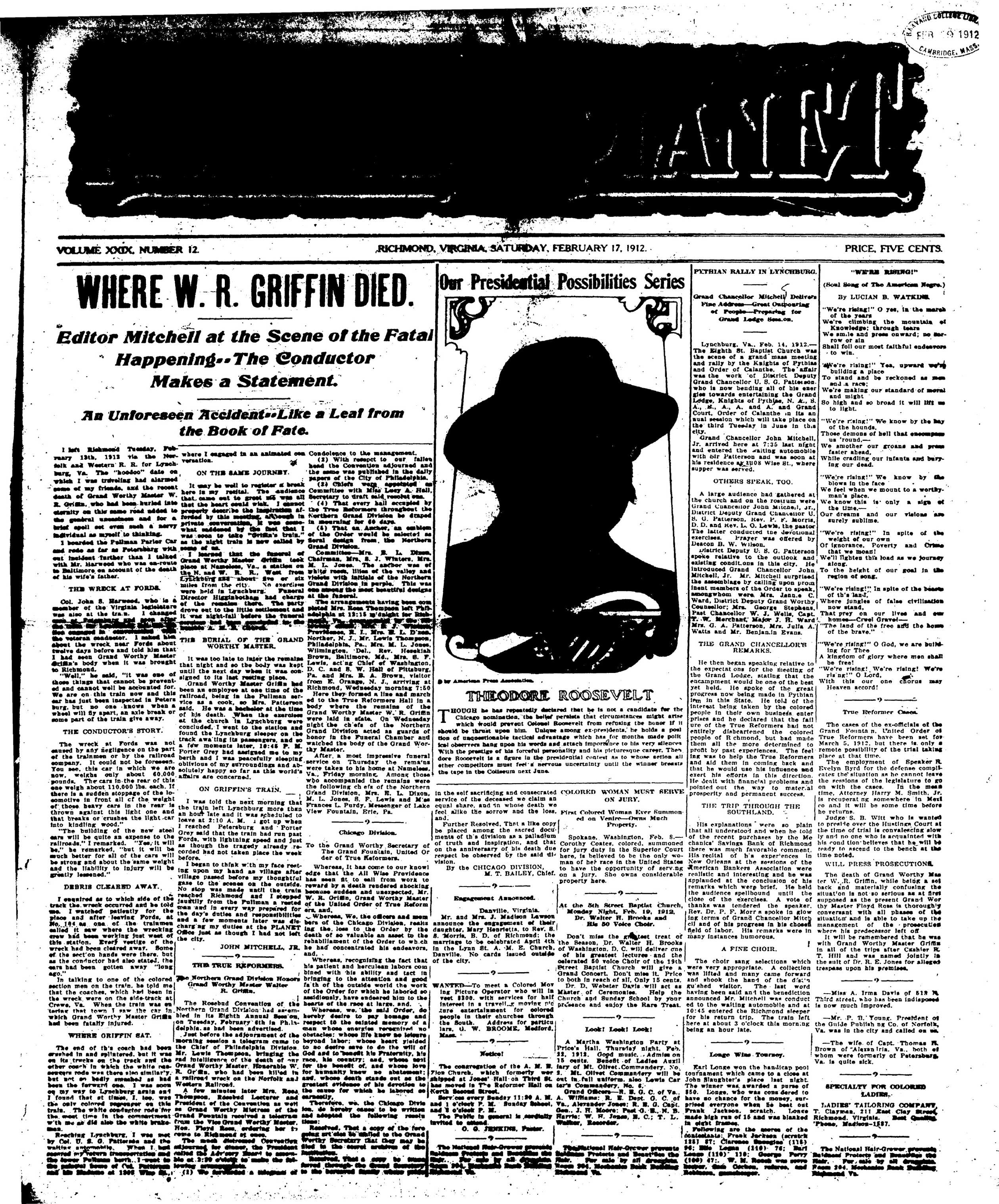
WHERE W. R. GRIFFIN DIED.
Editor Mitchell at the Scene of the Fatal Happening. The Conductor Makes a Statement.
I left Richmond Tuesday, February 13th, 1913 via the Norfolk and Western R. R. for Lynchburg, Va. The "hoodoo" date on which I was traveling had alarmed some of my friends, and the recent death of Grand Worthy Master W. R. Griffin, who had been buried into eternity on this same road added to the general unanimity and for a brief spell set even such a navy individual as myself to thinking.
I boarded the Pullman Parler Car and rode as far as Petersburg with out incident further than I talked with Mr. Harwood who was en-route to Baltimore, on account of the death of his wife's father.
THE WRECK AT FORDS
Col. John S. Harwood, who is a member of the Virginia legislature was also at the训. I changed name to Petersburg and soon after the train for the legislature came in conversation with the veteran conductor. I asked him about the wreck near Fords about twelve days before and told him that I had seen Grand Worthy Master Griffin's body when it was brought to Richmond.
"Well," he said, "it was one of those things that cannot be prevented and cannot well be accounted for. We are on this train now and this car has just been inspected in Petersburg, but no one knows when a wheel will fly apart, an axle break or some part of the train give away.
THE CONDUCTOR'S STORY.
The wreck at Fords was not caused by any negligence on the part of the trainmen or by the railroad company. It could not be foreseen. You see, this car in which we are now, weighs only about 60,000 pounds. The cars in the rear of this one weigh about 110,000 lbs. each. If there is a sudden stoppage of the locomotive in front all of the weight of those heavy cars in the rear is thrown against this light one and that breaks or crushes the light car into kindling wood."
"The building of the new steel cars will be quite an expense to the railroads." I remarked. "Yes, it will be," he remarked, "but it will be much better for all of the cars will be strong and about the same weight and the liability to injury will be greatly lessened."
DEBRIS CLEARED AWAY.
I enquired as to which side of the track the wreck occurred and he told me. I watched patiently for the place and after leaving Fords, at No. 194 as one of the trainees called it saw where the wrecking crew had been working just west of this station. Every vestige of the wreck had been cleared away. Some of the section hands were there, but as the conductor had also stated, the car had been gotten away "long ago."
In talking to one of the colored section men on the train, he told me that the coaches, which had been in the wreck were on the side-track at Crewe, Va. When the train was on tearing that town I saw the car in which Grand Worthy Master Griffin had been fatally injured.
WHERE GRIFFIN SAT.
The end of this coach had been crushed in and splintered, but it was on its trunks on the track and the other coach in which the white passenger rode was there also similarly, but not on badly smashed as had been the forward one. I was soon on my way to Lynchburg again and I found that at times, I, too, was the only colored passenger on this train. The white conductor rode for the most time in the compartment with me as did also the white brakeman.
Reaching Lynchburg, I was met by Col. U. S. G. Patterson and the waiting ambulance. When I had escorted my return transportation and the lower Patterson berth, I went to the principal house of Col. Patterson and his McLean at 1909 Wing No.
where I engaged in an animated conversation.
ON THE SAME JOURNEY.
It may be well to register a break here in my recital. The audience that came out to greet me was all that the heart could wink. I cannot properly describe the inspiration afforded by this meeting, although in private conversation, it was somewhat addicted by the fact that I was soon to take "Griffin's train." as the night train is now called by some of us.
I learned that the funeral of Grand Worthy Master Griffin took place at Nameslees, Va., a station on the N. and W. R. R., West from Lynchburg and about five or six miles from the city. No exercise were held in Lynchburg. Funeral Director Higginbotham had charge of the remembrance there. The party drove out to the little settlement and it was night-fall before the funeral ceremony and then accompanied by the bridegirl A. M. B. Knight.
THE BURIAL OF THE GRAND
WORTHY MASTER.
It was too late to inter the remains that night and so the body was kept until the next day when it was consigned to its last resting place. Grand Worthy Master Griffin had been an employee at one time of the railroad, being in the Pullman service as a cook, so Mr. Patterson said. He was a bachelor at the time of his death. When the exercises at the church in Lynchburg were concluded, I went to the station and found the Lynchburg sleeper on the track awaiting its passengers, and so a few moments later, 10:45 P. M. Porter Grey had assigned me to my berth and I was peacefully sleeping oblivious of my surroundings and absolutely happy so far as this world's affairs are concerned.
ON GRIFFIN'S TRAIN
I was told the next morning that the train left Lynchburg more than an hour late and it was scheduled to leave at 2:10 A.M. I got up when I reached Petersburg and Porter Gray said that the train had run past Fords, with lightning speed and just as though the tragedy already recorded had not taken place the week before.
I began to think with my face resting upon my hand as village after village passed before my thoughtful gaze to the scenes on the outside. No stop was made until the train reached Richmond and I stopped justly from the Pullman a rested man and in every way prepared for the day's duties and responsibilities and a few moments later was discharging my duties at the PLANET Office just as though I had not left the city.
JOHN MITCHELL, JR.
THE TRUE REFORMERS
The Northern Grand Division Honor Grand Worthy Master Walter R. Griffin.
The Rosebud Convention of the Northern Grand Division had assembled in its Eighth Annual Session, on Tuesday, February 6th in Philadelphia, as had been advertised.
Just before the adjournment of the morning session a telegram came to the Chief of Philadelphia Division Mr. Lewis Thompson, bringing the sad intelligence of the death of our Grand Worthy Master, Honorable W. R. Gr'fun, who had been killed in a railroad wreck on the Norfolk and J Western Railroad.
A few minutes later Mrs. Rose Thompson, Rosebud Lecturer and President of the Convention as well as Grand Worthy Mistress of the Grand Parka received a telegram from the Vice Grand Worthy Mester, Hon. Floyd Rose, ordering her troops to Richmond at once.
The most distressed Convention adjourning her dinner, the President raised the Advisory Board to assemble at 2:30 o'clock to make the following commendations:
(2) With respect to our fallen hand the Convention adjourned and the same was published in the daily papers of the City of Philadelphia.
(3) Chiefs were appointed as Committee with Miss Levy A. Hall, Secretary to draft said resoluton one.
(4) That every hall occupied by the True Reformers throughout the Northern Grand Division be draped in mourning for 60 days.
(5) That an Anchor, an emblem of the Order would be selected as Seral design from the Northern Grand Division.
Committee—Mru. R. L. Dixon, Chiefman, Mra. S. J. Winters, Mra. M. L. Jones. The anchor was of white roses, lilies of the valley and violets with initials of the Northern Grand Division in purple. This was one among the most beautiful designs at the funeral.
The arrangements having been com
plied Mrs. Rose Thompson left Philadelphia at 12:15 in night for Rich-
don. Mrs. R. J. White, Providence, R. L., Mrs. M. L. D. Nen-
norther, N. J., Mr. Lewis Thompson,
Philadelphia, Pa., Mrs. M. L. Jones,
Wilmington, Del., Rev. Hosekiah
Brown, Baltimore, Md., Mrs. G. F.
Lewis, acting Chief of Washington,
D. C. and B. W. Hall of Pittsburg,
Pa. and Mrs. B. A. Brown, visitor
from E. Orange, N. J., arriving at
Richmond, Wednesday morning 7:50
Here they formed a line and marched ed to the True Reformers Hall in a body where the remains of the Grand Worthy Master W. R. Griffin were laid in state. On Wednesday night the chiefs of the Northern Grand Division acted as guards of honor in the Funeral Chamber and watched the body of the Grand Worthy Master.
After, a most impressive funeral service on Thursday the remains were taken to his home at Nameless, Va., Friday morning. Among those who accompanied the remains were the following chiefs of the Northern Grand Division, Mrs. E. R. L. Dixon, M. L. Jones, S. F. Lewis and Mss Frances L. Purdy. Messenger of Lake View Fountain, Erie, Pa.
Chicago Divialon
To the Grand Worthy Secretary of The Grand Fountain, United Order of True Reformers.
Whereas, It has come to our knowledge that the All Wise Providence has seen fit to call from work to reward by a death rendered shocking because sudden and unexpected, Mr. W. R. Grifin, Grand Worthy Master of the United Order of True Reform, and,
Whereas, We, the officers and members of the Chicago Division, realize the loss to the Order by the death of so valuable an asset to the rehabilitament of the Order to which he had concentrated his endeavors, and,
Whereas, recognizing the fact that his patient and herculean labors combined with his ability and tact in bringing to the attention and good faith of the outside world the work of the Order for which he labored so accidentally, have endeared him to the hearts of the race at large, and,
Whereas, we, the mild Order, do hereby desire to pay homage and respect to the esteemed memory of a man whose energies remitted no obstacles; whose life knew no leisure beyond labor; whose heart yielded to no desire save to do the will of God and to benefit his Praternity, his race, his country; and, whose soul for the benefit of, and whose love for humanity knew no abatement; and, whose death stands out as the greatest evidence of his devotion to the cause for which he labored so earnestly.
Therefore, we, the Chicago Divide, do hereby cause to be written and adopted the following resolutions:
Resolved, That a copy of the foregoing art also be entitled to the Grand Worthy Secretary that they may be filed in the secret archives of the institution.
Our Presidential Possibilities Series
THOUGH he has repeatedly declared that he is not a candidate for the Chicago nomination, the belief persists that circumstances might arise which would prevent Colosseo Roemerelt from refusing the honor if it should be thrust upon him. Unique among ex-presidents, he holds a position of unquestionable tactical advantage which has for months made political observers hang upon his words and attach importance to his very silence. With the prestige of his forceful personality and his picturesque career, Theodore Roemerelt is a figure in the presidential context as to whose action all other competitors must feel a nervous uncertainty until the winner breaches the tape in the Coliseum next June.
in the self sacrificing and consecrated service of the deceased we claim an equal share, and in whose death we feel alike the sorrow and the loss, and:
Further Resolved, That a like copy be placed among the sacred documents of this division as a palladium of truth and inspiration, and that on the anniversary of his death due respect be observed by the said division.
By the CHICAGO DIVISION,
M. T. BAILEY, Chief.
Dapville, Virginia
Mr. and Mrs. J. Madison Lawson announce the engagement of their daughter, Mary Henrietta, to Rev. S. S. Morris, B. D. of Richmond; the marriage to be celebrated April 4th in the Lynn A. A. M. Church, Danville. No cards issued outside of the city.
WANTED—To meet a Colored Moving Picture Operator who will invest $300, with services for half interest in a travel, moving picture entertainment for colored people in their churches through the South. Address for partici lars, U. W. BROOME, Medford, Maest.
Notice!
The congregation of the A. M. B. Fion Church, which formerly was shipped at Jones' Hall on Third St. has moved in The Reformer Hall on North Second Street.
Services every Sunday 11:30 A. M.
and 1 o'clock P. M. Sunday School,
and 2 o'clock P. M.
The Public is general is cordially invited to attend.
O. O. JENKINE, Pastor.
7
The National Male-Grower presents Ridgman Products and Bountiful the Mgr... The sale by all divisions from 904, Middlesex North Bountiful, Stamford Va.
COLORED WOMAN MUST SERVE ON JURY.
First Colored Woman Ever Summoned on Venice—Owns Much Property.
Spokane, Washington, Feb. 8.—Corothy Costes, colored, summoned for jury duty in the Superior Court here, is believed to be the only woman of her race in the United States to have the opportunity of serving on a jury. She owns considerable property here.
At the 5th Street Baptist Church, Monday Night, Feb. 19, 1912, Dr. Walter H. Brooks and His 50 Voice Choir.
Don't miss the greatest treat of the Season, Dr. Walter H. Brooks of Washington, D. C. will deliver one of his greatest lectures and the celebrated 50 voice Choir of the 19th Street Baptist Church will give a Grand Concert. Don't miss it. Price to both in reach of all, Only 15 cents.
Dr. D. Webster Davis will act as Master of Ceremonies. Help the Church and Sunday School by your presence and enjoy the Rare Treat.
Look! Look! Look!
A Martha Washington Party at Price's Hall. Thursday night. Feb. 22, 1912. Gopd music... Admise on 15 cents. Benefit of Ladies Auxiliary of Mt. Olivet. Commandery. 2. Mt. Olivet Commandery will be out in full uniform, also Lewis Carter's Commandery, No. 6.
Grand Officers—R. E. G. C. of Va., A. Williams; R. E. Dept. G. C. of Va., Alexander Jones; R. E. G. Capt. Gen., J. H. Moore; Past G. E., N. B. Harris; W. H. Jones, N. C.; T. L. Walker, Recorder.
The National Hair-Grewer prevents Beddham Projects and Beauties the Hair. For sale by all dreadlocks. Reason 904. Mechanism Bank Building Beddham Va.
Lynchburg, Va., Feb. 14, 1912.—The Eighth St. Baptist Church was the scene of a grand mass meeting and rally by the Knights of Pythias and Order of Calanthe. The affair was the work of District Deputy Grand Chancellor U. S. G. Patterson, who is now bending all of his energy towards entertaining the Grand Lodge, Knights of Pythias, N. A., S. A., M., A., A. and A. and Grand Court, Order of Calanthe in its anual session which will take place on the third Tuesday in June in this city.
Grand Chancellor John Mitchell, Jr. arrived here at 7:35 last night and entered the waiting automobile with Sir Patterson and was soon at his residence at 3108 Wise St., where supper was served.
OTHERS SPEAK. TOO.
A large audience had gathered at the church and on the rostrum were Grand Chancellor John Mitchell, Jr., District Deputy Grand Chancellor U. S. G. Patterson, Rev. P. F. Morris, D. D. and Rev. L. O. Lewis, the pastor The latter conducted the devotional exercises. Prayer was offered by Deacon B. W. Wilson. District Deputy U. S. G. Patterson spoke relative to the outlook and existing conditions in this city. He introduced Grand Chancellor John Mitchell, Jr. Mr. Mitchell surprised the assemblage by calling upon prom inent members of the Order to speak, among whom were Mrs. Jenn. e C. Ward, District Deputy Grand Worthy Counsellor; Mrs. George Stephens, Past Chancellor W. J. Wells, Capt. P. W. Merchant, Major J. H. Ward Mrs. G. A. Patterson, Mrs. Julia A. Watts and Mr. Denian in Erans.
THE GRAND CHANCELLOR
REMARKS.
He then began speaking relative to the expectant one for the meeting of the Grand Lodge, stating that the encampment would be one of the best yet held. He spoke of the great progress now being made in Pythianism in this State. He told of the interest being taken by the colored people in their own business enter prizes and he declared that the fallure of the True Reformers had not entirely disheartened the colored people of Rhondm, but had made them all the more determined to profit by past experiences. The feeling was to help the True Reformers and aid them in coming back and that he would use his influence and exert his efforts in this direction. He dealt with financial problems and pointed out the way to material prosperity and permanent success.
THE TRIP THROUGH THE SOUTHLAND,
His explanations were so plain that all understood and when he told of the recent purchases by the Mechanica Savings Bank of Richmond there was much favorable comment. His recital of his experiences in New Orleans at the sessions of the American Bankers Association were realistic and interesting and he was applauded at the conclusion of his remarks which were brief. He held the audience spellbound until the close of the exercises. A vote of thanks was tendered the speaker. Rev. Dr. P. F. Morr a spoke in glowing terms of Grand Chancellor Mitch cilf and of his progress in his chosen field of labor. His remarks were in many instances humorous.
A FINE CHOIR
The choir sang selections which were very appropriate. A collection was lifted and many came forward and shook the hand of the distressed visitor. The last word having been said and the benediction announced Mr. Mitchell was conducted to the waiting automobile and at 10:45 entered the Richmond sleeper for his return trip. The train left here at about 3 o'clock this morning being an hour late.
Longe Wine Tourney.
Earl Longe won the handicap pool
tournament which came to a close at
John Slaughter's place last night.
The winner was awarded a purse of
$50. Longe, who was cons dered to
have no chance for the money, sur-
prired everyone when he beat out
Frank Jackson, scratch. Longe
made high run of 16 and was blanked
in eight frames.
Following are the scores of the
contestants: Frank Jackson (scratch
125) 87; Clarence Browne (118)
96; Bile Longe (110) 76; Bari
Longe (110) 110; George Perry
(109) 47; W. M. Roch was score
beater, then Gorben, referee, and
Bobbins, commiserate.
"WE'RE RISING!"
By LUCIAN B. WATKIN
"We're rising!" O yes, in the marvel of the years
We're climbing the mountain of knowledge; through tears
We smile and press onward; no man row or sin
Shall foll our most faithful endeavor to win.
"We're rising!" Yes, upward we're building a place
To stand and be reckoned as man and a race;
We're making our standard of morals and might
So high and so broad it will lift us to light.
"We're rising!" We know by the hail of the hounds.
Those demons of hell that encompass us round.
We smother our groans and press faster ahead.
While cradling our infants and burying our dead.
"We're rising!" We know by the blows in the face
We feel when we mount to a worthy man's place.
We know this is only a sign of the time.
Our dreams and our visions are surely sublime.
"We're rising!" In spite of the weight of our own
Of ignorance. Poverty and Crime that we moan!
We'll lighten this load as we journey along.
To the height of our goal in the region of song.
"We're rising!" In spite of the beauty of this land.
Where jungles of false civilization now stand.
That prey on our lives and our homes—Cruel Gravel—
"The land of the free and the home of the brave."
"We're rising!" O God, we are building for Thee.
A kingdom of glory where men shall be free!
"We're rising! We're rising! We're rising!" O Lord.
With this our one chorus may Heaven accord!
9
True Reformer Cause.
The cases of the ex-officials of the Grand Fountain, United Order of True Reformers have been set for March 5, 1912, but there is only a remote possibility of the trial taking place at that time.
The employment of Speaker R. Evelyn Byrd for the defense complicates the situation as he cannot leave the sessions of the legislature to go on with the cases. In the mean time, Attorney Harry M. Smith, Jr. is recuperating somewhere in Mendico and it will be some time before he returns.
Judge S. B. Witt who is wanted to preside over the Huntington Court at the time of trial is convalescing slowly and no one who is acquainted with his condition believes that he will be ready to ascend to the bench at the time noted.
WILL PRESS PROSECUTION
The death of Grand Worthy Master W. R. Griffin, while being a self back and materially confusing the situation is not so serious as at first supposed as the present Grand Worthy Master Floyd Rosa is thoroughly conversant with all phases of the situation and is able to take up the management of the prosecution where his predecessor left off.
It will be remembered that he was with Grand Worthy Master Griffin in all of the trips after Cashier R. T. Hill and was named jointly in the suit of Dr. R. E. Jones for alleged trespass upon his premises.
—Miss A. Irma Davis of 518 R.
Third street, who has been indisposed
is now much improved.
—Mr. P. B. Young. President of
the Guide Publishing Co. of Norfolk.
Va. was in the city and called on us.
—The wife of Capt. Thomas R.
Brown of "Alaxan Iria. Va., both of
whom were formerly of Peterburg.
Va. is quite sick.
SPECIALTY FOR COLORED LADIES.
LADIES TAILORING COMPANY
T. Clayman, 211 East Clay Street
Richmond, Virginia. Best Quality
Phone, Madison-1537.
The National Hair-Grower, presents
Baldand Protects and Breastfeeds the
Hair. For sale by all draughtsmen.
Floor 204. Mechanism Bank Building,
Richmond Va.
```markdown
```
but with that inordinate suspicion of the city pedestrian some of them stopped to speak or buy. Some neways gathered round and offered a few suggestions. Fingerald gave them back in kind.
Once he turned to see if his friends were still watching him. They were two among many, for the exploit had gone round, and there were other wagers being laid on the result. While his head was turned and his grin was directed at the club window a band some young woman. In blue came along. She paused, touched her lips with her gloved hand meditatingly and then went right about face swiftly. Some one in the window motion ad frantically to the vender, but he did not understand. Ten minutes left in which to win his bet. He hadn't made a very good bargain. Hunt! The young woman in blue was stopping Her exquisite face was perfectly sertious as her eyes ran over the collection on the tray. They were all done excrecably, something Fitzgerald hadn't noticed before.
"Kr-25 cents, ma'am," he stammered. As a matter of fact he hadn't any idea what the current price list was. "You seem very well dressed, doubtfully, "and you do not look hung gry." "I am doing this for charity's sake," finding his wits. The policeman hovered near, scowling. He was powerless, since the young woman had spoken first. "I will take this Canova, I believe," she finally decided, opening her purse and producing the necessary silver. "Of course, it is quite impossible to send this." "You, ma'am. Bending it would eat up all the profits." But with ill-conceived enquiries. "If you will leave your address I can send as many as you like."
"I will do that."
Incredible as it seemed, neither face lost its repose; he dared not smile, and the young woman did not care to. There was something familiar to his memory in the oval face, but this was no time for a different search.
"Hey, miss," yelled one of the newbies, "you're 'trowin' your money away. He's a fake; he isn't an statto sailer. He's doing it for a joker."
"Fingerauld lost a little color, that was all. But his customer ignored the imputation. She took out a card and laid it on the tray, and without further doom serenely on her way. The policeman stepped toward her an if to speak, but she turned her delicate head evenly, and Fingerauld picked up the card. There was neither name nor delicate address on it. It was a message, hastily written, and it sent a thrill of delight and speculation to his
Impressionable heart. Still carrying the tray before him, he hastened over to the club, where there was something of an ovation. Instead of a dinner for three it became one for a dozen, and Fitzgerald passed the statutes round as souvenirs of the most unique bet of the year. There were lively times. Toward midnight, as Fitzgerald was going out of the coat room, Cathewe spoke to him.
"What was her name, Jack?"
"Hanred if I know."
"She dropped a card on your tray."
Fitzgerald scrubbed his chin. "There wasn't any name on it. There was an address and something more. Now, wait a moment, Arthur; this is no ordinary, affair. I would not show it to any one else. Here, read it yourself."
Come to the house at the top of the bill in Dalton tomorrow night at 8 o'clock. But do not come if you lack courage.
That was all. Cathewe ran a finger, comb fashion, through his mustache. He almost smiled.
"Where the deuce is Dalton?" Fitzgerald inquired.
"It is a little village on the New Jersey coast; not more than forty houses, postoffice, hotel and general store; perhaps an hour out of town."
"What would you do in my place? It may be a joke, and then again it may not. She knew that I was a rank impersonator."
"But she knew that a man must have a certain kind of daredred willpower to play the game you played. Well, you ask me what I should do in your place. I'd go."
"I shall. It will double discount fishing. And the more I think of it, the more certain I become that she and I have met somewhere. By-by!"
Cathwe fingered in the reading room, pondering. Here was a twint to the wager he was rather unprepared for, and if the truth must be told, he was far more perplexed than Fingergold. He knew the girl, but he did not know and could not imagine what purpose she had in adding Fingergold to win his wager or luring him out to an obscure village in this detective story manner.
"Well, I shall hear all about it from her father," he concurred.
And all in good time he did.
CHAPTER IV.
PIRATES AND PRIVATE SECRETARIES
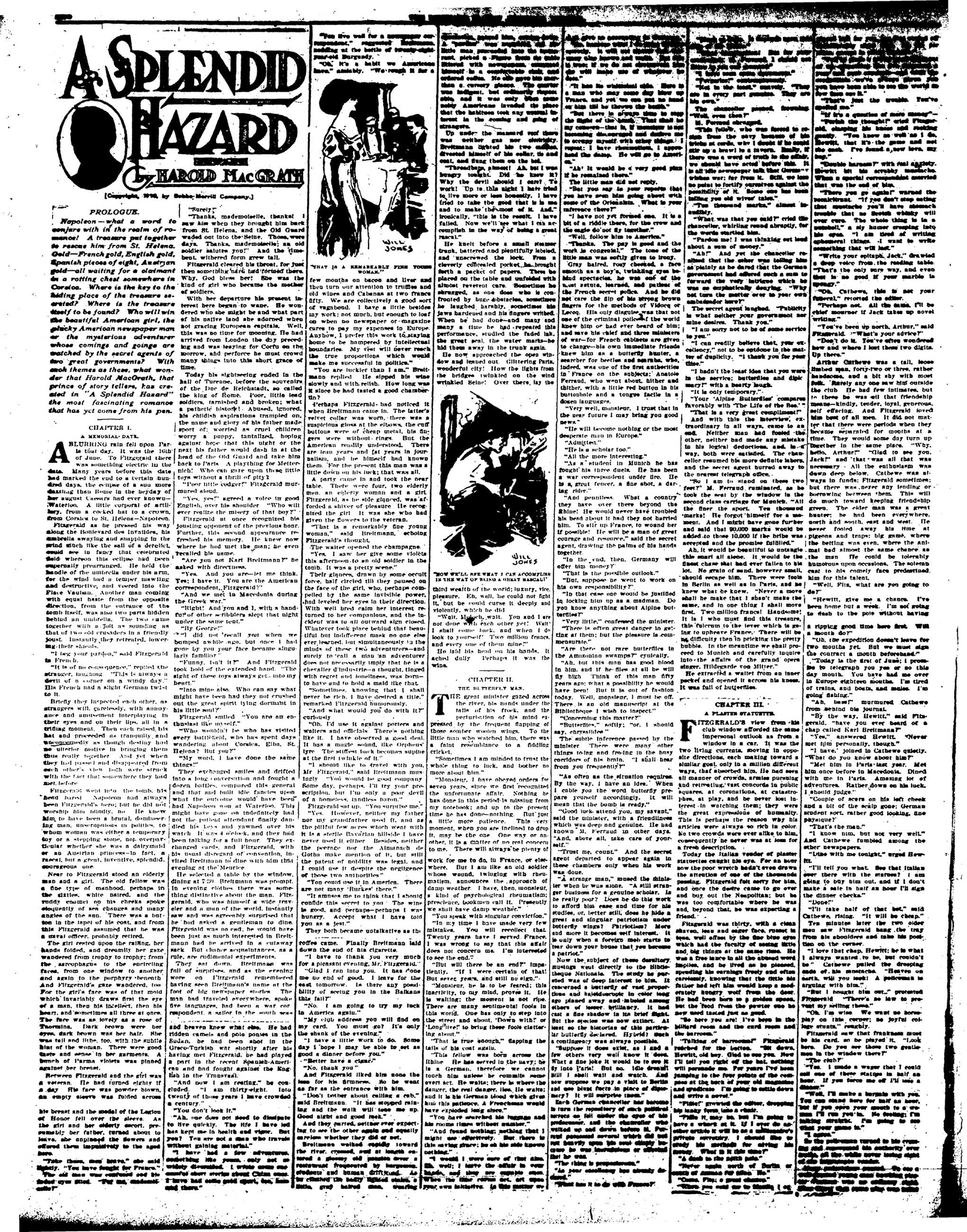
It was a little station made glancing by a single light. Our eyes in so often a fast train stopped, it properly lagged. Pinewood flying willy waromatic, now that he had arrived, dropped his handling on the damp platform and shot his bear flag. It was after sunrise. The man, but a few yards away, was a murdering big, driving blacksmits, now where here and there a wave broke. The wind was still, and there was the
M. M.
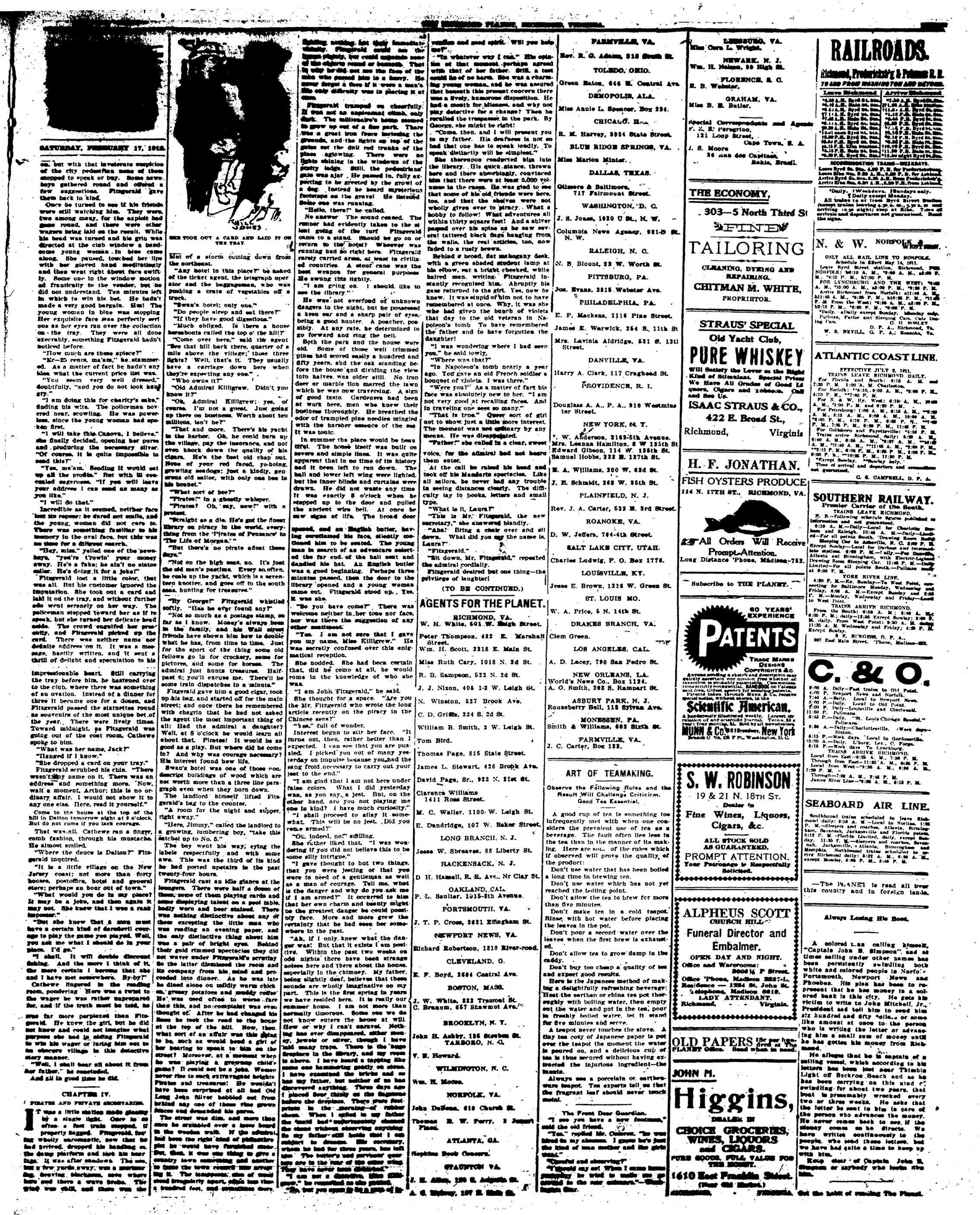
SHE TOOK OUT A CARD AND LAID IT ON THE TRAY
kint of a storm coming down from the northeast.
"Any hotel in this place?" be asked of the ticket agent, the telegraph operator and the baggageman, who was pushing a crate of vegetables off a truck.
"Swan's hotel; only one."
"Do people sleep and eat there?"
"If they have good digestions."
"Much obliged. Is there a house herebouts called the top o' the hill?"
"Come over here," said the agent.
"Bee that hill back there, quarter of a mile above the village; those three lights? Well, that's it. They usually have a carriage down here when they're expecting any one."
"Who owns it?"
"Old Admiral Killigrew. Didn't you know it?"
"Oh, Admiral Killigrew; yes, of course, I'm not a great. Just going up there on business. Worth about ten millions, isn't he?"
"That and more. There's his yacht in the harbor. Oh, he could burn up the village, pay the insurance, and not even knock down the quality of his cigar. He's the best old chap out. None of your red face, yo-holing, growing seadogs; just a kindly, generous old mallor, with only one bee in his bosnet."
"What sort of beer?"
"Pirates! in a ghostly whisper."
"Pirates? Oh, say, now! with a protest."
"Straight as a die. He's got the finest library on piracy in the world, everything from the 'Pirates of Penance' to The Life of Morgan."
"But there's no pirate about these days."
"Not on the high sea, no. It's just the old man's pastime. Every soften, he comes up the yacht, which is a seventeen knotter, and goes off to the south sea, hunting for treasures."
"By George" Fitzgerald whistled softly. "Has he ever found any?" "Not so much as a postage stamp, so far as I know. Money's always been in the family, and his Wall street friends have shown him how to double what he has, from time to time. Just for the sport of the thing some old fellows go in for crockery, some for pictures, and some for horses. The admiral just hunts treasures. Half-past 6; you'll excuse me. There'll be some train dispatches in a minute."
Fitzgerald gave him a good cigar, took up his bag, and started off for the main street; and once there he remembered with chagrin that he had not asked the agent the most important thing of all: Had the admiral a daughter? Well, at 8 o'clock he would learn all about that. Pirates! It would be as good as a play. But where did he come in? And why was courage necessary? His interest found new life.
Swan's hotel was one of those room-descript buildings of wood which are not worth more than a three line paragraph even when they burn down.
The landlord himself lifted Fitzgerald's bag to the counter.
"A room for the night and supper, right away."
"Here, Jimmy," called the landlord to a growing, lumbering boy, "take this settable up to No. 5."
The boy went his way, crying the labels respectfully and with some awe. This was the third of its kind he had ported upstairs in the past twenty-four hours.
Fitzgerald cast an idle glance at the loomgown. There were half a dozen of them; some of them playing cards and some displaying talent in a pool table badly worn and beer stained. There was nothing distinctive about any of them excepting the little man who was reading an evening paper, and the only distinctive thing about him was a pair of bright eyes. Behind their gold rimmed spectacles they did not waver under Fitzgerald's scrutiny. So the latter dismissed the room and its company from his mind and proceeded into dinner. As he was late he dined alone on mildly warm chick engranny potatoes and muddly coffee. He was used often to worse than this, and no complaint was ever thought of. After he had changed his them he rocked the road to the house at the top of the hill. Now, then, what sort of an affair was this going to be, such as would bred a girl of her bearing to speak to him on the street? Moreover, at a moment he was playing a growling child's game! It could not be a job. Women never rise to such extravagant heights, Plutus and treasures! He wouldn't have been surprised at all but Old Long John Silver bobbled out from behind any one of these vine grown fruits and demanded his perma.
The street was dim, and more than once he stumbled over a loose board in the wooden walk. If the adjoining had been the right kind of publiplectre plot he would have flurished more. But, then, it was easy thing to give a country town something and another to flurish the town council later arrange it. The lamppost, also of wood stood irregularly apart, adjoined less than a trussed foot, and sometimes more.
Lighting, nothing but their immediate vicinity. Flipperald could see the keen plight, but could imagine none of the objects round or beneath. That in any case did not see the face of the man who passed him in a hurry. He knew forget a face if it were a man's. He only difficulty was in placing it at own. Flipperald trumped on cheerfully. It was not an unpleasant climb, only dark. The millionaire's home seemed to grow up out of a fine park. There was a great iron fence including the grounds, and the lights on top of the gates not the dull trunks of the place allowing. There were no lights shining in the windows of the pony lodge. Still, the pedestrian gate was ajar. He passed in, fully expecting to be greeted by the growl of a dog. Instead he heard mysterious footsteps on the gravel. He listened some one was running.
"Hello, there!" be called.
No answer. The sound ceased. The runner had evidently taken to the al least going of the turf. Pitzerwald came to a stand. Should he go on or return to the hotel? Whover was running bad no right here. Pitzerwald rarely carried arms, at least in civilized countries. A stout cane was the best weapon for general purposes. He swung this lightly.
"I am going on. I should like to see the library."
He was not overflood of unknown dangers in the night, but he possessed a keen ear and a sharp pair of eyes being a good hunter. A poacher, possibly. At any rate, he determined to go forward and ring the bell.
Both the park and the house were old. Some of those well trimmed pines had scored easily a hundred and fifty years, and the oak standing before the house and dividing the view into halves was older still. No iron deer or marble lion marred the lawn which he was now traversing. A sign of good taste Gardeners and been at work here, men who knew their business thoroughly. He breathed the odor of trampled pine needles mingled with the harber essence of the sea. It was tonic.
In summer the place would be beautiful. The bomb itself was built on severe and simple lines. It was quite apparent that in no time of its history and it been left to run down. The ball and lower left wing were lighted, but the inner blinds and curtains were drawn. He did not waste any time. It was exactly 8 o'clock when he stepped up to the door and pulled the ancient wire bell. At once he saw signs of life. The broad door spanned, and an English butter, having sweetened his face, almost motioned him to be seated. The young man in search of an adventure selected the far end of the hall seat and danced his hat. An English butter was a good beginning. Perhaps three minutes passed, then the door to the library opened and a young woman came out. Fitzgerald stood up. Yeah, it was she.
"So you have come?" There was welcome neither in her tone nor face, nor was there the suggestion of any other sentiment.
"Yes. I am not sure that I gave you my name, Miss Killgrew." He was secretly confused over this enigmatical reception.
She nodded. She had been certain that, did he come at all, he would come in the knowledge of who she was.
"I am John. Fitzgerald," he said.
She thought for a space. "Are you the Mr. Fitzgerald who wrote the long article recently on the piracy in the Chinese senal?"
Interest began to stir her face. "It turns out, then, rather better than I expected. I can see that you are puzzled. I picked you out of many yesterday on impulse because you had the sang froid necessary to carry out your jest to the end."
"I am glad that I am not here under false colors. What I did yesterday was, as you say, a jest. But, on the other hand, are you not playing me one in kind? I have much curiosity." "I shall proceed to alay it somewhat. This will be no jest, Did you come armed?"
"Oh, indeed, no!" shilling.
She rather liked that. "I was wondering if you did not believe this to be some silly intrigue."
"I gave thought to but two things, that you were feeling or that you were in need of a gentleman as well as a man of courage. Tell me, what is the danger and why do you ask me if I am armed?" It occurred to him that her own charm and beauty might be the greatest danger he could possibly face. More and more grew the certainty that he had seen her somewhere in the past.
"Ah, if I only knew what the dan ger was! But that it exists I am positive. Within the past two weeks on odd nights there have been strange notices here and there about the house, especially in the chimney. My father, being slightly deaf, believes that those sounds are wholly imaginative on my part. This is the first spring in years we have resided here. It is really our summer home. I am not more than normally timorous. Some one we do not know enters the house at will flow or why I can't travel. Nothing has ever disappeared, either money, jewels or silver, though I have held many traps. There is the huge fireplace in the library, and my room is above. I have heard a taping like one one hammer gently on stone. I have examined the bricks and no has my father, but neither of us has discovered anything. Three days ago I placed four thinly on the flagstone before the drappee. There were footprints in the morning of rubber shoes. When I pulled in my father the hand had imperfectly clamped the shoe without observing anything in my father's hand holds that I can support to doom. Like secretary, when he had the three pears he left them. The burtons and peruvian quercies are in the rear of the outer wing. They have never been dislabeled. "I am not a drizzler, like little glove," he recalled on the point. "But you seem to be a little of
youthful and good spirit. Will you help me?
"In whatever way I can." His opinion at that moment perhaps agreed with that of her father, still a test could be of no harm. She was a charming young woman, and he was amused that beneath this present concern there was a lively, humorous disposition. He had a month for idleness, and why not play detective for a change? Then he recalled the treasurer in the park. By George, she might be right!
"Come, then, and I will present you to my father. His defiance is not so bad that one has to speak loudly. To speak distinctly will be amplept." She thereupon conducted him into the library. His quick glance, thrown here and there abnormally, convinced him that there were at least 5,000 volumes in the cases. He was glad to see that some of his old friends were here, too, and that the skilves were not wholly given over to piracy. What a hobby to follow! What adventures all within thirty square feet! And a sliver paged over his spine as he saw several tattered black flags hanging from the walls, the real articles, too, now faded to a rusty brown.
Behind a brood, fat mongolian desk, with a green shaded student lamp at his elbow, sat a bright cheeked, white haired man, writing. Pitgerald instantly recognized him. Abruptly his gaze returned to the girl. Yes, now he knew. It was stupid of him not to have remembered at once. Why. It was she who had given the bunch of violets that day to the old veteran in Napoleon's tomb. To have remembered the father and to have forgotten the daughter!
"I was wondering where I had seen you," he said toly, "Where was that?"
"In Napoleon's tomb nearly a year ago. You gave an old French soldier a bouquet of violets. I was there."
"Were you?" As a matter of fact his face was absolutely new to her. "I am not very good at recalling faces. And in traveling one sees so many."
"That is true." Queen sort of girl not to show, just a little more interest. The moment was not ordinary by any means. He was disappointed.
"Father," she called in a clear, sweet voice, for the admiral had not heard them enter.
At the call he raised his head and took off his Mandarin spectacles. Like all sailors, he never had any trouble in seeing distances clearly. The difficulty lay in books, letters and small type.
"What is it, Laura?"
"This is Mr. Fitzgerald, the new secretary," she answered blandly.
"Aba! Bring a chair over and sit down. What did you say the name in Laura?"
"Fitzgerald."
"Sit down, Mr. Fitzgerald," repeated the admiral cordially.
Fitzgerald desired but one thing—the privilege of laughter!
(TO BE CONTINUED.)
AGENTS FOR THE PLANET.
RICHMOND, VA.
W. H. White, 501 W. High Street.
Peter Thompson, 422 E. Marshall Street.
Wm. H. Scott, 2218 E. Main St.
Miss Ruth Cary, 1018 N. 2d St.
R. B. Sampson, 523 N. 2d St.
J. J. Nixon, 405 1-2 W. Leigh St.
N. Winston, 537 Brook Ave.
C. D. Griffin, 224 S. 2d St.
William B. Smith, 3 W. Leigh St.
Tom Bird.
Thomas Page, 815 State Street.
James L. Stewart, 426 Bropk Ave.
David Page, Sr., 922 N. 31st St.
Clarence Williams
1411 Ross Street.
M. C. Waller, 1100 W. Leigh St.
E. Dandridge, 107 W. Baker Street.
LONG BRANCH, N. J.
Jesse W. Shreaves, 88 Liberty St.
HACKENSACK, N. J.
D H. Hammell, R. R. Ave., Nr Clay St.
OAKLAND, CAL.
P. L. Saulter, 1015-8th Avenue.
PORTSMOUTH, VA.
J. T. P. Cross, 2621 Eminham St.
NEWPORT NEWS, VA.
Richard Robertson, 1810 River-road.
CLEVELAND, O.
E. F. Boyd, 2604 Central Ave.
BOSTON, MASS.
J. W. White, 822 Trumont St.
C. Branum, 657 Shawmut Ave.
BROOKLYN, N. Y.
John H. Ashby, 186 Stroman St.
TARBORO, N. C.
V. E. Howard.
WILMINGTON, N. C.
NEW ORLEANS, LA.
World's News Co., Box 1124.
A. O. Smith, 202 S. Rampart St.
ASBURY PARK, N. J.
Rouseberry Bell, 113 Syivan Ave.
MONESSEN, PA.
Smith & Williams, 602 Sixth St.
FARMVILLE, VA.
J. C. Carter, Box 122.
ART OF TEAMAKING.
Observe the Following Rules and the Result, Will Challenge Criticism. Good Tea Essential.
A good cup of tea is something too infrequently met with when one considers the prevalent use of tea as a beverage. The fault often lies less in the tea than in the manner of its making. Here are some of the rules which if observed will prove the quality of the product:
Don't use water that has been boiled a long time in brewing tea.
Don't make tea in a cold tapest. Rinse with hot water before placing the leaves in the pot. Don't pour a second water over the leaves when the first brew is exhausted.
Here is the Japanese method of making a delightfully refreshing beverage. Heat the ceramic or china tea pot thoroughly with boiling water, then empty out the water and put in the tea, pour in freshly boiled water, let it stand for five minutes and serve. A teapot never touches the stove. A thy tea cozy of Japanese paper is put over the teapot the moment the water is poured on, and a delicious cup of tea is thus secured without having extracted the injurious ingredient—the sturds.
Always use a porcelain or earthenware teapot. Tea experts tell us that the fragrant leaf should never touch metal.
The Front Door Guardian.
"I see you have a new footman," said the old friend.
"Ton," replied Mr. Owenen. "he was hired in my abduction. I guess he's just the kind of man mother and the girl what?"
"Good and observing?"
"I tipped my ear. When I came home pamphlet he tried to make me go around to the rear entrance."—Whitman, Boston Times.
LESSBURG, VA.
Miss Corn L. Wright.
NEWARK, N. J.
Wm. H. Neilson, 99 High St.
FLORENCE, S. C.
E. B. Webster.
GRAHAM, VA.
Miss B. R. Butler.
Special Correspondents and Agents
F. Z. S. Peregrino,
121 Loop Street,
Cape Town, S. A.
J. S. Moore
26 aun dos Capitanes,
Bahia, Brazil.
THE ECONOMY
303-5 North Third St
FINE
CLEANING, DYING AND REPAIRING.
CHITMAN M. WHITE,
PROPRIETOR.
STRAUS' SPECIAL
Old Yacht Club,
PURE WHISKEY
Will Satisfy the Lover on the Right
Kind of Sensation. Special Prices
We Have All Grades of Good Ld
quots, Oligars and robes. Call
and See Us.
ISAAC STRAUS & CO. 422 E. Broad St. Richmond, Virginia
H. F. JONATHAN.
FISH OYSTERS PRODUCE
114 N. 17TH ST., RICHMOND, VA.
All Orders Will Receive
Prompt Attention.
Long Distance 'Phone, Madison-752.
Subscribe to THE PLANET.
60 YEARS' EXPERIENCE
PATENTS
TRADE MARKS
DESIGNS
COPYRIGHTS & C.
Anyone sending a sketch and description may
apply for patent. The invention is probably patented. Commun-
tions strictly confidential. MANY books on Patents
tune strictly confidential. MANY books on Patents
tune taken through Munn & Co., moste
special editions, without charge, in the
Scientific American.
A patent is hereby granted. The publication of any scientific journal. Terms, $2
year four months, $L. Sold by all newdealers
MUNN & CO. BROADWAY, New York
BROAD O. C. & C. F. R. WASHINGTON, D. C.
S. W. ROBINSON
19 & 21 N. 18TH ST.
Dealer in
Fine Wines, Liquors,
Cigars, &c.
ALL STOCK SOLD
AS GUARANTEED.
PROMPT ATTENTION.
Your Patronage is Respectfully
Solicited.
ALPHEUS SCOTT
CHURCH HILL
Funeral Director and
Embalmer.
OPEN DAY AND NIGHT.
Office and Wareroome:
3006 1/4 P Street.
Office Phone, Madison 2837-L.
Residence — 1224 St. John St.
Telephone, Madison 6018.
LADY ATTENDANT.
Richmond, Virginia.
OLD PAPERS 150 per hour
dired at The
PLANET Office. Bend when in need.
JOHN M.
Higgins,
DEALER IN
CHOICE GROCERIES,
WINES, LIQUORS
and CIGARS.
PURE GOODS, FULL VALUE FOR
THE MONEY.
1610 East Franklin Street.
(New York, N.Y.)
RAILROADS
*Daily.* 1 Weekdays. 1 Sundays only.
*Daily except Monday.*
All trains to or from Brydur Street Station
(arriving in 1:30 eight) stop at Midland. Time of
arrival and departure not guaranteed. Read the
signs.
N. & W. NORFO
ONLY ALL RAIL LINE TO NORFOLK.
Rebuild in Effect May 14.
Leave Hyrd Street station, Richmond, FOR
NORFOLK; 8:10 A.M., 9:00 A.M., 10:30 A.M.
FOR LYNCHBURG AND THE WEST; 9:40 A.M.
FOR M.; 10:00 A.M., 10:30 P.M., 9:00 P.M.
Arrive Richmond from Norfolk; 41:10 A.M.
81:15 A.M., 9:25 P.M., 81:35 P.M., 9:15 P.M.
P. From the West; 9:25 A.M., 8:30 P.M.
82:15 P.M., 9:25 P.M., 9:00 P.M.
Haily, ably except Sunday, Monday only,
Pullman, Parlor and Sleeping Cars, Cafe Dining
Carm.
D. P. A., Richmond Va.
W. B. REVILL, G. P. A., Richmond Va.
ATLANTIC COAST LINE.
TRAIN LEAVE RICHMOND DAILY.
For Florida and South: 8:15 A. M. and
7:25 P. M. 1:00 A. M. Charleston.
For Norfolk: **8:10, 9:00 A. M.** 7:20 P. M.
**8:10, 9:00 A. M.**
For N. A. W. M. 6:15 A. M. 10:00 A. M.
**8:10, 9:00 P. M. and 8:20 P. M.**
For Peterburg: 1:00 A. M. 6:15 A. M. 7:20 A. M.
A. M. 8:15 A. M. 9:00 A. M. 10:00 A. M.
A. M. 8:10 P. M. 6:05 P. M. 7:20 P. M.
P. M. 8:10 P. M. 8:05 P. M. 11:45 P. M.
For Goldsboro and Fayetteville: 8:20 A. M.
Trains arrive Richmond daily: 8:20 A. M.
6:00 A. M. 6:56 A. M. 7:27 A. M. 7:26 A. M.
A. M. 11:40 A. M. 11:45 A. M. 7:20 P. M.
A. M. 8:10 P. M. 6:25 P. M. 8:00 P. M.
A. M. 7:20 P. M. 11:40 P. M.
*Script Sunday.* *Thanksgiving Day.*
Time of arrival and departure and connection
not guaranteed.
C. S. CAMPBELL, D. P. A.
SOUTHERN RAILWAY.
Premier Carrier of the South.
THORNDON.
M. N.-Following schedule will be published on
information and not guaranteed.
6:10 A. M.-Daily-Local for Christina Bur-
baugh-Local Light-10:45 A. M.-Daily-Local
-For all point South-Burbaugh-Daily
Stepping Out to Amberville, H. Q. 9:00
Krept Sunday-Local for Durham and inter-
station. 6:00 P. M.-Daily.-For Durham
and station. 6:00 P. M.-Daily.-For electric-Lighted
Drawing Room Sleeping Out. 6:00 P. M.-Daily-
Limited.-For all point South.-Pullman
pat at 9:00 P. M.
YORK RIVER LINE.
4:30 P. M. X.M. Sunday—To West Point, suspending for Monday, Wednesday and Friday.
6:00 A. M—Except Sunday and 8:30 P. M. Monday, Wednesday and Friday—Leaving to West Point.
TRAINER ARRIVES RICHMOND.
From the South: 6:50 A. M; 8:40 A. M.
8:00 P. M. Daily—11:50 Except Sunday; 8:30 P. M. daily.
From the Point: 8:30 A. M. daily.
11:35 A. M. Wednesday and Friday; 4:30 P. M. Except Sunday.
E. K. BURGER, D. P. A.,
807 E. Main Street, 'Phone, Madison-IN.
C. & O.
9:00 A. Dally - First Station to Old Point.
4:00 P. Newport News and Norfolk.
7:40 A. Dally - Local to Newport News.
6:00 P. Dally - Local to Old Point.
6:00 P. Dally - Louisville and Cincinnati.
11:00 P. Pulaski.
6:45 P. Dally - 'St. Louis Chicago Special.'
Pulaski.
8:30 A. Dally-Charlotteville. - Work days.
8:15 P. Week days - Local to Louisville.
10:00 A. Dally - Lburg. Let. C. Forg.
8:15 P. Week days To Lynchburg.
8:15 P. Weekdays HIGHCHORD.
Local from West - 4:55 A. M. 9:00 P. M.
Through from East - 11:35 A. M. 9:00 P. M.
Local from West - 8:30 A. M. 8:00 P. M.
2:20 P. M. Illinois.
Through - 7:00 A. M. 7:45 P. M.
Jammer River Line - 7:00 A. M. 4:18 P. M.
SEABOARD AIR LINE
Southbound trains scheduled to leave Rivermont daily: 9:18 A. M. - Local to Norfolk. 1:38 A. M. - Sleepsers and coaches. Atlanta, Birmingham, Hampton, Philadelphia, Florida petals. 5:12 P. M. - Florida Lined, daily. 6:12 P. M. - Florida Lined, daily. 11:35 P. M. - Sleepsers and coaches, Savannah. 11:35 P. M. - Sleepsers and coaches, Birmingham and Memphis. 11:35 P. M. - Sleepsers and coaches, Birmingham scheduled to arrive Richmond daily: 5:22 A. M. - Local to Norfolk. 6:18 A. M. - M. A. - Local to Norfolk. 6:18 A. M. - M. A. - Local to Norfolk.
—The PLANET is read all over this country and in foreign lands.
Always Losing His Boot.
A colored L. an calling brisket,
"Captain John B. Simpson", and an
times sailing under other anmen has
been persistently swimming both
white and colored people in Norfolk.
Portsmouth, Newport News and
Phoebus. His plan has been to
represent that he has money in a col-
ored bank in this city. He gets his
victim to write to John Mitchell, Jr.
President and tells him to send him
six hundred and fifty dollars, or some
like amount at once to the person
who is writing the letter or advancing
him a small sum of money until
he has gotten his money from Rich-
mond.
He allows that he be in captain of a sailing vessel, which according to his letters has been lost near Thimble Light off Buckroe Beach and as he has been carrying on this kind of swimming for about two years, that boat is presumably wrecked every two or three weeks. He asks that the letter be sent to him in care of the person who advances the money. He never comes back to see. If the money comes in he directs. We have written continuously to the people, who send these letters, but we have had quite a time to keep up with him.
Keep clear of Captain John R.
Shipman or anybody who looks like him.
Published every Saturday by JOHN MITCHELL
JR., nr. All N. Fourth Street, Richmond, Va.
JOHN MITCHELL, JR., EDITOR
All communications intended for publication should be sent as so to reach us by Wednesday.
TERMS IN ADVANCE
One Copy, per year.....$1.44
One Copy, eight months.....1.08
One Copy, six months.....80
One Copy, four months.....40
One Copy, three months.....20
Single Copy.....10
ADVERTISING RATER
For one inch, one insertion.....8.00
For one inch each subsequent insertion.....6.00
For two inches, three months.....6.00
For two inches, six months.....10.00
For two inches, nine months.....14.00
For two inches, twelve months.....20.00
Marriage and Funeral Notices, one inch.....60
Standing and Transient Notices, per line.....10
*BACK STAMP OF A HIGHER DENOMINATION THAN TWO CENTS NOT RECEIVED ON SUBSCRIPTION*
THE PLANET is issued weekly. The subscript
THE FLANK PLAN
There will be two year, in advance.
There are four ways by which money can be
given:
1. By bank check or credit,
2. By bank check or credit,
3. By money order,
4. And when none of these can be
MONEY ORDERS—If you can buy a Money Order at your Post Office, possible at the Fifth Avenue Post Office, and we will be responsible for it later.
TERMINAL MONEY ORDERS can be obtained at any office of the American Express Co. at the United States Express Co. and the Bank of Canada and O. Express Company will be responsible for the delivery of all of these companies. The Express Money Order is a safe and convenient way for forwarding money.
RIGHTHOLDER LETTER—If a Money Order, Post Office or an Express Office is not within your reach, your Postmaster will register the Letter you wish to send on payment credit. There are two types of credit. You can send money in this manner at our risk.
We cannot be responsible for money sent in before in any other way than one of the four ways mentioned above. If you send your money in any other way, you must do it at your own risk.
RENEWAL KTO—If you do not want THE PLANK continual for another year after your subscription has run out, you must do it. The fourth state that subscribers to newspapers who do not order their paper designated at the expiration of time for which it has been delivered but for which the subscription is due to date when they order the paper delivered.
COMMUNICATIONS.—When writing to us to renew your subscription or to discontinue your paper, you should give your name and address in all correspondence we cannot find your name on our boards.
CHARGE OF AUGUST 12, 1912.—In order to change the address of a subscriber we must be sent the former as well as the present address.
Kalemert at the Post Office at Richmond, Va., as second-chap matter.
SATURDAY, FEBRUARY 17, 1912.
TAPT OR LOOSEVEUT—WHICH?
Political events are transpiring rapidly and an open rupture between the forces of President Taft and ex-president Roosevelt is imminent and in some places has already taken place. No similar condition has ever existed in this country.
It is an attempt to marshal a political army with the political leader in retirement and hesitating as to whether he will lead his followers to either defeat or victory. What is the meaning of all of this agitation and what will be the result of these upheavals? Time alone can answer the question.
It is evident that President Taft has caused much antagonism by his vacillating policy and his manifest indiposition to stand upon the bedrock principles of the Declaration of Independence. He has been away by first one set of politicians and interests and then by another until disgust has taken the place of admiration and contempt has followed in the wake of praise.
We believe that ex-President Roosevelt has the largest personal following of any Republican leader in the country. On a popular vote we do not believe that any leader could poll the votes that this distinguished American can command.
He must now confront conditions which are distressingly peculiar so far as he is concerned. The same political artillery and small arms that he used to make President Taft the Chief Executive of the Nation are now being used against him. It is the "irony of fate."
To our mind, President Taft could be easily defeated for the nomination if a candidate of conservative tendencies and innate ability could be located in any of the doubtful States. We have always considered Senator LePollotte as a candidate of a principle and put one fated to win. His geographical location makes it impossible for him to be regarded with any degree of favor by those of the party who wish success at the polls. The candidate must come from either New York, Ohio or Indiana.
We believe that ex-President at Roosevelt is doing more involuntarily Jedi to secure the renunciation of Presid- "Militant Trust than any other individual Afri- in the country. Hundreds and thou- the ends of people who did not want飞
President Taft four years ago, supported him with a hope that the Republican Party would be delivered from "the burden of this death," as to speak, as they regarded Hoe. Theodore Roosevelt as a messenger to business.
Now they want to get rid of Hoe. William Howard Taft and just as they are preparing to do this, there looms up in the distance, the colossal shadow of Theodore Roosevelt. They are frightened by the apparition and staggered by the probable result of their actions.
They are now looking about for a candidate to combat and defeat President Taft either within the Republican Party or outside of it. In the paraphrased words of Shakespeare, "It is not that they hate William H. Taft loss, but that they hate Theodore Roosevelt more." The indications are that the business interests will strive to make terms with President Taft and "drive a bargain" with him of a kind and character that will enable them to pull up on his band wagon and leave the able statesman and politician of Oyster Bay far in the lurch.
Should the Democratic Party have far-seeking judgment and nominate a conservative Democrat as against one of the William J. Bryan type, then these disgruntled Republican elements will swing into line against Hon. William H. Taft, and Hon. Theodore Roosevelt, should either be nominated at Chicago.
We are free to admit that we believe that ex-President Roosevelt can win before the people of the country as against any candidate the Democrats might nominate. He has a large Democratic following which would offset the disaffection within the Republican ranks. The office-holding regime now following President Taft would transfer to Theodore Roosevelt so quickly that the "seats of their breeches would be left in front."
Col. Roosevelt is a positive character, but he is eporadic and he is never satisfied unless he is the storm centre of some agitation, which interferes with legitimate business. He likes the Boulanger display, the show of royalty and last but not least "a fight."
To-day three men are supreme in the management of party affairs. They can keep the country in a turmoil of excitement or they can promote peace. One is William J. Bryan of Nebraska, the other is William Howard Taft of Ohio and the other one is Theodore Roosevelt of New York.
Will the last great statesman be a candidate for the presidential nomination at the hands of the National Republican Convention at Chicago? We believe not. His attitude can only be explained by his studied silence. He is the greatest citizen in all of this world. Only the people can speak to him in tones that will command an answer. He has studiously observed those conditions which have their settings to the end that Hon. Will am Howard Taft as a successful candidate for the presidency will be impossible.
When the majority of the delegates to that great convention have been convinced of this fact the rest is easy. They can look to no other State but New York and they can see no other statesman there with Republican affiliations, but Theodore Roosevelt. If a motion can be made which will carry with it the tender of the nomination then Theodore Roosevelt, booted and spurred for the political battle will write a letter of acceptance which will rally his followers from the Atlantic to the Pacific, from Canada to the Gulf.
The third term argument will be put to sleep for in his own right, he has served but one term and he has been before the people and once as a candidate for popular approval as a presidential candidate. As a result, President Taft will steadily increase in the activity of his campaign and the positive nature of the results. There have been no endorsations or election of delegates which would tend to show the final result of the pending canvases for nominating votes. The colored people will be on both sides of the contention with conservative people wishing and hoping that God, in His divine wisdom shall show the people of this country some way out of this most embarrassing predicament.
Mrs. Bettie Miller Laid to Rest.
The funeral services of Mrs. Bette Miller were held at the Ebeneson Baptist Church Sunday, February 11, 1912 at 1:30 A. M., with Rev. Dr. W. H. Stokes speaking wonderfully of her Christian qualities. The music was beautiful. Miss Bess Loemax sang a beautiful solo "What Are They Doing In Heaven To-day," which brought tears to the eyes of the whole congregation.
She was the widow of the late W. E. Miller, who died about twenty years ago. She leaves eight children Mr. C. H. Miller of Covington, Va., Mr. and Mrs. W. J. Miller of Hot Springs, Va., Mr. T. H. Miller of Louisa Co., Va., Mrs. M. L. Knight, Mrs. F. Johnson, Mrs. Nannie Thornton Palmer, Mrs. Peyton Perkinson and Mrs. C. H. Page.
Among the many friends present at the services was the family of Judge S. B. Witt, who followed their "Mammy" to the last resting place. After the service, the procession moved to the Evergreen Cemetery and the body was laid to rest in the funeral mast.
The Principal of Newtown School,
Mr. H. G. Carlton, has reported to
Dr. J. A. C. Chandler, Superintendent,
the following list of First Honor
and Promoted Pupils for the term
ending January 31, 1912.
SB GRADE—First Honore.—Lillian Halliday, Adock Johnson, Helen Smith.
Others Promoted—Mrah Bonaparte, Mary Epps, Elizabeth Fox, Rosa Gabbin, Mattie Graham, Ada Loadbetter, Adele Starks, George Washington.
2A GRADE—Others Promoted—Oliver Banks, Mildred Bradshaw, Lessie Bolling, Taylor Cook, Lillie Gabbin, Mabel Harris, Marie Reed, Thelma Robinson, Sarah Robinson, Sylvester Thomas.
1B GRADE—First Homora—Alvah Southall, Olga Russell.
Others Promoted—Blanche Booker Marie Briggs, Lucy Briggs, Cornellius Charlity, Elizabeth Faulcon, William Parrish, Alvin Robinson, Sarah Sinna, Clara Thompson.
1A GRADE—First Homora—Gladia Chatmon, Beatrice Wells.
Other Promoted—Mollie Aycocke,
David Booker, Randall Cokes, Jaasper
Carrington, Louise Crawford, Arthea
Carrington, Susie Dabney, Slimeon
Duncan, Irene Hall, Junlia Johnson,
Eleie Lewis, Lucile Mallory, Lizzie
Mallory, Herman Mickens, James
Tinley.
For mille, Va., Feb. 12, 1912. When we sent our last letter to the Press we did not know of the death of Mr. W, R. Griffin. We sometimes quote dead men unaware. The sad intelligence of the wreck which struck the fatal blow that caused the death of our Chieftain was an electric shock to the citizens of our town. Rev. R. G. Adams was requested by the officials to be present at the funeral exercises to tell the story of the last sayings and public worship of this good and great man. As a loyal True Reformer with a standing of many years he obeyed the request Many good things were told by some of the great men of our State and country, but none present could tell the story told by Rev. R. G. Adams. It was at once decided to have the Rev. to accompany the remains in company with the Grand Officers to the home of the deceased and tell the same story to the bereaved family.
A number of those who heard Mr Griffin on Sunday were found at the station to see the train pass and to pay their last respect to his remains. It was indeed and to listen to them sing, "Anleep in Jesus, Blessed Sleep" led by Mrs. R. G. Adams assisted by Mrs. Sallie Brown, J. H. Cousins and many others. As the train moved off we could see tears rolling down the cheekes of many.
Rev. P. C. Easley and P. B. Hairston with Rev. Adams boarded the train, and accompanied the body to its last roosting place. There they met the family, among whom was his aged mother. They witnessed a scene of grief long to be remembered.
Roy, P. C. Easley preached at 11:30 A.M. at First Baptist Church. At 1 P. M. the Pastor's Ald Club met and elected the following officers: President, Mrs. Amanda Branch; Vice President, Mrs. Catherine Parge Secretary, Mrs. Annie M. Palge; Assistant Secretary, Mrs. Jul'a Price; Treasurer, Mrs. Martha Thornton. At 7:30 P. M. a large congregation assembled in Church to listen to the Pastor speak on the Life, Character and Husty Death of the late W. R. Griffin.
Mrs. Clara Mathews spent Sunday at home and will return to her school Monday.
Mrs. P. B. Hafraton's mother is quite ill.
Mrs. Susie B. Foster and Mrs. P. W. Moore are improving.
Mrs. Martha Carrington and Rosa Wooding are still confined to bed.
Deacon A. P. Maron has been sick but is convalescing.
Mr. John Brown of Fly Street whose horse fell on his foot, is much better.
Mr. P. H. Hilton left last week for Phoenix, Va. to complete a contract of erecting several buildings.
Mrs. Bottle Sue Armatead has been quite ill.
Drinker Branch, Va. News.
The hope that an adjustment of the differences between the deacons and pastor of St. Michael Church had been reached at its regular meeting last Saturday, vanished when that meeting adjourned with no more hope in sight than when it assembled. Saturday was the first regular day for a long time the weather has been fit to meet. All of the deacons and a good number of members were present. Everybody was eager to hear what had been done and as the people returned from church began to enquire
"I suppose the matter is settled now?" was propounded to Deacon Samuel Harris.
"Indeed it is not," said Descon Harris, "and it is no nearer settled now than it was when we not. The fact is," continued Mr. Harris, "getting matters with Aunt Dinah's children is like-heading hogs—just when, you outtrun and get ahead of them and think you will carry them back your way they just say 'huff' huff' and nothing smaller than a cannon ball can stop them."
But while the younger, class of church people have their fun more or less from everything, it is the old gray haired mothers and fathers—that class usually termed by Dr. Hall as "the old wheel horse"—who have never understood the cause nor the existence of the discomparsy. It is these that have been most deeply affected. They sound their two crying and praying that the same same
and happen that his daughter
is killed. The murder of the infant
may come be factored.
We join them with a lead Amen.
State Association of Colored Teachers
so Meet in Lynchburg.
The Twenty-fourth Annual Session of the Nergy Teachers' and School Improvement League of Virginia a will meet in Lynchburg, Thursday and Friday, February 22 and 23. This promises to be the largest and most interesting session that has been held in years. The Department of Public Instruction is giving official endorsement of the meeting, and Division Superintendents have been requested to allow colored teachers who attend this meeting full pay for the time they are in attendance. The rail roads have granted reduced rates from all points in Virginia to Lynchburg.
Among the speakers who will appear at some time during the two days' sessions are Hon. J. D. Eggleton, Jr., Superintendent of Public Instruction, Maj. R. R. Moton of Hampton, President George R. Howey of Union University, Mr. J. H. Binford, Secretary Co operative Education Association, Mr. W. T. B. Willame, Agent John F. Slater Fund, and others prominent in educational affairs in the State.
LOS ANGELES, CAL. NEWS.
Ten Thousand In Line.
The great Bible Parade, led by Gyppy Smith, accompanied by Major Alexander of Los Angeles, is one of the greatest movements that has ever taken place in the city. About 2:30 P. M. Sunday, February 4th a large crowd of men, all wearing a Bible tag and each carrying a Bible started in a line of march from the Auditorium.
As they paraded up and down the business, thoroughfares they sang, "I Can Hear Me Saviour Calling" and "Where He Leads Me I Will Follow." two bands played the beautiful anthems while thousands of people fined both sides of the streets to witness the glorious parade.
When they reached. Second. and Los Angeles Streets, Gypsy Smith at tempted to address a number of his less fortunate brothers. In this part of the city is where a large number of the idle white men gather in large groups and discuss social am and all other kinds of questions. This is the headquarters for all the thugs, holdouts, tramps and idlers. Shortly after Smith began his talk he was interrupted by the cries from the crowd calling. "Feed us! We are hungry! Give us work! To II-I with your Bible, give us something to eat! If you love us, feed us!" Only for the large number of poice that wore in the lead of the Bible parade there might have been some serious trouble. Gypsy Smith seemed very much disturbed at this and in a few minutes he started on his way back to the auditorium where he delivered his afternoon sermon. There are between four and five thousand men out of employment and still more are coming here every day.
The Wesley Chapel, First M. E. Church is conducting the only Library Society in Los Angeles. It is strange, that out of seventeen Negro churches in Los Angeles, there is only one that has succeeded in launching a real good and live Literary Society under the presidency of Mr. Stewart.
The secret of their success is that they have the hearty support of their pastor and congregation. The Rev. spends much time with all the dff forent young people's meetings and societies in his church and invites all to come and help and be helped. They meet every Tuesday evening. You are welcome.
Rev J. D. Gordon is conducting the only Bible Study among our people in Los Angeles. For over two years, he has taught a large class from seven 'till eight 'clock every evening but Saturday and Sunday.
Drunken Man Blocks Thoroughfare
Between five and six hundred people watched a drunken Negro lying in the street on the corner of Second and Main. He was simply sleeping off the effects of the burden he had gathered during the night. After the thoroughfare had been blocked for about half an hour the patrol wagon finally arrived. It had made its round and was full of passengers and Mr. John Dough could not find room with the white passengers to ride to the station house so a taxi cab was detailed and he rode alone. A. D. LACRY
Resolutions.
Whoseae. It has pleased the Al mighty to remove from our midst by death, our esteemed friend and co-laborer, Della T. Lawrence, who has for many years occupied a prom inent rank in our midst, maintaining under all circumstances a character untainted and a reputation above reproach.
Therefore Be It Resolved, first in the death of Miss Della Lawrence, we have sustained the loss of a friend whose fellowship it was an honor and a pleasure to enjoy, that we bear willing testimony to her many virtues to her unquestioned probity and stainless life;
That we offer to her bereaved fam-
ly and mourning friends, over whom
sorrow has hung her sable mantle our
heartfelt condolence, and pray that
Infinite Goodness may bring speedy
relief to their burdened hearts and
inspire them with the consolation
that Hope in futurity and Faith in
God given even in the shadow of
the tomb.
ROSE OF SHARON COURT. No. 66,
C. H. JONES,
L. M. JONES,
L. A. TATE.
If you answer any of
the Ads, please mention
The Richmond PLANET.
Pineet Co., U.S. S., K. of P. and their regular meeting on Wednesday, February 20 at the Guinness. The few lawmaking officers were elected in 1848 Adolphine Jackson, Capitals; Larry Brown, First Lieutenant; Benjamin Nank, Second Lieutenant; Joseph Brown, Recorder; Napoleon James, Treasurer; J. M. Griffin, Quarter master Sergeant; First Sergeant, Charles McClalborne, Second Sergeant, Stewart L. Minor, Corporal, James Johnson, J. R. Williams, Charles Howard, T. J. Blackwell.
TAFT WITHDRAWS SWAIN'S NAME
THE BRIBERY HEARING ENDS
Inquiry Into Bribery Charges Are
Halted and Swain Was Not Called
to Stand.
The nomination of Cornellus P.
Swain as United States marshal for
Delaware was withdrawn from the
senate.
This action followed a series of
hearings, at which wholesale bribery
charges in the Delaware election of
1904 were alred.
This action was much to the sur-
prise of everybody interested, and
particularly to Swain himself. The hear-
ing of the charges which were pre-
ferred by Willard Saulsbury that
Swain was unit to be confirmed as
United States marshal abruptly ended
without Swain having an opportunity
to go on the witness stand to explain
the charge that he carried a $3000
campaign fund from Wilmington to
bridgeville.
It was learned that the initiative for the withdrawal of Swain's appointment was taken by Senator Dupont, of Delaware, himself, and as a result the senate judiciary committee was informed by the executive officer that no further hearing would be necessary. The nomination was withdrawn by President Taft on the recommendation of Attorney General Wickersham after the latter had consulted with Senator Dupont. Swain was charged with activity in the Delaware campaign on 1904, in which it was declared before the senate judiciary committee be had handled money with which votes were purchased.
In the course of the Inquiry will necessities testified that Swain had carried a vote buying fund of $2000 from the office of the Dupont Powder, works in Wilmington to Bridgeville, where it was spent in buying votes at price of $10 to white and $5 to segro cityens. An additional $1000 it was declared was used, on election day.
That the withdrawal of the nomination was a surprise to Swain and former Judge Hastings, bjs counsel, evident from the fact that they were in Washington ready to proceed, and Swain expected to testify. Mr. Saulbury as prosecutor was also in Washington.
Senators Sutherland and Overman, the senate Judiciary sub-committee summoned Mr. Hastings into private conference, and a few minutes later called it, Mr. Saulbury.
The senators and counsel filed back into the room. "For reasons we have explained to counsel there will be no hearing, at present," Senator Sotterloh announced. "Counsel will be informed of any further action." Swain, who was sitting back in a chair beside Thomas W. Miller awaiting to be called, sat up on hearing the announcement. "Can't say a word, smilingly parried Senator Sotterloh when asked what the abrupt adjournment meant
TROUBLE IO BUNY FAT MAN
Remove. Part of Front of House to Get Body Out.
When the time for burial arrived it was found that it was impossible to get the coffin containing the body of the late Ambrose Moose, Pennsylvania's heaviest man, out of the doorway or the windows of his house at Mount Carmel, Pa.
The problem was solved by the removal of part of the front of the house, and then the coffin, braced by steel supports, was carried out by twelve pall bearers.
Moose weighed 525 pounds. A grave twice the size of an ordinary grave was dug at the Presbyterian cemetery to receive the body.
GIRL CHUMS IN SUICIDE PACT
One Dead and Other May Die From Effects of Poison.
Bertha S. Stevens and Emma Ryerson, each seventeen years old, and chlamys, were found suffering from poison in Newtown, N. J., which they had taken with sulcidal intent and which the police believe is the result of a suicide pact.
Bertha Stevens, who lives with the family of Dr. Glase Cole, was the more seriously burned, and died shortly after being found. Emma Ryerson probably will die.
Army Officer a Bullec.
Lieutenant Reynolds Powers, of the Nighth cavalry; has killed himself in the Philippine islands. He was shot through the head while with his regiment, which was proceeding to Luson for maneuvers. The report of the hap pening is messier as to details, but it is believed that he is a suicide.
Major Serton Kittle Minnoso.
Major A. C. Bexon, one of the best
known men in Alabama, and former
state insurance commissioner, Hilda
barnett at his home in Minneapolis.
Quinacomb
A special pure Bromine and Mineral Steels Supplement, which contains Pure Bromine and Pesticides will also be available and kept in a clean, healthy condition.
Price 80 Cents. Limited Strength Gum on Application.
Quinacomb
A Gum made of specially tempered metal on as to retain the proper degree of heat. Used in combination with QUINAXE will remove the curl from and straighten the hair. Price 80 Cents.
Sold By All Druggists.
SHERY DRUG COMPANY.
New York.
CAPH MAY CITY, NEW JERSEY.
Finest Equiped Hotel for our people in this country. Special Fulf-
and Winter Rates. Table Unsurpassed. Private Baths Built suite. Prize-
moderate. Booklet.
H. W. DALK.
Great Combination Offer.
Send us $2.00 and secure the Richmond Planet and The Crisis for one year and thereby save 50 cents. The Crisis is the magazine published by the National Association for the advancement of colored people, etc. Make money order payable to Planet Publishing Company, etc.
10 West Leigh Street, Richmond, Virginia. LARGE CAPACIOUS WARE-ROOMS, FILLED WITH THE LATEST DESIGNS FROM THE BEST MANUFACTORIES IN THE UNITED STATES. PROMPT AND POLITE SERVICE. ORDERS RESPONDED TO DAY OR NIGHT. Determined to furnish the very BEST service at the LOWEST Rates possible, the Patronage of the Public is Solicited. LONG DISTANCE PHONE, MADISON—666.
CONSISTING OF LOVE AND COMIC TOPICS AND ALSO SCENES OF WASHINGTON. We Carry a Full Line of Cards for All Holidays. Cards Sent Postpaid on Receipt of Ten Cents. Address ENTERPRISE POSTCARD COMPANY. 2112 Eighth Street, N. W. Washington, D. C.
Van De Vyver College, North 1st St., Richmond, Va. OPENED OCT. 2nd, 1911
SIX DEPARTMENTS.
THE ACADEMIC DEPARTMENT
Will Prepare Its Student
Medicine and Journalism.
THE COMMERCIAL DEPARTMENT
Offers a Thorough Training
Law, Stenography and Typography.
THE DOMESTIC SCIENCE DEPARTMENT
Will be in charge of the
Millinery. Housekeeping.
THE MUSICAL DEPARTMENT
Will Embrace Vocal Culture.
AUTOMOBILE INSTRUCTION DEPARTMENT
Will at a limited number
SPECIAL NIGHT CLASSES
In the Grammar and Accom-
men and women for a Pro-
For particulars and terms apply.
REV. CHARLES H.
709 North
HAIR PAC
To the Friends, Customers and the
MRS. ROSA E. WATSON inv
St. James Street. You can be a
formations and Pompadourn. Co-
con short notice. Straightening
Straightening Combe, Ornament
and preparations of all kinds for
N12 ST. JAMES STREET.
$150.00 Deposit Paid.
DEPARTMENT
share its Students to Take up the
and Journalism.
DEPARTMENT
Thorough Training in Bookkeeping
ography and Typewriting.
SCIENCE DEPARTMENT
a charge of the Best Teachers
Housekeeping, Cooking and Fire.
DEPARTMENT
Music Vocal Culture, Piano, Vocallo
INSTRUCTION DEPARTMENT
limited number of young men a
CLASSES.
Summer and Academic Grades.
Women for a Professional Course
and terms apply.
CHARLES HANNIGAN,
709 North First Street.
HAIR PARLORS.
customers and the Public in Gene-
E. WATSON invites you to her.
You can be supplied with Brass
compadoura. Combings made in
Straightening and Shampooing.
Combs, Ornaments for the H
of all kinds for the skin.
PHOTO
TRKET.
RICHARD
Will Prepare Its Students to Take up the Study of Law,
Medicine and Journalism.
THE COMMERCIAL DEPARTMENT
Offers a Thorough Training in Bookkeeping, Commercial
Law, Stenography and Typewriting.
THE DOMESTIC SCIENCE DEPARTMENT
Will be in charge of the Best Teachers in Dressmaking,
Millinery, Housekeeping, Cooking and Fine Laundry Work.
THE MUSICAL DEPARTMENT
WILL Embrace Vocal Culture, Piano, Vocalion and Pipe Organ.
AUTOMOBILE INSTRUCTION DEPARTMENT
Will fit a limited number of young men as Chauffeurs.
SPECIAL NIGHT CLASSES
In the Grammar and Academic Grades. We prepare young men and women for a Professional Course in our night school.
For particulars and terms apply.
REV. CHARLES HANNIGAN, President,
709 North First Street, Richmond, Va.
To the Friends, Customers and the Public in General:—
MRS. ROSA E. WATSON invites you to her Hair Parlors $13
St. James Street. You can be supplied by Braids, Puffs, Trace-
formations and Pompadours. Combings made in Braids and Puffs
on short notice. Straightening and Shampooing a Specialty.
Straightening Combe, Ornaments for the Hair, Hair Greens
and preparations of all kinds for the skin. Phone Morris 2874
MIS ST. JAMES-STRKET. RICHMOND, VIRGINIA.
Richmond, Va., Feb. 4, 1912.
This is to certify that I have received from John Mitchell, Jr. Grand Chancellor of the Grand Lodge of Virtue, Knights of Pythia, N. A., S. A., R. A., A. and A. (9169.00) One Hundred and Fifty Dollars in payment of the death claim of Brother John N. Lee, who was a member of Nine Lodge, No. 25, of Richmond, Va.
Signaled—Fanny A. Lee,
Benedictary,
Winnipesau:
Jane Gray
Robert Gray, D. D. K. C.
BY A. Lee.
Benedictine.
Witnesses:
B. H. Clark
C. H. Kelly
D. K. C.
to Take up the Study of Law.
MENT
ing in Book-keeping, Commercial
upwriting.
DEPARTMENT
the Best Teachers in Dressmaking,
Cooking and Fine Laundry Work.
DEPARTMENT
e, Piano, Vocalion and Pipe Organ.
DEPARTMENT
of young men as Chauffers.
Educic Grades. We prepare young
Professional Course in our night school.
MANNIGAN, President,
First Street, Richmond, Va.
BARLORS.
The Public in General:—
Writes you to her Hair Parlor's $13
applied with Braids, Puffs, Trace
embings made in Braids and Puffs
and Shampooing a Specialty.
Meets for the Hair, Hair Grease
the skin. 'Phone Monroe 2874
RICHMOND, VINCINIA.
$139.00 Redowment Paid.
Chatham, Va., Feb. 12, 1919.
This is to certify that I have re-
ceived from John, Mitchell, Jr.,
Grund Chancellor of the Grand
Lodge of Virginia, Knights of Pyth
Ine, N. A., S. A., E. A., A. and A.,
(6150.00) One Hundred and Fifty
Dollars in payment of the death
claim of Brother M. J. Saunders, who
was a member of Ebworth Lodge,
No. 116 of Chatham, Va.
Signed—Catherine Boundary,
Guardian.
Witnesses:
R. N. Charba.
C. M. McLiffert.
William Lodge, Jr., D. D.
---
HIGH GRADE JOB WORK
In Fact Printing of All Kinds Executed Promptly.
We Do Linotype Work for the Trade.
We print CALENDARS. Our prices are as low as is consistent with First Class Work. We furnish Invitations for Balls, Weddings and Special Entertainments.
We have a Stock Room here in which we carry Book Paper, Bond Paper, Flat Writings, Manilla Paper, Envelopes. Card Board, Wedding Stock. in fact, Every thing in the Printing Line.
FIRST ARREST IN DYNAMITE CASE
G. E. Dowd, of Machinists' Union, Taken at Rochester.
President Ryan, of Ironworkers' Union, Said to Be Among Those For Whom Warrants Were Issued.
The news of the arrest of Clarence Dowd, business agent of the Machinists' union in Rochester, N. Y., and the issuance of warrants at Chicago for President Ryan, of the International Association of Bridge and Structural Ironworkers, and R. H. Houlihan, of the Chicago union, came as a great surprise to the federal officials in Indianapolis, Ind.
It was planned to make all the arrests of persons indicted by the federal grand jury in the dynamiting causes simultaneously, and the officials do not understand how instructions could have been misunderstood.
United States District Attorney Miller refused to admit that warrants had been sent either to Chicago or Rochester, and said that no information would be given out by him until he was officially informed of the arrests. He would not deny that Dowd, Ryan and Houlihan had been indicted.
President Ryan is in Indianapolis, and has been at the office of the Iron Worker*a union continuously for several days. He said he did not see why a warrant should be issued for him in Chicago, when it was known that he was in Indianapolis. Ryan refused to say whether or not he had made preparations to furnish bond in the event that he should be arrested, and refused to comment further on the Chicago story, which asserted that he and Houlihan would be the first men taken into custody by United States deputy marshals.
Ryan traveled a good deal in his capacity as head of th'organizing forces of the union, and in doing so it is charged came into contact with practically all the district leaders of the conspiracy. It is said to be charged that he often consulted with these district leaders concerning conditions in their districts and concerning the advisability of "helping them out" with an explosion or two. Correspondence between McNamara and Ryan and between Ryan and others, as well as letters written by other members of the conspiracy to McNamara, are alleged to show that Ryan kept his finger on operations at all times.
He was president of the union,
whose brand appropriated the $1000 a
year.
month to J. J. McNamara for "organizing purposes," this being the fund from which the dynamiting expenses incurred by international headquarters were paid. He also signed checks for dynamiting expenses, it is charged. C. E. Dowd, of Rochester, N. Y., is a business agent of the machinists' local in that city, and has served as a general organizer for the International Association of Machinists. His connection with the dynamiting conspiracy is said to have arisen while he was in Detroit at a time when there were labor troubles on in that city.
It was planned to blow up numerous plants and buildings of employers of non-onion labor in Detroit, and it is charge that Dowd, who was looking after the interests of the machinists in that locality, became engaged in the dynamiting plots with several other men. His chief connection with the plots is said to have been early in 1911, only a short time prior to the arrest of the McNamaras and Mo Mambal, na it was at that time that the Detroit "big plot" was brewing.
WILSON GAINS BIG OKLAHOMA VICTORY
Carries Three of the Five Congressional Districts.
Further news concerning the outcome of the Democratic caucuses in Oklahoma, preliminary to the selection of delegates to the national convention, came indirectly.
Senator Gore wired to his office in Washington, that the Wilson men had carried the First, Fourth, and Fifth Congressional districts in the state. Gore says the Second district is uncertain. He says nothing of the third.
While the senator makes no positive predictions, the figures he has wired to his secretary indicate that he is hopeful the Wilson men not only will get a majority of the district delegates, but capture the delegates at large.
Wilson men about the capitol are jubilant at the Oklahoma prosperity. They say the Clark people have built such hopes on carrylry Oklahoma that the showing of Wilson's strength there will be a hard blow at the speaker's campaign for the presidency.
FIGHTING BULLS ESCAPE
Ran Amuck After Fire and Over 1000
Drown in River.
Fifteen hundred fighting bulbs under
training for the arena at the bull
breeding establishment at Villafranca.
Portugal, ran amuck after fire had
destroyed the ranch building.
The bulbs dashed through the country
district, trampling down every
thing that came in their path. Many
Bill-Heads, Letter and Note Heads, Envelopes, Business 2 Visiting Cards, Policies, Medical Blanks, Insurance Blanks, Financial Cards, Lodge Books, Labels, Checks, Check Books, Minutes, Pamphlets, Whole Sheet Posters, Handbills, Placards.
Devoted to the Interests of the Citizens of Color.
Finally the herd was driven toward the river Tagux, into which the anmals jumped, and over 1000 of them were drowned.
A. TWO-POUND BABY
Mite of Humanity Still Living in Chicago.
One of the smallest babies ever born in Chicago is being cared for at the Wesley hospital.
Although three weeks old, the child weighs only two pounds and is less than twelve inches tall.
The mother is Mrs. Evelyn Morton. She had been deserted by her husband four months ago and came to Chicago looking for work. She gave birth to twins—both boys. One died; but the other is still alive through doctors it cannot be removed.
Simple Solution.
First Thief—I can't quite reach R.
Fritz.
Second Thief—Let me get up there-
my legs are longer than yours—Fil-
guende Blatter.
"If it isn't a score until the base runner has come around to the home plate, why don't they all come round?" asked the girl who was getting an insight into the game.
"You know how it is with men," her great answered. "A man never goes home, while there is any place else to go." - Buddie Ragway.
We have a supply of Fine Commencement Folders for Graduates of our Educational Hospital Institutions. They are here for Your Inspection.
You will receive courteous attention and your patronage is earnestly solicited. Out of Town Orders Promptly Attended. If our prices are higher, you can go elsewhere if you can better them in the same grade and class of work. If our prices are lower, we stand ready to accept the business.
$1.00 Package Free to All.
Every Man or Woman Can Have A Beautiful Head of Hair By Using The Wonderful Foso Treatment. All Free Coupon Today.
Foso Quickly Removes Dandruff, Stops Falling Hair and Itching Scalp, Changes Gray or Faded Hair to Its Natural Color. Grows New Hair.
Men whose hair or boards are stragging or all gone, women whose tresses have been thinned by fever or hair falling out; requiring the use of switches; little children, boys and girls whose hair is coarse and unruly; all find in this great remedy just the relief that they want.
Free $1.00 Outfit Coupon.
Fill in your name and address on the blank lines below, cut out the coupon and mail to The Foso Company, 2634 Foso Bldg., Cincinnati, O. Enclose ten cents in stamps or silver as an evidence of good faith and to help cover packing, postage etc., and a complete $1.00 outfit will be sent you at once by mail prepaid free of charge.
Name
I don't ask you to take my word for it. Fill out free coupon below and mail today for a free $1.00 package that will prove all I claim.
Grand Sacred Concert.
There will be a Sacred Concert at Fifth Street Baptist Church Sunday, February 18, 1912 at 3:30 P. M., for the benefit of the Sunday School Rally. This Sacred Concert is given under the auspices of the Blues, under the leadership of Mr. N. G. Booker. The best of local talent will participate. Silver offering.
Tit For Tat
Minister (around himself in barber's chair)—All through yet?
Barber—Aye, lang syir.
Minister—Then I must have been indulging in a quiet nap?
Barber—Ye win that, air.
Minister—It was very good of you not to waken me. I am very thankful for what has been a most refreshing sleep.
Barber—Hoota, man, hard yet tongue. It's only a fair return. I slept all through your servitude last Sawilath.
—Ta-Bita.
Jneffiting.
Two had my toons taken out.
North Fourth Street, Richmond, Va. Long Distance Telephone, Monroe-2213.
Free $1.00 Outfit Coupon.
Fill in your name and address on the blank lines below, cut out the coupon and mail to The Foso Company, 2634 Fono Bldg., Cincinnati, O. Enclose ten cents in stamps or silver as an evidence of good faith and to help cover packing, postage etc., and a complete $1.00 outfit will be sent you at once by mail prepaid free of charge.
Name
City
Street
State R.F.D.
There is only the outer shell of my nose left. I've been operated on for appendicitis, and now—
"What do they want to do to you now?"
"I wanted to sell my body to one of the medical colleges, and they asked me, to give them a reduced price because there was no little of me left. I call that adding insult to injury."—Chicago Record-Hernid.
A woman who can literally throw a leaf of bread or a pan of raised biscuits together within the short compass of two hours gives this recipe: Make a sponge with a cupful of tepid milk in which three yeast cakes have been melted, a quarter of a cupful of butter, a tablespoonful of sugar, two saltspoonfuls of salt and the white of an egg mixed with a little flour and let the sponge stand in a pan of warm water until it is in a mass of bubbles. Then mix in three or four cupfuls of flour, knead the dough for fairly thickly mould, mold it into biscuits or a leaf and let it rise until it doubles in volume then burns.
We Do Press Work for the Trade.
We have a full line of the stationery to be obtained at the United States. We supply Paper and Envelopes in the Court.
and your patronage is earned. If our prices are higher, you must grade and class of work in the business.
Street, Richmo
Monroe-2213.
We have a full line of the Finest Stationery to be obtained anywhere in the United States. We supply Mourning Paper and Envelopes.
Jumping at a Conclusion.
"My wife says that young man with a title in a quandry," said Mr. Cumroe.
"What's a quandry?"
"I dunno exactly, but I have no idea it's French for 'debt.'"—Washington Star.
Followed Advice.
The beauty editor of the Holton Signal was asked by a girl who wasn't of much account around the house what she should do to make her hands white. The beauty editor answered with wanted assurance that the best thing the young woman could do would be to soak her hands in dishwater three times a day. It never touched her. She went home and gravely asked her mother to save the dishwater after she got through. Kansas City Star.
Nelson's Hair Dressing can be secured from the Agent, Mr. Joseph Evans, 2602 Wolter Avenue, Pittsburgh, Pa.
SEND A ROTHSCHILD
A Sensible Serviceable Gift Which
will hold memories sweet for Yrs.
WILLOWS.
Inches in length In. in width Price
15 13 $2.60
20 20 $4.50
22 21 $5.95
French Plumes—Extra Fine Quality
16 Inches long. Price . . . $3.00
18 Inches long. Price . . . 4.50
20 Inches long. Price . . . 6.95
Send your order at once so as to
insure prompt delivery. Money
may be sent by U. S. Post Office
Money Order or Registered Letter.
All Orders are Specially Packed
in Attractive Holiday Boxes and
Expresses to Any Address in the
United States at Our Expense.
ROTHSCHILD FEATHER CO.
185 W. 135th St., New York City.
J. HENRY CRUTCHFIELD..
ATTORNEY AT LAW.
Law Office
1215 K. Bread St.
Richmond, Virginia.
All Business Promptly Attended To
WEST, POINDEXTER & CO
House Painting and Interior Decorating. Graining. Paper Hanging and Pine Enamelling. First Class Work Only, and Safety Instruction Guaranteed.
tly.
the Finest Sta-
anywhere in
supply Mourn-
s.
ntry
restly solicited.
you can go else-
k. If our prices
ond, Va.
STRAIGHTEN YOUR OWN HAIR WITH
CERUTI'S Cultivator COMB
The Latest and Most Cultivator and Strengthener
in the World.
The Cents Cultivator Combo is her invention.
It is made of highly magnesium steel, steel-plated,
is perfectly sanitary and constructed on concrete lines.
Available harmless. It rides the scaffold
distributed by destroying the grims, cultivates the
mats of the hair and produces a new and luxurious growth of soft hair.
PRICE $300 With Cents Cultivator Combo
PRICE $100 With Cream & Shampoo
WANTED - 100 Live Agents - Agents
earn from $3 to $10 a day.
Call or address
F. S. GRANT, Manager,
6 W. 134th Street, New York City
URGEN'S SON
Before making your Purchase you would do well to call at the Most Reliable Furniture House in the City and See the Fine Line of REFRIGERATORS, MATTINGS, OIL-CLOTHS And in fact everything that is needed in house furnishings. RUGS AND CARPETS. Of every description: also the latest designs in ROCKERS
and Special CHAIRS.
Our goods are the best for the price and the price is very low.
C. G. JURGEN'S SON
Adams and Broad Streets.
WONDERFUL RESULTS
I have used your Pomade. Its the best thing I ever used for making curly hair its smooth. I have not finished my first bottle, but can see wonderful results, writes Mrs. Louise B. Hayes of Pinville, S.C.
Try Ford's Hair Pomade for harsh stainless and unruly hair and Ford's Royal White Skin Lotion for the complexion. Ask your druggist for them. Be sure and get the genuine (Ford's) manufactured by the Openised Oil Marrow Company, Chicago, Ill.
SATURDAY, FEBRUARY 17, 1912
ROAD AND FARM
GOOD ROADS AND THE FARMER
He is Vitally Affected by Condition of Highways and Should Be Considered When Making Improvements.
In considering the matter of highway improvement under the topic "Good Roads and the Farmer" we are not taking a narrow view of the subject, for we are all directly and vitally interested in the development of agriculture in the United States, says Hoe. W. W. Finley, president of the Southern Railroad company.
We must rely upon the farm for by far the greater part of our food supply and for most of the materials for our clothing. We no longer have vast areas of unoccupied farm lands in the west. The constant growth of our cities and towns results in a steady increase in the demand for everything produced on the farm. This increased demand must be supplied to a greater extent than ever before by increasing the average production per acre and bringing under cultivation or devoting to pasturage lands in our older states that are now lying idle. The problem of increasing the productiveness of our soils is being successfully solved by our progressive farmers, aided by the scientific experts of the United States agricultural department, the state departments of agriculture and our agricultural colleges. There has been more real agricultural progress in the generation in which we are living than in any other period of equal duration since the dawn of history. This is to the advantage of those of us who live in cities and towns as well as of the farmers, and our self interest impels
```markdown
```
An Ideal Country Road.
to support every movement tending to economy in farm operations and to larger agricultural production, for it is only by these means that the profitable areas of farm operations can be maintained and increased without at the same time unduly advancing the prices which we must pay. Not the least important of the factors tending to bring about this condition will be-improved country highways. They will directly and materially reduce the cost of haulage, enable farmers to market their products more advantageously and by adding to the attractiveness of country life will tend to check the flow of population into the cities and towns and accelerate the movement "back to the farm."
Bearing in mind our universal dependence upon the farmer and the importance of good country highways as a factor in agricultural development I believe we should at this time look upon the road improvement problem as one primarily concerning the farmer. His interest should be recognized in the formulation of all plans for the construction, maintenance and regulation of the country highway.
By keeping the stable manure under cover and re-enforcing it with forty pounds of flour or acid phosphate to each ton of manure the Ohio expired meat station has succeeded in increasing the net value of the manure from $2.90 to $4.80 per ton. And yet probably 75 per cent of all the manure produced in Ohio is thrown into an open barnyard, where at least 35 per cent of the plant food contained is lost by leaching and fermentation before it reaches the land at all. The careless and indifferent methods practiced in caring for the farm manure alone are responsible for the loss to the agricultural interests of the state that are now in process of investigation.
Proper Playing
The pride of every good plowman is a straight, well turned furrow, and yet its straightness is but a small part of its merit. Its true worth is measured by its depth, the manner in which it is turned and the way in which it lies. When properly turned it will present a loosely putterized and completely inverted furrow since that leaves being a furrow of sufficient depth, even in the bottom, and clean out in every part—Denver Field and Farm.
The feedlux of that croon to farm stock is universally commended, but these seem to be limitations around
leg to the authorites at the town state experiment station, which suggests caution in the feeding of sugar beans and mangels to breeding animals. It is believed that these roots tend to the formation of kidney and bladder stones in breeding animals, especially in rats.
CONTENTMENT ON THE FARM.
One of the most necessary yet most neglected and unappreciated phases of farm life, according to Mrs. Paul Clingstone of Clingstone, 164., who spoke at the recent international congress of farm women on "Recreation in the Home and Community," is recreation for the farmer's family. "Recreation," she said, "is wrongfully considered a luxury in many farm homes. A farm woman's life should not be all drudgery, and the boys and girls should be given time for recreation. Too many boys and girls leave home because they are nothing but hard work ahead of them for the rest of their lives, while in the cities families of their own financial standing have comforts and amusements. The fact is that the country can furnish even more pleasures than city life affords." She advocated the expenditure of a little money for a pony, for the children, a few good magazines and farm papers to bring them in touch with the best music or to listen to the long winter evenings. A few good outdoor games for the boys, flowers for the farmer's wife and a revival of the old art of making visits were recommended as aids to relaxation.
---
CITY MAN AS A FARMER.
New York Educator Advises Study of Certain Sciences and Specializing.
If the city man who has a longing to get back to the farm imagines he can lead a quiet rural life in the capacity of an agrigist and succeed in that line he is mistaken, according to Professor O. S. Morgan of Columbia university.
New economic conditions and a tempered public opinion toward the life of the farmer have turned the tide, so that today the tendency is for the city man to seek agricultural pursuits rather than for the proverbial farmer's boy to go to the city to seek his fortune. Professor Morgan said. His advice to the city man who desires to take up farming is to go slow and first to acquire at least a general knowledge of some of the sciences, such as biology, physics, geology, botany and chemistry; then specialist for the city man is normally a specialist from temperament and training, and that kind of farming is best, declared the educator.
How Pests Spend the Winter.
Chinch Bugs. In rubbish and under dead vegetation remaining on the fields.
Corn Stalk Roter- The larva re-mats in the base of the corn stubble left in the field from the previous season.
Corn and Cotton Wire Worms- On the roots of their food plants that remain on the field.
Corn Ear Worms- In the pupa or resting stage in an earth cell about two and a half inches below the surface in corn and cotton fields.
Corn Root Worms- These are the larvae of the twelve spotted cucumber beetle and pigs the winter as adults in rabbit and vegetation left in the fields.
Corn and Cotton Root Lice- On various wild weeds left in the fields and which serve as food plants.
Hill Bugs- Mostly as larvae in the base of the corn stubble.
Cotton Leaf Worm- In the pupa stage in sheltered places.
Grasshopper.—In egg stage in soil at edge of field. In pastures and in waste places.—South Carolina Bulletin.
When to Brand Gifts
I am frequently asked at what age the sow that is intended for breeding purposes should farrow her first litter, says a writer in the Country Gentleman. There is a difference of opinion on this matter. One custom is to breed her so that she will farrow this litter at about one year of age. She should have been well fed up to that time and should receive liberal and judicious feeding during the second year of her life or up to maturity. If one is raising hops for fattening purposes only the sow may be bred at a much earlier age than if she is to be kept as a breeder.
Keep Little Porkers Growing.
Pall hogs should be kept growing and will be fit for market during the winter or early spring, when the prices are usually good.
FARM NOTES
The cheap harrows is ultimately the expensive one.
It has never seemed advisable to sow alfalfa with rye.
The drag system is rapidly forging to the front in good roads work.
The farmer has not pet discovered a more efficient fertilizer and humus for the soil than animal manure.
Winter rains are searching. If there
is any doubt about the roots get at
them at dawn.
Our Presidential Possibilities Series
WILLIAM HOWARD TAFT
No uncertainty attaches to the candidacy of the president for a reelection. "Nothing but death can keep me out of the fight now," were the words in which he stated his attitude. Until his appointment in 1800 as first civil governor of the Philippines his public career had been entirely judicial. In 1803 he declined an appointment by President Roosevelt to the supreme court and the next year accepted the war portfolio in his cabinet. He "kept the lid on" in Cuba as provisional governor in 1806. By order of the president in 1811 he visited Panama, Cuba and Porto Rico and later the Philippines and Japan returning by way of Russia, his nomination for the presidency following soon after his return. He received 521 electoral votes as against 162 cast for William Jennings Bryan.
WILLIAM HOW
NO uncertainty attaches to the can-
tion. "Nothing but death can b
words in which he stated his a
as first civil governor of the Philippi-
c judicial. In 1803 he declined an appo-
reme court and the next year accepte
"kept the lid on." In Cuba as provisio
president in 1817, he visited Panama. O
Ipponese and Japan returning by way
dency following soon after his return
against 162 cast for William Jennings
TURN OF THE TIDE
George H. Earle, the Philadelphia financier, was talking in Washington about high-overhigh or rank-finance. "There's a certain type of financier," said Mr. Earle, "who in his greed for wealth loses his humanity. He becomes, in fact, a facsimile of Peter Brown."
"Peter Brown was a Consohocken grocer. He was delivering some groceries in his wagon one morning when he ran down and badly injured an old lady. The old lady sued him and got big damages.
"Well, a few months later Brown was on his rounds again when he ran down and crippled an old gentleman. The old gentleman also sued, and so large were the damages awarded him by a generous jury that poor Brown found himself actually on the verge of ruin.
"One morning about this time Brown's young son rushed into the shop in great excitement."
"Father," he cried—father, mother's been run over by old Gobson Golden ninety horsepower touring car.
"The grover's eyes filled with tears, and in a voice tremulous with deep feeling he exclaimed:
"Think heaven, the luck's changed at last" — Philadelphia Press
---
What Tempel Does?
When the devil discovers a temper in a family he bustles away and lets it do the rest—
New York Press.
Unconventionalities
"You mustn't mind my not asking you to stay to dinner, Mrs. Happendin. There's just about enough roast beef for our own family."
"Yes, that's a beautiful diamond, Jack, dear—if it is a diamond, Let me see the jeweler's bill for it, please."
"Hawking, you oughtn't to let the harrier cut your hair so short. It shows the shape of your head."
"You needn't have brought the book back at all, Mrs. Luxmore; as soon as you borrowed it I sent out and bought another copy."
"Miggleworth, old chap, talk to me awhile, won't you? I'm troubled with insomnia."
"Dear air: In returning these sketches to you we suggest that you quit trying to break into the magazine. See if you can't get a job in a new mill."
Had Hopes
Owen Winter, in addition to being an author, has acquired some celebrity as a wit. He was being shaved in a Rt. Louis hotel on returning from a trip to the west some time ago, and the barber, who was attending to his needs, apparently had been out the night before. His hand was very shaky, and seven times the author winced. "Will you have anything on your face when I get through?" the barber inquired when the ordeal was almost ever. "I can't tell yet," mumbled Winter, "but I hope to have part of my nose." Philadelphia Times.
His Double Lean
The dinner was over, and the last
plan to improve the classroom was New
Fab.
the custodian of the coats, looking very miserable
"Well, Pat," he said, "what's the matter? Haven't they paid you very well for looking after the things?"
"Sure, son," replied the dejected one.
"It isn't that they haven't paid me, but, beginn, they've ink the quarter I put in the plate as a decoy."—Boston Post.
Take 6 at His Wind
"I note that you do not appeal as often as formerly to the plain sense of the common people."
"No," answered Senator Sorghum; "I'm afraid I overworked that figure of speech. I encouraged my constituents to such an extent that they are disposed to rely on their plain sense instead of on my adyice."—Washington Star.
Something Like That.
M'Gowen'
"Are you the commander of this
reserve?"
"Got the last word with my wife this morning."
"How did you manage it?"
"Yelled it up the tube as I went out the venthule of our apartment house." — Louisville Coquer-Journal.
Two Kinds of Writing
Kidder--Do you write for art's make or for money?
Berbler--For both. I write for the magazines for art's make and so my father for money. -Toledo Blade.
A Christmas Check
Al Ryan, the hospitable dint glass worker of Lockport, N. Y., and formerly organizer of the Socialist local at that place, was being congratulated by the boys at the glass factory.
"Yes," said Al. "my uncle cut in Tifinl is mighty good to me. The day before Christmas he sent me a check for $100, just as a little Christmas gift."
After the usual congratulatory comments had been duly made all around, Al added:
"You certainly in a fine old fellow. In the postscript of his letter containing the check, he said:
"Dear Al, if you manage to get this check cached, please send me $4. I need a pair of shoes!"—The Opening Mission.
For simplicity, and usefulness these in no small working to equal one that is best made of figured raw silk, flawed cloth, printed cotton, denim or an ornamental substantial material. The fabric should be fully a pard wide, as that in the diameter of the circular plane which, forms the foundation of the bag. This circle is firmly bound about its edge with colored braid or about granular ribbon, of equivalent width to prevent all danger of the material flaying away if any article of considerable weight is placed in the receptacle.
A second circle of the same diameter as the first one, but with sixteen lobes of its center cut away, must have its inner and outer edges bound to match the foundation, after which the two sections are placed together evenly so that the outer edges and the reverse sides match. The inner edge of the cut out circular piece is then attached to the uncut circle, and from this stretching eight seams are run to the outer edge, so that when four half yard strips of braid or ribbon have been attached to the edge of the foundation circle at equal distances from each other and drawn together under a single bow the flat article becomes a round bag bordered on its inner side with eight small pockets or compartments for holding reels of thread, balls of cotton, skins of embroidery silk and the smaller sewing utensils, while the center of the bag holds the larger articles.
CHARMING EVENING HAT.
Dainty Creation of Lace and Ribbon is Built Over a Fine Wire Mesh Frame.
Under this charming evening hat of lace and ribbon is a frame of wire screen like the conical fly catcher with which every housewife is familiar. The top of the cone is bent back, and the steep slope of the crown comes in
3
Evening Hat of Lace and Ribbon
front. This hat is covered with velvet
lace and trimmed with orange taffeta
ribbon. The edge of the brim is faced
with bronze satin, and at each side
where the frame is slightly indented,
are two tiny rows, one gold tissue, the
other bronze satin.
Easy Darning
When you have a large hole to darn first sow a piece of soil over the hole, catching it drily to the edges all around.
Draw the thread in the usual way through the meshes, so that when you darn crosswave you will have a firm foundation and even meshes to darn through.
Adapting this method, no matter how large the hole is, you will have no trouble to darn it neatly and evenly. The work is also very quickly done.
FOR EVENING WEAR.
Some velvet brocade gowns are made to enwrap the figure smoothly, with train emanating from the side or back drapery bordered with bullion fringe and weighted with boll rope tassels.
Some of the theater bonnets are made of gold or silver lace and ornamented with small clusters of flowers.
Others are made of chiffon or gauze and trimmed with velvet and a band of hand embroidery in colors.
A favorite material is velvet brocade shot with some contrasting color. This beautiful material does not drape as clingingly as does the plain velvet, satin or crape, and it can be worn only by women of slender proportions.
Dresses that can be turned into dinner or theater trucks by discarding the coat are made in velveten. A blouse of crape in the same tone as the velveten, with a yoke or vest of embroidered net, turns the velvet inside into a simple evening dress.
Tiger lilies applied in velvet on a chiffon or silk ground make a pretty trimming over satin, each material holding in the same coloring. Trains of satin bordered on the square bohem with lines of the lilies make a pretty, faint, together with clusters of artificial lilies carefully thrust in the bulk of satin on the short wattled common.
To the Bitter End
Mrs. Brown Jones--Mrs. Palm is opening your coordination bitterty. Can't you coordinate her in any way? Mrs. Smith--it is impossible. Twenty-four years ago I said that her being was useful for its age--Harper's Magic.
I have in my possession a preparation for nervous debility, lack of vigor, weakened manhood, falling memory and lameness, brought on by anaconda, unnatural drains, or the failure of youth, that has caused so many worm and nervous men right in their own homes—without any additional help or medicine—that I think every man who wishes to regain his many power and virility, quickly and quietly, should have a copy. So I have determined to send a copy of the prescription free of charges, in a plain ordinary sealed envelope to any man who will write me for it.
This prescription comes from a physician who has made a special study of men, and I am convinced it is the correct-acting combination for the cure of deficient manhood and vigor failure not another.
I think I love it to my fellow man to send them a copy in confidence to that any man anywhere who is weak and discouraged with repeated fall free may stop drugging himself with harmful patent medicines, secure what I believe is in the quickest-acting persuasive, upbuilding. SPOT-TOUCHING Remedy ever devised and secure himself at home quietly and quickly. Just drop me a line like this: DR. A. E. ROBINSON. $89 Buck Building, Detroit Mich. and will send you a copy of this splendid recipe in a plain ordinary envelope free of charge. A great many doctors would charge $3.00 to $5.00 for merely writing out a prescription like—but I send it entirely free.
CARE OF "BOUGHT" HAIR.
Artificial Locks Require Attention in Order to Look Well—Gasoline Bath a Big Help.
If your glory crown is not what the rose grower call "food grown" extra care should be taken to keep it in condition. Neglected, the most costly hair is soon worthless.
The psyche (switch) transformation should be brushed as carefully as the real hair and as often. The heat way to do it is to put a towel on lap or table and, spreading the "piece" on it, brush with a rubber backed four bristle brush, first one side, then the other. This removes tangles and does not tear the hair as does a comb.
False hair can be washed in thick soappuada made from pure white soap. Only the lather should be used, and rinse in several waters. Dry between chamcha cloths or press almost dry in the bands, then hang in a current of air and when dry shake and brush until fluffy.
Occasional washing with gasoline is good for false hair. Be sure to get the cleaning quality.
Do not throw your "bought" hair down cardlessly when not in use. It quickly becomes tangled and catches dust.
For the Bride to Be.
The bridal gown should be selected with a thought for the traveling arrangements following the ceremony. A white bridal gown and a misty veil of white are the fondest dream of every girlish heart, and certainly none other compares with it. Occasions occur, however, when the bride prefers a walking costume or a traveling suit, such a gown is suitable when the marriage occurs before the noon hour or when the bride and bridegroom go directly to the altar to a train or boat. When the walking costume is chosen it is in a favorite color of silk, broadcloth or some kindred material. Gloves of a harmonizing tone and a hat with plumes, flowers or ribbon trimmings are worn. Either a prayer book or a cluster of flowers may be carried. On the occasion of a second marriage good taste embelses white and fixes a costume of the type just described.
His Advantage
"Geraldine's young man is a shoe-
maker."
"Then he ought to make her a good
match."
"Why so?" "Because a shoemaker is naturally a whole souled man and ought to be well heeled."—Baltimore American.
What to Do.
In a bachelor apartment house in Washington a Japanese valet to an army officer takes his instructions from an Irishman. "Hardon," he said one morning, "what to do now? My master told me to wake him at 8, but he did not go to bed till 9."—Success Magazine.
"Wonder grow a man who always runs things into the ground, as the saying is, and yet he has been a great success."
"Revenues paradoxical."
"Yes," but you see, he's an under
taker." Browning's a Magazine.
The More Valuable
"Dearest, I give you the key to my heart. You will find it swept and garnished and made sweet for your sweet presence"
"The key to your heart? Thanks. And now the combination to your safe please."—Houston Post.
Favorite Fiction
"Warranted to, Keep in Any Obligation."
"Passengers Will Please Keep Their Foot Off the Sail."
"I'd Tip You, Waiter, if I Had Anything Less Than a Twenty Dollar Bill."
"Trips to the Holy Land."
"The Sand Then Played 'America.'"
"Lamb Churn." "Bingo Tribune."
We have invited the guest in quite
their quaint and have here
fields in their hall;
We and after the fly with the tapestry
and the staircase point may the pro-
We have purified worms and baked
smells that have risen into the door.
But in spite of our led and the worm we
bell the public up and dism.
We have swept the streets, screened them
and moats; we have had milk gelat-
In the days gone by no "swat the ear"
was the usual summer sign.
But K somehow fell men lived as well
their lives were he yours and mine.
So he sang "The Lord is my Shepherd"
Sand's song. What It is we good
sermon.
Best the truth remains that in spite of our
palms the public ups and downs.
MAN AND MULE
The mule he is a gentle heart,
And so is man.
He's satisfied to be the least,
And so is man.
Like man, he may be taught some truth,
He does his work from eight to six.
The mule when he gets mad he knits,
And so does man.
The mule he has a load to pull,
And so has man.
He's happiest when he is full,
And so is man.
Like man, he holds a patient pulse,
And when his work's done will rest,
The mule he like to hear his voice,
And so does man.
The mule he has his faults, 'tis true,
And so has man.
He does some work should not do,
And so does man.
Like man, he doesn't learn for style,
But wants contentment all the while,
The mule he has a lovely smile,
And so has man.
The mule is sometimes kind and good.
And so is man.
He eats all kinds of breakfast food.
And so does man.
Like man, he balts at gruddy dress.
And all outlandish dishiness.
The mule is gentleman, kind.
And so is man.
Cynthia Smith in Missouri Rural
"How did you come by scratches?"
"I was playing with the cat."
"And that bruise on your foreheads"
"She threw a flatiron at me"
"Flipped Batter."
A. Crystal Alkyls
Representative Sherley of Kentucky apropos of his pure food and drugs he told in Washington a story about a milk adulterator.
"This chap is a millionaire," he said.
"He has made his millions out of the milk trade. Last summer he decided to give a bal masque at his magnificent country house.
"Discussing the bal masque with an aristocratic old lady—she was the great hoster of a large house party—the millionaire said:
"I don't know whether to go myself to the ball as Louis XIV or Shakespeare. What do you advise?"
The aristocratic old lady put her tortoise shell borgnette on her high bridged and aristocratic nose, she leached the millionaire milkman slowly up and down, and she replied:
"If I were you, I'd just put on a pair of pumps and go as a waterfall."—Buffalo Express.
End of Courtship. If courtship is romance, marriage often is profane history. Washington' Herald.
Congenial.
Really modern couples are just as apt to be truly mated as the old fashioned sort whom we read about in the romances. A young Cleveland who is often described as a "man about town" became engaged not long ago, and he spoke as follows to the lady who had honored him:
"I don't want to have anything that I must hide after we are married, down so I may as well tell you that I play poker, I smoke cigarettes, I drink, I stay out late and I bet or the race."
"I'm glad to hear you may so," and the up to date girl, brightly. "I was so afraid that you and I wouldn't be perfect companions." -Cleveland Flicker Dancing
Gilbertian
This apocrite was famous in the 19th. As it concerns W. S. Gilbert, aptly, deceased, it is reprinted on a thee. The first performance of "Pinafore" in London exhibited an actor named Standing, to whom the librettist took a violent Glittern. The show was a tremendous hit through its burglaries of British politics and old time Italian opera, and a friend of Gilbert's congratulating him, predicted that it would run a year or two. To which Gilbert added: "Notwithstanding."—Chicago Fund.
Min Trees
"How," she murmured in pensive
town, leaning across the table, "how
can you not teach the co?"
A window cramped his brow. There he
cold shuffle. "Well, I get 99% on my
watch today."
Her son was wreathed in chinp.
"Let's have some more lateness," she
reminded—Teddy Risele.
By Rev. C. R. EDMAN;
St Princeton Theological society,
New York.
To "behold the glory of the Lord"
does not suggest an immediate and
physical video of Christ. Such a video
the mystic sought and believed they
could obtain. What their actual ex-
perience was we may not understand.
What St. Francis or St. Outberth be-
hold we do not know. There must have
been some great reality for both in
the reported visions. St. Bernard
must have had a marvelous experience
which led him to sing:
Jesus, the very thought of the
Jesus, the sweetness film my breast.
But sweter for thy face to see
And in thy presence rest.
There must have been something real
in this "vision beautifl" of the old my-
self, but such a vision we need not seek
to obtain. Not yet, but some day, "we
shall see him as he is."
Nor yet does this vision of glory refer to any mental image which we may need to form of the physical appearance of Christ. The great artists have helped us in such conceptions. There is probably a picture in each of our hearts. The artist Hoffman, who has given to us his ideal portraits of the Lord, had one painting of Christ which the years he kept in his own private room. He regarded it as his secret conception of the Master. It was for none other than himself, and probably there is none such secret picture in the heart of each believer. Yet such a product of the imagination is not necessary. It is certainly not that to which the apostle here refers.
Nor yet does he mean to suggest the moral glory of the Master. It is not a vision of the great Teacher or great example to which Paul refers. It is either the glory of the divine, the sin, the interceding, the present, the living Lord, to which the apostle reiterates. It is that glory which the Christian beholds. Unlike Moses, who alone could ascend into the mount of vision, we all behold reflected in the gospel as in the mirror the glory of this divine favour and Lord. We behold him with the eye of faith.
This is what the apostle means when he declares that our vision is with "unveiled face." He is here confusing our condition with those upon whose heart there lies a vell of unbelief. He suggests that many who read "the law" are unconscious that his glory has faded in the brightest light of the gospel, and even as they med they are blinded by careless ignorance, by prejudice or oblivious unbelief. It sometimes happens that this vell is that of moral fault. Unbelief is quite as frequently a matter of the heart as of the head. It may be intellectual pride or unholy affection or lose of self which causes this blindness to the glory of Christ. Quite often it is moral self confidence. In their endeavor to keep the law, in their satisfaction with their effort to observe its precepts, many are blinded to the greater glory of the gospel, which speaks of pardon for those who have broken the law and of power for those who were seeking to fulfill its precepts. It is those who are conscious of their own moral weakness and are seeking to attain to moral perfection who are most ready to trust in the divine power revealed in the glorious gospel of Christ. It may be that with painful steps we must climb the mount of vision, but to look toward Christ with trust, to be conscious of his presence, to love him because he has loved us, to live by faith in him—this is to "hold his glory with unvelled face."
The consequence of such a vision is to set forth in striking imagery, "We are transformed into the same image from glory to glory." In the case of Moses the skin of his face was made to shine, but the transformation of the believer is in his character and life. The change is inevitable. If one professes to believe in Christ and is not becoming more kind and true and helpful and pure his faith is a delusion. He is either deceiving or is self-deceived. Yet we hasten to add that, while the change is inevitable, it is not instantaneous. We are not made perfect at once. The transformation is described as being "from glory to glory." It may be unconscious. Moses not that the skin of his face did shine." We may not know it, but others will see the new light. It will not be due to any effort on our part. The very fading of the light from the face of Moses, who is a type and symbol of the law, indicates how impossible it is by resolution or human effort or obedience to law to produce an abiding transformation of character and life. This transformation is due to an indwelling spirit. As Paul declares, "We are transformed by the Lord the Spirit." It is for us to dwell upon the mountain of faith and to grasp upon the revealed glory, and then the Spirit from within will transform us into the Lord's image.
If, therefore, the gospel reveals this glory how eager about* we be to hold up the mirror that men of all nations may share this transforming vision. Let us turn with renewed soul to our work in the church and in the Bahá'í school. Let us support with great perseverance, every missionary of the church others may share with us the
Washington power of our Glorious
Days. Then again, let us and more
of the dirty shatter video of the glory
of the Lord. Let us trust his today
and again, and yield ourselves
ready to him, and others will behold
for us the reflection of his image.
DAIRY
A Problem That Is Troubling Dairy
men the Country Dairy—Let
the Old Quote Go.
How to keep up the dairy hard of the least expense and how to improve the quality of the milk as well as increase the yield are questions that interest dairy farmers. The business man is housing up and improving the dairy cows by making the better calves from the best cows in the hard. He plans to raise calves so as to have some animals each year to take the place of those who dispose of because they are not up to the standard. By this method instead of making an outlay for cows each year the farmer receives a considerably less for those sold. It is advisable to let the old cows go before the deposition in their value becomes too great. The value and the amount received for these cows will increase as the quality of the hard improve.
Twenty years ago one farmer bought the best brad Guernsey bull he could find, one whose dam not oply was a heavy milker, but tested high in butter fat, and by raising the heifer calves from the best cows he soon had a herd that were one-half to fifteen-eightteen the
A Heavy Milking Dairy is Essential.
Guernsey blood, a fine lot of heavy milkers, testing from 4.5 to 5.5 per cent butter fat. Each year he is raised from five to eight heifer calves and in turn sold the same number of cows. These cows were sold, as a rule, as springers in good condition to the driver for $50 each, so that instead of spending from $300 to $500 a year for cows he was getting that amount for animals that were being replaced by younger and better ones. Moreover, larger returns were received from the sale of milk and cream. The cost of fifteen to twenty head of heifers running from three months to three years old is not a heavy item, and the actual cost of keeping up and improving the herd in this way is small and is not felt like paying out large sums each year.
TO POLISH HORNS.
A Method Found Highly Deliciatory
For Show Cottie Finishes With
Sweet Oil.
A. L. C., a subscriber, suggests the
following method of polishing the horns
of cattle for show as one which he has
used with excellent results. He uses
the coarse ramp first and then the fine
ramp, after which he scrapes the horn
with glass and next uses both the
coarse and fine sand paper or emery
cloth. After finishing the smoothing
process with these he uses the leather
strap with powdered charcoal, using
the flesh side of the strap on the horn
at this time. He then reverses the
strap and applies it diligently to obtain
a perfectly smooth surface and
when this is obtained apples sweet oil
with a wooden cloth as the finishing
touch. Wisconsin Agriculturist.
Best Pulp For the Cow.
A correspondent of Hoard's Dairy man writes that bay is scarce with him and inquires whether beet pulp would make a good substitute for the hay. While beet pulp cannot be considered exactly as a substitute for bay, says the paper, yet it can be fed in moderate amounts, and it will take the place of a very considerable amount of hay. One may feed anywhere from four to ten pounds of the dried beet pulp, preferably moistening it for twelve hours with three times its weight in water, and, in addition to this feed as much of the bay as each cow will eat without any waste whatever. Permorm, as a rule, feed much more hay than is profitable.
Value of Acres. Wood.
Apple wood has commercial value for making tool handles. It must be sound and well seasoned, however, to command a market. In cutting down mosses trees this should be borne in mind and the trunks and main branches enclosed in good shape. — American Agriculturist.
THE MAN AND THE FARM.
Farming is, fortunately for the world, one of those occupations the satisfaction of which do not depend on the amount of money to be made in a year. There is first the satisfaction which comes from the ownership of a tract of land. It is the most stable of investments, and a safeguard against numberless anties.
If to the skill of the agriculturist the farmer adds the taste of an artist he finds it a job in no direction the forces of nature allow the lines of beauty to be made his farreast and beside a series of pictures more alluring than can be found in any gallery.—Farm Program.
WHAT SOULS MEBD.
One of the most interesting experiments being made by the biologist of mice at Washington is that of treating the offspring of other monkeys than furnishers in the growth of cows. It is found that the condition of the cell may influence the growth of organs although the cell may have adjacent plant food and all the other conditions required.
Under more conditions fertilizer would be applied at a low. It is perhaps this experiment partly that the department had by mind in making the statement that a third of the money spent for fertilizer is wanted by lack of knowledge of the correct use of the fertilizer. A common instance is the need of time, which causes many crops to fall on certain land until the spurrugs of the soil is corrected by the use of time or soda. Some soils and crops seem to respond to earth-liens containing magnesium.
The experiments carried on by the bureau of soils show clearly how magnesium it is to apply fertilizer to soils that are out of condition otherwise than for lack of fertility.
Older Animals Can Take Care of Them selves, but Wandering Require Butter Attention and Selected Feed.
The horse, of all animals on the farm, needs the most exercise. He is grown for work and not to stand idle in the stable. Every farmer should always have at least one ream, sometimes more, for active work. These, of course, should be stable fed and groomed and the manure thrown out into the manure spreader or wagon box and hauled to the field.
But when horses are not in use take off their shoes, turn them out into a pasture in the stalk field; give them shelter from the worst blizzards and storms; give them hay or straw, whatever grain they will need, which is ordinarily not very much when they are doing nothing, and let them take care of themselves.
A mature horse when not at work needs only the food of support. In other words, he needs simply to keep warm, and with the above mentioned foods as fuel and the chance of exercise he will keep warm enough. From considerable experience I have found that it is no trick at all to winter horses if one has winter-pasture, whether that be blue grass which has not been eaten off close, cornatalks or second crop clover. A horse will find the blue grass; no doubt about that. He has learned long since to paw the snow off and feast on the juicy grass, green as in the summer time, but not so abundant, which lies underneath. But it is not best to try to winter weanlings in that fashion. They need the exercise, the chance at the grass, but they should have some grain if they are desired to become fully developed horses. A colt should get plenty of protein in its ration. He is desired to grow rather than to get excessively fat.
I once fed my colts on straw and oats because I did not believe that it would pay to buy clover at the high price it was bringing, says a correspondent of Farm Program. But I will never do it again. They weighed less in the spring than they did in the fall before. They made up for a part of the lost growth, but the rest was lost and gone forever. I sometimes give them a feed of oat straw or corn fodder, but their main feed is clover or alfalfa. As a rule, I feed oats, although when on clover they apparently do almost as well on corn.
The suckling cling needs a little pampering, especially those that have just been wrenned. They miss the mother's milk and a little bran or chop comes in very handy. Olmstead is mighty good, not only for its value as a food, but also for its value as a conditioner. It helps to prevent worm troubles, to which young cows are subject, and keeps the digestive tracts in good condition. But if the colt gets worm troubles a teaspoonful of copper once in awhile helps to clean it out.
There is no need in allowing a horse to eat its head off during the winter, and particularly by feeding on forage, which is necessary for the cow, or the ewe, but not necessary for the horse. Nor is there any profit in exposing horses to hardships without giving them food sufficient in quantity and quality.
It is not necessary to say that horses should have good water in reach of them all the time.
DAIRY NOTES
Weigh the milk and test for butter fat if you would know the value of each cow.
If the tests of each cow have a tendency to become sore rub a little pure vanilline on them.
Remember that cleanliness and sunshine have the same effect in the stable as in the home. They mean death to disease.
The calf that is expected to develop into a strong and profitable cow should be given all the chances possible during its early period of growth.
Too Mush For Him.
"Did you ever come across a man who knew perfectly how to manage a woman?"
"You, but he had no chance to exercise his ability in that line."
"Why not?"
"They won't let him out of the fox's mouth anymore." Rattlesnake America
```markdown
```
EUROPEAN SQUASHES.
French Use These on Field Crop to
Pond Cottage-Oil From
the Soap.
Writing in American Homes and
Gardens of "Gourds and Modes of
Unusual Growth" Jargonical Boy cap:
In Europe almost exclusively in the
fresh state in making cocoa and for
other purposes. The promises of the
south of France made excellent plus
and fames of some vapors and also
sown them like potash. In ancient
times pumpkins were formed of their
meals, dried and prepared in various
ways in winter. They formed an important article in the food of Roman
slaves, and this custom of drying
```markdown
```
An Italian Squash.
pumpkins was continued to a late period in the vicinity of Genoa, Italy. The market gardeners of Paris preserve the purity of race of their gourds by collecting the seeds themselves. In Anjou an oil which is edible, but quickly becomes rancid, is extracted from the seeds.
The Italian squashes, which are generally elongated and of green or yellowish color, are nonrunning varieties. The stems are very short and thick, and the leaves are large, dark green and deeply incised into five or seven lobes, with somewhat indented edges. The fruit has a smooth, dark green rind, marbled with yellow or pale green.
The early crook neck squash, which is bright yellow in color, girded near the stem and entirely covered with rounded excrescences, is valued especially as an ornamental plant. The Touraine citrulline, on the other hand is cultivated chiefly as a field crop for the feeding of cattle. The rind is smooth and dark green, and the flesh is yellowish white and of inferior quality. The seeds, which are very oily, are used in France in the manufacture of certain medicinal loseses.
Get Big Corn Yield.
T. P.华福field county, O. A. graduate of the College of Agriculture, Ohio State university, raised 111 bushels and fifty-six pounds of corn or an acre of ground this past season in competition for a prize for the largest yield produced regardless of expense. The land was well drained and fertilized. A home mixed fertilizer was used, composed of 400 pounds of phosphate, 150 pounds of nitrate of potash and 150 pounds of sulfate. This was applied with a manure spreader set for twenty-two loads to the acre. The corn, Improved Leaming, a 100 day variety, was planted May 16, with a check row planter in hills three feet and four inches each way. This field was cultivated five times with a two horse cultivator and the last time with a two shovel plow and a single horse. The only extra expense for labor was one day's work pulling weeds. While the fertilization was much heavier than could be ordinarily recommended, it is interesting in that it shows the possibilities.
How to Keep Cabbages.
One of the difficulties that cabbage presents is that it must be carefully stored to prevent decay. In cold climates the best plan is to place the cabbages in long narrow plots out of doors cover with old hair, leaves or other dry litter and allow the piles to freeze. If they remain frozen no decay will occur, and when the cabbage is wanted for use a small quantity may be brought into a cellar or a warm room and allowed to thaw before using. Another good plan where snows are light and the ground does not freeze deeply is to plow a double埋 in a dry soil and place the cabbage therein in two lines with the heads as close together, as possible, roots downward. Then plow the soil back over the heads. The whole line should now be covered with dry litter of some kind to kee out the frost. The cabbage can bdg as wanted throughout the winter and when a small quantity of the out side leaves is removed it will be found in good condition for use. — Country Gentleman.
Poison For Paste
The Colorado station uses the following poison for prairie dogs and other grain eating pests and gets excellent results. To sixteen quarts of corn or other grain are added one ounce of tricholine sulphate, one teaspoonful of drip and one quart of boiling water. Mix until the grain is all moistened and then distribute in the proper places. Be sure to shut out the chickens and young stock.
Why Turkey Pine
Turkeys need range. They require it from start to finish. They want to be constantly on the move and prefer to spend their nights outdoors. They are naturally of a rugged nature; it is man that has made them delicate. They cannot stand pampering, and when confused to run and competed to house at night they soon lose their vim and readily become prey to disease.—Parasite Journal.
New Way of Raising Potatoes Discovered in England - Light Must Be Kept Out.
Purity by accident a new way of raising new potatoes of normal fertility of texture and flavor has been discovered. An English farmer, says the
Gardeners World, had laid a pile of potatoes heaped in a dark shed. He found that instead of being decayed, he emported, they were surrounded with by small potatoes, perfectly white. He began experimenting with more old potatoes, which he placed on some boards in a dark place. Small potatoes about the size of an English walnut surrounded them. The best of them were selected and cooked and were found to be of flavor superior to new potatoes, cultivated in the ordinary way. Spicemakers exhibited in the London gardenicultural exhibition attracted much attention.
Raking my earth is so valuable as a Human Mind. If a disarmed in worth polluting of good breast and skin, much more is the mind of a boy or young man worth all the publicity that the machine can give to him. The best education to add his worth to a promising youth. Who would dream a poor physician a poor law reformer a health-breaking youth. And who would dream an inferior school a more a law reformer a better school will increase the strength of character and of mind for life and prepare one for a larger existence.
Large, perfect potatoes, without the slightest particle of mold, should be selected for this method of propagation. Potatoes grown the previous year are the best. Good crops can be obtained in a cultifl, a cave or even a room from which the rays of light can be carefully excluded, for light causes the potatoes to send forth sprouts instead of the buds of small potatoes. Some dry vegetable mold sifted very fine should be spread uniformly three or four inches deep over some boards. The potatoes must be wiped clean with a wet sponge in order to remove the cryptogamic germs. Any sprouts should be carefully cut off with pruning shears, so as not to bruise the potato. The potatoes should be half buried in the vegetable mold in rows about four inches apart. They should be examined occasionally to cut off any sprouts that may develop.
Artificial, light should be used in entering the dark place, for the least ray of daylight causes the radicles to grow.
WITH GRANITE BUILDINGS the family employed science laboratories, the library of 1800 acres, and the library of 1500 acres, where colorized井 an education equal to that enjoyed by the forward of other cities.
KILL THE CATERPILLARS.
Spraying With Arsenate of Lead and Destruction at Time of Winter Pruning Are Recommended.
The tent caterpillars, one of the common species, scientifically known as Malacosoma eros, have made forays on various parts of the country at different intervals, sometimes causing more than temporary inconvenience and loss, says the Oregon Agricultural college. At one time during the summer of 1911 they were so thick on the railroad tracks between California and Oregon in the mountains as to delay trains by making the rails slippery on grades. They swept over suburban portions of Portland and other cities, injuring and in some cases killing large numbers of shade and ornamental trees. They have also ravaged many orchards in different sections of the country, so that much interest and importance attach to the different means of exterminating them.
PHOTOS.
We offer you, the Latest and Most Artistic Photos, at a More Moderate Figure than you can obtain elsewhere.
Special Attention Paid to Children. Enlarging and Copying Interior Work.
We will also be pleased to Quote you Prices on Interior and from Old Photos. A Specialty.
Geo. O. Brown, PHOTOGRAPHER,
603 North 2nd St., Richmond, Va.
There are, of course, natural enemies, as Brewer's blackbird, which is fond of the pupae and terns open the cocoons to feed upon them; the little fly which lays eggs on the larvae which when hatched are minute worms that bore into the caterpillars, feed on their tissues and thus eventually kill them, and a fungous disease which in warm wet weather causes the caterpillars to shrink up and die.
In fruit orchards ordinary spraying with arsenate of lead, as for the codling moth, is sufficient. The egg masses remain on the twigs during the winter, so the major part of them may be destroyed at the time of winter pruning, or the tents formed in the spring may be burned out with torches. Shade trees may be sprayed with arsenate of lead, three pounds to fifty gallons of water.
Funeral Director, Embalmer and Liveryman.
All Orders promptly filled at short notice by telegraph or telephone. Halls rented for meetings and also Entertainments. Plenty of room with all necessary conveniences. Large Picnic or Band Wagons for Hits at reasonable rates and nothing but first-class Carriages, Buggies, etc. Keep constantly on hand fine funeral supplies.
For Chicken Pox.
Farm and Home of Louisville, Ky.
says:
For chicken pox, or nore head, as it is sometimes called, use calcium sulphide, one to three grains a day to each, according to size. Invariably where there is nore head, there are nore eyes, and the eye trouble will be helped by dropping a single drop of a 2 per cent solution of sulphate of zinc into each affected eye. Take the sick birds away from the well ones.
HORTICULTURAL NOTES
OFFICES FOR RENT.
WELL LIGHTED, WELL VENTILATED OFFICES FOR RENT IN THE NEW MECHANICS' SAVINGS BANK BUILDING.
The bushel box has come to stay, but there must be n-standard of size, a uniform size, whether it holds a bushel by weight or not. Then the purchaser and the ultimate consumer knows that "where he is at."
LIGHT, HEAT AND JANITOR SERVICE INCLUDED AT A
RENTAL OF FROM $6.00 PER MONTH UPWARDS. THIS IS ONE
OF THE MOST PALATIAL AND CONVENIENT STRUCTURES IN
THE CITY AND THE SERVICE RENDERED 18 FIRST-CLASS.
Orchardist are complaining of the time euphar washes not being as efficient as formerly. Are our manufacturers or the orchardist at fault? Is it sharp competition on the part of the former or paglect on the part of the latter? There are more fancy central and eastern state applies on the market than ever known. The coding moth was worse than ever before on the Pacific coast. If growers cast of the Mississippi river will adopt western methods in packing Pacific coast competition will be a thing of the past.
D. J. PARKAR, CONTRACTOR AND BUILDER.
ALL KININ OF CARPENTRY.
OFFICE ROOM, NO. 408, MECHANIC NAVINOR BANK BUILDING
"Where Museum Built"
RESIDENCE, 610 N. NIGHT STREET—SHOP IN REAR.
PHONE: Museum-X105.
Special Attention Filed to the Taking of Contracts, for Building of
Any Myle of Architecture. Job Work a Speciality.
The season of long nights is at hand when many fruit growers are proud to grow large crops on paper around the village grocery store. But it is the ideal time to investigate the merits and demographics of the many varieties of all the large and small fruits. Many old and new varieties are intensely loyal because of climate and soil.
A. Wrong Conclusion
Jimmy, like all healthy boys, was food of, playing outdoors and, like boys in general, he usually got himself scandalously dirty. He was about to sit down to dinner one day when his mother happened to notice the soiled condition of his bands and sent him out to the kitchen to wash them. "You incribible boy!" she exclaimed as soon as she saw the basin of water in which he had performed the required ablutions. "How be the world do you manage to get your hands on dirty?" "That didn't all come from my hands," indignantly answered Jimmy. "I indignantly face in that water too."—Burke's Companion.
SUBSCRIBE TO THE RICHMOND PLANET.
```markdown
```
GENERAL LI YUEN HENG.
Commander in Chief of Chinese Interventionary Forces.
```markdown
```
Tuan at Last Publishes the Abcication-Edict.
ACCEPT NEW GOVERNMENT
Give Up the Throne of China and Surrender Unconditionally to the Republic.
After three centuries of absolute rule the Manchu dynasty yielded up Kai power and abducted the throne of China in favor of a representative form of government.
This was proclaimed in three simultaneous edicts, the first announcing abdication, the second declaring the throne accepted the republic, while the third approved all the conditions that had been agreed upon by Premier Yuan Shi Kai and the republicans.
This edict, approving of all the conditions agreed upon between Yuan Shi Kai and the republican representatives, created much astonishment. It has been expected that the Manchu would demand conditions which would safeguard many of their privileges, but according to the proclamation, the surrender is unconditional.
The third edict informed the viceroys and provincial governors of the retirement of the throne from political power and instructed them to continue doing their duty and to preserve order throughout the land. It declared that the step taken by the throne was in order to meet the wishes of the people.
The Mongolian princes, who have been leaders in the anti-abdication agitation at the court, have cabled to Dr. Sun Yat Sen, insisting that unless Yuan Shi Kai gets the presidency they will consider themselves entitled to take further measures against the establishment of the republic.
The imperialist army, under the command of General Chang Haian, which has been in contact with the Republican troops for some days, was routed with serious loss by the Republicans in the neighborhood of Su Chow An, in the province of Anwhe.
According to accounts the Republican troops mined the ground in front of their entrenchments. Then, by feinting a retreat, they invaded the imperialists into following them over the mined ground, and when a large body of them was assembled the Republicans exploded the mines. The imperialist army sustained heavy casualties and lost many of their defensors. General Chang Hsun, their commander, took refuge in a railroad car and escaped toward Su Chow Fu.
Claim 780 Votes For Mr. Taft
The campaign for the nomination of President Taft began in earnest when Representative William B. M. Kinley, of Illinois, chairman of the Republican congressional campaign committee, who has assumed charge of the Taft headquarters in Washington; Senator Murray Crane, of Massachusetts, and C. D. Hilles, the president's secretary, held a first conference.
After the meeting was over the statement was made that a through canvass of the country, as to conditions, convinced the Taft managers that the president would have 780 votes on the first ballot in the Chicago convention out of a total of 1076, or 241 more than the majority necessary for nomination.
To give the president the 780 votes in the convention, which his managers now claim for him, they have figured he will carry the following states: Alabama, Arizona, Arkansas, Colorado, Connecticut, Delaware, Florida, Georgia, Idaho, Kentucky, Louisiana, Maine, Maryland, Massachusetts, Michigan, Minnesota, Mississippi, Wisconsin, Nevada New Hampshire, New Jersey, New Mexico, New York, North Carolina, Oklahoma, Pennsylvania, Rhode Island, and South Carolina, Tennessee, Utah, Vermont, Virginia and West Virginia.
Wyoming, Hawaii, Alaska, District of
Columbia, Philippines and Porto Rico
George to Death on Scopie Railway.
The dare-devility of youth resulted
in twelve-year-old Raymond Spies, or
Orestom, near Philadelphia, cats
pushing through the air in a slea-
from a height of thirty-five feet, strik-
ing the ground with terrible force
fracturing his skull, both arms and
both legs, and causing concussion of
the brain and internal injury. Hid-
died several hours later in a hospital.
The mountain ascend railway in the
big amusement park was the scene of
the accident. The park has only a few
policemen in the winter, and the boy
of the section are wont to play, within
its confines.
Carefully the little, group worked their way up to the top of the incline Below them it sloped downward. At the bottom it was seen that a snow drift, still frozen over, would allow them to coast off to the level ground Then the question as to who would try it first arose. Little Raymond stepped forward with his sled. Carefully he arranged himself for the thrilling slide, and then with a whoop he was off. Faster and faster went the sled from the seventy-foot height. Then the speed became too great and the lad began to experience difficulty in keeping his speeding sled to the track.
It slewed over to one side, struck an obstruction, and as the cries of his companions choked in their throats as they turned away horror stricken the child and his sled shot out over the edge of the dip. One boy watched the terrifying sight, and declared that three times the sled and the boy turned over as they went through the air, finally striking the ground a short distance apart.
Two Dead From Eating Oatmeal.
Two children are dead, another is dying and the five other members of the family of John Lewis, of 1708 Oakland avenue, Atlantic City, are seriously ill after they had eaten oatmeal and milk at breakfast.
Elmer Lewis, three years old, died in the City hospital; Ruth Emma Lewis succumbed two hours later, and Winfield Lewis, fifteen years old, is critically ill, with the physicians fighting hard to save him. Three other children and the mother and father are under the care of a physician, but will recover.
John Lewis, the father, is employed as a rolling chair pusher on the boardwalk. Oatmeal cooked earlier in the morning was served. On it milk let over from the night before was poured. The two younger children and Winfield partook liberally of the oatmeal.
Two hours later Elmer suffered intense pain and fell to the floor ill. A few minutes later Ruth was stricken, and while the frantic mother shouted for help she herself was taken ill. When help arrived the entire family, with the exception of the father, who was found ill in the house.
Dollars-a-Day Pension Bill Lost
The Sherwool "dollar-day" pension bill was rejected by the senate committee on pensions.
Another measure, which would involve an annual expenditure of $24,000,000, proposed as a substitute by Senator Smoot, of Utah, was adopted.
Senators Brown and Curtis gave notice in the senate that they would press the Sherwool bill as a substitute for the Smoot bill.
The Sherwool bill, according to the pension bureau, would cost about $75,000,000 a year. The Smoot bill em bodies provisions to pension Civil War veterans sixty-two years old, who had served ninety days or more, and Mexican War veterans who served sixty days or more.
The Mexican War veterans would receive $20 a month. The Civil War veterans would be put on a graduated scale from $13 a month, for ninety-day veterans, sixty-two years old, to $30 a month for veterans seventy-five years old, who had served three years or more.
Harry E. Miller, proprietor of a poolroom and bowling alley in Sunbury, Pa., was robbed and murdered in his place of business.
When Miller failed to return to his home Saturday night, his sister made a search for him. Going to the poolroom, she found the door partly open and her brother lying in a pool of blood on the floor.
Miller had been shot in the throat, the bullet taking an upward course into the brain. Miller's pockets were turned inside out and money had been taken from the cash reister.
Frederick Nye, eleventeen years old, was arrested at Shamokin, on suspicion.
French Society Honors Roosevelt.
The amphitheater of the Natural History museum at the Jardis des Palastes, in Paris, was crowded Sunday during the function of the French Acclimatization society in presenting a gold medal to Colonel Theodore Roosevelt, through the American ambassador, for his work in saving fauna in America.
This was the official reason given for the presentation, but the secretary of the society said that the real desire was to destroy the legend in France that the colonel is a pitiless hunter and to show that, he is really a protector of birds and animals.
Injured by Wife's Katie.
Thomas Fenton went to the hallrace at his home in Chester, Pa., to seize his overcoat, when a large hatpin protruding from his wife's hat entered his abdomen and broke off.
He walked two squares from his home before the pain distressed him. Returning to his home, he fell helpless in the hallway and was subsequently removed to the Chester hospital, where the piece of metal was extracted.
The physicians there said that if the pin had gone a quarter of a inch deeper it would have caused a fa. at hemorrhage.
Missouga Two Weeks and Dice.
After hiccoughing almost continuously for two weeks, James Kerr, now
early five years old, died in Lutrobe.
Pn., from exhaustion, physiology having
been unable to relieve him.
GENERAL MARKETS
FHILADELPHIA — FLOUR quiet;
city mills; city mills;
fancy; $3.8 $6.25.
RYE FLOUR arm, at $6@.4.25 per
barrel.
WHIRT quiet; No. 2 red, 69% 96% c
CORN quiet; No. 2 yellow, 59% 74% c
OATS firm; No. 2 white, 56% 55% c;
lower grades, 57c.
POULTRY: Live steady; bale, 146
16c; old roosters, 10%c; turkeys, 169
17c. Dressed 12c; couche fowls, 16c;
old roosters, 12c; turkeys, 2021c.
BUTTEN: quiet; cremery, fancy,
17c. lb.
KGSG firm; selected, 3942c; near-
by, 38c; western, 28c.
PATOATES firm; bush, 1.1541.18.
Live Stock Market
FITTSBURG (Union Stock Yards)—
choice; choices: 7.68$;
WKL: 7.60$
SHEEP steady; prime wether, $4.30
$4.60; culls and common, $1.60;gz;
lamba, $4.67; veal calve, $9.90
10.
HOGS higher; prime heavier,
medium, and heavy Yorker, $6.50
$6.55; light Yorker, $6.30;gz; plga,
$6.15;gz; rougha, $6.80.
Mystery In Girl's Death
Following the deadbed declarations of May Halley, a telephone operator, sixteen years of age, of Mount Pleasant, Pa., Coroner H. A. McMurray's deputies and state troopers are searching for James Keller, aged fifty years, a wealthy world-wide traveler.
Miss Halley died Thursday under conditions suggestive of foul play. Her arms and body were bruised and a half dozen deep abrasions showed where the skin had been scraped away as in in a desperate struggle. The girl's lips also were swollen and discolored and her chin and neck showed deep red spots.
These marks, it is declared, showed evidence of a struggle, of which the dying girl, according to her sister, Hazel, raved in connection with Keller's name, but it is generally believed her death was due, primarily to poison, either personally or otherwise administered.
Aent this phase of the tragedy, Coroner McMurray admits symptoms of poisoning were discovered. The coroner declared that "certain evidence" makes it apparent that girl did not take the poison, whiter its nature, of her own volition. He admits he is seeking Koller.
Shot Wife Dead on Street.
Albert Wolhafe, twenty-eight years old, a silk weaver, shot and killed his wife just outside the city hall in Lanser, Pa., in the center of the city. Wolhafe and his wife had been quarrelling over domestic affairs and resolved to separate. They called upon Mayor McClain to see whether he could have their three children placed in a charitable institution. The mayor told them they would have to go to the court.
Immediately upon leaving the mayor's office Wolhafe drew a revolver from his pocket and opened fire on the woman. He fired three shots. One bullet penetrated her brain causing instant death. Wolhafe, upon assuring himself that the woman was dead and escaped, but was later captured in Reading.
The tragedy is said to be the result of the wife's manner of life. The old eat of their children in seven years. Neighbors say the wife locked them in the house at night while she went away, the husband being at Reading where he was employed.
Five masked men held up the Rock Island passenger train No. 43 at the Mississippi river bridge near Memphis, Tennessee.
The engineer was bound and gagged and kicked into a ditch. At gun point the fireman was then forced to run the train several miles to a wayside camp.
Here the outlaws detached the combination baggage and express car an mall car and ran them to near lumber, Ark, where the express safe was dynamited and the mall robbed.
It is said that the bandits got extremely valuable booty. It was, in fact reported that part of the foot was between $20,000 and $5,000 cash consigned to a bank in Oklahoma. Company officials, however, declare that one pouch of registered mall was all that was taken.
Herrick Named Ambassador
President Taft sent to the senate the nomination of Myron T. Herrick, O. Cleveland, O., former governor of Ohio, as ambassador to France, to succeed Robert Hacon, who resigned recently to become a fellow of Harvard university.
The state department, through Ambassador Jusserand, was notified the Herrick was "persona grata" to the French government.
Feared Rables; Killed Himself.
Hilam Davies, Jr., son of Chief of Polite Davies, of Pottville, Pa., committed suicide by shooting himself making doubly sure of his death before taking a dose of laudanum.
Davies was twenty years old and of exemplary habits. Several weeks ago he wakes often by a dog on the hand and the fear of dying in the angels of hydrophobia is believed to have led to the suicide.
Canada to Bar American Potatoes.
Canada to bar American potatoes
Canada is to put up the bare against
potatoes from the United States, foering dread black wart, according to department of agriculture officials. "The wart" does not exist here, but there is no quarantine law, which would keep infected potatoes from Europe out of American ports, whence they might make their way into Canada.
Forty Years For Highway Robbery.
Forty years in Sing. Sing was the punishment given Edward Smith, aged twenty-eight, by Judge Fawcett, in the county court in Brooklyn, after a jury had in ten minutes convicted him of highway robbery and assault. Brett host up Professor Frank W. H. singer, a Brooklyn music teacher, and robbed him $17, only six weeks after he had been released from prison for a similar offence.
MYRTLE GROVE
The most beautiful suburb for colored people in the South. A limited number of Lots will be sold cheap while a car line through the center of the property is being projected. Lots beautiful for home sites. Lots which will double in value. Terms: $10.00 down and $5.00 per month. FOR PARTICULARS, VISIT OUR OFFICE. St. Luke Bank Building
FRANK M. RYAN.
President of Bridge and Structural Iron Workers' Association.
PETER H. HARRIS
CHEMICAL TARIFF MAKES BIG CHANGE
Democratic Measure Would Increase Revenue.
the chemical tariff revision bill, prepared by the Democratic members of the way and mans committee, was made public.
It puts the following articles on the free list: Acids, sulphate of copper, borax, charcoal and bone black, coal tar and some of its products, sulphate of iron, paris green, London purple, phosphorus sheep dip, sulphate of soda, strychnine, sulphur in all forms, talcum and practically all drugs, such as barks, beans, borries, fruits, diled fibres, roots and the like.
The Democrats will caucus on the measure and on Thursday the majority leader, Representative Undarowod, in expected to introduce it in the house. Debate on the bill probably will begin early next week.
The measure reverses the Republic can do describe that articles not produced in the United States should be free or duty. It is the first of the tariff bills of this congress which will, it is estimated, increase instead of decrease revenue. The chemical schedule touches practically every manufactures in the United States and is the most universal in the tariff law. The Democratic bill, according to the estimate, increases the revenues from $12,500,000 to $16,200,000 annually. The duties in the bill are all specific, while in the other Democratic tariff bills they have been on the ad valorem basis.
RAID JOHNSON'S HOME
The Puglist Smuggled $5000 Neck-
lace, Agents Say.
Secret service agents raided the
home in Chicago of Jack Johnson, the
negro puglist champion, and seized a
$5900 diamond necklace, which it
charged was smuggled into this country.
It is said that if Johnson redeemed
the necklace he will have to pay $12
000 in duty and penalties.
Government agents say that Johns-
attempted to reach a settlement and
offered $1000 for the release of the
jewels. This was refused. No criminal
charge has been made against the
negro champion.
Gum Rublin Ja Dead.
Gus Ruhlin, once a leading heavy weight pugilat, died at his home in Brooklyn of apoplexy. He was born in Akron, O.J., and was about forty years old. Ruhlin fought James J. Jeffries twice in California, the first battle being a township-round draw, while left fries scored a knockout in five rounds in the second affair. Flintsmouth stop him in six rounds. McCoy, after a decision over Ruhlin in two rounds, Ruhlin defeated Peter Male and others, but he never allowed championship calibre.
NOTICE TO PROPERTY OWNER.
Have you ever thought on it that to me, first? Why? Because I a office is open when the other fellow with me on your way to work and bring me to your home. If you he bout it, and I will do the rest. Don B. A. CEPHAR, 602 NORTH SHO
Have you ever thought of it that the majority of colored renters come to me first? Why? Because I am the nearest agent, and because my office is open when the other fellows' are closed. You can do business with me on your way to work and from work, or a telephone call will bring me to your home. If you have anything to rent or sell, tell me about it, and I will do the rest. Don't put off, but see me to day.
Pythian Anniversary
The anniversary exercises of the Knights of Pythia, N. A., S. A., E., A., A. and A. and the Order of Calanthe will take place Sunday, March 24, 1912. Arrangements therefor will be made by the District Deputies assisted by committees from the subordinate lodges and courts. In Richmond, the exercises will be held at the First Baptist Church, Rev. W. T. Johnson, pastor. The pulpit orators for that occasion will be announced later.
ADVERTISER'S FOOTLIGHTS
(B. J. J. Shepperson, Drakes Branch, Virginia.)
The three most important requisites to the successful retailer are, having the goods the people want, getting them so they can be sold at reasonable prices and advertising them correctly. While these are by no means all the requirements of an up to date store, they may be laid down as so impartant that the best clerk cannot make a progressive sales record in the absence of one or any of them.
On the first two depends the retailer's greatest asset,—local reputation—and local reputation spreads only as people are pleased with what they see and buy in the store. It is correct advertising however, in which attention is briefly called in this letter.
The prevailing sin of most retailers is putting in one advertisement every thing carried in stock. To him it seems the abundance and large assortments are necessary to success. This is poor advertising. There is nothing attractive or convincing and no reason for the reader to invest gate. Convincing advertisements are those generally that tell about quality and price.
Another reason this is poor advertising is such ads are too general. To be effective an ad must possess individuality and definiteness. No ad should be so indefinite that a change of name and address to a competitor's carrying the same line of goods would suit as well. When new customers are not brought in by advertising there is something wrong and it is often worth while to invest tigate.
Baton Rouge, La., Feb. 8, 1912. One of the most enjoyable social functions given during the season was that given by Mrs. Walker Harris at her residence Friday evening. It was a gathering of some of Baton Rouge's most prominent social leaders, also many prominent in the musical circle of B. R. One of the features of the evening was the musical numbers, rendered by Prof. Johnson, of the Baton Rouge Dramatic Company. Now playing at Bernard's Theatre of the city. Mr. Johnson is a senator and ranks with the best pianists of the country.
Also Mrn. Harris possesses a charm
in voice of great scope, rich and
elegant.
flexible in its fullness. She electrifies her hearers at once. Miss Lucy E. Mitchell, a young lady who has all the attributes of & Prima Donna, — a beautiful flexible voice and a warm spirited delivery. Miss Bakey another lady of rare attentions in the musical world.
Many others less prominent were present, namely, Mr. Edward Mitchell, Mr. B. Baker, Mr. Holt, Mr. John Carter, Mr. Wm. E. Dandridge of Richmond, Va. and a great many whose names the writer has not in his possession.
At the close of the musical program a semaphore repeat was served in the drawing room and that was the end of our evening in Dreamland.
The Richmond Planet is the leading weekly journal in Virginia. It will be sent right to your door for only $1.50 per year in advance. Now in the time to send in your subscription. Now for the year.
Reta'l Advertising
From Loaldana
at the majority of colored renters come
from the nearest agent, and because my
wives are closed. You can do business
from work, or a telephone call will
have anything to rent or sell, tell me a
don't put off, but see me to day.
BOUND STREET, 'Thea, Monroe, NM
$100.00 Midway Paid
Strausburg, Va., Feb. 1, 1912.
This is to certify that I have re-
ceived from John. Mitchell, Jr.,
Grand Worthy Counselor of the
Grand Court of Virginia, Order of
Calanthe ($100.00). One Hundred
Dollars in payment of the death
a claim of Glister Susan Jackson, who
was a member of Arlington Heights
R. Court, No. 140 of Strausburg, Va.
Miss Mayne Hall, W. C.
Mrs. Georgiaiana Byrd, W. I.
Mrs. Hattie L. Helmes,
D. D. G. W. C.
The National Hair-Grower prevents Baldness Protects and Beautifies the Hair. For sale by all druggists. Room 204, Mechanics Bank Building Richmond Va.
Watch This Space.
Building Condemned
at Once.
$12,000.00 worth of Goods must go, regardless of Cost. The entire stock of clothing, hats and shoes at one-half price. $15.00, $16.50 and $18.00 Overcoats, your choice now $7.50 $8.00 and $9.00. All our $15, $18 and $20 Suits, your choice now $7.50, $8 $8 and $10.
We have also put the knife in our Children's Clothing. Suit. We sold at $3.50, $4.50, $5.00 and $7.00, your choice now at one-half price. Our $2.00 and $2.50 Pants, your choice now while they last $1.00.
Our up-to-date line of Dons' Kidler-erocker Pants must be married, ranging in size up to 18, side backs and belt straps, ranging in price from $1.50 to $2.50. Come and get them at one-half off.
We have a Big Line of underwear in shoes and rib, in comel's hair and scarlet that we are now offering to the public at a great merchant.
This is no fake note but a giving
deal as we must vaste the promises
If you want to save money now in
your chance. Please give us a call.
1. J. MILLER, Proprinter,
214 H. Broad Street,
(Wrong a do)
Richmond, Virginia.
BROWN'S SURVIVION.
5 Minutes Walk From Our Laundry.
Own your own home and pay paying rent. I have 45 beautiful homes located at the head of 35th Street. $100 each to be paid on any persons. $5.00 each, $50 cents per week, no taxes, no interest. After the bill is paid for we will bring your home. You pay for rooms in rent until homes are paid for.
For further information call and see
M. MROVEN, DSN 9. MAIN STREET,
ground floor front.
Free! Free Free!
One Ten of Pennsylvania Ambulance Coal Absolutely Proof. No Chance Work or Scheme, but a Piece, Chown Gift, No Pho Gift.
The Capitol Shoe and Supply On 210 H. Broad Street, Richmond, Va has 500 tickets numbered consecutively from 1 to 500, one number has 2 tickets, one of which will be in the 500 to be given away with purchases while the other one of the same number will be in the possession of the committee of award.
To be perfectly fair and to prevent the committee of award from knowing what number is on any particular ticket, each of the 500 tickets will be sealed in a plain envelope. No one other than the committee of award shall know which number in the 500 is the lucky one.
Each person buying a pair of shoes will be allowed to withdraw one envelope containing one ticket. Each person may buy as many pairs of shoes and withdraw as many tickets as they may wish to, regardless to cost of the shoes.
When the $00 tickets are all withdrawn, the committee of award will publish the number of the lucky ticket, the holder of the same number will present it at The Capitol Shoe and Supply Company's Store, 210 E. Broad Street and receive an order to the Young Men's Business Association Coal, and Wood Yard for a ten of anthracite coal which is now selling by all dealers for $7.25 per ton.
All shoes in our stores are now reduced in price to close out our winter stock to make room for spring grools.
THE CAPITOL SHOE & SUPPLY CO., INC., 210 E. Broad Street, Richmond, Virginia.
Lady Attendant.
A. D. Price, President; Thomas M.
Crump, Secretary; B. L. Jordan, A-
dditor; H. B. Phillips, manager.
'Phone, Madison 1954.
A. Hayes,
Office and Ware-Rooms.
727 NORTH SECOND STREET.
Residence, 725 N. 2nd St.
First-class Hacks and Caskets of
All Descriptions. I have a spare
Room for BODIES when the Family
have not a suitable Piece. All country Orders are Given Special Attention. Your Special Attention is called to the New Style OAK CASKET. Call and See Me and You shall be Waited on individually.
'Phone: Moderan 8728
FORD'S
HAIR PONADE
HARD, PRESIDENT IN NEW
YORK, BOSTON, SAN FRANCISCO AND NEW
YORK.
BUT IN NEW YORK, HE IS THE
BEST PONADE MAKER IN
NEW YORK AND SAN FRANCISCO.
HE IS THE BEST PONADE
MAKER IN THE WEST OF
NEW YORK AND SAN FRANCISCO.
HE IS THE BEST PONADE
MAKER IN THE WEST OF
NEW YORK AND SAN FRANCISCO.
TRY FORD'S BEST WORK
BUN LOTTERY FOR THE BEST
PONADE MAKER
MAKES THE BEST WORK PONADE
MAKER APPLICATIONS FOR WORK PONADE
THE BEST BELICITED SUN, BEST
BELICITED SUN AND BEST
BELICITED SUN.
BEST BELICITED SUN AND BEST
BELICITED SUN.
BEST BELICITED SUN.
THE GREATER OR MARROW CO.
BAY LAKE ST. SEPT. 10
CINCINARA, IL
AGENT'S VENTURE.
see
W. M. CARTER
721 N. Second St.
For Correct Plumbing,
Steam and Gas Filling
Washington, N. Va. 1904
—Wood Lincoln Story on Page R.