Richmond Planet
Saturday, March 23, 1912
Richmond, Virginia
Page text (machine-generated)
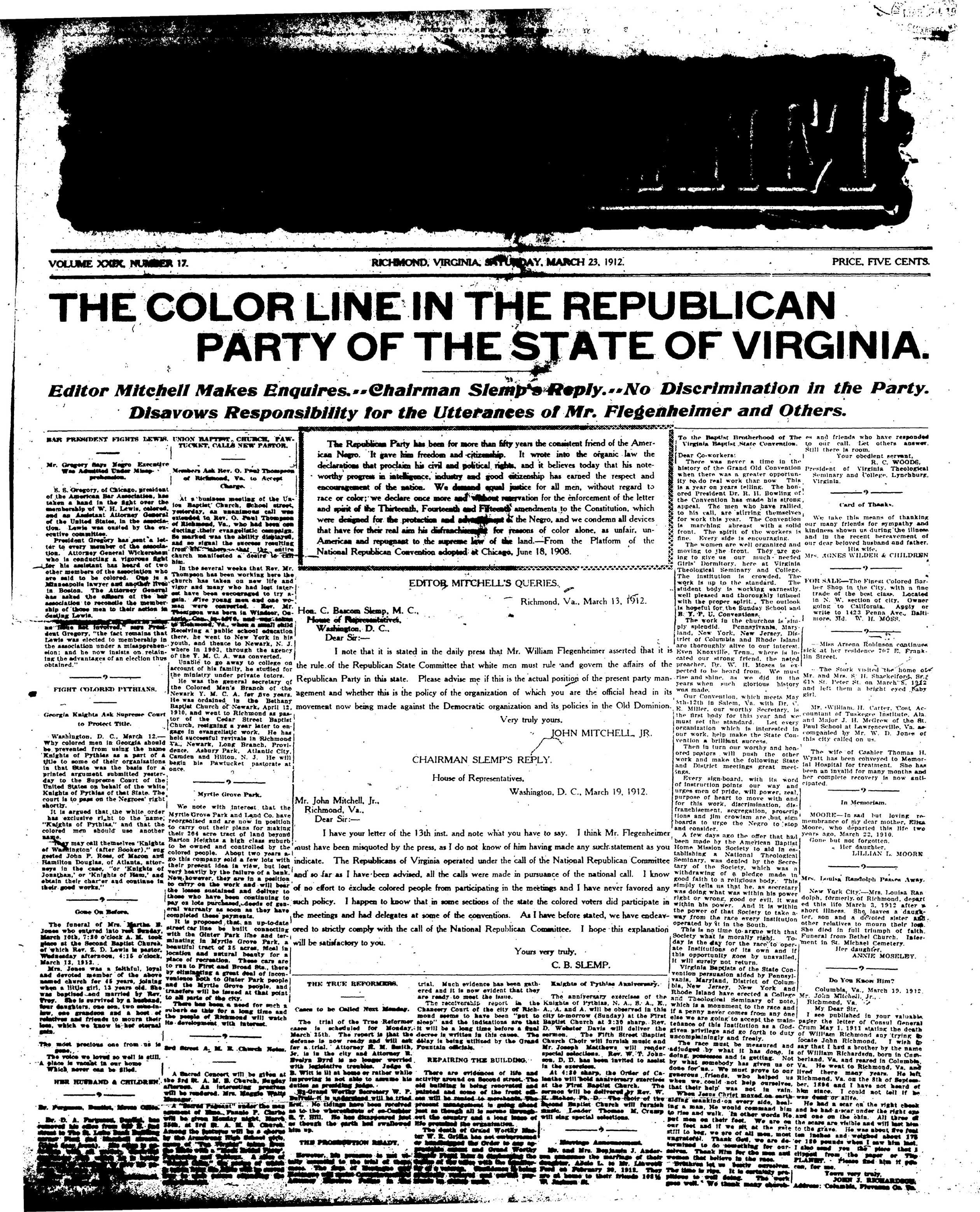
VOLUME XXIX, NUMBER 17. RICHMOND, VIRGINIA, SATURDAY, MARCH 23, 1912. PRICE, FIVE CENTS.
THE COLOR LINE IN THE REPUBLICAN PARTY OF THE STATE OF VIRGINIA.
Editor Mitchell Makes Enquires.--Chairman Slemp's Reply.--No Discrimination in the Party. Disavows Responsibility for the Utterances of Mr. Flegenheimer and Others.
BAR PRESIDENT FIGHTS LEWIS. UNION BAPTIST, CHURCH, PAW-
Mr. Gregory Says Negro Executive Was Admitted Under Minp preemption.
E. S. Gregory, of Chicago, president of the American Bar Association, has taken a hand in the fight over the membership of W. H. Lewis, colored, and an Assistant Attorney General of the United States, in the association. Lewis was ousted by the executive committee.
President Gregory has sent a letter to every member of the association. Attorney General Wickersham who is conducting a vigorous fight for his assistant has heard of two other members of the association who are said to be colored. One is a Minneapolis lawyer and another lives in Boston. The Attorney General has asked the officers of the bar association to reconcile the membership of those men to their action in causing Lewis.
An House not involved" says President Gregory, "the fact remains that Lewis was elected to membership in the association under a misapprehension; and he now insists on retaining the advantages of an election thus obtained."
2 FIGHT COLORED PYTHIANS.
Georgia Knights Ask Supreme Court to Protect Title.
Washington, D. C., March 12. Why colored men in Georgia should be prevented from using the name Knights of Pythias as a part of a title to some of their organizations in that State was the basis for a printed argument submitted yesterday to the Supreme Court of the United States on behalf of the white Knights of Pythias of that State. The court is to pass on the Negroes' right shortly. It is argued that the white order has exclusive right to the name; "Knights of Pythias," and that the colored men should use another name. "They may call themselves 'Knights of Washington' (after Booker)," sugested John P. Roess, of Macon and Hamilton Douglas, of Atlanta, attorneys in the case, "or 'Knights of Jonathan,' or 'Knights of Ham,' and obtain their charter and continue in their good works."
Gone On Before.
The funeral of Mrs. Martha B. Jones who entered into rest Sunday March 10th, 7:30 o'clock A. M. took place at the Second Baptist Church of which Rev. Z. D. Lewis is pastor, Wednesday afternoon, 4:15 o'clock, March 12, 1912.
Mrs. Jones was a faithful, loyal and devoted member of the above named church for 45 years, joining when a little girl, 13 years old. She was baptised and married by Rev. Frey. She is survived by a husband, four daughters, one son, two minors-in-law, one grandson and a host of relatives and friends to mourn their loss, which we know in her eternal gain.
The most precious one from us is gone.
The voice we loved so well is still. A place is vacant in our home. Which never can be filled.
Dr. Pergueson, Dentist, Moves Office.
Dr. D. A. Pergueson, Dental, has removed his office from the R. and stumb to the R. Lute Bank Building corner Plant and Marshall Avenue. (Taken from james). His office is guarded with all security. Dental technician with whom he is being prepared to work will give the patient the necessary information.
At a business meeting of the Union Baptist Church, School street, yesterday, an unanimous call was extended to Rev. O. Paul Thompson of Richmond, Va., who had been conducting their evangelistic campaign. He marked was the ability displayed, and no signal the success resulting from his efforts that the entire church manifested a desire to call him.
In the several weeks that Rev. Mr. Thompson has been working here the church has taken on new life and vigor and many who had lost interest have been encouraged to try again. Five young men and one woman were competed. Rev. Mr. Thompson was born in Windsor, Ontario, Can. in 1870, and was taken to Richmond, Va., when a small child Recovering a public school education there, he went to New York in his youth, and thence to Newark, N. J. where in 1903, through the agency of the Y. M. C. A. was converted.
Unable to go away to college on account of his family, he studied for the ministry under private tutors. He was the general secretary of the Colored Men's Branch of the Newark Y. M. C. A. for five years. He was ordained in the Bethany Baptist Church of Newark, April 12, 1910, and went to Richmond as pastor of the Cedar Street Baptist Church, resigning a year later to engage in evangelistic work. He has held successful revivals in Richmond Va., Newark, Long Branch, Providence, Asbury Park, Atlantic City, Camden and Hilton. N. J. He will begin his Pawtucket pastorate at once.
Myrtle Grove Park
We note with interest, that the Myrtle Grove Park and Land Co. have reorganised and are now in position to carry out their plans for making their 264 acre tract of land beyond Barton Heights a high class suburb to be owned and controlled by the colored people. About two years ago this company sold a few lots with their present idea in view, but lost very heavily by the failure of a bank. Now, however, they are in a position to carry on the work and will bear the losses sustained and deliver to those who have been continuing to pay on lots purchased, deeds of general warranty as soon as they have completed these payments.
It is proposed that, an up-to-date street car line be built connecting with the Glister Park line and terminating in Myrtle Grove Park, a beautiful tract of 25 acres. Meal in location and natural beauty for a place of recreation. These cars are to run to First and Broad Sts., there by eliminating a great deal of inconvenience both to Glister Park people and the Myrtle Grove people, and transfers will be issued at that point to all parts of the city.
There has been a need for such a suburb as this for a long time and the people of Richmond will watch its development with interest.
A Sacred Concert will be given at the 3rd R. A. M. B. Church, Sunday afternoon. An interesting program will be rendered, Mrs. Maggie White Manager.
A "Sacred Paganist" under the management of Miss. Pamela P. Charles will be given Monday night, March 25th, at 3rd R. A. M. B. Church. Among the festivities will be a choreo by the Armstrong High School girls, a poem of "Two Wonder" taken from the Bible with a "Black British Piano," Puppetting and Tablums. A dance of "Sacred Chants" the prizes of which may be given to the kids will be awarded by each position attending the
The Republican Party has been for more than fifty years the consistent friend of the American Negro. It gave him freedom and citizenship. It wrote into the organic law the declarations that proclaim his civil and political rights, and it believes today that his noteworthy progress in intelligence, industry and good citizenship has earned the respect and encouragement of the nation. We demand equal justice for all men, without regard to race or color; we declare once more and without reservation for the enforcement of the letter and spirit of the Thirteenth, Fourteenth and Fifteenth amendments to the Constitution, which were designed for the protection and advertisement of the Negro, and we condemn all devices that have for their real aim his disfranchisement for reasons of color alone, as unfair, un-American and repugnant to the supreme law of the land.—From the Platform of the National Republican Convention adopted at Chicago, June 18, 1908.
I note that it is stated in the daily press that Mr. William Flegenheimer asserted that it is the rule of the Republican State Committee that white men must rule and govern the affairs of the Republican Party in this state. Please advise me if this is the actual position of the present party management and whether this is the policy of the organization of which you are the official head in its movement now being made against the Democratic organization and its policies in the Old Dominion.
I have your letter of the 13th inst. and note what you have to say. I think Mr. Flegenheimer must have been misquoted by the press, as I do not know of him having made any such statement as you indicate. The Republicans of Virginia operated under the call of the National Republican Committee and so far as I have been advised, all the calls were made in pursuance of the national call. I know of no effort to exclude colored people from participating in the meetings and I have never favored any such policy. I happen to know that in some sections of the state the colored voters did participate in the meetings and had delegates at some of the conventions. As I have before stated, we have endeavored to strictly comply with the call of the National Republican Committee. I hope this explanation will be satisfactory to you.
Mr. John Mitchell, Jr., Richmond, Va. Dear Sir: I have your letter of the must have been misquoted by the indicate. The Republicans of V and so far as I have been advis of no effort to exclude colored p such policy. I happen to know of the meetings and had delegates ored to strictly comply with the will be satisfactory to you.
THE TRUE REFORMERS.
Cance to be Called Next Monday.
The trial of the True Reformer cases is scheduled for Monday March 25th. The report is that the defense is now ready and will act for a trial. Attorney R. M. Smith Jr. is in the city and Attorney R. Evelyn Byrd is no longer worried with legislative troubles. Judge G. B. Witt is ill at home or rather while improving is not able to assume his duties as providing judge.
By-Grand Worthy Secretary W. P. Burrell-K is undermined will be tried Brk. No tidings have been received as to the whereabouts of on-October R. T. Hill. He has disappeared just as though the parth had swallowed him up.
THE PROSECUTION READY.
However, his presence is not usually attached to the trial of these cases. The State of Minnesota and Minnesota will report Commissioners Attorney Minneapolis Police in the
Yours very truly.
trial. Much evidence has been gathered and it is now evident that they are ready to meet the issue.
The receivorship report in the Chancery Court of the city of Richmond seems to have been "put to sleep" and the indications are that it will be a long time before a final decree is written in this cause. The delay is being utilized by the Grand Fountain officials.
REPAIRING THE BUILDING...
There are evidences of life and activity around on Second street. The old building is being renovated and painted and some of the front offices will be rented to merchants. The present management is going ahead just as though all is normal through out the country and a long lease of life provided the organization.
The death of Grand Worthy Master W. R. Griffin has not overwhelmed or handicapped the Order to any appropriate amount and Grand Worthy Master Fighters in demonstrating the faith of the venero with the sanctity of a venero. Grandness is being generously rewarded and grateful gratitude in a generous manner.
C. B. SLEMP.
The annivernary exercises of the Knights of Pythias, N. A., S. A., E. A., A. and A. will be observed in this city to-morrow (Sunday) at the First Baptist Church at 2:30 sharp. Rev. D. Webster Davis will deliver the sermon. The Fifth Street Baptist Church Choir will furnish music and Mr. Joseph Matthews will render special selections. Rev. W. T. Johnson, D. D. has been invited to assist in the exercises. At 4:30 sharp, the Order of Calamite will hold anniversary exercises at the First Baptist Church. The sermon will be delivered by Rev. W. H. Baker, Ph. D. - The choir of the Second Baptist Church will furnish music. Leader Thomas M. Crump will sing special selections.
Mr. and Mrs. Benjamin J. Anderson
pensence the marriage of their
daughter, Alice L. to Mr. Linnwell
Fred at February 30, 1912. They
are at home to their friends 103%
W. Jackson St.
To the Baptist Brotherhood of The Virginia Baptist State Convention.
Dear Co-workers:
There was never a time in the history of the Grand Old Convention when there was a greater opportunity to do real work than now. This is a year on years telling. The honored President Dr. R. H. Bowling of the Convention has made his strong appeal. The men who have rallied to his call, are stirring themselves for work this year. The Convention is marching abreast with a solid front. The spirit of the workers is fine. Every side is encouraging.
The women are well organized and moving to the front. They are going to give us our much-needed Girls' Dormitory, here at Virginia Theological Seminary and College. The institution is crowded. The work is up to the standard. The student body is working earnestly, well pleased and thoroughly imbued with the proper spirit. The outlook is hopeful for the Sunday School and B. Y. P. U. Conventions.
The work in the churches is simply splendid. Pennsylvania, Maryland, New York, New Jersey, District of Columbia and Rhode Island are thoroughly alive to our interest. Even Knoxville, Tennessee, where is located our strong friend, the noted preacher, Dr. W. H. Moses is expected to be heard from. We must rise and shine, as we did in the years when such glorious history was made.
Our Convention, which meets May 8th-12th in Salem, Va. with Dr. C. E. Miller, our worthy Secretary, is the first body for this year and we must set the standard. Let every organization which is interested in our work, help make the State Convention a brilliant success.
Then in turn our worthy and honored pastors will push the other work and make the following State and District meetings great meetings.
Every sign-board, with its word of instruction points our way and urges men of pride, will power, zeal, purpose of heart to move with and for this work, discrimination, disfranchisement, segregation, proscripions and Jim crowism are but sign boards to urge the Negro to stop and consider.
A few days ago the offer that had been made by the American Baptist Home Mission Society to aid in establishing a National Theological Seminary, was denied by the Secretary of the Society, which was a withdrawing of a pledge made in good faith to a religious body. This simply tells us that he, as secretary was doing what was within his power right or wrong, good or evil, it was within his power. And it is within the power of that Society to take away from the race every institution operated by it in the South.
This is no time to argue with that Society what is morally right. Today is the day for the race to operate Institutions of its own and if this opportunity goes by unavailed, it will surely not return.
Virginia Baptists of the State Convention persuasion aided by Pennsylvania, Maryland, District of Columbia, New Jersey, New York and Rhode Island have erected a College and Theological Seminary of note, which is a monument to the race and if a penny never comes from any one else we are going to accept the maintenance of this Institution as a God-given privilege and go forth to duty uncomplainingly and freely.
The race must be measured and
adjudged by what it has done, in
doing, possesses and is getting. Not
by what somebody has given us or
done for us. We must prove to our
generous friends, who helped us
when we could not help ourselves,
that their help was not in vain.
When Jesus Christ maced on earth,
adding mankind on every side, healing
a man, He would command him to
rise and walk. In other words He
put men on their feet. We are on
our feet and if we sit at the gate
still to bear, we are of all men, most
ungrateful. Thank God, we are de-
termined to do something for ourselves.
Thank Him for the men and
women that believe in the race.
Brithren left us besty ourselves.
The time is ripe. It is certainly pro-
piles to well doing. The work
won well. We thank many chants.
es and friends who have responded
to our call. Let others answer.
Still there is room.
Your obedient servant,
R. C. WOODS,
President of Virginia Theological
Seminary and College, Lynchburg,
Virginia.
Card of Theaks
We take this means of thanking our many friends for sympathy and kindness shown us during the illness and in the recent bereavement of our dear beloved husband and father. His wife,
Mrs. AGNES WILDER & CHILDREN
FOR SALE—The Finest Colored Barber Shop in the City, with a fine trade of the best class. Located in N. W. section of city. Owner going to California. Apply or write to 1423 Penna Ave. Baltimore, Md. W. H. MOSS.
Miss Arreona Robinson continues sleek at her residence 707 E. Franklin Street.
The Stork visited the home of Mr. and Mrs. S. H. Shackelford, Sr. 618 St. Peter St. on March 8, 1912 and left them a bright eyed Baby girl.
Mr. William, H. Carter, Cost Accountant of Tuskegee Institute, Ala. and Major J. H. McGrew of the St. Paul School at Lawrenceville, Va. accompanied by Mr. W. D. Jones of this city called on us.
The wife of Cashler Thomas H. Wyatt has been conveyed to Memorial Hospital for treatment. She has been an invalid for many months and her complete recovery is now anticipated.
In Memoriam.
MOORE—In sad but loving remembrance of my dear mother, Eliza Moore, who departed this life two years ago, March 22, 1910.
Gone but not forgotten.
Her daughter.
LILLIAN L. MOORE
Mrs. Louisa Randolph Panes Away.
New York City:—Mrs. Louisa Randolph, formerly of Richmond, departed this life March 3, 1912 after a short illness. She leaves a daughter, son and a devoted sister and other relatives to mourn their loss. She died in full triumph of faith. Funeral in Bethel Church. Interment in St. Michael Cemetery.
Do You Know Him?
Columbia, Va., March 19, 1912.
Mr. John Mitchell, Jr.
Richmond, Va.
My Dear Sir,
I see published in your valuable paper the letter of Consul General Crum May 1, 1911 stating the death of William Richmond any trying to locate John Richmond. I wish to say that I had a brother by the name of William Richardson, born in Cumberland, Va. and reared in Columbia, Va. He went to Richmond, Va. and lived there many years. He left Richmond, Va. on the 8th of September, 1894 and I have not heard of him since. I could not tell if he was dead or alive.
He had a scar on the right cheek and he had a scar under the right eye and one on the chin. All three of the scars are visible and will last him to the grave. He was about five feet ten inches and weighed about 178 or 180 pounds when I saw him had. I also send you the piece that I clipped from the paper or The PLANET. Please find him if you can, for me.
Yours very truly,
JOHN J. RICHARDSON
Address: Columbia, Pennsylvania On Pa.
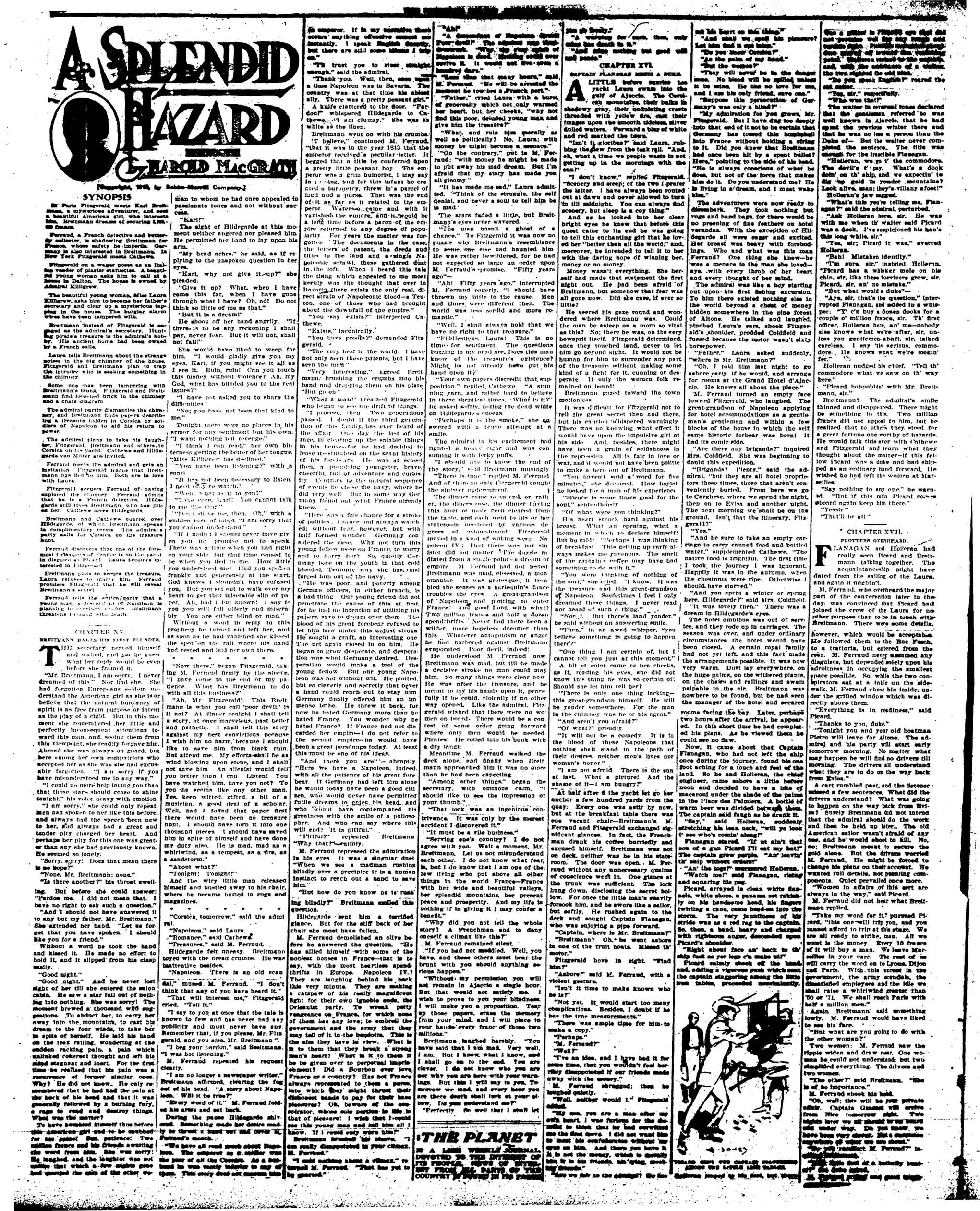
A SPLENDID HAZARD BY HAROLD MACGRATH
SYNOPSIS
Paris Fitzgerald meets Karl Bettleigh, a mysterious adventurer, and sees beautiful American girl, who intertwines Fitzgerald dreams of securing 2000 francs. Bernard, a French detective and butterfly collector, is shadowing Bettleigh for France, whose safety he imperils. Germany is also interested in Bettleigh. In New York Fitzgerald meets Cathew. Fitzgerald on a wager poses as an Italian young woman asks him to call at a house in Dalton. The house is owned by Admiral Killigrew. The beautiful young woman, Miss Laura Killigrew, asks him to become her father's secretary and clear up a mysterious taping in the house. The burglar alarm is switched on. Bettleigh instead of Fitzgerald is engaged as the admiral's secretary. Hunting plaque's treasure is the admiral's hobby. His ancient home had been owned by a French exile. Laura tells Bettleigh about the strange poles in the big chimney of the house. Fitzgerald and Bettleigh plan to trap the plaque who is seeking something in the chimney.
Some one has been tampering with Bretlmann's trunk. Fitzgerald and Bretlmann find loosened brick in the chimney and a chalk diagram.
The admiral party dismantles the chimney and linethe find, then describing a firewall hidden in Corsica by soldiers of Napoléon to bid his return to power.
The admiral plans to take his daughter, Fitzgerald, Bretlmann and others, to Corsica on his yacht, Cathwe and Hildegarda von Mitter are invited.
Ferraud meets the admiral and gets an invitation. Fitzgerald learns that Bretlmann has led him. Both are in love with Laura.
Ferraud meets Ferraud of having exploded the company. Ferraud detects that he is in a French detective. Hildegarda still loves Bretlmann, who has filmed her. Cathwe loves Hildegarda.
Bretlmann and Cathwe quarrel over Hildegarda, of whom Bretlmann speaks in complimentary terms. The admiral's party calls for Corsica on the treasure hunt.
Ferraud discovers that one of the forensic trainees of France is on the yacht in disguise in Corsica. Laura becomes interested in Fitzgerald.
Brittmann plots to secure the treasurer Laura returns to marry him. Ferraud persuades Brittmann that he will reveal Brittmann's secret.
Ferraud tells the editor that a young man, a devout of Napoleon, is plunging into a life of death. Brittmann is allured after him.
CHAPTER XV
BRITTANY BANKS HIS FIRST BUDDEN
THE secretary nerved himself and waited, and he knew what her reply would be even before she trained it.
"Mr. Brittmann, I am sorry, I never dreamed of this." Nor did she. She had forgotten Europeans wisdom understand the American girl as she is or believe that the natural buoyancy of spirit is as free from purpose or intent as the play of a child. But in this moment she remembered her little and perfectly inconsequent intentions toward this man, and, seeing them from this viewpoint, she readily forgave him. Abroad she was always on guard, but here among her own compatriots who accepted her as she was she had excusably forgotten. "I am sorry if you have misunderstood me in any way."
"I could no more help loving you than that those stars should cease to shine tonight." his voice heavy with emotion. "I am sorry," she could only repeat. Men had spoken to her like this before, and always had the speech been new to her, and always had a great and tender pity charged her heart. And perhaps her pity for this one was greater than any she had previously known. He seemed so lonely. "Sorry, sorry! Does that mean there is no hope?" "None, Mr. Breltmann; none." "Is there another?" his throat swelling. But before she could answer: "Pardon me. I did not mean that. I have no right to ask such a question." "And I should not have answered it to any but my father, Mr. Breltmann." She extended her hand. "Let us forget that you have spoken. I should like you for a friend." Without a word he took the hand and kissed it. He made no effort to hold it, and it slipped from his class easily.
"Good night."
"Good night." And he never lost sight of her till she entered the mansion cabin. He saw a star fall out of nothing into nothing. She was sorry! The moment brewed a thousand wild suggestions. To abduct her, to carry her away into the mountains, to cast his dream to the four winds, to take her in spite of herself. He held his hand on the teek railing, wondering at the sudden racking pain, a pain which unlaked coherent thought and left his mind stagnant and inert. For the first time he realised that his pain was a recurrence of former similar ones. Why? He did not know. He only remembered that he had had the pain at the back of his head and that it was generally followed by a burning fury, a rage to read and destroy things. What was the matter?
To have brominated himself thus before this american girl and to be matched for his jacket. But, patience: Two million francs and the friend a writing the word from him. She was sorry. He laughed, and the laughter was not unhappy that which a few nights gone had married the wife of the other we
man to whom he had once appealed in passionate tones and not without success.
"Karl!"
The sight of Hildegarde at this moment neither angered nor pleased him. He permitted her hand to lay upon his arm.
"My head nchen," he said, as if replying to the unapoken question in her eyes.
"Karl, why not give it-up?" she pleaded.
"Give it up? What, when I have come this far, when I have gone through what I have? Oh, no! Do not think so little of me as that."
"But it is a dream!"
He shook off her hand angrily. "If thre is to be any reckoning I shall pay, never fear. But it will not, shall not fall!"
She would have liked to weep for him. "I would gladly give you my eyes. Karl, if you might see it all us I see it. Ruin, ruin! Can you touch this money without violence? Ah, my God, what has blinded you to the real issues?"
"I have not asked you to share the difficulties."
"No; you have not been that kind to me."
Tonight there were no places in his armor for my sentiment but his own. "I want nothing but revenge."
"I think I can read," her own bitterness getting the better of her tongue. "Miss Killgriff has declined."
"You have been listening?" with a smart
"It has not been necessary to listen I need only to watch."
"Well, what is it to you?"
"Take care, kard! You cannot talk to me like that."
"Don't drive me, then. Oh!" with a sudden turn of mind. "I am sorry that you cannot understand."
"If I did not I should never have girl on you my promise not to speak. There was a time when you had right on your side but that time ceased to be when you died to me. How little you understood me. Had you spoken frankly and generously at the start. God knows I shouldn't have refused you. But you set out to walk over my heart to get that miserable slip of paper. Ah, bad I but known! I say to you you will fall utterly and miserably. You are either blind or mad."
Without a word in reply to this prophecy he turned and left her, and as soon as he had vanished she kissed the spot on the rail where his hand had rested and had her own them.
"Now there," began Fitzgerald, taking M. Fermand firmly by the sleeve. "I have come to the end of my patience. What has Biegmann to do with all this business?"
"Ah, Mr. Fitzgerald! This Brot man is what you call 'poor devil.' is it not? At dinner tonight I shall tell a story, at once miraculous, past better and pathetic. I shall tell this story against my best constructions because I wish him no harm, because I should like to save him from black ruin. But attend me. My efforts shall be as wind blowing upon stone, and I shall not save him. An alienist would tell you better than I can. Listen. You have watched him, have you not? To you he seems like any other man. Yes, keen witted, gifted, a bit of a musician, a good deaf of a scholar. Well, I found that paper first there would have been no treasure hunt. I should have torn it into one thousand pieces. I should have saved him in spite of himself and have done my duty also. He is mad, mad as a whirlwind, as a tempest, as a fire, as a sandstorm."
"About what?"
"Tonight: Tonight!"
And the wiry little man released himself and busted away to his chair, where he became buried in rugs and magazines.
"Corsica, tomorrow," said the admiral.
"Napoleon," said Laurn.
"Romance," said Cathew.
"Treasures," said M. Ferraud.
Hildegarde felt uneasy. Brettmann
toyed with the bread crumbs. He was
mattentive besides.
"Napoleon. There is an old scan
del." mung M. Ferraud. "I don't
"I say to you at once that the tale is known to few and has never had any publicity and must never have any remember that, if you please, Mr. Flus gerald, and you also, Mr. Breitmann."
"I beg your jardion," said Bessmann.
"I was not listening."
M. Ferraud repeated his request clearly.
"I am no longer a newspaper writer," Breitmann affirmed, clearing the fog out of his head. "A story about Napoleon. Will it be true?"
"Every word of it." M. Ferraud folded his arms and set back.
During the pause Hillegardo mirred. Something made her desire mildly to threaten a hand set and over M. Ferraud's mouth.
"We have all read much about Napoleon. The emperor no g. soldier was the pearl of all the Corsairs. As a bamboo he was very inferior to any of them. This story did not mention him."
in emperor. If in my executive there
certain anything offensive concern me
instantly, I speak English country,
but there are still some idioms I trip
on.
"I'll trust you to steer straight
eough," said the admiral.
"Thank you. Well, then, once upon
a time Napoleon was in Bavaria. The
country was at that time his ablest
ally. There was a pretty pleasant girl."
A knife clattered to the door. "Pardon!"
whispered Hildegarde to Cathewe,
"I am clumsy." She was as
white as the linen.
Brittleman wear on with his crumbs "T believe," continued M. Ferraud, "that it was in the year 1813 that the emperor received a peculiar letter. It begged that a title be conferred upon a pretty little peasant boy. The emperor was a grim butorist. I may say in:ising, and for this infant he created a barometry, threw in a parcel of land and a purse. That was the end of it as far as it related to the emperor. Waterson, came and with it vanished the empire, and it would be a long time before a baron of the empire returned to any degree of popularity. For years the matter was forgotten. The documents in the case, the letters of patent, the deeds and titles to the land and a single Napoleonic army, these gathered daint in the loft. When I heard this tale the thing which appealed to me most keenly was the thought that over in Havana there exists the only real, direct strain of Napoleonic blood—a Teuton, one of those who had brought about the downfall of the empire."
"You say exists?" Interjected Cast
thewe.
"Exists," laconically.
"You have proofs?" demanded Fitzgerald.
"The very best in the world. I have not only seen those patents, but I have seen the maff."
"Very interesting," agreed Brettmann, brushing the crumbs into his hand and dropping them on his plate.
"But go on."
"What a man!" breathed Fitzgerald, who began to see the draft of things.
"I proceed, then. Two generations passed. I doubt if the third generation of this family has ever heard of the affair. One day the last of his race, in clearing up the salable things in his house, for he had decided to leave it—stumbled on the scant history of his forfeitures. He was at school then, a promising youngster, brave, cheerful, full of adventure and curiosity. Contrary to the natural sequence of events he chose the navy, where he did very well. But in some way Ger many found out what France already knew.
There was a thin chance for a stroke of politics. France had always watched; without fear, however, but with half formed wonder. Germany considered the case. Why not turn this young fellow issue on France, to worry and to harry her? So, quietly Germany bore on the youth in that cold blooded, Teutonic way she has, and forced him out of the navy.
He was poor, and poverty among German officers, in either branch, is a bad thing. Our young friend did not penetrate the cause of this at first for he had no intention of utilizing his papers, save to dream over them. The blood of his great forebear refused to let him bow under this unjust stroke. He sought a craft, an interesting one. The net again closed in on him. He began to grow desperate, and desperation was what Germany desired. Desperation would make a tool of the young fellow. But our young Napoleon was not without wit. He plotted, but so cleverly and secretly that never a hand could reach out to stay him Germany finally offered him an immense bride. He threw it back, for now he hated Germany more than he hated France. You wonder why he hated France? If France had not discarded her empire—I do not refer to the second empire—he would have been a great personage today. At least this must be one of his ideas.
"And thank you are"—abruptly
"Here we have a Napoleon, indeed
with all the patience of his great fore
beat. If Germany had left him alone
he would today have been a good cill
zen, who would never have permitted
future dreams to guide his head, and
who would have contemplated his
greatness with the smile of a philoso-
pher. And who can say where this will end?
"It is pitiful."
"Pitiful?" repented Breitmann
"Why that?"—simply.
M. Ferrand repressed the admiration
in his eyes. It was a singular duel
"When we see a madman rushing
blindly over a precipice it is a human
insect to reach out a hand to save
him."
"But how do you know he is rushing
blindly?" Breitmann ended this
question.
Hildegride sent him a terrified
glance. But for the stiff back of her
chair she must have fallen.
M. Ferrand demolished an olive before he answered the question. "He has allied himself with some of the noblest houses in France—that is to say, with the most heartless spandrifts in Europe. Napoleon IV. They are laughing behind his back this very minute. They are making a cawpaw of his really magnificent fight for their own ignoble gods, the Orleanist party. They wreak petty vengeance on France, for which none of them has any love; to embroil the government and the army that they may tell of it in the bedouin. This is the aim they have in view. What is it to them that they break a strong man's heart? What is it to them if he be given over to perpetual imprisonment? Did a Bourbon ever love France as a country? Has not France always represented to them a person, into which they might threaten their dislovest hands to pay for their base pleasure? Oh, beware of the captain, whose sole partion in life, is that of pleasure! I wish that I could see this young man and kill him all I know. If I could only were him! Brettman brunched his stoop. "I am really displeased in your climax. I am forward."
"I said nothing about a offense," he turned it. Forced. "That has yet to be announced."
"Ah!
"A descent of Magnaeus four days!"
The national man thus descented. Why, the day light of Magnaeus is food, nothing could ever move it. It would not live upon a hundred days."
"Lamus than that many hours," said M. Ferraud. "He will be arrested the moment he touches a French port."
"Father," cried Laura with a burst of generosity which not only warmed her heart, but her cheeks, why not find this poor, devalued young man and give him the treasure?"
"What, and rule him morally as well as politically? No, Laura; with money he might become a messor."
"On the contrary," put in M. Ferraud: "with money he might be made to put away his mad dream. But I'm afraid that my story has made you all gloomy."
"It has made me sad," Laura admitted. "Think of the struggle, the self denial, and never a soul to tell him be in mad."
The tears faded a little, but Brettman's eyes never wavered.
"The man hasn't a ghost of a chance." To Fitzgerald it was now no puzzle why Brettman's resemblance to someone else had haunted him. He was rather bewildered, for he had not expected so large an order upon M. Ferraud's promise. "Fifty years ago—"
"Aht Fifty years ago," interrupted M. Ferraud eagerly. "I should have thrown my little to the cause. Men and times were different then. The world was less world and more romantic."
"Well, I shall always hold that we have no right to that treasure."
"Fiddlesticks, Laurai: This is no time for sentiment. The questions buzzing in my head are: Does this man know of the treasure's existence? Might he not already have put his hand upon it?"
"Your own papers discredit that supposition," replied, Cathwee "A stunning yarn, and rather hard to believe in these skeptical times. What is it? He asked softly, noting the dead white on Hildegarde's shocks.
"Perhaps it is the smoke," she answered with a brave attempt at a smile.
The admired in his excitement had lighted a heavy cigar and was consuming it with legy puffs.
"I should know to the end of the story," said Friedmann missingly. "There is time." replied M. Ferrand. And of them so only Dizgerald caught the sinister undercurrent.
The dinner came to an end, or, rather, the dinner rose, the dinner having this hour or more been cleared from the table, and each went to his or her stateroom mustered by various degrees of astonishment. Fitzgerald moved in a skirt of walking sage. Napoleon IV: That there was not sinister did not matter. 'The dazzle related from a single-point—a dream of empire. M. Ferrand had not jested Brettmann was mad, obsessed, a monomance. It was grotesque. It trembled the senses as a harmless' dance troubles the eyes. A great-grandson of Napoleon and plitting to enter France. And good Lord, with what? Two million treasures and half a dozen spendthrift's. Never had there been a wilder, more hopeless dreamer than this. Whatever antagonism or anger he find hitherto against Brettmann evaporated. Poor death, indeed:
He understood M. Ferraud now Brettmann was mad, but till he made a decisive stroke no man could stay him. So many things were clear now. He was after the treasure, and he meant to lay his hands upon it, peacefully if he could, violently if no other way opened. Like the admiral, Fitzgerald wished that there were no women on board. There would be a contest of some order going forward where only men would be needed. Pristine! He rolled into his bunk with a dry laugh.
Meantime M. Ferraud walked the deck alone, and finally when it itself man approached him it was no more than he had been expecting.
"Among other things," began the secretary, with ominous calm, "I should like to see the impression of your thumb."
"That lock was an ingenious contrivance. It was only by the merest accident I discovered it."
"Serving one's country? I do not agree with you. Wait a moment, Mr. Brettmann. Let us not misunderstand each other. I do not know what fear is, but I do know that I am one of the few living who put above all other things in the world France—France with her wide and beautiful valleys, her splendid mountains, her present peace and prosperity. And my life is nothing if in giving it I may confer a benefit."
"Why did you not tell the whole story? A Frenchman and to deny oneself a climax like this?"
M. Ferraud remained silent.
"If you had not meddled, Well, you have, and these others must bear the brunt with you should anything serious happen."
"Without my permission you will not remain in Aspecto a single hour. But that would not satisfy me. I wish to prove to you your blindness. I will make you a proposition. Tear up those papers, erase the memory from your mind, and I will place in your hands every franc of those two millions."
Bretmans, laughed harshly. "You have said that I am mad. Very well, I am. But I know what I know, and I shall go on to the end. You are clever. I do not know who you are so why you are here with your warnings. But then I will say to you. Tomorrow we need, and every hour you are there death shall lark at your elbow. Did you understand me?"
PERFECTLY. BE WELL THAT I SHALL LET
THE PLANET
IN A LONG WHEELLE JOURNAL,
DEVOTED TO THE INTEREST OF
ITS PEOPLE, GROW OF INTEREST
FROM ALL PARTS OF THE
COUNTRY IN FOUND IN THIS JOURNAL.
CHAPTER XVI
A LITTLE before marries the yacht Laura swam into the gulf of Ajaccio. The Caribbean mountains, their bulbs in shadowy gray, their modulating crests threaded with yellow air, cast their images upon the smooth, tides, silver dulled waters. Forward a blur of white and red marked the town.
"Not it glorious!" said Laura, rubbing the glow from the tank rail. "And, oh, what a time we people waste in not getting up in the mornings with the sun!"
"I don't know," replied Fitzgerald. "Recovery and sleep; of the two I prefer the latter. I have always been routed out at dawn and never allowed to turn in midnight. You can always and scorch, but sleep is a coy thing."
And as he looked into her clear bright eyes he knew that before this quest came to its end he was going to tell this enchanting girl that he loved her "better than all the world;" and, moreover, he intended to tell it to her with the daring hope of winning her, money or no money.
Money wasn't everything. She herself had made that statement the first night out. He had been afraid of Braitmann, but somehow that fear was all gone now. Did she care, if ever so little?
He veered his gaze round and wondered where Braitmann was. Could the man be asleep on a morn so vital as this? No; there be was, on the very bowsprit itself. Fitzgerald determined, once they touched land, never to let him go beyond sight. It would not be human for him to surrender any part of the treasure without making some kind of a fight for it, cunning or desperate. If only the women folk remained on board!
Braitmann gazed toward the town motionless.
It was difficult for Fitzgerald not to tell the great secret then and there, but his caution "whispered warningly. There was no knowing what effect it would have upon the impulse girl at his side. And, besides, there might have been a grain of selflessness in the repression. All is fair in love or war, and it would not have been politic to make a hero out of Brettmann. "You haven't said a word for five minutes," she described. How boyish he looked for a man of his experience "Silence is some times good for the soul," sentimentiously. "Of what were you thinking?" His heart struck hard against his breast. What an opening, what a moment in which to declare himself: But he said, "Perhaps I was thinking of breakfast. This getting up early always makes me gavousen. The smell of the captain's coffee may have bad something to do with it."
"You were thinking of nothing of the sort," she cried. "I know. It was the treasure and this great-grandson of Napoleon. Sometimes I feel I only dreamed these things. I never read nor heard of such a thing." "Nor, I. but there's land yonder. he said without an answering smile. "Then, in an awed whisper, you believe something is going to happen there?" "One thing I am certain of, but I cannot tell you just at this moment. A bit of color came to her checks, as if, reading his eyes, she did not know this thing he was so certain of. Should she let him tell her?" "There is only one thing lacking—this great-grandson himself. He will be yonder somewhere. For the man in the chimney was he or his agent." "And you can see afraid."
"It will not be a comedy. It is in the blood of these Napoleons that nothing shall stand in the path of their desire, neither men's lives nor woman's honor."
"I am not afraid. There is the sun at last. What a picture! And the shape of it—I am hungry!"
At half after 6 the yacht let go her anchor a few hundred yards from the quay. Every one was astir by now, but at the breakfast table there was one vacant chair—Brettmann's. M. Ferraud and Flitgerald exchanged significant glances. In fact, the Frenchman drank his coffee hurriedly and excused himself. Brettmann was not on deck, neither was he in his stateroom. The door was open. M. Ferraud without any unnecessary qualms of conscience work in. One glance at the trunk was sufficient. The lock hung down, disclosing the secret hollow. For once the little man's sway forsook him, and be aware like a sailor, but softly. He rushed again to the deck and sought Captain Flanagan, who was enjoying a pipe forward. "Captain, where is Mr. Brettmann?" "Brettmann? Oh. he went ashore in one of the fruit boats. Missed th' motor." Fitzgerald hove in sight. "Find him?"
"Ashore" said M. Ferraud, with a violent gesture.
"I can't it time to make known who he is!"
"Not yet. It would start too many complications. Besides, I doubt if he has the true measurements."
"There was ample time for him to make a copy."
"I've an idea, and I have had it for some time, that you wouldn't feel horribly disappointed if our friends made away with the money."
M. Forrard shrugged; then he laughed quietly.
"Well, neither would I." Fingergill added.
"My son, you are a man after my own heart. I was furious for the showlist to think that he had survived me the first move. I did not want him to muster his confidence without my eyes on him. And there you have it. It is not the money, which is mostly him in his friends, who 'gled, mostly friends.'"
How are fair to the audience? How fine
"They will never be in the danger zone. No blood will be spilled makes it be mine. He has no love for me, and I am his only friend, save one."
"Suppose this prosecution of Germany's was only a blind!"
"My admiration for you grown, Mr. Fingerlug. But I have, drug too deeply into that end of it not to be certain that Germany has tossed this bombshell into France without holding a spring to it. Did you know that Brittmann had once been hit by a spout bullet? Here, pointing to the side of his head.
"He is always cohesions of what he does, but not of the force that makes him do it. Do you understand me? He is living in a dream, and I must wake him."
The adventurers were now ready to disembark. They took nothing but rugs and hand bags, for there would be no preening of the feathers on hotel veranda. With the exception of Hilda garde all were eager and excited. Her breast was heavy with foreboding. Who and what was this man Ferraud? One thing she knew—he was a menace to the man she loved—aya, with every throb of her heart and every thought of her mind. The admiral was like a boy starting out upon his first fading excursion. To him there existed nothing else in the world beyond a chest of money hidden somewhere in the pine forest of Altone. He talked and laughed, pinched Laura's ears, shook Flitzgerald's shoulder, prodded Coldfield and fussed because the motor wasn't sixty homepower.
"Father," Laura asked suddenly, "where is Mr. Grettmann?"
M. Ferraud turned an empty face toward Fitzgerald, who laughed. The great-grandson of Napoleon applying for hotel accommodations as a gentleman's gentleman and within a few blocks of the house in which the self same historic forbear was born! It had its comic ride.
"Are there any briganda?" inquired Mrs. Coldfield. She was beginning to doubt this expedition.
"Briganda? Plenty?" said the admiral, "but they are all hotel proprietors these times, those that aren't conveniently buried. From here we go to Carrhee, where we spend the night, then on to Evia and another night. The next morning we shall be on the ground. Isn't that the itinerary, Fitzgerald?"
"And he sure to take an empty carriage to carry canned food and bottled water," supplemented Cathewe. "The native food is frightful. The first time I took the journey I was ignorant. Happily it was in the autumn, when the chestnuts were ripe. Otherwise I should have starved."
"And you spent a winter or spring here, Hildegarde?" said Sirs, Coldfield. "It was lovely then." There was a dream in Hildegarde's eyes.
The hotel omnibina was out of service, and they rode up in carriages. The season was over, and ordinary circumstances the hotel would have been closed. A certain royal family had not yet left, and this fact made the arrangements possible. It was now very warm. Dust lay everywhere, on the huge palms, on the withered plants, on the chales and railings and swamp palpable in the air. Brettman was nowhere to be found, but he had seen the manager of the hotel and secured
rooms facing the bay. Later, perhaps two hours after the arrival, he appeared. In this short time he had completed his plans. As he viewed them he could see no flaw. Now, it came about that Captain Flanagan, who had not left the ship once during the journey, found his one foot aching for a touch and feel of the land. So he and Holleran, the chief engineer, came aboard a little before noon and decided to have a bite of macaroni under the shade of the palms in the Place des Palmiers. A bottle of warm beer was divided between them. The captain said faugh as he drank it. "Say," said Holleran, suddenly stretching his lean neck, "will you look 'see you come' along?" Flanagan stared. "If it ain't that son of a gun Picard I'll eat my hat!" The captain grew purple. "An 'leave'in' the ship without order!" "An 'the tops'' measured Holleran. 'Watch me'" said Flanagan, rising and squaring his pug.
Picard, arrayed in clean white samplers, white shoes, a panama set ratkently on his handmade head, his fingers twirting a cane, cane head-on into the storm. The very funniness of his stride was as a red rag to the captain. So, then, a hand, heavy and charged with righteous anger, descended upon Picard's shoulder.
"Right about face an' back to the ship fast as you keep on make up," calmly caught off the head, and adding, "the captain staggering among the little tables, proceeded among her feet."
4.30.63
When a girl in Florida says she did not get permission well the way she rang and quietly spoke, Florida authorities found proof of wrongdoing, resulting in a police arrest related to the complaint, and with the assistance of a witness, the two signed out and told.
"Do you speak English?" roared the girl.
The waiter in recent times declared that the gentleman referred to was well known in Ajacelle, that he had spent the previous winter there and that he was no less a person than the Duke of— But the waiter never completed the sentence. The title was enough for the invisible Flanagan.
"Holleran, we go't the commodore. The devil's't pay. What's a dook donn' on th' shi' and we expectin' to dig up gold in yonder mountains? Look alive, man; they've villain afoot!" Holleran's jaw agged.
"What's this you're telling me, Flanagan?" said the admiral, perturbed.
"Ank Holleran here, sir. He was with me when the waiter said Picard was a book. I've suspicioned his han's this long while, sir.
"Yea, sir; Picard it was." averred Holleran.
"Bahl Mistaken identity."
"Im sure, sir," insisted Holleran. "Ticard has a whisker mole on his chin, sir, like these forerriers grow, sir, Picard, sir, an no mistake." "But what would a duke"—
"Aye, sir, that's the question." interrupted Flanagan, and added in a whisper: "Y 'c'n buy a dozen docks for a couple o' million francs, sir. 'T'h first officer, Holleran here, an'me—nobody else knows what we're after, sir, unless you gentleman-abaft, sir, talked careless. I any' i'n'i'erious, commodore. He knows what we're lookin' fer." Holleran nudged his chief. "Tell th' commodore what we saw on th' way here." "Fiard hobnobbin' with Mr. Brettmann, sir."
Brettmann? The admiral's smile thinned and disappeared. There might be something in this. Two million france did not appeal to him, but he realized that to others they stood for a great fortune one worthy of hazards. He would talk this over with Cathwe and Fitzgerald and learn what they thought about the matter—if this fellow Picard was a duke and hood shipped as an ordinary hand forward, he wished he had left the women at Marseilles.
"Say nothing to any one," he warned. "But if this man Picard coarse board again keep him there." "Yessir." "That'll all be."
* CHAPTER XVII.
FLANAGAN and Holleran had really seen Picard and Brettmann talking together. The acquaintanceship might have dated from the sailing of the Laura, and again it mightn't.
M. Ferrand, who overheard the major part of the conversation later in the day, was convinced that Picard had joined the crew of the Laura for no other purpose than to be in touch with Brettmann. There were some details, however, which would be acceptable. He followed them to the Bue Fesch, to a trattoria, but entered from the rear. M. Ferrand never assumed any diagnoises, but depended solely upon his adroitness in occupying the smallest space possible. So, while the two compilers sat at a table on the sidewalk, M. Ferrand chose his inside, under the grilled window which was directly above them.
"Everything is in readiness," said Picard.
"Thanks to you, duke."
"Tonight you and your old boatman Pietro will leave for Alone. The admiral and his party will start early tomorrow morning. No matter what may happen he will and no drivers till morning. The drivers all understand what they are to do on the way back from Elysa."
A cart rumbled past, and the listener mined a few sentences. What did the drivers understand? What was going to happen on the way back from Elysa? Surely Brettmann did not intend that the admiral should do the work and then be held up later. The old American sailor wasn't afraid of any one, and he would shoot to kill. No, no; Brettmann meant to secure the old alone. But the drivers worried M. Ferraud. He might be forced to change his plans on their account. He wanted full details, not pussing components. Quiet prevailed once more.
"Women in affairs of this sort are always in the way," said Picard. M. Ferraud did not hear what Brettmann replied.
"Take my word for it," pursued Piard, "this one will trip you, and you cannot afford to trip at this stage. We are all ready to strike, man. All we want is the money. Every 10 francs of it will buy a man. We leave Marseilles in your care. The rest of us will carry the word on to Lyon, Dijon and Paris. With this unrest in the government, the army accradd, the disafflicted employees and the idle we shall raise a whirlwind greater than 50 or 71. We shall reach Paris with half a million men."
Again Breitmann said something lowly. M. Ferraud would have liked to see his face.
"But what are you going to do with the other woman?"
Two women: M. Ferraud saw the ripple widen and draw near. One woman he could not understand; but two simplified everything. The drivers and two women.
"The other?" said Breitmann. "She is of no importance."
M. Ferrod shook his head. "Oh, well; this will be your private akir. Captain Gramat will arrive from Nice tomorrow night. Two nights later we all should be on board and under way. Do you know we have been very about. But a surprise surprise of what we are about." "By your refractil M. Ferrod?" inquired him. "What little bit of a butterfly beauty did you take in?" He shuffled grim and good laugh.
SATURDAY. MARCH 22, 1912
ingly up at the grill.
"He is no fool" (abruptly). "He is a secret agent, and not one move have we made that is unknown to him."
"Impassible!"
M. Putrud could not tell whether the consternation in Picard's voice was real or assumed. He chose to believe the latter.
"And why hasn't he shown his hand?"
"He is waiting for us to show ours. But don't worry," went on Brettman. "I have arranged to suppress him neatly." And the possible victim murmured, "I wonder how?" "Then we must not meet again until you return, and then only at the little house in the Rue St. Charles." "Agreed. Now I must be off." "Good luck!" M. Ferraud heard the stir of a single chair, and knew that the great-granddaughter was leaving. The wall might have been transparent, so sure was he of the smile upon Picard's face, a sinister speculating smile. But his imagination did not pursue Brettman, whose lips also wore a smile, one of broary and bitterness. Neither did he hear Picard murmur "Dupe!" nor Brettman mutter "Fool!"
When Breitmann saw Hildegarde in the hotel gardens he did not avoid her, but stopped by her chair. She rose. She had been waiting all day for this moment. She must speak out or sufface with anxiety. "Karl, what are you going to do?" "Nothing," unanimely.
"You will let the admiral find and keep this money which is yours?"
Brettmann shrugged.
"You are killing me with suspense!"
"Nonsense!" briskly.
"You are contemplating violence of some order. I know it, I feel it!"
"Not so loud!" impatiently.
"You are!" she repeated, crushing her hands together.
"Well, all there remains to do is to tell the admiral. He will perhap divide with me."
"How can you be so cruel to me? It is your safety—that is all I wish to be assured of. Oh. I am pitifully weak! I should deprise you. Take the chest of money; it is yours. Go to England, to America, and be happy."
"Who cares?"
"I care!" with a sob.
The bitterness in his face died for a space. "Hildegarde, I'm not worth it. Forget me as some bad dream, for that is all I am or ever shall be. Missy Cathowe. I'm not blind. He will make you happy. I have made my bed, or, rather, certain statesmen have, and I must lie in it. If I had known what I know now," with regard, "this would not have been. But I trusted every one, myself too." He understood. "Karl, had you told me all in the first place I should have given you that diagram without question gladly." "Well, I am sorry. Forget me!" And with that he left her standing by the side of her chair and walked swiftly toward the hotel. When nort she realised or sensed anything she was lying on her bed, her eyes dry and wide open. And she did not go down to dinner, not did she answer the various calls on her door.
Night rolled over the world, with a cool breeze driving under her million planets. The lights in the hotel flickered out one by one, and in the third corridor, where the adventurers were housed, only a wick floating in a tumbler of oil burned dimly.
Fitzgerald had waited in the shadow for nearly an hour, and he was growing restless and tired. All day long he had been obsessed with the conviction that if Brettman ever made a start it would be some time that night. Distinctly he heard the lightattle of a carriage. It stopped outside the wall. The door to Brettman's room opened gently, and the man himself stepped out cautiously.
"Bo," began Fitzgerald lightly, "your
majesty goes forth tonight!"
But he overreached himself. Bruttenmann whirled, and all the hats in his breast went into his arm as he struck. Fitzgerald throw up his guard, but not soon enough. The blow hit him full on the side of the head and toppled his over, and as the back of his head bumped the floor the world came to an end. When he regained his senses his head was pillowed on a woman's knee, and the scared, white face of a woman bent over his. "What's happened?" he whipped. There were a thousand wicks where there had been one, and there went round and round in a circle. Presently the effect were away, and he recogued Laura. Then he remembered, "By George."
"What is it?" she cried, the hands of terror about her heart beating.
"As a head I'm a picture," he answered.
"Why, I had an idea that Brettmann was off tonight to dig up the treasure himself. Goose! And only one blow struck and I in front of it."
"Brettmann!" exclaimed Laura. She caught her drowning gown closer about her throat.
"Yes. The temptation was too great. How did you get here?" He sought to have struggled to his foot at once, but it was very comfortable to feel her breath upon his forehead.
"I heard a fall and then some one running. Are you badly hurt?"
The anguished in her video was as gentle in her ears.
"Danny, that's all. Butter tell your brother himselfly. The way I can get up on my bed. You all right. Fine, remember your appearance, 6F" with an unwieldy hand.
"I can might have been killed!"
"Namely that. I intend to talk like they do in stories, with this result. The images in. Always strife and queness afterward. You warn your father quietly while I hunt up Ferraud, and Ondrae."
Searing that he was really unjuvenile, she turned and saw down the dark corridor and knocked at her father's door.
Fingergard stumbled along toward M. Ferrand's room manurning; "All right, Mr. Brettman; all right. But hang me if I don't hand you back that one with interest. Where is that Frenchman?" as he hammered on Ferrand's door and obtained no response. He tried the knob. The door opened. The room was black, and he struck a match. M. Ferrand, fully dressed, lay upon his bed. There was a handkerchief over his mouth, and his hands and feet were securely bound. His eyes were open. The hunter of butterflies rubbed his released wrists and ankles, tried his collar, coughed and dropped his legs so the floor.
"I am gutting old," he cried in self communion, "nearighted and old. I've worn spectacles so long in jeet that now I must wear them in earnest!"
"How long have you been here?" asked Fingergard.
"I should say about two hours. It
was very simple. He came to the door.
I opened it. He came in. Zut! He is
as powerful as a lion."
"Why didn't you call?"
"I was too busy, and suddenly it be-
come too late. Gone?"
"Yes." And Flingerald awore as he rubbed the side of his head: Briefly he related what had befallen him.
"You have never hunted butterflies?"
"No," sharply. "Shall we start for him while his heels are hot?"
"I have laid the trap. He and his friend will walk into it. I am not a police officer. I make no arrests. My business is to avert political calamities without any one knowing that these calamities exist. That is the real business of a secret agent. Let him dig up his fortune. The trap is set, and in forty-eight hours it will be sprung. Be calm my son. Tonight we should not find a horse or carriage in the whole town of Ajaccio."
"But what are you going to do?"
"Go to Alfone to find a hole in the ground."
"But the admiral!"
"Let him gaze into the bole and then tell him what you will. I owe him that much. Come on."
"Where?"
"To the admiral to tell him his secretary is a fine rogue and that he has stolen the march on us. A good chase will soften his final disappointment. I will tell you this: I am playing against desperate men, and the liberty, perhaps honor, of one you love is menaced. They are coming. Not a word."
The admiral's fury was boundless, and his utterances were touched here and there by strong salute expressions—the scoundrel, the blackleg! And he, had trusted him without reservation! He wanted to start at once Laura finally succeeded in calming him, and the cold reason of M. Ferraud convinced him of the folly of hate. Every one of the party was in Ferraud's room, and their voices hummed and murmured, and their arms waved. Only one of them did Ferraud watch keenly—Ilidegarde. How would she act now? Fitzgerald's head still rang, and now his mind was being tortured. Laura in danger from this madman? No, ever his body first, over his dead body. How often had he smiled at that phrase, but there was no melodrama in it now. He liberty and perhaps be honor! His strong fingers worked convulsively, to put them round the blackguard's throat.
"Your head is all right now?" as she turned to follow the others from the room.
"It was nothing." He forced a smile to his lips. "Tim as fit as a saddle now, only I never forgive myself for letting him go. Will you tell me one thing? Did he ever offend you in any way?"
"A woman would not call it an offense," a gilent of humor in her eyes. "Real offense, no."
"He proposed to you?"
The suppressed rage in his tone would have amused if it hadn't thrilled her strangely. "It would have been a proposal if I had not stopped it. Good night."
He could not see her eyes very well—there was only one candle burning. Impulsively he matched at her hand and kissed it. With his life, if need be—he and radish.
Fingerald-found himself alone with Fortran again. The secret-agent was confident.
"It all lies in the hollow of my hand. Brettmann made one mistake. He should have pushed me off the boat into the dark. He knows that I know. And there he confuses me. But I repeat he is not victorious, only mad."
"Treat theory on the part of the grievous? Oh, don't you me that you can that me wholly?"
"Well, it will be like this." And reluctantly the secret agent outlined his plan. "Now go, to bed and sleep, for you and I shall need some to draw upon during the next three or four days. Hunting for buried treasures was never a jumbo hobby. The admiral will tell you that. At dawn."
Brawn Tame once enough, yellow and stitches.
"My dear," said Mrs. Opidfield, "I really wish you wouldn't go."
"But Laura and Mimi you latter instead on going. I can't back out now," protested Opidfield. "What are you worried about—brigade, gunmen and all that?"
"He will be a desperate man."
"To steal a chow full of money is
one thing: to shoot a man is another. Benjamin, the admiral will go if he has to go alone, and I can't desert him. Goldblind chuckled. "I'll get behind him every time I think of it." "Kim me. They are walking for you. And be careful."
It was only a little bruise comedy. She knew this husband and partner of both, hard headed at times, but full of loyalty and courage, and she was confident that if danger arose the chances were he would be getting in front instead of behind the admiral. A pang touched her heart as she saw him spring into the carriage.
The admiral had agreed himself
hoarse about Laura's going, but he had
to give in when she threatened to hire
a carriage on her own account and follow.
Thus Coldfield went because he was loyal to his friend, Laura, because she would not leave her father, Hilda-
gardes because to remain without knowing what was happening would have driven her mad, M. Ferraud because it was a trick in the game and Cathew and Fingerald because they loved hau-
ard, because they were going with the women they loved. The admiral alone weet for the motive apparent to all—to lay hands on the scoundrel who had betrayed his confidence.
So the journey into the mountains
began.
Fitzgerald keenly inspected the drivers, but found them of the ordinary breed, in velveteens, red snakes and soft felt hats. As they made the noon stop one thing struck him as peculiar. The driver of the provision carriage had little or nothing to do with his companions. "That is because he is mine," explained M. Ferraud in a whisper. They were all capable horsemen and on this journey spared their horses only when absolutely necessary. They arrived at Carghose at 5 in the afternoon. The admiral was for pushing on, driving all night. He stormed, but the drivers were obdurate. At Carghose they would remain till sunrise; that was final. Besides, it was not safe at night without moonshine, for many a mile of the road lipping tremendous precipices was without curb or parapet. Not a foot till dawn.
In the little inn, dignified but not improved by the name of Hotel de France, there was room only for the two ween and the older men. Fitzgerald and Cathewe had to bunk the heath they could in a tenement at the upper end of the town; two cots in a single room, carpettless and ovenlike for the heat. Cathewe got into his pajamas and sat upon the bed. "Jack, I thought I knew something about this fellow. Hreitmann, but it seems I've something to learn."
The younger man said nothing.
"Was that yarn of Ferraud's fact or tommyrot?"
"Fact."
"The great-grandson of Napoleon! Here! Nothing will ever surprise me again. But why didn't he lay the master before Killgrew, like a man?"
Fitzgerald patted and poked the wool filled pillow, but without success. It remained as hard and as uninviting as ever. "I've thought it over, Arthur. I'd have done the same as Brettmann," as if reluctant to give his due to the missing man.
"May I ask you a pertinent question?"
"Yes."
"Did he know Miss von Mitter very well in Munich?"
"He did."
"Was he quite square?"
"I am beginning to believe that he was something between a cad and a scoundrel."
"Did you know that among her relatives on her mother's side was the Abbe Fann, who left, among other things, the diagram of the chimney?"
"So that was it." Cathewe's jaws hardened.
Fitzgerald understood. Poor old Cathewe!
"Most women are fools," said Cathewe, as if reading his friend's thought. "Pick out all the brutes in history. They were always better loved than decent men. Well, good night," and Cathewe blew out his candle.
So did Fitzgerald, but it was long before he fell asleep. He was straining his ears for the sound of a carriage coming down from Erisa. But none came.
[TO BE CONTINUED.]
With one chance in a thousand, Adam Patten, fifty years old, of Pittsburgh, Pa., has won, and recovered entirely from a broken neck.
Patten's neck was broken three months ago. The axle of his wagon snapped, the wagon was jolted and he was thrown head first against the paving stones. For a month he lay in bed with a five.pound lead on one end of a rope, attached to a pulley which held his head in such position that the broken vertebra might grom together—and it did.
Dr. Wiley Unheld
By a vote of two to one, the board of cabinet officers charged with the enforcement of the pure food law entered, a final decision against the use of saccharine in prepared foods. Secretary of Agriculture Wilson and Secretary of Commerce and Labor Magal confirmed the decision that food containing saccharine was adulterated. Secretary of the Treasury MacVaughn dissected. One month's grace will be given the manufacturers to arrange for the elimination of saccharine.
Judge Planned With Colored Juries
For the first time in the history of Rose county, Kan., a case was recently tried at Hertzheim before a jury compelled exculpatory of accused men it was the case of Mira, M. J. Marshall, a colored woman, who was acquitted as to her manly. Deputy Judge Fulman is said to have remarked that he never saw a drier set of men on a jury than then six colored men, one of them a doctor, another a minister and a third a law student and all of these men who have good grooming and clothes.
LEGAL BATTLE FOR LABOR MEN
Forty-Six Union Leaders Plead Not Guilty.
DEMURRERS ARE OVERRULED
Are Filed Against All the indictments
After the Court Denies Motion to
Dismiss the Cause.
"Not guilty" was the plan made by
the forty-six men arraigned in the
federal court in Indianapolis, Ind. on
indictments charging complicity in the
alleged conspiracy unlawfully to transport dynamite from state to state.
Judge A. B. Anderson overruled all demurrers of the defense, but granted thirty days for the filing of exceptions to his rulage. The demurrers allege:
That the act of 1866, under which the indictments were rendered, was repealed in 1908.
That the indictments do not allege that the acts were continued during the time specified in the indictments.
That the statute of limitations has
That the indictments do not, allege that the transportation of explosives was unlawful or that the the explosives were to be used for an unlawful purpose.
That the indictments are not sufficiently specific to permit the defendants to make a defense.
That the indictments do not show any attempt on the part of the defendants to deceive the railroad companies.
That it is not unlawful to carry explosives on passenger trains.
That the defendants are not guilty.
The Chicago labor leaders in whose behalf the motion to dismiss was filed are James Cooney, Richard H. Houlihan, William Shupe, James Coughlin and Patrick Ryan.
Conspiracy to violate the federal laws by the illegal transportation of explosives and direct implication in the unlawful carrying, are the two charges against the men. From three to seven counts are included in the thirty-two indictments. Two years' imprisonment on each count may be levied by the court in case of their conviction.
Eight of the fifty-four men indicted were not arraigned. They are John J. and James B. McNamara, Eugene A. Clancy, Olaf A. Trettmoe, J. J. McCray, Edward E. Phillips, John R. Carroll and Ortle E. McManigal.
The McNamara are already serving prison sentences for dynamitting in California; Clancy and Tweilmoe, both of San Francisco, are under indictment in the California federal court for dynamitting; McCray, whose home is at Wheelling, W. Va., thus far has evaded arrest; Phillips and Carroll are fighting extradition to the Indian apolis federal district from Syracuse, N. Y.; McManigle, the confessed dynamiter, is now being used as a witness by the government in Los Angeles.
Federal District Attorney Charles W. Miller, in charge of the cases for the government, told Federal Judge A. B. Anderson that he would like to have the trials set in May. The district attorney estimates that the trials will consume at least two months.
MOB THREATENS
ASSAILANT OF GIRL
Authorities Guarding Colored
Man in Jail.
An angry mob of citizens are now
threatening to lynch Emmons Walter
colored, who was lodged in the county
jail in Sallisbury, Md.
Waller is charged with assaulting
Miss Ella Bailey, the sixteen-year-old
daughter of Justice of Justice the Peace William H. H. Bailey The girl is in a critical condition at her home in Hobson as a result of the attack.
Miss Bailer was returning home through a wood when the man attacked her. George Baker heard her cries and hastened to the scene. Waller fed, but was later captured by Constable John Darby and Justice Philip. After a hearing before Justice Philip Waller was placed in the county fall, where every precaution is being taken by the authorities against the threatened attack of the mob. According to Constable Darby, Waller confessed his guilt.
URGES FREE POTATOES
Senior Wasson Wants Tart# Duty
Admended, Till September
Compensation till September.
Senator Watson, of West Virginia, appeared before the finance committee of the senate and urged that the 25 per cent duty on potatoes should be suspended by an amnesty to the steel tariff bill.
He contended that free potatoes were necessary in view of the present low supply and the suspension should be until the next crop in September. No action was taken.
Baker Commitee Suitside.
Howard B. Breisch, a prominent bishop of Borthhelen, Fn., Ettyone years of age, was discovered dead in his stable, having hung himself with a rope. He had been drinking heavily of kale.
A Diplomat
"And what is your opinion of Amor
h? They asked the distinguished viz-
tor.
"It is probably the leader of civil
history, the anciently spoken, "Four
affiliating clauses, the great culture of
writ-
ture, the grandeur of her mon-
stera and the propriety of her attire.
Immediately attention me. We should be obvious of her advancement did we not know her as our friend."
"And the women of America?"
He smiled with half closed eyes.
"Devishing! Such昌! His eye glowed. "Such good breeding! So superbly gowned! They have no equal anywhere."
With hasty thanks the reporters clambered down to their tug and raced off to catch the extra editions, leaving the famous guest to prepare for his first glimpse of our glorious country. Lippincott's Magazine.
Kills Husband and Herself.
Fearing that she was losing her husband's love because of her long illness, Mrs. Andrew Buckholser, of Cleveland, O., shot and killed him and then killed herself by cutting her throat before a mirror.
Seven Dead In Mine.
Seven bodies have been taken from the Diamond Vale colleries at Merriit, B. C. in which a gas explosion occurred. Rescuers brought news to the surface that in all probability eight other men entombed are dead.
AGENTS FOR THE PLANET.
RICHMOND, VA.
Mrs. Annie Walbarrow, 4th & Broad.
W. H. White, 501 W. Leigh Street.
Peter Thompson, 422 E. Marshall Street.
Wm. H. Scott, 2218 E. Main St.
Miss Ruth Cary, 1018 N. 2d St.
R. B. Sampson, 523 N. 2d St.
J. J. Nixon, 405 1-2 W. Leigh St.
N. Winston, 537 Brook Ave.
C. D. Griffin, 224 S. 2d St.
William B. Smith, 3 W. Leigh St.
Tom Bird.
Thomas Page, 815 State Street.
James L. Stewart, 426 Bropk Ave.
David Page, 8r., 922 N. 21st St.
Clarence Williams
1411 Ross Street.
M. C. Waller, 1100 W. Leigh St.
E. Dandridge, 107 W. Baker Street.
LONG BRANCH, N. J.
Jesse W. Shreaves, 182 Bolmont Ave.
HACKENSACK, N. J.
D H. Hassell, R. R. Ave., Nr Clay St.
OAKLAND, CAL.
P. L. Saulter, 1025-8th Avenue.
PORTSMOUTH, VA.
J. T. P. Cross, 2621 Elingham St.
NEWPORT NEWS, VA.
Richard Robertson, 1810 River-road.
CLEVELAND, O.
E. F. Boyd, 2604 Central Ave.
Jas. H. Jackson, 3316 Central Ave.
BOSTON, MASS.
J. W. White, 832 Tremont St.
C. Branum, 657 Shawmut Ave.
BROOKLYN, N. Y.
John H. Ashby, 135 Steuben St.
ATLANTIC CITY, N. J.
Charles M. Thomas 40 N. Indiana Av
Harold P. Douglass, 11 N. Kentucky
Avenue.
CHARLESTON, W. VA.
Bernard Alexander, 313 Bradford St.
TARBORO, N. C.
V. E. Howard.
WILMINGTON, N. C.
Wm. H. Moore.
NORPOLK, VA.
John DeBona, 610 Church St.
Thomas E. W. Perry. 2 Joseph Place.
ATLANTA, GA.
Hopkins Book Concern.
STAUNTON VA.
J. H. Allen, 136 S. Augusta St.
A. C. Mabrey, 127 E. Main St.
Wendall Derritt, 714 Nelson St.
FARNHILL VA.
Rev. R. G. Adams, 218 South St.
R. M. Harvoy, 1924 State Street.
W. Gaughan, 2626 State Street.
DALLAS, TEXAS.
Gilmer & Baltimore,
717 Palmcrest Street.
WASHINGTON, D. C.
J. S. Jones, 1020 U St., N. W.
Columbia News Agency, 921-D St.
N. W.
RALEIGH, M. C.
M. B. Bloem, 23 W. Worth St.
PITTSBURG, PA.
San. Brans, 2815 Webster Ave.
PHILADELPHIA, PA.
B. P. Madison, 1116 Pine Street.
James B. Warwick, 254 S. 134th St.
Mrs. Lerda Althouse, 531 S. 124th Street.
J. A. Stebb, 1011 Pitcaster St.
DANVILLE, VA.
Harry A. Clark, 117 Coughhead St.
PROVIDENCE, R. L.
Bingham A. A., P. A., 919 Westminster
tax Street.
NEW YORK, N. Y.
W. W. Anderson, 2162-53 Avenue.
Anthony Burrell, 131 W. 52rd St.
Mrs. Leanna Hamilton, 8 W 135th St.
Edward Obsen, 114 W. 135th St.
Samuel Hobbs, 228 E. 137th St.
E. A. Williams, 200 W. 65d St.
J. E. Schmidt, 268 W. 35th St.
PLAINFIELD, N. J.
Bov. J. A. Carter, 533 E. 3rd Street.
SALT LAKE CITY, UTAH.
Charles Ludwig, P. O. Box 1776.
LOUISVILLE, KY.
Jesse E. Brown, 1216 W. Green St.
ST. LOUIS MO.
W. A. Price, 5 N. 14th St.
DRAKES BRANCH, VA.
Clem Green.
LOS ANGELES, CAL.
A. D. Lacey, 790 San Pedro St.
NEW ORLEANS, LA.
World's News Co., Box 1124.
A. O. Smith, 202 S. Rampart St.
ASBURY PARK, N. J.
Rouzeberry Bell, 118 Sipra Ava.
MONESSEN, PA.
Smith & Williams, 602 Birth St.
FARMVILLE, VA.
J. C. Carter, Box 133.
LEESBURG, VA.
Miss Cora L. Wright.
NEWARK, N. J.
Wm. H. Nelson, 99 High St.
FLORENCE, S. C.
E. B. Webster.
GRAHAM, VA.
Miss B. E. Butler.
Special Correspondents and Agents
F. Z. S. Peregrino,
121 Lopp Street,
Cape Town, S. A.
J. S. Moore
26 Kua des Capitana,
Bahla, Brazil.
THE ECONOMY,
303-5 North Third St
FINE
CLEANING, DYING AND
REPAIRING.
CHITMAN M. WHITE,
PROPRIETOR.
STRAUS' SPECIAL
Old Yacht Club,
PURE WHISKEY
Will Satisfy the Lover on the Right
Kind of Stimulant. Special Prisons
We Have All Grades of Good L6
quorts, Cigars and Tobacco, Owl
and See Us.
ISAAC STRAUS & CO.,
422 E. Broad St.,
Richmond, Virginia
H. F. JONATHAN.
FISH OYSTERS PRODUCE
114 N. 17TH ST., BIRMONT, VA.
All Orders Will Receive
Prompt Attention.
Long Distance Phone, Madison-752.
Subscribe to THE PLANET.
60 YEARS' EXPERIENCE
PATENTS
RAILROADS.
Daily excursion Monday.
All buses to or from Bryd Street Station
(except arriving in the morning) sleep at Nike. Time of
arriving is 9 a.m. night) depart at Nike. Time of
departure is not guaranteed. Read the sign.
N. & W. NORFOLK
ONLY ALL RAIL LINE TO NORPOLK
Schedule in Kempt May 14, 2014.
Leave Leaf on NORPOLK: b:10:1 A. M. *9:00 A. M. a:50:0 P. M.
*4:10 P. M. b:7:00 P. M.
*4:10 P. M. b:8:00 P. M. BURG AND THE WIST: *9:10 A. M. *9:00 A. M. a:50:0 P. M.
Arrive Richmond from Norfolk: a:10:4 A. M. b:10:4 A. M. *9:20 P. M. b:10:28 P. M. *11:00 P. M.
b:10:28 P. M. b:10:28 P. M. b:10:28 P. M.
*Dally, a daily except Sunday, biweekly only.
Pulman, Parlor and Sleeping Cars. Ode, Dale
Cars.
O. H. BOLLY.
D. P. A.
W. B. KRVIL, D. P. A. KRVIL, Y.
ATLANTIC COAST LINE
TRAIN LEAVE RICHMOND DAILY.
For Florida and South: 8:15 A.M. and 7:30 P.M. 1:00 A.M. Charleston.
For Norfolk: *8:10, 9:00 A.M., *8:00 P.M., 4:10 P.M. *7:00 P.M.
For N. & W. Ry. West: 6:15 A.M., 10:00 A.M., *8:00 P.M. and 9:00 P.M.
For Petersburg: 1:00 A.M., 6:15 A.M., *8:00 P.M., 8:15 A.M., 9:00 A.M., 10:00 A.M., 10:00 P.M., 6:00 P.M., 6:00 P.M., 11:00 P.M., 11:00 P.M.
For Goldboro and Fayetteville: 6:10 P.M.
Trains arrive Richmond daily: 6:10 A.M., 6:20 P.M., 6:30 A.M., 6:40 P.M., 6:50 A.M., 6:55 P.M., 6:57 A.M., 6:59 P.M., 6:59 P.M., 6:60 P.M., 6:65 P.M., 6:65 P.M., 6:68 P.M., 6:69 P.M., 6:70 P.M., 6:70 P.M., 6:75 P.M., 6:75 P.M., 6:78 P.M., 6:80 P.M., 6:80 P.M., 6:85 P.M., 6:85 P.M., 6:88 P.M., 6:90 P.M., 6:90 P.M., 6:90 P.M., 6:95 P.M., 6:95 P.M., 6:98 P.M., 6:98 P.M., 6:100 P.M., 6:100 P.M., 6:105 P.M., 6:105 P.M., 6:110 P.M., 6:115 P.M., 6:115 P.M., 6:120 P.M., 6:120 P.M., 6:125 P.M., 6:125 P.M., 6:130 P.M., 6:130 P.M., 6:135 P.M., 6:135 P.M., 6:140 P.M., 6:140 P.M., 6:145 P.M., 6:145 P.M., 6:150 P.M., 6:150 P.M., 6:155 P.M., 6:155 P.M., 6:160 P.M., 6:160 P.M., 6:165 P.M., 6:165 P.M., 6:170 P.M., 6:170 P.M., 6:175 P.M., 6:175 P.M., 6:180 P.M., 6:180 P.M., 6:185 P.M., 6:185 P.M., 6:190 P.M., 6:190 P.M., 6:195 P.M., 6:195 P.M., 6:200 P.M., 6:200 P.M., 6:205 P.M., 6:205 P.M., 6:210 P.M., 6:210 P.M., 6:215 P.M., 6:215 P.M.,
SOUTHERN RAILWAY.
Premier Carrier of the South.
TRAINING LEAVE RICHMOND.
N. B.—Following schedule figures published in information and not guaranteed.
6:10 A. M.—Daily—Local for Charlotte Durham and Kaleigh. 10:46 A. M.—Daily—Limited—For all points South. Drawing Room Budget Sleeping Out to Ashfield, N. O. 8:00 P. M.
Every Sunday—Local for Durham and Internmost. Late station. 6:00 P. M.—Daily.—For Durham, Atlanta and Birmingham, with Electric Limited Drawing Room Sleeping Out. 11:46 P. M.—Daily—Limited—For all points South.—Pullman Ready at 9:00 P. M.
YORK RIVER LINE.
4:00 P. M.—E.S. Sunday—To West Point, connecting for Baltimore Monday, Wednesday and Friday. 6:06 A. M.—Except Sunday and 8:00 P. M.—Monday, Wednesday and Friday—Limited to West Point.
TRAINER ARRIVE RICHMOND.
From the South: 6:50 A. M.: 6:40 A. M.: 8:00 P. M.; daily 12:50 Except Sunday; 2:00 P. M. daily. From West Point: 9:30 A. M. daily; 11:35 A. M. Wednesday and Friday; 4:58 P. M. Except Sunday.
S. E. BURROU. D. P. A.
807 East Main Street. Phone: 212-555-5781
C. & O.
9:00 A. Dally - Fast trains to Old Point.
10:00 A. Newport News and Norfolk.
10:00 P. Dally - Local to Newport News.
10:00 P. Dally - Old Point.
10:00 P. Dally - Loudsville and Cincinnati.
11:00 P. Pullman.
10:00 P. Dally - "St. Louis Chicago Special"
11:00 P. Lincoln.
10:00 A. Dally - Charlotteville. Work days
11:00 Hinton.
10:15 P. Week days. Local to Gordonville.
10:15 A. Dally - Lburg, Lez. O. Forg.
10:15 A. Dally - Lyndsburgh, Lyndsburgh.
TRAINS ARRIVES NORTHWEST.
Local from East - 8:20 A. M. 7:50 P. M.
Through from East - 11:35 A. M. 8:25 P. M.
Through from West - 9:20 A. M. 9:30 A. M.
7:20 P. M.
Through - 7:00 A. M. 2:45 P. M.
James River Lines - 8:25 A. M. 8:25 P. M.
SEABOARD AIR LINE
Northbound trains scheduled to leave Richmond daily: 5:10 A. M. - Local to Norfolk. 11:00 A. M. - Gleneagles and coach, Atlanta, Birmingham, Birmingham, Florida podale, 5:12 P. M. - Florida Limited, day, 11:15 P. M. - Gleneagles and coach, Birmingham, day, 11:35 P. M. - Gleneagles and coach, Birmingham, Memphis. 11:45 P. M. - Northbound scheduled to arrive Richmond daily: 5:25 A. M. - Local to Norfolk. 11:50 A. M. - Gleneagles and coach,
ALPHEUS SCOTT
CHURCH HILL
Funeral Director and
Embalmer.
OPEN DAY AND NIGHT.
Office and Warerooms:
2000 M P Street.
Office 'Phone, Madison 2007-L.
Residence — 1894 St. John St.
Telephone, Madison 6110.
LADY ATTENDANT.
Richmond, Virginia.
OLD PAPERS 15c per book
PLANET Office. Send when paid.
---
Published every Saturday by JOHN MITCHELL
JR., at BIL K. Fourth Street, Richmond, Va.
JOHN MITCHELL, JR., ... EDITOR
all communications intended for publication
should be sent as to reach us by Wednesday.
TERMS IN ADVANCE.
One Copy, per year ... $1.50
One Copy, eight months ... 1.00
One Copy, six months ... 0.80
One Copy, four months ... 0.50
One Copy, three months ... 0.40
Single Copy ... 0.30
ADVERTISING KATK
For one inch, one insertion.....$ 86
For one inch each subsequent insertion.....$ 40
For two inches, three months.....$ 6.00
For two inches, six months.....$ 10.00
For two inches, nine months.....$ 14.00
For two inches, twelve months.....$ 30.00
Marriage and Funeral Notice, one inch.....$ 80
Standing and Transient Noticee, per line.....$ 18
COTAGE STAMPS OF A HIGHER DENOMINATION
THAN TWO CENTS NOT REQUIRED
ON SUBSCRIPTIONS.
THE PLANET is issued weekly. The subscription
price is $15 per year in advance.
MONDAY OPPORTUNITY - You can buy a Money Order
at your Post Office, payable at the Richmond
Post Office, and we will be responsible for its
late arrival.
EXPRESS MONEY ORDERS can be obtained at any office of the American Express Co., the United States Express Co., and the Wells Fargo Bank. You may obtain an order for money sent by any of these companies. The Express Money Order is a safe and convenient way for forwarding money.
NEGOTIED LETTER.—If a Money Order, Post Office or an Express Office is not within your reach, your Post Office will register the letter you wish to send on payment of tea costs. Then, if the Letter is lost or stolen, it can be traced. You can send money in this manner at our desk.
We cannot be responsible for money sent to letters in any other way than one of the four ways mentioned above. You may send your money in any other way, you must do it at your own desk.
NEGWKWAL, NY.—If you do not want THE FLANNE ATTENTION for another year after your subscription has run out, you must modify by Postal Card to discontinue it. The courts have decided that subscribers to newspapers who do not enter their paper discontinued at the exit date, and that holders liable for the payment of the subscription up to date when they offer the paper discounted.
COMMUNICATIONS - When writing to us to renew your subscription or to discontinue your paper, you should give your name and address to full otherwise we cannot find your name on our books.
CHANGE OF ADDRESS - In order to change the address of a subscriber we must be sent the former as well as the present address.
Entered at the Post Office at Richmond, Va. as second-class matter.
SATURDAY ... MARCH 23, 1912.
COL. ROOSEVELT'S CANDIDACY.
No thoughtful person who reads the editorial in the New York Outlook of the 10th inst. by Hon. Tosodore Roosevelt, under the caption "The Conservatism of Business" shall we strangle or control it? will doubt that this distinguished statesman is in the field for the presidency to win.
Viewing his declarations from a logical standpoint, it in effect declares that President Taft and his official family are strangling business without controlling it. It shows too that Col. Roosevelt is now in the political field as a conservative and that his previous utterances to secure votes were, in the language of Wall street a Roosevelt bark, rather than a Taft bite. Of course, Attorney General Wickersham is the Taft representative in the legal department of the government.
The Roosevelt communication in question is a powerful plea and just as the recall speech made before the Conciliational Convention at Columbus, Ohio was intended to solidify the western states in his favor, the editorial in the New York Outlook will tend to unify the business interests of the eastern states in the support of his candidacy.
It shows too that unlimited funds will be at his disposal to accomplish the feat of elevating him again to the presidential chair or of making the remination of President William Howard Taft impossible. Here is what ex-President Roosevelt says:
In my speech at Columbus I tried to develop two main lines of thought, and, that the people must govern themselves, that they have a right to rule, and that; we must obtain social and industrial justice through genuine popular government; and, second, that our aim must be to control business, not to strangle it. In other words, just as we aim at the conservation of our physical resources, and at the conservation of the manhood, womanhood, and childhood of the people, so we must aim at the conservation, that in, at the who control and development, of the business upon the influence of which the prosperity of the whole people so largely depends. In business we must command them, conserve efficiency, communicate with them, methods just as we desire to our business, our stream, our supplied resources.
---
We must admit that no particular citizen black or white can afford to take issue with Mr. Rescovelt relative to this statement of the right of the people to govern themselves, to rule and that social and industrial justice must be obtained through genuine popular government. It is in the southern states that this doctrine has been nullified for a decade or more and the inroads made in the northern states by those who took issue with this position have caused all fair-minded people to regard with apprehension the safety of popular institutions.
Col. Roosevelt does not designate though "the people" to whom he refers and we take it that he is too honorable a gentleman and statesman to arrive at the conclusion of the famous "three tailors of Tooley Street." It will be remembered that they agreed among themselves that "the people should rule" and then with equal gravity decided unanimously that they themselves though were the people.
"I was informed by a young man not here very long from Richmond that the colored people were not allowed to walk or drive on Monroe St. in Richmond. As I am very much interested in that State, it would be very much appreciated if you will furnish me with the desired information.
"Kindly let me know all the particulars concerning the restrictions****If you can let me know at your earliest convenience, I will more than appreciate it.
"Very respectfully,
"GENERAL MANAGER,
"Central Park" Water-proof White-washing Co."
We mean by this that we presume that Mr. Roosevelt's designation refers to all legally qualified citizens of this Republic, regardless of race, color or previous condition of servitude and that his references are not narrowed to the limits set by some of our short sighted, altered Republican leaders who are defining the "people" to mean only white people. But Col. Roosevelt has made a plain statement which will impress everybody all of the citizens of this Republic. Here it is:
- The three great classes of the American community are the farmer, the wage workers, and the business man big and little. It is essential that all three shall prosper. It is essential that there shall be a more equitable division of prosperity than has been the case in the past. But there can be no division of prosperity unless the prosperity is there to divide, and therefore it is to our interest to shape conditions so that business shall prosper. Of course it cannot permanently prosper save on a basis of justice; justice to the business man from the people, and justice by the business man to the people that is, to his competitors, his customers, and the persons who work for him for wages.
Who can successfully controversy or deny this plain statement of fact?
This justice must also be extended to the black wage-carner as well as to the white wage-carner, to the black business man as well as to the white business man, to the black customer as well as to the white customer. But who would have thought that the rough-riding Roosevelt would have ever paused long enough to make such a remark as this?
It is the extremes in life, wherever we find them, that cause mischief, and this is as true in business as anywhere else.
Ex President: Roosevelt has always been an extremist, a statesman of quick impulse, with a bull-dog tenacity of purpose which led him to pursue a given course when once chosen, even though its impracticability he demonstrated to him time and again. These words sum up too, the basis of the opposition to him by the business interests of the country or at least a large portion of it. His successor possesses to a remarkable extent the opposite tendencies, being too given to hesitation and vacillation rather than determin-
ling upon a course of right and pro-
per action and following it out to
its logical conclusion. The above-relation will make the average person smile, especially if ex-President Roosevelt's record in the White House is again reviewed.
Col. Roosevelt then defines what he regards as the extremes. Here is his statement:
Our people will no longer tolerate the unbridled, unregulated potential power that enables a group of men who find themselves in a strong position to put up prices and squeeze the consumer for their own pecuniary advantage. This is one extreme. Another and almost equally mischievous extreme is when a similar group of men, who find themselves in a position of great potential power, get to fighting among themselves and wreak their vengeance on each other, for personal prestige or gain, by so cutting and slashing prices as to bring failure in their wake, or else a serious reduction in wages—and either one brings misery and want to the toller. The business question is strictly a moral question, and the complying in a technical manner with a technical point in a law so obscure that scarcely any two men agree as to exactly what it means, will never permanently satisfy the people, for it corrects none of the immoral practices of which the people complain.
Ex-President Roosevelt comes to the front as the great equalizer and harmonizer, who would save the business interests from destruction on the one hand and the interests of the people on the other. Could he give his campaign a more unique setting? Could he portray in more inviting language the necessity for his elevation again to the chair of the Chief Executive of the Nation? Mr. Roosevelt explains further by meeting the objections of "the business." It has been stated that the provisions of the Sherman Act-Frank Law are so ambiguous and so nuanced.
unaware that they have violated the barred from any public street within law until they are prosecuted for so the confuses of the city. Monroe St. doing. Here is Mr. Roosevelt's is an insignificant side street and it statement: does not possess the prominence of
My chief concern is with the welfare of the little man, but of courses we must do justice to all. Otherwise we cannot get property for any one. We must endeavor to encourage legitimate and honest business at the same time that we war against business crookedness and business injustice. The great mass of business is of course, done by men whose business is either small or of moderate size, and these men are an element of incalculable strength to the Nation. The average American business man is honest, and is just an desirous of obeying the law as is any one of his fellow citizens. Yet many of the middle-sized business men nowadays, when they come to make necessary trade agreements, are puzzled lost they may find that they have unwittingly transgressed the law; and they are unable to find out in advance what the law is. This is all wrong. There should be absolute clearness of the law, and there should be a competent administrative body to do for the world of industrial production what the Inter-State Commerce Commission has done for the world of industrial transportation. It should be the policy of the Government clearly to deduce and punish wrong doing, to give in advance full information to every man just what he can and just what he cannot legally do.
This platform now outlined, is believed and accepted by the business interests of the East to the extent of having guarantees from Mr. Roosevelt that he will live up to the policies outlined will result in his bringing to his support many leading financiers in the East and take from President Taft much of the support upon which he confidently counted.
But can Mr. Roosevelt, who does not know one hour what he will do the next hour, who does not know during one campaign just what he will do during the next campaign, who is a creature of impulses, awayed by powerful emotions and subject to no human restraint be trusted to carry out these conservative policies after he is once more seated in the White House at Washington. This is the great question and right here is the "rub."
Be that as it may, this great man has certainly keyed his utterances up to the proper pitch and if he continues along this line will gain ground in the East instead of losing it. There can be no wonder that certain interests in Wall street are now looking to him as their saviour and asking if Roosevelt's bark in the West is not preferable to Wickerham's bite in the East.
We regard his last statement of the disguised New Yorker to have given his campaign a distinct impetus in his march in the direction of the White House at Washington.
The following correspondence will explain itself:
"New York, March 15, 1912.
"Editor of Richmond Planet,
"Richmond, Va.
barred from any public street within
the confines of the city. Monroe St.
is an insignificant side street and it
does not possess the prominence of
Grace, Franklin, the Boulevard or
other streets. He might have stated
with truth that there were sections
of Monroe street on which colored
people are not permitted to reside.
The segregation ordinance passed
by the Richmond, Va. City Council
prescribed where white citizens
should reside and where colored
citizens should have habitations.
It has caused untold annoyance and
embarrassment, and at the present time
the court officials do not seem to
know just what to do.
There can hardly be any question but what it is a virtual confiscation of property and that it is null and void for that reason. Its most ardent legal advocates justify the action upon the ground covered by police power vouchafed to states and municipalities. They claim that its bounds have not been limited. We can go anywhere we please in Richmond, provided we have the price and provided the people in charge want us and our money. There are bar-rooms here which will not sell liquor to colored patrons, unless it is bought in a bottle or an utensal and carried outside of the establishment. Some few will not furnish liquor to them even under those restrictions.
The hotels of the white people are not open to us in the front part as patrons, but they are all open to us in the back part as servants. Colored men here accordingly are eating drinking and sleeping in the finest hotels in this city — in the servant's apartments, of course.
They can ride in any section of the city, through any of the parks and driveways without molestation. They can own automobiles and it is a fact that some of the most expensive cars in the city are operated by colored men—as chauffeurs. The street cars also make discrimination on account of race and color. If a white citizen wishes to sit beside a colored one and converse about a job he is not permitted to do it and the rule applies to the colored one in talking with a white one.
The City Council, which has all ways hitherto been above the exhibition of race prejudice recently raised the pay of certain white elementary teachers and bated out the colored elementary ones. It may be well to state that there is an undercurrent of white sentiment which is opposed to these discriminations, but it is not powerful enough to either assert itself or to make its disapprobation felt. In the same way that the colored citizen was formerly popular, he is now unpopular.
Still colored people are progressing here and they are adding to their material and financial possessions. White business men are encouraging the colored business men and a friendly relationship exists between the better class of white people and the better class of colored people that defies all attempts of the Negro hater to destroy it.
It is seldom that there are clashes between white and colored people or between their children and colored men can go to any section of the city without being molested. Those evidences of prejudice which we have noted are due primarily to the progress of the colored people of this locality, who now own property valued at about two million dollars.
While conditions are in some respects discouraging, in many others they are encouraging. We are here spending up to dollars of Richmond, and of Virginia and we shall continue to contend for our rights as long as we have strength and have some of our old ageing belied to carry on the good work after we are
We do not believe that the report sent out from Washington and which reads as follows will do much to delay the Roosevelt end of the convention, for the reason that the language to intemperate and the statements made in a measure "wild:"
The Roosevelt headquarters yesterday gave out a statement prepared at a conference of Negro ministers in Washington, claiming to represent 400,000 Negro voters, declaring for Mr. Roosevelt as the "friend of the Negroes." The statement is signed by Bishop J. S. Blackwell, of Indianapolis; E. Tyrone, of Nashville, and G. W. Clinton, of Charlotte, N. C. and by more than 30 Negro ministers from various cities.
THE ACADEMIC DEPARTMENT
Will Prepare Its Students
Medicine and Journalism
THE COMMERCIAL DEPARTMENT
Offers a Thorough Trade
Law, Stoneography and T
THE DOMESTIC SCIENCE DEPARTMENT
Will be in charge of the
Military, Homekeeping.
THE MUSICAL DEPARTMENT
Will Embrace Vocal Culture.
AUTOMOBILE INSTRUCTION DEPARTMENT
Will be a limited number
SPECIAL NIGHT CLASSES
in the Grammar and Act
men and women for a F
For particulars and terms apply.
REV. CHARLES I
709 North
In the face of the political content now being waged the Virginia officials are in a most embarrassing environment. They cannot go forward and they cannot retreat. They are marking time and no troops have been sent in Illinois.
It may be that politics is "waiting something of a figure." The neighbors to the office are Republicans and the troops would be audited in their entirety provided they were sent into Carroll county, in the matter
The petition, addressed to Negro voters, urged them to do all they can to aid in Col. Roosevelt's nomination, "and do all you can to compass the defeat of William Howard Taft, who thinks that 10,000,000 Negroes should accept his appointment of an assistant attorney general and a collector of customs as a panacea for his degrading Southern policy."
That these leaders represent four hundred thousand Negro voters in a political capacity or are authorized to speak for them is a question which carries its own answer. It seems to us to be poor judgment; to criticize President Taft, for what he has done in our favor while lambasting him for what he has not done. It would be better to recognize his act, of honoring members of our race who are worthy and accord to him proper credit for so doing.
Certainly, it was highly improper to send to the country such insulting remarks as are encouraged in this address to the colored people of the country. Such caustic language can do no good and will tend to injure us in the eyes of those thoughtful white people of the country, who wish us well.
Ex-President Roosevelt, if we mistake not, is responsible for the appointment of Hon. Charles W. Anderson as Collector of Internal Revenue in New York and President Taft retained him in office. To criticise the one is to reflect upon the other.
Hon. William H. Lewis was appointed, upon the recommendation and active effort of Dr. Booker T. Washington backed as we have been informed by the cordial cooperation of Col. Theodore Roosevelt for Lewis is an alumnus of Harvard University, from which institution ex-President Roosevelt graduated.
It was unkind therefore to refer to these events in condemning the course and policy of President Taft in his handling of the political offices in the Southland. We have opposed President Taft's Negro-hating tendencies upon higher grounds.
We have held that neither he nor any other President, Democrat or Republican can draw the color line in the matter of racial discriminations without violating their oaths of office. Still, we are frank to accord to President Taft credit for the recognition he has given members of our race, even though the men chosen in many instances would not have been our selection for the positions which they occupy.
Mr. Roosevelt's manager speaks truly when he remarks:
"If these Negro bishops and ministers are correct in their signed statement that the colored voters will not support Mr. Taft if he is nominated," said Senator Dixon in a statement tonight, "it means the certain loss of 16 electoral votes in Indiana, 29 in Illinois, 18 in Missouri, 3 in Delaware, 8 in West Virginia, 24 in Ohio, 10 in Kansas, and 8 in Maryland. With the elimination of these 115 electoral votes, the nomination of Taft would mean political suloide."
"If these Negro bishops and ministers are correct," is good. We wish to God they were correct. Our people are hopelessly divided, one pulling against the other less some one of them gain a little more prominence than the other and this has held us up as a race to much ridicule.
President Taft has not treated us
right and we know it. As for ex-
President Roosevelt, it would be al-
most an insult to refer to his past
record upon the flegro question. It
is too painful a subject at this time
for further comment.
What do we think about the Carroll county tragedy? Knowing that section of the State as we do, having climbed up the side of many of the mountains in that neighborhood, we have been prepared to hear of similar happenings, but with no stoch setting as would include a judge, commonwealth's attorney and sheriff.
Quinacomp
A Crush state of quinacomp powder made up of weed
remains the greatest density of pills. Used to comprim-
tion with QWALB will tragen the oil from and
straighten the knot. Prices by Quinac.
BSA By AK Dragons.
SUNBY BING COMPANY,
New York.
CAPE MAY CITY, NEW JERSEY.
Finest Equipped Hotel for our people in this country. Special Full and Winter Rates. Table Unsurpassed. Private Baths Built. Prices moderate. Booklet.
R. W. DALR.
Great Combination Offer.
Send us $2.00 and secure the Richmond Planet and The Crisis for one year and thereby save 50 cents. The Crisis is the magazine published by the National Association for the advancement of colored people, etc. Make money order payable to Planet Publishing Company, etc.
10 West Leigh Street, Richmond, Virginia. LARGE CAPACIOUS WARE-ROOMS, FILLED WITH THE LATEST DESIGNS FROM THE BEST MANUFACTORIES IN THE UNITED STATES. PROMPT AND POLITE SERVICE. ORDERS RESPONDED TO DAY OR NIGHT. Determined to furnish the very BEST service at the LOWEST Rates possible, the Patronage of the Public is Solicited. LONG DISTANCE PHONE. MADISON—688.
Van De Vyver College, North 1st St., Richmond, Va. OPENED OCT. 2nd, 1911
SIX DEPARTMENTS.
the information sent out from the 'seat of war.' The toll of blood now being paid is the direct result of years of toleration and of a disregard of the fundamental principles of justice. When Floyd Allen killed a colored man, it is asserted that he was fined and given by sentence only two hours in jail. He was subsequently given a new trial and released. He was found guilty of assaulting a citizen and given a fine of $100.00 and two hours in jail. The jail sentence was remitted.
He forced a deputy sheriff, who had a prisoner under arrest on a charge of disturbing public worship, to give him up. He was tried and in this case was given one year in the penalitary. Judge Massey was deaf to appeals and the indications were that Floyd Allen would be required to serve his term in the penalitary.
Judge Massey was a Democrat and Floyd Allen was a Democrat and he and his friends evidently regarded the jurist as a traitor to the party and its leader. He was made to pay the penalty. After all of these years the reaction has not in and retribution is at hand.
MENT
ments to Take up the Study of Law,
Law.
MENT
Training in Book-keeping, Commercial
Typewriting.
DEPARTMENT
the Best Teachers in Dressmaking,
Cooking and Fine Laundry Work.
MIT
Mature, Pioneer, Vocalion and Pipe Organ.
IF DEPARTMENT
of young men as Chanders.
Academic Grades. We prepare young
Presidential Course in our night school
city.
S. HANNIGAN. President,
North First Street, Richmond, Va.
now stands, the detectives are subject to no such restrictions and can move upon their own motion. It all goes to show that God still rules in the affairs of men and that his decrees are immutable. "The same measure we mite; the same shall be measured to you again."
ARREST DYNAMITE SUSPECTS
Two Colored Men Had 135. Pounds of Explosive in Belt Cape.
One hundred and fifteen pounds of dynamite and five separate sets of caps were discovered in the suit cases of C. H. Henderson and Blainanque Compton, both enclosed, at Oumberland, Md., who were bound for Thron Hill, W. Va.
Captain Hardy, of the Baltimore & Ohio railroad, became suspicious of the suit cases and trunk which the men carried. He notified Chief Harry Trivin and Sheriff James A. Cortfield, who made an investigation.
In addition to the explosives, a clock that could be connected to the wires and fuses was also found. They refused to give any account of themselves. One of them in a guarded way stared to the police that they were carrying the suit cases for a "gentleman."
The general impression is that the men were carrying the enormous quantity of dynamite to a certain point to be delivered to some expert. One of the men has $125 in his property and the other has $125.
Pulice Judge Plains Mia Wille,
Pulice Judge Irving Bunnison,
of Starking, IL. Send the wille for consumption or delivery for delivery to pay the money under the terms of agreement in court.
---
From New York
Large Crested Hours Tinkbergens—Dr. Washington in Notable Address Says Negro in American in Better Off Than Many Races in Southern Europe — Negro Has Survived Many Changes—Keep Your Bodies and Mind Clean; His Message to Young Men and Women of the Since—Troupe of Bay Scouts Named in His Honor Recruit Him to the Church—Most Notable Message Since ransoms Speech at Atlanta Exposition—Reservoir to Open Campaign—Notable Meeting to be Hold at Dornagle Hall—Dr. Gleiner Noted Elon Missionary Back to America—Prince Dr. Lyons—General News.
(Allen's National News Bureau,
252 W. 53rd Street.)
Dr. Booer T. Washington, head of the Tuskegee Institute, and long conceived to be the leader of the Negro race, delivered an epoch making address last Sunday afternoon at St. Marks M. E. Church in West 53rd Street, in a ringing message that thrilled the large audience.
Dr. Washington compared the Negro of America to many of the races of Southern Europe, and said the Negro of America was in a much better condition than the workingman on the other side. Speaking in a jone that carried sincerity and conviction Dr. Washington said, "Few races in all history have been able to survive the many changes that have confronted the Negro the past thirty years. From this day forward he told the young men and women in the audience, "Don't be satisfied and contented to remain in one position all of your lives."
The address of Dr. Washington was the most notable message ever delivered by the Tuakegean and it will ever live as the most significant message to the race of the century. The address of Dr. Washington was the most notable one since his famous speech at the Atlanta Exposition and the speech which gave him his name and fame. The meeting was a notable one and was held under the auspices of St. Marks Lyceum. Bishop W. B. Derrick of the A. M. E. Church, preided and the great prelate although indisposed, measured up to expectations.
Long before the hour scheduled for Dr. Washington to speak a large crowd packed the office to the doors filling every space in the large church. The crowd continued to come until the doors were ordered closed for fear that the church would be overtaxed. On the outside of the Church stood possibly 500 people, who waited every opportunity to gain admission in the church. A steady stream that reached to Eighth Avenue continually wended its way to the church, anxious to hear and see the noted educator.
---
It was the first appearance of Dr. Washington in the Metropolis in a long white and the announcement of his coming was a signal for a great outpouring. The meeting was called to order by President Robinson and the invocation was given by Rev. A. H. Hill of Yonkers. The audience rose and sang America and Dr. W. H. Brooks, pastor of St. Marks Church was called to present the chairman, Bishop Derrick. Bishop Derrick received an ovation and in his opening address said, "I am glad to accept the opportunity to preside on an occasion like this, especially when such a distinguished character as Dr. Washington is to speak. Dr. Washington is not only honored in our country, but is honored across the waters. Why not accord to Dr. Washington first place in our hearts? There is light ahead for the Negro boys and girls," said Bishop Derrick. "I take pleasure in presenting Dr. Washington.
When Dr. Washington arrose, to speak, he received a tremendous ovation and was given the chantague salute. Beginning in his coln way Dr. Washington said, "For the past 10 days I have been constantly on the railroad. I have just completed a tour through the State of Florida, where the Negro is making great progress. I was amazed at the good progress the race is making in that section of the South. In the city of Jacksonville, the Negro is making great progress.
"I want permission to talk to you in a plain, simple manner. When ever opportunity permits, I always like to talk to my race in a heart to heart way. I like to talk to the young men and women of the race, and I am glad to see no many young men and women present at this meeting."
Ostrutting, Dr. Washington said. Two rooms have been able to survive the many changes that have come to the Negro within the past thirty years. There has been a change from dark labor to free labor, from a shelterly climate to a Northern climate and a change in an economic way.
The Negro who comes to the North will meet a great economic condition and competition. He will represent representatives from all the regions of Europe. Here in New York the Negro will meet his current host, when the Negro have and give to him the purpose for this visit at home. If the Negro is to compete he must keep his body and mind strong and firm. That impulse helps to cure pains with smoking and indulgence. What to do the purpose of the poor will encourage and get quiet to try in the middle position all of these.
Mr. Washington said: "I know of a case where I began to work with a young man in a hotel 50 years ago and that prince was one of them. With his position that even today is working in a hotel in Boston, we write to complain that our color is against us, and fail to make the effort. Why not, sir from this day, forward!"
Chasing his address Dr. Washington told, "The Negro in America is better off than many of the race I saw in Southern Europe. He is better fed, better housed and better clothed. I saw untold suffering and misery among the workingmen on the other side and I came back to this country prouder of the Starr and Stripes."
The address was received "in clobe and marked attention and is being discussed in all circles. An informal reception was tendered Dr. Washington at the end of the address.
A feature of the meeting was the escort of a troop of boy scouts named in honor of Dr. Washington, who escorted him to the church. The young men made a soldierly appearance and were highly complimented by Dr. Washington. Dr. Washington will be in the Metropolis the rest of the week looking after interest of Tuskegee.
Roosevelt to Open Campaign
Col. Theodore Roosevelt, who has been unanimously endorsed by the Negro population of the Metropolis as their choice for the presidency, will formally launch his campaign Wednesday evening, March 19th at Carnegie Hall. The meeting is to be under the auspices of the Civic Forum and is to be one of the most notable meetings of the campaign. Considerable interest is belag.taken in the meeting and a large gathering will doubtless greet the Colonel. The meeting is attracting attention among the Roosevelt supporters as it is thought that the Colonel will clear himself on the recall speech which he made in Columbus a few weeks ago. Further reference to this meeting will be made in another issue of The PLANET.
W. E. Shaw, M. D. Medical Mission
ary to Africa Back in America.
W. E. Shaw, M. D., Medical Missionary under the A. M. E. Zion Church, to Gold Coast West Africa, where he is in charge of the only Medical Mission on the dark continent, is back in America from a two year's journey. As Medical Missionary, Dr. Shaw has done much toward the education of the natives in the use of medicine and the giving up the use of herbs which the natives are addicted to. When need at the Epicopal residence of Bishop Walters last week, Dr. Shaw told an interesting story about his work in Africa.
Speaking of the possibilities of Africa, Dr. Shaw said, "The country is rich in possibilities. The great need today in Africa is more colored physicians to help at the Medical Mission, and more trained men for business. The white man is going to Africa in large numbers and is getting rich."
Speaking of Liberia, he said, "Liberia is the part of Africa that is remaining in the hands of the Negro and one can see the great need of trained colored men going to Africa to save the continent."
Dr. Lyons had done a great deal for Liberia and it was largely his work in Liberia that saved the country.
Dr. Shaw said, "Besides Liberia there is hardly a decent place in Africa." Speaking of the Medical mission of which he is in charge he said, "The purpose of the Medical mission is to provide scientific treatment for the natives and to educate them in the use and value of medicine. The Medical Missions also do away with hoodooism. The hoodoo doctor is jealous of our work at first as he knows that it will result in loss of trade for him."
"This work," said Dr. Shaw is entirely under the Zion connection and the work has greatly increased the missionary endeavor of the connection. The Medical missions have been able to render great assistance to the spiritual missionaries in accomplishing greater results." Dr. Shaw is one of the most prominent laymen in the Zion connection and is one of the connection's most honored missionaries. He went to Africa to take up his labors on the Gold Coast in 1908, and during his two years in Africa, he has accomplished much for the cause of mission. Dr. Shaw told how the visit of Bishop Walters had done much to inspire the missionary spirit, and increase the missionary work of the Zion connection.
The Elon connection has almed greatly in the establishment of Missions in Africa, and in the spread of education, said Dr. Shaw. "The connection has created Walter's Hall, a large brick building and the largest of the Mission organization. We have 60 missions in Africa and under our direction 1,300 school children."
Dr. Shaw was born in Cincinnati, Ohio and was educated at Wilberforce University. He studied medicine at the American Medical College in Cincinnati, from which institution he graduated in 1893. He practiced medicine in Cincinnati, Louisville, Ky, and many other cities. Dr. Shaw also studied at Atkinson College in Madisonville, Ky., one of the strong schools in the Elon connection.
Dr. Shaw will be in this country for several months and come especially to attend the Elon General Conference which meets in Charlottesville, M. C. in May. Dr. Shaw brought over with him an interesting collection of African art.
General News.
The address of Dr. Washington at St. Marks M. R. Church last Sunday afternoon in the talk of the Metropolis.
The Iran and Religion. Perward Movement is short to begin its campaign. Mr. Washington will be one of the speakers.
The PLANET freestylepiece of March 16th was a creditable production and showed newspaper enterprise.
Black Patil Troubadours are homeward bound.
Baraums and Bailey, the circus kings have come to the Metropolis for a month's stay.
The Negroes of the Metropolis are up in arms over the refusal of the Legislature to pass the bill asking for a Negro regiment. The matter is to be fought to a standstill.
The PLANET Correspondent will begin a series of letters soon on "Who is Who Among the Race in the Metropolis."
Springlike weather is prevailing at this writing. Easter week will open in a blaze of glory.
Dr. DuBois noted scholar is spending the week in Washington.
CLEVELAND G. ALLEN. Correspondent.
JUDGE AND COURT HOUSE.
Thornton L. Massle, Who Was Killed, and Scene of Crime.
Photos by American Press Association.
LAWYER IS KILLED
Finletter Shot by Accidental Discharge of Revolver.
Doubled up in a chair, his head at most touching his knees, Leonard W Finletter, a lawyer, was found dead in the library of his home at Merion, Pa., near Philadelphia, with a bullet through his heart and a revolver lying on the floor nearby.
Investigation pointed to the conclusion that he had been shot accidentally. He was preparing his flipping tackle, when he knocked a revolver off his desk, discharging the weapon.
Five Killed at Grade Crossing.
Five men in a surrey were killed outright by a passenger train on the Chicago, Indianapolis and Louisville railroad at a crossing near Elllettsville, Indiana. The men killed are Martin Worden, Louisville, Ky.; Emmett Williams, Kansas City, Mo.; Art Farmer, Summerville, Ind.; Hull Brown, Spencer, Ind., and Jesse Rogers, Spencer, Ind. The locomotive hit the surrey squarely and splintered it. Four of the men were thrown clear of the track, but Worden was caught on the pilot and carried a mule and a half to Elllettsville.
Bodies of Maine Heroes at Norfolk.
The cruisers North Carolina and Birmingham, with the remains of those heroes of the old battleship Maine, which were recovered by the floating of the wreck in Havana harbor, arrived in Hampton Roads, Va. The remains will be taken to Washington for burial in Arlington National cemetery with appropriate exercises.
CONVICT ASKS $5000
Murt In Prison, He Wants State to Pay.
Thomas J. McCarthy filed a claim of $5000 against the state of New York in Albany.
While confined in Clinton prison and working in the carpenter shop he had the middle finger of his left hand cut off by a circular saw, which he alleged was defective. Upon this he hance his claim.
Man Killed by Quarry Street.
Dynamite exploding in Schwid's quarry, Lexington street and Calvert road, Baltimore, Md., killed one man and seriously injured three other men.
Ledlard Beaver Pine
Lorillard Spencer, millionaire, lawyer and one of the leaders of Newport's exclusive social net, died in Newport, R. I., aged fifty-two years. He was a member of many Newport, Boston and New York clubs.
Convention Railroad Association.
Presents to the big national conventions in Chicago and Baltimore have been held at two annual a tale by the Central Spencer association.
Our Presidential Possibilities Series
FOR the first time since the days of William F. Russell Masson Gunnette put in a claim for representation at the head of the Democratic national ticket. Eugene Noble Foe by virtue of his success in capturing the gov'rorship of a state normally Republican and the quality of his administration of its affairs has attained national prominence. His candidacy is renderex noteworthy from the fact that he was formerly a Republican, but his views on the tariff forced him into the ranks of the opposition party. His brother George Edmund Foe, is a Republican representative in congress from Illinois.
MINERS REJECT OPERATORS OFFER
Operators issue Statement Reiterating Their First Offer—Mines to Suspend Work April 1.
The developments in New York city in the negotiations between the committee of ten of the anthracite operators and the representatives of the miners were purely formal, but significant nevertheless.
Each side reasserted its position in much the same terms as have been used before. The representatives of the miners gave out a statement in reply to the last previous statement issued by the operators, firmly refusing to yield an inch of ground.
At the meeting Mr. White read the statement which he had just issued to the operators. The latter had no comment to make about it, and the miners withdrew, leaving the operators in the council chamber.
The operators went into conferences. A statement by the operators was issued in answer to the statement of the miners. The statement, after saying that the mine workers declined to modify their demands, refers to the findings of the strike commission and declares that nothing was advanced in the conferences of 1906 and 1909 to cast doubt upon the wisdom of the award, and no new condition is now brought forward, nor have the facts and issues them covered since been changed.
"The operators," the statement continues, "have always stated, and again assured the mine workers' committee that they were ready to meet them and to give consideration to any suggestion urged by them."
"While it is conceded," the statement proceeds, "that the cost of living has increased; it must be remembered that the advance in wages awarded to the mine workers by the strike commission was based upon the existing conditions here."
The statement briefly reviews these conditions and concludes as follows:
conducted and conferred in follow.
"We again emphasize the statement that it is impossible for the operators to advance wages unless they can in some manner realize from the sale of the coal produced a sum equal to the juvenile in the wages. It is not possible to increase the price of the steam alone on account of competition of brittle coal, and it does not seem fair and there would appear nothing in the condition of the mine workers to warrant the advance in the price to the public."
The miners' officials, headed by John T. White, president of the United Mine Workers of America, may in their official reply that they regret the position taken by the organizers. They refer to the conditions of living as interrupting wage advances, there having been a change in the prices of gold since the last award was made. There has been no increase in wages since the award went into effect.
miners insist. They refer to their hazardous occupation and to the number of men killed or injured in the miners annually. From 1859 to 1910, the miners declare, 12,368 men have been injured, in the hard coal fields, the total of killed and injured in the same period being given as 18,921.
There are now approximately 180,000 anthracite miners. The anthracite men say there is "no reason why they should work longer than the bitumen miners," who enjoy an eight-hour day. The hard coal miners work nine hours. The workers in the hard coal fields, their officials told the operators, have become thoroughly convinced that they cannot protect their interests under terms of any contract unless their organization is "fully recognized."
The conference was the third of its kind to be held between the operators and the miters. The assumption all along has been that it would be the last. No further conference has been arranged for, and both sides have refused to go beyond the limits of their formal statements in talking about the possibilities of future negotiations. No strike order needed to be sent out. As things stand we strike will automatically go on at midnight of March.
Many Killed as Batter Explodes.
Twenty seven men were all injured and several buildings were wrecked when the batter of a beamive exploded in the yard of the Southern Pacific railroad at San Antonio Texas.
Inside the machine and blacksmith abhops the greatest loss of life was noted. Here fifteen or more men were killed, portions of their bodies bone found jammed in crevices in the roof and sides or entangled in machinery. A great portion of the building's walls fell inwards, burying twelve men. Among the shrieks of the injured after the explosion arose the roar of flaming oil from the feed pipe through which the oil burning locomotives fill their tenders. This pipe had broken and ignited. The flow of oil was finally cut off. This possibility of a devastating fire for several minutes added to the horror of the situation. The locomotive stood almost in the center of a square formed by four buildings, and there was imminent danger of the nearest of them taking fire from theames which spouted from the engine's broken oil pipe. The victims were said to be largely
men who had been employed to take the places of striking employees. These men have been working at the Southern Pacific shops in San Antonio ever since the shopmen's strike began several months ago. They were from northern and western states.
Anarchist Fires at King of Italy.
An unsuccessful attempt to assassinate King Victor Emmanuel of Italy was made by an anarchist named Antonio Dalba in Rome.
The king was fortunate enough to escape the abbot fired at him from a revolver. They were several in number and were aimed from a very short distance. One of his majesty's bodyguard, Major Leng, however, who was in the immediate vicinity of the king, was wounded.
The would be regicide chose for his dead the anniversary of the birthday of the late King Humbert, the father of the present king, who died the victim of an anarchist's blow at Mogan in July in 1800.
The attempt on the king's life was made on his majesty and Queen Elizabeth were raised from the prison to the
Phantheon to take part in the annual memorial service in honor of the king's father. The royal carriage was proceeded and followed by an escort of cuirassiers.
The procession was passing along the Vla: Lata when three shots rang out from amid the crowd. The soldiers following the carriage immediately dashed forward, and as they did so their commander fell from his horne. The wounded officer was moved to one side by some of his men, while others hurried up to the royal carriage, where they found the king and queen sitting calm and unmoved.
Taft Campaigners Drop Personalties
After a conference in the White House, participated in by President Taft, Senator Crane of Massachusetts, Director McKinley of the Taft campaign burcan, and Secretary to the President Hilles, it became known that hereafter the literary end of the Taft bureau would not indulge in personalities nor in attacks on Colonel Roosevelt or the men who are supporting him.
President Taft insisted, it was said, that this method of attack be abandoned. While no definite plan of campaign was made public, it was said the Taft leaders would devote all their attention largely to such issues as the third term, the recall of judicial decisions, and other questions of national interest.
Crying Baby Saves Family.
Smoke awoke Corinne, the two year-old daughter of Joseph Paine, of Sheenandoah, Pa.
Hor screams around the parents, who found their home burning fiercely, the lower floor being a mass of frames. The family of six barely had time to escape in their night clothing.
Michael Paine and Anthony Gallos, two boarders, jumped from the second story window. The fire spread to the next house, the residence of Frank Gallow, who saved much of his clothing and furniture before his home was also ruined.
Roosevelt Wins Oklahoma.
At the end of an all night session the Oklahoma Republican convention at Gatlin voted to send a solid delegation-at-large of ten men instructed for Theodore Roosevelt to the Chicago convention.
The present lineup of national delegates from Oklahoma is twelve for Roosevelt and four for Taft. Two of the latter probably will be contested. Two congressional districts are still to elect two delegates each.
Drowned in Pool on His Farm.
William Hoss, a farmer, living near
Bethlehem, Pa., was drowned in a pool
on his farm while on his way home.
GENERAL MARKETS
PHILADELPHIA FLOUR steady;
520-540, city mills;
ORG 520, N 540 2
RYE FLOUR quiet, at $4.990 5 per barrel.
59c: low of grape, 13c
17c: old roosters, 11c; horn, 16c
17c: old roosters, 11c; turkey, 16c
17c: dressed steady; choice fowl,
17c: old roosters, 12c; turkeys, 22c
BUTTER quiet; creamy, fancy,
22c
Eggs steady; selected, 24 c @ 26,
nearby, 23c; western 23c
POTATOES firm, 11c @ 11s beah
Live Stock Markets
PITT'SBURG (Union Stock Yard)
CATTLE, higher choice, $ 90 9/1 8 15;
prime, $ 10 9/1 7 6 15;
SHEP Porter, prime wethers, $ 15
6; culls and common, $ 20 9/1 2 5 6
lambs, $ 7 5 8; veal calves, $ 50 9/1 2 5 6
lamb, $ 7 5 8; veal calves, $ 50 9/1 2 5 6
7.50, meats, $ 14 9/1 2 5 6
Yorkers, $ 7 5 8; veal calves, $ 6 9 0/1 2 5 6
$ 6 9 0/1 2 5 6
Mr. Jordan's Plea
Richmond, Va., March 16, 1912.
Editor, Evening Journal.
City.
The daily papers and some of our city fathers seem to be anxious to give the Colored people everything except what they want. Parks and enlarged territory,—the latter, I fear will be nothing but old fields dotted with real estate agents' signs,—are needed for the Colored people, but there are greater and longer standing needs to be filled by the city before attempting the above.
IMPROVEMENTS NEEDED
1. The city should put pewer, water and gas pipes in every street in the Colored section, whether the real estate speculators who own most of the houses, desire it or not.
2. The road bed of streets like Leigh, Duval, Baker, St. James, 2nd and 7th in old "Jackson Ward"; Jay Carrington, Mosby, 25th, 30th, 31st, on Church Hill; Denny and State Sts. in Fulton; So. Lombardy, Beverly and Anshland Sts. in Sidney, should be paved with granite spalls.
3. Curbing, gutters and crossing should be put in the other streets in our section.
MORE SCHOOLS NEEDED
4. More schools and teachers...every colored school is overcrowded,there is not one Colored Kindergarten in the city. The Colored teachers average nearly twice the pills per teacher to the White teachers at about 1-3 to 1-2 less pay. See the Mayor's annual statement to Council.
5. The Street Cleaning Department should be informed that the streets in the Colored section should be swept oftener than once a year and garbage should be carted from our section in winter as well as summer.
I should like to explain more fully the condition of our section but I fear it will take too much of your valuable space at one time.
```markdown
```
COLORED PEOPLE'S HAIR.
We are the Largest Manufacturers of Colored People's Hair in the country. We make everything in its line, and our prices are much lower than those quoted elsewhere. Send 2 cent stamp for catalogue and prices.
HUMANIA HAIR COMPANY, Dept. P
23 Duane Street, New York City.
—Nelson's Hair Dressing can be secured from the Agent, Mr. Joseph Evans, 2602 Webster Avenue, Pittsburgh, Pa.
SEND A ROTHSCHILD
WILLOW OR FRENCH PLUMB.
A Sensible Serviceable Gift Which
will hold memories sweet for Yrs.
WILLOWS.
Inches in length In. in width Price
15 13 $2.60
20 20 $4.60
22 21 $5.95
French Plumbs-Extra Fine Quality
16 inches long, Price.....$3.00
18 inches long, Price.....4.50
20 inches long, Price.....6.95
Send your order at once so as to
insure prompt delivery. Money
may be sent by U. S. Post Office.
Money Order or Registered Letter.
All Orders are Specially Packed
In Attractive Holiday Boxes and
Expresses to Any Address in the
United States at Our Expense.
ROTHSCHILD FEATHER CO.
135 W. 185th St., New York City.
J. HENRY GRUTCHFIELD.
ATTORNEY-AT-LAW.
Law Office.
1215 E. Broad St.
Richmond, Virginia.
All Business Promptly Attended To.
MAJESTIC PAINTERS.
House & Sign Painting and Interior
Decorating. Graining. Paper
Hanging and Fine Enameling.
First Class Work Only and
Satisfaction Guaranteed.
4 East Hill Street, Bidday, Va.
STRAIGHTEN YOUR OWN HAIR WITH
CERUTI'S Cultivator COMB
The Latest and Best Cultivator and Straightener
in the World.
If your hair falls out, is this about the temple
is affected by the harshness of the climate or
otherwise? By the hardness of the stone. Ceruti's
Cultivator Comb, a jar of her African Oman
and Tar Shampoo. Will last a lifetime.
The Ceruti's Cultivator Comb is her invention.
It is made of highly polished steel, microlith-
plated, is perfectly military and constructed
on wristline lines.
Absolutely harmless. It rides the scalp of
deceit by destroying the gums, obliterates the
roots of the hair and produces a new and hum-
erous coat of soft, almond hair.
BRICK.COM
PRICE $5.00 With Cream & Shampoo
WANTED—100 Live Agents—Agents
earn from $2 to $10 a day.
Call or address
P. S. GRANT, Manager,
6 W. 184th Street, New York City.
JURGEN'S SON
Before making your Purchase you would do well to call as the Most Reliable Furniture House in the City and See the Fine Line of
REFRIGERATORS,
MATTINGS, OIL-CLOTHS
And in fact everything that is
needed in house furnishings.
RUGS AND CARPETS.
Of every description; also the
latest designs in ROCKERS
and Special CHAIRS.
Our goods are the best for
the price and the price is very low.
C. G. JURGEN'S SON
Adams and Broad Streets.
WONDERFUL RESULTS
I have used your Pomade. Its the best thing I ever used for making early hair its smooth. I have not finished my first bottle, but can see woodstuff petals, written Mrs. Louise R. Hayes at Pineville, A. G.
Try Ford's Hair Pomade for hair stubborn and naturally hair and Ford's Royal White oil in Lotion for the pompion. Ask your druggist for them. Be sure and get the pomade (Powder) manufactured by the Crowned Big Moscow Company, Chicago, IL.
THAT TERRIBLE TRAGEDY IN CARROLL COUNTY, VA.
Fierce Battle in a Court RoomDemocratic Judge and Republican Sheriff and Commonwealth's Attorney KilledAllens Refuse to Submit to Penitentiary Sentence.
Pulaski, Va., March 14...Marty to the cause of law and order, as brave and patriotic as any soldier who have battled for their country at the cannon's mouth, the officers of the circuit court of the county of Carroll have laid down their lives to preserve the majesty of the commonwealth and in compliance with their oaths of office. Fully expecting their doom, they walked saddled and unpurported into the very jaws of that death which they disdained to avert by any means which might have indicated weakness in the power of the courts.
"Rather than indicate a fear of law-breakers by sitting on the bench with a weapon in my pocket, I prefer to be killed in the administration of justice." This was the reply of Judge Thornton la Mussie only last night to a friend who implored him to take steps for his own protection against the lawless element he had determined to bring to justice.
EXPECT HIS GOOD-BY TO BE FINAL.
His last good-bye to his dear ones here on Monday was full of the feeling that he should never see them again.
Commonwealth's Attorney Foster said this morning as he walked to his doom that it probably would be his last day upon earth. So these men did their duty without pinching
The tragedy to-day at Hillville in the mountains of Carroll county, the most horrible and dastardly blow at civilization in the history of Virginia, and probably without a parallel in modern times, was deliberately planned and executed, in the opinion of all those who have become acquainted with the circumstances. It was intended to wipe out an entire court for during to break up a gang, and set at naught a law and all order for years. Allens of Carroll have placed an inoffable stain of blood and of shame upon the annals of a great State.
THEIR THREATS CARRIED INTO EFFECT.
At the moment of the conviction of one of their number the tribe carried prior threats into effect. They made of the building dedicated to the administration of justice a scene of the greatest possible outrage upon every vestige of the future organized society which has to do with safety of human life and property.
Apprehension of the perpetrators of this offence seems doubtful. Detectives are on the way to the scene of the crime, but the mountains are vast and the lawless element is cunning and desperate. The militia would be more effective and chances of the capture of the criminals would be greatly enhanced were the troops on the scene, although the numbers of transportation and sustenance were greatly great. When the detectives locate the men the soldiers might drive them into submission, but a small force will be picked off serfism.
All of the Southwestern part of the State is againt with horror at the enormity of the dead. Every head is bowed in shame and grief. Judge Massee, whose body rots to tonight in his Pulaski home, is halled as a hero, and so will he ever be remembered. "I tiled doing my duty," were his last words, as his head rested upon the bosom of his friend, Howard C. Gillmer of Pulaski. The Allenman in the southwestern part of the grovel county in the Fancy can neighborhood, a few miles from the North Carolina line. For years they have done largely as, they pleased, in their own neighborhood, resorting all attempts to bring them to justice.
FORMER JUDGE HAD TROUBLE
WITH THEM
Judge Robert Jackson, Judge Mansell, predecessor, had trouble with them. Last May while a young man named Edwards, said to be a nephew of Floyd Allen, was in custody on the charge of disturbing public worship, the deputy sheriff in charge was interfered with and the prisoner is understood to have been released. Floyd Allen, a merchant with an estate estimated in value at 10,000 was charged with this interference and hailed into court. He was indicted and bailed for trink. Threats against any court, any officer, any juror have to do with his conviction. Judge Mansell, in granting a continuance at his last term, said eternally from the bench that he proposed to see justice done.
Those who heard him trembled for his life. To friends since then, the jurist had said that there was no help for the situation, he must do his duty and take the consequences or see the law set at naught. He left Pulaski Monday, bidding his family what he felt might be his last farswell.
Court was convened, the jury impaneled, the trial gone into. The evidence was heard and the attorneys for the prisoner who was still at liberty on bail, gave his side. Commonwealth Attorney Foster concluded the case.
"This man" said Attorney Foster, "has set the law at distance in this county for years. He has been a promise to peaceful citizenship. He is guilty beyond question, and I ask you gentlemen of the jury not to father."
GO PEARLISHLY TO THEIR FX
PROTOTO FAIR
"It was then into our Wednesday afternoon
and Judy Rhode adjourned."
court until next morning. He walked with Mr. Foster into court at 9 o'clock this morning and they solemnly looked what they expected to be their last upon the sun and the earth and all living things. The judge mounted the bench on a raised platform.
In front and slightly to his left sat the prosecuting attorney; to the right, Floyd Allen with his counsel; immediately in front, Sheriff Webb, Shina Allen, the prisoner's brother, stood at the extreme right, at the door to the judge's private room. Outside the bar were grouped perhaps eighteen desperate men, Allens and their kinetik. The jury was called.
"Gentlemen, have you agreed upon a verdict?" asked the judge.
"We have," was the response.
"We the jury," and the prisoner guilty and his punishment at one year in the penitentiary," read Clerk Dexter Good slowly.
"The Sheriff will take charge of the prisoner," quickly said Judge Massle.
Leaping to his feet. Floyd Allen shouted. "No man shall ever take me to the penitentiary." He drew a pistol and fired. Fully antipatting such an act, Sheriff Webb was almost an quick. He fired one shot at somebody before he fell to the floor, with a bullet in his heart. The presumption is that his shot struck Floyd Allen. But no one had time to judge results.
A fossil of shots rang out in the courthouse. Judge Massie received wounds in the right arm, the right leg and the right side. Their location causes the general belief that they were from the weapon of Sidna Allen, who had a direct view of the judge's seat.
Commonwealth's Attorney Foster was shot four times. He rose, staggered to the jury room and there fell down.
Floyd Allen walked out of the courthouse surrounded by his friends. He complained that he was wounded in the abdomen and was too sick to mount a horse. Attended by his young son, he went to the hotel nearby, where it is presumed he was placed in bed.
AGED WOMAN ENCOURAGES
KINSMEN TO SHOOT
A. gray-halated woman rushed through the street, cursing the law and the court and encouraging her kinsmen to shoot. All other signs of human life disappear from view the terrorized villagers hiding in their houses. Within a few minutes the Allen gang mounted their horses and rode away.
Howard C. Gilmer, a Pulaski lawyer, was in the hotel. He heard the hiring and went to the courthouse Judge Massie lay dying on the floor. Shortly Webb was dead, so was Commissioner Attorney Poster Just inside the jury room. Sick at heart, Mr. Gilmer raised the dying Jurist's head to his lap.
"I am going," said Judge Massie "I die in the discharge of my duty."
His other words were sacred messages to his wife.
In a few moments he was dead. Later his body was reverently placed in a coffin and conveyed to Betty Baker, where a special train awaited it. With many friends aboard, it was brought to Pulaski. The plan now is to bury him in Lynchburg Saturday afternoon.
When the excitement at Hillsville had somewhat subsided the Indignant citizens formed a guard about the hotel. Their legal officers were dead but they were determined that Floyd Allen should not escape. With a midnight the guard was being maintained with no sign from within. Allen's young son, merely saying his father would hurt. Twenty Baldwin detectives were summoned, but did not leave Pulsaski until 6 o'clock. They can hardly arrive at Hillsville much before daylight and certainly can do little until some time tomorrow. Troops are wanted, the people believing the murderer can be caught in no other way.
During the scene in the court room, Clerk Dexter Good was shot in the neck. He left the room and is said to have at least one shot on the outside. He is not injured. Quisenberry, is generally credited with one of Floyd Allen's wounds.
Pulaski Va.. March 15. 2 A.M.
It is reported by trainmen just arriving from Galax that the Allens are expected to return momentarily to rescue the wounded prisoner.
The people of the little town are panic stricken, with all the symbols of the protection of the law destroy and utterly at the mercy of the mob.
They fell that the State has disregarded their call for help.
Hillaville, Va., March 17—Hillaville waited all day in a tense excitement for the return of the party of officers who left early this morning to make the second attempt to arrest the men indicted for Thursday's quintuple murder. Fifteen detectives, special constables and three militiamen departed at 8 o'clock, in movie disheartened because of the failure of their first invasion in the Allemany territory. It has been the impression that some of the Allies and the Edwardians will surrender when brought to bay, but that Sidney Allen who is supposed to have freed the shot that killed Judge Mamme will fight to the death. Pew believe that the
---
anail will end before the soil of Carroll county is again stained with blood.
It was supposed that the fugitives are in the mountains. The officers were seen early this afternoon at a point which made it certain they had passed the home of Sidda Allen some time before. They were then at least fifteen miles from Hillsville and rapidly lengthening the distance, which would seem to preclude their return until a late hour to-night at least.
Details of Saturday's failure are few, for the reason that there is little to tell. The officers searched every nook and corner of Sidda Allen's home and place. They overturned hay in the barn, examined pig rots, captured the carrion and rots had a book into the bureau drawers and probed the chimneys.
Although approaching in battle array with guns cocked and with visions of slaughter, the detectives and constables found nothing more formidable than a black kitten, which advanced to welcome them.
AMAZED BY HIS MAGNIFICENT HOME.
Upon their return the officers were filled with amusement that one possessing such a magnificent home should, have placed himself in such a position. It was constructed at a cost of $30,000. The floors are of hardwood, the finishings are of quartered oak; the house is lighted with acetylene and is fitted up with modern plumbing, a water tank supplying the pressure.
It became known to day that it is not intended to go into the trial of the Allens and the other indicted men on March 26. The grand jury was adjourned to that day in the hope that an additional light will be thrown on the facts surrounding the murders, and that further indictments may be considered and presented. A King Commonwealth's Attorney, Filled Landlocks, will then give that trial the March term of the court he adjourned and that a special term be adjourned for some day in April. By that time it is hoped all persons indicted both yesterday and on March 26 will be in custody and ready for trial.
Soldiers, as has already been stated, probably will be necessary in guarding the officers of the law during the hearing. It is now certain that so far as the Commonwealth is concerned the trial will be held in Hillville. There will be no such sign of weakness as would be inflicted should the prosecution move for a chance of vengeance. It is possible penalty, for the prisoners' comedie to make such request, and it would then become a matter for the court to determine. But not for a moment will the prosecution suggest that justice cannot be done in Carroll county.
FLOYD ALLEN PROTESTS IN
NOCENCE
Guards who were with Floyd Allen during his stay in the Hillsville jail tell of statements he made to them regarding the crime, and in accordance with his usual attitude, he protests his innocence. One of his claims is that at the moment when Judge Massie wanted the sheriff to take the prisoner in charge he reached in his coat for some papers which he desired to present to the court. This action, says Floyd Allen, was misunderstood by Sheriff Webb, who began to shoot. Floyd Allen pretended to believe that his klusman shot to protect him. During all his trouble it has been the universal practice of the man to plead innocent intent. Reference to the horrible crime of Thursday was made this morning by Rev. L. M. McBride in his sermon at the Hillsville Methodist Church, Mr. McBride is pastor of the Presbyterian Church in this town. He spoke feelingly of the tragedy and of the shame and disgrace it has brought to the town and county.
Turning his attention to the matter of punishment, the minister showed that in certain cases it is necessary to take life for life. He gave biblical proof of capital punishment, and the trend of his sermon was to encourage his hearers to do their full duty, no matter how unpleasant. Crimes against law and order, said Mr. McBride, are crimes against God. A God of justice as well as of mercy religions. The part taken in the crime by Byrd Marion, one of the indicted men and one of those taken to Roanoke for safekeeping, is a matter of much discussion. Marion is said to have been the only supporter of the Allen faction on the southern side of the court-room when court-cases opened. It is certain to the position of bullet holes in the desk of Clerk Good that some shots were fired from that side.
Andrew P. Howlett, the wounded bystander, is much better to-day and has a good chance for recovery. Howlett and his wife were present as witnesses in another case, and when the shooting began the man attempt ed to interpose himself between his wife and the flying bullets, in which he succeeded. Juror Columbus Kane is rapidly recovering and will be able to go to his home within a few days.
POLITICIS IN TRAGEDY.
Republican Lieutenant to Major Capital of the Carroll Galleries.
Although a great deal must yet be ammunition before all details of the dark alarms at Hillville are secure.
ly known, it is said by more than one person familiar with conditions in Carroll county, that politics is partly at the back of last Thursday's bloody tragedy. And according to the statements of Republicans in this city, the members of the Allen gang are all Democrats, though the county is Republican. Members of Virginia's minority party laughingly point to the fact that one of the Allen "boys"—Claude Allen—is named after the junior United States sealer. It is further said, in the same connection, that the ring leaders of the desperate clan have not only voted the Democratic ticket, but have consistently gone to the polls and worked for the party.
Under these circumstances there are many who believe that the men who "shot up" the court did so partially because it was to some extent officered by Republicans. This theory, however, is punctured by the fact that Judge Massie was one of the men so remorselessly murdered. He was not only a Democrat, but an appointee of Senator Swanson and had been in the same law class with him at the University of Virginia. It is possible that the contempt shown by the Allens for the constituted authorities of Carroll was due, in some measure to the fact that the officeholders were Republicans, but it is working the idea rather hard to ascribe this as the reason for Thursday's shooting. Had Judge Massie been spared the argument would carry much more force.
A man employed in one of the State offices in this city, who is thoroughly acquainted with the people of Carroll says that the Allens have been recognized Democratic workers for years and that they have invariably showed up on election days and striven for the success of the ticket. What is more, they did all in their power to wrest victory from the other side. This same authority believes that the recent activities of former Republican State Senator John M. Parsons, who has twice successfully run for Congress in the 5th District, may have served to irritate the Allens and to intensify their hatred of Republicans. Parsons, it appears, has spoken several times in Carroll. The region to which the fugitives have retreated, according to The Journal's informant, is wild almost beyond description. He says that even to this day some of the mountains are infested by wolves, panther and bears, and that sheep have to be carefully housed to keep them from wild beasts.
There are few good roads over the mountains, and many of the necissaries of life are transported on park horses. The country is heavily timbered and though not a limestone section, has good grazing lands.
ALLEN FAMILY NOT REPRESEN
TATIVE ONE.
Members are Continually Involved in imbroglios with Others and frequently Among Themselves.
Hillsville, Va., March 18, 19—The Alens and their relatives are not a part of the life of the village of Hillsville, nor are they representative of Carroll county citizens. They have been looked upon for twenty years as dangerous men, best to leave alone. Many minor infractions of the law, of which they have been confessedly guilty, have gone unnoticed because county citizens thought best to leave them to their own devices so long as they did not flaunt their misdeeds too flagrantly. Eternally involved in imbroglios among the men they have for the most part allowed with the county to go their way in peace. To show their temper a story is being recalled here of a flight five years ago between Floyd Allen and his brother Jack. They disagreed over the disposition of moonshine whiskey and gun play followed.
BROTHERS IN DUEL
Standing at opposite sides of a room in Floyd Allen's home the brothers blazed away at each other until both fell. Floyd received seven bullets in different parts of his body. Jack was struck twice. Lying on his side Floyd took aim at his brothers head and fired his last cartridge. The bullet struck Jack squarely between the eyes, but did not enter. Glancing the leaden pellet passed around the skull under the skin and emerged at the back of the man's head entering a table in front of which Jack was lying. Floyd Allen was in bed three months after the shooting, but Jack recovered in about three weeks. The two brothers were enemies afterwards, never speaking when they passed.
MAKES PEACE WITH KNIFE
Little less than two years ago Victor, another brother, went to the home of Floyd Allen to act as peacemaker. Jack was ready to make friends and the feud. Floyd heard Victor through, then said: "You and Jack think you can make a monkey out of me and this is the way I will show that you can't." Pulling a life from his pocket as he inhabited the house, Floyd stabbed Victor in the neck. The wound did not prove serious and in Victor Allen was well enough to be walking alone. The brothers did not become friends again until Floyd was tried for killing a Nagua. Being full starring in the face, males he furnished hand, Floyd called upon his brothers for aid, this was last year.
KILLS HIS PRESIDENT
At the time. Floyd Alien killed the
Negro he was serving as deputy sheriff. He was sent to arrest the colored man at an iron mine where fifty Negroes were employed, the Negro he had a warrant for refused to accompany Floyd, and he was shot down.
Lining the other Negroes up, for whom he had no warrant, Floyd marched the whole lot in triumph to the Hillville jail, ten miles away. The manager of the mine followed, protesting, but Floyd, who had been drinking raid no attention to him.
NEGROES LEAVE MINE
The sheriff refused to hold the Negroes, and they returned with the manager of the mine. Most of them left the county on the next pay day and the mine now employs white help.
Floyd was arrested for shooting the colored man, and furnished ball through his brothers. He was tried and sentenced to jail for two hours. A new trial was granted and the verdict was aside.
When Sidna Edwards was sentenced to jail he last year for a felony, the Allen crowd wowed he would never serve sentence. However they allowed him to be placed in the little brick jail and sentence was served. County officers thought the last declaration would end as did the one about Sidna Edwards.
PREACHER BROTHER DOESN'T
PREACH.
Members of the congregation at Rev. Garland Allen's church waited in vain Sunday for him to appear. Because of the shooting and the relation to the gang an unusually large crowd gathered. They hung around the church yard until 1 o'clock, waiting in small parties and singly. The congregation returned to their mountain homes when they saw the pastor was not going to show up.
The forge in the Hillville blacksmith shop was going all day Sunday and the clink of a sledgehammer striking the big anvil could be heard in the little church where most everybody gathered for preaching.
The unusual activity was caused by loose shoes on horses used by the posse.
NOT IN "DEVIL'S DEN."
There is no truth in a report that the Allens are hiding in a cavern known as "Devil's Den." They know they would be caught like rats in a trap if they attempted to hide in the cavern, which has only one exit. The hole in the ground seconds almost straight down, and one man could stand at the entrance and shoot men as fast as they entered. The cave could be closed with little trouble, and if the Allens hid inside they would be forced to surrender sooner or later. John Moore, who was arrested and later released, has made a statement to Detective Felix. What this element is the detective will not say it is generally supposed he will be granted immunity if he tells where the Allens are hiding.
LAWYER DIDN'T KNOW
G. W. Tompkins, an attorney, whose office is opposite the post office, declares he would have shot and killed Floyd and Sidna Allen as they retreated from the courthouse had he known whom they had shot. He snatched up his gun and went to the window when first he heard the disturbance. Not knowing what had transpired, he did not act. Deputy Sheriff Samuels, who resigned and went to North Carolina to live for fear of the Allens, yesterday telephoned to Hillville to know if the gang had been captured. He got the county when Judge Staples refused to allow him to carry a Winchester rifle. Into the court room in December. He was a witness against the Allens in a case, and declined to appear unless he could carry his gun into court. On the day before the trial he handed in his resignation as deputy and moved from the county.
Pining.
He—I go from here to Norway through the pine forests.
She—How splendid; I love pine apple.—Throne and Country.
Lively Cheese.
Bacon—He's always trying to improve on things.
Egbert—What's he done now?
"Why, he's written this one:
"When the rat's away
The cheese will play."
—Yonkers Statesman.
A Possible Cure.
Mrs. Muggins—Our minister's wife says she suffer terribly from incomnia.
Mr. Muggins—Then why doesn't she go to church and listen to some of her husband's sermons?—Philadelphia Record.
"Always be hard to Democrat. They have their turn now and then."—Louis
with Quarter-Journal.
Wonderful.
She—Too many men export their wives so run their homes on practically nothing. They forget that no one can make bricks without snow.
He—My wife does—out of Gum—Boston Transcript.
ARE YOU READY FOR FIRE?
Don't Leave Your House or Burn Unprotected Any Longer—Some Simple Protection.
Before the famen that conserved a $2,800 farmhouse had finished their costly work a neighbor said to me, "I have one good fire extinguisher now, and I'm going to get some more right away." And he will. A few districts area in the same community show how inadequate is the fire protection and means of fighting a fire on the average farm. On every farm some preparation against a like calamity should be made.
I was at this fire in less than fifteen minutes from the time it was discovered.
A Fireproof Dairy Barn.
ed, and I know that the building could have been saved had there been a good ladder and some pile to carry water to the blaze, but there was none to be had, a correspondent of the American Agriculturist. As for ourselves, we have a supply of ladder always on hand, being interested along fruit growing lines, but the average farmer falls short when in need of a good, strong ladder. When it comes to fire protection our city brethren have an advantage over us, yet all of us could be better prepared for this unannounced visitor with mighty little expense. Still another thing. More than one-half of our farms have a supply water tank, located high enough to force a stream of water over the average building, but so few have any means of getting that water where wanted, as could be done by a hose, and that hose ought by right to be thirty, forty or fifty feet long. And, say, could you put your hand on a pull if you wanted one for any reason whatever?
We also all know the value of fire chemicals, fire extinguisher, etc., and possibly one-fifth of the farmhouses fire them equipped. However, the less in money is not all that a fire means. Far too often the doors or the farm house abstracts, receipts, certificates, and so on, are destroyed, and there is
An Unprotected Farmhouse
a great many cases cannot be replaced. Two mighty safe and easy ways to protect such documents, of course, are available—one the safety deposit vault in the local bank and the other a small but fireproof safe of sufficient size, to hold such papers of immeasurable value. To the farmer and his children the vault can usually be rented for $5 or less a year, and a safe may be purchased at from $15 to $30 that will last almost forever. These may seem extravagant, but fires come unannounced usually, and every farmer that has lost such articles would gladly give three or four times the cost of a safe for the original documents.
A Fire Kindler
The best fire kindler I have ever used, says a writer in the Farm and Firedeed, is a miner's lamp, or small torch, which costs 10 cents, wherever they are sold. Filled with karbons and the wick placed high, it will burn for two hours with a large, steady flame. It takes but a match to light it and burns but a small amount of oil even if left to burn entirely dry. Placed on a stove grate with its spent projected up to the fire, it will light up coal in five minutes with only a small handful of kindlings. In no time in lighting the fire, bedding mathes, oil and kindling. It is very useful as well in lighting out of doors, in brawnamps, and in the fire, where it is generally used to get a fire started. A little ore is needed, or else its own heat and the head of the first generating fire will melt the solder from its joints and so make it worthless.
Destination For Small Hotels
Some kinds of greenhouse and blackboard are too heavy to be more successfully the aid of someone simply hand written in serene atmosphere. If you want to be on the side of a person with a weakness by building them down along the side and covering them with earth, they will build down easily if a Nike ball is just supported them on side of the roof. Team, Journal.
REAL FARMING
European Greenhouse San Teach La Flow to Go the Best Out of the Cold-Climate House.
In addition with the ability to build them in the greenhouse, the San Teach La Flow is in excellent condition and is well maintained. San Teach La Flow
---
The farmers are now proud of the crop they have grown and the money they have earned in exchange with their customers. The other district, which is in a different place, has been successful in a different place, and the farmers will be a source of profit and dividend by a diversified and new crop. By the best plans the United States produce an average of only eight inches of potassium by the crop, and the farmer who grows the potatoes by feeding poor affluent and beginning small fields is justified in breeding of the soil in agriculture. Crowded land often causes 1,000 bushels to the farm, and still more crowded Belgium, with over 800 persons to the apiece till, can often show 1,000 bushels to the farm. What is mild of potassium is equally and sturdy true of all other food products. We are mighty poor farmers even with irrigation, nor will we feel the hungry and enrich the酵质 by doing so much talking about it.
The principle open, which European Farmers work in, of paying due regard to the cost of production. This is all that intensive farm methods mean—getting the most possible out of an acre of land with the least expenditure of money. It is necessary to emphasize the word money, for there is a system of farming which obtains in all conditions that consists in getting the most possible out of an acre with the least expenditure of labor, time investment or care. If this is farming at all it is not intensive farming, but the most expensive kind of agriculture. The way to grow big crops in this country is to manure heavily, slow deeply, use good seed, put it in right, turn on the water at the proper time and use a little horse sense by watching them grow.—Denver Field and Farm.
HANDLING BARBED WIRE.
A Homemade Convenience That May Help In the Ticklish Business of Building Pomes.
Following is a description of a good, cheap barbed wire spool as described in the Iowa Homestead; Take a piece of 2 by 6 six feet long and rip it in two and nail the two pieces together in the center to make them like the letter X. Then take four pieces about twelve inches long and nail on the ends of these first two pieces, nailing them on crossways, and drive nails in both ends to hold the wire on.
Now, lay your barbed wire out a short distance from the fence—a few feet is plenty—and fasten one end of the wire on the end of one of these twelve inch pieces and roll the spool along over the wire and you can take it up as fast as you can walk, as the spool will be as high as a man's head, and he can stand up straight to take up the wire and it can be unrolled just as easily.
To install wire from the spokes on which it comes take two pieces of 2 by 4 four feet long and bore a hole in one and about the size of the holes in a barbed wire spool, then take and nail a wire board or a few narrow boards about eighteen or twenty inches long on these 2 by 4's and have them fast a little wider than the spool and nail a narrow board on the opposite end of the 2 by 4's from the holes.
Then take a stick that will go through the holes, put the spool of wire in between and run the stick through the 2 by 4's and barbed wire spool and take hold of the narrow board on the other end and pull along on the ground where the fence is wanted.
Farmer's Time is Valuable
The following shows where it is profitable to plan the farm in such way as to involve a tremendous saving in time and energy in traveling to and from the Fields: "We know of two themes of equal size and character, one of which is so planned that men and teams travel an average distance of but twenty-dight rods from the farm buildings to the Fields. The other is so planned that an average distance of sixty-size rods must be traveled from the farm buildings to the Fields. The second farmer is handicapped by a good many miles of unnecessary travel for himself, his teams and his machines. Planning ahead will often avoid this handicap."—Kansas Farmer.
Good Tools Essential
Good implements are as essential in progressive gardening as good fertilizer, or good seed. One cannot do good work with inadequate implements, nor is it economical to dispose with those that are needed. If you want to make good as a gardener get improved implements.
FARM NOTES
Now sheen, new crop of clayey sand. Oil well will not germinate freely.
The covered barnyard is rapidly coming into the fave of farmer and daisy-mite.
Many large stumps in the way of cultivation may be lifted out by the plow.
Words scavd the cultivated plums, depressing them of light and space in both soil and air.
Game of Paradox.
Bush player writes a parody, involving a certain idea or word, in the measure of some well known poem.
Novelty.
While—See the crows going in to view Boudreaux's sunshine. He will have been well mind.
Child—Her these are collectors, who were never able to see than while he was alive—Pilot.
Boy With the Gun.
Boy With the Gun with the world.
Boy With the Gun I am about so many pigs
as I Don't even—Saturday Evening
Day.
Chief Justice White in Dissecing Says Every Household Losses Protection and People Are Betrayed.
An important decision by the supreme court of the United States construing the patent laws was read by Associate Justice Lurton, and a string dissent uttered by Chief Justice White, in which Justices Hughes and Lamar concurred. Under the decision the patentee has a complete monopoly and can dictate how articles can be sold.
It was a divided court ruling, for against this majority view, announced by Justice Lurton, three members of the bench—Chief Justice White and Justices Hughes, and Lamar—disseced.
Chief Justice White declared that congress should act to head off "unfold evils" that would follow the construction of the patent laws. He said that under the majority's ruling the patent laws could be stretched so as to include in a patent every conceivable thing used in every American household. The chief justice arranged the majority opinion as breaking all precedents, the court in its past history never having failed to do its duty to the whole people and to stand as the protector of every household. The supreme court in its decision upheld the right of holders of patents to make license restrictions as to the way the articles they sell may be used.
The case involved alleged infringement in selling supplies for the use of a patented rotary mimeograph. A notice on the machine set forth that it was sold on the restriction that it was to be used only with supplies made by the patenting company. In announcing the opinion Justice Lurton said this conclusion resulted from the proper construction of the patent statutes.
The very object of this statute, he said, was to give a monopoly to the inventor, and the fact that he continues that monopoly in his contract, disposing of his articles by charging such price as he pleases was not illegal. If such conditions interfered with public policy, he said, congress alone must change the patent law.
The chief justice said with a limited patent, the patent law as construed by the majority could now reach out and by contract include within the patent every conceivable thing used in every American household.
With unusual earnestness the chief justice declared that now the patience might become a patent law unto himself, monopolizing things not novel nor new.
In emphasizing the extent to which the decision would reach and how far already restrictions were placed on the sale of patented articles, Chief Justice White told of buying a razor recently.
"When I got home I found I had become an infringer of a patent because I had paid for the razor the price I had been asked and nothing more," said he.
The only safeguard the country had possessed against this increasing evil, he declared, had been the hope that the supreme court would hold the restrictions vote.
At least, he declared, the majority should have placed a limit on its decision by which public policy would not allow the patent law to be used as a screen to commit wrongs and work monopoly in articles not patent able.
Department of justice officials regard the decision as extremely important in the administration of the Sherman antitrust law, which is being voted in a number of cases where it is alleged that patent, rights are being over-stepped to restrain trade.
Workman Blown to Bita
A man was blown to bits and four others were badly injured by being hurled through windows by an explosion in the Anderson Chemical company's works at Wallington, N. J. The two-story brick building took fire immediately and was entirely destroyed before the arrival of the volunteer firemen. The loss is estimated at $50,600.
In the room where amylacetate acid and soluble cotton was made were five men. Attending the fifteen-gallon training tank was Andrew Dolak. A pole. When the explosion occurred he shot toward the roof, and parts of his body was found in the open field. One leg was picked up more than 100 feet from the building.
The other four were picked up unconcious fifty feet from the building and were badly injured.
Female Avatar KIML
Suzanne Bernard, a nineteen-year-old girl, who was qualifying for Stamps near Paris, in a third test for an all-star player's roster, fell with her biplane a distance of fifty yards and was her only purpose.
She died ten minutes afterward. The young woman, had gone through the full life cycle in the most appropriate
manager, she showed each intrepidist in these tests that her companions urged her to be more present and in follower mode the turret in the left. She disregarded this advice, and in addition to steering carefully, made the turn to the right. The machine turgged turtle and fell to the ground like a stone. Mile. Bernard book up aviation last September.
Photographing Mayer Gayner a Moment After He Was Shot on Deck of Ocean Liner—Photographer Heard Shot Fired, Saw Wounded Man Staggering and Proceed Button.
YOU, the reader, have often noticed in the corner of the news photographs such legends as "By Underwood & Underwood," "By the Pictorial News Company," "By Paul Thompson," "By the American Press Association," "By Brown Brothers," "By George Grantham Bain." You have never perceived until a little time ago, that under these captions lies the liveliest modern romance of journalism—a struggle like that between the star reporters in the days when facts, not the writing of facts, dominated the news and when a "beat" really meant something, says Will Irwin in Collier's Weekly in an article entitled "The Swashbucklers of the Camera."
Making of a News Photographer
The ordinary news photographer on the individual newspaper has in his life rough and ready romance to spare. He must be a cow for nerves and a thoroughbred horse for nerve. He must be indifferent to danger and absolutely thick skinned to rebuff. He must be able to overcome any obstacle that he may get close to the event, and he must retain enough self polio after long runs, frantic climbing of fences, struggles with policemen, persuasion of reluctant victims, to ploy with certainty one of the most delicate and complicated trades known to modern life. A nuance to public meetings, a thorn in the flesh of "society," a delight to a graping and eager public and the blessing or bane of the city deck, according to whether or no he "comes through with the copy"—that is the news photographer in his daily routine.
Greatest Feat of News Photography.
One of the most interesting incidents of the news photographer's work related by Mr. Irwin is that telling how
Photograph copyright by American Press Association.
MAYOR GAYNOR "SWAPPED" JUST AFTER SHOOTING.
[Photograph referred to in article.]
Wade Mountfortt, Jr., then a member of the American Press Association's staff of photographers, "mapped" Mayor Gaynor just as he was shot by James J. Gallagher. Mr. Irwin calls this "the greatest feat in the annals of recent news photography." The photograph is reproduced herewith. The shooting took place on the deck of the steamship Kaiser Wilhelm der Grosse, on which the mayor was about to sail for Europe. Says Mr. Mountfortt, as reported by Mr. Irwin:
"The ship was full up of celebrities and the American Press Association wanted 'em all for stock photographs. I was hiking around, getting some society dame or other to pose, when I looked over the rail and saw that the hops were leaving. I jumped down to the deck, caught the mayor and asked him to stand for one picture more. Just then up comes Warwicke of the World. He was late too. He stood on the other side of Gaynor. I wanted to change the pose a little. I put my camera down by my feet and took hold of the mayor. Right there I noticed an old fellow in the crowd pull out a revolver and cock it.
Saw the Shot Fired.
"There'd been a lot of confusion, everybody cheering for the mayor and saying goodbye. It crushed my mind that this was a plain clothes man getting ready to fire a snipe. I stepped back to my box. I still had my eyes on the revolver, waiting for it to go off, the way you will when a man's about to shoot. But instead of aiming in the air he pointed it straight at Gaynor and fired. I grabbed for my camera. The plate cover was off. I formed. The mayor was staggering with his hands up to his head. I waited until he turned around so I could get his face and snapped. The World man had his camera on Gaynor when the shot was fired. He pressed the button just by instinct, so he caught it a second before I did. As soon as my camera fell I lingered for the bridge. I moved my plate holder so I ran, and I was in time to catch the full shot. Stretched out all over Gaynor, holding him down."
GENERAL HOBER LEA.
American Military Advisor
of the Chicago Republic.
The Chinese national assembly at Shanghai approved the new constitution of China, the provisions of which in the main are as follows:
The assembly will elect the president and vice president; have full control over the cabinet; majority vote of the assembly will be sufficient; to pass a law over the president's veto.
Former President Dr. Sun Yat Sen declared at Nankin that he would hand over to Tang Shao Yi the seat of office which will be used in the future by Tang Shao Yi.
TAFT CAMPAIGNERS DROP PERSONALITIES Must Not Attack Roosevelt or His Supporters.
After a conference in the White House, participated in by President Taft, Senator Crane of Massachusetts Director McKinley of the Taft campaign bureau, and Secretary to the President Hilles, it became known that berefthe literary end of the Taft bureau would not indulge in person allities nor in attacks on Colonel Rosevelt or the men who are supporting him. President Taft insisted, it was said, that this method of attack be abandoned. While no definite plan of campaign was made public, it was said the Taft leaders would devote all their attention largely to such issues the third term, the recall of judicious, and other questions of national interest.
PERHAPS A HIGHLAND FLING
But Henry's Mother Thought the Explanation Went Too Far.
ENRY was at college. He had been spending somewhat too
freely, and he was short. It was near the holidays, and he hated to write home for money. As a last resort he pawned his dress suit to tide him over.
When the time came to leave for home the suit was still untreated. He knew he would head it at home. He hurriedly redeemed it at the last moment, packed it in the grip and was off.
His mother was helping him unpack. She came to the coat.
"Henry," she asked, "what is this ticket on your coat for?" "Why, mother," he replied, "I went to a dance the other evening and had my coat checked." She continued putting away his garments. Finally she lifted out the trousers. They, too, were ticketed. "Henry," she exclaimed, "what kind of a dance was that?"—Ladiew' Home Journal.
Wise.
In the gray light of the early morning the traveler faced the night clerk resolutely. "You gave me the worst bed in the hotel," he began, indignation in his voice and eyes. "If you don't change me before tonight I shall look up other lodgings." "There's no difference in the beds, air," the clerk replied respectfully. The traveler smiled ironically. "If that is so," he said, "perhaps you wouldn't mind giving me the room on the left of mine."
"It is occupied, sir."
"I know it is. By a man who snored all night and was still at it ten minutes ago. His bed must be better than mine or he couldn't sleep at a maximum capacity of sound eight hours on a stretch."
"The beds are all alike, sir. That man has been here before, and he as ways sleeps on the floor, sir."—Chicago Post.
Houses Drop Into Mines.
A cave-in of the Gaylord-mines of the Kingston Coal company, at Plymouth, Pa., badly damaged twelve homes and the abandoned St. Vincent's cemetery.
The area affected extends about one-half a mile and in many places there are holes large enough to swallow several houses.
The inmates of the twelve houses were awakened at an early hour by rumblings and peculiar disturbances. All were badly frightened and fed. The walls dropped, from under some of the buildings and permitted them to sink in such a way that they cannot be used again.
The whole territory is extensively mined and most of the mining is on a "plitch." This means that great damage usually follows a settling of the
DEMOCRATS
BRYANISM
VICTORIA LAW
MAP SHOWING AMUNDSEN'S ROUTE TO THE SOUTH POLE
SNAKE DISPUTED RIGHT TO CABIN.
To Keep Possession Boer Had to Cut Its Head Off.
A Boer who had settled in South Africa had built for himself a cabin, which was, indeed, only a beehive shaped hut. It had no windows, only receiving light from the doorway, a low aperture through which he had to crawl.
One evening he crept into his lowly dwelling. He found, to his disappointment, that ball was in darkness, as the fire which he had left, burning had gone out. He knelt down and began to blow among the ashes of the fireplace, benging to rouse a name.
While thus occupied he thought that he heard something more among the blankets which formed his bed. He turned quickly round and saw, to his horror, a gigantic serpent colled among
TO
his holding, but with its hand and about three feet of the body stretched out.
and looked round for a weapon, but he remembered with a shudder that he left his gun outside the hut and could only obtain it by stooping down on hands and knees through the low doorway. Would the serpent let him do so? Was it not much more likely that it would make a dart at him when ever he stooped and encircle him in the terrible folds? But the Dutchman did not lose his presence of mind even in a moment like this. He remembered that his Hottentot servant had left a knife-sticking in the thatch of the roof and, glancing round, saw that the handle of this useful weapon was almost within reach. Keeping his eye on the monster, he raised his arm very slowly toward the thatch and contrived to grasp the handle. As he did so the serpent, which had been rapidly uncoiling itself, darted toward him.
He jumped aside, pulled out the broad bladed weapon and made a cut at the enemy, but the serpent, whose movements were like lightning, made another spring and caught hold of his leather breeches in its fangs. Then, giving a sudden pull, it dragged his feet from under him and threw a big fold of its body across his legs, weighting them to the ground. It was a terrible position, but the Dutchman had still some nerve left in him. The instant the serpent's body fell on his legs he twisted round as well as he could and sliced it with the knife.
After two terrible gashes the monster released his hold of his dress and sprang at his face, knocking him down flat and throwing another fold of it writhring body over him. It was now or never. Fortunately his arms were still free. He caught the horrid head in his left hand and with the knife in his right almost severed the head from the body. The creature writhed about in a terrible manner, but it had no longer power to enfold him in its deadly embrace. Therefore, scrambling away, the Dutchman escaped from the hut and fled for assistance. St. Louis Globe-Democrat.
Natural Error.
Mrs. A.—Now, Mrs. B., will you come out and see our niplay?
Mrs. B. (who has been putting it off all the afternoon)—Well, Mrs. A., the truth is, you know, I’m rather afraid of monkeys.—Searchlight.
Roger to Advice.
As soon as a man begins to get on in the world he's disappointed unless strangers come to him and ask how to do it-Detroit Price Press.
SUBSCRIBE TO THE RICHMOND PLANET.
Nothing on earth is so valuable as a Human Mind. If a diamond is worth polishing at great trouble and work, much more is the mind of a boy or young man worth all the polishing that the schools can give it. The best education is not too good or unwilling youth. Who would choose a poor physician o save a few cents where health is in danger? And who would choose an inferior school o save a few dollars when a better school will increase the strength of character and of mind for life and prepare one for a larger useful person?
Dormitory, Virginia Union University. Va. Union University Offers the Best Higher Education to COLORED YOUNG MEN.
IT HAS A FINE ACADEMY COURSE including manual training for those who have completed common school subjects.
ITS COLLEGE COURSE is broad and complete. Its requirements and stairings are as follows: all students may enroll for white youth in the State, according to the rating of the Carnegie Board.
ITS THELOGICAL COURSE has for many years been the standard course for colored Baptist Schools. Hebrew, Greek and all the regular subjects given in Northern Hemisphere are given here. One hundred students for the Ministry are enrolled in different departments of the school.
We offer you, the Latest and Most Artistic Photos, at a More
Moderate Figure than you can obtain elsewhere.
Special Attention Paid to Children. Enlarging and Copying
Interior View. Work.
We will also be Pleased to Quote you Prices on Exterior and
from Old Photos. A Specialty.
Funeral Director, Embainer and Liveryman.
All Orders promptly filled at short notice by telegraph or telephone. Halls rented for meetings and nice Entertainments. Plenty of room with all necessary conveniences. Large Picnic or Band Wagons for Hire at reasonable rates and nothing but first-class Carriages, Buggies, etc. Keep constantly on hand for funeral supplies.
D. J. Farrar,
CONTRACTOR & BUILDER.
ALL KINDS OF CARPENTRY.
OFFICE ROOM, NO. 405, MECHANICS SAVINGS BANK BUILDING
'Phone Monroe- 2887.
RESIDENCE, 610 N. FIRST STREET—SHOP IN REAR.
Phone Monroe-2166.
Special Attention Paid to the Taking of Contracts for Building of
Any Style of Architecture. Job Work a Specialty.
A colored man calling himself "Captain John H. Simpson" and at times calling under other names has been persistently spitting both white and colored people in Norfolk Portsmouth, Newport News and Phoebe. His plan has been to represent that he has money in a colored bank in this city. He gets his victim to write to John Mitchell, Jr., President, and tell him to send him six hundred and fifty Jollas or some like amount at once to the person who is writing the letters or advancing him a small sum of money until he has gotten his money from Richmond.
He alleges that he is captain of a sailing vessel, which according to his letters has been lost near Thimble Light off Buckroe Beach and as he has been carrying on this kind of swindling for about two years, that boat is presumably wrecked every two or three weeks. He asks that
Nothing on earth is so valuable as a Human as great trouble and cost, much more is the mind, polishing that the schools can give it. The best education, who would choose a poor physician or a slave, and who would choose an inferior school or a slave, increase the strength of character and of mind in the useful person.
Dormitory, Virginia Univ.
Va. Union Univ.
Offers the Best Higher
COLORED YOUR
IT HAS A FINE ACADEMY COURSE including completed common school subjects.
COLLEGE COURSE is broad and complete as high as those of any college for white youth in the Carnegie Board.
ITS THERMICAL COURSE has for many years Baptist Schools. Hebrew, Greek and all the regulations are given here. One hundred students for the Minors of the schools.
ITS NINE GRANITE BUILDINGS, its finest equiv. of 12,000 volumes, its able faculty and its full course University to offer colored men an education equal other races.
For further information, address the President.
VIRGINIA U.
RICH
PHOTOS.
We offer you, the Latest and Most Moderate Figure than you can obtain class Special Attention Paid to Children Interlur View. Work.
We will also be Pleased to Quote you from Old Photos. A Specially.
Geo. O. Brown, PH
603 North 2nd St.
the letter be sent to him in care of the person who advises the money. He never comes back to see if the money comes as he directs. We have written continuously to the people, who send these letters, but we have had quite a time to keep up with him.
Keep clear of Captain John R. Simpson or anybody who looks like him.
S. W. ROBINSON
19 & 21 N. 18TH ST.
Dinner in
Fine Wines, Liquors,
Cigars, &c.
ALL STOCK SOLD
AS GUARANTEED.
PROMPT ATTENTION.
Your Patronage is Respectfully Solicited.
---
President Bowling's Appeal.
Norfolk, Va., March 25, 1912.
To the Churches, Autumnes
And Men and Women of the Virginia
Baptist State Convention
HAPPENING—I often sending you this letter with the hope and prayer that it may touch you in a tender spot in the interest of your State Convention and its great work at Lynchburg. You must remember that the work of the Convention cannot live and thrive and succeed without the aid and sympathy of the churches and auxiliary composing the membership of the Convention. "Men may come, and men may go" but the Old Convention lives on District and Association Schools may rise and fall; but, our state school at Lynchburg must have your support. The honor of the churches and the institution it of the Convention in at stake cannot be permitted to trail in the dust. The denomination—black and white—is looking to us, to you, for loyal acts in behalf of this cause.
This is a time for actions and not so much words. We need $6,000 for our state work this year. Will you not do your best, and send a very liberal gift to Salem. With a layman (good Deacon Humbles) stand by the front with many and a loyal, loving heart, and service, and a young giant (President R. C. Woods) at the head of the school, every one of us ought to rise adequate to the occasion and do our duty for God and the Race. The fame of our school at Lynchburg has gone out even beyond the borders of our own denomination. This day when the sky was dark and drear and the future, to many seemed hopeless, but that was many years ago.
There was a day when the modern prophets of a prejudiced Bank standing with shaded eyes, on the mountain of the seers, peering into the divinely revealed Fiction, cried aloud: 'Listen, O world, to the voice of the Prophets, as we speak of the races in America, as the vision reveals itself unto our eyes: Behold the reveals itself vision glory of Conquestion' Pulitzer's health' Supremeacy of intellectuality' Greatness of veracity, morality and virtue' All belong to the dominant race in America; and, permitted by the gods to be given by the members thereof to the alien races from far away shores across the bosoms of the deep blue seas. The whole future seems to hold an unprecedented and incomparable race of glory for the favored races of the municipal state and national—they are supreme. In scholastic ability and collegiate ownership, control and command; they have no equals.
If virtue of race, they stand isolated and exalted. The very air is pregnant with the voices of praises coming up from the multitudes of other lands from which have come these favored children of the gods. The males are flooded with the reminders glories of a perfect day, in the which white races are on the throne of control robed in the mystic light of a peerless intellectuality as with a garment and accompanied with a splendid crown of race, superlority. The vision has passed! Let our prophecies be at an end!
Another Prophet—a Prophet of woe and despair—stands upon the mountain to speak in answer to the question: "Is there any hope in this golden land of opportunity, equal rights and freedom of will, declaration of purpose and vital action, for the Man in Black, who, coming and his will to the "Land of the free" to some of the brave," and, after two odees of forty old years of American slavery—a slavery worse than death—"and answered the "call to arm," he might perchance, should victory the reward of the embattled armies that marched and fought and died under the inspiration of that world renowned patriot and champion of freedom, who at New Orleans, with the fire of battle in his eye and the righteous indignation of a lover of liberty rising in his heart said, and determination that looked for no failure and brooked no opposition "If I ever took a chance to hit that thing, I will." I hard, by the Eternal God, he deserved, a man with all the rights and privileges of every and any other citizen, the greatest and proudest nation the people have ever favored with their rights.
But this Prophet of doe, peeking out of his heart a message of hope, leans, said to the waiting intellectually: There is no future, intellectually, for the "Man in Black," in this country.
But, thank God, He who has never left a helpless people without a prophet of their own, had one for the Black Baptist, at least in Virginia, and that Prophet stirred and inspired others to tell the people the hope and prophecy of a brighter, day in the future. Born in the camps sold their briefings for the awe of pottery and left for the poor and servitude of a desolated and astroved industrial interiority. The prophet was an heptaphyll, poorly dressed and undermined, and a hard bore beaten to make him look but under the heliophyll of the hour, and the passage of a woman and well attended school.
it has flourished and bloomed and bloomed until to-day, it stands a towering beacon, sending out floods of intellectual light into every home, county and district, in our state, and rolling over into our major states.
Exponents of Blackstone, disciples of Assoculphus, brilliant heralds of the cross of the triumphant Christ, pedagogues of note, and men and women of worth in other walks of life can proudly trace their intellectual development back to its fountain head—the Virginia Theological Seminary and College, founded, betrayed desorted and maligned by many of the old fathers and leaders of the Convention in the days of '99; opsoned, championed and led by a young black prophet (might in deed and faith); prayed, fought and sacrificed for by men and women of great courage and hope, it has developed until, now, it is recognized as one of the mightiest forces in America utilized in the salvation, preservation and mental and moral treatment of a race that has come up from a great depths of a avarage heathenism, successfully withstood the furious abhams and enforced debaucheries and the lusts of two and a half centuries of slaves grown numerically despite oppressives and proscriptive laws and risen to heights heretofore unknown and undreamed of even by the friends of the oppressed and the prophets of Hope.
Listen to the voice crying at the head of the mighty vanguard, "Forward! March!" Keep step to the music of Cheer and Hope. Read the skins of the times: Do your full duty for God and your people. Let Reformation Leader, our worthy champion R. C. Wood, take new courage as he leads to sure victory. Let the white plumed knights, Graham in the great and Howard in the West, come down to the Tray at Salem Va. leading a horde of valiant Sir Knights. Let the District and Maryland, My Maryland. New York and New Jersey North Carolina and West Virginia and North Carolina, all send their best blood to the Tray. Where are the men of daring and courage?
In the clash of battle we desire to feel and see the physical presence of the proud eagle of Jenkintown, Jackson; the princely orator Creditt, from whose lips eloquent words flow like alvern water rippling from the opened mouths of golden pitchers; the mighty Hunt and Simms of New York, who stand like sturdy oaks, which have successfully withstood the battling storms of centuries; that uncompromising Roman of Romans, Harvey Johnson, Maryland's greatest and grandest Negro; the eloquent Brooks and Johnson and Norman, whose words like living flashes of Joie fire roll where angry storm chained the crested bellow meet. Let them come to the aid of Old Virginia's hardy foes of the mountains and cliffs men of the plains and valleys. Let the men of Virginia answer the call to arms. Men: Women: 'children' the war is on again! Let the harpies of war dark en the sky with numbers, and the daylight fade away.
Why need we fear? Where the enemies are the more numerous and the shatter of death the deadliest, there will be, found the warriors, brave and true, bearing the battles brunt and cheering as they fall. Men of courage, men of daring, men who never falter, never fail, look. Behind it I take the heart of the bravest man that ever led black men in battle for intellectual equality and right of racial ownership of education. In school property for higher education a man whose heart was as tender as that of an innocent child and yet as strong as that of the mightiest warrior, call and, casting it far to the front, call upon every knight, true and tried, to never falter, never stop the fighting 'till your people have won that for which the great Hayes endured the loss of loving friendships of lifetime, and, dying at most alone in distant hospital, sent his last words to you and me: "Johnson, tell the boys I did the best I could."
And what was that for which he laid his life upon the altar of sacrifice? The right, as a black man, to think, speak and act for himself. And that is all the Virginia Baptist State Convention stands for—namely, the rights, written by one of the world’s most statesmen, and incorporated into the financial law of a Nation of freemen, to enjoy life, liberty and the pursuit of happiness."
Now that the battle is on, let slaves and crimping cowards remain in their tents or flee the struggle. But freemen, from the eternal hills of Virginia’s wave laked shore feels the ocean water wild, will hear the call to arms and come. More unison.
R H BOWLING, President.
Taft and Rooneyelt.
(Omaha, Neb. Enterprise.)
President Taft has made a good chief magistrate. He has made one mistake, but on the whole his record is good. He took the reins of government at a time when conditions were unsettled, and he has fought for what he believed to be proper popular Idahoese was the greatest popular Idahoese this day, and Taft was regarded as one of the most appointee, and Taft has labored in that fearful handicap in his fight. The people would not have been satisfied with a president being run from Regamore Hill, and they have complained much because Taft has been president.
And now Roosevelt has declared himself a candidate for presidential honors. We do not believe he can win. We do not believe he should win. We believe that victory for Roosevelt in the competition means defeat after the convention. And we do not see that any great advancement would be made by replacing Taft with Roosevelt.
We have supported Rescue and Taft in the days that have gone, and we still support either of these fortunes enough to be nominated by the serving convention, but we want danger in the light which is now being waged, and we see the spectre of defeat in the warfare. Thus we
I have in my possession a prescription for nerves debility, lack of vigor, weakened manhood, falling memory and lame back, brought on by exasperation, unnatural drama, or the follies of youth, that has caused many worn and serviced men right their own health. I help them help me—that I think they who wish to regain their many power and vitality, quietly and quickly, should have a copy. So I have determined to send a copy of the prescription free of charge, in a plain ordinary sealed envelope to any man who will write me for it.
This prescription comes from a physician who has made a special study of men and I am convinced it is the correcting combination for the care of deficient manhood and vision failure not yet together.
I think I owe it to my fellow man to send me a copy in confidence so that any man anywhere who is weak and discouraged with repeated falls may stop drugging himself with harmful patent medicine, secure what I believe is the quickest acting restorative, upbuilding, SPOT TOUCH ING. Remedy ever devised, and so cure himself at home quietly and quickly. Just in M. ROBINSON, '2005 Building, Detroit Mich., and I will send you a copy of this epilepsid recipe in a plain ordinary envelope, free of charge. A great many doctors would charge $2.00 to $5.00 for merely writing out a prescription like this—but I send it entirely free.
would avoid, if we could, and accept only, if we must, after we have made the best fight possible under the circumstances.
LOS ANGELES, CAL. NEWS
Servant of God. Well Done.
Mr J. J. J. Nelmore, editor of the Los Angeles Eagle, died at the Crocker Street Hospital Saturday, March 8th. The deceased was one of the oldest editors in the city. He came to Los Angeles about thirty years ago from his home in Texas. At once he became engaged in the newspaper business at which he remained to the time of his death. Through these long years he has spent much of his time in the uplift of his race in every particular. His voice has been heard in the legislature, hall at Sacramento, California as well as through the paper which he edited. The deceased was buried Monday afternoon. The funeral services were conducted at the Second Baptist Church. The Rev. Anderson, pastor of the new Hope Baptist Church occulted, also other pastors paid their last tribute.
MAYOR ALEXANDER PAYS
HOMAGE.
A few minutes after the procession had reached the church, Mayor Goo. Alexander arrived in his automobile to pay his last tribute to the deceased. In making his short talk the Mayor said in part: "I regret very much indeed to know of the death of Mr. Netmore, a man whom I have known for a number of years. I have watched him with an intense interest and always admired him as a Christian gentleman. Many times, have I called him into private consultation in matters pertaining especially to his race. He was always willing to do whatever he could for his people and the family has lost a good husband and father." I would to meet him in Heaven," said the Mayor in a feeble voice. The Mayor is in his 72nd year. This added, to the sympathetic feeling of the large crowd, who came to have a last look at the remains of their fellow citizen who they esteemed highly for a number of years. And again we repeat. Servant of God, well done.
Thirty of the Y. M. C. A. boys tendered a farwell banquet to Julian Stevance at Dawson's Cafe on Saturday evening, March 9th. Many expressions of regret were made by the members of the party at losing the Mr. Stevance has been active in the Association of Mr. Stevance left for Lemmonville, California on Tuesday, where he will engage in the cultivation of his ranch.
Girl Killie Lover
Miss Viola Carroll killed J. Edwin Edge, a real estate man at 228 Realty Board Building at 4:30 ocklock. Miss Carver called to see Mr. Edge at the office and after a few minutes conversation she pulled very suddenly from her muff a revolver she had concealed there and shot Mr. Edge through the head, then placed the revolver to her own head and would have committed suicide but there were only empty cartridges left and the trigger clicked on a shell.
A. D. LACKY
Frances Elizabeth Hoggan, M. D, spoke at the Y. M. C. A. Sunday, the 18th to a large audience. Her address was of great interest and highly appreciated.
DRAKES BRANCH, VA. NEWS.
A small sensation was caused at the depot Wednesday morning when two men from South Boston who attended the auction sale of the Dime Realty Company were Tuesday refused admission to New Bedford Sulmer and her sister of Charlotte C. H. who had perished himself for Whale lionen.
Mr. Palmer said the men were insulting and ordered him in the sand room. This to allege had occurred eight. On account of the recent fracture the two men were reunited.
The most beautiful suburb for colored people in the South. A limited number of Lots will be sold cheap while a car line through the center of the property is being projected. Lots beautiful for home sites. Lots which will double in value. Terms: $10.00 down and $5.00 per month.
THE OLD RELIABLE.
Our Specialty—Rela Greole Crimpy Hair Goods; also Afro-American and Natural Wavy Hair. We absolutely guarantee our Hair to stand combing and to retain its Quality and Color. We match any shade of Hair. None too difficult. All kinds of Wigs, Rats, Puffs, Front Pieces and Switches in Stock or Made to Order. Mail orders promptly filled to an part of the Country. Free Price List. 486 Eighth Avenue (bet. 34th & 35th St.) New York City.
The killing of the Judge and Officers in the Carroll County Court last week may interest you more than the saving of your earnings in the vault of the
Mechanics Savings Bank
It should not do so, for while it may not save your life, it will save your money.
Call and see the Cashier or the President.
Open Saturdays until 8:00 P. M.
NORTH-WEST COR. 3RD AND CLAY STS.
Reliable Hat Repairing.
MEN'S SOFT, STIFF & SILK HATS
PANAMA and STRAW HATS, Cleaned, Blocked, Retrimmed Like New;
Manufacturing, Retailing, Repairing.
AMERICAN HAT COMPANY,
301 E. Marshall, Corner (Fifth 84.
much waiting is necessary on the part of passengers. They had stood outside over an hour when William Howell of Charlotte C. H. drove up and finding that the trouble was asked that the door be opened, but was refused. Howell then demanded that the door be opened at once. It was done. Miss Anna Barkadate of Richmond paid a visit to Mrs. George Watkins this week. Mrs. Henry Palmer has gone to Washington to be operated on.
Mrs. C. C. Johnson gave a social Monday night which was very much enjoyed. The sale of the Dixie Realty Co. here Tuesday which included forty farms was a failure. Seven were sold, which we understand were taken in afterwards.
FROM FARMVILLE, VA.
Parmille, Va. March 18, 1912—
We were blessed with another beau-
iful Sunday. The Sunday School
under the leadership of Deacon A.
W. Lancaster is on the increase. The
m pastor praached to the delight-of
many from Mark 7:17. "Come ye
after me and I will make you to
become saints of men."
At 3:38 P. M. quite a large num
ber gathered at First Baptist Church
to listen to an address delivered by
Mrs. Laethe Duggitt of Richmond.
Va. She is indeed a ready speaker,
outstanding in a crowd for good
loyalty, deputy of I. O. of St. Luke
made no mistake when this lady was re-
quested to come and speak to the
people.
On Monday night a Council of St.
Luke was set up, thirty-three in
number.
Friday at noon a. storm passed over our town, the result of which much damage was done to the residences and down town buildings. Mr. P. B. Hakraten's store on Main street had its front turn up by the falling of a large tree, the rows of high windows of the house were damaged and the porch on the inside. Mrs. Smith Priory home on High street had the lifted and the chimney thrown down. The water went into many houses. Mr. James Lennon died Tuesday morning of 8 o'clock.
```markdown
```
Reliable Hat
Repairing.
MEN'S SOFT, STIFF & SILK HATS
PANAMA and STRAW HATS, Cleaned,
Blocked, Retrimmed Like New;
Manufacturing, Retailing, Repairing.
AMERICAN HAT COMPANY,
501 E. Marshall, Corner (Fifth 68
joum to find out just who "Mr. Rambler" is. A committee has been appointed to look him up and while they were in the very act of tracing his steps hoping to lay hands on him and let the people find him out, the storm came and to a great extent verified the statement made by "Mr. Rambler" in his note book.
The good citizen who found this note book says "Mr. Rambler" has many things to say to the fathers and mothers of this town as well as to the young people. He said they had just as well prepare themselves to take the storm and they will have to take this because what he will say will be as true as the storm.
We are now beginning to think, if all he says is true he must be a man who has an insight into things. The Committee does not intend to give up hunting for him. Next week we expect something more definite.
The Prince Edward and Cumberland Co.'s Union will meet on the second Sunday in April at Hammond Sidney in Merry Scat Church. Rev. P. W. Price, Pastor. P. H. Filton President; A. W. Lancaster, Clark. If you want the news read The PLANET each week.
WANTED—A good religious lady with a fair education to look after my wife and do the cooking. No objection to one with a family. Address, REV. C. THOMPSON, Rondeau, Ontario, Canada.
Vote on Pension Bill March 28.
The senate has agreed to vote on the general service pension bill on Thursday, March 28. The pending measure was offered by Senator Simm and favorably reported by the pension committee as a substitute for the house "dollar a day" pension bill. The Simm bill is estimated to carry an increased expenditure of more than $24,000,000 annually.
Batteries attacked by Turbo
John Jordan, of Belfast, N. T., a
home guest of William J. Cummons,
his brother-in-law, was arrested while
begging by one of the largest larcers
over manne- **FELIN HOLA**, N.Y. The
occupied a hive on the grass defens-
but there there they had to do
them for a living, and no arrest.
$150.00 Endowment Paid.
Richmond, Va., March 18, '12
This is to certify that we have received from John Mitchell, Jr.,
Grand Chancellor of the Grand Lodge of Virginia, Knights of Pythias, N. A., S. A., E., A., A. and A.,
( $150.00 ) One Hundred and Fifty Dollars in payment of the death claim of Brother John J. Bly, who was a member of Old Dominion Lodge, No. 8 of Richmond, Va.
Signed—Virginia Trust Company
By L. D. Aylett, Inc.
Curator of the estate of John J. Bly.
$150.60 Kadowment Paid.
Richmond, Va., March 18, 1912. This is to certify that I have received from John Mitchell, Jr. Grand Chancellor of the Grand Lodge of Virginia, Knights of Pythias, N. A., S. A., E., A., A. and A. ($150.00) One Hundred and Fifty Dollars in payment of the death claim of Brother Christopher Martin who was a member of Blooming Lilly Lodge. No. 15 of Richmond, Va.
BROWN'S SUBDIVISION.
5 Minutes Walk From Our Laundry
Own your own home and stop paying rent. I have 42 beautiful lots,
located at the head of 28th Street,
$100 each to be sold on easy terms,
$6.00 cash, 50 cents per week, no taxes, no interest. After the lot is
paid will build you a home.
You pay for same in rent until house is paid for.
For further particular-call and see
M. BROWN, 920 R. MAIN STREET,
Second floor front.
A Marvelous Remedy of Great Healing Power.
The Wise Man of old times knew the true value of certain herbs, roots and bark, and when they prepared a medicine, it was sure to effect a cure. Lucky were those who have taken such a remedy, but novice there are so many other remedies in the medicine book that does not know HOW to choose the right kind of medicine.
But BROTHER LEO goes to your assistance and offers you a NATURAL HERB TREATMENT that is FURK, HARRIER and made from Reea, Harba and Barka, and has the wonderful medicinal virtues of the Wise Man Remedies. Brother Loe's admixture have been Herb-colored and most wonderful Herb remedies, that have relieved suffering humanity of all kinds of ailments.
Brother Lee Herbstone, and Lantone are the best remedies in the world, they have been highly recommended for Blood Disorders, Oatmeal Hand, Heart Stemma, Liver, Spleen, Kidney, Rheumatic and All Nervous Allergies. They are a successful Blood Pitcher, most effective remedy for Headaches, Bileumum, Constipation, Indigestion, Dyspnea, Run Down Condition and many other ailments.
A Special Offer for a MEDICAL Hospice Good Cutter and you will receive TICKETS from the Worthington Blood Stemma Hospital. They are inexpensive written in amber, and it is essential to you to have your blood stems checked by a qualified practitioner. We will be able to write your official letter to us.
Kansas Oversee Education.
The Democratic convention, in session at Hutchinson, Kan., on Thursday, unanimously instructed the twenty delegates from Kansas to the Democratic national convention for Champ Clark, with Governor Woodrow Wilson as second choice.
Clark adheres to passed resolutions instructing the entire Kansas delegation to vote for Clark, so long as three-fifths of the delegation believed his nomination possible, and to vote as a unit on other questions as the three-fifths majority might direct.
The resolutions demand a reduction of the tariff, an increase of the free list; a fellow servant law that will effectively "sealguard the interests of workmen employed by individuals or corporations, and protect the liberal appropriations to construct and malattain better post roads; a reduction of the standing army, and election of United states senators, federal judges and the interstate commerce commissioners by the direct vote of the people.
Drops Dead While Speaking.
F. C. Moore, a wealthy New Yorker,
residing at Laurel Home, in Lake
wood, N. J., dropped dead while he
was speaking at the dedication ser-
vice room of the W. A. Jameson. All Lake
wood society was present, and for a
time there was great excitement.
Kindle $10,000: Gate $1,000
For returning a handbag containing nearly $10,000 in bills, which an aged Kittery woman had lost in South Berwick, MK, Charles E. Chapman, a conductor on the Atlantic Shore Line railroad, received a reward of $1. The handbag was found in the aisle of one of Chapman's cars.
Girl Skater Fatally Hurt.
While she was roller skating on the street in Allentown, Pa. Doothy, a young daughter of former Polleman Charles Lach, collided with an express warson, was run over and fatally injured.