Richmond Planet
Saturday, March 30, 1912
Richmond, Virginia
Page text (machine-generated)
PRICE, FIVE CENTS.
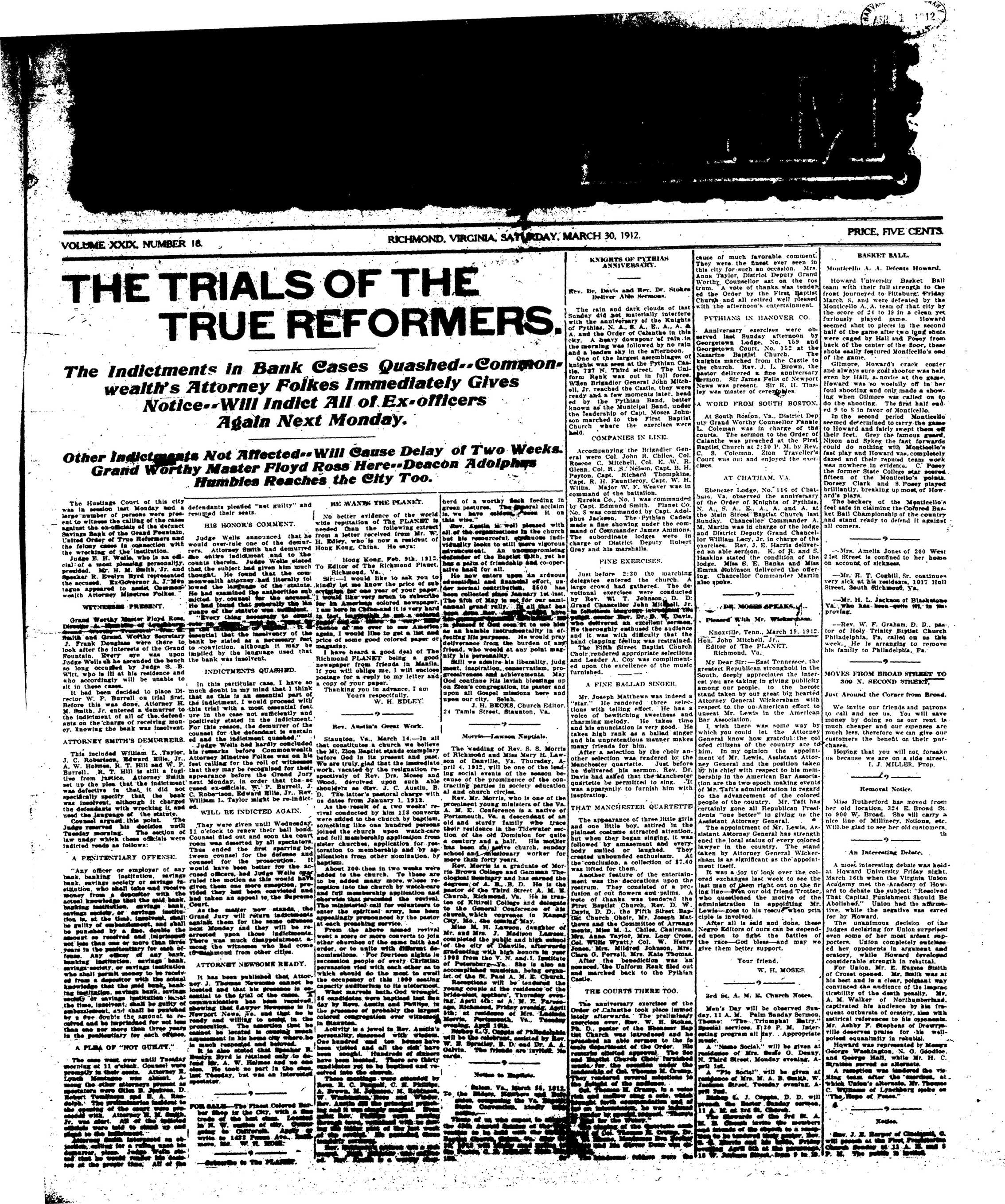
THE TRIALS OF THE TRUE REFORMERS
The Indictments in Bank Cases Quashed--Commonwealth's Attorney Folkes Immediately Gives Notice--Will Indict All of Ex-officers Again Next Monday.
Other Indictments Not Affected--Will Cause Delay of Two Weeks. Grand Worthy Master Floyd Ross Here--Deacon Adolphus Humbles Reaches the City Too.
VOLUME XXIX, NUMBER 18.
THE TR
The Indictment
wealth's Att
Notice
Other Indictments
Grand Worthy
The Hustings Court of this city was in session last Monday and a large number of persons were present to witness the calling of the cases against the officials of the defunct Savings Bank of the Grand Fountain, United Order of True Reformers and the felony cases in connection with the wrecking of the institution.
Judge E. H. Wells, who is an official of a most pleasing personality, presided, Mr. H. M. Smith, Jr. and Speaker R. Evelyn Bryd represented the accused. Ex-Governor A. J. Menague appeared to assist Commem- nial Health Attorney Missrete Polkes.
WITNESS PRESENT.
Grand Worthy Master Floyd Rose
Director - A Member of Lighthouse
Grand Worthy Master - A Member of
Smith and Grand Worthy Secretary
J. Frank Douglas were there to
look after the interests of the Grand
Fountain. Every eye was upon
Judge Wells he ascertained the bench
so long occupied by Judge Witt, who is ill at his residence and
who accordingly will be unable to
sit in these cases. He decided to place
Director W. P. Burrell on trial first.
Before this was done, Attorney H.
M. Smith Jr. entered a demurrer to
the indictment of all of the defendants
on the charge of receiving money.
Knowing the bank was involvent.
ATTORNEY SMITH'S DEMURRERS.
This included William L. Taylor, J. C. Robertson, Edward Ellis, Jr., A. W. Hobson, R. T. Hill and W. P. Burrell. R. T. Hill is still a fugitive from justice. Attorney Smith set up the plan that the indictment was defective in that it did not specifically specify that the bail was inconvolved, although it charged the defendants with wrecking it and used the language of the statute. Counsel argued this point. The Judge reserved his decision until Tuesday morning. The section of law under which these officials were indicted reads as follows:
A PENITENTIARY OFFENSE.
"Any officer or employer of any bank, banking institution, savings bank, savings society or savings institution, who shall take and receive money from a depositor with the actual knowledge that the said bank, banking institution, savings bank, savings society, or savings institution is, at the time, insolvent, shall be guilty of embezzlement, and shall be punished by a fine. Double the amount so received and imprisoned not less than one or more than three years in the penitentiary for each offense. Any officer of any bank, banking institution, savings bank, savings society, or savings institution who shall permit money to be received from a depositor with the actual knowledge that the said bank, banking institution, savings bank, savings society or savings institution, insolvent, shall be guilty of embezzlement, and shall be punished by a fine. Double the amount so received and be imprisoned for not less than one or more than three years in the penitentiary for each offense.
A PLRA OF "NOT GUILTY."
The one went over until Tuesday morning at 11 o'clock. Counsel were promptly in their seats. Attorney R. Lynch Manogue was absent. Among the other attorneys present as spectators were Glen R. Jepkens, D. Robert Tumlinson and R. A. Randolph. The preliminary incident to the opening of the court were proceeded with. Attorney R. M. Smith, Jr. was alert. All of the indicted officials were told to stand up and plead to the judgment.
Attorney Smith interposed as objection, calling for a ruling upon his deputy, pence. Judge Walt Schmidt that he would render his sentence at the proper time. All of the
defendants pleaded "net guilty" and resumed their seats.
HIS HONOR'S COMMENT.
Judge Wells announced that he would over-rule one of the demurrers. Attorney Smith had demurred the entire indictment and to the counts therein. Judge Wells stated that the subject had given him much thought. He found that the commonwealth attorney, and literally followed the language of the statute. He had examined the authorities submitted by counsel for the accused. He had found that generally the language of the statute was insufficient. "Every thing necessary to conduct crime was necessary to conduct it," it insisted that the insufficiency of the bank be stated as a necessary fact to conviction, although it may be implied by the language used that the bank was insolvent.
INDICTMENTS QUASHED.
In this particular case, I have so much doubt in my mind that I think that as this is an essential part of the indictment. I would proceed with this trial with a most essential feature in the case not sufficiently and positively stated in the indictment. For this reason, the demurrier of the counsel for the defendant is sustained and the indictment quashed."
Judge Wella had hardly concluded his remarks before Commonwealth Attorney Minetree Folkes was on his feet calling for the roll of witnesses that they may be recognised for their appearance before the Grand Jury next Monday, in order to cause ex-officio W. P. Burrell, J. C. Robeson, Edward Ellis, Jr. Rev. William L. Taylor might be re-indict-
WILL BE INDICTED AGAIN.
They were given until Wednesday, 11 o'clock to renew their bail bond. Counsel filed out and soon the court room was deserted by all spectators. Thus ended the first sparring between counsel for the defense and counsel for the prosecution. It would have been better for the accused officers, had Judge Wells ordered the motion as this would have given them one more exemption, provided they had been convicted and had taken an appeal to the Supreme Court.
As the master now stands, the Grand Jury will return indictments against them for the same offenses next Monday and they will be rearrested upon those indictments. There was much disappointment among the witnesses who had come to thealmond from other cities.
ATTORNEY NEWBOME READY.
It has been published that Attorney J. Thomas Newcome cannot be located and that his presence is essential to the trial of the case. Communication has been received, showing that Lawyer Newcome is in Newport News, Va., and that he is ready and willing to assist in the prosecution. The assertion that he cannot be located in causing much damage in his home city where he is much respected and beloved.
It is also stated that Speaker R. Browlin Byrd is retained only to defend Mr. A. W. Halmes and no one else. He took no part in the case last Tuesday, but was an interviewee monitor.
FOR SALE—The Phantom Colored Bar
best Shop in the City, with a fine
trade of the best clothes. Located
in N. W. section of city. Games
going in California. Apply to
write to 1433 Pamela Ave., Burl
more, like W. W. MOHL:
RICHMOND, VIRGINIA, SATURDAY, MARCH 30, 1912.
HE WANTS THE PLANET.
No better evidence of the world wide reputation of The PLANET is needed than the following extract from a letter received from Mr. W. H. Edley, who is now a resident of Hong Kong, China. He says:
Hong Kong, Feb. 9th, 1912.
To Editor of The Richmond Planet,
Richmond, Va.
Sir:—I would like to ask you to kindly let me know the price of subscriptions for one year of your paper.
I would like very much to subscribe for an American colored newspaper.
I am here in China and it is very hard in fact, in connection with a colour choice of me over to see America again. I would like to get a list and price of some good colored paper or magazine.
I have heard a good deal of The Richmond PLANET being a good newspaper from friends in Manila.
If you will oblige me, I will enclose postage for a reply to my letter and a copy of your paper.
Bex. Austin's Great Work.
Staunton, Va., March 14.—In all that constitutes a church we believe the Mt. Zion Baptist stands exemplary before God in its present and past. We are truly glad that the immediate work, vacated by the resignation respectively of Rev. Drs. Moses and Wood, devolved upon such able shoulders as Rev. J. C. Austin, B. D. The latter's pastoral charge with us dates from January 1, 1912.
As the result of a two weeks' revival conducted by him 118 converts were added to the church by baptism, something like one hundred persons joined the church upon watch-care and full membership application from sister churches, application for restoration to membership and by applications from other nomination, by baptism.
About 100-then in two weeks were added to the church. To these are to be added much more, whose role in the church by watch-care and full membership application and observance that preceded the revival. The ministerial call for volunteers to enter the spiritual army, has been appealingly pronounced by the pastor at each greeting service.
From the above named revival went a score or more converts to join other churches of the same faith and order, or to unite with different denominations. For fourteen nights in succession people of every Christian persuasion vied with each other as to which should do the most to swell the occupancy of this 1000 seating capacity auditorium to its uttermost.
What marvels hath God wrought. 16 candidates were baptised last day by Rev. Austin and Phillips, in the presence of probably the largest colored congregation ever witnessed in Stanton.
Activity is a jewel in Rev. Austin's personality, admired with wisdom. One hundred and ten homes have been visited and all the dwellers have been sought. Hundreds of admirers have been hosted. There are thirty candidates yet to be baptised and received into the church.
These meetings were attended by Rev. R. C. Pumgall, C. H. Phillips, A. Brown, M. Johnson, M. Robinson, W. Washington, Bates and Winder. Rev. Austin did the principal preaching and it was simply magical. From point Rev. Phillips was passing through town, witnessed with us during the latter part of the last week of the ordination. He presented them immediately auditory.
Rev. Buntington's person was a shab wound. Phillips preached, with emphasis of Rev. Austin in a wavy chant.
herd of a worthy book feeding in green pastures. The general acclaim is we have coldest, keen it on this wise.
Now, Angela is well pleased with all of the organizations in the church but his resourceful, generous individuality looks to still more vigorous advancement. An uncompromising calendar of the Baptist faith, yet he has a palm of friendship and co-operative hand for all.
He now enters upon an arduous educational and financial effort, under normal contributions, $600 has been collected since January last. The fifth of May is not for our semi-annual grand rally. In all that has been done here, Angela has have the greatest impact on the church, in pleased if God can seem to use him as an humble instrumentality in effecting His purposes. He would pray deliverance from the burden of any friend, who would at any point magnify his personality.
Still we admire his libernality, judgement, inspiration, conservatism, progressiveness and achievements. May God continue His lavish blessings up on Zion's congregation, up upon all Gospel missions here and upon our city, Solah.
J. H. BEOKS, Church Editor.
24 Tamis Street, Staundon, Va.
Murri—Lawson Nuptials.
The wedding of Rev. S. S. Morris of Richmond and Miss Mary H. Lawson of Danville, Va. Thursday, April 4, 1912, will be one of the leading social events of the season because of the prominence of the contracting parties in society education al and church circles.
Rev. Mr. Morris, who is one of the prominent young ministers of the Va. A. M. E. Conference is a native of Portsmouth, Va. a descendant of an old and sturdy family who trace their residence in the Tidewater section of the old Dominion for quite a century and a half. His mother has been a native church, Sunday school and missionary worker for more than forty years.
Rev. Morris is a graduate of Morris College and Gamma Theological Seminary and has earned degrees of A. B. B. D. He is the pastor of the Third Street A. M. E. Church, Richmond, Va. He is trustee of Kittrell College and delegate to the General Conference of his church, which convenes in Kansas City, Mo., the coming May.
Miss M. H. Lawson, daughter of
Mr. and Mrs. J. Madison Lawson,
completed the public and high school
of the city of Deuville, afterwards
graduating with high honors in year
1908 from the V. N. and I. Institute
of Petersburg-Ya. She is also an
accomplished musician, being organi-
ist of the St. Paul A. M. E. Church.
Receptions will be tendered the
young couple at the residence of the
bride-groom, northern. Thursday even-
ing; April 4th; at A. M. E. Paragon-
ism, Richmond, Friday evening, April
5th; at residence of Mrs. Lestada
Merrie, Portsmouth, Va., Tuesday
evening, April 16th.
Bishop S. J. Coppin of Philadelphia
will be the celebrant, assisted by Rev.
W. B. Spraatler, B. D. and Dr. A. A.
Galvin. The friends are invited. No
cards.
Salem, Va., March 16, 1912.
To the Midwives, Members and Bene-
givers, accompanying the Va. Repres-
tative State Convention, kindly help
meen.
Those of us who import to al-
ter the 45th Annual Session of the
vacation so be held with the United
Republic Church, Salem, Va., March
16, 1912 with kindly and patient
to the Pastor, G. R. Milliken, Salem,
Iowa.
KNIGHTS OF PYTHIA
ANNIVERSARY.
Rey, Dr. Davis and Rev. Dr. Stokes
Deliver Ables Sermons.
The rain and dark clouds of last Sunday did not materially interfere with the anniversary of the Knights of Pythias, N. A., B. A., E., A., A. & A. and the Order of Calanthe in this sky. A heavy downpour of rain in the morning was followed by no rain and a leaden sky in the afternoon. One of the largest assemblages of knights was seen at the Pythian Castle, 727 N. Third street. The Uniform Rank was out in full force. When Brigadier General John Mitchell, Jr. reached the Castle, they were ready and a few moments later, beamed by the Pythian Band, better known as the Military Pal Bend, under the leadership of Capt. Mosa Johnson marched to the First Baptist Church where the exercise were
COMPANIES IN LINE.
Accompanying the Brickadler General were Col. John R. Chiles, Col. Roosec C. Mitchell, Col. E. W. R. Glenn, Col. R. S. Nelson, Capt. B. H. Peyton, Capt. Richard Thompkins, Capt. R. H. Fauntleroy, Capt. W. H. Willis. Major W. F. Wever was in command of the battalion. Eureka Co., No. 1 was commanded by Capt. Edmund Smith. Planet Co. No. 8 was commanded by Capt. Adolphus Jackson. The Pythian Cadets made a fine showing under the command of Commander James Ammons. The subordinate lodges were in charge of District Deputy Robert Gray and his marshals.
FINE EXERCISES.
Just before 2:30 the marching delegates entered the church. A large crowd had gathered. The devotional exercises were conducted by Rev. W. T. Johnson. D. D. Grand Chancellor John Mitchell, Jr. in fellowship language introduced the panel, center Rev. Dr. D. W. Davis, who delivered an excellent sermon. He thoroughly exhausted the audience and it was with difficulty that the hand clapping feeling was restrained. The Fifth Street Baptist Church Choir rendered appropriate selections and Leader A. Coy was complimented upon the excellence of the music furnished.
A FINE BALLAD SINGER
Mr. Joseph Matthews was indeed a "star." He rendered three selections with telling effect. He has a voice of bewitching sweetness and charming melody. He takes time and his enunciation is very good. He takes high rank as a ballad singer and his unpretentious manner makes many friends for him.
After a selection by the choir and an action was rendered by the Manchester quartet. Just before he delivered his sermon, Rev. Dr. Davis had asked that the Manchester quartette be permitted to sing. It was apparently to furnish him with inspiration.
THAT MANCHESTER QUARTETTE
The appearance of three little girl and one little boy, attired in the plainest costume attracted attention, but when they began singing, it was followed by amusement and everybody smiled or laughed. They created unbounded enthusiasm. At the conclusion, a collection of $7.40 was lifted for them.
Another feature of the entertainment was the decorations upon the rostrum. They consisted of a prefusion of cut flowers and palms. A note of thanks was tendered to the First Baptist Church Rev. D. W. Dayyat, D. D. the Rev. D. W. Dayyat, Church Rev. D. W. Dayyat, Church Rev. D. W. Dayyat, Mr. Joseph M. Beecher and the Committee of Arrangements, Miss M. L. Chiles, Chairman, Mrs. Anna Tayiot, Mrs. Lacy Cross, Col. Wilma Wyatt, Col. W. Henry Jones, Mrs. Mildred Johnson, Mrs. Clara G. Pervall, Mrs. Kate Thomas. After the benediction was an anecdote, the Uniform Rank filed out and marched back to the Pythian Castle.
THE COURTS THERE TOO.
The anniversary exercises of the Order of Catharine took place immediately afterwards. The preliminary exercises over, Gov. W. H. Stokes, Ph. D., pastor of the Blessed Baptist Church was introduced and he presented an able sermon to the female department of the Order. His remarks elicited approval. The Sect and Baptist Church Chair purchased works for the occasion under the leadership of Ock Thomas M. Crump. They rendered several selections to the delight of the audience.
Ock Thomas M. Crump, in a voice rich and mellow sung a sode, which brought forth communication and aid to an intercession, he was induced to answer by special request. "There were for the Water."
cause of much favorable comment. They were the finest ever seen in this city for such an occasion. Mrs. Anna Taylor, District Deputy Grand Worthy, Counsellor sat on the rostrum. A vote of thanks was tendered the Order by the First Baptist Church and all retired well pleased with the afternoon's entertainment.
PYTHIANS IN HANOVER CO
Anniversary exercises were observed last Sunday afternoon by Georgetown Lodge, No. 159 and Georgetown Court, No. 152 at the Nasarine Baptist Church. The knights marched from the Castle to the church. Rev. J. L. Brown, the pastor delivered a fine anniversary sermon. Sir James Fells of Newport New was present. Sir R. H. Tinsley was master of ceremonies.
A WORD FROM SOUTH BOSTON.
At South Boston, Va., District Deputy Grand Worthy Counsellor Famille L. Coleman was in charge of the courts. The sermon to the Order of Calanthe was preached at the First Baptist Church at 2:30 P. M. by Rev. C. S. Coleman. Zion Traveller's Court was out and enjoyed the exercises.
AT CHATHAM, VA.
Ebenezer Lodge, No. 116 of Chatham, Va. observed the anniversary of the Order of Knights of Pythias, N. A., S. A., E., A., A. and A. at the Main Street Baptist Church last Sunday. Chancellor Commander A. M. Martin was in charge of the lodge and District Deputy Grand Chancellor William Lacy, Jr. in charge of the exorcises. Rev. J. E. Harris delivered an able sermon. K. of R. and S. Haskins stated the condition of the lodge. Miss G. E. Banks and Miss Emma Robinson delivered the offering. Chancellor Commander Martin also spoke.
Knoxville, Tenn., March 19, 1912.
Hon. John Mitchell, Jr.
Editor of the PLANET.
Richmond, Va.
My Dear Sir:—East Tennessee, the greatest Republican stronghold in the South, deeply appreciates the interest you are taking in giving publicity among our people, to the heroic stand taken by our great big hearted Attorney General Wickersham with respect to the un-American effort to unseat Mr. Lewis in the American Bar Association.
I wish there was some way by which you could let the Attorney General know how grateful: the colored citizens of the country are to him. In my opinion the appointment of Mr. Lewis, Assistant Attorney General and the position taken by his chief with respect to his membership in the American Bar Association are the two epoch making events of Mr. Taft's administration in regard to the advancement of the colored people of the country. Mr. Taft has certainly gone all Republican Presidents "one better" in giving us the Assistant Attorney General.
The appointment of Mr. Lewis, Assistant Attorney General has strengthened the local status of every colored lawyer in the country. The stand taken by Attorney General Wickersham is as significant as the appointment itself.
It was a joy to look over the colored exchanges last week to see the last man of them right out on the fine line—Even our old friend Trottier, who questioned the motive of the administration in appointing Mr. Lewis—goes to his rescue when principle is involved.
After all is said and done, these Negro Editors of ours can be depended upon to fight the battles of the race—God bless—and may we give them better support.
2ed St. A. M. K. Church Notes.
Men's Day will be observed Sunday, 11 A. M. Palm Sunday Sermon, Theme: "The. Triumphal Entry." Special services, $120 P. M. Interesting program all day. Appropriate music.
A "Name Social," will be given at residence of Mrs. Sudele G. Denny, N. Third Street, Monday evening, April 1st.
A "Pie Social," will be given at residence of Mrs. M. A. B. Smith, W. Jackson Street, Tuesday evening, April 2nd.
Shakespeare (A. J. Coppen, D. D. will present the Baster. Sunday service, 11 A. M. at 3rd St. Church.
The Schoows of the 3rd B. A.
M. B. Church invite the members
and friends of the church to a re-
ception to be held on the third
day, Nov. 8. Mr. Harris and his wife, Dr.
R. B. Harris and his wife, Dr. Frady
would be April 6th of the parishage.
11. M. B. Church Street, June 20th
BASKET BALL
Monticello A. A. Defcata Howard.
Howard University Basket Ball team with their full strength to Che front journeyed to Pittsburgh, Friday March 8, and were defeated by the Monticello A. A. team of that city by the score of 24 to 19 in a clean yet furiously played game. Howard seemed shot to pieces in the second half of the game after two long shots were caged by Hall and Powey from back of the center of the floor, these shots easily featured Monticello's end of the game.
Gilmore, Howard's crack center and always sure goal shooter was held even by Hall. a novice at the game. Howard was no woofly off in her foul shooting and only made a showing when Gilmore was called on to do the shooting. The first half ended 9 to 8 in favor of Monticello.
In the second period Monticello seemed determined to carry the game to Howard and fairly swept them off their feet. Grey the famous guard, Nixon and Sykeg the fast forwards could do nothing with Monticello's play and Howard was, completely drastically, their reputed team work was nowhere near. C. Powey the former State College star fifteen of the Monticello's polite Dorssey Clark and 9. Powey played brilliantly, breaking up most of Howard's plays.
The backbone of the Monticello's feel safe in claiming the Colored Basket Ball Championship of the country and stand ready to defend it against all comers.
—Mrs. Amelia Jones of 200 West 21st Street is confined to her home on account of sickness.
—Mr. R. T. Cogbill, Sr. continues very sick at his residence, 1017 Hull Street, South Richmond, Ya.
—Mr. H. L. Jackson of Blackstone Va., who has been quite ill, is improving.
—Rev. W. F. Graham, D. D., pastor of Holy Trinity Baptist Church Philadelphia, Pa., called on us this week. He is arranging to remove his family to Philadelphia, Pa.
MOVES FROM BROAD STREET TO
300 N. SECOND STREET.
Just Around the Corner from Broad.
We invite our friends and patrons to call and see us. You will have money by doing so as our rent is much cheaper and our expenses are much less, therefore we can give our customers the benefit on their purchases.
Hoping that you will not, forsake us because we are on a side street.
J. L. MULLER, Pron
Removal Notice.
Miss Rutherford has moved from her old location, 324 E. Broad St. to 900 W. Broad. She will carry a nice line of Millinery, Notions, etc. Will be glad to see her old customers.
An Interesting Debate
A most interesting debate was held at Howard University Friday night, March 16th when the Virginia Union Academy met the Academy of Howard to debate the subject: "Resolved That Capital, Punishment Should Be Abolished." Union had the affirmative, while the negative was excused by Howard. The unanimous decision of the judges declaring for Union supplanted even some of her most ardent supporters. Union completely outcashed her opponents in argument and oratory, while Howard developed considerable strength in rebuttal. For Union, Mr. E. Eugene Smith of Croset opened. Mr. Smith was at his best and in a clear, poignant way convinced the audience of the impracticability of the death penalty. Mr. A. M. Walker of Northumberland, captivated his audience by his frequent outbursts of oratory, also with artificial references to his opponents. Mr. Ashby F. Stephens of Drowryville deserves praise for his well-polished匀animity in rebuttal. Howard was represented by Moyen George Washington, N. O. Goodloe, and George Hall, while Mr. H. C. Mirazon served as alternate. A reception was tendered the visiting team after the enclosure, at which Union's alternate, Mr. Thomas C. Williams of Lynchburg spoke on "The Hope of Peace."
Saw, J. K. Harper of Chesapeake, O. will preside at the First Presbyterian Church Sunday at 11 A. M. and 9 P. M. The public is invited
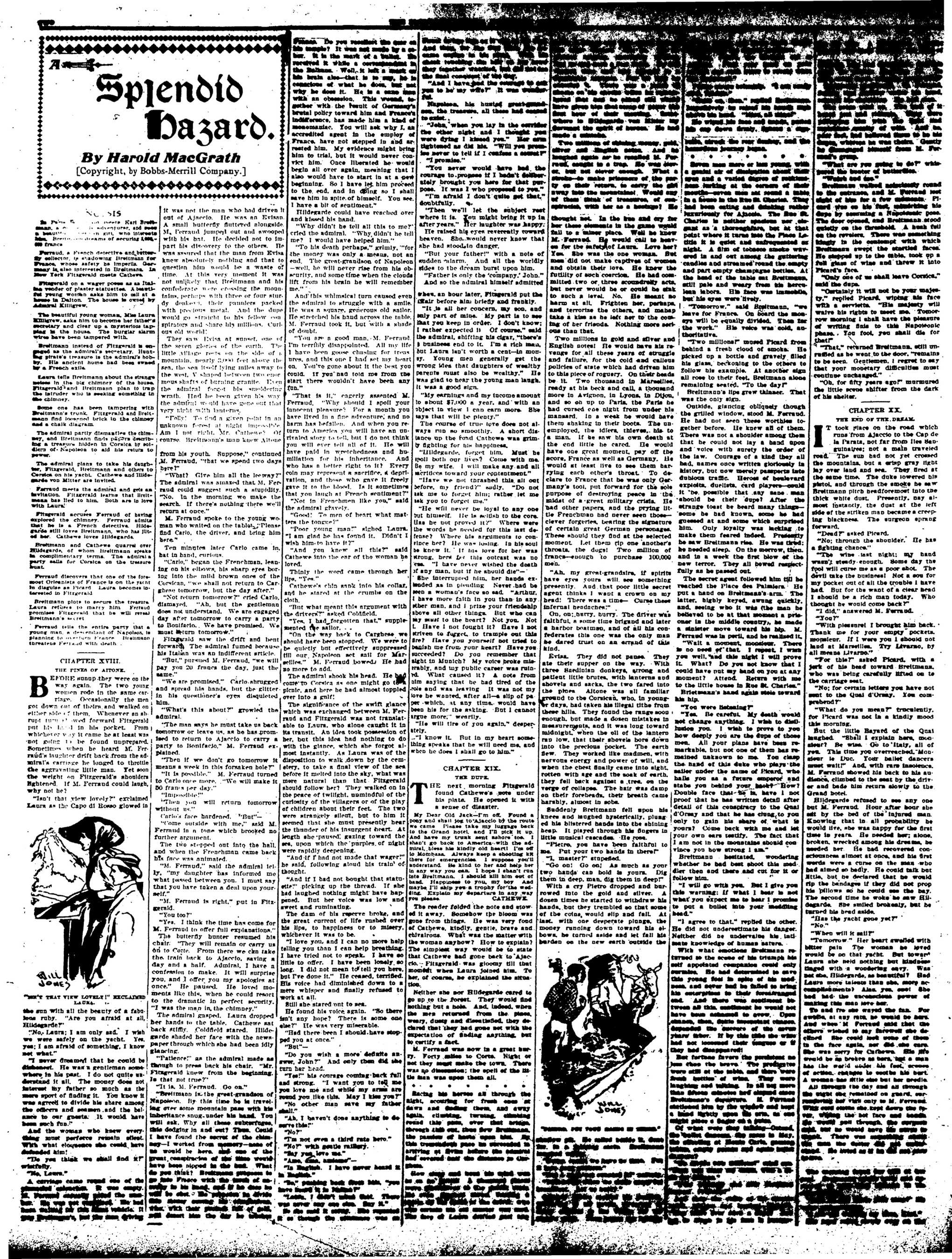
Splendid Hazard.
By Harold MacGrath [Copyright, by Bobbs-Merrill Company.]
In Prineville, he meets Karl Brettman, a man in a dark adventurer, and sees a beauty in a girl, who interests him. Brettman dreams of securing 400 francs.
Pearaud, a French detective and butterfly collector, is shadowing Brettman for a crime. He is also interested in Brettman. In New York Fitzgerald meets Catha.
Fitzgerald on a wager poems as if inlaid the vender of plaster statuettes. A beautiful young woman asks him to call at a house in Dalton. The house is owned by Admiral Killigrew.
The beautiful young woman, Miss Laura Killigrew, asks him to become her father's secretary and clear up a mysterious taping in the house. The burglary alarm wires have been tampered with.
Brettman instead of Fitzgerald is engaged as the admiral's secretary. Hunting pirate treasure is the admiral's hobby. His ancient home had been owned by a French sultan.
Laura tells Brettman about the strange tale in the big chimney of the house. Fitzgerald is intrigued by the intruder who is seeking something in the chimney.
Some one has been tampering with Brettmann's trunk. Fitzgerald and Brettmann find loomed brick in the chimney and a chalk diagram.
The admiral partly dismantles the chimney, and Brettmann finds papyrus describing a treasure hidden in Coralica by soldiers of Napoleon to aid his return to power.
The admiral plans to take his daughter, Fitzgerald, Brettmann and others to Coralica on his ship. Cathews and Hildegarda von Mitter are invited.
Ferraud meets the admiral and gets an invitation. Fitzgerald learns that Brettmann has led to him. Both are in love with Laurel.
Fitzgerald accuses Ferraud of having explored the chimney. Ferraud admits to a French detective Hildegarda still loves Brettmann, who has jilted her. Cathews loves Hildegarda.
Brettmann and Cathews quarrel over Hildegarda, of whom Brettmann speaks in complimentary terms. The admiral party calls for Coralica on the treasure hunt.
Ferraud discovers that one of the foremost Orientists of France is on the point in disguise an Ibard. Laura becomes interested in Fittigerdal.
Brettmann plots to secure the treasure Laura refuses to marry him. Ferraud promises Fittigerdal that he will reveal Brettmann's secret.
Ferraud tells the entire party that a young man, a descendant of Napoleon, is planning to invade France. Brettmann threatens Ferraud with death.
CHAPTER XVIII.
THE FIXES OF AITONK
BEFORE sunup they were on the way again. The two young women rode in the same carriage. Occasionally the men got down out of the theatre and walked on either side of them. Whenever an abrupt turn was forward Fitzgerald put his hand in his pocket. From whichever way it came he at least was not going to be found unprepared. Sometimes when he heard M. Fitzgerald's laughter drift back from the admiral's carriage he longed to throttle the agravating little man. Yet soon the weight on Fitzgerald's shoulders Bightened. If M. Ferrand could laugh, why not he?
"Ian't that view lovely?" exclaimed Laura as the Capo di Rosso glowed in
BILL
JONES
"MEN'T THAT VIEW LOVELY!" EXCLAMED LAURA.
the sun with all the beauty of a fabulous ruby. "Are you afraid at all, Hildegarde?"
"No, Laura; I am only sad. I wish we were safely on the yacht. Yes, yes; I am afraid of something, I know not what."
"I never dreamed that he could be dishemet. He was a gentleman somewhere in his past. I do not quite understand it all. The money does not interest my father so much as the more sport of finding it. You know it was agreed to divide his share among the officers and seamen, and the balance to our guests. It would have been such fun."
And the woman who knew everything must perfume remain silent. With what eloquence she could have defended him!
"Do you think we shall find it wholly."
"No, Leave."
A carriage came round one of the pneumatic collection. It was empty. M. Personally excited the number. He was put together. He had been waiting for the train until it gave Pneumatics, and just for them to arrive.
It was not the man who had driven it out of Ajacello. He was an Evanson. A small butterfly fluttered alongside M. Ferraud jumped out and swooped with his hat. He decided not to impart his discovery to the others. He was assured that the man from Evia knew absolutely nothing and that to question him would be a waste of time. At this very moment it was not unlikely that Brettmann and his confederate were crossing the mountains, perhaps with three or four sturdy duckies, their panders packed with precious metal. And the dupe would go straight to his fellow captivators and share his millions. Curious old world!
They saw Erika at sunset, one of the seven glories of the earth. The little village rests on the side of a mountain, nearly 3,000 feet above the sea, the sea itself lying miles away to the west. V shaped between two enormous shafts of burning granite. Even the admiral forget his smoldering wrath. Had he been given his way the admiral would have gone out that very night with lunarets.
"Folly!" To find a given point in an unknown forest at night impossible. Am I not right, Mr. Carbone? Of course, Brettmann's man know Allone from his youth. Suppose," continued M. Ferraud, "that we spend two days here?
"What? Give him all the leeway?" The admiral was amazed that M. Ferraud could suggest such a stupidity. "No. In the morning we make the search. If there's nothing there well return at once."
M. Ferrand spoke to the young woman who waited on the table. "Please and Carlo, the driver, and bring him here."
Ten minutes later Carlo came in, hat in hand, curious.
"Carlo," began the Frenchman, leaning on his elbows, his sharp eyes boring into the mild brown ones of the Corleian, "we shall not return to Carghose tomorrow, but the day after."
"Not return tomorrow?" cried Carlo, dismayed. "Ah, but the gentleman does not understand. We are engaged day after tomorrow to carry a party to Bonifacio. We have promised. We must return tomorrow."
Firguald saw the drift and bent forward. The admiral fumed because his Italian was an indifferent article. "But," pursued M. Ferrand, "we will pay you 20 francs the day, just the same."
"We are promised." Carlo shrugged and spread his hands, but the glitter in his questioner's eyes disquieted him.
"What's this about?" growled the admiral.
"The man says he must take us back tomorrow or leave us, as he has promised to return to Ajacelo to carry a party to Bonifacio." M. Ferraud explained.
"Then if we don't go tomorrow it means a week in this fortnaken hole."
"Then you will return tomorrow without us."
Carlo's face hardened. "But"—
"Come outside with me," said M. Ferraud in a tone which brooked no further argument.
The two stopped out into the hall, and when the Frenchman came back his face was animated.
"M. Ferraud," said the admiral felly, "my daughter has informed me what passed between you. I must say that you have taken a deal upon yourself."
"M. Ferraud is right," put in Fitzgerald.
"You too?"
"Yes. I think the time has come for M. Ferraud to offer full explanations."
The butterfly hunter resumed his chair. "They will remain or carry on to Corte. From there we can take the train back to Ajacello, saving a day and a half. Admiral, I have a confession to make. It will surprise you, and I offer you my apologies at once." He paused. He loved moments like this, when he could resort to the dramatic in perfect security. "I was the man in the chimney."
The admiral gasped. Laura dropped her hands to the table. Catheve sat back stiffly. Coldfeld stared. Hildegarde shaded her face with the newspaper through which she had been idly glancing.
"Patience!" as the admiral made as through to press back his chair. "Mr. Fingerald knew from the beginning. Is that not true?"
"It is, M. Ferraud. Go on."
"Brittmann is in the great-grandson of Napoleon. By this time he is in traveling over some mountain pass with his inheritance snug, under his hand. You will ask. Why all these subterfuges, this dodging in and out? Then. Could I have found the secret of the chimney—I worked from memory—none of us would be here, and one of the great, construction of the time would have been slipped in the end. What do you think? Britmann proposes to go into France with the mouth of an enemy to his hand, and if he does he will be shot. The polygon is in divide this theory coming his construction when, with their guiding fall of gold, will desert him the day he leaves."
Francon. Do you recount the year on the maple? It was not made by a cowher. It is the mark of a bullher. It recounted it while a correspondent in the Bulgarian. Well, it has a mark on his brain also—that is to say, he is conscious of what he does, but not why he does it. He is a cowher with an obsession. This wound, together with the beast of Germany, brutal policy toward him and France, indifference, has made him a kind of monomaniac. You will ask why I, an accredited agent in the employ of France, have not stepped in and arrested him. My evidence might bring him to trial, but it would never convict him. Once liberated he would begin all over again, meaning that I also would have to start in at a new beginning. So I have let him proceed to the end, and in doing so I shall save him in spite of himself. You see. I have a bit of sentiment."
Hildegarde could have reached over and kissed his hand.
"Why didn't he tell all this to me?" cried the admiral. "Why didn't he tell me? I would have helped him."
"To his death perhaps," grimly, "for the money was only a means, not an end. The great-grandson of Napoleon—well, he will never rise from his obscurity, and some time when the clouds lift from his brain he will remember me."
And this whimsical turn caused even the admiral to struggle with a smile. He was a square, generous old sailor. He stretched his hand across the table. M. Ferraud took it, but with a shade of doubt.
"You are a good man," M. Ferraud. "I'm terribly disappointed. All my life I have been goose chusling for treasures, and this one I had set my heart on. You've gone about it the best you could. If you had told me from the start there wouldn't have been any fun."
"That is it," cagely assented Mr. Ferraud, "Why should I apoll you innocent pleasure? For a month you have lived in a fine adventure, and no harm has befallen. And when you return to America you will have an unrivaled story to tell, but I do not think you will ever tell all of it. He will have paid in wretchedness and humiliation for his inheritance. And who has a better right to it? Every coin may represent a sacrifice, a deprivation, and those who gave it freely gave it to the blood. Is it sometimes that you laugh at French sentiment? "Not in Frenchmen like you," said the admiral gravely. "Good! To men of heart what matters the tongue? "Poor young man!" sighed Laura. "I am glad he has found it. Didn't I wish him to have it?" "And you know all this?" said Cathewe into the ear of the woman he loved.
Thinly the word came through her lips, "Yes."
Cathleen chin sank into his collar, and he stared at the crumbs on the cloth.
"But what meant this argument with the driver?" asked Coldfield.
"Yes, I had forgotten that," supplemented the sailor.
"On the way back to Carghene, we should have been stopped. We were to be quietly but effectively suppressed till our Napoleon set sail for Marseille." M. Forraud bowed. He had no more to add.
The admiral shook his head. He had come to Corsica as one might go to Piccé, and here he had almost toppled over into a gulf.
The significance of the swift glance which was exchanged between M. Ferraud and Fitzgerald was not translatable to Laurn, who alone caught it in its transit. An idea took possession of her, but this idea had nothing to do with the glance, which she forgot almost instantly. As Laura was of the disposition to walk down by the cemetery, to take a final view of the sea before it melted into the sky, what was more natural than that. Fitzgerald should follow her? They walked on in the peace of twilight, unmindful of the curiosity of the villagers or of the play of children about their feet. The two were strangely allot, but to him it seemed that she must presently hear the thunder of his insurgent heart. At length she paused; gazing toward the sea, upon which the 'purples, of night were rapidly deepening.
"And if I had not made that wager!" he said, following about his train' of thought.
"And if I had not bought that statu-
site" pickling up the thread. If she
had laughed nothing might have happened. But her voice was low and sweet and ruminating.
The dam of his reserve broke, and
the great current of life rushed over his lips, to happiness or to misery, whichever it was to be.
"I love you, and I can no more help telling you than I can help breathing. I have tried not to speak. I have so little to offer. I have been lonely, so long. I did not mean to tell you here, but I've done it." He ceased, terrified.
His voice had diminished down to a mere whisper and finally refused to work at all.
Still she stared out to sea.
He found his voice again. "So there isn't any hope? There is some one else?" He was very miserable. "Had there been I should have stopped you at once." "But"— "Do you wish a more delicate answer, John?" And only then did she turn her head. "Too!" his courage coming back full and strong. "I want you to tell me you love me and while my arms are round you like this. May I kiss you?" "No other man save my father shall." "Ah, I haven't done anything to deserve this!"
"In English, I have never heard it in English."
"No," panging back. "Don't like, 'you have heard it in Italian.'"
"Looks, I didn't think that. There was error may any one else. Buy it." He do need it anyway. He suggested it on through the witness who was
Bernard burying his son in the cemetery. And then, for the day that he became embalmed in his grave, with his chest twisting, the bury in his head they together wrestled, but did not die the final conquest of the day.
"And I have just the courage to ask you to be my wife!" It was wonderful.
Napoleon, his husted great grandson, the treasure, all these had ended to exist.
"John, when you lay in the corridor the other night and I thought you were dying I kissed you." Her arm tightened as did his. "Will you promise never to tell if I confess a sinner?" "I promise."
Two millions of shining money, gold, silver and English coins. And he hugged again or he resumed it. For
"You never would have had the courage to propose if I hadn't deliberately brought you here for that purpose. It was I who proposed to you."
"I'm afraid I don't quite get that," doubtfully.
"Then we'll let the subject rest where it is. You might bring it up in after years." Her laughter was happy:
"He raised his eyes reverently toward heaven. She would never know that she had stood in danger.
"But your father!" with a note of sudden alarm. And all the worldly sides to the dream burst upon him.
"Father is only the 'company.' John."
And so the admiral himself admitted
when, an hour later, Fitzgerald put the skirt before him briefly and frankly. "It is all her concern, my son, and only part of mine. My part is to see that you keep in order. I don't know; I rather expected it. Of course," and the admiral, shifting his clear, "there's a business end to it. I'm a rich man, but Laura isn't worth a cent—in money. Young men generally get the wrong idea that daughters of wealthy parents must also be wealthy." He was glad to hear the young man laugh. It was a good sign.
"My earnings and my income amount to about $7,000 a year, and with an object in view I can earn more. She says that will be plenty."
The course of true love does not always run so smoothly. A short distance up the fond Cathete was grimly fighting for his happiness.
"Hildegarde, forget him. Must he spoll both our lives? Come with me. Be my wife. I will make any and all sacrifices toward your contentment."
"Have we not thrashed this all out before, my friend?" sadly. "Do not ask me to forget him; rather let me ask you to forget me."
"He will never be loyal to any one but himself. He is scathful to the core he has not proved it." Where were the words he needed for this last defense? Where his arguments to convince her? He was losing. In his soul we know it. If his love for her was strong, here for this outcast was no ease. "I have never wished the death if any man, but if he should die"—
She interrupted him, her hands extended as in pleading. Never had he seen a woman's face so sad. "Arthur, I have more faith in you than in any other man, and I prize your friendship above all other things. But who can my must to the heart? Not you. Not I. Have I not fought it? Have I not driven to forget, to trample out this fire? Have you yourself not tried to banish me from your heart? Have you succeeded? Do you remember that sight in Munich? My voice broke miserably, and my public career was ruined. What caused it? A note from him saying that he had tired of the role and was leaving. It was not my love he wanted, after all—a slip of paper—which, at any time, would have been his for the asking. But I cannot argue more." Wearily. "He will tire of you again," desperately. ...I know it. But in my heart something speaks that he will need me, and when he does I shall go to him."
CHAPTER XIX.
THE DUTR.
THE next morning Fitzgerald found Cathewe's note under his plate. He opened it with a sense of disaster.
My Dear Old Jack - I'm off. Found a pony and shall jog to 'Alacio by the route we came. Please take my luggage back to the Grand hotel, and I'll pick it up. And have my trunk sent ashore too. I shan't go back to America with the admiral, bless his kindly old heart! I'm off here for emergencies. There for emergencies. I suppose you'll understand. He kind to her and help her in any way you can. I hope I shan't run out Brettmann. I should kill him out of hand. Happiness to you, my boy. And make I shan't leave the ark sing. Explain my departure in any way you please.
CATHEWEK
The reader folded the note and stowed it away. Somehow the bloom was gone from things. He was very fond of Cathewe, kindly, gentle, brave and chirrious. What was the matter with the woman anyhow? How to explain? The simplest way would be to state that Cathewe had gone back to Ajacio. Flitgerald was gloomy till that moment when Laura joined him. To her, of course, he explained the situation.
Neither she nor Hildegarde cared to go up to the forest. They would find nothing but a hole. And, indeed, when the men returned from the plains, weary, dusty and disheartened, they declared that they had gone not with the expectation of finding anything, but to certify a fact.
M. Ferrand was now in a great hurry. Forty miles to Corta. Night or not they must make the town. There was no discussion; the spell of the little man was upon them all.
Racing his horse all through the night, scorching for fresh oats of dawn and finding them, and away again, climbing, turning, climbing round this point, over that bridge, through this cut, out the few branches, the passers of horse open but. As this troughside pace no longer in driving at driven before the animal had covered both the distance to thorns. How strong and how the spirit was on an impatient a thundering horse gliding up to the public bench the same troughside building a spike up the shaft of the trough; once the entrance the old number may come. The day of London dripped and tainted.
On the morning of the 12th of December, the general secretary of the party met with a few friends. The general secretary then met with his daughter in an elegant banquet. But he was obstructed by three who were a point of shame on the occasion when his secretary that and be asked and which he gave them the coup of power the first hour of their morning. Somewhere in Bishkekabad van Kissar my servant the spirit of heaven. He had made a mistake.
Two millions of shining money, gold silver and English coins. And he hugged again or be resumed it. For real, sought in a trap. He was dwarf, but not dwarf enough. What a stroke-to make princesses of the party on their return, to carry the girl away into the mountain. Would say of them think of treasures, of one admirer, with her as a hostage? He
thought not. In the bus and cry for her three elements in the game would fall to a minor place. Well he know m. Ferrand. He would call to heavens for the infidel of Laura. Love her! Yes. She was the one woman. But men did not make captives of women and obtain their love. He knew the futility of such coercion. He had committed two or three secondly acts, but never would be or could be stalk to such a level. No. He meant no harm at all. Frighten her, perhaps, and terrorize the other, and mahap take a kisse as he left her to the coming of her frides. Nothing more serious than that.
Two millions in gold and silver and English notes! He would have his revenge for all these years of struggle and failure, for the cold and calous policies of state which had driven him to this piece of rogues. On their beads he be! Two thousand in Marsellieu, ready at his beck and call, a thousand more in Avignon, in Lyonna, in Dijon, and so on up to Paris, the Paris he had cursed one night from under his mansard. In a week he would have them shaking in their boots. The unemployed, the idiots, thieves, his to a man. If he saw his own death at the end little he cared. He would have one great moment, pay off the score, France as well as Germany. He would at least live to see them harrying each other's throat. To declare to France that he was only Germany's tool, put forward for the sole purpose of destroying peace in the midst of a great military crisis. He had other papers, and the prying little Frenchman had never seen those—clever forgeries, bearing the signature of certain great German personages. These should they find at the selected moment. Let them rip one another's throats, the dogs! Two million of france—enough to purchase 100,000 men.
"Ah, my great-grandma, if spirits have eyes you will see something presently. And that poor little secret agent thinks I want a crown on my head! There was a time— Curse these infernal headaches."
On, on, burry, burry. The driver was faithful, a some time brigand and later a harbor boatman, and of all his confederates this one was the only man he dared trust on an errand of this kind.
Evisa. They did not pause. They ate their supper on the way. With three Sardinian donkeys, arrong and patient little brutes, with lanterns and shovels and sacks, the two fared into the phae. Alone was all familiar ground to the Corsican, who, in younger days, had taken his illegal tithe from these hilla. They found the range soon enough, but made a dozen mistakes in measurements, and it was long toward midnight, when the oil of the lanteran ran low, that their shovels bore down into the precious pocket. The earth slew. They worked like madmen, with nervous energy and power of will, and when the chest finally came into sight, rotten with age and the soak of earth, they fell back against a tree, on the verge of collapse. The hair was damp on their foreheads, their breath came harshly, almost in soba.
Suddenly Brettmann fell upon his knees and laughed hysterically, plunged his blistered hands into the shining heap. It played through his fingers in little musical cascade. He rose.
"Pleter, you have been faithful to me. Put your two hands in there!"
"I, master!" stupefied.
"Go on! Go on! As much as your two hands can hold is yours. Dig them in deep, man, dig them in deep!"
With a cry Pietro dropped and burrowed into the gold and silver. A dozen times he started to withdraw his hands, but they trembled so that some of the coins, would slip and fall. At last, with one desperate plunge, the money running down toward his elbows, he turned aside and let fall his burden on the new earth outside the
WILL JONES
"Honor, my Lord name is mary."
showered off. He asked briefly to leave
him. In a shouting voice, Brunelman
laughed widely.
"You must be here for them. For
it is here long past."
"What is it that caused you to leave?
"Because you were doing your best
for them." But to be brief.
"What is it that caused you to leave?
"Because you were doing your best
for them." But to be brief.
"What is it that caused you to leave?
"Because you were doing your best
for them." But to be brief.
The following are examples of how to use the
function `floor` in Python.
```python
floor(3.5) # returns 3
floor(10.5) # returns 10
floor(25.5) # returns 25
floor(30.5) # returns 30
```
"Would you then?" replied Hammond,
luggage-boy he raised to his head with
whose the hand. "What, all that?"
He wiped his face and pouted, pouted
his eye down firmly, tugging a grip,
bring, stroked the rear daundry, and the
harmonious journey began.
Seven men more or less young, with a general air of disdain about their age and a varied degree of restlessness, furling at the corners of their mouth, seven men sat around a table in a house in the late 18th Century. They had been eating and drinking rather curiously for Alcock. The Rise St. Charles is neither spacious nor elegant as a thoroughfare, but at that point where it turns into the Place Latitude it is quiet and unfrequented at night. A film of tobacco smoke wavered in and out among the gathering candies and streamed round the empty and part empty champagne bottom. At the head of the table at Brettmann, still pale and weary from his horrice labor. His face was immobile, but his eyes were lively.
"Tomorrow," said Boltmann, "we leave for France. On board the moxy will be equally divided. Then for the work." His voice was cold, authoritative.
"Two million!" mused Picard from behind a fresh cloud of smoke. He picked up a bottle and gravelly filled his glass, beckoning to the others to follow his example. At another sign all rose to their feet. Bretmann alone remaining seated. "To the day!" Bretmann's lips grew thinner. That was the only sign.
Outside, glancing obliquely though the grilled window, stood M. Ferrand. He had not seen these worthies together before. He knew all of them. There was not a shoulder among them that he could not lay a hand upon and voice with surety the order of the law. Courage of a kind they all had, names once written gloriously in history, but now merely passports into dubious traffic. Heroes of boulevard exploits, duelists, card players—could it be, possible that any man, man should be their dupe? After the strange toast be bearded many things—some he had known, some he had guessed at and some which surprised him. Only loyalty was lacking to make them feared indeed. Presently he saw Brettmann rise. He was tired; he needed sleep. On the morrow, then, and in a week the first blow of the new terror. They all bowed respectfully as he passed out.
The secret agent followed him till he reached the Place de Palmira. He put a hand on Briettmann's arm. The latter, highly keyed, swung quickly, and, seeing who it was (the man he believed to be at that moment a prisoner in the middle country), he made a minister move toward his hip. M. Ferraud was in peril, and he realized it. "Walt a moment, monster. There is no need of that. I repeat, I warn you well, and this night I will prove it. What? Do you not know that I could have put my hand on you at any moment? Attend. Return with me to the little house in Roe St. Charles." Briettmann's hand again stole toward his hip.
"You were betraying!"
"You. Be careful. My death would not change anything. I wish to dislodge you. I wish to prove to you how deeply you are the deeps of those men. All your plans have been remarkable, but not one of them has remained unknown to me. You clamp the hand of this duke who plays the sailor under the name of Picard, who halls you as a future emperor and stakes you behind your back. How? Double face that he is, have I not proof that he has written detail after detail of this conspiracy to the Qual d'Ormay and that he has clung to you only to gain his share of what is yours? Come back with me and let your own ears testify. The fact that I am not in the mountains should convince you how strong I am."
Brettmann hesitated, wondering whether he bad best shoot this merler then and there and cut for it or follow him.
"I will go with you. But I give you this warning: if what I hear is not what you expect me to hear I promise to put a bullet into your modding head."
"I agree to that," replied the other. He did not underestimate his danger. Neither did he undervalue his intimate knowledge of human nature.
With what emotions Brettmann returned to the scene of his triumph his self appointed companion could only curse. He had determined to save this young foe in spite of his mood, and never had been told to bring his encounters to their forestrung end. And there was sentiment between all this unfortunate he would not have been attenuated to grow. Open crenn, then, State investment crenn, depressed the sorrow of the seven years later. If by this time the wiser had not learned their ingenues or if they had disappeared!
But fortune favors the president as
jean than the brave. The predicates
were still at the table, and there were
brush bottom of wine. They were
haughty and talking. In all no more
than three minutes and elapsed since
Brutoneman's departure. M. Purnell
attributed him by the window and kept
a hand lightly upon the arm, as one
should play a guitar on a trumpet.
This scene will up. The touch of it bore heat and irritation. They were beholden into pitch the light and questioned quantity of with. And he, paint that, had believed them to be his dragon, whispered he was them. Gently he disengaged himself from M. Fornard's group.
"What are you going to do?" whispered the tutor of butterflies.
"What and do."
Brittmann walked admirably round to the entrance, and M. Fornard sent sight of him for a few minutes. Picard was on his feet, unbending his legs by summing a Napoleonic pose. The door opened, and Brittmann stood quietly on the threshold. A bush full on the revolver. There was something hungly in the contempt with which Brittmann swept the startled face. He stepped up to the table, took up a full glass of wine and threw it into Picard's face.
"Only one of us shall leave Corvica," said the daze.
"Ocasionally it will not be your majesty," replied Picard, wiping his face with a serviette. "His majesty will waive his rights to meet me. Tomorrow morning I shall have the pleasure of writing this to this Napoleonic phase. You foot, you shall die for that."
"That," returned Brettmann, still unruffled as he went to the door, "remains to be seen. Gentlemen, I regret to say that your monetary difficulties must continue unchanged."
"Oh, for fifty years ago!" murmured the little scene shifter from the dark of his shelter.
CHAPTER XX.
THE END OF THE DREAM.
T took place on the road which runs from Ajaccio to the Cap de la Parata, not far from Iles Sainte
guitarines; not a main traveled road. The sun had not yet crossed the mountains, but a crisp gray light lay over land and sea. They fired at the same time. The duke lowered his pistol, and through the smoke he saw Brettman pitch headforemost into the thick white dust. Presently, nay almost instantly, the dust at the left side of the stricken man became a creeping blackness. The surgeon sprang forward.
"Dead?" asked Picard.
"No; through the shoulder. He has a fighting chance."
"The wine last night; my hand wasn't steady enough. Some day the pool will curse me as a poor shot. The devil take the business. Not a sou for my pocket out of all the trouble I have had. But for the want of a clear head I should be a rich man today. Who thought he would come back?"
"I did," answered M. Ferrand.
"You?"
"With pleasure! I brought him back. Thank me for my empty pockets, monsieur. If I were you I should not hand at Marseille. Try L'Avrano, by all means Lirarne."
"For this?" asked Picard, with a jerk of his head toward Breitmann, who was being carefully lifted on to the carriage seat.
"No; for certain letters you have not sent to the Quai d'Ormay. You commend me!"
"What do you mean?" truculently, for Icard was not in a kindly mood this morning.
But the little Bajard of the Quat laughed. "Shall I explain here, moonseur? Be wise. Go to Italy, all of you. This time you overreached. Moonseur is Duc. Your ballet dancers must wait." And, with rais insolence, M. Ferrand showed his back to his audience, climbed to the seat by the driver and bade him return slowly to the Grand hotel.
Silldagarde refused to see any one but M. Ferraud. Hour after hour she sat by the bed of the injured man. Knowing that in all probability he would live, she was happy for the first time in years. He needed her; alone, broken, wrecked among his dreams, he needed her. He had recovered consciousness almost at once, and his first words were a curse on the man who had aimed so badly. He could talk but little, but he declared that he would rip the bendages if they did not prop his pillows so he could see the bay. The second time he woke he saw Silldagarde. She smiled brokenly, but he turned his head aside.
"Has the yacht gone yet?"
"No."
"When will it sail?"
"Tomorrow." Her heart swelled with better pain. The woman he loved would be on that yacht. But toward Laura she said nothing but window tinged with a wooering cry. Was not she, Hilderidge, so beautiful? And Laura more tainted than she, more compliments) Also, you see. She had the unconscious power of making this man love her.
To and fro she waved the fan. For swaddle, at any rate, he would be bored and when M. Ferraud said that the others wished to say themselves she declined. She could look some of them in the face again, nor did she care. She was sorry for Carfawne. She would be in broken anborn, but a man has the world under his feet,冠 of action, changes to untouch the his heart. A woman has little to but her needs.
All through the day and all through the night she remained on guard, corresponding her visit only to M. Ferrored. With cool oceans she kept down the fores, wiping the hot face and bends the world poll through the oceans night, but he would have no power to speak. There was something about the man the captain did not understand. He loved as if he did not give up.
The morning signal for all of the crew. Forcibly brought the man and accompanied him in the water. He was taken into custody.
SATURDAY ... MARCH 20, 1912
pillow till be could see outside. Only two or three fishing boats were visible.
"When will the yacht call?"
"Always that question. Go to sleep
I will wake you when I see it."
"I've been a soundrel, Hildegarde;"
"and be closed his eyes."
Where would she go when he left this room? For the future was always rising up with this question. What would she do? How would she live? She too shut her eyes. The door opened. The visitor was M. Ferrand. He touched his lips with a finger and stole toward the bed. "Better!"
She nodded.
"Are you not dead for sleep?"
"It does not matter."
Bretmann's eyes opened, for his brain was wide awake. "Ferrand?"
"Yes. They wished me to say goodbye for them."
"To me? incredulously."
"They have none but good wishes."
"She will never know?"
"Not uncle Mr. Fixingerald tells her."
"Hildegarda. I had planned her abduction. Don't misunderstand. I have swank low indeed, but not so low as that. I wanted to harry them. They would have left me free. She was to be a pawn. I shouldn't have hurt her."
"You do not care to return to Germany?"
"Nor to France, M. Ferrand."
"There's a wide world outside. You will find room enough," diffidently.
"An odytown?"
"Of a kind."
"Be easy. I haven't even the wish to be buried there. There is more to the story, more than you know. My name is Herman Stupler—if I live. There is not a drop of French blood in
MARTIN JONES
MILDEGARDE YKED TERM IN WONDER
my veins. Brettmann died on the field
in the Sudan, and I took his papers."
His eyes burned into Ferranda.
"Perhaps that would be the best
way," replied M. Ferrand pensively.
"What shall I do with the money?
It is under the bed."
"Keep M. No one will contest your
right to it. Herman Stuler; and, be-
side, your French, fluent as it is, still
possesses, the Teutonic burn. Yen.
Herman Stuler; very good, indeed."
Hildegarde eyed them in wonder.
Were they both mad?
"Will you be sure always to remember"
said M. Ferrand to the bewildered woman. "Herman Stuler; Karl Brettmann, who was the great-grandson of Napoleon, died of a gunshot in Africa. If you will always remember that, why even Paris will be possible
some day."
Hildegarde was beginning to understand. She was coming to bless this little man.
"I do not believe that the money under the bed is safe there. I shall, if you wish, make arrangements with the local agents of the Credit Lyonnais to take over the sum without question and to issue you two drafts, one on London and the other on New York, or in two letters of credit. Two million! It is a big sum to let repose under one's bed anywhere, let alone Covins, where the amount might purchase half the land."
"I am, then, a rich man; no more crumbs, no more stale bread and cheap tobacco, no more turning my cuffs and collars and clipping the framed edges of my troUSER. I am fortunate. There is a joke too. Plead and his friends advanced me 6,000 francs for the enterprise."
"I am sorry that I was rough with you."
"I hear you not the slightest ill will
I never have. Herman Stainer; I must
remember to have them make out the
drums in that name."
Brustmann appeared to be sleeping
again. After waiting a moment or
two his guardian angel tipted out.
An hour went by.
"Hildebrande, have you any money?"
"Beauty for my needs."
"Will you take half of it?"
He advertised this so frank, and kindly
didly his name became fixed on the
buy. A white white ship was passing
out to me.
"There are bearing Karl," she said,
and the murmur in her eyes beats down
the pips on her breast.
"I am our own leader. British ships
on sea." As we could only only the right
ship, paid their bill painfully, he made
the slightest paper and board in his
And he would send pigeons. The children of his grandchildren died and with them those that dropping them the three fell. Now he himself had gone upon them. He could not help the south hemps of air, and the stab which glued his shoulder made him faint. He began to refold them. "No," he whispered. "Tear them up; tear them up."
"Why, Kari!"
"Tear them up, now, at once. I shall never look at them again. Do what Gee it matter? I am only Hermann Stuier. Now!"
With shaking fingers she ripped the tattered sheets, and the thars ran over and down her chest.
"Now, toss them into the grate and light a match."
And when he saw the reflected glaze on the opposite wall he sank deeper into the pillow. The woman was openly sobbing. She came back to his side, kneel and laid her lips upon his hand. There was now only a dim white speck on the bjorison, and with that strange son magic the hull suddenly dipped down, and caught but a trail of smoke remained. Then this, too, vanished. Breitmann withdrew his hand, but he laid it upon her head.
"I am a broken man. Hildegarde, and in my madness I have been something of a racal. But for all that I had big dreams, but thus they go, the one in flames and the other out to sea." He stroked her hair. "Will you take what is left? Will you share with me the outlaw, be the wife of a disappointed outcast? Will you?"
"Would I not follow you to an land? Would I not share with you an miserior? Have you ever doubted the strength of my love?"
"Knowing that there was another? "Knowing even that."
"It is I who am little and you who are great. Hildegarde, we'll have our friend Ferrand seek a priest this afternoon and square accounts."
Her head dropped to the coverlet.
After that there was no sound except the crisp metallic rattle of the palms in the freshening breeze.
```markdown
```
Rear Admiral Melville Dias.
Rear Admiral George W. Melville, retired, famous as a hero of the Civil War, Arctic explorer, scientist and student of naval affairs, died at his residence, 620 North Eighteenth street, Philadelphia.
Although Admiral Melville suffered an attack of heart failure about a month ago, he recovered, though he was left in a weakened condition owing to his age. A week ago he visited Washington on official business and seemed to be improved. Last Friday night he suffered a stroke of paralysis and soon sank into a comatose condition, from which he never rallied.
Funeral services will be held Wednesday, when the body will be taken to Washington, there to be buried in the magnificent and yet simple sarcophagus in the Arlington National cemetery, which the admiral caused to be built for himself ten years ago.
In the seventy-one years of his life Admiral Melville had done such things as made him one of the great naval figures of the century. Honors with out number were heaped upon him. He had stood on the decks of shell swept battleships in the Civil War and felt the breath of death upon his cheeks. He had fought his way, step by step, into the heart of the crucifix and frozen north. He had applied his genius for naval construction to the problems of the United States navy and had wrought wonders. It was he who designed the navy with which this country defeated Spain so handily. He got to the proof in that war the fact that armor plate battleships can stand the test of modern warfare.
Dr. Wiley Was Formed Out.
Dr. Harvey W. Wiley has resigned his position as the chief chemist and pure food specialist of the department of agriculture after twenty nine years of service for the govern ment, because he feels that his hands are tied in the fight for the enforce ment of the pure food law.
In a statement to the public Dr. Wiley announces that the fundamental principles of that law have one by one "been paralyzed and discredited." Dr. Wiley, it is understood, will be at the head of the "health department" of Good Housekeeping, a magazine.
Despite the fact that rumors had been current for several weeks that the government's pure food expert was about to leave the service, the actuaries of his resignation came as a big surprise to official Washington.
Made Wooden Keys; Kumped Jail.
John Phonish, under sentence of two
years for attempted murder, and John
Crawley, under sentence of two year
for forgery, broke jail at Sparta, WI,
and occupied. The two opened thro-
ests with boys they had made up.
Good.
Delirious That Concessions Be Made in the Interest of Peace and May Follow Roosevelt's Example.
It became known while President Taft was on his visit to Boston that, while the president has not sought to intervene in the anthracite deadlock, he is keeping in close touch with both sides and will see John Mitchell at the White House this week.
This followed the receipt of news from Chicago, in which it was asserted that the president might take a hand in the dispute in an effort to avert a strike.
The Chicago dispatch stated that the president, alarmed over the political possibilities of a general strike, of the coal miners, is said to be preparing to follow the precedent set by his predecessor in office, in 1902, and bring pressure to bear on the anthracite coal operators to make concessions in the interests of peace.
To gain information on the subject, President Taft has called on John Mitchell, former president of the United Mine Workers, to come to Washington for a conference, it is said. While Ma. Mitchell does not at the present time hold any official position in the miners' organization, he is the confidant of the loaders and is in as close touch with the situation as any man in the country. President Taft is said to have great respect for the opinions of the former leader of the mine workers and believes he can give him better advice on the situation than any other man.
Action on Mediation Bill.
The house committee on interstate commerce has appointed a subcommittee to consider and report Representative Lee's bill to extend the Erdman arbitration and mediation act to apply to coal mine owners and operators. Representative Lee, who is pressing the bill, believes it would avort the threatened strike of anthracite coal miners.
No action in connection with the threatened strike has been taken by the house labor committee. Chairman Wilson said nothing could be done until after April 1.
"Personally I believe agreements will be reached to avert a coal strike," said Mr. Wilson, "but the public seems to lose sight of the fact that should there be a strike of the anthracite miners, numbering 165,000 men, there would also be a strike of the bituminous miners, 450,000 in number, with whom no agreements have yet been signed."
COLLIERY RAISES WAGES
Union May Combat Offer; Constitution Don't Permit Private Settlements. The Pine Hill Coal company, at Minersville, near Pottsville, Pa., operated by Scranton capitalists, posted a notice announcing that the employee would be granted an increase of wages of 10 per cent, to take effect April 1, and that other working matters will be satisfactorily adjusted by the company with the men. The company agrees to give a 10 per cent increase, starting April 1, and in the event of the men being awarded a 10 per cent increase or more, should a strike take place, the men will also be given this additional 10 per cent increase as a bonus during the time of the suspension of other mines.
The constitution of the United Mine Workers of America does not permit settlements of this kind, so that the organization, men among the miners will combat any effort made to accept the offer of the company, although the union has very few members at this colliery. The operation employs 600 hands and has an annual production of over $00,000 tons.
PAYS BIG RANSOM
Chinese Oil King Gives Brigande $100,
000 to Return His Son.
By paying $100,000 to a band of brigands, Sheng Kung Pao, of Shanghai, known as the Chinese Rockefeller, ransomized his only son, who was kidnapped last week. The money was paid in time to prevent the mutilation of the boy, as the bandits had written that for each day the payment of the tribute was delayed they would amputate a member and send it to the father.
Officials assert that the general muttay is suppressed and that from now on the situation may be expected to become quieter. The warships now in Chinese waters, it is said, are amply sufficient to protect all foreigners.
Willing to Oblige,
Friday--You only came to see the
where you need money.
Sunday--Mail I come often?--Friday.
LITTLE simple in the dish
It may mean "the dove, within"
"Chuck he care in full of him"
My baby!
Chubby hands and Chubby feet,
Checks that Cupid couldn't best-
Gooh, but that kid's a sweet sweet-
My baby!
Hair all fuzzy, on his head—
May be brown, but now it's red.
Pahaw, he's my kid—"nuff sed"—
My baby!
Laugh? You ought to hear that kid!
Cry? Oh, no; he never did!
Sleep all night there in his crib—
My baby!
Jove, I tell you no one knows
How I love that tiny nose
And those little wiggly toes—
My baby!
Growing fast, though 'I won't be long
For that much will be all wrong;
'Twon't be right to aid my song
My "baby".
Soon he'll be a roping boy,
Full of laughing, childish joy.
Playing "train" and "ship ahoy"—
That baby!
By and by. I sort of see
He'll be nearly big as me.
No more stinkin' on my knee.
My baby!
But I'll put him on the back,
And I'll say: "Go to it, Jack!
Hit the world a good, sound crack,
My baby!"
He'll know that I'm not to blame
If I call him by that name,
For he'll meet the same—
My baby!
And he'll never grow so old
Nor so beastly mean and cold
That I don't say right up bold,
"My baby!"
Gee, it's great to think that you
Own a bouncing younger, too—
Almost too good to be true—
That baby!
Gosh, I love that chubby baby!
Got the others in the shade!
Sweetest thing was ever made—
My baby!
- St. Louis Post-Dispatch.
HOUSE PASSES EXCISE BILL
Eighty Republicans Vote For Act to Tax Incomes:
VOTE WAS 250 TO 40
Cheering Greeted Result When Measure to Extend Corporation Tax Law Goes Through.
The Democratic excise bill to virtually tax the income of everybody when it is $5000 or more a year, passad the house. 250 to 40.
The Democrata voted solidly for it and carried eighty Republican votes with them. Forty regular Republicans woke the opposition.
An outburst of applause from the Democratic side accompanies the announcement of the vote, and this was renewed when it was learned that the greater number of the Republicans present had voted for the measure. There were no Democratic votes against the passage of the bill.
The bill would extend the provisions of the existing corporation a tax law to include a tax of one per cent on the yearly net incomes of all firms or individuals in excess of $5000.
The Democrats declare the tax is one on "doing business," despite the fact that it would include salaried people and claim it would bring in sufficient revenue to offset the estimated loss of $60,000,000 resulting from putting sugar on the free list. The free sugar bill already has gone to the senate.
The Democrats contend that, because it is a tax on the "doing of business" and not on incomes, from whatever source derived, the bill gets around the objection that a tax on incomes is unconstitutional and has been so held by the supreme court of the United States.
As a result of this distinction between the excise tax proposed and an actual income tax, it is pointed out that "tittle wealth" will escape taxation. In this way the large fortunes of Andrew, Carnegie, John D. Rockefeller and others will be exempt.
Under the provisions of the bill the president of the United States would pay annually a tax of $700 on $70,000 his salary being $75,000 and, as in all cases, the "first $50,000" of an individual or firm's earnings not being subject to the tax.
Only one change was made in the bill from the form in which it was introduced, and that was a committee amendment proposed by Mr. Underwood, chairman of the committee, on ways and means. Only one other amendment received consideration, that offered by Representative Towner, of Iowa, seeking to exempt the salaries of the justices of the supreme court from the operation of the tax.
After the first roll call it was found that sixty-three Republicans had voted for the bill, and the second roll call added sixteen.
Shot at With Magazine Rifle
Shot at With Magazine Rifle.
Shot at by an amateur hunter armed with a powerful magazine rifle and less than forty foot distance. Adelphine Raymour of Tupper Lake, N. Y., in the Adirondacks, is congratulating himself that he is alive to tell the story. Raymour had shot a rifle deer, had thrown the animal over his shoulder and had started for home. The weight of the deer made it necessary for Raymour to be very cautious about his shooting, and he kept his eyes on the ground as he walked. Suddenly he heard the click of a rifle, and looking up, saw a shining gun jumped directly at him. Adelphine instantly there was a flash and a signal. She saw above Raymour hold the bullet of the hunter word shining among the trees, missing the bullet which was the door on Raymour's treasure.
The arbitration treaties with Great Britain and France were agreed to seventy-six to three, by the senate by a vote of seventy-six to three after the disputed clause 3 of article 2 relating to the joint high commission had been stricken out and amendments had been adopted barring from arbitration questions affecting the Monroe doctrine or other territorial integrity matters, admission of allions into the United States and educational institutions and state indebtedness. The result was a complete upset on the administration's plan for quick action on arbitration, as the treaty now have to go back to Great Britain and France.
The amendment of the British treaty as first proposed by the foreign relations committee, to strike out clause 3, was adopted 42 to 40. This clause was 'attacked' on the ground that it delegated the senate's constitutions treaty making powers to the joint high commission and thereby bound the senate. The two treaties are identical.
AGENTS FOR THE PLANET.
RICHMOND, VA.
Mrs. Annie Walbarrow, 4th & Broad.
W. H. White, 601 W. Leigh Street.
Peter Thompson, 422 E. Marshall
Street.
Wm. H. Scott, 2218 E. Main St.
Miss Ruth Cary, 1018 N. 2d St.
R. B. Sampson, 523 N. 2d St.
J. J. Nixon, 406 1-2 W. Leigh St.
N. Winston, 537 Brook Ave.
C. D. Griffin, 224 S. 2d St.
William B. Smith, 3 W. Leigh St.
Tom Bird.
Thomas Page, 815 State Street.
James L. Stewart, 426 Bropk Ave.
David Page, Sr., 922 N. 81st St.
Clarence Williams
1411 Itoss Street.
M. C. Waller, 1100 W. Leigh St.
E. Dandridge, 107 W. Baker Street.
LONG BRANCH. N. J.
Jesse W. Shreavea, 182 Belmont Ave.
HACKENSACK. N. J.
D. H. Hassell, R. R. Ave., Nr Clay St.
OAKLAND, CAL.
P. L. Saulter, 1025-8th Avenue.
PORTSMOUTH, VA.
J. T. P. Cross, 2621 Eminingham St.
NEWPORT NEWS, VA.
Richard Robertson, 1810 River-road.
CLEVELAND, Q.
E. F. Boyd, 2604 Central Ave.
Jas. H. Jackson, 3315 Central Ave.
BOSTON, MASS.
J. W. White, 832 Tremont St.
C. Branum, 657 Shawmut Ave.
BROOKLYN, N. Y.
John H. Ashby, 135 Steuben St.
ATLANTIC CITY, N. J.
Charles M. Thomas, 40 N. Indiana Av
Harold P. Douglas, 11 N. Kentucky
Avenue.
CHARLESTON, W. VA.
Bernard Alexander, 218 Bradford St.
TARBORO, N. C.
V. E. Howard.
WILMINGTON, N. C.
Wm. H. Moore.
NORFOLK, VA.
John DeBona, 610 Church St.
Thomas E. W. Perry, 2 Jones
Place.
ATLANTA, GA.
Hopkins Book Concern.
STAUNTON VA.
J. H. Allen, 120 S. Augusta St.
A. C. Mabrey. 127 E. Main 64.
Wendall Derritt. 714 Nelson St.
FARMVILLE, VA.
Rev. R. G. Adams, 318 South St.
CHICAGO, I. L.
R. M. Harvey, 3924 State Street.
W. Gaughan, 2636 State Street.
BLUE RIDGE SPRINGS, VA.
Miss Marion Mister.
DALLAS, TEXAS.
Oilmore & Baltimore,
717 Fairmount Street.
WASHINGTON, D. C.
J. S. Jones, 1020 U St., N. W.
Columbia News Agency, 921-D St.
N. W.
RALSIGH, N. C.
M. B. Blount, 22 W. Worth St.
PITTSEBURG, PA.
Sen. Evans, 2815 Webster Ave.
PHILADELPHIA, PA.
B. P. Macdon, 1116 Pine Street.
James B. Warwick, 254 G. 11th St.
Mrs. Lavinia Aldridge, 631 G. 1243
Street.
J. A. Stehan, 1011 Plewder St.
DANVILLE, VA.
Harry A. Clark, 117 Cumberland St.
PROVINCIPAL, R. L.
Dunglass A. A., P. A., 910 Worthington
Our Street.
PETERSBURG, VA.
E. H. Evans, 258 Harrison St.
HARTFORD, CONN.
C. R. Cully, 38 Warren Street
ST. PAUL MINN.
W. J. Utley, 94 E. 5th Street.
NEW YORK, N. Y.
W. A. Price, 5 N. 14th St.
DRAKES BRANCH, VA.
Clem Green.
LOS ANGELES, CAL.
A. D. Lacey, 790 San Pedro St.
TRAINS LEAVE RICHMOND DAILY.
For Florida and South: 6:18 A. M. and
1:53 P. M. 1:00 A. M. Charleston.
For Yorktown: 8:10 A. M. 9:20 P. M.
4:10 P. M. 7:20 P. M.
For N. A. W. Ry. West: 6:18 A. M. 10:00
A. M. *3:00 P. M. and 8:20 P. M.
For Petersburg: 1:00 A. M. *3:15 A. M. *9:20
A. M. *11:15 A. M. *9:00 A. M. *10:00 A. M.
*5:30 P. M. *4:10 P. M. *6:05 P. M. *7:20
P. M. *8:20 P. M. *11:45 P. M.
For Goblensburg: 1:00 A. M. *11:15 P. M.
Trains arrive Richmond daily.
6:40 A. M. *6:55 A. M. *8:27 A. M. *10:05
A. M. *11:10 A. M. *11:15 A. M. *2:00 P. M.
*2:15 P. M. *6:05 P. M. *6:55 P. M. *9:00
P. M. *10:25 P. M. *11:30 P. M.
*10:30 P. M. Sunday only.
Time of arrival and Sunday only.
ASBURY PARK, N. J.
Rouzeberry Bell, 118 Sylvan Ave.
MONESSEN, PA.
Smith & Williams, 602 Sixth St.
FARMVILLE, VA.
Miss Cora L. Wright.
NEWARK, N. J.
Wm. H. Nelson, 99 High St.
FLORENCE, 8. C.
E. B. Webster.
GRAHAM, VA.
Miss B. E. Butler.
time of arrival and departure and connection not guaranteed.
SOUTHERN RAILWAY.
Premier Carrier of the North
N. H. - Following schedule figure published, on information and not guaranteed.
6:10 A. M. - Dally-Local for Charlotte Durham and Malibu. 10:45 A. M. - Dally-Limited for Newington, Newington Room Buffet Sleeping Car to Asherbury. 10:45 A. M. Precept Sunday - Local for Durham and intimate stations. 6:00 P. M. - Dally - For Durham,ants and Hirmingham, with Electric-Litured Breastmilk Sleeping Car. 11:45 P. M. Limited For all point South - Pullman ready at 9:00 P. M.
YORK RIVER LINE.
4:30 P. M. - Pz. Sunday - To West Point,competing for Hirmingham Moody, Wednesday and Friday. 6:00 P. M. Precept Sunday and 8:00 P. M.- Monday, Wednesday and Friday - Local to West Point.
TRANS ARRIVE RICHMOND.
From 8:00 A. M.; 8:40 A. M.
4:00 P. M.; dialy 12:00 P. M.; daily from West Point; 8:00 A. M.; daily; 11:35 A. M.; Wednesday and Friday; 4:30 P. M. Precept Sunday
B. E. BURGERS, D. P. A.
977 East Main Street, Thorne, Medina-TR
C. & O.
FINE
TAILORING
9:00 A. Daily—Fast trains to Old Point.
4:00 P. Newport News and Norfolk.
7:00 A. Daily. Local to Newport News.
7:00 P. Daily. Local to Newport Point.
7:00 P. Daily. Louisville and Cincinnati.
11:00 P. Pullman.
6:45 P. Daily. "St. Louis Chicago Special."
Pullman.
8:30 A. Daily. Charlottetown. Week days—
Hinton.
8:15 P. Work days. Local to Gordonville.
10:00 A. Daily. Upson to Georgia.
8:15 P. Week days. To Lynchburg
TRAINS ARRIVE RICHMOND.
Local from Past—8:25 A. M., 7:50 P. M.
Through from East—11:53 A. M., 8:25 P. M.
Local from West—8:25 A. M., 9:00 A. M.
7:20 P. M.
Through—7:00 A. M., 8:45 P. M.
James River Line—8:25 A. M., 6:15 P. M.
STRAUS' SPECIAL
Old Yacht Club,
SEABOARD AIR LINE.
Southbound trains scheduled to leave Richmond daily: 9:10 A.M.—Local to Norline, 1:10 P.M.—Bleegers and coaches, Atlanta, Birmingham, Ravannah, Jacksonville and Florida points; 8:12 P.M.—Florida Limited, daily, except Bumday, 11:35 P.M.—Bleegers and coaches, Virginia, Jacksonville, Atlanta, Birmingham and Memphis. Northbound trains scheduled to arrive Richmond daily: 5:32 A.M., 9:28 A.M., except Monday, 8:05 P.M., 5:45 P.M.
ISAAC STRAUS & CO.,
422 E. Broad St.,
Richmond, Virginia
ALPHEUS SCOTT
CHURCH HILL
Funeral Director and
Embalmer.
OPEN DAY AND NIGHT.
Office and Warbooms:
3006 1/2 P Street.
Office, Phone, Madison 2237-L.
Residence — 1234 St. John St.
Telephone, Madison 6619.
LADY ATTENDANT.
Richmond, . . . Virginia.
Subscribe to THE PLANET.
OLD PAPERS
PLANET OCEAN
JOHN M.
Higgins,
DEALER IN
CHOICE GROCERIES,
WINES, LIQUORS
and CIGARS.
FURN GOODS, FULL VALUE FOR
THE HOUSE.
1610 East Franklin Street.
(New York, N.Y.)
BUTLER, PA.
Walter Millis, 204 Mulberry St.
CAMDEN, N. J.
C. N. Green, 821 Kaligh Avenue.
V. W. Anderson, 2163-5th Avenue.
Anthony Burrell, 131 W. 53rd St.
Mrs. Leahna Hamilton, 8 W 135th St.
Edward Gibson, 114 W. 135th St.
Samuel Hobbs, 228 E. 127th St.
E. A. Williams, 200 W. 63d St.
J. E. Schmidt, 263 W. 35th St.
PLAINFIELD, N. J.
Rev. J. A. Carter, 533 E. 3rd Street.
SALT LAKE CITY, UTAH.
Charles Ludwig, P. O. Box 1776.
Jesse E. Brown, 1216 W. Green St.
ST. LOUIS MO.
NEW ORLEANS, LA.
World's News Co., Box 1124.
A. C. Smith, 202 S. Rampart St.
J. C. Carter, Box 133.
LEESBURG. VA
Special Correspondents and Agents
F. Z. S. Petegrino,
121 Loop Street,
Cape Town, S. A.
J. S. Moore
26 nua doe Capitaz,
Bahia, Brazil.
THE ECONOMY,
316 North. Third Street.
CLEANING, DYEING AND REPAIRING.
CHITMAN M. WHITE,
PROPRIETOR.
PURE WHISKEY
Will Satisfy the Lover on the Right
Kind of Stimulant. Special Prices
We Have All Grades of Good La
quorts, Cigars and Tobacco. Call
and See Us.
H. F. JONATHAN.
FISH OYSTERS PRODUCE
114 N. 17TH ST., RICHMOND, VA.
All Orders Will Receive
Prompt Attention.
Long Distance Phone, Madison-752.
60 YEARS' EXPERIENCE
PATENTS
Times Mirror
Journal
Governor's De
Scientific American.
RAILROADS.
N. & W. NORFOLK WESTERN
ONLY ALL HAIL LINK TO NORFOLK.
Schedule in Effect May 16, 1921.
Leave Richmond, FOR
NORFOLK: b10:1 A, M.; *$0.90* A, M.; *$0.90* P,
*$1.00* P, M.
*$1.00* P, M; b20:1 P, M.
FOR LYNCHBURG AND THE WEST: *$0.90*
A, M.; *10.00* A, M.; *$0.90* P, M.; *$0.90* P, M.
Richmond, FOR
M11:45 A, M.; *$0.95* P, M; b10:85 P, M.; *$1.00*
P, M. From the West: *$0.95* A, M.; *$0.90* P, M;
b25:15 P, M.; *$0.90* P, M.; *$0.90* P, M.
Daily, ability except Sunday. b30:00 only.
Parlor and Sleepover. b30:00 Dining
Cars.
D. P, A, Richmond, Va.
ATLANTIC COAST LINE
C. B. CAMPHELL, D. P. A.
Published every Saturday by JOHN MITCHELL
A.R., at R.I. N. Fourth Street, Richmond, Va.
JOHN MITCHELL, JR., ... EDITOR
all communications intended for publication should be sent as to reach us by Wednesday.
TERMS IN ADVANCE.
One Copy, per year $1.50
One Copy, eight months $1.00
One Copy, six months $0.80
One Copy, four months $0.60
One Copy, three months $0.40
Single Copy $0.00
ADVERTISING KATR. $0.00
For one inch, one insertion. $0.00
For one inch, each subsequent insertion. $0.00
For two inches, one insertion. $0.00
For two inches, six months $0.00
For two inches, nine months $0.00
For two inches, twelve months, one inch $0.00
Standing and Transient Notices, per line $0.00
STAGE TIMES OF A RIGHER DENOMINATION THAN TWO CENTS NOT RECEIVED ON SUBSCRIPTION.
THE PLANET is issued weekly. The subscription price is $1.50 per year, in straps. There are four ways by which money can be sold by small at or above $1.50 in a Post Office Money Order, by Bank Check or Draft, or an Express Money Order, and who none of them can be purchased, in a Hollow, or a Hollow Letter.
MONEY ORDER—You can buy a Money Order at your Post Office, payable at the Richmond Free Office, and we will be responsible for its
EXPENSE MONEY ORDERS can be obtained at any office of the American Express Company, the Kinesis Company, and Co.'s Express Company. We will be responsible for money sent by any of three companies. The Kinesis Money Order is a safe and convenient way for forwarding money.
REGISTERED LETTER.—If a Money Order, your credit card, your postmaster will register the Letter you wish to send on payment of two coins. If the Letter is lost or stolen, it can be traced to you can send money to this account via the mail.
We cannot be responsible for money sent in letters in any other way than one of the four ways mentioned above. If you send your money in any other way, you must do it at your own risk.
RENEWALS.—If you do not want THE PLASIT continued for another year after your money has run out and you need us to Postal Card to discontinue it. The courts have decided that subscribers to newspapers who depend on the Kinesis for which it has been paid are liable for the payment of the subscription up to date when they order the paper discount.
COMMUNICATIONS — When writing to us to renew your subscription or to discontinue your paper, you should give your name and address otherwise we cannot find your name on our books.
CHANCE OF ADDRESS.—In order to change the address of a subscriber we must be sent the former as well as the present address.
Entered at the Post Office at Richmond, Va., as second-class matter.
SATURDAY, ... MARCH 30, 1912.
HX-PRESIDENT ROOSEVELT'S
FIGHT.
.
Those people who think that ex President Roosevelt is "out of running" and that the nomination of President Taft at Chicago is a forgone conclusion are doomed to disappointment. It looks to us as though the distinguished statesman has just begun to fight. His recent addresses are shrewdly worded and adroitly delivered. They are touching a responsive chord in the heart of every patriotic citizen and, will play havoc with the distinguished occupant of the White House should he be a candidate again for reelection in November.
As we before stated, we have all along been of the opinion that Col. Roosevelt's primary purpose is to defend for re-election the distinguished Ohioan and thereby deliver a crushing blow to the interests which he represents and which interests are responsible for President Taft's "back-sliding" in his loyalty to his old friend of Oyster Bay, New York. The result of the primary elections held in New York last Tuesday has already been discounted and it is admitted that the electorate was not permitted to express its will at the polls. It seems that if another election is held an enraged constituency will attempt to visit its wrath upon those believed to be responsible for this remarkable innovation.
The ballots were from twelve to fourteen feet long and it also seems that a month's course at school would have been essential in order to master the intricacies of this remarkable system of voting. Ex-President Roosevelt's Columbus speech has caused him no end of annoyance, but he is making no mistake now.
The platform upon which he is standing is so substantial and simple that a child can understand it. He will produce a revolution at Chicago. His "blood is up" and we would not be surprised to learn that he would忍耐 the convention in person. Anyone who thinks that a citizen of Col. Roosevelt's character and standing can "be whisked down the wind" will be slightly mistaken. He will cause unkind trouble and will either discipline the Republican leaders or wreak the party.
We have never then how he could誓 the association of Chicago with the powerful machine operating him. Weighed before and we believe now that it would be a miserable establishment. He now Pudsey.
—President Taft—whom he left in charge "to remain until I come again." has gone back, on him and with his enemies now occupies a position upon the ramparts of the Roosevelt fortification. Col. Roosevelt is about to blow up the whole fortification with dynamite and he demands a surrender or he will carry out his threat on destruction.
For our part, we have no tears to shed. The colored people have been sacrificed for more than eight years and the present struggle is the logical result of abandoning great and eternal principles. The Democratic leaders are maintaining their equilibrium, although Hon William J. Bryan is showing signs of a disposition to perform the same wrecking act for the Democratic Party that Hon, Theodore Roosevelt has in store for the Republican Party.
the logi-
treat and
democratic
or equit-
illian J.
a dispo-
wrecking
You are your own
Your enemy—
Whate'er your ch
Are fixed upon
Your soul is fashi
The Mind of N
Look up! there is
But downward
Weep not! there's
But what there
Above the wintry
May laughs wit
On July 2, 1888, he bought the first parcel of land for the normal school at a cost of $1000, giving his own notes therefor in payment as he had not a dollar in hand for the purpose nor a coat promised. Oddnesses were left for lumber and building material. Three days after the first contribution of $16 cents.
September 24th, 1864, the Normal School was opened to the Chief Building or Parish School House, with 8
At the present time, three statesmen hold the destiny of the nation in their hands.—Hon. Theodore Roosevelt of New York, Hon. William Howard Taft of Ohio and Hon. William J. Bryan of Nebraska. With two Bills and one Teddy on its hands, God save the Republic!
670,000 MINERS READY TO STRIKE
Contracts With All Operators Expire
at the Same Time—There Is Still
Hope For Compromise.
The country is facing face with the
great coal crisis in its history.
Uses the most fuel爆响, and
the operators and miners arrive
at some comprimises in the mine,
Hope additions to miners will pull
work on Saturday of this week, and
according to President John P. White
of the United Mine Workers of America,
miners will work out with them.
The demands of the billionmine
miners will be taken up again by the
joint conference in Cleveland, where
the opposing sides were deadlocked
last week.
The agreement under which the antitrust attorneys have been working for the last nine years expires at noon on March 31. It no new agreement is reached by that time the strike will begin automatically, unless all negotiations between the representatives of operators and miners are broken off entirely beforehand, in which case the strike will be directly and definitely ordered by the union officials.
Antitrust operations awaited with much interest the result of the deliberations in Cleveland of the policy committee of the United Mine Workers, representing both the antitrust and bituminous mine workers, which purposes to act on the refusal of the demands of both the soft coal and hard coal miners.
While the operators are giving out no information concerning their purposes or plans, it was learned that inferences were at work to force them and their employees to come to some agreement. The operators have heard unofficially that the hard coal miners would be quite satisfied to waive most of their demands if they could secure an increase in wages, but to raise the wages, the operators say, will make it necessary to increase the price of coal, which they expressed themselves as being unwilling to do.
A coal strike of only a few weeks would mean the paralysis of every industry dependent upon coal, including railroads, factories, steamboats, electric light, power and gas companies, entire cities will be plunged into darkness, and business in general will come to a standstill.
In the event that the strike should last for any number of months the total loss to miners, operators and business in general would amount to close to the almost unbelievable sum of $100,000,000.
All of the demands of the hard coal miners for changes in the existing agreement have been refused by the operators, who on their part have offered counter-propositions that amount practically to the old agreement.
The miners demand a 20 per cent increase in wages; recognition of the union and that the operators collect the union dues from the miners by deducting them from their wages; an eight-hour day's payment by the ton instead of by the carload; abolishment of the conciliation board, which is composed of both miners and operators, and that the new agreement be for one year, instead of for three, as the operators insist.
What is true of the anthracite field in eastern Pennsylvania is also true of the bituminous fields in western Pennsylvania, Ohio, Indiana and Illinois, as well as in the twenty-eight states in which soft coal is mined, because for the first time the agreements of the hard coal miners and the soft coal miners end on the same day. Hereofore these agreements expired a year apart, and therefore when the hard coal men were striking the soft coal men were mining coal, and vice versa. Consequently the situation was nothing like as serious as it will be in the event that the strike now threatened eventuates.
The bituminous miners are, like the anthracite miners, also fighting for higher wages. Recently they asked for a 10 per cent increase in wages, and wear met with a cut of 10 per cent. Their document in some quarters against the operators is greater even than that of the anthracite workers.
Weep not! your tears avail you naught,
They cannot heal the wounds of wrongs;
Rise on your boundless wings of thought
To brighter skies and sweeter songs.
That which you seek is seeking you. You are apart of God's Great-Plan: The place you fill, the deeds you do Are all your own,—no other can.
Weep not! the worldly thing that grieves
Your heavy heart of heaving sighs
Shall wither as the autumn leaves,
Oh, dry those tears—those weeping eyes!
Thirty Years in the Ministry
Lawrenceville, Va., March 19
The 9th of this month marked the 50th anniversary of Archdeacon Russell's ordination to the diaconate and the 16th, the beginning of his ministry here as minister in charge of St Paul's and masonry for Brunswick and Mecklenburg counties.
Great and far reaching have been the changes since he came. Lawrenceville was then just a small county seat town. The nearest railroad station, Emporia, was 22 miles distant. The present site of the school and church was a barren hill, covered with a sparse growth of stubby pines with a few oaks interpersed here and there, plenty of rocks and full of gullies and deep gulches. The space in front of where the Chapel now stands was occupied by an old neglected grave yard with its usual tangle shrubbery and rank undergrowth.
On the whole it was as desolate and unkempt looking a place as one would wish to see. The congregation, small, poor and struggling, had no house of worship. Except St. Stephen's, Petersburg, there was no other Church building for colored in the diocese. The number of clergy but three and about two hundred communicants. That was thirty years ago.
Today there are thirty three chapels, churches and proaching gloats, 10 colored and 5 white clergymen. These congregations hold church property valued at nearly $100,000. In the counties of Brunswick, Mecklenburg and Lunenburg, more directly the field of the Archdeacon and where he has done the major part of his work, there are now flourishing churches, schools and congregations where none existed when he began his work.
The Church was little known and even less understood when he began his labors. To-day it numbers its communicants by the hundreds in these counties and its influence is an ever growing and increasing factor in the life and ideals of the Negro people of these counties.
GROWTH AND EXPANSION
The Archdeacon is thankful that God has been able to use so humble an instrument as himself as the means of doing something for the advancement of His kingdom and the uplift of His people. During his ministerry he has delivered 2500 sermons and addresses, baptized 900 infants and adults, presented for confirmation over 809 persons, performed 150 marriages and conducted over 250 funerals.
In connection with his ministerial work the Archdeacon founded and is principal of St. Paul's School, the largest missionary and educational work under the auspices of the Church and the third largest school in the country for the normal and industrial education of Negro youth of both sexes.
The Normal School had its inception in the parish school started by Archdeacon and Mrs. Russell, January 1st, 1883. At first taught in the vestry room of the chapel, one of his first acts being to induce the Council of Virginia to give $300 for the erection of a chapel, the school soon outgrew its quarters. A new building was put up mainly through generosity of the late Rev. Dr. Shailor of Philadelphia, Fa.
By 1884 the parish school building had become too small. For some time the practical eye of the Archdeacon had seen the necessity for some school of a higher school where teachers could be prepared and books and trades taught. After much thought and prayer he decided to do this.
WEEP NOT.
teachers, and less than a dozen boarding scholars, and no money or resources of any kind except the abiding faith of the Archdeacon in the promises of God and the generosity of friends whom He would raise up. From this insignificant beginning the school has, under God's protection and blessing, grown and prospered so that today there are over 25 large and small buildings, all electric lighted from the school's own plant, which also supplies the town and some of them steam heated; 500 students, 55 officers, teachers and instructors, 400 graduates, over 2500 undergradates, 25 trade and literary divisions and departments, 1600 acres of land, students from twenty odd states of the union and even far off Africa, with a total plant and equipment worth $200,000. Most of the buildings, including the splendid Memorial Chapel, were put up by student labor of bricks and lumber manufactured on the school grounds.
A BLESSED RECORD
This is truly a blessed record of thirty years work for God and humanity. More important even than these material evidences is the social religious and economic influence of the school upon the people it serves. For the thirty years the Archdiocese has been among us his life has been an open book. His influence has ever been on the slide of progress, upliftment and the highest social and moral standards and pure religious ideals. No man can point to aught in his long residence among us that is not creditable to him both as a man and a Christian minister.
The community on the occasion of
his thirteenth anniversary wishes him
and his excellent wife and co-laborer
many friends of life, happiness
and glorious endings. God and
humanity. 'As the Arabs saw, May
their shadows never grow less.'
DRAKES BRANCH, VA, NEWS
It has been the general claim, but from those who see at a distance that the people of Drakes Branch are on the good-time order and that they know nothing about saving. No less educational advantages are concerned, it is true our people here have not been aroused. But compared with other towns of its size, while there is room for improvement, they have made use of their opportunities along the lines of saving and below are the names of some who own properties that are rented:
S. P. Lee, Clem Green, Forest Green, Henry Green, A. A. Lee, James Tucker, Henry Hall, Champ Gregory, J. J. Shepperson; Clem Green, Rev. Edward Daniel, Thadus Daniel, Trustees; Isaiah Hodge, W. H. Morton, Isaiah Galmer, Mrs. Fannie Foster, Mrs. Lettie Baskerville, and there are others too numerous to mention who own homes and others who are buying homes daily.
It will be seen from this that the people here are not entirely shiftless and those who make such statements are not familiar with the facts.
Mrs. Jennie Shapperson, who has been visiting her husband's parents, Mr. and Mrs. William Shapperson of Charlotte Courthouse, returned this week to join her husband in Atlantic City. She was accompanied by her sister-in-law, Miss Ellen Shapperson. Talk of joyful wedding is uppermost in Brownsville. No name has been called. Miss Alan Bedford is a mighty busy man. Well, April will tell the tale.
"A Bunny Jim" social was given at the hall Monday night by Mrs. Lissie Milos, at which gathered a large number of people who enjoyed themselves up to a late hour.
Mr. Henry Daniel of Newport
News is visiting his parents here.
Dr. Porgeson, Dunstell, Moves Office.
Dr. D. A. Porgeson, Dunstell, has
removed his home from 699 M. and
street to The Sixth High School Building
corner First Street, Newport Plains,
(Third East Side) and to-date with the district cloister
appointed with the police to be better
prepared to continue to give his
grandson first-class housing.
Other hours by appointment.
Phone: 618-222-2222.
FROM FARMVILLE, VA.
Farmville, Va., March 25, 1913. — The weather was not very good on Sunday, notwithstanding the regular churchgoers were out three times. The Lord's Sapper was spread in moderately an early morning service. In the afternoon the members of Pythias and Courts of Calanthe held their Thanksgiving Services at the First Baptist Church. Rev. R. G. Adams delivered an address. At 7:30 service was a large attendance.
Mrs. Fannie Watson has returned from her visit to Radford, Va. Mr. F. B. McKinley of Waterbury, Conn. is here visiting his friends and looking after business matters. Misses Blanche and Lottie Page are home for a few days to attend the marriage of their sister, Miss Ethel Paige to Dr. G. L. A. Pogue of Bedford City, Va. Mr. Daniel Brown. Also Mrs. Lillie Brown of Ely street are confined to bed. The Public School here closed on Friday and held their closing excerises at First Baptist Church, Prof. A. C. Griggs, Principal. Dr. J. A. Baker had a narrow escape for life. Returning from the country, he attempted to cross a creek while the water was high. The abutment of the bridge had washed away. He and the horse were washed down the stream and lodged against a tree. He climbed the tree and remained three hours. He was successful in cutting the horse loose saving both lives.
Our people have had plenty of work since the storm. Prince Hozanna from Africa lectured Monday night at Ely Street Hall to a large audience. Mrs. Margaret Weber has returned home from her Northern trip. The Committee which has been on the lookout for "Mr. Rambler" saw a stranger in town last week moving up and down the streets, was about to decide that, he was the man sought. They learned that this man would lecture to the Ely Street Hall on Monday night, so the entire committee turned out to hear him hoping to be able to get something definite so that they can hands on him. This man certainly told us the truth in many instances, relative to our condition here in this community. We are satisfied that he is not "Mr. Rambler" but we do not think "Mr. Rambler" will tell more truth than we heard from this man. The writer of this article is very anxious to learn just who "Mr. Rambler" is.
He believes that the gentleman who found the note book has been in touch with him. He tells us that "Mr. Rambler" is going to say some things concerning the parents that will open the eyes of the public and then he will discuss the condition of the young people.
The committee believes they can find out just who "Mr. Rambler" is by first finding who the good citizen is that seems to know so much about "Mr. Rambler." The last the writer of this article learned of them the Committee was on the lookout for the gentleman who found the note-book. I will tell you more next week.
Begging a Question.
John Mitchell, Jr. is the Negro editor of The PLANET, a Negro newspaper published in Richmond. On the front page of the current issue of that journal is displayed with striking prominence this correspondence:
EDITOR MITCHELL'S QUERIES.
Richmond, Va., March 12, 1912.
Hon. C. Bascom Promenade, M. C., House of Representatives, Washington,
D. C.;
Dear Sir, I note that it is stated in the daily press that Mr. Melvin Plegginger asserted that it is the rule of the Republican State Committee that white men must rule and govern the affairs of the Republican party in this State. Please advise me if this is the actual position of the present party management and whether this is the policy of the organization of which you are the official head in its movement now being made against the Democratic organization and its policies in the Old Dominion. Very truly yours.
JOHN MITCHELL, JR.
CHAIRMAN SLEMPS REPLY
Balkton, D. C., March 19, 1912
Mr. Jolli Mitchell, Jr., Richmond,
Michigan
Dear Sir..h have your letter of the 13th instant, and note what you have to say. I think Mr. Flegelholder must have been misquoted by the press, as I do not know of him having made any such statement as you indicate. The Republicans of Virginia operated under the call of the National Republican Committee, and no far as I have been advised all the calls were made in pursuance of the national call. I know of no effort to exclude colored people from participating in the meeting and I have never favored any such policy. I happen to know that in some situations of the State the colored voters did participate in the meetings and delegates at some of the conventions. As I have before stated, we have endeavored to strictly comply with the call of the National Republican Committee. I hope this explanation will be satisfactory to you.
The above correspondence shows that Mitchell, after questioning the reported apperages of the Mr. Flegelman, "that it is the rule of the Republican State Convention that when most men rule and govern the affairs of the Republican party in the state," said, "it is in the natural position of the present party management." Does Mr. Stuart answer this question? First do you respond to the first man who did show that he was a member of Stuart. Stuart responds to a question which Mitchell did not, and surely fails to meet the main inquiry that Mitchell pursued. This Martin Mitchell Convention that Mitchell did not commit himself.
Quinado
A Perfume Hair Dressing and Hair Paste Condiment. Will make the Skin Soil and Plastic; will serve Beautiful and keep the Skin in a clean, healthy condition.
Price 20 Cents. Libertad Sampler Built on Agglomerate.
Quinacomb
A Gumb made of specially tempered metal so as to retain the proper degree of heat. Used in conjunction with QUINADB will remove the curl from and straighten the hair. Price 20 Cents.
Sold By All Draughts.
SHEY DRUG COMPANY,
New York.
CAPE MAY CITY, NEW JERSEY.
Finest Equipped Hotel for our people in this country. Special Fall and Winter Rates. Table Unsurpassed. Private Baths In suite. Prizes moderate. Booklet.
R. W. DALLE.
Great Combination Offer.
Send us $2.00 and secure the Richmond Planet and The Crisis for one year and thereby save 50 cents.
10 West Leigh Street, Richmond, Virginia. LARGE CAPACIOUS WARE-ROOMS, FILLED WITH THE LATEST DESIGNS FROM THE BEST MANUFACTORIES IN THE UNITED STATES. PROMPT AND POLITE SERVICE. ORDERS RESPONDED TO DAY OR NIGHT.
Van De Vyver College, North 1st St., Richmond, Va
SIX DEPARTMENTS
THE ACADEMIC DEPARTMENT
Will Prepare Its Student
Medicine and Journalism
THE COMMERCIAL DEPARTMENT
Offers a Thorough Truth
Law, Scenography and T
THE DOMESTIC SCIENCE DEPART
Will be in charge of the
Military, Homekeeping.
THE MUSICAL DEPARTMENT
Will Embrace Vocal Culture
AUTOMOBILE INSTRUCTION I
Will fit a limited number
SPECIAL NIGHT CLASSES
in the Grassman and Acad
men and women for a Fri
For particulare and terms apply.
REV. CHARLES I
709 North
Mr. Flegenheimer must have been misquoted. But Mitchell didn't ask whether Mr. Slepem thought Mr. Flegenheimer had been misquoted.
Mr. Slepem goes further and says he does not know of Mr. Flegenheimer having made any such statement Mitchell didn't ask whether Mr. Slepem had ever heard Mr. Flegenheimer express himself upon the subject. But he did ask Hon. Bascom Slepem, chairman of the Republican State Committee, whether the statement embodied in Mr. Flegenheimer's reported utterance that "white men must rule and govern the affairs of the Republican party in this State" reflected the attitude of the present party management.
Mr. Slepem didn't answer that question—he not only side stepped it, but he got clean out of its way, and geloped to cover under a thicket of words. Such a proceeding, we take it, will scarcely prove acceptable to the white Republicans of Virginia.—Lynchburg News.
THE RIDICULOUS' CAMORRISTS
"The Camorrists in their huge cage in Italy, grooming and weeping and shouting all manner of anomoe- there is something ridiculous about that Camorrist trial."
The Censors are always diligent. One of my patrons at Punjab was walking one dark night out the fortress road when three Censors sat upon him. The people high in the money, watch, examine and plight. They even took his apportment. But he objected shortly to this. The sight was mild, by mild, and without his end he would seem.
Then one of the Censors drew off his shirt, hugged overcoat and made my patron get to an.
MENT
ents to Take up the Study of Law,
MENT
Menting in Book-keeping, Commercial
Typewriting.
DEPARTMENT
the Best Teachers in Dressmaking,
Cooking and Fine Laundry Work.
mure, Piano, Vocalion and Flute Organ.
DEPARTMENT
of young men as Changurn.
EDUCATIC Graden. We prepare young
Professional Course in our night school
HANNIGAN. President,
n First Street, Richmond, Va.
"There you are," said the scoundrel. "You won't freeze new."
"And the Camorrista, laughing heartily over my assistant's ridiculous appearance in the rugged coat, hurried off into the night.
"My assistant in his turn hurried off, and then, putting his hand in the torn coat's pocket, he hurried very much faster, for the coat that had been forced upon him contained all the booty of which he had just been robbed."—Washington Post.
An Honest Confession.
The Friend—Well. I see you have your sign out. Getting any practice? Young Doctor—Yes, a little. There goes one of my funerals now.—Chicago News.
The Unseen Ear
A mother was washing the neck and ears of her little son before sending him to school. He said, "Now, mamma, you don't need to wash this car, for it comes next to the blackboard, and no one can see it."
A Canary Boat.
Mr. McTavish—I hear yet, wife's in a terrible crustal condition.
Mr. McDougains—Aye, aye. You're sick, but she's better the day. I do not she's gain the battle us yet!—Everybody's Weekly.
For a Change.
The follow who is always getting into a peek of trouble should resort to other means—Philippine News.
The Hardy Tough.
Miss. Browning will pervade me and I am encouraged to fight myself.
Miss. Browning will stand off a little longer than you yourself and see how important you both are.
```markdown
```
Building Up a Taukegee in Minneapolis—W. H. Hotschau Well Known Educator Building Up Strong Educational Center in Utica, Min.—Dr Brooks Asked to Remain at 61 Marks Church—A Business, Woman Mn. Edith Green, Formerly of Washington Conducts Handmade Mair Dressing Parlor—In Medical Circlet—J. W. Wellington Delivers Notable Address on "Power of Womenhood." — Now in Pamphlet Form—Negro Hold Rally for Roosevelt—General News.
(Allen's National News Bureau,
232 W. 53rd Street.)
Prof. William H. Hotzclaw, Principal of the Normal and Industrial Institute at Utica, Mississippi, and a Tuskegee graduate, is building up a Tuskegee in Mississippi. The school of which Prof. Hotzclaw is principal and founder, so closely resembles Tuskegee until it is often called Tuskegee the Second. The school has had a rapid growth, and during its existence in the section where it is located it wields wide influence and according to a statement made by Prof. Hotzclaw, "It has completely changed the face of the community."
Prof. Hotzclaw who is one of the most prominent of the younger educators of the race and one whose credit is good for $35,000 in the community where he resides was educated at Tuskegee, graduating from the class of 1893.
Dr. Brooka Anked to Remain in the Metropolis.
Rev. Dr. W. H. Brooks for fifteen years pastor of St. Marks M. E. Church and whose announcement a few weeks ago of his intention to resign his charge has created a stir in church circles of the Metropolis, is being flooded with letters by the members of his church and other influential organizations to reconsider his resignation and remain in the Metropolis.
Since being in the city Dr. Brooks has made a deep impression upon the spiritual and intellectual life of the Metropolis. He has been identified with the various organizations having for their aim the general betterment of the race. In the opinion the going of Dr. Brooks at this particular time would be, keenly felt and much pressure is brought to bear to persuade the distinguished divine to reconsider his intention to resign.
Dr. Brooks will leave for his annual early next week and the Metropolis is up in arms over the possibility of losing him.
Mrs. Green Conducts Handome Hair
Dressing Parlor.
Mrs. Edith Green, formerly of Washington, D. C and wife of the late Counsellor Green of Washington has now taken up residence in the Metropolis and is engaged in the congenial business of hair dressing and manicuring. Mrs. Green is an expert at the trade and is building up a good trade among the best people of both races in the Metropolis. Mrs. Green conducts an up-to-date and inviting Hair Dressing and Manicuring Parlor at 174 West 135th St. in the heart of the business section of the race in the Metropolis. Mrs. Green has ample facilities for the successful caring of her work and keeps on hand the latest models in hair goods, like switches, puffs, trans formations and other accessories. Mrs. Green has made a thorough study of the profession and is prepared to give to her customers the very best service. She is anxious to extend her business and build up a strong out of town trade.
Mrs. Green offers all kinds of hair goods at the lowest prices. Her prices are as follow: cluster puffs, $1 up; transformation natural long wavy hair, $1.50 up; switches of long wavy hair, $2.00 up; together with other specially quoted prices. Samples of hair must accompany all orders.
Mrs. Green is constantly in demand as a hair dresner in the Metropolis and her handsome hair dressing parlor is always the scene of activity. Before coming to the Metropolis Mrs. Green conducted a large establishment in Washington where she has a large number of friends. She has traveled extensively and has a wide business experience. Her many friends throughout the country will be glad to know of her entrance into business in the Metropolis.
In Muskott Circle.
A large gathering of music lovers gathered Prof. Pastor Punelver, last Friday evening in his annual violin recital at New Central Hall in West 52rd Street. The occasion was a musical treat and brought out some of the most prominent musicians of the race.
Prof. Punelver who is well known to the musical life of the Metropolis is regarded as the most brilliant violinist in the race, and his public appearances are always the concern for a large gathering. The Residual who well arranged and some of the most prominent musicians appeared.
Among these to appear were Mitha Mitha Adam Mitha, the presiding young artist of 9 years, Mrs. Joan, the Supreme officer; Mrs. A. C. Mibert the well known phonographer; Mrs. Punelver, Mr. Hervé, the Supreme officer and Prof. Punelver the well known violinist.
Prof. Punelver has gone much for
the acquisition and advancement of music in the race. We conduct a profile in the Metropolis and has brought out some of the most promising talent in the race.
Joseph Wellington's Address.
Among the addresses recently heard in the Metropolitan was the address recently delivered by Joseph Wellington, one of the prominent and brilliant young men of the race. The address is a magnificent tribute to the powers of woman, and gives woman a large and honorable sphere. The language used in portraying the magnificent qualities of woman is choice and Mr. Wellington shows a high appreciation for the opposite sex.
The address subject of which is "The Power of Womanhood" made such an impression that he has been requested to place it in pamphlet form which has been done. Copies of the address can be had for twenty-five cents and can be had by addressing Allen's National News Bureau. The little pamphlet in the hands of girls and young women would do much towards inspiring them. Further reference to the book will be made in another issue of The PLANET.
Negroen Hold Rallies for Roosevelt.
Several notable meetings have been held during the week in the interest of the candidacy of Theodore Roosevelt. The meetings were largely attended and were enthusiastic. Judging from the interest manifested in the meeting the entire colored populace has declared for the Colonel. The largest of the meeting was held at Bethel A. M. E. Church in West 25th Street. Some of the most prominent men of the race were the speakers and the virtues of the Colonel were greatly extolled. Your correspondent will doubtless become attached to the Roosevelt Press Bureau but as newspaper man his aim is to be fair and impartial and will write about the doings of the other candidates with as much interest.
General News
Bishop G. W. Clinton of North Carolina is expected in the North soon to hold his annual conference at Atlantic City.
Preparation is being made to hon or Bishop Walters with an elaborate entertainment, commemorating the twentieth anniversary of Bishop Walters as a Bishop. The occasion will be in Boston at the Columbus Zion Church.
Prof. W. H. Holtzclaw of Ulea, Miss, was in the Metropolis recently in the interest of his school.
Dr. Washington left for the South last week.
CLEVELAND G. ALLEN.
Correspondent.
Political Conditions in the Volunteer State.—General Conferences of Many Churches, Etc.
Editor PLANET: — it is with some degree of misgiving that we view the political situation of the country at this time. Your editorial under the caption "Facing His Own Artillery," portrays in no uncertain tones the condition of the Republican Party at this early stage of the political game. This with apparent disposition upon the part of the illly-white Republicans of the South, actuated by a greed for Federal offices alone, to unload the Negroes, makes the sailing of the political bark look dubious indeed.
SIMILAR CONDITIONS
We are meeting with the same condition of affairs out here in the old "Volunteer State." The Negroes are setting up a howl of political ostracism and proscription, but the Republican charlot moves steadily on and few, if any Negroes are having a say or move upon the chess board.
A GOVERNOR'S PREDICAMENT.
Gov. B. W. Hooper, tactily is of the Rooseveltian class, set fearful of his political scalp he has straddled the fence and is "sitting steady in the boat,"—"sawing wood and saying nothing." But the Negroes are threatening dire vengeance to him and his patty. The Independent Democrats have refused to be reconciled and go back into the camp of the regulars and Gov. Hooper is still connecting with them to the exclusion of the Negroes.
The Religious Movement.
In church affairs, the "Men and Religion. Forward Movement," which was recently pulled off in this city, didn't seem to have much effect among the Negroes. The new way of finding Christ didn't take with "Aunt Sally's children."
The General Conferences of the A. M. B. Church in Kansas City, A. M. B. Hea in Charlotte, N. C. and the M. B. in Minneapolis, all seem to be holding the boards. There are delegates gone out of all of these churches from this city, each going with an ar to grind.
To serve is on the inner circle of the "Up against it Club" but will turn up if nothing happens "top side up with care" and then—well we will see. Momentum jet us all pray that peace may come out of confinement—politically.
E. M. ARGYLE.
No. 1 Park Avenue,
Chattanooga, Tenn.
WANTED—A good religious lady with a fair education to look after my wife and do the cooking. No obligation to care with a family.
Addison, REV. C. TROSTON,
Branton, Ontario, Canada.
Reject Demands Presented by the Engineers.
Requested Increase Amounts to $7.
553,792 Anhually or Over 18 Per Cent.
The reply of the eastern railroads to the demands of the locomotive engineers for a general increase in wages, which was handed to the conference committee of the engineers by the committee twelve railroad managers in New York, was a denial of the demands.
Figures were given to show that a standardization of the wages on all the roads, which was demanded by the engineers, was impractical, and it was stated that these demands, it they could be granted, would be followed by demands by the other railroad employees, which if granted would be disastrous to the railroads themselves. They say that the proposed increase in wages and changes in working conditions would total $7,553,782.74, or 18.63 per cent annually.
When the committee of the locomotive engineers came back to the Broadway Central hotel, Warren St. Stone, grand chief of the Brotherhood of locomotive Engineers, who is the spokesman for the committee, called a meeting to act on the reply of the railroads.
He was asked before the meeting if the committee had the power to call a strike.
"It cannot call a strike," he said "but it can order that a referendum vote be taken on the question of calling a strike." He also said that the engineers were in good condition for a strike.
The demands he said effected 25,700 engineers who were in the Brotherhood and some 2000 non-union engineers. The railroads on which they worked did more than half the traffic of the United States.
The meeting of the engineers' committee lasted about two hours. At the conclusion of the meeting Grand Chief Stone sent out a committee to see the reporters. The spokesman of the committee said that a reply had been sent to the committee, representing the railroads, stating that the engineers' committee had rejected the proposition of the railroads.
The reply of the engineers as received by the railroad managers was that if the conference committee of the railroads had nothing further to advise the entire question would be submitted to the engineers employed on the roads represented for final action.
Grand Chief Stone said it would take a two-thirds vote of all the men involved to declare a strike. Even then he had power to veto a strike if a strike were declared.
It was said that mediation under the Erdman act would be probably reported to in case of a strike vote. This act cannot be appealed to until a crisis is reached. Such a crisis would be reached if the engineers voted for a strike.
Motor Bandits Stay Three Near Paris
The automobile bandits, who in February terrorized many districts of France by carrying out an extraordinary series of crimes, during the past few days have perpetrated a fresh series of daring crimes, resulting in the death of three men near Paris.
On the public highway between Villejuive-St. Georges and Paris, a gang of four bandits, in an automobile, ordered the chauffeur of a private motor car to stop. When he refused the highwaymen shot him dead and also wounded the occupant of the car.
After throwing the chauffeur's body into the ditch by the roadside the bandits entered their automobile and drove toward Paris.
A band of brigands bearing all the appearances of being the authors of the morning hold-up arrived in an automobile at Chantilly, the racing center. Four of the men, armed with revolvers, entered the local branch of a Paris bank, where they shot the cashier and another employee dead and dangerously wounded a third man.
The four ruffians then seized a portfolio containing 38000 in notes. A fifth bandit was in the meantime keeping guard at the door of the bank with a loaded carbine, while a sixth stood ready at the steering wheel of the motor car. The murderers dashed out, jumped on the motor and started at full speed in the direction of Paris.
The alarm had meanwhile been raised, but pursuit was warded off by the bandits with repeated shots. The subsequently abandoned the automobile which was discovered, at Anserle, a suburb just outside of Paris. There is little doubt that the automobile had been stolen by them.
Nine Dead In Gas Explosion
In a gas explosion, probably caused by mine settlings, nine persons were killed and two injured in Dunmore near Scranton, Pa.
Two women and seven children were either blown to pieces in the explosion or burned in the fire that followed and destroyed three houses.
The dead are: Mrs. John Cavello and her five children, Rose, aged three years; Dominick, eight; Lucy, eleven; Lizzie, fourteen; William, twenty; Mrs. Vito Summa, Mrs. Chelva's daughter, and her two children, Mary, aged seven, and Frank, four.
The body of Mary Summa was discovered in the hubs of a two fifty four from the grave of the explosion held in hour after the explosion.
More than twenty civilians were the scene of the explosion. Wife badly damaged by the explosion and the living timber, and many persons were
shrewed out of their beds and severely bruised.
The Dunnmore police, after an investigation of the exploitation, say that gas from a broken main, caused probably by the same settling, leaked into the collar of the Cavella home, where it was ignited by an oil lamp that was burning in the house.
Gives Three Sense $10,000,000.
Henry Philips, Sr., of Pittsburgh, Pa., has transferred to his three sons, John S., Henry and Howard, all of Nassau county, N. Y., property in Allegheny county valued at over $10,000,000.
The property included in this municipal gift embraces the Fulton, Beasemer and Manufacturers skyscrapers, the McElveen Furniture company's building, the Philips model tenements on the North Side, besides other valuable parcels of downtown property.
In addition to the city property, Mr. Philips also conveys to his sons two farms, one in Ross township and another in Jefferson township. He thus gives to them all of his Allegheny county holdings for a consideration of one dollar.
This is the second large gift Mr. Philips has bestowed on his sons. Only a few weeks ago he gave them Chicago property valued at $3,000,000.
Vicious Gander Bites Child.
Florence, the three-year-old daughter of Mr. and Mrs. Herbert Paul, who own and live on the Elkdale farms, along the Elk river, near Elkton, Md., while playing in the yard at her home was attacked by a vicious gander, knocked down and bitten on the face several times.
One wound was about a half inch from one eye, making a very ugly wound and closing the eye.
At the time the child was wearing a red jacket, which is supposed to have caused the gander to attack her. But for the timely arrival of the little one's mother it is probable that her injuries would have been more serious.
Tied Himself to a Bull.
When George Kressly, a butcher, started to lead a bull from a farm to the slaughter house in Allentown, Pa., he made the mistake of tying to his wrist the rope by which he was leading the animal. On the way the bull became unhappy. The rope was attached so tightly to the man that he was unable to let go and he was dragged nearly a mile. When he eventually succeeded in freeing himself he had been almost stripped of his clothes. He is under the care of a doctor for numerous bruises and abrasions and a broken finger. The bull is still at large.
Convict Kills Guard; Lynched by Mobil. A colored convict named Homer Bush was lynched after he had killed Guard Joseph Coody and attempted to shoot two other guards in the convict camp a mile distant from Cochran, Ga. Bush and sixty other men in the camp, it is said, had plotted to escape. Bush killed Coody with a shovel and, seizing the revolver from the dead guard, opened fire on the two other guards. Neither was injured and both returned the fire.
Richeson's Life Fight Started.
Efforts to save Clarence, V. T. Richeson, the confessed murderer of Miss Avia Linnell, from death in the electric chair, began when his counsel, William A. Morse, conferred with Governor Foss in Boston. The date for the execution is May 19. Richeson's friends hope to obtain a life sentence for him.
Find Rich Potash Lake.
A rich find of soluble petash salts was made in the Mojave Desert in Southern California by field representatives of the bureau of soils and the geological survey. The potash was found in a partially dried up lake. The government experts who found it declare that there are indications of millions of tons of potash.
Finds Cow on Second Floor.
When Janitor Barton, of Delaware college, in Newark, Del., reported for duty for the day he found a cow tied to a desk in the office of one of the professors on the second floor of the administration building. How the students took the cow up two flights of stairs is puzzling the Janitor, who must get her down.
GENERAL MARKETS
PHILADELPHIA — FLOUR steady;
fancy; $5.85G $2.5
fancy; $5.85G $2.5
RYE FLOUR quiet, at $4,906.5 per barrel.
WHAT firm; No. 2 red, $1.01¢.1¢.
CORN steady; No. 2 yellow, $6.77¢.
OATS firm; No. 2 white, 59¢%c.;
lower grades, 58¢.
POULTRY: Live firm; bans, 150
plc; old roostera, 11c; turkey, 16f
11c; old roostera steady; choice, 16f
11c; old roostera steady, 12c;
BUTTER, quiet; creamy, fancy,
32c per lb.
Eggs steady; selected, 26 G 27c;
Potatoes steady, 25c.
FOTATOES steady, at $1.45@1.50
per bushel.
Live Stock Markets
FITTSBURG (Union Stock Yards)—
CAFFEINE, choices. $7.90/$2.55.
$10.90
HILFIGER higher; prime wethers, $4.75; culbr and common, $2.50; $2.50; knives, $4.80; veal calvans, $4.50; $4.75; beef tenderloin, $4.50; beef tenderloin, $7.90; heavy Yorkers, $7.90; light Yorkers, $7.60; $7.70; plum, $7.90; roquefort, $6.50; $6.50.
Neon Numbers in Hands
Murderer to the Punjab.
Heury Brent, a mago, was hanged in the county jail at Somerset, Pa. on the murder of Charles Lansley, at Elmorman, Jan. 26, 1911. Brent said he was drunk and drugged and knew nothing of the crime.
Snapshots the Burglar.
An apparatus that will ring a burglar he shuffled and take a flashlight picture of the burglar has been patented by Rex. Puffer Emilio Ornard, an Italian Catholic priest at Baltimore.
Ghost Poverty in Religion.
George Minnows gave up a position paying $100 a year, to accept a pension of an annual salary of $100 at National Park. W J
TAFT URGES CUT IN COTTON DUTY
Upholds Tariff Board in Presenting Report
DISTRIBUTION IS EXPENSIVE
The President Points Out Higher Cost to the Consumer Despite Equal Factory Coats.
President Taft transmitted to congress the tariff board's report on the cotton schedule, with the recommendation that this section of the tariff law be taken up with a view to revision and reductions in the rates of duty.
He advises congress that the board's investigations have shown that the duties on some cotton yarns is two and three times in excess of the difference between cost of production in the United States and abroad. The duties imposed because of finishing processes are in excess of the date in the extra cost due to finishing and are often in excess of the total domestic cost of finishing.
Prices paid by consumers in the United States are higher than abroad even when prices received by manfacturers in both places are the same. This is said to be due to the higher cost of distribution here. Plain costs are as cheap here as anywhere, but on fancy fabrics the duties are in excess of the difference in cost, and in many cases the duties are greater than the conversion costs in the middle of the United States.
"The report of the board shows the difficulty of stating in general term differences in costs of production for a great variety of cotton manufactures," the president wrote. "The differences vary widely according to the character of the particular facti-
"The report shows that the cost of spilling cotton yarn in this country is greater than in the loading competing country. In the case of ordinary warp and filling yarns, forming the bulk of the production of the domestic industry, the foreign cost of turning cotton into yarn is shown to be about 70 per cent of the domestic cost.
"The duty on those yarns is two in three times in excess of the difference in cost of production. On some high specialized yarns and on yarns of the highest count — that is of greatest fineness — the duty in some cases about equalizes the difference in conversion costs. In many cases, however, on the higher grades of yarn which are produced in this country the duty is in excess of the difference in the cost of production, though by a much less amount than in the case of ordinary warp and filling yarns.
"The difference in the cost of weaving yarns into cloth as between this country and its chief competitor varies according to the character of the fabrics. In the case of many cloths of plain linen, the American cost of weaving yarns to be lower than the foreign cost to the greater number of looms tended per weaver in this country. This reduces the labor cost per yard despite the higher earnings of the American weaver. In proportion, however, as the fabric becomes more complicated (and there fore permits of fewer looms per weaver) the American cost of production increases. In the case of more fancy fabrics of complicated weaver the cost of weaving is higher in this country, but on such fabrics the present duties are in excess of any difference in cost, and in many cases in excess of the total conversion costs in this country."
In the cost of raw material, the board reports, there is practically no advantage possessed by either country. Comparing all the yarns selected by the board as samples, the English labor cost was found to be on an average practically seven-eighths of the American in two mills selected.
The report gives some figures showing the difference in cost of cotton fabric at the mill and the cost to the consumer. Cloth sold at the mill at $ or 9 cents a yard reaches the consumer at 15 cents. Some examples are given.
"In 1908 a quilt sold at the mill for 62½ cents was sold to the customer at $1. In 1910 the mill increased the price to 75 cents and the price to the consumer went up to $1.50."
The board argues, however, that in some cases a reduction in the mill price might have no reduction for the consumer. A study of comparative statistics seems to show that the English consumer buys cheaper because they is less profit between the mill man and the retailer.
Outlaw Captured In Mountain
Outlaw Captured in Mountain. Sidna Edwards, a nephew of Sidna Allen, and one of the Allen gang that took to the mountains after the court house annexations at Hillville, Va., was arrested at Lamburg, Va. near the North Carolina line, without resistance, by a police detective. Edwards reached Hillville in the custody of detectives and was immediately placed in jail. He would make no statement. Jasper Allen, known as Jack, a brother of Sidna Allen, joined young Edwards and the detectives on the road and came into town with them. Edwards was not handcuffed and appeared very defiant. Edwards at first objected to being placed in a cell, but the jailer, Burstot, insisted, and he submitted. The prisoner said he had voluntarilyurrendered to the authorities because 'he had taken no part in the shooting.' He is under indictment, however, for murder.
Legislator Simon Brittary Charge.
Just after the Maryland house in
dumfrey hill voted to take up the
local system bill, William R. S. Sewell,
legislator from Prince George's
Chief of the Brotherhood of
Locomotive Engineers.
[Name]
county, arose and charged that John F. O'Malley, state auditor a d political lieutenant of Senator Gorman, had offered him $2500 to vote against the bill.
O'Malley, Smallwood declared, had informed him that he had made a similar offer to D. F. Clendenin, of Coffe county, and he had accepted. Because of the prominence of the man accounted the announcement caused a tremendous sensation.
Delegate Cook, Democratic floor leader, and leader of the anti-location forces, promptly moved the appointment of an investigating committee, which was done.
See Too Much Money.
An epidemic of "cashitis," a new malady attended by vertigo, sharp headaches and stiff necks, caused by eye strain in the glare of sunshine and electric lights on planes of new gold and silver coins, has broken out among treasury clerks and has resulted in the establishment of an emergency hospital room in the treasury building in Washington
Woman Shot Man at Grave.
While attending the funeral of a friend in the Calvary cemetery at Cleveland, O., Mrs. Mary McCarthy shot and probably fatally wounded John Gallagher, aged twenty-eight. Gallagher fell at the edge of the grave with a bullet in his left breast. Mrs. McCarthy was arrested. Police say she told them that Gallagher had made remarks about her.
Became Rich In Jail.
Levi H. Kleckner, who has been serving a sentence in jail in Allen town, Pa., after being convicted of embezzlement, was released, richer than $36,000 than when he was locked up fifteen months ago.
Kleckner is a real estate dealer, and while in prison he put through a real estate deal which netted him a fortune.
---
The Stanley family, the fami-
gyyne band of horse traders, wa-
robed of $6000 in gold near Providence
R. I. The money has been car-
about by members of the family and
the death of the head of the house.
It was in the collar of the Stan-
bon, at 1254 North Main street, in
canvas bag.
DO YOU KNOW HIM?
(Consul General Crum's Letter.
MY I. 1911.
John Mitchell, Jr., Editor of Richmond Planet, Richmond, Va.
My Dear John Mitchell,—I have been trying to locate John Richmond brother of William Richmond, a colored American who died here about three weeks after his arrival of malignant malaria, called the black water fever out here. William Richmond registered in this office as American citizen, giving his nearest kin, John Richmond, whose post office address in America was given at Pembroke Store Postoffice, Campbell county, Va.
I address a dispatch to the State Department, reporting the death of William Richmond, requesting that they assist me in locating the brother of the deceased. The department acknowledged the receipt of the dispatch. I wrote John Richmond, sending the letter to the above address. The letter was returned marked uncalled for.
The property of the deceased, con-
sisting of traveling bag, clothing,
money and bank, book are in my
possession. I am anxious that his
effects reach his brother, or if he
be dead, satisfactory proof of the
name must be furnished in order that
I can proceed in settling the estate.
I know no one better qualified than
yourself to whom I can turn for assistance. Will you help me find the
heir of William Richmond?******
I take this opportunity to con-
gregulate you upon the splendid
showing of the Meadian's Bank in
its achievements in the field of
Finance. If industry, honest endor-
se, perseverance, determination and
intelligent management are ame-
sible of success (and they are) then
your future and the success of the
grant financial institution of which
you are the honored head in armour.
Many Americans, white and col-
ored, come out here and lead car-
loons driven, disregarding advice so to
the care of their health, and quickly
pay the penalty in an early grave.
```markdown
```
COLORED PEOPLE'S HAIR.
We are the Largest Manufacturers of Colored People's Hair in the country. We make everything in its line, and our prices are much lower than those quoted elsewhere. Send 2 cent stamp for catalogue and prices.
HUMANIA HAIR COMPANY, Dept. P.
23 Duane Street, New York City.
—Nelson's Hair Dressing can be secured from the Agent, Mr. Joseph Evans, 2602 Webster Avenue, Pittsburgh, Pa.
SEND A ROTHSMILD
WILLOW OR FRENCH PLUME.
A Sensible Serviceable Gift Which will hold memories sweet for Yrs.
WILLOWS.
French Plumes-Extra Fine Quality
16 inches long. Price . . . $3.00
18 incheslong. Price . . . 4.50
20 inches long. Price . . . 6.95
Send your order at once so as to
insure prompt delivery. Messy
may be sent by U. S. Post Office
Money Order or Registered Letter.
All Orders are Specially Packed
In Attractive Holiday Boxes and
Expressed to Any Address in the
United States at Our Expense.
ROTHBULL FEATHER CO.
185 W. 135th St., New York City.
J. HENRY CRUTCHFIELD.
ATTORNEY AT LAW.
Law Office.
1215 E. Broad St.
Richmond, Virginia.
All Business Promptly Attended To.
MAJESTIC PAINTERS.
House & Sign Painting and Interior
Decorating. Graining. Paper
Hanging and Fine Enameling.
First Class Work 'Only and
Satisfaction Guaranteed.
4 East Hill Street, Richmond, Va.
STRAIGHTTEN YOUR OWN HAIR WITH
CERUTI'S Cultivator COMB
The Lafret and Best Cultivator and Straightener
in the World.
If your hair falls out, is this about the samples
is affected by the harshness of the ultimate or
adherent hair? Or is it a result of Ceruti's
Cultivator Combe, a jar of her African Oman
and Tar Shampoo. Will it last a lifetime.
The Ceruti Cultivator Combe is her invention.
It is made of only magnified steel, nickel-
plated, is perfectly matte and constructed
on scientific lines.
PRICE $5.00 With Cream & Shampoo
WANTED—100 Live Agents—Agents
earn from $3 to $10 a day.
Call or address
F. S. GRANT, Manager,
6 W. 184th Street, New York City.
JURGEN'S SON
Before making your Purchase you would do well to call at the Most Reliable Furniture House in the City and See the Fine Line of
REFRIGERATORS,
MATTINGS, OIL-CLOTHS
And in fact everything that is
needed in house furnishings.
RUGS AND CARPETS.
Of every description; also the
latest designs in ROCKERS
and SPECIAL CHAIRS.
Our goods are the best for
the price and the price is very low.
C. G. JURGEN'S SON
Adams and Broad Streets.
WONDERFUL RESULTS
ON SHORT NOTICE
I have used your Pomade. Its the best thing I ever used for making early hair its smooth. I have not finished my hair bottle, but can see wonderful texture, written him Leon R Hagen of Pineville, R. C.
Try Furd's Hair Pomade for hair stabbing and curly hair and Furd's Royal White Hair Lotion for the combination. Ask your dugger for them. He uses and gets the pomade (Furd's) maintained by the Grandad on Biomechanic Customer Database.
SATURDAY...MARCH 30, 1912.
MODISH JABOTS
Oftentimes the Prices Are Prohibitive but With Little Trouble They Can Be Made at Home.
Many of those who admire the fancy neckwear and dainty jabots with frills and lace to be seen in the shops may not know that some of those designs can be copied quite easily.
To make one of white and pale pink linen take a triangular piece of pink linen and apply to the white by means of a row of buttonhole stitching. Groups of coin spots are then worked on the linen, and a narrow lace edging is sowed around the linen, which is then laid in narrow plaits and stitched in place.
An oblong piece of fine white cotton vole with a pointed cind has three tiny thread tucks on the point run by hand. Wide lace is then sewed fast to the edge, with the corners mitered where the point turns. This is then laid in a triple box plait, the straight edge turned over and sewed down and a row of small black satin buttons sewed down the center.
From the topmost button two little inverted rows of black satin extend halfway to the point. This makes a novel looking jabot.
The jabot of embroidery, not and Irish turtle is very elaborate, but with little trouble it can be made at home.
SPRING HATS.
The New Style In Millinery Is Much More Sensible Than the Winter Modes.
The new spring hats are much more sensible and attractive in shape than many of the modes we have been wearing.
The sprightly spring style illustrated here is of blue hemp with a draped
Praying
Spring Hat of Blue Hemp and Velvet
velvet crown, which is enriched with a
high wired bow of velvet ribbon. The
hemp facing of the hat is enriched
with a wreath of silk roses in various
shades of gray, mauve, pink and red.
The Lace Jacket
The short coat of lace has returned at the bidding of fashion.
The popularity of chantilly lace recalled this dainty garment.
The coat is usually made in the sleeveless style and is bordered with fringe or bound with satin, according to taste.
Another design has kimono shaped sleeves. It is caught in front above the waist, while it falls to the back in a pait or is divided into two parts, one falling at either side.
These are worn with indoor frocks. The material may be chiffon, gauze or marquette. Any color to tone or contrast with the gown is in good taste.
The coats are pretty and graceful and are a charming addition to any costume.
Salt Mackerel.
Soak a salt mackerel in cold water overnight. Be sure only salt enough remains to make it palatable. Dry well with a cloth and put the flesh side down in hot butter in a frying pan. When brown turn, adding more butter if needed. When well cooked pour half a cupful of hot milk into the pan, bring it to a boil over a slow fire, simmer about two minutes, remove from the fire, put the fish on a hot platter and pour the sauce over it.
THE NEEDLEWOMAN.
When sewing lace at the top of collars hold it against the wrong side of the collar, so that the stitches will come on the right side, drawing the thread moderately tight.
To whip lace on a garment without rolling the edge of the material piece, the lace nearly two-fourths of an inch from the new edge of the material and whip slowly. This will roll the material into a neat and even hem, which will wear and which as well as if hemmed approximately. This is particularly useful for lace or chiffon edges. Bullet beginning to embroider the edge of lace or chiffon with a needle which dances up the garment contour. The embroidery
covers the attaching perfectly and gives a firm edge that is unobtainable in any other way. When padding scalloped edges for toweling use tiny rolls of raw cotton instead of the usual darning cotton. This is sewed in place with fine thread. It makes a satisfactory and thick padding.
CHILDREN'S PARTIES
Their Success Depends Largely on the Refreshments.
A Few Good Suggestions For the Puzzled Mother—Decorations Must Be Dainty and Pretty—Have Simple but Attractive Dishes.
Perhaps the success of a children's party, depends more on the refreshments than on the entertainment, for if the little ones appear irritable or out of sorts the next day their mothers invariably puts it down to something provided by the hostess having disagreed with them.
The dishes should be of the simplest description, and, although nourishment should be aimed at, it must be served in the most attractive form. If the entertainment is for very young folks and begins with tea lot plentiful plates of thin bread and butter, with a dusting of pink sugar, be served, and when cakes take a place in the menu they should be mostly of the sponge variety, not a dry sponge, but cakes made with butter.
The decorations may be dainty and pretty, but startling colors may be well avoided. The prettiest devices can be designed with crystallized rose leaves and angelina or plasterio nuts, and slices of crystallized fruit will help to make the cake appetizing without detracting from its wholesomeness. Cochineal may be employed for giving a pink shade to feng, but greens and yellows, however innocent the source of coloring may be, give rise to suspicion where children are concerned.
A good sponge mixture to be baked in a shallow tin. Three ounces of butter, eight and a half ounces of sugar, eight ounces of flour, four eggs, one tablespoonful of sour milk or water, one teaspoonful of orange flower water, a pinch of baking powder. All the ingredients should be warm, and the butter must be beaten till white, then beaten again with the sugar. Whip the eggs until very light and then beat them for twenty minutes with the butter. Add the water, flour, baking powder by degrees and bake in a hot oven for twenty minutes. This quantity will make about two dozen small cakes to be feed and decorated. The trimmings can be used for trifles.
Various candied fruits cut in small pieces may be mixed with the cake and a good boiled custard poured over. Decorate with more pieces of candied fruit. One or two of the whites of the egg may be left out when making the custard and whipped up stiffly with or without cream. They should be laid over the custard and a little pink sugar lifted over all.
Ice cream, in whatever form it is served, will always please the childish appetite, but let the flavoring be vanilla or fruit juices or the fruit itself when in season. Never flavor with the essence of almond or lemon.
Fresh fruit when served should be prepared before being placed on the table. The oranges should be peeled, with pith removed, and the fruit divided into sections. The pits can be taken out with the point of a knife. Fears and apples if peeled and cut up lose their color, but this objection can be overcome by making them up into fruit salads. Grape should always be skinned and seeds carefully removed.
Very little in the way of meat is needed, and such meat dishes as are served should take the form of meat molds—that in chicken, veal or even beef pounded and molded with meat jelly or a good white sauce affixed with a small quantity of allspice. Small molds may be made in various pretty shapes. The little ones will enjoy the novelty of what will appear to them a very grownup supper, and yet one which will be entirely suited to their small requirements and which cannot possibly give them any untoward consequences.
High Waist Line Dosed
There are signs that the quite high waisted dress will soon be a back number, but it is a question if the really full skirt will come back with any degree of popularity.
One of the model gowns which foretold fashions for the coming season was in beige silk, made with lots of narrow sounces from feet to waist, each sounce edged with black velvet. Down the left side the round line of every sounce was caught with a small mother-of-pearl buckle fastening a tiny velvet bow. The corsage had a fish of creamy net and an over one of beige silk trimmed with sounces like those on the skirt, only a little narrower.
Attractive party frocks of sprigged mansis with wreaths of roses and a folded pink sash are also to be seen.
Yinna Bolls
Bake one pint of milk and drop into it two ounces of butter and lard mixed. Add one teaspoonful of salt and when cool add it in one pound of flour and a well beaten egg and one-half cake of yeast dissolved. Beat well and stand in a warm place overnight. In the morning form into little rolls, handling as little as possible, adding very little flour. Place each roll in a roll pan and stand in a warm place three quarters of an hour and bake in a quick oven about fifteen minutes.
It Sees Trouble
Haven't Troubles.
To keep paper in place in bottom drawers, use little stickers or knobs, the smaller the better, sticking half on the side of the drawer and the other half on the Holder paper. This will keep the paper smooth and prevent it from slipping about.
The Republican Party has been for more than fifty years the consistent friend of the American Negro. It gave him freedom and citizenship. It wrote/into the organic law the declarations that proclaim his civil and political rights, and it believes today that his noteworthy progress in intelligence, industry and good citizenship has earned the respect and encouragement of the nation. We demand equal justice for all men, without regard to race or color; we declare once more and without reservation for the enforcement of the letter and spirit of the Thirteenth, Fourteenth and Fifteenth amendments to the Constitution, which were designed for the protection and advancement of the Negro, and we condemn all devices that have for their real aim his disfranchisement for reasons of color alone, as unfair, un-American and repugnant to the supreme law of the land.—From the Platform of the National Republican Convention adopted at Chicago, June 18, 1908.
I note that it is stated in the daily press that Mr. Melvin Flegenheimer asserted that it is the rule of the Republican State Committee that white men must rule and govern the affairs of the Republican Party in this state. Please advise me if this is the actual position of the present party management and whether this is the policy of the organization of which you are the official head in its movement now being made against the Democratic organization and its policies in the Old Dominion.
I have your letter of the 13th inst. and note what you have to say. I think Mr. Flegenheimer must have been misquoted by the press, as I do not know of him having made any such statement as you indicate. The Republicans of Virginia operated under the call of the National Republican Committee and so far as I have been advised, all the calls were made in pursuance of the national call. I know of no effort to exclude colored people from participating in the meetings and I have never favored any such policy. I happen to know that in some sections of the state the colored voters did participate in the meetings and had delegates at some of the conventions. As I have before stated, we have endeavored to strictly comply with the call of the National Republican Committee. I hope this explanation will be satisfactory to you.
Ion. C. Bascom Slemp. M. C.
House of Representatives.
Washington, D. C..
Dear Sir:--
I note that it is stated that the rule of the Republican State of Republican Party in this state. I agree and whether this is the proper movement now being made against
Mr. John Mitchell, Jr.
Richmond, Va.
Dear Sirs:
I have your letter of the 13 must have been misquoted by the p indicate. The Republicans of Vir and so far as I have been advised, of no effort to exclude colored pro such policy. I happen to know th the meetings and had delegates at ored to strictly comply with the cal will be satisfactory to you.
WAR ON THE CHINCH BUG.
Burn Him Up With His, Hiding Place
if You Want to Save Coming
Wheat Crop.
In a circular on "The Chinch Bug,"
describing the habits and work of this
post, which is blamed for the light
crop of wheat obtained in many Ohio
fields, the Ohio agricultural experiment
station says
In late fall, about the time of Indian summer, the insects commence choosing their winter quarters, collecting in great numbers among the weeds, grass and leaves that are found along road sides and in angles of worm fences among the leaves lying in brush patches and woodlots, beneath shocks of corn folder, under newly spread manure and straw, under blits of board and stones and beneath all sorts of similar protection. They will be quiet until spring, beginning to fly about in April, unless told weather is prolonged until late. The appearance of the insects will be scattered over several weeks and the first eggs may be laid before all of the bugs have left their winter shelters. The insects fly considerable distances and generally settle in wheat fields, the plants being of suitable age to be inviting. The bugs which later escape from their hibernating quarters may find corn, oats or barley reaching an inviting stage of development.
Either the clearest kind of culture should prevail over, the farm in late summer, all grassy and weedy borders around fields and along fence rows being kept closely mowed to prevent the development of suitable hibernation quarters, or else those should be allowed to grow vigorously so as to entice in late fall as many of the insects beneath the shelter as possible. In early winter after the insects are nicely settled, or else in early spring before they have wakened into activity, burn over all such retreats. If it is impossible or undesirable to burn over woodland retreats, the leaves and trash on the ground may be collected and burned if the prospective damage by the insects exceeds the value of the humans that would be destroyed by burning. If a bushel or so of leaves are collected and carried into a warm room, keeping them covered with chenecoth, a day or two will determine if many clutch bugs are hidden among them, since the insects will crawl out and show themselves as soon as the chill has passed from them. The wheat stubble in young clover fields can be burned when the ground is frozen hard without injury to the clover, but probably insufficient heat would be developed to kill the over wintering bugs. However, with their shelter removed it means probable that alternate frozing and the wing might destroy many of them.
Rohne and Old Ropes Together and
Burn Thorns to Kill Plants, Bays
Agricultural Export.
Drygasser H. A. Murfara, state procto
Richmond, Va., March 13, 1912.
Mr. Melvin Flegenheimer asserted that it then must rule and govern the affairs of the is the actual position of the present party man of which you are the official head in organization and its policies in the Old Dominion very truly yours.
JOHN MITCHELL, JR.
JOHN MITCHELL, JR.
CHAIRMAN SLEMP'S REPLY.
House of Representatives.
Washington, D. C., March 19, 1912.
the 13th inst. and note what you have to do the press, as I do not know of him having been Virginia operated under the call of the Bri reised, all the calls were made in pursuance of people from participating in the meetings now that in some sections of the state the c oms at some of the conventions. As I have the call of the National Republican Comm
what you have to say. I think Mr. Flegenheimer know of him having made any such statement as you under the call of the National Republican Committee made in pursuance of the national call. I know in the meetings and I have never favored any of the state the colored voters did participate initions. As I have before stated, we have endeavored Republican Committee. I hope this explanation
Yours very truly.
get. Harrisburg, Pa., calls attention to the importance of promptly destroying the remnants of garden plants and truck crops rather than leaving them in the gardens or fields until spring. If destroyed now many of their pests are destroyed with them. If allowed to remain until spring many of these pests have opportunity to escape. The vines of potatoes, cucumbers, aquashes, melons, etc. should be raked together and thrown on dry straw or brush and burned. This gets rid of both the insects and fungus diseases lurking therein. The old asparagus plants should be cut off and burned and straw spread over the asparagus bed and burned thereon at once, to get rid of the asparagus beetles, and then the soil containing the asparagus roots can be well mulched with the cover or litter of any kind to protect them during the winter.
It is especially important that the stalks of cabbage plants and the imperfect heads should be removed and fed to swine or cattle or kept in storage in a cold place to feed to poultry during the winter. Even the old stalks from which heads have been cut should be removed from the soil and treated as directed above or burned. Several kinds of pests are liable to be found upon those old stubs or the leaves clinging thereto. The best way to destroy them is to feed to livestock or burn them.
Right Kind of Grafting
Seedling apple trees, unless of unusual merit, are of no value until they are grafted. Lots of them are in fence rows, where they do no good. They may be made to yield profitable crops in a few years by grafting to desirable varieties. The operation is very simple. Any one can do it. It can be done shortly after growth starts in the spring.—American Agriculturist.
CULTURAL NOTES
It does not pay to crowd trees in planting.
Root grafting may be done any time now until April 1.
The damage done by rabbits does not stop with the trees they girdle.
The pear and plum are short lived trees. The pear and apple are long lived.
Young orchards are injured by boron, rabbits and mice and should be protected against these pests.
Common Core For True Paste
Carson Cove For First Press
Some specimens in electronizing
two pages, paid to be the first crop
media, were recently conducted in the
state of Washington by W. H. Pratt
and S. J. Lawrence, says the County
County Commission. In a six-year-old
many moved across bread media.
C. B. SLEMP.
green aphids were killed in a few minutes. The apparatus consisted of a storage battery and incandescent light globes of six candle power, netted with fine steel wire, coated with copper and then alternately. The globes were placed in the trees, at the ends of covered wires, and the moths flying against them completed the electric circuit, were killed and fell into receptacles beneath the globes. Mr. Frost estimates that one battery to an acre of trees will keep the moths under control, dispensing with the usual spraying and saving many dollars. He is preparing to wire the orchard of ten acres, containing 700 trees, and some neighbors will do the same. Several thousand acres of bearing apple trees will be thus equipped by spring. If commercial electric wires are extended to orchards the expense of batteries may be saved by making direct connection with them.
Taking a Liberty.
"Oh, perdon me. Mt. Hedgehog, I merely wanted to borrow a pin for the lady."—Harper's Weekly.
A farmer returning home late at night found, a man standing beside the house with a lighted lantern in his hand. "What are you doing here?" he asked savagely, suspecting he had caught a criminal. For answer came a chuckle and "It's only me, sure."
Another chuckle. "I'm a coortin
Ana, sur."
"And so you've come courting with a
lantern, you fool! Why, I never took
a lantern when I courted my mis
trees!"
"No, zur, you didn't, zur," Joha
chuckled. "We can all see you didn't
sur."—Answers.
Shortly after the return from their
hoymoon a young couple of Cleveland
undertook housekeeping, the bride
being especially desirous to put into
practice the lessons she had taken in
cooking. Returning home one evening,
the husband found his wife in tears.
Between such he managed to learn
from her that something terrible had
happened.
"There all right, my love, and the
baggage, putting buy on the shoestring.
We'll pay you another and right away."
Michael's words.
Emily Required.
DAIRY
DAIRY CALVES.
Care in Discarding Unpromising Material Will Result in Building Up Good Hard.
The practice of buying hoifers for furnishing new members of the dairy hard is not as profitable a plan as some may think. It is seldom that really good blooded calves that are likely to develop into valuable cows can be had at a price that will allow their being brought to maturity with profit.
There are a great many dairymen who consider raising calves a mental task that is beneath their dignity. That is where they make a mistake that has something to do with lowering the producing standard of many hards.
No task should be more interesting and of more profit to the dairyman than watching over the calf from the time it is born until it becomes a cow to take a place in the herd. By the rearing of the calf itself the dairyman can give the proper care and attention at the time they are required to help nature develop the calf into a good cow.
It is seldom possible to take a scrub calf of mongrel blood and make a good cow of it, but it is always possible to take a fine, blooded calf and develop it into a scrub cow.
A great many people seem to follow the latter plan, for the country is full of scrub cows for sale at almost any price; while good cows are scarce and command an almost prohibitive price.
A large percentage of the calves are practically spoiled during the first days
```markdown
```
Woll Kept Calve
of their lives either by not feeding them enough or by feeding milk that is too rich for them.
The calf may have a strong constitution, but it is not best to put it to any great strain at this time. Just enough food to satisfy the calf's hunger and not enough to allow overeating is what is necessary to provide health, growth and normal development.
Feeding the calves by hand is the method that is to be recommended. It is then possible to know just what the calf is getting and how much. A great many seem to look upon calf feeding as a terrible test; but, while it may be a little disagreeable during the first few meals, if gone at in a proper way it is no great task to feed a whole drove of them.
If they would go at the work in a common sense way probably it would not seem like such a disagreeable task, after all. Fatience is the key to success in calf feeding.
It seems as if the higher bred a cow is the more nervous and excitable is her calf. The nervous system seems to be more highly developed, and the calf is not likely to be so robust, which would seem to require additional care and attention to bring the youngsters to proper maturity.
Use of Silage In Summer
The New York experiment station, after lengthy and carefully recorded trials, bears testimony to the value of the silo for supplementing the pastures which dry up in July and August, causing a large shrinkage in the milk flow, which is difficult to get back, and very costly. Succulent summer feed is essential in sustaining the milk flow, and the silo is the most reliable method of securing such food.
Oat Hay For Cows.
Oat hay put up at the right time, when it is not too ripe and hard, makes an excellent roughage feed for cows. The proper time to cut oat hay is when the grain is in the dough and the straw not over ripe. If the grain is allowed to develop fully the straw will be top ripe to make good hay. If cut too green there will be little if any strength in the grain.
Increasing the MHz Frequency
Increasing the Milk Flow
When cows have been milked for several months it is generally a waste of feed to attempt to increase the flow of milk. About the best that can be done with an animal after she has established her milk flow is to continue a system of feeding that will keep her from shrinking in milk production abnormally fast.
The Why of the Generator
The cream separator is a means of saving time and labor in the dairy. This on account of the loss of time and labor required to handle the milk, also economy of room for setting the milk for the cream to rise, which is necessary with the old fashioned methods.
In all cases of emergency, and in
the event of unavailability of the
supply shown it should be used in the
place or otherwise be brought to the
office.
In questionable and Poisonous
this supply does not prevail. This
means that in the treatment they supply
the conditions that must provide
in summer.
Some study of the education and a better knowledge of the conditions that control the coming of the butter would often help things along a great deal.
So far as my personal observation goes, the average housekeeper in very apt, when she has a home of her own, to churning and other things as her mother did them, says a writer in Farm Progress. But scientific methods in milk and cream management and churning have been adopted quite generally now, and the best butter in the world is made in the creamier.
The uniformity and high quality of the butter are due to the scientific management of the cream and the best possible manner of doing the churning.
This involves proper control of the temperature, atmosphere absolutely free from odors and the best methods of churning that dairymen have been able to devise.
Quite often complaints are made that there is difficulty in getting the butter to come. In summer one soldons heart of such a thing, but in very cold weather it is quite common in farmhouses, because it is impossible to provide the necessary continued heat to cause the proper changes to be made that are suited to the making of the heat butter. If it is possible to keep the cream in a room where the temperature shape at about 70 to 75 degrees the milk will turn in far less time than if it is down to 50 or below, and it may be taken for granted that the longer the milk and cream are kept before churning the harder will be the churning and the poorer the butter.
Under the present condition on most farms the almost universal custom is to help the milk and cream intended for churning in the living room. I don't think the best butter can be made when kept in a room that always has a number of people in it and the atmosphere far from pure.
I think any one handy with tools can make an outfit that would help a great deal in getting the milk to sour up to the point of acidity necessary to produce the best butter. The conditions needed are more pure air and sufficient warmth.
In very cold climates it is almost impossible to get cream to sour in winter, and some heating device is absolutely necessary to get heat enough to cause souring. A writer from a far northern locality says that she has no trouble in getting cream to sour. She has adopted a simple device. She has a good sized key in which the milk can sit and also a bucket of hot water. By renewing the water and keeping it hot the temperature will stay high enough to sour the milk in a reasonable time. Any way you fix it the milk and butter question gives trouble in winter. If one does his best the butter will be as good as if not equal to that made in June.
Great Difference In Milk
Every person who has never milked cows, as well as some who have only witnessed this interesting process at a very safe distance, realize that there is not much variation in the quantity of milk from certain cows in the hind and on the same feed, but to most people "milk is milk," very few having any correct idea as to what is commonly called the "richness of it."
Co-operation
A sarcastic old farmer once remarked that the reason farmers did not cooperate more was that there were too many of them who would rather lose a dollar than to see another make two. That may be true of some jealous, narrow minded farmers, but we do not believe it is true of the majority by any megan—Hoard's Dairyman.
Belting the Dairy Heifers
Salt the dairy heifers as they grow up and handle them frequently. The more you handle the heifer before she becomes a producer the less trouble she will give you with the first milking.
DAIRY NOTES
One cannot judge the size of the feed for the calf by the vigor of its appetite. If this is to be the measure the calf is apt to be dangerously overfed.
If the cow's pedigree tallies with the milk pail, then it is consistent and a good foundation or a poor one, as the case may be.
Many of the details in buttermaking can only be looked after by experience. Much of it must be learned by doing the work. No one can begin where the other follow left off.
A daily record should be kept of each cow in the stable. In a year's time a dohrman will know by practical demonstration what cows are paying him and those that are not.
"Going to move again"
"You" replied the patient name.
"We've bought a lot of handmade furniture, and we want to give the public a good look at it." - Washington Post
Then Traveler "Called" Story of Simple Minded Muscovite Driver and Negotiations Were Off Until the Terms Originally Agreed Upon Want Into Effect.
IN Dr. Fred Burnaby's celebrated book, "A Ride, to Khiva," the following amusing tale of an adventure in Russia is told:
A tall man came out and asked my business. Said that I wanted three horses to go to the next stage and asked him what he would drive me there for, the regular postal tariff being about 2 rubles.
"One of noble birth," replied the fellow, "the roads are bad, but my horses will gallop the whole way. They are excellent horses. All the people in the town look at them and envy me."
"I have no doubt about it. They are excellent horses," I replied, "but what will you take me for?"
"Let us say 4 rubles, your excellency, and give me 1 on account—one little whole silver ruble."
"All right," was my answer. "Send the horses to the Tsarskoe-Selo immediately."
"Come Again," Said the Driver.
Presently the fellow rushed into my room and, bowing to the ground, took off his cap with a grandiose air; then, drawing out the money I had given him from some hidden recess in the neighborhood of his skin, he thrust the ruble into my hand and exclaimed: "Little father, my uncle owns one of the horses. He is very angry. He says that he was not consulted in the matter and that he loves the animal like a brother. My uncle will not let his horse leave the stable for less than 5 rubles. What is to be done? I told him that I had agreed to take you and even showed him the money, but he is hard hearted and stern."
"Very well," I said. "Bring round the horses."
In a few minutes the fellow returned and exclaimed, "One of noble birth, I am ashamed!"
"Quite right," I said. "You have every reason to be so. But go on. Is your uncle's horse dead?"
"No, one of noble birth, not so bad as that, but my brother is vexed. He has
D. D. B.
"COME AGAIN," SAID THE RURALIAN.
a share in one of the animals. He will not let me drive him to the next station for less than d rubles. What shall we do?
I said, "You have a grandmother?"
"Yes," be replied, much surprised.
"How did you know that? I have—a very old grandmother."
"Well," I continued, "go and tell her that, fearing lost she should be annoyed if any accident were to happen during our journey-for, you know, misfortunes occur sometimes-God sends them." I added plainly. "Yes, he does."
interrupted the man. "We are simple people, your excellency." "And, not wishing to hurt the old woman's feelings, should the four leg of your uncle's horse or the blind leg of your brother's guller on the road I have changed my mind and shall not go with you today, but take poor human tomorrow."
Missan Okeo to Yewen.
The man now becomes dizzed, thinking that he was placed in the fire he rushed. He dwindled violently and then continued. "I will take your assistance for 4 polls."
"No," I answerd. "I shall wait—the polls are beautiful honour. I am not going to give up going into the truth. All I am going to do is prove back of them, and prove them."
"Not all day a rubbish, your excellency."
"But your lady might hurt you. I should not like you to be hurt."
"So," was the answer. "We will go." And the honest point being thus settled, we drove off.
WHO DIDN'T WANT HIS PICTURE TAKEN.
Showed Disapproval by Charging Photographer.
According to his "Camera Adventures In the African Wilda." A. Raillyffe Dugmore's chief delight is in snapping an animal just at the moment when another, man would be saying his prayers. Once or twice only is he driven to the stern necessity of killing. He writes:
"Directly before us, not twenty yards away, lay a large rhinoceros, his big gray back showing above the waving grass. For some reason or other we had not loaded our weapons that morning, and the importance of rapidity of action was very conspicuous.
"C, my companion, loaded the shotgun with a charge of buckshot and a ball. He also had his revolver. No sooner had I grabbed the camera and moved a little to one side so as to ob
GO DAVID
NOT TWENTY YARDS AWAY DAY A RHINOOK HORN.
tain a better view of the animal in case he charged than he was up and at us. It seemed incredible that so large an animal could move with such rapidity. I focused on him as he rushed toward C. and the Masal and the two thoroughly scared boys who were behind them. Almost unconsciously I released the shutter, when at the same moment C. was trying to turn the animal with a charge of buckshot. The attempt, however, was futile, and the creature came on without even hesitating. C., realizing that the shot had failed, fired a twelve bore ball from the left barrel and then, grabbing his revolver, began firing right into its head as it rushed past him not six feet away:
"It made straight for the Masal, who stood quietly awaiting the onrush and who actually jumped aside when within touching distance of the big horn. It next turned toward me just as I was endeavoring to put a second plate in position so that I might get a picture of the actual encounter. In my hurry I did not put the plate holder all the way in, as I afterward found to my disappointment. But for the moment the camera became less important than the angry beast, when to my relief the Masal with wonderful coolness drove his spear into the side of the rhinoceros.
"That turned him toward C., who quickly put another shot into his head, and that decided the bewildered animal to leave us alone, and off he went."
Changed Point of View.
A man who protects against losing a half hour's sleep with the baby would eagerly sit up all night with his wife before marriage.—Puck.
---
Unruly Patient.
Expecting a patient in the medical ward of a local hospital one evening recently, one of the nurses told an orderly to be on the watch for the man and get him undressed and into bed.
Soon afterward a man came into the room and stood looking about him.
"You may sit here," said the orderly, going up to the man and pointing to a chair beside a bed.
Then the orderly brought a screen and placed it about the newcomer.
"The nurse said you were to undress," the attendant remarked.
"But I don't want to undress," said the man.
"Oh, but you must," replied the orderly.
"A bed is all ready for you."
"I will not undress, and you can't make me undress!" exclaimed the man.
"Oh, that's all right," soothingly answered the orderly, who thought the one must be one of mental disorder.
"We'll soon fix you all right," and he stepped down to exhaustion, the man's shoes.
In the struggle that followed the "patient" managed to tear himself loose and jump to his feet.
"What's three kinds of love knows you / w up against!" he yelled. "I didn't come here for the kind of treatment I often use a sick friend."—Youngman, Twitter.
The wildest automobile ride perhaps ever witnessed in any American city took place in Chicago into one afternoon recently. The story is told by the New York Sun.
Jack Johnson, the necro pugilist champion, was at the wheel of his machine, and Chief of Police McWeney was the lone passenger.
Johnson drove the officer from the central station to the stockyards station in record breaking time. He left in his wake hundreds of scared pedestrians, angry teamsters and street
Bernard Rudolphe
HE LEFT IN HIS WAKE HUNDREDS OF
SCARRED PEDESTRIANS.
car conductors. No one perhaps was
madder than Johnson's passenger
Chief McWeeney.
"I ought to have killed him," said
the chief later. "I ordered him to
stop a hundred times, but he would
not do it. I thought he would kill
some one every minute. I was too
busy holding on for my life to do
much but holier at him. He only
grinned and put on more juice. I be-
lieve he made it from the central po-
lice station to the stockyards at the
rate of 100 miles an hour."
Johnson, describing the trip, said:
"I went to the chief's office to ask
him for a permit to do a little boxing
on the west side. He denied me thi-
s and said, 'I've got to be at the stock-
yards station in two minutes.'
"I'll take you right there, chief
I've got my machine right outside.
And I knew I had him right where I
wanted him. When he got in, I just
threw her wide open and let her rip.
Then he couldn't do nothing but holler
The chief he hollered, "I'll shoot you!"
I yelled back: 'Go on and shoot! This
is the first time I ever had the chance
to drive as fast as I pleased in a big
city, and I'm certainly going to do
it now."
Chased by Wounded Buffalo.
A wounded buffalo is about as ugly an antagonist as a man would care to meet. Twenty years ago the buffaloes were still plentiful in Texas, and the present major of one of the leading cities in that state vividly recalls one day when, instead of hunting buffalo, the buffalo hunt...him. He got within range of a small herd and brought down a big bull. Away scampered the rest of the herd, and the hunter advanced with his knife. When within ten yards the bull, with a terrific below, staggered to its feet and charged the hunter. His gun was empty., and he ran away as fast as his lags could carry him. A buffalo can run faster than an ordinary horse, and in a few minutes the man realised that it was only a question of time when he would be trampled down. But he kept on running, and just when he felt the hot breath behind him he heard a dull crash and, looking back, saw the buffalo lying struggling on the ground. Faint with loss of blood. This time the hunter relished his gun and finished the animal for sure.—Chicago 'Record-Herald.'
Fierce Fight Between Elephants.
Describing a fight between elephants staged for the amusement of the mahrajah of Barao, a writer in Pearson's Magazine says: "Two of them, genuinely mad and rendered still more crazy by the administration of intoxicating drugs, each with its hind feet tied together, flanked on either side by an army of attendants carrying long spears, are brought and, after their bonds are removed, turned loose in the arena. The big brutes dash at each other full tilt, their trunks waving in the air and thrashing against each other's head and body as they fight for supremacy. The 'sport' is stopped before it becomes veryanguinary. A rocket is lit by one of the keepers. The thick, steamlike smoke and hissing noise it produces startle the beasts. Their trunks disassemble instantly ankles flung with sharp pointed spikes are snapped about their hind legs, hurting them so excruciatingly that they at once kneel and permit the chains to be put on them."
Hopes Have Five From Bain.
When the barge, Starting of New York, India with coal conglusted from Philadelphia to Boston, spring a leak and cank five miles southwest of Black Island, Rhode Island, Captain Edward Olsen, with the crew of four men, jumped into the sea with ropes about their bodies thrown from the sea Puritan
G. H.
The Sterling was being towed with a barge. When the leak was discovered Captain Olsen and his men worked at the pumps to save the craft. They were preparing to abandon her, however, when a heavy sea struck the barge and she foundered in twenty-five fathoms of water. Quick work on the tug saved the men's lives.
OUT OF HANDS OF CANNIBALS
Shlpwrecked Doctor Didn't Wait to Be Eaten.
SAW COMPANIONS BURNED.
Slight Gave American Cast Away In Patagonia Courage to Break Bonds and Escape—Made Other Party of Natives Happy With Gold Washed Watch Chain.
R. GEORGE G. LUSH of New York, who, according to the New York World, has had
cannibals in Patagonia, tells in that newspaper the following story of his adventures when he was shipwrecked on the South American coast:
A party of naked savages, mostly undernized men, who had seen our ship and who had three big fires on the beach, at once attacked us.
I was knocked down by a native, and as I fell I kicked one savage in the face. I know I kicked out some of his teeth. I still distinctly remember his bowl of pain.
Tied to Ground by Cannibals.
I was forced to the ground by several natives, and two minutes later I was lying face down, with stakes driven close to my body on either side of me, holding me as in a vise. My feet and wrists were then tied with tough grass.
Just before nightfall I saw two of my former companions, dead or alive. I could not tell, thrown on two huge fires. The sight sickened me, and at the same time it gave me the courage of desperation. It made me realize that I was in the hands of cannibals and I did not desire to be eaten. Before my comrades were tossed into the fames I had been carried to a stump near the edge of the woods which skirted the beach and was there fastened. I freed one hand from its grass fastening and reached a nail which was in my trousers pocket. Through South American Jungle. With this nail I severed my bonds of grass and crawled into the deepening shadows of the woods. Doubtless my terror gave me temporary strength. From noises I heard an hour later I felt sure my escape had been discovered.
D.
good, but I was not disturbed. I crawled as far as I could through the strange woods until I fell asleep from exhaustion. The next day was for advanced when I awoke. For three days and night I traveled as rapidly northward as I could, subsisting on each fruit and berries as I knew to
be edible or which looked as if they might be safely eaten.
Finally I reached an Indian but, where an old Indian seemed to be living alone. He fed me and gave me abster.
I awoke in the night, and without stopping to bid adieu to my host I filled my pockets from his corn supply and went again into the woods. Two days later I emerged near a little settlement where some cattle were corralled and where there were a dozen huts occupied by Indians. I ventured among them.
Made Them Happy With Watch Chain
They discussed me in a language which was a mixture of Indian dialect, Portuguese and Spanish. Half hour later I tasted there the first meal I had eaten since the wreck. I stayed there three days.
An Indian girl who wasn't half his booking served my meals. The only object I had left from my former possessions was a washed gold watch chain. The watch went down with the ship. I gave this chain to the duckmalden, and I think it pleased the whole camp as much as it did her.
On the fourth day they sent two boys with me to guide me to Pizza From there I was guided by others to Ocata. From Ocata I went in five days to the coast. I next went to San Jose. From there I was taken on a little steamer up the river to a small settlement where I met some one who could speak my own tongue.
Had to Save Her Picture.
William Arthur Paulina is a ruthly cheeked English lad seventeen year old, an apprentice on board the Prince Einer Royal Prince, in which there was a fire recently—when she was lying on her pier in Brooklyn. The fire was in the room occupied by Apprentice Paulina and was due to the Royal Prince bumping into a wave that shook the vessel from stern to stern. In the shaking one of the oil lamps in William room tumbled to the floor and broke. The lamp was lighted at the time and in an minute the room was filled. William was not in the room but all his letters and a photograph of Miss Gertrude Elliott were there. Miss Elliott, like William, is seventeen year old. They have been sweethearts for years. William darted through the smoke and fire and recovered all letters and the photograph. The blaze was soon put out.
Merchant Found Dead.
H. Kennard Wasson, president of the H. P. Wasson company, operating one of the largest department stores in Indianapolis, Ind. was found dead in his bed.
"Why was Jonah thrown overboard?
"I'm not sure, but I've always thought he was the first man to rock a boat"--New York Press.
His Sad Fate.
"You heard that story about the poet that got home too late, didn't you?" "No. What about him?"
VILLAGE BLACKSMITH.
Under a costly canopy
The village blacksmith sits.
Before him is a touring car
Broken to little bits,
And the owner and the chauffeur, too,
Have almost lost their wits.
The village blacksmith smiles with glee
As he lights his fat cigar,
He tells his helpers what to do
To straighten up the car,
And the owner and the chauffeur, too,
Stand humbly where they are.
The village blacksmith puffs his weed
And smiles a smile of cheer
The while his helpers pump the tires
And weeps the weeds
And the owner and the chauffeur, too,
Stand reverently near.
Behind the village blacksmith is
The portal of his shop.
The shop is very large in size;
With a tiled roof on top,
And the owner and the chauffeur, too,
At it were glad to stop.
The children, going home from school, Look in at the open door. They like to see him make his bills And hear the owner roar. And the chauffeurs wear as they declare They never paid that before.
He goes each morning to the bank And mails away his cash. A big stick hat and long frond coat Keep him to eat a fish. But the owner and the chauffeur, too, Their teeth all vainly gnash.
The chauffeur tree long shines has died. The muth does not regain. His hammock she has grown into A building big and fine. And it bears "Garage" above the door On a large chestnut side.
-Chicago Breeding Post.
A colored LAN calling himself "Captain John H. Simpson" and at times mailing under other names has been persistently settling both white and colored people in Norfolk, Portsmouth, Newport, News and Phoebe. His plan has been to represent that he has money in a colored bank in this city. He gets his victim to write to John Mitchell, Jr., President and tells him to send him six Hundred and fifty dollars or some like amount at once to the person who is writing the letter or advancing him a small sum of money until he has gotten his money from Richmond.
He alleges that he is captain of a mailing vessel, which according to his letters has been lost near Thimble Light off Buckroe Beach and as he has been carrying on this kind of swindling for about two years, that boat is presumably wrecked every two or three weeks. He asks that
SUBSCRIBE TO THE
Nothing on earth is so valuable as a Human at great trouble and east, much more is the polishing that the schools can give it. The best tooth. Who would choose a poor physician or And who would choose an inferior school or a poorer the strength of character and of usefulness?
Dormitory, Virginia
Va. Union U
Offers the Best High
COLORED YO
IT HAS A FINE ACADEMY COURSE including common school subjects.
ITS COURSE COURSE is broad and covers as high as those of any college for white youth of the Carnegie Board.
ITS THEOLOGICAL COURSE has for many many Baptist schools. Hebrew, Greek and all the reams are given here. One hundred students for the school.
ITS NINE GRANITE BUILDING, its depth of 12,000 volumes, its able faculty and its full University to offer colored men an education other races.
For further information, alfrem the President.
TO THE RICHMOND PLANET.
valuable as a Human Mind. If a diamond is worth polishing much more is the mind of a boy or young man worth all the man give it. The best education is not too good for a promising poor physician o save a few reeds when health is in danger! In inferior school o save a few dollars when a better school will character and of mind for life and prepare one for a larger story, Virginia Union University.
Union University
The Best Higher Education to
COLORED YOUNG MEN.
MY COURSE including manual training for those who have objects.
is broad and complete. Its requirements and standing are large for white youth in the State, according to the rating.
MRE has for many years been the standard course for selected work and all the regular subjects given in Northern examination students for the Ministry are enrolled in different depart.
MINGER, its solely equipped science laboratories, its library facility and its full courses of study enable Virginia Union men an education equal to that enjoyed by the invaded of Alfrems the President.
SUBSCRIBE TO THE RICHMOND PLANET.
Nothing on earth is so valuable as a Human Mind. If a diamond is worth polishing at great trouble and cost, much more is the mind of a boy or young man worth all the polishing that the school can give it. The best education is not too good for a promising youth. Who would choose a poor physician or save a few even when a health is in danger. And who would choose an inferior school or save a few dollars when a better school will increase the strength of character and of mind for life and prepare one for a larger usefulness?
Va. Union University Offers the Best Higher Education to COLORED YOUNG MEN
ITS COLLEGE COURSE is broad and complete. Its requirements and standing are as high as those of any college for white youth in the State, according to the rating of
ITS THROLOGICAL COURSE has for many years been the standard course for colored
Baptist Schools. Hebrew, Greek and all the regular subjects given in Northern Beminiaries are given here. One hundred students for the Ministry are enrolled in different depart-
ments of the school.
THE NINE GRASITE BUILDINGS, its finely equipped science laboratories, its library of Lego toy models, its able faculty and its full courses of study enable Virginia Union University to offer colored men an education equal to that enjoyed by the invaded of other races.
For further information, alfresco the President.
VIRGINIA UNION UNIVERSITY.
RICHMOND, VIRGINIA.
PHOTOS.
We offer you, the Late and Most Artistic Photos, at a More Moderate Figure than you can obtain elsewhere.
Special Attention Paid to Children. Enlarging and Copying Interior View Work.
We will also Photograph
PHOTOS.
Latest and Most Artistic Photos, at a More you can obtain elsewhere.
Paid to Children. Enlarging and Copying
leased to Quote you Prices on Friday and
Phone, 577. Richmond, Va.
A. D. PRICE,
Funeral Director, Embalmer and Liveryman.
All Orders promptly filled at short notice by telegraph or telephone. Halls rented for meetings and nios. Entertainments. Plenty of room with all necessary conveniences. Large Picnic or Band Wagons for Hire at reasonable rates and nothing but first-class Carriages, Buggies, etc. Keep constantly on hand also funeral supplies.
No. 212 East Leigh Street.
(Residence Next Door.)
OPEN ALL DAY AND NIGHT—Man on Duty All Night.
the letter be sent to him in order of the person who advances the money. He never comes back to see if the money person as he directs. We have written contingently to the people, who send these letters, but we have had quite a time to keep up with him.
Keep clear of Captain John B. Simpson or anybody who looks like him.
S. W. ROBINSON
19 & 21 N. 18TH ST.
Dearer to
Fine Wines, Liquors,
Cigars, &c.
ALL STOCK SOLD
AS GUARANTEED.
PROMPT ATTENTION.
Your Patronage Is Respectfully
Solicited.
---
REY, DR. GRAMM PURCHASES A HOME.
Tell His Congregation He Is With
Them to Stay—His Great Ability as
a Leader Becoming More and More
Manifest—His People Happy and
Contested—A Remodeling Fund
Rally On.
(Philadelphia, Pa Sold Rock Herald)
The editor attended services at the Holy Trinity Baptist Church last Sunday morning. The large audience present listened to a most excellent sermon by the Rev. Mr. Hall, a visiting divine.
Prior to adjournment the pastor,
the Rev. Dr. W. F. Graham spoke to his congregation as follows:
"It is seldom that I speak of my private business in public, but I think it necessary at this time in view of some things being said and done. It has been talked around that my stay in Philadelphia was uncertain because my family still remained in Richmond, Va. That Rev. Dr. Walker stayed at Mt. Olivet Baptist Church, New York City, four years, but never brought his family there, and went back to his old church at Augusta, Ga. The same might be my case.
BUYS A HOUSE ON CHRISTIAN
STREET.
While it was my intention from the first to remain in this city, I never before attempted to correct assertions to the contrary, and as an evidence of my sincerity, I purchased a property yesterday (Saturday, March 16) at 1631 Christian street, and have notified the tenants that I must have possession by the first of May coming. I expect to have my family all settled down in our new home by or before the first of June and will be at home to my members any time it is their pleasure to call on us. It will be so much better for me to have my wife and family here, and then you won't have to be wondering, as you have been, why I go to Richmond so often.
"It has also been whispered about how did he get able to buy a house so quick? Well, I thought it best to buy my house before our great spring rally now coming on, for it might get falsely rumored that I was using the church's money for the purpose. In such matters I live above suspicion. I can report to God when I get to heaven that I have never taken a cent from anybody wrongly in all my life. Brother Jackson here (president of the trustee board) went with me to the bank and saw me deposit enough money and more to purchase my house. That was shortly after I came, and I have been with you now near on to seven months.
"While I is true that the Rev. Dr. Walker did remain in New York four years as pastor, he never gave up his church in Augusta. He was pastor of both churches all the while. The church I left at Richmond has got a pastor now. I am not only your pastor, but I have my membership here with you also. In our rally to beautify our church, my wife and self are going to contribute $10 each, and I want you all to do the very best you can, so that our house of worship can be beautified before the fall, and without hampering us with our other payments."
The audience sat perfectly still while the Rev. Dr. Graham spoke, but seemed intensely interested in every word he said. Sighs of relief were noticeable all over the house when he emphasized that he was here to stay.
IN A FASHIONABLE NEIGHBOR
HOOD
The house purchased by the Rev. Dr. Graham is nearly opposite Cherry Memorial Baptist Church, formerly Cherry Street Baptist Church, of which the Rev. Dr. Wm. A. Creditis pastor. It is in the most fashionable section of the city downtown, and prior to the building of Rev. Creditis' church on its present site there were few if any colored families living in this exclusive residential section.
A LEADER OF RARE ABILITY.
Though not much over, a half year's, residence here, the Rev. Dr. Graham has proved himself a leader of rare ability, not only among his own stock, who love him dearly, but also in the great Baptist community in which he lives.
The Baptist Ministers' Conference here is composed of members of both white and colored churches, which meets every Monday foroon at Seventeenth and Chestnut streets, and as a member of that body, the Rev. Mr. Graham makes himself heard and felt whenever occasion arises.
He has also become a forceful character of the Colored Baptist Ministerial Union, which meets at Twelfth and Barbridge streets every Monday afternoon, and a place in the front ranks of this body is disposed him by none of the brilliant lights of its make-up. His rare ability as a lead or becomes more and more manifest, whenever he enters into discussion of serious affairs of the Union.
His people are happy and contented, under his leadership, and the Holy Trinity Baptist Church has modeled the phenomenal record of being embedded from what appeared to be a hopeless financial wreck a few months ago—during about spiritually dead as well—and now enjoys the best commercial significance of day
church in the city. The church is thoroughly spiritually around, and each service, whether Sunday or week day, is attended by large audiences full of spirit and seal.
Though the present church edifice was built about ten years ago, and was then supposed to be ample to answer all purposes of accommodation for years to come, its inadequacy has been apparent ever since the Rev. Dr. Graham took charge, and this more than anything else is inspiring the officers and members to work like a hive of bees to make the remodelling fund rally a great success. It is a worthy church with a worthy pastor, and well deserving of the great financial support they will receive under his stalwart leadership.
LOS ANGELES, CAL. NEWS
Pulpit Needs Race Pride.
My four years in Los Angeles as a business man has brought me in direct contact with the business men of our city. In this I have had an opportunity to study him and to note his success as well as his failure. We have in our city about 18 grocery stores, 1 bakery, 5 butchers, 1 drug store, 1 well equipped laundry 15 restaurants, 1 first-class tailoring establishment and several small tailoring establishments, 12 barber shops 1 department store, 5 furniture stores, 2 hay, grain and feed dealers, 15 real estate dealers and 1 ice cream parlor.
These places of business are located principally in the various Negro settlements. The grocery dealers have been looking with some regret for his respective pastor to give his support, but the pastor fails to come around to purchase. After careful investigation we find that the pastors fail to see the necessity of patronizing his brother.
It is a part of his religion to believe that he is, at liberty to deal where he may see fit and his brother is not to be considered in the business world so far as he is concerned. In many cases our pastors only visit our business places on and about the time for a Rally at his church. Before and after this time he is so deeply engaged in his church duties that he doesn't have time to call.
One of the leading pastors of the city in making an address a few days ago said that his reason for dealing with white business houses was that they were able to carry their customers from one pay day to the other. This brother seems to have forgotten that if his own race creditor received the recompense of his goods that he could carry his customers just as easy.
In discussing this matter with the brother, in part he said: "I am glad I have gotten to the place where I can recognize all men as my brother and I treat them all the same. I do not believe in racial differences, and there ought not be any if a man is born again. I have always been against using the church for advertising center."
This held good of course, until rally day came, and this brother, from his own pulpit heralded the news that each member and friend was requested to give a certain amount to help pay off their old debt and circulars were also issued out to each person. Mr. A and Mr. B., who chance to be in this audience is referred to also, as the leading business men of the city and who are well able, as it may be suggested to start this collection with five or ten dollars.
At this time he is distinguished as a great business man. If the pastor would at all times be as thoughtful for the business men as they are on rally day they would not have such a hard time to exist. In this I do not mean to charge the ministry falsely or put upon him any disadvantages or to retard his progress with his respect we charge. But I earnestly believe that if the ministry encouraged business among their own people there would be a bright future for the Negro.
Not only by words should this be done but he ought to make it convenient from time to time to visit the business men and by all means trade with them. He owes this to the layman for the loyal support he renders to his church aside from the many things that are done to make the pastor happy.
It is also to be remembered that he is in a large measure responsible for the layman's condition morally, spiritually and financially. What would the ministry do if it were not for the layman? I hold that if the pulpit would lift up their voices in encouraging business men and thereby teach the people their racial duty it would help the entire race through out the country. We need this kind of religion also. It seems to have been forgotten.
The Juvenile Choir of Wesley Chapel M. E. Church, rendered the song service Sunday morning, March 17th. This was in keeping with the fact that it was Children's Day and their sweet melodies were enjoyed by a large audience.
Rev. Peck, pastor of A. M. E. Church, preached a special sermon for the Railroad Porters and Walters. A special collection was lifted.
A. D. LACEY.
$150.00 Endowment Paid
Richmond, Va., 1912.
This is to certify that I have received from John Mitchell, J.K.
Grand Chancellor of the Grand
Lodge of Virginia, Knights of Pythiae,
N. A., S. A., R., A., A. and A.
($150.00) One Hundred and Fifty
Dollars in payment of the death-
claim of Brother John R. Brown, who
was a member of Crystal Lodge, No.
156 of Richmond, Va.
Signed—A. D. Price,
Per R. H. Thurston.
Assignee.
Witnesses:
R. C. Mitchell.
Robert Gray, D. D. G. C.
I have in my possession a prescription for nervous debility, bulk of vigor, weakened manhood, falling memory and lame hank, brought on by excessed, unnatural drunken, or the fulness of youth, that has caused to many worn and nervous men right in their own hands—without any additional help or medicine—that I think every man who wishes to regain his many power and virility, quickly and quietly, should have a copy. So I have determined to need a copy of the prescription, free of charge, in a plain ordinary sealed envelope to any man who will write me for it.
This prescription comes from a physician who has made a special study of men and I am convinced it is the correct-sitting combination for the cure of deficient manhood and vice failure not yet together.
I think I owe it to my fellow man to send them a copy in confidence so that any man anywhere who is weak and discouraged, with repeated injuries may stop dragging himself with harmful patent medicine, ensure what I believe in i.e. quickening restorative, upbuilding, SPOTTOUCH ING Remedy ever devised and so cure himself at home quietly and quickly. Just drop me a line like this: DR. A. E. ROBINSON, $999 Luck Building, Detroit Mich., and I will send you a copy of this splendid recipe in a plain ordinary envelope, free of charge. A great many doctors would charge $2.00 to $5.00 for merely writing out a prescription like this—but I send it entirely free.
ALLEGE A COLOR LINE.
Opponents of Bruce May Take School Case to Congress.
That the colored people of Washington will not be content to accept as final the decision of the board of education in disposing of charges of unfairness against Roccos C. Bruce, assistant superintendent of schools, was the opinion expressed yesterday by the colored members of the board, all of whom voted to reject the report of Supt. Davidson, which was favorable to Mr. Bruce. R. R. Horner contends that the color line has been drawn by the white members. On the other hand, James F. Oyster, the president of the board, denies his assertion.
"The colored members of the board may be disafflicted with the decision," said Mr. Oyster last night. "but all the colored people are not. Thirty prominent and influential colored citizens called me up yesterday and expressed their pleasure at the decision of the board. There has never been a time in the history of the board of education when the color line has been in the slightest degree discernible. While I do not care to discuss the matter from this angle, I can only deny that the color line had anything to do with the votes of the members.
WILL APPEAL, MR. HORNER SAYS
"We have always done our best to administer the affairs of the schools in the best possible way for the children of the District, and if we have ever taken cognizance of color, it was in favor of the colored children."
"We shall certainly take an appeal from the decision of the board," said Mr. Horner yesterday. "To whom we shall appeal or our method of procedure in the matter we have not yet decided, but I feel certain that the matter has not reached fls final settlement. At the meeting Wednesday day I asked for a polled vote in order to ascertain whether or not the color line was being drawn by the white members of the board." Dr. W. V. Tunnell, of Howard Uni versity, another of the colored board members, said that while he hore no personal animosity toward Mr. Bruce he is not satisfied with the decision.
POINTS TO CLERGYMAN'S
CHARGES.
"I do not think that both sides have been given a fair hearing in the matter," he said. "I, for instance, have a letter written by a prominent and reputable colored clergyman, in which he accuses Mr. Bruce of un truthfulness in personal dealings with him. This man was never heard. I believe that the entire case should be re-opened, and both Mr. Bruce and his accusers allowed to face each other in the open. "In case an appeal is taken it shall probably be in the nature of a request to Congress that the body take up the matter and probe it thoroughly." Henry P. Blair, who voiced the sentiments of the white members of the board, all of whom voted in favor of the report submitted by Dr. David son, said:
"I feel that the report of the au perintendent was made after a thorough, conscientious and unprejudiced investigation, and that the report was an absolutely fair one to all. I have no desire to enter into a conspiracy and do not believe that such a discussion would be productive of any good. Personally I am satisfied with the action of the board."—Washington, D. C. Post, March 22, 1912.
$1159.00 Endowment Paid
Richmond, Va., March 25, '12.
This is to certify that I have received from John Mitchell, Jr.
Grand Chancellor of the Grand Lodge of Virginia, Knights of Pythias, N. A., S. A., E. A., A. and A. ($150.00) One Hundred and Fifty Dollars in payment of the death-chair of Brother William Hankins, who was a member of Independent Lodge, No. 75, of South Richmond, Va.
Signed—E. J. Cunningham,
Administrator.
The most beautiful suburb for colored people in the South. A limited number of Lots will be sold cheap while a car line through the center of the property is being projected. Lots beautiful for home sites. Lots which will double in value.
Terms: $10.00 down and $5.00 per month.
FOR PARTICULARS, VISIT OUR OFFICE.
St. Luke Bank Building
T. A., HILL, SALES AGENT.
THE OLD RELIABLE. MME. BAUM'S HAIR EMPORIUM.
486 Eighth Avenue (bet. 34th & 35th Sts.) New York City. 2
The killing of the Judge and Officers in the Carroll County Court last week may interest you more than the saving of your earnings in the vault of the
Mechanics Savings Bank
It should not do so, for while it may not save your life, it will save your money. Call and see the Cashier or the President. Open Saturdays until 8:00 P.M. NORTH-WEST COR. 3RD AND CLAY STS.
A Word to Property Owners!
THE SEASON FOR REAL ESTATE ACTIVITY IS NOW OPENING.
I have already a large number of Inquiries for Property: some wish to Buy, others wish to Rent. Have you any Property that you wish to Sell or Rent? If so, list it with me at once.
B. A. CEPHAS,
602 NORTH SECOND STREET.
PHONE, MONROE-588.
---
The killing of the Carroll County C
terest you more than
ings in the vault of the
Mechanics S
It should not do so,
save your life, it will
Call and see the Ca
Open Saturdays until
NORTH-WEST COR.
GUNFIGHTER
A Word to Pro-
THE SEASON FOR REAL ESTATE
I have already a large number o
to Buy, others wish to Rent. H
wish to Sell or Rent? If so, li
B. A. C
602 NORTH SE
PHONE, M
THE WORST WAY.
"We need rain the worst way."
"Oh, no, we don't."
"Why, look! Everything's drying up."
"Yes, but if we got rain the worst way it would be a repetition of what Josh had to go up against, you know."-Chicago Record-Herald.
Willing but Courious
"Try a drink of this, old man," says the friend, "It'll make you feel as if you had as much money as Carnegie. "But," fumorously asks the stingy one, "will it make me feel like giving it away?"—Judge.
The Cost of Invisibility.
Jack the Giant Killer donned his in visible cost.
"It is the one I wore when I was married," he explained.
Thus we see how it affaced him—New York Sun.
Might So Her Second.
"What! You're engaged to Mr. Brown. Then you won't marry Mr. Jones, after all?"
"No, and after all, but perhaps aft
Mr. Brown."—Milwaukee News.
Water Window Home
Mr. Jackson people.
"Then you don't want to leave foot prints upon the earth of them."
"No," answered the politician general ally. "All I want is to cover up my traces."—Washington. Marvel.
Our Specialty—Real Crepe Crimpin
Hair Glove; also Afro-American and
Natural Wavy Hair. We absolutely
guarantee our Hair to stand comfort
and to retain its Quality and Color.
We match any shade of Hair. None
too difficult. All kinds of Wigs, Rana
Puffs, Front Pieces and Switches in
Stock or Made to Order. Mail Order
promptly allied to any part of the
country. Free Price Last.
the Judge and Officers in Court last week may in- in the saving of your earn- the Savings Bank o, for while it may not ill save your money. Cashier or the President. Until 8:00 P. M. 1. 3RD AND CLAY STS.
Reliable Hat
Repairing.
MEN'S SOFT, STIFF & SILK HATS
PANAMA and STRAW HATS, Clean
ed, Blocked, Retrimmed Like New,
Manufacturing, Retailing, Repairing
AMERICAN HAT COMPANY.
AMERICAN HAT COMPANY,
501 E. Marshall, Corner Fifth St.
Property Owners!
STATE ACTIVITY IS NOW OPENING.
Of Inquiries for Property; some wish
Have you any Property that you
list it with me at once.
REPHAS,
SECOND STREET.
MONROE-588.
Raw Base Ball Deal.
The Richmond Independent Base Ball Team was given a very raw deal by the Lincoln Giants of New York, March. 22nd. The Giants actually passed through and fatly disregarded the contract with the Richmond team. Two thousand fans journeyed to Broad Street Park only to receive the message of the disappointment. The officials of the Independent team return their thanks to the Union University for coming to their rescue on that particular date.
Long and Dreary
"Think well before you marry him. Remember that marriage is a thing which cannot be put aside in a day." "Oh, I know. I have thought of it." "I speak from experience. I thought the six smooths I spent in Reno never would end." "Chicago Record-Herald."
Feline Melody.
First Cat—How sweetly you sleep!
I never heard anything an entrancing.
What was that last song?
Second Cat (instrumentally)—"If I had
0,000 lives to live I live them all for
you."—Woman's Home Companion.
1. Goffin—do well. I suppose. This rule
will raise a movement and the name
will raise the children—Goffin.
BROWN'S SUBMISSION.
5 Minutes Walk: From Our Laundry.
Own your own home and stop paying rent. I have 42 beautiful lots located at the head of 28th Street. $100 each to be sold on easy terms. $5.00 each, 50 cents per week, no taxes, no interest. After the lot is paid for we will build you a home. You pay for same in rent until house is paid for.
For further particulars call and see
M. BROWN, 920 E. MAIN STREET.
Second floor front
$150.00 Endowment Paid.
Richmond, Va., March 25, 1912.
This is to certify that we have received from John Mitchell, Jr.,
Grand Chancellor of the Grand
Lodge of Virginia, Knights of Pythias,
N. A., S. A., E., A., A. and A. ($150.00) One Hundred and Fifty
Dollars in payment of the death-
claim of Brother H. C. Smith, who
was a member of Manchester Lodge,
No. 11 of South Richmond, Va.
Signed—Mechanics' Sav. Bank,
Thor. H. Wyatt, Cashier,
Assignees.
$150.00 Endowment Paid.
Richmond, Va. March 22, 1912.
This is to certify that I have received from John Mitchell, Jr.
Grand Chancellor of the Grand Lodge of Virginia, Knights of Pythias, N. A., S. A., E. A., A. A. and A.
($150.00) One Hundred and Fifty Dollars in payment of the deathclaim of Brother W. B. Harris, who was a member of Christian Hope Lodge, No. 43 of Richmond, Va.
Signed—Catharine F. Harris.
Witnesses:
Beneciary.
R. C. Mitchell.
Robert Gray, D. D. G. C.
$100.00 Endowment Paid.
Richmond, Va., March 20, 1912.
This is to certify that I have received from John Mitchell, Jr.
Grand Worthy Counselor of the
Grand Court of Virginia, Order of
Calanthe, ($100.00) One Hundred
Dollars in payment of the death-claim
of Sister Frances Swan, who was a
member of Josephine Court, No. 228
of Richmond, Va.
Signed—Alice E. Cook.
Beneficiary.
Witnesses:
Anna Taylor.
$100.00 Endowment Paid.
Richmond, Va., March 25, 1912.
This is to certify that we have received from John Mitchell, Jr.,
Grand Worthy Counselor of the Grand Court of Virginia. Order of
Calanthe, ($100.00) One Hundred
Dollars in payment of the death-claim of
Sister Laura Williams, who was
a member of Virginia Court, No. 166
of Richmond, Va.
Signed—Mechanics' Nov. Bank.
Thos. H. Wyatt. Cashier.
Andrew.
Do You Know Else?
Columbia, Va., March 16, 1913.
Mr. John Mitchell, Jr..
Richmond, Va.
I see published in your volume paper the letter of General General Orum May 1, 1911 stating the death of William Richmond, any trying to locate John Richmond. I wish to say that I had a brother by the name of William Richmond, born in Oumberland, Va. and repaired in Columbia, Va. He went to Richmond, Va. and lived there many years. He left Richmond, Va. on the 21st of September, 1904 and I have not heard of him since. I would not tell if he was dead or alive.
He had a stay on the right chest and he had a new ear the right eye and one on the left. All three of the arms and elbows and will have been to the groin. He was always the best hunter and weighted about 57 or 159 pounds when I saw him last. I also will you like photos that I should send your power or the Shadow. Please send them to me on Friday.
Address: Columbia, Pennsylvania 1926
Two Expensive Mine Settlings.
The plant of the Grass Furnace company at Scranton, Pa., manufacturers of store sand ranges, was practically formed by a settling of underground workings.
The building, of concrete and wood, 400 by 200 feet, is cracked and twisted out of shape. The door has fallen four feet and all of the machinery is out of commission. The plant employees 100 molders.
In the same vicinity is the monastery of the Passionist Order. The monastery, which is of brick and stone, is showing cracks and nagging walls. The monks have taken the matter up with the coal company, and if mining under the building does not cease the building will be abandoned.
The monastery was built about eight years ago and cost approximately $225,000. With the grounds of many acres the property represents a value of $500,000.
Burned to Death by Morton Metal.
Edmondson Upman, thirty years old,
an ironworker, was killed and several
others were injured when a huge hull
containing more than twenty-five
tons of molten metal collapsed at the
Gary Steel works, at Gary, Ind. The
flood from swept down upon the new
beneath it and Upman was burned to
death.
Surge $1999 In Price
Albert Fetting, a farmer of near Richmond, Mich., committed suicide after he had drawn all his savings, $1000, from a bank card, had burned the money. Fetting had shed his wife unsuccessfully for divorce and burned the money for fear she might get it.
Silk Mills Bury at Avoca, Po
The Avoca, Pa., silk mills, owned by Anshley & Co., at Hackestatown, N. J., were totally destroyed by fire. The loss is $135,000, and 500 hands are thrown out of employment.
U. Hayes,
Office and Ware-Rooms,
727 NORTH SHOUND STREET.
Rebilden, 755 N. Bed St.
First-class Main and Controls of
All Descriptions. I have a Squire
Room for BODIES when the Family
have not a suitable Place. All country
Orders are Given Special Attention.
Your Special Attention is call
Sir Giles GARMENTS.
Carl and Sue No and You shall be
Waited on Individually.
THE
WORLD
OF
THE
WEST
W. CARTER