Richmond Planet
Saturday, April 6, 1912
Richmond, Virginia
Page text (machine-generated)
VOLUME XXIX, NUMBER 19. RICHMOND, VIRGINIA, SATURDAY, APRIL 6, 1912. PRICE, FIVE CENTS.
THE GF
INDIC
Six True Bills
New
Cases Set for Trials
Active--Many
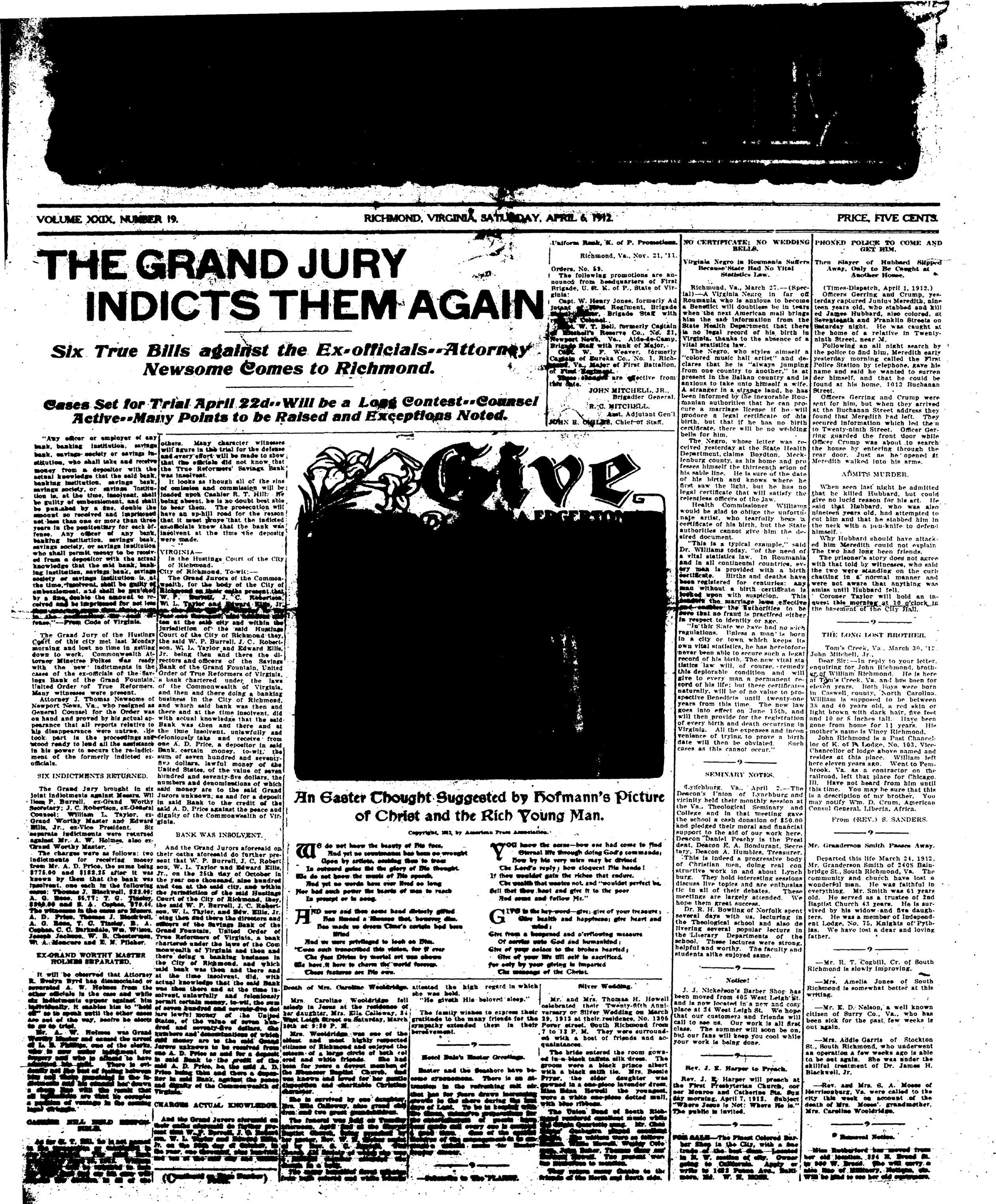
THE GRAND JURY INDICTS THEM AGAIN
Six True Bills against the Ex-officials--Attorney Newsome Comes to Richmond.
Cases Set for Trial April 22d. Will be a Long Contest Counsel Active Many Points to be Raised and Exceptions Noted.
CASHIER HILL, HOLD MORTGAGE.
As for K. T. Hill, he is not named in the possession or ownership in the Bankruptcy. The debt has been paid in July 19, 1911. William will be reimbursed to him and the debt on his account will be paid by the district in all of the
"Any officer or employer of any bank, banking institution, savings bank, savings society or savings institution, who shall take and receive money from a depositor with the actual knowledge that the said bank, banking institution, savings bank, savings society, or savings institution is, at the time, insolvent, shall be guilty of embezzlement, and shall be punished by a fine, double the amount so received and imprisoned not less than one or more than three years in the penitentiary for each offense. Any officer of any bank, banking institution, savings bank, savings society, or savings institution who shall permit money to be received from a depositor with the actual knowledge that the said bank, banking institution, savings bank, savings society or savings institution is, at the time, insolvent, shall be guilty of embezzlement, and shall be punished by a fine, double the amount so received and be imprisoned for not less
The Grand Jury of the Hustings
Court of this city met last Monday
morning and lost no time in getting
down to work. Commonwealth
Attorney Minetree Folkes was ready
with the new indictments in the
cases of the ex-officials of the Savings
Bank of the Grand Fountain,
United Order of True Reformers.
Many witnesses were present.
Attorney J. Thomas Newsome of
Newport News, Va., who resigned as
General Counsel for the Order was
on hand and proved by his actual
appearance that all reports relative to
his disappearance were untrue. He
took part in the proceedings and
wood ready to lend all the assistance
in his power to secure the re-indictment of the formerly indicted ex-officials.
SIX INDICTMENTS RETURNED.
The Grand Jury brought in six joint indictments against Mennar, William P. Burrell, ex-Grand Worthy Secretary; J. C. Robertson, ex-General Counsel; William L. Taylor, ex-Grand Worthy Master and Edward Milla, Jr., ex-Vice President. Six separate indictments were returned against Mr. A. W. Holmes, also ex-Grand Worthy Master.
The charges were as follows: two indictments for receiving money from Mr. A. D. Price, the sums being $775.00 and $182.25 after it was known by them that the bank was insolvent, one each in the following cases: Thomas J. Blackwell, $22.00; A. G. Boe, $6.77; T. G. Tinsley, $299.00 and B. A. Cephan, $70.46. The witnesses in the cases are Monsur. A. D. Price, Thomas J. Blackwell, A. G. Boe, T. G. Tinsley, B. A. Cephan, C. C. Barkedale, Wm. Wilson, Joseph Jackson, W. B. Chesterman, W. A. Moncure and E. M. Pileher.
EX-GRAND WORTHY MASTER
HOLMES SEPARATED.
It will be observed that Attorney R. Browlin Byrd has disassociated or separated A. W. Holmes from the other officials in the case and while six indictments appear against him individually, it enables him to "hold off" so to speak until the other cases are out of the way, so he elects to go to trial.
Mr. A. W. Holmes was Grand Warranty Minister and caused the arrival of La R. Phillips, one of the clerks, who is now under indictment for supplying and who is allowed to have admitted his guilt. There is evidently not the best of feeling between him and those prosecuted in the indictments and his criminal hear drawn a strong line with the result that all indictments are that his accomplices a problem of vengeance in the coming legal struggle.
others. Many character witnesses will figure in the trial for the defense and every effort will be made to show that the officials did not know that the True Reformers' Savings Bank was insolvent.
It looks as though all of the sins of omission and commission will be loaded upon Cashier R. T. Hill: He being absent, he is no doubt best able to bear them. The prosecution will have an up-hill road for the reason that it must prove that the indicted ex-officials knew that the bank was insolvent at the time the deposits were made.
VIRGINIA—
In the Hustings Court of the City of Richmond.
City of Richmond. To-wit:---
The Grand Jurors of the Commonwealth, for the body of the City of Bickerton on their eighth present that W. P. Burwell, J. C. Robertson, W. L. Taylor and Edward Eldis, Jr.
ton at the said city and within the jurisdiction of the said Hustings Court of the City of Richmond they, the said W. P. Burrell, J. C. Robertson, W. J. Taylor, and Edward Ellis, Jr. being then and there the directors and officers of the Savings Bank of the Grand Fountain, United Order of True Reformers of Virginia, a bank chartered under the laws of the Commonwealth of Virginia, and then and there doing a banking business in the City of Richmond, and which said bank was then and there and at the time insolvent, did with actual knowledge that the said Bank was then and there and at the time insolvent, unlawfully and feloniously take and receive from one A. D. Price, a depositor in said Bank, certain money, to-wit; the sum of seven hundred and seventy-five dollars, lawful money of the United States, of the value of seven hundred and seventy-five dollars, the numbers and denominations of which said money are to the said Grand Jurors unknown; as and for a deposit in said Bank to the credit of the said A. D. Price against the peace and dignity of the Commonwealth of Virginia.
BANK WAS INSOLVENT.
And the Grand Jurors aforesaid on their oaths aforesaid do further present that W. P. Burrell, J. C. Robertson, W. L. Taylor and Edward Ellis Jr., on the 25th day of October in the year one thousand, nine hundred and ten at the said city, and within the jurisdiction of the said Hunting Court of the City of Richmond, they the said W. P. Burrell, J. C. Robertson, W. L. Thayer, and Edw. Ellis, Jr., eing then and there the directors and officers of the Savings Bank of the Grand Fountain, United Order of True Reformers of Virginia, a bank chartered under the laws of the Commonwealth of Virginia and then and there doing a banking business in the City of Richmond, and which said bank was then and there and at the time insolvent, did, with actual knowledge that the said Bank was then there and at the time insolvent, unlawfully and feloniously permit certain money, to-wit, the sum of seven hundred and seventy-five dollars have lawful money of the United States, of the value of seven hundred and seventy-five dollars, the numbers and denominations of which said money are to the said Grand Jurors unknown to be received from one A. D. Price as said for a deposit in said Bank to the profit of the said A. D. Price, be the said A. D. Price being then and there a depositor in said Bank, against the peace and dignity of the Commonwealth of Virginia.
CHARGES ACTUAL KNOWLEDGE
And the Grand Jurors sternand on their online appraisal do firing present that W. P. Sproull, J. A. Robertson, W. L. Taylor and Edward Hill Jr. on the 5th day of October, in the year, one thousand, also has been and ten of the said city and town.
RICHMOND, VIRGINIA, SATURDAY, APRIL 6, 1912.
Give
An Easter Thought Suggested by Kofmann's Picture of Christ and the Rich Young Man.
Copyright, 1912, by American Press Association.
AND now and then some hand drinly gifted
Has himed a Mannen that, however dim.
Has made us dream Cime's curtain had been
Wind
And we were privileged to look on Him.
'Two such transcribed this vision, for if ever
The face Drink by mortal art was shown
We have. It here to charm the world forever.
These features are His own.
The family wishes to express their gratitude to the many friends for the sympathy extended them in their bereavement.
Baster and the Seashore have become synonymous. There is an attraction in the refreshing salt air that has for years drawn increasing crowds in the shore during the first days of Lent. To be in keeping with the times, wholesale preparations for the establishment of goods have been made and every one is enthused of good them. One of the special features of the management is to encourage a suitable mode for Baster deeper dinner.
Mrs. Caroline Wooldridge fell asleep in Jesus at the residence of her daughter, Mrs. Ella Calloway, 24 West Leigh Street on Saturday, March 20th at 9:50 P. M.
Mrs. Wooldridge was one of the oldest and most highly respected citizens of Richmond and enjoyed the esteem of a large circle of both colored and white friends. She had been for years a devoted member of the Ribbonner Baptist Church, and was known and loved for her gentle disposition and charitable Christian character.
YOU know the same—how one had come to find
Eternal life through doing God's commands;
How by his very man may be divined
The Lord's reply; how eloquent His hands!
If they wouldst gain the riches that endure.
The wealth that wants not, and "would perfect be,
Sell that they heat and give it to the poor
And come and follow Me."
GIVEN to the key-word—give; give of your treasure;
Give health and happiness; give heart and mind;
Hotel Dale's Master Greetings.
The following promotions are announced from headquarters of First Brigade, U. R. K. of P., State of Virginia:
Capt. W. Henry Jones, formerly Adjutant of First Regiment, Brigade Brigade Headquarters, Brigade Staff with rank of Colonel.
Capt. W. T. Bell, formerly Captain of Michael's Reserve Co., No. 21, Newport Neck, Va., Alde-de-Camp, Brigade Staff with rank of Major.
Capt. W. F. Weaver, formerly Captain of Eureka Co., No. 1, Richmond, Va., Major of First Battalion, of First Regiment.
These changes are effective from this date.
Ast. Adjutant Gen'l
JOHN H. CILLS, Chief-of-Staff.
Hofmann's Picture
Young Man.
In the same—how one had come to find
real life through doing God's commands;
by His very man may be divined
to reply; how eloquent His hands!
let gain the riches that endure,
that wastes not, and "would perfect be,
heat and give it to the poor
and follow Me."
The key-word—give; give of your treasure;
health and happiness; give heart and
wind;
opened and overflowing measure
unto God and humankind;
place to the broken hearted;
we will self in sacrificed.
your giving is imparted
gifts of the Christ.
Silver Wedding.
Mr. and Mrs. Thomas H. Howell celebrated their Twenty-fifth Anniversary or Silver Wedding on March 29, 1913 at their residence, No. 1305 Porer street, South Richmond from 7 to 12 P. M. They were surrounded with a host of friends and acquaintances.
The bride entered the room gowned in a black taffeta milk dress. The groom were a black prince albert with a black mash tie. Mrs. Beesle Pryer, the older daughter was gowned in a one-piece lavender dress. Miss Edna Howell the youngest, were a white one-piece dotted mull, with blue ribbons.
The Union Band of South Richmond rendered excellent music while the children Quartet sang. Mr. Chad Baird, Quahogra played excellent music. The waltons were as follows: Miss Edna Howell, Wendy O'Connor, John Baker, Thomas Shaw and Richard Howell. The present wore the uniform to mendure.
They return many thanks to the
Friends of the North and South side.
NO CERTIFICATE; NO WEDDING
BELLA.
Virginia Negro in Hogmania Suffer Because State Had No Vital Statistical Law.
Richmond, Va., March 27.—(Special)—A Virginia Negro in far off Roumania who is anxious to become a Benedict will doubtless be in tears when the next American mail brings him and information from the State Health Department that there is no legal record of his birth in Virginia, thanks to the absence of a vital statistics law.
The Negro, who styles himself a "colored music hall artist" and declares that he is "always jumping from one country to another," is at present in the Balkan country and is anxious to take into himself a wife. A stranger in a strange land, he has been informed by the inexorable Roumanian authorition that he can procure a marriage license if he will produce a legal certificate of his birth, but that if he has no birth certificate, there will be no welding belts for him.
The Negro, whose letter was received yesterday at the State Health Department, claims Boydton, Meckenburg county, as his home and pro fessors himself the thirteenth act of his sable line. He is sure of the date of his birth and knows where he first saw the light, but he has no legal certificate that will satisfy the relentless officers of the law.
Health Commissioner William would be glad to oblige the unfortunate artist, who tearfully beams a certificate of his birth, but the State authorities cannot give him the desired document.
"This is a typical example," said Dr. Williams today, "of the need of a vital statistics law. In Roumania and in all continental countries, every man is provided with a birth certificate. Births and deaths have been registered for centuries; any man without a birth certificate is looked upon with suspicion. This demonstrates the marriage laws effective and enables the Authorities to be sure that no fraud is practiced either in respect to identity or age.
"In this State we have had no such regulations. Unless a man is born in a city or town which keeps its own vital statistics, he has heretofore never been able to secure such a legal record of his birth. The new vital statistics law will, of course, remedy this deplorable condition and will give to every man a permanent record of his life; but these certificates naturally, will be of no value to prospective Benedicts until twenty-one years from this time. The new law goes into effect on June 15th, and will then provide for the registration of every birth and death occurring in Virginia. All the expenses and inconvenience of trying to prove a birth date will then be obviated. Such cases as this cannot occur."
SEMINARY NOTES
Lynchburg, Va., April 2.--The Deacon's Union of Lynchburg and vicinity held their monthly session at the Va., Theological Seminary and College and in that meeting gave the school a cash donation of $50.00 and pledged their moral and financial support to the aid of our work here. Deacon Daniel Peachy is the President, Deacon E. A. Bondurant, Secretary, Deacon A. Humbles, Treasurer. This is indeed a progressive body of Christian men, doing real constructive work in and about Lynchburg. They hold interesting sessions discuss topics and are enthusiastic in all of their debates. These meetings are largely attended. We hope them great success. Dr. R. H. Bowling of Norfolk spent several days with us, lecturing in the Theological school and also delivering several popular lectures in the Literary Departments of the school. These lectures were strong, helpful and worthy. The faculty and students alike enjoyed same
J. J. Nickerson's Barber Shop has been moved from 405 West Leigh St. and is now located in a new and cosy place at 34 West Leigh St. We hope that our customers and friends will call to see us. Our work is all first class. The summer will soon be on, but our fans will keep you cool while your work is being done.
Rev. J. E. Harper to Priach.
Rev. J. E. Harper will preach at
the First Presbyterian Church, corner
Monroe and Catherine Stn. Sun
day morning, April 7, 1912. Subject
"Where Jesus is Not: Where He is."
The public is invited.
9
POL SALLE—The Finest Colored Bur-
ber Shop in the City, with a fine
trade of the best dine—Located
in N. W. section of city. Owner
going to California. Apply or
write to 1612 Pensna Ave., Baltimore,
Md. W. N. MOHN.
PHONED POLICK TO COME AND GET HIM.
Then Player of Hubbard Slipped Away, Only to Be Caught at Another House.
(Timen-Dispatch, April 1, 1912.)
Officers Gerring and Crump, yesterday captured Junius Meredith, nineteen years old, who stabbed and killed James Hubbard, also colored, at Seventeenth and Franklin Streets on Saturday night. He was caught at the home of a relative in Twenty-ninth Street, near M.
Following an all night search by the police to find him, Meredith early yesterday morning called the First Police Station by telephone, gave his name and said he wanted to surrender himself, and that he could be found at his home, 1013 Buchanan Street.
Officers Gerring and Crump were sent for him, but when they arrived at the Buchanan Street address they found that Meredith had left. They secured information which led them to Twenty-ninth Street. Officer Gerring guarded the front door while Officer Crump was about to search the house by entering through the rear door. Just as he opened at Meredith walked into his arms.
ADMITS MURDER.
When seen last night he admitted that he killed Hubbard, but could give no lucid reason for his act. He said that Hubbard, who was also nineteen years old, had attempted to cut him and that he stabbed him in the neck with a pen-knife to defend himself.
Why Hubbard should have attacked him Meredith could not explain The two had long been friends.
The prisoner's story does not agree with that told by witnesses, who said the two were standing on the curb chatting in a normal manner and were not aware that anything was amiss until Hubbard fell.
Coroner Taylor will hold an inquest this morning at 10 o'clock in the basement of the City Hall.
THE LONG LOST BROTHER
Tom's Creek, Va., March 30, 182
John Mitchell, Jr.
Dear Sir: In reply to your letter,
enquiring for John Richmond, brother
of William Richmond. He is here
at Tom's Creek, Va. and has been for
eight years. Both boys were born
in Caswell county, North Carolina.
William is supposed to be between
38 and 40 years old, a red skin or
light brown with dark hair, five feet
and 10 or 8 inches tall. Have been
gone from home for 11 years. His
mother's name is Viney Richmond.
John Richmond is a Past Chancellor
of K. of P Lodge, No. 103. Vice-
Chancellor of lodge above named and
resides at this place. William left
here eleven years ago. Went to Pembrook, Va. as a contractor on the
railroad, left that place for Chicago.
Ill. Have not heard from him until
this time. You may be sure that this
is a description of my brother. You
may notify Wm. D. Crum, American
Consul General, Liberia, Africa.
From (REV.) S. SANDERS.
Mr. Granderson Smith Pansen Away.
Departed this life March 24, 1912. Mr. Granderson Smith of 2408 Bainbridge St., South Richmond, Va. The community and church have lost a wonderful man. He was faithful in everything. Mr. Smith was 61 years old. He served as a trustee of 2nd Baptist Church 43 years. He is survived by his widow and five daughters. He was a member of Independent Lodge, No. 75, Knights of Pythias. We have lost a dear and loving father.
Mr. R. T. Cogbill, Cr. of South Richmond is slowly improving.
Mrs. Amelia Jones of South Richmond is somewhat better at this writing.
Mr. E. D. Nelson, a well known citizen of Surry Co., Va., who has been sick for the past few weeks is out again.
Mrs. Addie Garris of Stockton St., South Richmond, who underwent an operation a few weeks ago is able to be out again. She was under the skillful treatment of Dr. James H. Blackwell, Jr.
Rev. and Mrs. S. A. Moses of Harrisonburg, Va. were called to the city this week on account of the death of Mrs. Moses' grandmother, Mrs. Caroline Woolridge.
Removal Notice.
Miss Rutherford has moved from her old location, 234 R. Brend St. by 360 W. Broad. She will carry a mini One of Military, Nottingham, St. Will be kind to see her old acquaintance.
P. K.
PROLOGUE.
A young man and a beautiful young woman, lost and alone in a wilderness for months, half starved and in daily peril of death from wild beasts and still more savage Indians—this is the central theme of the most fascinating romance that has come from Emerson Hough's pen. Read and you will learn how love came to them; how they conducted themselves in this trying, unconventional situation; how the man's chivalry and the woman's purity held them steadfast to the ideals of civilisation; and how the strange episode brought tragedies, estrangements and happiness.
CHAPTER I.
The Kissing of Mice Sheraton.
ADMIT I kissed her. Perhaps I should not have done so. Perhaps I would not do so again. Had I known what was to come I could not have done so. Nevertheless I did.
After all, it was not strange. All things about us conspired to be acessory and incendiary. The air of the Virginia morning was so soft and warm; the honey suckles along the wall were so inguid, sweet; the beast and the hollybocks up to the walk so fast and lazy; the smell of the orchard was so rich; the south wind from the Seaside was so wanton. Moreover, I was only twenty-six.
So this was bow it happened that I threw the roins of Satan, my black horse, over the hooked iron of the gate at Dixiana farm and strode up to the side of the stone pillar where Grace Sheraton stood, shading her eyes with her hand, watching me approach through the deep trough road thatattened there near the Sheraton lane. So I laughed and strode up and kept my promise. I had promised myself that I would kiss her the first time that seemed feasible. I had even promised her—when she came home from Philadelphia so lofty and superior for her stopping a brace of years with Miss Carey at her Allendale Academy For Young Ladies—that if she mitigated not something of her unfortuness I would kiss her fair, as if she were but a girl of the country.
She stood in the shade of the stone pillar, where the ivy made a deep green and held back, her light blue shirt daintily in her high bred way, her never was a girl Sheraton who was not high bred or other than fair to look upon in the Sheraton way—slender, rather tall, long checked, with very much dark hair and a deep color under the skin and something of long curves within. They were ladies, every one, those Sheraton girls, and, as Mrs. Greece presently advised me, no maidsmaids wandering and waiting in lines for lovers.
When I sprang down from into
Miss Grace was but a piece or so away,
I put out a hand on either side of her
as she stood in the shade and so pri-
ced her against the pillar. The flush
at this and caught at my arm with
both hands, which made me smile, for
few men in that country could have
put away my arms from the stone on
all I liked. Then I best and kissed
her fair and took what revenge wan-
drew our girls for her Philadelphia man-
ner.
When she boxed my ears I kissed her more once. Had she not at that cuillen at me a little I should have been a beer, I admit. As she did and as I in my innocence supposed his girl did, I presume I may be called but a she am soon go. Miss Grace grew very roar for a Sheraton, but her own were bright, so I throw my hat on the grisby by the side of the gate and bowed her to be noted. We set and looked up the line which wound on to the big Sheraton home and up the red road which led from their farm over toward our hands, the John Cowin farm which and have three generations in our family as against four, on the part of the Sheraton - buildings - a fact I think always raised on in the Sheraton and a bride lower than them given.
We were neighbour, Miss Greene and I, and so I really asked out over the bed room, surrounded at the time by over the washing wheel of good exprience, I said to the same word of our being subservient and of the being to me. The man asked to exchange the propriety of a gliding wheel that and now a staircase. The answer to be given but, although I gave the
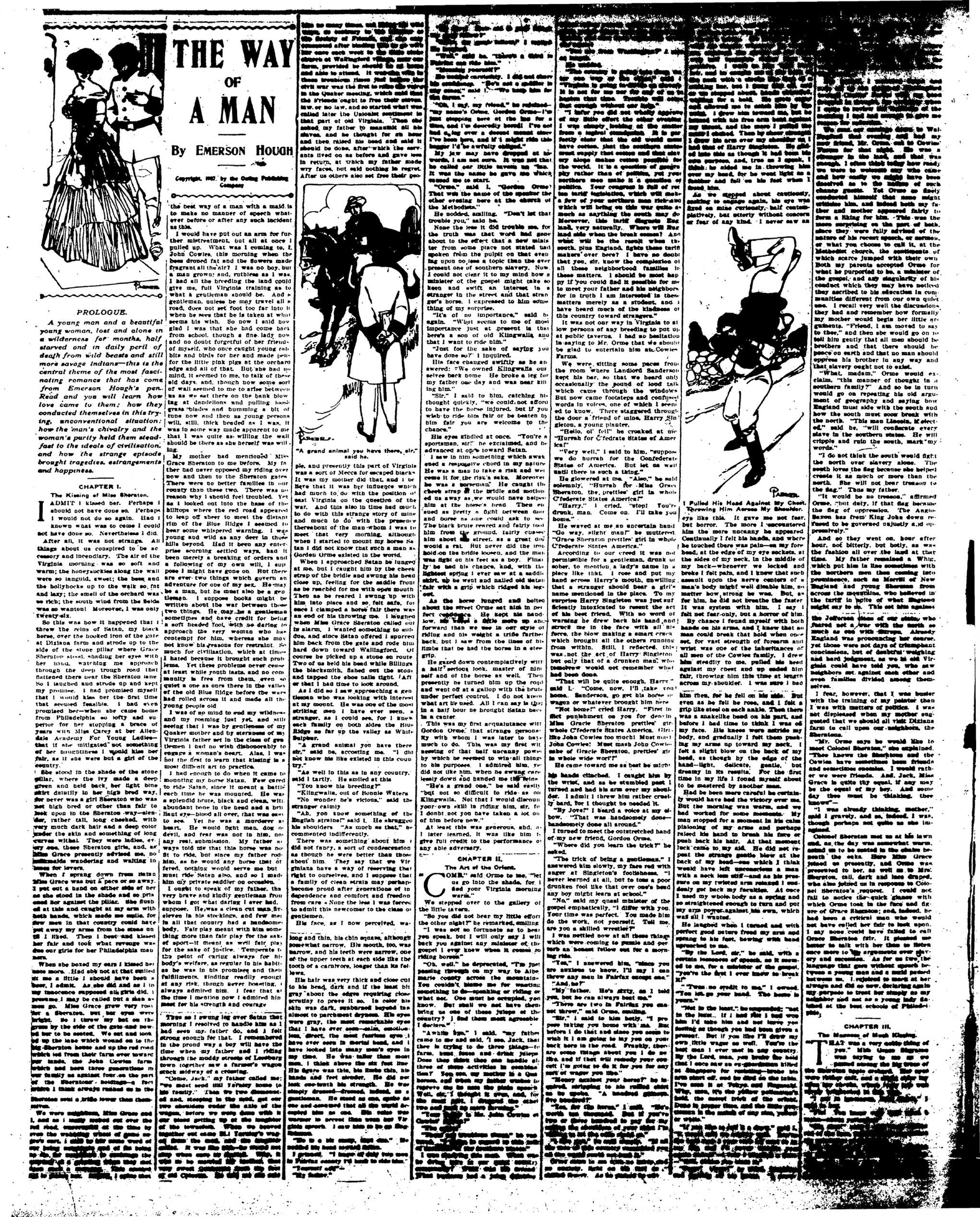
THE WAY OF A MAN
Copyright, 1987, by the Guild Publishing Company
the best way of a man with a maid is
to make no manner of speech what-
ever before or after any such incident
as this.
I would have put out an arm for further mistreatment, but all at once I pulled up. What was I coming to. I John Cowles, this morning when the bees done fat and the flowers made fragrant all the air? I was no boy, but a man grown; and, ruthless as I was, I had all the breeding the land could give me, full Virginia training as to what a gentleman should be. And a gentleman, unless he may travel all a road, does not set foot too far into when he sees that he is taken at what seems bish wish. So now I said how glad I was that she had come back from school, though a fine lady now and no doubt forgetful of her friend of myself, who once caught young rabbits and birds for her and made pen for the little pink plats at the orchard edge and all of that. But she had no mind, it seemed to me, to talk of these old days, and, though how some sort of wall seemed to me to arise between as we sat there on the bank blow lag at dandelions and pulling grass blades and humming a bit of tune now and then as young persons will, still, thick headed as I was, it was in some way made apparent to me that I was quite as willing the wall should be there as she herself was willing.
My mother had mentioned Miss Grace Sheraton to me before. My father had never opposed my riding over now and then to the Sheraton gate. There were no better families in our county than these two. There was no reason why I should feel troubled. Yet as I looked out into the halls of the hilltop where the red road appeared to leap off alley to meet the distant rim of the Blue Ridge I seemed to bear some whispered warning. I was young and wild as any deer in those hills beyond. Had it been any enterprise scouring settled ways, had it been merely a breaking of orders and a following of my own will, I suppose I might have gone on. But there are ever two things which govern an adventure for one of my sex. He may be a man, but he must also be a gentleman. I suppose books might be written about the war between these two things. He may be a gentleman sometimes and have credit for being a soft headed fool, with so darling to approach the very woman who has contempt for him, whereas she may not know his passions for restraint. So much for civilization, which at times I hated because it brought such problems. Yet these problems never cease at least while youth lasts, and no community is free from them, even so quiet a one as one there in the valley of the old Blue Ridge before the war had rolled across it and made all the young people old.
I was of no mind to end my wildness and my romping just yet, and still seeing that I was by gentleness of my Quaker mother and by sternness of my Virginia father set in the class of gree them I had no wish disobeyably to engage a woman's heart. Also, I was not the first to learn that kissing is a most difficult art to practice.
I had enough to do when it came to mounting my horse Satan. Few cared to ride Satan, since it meant a battle each time he was mounted. He was a splendid brute, black and clean, with abundant bone in the head and a brilliant eye—blood all over, that was easy to see. Yet he was a murderer at heart. He would fight man, dog or devil, and fear was not in him, no any real, submission. My father always told me that this horse was not fit to ride, but since my father rodd him, as he would any horse that ofered, nothing would serve me but must ride Satan also, and so I modish my private saddler on occasion.
I ought to speak of my father, that very brave and kind gentleman from whom I got what daring I ever had, suppose. He was a clean cut man, seven in his stockings, and few men in all that country had a handmade body. Fair play meant with him something more than fair play for the sake of sport—it meant as well fair play for the sake of justice. Temperate to this point of caring always for his body's welfare, as regular in his habit as he was in his promise and their fulfillments, kindling readily enough at any risk, though never boasting, I always admired him. I fear that at the time I mentioned now I admired him most for his strength and courage.
Thus as I swung leg over Satan that morning I resolved to handle him as I had seen my father do, and I felt strong enough for that. I remembered in the prow way a boy will have the time when my father and I riding through the muddy streets of Leedsburg town together saw a farmer's wagon stock midway a crossing.
"Come, Jack," my father called me; "we must send till Forty nine home to his family." Then we two disembarked and, stepping in the sand, got our two abridgments under the side of the wagon, before we were done with it our band getting up at the daughter of the wagon. When we received together out came Eli Ternier's wagon from the castle, and the daughter called. It was like the wagon not stop when came to dawn. When it was he married his daughter, the sweet wagon departed from the foot of old Cypress. He did not add
him so many times, telling all the widows, so contrary to the instructions of the Society of Friends, and the only commanded after hearing it to do with her care once we went to the little white church of Wallingford village near our farm, provided he should be in a home, and also to attend. It was then in these treasonous times before the civil war was the first to raise the vote in the Quaker meeting, which said that the Friends ought to free their slaves, law or no law, and so started what was called later the Unionist settlement in that part of old Virginia. Then she asked my father to marshal all his slaves, and so thought for an hour and then raised his bead and said it should be done, after which the servants lived on as before and gave lee in return, at which my father made wry faces, but said nothing in regret. After us others also set free their poo-
PADREL.
"A grand animal you have there, sir," said he.
ple, and presently this part of Virginia was a sort of Mecca for escaped blacks. It was my mother did that, and it beave that it was her influence which had much to do with the position of east Virginia on the question of the war. And this also in time had much to do with this strange story of mine and much to do with the presence thereabout of the man whom I was to meet that very morning, although when I started to mount my horse I did not know that such a man as Gordon Orme existed in the world.
When I approached Satan he ingested at me, but I caught him by the cheek strap of the bride and swung his head close up, feeling for the middle front as he reached for me with open mouth. Then as he reared I swung up with him into place and so, felt safe, for once I clamped a horse fair there was an end of his throwing me. I laughed when Miss Grace Sheraton called out in alarm, I wanted something to subtle, and since Satan offered I sparred him back from the gate and rode him hard down toward Wallingford. Of course he picked up a stone on route. Two of his held his head while Billings the blacksmith, faded on the stone and tapped the shoe nails tight. I arrived that I had time to look around. As I did so I saw approaching a genius man who was looking with interest at my mount. He was one of the most striking men I have ever seen, a stranger, as I could see, for I knew each family on both sides the Blue Ridge as far up the valley as White Sulphur.
"A grand animal you have there sir," said he, accounting me. "I did not know his like existed in this country."
"As well in this as in any country," said I tartly. He smiled at this "Too know his breeding?" "Killingwalla, out of Bonfide Waters" "No wonder he's victorious," said the stranger calmly.
"Ah, you know something of the English straller" said I. He shrugged his shoulders "As much as that," he commented indifferently.
There was something about him I did not fancy, a sort of condescension as though he were better than those about him. They say that we Virginiaans have a way of reserving that right to ourselves, and I suppose that a family of clean strain may perhaps become proud after generations of its dependence and comfort and freedom from care. None the less I was forced to admit this newcomer to the class of gentlemen.
His face, as I now perceived, was long and thin, his chin square, although somewhat narrow. His mouth, too, was narrow, and his teeth were narrow, one of the upper teeth at each side like the tooth of a carnivore, longer than its feews.
"Wank," said he. "I throw a good in
basket on the floor."
"Stunning yourself."
"He might be curiously. I did and show
his intelligence."
"Be's not a goblin in
my eyes."
" said I. "We keep him for
this farm."
"Oh, I say my my friend," he rubbed
"my name's Orme. Gordon Orme. I've
just sleeping at the bus for a
time, and I'm desperately bored. I've
had a long over a dozen months since
I've been born, and if I might ride this
bagger I'd be a wrathful colt."
My jaw may have dropped at his
world. I am not sure. It was not that
he called my little savannah "man."
It was the name he gave me which
caused me to start.
"Orme," said I. "Gordon Orme."
That was the name of the speaker
the other evening at the church of
the Methodist."
He nodded, smiling. "Don't let that
trouble you."
None the less it did trouble me for the truth was that word had gone about to the effect that a new minister from some place not stated that spoken from the pulpit on that evening upon no less a topic than the ever present one of southern slavery. Now, I could not clear it to my mind how a minister of the gospel might take so keen and swift an interest in a stranger in the street and that stranger's horse. I expressed to him something of my surprise. "It's of no importance," said he again. "What seems to me of most importance just at present in that beaver a son of old Kingwalla and that want to ride of the rides of saying you have done so?" I inquired.
His face changed swiftly as he answered: "We owned Kingwalla ourselves back home. He broke a leg for my father one day and was near killing him."
"Sir," I said to him, catching his thought quickly, "we could not afford to have the horse injured, but if you wish to ride him fair or be beaten by him fair you are welcome to the chance."
His eyes kindled at once. "You're a sportman, sir," he exclaimed, and he advanced at once toward Satan.
I saw in him something which awkened a responsive chord in my nature. He was a man to take a risk and we come it for the risk's sake. Moreover he was a morriston. He caught the chest strap of the bride and motioned us away as, we would have helped him at the horse's head. Then he used as pretty a light between our and horse our one could ask to see. The black brute reared and fairly took him from the ground, fairly cursed him about the street, as a great dog would a rat. But never did the iron hold on the bride boosen, and the man was light on his feet as a boy. Finally he had his chance, and, with the lightest spring I ever saw at a saddle up, he went and nailed old stiletto fak with a grip which ridged his leg.
As the horse lunged and bolted about the street Orme sat him in perfect confidence. He kept his hand low, as he held a little up and forward than we use in our style of riding and his weight a trifle farther back, but I saw from the lines of the limbs that he had the horse in a steer grip.
He gazed down contemplatively with a half-serious look, master of him self and of the horse as well. Then presently he turned him up the road and went off at a gallop with the bristle under perfect control. I do not know what art he used. All I can say is that in a half hour he brought Satan back in a center.
This was my first acquaintance with Gordon Orme; that strange personality with whom I was later to have much to do. This was my first visit needing of that half unaccent power by which he seemed to win-all things to his purposes. I admired him, he did not like him, when he swung carelessly down and handed me the knife.
"He's a grand one," he said calmly "but not so difficult to ride as on Kingwala. Not that I would discount your own skill in riding him, sir, so I doubt not you have taken a lot on of him before now." At least this was generous, and I inter leamed, it was like him to give full credit to the performance of any able adversary.
COMR." said Orme to me. "Let us go into the shade, for I and your Virginia morning warm."
We stepped over to the gallery of the little barn.
"So you did not hear my little effort the other night?" he remarked, smiling. "I was not fortunate as to hear you speak, but I will only say I will back you against any minister of the gospel I ever knew when it comes to riding borne."
"Oh well," he deprecated, "I'm just passing through on my way to Albermarie county across the mountain. You couldn't blame me for wanting something to go—spelling or riding or what not. No one must be accepted, you know. But shall we not have them bring us one of these jetsets of the country? I find them most agreeable I desire."
"Awhie bm," I said, "my father came to me and said, 'Jack, that there is trying to do three things—to farm, hunt, fence and drink jellopee. Does that think they can handle all three of these activities in combination? You see, my mother is a Queen, and when my father wants to remove me he uses the plum spoon Well, did I think it grew, and for the most part I disgusted the other two and gave it to the other."
"People who understand things" be very
willing to be exposed to this kind of
information in the business world"
I was changing this math. When we
were going into our project, usually
competently, "WHAT" was the most obvious
thing we needed to know.
"The economy is going down three times
the one way or the other." said I.
"English is going to decline so quickly
it is not for me nor the end of us to
beaten that time. English will soon
move overnight without our help."
"I infer you did not wholly approve of my Little effort the other evening. I was simply looking at the matter from a logical standpoint. It is in fact clearly that the old world must have cotton, that the southern man must supply that cotton and that slavery alone makes cotton possible for the world. It is a question of geography rather than of politics, yet your northern man makes it a question of position. Your congregant is full of rot on tariff legislation, which will make a few of your northern men rich and which will bring on this war quite much as anything the south may do. Moreover, this tariff diagnoses England, very naturally. Where will he hand side when the break comes? And what will be the result when the south, plus England, gains these tariff makers over here? I have no doubt that you, sir, know the complexion of all these neighborhood families in these matters. I should be most happy if you could find it possible for me to meet your father and his neighbors for in truth I am interested in these matters merely as a student, and I have heard much of the kindness of this country toward strangers."
It was not our way in Virginia to allow persons of any breeding to put up at public taverna. I had no hesitation in saying to Mr. Orme that we should be glad to entertain him at Cowier Parma.
We were sitting some spaces from the room where Landlord Sanderson kept his bar, so that we heard only occasionally the sound of lood talk which came through the windows. But now came footsteps and confused words in voices, one of which I seemed to know. There staggered through the door a friend of mine, Harry Singleton, a young planter.
"Hello, o'll fell" he croaked at me. "Hurrah for Cofradate States of America!"
"Very well, I said to him, 'suppose we do hurrah for the Confederate States of America. But let us wait until there is such a thing."
He glowered at me. "Also, he said solemnly, 'Hurrah for Miss Grace Sheraton, the pretty girl in whose Confederate States America!'
"Harry," I cried, "stop! You're drunk, man. Come on. I'll take you bomn."
He waved at me an uncertain hand. "Go way, slight man!" he muttered. "Grace Sheraton protter" girl in whole Creeder States America."
According to our creed it was not permissible for a gentleman, drunk or sober, to mention a lady's name in a place like that. I rose and put my hand across Harry's mouth, unwilling that a stranger should bear a girl's name mentioned in the place. To my surprise Harry Singleton was just sufficiently intoxicated to resent the act of his best friend. With no word of warning he drew back his hand, and struck me in the face with all his force, the blow making a smart crack which brought all the others running from within. Still, I reflected, this was not the act of Harry Singleton but only that of a drunken man, who tomorrow would not remember what had been done.
"That will be quite enough. Harry said L. "Come, now, I'll take you home. Sanderson, go get his boots on wagon or whatever brought him here. "Not home!" cried Harry. "First in fact punishment on you for deniin Mius Grace Sheraton pretties' girl whole Cfederated States America. Glirle John Cowles too much! Must mind John Cowles! Must mash John Cowles' sake of Oracle Sheraton, pretties' girl in whole wort!" He came toward me as best he might his hands clinched. I caught him by the wrist, and as he stumbled past I turned and had his arm over my shoulder. I admit I threw him rather cruelly hard. For I thought he needed it.
"By Jove!" I heard a voice at my elbow. "That was handsomely done—handsomely done all around."
"The trick of being a gentleman," I answered him slowly, my face red with anger at Singleton's footshoes. "I never learned at all, but to tome a poor drunken fool like that over one's head any boy might learn at school."
"No," said my quasal minister of the gospel emphatically, "I differ with you. Your time was perfect. You made him do the work, not yourself. Tell me, are you a skilled wrestler?"
I was nettled now at all these things which were coming to pumple and perish an honest fellow out for a morning ride.
"Yes," I answered him, "since you are anxious to know, I'll say I can throw any man in Fairfax except one."
"And, no!"
"Dir," I said to him barely, "I pre-poor taking you home with me. But before I do that and since you seem to wish I it I am going to my eyes on your back here in the road. Firstly, there are some things about you I do not like, and if that will remedy your eyes it I'm going to do it for you for any sort of wager you like."
"Honey assistant your home?" he enquired, stripping to his ruffled shirt to be spotted. "A husband gentleman, my husband."
"Lam, for the horse," I said. "Here worth two thousand. But if you two or three hundred to pay for my riding the admission of your horse I'm willing to let the cattle go up."
"Like you," he said calmly. "All the time the country manymen you all the cattle would mount up."
Gray darts in an unsteady shot, and my eyes light on the start of the horse. As he stood the ear
As we stepped about cautiously, sucking to engage again, his eye was frown on mine curiously, half contemplatively, but utterly without concern or fear of any kind. I never saw an
Pim
I pulled His Head Against My Chest.
Throwing Him Across My Shoulder.
eye like this. It gave me not fear,
but horror. The more I encountered
him the more uncanny he appeared.
Continuously I felt his hand, and when
he touched there was pain—in my forehead, at the edge of my eye socket, at
the sides of my neck. In the middle of
my back—whenever we locked and
break I felt pain, and I knew that such
assault upon the nerve centers of a
man's body might well disable him, and
matter how strong he was. But, as
for him, he did not breathe the faster
it was system with him. I say I
felt not fear-only, but a horror with him.
By chance I found myself with both
hands, and I knew that men could break that hold when one
not, for vast strength of formam, and wrist was one of the inheritances
of all men of the Cowies family. I drew
him steadily to me, pulled his head
against my chest and up ended him
fair, throwing him this time at length
across my shoulder. I was sure I had
him then, for he fell on his side. But even as he fell he rose, and I felt a grip like steel on each ankle. There there was an anklebeak he on his part, and before I bad time to think I was of my face. His knees were merrily my body, and gradually I felt them pushing my arms up toward my neck. I felt a slight blow on the back of my head, as though by the edge of the hand-light, delicate, gentle, but dreamy in its results. For the first time in my life I found myself about to be mastered by another man.
Had been more careful he certainly would have had the victory over me. But the morning was warm, and we had worked for some moments. My man stopped for a moment in his calm plaining of my arms and perhaps raised his hand to brush his furse or push back his hair. At that moment Jack came to my aid. He did not repeat the strange gentle blow at the back of my head—one which I think would have left unconscious a man with a neck lem stiff—and as his pressure on my twisted arm relaxed I suddenly got back my freakiness. At once I used my whole body as a spring and so straightened enough to turn and put my arm power against his own, which was all I wanted.
He laughed when I turned and with perfect good nature freed my arm and spring to his feet, bowing with hand unrestricted to me.
"By the Lord, sir," he said, with a certain innocence of speech, as it seemed to me, for a minister of the gospel, "you're the first I ever know to break it."
"Twain, no credit to me," I owned. "You lie go your hand. The horse is yours."
"Not in the heart, he suppressed; not in the heart. If I had fled I had woe him I'd take him and not leave you loving as though you had been given a present. But if you like I'll draw my own little wager as well. You're the best man I ever met in any country. By the Lord, man, you brace the hold that I once saw an orphaned kid in Singapore for rescuing-broke him with short aff, and to die on the table. I've seen it at Tokyo and Managua. Why, man, my the yellow performer holds the most trick of the artful. Dame in paper than, and the little group seems in the middle of any man, yellow or white."
```markdown
```
I have always I have always been and
wished I had always been. I have always been
beautiful. I have always been beautiful.
In my life, my life, my life.
I would be better off if I were
the one that I am.
We must our courage down to Wellman that evening, and had my new friend, Mr. Orren, call to Crawford. Prayer for that night. He was a stranger in the hatch, and that was enough. I often think today how ready we were to welcome any who came and how easily we might have been deserved as to the nature of such change guests. Yet Orse was so easily conceived himself that none might witness him, and indeed both my father and mother appeared fairly to form a liking for him. This was the more surprising on the part of both, since they were fully advised of the nature of his recent speech, or mormon, or what you choose to call it, at the Methodist church, the sentiments of which score jumped with their own. Both my parents accepted Orse for what he purported to be, a minister of the gospel; and any singularity of his conduct which they may have noted they ascribed to his education in communities different from our own quiet one. I recall very well the discussions they had and remember how formally my mother would begin her little arguments. "Friend, I am moved to say to thee," and then she would go on to thee, and then she would all men should be brothers and that there should be peace on earth and that no man should oppress his brother in any way and that slavery ought not to exist.
"What, madam," Orme would exclaim, "this manner of thought in a southern family." And so be in turn would go on repeating his old argument of geography and saying how England must side with the south and how the south must soon break with the north. "This man Lincoln, selected," said he, "will confacate every slave in the southern states. He will cripple and ruin the south, mark 'my words.'"
"I do not think the south would fight the north over slavery alone. The south loves the flag because she helped create it as much or more than the north. She will not bear treason to the flag." Thus my father.
"It would be no treason," affirmed Orme, "but duty, if that flag became the flag of oppression. The Anglo-Saxon has from King John down refused to be governed unjustly and impressively."
And so they went on, hour after hour, not bitterly, but bodily, as was the fashion all over the land at that time. My father remained a Whig, which put him in line sometimes with the northern men then coming into prominence, such as Merrill of New England and young Sherman from across the seaboard, who believed in the tariff in hopes of what England might say to us. This set him against the Jeffersonians of our states, who feared not a war with the north so much as one with Europe. Already England was pronouncing her course, yet those were not days of triumphant conclusions, but of doubtful weighing and hard judgment, as we in old Virginia could have told you, who saw neighbors are against each other and even families divided among themselves.
I fear, however, that I was buster with the training of my painter then I was with matters of politics. I was not displeased when my mother suggested that we should all visit Dixiana farm to call upon our neighbors, the Sherutons.
"Mr. Orme says he would like to meet Colonel Sherutson," she explained. "Thee known the Sherutons and the Cowles have sometimes been friends and sometimes enemies. I would rather we were friends. And, Jack, Mina Grace is quite thy equal, if any may be the equal of my boy. And some day they must be thinking, they know?"
Colonel Liberaton met me at his lawn and, as the day was somewhat warm, asked us to be sent to the chateau beneath the oak. Here Mrs. Grace joined us presently, and Orme was presented to her, as well as to Mrs. Liberaton, tall, dark and hair draped, who also joined us in response to Colonel Liberaton's request. I could not fall to notice the quick glance with which Orme took in the face and figure of Grace Liberaton; and indeed, he had been a critical man who would not have called her fair to look upon. I may none could have failed to call Grace Liberaton fair. It pleased me better to talk with her than to listen once more to her arguments over gery and occasion. As for us two, the language that gave without speech between a young man and a world pardoned between me. I required to work at her always and did so now, derailing again my perpure to treat her simply as my neighbor and not as a young lady desi-
CHAPTER IIL
```markdown
```
So then I saw that word in some way and come to bar of the little brave between Harry Ragston and myself. "To protect an absent woman is in all ways mainly," she said. "I thank you for caring for my name."
Now, I should have grown warmer in the face and in the heart at this, but the very truth is that I felt a chill some over me as though I were getting deeper into cold water. I groomed her mind. Now, how was I, who had kissed her at the lane, who had defended her when absent, who called now in state with his father and mother in the family carriage—how was I to my I was not of the same mind as she? I pulled the ones of the hunting dog on till he yipped in pain. We were deep in the great Sheraton orchard. Presently we came to a fallen apple tree, a giant perhaps planted there generations before. We wanted ourselves here, and we should have been happy, for we were young, and all about us we sweet and comforting, yet, on my肩, I would rather at that moment have been talking to my mother than to Grice Sheraton. I did not know why.
For some time we not there, pulling at apple blossoms and grass stones and talking of many things quite beside the real question, but at last there came an interruption. I heard the sound of a low, rumbling below approaching through the trees, and as I looked up I saw, coming forward with a certain confidence, Sir Jonas, the red Liberator butt, with a ring in his nose, and in his carriage an intense haughtiness for one so young. I knew all about Sir Jonas for we had bred him on our farm.
Miss Grace gathered her stigts for instant flight, but I quickly pushed her down. I knew the nature of Sir Jonas very well and saw that flight would mean disaster long before she could reach any place of safety.
"Keep quiet." I said to her in a low voice. "Don't make any quick motions or he'll charge." Come with me slowly now."
Very pale, and with eyes starting in the intruder, she arose as I lade her and slowly moved toward the tree which I had in mind. "Now, quick!" I said, and, catching her beneath the arms, I swung her up into the low branches. Mr Jonas came on with hand down, and his horn missed my trouser leg by no more than an inch as I dodged around the tree. At this I laughed, but Miss Grace screamed, until between my busy actions I called to her to keep quiet. Mr Jonas tapped on his hand then and bolted for the tree where Miss Grace had her refuge. Then I saw it was the red lining of her Parisian parcel which had enraged him. "Throw it down!" I called out to her. She could not find it in her heart to toss straight down to Sir Jonas, who would
have trampled it at once, so she cast it sideway toward me, and each by inch I beat Sir Jonas in the race to it. Then I resolved that he should not have it at all and so tossed it into the branches of another tree as I ran. "Come," called the girl to me, "jump; Get up into a tree. He can't catch you there."
But I was in no mind to take to a tree and wait for some ingorious discovery by a rescue party from the house. I found my fighting blood rising and became of the mind to show Sir Jonas who was his master regardless of who might be his owner. He charged me again and again, keeping me hard put to it to find trees enough even in an orchard full of trees. Once he ripped the bark half off a big trunk as I sprang behind it, and he stood with his head still pressed there not two feet from where I was with my hand against the tree braced for a sudden spring. His front foot dug in the sod, his eyes were red, and between his grumbles his breath came in puffs and soars of anger.
Near by me on the ground lay a rugged limb cut from some tree by the prunera, now dry, tough and not ill shaped for a clutch. I reached back with my feet and pulled it within reach, then stepped quietly and got it in hand, breaking a few of the lenoir or banchever with one foot as we still stood thereaping each other. "Now, mr," said 1 to Mr. James at last, "I shall show you that no little hull two years old can make me a laughing-stock." Then I sprang out and carried the war into Africa forth with.
Or hears was surprised when I come from behind the tree and swung a hard blow to the side of his tender nose, and so I repaired him he grinned, blow out his breast and turned his head, to one side with closed eyes, raising it almost to pain. Once more I crawled into her arm, the mouth, and this time he beaded loudly in apprehension and anxiety and so turned to pain. This gift of his affection me held upon his tail, and so adored to hear I followed, plucking him upon the hand with always careful attention, as I went, through his mouth when he blushed breast swish. Then with kind words and with a voice which he might better to have answered I followed him to the mouth and opened this apprehension out of the grasped to wish he be so good whisper in mouth. After public, upon hearing I could summon, I returned to the own where whispered with still pardoned whistle had helped down to which came voice.
That can make Cordial a nice addition to those especially in this world you are expected to be.
Also, if you are not afraid to give a slight to any little detail, you are likely to enjoy the memorable details. When a little piece of art is built in long days, it can be a wonderful addition to your home.
Gram, and we caused confusion again
than our fallen apple tree. Her hand
and upon my soul digged. We must
dig it again. They lost. Our life not
also. I do not know how.
I do not hold myself either guilty
or guiltless. I am only a man now.
I was only a boy then. But ever since
I had my notions, right or wrong, as
to what a gentleman should be and do.
At least this is how Grice Shoraton
and I both engaged.
I shall never forget the scene there
under the naked of the Shoraton from
yard which met my gaze when Miss
Grance and I came about the corner of
the house.
Before us and facing each other
stood my father and Colonel Shoraton.
Raimond
His Breath Came in Puffs and Sports of Anger.
the former standing straight and tall Colonel Sheraton with tightly clinched hand resting on his stick, his white hair thrown back, his shaggy brown contracted. My mother sat in the low rocker which had been brought to her and opposite her, leaning forward, wa- Mrs. Sheraton, tall, thin, her black eyes fixed upon the men. Orme, also standing, his hands behind him, regarded the troubled men intently. Near at hand was, the Sheraton's Jim, his face also fixed upon them, and such was his own emotion that he had tipped his silver tray and dropped one of the Sheraton cut glass julep glasses to the nod.
"I tell you, Cowles," said Colonel Liberaton, grinding his stick into the turf, "you do not talk like a Virginian. If the north keeps on this course then we southerners must start a country of our own. Look man"—He swept about him an arm which included his own wide paces and ours, lying shining clear to the thin line of the old Blue Ridge. "We must fight for these homes!" "You forget, colonel," said my father in his low, deep voice, "that this man Lincoln has not yet been elected, and that even if elected he may prove a greater figure than we think. He has not yet had a chance to learn the south."
Orme had been standing silent, his face indifferent or faintly lighted with a habitual cynicism. Now he broke in. "He will never be elected," he said emphatically. "It would ruin the entire industry of the south. The south must secede, gentlemen. If you will allow me as a stranger to venture an opinion."
My mother turned her gaze to him, but it was Sheraton who spoke. "It goes back to the old articles of federation, our first compact," he said. "From the very first the makers of this country saw that by reason of diverse industries the south was separated from the north. This accession has been written in the sky from the beginning of the world."
"Nay, Brother Sheraton," broke in my mother eagerly. "It was the union of brothership that was written first in the sky."
He turned to her with the bow of a gentleman. "It is you ladies who knit the world together with kindness," he said. "Alas, that men must rend it with fighting."
"Alas!" whispered also. Sheraton's face was sad as he welt on with the old justification. "Jefferson would turn over in his grave if he saw Virginia divided as it is. Why, Owies, we've all the world we need here. We can live alone here, each on his own acre, a gentleman, and all the needs of government is protection and fair laws. Ouilhon was right. Better give us two peaceful countries, each living happily and content, than one at war with itself. Clay was a great man, but both he and Webster were fighting against the inevitable."
"The war has already begun on the border," said my father, "My friend and partner, Colonial Mottwether of Albemarle, who is with the army in the west, says that white men are killing white men all across the lands west of the Missouri."
"At least, Cousin," said Colonial Mottwether, pointing a short way apart, his hands behind his back, "we can wait until after this question."
"But if the government takes action," suggested Cousin.
Sheraton waited quickly. "Then war, war," he cried, "war till more Virginia is dead on the frontline and each woman starved at her breasts. Cousin, you and I will fight, a happy that you will fight."
"And all my satires, I will give."
"Land with us?"
"No," said my father, stilling; "we say nothing yet." I have no question until he was sent off the beach.
Myەن, I will come into life in theسايدش جرس. I am so a general task.
Don't do it. I know I'll be the first order for the people. The way you will take here, and you'll never go away by us. I think you'd always offer the best of our pleasure, next on your business.
Hawkins-Johnson MANUFACTURING CO., Hair Grower and Restorer,
616 A 1st Street, Richmond, Va.
Telephone, Madison-4601.
Will positively remove all Dandruff and cure the scalp of all impurities. It will restore Hair on clean Temples and Bald Heads where the Roots are not dead.
SATISFACTION GUARANTEED. PRICE, 35 CENTS PER BOX.
THE HAWKINS-JOHNSON M'f'g Go's Hair Grower and Restorer is now being used in this State and other States with phenomenal success. Its reputation for growing and restoring hair leaps into prominence wherever it is used.
MADAM HAWKINS-JOHNSON is known as the Hair Grower. Give her a fair trial and be convinced that she can do all that she claims, or money refunded. We are now in a position to sell the best hair for less money than ever before and can match all hair perfect.
In ordering Hair, send sample. Transformations, $3.00, $4.00, $5.00 to $20.00. Braids, $2.50, $3.00 and $4.00.
Please remit by Cash-P. O. Money Order or Express Money Order.
---
servants brought our carriage, and we started back for Cowles' Farm.
There had been no opportunity for me to mention to Colonel and Mrs. Sberaton something that was upon my mind. I had, small chance for farewell to Miss Grace, and, if I shall admit the truth, this pleased me quite as well as not.
We rode in silence for a time, my father musing, my mother silent also. It was Orme who was the first I heard to speak.
"By the way, Mr. Cowles," he said, "you spoke of Colonel Meriwether of Albemarle county. Is he away in the wee? It chances that I have letters to him, and I was purposeing going into that country before long."
"Indeed, sir?" replied my father. "I am delighted to know you are to meet my friend. As it chances, he is my associate in a considerable business enterprise—a splendid man, a splendid man. Merriwether. I will. If you do not mind, sold my letter to others you may have, and I trust you will carry him our best wishes from this side of the mountain."
That was like my father-in-law unanimous, ever ready to accept other men as worthy of this trust and ever ready to help a stranger as he might. For myself, I confess I was more amplecious. Something about Orme set me on edge. I knew not what. I heard them speaking further about Mertweether's being somewhere in the west and heard Orme also any carelessly that he must in any case run over to Albemarle and call upon some men whom he was to meet at the University of Virginia. We did not ask his errand, and none of us suspected the purpose of the systematic visiting among the more influential center of that country. But if you will go now to that white domed building planned by Thomas Jefferson at Charlottenville and read the names on the brazen tablets by the doors, names of boys who left school there to enter a harder school, then you will see the results of the visit there of Gordon Orme.
My little personal affairs were all that time so close to me that they obscured clear vision of larger ones. I did not bear all the talk in the carriage, but pulled my horse in behind and no rode on moodily, guiding out across the pleasant lands to the foot of old Calcutta and the dim Blur Ridge. A sudden discontent assailed me. Must I live here always? Must I settle down and be simply a farmer, forever? I wanted to ride over there over the Rock Fish gap, where once King Charles' men broke a bottle in honor of the king, and took possession of all the lands west of the Pacific. The west—the word in some way thrilled in my blood—I knew not why. I was a boy. I had not learned to question any emotion, and introspection troubled me no more than it did my painter dog.
Before we had separated at the door of our house I motioned to my mother, and we drew apart and seated ourselves beneath our own oaks in the front yard of Cowles Farms. Then I told her what had happened between Miss Grace and myself and asked her if she was pleased.
"I am very content with then," she answered slowly, mentally. "Thee must think of setting, Jack, and Miss Grace is a worthy girl. I hope it will bring peace between our families always." I saw a film cross her clear, dark eye. "Peace!" she whispered to herself. "I wish that it might be."
But peace was not in my heart. Leaving her presently, I once more swung over saddle and rode off across our fields as and a lever as ever closed the first day of his engagement to be wed.
60 YEARS
ADVANCED
PATENTS
[Image of a silhouette of a head with a bald crown and a necktie.]
Married Men's Traubles.
It was married men's night at the revival meeting.
"Let all you husbands who have troubles on your minds stand up," shouted the preacher at the height of his spasm.
Instantly every man in the crowd arose except one.
"Ah," exclaimed the preacher, peering out at this lone individual, who occupied a chair bear the door, "you are one in a million."
"It ain't that," piped back this one helplessly as the rest of the congregation gased suspiciously at him. "I can't get up; I'm paralyzed."—Ladies' Home Journal.
All the Same to Her.
"How sweet! How divine!" she gushed.
The violinist blushed a beautiful pink.
"Ah," he began, "I was merely"—
"No, no; you needn't make any excuse, Mr. Fiddlinski," she cried.
"Really and truly not. I heard your magnificent playing as I came through the hallway just now, and, oh, it was beautiful—beautiful!"
"Thank you, but"—
"Now, no 'buts,' please. I positively refuse to listen to them. That is the only thing I have against you great artists," she went on, tapping him playfully, "You are always apologizing for your wonderful work. Tell me what you were playing. Mr. Fiddlinski. It was the sweetest thing I have ever heard. Was it one of your own compositions?"
"To—well, perhaps," replied the musician, with a faint smile: "I was putting in a new 'k's string."—Answer.
Ireny.
PITTSBURG, PA.
Joe Evans, 3816 Webster Ave.
PHILADELPHIA, PA.
E. P. Mackenna, 1116 Pine Street.
James E. Warwick, 254 S. 11th St.
Mrs. Lavinia Aldridge, 521 S. 12th Street.
J. A. Stokes, 1011 Fitzwater St.
DANVILLE, VA.
Harry A. Clark, 117 Craghead St.
PROVIDENCE, R. I.
Douglas A. A., P. A., 910 Westminster Street.
VAUX HILL, N. J.
William Matthews, P. O. Box 82.
BUTLER, PA.
Walter Mills, 204 Mulberry St.
CAMDEN, N. J.
C. N. Green, 821 Kalghn Avenue.
PETERSBURG, VA.
E. H. Evans, 258 Harrison St.
HARTFORD, CONN.
C. B. Cully, 38 Warren Street.
ST. PAUL MINN.
W. J. Utley, 94 E. 6th Street.
NEW YORK, N. Y.
7. W. Anderson. 2162-518 Avenue.
Anthony Burrell, 131 W. 53rd St.
Mrs. Leanna Hamilton, 8 W. 185th St.
Edward Gibson, 114 W. 185th St.
Samuel Hobbie, 224 E. 127th St.
E. A. Williams, 200 W. 63d St.
E. J. Schmidt, 268 W. 35th St.
PLAINFIELD, N. J.
Rev. J. A. Carter, 523 E. 3rd Street
SALT LAKE CITY, UTAH.
Charles Ludwig, P. O. Box 1776.
LOUISVILLE, KY.
Jesse E. Brown, 1216 W. Green St.
ST. LOUIS, MO.
W. A. Price, 5 N. 14th St.
DRAKES BRANCH, VA.
Clem Green.
LOS ANGELES, CAL.
A. D. Lacey, 790 San Pedro St.
NEW ORLEANS, LA.
World's News Co., Box 1134.
A. G. Smith, 202 B. Rampart St.
ASBURY PARK, N. J.
Rouseberry Bell, 118 Sylvan Ave.
MONESSEN, PA.
Smith & Williams, 602 Sixth St.
FARMVILLE, VA.
J. C. Carter, Box 132.
LEESBURG, VA.
Miss Cora L. Wright.
NEWARK, N. J.
Wm. H. Nelson, 99 High St.
FLORENCE, S. C.
E. B. Webster.
GRAHAM, VA.
Miss B. E. Butler.
Special Correspondents and Agents
F. Z. S. Peregrine,
121 Loop Street,
Cape Town, S. A.
J. S. Moore
26 Rua dos Capitans,
Bahia, Brazil.
THE ECONOMY,
316 North Third Street.
OLEANING, DYING AND
REPAIRING.
CHITMAN M. WHITE,
PROPRIETOR.
STRAUS' SPECIAL
Old Yacht Club,
PURE WHISKEY
WILL Satisfy the Lover on the Night
Kind of Stainless. Special Foils
We Have All Grades of Good Lb
gown, Oligars and Tuxedos. Odl
and See Us.
ISAAC, STRAUS & CO.,
422 E. Broad St.,
Richmond, Virginia
H. F. JONATHAN.
FISH OYSTERS PRODUCE
114 N. 17TH ST., RICHMOND, VA.
All Oysters Will Require
Preservation. Long Distance Trucks Required.
Midland, Prestonbury & Pimlico R. E.
TO AND FROM WASHINGTON AND DETROIT.
Leave Midland.
Arrive Midland.
AGGREGATION TRANS-RELEASE.
Leave Midland. No. 449 P. E. Byrd Street Station.
Arrive Midland. No. 449 P. E. Byrd Street Station.
Arrive Midland. No. 449 P. E. Byrd Street Station.
Arrive Midland. No. 449 P. E. Byrd Street Station.
"Daily. | Workdays. | Sundays only.
| Daily except Monday.
All trains to or from Byrd Street Station
(except trains leaving 4.25 h. m. p. a.m. and
surviving 4.20 night) stop at Hibern.
Time of departure and departure set guaranteed. Read the above.
N. & W. NORFOLK
Schedule in Effect May 14, 2011.
Leave Bryd street station, Richmond, P008
NORFORD, W. C. A. M., 6:30 P.M.
*M.* 10:10 P.M. b7:00 P.M.
*M.* 10:10 P.M. b7:00 P.M.
FOR LYNCHBURG AND GREY WEST:
*A. M.* 10:00 A.M. b8:00 P.M. *7:00 P.M.
Arrive Richmond from Norfork; all 10:00 A.M.
b8:00 P.M. *7:00 P.M. *11:00 P.M.
M. From the West; *8:00 P.M. *11:00 P.M.
b12:15 P.M. *8:05 P.M. *9:00 P.M.
*Daily*, a daily, except Sunday, b Sunday only.
Fullman, Parlor and Sleeping Car, Oake Dairy
Care.
D. P. H. NOLEY:
W. B. BEVILL, O. A. NOLEY, Va.
ATLANTIC COAST LINE
TRAINS LEAVE RICHMOND DAILY.
For Florida and South: 8:15 A. M. and
1:35 P. M. 1:00 A. M. Charleston.
For Fortworth: 8:15 A. M. 8:00 A. M. "2:00 P. M.
4:10 P. M. 7:00 P. M.
For N. & W. Ry. West: 8:15 A. M. 10:00
A. M. "2:00 P. M. and 8:00 P. M.
For Petersburg: 1:00 A. M. 8:15 A. M. "2:00
A. M. 10:00 A. M. 8:00 P. M. 10:00
A. M. 4:10 P. M. 11:00 P. M.
P. M. 7:00 P. M. 8:00 P. M. 11:00 P. M.
For Goldsboro and Payetteville: "4:00 P. M.
Trains arrive Richmond daily: 8:20 A. M.
8:20 A. M. "2:07 A. M. "2:09 A. M.
8:10 A. M. "2:09 A. M. "2:09 A. M.
*1:15 P. M. 6:00 P. M. 6:00 P. M. 9:00 P. M.
9:00 P. M. "10:02 P. M. 11:00 P. M.
*Knapp Sunday, *Sunday only.
Time arrival and departure and commute
SOUTHERN RAILWAY.
Premier Carrier of the South.
N. H. - follow figure published on information and not guaranteed.
6:10 P. M. - Daily - Local for Charlotte Durham and Kaleigh. 10:45 A. M. - Daily - Limited - For all points South. Drawing Room Bundle Sleeping Car for Durham. O. 9:00 P. M. Except Durham - Local for Durham Late stations. 8:00 P. M. - Daily - For Durham, Adelaide and Birmingham, with Electric Railway Sleeping Car. 11:45 P. M. - Daily Limited - For all points South. Pullman ready at 9:00 P. M.
YORK RIVER LINE.
4:30 P. M. - Mr. Bunley - To West Point, connecting for Lincolnshire Wednesday and Friday. 8:06 A. M. - Except Durham 8:06 P. M. - Monday, Wednesday and Friday - Local to West Point.
THAWS ARRIVE RICHMOND.
From the South: 8:06 A. M.; 8:00 A. M.; 8:06 P. M.; daily: 12:50 Except Durham 8:00 A. M.; daily: 11:45 A. M. Wednesday and Friday; 4:30 P. M. Except Bundle.
S. P. BURGER, D. P. A.
97 East Main Street, Phone, Melton-97L.
C. & O.
8:00 A. Daily-Fast trains to Old Point.
8:00 P. New York-Worfolk.
7:40 A.-Belly. Local to Newport News.
7:40 P.-Belly. Local to Old Point.
7:00 P.-Belly. Louisville and Cincinnati.
7:00 P.-Belly. Louisville.
7:00 P.-Belly. St. Louis Chicago Special."
Pullman.
8:30 A.-Belly. West days-Hinton.
8:15 P. Week days. Local to Woodville.
8:15 A.-Belly. L'burg. L. C. Fargo.
8:15 P.-Week days To Lyonsburg.
TRAINS ARRIVE HIGHMOND.
Local from East-West: M. 7:50 P. M.
Through from East-11:25 P. M.
Local from West-9:30 A. M. 9:30 A. M.
7:30 P. M.
7:30 P. M. 2:45 P. M.
7:00 A. M. 2:45 P. M.
James River
SEABOARD AIR LINE.
Southbound trains scheduled to leave Richmond daily: 9:10 A.M.—Local to Norling, 1:10 P.M.—Beepers and coaches, Atlanta, Birmingham, Navannah, Jacksonville and Florida petals: 8:12 P.M.—Florida Limited, daily, except Bumday. 11:35 P.M.—Beepers and coaches, Savannah, Jacksonville, Atlanta, Birmingham and Memphis. Northbound trains scheduled to arrive Richmond daily: 8:21 A.M. 9:30 A.M., except Monday. 8:35 P.M. 8:45 P.M.
ALPHEUS SCOTT
CHURCH HILL
Funeral Director and
Embalmer.
OPEN DAY AND NIGHT.
Office and Warcrows:
888% P Street.
Office Thene, Madison 2807-L.
Residence — 1294 St. John St.
Kelpheena, Madison 6019.
LADY ATTENDANT.
Richmond, . . . Virginia.
OLD PAPERS 1½ per hour
Grown at The
PLANET Office. Send when in need.
Higgins,
REALER IN
CHOICE GROCERIES,
WINES, LIQUORS
and CHEARS.
FIRM SPOTS, FULL VALUE FOR
THE HOUSE.
1510 East Franklin Street.
(New York, N.Y.)
---
Published every Saturday by JOHN MITCHELL
JR., at RI L M. Fourth Street, Midland, Va.
JOHN MITCHELL, JR. . . EDITOR
all communications intended for publication
should be sent as to reach us by Wednesday.
TERMS IN ADVANCE
One Copy, per year ..... $1.50
One Copy, eight months ..... 1.00
One Copy, six months ..... .80
One Copy, four months ..... .80
One Copy, three months ..... .80
Single Copy ..... .80
ADVERTISING RATE
For one inch one insertion ..... $ .50
For one inch with subsequent insertion ..... .40
For two inches, three months ..... 6.00
For two inches, six months ..... 10.00
For two inches, nine months ..... 14.00
For two inches, twelve months ..... 28.00
Marriage and Funeral Notices, one inch ..... .80
Standing and Transient Notices, per line ..... .80
POSTAGE STAMPS OF A HIGHER DENOMINATION THAN TWO CENTS NOT RECEIVED ON SUBSCRIPTIONS.
There are four ways by which money can be sent by mail at our risk: In a Post Office Money Offer, by Bank Check or Draft, or an Expense Note, by Check or Draft. These can be procured, in a Registered Letter.
MONEY CHILDREN—You can buy a Money Order
at your Post Office, payable at the Richmond
Post Office, and we will be responsible for all
late arrears.
EXPENSE MONEY ORDERS can be obtained at any office of the American Express Co., the United States Express Co., and the Walla Walla Co. of Express Company. You may obtain three companies. The Express Money Order is a safe and convenient way for forwarding money.
REGISTERED LETTER—If a Money Order, Fax Order or an Express Office is not within your reach, your Postmaster will Register the Letter you wish to send us on payment of ten cents. Then, if the Letter is lost or stolen, it can be traced. You can send money in this manner at our fish.
We cannot be responsible for money sent in letters in any other way than one of the four ways mentioned above. If you send your money in any other way, you must do it at your own risk.
KENNWAIL, ETC—If you do not want THE FLANK continued for another year after your payment, you must then notify us by Postal Card to discontinue it. The courts have decided that subscribers to newspapers who do not order their paper discontinued at the expiration of time for which it has been paid for, or for the subscription up to dates when they order the paper discontinued.
COMMUNICATION—When writing to us to renew your subscription or to discontinue your paper, you should give your name and address in full, otherwise we cannot find your make on our books.
CHANGE OF ADDRESS—In order to change the address of a subscriber we must be sent the letter as well as the present address.
Entered at the Post Office at Richmond, Va., as second class matter.
Colored people must cultivate good manners and practice politeness to sample everyone. It will pay in the long run.
The segregation of the colored people in the Southland has done more to increase crime amongst them than anything else.
We need friends among the better class of white people and we should bend our energies to the task of obtaining them. One word in our favor from the lips of an influential white citizen will do us more good than a thousand words from another source.
You can no longer tell a person's attitude towards colored people by his politics. Some of the most "arrant Negro-haters in the country now are so-called Republicans and some of the best friends of the race may be found within the limits of the Democratic Party.
THE POLITICAL OUTLOOK
The political fight now going on in New York state is not really between President Taft and ex-President Roosevelt, but it is really between Vice-President Sherman and ex-President Roosevelt. There is evidently an understanding and an agreement that if President Taft is renominated as President, Vice-President Sherman is to be renominated as Vice-President.
This will give the public the old ticket. Hon. James S. Sherman, through Chairman Barnes controls the party organisation in New York state. Col. Roosevelt has upset these calculations thus far and he is ready to do battle for his home state.
It must be conceded that Hon. Theodore Roosevelt has succeeded in doing one thing and that is, he has eliminated Hon. William Howard Taft as a candidate for the Republican presidential nomination, if that great body has any idea of naming a the 45th man with any hope of success at the polls.
His opposition against him and the the Punjab interests which he represents have 259.
been so cautic and pointed as to make it practically impossible for him to actively support President Taft. If he is re nominated at Chicago. The office holders will accordingly go into the fight with the almost certain knowledge that they are leading a forlorn hope.
The only way out is to effect a compromise between the Taft and Roosevelt forces. Senator La Follette has never been a factor in the contest other than to cause trouble. He could not be elected if nominated and in this respect occupies about the same position as does President Taft.
The outlook now seems to be that even if President Taft and his supporters have a majority of the delegates at Chicago, they will fear to use the power at their disposal for the reason that a breach made in the party organization, with such a representative character on one side leading it as Hon. Theodore Roosevelt will command respect and guarantee a respectful hearing by the people, who in November are to decide the contest.
Col. Roosevelt's followers will be treated with consideration at Chicago unless perchance he finds it necessary to decide that his convention is the regular national convention and that President Taft and his supporters are bolters. There is much going on beneath the surface and the result may be surprising to some of the actors themselves.
AN EDITOR'S PREDICAMENT.
George St. Julian White, editor of the Georgia Broad-axe, who was charged with criminal libel in reproducing in the column of his journal an editorial from the Chicago, Ill. Defender, criticizing the action of jury and the authorities in condemning to death a colored man, who had killed a white man for assaulting his wife, was convicted.
Editor White was at first incarcerated in jail at Augusta, Ga., and then released on a bell of $700.00. When his case was called he pleaded guilty by agreement and wan sentenced to twelve months in the chain gang and to pay a fine of $400.00. We presume if the editor of the Chicago, Ill. Defender had been on trial, a sentence of death or life imprisonment would have been accorded him.
These rigorous punishments for trivial offenses will yet prove the South's undoing. It was only a few years ago that Editor Wm. J. White who had spent a lifetime in Augusta was forced to seek safety in flight, and the intercession of influential white friends enabled him to return to the scene of his life's work. It was proven, we believe, that the objectionable article in the Georgia Hap tion was inserted by some of his employees and he was in nowhere responsible for its publication
We regret to note these happenings for in these cases, the better class of white citizens were more or less involved and the white people had cooling time. It seems to us that of Editor White intended to plead guilty, it would have been better for him to have left that locality while under bail of $700.00.
His advisors did not seem to have the best judgment. He threw himself upon the mercy of the white men there and got no mercy. We have always felt that we preferred to be a dead patrol than a live convict.
Men of Editor White's callbre should either die fighting or leave the neighborhood and go to some place where they will not be required so to do. From this distance, the verdict seems to us to be rigorous and the punishment all out of proportion to the offense committed. Still, family ties and friendly counsel may have been responsible for Editor White's choice.
He is a murtry to the cause of freedom of speech, where the murder of colored men is considered misdemeanors, and where labels of white men are regarded as capital offenses. Oh, the pity of it!
$150.00 Endowment Paid.
Norfolk, Va., April 1, 1912
This is to certify that I have received from John Mitchell, Jr.
Grand Chancellor of the Grand Lodge of Virginia, Knights of Pythiae, N. A., S. A., E., A., A. and A. ($150.00) One Hundred and Fifty Dollars in payment of the deathclaim of Brother John L. Gibbs, who was a member of Benevolent Lodge, No. 34 of Norfolk, Va.
Notice to Baptists.
Salem, Va., March 25, 1912.
To the Elders, Members and Dale
gates, comparing the Va. Baptist
State Convention, kindly take
notices.
These of us who expect, to attend
the 45th Annual Session of the Con-
vention to be held with the Bishop
Beggat Church, Salem, Va., May
6-13, 1912 will kindly send notice
to the Foster, C. B. MILLER, Louth Bc.
759
In view of the fact that a resolution is pending before the Ordinance Committee of the City Council appropriating $15,000 to raise the pay of school teachers other than in the white elementary grades, the City Behool Board last night decided not to distribute at this time the $27,500 carried in the annual appropriation ordinance for increasing the pay of white elementary women teachers.
TRACHING GST NO SALARY LEFT
NOW.
School Board Decides Not to Bid
Into Funds on Council Ordered.
In lieu of the request of the School Board and the recommendation of the Committee on Finance that a sum be provided in the budget from which meritorious increases might be made in such classes of teachers as are believed to be underpaid at present, the Council at the instance of the White Elementary Teachers' Association, adopted the Pollock-Umlauf mendment, granting the entire year's increase of $27,500 to the 225 white elementary women teachers, leaving the 223 other teachers with no increase whatever.
realizing that the colored teachers juniors, principals and many of the male teachers; as well as some of those teaching at the High School, are underpaid, and that the increase granted the elementary white teachers would make their salaries out of proportion to what was being paid to those teaching higher branches and more difficult subjects, a supplementary resolution appropriating $15,000 additional was offered in the Council and is now pending in the Ordinance Committee, where the flight of the white elementary women teachers was principally waged and where the plan for an investigation of the public schools originated
The School Board at its meeting last night received an official copy of the appropriation ordinance, with the various items for schools, including the item of $27,500 for increasing the white elementary women teachers along a proposed scale ranging over the first six years of service. The City Attorney has held that the power of fixing the salaries of teachers was in the School Board, not in the Council, and that any such action as that attempted by the Council in amending the budget could only be advisory. Pending action on the further appropriation of $15,000, and to prevent the disruption of the schools by gross inequalities in pay for the various grades of service; the board ordered that the extra appropriation of $27,500 born not distributed at this time.
Superintendent J. A. C. Chandler reported an enrollment in the public schools in excess of the entire enrollment of last year of 1,148 pupils. It was decided that the dedication of the new Arents public school building, at Pine and China streets, will take place on Saturday afternoon, April 13, at 4:30 o'clock. A flag and Bible will be presented by the Junior Order of United American Mechanics. The School Board received a communication from the Board of Health recommending that the period of quar antine on account of measles be reduced from three weeks to twelve days, which recommendation was approved by the School Board so far as it affects pupils and teachers of the schools. The first session of the special committee appointed to investigate the public schools will be held this afternoon at 4:30 o'clock ... Times-Dispatch, March 29th.
DRAKES BRANCH, VA. NEWS.
The feeling resulting from special guest entertainments which have been frequent here of late and which severed several friendly relations was to-day viewed in a way, commendable when the cause was made known. The facts are our boys must learn first to respect themselves. They should go nowhere but to work with overalls. Then, too, smoking chewing and the smell of whiskey are offensive and especially to the fairer sex and should be avoided, at least in company. It will be seen then, that special guest does not always mean invited persons, but those who respect themselves. The death of Thaddeus Daniel, Sr. was surprising though not unexpected as he had been alluring for a long time. In his death Organ Hill Church loses a faithful and earnest deacon and Drakes Branch a respected and useful citizen. A widow and several children mourn their loss.
M. M. Lee has returned from
Itchmond where he spent a few days
on business.
NOLORED FORGER CAUGHT AT BANK.
Student Had Already. Cashed Two Checks When He Walked Right Into Trap.
Twice successful in passing forged checks, John Freeman, a seventeen-year-old coloured student, yesterday tried to cash a third, which led to his undoing at the Bank of Commerce and Trusts, Ninth and Main streets.
On March 8 Freeman is said to have cashed a check at the bank bear ing what was supposed to be the signature of Mrs. Luce B. Watson, of 1139 West Avenue, for the sum of $9.50. Noting nothing unusual, the paying teller handed over the money without hesitation. On March
16 he called a similar check for $6.
In the meantime the account of
Mrs. Watson became overdrawn
much to her surprise. She had her
account balanced, and when a batch
of canceled checks was returned to
her she noticed the two which had
been crashed by the young man. She
at once pronounced them as forgeries.
WALKED INTO TRAP
The bank was notified, and the officers took steps to catch the boy. For the third time he appeared yesterday morning with another check for $6.20. The teller delayed in giving him the money, while one of the bank's officers, who had seen the boy enter telephoned police headquarters, and Detectives Wilkinson and Bolton were hurried to the bank.
They had no difficulty in picking him under arrest. At first he denied that he had forged the check, but he was able to have made a full
By LUCIAN B. WATKINS.
My fallen star has
And left but n
My day of past l
Farewell,—its
My summer bloom
Alas! I've lived!
What does it matter now should earth Place on my head its brightest crown With sparkling gems of greatest worth,— Yea, fit to grace a king's renown?— Naught!—on the waves of woe I'm tost,— For, lo! I've lived!—and loved!—and lost!
Great God!—I da
I know Thy wa
And what seem m
Shall be reveale
Ah! Thou alone o
To him who's lived
The Rise of
In the Rivers causes f
of your savings account
Mechanics S
Will produce safety, happin
you in the evening of life.
It is as good as an insurance po
disposal. Call often and note the
banking institutions in the Southl
of Third and Clay St., Richmond, W
Saturdays. Close at 2 P. M, every o
The Rise of Water
In the Rivers causes floods and disaster, but the rise of your savings account in the
Will produce safety, happiness and prevent disaster to you in the evening of life. You'd better keep on saving.
It is as good as an insurance policy and the money is always at your disposal. Call often and note the progress of one of the most palatial banking institutions in the Southland. Same place—North-west corner of Third and Clay St., Richmond, Va. Open from 9 A. M. to 8 P. M. Saturdays. Close at 2 P. M. every other business day of the week.
confession. He was locked up at the Second Police Station.
Why Freeman chose to use the name of Mrs. Watson is not known. About a month ago, when the deposit book of Mrs. Watson was at the bank inquiry was made over the telephone whether it had been balanced. The voice at the other end of the wire explained that it was Mr. Watson and that he wished to send for it for his wife.
A few minutes later a colored man appeared for the book which contained checks previously cashed. Whether this colored man was Freeman cannot be positively stated. However, the police are certain that in this manner he succeeded in getting a copy of the signature of Mrs. Watson. The book was found the following morning just in front of the bank entrance.
Freeman lives with his mother at 620 North Ninth Street. She is employed to clean some of the offices in the Mutual Building, in which the bank is located, and the police are now working on Plums which may implicate her in the matter.
Mrs. Watson is the wife of H. L. Watson, district manager of the Maritime Mercantile Agency. Timer-Dispatch, March 29.
The Grand Jury Indicts Them Again.
(Continued From Page Number) ONE.
the jurisdiction of the said Hustings, Court of the City of Richmond, they said W. P. Burrell, J. C. Robertson, W. L. Taylor and Edward Ellis Jr. being then, and there directors and officers of the Savings Bank of the Grand Fountain, United Order of True Reformers of Virginia, a bank chartered under the laws of the Commonwealth of Virginia, and then and there doing a banking business in the City of Richmond, and which said bank was then and there and at the time involved, did with actual knowledge that the said Bank was then and there and at the time insolvent, unlawfully and feloniously take and receive from one A. D. Price, a depositor in said Bank, certain money, to-wit, the sum of seven hundred and seventy-five dollars, lawful money of the United States, of the value of seven hundred and seventy-five dollars, the numbers and denomination of said money are to the said Grand Jars unknown, as for, a deposit in said bank to the credit of A. D. Price and to the said W. P. Burrell, J. C. Robertson, W. L. Taylor and Edward Ellis, Jr. the money to wit, seven hundred and seventy-five dollars of the value aforesaid, the money and property of the said A. D. Price is manner aforesaid unlawfully and feloniously did take, stale and carry away against the peace and dignity of the Commonwealth of Virginia.
R. T. HILL NOT INCLUDED
And the Grand Jury affirmed on their order to award no further present that W. P. Burrell, J. C. Robertson, W. L. Taylor and Edward Hill, Jr., on the 11th day of October in the year cited therein, who hundred and ten of the said city and within the jurisdiction of the said Huntington County of the City of Ridgway, their husband W. P. Burrell, J. C. Robertson, W. L. Taylor and Edward Hill, Jr., being then and there abstain and ordering of the Bryant County of the said Ridgway County of the said Huntington County of Virginia, a board abstained under the
laws of the Commonwealth of Virginia, and then and there doing a banking business in the City of Richmond, and which said bank was then and there at the time involvent did with actual knowledge that the said bank was then and there and at the time involvent, unlawfully and feloniously permit certain money to wit, the sum of seven hundred and seventy-five dollars, lawful money of the United States, of the value of seven hundred and seventy-five dollars, the numbers and denominations of which said money are to the Grand Jurors unknown, to be received from one A. D. Price, as and for a deposit in said bank to the credit of the said A. D. Price, he, the said A. D. Price being then and there a depositor in said bank and so the said W. P. Burrell, J. C. Robertson, W. L. Taylor and Edward Ellisa, Jr. to-wit, the sum of seven hundred and seventy-five dollars of the value aforesaid, the money and property of the said A. D. Price, in manner aforesaid, unlawfully and feloniously did take, steal and carry away against the peace and dignity of the Commonwealth of Virginia.
WALTER CHRISTIAN, Clerk
BOY IS SLAIN BY COLORED
PLAYMATE.
Robert Anderson, son of Chesterfield Farmer, Killed While at Play.
Robert Anderson, the eight-year-old son of Walter Anderson, a Chesterfield farmer, was shot and instantly killed yesterday morning at 11 o'clock at the home of his aunt, Mrs. Mollie Anderson, at Robins, Chesterfield county, by Hannah Milli, a young, colored servant, while playing with a single-barreled hammerless gun.
Young Anderson, whose home is on an adjoining farm to that of his aunt is a frequent visitor to her home. He, with a little five-year-old sister, came over to visit their aunt yesterday morning.
FIND LOADED GUN
Finding her feeling ill and lying down, the brother, and slister, together with the colored girl, began playing around the house.
Finding the loaded gun setting in a corner in the dining room the colored girl picked it up and began fooling with it when the weapon was suddenly discharged, the entire load entering young Anderson's head, just back of the right eye, blowing off a part of the skull. The boy fell to the floor and died instantly.
CORONER SAYS ACCIDENTAL
The colored girl who did the shooting was held spellbound at first, but when she realised that she had done she screamed for Mrs. Anderson. Mrs. Anderson's attention had been attracted by the report of the gun, and she ran to the boy's side. The shot had proved fatal, and he was dead when his aunt reached him. Dr J. O. Lodge
Carnogie Sues For $2,000,000.
Andrew Carnogie Sled in the
supreme court in New York to recover
$2,000,000 he had owned to the Carnogie
Trust company on Dec. 28, 1908.
Mr. Carnogie charges that he leased
the trust company 3000 bonds of the
United States Steel corporation, worth
$1000 each, with a interest-bearing
company. The Carnogie Trust company
expended early in 1911.
On the 4th Sunday in this month. April 28th we are to have an EMERGENCY RALLY, which will greatly decide our future. Friend and members far and near will please take notice. Any assistance will be gladly accepted. Respectfully, RVV. J. ANDREW BOWLER, PASTOR. 2t 706 N. 9th St., Richmond, Va.
Quinade
A Perfect Hair You make the Hair fit keep the Scalp fit Price 25 Cent.
Quina
A Comb retains the tion with straighten Sold By A
Hotel Dale
Great Conn.
Send us $2.00
The Crisis for one
The Crisis is the
association for the advan-
Make money o
company, etc.
W. I.
FUNERAL DIRT
10 West Leigh Street
BROE CAPACIOUS WARS
DESIGNS FROM THE BEAT
ATES. PROMPT AND E
ED TO
determined to furni
the LOWEST Rates
the PU
NG DISTANCE 'PHONE
Van D
Co
north 1st St
OPENED O
OAPE MAY CITY, NEW JERSEY.
Equipped Hotel for our people in this country.
Rates. Table Unsurpassed. Private Baths
Booklet.
St Combination O
iss $2.00 and secure the Richmond
Dissis for one year and thereby save 50
Dissis is the magazine published by the
for the advancement of colored people,
take money order payable to Planet.
N. I. Johnson
GENERAL DIRECTOR, EMBALMER AND
LIVERYMAN.
Leigh Street, Richmond, W.
CIVICIOUS WARE-ROOMS, FILLED WITH THE
FROM THE BEST MANUFACTORIES IN THE
OMPT AND POLITE SERVICE. ORDERS RE-
ED TO DAY OR NIGHT.
I will furnish the very BEST ser-
vest Rates possible, the Patrona-
the Public is Solicited.
ICE PHONE, MADISON—686.
Jan De Vyve
College,
1st St., Richmond,
ED OCT. 2nd, 19
CAPE MAY CITY, NEW JERSEY.
Finest Equipped Hotel for our people in this country. Special Fall and Winter Rates. Table Unsurpassed. Private Baths Na suite. Prices moderate. Booklet.
M. W. DALM.
Great Combination Offer.
Send us $2.00 and secure the Richmond Planet and The Crisis for one year and thereby save 50 cents. The Crisis is the magazine published by the National Association for the advancement of colored people, etc. Make money order payable to Planet Publishing Company, etc.
10 West Leigh Street,
Richmond, Virginia.
LARGE CAPACIOUS WARE-ROOMS. FILLED WITH THE LATEST
DESIGNS FROM THE BEST MANUFACTORIES IN THE UNITED
STATES. PROMPT AND POLITE SERVICE. ORDERS RESPONDED
TO DAY OR NIGHT.
SIX DEPARTMENTS
ACADEMIC DEPARTMENT
Will Prepare its New
Medicine and Journal
CONSENSUAL DEPART
Offer a Thorough T
Law, Stenography and
DOMESTIC SCIENCE I
Will be in charge of
Military, Homeland
MUSICAL DEPARTMENT
Will Embark Vessel O
MOBILE INSTRUCTION
Will fit a Limited man
C DEPARTMENT
spare its Students to Take up the Study
and Journalism.
D EPARTMENT
Through Training in Book-keeping, Oral
graphy and Typography.
E SESSION DEPARTMENT
in change of the Best Teachers in Dress
Homeschooling, Cooking and Fine Laundry
DEPARTMENT
$200.00 Employment Field.
Dickerson, Vt., April 1, 1912.
This by its courtesy that I have received from John Mitchell, Jr.
General Wrenley, Commissioner of the Grand Court of Virginia, Other of
California ($200.00) Gus Humboldt,
Bachelor in payment of the author.
State of Sister Virginia F. Brown,
who she a number of Govs. Chairs.
No. 88 of Philadelphia, Va.
Grace—Mary Miles Brown.
Ministery.
Williamson.
Military Academy.
Adams Brown.
Dr. Orinake Given to the Race a New
Mamage—Character and Not Color
Should Be the Standard by Which
Buses and Individuals Should Be
Judged—White Man Must Think
Himself Supervisor to Negro Business
of His Color—Noted Washington
Divine Rags American Some of
Judice—Friends for Strong Leadership—Same Standard of Morality for Men and Women—Tact Wins at the Primary by Pride—Distrustment at the Pulse—Thousands Deprived of Their Right to Vote—Resection Demanded—Recognition to Noted Race Women—Noted Women Workers Tell of Their Work for Race Uplift at Special Meeting
Hold in Their Hours—Easter Week
Opens Up in a Blaze of Glory—
Narrows of Metropolis Show Signs of
Hiping Activity—Dr. Lyons Coming—Gregorian News.
(Allen's National News Burcau,
252 West, 53rd Street.)
Rev. Dr. Francis J. Grimke, for 24 years pastor of the 16th Street Presbyterian Church in Washington, and one of the most prominent churchmen and race champions in the country, delivered a stirring race at St. James Presbyterian Church last Wednesday. The address was the most notable message ever delivered to the race in the Metropolis and offered for the solution of the race problem a different measure from what is usually offered by the race speakers.
While most race orators offer as the solution of the problem, education and the acquiring of wealth, Dr. Grimke says that the building up of a race strong character and morality will be the only means by which the problem can be solved. Dr. Grimke said that a race is respected only in proportion to its character.
The subject of Dr. Grimke's address was "The Chief Stakeholder By Which Races and Individuals Should Be Judged." The meeting was a notable one and was held under the auspices of the New York Historical and Literary Society of St. James Church of which Dr. A. S. Reed is the president. It was the regular monthly meeting of the society, and the auditorium of the church was fairly well packed. It was a representative audience and noted the best in the official and business life of the Metropolis. In the audience were many, strong supporters of Dr. Grimke who have followed his long and honorable career, and who are admirers of his courageous leadership.
The meeting was called to order by President Reed and the invocation was given by the Rev. Dr. E. F. Egglertons of Newark. The national hymn was sung and Rev. Dr. Hayos, pastor of the Mt. Olivet Baptist Church was called to preside. Dr. Hayes in presenting Dr. Grimke told of his long life of service dedicated to his race and of his national reputation as an orator. "If any one here has not heard of Dr. Grimke, he ought to go and hide himself," said Dr. Hayes in the midst of laughter.
Dr. Grimke, who is well known in the Metropolis received an ovation when he rose to speak. Dr. Grimke felt his message and was listened to with marked attention. He caught the audience by surprise when it was seen that Dr. Grimko had struck out along an entirely different line. Taking as a basis for his subject "God is no respecter of person" Dr. Grimke scored American sense of justice as exemplified in the courts of the nation. He made a plea for equality before the law for both races and wealth nor color should not influence judges in rendering a declaration.
"In the administration of justice," said Dr. Grimke, "judges should deal with all men alike and should not be bias in their decisions. Wealth should not be considered in administering justice, but each case decided upon its merit. The poor man in America is at a decided disadvantage over the rich man who misfeeds a kind of influence that the poor man does not. According to American notion a black man is looked down upon because of his color."
Speaking emphatically Dr. Grimke said, "A white man must not think himself superior to a Negro because of his color or wealth or position in life. Character should be the stand and by which individuals and races should be judged and not color. God is no respecter of person, and the same standard that He has set up is the one that we should accept. If we would accept this standard, there would be little friction between the room.
"The only thing that will solve the race problem no far as the Negro is concerned is the building up of a strong majority and character. Education whether higher or industrial will not move the problem, but the race will be respected only in proportion to its character."
Dr. Grimke said, "As a race we are given too much to judging men and women by their dress and social position and fail to give to the man or woman of character their proper attitude. I am strongly opposed, said Dr. Grimke, "to paying around three of public functions and making certain men合合 especially those they have an official position."
"I am glad many things these men have done given of shame and disbelief and got below the penalty men for crimes that will not work their way. I am grateful institutions like the U.S. having men to develop characters before them when it is difficult and those men are not free."
this power blow. I am presumed to be a dwarf in Washington where a man was beheaded to squall below the F. C. A there safety on the ground that he was a Negro infant. A servant young man when asked why it was he did not attend, he replied. "I was with him in a saloon the night before."
"On the Y. M. C. A. appoint the confidence of the community and of the young men when such a thing is present? We must impress upon life, their friendship in valued not so much for position as it is for their worth and character. If these men of questionable characters are placed to the front, what incentive is there to the young men of the race."
Dr. Grimke made a plea for an even standard of morality for men and women and said the present system of modern society in demanding a different code for men and women is both contrary to the laws of God and common sense. So ringing was the message of Dr. Grimke until he was frequently interrupted by aplause.
At the conclusion of Dr. Grimke's address he was heartily applauded, and the address was referred to as a new message to the race. Among those who spoke complimentary of Dr. Grimke's message were Assistant Deputy C. W. McDougall who regarded it as a master address. Others on the rostrum were Lawyer Wilford Smith, Rev. W. R. Lawton of St. James Presbyterian Church and Rev. E. Egglertone of Newark.
At the conclusion of the speech making, a reception was tendered to Dr. Grimke. Your correspondent in a brief interview with Dr. Grimke found him an interesting race leader and race champion. He has strong character and is a credit to the clergy of the race.
Taft Wins at the Primary by Fraud.
At the primary election last Tuesday, when election for delegates to the National Convention was held, Taft polled the largest number of delegates to the Convention getting 90 over Roosevelt's 7. It was hardly a fair election and was manifested by fraud and political trickery. The Taft men completely dominated the situation and exercised the most disgraceful tactics in carrying their own point. Roosevelt watchers at the polls were not allowed fair play and many booths were driven away from the polls.
Up until a late hour at many of the polls there were no ballots which deprived thousands of voters of the privilege of voting. At the polls where there were no ballots the Roosevelt voters suffered the most. At the polling booths in Harlem where the largest number of colored people reside. Roosevelt men were maliciously contested and discouraged in many ways against voting. A personal canvass among the voters of the race found a large number of the most influential members of the race lined up for the Colonel. They expressed themselves as being thoroughly disguised with the methods exercied by the Taft crowd at the polls last Wednesday.
In the opinion of many it was a direct affront to the political decency of the state and party. Republicans openly fought each other at the polls and presented a sad spectacle of strife and dissension. A reelection has been demanded and it is believed that influence will be brought to bear to bring it about.
Despite the fact that the Taft crowd won the Roosevelt men are undaunted and are working with zeal for the Colonel. Taft must go. is the slogan. Roosevelt colored head quarters has been set up in the Metropolis. Colonel Roosevelt returned to his home from his Western trip last Sunday afternoon.
He expressed himself as being pleased with his trip but expressed himself in indignant tone of the way the election was handled. Colonel Roosevelt will be at his home in Oyster Bay for two days and will be gin his tour through the South about Wednesday.
Reception to Rise Women Workers.
Last Friday evening at St. James Presbyterian Church in West 51st street, the meeting was under the auspices of the Minute Girls Club, an organization composed of the active young women of the church. The purpose of the meeting was to acquaint the public with the work of the prominent women race workers, and to note the work they are doing for race uplift in various fields of endeavors.
Some of the prominent women of the race and well known in club life of the city were present and told what they were doing for race uplift and aiding in helping fallen girls to life of service and honor. A large gathering greeted the women workers and showed their appreciation by applauding the references of the women speakers.
It was a noted body of women, many of whom had national reputations, but have dedicated their lives to one of service. There were school teachers, well known social workers, a probationer officer and club organ insurers. Prominent among the women race workers who were present and told of their work were Mrs. Frances Kerner, Supt. of the White Rose Home, Mrs. Marie Stewart, Secretary of the New York Federation of Women's Clubs, Mrs. A. B. Reed, a well known club organizer, Mrs. James Curtis, a prominent worker in the Y. W. C. A., Miss Orane Campbell, the first and only ordered probationer officer in the New York courts, Mrs. Humman R. Sannon, President of the Y. W. C. A. and Mrs. M. C. Lawton the well known woman writer.
The medical features were offered by Mrs. Lyne Leonard, Mimi A. Hodgson and Mimi A. Showe. At the conclusion of the speaking refreshments were served and a splendid evening was furnished.
Baster Week Opens Up In a Blaze of Glory.
Palm Sunday, which opened my Master week, was greeted with celebration and holiday spring weather. The Metropolis is preparing for the great festival Bluestar and the annual activity on the streets of the Metropolis of this town to be announced. The Bluestar buildings are always a work of gravity in New York and handicap of young men and women throughout of the various schools and
THE WAY OF A MAN
college are making the quick move. The chapships are preparing for their master masters and the master degrees times promise to be more elaborate than ever. The annual Master parade on Fifth Avenue will be more elaborate than ever, and the scene on the Avenue is one of great brilliancy.
Dr. Lyons is Ocuming
The Metropolis is up in arms over the announcement of the coming of Dr. Ernest Lyons former minister to Liberia. Dr. Lyons is due in the Metropolis Thursday evening where he is to deliver the eulogy at the special memorial services to be held at St. Marks M. E. Church. The occasion promises to be an interest ing one and an interesting program has been prepared. Dr. Lyons has a large number of friends in the Metropolis and is well known here. For many years he was pastor of St. Marks M. E. Church and has aided wonderfully in the de velopment of the early history of the church and race in the Metropolis. The citizens' of the Metropolis are planning to give Dr. Lyons a royal time when he strikes the big town this week.
General News.
Your correspondent is making preparation for his annual Spring tour to cover the notable Negro gatherings. He leaves on the 17th of April for Atlantic City to report the proceedings of the New Jersey Annual Conference of which Bishop G. W. Clinton is to preside.
His next trip will be in Charlotte at the scene of the Zion General Conference which meets in May and will return in time to go to Chicago to attend the National Convention. He will report regularly as usual to The PLANET.
Reference will be made in another issue of The PLANET concerning the anniversary of Bishop Walters twenth year as a Bishop. The occasion is to be an elaborate one.
Dr. Brooks is expected in the Motropolis from his Conference.
CLEVELAND G. ALLEN.
Correspondent.
Girl Found Murdered on Railroad.
Miss Louise Burns, seventeen years old, of Moorle, was found dead on the Delaware and Hudson tracks near Avoca, Pa. She had been to Avoca taking music lessons. It is supposed she lost her life in defending herself against attack by some man, who in the struggle posed her under a passing train.
Bill to Recall Federal Judges.
The recall of federal judges by popular vote at presidential elections was proposed in the house by Representative Taft, of Colorado, a Democrat, who introduced a bill for that purpose.
$2,000,000
SUGAR TARIFF
REMOVED FOR THE
SUGAR TRUST
BEST SUGAR
INDUSTRY
KILLED
600,000 COAL MINERS IDLE
Raise in Wages Likely Solution of Anthracite Crisis.
IDLENESS TO BE SHORT
Modified Demands May Be Found Acceptable — Compromise in Bituminous Field Averté Strike.
The absolute suspension of all coal mining, in both the anthracite and bituminous holds, took place on Saturday, and more than 600,000 miners are able and will remain so until the referendum vote of the miners approves the agreement entered into at Cleveland for the bituminous mine. The anthracite operators will renew their conference with the men in this city on April 10.
At an informal conference among operators in New York possible terms of compromise were considered, and the feeling seemed to be that some thing would be conceded the men, al
WAY OF
though nothing official was done. One operator said after the meeting that in no case would the union be recognized, but that an agreement on the basis of a slight increase in pay was possible.
Approximately 160,000 mine workers in the antitracte field have quit work until they get further orders from their leaders, as an expected outgrowth of the renewed conference of miners and operators in Philadelphia on April 10.
There has been no attempt, so far, to segregate the non-union workers and continue operations with them. Most of the mining plants are in need of repairs and will remain closed for at least the two-weeks holiday that now seems inevitable. Many employees look for an increase of 10 per cent in wages.
All coal available in the Schuylkill region has been marketed at high prices, instead of at the usual $20-cent cut in April, and the operators are millions richer because of even the prospects of a strike. Washeries will be capable of producing all the steam sizes of coal needed for months to come, if the mines remain closed.
The shutdown of the mines in the bituminous field promises to be but brief. The agreement reached between the miners and operators has increased the mutual good feeling, and both sides are doing all that is possible to hasten an early resumption of work. While the agreement is yet to be ratified by the policy committee of the United Mine Workers, and then
by a referendum vote of the union members concerned, as little time as possible will be lost in those formalities, and it is expected that production will be resumed within a few days. Throughout the bituminous field general satisfaction is felt over the fact that there will be but a short suspension, although neither operators nor miners are entirely satisfied over the compromise.
A NENVY LITTLE GIRL
Walks More Than a Mile With Two
Fingers Cut Off.
With her land nearly cut off as the result of an accident, Mary Corkbill a seven-year-old girl of Ellendale, Md. walked to more than a mile from a woods, where the accident took place, to her home, and then calmly held her hand while physician amputated two fingers.
The little girl and her younger brother were playing, when the boy accidentally cut her with an axe so the two fingers were severed, the other two mangled and the hand badly cut. It was only after the dressing of the wound that the child began to cry.
LOS ANGELES, CAL, NEWS
The great mass meeting was held at Blanchards Hall, March 27th under the auspices of the Citizens' Committee to denounce the decision made by the Board of Supervisors to prevent Negro girls from entering the training department of the County Hospital.
Judge Waldo M. York spared no pain in expressing himself against the wrong that had come to the Negro citizens. He remarked that he knew we were right in protecting against this insult and that we have his support and service whenever he was needed.
Hey Dr. S. Hecht, on rising said, "I suppose this audience knows J. a Jew. My race has made its greatest success because of their uprising efforts to fight against every wrong that was heaped upon it. At one time I thought that the House of Representatives spent a great portion of their time to make laws to keep us out of of every place that other people enjoyed. But we fought him in various ways until we got his sympathy; now he comes to us for money. You have a perfect right to all of the rights awarded American citizens and if you cannot get it without fighting for it, you must fight."
Mrs. Clara Shortridge Poltz, attorney-at-law, made a strong plea in behalf of this movement. "I know what it is to be discriminated against," she said, "by my first experience to enter the Bar Association. To my great surprise I found many of the leading lawyers of the city and state against allowing a woman to practice. No other reason than the fact that I was a woman. Still, I contended until I got a hearing and finally was admitted to the Bar. It is to you to determine whether you shall or shall not enter the County Hospital. You have a perfect right which cannot be justly denied you." Rev. E. W. Kinchen wended into the subject fearlessly. While it is true he has not been in our midst but a short time, he is one of the large number of ministers of our city who has not chilly feet. His race blood is always in good flowing condition. There are always exceptions in all cases.
Great credit is due the Citizens Committee for attacking this difficult problem.
Called to a New Field.
The Ministers' Federation together with a large number of their friends meet at Phillips Chapel on Newton street March 25th to show their great respect for the Rev. James A. Stout who took his departure on Tuesday to take charge of the principal-ship of the Inter-State Industrial College at Texarkana, Ark.-Tex. Rev. Stout came to California about four years ago and located in Santa Monica and instituted - the Phillips' Chapel C. M. E. Church of that city, where he has labored hard in building his church and parsonage and leaves them both clear of all debt. This silver tongued orator has been heard from the Atlantic to the Pacific.
His work will stand as a monument for his good deeds done in his community. The Y. M. C. A. has lost an active member, the Forum has lost its foremost and best orator. The Ministers' Federation has lost a fellow brother and its critic, and the whole community has lost a Christian gentleman. He has left behind him a clean record and a good name.
Entertained 1000.
The Williams Jubilee Singers entertained the largest audience at the Shriners Auditorium, March 26th that they ever sang to in America, and possibly the largest in their career. They entertained under the auspices of the Y. M. C. A. of our city, and Secretary T. A. Green-had to order twenty-five extra cars to accommodate the immense crowd, and together with the regular cars on the line they were hardly able to handle the crowd.
From 7 to 8 o'clock there was almost a stampede. Hundreds of people seemed to gather at the ticket office at the same time and it was all the special officers could do to handle the immense crowd. About one-third of these were white people who were also anxious to hear the great entertainers. A number of the wealthiest people of the city sat side by side with their less fortunate brothers and enjoyed themselves.
We are pleased to note there was no disturbance of any kind to mar the evening, and for this reason the daily papers made no comment. The V. M. C. A. is indeed grateful to their many friends for the loyal support in this instance.
It is not known exactly the correct number, but it is known to be something over four thousand (4000) in the audience.
The show of music which the stage presented in a step higher towards the top of perfonation then the old plantation melody. The audience was much apprised, seemingly in this for "Old Black Joe" not not.
$150.00 . Endowment Paid.
Norfolk, Va., March 27, 1912.
This is to certify that I have received from John Mitchell, Jr.
Grand Chancellor of the Grand Lodge of Virginia, Knights of Pythias, N. A., R. A., R. A. and A., (1$150.00) One Hundred and Fifty Dollars in payment of the death claim of Brother Harry Matthews, who was a member of Friendship Lodge, No. 3 of Norfolk, Va.
Signed—Ishia Matthews.
Beneficiary.
Witnesses:
R. C. Archer.
R. C. Archer, Jr.
W. R. Henry.
D. J. Roberts, K. of R. and S.
DO YOU KNOW HIM?
Consul General Crum's Letter
May 1, 1911
John Mitchell, Jr., Editor of Richmond Planet, Richmond, Va.
My Dear John Mitchell, I have been trying to locate John Richmond brother of William Richmond, a colored American who died here about three weeks after his arrival of malignant malaria, called the black water fever out here. William Richmond registered in this office as an American citizen, giving as his nearest kin, John Richmond, whose post office address in America was given at Pembroke Sidre Postoffice, Campbell county, VT.
I addressed a dispatch to the State Department, reporting the death of William Richmond, requesting that they assist me in locating the brother of the deceased. The department acknowledged the receipt of the dispatch. I wrote John Richmond, sending the letter to the above address. The letter was returned marked uncalled for.
The property of the deceased, consisting of travelling bag, clothing, money and bank book are in my possession. I am an anxious that his effects reach his brother, or if he be dead, satisfactory proof of the same must be furnished in order that I can proceed in settling the estate. I know no one better qualified than yourself to whom I can turn for assistance. Will you help me find the heir of William Richmond?*******
I take this opportunity to congratulate you upon the splendid showing of the Mechanics' Bank in its achievements in the field of finance. If industry, honest endeavor, perseverance, determination and intelligent management are essentials of success (and they are) then your future and the success of the great financial institution of which you are the honored head is assured.
Many Americans, white and colored, come out here and lead careless lives, disregarding advice as to the care of their health, and quickly pay the penalty in an early grave.
I am, sir,
Your obedient servant.
WM. D. CRUM,
American Consul General
Liberia, Africa.
—Nelson's Hair Dressing can be secured from the Agent, Mr. Joseph Evans, 2602 Webster Avenue, Pittsburg, Pa.
J. HENRY CRUTCHFIELD.
ATTORNEY-AT LAW.
Law Office. 1215 F. Broad St.
Richmond, Virginia.
All Business Promptly Attended To.
MAJESTIC PAINTERS.
House & Sign Painting and Interior Decorating. Graining. Paper Hanging and Fine Enamelling. First Class Work Only and Satisfaction Guaranteed. 4 East Hill Street, Richmond, Va.
JURGEN'S SON
Before making your Purchase you would do well to call at the Most Reliable Furniture House in the City and See the Fine Line of
REFRIGERATORS
MATTINGS, OIL-CLOTHS And in fact everything that is needed in house furnishings. RUGS AND CARPETS. Of every description; also the latest designs in ROCKERS and Special CHAIRS. Our goods are the best for the price and the price is very low. C.G. JURGEN'S SON Adams and Broad Streets
WONDERFUL RESULTS
ON SHORT NOTICE
I have need your Pomade. It's the best thing I ever used for making curly hair lie smooth. I have not finished my first bottle, but can see wondertured results, written Mrs. Louise K. Hayes & Pineville, S. G.
Try Pineville's Hair Pomade for health, sunburn and sunny hair and Pineville's Royal White Silk Lotion for the complication. Ask your druggist for them. Be sure and get the condition (Pineville) manufactured by the Guatemalan S.A. Marmor Company, Oaxaca, Tl.
```markdown
```
WIDER SKIRTS.
A Change Has Been Effected Slowly, but Surely.
New Sleeves Are Also Much Fuller Than In Winter Styles—The Modish Tailored Suit No Longer Tubular, Ruffles and Quaint Fichus.
To the observing follower of fashion's changes the gradual widening of skirts and the almost imperceptible easing of sleeve lines have been heralded for some months. Women were both, however, to give up the narrow lines that demanded little material, but the wheel turned slowly, but surely, and we have evidences of the changes in the advance models.
A decided example of the full skirt is shown in a dress of chiffon with a modified brocaded tunic. The skirt is gathered under the velvet girdle, and the edge of it sweeps out in bell shape. A silk quilting of grandmother's days makes the fullness even more decided. The sleeves, too, have lost their straight plainness, for they are made of a succession of broad tucks that are hinting of a different line.
In a draped evening gown of brocade there is a lace frilling set under the edge of each sleeve. The skirt has added fullness at the side and back, placed under the bias edge of the tunic. This skirt is at least two and a half yards around the bottom.
Fullness is shown in a tailored model. No longer do we see the "tube" effect in the tailored skirt. The change is obtained by plats at the side gore. These are pressed down and do not interfere with the straight silhouette, but there is an easy spring when walking, and fair femininity may now spring across a gutter or board a car with impunity.
Tunics of chiffon, marquette, tulle or lace are full at the waist line. On a simple evening gown with its heavy embroidered bands this easy fullness is shown. The blouse is full above the belt. There are gathers in the tunic, and the skirt flares out in graceful line on the floor.
It would be surprising to find that the sleeve has been ignored in the new turn of fashion's wheel. Here is shown the new sleeve with decided fullness. The French blue chiffon velvet is soft and easily draped from the shirred line on the top edge of the sleeve. The fullness falls over a lace undersleeve, and the edge is gathered into a cording. Notice, too, how there is decided fullness at the waist line and how the train sweeps back in a graceful, easy line that suggests ample material. The whole costume is a change from the tight lines of yesterday.
Ruffles again! On the quaint fisch there is a full ruffle of net headed with rosebuds. The sleeves are of ruffles quite easily made by any home dressmaker. The gathered net skirt is trimmed at the knees with three lace ruffles and at the hem with two ruffles. There is still an adherence to a straight line, but fullness is characteristic and a new note.
Naturally the new is always interesting. When it compels by reason of its grace and beauty a fashion is indeed worth while.
Mary Dean
Needlework.
The woman who is interested in needlework as employment for the long winter evenings will enjoy making a table cover or scarf of monk's cloth appliqued with linen figures.
Cut the cloth the size you desire of a very dark green shade and baste in a two inch hem all around for a square cover—and of each end on a scarf—then cut out fancy figures from natural colored linen, using either flowers simple in design, leaves like the clover and oak, hearts, circles or small triangles.
Baste these on the cloth just above the hem and sow them fast by buttonholing around with rope floats in a burnt orange shade. One clever girl made a table scarf, cushion cover and window curtains to correspond for her room at college of monk's cloth appliqued with figures representing books, dumbbells, Indian clubs and various things associated with college life.
One advantage of the work is that it is quickly done and when finished is very attractive.
Coconut Pie.
Put two even tablespoonfuls of grated cocoanut into a pint of milk. Add three even tablespoonfuls of sugar, the yolks of two well beaten eggs and two even tablespoonfuls of cornstarch stirred to a paste with a little cold milk. Add butter the size of a walnut and cook until thickened and smooth. Line a pie dish with crust, prick in several places and bake in a hot oven, then fill the crust with the coconut mixture and spread with meringue made from the whites of the eggs beaten to a stiff froth with two tablespoonfuls of sugar. Sprinkle with coconut, set in the oven and brown slightly.
Take Care of Your Breads.
If breads are to sweep clean they
must be washed occasionally and fresh from dust and dirt. To two quartes of warm water add four tablespoons of household ammonia. Stand the broome in this for a half hour. Rinse in cold water and hang in the sun to dry. House brushes of any variety may be washed in this manner.
EMERGENCY DINNERS.
How to Overcome the Dread of Company You Hadn't Expected.
A Few Suggestions.
Unexpected company often proves vexatious to the unprepared housewife. The following emergency list is recommended:
Three cans of peas, half a dozen cans of tomatoes, three cans of tiny beets, three cans of Spanish peppers, three cans of peaches, three cans of nice mushrooms, six tumblers of mixed jellies, a half dozen boxes of good sardines, several cans of little neck clams, a pot of beef extract, a bottle of sauce, olives, pecans, almonds, English walnuts, raisins, a box of almond paste, three boxes of gelatin, one glass of peanut butter, two pounds each of lentils, beans and dried peas, rice, two pounds of macaroni, cocoa, chocolate, several bottles of clam boulillon, a few boxes of crackers and snacks.
With her storeroom thus stocked a housekeeper, need have no dread of the 'wherewithals' to feed her guest when the unexpected one arrives. Now, see the menu that may be prepared from this emergency closet: Creamed tomato soup, broiled sardines on toast, peas, bread, peach shortcake, hard sauce; coffee; clam boulillon, maceron with tomato sauce and cheese, beets stuffed with rice and nuts, cream sauce, peas, peach canapes, cocoa, cream of pea soup, tomato cheese, olives, beet salad with French dressing, popover with a sauce; cream of peanut sauce, croutons, Spanish omelet with tomato sauce, hot buttered beets, rice, fruit and cheese.
NET AND LACE BLOUSE
An Attractive and Modish Creation For
Spring and Summer Wear—Has
Jabot In Back.
Net and bohemian lace are attractively combined in creating the ultra chic blouse illustrated.
The double lace and net sleeves are set into square armholes, and the lace
```markdown
```
Spring Blouse of Net and Lace.
and net collar is finished with a black
net jabot, which falls over the back in
accordance with the newest fad from
Paris.
A row of black silk crochet buttons
is used on the front of the garmont,
which is ideal for spring wear.
To Bone High Collars.
A convenient way to bone high collars on wash blouses is to sew narrow linen tape on the collar in as many strips as you wish bones. Stitch the bottom of the tape across and from the top slip in the featherbone, then fold over the end of the tape and sew it fast by hand.
When the blouse is to be laundered unfasten the hand sewing, slip the bones out and lay them aside until the blouse is froned ready to wear again. It is then very little trouble to replace them.
Fec Damp Walls.
The walls of cupboards and pantries are often damp without apparent reason when other sections of the kitchen wall will be comparatively dry. The best device for any wall that is inclined to dampness is to make it impervious to moisture by applying a varnish of one part shellac and two parts naphtha.
Points to Remember
Some housekeepers believe that eggs will be more quickly if a pinch of salt is added to them.
Always boll a clothesline before using it. It makes it smoother and easier to handle.
SPRINGTIME IDEAS.
The large collars with cuffs to match which are worn on coats or tailored dresses are prominently featured for spring wear.
White tailored frocks will be popular this summer. A black shear hat with white feathers and a black leather belt are to be worn with these dresses.
A new purpose: can be made from an old one by carefully wrighting off the old cloth and putting it as a pattern to cut the new data, which may be made of cotton or linen cloth.
The Republican Party has been for more than fifty years the consistent friend of the American Negro. It gave him freedom and citizenship. It wrote into the organic law the declarations that proclaim his civil and national rights, and it believes today that his noteworthy progress in intelligence, industry and good citizenship has earned the respect and encouragement of the nation. We demand equal justice for all men, without regard to race or color; we declare once more and without reservation for the enforcement of the letter and spirit of the Thirteenth, Fourteenth and Fifteenth amendments to the Constitution, which were designed for the protection and advancement of the Negro, and we condemn all devices that have for their real aim his disfranchisement for reasons of color alone, as unfair, un-American and repugnant to the supreme law of the land.—From the Platform of the National Republican Convention adopted at Chicago, June 18, 1908.
I note that it is stated in the daily press that Mr. Melvin Flegenheimer asserted that it is the rule of the Republican State Committee that white men must rule and govern the affairs of the Republican Party in this state. Please advise me if this is the actual position of the present party management and whether this is the policy of the organization of which you are the official head in its movement now being made against the Democratic organization and its policies in the Old Dominion.
I have your letter of the 13th inst. and note what you have to say. I think Mr. Flegenheimer must have been misquoted by the press, as I do not know of him having made any such statement as you indicate. The Republicans of Virginia operated under the call of the National Republican Committee and so far as I have been advised, all the calls were made in pursuance of the national call. I know of no effort to exclude colored people from participating in the meetings and I have never favored any such policy. I happen to know that in some sections of the state the colored voters did participate in the meetings and had delegates at some of the conventions. As I have before stated, we have endeavored to strictly comply with the call of the National Republican Committee. I hope this explanation will be satisfactory to you.
Hon. C. Bascom Slemp, M. C. House of Representatives. Washington, D. C. Dear Sir:—
I note that it is stated that the rule of the Republican State Republican Party in this state. Agement and whether this is the movement now being made again
Mr. John Mitchell, Jr.,
Richmond, Va.,
Dear Sir:
I have your letter of the 12
must have been misquoted by the p
indicate. The Republicans of Vien-
and so far as I have been advised
of no effort to exclude colored peo-
such policy. I happen to know tha
the meetings and had delegates at
oired to strictly comply with the cal-
will be satisfactory to you.
Dear Sir:
MODISH COIFFURES
MODISH COIFFURES
The Venetian Twist Coming Into Favor—Flat Effects Popular.
But Don't Throw Away Your Puffs or Rats; For They Will Certainly Be Needed—A Few Suggestions For Afternoon and Evening.
Don't be reckless and throw away all your puffs, rats and artificial hair and depend upon your own locks for modish hairdressing, for you won't be able to accomplish it unless Dame Nature has been liberal in her hirate gifts. Much has been said and more written about the return of the natural way of arranging the hair, and there is quite truth in the statement as far as the downfall of the awful structures of puffs and brushes that last
The Double Twist.
year were so much in evidence is concerned. These very common and ugly edifices are no longer considered good coiffure form, but a famous coiffure artist has this to say of the new styles:
"If women have not enough hair to set off the head they should and will employ curls and braids. So there will be much false hair worn. The head will be flat in effect, but that does not mean that one must not have touches of hair to make the picture a rich one."
Hair is being dressed lower on the neck, and the curls are becoming fewer and smaller in number. Quite the smartest thing in modish hairdressing is the Venetian twist, an arrangement of three twists placed low across the back of the head. These twists are unlike their predecessors, the Dutch knots, in that they are a trinity rather than two knots wound around to conceal the ear entirely.
To make them the hair is divided in- in small strands and rolled around right. These rolls are wound around in perfect order to form the knot, and in the corner of the back and one of the sides. The thickness of the knot the ends upon the uniformity of these
EDITOR MITCHELL'S QUERIES.
Richmond, Va., March 13, 1912.
read in the daily press that Mr. Melvin Fleischate Committee that white men must rule and Please advise me if this is the actual position policy of the organization of which you are against the Democratic organization and its policy. Very truly yours,
JOHN
Mr. Melvin Flegenheimer asserted that it then must rule and govern the affairs of the is the actual position of the present party man of which you are the official head in the organization and its policies in the Old Dominion very truly yours.
CHAIRMAN SLEMP'S REPLY.
Washington, D. C., March 19, 1912.
the 13th inst. and note what you have to say. The press, as I do not know of him having made Virginia operated under the call of the Nation used, all the calls were made in pursuance of people from participating in the meetings and that in some sections of the state the color at some of the conventions. As I have before the call of the National Republican Committee
if you have to say. I think Mr. Flegenheimer of him having made any such statement as you call of the National Republican Committee in pursuance of the national call. I know of the meetings and I have never favored any state the colored voters did participate in. As I have before stated, we have endeavored the Republican Committee. I hope this explanation
Yours very truly.
The illustration shows this Venetian coat and the new Payche knot, which is a great favorite with women who have the Grecian profile
Pasture should be made in a cool place if possible. The hands, utensils and ingredients should be kept cold or the pennies become heavy. Rub in the pasturing with the tips of the fingers. When adding the water do it slowly and gradually so as to avoid making the pennies the dry or too moist. If the day will be chilly and if you will will be well hydrated and warm. Similarly it is no use in pennies and use the running pennies when on a cold in pennies. If pennies is a fury but even it will expand and then become light.
House of Representatives.
The front bait this season is cut to fall in the softest of fringe, not at the sides, but over the forebend. At the sides it falls in invisible waves over the ears, and when the coll arrangement is not affixed it is caught at the back with a chignon of curls. It looks tremendously simple, this coiffure, but it takes a master hand to make the mass neat and natural looking. Nearly every one is wearing a little fringe or bang, as just mentioned, and
24
The Venetian Twist.
those who have not their own hair cut are using the false pieces across the forehead.
With hats the deception is fine, but otherwis such a thing is generally too fuzzy and too shiny and remains in curl too well in wet weather to pass muster in real. There never was a prettier way of drawing the hair than with a moderate amount of soft puffs, and it is a pity the style has gone out.
The number of curls in the back is becoming, but the fact that coffees are frowning on it as having been in vogue too long means that it soon will take a back seat. The curls worn near the nape of the neck are smaller and not nearly as neat as those arranged higher up on the head.
For evening nothing is worn in the hair if one wishes to be very elegant and modest. So the galon and algris and all the decoration we've been seeing the past five years will vanish. Not even plumers or flowers are to be seen. At least so said the school of confruses after their recent conclave. These meetings take place in Paris twice a year, in March and September.
First Aid.
A little kid was desperately in, but suffered to take the insulting the doctor and left. At last his mother gave him the news, "Oh, my boy will tell My boy they did" the bedtime. But a voice came from the bed: "Don't cry, mother." Father'll be home soon, and will make me take R." — Woman's Journal
JOHN MITCHELL JR.
C. B. SLEMP.
A Hat Box Table
The huge hat box of pasteboard may be transformed into an article of real usefulness. First the inferior must be re-enforced with a lining, of coarse crash, and the bottom of the box must be atticed with the aid of a long needle and coarse thread as heavy a piece of cardboard as can be obtained.
Four flat and smoothly planed sticks eighteen inches long are then purchased at some small carpenter shop, and when these have been tacked against the sides of the box corners, if it is of square shape or at equal distances if the box is a round one, you will have a fairly substantial four legged low table, which must then be entirely covered with furniture tapestry, denim, raw silk or printed crush. The box is not intended to hold any of the homely articles to be inuded, like children's stockings and unhemed kitchen towels, but it is a charming receptacle for the piece of silk embroidery, the strip of handmade lace or any other bit of ornamental catchup work and is a prettier object in a drawing room than the ordinary workbox or working.
Dainty Toast.
Tomato Toast. Take canned tomatoes, stew them and season with sugar, salt, cayenne pepper and cream. Thicken slightly with a little flour stirred to a paste with a small portion of the cream.
Toast slices of bread, spread with butter, spread on the tomatoes while hot and serve at once.
Oyster and Clam Toast.—Take six oysters and six clams. Butter two slices of nicely toasted bread. Let the liquor of the oysters and clams come to a boil. Pit in the oysters and clams, the latter chopped. Season with butter, pepper and salt and a little cream. Pour over the toast.
BAKING DAY.
To make a jelly cream pie line a tin with a rich crust, spread it with a layer of raspberry jam and cover with a thick layer of whipped cream.
Recipe For Quick Hickie - Mix and gift two cupfuls of flour, four teaspoonfuls of baking powder and one-half teaspoonful of salt. Work in two tablespoonfuls of butter, using the finger tign, and then add gradually, using a cane knife, seven-eighths of a cupful of milk. Drop by spoonfuls in a buttressed pan one-half inch apart and bake in a hot oven ten minutes.
Would Not Use For Disagree For Child Murk by Car.
SMALL girl from the far west who is visiting in Cleveland attempted the other day the difficult problem of dodging two automobiles and a street car while crossing the street. It was too much for her. The street car fender bowled her over. She was hurried back to the house of her friends, which was close by, where a hastily summoned doctor declared she wasn't hurt in any way. With this assurance the child's mother resumed her journey downtown. Shortly after the mother's departure the street railway's medical man appeared to see the little girl. He was told that a doctor had already attended her, but he was anxious to see her himself. And just then she appeared in the hall.
"And so you were not hurt!" he said in his friendliest way.
"No," replied the ten-year-old, "I wasn't really hurt. It was mostly the shock. Mamma says I have a nervous temperature."
"I see," said the smiling doctor. "And so you don't think your mamma har any intention of suing the railway company?"
"No," the child gravely replied; "I don't think she has. I heard her say she didn't believe in throwing her children under street cars for an investment."
And the smiling doctor had nothing more to say.—Cleveland Plain Dealer.
Protecting the Volunteer
In the course of an after dinner speech not long ago Dr. Simon Flexner of the Rockefeller Institute For Medical Research recalled a once familiar story of the younger Pitt, which may bear retelling for the present generation. The solemn and stiff necked statesman had his moments of ironic humor. When England was threatened by a French invasion in 1802 there were a great many volunteer soldiers enlisted. But the articles of enlistment guarded these volunteers very carefully against too much fighting. They were not to take the field "except in case of actual invasion." They were not to be put on war rations "except in case of actual invasion." They were not to be drilled hard "except in case of actual invasion."
When Pitt read these articles he frowned. Finally, on toward the end of the document, he came to a provision that under no circumstances were the volunteers to leave the country. Here he lost patience, and, soaking a pen, he added to that provision the clause: "Except in case of actual invasion." - Youth's Companion.
HIS TIME WASTED.
Foreign Secretary Ares From Bed to Grant Interview.
With international complications on his mind, the foreign secretary, completely worn out, tumbled into bed. He was just dozing off when the front door holl penned.
"A reporter, sir," announced a footman. "Will you meet him?
"I suppose so," sighed the foreign secretary. And, rising, he slipped on his dressing gown and slippers and descended to the library.
The reporter was a mere youth; but, though shivering with cold, the foreign secretary dictated two columns about the reasons for the compromise he had arrived at with a neighboring power. Then, satisfied that he had done his duty, he showed the youthful reporter to the door.
"Gg-good night," he said, with chattering teeth. "You might let me have half a d-d-dozen copies of the paper in the m-m-morning."
"Oh, this isn't for any paper," said the reporter.
"What?" cried the minister. "What the d-d-decease is it for, then?"
"Why, you see," explained the youth, "I belong to the new school of journalism, and this is a test interview."—London Answers.
Pointed Paragraphs
Man's weakness is woman's opportunity to get even.
A kick against fate is often but an apology for laziness.
When a kind and gentle man does deliver a jolt it counts.
Trouble's shadow is frequently blacker than the trouble itself.
bigger than the trouble itself.
If a woman can't think of any other excuse she can have a headache.
There are times when it is better to be imposed upon than it is to fight.
A self made man nearly always looks like the kind of job he might be expected to turn out.
When a girl wants to be kissed she makes more funs about it than she would if she didn't.
If our neighbors would only do things as we think they should, how much easier it would be to love them!
Love Is Still Blind
"Anything romantic about her recent marriage?"
"Of course. You see, she had ways dreamed of being rescued from drowning by a handmade six foot with dark, dreamy eyes and a Charles Dana Gibson chin. So when she was at the beach in June she went out too far — perhaps by design — and screamed and splashed water and was rescued. And, say, the man who rescued her was a little naevous of person with sandy hair, a squint and a puffed chin."
"Good gracious! What did she do?"
"She married him."—Cleveland Plain Dancer.
A. Valuable Non-
"Yes, he had some rare trouble with his eyes," and the customer called, "Every time he 'want' to read he would readouble."
"Your fellow," reminded the eye-publisher person, "I suppose that he suffered with his holding a good gaiting."
"Not at all." The gas company grabbed him up and gave him an interesting job standing gas meter."—IJpjdacdco7s.
The clothes question is to be kept in fresh and easy condition. When pristine hair becomes dry it should be done early in the week; when it develops scale that time on the head to be unwashed. Of course every can know that dirty hair must be washed offmer than dry hair. The way to dress it at night has also been disputed. "Lonely brush it," crisps eyedyder. "Tightly brush it," describes another. "If it is in loose shirts one hair will brush against and brushes another."
There is one treatment that few hands enjoy as much as they should—namely, an alting. Once a day, for an hour if possible, it should hang and float and stray and do all the pretty poetic things a brace can help it do. Twice a week the following is good for the scalp: Ocum and part the hair from the middle of the forehead (where the bad little girl's curl comes to the middle of the nape of the neck). Divide each side into three strands; then roll each strand into a tight cell, secured with a hairpin. This will expose the scalp or a great part of it to the air, always a remedial agent when the temperature permits. Keep weather is not the best time, of course, to sit with one's hair so coiled by an open window.
THE STYLES FOR SUMMER.
Suggestion For a Pretty Gown and a Word About Flowers For Hats. Lilac is Popular.
A pretty idea for a summer gown is a dress made of white open work embroidery over white satin. The dress has a dainty little coat of daffodil yellow nylon, belted at the waist, with royal blue ottoman and finished with hemstitched edges of yellow satin. The belt is traced in Egyptian-style with gold threads near the cleap of black velvet, which has rows of yellow and blue buttons, and the color, withrill down one side of the front, is of the embroidery edged with valenciennes.
All sorts of flowers appear on the new hats for spring. Lilac is favored in white and in color, and it gives a very springlike appearance to the simplep hat. One that is faced with black velvet has tinted lilacs massed all over the crown.
White illac in great upstanding groups trims another pretty model. Much of the trimming, in fact, is worn high and massed at one side.
Practical
The gushing girl looked up the poet.
"I want you to know, Mr. Aflie," she said in her cooling tone, "how very much I admired your last poem in the Universal. It was so tuneful, so upbitting--there was so much in it!"
"There were a good dinner and a pair of tennis shoes in it," said the poet a little bitterly.
For art cannot be its own reward so long as poets must eat and be clothed.
--Cleveland Plain Dealer.
In the Gallery.
Jimmy—Say, wasn't dat great where he holds de mob at bay?
Tommy—Wot's great about it? Doesn't dem supes know if dey did anything to him dey'd git de grand bounce?—Himira Advertiser.
BETTER THAN NONE.
"I hear he is on the stage."
"Yes; he has a minor role."
"Indeed!"
"He rolls up the curtain."
The Power of Money.
You may buy a man's prison,
but you cannot purchase his
good opinion.—Chicago Record-
Monad.
The Start.
"I don't see how you can enjoy grand opera when you can't understand the words."
"Didn't you ever enjoy a dish of hash without knowing what was in it?"—Detroit Free Press.
That's Different.
I'm it funny a woman will throw a fit and jump over the glass when a mouse enters the glass and still have enough to peacefully grasp a hinge pin and jab it through a nail—hacker hokkamer hokkamer.
When the World Wide Web when Little responds from her door wants to Sunday school she was asked what she had learned.
"God people the world in six days and
was arrested on the seventh day" and
the petition of the lemon impatience-
Lippincott's.
```markdown
```
To the Baptist Brotherhood of the Virginia Baptist State Convention:
The battle cry has been given. The call for faithful, energetic men and women, has been and is being made, Dr. Bowling, the noble Baptist Chieftain has sounded the locatin, in matchless terms and war like lan guage. The forces are being mar shalled. On to Salem, is the cry. The reports come in from every sec tion very encouraging indeed. It is going to be a glorious meeting. The fathers of this great work, who have borne the burden in the heat of the day, are seeing the glories of their sacrifices and with happy souls, shall tell the story of their triumphs.
The young blood, with sparkling eye, murky hand, quick step, hopeful, courageous, loyal, brave, true, will be there to assure the fathers, that they will prove true to the rich heritage which is theirs.
The Va. Baptist State Convention, unquestionably stands out preeminent as the greatest organized religious body for the Negro. In this nation, its scope is international. Fully, yet virtuously philanthropic. It does Home and Foreign Mission work on a large and commendable scale. It does an educational work worthy of the admiration of all. A work that stirs the many blood in every Negro's veins. A work that establishes beyond question the fitness, the ability, the capability and the administrative character of the Negro. A work that justifies his righteous contention, for an open-door in the field of human activity. It vindicates the worthiness and moral force of the race. It is his greatest asset.
This great Body is thoroughly relicious in purpose and operation. It is founded on truth eternal and is as everlasting as the bills of Zion. It teaches the very teachings of Jesus Christ himself: Fatherhood of God; brotherhood of man; and the value of the human soul. These can and will not perish for the eternal and omnipotent Jesus proclaimed them as well as poured out his blood in agony for their perpetuation.
If we are traitors to these teachings we reject the obligations of the soul of the Nazarene. We spurn Him for saying "My soul is exceeding sorrowful even unto death," on that memorable night in Gethsemane. But thank God for the Men who have stolod the test, men that could not be paid to betray a race.
The convention is composed of godly men and women. Persons who are imbued with the Christian spirit. At the same time this Convention is the most distinctive and distinguished body among our people. There was a time when it was made up of men who believe in, and men who did not believe in the race, though all were of the race. But it came to the parting of the ways. The men who did not believe in the Negro, though they were Negroes went out and organized a separate body. So in the Virginia Baptist State Convention were left men, real men. Men that believed in God, in the race, and in the individual. Until this day the Convention men have not bowed their knees to Baal.
While a few Negroes have confessed an inability to see anything worthy in the race, they, thank God, belong to another fold, and have another leader. But men stern in character, true to a trust, true to principles, true to a race, and true to all humanity, remained in the Convention and honestly shouldered their responsibilities, fostering the causes of the Body.
It is sound in doctrine and practices. Collyvates race pride, stimulates Christian manhood; develops the whole man, physical, moral, intellectual and spiritual man. It abounds in generous, chivalrous, loyal workers.
Brother, will you heed the call? Surely so. If ever Christian manhood was moved to act, the conditions of the times, should beat them now. Answer the roll call at Salem. Come with funds to aid Virginia Theological Seminary and College
This is the Institution, which is the embodiment of all the Convention is and has endeavored to be. It is the monument of unfading glory to the Negro. High on the hill it stands with its spires heavavenward, overlooking the deity of a race. Its teachings are fundamental and imperishable. The work is calling loudly. We need another building. Not merely to count as having so many buildings but to accommodate the students who desire to enter. We can have seven hundred students with the proper efforts in that line, if we are given the dormitory space.
Freedom implies responsibility. We demand a real emancipation, as a race. Surely then, we are willing to assume the responsibility that comes with it. Educational institutions must be supported. Every progressive nation must have such.
In the Negro willing to segregate himself from humanity? Is he willing to leave the impression in the history of this age to be read by succeeding ages, that he needs only an industrial training? Is it thinkable that this race of ours, desires to be a more instrument in the world's development? I am permeated that it does not.
Virginia Theological Seminary and College is developing individualities. Personalties to help mold and shape sentiment. God intended for men to have personalities, and to develop such. The man who expects to make this race a race of instrumentalities, is going against Divine teaching and must come to mind. Like all great fundamental and overcoming truths the H has grown slowly but surely. It is consistent with the great righteous comes, conservative in the name, and loyal to all that is noble, pure, good and true.
We collect old from any household
story but the old is to be given
and not that we are to be given on
the return of the old. Men are not
Man of Virgins, Businessman,
Scientist, Engineer of Columbia, New
Maryland, New York, Rhode Island and
West Virginia who have stood by the
work, arouse to duty. I know that
you will.
Suffolk, Va., March 31.—A man for whose assassination another man was killed, and whose sentence of penal servitude on an eighteen-year sentence suddenly appeared here yesterday, and had his identity clearly established by dozens of reliable witnesses, including court officials.
Both principals in the tragedy are colored preachers. The clergyman convict, Rev. Ernest Lyons, confessed to the murder of Rev. James Larry Smith, the man who to-night apparently sprang from the tomb to face the accusers who had sent Rev. Lyons to a felon cell.
But the reason for the confession was given a color of plausibility tonight by County Flerk George E. Bunting, who was a neighbor of Lyons at Reld-Ferry, and who knew him well. Rev. Lyons did not confess until after his conviction. He told Mr. Bunting before being carried away to State's prison that his confession was a fabrication, but that he conceived and delivered it through a spirit of revenge, acknowledging, falsely that he had killed Rev. Smith, but implicating others who he said had sought to swear away his life, and whom he wanted to share in his degradation. Smith boarded at Lyons' home and the prosecution proved a motive for the murder by witnesses who swore there was ill feeling between the man because of Smith's alleged attentions to the wife of Lyons.
Rev. Smith, who arrived here on a northbound train this evening, says he now preaches in Rockmount and Washington, North Carolina. He claims not to have heard of Lyons' conviction until recently. Clerk Bunting last night appeared before Circuit Judge McLemore, who presided over the trial, and proved Smith's identity. Immediate steps looking to the release of Lyons will be taken.
ADVERTISING FOOTLIGHTS.
BY J. J. Shepperson Drakes Branch
Combine out from a long-cherished belief on the part of bankers that intelligent advertising was a serpulous, undignified proceeding, and to exploit from time to time, the honesty and reliability of its officers and the bank's capital, dividends etc. were all necessary to build up and fun such concerns, bank advertising has at last taken its rightful place in the advertising world.
Although considered poor copy today, there is reason for exploiting such facts in years gone by. There were no laws that could reach the officers if they chose to go wrong and depositors not only lost their money but were left without redress. Therefore honesty and reliability were points from which convincing arguments could be written.
But, the modern banks are so well protected by state and national regulations that no would-be thief feels the halter drawn with good opinion of the law. So the temptation to embezzle isn't so great when one knows well that a term of imprisonment awaits his guilt. Occasionally one does so, yet, in nine cases out of ten his intention was to replace the money.
Following the banks then from the widely scattered one-hire concerns of past years whose chief officer was recognized by smoking a twenty-five cent cigar and looking a bit wise, we find the banks of today organized money-making institutions controlled and operated by men of moans whose collateral secures depositors. For these reasons honesty and reliability have lost much power.
So banks have as much right to advertise as other institutions and most all banks do advertise some way, but some send out very poor copy if judged by that recommended by advertising experts. Many overlook the features that make a bank of value and print only what is required by law.
Let us see if this is sufficient. There are three distinct classes of prospective bank patrons. The third class is of such nature and so small we don't think it would pay to bother it now. The first—those who use and are familiar with services of a bank; and, second—those who never used, and are not familiar with its advantages.
Since we have the people we are trying to interest divided into two great classes we see what will appeal to one class will not appeal to the other and vice versa.
In class number 1 you will find persons looking for a bank convenient. They would be interested and perhaps convinced to read one of a series of ads written for that class. why the bank is safe and why best adapted to their needs. In class number 2 you will find the fellow living "from hand to mouth," "the happy-go-lucky man," the laborer and many farmers, etc. To this class a series of ads bringing out facts regarding the value of saving—what it means in after years—how to make banks witness that you pay your bill, etc. should be effective. But it should be remembered that the ads to get results must attract attention, awaken theatre and convince the reader.
It is said that every time Andrew Carnegie takes a breath he earns a dollar. Wherever this great money king started and whatever money he utilised to obtain his riches, he doubtless has owned his success to the benefit of moving acquired in early life. Hundreds of such characters should originate from modern bank advertising causing men to question from the twentieth century of the hour for the sake of the individual counterfeit of the sending pennies.
I have in my possession a permission for servers debility, bulk of wi-
or, weakened mannes, falling them cory and lame hank, brought all his
crense, unnatural drains, or the felion of youth, that has saved so many worn and nerves men right in their own homes—without any addi-
tional help or medicine—that I think every man who wishes to regain his many power and virility, quickly and quietly, should have a copy. So I have determined to need a copy of the prescription free of charge, in a plain ordinary sealed envelope to any man who will write me for it.
This prescription comes from a physician who has made a special study of men and I am convinced it is the surest-sounding combination for the cure of delirious manhood and vigor failure over put together.
I think I owe it to my fellow man to send them a copy in confidence so that any man anywhere who is weak and discouraged with repeated failure may stop dragging himself with harmful patient condition, ensure what I believe is the quietest-sounding vestative, upholding, SPOT TOUCH ING Remedy over devised and so cure himself at home quietly and quickly. Just drop like a line like this: DR. A. M. ROBINSON, $884 Lack Building, Detroit Mish., and I will send you a copy of this splendid recipe in a plain ordinary envelope. free of charge. A great many doctors wont charge $3.90 to $6.90 for merely writing out a prescription like this—but I send it entirely free.
BROWN'S SUBDIVISION.
3 Minutes Walk From Car Line.
Own your own home and stop pay-
ing rent. I have 42 beautiful lots,
located at the head of 28th street.
$100 each to be sold on easy terms.
$5.00 cash, 50 cents per week,
no taxes, no interest. After the lot is
paid for we will build you a home.
You pay for same in rent until house
is paid for.
For further particulars call and see
M. BROWN, 920 E. MAIN STREET,
Second floor front.
VIRGINIA: In the Law and Equity
Court, City of Richmond this 2nd
day of April, 1912.
Mary Powell,
Plaintiff
in CHANCERY
Jeff Powell,
Defendant.
The object of this suit is to obtain
a Divorce, a Vinculo Matrimonii
by the plaintiff against the defendant.
And an addict having been made
and filed that due diligence has been
used by and on behalf of the plaintiff
to ascertain in what County or
Corporation the defendant Jeff Powell
is without effect, and that she
does not know his whereabouts; it
is ordered that the said Jeff Powell
appear here within fifteen days after
the due publication of this order
and do what may be necessary to
protect his interest herein.
A Copy:
Teste: P. P. WINSTON, Clerk
To Jeff Powell:
You'll take notice that I shall on the 25th day of May, 1912 at the office of Phil B. Shield, room No. 700 Travellers Insurance Building, situated on North side of Main street, between (11) Elsewhere and (12) Twelfth streets in the City of Richmond, Virginia, between the hours of 9 o'clock A. M. and 6 o'clock P. M. of that day proceed to take the depositions of witnesses to be read as evidence in my behalf in a certain suit depending in Chancery in the Law and Equity Court for the City of Richmond, Virginia wherein you are defendant and I am plaintiff, and if from any cause the taking of the said depositions, be not commenced on that day, or if commenced be not concluded on that day, the taking of the same will be adjourned and continued from day to day or from time to time at the same place and between the same hours until the same shall have been concluded.
J. HENRY CRUTCHFIELD, p. 9
Office: 1215 E. Broad Street
Richmond, Virginia.
VIRGINIA: In the Law and Equity Court of the City of Richmond, the 80th day of March, 1812.
The object of this suit is to obtain from the defendant a divorce from the bonds of matrimony.
An affidavit having been made and filed in this suit that the defend ant, Virgile Battle, is a non resident of the State of Virginia; she let required to appear here within fifteen days after due publication hersof and do what is necessary to protect her interest herein.
A Copy,
Tests: P. P. WINSTON, Clerk
$150.00 Endowment Paid.
Pocahontas, Va., March 24, 1912.
This is to certify that I have received from John Mitchell, J.F., Grand Chancellor of the Grand Lodge of Virginia, Knights of Pythia, N. A., B., A., R., A., A. and A. (8150.000) One Hundred and Fifty Dollars in payment of the Daughters of Brother Alex, Spencer, who was a member of Poenheston Lodge, No. 41 of Poenheston, Va.
Signed—J. H. Adams,
Administrator
Witnesses:
John Tate.
R. L. Brown.
Thomas W. Greene.
Nad McCallum, V. C.
D. G. Johnson, R. D. G. C.
Construction of the car line and improvements for the Park will begin in a few days and lots will advance in price as the demand increases. Now is the time to buy.
COLLEGE AUDITORIUM. North 1st and Duval Streets.
Do You Know Him?
Columbia, Va., March 19, 1912
Mr. John Mitchell, Jr.
Richmond, Va.
I see published in your valuable paper the letter of Consul General Crum May 1, 1911 stating the death of William Richmond any trying to locate John Richmond. I wish to say that I had a brother by the name of William Richardson, born in Cumberland, Va. and reared in Columbia, Va. He went to Richmond, Va. and lived there many years. He left Richmond, Va. on the 8th of September, 1896 and I have not heard of him since. I could not tell, if he was dead or alive.
He had a scar on the right cheek
and he had a scar under the right eye
and one on the chin. All three of
the scars are visible and will last him
to the grave. He was about five feet
ten inches and weighed about 175
or 180 pounds when I saw him last.
I also send you the piece that I
clipped from the paper or The
PLANET. Please find him if you
can, for me.
Yours very truly,
JOHN J. RICHARDSON
Address: Columbia, Fluvanna Co. Va.
WANTED—A good religious lady
with a fair education to look after
my wife and do the cooking. No
objection to one with a family
Address, REV. C. THOMPSON
Rondeau, Ontario, Canada.
FORD'S
HAIR POMADE
BONUS PROMOTION ON EVERY
BRUNCH, SATURDAY AND MONDAY,
WAY TO GIVE AND GET UP IN THE
LIGHT AND BEAT UP PROMOTION
FOR PREVENTION FROM FAILING TO SUCCEED AND
DEVELOP OF SOUL DEVELOPMENT, GET THE GENERAL POP UP
IN 25 AND 50 BOTTLES WITH CHARLES FORD'S MAKE
ON EVERY PACIFIC.
TRY FORD'S ROYAL WINE.
SKY LOTION FOR THE COMPLEXION
MAKES THE SKIN WINTER IMPERIATELY
UPON APPLICATION WILL NOT IRRITATE
THE MOST DELICATE SKIN, WHENLESSED
FOR ECZEMIA; SALT MILK, PIMPLES,
ROUGH SKIN AND PRIKESLES.
SOLD BY BROOKSTEIN. IF YOUR BROOKSTEIN CAN
SUPPLY YOU WILL BE READ TO IT YOU SEEK AT
THE FOLLOWING PARKS AND WILL BE READ SAME
302 THE GIZMIZED OX MARROW CO.
322 LAKE ST. BETTER, 330
CHICAGO, IL 60611
Coal Contest!
At Capitol Shoe Store closed Saturday, March 30th as on that day the last of the 500 tickets was given out. 222 is the lucky number. The holder will present it together with the sales ticket to Committee of Award,--B. L. Jordan at Shoe store, and receive an order to Y. M. B. A. Coal & Wood Co. for one ton of Pennsylvania Anthracite coal. We appreciate the interest manifested by the public in this contest and take this means of extending our thanks for same. Will publish name of lucky party next week.
Capitol Shoe & Supply Co., Inc. 210 East Broad Street, Richmond, Virginia.
A. D. PRICE, President;
B. L. JORDAN, Auditor.
M
Reliable Hat
Repairing.
MEN'S SOFT, STEPP & SLK HAT
PANAMA and STRAW HAT, Glued,
Blocked, Restrained Lift New;
Manufactured, Repairing, Restoring
AMERICAN HAT COMPANY,
801 R. MORRISON, Cumberland Park, N.