Richmond Planet
Saturday, April 20, 1912
Richmond, Virginia

Page text (machine-generated)
PLANET
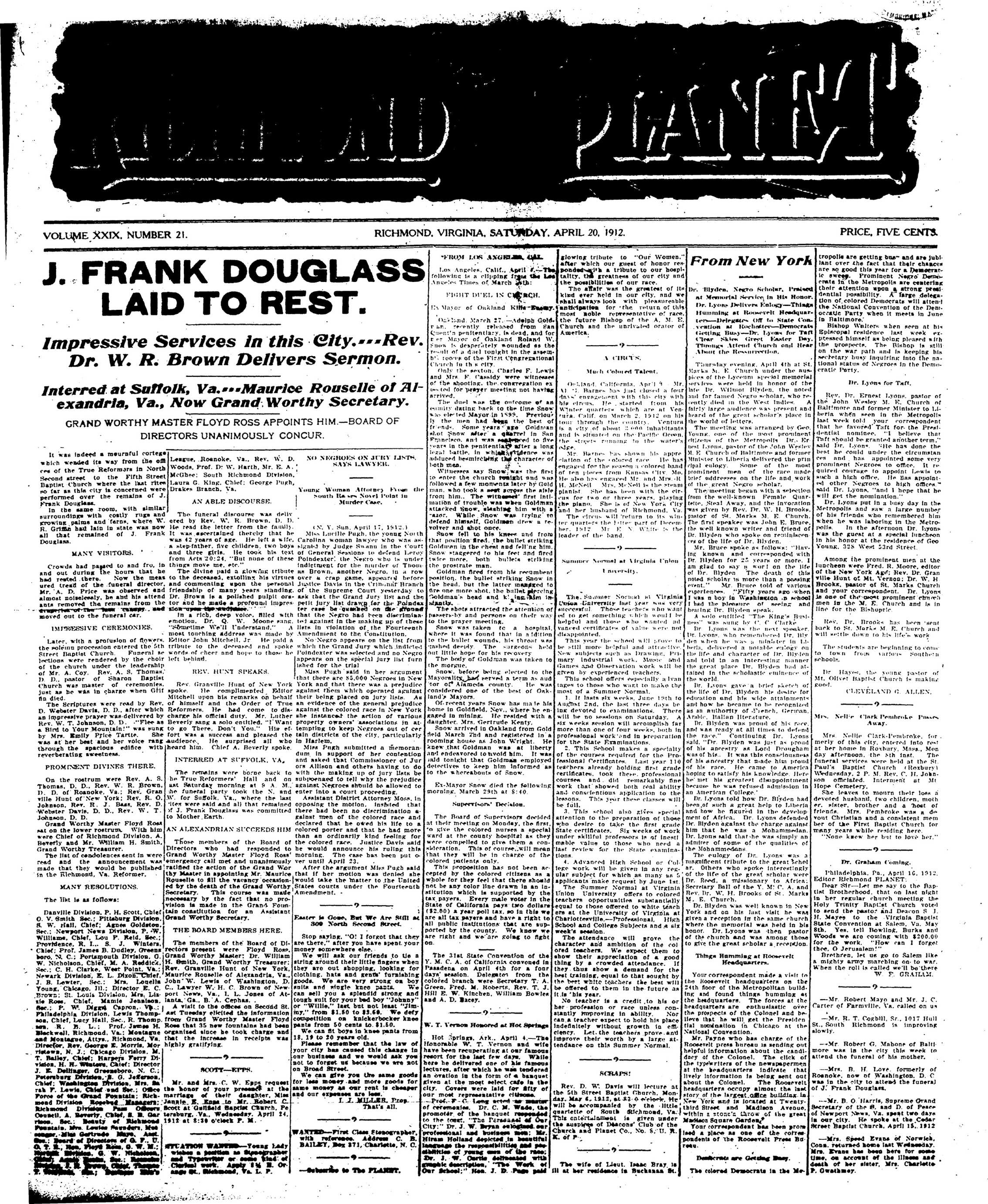
J. FRANK DOUGLASS LAID TO REST.
Impressive Services in this City. Rev. Dr. W. R. Brown Delivers Sermon.
Interred at Suffolk, Va. Maurice Rouselle of Alexandria, Va., Now Grand Worthy Secretary. GRAND WORTHY MASTER FLOYD ROSS APPOINTS HIM.—BOARD OF DIRECTORS UNANIMOUSLY CONCUR.
VOLUME XXIX, NUMBER 21.
J. FRAN
LAID
Impressive Ser
Dr. W. R. Br
Interred at Suffolk,
exandria, Va., No
GRAND WORTHY MASTER
DIRECTOR
It was indeed a mournful cortege which wended its way from the offices of the True Reformers in North Second street to the Fifth Street Baptist Church where the last rites so far as this city is concerned were performed over the remains of J. Frank Douglass.
In the same room, with similar surroundings with costly rugs and growing palms and ferns, where W. R. Griffin had lain in state was now all that remained of J. Frank Douglas.
MANY VISITORS.
Crowds had passed to and fro, in and out during the hours that he had rested there. Now the measured tread of the funeral director, Mr. A. D. Price was observed and almost noiselessly, he and his attendants removed the remains from the crematorium of the funeral car. and moved out to the funeral car.
IMPRESSIVE CEREMONIES
Later, with a profusion of flowers, the solemn procession entered the 5th Street Baptist Church. Funeral selections were rendered by the choir of the church under the leadership of Mr. A. Coy. Rev. A. S. Thomas. D. D., pastor of Sharon Baptist Church was master of ceremonies just as he was in charge when Griffin died.
The Scriptures were read by Rev. D. Webater Davis, D. D., after which an impressive prayer was delivered by Rev. W. T. Johnson, D. D. "Flee as a Bird to Your Mountain!" was sung by Mrs. Emily Price Tartte. She was at her best and her voice rang through the spacious edifice with reverberating sweetness.
PROMINENT DIVINES THERE.
On the rostrum were Rev. A. S. Thomas, D. D., Rev. W. R. Brown, D. D. of Roanoke, Va.; Rev. Granville Hunt of New York; Rev. R. O. Johnson, Rev. R. J. Bass, Rev. D. Webster Davis, D. D., Rev. W. T. Johnson, D. D.
Grand Worthy Master Floyd Roast sat on the lower rostrum. With him were Chief of Richmond Division. A. Beverly and Mr. William H. Smith, Grand Worthy Treasurer.
The list of condolences sent in were read and the announcement was made that they would be published in the Richmond, Va. Reformer.
MANY RESOLUTIONS
The List is as follows:
Danville Division. P. H. Scott, Chie
O. V. Smith Sec.; Pittsburgh Division.
B. W. Hall, Chief; Agnes Goldaton
Sec.; Newport News Division, P. W.
Williams, Chief, Lou P. Reid, Sec.
Providence, R. I., J. Winters,
Chief; Prof. James B. Dudley, Greensboro, N. C.; Portsmouth Division, G. W. Nicholson, Chief, M. A. Reddick, Sec.; C. H. Clarke, West Point, Va.
Newark Division, E. L. Dixon, Chief,
J. B. Lawter, Sec.; Mrs. Louleia Young, Chicago, Ill.; Director E. C. Brown; St. Louis Division, Mrs. Liaie Rose, Chief, Mamie Jennison, Sec.; P. W. Diggar Capron, Vp.
Philadelphia Division, Lewis Thompson, Chief, Lucy Hall, Sec. R. Thompson, R. B. L.; Prof. James H. Blackwell, Richmond, Va.; Montague and Montague, Attys, Richmond, Va. Director, Rev. George E. Morris, Morristown, N. J.; Chicago Division, M. T. Bailey, Chief; Harper Perry Division, H. H. Winters, Chief; Director J. E. Dellinger, Greensboro, N. C.
Petersburg Division, B. G. Jefferson, Chief; Washington Division, Mrs. Rah P. Lewis, Chief and Sec.; Office Forces of the Grand Mountain; Richmond Division, Ropod Managerr; Richmond Division, Pam Offshore Council, A. Beverly, Chief, B. B. Garrison, Sec.; Beauty of Richmond Mountain, Mrs. Louise Pardurens, Monsieur, Miss Gertrude Maye, Asst. Sec.; Board of Directors of G. F. U. G. T. R. Hon. Floyd Benton, G. W. M.; Norfolk Division, G. W. Nicholson, Chief, Amelia Benton, Sec.; Rennie Benton, J. R. Brown, Chief, Thomas P. Benton, Sec.; Bingham Benton
League, Roanoke, Va., Rev. W. D.
Woods, Prof. D: W. Harth, Mr. E. A.
McGhee: South Richmond Division,
Laura G. King, Chief: George Pugh,
Drakes Branch, Va.
AN ABLE DISCOURSE.
The funeral discourse was delivered by Rev. W, R. Brown, D. D. He read the letter from the family. It was ascertained thereby that he was 42 years of age. He left a wife, a step-father, five children, two boys and three girls. He took his text from Acts 20:24. "But none of these things move me, etc."
The divine paid a glowing tribute to the deceased, extolling his virtues and commenting upon the personal friendship of many years standing. Dr. Brown is a polished pulpit orator and he made a profound impression upon the audience.
In a rich, deep voice, filled with emotion, Dr. Q. W. Moone sang. "Sometimes We'll understand." A most touching address was made by Editor John Mitchell, Jr. He paid a tribute to the deceased and spoke words of cheer and hope to those he left behind.
REV. HUNT SPEAKS.
Rev. Granville Hunt of New York spoke. He complimented Editor Mitchell upon his remarks on behalf of himself and the Order of True Reformers. He had come to discharge his official duty. Mr. Luther Beverly sang a solo entitled, "I Want to go There. Don't You." His effort was a success and pleased the audience. He surprised all who heard him. Chief A. Beverly spoke.
INTERRED AT SUFFOLK, VA.
The remains were borne back to the True Reformers' Hall and on sat Saturday morning at 9 A.M. the funeral party took the N. and W. for Suffolk, Va., where the last items were said and all that remained of J. Frank Douglass was committed to Mother Earth.
AN ALEXANDRIAN SUCCEEDS HIM
Those members of the Board of Directors who had responded to Grand Worthy Master Floyd Ross' emergency call met and unanimously ratified the action of the Grand Worthy Master in appointing Mr. Maurice Roussele to all the vacancy occasioned by the death of the Grand Worthy Secretary. This course was made necessary by the fact that no provision is made in the Grand Fountain constitution for an Assistant Grand Worthy Secretary.
THE BOARD MEMBERS HERE.
The members of the Board of Directors present were Floyd Rose Grand Worthy Master; Dr. William H. Smith, Grand Worthy Treasurer; Rev. Granville Hunt of New York; Maurice Roussele of Alexandria, Va.; John W. Lewis of Washington, D.C.; Lawyer W. H. C. Brown of Newport News, Va.; I. L. Jones of Atlanta, Ga.; B. A. Cephas. A visit to the offices on Second Street Tuesday elicited the information from Grand Worthy Master Floyd Rose that 35 new fountains had been organized since he took charge and that the increase in receipts was highly gratifying.
SCOTT-EPTS
Mr. and Mrs. C. W. Eppes request the honor of your presence at the marriage of their daughter, Miss Janiele E. Kpaa to Mr. Robert C. Scott at Guilfald Baptist Church, Petersburg, Va. Wednesday, April 24, 1912 at 8:00 o'clock P. M.
NITCATION WARDEN—Young Lady
wishes a position as Photographer
and Typewriter or some kind of
Charles work. Apply 1% M. Or-
ganize St. Richmond, Va. L. P.
NO NEGROES ON JURY LISTS,
SAYS LAWYER.
Young Woman Attorney From the
South Raises Novel Point in
Murder Case.
(N. Y. Sun, April 11, 1912).
Miss Lillepugh Pule, the young North Carolina woman lawyer who was assigned by Judge Swann in the Court of General Sessions to defend Leroy Polindexter, the Negro who is under indictment for the murder of Thomas Brown, another Negro, in a row over a crap game, appears before Justice Davis in the Criminal Branch of the Supreme Court yesterday to ask that the Grand Jury list and the petit jury list drawn for the Polindexter case be quashed on the ground that the Negro had been discriminated against in the making up of these lists in violation of the Fourteenth Amendment to the Constitution.
No Negro appears on the list from which the Grand Jury which indicted Polindexter was selected and no Negro appears on the special jury list furnished for the trial.
Miss Pugh said in her argument that there are 85,000 Negroes in New York and that there was a prejudice against them which operated against their being placed on jury lists. As an evidence of the general prejudice against the colored race in New York she instanced the action of various property owners' associations in attempting to keep Negroes out of certain districts of the city, particularly in Harlem.
Miss Pugh submitted a memorandum in support of her contention and asked that Commissioner of Jury Orsia Allison and others having to do with the making up of jury lists be subpoenaed to tell why the prejudice against Negroes should be allowed to enter into a court proceeding.
Assistant District Attorney Moss, in opposing the motion, insisted that there had been no discrimination against men of the colored race and declared that he owed his life to a colored porter and that he had more than an ordinarily kind feeling for the colored race. Justice Davis said he would announce his ruling this morning. The case has been put over until April 23.
After the argument Miss Pugh said that if her motion was denied she would take the matter to the United States courts under the Fourteenth Amendment.
Easter is Gone, But We Are Still at 300 North Second Street.
Stop saying, "O! I forgot that they are there," after you have spent your money somewhere else.
We will ask our friends to tie a string around their little fingers when they are out shopping, looking for clothing, hats and gents' furnishing goods. We are very strong on boy suits and single knee pants. We can sell you a splendid strong and tough suit for your bed boy "Johnny" or "Willie," but last not less "Jimmy," from $1.50 to $3.60. We defy competition on knickerbocker knee pants from 50 cents to $1.50.
We can fit boys in knee pants from 18, 19 to 20 years old.
Please remember that the law of your city has caused this change in our business and we would ask you not to forget us because we are not on Broad Street.
We can give you the same goods for less money and more goods for same money as our rent is cheaper and our expenses are less.
WANTED—First Class Photographer
with reference. Address C. B.
BAILEY, Box 371, Charlotte, N. C.
FROM LOS ANGELES, CA
Los Angeles, Calif., April 6. The following is a clipping from the Los Angeles Times of March 20th:
By Mayor of Oakland Kills-Enquiry.
Oakland, March 27. Adolph Goldman, recently released from San Countin penitentiary, is dead, and for Mayor of Oakland Roland W. Snow is desperately wounded as the result of a duel tonight in the assembly room of the First Congregational Church in the city.
Only the sexton, Charles F. Lewis and Mrs. F. Cassidy were witnesses of the shooting, the congregation expected for prayer meeting not having arrived.
The duel was the outcome of an county dating back to the time Snow was elected Mayor in 1889. Previously the men had been the best of friends. Some years ago Goldman shot Snow after a quarrel in San Francisco, and was sentenced to five years in the penitentiary after a long legal battle. In which evidence was added beaming the character of both men.
Witnesses say Snow was the first to enter the church tonight and was followed a few moments later by Goldman, who took a seat across the aisle from him. The witness first intimation of trouble was when Goldman attacked Snow, blashing him with a razor. While Snow was trying to defend himself, Goldman drew a revolver and shot once.
Snow fell to his knee and from that position fired the bullet striking Goldman in the chest and felling him. Snow staggered to his feet and fired twice more, both bullets striking the prostrate man.
Goldman fired from his recumbent position, the bullet striking Snow in the head, but the latter managed to fire one more shot, the bullet piercing Goldman's head and killing him instantly.
The shots attracted the attention of passers-by and persons on their way to the prayer meeting.
Snow was taken to a hospital, where it was found that in addition to the bullet wounds, his throat was gushed deeply. The surgeons held out little hope for his recovery.
The body of Goldman was taken to the morgue.
Snow, before being elected to the Mayoralty, had served a term as and for of Alameda county. He was considered one of the best of Oakland's Mayors.
Of recent years Snow has made his home in Goldfield, New, where he engaged in mining. He resided with a daughter, Mrs. Gertrude Kenty.
Snow arrived in Oakland from Goldfield March 2nd and registered in a rooming house as John Wright. He knew that Goldman was at liberty and endeavored to avoid him. It was told tonight that Goldman employed detectives to keep him informed as to the whereabouts of Snow.
Ex-Mayor Snow died the following
morning, March 29th at $:40.
Supervisors' Decision.
The Board of Supervisors decided at their meeting on Monday, the first, to give the colored nurses a special ward at the county hospital as they were compelled to give them a consideration. This of course, will mean that they will be in charge of the colored patients only.
This proposition has not been accepted by the colored citizens as a whole for they feel that there should not be any color line drawn in an institution which is supported by the tax payers. Every male voter in the State of California pays two dollars ($2.00) a year poll tax, so in this we are all tax payers and have a right to all public institutions that are supported by the county. We know we are right and we are going to fight on.
The 31st State Convention of the Y. M. C. A. of California convoked in Pasadena on April 4th for a four days' session. Delegates from the colored branch were Secretary T. A. Green, Fred. M. Roberts, Rev. T. J. Hill E. W. Kinchen, William Bowles and A. D. Bacey.
W. T. Vernon Honored at Hot Springs
Hot Springs, Ark., April 4.—The Honorable W. T. Vernon and wife have been recuperating at our famous resort for the last few days. While here he delivered one of his famous lectures, after which he was tendered an ovation in the form of a banquet given at the most select café in the city. Covers were laid for fifty of our most representative clitons.—Prof. F. C. Long acted as minister of ceremonies. Dr. C. M. Wade, the promoter of the banquet responded to the request, "The Personnel of Our City." Dr. J. W. Bryan enlisted our professional and business men; Mr. Miram Holland depicted in beautiful language the responsibilities and possibility of young men of the race; Dr. J. W. Curtis delivered with graphic description, "The Work of our School." Hoe J. D. Pamela said
glowing tribute to "Our Women." after which our guest of honor responded with a tribute to our hospitality, the greatness of our city and the possibilities of our race. The affair was the greatest of its kind ever held in our city, and we shall always look with pleasureable anticipation for the return of this most noble representative of race, the future Bishop of the A. M. E. Church and the unrivaled orator of America.
A CIRCUS.
Much Colored Talent
Oakland, California, April 4. Mr. A. L. Barnes has just closed a four day's engagement with this city with his circus. He started from his Winter quarters which are at Ventura, Calif. on March 2, 1912 on his tour through the country. Ventura is a city of about 2,000 inhabitants and is situated on the Pacific Ocean, the streets running to the water's edge.
Mr. Barnes has shown his appreciation of the colored race. He has engaged for the season a colored band of ten pieces from Kansas City, Mo. He also has engaged Mr. and Mrs. H. McNeil Mrs. McNeil is the steam pianist. She has been with the circus for two or three years, playing the piano. She is of New York City and her husband of Richmond, Va. The circus will return to its winter quarters the latter part of December. 1912 Mr. E. N. White is the leader of the band.
Summer Normal at Virginia Union University.
The Summer Normal at Virginia University that year was very successful. Those teachers who wanted to get something which would be helpful and those who wanted advanced certificates of value were not disappointed.
This year the school will prove to be still more helpful and attractive. New subjects such as Drawing, Primary Industrial work, Music and Games and Observation work will be given by experienced teachers.
This school offers especially a variety tages to those who want to make the most of a Summer Normal.
1. It lasts six weeks, June 19th to August 2nd, the last three days being devoted to examinations. There will be no sessions on Saturday. A six weeks session will accomplish far more than one of four weeks, both in professional work and in preparation for the State Examinations.
2. This School makes a specialty of the courses required for the Professional Certificates. Last year 110 teachers already holding first grade certificates, took these, professional courses and did remarkably fine work that showed both real ability and conscientious application to the lessons. This year these classes will be full.
3. This school also gives special attention to the preparation of those who desire to take the first grade State certificates. Six weeks of work under skillful professors is of inestimable value to those who need a last review for the State examinations.
4. Advanced High School or College work will be given in any regular subject for which as many as 5 applicants make request by June last. The Summer Normal at Virginia Union University offers to colored teachers opportunities substantially equal to those offered to white teachers at the University of Virginia at Charlottesville.—Professional, High School and College Subjects and a six week's season.
The attendance will prove the character and ambition of the colored teachers. We expect them to show their appreciation of a good thing by a crowded attendance. If they thus show a demand for the best training, equal to that sought by the best white teachers the best will be offered to them in the future as it is 'his year.
No teacher is a credit to his or her profession or race unless constantly improving in ability. Nor can a teacher expect to hold his place indefinitely without growth in efficiency. Let the teachers prove and improve their worth by a large attendance on this Summer Normal.
SCRAPS!
Rev. D. W. Davis will lecture at the 5th Street Baptist Church. Monday, May 6, 1912, at 8:30 o'clock. He will be accompanied by the little quartette of South Richmond, Va. This entertainment is given under the auspices of Daacons' Club of the Church and Planet Co., No. 8, U. R. K. of F.
The wife of Lieut. Isaac Bray is ill at her residence in Buchanan St.
From New York
Dr. Blyden, Negro Scholar, Praised at Memorial Service in His Honor. Dr. Lyons Delivers Elogy—Things Humming at Roosevelt Headquarter—Dellegates Off to State Convention at Rochostes—Democrat Getting Busy—Dr. Lyons for Tart Clear Skies, Great Easter Day. Timings Attend Church and Hear About the Resurrection.
Thursday evening, April 4th at St. Marks M. E. Church under the auspices of the Lyceum special memorial services were held in honor of the late Dr. Writom Blyden, the noted and far famed Negro scholar, who recently died in the West Indies. A fairly large audience was present and heard of the great scholar's place in the world of letters.
The meeting was arranged by Geo. Young, one of the most prominent citizens of the Metropolis Dr. Ernest Lyons, pastor of the John Wesley M. E. Church of Baltimore and former Minister to Liberia delivered the principal ecology. Some of the most prominent men of the race made brief addresses on the life and work of the great Negro scholar.
The meeting began with a selection from the well-known Female Quartette, Steal Away, and the Invocation was given by Rev. Dr. W. H. Brooks, pastor of St. Marks M. E. Church. The first speaker was John E. Bruce, the well known writer and friend of Dr. Blyden who spoke on reminiscences of the life of Dr. Blyden.
Mr. Bruce spoke as follows: "Having known and corresponded with Dr. Blyden for 25 years or more, I am glad to say in word on the life of Dr. Blyden. The death of this noted scholar is more than a passing event." Mr. Bruce told of various experiences. "Fifty years ago when I was a boy in Washington in school I had the pleasure of seeing and hearing Dr. Blyden speak.
A solo entitled "The King's Business" was sung by C. C. Clarke. Dr. Lyons was the next speaker. Dr. Lyons, who remembered Dr. Blyden when he was a midwinter in Liberia, delivered a notable enlogy on the life and character of Dr. Blyden and told in an interesting manner the great place Dr. Blyden had attained in the scholastic enmity of the world.
Dr. Lyons gave a brief sketch of the life of Dr. Blyden his desire for education and his wide attributions and how he became to be recognized as an authority of French, German, Arabic, Italian literature.
Dr. Blyden was proud of his race, and was ready at all times to defend the race." Continuing Dr. Lyons said, "Dr. Blyden was just as proud of his ancestry as Lord Droughtam was of his. It was this consciousness of his ancestry that made him proud of his race. He came to America hoping to satisfy his knowledge. Here he met his greatest disappointment because he was refused admission in an American College."
Dr. Lyons told how Dr. Blydon had been of such a great help to Liberia and how he figured in the development of Africa. Dr. Lyons defended Dr. Blydon against the charge against him that he was a Mohammedan. Dr. Lyons said that he was simply an admirer of some of the qualities of the Mohammedans.
The eulogy of Dr. Lyons was a magnificent tribute to the great scholar. Others who spoke interestingly of the life of the great scholar were Dr. Reed, a missionary to Africa; Secretary Ball of the Y. M. C. A. and Rev. Dr. W. H. Brooks of St. Marks M. E. Church.
Dr. Blydon was well known in New York and on his first visit he was given a reception in the same church where the memorial was held in his honor. Dr. Lyons was then pastor of the church and was among those to give the great scholar a recorder.
Things Humming at Roosevelt
Headquarters.
Your correspondent made a visit to the Roosevelt headquarters on the 24th floor of the Metropolitan building and found things humming at the headquarters. The forces at the headquarters are enthusiastic over the prospects of the Colonel and believe that he will get the Presidential nomination in Chicago at the National Convention.
Mr. Payne who has charge of the Roosevelt press bureau is sending out helpful information about the candidacy of the Colonel. The click of the typewriters of the newspaper at the headquarters indicate that lively information is being sent out about the Colonel. The Roosevelt headquarters occupy almost the last story of the largest building in New York and is located at Twenty-third Street and Madison Avenue, within a stone's throw of the great Madison Square Garden.
Your correspondent has been promised a place as one of the correspondents of the Roosevelt Press Bureau.
Democrats are Greeting Busy.
The colored Democrats in the Me-
PRICE. FIVE CENTS
tropolis are getting busy and are jubilant over the fact that their chances are so good this year for a Democratic sweep. Prominent Negro Democrats in the Metropolis are centerring their attention upon a strong presidential possibility. A large delegation of colored Democrats will attend the National Convention of the Democratic Party when it meets in June in Baltimore.
Bishop Walters when seen at his Episcopal residence last week expressed himself as being pleased with the prospect. The Bishop is still on the war path and is keeping his secretary busy inquiring into the national status of Negroes in the Democratic Party.
Dr. Lyons for Taft.
Rev. Dr. Ernest Lyons, pastor of the John Wesley M. E. Church of Baltimore and former Minister to Liberia when seen in the Metropolis last week told your correspondent that he favored Taft for the Presidential nominee. "I believe that Taft should be granted another term," said Dr. Lyons. "He has done the best he could under the circumstance and has appointed some very prominent Negroes to office. It required courage to appoint Lewis to such a high office. He has appointed other Negroes to high offices." said Dr. Lyons, "and I hope that he will get the nomination."
Dr. Lyons put in a busy day in the Metropolis and saw a large number of his friends who remembered him when he was laboring in the Metropolis. In the afternoon Dr. Lyons was the guest at a special luncheon in his honor at the residence of Geo Young, 328 West 53rd Street.
Among the prominent men at the luncheon were Fred. R. Moore, editor of the New York Age; Rev. Dr. Granville Hunt of Mt. Vernon; Dr. W. H. Brooks, pastor of St. Marks Church and your correspondent. Dr. Lyons is one of the most prominent churchmen in the M. E. Church and is in line for the Bishopric.
Rev. Dr. Brooks has been sent back to St. Marks M. E. Church and will settle down to his life's work.
The students are beginning to come to town from various Southern schools.
Dr. Hayes, the young pastor of Mt. Olivet Baptist Church is making good.
CLEVELAND G. ALLEN.
Mrs. Nellie Clark Pembroke Passes
Away.
Mrs. Nellie Clark-Pembroke, formerly of this city, entered into rest at her home in Roxbury, Mass., Monday afternoon, the 9th inst. The funeral services were held at the St. Paul's Baptist Church (Roxbury) Wednesday, 2 P. M. Rev. C. H. Johnson officiated. Interment at Mt. Hope Cemetery. She leaves to mourn their loss a devoted husband, two children, moth er, sister, brother and a host of friends. Mrs. Pembroke was a devout Christian and a consistent member of the First Baptist Church for many years while residing here. "None knew her but to love her."
Dr. Graham Coming.
Philadelphia, Pa., April 16, 1912.
Editor Richmond PLANET.
Dear Sir--Let me say to the Baptist Brotherhood, that on last night in her regular church meeting the Holy Trinity Baptist Church voted to send the pastor and Deacon S. J. H. Mayes to the Virginia Baptist State Convention at Salem, Va. May 8th. Yes, tell Bowling, Burks and Woods we are coming with $200.00 for the work. "How can I forget thee, O Jerusalem!" Brothren, let us go to Salem like a mighty army marching on to war. When the roll is called we'll be there W. F. GRAVAN
2
Mr. Robert Mayo and Mr. J. C. Carter of Farmville, Va. called on us
Mr. R. T. Cogbill, Sr., 1017 Hull St., South Richmond is improving slowly.
Mr. Robert G. Mabone of Baltimore was in the city this week to attend the funeral of his mother.
Mrs. B. H. Love, formerly of Roanoke, now of Washington, D. C. was in the city to attend the funeral of J. Frank Douglass.
Mr. B. O. Harris, Supreme Grand Secretary of the S. and D. of Peace of Newport News, Va. spent two days in our city. He spoke at the Codar Street Baptist Church, April 15, 1912
Mrs. Speed Evans of Norwich, Conn. returned home last Wednesday. Mrs. Evans has been here for some time, on account of the illness and death of her sister, Mrs. Charlotte P. Gwathmey.
P. M.
SYNOPSIS
John Cowles of Virginia kisses his neighbor, Miss Grace Sheraton, and meets Gordon Orme, a mysterious Englishman.
Cowles whites a man for affronting Grace Orme challenges him to a wrestling bout. A desperate contest follows, resulting in a row.
The swain is threatening to second Cowles saves Grace from an infuriated ball and becomes engaged to her.
Cowles' father, who is involved in a big cool land deal, is robbed and murdered. Cowles starts meet to see Colonial Merriweiler, his father's partner in the dept.
In St. Louis he again meets Orme, and they are matched in a pigeon shoot. At an army ball Cowles meets a masked girl named Ellen.
Cowles, forgetting Grace, tells Ellen that not only will win her heart. He does not know her full name. The pigeon match begins.
CHAPTER VII.
EVENTS had somewhat hurried me in the two days since my arrival at Jefferson barracks, but on the morning following the awkward end of my match with Grime I had opportunity and occasion to take stock of myself and of my plans. The mails brought me two letters posted at Wellingford soon after my departure, one from Grace Sheraton and one from my mother. The first one was—what shall I say? Better perhaps that I should say nothing save that it was like Grace Sheraton herself, formal, correct and cold. It was the first written word I had ever received from my fiancee, and I had expected—I do not know what. Certainly I had not expected to see sitting on the page written in my fiancee's hand the face of another woman. I hated myself for it.
The second letter was from my mother, and it left me still more disconcerted and sad. "Jack," it said, "I give unapasible. I am sad beyond all singings of sadness. I need these. Come back the first day they can to my mother."
Yet the post adjutant had received word that Colonel Merlwerth would be gone for some days or weeks on the upper frontier. Therefore I wrote my fancy and my mother that it would be impossible for me to return at the time or at any positive future time then determinable. That night I passed away on the River Bole, bound up the Missouri. Our churning wheels had hardly reached the turbid food of the Missouri before the spell of the frontier had caught me.
I made friends with many of these strange travelers and was attracted especially by one, a reticent man of perhaps sixty odd years, in western garb, full of beard and with long hair reaching to his shoulders. Aubery was his name, and his tales set my blood a tingle. He was bound, as he informed me, for Larnarie; always provided that the Slonx, now grown exceedingly restless over the many wagon trains pushing up the Platte to all the swiftly opening west, was not by this time swooped down and closed all the trails entirely.
Among the skin clad trappers, hunters and long haired plainsmen I saw but one woman. I should say that she was at least sixty years of age and nearly six feet in height, thin, angular.
wrinkled and sinny. She wore a sunbonet of an ommons projection, dipped snuff vigorously every few moments and never allowed from her hands a long squirrel ride. She was accompanied by her son, a tall, thin, age amitten youth of perhaps seventeen years and a height about as great as her own. When I first saw them she was driving her son before her to a spot where an opening offered near the bow of the boat, in full sight of the passengers, of whose attention she was quite oblivious.
"Gill up, there. Andy Jackson" she said. "Stan up."
The boy, his long legs braiding under him and his peaked face still more pale, did as he was bid. He had no more taken his position than to my surprise I saw his mother cover him with the long barrel of a dragon revolver.
"Pull your gun, you low down coward," she commanded. Rebutantly the boy complied, his own revolver trembling in his hand.
"Now, what'd you do if a man was to knive you like I'm a dota 'pow' now? demanded his mother.
"G-ge-gunn, mow, I dunnel! I think I'd j-j-j-jump off in the river," exclaimed the boy.
"Where you went, and good luck if you'd git plum downward, you whirrved out of an abyss. Wherever in this pew the world you was burned for gradually to more 's I can sell, and I
THE WAY
Copyright, 1997 by the Oyling Publishing Company
your maw at that, that orto know if anybody could."
"Madam," I interrupted. "what do you mean by such talk to your son for I presume he is your son?"
"Shut up and mind yore own business!" answered the dragon, swiftly turning the barrel of her weapon upon me. "What business is this here or yores?"
"None, madam," I bowed, "but I was only curious."
"You keep your own curiosity to yourself of your gold to travel in these parts. That's a mighty good thing for you to learn. You, Andrew Jackson, stick your plato up against your head the way I told you. Now snap, it dash you! Stop it till you get through beared of it. Do not, or by good, I will chase you over the side of the boat and feed you to the cottish, you low down imprintation of the thing."
"My good woman," said I. "do you mind telling me what is your name?" "Name's Mandy McGovern, and come from Pike," she answered, almost before the words were out of mouth. "Two been married three times, and my first two husbands died a-fightin' like gentlemen in difficult with friends. Then along come this Danny Calkins, that taken up some land high to me in the bottoms—low downest coward of a man that eye disgraced the site of yearb—and then I married him."
"Is he dead, too, my dear woman? I asked."
"Don't you 'dear woman me. I ain't free to merry again girl," said she "Naw, he ain't dead, and I ain't noe vored either. I just done left him. Why, every man in I like has whipped Danny Calkin one time or other. When a man couldn't git no reputation any other way he'd come erong and whipped my husband. I got right tired of it. And me the wife of two real men, before then: I had eight children by my two husbands that warreal men, and every one of them died or got killed like a man or went well like a man exceptin' this thing there the son of that there Danny Calkin. Why, he's afraid to gooon hunntin' at night for fear the cat'll get him. He don't like to mok a kow for fear shell kick him. He's afraid to count a gal. He kain't shoot, he kain't chomp he kain't do nothin'" "Say, mister," said she, "how tall are you?" "About my feet, I think." "Hunt! That's just about how tall
my first husband was. You look some like him in the face too. Say, he was the fightin'est man in Like. How come him to get killed was a diffikulty with his brother-in-law, a Dutchman that kept a sailoon and couldn't talk English. Jim, he went in there to get a bite to eat and asked this Dutchman what he could set up. Paul—that was the Dutchman's name—he says, "Well we got dawg—mallard dawg and redhead dawg and canvassback dawg—what's the kind of dawg you like, Chim?"
"My husband thought he was pokin' fun at him, jikin' about eatin' dawg, not knowin' the Dutchman was tryin' to say 'duck' and couldn't. I might have a piece of duck,' said Jim, 'but I ain't eatin' no dawg."
"I said dawg, says Paul, still a try in' to say 'duck'."
"I know you did," says Jim, and then they climbed. Jim he broke his knife off, and the Dutchman snooked him with a beer mallet. "Till, Mandy, says Jim to me just before he sheet jibes, I die content. That there follow was the sweetest cutin' man. I ever did cut in all my life. He was just like a ripe pumpkin.' Say, there was a man for you, was Jim. You look some like him."
"You compliment me very much, Mr. McGovern." I said.
"Say," she responded. "I got 2,000 head o' hawks runnin' around in the timber down there in Pike."
At the moment I did not see the velled tenderness of this speech, but thought of nothing better than to tell bet that I was going no farther up the river than Fort Leavenworth.
"And I may be a widder almost any day now: somebody I'll shore Kill Dan my Calkins 'fore long.' was Mandy's final hint.
We were running in the dark before the rising of the moon, a thing cautious steamboat men would perkiventure, when some time toward midnight there came a slight shock, a grating slide and a rasping crack of wood. With a forward clawing of her padelles which sent water high along the rail the River Bob shouted and lay still, her engines thrubbing and grousing.
I joined the rush to the bows and leaning over, saw that we were hard ground at the lower end of a sand bar. Imbedded in this bar was a long white mug, a tree trunk whose makesmatter, throwing for downwards, had literally impaled in. The upper wood work of the heat was placed quite through, and, for all that one reckon, tall at the moment, the bolt below the line was in all illuminated similarly enclosed.
Judden disaster usually brings and can calm, the pause before resurrection or resurrection. Bounding down the compassway, I found myself enclosed.
a curved of omnidirection, stare of vism, with many of the gunnery guns, were pounding around the war board roll, whence could be seen the glance of the fire slew shout, the gangway door on the opposite side of the beat was open. I ignoring her and, making good my hold upon the nearest kis as I plunged, found my self standing in not more than four feet of water, the foot of the ear evidently running down well under the boat. As I turned to call to others I saw the tail figure of my phantom. Abbery, taking a leap leap, and be joked me on the mag. "It's better here than there," he said. "If she sinks on busks, and they're alline likely to do both."
As we pulled ourselves up into the fork of the long naked branch we
PARKER
Up We Chambered, the Girl Catching Her Breath in Terror.
heard a voice and saw a woman leaning over the wall of the upper deck. I recognized Mandy McGovern. "Wha you all doin' down there?" she called. "Wait a minute, I comin' too." A moment later she appeared at the opening of the deck and craned out the long deck. I saw at her gate the figure of a young woman, her half fallen from its legs, her feet bare, her body wrapped apparently only in some light silken dressing to be thrown above her night wan.
"Here you," called out the Mandy McGovern. "girl hold out the end of this rope."
She tossed to me the end of the gang-plank rope, by which the sliding stage was drawn out and in at the boat.
landings. I caught this and passed it over a projection on the snag.
The gangplank, confined by the rope, awaived in the current alongside the snag, but it seemed useless to undertake to restore it to its position. The girl covered against the side of the dock opening. "Walt," I called to her, and slipping down into the water again. I waded as close as I could to the door, the water then catching me close to the shoulders.
"Jump!" I ordered, holding out my arms.
"I can't: I'm afraid," she said.
"Do as I tell you!" I roared. "Jump at once." As I caught her weight with my arms under her she was for the moment almost immersed, but I staggered backward and managed to hold my footing till Aubrey's arm reached us from the ankle, up which we clambered, the girl dripping wet and catching her breath in terror.
We had traveled perhaps three-quarter of a mile when I noticed the dim loom of trees on our side of the stream and saw that we were ap proaching a long point which ran our below us. This should have been the deep side of the river, but no one can account for the vagaries of the Missouri. When we were within a hundred yards or so of the point we felt a long abddering scrape under us, and after a series of alps and jerks our old song came to anchor again, its roots having once more held hold upon a bar. It occurred to me that as I had been able to touch bottom on the other bar I might do so here. I crawled back along the trunk of the snag to a place near the roots as I could reach and letting myself down gently, found that I could keep my footing on the sand.
Little by little I edged up the stream and found that the water shoaled to ward the heap of driftwood. It dropped off, I know not how deep, between the edge of the bar and the piloted drift, but, standing no more than waist deep, I could reach the outer limbs of the drift and saw that they would support my weight. After that I waded back to the song carefully and once more ordered the young woman to come in.
She came back along the naked and slippery trunk of the anag, pelling her self along by her hands, her bare feet and limbs deep in the water alongside I could hear the sob of her inkened breath and saw that she trembled in fright, and, more dead than alive, it seemed to me, she fell once more into my arms. I felt her grasp tighten about my neck and her firm body crowd against me as we both mask down for an instant. Then I caught my feet and straightened and was realy the steeder for the added weight, as any one knows who has waded in that water.
"Let up, Anberry." I said to him as he approached and motioned to the long, overhanging branches from the driftwood. He hung up, breathing of the more insecure beams, and was of the belief that we could get access in that way. As he reached down I saw the young woman up to him and she clambered on as best she could. Then, I moved know how, we all managed to reach the gold drift and so accidentally found ourselves
alarm on all burgers easily bumped against on the bench by a burgers gun of yellow.
"Now then, pop man," sprained Lanny Lichtenborn. "we must get wet and a bite to the right way. Like her girl we shaking the tooth pouch down her hand." Minorly draw forth two hands, each wrapped with a bit of corset. This one lifebacker matches, then hops quite dry, and this she passed to me. The other she handed to the young woman.
"Hare, and like, "take a drink of that. It'll do you good."
I heard the man] grasp and choke as she obeyed the instruction, and then曼ly applied the bottle gurglingly to her own lips.
Presently we had a rearing blaze started, and gaudy, saunting herself comfortably upon a log and producing a cornhole pipe and a quantity of natural leaf tobacco, proceeded to enjoy herself in her own fashion. "This here's all right," she remarked. "We might be a heap worse off we air." I could not help pitying the young woman who crouched near her at the fireside, still shivering. She seemed so young and helpless and so out of place in such surroundings. The firelight showed in silhouette the outlines of her face. It seemed to me I had never seen one more beautiful. Perhaps she felt my gaze, for presently she turned and said: "Indeed it might be worse. I thank you so much. It was very brave of you."
We had waited perhaps not over an hour, undecided what to do, when Anberry raised a hand. "Listen," he said. "There's a boat coming," and presently we all heard the splash of oars. Our fire had been seen by one of the boats of the River Belle, out picking up such stragglers as could be found. So our little bioscope on the beach came to an end.
I did not get the name of the girl I had seen there in the freight. What did remain, and that not wholly to my pleasure, so distinct it seemed—was the picture of her high bred profile, shown in chiaroscuro at the fireplace, the line of her chin and neck, the tumbled masses of her hair. These were things I did not care to remember, and I hat myself as a soft hearted fool, seeing that I did so.
"Son," said old Anberry to me after a time as we trudged along up the bank, stumbling over roots and brushed grasses. "that was a nighly fine look in' gal we brung along with us there." I didn't police, said I.
"No," said Auberry solemnly. "I not
taked you didn't take no notice."
"I suppose you're married," I ang
gested.
"Some," said Auberry, chuckling.
"In fact, a good deal. I reckon, my
present woman's a Shoshone—were
lift up Home creek, below Laramie.
Them Shoshones make about the best
dressers of 'em all."
"I don't quite understand"—
"I meant hid. They can make the
best buckskin of any tribe I know." He
walked on ahead in the dark for some
time before he added irrelevantly.
"Well, after all, in some ways women
in women, my son, and men is men,
that bein' the way this world is made
just at these here present times. As
I was sayin', thats a powerful piece
lookin' gal."
It seemed to me that I was gazing
down directly at me one cold, bright,
repeating star, starting into my
soul and accusing me of being nothing
more than a savage, nothing better
than a man.
CHAPTER VIII.
At our little village on the following morning Auberry and I learned that the Ritter Rite would die up indefinitely for repairs and that at least one, perhaps several days would elapse before she resumed her journey up stream. Our plans were changed again, for n young army officer came down from that post with the information that Colonel Merrieth had been ordered out to the posts up the Platte river, had gone for three weeks, and no one could tell what time he would return. The Indians were reported very bad along the Platte. Possibly Colonel Merrieth might be back at Leavenworth within the week, possibly not for a month or more. This was desperate news for me, for I knew that I ought to be starting home at that very time. I wrote home once more, stating that I was not starting east, but going still farther west.
Auberry, as it chanced, fell in with a party bound for Denver, five men who had two wagons, a heavy Consteaux freight wagon of prairie schooner, and a lighter vehicle without a cover. We arranged with these men and their cook as to our shares in the mess box and so throw in our dunnage with theirs. Auberry and I purchasing us a good house apiece. By noon of the next day we were on our way westward.
At last we approached the valley of the Platte. We were coming now indeed into the great plains, of which I had heard all my youth. A new atmosphere seemed to invest the world. The talk of my companions was of things new and wild and strange to me. All my old life seemed to be slipping back of me. into a far oblivion. Mary things became more clear to me as I rode and reflected. In some way, I know not how, it seemed to me that I was growing older.
We had been out more than two weeks when finally we reached the great valley along which lay the west, north highway of the old Oregon trail, now worn damp and dusty by countless wheeens. We pushed up the male trail of the Platte but a short distance that night.
We looked forward to meeting human faces with some pictures. But an hour or so later as we made up I saw Aarbyrry pull up his horse, with a strange thighing of his knee, "Boya," said he, "there's a horse is who." He painted might distracting more than a few lines of rules, but of broken figures a heap of half shoved figures.
"They've been here," said Anthony
and "They've been there."
I would be like the ear corn!
He wipe up in the water, sprinkling
where my mouth could. They sprinkled
and used by a pair of the plague men,
lust them. We kept our ears in lust
we weighed down what we weigh must
be poke—the bodies of the spirit
and his two bodies, punished and
half consumed, under the burned out
thoughts. I saw the bodies, for the
fewer lumps of all three had been
discovered and cast in a heap
near where the bodies of the broome
hay.
The third day"passed until the our tank toward the sand dunes and cost a long path of light across the ripping shadows among the sand burrs of the Platte. But still we saw no signs of movement. Breeding was approach when we heard the sound of a distant dust and saw our horse guard running toward the camp. As he approached he pointed, and we saw a flint cloud of dust coming toward us. The travelers were horses, perhaps thirty or forty in all. Following them came the dust whitened top of an army ambulance and several camp wagons. We hesitated, no longer and quickly mounting our horse rode full speed toward them.
They were a seasoned lot of Harney's frontier fighters, grimed and grizzled, their hats, boots and clothing gray with dust, but their weapons bright. Their leader approached me when I rode up.
"Lieutenant Beltknap" I exclaimed. "Do you remember meeting me down at Jefferson?"
"Why, Mr Cowles, how on earth did you get here? Of course I remember you."
"Yes, but how did you get here yourself? You were not on my boat."
"Orders to take this detachment out to Larraume," he said, "and meet Colonel Melwether there."
"He'll not be back? I was hoping to meet him coming east."
"No," said Bekkman, "you'll have to go on with us if you wish to see him. I'm afraid the Sloux are bad on beyond. He turned toward the ambulance, and I glanced that way. There stood bear it a tall, angular figure head enshrouded in an enormous sunbonnet.
"Why, that's my friend, Mandy McGovern, said I.
At that moment, descending at the rear of the ambulance, I saw the other one."
It was a young woman who left the step of the ambulance and stood for a moment shading her eyes with her hand and looking out over the shimmering expanse of the broad river. All at once the entire landscape was changed. It was not the desert, but civilization, which swept about us. A transgression had been wrought by one figure, fair to look upon. The swift versatility of my soul was upon the point of calling this as fine a figure of young womanhood as I had ever seen. I was about to ask some questions of Beikun when all at once I saw
Pierre
"Why, that's my friend, Mandy Mo. Govern."
something that utterly changed my pleasant frame of mind. The tall figure of a man came from beyond the line of wugou—a man clad in well fitting tweeds cut for riding. I imagine it was the same swifte male jealousy that affected both Belknap and myself as we saw Gordon Orme.
"Yes; there is your friend, the Englishman," said Belknap rather bitterly. "I meet him everywhere." I answered. "The thing is simply uncanny. What is he doing out here?"
"We are taking him out to Laramie with us. He has letters to Colonel Meriwether, it seems. Cowles, what do you know about that man?"
"Nothing," said I, "except that he purports to come from the English army."
"He's prowling about every military post he can get into."
"With a special reference to army officers born in the south?" I looked Belknap in the eye.
"There's something in that," he replied. "I don't like the look of it. Three are good times for every man to attend to his own business."
A moment later I ran across my former friend, Mandy McGovern. In her surprise she stopped chewing tobacco. "Well, I de-clare to grecious," she began. "If here ain't the man I met on the beat! How'd you get away out here ahead of me! Have you new airy bedroom? I'm gettin' pimble welsh for something to meet at."
What I was doing at that precise moment, as I must confess, was taking a half uncumulative look once more toward the tail of the ambiance, where Orme and the young woman stood clapping. It K was at this time that Orme came backward.
"By Jorge," he said, "here you are again! Am I your shadow, Mr. Cowlwyn or are you mine! It is really singular how we meet. I'm awfully glad to meet you, although I don't in the least."
now how you've brought to get here ahead of us."
It distinguished to him the absence of our guests that had been brought about by the assistance to the Silver Bells.
"Lieutenant Balkman tells me did you are going through to Lennox with him," I added, "As it happened, we have the same around. It is my purpose also to call on Colmell Balkwell or there in case we do not meet him coming down."
"How extraordinary! They will be follow travellers for a time and, I hope, have a little sport together. Fine young fellow, Balkman. You'll eat at our meals bought, of course. That our fire just over there, and I'm thinking the cook is nearly ready. There comes Balkman now."
The confusion of these varied meetings had kept me from learning the identity of the late passenger of the ambulance. I presume both Orme and Bellknap supposed that the young lady and I had met before we took our places on the ground at the edge of the blanket which served as a table. I sought a glance at her face, which the next instant was hid by the rim of her hat as she looked down, removing her long gloves. At least I saw her hand—small hands, sun browned now. On one finger was a plain gold ring with a peculiar setting—the figure of a rose carved deep into the gold. "After all," thought I to myself, "there are some things which cannot be duplicated, among these hair like this, a profile like this, a figure like this." I gazed in wonder, then in certainty.
No; there was no escaping the conclusion. This was not another girl, but the same girl seen again.
Bellknap caught the slight restraint.
as the girl and I both raised our eyes. "Ob, I say, why—what in the world—Mr. Cowles, didn't you—that is, haven't you—" "No," said I, "I haven't and didn't. I think. But I think also." "The girl's face was a trifle finished, but her eyes were merry. "Yes," said she, "I think Mr. Cowles and I have met once before." She slightly emphasized the word "once," as I noticed. "But still I may remind you all, gentlemen," said I, "that I have not yet heard this lady's name and am only guessing, of course, that it is Misa Meriwether, whom you are taking out to Laramie." "Why, of course," said Belknap, and "Of course" echoed everybody else. "Yes," said she, "I'm going on out to join my father on the front. This is my second time across, though. Is it your first, Mr. Cowles?" "My first, and I am very lucky. You know I also am going out to meet your father. Misa Meriwether."
"How singular?" She put down her tin cup of coffee on the blanket. "My father was an associate of Colonel Meriwether in some business matters back in Virginia"—Oh, I know—it's about the coal lands that are going to make us all rich some day. Yes, I know about that, though I think your father rarely came over into Albenarle." Under the circumstances I did not care to intrude my personal matters, so I did not mention the cause or explain the nature of my mission in the west. "I suppose that you rarely came into our county either, but went down the Shenandoah when you journeyed to Washington?" I said simply. "I have never met Colonel Meriwether." As we rose from the ground at the conclusion of our meal the girl dropped one of her gloves. I hastened to pick it up, walking with her a few paces afterward.
"The next time we are shipwrecked together," said I. "I shall leave you on the boat. You do not know your friends."
"Why do you say that?"
"And yet I knew you at once. I saw the ring on your hand and recognized it. It is the same I saw in the firelight on the river bank the night we left the belle."
"How brilliant of you! At least you can remember a ring."
"I remember seeing the vell you wear once before—at a certain little meeting between Mr. Orme and my self."
"You seem to have been a haberdasher in your time, Mr. Cowlet. Your memory of a lady's wearing apparel is very exact. I should feel very much fattered." None the less I saw the dimple come in her check.
She was pulling on her glove as she spoke. I saw embroidered on the gaulet the figure of a red heart.
"My memory is still more exact in the manner of apparel," said I. "Miss Merriwether, is this your emblem indeed--this red heart? It seems to me I have also seen it somewhere before." "When Columbus found America," she answered, "it is said that the sages looked up and remarked to him, 'Ah, we see we are discovered!'" "Yes," said I; "you are fully discovered—each of you, all of you; all three or four of you--Miss Ellen Merriwether." "But you did not know it until now—notilic this very moment. You did not know me, could not remember me, not even when the masks were off. Ah, it was good as a play." "I have done nothing else but remember you." "How much I should value your acquaintance, Mr. Cowles of Virginia? How rare an opportunity you have given me of seeing on the inside of a man's heart?" She spoke half bitterly, and I saw that in one way or other she meant revenge.
"I do not understand you," I rejoiced.
"No, I suppose you men are all alike—that any one of you would do the same. It is only the last girl, the near girl, that is remembered. Is it not so?"
"It is not so." I answered.
"How long will you remember me this time one or my clothing, Mr. Covine-until you meet another?"
"All my Life." I meld, "and until you meet again in another other instance, variety. More last time all that I see you mean, me forget all the others, but never once have I forgotten you."
"In my experience," commented the girl, "all men tell very much alike." "Yes, I yield you at the same ball."
The girl looked about gladly. I thought, at the sound of a shuffling step approaching, "You, Aunt Mary? You's called out. And to me, I must say good night, sir."
I could not sleep. I looked up again into the eye of my cold, reproving star. But now, to my surprise and horror, when I looked into the eye of my monitor my own eye would not waver or admit subjection. I rebelled at my own conscience. I, John Cowles, had all my life been a strong man. Now, tonight, I was meeting the strongest antagonist of all my life, the only one I had ever feared. It was none other than I myself, that other John Cowles, young man, and now loose in the vast free garden of living.
Yet I fought with myself. I tried to banish her face from my heart—with all my might and all my conscience and all my remaining principles I did try. I called up to mind my promise, my duties, my honor. But none of these would put her face away. I tried to forget the softness of her voice, the fragrance of her hair, the sweetness of her body once held in my arms, all the vague charm of woman, the enigma, the siphon, the mystery magnet of the world, the charm that has no analis, that knows no formula. But I could not forget. A rage filled me against all the other men in the world. I have said I would set down the truth. The truth is that I longed to rise and roar in the throat, challenging all the other men in the world. In truth, it was my wish to stride over there just beyond into the darkness to take this woman by the shoulders and tell her what was in my blood and in my heart—even though I must tell her in bitterness and self reproach.
It was not the girl to whom I was pledged and plighted, not she to whom I was bound in honor. That was not the one with the fragrant hair, and the eyes of night, and the clear cut face, and the graciously deep bosomed figure—that was not the one. It was an other of infinite variety, one more irresistible with each change, that had set on this combat between me and my own self. I beat my fists upon the earth. All that I could say to myself was that she was sweet, sweet and wonderful, here in the mystery of this wide, calm, inscrutable desert.
CHAPTER IX.
Sioux
BEFORE dawn had broken the clear bugle notes of reverie sounded and set the canyon batte. By the time the sun was fainting tinging the edge of the valley we were drawn up for hot coffee and the plain fate of the prairies. A half hour later the wagon masters called "Roll out." Roll out! The bugles again sounded for the troopers to take sadle, and we were under way, once more.
We had hardly gone five miles beyond the ruined station house when we saw our advance men pull up and raise their hands. We caught it also the sound of approaching hoofs, and all joined in the cry, "Buffalo, Buffalo."
The thunderous rolling sound approached, heavy as that of artillery going into action. We saw dust arrear from the mouth of a little draw on the left, running down toward the valley, and even as we turned there came rolling from its mouth, with the noise of a tornado and the night of a mountain torrent, a vast, confused, dark mass, which rapidly spilled out across the valley ahead of us. We were almost at the banks of the herd before they reached the river bank. We were among them when they panned. The front ranks rolled back upon those behind, which, crowded from the rear, resisted. The whole front of the mass wrinkled up mightily, dark humps arcing in some places two or three deep. Then the entire mass sensed the danger all at once, and with as much unanimity as they had lacked confidence in their late confusion, they wheeled front and rear and rolled off up the valley, still enveloped in a cloud of white, biting dust.
In such a chase speed and courage of one's horse are the main assets. My horse was able to lay me alongside my game within a few hundred yards. I course close to a big black bull and, obeying injunctions old Aurberry had often given me, did not touch the trigger until I found I was holding well forward and rather low. I could scarcely hear the crack of the ridge, such was the noise of boots, but I saw the bull switch his tail and push on as though unhurt, in spite of the trickle of red that sprang on his neck. As I followed on, running for a plot at my hostet, the bull suddenly turned, head down and tail still crest, his mane brushing. My horse sprang aside, and the hard pawed on. The old bull, his head leans, properly shopped, delicately coming and a moment later he defiantly lay down, presumably stalking lower, and so squeaked softly.
I found the grim truth of the bull collar to be, but his head I bound to have been the wrong, his tongue and his lower jaw. I actually felt the contours of his head.
I found the dog that I gave up
```markdown
```
ball die on his back," said Auberry.
"He did not die on his back," I replied. "I turned him over." ↵
"You did—and alone!" It rarely a single man could do that, nor have I seen it done in all my life with no big a bull."
"The Indians don't bother to turn a bull over. They split the hide down the back and skin both ways. The best meat is on top anyhow," and then he gave me lessons in buffalo values, which inter I remembered.
We had taken some meat from my bull, since I insisted upon it in spite of better beef from a young cow Auberry had killed not far above, when suddenly I heard the sound of a bugle sharp and clear, and recognized the notes of the "recall."
"What's up?" inquired Auberry as we pulled up our galloping horses near the wagon line.
"Indians!" was the answer. "Fall in"
We could all now see coming down from a little fattened coupe to the left a head of a line of mounted men, who doublets had been the cause of the buffalo stampede which had crossed in front of us. The column of the tribesmen came on toward us fearlessly. They made a long calvacade, 200 horses or more, with many travaux and dogs trailing on behind. They were all clad in their native finery, seemingly bearty and well red and each as arrogant as a king. They passed us contemptuously, with not a sidelong glance.
In advance of the head men who rode foremost in the column were three or four young women, bearing long lance shafts decorated with feathers and locks of human hair, the steel tip shining gray in the sun.
"Auberry," said Balknap, "we must go talk to these people and see what's up."
"They're Sioux," said Auberry. "But come on. They don't mean right now."
Balknap and Auberry took with them the sergeant and a dozen troopers. I pushed in with these and saw Orme at my side, and Balknap did not send us back. We four rode on together presently. Two or three hundred yards from the place where the Indians halted Auberry told Balknap to halt his men. We four, with one private to hold our horses, rode forward a hundred yards farther, halted and raised our hands in sign of peace. They rode out to us four of the bead men of the Sioux, each a stalwart man.
"Talk to them, Auberry," said Balknap. And as the former was the only one of us who understood the Sioux tongue he acted as interpreter.
"What are the Sioux doing so far east?" he asked of their spokesman sternly.
"Hunting," answered the Sioux.
"The white soldiers drive away our buffalo. The white men kill too many. Let them go. This is our country."
It seemed to me I could see the black eyes of the Sioux boring straight through every one of us.
"Go back to the north and west, where you belong," said Aubrey.
"You have no business here on the wagon trail."
"The Sioux hunt where they please," was the grim answer. "But you see we have our women and children with us the name as you have"—and he pointed toward our camp.
"Where are you going?" asked our interpreter.
The Sioux waved his arm vaguely.
"Heap hunt," he said. "Where you go?" he asked.
Aubrey answered that we were going a half sleep to the west to meet a big war party coming down the Platte, the white men from Laramie. The Indian looked grave at this.
"We are going on up to meet our soldiers," said Aubrey sternly. "The Sloux have killed some of our men below here. We shall meet our soldiers and come and wipe the Sloux off the land if they come into the valley where our great road runs west."
"That is good," said the Sloux. "An for us, we harm no white man. We hunt where we please. White men go!" Aubrey now turned to us. "I don't think they mean trouble, Beutanten," he said, "and I think the best thing we can do is to let them alone and go on up the valley."
Belknap nodded, and Aubrey turned again to the four Sloux, who stood tall and motionless, looking at us with the same fixed, glittering eyes.
"We have spoken," said Auberry. "That is all we have to say."
Both parties turned and went back to their companions. Beknap, Auberry and I had nearly reached our waiting troopers when we missed Orme, and turned back to see where he was. He was standing close to the four chars, who had by this time reached their burrs. Orme was leading by the burrs his own helmet, which was slightly lame from a strain received in the hung. We saw Orme make some sort of gestures, pointing to his hips and the others.
"Wonder if he wants to short burr?" mused Auberry, shortline. Then in the same breath he called "Look out!"
We all now it. Orman's son that we
straight, tipped by a hip pull of
accent, and we bound the stance of
droppen stance. One of the flames, his
wife who by this time had passed,
been thrown his head against his
dish and sound slightly bury their
hearts so as to be
of all the flames of the body where
his body drowns from the middle and
Raimond
Orme's Arm Shot Out Straight, Tippen by a Blue Puff of Smoke.
with a leap was in the dead man's place and riding swiftly toward us, leading his own horse by the rein.
It seemed that it was the Sloux who had kept faith after all, for none of the remaining three could find a weapon. Orme rode up laughing and unconcerned. "The beggar wouldn't trade with me at all," he said. "By Jove. I be lieve he'd have got me if he'd had any sort of tools for it."
"You broke treaty," ejaculated Betknap—"you broke the council word."
"Did that man make the first break at you?" Aubery blazed at him.
"How can I tell?" answered Orme coolly. "It's as well to be a trifle ahead in such matters." He seemed utterly unconcerned. He could kill a man as lightly as a rabbit and think no more about it.
Within the instant the entire party of the Sloux was in confusion. We saw them running about, mounting, heard them shouting and walling.
"It's sight now!" said Auberry.
"Back to the wagons now and get your men ready, lieutenant. As soon as the Sloux can get shut of their women they'll come on, and come a bollin' too. You blanked fool!" he blissed to Orme. "You murdered that man!"
"What's that, my good fellow?" said Orme sharply. "Now, I advise you to keep a civil tongue in your head or I'll teach you some manners."
Even as we swung and rode back Auberry punched alongside Orme, his rise at ready. "Young man, if you want to teach me any manners begin it now! You make your break" he cried.
Belknap spurred in between them,
"Here, you men," he commanded, with
swift sternness, "into your places. I'm
in command here, and I'll shoot the
first man who raises a hand. Mr.
Orme, take your place at the wagons.
Auberry, keep with me. We'll have
fighting enough without anything of
this."
"He murdered that Sloux, lieutenant,
reiterated Auberry.
"Dash it, sir, I know he did, but this
is no time to argue about that. Look
there!"
We saw the Sloux separate into two
bands, the men remaining behind, riding
back and forth, whooping and
holding aloft their weapons. We heard
the note of a dull war drum beating.
"They'll fight," said Auberry. "Look at
at them."
"Here they come," said Belknap coolly.
"Get down, men."
They came on, then swing out around us, their horse line rippling up over the broken ground apparently as easily as it had gone on the level floor of the valley.
"Tell us when to fire, Auberry," I heard Belknap say, for he had practically given over the situation to the old plainsman. At last I heard the voice of Auberry, changed from that of an old man into the quick, clear accents of youth, sounding hard and clear. "Ready now! Each fellow pick his own man and kill him. Dye hear, kill him!"
Our troopers were armed with the worthless old Spencer carbines, and I doubt if these did much execution, but there were some good old Hawkli rifles and old big bored Yageris and more modern Sharps' rifles and other buffalos guns of one sort or another with us, among the plainsmen and teamsters, and when these spoke there came breaks in the flaunting line that sought to hedge us. The Sloux dropped behind their horses' bodies, firing as they rode, some with rifles, more with bows and arrows. Most of our work was done as they topped the rough ground close on our left, and we saw here a half dozen bodies lying limp, flat and ragged, though presently other riders came and dragged them away.
At a hundred, yards their arrows fell extraordinarily close to the mark, and time and again they spiked our males and horses with these hissing shrieks that quirred where they struck. They came near breaking our rear in this way, for our men fell into confusion, the horses and males plunging and trying to break away.
I was crowding a ball down my rifle with its hickory rod when I felt a shove at my arm and heard a voice at my ear. "Ok out of the way, mag! How can I see to shoot if you bob you head around my nights all the time!"
These stood old Mandy McGovern, her long brown rifle half ruined. She was so cool as any man in the line and so friendly.
"Ok, in here, git in here now!" I hoped my city. And to my woods now I drew the long, long figure of Andrew Jackson McCormack forward, a carbine shotbed in his hand, while from his mouth came some sort of dirty powder of hostile common, which allowed to give wounds more likely to his forte data. At about this moment one of the Illinois mounted by our own, turned his head.
Hawkins-Johnson MANUFACTURING CO., Hair Grower and Restorer,
616 N. 1st Street, Richmond, Va.
Will positively remove all Dandruff and cure the scalp of all impurities. It will restore Hair on clean Temples and Bald Heads where the Roots are not dead.
SATISFACTION GUARANTEED. PRICE, 35 CENTS PER BOX.
THE HAWKINS-JOHNSON M'tig Co's Hair Grower and Restorer is now being used in this State and other States with phenomenal success. Its reputation for growing and restoring hair leaps into prominence wherever it is used.
MADAM HAWKINS-JOHNSON is known as the Hair Grower. Give her a fair trial and be convinced that she can do all that she claims, or money refunded. We are now in a position to sell the best hair for less money than ever before and can match all hair, perfect. In ordering Hair, send sample. Transformations, $3.00, $4.00, $5.00 to $20.00. Braids, $2.50, $3.00 and $4.00.
Please remit by Cash, P. O. Money Order or Express Money Order.
and ran straight toward us hard as he could. He knew that he must die, and this was his way. Ab. those red men knew how to die! He got within forty yards, reeling and awaying, but still trying to sit an arrow to the string, and as none of us would fire on him ago, asking that he was dying, for a moment it looked as though he would ride directly into us and perhaps do some harm. Then I heard the boom of the boy's carbine, and at almost at the instant, whether by accident or not I could not tell. I saw the red man drop out of the forks of big saddle and roll on the ground with his arms spread out.
Perhaps never was metamorphosis more complete than that which now took place. Shaking off detaining
hands. Andrew Jackson sprang from our line, ran up to the falch foe and in a frenzy of rage began to belabor and kick his body, winding up by catching him by the hair and actually dragging him some pace toward our firing line. Mandy called out as though he were a young dog at his first fight: "Whopee! Git to him, boy, gift to him! Take him, boy! Whopee!" We got Andrew Jackson back into the ranks. His mother took him by the hand, as though for the first time she recognized him as a man. "Now, boy, that's somethin' like." She turned to me. "Some says it's in the paw," she remarked. "I reckon it's some in the maw an' a leetle in the traina!"
Cut up badly by our fire. The Sloux scattered and hugged the shelter of the river bank, beyond which they rode along the sand or in the shallow water, scrambling up the bank after they had got out of fire. I looked about me now at the interior of our barricade. I saw Ellen Meriwether on her knees lifting the shoulders of a wounded man who lay back, his hair dropping from his forehead, now gone bluish gray. She pulled him to the shelter of a wagon, where there had been drawn four others of the wounded. I saw tears falling from her eyes—saw the same pity on her face which I had noted once before when a wounded creature lay in her hands. I had been proud of Mandy McGovern. I was proud of Ellen Meriwether now.
Almost as I had turned I felt a sudden jar, as though some one had taken a board and struck me over the head with all his might. Then as I slowly became aware my head was utterly and entirely detached from my body and went sailing off deliberately in front, of me. I could see it going distinctly, and yet, oddly enough, I could also see a sudden change home on the face of the girl who was stooping before me and who at the moment raised her eyes.
"It is strange," thought I, "but my head, thus detached, is going to pass directly above her. right there."
Then I ceased to take interest in anything and sank back into the arms of that from which we come, calmly taking hold of the hand of mystery.
MINERS' WAGES
Get 7 Per Cent Increase on Selling Price of Coal.
Charles P. Neill, United States commissioner of labor, has issued his monthly bulletin on the average price of anthracite coal at New York harbor.
The bulletin gives the average, price of the sizes above pea coal—that is, the so-called "domestic" sizes—for the month of March as $4.88 per ton f. o. b. This price entitled all the mine workers to an increase of 7 per cent on the rates of wages fixed in the award of the anthracite strike commission.
60 YEARS' EXPERIENCE
PATENTS
Telephone, Madison-4601.
love all Dandruff and cure the Hair on clean Temples and head.
GUARANTEED. PRICE.
JOHNSON M'tig Co's Hair Growth and other States with phenomenal hair leaps into prominence where NS-JOHNSON is known as the Haired that she can do all that she claims to sell the best hair for less money.
In ordering Hair, send $5.00 to $20.00. Braids, $2.50, $3.00, P. O. Money Order or Express
NEW BREAK IN THE LEVEE
Forty-Five Townships Fleoded in Arkansas.
CARING FOR THE REFUGEES
Thousands Driven From Their Homes by Swollen Mississippi Need Assistance.
Advices received at Memphis, Tennessee, that the main levee has broken a mile and a half north of Golden Lake, Ark., about fifty miles north of Memphis. The water is spreading over a wide area in that section.
Forty-five townships will be partly covered by water. The town of Marked Tree, Ark., probably will be inundated. Warnings were flashed over the telephone lines to all portions of the section affected, in the hope that the residents would seek high ground before the water reached them.
Hope is entertained that the warnings reached the inhabitants in time to permit them to gain places of safety. The first section to feel the full force of the flood is sparsely settled. Much live stock undoubtedly perished.
The center of the flood situation has somewhat shifted from Memphis to Vicksburg. Chief anxiety is aimed at points between there and the Modoc breaks, south of the Tennessee line. Thousands of workmen labored by moon and lantern light along the threatened levee stretches and the fight continues.
River pilots in charge of steamers that have resumed operations between Memphis and points south say their jobs are anything but enviable. When the river rises to a point that it laps the levee tops a wave from the wake of a steamer might produce sufficient force to smash the embankment.
The pilot of the steamer Kate Adams, to avoid trocherous currents, shifted his course nearer the Arkansas shore. Directly a party of men appeared at the top of the levee and shouted through a megaphone. The pilot called back that he could not understand. In a minute a hall of bullets from repeating rifles cracked about the woodwork in the pilot house. Then the steamer's wheelman understood He shifted his steamer back into midstream.
The task of caring for the flood victims is proving a serious problem. The greater number of those driven from their homes so far have sought a refuge at Hickman, Ky.; Tiptonville, Tenn.; Forest City and Helena, Ark., and in Memphis. In Memphis the Tri-State fair grounds have been converted into a tented city and the Associated Charities is directing relief measures. At Hickman approximately 500 persons are being cared for.
Over a thousand people, nearly half of them refugees from the flood, are at Ridgely, Tennessee. The one-story houses there are no longer habitable and the two-story houses are crowded. The remainder of the community is out on a hillside without shelter. The stock is without provender. Two steamboats have reached Tiptonville with provisions, one of them a government boat. At Bay Landing fifty-three sufferers were picked up without shoes. A Mrs. Baker and two children on a raft made of two logs, their place of refuge for three days, were rescued near Cherokee, Tennessee.
27 Stowaways on Beqz.
The apprehension of twenty-seven Italian stowaways on board the White Star line steamer Celtic, which arrived in Boston from Naples, was acco- plished.
The search was made upon informa tion received that work from Italy that stowaways would be found on the ship, and that they were members of the Black Hand organization.
Stark Left Pear Boys.
John L. A. Thaloghe, of Spitfire, J. M. Giles, guard birth of Jerry Hayes.
The author of the children is a third Gus- cean of Governor John Harman, of M. Giles.
Thomas Page, 815 State Street.
James L. Stewart, 426 Bropk Ave.
David Page, Sr., 922 N. 11st St.
Clarence Williams
1411 Ross Street.
M. C. Waller, 1160 W. Leigh St.
E. Dandridge, 107 W. Baker Street.
W H. Brown, 405 W. Leigh St.
LONG BRANCH, N. J.
lease W. Shreaves, 182 Belmont Ave.
HACKENBACK, N. J.
D H. Hassell, R. R. Ave., Nr Clay St.
OAKLAND, CAL.
P. L. Saulter, 1025-8th Avenue.
J. W. Nuky, 1736-7th St.
PORTSMOUTH, VA.
J. T. P. Cross, 2621 Emmingham St.
NEWPORT NEWS, VA.
Richard Robertson, 1810 River-roed.
J. C. Allen, 2107 Marshall Ave.
Charles G. Davis, 504-25th St.
CLEVELAND, O.
E. F. Boyd, 2604 Central Ave.
Jas. H. Jackson, 3315 Central Ave.
BROOKLYN, N. Y.
John H. Ashby, 136 Steuben St.
ATLANTIC CITY, N. J.
Charles M. Thomas 40 N. Indiana Av
Marold P. Douglas, 11 N. Kentucky
Avenue.
Oscar Henry, 21 N. Kentucky Ave.
TARBORO, N. C.
NORFOLK, VA.
John DeBoha, 610 Church St.
Thomas E. W. Perry, 2 Joseph Place.
STAUNTON VA.
J. H. Allen, 120 S. Augusta St.
A. C. Mabrey, 127 E. Mein St.
Wendall Derritt, 714 Nielson St.
FARSVILLE, VA.
Rev. R. G. Adams, 218 South St.
CHICAGO, IL.
R. M. Harvey, 2924 State Street.
W. Goughan, 2636 State Street.
D. Bishop, 512 E. 35th St.
N. & W. NORFOLK
ONLY ALL RAIL LINE TO NORFOLK.
Schedule in Effect May 14, 1911
Leave Byrd Street station, Richmond, FOR
NORFOLK: b1:10 A. M., b2:00 A. M., b2:00 P.
M. FOR LYNCHBURG AND THE WEST: b1:00 A. M., b1:00 A. M., b1:00 P. M.
Arrive Richmond from Norfolk: a1:00 A. M.
b1:10 A. M., b2:00 P. M., b1:00 P. M., b1:00 P. M.
P. M. From the West: b1:00 P. M., b1:00 P. M., b1:00 P. M.
Daily, a daily except Sunday, Sunday only,
Fullman, Parlor and Sleeping Curt, Out Dining
Curt.
SALT LAKE CITY, UTAH.
Charles Ludwig, P. O. Box 1776.
LOUISVILLE, KY.
Jesse E. Brown, 1216 W. Green St.
ST. LOUIS MO.
W. A. Price, 5 N. 14th St.
DRAKES BRANCH, VA.
Clem Green.
LOS ANGELES, CAL.
TRAINS LEAVE RICHMOND DAILY.
For Florida and South: 8:15 A. M. and
7:30 P. M. to M. Charleston.
For Norfolk: 8:10 A. M. "2:00 P. M.
4:10 P. M. "7:00 P. M.
For N. & W. Ky. West: 8:15 A. M. 10:00
A. M. "2:00 P. M. and 9:00 P. M.
For Peterburg: 1:00 A. M. 6:25 A. M. "8:20
A. M. 8:10 A. M. 9:00 A. M. 30:00 A. M.
2:00 P. M. "7:00 P. M. P. M. 7:35 P. M. 8:20 P. M. 11:45 P. M.
For Goldsboro and Payvilleville: "4:00 P. M.
Trale arrive Richmond daily: 8:20 A. M.
6:40 P. M. 6:25 A. M. "8:27 A. M. "2:45 A. M.
6:40 P. M. "11:45 A. M. "2:00 P. M.
"2:15 P. M. 6:05 P. M. 5:00 P. M.
9:00 P. M. "19:35 P. M. 11:30 P. M.
"Proxpt Sunday. "Boudoil only.
Time of arrival and departure and expiration.
SOUTHERN RAILWAY. Premier Carrier of the South.
N. B.—Following schedule figures published at information and not guaranteed.
6:10 A. M.—Daily—Local for Charlottes Durham and Kaleigh, 10:46 A. M.—Daily—Landsat—For all points South. Drawing Room Budget
Sleeping Car to Asheville, N. C. 8:00 P.M.
Exempt Sunday—Local for Durham and Lackenham, 8:00 P.M.—Tally.—For Virginia Atlanta and Birmingham, with Electrib-Landsat Drawing Room Sleeping Car. 11:46 P.M.—Daily Limited—For all points South.—Fullman study at 9:00 P.M.
MONESSEN, PA.
Smith & Williams, 602 Sixth St.
FARMVILLE, VA.
J. C. Carter, Box 183.
LEESBURG, VA.
Miss Cora L. Wright.
NEWARK, N. J.
Wm. H. Nelson, 90 High St.
FLORENCE, B. C.
E. B. Webster.
DURHAM, N. C.
J. Victor Adams, 405 Mobile Ave.
MONSALEM, N. C.
Royal Purveyor, 713 E. 2nd St.
JETERSVILLE, VA.
4:30 P. M.—Ekz. Sunday. Send Sunday Point, expecting for Baltimore Monday, Wednesday and Friday. 8:06 A. M.—Exempt Sunday and P. M.—Monday, Wednesday and Friday—Leased to West Point.
NASH ARRIVE RICHMOND.
From the South: 8:00 A. M. 8:00 A. M. 8:00 A. M.
8:00 P. M.; daily: 12:58 Exempt P. M.; daily: From West Point: 8:00 A. M.; daily: 12:58 A. M.; Wednesday and Friday: 4:30 P. M.
Exempt Sunday.
C. & O.
8:00 A. Daily-First trains to Old Point.
8:00 P. Newport News and Nettolk.
7:00 A. Local to Newport News.
7:00 P. Daily. Local to Oyster Point.
7:00 P. Daily-Louisville and Clocktown.
11:00 P. Pullman.
6:45 P. Daily. "St. Louis-Chicago Spread."
Pullman.
8:30 A. Daily-Charlotteville. Week days-
Hinton.
6:15 P. Week days. Local to Gordonville.
10:00 A. Daily-Burg, Luz, O. Perg.
6:15 P. Week days. Lyndhurst.
5:15 P. Weekdays. Lyndhurst.
TRAINS ARRIVE RICHMOND.
Local from East-8:25 A. M. 7:00 P. M.
Through from East-11:25 A. M. 8:25 P. M.
Local from West-8:25 A. M. 8:00 A. M.
7:20 P. M.
Through-7:00 A. M. 8:25 P. M.
James River Line-8:25 A. M. 8:25 P. M.
SEABOARD AIR LINE
Boothbond trains scheduled to leave Richmond daily: 8:20 A. M.-Local to Northam. 1:50 A. M.-Boothbond to Ravensburg. 2:10 A. M.-Boothbond to Ravensburg. Jacksonville will be 8:20 A. M.-Florida Limited, daily, guest Boothbond. Hershey and Ravensburg. Ravensburg. Jacksonville. Northam trains scheduled to leave Richmond daily: 8:20 A. M.-9:20 A. M.-except Monday. 8:20 P. M.-6:40 P. M.
---
ALPHEUS SCOTT
CHURCH HILL
Funeral Director and
Embalmer.
OPEN DAY AND NIGHT.
Office and Warehouse:
8008 1/4 P Street.
Office Phona, Madison 8027-L.
Residence — 1234 69, John St.
Telephone, Madison 6010.
LADY ATTENDANT.
Richmond, Virginia.
ISAAC STRAUS & CO.,
422 H. Broad St.,
Richmond, Virginia
OLD PAPERS
JOHN M.
Higgins,
MAILED BY
CROCK GROCERIES,
WINE, LOTIONS
AND DRAFTS.
PURCHASED ONLY FROM
1650 East Pondville Street.
(www.higgins.com)
Douglas A. A., P. A., 910 Westminster Street.
CAMDEN, N. J.
C. N. Green, 821 Kailan Avenue.
HARTFORD, CONN.
George M. Hull, 150 Albany Ave.
ST. PAUL MINN.
W. J. Utley, 94 E. 5th Street.
W. W. Andersen, 2162-5th Avenue.
Anthony Burrell, 131 W. 53rd St.
Mrs. Leanna Hamilton, 8 W. 125th St.
Edward Gibson, 114 W. 125th St.
Samuel Hobbs, 228 E. 127th St.
E. A. Williams, 200 W. 63d St.
J. E. Schmidt, 263 W. 25th St.
PLAINFIELD, N. J.
Rev. J. A. Carter, 533 E. 3rd Street
A. D. Lacey, 790 San Pedro St.
NEW ORLEANS, LA.
World's News Co., Box 1124.
A. O. Smith, 202 B. Rampart St.
Mrs. L. B. Clarkson. R. F. D. No. 1
Box 77.
Special Correspondents and Agents
F. Z. S. Peregrino,
121 Lopp Street.
Cape Town, E. A.
J. S. Moore
26 Iua des Capitanes.
Bahia, Brazil.
THE ECONOMY
316 North Third Street.
FINE
TAILORING
CLEANING, DYEING AND
REPAIRING.
CHITMAN M. WHITE,
PROPRIETOR.
PURE WHISKEY
WILL Satisfy the Lover or the Right
Kind of Stainthwaite. Special Prises
We Have All Grades of Good LB
quarts, Cigars and Tobacco. Call
and See Us.
H. F. JONATHAN.
FISH OYSTERS PRODUCE
114 N. 17TH ST., BROOKLYN, VA.
ALL Online Will Receive Prescription Information
Long Distance Phone Number-791.
ONLY ALL RAIL LINE TO NORFOLK
D. P. A., Richmond, Va.
W. R. BEVILL, Q. P. A., Bonneville, Va.
ATLANTIC COASTLINE
C. B. CAMPBELL, D. P. A.
```markdown
```
Published every Saturday by JOHN MITCHELL JR., at SIL N. Fourth Street, Richmond, Va.
JOHN MITCHELL, JR., ... EDITOR
all communications intended for publication should be sent as so to reach on by Wednesday
TERMS IN ADVANCE
One Copy, per year ..... $1.50
One Copy, right month ..... 1.00
One Copy, at month ..... 5.00
One Copy, four months ..... 4.00
One Copy, three months ..... 3.00
Single Copy ..... 0.00
ADVENTING RATES
For one inch, one insertion..... $ 4.00
For one inch each subsequent insertion..... $ 4.00
For two inches, three months..... 6.00
For two inches, at months..... 10.00
For two inches, nine months..... 14.00
For two inches, twelve months..... 18.00
Marriage and Funeral Notices, one inch..... $ 1.00
Standing and Transient Notices, per line..... 10.00
OSTAGE STAMP OF A HIGHER DENOMINATION THAN TWO CENTH NOT RECEIVED ON BURGIRTION.
THE PLANET is leased weekly. The subscript price is $1.60 per year, in advance.
There are four ways by which money can be spent by mail at our risk:-In a Post Office Money Order, by Bank Check or Draft, or an Expiring Money Order, and when goes out of them can be
MONEY ORIGINALs - You can buy a Money Order at your Post Office, payable at the Richmond Post Office, and we will be responsible for it [in order]
EXPRESS MONEY ORDERS can be abolished at any office of the American Express Co., the United States Express Co., and Co.'s Express Company. We will be responsible for any of these companies. The Express Money Order is a safe and convenient way for forwarding money.
REGISTERED LETTER.—If a Money Order, Post Office or an Express Office is not within your reach, your Postmaster will Register the letter you wish to send on an payment of the creata. Then, if the Letter is lost or stolen, it can be traced. You can send money in the manner at our站.
We cannot be responsible for money sent in letters in any other way than one of the ways mentioned above. If you send your money in any other way, you must do it at your own站.
RENEWALS.—If you do not want THE PLANET, continue with another year after your Formal Card to discontinue it. The courts have decided that subscribers to newspapers who do not order their paper discontinuation of time have been paid for the payment of the subscription up to date when they order the paper discontinued.
COMMUNICATIONS—When writing to us to renew your subscription or to discontinue your paper, you should give your name and address in full, otherwise we cannot find your name on our books.
CHANGE OF ADDRESS—In order to change the address of a subscriber we must be sent the former as well as the present address.
Entered at the Post Office at Richmond, Va., as second-class matter.
SATURDAY APRIL 20, 1912
Heaven is high and money source, but some folks seem to be able to get both.
Practice politeness. Make friends with white people and also with colored people. They may be needed during life's tempestuous voyage.
It took the greatest marine disaster in the history of the world to side track Col. Theodore Roosevelt and his campaign for the Presidency, so far as the newspapers of the country are concerned.
The captain of the Titanic had seen more than forty years of service. His experience proved his undoing for he became over confident and the largest and costliest steamship in the world now rolls at the bottom of the Atlantic Ocean
The Constitutional Convention of Ohio voted to extend an invitation to Hon. William H. Lewis, Assistant Attorney General of the United States to deliver an address before that body. After doing this, some one politely made a motion to rescind the action. As a result the country is wondering what it will do next. Had the invitation been sent to Mr. Lewis, it would have been embarrassing to him and to the persons responsible for the tribute. The innate meanness of some of these intelligent people backed as it is by race prejudice is one of the handicaps of this day and generation.
---
The overwhelming victory achieved deby ex-President Theodore Roosevelt and in the primaries held in Pennsylvania will last Saturday, in our judgment marks the beginning of the end of President and William H. Taft's convuls for re-voicing nomination. The impetus given the anecdony of the distinguished vice-coroner by the two notable victories vowed in Illinois and Pennsylvania will be provy a unanimous consent to his man-
apers in other Northern and Western states.
The question will not be, "How can we renominate President Taft?" but "How can we beat Co. Roosevelt?" The ex-President has upset all precedents and all traditions and by his remarkable campaigning powers thrown his enemies into almost a panic.
Their frantic appeals indicate that they are thoroughly frightened. The significance in the loss of Pennsylvania will be better understood when it is remembered that Hon. Phillander Knox, Secretary of State and the most favored of all the cabinet officers halls from Pennsylvania. He is just now returning from a tour of the countries of South America, only to find the political machinery of his own commonwealth in Trains and himself dissected.
In this Col. Roosevelt is gratified for the reason that it tends to pay off a score due the administration for the summary rage of New York state. President Taft and his managers insisted upon the incorporation into the New York Republican platform a plank pledging that state, the home of ex-President Roosevelt to him.
This was done over the protest of Chairman William Barnes, Jr., the State Chairman and when the plan was too strongly opposed, succeeded in having an advisory plank inserted in the same platform advising the delegates to the National Republican Convention from ex-President Roosevelt's own state to vote for President Taft's nomination.
Now Col. Roosevelt comes back with the capture of the state of the premier of President Taft's cabinet. It shows that Col. Roosevelt is the most resourceful statesman in the country today and that he is a most important political quantity and must be reckoned with in all matters pertaining to things political in this country.
Mr. Thomas W. Lawson, the Boston millionaire, adds to the interest by announcing last Monday that he will bet one hundred thousand dollars that Hon. Theodore Roosevelt will be nominated by the National Republican Convention at Chicago and another one hundred thousand dollars that if he is nominated, he will be elected. He will accept bets on this amount in lots of five thousand dollars each.
This shows that there is more to Mr. Roosevelt's candidacy than appears upon the surface. There are interests backing him with untold sums of money. The bitter antagonisms caused by the present administration in its war upon certain rested interests have caused money to be available to back any statesman who can overthrow President Taft and his advisers.
Col. Theodore Roosevelt has been picked to do the job and he is doing it. The first plan was to have the seven Governors invite him to be a candidate and then arouse an interest in the country which would have been in the nature of a demand from the people that he again assume the roles of government. This plan did not work and when ex-President Roosevelt saw that an apathy existed he attributed it to the machine management and he proceeded to call into action the masses.
As a result he occupies the humiliating position of seeking a nomination which he said he did not want and would not accept. His old-time popularity which had been on the wane again "burst into a flame" under the fiery influence of his diplomatically worded speeches and today Roosevelt's name is on every telegraph, either in condemnation or in praise.
The administration now semi-officially makes the announcement that from this time onward, the misrepresentations of the distinguished New Yorker will be answered. An offensive campaign will be waged. The administration will give no quarter, and it is evident that it can expect none. President Taft will disregard the friendship of other days and proceed to battle with his closest and best friend.
We have more than once wondered how he could do this. Ex-President Roosevelt unquestionably made the distinguished Ohioan President of the United States and he owes his prominence in public life to the leading citizen in all of this world. Can he make a speech against his true and tried friend, who believes that William H. Taft has betrayed and forsaken him?
This is the question and upon the answer will depend the outcome of the contest. We have never been able to figure out how President Taft could be renominated and reslected without the aid and comfort of Democratic blunders at Baltimore and the same is true relative to Hon. Theodore Roosevelt.
Of the two distinguished states men, we believe though that Mr. Roosevelt can call to his aid more independent and Democratic votes in an election than can Mr. Taft. This will be vitally necessary and may decide the content. There are thousands of Republicans who will not vote for Mr. Taft if he is renominated and there are thousands of Republicans who will not vote for Mr. Roosevelt if he is the candidate of the Republican Party at Chicago. The network in the State will
all calculations and the result will be no doubt just as surprising as the wonderful events of the last few weeks which have astounded every political forecaster in the country.
"RILED" AT LAST.
That the war now going on within the ranks of the National Republican Party threatens to assume serious proportions and lead to a hopeless split may, be inferred from the inspired article which was sent over the country last Tuesday. It reads:
That President Taft will yield to the urgent appeal of his friends and start to fight Col. Theodore Roosevelt with the latter's own weapons was the prediction of leaders in the Taft camp last night, as a result of conferences held for the purpose of considering the future conduct of the campaign for the President's renomination. President Taft is known to be incensed, not at the Roosevelt victory in Pennsylvania, but at the personal character of the colonel's attacks on the administration.
It was pointed out to him yesterday that Mr. Roosevelt has broken the bonds of friendship. The President previously has been loath to make any personal references to Col. Roosevelt because he did not wish to impair Republican chances for success next November. From now on, however, there is to be war to the knife, and Mr. Roosevelt will be denounced as the candidate of George W. Perkins, of the steel corporation; of Medill McCormick, of the harvest-trust, and of "big interests."
This then explains the whole situation. President Taft and his managers know that ex-President Roosevelt has it within his power to defeat the ticket nominated at Chicago. It has been for this reason that he has been "tender-footed" in all of his references to the distinguished citizen of Oyster Bay, New York. The blow in Pennsylvania though was a hard one, even more staggering than the one which was delivered to Col. Roosevelt in New York, for it was free from even the suspicion of fraud and the result in New York state is admitted to be fraudulent. It has none of the elements of the square deal.
The names of the multi-millionaires who are financiering Col. Roosevelt's campaign are given. President Taft and his managers are walking upon dangerous ground for it; it is known that the conservative business interests of the country with too accompanying proportion of finance and influence are backing him too. They want to "tickle a, winner" though on either the Republican or Democratic side of the contention. The report says:
Former President Theodore Roosevelt, in his campaign for nomination for a third term in the White House, is conducting an organized propaganda to wreck the Republican party. No word or deed has, up to this time, been too audacious or too mean, either on his own part or on the part of his understrappers, to accomplish the recognized end they have in view.
"Mr. Roosevelt himself has denounced by name the Republican leaders in New York State who now oppose him for a third term, regardless of the fact that he accepted to the full their support for governor, and for Vice President and President of the United States, and, not understanding the fact that William L. Ward of New York, who for years has worked hand in glove with every Republican leader in the State from Thomas C. Hatt and B. B. Odell down to William Barnes, Jr., has been the active supporter, the political adviser and the personal representative of Mr. Roosevelt in all deals' necessary to the progress of the Roosevelt movement engineered from New York headquarters in this context."
The statement refers to Col. Roosevelt's attacks upon political leaders in other States, and says that he "has cited alleged facts, not only about Indiana, but New York and Kentucky, which when shown to be absolutely false in every particular, were nevertheless not corrected by him."
"In contrast, the conduct of President Taft and his supporters," says the statement, "stands forth as a sincere endeavor to maintain the Republican party, not only in accordance with its principles and tenets, but as militant political organization which wins victories at the polls."
This is "mighty" interesting reading. Colored men can ponder over all they are saying and with evident satisfaction. The misrepresentation of the colored citizens and the recognition of the color-line has injured one of the kindiest races of people on the face of the globe. Ex-President Roosevelt and President Taft have both connived and alided this species of injustice and now they are themselves its victims.
We have not as yet been able to decide as to which is the lesser of the two evils so far as they refer to us. Both claim to be friendly towards us, but this is practically the same language used by Hon. Oscar Underwood of Alabama and Hon. Champ Clark of Missouri.
What we want is manhood rights as a citizen given to us while the donor is not wearing race-propriety glances. The pending campaign seems to be causing President Taft to see us as a light not focused upon us before. Ex-President Roosevelt in by word and action admitting that the colored people are among his best friends. We hope that out of the confidence new existing will come full citizenship rights for us. By the war, we are not hearing about BW. Katherine T. Washington these days. He has
LOVE'S ETUDE.
By LUCIAN B. WATKINS.
O, listen, love!—my lute is sighing low
The song my soul would softly breathe to thine;
It speaks the language of the winds that blow
Sweet melodies divine.
My being trembles with the swaying string
That whispers now this tale of love, my own.
While at the window of thy heart I sing,
I sing, to thee alone.
Ah! may thy answer, dear, to me, today,
Make real the happiness I dare dream of;
Give back the echo of my prayer, this lay!—
O, listen, listen, love!
been the political referee for many years. Is it possible that he has taken to the woods? It would seem so.
PRESIDENT TAFTS DECLARATIONS.
President William H. Taft delivered an able address April 2, 1912 at the Metropolitan A. M. B. Church, Washington, D. C., where a meeting was being held in the interest of Howard University. The introductory address by Pyp? Kelly Miller was timely and to the point. It showed also that he was a Taft enthusiast and could state admirably the reasons for his faith in him. In reciting the many things which President Taft has done, he said:
The President has also placed the colored race under a heavy tribute of gratitude, in that he has lent the high prestige of his personal and official authority to the cause of higher education of the race, and that too at a time, when this cause stood in sore need of such distinguished advocacy. Those of us who are to stand in the high place of moral, educational, social and spiritual leadership, need not only the light and leading of such men in your high capacity, but need also the re-enforcement of the discipline, culture, and learning which the most rigid scholastic preparation can afford, for the tasks which devolve upon them are as intricate in their relations and as far reaching in their consequences, as any which have taxed the world's wisdom for solution.
He said further:
The successor of Washington and of Lincoln who now occupies the presidential chair, is a man of the highest patriot and philanthropic traditions. He is a man of noble impulse and of generous and all-embracing sympathy. He has honored the colored race in that he has selected distinguished individuals of this class to fill high stations under the Federal Government and most especially in the case of Hon. William H. Lewis, who was made assistant attorney-general of the United States being the first instance since the foundation of the government where a colored citizen was elevated to the station second only to that of a cabinet officer. ((Prolonged applause.)
This will be interesting information to the colored people of the country. They did not know that President Taft had ever been an advocate of the higher education among citizens of color. This is something in his favor, to be sure.
We have never been able to understand though, how President Taft in the light of the specific provisions of the Constitution of the United States, which he as Chief Executive of the nation is sworn to maintain and support could draw the color line and say specifically that no citizen of color would be appointed to federal positions South of the Mason and Dixon Line where the white people of the locality objected.
We have not been able to understand how either he or President Roosevelt or their managers can countenance the "illy-white" programme now in operation in the Southern States to the exclusion of citizens of color for the reason that they belong to the colored race.
This is a vital principle, which no self-respecting colored man can afford to ignore or allow to be "whistled down the wind." Where does President Taft stand on these propositions now? We know where he has stood. Will he change his policy?
This is what the thoughtful colored people of the country are asking and upon the answer will depend their action in the pending campaign. President Taft spoke against lynching and his utterances upon this all-important subject were the best we have ever read. In speaking of higher education, he is quoted as follows:
Every once in a while you will meet a man, whose vision is a bit clouded, who talks about the value of money in teaching, man of your race the curriculum of an academic institution. Instead of speaking them to the university, the man has been made that they should be sent to manual training institutions. Each a man has never thought deeply on the subject and does not understand that as a race would be driving upward and accumulating you need more who shall be leading—man who will aggrieve in the future graduating away all of them as students to be lost.
years, and especially as ministers. Now it is highly essential that all of the men of your race and any other race who are to occupy the learned professions shall be equipped with a complete education and those of us who are responsible for the coming of your race to this country are equally responsible for furnishing the means by which they shall lift themselves. (Hearry applaud.) It is essential that we should encourage those who aspire to be the leaders of your race as far as possible and furnish the means for higher education such as are supplied by Howard University, by Fisk University and other institutions established for the higher education of your race.
Every colored person of sense and ability will endorse the ringing words of this distinguished statesman. It is preaching a doctrine which will lead to the material and financial elevation of the colored people of the United States. We must have educated leaders. We hope that the inspiration given by the great Olohan will nerve our people to greater efforts in their struggle onward and upward. In speaking of lynching, he is quoted as follows:
Take the matter of lynchings. That as well as the administration of our criminal law, forms a disgraceful page in our social history. I know that our courts are not perfect. I know that they don't apply the law with the certainty and dispatch in criminal cases that they ought to, and I believe that part of this departure from law into lynching and disorder is due to the fact that courts are not certain and are not full of dispatch in the justice netted criminal cases.
I the moment that the mob acquires that wolfish desire for human blood, the example is dreadful to the community in which that exhibition of lawlessness is given. There is not any crime—I don't care what it is—that justifies a departure from law in the punishment of the person who is charged with guilt.*
The only way by which it can be suppressed is that some time we shall have 'men as sheerfs, and as governors, and as prosecutors, and as jurors who will see to it that the men who are engaged in pulling the rope under those conditions shall themselves swing by the rope.
This is the position to take. When the lynchers learn by experience that the death of a prisoner means death to the mob, the disposition and desire to mete this kind of punishment will cease. President Taft made a great speech. It will tend to help him before the people of this country.
As the leading candidate for the presidency, he can do both himself and us much good. He is back upon the bedrock principles of the Fathers and with the Bible as his guide and the Constitution of the United States as his daily study, all things will come right in time.
---
"BELSHAZZARS FEAST"
The frightful loss of life and property Sunday, 14th inst. by the foundering of the English steamer, Titanic, the largest, costliest and most palatial steamship in the world reminds one very forbly of the scriptural recital of Belsinaazzara Feast and "The Handwriting on the Wall." Some of the wealthiest people in the world secured reservations at exorbitant expense for the privilege of being passengers upon the maiden trip of this sea leviathan. Pleasure reigned supreme. Wine and liquor, games and other amusements were all in evidence and the revelry which was taking place had never been egalled in the history of the world.
Joy was unconfined and God was apparently forgotten. The captain and his officers were "lions" of the hour and it was whispered and spoken that man had at last conquered the elements, in that he had built an uninhabitable ship, aboard of which the passengers were as safe on sea as on land.
The wealth of the American nation was represented. Potted children of fortune, emulses of the want and misery now swamping over the land had spent millions for diamonds, jewelry and all the fancy that the potential allies of Europe afforded. They were coming home in triumph.
Brevidely the military man had shamed in the Japanese frivolity and
victim was "sea-priest" and what reason had they to fear other than a collision with another stammer and the pilot was looking after that. It was 2:20 A. M. when the shock came. It was "the hand-writing on the wall." Ladies were in their evening dresses and the gentlemen wore their full dress suits, while diamonds everywhere glittered and pearls told their own stories. A hurried examination showed that the steamship had run into an ice-berg and all about the salon and through out the magnificent, spacious dining room could be seen through the eye of faith the part of a man's hand, writing on the wall.
Involunatily every one realized that the steamship had been weighed in the balances and found wanting. Its career had been ended. Out of the depths of the ocean, in the cool morning air, He had sent an ice-berg, but not without its warnings and it had done its work.
The mystic writing was also to Captain E. J. Smith and his officers and his crew. They had not watched as well as danced. This hidden messenger of death had stolen upon them in the midst of their fancied security and they too had been weighed in the balances and found wanting.
The Bible historical says, "That night, was Belshazzar slain." The daily papers state "That night Captain Smith, his officers and two-thirds of his passengers were drowned." They went down to a watery grave, an unwilling sacrifice to the crowning blunder of the age. After more than forty years of service, the name of that captain will be linked with this crowning disaster, the worst in the marine history of the world. It will be a long time before we shall see a like happening again and while congress will grow frantic and a great ado take place in an effort to palliate the feelings of the relatives of those who have been destroyed, the people of the world will resume their wanton calmness again.
For our part, after all is said and
tone, we feel like joining in the
statement of resignation to His will
as shown and demonstrated in the
words of McKinley.
"It's God's way. His will be done,
not ours."
Two Killed at Church Service.
Two persons were killed and more than a score injured, several of them seriously, when the collapse of the floor of the church of Our Lady of Victory, in Harrington Park, N. J., precipitated nearly 390 persons into the basement.
The collapse of the floor came while an address was being delivered, by Father Delanty, pastor of the church. Suddenly the floor was board to crack and then it went down to a crash. Men, women and children, we caught
Quinade
A Perfect Hair Dressing and
make the Hair Soft and Pli
keep the Scalp in a clean, h
Price 25 Cents. Liberal Se
Quinacom
A Comb made of sp
retain the proper degi
tion with QUINADE w
straighten the hair.
Sold By All Druggist
Quinade
A Perfect Hair Dressing and Hair Tonic Combined. Will make the Hair Soft and Pliable; will cure Dandruff and keep the Stalp in a clear, healthy condition.
Price 20 Centa. Liberal Samples Sent on Application.
Quinacomb
A Comb made of specially tempered metal so as to retain the proper degree of heat. Used in conjunction with QUINADE will remove the curl from and straighten the hair. Price 50 Centa.
Sold By All Druggists.
SEEBY DRUG COMPANY,
New York.
Hotel Dale
OAPE MAY CITY, N
Fineest Equipped Hotel for our pe
and Winter Rates. Table Unsurpassed
moderate. Booklet.
Great Combin
Send us $2.00 and secu
and The Crisis for one year and
The Crisis is the magazine
Association for the advancement of
OAPE MAY CITY, NEW JERSEY.
Fineest Equipped Hotel for our people in this country. Special Fall and Winter Rates. Table Unsurpassed. Private Baths En suite. Prices moderate. Booklet.
E. W. DALM.
Great Combination Offer.
Send us $2.00 and secure the Richmond Planet and The Crisis for one year and thereby save 50 cents. The Crisis is the magazine published by the National Association for the advancement of colored people, etc. Make money order payable to Planet Publishing Company, etc.
W. I. Johnson,
FUNERAL DIRECTOR, EMBALMER AND
LIVERYMAN.
10 West Leigh Street, Richmond, Virginia.
LARGE CAPACIOUS WARD-BOOKS, FILLED WITH THE LATEST
DESIGNS FROM THE BEST MANUFACTURERS IN THE UNITED
STATES. PROMPT AND POLITE SERVICES. ORDERS RESPONDED
TO DAY OR NIGHT.
Determined to furnish the very BEST service at
the LOWEST Hates possible, the Patronage of
the Public is Sollicited.
LONG DISTANCE PROBE, MADISON—200.
in the environment, and many were killed
or created.
Nicholas Cottigny and Jim H. K.
Ostern were injured in a badly that
they died within a short time. About
a dozen persons were taken and no
accidents, and several were crippled
with fractures of leg or arm.
Wilson Makes Clean Sweat.
Governor Woodrow Wilson will have seventy-six delegates to the Democratic national convention from Pennsylvania.
While the Democracy of the state is divided into hostile camps, waging an internecine battle, both sides are in favor of the Jersey pedagogue. Colonel James W. Guffey, who leads the old guard, says he wants Wilson, while Representative A. Mitchell Palmer, who was renominated for congress, declares he wants Wilson; that's all.
Gets Hydrophobia From Old Site.
Returning home from a dance, William Searling, twenty-one years old, of Serotonin, Pa., was stricken with an illness which the doctors diagnosed as hydrophobia.
Nearly two years ago Searing was bitten by a dog, and the physicians say that the germs have been lying dormant all that time. Two strong men are guarding the patient, who is being kept under anaesthetics.
Stabbed to Death at His Door
Antone Gasiar, twenty-five years of age, was called to the door of his home on the West Side, in Chicago, and was stabbed to death. Three men were seen running away from the house. It is believed the slayers were Italians, with whom Gasiar had quarreled over a card game.
More Rifles Go to Mexico
In response to an appeal from the American consul at Guadalajara, Mex., President Taft has authorized the exportation of 150 rifles and 50,000 rounds of ammunition for arming the citizens of the United States in that district.
250. Made Homeless by Flames.
More than 250 foreigners were made homeless by a fire which destroyed twelve tenement houses in Stockton, Pa. Many of them, who kept their savings in their rooms, lost everything.
Dies of His Easter Egg Feast.
An a. result of eating three dozen hard boiled eggs over Easter to win a bet. Worsick Mayororick, of North Catasauqua, Pa., died in great agony.
GENERAL MARKETS
PHILADELPHIA — FLOUR firm;
winter clear, $4 @ 4.25; city mills fancy,
$5.65 @ 6.15.
RYE FLOUR quiet, at $4.90 @ $ per
barrel.
WHEAT firm; No. 2 red, $1.03 @
10c.
CORN firm; No. 2 yellow, 87% @ NRc.
OATS firm; No. 2 white, 64% @ 6c;
lower grades, 63c.
POULTRY: Live firm; hens, 15% @
16%c, old roofters, 1c; turkeys, 10%
17c. Dressed steady; choice fowls,
17c. old roofters, 12c; turkeys, 22c.
BUTTER quiet; cremery, fancy,
5c. per lb.
ROGS steady; selected, 23 @ 24c;
nearby, 22c; western, 22c.
POTATOES steady, at $1.60 @ 1.6
per bushel.
Let The PLANET be your weekly
companion. Only $1.50 per year.
and Hair Tonic Combined. Will
suitable; will cure Dandruff and
healthy condition.
Samples Sent on Application.
mb
especially tempered metal so as to
degree of heat. Used in conjuno-
will remove the curl from and
Price 50 Cents.
ISTS.
SEKBY DRUG COMPANY,
New York.
NEW JERSEY. people in this country. Special Fall need. Private Baths En suite. Prices E. W. DALH.
nation Offer.
secure the Richmond Planet and thereby save 50 cents. be published by the National of colored people, etc.
Carpathia Picked Up 868 Persons.
Other Ships Reached Scene of Disaster Too Late.
Most of Those Saved Are Women and Children.
The appalling magnitude of the wreck of the giant liner Titanic has been but little mitigated by the fragmentary information which has so far filtered in.
The Titanic struck the iceberg off the Newfoundland banks at 10.25 Sunday night and went down at 2.20 Monday morning. She sank in water two miles deep.
The rescuing steamer Carpathia has 365 survivors on board, according to the latest news received at the offices of the White Star line in New York. This incurses the list of those saved by about 200 from the number first reported. Except for this, the favorable details are insignificant compared with the supreme fact that the Titanic is at the bottom of the Atlantic and that the shattered wreck took with her about 1250 victims to their death.
A rigid investigation is to be made into the report that the Titanic was not equipped with sufficient life boats and rafts to save her passengers and crew. The assertion is made that the vessel did not carry anything like adequate life saving appliances to meet such a disaster as that which overtook her. It is probable that both the British and American governments will insist on a thorough inquiry in this phase of the wreck.
The first reports giving the total survivors at 675 were varied by morrificable news, first from Captain Rostron, of the Carpathia, who gave the number at about 800 and later by the positive announcement of the White Star line that there are 683 survivors of the Titanic on board the Carpathia. But with these revised figures there remain 1314 persons, passengers and crew of the Titanic, who are unaccounted for and apparently lost.
Hope clung desperately to the belief that the steamers Virginian and Parisian, of the Allan line, might have picked up survivors in addition to those on board the Carpathia, but this was practically dispelled when the Sable Island wireless station reported that the Parisian had no survivors on board, and when the officers of the Allan Line in Montreal issued a statement that the captain of the Virginian had sent them a wireless message saying that he had "arrived at the scene of the disaster too late to be of service." Both the Virginian and the Parisian therefore appear to hold out no hope of further reducing the extent of the calamity. The Virginian has proceeded on her way to Europe.
The Parisian steamed through much heavy, fold ice looking for passengers from the ill-fated ship. No life rafts or bodies were sighted among the floating wreckage, which covered a large area. The Parisian reports that the weather was cold and that even if any persons had been on the wreckage they would in all probability have perished from exposure before they could have been picked up.
The Carpathia, having on board the only survivors accounted for, is coming in slowly to New York. All hope for details of the tragedy and its effects are centered on this ship. She will reach New York some time during Thursday night.
London, Paris and New York are
griel stricken and overwhelmed by
the town of the disaster. Teenar
crowds of relatives and friends of
passengers on board the Titanic thronged
the steamship offices in all three
cities, waiting hour after hour for
news that, more often than not, when
it does come means bereavement and
sorrow.
Of the survivors on board the Carpathia by far, the larger number are
women and children.
Preminent Man Left:
It is practically certain now that nearly all of the men of the Titanic's company went down with the ship when the plunged two miles toward the ocean floor, or that they perished miserably while clinging to wreckage or life preservers in the ice waste that buryed them. They gave up life written about the little, rocking boats that held their women and children. It cannot be doubted now that among these were Cecilian John Jacob Astor, Edward Birmingham, Major Archibald W. Burl, also to President Taft; George D. Widener, of Philadelphia; Karl H. Buber, the female champion; Jacques-Patrick, the writer; William T. Steed, the London editor; Francis D. Mille, the American artist, and many more.
know who were known on both sides of the Atlantic. The tell of the Titian's death will be felt the world over.
Captain M. J. Smith, commander of the Titian's, probably went to the same group with his ill-fated vessel without being able to communicate directly with the captures of the Titan Anglo from the "M. G. R." sent by his windows opened on one word him who was seized on the same time the Titian mank
bow foremost into the ocean.
The presupposition is that he met his death while at his post as a gallant skipper.
That he and his crew faced the rigidly unwritten law of the sea—women and children first—is plainly indicated by the preponderance of women among the partial list of survivors that the wireless has given.
Although rated as one of the most able commanders since the advent of the modern steamship, Captain Smith's career had been recently married with ill luck. He was in command of the Titanic's sister ship, the Olympic, when that vessel was in collision with the British cruiser Hawke. Exonerated of all blame for this occurrence, he was placed in charge of the Titanic, only to graze disaster when his new charge fouled the steamship New York in the Solent after leaving Southampton.
Although 368 souls are reported to be on the Carpathia, it is apparent that all of them are not passengers, for it was necessary for members of the Titanic's crew to man the life boats which set out from the sinking liner. How many of the crew were assigned to each boat is a subject of conjecture. A similarly unsettled point is the percentage of first class passengers among those saved. While the names of survivors obtained are largely those of saloon passengers, the rule "women first" should apply equally to the second cabin and the steerage, a regulation which may have cost the life of many prominent men above decks. It is natural also that the names of the more obscure survivors would be slower in reaching land.
Olympic Sent Terrible Tides.
The tidings that the Titanic had sunk came in a brief wireless dispatch to Cape Race, N. F, from the White Star liner Olympic, which reported that the Titanic had foundered at about 2.20 a.m. Monday morning, in latitude 41.16 north and longitude 50.14 west. The message added that the steamship Carpathia, then on her way to Naples, had reached the scene of the wreck at daybreak and found only the boats and wreckage and that all the Titanic's boats were accounted for and "about 675 souls saved, crew and passengers, latter nearly all women and children."
A wireless dispatch received at Boston, which was relayed by the Olympic from the Carpathia, stated that the Carpathia had 368 of the Titanic's pas-
```markdown
```
COL. JOHN JACOB ASTOR.
sengers on board, mostly women and children, closing with the words: "Our fears are felt for the safety of the balance of the passengers and the crew."
The brief wireless dispatches received so far show that the passengers and crew passed through thrilling experiences from the very moment that the great Titanic crashed into the iceberg in the dead of night until the Carpathia, several hours later, reached the scene and rescued the survivors from lifeboats floating in a sea of ice.
The collision occurred at a time when most of the passengers had retired or were about to go to bed.
When the Titanic struck she struck hard. There was something more than a rending and leaping of bow plates, a flooding of a few forward compartments. The Titanic must have recouled from her destroyer a shattered and riven ship. So tremendous an impact would have crumpled up the very bedplates, shaken the mighty engine from their foundations, opened up the watertight compartments, buckled her plates from end to end and started rivets everywhere.
It is likely that water rushed in on her hull from all sides, for her keel must have been injured by the terribile drive on a mass as hard as rock. That far must have quenched the ship's lights by injuring her electric apparatus. We know that the wireless worked weekly when Phillips, the operator, set about his desperate task to peach out for help while the women and children in the boats rocked.
ok somewhere in the dark and then waited with sinking hearts. The wireless ceased muttoring in less than two hours. A fitter or two and it was gone.
The shock of the collision sent many of the passengers to the dock gently dropped. A wireless dispute came through Oumpurdown, N. R., saying that the passengers were aware of the disaster at once and that many were seriously ill as they took their plane in the back. This would lead once that the Thunder's condition we such that so those could be spared to return to their classrooms for additional clothes.
Danger still confronted even when
who were so fortunate' as to be.
; TITANIA AND CAPTAIN.
Liner Bunk at Sea by Iceberg; Captain Smith.
```markdown
```
Photo of Captain Smith by America Press Association.
Photo of Captain Smith by American Press Association.
aboard the lifeboats. Huge quantifi-
tion of field ice covered the ocean, a wi-
less dispatch says, and in the darkne-
the crewweighed to guide their boat
with the greatest care to prevent be-
ing jammed and overturned. The le-
w was so heavy that the lifeboats could
not force their way through it, and it
a result the boats became widely ap-
arated.
The air was biting cold, and the
chill that rose from the ice floe
caused the passengers to hover close
together to keep warm. All through
the night the lifeboats bobbed hea-
lesly between the shifting cakes of
ice, while the survivors prayed for
the dawn to come.
Shortly after 2 o'clock the sinking Titanic made her great dive into the sea, carrying with her hundreds of persons to death.
Daylight came and with it arrived the Cunard liner, Carpathia, which found only the score of lifeboats filled with crew and passengers floating, helplessly about the viability where the Titanic had passed under the waves.
First reports were that the Carpathia had savod but 675 persons. The new figures reduced the list of those for whose fate fear was felt by nearly 200, and if, as seems probable, practically all those savod were passenger, it would appear that all but approximately 450 of the vessel's passenger are accounted for. A partial list of the survivors received from the Carpathia includes the names of many women of prominence who were on the steamer.
A Terrible Scene.
After the first desperate calls of the Titanic for help had been sent flying through space and brought steamers for hundreds of miles around speeding to the scene, what seems to have been an impenetrable wall of silence was raised between her and the anxious world. The giant liner, so far as advises, appear, went to her fate with out so much as a whisper of what must have been the scenes of terrible tragedy enacted on her decks. In the lack of even a line from a survivor, imagination pauses, before even trying to conjecture what passes as the inevitable became known and it was seen that of the more than 200 human lives with which she was freighted there could be no hope of saving, as it appears, far less than the half.
Other than the news that 865 persons, largely women and children, had been rescued from the liner's hull by the Cunarder Carpathia, several hours passed without a word as if the fate of the remainder of those on board at the time of the fateful crash. Along the entire Atlantic coast wireless instruments were attuned to catch from any source the slightest whisper of hope that possibly on one of the many steamships which rushed to the assistance of the stricken Titan of the sea were other survivors of the sunk vessel. But from none of the ships reported to be atror near the scene of what, viewed in the light of the probabilities may be recorded as the world's greatest marine horror, came the slightest syllable of encouragement to the anxiously waiting world. The $10,000,000 Titanic, with cargo and jewels, worth perhaps $10,000,000 more, is a total loss.
NOT HEARD FROM
The following prominent person
and among the Titanic's missing pas
manager:
Colenel John Jacob Astor, of New
Earth, captain and society leader.
George D. Whitner, of Philadelphia,
capitalist.
Harry Elsing Widener, of Philadelphia,
son of George D. Widener.
Brajamin Guggebaum, of Denver,
Ocala, capitalist.
Mary B. Martin, of New York, then
trumpeter.
Jacques Petrelie, of Sultanida, Maa.
GIVE HIM ROPE. ENOUGH AND NE'LL HANG HIMSELF.
Sugar
writer of action.
Iddor Straus, of New York, mer
chant.
Major A. J. Butt, U. S. A., aide to
President Taft.
Francis Millet, American artist.
William T. Stead, of London, Eng.
publicist and editor
William Roebling, Ed. of Trenton
N. J., wire manufacturer.
Among the prominent persons who were saved are:
Mrs. John Jacob Astor, New York bride of John Jacob Astor.
Countess of Rothes.
Sir Cosmo Duff-Gordon, British barge net.
Lady Duff-Gordon, wife of Sir Cosmo Duff-Gordon.
J. Bruce Ismay, managing director of the White Star line.
Mr. and Mrs. Frederick M. Hoyt, o New York.
C. M. Hayes, president Grand Trunk railroad, of Canada.
The following persons from Philadelphia were saved:
Mrs. George D. Widener, of Lynewood Hall, Elkins Park, and her maid Emily Gelger.
Mr. and Mrs. William E. Carter, of Bryn Mawr.
Miss Louise Carter and Master William Carter, children of Mr. and Mrs. William E. Carter.
Mr. and Mrs. John B. Thayer, of Haverford. Mr. Thayer is second vice president of the Pennsylvania railroad John B. Thayer, Jr., young son of Mr. and Mrs. Thayer.
Mr. and Mrs. Arthur Reyerson, of Haverford.
Miss Susan and Miss Emily Ryerson and Master "Jack" Ryerson, chil
```markdown
```
Photo by American Press Association
ISIDOR STRAUS.
dren of Mr. and Mrs. Arthur Ryerson
Mrs. Thomas Potter, Jr. widow of
Cobanel Thomas Potter.
Mrs. Boulton Earnashaw, daughter of
Mrs. Thomas Potter, Jr.
Mrs. Emma Ward Bucknell, widow
of William Bucknell.
Richard Norris Williams, son of C.
Duane Williams.
Mrs. J. W. M. Cardeza.
T. D. M. Cardeza, son of Mrs. J. W.
M. Cardeza.
Annie Ward, maid to Mrs. Cardeza.
E. P. Calderhead, buyer for the Gimbe
bel store.
J. H. Flyna, buyer for the Glimbe
store.
Mrs. Walter B. Stephenson, of Haverford.
Robert W. Daniel, banker.
News of Titanic Disaster Killin.
J. P. Alexander, a former member of the provincial parliament, drop of dead via Bodlesvale, Manitoba, when told of the Titanic disaster. He was troubled with heart disease.
Has Second Husband at Fifteen.
Although only fifteen years old, Katerina Gordillia, a pretty Italian of I have been married the second time to Margaretown, W. Va., to Patricia Rimin. When she was thirteen years old the girl married Sergiarias Cia.
-Bartholomew in Minneapolis Journal.
T. R. SWEEPS
PENNSYLVANIA
Progressives Will Control State Convention, and Many Predict It Will Mean the Passing of Senator Penrose.
Complete returns from all parts of Pennsylvania only accentuate the sweeping Roosevelt victory in Saturday's primaries. On the final round up, after the state convention, which will elect twelve delegates at large to the Republican national convention, Roosevelt will have seventy of the seventy-eight delegates from Pennsylvania, and it seems quite likely that he will have the entire delegation.
The supporters of President Taft carried but one district west of Philadelphia, that comprising Lancaster county, where Mayor McLain has all most an unassailable organization. In Philadelphia the Taft supporters apparently carried the First, Second Third and elected one delegate in the Fifth district. But in the First district State Senator Edwin S. Vare the Republican organization leader, and his running mate as delegate Hugh Black, have announced that to their minds Colonel Roosevelt is the only Republican capable of saving the country to Republican rule.
President of Solent Council Runley, who was elected as an uninstructed delegate in the Third district, announced "As Senator Vare votes, so do I."
In the Fifth district in Philadelphia one Roosevelt delegate was elected and one apparent Taft man go through, C. A. Disson, the saw manufacturer, who was swept into office on the Taft ticket through his popularity with his own employees. The recapitulation shows that at the present writing President Taft may count on the votes of E. T. Stetschy and John Wanamaker, who were elected as delegates in the Second district. J. H. Bromley, who was elected in the Third; C. A. Disson, of the Fifth, and William W. Gelat, and William H. Keller, the two delegates elected in the Lancaster district. This is the sum total of the Taft delegates under complete returns make some minor changes.
Not only have the Roosevelt followers swept the state for their delegates, but they have elected the majority of the 372 representatives to the state convention, which will elect twelve delegates at large to the national convention.
May Mean Passing of Penrose.
Those twelve delegates already are counted for Roosevelt, but the state convention will have other and more potent effect on Pennsylvania. It marks the passing of United States Senator Boles Penrose as a member of the national committee, and many persons are predicting that it also marks the beginning of his exit from politics.
The Roosevelt followers will absolutely dominate the state convention. They will nominate an auditor general and a state treasurer, and for the first time in many years will have absolute control of the election machinery of the state.
In this same connection the twenty five men nominated as candidates for the state senate, when elected, will hold over until the time comes for the selection of a successor of Senator Penrose. From late returns a system of those men are opposed to Senator Penrose and the ideas for which he stands.
Divorce Brother and Sister.
Mr. and Mrs. John P. Ruch, Jr. were divorced in Cincinnati, O., because they are half-brother and half sister.
Both will contribute to the suppor. of their two children. They declared their love for each other and said the relationship was the only thing which made them separate.
Two years ago they were married in Chickasha. At the time the young boy jean believed that she was his adopted sister, they having grown up to gender. They went to Probez Judge Leonard's office and told him what they had found out. He went behind in.
Van De Vyver College, North 1st St., Richmond, Va. OPENED OCT. 2nd, 1911
Will Prepare Its Students to Take up the Study of Law Medicine and Journalism.
Will be in charge of the Best Teachers in Dreammaking. Millinery, Housekeeping, Cooking and Fine Laundry Work. THE MUSICAL DEPARTMENT
Will Embrace Vocal Culture, Piano, Vocational and Pipe Organ. AUTOMOBILE INSTRUCTION DEPARTMENT Will fit a limited number of young men as Chauffers. SPECIAL NIGHT CLASSES in the Grammar and Academic Grades. We prepare young men and women for a Professional Course in our night school
solvency Judge Warner and told the court he did not think either one or them could testify against the other. A technical charge was placed against the husband and they were divorced.
* It is understood that their mother never told them about their relation ship until a few days ago. Had she remained silent they could have lived together for the rest of their days.
**Battleship Rammed by Steamer.**
The big battleship Utah, crack ship of the navy, and the largest warship in commission in the world, was run into by the British steamship Condor off Tompkinsville, L. L.
The Utah was at anchor and the Brittish was bound out when the collision occurred. The Utah received the blow at her port hawker hole. The blow smashed two of her plates, five lengths of an inch thick, above the water line, and opened up another hole about fifteen feet below the water line, through which the water poured. Fortunately this hole was made at a point where the port jigging tails are located. That is a sink used in trimming the ship, water being left into it to use her how rides too high. Through the hole in the plates of the battleship below the water line the water poured into this tank. The tank virtually acted as a collision bulkhead and the ship was in no danger of sinking. It is not yet known how serious the damage is.
The Condor was hooked into the big sheet anchor drawn up to the hawse pipe and hung there for five minutes while the crew of the battleship were hurriedly called to collision quarters. Then she backed away and disappeared in the fog. She anchored subsequently about 300 yards away. Her prow had been bent to one side as though it had been made of tin and her fourquarters filled with water. It was found that she could keep afloat with the aid of her pumps.
---
Miss Clara Barton, founder of the American Red Cross Society, died at her home in Glen Focho, Md. The cause of her death was chronic pneumonia, with which she was stricken about a year ago. Her brother, Stephen Barton, of Boston, was with her when she died.
Eats 360 Bananas and Wins.
John Breen, the freight handler who made a wager with a Cincinnati O, sale it to him a month ago that he could eat a dozen bananas each day for thirty days and top off the foy by eating five dozen hard-boiled eggs and two dozen raw oysters, successfully accomplished the task.
COLORED PEOPLE'S HAIR.
We are the Largest Manufacturers of Colored People's Hair in the country. We make everything in its line, and our prices are much lower than those quoted elsewhere. Send 2 cent stamp for catalogue and prices.
HUMANIA HAIR COMPANY, Dept. P
$3 Duane Street, New York City
ATTORNEY-AT-LAW.
Law Office - 1215 B. Breed St.
Richmond, Virginia.
All Business Promptly Attended To.
DO YOU KNOW HIM?
Consul General Crum's Letter.
John Mitchell, Jr., Editor of Richmond Planet, Richmond, Va.
My Dear John Mitchell,—I have been trying to locate John Richmond brother of William Richmond, a colored American who died here about three weeks after his arrival of malignant milaria, called the black water fever out here. William Richmond registered in this office as an American citizen, giving as his nearest kin, John Richmond, whose post office address is America was given at Pembroke Store Postoffice, Campbell county, Va.
I addressed a dispatch to the State Department, reporting the death of William Richmond, requesting that they assist me in locating the brother of the deceased. The department acknowledged the receipt of the dispatch. I wrote John Richmond, sending the letter to the above address. The letter was returned marked uncalled for.
The property of the deceased, consisting of traveling bag, clothing, money and bank book are in my possession. I am anxious that his effects reach his brother, or if he be dead, satisfactory proof of the same must be furnished in order that I can proceed in settling the estate. I know no one better qualified than yourself to whom I can turn for assistance. Will you help me find the help of William Richmond?
I take this opportunity to con-
gratulate you upon the splendid
showing of the Mechanics Bank in
its achievements in the field of
finance. If industry, honest endeavor,
perseverance, determination and
intelligent management are essentials
of success (and they are) them
your future and the success of the
great financial institution of which
you are the honored head is assured.
Many Americans, white and colo-
red, come out here and lead care-
less lives, disregarding advice as to
the care of their health, and quickly
pay the penalty in an early grave.
I am, sir,
Your obedient servant,
WM. D. CRUM.
American Consul General
Liberia, Africa.
—Nelson's Hair Dressing can be secured from the Agent, Mr. Joseph Evans, 2602 Webster Avenue, Pittsburgh, Pa.
JURGEN'S SON
Before making your Purchase you would do well to call at the Most Reliable Furniture House in the City and See the Fine Line of
REFRIGERATORS
MATTINGS, OIL-CLOTHS And in fact everything that is needed in house furnishings. RUGS AND CARPETS. Of every description; also the latest designs in ROCKERS and Special CHAIRS. Our goods are the best for the price and the price is very low. C. G. JURGEN'S SON Adams and Broad Streets.
WONDERFUL RESULTS
I have used your Pomade. Its the best thing I ever used for making curly hair smooth. I have not finished my first biphth, but can see wonderful results, written Mrs. Lemine K. Magus of Pinochella, B. G.
Try Pond's Hair Pomade for health stubble and curly hair and Pond's Royal White Skin Lotion for the complexion. Ask your dermatologist for them. Do more and get the guarantee (Pond's manufactured by the General for the Snow Grooming, Chicago, Ill.)
```markdown
```
BURNING SHIP RUN ON ROCKS
CREW STAYS ON VESSEL
The Passengers Were Taken Off at Montauk Point, While Fire Rages In Vessel's Hold.
The steamship Ontario, of the Merchants and Mariners' Line, bound from Baltimore to Boston, was beached a mile and a half west of the Montauk Point light at Montauk, L. I., with her forward hold crammed with burning bales of cotton.
Her thirty passengers were taken on a hand carried in a tug to New London. Her crew and Captain W. J. Bound are still aboard, throwing smouldering cotton and kegs of rosin into the sea and lowering the fire of her cargo into lighters. They think the fire is under control and that the ship will be saved and floated.
An episode that had the elements of a real catastrophe turned out to be mostly picturesque. The passengers had time to dress and depart with all their baggage. A breeches buoy, rigged by the life savers of the Dutch Plain station, was not needed for them. They were lowered without fuss in two of the ship's boats and transferred with out mishap to the tug Tasco, which took them to New London to continue their way to Boston.
The only person hurt was a life saver, David H. Miller, while he was holding a stake that was to make fast the land end of the breeches buoy cable. He was hit by an axehead that flew off its handle. The axe blade gashed his forehead over the right eye.
The Ontario captain, steering his ship straight for shore, with his eyes smarting from the smoke that swept up through the forward hatch and back into the pilot house, could not have picked a more dissolate spot for beaching. The vessel lies on an even keel about 300 feet from the only stretch of beach in this region that is not clean sand. The shore there is cluttered with rock, ranging from pebbles to boulders. Back of this rock, a forbidding collection, rises a bluff 100 feet high, in whose soft soil great rifts have been made by the waves and tide.
When the Ontario was beached there was only one landman a wif ness to the event. This lone witness of the ship's distress was David Miller, the life saver who was later hurt. He was patrolling the beach in the rain when he saw a faint glow on the ocean off to the southeast. Squinting through the drizzle, he saw a rocket rise brightly and fade and that was enough for Miller. He rushed to a lit h eut that shelters a government telephone and called up his mate at the Dutch Plain station. From the telephone he ran to the brink of the cliff and shot up a rocket which meant "Your signal is ever and aid will come as soon as possible."
The Ontario drew nearer, the smoke spouting from her forward hatch, with now and then a gleam of red from the flames in the cotton below. She was headed for the nearest land, Dead Man's Bend.
The steamship struck gently and roasted easily. The Ontario passengers were standing beside the ship's boats, surrounded by their belongings, ready to be rescued.
When the fire was first discovered they had been summoned to the main saloon and locked in. There the captain had told them that there was no immediate danger and that the ship was sure to be beached before the flames could possibly burst through the compartment filled with cotton. So when the Ontario was beached the thirty passengers stod there on the upper deck. The tug Taco had arrived and the passengers were transferred.
Millionaire Jury Acquits Man.
A coroner's jury of woality and prominent men of New York city headed by George W. Peckins, the financier, was selected to sit at the inquest into the death of J. Harry Laville, who was shot and killed on March 22 at the home of Benjamin K. Jackson, who is charged with the shooting. The jury includes George B. Cortelyou, former cabinet officer.
After many witnesses had testified the jury was charged by the coroner who laid stress on the fact that Laville was in Jackson's home at the time of the shooting. Witnesses for the defense had testified that a fight developed over Jackson's effort to put Lavelle out, and that Jackson, who was much the smaller man, had shot in self-defense.
The jury returned a verdict after eighteen minutes' deliberation, unanimously agreeing that it was a case of juvenile homicide, and the prisoner was released.
Most Prison Bars in New York.
Prison of all parks, and enclosures have jumped enormously in New York in the last week.
Applying to the proprieer of a
chain of butcher shops, there has been a tremendous advance in the whole sale and retail cost of meats in the last week.
Experts in the business announce that the meat packers have advance the prices of hinds and ribs of beef by 4 cents a pound wholesale. The may this means an advance of the retail price amounting to 8 cents a pound. The wholesale price aggregates 14½ cents a pound for one-half of the meat, while they have to dispose of the rest at the rate of from 4 to 6 cents a pound.
In pork loin the same proportionate advance has been registered. The packers have advanced the price to the dealers to 15 cents a pound, which is an advance of 5 cents per pound. The product is now being retailled to the consumer at the rate of 16 cents a pound.
Retail dealers admitted that the cost of cattle, calves, sheep and lambs had legitimately advanced in price recently, but not so much as to warrant the great increase demanded by the packers. Floods in the Ohio and Mississippi river districts were blamed for much of the increase in the cost of meat since such disturbances had been a reason for the higher cost of the transportation in the case of live stock.
British Coal Strike Ended.
The executive committee of the Miners' Federation met in London and, after they had gone over the complete returns of the miners' referent dum vote, decided to call off the strike and advise the men to go back to work.
The final vote on the question of accepting the problems of the government's minimum wage bill and ending the strike was as follows:
Against resumption, 244, 011.
For resumption, 241, 013.
The executive committee, after deciding to advise the men to return to work on the ground that a two-thirds vote would be necessary to either call or continue a strike, finally agreed to call a special meeting of the federation to indorse the decision of the committee. The meeting is to be held on Saturday, and it is expected that the formal order will then be issued to the men to return to work on Monday.
Many of the miners, however, have anticipated the order and have already tion of the Reading railroad track follow their example during the next few days.
Galf Venison and Veal
Wilson White, a McVeytown, Pa.
butcher, purchased a freak calf from
Joseph Harshberger, of Bratton town-
ship.
The calf, which is eight weeks old,
seems to be veal and venison in
equal proportions. The markings of
the deer are a round nose, long, slender
legs; carries its head high; has
pointed ears sticking straight from the
head and moves about in leaps and
bounds instead of the even strides of
the domesticated animal.
The animal's mother, a young heifer, was in pasture with deer in the Licking Creek Valley, in the heart of the Blue Ridge mountains, the past summer and fall.
Woman Accused of Many Deaths.
On the charge that she was responsible for the death of Joanette Laurency, aged eighteen years, Mrs. Esther Coyle was arrested in Paterson, N. J.
The girl died in the General hospital on March 15, following an operation. The police authorities declare they have evidence that Mrs. Coyle was responsible for the death of many babies, which, it is said, she thrown into the Passaic river, which runs past her residence.
Accused of Killing Miner
The five mine workers who were in company with Andrew Zazarloe when he was shot and killed in a field along the Pennsylvania railroad near Altoona, Pa., confronted Captain G. W. Shaffer's force of motive power railroad policemen, and without hesitation all of them pointed out W. F. Clitman as the man who chased them and fired the fatal shot. Clitman was placed under arrest. The accused has been on the motive power police force one year. Formerly he was a bartender in Gayssport.
Crushed by 700 Pounds of Stone. William Budge, a trigger, and an unidentified laborer, were instantly killed by the falling of seven stones, each weighing 100 pounds, from the third floor of a building in the course of construction on upper Fifth avenue, New York.
Arizona Passes Judiciary Recall. The bill submitting the Judiciary recall amendment at the next general election passed the lower house in Phoenix, Arts. An identical bill is the hands of the senate committee on constitutional amendments.
Thrift and Forethought.
The young husband and wife were charmingly busy feathering their nest. "A little palms now," quoth they sagely, "may mean an extra cylinder or two when we come to mortgage later on."
Showing that thrift and forethought were traits by no means extinct after all.—Puck.
Dangerously Preocious.
"Mamma, here's a word I don't understand. What does 'oleginous' mean?"
"Let me look at it, Bobby. Why, that isn't 'oleginous'; that is 'oleginous.' It means oily, smooth."
"No wonder my tongue slipped on it."—Olga Tibura.
The Republican Party has been for more than fifty years the consistent friend of the American Negro. It gave him freedom and citizenship. It wrote into the organic law the declarations that proclaim his civil and political rights, and it believes today that his noteworthy progress in intelligence, industry and good citizenship has earned the respect and encouragement of the nation. We demand equal justice for all men, without regard to race or color; we declare once more and without reservation for the enforcement of the letter and spirit of the Thirteenth, Fourteenth and Fifteenth amendments to the Constitution, which were designed for the protection and advancement of the Negro, and we condemn all devices that have for their real aim his disfranchisement for reasons of color alone, as unfair, un-American and repugnant to the supreme law of the land.—From the Platform of the National Republican Convention adopted at Chicago, June 18, 1908.
I note that it is stated in the daily press that Mr. Melvin Flegenheimer asserted that it is the rule of the Republican State Committee that white men must rule and govern the affairs of the Republican Party in this state. Please advise me if this is the actual position of the present party management and whether this is the policy of the organization of which you are the official head in its movement now being made against the Democratic organization and its policies in the Old Dominion.
I have your letter of the 13th inst. and note what you have to say. I think Mr. Flegenheimer must have been misquoted by the press, as I do not know of him having made any such statement as you indicate. The Republicans of Virginia operated under the call of the National Republican Committee and so far as I have been advised, all the calls were made in pursuance of the national call. I know of no effort to exclude colored people from participating in the meetings and I have never favored any such policy. I happen to know that in some sections of the state the colored voters did participate in the meetings and had delegates at some of the conventions. As I have before stated, we have endeavored to strictly comply with the call of the National Republican Committee. I hope this explanation will be satisfactory to you.
Hon. C. Bascom Slemp, M. C.,
House of Representatives,
Washington, D. C.,
Dear Sir:—
I note that it is stated in the rule of the Republican State O Republican Party in this state. P engagement and whether this is the po movement now being made against
Mr. John Mitchell, Jr.,
Richmond, Va.,
Dear Sir:—
I have your letter of the 13th must have been misquoted by the pro indicate. The Republicans of Virg and so far as I have been advised, of no effort to exclude colored people such policy. I happen to know that the meetings and had delegates at so ored to strictly comply with the call will be satisfactory to you.
FARM and BEE
FIGHTING THE DROUGHT.
By Constant Care and Preparation the Soil Can Be Made to Withstand Long Dry Seasons.
It is astonishing how little some farmers profit by their failures. For example, during the last three or four years a series of droughts has occurred, and many a farmer has seen his crops shrivel before his eyes while powerless to prevent their ruin. On the other hand, a few farmers have learned from experience and secured good crops notwithstanding the unfavorable weather. The secret of going through drought successfully lies in keeping the soil filled with humus so that it holds water like a sponge and in careful plowing, harrowing and surface cultivation.
Even today the assertion that, in spite of drought or wet weather, the soils of the eastern states can produce good crops is scuffed at by many, "Scientific farming can do much, but you cannot change the weather," they say. Quite true, but we do not expect to change the weather; it is the soil we are going to change. The methods are simple enough, but the difficulty comes in applying them to specific causes. Soil to stand drought must be treated by what may be called modified dry farming methods. If the soil is so hard give it an application of lime. Most dry soils are sandy or gravelly, and hence ground limestone, oyster shells or marl is the best form to use, because all these are less destructive to humus than other forms. Use at least one ton an acre of any of these forms, which should not cost over $3 a ton.
Preparing Pole for Strength.
EDITOR MITCHELL'S QUERIES.
related in the daily press that Mr. Melvin F. State Committee that white men must rule at. Please advise me if this is the actual position the policy of the organization of which you against the Democratic organization and its purpose.
Very truly yours.
JOB
Richmond, Va., March 13, 1912.
Mr. Melvin Flegenheimer asserted that it is in must rule and govern the affairs of the actual position of the present party man of which you are the official head in itsation and its policies in the Old Dominion truly yours.
REPLY.
res,
Washington, D. C., March 19, 1912.
you have to say. I think Mr. Flegenheimer
him having made any such statement as you
call of the National Republican Committee
in pursuance of the national call. I know
the meetings and I have never favored any
state the colored voters did participate in.
As I have before stated, we have endeav-
cant Committee. I hope this explanation
CHAIRMAN SLEMP'S REPLY.
House of Representatives,
Washington, D.
The 13th inst. and note what you have to say,
the press, as I do not know of him having made
Virginia operated under the call of the Nati-
vised, all the calls were made in pursuance of
people from participating in the meetings and
now that in some sections of the state the colo-
ns at some of the conventions. As I have be-
came call of the National Republican-Committe
Yours very truly.
"I thought the drink was 15 cents," said the Englishman.
"Yes, that is so," said the bartender, "but that is the retail price. There's a reduction when you buy wholesale."—Washington Star.
about $4 a ton, may be used at the rate of about 1,500 pounds an acre, while burnt or stone lime-ground, or air slaked in the field-coating $3 a ton, may be used at the rate of from $90 to 1,000 pounds an acre.
Humana may be supplied in several ways. First, it may be applied in the form of farm manure, preferably rather strawy or long, at the rate of ten, twenty, forty or even sixty tons to the acre. Mock from a swamp, wool waste, swill, slaughter house refuse, sewage sludge and the like may be used if a little calculation shows that they are the least expensive materials at hand.
TAUGHT BY BAD EXAMPLES.
Short Ride Showed Observant Farmer What He Ought Not to Do In Managing His Place.
In the Farm and Fireside a contributor reported a ride to town, during which he noticed three farmers who were managing their affairs badly. Here is his story:
"The foremost had been a little rainy. It had cleared off nicely; so I hitched the horse to the buggy and started to the village, about five miles away, to do some trading. These are some of the things I saw:
"Farmer No. 1, a well to do and respected man, had managed poorly, and so it happened he had run out of stove wood at a time of the day when it was most needed (nearly noon), and he had his son out with the ax making the ships fly just as another dashing above it came along. These few wet, soggy sticks were taken in for his wife to use in the preparation of dinner.
"Farmer No. 2, another well to do and responsible man, had neglected to break his gown out as feet as he should have done last fall. This fodder and corn were badly wasting, and in a quarter of a mile of his field good bright fodder could not be found.
"Farmer No. 8 had his wagon, plantr, corn plow and roller, backed up against the barnyard fence, slowly but surely rooting and rotting away. There was a large parch less than fifty feet away which would have covered part of them at least.
"On my return home I thought about my farm, machinery, tools, frozen stock and the like. Were they where they ought to be, and what they should be? When I drove in and put my horses up I just get up on the big end post and looked around and thought. I must confess I saw many things that were not just right and were not on a gaying bench, but. I am young and daring, and I full to work and am doing up the things most needed just as that as I can. And it is no need to say I have never regretted these few actions on that next."
Mommy's Supervisor.
Mrs. Johnp—Jones practically lives
in his autumnible.
Mr. Johnp—Hans to. He sold his home
to buy it—Chicago Daily News.
Another Variation.
"After you on that apples"
"The success."—Harvard Lampoon.
JOHN MITCHELL, JR.
C. B. SLEMP.
Benjamin E. Walsh, the sociologist, said of immigration in a recent lecture in Reading:
"I would not restrict immigration. It is true that some immigrants, entering for the first time a free country, abuse their freedom. But they soon get over that.
"We are all apt to abuse unwonted freedom. I know an Englishman who on his arrival in New York demanded a glass of whisky in a palatal bar.
"Now, in England your whisky is measured out to you in a small tin measure, but in our bar the Englishman, to his astonishment, had the full bottle set before him. He was given for the first time the freedom of the bottle.
"And, though a rich man, he abused that freedom. He took an enormous drink. Then he rose and handed the bartender 15 cents.
"Hold on, sir," the bartender called after him. 'You've forgotten your change.'
Illustrated Advertisement.
Evening dress—one third off.
"Well, Hawkins, old man," said Witherbee, "has your wife decided where you will spend the summer." "Yep," said Hawkins, "Going ahead." "So! And how about you?" "Well, I don't know yet," sighed Hawkins. "I haven't decided whether to stay in town or go into bankruptcy." -Milton's Weekly.
SUBSCRIBE TO THE RICHMOND PLANET.
Nothing on earth is so valuable as a Human Mind. If a diamond is worth polishing at great trouble and cool, much more is in the mind. If a boy can master all the polishing that the schools can give it. The best education is not good for young youth. Who would choose a poor physician oure a few years when health is in danger. And who would choose an interior school oure a few few days when a better school will increase the strength of character and of mind for life and prepare one for a longer adulthood?
1.
Va. Union University Offers the Best Higher Education to COLORED YOUNG MEN
IT'S NINE GRANITY, BUILDING. Its faculty equipped classrooms, its library
of 12,000 volumes, its able faculty and its full courses of study enable Virginia Union
University to offer colored men an education equal to that enjoyed by the Inward of
other races.
PHOTOS.
We offer you, the Latest and Most Artistic Photos, at a More Moderate Picture than you can obtain elsewhere.
Special Attention Field to Children. Enlarging and Copying Interior View Work.
We will also be Planned to Quote you Prices on Exterior and from Old Photos, A Specialty.
Geo. O. Brown, PHOTOGRAPHER,
603 North 2nd St., Richmond, Va.
Funeral Director, Embalmer and Liveryman.
All Orders promptly filled at short notice by telegraph or telephone. Halla rented for meetings and also Entertainments. Plenty of room with all necessary conveniences. Large Plenty on Band Wagons for Hire at reasonable rates and nothing but free close Carriages, Buggies, etc. Keep constantly on hand fine funeral supplies.
---
A colored Lau, calling himself "Captain John H. Simpson," and of times, calling under other names has been persistently arriving both white and colored people in Norfolk Portsmouth, Newport News and Phoebus. His pime has been to represent that he has money in a colored bank in this city. He gives his victim to write to John Mitchell, Jr., President and tell him to send him six hundred and fifty 400s or some like amount at once to the person who is writing the letter or advancing him a small sum of money until he has gotten his money from Richmond.
He alleges that he is in captain of a sailing vessel, which according to his letters has been lost near Tumbles Light off Buckroe Beach and as he has been carrying on this kind of swaddling for about two years, that boat is presumably wrecked every two or three weeks. He asks that
the latter be pined to him in part of the prison who did not want this happen. He never could build to one if the money came as he drank. We have written condemning to the people, who send these letters, but we have had quite a time to keep up with him.
Keep clear of Captain John R. Hippeen or anybody who looks five him.
S. W. ROBINSON
19 & 21 N. 18TH ST.
Dearer in
Fine Wines, Liquors,
Cigars, &c.
ALL STOCK SOLD
AS GUARANTEED.
PROMPT ATTENTION.
Your Patronage is Respectfully Sollected.
STRENGTH! SAFETY! RELIABILITY!
These qualities are essential in a Banking Institution and always bring success when supplemented by wisdom on the part of the Bank's Officers.
The image provided is too blurry and pixelated to accurately recognize any text or content. It appears to be a blank or heavily distorted image with no discernible text or graphics.
We have all of these qualities. Our mammoth steel Round Door Vault with its Burglar Proof construction insures strength and safety. The three time-locks bar out all intruders and we cannot enter it ourselves after the combination is set and the door locked until the clocks run down. Call and inspect the wonderful mechanism. Rent a safety deposit box where your valuables and insurance papers are as safe as the bank's funds and away from prying eyes. We buy and sell property. We make loans for small and large amounts. Call and see us now. Polite attention. We are busy, but we will stop and talk to you.
JOHN MITCHELL JR., President, H. F. JONATHAN, Vice-President, THOMAS H. WYATT, Cashier.
THE HOTEL
STRENGTH! SAF These qualities are essential in a Bank when supplemented by wisdom
Safe for Deposits.
```markdown
```
```markdown
```
Sound for Finance.
THE MUSEUM OF THE WORLD
RELIABILITY! Institution and always bring success the part of the Bank's Officers.
Safe for Deposits.
```markdown
```
---
DRAKES BRANCH, VA. NEWS.
A gorgeous wedding and reception which carried with it the elements of order and fame, took place at Oran Hill Baptist Church Wednesday evening. 3 o'clock, when Mrs. Fannie Foster who has successfully conducted a restaurant and boarding house a number of years became the bride of Mr. Thomas Addkins.
Because she heretofore sidestepped two men on the spur of the moment few people believed the marriage would actually take place. It first appeared as though it would be bad weather but as the hour approached nature seemed to favor the occasion and the sun which hitherto hid its face behind the clouds peeped out to dry up the morning rain.
Coming also with the hour was a noticeable get ready rush and a banished with the rain. Going down Main Street to the church, Mrs. Poster, who tips the scales at a high figure (allow 200) turned herself sideward to give driver room. The carriage and horses were very valuable, the property of Messrs L. S. Jackson and Son, and Berryman Green.
A noticeable characteristic which dominated her business life was also observed in the church and ample separate accommodations made for both races. The church was beautifully decorated with white face and cedar and brick and groom faced the preacher under a rainbow design showing white and dull red colors. The church was darkened and half illuminated with red lights.
Rev Dr. F. L. Hall performed the ceremony. Miss Lillie S. Brown of Keysville presided at the organ and played the wedding march.
The bride entered leaning on her son, Paul's arm. She wore a white messalline trimmed with old point lace and pearl trimming made train. Her veil was caught up with orange blossoms. She carried a shower bouquet of lily of valley and ferns.
The travelling gown was of green broadcloth trimmed with silk and fringe, both makes being the products of Horst and Milton.
Order reigned through the entire affair. To the "doubling Thomases," the unexpected was happening. The bride's presents were many and costly.
A few are, silver sugar bowl, a fine rocking chair, several large galvanized lamps, one dozen fancy pictures, several fancy bowles and pitchers, several linen table cloths and towels, cut glass too numerous to mention.
A short reception was given at the residence at which refreshments were served and after which bride and groom drove twelve miles to Mr. Adkins' home near Randolph where a continued reception awaited and where they will reside. The occasion brought together a large number of representative people of both races.
Mr. and Mrs. Paul Foster will continue the business of the old stand.
Mr. Eddie Lewis, an employee on the Southern R. R. had the misfortune of thrusting a large splinter in his stomach, making an ugly wound and necessitating the services of Dr. Gregory. After a week, he is able to be out again.
Mr. Paul Foster of Sparrows Point is home to remain.
Most of the tobacco in the county has been sold and the factories are closing, which predicts a dull summer. The people are seeking employment elsewhere.
The baseball team is practising and ready for challenges. Address Captain Eddie Leah, Drakes Branch.
Mrs. Lizzle Miles has returned from an Easter visit to her cousins in Farmville, Mrs. Frances Scott and Paul Moore. She had a very pleasant trip.
On his way home in Hot Springs, Va. Clem Shepperson, who spent the Winter in Tampa Bay, Fl., spent Easter with his parents here.
Having just procured a good job in Richmond, Abraham Venerable was paralyzed in one side and was brought home last week. Being unable to get to his daughter, Mrs. Alex. Harris of Charlotte C. H., he is here at his sisters, Mrs. Elizabeth Turkey. His daughter is at his bedside. He is in very bad shape.
$100.00 Endowment Paid.
Nortfolk, Va., March 30, 1912.
This is to certify that I have received from John Mitchell, Jr.
Grand Worthy Counsellor of the Grand Court of Virginia, Order of
Olanthie, ($100.00) One Hundred Dollars in payment of the death-claim
of Sister Mary Battle, who was a member of Lily of the Valley Court.
No. 247 of Nortfolk, Va.
Convention Is Called
There will be a convention held at 309 N. 2nd St. on or before April 25th. This convention will be represented by delegates from every part of the city. It will consist of the printers; bricklayers, plasterers and hod carriers and the object of this meeting is to decide hereafter to buy their overalls and work shirts, etc. at 309 N. 2nd Street.
As it has been agreed that I. J. Miller carries the belt line of union mode overalls and work shirts in the
city of Richmond and sells them cheaper as his expenses are nothing to what they used to be on Broad Street, therefore it enables him to give the customers the benefits on their purchases.
Remember that you will find all colors and styles in blue, white, brown and pin kirape overalls. Don't forget the number. 309 N. 2nd St.
Oldfield, Va. Mr George T. Taylor departed this life April the 2nd, was buried April the 5th, the funeral services being held at Parish Hill Baptist Church, Charles City Co. Va. Rev W. P. Curls presided and preached an excellent sermon, followed by Rev George W. Marrow. Music by the organist. Miss Nina Brown who presided at the organ during the service after which Miss Brown rendered an instrumental solo. Prayer by Hon. A. Q. Franklin of Rudville, Va. after which Mr. Taylor was laid to rest in the Bassett Cemetery in an excellent cemented vault. His remains were bound in a grand pearl gray casket, with an inlaid emblem of Masonry, of which he was a member for the past 25 years. The remains were in charge of our funeral director, Mr W. H. Jones. Pall bearers were as follows. Messrs David Whitting, Samuel Williams, Abraham Taylor, William Bowles, Henry Randall and Hon. A. Q. Franklin.
Mr. Taylor was a graduate of Hampton Institute and one of the oldest graduates of the Institute. He was born in the year of 1857 and graduated in 1871, and departed this life April 2, 1912 at the age of 55 years.
He was a fine modest and a Christian gentleman, much respected by all who knew him. He was a serviceman man to the State, for which he hold many prominent positions that could not be held by the ordinary man.
Mr. Taylor was formerly of Hampton, Va., where he resided during his life time until a few years past. He came to our county and after teaching school here and became acquainted he purchased a fine farm for which he and his beloved wife, Mrs Julia B Taylor had fixed up nicely and settled down for a quiet and peaceful country life.
He was a loyal teacher, at which he served 20 years as public school teacher. Mr. Taylor had gained many friends in our community and was liked by everyone who knew and met him. He always carried rays of sunshine on his face. We feel that we have lost a precious jewel of our race and a link out of the golden chain of life that cannot be replaced. Mr. Taylor left to mourn their loss a wife, Mrs. Julia B. Taylor and a host of friends the country over. We hope our loss is his eternal gain. And at last we will say we hope to meet him on the other side of Jordan where every day will be Sunday and that Sabbath will never end.
JUST ABOUT FARM NAMES.
In choosing a name for a farm the owner should have as much consideration for the public as for his own taste. Other people have to pronounce it, and if it is Yskgwyd or some similar puzle they are likely to lose their good temper. In fact, an unfortunate name may in the case of a stock farm, for example, cause some loss of business.
Farm names should be appropriate, distinctive and simple. They should be nother pretentious nor threadbare. Too many American farms bear identical or similar names. There is a heavy run on such appellations as Maple Tree and Fairview, which, good in themselves, have become objectionable from over time. Moreover, highfaluting compounds or phrases are to be avoided. Let those be left to rich man who own "villain" in the country and whose relation to real farming is no distant as to discourage any one who may attempt to trace it. A simple name is frequently attractive, whereas an elaborate one is frequently unattractive to the point of absurdity. The name, like the apparel, "off proclaims the man," and its proclamation should be same and effective. Country Gentleman.
```markdown
```
"Mary," said Mrs. Gillenflip, "I want you to leave this note for the milkman where he will be sure to get it when he comes tomorrow morning."
"Tee, ma'am. Ain't the milk satisfactory, ma'am?"
"Oh, yes, the milk is all right, but I want him to bring it earlier."
"But he brings it two hours before any of us get up now, ma'am."
"I know. You see, my husband always gets in just about the time the milk comes, and I thought I might be able to get him home earlier if the milkman would be willing to make this one of the first stopping places."—Chicago Record-Herald.
A man is like a tree looks pretty straight on the whole, but has a lot of crooked little branches that you don't notice until you get up close to him. New York Telegraph.
Mistakes of Branders
A great many breeders seem to think if they fishers a jute beetle bear the quality of the sows does not count for much. This is a and mistake heed, and the farmers cannot, be too careful in selection of well beed sows.
THE RICHMOND MUSEUM, WASHINGTON, VIRGINIA.
I have in my possession a prescription for nervous debility, lack of vigor, weakened manhood, falling memory and lame back, brought on by excesses, unnatural drains, or the follicle of youth, that has cured many worm and nervous men right in their own homes—without any additional help or medicine—that I think every man who wishes to regain his manly power and virility, quickly and quietly, should have a copy. So I have determined to send a copy of the prescription free of charge, in a plain ordinary sealed envelope to any man who will write me for it.
This prescription comes from a physician who has made a special study of men and I am convinced it is the surreal acting combination for the cure of deficient manhood and vigor failure ever put together.
I think I owe it to my fellow man to send them a copy in confidence so that any man anywhere who is weak and discouraged with repeated failures may stop dragging himself with harmful patent medicines, secure what I believe is the evicent-acting vestorative, upbuilding, SPOT-TOUCH ING Remedy ever devised, and no cure himself at home quietly and quickly. Just drop me a line like this: DR. A. E. ROBINSON, $895 Buckling Dock, Detroit Mich., and I will send you a copy of this splendid recipe in a plain ordinary envelop, free of charge. A great many doctors would charge $3.00 to $5.00 for merely writing out a prescription like this—but I send it entirely free.
Notice to Baptists.
Salem, Va., March 25, 1912.
To the Elders, Members and Delegates, composing the Va. Baptist State Convention, kindly take notice.
Those of us who expect to attend the 45th Annual Session of the Convention to be held with the Shiloh Baptist Church, Salem, Va. May 8-13, 1912 will kindly send notice to the Pastor, C. E. MILER, Lock Box 159.
FOR SALE—The Finest Colored,Barber Shop in the City, with a fine trade of the best class. Located in N.W. section of city. Owner going to California. Apply or write to 1423 Penna Ave., Baltimore, Md. W. H. MOSS.
Do You Know Him?
Columbia, Va., March 19, 1912.
Mr. John Mitchell, Jr.
Richmond, Va.
My Dear Sir.
I see published in your valuable paper the letter of Consul General Crum May 1, 1811 stating the death of William Richmond any trying to locate John Richmond. I wish to say that I had a brother by the name of William Richardson, born in Cumberland, Va. and reared in Columbia, Va. He went to Richmond, Va. and lived there many years. He left Richmond, Va. on the 8th of September, 1896 and I have not heard of him since. I could not tell if he was dead or alive.
He had a scar on the right cheek
and he had a scar under the right eye
and one on the chin. All three of
the scars are visible and will last him
to the grave. He was about five feet
ten inches and weighed about 175
or 180 pounds when I saw him last.
I also send you the piece that I
clipped from the paper or The
PLANET. Please find him if you
can, for me.
Yours very truly,
JOHN J. RICHARDSON,
Address: Columbia, Fluvanna Co. Va.
WANTED—A good religious lady with a fair education to look after my wife and do the cooking. No objection to one with a family. Address, REV. C. THOMPSON, Rondeau, Ontario, Canada.
ANNUAL REVENUE, UNITED CONFEDERATE VETERANS, MACON,
GA, MA 7-9, 1912.
Southern Railway Offers Very Reduced Fares for this Occasion,
as follows:
Round trip fare from Richmond,
$11.00; Burkeville, $11.15; Keysville,
$10.25; Danville, $9.40; Martinville,
$9.45; South Boston, $10.25
Chatham, $9.60; West Point, $12.40;
Chase City, $9.90. Proportionately
low rates from other points.
Tickets on sale, May 5th, 6th, 7th and 8th good returning to reach original starting point not later than midnight of May 15th, 1912. May be extended to June 5th, 1912, upon payment of fifty cents at time of deposit of ticket at Macon. Stopovers allowed and interesting side trips have been planned from Macon. For further information, apply to nearest Southern Railway Ticket Agent, or address. S. E. BURGE88, D. P. A. Richmond, Va.
VIRGINIA: In the Law and Equity
Court of the City of Richmond, the
80th day of March, 1912.
Elzy Battle. Plaintiff
against IN CHANCERY.
Virgie Battle. Defendant:
The object of this suit is to obtain
from the defendant a divorce from
the bonds of matrimony.
An andavit having been made
and filed in this suit that the defend
ant, Virgie Battle, is a non resident
of the State of Virginia, she is
required to appear here within fifteen
days after due publication hereof
and do what is necessary to protect
her interest herein.
A Copy.
Tissue: P. P. WINSTON, Clerk
GILLED B. JACKSON, p. 4.
REMOVAL SALE!
Removal Sale!! Removal Sale!!!
CAPITOL SHOE AND SUPPLY Co's STORE 210 E. Broad Street, - Richmond, Va.
On or after May 15th, 1912, we move to our New Store, 700 N. 2nd Street, corner Jackson. Our immense stock of Shoes and Sundries must be sold before we move. In order to sell so large a stock of Shoes in such a short time, we have cut prices below actual cost. Read every line below. COME EARLY AND GET A GOOD BARGAIN.
Parties holding ticket No. 222 Coal Contest will receive 1 Ton of Coal on presentation of same at CAPITOL SHOE & SUPPLY Co's Store, 210 E. Broad St., Richmond, Va.
Shoes for the whole family
'PHONE, MADISON-4964.
HELP WANTED.
Single Women, No Children, Aged Families. Couples for Farming Guaranteed. Send Us $1 Will Secure Gift SELECT EMPLOYMENT AGENCY
Single Women, No Children, Ages 16 to 40; Also Couples for Private Families. Couples for Farming, Gardening, Etc., Good Wages Guaranteed. Send Us $1.90 With Recommendations. Will Secure Situation At Once.
SELECT EMPLOYMENT AGENCY, 110 Bank Street, Newark, N. J.
VIRGINIA: In the Law and Equity
Court, City of Richmond this 2nd
day of April, 1912.
Mary Powell, Plaintiff
VS. IN CHANCERY.
The object of this suit is to obtain a Divorce, a Vinculo Matrimonii by the plaintiff against the defendant. And an addavit having been made and filed that due diligence has been used by and on behalf of the plaintiff to ascertain in what County or Corporation the defendant Jeff Powell is without effect, and that she does not know his whereabouts; it is ordered that the said Jeff Powell appear here within fifteen days after the due publication of this order and do what may be necessary to protect his interest herein.
A Copy,
Teste: P. P. WINSTON, Clerk
You'll take notice that I shall on the 29th day of May, 1912 at the office of Phil B. Shield, room No. 700 Travelers Insurance Building, situated on North aride of Main street, between (11) Eleventh and (12) Twelfth streets in the City of Richmond, Virginia, between the hours of 9 o'clock A. M. and 6 o'clock P. M. of that day proceed to take the depositions of witnesses to be read as evidence in my behalf in a certain suit depending in Chancery in the Law and Equity Court for the City of Richmond, Virginia wherein you are defendant and I am plaintiff, and if from any cause the taking of the said depositions be not commenced on that day, or if commenced be not concluded on that day, the taking of the same will be adjourned and continued from day to day or from time to time at the same place and be between the same hours until the same shall have been concluded.
By Coquiel,
J. NEMBY CRUTCHFIELD, p. 4.
Office: 1555 B Broad Street
Richmond, Virginia.
To Jeff Powell;
18 to 40; Also Couples for Private
Gardening, Eic., Good Wages
100 With Recommendations.
Establishment At Once.
NY, 110 Bank Street, Newark, N. J.
BROWN'S SURDIVISION.
5 Minutes Walk From Our Lime.
Own your own home and stop paying rent. I have 42 beautiful lots,
located at the head of 28th street.
$100 each to be sold on easy terms.
$5.00 cash, 50 cents per week, no taxes, no interest. After the lot is
paid for we will build you a home.
You pay for same in rent until house is paid for.
For further particulars call and see M. BROWN, 920 E. MAIN STREET, Second Roof front.
E. Hayes,
Office and Ware-Boston,
727 NORTH GROUND STREET.
Residence, 755 N. 2nd St.
First-class Halls and Comforts of ALL Descriptions. I have a Space Room for BODIES when the Family have not a suitable Place. ALL country Orders are Given Special Attention. Your Special Attention is call or 27-28 New York 504 K GARDENST. Call and See Life and You shall be Waited on Individually.
FORD'S
MOTOR PRODUCTS
HAT
A Word to Pre
THE SEASON FOR REAL EST
I have already a large number
to Buy, others wish to Read,
wish to Sell or Rent? If so,
B. A. C.
602 NORTH ST
PHONE, M
ORD to Property Clerk
FOR REAL ESTATE ACTIVITY, B.
by a large number of Inquiries for Pro-
priers wish to Reqt. Have you any Pro-
priors Rent:? If so, let it with me at o:
B. A. CEPHAH
2 NORTH SECOND STREET
PHONE, MONROE-588
THE SEASON FOR REAL ESTATE ACTIVITY IS NOW OPENING.
I have already a large number of Inquiries for Property; some wish to Buy, others wish to Rent. Have you any Property that you wish to Sell or Rent? If so, list it with me at once.
HAIR PARLORS.
To the Friends, Customers and
MRS. ROSA E. WATRON
St. James Street. You can be
formations and Pompousdours.
On short notice, straightening
Ms. Customers and the Public in Geneva
G. E. WATSON invites you to her
street. You can be supplied with Brass
and Pompadours. Combians made in
straightening, and Shampooing
To the Friends, Customers and the Public in General:
MRS. ROSA K. WATON invites you to her Birth Parlors, 818
St. James Street. You can be supplied with Braidie, Puffs, Transformations and Pompadours. Combiware made in Braidie and Puffs on short notice, straightening, and Shampooing a Specialty.
Straightening Company
THE OLD RELIABLE.
MME. BAUM'S HAIR EMPORIUM.
Our Sponsibility—Real Oversee Ordnance
Hair Orders; also Army American and
National Wavy Hair. We absolutely
promote our Hair to meet quality
and to reach its quality and quality.
We match any shade of hair. Hair
two different. All kinds of Wigs, Hair
Puffs, Froud Puffs and accessories
to black or made to quinny Hair Ordnance
promptly called to any part of the country. Pawn Prices Link.
400 North Avenue (Oct. 34th to 9th St.) New York City.
MEN'S SOFT, STIFF & SILK HATS
PANAMA and STRAW HATS, Cleaned, Blocked, Retrimmed Like New: Manufacturing, Retailing, Repairing.
AMERICAN HAT COMPANY.
AMERICAN HAT COMPANY,
501 E. Marshall, Corner Fifth St.
Property Owners!
STATE ACTIVITY IS NOW OPENING.
Inquiries for Property; some which
love you any Property that you
it with me at once.
EPHAS,
SECOND STREET.
ONROE-588.