Richmond Planet
Saturday, May 4, 1912
Richmond, Virginia
Page text (machine-generated)
MAY G 1912
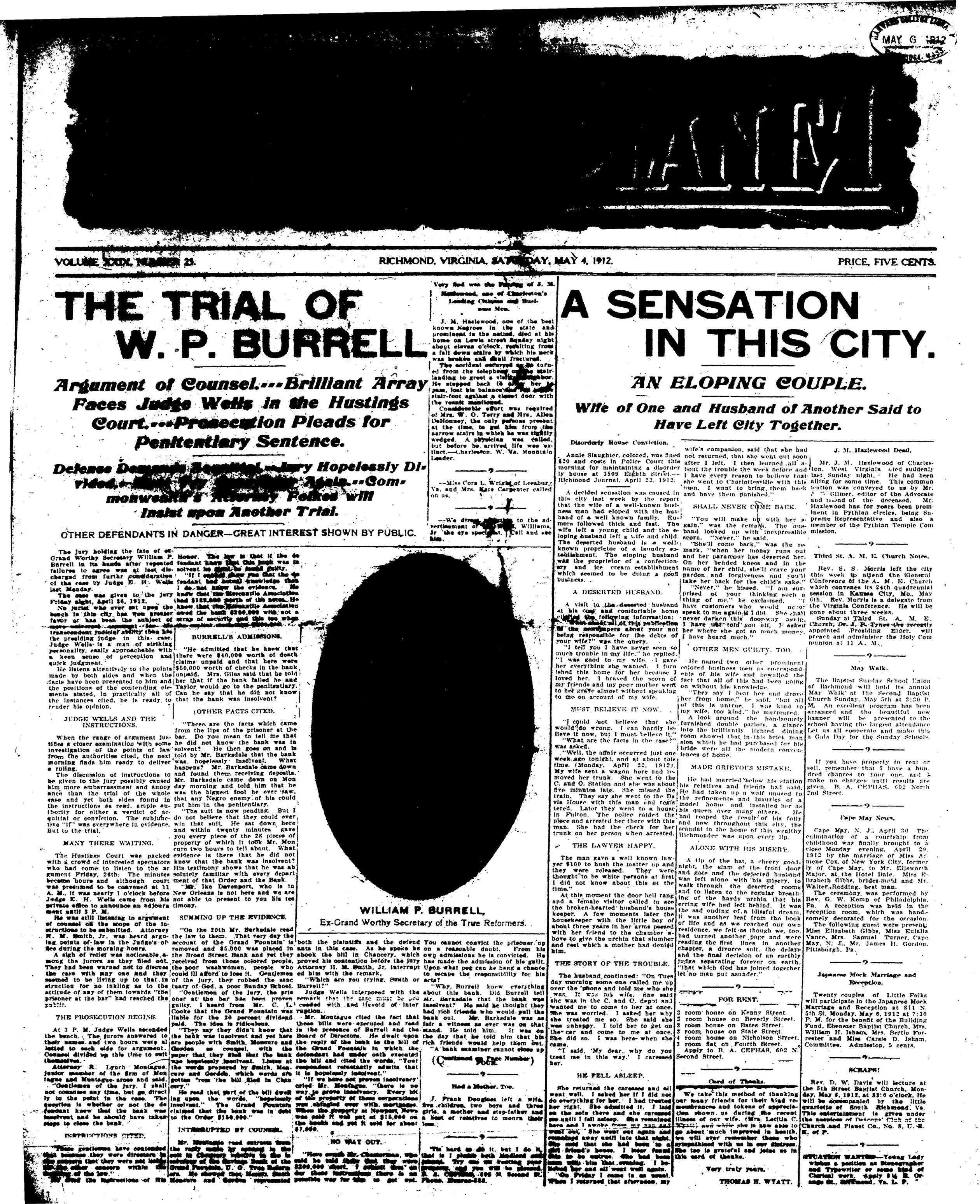
THE TRIAL OF W. P. BURRELL
The jury holding the fate of ex-Grand Worthy Secretary William P. Burrell in its hands after repeated failures to agree was at last discharged from further consideration of the case by Judge E. H. Wells last Monday.
The case was given to the jury Friday night, April 26, 1913.
No jurist who ever sat upon the bench in this city has won greater favor or has been the subject of more unrestricted contempt than the presiding judge in this case. Judge Wells is a man of striking personality, easily approachable with a keen sense of perception and quick judgment.
He listens attentively to the points made by both sides and when the facts have been presented to him and the positions of the contending elements stated, in practically all of the instances cited, he is ready to render his opinion.
JUDGE WELLS AND THE INSTRUCTIONS.
When the range of argument justifies a closer examination with some investigation of the points of law from the authorities cited, the next morning finds him ready to deliver a ruling.
The discussion of instructions to be given to the jury possibly caused him more embarrassment and annoyance than the trial of the whole case and yet both sides found in the instructions as read, simple authority for either a verdict of acquittal or conviction. The subjunctive "if" was everywhere in evidence. But to the trial.
MANY THERE WAITING.
The Hunting Court was packed with a crowd of interested spectators who had come to listen to the argument Friday, 26th. The minutes became hours and although court was presumed to be convened at 11 A. M. it was nearly 1 o'clock before Judge E. H. Wells came from his private office to announce an adjournment until 3 P. M.
He was still listening to argument of counsel on the scope of the instructions to be submitted. Attorney H. M. Smith, Jr. was heard arguing points of law in the Judge's office during the morning hours.
A sigh of relief was noticeable, among the jurors as they filed out. They had been warned not to discuss the case with any one and they seemed to be living up to that in stricture for no inkling as to the attitude of any of them towards "the prisoner at the bar" had reached the public.
THE PROSECUTION BEGINS
At 3 P. M. Judge Wells ascended the bench. The jurors answered to their names and two hours were allotted to each side for argument. Counsel divided up this time to suit themselves.
Attorney R. Lynch Montague, junior member of the firm of Monague and Montague arrose and said, "Gentlemen of the jury, I shall not consume any time, but go directly to the point in the case. The question is whether or not the defendant know that the bank was insolvent and he should have taken steps to close the bank.
INSTRUCTIONS CITED
These gentlemen have contended that because they were directors in the company that they were not likely to be the other company's within the company of the law.
Honor. The law is that if the do fendant knew that this bank was in solvent he must be found guilty.
"If I could show you that the do fendant had actual knowledge then I do not know the evidence. He knew that the Morrisonite Association had $182,000 worth of the money. He knew that the Morrisonite Association saved the bank $290,000 with not a scrap of security and this too when the creditors must be paid."
BURRELL'S ADMISSIONS
"He admitted that he knew that there were $40,000 worth of death claims unpaid and that here were $50,000 worth of checks in the bank unpaid. Mrs. Giles said that he told her that if the bank failed he and Taylor would go to the penitentiary. Can he say that he did not know that the bank was insolvent?
OTHER FACTS CITED.
"These are the facts which came from the lips of the prisoner at the bar. Do you mean to tell me that he did not know the bank was in solvent? He then goes on and is told by Mr. Barksdale that the bank was, hopefully, insolvent. What happens? Mr. Barksdale came down and found them receiving deposits. Mr. Barksdale came down on Mon day morning and told him that he was the biggest fool he ever saw, that any Negro enemy of his could put him in the penitentiary.
"The suit is now pending. But I do not believe that they could ever win that suit. He sat down here and within twenty minutes gave you every piece of the 28 pieces of property of which it took Mr. Mon cure two hours to tell about. What evidence is there that he did not know that the bank was insolvent? His testimony shows that he was abolutely familiar with every department of that Order and the Bank.
"Mr. Ike Davenport, who is in New Orleans is not here and we are not able to present to you his testimony."
SUMMING UP THE EVIDENCE.
"On the 20th Mr. Barkedale read the law to them. That very day the account of the Grand Fountain is removed and $5,000 was placed in the Broad Street Bank and yet they received from those colored people, the poor washwomen, people who could ill afford to lose it. Gentlemen of the jury, they robbed the sane tuary of God, a poor Sunday School. "Gentlemen of the jury, the priser at the bar has been proven guilty. I heard from Mr. C. L. Cooke that the Grand Fountain was liable for the 20 percent dividend paid. The idea is ridiculous.
"They say they didn't know that the bank was insolvent and yet here are people with Smith, Monure and Gordon as counsel, with the paper that they sell that the bank was hopelessly insolvent. Listen at the words prepared by Smith, Monure and Gordon, which words are gotten from the bill filed in Chan cory."
He read that part of the bill dwell ing upon the words, "hopelessly insolvent." The Grand Fountain claimed that the bank was in debt to the Order $150,000."
INTERRUPTED BY COUNSEL
Mr. Nestleman read extracts from the reply made by enquired in the suit in Changquy relative to the inquisition of the Govinia Bank of the Grand Powdergum, D. O. Trap Reform Act. He observed the Mason, Smith Monroe and Gordon represented
RICHMOND, VIRGINIA, SATURDAY, MAY 4, 1912.
0
both the plaintiffs and the defend ants in this case. As he spoke he shook the bill in Chancery, which proved his contention before the jury Attorney H. M. Smith, Jr. interrupt ed him with the remark.
"Which are you trying, Smith or Burrell?"
Judge Wella interposed with the remark that the case must be proceeded with, and he void of interruption.
Mr. Montague cited the fact that these bills were executed and read in the presence of Burrell and the Board of Directors. He dwelt upon the reply of the bank to the bill of the Grand Fontainais in which the defendant had under oath executed the bill and cited the words, "Your respondent reluctantly admits that it is hopelessly insolvent."
"If we have not proven insolvency cried Mr. Montague, "there is no way to prove insolvency. Every bit of the property of these corporations was chained over with, mortgages. When the property at Newport News was sold it will put at $15,000 on the bank and put it sold for about $7,000.
"Here enough Mr. Chesterman, who said he told Sullivan that they were $200,000 short, I submit that they are on their home instructions there is no possible war for them to not out."
Very find won the Pushing of J. M.
J. M. Haslewood, one of the best known Negroes in the state and prominent in the nation, died at his home on Lewis street Sunday night about eleven o'clock, resulting from a fall down stairs by which his neck was broken and skull fractured.
The accident occurred as he turned from the telephone on the stairlanding to greet a visitor neighbor. He stopped back to greet her he pass, lost his balance and fell into stair-foot against a closed door, with the result mentioned.
Considerable effort was required of Mrs. W. O. Terry and Mrs. Allen DeHooney, the only persons present at the time, to get him from the narrow stairs in which he was tightly wedged. A physician was called, but before he arrived life was extinct.—Charleson. W. Va. Mountain Leader.
-Miss Cora L. Wright of Leesbur,
Va. and Mrs. Kate Carpenter called
on us.
We drive attention to the advertisement of your product. Williams. Jr the eye specialist. Call and see him.
P. BURRELL,
Library of the True Reformers.
You cannot convict the prisoner up on a reasonable doubt. From his owp admissions he is convicted. He has made the admission of his guilt. Upon what peg can he hang a chance to escape the responsibility for his acts?
"Why, Burrell knew everything about this bank. Did Burrell tell Mr. Barksdale that the bank was insolvent? He said he thought they had rich friends who would pull the bank out. Mr. Barksdale was an fair witness as ever was on that stand. He told him. It was on the day that he told him that his rich friends would help them out.
"A bank examiner cannot close up
(Continued on Page Number)
Had a Mother, Too.
J. Frank Doughnes left a wife, five children, two boys and three girls, a mother and step-father and a host of relatives to mourn their loss.
"I'm hard to do it, but I do it,
that is I photo both Maryland and
pennsylvania. Try me on framing your
property, and you will be pleased.
R. A. CUPPINN, 602 N. Second R.
Phoenix, Arizona-502.
A SENSATION IN THIS CITY.
Disorderly House Conviction.
Annie Slaughter, colored, was fined $20 and costs in Police Court this morning for maintaining a disorderly house at 3509 Eighth Street.—Richmond Journal. April 23, 1912.
A decided sensation was caused in this city last week by the report that the wife of a well-known business man had eloped with the husband of a well known family. Humors followed thick and fast. The wife left a young child and the eloping husband left a wife and child. The deserted husband is a well-known proprietor of a laundry establishment. The eloping husband was the proprietor of a confectionery and ice cream establishment which seemed to be doing a good business.
A DESERTED HUSBAND
A visit to the deserted husband at his cow and comfortable home entitled the following information: "I have all of this publication of the newspapers about your not being responsible for the debts of your wife!" was the query.
"I tell you I have never seen so much trouble in my life," he replied. "I was good to my wife. I gave her everything she wanted. I turned this home for her because I loved her. I braved the scorn of my friends and my poor mother went to her grave almost without speaking to me on account of my wife.
MUST BELIEVE IT NOW
"I could not believe that she would do wrong. I can hardly believe it now, but I must believe it." "What are the facts in the case?" was asked. "Well, the affair occurred just one week ago tonight, and at about this time. (Monday, April 22, 1912). My wife sent a wagon here and removed her trunk. She went to the C. and O. Station and she was about five minutes late. She missed the train. They say she went to the Davis House with this man and registered. Later they went to a house in Fulton. The police raided the place and arrested her there with this man. She had the check for her trunk on her person when arrested.
THE LAWYER HAPPY.
The man gave a well known lawyer $100 to hush the matter up and they were released. They were thought to be white persons at first I did not know about this at the time."
At this moment the door bell rang and a female visitor called to see the broken-hearted husband's house keeper. A few moments later the housekeeper with the little boy of about three years in her arms passed with her friend to the chamber above to give the urchin that slumber and rest which a mother had deni'd him.
THE STORY OF THE TROUBLE.
The husband continued: "On Tuesday day morning some one called me up over the 'phone and told me who she was. It was my wife. She said she was in the C. and C. depot and wanted me to come to her at once. She was worried. I asked her why she treated me so. She said she was unhappy. I told her to get on the car and come to me at once. She did so. I was here when she came.
"I said, 'My dear, why do you treat me in this way.' I caressed her.
HE FELL ASLEEP
She returned the carcasses and all went well. I asked her if I did not do everything for her. I had trusted her right. She admitted it. I laid on the soft there and she carcasses unwaited I fell asleep. She remained born and I awoke from my nap and went out. She went out again and remembered away until late that night. She told that she had been to a girl friend's house. I hear found him to be untrue. She had been seen with him that evening. I believed her and all went well again. "On Friday I came in, so usual. When I returned that afternoon, my
wife's companion, said that she had not returned, that she went out soon after I left. I then learned all about the trouble the week before and I have every reason to believe that she went to Charlottesville with this man. I want to bring them back and have them published."
SHALL NEVER COME BACK
"You will make up with her again." was the remark. The husband looked up with inexpressible scorn. "Never." he said.
"She'll come back." was the remark, "when her money runs out and her paramour has deserted her. On her bended knees and in the name of her child, she'll crave your pardon and forgiveness and you'll take her back for the child's sake." "Never," he hissed. "I am surprised at your thinking such a thing of me." he exclaimed. "I have customers who would never speak to me again." I did. She shall never darken this doorway again. I have told you off. I asked her where she got so much money. I have heard much."
OTHER MEN GUILTY. TOO.
He named two other prominent colored business men as co-respondents of his wife and bewailed the fact that all of this had been going on without his knowledge.
"They say I beat her and drove her from home," he said, "but all of this is untrue. I was kind to my wife, too kind," he murmured.
A look around the handsomely furnished double parlors, a glance into the brilliantly lighted dining room showed that in this brick manSION which he had purchased for his bride were all the modern conveniences of home.
MADE GRIEVOUS MISTAKES
He had married below his station his relatives and friends had said. He had taken up a waffle unused to the refinements and luxuries of a model home and installed her as his queen over many others. He had resped the result of his folly and now throughout this city, the scandal in the home of this wealthy Richmond was upon every lin.
ALONE WITH HIS MISERY
A tip of the hat, a cheery good-night, the slam of the front door and gate and the dejected husband was left alone with his misery, to walk through the deserted rooms and to listen to the regular breathing of the hardy urchin that his erring wife had left behind. It was the sad ending of a blissful drenn. It was another leaf from the book of life and as we reached our own residence, we felt on though we, too, had turned another page and were reading the first lines in another chapter, a divorce suit, the delays and the final decision of an earthly judge separating forever on earth, "that which God has joined together let no man put asunder."
FOR RENT.
3 room house on Kenny Street.
3 room house on Beverly Street.
3 room house on Bates Street.
3 room house on State Street.
4 room house on Nicholson Street.
3 room flat on Fourth Street.
Apply to B. A. CEPHAS, 602 N. Second Street.
Card of Thanks.
We take this method of thanking our many friends for their kind remembrances and tokens of appreciation shown us during the recent illness of our wife. (Mrs. Lottin C. Kryall) and while she is now able to go about much improved in health, we will ever remember those who sympathise with us in our distress. The too is grateful and joins us in this word of thanks.
THOMAS H. WYATT.
PRICE, FIVE CENTS.
ON
S CITY.
DUPLE.
Another Said to
ether.
J. M. Hazlewood Dead.
Mr. J. M. Hazlewood of Charleston, West Virginia died suddenly last Sunday night. He had been killing for some time. This communication was conveyed to us by Mr. J. Gillmer, editor of the Advocate and friend of the deceased. Mr. Hazlewood has for years been prominent in Pythian circles, being Supreme Representative and also a member of the Pythian Temple Commission.
Third St. A. M. E. Church Notes.
Rev. S. S. Morris left the city this week to attend the (General Conference of the A. M. E. Church which convenes its 24th quadrennial session in Kansas City, Mo., May 6th. Rev. Morris is a delegate from the Virginia Conference. He will be gone about three weeks. Sunday at Third St. A. M. E. Church. Dr. J. H. Tynen she recently appointed. Presiding Elder, will preach and administer the Holy Communion at 11 A. M.
May Walk
The Baptist Sunday School Union of Richmond will hold its annual May Walk at the Second Baptist Church Sunday, May 5th at 2:30 P.M. An excellent program has been arranged and the beautiful new banner will be presented to the school having the largest attendance. Let us all cooperate and make this a Gala Day for the Sunday Schools.
2
If you have property to rent or sell, remember that I have a hundred chances to your one, and I make no charges until results are given. B. A. CEPHAS, 602 North 2nd Street.
2
Cape May News.
Cape Mpy. N. J., April 30. The culmination of a courtship from childhood was finally brought to a close Monday evening. April 29. 1912 by the marriage of Miss Armene Cox, of New York City, formerly of Cape May, to Mr. Ellsworth Major, at the Hotel Dale. Miss Elizabeth Gibbs, brides-maid and Mr. Walter, Redding, best man.
The ceremony was performed by Rev. G. W. Kemp of Philadelphia, Pa. A reception was held in the reception room, which was handomely decorated for the occasion.
The following guest were present Miss Elizabeth Gibbs, Miss Eulalia Vance, Mrs. Samuel Turner, Cape May, N. J., Mr. James H. Gordon, Pittsburgh, Pa.
2
Japanese Mock Marriage and
Inception.
Twenty couples of Little Folks will participate in the Japanese Mock Marriage and Reception at 811 N. 5th St. Monday, May 6, 1912 at 7:30 P. M. for the benefit of the Building Fund, Ebenezer Baptist Church, Mrs. William H. Isham, Mrs. Bettie Forrester and Miss Carole D. Isham, Committee. Admission, 5 cents.
SCRAPS!
Rev. D. W. Davis will lecture at the 5th Street Baptist Church, Monday, May 6, 1912, at 8:00 o'clock. He will be accompanied by the little quartette of South Richmond, Va. This entertainment is given under the auspices of Deaconess' Club of the Church and Planet Co., No. 8, U.-R. K. of P.
SITUATION WAFTED—Young Lady wishes a position as Stonegrapher and Typewriter or some kind of Clerical work, apply to R. Orsan St., Hoffman, Va. 1, L. P.
F. M.
SYNOPSIS
John Cowles of Virginia kisses his neighbor, Miss Grace Sheraton, and meets Gordon Ormes, a mysterious Englishman.
Cowles whisp a man for affronting Grace Orme challenges him to a wrestling bout. A desperate contest follows, resulting in the death.
The south is threatening to seize Cowles saves Grace from an infuriated ball and becomes engaged to her.
Cowles' father, who is involved in a big coal deal, is robbed and murdered. Cowles starts to see Colonel Meriwether, his father's partner in the deal.
In St. Louis he again meets Orme, and they are matched in a pigeon shoot. At an army ball Cowles meets a masked girl named Hilen.
Cowles, forgetting Grace tells Ellen that Cowles will kill her heart if she not know her full name. The pigeon match begins.
Demonouning the bridal sport, Ellen Meriwether stops the pigeon shooting match. She is Colonel Meriwether's daughter. Cowles's streak is wrecked. The rosese Mandy Meriwether and a girl.
Cowles and Adberly, a platinum move from the warpstakes, Cowles overcomes by Orme, Mandy, the girl and soldiers.
The girl is Ellen Merriweather. Cowies
tall in love with her. Her crime treacherously
shoots a Roos chief.
The Roos must an attack. An arrow
penetrates Cowies' neck. Crime, with
Cowies' consent, cuts out the arrowhead,
saving Cowies' life.
Crime, whom Cowies has learned to dis-
play, wounds wooden power as a magi-
tic Company company.
She distracts and avoids Crime, who
tells Cowies he progress to marry her.
The man becomes a genius.
CHAPTER XIII.
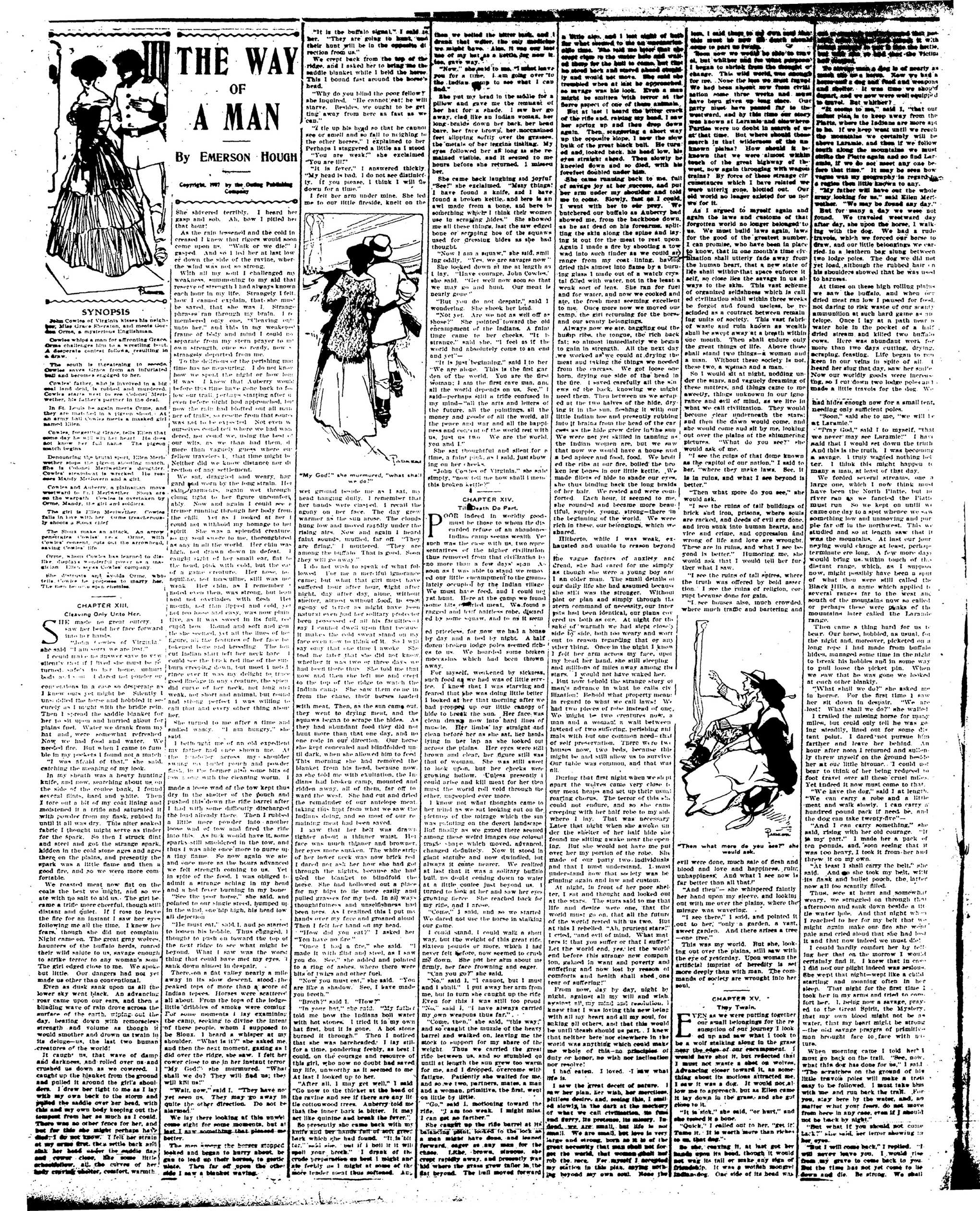
SHE made no great outcry. I saw her bend her face forward into her hands. "John I lovees of Virginia," she said "I am sorry we are lost." I could make no answer save to say silently that if I lived she must be returned, safe's to her home, unhurt body and I saw. I dared not ponder our conversations in a case so desperate as I knew out yet might be. Silently I unsided the house and hobbled it securely as I might with the brittle reef. Then I spread the saddle blanket for her to sit upon and harried about plains fuel. Water we drank from my hat, and were somewhat refreshed. Now we had food and water. We needed fire. But when I came to fumble in my pockets I found not a match "I was afraid of that," she said.
"I was afraid of that," she said, catching the meaning of my look.
In my sheath was a heavy hunting knife, and now, searching about us on the side of the couch bed, I found several flats, hard and white. Then I tore out a bit of my coat lining and moistened it in a trifle and saturated it with powder from my fask, rubbed in until it all was dry. This niter soaked fabric I thought might serve as a tinder for the Spark. So then I struck dint and steel and got the strange spark, hidden in the cold stone ages and ages there on the plains, and presently the spark was a little fame and then a good fire, and so we were more comfortable.
We roasted meat now flat on the coal the best we might, and so we ate with no salt to aid us. The girl became a trifle more cheerful, though still distant and quiet. If I rose to leave the fire for an instant I saw her eyes following me all the time. I knew her fears, though she did not complain. Night came on. The great gray wolves hunters of the buffalo herds, roared their wild salute to us, savage enough to strike terror to any woman's soul. The girl edged close to me. We spoke but little. Our dangers had not yet made us other than conventional. Even as dusk went upon us all the lower sky went black. An advancing roar came upon our ears, and then a blinding wave of rain drove across the surface of the earth, wiping out the day, heating down with remorseless strength and volume as though it would another and drown us twain in its deluge—us, the last two human creatures of the world!
It caught us, that wave of damp and darkness, and rolled over us and crushed us down as we cowered. I caught up the jacket from the ground and pulled it around the girl's shoulders. I drew her tight to me as I lay with my own back to the storm and puffed the saddle over her head, with this and my own body keeping out the tempest from her as much as I could. There was no other fence for her, and but for this she might perhaps have died. I do not know. I fell her strain at my curse first. The settle back and sink her head under the saddle pad and cover close, like some little schoolboy, all the curves of her body covering shoulder, comfort, warmth.
THE WAY
OF A MAN
Copyright, 1977 by the Outing Publishing Company
She shivered terribly. I heard her grasp and sob. Ah, how I pitied her that hour!
As the rain lessened and the cold in creased I knew that rigors would soon come upon us. "Walk or we die!" I gasped. And so I lolled her at last low, down the side of the rivee, where the wind was not so strong.
With all my soul I challenged my weakness, summoning to my aid that reserve of strength I had always known each hour in my life. Strangely I felt, how I cannot explain, that she must be saved, that she was I. Strangely phrases run through my brain. I remember only one, "Clearing out auto her," and this in my weakest frame of Italy and mind I could separate from my stern prayer to own strength, once so ready, now strangely departed from me.
To the dictions of the perishing man time has no measuring. I do not know how we spent the night or how long it was. I know that Audrey would before this time have gone back to follow our trail, perhaps starting after a even before night had approached, to now the rain had blotted out all manner of trails, so rescue from that source was not to be expected. Not even we ourselves could tell where we had wandered, not could we, using the best of our wits, as we than had them, of more than vaguely guess where our fellow travelers l. that time might be. Neither did we know distance nor direction of any settlement.
We sat, dragged and weary, her hard gard worn by the long strain. Her skiff garments, again wet through clung tight to her figure uncomfortably. Now and again I could see a tremor running through her body from the chill. Yet as I looked at her a could not withhold my homage to her spirit. She was a splendid creature to my soul sweete to me, throughout as any in all the world. Her chin was high, not drawn down in defeat. I caught sight of her small ear, fat to the head, pick with cold, but the ear of a game creature. Her nose, no quilline, not musculine, still was no weak. Her chin, as I remember I ridden over them, was strong, but and not overhude with flesh. Her mouth, not tipped and cold, yet not too loose and easy, was now pliable, as it was sweet in its full, recupied bould. Bound and soft and gon she seemed, yet at the lines of her figure, all the features of her face be tokened bone and brushing. The low cut Indian shirt left her neck here I could see the brick red line of the sunburn creeping down, but most I not rince over it was my delight to trace good linge in any creature, the spindle did curve of her neck, long and weak, not short and animal, but round and strong perfect I was willing to call that and every other thing about her.
She turned to me after a time and smiled wanily. "I am hungry," she said.
I bettaught me of an old excellent my father had once shown me. At the teacher's across my shoulder swung my rubber pouch and powder flash in the former and some bits of low-sugar with the cleaning worm. I
made a loose wad of the tow kept thus dry in the shelter of the pouch and pushed this down the rife barre after I had with some difficulty discharged the load already there. Then I rubbed a little more powder into another loose wad of tow and fired the rife into this. As luck would have it, some sparks still smoldered in the tow, and thus I was able once more to nurse up a tiny fire. So now again we ate and once more as the hours advanced we felt strength coming to us. Yet in spite of the food, I was obliged to admit a strange aching in my head and a hot fever burning in my bone. "See the poor horse," she said, and pointed to our single steel, humped up in the wind, one tip high, his head low all dejection. "He must eat," said I, and so starred to loosen his bubble. Thus engaged, I thought to push on toward the top of the next ridge to see what might be beyond. What I saw was the worst thing that could have met my eyes. I sank down almost in despair.
There, on a flat valley nearly a mile away in its slow descent, stood the peaked tops of more than a score of Indian horses. Horses were scattered all about. From the tops of the lodge's little dribbles of smoke were coming. For some moments I lay examining the camp, seeking to divine the intent of these people, whom I supposed to be Bloux. I heard a whisper at my shoulder. "What is it?" she asked me and then the next moment, gawing as I did over the ridge, she saw. I felt her cower close to me in her instant terror. "My God!" she murmured. "What shall we do? They will find us; they will kill us."
"Walt, now," said I. "They have not yet seen us. They may go away in quite the other direction. Do not be alarmed."
We lay there looking at this unwell come sight for some moments, but at last I saw something that pleased me better.
The men among the horses stopped looked and began to hurry about, be gas to lead up their horses, to gastric plate. Then far off, upon the other side I saw a blender waving.
"It is the buffalo signal. I said to her, "They are going to hunt, and their hunt will be in the opposite direction from us." We creep back from the top of the ridge, and I asked her to bring me the middle blanket while I held the horse. This I bound fast around the horse's head.
"Why do you blind the poor fellow? she inquired, "He cannot eat; he will starve. Besides, we ought to be getting away from here as fast as we can."
"I tilt up his big so that he cannot see or smell and so fall to mighing to the other horses." I explained to her Perhaps I staggered a little as I stood "You are weak," she exclaimed "You are ill."
"It is fever," I answered thickly. "My head is bad. I do not see distinctly. If you please, I think I will be down for a time."
I felt her arm under mine. She led me to our little fireside, knelt on the
PADAREL
"My God!" she murmured, "what shall we do?"
wet ground beside me as I sat, my head hanging dullly. I remember that her hands were clasped. I recall the agony on her face. The day grew warmer as the sun arose. The clouds hung low and moved rapidly under the railing atrs. Now and again I heard faint sounds, muffled, far off. "They are firing," I muttered. "They are among the buffalo. That is good. Soon they will go away."
I do not wish to speak of what followed. For me a meritorious ignorance came; but what that girl must have suffered after hour after hour, eight after night, day after day, alone, without shelter, almost without food, inexcess of agony of terror as might have been natural even had her solitary protector been possessed of all his families; I can dwell upon that because it makes the cold sweat stand on my face even now to think of it. So I will say only that one time I awoke. She told the latter that she did not know whether it was two or three days we had been there thus. She told me that now and then she left me and crept to the top of the edge to watch the Indian camp. She saw them me in from the chase, her horses landed
with meat. Then, as the sun came out, they went to drying meat, and the squares began to scrape the blides. As they had abundant food they did not hunt more than that one day, and no one rose in our direction. Our horse she kept concealed and blindfolded until dark, when she allowed him to feed. This morning she had removed the blanket from his head, because now, as she told me with exclamation, the Indians had broken camp, mounted and ridden away, all of them, far off to ward the west. She had cut and dried the remainder of our antelope meat, taking this hight from what we saw the Indians doing, and so most of our remaining meat had been saved.
I saw that her hell was drawn tighter about a thinner waist. Her face was much thinner and browner, her eyes more sunken. The white strip of her lower neck was now brick red. I dared not ask her how she had got through the nights, because she had used the blanket to blindfold the horse. She had bellowed out a place for my hips to lie more easily and pulled grasses for my bed. In all ways thoughtfulness and selflessness had been hers. As I realized this I put my hands over her face and groomed around. Then I felt her hand on my head. "How did you eat?" I asked her "You have no fire." "Once I had a fire," she said. "I made it with flint and steel, as I saw you do. See." she added and pointed to a ring of ashes, where there were blots of twigs and other fuel. "Now you must eat," she said. "You are like a shadow. See. I have made you broth." "Broth!" I said. "How?"
"In your hat," she said. "My father told me how the Indians holl water with hot stones. I tried it in my own hat first, but it is gone. A hot stone burned it through." Then I noticed that she was barheaded: I lay still for a time, pondering feebly, as best I could, on the courage and resource of this girl, who now no doubt had saved my life, unworth as it seemed to me. At last I looked up to her.
"After all, I may get well." I said. "Go now to the thicker at the head of the ravine and see if there are any lily of the cottonwood tree. Anberry told me that the inner bark is bitter. It may set like quinine and break the fever." Bo presently she came back with my knifty and her hands full of soft green bark which she had found. "It is bitter," she said, but if I bolt it it will spell your breath." I drank of the crude preparation on best I might and ate feebly as I might at some of the more tender meat thus softened. Are
then we beaded the bitter back, and I drank that water, the only medicine we might have. Also, it was my last one of my hat as a bottle for now it, too, gave way.
"Now," she said to me. "I must leave you for a time. I am going over to the Indian camp to see what I can find."
She put my head in the saddle for a pillow and gave me the remnant of her hat for a shade. I saw her go away, clad like an Indian woman, her long braids down her back, her head bare, her face brown, her moaned feet slipping softly over the grasses, the metals of her leggins tinkling. My eyes followed her all long as she remained visible, and it seemed to me hours before she returned. I missed her.
She came back laughing and joyful "See!" she exclaimed. "Many things I have found a knife, and I have found a broken kettle, and here is an awl made from a bone, and here is something which I think their women use in scrapping bides." She showed me all these things, last the saw edged bone or serping boe of the squaw's used for dressing bides as she had thought.
"Now I am a squaw," she said, smiling oddly. "Yes. We are savages now. She looked down at me at length and it lay. "Have courage, John Cowley," she said. "Get well now soon so that we may go and hunt. Our meat is nearly gone."
"But you do not despair," said I wondering. She shook her head.
"Not yet. We are not as well off as those!" She pointed toward the old encumbrant of the Indians. A faint thing came to her checks. "It is strange," said she. "I feel as if the world had absolutely come to an end and yet."
"It is just beginning," said I to her "We are alone. This is the first garden of the world. You are the first woman; I am the first cave man, and all the world depends on us. See." I said—perhaps still a trifle confused in my mind—the arts and letters of the future, all the paintings, all the money and goods of all the world, all the peace and war and all the happiness and content of the world rest with us, just us two. We are the world, you and I."
She sat thoughtful and silent for a time, a faint pink, as I said, just showing on her checks.
"John Cowles of Virginia," she said simply, "now tell me how shall I meet this broken kettle."
Til Death Do Part.
POOR indeed in worldly good must be those to whom the disdured refuge of an abandoned Indian camp seems wealth. We each was the case with us, two representatives of the higher civilization thus removed from that civilization to no more than a few days span. As soon as I was able to stand we removed our little encampment to the ground lately occupied by the Indian village. We must have food, and I could not yet hunt. Here at the camp we found some little covered meat. We found a rangeland and half helpless robe, discarded by some squaw, and to us it seemed priceless, for now we had a house by day and a bed by night. A half dozen broken lodge poles seemed riches to us. We heard some broken moorishs which had been thrown away.
For myself, weekened by sickness, such food as we had was of little service. I knew that I was starving and feared that she was doing little better. I looked at her that morning after we had propped up our little canopy of hide to break the sun. Her face was clean drawn now into hard lines of muscle. Her limbs lay straight and clean before her as she sat, her hands lying in her lap as she looked out across the plains. Her eyes were still brown and clear, her figure still was that of woman. She was still sweet to look up, but her cheeks were growing hollow. Unless presently I could arise and kill meat for her then must the world roll void through the other, unprotected ever more.
I know not what thoughts came to her mind as we sat looking out on the picture of the maze which the sun was painting on the desert landscape. But mainly as we gazed there seemed among these weird images one colourful trunk shape which moved, advanced, changed deluditely. Now it stood in giant statue and now dwindled, but always it came nearer. We realised at last that it was a solitary buffalo bull, no doubt coming down to water at a little coute just beyond us. I turned to look at her and saw her eyes growing fierer. She reached back for my rime, and I grove.
"Come," I said, and so we started. We dared not use the horse in stalking our game.
I could stand, I could walk a short way, but the weight of this great rite sixteen pounds or more, which I had never felt before, now seemed to crush me down. She got her arm about me firmly, her face frowning and eager. "When you suck" she said.
"No," said I, "I cannot, but I must and I shult." I put away her arm from me, but in turn she caught up the rife. Even for this I was still too proud. "No," said I, "I have always carried my own weapons thus far." "Come, then," she said, "this way," and so caught the muzzle of the heavy barrel and walked on, leaving me the stock to support for my share of the weight. Thus we carried the great rifle between us, and so stumbled on until at length the sun grew too warm for me, and I dropped, overcome with fatigue. Patiently she waited for me, and so we two, partners, mates, a man and a woman, primitive, the first, went on little by little. "Go," said I, motioning toward the rifle, "I am too weak. I might miss. I can get no farther."
She cagitt up the rise barrel at his balancing print, looked to the lock as a man might have done, and leaned forward, eager as any man for the chase. Like, brown, sinuous, she crept rapidly away, and presumably had where the grass grew taller in the fat beyond. The hull moved forward
a little alm, and I lost eight of both for what seemed to be an unimaginable time. The said man my hero that also crept close to the under bed and waited for the heat to come, but first he stood back and moved ahead steadily and would not move. The soldier troubled when at last he approached, so manage was his look. Even a man might be smitten with terror at the serve aspect of one of these animals. But at last I heard the bitter crack of the rife and raining my head. I saw her spring up and then drop down again. Then, staggering a short way up the opposite slope, I new the snow bulk of the great black ball. He turned and, looked back, his head low, his eyes straight ahead. Then slowly he kneed down and so died, with his forefeet doubled under him.
She came running back to me, full of savage joy at her success, and put her arm under my shoulder and told me to come. Slowly, fast as I could. I want with her to our pray. We butchered our buffalo as Aburberry bad showed me, from the backbone down, as he sat dead on his forearm, splitting the skins the spine and laying it out for the meat to rest upon. Again I made a fire by shooting a tow wad into such tinder as we could range from my coat lining, having dried this almost into fame by a burning glass I made out of a watch crystal Gilt with water, not in the least a weak sort of lens. She ran for fuel and for water, and now we cooked and ate, the fresh meat seeming excellent to me. Once more now we moved our camp, the girl returning for the horse and our scent belongings.
Always now we ate, hanging out the hump ribs, the tongue, the rich back fat; so almost immediately we began to gain in strength. All the next day we worked as we could at drying the meat and taking the things we needed from the carcass. We got loose one horn, drying one side of the head in the fire. I cared carefully all the sinews of the back, knowing we might need them. Then between us we scraped at the two halves of the hide, drying it in the sun, flipping it with our little human how and presently rubbing into it brained from the head of the carcass as the hide grew drier in the sun. We were not yet skilled in tanning as the Indian women are, but we saw that now we would have a house and a bed apiece and food, food. We broiled the ribs at our fire, boiled the broken leg bones in our little kettle. We made fillets of hide to shade our eyes, she thus blinding back the long brides of her hair. We rested and were comforted. Each hour, it seemed to me, she rounded and became more beautiful, supple, young, strong—there in the beginning of the world. We were rich in these, our belongings, which we shared.
Hitherto, while I was weak, exhausted and unable to reason beyond the vague factors of anxiety and bread, she had cared for me simply as though she were a young boy and I an older man. The small details of our daily life she had assumed because she still was the stronger. Without plot or plan and simply through the stern command of necessity, our interests had been identical, our plans covered us both as one. At night for the sake of warmth we had slept side by side, both too weary and worn out to reason regarding that or any other thing. Once in the night I know I felt her arm across my face, upon my head her hand, she still sleeping and millions of miles away among the stars. I would not have waked her.
But now behold the strange story of man's advance in what he calls civilization. Behold what property means in regard to what we call laws. We had two pieces of stone instead of one. We might be two creatures now, a man and a woman, a wall between instead of two suffering, perishing animals with but one common need—that of self preservation. There were two houses now, two beds, because this might be and still allow us to survive. Our table was common, and that was all.
During that first night when we slept apart the wolves came very close to our meat heaps and set up their usual roaring chorus. The terror of this she could not endure, and so she came creeping with her half robe to my side, where I lay. That was necessary. Later that night when she awoke under the shelter of her half hide she found me sitting awake near the opening. But she would not have me put over her my portion of the robe. She made of our party two individuals and that I must understand. I must understand how that society was beginning again and law and custom.
At night, in front of her poor shelter, I sat and thought and looked out at the stars. The stars said to me that life and desire were one, that the world must go on, that all the future of the world rested with us two. But at this I rebelled. "Ah, prudent stars!" I cried, and "and of evil. What matters it that you suffer or that I suffer? Let the world end, year: let the world end before this strange new companion, gained in want and poverty and suffering and now lost by reason of comforts and health shall abed one tear of suffering."
From now, day by day, night by night, against all my will and wish against all my mind and resolution, I knew that I was loving this new being with all my heart and all my soul, for asking all others, and that this would be until death should us part. I knew that neither here nor elsewhere in the world was anything which could make me whole of this—no principles of duty or honor, no wish nor inclination nor resolve!
I had eaten. I loved. I saw what life is.
I saw the great decet of nature. I saw her plan, her wish, her merciless pitiless desire, and seeing this, I am slowly in the dark at the mackery of what we call civilization, the fun and ferry, its presence, its mercy. Indeed, we are small, but life is not small. We are small, but life is very large and strong, born as it is of the greatest necessity that man shall not forget the world, that women shall not rob the race. For myself I escaped my station in this plan, saying nothing beyond my own soul. Nose the
ton. I said thou, so do I own and this this must be now the death should come to part us swirling.
Then now we would be able to swirl, but whether and for what purpose, I began to shrink from the thought or change. This wild world was enough for me. None the less we must travel. We had been about now from civilization some three weeks and now have given up long since. Our party must have passed far to the westward, and by this time our story was known at Laramie and elsewhere. Parties were no doubt in search of what that time. But where should these march in that wilderness of the unknown plains? How should it be known that we were almost within touch of the great highway of the west, now again through with wagons trains? By force of these strange circumstances which I have related we were utterly gone, blotted out. Our old world no longer existed for us nor for it.
As I argued to myself again and again the laws and customs of that forgotten world no longer belonged to us. We must build laws again, laws for the good of the greatest number. I can promise, who have been in place to know, that in one month's time civilization shall utterly fade away from the human heart, that a new state of life shall within that space enforce it self, so close lies the savage in us always to the skin. This vast scheme of organized selfishness which is called civilization shall within three weeks be forgot and found useless, be recinded as a contract between remaining units of society. This vast fabribl of waste and ruin known as wealth shall be swept away at a breath within one month. Then shall endure only the great things of life. Above those shall stand two things—a woman and a man. Without these society is not, these two, a woman and a man.
So I would sit at night, nodding under the stars, and vaguely dreaming of these matters, and things came to me awfully, things unknown in our ignorance and evil of mind, as we live in what we call civilization. They would become clear underneath the stars; and then the dawn would come, and she would come and sit by me, looking out over the plains at the shimmering pictures. "What do you see?" she would ask of me.
"I see the ruins of that dome known as the capitol of our nation." I said to her, "where they make laws. See, it is in ruins, and what I see beyond is better."
"Then what more do you see," she would ask.
"I see the ruins of tall buildings of brick and iron, prisons, where souls are racked, and deeds of evil are done, and iron sunk into human hearts, and vice and crime, and oppression and wrong of life and love are wrought. These are in ruins, and what I see begon is better." Humoring me, she would ask that I would tell her fur, her what I saw.
"I see the ruins of tall spires, where the truth was offered by bold assertion. I see the ruins of religion, corrupt because done for gain.
"I see houses also, much crowded, where much traffic and bartering and
Pierre
"Then what more do you see?" she would ask.
evil were done, much sale of flesh and blood and love and happiness, ruin unhappiness. And what I see now is far better than all that."
"And then"—she whispered faintly her hand upon my sleeve, and looking out with me over the plains, where the minere was wavering.
"I see there," I said, and pointed it out to her, "only a garden, a vast, sweet garden. And there arrises a tree—one tree."
This was my world. But she, looking out over the plains, still saw with the age of yesterday. Upon woman the artificial imprint of heredity is not more deeply than with man. The commands of society are wrought into her soul.
CHAPTER XV
EVEN as we were putting together our small belongings for the assumption of our journey I looked ed up and saw what I took to be a wolf stalking in the grass near the edge of our encampment. I would have shot it, but reflected that I must not want a shot on wolves, Advancing closer toward it, as something about its motions attracted me. I saw it was a dog. It would not allow me to approach, but as Ellen came it lay down in the grass, and she got close to it.
"It is sick," she said, "or hurt," and she tailed it a bone.
"Quick," it called out to her, "get it." Tame it. It is worth more than riches to me, that dog."
So she, coming it, at last got her hands upon its head, though it would not wag its tail or make any sign of friendship. It was a wolfhog mongrel dog. One side of its head was
and we immediately proceeded that patiently to give them all the weapons they were in the battle, but still we had that the Victim had stopped.
We always used a dog to nearly as much as we a horse. Now we had a horse with a dog and food and weapons and shelter. It was time we should digout, and we now were well equipped to travel. But whether?
"It comes to me," said I, "that our infant plan is to keep away from the Plateau, where the Indians are more apt to be. If we keep wait until we reach the mountains we certainly will be above Laramea, and then if we follow south along the mountains we must strike the Plateau again and so find Laramea, if we do not meet any one before that time." It may be seen how venge was my geography in regard to a reason I still knew to any.
"My father will have out the whole army, looking for us," mid Elen Merlweather. "We may be found any day." But for many a day we woe not found. We traveled westward day after day, she upon the horse, I walking with the dog. We had a rude travails, which we forced our horse to draw, and our little belongings we carried in a leather bung slung between two lodge poles. The dog we did not yet load, although the rubbed hair on his shoulders showed that he was used to harms.
At times on these high rolling plains we saw the buffalo, and when our dried meat ran low I paused for food, not daring to risk waste of our scarcity ammunition at such hard game as an elope. Once I lay at a path near a water hole in the pocket of a half dried stream and killed two buffalo cows. Here was abundant work for more than two days cutting, drying, scraping, feasting. Life began to run keen in our veins in spite of all. I heard her slug that day, saw her smile. Now our worldly goods were increasing, so I cut down two lodge poles and made a little travails for the dog. We had hides enough now for a small tent, needing only sufficient poles.
"Soon," said she to me, "we will be at Laramile."
"Pray God," said I to myself, "that we never may see Laramile." I have said that I would set down the truth. And this is the truth. I was becoming a savage. I truly waged nothing better. I think this might happen to many a man, at least of that day.
We fondled several streams, one a large one, which I now think must have been the North Platte, but no river ran as we fancied the Platte must run. So we kept on until we came one day to a spot where we saw something low and unmoving and purple far off in the northwest. This we studied and so at length saw that it was the mountains. At last our four neying would change at least, perhaps terminate ere long. A few more days would bring us within touch of the distant range, which, as I suppose now, might possibly have been a spur of what then were still called the Black Hills, a name which applied to several ranges far to the west and south of the mountains now so called or perhaps these were peaks of the mountains later called the Laramee range.
Then came a thing hard for us to bear. Our horse, hobbled, as usual, for the night and, moreover, picketed on a long rope. I had made from buffalo hides, managed some time in the night to break his hobbies and in some way to pull loose the picket pin. When we saw that he was gone we looked at each other blankly.
"What shall we do?" she asked me in horror. For the first time I saw her sit down in despair. "We are lost! What shall we do?" she waited. I trailed the missing horse for many miles, but could only tell he was going steadily, lined out for some distant point. I dared not pursue him farther and leave her behind. An hour after noon I returned and suddenly threw myself on the ground beside her at our little brownie. I could not bear to think of her being reduced to foot travel over all these cruel miles. Yet indeed it now must come to that.
"We have the dog," said I at length. "We can carry a robe and a little meat and walk slowly. I can carry a hundred pound pack if need be, and the dog can take twenty-fire."— "And I can carry something," she said, rising with her old courage. "It is my part." I made her a pack of ten pounds, and, soon seeing that it was too heavy, I took it from her and threw it on my own.
"At least I shall carry the belt," she said. And she took my belt, which its flask and bullet pouch, the latter now all too scantily filled.
Thus, sore at heart and somewhat weary, we struggled on through that afternoon and sank down beside a little water hole. And that night when I reached to her for my belt that we might again make one fire she wished pale and cried aloud that she had lost it and that now indeed we must die.
I could hardly comfort her by telling her that on the morrow I would certainly find it. I knew that in case I did not our plight indeed was serious. She wept that night—wept like a child starting and morning often in her sleep. That night for the first time I took her in my arms and tried to comfort her. I being now a savage, prayed to the great Spirit, the Mystery, that my own blood might not be as water, that my heart might be strong—the old savage prayers of primitivism man brought face to face with nature.
When morning came I told her I must go back on the trail. "See, now what this dog has done for us," I said. "The scratches on the ground of his little travolo poles will make a trail easy to be followed. I must take him with me and run back the trail. For you, stay here by the water, and no matter what your fears, do not move from here in any case, even if I should not be back by night."
"But what if you should not come back?" she said her terror showing in her eyes.
"I will I will come back." I replied. "I will never leave you. I would rise from my grave to come back to you. But the time has not yet come to me down and die. Be strong. We shall
SATURDAY.....MAY 4. 1912.
yet be safe."
So I was obliged to turn and leave her sitting alone there, the gray sweep of the merciless plains all about her. The dog was our saylor. Without his nose I could not have traced out the little travels trail, but he, seeing what was needed and finding me nosing along and doubling back and seeking on the hard ground, seemed to know what was required or perhaps himself thought to go back to some old camp for food. So presently he trotted along, his ears up, his nose straight ahead, and I, a savage, depended upon a creature still a little lower in the order of life, and that creature proved a faithful servant.
We woot on at a swinging walk on trot or lope, as the ground said, and up the distance at twice the speed we had used the day before. In a couple of hours I was close to where she had taken the belt, and so at last I saw the dog drop his nose and sniff. There were the missing riches, priceless by yond gold—the little leaden bells, the powder, dry in its horn; the little rolls of tow, the knife swung at the girlle; I knelt down on the sand, I John Cowles, once civilised and now heathen, and I raised my frayed and raggled hands toward the Mystery and begged that I might be forever free of the great crime of thanklessness. Then laughing at the dog and loping on tireless as when I was a boy, I ran although sickness and weakness had never been mine and presently came back to the place where I had left her
may she came holding out her arms to me.
"Sit down here, by my side," I commanded her. "I must talk to you. I will—I will."
"Do not," she implored. "Ah, what shall I do! You are not fair."
But I took her hands in mine. "I can endure it no longer." I said. "I will not endure it."
She looked at me with her eyes wide, looked me full in the face with such a gaze as I have never seen on any woman's face.
"I love you," I said to her. "I have never loved any one else. I can never love any one again but you." I say that I, John Cowles, had at that moment utterly forgotten all of life and all of the world except this then and there. "I love you!" I said over and over again to her.
She pushed away my arm. "They are all the same," she said as though to herself.
"Yes, all the same." I said. "There is no man who would not love you, here or anywhere."
"To how many have you said that?" she asked me, frowning.
"To some." I said to her honestly. "But it was never thus."
She curled her lip, scorching the truth which she had asked now that she had it. "And if any other woman were here it would be the same. It is because I am here, because we are alone, because I am a woman—ah, that is neither wise nor brave nor good of you."
"That is not true. Were it a other woman, yes, what you say might be true in one way. But I love you not because you are a woman. It is because you are Ellen. You would be the only woman in the world, no matter where we were nor how many were about us. Though I could choose from all the world, it would be the same."
"It is the old story," she signed.
"Yes, the old story," I said. "It is the same story, the old one. There are the witnesses, the hills, the sky."
"You seem to have thought of such things," she said to me slowly. "I have not thought. I have simply lived along, enjoying life, not thinking. Do we love because we are but creatures? I cannot be loved so—I will not be. I will not submit that what I have sometimes dreamed shall be so narrow as this. John Cowles, a woman must be loved for herself, not for her sex, by some one who is a man, but who is beside"—
"Oh, I have said all that. I loved you the first time I saw you—the first time, there at the dance."
"And forgot and cared for another girl the next day." She argued that all over again.
"That other girl was you," I once more retreated.
"And again you forgot me."
"And again what made me forget you was yourself. Each time you were that other girl, that other woman. Each time I have seen you you have been different, and each time I have loved you over again. Each day I see you now you are different, Ellen, and each day I love you more. How many times shall I solve the same problem and come to the same answer. I tell you the thing is ended and done for me."
"It is easy to think so here, with only the kills and skiles to see and hear."
"No; it would be the same," I said. "It is not because of that."
"It is not because I am in your power" she said. She turned and faced me, her hands on my shoulders, looking me full in the eye. The act a brave one.
"Because I am in your power, John Dowley?" she asked. "Because by accident you have learned that I am a comely woman, as you are a strong man, normal, because I am it to love, not ill to look at? Because a cruel accident has put me where my name is desperately forever—in a situation out of which I can never, never come close."
---
forgive me that why? Do you know what I am a woman because I have a mom? Is that why? Is it because you know I am human and young and sit for love? Ah, I know that as well as you. But I am in your hands; I am in your power. That is why I say, John Cawin, that you must try to think, that you must do nothing which shall make me hate you or make you hate yourself."
"I thought you missed me when I was gone." I murmured falsely.
"I did miss you," she said. "The world seemed ended for me. I needed you. I wanted you"—I turned toward her swiftly. "Wanted me."
"I was glad to go you come back. While you were gone I thought. Yes, you have been brave, and you have been kind, and you have been strong. Now, I am only asking you still to be brave and kind and strong."
"But do you love me, will you love me—can you—"
"Because we are here," she said. "I will not answer. What is right, John Cowen, that we should do."
Woman is strongest when armored in her own weakness. My hands fell to the ground beside me. I shuddered. I could not smile without my mouth going crooked. I fear. But at last I smiled as best I could, and I said to her, "Eleni Ellen." That was all I could find to say.
IDENTIFYING BODIES OF TITANIC VICTIMS
Seventy-Seven in All Recovered by Cable Ship.
Fifteen bodies of Titanic victims were reported by wireless to the White Star line offices in New York as having been identified aboard the cable ship Mackay-Bennett.
This brought the total of identified up to 42 out of the 77 bodies reported to have been recovered. Of these 15, 12 were passengers and the other 3 members of the crew.
Because of protests received by the White Star line officials as to the burial of bodies from the Mackay-Bottnet before they had been identified and also because of communications indicating that many relatives intend to go to Hallifax to meet the Mackay-Bennett when she returns, a message was sent to the cable steamship with instructions to preserve all bodies whenever possible. How many bodies have been already buried at sea is not known.
By comparing the wirelessless messages of persons identified with the passenger list of the Titanic the officials of the company have been able to make up the following list of bodies identified:
First cabin—W. D. Douglas, Ramon Artagaveyla, Fred Sutton, A. M. Halverson, George D. Widener.
Second cabin--Louis M. Hoffman
John H. Chapman, W. Corbines, W.
H. Harbeck, John Gill, Nicholas Nassar,
Mrs. Mary Mack, Reginald Hale,
Steerage--Mary Manigan, James Farrell, James Kelly, Henry D. Hansen, Mauritz Dahl, Leslie Gillinski, Ernest P. Tomlin, Josef Draznovic, Malkalm Johnson, Nesle Williams.
Poor Farmer Plows Up $6000.
While plowing an old field, Clement Allen, a poor farmer of Middle Creek, Knott county, Ky., unearthed $5000 in gold and silver coin, part of the treasure being rare coins. Years ago an old miser occupied a cabin nearby. He died without making any distribution of his money. This is thought to be part of the miser's wealth.
Gets Fortune For Rat Trap.
Benjamin Card, an amateur electrician, of Fort Lake, Wis., who is still a student in the high school, has been awarded $100,000 by the United States government for a rat trap that will solve the problem of exterminating rats on board ship.
CARUSO'S THROAT.
Caruno's threat is normal;
His larynx is O. K.
His pharynx is in Al shape.
His tonsils to fall play;
His nasal passages are clear;
His vocal cord is tight.
Caruno's threat is normal.
Now let the world go round.
—New York Tribune.
But how's his thyroid cartilage?
His glottis does it work?
His epilatotis-doth no gerd?
With his weaning lark?
His brynchicle project
A note with proper slam?
Is his esophagus all right?
And how's his diaphragm?
—Chicago Tribune.
Don't you think that's personal?
How can we help but doubt?
You're right to waybill poor Caruso
And turn him inside out?
His guilet unmapped.
His diaphragm unwrung.
For what's the use if poor Caruso
Can sing the songs he sung?
—Cleveland Plain Dealer.
Why Not Do It themselves?
Judge Hen R. Kendall in a woman's suffrage address at Albany said, with a smile:
"Another type of man accuses the woman voter of grafting. Well, we are all prone to accuse others of our own beetling sin—like the tramp, you know.
"A tramp, after a day or two in our beetling, bustling town of Denver, shock the Deaver duet from his beets with a snarl.
"They must be durn lazy people in this town. Everywhere you turn they offer you work to do."—New York Tribune.
Rich Man (to begin)—Not a court!
Remember that you will have your four
ward in heaven.
Beggar—Will I? Then lead, me so
now, and I will pay it back them. I'll
drop it down the chute—Filipa
Bhattar.
Hawkins-Johnson MANUFACTURING CO., Hair Grower and Restorer,
Will positively remove all Dandruff and cure the scalf of all impurities. It will restore Hair on clean Temples and Bald Heads where the Roots are not dead.
SATISFACTION GUARANTEED. PRICE, 35 CENTS PER BOX.
THE HAWKINS-JOHNSON M'f'g Co's Hair Grower and Restorer is now being used in this State and other States with phenomenal success. Its reputation for growing and restoring hair leaps into prominence wherever it is used.
MADAM HAWKINS-JOHNSON is known as the Hair Grower. Give her a fair trial and be convinced that she can do all that she claims, or money refunded. We are now in a position to sell the best hair for less money than ever before and can match all hair perfect.
In ordering Hair, send sample.
Transformations, $3.00, $4.00, $5.00 to $20.00. Braids, $2.50, $3.00 and $4.00.
Please remit by Cash, P. O. Money Order or Express Money Order.
KINDNESS THWARTED AGAIN.
Workmen Were Too Busy to Listen to His Harangue.
THE man with the tremulous side whiskers and the stately silk has stopped at the edge of the excavation and said to the busky laborer who was about to push the wheelbarrow:
"Ah, my friend! It is aplendid to contemplate the influence that your bone and slew will have in the constructive perfection of the structure that will arise here, and"—
"One side! grunted the laborer, going ahead with the wheelbarrow. The man turned to another laborer, who was about to descend into the excavation and who had a pick on his shoulder.
"The personalization of energy!" he smiled, tugging at his right side whisker. "Energy! In the days to come our children's children will gaze upon the mighty edifice that shall stand here, and they will see the concrete result of the inspiration of labor, which"—
"Gangway!" shouted another man with a wheelbarrow, and the man with the pick, having lifted his pipe, started down the ladder, turning so that his pick knocked off the silk hat of the enthusiastic man. As the latter stooped to pick up his hat he was bumped by a wheelbarrow, and when he finally assembled himself he was being supported by the crossing policeman, who held the wreck of the hat in his free hand.
"Ha-a-a-a!" shouted the kindly man. "Coarse, unfeeling, unthinking! I attempt to show them the higher side of life, to awaken them the"—
"Run on, now," said the officer, "It's early in the day for you to get aweed this way, air."
So the man went to his office and dictated a complaint against the officer, whose number he had forgotten to take. Chicago Evening Post.
Sure to Miss
An Irishman who, with his wife, is employed on a truck farm in New Jersey recently found himself in a bad predicament when in attempting to evade the onslaughts of a savage dog assistance came in the shape of his wife.
When the woman came up the dog had fastened his teeth in the calf of her husband's leg and was holding on for dear life. Skeing a stone in the road, the Irishman's wife was about to hurl it when the husband, with wonderful presence of mind, abused: "Mary, Mary, don't throw the stone at the dog: Throw it at me!"—Lippincott's.
A Busy Evening.
An old parrot used to live in a public house bar where there was always a great trade on Saturday nights.
One evening the parrot was missed.
Search was made, and at length it was discovered in the middle of a field, surrounded by crows, who were steadily picking out its feathers.
As the raccoons approached the now half naked bird was heard to call out: "One at a time, gentlemen, if you please. If you'll only wait you'll all be served."—Ideas.
---
The only enjoyment a barber needs to have—and this is the crystallization of years of observation—is to see just how much the patient will jump, when the cold water suddenly is tarmed on the back of his neck. This preempty in barbering by the way, reduces the volume of shampoo commerce 51 per cent. —New York Mall.
PATENTS
Telephone, Madison-4601.
love all Dandruff and cure the Hair on clean Temples and head.
GUARANTEED. PRICE.
-JOHNSON M'f'g Co's Hair Group and other States with phenomenal hair leaps into prominence where NS-JOHNSON is known as the Haired that she can do all that she claim it to sell the best hair for less mo ct. In ordering Hair, send 5.00 to $20.00. Braids, $2.50, $3.00, P. O. Money Order or Express
N.
HE WAS A LATHER.
PRICE, 35 CENTS PER BOX.
Hair Grower and Restorer is now
monenal success. Its reputation
is wherever It is used.
as the Hair Grower. Give her a
she claims, or money refunded.
or less money than ever before and
send sample. Transfor-
2.50, $3.00 and $4.00.
Express Money Order.
Other
RICHMOND, VA.
Mrs. Annie Walbarrow, 4th & Broad
W. H. White, 501 W. Leigh Street.
Peter Thompeon, 422 E. Marshal
Street.
Wm. H. Scott, 2218 E. Main St.
Miss Ruth Cary, 1018 N. 2d St.
R. B. Sampson, 523 N. 2d St.
V. J. Nickerson, 34 W. Leigh Street.
N. Winston, 537 Brook Ave.
C. D. Griffin, 224 B. 2d St.
may be a con
can't better
Clarence Williams
1411 Koez Street.
M. C. Waller, 1100 W. Leigh St.
E. Dandridge, 107 W. Baker Street.
W. H. Brown, 405 W. Leigh St.
LONG BRANCH, N. J.
P. L. Saulter, 1025-8th Avenue.
J. W. Nuby, 1736-7th St.
PORTSMOUTH, VA.
J. T. P. Cross, 2621 Emingham St.
NEWPORT NEWS, VA.
Richard Robertson, 1810 River-road.
J. C. Allen, 2107 Marshall Ave.
Charles G. Davis, 504-25th St.
TARBORO, N. C.
V. E. Howard.
WILMINGTON, N. C.
Wm. H. Moore.
R. M. Harvey, 1924 State Street.
W. Gaughan, 2626 State Street.
D. Bishop, 512 E. 35th St.
BLUE RIDGE SPRINGS, VA.
Miss Marice Muster.
DALLAS, TEXAS.
Glimore & Barimura,
717 Fairmount Street.
WASHINGTON, D. C.
S. B. Jones, 1024 V St., M. W.
Tell It Over and Over, but the Other Didn't Understand.
"It's hot!" says the benevolent looking gentleman to the roughly garbed man who is sitting with him in the street car.
"You bet it is," replied the other, "especially in my work. I'm a lather."
"I expect so," smiles the benevolent looking man. "It's been a trying day on all of us. What do you work at?"
"I'm a lather. I tell you, it's about got my goat today."
"Yes; there has been much suffering from the heat. And is your work indoors?"
"Sure. I'm a lather."
"I don't care if you're a sads," snapped the benevolent looking gentleman, giving way to his heist temper. "I asked you what kind of work you do." "Don't I tell you I'm a lather." "And what do I care? You may be a foam or a shampoo or a or a confounded cake of soap? If you can't answer a civil question you'd better keep silent." Two blocks farther along the conductor stopped the car and put them on, the one shouting, "I'm a father, I tell you!" and the other sawing the air and assercing that he didn't give two boots if he was a laundry, he might be respectful...Chicago Evening Post.
THE COURT JUSTICE'S BROADCAST
"The king orders you executed at sunrise for offending the queen." "But she wanted me to elope with beer, and I refused." "That's just it."
```markdown
```
"The most nakedest cut of all"
—Rhamespeare.
Her Pattern.
Little Sigrid was born in America of Norwegian parents. "What is your nationality, Sigrid?" asked the teacher. Sigrid tasted her Saxon bread. "I'm an American of Norwegian design," she said proudly.—Harper's Magazine.
Then Me'll Talk.
If you want a man's candid opinion of you, make him angry and you'll get it.—Washington Post.
Young Man—So Mim Kielh in your
oldest sister. Who comes after her?
Small Brother—Nobody isn't
put, but he says the first follow that
comes can have her. — Boston Trum-
ment.
AGENTS FOR THE PLANET
William B. Smith, 3 W. Leigh St.
Tom Bird.
Thomas Page, 815 State Street.
James L. Stewart, 426 Bropk Ave.
David Page, Sr., 922 N. 51st St.
Jesse W. Shreavea, 182 Belmont Ave
HACKENSACK, N. J.
D H. Hassell, R. R. Ave., Nr Clay St
OAKLAND, CAL.
CLEVELAND, O.
E. F. Boyd. 2604 Central Ave.
Jas. H. Jackson. 3315 Central Ave.
BOSTON, MASS.
BROOKLYN, N. Y.
John H. Ashby, 125 Seuben St.
ATLANTIC CITY, N. J.
Charles M. Thomas 40 N. Indiana Av
Harold P. Douglass, 11 N. Kentucky
Avenue.
Oscar Henry, 21 N. Kentucky Ave.
NORFOLK, VA.
John DeBona, 610 Church St.
Thomas E. W. Perry, 2 Joseph Place.
STAUNTON VA.
J. H. Allen, 120 S. Augusta St.
A. C. Mabrey, 137 H. Main St.
Wendall Derritt, 714 Nelson St.
FARMVILLE, VA.
Rev. R. G. Adams, 218 South St.
CHICAGO, N.
E. P. Mackens, 1116 Pine Street.
James E. Warwick, 254 S. 11th St.
Mrs. Lavinia Aldridge, 521 S. 12th Street.
J. A. Stokes, 1011 Fitzwater St.
DANVILLE, VA.
Harry A. Clark, 117 Craghead St.
PROVIDENCE, R. I.
TRAINS LEAVE RICHMOND DAILY.
For Florida and South: 8:15 A.M. M. and
7:25 P.M. Charleston.
For Norfolk: *8:10 A.M. M. *9:00 P.M.
6:10 P.M. *7:00 P.M. M.
For N. & W. Ry. West: 8:15 A.M. 10:00
A.M. *2:00 P.M. M. and 9:00 P.M.
For Petersburg: 1:00 A.M. M. *6:15 A.M. *8:20
A.M. *9:00 P.M. M. 10:00 A.M. *7:00 P.M.
*2:00 P.M. M. 4:10 P.M. M. *7:00 P.M.
M. *7:00 P.M. M. *6:30 P.M. 11:40 P.M.
For Goldshore and Payetteville: *6:10 P.M.
Trains arrive Richmond daily: *8:20 A.M.
6:40 P.M. *6:58 A.M. *8:77 A.M. *9:00
A.M. *6:58 A.M. *8:77 A.M. *9:00
P.M. *11:40 A.M. *7:00 P.M.
*2:15 P.M. M. *6:00 P.M. M. *8:00 P.M.
*9:00 P.M. *10:35 P.M. 11:40 P.M.
*Except Sunday. *Bunday only.
Time of arrival and departure and exchanger
LOUISVILLE, KY.
Jesse E. Brown, 1216 W. Green St.
ST. LOUIS MO.
W. A. Price, 5 N. 14th St.
DRAKES BRANCH, VA.
Clem Green.
LOS ANGELES, CAL.
A. D. Lacey, 790 San Pedro St.
SOUTHERN RAILWAY.
Premier Carrier of the South.
TRAINS LEAVE RICHMOND.
N. N. - published on
information and not guaranteed.
- Following schedule schedule published on informa-
tion guaranteed.
- 6:10 A. M. - Daily. Charles Durham
and Ealeigh. 10:45 A. M. - Durham
- For all points South. Drawing Room Bed
Sleeping Car to Asburyville, M. O. 8,200 P.
- Except Sunday - Local for Durham and interm-
national. M. - July. - For Durham,
Atlanta and Birmingham. P. M. - Lady
Drawing Room Sleeping Car. 11:45 P. M.
- Limited - For all points South. - Fullman ready
at 9:00 P. M.
FARMVILLE, VA.
J. C. Carter, Box 133.
LEESBURG, VA.
Miss Cora L. Wright.
NEWARK, N. J.
Wm. H. Nelson, 99 High St.
FLORENCE, B. O.
E. B. Webster.
DURHAM, N. C.
J. Victor Adams, 405 Mobile Ave.
WINSTONSALEM, N. C.
Royal Puryear, 742 E. 2nd St.
JETERSVILLE, VA.
4:30 P. M.—Ex. Sunday…To. Point,
inserting for Baltimore Monday, Wednesday,
Friday. 6:00 A. M.—Except Sunday and
P. M.—Monday, Wednesday and Friday—Lead
to West Point.
THINGS ARRIVE RICHMOND.
From the South: 4:30 A. M. 8:40 A. M.
8:00 P. M.; daily: 12:55 Except Sunday.
8:00 P. M.; daily: From West Point: 9:00 A. M.
11:35 A. M. Wednesday and Friday; 6:30 P. M.
Except Sunday.
S. E. BURGERS, D. F. A.
807 Kart Main Street. *Tphone*, Madison-IN
C. & O.
9:00 A. Daily—Fast trains to Old Point.
9:00 P. Newcastle and Norfolk.
7:00 A.-Belly. Local to Newport, Nova.
7:00 P.-Belly. Local to Old Point.
9:00 P. Daily—Louisville and Oddmanet.
9:00 P.-Belly. Louisville and Oddmanet.
TRAINS ARRIVE RICHMOND.
Local: West-8:35 A M.; East-11:34 A M.; West-8:35 A M.
Through from Kensington: West-8:35 A M.; East-11:34 A M.
Local from West-8:35 A M.; East-11:34 A M.
Through-7:35 A M.; East-8:35 A M.
SEABOARD AIR LINE
Southbound trains scheduled to leave Bishn mood daily: 0:10 A.M.—Local to Nerlim, 1:00 P.M.—Sleepers and coaches, Atlanta, Bishnupham, Bavannah, Jacksonville and Florida points: 1:12 P.M.—Florida Limited, daily, except Bishnday. 11:36 P.M.—Sleepers and coaches, Jacksonville, Atlanta, Birmingham and Memphis. Northbound trains scheduled toXD: 1:30 A.M., except Monday, 5:36 P.M., 6:36 P.M.
---
ALPHEUS SCOTT
CHURCH HILL
Funeral Director and
Embalmer.
OPEN DAY AND NIGHT.
Office and Warwicke;
2000% P Street.
Office 'Phone, Madison 2807-L.
Residence — 1896 St. John St.
'Telephone, Madison 6618.
LADY ATTENDANT.
Richmond, - - Virginia.
STRAUS' SPECIAL Old Yacht Club,
ISAAC STRAUS & CO.,
422 E. Broad St.,
Richmond, Virginia
OLD PA
PLANET O
OLD PAPERS
PLANT OFFICE
JOHN M.
Higgins,
DEALER IN
CHOICE GROCERIES,
WINE, LIQUORS
and CIGARS.
PURP GOODS, FULL VALUE FOR
THE BENEFIT.
1610 East Franklin Street.
(Near Old Market.)
RALBIGE, N. C.
N. B. Blount, 22 W. Worth St.
PHILADELPHIA, PA.
Douglass A. A., P. A., 910 Westminster Street.
BUTLER, PA.
Walter Mills, 204 Mulberry St.
CAMDEN, N. J.
C. N. Green, 821 Kalgnn Avenue.
PETERSBURG, VA.
E. H. Evans, 258 Harrison St.
HARTFORD, CONN.
George M. Hall, 150 Albany Ave.
ST. PAUL MINN.
W. J. Utley, 94 E. 5th Street.
W. W. Anderson, 2162-5th Avenue.
Anthony Burrell, 131 W. 53d St.
Mrs. Leanna Hamilton, 8 W 136th St.
Edward Gibson, 114 W. 135th St.
Samuel Hobbs, 228 E. 127th St.
E. A. Williams, 200 W. 63d St.
J. E. Schmidt, 263 W. 38th St.
PLAINFIELD, N. J.
Rev. J. A. Carter, 533 E. 2rd Street.
SALT LAKE CITY, UTAH.
Charlee Ludwig, P. Q. Box 1776.
NEW ORLEANS, LA.
World's News Co., Box 1124.
A. O. Smith, 202 B. Rampart St.
MONESSEN, PA.
Smith & Williams, 602 South St
Mrs. L. R. Clarkson. R. F. D. No. 1
Box 77.
Special Correspondents and Agents
F. Z. S. Peregrino,
121 Loop Street,
Cape Town, S. A.
J. 8. Moore
36 Kua dos Capitans,
Bahia, Brazil.
THE ECONOMY
316 North Third Street.
FINE
TAILORING
CLEANING, DYING AND
REPAIRING.
CHITMAN M. WHITE,
PROPRIETOR.
PURE WHISKEY
WILL Satisfy the Lover on the Night
Kind of Shenanian. Special Prices
We Have All Grades of Good La-
quern, Oligare and Yokoon, Call
and See Us.
H. F. JONATHAN.
H. F. JONATHAN.
FISH OYSTERS PRODUCE
114 N. 17TH ST., ROCKSORD, VA.
All Orders Will Receive
Prescott Attention.
Long Distance Post, Madison-752.
RAILROADS.
N. & W. NORMOL WOOLMAN
ONLY ALL RAIL LINE TO NORFOLK.
Schedule to Effect Nov 16, 2014
Schedule in Effect May 14, 1981
Leave Bryd street station, Richmond, PUB
NONFOLK: b:10 A. M., *:00 A. M., a:00 P. M.
b:10 P. M., b:70 P. M.
YORK CHUBURG AND THE WEST: *:00 A. M., a:00 P. M.
b:10 P. M., b:70 P. M.
Arrive Richmond from Norfolk,叫
b:114 A. M., *:05 P. M., b:105 P. M., *:110 P. M.
P. M. From the West: *:05 A. M., a:00 P. M.
b:15 P. M., *:05 P. M., *:00 P. M.
Daily, a:00 P. M., *:00 P. M.
Fullman, Parlor and Sleeping Cars, Oak Dining
Cara.
C. N. BOLLEY.
D. P. A. Richmond, Va.
W. B. BEVILL, Q. P. A. Renoahe, Va.
ATLANTIC COAST LINE
C. E. CAMPBELL. D. F. A.
Our Copy, per year ..... 11.50
Our Copy, extra 10 months ..... 11.50
Our Copy, extra 10 months ..... 11.50
Our Copy, four months ..... 11.50
Our Copy, three months ..... 11.50
Single Copy ..... 11.50
ADVERTISING RATE.
For one inch, one inscription . . . 9.00
For two inches, three months . . . 6.00
For two inches, six months . . . 14.00
For two inches, eight months . . . 28.00
Marriage and Funeral Notice, one inch . . . 10
Stamling and Transient Notice, per line . . . 10
CONTAGE STAMPS OF A HIGHER DENOMINATION THAN TWO CENTS NOT RECEIVED ON DESCRIPTIONS.
THE MARKET is issued weekly. The subscription price is $1.20 per insertion. The insertion is by mail by which money can be met by mail at our risk—in a Post Office Money Order, by Bank Check or Deposit. Money ordered of these can be provided in a Registered Letter.
MONEY ORDERS—You can buy a Money Order at your Post Office, payable at the office, and we will be responsible for its arrival.
EXPRESS MONEY ORDERS can be obtained at any Post Office Express Co., the Wells Fargo and Co. Express Company. We will be responsible for money and pay by mail. Money ordered is a sale and courteous way for forwarding money.
REGISTERED LETTER.—If a Money Order, Post Office or an Krespe Office is not within your reach, your request must be made to us on payment of ten cents. Then, if the Letter is lost or stolen, it can be traced. You can send money in this manner at our risk.
We cannot be responsible for money sent in your reach, your request must be made to us on payment of ten cents. Then, if the Letter is lost or stolen, it can be traced. You can send money in this manner at our risk.
NEMEKAL ETC.—If you do not want THE PLANET continued for another year after your request, you must open the self-addressed Postal Card to discontinue it. The courts have decided that subscribers to newspapers who do not wish to continue their subscription of time for which it has been paid are hold liable for the payment of the subscription up to data when they order the paper discontinued.
COMMUNICATION—When writing to us to remove your subscriptions or to discontinue your subscription, in full, otherwise we cannot find your name on our books.
CHANGE OF ADDRESS—In order to change the address of the newsletter we must be sent by the mail well on the proper address.
Entered at the Post Office at Richmond, Va.
as second-class matter.
SATURDAY..... MAY 4, 1912
DR. HUNTER'S CANDIDACY.
We have received a pamphlet containing an account of the great work of Rev. Dr. E. H. Hunter, pastor of St. John's A. M. E. Church at Norfolk, Va. It seems that the Virginia Conference is urging him for the position of Financial Secretary and that he has a good show of being able to give the A. M. E. Church the benefit of his skillful management.
In the list of very able divines and laymen mentioned for the position, it seems that Dr. Hunter stands first. Our acquaintanceship with him has given us an idea as to his ability along these lines, while his character and standing in the communities which have been blessed with his presence are above reproach.
We have approached this subject with some trepidation and not without fear, knowing that his competitors rank high and are capable too, of discharging the duties of the office. Still, we know Dr. Hunter and should be succeed in his undertaking Virginia will regret to lose him but will proclaim with satisfaction the fact that a most worthy churchman has received a reward.
THE BEGINNING OF THE END.
The result of the election in Massachusetts last Tuesday in the primary content between President William H. Taft and ex-President Theodore Roosevelt settled one question if no other. It eliminated all hope of the remination of the distinguished occupant of the White House. From this time onward we will lead a forlorn hope, harassed and handicapped by desertions in his rear.
It was supposed that Massachusetts was a rock-ribbed Taft state, that the vagaries and policies of the famous resident of Oyster Bay, New York would find few sympathizers and supporters and that the great communism of freedom would round the margins for New England.
The returns are the other way and the result signified by 18 delegates for Turk and 18 delegates for Moscow. To give a tinge of irony to the findings of the people, Col. Hammurabu testimonies to the eight
LOVE ME!
By LUCIAN B. WATKINS.
Love me! in answer to my own
Soul-music from the deeps divine;
Yea, only echo tone for tone
And mate the melody with thine.
Love me! And let my sweetest dream
Be thine as blend the winds that blow
And on the wings of bliss supreme?
We'll sing above all sighs below.
Love me! that with a common light
Our dual lives may glow as one;
Ah! let these sacred flames unite
And be a grand eternal sun.
Love me! Love me! and let me live,----
My highest being years for thee!
Save thou my starving soul—oh, give—
As I have given—give to me!
Love me! Love me! Love me! Love me!
Though false a thousand worlds may
Oh, be thou true, Dear Heart! Love me!
delegates-at-large, who ran upon his ticket releasing them from their obligation to vote for him and recommending that they vote for his competitor, Hon. William Howard Taft of Ohio.
That they cannot honorably do this goes without saying. The only power which can release them is the power that delegated to them the commission and that power rests with the people who selected them. It is no surprise then that they declared that they would carry out their obligations and vote for ex-President Roosevelt, First, last and all the time.
There is a great movement under way and ex-President Roosevelt is leading it. Without a doubt, he is without a peer in this or any other decade of this country's history. He will now have a chance to control the National Republican Convention at Chicago. The moral effect of the victory in Massachusetts cannot well be over-estimated. It will chill the Taft forces throughout the length and breadth of this country. From this time onward, it will not be a question as to how to renominate President Taft, but how, to defeat ex-President Roosevelt
The Southern delegates might as well be eliminated from the equation. The candidate who receives the majority of the delegates in the Northern and Western states will be the nominee of the National Republican Convention. Should the result be otherwise, it would produce a revolution inside of the Republican Party and lead to an intermedial split, which would spell defeat for the nominee long before the result was announced by the presiding officer of the convention.
The Roosevelt men are jubilant and the Taft men are correspondingly depressed.
---
THE BLASTED FRIENDSHIP.
From the beginning of President Taft's canvass for a nomination to the present time, his financial backers and supporters have feared that he would not prove himself so confidently stable to withstand the assaults of his old-time friend, Theodore Roosevelt of New York. His solicitude for Col. Roosevelt's feelings and his exploit orders that attacks upon the distinguished New Yorker cease, led them to fear that he was at any moment likely to "die down" and leave the campaign "in the air," so to speak. For this reason, they magnified every utterance of Mr. Roosevelt and did everything that they could to induce the fiery statesman to say hard things about Mr. Taft.
This accomplished, they proceeded to impress upon the President that his meekness and his disposition to accept punishment without "striking back" was causing a feeling of contempt to permeate the people and that he was losing votes thereby. They induced him after a night session of the cabinet to attack ex-President Roosevelt and in so doing to use confidential letters to back up and emphasize all that he was then about to say. The charge was fired at Boston. Massachusetts by President Taft, and it created a sensation.
This lasted until ex-President Roosevelt got into action and this created even a greater sensation. The result can hardly be said to have been a drawn battle for Mr. Tatt got the worst of the controversy.
But the opponents of Col. Roosevelt accomplished their purpose. They forced Mr. Tatt to "burn the bridges behind him." They caused him to sever the last tie in the friendship of a decade and they are now ready to begin the campaign, not to renominate President Tatt, but to defeat ex-President Roosevelt.
ower to my own
from the deeps divine;
stone for tone
me melody with thine.
let my sweetest dream
send the winds that blow.
eggs of bliss supreme?
love all sighs below.
with a common light
as may glow as one;
acred flames unite
and eternal sun.
The man of the hour upon whom all factions can unite has not as yet appeared. It has been a long time since "dark horses" have been popular in the indemnifying conventions of either party. The candidate to win must come from New York or Ohio or from New York or Indiana. No name appears upon the roster of these states which would meet with general favor and it looks very much as though that Taft must go to victory, and Roosevelt to defeat or Roosevelt must go to victory and Taft to defeat. In view of the pre-convention cost of the campaign, it would seem that the general election would not entail the use of much money. Both sides will seem to have exhausted their money barrels long before the real political fight begins. Selah.
The Trial of W. P. Burrell
(Continued From Page Number)
a bank. If we haven't shown you from his own slip from the kinesis
know that we bank was in solvent, what have we done?
THAT WORTHLESS PAPER
"Those directors knew that the bank was insolvent a year before it failed. They held them and there $20,000 worth of worthless notes and $40,000 worth of death claims, waiting to be paid and $50,000 worth more of checks waiting to be paid. I was in the civil part of the case. I submit the case as business men, as conscientious men that the law is made to protect human beings.
WANTED A VERDICT OF GUILTY
From the facts in this case, I ask
at your hand a verdict of guilt.
It is for you to say whether it is to
be from 1 to 3 years in the penitentiary
in this case, double the amount
of money received which is $400
or a fall sentence. I hope though
that you will make the penalty ade-
quate and give a penitentiary sentence
SPEAKER BYRD RALLIES
Attorney R. Evelyn Hyrd said that the aim of the prosecution is to send a citizen of the commonwealth to the penitentiary upon a technical fact. It is hard. It is too hard to send a man to the penitentiary because he is guilty of technical violation of the law. But surely you wouldn't do that unless you were piled by your oath to do it to send a man who is innocent of any wrong doing to the penitentiary. You must believe that Burrell had actual knowledge of the insolvency of the bank. He then explained what actual knowledge meant.
THE PURPOSE OF THE LAW.
The criminal-law is a romance given to society. In order to convict him, the must have had knowledge. "Was the bank insolvent beyond a reasonable doubt? Did Burrell have actual knowledge of the insolventy of the bank? There never was such a bank. There never will be such a bank again." He then reviewed the history of the True Reformers. He did not think that Burrell should be sent to the penitentiary for signing the him to 'sign. "This True Reformers were a welligion to these people. They could not understand how this supernature could topple about their heads. They recognised the fact that that bank was created as a fiscal agent of the Grand Fountain.
MUST BELIEVE IT.
"You're got to believe beyond a reasonable doubt that Burrell had actual knowledge of the insufficiency of that bank. Geoffrani, it has never been proved in this court that the bank was insolvent on that date. Mr. Borkedde himself did not know by actual knowledge that the bank was insolvent. Mr. Cooke, who was an expert said that after he had in vestigated the bank five months as to how it stood one could know
WITNES DIFFERED.
"He differed with Mr. Barkhald to the amount of $50,000. Mr. Barkhald took the bank owed the Grand Fountain $270,000 and Mr. Cooke stated that the Grand Fountain owed the bank $400,000. This made $650,000 difference in the figures. You are not trying this case technically. You are trying to get at the root, the heart of the think." Mr. Byrd showed that of the three departments, one would aid the other one working with the other hand in hand.
MR. BURRELL'S STATEMENT
"Burrell said that he did not regard the Grand Fountain as a depositor of the bank. He only regarded the few outside the Order as depositors. Burrell believed and had reas on to believe that there were sufficient assets to pay all of the depositors of the bank.
"I am not criticising my friend, Barksdale, but isn't it to be presumed that C. L. Cooke knows more about the bank after five months than C. C. Barksdale after an examination of two days.
A PATHETIC PLEA.
"One said the Grand Fountain owed the bank $900,000 and the oth er that the bank owed the Grand Fountain $250,000. You remember the pathetic plea made by Burrell to Barkdale was to tell him, what do. This poor re55730 man pleaded the white re55730 negotiative of the dominant race to tell him what to do. "If my friend Barkdale had said to these men, "Close those doors," there would never have been any trouble." Mr. Smith handed Mr. Byrd the communication from the State Commission Commission. He cited the oth er that given ten days to make good their capital stock, which was not even a liability.
"Wouldn't you have waited until the high power took charge? I say that 99 men out of a 100 would have done it, that 99 men out of a 1000 would have done it. I say in conclusion that it was beyond the knowledge of any human could contour the actual condition of that bank. I say therefore, gentlemen, how can you say that Burrell or any one else had actual knowledge of the condition of that bank? "If the Grand Fountain owed the bank $400,000, I say that the bank was not involvent on that day for the books show that there were only $155,000 due the individual depositors. They had $250,000 worth of mature note which it was worth considerable amount over $100,000. I say that Burrell was perfectly justified in saying that he did not know the bank was involvent.
THE ROBES OF INNOCENCE.
It is cruel and unjust to punish Burrell for that the courts and the lawyers have been trying to deter mine. Burrell stands here clothed in the robes of innocence put around him by the law. He stands here as a man of character. He stands here as not having received a cent court fee. "All that I ask of you is to apply the common rules, common justice to this case and I hope that you will acquit the defendant." Attorney Hird asked to be executed and he retired from the court room.
EX-GOVERNOR MONTAGUE
SPEAKS
Kaid Governor A. J. Montague arrogately and after adjusting his papers said: "If your Honor please and the gentlemen of the jury I shall not detain you long. It is a very unpleasant duty for me to appear in this case at all. I do not remember appearing in a criminal prosecution before in my life.
"You do not have in this case to find the defendant guilty of any criminal intent. You do not have to find that defendant has himself profited by this bank's failure. The statute contemplates two offences, one of commission and one of omission. We approach it from no other angle. We come to the bank. The facts conceded in this case except the extraordinary manner of Mr. Cooke. The facts are not disputed. The fact that the bank was insolvent, its gone, its broke, its hopelessly insolvent. This is the testimony of Mr. Barkadale, Mr. Barkadale went back there on Monday. He gave them an opportunity to verify his report.
"There are some things that we know instantaneous. We do not ask if it is day when we know that the sun is shining in our face. It did not take any two days for him to find that the bank was broke. Nearly $300,000 worth of paper without a scratch of security.
NO DOUBT OF INSOLVENCY
Who would doubt it was insolvent? My heaven! here is a bank with a capital of $100,000 with $200,000 worth of paper without one sarcasm of security and the counsel on the other side would tell you that the bank was not insolvent. You might as well stick a knife into a man and with the blood trickling, say that you are not cutting him.
"Mr. Cooke said there was more than $600,000 due the bank by the Grand Fountain and its allied institutions. That includes the Reformer Mercantile and Industrial Association, the Old Polks Home. $290,000 of this indebtedness was chargeable to the Reformer's Mercantile and Industrial Association.
"He said, mark you, that there was due by the True Reformers and their allied organizations $400,000. Burrell knew this. I would not do Burrell an injustice. I am sure the facts set of each than Burrell. He showed how under this analysis the difference in figures was not so great. Opened said that the Order is never important to being that they leave minimums and that two regular companies if paid would cease the liability.
"You know that if you levy the assessment, you cannot make the poor colored people pay it. They would desire to pay it and drop out."
This loye would be to pay impersonal and not the institution of the bank. Mr. Cooke is an estimable gentleman. He is him to Mr. Smith. "Mr. Smith interrupted so that it was much better than that. He was kin to his wife. Ex-Governor Moogue, graciously accepted the correction. He showed that there were only a few thousand dollars out of the way in Mr. Barksdale's estimate and of Mr. Cooke. "Mr. Barksdale meant that he would not sweer to a cent that it was insolvent. "As this bank was so overwhelmingly insolvent what difference does a few thousand-dollars make?
CANNOT ASSESS MEMBERB.
"I assert that they have power to levy an assessment, to pay death claims, and not to pay the liabilities of the bank. You might as well argue that the great life insurance companies can do it. The aim of the insurance company is to take the premium to add to the cash of the bank."
"Less than $3,000 in the bank to pay the depositors. The test was paper unsecured and gentlemen. I submit to you, unsecurable. Burrell comes here and says, 'I ought to be acquitted because I believed the bank was solvent because it owned properly.' Why did they not put the money in tbfs bank?
"He is the smartest fellow in the whole gang of these people. They have the case upon him because he was the fellow patch up slaves. He stated the estimated value of the property. Mr. Moncurce estimated the property between $55,000 and $60,000."
LITTLE MONEY FOR DEPOSITORS
"Burrell put up exaggerated value of the property and it is all covered with mortgages. According to the facts and figures presented here, the bank wont pay ten cents on the dollar.
Another defense extra, they have tried to shift the defense from the depositors to one between the bank and the Grand Fountain. The law will not permit us to take all the depositors, only one at a time and we took T. C. Timsley.
Burrell took just twenty minutes to state the list of property that it took Mr. Moncure two hours to state. How did these directors discharge their duties? The others go home and then this star chamber crowd run this institution.
MUST BE HELD RESPONSIBLE.
These men can make no arrangement among themselves which will relieve themselves of their responsibility. When they undertake the banking business they must do a banking business. They got the responsibility upon themselves. It was not in the Grand Fountain. They would put the responsibility on some mythical organization that the law cannot reach or the eyes of man cannot see.
HE CITES THE LAW
"The human society, we are trying to lift it up a little. The question of intention, the question of motive has no positive value in this case. Here the defense is changed from what it was when the bill in Chancery was filed. Then it was the bank that The Reformers. Now it is that the True Reformers owed the bank." Mr. Smith here interrupted. Ex-Governor Montague retorted that he was quoting from the testimony of Mr. Mongee who is Mr. Smith's owp partner.
NO HARSH THINGS OF HIM.
"I am not here to say harsh things of Burrell. I am trying to get him self out of trouble. There were $190,000 in subsidiary deposits. The Habilitations were $551,278.25. Of the $319,843.35 marked as assets, $290,000 was from one concern and was absolutely worthless. There was $0,000 in stock of the Reformer's Mercantile and Industrial Association which was also worthless. "No oneimen, upon what hypothesis cap you promise that this bank was solvent?" I must conditions in the bank caused Mr. Barksdale to say it was insolvent. "I have argued and shown that the Directors declared it was insolvent.
OTHER BURRELL ADMISSIONS.
"Burrell admitted it was insolvent. He admitted to Mr. Barkadale that he had friends who would help the bank out. He suggested that the funds of the Grand Fountain be moved from the bank. He was told on October 20, 1910 by Barkadale. On October 21st he moved deposits. Even removed $2 from the bank. He had to carry the True Reformers funds there. (The bank book was shown to the forger.) He knew the bank was insolvent. He admitted the figures were that it showed it was insolvent. They tell you that he must have actual knowledge.
"What is actual knowledge? If I know a thing, I know it. If I actually know it, do I may more than know it? The bill says insolvent. The answer says it was insolvent. did Burrell do? Mr. Barkadale did his law to him. The motion says You are responsible if you accept deposits. He cited the law in detail and made a scatating denunciation of Burrell calling Mr. Smith to his feet.
THE GOVERNING AUTHORITY.
"Burrell said he called the Directors of the bank. He was the governing authority. If he did not have knowledge I'd like to know what knowledge is. He was a director and he could have gotten the others together. If this was not actual knowledge actual knowledge cannot be brought home to any official of the bank.
GOOD CHARACTER ADMITTED.
"They talk about (his) good cheer
eater. We are writing, so someone
his good character. How could he
get into a hunk if he did get-here
good character? How could he-hunk
the idea if he was known to be a
Sure? It does not change my job much. Maybe associated to Mr. Markuski's figures. They are trying to bring the love by making these people as enemies. What they lay an enemy? "My responsibility is about over. It is yours. I have no personal interest in this case. I submit to you that over $2,000,000 has been poured into its coffers.
A QUESTION OF KNOWLEDGE.
"Burrell knew very well for some time that the bank was insolvent. He knew that $50,000 worth of checks was unpaid. He knew that there was $40,000 worth of death claims unpaid. The witness, Mrs. Gilles told you that Burrell knew the bank was insolvent. He knew that the bank was insolvent: its directora knew that it was insolvent. You have the opportunity of citing the law, that bank, whether conducted by white or colored people must be conducted according to law. "According to the statute, the law has been plausibly violated when it should not have been violated. Gen themen, I thank you for your attention."
There was a buzz of excitement when ex-Governor Montague concluded.
THE EFFECT UPON THE AUDIENCE.
He had held both bench, bar and spectators spellbound by the mysterious force of his argument. He had made a plea which was undoubtedly dangerous to the, defendant and which under normal conditions would have unquestionably landed William P. Burrell in the Virginia penitentiary.
A three minutes process was taken and during the interval the brilliant and distinguished attorney was congratulated.
"The only reason that the jury will not, convict Burrell," said a prominent True Reformer official, "will be because the jurors did not full understand what Gov. Montague asked." It was against this oncoming rising tide that the brilliant Attorney H. M. Smith, Jr. thrrew himself. He had been weared by the preliminary struggle for instructions and his countenance wore almost a blanched expression as he arose to the dignity of the occasion and launched out in an able pathetic defense of "the prisoner at the bar."
ATTORNEY SMITH'S PLEA
"May it please the court, and gentlemen of the jury. There are several and features in connection with the blow that has fallen upon the True Reformers. It was a great shock to the coloured people. It was a great shock to the white people. There was not a white man there. There was not a man who had even been in a race that had just emitted from slavery, that had built up an institution that was a great source of pride to the white people, and to the colored people.
"It made them lose confidence in themselves. It made them lose confidence themselves in each other. It set them back as a race a great many years. I do not care to say how many years. They do not say how many years. They do not say lack of acumen or business knowledge. They prefer to say that the True Reformers would have been a success if their officers had been honest and true to their trust.
"It has been fourteen years since Brown died. He went down in glory. It is a fortunate thing that he died." Had he lived, he would have no doubt been a defendant behind this bar today.
THAT FIFTY THOUSAND DOLLARS
"He sold out his plans for $50,000. Who succeeded William Winston Brown? Taylor. Taylor is here. Who succeeded Taylor? Holmes. Holmes is here. If any one had succeeded Holmes before the failure of the bank he would be given the have tried to put these men behind his arms. to gratify their spleen and their pride. He cited other causes.
"This case is entirely different from any case that has happened in Virginia. In every other case it had been found that the directors had been involved in crookedness, that they had palmed off worthless paper. Yet Burrell went into the 30 years ago and he came out of the bank clear of any crookedness. His friend, and say that his reputation and integrity are as good as any in the city."
"The gentlemen undertook to refer to Mr. Moncurce as my partner. Another witness was cited, and they let you know that this witness was some kin to me. You are not going to take the lpee dixit of Governor Montague that Mr. Moncurce had stated the value of that property. "These men want vengeance. They succeeded these men in office and they did not find the treasury as full as they expected.
A QUESTION OF VALUES
"I am just as much justified in saying that Mr. Moorcey put the value at $200,000 as Mr. Montague had to say that he put it at $90,000.
"The judge has ruled that in order to convict the man, the prosecution must prove the insolvency of that man, the them believed that it was insolvent, the them indicted for receiving the money and the bank is now found to be solvent, these men must be acquitted. The game is locked in the Chancery Court. I might as well tell you confidently that the lawyers are not losing anything. You cannot say that bank is insolvent unless you guess it or take Burrell's word for it.
"There is another question, the actual knowledge of the insolvency of that bank. They are resting their once upon the bill in Chancery. We had nothing to go on except what these men told us. I asked him what about Mr. Burrell?
"You never saw a back failure in your life that a did not develop a lot of creased - drenched - fibre. Every time you saw it, you didn't care the back needed. True."
Attorney Smith asked the evidence showing the confusing condition of affairs in the Baylands Bank of the Grand Mountain, United Order of True Reformers and the unauthorized affairs of the institution. He impressed upon the jury that R. T. Hill, the defaulting cashier was responsible and that Barrell and his associates were really being made the escape goals by the colored people whose pride would not permit them to conceive the real truth. He insisted on the technical and at the close his persecution in behalf of his clients concluded his argument in behalf of his client.
COMMONWEALTH'S ATTORNEY
FOLKKS. SPEAKS.
When he resumed his seat Commonwealth's Attorney Minnette Folkes who had been an interested listener throughout the argument of counsel arose and in a brief argument made one of the most pathetic appeals ever heard in the Hustings Court by a jury. It was a plea on behalf of the wage earner, the butlers, cooks, wash-women who had lost the earnings, of a life-time in this ill-fated institution.
So effective were his remarks that the able counsel, Mr. Smith interrupted him with the statement that there was nothing in the evidence to show that this class of people were the True Reformer Savings Bank, under Wells in ed this objection, but in no wise daunted Mr. Folkes declared in emphatic tones that if they had been depositors they would have lost their money.
At the conclusion, there was much comment as to the probable effect of his eloquent remarks, which coming at the last moment must have had a telling effect upon the jury.
THE JURY RETIRES.
It was aobut 8 o'clock when the case was given to the jury and then came the long delay. The minutes became hours and no report was made. Shortly before 9 o'clock the jurors were permitted to go to their home and court and adjourned until Monday morning at 10 o'clock. The effort to agree was a failure and the court was adjourned until Monday morning at 11 o'clock. The foreman, Mr. Leon Ruskell reported that it was hopelessly divided. Then came the reports. Some said that it stood ten for a penitentiary sentence and two for acquittal, ten for another sentence and two for a light sentence, ten for acquittal and two for conviction. This was disputed.
THE MEANING OF IT ALL.
These reports were no doubt due to the many ballots taken. The final line up as given out was nine for acquittal and three for conviction. One of these three was will lying to those of nine in his two colleagues would do so. Judge Wells discharged the jury.
It was thought that Mr. Burrell's case would have a positive effect upon those of his colleagues. If he had been acquitted, then it was presumed that Rev. W. L. Taylor, A. W. Holmes, J. C. Robertson and Edward Ellis, Jr. would have been charged as a result of the findings of the trial, a positive opposite effect from what was intended for it nerved the prosecution to greater efforts.
AS PEOPLE SEE IT
There were very few people in Richmond who believed that Burrell would be convicted and the general impression was that nothing would be done about this gigantic failure. The disagreeing jury brought about a realization of the fact that the trials are more serious than the people supposed and that a genuine effort is now being made to put behind the bars any person found guilty of any criminal conviction in connection with the torture fair. The prosecution declared its determination to press this and the other indictments and all of the evidence will be gone over again.
MORE MONEY FORTHCOMING
This will call for more expense on both sides. The attorneys for the defense must be compensated for the second trial and if an appeal is taken from the decision of the jury more money must be forthcoming for this purpose.
It was presumed that William P. Burrell had a better chance of an acquittal than any of the others and the fact that the best he could secure after the brilliant work of able counsel of the type of Hon. H. M. Smith, Jr. and Hon. R. Evelyn Byrd would indicate that there is still "rough evidence" of the case. All of the indicted officials were bailed in the sum of $2,000.00 much for their appearance at the next term of the Hustings Court May 7. 1912.
Despite the fact that the True Reformer's Savings Bank failed a year and a half ago and crackdown of the most positive kind has been covered and is admitted to exist, no one responsible therefor has as yet spent an hour of conviction in any prison, in this commonwealth. The effort to find Cashier R. T. Hill has failed and for the time being at least "the game is blocked."
Rye Bank Free; Mills and Securities of all kinds Fixed; Legacy Brokers or Changed; Super Work Daily Demon. Prisoner. With all rights regained. Residency of superintendent government are not permitted to any official and private office.
(Constitution of the National Board of Public Schools of the State of New York)
Brief Summary of the Achievements of St. John's A. M. E. Church Under the Leadership of Its Capable, and Influential Pastor—Norfolk as Religious Center.
By H. C. YOUNG.
Norfolk, Va.—In the life of this city and community the influence of the ministry and churches is a predominant factor. Perhaps no city in this country can boast of a more substantial ministry and a corps of church workers who are doing more for the elevation of the race than Norfolk. The churches here are the pride of the race and are putting into practice the principles for which they stand. Among them move in the community is a more potent factor in the religious culture and social bettermement of the race than St. John's A. M. E. church, of which the Rev. E. H. Hunter, LL. M., D. D., is the pastor.
At no time in its history has it made such remarkable strides as under the one year's leadership of Dr. Hunter, which recently came to a close. The plant of the church is valued at 900,000. Its membership constitutes a portion of the most cultured and refined citizens and numbers 1,400,250 having been added during the pastorate of Dr. Hunter. The Sunday school is ideally conducted upon one of the finest systems in the country. It numbers 1,100. Its organization is so thorough that any effort put forth by it for any cause is a complete success. Dr. Hunter has every department of the church working in harmony and upon a thorough systematic basis, and through his energetic efforts the church has raised practically 10,000 during
G.
REV. DR. EWARD H. HUNTER. the fiscal year, $2,144 being raised in one rally. The bonded debt on the church has been reduced from $10,000 to $7,500. All of the floating indebtedness was wiped out during his early administration. The pastor's guiding hand is seen in every department of the church, and the entire plant is a beehive of religious activity. Dr. Hunter has shown unreal ability for unifying discordant forces, rallying the membership, managing the financial difficulties and making his church take its rightful place as a leading, uplifting force in the community life.
Has Won Success in Many Fields.
Rev. Edward H. Hunter was born and reared in Raleigh, N. C. and received his early education in the public schools of that city and later graduated with honor from Lincoln university, receiving the degree of A. B. He took a course in law at Howard university and has had four degrees conferred upon him. He taught five years in the Raleigh public schools. In 1890 he entered the government service in Washington, his promotion was fast, and he finally reached a position of the highest rank as law examiner, with a salary of $1,600. In 1898 he passed the bar examination and was admitted in practice in the supreme court.
In 1928 he was admitted as itinerant in the Methodist ministry. His training consists of a tithetime of church and Sunday school work, along with various other philanthropic endeavors. He was prepared for this higher calling in the Howard Theological school and through private study. He was first a member of the Baltimore conference and Mind moral changes in that connection before he was transferred to the Virginia conference, when he was the assistant pastor of the Metropolitan church of Washington.
The all absorbing topic of African Methodism throughout the country today is the spirited content for the influential office of financial secretary, which is to be decided at the general conference, which convenes in Kansas City in May. The Virginia conference conference joining Dr. Huntley
such as the candidate for this important
that office, and through him it hopes to
gain its first official recognition by the
general conference. It is conceded that
he is the most popular candidate for
the office, and his special qualifications
peculiarly fit him for the position.
AN APPEAL.
Lynchburg, Va., April 26, 1912.
To the Brotherhood of the Virginia
Baptist State Convention—Dear
Co-worker:
We appeal to you the last time through the Press, for this Conventional year in the interest of our Conventional work. We have a splendid opportunity as workers to make this the Banner year in the history of our Convention. We certainly have an excellent opportunity to raise a goodly sum of moey. Our forces are united and we have the largest, church membership in the history of the Convention.
The Convention has gone on year after year making progress each successive year, until to-day, while nearing the close of the forty-fifth year of its operation, it has won the distinction of being the most constructive moral, religious organization of the race in the Old Dominion
The achievements of these forty-five years ought to make glad the hearts of all of the members of the Convention, and the them to it with a moral force stronger than the chains of a nation. Certainly the men of dauntless spirit, with relentless courage and indomitable will, will not, nay, can not let up. Animated with the achievements of the past, quickened and strengthened by opposition, called by duty and encouraged to the highest by the anticipations of the future, will go on, and on they must.
Wednesday, May 5th, there will assemble a body of men, as loyset, brave true, unselfish, sacrificing as ever answered the war bugle of Cuernac, Napoleon or Grant. Men firmer in step, more determined in purpose, more zealous in spirit and righteous in purpose, effort and contention, for they seek not personal aggrandisement and glory nor mere subjugation but go forth as conquerors for the Eternal Kingdom of Christ, with its spirit and teachings.
Brethren, we appeal to you to make this Convention a success in every way, do not let the opportunity be lost to the Baptists, but give to the world through this meeting a strength of moral sentiment, a religious standard and a financial accomplishment. There reats upon us the moral obligation to ever be loyal to the work that we have fathered. And we are cognizant of the trust worthiness of the men, who have fathered this work. So, this comes to you, as a simple reminder, to call attention to the fact, that the work is depending upon your support for its successful operation.
present on this historymaking occasion. The reports from the field are of such a nature that a large attendance is predicted. The country at large is moved to act, fittingly toward the work. We need at this time to look well to our laurels, and so to it that there be not the slightest inclination to let them wither or our strongest influences wane in any sense.
Let Zion arouse, and all her forces bestir themselves. Duty calls, and we can not afford to be wanting. Our Chieftain, Dr. Bowling and all the "Old Guard" will expect the lines to be impregnable, and that, they must be. Virginia Seminary is rejoicing in its accomplishments and is looking forward to you to stand loyal to her.
In order that you may know the present condition, we herewith append the Second Financial Quarterly Report of the work done at the Institution:
The Second Quarterly Report of the President of Virginia Theological Seminary and College, Lynchburg Va. for the Quarter beginning January 1, 1912 and ending April 1, 1912.
RECEIPTS.
By amount carried forward to January lat. $ 151.17
Tultion. $ 638.25
Board. $ 2231.95
Churches and Associations $ 314.82
Old account. $ 9.00
Unclassified receipts, (light etc.) $ 260.98
Incidentals. $ 42.25
By loan March end. $ 350.00
$3998.42
EXPENDITURES.
School supplies. $ 259.73
Boarding department. $ 1180.87
FOUR
Repairs. $ 11.92
Addition to property. $ 72.12
Salaries. $ 698.95
Rebate from tuition. $ 23.05
Sundries. $ 698.95
Total. $ 3577.73
Balance in Treas. April lat. $420.69
BILLS OF FORMER ADMINISTRATION SETTLED.
J. B. Edmunds, to suit, by Public Ledger. $ 47.86
C. A. Lindsey. Account of salary for 1910-11. $ 18.00
Total. $ 65.86
I am your obedient servant,
R. C. WOODS.
Sunday School Department.—Parents Day, from 9:30 to 11:15. Excellent programme. 11:30 A. M. Dr. S. C. Mansell will preach. "The Universal Spread of the Gospel." 3:00 P. M. The pastor will preach from the subject. "The Empty Man." 8:00 P. M. "The Devil is Mad at Me." All are invited to be present. Parents and Friends.
Stories of Titanic's Survivors
Continued From Last Week
Band Played "Neerer, My God, to Thee"
Mrs. A. A. Dick, who was have
with her husband, told the following
story:
"The boats lay in the vicinity of the
foundering vessel for about an hour.
No one believed she could go down.
We had been assured to this effect by
the captain.
But as she began to set
it it was soon seen that she was
about to go to the bottom, and if we
stayed near we would be drawn down
with her in the vortex.
"The marine band on board did its
beat to cheer up the waning hopes of
the passengers. One or two alms were
struck up. It was a spectacle that no
one will ever forget.
"Suddenly the band stopped. The leader moved his baton. In slow, solomn tones the air, 'Nearer, My God, to Thee,' was wafted across the water to our ears.
"The band played the hymn continuously until their instruments were choked off by the swirling water that closed about their heads as they went to a hero's grave."
Stearage Passenger's Experience.
A Swede named Oscar Johansen was a steerage passenger on the Titanic.
He said he was awakened in his steerage bunk by a sort of grinding, tearing thump at the moment the Titanic struck the freberg. He ran for the dwell but when he reached the saloon he found the band playing some popular air. "The officers of the ship were auring the people that there was no danger," said Johansen. "They to me to go back to the steerage and tell the people who knew my tongue that the accident was nothing. I went back for the band kept on playing and the people in the saloon were leaving also for their beds. An hour after the boatank. I hung onto one of the collapsible lifeboats for two hours and a bit. Then I was picked up."
Mrs. Paul Shabtort of Derby, Gos
said that when the collision occurr
she came out on deck and asked o
of the stewards if there was any dang
er, and he said he was afraid ther
was. Shortly afterward one of the
officers aboutted, "Ladies first to the
boats!"
Mrs. Henry Stengel of Newark, N.J. said that she witnessed terrible scenes. Chinese stokers hid in the bottom of the lifeboats before they were launched. Men jumped into bountifuls of women, injuring them. There were nights and no provials. The collision was terrific, but nobody appeared to realize how serious matters were. There appeared to be overconfidence as it was thought that the Titanic was unkillable. "I am sure that more might have been saved had it not been for this overconfidence. The boats were undermanned. My husband helped to row a lifeboat. Captain Smith stuck to the bridge like a hero. The behavior of the entire crew was perfect. It was a most beautiful night. The vessel was surrounded by icebergs. Some of the passengers were on the deck of the great liner, enjoying the strange and beautiful scene when the crash came."
Went Down, but Was Saved.
Colonel Archibald Grace, U. B. A., the last man saved, wedge down with the vessel, but was picked up. Colonel Grace told a remarkable story of personal hardship and denied emphatically the reports that there had been any panic on board. He praised in the highest terms the behavior of both the pas-
1. 2. 3. 4. 5. 6. 7. 8. 9. 10. 11. 12. 13. 14. 15. 16. 17. 18. 19. 20. 21. 22. 23. 24. 25. 26. 27. 28. 29. 30. 31. 32. 33. 34. 35. 36. 37. 38. 39. 40. 41. 42. 43. 44. 45. 46. 47. 48. 49. 50. 51. 52. 53. 54. 55. 56. 57. 58. 59. 60. 61. 62. 63. 64. 65. 66. 67. 68. 69. 70. 71. 72. 73. 74. 75. 76. 77. 78. 79. 80. 81. 82. 83. 84. 85. 86. 87. 88. 89. 90. 91. 92. 93. 94. 95. 96. 97. 98. 99. 100.
songers and crew and paid a high tribute to the heroism of the women passengers.
"I jumped with the sea," said he. "Just as I often have jumped with the breakers at the station. —My great good fortune I managed to grasp the brim rolling on the dark above, and I belong on by night and main. When the ship plunged down I was forced to let go and I was swirled around and ground for what seemed to be an intermittent time. Breastly I came to the surface to find the sea a mess of tainted wreckage.
School and Chautauqua
Extends a Corridal Greeting to
to be the Queen of the Scho
1912 and closing July 18, 1913
following and kindred Queen
What is the moral condition
is crime up the increase? If no
What is the sanitary condi
made to improve the sanitary
Is the death rate increase
operate with the Civic Improve
Has settlement work been
community, and with what rests
the Temperance Organizations, a
To what extent has the work
A. been effective in your con
What is the general fitness of the
What has been the attitude
the Church and Sunday Scho
condition of your people? Rev.
Rev. Dr. Jesse L. Hurlbut a
in charge of the expository fea
Ministers who intend attending
known at an early date, address
Training School, Durham, N. C.
for them. There will be no ch
Conference.
The Summer School and Ch
Training School will open July
weeks. The most complete and
Colored Race in the United S
address President JAMES E. SH
What is the moral condition of the people of your country the increase? If not, what is the cause of it? What is the sanitary condition? What effort, if any, improve the sanitary conditions? What death rate increasing? To what extent do with the Civic Improvement Leagues settlement work been conducted to any extent, and with what results? What has been the service organizations, and have you co-operated with what extent has the work of the Y. M. C. A. and effective in your community? Do you approve the general fitness of the city and country school it has been the attitude of the day school teacher and Sunday School? What is the real of your people? Revivals, how conducted?
Dr. Jesse L. Hurlbut and Rev. Dr. W. Y. Chapman of the expository features during Conference who intend attending this Conference should an early date, addressing the President National School, Durham, N. C., so that reservation can There will be no charge while in attendance.
Summer School and Chautauqua of the National School will open July 3, 1912, and continue the most complete and up-to-date Summer School Race in the United States. For particulars and president JAMES E. SHEPARD, Durham, N. C.
Extends a Corollary Greeting to the Ministers of all Demoninations to be the Quote of the school for One Week, beginning July 8, 1912 and closing July 18, 1912, for the purpose of discussing the following and kindred Questions:
What is the moral condition of the people of your community? is crime on the increase? If not, what is the cause of its reduction? What is the sanitary condition? What effort, if any, has been made to improve the sanitary conditions? Is the death rate increasing? To what extent do you cooperate with the Civic Improvement Leagues? Has settlement work been conducted to any extent in your community, and with what results? What has been the effect of the Temperance Organizations, and have you co-operated with them? To what extent has the work of the Y. M. C. A. and Y. W. C. A. been effective in your community? Do you approve them? What is the general fitness of the city and country school teacher? What has been the attitude of the day school teacher towards the Church and Sunday School? What is the real religious condition of your people? Revivals, how conducted?
Rev. Dr. Jesse L. Hurlbut and Rev. Dr. W. Y. Chapman will be in charge of the expository features during Conference week. All Ministers who intend attending this Conference should make it known at an early date, addressing the President National Religious Training School, Durham, N. C., so that reservation can be made for them. There will be no charge while in attendance upon the Conference.
The Summer School and Chautauqua of the National Religious Training School will open July 3, 1912, and continue for six weeks. The most complete and up-to-date Summer School for the Colored Race in the United States. For particulars and terms, address President JAMES E. SHEPARD, Durham, N. C.
J.
mankind, or no charge, no matter
tion may be, and restore you to pe
the best and leading ones in the U
that I am one of the most wondert
world. I use nothing but herbs, ro
seeds, berries, flowers and plants
thousands that the most skillful p
clans in America and Europe have
no cure for them.
My Medicines Cure the Follow
sumption, Blood, Kidney, Bladder,
Quinny, Sore Throat, Lung, Dysppe
matism in any form, Palms and Ac
Troubles, Sores, Skin Diseases, all
plants, La Gripe or Pneumonia,
worst form without the use of a k
on face and body, Diabetes of Kid
neys. My Medicines cure any dis
orrhea and Syphilis trouble n
Medicines sent anywhere. For
in person on
no charge, no matter what your disease, skincare and restore you to perfect health. Thousands of leading ones in the United States and Europe are of the most wonderful healers of all complex diseases, flowers and plants in my medicines. They are the most skillful physicians and the best healer and Europe have given up to die, and sait them.
Medicine Cure the Following Discern: Heart Disease, Kidney, Bladder, Stricture, Piles in any for Throat, Lung, Dyspnea, Indigestion, Constipation, any form, Palms and Aches of any kind, Coldies, Skin Diseases, all Itching sensations, all Frippie or Pneumonia, Ulcer, Carbuncles, Bolls, Without the use of a knife or instruments, Eczer body, Diabetes of Kidneys or Brights Disease, medicines cure any disease, no matter of what na, Syphilite troubles in specialty,
sent anywhere. For full particulars, send, w
mankind, or no charge, no matter what your disease, sickness or affliction may be, and restore you to perfect health. Thousands of people, the best and leading ones in the United States and Europe will testify that I am one of the most wonderful healers of all complaints in the world. I use nothing but herbs, roots, barks, gums, balaams, leaves, seeds, berries, flowery and plants in my medicines. They have cured thousands that the most skillful physicians and the best hospital physicists in America and Europe have given up to die, and said there was no cure for them.
My Medicines Cure the Following Disorders: Heart Disease, Consumption, Blood, Kidney, Bladder, Stricture, Piles in any form, Vertigo, Quinine, Sore Throat, Lung, Dyspnea, Indigestion, Constipation, Rheumatism in any form, Palms and Aches of any kind, Colds, Bronchial Troubles, Sore, Skin Diseases, all Itching sensations, all Female Complaints, La Gripe or Pneumonia, Ulcer, Carbuncles, Bolls, Cancer in the worst form without the use of a knife or instruments, Eczema, Pimples on face and body, Diabetes of Kidneys or Bright's Disease of the Kidneys. My Medicines cure any disease, no matter of what nature. Gonorrhoea and Syphilitic troubles a specialty.
Medicines sent anywhere. For full particulars, send, write or call in person on
L. J. HAYDEN.
Quinade
A Perfect Hair Dressing and
make the Hair Soft and P
keep the Scalp in a clean.
Price 25 Cents. Liberal
Quinacon
A Comb made of
retain the proper de-
tion with QUINADE
straighten the hair.
Sold By All Druggs
Inade
Perfect Hair Dressing and Hair Tonic Combined.
to the Hair Soft and Pliable; will cure Dandru
the Scalp in a clean, healthy condition.
25 Centa. Liberal Samples Sent on Application.
Quinacomb
A Comb made of specially tempered metal to
retain the proper degree of heat. Used in con-
tion with QUINADE will remove the curl from
straighten the hair. Price 50 Centa.
Sold By All Druggists.
SEEBY DRUG COMPANY
New York.
220 West Broad St., Richmond, Va.
A Perfect Hair Dressing and Hair Tonic Combined. Will make the Hair Soft and Pliable; will cure Dandruff and keep the Scalp in a clean, healthy condition. Price 25 Cents. Lateral Services Scat on Application.
A Comb made of specially tempered metal so as to retain the proper degree of heat. Used in conjunction with QUINADE will remove the curl from and straighten the hair. Price 50 Centa.
Hotel Dale
CAPE MAY CITY, NEW JERSEY.
Finest Equipped Hotel for our people in this country. Special Fall and Winter Rates. Table Unsurpassed. Private Baths En suite. Prices moderate. Booklist. K. W. DALK.
Fineest Equipped Hotel for our p
and Winter Rates. Table Unsurpass
oderate. Booklist.
Great Combine
Send us $2.00 and sece
d The Crisis for one year and
The Crisis is the magazine
association for the advancement
Make money order pa
Skipped Hotel for our people in this country. Sp
ates. Table Unsurpassed. Private Baths En su
booklet. K. W. D.
It Combination Off
us $2.00 and secure the Richmond.
esis for one year and thereby save 50 cer-
esis is the magazine published by the l
or the advancement of colored people, eto
like money order payable to Planet Pru
Great Combination Offer.
Send us $2.00 and secure the Richmond.Planet and The Crisis for one year and thereby save 50 cents.
Make money order payable to Planet Publishing Company, etc.
PUNERAL DIRECTOR, EMBALMER AND LIVERYMAN.
10 West Leigh Street, Richmond, Virginia.
LARGE CAPACIOUS WARM-BOOKS, FILLED WITH THE LATEST DESIGNS FROM THE BEST MANUFACTURERS IN THE UNITED STATES. PROMPT AND POLITE SERVICE. ORDERS RESPONDED TO DAY OR NIGHT.
of the people of your community?
what is the cause of its reduction?
What effort, if any, has been conditions?
What to extent do you comment Leagues?
conducted to any extent in your city?
What has been the effect of have you co-operated with them?
k of the Y. M. C. A. and Y. W. C. community?
Do you approve them?
the city and country school teacher?
of the day school teacher towards school?
What is the real religious values, how conducted?
And Rev. Dr. W. Y. Chapman will be present during Conference week. All this Conference should make it the President National Religious so that reservation can be made large while in attendance upon the Batutauqua of the National Religious 3. 1912, and continue for six up-to-date Summer School for the states. For particulars and terms, EPARD, Durham, N. C.
L. J. HAYDEN
MANUFACTURER OF Pure Herb Medicines.
To Cure All Diseases, or No Charges.
DO YOU LOVE HEALTH?
If so, call and see L. J. Hayden
Manufacturer of Pure Herb Medicines, 220 West Broad Street. My
Medicines cure all diseases known to
what your disease, sickness or afflictive health. Thousands of people, United States and Europe will testify all healers of all complaints in the arts, barks, gums, balbams, leaves, my medicines. They have cured syrians and the best hospital physal given up to die, and said there was Disease: Heart Disease, Contre-ture, Piles in any form, Vertigo, India, Indigestion, Constipation, Rheu-ces of any kind, Colds, Bronchial tching sensations, all Female Concer, Carbuncles, Bolls, Cancer in the life or instruments, Eczema, Pimple eyes or Bright's Disease of the Kiddes, no matter of what nature, Gon-specialty, full particulars, send, write or call
Ad Hair Tonic Combined. Will
table; will cure Dandruff and
healthy condition.
Samples Sent on Application.
ub
Specially tempered metal so as to
degree of heat. Used in conjuno-
will remove the curl from and
Price 50 Cents.
uts.
SEEBY DRUG COMPANY,
New York.
nation Offer.
ure the Richmond.Planet
and thereby save 50 cents.
e published by the National
of colored people, etc.
available to Planet Publishing
Van De Vyver College,
SIX DEPARTMENTS.
THE ACADEMIC DEPARTMENT
Will Prepare Its Students
Medicine and Journalism.
THE COMMERCIAL DEPARTMENT
Offer a Thorough Train
Law, Stenography and T
THE DOMESTIC SCIENCE DEP
Will be in charge of the
Military, Housekeeping.
THE MUSICAL DEPARTMENT
Will Embrace Vocal Cultus.
AUTOMOBILE INSTRUCTION D
Will At a limited number
SPECIAL NIGHT CLASSES
In the Grammar and Accom-
men and women for a Pro
For particulars and terms apply.
REV. CHARLES H
709 North
Will Prepare Its Students to Take up the Study of Law, Medicine and Journalism.
THE COMMERCIAL DEPARTMENT
Offers a Thorough Training in Book-keeping, Commercial Law, Stenography and Typewriting.
THE DOMESTIC SCIENCE DEPARTMENT
Will be in charge of the Best Teachers in Dressmaking, Military, Housekeeping, Cooking and Fine Laundry Work.
THE MUSICAL DEPARTMENT
Will Embrace Vocal Culture, Piano, Vocalon and Pipe Organ.
AUTOMOBILE INSTRUCTION DEPARTMENT
Will at a limited number of young men as Chauffers.
SPECIAL NIGHT CLASSES
In the Grammar and Academic Grades. We prepare young men and women for a Procedural Course in our night school.
Salem, Va., March 25, 1912.
To the Elders, Members and Delegates, composing the Va. Baptist State Convention, kindly take notice.—
Those of us who expect to attend the 45th Annual Session of the Convention to be held with the Shiloh Baptist Church, Salem, Va., May 8-13, 1912 will kindly send notice to the Pastor, C. E. MILER, Lock Box 159.
Columbia, Va., March 19, 1912
Mr. John Mitchell, Jr.
Richmond., Va.
My Dear Sir.
I see published in your valuable paper the letter of Conalu General Crum May 1, 1911 stating the death of William Richmond any trying to locate John Richmond. I wish to say that I had a brother by the name of William Richardson, born in Cumberland, Va. and reared in Columbia, Va. He went to Richmond, Va. and lived there many years. He left Richmond, Va. on the 5th of September, 1986 and I have not heard of him since. I could not tell if he was dead or alive.
He had a scar on the right cheek
and he had a scar under the right eye
and one on the chin. All three of
the scars are visible and will last him
to the grave. He was about five feet
ten inches and welged about 175
or 180 pounds when I saw him last.
I also send you the piece that I
clipped from the paper or The
PLANET. Please find him if you
can, for me.
Yours very truly,
JOHN J. RICHARDSON,
Address: Columbia, Fluvanna CO, VA.
VIRGINIA: In-the-Law and Equity Court of the City of Richmond, the 30th day of March, 1912.
against IN CHANCERY.
Virgie Battle. Defendant.
The object of this suit is to obtain from the defendant a divorce from the bonds of matrimony.
An amdavit having been made and filed in this suit that the defendant, Virgie Battle, is a non resident of the State of Virginia, she is required to appear here within fifteen days after due publication hereof and do what is necessary to protect her interest herein.
```markdown
```
We are the Largest Manufacturers of Colored People's Hair in the country. We make everything in its line, and our prices are much lower than those quoted elsewhere. Send 2-cent stamp for catalogue and prices.
HUMANIA HAIR COMPANY, Dept. P.
23 Duane Street, New York City.
J. HENRY CRUTCHFIELD.
ATTORNEY AT LAW.
Law Office. 1815 R. Broad St.
Richmond, Virginia.
All Business Promptly Attended To.
MAJESTIC PAINTERS.
House & Sign Painting and Interior
Decorating. Graining. Paper
Mangling and Fine Beampling.
First Class Work Only and
Satisfaction Guaranteed.
Notice to Baptists.
Do You Know Him?
My Dear Sir.
GILES B. JACKSON, p. q.
MENT
Data to Take up the Study of Law.
MENT
Training in Book-keeping, Commercial
Typewriting.
DEPARTMENT
the Best Teachers in Dressmaking,
Cooking and Fine Laundry Work.
T
ature, Piano, Vocallon and Pipe Orgam.
DEPARTMENT
Offer of young men as Chauffers.
Academic Grades. We prepare young
Professional Course in our night school
J.
HANNIGAN. President,
North First Street, Richmond, Va.
DO YOU KNOW HIM?
Consul General Crum's Letter.
May 1, 1911.
John Mitchell, Jr., Editor of Richmond Planet, Richmond, Va.:
My Dear John Mitchell.—I have been trying to locate John Richmond brother of William Richmond, a colored American who died here about three weeks after his arrival of malignant malaria, called the black water fever out here. William Richmond registered in this office as an American citizen, giving as his nearest kin, John Richmond, whose post office address in America was given at Pembroke Store Postoffice, Campbell county, Va.
I addressed a dispatch to the State Department, reporting the death of William Richmond, requesting that they assist me in locating the brother of the deceased. The department acknowledged the receipt of the dispatch. I wrote John Richmond, sending the letter to the above address. The letter was returned marked uncalled for. The property of the deceased, consisting of traveling bag, clothing, money and bank book are in my possession. I am anxious that his effects reach his brother, or if he be dead, satisfactory proof of the same must be furnished in order that I can proceed in settling the estate. I know no one better qualified than yourself to whom I can turn for assistance. Will you help me find the heir of William Richmond?*******
I take this opportunity to con-
gratulate 'you upon the splendid
showing of the Mechanics' Bank in
its achievements in the field of
finance. If industry, honest endeavor,
perseverance, determination and
intelligent management are essen-
tials of success (and they are) then
your future and the success of the
great financial institution of which
you are the honored head is assured.
Many Americans, white and colo-
red, come out here and lead care-
less lives, disregarding advice as to
the care of their health, and quickly
pay the penalty in an early grave.
American Consul General Liberla, Africa.
— Nelson's Hair Dressing can be secured from the Agent, Mr. Joseph Evans, 2002 Webster Avenue, Pittsburgh, Pa.
JURGEN'S SON
Before making your Purchase you would do well to call at the Most Reliable Furniture House in the City and See the Fine Line of
REFRIGERATORS.
MATTINGS, OIL-CLOTHS
And in fact everything that is
needed in house furnishings.
RUGS AND CARPETS.
Of every description; also the
latest designs in ROCKERS
and Special CHAIRS.
Our goods are the best for
the price and the price is very low.
C. G. JURGEN'S SON
WONDERFUL RESULTS
ON SHORT NOTICE
I have used your Pomade. Its the best thing I ever used for making curly hair like smooth. I have not finished my first bottle, but can see wonderful results, written Mrs. Louise K. Hayes of Pineville, S. C.
Try Ford's Hair Pomade for hair stabbing and unruly hair and Ford's Royal White Skin Lotion for the complication. Ask your druggist for them. He also and get the guarantee (Purdue manufactured by the Coorsfield Oil Martyr Company, Ohio, Dk.
SATURDAY.....MAY 4, 1912
POULTRY
Bringing the Farm Hatch to Maturity With the Least Danger of Unreasonable Loss
By using a little common sense in the selection of the eggs and in caring for the setting hen almost every one seems to have fairly good success in the hatching of chicks.
There are plenty of young chicks on almost every farm during the spring, but by the summer the number has been decreased to a marked extent. Disease brought on by improper ration, insanitary crops and poor care in general has caused the loss.
The poultry raisers should have their season's work all planned out before they begin setting the eggs. They should know just what food will be at their command and have quarters prepared so that they can properly care for the chicks no matter what sort of weather there may be.
Quite often the chicks hatched by two or three hens are all given to one hen. In such cases the hen cannot properly hover the chicks and the quarters are likely to be crowded. All of this certainly cannot promote healthfulness and vigorous growth in the chicks.
The coop is something that must be properly designed, constructed and cared for. A barrel does not make a good coop, although a dry goods box can usually be converted into a good one.
The main point in coop marking is to have a coop that can be easily cleaned and that will furnish good protection from the weather and vermin and yet have ventilation. The coop should
Feed the Hens Well.
be provided with a slatted door that will allow the chicks to run in and out at their pleasure. The coop should be thoroughly whitewashed inside and out and should be cleaned not less than once a week. They should be sprayed with some good lice destroying mixture frequently.
During the first two weeks the chicks should be fed often. Five times a day, and at regular hours, is a good way. Curcuma mixed with skim milk is a good ration, and one that is usually at the command of the farm poultry raise. There are other things that are good. But it is not usually economical to use them. On the farm the chicks will soon be foraging for themselves and securing things that will take the place of what may be lacking in their feed.
Do not give the chicks feed on the floor of their coop, but place a board in front of the coop on which to feed them. Never throw the feed on the ground, as the chicks will be likely to pick up things from the dirt that will be injurious to their health. Do not mix up dough or mash more than for one or two meals at one time, for it will become soor and unfit for use. As the chickens grow older a slatted feeding pen should be provided for them. Have the apertures large enough to admit a good sized chicken, but not large enough for a hen to enter. Keep a supply of dry feed and grain in this, so that the chickens may eat whenever hungry. Do not neglect to feed the hens occasionally when a feeding pen is being used.
ADMITTING SUN TO CHICKS.
Cold Wind and Dampness Are Fatal.
Shutters of Oiled Muslin Good
Substitutes.
Buy a few small panes of glass for
your early coope. A 4 by 5 inch pane
of glass in the east, west and south
sides of each coope will render them
light and cozy in cold weather when
they must be closed against wind—and
dampness. Enough sunlight will enter
to make the chicks happy in the
morning before it is warm enough for
them to run out.
Fit the panes with weather strips to hold them tight against the opening. Even old scraps of broken window panes may be utilized for this purpose. The light and the sun thus secretr will pay big retufur for the time and trouble of putting them in. Bainlight is a wonderful assistant in the proper routine of young chilke. Cold winds and dampness are a minima. Put them against the other and they have one of the secrets of muc-
Sbutters of oiled mulin for use in closing coops in bad weather are the next best thing. They may be so arranged as to keep out the wind and still permit the chicks to enter and leave at will.
PROFITS FROM CAPONS.
Birds Weigh Mere, and the Demand Is Always Steady at Increased Price.
There is no doubt in my mind that on farms, as elsewhere, the man who follows the beaten trach and does his farming just as his neighbor gets smaller returns for his labor than those who cater to a different sort of people who want something besides the mere stapha, says a writer in Farm Progress. So if a man has a tign of getting good results out of some of the "fancy touches" in farming he is apt to get much better returns than those who stick to the staples.
I went through a large city market some time ago, and, of course, I saw vast quantities of dressed fowls on sale. They are there every business day of the year, because all branches of poultry are popular with most people.
Nearly all the chickens I saw were dressed in the regular way and ready to be cooked, but on a very few stands I saw some cockers dressed, with the exception that they had feathers on the wings, tails, upper part of neck and head and lower part of the legs. These were capons, and all of them looked large and fat and were selling at prices at least a half higher than the rest. As they probably cost no more to raise than common fowls, capons would seem to be a good branch of the poultry business to go into if one can give the time to do it.
As the large sized capons bring the best price, it is best to caponize only the cockers of the large breeds. The birds mostly used in making capons in this country are Flymouth Rocks, Light Brahmas, Cochin, Indian Games, Lanzanghe and Wyandotte.
A complete set of special tools is needed to do this work, and a person with a good eyesight and a steady hand is needed to do it. If any one who is in a section where cockeels of the larger breeds can be bought in the season at a moderate price and who has a keen eye and steady hand were to go into the business of capturing it is very certain that it would be found to pay extremely well.
He need not raise any chickens at all himself if his neighbors keep the large breeds, but buy the cockeels of them at the market price, captive them and sell them when the price is best.
It is usually easy to build up a large trade in food specialities, particularly if few are engaged in it. I am convinced from what I have learned about the business that any person who can become very expert in canonizing and will always be able to supply the demands when wanted, can build up a large and profitable trade.
These birds are not only higher priced because they are not merely cockerels, but they weigh more for the same quantity of food eaten and therefore will, as a rule, sell for from 50 to 100 per cent more than the ordinary cockerels.
Any one properly situated to a nearby market who can become an expert in canonizing can probably make far larger profits for the same investment and labor than he can by selling the cockerels in a normal condition.
To do this work rapidly and with safety to the birds requires a keen eye and a steady hand, but with a little experience such skill is developed that the work may be done very rapidly. If 50 per cent is added to the value of a cockrel it is surely worth while to do the work. Any who have a keen eye and steady hand can do their work, and it would pay very large day's wages for the time devoted to caponizing.
```markdown
```
Bone Food For Chickens
A recent experiment by the Rhode Island experiment station with poultry feed emphasizes the great need of permitting the fowls to have plenty of bone forming material. Comparing the effect of the addition of bone ash and different amounts of ground limestone with the ration of poultry, three lots each of fourteen two-weeks-old Cornish Game White Wyandotte chicks were fed the same basal ration of corn meal, cracked corn, mixed feed and alfalfa, supplemented with cottonseed meal on an equal protein basis with animal meal. Lot 1 received no added ash constituents; lot 2 enough bone ash and ground limestone to supply phosphorus and calcium equal to the animal ration, and lot 3 the same ration, but with fully three times as much limestone. The experiment was begun the latter part of October, and by the first week in December all the chicks in lot 1 had died. The chicks in lot 2 began to show signs of leg weakness the middle of December and three afterward died. None of lot 3 died.
POULTRY NOTES
The early spring chicken catches the good price. Raise early spring chickens.
It is well to assume when chickens are dying that the disease is contagious.
Get the incubator at work on the broiler crop as early as possible. Delay means loss.
Carefulness in dressing poultry paws
for the extra pain takes. The pinn-
sathers must all be pannured.
Eggs have lots of albumen in them.
What is that? You get it in milk.
Don't fall to feed all of it you can
spare.
-Subscribe to The PLANET.
The Republican Party has been for more than fifty years the consistent friend of the American Negro. It gave him freedom and citizenship. It wrote into the organic law the declarations that proclaim his civil and political rights, and it believes today that his noteworthy progress in intelligence, industry and good citizenship has earned the respect and encouragement of the nation. We demanded equal justice for all men, without regard to race or color; we declare once more and without reservation for the enforcement of the letter and spirit of the Thirteenth, Fourteenth and Fifteenth amendments to the Constitution, which were designed for the protection and advancement of the Negro, and we condemn all devices that have for their real aim his disfranchisement for reasons of color alone, as unfair, un-American and repugnant to the supreme law of the land.—From the Platform of the National Republican Convention adopted at Chicago, June 18, 1908.
I note that it is stated in the daily press that Mr. Melvin Flegenheimer asserted that it is the rule of the Republican State Committee that white men must rule and govern the affairs of the Republican Party in this state. Please advise me if this is the actual position of the present party management and whether this is the policy of the organization of which you are the official head in its movement now being made against the Democratic organization and its policies in the Old Dominion.
I have your letter of the 13th inst. and note what you have to say. I think Mr. Flegenheimer must have been misquoted by the press, as I do not know of him having made any such statement as you indicate. The Republicans of Virginia operated under the call of the National Republican Committee and so far as I have been advised, all the calls were made in pursuance of the national call. I know of no effort to exclude colored people from participating in the meetings and I have never favored any such policy. I happen to know that in some sections of the state the colored voters did participate in the meetings and had delegates at some of the conventions. As I have before stated, we have endeavored to strictly comply with the call of the National Republican Committee. I hope this explanation will be satisfactory to you.
Hon. C. Bascom Slemp, M. C.,
House of Representatives,
Washington; D. C.,
Dear Sir:—.
I note that it is stated the rule of the Republican State Republican Party in this state. Agement and whether this is the movement now being made again
Mr. John Mitchell, Jr.,
Dear Sir:—
I have your letter of the 13 must have been misquoted by the p indicate. The Republicans of Vitis and so far as I have been advised of no effort to exclude colored peo such policy. I happen to know that the meetings and had delegates at ored to strictly comply with the call will be satisfactory to you.
LEFT WRECK VICTIMS DROWN
Says Passengers In Boat Fear ed to Pick Any Up.
NO GLASSES IN LOOKOUT
Frederick Fleet Testifies He Gave
Warning of the iceberg Some Time
Before the Titanic Struck.
Frederick K. Fleet, seaman and
lookout on the ill-fated Titanic, testified
before the senate investigating
committee in Washington that the
collision with the iceberg might have
been avoided if the men in the Titanic's crow's nest had been supplied
with marine glasses.
Fleet is the lookout who first sighted
the iceberg that sent the giant
White Star liner to the bottom. He
declared that he and other seamen
who served in the crow's nest had asked
for glasses, but in vain. Fleet told
in detail what occurred in the Titanic's
crow's nest on the night of the collation.
Herbert J. Pitman, third officer of the Titanic, gave to the committee a harrowing account of the groans and cries that went up from the sea after the Titanic had made her final plunge. Senator Smith, chairman of the committee, pressed Pitman regarding the scenes after the sinking of the ship.
"I heard no cries of distress until after the ship went down," he said.
"How far away were the cries from your lifeboat?" Several hundred yards. "I told my men to get the ears out and pull toward the wreck that we might be able to save a few more. The people in my boat demurred. They said it would be a mad idea."
"Did any one in your boat urge or appeal to you to go back toward the wreck?" "No; not one."
"Did any woman urge you to go back?" "No."
"Who demurred, the men with the oars?" "Oh, no; they owed my orders, and all the passengers said it was a mad idea to go back, that we should add another forty to the list of drowned. Then we took in the oars and lay quiet." When Pitman yielded to the importance of the passengers he did not turn back to see, but merely pulled in his oars and drifted. "Describe the scream: "Don't哭, please! I'd rather not talk about it."
"I'm sorry to prompt, but what was it like? Were the screams intermittent or spasmatic?" "It was one long continuous moan." The witness said the monster and cries continued an hour and that he
EDITOR MITCHELL'S QUERIES.
read in the daily press that Mr. Melvin F. White Committee that white men must rule and Please advise me if this is the actual position of the policy of the organization of which you are against the Democratic organization and its purpose.
Very truly yours,
JOE
Richmond, Va., March 13, 1912.
Mr. Melvin Flegenheimer asserted that it is then must-rule and govern the affairs of the is the actual position of the present party man of which you are the official head in its organization and its policies in the Old Dominion very truly yours.
S REPLY.
CHAIRMAN SLEMP'S REPLY.
Washington, D. C., March 19, 1912.
in 13th inst. and note what you have to say to the press, as I do not know of him having made Virginia operated under the call of the Nation. used, all the calls were made in pursuance of people from participating in the meetings and that in some sections of the state the colle at some of the conventions. As I have be call of the National Republican Committee
if you have to say. I think Mr. Flegenheimer of him having made any such statement as you are call of the National Republican Committee in pursuance of the national call. I know at the meetings and I have never favored any state the colored voters did participate in. As I have before stated, we have endeav- olican Committee. I hope this explanation
Yours very truly,
made no effort to go to the rescue.
"You drifted in the vicinity of the drowning people and made no effort to give them aid?" asked Senator Smith in surprise.
"Please, sir, don't!" pleaded Pitman.
"I can't bear to recall it!" I wished we might not discuss the scene.
"I have no desire to lacerate your feelings," said Senator Smith, "but we must know whether you drifted there without offering aid. Answer that and I shall press you no more."
Subscribe to The PLANET.
---
House of Representatives.
"I did, sir," answered the witness. Witness admitted that the lifeboat he commanded could have held twenty-five or thirty more persons than the forty-five who had been ordered into it. Women wept as this testimony was given, and the witness himself bowed his head and lowered his voice as he answered the questions put to him by Senator Smith.
Frederick T. Fleet, seaman and the lookout man on the Titanic, followed Third Officer Pitman on the stand. Fleet, with another seaman named Lee, was stationed in the crow's nest or lookout from 10 o'clock. Sunday night until the time of the accident. He reported, he said on the stand, the iceberg ahead as soon as he saw it. He said he was unable, however, to give any idea how long before the collision he reported ice ahead or how far ahead the iceberg was. He struck three bells first when he sighted it and then went to the telephone in the crow's nest and rang the officers on the bridge up. The person who answered asked him what he saw, and witness told him no iceberg was ahead. The three bells was to notify the people on the bridge that something was ahead. Witness remained in the crow's nest until after the accident. About a quarter of an hour after the collision he and Lee were relieved by two other lookouts. He could not definitely fix the time that elapsed between the time he first gave this information by telephone and by bell to the bridge, officer and the time the boat struck. When the witness first sighted the berg it did not appear very large, but it kept getting steadily larger as they approached.
When they struck the berg it was a bit higher than the forecarrie head, about fifty feet above the water line. Witness said the vessel did not stop after he gave the telephone signal. She did not stop, until she passed the iceberg. The engines were not revered, but the steamship started to go to port. Witness said the men in the crow's nest had no glasses. They had asked for glasses in Bouthampton and were told none was intended for them. They had a pair from Belfast to Bouthampton, but none from Bouthampton to New York. They didn't know where the glasses they had from Belfast went to.
George Trampled in Picture Show Pants
More than a score of people are out-
fering with injuries as the result of
being knocked down and trampled on
in a panic and stampede in the Co-
nolonial moving picture theater in Pine-
dauville, Pa., which was caused by
some unidentified persons raising the
bone slump of Fire.
JOHN MITCHELL, JR.
C. B. SLEMP.
In the middle of the performance the electric lights went out, leaving the theater in total darkness. An usher in the theater struck a match to light a gas jet and as the match flickered up some one abutted fire. Immediately in the darkness there was a wild stampede for the exist. Crazed with fear, a man leaped from the balcony and landed on Mrs. Fred Salatha and her little daughter, crushing them to the floor.
Up and down the alces men and
women fought to reach the open air. The unfortunate who fell to the floor in the scramble were ruthlessly trampled. Women fainted and children separated from their parents in the blind meter, screamed with fear. The performers on the stage sought to quell the riot, going on in the black void of the theater by shouting that there was no fire and no danger, but their voices were drowned in the desperate conflict for self-preservation. When the lights were finally turned on there were so many injured that the Hotel Washington and stores nearby were turned into emergency hospitals.
Following is a partial list of the persons who were injured and required medical attention: Mrs. Walter Smith, Mrs. John Stephens, Robert and John Stephens, Mrs. Brancote, Mrs. Austin, Mrs. William Williams, of Port Providence; Mrs. Fred Salain and her daughter, Robert, Austin, Jr., Maurice Reber.
Bandits Rob Sleeping Car.
Nine persons were robbed of money or valuables, or both, by three masked hold-up men, who went through the sleeper "Nottingham," of the Rock Island westbound Golden Gate Limited at Sheffield, Ill., forty miles east of Moline, Ill.
After the robbers had finished their work they shot holes in the air signal tubes connected with the engine, thus brought the train to a standstill and quickly made their escape.
Under cover of three revolvers, the porter was forced to point out to the outlaws the berths that were occupied. As soon as the robbers entered the Palmman they forced the porter to lock the doors. Only the occupants of the Palmman were distracted.
Those who wore robbed are: W. B. Loblance, New York, $45 and railroad ticket; Mary Horron, Chicago, $94; G. L. Benton, Oberlin, Kan., gold watch, and diamond, valued at $180, and $260 cash; D. A. M. Puller and wife, Fort Wayne, Ind., $98 and two watches, valued at $46; J. B. Gomand, Phoenix, Aris, $85.
The Awakening.
I am Awakening.
"The last time I met you I think you had taken a great fancy to the daughter of the house."
"Oh, you, but that didn't last long."
"Do you changed your mind?"
"No; I married her."--Filegende Blatzer.
SUBSCRIBE TO THE RICHMOND PLANET.
Nothing on earth is so valuable as a Human Blind. If a discarded in growth publishes at great trouble and cost, youth more is in the mind of a boy or person than the publishes that the schools can give it. The best education is not good for a promising youth. Who would choose a poor physician or a mere a few girls when health is in danger. And who would choose an inferior school or a mere a few girls when a better school will strengthen of character and of mind for life and promote one for a longer treatment!
Directions: Write the word or phrase that best describes the image.
Va. Union University Offers the Best Higher Education to COLORED YOUNG MEN
We offer you, the Latest and Most Artistic Photos, at a More
Moderate Figure than you can obtain elsewhere.
Special Attention Paid to Children. Enlarging and Copying
Interior View Work.
We will also be Pleased to Quote you Prices on Interior and
from Old Photo. A Speciality.
'Phone, 577. Richmond, Va.
A. D. PRICE,
Funeral Director, Embalmer and Liveryman.
All Orders promptly filled at short notice by telegraph or telephone. Halls roasted for meetings and also entertainments. Plenty of room with all necessary conveniences. Large Pieces or Bond Wagons for Hire at reasonable rates and nothing but first-class Carrington, Baggins, etc. Keep constantly on hand fine funeral supplies.
No. 212 East Leigh Street.
(Residence Next Door.)
OPEN ALL DAY AND NIGHT—Man on Duty All Night.
D. J. Farrar, Contractor and Builder.
ALL KINDS OF CARPENTRY.
OFFICE ROOM, NO. 602, MORRISON SAVINGS BANK BUILDING
'Phono Moore'-3827.
RESIDENCE, 810 N. FIRST STREET—GROF IN REAR.
Phone, hmreo-8104.
Special Attention Paid to the Building of Contracts for Building of Any Style of Architecture. Job Work a Specialty.
MAGIC
MOLD
LADIES LOOK
Magic Minneapolis Brier Co..
SUBSCRIBE TO THE MORNING PLANNER
A colored man calling himself "Captain John B. Simpson" and of times calling under other names has been generously populating white and colored people by President Postmaster, Highway Man and Phoenician. His plan has been to represent that he has been in a colored bank in this city. He gives his victim to write to John Mitchell, Jr., President and tells him to send him six hundred and fifty dollars or some like amount at once to the person who is writing the letter or advising him a small sum of money until he has gotten his money from Himmond.
He allows that he is capable of a sniffing vault, which according to his letters has been lost near Philadelphia. Light of Buckle Beach and as he has been carrying on this kind of swindling for about two years, that boat is presumably wrecked every two or three weeks. He asks that
the latter to such as the
the wormish man as
the most wormish man
natural jelly to such as
have written acknowledgments to
people, who sent Giorgio Giorgio,
we have had quite a heap in luggage
with him.
Keep clear of Capuchin John &
Simpson or anybody who treats the
lie.
S. W. ROBINSON
19 & 21 N. 18TH St.
Dentor in
Fine Wine, Liquor,
Cigars, &c.
ALL STOCK SOLD
AS GUARANTEED.
PROMPT ATTENTION.
Your Postage is Responsibly
Handled.
MECHANICS SAVINGS BANK
Election Returns are Interesting, but Bank Returns are Profitable.
The image provided is too blurry and pixelated to accurately recognize any text. It appears to be a blank or heavily distorted document. Therefore, no text can be extracted from this image.
If you do not deposit with us, you do not know the excellence of our service. If you do not deposit with us, you should investigate our method of doing business and take advantage of our offers of accommodation. Seeing is believing and nothing succeeds like success. Call and accept our service. We want your business. We can help you, and you can help us.
CALL TO-DAY, to-morrow, the next day and the day thereafter.
JOHN MITCHELL JR., President, H. F. JONATHAN, Vice-President, THOMAS H. WYATT, Cashier.
THE MUSEUM OF THE WORLD'S FINE ARTS
STRENGTH! SAFE Election Returns are Interestin
Safe for Deposits.
```markdown
```
```markdown
```
Sound for Finance.
If you do not deposit with us, you do if you do not deposit with us, you should and take advantage of our offers of acco succeeds like success. Call and accept can help you, and you can help us.
THE BANK OF THE UNITED STATES OF AMERICA
RELIABILITY! Bank Returns are Profitable.
Safe for Deposits.
```markdown
```
```markdown
```
Sound for Finance.
know the excellence of our service. Investigate our method of doing business dation. Seeing is believing and nothing service. We want your business. We
---
FROM FARMVILLE.
There was a Grand Rally at the 'First Baptist Church Sunday, April 28th. The amount raised was $69. Rev. R. G. Adams' fourth anniversary began on Sunday and will continue throughout the entire week Rev. L. O. Lewis of Lynchburg is to proach the anniversary sermon Sunday, May 5th. Rev. R. J. Butt has been appointed pastor of Reulah A. M. E. Church He is a man of scholarly attainments, of a modest disposition and a brilliant speaker. He is a graduate of the Theological Department of Lincoln University. Miss Mildred Price of Harrisburg. Pa. spent the week end with her aunt, Mrs. Virginia Coleman of Chambers street.
Mr. Tayte spent Sunday at the home of Mr. and Mrs. H. P. Bland. Mr. Tayte is a graduate of Hampton and was delighted to meet two of his old classmates, Means R. L. Palge and E. Stanley Clark. The two Drs. are all smiles since the arrival of two school teachers. Mr. Jackson Glaze, our hustling insurance agent is also pleased at the arrival of the third school teacher. We are glad to see Mrs. Samuel Watson out again after a short illness. She was under the care of Dr. Mason. By the way, Mrs. Watson in Farmville's most competent modiate. Mrs. Foster and Miss Walker of Petersburg were the guests of Mrs. Stokes Brown of Hampden Sidney, on Sunday.
We are all wondering what has become of "Mr. Rumbler" and his Little note book. Was he lost on the ill-fated Titanic? The Harmony Quartette of Richmond, assisted by local talent gave a music at the A. M. E. Church on Thursday night last J. C. CARTER.
Y. M. C. A. NOTES.
The Y. M. C. A. Literary had a very excellent meeting last Friday night. The programme was a warm one. The debate created much interest. Resolved, That Richmond Have a Separate Park for the Colored People. Affirmative, Messrs. N. W. Bouldin and Lorenzo Johnson. Negative, Messrs. Royal A. B. Crump and W. B. Hall. After a very hard battle the affirmative won. This department of our work is a live wire.
The class for the explanation on the Sunday School Lesson enjoyed the hour last Saturday.
Last Sunday was a day crowded with much hard work.
9:30 A. M. the workers of the Y M. C. A. attended the meeting at the building.
The City Home committee was busy 10 A. M. in the city home Results good.
10 A. M. the jail committee was hard at work in the jail 15 prisoners were won for Christ.
The boy's meeting was a great success 4 P. M. at the Y M. C. A.
The meeting for men at W. I. John son's Hall 3:30 P. M. was a good one Dr. W. H. White, pastor of the Mt. Carmel Baptist Church gave a very strong address Subject: Too Late. Two men accepted Christ. We were more than paid.
The class for the explanation of the Sunday School Lesson will meet today 5 P. M. at the Y. M. C. A. All members are requested to be present.
Men be on time Sunday ready for hard work and the other man.
Workers meeting at the Y. M. C. A. 9:30. Come.
Everybody is invited to the City Auditorium 3 P. M. to hear Governor William Hodges Mann who will speak to the colored people. Subject: "How Shall We Escape, If We Neglect So Great a Salvation. Dr. D. Webster Davis will introduce the Governor. The Invincible Quartette and the Euterpe Quartette will sink. Bring an offering. Be on time. Women and men. Admittance free.
Every home is asked to have special care for the Y. M. C. A.
DRAKES BRANCH. VA. NEWS.
A very pretty wedding took place at St. Michael Baptist Church Wednesday night, which was the result of much courting, though not taking an unusually long time. The contracting parties were Mrs. Potlie Brown of Brooklyn, N. Y., sister of Mr. Clem Green and Mr. Alex. Bedford, Sr.
Both bride and groom being so popular, brought together a large number of both races. The church was decorated with holly and dogwood blossoms. Mrs. F. R. Banks played the wedding march. The bride who wore pale blue silk, trimmed with silver beads, entered leaning on Mr. Clem Green's arm. Just in fright was the flowed girl, little Miss Nanaile Edna Green, who carried a basket of flowers.
The groom was led to the altar by his daughter, Miss Frances Bedford, Rev. Dr. F. L. Hall performed the marriage ceremony.
A fine reception was given at the home of the groom at which a table was in readiness with plenty. A remarkable feature was a pig that was sent the groom from Richmond as a present. It had been cooked whole and had an apple in its mouth. Presents were many and valuable. The couple will reside at the groom's house here.
Five men were hurt Sunday night in an effort to save Mr. Payne's factory from being destroyed by fire. The building in a very tall one and caught several times but was saved. The factory was threatened by the
burning of Mr. L. S. Jackson's house which was one of the finest residences in Drakes Branch and which by some unknown means caught fire between 8 and 9 o'clock.
As most people were at church the fire gained such headway before seen it could not be, checked and attention was turned to the factory to which the wind was blowing a swift current. The house was entirely consumed. Had the wind been blowing from the opposite direction the whole town or business part might have been destroyed.
STATEMENT OF THE FINANCIAL CONDITION OF
The Mechanics' Savings Bank of Richmond, Pointed at Richmond, in the County of Henrico, State of Virginia, at the close of business, 1914 day of April, 1912, made to the State Corporation Commission.
RESOURCES.
Loans and discounts. $42,011.03
Overdrafts, unsecured. 1,041.03
Bonds, securities, etc.
owned, including premium on same. 2,630.00
Banking house and lot. 41,052.99
Other real estate owned. 121,471.13
Furniture and fixtures. 6,989.64
Exchanges and checks for next day's clearings. 1,556.05
Other cash items. 195.68
Due from National Banks 6,532.96
Paper currency. 2,549.00
Fractional paper currency
nickels and cents. 188.83
Gold coin. 920.00
Silver coin. 722.20
Total. $228,172.54
LIABILITIES
Capital stock paid in. $23,150.00
Undivided profits, less a
mount paid for interest,
expenses and taxes. 1,638.50
Individual deposits. 22,807.77
Savings Deposit. 130,690.86
Certified checks. 54.25
Cashier's checks outstand
ing. 31.22
Due to National Banks. 10,000.00
All other items of Liability 3,300.00
15,000.00
Total. $228,172.54
I. Thomas H. Wyatt, Cashier, do solemnly swear that the above is a true statement of the financial condition of the Mechanics Savings Bank of Richmond, Va., located at Richmond in the County of Hortonico State of Virginia, at the close of business on the 18th day of April, 1912, to the best of my knowledge and belief.
THOMAS H. WYATT, Cashier Correct: Attest
JOHN T. TAYLOR.
THOMAS M. CRUMP.
D. J. CHAVERS.
Director.
State of Virginia. City of Richmond Sworn to and subscribed before me by Thomas H. Wyatt, Cashier, this 29th day of April, 1912.
JNO. H. BRAXTON. Notary Public My commission expires March 1, 1912.
LOYAL TO HIS ALMA MATER
Attainments of Professor J. W. Work of Fisk University.
The excellent record made by J. W. Work, professor of Latin and history at Fisk university, in Nashville, Teun, as an instructor and capable field representative in connection with the Fisk singers, entitles him to a place among the foremost of our present day educators. Professor Work has made a long and thorough study of Negro music and is recognized as an authority in that direction. He was born in Nashville, under the shadows of Fisk university, and was educated in the public schools of his native town and at Fisk, from which institution he graduated with honors.
Actuated by a further desire for education, he entered Harvard university. He afterward took a course of study at the University of Chicago, where he earned the degree of master of arts. He then returned to Fisk, his alma mater, and became an instructor. His superior knowledge gained at the eastern colleges stood him in good stend for valuable service at Fisk, and he was placed at the head of the Latin and history departments of the university several years ago, where he has since taught.
An a teacher he has made good and has maintained the high standard for which the school is noted. He is one of the most popular instructors at the university and has become a fixture. Along with his academic duties he deploys much time to the study and development of music. He has written and spoken much on music and has made some very valuable contributions on the folk songs of the race. Professor Work is now writing a book on the history of Negro music.
He devotes much space to the necessity of preserving the musical traditions of the race, which have been handed down in the folk songs. Some of the most prominent musical critics of the country often seek the opinion and advice of Mr. Work on matters pertaining to Negro music. While in New York recently Professor Work had several consultations with musical authorities on the Negro's contribution to music. He believes the race ex-
By A..J. Chewning Company, F.
At the request of the owner,
will offer for sale at public auction
ATTRACTIVE DET
522 N. HANCO
ON TUESDAY, MAY 7
Lot is 30x160 feet, with sta
splendidly located on a good street
cars, schools, churches, etc. It w
or profitable investment, as prop
value every day. TERMS: En
By A..J. Chewning Company, Real Estate Agents &.Auctioneers. At the request of the owner, who is moving to the suburbs, we will offer for sale at public auction upon the premises that
ATTRACTIVE DETACHED DWELLING 522 N. HANCOCK STREET.
ON TUESDAY, MAY 7, 1912 at 6:00 o'clock P. M.
Lot is 30x160 feet, with stable on the rear. This residence is splendidly located on a good street and is specially convenient to street cars, schools, churches, etc. It will make you a comfortable home or profitable investment, as properly there is rapidly increasing in value every day. TERMS: Easy and announced at sale.
A. J. CHEWNING COMPANY.
implies many of its strongest qualities in its musical gifts. In the city of Nashville he is identified with many organisations having for their also the betterment of the race.
ANTI-LYNCHING SOCIETY
WIELDS WIDE INFLUENCE
Work For Human Protection Receives Substantial Aid.
Boston.-The work and influence of the Anti-Lynching society, composed of a large number of thrifty and intelligent, colored women of this city and vicinity, are being felt for good in many sections of the country. Its growth has been substantial and its work thorough. Searcely a Lynching has taken place in any part of the United States without its deep concern for the punishment of the guilty perpetrators.
The April public meeting of the society was held in Pancull hall and was attended by many of the leading white and colored citizens of this community. Among the speakers were such well known men as the Hon. A. E. Blissbury, Bishop Alexander Walters of New York, Rev. Dr. A. Mark Harris of Jersey City, N. J.; the Rev. Herbert S. Johnson, Mr. Darwin Cobb, the noted artist, and the James Foster.
That the women have the ear of the public in more than an ordinary sense may be seen from the fact that in their efforts to investigate the cause of lynchings in the various sections of the country they have often received substantial financial assistance from a distance. As an encouragement in this direction the Colored Women's Nonpartisan league of San Francisco sent $5.25 and the William Murray lodge, Knights of Fyrhins, donated $5 toward the expense of the meeting.
The organization has reached the point where it has to constantly seek legal advice in order to do the most effective work of investigation, and it is hoped that our men of legal here will consider it a privilege to co-operate with the officers of the society in giving the necessary advice.
Mrs. M. Cravath Simpson, president of the organization, has labored insufficiently to bring the work up from an obscure position to its present place of influence and usefulness. She has had the support of the other officers and members who, like herself, labor constantly for the promotion of justice and respect for human rights.
Senate Orders Campaign Fund Probe
Senator Collison's resolution providing for an investigation of campaign contributions in 1904 and 1905 was agree to by the senate without objection.
ANNUAL REUNION, UNITED CONFEDERATE VETERANS, MACON, GA., MAY 7-9, 1912.
Southern Railway Offers Very Reduced Farms for this Occasion, as follows:
Round trip fare from Richmond,
$11.00; Burkayville, $11.15; Key-
ville, $10.25; Danville, $9.40; Marti-
nville, $9.45; South Boston, $10.25;
Chatham, $9.60; West Point, $12.40;
Chase City, $9.90. Proproportionally
low rates from other points.
Tickets on sale, May 6th, 6th, 7th
and 8th good returning to reach origi-
nal starting point not later than
midnight of May 15th, 1912. May
be extended to June 5th, 1912, upon
payment of fifty cents at time of
deposit of ticket at Macon. Stop-
overs allowed and interesting side
trips have been planned from Macon.
For further information, apply to
nearest Southern Railway Ticket
Agent, or address.
S. E. BURGESS, D. P. A.
Richmond, Va.
Special Train Service.
Richmond
TO
Macon, Ga.
Account ANNUAL REUNION. UNIT
ED CONFEDERATE VETERANS via
SOUTHERN RAILWAY. Premier
Carrier of the South.
Schedule—May 5th. Leave Richmond. 6:10 P. M. Fare Round
Trip. $11.60.
Tickets on sale May 5th; 6th, 7th and 8th, final Limit May 15, 1912, except by deposit of ticket in Macon when same can be extended to June 5, 1912, upon payment* of 50 cents. Interesting side trips have been arranged from Macon at low fares. Stopovers allowed on either going or return trip. Standard Sleeping Cars, Tourist Sleeping Cars, First Class Day Coaches, Extremely Low Fares, High-Class Equipment. Southern Railway also offers best train service on regular trains to Macon from Richmond. Three Limited Trains Daily, with Electric Lighted Standard Sleeping Cars and Coaches. 100 Tickets, Pullman Reservations and Further Information, Address, B. E. BURGESS, District, Passenger Agent, 907 E. Main St., Richmond, Va. Telephone Madison 272.
Real Estate Agents & Auctioneers.
who is moving to the suburbs, we
upon the premises that
NATCHED DWELLING,
OCK STREET.
. 1912 at 6:00 o'clock P. M.
stable on the rear. This residence is
and is specially convenient to street
will make you a comfortable home
perly there is rapidly increasing in
easy and announced at sale.
---
CAPITOL SHOE STORE 210 EAST BROAD ST.
60 Prs. Ladies' Pat Pumps 1 strap, Tuttle make, sizes $2 1/2 to4 1/2, were $3.50
100 Pairs Ladies' Pat. Ox., sizes $2 1/2 to 4 1/2, were $3.50.....
40 Pairs Ladies' Gun Pumps, Wing Tip, sizes $2 1/2 to 5, were $4.00.....
100 Pairs Ladies' Tan Strap Pumps, sizes $2 1/2 to 5, were $3.50.....
60 Pairs Girls' Low Heel Tan Ox., sizes 4 to 8, were $2.50....
Don't miss this sale, for if you do, you will regret it. These are genuine bargains. Every pair guaranteed or money back CAPITOL SHOE. & SUPPY CO., 210 E. Broad St.
700 N. 2nd St.
After May 15, 1912.
THE OLD
MME. BAUM'S H
THE OLD RELIANCE
MME. BAUM'S HAIR EMPORIUM
---
486 Eighth Avenue (bet. 34th & 35th Sts.) New York City.
486 Eighth Avenue (bet. 34
nth Avenue (bet. 34th & 35th Sts.) N
HAIR PARLORS.
To the Friends, Customers and the MRS. ROSA E. WATSON B. St. James Street. You can be formations and Pompadours. On short notice. Straightening Straightening Comba, Oran and preparations of all kinds to 612 ST. JAMES STREET.
HELP
Single Women, No Children, Aged Families. Couples for Families Guaranteed. Send Us $ Will Secure $
SELECT EMPLOYMENT AGENT
FRIENDS; Customers and the Public in General. M. ROSA E. WATSON invites you to her Houses Street. You can be supplied with Braids and Pompadours. Combings made in Belt notice. Straightening and Shampooing and Straightening Combe, Ornaments for the Hair. Separations of all kinds for the skin. Phone: ST. JAMES STREET, RICHMOND.
HELP WANTED.
Women, No Children, Ages 16 to 40; Also Ourselves. Couples for Farming, Gardening, Wc. Guaranteed. Send Us $1.00 With Recommendation. Will Secure Attention At Our.
T EMPLOYMENT AGENCY, 110 Bank Street
To the Friends, Chelsea and St. James Street, Mrs. ROSA E. WATSON invites you to her Hair Parlors, 612 St. James Street. You can be supplied with Braids, Puffs, Transformations and Pompadours. Combiage made in Braids and Puffs on short notice. Straightening and Shampooing a Specialty. Straightening Combs, Ornaments for the Hair, Hair Greases and preparations of all kinds for the skin. Phone Monroe-3874. 612 ST. JAMES STREET, RICHMOND, VIRGINIA.
Single Woman, No Children, Ages 16 to 40; Also Couples for Private
Patriotien. Couples for Farming, Gardening, Inc. Good Wages
Guaranteed. Send Us $1.00 With Recommendations.
S
SUBSCRIBE TO THE
SCRIBE TO THE RICHMOND
RELIABLE.
HAIR EMPORIUM.
Our Specialty—Real Creole Crimpy Hair Goods; also Afro-American and Natural Wavy Hair. We absolutely guarantee our Hair to stand combing and to retain its Quality and Color. We match any shade of Hair. None too difficult. All kinds of Wigs, Hats, Puffs, Front Pieces and Switches in Stock or Made to Order. Mall Orders promptly filled to any part of the country. Free Price List.
4th & 35th St.) New York City.
All the Public in General:—
Invites you to her Hair Parlors, 812
one supplied with Braids, Puffs, Trans-
Combigs made in Braids and Puffs
ing and Shampooing a Specialty.
Ornaments for the Hair, Hair Groomes
for the skin. 'Phone Monroe-3874.
RICHMOND, VIRGINIA.
WANTED.
ages 16 to 40; Also Couples for Private
Gardening, Gardening, Inc. Good Wages
$1.00 With Recommendations.
Orientation At Once.
ENCY, 110 Bank Street, Newark, N. J.
Repairing.
MEN'S SOFT, STLPP & SILK HAT
PANAMA and DRAW HATS, Clos-
ed, Blocked, Retrimmed Like New,
Manufacturing, Rostilling, Repairing.
AMERICAN HAT COMPANY,
301 R. Middhill, Corner Park St.
THE RICHMOND PLANET.
Stock No. 96----100 Pairs Ladies' Tan, 2 Strap Pumps were $3.50 now $2.36
Stock No. 364----200 Prs. Ladies Pat Ox. 4 eyes, high heels were $3 now $1.96
Stock No. 361----100 Pairs Ladies' Gun Ox. high heels, were $3 now $1.96
Stock, N0. 335----200 Pairs Ladies Pat Colt Pumps were $2.50 now... $1.56
Stock No. 60----100 Pairs Girl's Pat. Slippers, 1 strap, sizes 11½ to 2,
were $2.00 now.....$1.26
```markdown
```
700 N. 2nd St. After May 15, 1912.
VIRGINIA: In the Law and Equity Court, City of Richmond this 2nd day of April, 1912.
The object of this suit is to obtain a Divorce, a Vinculo Matrimonii by the plaintiff against the defendant. And an affidavit having been made and filed that due diligence has been used by and on behalf of the plain tiff to ascertain in what County or Corporation the defendant Jeff Powell is without effect, and that she does not know his whereabouts: it is ordered that the said Jeff Powell appear here within fifteen days after the due publication of this order and do what may be necessary to protect his interest herein.
A Copy.
Teste: P. P. WINSTON, Clerk
You'll take notice that I shall on the 29th day of May, 1912 at the office of Phil B. Shield, room No. 700 Travellers Insurance Building, situated on North side of Main street, between (11) Eleventh and (12) Twelfth streets in the City of Richmond, Virginia, between the Hours of 9 o'clock, A. M. and 6 o'clock, P. M. of that day proceed to take the depositions of witnesses to be read on evil dance in my behalf in a certain field depending in Chancery in the Law and Equity Court for the City of Richmond, Virginia wherein you are defendant and I am plaintiff, and if from any cause the taking of the said depositions be not commenced on that day, or if commenced be not concluded on that day, the taking of the same will be adjourned and continued from day to day or from time to time at the same place and by two of the same hours until the same hall have been concluded.
To Jeff Powell:
```markdown
```
WANTED—A good religious lady with a fair education to look after my wife and do the cooking. No objection to one with a family. Address, REV. C. THOMPSON, Rondeau, Ontario, Canada.
BROWN'S SUBDIVISION.
5 Minutes Walk From Our Lane.
Own your own home and stop paying rent. I have 42 beautiful looms located at the head of 28th Street. $100 each to be sold on easy terms. $5.00 cash, 50 cents per week, no taxes, no interest. After the lot-is paid for we will build you a house. You pay for same in rent until house is paid for.
For further particulars call and see M. BROWN. 920 E. MAIN STREET.
Second Door Front.
A. Hayes,
Office and Ware-Room.
727 NORTH SECOND STREET.
Residence, 725 N. 2nd St.
First-class Bedroom and Outbuilding of All Descriptions. I have a Spine Room for BEDDING when the Family have not a suitable Place. All agency Orders are Given Second Admission. Your Annual Attendance is 100 or 101. Your State Dates, Holidays, OCC and Life and You shall be Wished at Indulgence.
Three, Number 6000.
---