Richmond Planet
Saturday, June 22, 1912
Richmond, Virginia

Page text (machine-generated)
KILIMMUND
PLANET
From New York
Echoes from the A. M. E. Zion General Conference—Delegates from Every Section of the Country and Africa and West Indies Tell of the Progress the Church is Making the World Over—Financial Department Strong—Bishops' Quadrennial Address Optimistic and Encouraging-Women Figure at the Conference. Bishop Walters is Back. Assist. Attorney General Lewis is Coming. M. E. Delegates to General Conference Pass Through. Praise for Planet Correspondent.
(Allen's National News Bureau
252 W. 53rd Street.)
The 24th Quadrennial session of the A. M. E. Zion Church which held a three weeks' session from May 1st to 22nd, at Clinton Chapel in the beautiful city of Charlotte, N. C., ended a most notable session. In many respects it was the most notable General Conference of the church held in many years and was attended of upwards of 360 delegates who came from every section of the country, as well as from Africa and of the West Indies. It was the first time in four years that an opportunity to see the great Zion Church in a body and study the personnel of the prominent Zion predators, as well as the great host of Zion field workers who are represented in the body of well trained ministers, prominent laymen and missionary workers. The reports at the conference of the various General Officers indicated that all departments of the Church
Bishop Alexander Walter.
were on a solid basis that the educational department which has under its control 11 well equipped institutions, was doing much for the educational needs of the race and that the work in Africa under the strong leadership of the Zion Missalonaries was in a better condition than at any other period of the Church's history. Special reference was made to the financial department of the Church which is said to be in a better condition than any other Negro body in the world.
The beautiful city of Charlotte known as the Queen City of the Tar heel State royally welcomed the great conference, and provided every comfort for the delegates and visitors to the conference. The good white citizens who were impressed with the great Negro gathering joined in making the conference welcome within the portals of the great Southern city.
At the close of the conference the editor of the Evening Chronicle, one of the most influential dailies in the city praised the personnel of the Conference in a strong editorial which is calculated to do much to wards making friends for the con-
During the three weeks' session many grave and important matters pertaining to the connection were discussed, and nothing occurred to mar the success of the gathering. Many prominent visitors among whom were Booker T. Washington addressed the Conference and praised the connection for the maintenance of such a strong representative body that is doing so much to show the capacity of the Negro to manage large affairs. Acting upon the recommendation of the Bishops the Conference did not elect any new Bishops, but there were several changes in the General officers. Prominent among the great Zion churchmen who were signally honored at the conference was Dr. John C. Dancy who was elected Secretary of Church Extension, one of the most prominent offices in the connection. The election of Dr. Dancy to this office is especially satisfactory to the connection the country over as Dr. Dancy has long
been considered one of the most native men in the connection.
Dr. J. S. Jackson the Financial Secretary and one of the leading as pirants for the bishopric was reelected to the office of Financial Secretary.
Others who were reelected were Dr. George Clemett, editor of the Star of Zion, and F. K. Bird, the Manager of the Publishing House.
Other changes are Missionary Secretary. Dr. J. W. Wood; Editor of the Quarterly Review, Dr. L. W. Kyles, Rev. M. D. Lee was elected Secretary of General Conference and Dr. S. G. Atkins, Secretary of Education was retained.
The reports from each department indicated that during the past four years over a half million dollars have been raised for all purposes. This amount was raised independent of the money that was raised for the support of the 5,500 churches under the jurisdiction of the General Conference.
Perhaps the most picturesque and interesting prelate at the Conference was Bishop J. W. Hood, senior Bishop of the connection, who has passed his eightieth year. Bishop Hood who is the oldest living Negro prelate in the world who has grown gray in the service of his church and race was an inquiring figure.
The significant thing of it all was that when Bishop Hood called the great conference to order on the opening day, he stood where he stood forty years ago when a young man he was ordained Bishop in Clinton Chapel. In his opening address Bishop Hood said: that the Bible truth, that the wicked shall not live out half their days, was true; and that it was by the goodness of God that he had been allowed to live out to see such a ripe old age.
Perhaps one of the most inspiring features of the Conference was the address of Dr. Booker T. Washington one of the most prominent laymen in the Country. Dr. Washington on arriving in the city received a tremenous oyation, from the churchmen. Speaking in his usual optimistic vein Dr. Washington in a ringing hopeful address, sent a thrill through the large audience that remained until the last of the Conference. Dr. Washington praised the Zion church for the great work it was doing for race uplift, and spoke of the prominence of Bishop Clinton whom he numbers among his greatest friends. W. R. Pettiford, President of the Penny Savings Bank at Birmingham, Ala., also spoke before the Conference.
The Quadrennial address of the Bishops was a notable one, and was said to be one of the most inspiring addresses ever heard before a general session of the church. The address was especially optimistic and was full of many helpful things hearing upon the work of the connection. In the address every department of the Church was carefully gone over and found to be in perfect working order.
In the quadrennial address in calling attention to the state of the country the Bishops deplored the fact the race had but few friends on the Supreme Court bench. A portion of the address on the state of the country read as follows:
"We are made to suffer considerably through adverse decisions handed down by the Supreme Court of the Nation. That august body has never been a conservator of our interest. It seems that we had but a few friends on the bench."
Continuing, the report read, "The best friend we had on the bench was the late Justice John Harlan who departed this life in 1911, and who did, what he could for us in a righteous way. When he could not help us in cases where the court should rule in our favor, he would dissent that the coming generation could see when they scand the pages of the decisions of the Supreme Court that there was one Justice on the bench in those days who dared to act according to his conscience."
In speaking of the educational department of the church the following was said:
"We have under our control eleven schools. Of these Livingstone is our oldest and main institution. We see no reason why this school should not become a great university and all the rest of our schools should be secondary to the present school and serve as preparatory schools.
"We should congratulate ourselves on the acquisition of the Carnegie library building which was presented to the church by that great and good man Andrew Carnegie, at a cost of $16,500.00. It will stand as a monument to the giver and as a reminder of the splendid work done by Bishop G-W. Clinton, Doctors W. H. Goler, J. E. Mason and Booker T. Washington who influenced Mr. Carnegie to give this amount.
This church cannot praise Dr. Goler too high for this splendid achievement at Livingstone College. The Quadrennial address also called attention to the splendid condition of the Church Extension Department, Missionary Department, the Women's Home & Foreign Missionary Society, Varick Christian Endeavor Union. It also spoke of the General Department, the Publication House, the Star of Zion, the Quarterly Review, the Brotherhood, the Sunday School De
(Continued On Eighth-Page.)
RICHMOND, VIRGINIA, SATURDAY. JUNE 22. 1912.
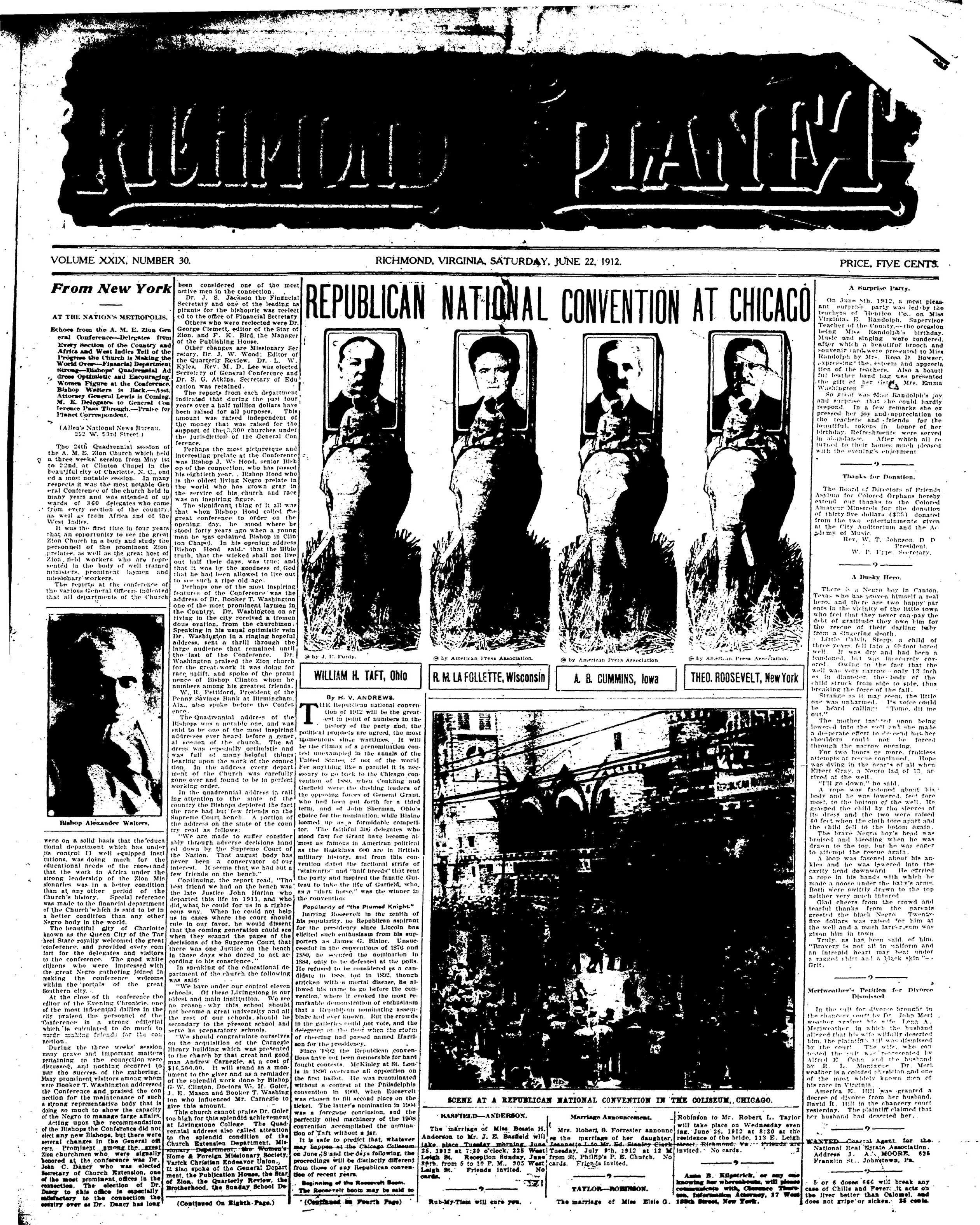
REPUBLICAN NATIONAL CONVENTION AT CHICAGO
C
WILLIAM H. TAFT, Ohio
By H. V. ANDREWS.
THE REPUBLICAN national convention of 1812 will be the greatest in point of numbers in the
history of the party and, the political prophets are agreed, the most momentous since wartimes. It will be the climax of a pronunciation contest unexamined in the annals of the United States. If not of the world. For anything like a parallel it is necessary to go back to the Chicago convention of 1880, when Conkling and Garfield were the dashing leaders of the opposing forces of General Grant, who had been put forth for a third term, and of John Sherman, Ohio's choice for the nomination, while Blaine loomed up as a formidable competitor. The faithful 306 delegates who stood fast for Grant have become almost as famous in American political as the Bubuklava 000 are in British military history, and from this convention dated the factional strife of "stalwarts" and "half breeds" that rent the party and inspired the fanatic Gulteau to take the life of Garfield, who, as a "dark horse," was the winner in the convention:
Popularity of "the Plumed Knight."
Barring Roosevelt in the zenith of his popularity, no Republican aspirant for the presidency since Lincoln has elicited such enthusiasm from his supporters us James G. Blaine. Unsuccessful in the conventions of 1870 and 1880, he secured the nomination in 1884, only to be defeated at the polls. He refused to be considered as a candidate in 1888, but in 1892, though stricken with a mortal disease, he allowed his name to go before the convention, where it evoked the most remarkable demonstration of enthusiasm that a Republican nominating assemblage had ever known. But the crowds in the galleries could pot vote, and the delegates on the floor when the storm of cheering had passed named Harrison for the presidency.
Since 1892 the Republican conventions have not been memorable for hard fought contests. McKinley at St. Louis in 1896 overcame all opposition on the first ballot. He was renominated without a contest at the Philadelphia convention in 1900, when Roosevelt was chosen to fill second place on the ticket. The latter's nomination in 1904 was a foregone conclusion, and the perfectly oiled machinery of the 1908 convention accomplished the nomination of Taft without a jar.
It is safe to predict that, whatever may happen at the Chicago Coliseum on June 18 and the days following, the proceedings will be distinctly different from those of any Republican convention of recent years.
Beginning of the Receivelt Boom.
The Receivelt boom may be said to
(Continued on Fourth Page)
THE MAYOR OF BOSTON
SCENE AT A REPUBLICAN NATIONAL CONVENTION IN THE COLISEUM. CHICAGO.
M.
@ by American Press Association.
R. M. LA FOLLETTE, Wisconsin
SCENE AT A REPUBLICAN
BASFIELD-ANDERSON.
The marriage of Miss Beasle H. Anderson to Mr. J. E. Basfield will take place Tuesday morning June 25, 1912 at 7:30 o'clock, 225 West Leigh St. Reception Sunday, June 29th, from 6 to 10 P. M., 205 West Leigh St. Friends invited. No cards.
Rub-My-Tlain will cure you.
THE LAND OF THE LION
by American Press Association
A. B. CUMMINS, Iowa
NATIONAL CONVENTION IN T
Marriage Announcement
Mrs. Robert G. Forrester announc es the marriage of her daughter, Jeannette L. to Mr. Ed. Stanley Clark Tuesday, July 9th, 1912 at 12 M from St. Philip's P. E. Church. No cards. Friends invited.
TAYLOR—ROBINSON.
The marriage of Miss Elsie G.
THE ELEPHANT
THEO. ROOSEVELT, New York
THE COLISEUM, CHICAGO.
Robinson to Mr. Robert L. Taylor will take place on Wednesday evening. June 26, 1912 at 8:30 at the residence of the bride, 113 E. Leigh street. Richmond. Va. Friends are invited. No cards.
Anna B. Kilpatrick, or any one knowing her whereabouts, will please communicate with, Clarence Thurston, Information Attorney, 17 West 182nd Street, New York.
PRICE, FIVE CENTS.
A Surprise Party.
On June 9th, 1912, a most pleasant surprise party was led by the teachers of Henrico Co. on Miss Virginia E. Randolph, Supervisor Teacher of the County, the occasion being Miss Randolph's birthday. Music and singing were rendered, after which a beautiful brooch and souvenir card were presented to Miss Randolph by Mrs. Rosa D. Howser, expressing the esteem and appreciation of the teachers. Also a beautiful leather hand bag was presented the gift of her sister Mrs. Emma Washington.
So great was Miss Randolph's joy and surprise that she could hardly respond. In a few remarks she also pressed her joy and appreciation to the teachers and friends for the beautiful tokens in honor of her birthday. Refreshments were served in abundance. After which all re turned to their homes much pleased with the evening's enjoyment
Thanks for Donation.
The Board of Directors of Friends Asylum for Colored Orphans hereby extend our thanks to the Colored Amateur Minstrels for the donation of thirty five dollars ($25) donated from the two entertainments given at the City Auditorium and the Academy of Music.
Rev. W. T. Johnson. D. P. President.
W. P. Pure. Secretary.
A Dusky Here
There is a Negro boy in Canton, Texas who has proven himself a real hero, and there are two happy parents in the vicinity of the little town who feel that they never can pay the debt of gratitude they owe him for the rescue of their darling baby from a singering death.
Little Calvin, Stepp, a child of three years, fell into a 60 foot hored well. It was dry and had been a bandoned, but was insecurely corroded. Owing to the fact that the well was very narrow only 13 inches in diameter, the body of the child struck from side to side, thus breaking the force of the fall.
Strange as it may seem, the little one was unharmed. Its voice could be heard calling: "Tome, dit me out."
The mother instilled upon being lowered into the well and she made a desperate effort to descend but her shoulders could not be forced through the narrow opening.
For two hours or more, fruitless attempts at rescue continued. Hope was dying in the hearts of all when Elbert Gray, a Negro lad, of 13, arrived at the well.
"I'll go down." he said.
A rope was fastened about his body and he was lowered, feet foremost, to the bottom of the well. He grasped the child by the sleeves of its dress and the two were raised 40 feet when the cloth tore apart and the child fell to the bottom again.
The brave Negro boy's head was bruised and bleeding when he was drawn to the top, but he was eager to attempt the rescue again.
A loop was fastened about his ankles and he was lowered into the cavity head downward. He carried a rope in his hands with which he made a noose under the baby's arms. Both were swiftly drawn to the top neither very much injured.
Glad cheers from the crowd and tearful thanks from the parents greeted the black Negro. Twenty-five dollars was raised for him at the well and a much larger sum was given him in town.
Truly, as has been said, of him. "Bravery is not all in uniform and an intrepid heart may beat under a ragged shirt and a black skin"—Grit.
Mertweather's Position for Divorce
Dismissal.
In the suit for divorce brought in the chancery court by Dr. John Mori weather against his wife, Lena A. Moriweather, in which the husband alleged that his wife wilfully deserted him, the plaintiffs' bill was dismissed by the court. The wife, who con-tested the suit was represented by Alfred E. Cohn and the husband by R. L. Montague. Dr. Mori weather is a colored physician and one of the most widely known men of his race in Virginia. America E. Hill was granted a decree of divorce from her husband. David R. Hill in the chancery court yesterday. The plaintiff claimed that her husband had deserted her.
WANTED General Agent for the
National Real Estate Association.
Address J. A. MOORE, 635
Franklin St., Johnstown, Pa.
5 or 6 doses 666 will break any case of Chills and Fever; it acts on the liver better than Calomel, and does not gripe or sicken. 24 cans
The image provided is too blurry and low-resolution to accurately recognize any text or graphics. It appears to be a grayscale image with a rough texture, possibly a close-up of a person's face or a fragment of a landscape. Due to the low resolution, no specific details can be discerned.
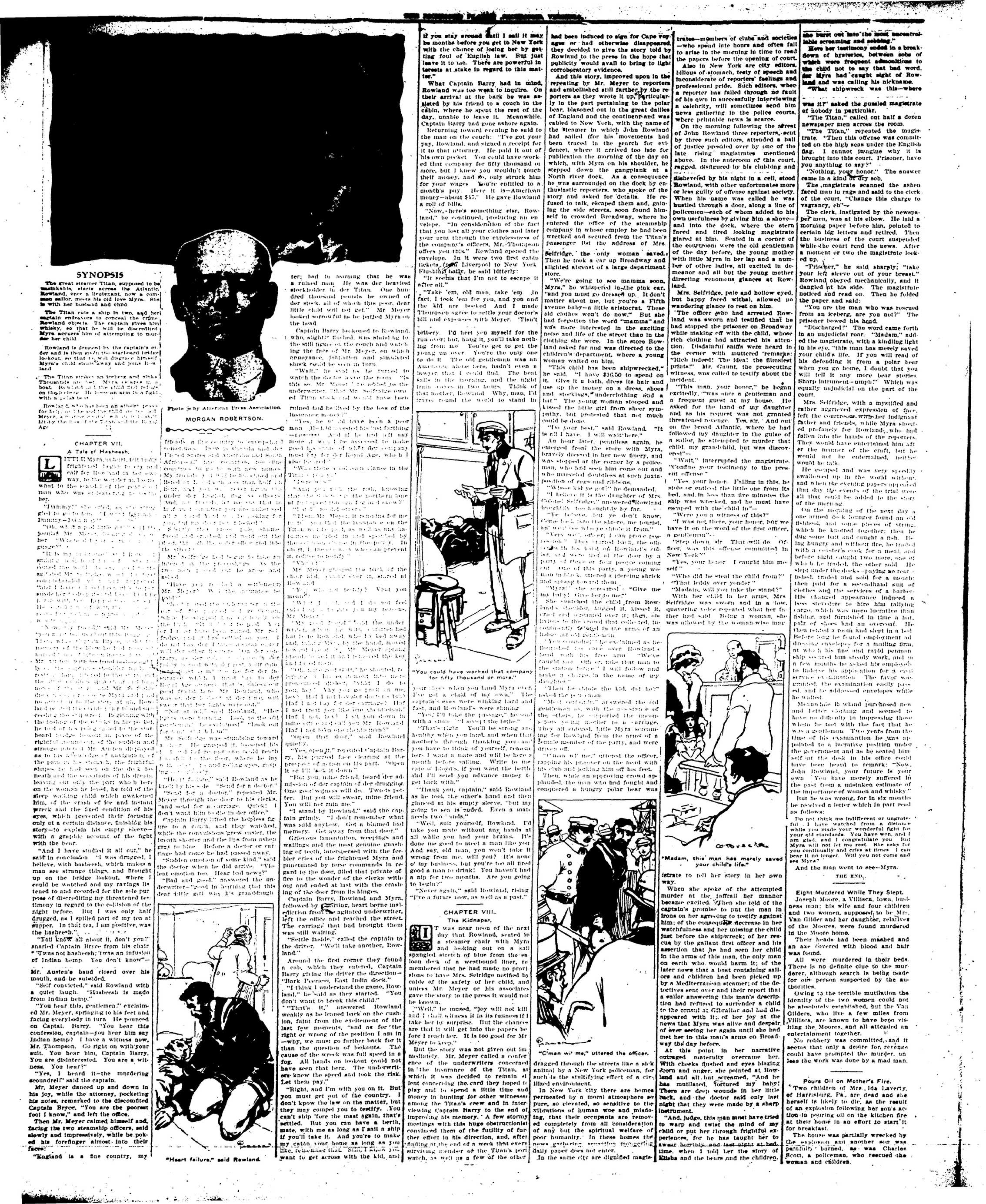
SYNOPSIS
The great steamer Titan, supposed to be unmankable, starts across the Atlantic. Rowland, once a lieutenant, now a common sailor, meets his old love Myra. She is with her husband and child.
The Titan cuts a ship in two, and her captain endeavors to conceal the crime. Rowland, who has been whisky, so that he will be discredited, Myra accuses him of attempting to murder her child.
Rowland is drugged by the captain's order and is then given the starboard bridge lookout, so that he will disgrace himself. Myra's child steals away and joins Rowland.
The Titan strikes an iceberg and stakes Thousands are lost. Myra escapes in a boat. Rowland and the child find refuge on the iceberg. He leaves an arm in a flask, which he has been an ally since for her. Rowland and the child are taken to Meyer, where the lover of the Titan is Agr.
ITTLE MYRA, but bodily frightened, began to cry and call for blow and in her way, to the water and some to the sound of the pier and who was of leaving to see her
L
"Daming" she called, as she were,
gled to go to him. I went again
Daming to the same time.
"Oh, when I got little perks of my
jointed Mr. Moore to give me a
her. "Whose did you call a
gauge?"
"R: Is my income good to him?"
"I'd give me a lot of time for
me, and the world is good."
"And I have a lot of time to help
me, but I do not want to be
to be here," she said. "I am a
He's good to me of my life."
"I'd be a good one to have a
way," she said.
"N: Why, that's what Mr. Moore
then is to be here," she said.
"I think who's the Boy, who's
me, or of the Mowland man,
that's the one I'm here."
Mr. Yvette was how beyond nothing until by a Mr. Yvette's whether to be the post in being. I noted to the staff and the staff did not sign up a staff and notes of the staff and Mr. Yvette does to the staff or to the Yvette and the staff on to the story at all. How hard he had the time to report to and say
the hiding of the child in his product,
he told of his being bound to the star
board bridge down in the peace of the
right hand of Mr. Austin displayed
as to his hideous case of antigraft of
the pain in his stomach, the frightful
shapes he had seen on the deck
neath and the expressions of his dreams
leaving out only the part which bore
on the woman he loved, his told of the
sleep walking child which awakened
him, of the crash of ice and instant
wreck and the fixed condition of his
eyes, which prevented their focusing
only at a certain distance, finishing his
story—to explain his empty sleeve—
with a graphic account of the fight
with the bear.
"And I have studied it all out," he said in conclusion. "I was drunked. I believe, with bashesh, which makes a man see strange things, and brought up on the bridge lookout, where I could be watched and my ravings listened to and recorded for the sole purpose of discerning my threatened testimony in regard to the collision of the night before. But I was only half drunked, as I spilled part of my tea on supper. In this tea, I am positive, was the bashesh."
"You know all about it, don't you?" enlisted Captain Bryce from his chair. "Twas not bashesh; twas an infusion of Indian hemp. You don't know"—Mr. Austen's hand closed over his mouth, and be sutside.
"Self convicted," said Rowland with a quiet laugh. " bashesh is made from Indian hemp."
"You hear this, gentlemen," exclaimed Mr. Meyer, springing to his feet and facing everybody in turn. He pounced on Capital. Harry. "You hear this confession, captain-you hear him say Indian hemp? I have a witness now, Mr. Thompson. Go right on with your suit. You hear him, Captain Barry. You are disinterested. You are a witness. You hear!"
"Yes, I heard it—the murdering scoundrel" said the captain.
Mr. Meyer danced up and down in his joy, while the attorney, pocketing his notes, remarked to the discomfited Captain Bryce. "You are the poorest foot I know," and left the office.
Then Mr. Meyer calmed himself and, facing the two steamship officers, said slowly and impressively, while beaked his forefinger almost into their faces.
"Indiana is a fine country, my
---
A. B.
Photo by American Press Association.
friends in the country to save public
concerns. lives in Virginia and the
United States. Australia and South
Africa are also countries, from the
many countries to go with them. My
friends will be here, and Hotel
London will be there than in four,
and you will be there under the English flag, so offices
And, the friends, let me say that in
half and half of your hotel and all
and would you be willing for you
but not for you to be there?"
Mr. Saffer had begun to take in
their interest in the news. As the
two men passed out he笑了 and
paced.
"Have you to tell us something Mr. Meyer? We'll the inundation by good?"
Then I read the chapter for the end of the period. I no change, while he waged the very only on the high day on the good. A very far I've been from here, Mr. Sel, I did not feel the need on you. I do not feel the need on you, I will do other things. You do come from, as the color of the book is different from the policy to do whether just a certain request, and I do not feel the same which I must say to do after your Age owners that a milestone good friend here Mr. Reward, who was so do I most at least, will come that her lasts were out." "Not at all," said Rowland. "Here lights were coming. I see to the old person," he explained. "Look out for you."
Mr. Smithie was stumbling toward a bed. He grimaced it, knocked his head, and he rolled back to the room, where he lay with his hands and rolling eyes, grasping at "Heart failure." said Bowland as he knelt by his side. "Sand for a doctor." "Sand for a doctor," repeated Mr. Meyer through the door to his clerk, "and sand for a carriage. Quick! I don't want him to die in der office." Captain Barrie lied the hopeless figure to a coach, and they watched, while the convictions grew easier, the breath shorter and the lips from ashen gray to blue. Before a doctor or carriage had come he had passed away. "Sudden emotion of some kind," said the doctor when he did arrive. "The lent emotion too. Hear bad news!" "Bad and good," answered the underwriter, "good in learning that this dear little girl was his granddaughter."
C. M. B.
"Heart failure," said Rewland.
```markdown
```
ter; bed in learning that he was a ruined man. He was der heaviest stockholder in der Titan. One hundred thousand pounds he owned of der stock, all of which this poor, dear little child will not get." Mr. Mayer looked sorrowful as he puffed Myron on the head.
Captain Barry bespoke to Rowland, who slighted himself, standing by the still figure on the couch and watching the face of Mr. Mayer, on which annoyance, frustration and simulated shock could be seen in turn.
"Walt," he said, as he turned to watch the doctor save the room. "This so, Mr. Mayer," he added to the underwriter, "that Mr. Sullivan owned Titan stock and would have been ruined and be lived by the loss of the insurance money."
"Yes, he would have been a poor man. He had cast his last farthing — and if he had left any more of it, he was as good as the best of what he company must be for the Royal Age, when I also beheld."
"What there was so soon chance in the Titanic's voyage?"
"Just was."
"And yet you took the risk, knowing that the ship was the northern lane at first speed, then fog and snow?"
"I had no good letters."
"Hon. Mr. Meyer it is nothing for me to tell you that the house on the Titanic was the place as well as any house the ship was in and spared by the collision in the policy. In short, I think the man who can prevent it, refuses to tell."
"What?"
Mr. Meyer grasped the back of the chair and put it over it, stared at him.
"Yo, who is not to tell you? What you mean?
"What I do, and I do not feel
cool to do to you in my rooms
Mr. Mayer.
"My good friend said the under
writers, in a room with a chair, had
be to Rowland, who he kept away
and told Mr. Mayer by the hand, moved
to rowland room. Mr. Mayer opening
shielded it and it received the key
hint from them.
"Oh, that great thing he should be
bring to Rowland, he even most the
miserable shielded it. "What I do to
you, haw? Why you go past on my
haw? If I not Rowland do it haw?
If I not lay for the carriage? If
I not treat you like the shattered
If I not lay haw? I set you down in
matter office and call you Mr. Rowland.
If I not take the shattered man?
"Open that door?" said Rowland
country.
"Yes, open it," repeated Captain Barry, his personal friend, clearing at the prospect of motion on his part. "Open it or I'll hit it down."
"But you, mine friend, heard der admission of der captain of der drugging. One good witness will do. Two is petter. But you will swear, mine friend. You will not rain me."
"I stand by Rowland," said the captain grimly. "I don't remember what was said anyhow. Got a blamed bad memory. Get away from that door."
Grievous lamentation, weepings and wallings and the most gummine grunting of牙, interspersed with the feebler eries of the frightened Myra and punctured by torse commands in regard to the door, filled that private of face to the wonder of the clerks without and ended at last with the crashing of the door from its hinges.
Captain Barry, Rowland and Myr,
followed by writing, heart borne mal-
cidiction from the agitated underwriter,
left the office and reached the street.
The carriage that had brought them
was still waiting.
"Settle Inside" called the captain to
the driver. "We'll take another, Row-
land."
Around the first corner they found
a cab, which they entered. Captain
Barry giving the driver the direction—
"Bark Peerless, East India dock."
"I think I understand the game, Row-
land," he said as they started.
"You don't want to break this child."
"That's it," answered Rowland weakly as he leaned back on the cushion, faint from the excitement of the last few moments, "and as for the right or wrong of the position I am in—why, we must go farther back for it than the question of backouts. The cause of the wreck was full speed in a fog. All hands on lookout could not have seen that here. The underwriter knew the speed and took the risk. Let them pay."
"Right, and I'm with you on it. But you must get out of the country. I don't know the law on the matter, but they may compel you to testify. You can't ship fure the mast again, that's settled. But you can have a berth, mate, with me as long as I sail a ship if you'll take it. And you're to make my cabin your home as long as you like, remember that." Still, I know you want to get across with the kid, and
If you stay around dull I call it may be months before you get to New York with the chance of losing her by getting foul of 'English law. But just leave it to he. There are powerful insecnts at stake in regard to this matter."
What Captain Barry had in mind, Rowland was too weak to ingquire. On their arrival at the bark he was assisted by his friend to a couch in the cabin, where he spent the rest of the day, unable to leave it. Meanwhile, Captain Barry had gone ashore again.
Returning toward evening he said to the man on the couch: "I've got your pay, Rowland, and signed a receipt for it to that attorney. He paid it out of his own pocket. You could have worked that company for fifty thousand on more, but I knew you wouldn't touch their money, and only struck him for your wages. You're entitled to a month's pay. Here it is—American money—about $17." He gave Rowland a roll of bills.
"Now, here's something else, Rowland," he continued, producing an envelope. "In consideration of the fact that you lost all your clothes and later your arm through the carolessness of the company's officers, Mr. Thompson offers you this." Rowland opened the envelope. In it were two first cadmium tickets from Liverpool to New York Flushing batty, he said bitterly: "It seems that I'm not to escape it after all."
"Take 'em, old man, take 'em in fact, I took 'em for you, and you and the kid are booked. And I made Thompson agree to settle your doctor's bill and expenses with Meyer. 'Then't birthery. I'd feel you myself for the run over; but, hang it, you'll take nothing from me. You've got to get the young un ever. You're the only one to do it. The old gentleman was an American, please let me, didn't even a lawyer that I could find. The boat skis in the morning, and the night train leaves in two hours. Think of that mother. Rivolated. Why, man, I'd travel round the world to stand in
```markdown
```
"You could have worked that company for fifty thousand or more."
"You could have worked that company for fifty thousand or more."
your shoes when you hand Myra over. I've got a child of my own." The captain's eyes were winking hard and fast, and Rowland's were shining. "You'll take the passage," he said with a smile. "I accept the bride."
"That's right. You'll be strong and healthy when you hard, and when that mother's through thinking you and you have to think of yourself, remember I want a mate and will be here a month before calling. Write to me care of Lloyds, if you want the bank and I'll send you advance money to get back with."
"Thank you, captain," said Rowland as he took the other's hand and then glanced at his empty sleeve, "but my going to sea is ended. Even a mate needs two hands."
"Well, suit yourself, Rowland. I'd take you note without any hands at all while you had your brains. It's done me good to meet a man like you. And say, old man, you won't take it wrong from me, will you? It's none of my business, but you're too all tired good a man to drink! You haven't had a nap for two months. Are you going to begin?"
"Never again," said Rowland, rising "I've a future now, as well as a past."
CHAPTER VIII.
The Kidnaper.
I
I was near noon of the next day that Rowland, leaned in to a stairman chair with Myra and looking out on a gait
"Well," he mused, "joy will not kill and I shall witness it in its fairness if I take her by surprise. But the chances are that it will get into the papers he force I reach her. It is too good for Mr Meyer to keep."
But the story was not given out immediately. Mr. Meyer called a conference of the underwriters concerned in the insurance of the Titan, at which it was decided to retain silent concerning the card they hoped to play and to spend a little time and money in hunting for other witnesses among the Titan's crew and in interviewing Captain Harry to the end of improving his memory. A few stormy meetings with this huge obstructionist convinced them of the futility of further effort in his direction, and, after finding at the end of a week that every surviving member of the Titan's port watch, as well as a few of the other
had been induced to sign for Cape voyages or had otherwise disappeared, they decided to give the story told by Rowland to the press in the hope that publicity would avail to bring to light corroboratory evidence.
And this story, improved upon in the repeating by Mr. Meyer to reporters and embellished still farther by the reporters as they wrote it up, particularly in the part pertaining to the polar bear, blazoned out in the great dalles of England and the continent and was cabled to New York, with the name of the Steamer in which John Rowland had sailed (for his movements had been traced in the pench for evidence), where it arrived too late for publication the morning of the day on which, with Myra on his shoulder, he stepped down the gangplank at a North river dock. As a consequence he was surrounded on the dock by enthusiastic reporters, who spoke of the story and asked for details. He refused to talk, escaped them and, gaining the side streets, soon found himself in crowded Broadway, where he entered the office of the steamship company in whose employ he had been wrecked and secured from the Titan's passenger list the address of Mrs.
Selfridge, the only woman saved. Then he took a car up Broadway and alighted aback of a large department store.
"We're going to see mamma soon, Myra," he whispered in the pink car, "and you must dressed up. It don't matter about me, but you're a Fifth avenue baby—a little aristocrat. These old clothes won't do now." But she had forgotten the word "mamma" and was more interested in the exciting noise and life of the street than in the clothing she wore. In the store Rowland asked for and was directed to the children's department, where a young woman waited on him.
"This child has been shipwrecked," he said. "I have $1500 to spend on it. Give it a bath, dress its hair and use up the money on a dress, shoes and stockings, underclothing and a hat." The young woman stooped and kissed the little girl from sheer sympathy, but protested that not much could be done.
"Do your best," said Rowland. "It is all I have. I will wait here."
An hour later, penniless again, he emerged from the store with Myra, bravely dressed in her new finery, and was stopped at the corner by a police man, who had seen him come out and who miraculously lost at such juxtaposition of rags and ribbons.
"Who knew he got?" he demanded.
"I believe it to the daughter of Mrs. Colin Selfridge," answered Rowland houghtily too laughfully by far.
"I believe, but ye don't know. Come back into the store, me tourist, and we will see who he thief it from."
"Very well, others, I can prove posession." They started back, the office was his desk. Rowland's collar and were unset at the door by a party of three or four people coming out of this party, a young woman in black, uttered a pleading shriek and sprinted toward them. "Myra," she screamed. "Give me my baby! Give her to me!"
She watched the child from Rowland's shoulder, hugged it, kissed it, and opened over it, then, obliviously to the crowd that collected, in continuity, the crowd in the arms of an older and old gentleman.
"You committed!" he exclaimed as he gathered the child over Rowland's head with his free arm. "We've caught you. Other, take that man to the station bridge." I will follow and make a charge in the name of my daughter."
"Then he stole the kid, did he?" asked the gentleman.
"Most certainly!" answered the old gentleman as, with the assistance of the others, he supported the impostors young mother to a carriage. They all entered. Myra screamed for Rowland from the arms of a female member of the party, and were dragged off.
"Tillman will need uttered the officer, rapping his presser on the head with his club and perking him off his feet. Then, while an approving crowd applauded, the man who had fought and conquered a hungry polar bear was
R. D. B.
"Ciman wil me," uttered the officer, dragged through the streets like a sick animal by a New York policeman, for such is the stultifying effect of a civilized environment. In New York city there are homes permeated by a moral atmosphere so pure, so elevated, so sensitive to the vibrations of human woe and misdoing, that their occupants are removed completely from all consideration of any but the spiritual welfare of poor humanity. In these homes the news gathering, sensation marketing, daily paper does not enter. In the same city are diminished marta-
trates—members of clubs and societies—who spend into hours and often fail to arise in the morning in time to read the papers before the opening of court. Also in New York are city editors, billions of stomach, testy of speech and inconsiderate of reporters' feelings and professional pride. Such editors, when a reporter has failed through no fault of his own in successfully interviewing a celebrity, will sometimes send him news gathering in the police courts, where printable news is scarce.
On the morning following the arrest of John Rowland three reporters, sent by three such editors, attended a ball of justice provided over by one of the late rising magistrates mentioned above. In the anteroom of this court, ragged, disfigured by his clubbing and disheveled by his night in a cell, stood Rowland, with other unfortunate more or less guilty of offense against society. When his name was called he was hustled through a door, along a line of policemen—each of whom added to his own usefulness by giving him a above—and into the dock, where the stern faced and tired looking magistrate glared at him. Sented in a corner of the courtroom were the old gentleman of the day before, the young mother with little Myrn in her lap and a number of other ladies, all excited in demeanor and all but the young mother directing venomous glances at Rowland.
Mrs. Selfridge, pale and hollow eyed, but happy faced withal, allowed no wandering glance to rest on him.
"The officer who had arrested Rowland was sworn and testified that he had stopped the prisoner on Broadway while making off with the child, whose rich clothing had attracted his attention. Dudleyful nails were heard in the corner with muttered remarks: 'Rich indeed! The ideal the filmmaker prints!' Mr. Gaunt, the prosecuting witness, was called to testify about the incident.
"This man, your honor, he began excitedly, "was once a gentleman and a frequent guest at my house. He asked for the hand of my daughter and as his request was not granted threatened revenge. Yes, sir. And out on the broad Atlantic, where he had followed my daughter in the guise of a sailor, he attempted to murder that child, my grandchild, but was discovered."
"Wait," interrupted the magistrate.
"Confine your testimony to the present offense."
( "Yes, your honor. Falling in this, he stole or enticed the little one from its bed, and in less than five minutes the ship was wrecked, and he must have escaped with the child in"—
"Were you a witness of this?"
"I was not there, your honor, but we have it on the word of the first officer, a gentleman."
"Step down sir. That will do. Officer, was this offense committed in New York."
"Yes, your honor. I caught him myself."
"Who did he steal the child from?"
"That ledly over younder."
"Medium, will you take the stand?"
With her child in her arms, Mrs Selfridge was sworn and in a low, quavering voice repeated what her father had said. Being a woman, she was allowed by the woman who man
COVACHA
"Madam, this man has merely saved your child's life."
intrate to tell her story in her own way.
When she spoke of the attempted murder at the jailrall her manner became excited. When she told of the captain's promise to put the man in irons on her agreeing to testify against him; of the consequence decrease in her watchfulness and her missing the child just before the shipwreck; of her rescue by the gallant first officer and his assertion that he had seen her child in the arms of this man, the only man on earth who would harm it; of the later news that a boat containing sailors and children had been picked up by a Mediterranean steamer; of the detectives sent over and their report that a sailor answering this man's description had refused to surrender a child to the consul at Gibraltar and had disappeared with it; of her joy at the news that Myra was alive and despair of over seeing her again until she had met her in this man's arms on Broadway the day before.
At this point in her narrative outraged maternity overcame her. With cheeks flushed and eyes blazing, brow and anger, she pointed at Rowland and all but screamed. "And he has mutilated, fortured my baby! There are deep wounds in her little back, and the doctor said only last night that they were made by a sharp instrument.
"And, judge, this man must have tried to warp and twist the mind of my child or put her through frightful experiences, for he has taught her to awe horribly and last night at bedtime, when I told her the story of Elissa and the bear and the children.
table screening and sobbing."
Here her testimony ended in a breakdown of bristlew, between jobs of which were frequent admissions to the child not to say that bad word, for Kyra had caught sight of Rowland and was calling his nickname.
"What shipwreck was this—where was it?" asked the puzzled magistrate of nobody in particular.
"The Titan," called out half a dozen newspaper men across the room.
"The Titan," repeated the magistrate.
"Then this offense was committed on the high seas under the English flag. I cannot imagine why it is brought into this court. Prisoner, have you anything to say?"
"Nothing, your honor." The answer came in a kind of dry sob.
The magistrate scanned the ashen faced man in rags and said to the clerk of the court, "Change this charge to pregnancy, oh."
The clerk, instigated by the newspaper man, was at his elbow. He had a morning paper before him, pointed to certain big letters and retired. Then the business of the court suspended while the court read the news. After a moment or two the magistrate looked up. "Phisher," he said sharply; "take your left sleeve out of your breast." Rowland obeyed mechanically, and it dangled at his side. The magistrate noticed and read on. Then he folded the paper and said: "You are the man who was rescued from an iceberg, are you not?" The prisoner bowed his head.
"Discharged!" The word came forth in an unjudicial roar. "Madam," added the magistrate, with a kindling light in his eye. "this man has merely saved your child's life. If you will read of his defending it from a polar bear when you go home, I doubt that you will tell it any more bear stories Sharp intrument—umph!" Which was equally unjudicial on the part of the court.
Mrs. Selfridge, with a mystified and rather aggrieved expression of face, left the courthouse with her indignant father and friends, while Myra shouted profanely for Rowland, who had fallen into the hands of the reporters. They would have entertained him after the manner of the craft, but he would not be entertained, neither would he talk.
He escaped and was very specially swallowed up in the world without, and when the evening papers appeared that day the events of the trial were all that could be added to the story of the meeting.
On the meeting of the next day a one armed doek longer found an old fishhook and some pieces of string, which he knotted together, then he dug some bait and caught a fish. Being hungry and without fire, he trapped with a coaster's cook for a meal, and before night caught two more, one of which he trailed, the other sold. He slept under the decks - paying no rent - insisted, traded and sold for a month; then paid for a secondhand suit of clothes and the services of a barber. His changed appearance induced a best steviee to hire him tallying cargo, which was more lucrative than fishing, and furnished in time a hat, pair of shoes and an overcoat. He then rented a room and slept in a bed. Before long he found employment ad dressing envelopes for a mailing firm, at which his fine and rapid penman ship secured him steady work, and in a few months he asked his employer to induce his application for a civil service examination. The favor was granted, the examination easily passed, and he addressed envelopes while he waited.
Meanwhile Rowlard purchased new and better clothing and seemed to have no difficulty in impressing those whom he met with the fact that he was a gentleman. Two years from the time of his examination he was appointed to a iterative position under the government and as he seated himself at the desk in his office could have been heard to remark: "Now, John Rowland, your future is your own. You have merely suffered in the past from a mistaken estimate of the importance of women and whisky." But he was wrong, for in six months he received a letter which in part read us follows:
Do not think me indifferent or ungrateful. I have watched from a distance while you made your wonderful fight for your old standards. You have won, and I am glad and let me congratulate. I ask for you continually and criee at times. I can bear it no longer. Will you not come and see Myra?
And the man went to see-Myra.
Eight Murdered While They Stept.
Joseph Moore, a Villisa, Iowa, business man; his wife and four children and two women, supposed to be Mr. Van Glider and her daughter, relatives of the Moores, were found murdered in the Moore home.
Their heads had been maimed and an ax covered with blood and hair was found.
All were murdered in their beds. There is no definite clue to the murderer, although search is being made for one person suspected by the authorities.
Owing to the terrible mutilation the identity of the two women could not be absolutely established, but the Van Gliders, who live a few miles from Villisa, are known to have been visiting the Moores, and all attended an entertainment together.
No robbery was committed, and it seems that only a desire for revenge could have prompted the murder, unless the work was done by a mad man.
---
Two children of Mrs. Ida Laverty of Harriburg, Pa., are dead and she herself is likely to die, as the result of an explosion following her son's action in pouring oil on the kitchen fire at their home in an effort to start it for breakfast.
The house was partially wrecked by the explosion and another son was painfully burned, as was Charles Scott, a policeman, who rescued the woman and children.
---
By Clarissa Mackie
HE day I went crubbing with Captain Barnabas Fish I carried a basket containing all the delicaties that I knew the good captain loved. He had become an enthusiast about club sandwiches which he had not tasted before this summer when I first made his acquaintance, and so I was careful that there was a goodly supply of these toothsome "entire meat" sandwiches in the lunch basket. There was also a great square of frosted gingerhead, and wrapped in a unkink were several flaky plum tarts. In one corner of the basket was a tall bottle of dandelion wine. All these delicacies were produced by the skillful hands of Miss Maria Weeks, with whom I boarded.
Crabbing is a favorite pastime among the summer visitors at Quince Haven. One enters a sturdy flat bottomed skiff and, leaving the deeper waters of the bay, seeks the narrow channel leading into Little Quince harbor. This channel is navigable only at high tide, and if one is so unfortunate as to remain within the charming circle of Little Quince hills until the tide has ebbed it is only a three mile trump around the beach to Quince Haven, with another trip back to the crabbing grounds for the skiff when the tide next serves.
Captain Barnabas Fish know the tide as well as he did the wind and weather and the set of clouds, so we reached the little channel just as the tide flowed deep enough to carry us swiftly through its narrow width into Little Quince harbor. Once in here, Captain Barnabas allowed the skiff to drift quietly along the low shore among the tall, poorly salt grasses.
The crab nets were brought forth, and each of us took a long pole and wartly dredged for the succulent crustaceans. Now and then one of us would bring up a pole with the net bag heavily weighted with the black wriggling creatures, or perhaps one lone captive would cling by a single claw to the netting. As nood approached the pile in Captain Barnabas' big basket grew higher, and at last we gave up the sport and polled the skiff into the cool shadow of wild plum bushes overhanging from the high bank.
From under the bank little rills of ice cold water gushed from hidden springs, and here we washed our hands and returned to the skiff for lunch. Captain Barnabas wanted to broil
PARKER
"A gigantic figure that gave vent to a snarling yell."
some crabs on a hastily constructed driftwood fire, but I vetoed the suggestion, tempting us it was.
I presented one of his loved club sandwiches, and his gray eyes twinkled appreciatively.
"It's better 'n broiled crabs," he murmured from the midst of a huge bite of crisp toast, lettuce leaf, mayonnaise, chicken breast and tender bacon.
"You never tasted anything quite so delicious even on that treasure island of yours," I declared meaningly.
"Hi, ho!" roared the captain, slapping his knee vigorously. "I knew there was something back of that sandwich. Mia Telham! Now, I was going to tell you that story today anyway, so you might have kept all your brides to home."
"Then you shall tell it all the better for the sandwiches," I returned, undaunted by his laughter. "I hope it a story where you were cast ashore without even a bag of blacuita—the sound so dry and unpalatable. I'm sure bread fruit and cocoangta—are much more delicious."
They're delicious, all right, agreed the captain amblily, helping himself to another sandwich, "but you get tired of eating fruit even on a desert island, and hardtack ain't to be depicted even if it is washed down by state water, not when you're hungry. Now.
Amantias sline ain't in this story, so I shall have to stick to the truth and tell you we were not cast ashore, but we rowed to the island right and proper in a ship's dinghy, with a keg of water and a bag of biscuits and some tins of salt horse stowed in the bow. We also took some picks and shovels and some guns.
"We knew the little island like a book. It was not far from the west coast of Central America and had been ding over one end to the other by different treasure seekers, all after the same hidden gold and jowls. I can't stop to tell you the history surrounding the burrying of the treasure by the ollicent old pirate that ever sailed the seas in the days before Captain Kilda I can't tell you, either, of all the different expeditionals that combed that land from end to end without success, and at last we folks aboard the Indus resolved to have a try at it one voyage when we was sailing light from San Francisco to Valparaiso, where we were going to pick up a cargo of nitrate.
"Four of us wept ashore in the dingy, and the minuter we stepped on that shell strown beach and heard the rushing of the palms and smelled the ripe fruit we knew, right away that we were going to find that treasure. There was something in the very atmosphere of the place that hinted at adventure, and we had plenty of it before we left. Thank you, man! I will take another piece of ginger bread. I don't reckon you made it! He inquired.
I assured him that Miss Marla Weeks had concocted the spicy loaf, and I thought he looked tenderly reminiscent at the frosting before he removed a semicircle from his slice. I had a suspicion that in the distant past there might have lurked a tender romance between my companionable old salt and the rather grim spinster who "accommodated" me with room and board. I had my own plans for furthering this romance and the delicious lunch I had brought was only one of little traps I had prepared for the gentle, unappealing captain.
"You went ashore"—I prompted him. "Yes, I'm am, we went ashore and made a little camp among the palms, and after we had had some supper we started off at a run for the place where we had calculated the treasure was buried. Of course every man who ever went to that island had a different theory as to where it was hid, but we thought ours was a sure guess, for Louis Franck, a Finn who was one of our crew, had an ancestor who had actually sailed with this bloody old pirate away back before the Revolutionary war days. Franck could recite the legend that had been handed down by his ancestor so gibly that he could tell it the same every time, and so after awhile we got to believe it was really so, and that was how it happened we decided to stop there. "Of course Franck was the leader and guide, for he said his ancestor had said that the chest was buried ten feet deep under a rock ten feet square.
"We found the largest rock on the island, and it was only three feet six by six feet two, and it looked thin, and Franken said he thought it had been worn off by the wind and weather during all that time. It was snow white coral rock too.
"The rock was set in a little grove of palm trees, and I suppose once it had rested on the sandy shore, but as the island grew larger and sand was washed up to form a new beach trees grew up around the stone until it really was about in the middle of the island when we found it.
"We worked away pickling and prying at the loose sand around the rock and trying to get crownbars under it so as to lift it up when we smelled wood smoke."
"What's that? I asked Franken.
"The remains of our campfire," I told him, but afterward I found out I was wrong.
"It soon grew dark, for we had been into in landing and we had not intended beginning operations until morning, but the thirst for adventure was strong within us and even while the shadows lengthened a full moon arose from the sea and we decided to continue the work by its light.
"We had just pricked off the stone and sent it crashing into the undergrowth when there arose from our indap, apparently from the disturbed soil under the stone, a gigantic figure that gave vent to a sailing yell as he leaped into the moonlit space and faced us.
"Miss Telham," said the captain impresively, emphasizing his words with successive tape of a horny forefinger against his other palm, "Miss Telham, believe me, madam, when I tell you that that figure was nothing more or less than the ghost of the bloody pirate who had buried the treasure."
Captain Harmonus: I protested.
He nodded. "That's what Louis Franck, the Finn, said. He said the critter looked just like the description his ancestor had handed down of the pirate who had buried the treasure. He whispered it to us, for I'll confess, ma'am. he muddled together all at once under the shock of seeing him and hearing his yell. I don't know which was the worst. He was a crazy looking thing: sure enough, as he pranced around there, waving a ragged looking knife and shouting all sorts of gibberish that nobody understood.
"I told Frank it sounded to me like Finnish, but he said it was Italian, and Tony Laontl said it was German, and the mate, who was a Britsher, said it was pure French. From what I heard afterward I guess it was Irish Well, as I was saying, the pirate was crazy enough in looks—he wore, knee breeches and a loose white shirt and a red sash around his waist with all kinds of weapons stuck in it, and his
—Subscribe to The PLANET.
Hawkins-Johnson MANUFACTURING CO., Hair Grower and Restorer,
616 R. 1st Street. Richmond, Va.
Will positively remove all Dandruff and cure the scalp of all impurities. It will restore Hair on clean Temples and Bald Heads where the Roots are not dead. SATISFACTION-GUARANTEED. PRICE, 35 CENTS PER BOX.
THE HAWKINS-JOHNSON M'f'g Co's Hair Grower and Restorer is now being used in this State and other States with phenomenal success. Its reputation for growing and restoring hair leaps into prominence wherever it is used.
MADAM HAWKINS-JOHNSON is known as the Hair Grower. Give her a fair trial and be convinced that she can do all that she claims, or money refunded. We are now in a position to sell the best hair for less money than ever before and can match all hair perfect. In ordering Hair, send sample. Transformations, $3.00, $4.00, $5.00 to $20.00. Braids, $2.50, $3.00 and $4.00.
Please remit by Cash. F. C. Money Order or Express Money Order.
hair was long and dark, and over his forehead was bound a red handkerchief knotted behind. We could see all this because the tropical moon made it like day there on the white beach.
"How do you know it's a ghost? I whispered to Louis Franck, who shivered beside me.
"He said the critter came from under the stone, and I couldn't deny it because it looked that way to me, and now as he capped around out there a sudden terror seized upon the whole four of us at once, and as we turned and ran he dashed into the thicket after us and away we went pell mell for the shore where we had left the boat.
"As we ran I could feel my hair bristling on my head, and cold shivers ran down my spine. All I wanted was to reach the boat and push off for the ship. We were all young chaps and had our share of gallors' superstitions. If an older head had been along things might have turned out different.
"We piled into the boat and pushed off, leaving all our stores behind. As
B. A.
"Where would you be, captain, if you had'all that money?"
"Where would you be, captain, if you had all that money?"
we pulled toward the Indus—I was second mate on her then—we turned around and saw the ghostly pirate dancing at the water's edge. The knife flashed in the moonlight, and then all at once he disappeared, and there remained nothing save a ball of weird blue light that floated through the air in our wake.
"Captain Sackville declared it was a corpse light, and as our boat was holated to the davits he had all sails bent, anchors up, and away we went clipping along before a fresh nor-wester and at last, to our relief, leaving the blue light behind with the island far eastern."
The captain replaced the luncheon basket in the stern of the skiff, ahifted the oars into the rowlocks and defyed shot out into Little Quince harbor. The blades of the oars riffled the placid surface in which the tall grasses were mirrored, and from a tall pine tree a red winged blackbird called. "Well? I asked impatiently, "Didn't you go back after the treasure?" The captain shook his head solemnly, although I am positive his eyes twinkled assessment. He leaned forward, and the skiff shot into the channel that led into Quince Harven harbor.
"Miss Tolham, when we arrived in New York months afterward we read in the papers that at last Little Island had given up her treasure to a bold Irishman from Hackensack, N. J. - It told how this man, Swiney, had pried up a flat stone and, together with his companions, had dug ten feet deep, mind you, Miss Tolham, and found a chest of gold and jewels. If this Swiney had not found on there and scared us away with his pretense of being a ghost of the pirate and afterward burning a blue signal light—why, I wouldn't be rowing you home across the bay this afternoon."
"Where would you be, captain," I asked curiously, "if you had all that money?"
Captain Barnabas cocked an eye at
Telephone, Madison-4601. Move all Dandruff and cure the Hair on clean Temples and Lead. GARANTEED. PRICE.
JOHNSON M'f'g Co's Hair Group and other States with phenomenal hair leaps into prominence where JNS-JOHNSON is known as the Haired that she can do all that she claim to sell the best hair for less most. In ordering Hair, send $5.00 to $20.00. Braids, $2.50, $3.00. F. C. Money Order or Express.
PRICE, 35 CENTS PER BOX.
Hair Grower and Restorer is now
dominental success. Its reputation
is wherever it is used.
As the Hair Grower. Give her a
she claims, or money refunded,
or less money than ever before and
or, send sample. Transfor-
$2.50, $3.00 and $4.00.
Express Money Order.
RICHMOND, VA.
Mrs. Annie Walbarrow, 4th & Broad, W. H White, 501 W. Leigh Street.
Peter Thompson, 422 E. Marshall Street.
Wm. H. Scott, 2218 E. Main St.
Miss Ruth Cary, 1018 N. 2d St.
R. B. Sampson, 523 N. 2d St.
T. J. Nickerson, 34 W. Leigh Street
N. Winston, 637 Brook Ave.
C. D. Griffin, 224 S. 2d St.
William B. Smith, 3 W. Leigh St.
Tom Bird.
Thomas Page, 815 State Street.
James L. Stewart, 426 Brook Ave.
David Page, Sr., 932 N. 1st St.
Clarence Williams
1411 Ross Street.
M. C. Waller, 1100 W. Leigh St.
E. Dandridge, 107 W. Baker Street.
W. H. Brown, 405 W. Leigh St.
LONG BRANCH, N. J.
P. L. Saulter, 1025-8th Avenue.
J. W. Nuby, 1736-7th St.
PORTSMOUTH, VA.
J. T. P. Cross, 2621 Emingham St.
WILMINGTON, N. C.
Wm. H. Moore.
NORFOLK, VA.
John DeBona. 610' Church St.
Thomas E. W. Perry. 2 Joseph
Place.
STAUNTON VA.
J. H. Allen. 120 S. Augusta St.
A. C. Mabrey. 127 E. Main St.
Wendall Derritt. 714 Nelson St.
the fuzzy clouds, twisted his surnumb ed neck uncomfortably and finally spat reflectively over the side. At last he looked at me and grinned aloudly "I rocked I'd be enjoying myself go ing crabbing with somebody or other," he said.
Glad They Told Him.
What it is to be a genuine, single minded cootist is Illustrated by an occurrence related by an American who spends much of his time in England. Among his acquaintances is a certain dintingished British who is a great invalid and spends most of his time in bed, a fact which, however, does not prevent him from receiving a great deal of company. One day while thus in bed the British received several guests. They all began to shiver and pull their costs about them as they huddled around the bed.
"What!" exclaimed the invalid. "Is it cold here?"
"We are freezing," answered a guest.
"Thank you for telling me," said the distinguished invalid, who thereupon rang a bell. The guests supposed that he was summoning a servant to build a fire, but when his man came in the invalid said:
"Mullins, bring me my down coverlet." - Harper's Magazine.
GOMEZ AND MONTEAGUDO.
President of Cuba (above) and Commander of Army.
[Image of a bust of a man with a broad smile, wearing a hat and a long coat].
Thugs dressed as women attacked Mrs. May 'Bernhelmer at her home in a fashionable uptown apartment house in New York city, and beat her into insensibility, pound and gagged her and escaped with gems valued at $10,000.
Mrs. Bernhelmer told the police that her maid met her at the door upon her return from a shopping expedition and welcomed her with a blow on the head with a potato masher. A second blow knocked her unconscious, she said.
When she awoke she was lying, bound and gagged, upon the maid's bed, while the maid, two men dressed as women, whom she had passed in the hallway, and her jewels were missing.
During the time employed by the thieves to loot the apartment a soamstress sat at her sewing machine in the slitting room, but heard no sound of the struggle. The soamstress accounted for this to the police by declaring that she was doof.
Two Surveyors Killed on Railroad.
William W. Woodhouse, of Wetersfield, Conn., and Philip Dall, of Derry Pa., members of a Pennsylvania railroad surveying party; were run down and killed by a fast passenger train near New Florence, Pa., when they stepped from a telegraph tower to the track. They did not see the approach ing train.
Iowa Pure Food Law Uphold.
The Iowa pure food law, enacted in 1807, was sustained as constitutional by the supreme court of the United States.
AGENTS FOR THE PLANET.
Jesse W. Shreavos 192 Belmont Ave
HACKENSACK, N. J.
D H. Hassell, R. R. Ave., Nr Clay St
OAKLAND, CAL.
NEWPORT NEWE, VA.
Richard Robertson, 1810 River-road.
J. C. Allen, 2107 Marshall Ave.
Charles G. Davis, 504-25th St.
E. F. Boyd. 2604 Central Ave.
Jas. H. Jackson. 3315 Central Ave.
C. Branum, 657 Shawmut Ave.
BROOKLYN, N. Y.
John H. Ashby, 135 Steuben St.
ATLANTIC CITY, N. J.
Charles M. Thomas 40 N. Indiana Av
Harold P. Douglas, 11 N. Kentucky
Avenue.
Oscar Henry, 21 N. Kentucky Ave.
TARBORO, N. C.
V. E. Howard.
E. P. Mackens, 1116 Pine Street.
James E. Warwick, 254 S. 11th St.
Mrs. Lavinia Aldridge, 621 S. 13th Street.
J. A. Stokes, 1011 Fitzwater St.
DANVILLE, VA.
Harry A. Clark, 117 Craghhead St.
PROVIDENCE, R. 1.
Douglas A. A., P. A., 910 Westminster Street.
BUTLER, PA.
Walter Milla, 204 Mulberry St.
CAMDEN, N. J.
C. N. Green, 821 Kaligha Avenue.
HARTFORD, CONN.
George M. Hall, 150 Albany Ave.
ST. PAUL MINN.
W. J. Utley, 94 E. 5th Street.
T. W. Anderson, 2162-5th Avenue.
Anthony Burrell, 131 W. 53rd St.
Mrs. Leanna Hamilton, 8 W. 135th St.
Edward Gibson, 114 W. 136th St.
Samuel Hobbs, 228 E. 127th St.
E. A. Williams, 200 W. 63d St.
J. E. Schmidt, 263 W. 35th St.
PLAINFIELD, N. J.
Rev. J. A. Carter, 533 B. 8rd Street.
BALT LAKE CITY, UTAH.
Charles Ludwig, P. O. Box 1776.
hall
LOUISVILLE, KY.
Jesse E. Brown, 1216 W. Green St.
ST. LOUIS MO.
W. A. Priee, 6 N. 14th St.
DRAKES BRANCH, VA.
Clem Green.
LOS ANGELES, CAL.
A. D. Lacey, 790 San Pedro St.
NEW ORLEANS, LA.
World's News Co., Box 1124.
A. O. Smith, 202 S. Rampart St.
MONESSEN, PA.
Smith & Williams, 601 Sixth St.
FARMVILLE, VA.
J. C. Cartor, Box 133.
LEESBURG, VA.
Miss Cora L. Wright.
NEWARK, N. J.
Wm. H. Nelson, 99 High St.
FLORENCE, B. C.
E. B. Webster.
DURHAM, N. C.
J. Victor Adams, 405 Mobile Ave.
WINSTON-SALEM, N. C.
Royal Duryear, 713 E. 2nd St.
JETERSVILLE, VA.
Mrs L. B. Clarkson. R. F. D. No. 1.
Box 77.
Special Correspondents and Agents
F. Z. S. Peregrino.
121 Loop Street.
Cape Town. S. A.
J. S. Moore
26 itua dos Capitanes.
Bahia, Brasil.
THE ECONOMY,
316 North Third Street.
FINE
CLEANING, DYING AND
REPAIRING.
CHITMAN M. WHITE,
PROPRIETOR.
STRAUS' SPECIAL
Old Yacht Club,
PURE WHISKEY
Will satisfy the Lover on the Right
Kind of Stimulation. Special Prison
We Have All Grades of Good Liquor,
Ogars and Tobacco. Call
and See Us.
ISAAC STRAUS & CO.,
422 E. Broad St.,
Richmond, Virginia
H. F. JONATHAN.
All Orders Will Receive Prompt Attention. Long Distance Theme. Madison-781.
RAILROADS.
TO AND FROM WASHINGTON AND BEYOND
Leave Richmond
*5.90 A.M. Byrd N.N.
*1.00 A.M. B.N.
*1.40 A.M. Byrd N.N.
*1.10 A.M. B.N.
*1.20 A.M. B.N.
*12.01 A.M. B.N.
*12.00 P.W. Byrd N.N.
*1.50 F.W. Byrd N.N.
*1.40 F.W. Byrd N.N.
*1.15 F.W. Byrd N.N.
*1.17 F.W. Byrd N.N.
*12.00 N.S. B.N.
ACCOMMODATION TRAINS - WEEKDAYS.
Leave Byrd N. No. 4,000 P. H. for Frederickburg.
Leave Byrd N. 7,45 A. M., 6,25 P. H. for Ashland.
Leave Byrd N. 10,45 A. M., 13,45 A. M. (Great Frederickland).
Arrive Byrd N. 6,20 A. M., 6,20 P. H. from Ashland.
*Daily, 1 Weekdays. 1 Sundays only.
All trains to and from Byrd Street Station
stop at Eibu. Time of arrival and departures
not guaranteed. Read the signs.
N. & W. NORFOLK
WESTERN.
ONLY ALL RAIL LINE TO NORFOLK.
Schedule to Effect May 14, 1911.
Leave Byrd Street station, Richmond, FOR
NORFOLK; 8:10 A. M., 9:00 A. M., 8:00 A. M.
FOR LYNCHBURG; 8:00 A. M., 9:00 A. M.
FOR LYNCHBURG AND THE WEST; 8:10
A. M., 9:00 A. M., 8:00 P. M., 8:20 P. M.
Arrive Richmond from Norfolk; all 610 A. M.
b1145 A. M., 6:35 P. M., b1025 P. M., 7:10 P. M.
b1155 P. M., b1025 P. M., 6:30 P. M.
b1155 P. M., b1025 P. M., 6:30 P. M.
*Daily, allly except Sunday, Monday only.
Fullman, Parlor and Sleeping Car, Cafe Dining
Cars. C. H. BONLEY.
W. B. REVILL, G. P. A., Bonoke, V.
ATLANTIC COAST LINE
TRAINS LEAVE RICHMOND DAILY.
For Florida and South: 8:15 A.M. M. and
7:25 P.M. 1:00 A.M. M. Charleston.
For Norfolk: 9:10 A.M. 9:00 A.M. "2:00 P.M.
4:15 A.M. 10:00 A.M.
For N.W. & W. West: 9:15 A.M. 10:00
A.M. "2:00 P.M. M. and 9:20 P.M.
For Petersburg: 1:00 A.M. 8:15 A.M. "2:10
A.M. 1:15 A.M. 9:00 A.M. 10:00 A.M.
M. 4:10 P.M. 8:05 P.M. "7:00
P.M. M. 10:00 P.M. 11:45 P.M.
For Goldsboro and Fayetteville: 5:20 A.M.
Trains arrive Richmond daily: 5:20 A.M.
6:40 A.M. 6:58 A.M. "3:37 A.M. "2:10
A.M. "11:40 A.M. "11:45 A.M. "2:00 P.M.
M. "6:05 P.M. M. 6:58 P.M. 8:00 P.M.
M. "11:30 P.M.
"Except Sunday." "Sunday."
Time of arrival and departure and connection
not guaranteed.
O. S. CAMPBELL, D. P. A.
SOUTHERN RAILWAY.
Frontier Carrier of the Coast.
N. B. -Following schedule figures published
in information and not guaranteed
6:10 A. M.-Daily-Local for Charlotte Durham
and Kailigh. 10:45 A. M.-Daily-Limited
-First Point South, Drawing Room Bed
Bedroom. 10:45 A. M.-Daily-Knight
Except Sunday, Local for Durham.
11:45 A. M.-Daily-Limited
at stations. 6:00 P. M.-Daily.-For Durham,
Atlanta and Birmingham, with Electric Lighted
Room and Sleeping Car. 11:45 P. M.-Daily
Limited-First point South.-Pullman ready
at 6:00 P.
YORK RIVER LINE.
4:30 P. M.-Kr. Sunday.-To West Point,
central, Hallmark Monkey, Wellesley and
Friday. 4:30 P. M.-Kr. Except Sunday and 8:30
P. M.-Monay, Wellesley and Friday.-Local
to West Point.
TRAINS ARRIVE RICHMOND
From the South. 6:50 A. M.; 6:50 A. M.
4:30 P. M.-Except Sunday; 10:30 P.
M. Daily. From West Point. 5:30 A. M.
11:30 A. M. Wellesley and Friday. 4:30 P. M.
Except Sunday.
S. K. BURGERS, D. F. A.
B.C. Kast Main Street, Floor 1, Madison-
C. & O.
9:00 A. Daily-Fast trains to Old Pollock.
4:00 P. Newport News and Norfolk.
7:00 A.-Daily. Local to Newport News.
7:00 P.-Daily. Local to Old Point.
8:00 P.-Daily. Lovellville and Copenhagen.
11:00 P. Pollittans.
8:45 P.-Daily. "St. Louis Chicago Special."
Pollittans.
8:30 A.-Daily. Charlotteville. West days-
Hinton.
8:15 P.-Were days. Local to Gortonville.
10:30 A.-Daily. L'burg, Lena. C. Gorg.
8:15 P.-Were days To Lyndsburg.
TRAINS ARRELL RICHMOND.
Local from East - M.A. M., 7:50 P. M.
Through from East -11:30 A. M., 7:40 P. M.
Local from West - 3:30 A. M., 9:00 P. M.
7:20 P. M.
Through - 7:00 A. M., 8:45 P. M.
James River Line - 7:30 A. M., 8:35 P. M.
SEABOARD AIR LINE
Guthridge训 scheduled to leave Richmond daily: 9:10 A. M. - Local to Northam. 1:30
Birmingham. 2:10 A. M. - Local to Atlanta. Birmingham.
Birmingham. 2:10 A. M. - Local to Atlanta. Birmingham.
9:12 P. M. - Florida Limited, daily, except Richmond.
11:35 P. M. - Sleepover and coach, Birmingham.
Atlanta. Atlanta. Birmingham.
Memphis. Northam. Except Richmond daily: 6:32 A. M. 9:30
except Monday. 6:56 P. M. 6:46 P. M.
ALPHEUS SCOTT
CHURCH HILL
Funeral Director and
Embalmer
OPEN DAY AND NIGHT.
Office and Warehouse:
2008% P Street.
Office 'Phona, Madison 2887-L.
Residence — 1234 St. John St.
Telephone, Madison 6810.
LADY ATTENDANT.
Richmond, Virginia.
OLD PAPERS life for hours
PLANET Office. Send when in need.
JOHN M.
Higgins,
DEALER IN:
CHOICE GROCERIES,
WINES, LIQUORS
and CIGARS.
PURE GOODS, FULL VALUE FOR
THE MONEY.
1610 East Franklin Street.
(New Orleana.)
What has become of Dr. Booker T. Washington these days? Being the referee of the administration in all matters political so far as they relate to colored people. It is rather surprising that he should remain in his political cyclone cellar when his friends are fighting for their political lives at Chicago. But then Dr. Washington knows when to "make himself scared" and to reappear after the fighting is over and tell Theodore Roosevelt. The species of the survivors just what to do.
It is reported that he is partial to President Taft, but we have no way to order it should set forever at rest all reflections upon the integrity of confirming this. One thing we and honesty of the colored people know and that is that Dr. Washington has not lost his political mission. His enemies are so busy shouting for Taft or rooting for Roosevelt that they haven't the time just now misrepresentations of an oppressed to continue the work of abusing him, and down trodden people.
---
JOHN MITCHELL, JR., .. EDITOR
All communications intended for publication should be sent as to reach us by Webmail.
THIRD IN ADVANCE.
One Copy, per year ..... $1.54
One Copy, eight months ..... 1.08
One Copy, six months ..... 0.80
One Copy, four months ..... 0.48
One Copy, three months ..... 0.48
Single Copy ..... 0.85
ADVERTISING RATE
For one Lach, one insertion.....$ 50
For one inch each subsequent insertion.....$ 60
For two lachons, three months.....60
For two lachons, six months.....10.00
For two lachons, nine months.....14.00
For two lachons, twelve months.....$ 10.00
Marriage and Funeral Notice, one inch.....$ 80
Standing and Transient Notice, 1st line.....10
*CUSTOMER STAMPER OF A MOREH DEFINITION
TAN KAN MEMBER RECEIVED
DESCRIPTION
DESCRIPTION
THE PLANET is insured weekly. The subscription price is $1.50 per year, in advance. There are four ways by which money can be sent at our risk: in a Money Order, by Bank Cheque, by draft, or by an Express Money Order, by Mail Cheque, or both. No more of these can be
MONEY ORDERS - You can buy a Money Order at your Post Office, payable at the Richmond Post Office, and we will be responsible for its
REKERN MONEY ORDERS can be obtained at any office of the American Express Company, United States Express Company. We will be responsible for money made by any of these companies. The Express Money Order is a safe and convenient way for forwarding money.
REGISTERED LETTER. If a Money Order, Post Office or an Express Company will not within the United States Express Company will Register the Letter you wish to send us on payment of the note. Then, If the Letter is lost or stolen, it can be traced you can send money in the manner at our risk.
We cannot be responsible for money sent in a way larger than, than any of the four ways mentioned above. If you send your money in any other way, you must do it at your own risk.
REKENALS, ETC. If you do not want THE PLANET continued for another day, you must notify us by Postal Code to discontinue it. The courts have decided that subscribers to newspapers who do not order their letters for which it has been paid are liable for the payment of the subscription up to date when they order the paper discontinued.
COMMUNICATIONS — When writing to us to renew your subscription or to discontinue your paper, you should give your name and address to us, otherwise we cannot find your name on our books.
CHANGE OF ADDRESS—In order to change
the address of a phone number, write the
address of the new address.
What, has become of Dr. Booker T. Washington those days? Being the referee of the administration in all matters political so far as they relate to colored people, it is rather surprising that he should remain in his political cyclone cellar when his friends are fighting for their political lives at Chicago. But then Dr. Washington knows when to "make himself scared" and when to reappear after the fighting is over and tell the survivors just what to do.
It is reported that he is partial to President Taft, but we have no way of confirming this. One thing we know and that is that Dr. Washington has not lost his political wisdom. His enemies are so busy shouting for Taft or rooting for Roosevelt that they haven't the time just now to continue the work of abusing him.
THE ONE WAY OUT
It seems now that the enemies of President Roosevelt are determined to retain possession of the machinery of the Republican Party by fair means or foul, and force the intrepid, dashing New Yorker to begin at once the launching of his new party, which will be known no doubt as the Progressive Republican Party, but which should be designated as the National Roosevelt Party, with the platform declarations to be just what he proposes them to be from time to time, with the power conferred upon him to change, eliminate or insert, just as in his human wisdom it should be.
The people of the country will then have the "opportunity of their lives" to decide whether or not they will permit Col. Roosevelt to save the country according to his notions or will pursue the evan tenor of their way as heretofore. For our part, the doctrines advocated and the policies enunciated have been so radical and startling that we have begun to think that the Republican Party of Lincoln exists only in name.
The opponents of Col. Roosevelt are determined to get rid of him and they are determined to force him into an expensive fight at the polls in November. It is evident that the distinguished ex President is never happier than when he is the centre of armor and the central figure in trifle.
He becomes making his life
strenuous and he is making their lives miserable. The end will soon be in sight. If Roosevelt will at Chicago, his victory will be complete and the men fighting him will be forced to make the last stand at the November elections where the victory of the Democratic candidate will be regarded with grim satisfaction by those who have learned to denounce and hate the foremost citizen is all of this world.
POLITICAL ROBBERY AT CHICAGO
The Republican National Committee which has been in session at Chicago, Illinois is making a record which will read with telling effect upon the political organization which it represents. To an impartial observer it seems that the majority of that organization has been forced to do questionable work under the full glare of the sun's rays and in full view of the public.
This will necessarily prepare the people for anything and give the distinguished leader at Oyster Bay, New York, the one opportunity of a lifetime. It is the evident purpose of the Taft leaders to secure control of the machinery of the National Republican Convention "by hook or crook" and frame a platform upon which Col. Roosevelt cannot stand. The determination is to go grit of Roosevelt and to sacrifice every other consideration in so doing. There is no longer any doubt but what the two wings of the Republican Party have reached "the parting of the ways." The principles also cated by each cannot well be nar monetized.
Col. William J. Bryan had a sim- that fight and he succeeded in capturing the machinery of the Democ- eratic Party and in enunciating principles which drew thousands of Democrats of the conservative type into the Republican camp. Now, Col. Roosevelt is doing the same thing in the Republican Party and the conservative elements consider that anything is justifiable in check ing the spread of the Roosevelt doctrines in this country.
The present leaders regard Col. Roosevelt as being an outlaw a traitor to Republican principles and tenets and they are determined to throw his legally elected delegates in the street or enough of them to give them control of the convention and bind the remainder in such a manner as to make their stay in the regular Republican National Convention intolerable.
Out of all of this confusion, we believe good will come. The colored people of the country will have nothing to fear. The result will be the logical result of ignoring great principles and of doing anything to win. His President Roosevelt is anxious to get his sights so as to catch any support or strength from any quarter that in the midst of one of the most strentuous campaigns of a lifetime, with the question as yet to be passed upon by the Republican National Convention, he is said
to have comfort for woman suffrage.
It shows the instability of this distinguished American citizen. He is erratic and fakel. He is giving his enemies campaign material for his own undoing. His enemies at Chicago are not so much determined to nominate William Howard Taft as they are to retire and eliminate Theodore Roosevelt. The species of political thevery now resorted to in order to do it should set forever at rest all reflections upon the integrity and honesty of the colored people from the Southland. What the white folks are the colored folks are, no more no less and all statements to the contrary are wilful misrepresentations of an oppressed and down trodden people.
$150.00 Endowment Paid.
Lynchburg, Va. 1912.
This is to certify that I have received from John Mitchell, Jr. Grand Chancellor of the Grand Lodge of Virginia, Knights of Pythias, N. A., S. A., E. A. A. and A. ($150.00) One Hundred and Fifty Dollars in payment of the death claim of Brother R. P. Butler, who was a member of Pioneer Lodge, No. 28 of Lynchburg, Va.
Signed—Daniel P. Butler, Administrator.
Witnesses:
C. R. Stewart, P. C.
A. G. Langhorne
S. H. Plinn.
U. S. G. Patterson, D. D. G. C.
$100.00 · Endowment Paid.
Richmond, Va., June 5, 1912.
This is to certify that I have received from John Mitchell, Jr.,
Grand Worthy Counselor of the Grand Court of Virginia. Order of
Calanthe ($100.00). One Hundred Dollars in payment of the death-
claim of Sister Mary F. Taylor who was a member of Verbena Court,
No. 61 of Richmond, Va.
Witnesses:
Sarah Smith.
Wilson.
Mildred Johanson.
Anna Taylor.
REPUBLICAN NATIONAL CONVENTION AT CHICAGO.
(Continued From Page Number) ONE.
have started with the announcement of "the seven governors" that they had summoned the colonel from his political retirement to assume the leadership of the "progressive" wing of the party and to propose himself for a third term as president. Having cast "his hat in the ring," the colonel delivered "his def" to the conservatives for the "reactionaries," as he prefers to call them in his Columbia speech, "A Charter of Democracy," before the Ohio constitutional convention. This speech, intended to be the "keynote" of the prison ventilation campaign, was chiefly remarkable for its setting forth of the doctrine of the recall of judicial decisions, which has ever since been one of the fighting issues of the factional contest. President Taft for some time refrained from answering the attacks made upon his administration by his
former friend and political sponsor, but at Springfield, Mass., late in April he abandoned his policy of reticence and, declaring that his back was to the wall and that there was nothing for him to do but fight, replied to Colonel Roosevelt in kind. From that time on criminals and recriminations have been bandied between the two old friends in a manner to make the American public sit up.
Work to Be Done at Chicago.
On June 18, 1973 men and women (for delegates from the suffragette states will have seats in the convention) will assemble in the Chicago Coliseum.
Each state is represented by twice as many delegates as it has votes in the electoral college. Thus Oregon, which has five electoral votes, one for each of its two senators and one for each of its three representatives in congress, has ten delegates. Alaska, Puerto Rico, the Philippines and the District of Columbia have two each and Hawaii six.
First of all, the national committee, in which Taft influence is supposed to be preponderant, must at least pass upon the credentials of would be delegates. The temporary poll of the convention will be made up by this body, and it will determine the procedure of
SALIENT FACTS ABOUT THE
CONVENTION.
Number of delegates, 1.078.
(With the same number of alternates)
Temporary chairman (according to the national committee slate), Senator Elihu Root of New York.
the first session and the choice of tem-
pary chairman. After the tem-
pary chairman has made his speech
resolutions will be in order, the com-
mittees, including one on resolutions
another on credentials and a third on
permanent organization, will be named.
The first is charged with the drafting
of the platform, the second with the
claims of representatives of rival fac-
tions to votes in the convention and
the third with the recommendation of
a permanent presiding officer.
Senator Elliott Root of New York has been mentioned for this honor. The committee on credentials will report at the opening of the second session. If the debate on the platform is long and heated there will be another process before final action is taken upon it. This platform out of the way, nominations for the first place on the ticket will be in order. This will be the occasion for the big speeches of the convention. It is expected that W. B. Harding of Ohio, last year's unsuccessful candidate for the Buckeye governor, will place President Taft in nomination, and that Compilor President of New York city, who made the most fiery speech of the New York state convention, when he championed the cause of Colonel Roosevelt, will present the name of the rough-talking
ex-president. These speeches will give the thousands in the galleries their opportunity for participation in the big show. "Demonstrations" of shouts, flag wavings and the line, in which the enthusiasm is ganged by the number of minutes the din continues, have become familiar in recent years. Afterward comes the nomination of the candidate for vice president, which is greeted with modified enthusiasm, for, although three Republican vice presidents have been elevated to the chief magistracy by the death of presidents, comparatively little popular interest is awakened in the choice of the man who has second place on the ticket. "And so home and to bed," as Mr. Pepps would say. At any rate, after his strenuous days in Chicago, that will be the best place for the average delegate.
The "Three Pis" in This Campaign.
Most important of the unusual features of the early stages of the presidential campaign of 1912 has been the preferential presidential primary. Activation for direct primaries as a means of folling the machinations of booness has been acute for several years, but this is the first presidential contest in which this series for ascertaining the popular will has figured. Even now, in spite of the attention they have are treated, most preferential primaries for the selection of presidential candidates are established by law in only a small minority of the states. The first state to elect preferential primaries was in 1912. The other states
WHICH HAVE DISHAPED the INVOLUTION in some form as neither are California, Illinois, Maryland, Massachusetts, Minnesota, Nebraska, New Jersey, North and South Dakota and Wisconsin Pennsylvania and Ohio have not prevailed) primarily in the ordinary sense of the term. They choose congress district delegates to the national convention by primary, but leave the selection of delegates at large to a state convention, in accordance with old usage.
Maine and Michigan have preferential primary laws, but they were no operative in this year's campaign "Voluntary" presidential primaries are in vogue in several states, including Kansas, Georgia, Florida and Rhode Island. In all the states the agitation for the new system was led by the supporters of Russell and Wilson.
North Dakota Brand of Primary.
In North Dakota no restrictions are imposed upon legal voters. Any man may express his preference without regard to his party affiliations at the last election. The North Dakota law requires the delegates to take an oath to vote in exact accordance with their instructions. This means that they cannot shift their vote from La Forte to, whom they are pledged, to any other candidate whose name may come before the convention, nor can they under the terms of the law vote to make unanimous the vote for any other candidate, even though all the other delegates should so vote. This provision, however, is of little practical effect since the delegates, if they ignored it, would be amenable to punishment under the penal code and since, if they were held to have committed an offense, it would come under the jurisdiction of Illinois and not of North Dakota.
The Illinois primary, which played no important a part in the successes of Colonel Rennert, was the result of the pressure of an emergency bill signed by Governor Demon on a alcohol date in March. Under its provisions the vote of each congress district is advisory to the national convention delegates from each district, and the vote of the state at large is advisory to the delegates at large. Petitions for candidates must bear no fewer than 1,500 names.
A National Primary Proposed.
A National Primary Proposed.
An objection frequently made to the state presidential primary is that it forces the unit rule upon the delegates and nullifies the instruction of the communities which elected the delegates who are in the minority. This objection has been met by the proposition that, instead of state primaries to express a preference for a presidential nominee, national presidential primaries should be held. Senator Cummins this spring introduced a bill to that effect, which failed to excite much enthusiasm in the senate. It proposed a national primary to be held on July 8 and every four years thereafter on the second Monday of July. The results of such a primary election would be canvassed by a "national board for primary elections" and the candidate of each political party receiving the greatest number of votes would be certified by that board as the candidate to be voted upon in the November elections.
The bill would require primary elections of candidates for president, vice president and presidential electors. The names of candidates on primary ballots under the bill would be arranged in separate columns, with one column headed "independent of party."
If it were passed the Cummins bill would mean the end of the national conventions of the great parties. More than that, it would probably mean the abolition of the electoral college and of the possibility of the election of a presidential candidate who has actually received a smaller popular vote than his unsuccessful opponent.
Among the objections urged against the new primary system is its failure, as its opponents allege, to bring a large proportion of the voters to the polls. The vote in North Dakota was small, and that in New York, which had a primary characterized by Colonel Roosevelt as "a criminal force," was much smaller comparatively. In Illinois and Pennsylvania, however, the general interest displayed and the size of the vote polled were such as to give little color to this objection.
An Unprecedented Spectacle.
An Unprecedented Spectacle.
If it has done nothing else the first trial of the presidential primary has furnished the people of the United States a new experience. Never before have a president and an expresident "attempted" the country in a contest for delegates. After trips to Massachusetts and Maine in the interests of his candidacy Colonel Roosevelt visited Illinois on the eve of the primary election and搽ed the reward of his diligence in the overbelieving victory in the Prairie State which gave his candidacy its first decided impotus. Then came the upheaval in Pennsylvania, to which he had given some personal attention, though not so much as to Illinois. As the date of the Massachusetts primaries approached, both the colonel and the president decided that an important job of fence mending called them to the Bay State, and they conducted their repairing operations—strangely enough, as it appeared to the onlookers—with hammer and tongs. The result was no little decisive (many of the Massachusetts voters, by the way, being apparently unequal to the task of casting their ballots according to their real preferences) that both contestants depended to continue their joint debate at long range tactics in Maryland and Ohio. Maryland went somewhat gently, to be sure—for Roosevelt, and the president's advisers thought that the result might have been different if their candidate had talked offener and more strenuously.
So when Roosevelt invaded Ohio, the president's own state, the latter prepared to defend his candidacy with all the energy that a farmer displays when the boys of the neighborhood have served notice of a raid on his watermelon-patch. The personalities of the Maryland and Massachusetts struggers were outside on the two came to know on the basis of the
RICHMOND HOSPITAL'S CAMPAIGN 406 E. Baker St. $40,000 NEEDED AT ONCE. $40,000
A NEW BUILDING is to be Erected on the present site of RICHMOND HOSPITAL as soon as the contributions are sufficient to warrant it. There are 40,000 Colored People in Richmond and we are asking for ONE DOLLAR at least from each one. Send it as soon as you read this to our DEPOSITORIES—The Mechanics' Savings Bank, The St. Luke Penny Savings Bank or to Dr. D. A. Ferguson, Secretary and Treas. (Over St. Luke P. S. Bank, Corner First and Marshall Sts.
MEMORIAL ROOMS—The old patients of Dr. J. C. Ferguson, Dr. S. H. Dismond, Dr. Sarah G. Jones, Dr. A. W. G. Farrar, Dr. Charles White, Dr. Charles E. Wilder will have an opportunity to contribute to a Memorial Room in honor of each of the distinguished dead physicians. The old friends away will please send money direct to the Banks indicating the room it is for. The old Friends in the city will please give to the President of the Clubs. (If not convenient then send to the Banks and get receipt).
Dr. Dismond's Club, Mrs. Ello O. Waller, Pres. Mrs. Martha Harper, V. Pres.; Dr. Sarah G. Jones' Club, Mrs. Mary E. Carter, President, Mrs. Eva Bowler, V. Pres.; Dr. A. W. G. Farrar' Club, Mrs. V. H West Giles, Pres.; Dr. Charles White' Club, Mrs. R. S. Patterson, Pres.; Dr. Charles E. Wilder' Club, Mrs. G. V. Williams, Pres.; Dr. J. C. Ferguson' Club Mrs Antonette Ferguson, Pres. Contributions not limited to $1.00. Send as many more as you please.
DO IT NOW! Any information desired by those who wish to contribute will be furnished by the Hospital. Banks, or the ladies in charge of each proposed Memorial Room.
THREE THOUSAND DOLLARS ($3,000.00) HAVE ALREADY BEEN SUBSCRIBED.
---
Buckeye State. The result justified the president's apprehensions. The audacious invader did get away with the better part of his melons.
Norther Taft nor Roosevelt entered in person into the primary contest in California. The striking feature of its prelection campaign was the large participation of women, who must be credited with a share in Roosevelt's decisive victory in the newest suffrage state.
The Four Formal Candidates.
Of the four formal candidates for the nomination at Chicago President Taft entered the race with the strongest backing, for in addition to the advantage generally supposed to reside
In the support of the head of an administration by the officeholders he had in his favor the tradition that a president is entitled to a renaming. In his fifty-five years William H. Taft has seen much public service, the earlier part of it in judicial positions. He refused an appointment to the supreme court, offered him by President Roosevelt in 1903; but, having previously served as head of the Philippine commission and first civil governor of the Philippines, he accepted the position of secretary of war in the Roosevelt cabinet in 1904. He was nominated for the presidency in 1909, his predecessor throwing all his influence to accomplish that result. Theodore Roosevelt is the youngest of the candidates, his age being fifty-four. He has put a good deal of living
APPORTIONMENT OF DELE-
GATES.
Alabama ..... 24 Nevada ..... 6
Alaska ..... 2 N. Hampshire ..... 8
Arizona ..... 6 New Jersey ..... 28
Arkansas ..... 18 New Mexico ..... 8
California ..... 26 New York ..... 90
Colerado ..... 12 N. Carolina ..... 24
Connecticut ..... 14 N. Dakota ..... 10
Delaware ..... 6 Ohio ..... 48
D. of Colbia ..... 2 Oklahoma ..... 20
Florida ..... 12 Georgia ..... 10
Georgia ..... 28 Pennsylvania ..... 76
Hawaii ..... 6 Philippines ..... 2
Idaho ..... 8 Porto Rico ..... 2
Illinois ..... 58 Rhode Island ..... 10
Indiana ..... 30 S. Carolina ..... 18
Iowa ..... 28 S. Dakota ..... 10
Kansas ..... 20 Tennessee ..... 24
Kentucky ..... 26 Texas ..... 40
Lewisiana ..... 20 Utah ..... 8
Maine ..... 12 Vermont ..... 8
Maryland ..... 12 Virginia ..... 24
Michigan ..... 30 Washington ..... 14
Michigan ..... 24 W. Virginia ..... 16
Minnesota ..... 24 Wisconsin ..... 26
Mississippi ..... 20 Wyoming ..... 6
Missouri ..... 31
Montana ..... 8 Tetal ..... 1,078
Nebraska ..... 16
into those fifty-four years too. He has been cowpuncher, police commissioner of New York, assistant secretary of the navy, colonel of rough riders in Cuba, governor of New York, vice president and then president for the better part of two terms, winning his election over Parker by the largest popular majority ever awarded a candidate. In the midst of his strenuous activities as president Colonel Roosevelt found time to bring about the reconciliation of Japan and Russia and thus won the Nobel peace price of $40,000, with which he endowed the foundation for industrial peace.
More than any other name that of Robert Marion La Follette is identified with what is known as the "progressive" movement in Republican politics. He gained popularity in his native state, Wisconsin, while still a young man (he is now fifty-seven), and since his first two terms as governor (he resigned in 1005, after election for a third-time, to become United States senator) has been master of the political situation in the Badger State. He is now serving his second term in the senate. He was one of the earliest advocates of direct nominations. Albert Baird Cummins, senator from Iowa, is the oldest of the four candidates, having been born sixty-two years ago. Like President Taft and Senator La Follette, he is a lawyer. He has been thrice elected governor of Iowa, and in that office, as during his two terms in the senate, he has been one of the leaders of the "advanced" wing of the Republican party.
If you answer any of our Ads. please mention THE PLANET.
BADGES & BUTTONS, INC.
509 AMERICAN NATIONAL BANK BUILDING.
RICHMOND, VIRGINIA.
Van De Vyver College, North 1st St., Richmond, Va. OPENED OCT. 2nd, 1911
SIX DEPARTMENTS.
THE ACADEMIC DEPARTMENT
Will Prepare Its Studies
Medicine and Journalism
THE COMMERCIAL DEPARTMENT
Offers a Thorough Trail
Law, Stenography and T
THE DOMESTIC SCIENCE DEPARTMENT
Will be in charge of the
Military, Housekeeping.
THE MUSICAL DEPARTMENT
Will Embrace Vocal Cultures
AUTOMOBILE INSTRUCTION
Will fit a limited number
SPECIAL NIGHT CLASSES
in the Grammar and Acad
men and women for a P
For particulars and terms apply.
REV. CHARLES
709 North
The National R
ADEMIC DEPARTMENT
Will Prepare Its Students to Take up the Stu-
dium Medicine and Journalism.
COMMERCIAL DEPARTMENT
Offers a Thorough Training in Book-keeping,
Law, Stenography and Typewriting.
DOMESTIC SCIENCE DEPARTMENT
Will be in charge of the Best Teachers in D
ullinary, Housekeeping, Cooking and Fine Lea-
sure.
MUSICAL DEPARTMENT
Will Embrace Vocal Culture, Piano, Vocallon and
MOBILE INSTRUCTION DEPARTMENT
Will fit a limited number of young men as Cha-
nge NIGHT CLASSES
In the Grammar and Academic Grades. We pre-
sent and women for a Provisional Course in our
miculars and terms apply.
REV. CHARLES HANNIGAN. Pre-
709 North First Street, Richr
National Religious Trai
THE ACADEMIC DEPARTMENT
Will Prepare its Students to Take up the Study of Law,
Medicine and Journalism.
THE COMMERCIAL DEPARTMENT
Offers a Thorough Training in Book-keeping, Commercial
Law, Stenography and Typography.
THE DOMESTIC SCIENCE DEPARTMENT
Will be in charge of the Best Teachers in Dressmaking,
Military, Housekeeping, Cooking and Fine Laundry Work.
THE MUSICAL DEPARTMENT
Will Embrace Vocal Culture, Piano, Vocallon and Pipe Organ.
AUTOMOBILE INSTRUCTION DEPARTMENT
Will fit a limited number of young men as Changers.
SPECIAL NIGHT CLASSES
in the Grammar and Academic Grades. We prepare young
men and women for a Provisional Course in our night school.
For particulars and terms apply.
REV. CHARLES HANNIGAN. President,
709 North First Street, Richmond, Va.
The National Religious Training
School and Chautauqua
Extends a Cordial Greeting to you to be the Guests of the School 1912 and closing July 18, 1915 following and kindred Questions.
What is the moral condition is crime on the increase? If not, What is the sanitary condition made to improve the sanitary care is the death rate increase operate with the Civic Improvement Has settlement work been community, and with what result the Temperance Organizations, and To what extent has the work A. been effective in your com What is the general fitness of the What has been the attitude the Church and Sunday School condition of your people? Rev.
Rev. Dr. Jesse L. Hurlbut and in charge of the expository feature Ministers who intend attending known at an early date, addressing Training School, Durham, N. C., for them. There will be no cha Conference.
The Summer School and Cha Training School will open July weeks. The most complete and Colored Race in the United, Ste address President JAMES E. SHE
A Cordial Greeting to the Ministers of all Dees
the Guests of the school for One Week, beginning
and closing July 18, 1912, for the purpose of dis-
ing and kindred Questions:
What is the moral condition of the people of your con-
tinent the increase? If not, what is the cause of it?
What is the sanitary condition? What effort, if any,
improve the sanitary condition?
What is the death rate increasing? To what extent do
with the Civic Improvement Leagues?
Settlement work been conducted to any exten-
tion, and with what results? What has been the
sanitization Organizations, and have you co-operated with
what extent has the work of the Y. M. C. A. and
effective in your community? Do you approve
the general fitness of the city and country school
it has been the attitude of the day school teach-
er and Sunday School? What is the real
of your people? Revivals, how conducted?
Dr. Jesse L. Hurlbut and Rev. Dr. W. Y. Chapman
of the expository features during Conference wi-
who intend attending this Conference should
an early date, addressing the President National
School, Durham, N. C., so that reservation can
There will be no charge while in attendance.
Summer School and Chautauqua of the National
School will open July 3, 1912, and continue
The most complete and up-to-date Summer School
in the United States. For particulars a
president JAMES E. SHEPARD, Durham, N. C.
Extends a Cordial Greeting to the Ministers of all Demonstrations to be the Guests of the School for One Week, beginning July 6, 1912 and closing July 18, 1912, for the purpose of discussing the following and kindred Questions:
What is the moral condition of the people of your community? Is crime on the increase? If not, what is the cause of its reduction? What is the sanitary condition? What effort, if any, has been made to improve the sanitary conditions? Is the death rate increasing? To what extent do you cooperate with the Civic Improvement Leagues?
Has settlement work been conducted to any extent in your community, and with what results? What has been the effect of the Temperance Organizations, and have you co-operated with them? To what extent has the work of the X. M. G. A. and X. W. G.
Rev. Dr. Jesse L. Hurlbut and Rev. Dr. W. Y. Chapman will be in charge of the expository features during Conference week. All Ministers who intend attending this Conference should make it known at an early date, addressing the President National Religious Training School, Durham, N. C., so that reservation can be made for them. There will be no charge while in attendance upon the Conference.
The Summer School and Chautauqua of the National Religious Training School will open July 3, 1912, and continue for six weeks. The most complete and up-to-date Summer School for the Colored Race in the United States. For particulars and terms, address President JAMES E. SHEPARD, Durham, N. C.
Eyes Tested Free; Glasses and Spectacles of all kinds Fitted; Lenses Matched or Changed; Repair Works Notly Done. Private visits made upon request. Hundreds o; Satisfied Customers end an ever increasing patronage are my references as to my efficiency and reliability.
H. M. WILLIAMS, JK. (Graduate of the National Optical College of St. Louis, Mo.)
Office: 388 N. 5nd St., Richmond, Va.
Subscribe to The Planet.
It is to Take up the Study of Law.
MENT
Training in Book-keeping, Commercial
Depositing.
DEPARTMENT
The Best Teachers in Dressmaking;
Cooking and Fine Laundry Work.
REP, Piano, Vocallon and Pipe Organ.
DEPARTMENT
Of young men as Changers.
Domicile Graden. We prepare young
Professional Course in our might school
HANNIGAN. President,
On First Street, Richmond, Va.
Religious Training
The Ministers of all Denominations for One Week, beginning July 6, for the purpose of discussing the use:
of the people of your community?
what is the cause of its reduction?
on? What effort, if any, has been conditioned?
ing? To what extent do you co-ent Leagues?
conducted to any extent in your acts?
What has been the effect of have you co-operated with them?
of the Y. M. C. A. and Y. W. C. community? Do you approve them?
city and country school teacher?
of the day school teacher towards?
What is the real religious basis, how conducted?
I Rev. Dr. W. Y. Chapman will be presiding during Conference week. All this Conference should make it the President National Religious so that reservation can be made while in attendance upon the autauqua of the National Religious 3. 1912, and continue for six up-to-date Summer School for theses. For particulars and terms, PARD, Durham, N. C.
WONDERFUL RESULTS ON SHORT NOTICE
I have used your Pomade. Its the best thing I ever used for making curly hair it smooth. I have not finished my first bottle, but can see wonderful results, written by Louise R. Hayes of Pinovilla, B. G.
Try Ford's Hair Pomade for hair stabbed and curly hair and Ford's Royal White Beta Lotion for the comparison.
Ask your druggy for them. Be sure and put the gunzize (Ford) manufactured by the Guessed Oil Marrow Consumer, Chicago, IL.
HIGH GRADE JOB WORK
In Fact Printing of All Kinds Executed Promptly.
---
We Do Linotype Work for the Trade.
We print CALENDARS. Our prices are as low as is consistent with First Class Work. We furnish Invitations for Balls, Weddings and Special Entertainments.
We have a Stock Room here in which we carry Book Paper, Bond Paper, Flat Writings, Manilla Paper, Envelopes. Card Board, Wedding Stock. in fact, Every thing in the Printing Line.
Ninth Annual Session National Association of Teachers in Colored Schools Chattanooga, Tennessee
July 28, 1912.
The National Association of Teachers in Colored Schools holds its 9th annual session in Chattanooga, Tennessee, July 24-29th. The programs for this meeting are in press and will be issued within a short time. As usual the program will cover every feature of education among our people. In addition to the addresses in the larger meeting, round table conferences will be held in special subjecta.
Among the speakers at this meeting we notice such well known men as Prof. Kelley Miller and Dr. L. B. Moore of Howard University, Washington, D. C.; Dr. M. W. Gillbert, President Selma University, Ala. President E. L. Blackshear, Prairie View, Texas: Prof. George E. Haynes Flak University, Nashville, Tenn. Miss Victoria Wallace of Kindergarten schools of St. Louis, and others whose names we cannot mention at this time. Very low round trip reduced rates have been secured over all the lines of the South Eastern Passenger Association. From certain points round trip rates are as follows:
Washington, D. C., $19.35; Richmond, Va., $17.35; Greenabor, N. C., $13.15; Columbia, S. C., $11.40; Savannah, Ga., $13.15; Atlanta, Ga., $4.40; Nashville, Tenn., $4.80; Memphis, Tenn., $9.60; Louisville, Ky., $9.70; Birmingham, Ala., $4.55; Montgomery, Ala., $8.10; Mobile Ala., $12.65; Pensacola, Fla., $12.90 Jacksonville, Fla., $14.35; Jackson, Miss., $12.90; Vickaburg, Miss., $13.35; St. Louis, Mo., $17.25; New Orleans, La., $15.20; Cincinnati, O., $19.90.
Correspondingly low rates are given from other points in the Southern Passenger Association in all of the States-East of the Mississippi River.
The local committee of Chattanooga, with Mr. W. H. Singleton Chairman has organized in the most effective way for the entertainment of, the delegates. From several points already special, cars, delegations are being made up. The facts that Chattanooga is so central to most of the Southern States, and of the very low rates which the rail roads have granted, together with the attractiveness of Chattanooga as the lookout mountain city, promise the largest and most representative gathering that the association has yet had.
Avere though it may be slow to take jurisdiction of matters confirming him in his political "rights" to vote as though he had a voting grandfather, the Supreme Court of the United States certainly does stick by the brother in black in his desire to march in the parade, wave the baton and blow on the big bassoon. Hereafter, if it is the law of the land that there is no trademark in society, societies which can support a color line.
There is free trade in plumes, swords, and paraphernalia. Not only has the colored race the right to be Elks, Owls, Eagles and White Mice but it can also be Manons, Odd Fellows, Knights of Pythias and whatnot to its heart's content. All that is needed is the clothes and the trappings, and all Lodgegom can be distributed among as many colors as assume its mystic rights, signs, signals and pass words.
All this came to pass because the Georgia Knights of Pythias objected to the assumption of the name and insignia of their order by certain imitative gentlemen of color. Indignantly they applied to the Georgia Courts for a restraining order, and got it. The Black Knights appealed. They have won their case.
After all, what great difference does it make? The orders are supposedly of ancient lineage. Their secrets are secure, guarded by terrible oaths, to be divulged on pain of extreme penalties. The Negroes can have no possible way of ascertaining what goes on behind the closed doors. They may not touch the initiations or the rituals. In other words, they have only the vestments and not the "juice."
In confirming them in the right to wear uniforms the Supreme Court has done them a good turn and done no harm to the White Pythians except as it has touched their pride. Considering the pride with which the average organization parades, it will take something more than a Supreme Court decision seriously to puncture it.-Richmond, Virginian. June 11, 1912.
WOMAN MAY ESCAPE THE
ELECTRIC CHAIR.
Supreme Court Allows Writ of Error in Case 16-Year Old Virginia Christian, Who Murdered Mrs. Ida V. Belote.
Virginia Christian, the sixteen year old colored girl condemned to die in the electric chair by an Elizabeth City county jury for the murder of her employer, Mrs. Ida V. Belote, of Hampton, may yet escape capital punishment.
The Virginia Supreme Court of Appeals has granted a writ of error and supersedeeds in her case. This means that the prisoner will get a stay of execution, and that her counsel will have an opportunity to discuss the alleged errors of the trial court in the Commonwealth's highest tribunal.
Many grounds of error are assigned by the girl's lawyers in the record they present to the Supreme Court and their prayer continues in these words: "Your petitioner is a Negra child not yet seventeen years of age, ignorant, friendless and with out the proper home training and environments that make for better citizenship, and she submits that it is the spirit of the law, as not forth in chapter 239 of the Acts of the General Assembly, session 1916, that the life of such a child should not be usurposed if the State can provide home asylum where she may be re-
Bill-Heads, Letter and Note Heads, Envelopes, Business 2 Visiting Cards, Policies, Medical Blanks, Insurance Blanks, Financial Cards, Lodge Books, Labels, Checks, Check Books, Minutes, Pamphlets, Whole Sheet Handbills, Placards.
We have a supply of Fine Commencement Folders for Graduates of our Educational A Hospital Institutions. They are here for Your Inspection.
Devoted to the Interests of the Citizens of Color.
formed if convicted."
The fact remains, however, that the crime was a most atrocious one, which indicated that this girl, now pleading so loudly for mercy, was little short of a flend.
Mrs. Belote, who weighed only about 100 pounds and was in delicate health, was killed March 15th. Her murderer appears to have been in a demoniac frenzy when she made the attack.
Mrs. Belote was kicked, beaten and choked while the girl also attacked her with a cuspidor, which was broken to pieces over her head. Not satisfied with this, she rammed a towel down Mrs. Belote's throat, nor was this removed until after the mangled corpse was found.
Suspicion quickly pointed to Virginia Christian and she was soon arrested at her home. When found she was engaged in making bread with other members of her family. Many technical grounds are assigned for the reversal of the lower court. Among other things it is said that a substitute police officer, by his threatening manner, forced the girl to make incriminating statements—in other words, subjected her to a sort of "third degree ordeal." Attention is also called to the fact that one of the minions of the law compelled the girl to weigh while she was in prison. The object of this apparently was to show the superiority of her physical strength to that of Mrs. Belote.
It is further alleged that the Commonwealth's Attorney, at least by indirection, called the jury's attention to the fact that the accused did not take the witness stand in her own behalf. The law expressly forbids Commonwealth's Attorneys to follow this course.
Many other grounds of error are alleged and many authorities and statutes are cited to support the content of Virginia's counsel.
The indictment charging the girl with the murder of Mrs. Belote contained many counts, as the Common wealth wished to set forth with great particularity the many brutal methods adopted by Virginia in her frenzied effort to take the life of her victim. These, couched as they are in the dry colorless language of the law, give but an inadequate idea of the manner in which Mrs. Belote met her end. The testimony of witnesses is little short, of sickening. If the Supreme Court, after hearing all the arguments in the case, finally decides to sustain the lower court and the executive then refuses elemetry, Virginia Christian, of course, will have to go to the chair. And she will be the first woman to die in this fashion. Not since the year 1834 has a woman been executed in Virginia. —Journal, June 11, '13.
Honors-For E. H. Blashfield, Artist.
Edwin H. Blashfield, of New York
was appointed by President Taft to
fill the vacancy on the National
Commission of Fine Arts, caused by the
death of F. D. Millet, lost on the Titanic.
You will receive courteous attention and your patronage is earnestly solicited. Out of Town Orders Promptly Attended. If our prices are higher, you can go elsewhere if you can better them in the same grade and class of work. If our prices are lower, we stand ready to accept the business.
311 North Fourth Street, Richmond, Va. Long Distance Telephone, Monroe-2213.
10 West Leigh Street, Richmond, Virginia. LARGE CAPACIOUS WARE-ROOMS. FILLED WITH THE LATEST DESIGNS FROM THE BEST MANUFACTORIES IN THE UNITED STATES. PROMPT AND POLITE SERVICE. ORDERS RESPONDED TO DAY OR NIGHT. Determined to furnish the very BEST service at the LOWEST Rates possible, the Patronage of the Public is Solicited.
JURGEN'S SON
Before making your Purchase you would do well to call at the Most Reliable Furniture House in the City and See the Fine Line of
MATTINGS, OIL-CLOTHS
And in fact everything that is
needed in house furnishings.
RUGS AND CARPETS.
Of every description; also the
latest designs in ROCKERS
and Special CHAIRS.
Our goods are the best for
the price and the price is very low.
C. G. JURGEN'S SON
Adams and Broad Streets.
Do You Know Him?
Columbia, Va., March 19, 1912,
Mr. John Mitchell, Jr.,
Richmond, Va.
My Dear Sir,
I see published in your valuable
paper the letter of Consul General
Crum May 1, 1911 stating the death
of William Richmond say trying to
locate John Richmond. I wish to
say that I had a brother by the name
of William Richardson, born in Cumberland, Va. and reared in Columbia, Va. He went to Richmond, Va. and lived there many years. He left Richmond, Va. on the 5th of September
him since. I could not tell if he was dead or alive.
He had a scar on the right cheek and he had a scar under the right eye and one on the chin. All three of the scars are visible and will last him to the grave. He was about five feet ten inches and weighed about 175 or 180 pounds when I saw him last. I also send you the piece that I clipped from the paper or The PLANET. Please find him if you can, for me.
Yours very truly.
JOHN J. RICHARDSON,
Address: Columbia, Fluvanna Co. Va.
```markdown
```
We are the Largest Manufacturers of Colored People's Hair in the country. We make everything in its line, and our prices are much lower than those quoted elsewhere. Send 2-cent stamp for catalogue and prices.
HUMANIA HAIR COMPANY, Dept. F.
22 Duane Street, New York City.
J. HENRY CRUTCHFIELD.
ATTORNEY AT LAW.
Law Office 1828 E. Brend R.
Richmond, Virginia
All Business Promptly Attended To.
We Do PressWork for the Trade.
We have a full line of the
nionery to be obtained in
the United States. We su-
ng Paper and Envelope
in the Court
If your patronage is earn-
eed, if our prices are higher, y
the grade and class of work
the business.
Street, Richmo
Monroe-2213.
Promptly.
We a full line of the Finest Sta-
to be obtained anywhere in
United States. We supply Mourn-
er and Envelopes.
The Country
Patronage is earnestly solicited.
Prices are higher, you can go else-
e and class of work. If our prices
less.
t, Richmond, Va.
2213.
We have a full line of the Finest Stationery to be obtained anywhere in the United States. We supply Mourning Paper and Envelopes.
J.
mankind, or no charge, no matter position may be, and restore you to pity the best and leading ones in the U. that I am one of the most wondrous world. I use nothing but herbs, roses, berries, flowers and plants in thousands that the most skillful physicians in America and Europe have no cure for them.
My Medicines Cure the Followsumption, Blood, Kidney, Bladder, Quinay, Sore Throat, Lung, Dyspareunism in any form, Pains and Ac Troubles, Sores, Skin Diseases, all plains, La Grippie or Pneumonia, worst form without the use of a k on face and body, Diabetes of Kidneys. My Medicines cure any diseaseorrhoea and Syphilitic troubles a Medicines sent anywhere. For in person on
for no charge, no matter what your disease, tube, and restore you to perfect health. Thou and leading ones in the United States and Ere one of the most wonderful healers of all o use nothing but herbs, roots, barks, gums, flowers and plants in my medicines. that the most skillful physician and the bestAmerica and Europe have given up to die, and for them. Medicines Cure the Following Diseases: Head Blood, Kidney, Bladder, Stricture, Piles in a Care Throat, Lung, Dyspepnea, Indigestion. Co- any form, Palms and Achess of any kind, Sores, Skin Diseases, all Itching sensations, Grippe or Pneumonia, Ulcer, Carbuncles, Be without the use of a knife or instruments, and body, Diabetes of Kidneys or Bright's Drug Medicines cure any disease, no matter of wi and Syphilitic troubles a specialty.ines sent anywhere. For full particulare, s on
mankind, or no charge, no matter what your disease, sickness or affliction may be, and restore you to perfect health. Thousands of people, the best and leading ones in the United States and Europe will testify that I am one of the most wonderful healers of all complaints in the world. I use nothing but herbs, roots, barks, gums, balsams, leaves, seeds, berries, flowers and plants in my medicines. They have cured thousands that the most skillful physicians and the best hospital physicians in America and Europe have given up to die, and said there was no cure for them.
My Medicines Cure the Following Diseases: Heart Disease, Consumption, Blood, Kidney, Bladder, Stricture, Piles in any form, Vertigo, Quinny, Sore Throat, Lung, Dyspnea, Indigestion, Constipation, Rheumatism in any form, Palms and Aches of any kind, Colds, Bronchial Troubles, Sorex, Skin Diseases, all Itching sensations, all Female Complaints, La Gripe or Pneumonia, Ulcer, Carbuncles, Bolls, Cancer in the worst form without the use of a knife or instruments, Eczema, Pimples on face and body, Diabetes of Kidneys or Bright's Disease of the Kidneys. My Medicines cure any disease, no matter of what nature, Gonorrhoea and Syphilitic troubles a specialty.
Medicines sent anywhere. For full particulars, send, write or call in person on
L. J. HAYDEN.
220 West Broad|St.
Quinade
A Perfect Hair Dressing
make the Hair Soft and
keep the Scalp in a clean
Price 25 Cents. Liberal
Quinacor
A Comb made of
West Broad|St., Richmo
Quinade
A Perfect Hair Dressing and Hair Tonic Co.
make the Hair Soft and Pliable; will cure
keep the Scalp in a clean, healthy condition.
Price 25 Cents. Liberal Samples sent on Ap
Quinacomb
A Comb made of specially tempered
Quinade
A Perfect Hair Dressing and Hair Tonic Combined. Will make the Hair Soft and Pliable; will cure Dandruff and keep the Scalp in a clean, healthy condition.
Price 25 Cents. Liberal Samples Flent on Application.
Quinacomb
A Comb made of specially tempered metal so as to retain the proper degree of heat. Used in conjunction with QUINADE will remove the curl from and straighten the hair. Price 50 Cents.
Sold By All Druggists.
SEEBY DRUG COMPANY.
New York.
Great Combination Offer.
Send us $2.00 and secure the Richmond Planet and The Crisis for one year and thereby save 50 cents. The Crisis is the magazine published by the National Association for the advancement of colored people, etc. Make money order payable to Planet Publishing Company, etc.
tly.
The Finest Sta-
anywhere in
apply Mourn-
ntry
Mostly solicited.
you can go else-
. If our prices
nd, Va.
L. J. HAYDEN
MANUFACTURER OF Pure Herb
To Cure All Diseases, or No Charges.
DO YOU LOVE HEALTH?
If so, call and see L. J. Hayden
Manufacturer of Pure Morb Medicines, 220 West Broad Street. My
Medicines cure all diseases known to
what your disease, sickness or afflicted health. Thousands of people, United States and Europe will testify all healers of all complaints in the its, barks, gums, balsam, leaves, any medicines. They have cured physicians and the best hospital physic given up to die, and said there was Disease: Heart Disease, Contraction, Piles in any form, Vertigo, Indigestion, Constipation, Rheuces of any kind, Colds, Bronchial tching sensations, all Female Comicer, Carbuncles, Boils, Cancer in the life or instruments, Eczema, Pimples eyes or Bright's Disease of the Kidney, no matter of what nature. Gon-specialty. full particulars, soil, write or call
and Hair Tonic Combined. Will
enable; will cure Dandruff and
healthy condition.
Samples sent on Application.
mb
especially tempered metal so as to
Medicines.
SATURDAY.....JUNE 22, 1912
Farm Dairying
Dutch Belted Bull
By LAURA ROSE
Demonstrator and Lecturer In Dairying
at the Ontano Agricultural Col-
lege, Guelph, Canada
Copyright, 1911, by A. C. McClurg & Co
If we are to get adequate return
from our cows we must give them
at all times all the food they will
consume profitably. Palatable
meats is a feature which cannot be over
looked. Cows like succulent food. Grass
is their natural and ideal diet. In sub-
situting, we ought to come as near to
it as we can. Corn village is the best
and cheapest and most easily handled
succulent food.
Variety in the cow ration is also desirable, and so roots, mangels, carrots, sugar beets, one or all should be provided. A mixture of pulped roots and silage is better than either fed alone.
If from some failure no succulent food is available, cut good oat straw, moisten it with water, sprinkle over it a little salt and let stand awhile. This makes it palatable, and if some meal be added to it cows will readily eat a considerable quantity. Shredded or cut cornstalks may be put into a silo and steamed or moistened and thus made more acceptable and digestible, but this is a poor substitute for good village. If it is a good mixed meal one pound of meal to every four pounds of milk given by the cow is considered about right. Ows giving a good flow of milk usually get from five to ten pounds of meal per day. Several kinds of grain mixed together are better than feeding one straight grain, but if limited to one choose chopped oats. Equal parts of oats, peas, barley and bran make an excellent and cheap mixture. Some of the more concentrated foods, such as oil cake, cottonseed meal or gluten meal may be substituted or added.
Best Method of Feeding.
The best method of feeding is to prepare in the morning enough feed for two meals, mixing the cut straw, alllage and pulped roots together in a pile in the feed room adjoining the stable. Let this stand several hours before feeding. Put the meal on top of this ronghua when in the manger. Feed twice a day, giving all the cows will eat up clean in two hours. After that time the mangers may be cleaned out. A little long hay may be given immediately after the morning and evening feed or at noon. Have the intervals between feeds of equal length in case of heavy milkers, where they are milked more than twice a day, they should be fed after each milking. Salt should always be before them. A lamp of rock salt may be kept in the manger. It makes them drink more, a desirable thing, and makes the cream easier to churn.
Some cows have the habit of chewing bones, wood, etc. Give them a small handful of fine hardwood sable in the feed two or three times a week. Such a habit denotes a lack of mineral matter.
Cows on good grass do not need any grain unless in exceptional cases where a record is to be made. Sometimes just a pint or two of meal put in the manger is a good bait to bring the cows willingly from the pasture to the stable to be milked. When they are on the rich, fresh grass of early summer, which is very laxative, a little cottonseed meal may be given as a corrective. The meal will improve the butter by adding firmness.
A change of pasture is good both for the pasture and the cows. If there is no shade in the pasture the cows should. If possible, be kept indoors during the hottest hours of the day. Bring them in at noon and give them a food of silage or meal, then turn them out after the evening milking.
Where most dairymen need to improve is in providing food for the cows when the pasture gets short and dry. A small site to open for summer feeding is coming much in vogue and taking the place of a soiling milk. Any change from one food to another should be gradual.
A few apples may be safely given but if fed in large quantities they will give a peculiar flavor to the milk. Pear apples are supposed to have a tender, crispy to dry on the milk. When potatoes are cheap and plentiful they may be fed to cows, but are more profitable when bottled and given to pigs. Car
rats appear to exercise a specific action on the milk glands and cause an increased secretion of milk. Cows are very fond of cabbage. If the cabbage is sound and a limited amount red after milking, no serious objection is found to the milk. In feeding all such foods care must be taken or the milk will be off flavored.
A ration is the amount of food necessary for a cow for one day. A balanced ration is one in which the carbohydrates, fat and protein are in the right proportion to each other. One pound of digestible protein to six pounds of digestible carbohydrates and fats is considered about right.
Alfalfa is one of God's greatest gift to the dairyman. For feeding value it comes nearer to grain than to hay. With plenty of corn silage and alfalfa hay very little grain is needed to keep up a good milk flow. One ton of alfalfa hay is said to equal one ton of wheat bran in food value. Clover hay is one of the easiest crops on our land, is excellent in food value as a milk producer and a good food to give well flavored milk and butter. Any objectionable flavor found in rank clover pasture is overcome in the well cured hay. Next to clover might be placed hay made of peas and oats. To have prime oats straw for feeding it is wise to cut the oats a little on the green side.
Nothing will prove more profitable than a patch of sweet corn for fall feeling for the cows. Plant it early in a convenient place. Plant thinly so as to have good strong corn. Sugar cane or common field corn also makes good autumn feed.
Into every hundred pounds of milk the cow puts eighty seven pounds of water. A cow to keep up a heavy milk flow must have all the clean, pure water she can drink. The average milking cow will take from eighty to a hundred pounds of water per day. We should induce the cow to drink plenty. The ideal way is to have water always before her. If this is not convenient she should get water twice a day.
It is out of the question to talk of tempering the water, but if the child should be pumped the cows would certainly drink more.
Salt convenient for the cows in
grease their thighs.
Cement Silica Popular.
The cement silo is growing steadily in favor. It is comparatively easy to construct and has a nice appearance on a farm. The silage keeps perfectly if the corn goes in in good condition.
The primary principle in the making of silage is the exclusion of air in order to prevent decay; therefore not only the walls of the silo, but the doors, must be perfectly air tight.
The walls should not only be tight and rigid, but they should also be smooth and straight on the inside to permit the silingo to settle without forming pockets.
The majority of silos being built have a continuous door which makes it very convenient for emptying the silo. Twoply boards should be used for the door with tar paper or heavy building paper between and on the edges. Doors on hinges are objectionable.
The deeper, the taller the greater the pressure and the larger amount of corn
```markdown
```
A SILO IN THE FIELD FOR SUMMER FEEDING.
can be stored per cubic foot. A silo should not be less than thirty feet deep nor more than twelve or fourteen in diameter.
For a herd of twenty-five cows a round silo fifteen feet inside diameter and thirty feet high would be about right, or it may be 12 by 40. This size will hold a little more than a hundred tons, which allows four tons of silage per cow, which is about right.
Importance of Silage
The kind of corn to grow for filling the silo will depend on the locality To avoid front early maturing varieties should be selected. When to cut is an important question Better to have the corn a little overripe than on the green side. One may begin feeding as soon after the silo is filled as is desired. Good silage has a not unpleasant acid smell a slightly sweetish, fermented stale and should be a brownish green color and free from rot or mold. If a portion of the silage around the silo becomes frozen it is more of an in convenience than a loss. It should be mixed with that from the center of the silo to allow it to thaw before being fed.
An acre of ground should produce from twelve to fifteen tons of silage in a good season. The cost from the tilling of the soil for the seed to the time the corn is in the soil is estimated at from $2 to $2.50 per ton.
The importance of silage as a succulent, course food for all kinds of cattle cannot be overestimated. Next to corn clever is considered the best crop to use for silage.
Affairs is being used for silage with several successes being still slower than clever in protein.
Owpean, soy beans, sorghum and various other plants are successfully used to fill the soil.
FIND MISSING MEN ON ISLAND
Two Life Savers Struggled Desperately In Water to Reach stand Two Miles Away.
Exhausted and nearly famished, telling a story of a marvelous escape from death, D. P. Holker, of Camden, and George L. Dolker, of Collingswood, N. J., the two Wildwood life guards who were reported as being drowned below Bayside, N. J., were picked up on Kent Island, in Delaware bay, which they had reached after a two-mile swim when their motorboat caught fire and blew up.
Relatives, who mourned the men as dead and were preparing to conduct funeral services in case the bodies were recovered from the deep were frantically with joy when they heard the good news.
The pair left Camden last Friday night in Hoover a twenty-five foot motorbike bound for Wildwood, where they were to go on duty. The first wildly caught fire and the men barely had time to keep over board with their clothes on when the craft blew up. Harnessed by their heavy shoes and clothing the guards made a desperate effort to reach the shore a mile away, but the wind and tide were against them, and they were swept toward Kent island. For a time they entered far into the little loops of reaching the land. First one and then the other would be exhausted. Each took turns at keeping the other about. Once Debbie said in despair.
"It's no use, Hoover, old man. I can't keep up any longer. I am tired to death."
He was sinking when Hoover grabbed him by the hair and dragged him to the surface. He boat his friend vigorously about the arms and shoulders to restore warmth to his chilled blood.
Soon after this Hoover succumbed to the chill of the water and sank without a word. Then it was Delker's turn to set the part of friend and rescuer. Then they saw the island close at hand. But a swift current raced around both sides of the little piece of land. Everyting every ounce of their remaining strength, they battled with the undertow until they felt their feet strike against the bottom. Then they staggered to the shore and fell exhausted on the beach.
They passed the night on the beach but could not make their cries for help heard.
At last, in the late afternoon, the occupants of a motorboat observed a man standing on a rock and waving his undershirt. It was Hoover. Delker was lying on the beach, too weak to stand. Both men had to be assisted into the boat of their rescuers.
Heart Lives After Death.
The third day's mission of the American Medical association in Atlantic City, N.J., was not a bit less important than either of its predecessors, and really the advances which first were disclosed to the profession here marked another epoch in medicine and surgery.
The amazing report of Dr. Alexis Carel, who is in charge of the research work at the Rockefeller institute, of New York, surpasses anything that has ever been done in the line of surgery, and the possibilities of his discovery are such that one might almost be led to believe that science had solved the problem of restoring life to the dead.
Dr. Carrel told the surgical section assembled on the steel pier that any time they had occasion to use parts of a human heart, nerves, blood vessels, spleen, skin, and even some of the smaller glands of the body, all they had to do was to order them from the institute and they would be accommodated forthwith. The cornea of the eye, discussed portions of the various bones of the body, cartilages of the knee, which have given out and need replenishing, can be had from this wonderful research laboratory.
There was something almost uncanny as this scientist man told the surgeons and physicians that with the millions that John D. Rockefeller has endowed this institution, it has at last become possible to make these portions of the human anatomy live after they have been taken from the body. Dr. Carrel has worked along the lines laid down by Tumfet, Magotot and Lawenbaek, famous scientists of Europe, and he has discovered that he can make these tissues and parts of the body live and grow for as long as nine months after the life of the human body from which they have been taken has ceased to exist.
Mrs. Maggie Peppers, twenty-five years old, and the mother of four children, sent a bullet into the back of John Ramp, thirty-five years old, an insurance agent and married man, at her home in Shamokin, Pa.
The victim staggered from the woman's house and fell unconscious to the sidewalk. He was rushed to a hospital.
When several men searched the scene Mrs. Pepper was standing over the victim and would have sent another bullet into his body had it not been for timely interference. Mrs. Pepper gave the weapon to a neighbor, hindered her children and gave herself up to the police.
The woman alleges that Ramp has hounded her for several years, that she shot him once before, and him not
under bonds to keep the peace and that when he insisted upon entering her home she shot him in self-defense and the protection of her home.
---
Turkey Trot Killa Her
Mrs. Agnes E. Day, twenty-one years old, is dead at her home, 10 Mount Vernon avenue, Atlantic City, N. J., as the result of her seal to master the "turkey trot."
Friends who heard of her sudden death learned that she had been practicing the dance with her husband prior to going on one of the piers to witness experts do the trot. She was seized with a sudden pain in her side and stopped the stronuous step.
Ten minutes later, when she, with her husband, started from the house the young woman fell to the floor unconscious. Before physicians had arrived she was dead.
Examination showed that she had burst a blood vessel in her side.
'Senator Nixon Dead.
Senator George S. Nixon, of Novada, died at the Episcopal Eye, Ear and Throat hospital in Washington, after an illness at less than a week. The sensor was operated on last Thursday for the removal of a nasal abscess. Blood poisoning and ulcers set in Previously he had been in good health to all appearances and was about his official duties in the senate. Hope for his recovery was practically given up Monday night, and the senator's wife, who was in San Francisco, was advised by wire and left for Washington at the earliest opportunity, accompanied by her son.
---
Shot Dead on the Street.
Charles W. Adams of Sharpburg, superintendent of the national cemetery at the Antietam battlefield, was shot and killed on the avenue leading from Sharpburg to Burnside bridge, near Hagerstown, Md., by Charles W. Benner, a resident of Sharpburg. Benner then went to his home and committed suicide. The cause of the shooting is said to have been a grudge Benner hold against his victim because of testimony reflecting on Benner's character, which Adams gave in a coiff a few years ago. Adams was seventy years old. He was a doorkeeper of the house of representatives during the Fifty-first congress and was the Republican leader of Washington county, Maryland. Benner was fifty-five years old.
. Fight Over Number of Children.
Henry Gillin, of Smithfield, near Unlontown, Pa., and his wife had a dispute regarding the number of children of which they were the parents.
The woman was positive that they numbered fourteen, while her husband was certain it was sixteen. The argument became warm, and Mrs Gillin alleges that her husband struck her on the head.
Gillin was taken before Judge Van Swearingen on a charge of assault and battery. When the court heard the cause of the trouble, he discharged Gillin.
Aay Mother Starved Child.
Humane Society Agent James B. Stuber has reported to the authorities in Allentown, Pa., the death of the two-month-old daughter of Mrs. Annie Ianylaw, as the result, it is alleged, of starvation, the mother, it is declared, having refused nourishment to the child, saying that feeding it with so-called holy water was sufficient.
Indiana Pure Food Law Unheld
The Indiana pure food law of 1907 was upheld as constitutional by the United States supreme court. The principle was announced that states may enact such measures without interfering with the federal pure food and drugs act of 1908.
Turned loose in a strawberry patch,
Maurice Hull, a Hanover boy, ate
much of the delicious fruit that he is
in the York, Pa., hospital in a critical
condition.
GENERAL MARKETS
PHILADELPHIA — FLOUR quiet;
winter clear, $4.75@5; city mills,
fancy, $6.15@6.40.
RYE FLOUR quiet; per barrel, $4.90
@5.
WHEAT firm; No 2 red, $1.13½@
1.14.
CORN quiet; No. 2 yellow, 86@
86½.
OATS firm; No. 2 white, 60½@61¢;
lower grades, 59¢.
POULTRY; Live steady; hens, 14¢;
old roosters, 10¢; Dressed firm; choice
fowls, 15½¢; old roosters, 12¢.
BUTTER quiet; creamy, fancy,
10¢; porch.
EGGS steady; selected, 24 @ 25¢;
nearby, 23¢; western, 23¢.
POTATOES steady; now, $1.75@3
per barrel.
Live Stock Markets
PITTSBURGH (Union Stock Yard)
—CATTLE firm; choice; $8.75¥9.15;
prime; $8.40¥8.70.
SHEEP firm; prime weether; $6.80
⊕5; culls and common; $1.50¥3; veal
calves; $9.25; lamba; $6.8.
HOOS active; prime heavies; med
dlums and heavy Yorkers; $7.80¥7.83;
light Yorkers; $7.25¥7.50; pigs; $6.75
¥7.10; rogans; $6.75¥7.
Duchess of Connaught Gains
Physicians attending the Duchess of Connaught in Montreal, Can., reported that her condition showed "material and steady improvement." She is suffering from appendicitis.
Unless unexpected symptoms develop the recovery of her royal highness will be complete and speedy.
Train Bandit Sentenced.
Fred A. Becker, the young man who was alleged to have held up alone and rubbed the passagers on a Baltimore and Ohio train in western Maryland on Feb. 18 last, pleaded guilty to the charge in Oakland, Md., and was sentenced to nine years in the Maryland penitentiary.
One Content Was Withdrawn and Votes
In Most Other District' Cases Were
Unanimously For President.
The first Roosevelt contest before
the Republican national committee in
Chicago to be won by the friends of
the colonel was in the Eleventh Kent-
tucky district.
Only one vote was secured, howe-
ver, for of the two seats in contest
only one was awarded to Roosevelt.
A motion to seat the two Roosevelt
delegates was defeated by a vote of
19 to 33. Then it was decided to seat
one Taft delegate, O. H. Waddle, and
one Roosevelt delegate, D. C. Edwards.
As a result of the action of the
national committee, 101 delegates whose
seats were contested have been award-
ed to President Taft and one to Colon-
ly Roosevelt.
The national committee so far has listened to arguments in those contests for four days and disposed of forty-four contests. There remain fifty-nine contests to be argued before the committee, and the committee has five days remaining to pass upon them.
The entire day was spent in hearing the Kentucky cases, eighteen votes being in dispute.
On the four delegates-at-large after lengthy argument the committee voted 38 to 11 for Taft.
There were contests in seven districts. In the First the contest was won by the president 46 to 9. It was unanimous for Taft in the Second district. The Fourth was withdrawn, allowing the Taft men to be seated, while in the Seventh, Eighth and Tenth districts Taft also won, the vote being 35 to 17 in the Eighth for Taft. The Eleventh district was divided, one for Taft and one for Roosevelt. Francis J. Honey, of San Francisco, leaped into the heat of the political fray and strengely endeavored to inject popper into the Roosevelt fight. He characterized the conditions in Kentucky as similar to the former chaotic political situation in California and referred to some of the Kentucky political acts as criminal acts of Abe Ruef, of San Francisco. Mr. Honey drew a sharp protest from Senator Penrose.
Judge Ed C. O'Rear, of Frankfort, who had charge of the arguments for the Roosevelt forces, admitted that some of the points advanced were not very strong, and Senator Borah, of the Roosevelt wing, declared that he thought the contestants were not entitled to their seats.
Judge Ed C. O'Rear, heading the contesting Roosevelt delegation, began the Roosevelt arguments. "The charge, we have made in Kentucky," he said, "is that the machine methods have gotten so far into the Republican party that the independent voter has little chance between the Republican and Democratic parties."
Judge O'Rear declared he would try to show there was a "delliberate plan to carry Kentucky for the president" against the wishes of the people, and that this plan was participated in by the party leaders and the Republican state committee.
Federal officeholders, said Judge O'Rear, were a the bottom of the "trouble" in Kentucky. They "sat in judgment," he said, as county chairmen, upon the credentials and rights of all the delegates.
Judge O'Rear declared conditions throughout Kentucky were such that few districts selected their delegates in accordance with popular opinion. In the state convention, presided over by Senator W. O. Bradley, he declared the control by the Taft forces had been procured by seating contested delegations.
W. D. Cochran, one of the contested Taft delegates-at-large, declares that if every Rosevelt contesting delegation had been seated in the state convention the Taft forces would still have had a majority.
"They admit that, the convention was properly organized," said Cochran. "A credentiala committee, chosen from the various districts, say for eighteen or twenty hours and heard every content. No one was excluded."
SEE FLOATING CASKET AT SEA
Body of Adult Been by Passengers on New American Liner.
The new American line steamship Czar of Russia, which arrived in New York from Lisbon by way of Copenhagen, reports that on Thursday that she passed close to a floating casket containing the body of an adult.
The side of the casket was broken and it had apparently been a long time in the water. Its appearance on the ocean's surface is a mystery, as bodies buried at sea are usually heavily weighted.
Found Guilty of Larceny of $19,000.
Arthur W. Shay was found guilty of the larceny of about $19,000 from two Maine shoe manufacturers by a jury in the Massachusetts supreme court in Boston. A verdict of receiving the money was returned against Mrs. Georgia M. Stuart. Sentence will be pronounced later.
To Naturalize "Man Without a Flag," Eugene, Prince, born in Russia, but a "man without a flag," would receive American citizenship by a bill favorably reported to the houses. While Prince's father was an American, the state department contends the son is not a citizen of either the United States or Russia.
He alleges that he is in captain of a sailing vessel, which according to the letters has been lost near Trimble Light off Buckroe Beach and as he has been carrying on this kind of swindling for about two years, that boat is presumably wrecked every two or three weeks. He asks that
SUBSCRIBE TO THE RE
Nothing on earth is so valuable as a man at great trouble and cost, much more in the polishing that the schools can give it. The best youth. Who would choose a poor physician or And who would choose an inferior school or increase the strength of character and of an usefulness!
Dernitory, Virginia
Va. Union U
Offers the Best High
COLORED YO
IT HAS A FINE ACADKY COURSE include complete common school subjects.
ITS COLLEGE COURSE is broad and coarse as high as those of any college for white boys of the Carnegie Board.
ITS THEOLOGICAL COURSE has for many Baptist Schools. Hebrew, Greek and all the reare given here. One hundred students for the means of the school.
ITS NINE GRANITE BUILDINGS, its South of 12,000 volumes, its able faculty and its full University to offer colored men as education for further information, address the President.
THE RICHMOND PLANET.
valuable as a Human Mind. If a diamond is worth painting much more in the mind of a boy or young man worth all the money given it. The best education is not too good for a providing poor physician; it may a few years when health is in danger. An inferior school o save a few dollars when a better school will character and of mind for life and prepare ones for a larger career, Virginia Union University.
Union University
The Best Higher Education to
COLORED YOUNG MEN.
MY COURSE including manual training for those who have objecta.
is broad and complete. Its requirements and standing are easy for white youth in the State, according to the rating.
THESE has for many years been the standard course for colored work and all the regular subjects given in Northern Kentucky students for the Ministry are enrolled in different departments.
RICHMOND, its fully equipped science laboratory, its library faculty and its full courses of study enable Virginia Union men an education equal to that enjoyed by the favored children the President.
SUBSCRIBE TO THE RICHMOND PLANET.
Nothing on earth is so valuable as a Human Mind. If a diamond is worth polishing at great trouble and cost, much more is in the mind of a boy or young man worth all the polishing that the schools can give it. The best education is the good for a presiding youth. Who would choose a poor physician or a few low class who would be in design. And who would choose an inferior school or a few low class when a better school will increase the strength of character and of mind for life and prepare one for a longer usefulness!
```markdown
```
115 THEOLOGICAL COURSE has for many years been the standard course for college Baptist Schools. Hebrew, Greek and all the regular subjects given in Northern Hemisphere are given here. One hundred students for the Ministry are enrolled in different departments of the school.
ITS NINE GRANITE BUILDINGS, its family equipped edens laboratories, its library of 12,000 volumes, its able faculty and its full courses of study enable Virginia Union University to offer colored men an education equal to that enjoyed by the favored of other colleges.
For further information, address the President.
VIRGINIA UNION UNIVERSITY.
RICHMOND, VIRGINIA.
PHOTOS.
We offer you, the Latest and Most Artistic Photos, at a More Modern Figure than you can obtain elsewhere.
PHOTOS.
Latest and Most Artistic Photos, at a More
you can obtain elsewhere.
Paid to Children. Enlarging and Copying
Limited to Quota you Prices on Exterior and
PHOTOS.
We offer you, the Latest and Most Artistic Photos, at a More Moderate Figure than you can obtain elsewhere.
Special Attention Paid to Children. Enlarging and Copying Interior View Work.
We will also be pleased to Quote you Prices on Exterior and from Old Photos, A Specialty.
Geo. O. Brown, PHOTOGRAPHER,
603 North 2nd St., Richmond, Va.
Phone, 577. Richmond, Va.
A. D. PRICE,
Funeral Director, Embalmer and Liveryman.
All Orders promptly filled at short notice by telegraph or telephone. Halls rented for meetings and also Entertainment. Plenty of room with all necessary conveniences. Large Pieces or Band Wagons for Hire at reasonable rates and nothing but first-class Carriages, Buggies, etc. Keep constantly on hand. Fine funeral supplies.
No. 212 East Leigh Street.
(Residence Next Door.)
OPEN ALL DAY AND NIGHT—Man on Duty All Night.
D.J. Farrar, Contractor and Builder.
ALL KINDS OF CAMPERERY.
OFFICE BOOM, NO. 408, MECHANIC SAVINGS BANK BUILDING
'Three Manor'—2007.
RESIDENCE, 610 N. FIRST STREET—SHOP IN BEAR.
Phone, Minro-6108.
Special Attention Paid to the Building of Contracts for Building of Any Style of Architecture. Job Work a Spendly.
T.MAGIC MAGIC AND MAGIC STRAIGHTENER
SUBSCRIBE TO THE RICHARD PLANET.
the letter to send to him in case of the person who opposes the person. He never comes back to one if the money comes on his directs. We have written continuously to the people, who send these letters, but we have had quite a time to keep up with him.
Keep clear of Captain John R. Simpson or anybody who looks the him.
S. W. ROBINSON
19 & 21 N. 18TH ST.
Dealer in
Fine Wines, Liquors,
Cigars, &c.
ALL STOCK SOLD
AS GUARANTEED.
PROMPT ATTENTION.
Your Placement is Successfully Solicited.
MECHANICS SAVINGS BANK
OF RICHMOND. VIRGINIA. STRENGTH! SAFETY! RELIABILITY!
Safe for Deposits
Sound for Finance
SPEND DURING THE DAYS OF ADVERSITY.
When sickness is at your door and suffering is a constant attendant, then the Bank Account is the Ministering Angel of Mercy. It sooths and encourages you and will nurse you back to health. There is nothing earthly, like the ready cash.
Our Palatial Banking House is at Your Disposal.
Call and see us today or to-morrow or the next day. Ten Cents will start you to saving. One Dollar will commence an interest account.
CALL TO-DAY, to-morrow, the next day and the day thereafter.
JOHN MITCHELL JR., President, H. F. JONATHAN, Vice-President, THOMAS H. WYATT, Cashier.
BOARD OF DIRECTORS.
JOHN R. CHILLS.
JOHN MITCHELL, JR.
H. F. JONATHAN.
R. W. WHITING.
THOMAS H. WYATT.
E. R. JEFFERSON.
D. J. CHAVERS.
JOHN T. TAYLOR.
THOMAS SMITH.
THOMAS M. CRUMP, Secretary.
J. J. CARTER.
A. D. PRICE.
P. B. RAMSEY.
W. F. GRAHAM.
---
From New York
(Continued From First Page)
Department and the Vikars Memorial Temple.
Special reference was made in the address of the death of Bishops Martin R. Franklin and J. W. Smith who have died since the last quarantine session.
The quarantinal address made special reference to the Zion's representatives at the Ecumenical Methodist Conference which met in the city of Toronto, Canada last October. The Bishops in their quardennial address were especially pleased with the impression the Zion delegates made at the Ecumenical Conference.
The Zion delegates who shared in the honors of the Conference in Canada were Bishops G. W. Clinton, Alexander Walters Hoe, John C. Brownd, Prot. S. G. Alkins and Mrs. Anna Blackwell and Mrs. J. S. Jackson. The Bishops' address was well received and made a great impression upon the great gathering.
The work of the Woman's Home and Foreign Mission Society of which Mrs. J. W. Hood is president made a good report and indicated that these splendid, beautiful and consecrated women are doing much for the spreading of the gospel. The Zion connection is fortunate in having a large number of beautiful] earnest Christian women and their presence at the conference did much in the way of inspiration.
SOME OF THE WOMEN AT THE CONFERENCE
Among the interesting women as the General Conference, many of whom have represented the church and race on many important occasions and have made national reparations were Mrs. Anna Blackwell, the accomplished wife of Bishop Blackwell. She was an inspiring figure. At the Recumenal Conference in Canada Mrs. Blackwell rode in a horse-drawn carriage and church in a notable address before the Women's Missionary Society Mrs. Blackwell was the only colored woman present.
Other well known and prominent women were Mrs. J. S. Jackson of Philadelphia, Mrs. Ida V. Smith, District President of the Woman's Home and Foreign Missionary Society Mrs. Daisy Johnson of Birmingham Ala, who is interested in the work of African boys, Mrs. Mary Small one of the organizers of the W. H. & F. M. S., Mrs. Ida Hart of Patterson, N. J., Mrs. J. W. Brown of Rochester, Mrs. S. J. Janifer of Washington, D. C., Mrs. Lizzie Evans of Louisville, KY., Mrs. M. E. Harris of Fayetteville, N. C., Mrs. A Gibbs of Louisville, Louis, Mo., M. George W. Clinton of Charlotte, N. C. and Mrs. Lella Walters wife of Bishop Walters and one of the most prominent women in the connection.
FEATURES OF THE CONFERENCE
One of the most interesting features of the Conference, and one that afforded a rare treat for the delegates was the attending of the annual commencement of Livingstone College by the entire delegation. The Conference took the day off and attended the commencement exercises of the college.
The presence of the large delegation at the Commencement made the day a notable one at Livingstone, for the graduates, students and faculty of the college. It was an opportunity to the Zionites to see just what the connectional school was doing for the education of the race. The graduates were inspired by the delegates presence and the splendid department of the young men and women who graduated was pleasing to the delegates.
President Coler provided every comfort for the delegates. Every department of the school was visited and found to be in perfect order. and taught in attendance at the Commencement address addresses before the students.
HISTORY OF THE GENERAL CON
FERENCE MOVEMENT
The first General Conference of the Zion church was held in Philadelphia at the Wesley A. M. E. Zion Church, May 16, 1822. The first president of the conference was Abraham Thompson. After a short session the conference adjourned to continue its session in Mother Zion Church in New York July 18th of the same year. Among those who figured in the first General Conference were Christopher Rush, James Smith, Jams Anderson, William Coleman, Edward Johnson and Tilman Cornish who were elected deacons in the forenoon and elders in the afternoon. James Varick was elected the first Bishop of the congregation Abraham Thomas was elected reappointed to Moth or Zion. Sabbath after Newark N. J., Levin Smith to Boston, James Anderson to New Haven and Edward Johnson to Wesley Church to Philadelphia.
These brief facts in the main constitute the proceedings of the first General Conference of the Zion connection. Just how the connection has grown may be seen in contrasting the expanse of the connection from the Fourth General Conference which met at Mother Zion Church May 14th, 1836. There were 3$ preachers the number of members returned 3425, Hishops money $75 and Conference money $50. There was the Fourth Quadrennial session the Connection was had an unrestricted growth. One of the most notable General Conferences of the connection and where some very important transactions were made at the 32nd session of the
General Conference which met in the Wainley A. M. E. Zion Church in Philadelphia in May 1908. At this session R. A. Morrissy was elected missionary sec., F. K. Bird, manager of the Publishing house, J. C. Daney editor of the Quarterly Review, B. G. Atkins elected secretary of education, W. H. Goler president of Livingstone college. At this session Bishop Walters was placed in charge of the African work. The following editorial from the Evening Chronicle one of the leading dallies of Charlotte in commendation of the personnel and hearing of the Bishops and delegates to the conference will serve to show the impression the conference made while in session in Charlotte.
THE EDITORIAL
"The three weeks conference of the A. M. E. Zion Church which closed last Tuesday night at Charlotte the most representative gathering of colored citizens that perhaps was ever in this city at one time. Men from Massachusetts, New Jersey, New York Pennsylvania, Alabama, Texas Tennessee and from nearly every state east of the Mississippi have been here engaged from day to day engaged in the most important work of the church—a church that represents a membership of over half million of the best colored people in the country and in the South upright and lawabiding men and women who are an honor to their race.
The dignity and Conservation with which the venerable blahops of the church have presided from day to day in regular rotation kept the conference deliberations on a high plane and during the three weeks of the conference many sentiments of pinnions and views have been expressed relative to the future welfare of the race that would be heartily seconded by every conservative white citizen perhaps in the country. The conference was one of harmony and peace, representing the great spirit of the church which it represented and the highest official body of that church. When the General conference closed its session there passed into history one of the greatest sections of the conference.
BISHOP WALTERS BACK
Bishop Alexander Walter one of the leading Negro churches in the Zion connection and of the country's back in the Metropolis after attending the General Conference of his church in Charlotte. The Bishop was enthusiastic over the general season of the church and was loud in his praise of the work done at the conference. At other occasions Bishop Walters came in for a large share of attention at the conference and was one of the most prominent delegates to the conference. The Bishop is getting ready for his annual conferences which are the Philadelphia and Baltimore conferences and the New England conference.
BAKER SCHOOL
7B GRADE—Honor Pupils: Claus
sa Kyle, Belle Boy.
Others Promoted: Ollie Mosey
Clara Pollard, Arthur Ferguson
Rosetta Mineo, Regina Smith, Ella
Sylvia Emmott, Dusty Wright
Lotus Wycho, Marie Trent, Essie
Ride Mudge, Thomas Regina Ray,
Sylvia Colman, Elworth Sterr, Em
emald Scott, Irene Milor, Bessie
Jackson, Marie Ellis, Lilian Percer,
Alma Rurill, Inez Graves, Annie
Haskins, Lena Bass, Edna Tinsley.
7A GRADE—First Honors: Ruth
Evans, Bessie Lemas, McKinley Mosby
Others Promoted: Louise Adams
Leonard Barcroft, Fannie Benjamin
Charles W, Campbell, Fred, Cophas
Adele Clathorne, Rosalie Davis, Ruth
Doean, Richard Edwards, Viola Eppa,
Abraham Harris, Jessie Harris, Samu
lah Harris, Thomas Hewlett, George
Howell, Alvin Lewie, Louise Nash,
Charles W, Robinson, Borgela St
andard, Wesley Taylor, Estelle Thornton
Annie Watts.
6B GRADE—Honor Pupils: Edward Carey, Ada Carter, Emma Dargett, Maurice Biemond, Jessica Harris Julia Jackson, Alexander James, Robette Lewis, Ernest Patterson, Christopher Pollard, Jessie Reid, Lucille Smith, Martha Smith, Sarah Walker, Elise Williams.
Others Promoted: Carroll Bass Bergenia Booker, Isasc Epps, Ella Fontainal, Samuel Harris, Zenobia Hodge, Andrew Jackson, Leroy Johnson, Clarence Jones, George Lomax, Everett Loney, Marie Simms, Bertha Wells, William Porter.
6A GRADE—First Honors: Fanny Hooper, Carrie Jones, Harriett Johnson, Irene Liggon, Rosa Trent.
Others Promoted: Gertrude Allen, Lillian Bonner, Esther Boyer, Cuetta Brown, Norman Booker, Helen Cosby Laura Gaskins, Charles Gibbs, Daisy Hill, Bessie Holmes, Ida Hayden, Maria Knight, Larry Mickens, Mabel Miller, Geneva Shorts, Timothy Morton, Ida Tomlin, Louise Wyche Flossie Winn.
5B GRADE—Honor Poplite: Eliza beth Brown, Antionette Gaines, Fredrick Harris, Bertha Jackson, Charlotte Johnson, Marlan Liggons, Lillian Mayo, Marlan Mayo, Fanny Morton, Rosa Redd.
Others Promoted: Linnwood Archer Alice Brown, Gladys Carrington, George Burrell, Lilburn C. Butler, Ruby Cohys, Adèle Evans, Herman Giles, James Goodman, Jill Jefferson, Mabel Lockett, Romney Moone, Laura Sigth, Mary Thompson, Willie Holmes, Alain Yancey, John Miller.
5A GRADE—First Honors: Annett Hucless, Eather Preston, Ruth Pollard, Loney Walker.
Other Promoted: Robert Archer
Cynthia Banks, Hattie Burrell, Allyn
Campbell, Thomas Chappell, Norvell
Coota, David Cross; Ella Ellis,
Mamie Ellis, Mary Ellis, Pearle Epps
Ennie Evans, Robert Greene, Janie
Hart Elleanor Johnson, Fannie P.
Johnson, Josephine Johnson, Genya
Mcintosh, Richard Mosby Anderson
Pewell Joseph, Josephine
Petechen, D. Price, Ethal Robin
son, Evelyn Robinson, Florence Ruf
son, Annie Smith, St. Jolien Saunders
Lovie Thomas, Edna Evans, Beatrice
Young, Edgar Page, Blanche Clarke.
4B GRADES—Honor Pupils: Her
bert Davidson, Josiah Robertson, Helen Caphas, Annie Wright. Others Promoted: James Davidson Waverly Harrison, Charlie Jackson Alonso Jones, Percy Lipacomb, Bertaard Parsons, John Vaughan, Tewie Davis, Adele Elam, Gladys Foster Elide Galnes, Marion Graham, Elise Graves, Miriam Harris, Jessie Jones Lillian Mason, Nina Plummer, Ethel Robertson, Jane Stokes, Thelma Smallwood, Booker.
Other Books next week.
Do You Know Her?
$3.50 Recipe Free. For Weak Men.
Send Mama and Addison Rodgers. You Own Bone It Plain and Be Strong and Vigorous.
I have in my possession a prescription for nervous debility, lack of vigor, weakened manhood, falling memory and lame back, brought on by excesses, unnatural drains, or the follicles of youth, that has owed no many worn and nervous men right in their own homes—without any additional help or medicine—that I think every man who wishes to regain his manly power and virility, quietly and
Information is wanted for the whereabouts of Miss Josephine Cooke. When last heard of she was living at Elk, New York. Va. Her mother died some weeks ago in New York City. Cooke is very anxious to locate her. Address J. P. SCHMIDT, 263 W. 35th St., New York, N. Y.
$150.00 Endowment Paid.
Petersburg, Va., May 27, 1912.
This is to certify that I have received from John Mitchell, Jr.
Grand Worthy Counselor of the
Grand Court of Virginia, Order of
Calanthe ($150,000). One Hundred
and Fifty Dollars in payment of the
deathcain of Sister Mary J. Will
kline who was a member of Auxiliary
Court. No. 46 of Petersburg, Va.
Signel—Louisa Hasting.
Beneficiary.
Witnesses:
E. W. Wood, D. D. G. C.
Victoria L. Holloway, W. C.
Martha Harris, D. D. G. W. C.
$150.00 Endowment Paid.
This is to certify that I have received from John Mitchell, Jr. Grand Chancellor of the Grand Lodge of Virginia, E. Knight of Petalton, N.A., E. Knight of A. and A. 114th One Hundred and Fifty Dollars in payment of the death of Sam of Thornbill, who was a member of Pioneer Lodge No. 10 of Lynchburg, Va. her Spouse—Mary J. x Thornbill, mark Beneficiary, W. J. Wells, H. S. G. Patterson, D. D. G. C.
· $150.00 Endowment Paid.
Harrisonburg, Va., June 1, 1912
This is to certify that I have received
from John Mitchell, Jr.
Grand Chancellor of the
Lodge of Virginia, Knights of Pythio,
N. A. S. A. E. A. A. and A.
($15000) One Hundred and Fifty
Dollars in payment of the death
claim of Brother Henry W. Francis,
who was a member of Rockingham
Star Lodge, No. 72 of Harrisonburg,
Virginia.
Stained—(Mr.) Dia May Francis
Beneficiary.
Witnesses:
Fred. D. Goodlee, C. C.
J. M. Randall, P. C.
G. A. Newman, D. D. G. C.
$150.00 Endowment Paid.
Colham Wharf, Va., June 5, 12
This is to certify that I have
received from John Mitchell, Jr.
Grand Chancellor of the Grand
Lodge of Virginia, Knights of Pythias,
N. A., S. A., B. A. A. and A.
(1150,00) One Hundred and Fifty
Dollars in payment of the death
claim of Brother Charles H. Swain
who was the mother of Bruce Lodge.
No. 21 of Norfolk, Va.
Signed—Josephine Swain.
Beneficiary.
Witnesses:
M. A. Savedge.
Surulent Brown.
James B. Brown.
VIRGINIA: In the Law and Equity
Court for the City of Richmond,
this 13th day of June, 1912.
The object of this suit is to obtain a Divorce, a Vitinio Matrimonii by the plaintiff from the defendant. And an amidaffit having been made and filed that due diligence has been used by and on behalf of the plain tiff to ascertain in what County or Corporation the defendant Charles B. Hinton is without effect, and that the plaintiff does not know his whereabouts: it is ordered that the said defendant Charles B., Hinton appear here within fifteen days after duplication of this order and do what may be necessary to protect his interest herein.
A Copy.
Teste J. P. WINSTON, Clerk.
To Charles Hinton:
You'll take notice that I shall on the 15th day of August, 1912, at the office of Phil B. Sheld, room No 701. Travelers Insurance Building, situated on the North side of Main street, between (11) Elevend and (12) Twelfth streets in the City of Richmond, Virginia, between the hours of 9 o'clock A.M. and 6 o'clock P.M. and between the depositiones of Witness to be read as evidence in my behalf in a certain suit in Chancery depending in the Law and Equity Court for the City of Richmond, Virginia, wherein you are defendant and I am plaintiff, and if from any cause the taking of the said depositions be not commenced on that day or, if commenced be not concluded on that day the taking of the same will be adjourned and continued from day day or from day or from the place and between the same hours until the same shall have been concluded.
Respectfully,
FANNIE HINTON.
By Counsel.
J. HENRY CRUTCHFIELD, pq.
Office: 1215. E. Broad street,
Richmond, Virginia.
Rub-My-Tiem will cure you.
I have in my possession a prescription for nervous debility, lack of vigor, weakened manhood, failing memory and lame back, brought on by excesses, unnatural drains, or the follicles of youth, that has owed so many worn and nervous men right in their own homes—without any additional help or medicine—that I think every man who wishes to regain his many power and virility, quietly and quietly, should have a copy. So I have determined to send a copy of the prescription free of charge, in a plain ordinary sealed envelope to any man who will write me for it. This prescription, comes from a physician who has made a special study of men and I am convinced it is the surest-acting combination for the cure of deficient manhood and vigor failure ever put together.
I think I owe it to my fellow man to send them a copy in confidence so that any man anywhere who is weak and discouraged with repeated failures may stop dragging himself with harmful patent medicines, secure what I believe is the quickest-acting restorative, upbuilding, EPOTTOUCH ING Remedy ever devised, and so cure himself at home quietly and quickly. Just drop like this: DR. E. O'BORNIG like LUCK Building, Detroit Mich., and I will send you a copy of this splendid recipe in a plain ordinary envelope, free of charge. A great many doctors would charge $3.00 to $5.00 for merely writing out a prescription like this—but I send it entirely free.
DO YOU KNOW HIM?
Cónan General Crum's Letter,
May 1, 1911.
John Mitchell, Jr., Editor of Rich-
John Antcliff, J., Editor of *Richmond Planet*. Richmond, Va.: My John Mitchell. I have been trying to locate John Richmond brother of William Richmond, a colored American who died here about three weeks after his arrival of malignant malaria, called the black water fever out here. William Richmond registered in this office as an American citizen, giving as his nearest *Kin*. John Richmond, whose post office address is *America* was given at Pembroke Store Postoffice, Campbell county, Va.
I addressed a dispatch to the State Department, reporting the death of William Richmond, requesting that they assist me in locating the brother of the deceased. The department acknowledged the receipt of the dispatch. I wrote John Richmond, sending the letter to the above address. The letter was returned marked uncalled for.
The property of the deceased, con-
slating of traveling bag, clothing,
money and many book are in my
possession. I am anxious that his
effects reach his brother, or if he
be dead, satisfactory proof of the
name must be furnished in order that
I can proceed in settling the estate.
I know no one better qualified than
yourself to whom I can turn for assistance. Will you help me and the
help of William Richmond?******
I take this opportunity to con-
gratulate you upon the splendid
knowing of the Mechanics' Bank in
his endeavour in the field of
nance. If industry hones ende-
or, perseverance, determination and
intelligent management are essentials
of success (and they are) then
your future and the success of the
great financial institution of which
you are the honored head in assured.
Many Americans, white and col-
ored, come out here and lead care-
less lives, disregarding advice as to
the care of their health, and quickly
pay the penalty in an early grave.
Agents Wanted.
Little or gentlemen to sell lots on
oney terms in Hentco Pleasure Park
Good pay for high street
parties. Apply to 602 N. 25th Street
after 3 P. M.
Bente! Bente! Bente!
I make a specialty of renting houses, and I am in a position to give the best service in the city. You will find both snap and push in my methods, which you will not fail to appreciate. A trial will convince you. B. A. CEPHAS, 602 N. 2nd St. Phone Monroe 588.
EPOCH MAKING EVENT.
An event has transpired in the South which promises great things for that section and the entire nation. Sutton E. Griggs, the famous orator and author has brought to light an array of facts and has unfolded a line of reasoning that is quietly transforming the thought life of the whites of the South on the race question. Dr. J. G. Merrill, ex-President of Fisk University says: "I have heard so much of Wisdom's Call that I wish a copy of it. Send it to me." Bishop L. B. Scott of the M. E. Church, says: "I believe it will change conditions in the South if it is read by any considerable number of the leaders of that section." Hon. North W. Cooper, one of Tennessee's most widely known white lawyers, says: "It is really a wonderful book, full of the finest philosophy, choice rhetoric and Christian Ideas. Her, Griggs is manifestly a great thinker, a GENIUS and a statesman."
The Chief of Police of Bartow, Fla.
says: "That book has changed my views on the race question. I see that we white people have got to change our treatment of the Nervous."
You do yourself and the cause of humanity an injustice when you neglect or delay to good for Winston's call.
The price is only fifty cents. Add two cents for postage.
THE ORIGIN PUB, CO.
EAST ASTON, NASHVILLE, TENN.
FOR YOUR SUN AND WINTER
SHIN LOTION FOR THE COMPLEXIONAL
MASKS THE SUN WINTER BENEFIT
UPON APPLICATION. DURABLE, SUN
UNDELICATED FOR BECAUSE, SALT MARINAL, PIMPLES,
ROWN SUN AND PECKLES. SOLD BY BURGESTS. IF YOUR BROUGEST CANNOT
SUPPLY YOU WE WILL SEND IT TO YOU ONLY AT THE
MARKET. WILL BE WELCOME TO OUR
THE GODIZED OR MARROW CO.
202 LAKE ST. DEPT. 800
CHICAGO, IL
AGENTS WANTED.
Barber, Hairdressing & Manicuring School, Also Making Switches, Paints, Etc. By our method everybody can learn the trade in short time; expenses small; and you can earn money while at school.
School, Apt. 10,
Switch, Pasta, Eat.
By our method everybody can learn the trade
in short time; expenses
small; and you can earn
money while at school.
Send for information. A special in
invitation is extended to prospective
colored students.
NOSSOKOFF,
1405 Penn Ave., Pittsburgh, Pa.
VIRGINIA—In the Law and Equity Court, City of Richmond this 22nd day of May 1912.
Mary I. Lightfoot.....Plaintiff
vs. IN CHANCERY
Walter Lightfoot.....Defendant
The object of this suit is to obtain
a Divorce, a Vinculo Matrimonii by
the plaintiff against the defendant.
And an amdavit having been made
and filed that the defendant Walter
Lightfoot is a non resident of the
State of Virginia. It is ordered that
the said Walter Lightfoot appear
behind him for days after
due publication of this order and
do what may be necessary to pro-
tect his interest herein.
P. P. WINSTON. Clerk
Walter Lightfoot:
You'll take notice that I shall on the 18th day of July, 1912, at the office of Phll B. Shickl, room No. 10. Travelers Insurance Building, situated on North side of Main street between (11) Eleventh and (12) Twelfth streets in the city of Richmond, Virginia, between the hours of 9 o'clock A. M. and 6 o'clock P. M. of that day proceed to take the depositions of witnesses to be read as evidence in my behalf in a certain suit in Chancery depending in the Law and Equity Court for the city of Richmond, Virginia, wherein you are defendant and I am plain tiff, and if from any cause the taking of the said depositions be not commenced on that day, or if commenced be not concluded on that day, the taking of the same will be adjourned and continued from day to day or from time to time at the same place and between the same hours until the same shall have been concluded.
Respectfully,
MARY J. LIGHTFOOT
By Counsel,
J. HENRY CRUTCHFIELD, p q
Office: 1215 E. Broad St.
Richmond, Virginia.
VIRGINIA: In the Law and Equity
Court of the City of Richmond, the
29th day of May, 1912.
Mary Ann
Mary Harris.....Plaintiff
vs In Chancery
Edward S. Harris.....Defendant
The object of this suit is to obtain
a Divorce, a Vincuolo Matrimonii by
the plaintiff against the defendant.
And an amdavit having been made
and filed that the defendant Edward
S. Harris is a non-resident of the
State of Virginia, it is ordered that
said Edward S. Harris appear here
within fifteen days after due pubi-
cation of this Order and do what may
be necessary to protect his interest
here.
A Copy--Teste:
P. P. WINSTON, Clerk.
To Edward S. Harris:
You'll take notice that I shall on the 26th day of July, 1912 at the office of Phil B. Shield, room No. 701. Travelers Insurance Building, situated on North side of Main St. between (11) Eleventh and (12) Twelfth streets in the City of Richmond, Virginia, between the hours of 9 o'clock A. M. and 6 o'clock P. M. of that day proceed to take the depositions of Witnesses to be read as evidence in my behalf in a certain suit in Chancery, depending in the Law and Equity Court for the City of Richmond, Virginia; wherein you are defendant and I am plaintiff, and if from any cause the taking of the said depositions be not commenced on that day, or if commenced be not concluded on that day the taking of the same will be adjourned and continued from day to day or from time to time at the same places and between the same hours until the same shall have been concluded.
MARY HARRIS,
By Counsel.
J. HENRY CRUTCHFIELD, pq.
Office: 1215 E. Broad St.
Richmond, Va.
VIRGINIA: In the Law and Equity
Count of the City of Richmond, the
29th day of May, 1912.
Lillian Chavers....Plaintiff
against In Chancery
Wilson Chavers....Defendant
The object of this suit is to obtain
from the defendant a divorce from
the bonds of matrimony.
An andavit having been made
and filed in this suit that the
defendant, Wilson Chavers, is a new
resident of the State of Virginia, he
is required to appear here within
fifteen days after the publication
hereof and do what is necessary to
protect his interest herein.
P. P: WINSTON, Clerk
GILES B. JACKSON, 84
The Bay Shore Hotel
Situated on Chemtpeake Bay, three miles from Fortress Monroe, Virginia; connects with Fortress Monroe, Hampton, and Newport News by electric cars.
A good family hotel, having twenty-two bedrooms, spacious parlors and broad plazzas. A fine and safe bathing beach, good fishing, a large pavilion.
A delightful resting place with the best of everything There is always a breeze here when sleeping time comes. FOR'TERMS ADDRESS:
THE-OLD
MME. BAUM'S
THE OLD RELIANCE MME. BAUM'S HAIR EMPO
THE-OLD RELIABLE. MME. BAUM'S HAIR EMPORIUM.
Our Specialty—Real Creole Crimey Hair Goodd; also Afro-American and Natural Wavy Hair. We absolutely guarantee our Hair to stand combing and to retain its Quality and Color. We match any shade of Hair. None too difficult. All kinds of Wigs, Hats Puffs, Front Pieces and Switches in Stock or Made to Order. Mall Orders promptly filled to any part of the country. Free Price List.
486 Eighth Avenue (bet. 34th & 35th St.) New York City.
HOTEL
CAPE M
This magnificent hotel replete with
distinction for its location; d
tive in construction, appointm
Endorsed by leading represen
Concerts daily by the Abyssinia C
tennis, etc., on premises.
Special attention given to ladies a
mation mailed upon request.
E. W
HOTEL DA
ESCAPE MAY, N.
ent hotel replete with every modern in-
for its location; direct Southern e-
struction, appointments, service and
by leading representative citizens.
by the Abyssinia Orchestra. Ga-
n, on premises.
on given to ladies and children. L
failed upon request.
E. W. DALE. Own
THE HOTEL
HOTEL DALE, CAPE MAY, N. J.
This magnificent hotel replete with every modern improvement, claims distinction for its location; direct Southern exposure. Superlative in construction, appointments, service and refined patronage. Endorsed by leading representative citizens.
Concerts daily by the Abyssinia Orchestra. Garage, bath-houses, tennis, etc., on premises.
Special attention given to ladies and children. Literature and information mailed upon request.
HAIR PARLORS.
To the Friends, Customers and the
MRS. ROSA E. WATSON-in-
St. James Street. You can be
formations and Pompapourn, Co-
on short notice. Straightening
Straightening Combs, Ornai
and preparations of all kinds for
812 ST. JAMES ST.
Ledds, Customers and the Public in General
COSA E. MATSON invites you to her P
Street. You can be supplied with Braid
and Pompadour. Combing made in
office. Straightening and Shampooing
Stening Pompadour. Ornaments for the Ha
tions of all kinds for the skin. 'Pho
JAMES STREET, RICHMOND
To the Friends, Customers and the Public in General—
MRS. ROSA E. WATMSON-invites you to her Hair, Parlour, 812
St. John's Church, New York, NY.
Formations and Pompadour, Combings made in Braids and Fuzz
on short notice. Straightening and Shampooing a Specialty.
Straightening Combs, Ornaments for the Hair, Hair Greases and Hair Styles for 150. 812. 812. ST. JAMES STILET, RICHDOWN, YIRGONA
HELP WANTED.
Single Women, No Children, Aged
Families. Cosples for Farming.
Guaranteed. Send Us $1.
Will Secure $1.
SELECT EMPLOYMENT AGENO
A. Hayes,
Office and Ware-Rooms.
en, No Children, Ages 16 tq 40; Also Co
Comples for Farming, Gardening, Etc.
Quanteed. Send Us $1.00 With Recomme
Will Secure Situation At Once.
EMPLOYMENT AGENOY, 110 Bank Street
Dayes,
Ware-Rooms.
Single Women, No Children, Ages 16 to 40; Also Couples for Private Families. Comples for Farming, Gardening, Etc. Good Wages Guaranteed. Send Us $1.00 With Recommendations. Will Secure Situation At Once.
727 NORTH 820D STREET.
Residence, 725 N. 2nd St.
First-class Hacks and Caskets of
All Descriptions. I have a Spare
Room for BODIES when the Family
have not a suitable Place. All country
Orders are Given Special Attention.
Your Special Attention is called
to the New Style OAK CASKETS
Call and See Me and You shall be
Waited on Individually.
Learn Algebra or Shortcut Writing during your Spare Time. Complete Connex alibr one-by-one. $14.00, book furnished. $2.00 down and then $1.00 a month until paid. We can accommodate 300 by mail. FERKIN GENINARY, 220 10th St., Birmingham, Ala.
MEN'S SOFT, STIFF & SILK HAT
PANAMA and STRAW HATS, Cleaned,
Blocked, Retrimmed Like New;
Manufacturing, Retailing, Repairing-
AMERICAN HAT COMPANY
AMERICAN HAT COMPANY.
501 E. Marshall, Corner Fifth St.
RELIABLE.
S HAIR EMPORIUM.
Our Specialty—Real Creole Crimpy
Hair Good; also Afro-American and
Natural Wavy Hair. We absolutely
guarantee our Hair to stand combing
and to reclaim its Quality and Color.
We match any shade of Hair. None
too difficult. All kinds of Wigs, Rats
Puffs, Front Pieces and Switches in
Stock or Made to Order. Mail Orders
promptly filled to any part of the
country. Free Price List.
4th & 35th Sts.) New York City.
L. DALE,
MAY, N. J.
With every modern improvement, claims
direct Southern exposure. Superla-
ments, service and refined patronage.
Imative citizens.
Orchestra. Garage, bath-houses,
and children. Literature and infor-
V. DALE, Owner and Proprietor.
The Public in General: Invites you to her Hair, Parlors, 812 supplied with Braids, Puffs, Trans-bombings made in Braids and Puffs and Shampooing a Specialty. Amounts for the Hair, Hair Groomes for the skin 'Phone Monroe-2874. RICHMOND, VIRGINIA.
WANTED.
36 tq 40; Also Couples for Private Gardening, Gardening, Etc. Good Wages 0.00 With Recommendations. Situation At Once.
DY. 110 Bank Street, Newark, N. J.
60 YEARS' EXPERIENCE
PATENTS