Richmond Planet
Saturday, August 10, 1912
Richmond, Virginia
Page text (machine-generated)
VOLUME XXIX, NUMBER 37.
RICHMOND, VIRGINIA, SATURDAY, AUGUST 10, 1912.
PRICE, FIVE CENTS.
Cashier Jail
Report Creates Richmond..
NEW DE
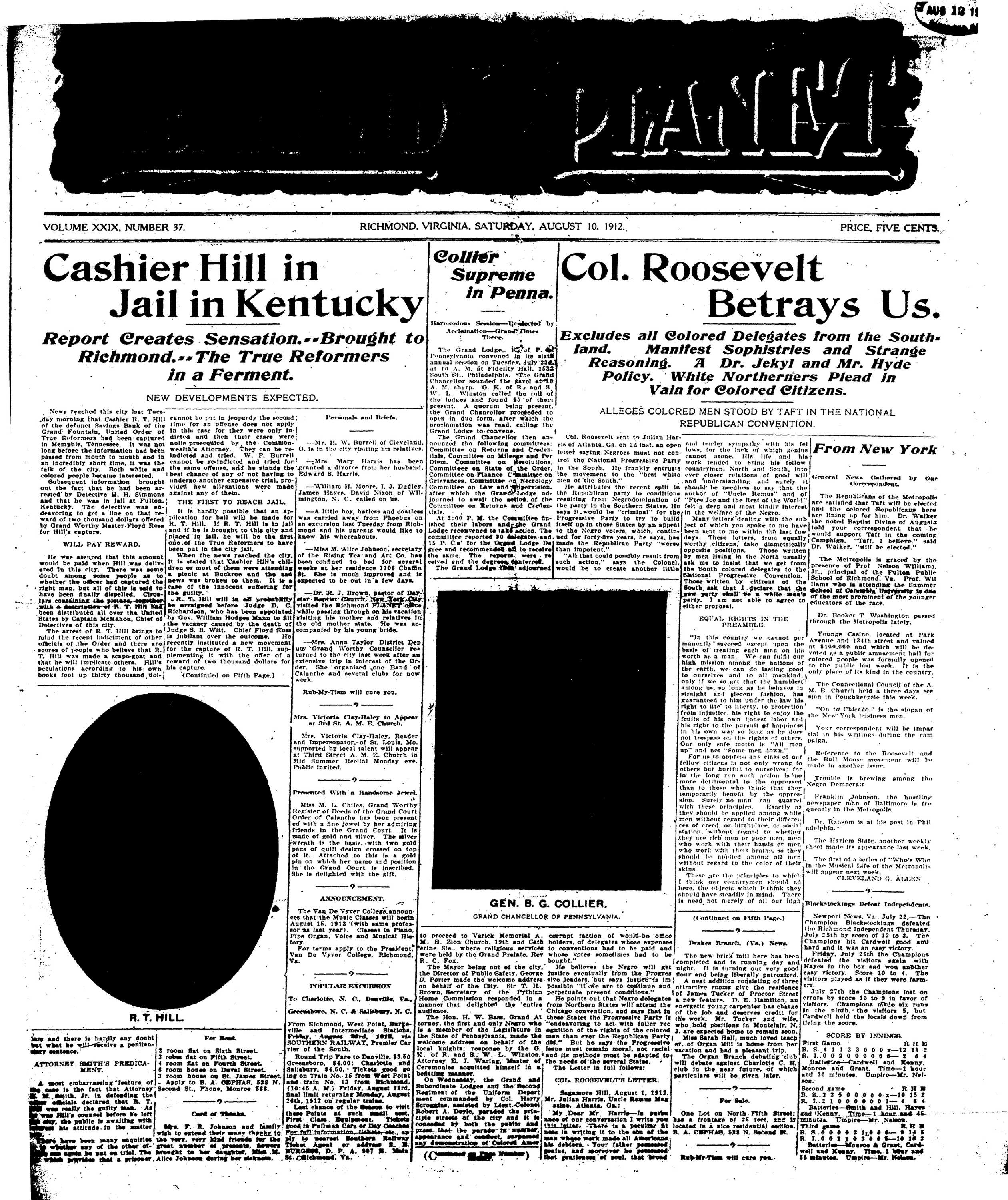
Cashier Hill in Jail in Kentucky
NEW DEVELOPMENTS EXPECTED.
R. T. HILL
R. T. HILL
News reached this city last Tuesday morning that Cashier R. T. Hill of the defunct Savings Bank of the Grand Fountain, United Order of True Reformers had been captured in Memphis, Tennessee. It was not long before the information had been passed from mouth to mouth and in an incredibly short time, it was the talk of the city. Both white and colored people became interested. Subsequent information brought out the fact that he had been arrested by Detective M. H. Simmons and that he was in jail at Fulton, Kentucky. The detective was endeavoring to get a line on that reward of two thousand dollars offered by Grand Worthy Master-Floyd Rose for Hill's capture.
WILL PAY REWARD.
He was assured that this amount would be paid when Hill was delivered in this city. There was some doubt among some people as to whether the officer had captured the right man, but all of this is said to have been finally dispelled. Circumsins containing the pleasures together with a description of R. T. Hill had been distributed all over the United States by Captain McMahon, Chief of Detectives of this city.
The arrest of R. T. Hill brings to mind the recent indictment of other officials of the Order and there are scores of people who believe that R. T. Hill was made a scape-goat and that he will implicate others. Hill's peculations according to his own books foot up thirty thousand dol-
lars and there is hardly any doubt but what he will receive a penitentiary sentence.
ATTORNEY SMITH'S PREDICA-MENT.
A most embarrassing feature of the case is the fact that Attorney M. H. Smith, Jr. in defending the other officials declared that R. T. was really the guilty man. As was Hill's counsel before he left the city, the public is awaiting with interest his attitude in the matter here.
There have been many enquiries to whether any of the other officers can again be put on trial. The which provides that a prisoner
cannot be put in jeopardy the second time for an offense does not apply in this case for they were only indicted and then their cases were nolle prosequed by the Commonwealth's Attorney. They can be reindicted and tried. W. P. Burrell cannot be re-indicted and tried for the same offense, and he stands the best chance of any of not having to undergo another expensive trial, provided new allegations were made against any of them.
THE FIRST TO REACH JAIL.
It is hardly possible that an application for ball will be made for R. T. Hill. If R. T. Hill is in jail and if he is brought to this city and placed in jail, he will be the first one of the True Reformers to have been put in the city jail. When the news reached the city, it is stated that Cashier HILL's children or most of them were attending a picnic at Buckroe and the sad news was broken to them. It is a case of the innocent suffering for the guilty. R. T. Hill will in all probability be arraigned before Judge D. C. Richardson, who has been appointed by Gov. William Hodges Mann to fill the vacancy caused by the death of Judge S. B. Witt. Chief Floyd Ross is jubilant over the outcome. He recently instituted a new movement for the capture of R. T. Hill, supplementing it with the offer of a reward of two thousand dollars for his capture. (Continued on Fifth Page.)
HILL
For Rent.
For Rent
3 room flat on Sixth Street.
2 robm flat on Fifth Street.
4 room flat on Fourth Street.
6 room house on Duval Street.
3 room house on St. James Street.
- Apply to B. A. OMPHAS, 528 N.
Second St., Phone, Monroe 588.
Card of Thanks.
Mrs. F. R. Johnson and family wish to extend their many thanks to the very, very kind friends for the great number of presents, flowers brought to her daughter, Miss M. Alice Johnson during her sickness.
RICHMOND, VIRGINIA, SATURDAY, AUGUST 10, 1912.
Personals and Brides.
Mr. H. W. Burrell of Cleveland, O. is in the city visiting his relatives.
Mrs. Mary Harris has been granted a divorce from her husband, Edward S. Harris.
William H. Moore, I. J. Dudley, James Hayes, David Nixon of Wilmington, N. C. called on us.
A little boy, hattles and contiles was carried away from Phoebus on an excursion last Tuesday from Richmond and his parents would like to know his whereabouts.
Miss M. Alice Johnson, secretary of the Rising Tea and Art Co. has been confined to bed for several weeks at her residence 1106 Chaffin St. She is much improved and is expected to be out in a few days.
Dr. R. J. Brown, pastor of Daystar Baptist Church, New York City visited the Richmond PLANET office while passing through on his vacation visiting his mother and relatives in the old mother state. He was accompanied by his young bride.
—Mrs. Anna Taylor District Deputy Grand Worthy Counsellor returned to the city last week after an extensive trip in interest of the Order. She organized one Band of Calanthe and several clubs for new work.
Rub-My-Tlam will cure you.
Mrs. Victoria Clay-Halley to Appear at Srd St. A. M. E. Church.
Mrs. Victoria Clay-Haley, Reader and Impersonator, of St. Louis, Mo. supported by local talent will appear at Third Street A. M. E. Church in Mid Summer Recital Monday eve. Public invited.
Miss M. L. Chiles, Grand Worthy Register of Deeds of the Grand Court Order of Calanthe has been presented ed with a fine jewel by her admiring friends in the Grand Court. It is made of gold and silver. The silver wreath is the basis, with two gold pens of quill design crossed on top of it. Attached to this is a gold pin on which her name and position in the Grand Court is inscribed. She is delighted with the gift.
ANNOUNCEMENT.
The Van De Vyver College, announces that the Music Classes will begin August 15, 1912 (with same professor as last year). Classes in Piano, Pine Organ, Voice and Musical History.
For terms apply to the President;
Van De Vyver College, Richmond, Va.
POPULAR EXCURSION
To Charlotte, N. C., Danville, Va.
Greenaboro, N. C. & Salisbury, N. C.
From Richmond, West Point, Burke-
ville and Intermediate Stations,
Friday, August 3rd, 1911, via
SOUTHERN RAILWAY, Premier Car-
rier of the South.
Round Trip Fare to Danville, $3.50
Greenaboro, $4.00; Charlotte and
Salisbury, $4.50. Tickets good go-
ing on Train No. 15 from West Point
and train No. 12 from Richmond.
(10:45 A. M.) Friday, August 23rd,
final limit returning Monday, August
26th, 1912 on regular trains.
Last chance of the Season to visit
these Points at such small cost.
First Class Equipment. Tickets
good in Pullman Cars or Day Coaches
for full information. Tickets, etc.
apply to nearest Southern Railway
Ticket Agent or address R. H.
BURGESS, D. P. A, 907 H. Main
St. Richmond, Va.
GEN. B. G. COLLIER,
GRAND CHANCELLOR OF PENNSYLVANIA.
The Grand Lodge, of P. Pennsylvania convened in its sixth annual session on Tuesday, July 23d, at 10 A. M. at Fidelity Hall, 1533 South St., Philadelphia. The Grand Chancellor sounded the kaval at 10 A. M. sharp. G. K. of R. and S. W. L. Winston called the roll of the lodges and found 55 of them present. A quorum being present, the Grand Chancellor proceeded to open in due form, after which the proclamation was read, calling the Grand Lodge to convene.
The Grand Chancellor then announced the following committee: Committee on Returns and Credentials, Committee on Milage and Per Diem. Committee on Resolutions, Committee on State of the Order, Committee on Finance Committee on Grievances, Committee on Necrology Committee on Law and Supervision, after which the Grand Lodge adjourned to await the action of the Committee on Returns and Credentials.
At 2:00 P. M. the Committee finished their labors and the Grand Lodge recovered to take action. The committee reported 90 delegates and 15 P. C.'s for the Grand Lodge Degree and recommended all to receive the same. The reports were received and the degrees conferred.
The Grand Lodge had adjourned
GEN. B. G.
GRAND CHANCELLOR
to proceed to Vartick Memorial A. M. E. Zion Church, 19th and Catherine Sta., where religious services were held by the Grand Prelate, Rev R. C. Fox.
The Mayor being out of the city, the Director of Public Safety, George D. Porter made the welcome address on behalf of the City. Sir T. H. Brown, Secretary of the Pythian Home Commission responded in a manner that delighted the entire audience.
The Hon. H. W. Bass, Grand Atorney, the first and only Negro who is a member of the Legislature in the State of Pennsylvania, made the welcome address on behalf of the local knights; response by the G. K. of R. and S.; W. L. Winston Attorney E. J. Waring; Master of Ceremonies acquitted himself in a befitting manner.
On Wednesday, the Grand and Subordinate Lodges and the Second Regiment of the Uniform Department commanded by Col. Harry Scroggins, assisted by Ltent-Colonel Robert A. Doyle, paraded the principle streets of the city and it is conceded by both the public and press that the parade in number, appearance and conduct, surpassed any demonstration of Colored Amos
(Con continued Page Number) gen the
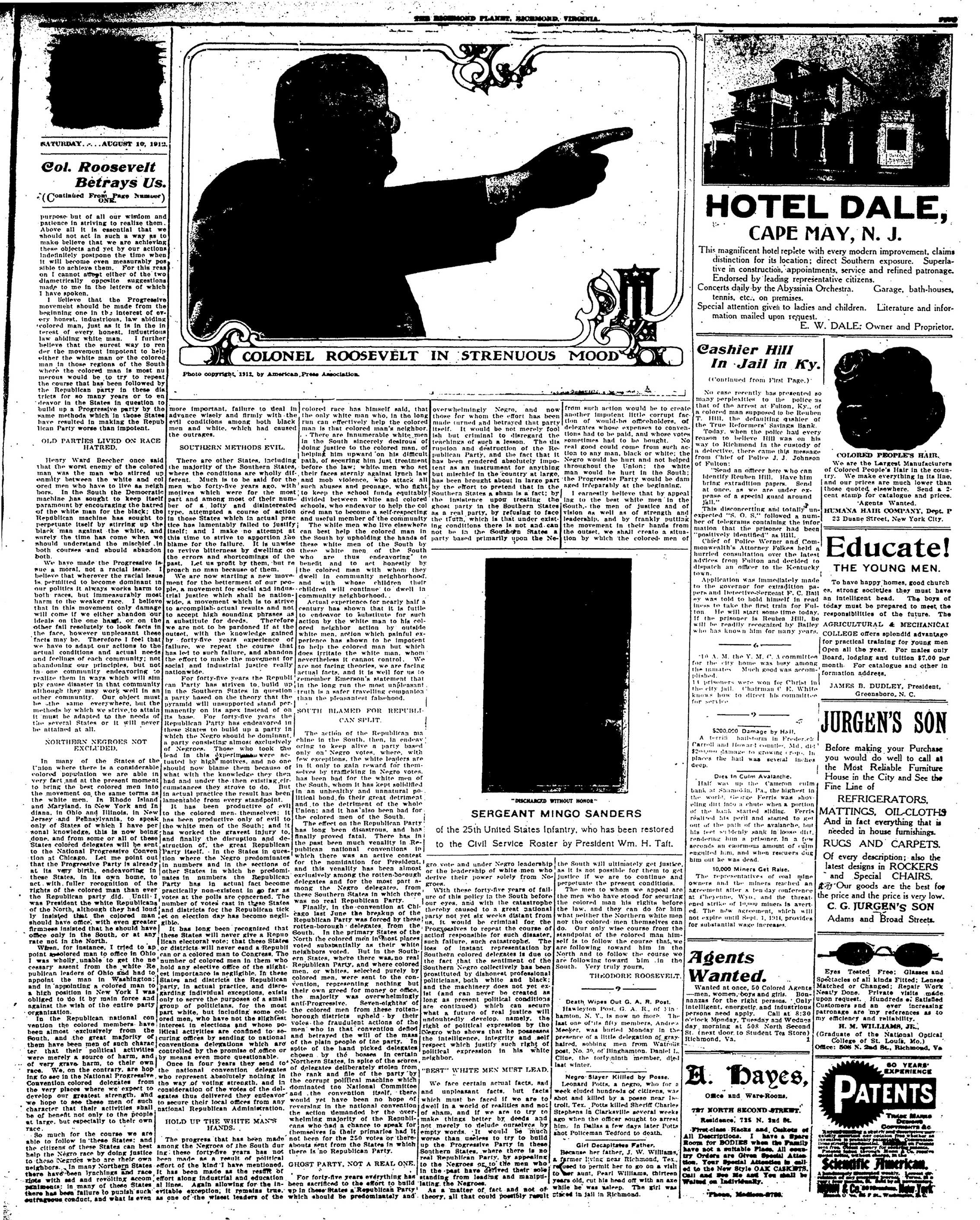
Col. Roosevelt Betrays Us.
Excludes all Colored Delegates from the Southland. Manifest Sophistries and Strange Reasoning. A Dr. Jekyl and Mr. Hyde Policy. White Northerners Plead in Vain for Colored Citizens.
ALLEGES COLORED MEN STOOD BY TAFT IN THE NATIONAL REPUBLICAN CONVENTION.
Col. Roosevelt sent to Julian Harris of Atlanta, Ga. on 2d inst. an open letter saying Negroes must not control the National Progressive Party in the South. He frankly entrusts the movement to the "best white men of the South."
He attributes the recent split in the Republican party to conditions resulting from Negrodomination of the party in the Southern States. He says it would be "criminal" for the Progressive Party to try to build itself up in those States by an appeal to the Negro voters, which, continued for forty-five years, he says, has made the Republican Party "worse than impotent."
"All that could possibly result from such action," says the Colonel, would be to create another little and tender sympathy with his fellow lows, for the lack of which genius cannot atone. His life and his work tended to bring his fellow countrymen. North and South, into ever closer relations of good will and understanding and surely it should be needless to say that the author of "Uncle Remus" and of "Free Joe and the Rest of the World" felt a deep and most kindly interest in the welfare of the Negro.
Many letters dealing with the subject of which you spoke to me have been sent to me within the last few days. These letters, from equally worthy citizens, take diametrically opposite positions. Those written by men living in the North usually ask me to insist that we get from the South colored delegates to the
From New
General News Gatherer
Correspondent
The Republicans of the are satisfied that Taft will and the colored Republic are lining up for him. The noted Baptist Divine told your correspondent would support Taft in Campaign. "Taft, I be Dr. Walker." will be elec
The Metropolis is gra presence of Prof Nelson in principal of
G. COLLIER,
OR OF PENNSYLVANIA.
corrupt faction of would-be office holders, of delegates whose expenses to conventions had to be paid and whose votes sometimes had to be bought."
He believes the Negro will get justice eventually from the Progressive leaders, but says justice is im possible "if we are to continue and perpetuate present conditions."
He points out that Negro delegates from Northern States will attend the Chicago convention, and says that in these States the Progressive Party is "endeavoring to act with fuller recognition of the rights of the colored man than ever the Republican Party did." But he says the Progressive issue must remain moral, not racial and its methods must be adapted to the needs of the several States.
The Letter in full follows:
COL. ROOSEVELT'S LETTER.
Sagamore Hill, August 1, 1912.
Mr. Julian Harris, Uncle Remus Mag
auine, Atlanta, Ga.:
My Dear Mr. Harris—Is purbu-
ance of our conversation I write you ha
this letter. There is a peculiar at loo-
ness in writing it to the son of the B.
man whose work made all Americans
his debtor. Your father possessed
genius, and moreover he possessed
that gentleness of soul, that brood
and tender sympathy with his fellows, for the lack of which genius cannot atone. His life and his work tended to bring his fellow countrymen. North and South, into ever closer relations of good will and understanding and surely it should be needless to say that the author of "Uncle Remus" and of "Free Joe and the Rest of the World" felt a deep and most kindly interest in the welfare of the Negro.
Many letters dealing with the subject of which you spoke to me have been sent to me within the last few days. These letters, from equally worthy citizens, take diametrically opposite positions. Those written by men living in the North usually ask me to insist that we get from the South colored delegates to the National Progressive Convention. Those written by citizens of the South, ask that I declare that the new party shall be a white man's party. I am not able to agree to either proposal.
EQUAL RIGHTS IN THE PREAMULE.
"In this country we cannot permanently succeed except upon the basis of treating each man on his worth as a man. We can fulfill our high mission among the nations of the earth, we can do lasting good to ourselves and to all mankind, only if we so act that the humblest among us, so long as he behaves in straight and decent fashion, has guaranteed to him under the law his right to life" to liberty, to protection from injustice, his right to enjoy the fruits of his own honest labor and his right to the pursuit of happiness in his own way so long as he does not trespass on the rights of others. Our only safe motto is "All men up" and not "Some men down."
For us to oppress any class of our fellow citizens is not only wrong to others but hurtful to ourselves; for in the long run such action is no more detrimental to the oppressed than to those who think that they temporarily benefit by the oppression. Surely no man can quarrel with these principles. Exactly as they should be applied among white men without regard to their different ces of creed, or birthplace, or social station, without regard to whether they are rich men or poor men, men who work with their hands or men who work with their brains, so they should be applied among all men without regard to the color of their skins.
These are the principles to which I think our countrymen should ad here, the objects which I think they should have steadily in mind. There is need not merely of all our high
(Continued on Fifth Page.)
Drakes Branch. (VA.) News.
The new brick mill here has been completed and is running day and night. It is turning out very good flour and being liberally patronized. A neat addition consisting of three attractive rooms give the residence of James Tucker of Proctor Street a new feature. D. E. Hamilton, an energetic young carpenter has charge of the job and deserves credit for the work. Mr. Tucker and wife, who hold positions in Montclair, N. J. are expected home to remain soon. Miss Sarah Hall, much loved teacher, of Organ Mill is home from her vacation and had a pleasant trip. The Organ Branch debating club will debate against Charlotte C. H. club in the near future, of which particulars will be given later.
One Lot on North Fifth Street;
has a frontage of 25 feet, and is
located in a nice residential section.
B. A. CEPHAS, 523 N. Second St.
It always Us.
Lies from the South-
ies and Strange
and Mr. Hyde
ers Plead in
citizens.
IN THE NATIONAL
ON.
From New York
General News Gathered by Our Correspondent.
The Republicans of the Metropolis are satisfied that Taft will be elected and the colored Republicans here are lining up for him. Dr. Walker the noted Baptist Divine of Augusta told your correspondent that he would support Taft in the coming Campaign. "Taft, I believe," said Dr. Walker, "will be elected."
The Metropolis is graced by the presence of Prof Nelson Williams, Jr., principal of the Fulton Public School of Richmond, Va. Prof. Williams who is attending the Summer School of Columbia University is one of the most prominent of the younger educators of the race.
Dr. Booker T. Washington passed through the Metropolis lately.
Youngs Casino, located at Park Avenue and 134th street and valued at $100,000 and which will be devoted as a public amusement hall for colored people was formally opened to the public last week. It is the only place of its kind in the country.
The Connectional Council of the A. M. E. Church held a three days session in Doughkeepsie this week.
"On to Chicago," is the slogan of the New York business men.
Your correspondent will be impartial in his writings during the camp palign.
Reference to the Roosevelt and the Bull Moose movement will be made in another issue.
Trouble is brewing among the Negro Democrats.
Franklin Johnson, the hustling newspaper man of Baltimore is frequently in the Metropolis.
Dr. Ransom is at his post in Phil adelphia.
The Harlem State, another weekly sheet made its appearance last week.
The first of a series of "Who's Who in the Musical Life of the Metropolis will appear next week. CLEVELAND G. ALLEN.
Blackstockings Defeat Independents.
Newport News, Va., July 22.—The Champion Blackstockings defeated the Richmond Independent Thursday. July 25th by score of 12 to 3. The Champions hit Cardwell good and hard and it was an easy victory. Friday, July 26th the Champions defeated the visitors again with Hayes in the box and won another easy victory. Score 10 to 4. The visitors played as if they were farmers. July 27th the Champions lost on errors by score 10 to 9 in favor of visitors. Champions made six runs in the ninth, the visitors 5, but Cardwell held the locals down from tipping the score.
SCORE BY INNING
First Game R H E
B. S. 4 1 1 3 3 0 0 0 x—12 18 2
R. I. 0 0 2 0 0 0 0 0 0—2 6 4
Batteries—Cardwell and Kenny,
Monroe and Grant. Time—1 hour
and 30 minutes. Umpire—Mr. Nelson.
Second game R H E
B. S. 3 2 5 0 0 0 0 0 x—10 15 2
R. I. 2 1 0 0 0 0 0 0 1—4 6 4
Batteries—Smith and Hill, Hayes
and Kenny. Time—1 hour and 45
minutes. Umpire—Mr. Nelson.
Third game R H E
B. B..0 0 0 0 2 1,0 0 6—9 14 5
R. I..0 0 1 1 0 3 0 0 5—10 16 3
Batteries—Monroe & Grant, Cardwell and Kenny. Time, 1 hour and 55 minutes. Umpire—Mr. Nelson.
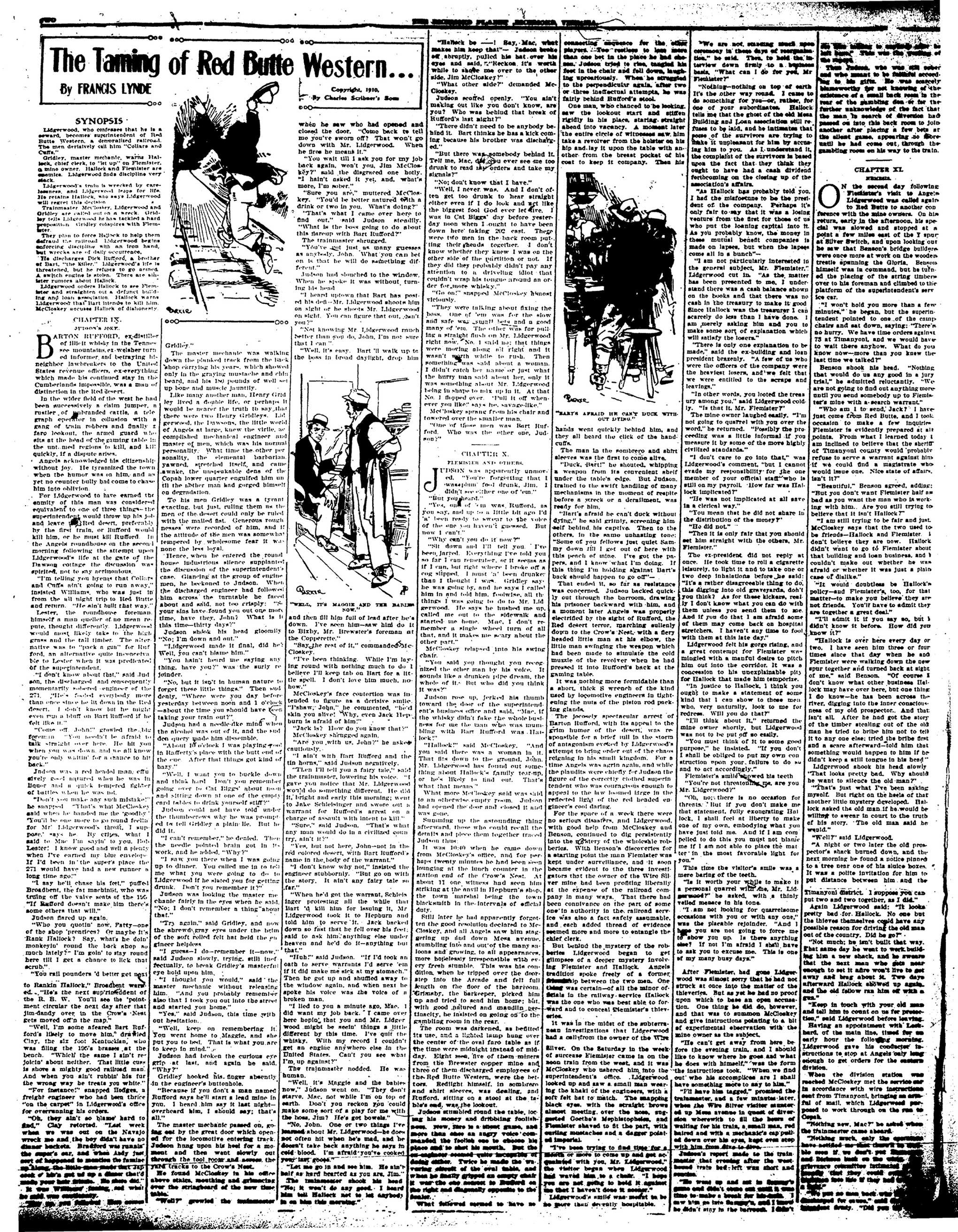
The Taming of Red Butte Western... By FRANCIS LYNDE Copyright, 1910.
SYNOPSIS
Lidgerwood, who confesses that he is a oeward, becomes superintendent of Red Butte Western, a demoralled railroad. The men derelictly call him "Collars and Coats." Gridley, master mechanic, warms Hallow, chief clerk, to "let up" on Flemister, mine owner. Hallow and Flemister are enemies. Lidgerwood finds discipline very stock.
Lidgerwood's train is wrecked by carelessness, and Lidgerwood leaps for life. He retains Hallow, who says Lidgerwood will regret this decision.
Trainmaster McClosey, Lidgerwood and Gridley are called out on a wreck. Gridley tells Lidgerwood he has tackled a hard situation. Gridley copes with Flemister. They plan to force Hallow to help them defraud the railroad. Lidgerwood begins enforcing discipline with an iron hand, but wrecks are of daily occurrence. Gridley calls for Bart, "the killer." Lidgerwood's life is threatened, but he refuses to go armed. A switch engine is stolen. There are simulator rumors about Hallow.
Lidgerwood orders Hallow to see Flemister and straighten out a disobedient gridley. Gridley warns Lidgerwood that hard disobedience Hallow of disobedience.
CHAPTER IX.
STUFFON'S JOURNAL
BARTON RUFFORD, exdistrict of illicit whisky in the Tennessee mountains, ex-welder turned informer and betraying his neighbor lawbreakers to the United States revenue officers, ex-everything which made his continued stay in the Cumberlandlands impossible, was a man of distinction in the red desert. In the wider field of the west he had been successively a claim jumper, a rattler, of unbranded cattle, a telegraph operator in collusion with a gang of train robbers and finally a faro lookout, the armed guard who sits at the head of the gaming table in the untamed regions to kill, and kill quickly, if a dispute arises. Angela acknowledged his citizenship without joy. He tyrannized the town when the humor was on him, and as yet no counter bully had come to chase him into oblivion.
For Lidgerwood to have earned the emity of this man was considered equivalent to one of three things—the superintendent would throw up his job and leave. Red desert, preferably by the first train, or Rufford would kill him, or he must kill Rufford. In the Angels roundhouse on the second morning following the attempt upon Lidgerwood's life at the gate of the Dawson cottage the discussion was spirted not to say earnestous. "I'm telling you bremas that Collars and Cuffs aren't going to run away," insisted Williams, who was just in from the all night trip to Red Butte and return. "He isn't that way." Lester, the roundhouse foreman, himself a man quaker of no mean repute, thought differently. Lidgerwood would most likely take to the high grass and the tall timber. The native was to "jack a gun" for Rufford, an alternative quite inconceivable to Lester when it was predated of the superintendent.
"I don't know about that," said Judon, the discharged, and consequently momentarily colored engineer of the 271. "He's faded everybody more than once since he bit down in the Red desert. I don't know but he might even run a bluff on Bart Rufford if he felt it."
"Come off John!" growled the big foreman. "You couldn't be afraid to talk straight over here. He hit you when you was down and we all know you're only waitin' for a chance to hit back."
Judson was a red headed man, often很好地 good natured when he was in liquor and a quick tempered fighter of battles when he was not.
"Don't you make any such mistake?" he snapped. "That's what McCloskey said when he handed me the 'goodbye' You'll be one more to go round feelin' for Mr. Llidgerwood's threat, I suppose." says he. By crips, what I said to Mac I sayin' to you, Bob Lester. I know good and well a plenty when I've earned my blue envelope. If I'd been in 'the super's place the 271 would have had a new runner a long time ago." "I say he'll chase his feet," puffed Broadcast, the fat machinist, who was truing off the valve seats of the 156. If Rufford doesn't make him there's some others that will."
Judson fared up again.
"Who you quotin' now, Fatty-one of the shop 'prentices? Or maybe he's Rank Hallock? Say, whats he doin' monkeyin' round the back shop so much lately? I'm goin' to stay round here till I get a chance to lick that scrub."
"You rail pounders'd better get next to Rankin Hallock." Broadcast warned. "His's the next superprudent of the R. B. W. You'll see the 'pointment circular the next day after that Jim-dandy over, in the Crow's Nest gets moved off in the map."
"Well, I'm some afeared Bart Rufford's likely to move him," drawn Clay, the six foot Kentuckian, who was filling the 195s brasses at the bench. "Which the same I amn't recollin' about neither. That little cues is shore a mighty good railroad man. And when you ain't rubbin' his fur the wrong way he treats you white."
"For instance," snapped Hodges, a freight engineer who had been thrice "on the carpet" in Lidgerwood's office for overrunning his orders.
"Oh, they ain't so blame hard to find," Clay retorted. "Last week when we was out on the Navajo wreck me and, the boy didn't have no dinner backeta. Bradford was runnin' the super's car, and when Amy just sort of happened to mention the famine up lining, the little man made that jacket of hair got wet up a dinner that'd made your hair stiff. He there did.
It was William, fishing, and what he said was certainly.
Dekie
000
Griddley."
The master mechanic was walking down the planked track from the back shop carrying his years, which showed only in the graying mustache and chin beard, and his 180 pounds of well set up bone and muscle jumility.
Like many another man, Henry Gridley lived a double life, or perhaps it would be nearer the truth to say that there were two Henry Gridleys. List gerwood, the Dawsones, the little world of Angels at large, knew the vulture, as compiled mechanical engineer and master of men, which was his normal personality. What time the other person, personality, the elemental barbarian, yawned, stretched itself, and came awake, the unstoppable dens of the Copah lower quarter engulfed him until the mother man and gorged himself on degradation.
To his men Gridley was a tyrant exacting, but just, ruling them as the men of the desert could only be ruled with the mailed fat. Generous rough nesses were recorded of him, and if the attitude of the men was somewhat tempered by wholesome fear it was none the less loyal.
"Hence, when he entered the round house industrious silence supplanted the discussion of the superintendent's case. Glanding at the group of engineer men, he beckoned to Judson. When the discharged engineer had followed him across the turntable he faced about and said, not too crisply: "Is your sina have found you out one more time, have they. John? What is it this time—thirty days?"
Judson shook his head gloomily "No; I'm down and out."
"Lidgerwood made it final, did he? Well, you can't blame him."
"You hain't heard me saying anything, have you?" was the surly reindeer.
"No, but it isn't in human nature to forget these little things." Then and duly, "Where were you day before yesterday between noon and 1 o'clock—about the time you should have taking your train out?" Judson had a needle-like mind when the alcohol was out of it, and the sudden query made him dissemble. "About 10 o'clock I was playing in Rafferty's place with the butt end of the one. After that things got kind of bazy." "Well, I want you to buckle down and think hard. Don't you remember going over to Cat Biggs' about noon and sitting down at one of the empty card tables to drink yourself stuff?" Judson could not have told under the thumbscrews why he was prompted to tell Griddley a plain life. But he did it. "I can't remember" he denied. Then the needle pointed brain got in its work, and he added, "Why?"
"I saw you there when I was going up to dinner. You called me in to tell me what you were going to do to Lidgerwood if he slated you for getting drunk. Don't you remember it?"
Judson was looking the master mechanic fairly in the eyes when he said, "No; I don't remember a thing about that."
"Try again," said Gridley, and now the shrewd, gray eyes under the brim of the soft rolled felt hat hold the engineer helpless.
"I guess I do—remember it—now," said Judson slowly, trying, still instinctually, to break Gridley's masterful eye hold upon him.
"I thought you would," said the master mechanic without releasing him. "And you probably remember also that I took you out into the street and started you home."
"Yes," said Judson, this time with out hesitation.
"Well, keep on remembering it. You went home to Maggie, and she put you to bed. That is what you are to keep in mind." Judson had broken the curious eye grip at last, and again he said, "Why? Gratley hooked his finger abently in the engineer's buttonhole. "Because if you don't a man named Rufford says he'll start a lead mine in you. I heard him say it last night-overhead him, I should say; that's all." The master mechanic passed on, going out by the great door which opened for the locomotive entering track. Judson hung upon his heel for a moment and then went slowly out through the tool room and across the yard tracks to the Crow's Nest. He found McCloskey in his office above stair, moothing and grimming over the stringboard of the new time table.
Well I grewled the instrument
Copyright, 1910.
By Charles Scribner's Son
when he saw who had opened and closed the doot. "Come back to tell me you've sworn off? That won't go down with Mr. Lidgerwood. When he fires he means it." "You wait till I ask you for my job back again, won't you, Jim McCloskey?" said the disgrieved one hotly. "I hainn't asked it yet, and, what's more, I'm sober." "Sure you are," muttered McCloskey. "You'd be better natured With a drink or two in you. What's doing?" "That's what I came over here to find out," said Judson steadily. "What is the boss going to do about this flareup with Burt Rufford?"
The trainmaster shrugged.
"You've got just as many guesses as anybody, John. What you can bet on is that he will do something different."
Judson had slouched to the window. When he spoke it was without turning his head.
"I heard upton that Bart has posted his den-Mr. Lidgerwood shoots him on sight or he shoots Mr. Lidgerwood on sight. You can figure that out, can't you?"
"Not knowing Mr. Lidgerwood much better than you do, John, I'm not sure that I can."
"Well, it's easy. Bart'll walk up to the boss in broad daylight, drop him
Bernie
WELL, THE MAGIC AND THE BARRIER NOW."
and then all him full of lead after he's down. I've seen him—saw him do it to Bixby, Mr. Brewster's foreman at the Copperette.
"Say the rest of it," commanded McClonkey.
"I've been thinking. While I'm laying round with nothing much to do I believe I'll keep tab on Hart for a little spell. I don't love him much, now."
McClonkey's face contortion was intended to figure as a derisive smile. "Pahaw; John," he commented, "the skin you alive. Why, even Jack Hep, burn is afraid of him."
"Jack is? How do you know that?" McClonkey shrieked again.
"Are you with us, John?" he asked cautiously.
"I saint with Hart Rufford and the tin horns," said Judson negatively.
"Then I'll tell you a fairy tale," said the trainmaster, lowering his voice. "I gave you notice that Mr. Lidgwood wood would do something different. He did it, bright and early this morning; went to Jakke Sleibsinger and swore out a warrant for Rufford's arrest on a charge of assault with intent to kill."
"Sure," said Judson. "That's what any man would do in a civilized country, isn't it?"
"Yes, but not here, John—not in the red colored desert, with Bart Rufford's name in the body of the warrant."
"I don't know why not," insisted the engineer stubbornly. "But go on with the story. It ain't any fairy tale so far."
"When he'd got the warrant, Schießinger protecting all the while that Mart' ack kill him for issuing it, Mr. Lidgwood wood took it to Hepburn and told him to serve it. Jack backed down so fast that he fell over his feet, said to ask him anything else under heaven and he'd do it—anything but that."
"Huh!" and Judson. "If I'd took an oath to serve warrants I'd serve em' if it did make me sick at my stomach." Then he got up and shuffled away to the window again, and when next he spoke his voice was the voice of a broken man.
"I lied to you a minute ago, Mac. I did want my job back. I came over here hopla; that you and Mr. Lidgert wood might be seen' things a little different by this time. I've quit the whisky. With my record I couldn't get an engine anywhere else in the United States. Can't you see what I'm up against?"
The trainmaster nodded. He was human.
"Well, it's Maggie and the babies now," Judson went on. "They don't starve. Mac, not while I'm on top of earth. Don't you reckon you could make some sort of a play for me with the boss, Jim? He's got bowels."
"No. John. One or two things I've learned about Mr. Lidgerwood—he does not often hit when he mad, and he doesn't take back anything he says in cold blood. I'm afraid you've cooked your last good."
"Let me go in and see him. He isn't half as hard hearted as you are, Jim."
The tmaintmaster shook his head. "No! it won't do any good. I heard him tell Hallowt not to let anybody in on him this morning."
"Hahack be — ! Say, Mac, what makes him keep that," Jadson broke off, abruptly, pulled his hat, over his eyes and said, "Reckon, it's worth while to shake me over to the other side, Jim McCloskey."
"What other side?" demanded McCloskey.
Judson scoffed openly. "You ain't making out like you don't know, are you? Who was behind that break of Hufford's last night?"
"There didn't need to be anybody behind it. Bart thinks he has a kick coming because his brother was discharged."
"But there was somebody behind it. Tell me, Mac, did you ever see me too drunk to read his orders and take my signals?"
"No; don't know that I have."
"Well, I never was. And I don't often get too drunk to hear straight either even if I do look and get like the biggest fool God ever let fire. I was in Cat Biggs' day before yesterday noon when I ought to have been down here taking 202 cast. There were two men in the back room putting their gheats together. I don't know whether they knew I was on the other side of the partition or not. If they did they probably didn't pay any attention to a driving idiot that couldn't wrap his tongue around an order for more whiskey." "Go on!" snapped McCloskey hustest viciously.
"They were talking about fixing the boss. One of 'em was for the slow and safe way, wasn't bad and a good many of 'em. The other was for pulling a straight dash on Mr. Lidgewood right now. No, I said no; that things were moving along all right and it wasn't worth while to rush. Then something was said about a woman. I didn't catch her name or just what the hurry man said about her, only it was something about Mr. Lidgewood being in shape to mix up in it. At that No. I flopped over. "Pull it off whenever you like" says he, savage-like." Mickey spring from his chair and towered over the smaller man. "One of these men was Bart Rufford. Who was the other one, Judson?"
FLEMISH AND OTHERS.
JUDSON was apparently unmoved. "You're forgetting that I was plum' fool drunk, Jim. I didn't even either one of 'em."
"But you heard."
"Yes, one of 'em was, Rufford, as you say, and up to a little bit ago I'd 'n't been ready to swear to the voice of the one you haven't guessed. But now I can't."
"Why can't you do it now?"
"Sit down and I'll tell you. I've been, Jarted. Everything I've told you so far I can remember, or it seems as if I can, but right where I broke off a cog slipped. I mustn't be drunker than I thought I was. Gridley say he was going by, and he says I called him in and told him, foolwise, all the things I was going to do to Mr. Lidgerwood. He says he hushed me up, called me out to the sidewalk and started me home. Mace, I don't remember a single wheel turn of all that, and it makes me pearl about the other part."
McCloskey relapsed into his swing chair.
"You said you thought you recognized the other man by his voice. It sounds like a drunken pipe dream, the whole of it. But who did you think it was?"
Judson rose up, jerked his thumb toward the door of the superintendent's business office and said, "Mae. If the whisky didn't fake the whole business for me the man who was mumbling with Bart Rufford was. Hallowock."
"Hallowock!" said McCloskey. "And you said there was a woman in it. That fits down to the ground. John. Mr. Liggerwood has found out something about Hallowock's family tear-up, or he's likely to find out. That's what that means."
What more McCloskey said was said to an otherwise empty room. Judson had opened the door and closed it and was gone.
Summing up the astounding thing afterward, those who could recall the details and place them together traced Judson thus:
It was 10:40 when he came down from McCloskey's office, and for perhaps twenty minutes he had been seen lounging at the lunch counter in the station end of the 'Grow's Nest. At about 11 one, witness had seen him striking at the anvil in Heppburn's shop, the town marshal being the town blacksmith in the intervals of official duty.
Still later he had apparently forgotten the good resolution declared to McCloskey, and all Angela saw him staggering up and down Mosa avenue, stumbling into and out of the many looms and growing, to all appearances, more hoeblesley irresponsible with every fresh stumble. This was his condition, when he tripped over the door-step into the Arcade and fell full length on the door of the barroom. Grimly, the barkeeper, picked him up and tried to send him home; but, with good nudged and maudlin gentleness, he insisted on going on to the gambling room in the rear.
The room was darkened, as befitted its use, and a lighted lamp hung over the center of the oval faro table as if if the time were midnight instead of midday. Eight men, of five them miners from the Brewer copper mine and three of them discharged employees of the Red Butte Western, were the batters. Redlight himself, in sombre and shirt sleeves, was dealing, and Ruford, sitting on a stool at the table's end, was the lookout.
Judson stumbled round the table, locating his money and dribbling foolishness. Now, there is a silent game, and more than also an angry voice commanded the foolish one to choose his place and be shot his mouth. But the engineer seemed quite incapable of doing either. Twice he made the waving shout of the oval table, and when he finally gripped an empty chair it war the one nearest to Ruford on the right and diagonally opposite to the feeder.
What followed normed to have no
connecting sequence for the other players. "Two restless to lose more than one bet in the place he had chosen," Jackson tried to rise, tugged his feet in the chair and fell down, laughing aproposially. When he struggled to the perpendicular again, after two or three inexactual attempts, he was fairly behind Rufford's stock.
One man, who chanced to be looking, saw the lookout start and stiffen rigidly in his place, staring straight ahead into vacancy. A moment later the entire circle of witnesses saw him take a revolver from the holder on his hip and lay it upon the table with another from the breast pocket of his coat to keep it company. Then his
BOGER
"BARTY AFRAID HER CAN'T DUCK WITH OUT DYING."
"MARTY AFRAID HE CAN'T DUCK WITH OUT DYING."
hands went quickly behind him, and they all beard the click of the hand-cuffs.
The man in the sombrego and shrift sleeves was the first to come alive.
"Duck, hart!" he shouted, whipping a weapon from its convenient shelf under the table's edge. But Judson, trained to the swift handling of many mechanisms in the moment of respite before a wreck or a derailment, was ready for him.
"Hart's afraid he can't duck without dying," he said grimly, screening him self behind his captive. Then to the others, in the same unhunting tone: "Some of you fellows just quiet Sammy down till I got out of here with this pouch of mine. I've got the papers, and I know what I'm doing. If this thing I'm holding against Bart's back should happen to go off-"
That ended it, so far as resistance was concerned. Judson backed quickly out through the barroom, drawing his prisoner backward with him, and a moment later Angels was properly electrified by the sight of Rufford, the Red desert terror, marching sulently down to the Crow's Nest, with a fiery headed little man at his elbow, the little man swinging the weapon which had been made to stimulate the cold muzzle of the revolver when he had pressed it into Rufford's back at the gaming table.
It was nothing more formidable than a short, thick S wrench of the kind used by locomotive engineers in tightening the nuts of the piston rod packing glands.
The jocosely spectacular arrest of Barton Hufford, with its appeal to the grim humor of the desert, was responsible for a brief till in the storm of antagonism evoked by Lidgerwood's attempt to bring order out of the chaos reigning in his small kingdom. For a time Angels was agin again, and while the plaudits were chiefly for Judson the figure of the correctly clothed superintendent who was courageous enough to appeal to the law bounded large in the reflected light of the red headed engineer's cool daring.
For the space of a week there were no serious disasters, and Lidgerwood, with good help from McCloskey and Benson, continued to dig persistently into the registry of the wholesale robberies. With Benson's discoveries for a starting point the man Flemlier was kept under surveillance, and it soon became evident to the three investigators that the owner of the Wire Silver mine had been profiting liberally at the expense of the railroad company in many ways. That there had been confluence on the part of some one's authority in the railroad service was also a fact easily assumable, and each added thread of evidence seemed more and more to entangle the chief clerk.
But behind the mystery of the robberies Lidgerwood began to get glimpses of a deeper mystery involving Flemister and Hallock. Angels tradition spoke freely of a former friendship between the two men. One thing was certain—of all the minor officials in the railway-service Hallock was the one who was best able to forward and to conceal Flemister's thieveries. It was in the midst of the subterranean investigations that Lidgerwood had a call from the owner of the Wise
Silver. On the Saturday in the week of surcease Flemmier came in on the noon train from the west, and it was McCloskey who ushered him into the superintendent's office. Liddgerwood looked up and saw a small man wearing the khaki of the engineers, with a soft felt hat to match. The mapping black eyes, with the straight brown almost meeting, over the nose, suggested Goethe's Mephistopheles, and Flemmier shaved to fit the part, with curling mustaches and a danger pointed imperial.
"I've been trying to find time for a match or move to come up and get acquainted with you, Mr. Liddgerwood," the visitor began when Flemmerd had waved him to a chair. "I hope you are not going to hold it against me that I haven't done it sooner." Flemmerd's smile was meant to be
Lidgwick would a smile was meant to be
the greater than recently hospitable.
"We are not, staring much more ceremony in these days of morgannation," he said. Then, to hold the interview down firmly to a beginner basis, "What can I do for you, Mr Flinchler?"
"Nothing—nothing on top of earth It's the other way round. I came to do something for you—or, rather, for one of your subordinates. Hallow tells me that the ghost of the old Mesa Building and Loan association still refuses to be laid, and he intimates that some of the survivors are trying to make it unpleasant for him by accusing him to you. As I understand it, the complaint of the survivors is based upon the fact that they think they ought to have had a cash dividend forthecoming on the closing up of the association's affairs.
"As Hallock has probably told you, I had the misfortune to be the president of the company. Perhaps it's only fair to say that it was a losing venture from the first for those of us who put the loaning capital into it. As you probably know, the money in these mutual benefit companies is made on lapecs, but when the lapecs come all in in a bunch"—
"I am not particularly interested in the general subject, Mr. Flemlister. Lidgerwood cut in. As the matter has been presented to me, I understand there was a cash balance shown on the books and that there was no cash in the treasury to make it good since Hallock was the treasurer I can scarcely do less than I have done. I am merely asking him and you to make some sort of explanation which will satisfy the locares."
"There is only one explanation to be made," said the ex-building and loan president brazenly. "A few of us who were the officers of the company were the heaviest losers, and we felt that we were entitled to the scraps and leavings."
"In other words, you looted the treasury among you," said Lidgerwood coldly. "Is that it, Mr. Flemister?"
The mine owner laughed easily. "I'm not going to quarrel with you over the word." he returned. "Possibly the proceeding was a little informal if you measure it by some of the more highly civilized standards."
"I don't care to go into that," was Lidgerwood's comment, "but I cannot evade my responsibility for she one member of your official staff who is still on my payroll. How far was Hallock implicated?"
"He was not implicated at all save in a clinical way."
"You mean that he did not share in the distribution of the money?"
"He did not."
"Then it is only fair that you should set him straight with the others, Mr. Flemlister."
The ex-president did not reply at once. He took time to roll a cigarette leisurely, to light it and to take one or two deep inhalations before he said: "It's a rather disagreeable thing to do, this digging into old graveyards, don't you think? As for these kickers, I don't know what you can do with them unless you send them to me. And if you do that I am afraid some of them may come back on hospital stretches. I haven't any time to fool with them at this late day."
Lidgervood felt his gorge rising, and a great contempt for Flemlister wamming with a manful desire to pitch him out into the corridor. It was a concession to his unexplainable pity for Hallock that made him emporize.
"In justice to Hallock, I think you ought; to make a statement of some kind that I can show to those men who, very naturally, look to me for redress. Will you do that?"
"I'll think about it." returned the mine owner shortly, but Lidgerwood was not to be put off so easily.
"You must think of it to some good purpose," he insisted. "If you don't I shall be obliged to put my own construction upon your, failure to do so and to act accordingly."
Flemister's smile showed his teeth. "You're not threatening me, are you Mr. Lidgerwood?"
"Oh, no; there is no occasion for threats." If you don't make me that statement, fully exonerating Hailock, I shall feel at liberty to make one of my own, embodying what you have just told me. And if I am compelled to do this you must not blanche me if I am not able to place the matter in the most favorable light for you."
This time the visitor's smile was a mere baring of the teeth.
"Is it worth your while to make it a personal quarrel with me, Mr. Lidgerwood?" he asked, with a thinly veiled menace in his tone.
"I am not looking for quarrelsome occasions with you or with any one" was the placeable rejoinder. "And I hope you are not going to force me to show you up. Is there anything else? If not I'm afraid I shall have to ask you to excuse me. This is one of my many busy days."
After Flemister, had gone Lidgerwood was almost sorry that he had not struck at once into the matter of the thieveries. But as yet he had no proof upon which to base an open accusation. One thing he did do, however, and that was to summon McCloskey and give instructions pointing to a bit of experimental observation with the mine owner as the subject.
"We can't get away from here before the evening train, and I should like to know where he goes and what he does with himself." was the form the instructions took. "When we find out' who his accomplices are I shall have something more to say to him."
"I'll have him tagged," promised the trainee, and a few minutes later, when the Wife Silver visitor ministered up Moon avenue in quest of diversion wherewith to all the hours of waiting for his train, a small man, red haired and with a mechanic's cap pulled down over his eyes, kept even step with him from six to ten.
Judson's report made to the trainer that evening after the westbound train bed left was short and pounded.
"We went up and out in Shenny's game and didn't come out until it was time to make a break for his death. I saw him go into the maze, and I knew he didn't stay in the barnyard. I didn't
Then Judean, who was still sorrow and who meant to be faithful according to his gifts. He was necessarily blameworthy for not knowing of the existence of a small back room in the rear of the gambling den, for the further knowledge of the fact that the man in search of diversion had passed on into this back room to join another after placing a few bets at the silent game, appearing no further until he had come out, through the gambling room on his way to the train.
ON the second day following Fleckinster's visit to Angela Lidgewood was called again to Red Butte to another conference with the mine owners. On his return, early in the afternoon, his special was slowed and stopped at a point a few miles east of the Y spar at Silver Switch, and upon looking out he saw that Benson's bridge buildings were once more at work on the wooden trestle spanning the Gloria. Benson himself was in command, but he turned the placing of the string timber over to his foreman and climbed to the platform of the superintendent's service car.
"I won't hold you more than a few minutes," he began, but the superintendent pointed to one of the camp chairs and sat down, saying: "There's no hurry. We have time orders against 73 at Timanyon, and we would have to wait there anyhow. What do you know now—more than you knew the last time we talked?"
Benson shook his head. "Nothing that would do us any good in a jury trial," he admitted reluctantly. "We are not going to find out anything more until you send somebody up to Flemister's mine with a search warrant." "Who am I to send, Jack?" I have just come from Red Butte, and I took occasion to make a few inquiries. Flemister is evidently prepared at all points. From what I learned today I am inclined to believe that the sheriff of Timanyoul county would probably refuse to serve a warrant against him if we could find a magistrate who would issue one. Nice state of affairs, isn't it? "Beautiful," Benson agreed, adding: "But you don't want Flemister half as bad as you want the man who is working with him. Are you still trying to believe that it isn't Hallock?"
"I am still trying to be fair and just. McClockey says that the two used to be friends—Hallock and Flemister. I don't believe they are now. Hallock didn't want to go to Flemister about that building and loan business, and I couldn't make out whether he was afraid or whether it was just a plain case of dislike."
"It would doubtless be Hallock's policy—and Flemister's, too, for that matter—to make you believe they are not friends. You'll have to admit they are together a great deal."
"I'll admit it if you say so, but I didn't know it before. How did you know it?"
"Hallock is over here every day or two. I have seen him three or four times since that day when he and Flemister were walking down the new spur together and turned back at sight of me." said Benson. "Of course I don't know what other business Hallock may have over here, but one thing I do know—he has been across the river, digging into the inner consciousness of my old prospector. And that isn't all. After he had got the story of the timber stealing out of the old man he tried to bribe him not to tell it to any one else; tried the bribe first and a scare afterward—fold him that something would happen to him if he didn't keep a still tongue in his head." Lidgerman shook his head slowly. "That looks pretty bad. Why should he want to silence the old man?"
"That's just what I've been asking myself. But right on the heels of that another little mystery developed. Hallock asked the old man. If he would be willing to swear in court to the truth of his story. 'The old man said he would.' "Well?" said Lidgerwood. "A night or two later the old prospector's shack burned down, and the next morning he found a notice planned to a tree near one of his shuice boxes. It was a polite invitation for him to put distance between him and the Timanyon district. I suppose you can put two and two together, as I did." Again Lidgerwood said: "It looks pretty bad for Hallock. No one but the thieves themselves could have any possible reason for driving the old man out of the country. Did he go?"
"Not much; he isn't built that way. That same day he went to work building him a new shack, and he swear that the next man who gets near enough to set it abreast won't live to get away and brag about it. Two days afterward Hallock showed up again, and the old fellow ran him off with a gun."
"Keep in touch with your old man and tell him to count on us for protection," said Lidgerwood before leaving. "Having an appointment with Lester hard, of the main line, timed for an early hour the following morning. Lidgerwood gave his conductor instructions to stop at Angels only long enough to get orders for the eastern division.
When the division station was reached McCloskey met the service car in accordance with wire instructions sent from Timanyont, bringing an awful of mail, which Lidgerwood proposed to work through on the run to Copenh.
"Nothing new. Mac" he asked when the thinnerware came ahead.
"No part so men took with the
Amortized Cost for a Unit," said G.
SATURDAY.....AUGUST 10, 1912.
"I did. I have been saying that so often that it might nearly says itself now when I hear my office door open." "Well, there is nothing to do but to go on saying it. We shall either make a spoon or spoil a horn. How would you be fixed in the event of a telegrapher's strike?" "I've been figuring on that. It may seem like tempting, the good Lord to say it, but I believe we could hold about half of the men." "That is decidedly encouraging," said the man, who needed to find encouragement where he could. "Two weeks ago if you had said one in ten, I should have thought you were overestimating. We shall win out yet."
But now McCloskey was shaking his head dubiously. "I don't know Andy Bradford has been giving me an idea of how the trainmen stand, and he says there is a good deal of strike talk. Williams adds a word about the shop force. He says that Gridley's men are not saying anything, but they'll be likely to go out in a body unless Gridley wakes up at the last minute and takes a club to them." Lidgerwood's conductor was coming down the platform of the Crow's Neat with his orders in his band, and McCloskey made ready to swing off. "I can reach you care of Mr. Lockhard, at Copah, I suppose?" he asked.
"Yes. I shall be back some time to morrow. In the meantime there is nothing to do but to sit tight in the boat. Use my private code if you want to wire me. I don't more than half trust that young follow Dix, Cilahan's day operator. And, by the way, Mr. Frisbie is sending me a stenographer from Denver. If the young man turns up while I am away see if you can't get Mrs. Williams to board him."
McCloskey promised and dropped off, and the one car special presently clanked out over the eastern switches. It was only a little after 11 o'clock when Lidgerwood, looking up from
Bauer
WHAT HAVE YOU DONE TO THAT MAN?
his work at the final slowing of the wheels, saw the manhead lights of the Copah yards. Taking it for grant ed that Superintendent Lockhard had long since left his office in the Pacific Southwestern building. Lidgetwood gave orders to have his car placed on the station spur and went on with his work.
It was after midnight, when he had closed his desk and was taking a final pull at the short pipe which was his working companion, that the car door opened silently and he saw an apparition.
Standing in the doorway and groping with her hands held out before as if she were blind was a woman. Her gown was the tawdry half dress of the dance halls, and the wrap over her.
have shoulders was a gandy instant in colors of the Spanish mantilla. Her hand was without covering, and her hair, which was invariant, hung in disorder over her face. One glance at the eyes, fixed and staring, assured Lidgerwood instantly that he had to do with one who was either drink maddened or demented.
"Where is her?" the intruder asked in a throaty whisper, staring, not at him, as Lidgerwood was quick to observe, but straight ahead at the portieres cutting off the stateroom corridor from the open compartment. And then: "I told you I would come, Rankin. I've been watching years and years for your car to come in. Look. I want you to see what you have made of me. You and that other man."
Lidgerwood sat perfectly still. It was quite evident that the woman did not see him. But his thoughts were busy. Though it was by little more than chance, he knew that Hallock's Christian name was Rankin, and instantly he recalled all that McCloskey had told him about the chief clerk's musical troubles. Was this poor painted wreck the woman who was or who had been Hallock's wife? The question had scarcely formulated it before she began again.
"Why don't you answer me? Where can you?" she demanded in the same family whisper. "You needn't hide. I know you are here. What have you
HOW do that matter? You must you would kill him. You promised me that, Rankin. Have you done it?**
Lidgwood reached up cautiously behind him and slowly turned off the gas from the bracket desk lamp. Without wishing to pry deeper than he should into a thing which had all the carmarks of a tragedy—he could not help feeling that he was on the verge of discoveries which might have an important bearing upon the mysterious problems centering in the chief clerk. And he was afraid the woman would see him.
But he was not permitted to make the discoveries. The woman had taken two or three steps into the car, still groping her way as if the brightly lighted interior were the darkest of caverns, when some one swung over the railing of the observation platform, and Superintendent Leckhard appeared at the open door. Without hesitation he entered and touched the woman on the shoulder. "Hello, Midge," he said, not ungenuely. "You here again? It's pretty late for you to be out, isn't it? Better trot away and to go bed if you've got one to go to. He isn't here."
The woman put her hands to her face, and Lidgerwood saw that she was shaking as if with a sudden chill. Then she turned and darted away like a frightened animal. Leckhard was drawing a chair up to face Lidgerwood.
"Did she give you a turn?" he asked when Lidgerwood reached up and turned the desk lamp on full again.
"Not exactly that, though it was certainly startling enough. I had no warning at all. When I looked up she was standing pretty nearly where she was when you came in. She didn't seem to see me at all, and she was talking crisely all the time to some one else—some one who isn't here."
"I know," said Leckhard. "She has done it before."
"Who is she trying to find?" asked Lidgerwood, wishing to have his suspicion either denied or confirmed.
"Didn't she call him by name? She usually does. It's your chief clerk Hallock. She in-or was—his wife Haven't you heard the ghastly story yet?"
"No, and, Leckhard. I don't know that I care to hear it. It can't possibly concern me."
"There is another man mixed up in it—the man whom she is always asking if Hallock has killed. Curiously enough, she never names the other man, and there have been a good many guesses. I believe your head boldermaker, Gridley, has the most votes. It's been seen with her here now and then when he's on one of his periodicals." By Jove, Lidgerwood, I don't envy you your job over yonder in the Red desert a little bit. But about the consolidation of the yards here. I got a telegram after I wired you making it necessary for me to go west on main line 27 early in the morning, so I stayed up to talk this 'yard business over with you tonight."
It was well along in the small hours when the roll of blue print maps was finally laid aside and Lockhard rose yawning. We'll carry it out as you propose and divide the expense between the two divisions" he said in conclusion, "Friisble has left it to us, and he will approve whatever we agree upon. Will you go up to the hotel with me or bunk down here?"
Lidgerwood said he would stay with his car, or better still, now that the business for which he had come to Coapah was dispatched, he would have the roundhouse night foreman call a Bed Butte Western crew and go back to his desert.
"We are in the thick of things over on the jerkwater just now," he explained, "and I don't like to stay away any longer than I have to."
"Having a good bit of trouble with the sure shots?" anked Leckhard. "What was that story I heard about somebody swiping one of your switch ing engine?" "It was true," said Lidgerwood, adding, "but I think we shall recover the engine and some other things—pre-ently." Holiked Leckhard well enough, but he wished he would go. There are exigencies in, which even the comments of a friend and wellwisher are superfluous. When Leckhard was gone Lidgerwood climbed the stair in the station building to the dispatcher's office and gave orders for the return of his car to Angela.
[TO BE CONTINUED.]
12 WOMEN DIE IN FIRE
Try to Escape by Roof, But Are Cut Off by Flames.
Twelve women were burned to death and several others injured by fire in Moor Lane, the center of the danger zone of the city of London, Eng.
The fire occurred in a building occupied by a number of clothing manufacturers and Christmas card makers. The women tried to escape by the roof, but the flames on the floor below cut off any possibility of assistance by the firemen.
Woman Killa Her Father.
Edith Gamble, twenty-four years of age, shot and killed her father, Charles Gamble, when he broke into their residence in Kansas City, Mo., to which he had been denied admittance, and attempted to attack his wife and daughter. Mrs. Gamble recently sued her husband for divorce. He entered the house through a cellar window he had broken, and when he started up the steps his daughter fired.
Aeronaut Falls 1000 Feet.
When 1000 feet in the air a rope attaching the trapeze bar to his parachute broke, and Thomas E. Flick, thirty two years old of Quincy, Ill., fell to his death at Ganton, O.
Flick's body struck in the soft earth of a colony field, head first, and was buried to the knees.
The accident occurred almost immediately after Flick, watched by 3000 people at Myers Lake, an amusement resort, cut loose from his balloon. If the crowd were two sisters of the aero
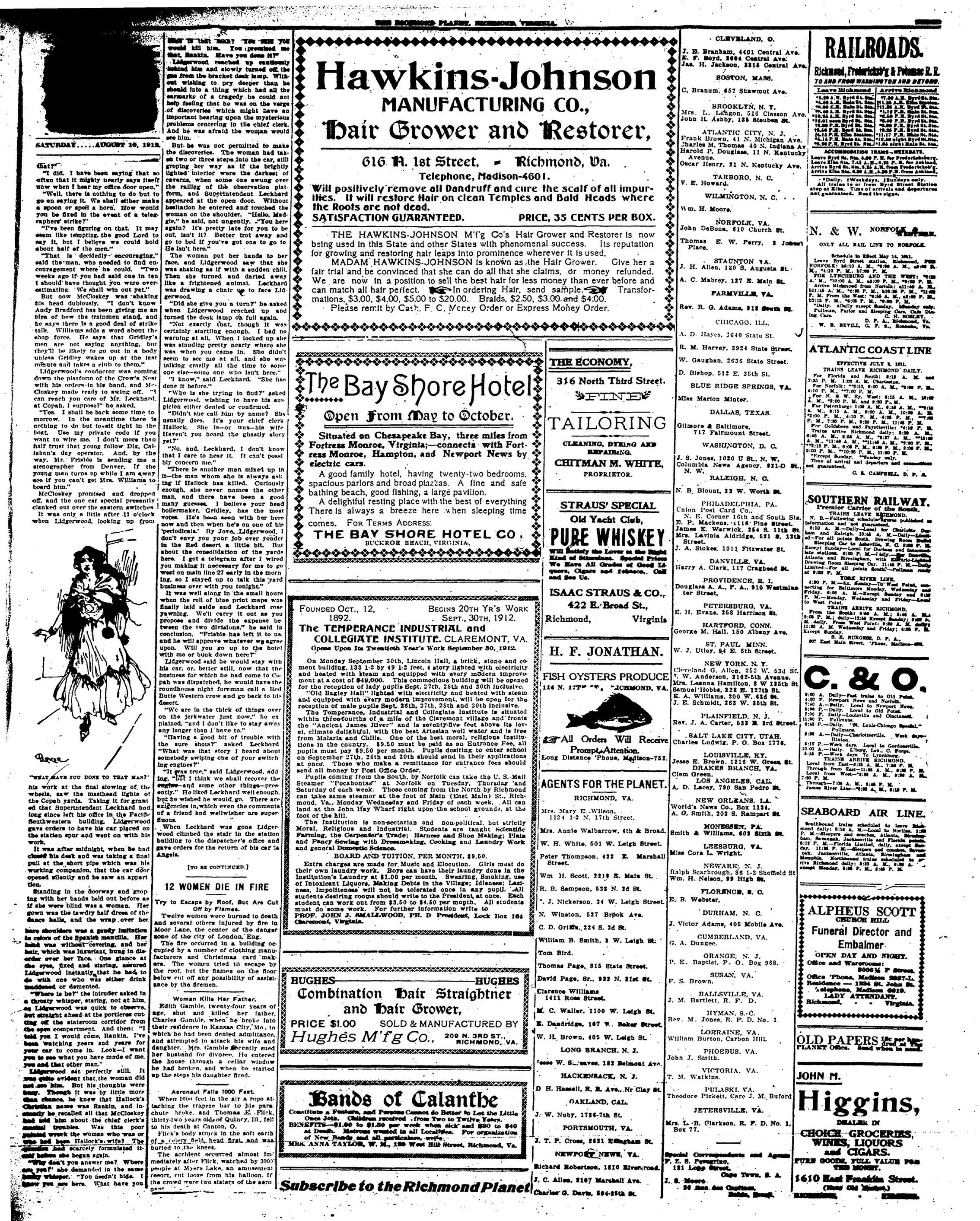
Hawkins-Johnson MANUFACTURING CO., Hair Grower and Restorer,
616 N. 1st Street. Richmond, Va.
positively remove all Dandruff. It will restore Hair on clean Roots are not dead.
DISFACTION GUARANTEED.
THE HAWKINS-JOHNSON M'fight used in this State and other States will growling and restoring hair leaps into prostration. Madam HAWKINS-JOHNSON is brief and be convinced that she can do so are now in a position to sell the best match all hair perfect. In order to insure $3.00, $4.00, $5.00 to $20.00. Please remit by Cash, F. C. Money Only.
The Bay Shore Hotel
Open from May to October.
Located on Chesapeake Bay, three miles Monroe, Virginia;—connects with Monroe, Hampton, and Newport public cars.
A good family hotel, having twenty-two public parlors and broad plazzas. A fine dog beach, good fishing, a large pavilion. Delightful resting place with the best of its is always a breeze here when sleeps.
FOR TERMS ADDRESS:
THE BAY SHORE HOTEL
BUCKROR BEACH, VIRGINIA.
Will positively remove all Dandruff and cure the scalf of all impurities. It will restore Hair on clean Temples and Bald Heads where the Roots are not dead.
SATISFACTION GUARANTEED. PRICE, 35 CENTS PER BOX.
THE HAWKINS-JOHNSON M'f g Co's Hair Grower and Restorer is now being used in this State and other States with phenomenal success. Its reputation for growing and restoring hair leaps into prominence wherever it is used.
MADAM HAWKINS-JOHNSON is known as the Hair Grower. Give her a fair trial and be convinced that she can do all that she claims, or money refunded. We are now in a position to sell the best hair for less money than ever before and can match all hair perfect. In ordering Hair, send sample. Transformations, $3.00, $4.00, $5.00 to $20.00. Braids, $2.50, $3.00 and $4.00.
Please remit by Cath, F. C. Money Order or Express Money Order.
Situated on Chesapeake Bay, three miles from Fortress Monroe, Virginia;—connects with Fortress Monroe, Hampton, and Newport News by electric cars.
A good family hotel, having twenty-two bedrooms, spacious parlors and broad plazzas. A fine and safe bathing beach, good fishing, a large pavilion.
A delightful resting place with the best of everything There is always a breeze here when sleeping time comes. FOR TERMS ADDRESS:
THE BAY SHORE HOTEL CO,
BUCKROE BEACH, VIRGINIA.
FOUNDED Oct., 12,
1892.
THE TEMPERANCE COLLEGIATE I
Opens Upon Its Twenties
On Monday September 14th
ment building, 133 1-2 by
and heated with steam at
at a cost of $49,000.
for the reception of lady P
"Old Bagley Hall" light
and equipped with every
reception of male pupils S
The Temperance, Indus
within three-fourths of a
the "Ancient James River
climate delightful, with
from Malaria and Chills.
in the country. $9.
pupils must pay $9.50
on September 27th, 28th
at once. Those who make
send all money by Post O
Pupils coming from the
Steamer "Pocahontas" at
Saturday of each week.
Can take same steamer at
mond, Va., Monday Wede
land at the John Hay Wha
foot of the hill.
The Institution is non-
Moral, Religious and Ind
Farming, the Carpenter's
and Fancy Sewing with D
and general Domestic Scien
PERPERANCE INDUSTRIAL and
COLLEGIATE INSTITUTE. CLAREM
Upon Its Twentieth Year's Work September 30
Sunday September 30th, Lincoln Hall, a brick,
building, 133 1-2 by 49 1-2 feet, a story lighted
with heaam and equipped with every mode
cost of $49,000. This commodious building
reception of lady pupils Sept. 27th, 28th and 30th
Gagley Hall" lighted with electricity and heated
with every modern improvement, will be
of male pupils Sept. 26th, 27th, 28th and 30th
imperance, Industrial and Collegiate Institute
free-fourths of a mile of the Claremont village
cent James River" and is seventy-five feet abo
is dolleful, with the best Artesian well water
arla and Chills. One of the best moral, religio
n country. $9.50 must be paid as an Entrance
pay $9.50 per month. Pupils desiring to
enter 27th, 28th and 30th should send in their
Those who make a remittance for entrance
money by Post Office Order.
coming from the South, by Norfolk can take the
"Pocahontas" at Norfolk on Tuesday, Thi
of each week. Those coming from the North b
name steamer at the foot of Main (East Maln
Monday Wednesday and Friday of each week
John Hay Wharf right upon the school group
Bill.
Institution is non-sectarian and non-political.
Religious and Industrial. Students are taught
the Carpenter's Trade; Harness and Shoe Ma
Sewing with Dressmaking, Cooking and Laun
Domestic Science.
On Monday September 30th, Lincoln Hall, a brick, stone and cement building, 133 1/2 by 49 1/2 feet, 4 story lighted with electricity and heated with steam and equipped with every modern improvement at a cost of $49,000. This commodious building will be opened for the reception of lady pupils Sept. 27th, 28th and 30th inclusive. "Old Bagley Hall" lighted with electricity and heated with steam and equipped with every modern improvement, will be open for the reception of male pupils Sept. 26th, 27th, 28th and 30th inclusive.
The Temperance, Industrial and Collegiate Institute is situated within three-fourths of a mile of the Claremont village and fronts the "Ancient James River" and is seventy-five feet above its level, climate delightful, with the best Artesian well water and is free from Malaria and Chills. One of the best moral, religious Institutions in the country, $9.50 must be paid as an Entrance Fee, all pupils must pay $9.50 per month. Pupils desiring to enter school on September 27th, 28th and 30th should send in their applications at once. Those who make a remittance for entrance fees should send all money by Post Office Order.
Pupils coming from the South, by Norfolk can take the U. S. Mail Steamer "Pocohontas" at Norfolk on Tuesday, Thursday and Saturday of each week. Those coming from the North by Richmond can take same steamer at the foot of Main (East Main) St., Richmond, Va., Monday Wednesday and Friday of each week. All can land at the John Hay Wharf right upon the school grounds, at the foot of the Hill.
The Institution is non-sectarian and non-political, but strictly Moral, Religious and Industrial. Students are taught Scientific Farming, the Carpenter's Trade; Harness and Shoe Making; Plains and Fancy Sewing with Dressmaking, Cooking and Laundry Work and general Domestic Science.
BOARD AND TUITION. PER MONTH. $9.50.
Extra charges are made
their own laundry work.
Institution's Laundry at $1
of Intoxicant Liquors. Make
ness. Impoliteness will not be
charges are made for Music and Elocution. Gill
laundry work. Boys can have their laundry at
S's Laundry at $1.00 per month. Swearing, Sn
Nt Liquors, Making Debts in the Village; Idle
Utilities will not be tolerated once in any
wasting rooms should write to the President, at
a work out from $3.50 to $4.50 per moth. A
home work. For further information write to
JHN J, SMALLWOOD, PH. D President, Lock
Virginia.
Extra charges are made for Music and Elocution. Girls must do their own laundry work. Boys can have their laundry done in the Institution's Laundry at $1.00 per month. Swearing, Smoking, use of Intoxicant Liquors, Making Debts in the Village; Idleness; Impoliteness will not be tolerated once in any pupil. All students desiring rooms should write to the President at once. Each student can work out from $3.50 to $4.50 per month. All students must do some work. For further information write to PROF. JOHN J. SMALLWOOD, PH. D President, Lock Box 164 Charlemont, Virginia.
PRICE $1.00 SOLD & MANUFACTURED BY Hughes M'fg Co., 209 N. 3RD ST., RICHMOND, VA.
Constitute a Fence, and Persons Cannot do Better to Let the Little
Ones Join. Children received from Two to Twelve Years.
BENEFITS—$1.00 to $1.50 per week when sick and $30 to $40
at Dench. Mistresses wanted in all Localities. For organization
of New Bands, and all particular, write.
Subscribe to the Richmond Planet
BIRD ROCKSOND PLANET, ROCKSOND, VIRGINIA.
Telephone, Madison-4601.
We all Dandruff and cure the Hair on clean Temples and Road.
GRANTED. PRICE,
JOHNSON M'f'g Co's Hair Group and other States with phenomenal hair leaps into prominence where JOHNSON is known as the Hair that she can do all that she claim on to sell the best hair for less money.
In ordering Hair, send $0.00 to $20.00. Bralds, $2.50, $3.00, P. C. Mcrey Order or Express.
More Hotel
Day to October.
Like Bay, three miles fromalia; connects with Fort- and Newport News by
living twenty-two bedrooms,
plazzas. A fine and safe,
a large pavilion.
With the best of everything here when sleeping time
CRE HOTEL CO,
MACH, VIRGINIA.
BEGINS 20TH YR'S WORK . SEPT., 30TH, 1912.
INDUSTRIAL and
STUTE. CLAREMONT, VA.
It's Work September 30, 1912.
Jacquin Hall, a brick, stone and co-
tet, 4 story lighted with electricity
pod with every modern improv-
modious building will be opened
t. 27th, 28th and 30th inclusive.
electricity and heated with steam
improvement, will be open for the
27th, 28th and 30th inclusive.
Collegiate Institute is situated
the Claremont village and fronts
is seventy-five feet above its lev-
Artesian well water and is free
the best moral, religious Institu-
be paid as an Entrance Fee, all
Pupils desiring to enter school
should send in their applications
attention for entrance fees should
r.
Norfolk can take the U. S. Mall
on Tuesday, Thursday and
from the North by Richmond
of Main (East Main) St., Rich-
lard Friday of each week. All can
upon the school grounds, at the
and non-political, but strictly
Students are taught Scientific
farmers and Shoe Making; Plain-
ing, Cooking and Laundry Work
C and Elocution. Girls must do have their laundry done in the month. Swearing, Smoking, uses in the Village; Idleness; Last-operated once in any pupil. All to the President at once. Each $4.50 per month. All students information write to H. D President, Lock Box 164
PRICE, 35 CENTS PER BOX.
Hair Grower and Restorer is now phenomenal success. Its reputation is wherever it is used.
Uses the Hair Grower. Give her a she claims, or money refunded. Or less money than ever before and send sample. Transform-2.50, $3.00 and $4.00.
Express Money Order.
THE ECONOMY,
TAILORING
Mrs. Annie Walbarrow, 4th & Broad.
W. H. White, 501 W. Leigh Street.
Peter Thompson, 422 E. Marshall Street.
Wm H. Scott, 2218 E. Mala St.
R. B. Sampson, 523 N. 2d St.
V. J. Nickerson, 34 W. Leigh Street.
N. Winaton, 537 Brook Ave.
C. D. Griffin, 224 S. 2d St.
Thomas Page, 815 State Street.
David Page, Sr., 922 N. 21st St.
Clarence Williams
1411 Ross Street.
J. W. Nuby, 1736-7th St.
PORTSMOUTH, VA.
J. T. P. Cross, 2621 Elingham St.
NEWPORT NEWS, VA.
316 North Third Street. FINE
CLEANING, DYING AND REPAIRING.
CHITMAN M. WHITE,
PROPRIETOR.
STRAUS' SPECIAL
Old Yacht Club,
WILL Bindy the Lover at the Night
Kind of Stimulation. Special Friends
We Have All Grades of Good Liquors,
Cigars and Tobacco. Call
and See Us.
ISAAC STRAUS & CO.,
422 E. Broad St.,
Richmond, Virginia
H. F. JONATHAN.
FISH OYSTERS PRODUCE
114 N. 17TH ST. RICHMOND, VA.
All Orders Will Receive
Prompt Attention.
Long Distance 'Phone, Madison-752.
AGENTS FOR THE PLANET.
Mrs. Mary E. Wilson.
1124 1-2 N. 17th Street.
William B. Smith, $ W. Leigh St.
Tom Bird.
M. C. Waller, 1100 W. Leigh St.
E. Dandridge, 107 W. Baker Street
W. H. Brown, 405 W. Leigh St.
LONG BRANCH, N. J.
fesss W. S. leaves, 182 Belmont Ave.
HACKENSACK, N. J.
D H. Hassell, R. R. Ave., Nr Clay St.
OAKLAND, CAL.
Richard Robertson, 1810 River road.
J. C. Allen, 2107 Marshall Ave.
Charles G. Davis, 504-25th St.
J. E. Branham, 4491 Central Ave.
K. F. Boyd, 2604 Central Ave.
Jas. H. Jackson, 2315 Central Ave.
BOSTON, MA88.
C. Branum, 657 Shawmut Ave.
BROOKLYN, N. Y.
Mrs. L. Lathgon, 516 Classon Ave.
John H. Ashby, 138 Steuben St.
ATLANTIC CITY, N. J.
Frank Brown, 41 N. Michigan Ave.
Charles M. Thomas 40 N. Indiana Av
Harold P. Douglas, 11 N. Kentucky
Avenue.
Oscar Henry, 21 N. Kentucky Ave.
TARBORO, N. C.
V. E. Howard.
WILMINGTON, N. C.
Wm. H. Moore.
NORFOLK, VA.
John DeBona, 610 Church St.
Thomas E. W. Perry, 2 Jones
Place.
A. C. Mabrey, 127 E. Main St.
FARMVILLE, VA.
Rev. R. G. Adams, 318 South St.
A. D. Hayes, 3640 State St.
R. M. Harvey, 3924 State Street.
W. Gaughan, 2636 State Street.
D. Bishop, 512 E. 35th St.
BLUE RIDGE SPRINGS, VA.
Gilmore & Baltimore,
717 Fairmount Street.
J. S. Jones, 1020 U St., N. W.
Columbia News Agency, 921-D St.
N. W.
PHILADELPHIA, PA.
Union Post Card Co.
N. E. Corner 16th and South Sts.
E. P. Mackens. 1116 Pine Street.
James E. Warwick. 254 S. 11th St.
Mrs. Lavinia Aldridge. 521 S. 12th
Street.
J. A. Stokes, 1011 Fitzwater St.
DANVILLE, VA.
Harry A. Clark, 117 Craghead St.
PROVIDENCE, R. I.
Douglass A. A., P. A., 910 Westminster Street.
PETERSBURG, VA.
E. H. Evans, 258 Harrison St.
HARTFORD, CONN.
George M. Hall, 150 Albany Ave.
ST. PAUL MINN.
W. J. Utley, 24 E. 5th Street.
NEW YORK, N. Y.
Cleveland G. Allen, 252 W. 53d St.
V. W. Anderson, 2162-5th Avenue.
Mrs. Leanna Hamilton, 8 W 185th St
Samuel Hobbs, 228 E. 127th St.
E. A. Williams, 200 W. 63d St.
J. E. Schmidt, 263 W. 35th St.
PLAINFIELD, N. J.
Rev. J. A. Carter, 633 E. 3rd Street.
SALT LAKE CITY, UTAH.
Charles Ludwig, P. O. Box 1776.
LOUISVILLE, KY.
Jesse E. Brown, 1216 W. Green St.
DRAKES BRANCH, VA.
Clem Green.
LOS ANGELES, CAL.
A. D. Lacey, 790 San Pedro St.
NEW ORLEANS, LA.
World's News Co., Box 1124.
A. O. Smith, 202 S. Rampart St.
MONESSEN, PA.
Smith & Williams, 603 Sixth St.
LEESBURG, VA.
Miss Cora L. Wright.
NEWARK, N. J.
Ralph Scarbrough, 86 1-2 Shemold St.
Wm. H. Nelson, 99 High St.
FLORENCE, S. C.
E. B. Webster.
DURHAM, N. C.
J. Victor Adams, 405 Mobile Ave.
CUMBERLAND, VA.
G. A. Dungoe.
ORANGE; N. J.
P. E. Baptist, P. O. Box 968.
SUSAN, VA.
F. S. Brown.
BALLSVILLE, VA.
J. M. Bartlett, R. F. D.
HYMAN, S.C.
Rev. M. Jones, R. F. D. No. 1
LORRAINE, VA.
William Burton, Carbon Hill
PHOEBUS, VA.
John J. Smith.
VICTORIA, VA.
T. M. Watkins.
PULASKI, VA.
Theodore Pickett, Care J. M. Buford
Mrs. L. B. Clarkson, R. F. D. No. 1,
Box 77.
Special Correspondents and Agents
F. L. S. Pavegrino,
131 Loop Street,
Cape Town, S. A.
J. S. Moore.
26 Min. des Captains,
Bohain, Bombali.
RAILROADS.
*Daily,* †Weekdays, ‡Sundays only.
All trains to or from Bryd Street Station
atop at Eibn. Time of arrival and departures
not guaranteed. Read the signs.
N. & W. NORKOL
Scholarship in Eight May 14, 1821.
Leave Byrd Street station, Richmond, PUB
NORVOLK: 8:10 A. M. 9:00 A. M. 8:00 B.
M. 14:00 P. M. 8:70 P. M.
FOR LYNCHBURG AND THE WEST: "028
A. M." 10:00 A. M. 8:00 P. M. 9:00 P. M.
Arrive Richmond from Norfolk: 411:00 A. M.
b11:45 A. M. 7:05 P. M. 8:10 P. M. 9:100 P. M.
From the West: "056 A. M. 8:00 P. M.
b11:15 A. M. 7:05 P. M. 9:00 P. M.
"Daily, a daily except Sunday, on Sunday only,
Fullman, Parlor and Sleepover. Diving
Care.
D. P. A. Richmond, Va.
W. R. B. SKVILL, Q. P. Richmond, Va.
ATLANTIC COAST LINE
EFFECTIVE JULY 8, 1911
TRAINS LEAVE RICHMOND DAILY.
For Florida and South: 8:15 A. M. and
7:25 P. M. 1:00 A. M. Charleston.
For Norfolk: *8:10, 8:00 A. M. *8:00 P. M.
4:10 P. M. *7:00 P. M.
For N. & W. Ry. West: 6:15 A. M. 10:00
A. M. *9:00 P. M. and 9:30 P. M.
For Plymouthburg: 1:00 A. M. 6:15 A. M. *8:10
A. M. 6:15, 10:00 A. M. *8:00 P. M.
*2:00 P. M. 4:10, 6:00 P. M. *7:00 P. M.
P. M. 7:25 P. M. 8:30 P. M. 11:45 P. M.
For Goldbord and Payetteville: *6:10 P. M.
Trains arrive Richmond daily: 5:30 A. M.
6:40 A. M. 6:54 A. M. *8:37 A. M. *10:48
A. M. 6:54, 11:46 A. M. *8:00 P. M.
*2:15 P. M. 6:00 P. M. 9:08 P. M.
9:00 P. M. *10:25 P. M. 11:80 M.
*Except Sunday, *Sunday only.
Time of arrival and departure and connection
not guaranteed.
C. & CAMPELL, D. P. A.
SOUTHERN RAILWAY.
6:10 A. M.—Daily—Local for Charlottes, Durham and Raleigh. 10:45 A. M.—Daily—Limited—For all points South. Drawing Room Budget
Sleeping Car to Ashville, N. C. 8:20 F. M.
Except Sunday—Local for Durham and Intermediate Stations. 6:00 P. M.—Daily—For Daily, Atlanta and Birmingham, with EATrio-Lighted Drawing Room Sleeping Car. 11:46 P. M.—Daily Limited—For all points South—Pullman ready at 9:00 P. M.
YORK RITER LINE
4:30 P. M.—Kr. Sunday—To: West Point, connecting for Baltimore Monday, Wednesday and Friday. 6:06 A. M.—Except Sunday and 8:30 P. M.—Monday, Wednesday and Friday—Local to West Point.
TRAINE ARRIVE RICHMOND.
From the South: 6:00 A. M.; 8:40 A. M.; 8:05 P. M.; daily-12:56 Except Sunday; 8:09 P. M. daily. From West Point: 8:30 A. M. daily; 11:35 A. M. Wednesday and Friday; 4:55 P. M.
Except Sunday.
807 East Main Street, Phone: 212-745-8200
C. & O.
8:00 A. Daily-First trains to Old Point.
4:00 P. Newport News and Norfolk.
A. Dally. Local to Newport News.
8:00 P. Local to Old Point.
2:00 P. Daily-Louisville and Cincinnati.
11:00 P. Pullman.
6:45 P. Daily. "St. Louis-Chicago Special."
Pullman.
8:26 A. Daily-Charlotteville. Week days.
6:15 P. Week days. Local to Gordonville.
10:00 A. Daily. L'Bourg, Les. C. Forg.
6:16 P. Week days. To Lynchburg.
TRAINS ARRIVE RICHMOND.
Local from West-8:25 A. M. 7:26 P. M.
Through from West-8:25 A. M. 8:28 P. M.
Local from West-8:20 A. M. 8:50 P. M.
7:20 P. M.
Through-7:08 A. M. 8:45 P. M.
SEABOARD AIR LINE
Southbound train scheduled to leave Richmond daily: 9:19 A. M.-Local to Norfolk. 1:58 A. M.-Sleepers and coach, Atlanta, Birmingham, Hampton, Atlanta, Florida pauses. 8:12 P. M.-Florida Launched, daily. day. 11:56 P. M.-Sleepers and coach, Savannah, Jacksonville, Atlanta, Birmingham, Hampton, Atlanta, Florida pauses. train scheduled to leave Richmond daily: 8:58 P. M.-M-1:58 P. M. except Monday. 8:58 P. M.-M-1:58 P. M.
ALPHEUS SCOTT
CHURCH HILL
Funeral Director and
Embalmer
OPEN DAY AND NIGHT.
Office and Warrooms:
5006 1/6 P Street.
Office 'Phone, Madison 2887-L.
Residence — 1324 St. John St.
Alephane, Madison 6819.
LADY ATTENDANT.
Richmond, - - Virginia.
OLD PAPERS 15c per hour
PLANET Office. Send when in need.
JOHN M.
Higgins,
DEALER IN
CHOICE GROCERIES,
WINES, LIQUORS
and CIGARS.
PURE GOODS, FULL VALUE FOR
THE MONEY.
1610 East Franklin Street.
(New Old Street.)
Published every Saturday by JOHN MITCHELL,
JR., at RL H. Fourth Street, Richmond, Va.
JOHN MITCHELL, JR., ... EDITOR
all communications intended for publication
should be sent to us to reach us by Welley-
son.
TERMS IN ADVANCE
Our Copy, per year ..... $1.50
Our Copy, eight months ..... 1.00
Our Copy, six months ..... .80
Our Copy, four months ..... .94
Our Copy, three months ..... .40
Single Copy ..... .08
ADVERTISING RATES.
For one inch, one insertion..... 4.00
For one inch each subsequent insertion..... 6.00
For two inches, one month..... 10.00
For two inches, six months..... 14.00
For two inches, twelve months..... 18.00
For two inches, notices, one inch..... 24.00
Standing and Transit notices, one line..... 30.00
VINTAGE STAMM OF A HIGHER DENOMINATION TAG
RECEIVED ON SUPPLEMENT.
ON SUPPLEMENTS.
THE PLANET is leased weekly. The subscript
appears.
than price is $1.80 per year, in advance. There are four ways to obtain a Post Office Money Order, by Bank Check or Draft, or an Express Money Order, and when possible, these can be written in Letter.
MONKEY ORDERS—You can buy a Money Order at your Post Office, payable at the Richmond Post Office, and we will be responsible for its late arrival.
EXPRESS MONKEY ORDERS can be obtained at any office of the American Express Co., the American Express On, and the Wells Fargo and Co.'s Express Company. We will be responsible for money sent by any of these companies. The Express Money Order is safe and convenient way for forwarding money.
REGISTERED LETTER—If a Money Order, Post Office or an Express Card within the United States will Register the Letter you wish to send us on payment of tea coins. Then, if the Letter is lost or stolen, it can be traced. You can read money in this manner at our risk.
We cannot be responsible for money you believe in any other way, payable at the Richmond Post Office, and we will be responsible for its late arrival. If you send your money in any other way, you must do it at your own risk.
REKENWAHL, ETC.—If you do not want THIN
PLANET continued for another year after your
subscription has run out, you may notify by
e-mail or telephone. The court has by
decided that subscribers to newspapers who do
not order their paper discontinued at the
expiration of time for which it has been paid,
are liable for the payment of the subscription
to date when they order the paper discontinued.
COMMUNICATIONS—Where to send to us to
renew your subscription for a new address,
you should give your name and address
in full, otherwise we cannot find your name on
our books.
CHANGE OF ADDRESS—In order to change
the address of a subscriber we must send the
honor as well as the present address.
Entered at the Post Office at Richmond, Va.
as second-class matter.
SATURDAY . AUGUST 10, 1912.
Somethly has hammered Coli
Rosevelt's "square deal" into a
rooked "hand-out."
---
Col. Roosevelt says that he wants his position on the race question understood. Well, we understand it.
If Col. Roosevelt can be elected upon the platform which he has outlined, then the day of miracles is at hand.
Col. Roosevelt's. Confession of Faith. Like most confessions would have done him less harm had he kept it to himself.
Colored men who accept the rule of conduct laid down by ex-President Iloosevelt at Chicago deserve no better treatment.
---
Colored men of respectability and intelligence will not support any body, who threatens to andanger their rights as American citizens.
There are some "mighty stick" Roosevelt colored men in this country at the present time and the meant part of the business is, Taft colored men are laughing.
Colored men can support white men as individuals, even if they are not ready to support the party with which these same white men are affiliating. Don't forget that.
President Taft promised to carry out the Roosevelt policies at the beginning of his administration, but he never equalled the stronous New Yorker on the Negro question.
---
It is unfair to say a word to any of the contesting Roosevelt colored man who were at Chicago. They suffered enough there without being asked any questions here.
What we would like to know is, why a white "ghost" party in the South is of any more practical benefit to any political party than a "white and black ghost" party?
---
The delicance of Col. Roosevelt on the race question was crushing. Taft's managers had a steam roller, but it may be truly said that Roosevelt had a rock-crusher and he used
The only difference we see between the blows given the colored citizen by the anti-Negro Democrat and the anti-Negro Roosevelt is the latter strikes harder and it hurts more.
Col. Roosevelt's position is a long step towards the complete disfranchisement of the colored man in this country. Any man who cannot realize this has a doil conception and a blunt intellect.
President Tatt has been criticised, but he is "an angel of light" to the coloured man as compared to the frightful declarations of the brilliant Progressive candidate from Oyster Bay, New York.
1.
According to the polite of Col. Roosevelt, Mr. J. C. Gilmer, the State Librarian, will part company with his job the next go round. Colored men should not hold a lucrative office that a white man wants.
---
Col. Roosevelt forget all about the fact that the Northern Negroes are the same Negroes who have lived South. Most of them will come this way too after next Fall, but not before they have cast a vote against him.
We have often heard the old story of grasping at the shadow and losing the substance and it seems to us that this is about what Col. Roosevelt did when he ruled that only white men shall be permitted to sit as delegates from the Southland.
We have received a pamphlet, entitled, "The Irrationality of War," by Sir Oliver Joseph Lodge. It is an illuminating treatise upon that subject and will tend to convince many of the advantages to be derived by the abolition of this reliance of the Dark Ages.
---
The Richmond Virginian is in favor of the repeal of the Fifteenth Amendment, which gives colored men the right to vote. Colored men must necessarily be in favor of the "repeal" of the Richmond Virginian, which is in favor of taking away from colored men the right to vote.
```markdown
```
President William Howard Taft has restored Sergeant Mingo Sanders of the Twenty-fifth United States Infantry to the Civil Service roster and given him the position of president in the government office. He is one of the innocent members of the Black Battalion, who was dismissed from the service on account of the Brownsville affair. A bill has been offered in Congress to restore him to the United States Army. This act while tardy will do much to influence the colored vote in this country.
---
The worst part of the whole business is that the Roosevelt delegations from this State who were contesting the right of the Taft delegates to seats gave as their main grounds for such a contest that the meetings at which delegates had been elected ignored colored men and therein violated the fundamental principles of the Republican Party and digroarred the official call of the National Republican Committee. They went back to Chicago and were not seated virtually because their meeting was not composed of all white men and because colored men predominated.
---
A BOLD POLITICAL STROKE.
2
The sensational and unprecedented attack upon the colored citizens of the Southland by ex-President Roosevelt is a bold political assault upon Gov. Woodrow Wilson from the rear. It is intended to carry "the war into the enemy's country" and thereby divert his attention from the battle being waged in the North, East and West.
Heretofore the Democratic political managers have been leaving the South to take care of itself and using all of the financial ainows of war in the doubtful Northern States. It is hoped by this movement the attack upon the colored citizens will so please a large percentage of the dissatisfied white citizens as to cause
THE MOORWOOD PLANE, MOORWOOD, VIRGINIA.
them to enter the ranks of the Progressives and threaten the political breastworks of the National Democratic Party from the rear. It would seem too that ex-President Roosevelt is of the opinion that his only dangerous competitor in the contest is the anic Democratic nominee from New Jersey. If he can threaten his strongholds and divert his attention, the more serious work of winning in the doubtful states of this country can be accomplished.
Col. Roosevelt is sure to carry these States now having women's suffrage. It is a shrewd political movement. If colored men had the political acumen and wisdom for which some people are noted, they would supply to the Democratic nominee two colored votes in the Southern States for every one white vote secured by the National Progressives and thus make the elusive Colonel pay the price of his traffic with great principles.
It should also be remembered that while colored men have had much difficulty in voting for Republican candidates and having their votes counted, they have little or no trouble in voting for Democratic candidates and having their votes counted in this same section.
If ex-President Roosevelt thinks it wise and best for us to vote for Gov. Wash. throughout the Southland, it would be well for him to express himself in plainer language, certainly in border States like Virginia, North Carolina, Tennessee, Kentucky Missouri and Arkansas. There are Democrats in these States who will see that all colored votes that are cast for them; Woodrow Wilson are counted for him.
There is one thing too about a Southern white man: if a colored man supports him, he does not require any watching in the matter of his attitude towards the colored man who vouches safe support.
It is evident that Col. Roosevelt does not regard President Taft as his most formidable rival. He believes that there is some truth in the assertion that the South is on the verge of a political revolution. It would be like the "frony of fate" that when a Southernborn and bred statesman is nominated for the Presidency, his own section should desert him and give to his Northern adversary an advantage which would land him"nagain in the White House.
If Guy, Wilson cannot carry the solid South, how can he hope to carry a divided North? Can ex-President Roosevelt win? This is the all absorbing topic. He has set his sails to win and he has made every sacrifice of principle and patriotism and has annihilated every rule of propriety in his systematic and organized race for the Presidency of the United States.
Should he succeed, colored men will get the same recognition there that would be recorded them by a democratic occupant of the Presidential chair. Some colored men trust Roosevelt. For our part, we distrust him. The Southern white man of principle, regardless of his party affiliations is much more to be trusted by the colored people of the United States than is the able, brilliant, forceful, magnetic, dashing politician of Oyster Bay, New York.
COL. ROOSEVELT AND THE RACE QUESTION
"He threw off his friends like a huntsman his pack. For he knew when he wanted. He could whistle them back."
Recent reports confirm the correctness of our position relative to ex-President Theodore Roosevelt and the race question. Colored men who had known him for many years or thought that they knew him could not and would not believe that the distinguished statesman from New York had formally endorsed the "lily white" program in the Southern States.
Viewing the facts in the light of a jurist, we were satisfied that when Senator Dixon, Col. Roosevelt's manager made a statement concerning these matters and declared that white Progressives from the Southern States would be recognized, he spoke with the full authority of his commander.
Col. Roosevelt promised to define his position upon this all important question and on last Saturday, he gave out to the press of the country copies of a letter sent to Mr. Julian Harris of Atlanta, Georgia, which letter leaves no room for doubt as to his attitude, relative to "the brother in black." The communication is the shrewdest political document ever sent forth from the pen of the leading citizen in all of this world.
It contains striking generalities and defines great principles with the skill of a master. The conclusion of it is no less effective in that it "boots" the colored voter out of the National. Progressive Party and places the colored citizen in the Southland upon a basis of political inequality with the white men of the same section.
In the language used, Col. Roosvelt shows the skill of the politician with no diplomacy of a statesman. It is a blunt, straightforward decla-
ration that he has forsaken great principles and that he is digging in the mire of cheap politics in order to secure temporary political success in the coming presidential campaign.
From the pedestal of greatness, he has descended to the platform of political despair. He has sorely tried thousands of followers, who believe in right principles and who shuddered when they saw them assassinated by the chief exponent of a "square deal" and economic and political justice for all men.
From a standpoint of consistency, the most ridiculous part of the whole affair was the admission into the National Progressive Convention as delegates of white women from New York and other Northern States, where under the laws of their respective States they have not the right to vote and bar out as delegates to the National Progressive Convention colored citizens from Mississippi and other Southern States in which States these representative colored men have the right to vote.
This in effect is to grant the right of citizenship and representation to a class who have no political rights under the Constitution and laws of the United States and to deny the right of citizenship to another class who are guaranteed all of their political rights of citizenship under the Constitution and laws of the United States.
It places the Women-Suffragists in the embarrassing proletariat of demanding rights for themselves that they are in the National Progressive Party denying to others. It has been well said that there are times, when, "Silence is golden." It seems to us that this for Col. Roosevelt was one of those times.
He has alarmed the country with his cries against "boss-ridden" conventions and yet he could not or would not permit the National Progressive Convention to settle the question of the right of a citizen of the United States to a seat in a political party convention.
On the other hand, he read the "riot act" to the members of the convention and displayed time and again that he had given assurances to anti-Negro white men in the Southland that no colored men from Southern States would be seated in the National Progressive Convention as delegates from Southern States.
Had he and his supporters dared so to do, the same rule would have been made applicable to colored men in Northern States as well. The meaning of it is that he is willing to witness political murder in Southern States without the "battling of an eye" and, without a word of protest so long as he can profit politically as a result thereof. He believes in practicing evil that good may come, oblivious of the fact that the world furnishes no example of the success of such a movement in the history of great reforms.
When ex-President Roosevelt presumed that he could assault the Negroes from the South without offending the Negroes from the North, he reckoned unwisely. The majority of colored men in the North States have Southern connections. They have mothers, fathers, sisters and brothers in the Southland, to whom they are just as loyal as they were the day they left home.
Mr. Roosevelt spoke of the type of colored men from West Virginia and commented upon the fact that there could be no objection to the admission of such men to the convention. He should have known that the South is just filled with men of that type. Men of ability education and wealth are to be found in the very section of the country from which they have been barred as members of his convention.
Mr. J. C. Gilmer, whom he was "patting on the back" is an officeholder, the State Librarian under the appointment of Gov. Glasscock of West Virginia, Under Mr. Roosevelt's ruling, he cannot hold this office at the expiration of the present term. Under his ruling, colored men will not represent the State of West Virginia in the next session of the National Progressive Convention. If there is ever to be another convention.
West Virginia has not passed disfranchising laws and this is why colored men are able to secure seats in the convention of the Party. They are kicking out colored men from Mississippi, Alabama, Georgia, Florida and other Southern States, this year, they will kick them out from West Virginia next year or the year thereafter. The interests of one colored man should be the concern of all.
Ex-President Roosevelt's position on this subject is no revelation to us. We have been watching him for twelve years or more and we have ascertained that he is a creature of expellency and emotions. He will do anything to win. He uses a white man and a colored man just as he would use an utenail, or a tool or an animal; to accomplish a given purpose in the political world and then to pick up another if it subserves his purposes to a better extent. He is throwing overboard the colored leaders of the Southland, because they are not now needed in his business and he regards them as a handicap in this, his party
RICHMOND HOSPITAL'S CAMPAIGN 406 E. Baker St. $40,000 NEEDED AT ONCE. $40,000
A NEW BUILDING is to be Erected on the present site of RICHMOND HOSPITAL as soon as the contributions are sufficient to warrant it. There are 40,000 Colored People in Richmond and we are asking for ONE DOLLAR at least from each one. Send it as soon as you read this to our DEPOSITORIES—The Mechanics' Savings Bank, The St. Luke Penny Savings Bank or to Dr. D. A. Ferguson, Secretary and Treas. (Over St. Luke P. S. Bank, Corner First and Marshall Sts.
MEMORIAL HOUSES—The old patients of Dr. J. C. Ferguson, Dr. S. H. Dismond, Dr. Sarah G. Jones, Dr. A. W. G. Farrar, Dr. Charles White, Dr. Charles E. Wilder will have an opportunity to contribute to a Memorial Room in honor of each of the distinguished dead physicians. The old friends away will please send money direct to the Banks indicating the room it is for. The old friends in the city will please give to the President of the Clubs, (if not convenient then send to the Banks and get receipt).
Dr. Dismond's Club, Mrs. Ello O. Waller, Pres, Mrs. Martha Harper, V. Pres.; Dr. Sarah G. Jones' Club, Mrs. Mary E. Carter, President, Mrs. Eva Bowler, V. Pres.; Dr. A. W. G. Farrar's Club, Mrs. V. H West Giles, Pres.; Dr. Charles White's Club, Mrs. R. S. Patterson, Pres.; Dr. Charles E. Wilder's Club, Mrs. G. V. Williams, Pres.; Dr. J. C. Ferguson's Club Mrs Antonette Ferguson, Pres. Contributions not limited to $1.00. Send as many more as you please.
DO IT NOW! Any information desired by those who wish to contribute will be furnished by the Hospital, Banks, or the ladies in charge of each proposed Memorial Room.
THREE THOUSAND DOLLARS ($3,000.00) HAVE ALREADY BEEN SUBSCRIBED.
movement. He will lose their strength in the North or at least a portion of it, but he hopes to attract to his party just double the number of votes that he has driven out of it. His primary reason for this is akin to his reason for throwing out of the army in disgrace and forever harring from re-enlistment the 161 members of Companies B, C and D of the Twenty-fifth Infantry. It was done to restore himself in the favor of the South as the result of his inviting Dr. Booker T. Washington to dine with him in the White House.
It may be well to state that under the ruling of ex-President Roosevelt even, Dr. Booker T. Washington would have been barred from a seat in the "Bull Moose Convention." Still President Roosevelt remarked that he was destroys of having in the convention the colored men of the higher type. The meaning of all of it is that colored men must make terms with the anti-Negro element of the National Progressive Convention in the Southern States and if they are willing to admit them to their compulsory elect them as delegates without protest or contest then they will be recognized and their titles will be unquestioned at the national gathering.
Col. Roosevelt calls the Republican Party in the South the "ghost" party, oblivious of the fact that he and his associates brought about this condition of affairs as Republicans in failing to enforce the laws. Perhaps it is the "ghost" party, but it is made up of the ghosts of some of the bravest colored men, who ever followed the fortunes of any party and died in its behalf, willing victims to its principles and dead sacrifices to the perility of certain Northern Republicans, who left them ignorantly to their fate.
Yes, this is now a new era and a new dispensation and colored men now living will elect to follow the white men of the New South, he they Democrats or Republicans, but who are true to their black friends and associates and who will not desert them upon the field of political action.
Time will show and years will demonstrate that when it comes to voting, the man whom ex-President Roosevelt has selected to lead his cause are also leading a "ghost" party, so far as their political following in numbers is concerned and that his long hoped for dissolution of the South in any way that will work material advantage to either him or his Party will be as far away as ever. He will find that he has swapped one "ghost" party for another, with the difference that the original "ghost" party represented eternal principles while the progressive one represents theories and prejudices.
He may use original platitudes and Scriptural quotations with the intention to deceive, but his sleight of hand political movements will be finally detected by the American people, just as his attitude towards the helpless colored people has been exposed. Col. Roosevelt has certainly won the title of "Champion demagogue of the century." Truly may it be said of him.
"Thou wearest a lion's hide: Dolf it for shame, and hang a calf's skin upon those recessant limbs."
28th Street
Lunch Room
1500 North 28th Street.
CONFECTIONERIES, ICE CREAM
AND SODA WATER.
Meals Served At All Hours.
A. PEGGSON, Prepistar.
Van De Vyver College, North 1st St., Richmond, Va. OPENED OCT. 2nd, 1911
SIX DEPARTMENTS.
THE ACADEMIC DEPARTMENT
Will Prepare Its Studies
Medicine and Journalism
THE COMMERCIAL DEPARTMENT
Offers a Thorough Trai
Law, Stenography and T
THE DOMESTIC SCIENCE DE
Will be in charge of
Military, Housekeeping
THE MUSICAL DEPARTMENT
Will Embrace Vocal Calls
AUTOMOBILE INSTRUCTION
Will fit a limited number
SPECIAL NIGHT CLASSES
in the Grammar and Ad
men and women for a B
For particulars and terms apply
REV. CHARLES
709 Nor
EMIC DEPARTMENT
Prepare Its Students to Take up the
Line and Journalism.
MERCIAL DEPARTMENT
Is a Thorough Training in Book-keen
Stereography and Typewriting.
SCIENCE DEPARTMENT
Is in charge of the Best Teachers
Mery, Housekeeping, Cooking and Fin
AL DEPARTMENT
Embrace Vocal Culture, Piano, Vocalio
TE INSTRUCTION DEPARTMENT
It a limited number of young men a
RIGHT CLASSES
Of Grammar and Academic Grades. W
and women for a Professional Course for
ears and terms apply.
V. CHARLES HANNIGAN.
709 North First Street, I
Will be in charge of the Best Teachers in Dressmaking,
Millinery, Housekeeping, Cooking and Fine Laundry Work.
THE MUSICAL DEPARTMENT
Will Embrace Vocal Culture, Piano, Vocalion and Pipe Organ.
AUTOMOBILE INSTRUCTION DEPARTMENT
HAIR PARLORS.
To the Friends, Customers and the MRS. ROSA E. WATSON I St. James Street. You can be informedations and Pompadours. On short notice. Straightening Straightening Combs, Ornand, preparations of all kinds to 812 ST. JAMES STREET.
J. C. ROL ATTORNEY AND CO OFFICE:—ROOMS NO. 506 N. 2ND ST., RICHMOND Practice in all State and Federal Insurance and Real Estate Law, ters. Estates Settled. Business attention. Well equipped Invest Legal Business and Correspondence telephone service.
Ms. Customers and the Public in General
PISA E. WATSON invites you to her
Street. You can be supplied with Bra-
d and Pompadours. Combings made in
Ice. Straightening and Shampooing
ening Combs, Ornaments for the His-
tons of all kinds for the skin. 'Pho-
JAMES STREET. RICHMOND
C. C. ROBERTSON
KEY AND COUNSELLOR
VICE:—ROOMS NO. 1, 2 AND 3, SECOND
ST. RICHMOND, VA. PHO-
State and Federal Courts. Commer-
eral Real Estate Law. Administration and
Settled. Business of Foreign Clien-
cell equipped Investigating and Collect-
s and Correspondence Solicited. Loc-
ne service.
To the Friends, Customers and the Public in General:
To the Friends, Customers and the Public in General: —
MRS. ROSA E. WATSON invites you to her Hair Parlors, 812
St. James Street. You can be supplied with Braids, Puffs, Trans-
formations and Pompadours. Combings made in Braids and Puffs
on short notice. Straightening and Shampooing a Specialty.
Straightening Combs, Ornaments for the Hair, Hair Greases
and preparations of all kinds for the skin. 'Phone Monroe-3874.
812 ST. JAMES STREET. RICHMOND, VIRGINIA.
506 N. 2ND ST., RICHMOND, VA. PHONE MON, 1881 Practice in all State and Federal Courts. Commercial, Corporation Insurance and Real Estate Law. Administration and Probate Matters. Estates Settled. Business of Foreign Clients given prompt attention. Well equipped Investigating and Collection Departments Legal Business and Correspondence Solicited. Local and long distance telephone service.
Expect Wheat Crop to Break Records
Expect Wheat Crop to Break Records
That the wheat yield of Minnesota
and the two Dakota will approximate
265,000,000 bushels this year is the
declaration made by a Minneapolis,
Minn., milling paper, which states that
the harvest will be the largest on record.
198,000,000 bushels in 1905 being
the previous high mark.
GENERAL MARKETS
PHILADELPHIA — FLOUR quiet;
11.41 $1.41; 4.30; city mills;
Iancy, $7.51.0.
POULTRY: live steady; hens, 15½
¢16¢; old roosters, 11¢; Dreese,
farm; choice fowls, 17¢; old roosters,
12¢.
BUTTER quiet creamy, fancy,
28c. per lb.
28c. per lb. selected; selected, 26 c or 27c.
bearby, 23c. western, 28c.
POTATOES ahead; 28c. $1 bush.
Live Stock Markets
PITTSTURGIRG (Union-Stock Yards)
PITTSTURGIRG (choice, $2.25/9.50.
Prime, $4.99)
SHEEP ready; prime weathers. $7.50;
$6.30; cows and common, $1.50; lambs,
$4.50; $7.40; veal calves, $9.50;
$10.
HOGS higher; prime hearts. $8.50
$8.55; medium, heavy Yorkers and
light Yorkers, $9.75; 35; pigs, $8.50
$8.75; roughs, $77.50.
Bishco Ludden Dice
Right Rev. Patrick Authority Ludder
bishop of Syracuse, N.Y. died ther-
aged seventy-seven years. He had be-
ll since last October.
---
MENT
posts to Take up the Study of Law,
m.
MENT
training in Book-keeping, Commercial
Typewriting.
DEPARTMENT
the Best Teachers in Dressmaking,
t, Cooking and Fine Laundry Work.
T.
ature, Piano, Vocalion and Pipe Organ.
DEPARTMENT
of young men as Chauffers.
academic Grades. We prepare young
Preparational Course in our night school
y.
HANNIGAN. President,
with First Street, Richmond, Va.
the Public in General:—
Invites you to her Hair Parlors, 812
supplied with Braids, Puffs, Trans-
Combings made in Braids and Puffs
and Shampooing a Specialty.
Damages for the Hair, Hair Greases
for the skin. 'Phone Monroe-2874.
RICHMOND, VIRGINIA.
BERTSON,
COUNSELLOR AT LAW.
1, 2 AND 3, SECOND FLOOR,
D, VA. PHONE MON, 1851
Civil Courts, Commercial, Corporation
Administration and Probate Mat-
ras of Foreign Clients given prompt
estigating and Collection Departments
ence Sollicited. Local and long dis-
EPOCH MAKING EVENT.
EPOCH MAKING EVENT.
An event has transpired in the South which promises great things for that section and the entire nation. Sutton E. Griggen, the famous orator and author has brought to light an array of facts and has unfolded a line of reasoning that is quietly transforming the thought life of the whites of the South on the race question.
Dr. J. G. Merrill, ex-President of Fisk University says: "I have heard so much of Wisdom's Call that I wish a copy of it. Send it to me."
Bishop I. B. Scott of the M. E. Church, says: "I believe it will change conditions in the South if it is read by any considerable number of the leaders of that section."
Hon. Noah W. Cooper, one of Tennessee's most widely known white lawyers, says: "It is really a wonderful book, full of the finest philosophy, choicest rhetoric and Christian ideas. Rev. Mr. Griggen is manifestly a great thinker, a GENIUS and a statesman."
The Chief of Police of Bartow, Fla.
says: "That book has changed my views on the race question. I see that we white people have got to change our treatment of the Negroes."
You do yourself and the cause of humanity an injustice when you neglect or delay to send for Wisdom's Call. The price is only fifty cents. Add five cents for postage.
THE ORION PUB, CO.
EAST STATION, NASHVILLE, TN.
Let the PLANET be your weekly companion. Only $1.50 per year.
SATURDAY...AUGUST 10, 1912.
TAFT'S SPEECH OF ACCEPTANCE
REFERENCES TO THIRD PARTY.
Declares Country is Safer Because of
Action of Republican Convention.
Defends the Working of Payne Tariff
Bill and Suits Brought to Dissolve
Trusts.
Mr. Root and Gentlemen of the Notification Committee—I accept the nomination which you tender. I do so with profound gratitude to the Republican party, which has thus honored me twice. I accept it as an approval of what I have done under its mandate, and as an expression of confidence that in a second administration I will serve the public well. The issue presented to the convention, over which your chairman presided with such a just and even hand, made a crisis in the party's life. A faction sought to force the party to violate a valuable and time honored national tradition by instrusting the power of the presidency for more than two terms to one man, and that man one whose recently avowed political views would have committed the party to radical proposals involving dangerous changes in our present constitutional form of representative government and our independent judiciary.
This occasion is appropriate for the expression of profound gratitude at the victory for the right which was won at Chicago. By that victory the Republican party was saved for future usefulness. It has been the party through which substantially all the progress and development in our country's history in the last fifty years has been finally effected. It carried the country through the war which saved the Union and through the greenback and allover crises to a sound gold basis, which saved the country's honor and credit. It fought the Spanish war and successfully solved the new problems of our island possessions.
It met the incidental erith of the enormous trade expansion, and extended combinations of capital from 1890 until now by a successful crusade against the attempt of concentrated wealth to control the country's politics and its trade. It enacted regulatory legislation to make the railroads the servants and not the masters of the people. It has enforced the antitrust laws until those who were not content with anything but monopolistic control of various branches of industry are now acquiescent in any plan which shall give them scope for legitimate expansion and assure them immunity from reckless prosecution.
The Duty of Government
The Republican party has been alive to the modern change in the view of the duty of government toward the people. Time was when the least government was thought the best, and the policy which left all to the individual, unmolested and unadvised by government, was deemed the wisest. Now the duty of government by positive law to further equality of opportunity in respect of the weaker classes in their dealings with the stronger and more powerful is clearly recognized. It is in this direction that real progress toward the greater human happiness is being made. It has been suggested that under our constitution such tendency to so called paternalism was impossible. Nothing is further from the fact. The power of the federal government to tax and expend for the general welfare has long been exercised, and the admiration one feels for our constitution is increased when we perceive how readily that instrument leads itself to wider governmental functions in the promotion of the comfort of the people.
The list of legislative enactments for the uplifting of those of our people suffering a disadvantage in their social and economic relations to others enacted by the Republican party in this and previous administrations is a long one and shows the party sensitive to the needs of the people under the new view of governmental responsibility.
Thus there, the pure food law and the meat inspection law to hold those who dealt with the food of millions to a strict accountability for its healthful condition.
The frightful loss of life and limb to railway employees in times past has now been greatly reduced by statutes requiring safety appliances and proper inspection, of which two important ones were passed in this administration.
The passage of time has brought the burdens and helplessness of old age to many of those veterans of the civil war who exposed their lives in the supreme struggle to save the nation, and, recognizing this, congress has added to previous provision which patriotic gratitude had prompted, a substantial allowance, which may be properly characterized as an old men's goodwill. Railways and Employees. In the meeting of the contract of em
plment to train a railway employee and the contract, the two do not stand on an equality and the terms of the contract which the common law implied were unfair to the employee. Congress is the exercise of its control over interstate commerce has reformed the contract to be implied and has made it more favorable to the employee. Indeed, a more radical bill, which I fully approve, has passed the senate and is now pending in the house which requires interstate railways in effect to insure the lives of their employees and to make provision for prompt settlement of the amount due under the law after death or injury has occurred.
Many millions are spent annually by the agricultural department to invest in gate the best methods of treating the soil and carrying on agriculture and of publishing the result. We are now looking into the question of the best system for securing such credit for the farmer at reasonable rates as will enable him better to equip his farm and to follow the rules of good farming, which we must encourage. Our platform, I am glad to say, specifies this as a reform to which the party is pledged.
Delay and Expense of Litigation.
One of the great defenses in his present system of government is the delay and expense of litigation, which, of course, works against the poor litigant. The supreme court is now engaged in a revision of the equity rules to account this purpose as to half our federal litigation. The workman's compensation act will relieve our courts of law of a very heavy part of the present dockets on the law side of the court and give the court more opportunity to speed the remaining causes. The last congress codified the federal court provisions, and we may look for and should instigate a reform in the law procedure so as to promote dispatch of business and reduction in costs.
We have adopted in this administration, after very considerable operation, the postal savings banks, which work directly in the promotion of thrift among the people. By payment of only 2 per cent interest on deposits they do not compete with the savings banks. But they do attract those who fear banks and are unwilling to trust their funds except to a governmental agency. Experience, however, leads depositors to a knowledge of the importance of interest, and then seeking a higher rate they transfer their accounts to the savings banks. In this way the savings bank deposits, in stead of being reduced, are increased, and there is thus available a much larger fund for general investment.
For some years the administration has been recommending the parcels post, and now I am glad to say a measure will probably be adopted by congress authorizing the government to avail itself of the existing machinery of the postoffice department to carry parcels at a reasonably low rate, so that the communication between the city and the country in ordinary merchandise will be proportionately cheap and as prompt as the newspaper and letter delivery through the post-offices now. This must contribute greatly to a reduction in the cost and comfort of living.
Disposition of Public Lands
We are considering the changing needs of the people in the disposition of our public lands and their conservation. As those lands owned by the government and useful for agricultural purposes which remain are as a whole less desirable as home estates than those which have been already settled, it has been properly thought wise to reduce the time for perfecting a home steed claim from five years to three, and this whether on land within the rain area or in those arid tracts within the reclamation system.
Again a bill has passed the senate and is likely to pass the house which will not compel the settlers on reclamation lands to wait ten years and until full payment of what they owe the government before they receive a title, but which gives a title after three years with a first government lien. On the other hand, the withdrawal of coal lands, phosphate lands and oil lands and waterpower sites is still maintained until congress shall provide on the principles of proper conservation a system of disposition which will attract capital on the one hand and retain sufficient control by the government on the other to prevent the evil of concentrating absolute ownership in a few persons of those sources for the production of necessities.
Popular Unrest
In the work of rosing the people to the danger that threatened our civilization from the abuses of concentrated wealth and the power it was likely to exercise, the public imagination was wrought upon and a reign of national journalism and unjust and unprincipled muckraking has followed, in which much injustice has been done to honest men. Demagogues have seized the opportunity further to insane the public mind and have sought to turn the peculiar conditions to their advantage.
In so far as inequality of condition can be lessened and equality of opportunity can be promoted by improvement of our educational system, the betterment of the laws to insure the quick administration of justice, and by the prevention of the acquisition of privilege without just compensation, in so far as the adoption of the legislation above recited and laws, of a similar character may aid the less fortunate in their struggle with the hardship of life, all are in sympathy with a continued effort to remedy injustice and to aid the weak, and I venture to say that there is no national administration in which more real steps of such progress have been taken than in the present one. But in so far as the propaganda for the satisfaction of unrest involves the promise of a millennium, a condition in which the rich are to be made reasonably poor, and the poor reasonably rich by law, we are chasing a phantom; we are holding out to those whose unrest we fear a prospect and a dream, a vision of the impossible.
III Gotten Wealth.
In the ultimate analysis, I fear, the
equal opportunity which these ones who proclaim the coming of so called social justice involves a forced division of property, and that means socialism. In the abuses of the last two decades it is true that ill gotten wealth has been concentrated in some undeserving hands, and that if it were possible to redistribute it on any equitable principle to those from whom it was taken without adequate or proper compensation it would be a good result to bring about. But this is obviously impossible and impracticable. All that can be done is to treat this as one incidental evil of a great expansive movement in the material progress of the world and to make sure that there will be no recurrence of such evil.
It is far better to await the diminution of this civil by natural causes than to attempt what would soon take on the aspect of concession or to abolish the principle and institution of private property and to change to socialism. Socialism involves the taking away of the motive for acquisition, saving, energy and enterprise, and a futile attempt by committees to apportion the rewards due for productive labor. It means stagnation and retrogression. It destroys the mainspring of human action that has carried the world on and upward for 2,000 years.
I do not say that the two gentlemen who now lead, one the Democratic party and the other the former Republican who have left their party, in their attacks upon existing conditions and in their attempt to satisfy the popular unrest by promises of remedies, are consciously embracing socialism. The truth is that they do not offer any definite legislation or policy by which the happy conditions they promise are to be brought about, but if their promises mean anything they lead directly toward the appropriation of what belongs to one man to another.
Don't Know Where They Are Going.
The truth is my friends, both those who have left the Republican party under the insistence of their present leader and our old opponents, the Democrats, under their candidate, are going in a direction they do not definitely know, toward an end they cannot definitely describe, with but one chief and clear object, and that is of acquiring power for their party by popular support through the promise of a change for the better. What they clamor for is a change. They ask for a change in government so that the government may be restored to the people, as if this had not been a people's government since the beginning of the constitution.
These gentlemen propose to reform the government, whose present defects, if any, are due to the failure of the people to devote as much time as is necessary to their political duties by requiring a political activity by the people three times that which thus far the people have been willing to as some, and thus they propose remedies which, instead of exciting the people to further interest and activity in the government, will tire them into such an indifference as still further to remand control of public affairs to a minority.
But after we have changed all the governmental machinery so as to permit instantaneous expression of the people in constitutional amendments, in statutes and in recall of public agents, what then? Votes are not bread, constitutional amendments are not work, referents do not pay rent or furnish homes, recalls do not furnish clothing, initiatives do not supply employment or relieve inequalities of condition or of opportunity. We still ought to have set before use the definite plans to being on complete equality of opportunity and to abolish hardship and evil for humanity. We listen for them in vain.
Instead of giving us the benefit of any specific remedies for the hardships and eills of society they point out, they follow their urgent appeals for closer association of the people in legislation by an attempt to cultivate the hostility of the people to the courts and to represent that they are in some form upholding injustice and are obstructing the popular will. Attempts are made to take away all those safeguards for maintaining the independence of the judiciary which are carefully framed in our constitution.
Hostility to the Courts
These attempts find expression in the policy, on the one hand, of the recall of judges, a system under which a judge whose decision in one case may temporarily displace the electorate is to be deprived at once of his office by a popular vote, a pernicious system embodied in the Arbitrary constitution and which the Democrats of the house and senate refused to conform as the initial policy of a new state. The same spirit manifested itself in the vote by Democratic senators on the proposition, first, to abolish the commence court and, second, to abolish judges by mere act of repeal, although under the constitution their terms are for life, on no ground except that they did not like some of the court's recent decisions.
Another form of hostility to the judiciary is shown in the grotesque proposition by the leader of former Republicans who have left their party for a recall of decisions, so that a decision on a point of constitutional law, having been rendered by the highest court capable of rendering it shall then be submitted to popular vote to determine whether it ought to be sustained. Again, the Democratic party in congress and convention shows its desire to weaken the courts by forbidding the use of the writ of injunction to protect a lawful business against the destructive effect of a secondary boycott and by interposing a jury in contempt proceedings brought to enforce its order and decree.
These provisions are really class legislation designed to secure immunity for lawlessness in labor disputes on the part of the laborers, but operating much more widely to paralyze the arm of the court in cases which do not involve labor disputes at all. The hostility to the judiciary and the measures to take away its power and its independence constitute the chief definite
—If you answer any of these Ads please mention the PLANE.
policy that can be partly attributable to
whose absorption and control the
Republican party escaped at Chicago and
the Democratic party yielded to at Baltimore
Record of Administration.
The normat and logical question which ought to be asked and answered in determining whether an administration should be continued in power is. How has the government been administered? Has it been economical and efficient? Has it aided or obstructed business prosperity? Has it made for progress in bettering the condition of the people and especially of the wage earner? Ought its general policies to approve themselves to the people?
During this administration we have given special attention to the machinery of government with a view to increasing its efficiency and reducing its cost. For twenty years there has been a continuous expansion in every direction of the governmental functions and a necessary increase in the civil and military servants by which these functions are performed. The expenditures of the government have normally increased from year to year on an average of nearly 4 per cent. There never has been a systematic investment and reorganization of this governmental structure with a view to eliminating duplications, to uniting bureaues where union is possible and more effective, and to making the whole organization more compact and its parts more closely co-ordinated.
As a beginning, we examined closely the estimates. These, unless watched, grow from year to year under the nat oral tendency of the bureau chiefs. The first estimates which were presented to us we cut we $50,000,000, and this policy we have maintained through the administration and have prevented the normal annual increase in government expenditure, so the result is that the deficit of $75,755,000, which we found on the 1st of July, 1900, was changed on the 1st of July, 1910, by increase of the revenues under the Payne law, including the corporation tax, to a surplus of $158,800,000; on July 1, 1911, to a surplus of $472,344,000; and on July 1, 1912, to a surplus of $353,363,000. The expenditures for 1900 were $652,344,000; for 1910, $659,706,000; for 1911, $654,138,000; and for 1912 were $654,904,000. These figures of surplus and expenditure do not include any receipts or expenditures on account of the Panama canal.
Panama Canal.
For the benefit of our own people and of the world we have carried on the work of the Panama canal so that we can now look forward with confidence to its completion within eighteen months.
The Navy.
The dignity and effectiveness of the government of the United States together with its responsibility for the protection of Hawaii, Porto Rico, Alaska, Panama and the Philippines, as well as for the maintenance of the Monroe doctrine, require the maintenance of an army and a navy. We cannot properly reduce either below its present effective size. The plan for the maintenance of the navy in proportion to the growth of other navies of the world calls for the construction of two new battleships each year. The Republican party has felt the responsibility and voted the ships. The Democratic party, in house caucus, repudiates any obligation to meet this national need.
Protective Tariff.
The platform of 1008 promised on behalf of the republican party to do certain things. One was that the tariff would be revoked at an extra session. An extra session was called and the tariff was revised. The platform did not say, in specific words that the revision would be generally downward, but I continued it to mean that. During the pendency of the bill and after it was passed it was subjected to the most violent misrepresentation. It was said to be a bill to increase the tariff rather than to reduce it. The law has been in force now since August, 1008, a period of about thirty-five months. We are able to judge from its operation how far the statement is true that, if did reduce duties.
It has vindicated itself. Under its operation property has been gradually restored since the panic of 1907. There have been no disastrous failures and no disastrous strikes. The percentage of reduction below the Dingley bill is shown in the larger free list and in the lower percentage of the tariff collected on the total value of the goods imported. The figures show that under the Dingley bill, which was in force 144 months, the average per cent of the imports that came in free was in value 44.3 per cent of the total importations, and that under the Payne bill, which has been in force thirty-five months, the average per cent in value of the imports which have come in free amounts to 51.2 per cent of the total; that the average ad valorem of the duties on all importations under the twelve years of the Dingley bill was 45.8 per cent, while under the thirty-five months of the Payne bill this was 41.2 per cent, and that the average ad valorem of the durable imports under the Dingley bill was 25.5 per cent, while under the Payne bill it was 20.1 per cent. In other words, considering only reductions in duties from the Dingley bill to the Payne bill was 10 per cent, and considering both free and durable reductions they amounted to 21 per cent.
The Tariff Board.
Under the provisions of the Payne bill I was able to appoint a tariff board to make investigations into each schedule with a view to determining the cost of production here and the cost of production abroad of the articles named in the schedule in order to enable congress in adjusting this schedule to know what rate of duty was necessary to prevent a destructive competition from European countries and the closing up of our mills and other sources of production.
In the making of the Payne bill congress did not have the advantage of the report of the tariff board showing the exact facts. If it had the bill would have been constructed on a
better hands, but we now have had the tariff board working, and it has made a report on the production of wool and the manufacture of woolless in this country and in all the countries abroad and has given the same data to the manufacture of cotton. If the republics part hard-control of the house of representatives there would be no difficulty now in passing a woolen bill such as indeed as has been proposed by the Republicans in the house, reducing the duty on wool and on woolens to such a degree as not to include more than enough to enable the wool industry and the woolen industry to live and produce a reasonable profit. The same thing is true with respect to the cotton industry.
On the other hand, our opponents, the Democrats, have presented to me for my signature a woolen bill and a cotton bill, both which if allowed to become law, as the reports of the tariff board show, would have made such a radical cut in the rates on many woolen and cotton manufactures as seriously to interfere with those industries in this country. This would have forced a transfer of the manufacture to England and Germany and other foreign countries.
Result of Democratic Surge
Result of Democratic Success.
If the result of the election were to put the Democrat completely in control of all branches of the government, then we may look for the reduction of duties upon all those articles the manufacture of which need protection and may anticipate a serious injury to a large part of our manufacturing industry. We would not have to wait for actual legislation on this subject. The very prospect of Democratic success when its policy toward our great protected industries became understood would postpone indefinitely the coming of prosperity and tend to give us a recurrence of the hard times that we had in the decade between 1890 and 1897.
This Democratic platform declares protection to be unconstitutional, although it has been the motive and purpose of most tariff bills since 1750, and indicates as clearly as possible the intention to depart from a protective policy at once. It is true the Democratic platform says that the change to the policy of a revenue tariff is to be made in such a way as not to injure industry. This is utterly impossible when we are on a protective basis, and it is conclusively shown to be so by the necessary effect of bills already introduced and passed by the Democratic house for the purpose of making strides toward a revenue tariff.
Cost of Living and Payne Law.
Bitter complaints of the burden of increased prices and cost of living have been made not only in this country, but even in countries of Asia and Africa. Disorder and even riots have occurred in several European cities because of the unprecedented cost of food products. In our own country changes have been manifested without regard to lower or higher duties in the tariff act of 1900. Indeed, the most notable increase in prices has been in the case of products where so duties are imposed, and in some instances in which they were diminished or removed by the recent tariff act.
Effect of Excessive Tariff
Effect of Excessive Tariff.
There is one respect in which high tariff rates may make for exorbitant prices. If the rate is higher than the difference between the cost of production here and abroad, then it tempts the manufacturers of this country to secure monopoly of the industry and to increase its price as far as the excessive tariff will permit. The danger may be avoided in two ways: First, by carefully adjusting the tariff on articles needing protection, so that the manufacturer secures only enough protection to pay the scale of high wages which obtain and ought to obtain in this country and secure a reasonable profit from the business. This may be done by the continuance of the tariff board's investigation into the facts, which will enable congress and the people to know what the tariff as to each schedule ought to be. The American public may rest assured that should the Republican party be restored to power in all legislative branches all the schedules in the present tariff of which complaint is made will be subjected to investigation and report by a competent and impartial tariff board and to the reduction or change which may be necessary to square the rates with the facts.
The other method of avoiding danger of excessive prices from excessive duties is to enforce the ant-trust law against those who combine to take advantage of the excessive tariff rates. This brings me to the discussion of the Sherman act.
The anti-trust law was passed to provide against the organization and maintenance of combinations for the manufacture and sale of commodities, which through restraint of trade, either by contract and agreement or by various methods of unfair competition, should suppress competition, establish monopoly and control prices. The measure has been on the statute books since 1850, and many times under construction by the courts, but not until the litigation against the Standard Oil company and against the American Tobacco company reached the supreme court did the statute receive an authoritative construction which is workable and intelligible.
It is the custom of those who find it to their political interest to do so to sneer at, as innocuous, the decree against the American Tobacco company and the Standard Oil company, and the administration is condemned in the Democratic platform for consenting to a compromise in the Standard Oil case. There was no compromise. The Standard Oil decree was not (Continued On Seventh Page.)
SUBSCRIBE TO THE RICHMOND PLANET.
Nothing on earth is so valuable as a Human Mind. If a diamond is worth polishing at great trouble and cost, much more is in the mind of a boy or young man worth all the polishing that the schools can give it. The best education is not too good for a growing youth. Why would choose a poor physician o save a few cents when health is in danger? And who would choose an inferior school o save a few dollars when a better school will increase the strength of character and of mind for life and prepare one for a larger usefulness?
PHOTOS.
We offer you, the Latest and Most Artistic Photos, at a More Moderate Figure than you can obtain elsewhere. Special Attention Paid to Children. Enlarging and Copying Interior View Work.
We will also be pleased to Quote you Prices on Exterior and from Old Photos, A Specialty.
Geo. O. Brown, PHOTOGRAPHER,
603 North 2nd St., Richmond, Va.
Phone, 577. Richmond, Va.
A. D. PRICE,
Funeral Director, Embalmer and Liveryman.
All Orders promptly filled at short notice by telegraph or telephone. Halls rented for meetings and mids Entertainment. Plenty of room with all necessary conveniences. Large Plants or Band Wagons for Hire at reasonable rates and nothing but first-class Carriages, Buggies, etc. Keep constantly on hand fine funeral supplies.
No. 212 East Leigh Street.
(Residence Next Door.)
OPEN ALL DAY AND NIGHT—Man on Duty All Night.
D. J. Farrar,
Contractor and Builder.
ALL KINDS OF CARPENTRY.
OFFICE ROOM, NO. 406, MECHANICS SAVINGS BANK BUILDING
Phone Moore 2087.
RESIDENCE, 610 N. FIRST STREET—SHOP IN BEAR.
Phone, Moore-2106.
Special Attention Paid to the Taking of Contracts for Building of
Any Style of Architecture. Job Work a Specialty.
THE MAGIC DRIER
AND HAR STRAIGHTENER
MAILED ARTWORKS OF U.S. $1.25
LADIES LOOK!
Every lady can have a beautiful and luxurious head of hair she uses a Baldlet. After a baldlet, or brush for Magic Shampoo Drier Co., the dandeluff and is will straighten the curled head of hair.
The Magic will and will not leave the hair, because the coch is never healed. The most heater bar which heat the hair, is placed into the Fragile plastic plate and is held by a turn of the handle.
The Alumbron Comb is easily detached from the shaving box, then, after the bar is heated the shaving box is placed and is held by a turn of the handle.
The Magic Shampoo Drier Co. Magic Alcohol Heater $1.00 Magic Alcohol Heater $1.00. Literal terms to groups.
Magic Shampoo Drier Co. Minneapolis, Minnesota.
A. colored lan. calling himself,
"Captain John H. Simpson" and of
times calling under other names has
been persistently spawning both
whites and colored people in Norfolk,
Portsmouth, Newport, Newa and
Phoebus. His plan has been to
represent that he has money in a col-
lection box in city. He goes his
victims to write to John M. McKee,
President had tell him he need
six hundred and fifty dollars or more
like amount at once to the person
who is writing the letter or advancing
him a small sum of money until
he has gotten his money from Rich-
mond.
the letter he sent to him in some of the person who advertised the money. He never comes back to ask if the money comes to be digested. We have written continuously to the people, who send these letters, but we have had quite a time to keep up with him.
Keep clear of Captain John R. Simpson or anybody who looks like him.
Argues For Right of People to Rule; Stands For Regulation of Courts and Constructive Control of Trusts; Tackles the Tariff, High Cost of Living, Currency and Conservation.
Mr. Roosevelt's speech strikes a key note for his followers and supporters in the new party. It lays down the plan of battle to be waged by the National Progressive party. He discusses those principles under twelve subdivisions—namely, the helplessness of the old parties, the right of the people to rule, the courts and the people, constructive control of the trusts, rights of the wageworker, the farmer, the tariff, the high cost of living, currency, conservation, Alaska and international affairs. "The two old parties," he said, "are husks, with no real soul within either, divided on artificial lines, boss ridden and privilege controlled, each a jumble of incongruous elements and neither what should be said on the vital issue of the day." As opposed to this incongruity and insincerity of action he asserted that the National Progressive platform will be "a contract with the people," with definite and concrete provision to be carried out if the people ratify the contract on election day as exactly and honestly "as if it were actually enforceable under the law."
No Help From the Old Party Machines. Neither the Republican nor the Democratic platforms or managers show any adequate recognition of the mighty fact "that we are now in the midst of a great economic evolution." This irresistible movement for economic change and improvement must be guided "by common sense and the highest ethical standards" in order to present reasonable evolution from becoming dangerous revolution. The Democratic party, as is indicated by its present record in congress, lacks the common sense and the Republican party, by its record of stolen delegates at the Chicago convention, lacks the ethical standards.
"The men who presided over the Chicago and Baltimore conventions and the great bosses who controlled the two conventions—Mr. Root and Mr. Parker, Mr. Barnes and Mr. Murphy, Mr. Penrose and Mr. Taggart, Mr. Gurgenheim and Mr. Sullivan—differ from one another, of course, on certain points, but these are the differences which one corporation lawyer has with another corporation lawyer when acting for different corporations. They come together at once as against a common enemy when the dominion of both is threatened by the supremacy of the people of the United States. If this country is really to go forward along a path of social and economic justice there must be a new party of nation wide and nonsectual principles, a party where the titular national chiefs and the real state leaders shall be in genuine accord, a party whose councils the people shall be supreme, a party that shall represent in the nation and the several states alike the same cause, the cause of human rights and of governmental efficiency." The reassertion of the states' rights doctrine of the Democratic party cripples and forecloses any real or genuine gulf to the people. It reduces their promises to hopeless and empty phrases. The mission and spirit of this progressive movement will thrill the republic from end to end.
The Right of the People to Rule.
"The actions of the Chicago convention and to an only less degree of the Baltimore convention have shown in striking fashion how little the people do rule under our present conditions." In order to assure this popular rule Mr. Roosevelt urged the adoption of presidential primaries, popular election of senators, the short ballot, efficient corrupt practices act, qualified use of the initiative and referendum and recall. The recall should be applied to administrative officers.
Mr. Roosevelt asserts that the adoption of these new methods of political administration is not antagonistic to representative government. "All I desire to do by securing more direct control of the governmental agents and representatives of the people is to give the people the chance to make their representatives really represent them whenever the government becomes interpretable instead of representative. I have not come to this way of thinking from closest study or as a more matter of theory. I have been served to it by a long experience with the actual conditions of our political title."
The Courte and the Passes.
The Courts and the People
Under this head Mr. Roosevelt strongly emphasizes the necessity of the society branch of public service. Under this head Mr. Roosevelt references the well known views regarding the courts. "The American people and the courts are to determine their fundamental policies." This does not mean that the people are to inter-
in cases which involve merely questions of justice between individuals except that "means should be devised for making it easier than at present to get rid of an incompetent judge." But when a judicial decision involves an interpretation of what the people mean by the constitutions which they have framed and laws passed by the people are nullified because the courts may those laws are contrary to the people's will as expressed in their constitution there must be a "reference to the people of the public effect of such decisions under forms securing full deliberation," to the end that the people may rectify this alleged defect in their constitution by a popular vote having all the force of a constitutional amendment. "Our purpose is not to impugn the courts, but to emancipate them from a position whenever they stand finally in the way of social justice. . . . I am well aware that every upholder of privilege, every bireal aggrant or beneficiary of the special interests, including many well meaning parlor reformers, will denounce all this as "socialism" or "unarchy"—the same terms they used in the past in denouncing the movements to control the railways and to control public utilities. As a matter of fact, the propositions I make constitute neither anarchy nor socialism, but, on the contrary, a corrective for socialism and an antidote to anarchy."
Constructive Control of the Trusts.
In addition to punishment for wrong doing by the trusts, the imperative demand is effective and complete regulation. The views of President Van Hise of the University of Wisconsin in his scientific work on trust regulation are in harmony with the program of the National Progressives. "The great ent conditions of business cannot be accepted as satisfactory." The reason for this is explained, in Mr. Roosevelt's opinion, by the fact that "those dealing with the subject have attempted to divide into two camps, each as unwise as the other." One camp has fixed its attention only on the need for prosperity—"prosperity to the big man on trust, trusting to his mercy to let something leak through to the mass of their countrymen below, which, in effect, means that there should be no attempt to regulate the ferocious scramble in which greed and cunning reap the largest rewards." The other camp has so fixed its attention upon the injustices of the distribution of prosperity "omitting all consideration of having something to distribute, and advertisement which, it is true, would abolish most of the inequalities of the distribution of prosperity, by only the unfortunately simple process of abolishing the prosperity itself." The tendency of those now in control of the Republican party is to give special privileges to "big business" and to correct the evil of such a course when they become crying by sporadic law suits under the anti-trust law. The tendency of the Democrats, judged both by their record in congress and by the Democratic platform, is to abolish all business of any size or efficiency, on the ground that all bigness is badness and littleness and weakness a sign of virtue. "What is needed action directly the reverse of that 68-confusedly indicated."
There should be applied to all industrial concerns engaged in interstate commerce in which there is either monopoly or control of the market the principles already adopted "in regulating transportation concerns engaged in such commerce. The anti-trust law should be kept on the startec book to be invoked against every big concern tending to monopoly or guilty of anti social practices. At the same time a national industrial commission should be created which should have complete power to regulate and control all the great industrial concerns engaged in interstate business—which practically means all of them in this country. This commission should exercise over these industrial concerns like powers to those exercised over the railways by the interstate commerce commission and over the national banks by the comproller of the currency and additional powers if found necessary." The commission "should have free access to the books of each corporation and power to find out exactly how it treats its employees, its rivals and the general public." Any corporation voluntarily coming under the commission should not be prosecuted under the anti-trust law as long as it obeys the faith of the orders of the commission. The commission would be able to interpret in advance to any honest man asking the interpretation what he may do and what he may not do in carrying on a legitimate business." When corporations not submitting themselves to the regulations of the commission or clearly evading or violating its orders are prosecuted under the anti-trust law and convicted, the commission should have the duty of seeing "that the decree of the court is put into effect completely." Only in this way can there be avoided "such gross scandals as those attendant upon the present administration's prosecution of the Standard Oil and the tobacco trusts," a prosecution which has merely resulted in increased prices to the public, injury to the small competitor and actual financial benefit to the trusts themselves.
"The Progressive proposal is definite it is practicable. We promise nothing that we cannot carry out, we promise nothing which will jeopardize honest business." Our proposal is to help honest business activity, however extensive, and to see that it is rewarded with fair return, so that there may be no oppression either of business men or the common people. We propose to make it worth while for our business men to develop the most efficient business agencies for use in international trade, for it is to the interest of our whole people that we should do well in international business. But we propose to make those business agencies do complete justice to our own people. Where these concerns deal with the necessities of life the commission should not shrink, if the necessity is proved, from going to the extent of assisting regulatory control over the conditions that create or determine monopoly prices.
It is imperative to the welfare of our
people that we expand and extend our foreign commerce. We are presently fitted to do this because as a people we have developed high skill in the art of manufacturing; our business men are strong executives, strong organizers. In every way possible our federal government should co-operate in this important matter. Any one who has had opportunity to study and observe first hand Germany's course in this respect must realize that their policy of co-operation between government and business has in comparatively few years made them a leading competitor for the commerce of the world. It should be remembered that they are doing this on a national scale and with large units of business, while the Democrate would have us believe that we should do it with small units of business, which would be controlled not by the national government, but by forty-eight conflicting state sovereignties. Such a policy is utterly out of keeping with the progress of the times and gives our great commercial rivals in Europe—hungry for international markets—golden opportunities of which they are rapidly taking advantage."
Social and Industrial Justice to the Wageworkers.
Referring to the opening sentence of his address, namely, "that we are now in the midst of a great economic revolution." Mr. Roosevelt presented an advanced and comprehensive plan to insure the rights and better conditions for labor. He gives it the paramount place in his speech. "The first charge upon the industrial statesmanship of the day," he said, "is to prevent human waste. The dead weight of orphanage and depleted craftsmanship, of crippled workers and workers suffering from trade diseases, of casual labor, of insecure old age and of household depletion due to industrial conditions are, like our depleted sols, our gashed mountain sides and flooded river bottoms, so many strains upon the national structure, draining the reserve strength of all industries and showing beyond all perseverance the public element and public concern in industrial health." He proposed several specific methods for preserving and improving "our human resources, and therefore our labor power." Wage scales and other labor data should be made public; all deaths, injuries and diseases due to industrial operation should be reported to the authorities; wage commissions should be established in the nation and state to determine the minimum wage scale in different industries; the federal government should investigate all industries with a view to establishing standards of sanitation and safety; there should be mine and factory inspection according to standards fixed by interstate agreement or by the federal government; national and state legislation should establish standards of compensation for casualties resulting fatally which shall clearly fit the minimum compensation in all cases; the monetary equivalent of a living wage varies according to local conditions, but should be sufficiently high to make morality possible and to provide for education, recreation, proper care of the children, maintenance during sickness and reasonable saving for old age; hours of labor should be prohibited; all wage workers, and night workers, women and children should be forbidden; one day of rest in seven should be provided by law; continuous twenty-four hour labor should be divided into three shifts of eight hours by law; tenement house manufacture should be entirely prohibited, and labor camps should be subject to government sanitary regulation; all industries employing women and children should be specially subject to government inspection and regulation; insurance funds against sickness, accident, invalidism and old age should be established by a charge either in whole or in part upon the industries; the suffrage should be granted to women if for no other reason to enable working women to combine for their own protection by the use of the ballot. "As a people we cannot afford to let any group of citizens or any individual citizen labor under conditions which are injurious to the common welfare. Industry, therefore must submit to such public regulation as will make it a means of life and health, not of death or infecency.
The Farmer.
"The country life commission should be revived with greatly increased power, its abandonment was a severe blow to our people. The welfare of the farmer is a basic need of this nation." The country school should be brought in touch with country life. For this reason the Progressive approve of government co-operation with the farmer to make the farm more productive Co-operative associations of farmers both for the production and the selling of agricultural products should be encouraged. "So long as the farmer leaves co-operative activities with their profit sharing to the city man of business, so long will the foundations of wealth be undermined and the comforts of enlightenment be impossible in the country communities.
"In every respect this nation how to learn the lessons of diligence in production and distribution and of avoidance of waste and destruction. We must develop and improve instead of exhausting our resources. It is entirely possible by improvements, in production, in the avoidance of waste and in business methods on the part of the farmer to give him an increased income from his farm, while at the same time reducing to the consumer the price of the articles raised on the farm. Important although education is everywhere, it has a special importance in the country. The country school must at the country life. In the country, as elsewhere, education must be hitched up with life. The country church and the country Young Men's and Young Women's Christian associations have great plans to play. The farmers must own and work their own land. Steps must be taken at once to get a stop to the tendency abjective landlordism and tenant farm.
COND. VIRGINIA
The Term.
On the tariff he says: "I believe in a protective tariff, but I believe in it as a principle approached from a standpoint of the interests of the whole people, and not as a bundle of preference to be given favorite individuals." He believes the American people favor the principle of a protective tariff, but are in rebellion against the wrongdoing and unjust application of that policy and the abuses in past legislation. "It is not merely the tariff that should be revised, but the method of tariff making and of tariff administration." "The first step should be the creation of a permanent commission of nonpartisan experts" of "sample powers" to secure "exact and reliable information." "The present tariff board is entirely inadequate in point of work reposed in it and scope of work undertaken." The tariff commission in Germany affords a splendid model. This commission must scientifically determine "the difference in the cost of production here and abroad," the effect on "prices to the consumer," insure full justice to the pay envelope of the wage earner. The commission must not attempt to encroach on the tariff making power of congress. It shall report with full publicity and promptly. The tariff shall be revised schedule by schedule to avoid the "staggering blows to business" incident to former general revisions. The effect will be to wipe out the "log rolling and vote trading" secured by special interests in the past. "Only by this means can tariff be taken out of politics." "The substitution of a tariff for revenue only, as proposed by the Democratic platform, would plunge this country into the most widespread industrial depression we have ever seen." The revision shall be downward and not upward and secure a square deal not merely to the manufacturer, but to the wage worker and to the general consumer.
The High Cost of Living.
"The High Cost of Living.
"The cost of living," says Mr. Roosevelt, "has then during the last few years out of all proportion to the increase of most salaries and wages."
What is first necessary is "fearless, intelligent and searching inquiry into the whole subject, made absolutely by a nonpartisan body of experts with no prejudice to warp their mind, no private object to serve, who shall recommend any necessary remedy heedless of what interest may be hurt thereby and caring only for the interests of the people as a whole." The Republicans promise such an inquiry, but their rank dishonesty of action at the Chicago convention "makes their every promise worthless." It is hopeless to turn to the Democratic party for relief, because first the Democratic party "affects to find the entire high cost of the tariff," ignoring the patent fact that the problem is world wide, equally pressing in free trade England and in highly protected Germany. Moreover, if the Democrats are alceane they must take all duties off the products of the farmer, and we "certainly cannot afford to have the farmer struck down." Various elements, economic, political and social, are pointed out by Mr. Roosevelt as contributing to the high cost of living. But effective legislation regarding it can only be framed on a comprehensive scale after a thorough, scientific and prompt inquiry.
"There is no more curious delusion than that the Democratic platform is a progressive platform. The Democratic platform, representing the best thought of the acknowledged Democratic leaders at Baltimore, is purely retrogressive and reactionary. There is no progress in it. It represents an effort to go back—to put this nation of 100,000,000, existing under modern conditions, back to where it was an a nation of 25,000,000 in the days of the stagecoach and canalbott. Such an attitude is torylism, not progressism."
The Currency:
Mr. Roosevelt declares that our present bank currency based on government bonds is unscientific and urges the adoption of a system which shall provide "elasticity in the credit and currency necessary for the conduct of business, free from recurring panies." The control of such a system should be in the hands of the government and must be free from "manipulation by Wall street or the large interests."
Conservation.
Under this head Mr. Roosevelt treat-irma his well known policy on the conservation and reclamation of national resources. We must conserve our soil, our forests; our indies, not only for our own benefit, but for the benefit of our children and descendants. "The public should not abate its fee in the water power which will be of incalculable value as a source of power in the immediate future" and "we should undertake the complete development and control of the Mississippi as a national work, just as we have undertaken the work of building the Panama canal.
Alaska
"In Alaska the government has an opportunity of starting in what is almost a fresh field to work out various problems by actual experiment." It should sit once construct, own and operate all the railways in Alaska. It should keep the fee of all coal fields and allow them to be operated by lease with the condition in the lease that non-use shall operate as a forfeit. A system of land taxation should be tried which promotes the actual use of land and discourages the holding of land for speculation. The telegraph lines should be owned and operated by the government.
International Affairs
"In international affairs this country should behave toward other nations exactly as an honorable private citizen behaves toward other private citizens." Our small army should have efficiency; the navy must be steadily built up until it proves possible to secure by international agreement a general reduction of armaments;" the Panama canal must be fortified. Panama canal tells on- deep water commerce should be uniform to all nations, including ourselves. American coastwise vessels should pass through the canal free, for this would be no discrimination against foreign nations and would give us reasonable competition with transcontinental
mental railways. No foreign free
should be entered into which we
not mean to scrupulously observe
every particular.
Conclusion.
In summing up the specific policies expounded in hls address Mr. Roosevelt spoke as follows:
"Now, friends, this is my confession of faith. I have made it rather long because I wish you to know just what my deepest convictions are on the great questions of today, so that if you choose to make me your standard bearer in the fight you shall make your choice understanding, exactly how I feel-and if, after hearing me, you think you ought to choose some one else I shall loyalty abide by your choice. The convictions to which I have come have not been arrived at as the result of study in the closet or the library, but from the knowledge I have gained through hard experience during the many years in which, under many and varied conditions, I have striven and toiled with men. I believe in a larger use of the governmental power to help remedy industrial wrongs because it has been borne in on me by actual experience that without the exercise of such power many of the wrongs will go unremediated. I believe in a larger opportunity for the people themselves directly to participate in government and to control their governmental agents, because long experience has taught me that without such control many of their agents will represent them badly. By actual experience in office I have found that, as a rule, I could acquire the triumph of the causes in which I most believed, not from the polluters and the men who claim exceptional right to speak in business and government, but by going over their heads and appeasing directly to the people themselves.
"I am not under the slightest delusion as to any power that during my political career I have at any time possessed. Whatever of power I at any time had I obtained from the people. I could exercise it only so long as and to the extent that the people not merely believed in me, but heartily backed me up. Whatever I did as president I was able to do only because I had the backing of the people. When on any point I did not have that backing, when on any point I differed from the people. It mattered not whether I was right or whether I was wrong, my power vanished. I tried my best to lead the people, to advise them, to tell them what I thought was right, if necessary I never hosted to tell them what I thought they ought to hear, even though it would be unimportant for them to hear it, but I recognized that my task was to try to lead them and not to drive them, to take them into my confidence, to try to show them that I was right and then loyalty and in good faith to accept their decision. I will do anything for the people except what my conscience tells me is wrong, and that I can do for no man and no set of men. I hold that a man cannot serve the people well unless he serves his conscience, but I hold also that where his conscience bids him refuse to do what the people desire he should not try to continue in office against their will. Our government system should be so shaped that the public servant, when he cannot conscientiously carry out the wishes of the people, shall at their desire leave his office and not misrepresent them in office, and I hold that the public servant can by so doing better than in any other way serve both them, and his conscience.
"Barely there never was a fight better worth making than the one in which we are engaged. It little matters what befalts any one of us who for the time being stands in the forefront of the battle. I hope we shall, win, and I believe that if we can wake the people to the fight really really well we shall win. But, win or lose, shall not fail. Whatever fate may at the moment overtake any of us, the movement still will not stop, our cause is based on the eternal principles of righteousness, an even though we who now lend may for the time fall in the end the cause itself shall triumph. Six weeks ago, here in Chicago, I stalk to the honest representatives of a convention which was not dominated by honest men, a convention wherein sat, alas, a majority of men who with shouting indifference to every join the fight, so acted to be to bring to a shameful end a party which had been founded over half a century ago by men in whose souls burned the fire of lofty endeavor. Now to you men who in your turn have come together to spiral and be sparted in the endless crusade against wrong, to you who face the future resolute and confident, to you who strive in a spirit of brotherhood for the betterment of our nation, to you who girl yourselves for this great new fight in the never ending warfare for the good of humankind, I say in closing what in that speech I said in closing: We stand at Armageddon, and we battle for the Lord."
Talt's Speech of Acceptonce. (Continued From Sixth Page.)
tired by the circuit court, and then by the supreme court, on the prayer of the government contained in the original bill filed in a previous administration. Tobacco Case Was Fully, Discussed. The decree in the Tobacco case was reached after a full discussion and entered by the circuit court, consisting of four circuit judges, as a proper decree, and the government refused to appeal from it because it did not feel that it had grounds upon which to base such an appeal. Both decrees are working well. Both decrees have introduced competition, the one, into branches of the tobacco business and the other into branches of the oil business. They have not reintroduced ruinous competition, but they have affected certain places in such a way as to show the presence of real competition.
The division of the two truss by the
distance into several companies was not
expected to show immediate radical
Send us $2.00 and secure the Richmond Planet and The Crisis for one year and thereby save 50 cents. The Crisis is the magazine published by the National Association for the advancement of colored people, etc.
10 West Leigh Street, Richmond, Virginia. LARGE CAPACIOUS WARE-ROOMS, FILLED WITH THE LATEST DESIGNS FROM THE BEST MANUFACTORIES IN THE UNITED STATES. PROMPT AND POLITE SERVICE. ORDERS RESPONDED TO DAY OR NIGHT. Determined to furnish the very BEST service at the LOWEST Rates possible, the Patronage of the Public is solicited.
change in an business. It may take some years to show at the benefits of the dissolution, but the imitations of the decrees in those two cases are no specific as to make altogether impossible a resumption of the old combination against which the decrees were entered. Even if experience shall show the decrees to be inadequate, full opportunity in future litigation will be afforded to simplify the defects.
I know that in this wide country there are many who call themselves Democrats who view with the same aversion that we Republicans do the radical proposition of change in our form of government that are recklessly advanced to satisfy what is supposed to be popular clamor. They are men who revere the constitution and the institutions of their government with all the love and respect that we could possibly have men who depreciate disturbance in business, conditions and are yearning for that quiet from demagogic agitation which is essential to the enjoyment by the whole people of the great prosperity which the good crops and the present conditions ought to bring us. To them I appeal, as all Republicans, to join us in an earnest effort to avert the political and economic revolution and business paralysis which Republican defense will bring about. Such misfortune will fall most heavily on the wage earner. May we not hope that he will see what his real interest is, will understand the shallowness of attacks upon existing institutions and deceitful promises of undefined benefit by undefined changes?
Refers to "Fustian of Promise."
May we not hope that the great man battles of voters will be able to distrain between the substance of performance and the fustian of promise that they may be able to see that those who would deliberately stir up discontent and create hostility toward those who are conducting legitimate business enterprises and who represent the busiest progress of the country are sowing dragon's teeth? Who are the people? They are not alone the unfortunate and the weak; they are the weak and the strong, the poor and the rich and the many who are together, the wage earner and the capitalist, the farmer and the professional man, the merchant and the manufacturer, the storekeeper and the clerk, the railroad manager and the employee—they all make up the people and they all contribute to the running of the government, and they have not any of them given into the hands of any one the mandate to speak for them as peculiarly the people's representative. Especially does not he represent them who, assuming that the people are the unfortunate and discontented, would stir them up against the remainder of those whose government alike this is. In other campaigns before this the American people have been confused and misled and diverted from the truth and from a clear perception of their welfare by specious appeals to their prejudice and their understanding, but the clarifying effect of a campaign of education the prickling of the bubbles of demagogic promise which the discussions of a campaign made possible, have brought the people to a clear perception of their own interests and to a rejection of the injurious nostrums that in the beginning of the campaign, it was then feared, they might embrace and adopt. So may we not expect in the issues which are now before us that the ballots cast in November shall show a prevailing majority in favor of sound progress, great prosperity upon a protective basis and under true constitutional and representative rule by the
John Mitchell, Jr., Editor of Rich-
mond Illustrated Dickens & Poems
mobius Planet, Richmond, Va.
My Dear John Mitchell—I have been trying to locate John Richmond church in Philadelphia, a colored American who died here about three weeks after his arrival of malignant malaria, called the black water fever out here. William Richmond registered in this office as an American citizen, giving as his nearest kin, John Richmond, whose post office addressee in America was given at Pembroke Store Postoffice, Campbell county, Va.
I addressed a dispatch to the State Department, reporting the death of William Richmond, requesting that they assist me in locating the brother who acknowledged the receipt of the dispatch. I wrote John Richmond, sending the letter to the above address. The letter was returned marked uncalled for.
The property of the deceased, consisting of traveling bag, clothing, money and bank book are in my possession. I am anxious that his effects reach his brother, or if he be dead, satisfactory proof of the same must be furnished in order that I can proceed in settling the estate. I know no one better qualified than yourself to whom I can turn for assistance. Will you help me and the heir of William Richmond?***** I take this opportunity to congratulate you upon the splendid showing of the mechanized Bank of Finance improvements in the field of finance. If Industry, honest endeavor, perseverance, determination and intelligent management are essentials of success (and they are) then your future and the success of the great financial institution of which you are the honored head is assured. Many Americans, white and colored, come out here and lead careless lives, disregarding advice as to the care of their health, and quickly pay the penalty in an early grave.
I am, sir.
Your obedient servant.
WM. D. CRUM.
American Consul-General
Liberia, Africa.
Do You Know Him?
Columbia, Va., March 19, 1912,
Mr John Mitchell, Jr.
Richmond, Va.
My Dear Sir.
I see published in your valuable
paper the letter of Consul General
Crum May 1, 1911 stating the death
of William Richmond any trying to
locate John Richmond. I wish to
say that I had a brother by the name
of William Richardson, born in Cumberland, Va. and reared in Columbia, Va. He went to Richmond, Va. and
lived there many years. He left
Richmond, Va. on the 8th of September, 1896 and I have not heard of him since. I could not tell if he
would or alive.
He had a scar on the right cheek
and he had a scar under the right eye
and one on the chin. All three of
the scars are visible and will last him
to the grave. He was about five feet
ten inches and weighed about 175
or 180 pounds when I saw him last.
I also send you the piece that I
clipped from the paper or The
PLANET. Please find if you
can, for me.
JOHN J. RICHARDSON,
Address: Columbia, Fluvanna Co. Va.
DE
DRUFF
by. Coarse Hair
by style desired.
PUBLICATION
DMB
conjunction with
comb made of
the proper de-
ed to dry the
SATURDAY...AUGUST 10, 1912
Florence, S. C., August 5.—In the Scripture we read, "There is a time for all things. A time to sow, a time to reap, a time to love and a time to hate, a time to be born and a time to die. Solomon sayeth, who is as a wise man and who knoweth the interpretation of a thing. The fool sayeth in his heart there is no God. But he that seeketh to win souls is wise, sayeth the Scripture.
As I pass through the city this morning among the things that I will see will be many buildings, stores, dwellings, offices, the guash house, the jail, the city hall, court house, railroad stations, shops, school buildings and the church. In each of these buildings men are kept busy at work at certain times, administering to our needs and contributing their worth to society. It was traffic and religion, the incentives that actuated the great discoverer, Christopher Columbus to seek a water route Northwest to India.
The church has a great mission to perform in this world. It has to seek for the lost, the unconverted, in all the conversations that are ever held. In all the lectures that are prepared and all of the sermons that are delivered there ought to be a word said painting a lost world to Christ. All can see as much if no more than the infidel saw, who after doing all that he could to do stray the church of Christ, while standing on his porch late at night, looked up into the Heavens and beheld the stars. At once said he, There must be a God. It is a great thing for one to be able to see beyond "the elbow."
Peter the Great thought it was a source of weakness to his country not to possess any seaboard. He at once seized Azof from the Turks, obtaining a footing on the Black Sea. 'Now,' said he, 'I will need a fleet to oversee that power. With this in view the young monarch leaving the government in the hands of an old noble, travelled to Holland and England to study ship-building and acquiring knowledge.
At Saardam in Holland he worked as a common ship carpenter, receiving his wages every Saturday night and every day boiling his own pot for dinner. The during young monarch had eyes and saw, ears and heard.
Most of our ministers are quite busy now with their protracted meetings. Their desire is that the religious forces shall be united, that the host of Satan he reduced to the end that peace and prosperity may reign within our borders.
The following brothren are now engaged in their protracted effort: Revs. J. R. Brooks, E. Ham, S. S. Sparks, M. T. Lewis, J. G. Gregg D. Robinson, D. J. Johnson, C. T. Taylor, F. W. Prince, A. J. Steeler, O. M. Sampson, P. A. Callaham, A. R. Bacote, C. W. Law, Gordon B. Hancock, S. J. Rice, A. L. Wilson, I. W. Williams, I. S. Diupue, Zinnon, J. H. Rhose, S. H. Howard, W. C. Williamson, I. S. Chatman, J. G. Garret, B. F. Humphrey, L. S. Collman, M. Mingo, J. R. Rance, L. R. Robinson, R. L. McFarland and W. R. Reece.
-The through train for Jacksonville Florida carried a car filled with delegates en route to Beaufort, S. C. to attend the session of the Grand Lodge of the United Order of Old Fellows. The representative from Society Hill was Mrs. E. B. Brock. Those from Darlington, Mediames L. M. Callaham, A. L. Williams and Sule Smalls.
Dr. Edward Johnson arq. wife passed through the city recently. Miss Corine Muldrew, a teacher at Colored State College at Orangeburg, S. C. passed through the city on August 3rd. The Red Hill Sunday School had their Children Day exercises on Sunday P. M. July 29th, Mr. S. W. Wallace, Superintendent. Programme: recitation. Camellia Thomas, subject; I looked; recitation Mary Eliza Roberts, subject; Then; recitation, Della Fraser, subject; I Pray; singing, by the school, Walking in the Light; recitation, Edward Fraser, subj. Riches; recitation, R. Hat tie James, subject. Once; recitation, Julia Sanders; recitation, Lella Sanders; singing by the choir, Silent Shades of Evening; addresses by Rev. E. K. Keeley and Prof. E. B. Webster. Several recitations by smaller grades.
Recitation. Angeronia Roberts, subj. Hark the Voice; recitation. Rosa Grant, subject, And I Saw; recitation. Meter Richardson, subject. Ree; recitation. Ila Richardson, subj. Little Wright; Singing, I Will Pray, by the school; recitation. Joe Brown, subject, I Wake; recitation. Annie Gurley, subj. Little Ones, rec.; Mary Ella Anderson, subject, Jesus; recitation. Besale Netten, subject, Promise Prayer; recitation. Ollim Roberts, subject, Napoleon; Dismissal by S. W. Wallace. Superintendent. Visitors: Misses Carrie Wallace. Donella Wallace, Mrs. Jacob Smith. Harvey Charles, George Wallace. Henry Wallace, Mrs. S. W. Wallace. Misses Sarah Wallace. Lavinia Wallace and Nick Miller. Rev. J. D. Brooks of Jacksonville, Fla. will assist Dr. P. A. Callaham in revival meeting beginning August 12th. Rev. G. B. Hancock of Newberry, S. C. will assist Rev. C. W. Law of Society Hill, S. C.
E. B. WEBSTER.
AGENTS—Make $5 a day handling
our up-to-date line of quick sell-
ling household articles. Send for
catalogue today. THE BROOKS
SPECIALTY CO., 51 Church St.
Hartford, Conn.
```markdown
```
FARMVILLE (VA.) NEWS.
Farmville, Va., August 5.—Resolutions of honor and respect to Rev. R. G. Adams:
The First Baptist Church in her regular monthly meeting, not long since by a unanimous vote adopted the following resolutions:
Whereas, we are nearing the 4th Anniversary of our pastor, Rev. Robert G. Adams as pastor of this church, and
Whereas, his leadership has been a wise and prudent one, his exemplary character as, a Christian gentleman and a preacher of the gospel of Christ, apotexes:
We the members of the First Baptist Church, Farmville, Va., commend him in the discharge of his duty and renew our alliance as loyal sup porters of him in the following resolutions:
1. Resolved. That we give to him our uncompromising support in his ruling in carrying out and enforcing the teachings of the Scriptures, the discipline of the Church and the rules adopted by the Church and adhere to his advice as leader in all matters pertaining to the best interest of the Church.
2. Resolved. That we reaffirm all set forth in this preamble, "That his leadership has been a wise and prudent one; his character as a Christian gentleman and a preacher of the gospel of Christ is spotless."
Rev. Adams will preach the introductory sermon of the Baptist State S. S. Convention which will convene at Alexandria, Va., August 21st. He will head the delegation leaving here to meet the Norfolk, Petersburg and Richmond delegations en route to Alexandria.
Mrs. Ruth Palge of Lynchburg, Va. is visiting Mr. and Mrs. John Palge of Race St.
Miss Violet Moore of Grove St. is visiting friends in Danville, Va.
Mrs. Lutterberry and daughter Amy left Thursday for Petersburg, Va.
Miss Leda Wood, sister of Mrs. Jennie Watson, Virginia street, arrived on Sunday and will spend some time with her sister and friends.
The young women who conducted the rally of First Baptist Church on Sunday, August 4th need to be given much praise for their faithfulness. An opportunity should be given the young men to test their willingness to work for the Church, thereby distinguishing themselves as leaders in the Master's cause.
Rev. Adams received an invitation from Danville, his old home, to fill the pulpit of the Shiloh Baptist Church Almagro, Va. on Second Sunday.
Miss Carrie Coles of Ely Street has been ill but is much improved. We have been waiting to see who will be the lucky one to get the agency of The PLANET, thereby increasing their bank account and make themselves an instrument in distributing the accomplishments for good, of our people. There is no greater stimulus to any race than to learn the achievements of its people.
Brooklyn, N. Y., namely, The Classon Avenue Section.—Some very nine people live in this section. They are both entertaining and thrifty. Your correspondent notes with please are the continuous springing up of substantial businesses among our people and also the increasing disposition to patronize one another along both professional and business lines. There are to be seen grocery stores carrying all lines of groceries, barber shops, well equipped and well patronized, among them Mr. Tibus Brothers' Tonsorial Parlor that sprang into prominence at once. It is an usual sight to see crowds of well dressed men going to and out.
There is no enterprise that please your correspondent more than the boothack Parlor recently opened in Clinson Avenue, near Fulton St. It is a business that has been monopolized by other nationalities. I have seen them arise swiftly to other businesses with a strong financial backing of money made from the boothack stand. I have long wanted to see our people taking hold of such and making good, too. The Holy Trinity Baptist Church of which Rev. S. W. Timms is pastor is situated on Clinson Avenue and Lefferts Place., The Church held its 11th Anniversary July 14th to 18th. The programme was interesting and enjoyed by all present. The visiting ministers were Rev. J. B. Boddle, D. D. of New Rochelle, N. Y. Rev. William Moss, D. D. of Concord Baptist Church, Brooklyn, Rev. Holland Powell, D. D. of Bethany Baptist Church, Brooklyn, Rev. H. A. Booker of St. Paul Baptist Church, New York City.
Rev. Timma might be called the father of his church, having nursed it from its infancy and built from a mere handful a large and appreciative congregation which is a monument to his energetic ability and tireless labor.
Mr. McCray, Trustee of said Church and one of the leading business men of this section continues very slick.
Mrs. W. A. Gilliam, the renowned caterer of Brooklyn and New York, also the senior partner of the Classon Avenue Restaurant that has been run so successfully for quite a number of years in Brooklyn, having been originally in Flatbush Avenue and Ashland Place, but now at 514 Classon Avenue. Much can be said to their credit. Through dint of hard labor and skill and culinary ability they have weathered the gale of high cost of living and still serve meals at reasonable prices and carried the banner of first class food and service.
Mrs. Gilliam, whose health has been very poor since last Winter is now sojourning in Virginia, while on her vacation she will visit Miss Maya of 109 E. Clay St., Richmond, Va. and for the rest of the Summer will be the guest of her sister Mrs. Percival Jones of Jetersville, Va. We wish her a pleasant stay and also hope when she returns she may have recovered entirely her health. S.
5 or 6 doses 600 will break any
case of Chills & Fever; and if taken
then as a tonic the Fever will not
return. Price 25c.
Too much cannot be said of the Grand Chancellor for the able manner in which he has conducted the affairs of the Order. In 1907 he took hold of the Order with a very few lodges and a small membership, with no money at all, but today they possess in the three departments viz: Endowment Fund, Grand Lodge Fund and Home Commission, $14,000 with not a single claim unpaid. This is a remarkable record within five years. The Grand, Lodge displayed its good judgment in the reelection of officers, when they re-elected B. G. Collier as Grand Chancellor by acclamation and increased his salary to a sum equal to other Grand Jurisdictions showing their appreciation of his worth.
The Home Commission created by the Grand Chancellor in 1911, to the surprise of all made such a remarkable showing that the Commission was authorized to locate and purchase a seventy-five acre farm, October, 1912.
The Grand Chancellor prevailed upon the Convention to go on record as the first Grand Jurisdiction to buy and erect a Home for the aged and decrepit widows and orphans of the members of the Order. They assured him that since the idea was born in his own mind that they would follow any plan that he might submit to bring about the said result.
There are many reasons that the Grand Jurisdiction of Pennsylvania should feel proud to have such a man Grand Chancellor, for it is believed from his report that he accomplished more in sixty days and established a record that no other Grand Chancellor ever measured up to, viz. the initiating of four hundred members in one night to the surprise of all who witnessed the same, he conferred the three degrees in true ritualistic form and organized and mustered in four Unform companies within the same time and has brought that department to a station where it ranks to day, first in the State of Pennsylvania. This record is accounted for from the fact that the members of the Order in Eastern Pennsylvania recognize and appreciate competent leadership.
The following are the officers for the enquiry year:
G. C., B. G. Collier; G. V. C., A. S. Lomax; G. P., J. M. Palmer; G. M. of W., J. P. Turner; G. M. of Exchequer, W. J. Garmas; G. K. of R. and S., W. L. Winaton; G. m. At A., D. P. Townes; I. G. I., Eudell Williams; G. O. G., William Brown; G. L., Thomas A. Wilson; G. M. D., J. C. G. Fowler; G. Atty, H. W. Bann.
French Ladies Tailoring Co., 7174
W. Marshall Street.
Phone: Monroe 3276.
Fall and Winter Season, 1912 will be an especially noteworthy one because of our increased popularity. Many attractive styles which may be inspected at your leisure. I am an expert designer and cutter with many years practical experience. All work executed on the promises by men tailors under my personal supervision. My tailoring is the acme of perfection. The smallest detail receives my personal attention. The service is strictly first-class and ladies of respectability need not hesitate to visit our establishment.
All owners of sections, or parts of sections in the cemeteries near Barton Heights and all persons having friends buried there, are requested to attend an important meeting of the Section Owners Association at the Pythian Castle on Third Street between Clay and Leigh Streets on Tuesday night, August 19th at 8 o'clock.
All who cannot attend and register are requested to send their names and address on a postal card at once to Miss M. Celestine Brown, Secretary, 1014 N. Second St.
The case of reopening these cemeteries for burials comes up at the first part of the September term of the Henrico Circuit Court and the prospects are now more encouraging than ever. It is important, therefore, that the above meeting—and all subsequent meetings on the third Tuesday night in every month—should be well attended until this case has been finally decided. Ask your neighbors and everybody interested to come and help us. Very respectfully.
R. EMMETT HARRIS,
President Section Owners Association
kenns over witnessed in the city of Philadelphia.
There were fully 2000 in line, and the Grand Chancellor B. G. Collier had arranged for each subordinate lodge to wear different uniforms, which added much tone to the affair and set the pace for all other orders. The destination of the parade was Philadelphia, Washington Park where the Grand Dress Parade took place, in the presence of nearly 5000 people.
Attention. Section Owners.
A FINAL CLEAN-UP-SALE.
Shoppers Value Carnival
AT
Capitol Shoe & Supply Co's
NEW STORE
700 N. 2d St., (Cor. JACKSON) Richmond, Va.
In arranging for this sale, we have placed at less than cost all summer shoes remaining unsold in our store.
We must sell these summer shoes and your price will buy them.
Don't N
Sold to
CENT'S FURNISHING DEP
Don't Miss the F
Sold for Less tha
S FURNISHING DEP'T: $1.50 U
Silk Halt
Presiden
Don't Miss the Final Clean-Up-Sale, as Shoes will be Sold for Less than Manufacturer's Prices.
CENT'S FURNISHING DEP'T: $1.50 Umbrellas, 98c. B. V. D. Underwear, 44c. a Garment. Silk Half-hose sold for $1.00. This Sale 50c. President Suspenders, sold everywhere for 50c.. This sale 46c
Gent's Shoe Dep't.
Stock Nos. 217, 218 & 219
metal & patent leather pu-
$3.50 and $4.00. This S
Stock Nos. 36X, 37N & 38
button. Tan button and gu-
sold for $4.00 and $4.50.
Stock Nos. 2266, 2177, 22
848 & 847—Gun-metal, Th
this lot sold for $3.50 and S
them out quickly. This S
Stock Nos. 39-6, 39-3, 38
The Lamqus Cosby Shoe in
metal, Oxfords regular pr
$5.00. This Sale
Children's S
Infants' & c
fords, slipper
mer shoes, wh
75c to $3.00.
This Sale fr
Capitol S
Stock Nos. 217, 218 & 219—Tan, gunmetal & patent leather pumps sold for $3.50 and $4.00. This Sale
Stock Nos. 36X, 37N & 37S—Dull calf button, Tan button and gun-metal lace sold for $4.00 and $4.50. This Sale
Stock Nos. 2266, 2177, 2261;665, 669, 848 & 847—Gun-metal, Tan & Pat. Ox. this lot sold for $3.50 and $4.00, to close them out quickly. This Sale
Stock Nos. 39-6, 39-3, 38P & 38K—The Jamqus Cosby Shoe in Tan & Gunmetal, Oxfords regular price $4.50 & $5.00. This Sale
Infants' & children's Oxfords, slippers and summer shoes, which sold from 75c to $3.00.
Capitol Shoe & Supply Co. 700 N.2d St.(Cor. Jackson) RICHMOND, VA.
"Thou Shalt Not Steal."
Two thieves broke in the store at 309 N. 2nd Street and stole therefrom a lot of Summer clothing. They took away 10 suits of our best 50 cents per suit underwear. Not being satisfied with these they looked around and spied bour cool alapace and sarge coats that we sell for $1.25. $2.00 and $2.00 and they grabbed up 12 of them.
They were arrested and convicted and fined $10 each but the judge refused the fine to $5.00 each if they would pay for the goods. They agreed to do this as the goods were so cheap for the price and kept them so cool during the hot weather that they concluded that they had a bar gals.
Now they advise' you to go to 309 N. 2nd St. and get your Summer underwear and a serge or alapace coat that will only cost you $1.25. $2.00 or $2.00 without being disgraced by stealing them and save the cost in court court.
They would also advise every prescriber in this city and county who has to prescribe so hard every Sunday trying to witen, admire to see from the wrath to come to go there as early as possible and get one of these cool alcohols or scent deities $4 indian long that will only cost you $9.50 $3.50 Best grade $6.00 and $4.00.
You will also find there an up-to-date line of colophane tins and sooths. They handle the best TB cost well as
219—Tan, gun-
pumps sold for
its Sale . . . $2.34
& 37S—Dull calf
gun-metal lace
60. This Sale . . . $2.68
, 2261; 665, 669,
l, Tan & Pat. Ox.
and $4.00, to close
its Sale . . . $1.48
38P & 38K—
hoe in Tan & Gun-
price $4.50 &
3.38
Shoe Dep't.
children's Ox-
pers and sum-
which sold from
0.
from 22C up.
Shoe & Sup
in all colors in the market.
Don't forget them when you are in need of a nice*serge suit for yourself or boy. All the $15; $18 and $20 serges have been* reduced to $7.50 $8.00 and $10.00. Boys suits, made from worsted fabrics from $1.50 to $3.00 and $4.00 per suit.
500 pairs single men's pants from $1.25. $2.50 to $3.00. Original price $2.00. $3.00. $4.00 and $5.00 per pair.
500 pairs boy's knee pants, knicker bocker style ranging in price 25 cents to $1.50 per pair. They handle boys knee pants in sizes from 4 to 18.
They also have on hand a nice line of boys crash hals and caps from 19 cents to 39 cents.
Please do not forget these people because Mr. Book the city inspector ran them off Broad St. and caused them to move on a side street at 899 N. 2nd St. about 75 feet from Broad St.
I. J. MILLER. "That's All."
VIRGINIA: In the Law and Equity Court of the City of Richmond, the Third day of July, 1928.
Fannie Banks.....Plaintiff
vs. IN CHANCERY
George Banks.....Defendant
The object of this suit is to obtain
by the plaintiff from the defendant
a Droverie, a Vineyard Maritime up
on the ground of Desertion. And an
affidavit having been made and filed
that the defendant is a non-confident
of the State of Virginia. It is or-
3.38
Up-Sale, as Shoes will
urer's Prices.
B. V. D. Underwear, 44c. a Gar
OO, This Sale
d everywhere for 50c., This sale
Ladies' Shoe Dep't.
Stock No. 786—White Clo
sold for $1.50. This Sale
100 Prs. Rice & Hutch
Pumps, in Pat. leather, T
sold for $3.50 & $4.00.
Stock Nos. 312, 334, 335
Canvass and Pat. leather
for $2.00. This Sale.
Stock Nos. 8614, 8617, 8
Ladles fancy Colonial pu
Black Velvet, Black and
Lavender, Champagne &
which sold for $3.50 & $4.
Stock Nos. 8611, 8609, 8
Ladles fine blucher oxford
er, Tan and Dull Kid, w
$3.50 and $4.00. This
Stock Nos. 2902, 8622, 8
Ladles fine pumps in Tan
vass, which sold for $3.0
This Sale.
Stock Nos. 98-4, 2789 &
fancy strap pumps, in Tan
leather, sold for $3.00 and
This Sale.
Supply Co. 700 N. 2
RICH
No. 786—White Canvass Pumps for $1.50. This Sale
Rice & Hutchin's May Fair, in Pat. leather, Tan & Dull kid, for $3.50 & $4.00. This Sale
Nos. 312, 334, 335 & 331—White Canvass and Pat. leather pumps, sold for $3.00. This Sale
Nos. 8614, 8617, 8624 & 8629—fancy Colonial pumps. In Tan, Velvet, Black and White Satin,uder, Champagne & other colors, sold for $3.50 & $4. This Sale
Nos. 8611, 8609, 8630 & 8631—fine blucher oxfords in Pat. leath- and Dull Kid, which sold for and $4.00. This Sale
Nos. 2902, 8622, 8623 & 714—fine pumps in Tan and white can-which sold for $3.00, and $3.50 Sale
Nos. 98-4, 2789 & 96D—Ladles strap pumps, in Tan and Patent, sold for $3.00 and $3.50.
Sale
CO. RICHMOND, V
Stock No. 786—White Canvass Pumps sold for $1.50. This Sale.
100 Prs. Rice & Hutchin's May Fair Pumps, in Pat. leather, Tan & Dull kid, sold for $3.50 & $4.00. This Sale.
Stock Nos. 312, 334, 335 & 331—White Canvass and Pat. leather pumps, sold for $2.00. This Sale.
Stock Nos 8614, 8617, 8624 & 8629—Ladies fancy Colonial pumps. In Tan, Black Velvet, Black and White Satin, Lavender, Champagne & other colors, which sold for $3.50 & $4. This Sale
Stock Nos. 8611, 8609, 8630 & 8631—Ladies fine blucher oxfords in Pat. leather, Tan and Dull Kid, which sold for $3.50 and $4.00. This Sale.
Stock Nos. 2902, 8622, 8623 & 714—Ladies fine pumps in Tan and white canvass, which sold for $3.00 and $3.50. This Sale.
Stock Nos. 98-4, 2789 & 96D—Ladies fancy strap pumps, in Tan and Patent leather, sold for $3.00 and $3.50.
dered that the said defendant,
George Banks, appear here within 15
days after the due publication of this
order and do whatever may be nec-
sary to protect his interest herein
A Copy,
Teste, P. P. WINETON,
Clerk.
You'll take notice that I shall on the 10th day of September, 1912, at the office of Phil. B. Shield room No. 701 Travellars Insurance Building, situated on the North side of Main street, between (11) Eleventh and (12) Twelfth streets in the City of Richmond, Virginia, between the hours of 9 o'clock A. M. and 6 o'clock P. M. of that day proceed to take the depositions of Witnesses to be read as evidence in my behalf in a certain suff' in Chancery depending in the Law and Equity Court for the City of Richmond, Virginia, wherein you are defendant and I am plaintiff and if from any cause the taking of the said depositions be not commenced on that day or if commenced be not concluded on that day. the taking of the same will be adjourned and continued from day to day, or from time to time at the same place, and between the same hours until the same shall have been concluded.
J. HENRY CRUTCHFIELD, pa.
Office: 1118 E. Broad street.
Richmond, Virginia.
This final clean-up sale will continue for Two Weeks.
On Aug. 31, 1912 we will display our new and down-to-date fall line of line shoes for Ladies, Gentlemen and Children.
Shoes will be
ces.
year, 44c. a Garment.
This Sale 50c.
r 50c., This sale 46c
canvass Pumps file.....84c
In's May Fair
an & Dull kid, This Sale...
1.76
&331—White
pumps, sold
1.26
624 & 8629—
amps. In Tan, White SatIn.
623 & 714—
and white can-
00, and $350
1.86
96D—Ladies
n and Patent
1$350.
2.16
2d St. (Cor. Jackson)
IMOND, VA.
Learn Algebra or Shorthand Writing during your Spare Time. Complete Course either one by mail, $14.00, book furnished. $2.00 down and then $1.00 a month until paid. We can accommodate 200 by mail. PERKINS SEMINARY, $20 S. 10th St., Birmingham, Ala.
J. HENRY GRUTONFIELD.
ANTONNE AT LAW.
Law Office. 1818 R. Broad St.
Richmond, Virginia.
All Business Promptly Attended To.
WONDERFUL RESULTS
ON SHORT NOTICE
I have used your Pomade. Do the best thing I ever used for making easy hair No smooth. I have not finished my first bottle, but can see wonderful results, written Mrs. Loudre R. Hughes of Flinvillah, S.C.
Try Ford's Hair Pomade for hair stubborn and usually hair and Pinky Royal White Skin Letters for the proper plait. Ask your Groom for Hair. Be sure and get the guarantee (Offer) manufactured by the Cushman Co. Marrow Company, Chicago, Ill.
2.64
2.46