Richmond Planet
Saturday, August 17, 1912
Richmond, Virginia
Page text (machine-generated)
secure the scalf of all impur-
temples and Bald Heads where
35 CENTS PER BOX.
From New York
DR. WALKER'S ADDRESS
One of the strongest addresses heard in the Metropolis for a long while was delivered Sunday afternoon July 28th at Mt. Olivet Bapt. Church at the regular monthly public meeting of the Y. M. C. A. Dr. Walker in a thrilling address deplored the fact that the race was not active in the great religious movements, of the times, and that it was falling to grasp the great essential things of life. He made a plan for a strong leadership and urged the race to hold fast to the meaning things of life.
The meeting was called to order by Secretary Bell, and began with a brief song service. Nelson Williams, Jr. of Richmond, Va. read the Scripture and prayer was offered by Rev. Hayes. George W. Allen, Vice Chairman of the Y. M. C. A. presided and after a brief introductory address presented Dr. Walker. Dr. Walker, who is well known to the young men of the Metropolis received an ovation when he rose to speak. Speaking to the subject: The Conversion of Paul, Dr. Walker drew practical lessons from his conversion and said that God had an object in Paul's conversion. "Paul was truly converted," said Dr. Walker, "and used his life to glorify God."
NOTED CAREER OF JAMES R.
SPURGEON.
James R. Spurgeon, a well known lawyer of Brooklyn, is one of the strongest men in the race. He has attained considerable eminence in his profession and has a noble, and honorable career, in which he has reflected credit upon himself his race and his country.
He came into national prominence in 1898 when he was appointed by McKinley first secretary of the Legislature of Liberia, afterwards becoming Charge De Akiara of Liberia. He reflected high credit upon himself in this office and won the praise of McKinley for his exercise of state diplomacy.
He has had a varied career and has gathered a large experience. Like most men who are doing things in the North. Mr. Spurgeon halls from the South and was born in Richmond Va. in 1869. He attended the public schools of Richmond, afterward going to Hampton Institute from which he graduated in 1890. He made a good student record at Hampton and was the valedictorian of his class.
He entered the law school of Yale University, from which he graduated in 1892. He began his practice in Mayesville, Ky. and immediately entered politics, supporting Harrison. During this period he was called to the principalship of the high school, and remained in this capacity until 1898, when he was appointed as the first secretary of the Legation of Monrovia. Liberia by the late President McKinley. He afterward became U.S. Minister to Liberia.
He remained in the diplomatic service until 1903, and won the praise of the Liberians for bringing about a better feeling between the two countries. The latter part of 1903 he resigned from the service and returned to America, where he took up again the practice of the law.
Mr. Spurgeon is prominent in the civic affairs of Brooklyn, and is generally found lined up with helpful movements for race uplift. Together with his practice he holds a government position.
Mr. Spurgeon is devoting his spare time to the development of the Boy Scout movement among the colored boys of Brooklyn, and is recognised as one of the most efficient scout masters in the country. He is among the pioneers in the scout movement in this country.
DEATH OF PROMINENT VIRGINIAN
Information reached this bureau of the death of Peyton William of Danville, Va. Mr. Williams was one of the most prominent citizens of Danville, and was known throughout the State. He was among the most substantial men of that section of the country and his steady devotion to church and uplift work-earned him to a large number of friends who mourn their loss.
The funeral was held from the High Street Baptist Church of which Rev. W. T. Hall is pastor. Rev. Hall in speaking of the life of the deceased said, "During the sixteen years of my pastorate, our brother manifested the keenest interest in the sermons."
Mr. Williams for sixteen years was a deacon in the church, being president of the Deacon's conference at the time of his death. He was a member of True Reformers and was president Y. M. C. A. He was one of the directors of the Y. M. C. A. at Richmond.
He leaves a wife and three sons. They are I. K. Williams of Richmond. M. Williams of Staunton and Prof. Williams of the Fulton School of
Personal and Briefs.
—Miss Mary Jones and Mrs. John Dockett of Mt. Clair, N. J. are spending some time in the city.
—Little Helen Cogbill continues very ill at her home in East 15th St. South Richmond.
—Cadet John Giles is sick at his residence in West Leigh St.
—Miss Louise Smith, who has been visiting in Washington for about three weeks has returned home.
—The Harmony Quartette is filling an engagement at White Sulphur Springs, West Virginia.
—Miss M. L. Chiles and Miss Margarette L. Brooks are visiting at Newport News, Phoebus and Buckroo Beach, Va.
—Misses Ora Cogbill and Frenche O. King of South Richmond spent last week visiting friends in Lynch burg, Va.
—Miss Amanda Barksdale of Rio Vinta, Va. is the guest of Mr. and Mrs. Alvin L. Coleman of Roanoke, Va.
—Mrs. Mairle Penn Stepteo of Lynchburg, Va. called on us in company with Miss M. L. Chiles, Mr. and Mrs. Stepteo were enroute home from the Episcopal Conference.
—Mr. and Mrs. Ashby Battle of Charlotteville, Va. are spending two weeks vacation on the Southside, the guests of Mrs. Millie Moon, 2114 Short Porter Rt., South Richmond.
The crack team of Burkesville, Va. will cross bata with the Athletics of South Richmond, Va. next week. Friday and Saturday, August 23d and 24th at the Athletic Ball Park, 14th and Everett St., South Richmond, Va.
Gor. Manp to Speak.
Gov. William Hodges Mann will deliver an address Sunday, August 18, 1912 at the Fifth Street Baptist Church at 3:30 P.M.
Fleming—Isham.
Mr. and Mrs. W. H. Isham announce the marriage of their daughter, Carles D., to Mr. John B. Fleming. Monday, August 12, 1912 in Washington, D. C.
At home Sunday, August 18, 1912 at 899 N. 5th Street, Richmond, Va. from 7 to 10 P. M. Friends and acquaintances are invited.
Alexander—Gaston.
The marriage of Miss Carrie G. Geaton to Mr. Robert Alexander was solemnized last Monday night at the residence of Dr. J. R. Griflin, Jr. 906 N. 29th St. at 9 o'clock. Rev. J. R. Griflin, Sr. officiated in his usual dignified manner. We wish the contracting jardles a happy and prosperous life.
2
Lost Money Found.
The person who dropped a bill of paper money in Mr. Bear's store, 216 East Broad St. one Sunday morning about three weeks ago can get the same by calling and paying for this ady.
Danville (Va.) News.
Editor of PLANET:
It seems quite strange as good a paper as yours and as many educated and business men and women as we have in our city and vicinity we do not get an article in your paper every week. I learn that there are a few copies of your paper sold here each week. We find that we get news through your paper relative to our people we can't get otherwise. So this is the great reason why our people should read The PLANET.
The Shiloh Baptist Church had Rev. Robert G. Adams of Farmville, Va., one of the home sons, to fill her pulpill all day on Sunday. The Rev. seemed to have been at his best. Our attention was called to the time when Rev. Adams pastorated the First Baptist Church, "Northside" in our city, whose pastorate was a success so much so when he resigned to take the mission field the Church voted unanimously against his resignation. This speaks well for him, one of our sons.
Quite a number of the Rev.'s old friends and members of the Church no pastorate were out to hear him. The congregation at night by a unanimous vote gave an expression of their appreciation of his services during the day and bid him good bye with the request "Come again soon."
WRONG MAN IN FULTON JAIL.
Cashier R. T. Hill Still at Large--Detective Bailey Wires Chief Werner.
There was widespread disappointment in this city when it was given out from Police Headquarters that Detective Bailey had sent the following telegram:
"Major Louis Worner,
Richmond, Va.
No resemblance to Hill; wrong man,
BAILEY."
This related to the suspect held in Fulton, Kentucky Jail under warrant sworn out by Detective Simmons, who was so sure that he had captured the long lost absconding Cash for R. T. Hill, that he wrote asking that the reward of two thousand dollars offered by Grand Worthy Master, Floyd Ross be forwarded to him.
Grand Worthy Master Ross is reported to have sent a member of the Order from Louisville, Ky. to Fulton, Kentucky to see the alleged Hill. He reported that the wrong man had been arrested. This was before the telegram had come to the Chief. Detective Bailey had secured requisition papers from Gov. Mann.
MANY RUMORS CIRCULATED
The failure to locate R. T. Hill has caused all sorts of rumors. Some people went so far as to say that the right man had been arrested and another one put in his place, upon the payment by Hill of an amount more than the reward. There was absolutely nothing to support these wild rumors. Others shook their heads mysteriously and murmured that the reason they had not gotten Hill was because they did not want to find him. There were too many other people concerned in his peculiations. There is no doubt though that the Police and the Detective Department of this city are acting in good faith and that the members of the force are very anxious to lay their hands upon the elusive Cashier.
BELIEVE FRIENDS HERE KNOW
HIS WHEREABOUTS
Some people claim that the whereabouts of R. T. Hill is known to some people in this city. They claim that when it was reported in some quarters that he had been an rested in Kentucky that a remark was made "How did he get away down there?" It is further rumored that this was caused by the fact that he has been recently forced to shift from his hiding place on account of the close watch kept upon his movements and the close proximity of some people, who were anxious to find him. Some were unkind enough to suggest that he had gone to Africa. All talk about R. T. Hill's being dead is now abandoned.
TO INTEREST BURNS.
There is not much doubt, but what that two thousand dollars reward is spurring the officers of the law to renewed activity. Cashier R. T. Hill left the city suddenly and no one has been able to state positively that he has been seen since that time. There is no doubt but what if he is in this country he will be ultimately captured, but it seems that it will be no-months before this is accomplished.
It was said at one time that he was in Cuba. A colored detective was seen in New Orleans, who said he was going over there to find him. A movement is to be put on foot to get Detective Burns, the celebrated sleuth interested in the case and thus solve one of the most mysterious disappearances that has ever taken place in this city.
Special Pullman to Tuskegee.
Special Pullman Sleeping Car, Richmond, Va. to Tuskegee, Alabama Saturday, August 24th, for accommo-
dation of delegates and others at
attending National Medical Association
(Colored). Leave Richmond 10:45
A. M., August 24th via SOUTHERN
RAILWAY.
Round trip fare from Richmond,
$28.45. Lower berth rate $2.55; up
per berth $3.40. For Pullman res-
servations, telephone Dr. D. A. Ferguson, Monroe 2280, or Southeastern
Railway, Madison 272. Secure your
tickets at Southern-Railway City Office,
$07 E: Main St. (Mutual Build-
ing)
Greetings From Stampton, Va.
Mr. Editor: I thought I would write you a few lines to let you hear from the city again.
Mt. Zion and Ebenezer Baptist Churches had their princes last Thursday at Milboro, Va. They ran an excursion and carried over 600 people. They report having a fine time.
The M. P. Church will have their outing on the 20th inst. A Waynesboro, Va. at Baker's Spring. They are looking forward to having a fine time.
The Lexington Baseball team passed through the city last Wednesday for Hot Springs, Va., to cross bate with Hot Springs team. The latter laid them low. The game stood 3 to 0.
Miss Marie Bolden of Norfolk, Va. daughter of Rev. Bolden of Butte St. Baptist Church is in the city visiting her grandmother and friends.
Mr. Spinny of Hampton is again in our city visiting Dr. and Mrs. Pannell. Mrs. Pannell and her guest returned from Lexington last Tuesday where they have been waiting for three weeks. Dr. made a flying trip to Hot Springs from Lexington. He also returned to the city last eve, from his vacation for over three weeks.
Tomorrow morning Dr. J. L. Marin leaves for his vacation. He is to visit the Eust.
Mr. and Mrs. Patric Pannell of Lynchburg, Va. are in the city on their honeymoon trip; the guest of Rev. and Mrs. Pannell.
Mrs. Harrius of Raleigh N. C. who has been the guest of Dr. and Mrs. Pannell leaves for her home tomorrow morning after a stay of six weeks.
Mrs. Lillian Wood of Philadelphia Penn. who has been in the city several weeks visiting relatives and friends leaves tomorrow morning for her home. The conference of the A. M. E. Church closed after a successful meeting. You know it was a D. They also have a rally which closes on the 24th. You know I wrote to you before that the M. E. Ch. would have their quarterly rally. They commenced last 'Sunday and raised quite a sum. They also close up on the fourth Sunday.
July 21st to the 25th was a grand week in Mt. Ziloh Church. The 21st was commemorated as Old Folsks Day. The day was given up to the aged members of the church and their friends who enjoyed a special sermon by Rev. J. C. Austin. Three sermons were preached during the day.
At 3:30 P. M. Brother Ware was ordained as a deacon. The Installation sermon of Rev. J. A. Austin, B. D. began with an able sermon by Rev. R. C. Pannell and singing by Ebenzee Church Cholr. The next evening a masterly sermon by Rev. S. A. Mones, B. D. Thon in succession came great sermons from Rev. L. R. Johnson, D. D. of Lynchburg, Va. and Rev. H. A. Stevens, B. D. of Charlotteville and last came Rev. R. C. Woods, D. D., preaching an installation sermon. Monday, July 29th a great banquet was tendered the pastor, Rev. J. C. Austin and all pastors of the city were present.
Mr. Editor, you know I told you in my last letter about the passing away of one of our merchants and host citizens, G. L. A. Cabbie and now we have lost another, Mr. Edmond Carter, whose residence was 523 Greenville Ave. He passed to his reward last Thursday evening at 3:30 P. M. He was one of Staunton's most honest and industrious citizens.
He was born in Eastern Va. about 63 years ago and the most of his life was spent in Staunton. He came here, when but a young man, energetic and reliable, was one of the most industrious men in Staunton. He operated drays on the street. He was careful with the earnings, investing his money in real estate and he left several pieces of property as evidence of his wise investments.
A more indestructible man never walked the streets of the city. He was a member of the Good Samaritans for more than thirty years and was treasurer of the order up to his death. He was a Samaritan in truth and action. His funeral was held at Mt. Zion Baptist Church, Ia
Sunley eve at 3:30 Rev. J. C. Aus
in officiating, assisted by Rev. R. W.
Thomas and other divines. His
text was from First Samuel.
He was buried with all the honors
of his order. The young men of the
city will do well to follow in his
footsteps. J. H. A.
Leesburg (Va.) News and Notes.
Mr. John L. Simms gave a most beautiful courier party in honor of Mr. and Mrs. Phil. Harris of N. Y. Saturday, August 10th. Those pres ent were Mrs. Daisy Cleese of New York. Mrs. Daniel Berry of Wash ington. Mrs. Wesley Walker, Misses Cleely, Diggs, Nancy Harris, Mary Harris of New York, Annie Harris, Jeanette Elmuns, Fannie Watera, Berta Newman, Mrs. Laura Mason, Mr. Henry T. Walker and Wesley J. Walker.
The hall and parlor were turned into a reception room. Refreshments were served by Mr. Simmon's mother Mrs. Kate Simms assisted by her ail Mr. Daniel Johnson of Washington.
Mr. and Mrs. Phil Harris left Monday for New York after a brief visit to Mr. Harris parents.
Mr. and Mrs. Phil Harris, Mr. W. A. Walker and sister attended the funeral of Miss Laura Carey of Lin choln, Va. Saturday.
Miss Ida Johnson, after a short stay with Mrs. James Walkqr returned to her home Saturday.
Mr. Daniel Johnson remains quite ill at his home.
The M. E. Church was open all day Sunday. The rostrum was filled by Rev. Murrah assisted by Rev. Sydney. Communion at S. P. M. We were pleased to see such large at tendance and satisfactory, collection.
Mr. and Mrs. William Harris of after a prolonged visit to Mrs. Harris' parents in Buvalo. New York arrived home last Saturday.
Mrs. Hamilton Hughes left last Friday for a month's stay in Bumpass Va. the guest of her sister Mrs. Burnett Harris. Her brother, Mr. Chas. Hash accompanied her as far as Washington.
Mrs. Jessie Page returned to her home in Cumberland, Md. after a brief stay with her uncle and aunt, Mr. and Mrs. Frank Dais.
Mr. Robert Jones of Washington is visiting his mother and father, Mr. and Mrs. Lewis Jones in West Market street.
Mr. Robert Walker of Baltimore, Md. is the guest of his mother Mrs. Robert Walker in West Louden St.
Miss Nancy and Miss Mary Harris of New York are visiting their par ents, Mr. and Mrs. Phil Harris.
Miss Virginia Craven of Alexandria Va. arrived in town and will remain the remainder of the Summer with her aunt Mrs. Robert Walker. Some body is pleased.
Miss Mary Diggs of Washington is visiting her cousin, Miss Margurite Diggs.
Mr. John Harris of Washington spent the week end with his mother, Mrs. Mary Harris.
We are looking forward with much pleasure to the dawning of Thursday morning as the Baptist Sunday School will hold their annual picnic at Clarke Gap.
Mrs. Mary Roberts arrived home Sunday evening from the Baptist S. S. Convention hold at Manassas, Va.
We were aroused by the ringing of the fire bell Sunday about 2 P. M. Upon further investigation it was learned that the residence of Miss Clara Walker was badly damaged by fire, then the fire fighters doubled the damage with the water. We are pleased to learn that the old home stood was covered with insurance.
WANTED--You to know that I give
special attention to the collection
of rents. Statementa regular and
accurate. B. A. CEPHAS, Agent,
'538 North Second Street., Phone
Monroe 588.
Property for Sale
Owner wishes to sell corner house on North Seventh street for $1550.
In excellent condition and a good tenant. Small cash payment. Address OWNER, Care Carrier 29.
From South Carolina.
In 1905 while attending a State Normal for Negro teachers, quite a distinguished educator delivered an address to the normal. There were few paragraphs of that address that did not contain the word Negro. There was much food for thought in the "argument." The next day the normal closed and several hundred teachers checked their baggage for home.
I spent two days at home then boarded a train for Atlanta, Ga. I left Columbia, S. C. late one afternoon and at 12 o'clock that night found myself at a lonely station about two hundred miles from Atlanta Ga. I asked the operator how about the train for Atlanta. He said it was more than an hour late. In the glare of the operator's light I walked about the station. It was then I imagined I saw printed before me the full address as delivered at the normal.
I thought to myself how I dislike that word Negro. The more I thought about it the greater the distaste for the address. It was about two o'clock when the "ship of the desert" appeared above the horizon. On board I met quite a number of noted Negroes on the way to Atlanta to attend a meeting of the National Negro Business League.
As the train speeded on its way to the Metropolis of the South again and again the word Negro appeared fresh in my mind. Oh how I distrike it thought I. On arriving at Atlanta the next morning about the first word I saw in print was that same one. Negro, written in large letters, calling attention to our meeting.
I spent several days at this noted gathering and after listening to the annual address of Dr. Booker T. Washington, et. al., telling what the Negro has done and is still doing for the betterment of his race and returning from a trip to Turkegue. Aln. I thought to myself how I like the word Negro.
I found that it represented something "progressive." A progressive people are realless, not easily satisfied. Education produces an insatiable desire for achievements. Since one's education begins where they enter the world and continues as long as they live, some of us could give no reason for our "shortcoming."
We hear the names of many trees, plants and animals, but we are ignorant of what these names represent. On the shelves in drug stores one sees cartons from both the mineral and vegetable kingdoms, but we are unable to analyze the liquid and tell from whence it came. Many of our people have strange notions about the meaning of the word education.
Several years ago I was appointed to conduct a county normal for Negro teachers. As soon as they rolled I handed them a slip asking them to define the word education. These slips were collected at once and placed on file in the library.
I read the definition of each teacher or carefully and found only one included manual training, in explaining the word education. This same man was a teacher in the public school owned a tract of land and was erecting a building upon it at the time of the normal.
I once carried the United States Mall on a star route through the country. One day a "gentleman" asked me to carry a sealed no-stamp letter to a friend living beyond a post office on the route. I used my education and said no.
But at times the wise acts childish David with a clear knowledge of Divine wisdom and a keen conception of his omnipotency, for his wrong doing, had to be lectured to by the prophet Nathan.
After conquering Babylon that magnificent ancient capital with its hanging gardens, if Alexander the Great had counted the cost of conquest and the perishableness of richness, doubtless he would have remained at Babylon and enjoyed life for a season.
The Church Aid Society of M. Maru Blur, S. C. will meet at Mt. Pisgah Baptist Church on Sunday August 18th. They will conduct their anniversary exercise commencing at 11 o'clock A. M. Rev. D. J. Johnson, pastor of Mt. Pisgah will preach the anniversary sermon. The Society is calculated to do much good for the race in its field of labor.
The following are the officers: President, E. M. Watson; Vice Pres. James Grant; Secretary, B. H. Drayton; Asst. Secretary, G. S. Paul; Sick Committee, Mrs. Fannie Brockington, Mrs. Lula James.
The officers of Mt. Pisgah Baptist Church are: Demons, Flander Hines, York Robinson, Paul Dudley, Ford Wright, Commodore Charles, James Poterson, Creek, Nick Millar.
"Offices of the Sunday School: Superintendent; Lawrence Sandsor; Asst. Supt. Joe Emanuel; F. T. Daniels. Secretary; L. Sanders, Miss Janie Brockington, Iola Deas Rev. D. J. Johnson, Pastor.
Rev. D. J. Johnson visited New York recently, having received a
PRICE, FIVE CENTS.
from his people for sale purpose. He is well cared for by his people.
There are many enterprising colored farmers in this section. Among them we mention:
J. B. Brockington; P. D. Dudley, C. C. Charles, Prince Garland, Fannie Brockington, Vever Davis, A. Deas, J. S. Sanders, Allen Sanders, Centie Moses, Willie James, Jackson Millow, Mack Davis, Washington Moses, Rev. G. C. Coker, Marton Backus, Eddie Adderson, Bill Drayton, William James, Mitchell James, Gabe George.
This is a useful benevolent society which meets at their hall at Pisgah Baptist Church:
A. Daniel, Mack Davis Rosa Davis George Brockington, Archie Sanders, Lury Garland, Lena Davis, Betsie Gurley, Lizzie Daniel, Joe Emanuel, Maggie Sanders, Arline Charles, Sain Jo Charles, Janie Emanuel, Jess Daniels, George Washington, S. M. Davis, Ella Adderson, Len Nettles Grant Garland.
Ella Alexander, Walley Davis, Elliot Mumfred, Callina Kelley, Mrs. Marie Kelley, Callina Munfred, Mrs. Kennie Mumfred, George Cannon, L. Owens, Herbert Johnson, Laura Johnson, Marion Irving, Mrs. L. Owens.
They care for the sick and bury the dead.
On Sunday, August 4th, we spoke at Red Hill Baptist Church. Darlington county. On returning we stopped at the home of the Dickerson's. While there we had the pleasure of meeting:
Misses Ellen B. Dickerson, Mary A. Dickerson, Juanita Dickerson, Matie Dickerson, Fannie Dickerson, Lily Dickerson, Meaars. J. Ervin Dickerson, Laurence Eugene Dickerson, J. S. Dickerson, Sr., Thomas Dickerson J. S. Dickerson, Jr., John Dickerson. We also met Misses Bell D. Gandy, E. S. Percell, E. B. Brock.
Mr. Ervin Dickerson kindly took us into their store consisting of several thousand dollars worth of shoes, groceries and general merchandise. Mr. Dickerson supplies the town with ice, purchasing it by the car loads. They own a large farm and glentry and expects to gin 1000 bales of cotton this season. The buildings were freshly painted.
I always enjoy a visit to Society Hill. I had the pleasure of having "Fandie" carry me to the station. Mr. Dickerson needs little seasoning while Lillie is furnishing the "cream" Call a policeman for this boo!
A Picnic was given at Red Hill, August 6th. Several visitors were there, among them we mention:
Miss Mary Ellen Dixon, Mr. Ervin Dixon Society Hill: Miss Mary Pleola, Frikie Gandy, Society Hill: Miss Bertha Johnson, Eheran, S. C.: Mr. Bell, Hartsville, S. C.: Miss Cora Douglas, Miss Emily Johnson, Faith and Carlie Lewis, Eler Duncan, Anna Wingate, Francis Keith, Montrose Keith, Edna and Mattle Humbert, Mamie Canon, Edna and Alberta Taylor, Edneta Ervin, Nora Hanford, Ophelia Lyde, Lillian Brockington, Janie McDowell, Alberta Keith, Amanda Humbert, Rosne Greene, Henrietta Gregg, Darlington, S. C.
Young men of Darlington: Mr. C. E. Grice, F. C. Robinson, Robert Harlee, Charles Stoutnaut, F. G. Duncan, Jr., Leo Canon, Afford McDowell, Leroy Humbert, Wallace Swinton, Charence Smoot, James Keith, Richard Canon, Willard Keith, Henry Islar, Smallwood, Dargan Brockington.
Chaperons: Mrs. Luvenia Sanders, Louise Cooper, Matt Stokes, W
Susan, Va., Aug. 6.—On Thursday last, Wesley Hudgins of this place was accidentally drowned at a dock at Sandy Island. He was employed on a fish steamer and was on the dock and made a misstep and fell. His body was recovered and brought home Saturday for interment. The funeral was preached Sunday afternoon by Rev. C. H. Morton.
Owing to the weather services were not largely attended Sunday morning.
The painting on the inside of Antioch Church is completed and is a very fine job.
The revival meeting of the Maryland Baptist Church was in progress under Rev. R. D. Johnson of Baltimore.
Miss Hattie Johnson is home from the North on a visit to her parents Mr. and Mrs. Alex Johnson.
The Tidewater Peninsula Association will meet with the Antioch Baptist Church August 14, 15, and 16th. An excursion from Hampton to Digram Wharf will be on the 16th.
The members and workers of Antioch need to congratulate themselves they have put in pulpit set, chandeliers, Brussels carpet on pulpit and platform and expecting to carpet the aisle this week.
Susan will be heard from more regularly now.
‘ : : . yt oo : .
The. Taming of
Red Butte
Western
FRANCIS.LYNDE
Copyright, 10 by Charies Serid-
| e's Hote
SYNOPrIS
Liagermeest oc ratteanen that he tea
soward, tecanne” auperintensiont of Tad
Botte Wears a denuoratred rattroad.
The men dervively call him “Collare and
cure”
Gridley. pvstee mectanie, warns Male
dock, etet clerk, to "iat Ub cn Tlemieter,
@ mine omner. Hallock amt Fiemiecer wre
Seemtea Lice wocd fade discipline very
sieck,
Lidgersoot's train ta wrecked ty cate
Weeaaeen, etal Litgermond teape foe Ife
Me retains Tiniack, wie saye Lidxerwood
WA reeret tite steriston
Trainmarter MeCloskey, kiderewensd and
Oridiey are vali! out unm Mre kell
Bay telle Lidkers oe) he hae tackled a tard
Pleponlten Nratey eonessere wits Piewe
They plan to force Dariock to help Moen
etraud the tatiteat Lite rwnad er ne
eaforeing iin tiiine with an tren lanl
Dat wrecks urn of alty ccrsirrence
We discharees Dick Iutord, a brovler
ef Dart tue hase Ligker weds Pte ty
Qhreatened tat te refises to gn ares td
A emttch euctne fe rtolen There ark ais
Geter rumare enent ato &
Lidgermon wrters Hactork to new Pr
fetes sid wiatehteg ont m defunct bail
Ane and boce asm scigiton — Ballogk muse
Litgereveel that Halt intends fo ki! ten
MoCioakey weeusey Tati of dishonest:
Tlart shoots at fteermned, whee bf
fe waved ty Taine: a Tenccst tetia bio be.
Brides tutors Were atolen, The cans
aad the poten eneine
“Anminer We theft ttiereasee aumpleson
eeainet Bathe nnd Pleminter Berson
DAleven Picsccter haa the atoten epaine
Gridley counters anyster iwunty weigh Judson
a Mackians tacieee 2
CHAPTER XIL
aiaiwe sida ec wearin:
.: 2 hee
HIE freight wreck In the Cross
$ water hills, coming a fortnigh
‘after Ratfont's arreat and de
portation to Comat and (he
county fail, rudely marked the close of
Abe abort armistice in the consict. be
tween Inw and order.
Trirty-two boxe, gondolan and fatn
racing dowu tho Croxswater’graden {1
the heart of a Qawless, crystalline
sammsr afternonn at the beele o!
Clay's big ten wheeler, suddenly lef:
the steel ana ult to heup themselves
to chaotic confusion upon the right
‘of way and to round out the disaster
at the moment of Impact by exploding
& shipment of giant powder some:
where tn the midst of the debris,
Lidgerwood was on the wenterp divi
fton when the newn of the wreck
reached Angcin, wherefore 1¢ was Dot
nti] tho following morning’ that he
was nblo to leave the headquarters ata:
tion on the accond winveking train
Dringinix the big 10 ton crane to re
enforce McClonkes, who had been on
the ground witb the lighter clearing
tackle for the better part of the night.
McCloskey’a men were hard at work
picking up what the fre bad’ spared
when Lidgerwaod arrived “Pretty
clean aweep this time, ch, Mac?” wan
the miperintendent’s greeting when be
bad penetrated to the thick of things
where McCloskey was tolling and
eweating with his men.
#80 clean that we get nothing toch
Dut adrop iron ont of what's left.”
growled McCloskey, climbing out ‘of
the tangle of crushed cara and bent
and twistet fronwork to stand bealde
<Widgerwood on the main le embank-
went Then to the men, who were
making the snatch bitch for the next
poll: “A Iittle farther back, boya—far-
ther set. 40 whe won't orerbalance on
you. That's about ft. Now wigit”
“You acem to be getting along all
right with tho outft you're got” was
Udcerwoot's comment, “If you can
Keep thin up we may as well go back
to Angela”
“No, don't!" protested the trainmas.
ter, “We can-snake out these scrap
heaps after a. fashion, but when it
comes to Fesurrecting the 196—did you
notice her as you camo slong? We
Kept the fire from getting to ber, but
she’s dug herself into the ground Ike
8 dog after. woodchack
Esdgerwood nodded “t looked her
over," be eld “If abe'd bad a ttle
more time and another wheel turn or
two to spare she might bave disap
peared entirely—lke that switching
engine yoo can’t find.”
“T gare you all the pointers I could
find two weeks ago,” said McCloakes.
“Whenever you get ready to put Hai-
Yock under the bydraullc press you'll
squeeze what you want to know out of
bin.”
‘This was coming to be an old sub-
Ject and a sore one. ‘The trxtamenter
#10] insisted that Fnllock was the man
who was planning the robberies and
plotting the downfall of the Lidger-
wood management. and be wanted to
hare the chiof clerk systematically
shadowed. And it was Lidgerwood's
wholly groundless prepossesston, for
Hiatlock that was still keeping ‘bim
from turning the matter oer to the
company's lea) ‘department—this tn
spite Bf the growing accumulation of
evidencé all pointing to Hallock’s tren-
son. Sobjected to « rigid cross.exam-
foation, Judson bad insisted that =
part at least of his dranken recolice
tion was real—that part. tdentitying
the voicos,of tbe two plotters in Cat
Biggs’ back room ae those of Rofford;
and Tiallock. Moreover; ft was 00
loager enieble that the chief clerk
was keeping in close touch with tbe
discharged employees, for some pur
pose beat knows to bimadit, ast.
terty be had been dropping out of hts
Bice without notice, dfeappeartos |
pemetimes fora day at a time
Lidgerweod wos recalling the last of
these ‘dieeppearances whee the sicond
wredking traia came up te ge inté.ac
iden. MeCrehey shaded bis cree from |
“Hellom be exclaimed “Got = vew
wrecking bons”
‘The superintendent nodded. “1 bare
ene ta the making. Dawson wanted to
come along and try bis band” = *
“Did Gridley send bimT A
“No; Gridicy # away somewhere.”
“80. Fred's: your understudy, is het
Well, I've got ono too. IN show him
to you after awhile”
Thoy were wa}king back over the
thes townnd the BAI buried 105. Daw-
son bad alrendy Acided bis men—balf
of them to place Gye huge Jackbeams
and ovtrizevrs of the self contained
steam lifting machinago t
bility and the other bf
der the fallen engine an
chain alinge for the bitch.
“It's n pretty long reach, Fi
the nuperintendent. “Golng to
ee easy
“Best place,” anjd the reticent op
aborts
Lidgerwood wan looking at bt
watch >
“Wiliams wilt be due bere befor
Jong with a xweetal from Copab. |
don't want (0 bold him ap" be re
marked.
“Thirty minutes?" inquired — the
€mftaman without taking mind or er
off hte presttet 7
SOb, you: forty oF Atty, mayha™
TAM right; Cll be out of the way,
wens the gulet s¢ Joinder.
Yea, he willl was MeClovker's
frontenl comment when the drafts
man had gute sreany to the ether ste
of the great crsne, “Phat crane won't
piel mp the Tis clear the sing Stes ty
‘ine :
7 sWon't it Ft auld Riderwood, “Thats
where you are thistaken Tt weit nek
Wp Anything we ave os the tes db
vintons, It's the Mzxest nnd bent there
fe mude, How did sou come to get m
tool like that ou te Hed Butte West
erp?" :
MeCloskey grinned.
“You don't know Gridley yet He's
a crank en good minchinery, That
erane was a clean atenL”
What?"
“Tinean It. Tt wan oritered for one
of the Sonth American “rateanda and
wan on Its way to the coast over the
POS W. About the time It got as
far as Copal we happened te bave a
mixup tu our Copab yarde with on
itched engine that Gridley couldn't
pick up with Ole xixty ton crane we
had on the ground. Ro be borrowed
this one out of the P. 8. W. yards, oned
Mt, Mket it apd kept it, nending our
aizty-ton machine on to the Bouth
Americans tn its place.”
“What rank piracy Lidgerwoe!
exclaimed, “I don't wonder they ca!)
un baccancers over here. Ifow conlid
he do it without betng found out?’
‘That puxzicd more than two or
three of un, Dut one of the men toll
mo some time afterward how it wns
done Gridley bad n painter go down
in the night and change the lettering
—on our old crane and on this pew
onp. It bappened that they were both
mado by the samo mannfacturing com
pany and wero of mubstantially the
same general pattern. I suppose the
P. & W. yard crew didn't notice par:
tleularly that tho crano they bad lent
oa out of the through westbound
freight had rhronk nomewhat tn the
using. Rnt TD bet thone South Amer!
cana are anying pleasant thiags to the
manufacturers yet”
“Doubtless.” | Lidgerwood agree.
aad now he wax ‘not amiling. The lt
He vide ligbt on the farmer Red Butte
Western methods—and upon Gridles—
was robering, B
“Man thst handfall and take slack’
Pay off, Darby.” maid Dawson to the
bolster engineer. “More slack!”
The great tackling book. ae big
sround pn a man’s thigh, settled accu-
rately over the 195.
“There you are!" snapped Dawson
‘Now mnke Four bitch, boys, and be
rely about ft. Yon've got Jast aboot
nie minute to do tt tn!
“Heavens to Betas!" waid McClow
cer. “He'n going to pick tt up at one
itch—nnd without blocking! *
“Hands off, Mac.” aad 1idgerwood
ood uaturedix, “If Fred didn't know
bis trade before he's learning ft pretty
apidly now.” °
‘That's all right. bnt if he doern't
reak nomething before he gete
brough"— 2
But Dawson was breaktog potbing.
Taying designed locomotives, he knew
o the fraction of an inch where the
alancing bitch should be made for
fling one: also machinery apd the
reaking atrainn of It were as his dally
rend. ae :
“Now, then, Billy, try your biteb!
mot the atrain on a little at = time
nd often. Steady! Now you've got
er! Keep her coming”? *
Slowly the hig freight poller rove
ut of its furrow in the gravel, ticbt
me Itself to the perpendicular an tt
ame. Anticipating tho inward awinc
f ft, Dawson was nbowing-ble rent
ow to piace tlen and rafix for n hort
emporary trick. and when he Kare
jarby the atop signal the hoisting ca-
lon were alnzing Ike plano stringy,
nd the big enaine was aminging boll
rin’ the air in the grip of the crane
ckle, potaed to a nicety above thy
cel placed 0 receive ft.
Daweon climbed up to the main tine
mbankmoent where Darby could reo
Im and where he could sce all the
arte of his problem at once, Then
is banda went op to beckon the
acking alsnals. “At the lifting of hin
mker there were a growling of geary
nda backwant racing of machinery,
groan of reinxing ntraion apd a cry
PAM gone™ And the 196 steod ap-
cht, ready to he hauled out when |-
1p temporary track abould be extend-
1 to a connection witb-the main line.
“Tat's Ko np to ihe other end ant
© how yonr nnderatndy ts making
Mac? nal? the gratified ,auperin-
Where. =
“You bave no notiea of whet 4
At7 be queried, turning abewptly
MeCloakey.
= “Only x guens, and tt comléa't
Yerified io" thousand years
195 went off firat an} Clay and
Greén'both ray tt felt ange a rail bad
turned over on the outnktf of the curre
‘The entire train, went oF eo thorough:
ty that it pamed the fiat where th
trouble beran before A pled up |
van able to verity Clay's quese—a rail
‘had turned over oD ty gumaide of the
curves *° BESS.
eo. 1 ng
bent bot when it Seer Wer It po
only unacrewed: the nutes of the fist
plate toltx and threw them avway—t
Pulled out every apike on doth ride
of Itself and bid them."
Litgerwood nodded gravels. .
should say sont guess baw plrendy eer
IMed itself. AN I lacks ie the ‘nam
fof the inneggsto looxened the Ashplat
tite an (ed the aptken
“Phare abut mit
The superintendent's eyes narrowes
“Whe waa infesting out ef the Auge!
crimd of trouble makers yesterduy
Maer
“1 pate to say." wal the tentnmnstes
St don't want to pat dt all over any
nian dale it belongs to htm, wut Tn
newest overs ive Ht comes to Chat kin
ofa gues. Every buurh of letters |
“tee stele Sunt ene namie.”
“Go on. Kald Lidgerwood mbarply.
SHathes came nomewhere up. tt
eny ont the ined yesterday.”
ST know." was the quick reply. “1
rent tlt wt ty Navajo to meet Cris
Shanks, the cattiemnn with the Ions
cinim for stk injured In the Gay
Wwrevk (Wo weeks no. ;
“Dd ho ator at Navajo? queried
the tralnmaster, >
“[ suppose wo. At mos rate, be nave
Cruikstisnke.
“Well, Lhnven't got any more euees
ex ents mn notien or (wa ‘This Inn
Pretty wtf? up gride for 972 She pax
en here nt 224, Junt about an hour be
fore Ciay found that loosened rail, nnd
it wouldn't tre Impossible for « man to
Grop off mx sho wax climbing thir
curse."
But now the superintendent .was
shaking his head. -
“It doesn’t hold together, Mac. Therr
are tuo many parts missing. Your by
Pothenis presupposes that Hallock took
A dag train out of Angels, rode twelve
Inflow part.bin destination, Jumped off
ere while the ain twas tn motion
piited the sptken on this loosened rail
and walked back to Navajo tn me to
ace tho cattleman and get in to Ansel=
on the delayed 75 thin morning. Could
he have doue all these things without
adrertising them to everybody?”
“T know.” confessed the trainmaster,
“it doven't look renvonable™
“It Isn't reasonable” Lidgerroud
went on, arguing Hallock's.case ay, f
it were his own. “Itradford was 202s |
condnctor. He'd know if Hallock fail.
eto get off at Navajo, Gridley wo=
a fiaxscogér on tho name train, aod he
would have known. The agent at Nav
ajo would ben third witness, Tie was
expecting Halléck on that trato and
was no Goubt holding Craikshanks
Your cucssce prefgure Mallock falling
to show up when the train stopped at
Navajo and make ft necessary.for him
to explain to the two men who were
waiting for him why he let Bradford
enrry him by so.far that it took lim
pereral honra to -sealk back, Yoo ere
pow incredible it nll 127"
“Yen, I see," raid McCloskey. “You
were sing xomething to, Daron
ybout Willinmn and special train. I>
hat Mr. Brewater coming in?”
“Yes. He wired from Copah tart
ight. Tle has Mr. Ford's car, the
Sadia.”
“Saffering Moves, but this fs a nice
bing for the president of the road to
eo ax be comes along!
Lidgerwood shook bis bead. “Tha!
mnt the worst of It, Mac Mr. Rrew
ter ian't a ratiroad man, and be wilt
robably think this is all fa the das's
rork. Bot he {# golng to stop at An
ela and go over to his copper mine
rbich means that he will camp right
jown in the midst of the mixup, I'd
beerfully give # year’s salary te have
Ym stay away = few weeks longer
Vbo is your foreman, Mac?’
“Jndson.” atid McCloskey shortly
He asked leave to come along asf In
jorer, and when I found that he knew
He:
2 AAs MH
Se
Ths
Z > Bo 34
it 3 wg
al 2 %
\| 7) i
Ng | SS
re \B
oi
ace \ Ve
iam V5
—— BF
— Mf
—
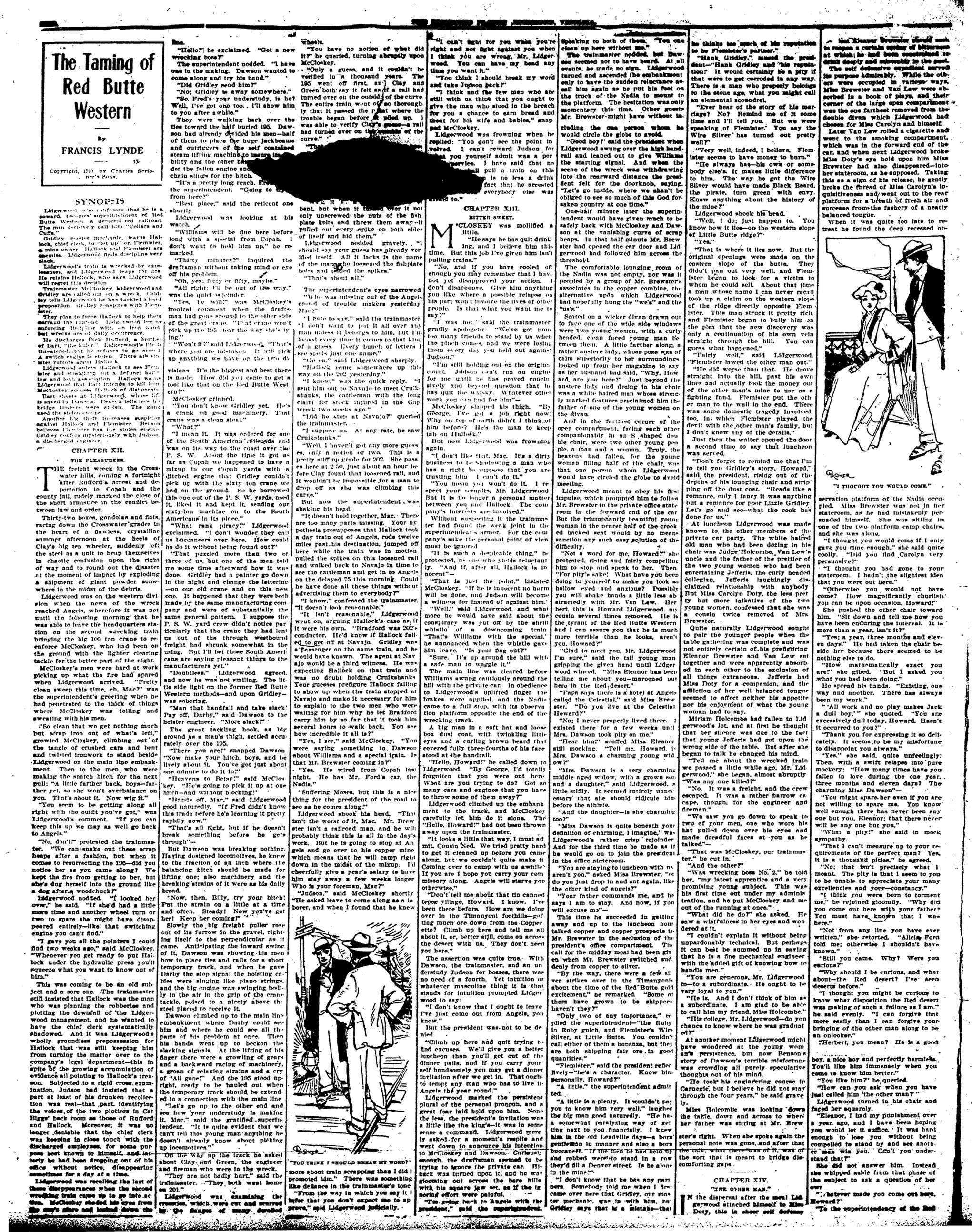
“YOU THINE | SHOULD BREAE MY WORD?”
more abont train scrapping thas J did |
promoted bim.” There was sometbing
like defiance in the trainmaster’s tone
“From the way in ebich you aay {¢ |
infor thai you don't expect me to ap
prove,” apid Lidgerwood judicially. -
"SE can't fght tor you when you're
right and noc Mbt agtisst you when
1 thiak you are wroog, Mr. Lidger
weed. Yeu can have my bead any
time you wantit” ”
“You think { should break my word
and take Jogeop peck?”
“I think and fee few men who ar
still with an thick tbat you ought to
sive the man why stood In the breach
for you x clinnce to eam bread and
teat for hin wife and bablea” snap
ped McCloekey.
Liigerwood wos frowoing when he
replied: “Yoo gon't see the point In
volved. {can't reward Judson for
you yourself admit was a per
lee. J have anid thac no
pull a train on this
tn no less a drink
fact that he arrested
everybods clee was
to"
CHAPTER XL
(BRITTEN overt. '
we
tl “Lee anyn he ban quit drink
tng, and I believe bl th
UUme. But this fob I’ve give him inn
pulling traina”
“No, and If sou bare cooled o
enough you may remember that 1 bay
Bot yet disapproved your nction.
don't disatiprove, Give him apythin
Fou Uke whore a porsiiie relapse «
hia purt won't Involve the liven of ott
People. Ix that what you want me t
any?" .
“Twas hot” sald the trafnmaste
gruttly npslozetic. “We're got non
two many friends to stand by Ua whe
the pine comes, aud we were lost:
them every day 300 held out agatns
Judson."
“Tm xtlll holding out a the origin:
count Jiu can't rua an ength
for me until be tas proved couclt
sively aud beyond question that th
hax quit the whisky. Whatever othe
work you ean tid for bln =
Mecloskey slapped bly thigh, "23
GPorge. Pee gst a fob tight now
Why op top of earth didn't [ think,o
him before? Hew the wan to kee!
tats on fnttodi.”
Bot now Litkerwood was frowntn:
agatn
“1 don't Uke that, Mag. Ite a dirty
vusinese to be Stadowing a man wb
bax a right te suppose that you ar
wusting him 1 can't do IL”
“You mean sou won't dost 1 re
mpect sour scruples, Mr. Lidgerwood
But {tts te luuzer a personal matter
between yon asl Hnlluck, The com
pans's interests ure involved.”
Without nuspeeting HC the traiamas
ter had foul te weak Joint in the
ruperiutendent’s armor. For the cut
pany’ nuke the peenonal point of elew
muxt be tenored
“It he such a despieatte thing,” be
protested, as aie who sietde reluctant
ly. “And Af, after all, Hallock in in
nocent”—
“That $a Just the jolnt." Inaixted
MeClonkey. “If he Ix thnocent no barm
WII be done. nud Jndxon will become
a witness for tnsteat of agaiost Bim.”
“Well,” etd Lidgerwood, and what
more he would have anid about tbe
conrpiracr was cut of by the shrill
whistle’ of a downcoming train
“That's Williams with the special.’
he announced when the whlatle cave
bim Ieave, “In your Bag ont?*
“Sure.” It'n up around the Bill with
a nate man to waggle It."
The main Une was cleared before
Williams swung cautiously around the
hill with the private cae. In obedience
to Lidxerwood's uplifted flager the
brakes were applied, and the Nadie
came to # full stop, with ita observa
tion pintform opposite the end of the
wrecking track.
A big mao fo n noft hat and lonsn
box dust cont. with twinkling littl
exea and a corling brown beard that
covered fully three-fourths of his face
ntood at the bandratl.
_ “Hello, Howard!” he enlled down to
Luagerwood. “By George, 14 totals |
forgotten that yon were ont here
What are you trying to do? Got so
many cars and engines that you have
to throw nome of them away?”
Lidgerwood climbed up the embank
ment to the track, and McCloskes
carefully let bith do tt wlone The
“Hello, Howard!” bad not been thrown
away upon tbe trainmaster. 2
“It looks x little that way, must ad
mit, Counin ‘Ned. We tried pretty bard
to Kot tt cleaned up before you came
along. but’ we couldn't quite make ft
Coming orer to camp with os awhile:
If you are § hope you carry your com
missary along. Angela will starve yon
otherwise.”
“Don't tell me aboat that tin canned
fener sillage, Howard. I know. I'tv
been there before. How are we doing
ver in tho Timanyons foothills—per
ing much ore dows from tbe-Copper
tte? Climb up bere and tell me all
shout St, or, better at}ll, come op acrosy
he desert with ux They don't. ner!
rou here.” :
‘The annertion was quite true. With
Daweon, the traiomnater, and an un
jerntudy Judson for bosses, there war
10 need of m fourth. Yet intuition or
rhatever mnecoline thing it ts that
tands for intuition prompted Lidger
rood to any:
“I don't know that I onght to leave
"re Jont come ont from Angels, son
now."
Thut the president was-pat to be de
Net :
“Cilia up here nad quit trying to
Ind excuren We'll give you a better
npcheon than you'll get ont of the
Inner pails. and if you carry your
elf bandsomely you may get a dinner
nritation after we get in. That ongh:
6 tempt apy man who bas t6 lve tr
Lngeln thé year road.”
‘Lidgerwood marked the persintent
jural of the personal proapgp, and x
reat foar laid hold opon him. None
he leas, the prexident's invitation war
Mttle Itke the king’a—it- was In some
enre a command. Tidgerwood mere
y atked. for a moment's respite and
rent down to announce bie intention.
Eee aA Tipe Gavinmit
Luella bupchelihrhe het halal te
‘The truinmarter npdéed, bet Daw
soo seemed not to have heard At al
events, be made no sign. Lidgerwoos
turned and ascended ‘be embankment
‘only to have the sudden reluctance as
eat! bim axatn ax be put bia foot os
‘the truck of-the Nadia to mount
the platform ‘The hesitation was onl;
momentary this: time, Other gueat
Mr. Browanter-mtght have without in
Reding the ome person whom b
‘would circle the globe to avoid.
“Good boy" sald the president wher
Lidgerwood swung over the high hand
rail and leaned out to give Williams
the starting elgnal, And when the
scene of the wreck was withdrawini
fnto"the rearward distance the prea!
dent felt for the doorknob, saying.
“Let's go toside, where we shan't be
obliged (0 seo xo much of this God for:
sakeo country at one time”
‘One-baif minute tater the superin-
tendent would bave given much to be
safely back with McCloakey and Daw.
fon at the vaniabing curve of scrap
heaps. In that half minute Mr. Brew:
ater had opened the car door and Lid.
Kerwood bad followed him gcross the
thresho¥L
‘The comfortable lounging room of
the Nndin was not empty, nor was ft
peopled by a group of Mr. Brewster's
Aavocintes In the copper combine, the
alternative uptn which Lidgerwood
bad hoperntly hung the “we's” and the
urn” . ‘i
Sento on a wicker divan dravn out
to fuce one of the wide aide windows
were Two yonne women, with a curly:
headed, clean faced young man be
tween them. A Uttle farther along,
rather austere Indy, whose pore was of
enim upertority to her surroundings
looked up frou her magazine to xy
‘on her husband hind sald, “Why, How
ard, are you here?” Just beyond the
austere Jady nud dozing to bia chair
wens a white hatred man whoae strone
Jy marked features prociaimed him the
father of one uf the young women on
the atyan, ;
And in the farthest corner of the
oren compartment. facing each other
compantonably In an S abaped dou
Ble chair, were two other young peo |
plo, a tnan und a woman. Truly, the
heateny had fallen, for the youn’
woman Ailing half of the chalr, wax
that one perwon whoin Ldgerwoot
would bare circled the globe to dvotd
meeting.
Lidgerwood meant to obey his fin
tmpulae. which prompted him te follow
Mr. Hrowater to the private office atate
room in the forward end of the car
Rot the triumphantly beavtital youns
woman in the nearer half of the crook
ed backed ‘seat would by no means
nanction any euich easy solution of the
ainsculty. 7
“Not a word for me, Howard?” she
protested. rising and fatrly compellins
him to nton aud mpeak to her. Then
“For pits's ake! What bare you been
doing to yourself to make you Took
hollow eyed ‘and anxious? Ponslbly
you will shnke bands « Uttle tess ab
atractedly with Mr. Van Lew. Wer
bert, this In Hownrd Lidgerwood. ms
cousin several tiines removed. He Is
the tyrant of the Ned Mute Wentern
snd I cao ansure you that he ts much
more terrible than he looks, aren't
Fou, Howard?
“Glad to meet you, Mr. Lidgerwood
"m sure," said the tall young man
tipping the given hand ontil Lidger
rood winced. “Miss Eleanor haa been
elling me about sou-marooned out
nere ‘tin the [ted dexert.”
“Papa nayn there ts x hotel at Angels
called the Colewtinl.” aald Ming Trew
fer. “Do you live at the Celestia!
Howard?" 1
“No; I never properly eed there. 1
xinted therefor a few weeks unt!
ire. Dawxon took pity on me”
“Hear him!" scoffed Misa Eleanor
til] mocking. “Tell me. Howard. {-
{ra Dawson « charming young wid
aia .
“Mra, Dawson tn a sery channtaz
niddie aged wilow. with a grown no
nd: daughter.” anid Lidgerwood. »
tle atity. It acemed entirely unner
gary that abe should ridicule bin
efore the athtere.
“And the daughter—ts she charmins
007"
“Miss Dawnon in quite beneath your
jeftnition of charming, I Imagine,” way
Jdgerwood’s rather crisp rejoinder |
(ed for the third thme be made as it
je would Ko on to join the president
a the office atteroon.
“You are staying to lanebeon with ns
ren't you." arked Mina Brewnter. “or |
0 yon jnst drop in and ont again, lke |
he other kind of angela?”
“Your father commands me, and he |
aya 1 am to stay. And now, if son |’
AM excune ma"—
‘This time he succeeded tn getting
way and up to the funcbeon bour |
ulked copper and copper prospects to |
(r. Brewater in the secluxton of thr
reatdent’a office compartment The
all for the midday meat bad deen ait | |
a'when Mr. Brewster switched sud |
ealy from copper to silver. .
‘to be Flemister’s partner.” =.
“Hank, Gridley," mused the’ prest
Gent—“Hank Gridley and “hie repute.
Your It would certainly be a pity if
that were to get corroded in any way.
There is,a man who property belotgs
to the stone age, what you might call
an elemental scoundrel,
“Ever hear of the story of bis mar
riage? No? Remind me of tt some
time and I'll tell you, But we were
speaking of Flemister: You say the
Wire Biiver” has turned out pretty
well *
-Wery well, indeed, t believe, Flem-
later seems to have money to burn.”
“Ee always ba¢—bis owa or some
body else's. It makes ittle difference
to him, The way: be got the Wire
Bilver would have made Black Beard,
the pirate, tarn green’ with envy.
Know anything about the history of
the mloe?”
Lidgerwood shook bisyhead.
“Well, I do; Just happen to, ” Yoo
know how {t Hee—om the western slope
of Little Butte ridge?” .
“Yeu” .
“That tx whero tt Hes now. But the
original openings were made on the
caxtern nlope of the butte. Ther
Gldo't- nan out very well, and Flem-
tster began to look for a victlm to
whom he could scil. About that {ime
‘A man whore name I can never rect!
took up a claim on the western lope
of the ridge directly opposite Elem -
ister. Thin man struck ft pretty rich.
and Flemister began to bully him on
the plea that the new discovery was
only n continuation of his own vein
atratebt through the hill You ean
shew what happened”
“Fairly well." rnid Lidgerwood, |
“Flemtster Inwed the other map out.” |
“He ald wepve than that He drove,
xtraight into the bill part his own
Maes and actually took the money ont
of the other unn's mine to use ann
Ogbting fom. Flemister put the oth
er man to the wall In tho ead. There
wan nome domestic tragedy involved
too, in: which Flemister played tie
devit with the,other man's family, bu:
I don't know ny of the detatia.”
Jurt then the walter opened the door
A necond time, to may thut luncheon
wan served. *
“Don't forget to remind mo that I'n
to tell you Gridley’s story, Howanl.”:
anid, the preaideot. ristax out of the
Geyiths of hie lounging chair and atrin”
Ping off the dust cont. “Renda Ike 9
romance, only 1 faney It was anything
but a romance for poor Lizsle Gridies
Leva go aud xeewhat the cook bis
done for un"
‘At luncheon Lidcerwood was made
known to, the other memberm of the
priate car party, Tho white batred
old monn who had been dozing in bia
chair wean Judze'Folcombe,, Van Lew'a
anele and the father of the prettier of
the two soung women who bad been
entertaining Jefferia, the curly headed
colleginn, Jefferis laughingly dix-
clatmed ‘relationship with anybody
But Miss Carolyn Doty. the leas pret
ty but more talkative of the two
young women. confensed that abe was
A cousin twice remoted of Me
Brewster. »
Quite naturally Lidzerood sought
o pair tbe sounger people when thr
adie gathioring was complete and war
not entirely certain of.bis presetring
Eleanor Mrewster and Van Lew ent
ogether and were apparently absorb
J in each other to the exclusion of
thingy extraneons, Jefferia bad
Mine Doty for companion, and the
Miction of her well balanced tongue
eemed to affect neither bie appetite
or bis enjornient of what the ounr
roman bad to nay.
Miriam Tolcombe had fallen to Lid
erwood's Jot. and at frat be thought
hat her silence was due to the fact
hat young Jefferis bad got upon the |
rong aide of the table. Tut after ahe |
egan to talk he cbroged his mind.
“Tell me about the wrecked train |
re passed a little while ago, Mr. Lid
erwood.” abe beens, almost abruptly
Wan any one killed?
“No. It wan a freight, and the crew |
ecaped. It wan a rather arrow cn
ape, though. for the engineer and | ,
reman”
“We nw you Ro down to speak to} ,
wo of your men. one who wore his! |
at pulied down over bia eyes and
nade dreadful facea at-you as bel,
alked"—
“That wan McCloskey, our trainmar | ,
er“ hecot in.” '
“And the other?’ 5
“Wan wrecking bors N6.'2" be told | ;
er, “my latest apprentice and a vers | ;
romining young subject. This war] «
ts first time out ander my adminis
ration, and he put McCloskey and me | ,
ot of the running at once”: _ 3
“What did be do?” she arked. Hie] |
aw a wistfolnemd in her eyes and won | }
ered at it. :
“T couldn't explain it withont being | ,
ppardonably technical. But perhaps} ¢
can beat be summed up tn saring| 5
gat ho in a fine mechanical engineer
ith the ‘added gift of knowing how to] «
“And the other?’ 5
“Wan wrecking bors N6.'2." be told
her, “my latest apprentice and a vers
promining Foung subject ‘This war
bis Orat time out under my adminis
tration, and he put McCloskey and me
out of the running at once”: |
“What aid be do?” abe asked. Hr
aw a wistfulnend in her eyes and won
dered at ft. : :
“T couldn't explain it withont being
mopardonably technical. Bot perhaps
tt can dest be summed up tn enying
that ho fs 4 fine mechanical engineer
with the added gift of knowing bow to
Randle men.”
“Fou are generous. Mr. Lidcerwood
to—to a subordinate.- He ought to te
very loyal to you."
“He tx. And I don't think of bim as
a subordinate, I am glad to be able
to call him my friend, Misa Holcombe.”
“His college. Mr. Lidgerwood—do yon
chance to know where be was xraduat
ar 2 *
At another moment LAlgerwood might
pave wondered at the youpx wom
ane persietence, but now Benson's
story of Dawson's terrible minfortnnr
wan crowding ali purely: speculative
thoughts ot of hin mind. .
“Tle took his engineering course in
Carnerie, but I'belfeve he did not tar
through the four sears.” he said grave
ly. :
‘Miss Holcomtie was looking “ows
the tavie, down and across to wher
Rer father wan atiting at Mr. Brew
sters right. When abe spoke again the
personal note was gone..and after that
the sort that Is meant to bridge dis
comforting zapm. s
COAPTER XIV.
. SAK OVER MAN”
N the dispernal after the meal Lad
| Kerwoud attached bimeelf to Miss
_ Doty, this in sheer seit éefennp
A Wad khaper Bevweter ioull wok
to reagan 1 certain ogving of bityeree=e
at whieh| he kod been evesteatned te
drtek deeply and miveredty bs Ube post
‘The ovit defensive expedient merred
te purpose Admiradty. While the oth:
"ere were sccupled tm variose ways,
‘Miss Brewster and Yan Lew were ab-
porbed in a book of plays, aed their
‘corner of the laige epen compartment
‘was the ove farthest removed from the
Geuble divan which Lidgerwood bad
eboeen for Miss Carolyn and himself.
Later Van Lew rolled a cigarette an@
went to the smoking compartment,
which was in the forward end of the
ear, and when next Lidgerwood broke
‘Misa Doty’s eye hold upon him Miss
Brewster had also disappeared—ioto
her stateroom, as he supposed. Taking
‘this an a sign of bis release, be gently
broke the ‘thread of Miss Carolyn’s ip-
quisitivencss nt out to the rear
platform for a breath of fresh air and
murcease fromthe fasbery of a neatly
Dalanced tongue. ae
When it was quite too late to re
Sent be fond the Geep cereneed ob
We
aij
call xt
i PrN
Wy
Qour < é
servation platforin of the Nadia occu-
pled. Misa Brewster was not in her
stateroom, ax he had mintakeniy jer:
guaded himself. She wan ating in
‘one of the (wo pintform camp chairs.
and the wan nlony.
“I thought you would come If t only
gare you time enough.” ae aatd quite
coolly, “Id you find Carolyn very
persuasive?”
“I thought you had gone to your
stateroom. 1 hadn't the alightent Idea
that you were out bere.”
“Otherwine you would not have
come? How magonificantly choriist:
you can be upon occasion, Howards”
She pushed the other chair toward
him. “Sit down and tell me bow you
have been enduring the Interval. It im
more than a year, isn't itT
“Yen: a year, three months and eler-
ep daze.” He bad taken the chair be
side her becnune there scemed to be
nothing elne to do.
“How mathematically exact you
arer’ whe cided. “But I asked you
what you bad been doing.” *
He spread bis bands. “Extating, ove
way and another, There bas alway»
been my work.”
**All work and no play makee Jack
a dull boy,"" sho quoted. “You are
exceanively dall today, Howard Hasn't
Mt occurred to you?” -
“Thank you for expressing it so dell-
catelx. ft seems to be my misfortune,
to disappoint sou niwaya”
“Yen.” nhe said. quite unfeelingly:
Then. with a wife relapee into “pure
mockery: “How many times have you
fallen {9 love during the one year,
three montha and eleven days? The
charming Misx Dawson" — x
“You might spare ber even if you are
not willing to spare me. Yoo know
well enough there bas never been any
one but you, Elendor; that there never
wilt be nny one but you,” * i
“What @ pity! she aaid tn mock
sympathy.
“That I can't measure op to your re.
quirements of the perfect man?’ Yen,
it is @ thousand pities.” be agreed.
“No: that tert precisely what 1
meant. The pity is that I seem to you
to be onable to appreciate your many
excellencies and your—constancy.”
“I tbiok you were born to torment
me,” be rejoined gloomily. “Why dic
you come out here wijh your father?
ae oe se en aay ee
here."
“Not from any line yon have ever
written,” she: retorted. “Aliciy Fora
told me; otherwise I abouldo't bave
knowo.” =. | &
BUM you came Why? Were soo
curious?”
“Why xhould I be curious, and what
gbont—the Red desert? I've’ seen
feserts before.” = _
“| thought you might be carfony to
know what disposition the Red desert
was making of such a failure as J am.~
he. said eveniy. “I can forgive that
more eaxfly than I can forgive youn
bringing of the other man along to he
1 onlooker.”
‘Herbert, you mean? He a good
07, a hice woy and perfectly harmtcta,
fou'li ike him immensely when you
ome te know him better.”
“You ike him?’ he, queried. z
“How ean you esk when you have
est called him ‘the other man?”
Litgerwood tarned in bis chatr and
aged her squarely.
“Eleanor, I tad my ponishment over
year. ago, and I bave. been boping
ou would let tt enffice. + It was hard
nough to leee you without being
ompelled te stand by and see anoth-
¢ man Win you. ‘Cen't you under-
tand thatt™
She @id mot answer him. Instead.
be whipped ankle frum that phase of
pe subject to ask a question of ber
7 wes
“i shetever made you come out bere. -
loward?"
“Te the xoperintendency of the Res
SATURDAY...AUGUST 17, 1912.
Butte Western? You did."
"Ridiculous!"
"It is true."
"Prove it, if you can, but you can't."
"I am proving it day by day, or trying to. I didn't want to come, but you drove me to it."
"I decline to take any such hideous responsibility," she langbed lightly, and then, with calculated malice:
"Howard, if you were only as brave as you are clever! Why can't you be a man and strike back now and then?"
"Strike back at the woman I love? I'm not quite down to that. I hope, even if I was once too cowardly to strike for her."
"Always that! Why won't you let me forget?"
"Because you must not forget. Listen. Two weeks ago—only two weeks ago—one of the Angels—er—peacemakers stood up in his place and shot at me. What I did made me understand that I had gained nothing in a year."
"Shot at you?" she echoed, and now he might have discovered a note of real concern in her tone if his ear had been attuned to hear it. "Tell me about it. Who was it? And why did he shoot at you?" His answer seemed to be indirection itself.
"How long do you expect to stay in Angels and its vicinity?" he asked.
"I don't know. This is partly a pleasure trip for us younger folk. Father was coming out alone, and I—that is, mamma decided, to come and make a car party of it. We may stay two or three weeks if the others wish it. But you haven't answered me. I want to know who the man was and why he shot at you."
"Exactly, and you have answered yourself. If you stay two weeks of two days in Angels you will doubtless hear all you care to about my troubles. When the town isn't talking about what it is going to do to me it is gossiping about the dramatic arrest of my would be assasin."
"You are most provoking!" she declared. "Did you make the arrest?" "Don't shame me needlessly. Of course I didn't. One of our locomotive engineers, a man whom I had discharged for drunkenness, was the hero. It was a most darling thing." And he told her Judson's story.
Miss Eleanor did not need to vocalize her approval of Judson; the dark eyes were alight with excitement.
"How fine!" she applauded. "Of course after that you took Mr. Judson back into the railway service."
"Until he demonstrates!" Don't be cold blooded, Howard! Possibly he saved your life."
"Quite probably. But that has nothing to do with his reinstatement as an engineer of passenger trains. It would be much better for Rufford to kill me than for me to let Judson have the chance to kill a trainload of innocent people."
"And yet a few moment ago you called yourself a coward, cousin mine. Could you really face such an alternative without sinning?"
"It doesn't appeal to me as a question involving any special degree of courage," he said slowly. "I am a great coward, Eleanor, not a little one, I hope."
"It doesn't appeal to you?" she said. "And I have been calling you—But would you do it, Howard?"
"He smiled at her sudden earnestness."
"How generous your heart is, Elenor, when you let it speak for itself! If you will promise not to let it change your opinion of me—you shouldn't change it, you know, for I am the same man whom you held up to storm the day we parted—if you will promise I'll tell you that for weeks I have gone about with my life in my hands, knowing it. It hasn't required any great amount of courage. It merely comes along in the line of my plain duty to the company. It's one of the things I draw my salary for."
"You haven't told me why this desperado wanted to kill you—why you are in such a deep sea of trouble out here, Howard," she reminded him.
"No. It is a long story, and it would bore you if I had time to tell it. And I haven't time, because that is Williams' whistle for the Angela yard."
He had risen and was helping his companion to her feet when Mra Brewster came to the car door to say: "Oh you are out here, are you. Howard? I was looking for you to let you know that we dine in the Madia at 7. If your duties will peril."
Ketterwood's refusal was apologetic, but arm.
"I am very sorry, Gouain Jessica," he protested. "But I left a deskful of stuff when I ran away to the wreck this morning, and really I'm afraid I shall have to beg off."
"Oh, don't be so dreadfully formal! said the president's wife impatiently."
"You are a member of the family, and all you have to do is to may bluntly that you can't come and then come whenever you can while we are here. You will come to us whenever you can, Howard; that is understood," she said. And so the social matter rested. Lidgerwood was half way down the platform of the Crow's Next, heading for his office and the neglected dock, when Williams' engine came backling through one of the yard tracks on its way to the roundhouse. At the
ment of the passing, a Kirk mall with his one pulled over his eyes dropped from the gangway step and flung motion to the headquarters building. It was Johnson, and, having seen him but telling away men fashion at the
Rouer
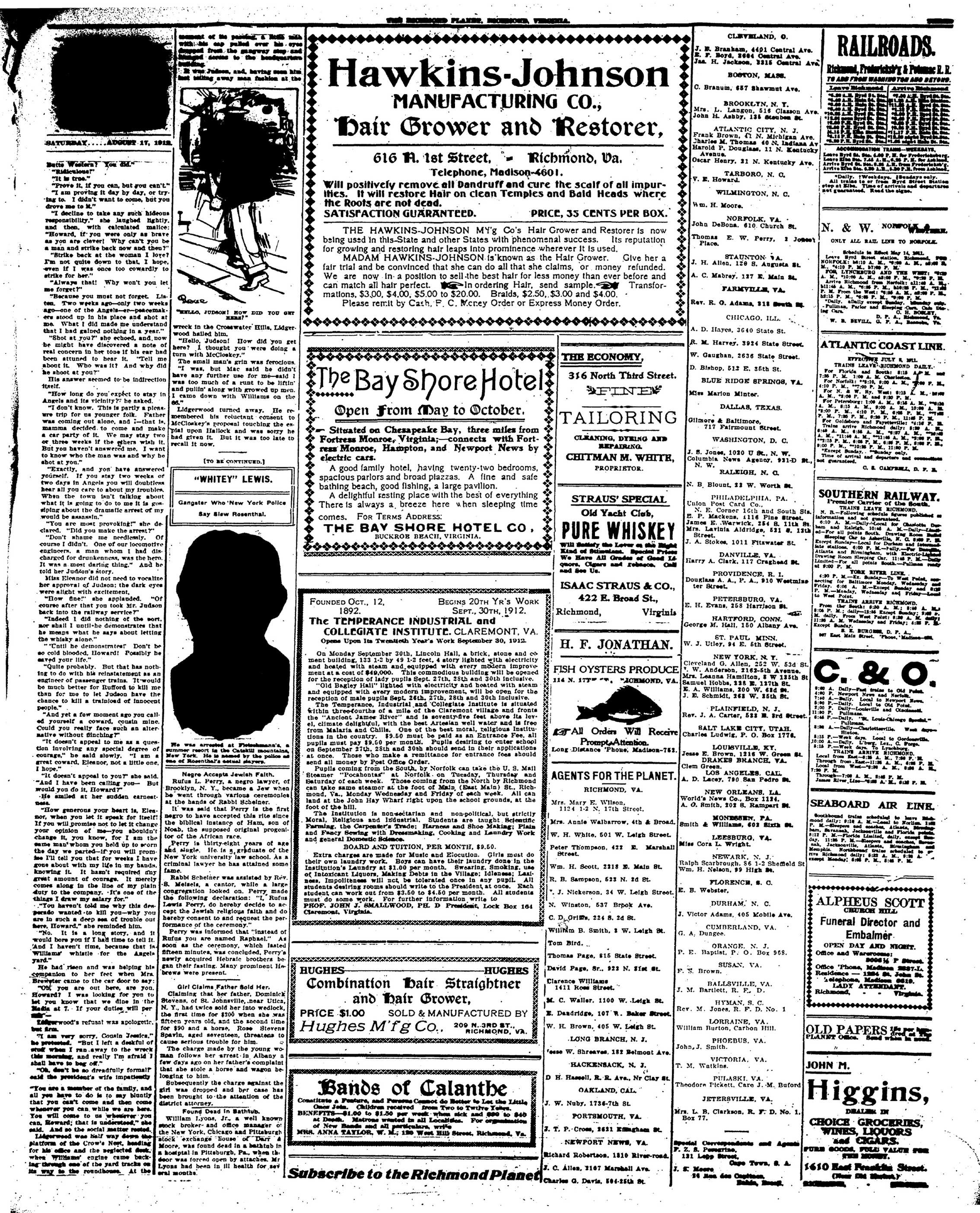
"HELLO, JUDSON! HOW DID YOU GET HERE!"
wreck in the Crosswater Hills, Lidgerwood hailed him.
"Hello, Judson! How did you get here? I thought you were doing a turn with McCloskey."
The small man's grin was ferocious.
"I was, but Mac said he didn't have any further use for me—said I was too much of a runt to be liftin' and pullin' along with grown up men. I came down with Williams on the 60."
Lidgerwood turned away. He remembered his reluctant consent to McCloskey's proposal touching the emplial upon Hallock and was sorry he had given it. But it was too late to recall it now.
Gangster Who'New York Police Say Slew Rosenthal.
```markdown
```
He was arrested at Pleasantman's, a summer resort in the Catskill mountains, New York. He is named by the police as one of Rosenthal's actual players.
Negro Accents Jewish Faith.
Rufus L. Perry, a negro lawyer, of Brooklyn, N. Y., became a Jew when he went through various ceremonies at the hands of Rabbi Scheiner. It was said that Perry is the first negro to have accepted this rite since the biblical instance of Ham, son of Noah, the supposed original progenitor of the African race. Perry is thirty-eight years of age and single. He is a graduate of the New York university law school. As a criminal lawyer he has attained some fame. Rabbi Scheiner was assisted by Rev. S. Meisels, a cantor, while a large congregation looked on. Perry made the following declaration: "I, Rufus Lewis Perry, do hereby decide to accept the Jewish religious faith and do hereby consent to and request the performance of the ceremony."
Perry was informed that "instead of Rufus you are named Raphael." As soon as the ceremony, which lasted fifteen minutes, was concluded, Perry's newly acquired Hebraic brothers began their fasting. Many prominent Hebraes were present.
Girl Claims Father Sold Her
Claiming that her father, Dominick Stevens, of St. Johnsville, near Utica, N. Y., had twice sold her into wedlock, the first time for $500 when she was fifteen years old, and the second time for $90 and a horse, Rose Stevens Spavin, aged seventeen, threatens to cause serious trouble for him.
The charge made by the young woman follows her arrest in Albany a few days ago on her father's complaint that she stole a horse and wagon belonging to him.
Subsequently the charge against the girl was dropped and her case has been brought to the attention of the district attorney.
Found Dead in Bathub.
William Lyons, Jr., a well known stock broker and office manager of the New York, Chicago and Pittsburgh stock exchange house of Darr & Moore, was found dead in a bathtub in a hospital in Pittsburgh, Pa. when the door was forced open by attaches. Mr Lyons had been in ill health for several months.
Hawkins-Johnson MANUFACTURING CO., Hair Grower and Restorer,
616 N. 1st Street. Richmond, Va. Telephone, Madison-4601.
I positively remove all Dandruth
iss. It will restore Hair on clean-
tie Roots are not dead.
TISFACTION GUARANTEED.
THE HAWKINS-JOHNSON MY'g
ing used in this-State and other States w
growing and restoring hair leaps into pr
MADAM HAWKINS-JOHNSON is
trial and be convinced that she can do
are now in a position to sell-the best
match all hair perfect. In order
tons, $3.00, $4.00, $5.00 to $20.00. B
Please remit by Cash, P. C. Money O
The Bay Shore H
Open From May to October
situated on Chesapeake Bay, three m
ress Monroe, Virginia;—connects w
Monroe, Hampton, and Newport
eptic cars.
good family hotel, having twenty-two
ous parlors and broad plazzas. A fine
ing beach, good fishing, a large pavilion.
delightful resting place with the best of
eats always a breeze here when slee
s. FOR TERMS ADDRESS:
THE BAY SHORE HOTEL
BUCKROB BEACH, VIRGINIA.
D Oct., 12. BEGINS 20th YEAR
1892. SEPT., 30TH
TEMPERANCE INDUSTRIAL and
COLLEGIATE INSTITUTE. CLAREM
Upon Its Twentieth Year's Work September 3
Sunday September 30th, Lincoln Hall, a brick,
building, 133 1-2 feet, 4 story lighted w
ood with steam and equipped with every midd
cost of $49,000. This commodious building
exception of lady pupils Sept. 27th, 28th and 30th
Angley Hall" lighted with electricity and heated
ed with every modern improvement, will be of
male pupils Sept. 26th, 27th, 28th and 30th
Temperance, Industrial and Collegiate Institute
treetours of a mile of the Claremont village
Mont James River" and is seventy-five feet abo
delightful, with the best Artesian well water
aria and Chills. One of the best moral, relig
country. $9.50 must be paid as an Entr
at pay $9.50 per month. Pupils desiring to
octber 27th, 28th and 30th should send in their
Those who make a remittance for entrance
money by Post Office Order.
coming from the South, by Norfolk can take the
"Pocahontas" at Norfolk on Tuesday, Thir
each week. Those coming from the North b
ame steamer at the foot of Main (East Main
Monday Wednesday and Friday of each week
John Hay Wharf right upon the school group
hill.
institution is non-sectarian and non-political,
religious and Industrial. Students are taught
the Carpenter's Trade; Harness and Shoe M
Sewing with Dressmaking, Cooking and La
Domestic Science.
JOHNSON MY'g Co.'s Hair Group and other States with phenomenal hair leaps into prominence where JOHNSON is known as the Hair that she can do all that she claims to sell—the best hair for less money. In ordering Hair, send $0.00 to $20.00. Braids, $2.50, $3.00, F. C. Money Order or Express.
More Hotel
Day to October.
Like Bay, three miles from Waikau; connects with Fort- and Newport News by driving twenty-two bedrooms, plazzas. A fine and safe, a large pavilion, with the best of everything here when sleeping time.
RE HOTEL CO.
CH, VIRGINIA.
BEGINS 20TH YR'S WORK SEPT., 30TH, 1912.
INDUSTRIAL AND INUTE. CLAREMONT, VA.
Work September 30, 1912.
Colin Hall, a brick, stone and cement, 4 story lighted with electricity, used with every modern improvised building will be opened. 27th, 28th and 30th inclusive. Electricity and heated with steam improvement, will be open for the 27th, 28th and 30th inclusive.
Collegiate Institute is situated the Claremont village and fronts seventy-five feet above its lev-Artesian well water and is free the best moral, religious Institu-tion paid as an Entrance Fee, all Pupils desiring to enter school should send in their applications instance for entrance fees should.
Norfolk can take the U. S. Mall on Tuesday, Thursday and from the North by Richmond of Main (East Main) St., Rich-Friday of each week. All can upon the school grounds, at the and non-political, but strictly Students are taught Scientific Barnes and Shoe Making; Plaing. Cooking and Laundry Work
Will positively remove all Dandruff and cure the scalp of all impur- ities. It will restore Hair on clean Temples and Bald Heads where the Roots are not dead. SATISFACTION GUARANTEED PRICE 35 CENTS PER BOX
THE HAWKINS-JOHNSON MY'g Co's Hair Grower and Restorer is now being used in this-State and other States with phenomenal success. Its reputation for growing and restoring hair leaps into prominence wherever it is used.
MADAM HAWKINS-JOHNSON is known as the Hair Grower. Give her a fair trial and be convinced that she can do all that she claims, or money refunded. We are now in a position to sell the best hair for less money than ever before and can match all hair perfect. In ordering Hair, send sample. Transformations, $3.00, $4.00, $5.00 to $20.00. Braids, $2.50, $3.00 and $4.00.
Please remit by Cash, F. C. Money Order or Express Money Order.
Open From May to October.
Situated on Chesapeake Bay, three miles from Fortress Monroe, Virginia; connects with Fortress Monroe, Hampton, and Newport News by electric cars.
A good family hotel, having twenty-two bedrooms, spacious parlors and broad plazzas. A fine and safe bathing beach, good fishing, a large pavilion.
A delightful resting place with the best of everything There is always a breeze here when sleeping time comes. FOR TERMS ADDRESS:
THE BAY SHORE HOTEL CO,
BUCKROE BEACH, VIRGINIA.
The TEMPERANCE INDUSTRIAL and COLLEGIATE INSTITUTE. CLAREMONT, VA.
Opens Upon Its Twentieth Year's Work September 30, 1912.
On Monday September 30th, Lincoln Hall, a brick, stone and cement building, 133 1-2 by 49 1-2 feet, 4 story lighted with electricity and heated with steam and, equipped with every modern improvement at a cost of $49,000. This commodious building will be opened for the reception of lady pupils Sept. 27th, 28th and 30th inclusive.
"Old Bedrock Hall" lighted with electricity and heated with steam
"Old Bagley Hall" lighted with electricity and heated with steam and
resuscitation of male flesh. 26th, 27th, 28th and 30th Inclusive.
The Temperance, Industrial, and Collegiate Institute is situated within three-fourths of a mile of the Claremont village and fronts the "Ancient James River" and is seventy-five feet above its level, climate delightful, with the best Artesian well water and is free from Malaria and Chills. One of the best moral, religious Institutions in the country. $9.50 must be paid as an Entrance Fee, all pupils must pay $9.50 per month. Pupils desiring to enter school on September 27th, 28th and 30th should send in their applications at once. Those who make a remittance for entrance fees should send all money by Post Office Order.
Pupils coming from the South, by Norfolk can take the U. S. Mall Steamer "Pocahontas" at Norfolk on Tuesday, Thursday and Saturday of each week. Those coming from the North by Richmond can take same steamer at the foot of Main (East Main) St., Richmond, Va., Monday Wednesday and Friday of each week. All can land at the John Hay Wharf right upon the school grounds, at the foot of the hill.
The Institution is non-sectarian and non-political, but strictly Moral, Religious and Industrial. Students are taught Scientific Farming, the Carpenter's Trade; Harness and Shoe Making; Plain and Fancy Sewing with Dressmaking, Cooking and Laundry Work and general Domestic Science.
BOARD AND TUITION. PER MONTH. $9.50.
charges are made for Music and Elocution. Girls laundry work. Boys can have their laundry on their Laundry at $1.00 per month. Swearing, Smell Liquors, Making Debts in the Village; Idle Witnessness will not be tolerated once in any residing rooms should write to the President at one work out from $3.50 to $4.50 per month. A home work. For further information write to JOHN J. SMALLWOOD, PH.D President, Lock Virginia.
and Elocution. Girls must do
have their laundry done in the
month. Swearing, Smoking, use
in the Village; Idleness; Laxi-
rated once in any pupil. All
to the President at once. Each
4.50 per month. All students
information write to
D President, Lock Box 164
Extra charges are made for Music and Elocution. Girls must do their own laundry work. Boys can have their laundry done in the Institution's Laundry at $1.00 per month. Swearing, Smoking, use of Intoxicant Liquors, Making Debts in the Village; Idleness; Laziness. Impoliteness will not be tolerated once in any pupil. All students desiring rooms should write to the President at once. Each student can work out from $3.50 to $4.50 per month. All students must do some work. For further information write to PROF. JOHN J. SMALLWOOD, PH. D. President, Lock Box 164
PROF. JOHN J. SMALLWOOD, PH. D President, Lock Box 164
Claremont, Virginia.
PRICE $1.00 SOLD & MANUFACTURED BY Hughes M'fg Co., 209 N.3RD ST., RICHMOND, VA.
Subscribe to the Richmond Planet
316 North Third Street.
FINE
TAILORING
CLEANING, DYING AND
REPAIRING.
CHITMAN M. WHITE,
PROPRIETOR.
STRAUS' SPECIAL
Old Yacht Club,
PURE WHISKEY
Will satisfy the Letter on this Night
Kind of Stimulant. Special Prices
We Have All Grades of Good Liquor,
Cigars and tobacco. Call
and See Us.
ISAAC STRAUS & CO.,
422 E. Broad St.,
Richmond, Virginia
H. F. JONATHAN.
FISH OYSTERS PRODUCE
114 N. 17TH ST. JOHMOND, VA.
All Orders Will Receive
Prompts Attention.
Long Distance Phone, Madison-752.
AGENTS FOR THE PLANET.
RICHMOND, VA.
Mrs. Mary E. Wilson,
1124 12 N. 17th Street.
Mrs. Annie Walbarrow, 4th & Broad.
W. H. White, 501 W. Leigh Street.
Peter Thompson, 422 E. Marshall
Street.
Wm. H. Scott, 2218 E. Main St.
R. B. Sampson, 523 N. 2d St.
V. J. Nickerson, 34 W. Leigh Street.
N. Winston, 537 Brpk Ave.
C. D. Griffin, 224 S. 2d St.
William B. Smith, 3 W. Leigh St.
Tom Bird.
Clarence Williams
1411 Roe Street.
M. C. Waller, 1100 W. Leigh St.
E. Dandridge, 107 R. Baker Street.
W. H. Brown, 405 W. Leigh St.
LONG BRANCH, N. J.
fesse W. Shreaves, 182 Belmont Ave.
HACKENBACK, N. J.
D H. Hassell, R. R. Ave., Nr Clay St.
OAKLAND, CAL.
J. W. Nuby, 1736-7th St.
PORTSMOUTH, VA.
J. T. P. Cross, 2621 Emmaghan St.
NEWPORT NEWS, VA.
Richard Robertson, 1810 River-road.
J. C. Allen, 2107 Marshall Ave.
Charles G. Davis, 504-25th St.
TARBORO, N. C.
V. E. Howard.
WILMINGTON, N. C.
Wm. H. Moore.
STAUNTON, VA.
J. H. Allen, 120 S. Augusta St.
A. C. Mabrey, 127 E. Main St.
FARMVILLE, VA.
Rev. R. G. Adama, 318 South St.
CHICAGO, ILL.
A. D. Hayes, 3640 State St.
R. M. Harvey, 3924 State Street.
W. Caughan, 2636 State Street.
D. Bishop, 512 E. 36th St.
BLUE RIDGE SPRINGS, VA.
TRAINS LEAVE RICHMOND DAILY:
For Florida and South: 8:15 A.M.
7:55 P. M. 1:00 A.M. Charleston.
For Norfolk: "8:10 A.M. 9:00 A.M. "8:00 P. M.
6:10 A.M. W. Yale.
For N. & W. W. Yale: 8:15 A.M. "8:00
A. M. "8:00 P. M. and 8:50 P. M.
For Petersburg: 1:00 A. M. "8:15 A. M. "8:10
A. M. "8:15 A. M. "9:00 A. M. "10:00 A. M.
"8:00 P. M. "4:10 P. M. "6:05 P. M. "7:00 P. M.
"7:00 P. M. "8:30 P. M. "11:45 P. M.
For Goldboro ayerville: "6:16 P. M.
Trains arrive Richmond. "8:15 A. M. "8:10
A. M. "6:55 A. M. "8:77 A. M. "8:40 A. M.
A. M. "11:40 A. M. "11:45 A. M. "7:00 P. M.
"2:15 P. M. "6:05 P. M. "6:55 P. M. "9:00 P. M.
9:00 P. M. "10:25 P. M. 11:80 P. M.
*Except birthday, Sunday only.
Time of arrival, Sunday only.
C. & O.
8:00 A. Daily—Fast trains to Old Point.
8:00 P. Newport News and Norfolk.
7:00 A. Daily. Local to Newport News.
7:00 P. Daily. Local to Old Point.
8:00 P. Daily. Loudville and Oakland.
11:00 P. Pullman.
8:45 P. Daily. "St. Louis-Chicago Special."
Pullman.
8:20 A.—Charlotteville. West days—Hickory.
8:15 P. Week days. Local to Gordonville.
10:00 A.—Daily. l'Bury, Lz., C. Forga.
8:15 P. Week days. To Lynchburg.
TRAINS ABRIVE RICHMOND.
Local from East—8:00 A. M., 8:00 P. M.
Through from East—11:00 A. M., 6:15 P. M.
Local from West—8:00 A. M., 8:00 P. M.
7:20 P. M.
Through—7:00 A. M., 8:45 P. M.
James River, Liz—8:00 A. M., 6:15 P. M.
LOUISVILLE, KY.
Josee E. Brown, 1216 W. Green St.
DRAKES BRANCH, VA.
Clem Green.
LOS ANGELES, CAL.
A. D. Lacey, 790 San Pedro St.
SEABOARD AIR LINE
Boothbush trains scheduled to have Richmond daily: 8:23 A. M.-Local to Northam. 1:58
Richmond, coach, Atlanta, Birmingham,
Barnahan, Jackson, Nashville,
8:12 P. M.-Florida Limited, daily, Richmond
day, 11:38 P. M.-Sleepers and coach, Birmingham,
Atlanta, Birmingham, and Memphis.
Northam, Richmond daily: 8:23 A. M., 8:23 A.
except Monday; 8:23 P. M., 8:48 P. M.
---
ALPHEUS SCOTT
CHURCH HILL
Funeral Director and
Embalmer
OPEN DAY AND NIGHT.
Office and Wareroome:
8006 1/4 P Street.
Office 'Phone, Madison 2827-L.
Residence — 1224 St. John St.
'Telephone, Madison 6010.
LADY ATTENDANT.
Richmond, - - Virginia.
DURHAM, N. C.
J. Victor Adams, 405 Mobile Ave.
CUMBERLAND, VA.
G. A. Dungee.
OLD PAPERS The per hour
PLANET Office. Send when in need.
PHOEBUS, VA.
John, J. Smith.
VICTORIA, VA.
T. M. Watkins.
PULASKI, VA.
Theodore Pickett, Care J. M. Buford
JETERSVILLE, VA.
JOHN M. Higgins, DEALER IN
JOHN M.
CHOICE GROCKERIES,
WINES, LIQUORS
and CIGARS.
FURR GOODS, FOLL VALUE FOR
FEE MONEY.
1610 East Franklin Street.
(Near Old Market.)
J. R. Branham, 4401 Central Ave.
E. F. Boyd, 3604 Central Ave.
Jae H. Jackson, 3215 Central Ave.
BOSTON, MASS.
C. Branum, 657 Shawmut Ave.
BROOKLYN, N. Y.
Mrs. L. Langon, 516 Classon Ave.
John H. Ashby, 125 Steuben St.
ATLANTIC CITY, N. J.
Frank Brown, 41 N. Michigan Ave.
Charles M. Thomas 40 N. Indiana Av
Harold P. Douglass, 11 N. Kentucky
Avenue.
Oscar Henry, 21 N. Kentucky Ave.
NORFOLK, VA.
John DeBona. 610. Church St.
Thomas E. W. Perry, 2 Jones
Place.
Rev. R. G. Adama, 318 South St.
Miss Marion Minter.
Gilmore & Baltimore,
717 Fairmount Street.
WASHINGTON, D. C.
J. S. Jones, 1020 U St., N. W.
Columbia News Agency, 931-D St.
N. W.
PHILADELPHIA, PA.
Union Post Card Co.
Union Post Card Co.
N. E. Corner 16th and South Sts.
E. P. Mackens. 1116 Pine Street.
James E. Warwick. 254 B. 11th St.
Mrs. Lavinia Aldridge. 521 B. 13th
Street.
J. A. Stokes. 1011 Fitzwater St.
DANVILLE, VA.
Harry A. Clark. 117 Craghead St.
PETERSBURG, VA.
E. H. Evans, 258 Harrison St.
HARTFORD, CONN.
George M. Hall, 150 Albany Ave.
ST. PAUL MINN.
W. J. Utley, 94 E. 5th Street.
NEW YORK, N. Y.
Cleveland G. Allen, 252 W. 53d St.
T. W. Anderson, 2163-5th Avenue.
Mrs. Leanna Hamilton, 8 W. 135th St.
Samuel Hobbs, 228 E. 137th St.
E. A. Williams, 200 W. 68d St.
J. E. Schmidt, 262 W. 25th St.
PLAINFIELD, N. J.
Rev. J. A. Carter, 523 M. 3rd Street.
SALT LAKE CITY, UTAH.
Charles Ludwig, P. O. Box 1776.
NEW ORLEANS, LA.
World's News Co., Box 1124.
A. O. Smith, 202 8. Rampart B4.
MONESSEN, PA.
Smith & Williams, 602 Sixth B4.
LEESBURG, VA.
Miss Cora L. Wright.
NEWARK, N. J.
Ralph Scarbrough, 86 1-2 Sheffield St
Wm. H. Nelson, 99 High B4.
FLORENCE, S. O.
E. B. Webster.
ORANGE, N. J.
P. E. Baptist, P. O. Box 968.
BALLSVILLE, VA.
J. M. Bartlett, R. F. D.
HYMAN, S. C.
Rev. M. Jones, R. F. D. No. 1
LORRAINE, VA.
William Burton, Carbon Hill.
Mrs. L. B. Clarkson, R. F. D. No. 1
Box 77.
Special Correspondents and Agent
F. Z. R. Perogrine,
131 Lopp Street,
Oxpe Town, R. A.
J. K. Moore,
16 Mau den Ongtzen,
Baldwin, Boulder.
RAILROADS.
N. & W. NORWO
ONLY ALL RAIL LINE TO NORPOLE.
Schedule in Effect May 14, 2011.
Leave Hyrd Street station, Richmond, PNORFOLK: 8:10 A. M., 9:00 A. M., 8:00 A.
M., 4:10 P. M., 8:70 P. M.
FOR LYNCHBURG AND THE WEST: 9:20 P.
A. 10:20 A. M. 9:20 P. M. 9:20 P. M.
b11:45 A. M. 9:25 P. M. b11:45 P. M.
b11:45 A. M. 9:25 P. M. b11:45 P. M.
P. From the West: 9:25 A. M. 9:25 P. M.
b1:15 P. M. 9:25 P. M. 9:25 P. M.
Vice President: Sunday, January 15
Pauline Parks
. family except Sunday. Monday only.
-Pullman, Paran and Sleeping Care. Cars. Din-
ing Care.
O. BOBLEY.
D. P. A. Bickley.
W. B. BEVILL. G. P. A. Bickley. Va.
ATLANTIC COAST LINE
C. R. CAMPBELL. D. F. R.
SOUTHERN RAILWAY.
S. E. BURGER, D. P. A.
807 Kent Main Street, Phone: Madison
807
Published every Saturday by JOHN MITCHELL
Ft. al RiI H. Fourth Street, Richmond, Va.
all communications intended for publication
should be sent so as to reach us by Walmarty.
TERMS IN ADVANCE
One Copy, per year ..... $11.00
Two Copies, six months ..... $10.00
Three Copies, six months ..... $9.00
Four Copies, four months ..... $8.00
Five Copies, three months ..... $7.00
Six Copies, Copy ..... $6.00
ADVERTISING RATES
For one inch, one insertion ..... 8.50
For one inch each subsequent insertion ..... 8.50
For two inches, six months ..... 10.00
For two inches, six months ..... 14.00
For two inches, twelve months ..... 20.00
For two inches, twelve months ..... 29.00
For two inches and transient Notices, one inch ..... 39.00
For two inches and transient Notices, one inch ..... 39.00
IMAGE STAMPS OF A HIGHER DEFINITION
THIS TITLE REQUIRED
SUBSCRIPTIONS.
THE PLANET is shown weekly. The subscrip-
tion price is $1.50 per year. In advance.
One price is $1.50 per year, in advance.
There are four ways by which money can be
obtained: a Post Office Money Order,
by bank Check or Draft, or an Expos-
sure Money Order, and who none of these can
be accepted in a Registered Office.
A Post Office can buy a Money Order
at your Post Office, payable at the Institutional
Post Office, and we will be responsible for
Rate arrival.
EXPRESS MONLY ORDERS can be obtained
at any office of the American Express Co.
the United States Expossure Company. We will be re-
sponsible for money sent by any of their companies.
The Expossure Money Order is a safe and conven-
tive way for forwarding money.
REGISTERED LETTER.—If a Money Order,
Post Office or an Expossure Office is not within
your reach, you must send us on payment of ten
cents. If the Letter is not or stolen, it can be traced. You can send money in this manner at our站.
We cannot be responsible for money sent in
letters in any other way than one of the four
any other way. If you send your money
any other way, you must do it at your own
HENKEN ALS. ETC.—If you do not want THE PLANKT continued for another year after your subscription has run out, you may by us apply to the office of the secretary, or describe that subscribers to newspapers who do not order their paper discontinued at the expiration of time for which it has been paid are required for the payment of the subscription to date when they order the paper discontinued.
COMMUNICATIONS...When writing to us to request our subscription to the newspaper, you should give your name and address to full, otherwise we cannot find your name on our books.
CHANGE OF ADDRESS...In order to change your name, we will not not the better you will as the press address
Entered at the Post Office at Richmond, Va.
as second-class matter.
SATURDAY.....AUGUST 17, 1912
Col. Roosevelt wishes to see how
it works to have an all white party
in the Southland. Well, let him see.
---
We learned with regret of the death of our great and good friend, Mr. I. W. Herd, proprietor of "The Bellevue Hotel on Mona Lake, Muskogon, Mich. He was devoted to the interests of his people and had won the respect of all of his neighbors. His death removes from the field of action one of the landmarks of that community.
Under the old management, the Republican Party has enjoyed an almost uninterrupted lease of power in the national government. This was done too by recognizing the equality of all men before the law. Now it is proposed to undo all of this by raising the color line, causing additional dissension in the Republican Party and thereby make certain the success of the Democratic Party at the polls in November.
---
Colored men, who are wondering what to do should take note that the Prohibitionists have nominated a candidate for President. The Socialists have done the same thing. The Republicans have a candidate and the Democratic Party also has a candidate. A voter, who cannot find in this array of material a candidate to suit his fancy must be hard to please and should stay at home on election day.
Colored men voted in the Richmond Democratic primary last Thursday, the Negro haters to the contrary, notwithstanding. The Richmond Virginian opposed the innovation, but the judges of election, being sworn so to do, lived up to the letter and the spirit of the law. An ex-President Reedworth, "fucks the Virginian out of the front door of the National Progressive Party, the liberal minded white Democrats of the Richland admit them through the front door of the Democratic Party, and the world moves on."
COL ROOSEVELT'S POSITION
Ex-President Roosevelt's letter to Mr. Julian Harris of Atlanta, Georgia was enough of a sacrifice of vital principles to disgust every lover of liberty in the country, but his speech at the National Progressive Convention was even a worse betrayal of the rights and privileges of the colored man. Applying to both the rule of reason Mr. Roosevelt would be an unstable custodian of the Fifteenth Amendment to the Constitution of the United States and he stands squarely opposed to the specific declaration in the National Republican Party platform of 1908. But it was the letter to Mr. Harris that we wished specifically to discuss. He said:
My Dear Mr. Harris—In pursuance of our conversation I write you this letter. There is a peculiar fitness in writing it to the son of the man whose work made all Americans his debtors. Young father, possessed genius, and moreover he possessed that gentleness of soul, that broad and tender sympathy with his fellows, for the lack of which genius cannot atone. His life and his work tended to bring his fellow countrymen, North and South, into ever closer relations of good will and understanding and surply at should be needless to say that the author of "Uncle Remon" and of Free Joe and the Root of the World" felt a deep and most kindly interest in the welfare of the Negro.
It may be well for us to state that as between supporting both politically and otherwise, the father of Mr Julian Hartt and Col. Roosevelt, we would best our interests in the former's hands, thousand times to ensure in the hands of the latter. The former was sheer and time of political dilemmas and a belief in the colored people of the Southland. He could be depended upon to protect their vital interests and relied upon not to sacrifice the friendship of a lifetime for a petty political advantage. He would not blow hot in the Northern States in his dealings with the colored men and cold in the Southern States in his dealings with the same class of people.
But it is Col Roosevelt's idea that he "kicking" the colored citizens out of the Progressive Party that he shall be able to "bring his fellow countrymen, North and South, into ever closer relationship." Vain hope! Col Roosevelt does not understand the Southern white man and still loses the Southern colored one. His open desertion of the color people has made for him many enemies among the very class of Southern white people, phone support he values most.
They are disgusted with him for they know that all that he is now doing is to secure political advantage and to deceive the white people of this sunny clime. When his scheme fails, he will turn upon his Southern allies, whose support he is now wooing with all of the ferocity of the tiger of the jungle.
The class of white people who have a special antipathy to the colored people of the Southland is the element known as "poor whites." They envy or at least the largest proportion of them envy the progress of the "new Negro."
Mr. Roosevelt says:
Many letters dealing with the suit
of which you spoke to me have
been sent to me within the last few
days. These letters, from equally
worthy citizens, take diametrically
opposite positions. Those written
by me lived in the North usually
by the South and that we got from
the South colored delegates to the
National Progressive Convention.
Those written by citizens of the
South ask that I declare that the
new party shall be a white man's
party. I am not able to agree to
either proposal.
And yet Col. Roosevelt did agree with the proposal that the Party in the South should be a white man's party for he specifically declared that no black man should be seated as a delegate from any State in the Southland and none were seated, so far as the information given to the public goes. Those who escaped elimination "sat tight and kept their mouths shut." Col. Roosevelt then gave expression to great principles, which would have satisfied every advocate of great principles.
Here is what he said:
"In this country we cannot per manently succeed except upon the basis of treating each man on his worth as a man. We can fulfil our high mission among the nations of the earth, we can do lasting good to ourselves and to all mankind, only if we so act that the humblest among us, so long as he behaves in straight and decent fashion, has gunman to him under the law his life to life, has predecessor from injustice, his right to enjoy fruits of his own honest labor and his right to the pursuit of happiness in his own way so long as he does not trespass on the rights of others. Our only safe motto is "All men up" and not "Some men down."
That sounds "mighty good." He handed out more of the same kind of information when he said:
For us to oppress any class of our fellow citizens, is not only wrong to others but hurtful to ourselves; for in the long run such action is no worse than to those who think that they temporarily beset by the oppressor
sion. Surely no man can quarrel with these principles. Exactly as they should be applied among white men without regard to their different ces of creed, or birthplace, or social station, without regard to whether they are rich men or poor men, men who work with their hands or men who work with their brains, so they should be applied among all men without regard to the color of their skins. These are the principles to which I think our countrymen should ad here, the objects which I think they should have steadily in mind. There is need not merely of all our high purpose but of all our wisdom and patience in striving to realize them. Above all it is essential that we should not act in such a way as to make believe that we are achieving these objects and yet by our actions indefinitely postponed the time when it will become even measurably possible. For this reason I cannot adopt this, the two diametrically opposite suggestions made to me in the letters of which I have spoken.
These declarations of great principles read like Holy Writ. How many man with intelligence could couple them with positive actions which were diametrically opposed to every truth thereby contained and lay claim to leadership and sanity is one of the mysteries of this day and generation and yet this is just what Mr. Roosevelt did.
He said in effect that to oppress the colored citizen would hurt the people who oppressed him and yet he proceeded to oppress him and forced his colleagues and associates in the "Hall Moose Convention" to do the same thing. It is inconceivable that a man of Col. Roosevelt's affectionate ability should make such a sawing gulf between his platitudes upon principles and his platform of performances.
Now here is where he struck out on another course and went diametrically opposite to the position which he had just taken. He said:
"I believe that the Progressive movement should be made from the beginning one in the interest of every honest, industrious, law abiding colored man. Just as it is in the in the interest of every honest, industrious law abiding man. I further believe that the important to help either the white man or the colored man in those regions of the South where the colored man is most nu merous would be to try to repeat the course that has been followed by the Republican party in these distri tries for so many years or to en deavor in the States in question to build up a Progressive party by the same methods which in those States have resulted in making the Republican Party worse than impotent.
It is said that immediately after the late Civil War, a white carpet bagger, named Hammel decided to betray and abandon the colored people. His last speech was made in the Capitol Square. Colored people were there in great numbers. Finally he said: "If I be nominated for the legislature, will you vote for me?" "Yes! yes! yes" was the response "If I be nominated for Governor will you vote for me?" "Yes! yes! yes" came the thunderous response "If I be nominated for President of the United States, will you vote for me?" he yelled. "Yes! yes! yes!" came the response. "If I go to hell, will you follow me there?" was the astounding query. "Yes—No! What that man say" came the disgusted response by colored folks, who could hardly believe their own ears.
This is about the feeling of the colored people in the case of Col. Roosevelt. They are bewildered and all over the country are asking the question, "What that man say?" He continued:
Henry Ward Beecher once said that the worst enemy of the colored man was the man who stirred up enmity between the white and colored men who have to live as neighbors. In the South the Democratic machine has sought to keep itself paramount by encouraging the hatred of the white man for the black; the Republican machine has sought to perpetuate itself by stirring up the black man, against the white, and surely the time has come when we should understand the mischief in both courses and should abandon both.
No sensible man will question the course of this procedure. But to abandon great principles and to argue that right is wrong and wrong is right, that one class of white citizens have the legal and logical right to live with his foot upon the neck of another class of citizens, that inferior constitutional rights are to be sacrificed and the great truths laid down by the good and lowly Jesus are to be subordinated and Wrong placed upon the throne, is out of the question. In the face or all of this Col. Roosevelt has the audacity to say:
We have made the Progressive is sue a moral, not a racial issue. I bellow that wherever the racial issue is permitted to become dominant in our politics it always works harm to both races, but, immeasurably most harm to the weaker race. I bellow that in this movement only damage will come if we either abandon our ideals on the one hand, or on the other fail resolutely to look facts in the face, however unpleasant these facts may be. Therefore I feel that we have to adopt our actions to the actual, conditions and actual needs and feelings of each community; not abandoning our principle, but not in one community endeavoring to realise them in ways which will simply cause disaster in that community although they may work well in an other community. Our object must
be the same everywhere, but the methods by which we strive to attain it must be adapted to the needs of the several States or it will never be attained at all.
Mr. Roosevelt can no longer lay claim to statesmanship. By his actions and statements, he made the Progressive issue a racial issue, not only in the South, but in the North as well. When he eliminated the colored man as a delegate to his convention, if he happened to be from a Southern State, he started the race question in all of its virulence, and he will meet it on every stump throughout the Southland.
From the State of South Carolina, a call was issued only by colored men, white men not participating. The call was canceled by orders from Theodore Roosevelt. Will any one claim that if a convention had been called by only white men, that he would have ruled it out on account of such discrimination? In this attitude, he violated the fundamental principles of every great party. Col. Roosevelt said:
In many of the States of the Union where there is a considerable colored population we are able in every fact and at the present moment to bring the best colored men into the movement on the same terms as the white men. In Rhode Island and Maryland in New York and Indiana, in Ohio and Illinois, in New Jersey and Pennsylvania, to speak only of States of which I have per personal knowledge, this is now being done, and from some or all of these States colored delegates will be sent to the National Progressive Convention at Chicago. Let me point out that the Progressive Party is already a new birth endeavouring in these States in the home, to act with fuller recognition, to rights of the colored man than ever the Republican party did. Until I was President the white Republicans of the North, although they had loud insisted that the colored man should have voice, with even greater firmness insisted that he should have office only in the South, or at any rate not in the North.
In the above statement Col. Roosevelt violates the fundamental principle of the Republic, namely, the equality of citizenship. He insists that the wrong perpetrated upon us by chievery and deception shall be riveted upon us by positive declarations and practical enactments. He would get all of the charge of hypocrisy by openly downing the livery of the Devil himself. Neither course is satisfactory to the liberty loving, property-owning, manly, tax-paying Negroes of the South land.
Col. Roosevelt can take his Party and march on to Heaven or to the other place with it for all that we care. We shall make no compromise with wrong and if the race is treated thereby to day, it will be cured of this injury tomorrow or the next day. Any race of people that would accept the offers made by Mr. Roosevelt and his Party deerves at better treatment at the hands of any Party. But enough for this week. W. shall deal further in our next issue with this most remarkable positif assumed by one who has been regarded as the foremost citizen, the leading Commander in all of this world. Colored men.—
"Awake, arise or be forever fallen!"
VA BUSINESS COLLEGE AND
COURSEPENDENCE SCHOOL
210 E. Broad St., Richmond, Va
Will open up in full Sept. 2nd, 1912
with its regular number of competen
teachers, who will teach the followin
grades:
Shorthand and Typewriting Coura
—shorthand, typewriting, english
penmanship, spelling.
Business Correspondence—genera
dictation, legal forms.
Commercial Course—bookkeeping
business practice, business penman
ship, journalism, business arithmeti
business letter writing.
Domestic Science and Music.
For information call or write
Guest at Hotel Dale.
Cape May, N. J.—List of guest at Hotel Dale, during week of August 10, 1912:
Philadelphia, Pa.; Mr. and Mrs. Frank Carney, Mr. William Purnell Mr. and Mrs. P. Cothingham, Mrs. Norman Jones, Miss Corine Beetet Mrs. Wallace W. Carney, Mrs. W. A. Johnson, Mr. P. L. Wood, Mr. Thompson Harmon, Mrs. John B Morris, Dr. Agnes P. Berry, Mrs. Charles B. Wilson, Mr. Sterling Rex Mrs. Bert Williams, wife of the famous comedian also paid a week and villa.
Miss L. Phillipson, New Orleans, La Baltimore, Md.; Mr. and Mrs. J. W. Nicholas and daughter. Mr. and Mrs. Venable; Mr. W. W. Rich, Roland Park, Md.; Mrs. S. Lofton, Whitesboro n. J. J.; Mr. Mckinon Lofton, Whiteborn, N. J.; Mr. Olives Taylor, Fawtucket, R. J.; Mr. and Mrs. R. P. Bryan, Coatesville, Pa; Mr. and Mrs. Solomon Pitmon and son, Roy, Mrs. James Cook, French Lek, Ind.
Washington, D. C.; Mr. Peyton Manning and son, Mrs. George W. Cook and George W. Cook, Jr., wife and son of Prof. George W. Cook of Howard University and also his sister, Miss Susan B. Cook; Mrs. Daniel Murray and Master Paul Murray, wife and son of Mr. Daniel Murray, Asst. Librarian of the Libra Congress and also Mrs. L. E. Truitt, a very successful business woman. New York, N. Y.; Hon. James H. Anderson, Editor of the Amsterdam News paid us a week and visit; Mrs. J. B. Lowe and little daughter; Mrs. Hawthorne, Mrs. Mebra, Miss
RICHMOND HOSPITAL'S CAMPAIGN 406 E. Baker St. $40,000 NEEDED AT ONCE. $40,000
A NEW BUILDING is to be Erected on the present site of RICHMOND HOSPITAL as soon as the contributions are sufficient to warrant it. There are 40,000 Colored People in Richmond and we are asking for ONE DOLLAR at least from each one. Send it as soon as you read this to our DEPOSITORIES—The Mechanics' Savings Bank, The St. Luke Penny Savings Bank or to Dr. D. A. Forguson, Secretary and Treas. (Over St. Luke P. S. Bank, Corner First and Marshall Sts.
MEMORIAL ROOMS—The old patients of Dr. J. C. Ferguson, Dr. S. H. Diamond, Dr. Sarah G. Jones, Dr. A. W. O. Farrar, Dr. Charles White, Dr. Charles E. Wilder will have an opportunity to contribute to a Memorial Room in honor of each of the distinguished dead physicians. The old friends away will please send money direct to the Banks indicating the room it is for. The old friends in the city will please give to the President of the Clubs, (if not convenient then send to the Banks and get receipt).
Dr. Dismond's Club, Mrs. Ello O. Waller, Pres. Mrs. Martha Harper, V. Pres.; Dr. Sarah G. Jones' Club, Mrs. Mary E. Carter, President, Mrs. Eva Bowler, V. Pres.; Dr. A. W. G. Farrar' Club, Mrs. V. H West Giles, Pres.; Dr. Charles White's Club, Mrs. R. S. Patterson, Pres.; Dr. Charles E. Wilder's Club, Mrs. G. V. Williams, Pres.; Dr. J. C. Ferguson's Club Mrs. Ahtonette Ferguson, Pres. Contributions not limited to $1.00. Send as many more as you please.
DO IT NOW! Any information desired by those who wish to contribute will be furnished by the Hospital, Banks, or the ladies in charge of each proposed Memorial Room.
THREE THOUSAND DOLLARS ($3,000.00) HAVE ALREADY BEEN
Boston, Mass.; Mimo Parrish (L. C.
seems well pleased; Mr. S. Dash.
Mr. A. Gordon Wilkinson, Mr. E.
H. Brown, Atlantic City, N. J.
Mrs. William Miller, of Miller Hotel
Richmond, Va.; Mme. S. H. Vick
and little son of Wilson, N. C.
Hold on to Kite, Saved Life.
Flying a kite probably saved the life of three-year-old Eddie Ashman of St. Louis, when he stepped backward from the roof of a three story building and fell to the ground. The boy's right arm was broken, and he was injured internally. As the lad fell he clung with tightened clutch to the cord which made captive his big kite, but, although the kite supported his weight to some extent, it was not large enough to prevent the fall. With several other toys, Ashman was flying kites from a large flat roof. He was walking backward and looking up at his kite as it mounted in the air, when he stepped over the edge of the roof—Chicago Inter Ocean.
Dangerous Work Under Ice Floes
The work of a diver is mostly all summer and warm weather work, just an exception to the rule occurred in Cincinnati when one of these men risked his life by descending to the bottom of the Ohio river through a fifteen foot hole cut in the ice and, with the therometer registering 6 shale zero, searched the bottom of the stream for a distance of 200 feet around for the body of a man who was drowned. At though thousands of tons of ice was passing over him and threatening to cut his air supply and life line, the diver worked for half a day in the key water, coming to the surface at half hour intervals to get "thawed out."
Germany's Richest Woman
A directory of the philateurs of
Hamburg, Bremen and Lübeck, G
ermany, just published, shows that the
fortune of Bertha Krupp von Bohlen,
the richest woman in Germany, has
increased in three years from $42,000,000
to $70,000,000.
The kaiser's friend, Prince Glae
Henkel von Dammersmark, who was
taxed on $44,000,000 in 1908, is said to
have had an estate worth $53,000,000
in 1911.
Navy Steward Dressed
Edward Koernerly, wardroom steward on the United States steams in Hopkins, was drowned in Napa creek Cal., according to a telegram received at the navy department.
Workmen Are Entombed
Buried by a gangplank's fall, twenty-
airs workmen at the iron works in
Dortmund, Germany, are believed to
have perished. Eight corpses have
been recovered.
A check for $2, bearing the a
graph of Colonel Theodore Roosevelt
brought $130 at auction in Los
gales, Cal.
There were 200 bilders, N. Bank
Creiger being the highest. The auction
was held by the local Moose lodge.
The check was sent by Colonel
Roosevelt to a member of the Los
Angeles branch in payment of four
tickets to a festival.
Suspend Increased Rates on Lumber.
Proposed increase in freight rates on
lumber from southern producing point
to destinations in the middle west and
beyond on the St. Louis Southwestern
railway were suspended by the inter-
state commerce commission until Nov.
---
Oil Shooter Blown to Pieces.
William Hodgwell, an oil well shooter, was blown to pieces at Glover Gap, near Fairmont, W. Va., while carrying a can of nitrolycerine which exploded. Two other shooters, 500 feet distant, were knocked down but not seriously hurt.
Elevan Boy Scouts Drowned
A cutter containing a score of Boy Scouts was captured by a squall at Laysdown, England, and eight of the boys were drowned. Three Boy Scouts were drowned at Brighton while trying valiant to rescue a comrade who was battling.
Van De Vyver College, North 1st St., Richmond, Va. OPENED OCT. 2nd, 1911
SIX DEPARTMENTS.
THE ACADEMIC DEPARTMENT
Will Prepare In Studio
Medicine and Journalism
THE COMMERCIAL DEPARTMENT
Offer a Thorough Tra-
law, Stenography and
THE DOMESTIC DEPARTMENT
Will be in charge of
Millinery, Housekeeping
THE MUSICAL DEPARTMENT
Will Embrace Vocal Cue
AUTOMOBILE INSTRUCTION
Will sit at a limited num-
SPECIAL NIGHT CLASSSES
in the Grammar and A
men and women for a
For particulars and terms apply
REV. CHARLES
709 No.
EMERIC DEPARTMENT
Prepare Its Students to Take up the
culture and Journalism.
MERCIAL DEPARTMENT
In a Thorough Training in Book-keen
Stenography and Typewriting.
MYSTIC SCIENCE DEPARTMENT
In charge of the Best Teachers
Grammar, Housekeeping, Cooking and Fin
AL DEPARTMENT
Embrace Vocal Culture, Piano, Vocall
LE INSTRUCTION DEPARTMENT
Est a Limited number of young men an
RIGHT CLASSES
Grammar and Academic Grades. We
and women for a Prevocational Course B
arts and terms apply.
W. CHARLES HANNIGAN.
709 North First Street, F
HAIR PARLORS.
To the Friends, Customers and
MRS. ROSA E. WATSON
St. James Street. You can be
formations and Pompadours. On
short notice. Straightening
Straightening Combs. Ornate
and preparations of all kinds
812 ST. JAMES STREET.
J. C. ROB
ATTORNEY AND CO
OFFICE—ROOMS NOS.
506 N. 2ND ST., RICHMOND
Practice in all State and Federal
Insurance and Real Estate Law
ters. Estates Settled. Business
attention. Well equipped Inves-
tional Business and Corresponde-
tance telephone service.
Ms. Customers and the Public in General
NOSA E. WATSON invites you to her LIFE
Street. You can be supplied with Braille
and Pompadours. Combings made in LIFE
Street. Straightening and Shampooing or
Clothing Combs. Ornaments for the Hair
coat of all kinds for the skin. 'Phon
JAMES STREET, RICHMOND
C. ROBERTSON
KEY AND COUNSELLOR
PRICE: ROOMS NOS. 1, 2 AND 3. SECOND FIRE.
ST., RICHMOND, VA.
'PHONE:
State and Federal Courts. Commercial
Real Estate Law. Administration and
Settled. Business of Foreign Clients.
All equipped Investigating and Collecting
and Correspondence Solicited. Local
service.
To the Friends, Customers and the Public in General: —
MRS. ROSA E. WATSON invites you to her Hair Parlors. 812
St. James Street. You can be supplied with Braided Puffs, Transformations and Pompadours. Combings made in Braided and Puffs on short notice. Straightening and Shampooing a Specialty.
Straightening Combs, Ornaments for the Hair, Hair Greases and preparations of all kinds for the skin. 'Phone Monroe-3874.
812 ST. JAMES STREET, RICHMOND, VIRGINIA.
Motorboat Crosses Atlantic. The motorboat Detroit, commanded by Captain Thomas Fleming Day, of New York, which started at noon on July 14 from New Rochelle harbor, New York, on her voyage to St. Petersburg, arrived at Kinsale, Ireland.
Blood Poison from Rye Straw. Frank Billis, a Quaker Valley farmer, is at Hazleton, Pa., hospital receiving treatment for blood poisoning. About four weeks ago his thumb was pierced by a rye straw.
EPOCH MAKING EVENT.
An event has transpired in the South which promises great things for the section and the entire nation. Sutton P. Grigge, the famous orator and author or has brought to light an array of facts and has unfolded a line of reasoning that is quietly transforming the thought life of the whites of the South on the race question.
Thankgiving Turkey Will Be High
Turkey takers near Earl, Ill., say
they'll be buying many young
fowl, and predict turkey
centa's a pound at Thankgiving time.
GENERAL MARKETS
PHILADELPHIA — FLOUR quiet;
winter clear, $4.10/4.30; city mills,
farmers' yard, $2.99;
RYE FLOUR quiet, at $4.25/4.25
WHEAT quiet: No. 12 reil. 93½¾
94c.
CORN quiet: No. 2 yellow. 817¾£6
DATS firm: No. 2 white. 65¾£6£6
lowest: 65¾£6£6
POULTRY: Live steady: bens. 15¾¾
¹¾¾c: old rooster. 11c. Dresse
firm: choice fowl. 11c: old roosters.
12c.
BUTTER quiet: creamy, fancy.
28c. AT lb.
EGGS ahead: selected, 27 © 28c;
bearby, 26c; western, 28c.
POTATOES steady: $0.01 bush.
Live Stock, Markets
PITTABURUOI (Union Stock Yard)
Prime, $65.50; Choice, $9.50 @ $50;
prime, $65.50 @ $50;
$849K steel; prime weathers. $1
$80; culls, and common. $1,50/2.6
$80; $4,50/7.40; veal calves. $3.50
$10. HOOE active; prime heaves. $8.50
$10; heavy navy Yorkers. $8.50
$8.50; light Yorkers. $8.50
$8.50; roughe. $7.75
MENT
Students to Take up the Study of Law,
William.
MENTMENT
Training in Book-keeping, Commercial
and Typewriting.
DEPARTMENT
Of the Best Teachers in Dressmaking,
Writing, Cooking and Fine Laundry Work.
MENT
Culture, Piano, Vocalion and Pipe Organ.
DEPARTMENT
Number of young men as Chamfers.
Academic Grades. We prepare young
a Precolonial Course in our night school.
Reply.
S HANNIGAN. President,
North First Street, Richmond, Va.
and the Public in General:—
Invite you to her Hair Parlors, 812
Booth supplied with Braids, Puffs, Trans-
Combings made in Braids and Puffs
tug and Shampooing a Specialty.
Treatments for the Hair, Hair Greases
for the skin. 'Phone Monroe-2874.
RICHMOND, VIRGINIA.
ROBERTSON,
COUNSELLOR AT LAW.
15, 1, 2 AND 3, SECOND FLOOR,
D, VA.
'PHONE MON, 1881
General Courts. Commercial, Corporation.
7. Administration and Probate Mat-
tess of Foreign Clients given prompt
testigating and Collection Departments
Adence Sollicited. Local and long dis-
EPOCH MAKING EVENT.
An event has transpired in the South which promises great things for that section and the entire nation. Sutton E. Grigge, the famous orator and author has brought to light an array of facts and has unfolded a line of reasoning that is quietly transforming the thought life of the whites of the South on the race question.
G. Merrill, ex-President of Flik University, "I have heard so much of Wisdom. Call that I wish a copy of it. Send it to me."
Bishop I. R. Scott of the M. E. Church, says: "I believe it will change conditions in the South if it is read by any considerable number of the leaders of that section."
Hon. Noah W. Cooper, one of Tennessee's most widely known white lawyers, says: "It is really a wonderful book, full of the finest philosophy, holiest rhetoric and Christian idea. Mr. Grigge is manifestly a great thinker, a GENius and a statesman."
The Chief of Police of Bartow, FL,
says: "That book has changed my views on the race question. I see that we white people have got to change our treatment of the Negroes."
You do yourself and the cause of humanity an injustice when you neglect or delay to send for Wisdom's Call.
The price is only fifty cents. Add five cents for postage.
THE ORION PUB. CO.
EAST STATE, NASHVILLE, TENN.
Let The PLANET be your weekly companion. Only $1.80 per year.
---
ROOSEVELT AND JOHNSON NAMED
Ticket Nominated by the Progressives.
UPROAR IN THE CONVENTION
Nominees, Arm in Arm, Appeared Before Delegates and Were Greeted With Welcome Ploughs.
The first active party, the official
formal party, adopted by the
nominees, completed its
formation.
dore Roosevelt
Herman W. John
and been made by
(am) embellpt en
anate, I. A. Smith, of Georgia; General L. L. Clark, of New York; Col. L. L. Lloyd, of Florida; General John I. Melcell, of Tennessee; Henry J. Ames, of Kansas; ex-Governor Garland, of Rhode L. Land; John J. Sullivan, of Ohio, and Robert S. Fisher, of Arizona.
Governor Johnson had been put in nomination by Judge John M. Parker, of New Orleans, and the nomination had been seconded by C. S. Wheeler, of California; James R. Garfield, of Ohio; Balmbridge Colby, of New York; Frederick Lands, of Indiana; Raymond Robin, of Illinois; Olford Pinchot, of Pennsylvania; Governor Vesey, of South Dakota; William Filhn, of Pennsylvania, and John R. Cledo, a native of New York.
Colonel Roosevelt, arm in arm with Governor Johnson, appeared before the convention and were greeted with the wildest pardons, a very bedlam of a demonstration, and formally accepted the nominations. The great audience of 15,000 souls sang the bookings to the accompaniment of a band, the fire and drum corps, a quartet of trombones and cornetts, with the minute gun machine banging away up in the organ loft, and with the benediction the convention adjourned.
The following is an outline of the platform as adopted by the convention.
The preamble, among other things, says:
"This country belongs to the people who inhabit it. Its resources, its business, its institutions and its laws should be utilized, maintained or altered in whatever manner will best promote the general interest. It is time to set the public welfare in the first place."
The platform deals with "the old parties," which it characterizes as "the tools of corrupt interests which use them infiltrally to serve their selfish purposes."
"The deliberate betrayal of its trust by the Republican party." It continues, "and the fatal incapacity of the Democratic party to deal with the new issues of the new time, have compelled the people to forge a new instrument of government in the Progressive party."
Nation-wide presidential preference primaries, primaries for state officials, a short ballot, "with responsibility to the people secured by the initiative, referendum and recall;" an easy and expeditious method of amending the federal constitution; effective national jurisdiction of problems which have expanded beyond reach of the individual states; equal suffrage; publicity of campaign expenditures and limitation of contributions, are some of the planks.
The platform pledges the party to legislation forbidding federal appointees from holding office in state or national political organizations, or taking part as delegates in state or national conventions.
The party demands such restrictions of the power of the courts as shall leave to the people the ultimate authority to determine fundamental questions of social welfare and public policy.
Other planks declare for: law providing for one day of rest in seven three shifts of eight hours in continuous industry; prohibition of the premature employment of children; provision for insurance against hazards of sickness, accident, invalidism, involuntary employment and old age; strengthening and efficient enforcement of pure food laws; establishment of federal department in which shall be combined all agencies relating to public health; revival of the country life commission and cooperation by the government with the farmer to make the farm more productive; provision for rural banking and rural credits, and strengthening of the antitrust laws against a monopoly and social practices.
Evangelism will Hail's President.
Generals: Christian leaders: dedicated
of the empire of Haiti: faithful
and other persons who will kill
women: in an explosion and so.
This Celebrated Classic of French Fiction
THE THREE GUARDSMEN
BY
ALEXANDER PIMAS
Will Appear in This Paper
The captivating romance of military days long past, by the immortal Dumas, has charmed millions and will give YOU a treat of inestimable value.
which destroyed the national palace in Por Ajukta.
The explosion occurred in the row der magazine attached to the palace and set the building after the fire spread to the entire structure and the palace soon was in ruins.
The explosion, the cause of which has not yet been ascertained, occurred at 3:15 o'clock in the morning, and the shock shattered the palace. Fire followed quickly upon the explosion, and the palace, which was a wooden structure, was consumed in half an hour. During the fire there were a great number of explosions of munitions of war which had been stored in the cellars below the palace. All the houses around the palace were greatly damaged by the explosion, but as the palace itself was isolated, the firemen succeeded in their efforts to localize the fire.
The members of the family of the president, all of whom were in the palace at the time, were saved, but President Leconte himself perished in the flames.
Picks Death By Shooting:
If there are five men willing to underake the task of shooting a man or death, Warden George W. Cowling, of the Nevada state prison at Reno, anxious to obtain their services. He has made efforts to find the foe, but has met with no success, and the date of the execution has been set for August 20.
The situation that confronts the warden is due to the new law which grants the privilege to a man condemned to death to choose the means whereby he shall be put to death—whether by the rope or by shooting. The man to be killed is Andrigt Mirkovich, of Tonopah, and he prefers to be shot.
109 Killed In German Mine
An explosion of black damp and coal dust in the Lorraine shaft of the coal field in the village of Gerthe, four miles from Blochum, Germany, cost the lives of 109 miners, according to the official report.
Two other miners were severely and twenty-three slightly injured. Death was practically instantaneous in all cases.
The cause of the explosion did not yet be definitely ascertained, but it is thought that a blast reached a big pocket of gas.
The emperor, who is now at Essen, has donated 15,000 marks to aid the families of the victims.
Bullet Kills at Two Miles
County Detective Schang, of Altoona, Pa., has discovered that the bullet, which killed John Young last Wednesday night was fired from a gun more than two miles distant. Alfred Buchanan at Brush Mountain was trying an old Swiss army rifle carrying a bullet weighing 200 grains, not knowing its power when he fired. Young, with a number of companions, was watching a display of fireworks in this city when he was struck by the bullet. The bullet was found on Saturday near where he fell.
—If you answer any of these Add
questions, please do so.
French Musician Was Author of Many Operas, the Latest Being "Don Quichotte," and His Works Were Popular in America.
Jules Enrile Frederic Massenet, the famous French composer, died in Paris, France.
Among Massenet's best known operas are "Thaïs," "Don Caesar de Bazan," "Herodade," "Manon," and that aquiline presentation of a phase of mediaeval life, "Le Jongleur de Notre Dame," which is so deservedly popular in America.
Massenet had been suffering for a long time with cancer, but his death was not expected yet. He was a grand officer of the Legion of Honor and a member of the French institute. Massenet was the youngest memoir of a family of twenty-one children. He was born at Montaud, near St. Etienne, May 13, 1842.
His father was one of Napoleon the first most distinguished officers. On the lad developing a strong musical talent he was sent to the Conservatoire at the age of fifteen, becoming in turn the pupil of Laurent, Reber and Ambrose Thomas. In 1859 Jules Massenet obtained the first prize for instrumental playing. "Four years later one of his compositions, a canata entitled 'David Rizlo,' won him a Prix do Rome.
After five years spent in Italy and Germany he made his debut as a composer at the Opera Comique, and his great successes have all taken place in his classical theatre, notably "Le Rol de Lahore," "Manon," and "Encharmonde." M. Massenet was an earnest and painstaking composer. He always got up at 5 and worked steadily till noon. He was one of the first to recognize Wagner's genius, his favorite opera being "Tannhauser." Unlike Gounod, Massenet always composed without a piano, and he considered that his best work was done in the country and out of doom. In 1878 he replaced M. Baxin as professor at the Conservatoire, and was elected a member of the French Institute in 1881. "Herodlade," "Thais" and "Le Jongleur" are his works best known in America, although "Manon" was produced in New York in 1885, with Minaud Hauk in the title role. In "Le Encharmone," Massenet exploited Sanderson, the American singer, while Mary Garden, on the American side of the Atlantic, has been a chief interpreter of his later roles.
Mammut's latest opera, "Dom quichotte," which has already been produced in Paris, will have its first American production this fall.
THE BOMMORD PLANET, BOMMORD, VIRGINIA.
Professor Hanga Himself.
Professor James H. Corey, aged forty years, of Donnae Academy Prepartory School, near Granville, Ohio, committed suicide by hanging himself. Mrs. Corey is in a critical condition from the shock, and it is feared she cannot recover. Professor Corey was confined in a hospital for the insane fourteen years ago, but was discharged, physicians maintaining that his mental pulse was completely restored.
Armed Men Rob Street Car.
Four men boarded a Western avenue street car near West Fourteenth street. Chicago, covered passengers with resolvers and escaped after taking $31 and a watch from the conductor and jewelry from several passengers. A. C. Thinnum, a cigar dealer, was chosen into unconsciousness and robbed of $1500 and jewelry by three men on the north side.
Burglar Killed by Safe's Heavy Door.
The burglary of the Howe, Ind., post office safe caused the death of one of the burglaries, who was crushed by the heavy iron door when the explosion occurred. Officers found his body in the wreckage. His companion escaped with a large sore.
TRIPLE CRIME
Finds Wife and Daughter-Dead—Killia
Self With Gas.
When neighbors failed to see any
signs of life about the home of Bort
Dearalph, a painter, near Wentling
Corners, Pa., they broke into the
house, and found Dearalph, his wife
and the latter's daughter, Irene, dead.
Mrs. Dearalph had been choked and
the top of her head blown off with
a rifle, which lay on the floor. The
daughter, was shot in the breast. Dearalph lay on the floor with one end of
a rubber hose attached"to an open
gas jet. Dearalph had tied the hose
in place with a string, the knot being
on the back of his head.
Woman Shot to Death
Mrs. Georgia Smith, a handsome young widow, with one child, was shot to death in Chattanooga, Tenn., by Mrs. Cleveland Echols, a bride of a year, when the latter found the former sitting in the lap of Echols. The tragedy occurred in the home of Mrs. Smith, which adjoins that of Mrs. Echols. Mrs. Echols suspected her husband of being intimate with Mrs. Smith. She watched her husband and saw him enter Mrs. Smith's home. There the jealous wife followed with a shotgun and found her husband, with Mrs. Smith in his lap kissing and hugging him. Mrs. Echols at once discharged both barrels of the shotgun into Mrs. Smith, and she died in the arms of Echols. When arrested Mrs. Echols said: "She ruined my home! I had to kill her." Public sympathy is with Mrs. Echols who will soon become a mother.
Dr. Theodore Hammann Dead.
Dr. Theodore Hammann, ninety-one
years old, who died old, but he had
received very many gifts from Em-
presses Josephine, Carl Schurz
and others, all of whom home in
Westin tn.
French Composer. Who Died In Parle From Cancer.
[Image of a human skull with visible dental and cranial features, including a prominent brow and eye socket. The skull is dark with white and black markings. The image is cropped to focus on the skull area.]
Sent to Prison For Using Employer's Car Without Permission.
Judge Norman, of Brooklyn, handed a body blow to a joy riding chauffeur in his court when he sentenced Richard Kenny to serve eleven months and twenty eight days in the penitentiary for taking his employ as a mobile outfit by a spin without permission.
This constitutes grand larceny in the second degree, according to the law put into effect last year. James Anderson was the complainant in this case. He testified that though Kenny did no harm to the car he had used it without permission, and Anderson said he was determined to make an example of his chauffeur. In sentencing Kenny Judge Dykes said.
"Your profession has a large number of extenuates and professional crooks in its ranks. I should think the men of your profession would unite to purge the number of criminals just as the men of the police department would purge their ranks of the crooked policemen."
National Chairman Hilles Names Advisory Committee.
Chairman Charles D. Hillea, of the national Republican committee, and William Barnes, Jr., chairman of the advisory committee of the national committee, met in New York. William Barnes, Jr., chairman of the Republican state committee, is chairman of the board.
Mr. Hillea said that he would probably be able to announce the name of the treasurer of the national committee when he returned from Chicago, whither he and Secretary Reynolds went to assist in opening the Chicago headquarters of the Taft campaign.
The members of the advisory committee are as follows:
Senator Theodore E. Burton, of Ohio; Colonel Austin Colgate, of New Jersey; Thomas H. Devine, of Colorado; Governor Phillips Lee Goldbaker, of Maryland; John Hays Hammond, Joseph B. Kealling, of Indiana; Adolph Lewisohn, of New York; Henry F. Lippit, senator from Rhode Island; David W. Mulvane, of Kansas; Colonel Harry S. New, of Indiana; Herbert Parsons, of New York; Samuel L. Power, former congressman from Massachusetts; Ellin Root, senator from New York; John Wanamaker, former postmaster general, Pennsylvania;orge R. Sheldon, treasurer Republi can national committee in 1906, Otto E. Steffel, Missouri, and Fred W. Upham, Illinois
COUNT WEOS; ARRESTED
Chicago Police Accuse Him of Stealing a Typewriter.
Count Drake-ovitch Orloff, of Crotia, later of St. Petersburg, and now of Chicago, who was married Monday, appeared in the police court in Chicago to answer a charge of larceny. The court was arrested at a reception which followed his marriage to Miss Henrietta Sparrow, a wealthy Chicagoan.
When the textivities were at their height, two detectives appeared with a warrant charging the court with the theft of a typewriter, which it alleged, he bought but did not pay.
With so many different parishes
years covered in it, Y. Yennetts av
for the first time in England and Wend
for the second time in England and land
for the third time in England and land
HURT
Hill was the aviation lie in a race of the Nichols how pial, plaid, and Nibbs as a result of his discipline including with a chicken, or his trust to land after a flight in the city. The aeroplanes were made to fit and Beachey was buried under the wreckage.
SEVEN GO TO ELECTRIC CHAIR
Largest Number to Die at One Time In Sing Sing.
ONE NEGRO AND SIX ITALIANS
Only One Man of the Condemned Six
Showed Any Fear, and He Had to
Be Carried to Death Chair.
Seven human lives were legally
taken in the death chair at Sling Sling.
N. Y., establishing a new record for
wholesale electroniation in America.
Of the seven victims six were Italians
and the other man was colored.
The following five men were put to
death for participation in the murder
of Mrs. Mary Hall in a farmhouse at
Griffin's Corner, Westchester County,
last November: Vincenzo Cona, Angela
Galista, Lorenzo Loborio Calf,
Filpeo Demarco and Salvatore Demarco.
Joseph Ferrone was electrocuted
for murdering his wife in New York
City on Oct. 24, 1911, by cutting her
throat.
The colleted man put to death was John W. Collins, who shot and killed Policeman Thomas Lynch in New York city July 1, 1911, while crazed with drink.
The killing of the five Italian condemned for the murder of Mrs. Hall took place while hundreds of telegrams sent by Italian organizations in all parts of the country, begging emency, lay unopened at Albury on the desk of Governor Dix, who is attending the military manouvres in Connection.
Extraordinary efforts had been made to save Call, who maintained stoutly to the last that he was innocent. Call tried to prove an alibi by declaring that he was working for a gas company in Brooklyn, but as the employees of the gas company are designated by number instead of by name the deumed man could not establish his claim.
The equine seven executions took place in one hour and fifteen minutes. There was not a bitch. Experts who were present, designated it the most "successful" electrocution they had ever seen. Sheriff Julius Harburger, of New York, who had been waging a campaign against death by electrocution, and who was present, said that the executions were entirely humane. The voltage was kept at 1880. The first man to enter the ditch chamber was Collins, who walked between Head Keeper Connaughton and Rev. F. F. Bierneper, of New York, a Lutheran missionary. At one minute to 5 o'clock Collins had been strapped in the chair, and the bar was flung which allowed the deadly electricity to course through the man's body. Collins was pronounced dead at seven minutes after 5.
None of the sign gave any exhibition of fear except Cona, who painted and had to be carried to the chair. The five Hall murderers protested their innocence to the last. It had been expected that Ferrone, who has been giving the authorities a great deal of trouble, would cause a scene, but he stepped in the chair, and he exclaimed: "I'm ready to go."
Ferrone had to be watched closely for fear of suicide up to the last minute, for he repeatedly made the boast that he would never die in the electric chair.
Only two contacts were necessary to kill 'all', who was dead in less than five minutes after being placed in the chair. The others received three shocks.
Seven men now remain in the death house awaiting their end. None of them is slated to die in the immediate future, and there will be a considerable time before the chair is again put into use, as all of the men now in the house have their cases on appeal.
UNCOVERS A DINICHTHYS
W. C. Bryant Finds Remains of Fish
That Lived Ages Ago.
Remains of an ancient sea fish, the dinlethia, have been found in Eighteen Mile, creek, Chantiquaqua county, N.Y. by W. C. Bryant of the Buffalo Society of Natural Sciences.
The fish resembles the shark and lived centuries ago.
The rock in which the remains were embedded shows that it was of the sand bar formation, which existed in the ages when that region was part of the sea bottom.
Lay Down to Die and Did
Samuel Spencer of Kenosha, Wiss,
in the heart of health, told his
family he was going to die down
an die! They though the was jogging
until an hour later his wife found him
dead in his heart disease.
Aged: Philanthropist Dead
Mrs. Leander Stone, widely known for her antiphilic work of fifty years, is dead at her home, aged eighty-one
Schurman Minister to Greece.
President Tritti) of India (G.
Schurman, formerly of Cornell University) to be minister to Greece
New York
helped to
rebuild the
city.
Col. Roosevelt For President, and Gov. Johnson For Vice President.
[Name]
Inhuman Parents Jailed.
James C. Smothers and his wife,
Marie, convicted, were convicted in the
quarter of one court in Philadelphia
on these bills of indictment accusing them of aggravated assault and battery on two year old Jacob Smothers, son of the man and stepson of the woman.
The couple were sentenced to the
custopen punishment by Judge Ralston for not less than six years nor more than nine years.
Neighbors gave testimony against the conspirator and little Jacob was presented to the gory, and his brushed and battled body was unto explosion of the cremains inflicted upon him. His throat showed wounds caused by rats attacking him in the collar of the house at 1251 Morley street; his left arm had been fractured and had never received special care. His back was a mass of years caked by a red hot poker being placed against the flesh by the scorpion her. It was decked, and other parts of his body and face were covered with bruises.
Sick Man Turning Black.
Afflicted by a mysterious malady which has baffled more than fifty Lily Louis players called in consultation, S. A. Hendricks, a sixty-five years old farmer, of Van Buren, Mo. is turning black at the Mayfield sanitarium.
Five months ago his skin was fair and ruddy. Now his completion is several shades darker than that of a mulatto, and a rapid change to black is carrying him through successively darker shades. This change is so swift that it can be noted from day to day by the physicians, who are powerless to check it, or, even to find a satisfactory explanation for the strange transformation.
When Hendricks was taken to the sanitarium, July 25, he weighed 190 pounds. His present weight is 25 pounds.
To Cross Sea in Aeroplane.
An aeroplane capable of making 2,000 miles an hour and intended to cross the Atlantic in a day, is the ambition of Edgar L. Keulling, of Scranton, Pa., a devotee of aviation. He is building his high speed aeroplane at the Minneola aviation field, Long Island.
Keulling, who is visiting his mother in Scranton, said that he is confident his machine will do as he hopes. Experiments will be made in two weeks. Keulling said. The machine will be equipped with wireless apparatus and a sectional dirigible balloon to carry a gasoline tank of four gallons capacity.
Finds remnants of two-foot Horse.
Professor Richard L. Hall, of the chair of paleontology of Yale university, has reached Planck view, Tex. after ending a successful fossil hunt in Briacou county. Professor Hall reports finding the fossil remains of a two-foot horse, some long long snout and tail which his trip to Texas was made. Among his finds were the bones of a camel and ground each
$150,000 For Gettysburg.
The general deficiency appropriation bill, carrying $61,522,000, was passed by the house.
The bill contains an item of $150,000 for the celebration of the fifteenth anniversary of the battle of Gettysburg next July, coupled with the provision that Pennsylvania appropriate an equal amount
Butt's: Titanic Message
A bottle with a badly corroded metal top was found on the beach at Block Island, R. I., containing this note on an official wireless blank:
"April 15, 1912, mid ocean. Help, on a raft; Titanic "Minking. No water or food. Major A. Butt." On the other side of the blank was another signature opposite a space marked on the official blank. Major A. Butt. To order in chapel of the watch."
The authenticity of the note has not been established. The bottle was found by Joseph F. Allen, of North Attleboro; A. J. Leram, manager of the Cathedral orchestra of New York city, and W H Johnson, P. Petersen, N. J. It has always been a posed that Major Butt sent with the Triangle.
SATURDAY.....AUGUST 17, 1919
T. R. ON THIRD PARTY DOCTRINES
Says Old Parties Are Merely "Husks"
and Declares For Regulation of
Courts and Control of the Trusts.
With the Coliseum in Chicago packed
with men and women and frequently
interrupted by choers, Colonel
Hossevell outlined the doctrines of the
new National Progressive party.
Tuesday a session of the convention
was called to order by Temporary
Custarman Heveridge.
After prayer by a local minister, the
report of the credentials committee
was adopted. The colored contestants
from Mississippi and Florida were re-
jected and the white delegates were
reasted.
Colonel Ropervelt was escorted to
the convention by a committee of fifteen
delegates and was greeted with
prolonged applause. When quiet was
restored he began the delivery of his
speech.
Mr. Roosevelt's speech strikes a key note for his followers and supporters in the new party. It lays down the plan of battle to be waged by the National Progressive party "The two old parties," he said, "are husks, with no real soul within either, divided on artificial lines, less robust and privilege controlled, each a jumble of incongruous elements and neither during to speak out wisely and fearlessly what should be said on the vital issue of the day." As opposed to this incongruity and insincerity, of action he asserted that the National Progressive platform will be "a contract with the people," with definite and concrete provision to be carried out if the people ratify the contract on election day as exactly and honestly "as it were actually enforceable under the law."
Neither the Republican nor the Democratic platforms or managers show any adequate recognition of the mighty fact "that we are now in the midst of a great economic evolution." This is an important change and improvement must be guided "by common sense and the highest ethical standards" in order to prevent reasonable evolution from becoming dangerous revolution. The Democratic party, as is indicated by its current content, is the most common sense, and the Republican party, by its record of stolen delegates at the Chicago convention, lacks the ethical standards.
"The actions of the Chicago convention and to an only less degree of the striking fashion how little the people do rule under our present conditions." In order to assure this popular rule Mr. Roosevelt urged the adoption of presidential primaries, popular election of senators, the short ballot, efficient committee, and the initiative and referendum and result. The result should be applied to administrative officers.
The Courts and the People.
Under this head Mr. Roosevelt strongly emphasized the necessity of the sovereign people preserving a check on every branch of public service. The American people and not the federal government are fundamental policies. This does not mean that the people are to interfere in cases which involve merely questions of justice between individuals except that "means should be devised for making it easier than at present to do so." But when a judicial decision involves an interpretation of what the people mean by the constitutions which they have framed and laws passed by the people are nullified because the courts may those laws are contrary to the possession there must be a "reference to the people of the public effect of such decisions under forms securing full deliberation," to the end that the people may rectify this alleged defect in their constitution by a popular vote having the force of a constitutional amendment.
"I am well aware that every upholder of privilege, every hired agent or beneficiary of the special interests, including many well meaning parlor reformers, will be anarchy" or "anarchy—the same terms they used in the past. In denouncing the movements to control the railroads and to control public utilities. As a matter of fact, the propositions I make constitute neither anarchy nor anarchy. In a contrary, a corrective for socialism and an antidote to anarchy."
Control of the Trusts.
In addition to punishment for wrongdoing by the trusts, the imperative demand is effective and complete regulation. There should be applied to all industrial concerns engaged in interstate commerce in which there is either monopoly or control of the market the principles already adopted "in regulating transnational commerce. The antitrust law should be kept on the statute book to be invoked against every big concern tending to monopoly or guilty of anti-social practices. At the same time a national industrial commission should be created which should have complete power to regulate and control all the great industrial concerns engaged in practically all of them in this country. This commission should exercise over these industrial concerns like powers to those exercised over the railways by the interstate commerce commission and over the national banks by the coprocessor of the currency and additional powers it found necessary to have free access to the books of each corporation and power to find exactly how it treats its employees.
the rivals and the general public. Any corporation voluntarily coming under the commission should not be prosecuted under the anti-trust law as long as the commission is not submitting themselves to the regulations of the commission or clearly grazing or violating its orders are
---
prosecuted under the antitrust law and convicted, the commission should have the duty of seeking "that the degree of the court is put into effect completely only in this way can there be aided in the enforcement of those attendant upon the present investigations, prosecution of the Standard Oil and the tobacco trust, a prosecution which has merely in an increased price to the public, impinged on the small competitor and actual financial benefit to the truth themselves.
Justice For Wageworkers.
On the tariff he says: "I believe in a protective tariff, but I believe in it as a principle approached from a standpoint of the interests of the whole people, and not as a bundle of preferences to be given favorite individuals." He believes the American people favor the principle of a protection that was in effect against the wrongdoing and unjust treatment of that policy and the abuses in pass legislation. "It is not merely the tariff that should be revised, but the method of tariff making and of tariff administration."
The High Cost of Living.
"The cost of living," says Mr. Roosevelt, "has risen during the last few years out of all proportion to the increase of most salaries and wages. What is first necessary is fearlessness in acquiring the whole subject, made absolutely by a nonpartisan body of experts with no prejudice to warp their mind, no private object to serve, who shall recommend any necessary remedy bedded on or wearing only may be hurt thereby and wearing only may be interested of the people as a whole."
The Republicans promise such an inquiry, but their rank dissonance of action at the Chicago convention "makes their every promise worthless." They will turn to the Democratic party for help to bring the first the Democratic party "affects to find the high cost of living in the tariff," ignoring the patent fact that the problem is world wide, equally pressing in free trade England and in highly protected Germany. Moreover, the Democrats will take all duties off the products of the farmer, and we "certainly cannot afford to have the farmer struck down." Various elements, economic, political and social, are pointed out by Mr. Woodward, the chief cost of living. But effective legislation regarding it can only be framed on a comprehensive scale after a thorough, scientific and promot inquiry.
TAFT DEFENDS ADMINISTRATION
Assentia Upholding of the Constitution
Is Prime Issue of Fight and Declares
For Protective Tariff.
Defining his attitude on the tariff
and the trusts and , denouncing
the Democrats and Roosevelt Progressives
an, endorsing policies that he dema-
tacks on the constitution and as lea-
nging toward socialism, President Taft at
the White House formally accepted
the Republican nomination for the
presidency.
Mr. Taft was surrounded by his
family and many friends in the
historic cast room of the White House as
he received from Senator Root the offi-
cial notification of his nomination,
in which the man who presided at the
Chicago convention said:
"Your title to the nomination is as
clear and unimpeachable as the title
of any candidate since political con-
ventions began."
Mrs. Tatt, radiant and happy, stood by her husband's side. Charles, their younger son, was there, too. They had come from their summer cottage at Beverly. Mrs. Helen Tatt and Robert, the elder son, were not present.
Moving picture machine operators clicked off thousands of feet of film while Senator Foot and the president were speaking. It was the first time a moving picture had been taken in the White House. The state department will preserve one of the rolls in its archives.
In his speech Mr. Taft set forth the achievement and aims of his administration and what he considered the cardinal principles of the party and the real issues of the coming national campaign. He reserved the right to amplify his declaration as the campaign progressed. The supreme issue, the president declared, was that of the maintenance of the nation's institutions and the preservation of the constitution, threatened, he said, on the one hand by the Democratic party and on the other by those Republicans who had left the party to try their fortunes in a new one.
Next in importance he placed the tariff. In the proposals of the Democrats for reductions in the present schedules, he said, lay danger of business depression and hard times. The Republican principle of revision only where scientific investigation shows it necessary, and always with the protective principle in view, marked the straight road to continued prosperity and commercial peace. He asserted the high cost of living could not be traced to the tariff.
Regulation of the trusts he declared was only less important as an bonus than the tariff. He advocated legislation supplementary to the Sherman law to make specific acts misdemeanors, but opposed the Democratic proposal of placing the burden of proof of "reasonable restraint" on the defendants. He criticized his stand for a law for voluntary Federal incorporation.
Mr Taft did not mention either Colonel Russell Covell or Governor Wilson by name, but referred to both.
The Roosevelt theory of "recall of decision" he termed a "grotesque proposition," assailed "unprincipled muckranking" as largely responsible for social unrest, and attacked the initiative, referendum and recall. He closed with an appeal for the support of those Democrats "who view with the same aversion that we Republicans do, the radical propositions of change of form of government that are recklessly advanced to satisfy what is supposed to be popular clamor."
Warns Nations Off America.
The Lodge resolution warning the nations of the world not to establish military or naval stations on either of the American continents, was recommended for passage by the senate in a report by the foreign relations committee.
The measure asserts that such encroachment upon the policy laid down in the Monroe doctrine would be "regarded with grave concern" by the United States.
The real basis of the resolution, which it was expected that the senate would adopt without further delay, is to warn Japan not to establish a naval or pacuido-commercial base at Magdalena bay, Mexico.
The resolution specifies that foreign corporations or associations "which have such a relation to another government, not American, as to give that government practical power of control for national purposes," shall be deemed to come within the warning.
Jury Acquita Mrs. Grace.
"God bless you, gentlemen!" cried Mrs. Daisy Ulrich Opie Grace when the jury in Atlanta, Ga., found her not guilty of the charge of shooting her husband.
There was a note of bysteria in Mrs. Grace's voice, and she seemed on the verge of a collapse, but her lawyers patted her on the shoulder and urged her to restrain herself, and she soon became calm.
Then the crowd in the court room sheered the verdict and surged about Mrs. Grace, many of the women weeping. At last the deadly whiteness of Mrs. Grace's face was relieved by a flush and she began to smile. Then she approached, each of the twelve jurors and gave them thanks.
"I feel like kissing and bugging you all," said Mrs. Grace. "I trusted you all the time. I knew you would not believe what they said about me."
HIS RIGHT HAND—HIS LEFT HAND.
THOU SHALT NOT STEAL
PROPERTY
OF THE
G.O.P.
HANDS OFF!
LET DOWN THE BARS WILL YOU?
FOREIGN MADE GOODS
FREE TRADE
CHEAP LABOR
NEVER!
PROTECTIVE
TARIFF
RESTED WORK MOTHER
Eugene Grace was not in court. He was taken back to his home in Newman, and there heart the verdict.
"I don't care what the jury said," declared the paralyzed husband; "she is guilty, and she knows it."
Grace announced that he will make a statement about the case and at once sue for a divorce.
The verdict was generally expected. It was conceded that the state failed to sustain the charge that Mrs. Grace had drugged and shot her husband and locked him in to die in order to get $25,000 insurance on his life.
CORNWELL KILLS HIMSELF ON TRAIN
Fires Fatal Shot While In Custody of Constable.
MAY BE SHORT $200,000
Lawyer Suspected of Squandering Large Chester County Estates of Which He Was In Charge.
Colonel Gibbons Gray Cornwell, a prominent lawyer of West Chester, Pa., and commander of the Sixth regiment, N. G. P., committed suicide on a Pennsylvania railroad train from New York to Philadelphia.
Cornwell was sent in front of Constable William Mullen, of West Chester, who was an old friend. Mullen was bringing him from New York to West Chester. As the train pulled out of the North Philadelphia station the prisoner reached for his handbag. He opened it and quickly pulling out a large army revolver, placed it in his mount hand pulled the trigger. The constable saw the action too late to prevent it.
Just before leaving New York city Colonel Cornwell was searched by the New York police, so how the weapon came to be in his possession is a mystery.
The bullet tore through the roof of his mouth and came out on top of his head. Conductor Booz, in charge of the train, stopped it at a telegraph signal tower between North and West Philadelphia stations and an ambulance was telegraphed for.
Colonel Cornwell died before the West Philadelphia station was reached. The physician in charge of the University hospital ambulance, which was waiting at the West Philadelphia station, pronounced him dead. The body was then turned over to the police of the Thirty-ninth street and Lanaster avenue station, who took it to the morgue in the patrol wagon.
Constable Mullen was placed under
Taylor in Los Angeles Times.
arrest and was locked up at the Thirty-ninth street and Lancaster avenue station.
Constable William Mullen left West Chester for New York with a warrant sworn out by Alfred Sharpless, one of the executors of the Derrick estate, charging Cornwell with the larceny of two bonds belonging to that estate.
An investigation made in West Chester showed that Cornwell & Cornwell had the handling of estates amounting to $205,000.
As developments are reached in the matter the amount gradually grows. It may reach $200,000. The shortages are confined to private estates being handled by the colonel. It is said all the shortages are due to his dealings in stocks, in which he has been a heavy loser for many months. It is not believed the alleged defalcations cover more than two years at the most, but they were heavy during that time.
One of the largest estates involved now appears to be that of the late Captain George W. Roberts, of Allerton, a handsome country place west of West Chester, where Mrs. Roberts and her son, George W., Jr., now make their home. When seen, Mr. Roberts volunteered the information that the estate may be heavily involved, although no examination has been attempted. At the death of Captain Roberts his wealth was variously estimated at sums ranging between $100,000 and $200,000. No accounting could be secured from the colonel for the last two years.
The announcement of Colonel Cornwell's resignation as commanding officer of the Sixth regiment was made by Brigadier General Coryell, N. G. P., at West Chester. He received the resignation by mail from New York.
The first actual indication of serious developments came when two personal judgment notes, one for $800 and the other for $400, were entered against Cornwell in the prothonotary's office at West Chester. Both are for personal loans, one upon the National Bany of Chester County and the other given at the First National bank, of West Chester.
Kills Self After Care For Father.
After having become run down through long care for her aged father, who died recently, Mrs. Sarah Eagleson, of 43 Weaver street, Bloomfield, N. J., committed suicide by gas. She leaves a husband and two children.
Train and Team Both Kill.
Two fatal accidents occurred in Harrisburg, Pa. Mrs. Rosa Ketchek was instantly killed by a train within sight of her home, and Roy Petrow was struck by a team and his skull fractured.
Lynch One Negro, Purse Another. One negro was lynched at Hall's Station; Ala., and a mob is in pursuit of another. The two negroes are said to have murdered a white man named Tutt.
SUBSCRIBE TO THE RICHMOND PLANET.
Nothing as earth is so valuable as a Human Mind. If a disciple is worth polishing at great trouble and cost, much more in the mind of a boy or young man worth all the polish that the schools can give it. The best education is not too good for a providence youth. Who would choose a poor physician o save a few cents when health is in danger? And who would choose an interior school o save a few dollars when a better school will increase the strength of character and of mind for life and prepare one for a larger usefulness?
Va. Union University Offers the Best Higher Education to COLORED YOUNG MEN
PHOTOS.
We offer you, the Latest and Most Artistic Photos, at a More Moderate Figure than you can obtain elsewhere.
Special Attention Paid to Children. Enlarging and Copying Interior View Work.
We will also be Pleased to Quote you Prices on Exterior and from Old Photos. A Specialty.
Geo. O. Brown, PHOTOGRAPHER,
603 North 2nd St., Richmond, Va.
Phone, 577. Richmond, Va.
A. D. PRICE,
Funeral Director, Embalmer and Liveryman.
All Orders promptly filled at short notice by telegraph or telephone. Halls rented for meetings and also Entertainments. Plenty of room with all necessary conveniences. Large Pieces or Band Wagons for Hire at reasonable rates and nothing but first-class Carriages, Buggies, etc. Keep constantly on hand fine funeral supplies.
No. 212 East Leigh Street.
(Residence Next Door.)
OPEN ALL DAY AND NIGHT—Man on Duty All Night.
D. J. Farrar, Contractor and Builder.
ALL KINDS OF CARPENTRY.
OFFICE ROOM, NO. 405, MACHINICS SAVINGS BANK BUILDING
'Phone Manro- 2007.
RESIDENCE, 610 N. FIRST STREET—SHOP IN REAR.
Phone, Manro- 2106.
Special Attention Paid to the Taking of Contracts for Building of Any Style of Architecture. Job. Work a Specialty.
THE MAGIC SHAMPOO DRIER AND HAIR STRAIGHTENER.
MAILED ANYWHERE IN U.S. POSTAGE PAID.
LADIES LOOK!
Every lady can have a beautiful and patent head of hair if she uses a MAGIC. After a shampoo on both the Magic dries the hair, removing the dandruff, and it will hold the current head of hair.
The Magic will not have or injure the hair, because the bomb is never heated. The steel heating bar which meets the hair, is placed, put into the Name of the bomb and the name of the Magic dries the hair, removing the dandruff, and it will hold the current head of hair.
The Magic will not have or injure the hair, because the bomb is never heated. The steel heating bar which meets the hair, is placed, put into the Name of the bomb and the name of the Magic dries the hair, removing the dandruff, and it will hold the current head of hair.
The Magic Heater is also suitable for curling irons, has a cover and can be carried in a hand bar. Magic Shampoo Drier $1.00. Magic Alcohol Heater $9.00. Liberal terms to agenda. Write for literature today.
Magic Shampoo Drier Co..
Minneapolis, Minnesota.
SUBSCRIBE TO THE RICHMOND PLANET.
A colored man calling himself "Capella, John H. Digson" and of times sending and other messages has been persistently attending both white and colored people in Nurembe Portsmouth, Newport News and Phoenix. His plan has been to represent that he has money in a colored bank in this city. He has his victim to write to John Mitchell, Jr., President and tell him to send him six hundred and fifty dollars or some like amount at once to the person who is writing the letter or advancing him a small sum of money until he has gotten his money from Richmond.
He alleges that he is captain of a uniting vampel, which according to his letters has been lost near Thimble Light of Buckroe Beach and as he has been carrying on this kind of swindling for about two years, that boat is presumably wrecked every two or three weeks. He asks that
the letter be sent to him in one of the person who advertises the quarant. No answer comes back to me if the money comes to us in Ireland. We have written continually to the people, who send Quarant, but we have had quite a time to help up with him.
Keep clear of Captain John R. Simpson or anybody who learn the blim.
Why Not Now?
Eventually.
Imported & Domestic
LIQUORS
S. W. ROBINSON
Mail Order House,
Richmond, Va.
---
The Tariff Has Become a System of Favors—Should Be Gradually Reduced—High Schedulees Responsible For Trusts and Cost of Living—Definition of Fundamental Democracy.
Mr. James and Gentlemen of the Notification Committee—Speaking for the national Democratic convention, recently assembled at Baltimore, you have notified me of my nomination by the Democratic party for the high office of president of the United States. Allow me to thank you very warmly for the generous terms in which you have, through your distinguished chairman, conveyed the notification and for the thoughtful personal courtesy with which you have performed your interesting and important errand.
I accept the nomination with a deep sense of its unusual significance and of the great honor done me and also with a very profound sense of my responsibility to the party and to the nation. You will expect me in accepting the honor to speak very plainly the faith that is in me. You will expect me. in brief, to talk politics and open the campaign in words whose meaning no one need doubt. You will expect me to speak to the country.
We cannot intelligently talk politics unless we know to whom we are talking and in what circumstances. The present circumstances are clearly unusual. No previous political campaign in our time has disclosed anything like them. The audience we address is in no ordinary temper. It is no audience of partisans. Citizens of every class and party and prepossession sit together, a single people, to learn whether we understand their life and know how to afford them, the counsel and guidance they are now keenly aware that they stand in need of. We must speak not to catch yokes, but to satisfy the thought and conscience of a people deeply stirred by the conviction that they have come to a critical turning point in their moral and political development.
The Awakened Nation.
We stand in the presence of an awakened nation, impatient of partisan man make believe. The public man who does not realize the fact and feel its stimulation must be singularly unacceptable to the influences that stir in every quarter about him. Plainly, it is a new age. The tonic of such a time is very exhilarating. It requires self restraint not to attempt too much, and yet it would be cowardly to attempt too little.
It is in the broad light of this new day that we stand face to face—with what? Plainly not with questions of party, not with a context for office, not with a petty struggle for advantage, Democrat against Republican, liberal against conservative, progressive against reactionary. With great questions of right and of justice, rather—questions of national development, of the development of character and of standards of action no less than of a better business system, more free, more equitable, more open to ordinary men, practicable to live under, tolerable to work under, or a better fiscal system whose taxes shall not come out of the pockets of the many to go into the pockets of the few and within whose intricacies special privilege may not so easily find covert.
At such a time and in the presence of such circumstances what is the meaning of our platform and what is our responsibility under it? What are our duty and our purpose? The platform is meant to show that we know what the nation is thinking about, what it is most concerned about, what it wishes corrected and what it desires to see attempted that is new and constructive and intended for its long future. But for us it is a very practical document. We are not about to ask the people of the United States to adopt our platform. We are about to ask them to intrust us with office and power and the guidance of their affairs. They will wish to know what sort of men we are and of what definite purpose, what translation of action and of policy we intend to give to the general terms of the platform which the convention at Baltimore put forth should we be elected.
The Work to Be Done.
The platform is not a program. A program must consist of measures, administrative acts and acts of legislation. The proof of the pudding is the seating thereof. How do we intend to make it edible and digestible? From this time on we shall be under interrogation. How do we expect to handle each of the great matters that must be taken up by the next congress and the next administration?
What is there to do? It is hard to sum the great task up, but apparently this is the sum of the matter: There are two great things to do. One is to set up the rule of justice and of right for such matters as the tariff, the regulation of the trusts and the prevention
oil monopoly, the adaptation of our banking and currency laws to the varied uses to which our people must put them, the treatment of those who do the daily labor in our factories and
mines and throughout all our great industrial and commercial undertakings, and the political life of the people of the Philippines, for whom we hold governmental power in trust, for their service, not our own. The other, the additional duty is the great task of protecting our people and our resources and of keeping open to the whole people the doors of opportunity through which they must, generation by generation, pass if they are to make conquest of their fortunes in health, in freedom, in peace and in contentment. In the performance of this second great duty we are face to face with questions of conservation and of development, questions of forests and water powers and mines and waterways, of the building of an adequate merchant marine, and the opening of every highway and facility, and the setting up of every safeguard needed by an industrious, expanding nation.
In Partnership With the People.
In Partnership With the People.
These are all great matters upon which everybody should be heard. We have got into trouble in recent years chiefly because these large things which ought to have been handled by taking counsel with as large a number of persons as possible, because they touched every interest and the life of every class and region, have in fact been too often handled in private conference. They have been settled by very small and often deliberately exclusive groups of men who undertook to speak for the whole nation, or, rather, for themselves in the terms of the whole nation—very honestly it may be, but very ignorantly sometimes, and very shortsightedly, too—a poor substitute for genuine common counsel. No group of directors, economic or political, can speak for a people. They have neither the point of view nor the knowledge. We need no revolution; we need no excited change we need only a new point of view and a new method and spirit of counsel. We are servants of the people, the whole people. The nation, has been unnecessarily, unreasonably at war within itself. Interest has clashed with interest when there were common principles of right and of fair dealing which might and should have bound them all together, not as rivals, but as partners. As the servants of all we are bound to undertake the great duty of accommodation and adjustment.
We cannot undertake it except in a split which some find it hard to understand. Some people only smile when you speak of yourself as a servant of the people; it seems to them like affectation or mere demagogy. They ask what the unthinking crowd knows or comprehends of great complicated matters of government. They shrug their shoulders and lift their eyebrows when you speak as if you really believed in presidential primaries, in the direct election of United States senators and in an utter publicity about everything that concerns government, from the sources of campaign funds to the intimate debate of the highest affairs of state.
The Public & Noble Whole.
They do not or will not comprehend the solemn thing that is in your thought. You know as well as they do that there are all sorts and conditions of men—the unthinking mixed with the wise, the reckless with the prudent, the unsupricious with the fair and honest—and you know, what they sometimes forget, that every class, without exception, affords a sample of the mixture, the learned and the fortunate no less than the uneducated and the struggling mass. But you see more than they do. You see that these multitudes of men, mixed, of every kind and quality, constitute somehow an organic and noble whole, a single people, and that they have interests which no man can privately determine without their knowledge and counsel. That is the meaning of representative government itself.
You may think that I am wandering off into a general disquisition that has little to do with the business in hand, but I am not. This is business-business of the deepest sort. It will solve our difficulties if you will but take it as business.
The Tariff.
So how it makes business out of the tariff question. The tariff question does well in our time at any rate has not been business. It has been politic. Tariff schedules have been made up for the purpose of keeping as large a number as possible of the rich and influential manufacturers of the country in a good humor with the Republican party, which desired their constant financial support. The tariff has become a system of flavors, which the phraseology of the schedule was often deliberately contrived to conceal. It becomes a matter of business, of legitimate business, only when the partnership and understanding it represents are between the leaders of congress and the whole people of the United States instead of between the leaders of congress and small groups of manufacturers demanding special recognition and consideration. That is why the general idea of representative government becomes a necessary part of the tariff question. Who when you come down to the hard facts of the matter have been represented in recent years when our tariff schedules were being discussed and determined not on the floor of congress, for that is not where they have been determined, but in the committee rooms and conferences? That is the heart of the whole affair. Will you can you, bring the whole people into the partnership or not? No one is discontented with representative government. It falls under question only when it ceases to be representative. It is at bottom a question of good faith and morals.
How does the present tariff look in the light of it? I say nothing for the moment about the policy of protection conceived and carried out as a disinterested statesman might conceive it. Our own clear conviction all Democracy is that, in the last analysis, the
THE BONDSOND PLANET, RICHMOND, VIRGINIA.
only safe and legitimate object of tariff duties, of taxes of every other kind, is to raise revenue for the support of the government. But that is not my present point. We denounce the Payne-Aldrich tariff act as the most conspicuous example ever afforded the country of the special favors and monopolistic advantages which the leaders of the Republican party have so often shown themselves willing to extend to those to whom they looked for campaign contributions. Tariff duties, as they have employed them, have not been a means of setting up an equitable system of protection. They have been, on the contrary, a method of fostering special privilege. They have made it easy to establish monopoly in our domestic markets. Trusts have owed their origin and their secure power to them.
Nà Sudden Disturbance.
We do not ignore the fact that the business of a country like ours is exceedingly sensitive to changes in legislation of this kind. It has been built up, however ill advised, upon tariff schedules written in the way I have indicated, and its foundation must not be too radically or too suddenly disturbed. When we act we should act with caution and prudence, like men who know what they are about and not like those in love with a theory. It is obvious that the changes we make should be made only at such a rate and in such a way as will least interfere with the normal and healthful course of commerce and manufacture. But we shall not on that account act with timidity, as if we did not know our own minds, for we are certain of our ground and of our object. There should be an immediate revision, and it should be downward, unhealtily and steadily downward. It should begin with the schedules which have been most obviously used to kill competition and to raise prices in the United States, arbitrarily and without regard to the prices pertaining elsewhere in the markets of the world, and it should, before it is finished or intermitted, be extended to every item in every schedule which affords any opportunity for monopoly, for special advantage to limited groups of beneficiaries or for subsidized control of any kind in the market, or the enterprises of the country until special favors of every sort shall have been absolutely withdrawn and every part of our laws of taxation shall have been transformed from a system of governmental patronage into a system of just and reasonable charges which shall fall where they will create the least burden.
Tariff Demoralizes Politics
Tariff Demoralizes Politics. There has been no more demoralizing influence in our politics in our time than the influence of tariff legislation, the influence of the idea that the government was the grand dispenser of favors, the maker and unmaker of fortunes, and of opportunities such as certain men have sought in order to control the movement of trade and industry throughout the continent. It has made the government a prize to be captured and parties the means of effecting the capture. It has made the business men of one of the most virile and enterprising nations in the world timid, freeful, full of alarm; has robbed them of self confidence and mainly force until they have cried out that they could do nothing without the assistance of the government at Washington. It has made them feel that their lives depended upon the ways and means committee of the house and the finance committee of the senate (in these later years particularly the finance committee of the senate). They have insisted very anxiously that these committees should be made up only of their "friends" until the country in its turn grew suspicious and wondered how those committees were being guided and controlled, by what influences and plans of personal advantage. Government cannot be wholesomely conducted in such an atmosphere. Its very honesty is in jeopardy.
For what has the result been? Prosperity? Yes, if by prosperity you mean vast wealth, no matter how distributed, or whether distributed, at all or not; if you mean vast enterprise built up to be presently concentrated under the control of comparatively small bodies of men, who can determine almost at pleasure whether there shall be competition or not. The nation as a nation has grown immensely rich. But what of the other side of the picture? It is not as easy for us to live as it used to be. Our money will not buy as much. High wages, even when we can get them, yield us no great comfort.
TariF Causes High Prices
Moreover, we begin to perceive some things about the movement of prices that concern us very deeply and fix our attention upon the tariff schedules with a more detailed determination than ever to get to the bottom of this matter. We have been looking into it at trials held under the Sherman act and in investigations in the committee rooms of congress, where men who wanted to know the real facts have been lost with impunity, and we begin to see very clearly what at least some of the methods are by which prices are fixed. We know that they are not fixed by the competitions of the market or by the antithe law of supply and demand, but we have found stated in all the primaries of economies, by private arrives with regard to what the supply should be and agreements among the producers themselves. Those who have are not even represented by counsel. The high cost of living is armored by private understanding. We naturally ask ourselves. How did
these gentlemen get control of these things? Who handed our economic laws over to them for legislative and contractual alteration? We have in these disclosures still another view of the tariff, still another proof that not the people of the United States, but only a very small number of them, have been partners in that legislation. The trusts do not belong to the period of infant industries. They are not the products of the time, that old laborious time, when the great continent we live on was undeveloped, the young nation struggling to find itself
and get upon its feet amidst older and more experienced competitors. They belong to a very recent and very sophisticated age, when men knew what they wanted and knew how to get it by the favor of the government. It is an another chapter in the natural history of power and of "governing classes." The next chapter will set us free again.
I am not one of those who think that competition can be established by law against the drift of a world wide economic tendency; neither am I one of those who believe that business done upon a great scale by a single organization—call it corporation or what you will—is necessarily dangerous to the liberties, even the economic liberties, of a great people like our own, full of intelligence and of indomitable energy. I am not afraid of anything that is normal. I dare say we shall never return to the old order of individual competition and that the organization of business upon a great scale of co-operation is, up to a certain point, itself normal and inevitable.
Sherman Law Amendments.
Power in the hands of great business men does not make me apprehensive, unless it springs out of advantages which they have not created for themselves. Big business is not dangerous because it is big, but because its bigness is an unwholesome infiltration created by privileges and exemptions which it ought not to enjoy. The general terms of the present federal and trust law, forbidding "combinations in restraint of trade" have apparently proved ineffectual. Trusts have grown up under its ban very luxuriously and have pursued the methods by which so many of them have established virtual monopolies without serious let or blindrance. It has roamed against them like any sucking dove. I am not assessing the responsibility; I am merely stating the fact. But the means and methods by which trusts have established monopolies have now become known. It will be necessary to supplement the present law with such laws, both civil and criminal, as will effectually punish and prevent those methods, adding such other laws as may be necessary to provide suitable and adequate judicial processes, whether civil or criminal, to disclose them and follow them to final verdict and judgment.
But the problem and the difficulty are much greater than that. There are not merely great trusts and combinations which are to be controlled and deprived of their power to create monopolies and destroy rivals. There is something bigger still than they are and more subtle, more evasive, more difficult to deal with. There are vast confederations as I may perhaps call them for the sake of convenience of banks, railways, express companies, insurance companies, manufacturing corporations, mining corporations, power and development companies and all the rest of the circle, bound together by the fact that the ownership of their stock and the members of their boards of directors are controlled and determined by comparatively small and closely interrelated groups of persons who, by their informal confederacy, may control. If they please and when they will, both credit and enterprise. They are part of our problem. Their very existence gives time to the suspicion of a "money trust," a concentration of the control of credit which may at any time become infinitely dangerous to free, enterprise. If such a concentration and control do not actually exist it is evident that they can easily be set up and used at will. Laws must be devised which will prevent this, if laws can be worked out by fair and free counsel that will accomplish that result without destroying or seriously embarrassing any sound or legitimate business undertaking or necessary and wholesome arrangement.
The Labor Question.
Let me say again that what we are seeking is not destruction of any kind nor the disruption of any sound or honest thing, but merely the rule of right and of the common advantage. I am happy to say that a new spirit has been to show itself in the last year, or two among influential men of business, and what is perhaps even more significant, among the lawyers who are their expert advisers and that this spirit has displayed itself very notably in the last few months in an effort to return in some degree at any rate to the practices of genuine competition.
If I am right about this, it is going to be easier to act in accordance with the rule of right and justice in dealing with the labor question. The so called labor question is a question only because we have not yet found the rule of right in adjusting the interests of labor and capital. The welfare the happiness, the energy and spirit of the men and women who do the daily work in our mines and factories on our railroads, in our offices and parts of trade, in our farms and on the sea, are of the essence of our national life. There can be nothing wholesome unless their life is wholesome; there can be no contentment unless they are contented. Their physical welfare affects the soundness of the whole nation. We shall never get very far in the settlement of these
vital matters so long as we regard everything done for the workingman, by law or by private agreement, as a concession yielded to keep him from agitation and a disturbance of our peace. Here again the sense of universal partnership must come into play if we are to act like statemen, as those who serve not a class, but a nation.
The working people of America—if they must be distinguished from the minority that constitutes the rest of it—are, of course, the backbone of the nation. No law that safeguards their life, that improves the physical and moral conditions under which they live, that makes their hours of labor rational and tolerable, that gives them freedom to act in their own interest and that protects them where they cannot protect themselves can properly be regarded as class legislation or as anything but as a measure taken in the interest of the whole
people, whose partnership in right action we are trying to establish and make real and practical. It is in this spirit that we shall act if we are genuine spokesmen of the whole country.
Currendy Laws
As 'our program is disclosed—for no man can, forecast it ready made and before counsel is taken of every one concerned—this must be its measure and standard, the interest of all concerned.' For example, in dealing with the complicated and difficult question of the reform of our banking and currency laws it is plain that we ought to consult very many persons besides the bankers, not because we distrust the bankers, but because they do not necessarily comprehend the business of the country, notwithstanding they are indispensable servants of it and may do a vast deal to make it hard or easy. No more bankers' plan will meet the requirements, no matter how honestly conceived. It should be by a merchants and farmers' plan as well, elastic in the hands of those who use it as an indispensable part of their daily business.
In dealing with the Philippines we should not allow ourselves to stand upon any more point of pride as if, in order to keep our countenance in the families of nations, it were necessary for us to make the same blunders of selflessness that other nations have made. We are not the owners of the Philippine Islands. We hold them in trust for the people who live in them. They are theirs for the uses of their life. We are not even their partner. It is our duty as trustees to make whatever arrangement of government will be most servileable to their freedom and development. Here again we are to set up the rule of justice and of right.
Presidential Primaries.
The rule of the people is no ill-phrase. Those who believe in it, who does not that has caught the real spirit of America? believe that there can be no rule of right without it, that right in politics is made up of the interests of everybody, and every body should take part in the action that is to determine it. We have been keen for presidential primaries and the direct election of United States senators because we wanted the action of the government to be determined by persons whom the people had actually designated as men whom they were ready to trust and follow. We have been anxious that all campaign contributions and expenditures should be disclosed to the public in fullest detail because we regarded the influences which govern campaigns to be as much a part of the people's business as anything else connected with their government. We are working toward a very definite object, the universal partnership in public affairs upon which the purity of politics and its aim and spirit depend.
I do not know any greater question than that of conservation. We have been a spendthrift nation and must now husband what we have left. We must do more than that. We must develop as well as preserve our water powers and must add great waterways to the transportation facilities of the nation to supplement the railways within our borders as well as upon the lathmus. We must revive our merchant marine, too, and fill the seas again with our own fleets. We must add to our present postoffice service a parcel post as complete as that of any other nation. We must look to the health of our people upon every hand as well as hearten them with justice and opportunity. This is the constructive work of government. This is the policy that has a vision and a hope and that looks to serve mankind.
There are many slides to these great matters. Conservation is easy to generalize about, but hard to particularize about wisely. Reservation is not the whole of conservation. The development of great states must not be stayed indefinitely to await a policy by which our forests and water power can prudently be made use of. Use and development must go hand in hand. The policy we adopt must be progressive—not negative merely, as if we did not know what to do.
Improving Our Rivers.
With regard to the development of greater and more numerous waterways and the building up of a merchant marine, we must follow great constructive lines and not fall back upon the cheap device of bonnies and subsidies. In the case of the Mississippi river, that great central artery of our trade, it explain that the federal government must build and maintain the levees and keep the great waters in harness for the general use.
The question of a merchant marine turns back to the tariff again, to which all roads seem to lead, and to our regulatory laws, which, if coupled with the tariff, might almost be supposed to have been intended to take the Ameri-
can flag off the seas. Bounties are not necessary if you will but undo some of the things that have been done. Without a great merchant marine we cannot take our rightful place in the commerce of the world. Merchants who must depend upon the carriers of rival mercantile nations to carry their goods to market are at a disadvantage in international trade too manifest to need to be pointed out; and our merchants will not long suffer themselves—ought not to suffer themselves—to be placed at such a disadvantage. Our industries have expanded to such a point that they will burst their jackets if they cannot find a free outlet to the markets of the world, and they cannot find such an outlet unless they be given ships of their own to carry their goods—ships that will go the routes they want them to go—and prefer the interests of America in their sailing orders and their equipment. Our domestic markets no longer suffice. We need foreign markets. That is another force that is going to break the tariff down. The tariff was once a buildup; now it is a dam. For trade is reciprocal; we cannot sell unless we also buy.
The very fact that we have at last taken the Panama canal seriously in hand and are vigorously pushing it toward completion in eloquent of our re-
BADGES & BUTTONS, INC.
509 AMERICAN NATIONAL BANK BUILDING,
RICHMOND, VIRGINIA.
Great Combination Offer.
Send us $2.00 and secure the Richmond Planet and The Crisis for one year and thereby save 50 cents.
awakened interest in international trade. We are not building the canal and pouring out million upon million of money upon its construction merely to establish a water connection between the two coasts of the continent, important and desirable as that may be, particularly from the point of view of naval defense. It is meant to be a great international highway. It would be a little ridiculous if we should build it and then have no ships to send through it. There have been years when not a single ton of freight passed through the great Suez canal in an American bottom, so empty are the sons of our ships and cannons.
Industrial Education.
There is another duty which the Democratic party has shown itself great enough and close enough to the people to perceive, the duty of government to share in promoting agricultural, industrial, vocational education in every way possible within its constitutional powers. No other platform has given this intimate vision of a party's duty. Education is part of the great task of conservation, part of the task of renewal and of perfected power.
We have set ourselves a great program, and it will be a great party that carries it out. It must be a party with out entangling alliances with any special interest whatever. "It must have the spirit and the point of view of the new age. Men are turning away from the Republican party as organized under its old leaders because they found that it was not free, that it was entangled, and they are turning to us because they deem us free to serve them.
We should go into this campaign confident of only one thing—confidence of what we want to do if intrusted with the government. It is not a partisan right we are entering upon. We are happily excused from personal attacks upon opponents and from all general public incidents against the men opposed to us. The facts are patent to everybody; we do not have to prove them; the more frank among our opponents admit them. Our thinking must be constructive from start to finish. We must show that, we understand the problems that confront us and that we are solely minded to deal with them, applying to them not restraints and notions, but hard sense and good courage.
A Government For Public Good.
A Government For Public Good.
A presidential campaign may easily degenerate into a mere personal contest and so have its real dignity and significance. There is no indispensable man. The government will not collapse and go to pieces if any one of the gentlemen who are seeking to be intrusted with its guidance should be left at home. But men are instruments. We are as important as the cause we represent, and in order to be important must really represent a cause. What is our cause? The people's cause? That is easy to say, but what does it mean? The common angrief against any particular interest whatever? Yes, but that, too, needs translation into texts and policies. We represent the desire to set up an unengled government, a government that cannot be used for private purposes, either in the field of business or in the field of politics; a government that will not tolerate the use of the organization of a great party to serve the personal aims and ambitions of any individual and that will not permit legislation to be employed to further any private interest. It is a great conception, but I am free to serve it, as you also are. I could not have accepted a constitution which left me bound to any man or any group of
No man can be just who is not free, and no man who has to show favors ought to undertake the soleen responsibility of government in any rank or post whatever, least of all in the supreme post of president of the United States.
To be free is not necessarily to be wise. But wisdom comes with counsel, with the frank and free conference of untrammeled men united in the common interest. Should I be intrusted with the great office of president I would seek counsel wherever it could be had upon free terms. I know the temper of the great convention which pontificated me; I know the temper of the country that lay back of that convention and spoke through it. I heed with deep thankfulness the message you bring me from it. I feel that I am surrounded by men whose principles and ambitions are those of true servants of the people. I thank God and will take courage.
DO YOU KNOW HIM?
Consul General Crum's Letter.
May 1, 1911.
John Mitchell, Jr., Editor of Rich-
mond Planet, Richmond, Va.
John Richmond, Va.
My Dear John Mitchell, I have been trying to locate John Richmond brother of William Richmond, a colored American who died here about three weeks after his arrival of malignant malaria, called the black water fever out here. William Richmond registered in this office as an American citizen, giving as his nearest kin, John Richmond, whose post office address in America was given at Pembroke Store Postoffice, Campbell county, Va.
I addressed a dispatch to the State Department, reporting the death of William Richmond, requesting that they assist me in locating the brother of deceased. The department acknowledged the request patch.
I wrote John Richmond, sending the letter to the above address. The letter was returned marked uncalled for.
The property of the deceased, consisting of traveling bag, clothing, money and bank book are in my possession. I am anxious that his effects reach his brother, or if he be dead, satisfactory proof of the same must be furnished in order that I can proceed in settling the estate.
I take this opportunity to con-
gratulate you upon the splendid
showing of the Mechanics' Bank in
its achievements in the field of
finance. If industry, honest endeavor,
perseverance, determination and integ
ligent management are essentials
of success (and they are) then
your future and the success of the
great financial institution of which
you are the honored head is assured.
Many Americans, white and colo-
red, come out here and lead care-
less lives, disregarding advice as to
the care of their health, and quickly
pay the penalty in an early grave.
I am, air.
Your obedient servant,
WM D. CRUM,
American Consul-General
Liberia, Africa.
The PLANET circulates all over this country and in foreign lands. Read it and keep up with the times.
DE
ANDRUFF
by, Coarse Hair
style desired.
PUBLICATION
OMB
conjunction with comb made of the proper deed to dry the
DAP
Surby Drug Co.
79 East 130th St., New York
Cleveland
ranshes the scalp
Brown using Quinode my hair
was then and cover and I was last
connection with becoming bald. As soon as I used
Quinode my hair began to
rapidity and is now thick, long and
wavy. (Name on file at our office)
ERS1 BUTTONS1
BUTTONS, INC.
NATIONAL BANK BUILDING,
VIRGINIA.
wou os ee . 2 z wt u peda we pe i , ct PREG
2 THE RICHMOND PLANET, RICHMOND, VIRGIGA. z : b
° a“. ‘vention in Florida was not defimite best brains in this country. It *is| i NL . : % . Sie sa
8 idler that al fo colored tem, wot a matter oft fow dot for “Mie fe having a ebért vacation Bere. $3.80 Recipe Free, SaaS
ad a right to week admissioncgc\ Negroes,” not a matter of speech-| w . a
the convention. [making ‘and cum drinking, parading taking her varation with her mother : For Weak Men.| [<> ccyupeamaioa
ait the: tno Obl Congress Suir gad yelling for this candidate or that! Rey.'&:"H. Ragland of ‘South Boe-| . Ts.
ta in ati the comm! ut It fe the moat. intri lem at z % tae
‘ Seated IhO Original Hoveevelt dele: Sp ove tora} Genes en toe Man bers ou: budincos this re: . pi
Raton. ‘ + shalt "wo" continuo to C ., Edmonia Pring of Philadel-}yeyy THN
WD... Garry and 1. W; owned.” pail of the fopublieaae Bethe those pin, Pa, spent a fow daze thie set Mamejand: AGtren SOM De
who, headed the colored delegations of nominat-ons, brinzin, n yr.) by the side of hor grandfather, a
+ [from Munsicainpt si Si, Alston whe. eiven, tore ani more the contempt] Abranem Venable of Proctor, street} Yew Ovm Hare It Free and Be) J,
led the Florida colored delexation.‘of the whole nation: shail we fy] Ho Way taken by her Monday to Rich ‘Meena eae Wi ag
Kathered thelr drother delegates WO to the Denorruln who have disfranc| Mond where efforts will be put forth: x igorous, Lay
Vind been barred by the Natlonallchised ux or xhall we cling to the|f Tecan hie health. | Mr. Ver adlo! I dave | +
. fe Tcommitice around them In the corttl pull Moose, who besing ity extatonce| M86 becn In feeble health for a long: ve 1m my possession @ prescrip- -
| itor of the Congrens Hotel and thetel ny raving it wants me not? Or xing] Mme. oa for nervous debility, lack of vis
SATURDAY. ... AUGUST 17, 101Zfdtecursion of the eltuation took onl ee (urn to the Suctalinte--that other] Mra, Hettte Taken of Saxo ts vise}OT weakgned manhood , falttag mem *
tne nature of an tndignation meet] crony of patient tollers despised Ike] {ting hor father here. ory and ‘tame back, brought ow by vag
: ie : ourselves, who soem vadily to be! ‘Mrs, Mary Pough of Houston in} Szcesses, ummataral drains, er the . ed
T. R.. Refuses “rey talk about the see of thef eruselivg fer tye realisation of af speniting a ehort vacation with her|follioe of youth, that has ured so] |
. os steam roller at the Taft convention. “Uy tcher demo racythan that the other] son George Pough of Charlotte C. H.,/™spy Worn and nervous men right to
sald Mr. Alston, “why aateom roller yarties seem to afer? their own homee—withont any addi] |.
to Seat the Se eee ee ona Dicninle Mac sTe ave sake anRRES ———2 ——_“_|Honat help or medieine—that 1 tbioa |:
sive Natlonal Committee and Colozet 7 ad every man who wishes to regain bis} |”
NeGro Delegates) iio are using x tock crusher spss Parmvtile, (Va.) News, ~{ manly power and virility, quiekly and| |" $
Sef a a uene che wae jauietiy, should bave a copy. 0 1| |f Pa
_—_—_— Mack reeks they eanpot crush, They The New Party. Farmville, Va., August 12.—-Ror, | Dave Metermined to send @ copy of : =
tor net think that the Northern Necro : : R. G. Adams tol on Saturday for, the prescription free ot charge, In al | 3
Southern Contests Declied Againet Soter WL rexent Chis treatment of (Maryland Votes.) Dansiile to fill_an engagement tol plalm ordlaary sealed envelope to avy :
‘Theun Despite Appeale to Colonel jths Southern Negro. We van take rye soentled Progressive Pariy| BECAeh for the Shiloh Baptist Church,] man who will write me for it.
See ea ore Cee eG foot ek Seite te me re at ‘Shee ann OFa. ‘Thie oreecrintion comes from ai Py a
Chicago, August 5. When Col,
Roosevelt reached Chleag he found
that his letter te Julian Harris. the
providienal national committeemaa
from Geerski. had not settled the
question of Nesro Welexate represen
tation fron the South In tts con
vention
ff There were a score of volored del
erates from Florida. Missbysipsd and
Alabama galthis in the Congress
Hotel outside of the rooms of Col
Keoaevelt, demanding that he come
te tel? resem and thwart the desire
of the Swrihern men to eliminate
thers from polities) aftatre in the
South sn tat ne the Nattonal Bro
sreveive Party In concerned
Cal Heovevelt, however, refised
+ te Gihe any frtior part in the dle
Pare openly, referring the excited eg)
ore delesstes to bis Julian Harris
Weiter and suitesting that thle letter
Ye Mitrtbuted among the Southern
Newra delegates and voters aaa tact
‘Phere tea difference af opinion
te jest what enteet Cal. Raosevelet
Attitude regarding the | Souther
Near vletegate will have apon. tie
Yete sof the Negros tn the Northern
States, but Col Roosevelt's trlen.te
deelare Mee have advices tht this
Bite A the Demgrescive Party
Ril not alienate the Northern eal
dred vote ‘
The provistonal Nattonal Commits
Stee was dn sesaton when Cot, Roose
wect reached town thie mornins, and
hey had a very heated tine before
the colored contests from the South.
ern States were finally disposed of,
The twelve volored delegates. fro:
Manama were refused seats by the
fommitttes on Satirday and revetyesd
fhe deelton of the couimitton quietly
The colored dedegates trom Florida
And Missterippl, however, refueed 10
Ue partied Florida seat’ sly catore-t
Melegates here dnd Misnisaippt ten,
apd in the Misteippl delexation
Mere tae colored delexates to" the
Tat convention. here tn tine, who
stood be Roomevelt from fest to, last
They were rhtterted todae by hele
Brother ieteenten leenune Wey were
receiving vo Iittle consideration fron
the Reasevelt peaple,
When the ‘provisional Natlonal
Committion tuet today Chatrman Dix
on sent for C.J Alaton, who headed
fhe colored ijelogaton from Florida,
and taterended with bl for half aa
Rowe te have the colored delegates
abandon peacetally thelr Agtie for
Feprenentation ax delegates
MT shoul think you ten want roo
we want to be fir sith you," xatd
Sanator Dixon, "and 1 think sou |
sHonld take ont ward for ft thay we
have Nour businege interest at het
You should not embarrass ue here 24 |
you are doing, Inxisting upon fall |
Freoenition an delecates, You will |
rue the party If son de nat stop |
furnishing such ammunition as this
to the pres. who are maklog ¢apltial
siuitinr te Out of thiy question.”
“i's all right abont your talking
about our rulning the party." re.
forted Me. Mston. “hut how about
deur pew party starting ont to ruin
the colored men In the. Souk by |
such action ae thik? We will all |
Suter 1f you take sneh ation ns, thie J
and you will put the ack man in 3
the Sonth back twenty-five years fa!
Ble fight to Wetter hiinself.” :
Senator Dixon and ather members |
of the committee continued thelr of
forts te persuade Alaton and his cat ¢
Iearnen to stop fighting for recogni. -%
ton. and Senator Dixon finally. of 3
fered to adit Alston and his colored *
Melegaces from Florida tata the con t
vention as “honorars” of “aupple f
mental" delegates. but without tho ¢
rent to vote oF to serve on any ¢
commit ton
Mr. Alston indignantly refused ¢
this bffer of compromize aad tanisted |
that they hat money enough to buy 1
Lickota for xeatn In the convention t
and that they would aceept no favors»
from Senator Dixon. a
“We are not looking for sympa- P
thy." declared Sr. Alnton to Senator
Dixon, “but we do insint upon our ¥
rights an citizens.” a
When Senator Dixon found the a
colored delegates were xo obdurate
he tried to Ret M. 1s) Anderson, tha 3
provisional national committeeman !
from Flarida. to ngree to tho senting
of hoth the black and the white del-
rates with half a vote cach. a
“Such a thing in Imposalbje.”” rast
Anderson, “and It might Just an woll |
Ne understood thit there In no Renae i
of orcanizing the Bull Moose party t!
in any of the Guit States unlosa the
Necro in to be absolutety eliminated
crom its management aad delibera- JI
ons" c
The calored delegaten would have ©
jeen satisfied to have been admitted ©
with half a vote 'ench, hut Seantor
Dixon had to inform them that the I
Anderson white delegaten refused lo 6
agree to this compromise. uM
The National Committers thea de It
Wied not to admit olther the Andor tc
on white delecaten or the colored
trlegaten from Fin., leaving that atate tv
inrepresented In the convention by m
Ielegater. but decided to continue
Mr. Anderaqn an the national com-
mitteeman from Florida and as pro m
‘Islonal chairman to organize the tc
Proxresaive Party in the State, a
Then the National Committee sa
ated to neat the white delexates in xr
Minsinalpgt and thero was fm how! tn
rom that quarter when the colored of
inlexaten learned of this decision. hi
epator Dizon ..exnlained.. aie tthe. us
‘vention in Florida was not definite
‘and under that call’ the colored men
had a right to week admisslone sc
the convention.
In tho two Onlo Congress wistrict
contesta in Cincinnati the committec
feated the orixinal Roosevelt dele-
rates. ‘
D. W. Garry and P. W. Hownra.
who, "headed the colored delegations
trom Miariastnp! snd Mr. Alston who
led the Florida colored delegation.
gathered their brother defekates who
had been barred by the National
Committee around them tn the corr!
dor of the Congress Hotel and thetr
incursion of the situation took on
the nature of an tadisnation mect-
Hee : :
They tk about the Mae ef the
steam roller at the Taft convention.”
said Me. Alston, “why a steam roller
would be uselese here. The Progren
sive National Committes and Colonet
Rowsevel are using a rock crusher,
dur} gies thee WME fina a. few
Black corks they cannot crunk, They
do yet Think that the Northern Necro
voter, wil reaent this treatment of
the Southern Negro. We van take
care of onrvelves and we propore to
ito xo, We do not intend to abate
te the decision of the Nattoanl Cont
mites amd will carry our Ment to
the committee on credentintc aad on
the floor of the convention.”
The Sonthern colored “detecates
declared qhat ther would hold mies
meetings here to denounce the Na
tlons? Prosressive Batty If Cot. Roose
vel! ald not pnt a stop to the Plan
te obliterate thie politieal Induces
of the cetered man In the Sout
Vader the decisions of tie Nation
al Committes tn these Southere con
teste hot 4 sitkle Nesta aSilecate:
fram what are kunwn xe the South=
en Staten HL st tn thks fret tation:
SL ecavent fit af shee wen Progress! ve
ferstiy.
SN a ae a
Colored Press
. ON THE ,
Third Party.
Trattor to Minuet amt Mace,
ce hashes hie CU pon. Ohere
Thay of phe catered peuple who ft
Yer the patty are more warthiess
allo than Rie ald elioA Bs
roisiod hie Bruthe Bent ‘nie bfethelaht
"The only thing for tw ealored pes
TE Uhdee ues meanest mecteraly
[ethos Mead we thee yaety whi cout
Bar tet Gees ate ees
seGil st mye fe: the Tealeptod a
Peanttiin wernt ane auMHaton OF the
fark Inte te haute tedoce ft te 200
ae
ip ecea
‘G5 AIAN IEE BORE NSS
(Anant. Ga. Baptist)
President Roneevelt encompassed
the political death of Jaseph RL Far
aher. the only real friend to tho
Nevre In Qo: Uhited Stites Senate,
aud naw he plans to encomparn tie
polltical death of the Negro bya
prorese of eliningtion and appeals to
The tee Hroken.
‘Phila, Pa. Christian Réecarder )
There will toa tne and ery again
Thendore Hoawvelt abont bie receai
pronouncement regarding the colorei
people We have, therefore, mrnel
galde from onr usual polley of keep
bug ont of mattors politieat, in order
to pndlinh Me. Rooanvelt’s letter 13
fait LOWE bear a caretul reading
“Of contse, Ht In very contradictory
One can arty tmacine the man
whe stead by Crum at Charleston
and Mra. Cov at Tadianola, writing
sneha letter, yet it te ot a diateult
thing to Imagine. of even to foretell
from the man wha for ne Kood reaxon
Aixminsed a whole. regiment of Kor
alors
Rut whatever may be he rightness
of Wrongnees of If, and we shall not
Tet ils phase pars without a fnl
aiisensaton oat a later date, there is
thie trot in” tt. that Roosevelt
wrose ft. In writing as he hae
done Roorevelt hax voleed American
public opiaton, © He haw given no
new thought. He hax merely given
volee to an old thought. We have
a grievance: against President “Tate
and the Republican Party. What ft
{7 Merely that they have felt ax
Mr. Roosevelt, but base not dared
to expremy {¢ In xo many words,
The “Roosevelt letter, morally
wrong ay Ht 15, totally disappointing
as ft i must be to-all who have Had
xteat falth In him an a great moral
Jeadtr, and not a mere political ma
uiwilator. ag he must now appear to
them, to be, deserves study. carefil
mindy, 1 ta carefully, droite writ
ten. Mr. Roosevelt has well sald
shnt colored men “mayouse ite A
tract."* When our iniixnation ban
cooled down, Iet un take careful note
of what Mr. Roosevelt mayne
To our own way of thinking the
Roowvolt letter {a the last nail in the
coe of our old methad of politien,
It the race In to benefit politically
It must find new methhde: tt munt
toarreat extent Onl now lead
er. It must face factn anil not,
We Jed merely by tradition. Tat
moat of all, it must have a new foun
dation.
An It Im today, the Negro race, ten
million strong, in a jand professing
to bem democracy. atanda almost ax
n political lepers ‘The Demorgate
say they ho not want un.. The Pro
greratve candidate for the Prealdency
in the fitwt candidate In the ‘Dittory
of the country Ao annonaee before
hin nomination that he did not want
uz. and the Republican. Party has for_
innny years treated ux Ke & poor
relation it should Itke to rid Stell of.
This fs @ altuation not calling for
merely Indimmation and rosstutions.
but tor the best consideration of the
Dest brains in this country. It's
pot a matter of a fow jobs for “big
Negroes,” not a matter of specch-
making ‘and rum drinking, parading
and yelling for this candidate or that
Dut It fu the moat. intricate problem
‘af our social existence. -
Shall wo' caatinue to be the foot
dull of the Republicana at the te
of rominat-ons, bringing upon our-
selven more and mor the contempt
of the whole nation: shail we fly
to the Demorrutx who have disfrav-
chised ix oF shall we ling to the
Hull Moowe. who besine Ita extatonee
hy saying 1 wants me not? Or xia
‘we tien to the Sectatinte--that other
group of patlent tollers despiged ice
OUrseles. Who Rot vattily to be
Htruseiing fer dye reallzation of a
Linker demos racythan that the other
Parties seen ta offer?
Wha wit! give the anewy2?
——jv ——
‘The New arty.
Ciao ead Reiealy:
The Ko-ralled Progressive Party
was launched at Chieago thin week,
HLPreaident Roosevelt. wax nom
[ated for Beenident “of the suttor
nd Gov. Hiram Johnson of Cailtorn
ka wae ueminated for Vico President
The platform iw the polley of the
party Dave. Ht takes In the women on
equal fritichlee (erie with men and
Ktcancthe Negro out of polities, The
fox’ Negrows at the Convention were
atmittind as delegates In the Convea-
Hon. tut Uhe door was lore! agalast
Eiuthern Nexrove who left tn dbwcunt,
The \soctated Brows reports have
fe wend ef appioval for the new
party
elored men dn all the Stitee who
bere Sntatuated with Gwe HT
Moose" leater indiinantly left gn
anit sit marek ander dhe Resutar
Replinan banner
meets
The Only Thing Dy.
fsealy, Teves Recorder 3
Cot Toaseee 1 has entered HO that
Lis tiew qarty shall bee a white man's
party. Consequently, Nexto would:
hw poser fret the South were
Fiven the marble heart at the aie
Gesal convention In Chicana hte
neck With bath the Democratle
and the Proxresdve Parties appostag
hem there remalne nothin: fer the
Neste todo et support’ Me. Taft
i
Not A¢ MI Serprtcd, |
Menver, Col Statesman.)
Lent Maforn the wropoeed, third
party engineered by the aggresatye
Colonel Theodore Rooxevelt, net
Chlenso, Monday, August 3th, IU had
licen predteted by tlen who had notes
Che shen of thy tlmes, that it would
hee dominates) hy Sonthern reatiment
and renult tn telag. a TAly, White
Barty pute nnd stomple and that the
Marie and Tane would net be honor
had hy even a vote In ite dellberns
Hons
The Colorado Stateaman tong ast
took ss horoxrope of the political wit.
Bation, and eame to the coneluston
that the third. party movement was
born in a spitit af revenge, and. 1
wiRQand whould mest with a dinae-
frous slefeat. The Bul! Moore Parts
of Progressives neem to be ftogrene-
Ing backward, aa {ne ax the Nesoow
interests are concerned.
“Some of our people appear to ve
eurprined at the attitude Mat Colonel
Knacevete haw taken ‘The Colatado
Stateanan Is not, Why should con.
Mderation In the deliberations. of
Convention be xiven to. {t MmiRht he
tuid, to welt styled delegates who
Baye now a vole In thelr ceonpective
States? And even though they have
4 yore, mich vote a not counted. For
many Yeata there hacexiated a num
ler of self appointed leaders ofthe
race, who bave attended both. Repub
Hean “and Democratle preshlential
conventions, clamoring ‘for rights
that they were not entiled to. ae~
cepting af Writer, showin “then
srlye~ to he geafters pire ai sit.ple,
‘hts class of nen Ina dinerace lo,
the race and should ho relegated to|
the rear, ‘These men were In attend
anes at the Hull Moone Laly White
Party. and pot thelr Just dewrte
The Colorado Staterman voices the
kentiments of the leading rolored
citizens of Colorndo when It ray
that wee are autianell with the Repud}
Hean ticket. led ty Pronktent, Taft.
whe has made good. and te worthy
of our mupport. We donot bellow
in following false fois. The pres.
ent party is good enough forte
Sink or axim. The Colorado Staten:
man Ig a valew of Republican, sent
Renta he atl tiniest
Drakes Branch, (Va.) Nowa.
The first excursion of the xearon
wan ton from here to Danville, Va
lant Monday by the South Boston
Sunday School Vinton and under the
funpices of Revs, 8. B, Raglad, 1
Y. Yancey. A. D. Ragland, G. 'W.
Plenty, J. Wood and R. M. ‘Lewellen
all of South Roston, ‘The affair wan
A xuccesn and all report good time.
Park amusements singing croquet
playing, pall gamen and dancing
were features
A mad dor came here Monday
nikht and made thinee hum for an
hour o~ more. It tx delleved he Lit
every dog In town. It war Inte and
people geyeraily were In bed _there-
fore, only'a few abots were fred and
the ‘dog encaped unhort. A ttle
dmghter of Mr. Forest’ Green was
attacked near her home. alto two.
children of Mre, Fannie Coleman on
Main Street, but alt exeapod withont
harm. Whethor all the dors will be
hut up oF killed $s yet to be dockted.
The dog, {t Ix ald, I one that wan
itten hy a mad dox belonging to G.
W. Galmer several dayn ago. That
doz wan killed bat not until he bit
and kfiJed aeroral other done.
Some motive scems’to hare tn-
spired the bachelors hero to taxe for
themarlvex a better half. Tt in stated
on good authority that‘a well known
widow lady hax tuned down threa|
within the past week, One of these)
however, did not také her refusal at
{ie face Talua and 1s atill.poraulog bie
course with renewed: vigor.
Mize Sarah Waitohoad of New York
Se Viniting her parents here.
Mr. John W. Henry ef Richmond
‘fa having « edért vacation here. —
| Qllee Sus Rewd of Richmond
taking her vacation with her mothey
Rev.'S:'E. Ragland of ‘South Boe
ton was hore on business this week.
Mrs. Edmonia Priqa of Patinges
phin, Pa. spent a few days this week
by the bedside of hor grandfather,
Abraham Vouable of Proctor street.
Ho was taken by her Monday to Rich
mond where efforts will be put forth
to regain hin health. Mr.. Vetadle
hus been In feeble health for a 1onk
ume.
Mra, Bottle Baken of Saxe Is vise
ting her father here.
Mra, Mary Vouga of Houston. 1
spending a short vacation with her
son George Poush of Charlotte C. I.
—2——
Parnville, (Va) News 7
Farmville, Va., August 12.—-Ror.
BR. G. Adams Toft on Saturday fo
Danville to All na engagement te
preaeli for the Shiloh Baptist Church
Almagro, Va,
‘The pulpit of First Baptist Church
wax Med at 1A. M, by Rev, Jonna
and at might by Kev. P.M, Rebinaon
Rew, Ro J. Butt of the A.M. EB.
Church In expecting the Tekan “te
conin to Farmiviiic tn the near future
The deteraten to the Baptint State
8.8. Convention will leave ngxt
week’ for: Alexundria. Vn.
Rev, Dr N, Jordan clow! hin re
vival at Mt. Mariah Church on
Friday, It $a reported they. hada
good meting. ¢
The Masendish Association wif
meet In September at Phornie, Va,
Tew, Adamit fe 10 preach. a RerMoOn
on Taptinm.
Mr. Daniel Hrown who ha been
In the Hoypital at Richmond, Ya.
Gor several Weeks [x expected home
koon :
De, JA. Maker's advtee In atl
hese qymralive enues as proven A
Tarmvttle fol proud to have tn
her town two. siilled phystelana,
Dex Raker and A. Maxon
——5 —_
POPULAR EXCURSION
To Charlotta, N.C. Danville, Va.
Greennbora, N.C. & Kallshary. N.C
From Richmond, Wert Point, Burke:
Ville aml Intermediate Stations
Ertday. Augumt 23nl, 1012, vis
SOUTHERN RAAWAY, Prenitor Cri
Fler of the South. *
Round Trip Fare to Daneille, $3.50
Greensboro, $400: Charlotte and
Sallebury. $4.58, -Tiekete good g0
ing on Train No. 15 from Went Point
and train No. 1% trom Richmond,
C145 A, MD Friday, Anguat 23Pf
final limit returning Monday, Augtiat
26th, 1912 on regular trains."
Laat chance of the Searon to visit
there Pointe at sich mall coat.
Firet Claes Fauipment. - Thekets
Food In Pullman Carp or Day Coaches
For full Information, tickets, ete., ap
ply to nearest Southern Raliway
Ticket Agent’ nr address 8. B.
BURGESS, D. PA, 907 Main
St., Richmond. Va.
—»—__—_
Do You Know Him?
Columbin, Va., March 19. 1912
Mr. John Mitchell, Jr.
Richmond, Va.
My Dear Sir,
| 1 see published in your valuable
paper the letter of Consul Genera
Crum May I, 1911 ataiine the death
of William Richmond any trying te
locate John Richmond. 1 .wieb te
say that I had a brother by the narne
of William Richardson, born in Cum:
herland. Va. and reaced tn Columbia
Va, He went to Richmond. Va. and
Used there many years.” He left
Richmond, Va. on tho 8th of Septem:
her, 1896 and T hare not heard of
him since. T could not tell if he
wan dead or alive.
Ho bad a rear on the right check
and he had ancar under the rieht eye
nnd one on the bin. | At} thres
the rears are visible and wil} Iant him
to the grave, He was aboiit five feet
ten inches and welghed about 175
or 180 pounds when I aaw him last,
T also rend you the piece that j
clipped from the paper or The
PLANET. Please fod him If you
can, for me.
Yours very truly,
JOHN J. RICHARDSON.
Addresn: Columbia, Fluvansa Co, V8.
VIRGINIA:. Im tho Law and Kauity
Coure of the City of Fuchmond
the Sad day of July, 1012.
Fannie Banks............,. Plaintit
ve, IN CHANCERY.
George Banks,..........Dpténdant
Tho object of thin suit In to obtain
hy the plainttft from the defendant
A Divorce, a Vinculo Matrimonit up-
on the ground of Desertion, And an
AMdavit having been made and filed
that the defendant In a non-resident
of the State of Virginia, It fs or-
dered that the sald Wefendant,
Georgo Danke, appear here within 15
gy after tho due publication of this
order nnd do-whatever may be ne-
connary to protect bie interest bereln
A Cops,
Teate, P. P. WINSTON,
Clerk.
To. Georke Danka:
You'll take notice that T shall on
the 10th day of September, 1912, at
the office of Phil B. Sheild, room
No. 701 ‘Travellers Inmurance Bnild-
Ing. altuated on the North slde of
Main Stecct, between (117 Eleventh
and (12) Tpolfth atreetn in the City
of Richmond, Virginin, between the
hours of 9 o'clock A, M. and 6 o°
Clock P. M. of that day proceed! to
take the deponitions of Witnesses to
be read ax evidence in my behalf in
a certain wu't in Chancery depending
In the Taw and Equity Court for the
City of Richmond, Virinia, whereta
yout are defendant and J am plaintiff
and If from any cause the taking of
the said depositions .be not com
menced on that day of If commenced
be not concluded on that day the
taking of the samo'will be adjourned
and continued from day-to day, or
from time to time at the seine place,
and between the same howrs opti
the name sball bare: been concloded.
: ally,
‘By Counee!.
J. HENRY CRUTCHFIELD, pa.
Office: 1215 E. Brosd street, °
Richmond, Virgtala._
“For Weak Men,
fend Mame and Addrene To-day
You Can Have It Free and Be
Seromg and Vizorovs,
r 2)
T have tm my possession # prescrip.
Hoa for nervous debility, Iacz of vis
or, weakened manbod , falling mem
ory and ‘dame back, brought om bj
excesues, unmataral drains, er the
follfos of youth, ‘that has ‘cured 1%
mepy worn and Servous men right tt
thelr own homes—withont any add!
tonal help or medicine—that I thint
every man who wishes to Tegain bi
manly power and virility, quickly and
fquietly. ‘should bave a ‘copy. 80 |
have wetermined to send a copy of
the prescription free of charge, In
plain ordiaary sealed envelope to any
tan who will write me for it.
This prescription comes from a
‘phyaiclan who has ‘made a special
‘atudy of men and I am convinced it
te the aurestacting combination for
the cure of deficient manhood and
igor fallure ever put’ together.
ve think 1 owe tt to my fellow mao
to scnd them & copy {m confidence so
orientate
and Ulncouraged with repeated fatl
lures may stop drugsiog bimeelf wit
harmful patent medicines, secure
what I believe ts | © qrickeat-acting
restorative, upbullding, 8POT-TOUCH
ING Remedy ever devised, and v0
cure himself at home quietiy and
quickly. Just drop me a lne/tke
thie: DR. A. B. ROBINSON, 3896
Luck Bullding, Detroit Micb., and 1
wit) rend you ® copy of this splendid
recipe In plain’ ordinary envelope.
freo of’ charge. A great Tuany doo
tora routs charge $3.00 to $5.00 for
morely writtox out a preacription Ike
this—but I send It entirely free,
5 or @ doses 060 will break any
case of Chilln & Fever: and if taken
then ax a tonle the Fever will not
return. Price 25e. -
SSS
AGENTS—Make $5 a day bandliog
Our uptodate line of quick sell:
ing household articles. Send for
catalogue today. THE BROOKS
SPECIALTY CO. 51 Church St.
Hartford,-Conn. .
Educate!
THE YOUNG MEN. |
To have happy homes, good church
es, strong societies they” must bare
an-Intelligont bead. The boys of
today must be prepared to meet, the
responsibilities of the future. The
AGRICULTURAL & MECHANICAL
COLLEGE offers splendid advantage.
for practical training for young men
Open all the year. For.males only
Board, lodging anti tuition $7.00 per
month. " For catalogue and other In
formation address, :
JAMES B, DUDLEY, Prestdent,
Greensboro, N. C. |}
Wwe: i
JURGEN'S SOK
Before making your Purchase
you would do well to call at
the Most Reliable Furniture
House in the City and See the
Fine Line of
.REFRIGERATORS,
MATTINGS, OIL-CLOTHS
And in fact-everything that is
needed in house furnishings.
RUGS AND CARPETS.
Of every description; alsd the
latest designs in ROCKERS
and Special CHAIRS.
#27 Our goods are the best fe
the price and the price is very low
C. G. JURGEN’s SON
Adams and Broad Streets.
H. Dayes,
Omce and Ware-Rooms,
727 NORTH SECOND STREET.
Firstclase Hacks and Caskets o1
AM Descriptions. "T" have a parr
Room for BODIES when the Famil>
have.not a aultable Place. All cons
ty Orders are Given Special Atton
tion. Your Special Attention ta eal
od to the New Stylo OAK CASKETS
Cat! and Boe Me any You spall be
Walted on Tadividanity.
‘Phone, Madison-2788,
————
: 00 Years:
ExPemience
i Vy ENT &
Tare Mane
Boies:
peomgarnnine con
Ps ee
Womrennedgreneeenssn Mee Gao Toes ce
Gia tense erat
Tsetse feng 8 ae
iat tet teres iit
“Sekenthie Fete
anmaerpreinere ers 4 coe
Seeeete tse fc ie oe
BIUSALE Caste soe Ma ee
ee Ce sccm ook Shick
¢ Have Soft, Straight, Beautiful Hair.
: Think of It, You can now havo soft, long, silk Ike hair, Hair
: that fs straight, glossy and beautiful. linir that will make you the
¢ envy of alf your friends and nolghbore. Juss think how muoh this
; means ta sou. Look at the pictures at the top of this afticle. See
| what a change has been mate in the hatr of this Indy. Theso arc
; netual photographs and do mot exaggerate in the slightest. 4
| * Africa-America Scaif Pood Does It.
; And all thin ts easily done by that woiiderful preparation knowa :
i an Africa-Amecica Scalp Food. It is a sclentiNe product and {te
} uction Ie such that ¢ positively can not fail to do all we claim for It. §
, We absolutely guarantce that if you use thin scalp food for ten
; days according to directions that your hair will be straight, glossy.
} oft and very ‘beautiful. We ponltively will refund every cont of §
} Four money if this in not #0.
’ Costs but little--Easy to Use. ;
| tt docan't coxt inuch. $1 will bring you 5 boxes of thix wonderful §
; propaeation. 25 cents will bring you one box of 1. ‘The directions
y ure with exch package and ft {8 no trouble at all to use apd apply §
this food. :
| Just aend ux a money order for $1, or Just a $1 DIL, and 6 boxes Ff
of this great wealp food will go forward to you. If you only want %
to try one box Just end 23 cente-in coin or stampa Completo f
Uirections aceompany cach box anllwe guarantee you vill bo delighted F
sith your purehatue, “For the sake of the wonderful new intr that §
thie Will cfeate for you xend ue your order today. §
ALWAYS YOUNG CREAM. CO., :
1107 N. SENATE AVE:, INDIANAPOLIS, INDIANA. :
* We need Agents. They can maxe big moncy selling our prepa- %
ee ee a ee ee dae e
oh MMR 0 rs
Foe
[ an
a
HOTEL DALE,
CAPE MAY, N. J.
This magnificent hotel replete with every modem improvement, claim:
distinction for its location; direct Southern exposure. Superla
tive in construction, appointments, service and refined patronage.
Esdoed by leading representative citizens. - .
Concerts daily by the Abyssinia Orchestra. Garage, bath-houses,
tennis, etc., on premises. . :
Special attention given to ladies and children. Literature and infor-
mation mailed upon request. :
* E. W. DALE. Owner and Proprietor.
io Stata sa
A BME,
SS eS
i &
Pe
Learn Algebra or Shorthand Writ
Ing during your Spare Time. Com:
pleté Course efther one by mall,
$24.00. book furotshed. $2.00
paid. We can accommodate 200 by
mail. PERKINS SEMINARY, 320
8S. 10th St.,-Birmingbam, Ala. -
fi r FORD'S
Faas AR POMABE
\ 7] us nanan noe arms
ee
Pl eT Ge Fees Ge 2
tT dnipanh a |
eee ma es
ened ALINE
Be
aS TE UN OE ae
PE APP UTA TION. LA FEET
Tea neeeT OELICATE
Poe aCe
ae a
pa os 8 WS VOD CUT Tt
a | Lane Samp Sere,
Sr aes TS
aes ‘aeTeD. .
Madame Brice the remarkable
woman who dincorered and per-
fected Africa-America Gcalp
Food. Sic has probably done
more for her peopte than, any
Jother woman fn Indiana and tt
was only after years of effort
that whe was able to offer them
this perfect xcalp food. She
jadde her personal guarantee to
bat of the Always-Young Croan
Co, that this Scalp Food will
do all that {s claimed for It.
— Notice Madame Brice doen
not nhow her 57 yeara because
of the constant une of Always
Eaung, Cream. This ts another
one oF Fe womlorfal prepara-
tions that she has demonstrated
over and over again to bo far
ahead of anything of ite kind:
She will send you a box of this
if. you will taclude an extra
Be cents with your Scalp Food
Rub-My-Tiam wf! cure you.
| ds HENRY CROTCHFIELD. ;
| ATTORNEY-AT-LAW.
aw Ofer, + 1915 BR Broad me.
Richmoed, Virgials..
AN Business Promptly Attended to.
WONDERFUL RESULTS os
OW SHORT NOTICE
Lhave used your Pomade. tas
‘beat thing I ever used for making curly,
hair Iie smooth. I have not finiehed
my first bottle, but can pee wonderful,
rewalts, writes Mra, Loulse E. Heyes ef
Pineville, S.C. {
‘Try Ford's Hair Pemade for hari
stubborn and unruly hair and Fortis
Royal White iia Letian tor tbe scam:
plexion, Ask your droggist for them
Bé sure and get the genuine (Ford®
manufectared by the Oscnised Og.
Marrow Company, Chicago, UL - |