Richmond Planet
Saturday, August 24, 1912
Richmond, Virginia
Page text (machine-generated)
HARVARD COLLEGE
AUG. 26
GAMBOLA
The Deserted Negro.
VOLUME XXIX. NUMBER 39.
Mr. Roosevit had his way in Chicago. Despite the protests of Jane Addams and many others, the party of "progress," which bases its hopes for success on its programme of social justice, committed the injustice of throwing out the Negro delegates from the South declaring for a "illy-white" policy there, and adopted its platform without a single reference of any kind to the colored man.
The terrible injustice done him the country over; the denial of civic and political rights guaranteed to him; his practically complete disfranchisement in the South—all of these things were forgotten because the apostle of justice himself hopes, with what Jane Addams herself called "statesmanlike (1) policy," to break up the Solid South. So the Negroes even those who worked for Roosevelt in the Taft Convention, were flung aside—just as he would fling aside any body or set of men when it served his purpose to do so.
The Jews, themselves, to whom he has toadled and whom he has flattered by high appointments, he would discard as readily as he has Mr. Taft Mr. Root, and his other tried friends and Cabinet associates, should there be political profit to be gained by taking an anti-Semitic position. If there is any group of men and women in this country suffering from oppression, it is the colored people but the party of social justice is to think only of wrongs done to whites!
Undoubtedly, Mr. Roosevelt is certain before the campaign is far along he will win back the disaffected Negroes. He has become a question achieved what seemed the impossible in regaining the affections of many disgruntled whites in the South after the Booker Washington luncheon, and of the Negroes after the Brownsville episode. His friends will not hesitate to use money in his behalf and the Negro himself, slow to anger and easy-going, may recruit those many handsome actions of Roosevelt in the White House, and those manly and just letters on the Negro question, the hypocrisy of which he has now so clearly demonstrated. Perhaps the Negro will be fooled again as he has been so many times before. Yet we cannot think this so likely this time; for there is increasing independence of thought among the educated colored people and a growing realization of their latent political power. As Mr. Andrew B. Humphrey pointed out the other day 600,000 Negroes in twenty-two States may elect the next President. They would if they could but stand together, if they had but the group-consciousness and solidarity so marked among others in our cosmopolitan population.
It is unnecessary to say that if they had this political cohesiveness, Mr. Roosevelt would prefer their votes to those of the Southerners who he hopes, will give him the electoral vote of North Carolina, or Georgia, or Alabama. But he knows that it is almost impossible to trase a single political outcome, even in Ohio, to the colored voters as a whole. He himself, as Republican President and also as delegate to one Republican Convention after the other since 1884, helped to fool the Negroes with solemn promises about the enforcement of the Fourteenth and Fifteenth Amendments which were cavalierly disregarded after the votes were in. Like his Republican associates, he has pulled the wool over their eyes so often as to feel certain of his ability to do it again, and the chances are in his favor.
Yet year by year independence does grow among the colored voters. If many vote for Roosevelt this year, it will help to break that tie with the Republican party which has kept the bulk of the Negroes in thraldom to it. By so much more will the habit of independent voting be established; while those among them who have seen through Roosevelt at last, will thereby be rendered the less likely to worship false gods hereafter. That Mr. Roosevelt did not see fit to placate the race by one of those platitudinous expressions of sympathy that leave a grateful feeling with those whom it is intended to help, yet butter no paranips, is a genuine surprise. He seems to have lost some of his political skill.
That, the whole episode will embitter the unhappy lot of the Negroes of the country, let no one doubt. It is difficult for those who are enfranchised and socially free to realize how terrible the burden this race bears; how staggering with the handicaps and how helpless it is without the ballot to rectify its wrongs.
Two recent happenings in the South are especially ominous. Our readers will recall how Mr. Roosevelt and the leading white men of the South have applauded Booker Washington's advice to the Negro to
acquire property, to be industrious and law-abiding as the true way to racial and civic happiness. Well, in Mooresville, N. C., a self-respecting colored carpenter bought real estate some years ago in a decent section of the city; when he began to build his own home on it this Spring the City Council passed an ordinance forbidding it. In Greenville, N. C., two brothers were prevented by a segregation ordinance from purchasing a $65,000 piece of property they had contracted for. The representatives of Anglo-Saxon culture who owned the property refused to return the $150 paid for the purchase-option on the ground that the brothers had broken their contract!
In Georgia, last June, Annie Bost wick, a Negress who had been previously declared insane, killed the white woman who employed her. She was shot to death by a mob of white men; defenders of Anglo-Saxon superiority.
It is, of course, impossible for the colored population to hold the officials responsible or to participate in the election of others who will uphold them in their constitutional rights as to the ownership of property or guarantee them the protection of the law when accused of crime. They are helpless and hopeless, for they are without remedy. And the Progressive Party, according to its leader, says that, because there have been venal Negro delegates at Republican conventions in the past (by whose votes he has hitherto been only too glad to permit), this oppressed race shall have no representatives in the party of social justice!
A distinguished Russian professor, recently, visiting in this country, on learning that ten millions of people suffer all the hardships of both the Russian peasant and the Russian Jew exclaimed: "Heaven's, how can they stand it?" The answer is that they must not stand it. Mr. Roosevelt's falsity to them will be of genuine value if it but stimulates them to further efforts in their own behalf, and strengthens their growing determination to stand as a solid phalanx on behalf of their rights—life, liberty, and the pursuit of happiness. (N. Y. Evening Post, Aug. 9, 1912.)
Bonita, Arizona, July 31, 1912.
Editor Mitchell.
Dear Sir: Please allow space to advise the colored voters and also the women and children not to join either the Republican, Democrat or any other party of white politicians until their candidates come out squarely on the race question and agree to urge Congress to prepare a home in Africa for the American Negroes, where they shall have a government of their own, then support this candidate and no other.
The lynching and burning, of our men and women alive by the white Americans for fifty years under the Republican and Democratic rule is enough for us. We are driven out of the land of blood and home of the incoming Jews. This is according to the will of God.
D. R. THOMAS.
Vancouver, B. C., July 8, 1912.
To Editors, Business Men, Clergymen
Teachers, Farmers, and All Whom
It May Concern.
Dear Sirs:—I am writing to ask you to favor me with the names and addresses of as many respectable colored families in your district, that you may know, who desire to come to settle in Canada, province of British Columbia.
Coming here from the States seven years ago I have been very successful in my several undertakings. I now feel it, my duty, as far as possible, to try to be of some service to my race. What I wish them to know is that I have 400 acres of rich, black loam garden land, all cleared, divided in blocks of five acres. Will build good, comfortable homes of two to ten rooms, barns, sheds, etc., and give them the greatest opportunity of their lives to pay for them.
Only a small payment required, balance to run five years: can be paid off in two years from produce raised. Railway and Electric lines pass through the property; close to churches, schools and post office. Maps, plans, etc. ready August 15th. Advise others who may be interested, to write me at once. Thanking you in advance, I am.
Yours faithfully,
ANDREW J. NAPIER.
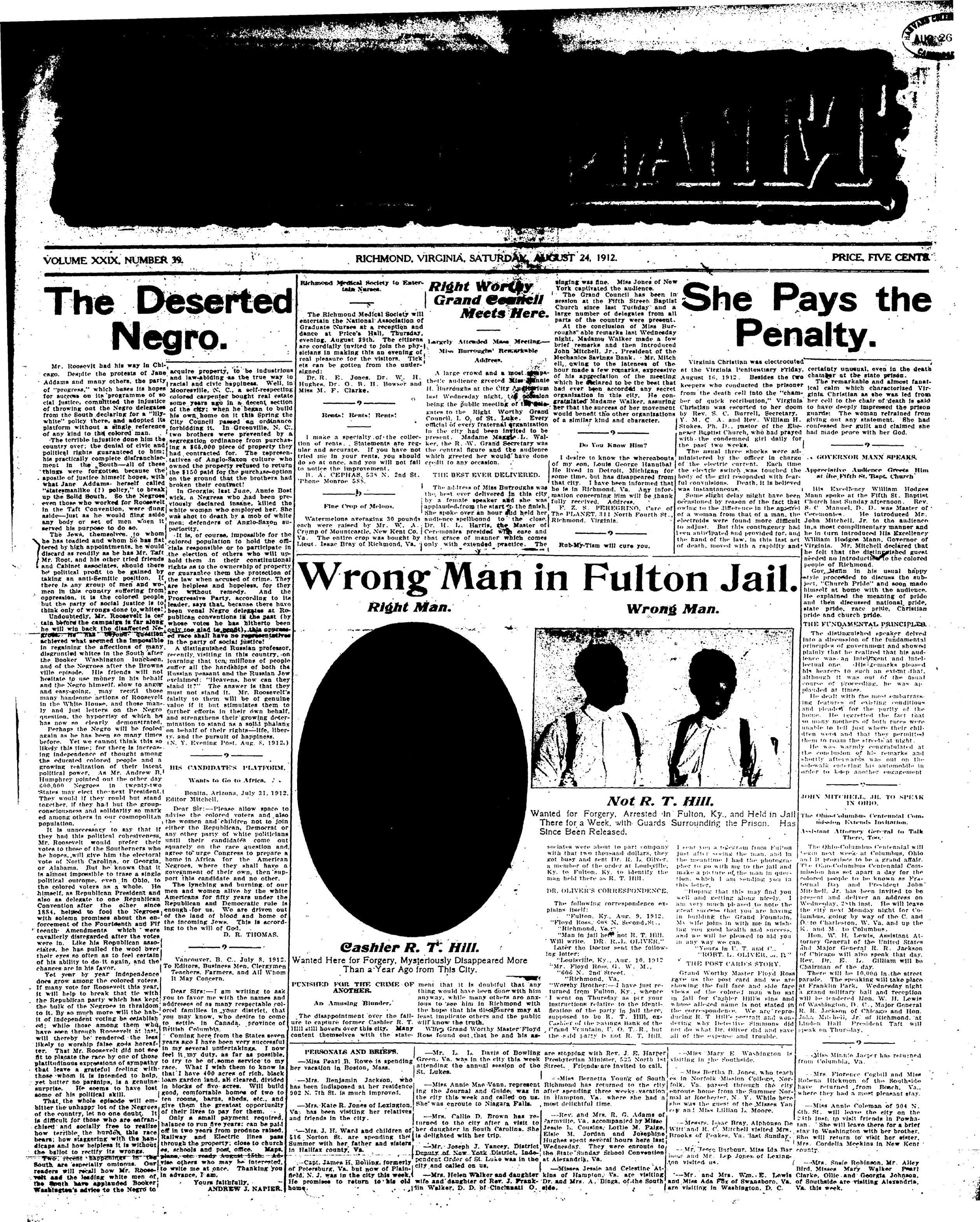
Wrong Man in Fulton Jail.
1830
Richmond Medical Society to Entertain Nurses.
The Richmond Medical Society will entertain the National Association of Graduate Nurses at a reception and dance at Price's Hall, Thursday, evening. August 29th. The citizens are cordially invited to join the physicians in making this an evening of real pleasure for the visitors. Tickets can be gotten from the undersigned:
Dr. R. E. Jones, Dr. W. H. Hughes, Dr. O. B. H. Bowser and Miss M. F. Clarke.
Rents! Rents! Rents!
I make a specialty of the collection of rents. Statements are regular and accurate. If you have not tried me in your rents, you should do so at once, and you will not fail to notice the improvement.
B. A. CEPHAS, 538 N. 2nd St.
Phone Monroe 588.
Fine Crop of Melody.
Watermelons averaging 30 pounds each were raised by Mr. W. A. Crump of Mountcastle, New Kent Co. Va. The entire crop was bought by Lleut. Isaac Bray of Richmond, Va.
Wrong
Right M
Cashier R.
Wanted Here for Forgery, Mystery
Than a Year Ago fro
PUNISHED FOR THE CRIME OF
ANOTHER.
AP Amusing Blunder.
The disappointment over the failure to capture former Cashier R. T. Hill still hovers over this city. Many content themselves with the state-
—Miss Pearl B. Rowe is spending her vacation in Boston, Mass.
—Mrs. Benjamin Jackson, who has been indiplaced at her residence 902 N. 7th St. is much improved.
—Mrs. Kate R. Jones of Lexington, Va. has been visiting her relatives and friends in the city.
—Mrs. J. H. Ward and children of 516 Norton St. are spending the Summer with her father and sisters in Hallifax county, Va.
Capt. James H. Bolling, formerly of Petersburg, Va. but now of Plainfield, N. J. was in the city this week. He promises to return to his old home.
Right Worthy Grand Council Meets Here.
Largely Attended Mass Meeting—
Miss Burroughs' Remarkable
Address.
A large crowd and a most pa-
thetic audience greeted Miss Minnie
H. Burroughs at the City Auditorium
last Wednesday night, the occasion
being the public meeting of the con-
gates to the Right Worthy Grand
Council, L. O. of St. Luke. Every
official of every fraternal organization
in the city had been invited to be
present. Madame Maggie L. Walker,
the R. W. Grand Secretary was
the central figure and the audience
which greeted her would have done
all credit to any occasion.
THE BEST EVER DELIVERED.
The address of Miss Butroughs was the host ever delivered in this city by a female speaker and she was applauded from the start, the finish. She spoke over an hour and held her audience spellbound to the close. Dr. H. L. Harris, the Master of Cermonies presided with ease and that grace of manner which comes only with extended practice. The
g Man in
Man.
R. T. Hill.
Masteriously Disappeared More
from This City.
ment that it is doubtful that any thing would have been done with him anyway, while many others are anxious to see him in Richmond with the hope that his disclosures may at least implicate others and the public will know the truth.
Wiley Grand Worthy Master Floyd Ross found out that he and his as-
Mr. L. L. Davis of Bowling Green, Va. was in the city this week attending the annual session of the St. Lukes.
Miss Annie Mac Vann, representing the Journal and Guide, was in the city this week and called on us. She was enroute to Niagara Falls.
Mrs. Callie D. Brown has returned to the city after a visit to her daughter in South Carolina. She is delighted with her trip.
Mr. Joseph J. Yancey, District Deputy of New York District, Independent Order of St. Luke was in the city and called on us.
Mrs. Helen Walker and daughter wife and daughter of Rev. J. Franklin Walker, D. D. of Cincinnati O.
singing was fine. Miss Jones of New York captivated the audience.
The Grand Council has been in session at the Fifth Street Baptist Church since last Tuesday and a large number of delegates from all parts of the country were present. At the conclusion of Miss Burroughs' able remarks last Wednesday night, Madam Walker made a few brief remarks and then introduced John Mitchell, Jr., President of the Mechanics Savings Bank. Mr. Mitchell, owing to the lateness of the hour made a few remarks, expressive of his appreciation of the meeting which he declared to be the best that had ever been accorded any secret organization in this city. He congratulated Madame Walker, assuring her that the success of her movement would benefit the other organizations of a similar kind and character.
Do You Know Him?
I desire to know the whereabouts of my son, Louis George Hannahal. He lived in Detroit, Michigan for some time, but has disappeared from that city. I have been informed that he is in Richmond, Va. Any information concerning him will be thankfully received. Address. F. Z. S. PEREGRINO, Curre of The PLANET, 311 North Fourth St., Richmond, Virginia.
Rub-My-Tism will cure you.
in Fulto
Wrong
Not R. T. Hill.
Wanted for Forgery. Arrested in Fulton, Ky., and Held in Jail There for a Week, with Guards Surrounding the Prison. Has Since Been Released.
Wanted for Forgery, Arrested in Fulton, Ky., and Held in Jail There for a Week, with Guards Surrounding the Prison. Has Since Been Released.
sociates were about to part company with that two thousand dollars, they got busy and sent Dr. R. L. Oliver, a member of the order at Loukylle, Ky. to Fulton, Ky. to identify the man held there as R. T. Hill.
DR. OLIVER'S CORRESPONDENCE.
The following correspondence explains itself:
"Fulton, Ky., Aug. 9, 1912.
"Floyd Ross, 608 N. Second St.
"Richmond, Va."
"Man in jail here not R. T. Hill.
Will write. DR. R. L. OLIVER."
Later the Doctor sent the following letter:
I sent you a telegram from Fulton just after seeing the man, and in the meantime I had the photographer to go with me to the jail and make a picture of the man in question, which I am sending you in this letter.
"Hoping that this may find you well and getting along nicely, I am very much pleased to note the great success that you are having in building the Grand Fountain. My wife joins in with me in wish-ing you good health and success, and we will be pleased to aid you in any way we can.
"Yours in U. T. and C.
"ROBT. L. OLIVER. D."
"Louisville, Ky., Aux. 10, 1912
"Mr. Floyd Ross, G. W. M.,
"606 N. 2nd Street.
"Richmond, Va.
"Worehy Brother:—I have just returned from Fulton, Ky., whence I went on Thursday as per your instructions relative to the identification of the party in fail there, supposed to be R. T. Hill, ex-Cabinet of the Savings Bank of the Grand Fountain, U. O. T. R., but the sold party is not R. T. Hill.
are stopping with Rev. J. E. Harper Presbyterian Minister, 525 North 1st Street. Friends are invited to call.
--Miss Bernetta Young of South Richmond has returned to the city after spending three weeks vacation in Hampton, Va. where she had a most delightful time.
--Rev. and Mrs. R. G. Adams of Farmville, Va. accompanied by Miss Jemile L. Cousins, Lottie M. Paige, Elale M. Jordan and Josephine Hughes spent several hours here last Wednesday. They were enroute to the State Sunday School Convention at Alexandria, Va.
Missan Jessie and Celestine Atkins of Hampton, Va. are visiting Dr. and Mrs. A. Binga, of the South side.
She Pays the Penalty.
Virginia Christian was electrocuted at the Virginia Penitentiary Friday, August 16, 1912. Besides the two keepers who conducted the prisoner from the death cell into the "chamber of quick retribution," Virginia Christian was escorted to her doom by Rev. S. C. Burrell, Secretary, Y. M. C. A. and Rev. William H. Stokes, Ph. D., pastor of the Ebenezer Baptist Church, who had prayed with the condemned girl daily for the past two weeks.
The usual three shocks were administered by the officer in charge of the electric current. Each time the electric switch was touched the body of the girl responded with fearful convulsions. Death. It is believed was instantaneous.
Some slight delay might have been occasioned by reason of the fact that owing to the difference in the upper of a woman from that of a man, the electroids were found more difficult to adjust. But this contingency had been anticipated and provided for, and the hand of the law, in this last act of death, moved with a rapidity and
on Jail.
ing Man.
I sent you a telegram from Fulton just after seeing the man, and in the meantime I had the photographer to go with me to the jail and make a picture of the man in question, which I am sending you in this letter.
"Hoping that this may find you well and getting along nicely. I am very much pleased to note the great success that you are having in building the Grand Fountain. My wife Johns in with me in wishing you good health and success, and we will be pleased to aid you in any way we can.
"Yours in F. T. and C.
"ROBT. L. OLIVER, m. R."
THE POST CARD'S STORY.
Grand Worthy Master Floyd Ross gave us the post card and we are showing the full face and side face views of the colored man who sat in jail for Cagher Hill's sins and whose alleged name is not stated in the correspondence. We are reproducing R. T. Hill's portrait and wondering why Detective Simmons did not do what Dr. Oliver did and save all of the expense and trouble.
-Miss Mary E Washington is visiting in the Southside.
--Miss Bertha B. Jones, who teach es in Norfolk Mission College, Norfolk, Va. passed through the city enroute home from the Summer Normal at Rochester, N. Y. Whille here she was the guest of the Misses Yan coy and Miss Lillian L. Moore.
--Messrs. Isaac Bray, Alphonso Do Witt and R. C. Mitchell visited Mrs. Brooks of Peakes, Va. Last Sunday.
--Mr. Jesse Barhour, Miss Lia Barhour and Mr. Lep Jones of Lexington visited us.
--Mr. and Mrs. Wm., E. Lowls and Miss Ada Fox of Swanaboro, Va. are visiting in Washington, D. C.
Pays the
nalty.
certainty unusual, even in the death
chamber at the stato prison.
The remarkable and almost fanatical calm which characterized Virginia Christian as she was led from
her cell to the chair of death is said
to have deeply impressed the prison
guards. The woman refrained from
giving out any statement. She had
confessed her guilt and claimed she
had made peace with her God.
GOVERNOR MANN SPEAKS.
Appreciative Audience Greta Him
at the Fifth St. Tapt. Church
His Excellency William Hodgson Mann spoke at the Fifth St. Baptist Church last Sunday afternoon. Rev. S. C. Manuel, D. D. was Master of Ceremonies. He introduced Mr. John Mitchell, Jr. to the audience in a most complimentary manner and he in turn introduced His Excellency William Hodgson Mann, Governor of Virginia. Mr. Mitchell declared that he felt that the distinguished guest needed no introduction to the colored people of Richmond.
Gov. Mann in his usual happy style proceeded to discuss the subject, "Church Pride" and soon made himself at home with the audience. He explained the meaning of pride and then discussed national pride, state pride, race pride, Christian pride and church pride.
THE FUNDAMENTAL PRINCIPLES
The distinguished speaker delved into a discussion of the fundamental principles of government and showed plainly that he realized that his audience was an intellect and intellectual one. His remarks pleased his hearers to such an extent that, although it was out of the usual course of proceeding, he was applauded at times.
He dealt with the most embarrassing features of existing conditions and plausible for the purity of the home. He regretted the fact that so many mothers of both races were unable to tell just where their children went and that they permitted them to roam the streets at night.
He was warmly congratulated at the conclusion of his remarks and shortly afterwards was out on the sidewalk entering his automobile in order to keep another engagement.
JOHN MITCHELL, JR. TO SPEAK IN OHIO.
The Ohio-Columbus Centennial Commission Extends Invitation.
Assistant Attorney General to Talk There, Too:
The Ohio-Columbus Centennial will begin next week at Columbus, Ohio and it promises to be a grand affair. The Ohio-Columbus Centennial Commission has set apart a day for the colored people to be known as Fraternal Day and President John Mitchell, Jr. has been invited to be present and deliver an address on Wednesday, 25th inst. He will leave the city next Monday night for Columbus, going by way of the C. and O. to Charleston, W. Va. and up the K. and M. to Columbus.
Hon. W. H. Lewis, Assistant Attorney General of the United States and Major General R. R. Jackson of Chicago will also speak that day. Rev. Dr. E. L. Gilliam will be Chairman of the day.
There will be 10,000 in the street parade. The speaking will take place at Franklin Park. Wednesday night a grand military ball and reception will be tendered Hon. W. H. Lewis of Washington, D. C., Major General R. R. Jackson of Chicago and Hon. John, Mitchell, Jr. of Richmond, at Linden Hall President Taft will speak on Thursday.
Miss Minnie Japper has returned from Columbia, Va.
Mrs. Florence Cogbill and Miss Robena Hickmon of the Southside have returned from Bench, Va., where they had a most pleasant stay.
Miss Annie Coleman of 904 N. 6th St. will leave the city on the 21st inst. to visit friends in Powhatan. She will leave there for a brief stay in Washington with her brother. She will return to visit her sister. Mrs. Cordella Meekins in New Kent county.
Mrs. Snuffle Robinson, Mr. Alley Bird, Misses Mary Walker Pearl Clarke, Ollie and Georgia Johnson, of Southside are visiting Alexandria, Va. this week.
The Taming of
Red Butte
Western
By
FRANCIS LYNDE
Copyright, 1918, by Charles Bertb-
wer's Bond.
SYNOPSIS
Lidwynwood, who confesses that he is aeward, becomes superintendent of RedBette Western, a demoralized railroad,when deniably call him "C dollars and
Gridley, master mechanic, warns Hallock, chief clerk, to "let up" on Flemlier, a mine owner. Hallock and Flemlier are enemies. Lidgerwood finds claipine very dangerous. Lidgerwood's train is wrecked by businessmen, and Lidgerwood leaps for life. He retains Hallock, who says Lidgerwood is the Trainmaster McCuskey, Lidgerwood and Gridley are called out on a wreck. Gridley tells Lidgerwood he has tacked a hard position. Gridley compires with Flemlier. They plan to force Hallock to help them avoid the railroad. Lidgerwood begins enforcing discipline with an iron hand; wreckes are of daily occurrence. He discharges Dick Hufford, a brother of Gridley, and threatened, but he refuses to go armed. a switch engine is stolen. There are simulators about Hallock. Lidgerwood orders Hallock to see Flemlier and straighten out the Hallock warms. Lidgerwood that Hart intends to kill him McCuskey accuses Hallock of dishonesty. Hart pleads at Lidgerwood, whose life is in danger. Bethson tells how her brother was stolen. The game used the switch engine.
Another of the theft increases suspicion against Hallock and Pleister. Personnel in the stolen engine Griddles involved in the theft with Judson is discharged engineer. Lidderswood and fired Judson for demanding enquiries that Judson should to shadow Judson. Personnel from the company that Lidderswood and Judson and how many were stolen at that time look was not included. Lidderswood and Judson are quoted. A mystery writer wrote about how the theft was handled. She is hired as the wife. Matters about how she handled the incident Hallock because she was not binned that time. Desperate work was taken from the company that Lidderswood and Judson were hired at that time. In the investigation, Hallock and Pleister arrive. Lidderswood leaves Pierce. His wife leaves before extradition. Personnel have been placed in jail. Personnel have been placed in jail. Her parole is found.
CHAPTER XV.
LIDGERWOOD's new stem-grapher Gidy, was a rapid, capable young follow with the gift of knowing how to make himself indispensable to a superior, coupled with the ability to take care of much of the routine correspondence without specific instructions and with a disposition to be loyal to his salt.
Climbing the stairs to his office on the second floor of the Crow's Nest after the brief exchange of question and answer with Jadson, Lidgerwood found his helper hard at work grinding through the day's train mall.
"Colgan wired that you were on Mr Brewster's special, and I was waiting on the chance that you might want to rush something through when you got in," said Gidy, reaching mechanically for his notebook.
"I shall want to rush a lot of it
through after awhile, but you'd better
go and get your sipper now and come
back fresh for it," said the superintendent, who was always humane to
every one but himself. "Was there anything special in today's mail?"
"Only this," turning up in a letter
marked "immmediate" and bearing the cancellation stamp of the postal car
which had passed eastward on train 202.
Lidgerwood read the marked letter twice before he placed it face down in the "unanswered" basket. It was from Flemister, and it called for a decision which the superintendent was willing to postpone for the moment. He had not seen Flemister since the day of the rather spiteful conversation, with the building and loan theft for a tople, and on that occasion the mine, owner had gone away with threats in his mouth. Yet his letter was distinctly friendly, conveying an offer of neighborly help.
The occasion for the neighborhood arise upon a right of way involvement. Acting under instructions from Vice President Ford, Lidgerwood had already begun to move in the matter of extending the Red Butte Western toward the Nevada gold fields, and Benson had been running preliminary surveys and making estimates of cost. Of the two more feasible routes that which left the main line at Little Butte, turning southward up the Wire Silver gulch, had been favorably reported by the engineer. The right of way over this route, save for a few miles through an upland valley of cattle ranches, could be acquired from the government, and among the ranch owners only one was disposed to fight the coming of the railroad-for a purely mercenary purpose, Benson declared.
It was about this man, James Groff field, that Flemlier wrote. The ranch man, so the letter stated, had passed through Little Butte early in the day on his way to Red Butte. He would be returning by the accommodation late in the afternoon and would stop at the Wire Silver mine, where he had stabled his horses. For some reason he had taken a dallike to Benson, but if Flemlier could make it convenient to come over to Little Butte on the evening passenger train from Angels the writer of the letter would arrange to keep Groff over night, and the right of way matter could doubtless be settled satisfactorily.
This was the substance of the mine owner's letter, and if Flemlier wood hastened it was partly because he was dangerous of Flemlier's sudden
Prior diligence. Then the incivile—Plimister's incivile—suggested it, and the suspicion was put to sleep. The Wife Silver mine was five miles distant from the main line at Little Butte, at the end of a spar. If the extension should be built it would be a main line station, with all the advantages accruing therefrom.
Lidgerwood looked at his watch. If Grady should not be gone too long he might be able to work through the pile of correspondence and get away on the evening passenger, and when the stenographer came back the work was attacked with that end in view. But after an hour's rapid dictating a long drawn whistle signal announced the incoming 'of the train he was trying to make and warned him that the race against time had failed.
"It's no use; we'll have to make two bites of it," he said to Grady, and then he left his desk to go downstairs for a breathing moment and a cup of coffee.
Train 206, the train Flemlister had suggested that he might take, was just pulling in from the long run across the desert when he reached the foot of the stairs. That it was too late to take this means of reaching Little Butte and the Wire Silver mine was a small matter; it merely meant that he would be obliged to order out the service car and go special, if he should finally decide to act upon Flemlister's suggestion.
Lidgerwood marked a group of discharged railroaders withdrawing to a corner of the lunch room as he entered, and while the waiter was serving his coffee he saw Haddock join the group. Once again Lidgerwood remembered McCloake's proposal and his own rebutant assent to it, and now he was not too greatly conscience stricken when he saw Dudson quietly working his way through the crowded room to a point of escape upon the group in the corner.
The keen inner sense which neither the psychologist for the psychologist have yet been able to define or to name appraisal of him a threat developing in the distant corner, but to resolutely ignored it, drank his coffee and presently went his way around the people end of the building and back to the office entrance, meaning to go above stairs and put in another room with Grady before he should definitely about making the night run to Little Butte. His foot was on the threshold of the stairway door when Judson overtook him.
"May told me to report to you when I couldn't get at him," the exexe man began abruptly. "There's something hatching, but I can't find out what it is. Are you thinking about goin' out on the road anywhere to night, Mr. Liddowood?"
Liddowood's decision was taken on the instant.
"Yes! I think I shall go west to my car in an hour or so. Why?
"There ain't any 'why'. I guess, if you feel like gold. But what I don't savvy is why them follows back you dar in the waitin' room are so dead anxious to find out if you are gold."
As he spoke a man who had been skimming behind a trunk load of express freight, so near that he could have touched either of them with an outstretched arm, withdraw silent in the direction of the lunch room. He was a tall man with stooping shoulders, and his nobeless retreat was cautiously made, yet not quite cautiously enough.
"By erpiss. Look at that, will you Judson explained, pointing to the retreating figure. 'That's Hallock, and he was listening.'"
Lidgerwood stook his head.
"No, that isn't Hallock," he denied. And then, with a bit of the man driving rasp in his coles: "See here. Judson, don't you let McCloskey's prejjices run away with you; make a memorial of that and paste it in your hat. I know what you have been instructed to do, and I'll tell you here, and now that I shall be much better pleased if you can bring me the assmance that Hallock is a true man."
"But that was Hallock," insisted Judson, "or else it was his livin' double."
"No; follow him and you'll see for yourself. It was more like that Butt Gulch operator who quilt in a quarrel with McCloskey a week or two age. What is his name—Sheffield?"
Judson hastened down the platform to satisfy himself, and Lidgertown mounted the stair to his office. Grady was still pounding the keys of the typewriter on the batch of lettergiven him in the busy hours following his return from supper, and the superintendent turned his back upon the clicking activities and went to stand at the window, from which he could look down upon the platform with the waiting passenger train drawn up beside it. Seeing the cheerful Nadia, he fell to thinking of Eleanor, opening the door of consciousness thought to her and saying to himself that she was never more than a single step beyond the threshold of that door. Looking across to the Nadia, he knew now why he had hesitated so long before deciding to go on the night trip to Timanyang park. But he could still resolve that they should not be a repetition of the old tragedy of the moth and the candle. It was well that at the very outset a duty call had come to enable him to break the spell of her
pearruces, and it was also well that he had decided not to disregard it.
had decided not to disregard it. The train conductor's "All aboard" abutted on the platform just below his window drew his attention from the Nadia and the distracting thought of Eleanor's nearness. Train 203 was ready to resume its westward flight, and the locomotive bell was clanging musically.
At the critical moment when the train was fairly in motion Lidgerwood saw Hallock—it was unmistakably Hallock this time—spring from the shadow of a baggage truck and whip up the step of the smoker, and a scant half second later he saw Sudson race across the wide platform and throw himself like a self propelled projectile against and through the closing doors of the restubus at the forward end of the steeper.
Fulcher's desk and his account of the outpacing train were easily accounted for—he had seen Hallock. But where was Hallock going? Lidgwood was still asking himself the question half abstractedly when he entered to his desk and touched the bumper push which ormosed an operator from the dispatcher's room.
"Wire Mr. Pennington Flambeau, care of Goodio, at Little Boston, that I am coming out with my car and should be with him by 11 o'clock. Then call up the yard office and tell Matthews to let me have the car and engine by 8:30 sharp," he directed.
The operator made a note of the order and west out, and the superlated out settled himself in his desk chair for another hour's hard work with the stenographer. At twenty-five minutes past 8 be heard the wheel grindings of the up coming service car, and the weary shorthand man snapped a rubber hand upon the notes of the final letter.
Bidding good night to Grady, the superintendent put on his light coat and went out and down the stairs. At the onter door he turned up the long platform instead of down and walked quickly to the Nadia, perusing himself that he must, in common decency, tell the president that he was going away—perunding himself that it was this and not at all the desire to swarm his hands at the ungrateful fire of Eleanor's mockery that was making him turn his back for a moment upon the waiting special train.
CHAPTER XVL
Next, and when Liddertwood reached it he found the observation platform fully occupied.
"I hello, Mr. Liddertwood," is that you? called Van Lew when the so仆intendant came across to the spur track. "I thought you said this was a bad man's country. We have been out here for a solid hour, and nobody has shot up the town or even whooped a single someone war whoo. In fact, I think your village with the heavenly name has gone ingloriously to bed. We're defended."
"It does go to bed pretty early—that part of it which doesn't stay up pretty late," laughed Liddertwood. Then he came closer and spoke to Miss Brewster. "I am going west in my car, and I don't know just when I shall return. Please tell your father that every thing we have here is entirely at his service. If you don't see, what you want you are to ask for it."
"Will there be any one to ask when you are gone?" she inquired, neither sorrowning nor rejoicing so far as he could determine.
"Oh, yes! McCloskey, my trainmaster, will be in from the wreck before morning, and he will turn diaphores trying to make things pleasant for you if you will give him the chance."
Miss Browster was running her fingers along the hand rail as if it were the keyboard of a piano. "You say you don't know how long you will be away?" she asked.
"No, let probably not more than the night. I was only providing for the unexpected, which some people say is what always happens."
"Will your run take you as far as the Timanyon car?"
"Yes, through it and some little distance beyond."
"You have just said that we are to ask for what we want. Did you mean it?"
"Surply," he replied unguardedly.
"Surely," he replied unguardedly. "Then we may as well begin at once," she said coolly, and turning quickly to the others: "Oh, all you people, listen a minute, will you Hush, Carolyn! What do you say to a moonlight ride through one of the grandest canyons in the west in Mr. Lidgerwood's car? It will be some thing to talk about as long as you live. Don't all speak at once, please."
But they did. There was an instant and enthusiastic chorus of approval, winding up rather dolefully, however with Miss Doty's. "But your mother will never consent to it, Eleanor."
"Mr. Lidgerwood will never consent you mean," put in Miriam Holcombe quietly.
Idgerood said what he might without being too crudely inhospitable. His car was entirely at the service of the president's party, of course, but it was not very commodious compared with the Nadia. Moreover, he was going on a business trip, and at the end of it he would have to leave them for an hour or two, maybe longer. Moreover, again, if they got tired they would have to sleep as they could, though possibly his stateroom in the service car might be made to accommodate the three young women. All this he said, hoping and believing that Mrs. Brewster would not only refuse to go herself, but would promptly re-enter an unchaperoned excursion. But this was one time when his dis-
tantly related kinawoman disappointed him. Mrs. firewater, cajoiled by her daughter, yielded a reluctant consent, going to the car door to tell Lidgerwood that she would hold him responsible for the safe return of the tripper.
"See, now, how fatally easy it is for one to promise more—oh, so very much more—than one has any idea of performing," musnured the president's daughter, dropping out to walk beside the victim when the party trooped down the long platform of the Crow's Nest to the service car, and when he did not reply. "Please don't be grumpy."
"It was the maddest notion!" he protested. "Whatever made you suggest it?"
"Listen," she said. "I did it out of pure hatefulness. You showed so plainly this afternoon that you wished to be quit of me—of the entire party—that I couldn't resist the temptation to pay you back with good, liberal interest. Possibly you will think twice before you anub me again. Howard, dear."
Quickly he stopped and faced her. The others were a few steps in advance—were already boarding the siren-car.
"This world, however, and for here
come mine to go up again it Seal. We
are some things that I can understand
and some things that I cannot. We
have play, what you said to me the
last time we were together made no
difference; nothing you can ever say
will make any difference. You must
take that into consideration, while
you are here and we are obliged to
meet. In lawge je me, in justice to
Van Law"—b
"I think your conductor is waiting to
speak to you," she broke in sweetly,
and he gave it up, putting her on the
car and turning to confront the man
with the green shaded lanten, who
proved to be Bradford.
"Any special orders. Mr. .Lidger-
wood?" inquired Bradford.
"Yes. Run without stop to Little
Butta, unless the dispatcher calls you
down. Time yourself to make Little
Butta by 11 o'clock, or a little later.
Who is on the engine?"
"Williams? How does it come that he is doubling out with me? He has just made the run over the Desert division with the president's car."
"So have I, for that matter," said Bradford calmly, "but we both got a burry call about fifteen minutes ago."
Lidgerwood held his watch to the light of the green shaded lantern. If he meant to keep the wire appointment with Flemier there was no time to call put another crew.
"I don't like to ask you and Williams to double out of your turn, especially when I know of no necessity for it. But I'm in a rush. Can you two stand it?"
"Sure," said the ex-cowman. Then he ventured a word of his own. "I'll ride up ahead with Williams--you're pretty full up back here in the car anyway—and then you'll know that two of your own are keepin' tabs on the run. With the wrecks we're enjoying."
Lidgerwood was impatient of mysteries.
"What do you mean, Andy?" he broke in. "Anything new?" "Oh, nothing you could put your finger on. Same old rag chewin' going on up at Cat Biggs' and the other waterin' troubles about how you've got to be done up if it costs money Williams went over to take the Soil out of the househole a few minutes
Q. MORR
"BUS WITHOUT STOP TO LITTLE BETTER"
ago and found one of the back shop
men down under her tinkerin' with
her trucks."
"What's that? I was the sharp query
"That's all there was to it." Brad
ford went on imperturbably. "Will
Hams asked the shopman what he was
doing under there, and the fellow
crawled out and said he was just
lookin' her over to see if she was all
right for the night run. Says Will
Hams to me, tellin' me about it just
now. That's all, right. Andy. But
how in blue blazes did he or anybody
else except Matthews and the caller
know that the 206 was gone' out?
That's what I'd like to know.' And I
had to pass it up."
Lidgwood asked a single question
"Did Williams and that, anything
had been tampered with?"
"Nothing that you could shoot up
the back shop man for. One' of the
truck safety chains—the one on the
left side, back—was loose. But it couldn't have hurt anything if it had been taken off. We don't runnin' on safety chains these days."
"Safety chain loose, you say—so if the truck should jump and swing it would keep on swinging? You tell Williams when you go up ahead that I want that machinist's name."
"Hum," said Bradford. "Reckon it was meant to do that?"
"God only knows what isn't meant these times. Andy. Hold on a minute before you give Williams the word to go." Then he turned to young Jefferis, who had come out on the car platform to light a cigarette. "Will you ask Miss Brewster to step out here for a moment?"
Eleanor came out at the summons, and Jefferis gave the superintendent a clear field by dropping off to ask Bradford for a match.
"You sent for me, Howard?" said the president's daughter, and honey could not have matched her tone for sweetness.
"Yes. I shall have to anticipate the Angela gossip a little by telling you that we are in the midst of a pretty bitter labor fight. That is why people go gunning for me. I can't take you and your friends over the road tonight."
"Why not?" she inquired.
"Because it may not be entirely safe."
"Nonsense!" she dashed back. "What could happen to us on a little excursion like this?"
"I don't know, but I wish you would reconsider and go back to the Nadia."
"I shall do nothing of the sort," she said willfully. And then, with totally
sunburns crookly, she added: "If it a return of the old mainty? Are you afraid again. Howard?" The brunt was too much. Wheeling suddenly. Lidgwood snapped out a summons to Jeffries: "Get ahead, Mr. Jeffries. We are going."
CHAPTER XVIL
FORTY-TWO miles southwest of Angles, at a point where, all further progress seemed definitely barred, by the huge barrier of the great mountain range, the Red Bette Western, having picked its devices way to an apparent roll-out among the foothills and hagbeaks, plunges abruptly into the schering canyon of the eastern Thimayed. For forty added miles the river chasm, throughout its length a narrow, tortuous crevice, allows a precarious footing for the railway embankment. At its western extremity the canyon forms the gateway to a shut in valley of upheaved hills and interior mountains isolated by wide stretches of rolling grass land. To the eastward and westward of the great valley rise the sentinel peaks of the two inclosing mountain ranges.
Red Butte, the center of the evanescent mining excitement which was originally responsible for the building of the railroad, lies high pitched among the shouldering spurs of the western boundary range. On the south bank of the river, at a point a short, distance beyond the stream fronting cliffs, lies the landmark bill known as Little Butte, and at the station of the same name in the bridge across the TimanyonL.
On the engineering maps of the Red Butte Western the outline of Little Butte appears as a roughly described triangle with five mile sides, the three angles of the figure marked respectively by Silver Switch, Little Butte station and bridge and the Wire Silver mine.
Between Silver Switch and the bridge station the main line of the railroad follows the base of the triangle, with the precipitous bluffs of the big hill on the left and the torrenting good of the Timanyout on the right. Along the eastern side of the triangle and leaving the main track at Silver Switch ran the spur which had for merely served the Wire Silver when the working opening of the mine had been on the eastern slope of the ridge like hill. For some years previous to the summer of overturings this spur had been illused, though its track, ending among a group of the old mine buildings the miles away, was still in commission.
Along the western side of the triangle, with Little Butte station for its point of divergence from the main line, ran the new spur, built to accommodate Flemmier after he had dug through the bill and ousted the rightful owner of the true Wire Silver vein and had transferred his labor hamlet and his plant, or the major part of both, to the western slope of the butte, at this point no more than a narrow ridge separating the eastern and western gulches.
Train 26, with ex-Engineer Judson apparently sound asleep in one of the rearward seats of the day coach, was on time when it reached Little Butte.
A moment later Judson let him self silently into the rear vestibule? of the day coach and was as silently opening the folding doors of the vestibule itself.
Hanging off by the handrails, to saw the engine's headlight pick up the switch stand of the old spur. The train was unmistakably slowing now and he made ready to jump if the need should arise, picking his place on the track side as the train lights show him the ground. As the speed was checked Judson saw what he was approaching to see. Precisely at the instant of the switch passing a man dropped from the forward step of the smoker and walked swiftly away up the disused track of the old spur. Judson's turn came a moment later, and when his end of the day coach flicked past the switch stand he, too, dropped to the ground and, waiting only until he could follow without being detected, set out after the tall figure, which was by that time scarcely more than an indistinct and retreating blur in the moonlight.
The chase led directly up the old spur, but it did not continue 'quite to the five mile distant end of it. A few hundred yards short of the stockade enclosing the old buildings the shadow figure took to the forest and began to climb the ridge, going straight up, as nearly as Judson could determine. The ex-engineer followed, still keeping his distance. From the first bench above the valley level he looked back and down into the stockade enclosure. All of the old buildings were dark, but one of the two new and unpainted ones was brilliantly lighted, and there were sounds familiar enough to Judson to mark it as the Wire Silver power house. Notwithstanding his interest in the chase, Judson was curious enough to stand a moment listening to the sharply defined exhausts of the high speed steam engine driving the generators.
"Say," he ejaculated under his breath. "If that engine isn't a dead match for the old 210 pullin' a grade I don't want a cent! Double cylinder set on the quarter and choo-choo' like it ought to have a pair of' steel rails under it. If I had time I'd go down yonder and break a winder in that power shack, blamed if I wouldn't."
But unhappily there was no time to spare. As it was, he had lingered too long, and when he came out upon the crest of the narrow ridge and attained a point of view from which he could look down upon the buildings clustering at the foot of the western slope he had lost the scent. The tall man had disappeared as completely and suddenly as if the earth had opened and swallowed him.
This, in Judson's prefiguring, was a small matter. The tall man, who the ex-engineer had unmistakably recognised at the moment of train formaking as Rinkin Hallock, was doubtless on his way to Fliemister's headquarters at the foot of the western slope. For some reason of his own Hallock did not wish to be seen going
openly to the Wye Silver headwear
tower; heave the drop from the table-
Silver Swish and the long trump of
the gambit and over the ridge.
Presenting it then, Judson but not on time on the summit of myriad peaks. Appearance. Opening the shortest path he could and which presumed to lead him down of the miking hammer at the foot of the westward fronting slope, he set his foot in it and went stumbling down the sleep deprivity, bringing up finally on a little beach just above the mine workings. Here he stepped to get his breath and his bearings. From an hollow place the mine headquarters building lay just below him, at the right of the tunnel entrance to the mine. It was a long long building of one story.
Making a door to dodge the electric lighted tunnel mouth, Judson carefully reconfigured the office end of the headquarters building. There was a door, with steps giving upon the downhill side, and there were two windows, both of which were blank to the eye by reason of the drawn down shadow. Two persons at least were in the lighted room. Judson could hear their voices, but the thick log walls muffled the sounds to an indistinct murmur. The figure of a man sitting in a chair was sharply silhouetted on the drawn window shade.
Judson stared, rubbed his eyes and stared again. It had never occurred to him before that the face of a man, viewed in blank profile, could differ as strikingly from the same face as seen eye to eye. That the man whose shadow was projected upon the window
PATRICK
JUDSON BACKED AWAY AND STAKED AGAIN,
shuddered. Stankin Hallock he could
not doubt. The bearded chin, the puffy
lips and the prominent nose were all
faithfully outlined in the exaggerated
shadowgraph. But the hat was worn
at an unfamiliar angle, and there was
something in the erect, bulking figure
that was still more unfamiliar. Judson
backed away and stared again, muttering
to himself. If he had not traced Hallock almost to the door of Fleming's
quarters there might have been room
for the thin edge of the doubt wedge.
The unfamiliar pose and the raskish
fit of the soft hat were not among the
chief clerk's remembered characteristics; but, making due allowance for the distortion of the magnified facial outline, the profile was Hallock's.
Having definitely settled for him
self the question of identity, Judson
renewed his search for some easier
dropping point of vantage. Rustling
the moonlight, he twice made the circuit of the occupied end of the building. There was a line of light showing under the ill fitting door, and, with the top step of the downhill flight for a perching place, one might lay an ear to the crack and overhear. But door and steps were sharply struck out in the moonlight, and they faced the mining hamlet, where the men of the day shift were still stirring.
Judson knew the temper of the T1 manyoni miners. To be seen crouching on the boss' doorstep would be to take the chance of making a target of himself for the first loiterer of the day shift who happened to look his way. Dismissing the risky expedient, he made a third circuit from moon glare to shadow, this time upon hands and knees. To the lowly come the rewards of humility. Framed level upon stout log pillars on the downhill side, the headquarters warehouse and office sheltered a space beneath its floor which was roughly boarded up with slabs from the log sawing. Slab by slab the ex-engineer sought for his rat hole, trying each one softly in its turn. When there remained but three more to be tugged at the loosened one was found. Judson swung it cautiously aside and wrigled through the narrow aperture left by its removal. A crawling minute later he was crouching beneath the loosely jointed floor of the lighted room, and the avenue of the ear had broadened into a fair highway.
Almost at once he was able to verify his guess that there were only two men in the room above. At all events there were only two speakers. They were talking in low tones, and Judson had no difficulty in identifying the rather high pitched voice of the owner of the Wire Silver mine. The man whose profile he had seen on the window shade had the voice which belonged to the outlined features, but the listener under the door had a vague impression that he was trying to disguise it. Judson knew nothing about the letter in which Flemlister had promised to arrange for a meeting between Lidgerwood and the ranchman Grofeld. What he did know was that he had followed Hallock almost to the door of Flemlister's office and that he had seen a shadowed face on the office window shade which could be no other than the face of the chief clerk. It was in spite of all this that the impression that the second speaker was trying to disguise his voice persisted. But the six engineer of fast passenger trains was able to banish the impress-
Johanna had snapped from his breathing
space between the four Simpson
and had not yet finished laughing
given him the bird's call but had
woken the bell of the group the
phone rang in the background. It was
Flomaster who answered the bell shrug
"Hah! Yeah, shag, I go." In Flomaster,
What's that? A message about Mr.
Lagwood? All right, go away.
"Who is it?" came the inquiry in the grunting voice which ditted and yet did not fit the other man.
The listener heard the click of the telephone earpiece replacement.
"We Goodson, talking from his station office at Little Bute," replied the time owner. "The dispatcher has just called him up to say that Lidgerwood left Angles in his service car, running special, at 8:00, which would figure it here at about 11 or a little later."
"Who is running RT?" inquired the other man, rather anxiously, Jedson decided.
"Williams and Bradford. A fool for luck every time. We might have had to wipe out a couple of our friends."
The listener under the floor had a sensation like that, which might be produced by a cold wind blowing up the name of his neck.
"There is no such thing as luck," rasped the other voice. "My time was short—after I found out that Lidgerwood wasn't coming on the passenger. But I managed to send word to Matthews and Lester, telling them to make sure of Williams and Bradford. We could spare both of them, if we have to." "Good!" said Flemlister. "Then you had some such alternative in mind that I have just been proposing?" "No." was the crusty rejoinder. "I was merely providing for the hundredth chance. I don't like your alternative." "Why don't you?"
"Well, for one thing, it's needlessly bloody. We don't have to go at this thing like a bull at a gate. I've had my finger on the pulse of things ever since Lidgerwood took hold. The dope is working all right in a purely natural way. In the ordinary run of things, it will be only a few days or week before. Lidgerwood will throw up his hands and quit, and when he goes out I go in. That's straight goods this time."
"You thought it was before," answered Flemlister, "and you got beautifully left." Then. "You're talking long on 'natural' and the 'ordinary run of things', but I notice you schemed with Bart Rufford to put him out of the light with a pistol bullet."
Judson felt a sudden easing of strains. He had told McCloskey that he would be willing to sweat to the voice of the man whom he had over heard plotting with Rufford in Cat Biggs' back room. Afterward, after he had sufficiently remembered that a whisky certainty might easily lead up to a sober perjury, he had admitted the possible doubt. But now Flemmiter's taint made assurance doubly sure. Moreover, the arch plotter was not denying the fact of the conspiracy with "the killer."
"Rufford is a bloodthirsty devil-like yourself." the other man was saying calmly. "As I have told you before, I've discovered Lidgerwood's weakness. He can't call a sudden bluff. Rufford's play—the play I told him to make—is to get the drop on him, scare him up good and chase him out of town—out of the country. He overran his orders and went to jail for it."
"Well I" said the mine owner.
"Your scheme as you outlined it to me in your elfier wire this afternoon was built on this same weakness of Lidgerwood's, and I agreed to it. As I understood it, you were to toll him up here with some lie about meeting Grodfeld, and then one of us was to put a pistol in his face and bluff him into throwing up his job. As I say, I agreed to it. We'll have to go when the fight with the men gets but enough, but he might hold on too long for our comfort."
"Well?" said Flemlier again, this time more impatiently, Judson thought.
"He queued your layout by carefully omitting to come on the passenger, and now you propose to fall back upon Rufford's method. I don't approve."
Again the mine owner said, "Why don't you? And the other voice took up the question argumentatively."
"First, because it is unnecessary, and I have explained. Lidgerwood is orally dead right now. When the grievance committees tell him what has been decided upon he will put on his hat and go back to wherever it was that he came from."
"And secondly?" suggested Flemister, still with the nagging sneer in his tone.
"The secondly is a weakness of mine, you'll say, Flemister. I want his job, partly because it belongs to me, but chiefly because if I don't get it a bunch, of us will wind up breaking stone for the state. But I haven't anything against the man himself. He trusts me; he has defended me when others have tried to put him wise; he has been white to me, Flemister."
"Is that all?" queried the mine owner in the tone of the prosecuting attorney who gives the criminal his full length of the rope with which to hang himself.
"No. Lidgerwood is Ford's man. If he throws up his job of his own accord I may, be able to swing Ford into line to name me as his successor. On the other hand, if Lidgerwood is snuffed out and there is the faltestest suspicion of foul play—Flemister, I'm telling you right here and now that that man Ford will neither eat nor sleep until he has set the dogs on us." "You say it is unnecessary, that Lidgerwood will be pushed out by the labor fight," said Flemister. "My answer to that is that you don't know him quite as well as you think you do. If he's allowed to live hell stay, unless somebody takes him unwares and scares him off, as I meant to do tonight when I wired you. If be continues to live and stay you know what will happen sooner or later. He'll had you out for the double needle."
cur that you are, and after that the fireworks."
At this the other voice took its turn at the savage screech.
"You can't put it all over me that way. Flemister; you can't, and you shan't. You're in the hole just as deep as I am, foot for foot."
"Oh, no, my friend," said the cooler voice. "I haven't been stooling in carload lots from the company that hires me. I have merely been buying a little disused scrap from you. You may say that I have planned a few of the adverse happenings which have been running the loss and damage account of the road up into the pictures during the few weeks. Possibly I have, but you are, the man who has been carrying out the plains, and you are the man the courts will recognise. But we're waiting time sitting here jawing at each other like a pair of old women. It's up to us to obliterate Lidgerwood, after which it will be up to you to get his job and cover up your tracks as you can. If he lives he'll dig, and if he digs he'll turn up things that neither of us can stand for. See how he hangs on to that building and loan ghost. He'll tree somebody on that before he's through. You mark my words, and it runs in my mind that the somebody will be you."
"But this trap scheme of yours," protested the other man. "It's a frost, I tell you. You say the night passenger from Red Butte is late. I know it's late now. But Cranford's running it, and it is all downhill from Ired Butte to the bridge. Cranford will make up his thirty minutes, and that will put his train right here in the thick of things. Call it off for tonight. Flemlater. Meet Lidgerwood when he comes and tell him an easy lie about your not being able to hold Grofeld for the right of way talk."
Judson heard the creak and snap of a swing chair suddenly righted, and the door dust jarred through the cracks upon him when the mine owner sprang to his feet.
"Call it off and let you drop out of it? Not by a thousand miles, my cautious friend. I'm about ready to freeze you anyway for the second time-mark that, will you?-for the second time. No; keep your hands where I can see 'em or I'll knife you right where you sit. You can bully and browbeat a lot of railroad buckles when you're playing the boas act, but I know you. You come with me on I'll give the whole snap away to Vice President Ford. I'll tell him how you built a street of houses in Red Butte out of company material and with company labor. I'll prove to him that you've scrapped first one thing and then another—condemned them so you might sell them for your own pocket I'll"—
"Shut up!" shouted the other man hoarmely. "Get your tools and come on. We'll see who's got the yellow before we're through with this."
[TO BE CONTINUED.]
RAN UP AGAINST A REAL COWBOY
Amateur From the East Had to Pay For His Fun.
MADE WESTERNER DANGE
But the Latter Had His Full Revenge Later, When He Had Got Into His Old Time Clothes—Oklahoma Knows His Abashed Victim No More.
SEVERAL months ago a New Yorker went to Oklahoma to be a cowboy long enough to recuperate. After a visit to Texas he located in Osage county, Okla. The real, old fashioned cowboy has disappeared from Oklahoma, but the New Yorker didn't know it, and he had provided himself with all the conventional cowboy paraphernalia, including flinging spur. He engaged on a cattle grazing near Pawhuska.
Cattle from Texas are brought into Osage county to be grazed before they are marketed, but very few cowboys are required to herd them. They are turned into big pastures inclosed by barbed wire fences. The men drive them out to the grass in the morning and bring them home at night. This was the work that fell to the man from the east. Wearing a big sombrero and with a revolver dangling in his belt, he looked the part all right and in the course of a few weeks became a fairly good rider.
"Took In" All the Yarns.
Being with the cattle so much and with the other cattlemen, he absorbed cowboy stories as a sponge takes up water.
Occasionally the men on the ranch went to Pawhuska, the nearest town, and took a few drinks. The tenderfoot went along with them and experienced all their joys and sorrows, including the drinks in the "bootlegger" saloon. One of the residents of the town is Pete Jeankins, who used to be a real cowboy, but is now the half owner of a livery stable. He is small of stature and bowledged.
The New York man and the other men from the ranch were in one of
the "bottlegger" places when Jenkins came in. The first named had just called for a round of drinks, and he invited Jenkins to join them. Jenkins politely declined. He knew the other boys and winked at them. The stran-
G. B.
THE BULLFIELD WRIZZLED HER FEET.
ger insisted, and when Jenkins again
declined he drew his big revolver and
ordered him up to the bar.
Little Jenkins' eyes grew large and
round, and he took the drink without
further protest. Then he was ordered
to dance, and after a few bullets had
whizzed close to his feet Jenkins
obligingly complied. The fun lasted
nearly half an hour.
Got Out the Old Outfit
Jenkins went back to the livery stable and, raising the lid of a box in the corner, took out his old cowboy clothes and hat, shook the oats out of them and put them on. Then he got out the revolvers he had carried when he rode the Oklahoma and Texas ranges and oiled them and hung them in his belt and also put on the old spurs. He went over to the "bootleggers" and found the crowd still there.
The casterner recognized him, and his astonishment was great. Jenkins ordered the drinks, and they all lined up. Then he ordered the man who had had all the fun to get down on his hands and knees, while Jenkins sat on his back and spurred him. He rode him around the room, down the dust covered stairway and out into the street. As the "horse" galloped down the street on all fours Jenkins took out his revolvers, and for a few seconds there was a stream of fire from their muzzles. A crowd gathered to witness the disgrace of the casterner, and the other men from the ranch laughed apoproximately. Jenkins finally dismounted and went back to the livery barn and changed his clothes. But his victim couldn't face those who had witnessed his downfall, and he never went back to the ranch, but took a train back to New York.
Ride For Life Over a Desert
After a trip of 1,200 miles by train, following a ride of fifty miles across the Arizona desert on horseback, carrying his ten-year-old daughter upon the saddle with him, G. A. Slaughter of Clifton, Ariz., arrived in Austin, Tex., and placed the girl in an institute for treatment of hydrophobia. Mr. Slaughter and his family were camped in the White mountains of Arizona. A mad skunk bit Vida, the little daughter, upon the nose while she was sleeping upon the ground. Her cries awakened the family. It was only after a hard battle that the vicious animal was driven, off and killed. Hastily mounting his horse and taking the girl in his arms, Mr. Slaughter set off for the nearest railroad station, fifty miles away. He made the trip in record time. New York World.
Assaulted by a Sparrow
An English sparrow, a mother bird, worked up to a state of excitement, made a fierce attack on W. Holman Morton, aged thirty-six years, a painter, when he destroyed its nest built under the caves of the building which he was painting in Lawrenceburg, Ind. recently. The bird struck Morton several times on the head and attempted to pick his eyes out. He struck at the sparrow and, losing his balance, alighted on the cement paving, fifty feet below, escaping with a broken left arm and a sprained right ankle.
Fireman Jumps and Saves Girls.
William A. Pickard, a fireman of Boston, jumped from his engine and prevented the three horse hitch from hurt eight little girls who were playing on a lawn next to the firehouse on Harvard street, Dorchester.
A trace broke and caused the horse to swerve on the lawn. Isabel Scott, aged six, was almost under the feet of the horses.
Pickard, who is assistant engineer, pushed the girl out of danger, then seized the bridle and held the horses.
Isabel was treated by a doctor for cuts and bruises.
Seven other girls were near her on the lawn of the Scott home.
Had to Think and Act Fast.
With his clothing ablaze and death
threatening, Dr. William Randall, a
prominent physician of Danahore, Ta-
took desperate chances in a leap for
life from the top of a stone wall into
the waters of Lycormine creek, twelve
feet below. He lived, but suffered a
fracture of the leg, bruised body and
body burned face and hands.
The doctor was filling the gasoline
tank of his automobile when the
fumes ignited, and in an instant motor
and man were enveloped in flames
he ran across the road, leaped from
a wall beating the creek bank and
planned downward into the water.
Hawkins-Johnson MANUFACTURING CO., Hair Grower and Restorer,
Will positively remove all Dandruff and cure the scalf of all impurities. It will restore Hair on clean Temples and Bald Heads where the Roots are not dead. SATISFACTION GUARANTEED. PRICE, 35 CENTS PER BOX.
THE HAWKINS-JOHNSON M'f g Co's Hair Grower and Restorer is now being used in this State and other States with phenomenal success. Its reputation for growing and restoring hair leaps into prominence wherever it is used.
MADAM HAWKINS-JOHNSON is known as the Hair Grower. Give her a fair trial and be convinced that she can do all that she claims, or money refunded. We are now in a position to sell the best hair for less money than ever before and can match all hair perfect. In ordering Hair, send sample. Transformations, $3.00, $4.00, $5.00 to $20.00. Braids, $2.50, $3.00 and $4.00.
Please remit by Cash, F. C. Money Order or Express Money Order.
```markdown
```
The Bay Shore Hotel
Open from May to October.
Situated on Chesapeake Bay, three miles from Fortress Monroe, Virginia;—connects with Fortress Monroe, Hampton, and Newport News by electric cars.
A good family hotel, having twenty-two bedrooms, spacious parlors and broad plazas. A fine and safe bathing beach, good fishing, a large pavilion.
A delightful resting place with the best of everything There is always a breeze here when sleeping time comes. FOR TERMS ADDRESS:
THE BAY SHORE HOTEL CO.
BUCKROB BEACH, VIRGINIA.
The TEMPERANCE INDUSTRIAL and COLLEGIATE INSTITUTE. CLAREMONT, VA.
Opens Upon Its Twentieth Year's Work September 30, 1912.
On Monday September 30th, Lincoln Hall, a brick, stone and cement building, 133 1-2 by 49 1-2 feet, 4 story lighted with electricity and heated with steam and equipped with every modern improvement at a cost of $49,000. This commodious building will be opened for the reception of lady pupils Sept. 27th, 28th and 30th inclusive.
"Old Bagley Hall" lighted with electricity and heated with steam and equipped with every modern improvement, will be open for the reception of male pupils Sept. 26th, 27th, 28th and 30th inclusive.
The Temperance, Industrial and Collegiate Institute is situated within three-fourths of a mile of the Claremont village and fronts the "Ancient James River" and is seventy-five feet above its level, climate delightful, with the best Artesian well water and is free from Malaria and Chills. One of the best moral, religious Institutions in the country. $9.50 must be paid as an Entrance Fee, all pupils must pay $9.50 per month. Pupils desiring to enter school on September 27th, 28th and 30th should send in their applications at once. Those who make a remittance for entrance fees should send all money by Post Office Order.
Pupils coming from the South, by Norfolk can take the U. S. Mall Steamer "Pocahontas" at Norfolk on Tuesday, Thursday and Saturday of each week. Those coming from the North by Richmond can take same steamer at the foot of Main (East Main) St. Richmond, Va. Monday Wednesday and Friday of each week. All can land at the John Hay Wharf right upon the school grounds, at the foot of the bill.
The Institution is non-sectarian and non-political, but strictly Moral, Religious and Industrial. Students are taught Scientific Farming, the Carpenter's Trade; Harmone and Shoe Making; Plain and Fancy Sewing with Dressmaking, Cooking and Laundry Work and general Domestic Science.
BOARD AND TUITION, PER MONTH, $9.50.
Extra charges are made for Music and Elocution. Girls must do their own laundry work. Boys can have their laundry done in the Institution's Laundry at $1.00 per month. Swearing, Smoking, use of Intoxicant Liquors, Making Debts in the Village; Idleness; Laziness, Impoliteness will not be tolerated once in any pupil. All students desiring rooms should write to the President at once. Each student can work out from $3.50 to $4.50 per month. All students must do some work. For further information write to
PROF. JOHN J. SMALLWOOD, PH. D. President, Lock Box 164
Claremont, Virginia.
PRICE $1.00 SOLD & MANUFACTURED BY Hughes Mfg Co. 209 N. 3RD ST. RICHMOND, VA.
Constitute a Feature, and Persons Commit to Better to Let the Little
Once Join. Children received from Two to Twelve Years.
BENEFITS—$1.00 to $1.50 per week when sick and $90 to $40
at Death. Matters wanted in all Localities. For organization
of New Bands and all particulars, write
MRS ANNA TAYLOR, W. M. 120 West NW Street, Richmond,
Subscribe to the Richmond Planet
FOUNDED OCT., 12,
1892.
616 N.1st Street. Richmond, Va. Telephone, Madison-4601.
have all Dandruff and cure the Hair on clean Temples and good.
GRANTED. PRICE,
JOHNSON M.'f g Co.'s Hair Group and other States with phenomenal hair leaps into prominence where JOHNSON is known as the Hair that she can do all that she claims on to sell the best hair for less money. In ordering Hair, send 0.00 to $20.00. Braids, $2.50, $3.00, F. C. Money Order or Express
More Hotel
Day to October.
More Bay, three miles from Paula;—connects with Fort-land Newport News by having twenty-two bedrooms, plazzas. A fine and safe a large pavilion. With the best of everything here when sleeping time
RESS:
MORE HOTEL CO.
BACH, VIRGINIA.
BEGINS 20TH YR'S WORK
SEPT., 30TH, 1912.
INSTRIAL and
UTE. CLAREMONT, VA.
Work September 30, 1912.
John Hall, a brick, stone and ce-
t, 4 story lighted with electricity
ed with every modern improv-
modious building will be opened
27th, 28th and 30th inclusive.
THE ECONOMY,
316 North Third Street.
FINE
TAILORING
CLEANING, DYERING AND
REPAIRING.
CHITMAN M. WHITE,
PROPRIETOR.
Old Yacht Club.
Will Satisfy the Lover on the Right
Kind of Stimulant. Special Prices
We Have All Grades of Good LA-
quory, Oligars and Tobacco, Call
and See Us.
Richmond, Virginia
H. F. JONATHAN:
FISH OYSTERS PRODUCE
114 N. 17TH ST. JOHMOND, VA.
All Orders Will Receive
Prompt Attention.
Long Distance Phone, Madison-752.
AGENTS FOR THE PLANET.
Mrs. Mary E. Wilson,
1124 12 N. 17th Street.
Mrs. Annie Walbarrow, 4th & Broad.
W. H. White, 501 W. Leigh Street.
Peter Thompson, 422 E. Marshall
Street.
Wm. H. Scott, 2218 E. Main St.
R. B. Sampson, 523 N. 2d St.
' J. Nickerson, 34 W. Leigh Street.
N. Winston, 537 Brpk Ave.
C. D. Griffin, 224 S. 2d St.
William B. Smith, 3 W. Leigh St.
Tom Bird.
Thomas Page, 816 State Street.
David Page, Sr., 922 N. 21st St.
Clarence Williams
1411 Ross Street.
M. C. Waller, 1100 W. Leigh St.
E. Dandridge, 107 V.. Baker Street.
W. H. Brown, 405 W. Leigh St.
LONG BRANCH, N. J.
Jesse W. Shreaves, 182 Belmont Ave.
HACKENBACK, N. J.
D H. Hassell, R. R. Ave., Nr Clay St.
OAKLAND, CAL.
J. W. Nuby, 1736-7th St.
PORTSMOUTH, VA.
J. T. P. Cross, 2621 Emingham St.
NEWPORT NEWS, VA.
Richard Robertson, 1810 River-road.
J. C. Allen, 2107 Marshall Ava.
Charles G. Davis, 504-25th St.
J. E. Branham, 4691 Central Ave.
E. F. Boyd, 2694 Central Ave.
Jas. H. Jackson, 3215 Central Ave.
BOSTON, MASS.
C. Branum, 657 Shawmut Ave.
BROOKLYN, N. Y.
Mrs. L. Langon, 516 Classon Ave.
John H. Ashby, 125 Steuben St.
ATLANTIC CITY, N. J.
Frank Brown, 41 N. Michigan Ave.
Charles M. Thomas, 40 N. Indiana Av
Harold P. Douglass, 11 N. Kentucky
Avenue.
Oscar Henry, 21 N. Kentucky Ave.
TARBORO, N. C.
V. E. Howard.
WILMINGTON, N. C.
Wm. H. Moore.
NORFOLK, VA.
John DeBona, 610 Church St.
Thomas E. W. Perry. 2 Joseph
Place.
STAUNTON VA.
J. H. Allen, 120 S. Augusta St.
A. C. Mabrey, 127 E. Main St.
FARMVILLE, VA.
Rev: R. G. Adams, 318 South St.
CHICAGO, ILL.
A. D. Hayes, 3640 State St.
R. M. Harvey, 3924 State Street.
W. Gaughan, 2636 State Street.
D. Bishop, 512 E. 35th St.
BLUE RIDGE SPRINGS, VA.
Miss Marion Minter.
DALLAS, TEXAS.
Gilmore & Baltimore.
717 Fairmount Street.
WASHINGTON, D. C.
J. S. Jones, 1030 U St., N. W.
Columbia News Agency, 931-D St.
N. W.
PHILADELPHIA, PA.
Union Post Card Co..
N. E. Corner 16th and South Sts.
E. P. Mackens, 1116 Pine Street.
James E. Warwick, 254 S. 11th St.
Mrs. Lavinia Aldridge, 521 S. 13th
Street.
J. A. Stokes, 1011 Fitzwater St.
DANVILLE, VA.
Harry A. Clark, 117 Craghead St.
PROVIDENCE, R. I.
Douglass A. A., P. A., 910 Westminster
ter Street.
PETERSBURG, VA.
E. H. Evans, 258 Harrison St.
HARTFORD, CONN.
George M. Hall, 150 Albany Ave.
ST. PAUL MINN.
W. J. Utley, 94 E. 5th Street.
NEW YORK. N. J.
Cleveland G. Allen, 212 W. 53d St.
V. W. Anderson, 2162-51th Avenue.
Mrs. Leanna Hamilton, 8 W. 135th St.
Samuel Hobbs, 228 E. 127th St.
E. A. Williams, 200 W. 62d St.
J. E. Schmktt, 268 W. 25th St.
PLAINFIELD. N. J.
Rev. J. A. Carter, 533 E. 3rd Street.
SALT LAKE CITY, UTAH.
Charles Ludwig, P. O. Box 1776.
LOUISVILLE, KY.
Jesse E. Brown, 1216 W. Green St.
DRAKES BRANCH, VA.
Clem Green.
LOS ANGELES, CAL.
A. D. Lacey, 790 San Pedro St.
NEW ORLEANS, LA.
World's News Co., Box 1124.
A. O. Smith, 202 S. Rampart St.
MONESSEN, PA.
Smith & Williams, 602 Sixth St.
LEENBURG, VA.
Miss Cora L. Wright.
NEWARK, N. J.
Ralph Scarbrough, S6 1-2 Shemold St
Wm. H. Nelson, 99 High St.
FLORENCE, E. C.
E. B. Webster.
CUMBERLAND, VA.
G. A. Dungee.
ORANGE, N. J.
P. E. Baptist, P. O. Box 968.
SUSAN, VA.
F. S. Brown.
BALLSVILLE, VA.
J. M. Bartlett, R. F. D.
HYMAN, S. C.
Rev. M. Jones, R. F. D. No. 1
LORRAINE, VA.
William Burton, Carbon Hill.
PHOEBUS, VA.
John J. Smith.
VICTORIA, VA.
T. M. Watkins.
PULASKI, VA.
Theodore Pickett, Care J. M. Buford
Mrs. L. B. Clarkson, R. F. D. No. 1,
Box 77.
Special Correspondents and Agents
F. Z. S. Peregrine,
121 Lopp Street,
Oxpe Town, M. A.
J. S. Moore
36 Ann des Capitains,
Babylon, Brooklyn.
RAILROADS.
ACCOMMODATION TRANS--WEEKDAYS.
Leave Byrd Sa. Sen. 6.00 F. H. for Frederictsburg.
Leave Elba Sen. 7.44 A.H., 6.26 P. H. for Ashland.
Arrive Byrd St. Hen. 8.25 A.H. from Frederictburg.
Arrive Elba Hen. 6.20 A.H., 5.20 P.H. from Ashland.
Daily, †Wednesdays, ‡Sundays only.
All trains to or from Byrd Street Station stop at Elba. Time of arrival and departures not guaranteed. Read the signs.
N. & W. NORFOLK WILLIAM.
ONLY ALL RAIL LINE TO NORFOLK
Schedule in Kinet May 14, 1821.
Lewis Byrd Street station, Richmond, FOR
KNOFOLI B. 8:10 M. 9:00 A. M. 8:30 M.
8:40 P. M. 9:10 A. M. 9:20 P.
FOR LYNCHBURG AND THE WEST; 9:20
A. M. 10:00 A. M. 8:30 P. M. 9:20 P.
Arrive Richmond from Norwalk; 11:00 A. M.
b11:45 A. M. 9:25 P. M. b10:25 P. M. 9:25
P. M. From the Went; 9:25 P. M. b10:25 P. M.
9:05 P. M. 9:00 P. M.
"Daily, a daily except Sunday. Monday only.
-Pullman, Parlor and Hospital. Owner. Diving Oars.
D. P. A. H. HOLLY, V.
W. R. REVILL, G. P. A., Richmond, Va.
ATLANTIC COAST LINE
JULY 24
TRAINS LEAVE RICHMOND DAILY.
For Florida and Georgia: 8:15 A. M. and
7:25 P. M. 1:00 A. M. Charlesworth.
For Norfolk: 8:10, 9:00 A. M. 8:15 P. M.,
6:10 P. M. *7:00 P. M.
For Ry. West: 8:15 A. M. 20:00
A. M. *2:00 P. M. 8:00 P. M.
For Petersburg: 1:00 A. M. 8:00 P. M.
A. M. *8:15 A. M. 8:00 P. M. 10:00 A. M.
*8:00 P. M. *4:10 P. M. 6:00 P. M. *7:00
P. M. 9:20 P. M. 11:45 P. M.
For Goldsboro and Saytville: *4:18 P. M.
Trains arrive Richmond: *8:17 P. M.
6:48 A. M. 6:56 A. M. *8:77 A. M. *9:48
A. M. *11:48 A. M. *11:48 A. M. *9:80 P. M.
*8:00 P. M. *6:00 P. M. 6:56 P. M. 9:00 P. M.
11:80 P. M.
Except Sunday. **Borrow only.**
Time of arrival and departure and connection
not guaranteed.
O. R. CAMPBELL, D. P. A.
SOUTHERN RAILWAY. Premier Carrier of the
Charlotte Durham and Raleigh. 10:00 P.M. M. Kroger-Limited. For all polls South. Drawing Car to Amherst. N. C. 8:20 P. M. Kroger-Limited. For Durham and Intermediate stations. 8:00 P.M. M. Kroger-Limited. For Atlanta and Birmingham. With Electric Drawing Room Sleeping Car. 11:46 P. M. Dally Limited. For all polls South. Pullman ready at 8:00 P. M. FORE RIVER LINE.
4:30 P. M. Kz. Sunday. To West Point, seating Baltimore Monday, Wednesday and Friday. 8:30 P. M. Kroger Sunday and 8:30 P. M. Kroger, Wednesday and Friday—Lem to West Joliet.
TRAINS ARRIVE RICHMOND.
From the South: 8:00 A. M.; 8:40 A. M.
8:00 A. M.; dally=12:55 Keept Sunday 8:00 P.
M. dally From West Point: 9:00 A. M.; 9:00 P.
11:35 A. M. Wednesday and Friday; 4:30 P.
Keept Sunday
B. F. BURGESS
S. K. BURGERS. D. P. A.
907 East Main Street. Photos. Macdonald
St.
St.
C. & O.
8:00 A. Daily—Post brides to Old Point.
4:00 P. Newport, Newport to Newark.
7:40 A.-Bally. Local to Newport New.
8:00 P. Daily. Local to Old Point.
9:00 P. Daily. Louville and Ocroman.
11:45 P. Pulliama.
14:45 P. "C. St. Louis-Chicago Special."
Pulliama.
A. Daily-Charlotteville. Week days-
Hilton.
8:30 A. Daily-Charlotteville. Week days-
Hilton.
8:15 P. Week days. Local to Gordonville.
10:20 P. Daily. L'burg, Lz. C. Forgu.
8:15 P. Week days to Lyceburg.
TRAINS ARRIVAL CHMOND.
Local from East-4:35 A. M. 7:00 F. M.
Through from East-11:35 A. M. 6:50 F. M.
Local from West-9:30 A. M. 9:00 F. M.
7:30 F. M.
Through-7:00 A. M. 8:05 F. M.
James River Line-7:05 A. M. 6:50 F. M.
SEABOARD AIR LINE
Boothound trains scheduled to leave Richmond daily: 1:00 A. M. - Local to Norfolk. 1:10 A. M. - Richmond. Jackets, Atlanta, Birmingham, Bavahan, Nashville. 1:25 P. M. - Florida Limited, daily, except Sunday. 1:25 P. M. - Blessers and coaches, Savannah, Atlanta, Birmingham, Memphis. Northbound to Pryors Richmond daily: 8:22 A. M. . 8:24 A. M. except Richmond daily: 8:22 A. M. . 8:24 A. M. except Moody, 8:26 P. M. . 8:26 P. M.
ALPHEUS SCOTT
CHURCH HILL
Funeral Director and
Embalmer
OPEN DAY AND NIGHT.
Office and Warerooms:
3006½ P Street.
Office 'Phone, Madison 2837-L.
Residence — 1224 St. John St.
'telephone, Madison 6619.
LADY ATTENDANT.
Richmond, Virginia.
OLD PAPERS
PLANET Office. Send what you
need.
JOHN M.
Higgins,
DEALER IN
CHOICE GROCERIES,
WINES, LIQUORS
and CIGARS.
PURE GOODS, FULL VALUE FOR
THE MONEY.
1610 East Franklin Street.
(Near Old Market.)
Published every Saturday by JOHN MITOHELL
JR., at SIL K., Fourth Street, Richmond, Va.
JOHN MITOHELL, JR. . EDITOR
all communications intended for publication
should be sent so as to reach us by Wednesday.
TERMS IN ADVANCER
One Copy, per year ..... $1.50
One Copy, six months ..... $1.50
One Copy, six months ..... $1.50
Our Copy, four months ..... $1.50
Our Copy, three months ..... $1.50
Single Copy ..... $1.50
ADYKRTHING RATES
For one inch, one insertion.....0.96
For one inch each subsequent insertion.....60
For two inches, three months.....6.00
For two inches, six months.....10.06
For two inches, nine months.....14.89
For two inches, twelve months.....20.94
Marriage and Funeral Notice, one inch.....30
Planning and Transient Notice, per line.....10
VOTEAGE STATEMENT OF A HIGHER DENOMINATION THAN THE OWNER RECEIVED ON SUBMITTURE.
THE PLANET is issued weekly. The subscription price is $1.00 per year, in advance.
Use price = $1.50 per year. While money can be sent by mail at our rate: - In a Post Office Money Order, by mail Check or Draft, or an Expossibility Money Order, by mail. These can be given as a Registered Letter.
MONEY ORDERS—You can buy a Money Order at your Post Office, payable at the Richmond Post Office, and we will be responsible for its later arrival.
EXPRESSED MONEY ORDERS can be obtained at any office of the American Expossibility Company, Wellington and Co.'s Expossibility Company. We will be responsible for money sent by any of these companies. The Expossibility Company will live and convene for forwarding letters.
NEGOTIED LETTER—If a Money Order, Post Office or an Expossibility Office is not within Letter you wish to send us the payment of two cents. If the Letter is lost or stolen, it can be traced. You can send money in this way.
We cannot be responsible for money sent in letters in any other way than one of the four major expressions above. If you send your money in any other way, you must do it at your own risk.
KENNEPALS, ETC.—If you do not want THE PLANET continued for another year after your subscription has not end, you then easily a Foncal Card to discontinue it. The courts have decided that subscribers to newspapers who do not subscribe to the publication of their for which it has been paid are held liable for the purpose of the subscription up to date when they order the paper discussion.
COMMUNICATIONS—Writing to us to renew your subscription or to discontinue your subscription to full otherwise we cannot fail your name on our books.
CHANGE OF ADDRESS—In order to change the address of a subscriber we must be sent the answer as well as the present address.
Epired at the Post Office at Richmond, Va., as second-class matter.
SATURDAY AUGUST 24, 1912.
We do not know what other folks think about it, but we are mighty sorry that Col. Roosevelt did not stay in Africa.
The statement issued by "the entire colored delegation of the National Progressive Convention" and which appears in another column, is just about as inconsistent as Col. Theodore Roosevelt's letter to Mr. Julian Harris and about just as illogical After declaring the charge of "lily-whitism" against the Progressive Convention as being false, on another breath, this delegation unnigntimately enlarges Col. Roosevelt's position in his letter to Mr. Harris, the latter part of which letter is the very essence of "lily-whitism."
After "booting" out of the Progressive Convention every single solitary Negro from the Southland over which there was even a shadow of a contest and denying representation from South Carolina, because it did not have a white delegation, although it did have a colored mass convention called to elect delegates, this statement declares that there was no discrimination on account of race or color in the Progressive Convention. For fear we might be harsh we shall not say all that we think of that circular.
Attorney J. R. Pollard, one of the signers was not admitted to the National Republican Convention and he was not admitted to the Progressive Convention. He made about as good a lot of political speeches hereabouts upon the rights and privileges of a colored citizen as have ever been heard from a political speaker in this locality. Since his return, he has been "roosting" mighty low and we do not blame him.
We hope that he may take the stump for Col. Roosevelt in some Northern State. He can render a good account of himself in a locality where colored folks' votes are wanted.
CANNOT RECOGNIZE THE TRUTH
We are not disposed to bandy epithets with a journalist of the type of Mr. J. C. Gilmer of the Charleston, West Virginia Advocate. We have
been trained to conduct an argument along the lines of a gentleman's standard and to realize and understand that two honorable persons may disagree upon a given subject without either the one or the other being guilty of lying.
They were true to their principles and then Roosevelt men went out of the National Republican Party as they thought into the National Progressive Party, following the personal fortunes of this same Men. Theodore Roosevelt, only to find his features distorted and his eyes giving forth a new light, which they
We said that according to Col. Roosevelt's policy, Mr. J. C. Glimer, the State Librarian will part company with his job the next go round. We said what we meant and we meant what we said.
Col. Roosevelt has adopted the Negro-haters policy that no Negro shall hold office in the Southland and that no colored man shall be recognized as a legal delegate to the Progressive Convention even though the majority of the Progressive electorate send him there if that majority is largely composed of Negroes.
This policy will in all probability give the State of West Virginia to the Democrats who have always advocated this policy. It is alleged that the holding by colored men of positions of the size and importance of the State Librarian, where white and colored men come in personal contact with the aforesaid official is not good public policy and they must give way to some white appointee. We have always opposed this policy and complained this doctrine. This is why we are criticizing the distinguishel citizen of Oyster Bay, New York.
When J. C. Gilmer, though, would intimate and say that John Mitchell, Jr. is qualifying for the Ananfass club or that he has deliberately distorted the truth by what he has said, then further discussion of the subject with him from a gentleman's platform must cease. Oh, the ploy that some folks were not raised with good manners.
---
"THE RISING GENERATION."
The Newspaper News, Virginia state seems to have decided to warn the good people of our race relative to the shocking conditions existing and seemingly everywhere in evidence among the raiding generation.
It says,
Would that we could teach the Negro the value of brotherly love and make him see that he is his own source of money. Just how to reach the ideas of our people the hardest possible to solve. They don't attend the Sunday schools and churches and of course the religious teachers don't get a chance to talk to them.
They hate any gathering which would teach them the correct way to live, yet we have these people on our hands and we too often get the blame of what they do, because in very many cases some of them are connected with us by blood, and although we have far less influence over them than others, it is supposed that we ought to be able to do the impossible.
This is the problem. It states the facts, too when it says:
We have but a precious few places where we can go and enjoy the blessings of rest and recreation and yet when we try to do our best to maintain a place here or there, we find ourselves afflicted with the touch and the rowdy and bully.
Hay Shore, the only descent place on the peninsula was given a dope of these characters last week, when an excursion of our people from Portsmouth visited that resort last week. Why can't we have excursions and pleasures like other people? Why are compelled to always have the human ass and cats in our midst? There is one way to deal with this element and that is to mark them down, whenever they commit these offenses, and forever bar them from all places where our people congregate. The penalty may appear severe, but it will take just this kind of medicine to cure them of these unbecoming outbreaks.
These kind of people do not need any marking. God has already marked them. It is there for all men to read. It is this class of people who are bringing upon us separate cars, separate places of amusement and multiplying our representation in the insane asylums jails and penitentiaries and furnishing our largest quotas to the gallows and the electric chairs. They stir up race strife and then throw upon the respectable element of colored people the responsibility for abating it. They spread over the North East and West and by their manners and customs do more to emphasize the charges made against us by the Negro haters than a thousand Thomas Dixon's plays or
ten thousand Ben Tillman's speeches. Our contemporary asks about a remedy. Reaching them in the manner described, through the Sunday schools, churches or even by "street-worship" route would not cure the evil, "born in sin and stooped in iniquity." In their present state, the work-house and the falls and the penitentiary furnish the quickest means of bettering the condition. But this relief is only temporary. The evil must be eradicated at the root. We must establish reformatories, orphan asylums and houses of correction for babies in the cradle. This "rough-house" crowd is the "fruit" of the alleys, the street-corners and the places of evil resort. They have been growing for fifteen years and like a black cloud now
We are now starting a new movement for the betterment of our use.
The churches should take up this work and the secret and benevolent societies should do their part. When we learn to prevent these diseases upon the body politic and eradicate the evil at its source, we shall no longer be required to lament over the undone condition of a proportion of our people and scheme and plan for their practical benefit. Let us begin the work at the cradle to the end that future generations may not be embarrassed by this generation's folly.
"Iago, I love thee but never more be officer of mine."
—Shakespeare.
Col. Theodore Roosevelt's position upon the race question in this country has not only been stated, but it has been emphasized. We are of the opinion that those colored men, who accepted at their face value his statements relative to the elimination and disfranchisement of coorced men from Southern States so far as his personal Progressive Party is concerned are of the type and class that he described.
Men, he they black or white, who accept discrimination without protest and yield to oppression without murmuring are devoid of manhood and demonstrate in themselves that they are not worthy of rights and privileges which should be accorded rice citizens.
But our purpose is to further analyze that most remarkable letter to Mr. Julian Harris of Atlanta, Georgia, Col. Renewell said.
When, for instance, I tried to ap point a colored man to office in Ohio I was wholly unable to get the ne rower assent from the white Re union leaders of Ohio and had to ap point a colored man in Washington; and an appointing a colored man to a high position in New York obliged to do it by main force and against the wish of the entire party organization.
Well, what if he did? This was because some particular white man wanted the job! This is often true of a white office-seeker who wants a job. All kinds of charges are alleged against him and frequently, an effort is made to defeat the white appointee's confirmation by the United States Senate. We presume that Col. Roosevelt found it even more difficult to appoint a colored man, from a Southern State, if we are to judge by his experiences with Dr. William D. Crum Hon. John C. Daney and many others whom we might name.
In the case at Chicago a few weeks ago, he had an experience just the other way. He was trying in this case not to appoint colored men from Southern States and he was trying to deprive them of their seats in his convention as delegates from Southern States. In this case, in carrying out his anti-Negro policy, he "was obliged to do it by main force" and against the wish of a large proportion of his party organization.
It is stated that had he not interfered the Provisional National Committee would have recommended the seating of some of the Negro delegates from the South. When he was in the Republican Party, he used his powerful influence to secure the rights and privileges of colored men from the sunny clime. When he went into the Progressive Party he used his powerful influence against the securing of the rights and privileges to colored men. In both instances, he was successful. In the one instance, he had a clear conscience; in the latter instance, he has a scared conscience. He dealt with the colored men from the Southern States as follows:
In the Republican national convention the colored members have been almost exclusively from the South, and the great majority of them have been men of such character that their political activities were merely a source of harm, and of very grave harm, to their own race. We, on the contrary, are hoping to see in the National Progressive Convention colored delegates from the very places where we expect to develop our greatest strength, and we hope to see those men of such character that their activities shall be of benefit not only to the people at large, but especially to their own race.
Col. Roosevelt may have discovered this fact when he had Hon. William H. Taft nominated for the presidency of the United States. He found that these purchasable elements were not so purchasable at the recent meeting of the Republican National Convention, for the great majority of these delegates went there supporting President Taft, and they came away doing the same thing. Some others went there supporting ex-President Theodore Roosevelt and they came away doing the same thing.
They had submitted their cases to him and he impied the brutal order that they should be barred from the Progressive organization in the Southland. He knew that taxation without representation was tyranny, yet he sent those that "Bended the supple hinges of the knee that favor follow fawning" to secure contributions and subscriptions for the progressive cause.
The Republican Party is in control of the machinery of the government. Col. Roosevelt has been deceived. He presumes that the solidity of the South is due primarily to the ever-recurring Negro question, when as a matter of fact, it is deeper than that. The colored people are only used as a scare-crow and an excuse. The feeling against the North is deeper than that.
did not understand, may could no understand.
It was a despicable, cowardly desertion of a trusting and confiding people. He labelled colored men as men without character, grafters, men who would sell out heaven' for a little money. He did this in the face of the fact that the national government is honeycombed with graft and grafters and the country teeming with white men whose pockets are filled with ill-gotten gain.
As he did in the case of the colored soldiers of Companies B. C and D, of the Twenty-fifth United States Infantry, punishing the guilty with the innocent; so, in this case he barred innocent colored citizens with the guilty alleged colored graffers and declared that none of them were wanted and that they must submit to this form of injustice until such a time as "he and his'n" would see fit to admit them into the Progressive Party of the Southland, upon a basis of political equality.
There is a poem, which ends "Still hopin'" and in this instance Col. Roosevelt is "Still hopin'" for the time when he shall see in the National Progressive Convention colored delegates from the very places where he expects to develop his greatest strength. Let him hope on. We shall find a way to realize our desires in the matter of political equality without hoping. Let colored men who follow the Progressive Party and its fortunes take him at his word and work for that Party upon a basis of financial advantage accruing therefrom and not from any love of either its principles or its founder. Let them proceed to treat him as he has treated us and demand of him a fair day's political pay for a fair day's political work.
Let those colored men who place principle above pay leave his Party nobly alone and support any Party or ticket; that will conform to great principles and grant to them that equality of civil and political rights and privileges guaranteed to every citizen, regardless of race, color or previous condition of servitude.
Then Col. Roosevelt disassembled and he appeared to be worried by his conscience for he said to those white men, into whose hands he had betrayed the colored delegates from the Southern States;
So much for the course we are able to follow in these States; and the citizens of these States can host help the Negro race by doing justice to those Negroes who are their own neighbors. In many Northern States there have been lynchings and race riots with sad and revolting accounts; in many of these States there has been failure to punish such outrageous conduct, and what is even more important, failure to deal in advance wisely and firmly with the evil conditions among both black men and white, which had caused the outrages.
He should have known that the spread of lynching to Northern States was due to the failure to punish the lynchers in the Southern ones. It was due also to the hegira or flight of the worthless dissolute crapshooting colored people, who had been induced to migrate by labor agents, who promised big pay with little work. But then we had better not discuss further this phase of the situation. We shall content ourselves with a further review of this remarkable letter. He said:
There are other States, including the majority of the Southern States where the conditions are wholly different. Much is to be said for the men who forty-five years ago, with motives which were for the most part and among most of their number of a lofty and disinterested type, attempted a course of action in those States which in actual practice has lamentably failed to justify itself; and I make no attempt at this time to strive to apportion the blame for the failure. It is unwise to resolve bitterness by dwelling on the errors and shortcomings of the past. Let us profit by them, but no proach no man because of them.
This is a mild way of asserting that the enfranchisement of the colored people of this country was a mistake. It means that were it in this power the Fifteenth Amendment to the Constitution would not be a part of the law of the land. If it does not mean this, what does it mean? Read between the lines, ponder over these assertions and see if you do not detect a purpose to criticize Charles Sumnor, William Lloyd Garrison and Wendel Phillips in their advocacy of the granting to colored soldiers and citizens every political right and privilege granted to the white soldier and citizen? He is charitable though, much more so to the dead than he is to the living. He said no unkind words of the one, but as for the others, "the drove them out of the temple," yes, out of his convention.
Col. Roosvelt said further:
RICHMOND HOSPITAL'S CAMPAIGN 406 E. Baker St. $40,000 NEEDED AT ONCE. $40,000
A NEW BUILDING is to be Expected on the present site of RICHMOND HOSPITAL as soon as the contributions are sufficient to warrant it. There are 40,000 Colored People in Richmond and we are asking for ONE DOLLAR at least from each one. Send it as soon as you read this to our DEPOSITORIES—The Mechanics' Savings Bank, The St. Luke Penny Savings Bank or to Dr. D. A. Ferguson, Secretary and Treas. (Over St. Luke P. S. Bank, Corner First and Marshall Sts.
MEMORIAL ROOMS—The old patients of Dr. J. C. Ferguson, Dr. S. H. Diamond, Dr. Sarah G. Jones, Dr. A. W. G. Farrar, Dr. Charles White, Dr. Charles E. Wilder will have an opportunity to contribute to a Memorial Room in honor of each of the distinguished dead physicians. The old friends away will please send money direct to the Banks indicating the room it is for. The old friends in the city will please give to the President of the Clubs. (If not convenient then send to the Banks and get receipt).
Dr. Dismond's Club, Mrs. Ello O. Waller, Pres, Mrs. Martha Harper, V. Pres.; Dr. Sarah G. Jones' Club, Mrs. Mary E. Carter, President, Mrs. Eva Bowler, V. Pres.; Dr. A. W. G. Farrar's Club, Mrs. V. H West Giles, Pres.; Dr. Charles White's Club, Mrs. R. S. Patterson, Pres.; Dr. Charles E. Wilder's Club, Mrs. G. V. Williams, Pres.; Dr. J. C. Ferguson's Club Mrs Antonette Ferguson, Pres. Contributions not limited to $1.00. Send as many as you please.
DO IT NOW: Any information desired by these who wish to contribute will be furnished by the Hospital. Banks, or the ladies in charge of each proposed Memorial Room.
THREE THOUSAND DOLLARS ($3,000.00) HAVE ALREADY BEEN SUBSCRIBED.
Ex-President Roosevelt is building Party has in actual fact become his party upon a sand foundation of votes at the polls are concerned. The race prejudice rather than upon anumber of votes cast in these States rock foundation of human rights. Heand districts for the Republican tick has set his sails to catch the shifting on-election day has become neglivote of the country. He has forgot- gible.
ple, a movement for social and industrial justice which shall be national, wide, a movement which is to strive to accomplish actual results and not to accept high sounding phrases as a substitute for deeds. Therefore we are not to be pardoned if at the outset, with the knowledge gained by forty-five years experience of failure, we repeat the course that has led to such failure, and abandon the effort to make the movement for social and industrial justice really nationwide.
Is there a student of history, a scholar in ethics, who can produce in the records of the past a more inconsistent line of reasoning than is contained in these remarks? A century is but a span in a nation's life. How can he argue that forty-five years experience has changed and demonstrated the impracticability of a great principle? How can he establish a Party of principle with one part of its membership slave and the other part free? How can he do evil now that good may come? How can he practice injustice in order to secure justice? How can he bring forth the bitter and the sweet at the same time from the same stream?
Col. Roosevelt forges that this Dr. Jekyl and Mr. Hyde attitude brought on the civil war and forced a settlement of a great question. He would now unsettle it in the gratification of his ambition to sit once more in the White House of the nation.
Ex-president Roosevelt said:
For forty-five years the Republican Party has striven to build up in the Southern States in question a party based on the theory that the pyramid will unsupported stand permanently on its apex instead of on its base.
Col. Roosevelt erred in not making it plain that the statesmen of the past did not leave this pyramid unsupported, neither did they stand it upon its apex. They founded it upon the rock of civil righteousness and great principles. It was supported by the 14th and 15th Amendments to the Constitution of the United States. The mistake was made in the matter of placing weak statesmen and jurists in the presidential chair and upon the bench of the Supreme Court of the United States.
Ex-President Roosevelt is building his party upon a sand foundation of race prejudice rather than upon a rock foundation of human rights. He has set his sails to catch the shifting vote of the country. He has forgotten that what he may lose as the result of his folly may offset all that he may gain by the same method of jousting. Col. Roosevelt said:
For forty five years, the Republican Party has endeavored in these States to build up a party in which the Negro should be dominant, a party consisting almost exclusively of Negroes. Those who took the lead in this experiment were accustomed by high motives, and no one should now blame them because of what with the knowledge they then had and under the then existing circumstances they strove to do. But in actual practice the result has been lamentable from every standpoint.
The fact that the Negro was dominant in the Republican Party of the South was due primarily to the density of the population. It brought to the Republican Party nearly half a century of success. It would have brought another lease of power had it not been for the ambitions of one man and his disposition to control even to the point of disruption, the Republican Party itself.
The memory of dead loved ones.
of sorrowing mothers, wives and children, of Sherman's March to the Sea, Grant's Mississippi campaign, of the fight around Richmond, where the life of the flower and chivalry of Southern homes went down to untimely graves, of the mammoth pensions which are distributed broad cast over the land, while ex-Confederates must live on the smegro charity of their State governments,—all of these things, Mr. Roosevelt, constitute the hindering cause to the political dissolution of the South. You have laid it all at the door of the poor helpless Negro and charged much more to the Negro politicians, who got their instructions first hand from white men of your type. May God forgive you for your backsliding, for your descent of one of the kindiest races of people on the face of the globe.
They gave to the Yankee soldiers food and shelter. They led them by thousands through the trackless morass and forests of the Southland and then they laid down their lives as a willing sacrifice that the Union might be saved. You sum up upon the scene, forty-five years afterwards with your accountments of war, fresh from a slight skirmish, known as the War with Spain and proclaim that the sacrifices and sufferings of a generation shall be swept away, that the rights secured through blood and suffering shall be yielded up without a struggle.
Col. Roosevelt, it was in the South that we have made our greatest sacrifice. It is in the South that we should first and last be permitted to exercise our rights of citizenship. If you deny them to us, we shall make terms with your old enemies and get them. We know them, air, better than we know you.
It is a far cry, when Col. Roosevelt is quoted as follows:
It has been productive of evil to the colored men themselves; it has been productive only of evil to the white men of the South; and it has worked the graves of our slaves and finally the disruption and destruction of, the great Republican Party itself. In the States in question where the Negro predominates in numbers and in the sections of other States in which he predom-
Our answer is that the Republican Party has been and is successful in the nation for the reason that it has always been the party of right principles. Defeat in a few districts and States in the South, only emphasized its success in other States. Col. Roosevelt has reversed himself. He is championing a party of Progressives in the Northern States and a party of retrogressives in the Southern States.
The Negro-hating Southerners are demanding the elimination of the Negroes of the South from the Progressive Party today, and they will demand the elimination of the Negroes in the Progressive Party of the North tomorrow. We do not infer that colored men of the higher and better type will not remain with the National Progressive Party. If they do remain, it will be with a protest against the principles enunciated by its leader and founder and with the hope that a reversal of the same will follow at another convention of that great organization.
There can be no legitimate defense of this doctrine, either along the lines of religion or ethics. Col Roosevelt said:
It has long been recognized that these states will never give a Republican electoral vote; that these States or districts will never send a Republican can or a colored man to Congress. The number of colored men in the who hold any elective office of the slightest importance is negligible. In these
States and districts the Republican party, in actual practice, and disregarding individual exceptions, exists only to serve the purposes of a small group of politicians, for the most part white, but including some colored men, who have the elightest interest in elections and whose political activities are concerned to securing offices by sending to national conventions delegations which are controlled by the promise of office or by means more questionable.
Once in four years they send to the national convention delegates who represent absolutely nothing in the way of voting strength, and in consideration of the votes of the delegates thus delivered they endeavor to secure their local offices from any national Republican Administration.
No one with a scintilla of a regard for truth will deny the correctness or truthfulness of the above statement. But what of the remedy? He proceeds along his accustomed lines of punishing the guilty with the innocent. The Northern office-member of Negro persuasion is all right, but the Southern business man of Negro persuasion is all wrong.
This grafting type of politicians (a incubus upon the political prosperity of the race and, should be driven out of the Party. Col. Roosevelt deliberately puts all of our people in this same class. The wealthy colored men of the Southland are debarred from his Party if they happen to be identified with the Negro race and white men are debarred from his Party if they associate and affiliate with Negroes of even the higher type.
But enough for this week. We shall deal further with this most interesting subject and analyze to its fullest extent this crowning blunder of the white man of the North, who was accredited with being "the leading citizen in all of this world."
Col. Rooneyell may well exclaim:
"Farewell, a long farewell to all my greatness!
This is the state of man: today he puts forth.
The tender leaves of hope, tomorrow tones.
And here his blushing honours thick upon his.
The third day comes a frost, a killing frost."—Shakespeare.
Gracie Worthington, seven and one-half years old, daughter of Mr. and Mrs. William Worthington, residents of Philadelphia, came near losing her life in Naaman's creek at Arden, Del She was bathing with water wings, which slipped from beneath her arms, and while trying to free herself she got into deep water. She was brought out by Alonga Brontstein.
EPOCH MAKING EVENT.
An event has transpired in the South which promises great things for that section and the entire nation. Sutton E. Griggs, the famous orator and author has brought to light an array of facts and has unfolded a line of reasoning that is quietly transforming the thought life of the whites of the South on the race question. Do Dr. Griggs ex-President of Fisk University say: "I have heard so much of Wisdom's Call that I wish a copy of it. Send R. to me." Bishop I. B. Scott of the M. E. Church, says: "I believe it will change conditions in the South if it is read by any considerable number of the leaders of that section." Hon. Nosh W. Cooper, one of Tennessee's most widely known white lawyers, says: "It is really a wonderful choice rhetoric and Christian idea. Rev. Mr. Griggs is manifestly a great thinker. a GENIUS and a statesman."
The Chief of Police of Bartow, Fl., says: "That book has changed my views on the race question. I see that we white people have got to change our treatment of the Negroes."
You do yourself and the cause of humanity an injustice when you neglect or delay to send for Windows Call. The price is only fifty cents. Add five cents for postage.
THE ORION PUR CO.
EAST STATION, NASHVILLE, TENN.
SATURDAY... AUGUST 24, 1912
Young Mother, Formerly Miss Madeleine Force, is Doing Well—Baby Named John Jacob Astor, After His Father.
A 3,000,000 baby was born at the Astor mansion, 840 Fifth avenue, New York city.
It is a boy and will bear the name of its father, John Jacob Astor, who went down with the Titanic in the greatest marine disaster of modern times.
The birth of the child was announced by Dr. Edwin B. Cragin in the following statement:
"A child was born to Mrs. John Jacob Astor. It is a boy and its name is John Jacob Astor. The mother is in good condition."
Dr. Cragin later announced that the baby weighed 7% pounds when born. By the will of the late Colonel John Jacob Astor to this posthumous heir was left 3,000,000.
There had been rumors circulated that if the child were a boy a content would be instituted by Colonel Astor's widow, Mrs. Madeleine Force Astor, to secure "greater wealth for her son. This matter will be determined later. Preparation for the arrival of the millionaire baby was made, when Mr. and Mrs. William Force, parents of Mrs. Astor, were summoned to the Fifth avenue mansion, but the accoument was delayed for many hours. Shortly before the birth of the child Mrs. Astor was removed from the room which she had been occupying ever since her arrival in New York to a larger and more commodious one on the second floor of the big mansion. Dr. Craigin has been in constant at tendance upon Mrs. Astor since the week before last.
In making official announcement of the birth, Dr. Craig said that the baby and Mrs. Astor were in excellent condition. At the same time he said that he did not look for any complications but that he expected the young mother and her baby to continue doing well. There had been considerable fear among the relatives of Mrs. Astor as to the outcome because of her physical sufferings and mental stress resulting from the disaster to the Titanic on which she was a passenger with her husband.
Unusual interest from the social, financial and legal viewpoints attaches to the status of the new child. There is a possibility that the birth of the boy may mean a legal contest for the administration of the $150,000,000 Astor estate. Under the terms of the Astor will the sum of $3,000,000 was set aside for each child born, other than the children Vincent and Muriel, of whom Mrs. Ava Willing Astor is the mother.
The new baby had a stock of clothes ready for him that would delight a whole congress of mothers. The little wardrobe represented an outlay of more than $2000 for the essentials alone, and much of the embroidery on the dainty little garments was the handwork of the young mother.
Much of the filimay, duffy raiment was imported from a Paris dealer, and the best experts in New York worked for months upon some of the dainty things in which a baby Astor will coo his way into the world of fashion and finance.
The baby is the fifth of the name, John Jacob Astor, the first was born in 1763, the second in 1778, the third in 1822. Colonel John Jacob Astor, father of the present owner of the name, was the fourth to bear the name of the founder of the family fortune.
Watches Thief Steal Jewels.
While Mrs. Klem, mute with terror, looked on, a masked burglar robbed the summer home of Walter K. Klem, the Philadelphia banker, at 17 South-Providence avenue, in the fashionable Chelsea section of Atlantic City, obtaining jewelry worth more than $12,000.
Awakened by no sound made by the "pusy footed" thief, but rather by a premonition of danger, Mrs. Klem saw the burglar riling her jewel case. By her side was her husband sleep.
Fearing that if she woke him up or made an outcry, the burglar might murder them both, Mrs. Klem, pretended to sleep, but through half closed eyelids watched the man in the mask make the biggest haul in a series of cottage robberies which have terrorized the resort all summer.
Mrs. Klem had ample opportunity to see the burglar, and as soon as he left the house she awakened her husband, who jumped for the telephone to notify the police.
The burglar had cut the wires. Hastening into his clothes, Mr. Klem ran to a neighbor's house and called up the Atlantic City police. Every available policeman in the city was rushed to the scene, and beat up every nook and corner in the vicinity, but the burglar had made a clean get away.
First Woman to be G. A. R. Member.
For the first time in its history the Grand Army of the Republic in New York city is to admit a woman to full membership in its ranks.
The first feminine is Mrs. Annie E. Poth, chief companion of the Companions of the Forest of America.
The Phil Kearny Post No. 5 will assemble in full uniform at the Behember building, 107 West 116th street, where the inauguration ceremonies will take place. It is expected that many of the high commissioned officers will attend and assist in presenting to Mrs. Poth a specially executed commission, enrolling her as the first and only woman admitted to the ranks of the Grand Army of the Republic.
Darrow Freed; to Be Retried.
Clarence S. Darrow, the Chicago lawyer, found not guilty on the charge of having bribed a prospective juror in the McNamara case in Los Angeles, must stand trial on a second indictment, according to an announcement made by District Attorney Fredericks immediately after the acquittal. Darrow was apparently unconcerned over the statement of the prosecutor. He was deluged with telegrams from all parts of the country, which began pouring in within an hour after the verdict had been given.
The court room scene which followed the reading of the verdict, just thirty-four minutes after the jury had retired, was one that had no parallel in Los Angeles. Jurors embraced the acquitted man, and, with tears streaming down their cheeks, declared it was the happiest day of their lives. Court officials, including Judge Hutton and the half dozen bailiffs, joined in the congratulations, and Mrs. Darrow, to whom the trial was a continuous nervous strain, stood speecheslessly happy, with one hand in her husband's and the other wringing those of the jurors.
Never Kissed His Wife.
Because he had never been kissed by a girl and did not want to begin at his time of life, John J. Gallagher, of East Penn street, Norristown, was sent to jail for thirty days.
He was arraigned before Justice O. F. Lenhardt, charged by his wife with assault and battery. From the testimony of the couple it looked to the magistrate as a case of six of one on and a half dozen of the other, so he advised them to "kiss and make up." "Met, not me," exclaimed Gallagher "Why, I never kissed a girl in my life, and I won't begin now."
"Well, the only thing for me to do is to fine you then," said the justice. As Gallagher could not produce the necessary money he was sent to jail.
General Barry's New Post.
Major General Thomas H. B. Harry,
U. S. A., superintendent of the military academy at West Point, has been assigned to command the eastern division, with headquarters at New York, succeeding the late Major General Frederick D. Grant.
Colonel C. P. Townley, coast artillery, in command of the Portland, Me., artillery district, will succeed General Barry as superintendent of the military academy on Aug. 31. Brigadier General Tasker H. Blisa, acting since General Grant's death as commander-in-chief of the eastern division, returns to his duties as commander of the department of the east.
Steals $1000. Sending $100 Back.
Nearly $1000, mostly in currency and the rest in checks, was filmed from the office of the Detroit & Cleveland Navigation company office at Toledo, O. in a bold daylight robbery. An hour later the robber returned $100 to the company through a third person.
WILL Succeed Hanford
President Taft sent to the senate the nomination of Clinton W. Howard, of Bellingham, Wash., to succeed Judge Cornelius H. Hanford as United States judge for the western district of Washington. Howard was supported by Senators Jones and Polindexter, of Washington.
Can't Become a Citizen.
Although Albert H. Young, a law student at the University of Washington in Seattle, is a subject of the German emperor, he cannot become a citizen of the United States because his mother was a Japanese.
Such was the decision of United States District Judge W. E. Cushman.
Chokes at Sauerkraut Meal.
Sauerkraut and pork proved fatal to John Hartman, aged fifty years, of Reading, Pa., who tackled a dish of it at a resort on Mount Penn. A piece of pork lodged in his windpipe and he was strangled. The district attorney will investigate.
Colenel Meek Dias of Injuries.
Colenel C. F. Meek died at his home at Marble, Colo., from injuries received Saturday when a trolley car on which he was riding was derailed.
He was seventy years old.
GENERAL MARKETS
PHILADELPHIA — FLOUR quiet;
whole wheat, $1.40/1.30; city milia,
fancy, $6.75/6.
RYE FLOUR quiet, at $4@4.25 per
barrel.
WHEAT quiet; No. 2 red, 97@97%c.
CORN quiet; No. 2 yellow, 86@
86%c.
BATS 2m; No. 2 white, 65@66c;
lower grades, 64c.
POULTRY: Live steady; hens, 15%@16c.; old roosters, 11c. Dressed
arm; choice fowl, 17c.; old roosters, 13c.
BUTTER quiet; creamy, fancy,
28c per lb.
BEGS steady; selected, 28@29c;
nearby, 27c; western, 27c.
POTATOES steady; 30c@$1 bush.
Live Stock Markets.
PITTLEBURGH (Union Stock Yards)
—CATTLE steady; choice, $9.25@
9.50; prime, $8.55@9.10.
SHREP slow; prime wethers. $4.35
@4.50; culla and common. $7.50@
lamma. $8.50; wool calves. $9.50.
HOS higher; prime heavies. $8.60
@8.50; wool calves. $8.75
Yorkers. $8.90@8.95; peas. $8.75
sougha. $7@7.50.
Watch for our new serial, "THE
THREE GUARDSMEN" by Alexander
Dume.
Started Crusade to Save Souls Forty-
Five Years Ago in Slums of London
and Movement is Still Progressing.
General William Booth, founder and
commander-in-chief of the Salvation
Army, died in London. General Booth,
who was eighty-three years old, had
been seriously ill for several months.
His condition was so serious that the
end was expected. He had been un-
conscious for some hours.
He had been falling since last May
when an operation for cataract was
performed on his left eye.
William Booth was born in Nottingham, Eng., April 10, 1829. His father was a carpenter, who had little but a consuming religious seal to support him in the world. By dint of much economy the carpenter managed to give his son a half education, and to send him to a private theological tutor for preparation in the Methodist ministry. At twenty-three the young man took his first church, a small chapel in Nottingham. During his travels over England on preaching tour the minister met Catherine Mumford, and after a long engagement they were married in 1858. The Rev. Mrs. Booth was in many ways a remarkable woman. She had the same regligious feeling as her husband, the same instinct for organization, and a strong appealing quality in her personality, which later served to attract the people of the slums of London to her.
He laid a plan before the conference of Methodist new connection church. It was radical; they would have none of it.
Before 1878, when the Salvation Army had its inception, Booth had learned the bitterness of the work that he had selected for himself. Probably the bitterest moments that the indomitable evangelist was ever made to feel followed the first marchings of this uttered Christian army of regenerated souls through the streets of Whitechapel. It was a holiday for the masses whenever a little band strangled out of their tabernacle and marched behind their weeping instruments.
Everything that lent itself to hurling was hurled, and in many cases the police slid with the roughs and arrested the Salvationists for, obstructing the highways. Then when noose of this sensational evangelizing reached the ears of the clergy of the West End congregations they arose in wrath, and denounced the "vulgar sensationalism" and the irreverent trumpery" of this Salvation Army.
But Booth persisted in their work.
Before the Salvation Army was four years old, General Booth and his wife began the long series of social reforms and sterling .charities which stand monuments to their greatness as enduring as the army itself.
Latest statistics show that the army has 8973 corps in the fifty-six countries of both hemispheres, with about 21,000 officers and employees, and millions of members. Records of the army show that annually it houses 6,000,000 persons, and feeds 12,000,000.
With the growth of the Salvation Army, came the development of its "general" insistence upon a despotism more military than any other attribute of the army. Through that very insistence rose the breach between himself and his son, Ballington, which resulted in the establishment of the independent body known as the Volunteers of America. Probably this break was the greatest grief that was ever visited upon the veteran evangelist. In 1906 General Booth potemptorily called Ballington Booth from his command in America, and later sent Eva, his daughter, over here, to relieve the rebelious son of his command.
Instead of obeying his father's command to give up his post in America and return to England, General Baldington Booth seceded from the army in the spring of 1906, and with the financial backing of several wealthy men in New York and the support of many of the former loyal Salvationists he started the Volunteers of America. He did not see his father from the time of his accession to the day of General Booth's death, nor was there any communication between them."
Receiver for Telephone Company.
Judge C. V. Henry, of Lebanon, specially presiding in the common pleas court at Harrisburg, appointed S. R. Caldwell temporary receiver for the United Telephone and Telegraph company, subsidiary of the American Union Telephone company of Philadelphia.
Walks Off Train in Sleep
Fast asleep, Paul Inman, twelve years old, of Tyty, Ga., walked from a swiftly moving Atlantic coast line train. The shock of the fall failed to awaken him. He was found by a party of searchers near Williscooche. Young Inman bore no bruises.
Secretary Wilson, 27 years old
"Tama Jim" Wilson, secretary of agriculture, in seventy-seven years old.
Secretary Wilson said he was looking forward to leaving public life on March 5, next, so that he might go home among his grandchildren, "dob his ownails and move around among the common people."
C
KILLED BY RIVAL IN
DUEL FOR WOMAN
Men Battle With Her Consent
With Revolvers.
Charles Williams, of Hazleton, Pa. died in a hospital in WilkesBarre from a bullet wound received in a duel over a woman. Edward Raebler, who fired the shot, is under arrest, charged with murder, and the woman was also locked up.
The duel was fought at midnight. Each man, armed with a revolver, stepped off ten paces and then fired. Williams fell with a bullet in his brain. He lingered a short time after being taken to the hospital. The authorities have so far withheld the name of the woman.
KILLS BOY. AND HIMSELF
Farmer, Trying to Kidnap Girl, Slays One and Wounds Two.
Belle Plaine Kan., Aug. 21—In a fight that followed an attempt by Sam Wood, a farmer, thirty-five years old, to kidnap Ethel Manahan from her home on a farm near here, James Thompson, sixteen years old, was killed; Mat Manahan, father of the girl, was fatally wounded, and Gaylord Manahan, sixteen years old, a son, was hurt, but not seriously.
Wood spared young Manahan's life when the latter agreed to drive him away from the farm. A posse went in pursuit.
Wood was overtaken near his own farm, two miles north of Belle Plaine. He ran from a cornfield into the road and fired three bullets into his own breast. He was brought to Belle Plaine fatally injured.
SHELDON TAFT TREASURER
Hilles Announces Selection by Repub-
publican National Committee.
Charles D. Hilles, chairman of the
Republican national committee, an-
nounced in Washington that George
R. Sheldon has been selected as treas-
urer of the committee for the present
campaign.
Mr. Sheldon was treasurer of the
Republican national committee in the
campaign of 1908.
REBELS 'MASSACRE 500
Entire Garrison at Leon, Nicaragua, is Wiped Out
Nearly one detachment of five hundred Nicaraguan troops, comprising the garrison of the city of Leon, to the north of Managua, Nicaragua, was massacred by a force of insurgents, according to reports which reached the capital.
Robber Gets Twenty-One Years.
Chester W., Yates, known as "SI" Yates, was sentenced by Judge Mul queen to serve twenty-one years in Sing Sing for robbery. Yates was one of the men who on March 2, 1911, attacked Aaron Bancroft, an elderly broker, in the cordidor of the Produce Exchange faults and robbed him of securities worth $55,000.
Youth of Eighteen a Suicide
Henry Rogers, eleventh years old,
son of a once prominent Washington
family, who had been an orphan since
he was six years old, killed himself
by inhaling illuminating gas. A few
years ago, his father, a well-to-do law-
yer, shot the boy's mother while she
was asleep and then shot himself.
Farmer Killed by Lightning
While driving a team over his farm near Merchantville, N. J., william Ward, seventy-two years old, was killed by lighting. Two colored farm hands who were in the wagon with him wer not hurt.
Crused by excessive and constant smoking, Victoria Ruf, a Cuban woman, living in Tampa, Fla., poured a gallon of kerosene over her clothing and lighted a match to it. She was burned to death, and did not complain once during her horrible suffering. Members witnessed the act.
INDICT SEVEN IN ROSENTHAL CASE
Zellig and Scheppa Tell How Men Are
Shot Down in Cold Blood and Mur-
derers Go Free.
The prand jury in New York hand-
ed down a blanket indictment of seven
men for the murder of Herman Rosen-
thal. Those included in the indictment were:
Chronel ("Dago Frank"), gunman.
Muller ("Whitey Lewis"), gunman.
Rosenweig ("Lefty Louis"), gunman.
still at large.
Horowitz ("Gyp the Blood"), gun-
man, still at large.
Charles Becker, police Heutenant,
William Shapiro, driver of the "mur-
der car."
Jack Sullivan, runner for Becker.
The grand jury voted unanimously
for the indictment, but refused to
return indictments against Sam Scheppa,
Jack Rose, "Bridgey" Webber, Harry
Vallon and Louis Libby, who are be-
ing held as material witnesses.
The indictment was handed up to Judge Mulqueen in the court of general sessions. The court set Thursday next as the day for pleading. The indictment of Lieutenant Becker is a supersoiling one, returned as a precautionary measure because of the contention of a flaw existing in the previous indictment. The grand jurymen gave an unusual exhibition. The applauded themselves so that the sound could be heard plainly outside of the courtroom. It was a signal of satisfaction that the first step had been taken to bring to punishment the men who thought they could shoot down citizens in cold blood and go free.
"Big Jack" Zellig, the gunman, and Sam Schappa, the gambler, told the grand jury a tale linking Hecker with the murder of Herman Rosenthal such as to make plain grand jurors pinch themselves to see if they are awake. The statement, as brought out by the district attorney, briefly in its inferences from the sworn facts, is this: Hecker forsaw a necessity for the assassination of Rosenthal. He therefore got Zellig, a man who could and would furnish gunmen, murderers for an occasion, into his power by a manufactured charge of felony—merely carrying a gun, a second offense—which might mean fifteen years in prison for Zellig. Then he got Zellig out of prison by making Sam Paul. Schappa, Vallon and others hustle to find $10,000 cash for his bail.
Then—"fifteen years in prison, Zelig, unless you get your friends to murder Rosenthal." According to Zelig and Schippa this was what was done Zelig fled from town. He was in the hands of the New York police in Providence when his counsel discovered that he was practically in the plight of Cuban revolutionary political prisoner. Whitman astonished the grand jury with this testimony.
Sam Schepps told his whole narrative of the affair leading up to Jac Rosenthal murder. This corroborates the statements of Jack Rose, the original informer, whose statements defenders of the police have endeavored to discredit by calling attention to the obvious motives for him to invent the tale he has told. But now, when, without opportunity of collusion, Schepps tells a tale that tallies in all respects with Rose's, Mr. Whitman believes both will gain weight and credulity. It was for this reason that Whitman advised the grand jury to wait before finding indictments against the four gunmen and the others involved in the case. The preliminary work of the prosecutor can now be pushed to a prompt close.
District Attorney Whitman also took before the grand jury evidence to show the possession by Becker of about $90,000 banked in eight months in twelve separate accounts in town and one out of town. There are two other accounts to be mentioned and about a dozen bankers to be questioned.
DR. SUN STILL LIVES
Efforts Being .Made .to Keep Him
Away From Pekin.
Dr. Sun Yat Sen, first, provisional
president of the Chinese republic,
is still alive. Dispatches received in
San Francisco deny the report that
the head of the republic movement in
China was assassinated.
One Battleahp Goes Through.
One Battleship Goes Through. By a vote of 151 to 50 the house adopted the conference report on the naval appropriation bill. The measure, which will now go to the president, provides for one battleship and a number of submarines, collers and auxiliary vessels.
Smallpox in Carbondale.
Eight new cases reported to the authorites in Carbondale, Pa., brought to sixteen the total number of small-pox cases here. Several of them are in the heart of the town, and much alarm is felt.
Mother. Weights 90. Baby 18.
"Mother and baby are doing fine," was the information given out from the home of Mrs. Antone Crosso, wife of a section hand, at Grand Junction, Col., who gave birth to a boy whose weight was just one-fifth of that of the mother. Mrs. Crosso weighs ninety pounds, while the child weighs eighteen pounds.
S10 B. R. Broad St., Richmond, Va.
Will open up in full Sept. 3rd, 1912
with its regular number of competen-
teachers, who will teach the followin
grades:
Shorthand and Typewriting Cours
—shorthand, typewriting, english
penmanship, spelling.
Business Correspondence—genera
dictation, legal forms.
Commercial Course—bookkeeping business practice, business penman ship, journalism, business arithmetics business letter writing. Domestic Science and Music. For information call or write.
— Let The PLANET be your weekly companion. Only $1.50 per year.
Columbia, Va., March 19. 1912.
Mr. John Mitchell, Jr.,
Richmond, Va.
My Dear Sir.
I see published in your valuable
paper the letter of Consul General
Crum May 1. 1911 stating the death
of William Richmond any trying to
locate John Richmond. I wish to
say that I had a brother by the name
of William Richardson, born in
Cumberland, Va. and reared in Columbia,
Va. He went to Richmond, Va. and
lived there many years. He left
Richmond, Va. on the 8th of September,
1896 and I have not heard of
him since. I could not tell if he
was deed or alive.
He had a scar on the right cheek
and he had a scar under the right eye
and one on the chin. All three of
the scars are visible and will last him
to the grave. He was about five feet
ten inches and weighed about 175
or 150 pounds when I saw him last.
I also send you the piece that I
clipped from the paper or The
PLANET. Please find him if you
can, for me.
Yours very truly,
JOHN J. RICHARDSON,
Address - Columbia, Fluvanna Co. Va.
—If you answer any of these Ads
please mention The PLANET.
THE PLANET has succeeded in getting THE THREE GUARDSMEN, by Alexander "Dumna," the great French writer. The first installment will appear soon. Watch for it.
ducements
Women in Household Service at being to better their financial cir- branch of industry will do well available in this city. To all such Springfield, the St. John's Church Center for Working Girls and science which has superior equip- in New England methods of service for every willing and worthyanged for it necessary. Address of Domestic Science, Springfield, Massachusetts.
Vyver
lege,
Richmond, Va.
ember 16, 1912.
Unusual Inducement
Are offered to Industrious Colored Women in Household Springfield, Mass. Women desiring to better their circumstances through this worthy branch of industry to consider the opportunities available in this city, women and girls who come to Springfield, the St. offers the advantages of its Social Center for Work its Night School of Domestic Science which has amusement and facilities for instruction in New England housekeeping.
We will secure a desirable place for every willing applicant. Traveling expenses arranged for it necessitates ST. JOHN'S CHURCH, Department of Domestic Hancock and Union Streets. Springfield, V
Van De Vyv College,
North 1st St., Richmond
Reopens September 16,
Unusual Inducements
Are offered to industrious Colored Women in Household Service at Springfield, Mass. Women desiring to better their financial circumstances through this worthy branch of industry will do well to consider the opportunities available in this city. To all such women and girls who come to Springfield, the St. John's Church offers the advantages of its Social Center for Working Girls and its Night School of Domestic Science which has superior equipment and facilities for instruction in New England methods of housekeeping. We will secure a desirable place for every willing and worthy applicant. Traveling expenses arranged for if necessary. Address ST. JOHN'S CHURCH, Department of Domestic Science, Hancock and Union Streets. Springfield, Massachusetts.
Van De Vyver College, North 1st St., Richmond, Va.
- SEVEN DEPARTMENTS.
THE ACADEMIC DEPARTMENT
Will Prepare Its Students to Take up the 80th Medicine and Journalism.
THE COMMERCIAL DEPARTMENT
Offers a Thorough Training in Book-keeping, Law, Stenography and Typowriting.
THE DOMESTIC SCIENCE DEPARTMENT
Will be in charge of the Best Teachers in Millinery, Housekeeping, Cooking and Fine Arts.
THE MUSIC DEPARTMENT
Will Embrace Vocal Culture, Piano, Vocallon and Automobile Instruction DEPARTMENT
Will fit a limited number of young men as Choreographer.
THE PAINTING DEPARTMENT
Offers a Complete Course of Carriage and Hardwood Finishing and Precoting.
SPECIAL NIGHT CLASSES
In the Grammar and Academic Grades. We provide men and women for a Professional Course in Service in our Night School.
For particulars and terms apply.
REV. CHARLES HANNIGAN. Pro-
709 North First Street, Rich
To Take up the Study of Law.
T
ing in Book-keeping, Commercial
writing.
PARTMENT
Best Teachers in Dressmaking,
Booking and Fine Laundry Work.
Piano, Vocalis and Flute Organ.
PARTMENT
Young men as Chauffers.
F Carriage and House Painting,
Decorating.
THE ACCOMMODATION DEPARTMENT
Will Prepare Its Students to Take up the Study of Law,
Medicine and Journalism.
THE COMMERCIAL DEPARTMENT
Offers a Thorough Training in Book-keeping, Commercial
Law, Stenography and Typewriting.
THE DOMESTIC SCIENCE DEPARTMENT
Will be in charge of the Best Teachers in Dressmaking,
Millinery, Housekeeping, Cooking and Fine Laundry Work.
THE MUSIC DEPARTMENT
Will Embrace Vocal Culture, Piano, Vocallon and Pipe Organ.
AUTOMOBILE INSTRUCTION DEPARTMENT
Will fit a limited number of young men as Chauffers.
THE PAINTING DEPARTMENT
Offers a Complete Course of Carriage and House Painting,
Hardwood Finishing and Precoating.
SPECIAL NIGHT CLASSES
In the Grammar and Academic Grades. We prepare young
men and women for a Professional Course and the Civil
Service in our Night School.
For particulars and terms apply.
REV. CHARLES HANNIGAN. President,
709 North First Street, Richmond, Va.
To the Friends, Customers and the Public in General:—
MRS. ROSA E. WATSON invites you to her Hair St. James-Street. You can be supplied with Braids, formations and Pompadours. Combings made in Braids on short notice. Straightening and Shampooing a Spray Straightening Combs, Ornaments for the Hair, Hair and preparations of all kinds for the skin. 'Phone M 112 NT. JAMES STREET, RICHMOND, V
J. C. ROBERTSON,
ATTORNEY AND COUNSELLOR AT
OFFICE:—ROOMS NO. 1, 2 AND 3, SECOND FLOOR,
606 N. 2ND ST., RICHMOND, VA. 'PHONE M
Practice in all State and Federal Courts. Commercial,
To the Friends, Customer and the Public in Guatemala
MRS. ROSA E. WATSON invites you to her Hair Parlors. 812
St. James Street. You can be supplied with Braids, Puffs, Transformations and Pompadours. Combings made in Braids and Puffs on short notice. Straightening and Shampooing a Specialty.
Straightening Combs, Ornaments for the Hair, Hair Greases and preparations of all kinds for the skin. 'Phone Monroe-3874.
812 ST. JAMES STREET. RICHMOND, VIRGINIA.
606 N. 2ND ST., RICHMOND, VA. PHONE MON., 1851 Practice in all State and Federal Courts. Commercial, Corporation Insurance and Real Estate Law. Administration and Probate Matters. Retates Settled. Business of Foreign Clients given prompt attention. Well equipped Investigating and Collection Departments Legal Business and Correspondence Sollicited. Local and long distance telephone service.
COLORED PEOPLES HAIR.
We are the Largest Manufacturers of Colored Peoples Hair.
We Make Wigs, Switches Braids, Transformation and all styles of Hair, that can comb the same as your own hair.
We Guarantee Satisfaction or money refunded.
We also sell Straight Combs and
Tollet Articles. Our prices are lower
than those quoted elsewhere.
Send two cent stamp for catalogue,
AGENTS WANTED.
HUMANIA HAIR COMPANY,
21 Duane Street, Dept. H.
New York City.
U. S. May Aid "Kid" McCoy.
It is thought in some quarters in London the United States government may intervene in the case of "Kid" McCoy, whose real name is Norman Selby, the American boxer, who was arrested on July 26 on a provision extradition warrant on a charge of larceny, alleged to have been committed at Ostend, and later released on ball.
When McCoy was again brought up at How street police court, the magistrate remanded him for another week at the request of the Belgian authorities. William Phillips, secretary to the United States embassy, is making an inquiry on behalf of the embassy. Detectives who have been working on the case declare openly that they have no evidence against McCoy.
---
Lightning played a peculiar prank at the home of Michael Paluch to Wilkes-Barre, Pa.
Ten persons were seated in the front room of the house when a ball of lightning entered the front door and flashed about the room.
Paper on the wall was burned, and the family cat, which was in the centre of the room, was killed. No one of the ten persons received even a shock.
HAIR PARLORS.
Do You Know Him?
Yours very truly.
```markdown
```
CANINE BRAVERY SAVED HUNTER
Foxhound Broke Force of a Panther's Spring.
ANOTHER OOG MET DEATH.
Diverted Big Cat's Attention by Hanging on His Tail, but Could Not Save Himself In Encounter In Which Man's Leg Was Broken.
As our train climbed the Alleghenies going west four of us, wearied of card playing, ad
partiment. Mr. Myers, who had been my partner at whist, stopped from his seat, and I notched for the first time that he carried a heavy cano and seemed to favor his right leg. I ventured to ask him if his labiences was the result of an accident. "Hardly an accident," he replied. "My log was broken in a fight while hunting on the farm of my friend Bill Barnes in Pennsylvania. "Bill always has two or three dogs. One of those is a long legged, owl eared foxhound named Strips. The other was a monogal called Skip. The first day I was there I decided not to go far, but to cruise around within a quarter of a mile of the house just to get my 'sea legs' on. Suddenly Skip started off, barking in a perfect frenzy.
Dogs Raced Round and Round.
"I grabbed my gun-a light double barrelled shotgun-and tore through the undergrowth to where both dogs by that time seemed to have gone stark mad. I found them racing round and round a large fallen tree, neither daring to enter the foliage. I had down my gun and began to throw sticks and stones in among the branches.
"But not a movement could I hear or see. The only effect my action had was to give Skip a little more courage, and he went into the branches.
"Suddenly there came a mingled scream and growl, and the next moment I saw a full grown panther as he glided toward me.
"I ought to have sprung for my gun, which I had set against a tree ten feet away, but I was too astonished to think as that creature slid into the open space, dragging Skip, who had looked his jaws on the tail. Skip was holding back the heat he could, his feet braced, but it was futile, and the fustant he was dragged into the oven
BUSCH
"I WAS THROWN BACKWARD."
the panther turned and dealt him a deathblow. Then his eyes blazed with anger as he turned on me.
"As the panther settled his claws in the earth for a spring I saw Stripes from the tail of my eye running low, but swift as an arrow, from the further end of the tree, and just as the beast leaped Stripes met him in midair and fastened his teeth in a fore leg. He was too light, however, to more than moderate the shock, and I was thrown backward. I heard my thigh bone snap like a breaking stick as he struck me. Then it was that Stripes showed his patriarch blood. Although he lost one ear and was terribly scratched, he diverted the attention of the angry creature long enough for me to drag myself to where my gun stood.
Blinded Beast by Chance.
"I was none too quick. Believing, I presume, that he had finished Stripes, the animal turned again to the just as I had reached the gun. I had no hope of killing him with my little charge of bird shot, but I fired full in his face just as he was about to rush, and by chance I blinded both his eyes.
"I shall never forget the cry he gave, half pain and half surrender, it seemed. He made no effort to find me again, but blundered off into the woods." "Stripes at once started for the house. While I was reloading my gun to try to give a signal I heard Bill's 'Hello. My name' and knew that Stripes had got home. Barres came on in breathless
J. M. P.
THE THREE GUARDSMEN
Will Appear in This Paper
The captivating romance of military days long past, by the immortal Dumas, has charmed millions and will give YOU a treat of inestimable value.
haste. He got me home somehow and sent for a doctor. The next morning Bill followed the trail of blood a quarter of a mile or so and came on the panther, curled up in a clump of bushes, and shot him—Los Angeles Times.
CHINESE OWE LIVES TO THEIR PIGTAILS
Eleven Celestial Seamen Tied Cues to Wreckage.
He toys with death who sets to sea in a typhoon. Witness the fate of the British bark Kitty. In was in April, 1830, that the Kitty sailed from Shanghai with a general cargo of oriental goods. She set out in a blow of wind, and the sky showed all the signs of a coming typhoon. Instead of running into some port along the China coast the Kitty's captain stood out for the open sea. Then he stowed away all sail, battered down the ship and prepared to weather the storm. But the typhoon blew as typhoons alone can blow, and soon the Kitty was in great distress. Within the
D. M.
LAMBED FAST BY THEIR GUEST. day she was a dismasted wreck. Next she took water like a sieve and that night her seams spread and she began to sink. The typhoon had smashed or swept away the boats, and the captain, chief officer, second mate and eleven Chinese seamen had no choice but to cling to the sinking ship. Even had a boat been left she could not have lived five minutes in that sea. When the Kitty finally founded the typhoon had passed over and the sea was calm. Her officers had played with death and loss. They did not even try to save themselves, but stood to
gether on the broken forward deck. And, clasping hands, they went down to their death.
Captain Holmrich B. Knuth of the stealthship Amerika was the commander of the Niosia. He was on his way up the China coast from Hongkong to Shanghai who fainted detected signs of the coming storm. He ran into Amoy, and there he took shelter until the blow had spent itself. Then he processed up through the straits of Formosa.
North of Formosa he found floating wreckage, and an extra sharp watch was kept up for any survivors. This watch was rewarded first by the finding of two of the Chinese crew of the Kitty clinging to some wreckage and then seven others on a hatch. A little later a tenth Chinaman was found clinging desperately to a wooden chair, which was keeping him afloat, and near by was the eleventh member of the crew, also afloat and alive.
The Chinamen had tied their cues to the wreckage and in that way had kept their heads above water. The wind and the run of sea had kept them fairly well together, and the Alaska had picked up the eleven within two hours after sighting the first of the wreckage from the Kitty. - New York Mall.
FOUGHT ELEPHANT WITH PITCHFORK
BIG BEAST TRIED TO KILL
Gunda, in the New York Zoo, became "Must" Suddenly and Attacked Man Cleaning His Cage—Thrust Tusk into Victim's Leg, Then Broke Ivory Against Wall.
THIS is the story of Gunda, biggest of all the elephants in the Bronx zoo, which turned upon his friend and keeper, Walter Thuman, and tried his savage best to kill him.
Gunda is sulking in the corral, shifty and unappeased. Thuman lies fearfully wounded at his home, while little Dick Richards, another of the keepers, is hurling about the zoo, doing two men's work. Thuman owes his life to Richards, says the New York Times.
It happened one recent morning before 7 o'clock. Richards and Thuman had gone into the elephant house, and while the former was tending to the wants of Alice, Thuman was beyond the arched entrance cleaning the barred stall where Gunda stays at night. Thuman had turned Gunda out into the corral and was meeting briefly about his task of cleaning the stall, or cage, when the heavy iron doors were pushed open and Gunda came away back in. There was nothing so very unusual about that, and Thuman started to adjust his book to lead the elephant out.
Hit Keeper With Trunk
Without a shadow of provocation.
without a trace of warning, the great beast awing his trunk through the air and with the impact of a rushing locomotive struck his keeper over the breast, hurting-hurling fifteen feet across the stall to hand with a crash against the iron wall. Thuman crumpled up on the cement floor limp, dazed and breathless, while Gunda drew back for a rush at him. In those few seconds the keeper tried to crawl a few inches further toward the corner of the stall Gunda rushed, but his prey was too far into the corner. His own great heed was in his way. Then he used his tusks, a vicious lunge. One thrust, and the long ivory weapon was lifted into the air, dripping with Thuman's blood, and in the fleshy part of Thuman's leg there was a great hole three inches deep. The man was helpless. Gunda awayed back and thrust again—thrust blindly, and this time his tusks struck a smashing blow upon the converging walls of the
A man is being beaten by a dog.
stall. There was a splintering noise. Five pounds of ivory clattered to the floor.
*Pitchfork Against Elephant.* Richards heard the noise. Like a shot, he was out of Alice's stall and racing along the elephant house to Gunda's stall. As he ran he caught up a pitchfork that was resting against the rolling, mid, with this in his hand, he sprang through the open grating that keeps the spectators at a safe distance from the elephants. Furious at the breaking of his tusk and ugly now beyond all control, Gunda was back-ing away for another charge.
In a round young Richards saw that he must go into that stall. Two things might happen. He might be able to bluff Gunda into the corral, or he might draw the elephant's fury on his own head. Wouldn't he on his feet have a better fighting chance than his friend lying there wounded on the floor? Richards wont into the stall, a running jump between the big barn. He looked square into the wicked.
shifting eyes of Guinea, and lifting his mickaffock like a javelin, throw it with all his force at the elephant's head. Guinea whined under the glaring blow, swerved immediately for a moment, touched his head, and then, wokening, turned and shuffled out and into the curral. Spent and shaking, Richards fell against the door, and above the great bar into place.
Then Whites Surrounded, by Hostiles
Tied Tin to Tail of Their Pet, Kicked
Him and Sent Him Veling Back to
Fort, Fifteen Miles Away.
THIS is the story of how a dog
with a tin can tied to his tail
saved the lives of thirty men
woo wore in imminent danger of being tomahawked and scaled by Oklahoma Indians. The time was the summer of 1872, the place near Fort Hill, Okla., says the Kansas City Star. Twenty-five cavalrymen rode out of Fort Stil, accompanied by guides and one or two others. The cavalcade jogged along, out of sight of the fort, ten, twelve, fifteen miles. Then, like a storm suddenly gathering upon the prairie, other horsemen appeared—north, south, east and west of the soldiers. These horsemen drew nenner till they formed a great, loose cordon, around the white men, riding about in a circle just out of rife range, but clearly within view. They were hostile Indians, of course.
But the line of red men did not close in and charge the cavalrymen. Instead they rode warily round in a great circle, a circle through which no man could pass unseen. Occasionally a shot was fired, but the range was too great. The cavalrymen knew better than to make a dash against one side of the circle, for as surely as they did so the rest of the cordon would sweep in on them from behind, breaking their lines and scattering them to their death. The Indians were content to wait, for they knew when night came down it would be strange. Indeed, if with their overwhelming numbers they did not succeed in stampeding or scattering the thirty white horsemen. And the cavalrymen knew that too.
How to get help was a very difficult question, for no troops would come out of Fort Sill unless word reached the post of the plight of the detachment. To try to send a man out in broad daylight through that watchful cordon of Indians to carry a message to the fort would be hopeless.
Thought of the Dea.
And then one of the cavalrymen had a sudden inspiration. There was with the detachment a yellow dog, a pet of the soldiers. Perhaps he could carry the message back to Fort Still. but it would take very bad treatment to
C
make the devoted cur leave his mastera. So somebody hurriedly emplied a condensed milk can, punched a hole in the side of the can and with a stout piece of cord attached the can to the dog's tail. Inside a sheet of paper, folded and gummed to the tin, bore the brief message:
"For God's sake send help!"
Then the top of the can was bent back in place, and somebody gave the dog a mighty kick. He fed, howling, out across the prairie toward the Indian line.
The little band of cavalrymen watched him, breathless, expecting every minute to see him shot. But the Indians did not shoot. Instead they shouted with laughter and whooped and threw things at the howling car and increased his terror tenfold. But he did not turn back. With the courage of the desperate, the terror struck yellow dog loped back to Fort Bill.
Can Buttered, Message Safe.
The can was badly battered when a kindly soldier caught the exhausted animal to free him from his clattering Nemeisis, but the paper bearing the urgent call for aid was still inside the can, and in considerably less than a half hour a large detachment sparred its way out of Fort Bill and across the open country to the place where the thirty men were waiting. They did set walk in vain, however. And from that day until the day of his death a certain yellow dog was the worst spoiled animal in Fort Bill.
A colored man calling himself "Captain John R. Simpson" and of times sitting under other men's has been persistently questioning both white and colored people in North Portland, Newport News and Theoburn. His plan has been to represent that he has money in a colored bank in this day. He gets his wits to write to John Mitchell, Jr., President and tells him to send him six hundred and fifty dollars or some like amount of money to the person who is writing the letter or advancing him a small sum of money until he has gotten his money from Richmond.
He alleges that he is captain of a sailing vessel, which according to his letters has been lost near Thumble Light of Buckroe Booch and as he has been carrying on this kind of swindling for about two years, that boat is presumably wrecked every two or three weeks. He asks that
SUBSCRIBE TO THE RE
Nothing on earth is so valuable as a House at great trouble and need, much more is the polishing that the schools can give it. The best youth. Who would choose a poor雅雅 education. And who would choose an interior school, a increase the strength of character and of moral usefulness?
Dormitory, Virginia U.
Va. Union U.
Offers the Best High
COLORED YO
IT HAS A FINE ACADEMY COURSE includes completed common school subjects.
ITS COLLEGE COURSE is broad and complex as high as those of any college for white youth of the Carnegie Board.
ITS THEOLOGICAL COURSE has for many years Baptist Schools. Hebrew, Greek and all the regions here. One hundred students for the elements of the school.
ITS NINE GRANITE BUILDINGS, its size of 12,000 volumes, its able faculty and its full University to offer colored men an education of other races.
For further information, address the President.
THE RICHMOND PLANET.
valuable as a Human Mind. If a diamond is worth polishing much more is the mind of a boy or young man worth all the pain it gives it. The best education is not too good for a growing poor physician o save a few cents when health is its damage. Interior school o save a few dollars when a better school will character and of mind for life and prepare one for a larger mercy, Virginia Union Uni.
Union University
The Best Higher Education to
COLORED YOUNG MEN.
MY COGREE including manual training for those who have
objecta.
is broad and complete. Its requirements and standing are
give for white youth in the State, according to the rating
MERE, has for many years been the standard course for colored
week and all the regular subjects given in Northern Beminion
students for the Ministry are enrolled in different depart-
LANDING. Its fully equipped science laboratories, its Library
faculty and its full courses of study enable Virginia Union
area an education equal to that enjoyed by the favored of
address the President.
SUBSCRIBE TO THE RICHMOND PLANET.
Nothing on earth is so valuable as a Human Mind. If a diamond is worth polishing at great trouble and cost, much more is the mind of a boy or young man worth all the polishing that the schools can give it. The best education is not too good for a grown-up youth. Who would choose a poor physician o save a few cents when health is in danger? And who would choose an inferior school o save a few dollars when a better school will increase the strength of character and of mind for life and prepare one for a larger usefulness?
VIRGINIA UNION UNIVERSITY.
RICHMOND, VIRGINIA.
PHOTO
We offer you, the Lorette and Mr.
Moderate Figure than you can obtain.
Special Attention Paid to Child
Interior View Work.
We will also be pleased to Oversee.
PHOTOS.
Latect and Most Artistic Photos, at a More you can obtain elsewhere.
Paid to Children. Enlarging and Copying
Lessed to Quote you Prices on Batteries and
We offer you, the Latest and Most Artistic Photos, at a More
Moderate Figure than you can obtain elsewhere.
Special Attention Paid to Children. Balancing and Copying
Interior View Work.
Funeral Director, Embalmer and Liveryman.
All Orders promptly filled at short notice by telegraph or tele-
phone. Halls rented for meetings and also Entertainment.
Plenty of room with all necessary conveniences. Large Pieces or
Band Wagons for Hire at reasonable rates and nothing but first-class
Carriage, Buggies, etc. Keep constantly on hand fine funeral
supplies.
D. J. Farrar,
Contractor and Builder.
ALL KINDS OF CARPENTRY.
OFFICE ROOM, NO. 406, MECHANICS' SAVINGS BANK BUILDING
'Phone Moore- 2087.
RESIDENCE, 610 N. FIRST STREET—SHOP IN BEAR.
Phone, Moore- 8168.
Special Attention Paid to the Taking of Contracts for Building of
Any Style of Architecture. Job Work a Specialty.
the letter be sent to him in order of the person who informed the matter. He now cannot lend the age of the money except to be deposited. We have written instructions to the people, who send their money, but we have had quite a time to keep up with him.
Keep dear of Captain John R. Kington or anybody who looks like him.
Why Not Now?
Eventually.
Imported & Domestic
LIQUORS
S. W. ROBINSON
Mail-Order House,
Richmond, Va.
SATURDAY ... AUGUST 24, 1912
Farm Dairying
Bullish Styphn Ames,
Maltown, Dull
By LAURA ROSE,
Demonstrator and Lecturer In Dairying
at the Ontario Agricultural Col-
lege, Guelph, Canada.
[Copyright, 1911, by A. C. McClurg & Co.]
LIES are a terrible torment at
times and have much to do
with the lessening of the milk
flow. The cows are so worried
and kept so busy fighting the flies
that they lose much of the time they
should be feeding, and it is their semi-
starved condition that largely causes
the shrinkage in flesh and milk.
Something should be done to rid the
cows of this fly pest.
The following mixture has been
found as effective and less expensive
than many of the fly remedies on the
market:
One gallon of fish or coal oil or oil
of any kind, one pint of coal oil
(kerosene) and two ounces (four table
spoonfuls) of crude carbolic acid.
Mix well together and apply with a
cloth or spray to all parts except the
udder. Always put it on after milking,
to avoid the strong odor getting into
the milk. In dry weather one appli-
tion a week is usually sufficient. If
the cows are out in a heavy rain it will
be necessary to go over them again.
Another fly remedy is ten parts of
lard or other grease to one part of pine
tar. Mix well and apply with a brush
or cloth once or twice a week to the
parts most attacked. This is splendid
as a relief from the horn fly.
If the files make the cows restless
during milking so that they will not
stand, a cotton blanket thrown over
them at that time is a great help.
Keep the Stable Dark.
It is a good plan to darken the sturble during the day and to have the windows screened.
To prevent the files that are on the cows from going into the stable with them arrange some evergreen bows, brush, brooms or sacking at the entrance. As the cows pass through this many files are brushed off and remain outside.
The housefly has always been a troublesome nuisance, but now it is looked upon as a very potent agent in spreading such dangerous diseases as typhoid fever, cholera infestum, summer complaint, etc.
If a cow shows symptoms of being ill do not delay doing something for her. Begin at once to check the trouble.
Every dairy stable should have in it a medicine chest or shelf provided with such drugs as are commonly used in cases of sickness among the animals. A short list is given below. Each bottle or package should be distinctly labeled and the supply renewed as soon as exhausted: Spirits of turpentine, raw linseed oil, sulphur, saltpeter, carbolic acid, nux vaponis, epsom salts, ground ginger, vaseline, camphorated oil, laudanum, boric acid. There should be on hand a common bicycle pump, a few feet of rubber hose and a milk sliphon or tube to insert in the teat. Immense the tube in boiling water to disinfect it and oil before gently inserting it into the test opening.
How to Examine a Sick Cow.
First, take the temperature of the animal by placing a self registering veterinary fever thermometer in the rectum, allowing it to remain there from three to five minutes. The normal temperature of a cow is from 60 to 100 degrees F., but in some cows may be higher. It is usually so in young animals.
Second, take the pulse, which can be found at the angle of the lower jaw bone. The normal beat of a cow's pulse is from fifty to sixty per minute.
Third, count the respirations of the animal or number of times it breathes by watching the sides of the flanks or by pressing your ear to her side. The normal respiration of a cow is from fifteen to twenty per minute.
If the temperature, pulse or respiration is found to vary much from the normal, you will know the animal isailing. Dull, gliny eyes; cold ears; dry hot nose; bark, rumpled coat; lack of appetite, rumination ceased and den shrinkage of milk are outward indications that something is wrong with the cow.
Milk from sick cows is unwholesome and in some cases positively dangerous.
Sick animals should be removed from the bed, and especially if there be any suspicion of a contagious disease.
Partient Apeopley—Commonly Called Milk Fever.
Cause—Milking the cow out too thoroughly after calving. Better not
to draw out and kill the throat and lungs, but just leave the ear with the nose. If for any reason it is not comfortable to draw the ear with his fingers only a little milk at frequent intervals the first three days if trouble is found. If this rule is followed milk fever is not likely to occur.
Symptoms—These develop from fever in thirty six hours after calving. Resumption comes; sudden decrease in milk flow; dullness of the eyes; unsteady gait; stamping with the hind legs; at length fall helples to the ground, turn head to one side and eyes close or lie flat with extremities extended.
Treatment—It is usually a fatal mistake to doe for milk fever. In many cases the muscles of the throat are paralyzed, and the cow, having no power to swallow, the medicine given goes into the lungs and often causes death.
The treatment giving prompt relief in the severe cases and one to be relied on is filling the udder with pure oxygen or, with common air by means of a bicycle pump or a rubber bulb syringe and a common milk syphon or similar tube. Pump the udder as full as possible and put a rubber band around the teats, or tie with tape to keep in the air. Massage the udder so as to force the air to all parts. It may be necessary to repeat the infusion. This treatment usually affects a cure in a few hours. Do not give any medicine.
Mammitis—Caked Udder—Inflammation of Udder—Gastrop
Symptoms.—Usually at first the milk is watery and sometimes discolored with blood and may contain clotted, curdy matter, and the part affected is swollen and painful. In severe cases the cow will have a chill, and the limbs, ears and horns become cold, then fever will follow and the udder becomes hot, swollen and hard. The milk flow decreases or stops. The cow eats but little and does not chew her cud.
Treatment.—Give oxygen treatment as described for milk fever and a good dose of salts. If the udder remains hard rub well with goose grease or camphorated oil. When the entire udder is caked take a piece of heavy cloth and put it under the udder, making incisions for the teats, and fasten it on top, placing straw or a pad on the back so as not to chafe the cow. This relieves the udder by easing the weight.
For Infamed Udder.
Rub well after milking with lintiment made from four ounces sweet oil, four ounces laudanum, three ounces of extract of belladonna.
Alimy or Ropy Milk (Not a Disease).
Milk which becomes stringy, alimy or ropy after standing awhile is not due to the cow's condition, but is caused by a large number of bacteria which develop in the milk and change
1. 2. 3. 4. 5. 6. 7. 8. 9. 10. 11. 12. 13. 14. 15. 16. 17. 18. 19. 20. 21. 22. 23. 24. 25. 26. 27. 28. 29. 30. 31. 32. 33. 34. 35. 36. 37. 38. 39. 40. 41. 42. 43. 44. 45. 46. 47. 48. 49. 50. 51. 52. 53. 54. 55. 56. 57. 58. 59. 60. 61. 62. 63. 64. 65. 66. 67. 68. 69. 70. 71. 72. 73. 74. 75. 76. 77. 78. 79. 80. 81. 82. 83. 84. 85. 86. 87. 88. 89. 90. 91. 92. 93. 94. 95. 96. 97. 98. 99. 100.
Photo by Oregon Agricultural College.
A CLEAN REPARATOR HELPS KEEP THE
MILK AND CREAM SANITARY.
the milk sugar into a silly or ropy
mass. The bacteria usually come from
dust or bad water and get into the
milk at milking time or afterward.
Thoroughly clean and disinfect the
stable, and scald all milk pails, strainers,
cans, etc.
Lumps In Teats.
If the lump or tumor be near the point or halfway up the teat a veterinarian may operate successfully; otherwise it is well to beef the cow, as she will not improve and her offspring may be similarly affected.
Cowpox.
Symptoms.—Teats very sore, break out in pimples and form scabby sore. A troublesome contagious disease, and the cow should be isolated.
A milker can take it from one cow to another on his hands or clothes.
Remedy.—Dress the sores three times a day with an ointment made by mixing four drama boracic acid, twenty drops of carbolic acid, with two ounces of vaseline.
If the teats are very sore it may be well to use a teat alphon to draw the milk.
Diarrhea or Scours in Calves. Cause—Overfeeding, sudden changes in feed, fithy, wet stalls, dirty feed pails, etc.
Treatment—A cup of strong black tea is said to be good. Others give from one to two ounces of tastor oil and one teaspoonful of laudanum. Feed new milk and keep everything clean. Four or five hours after the oil is given a teaspoonful of a mixture of one part salt and two parts sublimate of blumth may be given in half a pint of milk or the powder placed on the tongue and washed down with a little milk. A simple remedy is to add to the milk one-fifth of its bulk of lime water.
Watch for our new serial, "THE THREE GUARDSMEN" by Alexander Dumas.
Farm Doirying
Game Alc
XVIII.—Cow Diseasea. Second Article.
L EAKY teats are caused either by weak muscles or because the teat opening is too large.
Treatment—Throw and tie the cow. Insert a milking tube in the teat to preserve the milk duct. With a sharp knife remove the skin from the end of the opening, making a good fresh wound. Draw the edges of the hole together with a few stitches, tying each stitch separately. Dress with a healing ointment.
This should be done when the cow is dry and is better to be done only by a velcroiran. If the leak be through a hole on the side of the teat scarifying the edges of the opening with a sharp penknife when the cow is dry may cause the edges to unite.
To Cure a Sucking Heifer or Prevent Self Sucking
Insert in the helper's or cow's nose an ordinary bull ring. Just before inserting the ring slip on it a harness ring the same size, which hangs lower after the bull ring has been inserted. This is a sure remedy.
Impaction of the Rumen or Paunch.
Cause.-The paunch becomes over filled with solid food and its walls so paralyzed as to lose the power of contraction.
Symptoms.-Enlargement of abdomen, the drumlike sound is absent, and when the part is pressed the indenture remains for some time. The animal is dull, her breathing heavy, grunts and grinds her teeth.
Treatment. -Give a strong purgative
-one and a half to two pounds of salts
and two ounces of ground ginger in
two quarts of warm water. Follow
up with two drains of nux vomica every
six or eight hours until the bowels
more freely. If the bowels do not
more in eighteen to twenty-four hours
give more salts. A little walking exercise helps the expulsion of the food.
In bad cases the cow is opened and
the food removed by hand. This should
be the work of a veterinarian.
Tympanitis or Bloating.
Cause. — Latting' fermented grains, rank clover, especially when wet or with the dew on it; raw juicy potatoes, etc., may cause fermentation and the accumulation of gases.
Symptoms. — The ablomen distended, especially over the left flank; the walls of the belly elastic to the pressure of the hand and when tapped giving a hollow, drumlike tone; breathing labored.
Treatment. — If much distressed, prompt relief is afforded by puncturing deep on the left side into the flank four or five inches from the spine and midway between the last rib and the hip bone. This is best done with a trear and canula. If one is not at hand use a knife and insert a large goose quill or something of the kind to keep the wound open to allow the gases to escape.
Give from one to two pounds of ep-
som salts and an ounce of powdered
ginger. Further fermentation may be
prevented by a tablespoonful of chlor-
ide of lime in a pint of water. In
slight cases a dose of two ounces of
oil of turpentine in a pint of raw lin-
seed oil will generally dissipate the
gases. No food should be given for
twelve hours, and feed lightly for a day
or two.
Impaction of the Third Stomach or
Fardel-bound.
Cause.—A diet of course, indigestible
food and insufficient water to drink:
eating dried grass or leaves, etc.
Symptoms. -Refuses to eat; ceases to chew cut; in some cases slight dizziness, followed by constipation; head carried low; dull, painful expression; stands still or lies down with head extended; gives a short grunt during expiration; advanced stings-staggering gait, impaired sight and sometimes symptoms of frenzy.
Treatment. -Same as for impaction of rumen. Assist the purgation by copious injections of warm soapy water three or four times a day. If the brain be affected, douche the head with cold water or apply ice.
Tuberculosis
Symptoms.—A dry cough without other constitutional disturbances indicates tuberculosis of the lungs. A cow losing flesh gradually and becoming generally unthrilla looking may have the disease in any organ. The only safe way to know if the herd be free from this very contagious disease is by having the animals tested with tuberculin.
If any react they should be put in a stable by themselves and the building where they have been kept disinfected. If only slightly affected the animals may be fattened and sold to the butcher, for the meat is said to be wholesome.
The milk, especially if the udder be suspected of being diseased, should be avoided for the use of either man or
---
Bent. There is no known cure. The only way is to test the cow and keep them five days disease slightly apart from the others. Drinking from the same trough, eating from the same stall, are easy means of spreading the disease. If the cow be a valuable one and the disease is not deeply mated she may be kept for breeding purposes, but the calf must not be allowed to suck any of its mother's milk. If the cow's milk be thoroughly pasteurised it is then safe to feed.
Rheumatism.
Cause.—Exposure to cold and wet, especially when heated by driving. Lying on cold soores or standing in a draft.
Symptoms.—If acute rheumatism sets in there will be loss of appetite, roughness of coat and dryness of muzzle, bowels constipated, urine high colored, joints swollen. The symptoms of chronic rheumatism are similar, but less severe.
Treatment.—Give two pounds of epsom salts and one ounce of ground ginger. Follow up with two dram doses of salicylic acid three times a day.
Rub the joints well three times daily with camphorated lilium.
Keep the animal warm and dry.
Wounds or Cuts—Lacerated Udder.
First stop the bleeding by tying a bandage of clean muslin directly over the wound or above it. Often a bleeding artery will protrude. A thread can be run under it with a needle and the artery tied. After the bleeding stops cut off the rugged edges of muscle with scissors which have been dipped in an antiseptic solution. Then bathe the wound with an antiseptic wash. Let mature do the healing. Keep the wound clean and free from germs by frequently bathing it with the antiseptic wash.
Sometimes a cow's udder is badly torn on barbed wire or brush. Thoroughly clean the wound with an antiseptic wash, using a syringe if one is at hand. Trim the rough edges, and draw the cuts together with white silk thread, tying each stitch separately. Leave an opening of an inch at the lowest point of the wound. Insert in this opening a small piece of cotton waadding to help carry away any discharge. Bath the wound if necessary with a tothecle or weak carbolic acid wash and renew the waadding. When healed remove the stitches.
Contagious Abortion.
Abortion being a contagious disease, the germs will lurk about the stables and infected animals for years.
Use some good disinfectant freely around the stalls, gutters, etc. Give
Photo by University of Wisconsin.
MAKING THE TERRENCEIN TEXT
each animal that has aborted forty drops of pure carbolic acid in one pint of water in its food three times a day until all vaginal discharge ceases.
As a preventive give the other cows the same dose twice a day for the same length of time.
Some dairymen dose their cows in this way with carbolic acid every two or three months just in case this dreaded disease might break out.
Another simple method, which can be used when cows are in pasture, is to mix thoroughly 169 pounds of barrel salt, pounded fine, and one pound of crude undiluted carbolic acid or four ounces of the acid to twelve quarts of salt. Give to the bulls and cows as one would ordinary salt.
Retention of the Afterbirth.
In case the afterbirth does not come away give a few doses of carbolic acid (forty drops), and no other assistance will be necessary.
Burying Diseased Animals.
When burying an animal which has died of any contagious disease put half a barrel of fresh lime over it Crystals of copper sulphate may be used. Burn all bedding, litter, etc and whitewash the walls, stains, etc having some disinfectant in the wash
Stock Foods—Tonics
No. 1—One pound ground gentian, a quarter of a pound of ground ginger, a quarter of a pound of powdered salt-peter and a quarter of a pound of powdered iron sulphate. Mix and give on tablespoonful in feed once daily for ten days, omit for three days and feed as above for ten days more. Cost, about 20 cents per pound.
No. 2—Two pounds fenugreek, two pounds ground ginger, two pounds powdered gentian, two pounds powdered sulphur, two pounds potassium nitrate, two pounds resin, one pound cayenne pepper, eleven pounds flaxseed meal, five pounds powdered charcoal, five pounds common salt and twenty-five pounds wheat bran. Cost, about $4.50 per 100 pounds. Mix well and feed the same as No. 1. This tonic is almost identical with the commercial mixtures.
Mare Swims to Reecus.
When A. W. Appleton of South Beach, Staten Island, took his gray marsh Fanny down to the water for their usual morning bath recently they had not been splashing about long before the man saw that some 150 feet off shore some one was clinging to an overturned row boat and making feeble signals of distress. Mr. Appleton lost no time in climbing on the mare's back and whispering to her what the trouble was. She seemed to agree with him that something would have to be done immediately and swam off toward the overturned boat. As they drew near
through the waves Mr. Apylion saw that the man was all but unconscious from exhaustion and that they had come none too soon. In a few moments he had lifted the half limp figure to the mare's back and held him there while Fanny, swimming as she never swam before, carried her double burden to aboard. New York Times.
Legislative Body of Educational System In Washington Gains Zealous Worker—Achievements of Appointer as Former Head of Odd Fellows, Able Lawyer and Business Man.
Washington.—William L. Houston, a prominent attorney at law in this city, has been named as a member of the board of education to succeed Dr. W. V. Tunnell, professor of history in Howard university. Mr. Houston has signified his acceptance of the trust and announces that he will give to the public school system of the District the best service he is capable of rendering
The appointment gives great satisfaction to all classes in this community. As he is in harmony with the present officials, the advent of Mr. Houston on the board is regarded as the beginning of the end of the factual divisions that have long given uneasiness to those who have had the best interest of the 15,000 colored children in the public schools at heart. The term for which Mr. Houston has been appointed is three years. The board is made up of nine members, of whom three are colored. They are Lawyer' R. R. Horner, Mrs. Carrie Wibler Harris and the subject of this sketch. Mr. Houston is an active force in the professional and social life of the nation's capital.
He is a young man of the intellectual attainments and stepping character and is an orator of pronounced ability. He is perhaps best known throughout the country for his brilliant administration as grand master of the Grand United Order of Old Fellows. He served two
J.
terms, during which time the order is said to have reached the high water mark of its existence. The membership was increased to over 2000 during this period, and large gains were made in property holdings. At the fifteenth B. M. C. held in Baltimore in 1910, he was made an associate justice of the newly created supreme court of the order for the eight year term. His friends are now insisting that he stand as a candidate for the office of grand secretary at the sixteenth B. M. C. which meets in Atlanta, Ga. next September.
Mr. Houston came to Washington after a season as a schoolteacher in Evansville, Ind., to accept a clerkship in the war department and allied the position with credit and distinction for several years. In the meantime he had graduated from the law department of Howard university.
Anxious to gain experience in the legal profession, he resigned from the government service to enter a partnership with Counsel Edward H. Morris in Chicago and quickly earned for himself an enviable place at the Illinois bar, carrying all the while the arduous duties of grand master of the order.
Returning to Washington for permanent residence, Mr. Houston has in a comparatively brief period built up a lucrative practice and is ranked with the oldest members of the bar of the District of Columbia regardless of race or color. In addition to his active laborers in the order of Odd Fellows, Mr. Houston is a master Mason and is identified with numerous other fraternal and civic organizations.
He is a member of the A. M. E. church. His wife, formerly Miss Mary Hamilton of Wilberforce, O., is also a potent factor in the social and religious activities of the city. The family circle is completed by Master Charles Houston, an unusually bright lad, who graduated with honors from the M street high school, winning a scholarship at Amherst, where he is now making a proud record.
Entering upon his duties with the heartiest approval of his admiring fellow citizens and imbued with the highest ideals with reference to the education of his race; the people of the District of Columbia may expect at the hands of Mr. Houston at service that will be painstaking, conscientious and productive of golden results to all concerned.
The best preparation for making Kinky, Coarse Hair soft and pliable and easy to put up in any style desired. LIBERAL SAMPLE SENT ON APPLICATION QUINACOMB To straighten the hair quickly, use in conjunction with Quinade our QUINACOMB a comb made of specially tempered metal, so as to retain the proper degree of heat. This comb can also be used to dry the hair quickly after shampooing.
The ideal shampoo soap thoroughly cleanses the scalp. Before using Quimade my hair with this shampoo and was last洗 and is especially adapted to be used in connection with Quimade my hair began to grow rapidly and is now thick, long and thick.
BADGES & BUTTONS, INC.
509 AMERICAN NATIONAL BANK BUILDING.
RICHMOND, VIRGINIA.
UNIFORMSI REGALIAI EMBLEMSI
Great Combination Offer.
Send us $2.00 and secure the Richmond Planet and The Crisis for one year and thereby save 50 cents.
W. I. Johnson, FUNERAL DIRECTOR, EMBALMER AND LIVERYMAN.
MOTHER AND BABE SAVED FROM FLOOD
Preacher and Another Defy Death For Helpless Pair.
In the midst of one of the fiercest storms in the history of western Kentucky the levee protecting the low lying part of the town of Hickman broke recently with a roar which roused the entire population. More than a hundred cottages occupied the flat land behind the levee. It was 11 o'clock at night and intensely dark except when the frequent lightning showed terrifying glimpses of the rushing water, the driving rain and the people hurrying in panic through the rising flood toward the hill. They carried their children and such valuables as they had time to soze. Up on the hill in warmth and safety Rev. J. H. Golker heard the deep roar and understood. Suddenly he remembered that in a little home in the flat below a baby had been born only a
O. DUBOIS
THE FLOOD SWIRLED ABOUT THEM.
few hours before. The baby's father was absent from home, and the helpless mother lay alone with the little one almost directly in the path of the current where it swept through the broken levee.
As swiftly as he could run, Mr. Geiger dashed down the hill and into the water, which in a moment had reached his waist. He padded on. In the darkness he met a man fleeing toward the hill with arms loaded with household goods from his flooded' house. Hurriedly Mr. Geiger explained the peril of the mother and baby alone in the path of the water. The man dropped his load without a woe and, as it floated away in the blueskies, turned and joined the preacher.
They broke into the cottage, lifted upon their shoulders the cot on which lay mother and child and started toward the hill, but lost a counter of a mile.
QUINAD
GROWS HAIR REMOVES DANDRUFF
The best preparation for making Kinky Coarse
soft and pliable and easy to put up in any style
LIBERAL SAMPLE SENT ON APPLICATION
QUINACOMB
To straighten the hair quickly, use in conjunction
Quinade our QUINACOMB a comb made
mpecially tempered metal, so as to retain the prope
gree of heat. This comb can also be used to co
hair quickly after shampooing.
QUINASOA
The ideal shampoo soap thoroughly cleanses the
and is especially adapted to be used in connection
Quinade.
SEEBY DRUG CO., NEW YORK
BADGESI BANNERS
BADGES & BUTTE
509 AMERICAN NATIONAL B
RICHMOND, VIRGIN
UNIFORMSI REGALIA
Great Combinat
distant. The food swirled about them, now up to their armpits. Stumbling, waiting now and again for the lightning to show the way, at times in water to their shoulders, they struggled and fought and finally exhausted set their load safely on solid ground. And it was only when the woman told the thrilling story that this tale of modern heroism became known.—Survey.
Woman Battles With Wolf.
While driving to a village Mrs. Lee Parker, wife of a farmer reselling a few miles from Henning, Minn., noticed a young wolf following her carriage. When the animal caught up with her vehicle she stopped the horse, got out of the buggy, and gave battle with a loaded buggy whip, her only weapon. She succeeded in killing the wolf and presented the pelt to the county clerk for the bounty.
Consul General Crum's Letter.
John Mitchell, Jr., Editor of Rich-
mond Planet, Richmond, Va.
mond Plain, Richmond, Va.:
My Dear John Mitchell. I have been trying to locate John Richmond brother of William Richmond, a colored American who died here about three weeks after his arrival of malignant malaria, called the black water fover out here. William Richmond registered in this office as an American citizen, giving as his nearest kin, John Richmond, whose post office address in America was given at Pembroke Store. Postoffice, Campbell county, Va.
I addressed a dispatch to the State Department, reporting the death of William Richmond, requesting that they assist me in locating the brother of the deceased. The department acknowledged the receipt of the dispatch. I wrote John Richmond, sending the letter to the above address. The letter was returned marked uncalled for.
The property of the deceased, consisting of travelling bag, clothing, money and bank book are in my possession. I am anxious that his effects reach his brother, or if he be dead, satisfactory proof of the same must be furnished in order that I can proceed in settling the estate. I know no one better qualified than yourself to whom I can turn for assistance. Will you help me find the help of William Richmond?*******
I take this opportunity to congratulate you upon the splendid showing of the Mechanics' Bank in its achievements in the field of finance. If industry, honest endeavor, perseverance, determination and intelligent management are essentials of success (and they are) then your future and the success of the great financial institution of which you are the honored head is assured. Many Americans, white and colored, come out here and lead careless lives, disregarding advice as to the care of their health, and quickly pay the penalty in an early grave.
I am, sir,
Your obedient servant,
WM. D. CRUM,
American Consul-General
Liberia, Africa.
The PLANET circulates all over this country and in foreign lands. Read it and keep up with the times.
P