Richmond Planet
Saturday, August 31, 1912
Richmond, Virginia
Page text (machine-generated)
VOLUME XXIX. NUMBER 40.
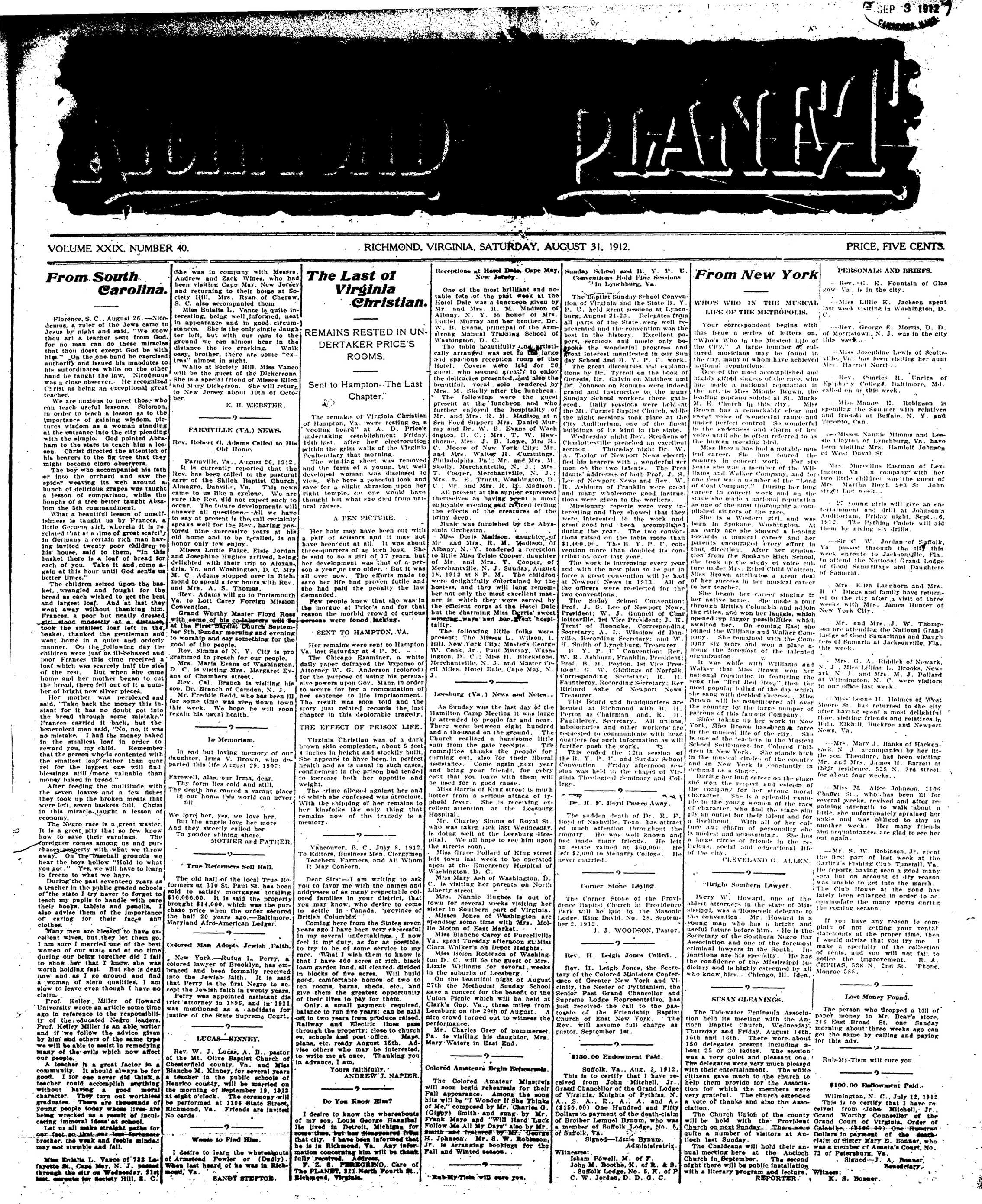
From South Carolina.
Florence, S. C., August 26. —Nicodemus, a ruler of the Jews cam to Jesus by night and said, "We know thou art a teacher sent from God, for no man can do these miracles that thou doest except God be with him." On the one hand he exercised authority and issued his mandates to his subordinates while on the other hand he taught the law. Nicodemus was a close observer. He recognized Christ as being an exceptional great teacher.
We are anxious to meet those who can teach useful lessons. Solomon, in order to teach a lesson as to the importance of gaining wisdom, pictures wisdom as a woman standing at the entrance into the city pleading with the simple. God pointed Abraham to the stars to teach him a lesson. Christ directed the attention of his hearers to the fig tree that they might become close observers.
The boy who accompanied his father into the orchard and saw the spider weaving its web around a bunch of delicious grapes was taught a lesson of comparison, while the boughs of a tree better taught Absalon, the 5th commandment.
What a beautiful lesson of unselfishness is taught us by Frances, a little German girl, wherein it is relied that at a time of great scarcity in Germany a certain rich man having invited twenty poor children to his house, said to them, "In this basket there is a loaf of bread for each of you. Take it and come again at this hour until God sends us better times."
The children seized upon the basket, wrangled and fought for the bread as each wished to get the best and largest loaf. And at last they went away without thanking him. Frances, a poor but neatly dressed girl, stood modestly at a distance, took the smallest loaf left in the basket, thanked the gentleman and went home in a quiet and orderly manner. On the following day the children were just as ill-behaved and poor Frances this time received a loaf which was scarcely half the size of the rest. But when she came home and her mother began to cut the bread, there fell out of it a number of bright new silver pieces.
Her mother was perplexed and said, "Take back the money this instant for it has no doubt got into the bread through some mistake." Frances carried it back, but the homevolent man said, "No, no, it was no mistake. I had the money baked in the smallest loaf in order to reward you, my child. Remember that the person who is contented with the smallest loaf rather than quarrel for the largest one will find blessings still more valuable than money baked in bread."
After feeding the multitude with the seven loaves and a few fishes they took up the broken meats that were left, seven baskets full. Christ in this miracle taught a lesson of economy.
The Negro race is a great waster. It is a great, pity that so few know how to save their earnings. The foreigner comes among us and purchases property with what we throw away. On the baseball grounds we hear the boys hollow "Hold to what you got." Yes, we will have to learn to freeze to what we have.
During the past seventeen years as a teacher in the public graded schools of the state I try never to forget to teach my pupils to handle with care their books, tablets and pencils. I also advise them of the importance of caring for their faces and clothes.
Many men are blessed to have excellent wives, but they let them go. I am sure I married one of the best women of our state and at no time during our beling together did I fail to show her that I knew. she was worth holding fast. But she is dead now and as I go around and find a woman of stern qualities, I am slow to leave even though I have no claim.
Prof. Kelley. Miller of Howard University wrote an article some time ago in reference to the responsibility of the educated Negro leaders. Prof. Kelley Miller is an able writer and if we follow the advice given by him and others of the same type we will be able to assist in remedying many of the evils which now affect our people.
A teacher is a great factor in a community. It should always be for good. I for one never did think a teacher could accomplish nothing without having a good moral character. They turn out worthless graduates. There are thousands of young people today whose lives are belonged wrecked as a result of inculcating immoral ideas at school. Let us all make straight paths for our feet so that our best fortune brother, the weak and feeble minded may not stumble and fall.
Miss Emilia L. Vance of 732 Lafayette, Cape May, N. J. passed through the city on Wednesday, 21st night, entrusted for Society Hill, S. C.
She was in company with Measures.
Andrew and Zack Wiles, who had
had been visiting Cape May, New Jersey
and returning to their house at
Society Hill. Mrs. Ryan of Cheraw,
S. C. also accompanied them.
Miss Eulalia L. Vance is quite
interesting, being well informed, neat
in appearance and in good circumstances.
She is the only single daughter
left, but with our cars to the
ground we can almost hear in the
distance the ice cracking. Walk
easy, brother, there are some "extrus"
almost in sight.
Whilo at Society Hill. Miss Vance
will be the guest of the Dickerson.
She is a special friend of Miss Ellen
and Mary Dickerson. She will return
to New Jersey about 10th of October.
E. B. WEBSTER.
FARMVILLE (VA.) NEWS
Rey, Robert G. Adams Called to His Old Home.
Farmville, Va., August 26, 1912.
It is currently reported that the Rev. has been called to the pastoral care of the Shiloh Baptist Church, Almargro, Danville, Va. This news came to us like a cyclone. We are sure the Rev. did not expect such to occur. The future developments will answer all questions. All we have to say at present is the call certainly speaks well for the Rev., having pastored nine successive years at his old home and to be recalled, is an honor only few enjoy.
Misses Lottie Paige. Elsie Jordan and Josephine Hughes arrived, being delighted with their trip to Alexandra, Va. and Washington, D. C. Mrs. M. C. Adams stopped over in Richmond to spend a few hours with Rev. and Mrs. A. S. Thomas.
Rev. Adams will go to Portsmouth Va. to Lott Carey Foreign Mission Convention.
Grand Worthy Master Floyd Ross with some of his colleagues will be at the First Baptist Church September 5th. Sunday morning and evening to worship and say something for the good of the people.
Rev. Simma of N. Y. City is programmed to preach for our people.
Mrs. Maria Evans of Washington, D. C. is visiting Mrs. Margaret Evans of Chambers street.
Rev. Cal. Branch is visiting his son, Dr. Branch of Camden, N. J.
Mr. Freddie Redd, who has been ill for some time was seen down town this week. We hope he will soon regain his usual health.
In Memoriam.
In sad but loving memory of our daughter, Irma V. Brown, who departed this life August 29, 1907:
Farewell, alas, our Irma, dear.
Thy form lies cold and still.
Thy death has caused a vacant place
In our home this world can never fill.
We love her, yes, we love her.
But the angels love her more
And they sweetly called her
To yonder shining shore.
MOTHER and FATHER.
True Reformers Sell Hall
The old hall of the local True Reformers at 310 St. Paul St. has been sold to satisfy mortgage totaling $10,000.00. It is said the property brought $14,000, which was the purchase price when the order secured the hall 20 years ago.—Baltimore, Maryland Afro-American Ledger.
Colored Man Adopts Jewish Faith.
New York.—Rufus L. Perry, a colored lawyer of Brooklyn, has embraced and been formally received into the Jewish faith. It is said that Perry is the first Negro to accept the Jewish faith in twenty years. Perry was appointed assistant district attorney in 1896, and in 1911 was mentioned as a candidate for justice of the State Supreme Court.
LUCAS—KINNEY.
Rev. W. J. Lucas, A. B., pastor of the Mt. Olive Baptist Church of Chesterfield county, Va., and Miss Blanche M. Kinney, for several years a teacher in the public schools of Henrico county, will be married on the morning of September 19, 1812 at eight o'clock. The ceremony will be performed at 1106 State Street, Richmond, Va. Friends are invited No cards.
I desire to learn the whereabouts of Armstead Fowler or (Dudly). When last heard of he was in Richmond, Va.
SANGY STEPTOR.
The Last of Virginia Christian.
REMAINS RESTED IN UN-DERTAKER PRICE'S ROOMS.
Sent to Hampton--The Last Chapter.
The remains of Virginia Christian of Hampton, Va. were resting on a "cooling board" at A. D. Price's undertaking establishment Friday, 10th last, after her electrocution within the grim walls of the Virginia Penitentiary that morning.
The winding sheet was removed and the form of a young, but well developed woman was disclosed to view. She bore a peaceful look and save for a slight abrasion upon her right temple, so one would have thought but what she died from natural causes.
A PEN PICTURE.
Her hair may have been cut with a pair of scissors and it may not have been cut at all. It was about three-quarters of an inch long. She is said to be a girl of 17 years, but her development was that of a person a year or two older. But it was all over now. The efforts made to save her life had proven futile and she had paid the penalty the law demanded.
Few people knew that she was in the morgue at Price's and for that reason the morbid crowd of curious persons were found hacking.
BENT TO HAMPTON, VA.
Her remains were sent to Hampton Va. last Saturday at 4 P. M.
The Chicago Examiner, a white daily paper defrayed the expense of Attorney W. G. Anderson (colored) for the purpose of using his persuasive powers upon Gov. Mann in order to secure for her a commutation of her sentence to life imprisonment. The result was soon told and the story just related records the last chapter in this deplorable tragedy.
THE EFFECT OF PRISON LIFE.
Virginia Christian was of a dark brown skin complexion, about 5 feet 4 inches in height and stockily built. She appears to have been in perfect health and as is usual in such cases, confinement in the prison had tended to increase both her appetite and weight. The crime alleged against her and to which she confessed was atrocious. With the shipping of her remains to her kinsfolks the only thing that remains now of the tragedy is a memory.
Vancouver, B. C., July 8, 1912.
To Editors, Business Men, Clergymen
Teachers, Farmers, and All Whom
It May Concern.
Dear Sirs:—I am writing to ask
you to favor me with the names and
addresses of as many respectable col-
ored families in your district, that
you may know, who desire to come
to settle in Canada. province of
British Columbia.
Coming here from the States seven
years ago I have been very successful
in my several undertakings. I now
feel it my duty, as far as possible,
to try to be of some service to my
race. What I wish them to know is
that I have 400 acres of rich, black
loam garden land, all cleared, divided
in blocks of five acres. Will build
good, comfortable homes of two to
ten rooms, barns, sheds, etc., and
give them the greatest opportunity
of their lives to pay for them.
Only a small payment required,
balance to run five years; can be paid
off in two years from produce raised.
Railway and Electric lines pass
through the property; close to church
es, schools and post office. Maps,
plans, etc. ready August 15th. Advise
others who may be interested,
to write me at once. Thanking you
in advance, I am.
Yours faithfully,
ANDREW J. NAPIER.
Do You Know Him?
I desire to know the whereabouts of my son, Louis George Hannibal He lived in Detroit, Michigan for some time, but has disappeared from that city. I have been informed that he is in Richmond, Va. Any information concerning him will be thankfully received. Address. F. Z. S. 8. REGRNO, Care of The PLANET, 311 North Fourth St., Richmond, Virginia.
Inceptions at Hotel Bain, Cape May
New Jersey.
One of the most brilliant and notable fole of the past week at the Hotel Dule was a luncheon given by Mr. and Mrs. R. M. Madison of Albany, N. Y. in honor of Mrs. Daniel Murray and her brother, Dr. W. B. Evans, principal of the Armstrong Manual Training School of Washington, D. C.
The table beautifully and artistically arranged was set in the large and spacious reception room of the Hotel. Covers were lidd for 20 guest, who seemed greatly to enjoy the delicacies presented, and also the beautiful, vocal, solo rendered by Mrs. M. Skelly after the luncheon.
The following were the guests present at the funcheon and who further enjoyed the hospitality of Mr. and Mrs. R. M. Madison at a Sea Food Supper: Mrs. Daniel Murray and Dr. W. B. Evanna of Washington, D. C.; Mrs. T. W. Hawthorne, M. J. B. Lowe, Mrs. R. C. Moore of New York City; Mr. and Mrs. Walter R. Cummings, Philadelphia, Pa.; Mr. and Mrs. M. Skelly, Merchantville, N. J.; Mrs. T. Cooper, Merchantville, N. J.; Mrs. P. E. Truntz, Washington, D. C.; Mr. and Mrs. R. J. Madison. All present at the supper expressed themselves as having spent a most enjoyable evening and relaxed feeling the effects of the creatures of the briny deep.
Music was furnished by the Abyssinia Orchestra.
Miss Doris Madison, daughter of Mr. and Mrs. R. M. Madison, of Albany, N. Y. tendered a reception to little Miss Telsia Cooper, daughter of Mr. and Mrs. T. Cooper, of Merchantville, N. J. Sunday, August 18, 1921 at 8 P. M. The children were delightfully entertained by the hostess, and they will long remember not only the most excellent manner in which they were served by the efficient corps at the Hotel Dale but the charming Miss Dorie sweet wishing ways and her great hospitality.
The following little folks were present: The Misses L. Wilson, L. Hill, New York City, Master George W. Cook, Jr., Paul Murray, Washington, D. C.; Miss H. Blackstone, Merchantville, N. J. and Master Cecil Miles, Hotel Dale, Cape May, N.
Lewsburg (Va.) News and Notes.
As Sunday was the last day of the Hamilton Camp Meeting it was largely attended by people far and near. There were between eight hundred and a thousand on the ground. The Church realized a handsome little sum from the gate receipts. The committee thanks the people for turning out, also for their Liberal assistance. Come again next year and bring your friends, for every cessit that you leave with them will be used for a good cause.
Miss Harris of King street is much better from a serious attack of typhoid fever. She is receiving excellent attention at the Leesburg Hospital.
Mr. Charley Simms of Royal St. who was taken sick last Wednesday, is doing well at the Leesburg Hospital. We all hope to see him upon the streets soon.
Miss Grace Pollard of King street left town last week to be operated upon at the Emergency Hospital of Washington, D. C.
Miss Mary Ash of Washington, D. C. is visiting her parents on North Liberty street.
Mrs. Nannie Hughes is out of town for several weeks visiting her sister in Southern part of Virginia. Miss Jones of Washington are spending some time with Mrs. Mollie Moton of East Market.
Miss Blanche Carey of Purcellville Va. spent Tuesday afternoon at Miss Clara Walker's on Depot Heights.
Miss Helen Robinson of Washington D. C. will be the guest of Mrs. Lizzie Williams for several weeks in the suburbs of Leesburg.
On the beautiful night of August 27th the Methodist Sunday School gave a concert for the benefit of the Union Picnic which will be held at Clark's Gap, Va., three miles from Leesburg on the 29th of August. A nice crowd turned out to witness the performance.
Mr. Charles Grey of nummerset, Pa. is visiting his daughter, Mrs. Mary-Waters in East End.
The Colored Amateur Minute
will soon begin rehearsals for their
Fall appearance. Among the song
hits will be "I Wonder If She Thinks
of Me," composed by Mr. Charles G.
(Giggy) Smith and sung by Mr.
Frank Mayo and "Will Hard Luck
Follow Me All My Days" also by
Mr. Smith and featured by Mr. George
H. Johnson. Mr. S. W. Robinson.
Jr. is arranging bookings for the
Fall and Winted season.
Sunday School and B. Y. P. U. Conventions Hold Fire Sessions in Lynchburg, Va.
The Baptist Sunday School Convention of Virginia and the State B. Y. P. U. held great sessions at Lynchburg, August 21-23. Delegates from all parts of the State were well represented and the convention was the best in the history. Excellent papers, sermons and music only bepoke the wonderful progress and great interest manifested in our Sun Day School and B. Y. P. V. work. The great discourses and explanations by Dr. Tyrrell on the book of Genesis, Dr. Galvin on Matthew and Dr. Johnson on Romans were indeed grand and instructive to the many Sunday School workers there gathered. Daily sessions were held at the Mt. Carmel Baptist Church, while the night sessions took place at the City Auditorium, one of the finest buildings of its kind in the state.
Wednesday night Rev. Stephens of Charlottesville preached an excellent sermon. Thursday night Dr. W. A. Taylor of Newport News elocitated his hearers with a wonderful sermon on the two talents. The Presidents' addresses of both Prof. J. S. Lee of Newport News and Rev. W. R. Ashburn of Franklin were great and many wholesome good instructions were given to the workers.
Missionary reports were very interesting and they showed that they were interested in the work and great good had been accomplished during the year. The two conventions raised on the table more than $1,400,000. The B. Y. P. I. convention more than doubled its contribution over last year.
The work is increasing every year and with the new plan to be put in force a great convention will be held at Newport News in 1913. All of the officers were re-elected for the two conventions.
The Sunday School Convention: Prof. J. S. Low of Newport News, President; W. J. Gunnell of Charlottesville. 1st Vice President; J. K. Trent of Ronnoke. Corresponding Secretary; A. L. Winslow of Danville. Recording Secretary; and W. H. Smith of Lynnburg. Treasurer. B. Y. P. I. Convention: Rev. W. R. Ashburn, Franklin, President; Prof. B. H. Peyton, 1st Vice President; G. W. Giddicks of Norfolk. Corresponding Secretary; R. H. Fauntleroy. Recording Secretary; Rev Richard Ashe of Newport News. Treasurer.
This Board and headquarters are located at Richmond with B. H. Peyton as Chairman and, R. H. Fauntleroy. Secretary. All unions, missionaries and other workers are requested to communicate with head quarters for such information as will further push the work.
This ended the 12th session of the B. Y. P. I. and Sunday School Convention. Friday afternoon session was held in the chapel of Virginia Theological Seminary and College.
The sudden death of Dr. R. P. Boyd of Nashville, Teen has attracted much attention throughout the country. He was well known and had made many friends. He left an estate valued at $60,000. He left $2,000 to McMary College. He never married.
Corner Stone Laying.
The Corner Stone of the Providence Baptist Church at Providence Park will be laid by the Masonic Lodge, King David, No. 28, September 2, 1912.
J. J. WOODSON, Pastor.
Bey. H. Leigh Jones Collec.
Rev. H. Leigh Jones, the Secretary of the Colored Manifesta Conference of Greater New York and Vicinity, the Nester of Pythianism, the Senior Past Grand Chancellor and Supreme Lodge Representativo, has just received the call to the pastatee of the Friendship Baptist Church of East New York. The Rev. will assume full charge as pastor, September 1st.
$150.00 Endowment Paid.
Suffolk, Va., Aug. 3, 1912.
This is to certify that I have received from John Mitchell, Jr.
Grand Chancellor of the Grand Lodge of Virginia, Knights of Pythias, N.
A., S. A., E., A. A. and A. ($150.00) One Hundred and Fifty Dollars to payment of the death-claim of Brother Lemuel Bynum, who was a member of Suffolk Lodge, No. 5,
of Buffolk, Va.
Signed—Lizzie Bynum,
Administratrix.
Wilneares:
Isham Powell. M. of F.
John M. Booths, K. of R. & B.
Suffolk Lodge, No. 5, K. of P.
C. W. Jordson, D. D. G. C.
From New York
WHO'S WHO IN THE MUSICAL
LIFE OF THE METROPOLIS.
Your correspondent begins with this issue a series of letters on, "Who's Who in the Musical Life of the City." A large number of cultured musicians may be found in the city, many of whom have achieved national reputations. One of the most accomplished and highly gifted singers of the race, who has made a national reputation in the art, is Miss Mande Brown, the leading soprano soloist at St. Marks M. E. Church in this city. Miss Brown has a remarkably clear and sweet votes of wonderful range and under perfect control. So wonderful is the sweetness and charm of her voice until she is often referred to as the human mongking bird. Miss Brown has had a notable musical career. She has toured the country in concert work. For six years she was a member of the Williams and Walker Company, and for one year was a member of the "Load of Coal Company." During her long career in concert work and on the stage she made a national reputation as one of the most thoroughly accomplished singers of the race.
She is a Western girl, and was born in Spokane, Washington. At an early age she showed a leasing towards a musical career and her parents encouraged every effort in that direction. After her graduation from the Spokane High School she took up the study of voice culture under Mrs. Ethel Child Walttron. Miss Brown attributes a great deal of her success in her musical career to her teacher.
She began her career singing in her native home. She made a tour through British Columbia and a join ing cities, and won her laugals, which opened up larger possibilities which awaited her. On coming East she joined the Williams and Walker Company. She remigned with the Company six years and won a place among the foremost of the talented organization.
It was while with Williams and Walker that Miss Brown won her national reputation in featuring the song the "Red Red Rose" then the most popular ballad of the day which she sang with decided success. Miss Brown will be remembered all over the country by the large number of patrons of this famous Company.
Since taking up her work in New York, Miss Brown has been force in the musical life of the city. She is one of the teachers in the Musical School Settlement for Colored Children in New York. She stands high in the musical circles of the country and in New York is constantly in demand as a singer.
During her long career on the stage she won the respect and esteem of the company for her strong moral character. She is a splendid example to the young women of the race of character, who find the stage simply an outlet for their talent and for a livelihood. With all of her culture and charm of personality she is modest and unassuming. She has a large circle of friends in the religious, social and educational life of the city.
CLEVELAND G. ALLEN
Bright Southern Lawyer
Perry W. Howard, one of the ablest attorneys in the state of Mississippi, was a Roosevelt delegate to the convention. Mr. Howard is a young man who has a bright and useful future before him. He is the Secretary of the Southern Negro Bar Association and one of the foremost criminal lawyers in the South. Injunctions are his specialty. He has the confidence of the Mississippi judiciary and is highly esteemed by all who know him. -Chicago Il. Idea.
SUSAN GLEANINGS.
The Tidewater Peninsula Association held its meeting with the Antioch Baptist Church, Wednesday, Thursday and Friday, August 14th, 15th and 16th. There were about 150 delegates present including about 25 or 30 ladies. The session was a very quiet and pleasant one. The delegates were very much pleased with their entertainment. The white citizens gave much to the church to help them provide for the Association for which the members were very grateful. The church extended a vote of thanks and also the Association.
The Church Union of the county will be held with the Provident Church on next Sunday. There were quite a number of visitors at Antioch last Sunday.
The Chaldeans will hold their annual meeting here at the Antioch Church in September. The second night there will be public installation with a literary program and lecture.
SEP 3 1912
PRICE, FIVE CENTS.
PERSONALS AND BRIEF8.
Rev. G. E. Fountain of Glas
kow Va. is in the city.
Miss Lillie K. Jackson spent
last week visiting in Washington, D.
C.
Rev. George E. Morris, D. D.
of Morristown, N. J. was in the city
this week.
Miss Josephine Lewis of Scotts-
ville, Va. has been visiting her aunt
Mrs. Harriet North.
Rev. Charles R. Uncles of
Epiphany College, Baltimore, M.
called on us this week.
Miss Mamie E. Robinson is
spending the Summer with relatives
and friends at Buffalo, N. Y. and
Toronto, Can.
Miss Nance Mimms and Les-
le Clayton of Lynchburg, Va. have
been visiting Mrs. Hamlett Johnson
of West Duval St.
Mrs. Marcellus Eastman of Lex-
ington, Va. in company with her
two little children was the guest of
Mrs. Martha Boyd, 963 St. John
street last week.
25 young girls will give an
entertainment and drill at Johnson's
Auditorium, Friday night, Sept. 6,
1912. The Pythian Cadets will aid
them by giving six drills.
Sir C. W. Jordan of Suffolk, Va. passed through the city this week enroute to Jacksonville, Fla. to attend the National Grand Lodge of Good Samaritans and Daughters of Samaria.
Mr. Elliza Laughhorn and Mrs. R. C. Diggs and family have returned to the city after a visit of three weeks with Mrs. James Hunter of New York City.
Mr. and Mrs. J. W. Thompson are attending the National Grand Lodge of Good Samaritans and Daughters of Samaria at Jacksonville, Fla. this week.
Mrs. G. A. Riddick of Newark, N. J. Miss Lillian L. Brooks, Newark, N. J. and Mrs. M. J. Pollard of Wilmington, N. C. were visitors to our office last week.
Miss Leone H. Holmes of West Moore St. has returned to the city after having spent a most delightful time, visiting friends and relatives in Hola, Elkhill, Buckroe and Newport News, Va.
Mrs. Mary J. Banks of Hackensack, N. J. accompanied by her little son Theodore, has been visiting Mr. and Mrs. James H. Barrett at their residence, 525 N. 3rd street, for about four weeks.
--Miss M. Alice Johnson, 1106 Chaffin St. who has been ill for several weeks, revived and after regaining strength to walk about a little she unfortunately aprailed her sake and was obliged to stay in another week. Her many friends and acquaintances are glad to see her out again.
--Mr. S. W. Robinson, Jr. spent the first part of last week at the Garlick's Fishing Club, Tunstall, Va. he reports having a good many sora but on account of dry season was unable to get into the marsh. The Club House at the pond has lately been enlarged in order to accommodate the many sports during the coming season.
If you have any reason to complain of not getting your rental statements at the proper time, then I would advise that you try me. I make a specialty of the collection of rents, and you will not fail to notice the improvement. B. A. CEPHAS, 538 N. 2nd St. Phone, Monroe 588.
Lost Money Found
The person who dropped a bill of paper money in Mr. Bear's store, 216 East Broad St. one Sunday morning about three weeks ago can get the same by calling and paying for this adv.
Rub-My-Tism will cure you.
$100.00 Earnowocat Paid.
Wilmington, N. C., July 12, 1912
This is to certify that I have received from John Mitchell, Jr.,
Grand Worthy Counselor of the Grand Court of Virginia, Order of Calahire, ($199.99) One Hundred Dollars in payment of the death claim of Sister Mary E. Bonner, who was a member of Amete's Court, No. 73 of Petersburg, Va.
Signed—J. A. Bonner,
Bondary.
Witness:
K. S. Bonner.
Copyright, 1920, by Charles Scribner's Bons.
SYNOPSIS
Lidgerwood, who confesses that he is a
eoward, becomes a superintendent of Red
Butte. Western, a detailed railroad
company, denatively calls him "Collars and
Cuffs." Orldley, master mechanic, warns Hallow
back, chief clock, to set up on Plemler,
mine owner. Hallow and Plemler are
monies. Lidgerwood finds discipline very
good.
Lidgwood's train is wrecked by carelessness, and Lidgwood leaves for life. He retains Hallock, who says Lidgwood will regret this decision.
Trainmaster McCoskey, Lidgwood and Gidley, Lidgwood, played a wreck. Gidley, Lidgwood, he has tackled a hard proposition. Gidley compares with Plemmiter.
They plan to force Hallock to help them detraud the railroad. Lidgwood begins enforcing discipline with an iron hand but wrecks are of daily occurrence. Gidley, a brother of Hallock, the killer, Lidgwood's life is threatened, but he refuses to go armed. switch engine is stolen. There are another rumors about Hallock.
Lidgwood orders Hallock to see Plemmiter and straighten out a defunct building and loan association. Hallock was saved by Plemmiter. McCoskey receives Hallock of dishonor. Tart shoots at Lidgwood, whose life is saved by Plemmiter. He tells how to bridge timber were stolen. The game used the engine.
Another big theft increases suspicion against Hallock, and Plemmiter. Heres the stolen engine. Gidley confides mysteries only with Judson. Gidley confides mysteries only with Judson.
Lilgerwood has fired Jadson for drunkenness, but Jadson offers to shadow Jadson arrives Part and Jills him. Fleming tells Lilgerwood the building and bears funds were stolen that day. Fleming quarrels with Fleming. A mysterious woman enters Lilgerwood's care.
She is Halloween's insane wife. Muttering about, she arranges the absent Halloween because he has not killed that man. Desperades wreak another train. Suspicion again points to Lilgerwood. He breaches his daughter Ellen and part arrives. Lilgerwood leaves Ellen.
His coworker a year before extradited her. She learns that he has been abducted and is bravely doing his duty. Her aunt is frightened.
Lilgerwood Lilgerwood to meet him at Little Hills. They follow Lilgerwood. Ellen and her friends write to accompany Lilgerwood to Little Hattie. He objects because there is danger from train wreckers' cleaner ridicules her fears. Jadson follows a man he thinks is Hallock to Fleming's wife. Hallock to Fleming and Fleming plan to wreck Lilgerwood's train. There are followed by another man resenting Hallock and by Jadson.
THE HIEROSMANIAC
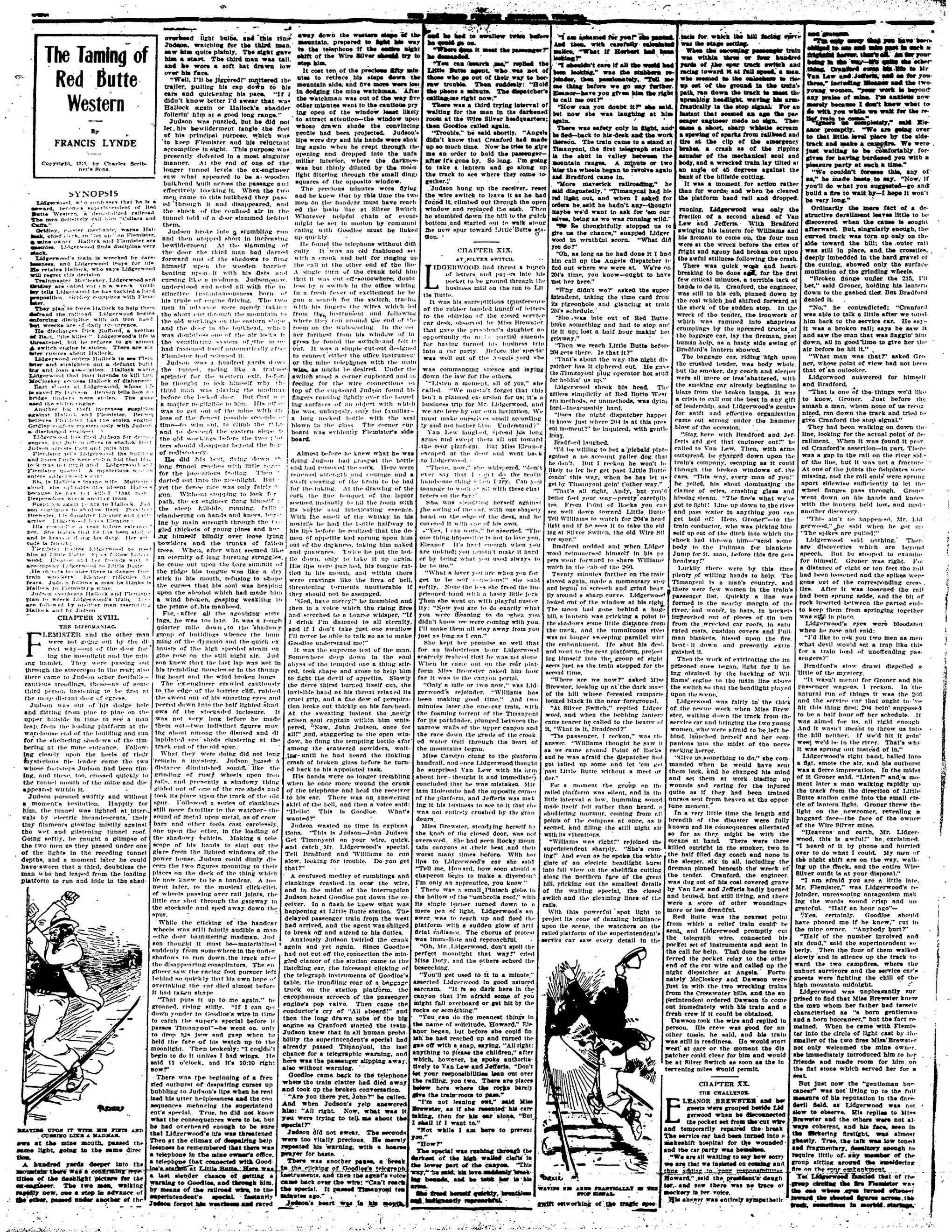
FLEMISTER and the other man were not going out by the direct way—out of the door face the moonlight and the minum hamlet. They were passing out through the storefront in the rear; also there came to Judson other footfalls cautious treedings, these—as of some third person hastening to be first at the most distant door of ogress. Judson was out of his dodge hole and flitting from pike to pike on the upper bifide in time to see a man leap, from the leading platform at the warehouse end of the building and run for the sheltering shadows of the timbering at the mine entrance. Following closely upon the heels of their mysterious file leader came the two whose footsteps Judson had been timing, and these, too, crossed quickly to the tunnel mouth of the mine and disappeared within it.
Judson pursued swiftly and without a moment's hesitation. Happily for him, the tunnel was lighted at intervals by electric incandescentes, their tiny filaments glowing mistily against the wet and glistening tunnel roof. Going swiftly, he caught a glimpse of the two men as they passed under one of the lights in the receding tunnel depths, and a moment later he could have sworn that a third, doubtless the man who had leaped from the loading platform to run and hide in the shad-
PETERSON
BEATING UTON WITH HIS FISTS AND
CUMING LIKE A MADMAN
owns at the mine mouth, passed the
same light, going in the same direction.
A hundred yards deeper into the
mountain there was a conning repetition of the flashlight picture for the engineer. The two men, walking rapidly now, one a step in advance of the other, passed under another of the
overhead light bulbs, and this tinted Judson, watching for the third man, saw him quite plainly. The sight gave him a start. The third man was tall, and he wore a soft hat drawn low over his face.
"Well, I'll be jiggered!" mqttered the trailer, pulling his cap down to his ears and quickening his pace. "If I didn't know better I'd swear that was Hallock again or Hallock's shaddar follierin' him at a good long range."
Judson was puzzled, but he did not let his bewilderment tangle the feet of his principal purpose, which was to keep Flemiater and his reluctant accomplice in sight. This purpose was presently defended in a most singular manner. At the end of one of the longer tunnel levels the ex-engineer saw what appeared to be a wooden bulkhead built across the passage and effectively blocking it. When the two men came to this bulkhead they passed through it and disappeared, and the shock of the confined air in the tunnel told of a door slammed behind them.
Judson broke into a stumbling run and then stopped short in increasing bewilderment. At the slamming of the door the third man had darted forward out of the shadows to tinge himself upon the wooden barrier beating upon it with his dots and curting like a madman. Judson saw understood and acted all with the instinctive instantaneousness born of his trade of engine driving. The two men in advance were merely taking the short cut through the mountain to the old workings on the eastern slope and the door in the bottom, which was dumbless one of the air locks it the ventilating system of the mine and fastened itself automatically after Flemlier had released it.
Judson was a hundred yards down the tunnel, racing like a trained sprinter for the western exit, before he thought to ask himself why the third man was playing the midman before the locked door. But that was a matter negligible to him. His officer was to get out of the mine with the loss of the fewest possible seconds of time to win out, to climb the ridge and to descend the eastern slope to the old workings before the two sprinters should disappear beyond the top of the rectory.
He did his best, diving down to long funnel reaches with little regard for the precarious footing. Then darted out into the moonlight. But yet the fierce race was only fairly a gun. Without stopping to look for path, the ex engineer dung himself to the steep billide, running, falling clambering on hands and knees, bering by main strength through the tugged thickets of young plains and bering himself blindly over loose lying bowders and the trunks of fallen trees. When, after what seemed like an eternity of lung bursting struggles, he came out upon the bare summit of the ridge his tongue was like a dry stick in his mouth, refusing to shape the curse that his soul was heaping upon the alcohol which had made him a wind broken, gasping weakling in the prime of his manhood.
For, after all the agonizing surrings, he was too late. It was a rough quarter mile down, to the shadowy group of buildings whence the humming of the dynamo and the quick exhausts of the high speeded steam engine rose on the still night air. Judd son knew that the last lap was not in his trembling muscles or in the thumping heart and the wind broken lungs. The ex-engineer crawled cautiously to the edge of the barrier cliff, rubbed the sweat out of his smarting eyes and peered down into the half lighted shadows of the stockaded inclosure. It was not very long before he made them out—two indistinct figures moving about among the disused and dilapidated sheds clustering at the track end of the old spur.
What they were doing did not long remain a mystery. Judson guessed a distance diminished sound, like the grinding of rusty wheels upon iron rails, and presently a shadowy thing glided out of one of the ore sheds and took its place upon the track of the old spur. Followed a series of clankings still more familiar to the watcher—the sound of metal upon metal, as of crow bars and other tools cast carelessly, one upon the other, in the loading of the shadowy kelche. Making a telescope of his hands to shut out the glaze from the lighted windows of the power house. Judson could dimly discern the two figures mounting to their places on the deck of the thing which he now knew to be a handcar. A moment later, to the musical click-click of wheels passing over rail joints, the little car shot through the gateway in the stockade and sped away down the spur.
While the clicking of the handcarm wheels was still faintly audible a man—the door hammering madman. Jud son thought it must be—materialized suddenly from somewhere in the under shadows to run down the track after the disappearing conspirators. The engineer saw the racing foot pursuer left behind so quickly that his own hope of overtaking the car died almost before it had taken shape.
"That puts it up to me again," he groaned, rising stillly. "If I can get down ponder to Goodloe's wire in time to catch the super's special before it passes Timanyou"—he went on, only to drop his jaw and gasp when he held the face of his watch up to the moonlight. Then brokenly: "I couldn't begin to do it unless I had wings. He said 11 o'clock, and it's 10:10 right now!"
There was the beginning of a freezed outburst of despairing curses up bubbling to Judson's life when he realized his utter helplessness and the consequences mechancing the superintendent's special. True, he did not know what the consequences were to be, but he had overheard enough to be sure that Lidderwood's life was threatened. Then at the climax of despairing helplessness he remembered that there was a telephone in the mine owner's office, a telephone that connected with Goodloe's station at Little Butte. Hara was a last slender chance of getting a warning to Goodloe, and through him, by means of the railroad wires to the superintendent's special. Instantly Judson forgot his weariness and raced
away down the western slope of the mountain, prepared to light his way to the telephone if the entire night shift of the Wire Silver should try to step him.
It cost ten of the precious fifty minutes to retrace his steps down the mountain side; and five more were lost in dodging the mine watchman. After the watchman was out of the way five other minutes went to the cautions prying open of the window least likely to attract attention—the window upon whose drawn shade the convincing profile had been projected. Judson's lips were dry and his hands were shaking again when he crept through the opening and dropped into the unfailliar interior, where the darkness was but thinly diluted by the moonlight filtering through the small dingy squares of the opposite window.
The precious minutes were dying and he knew that by this time the two men on the handcar must have reached the unlane at Silver Switch. Whatever helpful chain of events might be set in motion by communal cating with Goodhoe must be linked up quickly.
He found the telephone without dim
duty. It was an old fashioned set
with a crank and bell for ringing up
the call at the other end of the line.
A single turn of the crank told him
that it was cut off-onwhere, doubt
less by a switch in the office writing
in a fresh fever of excitement he be
gain a search for the switch, tracing
with his fingers the wires which led
from the instrument and following
where they ran around the end of the
room on the wainscotting. In the con-
ner farthest from his window of in-
gress he found the switch and felt it
out. It was a simple cut-out designed
to connect either the office instrument
or the mine telephones with the main
wire, as might be desired. Under the
switch stood a corner cupboard and in
feeling for the wire connections on
top of the cupboard Judson found
binders running lightly over the bounding
surfaces of an object with which
he was, unhappily, only too familiar-
a long masked bottle with the seal
blown in the glass. The corner cup-
board was evidently Flemster's side-
board.
Almost before he knew what he was doing Judson had grasped the bottle and had removed the cork. Here were renewed strength and courage and a swift clearing of the brain to be had for the taking. At the drawing of the cork the fine bouquet of the liquor seemed instantly to fill the room with its suftle and intoxicating essence. With the smell of the whisky in his nostril he had the bottle halfway to his lips before he realized that the demon of appetite had sprung upon him out of the darkness, taking him naked and anawares. Twice he put the bottle down, only to take it up again. His lips were purified, his tongue rattled in his mouth, and within there were cravings like the fire of hell, threatening torments unutterable if they should not be assuaged.
"God, have mercy!" he tumbled and then in a voice which the rising fizz had scorched to a hoarse whisper. "If I drink I'm damned to all eternity, and if I don't take just one swallow I'll never be able to talk as to make Goodloe understand me!"
It was the supreme test of the man. Somewhere deep down in the soul abyss of the tempted one a thing attired, took shape and arose to help him to fight the devil of appetite. Slowly the fierce thirst burned itself out, the invisible hand at his throat relaxed its cruel grip, and a fine dew of percipitation broke out thickly on his forehead. At the sweating instant the newly arisen soul captain within him whispered, "Now, John Judson, once for all" and, staggering to the open window, he flung the tempting bottle afar among the scattered newiders, waiting-until he had heard the tinkling crash of broken glass before he turned back to his appointed task.
His hands were no longer trembling when he once more wound the crank of the telephone and held the receiver to his ear. There was an answering skirt of the bell, and then a voice said: "Hello! This is Goodloe. What's wanted?" Judson wasted no time in explanations. "This is Judson—John Judson Get Timanyoni on your wire, quick, and catch Mr. Lidgerwood's special. Tell Bradford and Williams to run slow, looking for trouble. Do you get that?" A confused medley of rumblings and clankings crashed, in over the wire, and in the midst of the interruption Judson heard Goodloe put down the receiver. In a flash he knew what was happening at Little Butte station. The delayed passenger train from the west had arrived, and the agent was obliged to break off and attend to his duties.
Anxiously Judson twirled the crank again and yet again. Since Goodieo had not cut off the connection the minigled clamor of the station came to the listening car, the incissant clicking of the telegraph instruments of Goodieo's table, the trundling roar of a baggage truck on the station platform, the cacophonous screech of the passenger engine's pop valve. Then came the conductor's cry of "All aboard!" and then the long drawn sobs of the big engine as Crandford started the train. Judson knew that in all human probability the superintendent's special had already passed Timanyon!, the last chance for a telegraph warning, and here was the passenger slipping away, also without warning.
Goodloe came back to the telephone when the train clatter had died away and took up the broken conversation. "Are you there yet, John?" he called. And when Judson's yelp answered him: "All right. Now, what was it if you were trying to tell me about the special?" Judson did not swear. The seconds were too vitally precious. He merely repeated his warning, with a hoarse prayer for hast. There was another pause, a break in the clicking of Goodloe's telegraph instruments, and then the agent's voice came back over the wire: "Can't reach the special. It passed Timanyosi ten minutes ago." Judson's heart was in his mouth.
and he had to swallow twice before he could go on.
"Where does it meet the passenger?" he demanded.
"You can search me," replied the Little Butte agent, who was not of those who go out of their way to borrow trouble. Then suddenly: "Hold the phone a minute. The dispatcher's calling, me right now."
There was a third trying interval of waiting for the man in the darkened room at the Wire Silver headquarters; then Goodloe called again.
"Trouble," he said shortly. "Angels didn't know that Cranford had made up so much time. Now he tries to glove me an order to hold the passenger—after it's gone by. So long. I'm going to take a lantern and go along up the track to see where they come together."
Judson hung up the receiver, reset the wire switch to leave it as he had found it climbed out through the open window and replaced the sash. Then he stumbled down the hill to the gulch bottom and started out to walk along the new spur toward Little Butte station.
CHAPTER XIX
LIDGERWOOD had thrust a bupele of letters and papers into his pocket to be ground through the business mill on the run to Lilie Butte.
It was his surreptitious transference of the rubber banded bunch of letters to the oblivion of the closed service car desk, observed by Miss Brewerat, that gave the president's daughter an opportunity to make partial amounts for having turned his business trip into a car party. Before the special was well out of the Angels yard she was commanding science and laying down the law for the others.
"Listen a moment, all of you," she called. "We mustn't forget that this isn't a planned expulsion for us; it's a business trip for Mr. Lidgerwood, and we are here by our own invitation. We must make ourselves small accordingly and not bother him. Understand?"
Van Lew hagged, spread his long arms and swept them all out toward the four platform. But Miss Eleanor escaped at the door and went back to Lidgerwood.
"There, now," she whispered, "don't ever say that I can't do the really handsome thing when I try. Can you manage to work it all with these characters on the car?"
She was scudding herself against the swing of the car, with one shape hand on the edge of the desk, and he covered it with one of his own.
"Yes, I can work," he asserted. "The one thing impossibly is not to love you. Eleanor. It's hard enough when you are unkind; you mustn't make it harder by being what you used always to be to me."
"What a lover you are when you forget to be self-conscious" she said softly. None the less she freed the imprisoned hand with a lusty little jerk. Then she went on with playful nusterity: "Now you are to do exactly what you were fleeting to do when you didn't know we were coming with you. I'll make them all stay away from you just as long as I can."
She kept her promise so well that for an industrious hour Lidgerwood scarcely realized that he was not alone. When he came out on the rear platform Miss Hirstow asked him how far it was to the canyon portal.
"Only a nule or two now," was Lidgerwood's rejoinder. "Williams has been making good time." And two minutes later the one-car train, with the foaming torrent of the Timanyoni for its pathfinder, plunged between the narrow walls of the upper canyon and the race down the grade of the crook ed water trail through the heart of the mountains began.
Miss Carolyn clung to the platform handrail, and once Lidgerwood thought he surprised Van Lew with his arm about her - thought it and immediately concluded that he was mistaken. Mitam Holomei he had the opposite corner of the platform, and Jefferson was making it his business to see it that she was not entirely crushed by the gran deurs.
Miss Brewster, steadying herself by the knob of the closed door, was not overawed. She had seen Rocky mountain canyons at their best, and their worst many times before. With her lips to Lidgerwood's ear she said "Tell me, Howard, how soon should a chaperon begin to make a diversion? I'm only an apprentice, you know."
There was a small, Pintsch globe in the hollow of the "umbrella roof," with its single burner turned down to a mere pen of light. Lidgerwood's answer was to reach up and flood the platform with a sudden glow of artificial radiance. The chorus of protest was immediate and reproachful.
"Oh, Mr. Lidgerwood, don't spell the perfect moonlight that way!" cried Miss Doty, and the others echoed the boseeching.
"You'll get used to it in a minute," asserted Lidgerwood in good natured sarcasm. "It is so dark here in the canyon that I'm afraid some of you might fall overboard or get hit by the rocks or something."
"You can do the meancest things in the name of politicue, Howard. Eleanor began, but before she could faint he had reached up and turned the gas off with a snap, saying, "All right; anything to please the children," after which, however, he spoke authoritatively to Van Law and Jeffries. "Don't let your responsibilities lean out over the rolling, you two. There are places below here where the rocks barely give the trainroom to pass."
"I'm not leaning out," said Miss Brewster, as if she resented his care taking, then for his ear alone. "But I shall if I want to."
"Not while I am here to prevent you."
"How?"
The special was rushing through the darkest of the high walled cliffs in the lower part of the canyon. "This way," he said, his hands suddenly breaking beads, and he took her in his arms.
She froze herself quickly, breathless and indignantly representative.
"I am ashamed for you!" she panted. And then, with carefully calculated malice, "What if Herbert had been looking?"
"I shouldn't care if all the world had been looking," was the stubborn rejoinder, then passionately, "Tell me one thing before we go any further. Eleanor—have you given him the right to call me out?"
"How can you doubt it?" she said, but now she was laughing at him again.
There was safety only in flight, and he fed—back to his desk and the work thereon. The train came to a stand at Tiananyou, the first telegraph station in the shunt in valley between the mountain ranges. A minute or two later the wheels began to revolve again and Bradford came in.
"More maverick railroading," he said disgustedly. "Tinmanical had blue red light out, and when I asked for orders he said he hadn't any—thought maybe we'd want to ask for 'am our selves, being as we was running wild.' "We be thoughtfully stopped us to give us the chance," snapped Lidger wood in wrathful scorn. "What did you do?"
"Oh, as long as he had done it I had him call up the Angels dispatcher to find out where we were at. We're on 204's time, you know—ought to have met her here."
"Why didn't we?" asked the super-intendent, taking the time card from its pigeonhole and glancing at trait 204's schedule.
"She was late out of Red Butte, broke something and had to stop and it up; lost a half hour makein' her getaway."
"Then we reach Little Butte before 204 gets there. Is that it?"
"That's about the way the night dispatcher has it ciphered out. He gave the Timantoyoni plug operator hot stuff for holdin' us up."
Liggerwood shook his head. The artistry simplicity of Red Butto West methods, or unmethods, was dying hard—inexcessibly hard.
"Does the night dispatcher happen to know just where 204 is at this present moment?" he inquired, with gentrify.
Bradford laughed.
"I'll be willing to bet a plebble pinto against a no account yaller dog that he don't. But I reckon he won't likely to let her get past Little Butto comin' this way, when he has let us get by Timantoyoni gold' other way."
"That's all right, Andy, but you'd better feel your way—pretty carefully too. From Point of Rocks you can see well down toward Little Butto Tel Williams to watch for 204's head light and if he sees it to take the sliding at Silver Switch, the old Wire Silver surer."
Braafland nodded and when Lidger wool reintroduced himself in his papers went forward to share Williams watch in the cab of the 29th. Twenty minutes farther on the train slowed again, made a momentary stop and begun to screech and grind heavily around a sharp curve. Lidgerwood looked out of the window at his right. The moon had gone behind a huge hill, a lunature was pricking a point in the shadows some little distance from the track, and the tumultuous river was no longer sweeping parallel with the embankment. He abut his desist and went to the rear platform, projecting himself into the group of sightseers just as the train stopped for the second time.
"Where are we now?" asked Miss Brewster, looking up at the dark mask of the hill whose forested rampart loomed black in the near foreground.
"At Silver Switch," replied Lidder wood, and when the bobbing lanters came nearer he called to the bearer of it. "What is it, Bradford?"
"The passenger, I reckon," was the answer. "Williams thought he saw it as we came around Point of Rock, and he was afraid the dispatcher had got balled up some and let 'em go past Little Butte without a meet order."
For a moment the group on the ralled platform was silent, and in the little interval a low, humming sound made itself felt rather than heard, a shuddering murmur, coming from all points of the compass at once, as it seemed, and filling the still night air with its vibrations.
"Williams was right"; rejoined the superintendent sharply. "She's coming." And even as he spoke the white glare of an electric headlight burst into full view on the shelflike cutting along the northern face of the great hill, pricking out the smallest details of the waiting special, the closed switch and the gleaming lines of the rails.
With this powerful spot light to project its cone of dazzling brilliance upon the scene, the watchers on the raised platform of the superintendent's service car saw every detail in the
Dexie
tackle for which the hill facing curve was the stage setting.
was the stage setting. When the incoming passenger train was within three or four hundred yards of the spur track switch and racing toward it at full speed, a man who seemed to the onlookers to rise up out of the ground in the train's path, run down the track to meet the uprushing headlight, waving his arm frantically in the stop signal. For an instant that seemed an age the passenger engineer made no sign. There came a short, sharp whistle scream a spawning of sparks from railhead and tire at the clip of the emergency brakes, a crash as of the ripping awound of the mechanical soul and body, and a wrecked train lay tilted at an angle of 45 degrees against the bank of the billiard cutting. It was a moment for action rather than for words; and when he cleared the platform hand rail and dropped.
running, Lidgerwood was only the fraction of a second ahead of Van Lew and Jefferis. With Bradford swinging his lantern for Williams and his fireman to come on, the four men were at the wreck before the cries of fright and agony had broken out upon the awful stillness following the crash. There was quick work and heartbreaking to be done again, for the first few critical minutes, a terrible lack of hands to do it. Cranford, the engineer, was still in his cab, plinned down by the coal which had shifted forward at the shock of the sudden stop. In the wreck of the tender, the frownwork of which was rammed into skilpeaux crumplings by the upraced trucks of the baggage car, lay the fireman, past human help, as a hasty side swing of Bradford's lantern showed.
The baggage car, riding 'high upon the crushed tender, was body whole, but the smoker, day coach and sleeper were all more or less 'shattered, with the smoking car already beginning to blaze from the broken lamps. It was a crisis to call out the best in any gift of leadership, and Lidgwood's genius for swift and effective organization came out strong under the hammer blow of the occasion.
"Stay, here with Bradford and Jefris and get that engineer out," he called to Van Law. Then, with arms outspread, he charged down upon the train's company, escaping as it could through the broken windows of, the cars. "This way, every man of you!" he rolled, his shout dominating the clamor of cities, crashing glass and hissing steam. "The fire's what we've got to fight! Line up down to the river and pass water in anything you can get hold of! Here, Groner"—to the train conductor, who was picking him self up out of the ditch into which the shock had thrown him—"send some body to the Pullman for blankets. Jump for it, man, before this fire gets headway."
Luckily there were by this time plenty of willing hands to help. The Timanipan is a man's country, and there were few women in the train's passenger list. Quickly a line was formed to the nearby margin of the river, and water, in hats, in bucket-improvised out of pieces of tin torn from the wrecked car roofs, in saturated coats, cushion covers and Pullman blankets, blissed upon the fire, it down and presently extinguished it.
Then the work of extricating the inmated ones began, light for it being obtained by the backing of Williams' engine to the main line above the switch so that the headlight played upon the scene.
Lidgwood was fairly in the thick of the rescue work when Miss Brewster, walking down the track from the service car and bringing the two young women, who were afraid to be left behind, launched herself and her companions into the midst of the nerve racking horror.
"Give us, something to do," she commanded when he would have sent them back, and he changed his mind and set them at work blinding up wounds and caring for the injured quite as if they had been trained nurses sent from heaven at the opportunity moment.
In a very little time the length and breadth of the disaster were fully known and its consequences alleviated so far as they might be with the means at hand. There were three killed outright in the smoker, two in the half filled day coach and none in the sleeper, six in all, including the fireman pinned beneath the wreck of the tender. Cranford, the engineer, was dug out of his coal covered grave by Van Lew and Jeffers badly burned and bruised, but still living, and there were a score of other woundings more or less dreadful.
Red Butte was the nearest point from which a relief train could be sent, and Lidgertwood promptly cut the telegraph wire, connected his pocket set of instruments and sent in the call for help. That done he transferred the pocket relay to the other end of the cut wire and called up the night dispatcher at Angela. Fortunately McClonkey and Dawson were just in with the two wrecking trains from the Crosswater hills, and the superintendent ordered Dawson to come out immediately with his train and a fresh crew if it could be obtained.
Dawson took the wire and replied to person. His crew was good for an other tussle, he said, and his train was still in readiness. He would start west at once or the moment the dits patcher could clear for bim and would be at Silver Switch as soon as the in terrencing miles would permit.
CHAPTER XX
THE CHALLENGE
LEANOR BREWSTER and her guests were grouped beside Lidgwood when he disconnected the pocket set from the cut wrist and temporarily repaired the break. The service car had been turned into a makeshift hospital for the wounded and the car party was benemolm. "We are all waiting to say how sorry we are that we insisted on coming and thus adding to your responsabilities. Howard," said the president's daughter, and now there was no trace of mockery in her voice. His answer was entirely sympathetic
"I'm only sorry that you have been obliged to me and take part in such a frightful horror, that's all. And for your being in the way—it's quite the other thing. Gratitude owes him like to Mr Van Law and Jeffery, and as for you three," including Meanner and the two young women. "your work is beyond any praise of man. I'm anxious now merely because I don't know what to do with you while we wait for the relief train to come."
"I leaves us completely," said Eleanor promptly. "We are going over to that little level place by the side track and make a campfire. We were just waiting to be comfortably, forgiven for having burdened you with a pleasure party at such a time."
"We couldn't foresee this, any of us," be made haste to say. "Now, if you'll do what you suggested—go and build a fire to wait by—I hope it won't be very long."
Ordinarily the mere fact of a destructive derailment leaves little to be discovered when the cause is sought afterward. But, singularly enough, the curved track was torn up only on the side toward the hill; the outer rail was still in place, and the crosses, deeply imbedded in the hard gravel of the cutting, showed only the surface mutilation of the grinding wheels.
"Broken flange under the 215, I11 bet," said Groner, holding his lantern down to the gushed tiel. But Bradford denied it.
"No," he contradicted; "Cranford was able to talk a little after we totaled him back to the service car. He says it was a broken rail; says he saw it and saw the man that was faggin' him down, all in good time to give her the air before he hit it."
"What man was that?" asked Groner, whose point of view had not been that of an onlooker.
Lidgerwood answered for himself and Bradford.
"That is one of the things we'd like to know. Groner. Just before the smash a man, whom none of us recognized, ran down the track and tried to give Cranford the stop signal."
They had been walking on down the line, looking for the actual point of derailment. When it was found it proved Cranford's assertion—in part. There was a gap in the rail on the river side of the line, but it was not a fracture. At one of the joints the fishplates were missing, and the rail ends were sprung apart sideways sufficiently to let the wheel fanges pass through. Groner went down on his hands and knotted with the lantern held low, and made another discovery. "This isn't no happened, Mr. Lidgerwood," he said when he got up. "The spikes are pulled."
Lidgerwood said nothing. There are discoveries which are beyond speech. But he stooped to examine for himself. Groner was right. For a distance of eight or ten feet the rail had been loosened and the spikes were gone out of the corresponding crosses. After it was loosened the rail had been sprung aside, and the bit of rock inserted between the parted end to keep them from springing together was skid in place.
Lidgerwood's eyes were bloodshot when he rose and said:
"I'd like to ask you two men as men what dwell would set a trap like this for a train lond of unoffending passengers?"
Brandon's slow drawl dispelled a little of the mystery.
"It wasn't meant for Groner and his passenger wagons, I reckon. In the natural run of things it was the 204 and the service car that ought to 'vibit this thing first, 204 beln' supposed to be a half hour off her schedule. It was aimed for us, all right enough. And it wasn't meant to throw us into the hill neither. If we'd hit it gold' west we'd be in the river. That's why it was spring out instead of in." Lidgerwood's right hand, balled into a flat, smote the air, and our outburst was a force imprecation. In the midst of it Groner said, "Listen!" and a moment later a man walking rapidly up the track from the direction of Little Butte station came into the small circle of lantern light. Groner threw the light on the newcomer, revealing a haggard face—the face of the owner of the Wire Silver mine.
"Heaven's and earth, Mr. Lidgerwood, this is awful!" he exclaimed. "I heard of it by phone and hurried over to do what I could. My men of the night shift are on the way, walking up the track, and the entire Silver outfit is at your disposal." "I am afraid you are a little late. Mr. Flemlister," was Lidgerwood's rejoinder, unreasoning antagonism making the words sound crisp and ungrateful. "Half an hour ago"— "Yes, certainly. Goodfoe should have phoned me if he knew," cut in the mine owner. "Anybody hurt?" "Half of the number involved and six dead," said the superintendent soberly. Then the four of them walked slowly and in silence up the track to ward the two campfires, where the unhurt survivors and the service car guests were fighting the chill of the high mountain midnight.
Lidgerwood was unpleasantly surprised to find that Miss Brewster knew the men whom her father had tenely characterized as "a born gentleman and a born buccaneer," but the fact remained. When he came with Fleming into the circle of light cast by the smaller of the two fires Miss Brewster not only welcomed the mine owner, she immediately introduced him to her friends and made room for him on the flat stone which served her for a seat.
But just now the "gentleman buccaneer" was not living up to the full measure of his reputation in the dreadful field, as Lidgerwood was not slow to observe. His replies to Miss Brewster and the others were not always coherent, and his face, seen in the flickering firelight, was almost ghostly. True, the talk was low tone and fragmentary, desolatory enough to require little of, any member of the group sitting around the smoldering fire on the poor embankment.
Yet Lodgewood finished that of the group circling the fire Flomister way the one whose eyes turned oftener toward the shaded figures across the trunk, sometimes in mortal staircase.
SATURDAY.....AUGUST 31, 1912
but now and again with the haggard side glance of fear.
Why was the mine owner afraid? Lidgerwood analyzed the query shrewdly. Was he implicated in the matter of the loosened rail? Remembering that the trap had been set, not for the passenger train, but for the special, the superintendent dismissed the charge against Fleming. Thus far he had done little to incur the mine
prison. Yet the man was acting very curiously. Much of the time he scarcely appeared to hear what Miss Brewster was saying to him. Moreover, he had lied. Lidgerwood resisted his gib explanation at the meeting beside the displaced rail. Flemister claimed to have had the news of the disaster by phone. Where had he been when the phone message found him? Not at his mine. Lidgerwood decided, since he could not have walked from the Wire Silver to the wreck in an hour. It was all very puzzling, and what little suppositional evidence there was was conflicting. Lidgerwood put the query aside finally, but with a mental reservation. Later he would go into this most mysterious and probe it to the
PLEXIE
"A TRAIP BUT, NOT FOR THE PASMENGER TRAIN, BUT FOR MY SPECIAL."
bottom. Judson would doubtless have a report to make, and this might help in the probing.
Fortunately the waiting interval was not greatly prolonged — fortunately, since for the three young women the reaction was come and the full horror of the disaster was beginning to make itself felt. Badgerwood contrived the necessary diversion when the relief train from Red Hutto shot around the curve of the hillside cutting.
"Van Law, suppose you and Jefferson take the women out of the way for a few minutes while we are making the transfer," he suggested quietly. "There are enough of us to do the work, and we can spare you."
This left Fleming unaccounted for, but with a very palpable effort he shook himself free from the spell of whatever had been shackling him.
"That's right," he ascertained briskly.
"I was just going to suggest that."
Then, indicating the men pouring out of the relief train: "I see that my buckles have come up on your train to lend a hand. Command us just the same as if we belonged to you. That is what we are here for."
Van Lew and the collegian walked the three young woman a little way up the old spur, while the wrecked train's company, the living, the injured and the dead; were transferred, down the line to the roller train to be taken back to Red Butte. Flomister helped with the other helpers, but Lidgerwood had an uncomfortable feeling that the man was always at his elbow. He was certainly there when the last of the wounded had been carried around the wreck and the roller train was ready to back away to Little Butte, where it could be turned upon the mine spur Y. It was while the conductor of the train was gathering his volunteers for departure that Flemister said what he had apparently been waiting for a chance to say.
"I can't help feeling indirectly re sponsible for this, Mr. Lidgerwood," he began, with something like a return of his habitual self possession. "If I hadn't asked you to come over here tonight"—
Lidgerwood interrupted, sharply. "What possible difference would that have made, Mr. Flemister?"
It was not a special weakness of Flemister's to say the damaging thing under pressure of the untoward and unanticipated event; it is rather a common failing of human nature. In a flash he appeared to realize that he had admitted too much.
"Why, I understood that it was unexpected sight of your special stand ing on the Y that made the passenger engineer lose his head," he countered lamely, evidently striving to recover himself and to efface the damaging admission.
It ensured that they were standing directly opposite the break in the tractor where the call ends were still helpless by the small stone. Lidger
wood pointed to the leasened rail plainly visible under the volleying play of the two opposing headlights. "There is the cause of the disaster. Mr. Flemlister," he said hotly, "a trap set, not for the passenger train, but for my special: Somebody set it. somebody who knew almost to a minute when we should reach it. Mr. Flemlister, let me tell you something—I don't care any more for my own life than a sane man ought to care, but the murdering devil who pulled the spikes on that rail reached out, unconsciously perhaps, but none the less certainly, after a life that I would safeguard at the price of my own. Because he did that I'll spend the last dollar of the fortune my father left me, if needful, in finding that man and hanging him!"
It was the needed flask of the whip for the shaken nerve of the mine owner.
"Ah," said he. "I am sure every one will applaud that determination. Mr. Lidgerwood—applaud it and help you to see it through." And then, quite as calmly: "I suppose you will go back from here with your special, won't you? You can't get down to Little Butte until the track is repaired and the wreck cleared. Your going back will make no difference in the right of way matter. I can arrange for a meeting with Grofeld at any time—In Angels if you prefer."
"Yes," said Lidgerwood absently. "I am going back from here."
"Then, I guess I may as well ride down to my jumping off place with my men. You don't need us any longer. Make my adieu to Miss Brewster and the young ladies, will you, please?"
Lidgerwood stood at the break in the track for some minutes after the retreating relief train had disappeared around the steep shoulder of the great hill—was still standing there when Bradford, having once more sidetricked the service car on the abandoned mine spur, came down to ask for orders.
"We'll hold the siding until Dawson shows up with the wrecking train," was the superintendent's reply. "He ought to be here before long. Where are Miss Brewster and her friends?"
"They are all up at the bonfire. I'm having the Jap launder the car a little before they move in."
There was another interval of delay, and Lidgerwood held aloof from the group at the fire, pacing a slow sentry beat up and down beside the ditched train and pausing at either turn to listen for the signal of Dawson's coming. It sounded at length—a series of shrill whistle shrieks, distance softened, and presently the drumming of hasting wheels.
The draffman was on the engine of the wrecking train, and he dropped off to join the superintendent.
"Not so bad for my part of it this time," was his comment when he had looked the wreck over. They asked the inevitable question, "What did it?"
Lidgerwood beckoned him down the line and showed him the sprung tail. Dawson examined it carefully before he rose up to say: "Why didn't they spring it the other way if they wanted to make a thorough job of it? That would have put the train into the river."
Lidgerwood's reply was as laconic as the query. "Because the trap was set for my car going west, not for the passenger going east."
"Of course," said the draftsman as one properly disgusted with his own lack of perspicacity. Then, after another and more searching scrutiny, in which the headlight glare of his own engine was helped out by the burning of half a dozen matches, "Whoever did that knew his business."
"How do you know?"
"Little things. A regular spike puller claw bar was used. The marks of its heel are still in the tles. The piece was chosen to the exact rail length—just where your engine would begin to hug the outside of the curve. Then the rail is sprung aside barely enough to let the wheel flanges through and not enough to attract an engineer's attention unless he happened to be looking directly at it and in a good light."
The superintendent nodded. "What is your inference?" he asked.
"Only what I say—that the man knew his business. He is no ordinary hobo. He is in your class or inine."
"Fred, tell me—you've known John Judson longer than I have—do you trust him when he sobs?"
"Yes." The answer was unqualified.
"I think I do, but he talks too much.
He is over here somewhere tonight shadowing the man, who may have done this. He—and the man—came down on 205 this evening. I saw them both board the train at Angels as it was pulling out."
Dawson looked up quickly, and for once the reticence which was his customary shold was dropped.
"You're trusting me now, Mr. Lidgerwood. Who was the man—Griddle?"
"Gridley? No. Why, Dawson, he is the last man I should suspect?"
"All right. If you think so."
"Don't you think so?"
It was the draftsman's turn to heat-tate.
"I'm prejudiced," he confessed at length. "I know Gridley. He is a worse man than a good many people think he is—and not so bad as some others believe him to be. If he thought yon or Benson was getting in his way—up at the house, you know"—Lidgerwood smiled. "You don't want him for a brother in-law. Is that it, Fred?"
"I'd cheerfully help to put my sister in her coffin if that were the alternative," said Dawson quite calmly. "Well," said the superintendent, "he can easily prove an alibi so far as this wreck is concerned. He went east on 202 yesterday. You knew that, didn't you?"
"Yes, I knew it, but"—"But what?"
"It doesn't count," said the draftsman briefly, then, "Who was the other man—the man who came west on 202."
Hawkins-Johnson MANUFACTURING CO., Hair Grower and Restorer,
616 N. 1st Street. Richmond, Va.
All positively remove all Dandruff
sis. It will restore Hair on clean
the Roots are not dead.
ANTISPACTION GUARANTEED.
THE HAWKINS-JOHNSON M'TIGER
long used in this State and other States w
growing and restoring hair leaps into pre-
MADAM HAWKINS-JOHNSON is the
trial and be convinced that she can do
are now in a position to sell the best
match all hair perfect. In orderl
lions, $3.00, $4.00, $5.00 to $20.00. B
Please remit by Cash, F. C. Money O.
The Bay Shore Hotel
Open From May to October
situated on Chesapeake Bay, three m
press Monroe, Virginia;—connects w
Monroe, Hampton, and Newport
eic cars.
A good family hotel, having twenty-two
ous parlors and broad plazas. A fine
ing beach, good fishing, a large pavilion.
delightful resting place with the best of e
is always a breeze here when slee
s. FOR TERMS ADDRESS:
THE BAY SHORE HOTEL
BUCKROE BEACH, VIRGINIA.
Will positively remove all Dandruff and cure the scalp of all impurities. It will restore Hair on clean Temples and Bald Heads where the Roots are not dead.
SATISFACTION GUARANTEED. PRICE, 35 CENTS PER BOX.
THE HAWKINS-JOHNSON M'f g Co's Hair Grower and Restorer is now being used in this State and other States with phenomenal success. Its reputation for growing and restoring hair leaps into prominence wherever it is used.
MADAM HAWKINS-JOHNSON is known as the Hair Grower. Give her a fair trial and be convinced that she can do all that she claims, or money refunded. We are now in a position to sell the best hair for less money than ever before and can match all hair perfect. In ordering Hair, send sample. Transformations, $3.00, $4.00, $5.00 to $20.00. Braids, $2.50, $3.00 and $4.00.
Please remit by Cash, F. C. Money Order or Express Money Order.
Situated on Chesapeake Bay, three miles from Fortress Monroe, Virginia; connects with Fortress Monroe, Hampton, and Newport News by electric cars.
A good family hotel, having twenty-two bedrooms, spacious parlors and broad plazzas. A fine and safe bathing beach, good fishing, a large pavilion.
A delightful resting place with the best of everything There is always a breeze here when sleeping time comes. FOR TERMS ADDRESS:
THE BAY SHORE HOTEL CO,
BUCKROE BEACH, VIRGINIA.
FOUNDED OCT., 12.
1892.
The TEMPERANCE COLLEGIATE I
Opens Upon Its Twentieth
On Monday September 14th
ment building, 133 1-2 by
and heated with steam an-
ment at a cost of $19,000.
for the reception of lady pu-
"Old Bagley Hall" light-
and equipped with every nce
reception of male pupils Se
The Temperance, Indus
with three-fourths of a
the "Anciont James River,
climate delightful, with
from Malaria and Chills.
cations in the country. $9.5
puples must pay $9.50 per
on September 27th, 25th at
at once. Those who make
send all money by Post Off
Pupils coming from the Steamer "Pocahontas" at
saturday of each week.
Then take same steamer at
mon, Va., Monday Wednes-
and at the John Hay Wha-
oot of the hill.
The Institution is non-
foral, Religious and Indu-
farming, the Carpenter's T
and Fancy Sewing with Dr
and general Domestic Science
TEMPERANCE INDUSTRIAL and COLLEGIATE INSTITUTE. CLAREMONT
Upon Its Twentieth Year's Work September 31
Sunday September 30th, Lincoln Hall, a brick, stu-
dial, 133 1-2 by 49 1-2 feet, 4 story lighted with
bed with steam and equipped with every mod-
cost of $19,000. This commodious building will
reception of lady pupils Sept. 27th, 28th and 30th
Eagley Hall" lighted with electricity and heated
up with every modern improvement, will be ope-
of male pupils Sept. 26th, 27th, 28th and 30th
imperience. Industrial and Collegiate Institute
free-fourths of a mile of the Claremont village
on James River" and is seventy-five feet abo-
do delightful, with the best Artesian well whiter
ofaria and Chills. One of the best moral, reli-
gious the country. $9.50 must be paid as an Entrain-
est pay $9.50 per month. Pupils desiring to co-
merge on July 27th, 28th and 30th should send in their
Those who make a remittance for entrance to
money by Post Office Order.
coming from the South, by Norfolk can take the
"Pocahontast" at Norfolk on Tuesday. Thus
of each week. Those coming from the North by
name steamer at the foot of Main (East Main).
Monday Wednesday and Friday of each week
John Hay Wharf right upon the school ground
hill.
Institution is non-sectarian and non-political, be-
ligious and Industrial. Students are taught
the Carpenter's Trade; Harness and Shoe Maker
Sewing with Dressmaking, Cooking and Launa
Domestic Edence.
On Monday September 30th, Lincoln Hall, a brick, stone and cement building, 133 1-2 by 49 1-2 feet, 4 story lighted with electricity and heated with steam and equipped with every modern improvement at a cost of $49,000. This commodious building will be opened for the reception of lady pupils Sept. 27th, 28th and 30th inclusive. "Old Bagley Hall" lighted with electricity and heated with steam and equipped with every modern improvement, will be open for the reception of male pupils Sept. 26th, 27th, 28th and 30th inclusive.
The Temperance, Industrial and Collegiate Institute is situated within three-fourths of a mile of the Claremont village and fronts the "Ancient James River" and is seventy-five feet above its level, climate delightful, with the best Artesian well water and is free from Malaria and Chills. One of the best moral, religious Institutions in the country. $9.50 must be paid as an Entrance Fee, all pupils must pay $9.50 per month. Pupils desiring to enter school on September 27th, 28th and 30th should send in their applications at once. Those who make a remittance for entrance fees should send all money by Post Office Order.
Pupils coming from the South, by Norfolk can take the U. S. Mall Steamer "Pocahontas" at Norfolk on Tuesday, Thursday and Saturday of each week. Those coming from the North by Richmond can take same steamer at the foot of Main (East Main) St., Richmond, Va., Monday Wednesday and Friday of each week. All can land at the John Hay Wharf right upon the school grounds, at the foot of the hill.
The Institution is non-sectarian and non-political, but strictly Moral, Religious and Industrial. Students are taught Scientific Farming, the Carpenter's Trade; Harness and Shoe Making; Plain and Fancy Sewing with Dressmaking, Cooking and Laundry Work and general Domestic Science.
BOARD AND TUITION, PER MONTH, $9.50.
Extra charges are made to
their own laundry work.
Institution's Laundry at $1.
1 Intoxicant Liquors, Make
less. Impolitioness will not
be charged.
charges are made for Music and Elocution. Girl laundry work. Boys can have their laundry done in Laundry at $1.00 per month. Swearing, Smell of Liquors, Making Debts in the Village; Idleness will not be tolerated once in any pristine rooms should write to the President at on a work out from $3.50 to $4.50 per month. At home work. For further information write to MIN J. SMALLWOOD, PH. D President, Lockhart, Virginia.
Extra charges are made for Music and Elocution. Girls must do their own laundry work. Boys can have their laundry done in the Institution's Laundry at $1.00 per month. Swearing, Smoking, use of Intoxicant Liquors, Making Debts in the Village; Idleness; Laziness, Impoliteness will not be tolerated once in any pupil. All students desiring rooms should write to the President at once. Each student can work out from $3.50 to $4.50 per month. All students must do some work. For further information write to
PROF. JOHN J. SMALLWOOD, PH. D President, Lock Box 101 Claremont, Virginia.
PRICE $1.00 SOLD & MANUFACTURED BY Hughes M'fg Co., 209 N. 3RD ST., RICHMOND, VA.
Subscribe to the Richmond Planet
THE RICHMOND PLANET, RICHMOND, VIRGINIA.
Telephone, Madison-4601.
save all Dandruff and cure the Hair on clean Temples and Road.
GRANTED. PRICE.
JOHNSON M'f'g Co.'s Hair Grove and other States with phenomenal hair leaps into prominence where JOHNSON is known as the Hair that she can do all that she claim on to sell the best hair for less mo. In ordering Hair, send 0.00 to $20.00. Braids, $2.50; $3.00, F. C. Money Order or Express.
More Hotel
Day to October.
Like Bay, three miles fromola;—connects with Fort- and Newport News by living twenty-two bedrooms, plazzas. A fine and safe, a large pavilion. With the best of everything here when sleeping time.
RE HOTEL CO.
CH, VIRGINIA.
BECINS 20TH YR'S. WORK SEPT., 30TH, 1912.
INDUSTRIAL and
INSTUTE. CLAREMONT. VA.
Work September 30, 1012.
Colin Hall, a brick, stone and cement, 4 story lighted with electricity used with every modern improvmodious building will be opened 27th, 28th and 30th inclusive. Electricity and heated with steam improvement, will be open for the 27th, 28th and 30th inclusive.
Collegiate Institute is situated the Claremont village and fronts seventy-five feet above its lev-Artesian well water and is free the best moral, religious institute paid as an Entrance Fee, all Pupils desiring to enter school should send in their applications instance for entrance fees should
Norfolk can take the U. S. Mall on Tuesday, Thursday and being from the North by Richmond of Main (East Main) St., Rich-Friday of each week. All can upon the school grounds, at the
and non-political, but strictly Students are taught Scientific Barnes and Shoe Making; Plain Cooking and Laundry Work
and Elocution. Girls must do
have their laundry done in the
month. Swearing, Smoking, use
in the Village; Idleness; Lazil-
rated once in any pupil. All
to the President at once. Each
$4.50 per month. All students
information write to
D President, Lock Box 164
PRICE, 35 CENTS PER BOX.
Hair Grower and Restorer is now phenomenal success. Its reputation is wherever it is used.
Is the Hair Grower. Give her a she claims, or money refunded. Or less money than ever before and send sample. Transfor-2.50; $3.00 and $4.00. Express Money Order.
THE ECONOMY,
Mrs. Annie Walbarrow, 4th & Broad.
W. H. White, 501 W. Leigh Street.
Peter Thompson, 422 E. Marshall Street.
Wm. H. Scott, 2218 E. Main St.
R. B. Sampson, 523 N. 2d St.
' J. Nickerson, 34 W. Leigh Street.
N. Winston, 537 Brpok Ave.
C. D. Griffin, 224 S. 2d St.
William B. Smith, 3 W. Leigh St.
Tom Bird.
Thomas Page, 815 State Street.
David Page, Sr., 922 N. 31st St.
Clarence Williams
1411 Rose Street.
M. C. Waller, 1100 W. Leigh St.
E. Dandridge, 107 V. Baker Street.
W. H. Brown, 405 W. Leigh St.
LONG BRANCH, N. J.
J. W. Nuby, 1736-7th St.
PORTSMOUTH, VA.
J. T. P. Cross, 2621 Effingham St.
316 North Third Street. FINE
CLEANING, DYEING AND REPAIRING.
CHITMAN M. WHITE,
PROPRIETOR.
STRAUS' SPECIAL
Old Yacht Club.
Will Satisfy the Lover on the High Kind of Stimulant. Special Prices We Have All Grades of Good Liquors, Cigars and Tobacco. Call and See Us.
ISAAC STRAUS & CO.,
422 E. Broad St.,
Richmond, Virginia
H. F. JONATHAN.
FISH OYSTERS PRODUCE
114 N. 17TH ST. RICHMOND, VA.
All Orders Will Receive
Prompt Attention.
Long Distance Phone, Madison-752.
AGENTS FOR THE PLANET.
Mrs. Mary E. Wilson,
1124 1-2 N. 17th Street.
lease W. Shreaves. 182 Belmont Ave.
HACKENBACK. N. J.
D H. Hassell. R. R. Ave., Nr Clay St.
OAKLAND. CAL.
NEWPORT NEWS, VA.
Richard Robertson, 1810 River-road
J. C. Allen, 2107 Marshall Ave.
Charles G. Davis, 504-25th St.
J. E. Branham, 4401 Central Ave.
E. F. Boyd, 3604 Central Ave.
Jas. H. Jackson, 3815 Central Ave.
BROOKLYN, N. Y.
Mrs. L. Langon, 516. Classon Ave.
John H. Ashby, 135 Steuben St.
ATLANTIC CITY, N. J.
Frank Brown, 41 N. Michigan Ave.
Charles M. Thomas 40 N. Indiana Av
Harold P. Douglas, 11 N. Kentucky
Avenue.
Oscar Henry, 21 N. Kentucky Ave.
TARBORO, N. C.
V. E. Howard.
NORFOLK, VA.
John DeBona, 610 Church St.
Thomas E. W. Perry, 2 Jones
Place.
STAUNTON VA.
J. H. Allen, 120 S. Augusta St.
A. C. Mabroy, 127 E. Main. St.
FARMVILLE, VA.
Rev. R. G. Adams, 118 South St.
CHICAGO, ILL.
A. D. Hayes, 3610 State St.
R. M. Harvey, 3924 State Street.
W. Gaughan, 2636 State Street.
D. Bishop, 512 E. 35th St.
BLUE RIDGE SPRINGS, VA.
Miss Marlon Minter.
DALLAS, TEXAS.
Gilmore & Baltimore.
717 Fairmount Street.
J. S. Jones, 1020 U St., N. W.
Columbia News Agency, 921-D St.
N. W.
N. B. Blount, 22 W. Worth
N. E. Corner 16th and South Sta.
E. P. Mackens, 1116 Pine Street.
James E. Warwick, 254 B. 11th St.
Mrs. Lavinia Aldridge, 521 B. 12th
Street.
J. A. Stokes, 1011 Fitzwater St.
DANVILLE, VA.
Harry A. Clark, 117 Craghead St.
PROVIDENCE, R. I.
Douglas A. A., P. A., 910 Westminster
Street.
PETERSBURG, VA.
E. H. Evans, 258 Harrison St.
HARTFORD, CONN.
George M. Hall, 150 Albany Ave.
ST. PAUL MINN.
W. J. Utley, 94 E. 5th Street.
NEW YORK, N. Y.
Cleveland G. Allen, 252 W. 53d St.
W. Anderson, 2162-55th Avenue.
Mrs. Leanna Hamilton, 8 W 185th St.
Samuel Hobbs, 228 E. 127th St.
E. A. Williams, 200 W. 63d St.
J. E. Schmidt, 263 W. 35th St.
PLAINFIELD, N. J.
Rev. J. A. Carter, 533 E. 3rd Street.
SALT LAKE CITY, UTAH.
Charles Ludwig, P. O. Box 1776.
LOUISVILLE, KY.
Jeane E. Brown, 1216 W. Green St.
"DRAKES BRANCH, VA."
Clom Green.
LOS ANGELES, CAL.
A. D. Lacey, 790 San Pedro St.
NEW ORLEANS, LA.
World's News Co., Box 1124.
A. O. Smith, 202 B. Rampart St.
MONESSEN, PA.
Smith & Williams, 603 Sixth St.
LEESBURG, VA.
Miss Cora L. Wright.
NEWARK, N. J.
Ralph Scarbrough, 86 1-2 Sheffold St
Wm. H. Nelson, 99 High St.
FLORENCE, S. O.
E. B. Webster.
DURHAM, N. C.
J. Victor Adams, 405 Mobile Ave.
CUMBERLAND, VA.
G. A. Dungee.
ORANGE, N. J.
P. E. Baptist, P. O. Box 968.
SUSAN, VA.
F. S. Brown.
BALLSVILLE, VA.
J. M. Bartlett, R. F. D.
HYMAN, S. C.
Rev. M. Jones, R. F. D. No. 1
LORRAINE, VA.
William Burton, Carbon Hill.
PHOKRUS, VA.
John J. Smith.
VICTORIA, VA.
T. M. Watkins.
PULASKI, VA.
Theodore Pickett, Caro J. M. Buford
JETERSVILLE, VA.
Mrs. L. B. Clarkson, R. F. D. No. 1,
Box 77.
Special Correspondents and Agents
F. Z. S. Pervegrine,
131 Lopp Street,
Cape Town, S. A.
J. S. Moore
26 Mua dos, Capiteam,
Bahia, Brazil.
RAILROADS.
*Daily. †Weekdays. ‡Sundays only.
All trainees to or from Byrd Street Station
step at Kiba. Time of arrivals and departures
not guaranteed. Read the sign.
N. & W. NORFOLK
WHITMAN.
ONLY ALL RAIL LINE TO NORFOLL
Schedule in Effect May 14, 1921.
Leave Hydr. street station, Richmond, POW
NUFOLK, b10 A. M., *9:00 A. M., a8:08 P. M.
M. 10 A. M., b10 P. M.
FOR LYNCHBURG AND THE WEST: *9:00 A. M., *10:00 A. M., a8:08 P. M., *9:00 P. M.
Arrive Richmond from Norfolk: a11:00 A. M.
b11:45 A. M., *6:26 P. M., b10:25 P. M., *7:16 P. M.
From the West: *8:45 A. M., a8:08 P. M.
b1:45 P. M., *6:26 P. M., *0:00 P. M.
Bally, ally always cared for only
Fullman, Parrot and Sleeping Cars, Care Diving Cars.
O. II. BOLLEY,
D. P. A. Richmond, Va.
ATLANTIC COAST LINE
EFFECTIVE JULY 8, 1911
TRAINS LEAK, BUCKHORN, DATE
TRAINS LEAVE RICHEMON DAILY.
For Florida and South: 8:15 A. M. 8:00
7:35 P. M. 10:00 A. M. Charleston.
For Norfolk: "*10:00 A. M.";*2:00 P. M.
6:10 P. M. "*7:00 P. M.
For N. & W. Ry. West: 6:15 A. M. 18:00
A. M. "*2:00 P. M. and 8:50 P. M.
For Petersburg: 1:00 A. M. 6:15 A. M. "*10:00
A. M. 8:15 A. M. 9:00 A. M. 10:00 A. M.
*2:00 P. M. 6:10 P. M. 6:00 P. M. "*10:00
P. M. 7:35 P. M. 9:20 P. M. 11:45 P. M.
For Goldbamboo and Fayetteville: 8:30 A. M.
Trains arrive Richmond daily: 8:30 A. M.
6:10 A. M. 6:56 A. M. "*8:37 A. M.";*18:00
A. M. 11:40 A. M. "*11:45 A. M.";*2:00 P. M.
*2:15 A. M. 6:38 P. M. 8:00 P. M.
9:00 P. M. "*10:00 A. M. 11:30 P. M.
*Except Sunday.* "Sunday only.
Time of arrival and departure and connection
not guaranteed.
C. R. CAMPBELL, D. P. B
SOUTHERN RAILWAY.
Regular Carrier of the SOR.
TRANS LEAVE RICHMOND.
N. B.-Following schedule figures published
information and not guaranteed.
G. CUMMER-Daily-Local for Charlotte Durham
and N. B.
dam and Kaleigh, 10:45 A. M. -Dally-Limited-
for all points south. Drawing Room Bound-
ing. Car to Asberville, N. O. 8:00 P. M.
Except Sunday. Car to Durham and inter-
mediate stations. 6:00 P. M. W. Dawley,
Atlanta and Birmingham, with Electric Lights
Drawing Room Sleep Car. 11:45 P. M. -Dally-
Limited-For all points south.-Pullman ready
at 8:00 P. M.
WORK RIVER LINK.
4:30 P. M. -Ka. Sunday to West Point,
concerting for Baltimore Model Wednesay and
Friday. 6:06 A. M. -Except Sunday and HIM
P. M. -Monday, Wednesay and Friday-Local
to West Point
TRAINS ARRIVE RICHMOND.
From Portland: 6:50 A. M.; 8:40 A. M.
8:00 P. M.; dally; Except Sunday; 2:00 P. M.
daily. From West Point: 9:30 A. M. daily.
11:35 A. M. Wednesay and Friday; 4:30 P. M.
krept Sunday.
S. K. BURGER, D. P. A.,
077 Kart Main Street, Tphone, Madison-678
C. & O.
9:00 A. Daily-First trains to Old Point.
7:00 A. Newport News and Norfolk.
5:00 A. Local to Newport News.
8:00 P. Daily-Local to Old Point.
2:00 P. Daily-Louisville and Cincinnati.
11:00 P. Pullman.
6:55 P. Daily-Daily Louis Chicago Special.
4:55 P. Daily-Daily Louis Chicago Special.
8:50 A. Daily-Charlotteville. Week days-
Hinton.
6:15 P. Week days. Local to Gordonville.
10:00 A. L'burg, Lt., O. Forge.
4:55 P. Week days. Local to Gordonville.
TRAINS ARRIVE HICHMOND.
Local from East - 8:25 A. M. 7:50 P. M.
Through from East - 11:35 A. M. 8:50 P. M.
Through from West - 8:30 A. M. 9:50 P. M.
7:20 P. M.
Through - 7:08 A. M. 8:50 P. M.
James River Line - 8:08 A. M. 8:18 P. M.
SEABOARD AIR LINE
Southbound trains scheduled to leave Birmingham daily: 1:00 A. M. - Local to Newell. I:00 A. M. - Coaches, Atlanta, Birmingham, Bavahan, Jacksonville, 6:12 P. M. - Florida Limited, daily, except Birmingham, 6:25 P. M. - Elsepere and coaches, Bavahan, Jacksonville, Birmingham and Memphis. Northbound trains scheduled to arrive Birmingham daily: 8:23 A. M. - 9:28 A. M. except Monday, 8:58 P. M. - 8:66 P. M.
---
ALPHEUS SGOTT
CHURCH HILL
Funeral Director and
Embalmer
OPEN DAY AND NIGHT.
Office and Warrooms:
8000% P Street.
Office 'Phone, Madison 2827-L.
Residence — 1224 St. John St.
'telephone, Madison 6019.
LADY ATTENDANT.
Richmond, . . . Virginia.
OLD PAPERS Use per hour
PLANET Office. Send when in need.
JOHN M.
Higgins,
DEALER IN
CHOICE GROCERIES,
WINES, LIQUORS
and CIGARS.
PURE GOODS. FULL VALUE FOR
THE MONEY.
1610 East Franklin Street.
(New Old Market.)
RICHMOND. VIRGINIA.
---
```markdown
```
Published every Saturday by JOHN MITCHELL,
JR., at M I R. Fourth Street, Richmond, Va.
JOHN MITCHELL, JR., ... EDITOR
all communications intended for publication
should be sent no as to reach us by Wednesday.
TERMS IN ADVANCE
Our Copy, per Year ..... $1.50
Our Copy, eight months ..... 1.00
Our Copy, six months ..... 1.00
Our Copy, four months ..... 0.80
Our Copy, three months ..... 0.60
Single Copy ..... 0.50
ADVERTISING RATES
For one inch, one insertion..... $ 50
For one inch each subsequent insertion..... $ 40
For two inches, three months..... $ 600
For two inches, six months..... $ 100
For two inches, nine months..... $ 1400
For two inches, twelve months..... $ 200
Marriage and Funeral Notices, one inch..... $ 100
Standing and Transient Notices, two inches..... $ 100
*STACK MARK OF A HIGHER DENOMINATION THAT IS MARKED ON BACKSPRINT.
THE PLANET is issued weekly. The subscription price is $1.50 per year. Money Order. There is a fee to mail a money order. Which money can be mailed at our desk: In a Post Office Money Order, by Bank Check or Draft, or an kraft Money Order, and when possible, there can be enclosed in a Post Office Letter.
MY WIFE—You can buy a Money Order at your Post Office, payable at the Rekindled Post Office, and we will be responsible for its late arrival.
EXPRESS MONEY ORDERS can be obtained at any office of the American Express Co., the United States Express Co., and the Wells Fargo and Co. Express Company by mail or by money order of those companies. Money Order is a safe and convenient way for forwarding money.
REKINDLED LETTER—If a Money Order, Post Office, or Postmaster will register the Letter you wish to send us on payment of ten cents. Then, if the Letter is not weeding, can be traced. You can send money in this manner if the cannot be responsible for money sent in letters in any other way than one of the four easy mentioned above. If you send your money in any other way, you must do it at your own
KENWALP, KTC—If you do not want THIS PLANET continued for another year after your subscription has run out, you can contact the office directly. The courts have decided that subscribers to newspapers who do not order their paper disseminated at the expiration of time for which it has been paid are well liable for the payment of the subscription up to date when they pay the paper issue.
CHANGE OF ADDRESS—in order to change
the address of the person to whom the
notice will be sent the present address
intern at the First Office at Richmond, Va.
would accept matter.
Colorful men need not worry, for they have seen worse times, than the present.
---
President Taft is having a hot old time of it in the White House. Everybody seems bent on worrying him.
For once in his life Dr. Booker T. Washington has a bad attack of political lock-jaw. He is saying absolutely nothing.
The agitation over Assistant Attorney General William H. Lewis is ridiculous. It is mainly directed at Attorney General Wickersham. If this had not been a presidential year but little would have been heard about the matter.
Ex-President Roosevelt has gone too far in his efforts to reach the White House. He will get about as many votes though from Gov. Wilton as he will from President Taft. It looks very much as though there will be a dead-lock in the electoral college.
---
COL, ROOSEVELT'S POSITION.
"Fallen, fallen, fallen, fallen.
Fallen from his high estate."—Dryden
The far-reaching effect of the attitude assumed by ex-President Roosevelt with reference to Southern colored delegates at the recent meeting of the National Progressive Convention is everywhere apparent. The gauntlet thrown down by him has been accepted and taken up by colored leaders from the Atlantic to the Pacific, from Canada to the Gulf.
The distinguished leader will find out before many weeks have passed that the colored people are not Indians, they are not "wards of the nation," to be dealt with as weaklings and irresponsible chattails.
All of the manhood in the race has been aroused and the battle again for great principles has just begun.
Col. Roosevelt said:
The progress that has been made among the Negroes of the South dur
ing these forty-five years has not been made as a result of political effort of the kind. I have mentioned, it has been made as the result of effort along industrial and education al lines. Again allowing for the inevitable exception, it remains true, as one of the wisest leaders of the colored race has himself said, that the only white man who, in the long run can effectively help the colored man is that colored man's neighbor.
The progress of the colored people has been made along all lines. Political rights are the means of making secure property rights. While it is true that the white man who can effectively help the colored man is the colored man's neighbor, we do not agree that the only white man who can effectively help a colored man is the colored man's neighbor. Every white man is the United States, indeed every elector regardless of color can in a measure help the colored man. The best way to help him is to vote down discriminating laws and to support those measures as will give every man the right to life, liberty and the pursuit of happiness without fear of distress. Col. Roosevelt spoke truly when he said
There are trainable white men in the South merely desire of doing pretty to the colored man, of helping him upward on his difficult path of coursing him just treatment before the law, white men who set their faces securely against lynch law and mob violence, who attack, all such abuses and pogrom, who fight to keep the school funds capitally divided between white and colored school, who endeavor to help the colored man to become a self respecting and useful member of the community.
We know this but these white men are "smumpier" because and more hard. Never having received more praise under the rays of Progress we We don't have to go to New York, New Jersey to satisfy the Northern school with Northern schools will be people who are not right.
The type of development of the country is more involved in the construction of the North. It is the most important to the type of development of the country where people are the most important to the people of the great part of the country. But from the point of course that there are not to be any of them and the future of the country is the most important to the people of the great part of the country.
In the short history of the country,
The whole country with its most where can the help of the solid man in the place to uphold the laws of those who need of the North by those who to men of the South who are this one and auring to benefit and to act directly by the related man with whom they dwell in community neighborhood, and I wish whose children their children will continue to trust to their community neighborhood.
This policy has been pursued for the last twenty-five years, and the result is apparent. It will be seen then that God. Brenwell was not preaching any new doctrine. It has not been customary though for Northern white men, who had decided not to interfere with existing conditions to enunciate doctrines, which are contrary to great principles and to preach discourse which would carry the opinion that citizens of color are not entitled to every political right and privilege of every other citizen. The very better written by this distinguished Northerner is an unwarranted interference with the rights and privileges of the colored people of the Southland.
He could have best carried out the declaration of principies by main standing, a dignified silence. As the matter now stands, he is guilty of taking sole and in the instance, he has seldom against the colored people of the Southland.
Col Rowevelt said further:
Actual experience for nearly half a century has shown that it is futile to endeavor to substitute for such action by the white man to his colored neighbor action by outside white men, action which painful experience has shown to be impotent to help the colored man but which does irritate the white man, whom nevertheless it cannot control. We are not facing theories, we are facing actual facts, and it is well for us to remember Dameron's statement that in the long run the most unpleasant truth is a safer travelling companion than the pleasantest falsehood.
So the doctrine of the equality of citizenship, regardless of race, color or the previous condition of servitude is the pleasantest of falsehood. The doctrine of "all men up rather than some men down" is the pleasantest of falsehood. "The right of a citizen to vote carries with it the right to hold political office" is the pleasantest of falsehood
Col. Rochewell, the white Democrats of the Southland, while disfranchising tens of thousands of colored men, did not disfranchise all of them and there are thousands of them in this section of the country, who pay taxes and who vote. According to your ruling at Chicago, these colored citizens should not be allowed to vote. You and yours, sir, have finished up the job that the Negro-hating Democrats of this section began.
You, in conjunction with Dr. Booker T. Washington declared that the new type of progressive Negroes should be recognized in the master of official appointments and he has been for many years the political
referrer in recommending such colored men throughout the country as would comply with your requirements and measure up to the standard that you and he had set. We will concede that he made some admirable selections.
You sent Dr. William D. Crum, who is needed in this country, to Africa. Hon. C. H. Payne, who is needed in this country was sent to Jamaica. There are others, needless to name here. Suffice it to say that these colored men have been laboring for you and the National Republican Party, and they are still doing it. Now you come and tell us that the appointment of even this type of colored men, to positions in the Southern States is a failure, that you and yours must bow down to the god of Southern race prejudice and that we must make terms with the people among whom we live.
We shall do it, sir. Thousands of white men are employing colored men in the Southland. Many colored men are grinding as clerks under the administration of janitors. They are being held positions upon the locomotives of the Southern States and many diversified employments are calling them. They are being paid good wages and in the family residences of the Southern States may be seen the choicely-bonded countenances of black men and women who are loved and respected by a class of white people, who do not know what it is to forcose a friend.
Even the attacks which you at time have made upon colored people have been a resented. There are white men here who would stand up for
The retention of the 14th and 15th
Appealships to the Constitution of
the United States. We are not
recruited. God Received to join the
Progressive Party in order to gain
election and privileges in the South
land and we do not need your per-
sonal interests in order to have
these privileges justly with
Women to make our appeal direct
The nation of the Republic was made up of the South then in endeavour to keep alive a party based only on the North votes, where, with few exceptions (the white leaders are only able to withstand for them, as is happening in Negro votes), has been left for the white men of the South whom it has kept solidified in an unhealthy and unnatural political bond to their great depriment and to the depriment of the whole Union and it has also been bad for the isolated men of the South.
The District of New Yorker goes upon the mistake theory, that the aid of the south is caused by the Negro of this same nation. They mistakenly hold it. It may be that he swapped the devil for the watch. The Progressive Party in the south is largely composed of white men, who are in it for the very purpose for which the other white men were driven out. They propose to substitute a few white men for the few Negroes and to play upon the credibility of Col. Roosevelt and his supporters with the idea that they are building up a real Progressive Party in the South. They are there to get office just as the other white men were there to get office. Col. Roosevelt said:
The effect on the Republican Party has long been disastrous, and has finally proved fatal. There has in the past been much venom in Republican, national conventions in which there was an active contest for the nomination for President, and this venality has been almost exclusively among the gotten borough delegates and for the most part among the Negro delegates, from these Southern States in which there was no real Republican Party.
This statement sounds strange to a person who has just finished reading the stories of graft among the police captains and inspectors of New York. Where did these Negroes learn this venality and how could they be venal if there were no venal white men from the North to offer them the money. The discoveries just made by Senator Boles Penrose of Pennsylvania and Mr. John D. Archbold of New York should sham him into withdrawing this part of the letter to Mr. Julian Harris of Atlanta, Georgia. Col. Roosevelt geld:
Finally, in the convention at Chicago last June the breakup of the Republican Party was forced by these rotten-borough delegates from the South. In the primary States of the North the colored men in most places voted substantively as their white neighbors voted. But in the Southern States, where there was no real Republican Party, and where colored men, or whites, selected purely by colored men, were sent to the convention, representing nothing but their own greed for money or office, the majority was overwhelmingly anti-Progressive. Seven-eighty of the colored men from these rotten-borough districts upheld by their votes the fraudulent actions of the men who in that convention defended and betrayed the will of the mass of the plain people of the party. In spite of the hand picked delegates chosen by the bosses, in certain Northern States, in spite of the scores of delegates deliberately stolen from the rank and file of the party by the corrupt political machine which dominated the National Committee and the convention itself, there would yet have been no hope of reviving in the national convention the action demanded by the overwhelming majority of the. Republicans who had a chance to speak for.
themselves in their primaries had it not been for the 256 votes or thereabouts sent from the States in which there is no Republican Party.
Ex-President Roosevelt seems to have overlooked the fact that he had been the beneficiary of these hand-picked delegates from the Southern States and that his man, Hon. William H. Tatt had been the beneficiary of these same hand-picked delegates.
These colored men remained true to their bosses and they voted as they had promised to vote. It seems that they should be praised, rather than condemned for their action in this matter.
Ex-President Roosevelt said:
For forty-five years everything has been sacrificed to the effort to build up in these States a Republican Party which should be predominately and overwhelmingly Negro, and now those for whom the effort has been made turned and betrayed that party itself. It would be not merely foolish but criminal to disregard the teachings of such a lesson. The disruption and destruction of the Republican Party, and the fact that it has been rendered absolutely important as an instrument for anything but mischief in the country at large, has been brought about in large part by the effort to pretend that in the Southern States a sham is a fact; by the insistence upon treating the ghost party in the Southern States as a real party, by refusing to face the truth, which is that under existing conditions there is not and can not be in the Southern States a party based primarily upon the Ne-
gro vote and under Negro leadership or the leadership of white men who derive their power solely from Negroes.
It will be seen that, he charges the colored men of the South with betraying the Republican Party of the nation, simply because they did not vote for him. To betray a Party, the people betraying it must necessarily vote for the Party' outside enemies. Did the colored people at Chicago do this? On the contrary, they stood by the recognized head of the National Republican Party, the Hon William Howard Taft and they rallied to the call of the political leaders under whom they had been trained for a decade or more. President Taft had been put into office by this same Roosevelt and he had been proclaimed as being the best man and the ablest statesman and jurist who would be accorded a seat in the White House of the nation.
Col. Roosevelt said further:
With these forty the years of failure of the policy in the South before our eyes, and with the catastrophe thereby caused to a great national party not yet six weeks distant from us, it would be criminal for the Progressives to repeat the course of action responsible for such disaster, such failure, such catastrophe. The loss of instant representation by Southern colored delegates is due to the fact that the sentiment of the Southern Negro collectively has been prostituted by dishonest professional politicians, both white and black; and the machinery does not yet exist (and can never be created as long as present political conditions are continued) which can secure what a future of real justice will undoubtedly develop, namely, the right of political expression by the Negro who shows that he possesses the intelligence, integrity and self respect which justify such right of political expression, in his white neighbor.
We face certain actual facts, sad and unpleasant facts, but facts which must be faced if we are to dwell in a world of realities and not of sham, and if we are to try to make things better by deeds and not merely to delude ourselves by empty words. It would be much worse than unless to try to build up the Progressive Party in these Southern States, where there is no real Republican Party, by appealing to the Negroes or to the men who in the past have derived their solo standing from leading and manipulating the Negroes.
As a matter of fact and not of theory, all that could possibly result from such action would be to create another impotent little corrupt faction of would-be officeholders, of delegates whose expenses to conventions had to be paid, and whose votes sometimes had to be bought. "No real good could come from such action to any man, black or white; the Negro would be hurt and not helped throughout the Union," the white man would be hurt in the South; the Progressive Party would be damaged irreparably at the beginning.
In order to show how fallacious Col. Roosevelt is in his argument, it is but necessary to call attention to the fact that the men, whom he alleges are guilty of these venal practices in the South are still in the Republican Party and not in his Party. The colored men who are in his Party, or who tried to get into his Party at Chicago had tired of the very conditions which he do described. They had left the old conditions behind them and the colored delegates of the type which he described are now allied with the Republican Party in these same states. One reading his letter would be under the impression that these venal colored men were trying to transfer their allegiance to his Party, both "boots and baggage," while as a matter of fact, they are trying to do nothing of the sort.
Col. Roosevelt tells about his champ
plining a square deal; what is this
for the loyal Roosevelt men from the
Southland, but a crooked "hand-
out?" He concluded his remarkabl
letter with the following:
I earnestly believe that by appeal
ing to the best white men in the
RICHMOND HOSPITAL'S CAMPAIGN 406 E. Baker St. $40,000 NEEDED AT ONCE. $40,000
A NEW BUILDING is to be Erected on the present site of RICHMOND HOSPITAL as soon as the contributions are sufficient to warrant it. There are 40,000 Colored People in Richmond and we are asking for ONE DOLLAR at least from each one. Send it as soon as you read this to our DEPOSITORIES—The Mechanics' Savings Bank, The St. Luke Penny Savings Bank or to Dr. D. A. Ferguson, Secretary and Treas. (Over St. Luke P. S. Bank, Corner First and Marshall Sts.
MEMORIAL ROOMS—The old patients of Dr. J. C. Ferguson, Dr. S. H. Dismond, Dr. Sarah G. Jones, Dr. A. W. G. Farrar, Dr. Charles White, Dr. Charles E. Wilder will have an opportunity to contribute to a Memorial Room in honor of each of the distinguished dend physicians. The old friends away will please send money direct to the Banks indicating the room it is for. The old friends in the city will please give to the President of the Clubs, (if not convenient then send to the Banks and get receipt).
Dr. Dismond's Club, Mrs. Ello O. Waller, Pres, Mrs. Martha Harper, V. Pres; Dr. Sarah G. Jones' Club, Mrs. Mary E. Carter, President, Mrs. Eva Bowler, V. Pres; Dr. A. W. G. Farrar' Club, Mrs. V. H West Giles, Pres; Dr. Charles White's Club, Mrs. R. S. Patterson, Pres; Dr. Charles E. Wilder's Club, Mrs. G. V. Williams, Pres; Dr. J. C. Ferguson's Club Mrs Antonette Ferguson, Pres. Contributions not limited to $1.00. Send as many more as you please.
DO IT NOW! Any information desired by those who wish to contribute will be furnished by the Hospital, Banks, or the ladies in charge of each proposed Memorial Room.
THREE THOUSAND DOLLARS ($3,000.00) HAVE ALREADY BEEN SUBSCRIBED.
South, the men of justice and of vision us well as of strength and leadership, and by frankly putting the movement in their hands from the outset, we shall create a situation by which the colored men of the South will ultimately get justice, as it is not possible for them to get justice if we are to continue and perpetuate the present conditions. The men to whom we appeal are the men who have stood for securing the colored man his rights before the law, and they can do for him what neither the Northern white men nor the colored men themselves can do. Our only wise course from the standpoint of the colored man himself is to follow the course that we are following toward him in the North and to follow the course we are following toward him in the South. Very truly yours.
We do not need any such appeal at the hands of the distinguished resident of Oyster Bay, New York it hinders rather than helps. It irritates rather than soothes. It is an advertisement of the fact, a bald, indisputable confession that the colored people of this section of the country are not getting justice and it will do more to accustom and increase our undone condition than it will help to abate it.
One word from Gov. Mann of Virginia, or Gov. Brown of Georgia and the Governors of other Southern States will do more to help us than a thousand words from a politician of the Roosevelt type. He has proceeded to "butcher" our political body in the eyes of all the world and then he proceeds to place a wreath of flowers about our corpse.
If ex-President Roosevelt cannot help us, let him keep quiet concerning us. We know those white people down here and they know us. We can make better terms with these white folks here, than he can make for us. Col. Roosevelt's greatness has dwindled to a mathematical bliss in the eyes of the colored people in this country. He has played his last card previous to going into oblivion. Should he reach the Whit House, our opinion of him will not be changed.
Against the teaching of centuries in opposition to the divine commands of Holy Writ, in violation of every principle of ethics and in open defiance of every heat-rock axiom of statesmanship, he has hurled the venom dart of race prejudice. His life's work is closed and the last chapter is written. Should he live an hundred years longer, we can write now with the pen of charity "Pose to his ashes."
With apologies to Shakespeare's Richard III, Col. Roosevelt may wel exclaim:
"Perish the thought! No, never be I said."
Two Americans Stain in Nicaragua.
Two Americans are reported to have been deliberately murdered in the massacre of the Nicaraguan loyal troops by the rebels at Leon on Aug. 19.
One was said to be Harvoy Dodd, of Kosciusko, Miss., the other man named Phillips. Dodd and Phillips are said to have been fighting with the government troops. In the defeat, they were taken to a hospital badly wounded, where they were killed in the massacre which followed.
Word was received from Jackson, Miss., that Dodd, the son of S. L. Dodd, of Kosciusko, a prominent lawyer, was thirty-five years old.
The killing of Dodd and Phillips, though not entirely a parallel recalls the killing of Cannon and Groce by Zelaya in 1909, which resulted in his appeal that, throw the dictator out office and sent him to European office. The state department is pressing for more information.
POLITICAL COMMERCE BROTHER
POLITICAL STRENGTH
SOUTHERN COLONIES BROTHER
Sirwal Haldane
Chairman of Committee to Probe Penrose Charges.
Photo by American Press Association.
Parents Held For Poisoning Infant.
A warrant was issued in Woodlawn, Pa., for the arrest of Mrs. Barbara Kohler, the grandmother of three weeks old Mary Latrilla Phillips, who died from iodine poisoning, charging her with being an accomplice.
John C. Phillips and his wife Mary are being held in the Woodlawn jail on a charge of murder. The warrant for the arrest of Mer. Kohler was made by District Attorney L. E. Graham, following the story told by eight-year-old Mary Huber, a niece of Mrs. Phillips.
The girl said that Mrs. Kohler was the only member of the household who was down stairs at the time the baby was poisoned. She said that she boarded the crying of the baby, and, rushing from an upstairs room, found Mrs. Kohler hurrying up the stairs from the first floor. The baby was lying in a crib in the diningroom when the poison was administered.
At the time of the inquest Mrs. Kohler gave damaging testimony against her daughter ant son-in-law, and it was this the caused their arrest on the charge.
Train Hits Auto; Three Killed.
Three persons were killed and two perhaps fatally injured at Howard City, Mich., in a collision between an automobile and a freight train. The dead are Dr. F. W. Joslin, Big Rapids, Mich.; Mrs. P. W. Joslin and Howard Joslin, four-year-old son. Milford Smith was the only eye-witness who was not a traiman.
Heaton in Chicago Inter Ocean.
LEADS COW INTO POLICE STATION
When Frank Matts awoke and found a cow in the garden he had spent hours in cultivating, he obtained a rope and led the animal to the city hall in Wilkes Barre, Pa., demanding that the animal be locked up.
When he discovered that the headquarters of the police were in another building he drove the cow to the station house. Finding the doors wide open, he led the cow to the main floor and endowed to drive her into the office of the chief of police.
Before this plan was carried out the station house officials demanded an explanation, and Matts explained by saying that he wanted the animal locked up. The police at first declined to care for the cow and Matts refused to move her from the premises. Finally a compromise was agreed upon and the police took the cow in charge as a city prisoner and removed her to a boarding stable.
Later the police looked up the owner, and when he agreed to pay all damages the cow was set free.
EPOCH MAKING EVENT.
EPOCH MAKING EVENT.
An event has transpired in the South which promises great things for that section and the entire nation. Sutton E. Griggs, the famous orator and author has brought to light an array of facts and has unfolded a line reasoning that is quietly transforming the thought life of the whites of the South on the race question.
Dr. J. G. Merrill, ex-President of Fisk University says: "I have heard so much of Wisdom's Call that I wish a copy of it. Send it to me."
Bishop I. R. Scott of the M. E. Church, says: "I believe it will change conditions in the South if it is read by any considerable number of the leaders of that section."
Hon. Nosh W. Cooper, one of Tennessee's most widely known white lawyers, says: "It is really a wonderful book, full of the finest philosophy, choice rhetoric and Christian ideas. Rev. Mr. Griggs is manifestly a great thinker, a GENIUS and a statesman."
The Chief of Police of Barrow, Fin.
says: "That book has changed my
views on the more question. I see that
we white people have got to change
our treatment of the Negroes."
You do yourself and the cause of
humanity an injustice when you neglect
or delay to send for Wisdom's Call.
The price is only fifty cents. Add five
cents for postage.
THE ORION PUB. CO.
EASE STATE, NASHVILLE, TENN.
```markdown
```
CONGRESSORDERS A BIG PROBE
WILL OPEN SEPTEMBER
Committee Will Investigate Campaign Contributions of Oil Trust and Those For Presidential Nomination This Year.
The second session of the sixty-second congress, remarkable for its length and little business actually accomplished and the wealth of politics played, came to an end Monday evening. Both disputes which led to allibusters and prevented adjournment on Saturday were settled, Senators Penrose and LaPolletto winning their fight for the adoption of the sweeping campaign fund investigation, and Senator Chapherlain agreeing to the incorporation of the claims he fought for in a general deficiency bill at the next session.
The resolution offered by Senator Penrose to extend the inquiry of the Clapp committee investigating campaign funds into correspondence or financial transactions between John D. Archbold, George W. Perkins, Colonel Theodore Roosevelt and members of congress passed the senate without a roll call.
Senator Clapp, chairman of the investigating committee, stated after the adoption of the Penrose resolution that his committee probably would not meet again before Sept. 30.
As introduced the Penrose resolution merely called for an investigation of the alleged contribution of $100,000 by John D. Archbold to the Roosevelt campaign fund in 1904, but by amendments offered by Senator Reed, Democrat, of Missouri, and Senator Pointexer, Progressive, of Washington, it was enlarged.
As finally adopted, the resolution authorizes the Clapp committee to probe the following points:
The statement of Senator Penrose made in the senate regarding the Standard Oil company's campaign contributions to the Republican national committee in 1904.
Expenditures and contributions in the campaign for presidential nominations this year.
Financial transactions and correspondence relating thereto between John D. Arcbold and members of the senate and house.
Financial transactions and correspondence relating thereto between George W. Perkins, Colinel Theodore Roosevelt and members of the senate and house.
The only other possibility of delay was on the general deficiency bill, but leaders had reached an agreement to leave the disputed state claims out of the measure until next session, which was expected to be fulfilled. This was said to be agreeable to the house. Senator Chamberlain, who had threatened to keep congress in session unless the claims were included in the bill this year, gave way to this plan.
Then, on motion of Senator Warren, the senate receded from its amendments to the general deficiency bill, thus meeting the demands of the house and removing the last apparent obstacle to adjournment.
This action struck from the bill the claims of Oregon, Virginia, Maryland and Texas and provision for a month's extra pay for employees at the capital. The bill as passed carries about $6,000,000.
Dog Glyca Birth to Kittens
Enaconced in an old soap box in a little down town home in Philadelphia, and carefully nursed and being watched over by an anxious young mother are living refutations of the science of the ages—a confounding of students of natural history.
Science always has pooh-poohed the possibility of the cross-breeding of genera. There have been many cases cited, but none authenticated, of animals of different genera producing young. It has remained for a dog belonging to Jacob Goldstein, 1335 South Tenth street, to give the laugh to science by mothering four hybrid animals which have many of the most familiar earmarks of kittens.
Curious persons who called at the house to see the little creatures found that one had died, but that the other three and the mother were "doing nicely, thank you."
"Tootay," the young mother, is inordinately proud and jealous of her first family. She is a medium sized yellow dog of no distinct breed. The animals are about as large as small rats. Their bodies are uniformly like kittens, but their tails are decidedly alin to Tootay's own. The faces of three are distinctly kittens; the dead one more resembles a dog in the face. But all four have the four-toed paw of a dog, with the needle-like claws of a cat and the cat's power to protrude and with draw them. Add to all this the fact that they have a cat's ears and a cat's fur and —wonder of wonders—that they mow miserably like any young
back fence yowler, and the visitor can only stare in bewilderment.
Democrats Save $7,000,000.
The appropriations made by this session of congress for the expenses of the government this year amounted to $1,019,626,142.66, according to a statement made to the senate by Senator Warren, chairman of the appropriations committee.
The total is less than that of last year by $7,046,788, and is $21,000,000 less than the estimates.
Senator Warren expressed the belief that the reduction of appropriations would result in heavy deficits at the end of the year, or at least force congress to make additional appropriations at next winter's session.
Senator Overman, a Democratic member of the appropriations committee, declared the adjourning congress had made a saving in appropriations.
"We have saved the taxpayers of the country $7,000,000 this year," he said, "and that saving has been made despite an increase of some $37,000,000 in the expenditures for pensions, rivers and harbors and for the post-office department."
Three Election Crooks Jailed.
Jail sentences, with the addition of fines in each case, were imposed upon three election officials convicted of making fraudulent returns at the primaries in Baltimore, Md., in August of last year.
John Wagner was sentenced to two years and six months and fined $500, Albert A. Cochran, two years and $500 fine, Reuben D. Smith, one year and $500, all three were election judges.
In imposing sentence Judge Elliott censured the prisoners for the crime they had committed against the voters, and denounced the jury before whom they had been tried for not finding them guilty of wilful neglect and connivance, which would have permitted him to send them to the penitentiary for long periods. Some 250 other election officials, Republicans and Democrats, are under indemnity for alleged frauds at the same primary. They are charged with making false returns of the results of the primary.
Two Killed In Mine Blast
Harry Schrope, a miner, of Pine Grove, and William F. Moyer, a laborer, of Rock, were killed, and Edward Yoder, a laborer, of Elwood, was probably fatally injured by the premature explosion of a blast at the Lincoln colony of the Philadelphia & Reading Coal and iron company near Pottasville, Pa.
They had just ignited a fuse in a drill hole and were standing by the charge when it went off before expected. Moyer was blown to pieces.
Schwab Robbed of $2000 in Pullman. While he was unroute from New York city to his summer home in Loretto, Pa., Charles M. Schwab, president of the Bethlehem Steel company, was robbed of a wallet containing $2000. Mr. Schwab stated that he was unable to account for the mysteries disappearance of his wallet. Detectives think that he was followed from New York and the money taken from his berth while he slept.
Spinter In Her Brain, but May Live. Although her brain is pierced by a silver, driven from the base of the skull to the bone above, physicians believe that Miss Florence Schiltz, aged eighteen years, of Minneapolis, Minn., probably will recover. They say, also, that she may recover the use of the left arm and leg, paralyzed since being hurt in a runaway accident.
Killa Himacif in Street
A man believed to be A. W. Rogers, a wealthy citizen of Jackson, Miss., committed suicide in front of a hotel at Broadway and Thirty-sixth street, New York, by shooting. He was accused by a woman, who gave the name of Frances Wellington. She was arrested.
Bridegroom Killed.
Returning to work after spending his hontymoon in Pittsburgh, James R. Freeborn, a brakeman, was killed instantly by a train on the Bessemer road near Albion two hours after he began work. He was married in Erie on Saturday to Miss Irene Garver.
General Revers Inlured
General Richard Reyes, former president of Columbia, was severely injured in an automobile collision near Lourdes, France. His daughter had an arm broken.
Killa Himself When Girl Is Born.
Disappointed because his wife had given birth to a daughter, the third, Frank Novak, of Chicago, shot himself, dying instantly. He had said he wanted a boy.
Lehigh Valley Forbids Use of Liquor.
Following the Lackawanna, the Lehigh Valley management has issued orders that the company will not tolerate trafman or engineer who use intoxicating liquors.
GENERAL MARKETS
PHILADELPHIA - FLOUR quiet;
winter clear, $410; 4.30, city mills,
fancy, $6.75; 6.
RYE FLOUR quiet; per barrel, $3.50
@4.15.
WHEAT firm; No. 2 red, 97@97lc
CORN quiet; No. 2 yellow, 90@91lc
OATS firm; No. 2 white, 41@42lc
lower lard, 40lc; live steady; bone, 15@
16lc; old roosters, 11c; dressed firm;
choice fowls, 17c; old roosters, 12c
BUTTER quiet; creamy, fancy,
28c per lb.
EGGS steady; selected, 28@30c; nearby, 27@; western, 60@90c.
Live Stock Markets
PITTBRUGH (Union Stock Tards)
choice, $9.25
$50, prfrm
$50, prfrm
SHEEP higher; prime wethers, $6.60
@4.75; culls and common, $1.50&r;
lambs, $4.50@7.25; veal calves, $10
10.60.
HOGS active; prime heavies, $8.95
$8.95; mediums, heavy and Fight
orks, $9.55; 9.50; pikes, $8.50@8.75;
roughs, $7.50@9.00
Watch for our pew serial, 'THE
THREE GUARDSMEN' by Alexander
Dumon
ROOSEVELT KNEW SAYS ARCHBOLD
THEY TELL OF CONTRIBUTIONS
Archbold Admits He Furnished $2500 for Pennsylvania Campaign in 1904—Backs Up Senator Penrose.
Both Senator Penrose, of Pennsylvania, and John D. Archbold, of the Standard Oil company, testifying under oath, told the senate committee probing campaign contributions that the oil trust contributed $125,000 to the Roosevelt campaign funds in 1904; that the money was not returned, and that they had been informed that Roosevelt knew of and "appreciated" the contribution.
Fenrose in asking that his statement be incorporated in the record made oath to the statements contained in it.
He expressed willingness to answer any questions, and referring to Roosevelt's attitude toward oil trust money said:
"I certainly foll at the time this contribution was made by Mr. Archbold that Mr. Roosevelt was in harmony with the suggestion of financial aid from that company.
"I also knew of the urgency of the request of Mr. Bills to Mr. Archbold for the additional $150,000," said Penrose, "and his saying that the refusal to give it would probably result in retaliatory measures, the theory being that it throw the 'powers that be,' as Mr. Archbold calls them, into other financial hands, and that the Standard Oil company would be the 'goat,' as the popular saying is."
Senator Pomerene took up the examination of Senator Penrose, and inquired as to various interviews with Archbold and other men connected with the Standard Oil company.
"Mr. Archbold told me," said Senator Penrose, "that his board of directors would decline to aid in the national campaign if there was any secrecy about the matter—if their activity was, not known to President Reeveelt and Mr. Cortelyou."
"At these interviews was anything said about Mr. Reeveelt's views on the tariff?" "It was generally understood that he stood for a protective tariff as outlined in the Republican platforms since 1896," answered Penrose.
"Was anything said about his attitude toward so-called big business?" asked Penrose. "There was a general assurance on the part of Mr. Blias that the powers of the presidential office would not be used in a harsh way for demagogic effect."
Penrose declared he told Archbold that he was making a mistake in not making the second contribution of $150,000, and that Archbold agreed with him.
He was positive that he would prove never had suggested to him that the Standard Oil company money be returned.
Penrose dented that he had ever received any contribution from Archbold, save the one $25,000, and reaffirmed his belief that the published facsimile of a letter to him from Archbold was a forgery. He said that on many occasions, beginning with a conference shortly after the Republican convention of 1904, he, Bliss and Rogers talked finances with Archbold.
"Was that $25,000 solely for political purpose?" asked Senator Oliver. "Yes, it was used to poll the largest possible Republican vote in Pennsylvania."
When Mr. Archbold was called to the stand he said the Standard Oil company's contribution to the Republican war chest of 1904 was made upon assurances from Cornellus N. Bliss that "the contribution was acceptable to Colonel Roosevelt, and that further contributions would be acceptable."
"I told Mr. Bliss we did not want to make the contribution unless it was to be gratefully received," he said. "Mr. Bliss told us of Mr. Roosevelt's attitude toward business, and said he believed Mr. Roosevelt would be a fair and conservative man when it came to the test. Mr. Bliss urged that the policies of the Republican party were the safest for business. We decided that our interests as a business organization lay on the Republican side and we decided to make this contribution."
Mr. Archbold explained that $100,000 went to the Republican national committee, and that $25,000 was given to Senator Penrose for the Republican state committee. The $25,000 given to Mr. Penrose, he said, was a political contribution, and not a payment for services in public or private life.
Later, when the late Mr. Bills came and asked the Standard Oil company for more money—about $150,000—Mr. Archbold said, the board of directors refused to contribute further. He quoted Mr. Bills as saying: "I speak to you personally; I think you had better make this contribution. If you don't somebody else will."
Later, Mr. Archbold said, when the bureau of corporations began making adverse reports on the Standard Oil company, Mr. Bills admitted that the government's attacks were unjust, but said he had no influence with President Roosevelt.
Big Roller Mill Burns:
The large roller mill of Kauffman, Schaeffer & Co., at Fleetwood, near Reading, Pa., was burned to the ground. With the mill went a large quantity of grain and a big stock of flour. The loss is estimated at $40,600. The fire is believed to have had its origin in the engine room, but the exact cause is unknown.
THE RICHMOND PLANET, MIDMONT, VIRGINIA.
DON QUIXOTE
Bair Association Won't Unseat
[Image of a man with a bald head and a mustache, wearing a suit and tie. The background is black with a white border. There is no text or additional information in the image.]
LEWIS REMAINS IN BAR ASSOCIATION
Won't Unseat Wickersham's Colored Assistant.
The American Bar association in session at Milwaukee, Wis., adopted a resolution requiring that hereafter when negro attorneys apply for membership their race must be made known in the application.
Attorney General George W. Wickersham in a heated debate declared the resolution recognized the status as members of William H. Lewis, assistant to the attorney general, and two other negro members who have been unsecured by the executive committee.
The race question precipitated a fight which was abruptly ended by an appeal by former Secretary of War Jacob M. Dickinson that further discussion would bring criticism of the association.
Immediately Mr. Wickersham jumped to his foot and said: "I hope this resolution will pass, for it recognizes the legality of those negro members. It was I who was chiefly responsible for bringing this subject up."
Scores of members protested against the adoption of the resolution, saying it had always been the policy to exclude negro members. Others said, white this resolution allowed the present negro members to remain, it would preclude the admission of more-negro members because the fact of their race would be made known to the executive committee. Opposition to the recall of judges and to any legislation which will affect the present tenure of judges is expressed in a special report which has been prepared for presentation to the association.
SOLDIERS SHOOT UP TOWN
Artillerymen Fire Rifles at House in New Castle, Del.
Soldiers of the Eighty-first regiment, Coast Artillery, stationed at Fort DuPont, at rifle practice on the state rifle range with service rifles, visited New Castle, Del, and shot up a house there as the result of a fight between some of the soldiers and boys. Nobody was hurt.
The section of the town where the shooting took place is known as Doblinville.
The matter was reported to Mayor Richard S. Rodney, of New Castle, and the government officers, who are making an investigation.
From what can be learned the trouble started when some of the artillerymen had a run-in with some of the townpeople and the latter appeared to have gotten the better of the argument. The shooting aroused the residents in the lower part of New Castle
and caused considerable excitement.
Real Fire Kills Stage Hero.
An hour after a fire had burned out
the upper floor of a narrow, flat house
at 65 Mott street. New York city, a
policeman going through the rooms
came upon the body of John Rich, a
tenant. Rich was an actor and spent
a hard day posting as the hero of an
apartment house fire. Reaching home
late, he slept so soundly that he was
not awakened by the flames in his
own rooms until it was too late.
Dead Line For Surf Bathers.
A "dead line" for bathers, to be marked by painted posts placed between the posts at Atlantic City, N.J. is proposed by Director Haglett, of the bureau of public safety, to prevent bathers who are not expert swimmers from swimming in the deep water. Going beyond the line established by the posts, after warning from the chigurds, will be made cane for arrest.
Lightning Kills Crit Led by Man.
Samuel Johnson is leading a call into the spot at East Harbor, Conn. when a lightning, bolt knocked him down, killed the call and all the buildings, which were destroyed. Peterson is recovering.
PLENTY OF COAL AT MINES
Wholesalers Say Excuse For Raising Retail Prices Lacks Foundation. The excuse given by the coal dealers in eastern cities for raising the price of coal that they fear a famine is absolutely without foundation, the anthracite wholesalers in Pottsville, Pa. declare. They stated that they have no market for their coal at the present time.
SON KILLS HIS DRUNKEN FATHER
Protected Mother and Sister From Attack.
PLUNGED XNIFE INTO THROAT
Vineland, N. J., Young Man Severs
Parent's Jugular Vein In Desperate
Fight.
Fighting in defense of his mother,
when she was attacked and beaten by
his father, Edward Garton, a livery-
man in Vineland, N. J., Henry Garton,
twenty-one years old, killed his father
by plunging a paring knife into his
throat.
The fight occurred in the evening,
but the body was not found until mid-
night, as Mrs. Garton had fled to a
neighbor's home when her husband
attacked her, and the son disappeared
immediately after stabbing his father.
Later the son gave himself up to the
authorities and is now in jail awaiting
the action of the coroner.
The elder Garton had been drinking for several days, and on reaching his home he started to chase his wife and daughter out of the house, it is said. When the son attempted to protect his mother from abuse his father grabbed him by the neck and tried to choke him over a gas range. While in this position the son aplied a potato paring knife lying on the table nearby. He grabbed it and commenced to pick at his father's neck. When the father released his hold the boy fled to the street, the other members of the family having meanwhile taken refuge with neighbors. Neighbors saw the son leave the house and walk away, but no one suspected the tragedy that had taken place. Several hours later the neighbor with whom Mrs. Garton had taken refuge went to the Garton home to see if it were safe for her to return home.
As he entered the kitchen he found everything in darkness. He struck a match and in the glare of the firehe saw the body on the floor. Life had been sentiment for what he knew the lifesil arvine having been severed. A search was begun for the son, but before it had really been instituted he gave himself into the custody of the police.
210 E. Broad St., Richmond, Va Will open up in full Sept. Ind, 1912 with its regular number of competen teachers, who will teach the followin grades:
Shorthand and Typewriting Coura—shorthand, typewriting, english penmanship, spelling.
Business Correspondence—genera dictation, legal forms.
Commercial Course—bookkeeping business practice, business penman ship, journalism, business arithmetic business letter writing.
Domestic Science and Music.
For information call or write.
—Let the PLANET be your weekly companion. Only $1.50 per year.
Columbia, Va., March 19, 1912.
Mr. John Mitchell, Jr.
Richmond, Va.
My Dear Sir.
I see published in your valuable paper the letter of Conval General Crum May 1, 1911 stating the death of William Richmond, any trying to locate John Richmond. I wish to say that I had a brother by the name of William Richardson, born in Cumberland, Va. and reared in Columbia, Va. He went to Richmond, Va. and lived there many years. He left Richmond, Va. on the 8th of September, 1896 and I have not heard of him since. I could not tell if he was dead or alive.
He had a scar on the right cheek and he had a scar under the right eye and one on the chin. All three of the scars are visible and will last him to the grave. He was about five feet ten inches and weighed about 175 or 180 pounds when I saw him last. I also send you the piece that I clipped from the paper or The PLANET. Please find him if you can, for me.
Yours very truly,
JOHN J. RICHARDSON,
Address: Columbia, FI, Penna Co. Va.
— If you answer any of these Ads please mention The PLANET.
THE PLANET has succeeded in getting THE THREE GUARISMEN,
by Alexander Dumas, the great French writer. The first installment will appear soon. Watch for it.
Unusual Inducement
Are offered to Industrious Colored Women in Household Springfield, Mass. Women desiring to better their circumstances through this worthy branch of industry to consider the opportunities available in this city, women and girls who come to Springfield, the St. J. offers the advantages of its Social Center for Work its Night School of Domestic Science which has augmented facilities for instruction in New England housekeeping.
We will secure a desirable place for every willing applicant. Traveling expenses arranged for if necessary.
ST. JOHN'S CHURCH, Department of Domestic Hancock and Uzion Streets.
Springfield, M
Van De Vyvv College,
North 1st St., Richmond
Reopens September 16,
SEVEN DEPARTMENTS.
THE ACADEMIC DEPARTMENT
Will Prepare Its Students to Take up the St. Medicine and Journalism.
THE COMMERCIAL DEPARTMENT
Offers a Thorough Training in Book-keeping, Law, Stenography and Typewriting.
THE DOMESTIC SCIENCE DEPARTMENT
Will be in charge of the Best Teachers in Military, Housekeeping, Cooking and Fine Arts.
THE MUSIC DEPARTMENT
Will Embrace Vocal Culture, Piano, Vocallon and Automobile Instruction DEPARTMENT
Will fit a limited number of young men as Choreographer.
THE PAINTING DEPARTMENT
Offers a Complete Course of Carving and Hardwood Finishing and Proceeding.
SPECIAL NIGHT CLASSES
In the Grammar and Academic Grades. We provide men and women for a Professional Course and Service in our Night School.
For particulars and terms apply.
REV. CHARLES HANNIGAN. Pro
709 North First Street, Richmond
Reductions
Women in Household Service: Attending to better their financial circumstances of industry will do well available in this city. To all such working field, the St. John's Church and Center for Working Girls and women which has superior equipment in New England methods of service for every willing and worthy angel for if necessary. Address Department of Domestic Science, Springfield, Massachusetts.
Vyver College, Richmond, Va.
November 16, 1912.
DEPARTMENTS.
To Take up the Study of Law.
ST
ing in Book-keeping, Commercial writing.
DEPARTMENT
Best Teachers in Dressmaking, Cooking and Fine Laundry Work.
DEPARTMENT
Plano, Vocallon and Pipe Orgam.
DEPARTMENT
of young men as Chauffers.
DEPARTMENT
of Carriage and House Painting.
DEPARTMENT
of Fine Grades. We prepare young professional Course and the Civil
ANNIGAN. President,
First Street, Richmond, Va.
Unusual Inducements
Are offered to Industrial Colored Women in Household Service at Springfield, Mass. Women desiring to better their financial circumstances through this worthy branch of industry will do well to consider the opportunities available in this city. To all stitch women and girls who come to Springfield, the St. John's Church offers the advantages of its Social Center for Working Girls and its Night School of Domestic Science which has superior equipment and facilities for instruction in New England methods of housekeeping.
We will secure a desirable place for every willing and worthy applicant. Traveling expenses arranged for if necessary. Address: ST. JOHNS' CHURCH Department of Domestic Science
Van De Vyver College, North 1st St., Richmond, Va.
Reopens September 16, 1912.
Will Prepare Its Students to Take up the Study of Law, Medicine and Journalism.
THE COMMERCIAL DEPARTMENT
Offers a Thorough Training in Book-keeping, Commercial Law, Stenography and Typewriting.
THE DOMESTIC SCIENCE DEPARTMENT
Will be in charge of the Best Teachers in Dressmaking, Millinery, Housekeeping, Cooking and Fine Laundry Work.
THE MUSIC DEPARTMENT
Will Embrace Vocal Culture, Plano, Vocallon and Pipe Organ.
AUTOMOBILE INSTRUCTION DEPARTMENT
Will fit a limited number of young men as Chauffers.
THE PAINTING DEPARTMENT
Offers a Complete Course of Carriage and House Painting
Hardwood Finishing and Precoing.
SPECIAL NIGHT CLASSES
In the Grammar and Academic Grades. We prepare young
men and women for a Professional Course and the Civil
Service in our Night School.
For particulars and terms apply.
REV. CHARLES HANNIGAN. President,
709 North First Street, Richmond, Va.
HAIR PARLORS.
To the Friends, Customers and the Public in General:—
MRS. ROSA E. WATSON invites you to her Hair
St. James Street. You can be supplied with Braids, P
formations and Pompadours. Combings made in Braids
on short notice. Straightening and Shampooing a Spo
Straightening Combs, Ornaments for the Hair, H
and preparations of all kinds for the skin. 'Phone M
812 ST. JAMES STREET, RICHMOND, V
J. C. ROBERTSON,
ATTORNEY AND COUNSELLOR AT
public in General:—
as you to her Hair Parlors, 812
milled with Braids, Puffs, Trans-
ings made in Braids and Puffs
Shampooing a Specialty.
as for the Hair, Hair Greases
the skin. Phone Monroe-3874.
RICHMOND, VIRGINIA.
ERTSON,
NSELLOR AT LAW.
To the Friends, Customers and the Public in General:
To the Friends, Customers and the Public in General:
MRS. ROSA E. WATSON Invites you to her Hair Parlors, 812
St. James Street. You can be supplied with Braids, Puffs, Transformations and Pompadours. Combings made in Braids and Puffs on short notice. Straightening and Shampooing a Specialty.
Straightening Combs, Ornaments for the Hair, Hair Greases and preparations of all kinds for the skin. Phone Monroe-3874.
812 ST. JAMES STREET, RICHMOND, VIRGINIA.
OFFICE: ROOMS NO. 1, 2 AND 3, SECOND FLOOR,
506 N. 2ND ST., RICHMOND, VA.
PHONE NO.
Practice in all State and Federal Courts. Commercial,
Insurance and Real Estate Law. Administration and Pro-
tern. Estates Settled. Business of Foreign Clients give
attention. Well equipped Investigating and Collection D.
Legal Business and Correspondence Solicited. Local and
attance telephone service.
PHONE MON. 1881
Commercial, Corporation
Administration and Probate Mat-
Foreign. Clients given prompt
ing and Collection Departments
allocated. Local and long dis-
508 N. 2ND ST., RICHMOND, VA. PHONE MON. 1881
Practice in all State and Federal Courts. Commercial. Corporation
Insurance and Real Estate Law. Administration and Probate Matter.
Estates Settled. Business of Foreign Clients given prompt
attention. Well equipped Investigating and Collection Departments
Legal Business and Correspondence Solicited. Local and long distance
telephone service.
COLORED PEOPLES HAIR.
We. Make Wigs. Switches Braids. Transformation and all styles of Hair that can comb the same as your own hair. We Guarantee Satisfaction or money refunded. We also sell Straight Combs and Toilet Articles. Our prices are lower than those quoted elsewhere.
two cent stamp for catalogue.
AGENTS WANTED.
HUMANIA HAIR COMPANY,
21 Duane Street, Dept. H.
New York City.
Servians Clamor For War. The massacre by Turks have extended to the Servian frontier. Telegrams received in Belgrade from Slemtza on the southern boundary line, say Turks attacked the town and butchered many of the inhabitants. News of the massacre caused great excitement in Belgrade, and the newspapers issued special editions containing demands that the Servian government protest vigorously to the Porte. At a mass meeting to protest against the butchery speakers violently denounced the Turkish government Subsequently 50,000 persons marched to the palace, where they shouted their demand that war be declared against Turkey.
Wood Alcohol Kills "Prison Poet":
James Gordon Kills "prison poet" in the Iowa pension
tary at Fort Madison, is dead, and
Eliza Dummit, a negro serving time for
robbery, is dying from drinking wod
alcohol, stolen from the Bertilbon
room.
---
Boys Played With Shotgun.
Placing in their grandmother's yard at Dresden by Milan, Donald Moore, six years old, was shot and killed by Robert Bates, two years old, a cousin.
They were playing with a shotgun
Do You Know Him?
```markdown
```
UP TREE TO GET AWAY FROM LYNX
But Beast Ascended Another and Fight Followed.
. MAN USED KNIFE ON BOOT
Tied His Only Weapon to Leather and
Kicked When Wandcat Got Too Near.
Mijesed. Once. And Had His Ankle
Chewed to the Bone.
IN the following story, taken from
the White World Magazine, an old
eastern lumberman tells of the
time when, alone and unmarried
save for a short knife, he met in the
woods a Canadian lynx or panther:
Finding my escape to the camp cut
off, I looked about for some other way
to avoid the venom and hungry boost.
Two popular trees stood by the side
of the road about three feet apart, both
clear of branches except for a few feet
at the top, and I doubted that my haven
of refuge lay there.
My experience on the logs made it easy for me to climb up one of the trees, so that in a moment I had put several feet between myself and the gripping jaws of the penguin below. I climbed rapidly onward to the top. I was beginning to think that the worst that could happen to me would be having to remain in the tree all night or until rescued by my brothers when, to my horror, I saw the brugs slowly ascending the second tree, which stood within a few feet of the one in which I had taken refuge. Like a great cat he scaled the tree, and as he came opposite the feline fangs reached out for me.
Tied Knife to Boot.
Fortunately I had chosen the taller of the trees, and so the panther could not spring on my head and shoulders, although he made several efforts to do so. His fierce snapping at my legs gave me an idea. I had on a pair of high legged boots, very common in those days, and with my heel I tilted my long knife firmly to my left foot. When he reached out from the other tree I caught him fall in the neck with a well directed kick, which inflicted a nasty wound and nearly jarred me from my perch.
The stab gave the panther the surprise of his life, and as he retreated I thought he would make off at once, but little did I know that I had a veritable four footed friend to deal with. With blood matted manhole he climbed the tree again, and this time it was the brute that drew blood. So quick were his movements that he had inserted his teeth in my ankle before I could drive the knife home, and
9
"I CAMOUGH HIM IN THE NECK."
his fangs brought away not only a piece of my boot and sock, but tore the flesh as well. My foot bled freely.
Beast Came Back For More.
After each attempt to reach me the synx would descend the tree, nurse his wounds for a moment and then come back at me.
For half an hour the struggle went on. I was getting weak from loss of blood and from thigh to ankle was a mass of bites and scratches, while my boots were torn to shreds, the left one being only held in place by the strap that bound my precious knife to the lacerated foot.
Intermittently, when the demon gray shape silid to the ground to rest, I aboulted wildly for help. My brothers said afterward that they came as soon as they heard the first call. Before they arrived, however, I had given the panther what I have always believed was his deathblow.
Caught Him in Neck.
I caught him in the neck again, the knife going so deep that I could hardly withdraw it, and, judging from the amount of blood left on his trail, his singular vein must have been covered. The vicious bruise seemed to realise
This Celebrated Classic of French Fiction
J. M. P.
THE THREE GUARDSMEN
Will Appear in This Paper
The captivating romance of military days long past, by the immortal Dumas, has charmed millions and will give YOU a treat of inestimable value.
that help was coming from the camp. for when my father, who was ahead, hove in sight with an ax the creature slipped down the tree and dashed away. Just then I falted and, losing my grip, aid simply to the ground.
Gems In Verse
OWNERSHIP
N
No man can own my sense of fun.
No man can tame with all my sun.
No man can rob me, if he will.
Of love of value and red and hill
Or take from out my heart the feel
Of happiness in being real
No man can take away my dawn.
No man can cast a cloud thereon
No man can keep me from the spell
Of springtime meadow and the dell
Of summer, where the tree, a friend,
Keeps me in gladness to the end.
No man can claim with oath of lip
In my name common ownership
In those things that are dear and sweet
To me, like blooms on my feet
And still stairs in a winter sky
And great seas thundering league long by.
No man can own my share of all
The green outdoors, the wildwood call
Of nature to her few and fine
That at her table drink her wine
And eat her meat and break her crust
And find life a duty in her desir.
No man can own my share of joy
In April memories of the boy
Nor own or take my dream away
Of far on mornings sweet with May.
My wealth take all, but these things
My fun, my sunshine and my care!
- Haitiore Sum.
THE RAINBOW
MY heart leaps up when I behold
A rainbow in the sky.
So, was it when my life began.
So is it now I am a man.
So be it when shall grow old.
Or let me die.
The child is father of the man,
And I could wish my days to be
Bound each to each with natural piety.
—Wordsworth.
IF-
If you can keep your head when all about you
Are loving theirs and blaming it on you;
If you can trust yourself when all men doubt you.
But make allowance for their doubting, too;
If you can wait and not be tired by waiting
Or being lied about don't deal in lies.
Or being hated don't give way to hating.
And yet don't look too good nor talk too wise.
If you can fill the unforgiving minute.
With staley seconds' worth of distance run
Yours is the earth and everything that's in it.
And—which is more—you'll be a man, my son
—Rudyard Kipling
THE WEST.
SING you a song of the westland wild
Where the plains are like a floor,
Where heavens by smoke are undfilled
And the tundra tangle and rock,
Where the sky is like a great blue bowl
Above a stretch of white
And wide the tundra tangle run and roll
Unhindered in their flight.
SING you a song of the level lands.
Where the winds are fresh and free,
ALEXANDER DUMAS.
Where never a but in the silence stands
And never a laffeless tree.
Where the wolf and the coyote roam the
snow
And and through the bullet night
To the for the wounded buffalo
That has vanished away from sight.
I SING you a song of the bounties west,
Of its great blue roof, the sky,
And the title of pride that fills the breast
When praises greet the eye;
Of niches, niches wastes of snow that
clean
In the profile of the western sun,
Where the grasses lash the frozen stream
And the snow shifts and run
LOVE'S CALENDAR
THE summer comes and the summer goes.
Wild flowers are fringing the dusty lanes.
DEAR heart, our lives so happily flow.
So lightly we need the flying hours.
We only know winter is gone by the flowers.
We only know winter is come by the
show.
-Thomas Bailey Aldrich.
THC RENEGADES.
THE last of the long horn steers
were they.
The last of the herds, far flung.
That herd was taken from the Rio Grande.
In the days when the west was young.
They had carefully dodged the roundup
march.
When the range was combed in the
spring.
But we drove them at last to a final stand.
God, the race was a noble thing!
They had dotted through the stunted cedar trees.
That dotted the meadow.
But with heaving sides and trembling knees.
We brought them at last to a stop.
But the fire was bright in each wild eye.
And they bellowed and pawed the dirt.
And they dung their spreading horns on high.
As they ended that last long spurt.
Then our grieved foreman, Texas Bill,
Spoke up in a voice most queer.
He said: "I know we've got to kill
The last durn renegade steer.
But I've seen the time when their like was strung.
For miles on the Chisholm trail;
When you heard the songs the cowboys sang.
To the herds when the moon was pale.
Tve seen the time when their spreading horns
Was thick as the scrub oak trees—
When they growed like the prickly cactus
thorns
On a million stairs like these.
So I'm goln' to hit the back trail here.
You cowboys can do the rest,
And I'll know when I hear your shots
ring clear
It's the last of the old time west."
-Denver Republican.
THE CRY OF TOIL.
WE have fed you all for a thousand
years,
And you hall, us still unfed.
Thou're never a dollar of your
wealth.
THERES never a mine blown skyward now
But we are its glamour crew.
Go reckon our dead by the forger's red.
And the factories where we spin.
By the factories where we spend wealth
Good God, we ha' paid it in!
WE have fed you all for a thousand
years.
For that was our doom, you know.
From the day when you chained us to
your fields.
To the strike of a week ago;
You last often our lives and our babes and
wives.
And we told it your legal share.
But if blood be the price of your lawful
wealth.
Good God, we ha' bought it fair!
—Rodyard Kipling.
A BOOK.
A BOOK
He ate and drank the precious words.
His spirit grew robust.
He knew no more that he was poor.
Not that his frame was dust.
He danced along the dingy days.
He was a man of virtue.
Was but a book What liberty
A housed spirit brought.
—Emily Dickinson.
THE WEDDING GOWN.
From dows and dawns of spring,
from dows and dawns of love a sake
Nihil in a better life, Nihil
Ah, queens who walk in cloth o' gold
May well its beauty, prize.
But far more bright these folds of white
Shall shine in my love's eyes.
For I shall jewel it with joy
That never queen may crown.
Oh, little dress of happiness—
That is my wedding gown!
—Theodosis Garrison.
SUDDEN LIGHT.
I HAVE been here before,
I but when or how I cannot tell,
I know the grass beyond the door,
The sweet, keep smell.
The sighting sound, the lights around the shore
YOU have been mine before—
How long ago I may not know—
But just when at that swallow's soar
Your neck turned so
11 And shall not thus time's eddying
still with these lips whose leaves rest.
Bull with our lives our loves restore
In death despite
THE SUMMER GIRL
HER feet are the highest, her hose are the thinnest.
Her heart is the narrowest ever displayed.
Her neck is the lowest, her sleeves are the shortest.
Her earrings the longest that ever were made.
Her feather's the tallest, her watch is the smallest.
That ever kept time in a circle of pearls.
Her handkerchief the biggest, her puffs are the broadest.
That ever were pinned to a structure of curls.
Her hatpin's the sharpest that ever projected.
Ten inches or more from a fingerie hat;
Her sunshade's the deepest that ever was carried.
And shaped like a Chinese pagoda at that;
Her collar's the lacest bit of adornment
That ever from the makers of lingerie came.
For she is the summer girl back to the beacher.
And living as ever right up to her name.
Miss Swing.
NATURE
DAME NATURE smiles on some of me,
but still it might be sad.
When she beholds some works of hers she
has to grieve not.
THEN YOU'D REMEMBER ME.
[From the sparra "The Behemian Girl."]
WHEN other tips and other hearts
Their tales of love shall tell
language whose excess imparts
The power they feel so well
There may perhaps in such a scene
Some recollection be
in the memory happy been,
And you'll remember me,
And you'll remember, you'll remember me.
CONTENT.
SWEET are the thoughts that sav-
vor of content.
The quiet mind is richer than a
crown.
Sweet are the nights in careless
slumber spent.
The poor estate acorns fortune's
'angry frown.
Such sweet content, such minda-
such sleep, such bliss.
Baggars enjoy when princes oft do
mills."
THE homely house that harbors
quiet rest.
The cottage that affords no pride
nor care.
The mean that 'greens with country
music best.
The sweet consort of mirth and
musica's fare.
Observer life sets down a type of
bliss.
A mind content both crown and
kingdom is.
-Robert Greene.
LET ME REST.
If does well who does his best,
I do weary? Let him rest.
Brother, I have done my best.
I am weary; let me rest.
Let me rest, but lay me low,
Where the hedgeside roses blow,
Where the little daisies grow,
When the winds a annoying go,
Where the breeze bow'd saplains not,
Where the old woods whirlpuff god,
Where his pencil paints the god,
Where the wedding throats sings,
Where the young bird tries his wings,
Where the walling plover swings,
Near the rivulet's rushy springs.
There beneath the brezzy west,
Tired and thankful, let me rest.
Like a child that sleepeth best
On its gentle mother's breast.
BLOWN 100 YARDS;
UNHURT, DRESS TORN
Woman's Strange Experience In an Explosion.
An accident that befell a woman and tore her clothes into carpet rags as evenly as a machine could have cut them, without injuring the woman, happened in a nitroglycerin factory near Glasgow, Scotland, recently. The mixing department was in charge of a woman whose duty it was to test the heat in the various jars every few minutes with a small thermometer. She had tested the nitroglycerin in six jars and found the temperature well below the danger point. Finding that the six jars tested were "safe," she neglected to test a seventh jar, which stood somewhat separated from the rest.
At the moment a traveling show chanced to pass the factory, and the woman went to the window and open-
C. T. W.
ed it. The draft of air which she left in seems to have affected the explosive mixture in the seventh jar, and it "fumed off." The woman, when she saw the smoke issuing from the jar, tried to run away, fearing an explosion. In her panic she knocked down one of the jars in which nitroglycerin was standing to cool. It immediately exploded, and the concussion was communicated to several of the other receptacles, which went off with a roar. The woman was blown a distance of 300 yards. When picked up her dress was found to be in a strange condition. It was literally torn to ribbons. Each strip was about one-quarter-inch wide, and the rents extended from the head to the feet in perfectly straight lines. There were no marks of disgracement on the body of the woman from the explosion itself, though the fall had bruised her shockingly.
"It was considered a remarkable place,omenor for the clothes to have been no curiously torn and yet the woman herself,to have escaped the usual shattering effect of these explosions."—New York Mall.
A colored man calling himself "Captain John H. Digson" and of times calling under other names has been persistently swabbing both white and colored people in North Portsmouth, Newport News and Phoebe. His plan has been to represent that he has money in a colored bank in this city. He goes his victim to write to John Mitchell, Jr., President and tell him to send him six hundred and fifty dollars or some like amount at once to the person who is writing the letter or advancing him a small sum of money until he has gotten his money from Richmond.
He alleges that he is captain of a sailing vessel, which according to his letters has been lost near Thimble Light off Buckroe Beach and as he has been carrying on this kind of swindling for about two years, that boat is presumably wrecked every two or three weeks. He asks that
SUBSCRIBE TO THE RR
Nothing on earth is so valuable as a Human at great trouble and cost, much more is the new polishing that the schools can give it. The best Youth. Who would choose a poor physician or And who would choose an interior school or increase the strength of character and of misusefulness?
Dormitory, Virginia U.
Va. Union U.
Offers the Best High COLORED YO.
IT HAS A FINE ACADEMY COURSE including complete common school subjects.
ITS COLLEGE COURSE is broad and complex as high as those of any college for white youth of the Carnegie Board.
ITS THEOLOGICAL COURSE has for many a Baptist School. Hebrew, Greek and all the regents here. One hundred students for the means of the school.
ITS NINE GRANITE BUILDINGS, its analysis of 12,000 volumes, its able faculty and its full University to offer colored men an education of other races.
For further information, address the President.
THE RICHMOND PLANET.
Available as a Humap Mind. If a diamond is worth polishing much more is the mind of a boy or young man worth all the time to give it. The best education is not too good for a promising poor physician o care a few words when health is in danger? Superior school o save a few dollars when a better school will character and of mind for life and prepare one for a larger life.
Union University
The Best Higher Education to
ENLORED YOUNG MEN.
MY COURSE including manual training for those who have subjects.
is broad and complete. Its requirements and standing are very for white youth in the State, according to the rating.
RESE has for many years been the standard course for colored work and all the regular subjects given in Northern Seminaries.
Students for the Ministry are enrolled in different departures.
LINGS, its finely equipped science laboratories, its library faculty and its full courses of study enable Virginia Union men an education equal to that enjoyed by the favored of children the President.
SUBSCRIBE TO THE RICHMOND PLANET.
Nothing on earth is so valuable as a Himap Mind. If a diamond is worth polishing at great trouble and cost, much more is the mind of a boy or young man worth all the polishing that the schools can give it. The best education is not too good for a promising youth. Who would choose a poor physician or save a few cents when health is in danger? And who would choose an inferior school or save a few dollars when a better school will increase the strength of character and of mind for life and prepare one for a larger usefulness!
Va. Union University Offers the Best Higher Education to COLORED YOUNG MEN
completed common school subjects.
ITS COLLEGE COURSE is broad and complete. Its requirements and standing are as high as those of any college for white youth in the State, according to the rating of the Carnegie Board.
ITS THEOLOGICAL COURSE has for many years been the standard course for colored Baptist Schools. Hebrew, Greek and all the regular subjects given in Northern Seminaries are given here. One hundred students for the Ministry are enrolled in different department schools.
MASSACHUSETTS BUILDINGS, its newly equipped science laboratories, its library of 12,000 volumes, its this faculty and its full course of study enable Virginia Union University to offer colored men an education equal to that enjoyed by the favored of other races.
For further information, address the President.
VIRGINIA UNION UNIVERSITY.
RICHMOND, VIRGINIA.
PHOTOS.
We offer you, the Latest and Most Artistic Photos, at a More Moderate Figure than you can obtain elsewhere.
Special Attention Paid to Children. Enlarging and Copying Interior View Work.
We will also be pleased to Quote you Prices on Friezes and
PHOTOS.
Latest and Most Artistic Photos, at a More you can obtain elsewhere.
Paid to Children. Enlarging and Copying
Leased to Quote you Prices on Entertier and
We offer you, the Latest and Most Artistic Photos, at a More Moderate Figure than you can obtain elsewhere. Special Attention Paid to Children. Enlarging and Copying Interior View Work. We will also be Pleased to Quote you Prices on Exterior and from Old Photos, A Specialty.
Geo. O. Brown, PHOTOGRAPHER,
603 North 2nd St., Richmond, Va.
Funeral Director, Embalmer and Liveryman.
All Orders promptly filled at short notice by telegraph or telephone. Halls rented for meetings and also Entertainment. Plenty of room with all necessary conveniences. Large Plenis or Band Wagons for Hire at reasonable rates and nothing but first-class Carriages, Buggies, etc. Keep constantly on hand for funeral supplies.
D.J.Farrar, Contractor and Builder
THE MAGIC SHAMPOO DRIER AND HARP STRAIGHTENER
MAILED ANYWHERE IN U.S. POSTAGE PAID.
BEST BUY BY POST OFFICE HONEY BROOK.
LADIES LOOK!
Every lady can have a beautiful and luxurious bed of hair if she shampoo or bathe the magic drier the hair, restoring the dandruff; and it will plumpen the earliest bed of hair.
The Magic will get bare of hair the hair, because the comb is never hard. The steel heater bar will get bare of hair just into the flames of the alcohol or gas heater.
The Aluminum Comb is perfectly shaped from the head bar, then, after the bar is heated the comb goes back into place and is held by a turn of the head bar.
The Magic Heater is the perfect for evening iron, has a cover and can be carried in a handbag. Magic Shampoo Drier No. 87. Magic Alcohol Heater No. 87. Liberal terms to agree.
Write for News your today.
Magic Shampoo Drier Co., Minnesota, Minnesota.
SUBSCRIBE TO THE RICHMOND PLANET.
Always Looking His Best.
the letter he sent to him in order of the person who advances the money. He leaves upon his out-of-the money comes to be directed. We have written continuously to the people, who send these letters, but we have had quite a time to keep up with him.
Keep clear of Captain John B. Simpson or anybody who looks into him.
Why Not Now?
Eventually.
Imported & Domestic
LIQUORS
S. W. ROBINSON
Mail Order House,
Richmond, Va.
SATURDAY.....AUGUST 31, 1912
Farm and Garden
Timber Crop Is of Blow Growth, but it Pays to Cultivate it.
In order to get a crop of potatoes we plant and cultivate; if we want the best orchard we spray and prune, but we let nature plant and care for the wood lot, and then we wonder why that woodlot does not pay.
The timber crop can be improved by care for the same reasons that other crops can be improved.
Although it takes longer to raise this crop than any other, it can be raised on land otherwise unprofitable or idle.
Such a crop will in the end yield a comfortable bank account, and the value of the wood lot to the farm is greater than the sale value of the crop in the convenience and the saving of money by having various wood products at hand. In protecting the build-
1. 2. 3. 4. 5. 6. 7. 8. 9. 10. 11. 12. 13. 14. 15. 16. 17. 18. 19. 20. 21. 22. 23. 24. 25. 26. 27. 28. 29. 30. 31. 32. 33. 34. 35. 36. 37. 38. 39. 40. 41. 42. 43. 44. 45. 46. 47. 48. 49. 50. 51. 52. 53. 54. 55. 56. 57. 58. 59. 60. 61. 62. 63. 64. 65. 66. 67. 68. 69. 70. 71. 72. 73. 74. 75. 76. 77. 78. 79. 80. 81. 82. 83. 84. 85. 86. 87. 88. 89. 90. 91. 92. 93. 94. 95. 96. 97. 98. 99. 100.
Photograph by New York State Agricultural college
STAND OF HARD WOOD IMPROVED BY PROPER CARL
SAND OF HARD WOOD IMPROVED BY PROPER CARE
ings and fields from wind and in the beauty of the farm. The time is coming when thrifty young timber not yet large enough to cut will have a good sale value.
The care of this crop causes little expense, and the wood lot offers one means of solving the problem of how to keep good farm help profitably employed all the year.
The three principal aims in caring for the wood lot should be to keep the ground thoroughly covered with trees, to have only the best possible trees and to make them grow rapidly.
In order to make timber grow fast care should be taken in choosing the kinds of trees to raise, the soil should be kept moist and mellow by protecting the leaf mulch, and the best trees should be given a fair amount of light by making improvement cuttings.
Methods of starting new trees 'either to fill openings now in the woods or to replace timber to be harvested are as follows: Yr sprouts, by seed falling from neighbor trees, by sowing seed broadcast and by planting trees or seed. —Cornell (N. Y.) Reading Course Lesson For Farm.
Cement In Tree Cavities
If your orchard trees have decayed portions in them clean out the rotted wood, then bore diagonally into the wood in different directions from the bottom of the hole in order that the filling may hold. Fill the cavity with the following cement compound: Portland cement, one pound; sand, two pounds; chdera, two pounds. Pack the cement in well, and seal all around the filling with a tar mixture. Leave no projections beyond the plane of the bark and immediately the wood ring and the bark will begin to form over the patch, and the tree will ultimately be as good as new. The entire heart of the tree may, be cleared out and filled in this way and the tree will continue to flourish.—Farm Progress.
---
Whose advice do you follow?
Not that of the poorest farmer in the neighborhood surely. Do you seek the advice of the best and most successful? Do you watch such farmers? There is a reason why one man gets along better than another. Look out for the reason. Find it and practice it if you can.—Kansas Farmer.
---
Electric Pumps For Deep Wells.
The electric motor for irrigation pumping is being used with signal success in the fruit district round Roswell, N. M., where a large gas producer electric plant, located within the city limits, is furnishing power to farmers round the city. One tract of 23,000 acres in the district is watered entirely by electric pumps—Country Gentleman.
Borghum on the Dairy Farm.
Borghum has proved a very profitable crop in many of the most improv-
farmers. It is especially good for dairy cows and hogs. Ood man who milks from 300 to 400 market hogs every year says that he carried his blood sown through the past winter on cornmilk hay with the best of rescuie—Kimball's Dairy Farmer.
HANDY WAGON JACKS.
The Forms of This Appliance, Which is Always Hardy About the Form.
The diagrams represent six of the most convenient wagon jacks. Exact specifications and minute directions are not necessary, as any farmer can determine for himself the kind of material to use and the best way to make a jack for his particular requirements.
The ease of adjusting to suit the height of the object to be raised will command the jack in Fig. 1. Use for the base piece a 4 by 6 inch scantling, Bve feet long, making the notches on one of the flat sides, reaching about half the length of stick. The two up-
FIG.1 FIG.2
FIG.3 FIG.4
FIG.5 FIG.6
rights holding the lever are three feet long and notched on the front. The brace which rests in the notches on the base sill is made long enough to suit a low down wagon when resting in the front notch. The lever is four and one-half feet long. The illustration shows plainly how the wagon is held when once lifted. The entire device is held together by five bolts. In Fig. 2 a 3 by 6 inch plank does for the sill, and the uprights may be in boards five inches wide at the bottom, tapering to three inches at the top. The lever is adjusted to the height of the wagon by the holes in the uprights. A short chain fastened to the sill is hooked to the staple or eye bolt in the lever to hold it when desired. Fig. 3 is about the same, but the attachment for holding the lever at any point desired is an improvement on the chain. The blacksmith can make this from wagon tire. An inch strip of the same material is fastened across the uprights for the bar to catch on.
Fig. 4 is very simple. The upright pieces are 1½ by 3 inches, three feet long, and the sill is a 2 by 4 resting on its narrow edge. The lever is notched on top, and a heavy wire looped over it holds it in position.
The very convenient jack in Fig. 5 is, with the exception of the lever and the catch cleat, made of 2 by 4 scantling. When mortised together as shown it makes a very strong jack. The lever may be one and one-half inch stuff, about four inches wide at the large end, and the cleat to hold it is of the same material.
Another way of making this last jack is shown in Fig. 6. The upright scantling, instead of the lever, is notched, and a quarter inch wire is used, to engage in the notches and hold the lever in the proper position. The wire loop is kept from slipping where it crosses the lever by means of a staple driven over it into the lever.—Farm and Fire-side.
BEAUTIFY THE FARM.
If you would keep your boys at home
Go beautify the farm.
Repaint the house, trim up the trees
And give the place a charm.
Give them a pride in where they live.
Make home a place of rest.
Where peace and plenty both abide.
And they will love it best.
—Farm and Ranch.
Crepe For Silage
Any crop grown for forage may be preserved in the silo. The crops most generally used, however, in this country are corn, clover, millet, alfalfa, cowpeas, soy beans and the various sorghums. But Indian corn is a great village crop—Orange Judd Farmer.
Handy Seed Dropper.
An old garden, hose about three and one-half feet long attached to a funnel that fits snugly makes an excellent dropper for garden and field seeds. No stooping is necessary—Farm and Fire-sedge.
Around the Honey Makers.
If you have not already done so, by all means requeen all 'colonies with young queens, as this will in a large measure prevent swarming next season.
For comb honey a hive a little more shallow in the brood nest than the regular body is preferable, as it forces the honey up into sections just where it is wanted.
There are some 800,000 beekeepers in the United States. More than 500,000 are farmers who keep bees as a side line, obtaining honey for home use and a small trade.
There is no better time than the latter part of September for making the colonies strong in bees and storms for their long winter's sleep, and in this respect "a stitch in time is worth nine." While there will be little brood reared the last of this month, yet the weaker colonies may be strengthened by giving them frames of sealed brood and bees from the stronger ones, and this can be safely done.
Watch for our new serial, "THE THREE GUARDMEN" by Alexander Dumae.
TURKEY LOSES
HER ROBIN HOOD
Tcbakirdjell, Famous Bandit,
Captured and Killed.
DEFIED AUTHORITIES LONG.
He Had Cause For Hatred of Otterman Government, and He Vented It
on Soldiera and Wealthy Turks—Like Medieval Englishman, He Robbed
Rich to Give to the Poor.
NEWS lately reached this country that in Anatolia the Turkish government has succeeded in capturing and putting to death a notorious brigand by the name of Tehakirdjall. The story of this man's life belongs to mind the legendary lore of Robin Hood. Years ago a brigand who had made the government much trouble in the Sinyria district was offered complete amnesty if he would come to the government office and surrender. He accepted the offer and came with his son, then a mere lad, to surrender himself. On entering the door of the government building he was shot without warning.
Boy Swore Vengeance.
the boy turned and fled, vowing eternal vengeance on the Terkilah government. In due time the lad grew to manhood and gathered around him a band of lawless men like mladed with himself. This band numbered at various times from two to three dozen men. All of them, like Tehakirdjall, were crack shots, and all were armed with the newest repeating rifles.
For many years this man and his band held away in the mountains and valleys of western Anatolia, not far from Smyrna.
In spite of his bloodthirsty attitude toward the governmental powers, Tehakirdjall had a most remarkable side to his character. He was profoundly polite, from the Mohammedan standpoint, as were also his followers. Nor was this man devoid of sympathy with the poor, much as he hated the predatory rich. At one time, riding along the Meander valley, he met a peasant driving in front of him a yoke of oxen.
Helpful the Poor Passant.
Hopepe the poor Passant:
"What you going, my friend?
said Tchakhtiyan:
"My master," was the reply, "I am
going to town, to sell my oxen."
"What, makes you sell your qen? Are they not your means of plowing your farm?" "That is true," replied the man, "but you see, my daughter is to be mar-
A. J. B. J.
THE BANDIT SHOT JIM DOWN.
ried, and I have no means to provide a dowry. I expect to get about 21 liras ($40) for the oxen."
"It is too bad," said Tchakirdjall.
"thus to sacrifice your means of living. Here are 21 liras as a dowry for your daughter."
Made Rich Men "Cough Up."
At another time this same bandit, who feared neither man nor devil, rode into a town in the Meander valley, where lived three Turks who notoriously ground the face of the poor. It was high noon, and the three men were in the mque at prayers. Tchakirdjall went boldly into the mque, and, tapping each of the three men on the shoulder, said:
"I want to see you outside."
All three came out, knowing perfectly well who this man was. He then spoke to No. I, saying, "I want of you 600 liars, and I want them now." To No. 2 be said, "Of you I want 700 liars and I want them now." To No. 3 he said, "I want 1,200 liars, and I want them now." No. 3 at once began to make some excuses, when the bandit drew his revolver and shot him. The other two, seeing that there was no effective argument under such conditions, went with Tchaikhdjall and counted out the gold. This very com- adderable sum he then at once pro- ceded to distribute among the poor e the vicinity.-The Outlook.
File of a Coin Boxed Lives
Pip of a coin saves lives.
By the tip of a coin, the lives of
Frank Adelman and his wife may be
saved to have been saved from death on
the Titanic.
They were thought by their friends
to have perished on that vessel and
were presented with their obituary
notices and pictures, published shortly
after the wreck, when they stopped off
the Kaiser Wilhelm der Grosse on reaching New York.
Mr. Adelman, who is a well known musician, having conducted various orchestras in the far west, returned from Europe to make his home in New York.
He had planned to sell on the Titanic, but when his wife urged a premonition of danger he consented to flip a coin and if she won to humor her whim and take the German boat instead. Mrs. Adelman's lack probably saved the couple.
TRIED TO CLUTCH
BIG BEAR BY PELT
Animal Couldn't Tell What to Make of Hunter's Act.
I had proceeded in this way a few steps, when suddenly I saw, about eight feet away on the curving border of the spruces, running directly at me, what appeared to be a large bear: I had just time to push forward the butt of my rife and yell, when the bear collided with me, knocking me down. It seemed to turn slightly to the left as I pushed my rife into it, and I clearly recall its shoulder striking my left hip, its head striking just above my left knee, while its claws struck my skin so that it is now black and blue. I had the sensation of one about to be mauled and mutilated. As I fell to the right my rife dropped and, in my confusion, I grabbed with my left hand the animals fur, while I remem-
DRIVEN
ITH SHOULDDER STRUCK MY HIP,
ber having a quick, foolish thought of
the small knife in my pocket.
The bear was, I believe, more sur-
priSED than I. I felt its forlip through
my hand, as it quickly turned to its
right, and, swinging about, ran back
over the hill without any attempt to
bite or strike me. Rising, as the bear
wheeled, I picked up my rifle and shot
as the animal was disappearing. The
bullet struck it, evidently high in the
back. Immediately I took up its trail,
followed it down into the woods and
on the farts for over an hour, and at
last lost the impressions on hard
ground. Its tracks showed that it had
kept running for more than a mile and
then settled down to a walk on the
timbered ridges, continuing to a flat
country below. For the first mile I
saw at intervals considerable blood on
the leaves of brush and trunks of trees
about three feet up from the ground,
but afterward saw no more.
Who will believe this remarkable in incident? Certainly if another had related it to me I might have thought it some mistake owing to excitement. Twice I have had the good luck to see the action of a bear when it crossed unexpectedly the fresh trail of a man-one in Mexico and again last summer on the Mississippi river, when a bear crossed Selous trail. In both cases the bear jumped in great fright and ran at full speed.—Charles Sheldon in Scrubber's Magazine.
MAN AGAINST RAGING RIVER
Current Proved Too Much For Brave Lumberjacks.
FOUGHT HARD, BUT LOST.
Round and Round About Eddy Want Big Raft With Hardy Men at Sweepe Trying to Guide It Into Farther Channel-Leader Gave Up. When Only Three Logs Were Left.
THE great log raft glided down a long stretch of smooth water. The current swept it along at ten miles an hour, while the logs rose and fell in regular undulations like some aquatic monster. A murmur like that of a hive at noon broke upon my ear. Gradually the murmur increased to a hoarse growl. "What is that, Charlie?" I asked of the halfbreed pilot.
"The blk eddy." he replied.
The current increased. Although the surface still appeared smooth the raft heaved and towed like a ship at sea. Wall of Water Ten Fast High. A visit opened before us that was not reassuring. The river rushed through a narrow gorge beamed in by high cliffs of hasalt rising from
the water's edge. Half a mile farther on a jagged granite cone jutted into the stream and against it the hurrying waters topped white manes of foam high into the air. Beyond it a solid wall of water ten feet high extended nearly across the channel. I braced myself for the crash. It did not come. "Left!" Charlie aborted above the turmell. The bow oar dipped and four brawny arms lifted the raft round. It barely missed the jagged rock and plunged into the wall of water. "Grab something and hang out!" Charlie called.
In a Soothing Caldron.
I seized a rope, made fast to a binding pole and braced my feet. The dark water closed over me. My feet were torn loose, and I was whirled about like a chip. The rope was all that saved me. Then the raft staggered to the surface. We were in a seething caldron of water, 300 yards across filled with logs, tree trunks, lumber and all the debris of a river at flood, whirling in endless circles. The men worked like Titans to prevent the raft from
D. B. B.
I MADE FAST TO A FOLK
being drawn into the eddy. If they could gain ten feet and catch the out flowing current at the lower end the raft would continue her voyage. If not she would follow the drift in its dizzy course about the whirlpool.
The raft resisted the lower end and appeared to hesitate. The powerful strokes of the sweeps made her tremble from end to end to end like a beaten and mal. Gradually she drew to the left and entered the eddy. The man had lost. As we shot upstream within a few yards of the shore 'charlie beckoned to me.' "When we pass ponder reef go ashore. Jump as far as you can. The water is waist deep, and you can wade. This raft is going to please unless we can work her out."
Charlie flew in near the bank, and I sprang into the water. The current whirled me off my feet, and I battled with it before I could seize a rock and pull myself ashore.
Six times the raft circled that rattling pool, and each tide, the angry waters, snapping the heavy blinding poles and stout withes as if they were pipe stems, toow away more logs. At length the low sweep went by the board. I heard it snap, saw the bowmen thrown to the deck, then tremble to their feet. As they passed me, both plunged in and swam ashore. Charlie waved his hand and willed grimly. 'When he emerged from the head of the eddy there were only three logs left, held together by a single binding pole. He could stand by no longer. As the logs whirled past he joined us or shore.' Youth's Companion.
Railroad Train Rescuer Sailors
Railroad Train Rescues Sailors
It is very rare indeed that survivors of a shipwreck are rescued by a locomotive and train of cars. Such was the case when the four masted lumber schooner Admiral, forty-four days out from Valparaiso for Grays Harbor, Wash., was wrecked at the mouth of the Columbia river in January. The Admiral, helpless before a seventy mile gate, crashed into the government jetty at the mouth of the Columbia river. The schooner drove directly through a break already started by the sea in the new wall. As she drove through Captain Bender, his wife and little son leaped off on the land side of the jetty. The great cells were breaking high across the jetty, but the crew of one of the construction trains, seeing the peril of the survivors, drove their train through the storm to them and carried them back to safety. The crew of the vessel at the same time Captain Beader and family Jumped went over the opposite side of the schooner and were marooned on the sea end of the jetty. They were later rescued by a life saving crew. The vessel was lost.
Fight With a Big Shark.
After fighting desperately for two hours with a full grown man eating shark, which had become enmeshed in their fishing nets off Angel Island, five Italian fishermen finally conquered the unusual catch and saved their little fishing smack from capturing and placing them at the mercy of the infiltrated leatherman. The shark measured twelve feet over all and weighed 600 pounds, says the San Francisco Call. The fishermen are of the opinion that the victim of their nets strayed into the bay from the open sea in search of new varieties of food. They also assert that they are thankful they did not fall into the water while the shark was cruising about. Two nets were torn almost to shreds by the shark, and in order to secure the glan and bring him near enough to attack with clubs the fishermen sacrificed a third net.
BADGES & BUTTONS, INC.
509 AMERICAN NATIONAL BANK BUILDING,
RICHMOND, VIRGINIA.
Great Combination Offer.
Send us $2.00 and secure the Richmond Planet and The Crisis for one year and thereby save 50 cents. The Crisis is the magazine published by the National Association for the advancement of colored people, etc. Make money order payable to Planet Publishing Company, etc.
W. I. Johnson,
FUNERAL DIRECTOR, EMBALMER AND
LIVERYMAN.
10 West Leigh Street, Richmond, Virginia. LARGE CAPACIOUS WARE-ROOMS, FILLED WITH THE LATEST DESIGNS FROM THE BEST MANUFACTORIES IN THE UNITED STATES. PROMPT AND POLITE SERVICE. ORDERS RESPONDED TO DAY OR NIGHT.
GAVE DOCTOR A LIFT IN H.S. AEROPLANE.
Avilator Aids Errand of Mercy
When Auto Breaks Down.
The small son of E. A. Petrie, a resident of Urbana, near Hammond'sport, N. Y., fell down a stone stairway, and his parents, believing that he had fractured his skull, telephoned to Dr. P. L. Alden of Hammond'sport, who promised to hurry to the Petrie home with all haste. The minutes passed, however, with the physician still not arrived, when the Petrie saw a hydroplane appear against the sky line.
The machine, at first a blurred spot against the clouds, grew rapidly more distinguishable as it sped toward the Petrie home. Its frame was outlined clearly when it was still a mile or so away, and in the seconds only which it took the machine to make this die-
B.
dance Mr. Petrie and his family distinguished two figures crouched in the seats between the planes.
With the whir of its engine increase, to a cour the machine swept over their heads, circled about and gradually sank to earth, where it ran along a short distance and then halted.
From it, his kit of surgical instruments in his hands, leaped Dr. Alden. He hurried to the Petrie home and to the bedside of the boy. After he had examined the youngster and dressed a bad cut in his head, which the physician said, was, luckily, the whole extent of the ind's injuries, he explained how he had changed to arrive in an airship.
In response to Mr. Petrie's telephone message, he said, he had started for Urbana in his automobile, sending the machine along at full speed. When he was ten miles from Urbana his automobile broke down. He was hard at work on it when he heard the whir of Hugh Robinson's engine and saw the aviator soaring close over his head.
Dr. Alden halted the aviator, explaining his presetment and begging for a lift. Robinson assisted him into the biplane, made a place for his surgical bag and then climbed into his own seat, promising to have the physician in Urbana in less time that he could have made the trip had his automobile not broken down.
The hydroplane rose several hundred feet in the air, and then Robinson headed it northward at full speed. In exactly six minutes the ten miles to Urbana were covered and the machine was settling to earth near the Petrie home.
Robinson stayed until he learned that young Petrie was not badly hurt, and then he flew back alone.
BOYS WANTED.
BOYS of spirit, boys of will.
Boys of muscle, brains and power.
Fits to cops with anything.
These are wanted every hour.
NOT the weak and whining drenge,
Who all troubles magnify;
Not the "beats" of the noble;
But the nobler one, "I'll try."
DO whatever you have to do.
With a true and earnest soul.
Bend your snares to the task—
"Put your shoulders to the wheel."
THOUGH your duty may be hard,
Look not on it as an ill.
If it be an honest task.
Do it with an honest will.
IN the workshop, on the farm.
At the desk—where're you be—
From your future efforts, boys,
Comes a nation's deathy.
UNintended.
NO MATTERI
No matter whom they nominate,
There still are those who'll speculate;
The pirate will still sow and reap;
The millions still will work and sleep;
The world will sorrow and be gay,
And youth will wonder, wish and play;
The sun will shine, the wind will blow
And the sea will wave, the sky will rise;
The game of life will still proceed;
And some will flourish, others need;
No human motive will abate,
No matter whom they nominate.
No matter whom they may elect,
The german metters will inspect;
And creditors will render bills;
And the sailors will sail;
Baba will be born and people die.
And clouds will come and birds will fly;
Some men will win a prize of chips;
And game invoices receiverships;
And some will win a prize of eggs hatch;
While fruit will shell and some eggs hatch;
And love and wolfock keep their courses,
Spiced by shipment and divorce.
6
DO YOU KNOW HIM?
Consul General Crum's Letter.
May 1. 1911.
John Mitchell, Jr., Editor of Richmond Planet, Richmond, Va.
My Dear John Mitchell,—I have been trying to locate John Richmond brother of William Richmond, a colored American who died here about three weeks after his arrival of malignant malaria, called the black water fever out here. William Richmond registered in this office as an American citizen, giving as his nearest km. John Richmond, whose post office address in America was given at Pembroke Store Postoffice, Campbell county, Va.
I addressed a dispatch to the State Department, reporting the death of William Richmond, requesting that the letter be located the brother of the deceased. The department acknowledged the receipt of the dispatch. I wrote John Richmond, sending the letter to the above address. The letter was returned marked uncalled for.
The property of the deceased, con
slating of traveling bag, clothing,
money and bank book are in my
possession. I am anxious that his
effects reach his brother, or if he
be dead, satisfactory proof of the
name must be furnished in order that
I can proceed in settling the estate.
I know no one better qualified than
yourself to whom I can turn for as-
sistance. Will you help me and the
heir of William Richmond?****
I take this opportunity to con-
gratulate you upon the splendid
showing of the Mechanica' Bank in
its achievements in the field of fin-
ance. If industry, honest endeav-
er, perseverance, determination and
integrate management, great
tails of success (and they are) then
your future and the success of the
great financial institution of which
you are the honored head is assured.
Many Americans, white and col-
ored, come out here and lead care-
less lives, disregarding advice as to
the care of their health, and quickly
pay the penalty in an early grave.
American Consul-General
Liberia, Africa
THE PLANET circulates all over this country and in foreign lands. Read it and keep up with the times.
ERSI BUTTONSI
BUTTONS, INC.
NATIONAL BANK BUILDING.
VIRGINIA.
ALIAI EMBLEMSI
---
MONSTER SEA COW INJURES FISHERMAN.
Mexican Osherman has an exciting encounter with a manatee, a giant sea cow, in the shallow water of the Laguna Madre near Point Isabel, Texas, not long ago. It was captured only after one of the men, Raimond Rodriguez, had been seriously hurt by one of its flippers. The creature was twelve feet long and weighed more than 3,000 pounds. It was captured alive. The sea cow is supposed to have come up from the more southern waters of the golf. It entered the Laguna Madre at the marsh which separates the island
C. T. J. W.
THING TO ROPE A MANATEE
from the mainland and was seen by the fishermen struggling in a shallow part of the strip of water.
A boat with three men went out to capture it. When they got close to it Rodriguez climbed out of the boat and attempted to put a rope around the manatee's fins and was knocked unconscious by a blow from one of its flippers.
He would have drowned had he not been dragged into the boat by his companions. The rope was finally fastened, and the manatee was towed ashore. It is the second of its kind captured in the Laguna Madre in the last few weeks.
These animals are quite numerous along the coast 150 to 200 miles south of Point Isabel. They are adapted to salt and fresh water. A strange feature of their appearance in the waters along the coast is that they are usually accompanied by a school of "sea devilia" great sea monsters frequently weighing as much as 4,500 pounds each. One of them when harpooned has been known to drag twenty boats, hitched tandem, each carrying two men—New York World.
Dump Boy Saved Sixty.
Fred Evans was a boy who worked in the dump in an Illinois coal mine. One day there was a cave in, and the earth and coal in settling imprisoned sixty men. The foreman of the recuing party saw the small opening the cave in had left between the places where these men stood and the outer world, and be spoke to this boy to know if he would dare to help him. "The hole is just big enough for you to crawl through," he said, "and to drag a hollow pipe after you. You'll have to be mighty careful or the coal will settle and crush your life out. But if you can get it through to them then you can pump air enough in to keep them alive till we can dig them out. Are you willing to try it?" All Fred answered was, "I'll do my best."
It was a 600 foot crawl, and many a time it stopped, and those outside gave up hope, but at last there was a faint call through it that told them he was there. They began pumping air and water and milk through the pipe and kept it up for a week, when Fred and the whole sixty were safely brought out and given back to their families—Heidelberg Teacher.
Punished For His Heroism
An American who served in the British army in the Boer war has an interesting story to tell. He wanted excitement, so he left Boston for England and collated in the South Lancashire regiment. April of 1000 found him aboard a troopship bound for South Africa and the war. During target practice one day a seaman fell overboard in a rough sea. A boat was launched. A wave throw it against the propeller of the steamer and shattered it. As the barge call for all to fall into ranks was sounded a Yorkshire man took a border overboard. When a rescue boat was finally safely launched the Yorkshire man was sup-
porting two men from drowning. No medal came to him, however. Once on, board ship again he was sent to the guardhouse because of not obeying the "fall in" command.
FOOL THE KICKING COW.
Simple Device That Prevents Her From Putting Her Foot Into Milk Pail.
The illustration herewith is a simple device to keep a cow from kicking. It consists of two pieces of rope about four and one half feet long and a piece of an old fork handle across the cow's back. Insert an eyebolt in the door to the left of the cow about halfway up toward the feed box, then fasten your piece of rope in this ring and to the fork handle just about the height of the cow's back. Fix the other side in like manner, excepting that the eyebolt be put farther back so as to al-
ANTI-KICKING DEVICE
(From the American Agriculturist.)
low room for milking operations. This apparatus is left fastened on the left hand side and thrown back across the partition when not in use.
Just before milking the cow is fastened in the stanchion, and this is thrown across and fastened in the ring on the right hand side. This is especially good for the cow that is in the habit of putting her foot in the milk pail. She cannot raise her foot without bowing her back somewhat, which this prevents. And if she persists in doing this trick tighten up the rope on the right hand side. The object in fastening it to the door is that it gives her a certain amount of freedom, and if she moves backward and forward it tightens. After a time the cow gets accustomed to this, and if it is simply laid across her back she will not move a foot. I have used this in a number of bad cases and found it works to perfection, says a correspondent of the American Agriculturist.
FARM BUTTERMAKING
No Reason Why It Should Not Beat Creamery Product in Price.
Butter made from a single head of cows in a small dairy located on the farm, says a Washington state bulletin, should command the highest price of any butter on the market.
The first essential in making good butter is good cream. To get this simply means to take ordinary precautions regarding clean cows and farm, clean attendants and clean utensils and then cooling the cream at once after separating, either by running it over a cooler or by setting it in running cold water and stirring. Cream should not be stored with any substance having an aroma. Sweet cream churns hard and gives a butter having a flat taste. To sour or ripen the cream, first heat it to about 70 degrees F. (use a thermometer) and let it stand until it has a mild but distinctly acid taste, or, second, add some sour milk or butter-milk (starter) to start the ripening, at the same time holding it at 70 degrees. The best cream for churning is that which tests about 30 per cent fat after starter has been added.
The temperature at which the cream should be churned depends on the size of fat globules, hardness of fat globules, age of the cream, percentage of fat in the cream, kind of feed the cow is getting, and this cannot be determined except by trial. Thirty-five degrees may be proper on one farm and 60 degrees on the one adjoining. A good rule to follow is to have the butter come about the size of wheat kernels in about thirty or forty minutes. While the granules are about the size of wheat the buttermilk should be drained, the granules washed and the salt added. Then they are worked together, only enough to distribute the salt evenly. When the churn is not stopped until the granules become large some of the buttermilk is incased, and it makes butter of poor keeping quality. Mottles in the butter are caused by an uneven distribution of salt in the presence of buttermilk.
If we use but one crop on the land and cultivate it clean all the time the soil will quickly be robbed of its humus. Therefore we must follow a proper rotation in order to supply humus without which we can do little. Some men have never discovered this fact, however.
★★★★★★★★★★★★★★★★★★★★★★★★
Warning.
The Florista' exchange reports the death of a child in Oregon from eating the berries of the Virginia creeper. Ampelopsis quinquefolia, which had not previously been regarded as poisonous, though theark, sometimes used cautiously in medicine, appears to possess poisonous properties.
Bramwell Booth Heads Salvation Army William Bramwell Booth, eldest son of General William Booth, commander-in-chief of the Salvation Army, who died in London, has been appointed head of the army to succeed his father. This announcement was made at Salvation Army headquarters in New York after a cable message announcing the appointment had been received from London. Bramwell Booth has long been his father's right hand man.
COULDN'T BLUFF THE WHITE MEN
WANTED TO SCARE THEM OFF
Three Warnings Failed to Instill Fear of Medicine Man. Into Paleface Hearts, So Natives Finally Gave It Up as a Bad Job.
A BRIGHT woman named Matilda Cox Stevenson, connected with the Smithsonian Institution, had some great experiences among the aboriginal tribes of the southwest and tells this story of their blickerings with the Siu, a branch of the Zunt community.
"When we went among the Sia in the early eighties they were determined to prevent us from entering their village or attending their dances. They made things so utterly unpleasant that we were obliged to pitch our camp in a small valley some distance away, pending the rain dances, preparations for which were then going forward in the sheklo. This occurred in the morning, and about noon a delegation of the Sia Indians arrived, bringing word from their chief medicine men that unless we left by 2 o'clock that day we should be killed.
Paid No Attention to the Indians.
"We paid no attention to them, however, and shortly after 2 o'clock another party appeared, giving us to understand that if we were not away from them by 2 o'clock evening they would not answer or be responsible for what would follow. Again we paid no attention to their mountings, and, just as we expected, shortly after sunset a third and larger party arrived to inform us in an exceeding hostile and threatening manner that we were courting certain death in this disregarding the orders of their medicine uses. Those potentates, by the way, wielded almost absolute power
The White Man's Message.
"After the spokesman had delivered his message, Mr. Stevenson said:
"You sent one party this morning, who said we would be killed unless we left by 2 o'clock. Two o'clock came, and we were not killed. Then
S. S. S.
"THE MEMBERS SHALL SUFFER DEATH."
your medicine men sent another delegation, who told us to leave by sun down or else we should be shot. That time fans passed, and still we are not killed. Then your wise men send you, the third party, with the same message. I have said nothing. My mouth has remained dumb, but now I shall speak. My message is far different from those sent by your medicine men, who talk like men, but act as aqunqus. They have sent me three messages. Now I shall send them one. Go back and tell your great and wise men that if they send any more delegates they shall be killed without mercy and to a man. I want no more messages from your chiefs. Go then and repeat to them what I have said. If any more delegates arrive the members shall suffer death."
"The Indians were evidently taken aghast at our boldness. For any one to defy their medicine men was something new, an unheard of and preposterous thing, and they left our camp the most surprised set of follows you ever saw. We had seven or eight Navajos, who were not overfriendly with the Sia and who asked nothing better than to play a grim joke on them; and, seeing the lay of the land and that unless further steps were taken to teach these Indians a lesson, we should be constantly annoyed all during our stay among them, Mr. Stevenson, on the morning following this affair, took this party of Navajos and several soldiers and, entering the Sia pueblo, arrested seven of their principal medicine men. We held them prisoners in our camp for nearly a week and had no further troubles from the tribe." - Field and Farm.
Jock, when ye have nothing else to do ye may be aye sticking in a tree; it will be growing. Jack, when you're sleeping>From "The Heart of Midlothian," by Sir Walter Scott.
Farm and Garden
Best Way to Find Out is to Make Test by Means of Clover.
Lime, considered as the source of the element calcium, is one of the ten absolutely essential plant foods. As such it is required in only small amounts, and it is probable that nearly all soils contain enough to satisfy the direct needs of the plant, says a circular of the Perdue university, Indiana, agricultural experiment station.
The one best way to tell whether or not the soil needs limo is to try it and see, and the place to try it is on the clover crop. A good plan is to apply ground limestone at the rate of two tons per acre and harrow in before sowing wheat, and in the spring now clover as usual. The clover may fall because of shortage of plant food or bad physical condition of the soil even on the lined land, so it is best to use a light application of manure in connect-
CLOVER HEAP AT TKNH SPARK EXPERIMENT STATION.
CLOVER HEAP AT THREEHUNDRE EXPERIMENT STATION.
[Larger heap shows clover grown on lined soil; smaller, clover grown on unlined soil.]
tion with the lime on a part of the lined strip. In case there is a stand of clover on both lined and unlined land, the two branches should be harvested and weighed separately to determine whether or not the lime has made sufficient gain to justify its use.
Acids turn blue litmus paper red, and this test has been recommended for soil acidity, but we do not regard it as entirely satisfactory. However, for the information of those who may wish to try it, we give the following directions: Place a strip of blue litmus paper between two wider strips of filter paper, break open a moist clod, place one end of the strips of paper in the fracture and press the clod firmly together. In about ten minutes remove the litmus paper and pin it up to dry by the end which was left out of the soil. A change to pink or red which lasts after the paper is dry indicates the paper is dry indicates the paper is end of the paper, used for testing or allow anything to touch it. Repeat the test with different samples, and if doubtful test the subsol, which is generally more acid than the surface soil. Blue litmus paper and filter paper can be bought at any drug store.
I have in my possession a prescription for nervous debility, lack of vigor, weakened manhood, falling memory and lapse back, brought on by excesses, unnatural drains, or the follicles of youth, that has cured so many worn and nervous men right in their own homes—without any additional help or medicine—that I think every man who wishes to regain his many power and vitality, quietly and quietly, should have a copy. So I have determined to send a copy of the prescription free of charge, in a plain ordinary sealed envelope to any man who will write me for it.
This prescription comes from a physician who has made a special study of men and I am convinced it is the surest acting combination for the cure of decident manhood and vigor failure ever put together.
I think I owe it to my fellow-man to send them a copy in confidence so that any man anywhere who is weak and discouraged with repeated fall ures may stop drugging himself with harmful patent medicines, secure what I believe is a quickest-acting restorative, upbuilding, SPOT TOUCH ING Remedy ever devised, and so cure himself at home quietly and quickly. Just drop it in the water, DR. BROOKS BOBENSON, $895 Luck Building, Detroit Mich., and I will send you a copy of this splendid recipe in a plain ordinary envelope, free of charge. A great many doctors would charge $3.90 to $5.00 for merely writing out a prescription like this—but I send it entirely free.
The following is the list of guest at the Hotel Dale during week end August 24th:
Philadelphia, Pa.: Mrs. Robert Johnson, Mr. Philander V. Baugh Mrs. J. Gordon Baugh and daughter, Miss Oreta B. Trulear, Mrs. Mary C. Smith, Mr. and Mrs. Charles E. Cornish, Miss Cornish, Miss Tilly Harrison, Miss Hattie Payson, Mr. and Mrs. S. H. Bythewood, Mise B. B. Burnett, Mies A. J. Peyton, Mr. J. C. Allen, Mr. J. C. Glenn, Mr. W. A. Glenn.
Party from Atlantic City:—Mrs. Wormly, Miss Josephine Wormley, Miss Louise Wormley, Washington, D. C.; Miss Dorothy Chestnut, Mrs. Charles U., Chestnut, Cleveland, O.; Mr. and Mrs. Tom Williams, Mrs. Holland, Philadelphia,
Pa.; Gry. J. Bannister, Mr. D. Riggle, Mistle Alice Word, Mr. and Mrs. Alex Cook, Atlantic City, M. J.; Dr. and Mrs. R. G. Chisell, Mrs. Charles Simmons, A. H. Whittigtles, Mrs. J. F. Sewall, New Haven, Cl.; Mr. and Mrs. J. E. Stevens, Bridgeport, Ct.; Mrs. J. H. Douglas, Providence, R. I.; Miss Amanda Kemp, Brooklyn, N. Y.; Mjss. M. Bolton, Mr. William Rose, New York City.
Mr. Walter H. Smith, West Chester, Pa.; Dr. J. L. Pearson, Durham N. C.; Mr. and Mrs. L. E. Toomay Baltimore, Md., also his Troubadours composed of talented young boys of whom Dr. Henderson Kerr is violinist; Dr. Grant Scott, Baltimore, Md.; Mr. and Mrs. W. H. Bishop, Catonsville, Md.; Mr. and Mrs. Jas. J. W. Hughes, Mr. Benjamin S. Boston, Baltimore, Md.; Dr. Norman Landster, Newport News, Va.; Mrs. Marlon V. Bush, Miss Ethel Bush, Mr. Charles Lomack, Mrs. James Hokana, Mrs. B. H. Lewin, New York City.
FROM BROOKLYN, N. Y.
Classon Average Section.
Many of our people are off on their vacation. Rev. S. W. Timms of Holy Trinity Baptist Church is taking a month's vacation. While away his pulpit is being filled by the Rev. Dr. W. L. Hunter, a prominent D., D., also M. D. of Brooklyn.
Mrs. Walshar and baby of Classon Average are also visiting relatives in the South.
Mr. Medley, one of Brooklyn's prominent young men has just returned from his vacation looking the picture of health.
Mrs. Julia Johnson of 1535 Dean St. has been quite indisposed. The Gospel Meetings, which have been in progress during July and August at the tent, Ralph Avenue and Dean street continue to be very interesting.
Rev. Dr. Hunter prescheduled an able sermon Sunday night at Holy Trinity Baptist Church. His subject was, "The Kingdom of Heaven."
Week of August 12th. —Sunday was a fine day and crowds could be seen wending their way to church and elsewhere.
The Holy Trinity Baptist Church was well attended. The Pastor Rev S. W. Timms delivered a wholegame sermon. The Sunday School was also well attended.
The friends of Mr. McCray will be pleased to know he is able to be out again.
In speaking of our business men, there are none whose achievements show more tact and ability than the pioneer business man of Brooklyn, Mr. George Booker of Claslon Avenue. He has steadily built from a small express business and he now owns two large moving vans and is much sought because of his efficiency along the lines of his chosen occupation. Much credit can be given his handsome wife, who has been a help-meet indeed. She is a model house keeper. Her adlicable disposition and perfectly emaculate home make it a rare treat to visit their home.
We have also two colored postmen living in the same block. Mr. Wish er who has filled that position for quite a number of years and Mr. Will Robinson of 518 Claslon Avenue who has been lately appointed to that position.
There are many more business men and officially appointed men that we could mention but time and space will not allow in this issue. We record with pleasure these incidents that go to show the steady trend onward and upward, of those who persevere and deeds of merit worth recording. The Bull Moose Colored Progressive Club had its outing, August 15th. The Young Men's Christian Association of Brooklyn had its August 14th, a boat excursion up the beautiful Hudson. Master John Alpha Langon the infirmation of Dr. and Mrs. Langon of 516 Classon Avenue fell on the flag stones of the basement last Friday and broke his collar bone. Their little daughter had a similar fall a few days earlier last Summer and broke her arm. The PLANET was in great demand last week.
Miss Ella Brockster, a Summer graduate of Newport News, Va. is spending some time with her aunt, Mrs. George Booker of 521 Classon Avenue.
Your correspondent would like to see some of the readers of this paper express themselves on the three Pros identical parties, as touching the Negro question.
P. S. — We beg to correct the misquoted sentence in last issue that should have read, "It is not an unusual sight to see crowds of well dressed men going in and out," instead of "It is an unusual sight."
Pipe Organ for Sale.
For sale cheap, a seventeen stop
(Erbin) Pipe Organd, now doing good
work in an Episcopal Church
Address, ORGAN, Box 841, Richland
Virginia.
2t
To have happy homes, good church
es, strong societies they must have
an intelligent head. The boys of
today must be prepared to meet the
responsibilities of the future. The
AORICULTURAL & MECHANICAL
COLLEGE offers unpaid advantage
for practical training for young men
Open all the year. For males only
Board, lodging and tuition $7.00 per
month. For colleagues and other in-
formation address,
JAMES R. DUDLEY, President,
Greenwich, N. C.
On Thursday, September 5th at 6:00 o'clock P. M., we will offer for sale by auction that desirable Brick Dwelling.
QUINADE
GROWS HAIR REMOVES DANDRUFF
The best preparation for making Kinky, Coarse Hair soft and pliable and easy to put up in any style desired.
LIBERAL SAMPLE SENT ON APPLICATION
To straighten the hair quickly, use in conjunction with Quinade our QUINACOMB a comb made of specially tempered metal, so as to retain the proper degree of heat. This comb can also be used to dry the hair quickly after shampooing.
QUINASOAP
The ideal shampoo soap thoroughly cleanses the scalp was thin and coarse and I was less becoming bald. As soon as I saw Quinade my hair rapidly and in new flakes, loose and
The ideal shampoo soap thoroughly cleanses the scalp. Before using Quinade my hair is thin and course and I was last bedded with it. Quinade is especially adapted to be used in connection with Quinade my hair begins to grow rapidly and is now thick, long and
SEEBY DRUG CO., NEW YORK
HOTEL D
CAPE MAY,
This magnificent hotel replete with every mo
distinction for its location; direct South
tive in construction, appointments, servi
Endorsed by leading representative citi
Concerts daily by the Abyssinia Orchestra.
tennis, etc., on premises.
Special attention given to ladies and childre
mation mailed upon request.
EL DALE,
E MAY, N. J.
ete with every modern improvement, claims
ion; direct Southern exposure. Superla-
pointments, service and refined patronage.
representative citizens.
Bainia Orchestra. Garage, bath-houses,
les.
ladies and children. Literature and infor-
quest.
中華醫院
HOTEL DALE, CAPE MAY, N. J.
This magnificent hotel replete with every modern improvement, claims distinction for its location; direct Southern exposure. Superlative in construction, appointments, service and refined patronage. Endorsed by leading representative citizens. Concerts daily by the Abyssinia Orchestra. Garage, bath-houses, tennis, etc., on premises. Special attention given to ladies and children. Literature and information mailed upon request. E. W. DALE. Owner and Proprietor.
ATTORNEY-AT LAW.
Law Office
1215 I. B. Broad St.
Richmond, Virginia.
All Business Promptly Attended. To
WONDERFUL RESULTS
ON SHORT NOTICE
I have used your Pomade. Its the best thing I ever used for making curly hair lace smooth. I have not finished my first bottle, but can see wonderful results, writes Mrs. Louise E. Hayes of Pineville, S.C.
Try Ford's Hair Pomade for hair stubborn and unruly hair and Ford's Royal White Skin Lotion for the complexion. Ask your druggist for them. Be sure and get the genuine (Ford's) manufactured by the Ozonized On Marrow Company, Chicago, Ill.
A. Hayes,
First-class Houses and Caskets of All Descriptions. I have a Spare Room for BODIES when the Family have not a suitable Place. All country Orders are Given Special Attention. All Caskets are Attached to the New Style GAK CASKETS. Call and See Me and You shall be Waited on Individually.
60 YEARS' EXPERIENCE
PATENTS
These Mammals
Cultures
Compete As
Agricultural
Agricultural
Agricultural
Scientific American.
Learn Algebra or Shorthand Writing during your Spare Time. Complete Course either one by mail. $14.00, book furnished. $2.00 down and then $1.00 a month until paid. We can accommodate 200 by mail. PERKINS GEMINARY, 320 S. 10th St., Birmingham, Ala.
FORD'S MAIR PONADE
FOR PREVIOUS HARD FIGHTS AND REVENUE AND FORM OF XING RELEASE OF INDIVIDUALS, GET THE GROWTH FOR IT IN 26+ AND 10+ BIRTHLY WELL CHARGES FOR THE FORTUNE ON EVERY PACKAGE.
THY FURD'S MURAL WHITE
SKIN LOTION FOR THE COMPLEXION
UPON APPLICATION WILL NOT INSTITUTE
THE MOST BECAUSE SKIN, UNKLECED
FOR BECAUSE, SALT MURAL, PIMPLES,
ROUGH SKIN AND PRECLELS.
SOIL BY BRUSHES. IF YOU WISH
TO GET YOUR SKIN TO BE AS AT
THE FOLLOWING PRESSURES, SKIN LOTION, LAND SKEW BODY
304. THE OZOMIZED OX MARROW CO.
342 LAKE SKEW, CHICAGO, IL.
914-222-2222.
JURGEN'S SON
Before making your Purchase you would do, well to call at the Most Reliable Furniture House in the City and See the Fine Line of REFRIGERATORS, MATTINGS, OIL-CLOTHES And in fact everything that is needed in house furnishings. RUGS AND CARPETS. Of every description; also the latest designs in ROCKERS and Special CHAIRS. Our goods are the best for the price and the price is very low C. G. JURGEN'S SON Adams and Broad Streets.
5 or 6 doses $50 will break any case of Chalks & Fever; and if taken then as a tide the Fever will not return. Price 25c.
P
Rub-My-Tism will cure you.
J. HENRY CRUTCHFIELD.
Thomas, Madison-2754.