Richmond Planet
Saturday, October 19, 1912
Richmond, Virginia
Page text (machine-generated)
PLANET
VOLUME XXIX. NUMBER 47.
EDITOR MITCHELL
TRAVEL
A Beautiful City--the
periences--Rac
nation in Eve
AN EPISCOPAL CHURCH--
THEIR HAPPINESS
EDITOR MITCHELL'S TRAVELS.
AN EPISCOPAL CHURCH-MARRIED MEN·AND THEIR HAPPINESS.
(Continued from last week)
It was raining steadily in 'Cleveland and I found that Mr. A. T. Abbott's umbrella was not sufficiently large to cover two men in such a down-pour. I passed into a store and purchased one for myself. After visiting one of the largest department stores, I went up in the Mutual Life sky-scraper where Mr. Abbott was employed. Here he notified many prominent men of Cleveland. I passed out and later left Mr. Abbott. I finally decided to go to the Colonial Theatre. I approached the ticket office. Only a white boy was there and he soon left the window. I called for a reserve seat ticket.
"A HINT TO THE WISE."
"All sold," was the reply, "except in the gallery." He did not look at me directly, but from the tone of his voice, I understood and bowed myself out of the lobby of the playhouse. I wandered up the brilliantly lighted street and entered one of the attractive moving picture shows where my money was accepted and where I sat where I pleased until I became tired. I then remembered that I had not retired the night before in Detroit until 2 A. M., for my eye-lids became heavy and so I passed out and returned to Forest City House, where I soon reached my pleasant quarters.
FINE SERVICE.
Through the window overlooking the public square, I could see the many electrical signs of magnificent design. I slept soundly, awakening at 6 A.M. A pressure of the button and a hell-boy responded. I gave him the order and he returned with both the morning papers. I read until breakfast time.
It may be well to state that first class rates in a first class hotel average from $1.00 to $5.00 per day for bankers, white or colored. But I was here to spend money and I spent it. I went to the dining room. As I entered, a polite colored waiter met me at the door and escorted me to a table. He waited differentially for my order and then promptly filled it.
White gentlemen were sitting there and later an aristocratic white lady entered and took A seat at another table. The dining room was spacious. It being Sunday morning, the guests were late to breakfast. These colored waiters wore the conventional full dress suit of black. The silence prevailing was noticeable. Everything hotokened refinement. Breakfast over. I passed out to my room above. It may be well to state that Mr. W. G. Thurston is headwaiter of this hotel.
A HONEYMOON IN CLEVELAND.
He had been married the week before to Miss Julia I. Stephens of Richmond, Va. He was then enjoying the honeymoon. Mr. Abbott came later. It was still raining, and Mr. Reed, who was scheduled to take us on an automobile trip in case of clear weather did not put in appearance. I finally decided to take a car ride and left the hotel with Mr. Abbott.
It may be well to state that the night before I called at the hotel just across the square, where Mr. George A. Myers, the well-known Republican boss under Mark Hanna holds sway. I was accompanied by Mr. Abbott. The barber shop is a palatial affair. Colored barbers were all engaged in their work while a colored chiropologist bushed herself with the hands of a white customer.
A BEAUTIFUL CITY.
Mr. Myers sat near his own chain in the shop and looked on with interest. He is a mulatto, with a pleasing but positive mien and he arose to greet us. He insisted that I should dine with him on the following day and finally I agreed to place myself at his service after I had complied with the request of Hon. John P. Green, who previously would not take "No" for an answer. We boarded the car on that Sunday morning and I saw the monument to President James H. Garfield also the Rockefeller estate and then the palatial residences of Cleveland, where the houses or mansions are built far back from the street and the magnificent lawns are the entry
of all strangers who behold them. AN EPISCOPAL SERVICE.
I finally arrived at St. Andrew's Episcopal Church, Rev. J. Wellington Paxton, Pastor. The church was of small size. Hon. John P. Green had previously requested me to come to 20 pew, but being late, I sank into a seat near the door, where I proceeded to listen to the morning's lesson which was being expounded by Rev. Paxton. The rear of the rostrum on the altar looked much like a Roman Catholic Church. Candles burned on the altar and I think I counted 24 of them. The choir sang mellifluent music and solos rendered at times by the female members, added much to the entertaining character of the morning's exercises.
AN IMPROMPTU RECEPTION.
The noted tenor from New York where name I do not now recall was the star of the morning's services. The sermon was a fine one and everything was conducted in this church with a precision that would have done, credit to any church or denomination. The rector, to my surprise announced my presence in the church and at the conclusion of the services invited all to come and shake hands with me as they passed out. I was conducted to the vestibule of the church where an impromptu reception was held and where I was made welcome. A few moments later, I followed Hon. John P. Green to a streetcar and he moved with the agility of youth. I later learned that he was in the midst of his honey-moon, having married just the week previous.
ANOTHER HAPPY COUPLE
I was soon in the neighborhood of his palatial residence and as I entered was pleasingly surprised at the magnificence of his surroundings. He occupies a fine cottage, somewhat on the bungalow order and in a white neighborhood at 611 H. 107th street. (Continued on Fourth Street.)
---
Planet Auxiliary to Hold Anniversary Exercises.
Planet Anxiliary will hold their
Anniversary Exercises, Sunday, October
20th at Fifth St. Baptist Church
Rev. W T. Johnson, D D. will
peach the anniversary sermon.
Mrs. Lucy Cross is President: Mrs.
M E. Brown, Secretary: Mrs. Lille
Hardy, Chairman Committee of Ar-
raignments.
FARMVILLE (VA.) NEWS
Farmville, Va., October 14. The District S. S. Convention met with the Mt. Zion S. S. of Farmville on Sunday at 11 A. M. Deacon P. H. Hilton is President, A. W. Lancaster Secretary.
The revival meeting began on Sunday night at the A. M. E. Church, Rev. R. J. Hutt, pastor. Rev. Jacob Reynolds, one of the leading county pastors is conducting the preaching. We wish them much success. In the Master's cause.
The meeting at First Baptist Church closed on Friday night with one of the best meetings during the administration of our pastor.
We were glad to see Mrs. Salile Anderson home again from the Richmond hospital; where she underwent operation by the advice of Dr. J. A. Baker, M. D. She was accompanied home by her husband, Mr. Thom as Anderson and one of the trained nurses of the hospital.
This institution is getting the patronage of our people from this section. I attribute the cause to the fact: First, we have Doctors who are proficient in the profession and who think along the racial line. Second, of the number of patients who go there, a large percent, return in a much better condition.
Mr. P. W. Moore, who has been confined to bed for two weeks is out again.
Mrs. Hattie Moore is visiting friends in Roanoke, Va.
Rev. Adams and wife, also Rev.
P. M. Robinson dined with Deacon
George Allen and wife.
Mrs. Henderson Vaughn has returned from her extended Northern trip. She is looking well as usual.
RICHMOND, VIRGINIA, SATURDAY, OCTOBER 19, 1912.
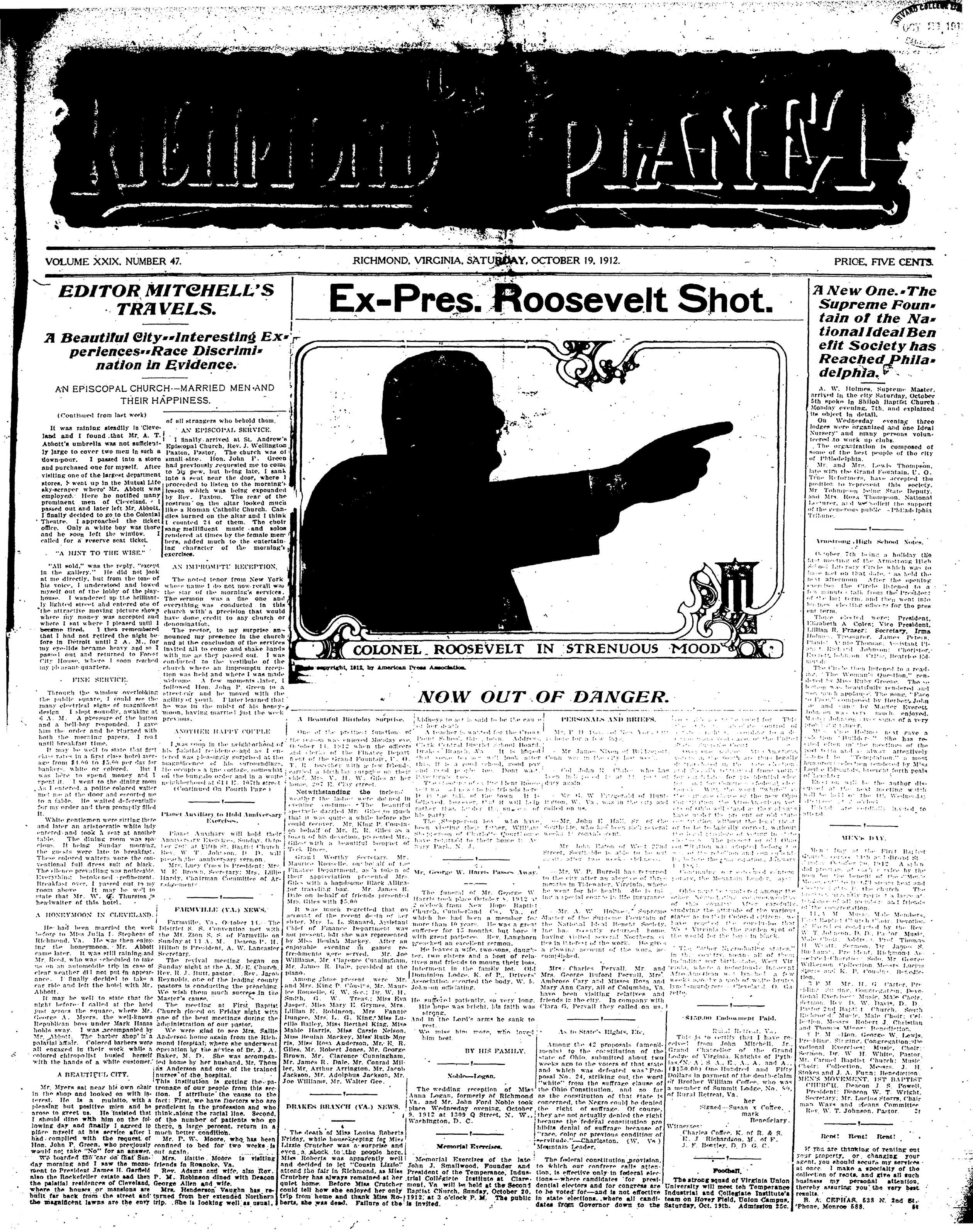
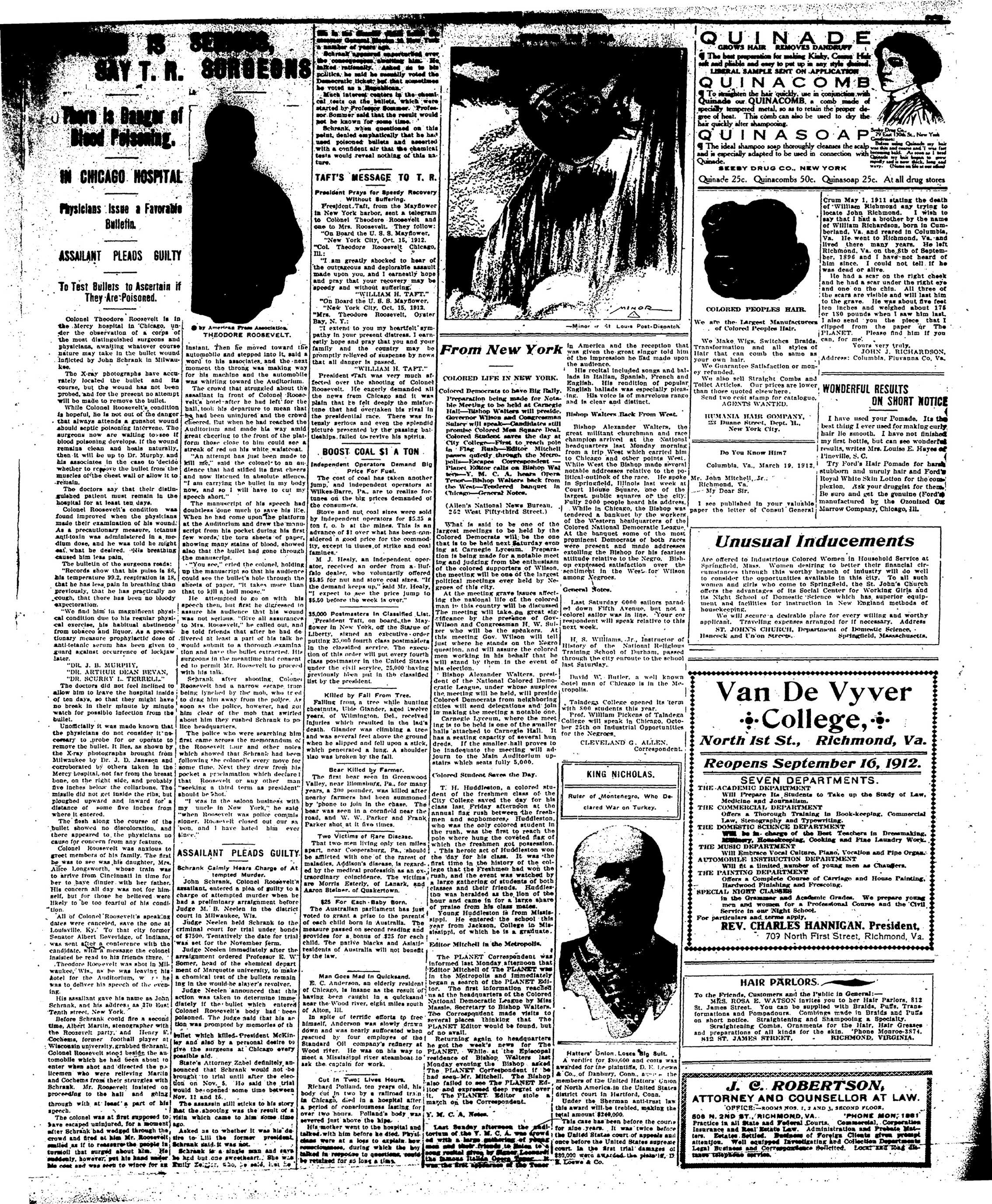
Ex-Pres. Roosevelt Shot.
COLONEL ROOSEVELT IN STRENUOUS MOOD
A Beautiful Birthday Surprise.
One of the principal functions of the season was enjoyed Monday evening October 14, 1912 when the officers and clerks of the Finanace Department of the Grand Pondau, V. O. T. R. together with a few friend carried a birthday purge on their chief, Mrs. V. H. W. Giles at her home, 207 K. Clay street.
Notwithstanding the inclement weather the ladies were dotted in evening costumes. The beautiful spectacle dazzled Mrs. Giles so much that it was quite a while before she could recover. Mr. King P. Consignon behalf of Mr. E. R. Giles as a token of his devotion, presented Mr. Giles with a beautiful bouquet of Tick Roos.
Grand Worthy Secretary. Mr. Maurice Ronselle, on behalf of the Finance Department, as a token of their appreciation presented Mrs. Giles with a handsome Black Alligator traveling bag. Mr. James R. Dale on behalf of friends presented Mrs. Giles with $5.00.
It was much regretted that our account of the recent death of her sister, Mrs. L. L. Stannard, Assistant Chief of Finance Department was not present, but she was represented by Miss Beulah Mackey. After an enjoyable evening in games refreshments were served. Mr. Joe Williams, Mr. Clarence Cunningham, Mr. James R. Dale, presided at the piano.
Among those present were Mr. and Mrs. King P. Connors, Mr. Maurice Roussele, G. W. Sec., Dr. W. H. Smith, G. W. Treas.; Mrs. Eva Jasper, Miss Mary E. Grymes, Mrs. Lillian E. Robinson, Mrs. Fannie Dungee, Mrs. L. G. King; Miss Lucille Bailey, Miss Berthel King, Miss Mable Harris, Miss Cassio Nelson, Miss Beulah Mackey, Miss Ruth Morris, Miss Rosa Anderson, Mr. E. R. Giles, Mr. Robert Jones, Mr. George Brown, Mr. Clarence Cunningham, Mr. James R. Dale, Mr. Conrad Miller, Mr. Arthur Arrington, Mr. Jacob Jackson, Mr. Adolphus Jackson, Mr. Joe Williams, Mr. Walter Gee.
DRAKES BRANCH (VA.) NEWS.
The death of Miss Louisa Roberts
Friday, while housekeeping for Miss
Lizzie Crutcher was a surprise and
even a shock to the people here.
Miss Roberts was apparently well
and decided to let "Cousin Lizzie"
attend the fair in Richmond, as Miss
Crutcher has always remained at her
quiet home. Before Miss Crutcher
could tell how she enjoyed her only
trip from home and thank Miss
Roberts, she was dead. Failure of the
NOW OUT OF DANGER.
Midneys to get is said to be the can o' her death.
A teacher is wanted for the Crown Point School, this town. Address: Cork Central District School Board, Brakes Branch, N.A. It is hoped that some tenor will look after this. It is a good school, good pay and good people too. Don't wait, have fun too.
The house of a Pleasant Hunt Rooms was all new to his friends here. It is the talk of the town. It is believed, however, that it will help rather than burden the success of his party.
The Shepperson boy who have been visiting their father, William Shepperson of Charlotte Courtown have returned to their home to Avary Park, N.J.
Mr. George W. Harris Passes Away.
The funeral of Mr. George W. Harris took place October 8, 1912 at 2 o'clock from New Hope Baptist Church, Cumberland Co., Va., of which he had been a member for more than 10 years. He was a great sufferer for 15 months, but bore it with great patience. Rev. Laughorn prescribed an excellent sermon. He leaves a wife, two sons, daughter, two sisters and a host of relatives and friends to mourn their loss. Interment in the family lot. Old Dominion Lodge, K. of P., Drivers' Association, escorted the body, W. L. Johnson officiating.
He suffered patiently, so very long. His hope was bright, his faith was strong. And in the Lord's arms he sank to rest.
We miss him more, who loved him host.
BY HIS FAMILY.
Noble—Logan.
The wedding reception of Miss Anna Logan, formerly of Richmond Va. and Mr. John Ford Noble took place Wednesday evening. October 9. 1912 at 1309 Q Street, N. W., Washington, D. C.
Memorial Exercises
Memorial Exercises of the late John J. Smallwood, Founder and President of the Temperance, Industrial Collegiate Institute at Clarmont, Va will be held at the Second Baptist Church, Sunday, October 20, 1912, at 3 o'clock P. M. The public is invited
PERSONALS AND BRIEFS.
Mr. P. H. Dawson of New York, City is here for a few days.
Mr. James Nixon of Bellevue County was in the city last week.
Col John R. Chiles who has been ill passed by at 11 p.m. of duty again.
Mr. G. W. Fitzgerald of Hunterton, W. Va., was in the city and called on us.
Mr. John R. Hall, Sr. of the Southside, who has been sick several weeks, is convulsant.
Mr. John Eaton of West Side Street, Southside is able to be out soon after two weeks.
Mr. W. P. Burrell has returned to the city after an abrupt of three months in Tallowwater, Virginia, where he went for his health. He is taking a special course in life insurance.
Mr. A. W. Hoose, Supreme Master of the Supreme Program of the National Ideal Benefit Society, has recently returned home, having visited several Northern cities in interest of the work. He gives a growing account of the work accomplished.
Mrs. Charles Pervall, Mr. and Mrs. George Buford Pervall, Mrs. Ambrose Cary and Misses Rosa and Mary Ann Cary, all of Columbia, Va. have been visiting relatives and friends in the city. In company with Chara G. Pervall they called on us.
As to State's Rights, Etc.
Among the 42 proposals (amendments) to the constitution of the state of Ohio, submitted about two weeks ago to the voters of that state and which was defeated was 'Proposal No. 24, striking out, the word "white" from the suffrage clause of the Ohio Constitution, and so far as the constitution of that state is concerned, the Negro could be denied the right of suffrage. Of course, they are not actually denied the right because the federal constitution prohibits denial of suffrage because of "race, color or previous condition of servitude."—Charleston. (W. Va.) Mountain Leader.
The federal constitution provision, to which our conferee calls attention, is effective only in federal elections—where candidates for presidential electors and for congress are to be voted for—and is not effective in state elections, where all candidates from Governor down to the
This article is not intended for the control of the state rights to be considered by a district court that area of the United States Supreme Court.
Over one million American voters in the South are thus legally distributed in the state election and directly elected from voters for presidential election and for Congressional election. With the world "whatever the case of the new Ohio Constitution the Affordable Voters of Ohio will stand in the always have under the present or old constitution without the least that or to be technically correct, without the local provisions of voting in the constitution. The present or old Ohio constitution was adopted before 1984 of the resolution and can be adopted before the gun legislation, January 1, 1851.
Continuing our continued interest, the Mountain Leader says:
Ohio must be numbered among the other New Yorkers, one of the most carefully surveying the attitude of the various states as to their Colorado citizens we have regarded the conclusion that West Virginia is the garden spot of the world for the boys in black.
"The other Narrative states," in the country, mean all of them including our birth-state, West Virginia, where a notoriously insensitive Afro-American was lynched a few weeks ago by a mob of white brutes lynched murderers — Cleveland, O. Garrett.
$150.00 Endowment Paid.
This is to certify that I have received from John Mitchell, Jr.
Grand Chancellor of the Grand
Lodge of Virginia, Knights of Pythias
N. A., S. A., E., A., A. and A.,
($150.00) One Hundred and Fifty
Dollars in payment of the death-claim
of Brother William Coffee, who was
a member of Summit Lodge, No. 50,
of Rural Retreat, Va.
her
Signed—Susan x Coffee.
mark
Beneficiary.
Witnesses:
Charla Coffee, K. of R. & S.
E. J. Richardson, M. of F.
J. F. Bentley, D. D. G. C.
Football.
The strong squad of Virginia Union
University will meet teh Temperance
Industrial and Collegiate Institute's
team on Hovey Field, Union Campus,
Saturday, Oct. 19th. Admission 25c.
PRICE. FIVE CENTS
A New One.-The Supreme Fountain of the National Ideal Benefit Society has Reached Philadelphia.
A. W. Holmes, Supreme Master, arrived in the city Saturday, October 5th spoke in Shiloh Baptist Church Monday evening, 7th, and explained its object in detail.
On Wednesday evening three lodges were organized and one Ideal Nursery and many persons volunteered to work up clubs.
The organization is composed of some of the best people of the city of Philadelphia.
Mr. and Mrs. Lewis Thompson, late with the Grand Fountain, U. O. True Reformers, have accepted the position to represent this society.
Mr. Thompson being State Deputy, and Mrs. Rosa Thompson, National Lecturer, and we solicit the support of the generous public - Philadelphia Tribune.
Armstrong, High School Notes.
October 7th being a holiday the first meeting of the Armstrong High School Literary Circle which was to have met on that date, was held the next afternoon. After the opening exercise the Circle listened to a few minutes talk from the President of the last term, and then went into business, selecting officers for the present term.
Those elected were: President, Elizabeth A Colen; Vice President, Lillian R. Fraser; Secretary, Irma Holmes; Treasurer, James Peter; Plaintiff, Vince Thomas; Assistant Piece, Richard Johnson; Chorister, Evart Johnson, Critie, Beatree Edmunds.
The Circle then listened to a reader, "The Woman's Question," rendered by Miss Billy Greene. The solemn was beautifully rendered and was well applauded. The song, "Faco to Faco," composed by Herbert John and sung by Master Everett Johnson was very much enjoyed. Master Johnson gave songs of a very pleasant singer.
Miss Holmes next gave a selection "Builders." She has received often in the meetings of the past term and always attentively listened to "Temptation," a most humorous selection rendered by Miss Louise Edmunds, brought forth peals of laughter.
Election will be the author dis-
cerned at the next meeting which
will be held on the 19th. Wednesday
afternoon at 10:30 a.m.
Election are cordially invited to
attend.
---
MEN'S DAY
Mon. Day at the First Baptist
Church, center 10th and Broad St.
Sunday, October 20, 1912. A splendid
that practice of each value by the
men for the benefit of the Music
Museum is to instill strenu heat and
creativeness in the church. The
beautifully respect a large
attendance of all members and friend
of the congregation.
11. A. M. Musse. Male Members.
First Baptist Church Choir. Devotion
of Experienced conduct by the Rev.
W. T. Johnson, D. D. Pastor Musse.
Male Choir. Address: Proof Thomas
H. Wattley. Sermon, Dr. James S.
Hulman. Prev. Hort. Rhodion A.
Associated Charities. Solo, Mr. George
Wilkerson. Collection Muses Lucia
Sports and K. P. Conyers. Benediction.
2. P. M. Mr. H. G. Carter. Pre-
vailing sinless congregation. Devotion
Everlasting Musie. Male Choir.
Sermon. Rev. D. W. Davis, D. D.
Pastor 2nd Baptist Church. South
Richmond of Musie. Male Choir; Col-
lection. Muses Robert J. Christian
and Thomas Minor. Benediction.
S. P. M. Hon. George W. Lewis,
President, Singer, Congregation; Devotional
Eveclesse: Music, Choir;
Sermon, Dr. W. H. White, Pastor;
Mt. Carmel Baptist Church; Music
Choir; Collection, Meers. J. H.
Stokea and J. A. Funn; Benediction;
MEN'S MOVEMENT, 1ST BAPTIST
CHURCH, Deacon J. S. Powell,
President; Deacon W. T. Wright,
Secretary; Mr. Lucia Storms, Chair
man Ways and Means Committee
Rev. W. T. Johnson, Pastor. 2t
Rent! Rent! Rent!
If you are thinking of renting out your property, or changing your agent, you should secure my services at once. I make a specialty of the collection of roots, and give all such business my personal attention, thereby assuring you the very best results.
B. A. CEPHAR. 538 N. 2nd St.
Phone, Monroe 588.
SATURDAY...OCTOBER 19, 1912.
The Three
Guardsmen
By
ALEXANDRE DUMAS
SYNOPSIS
Young D'Artagnan is going to Paris to seek service as the captain of the king's guards, he is paraded in Meng with a man accused of murder.
D'Artagnan is rescued by Tarttille and meets the three guards of Portrait Aramis and Athos. They have been questioned by the king. He is acquitted. Portrait Aramis Athos is awarded.
Tarttille writes D'Artagnan a letter to the director of the army, requesting my D'Artagnan to the army of Meng rushes to the fortress from Athos and is challenged.
D'Artagnan offers Portrait and Aramis and encloses the letter with them after Athos. Instructed to take action in a fight with the captain of the guards.
The three captains D'Artagnan. The king listens to the captain's account of the fight. D'Artagnan is made deputy, relative of Meng's fortress, who replies to the king.
Long places D'Artagnan in M. Lescensart's guards. He is acquitted by the king. Portrait Aramis Athos is acquitted and Portrait Aramis Athos is acquitted. He ends in the fortress.
Born in New York City in 1835, he
his wife, Elizabeth, in 1841, and
tegrae of New York City in 1842.
He knew of the New York City
club, and was a member of the
friends.
Born in New York City in 1835, he
cumul of New York City in 1841,
and tegrae of New York City in 1842.
He knew of the New York City
club, and was a member of the
friends.
Mine.
The Duke of Buckingham, favorite of King Charles of England, is in charge of the queen of France. It is vaguely guessed that him and Athena are directed by mistake for Dartagnan.
Quenr. annis reads Buckingham away after rather than before, used as a reminder of Athena. It is attested by Identities Athena. It is attested by Identities Buckingham.
CHAPTER XI.
Men of the RULE and Men of the Sword.
O N. M. after these events of the late KENNEDY, Athens not less represented, M. D. Tree Athena was informed by D. P. TANNEAL and B. BOTTLES of the circum stance. As to Athena, he had asked for more information for five days and was well with Rome, to Rome, on famine. M. D. Tree was the faller of his soldier. He repudiated, then instantly to the residence of the lieutenant criminal. The officer who commanded the post of the Grey House was sent for and, by successive impiances, they found that Athena was at the time lodged in the Fort Elysene.
Athos, after the scene with M. Moncleux, declared that his name was Athos, and not D. Artagnan. He added that he did not know either M. or Mine Bonacieux; that he had never spoken to the one or the other; that he had come at about 10 o'clock in the evening, to pay a visit to his friend, M. d'Artagnan, but that till that hour he had been at M. de Treville's, where he had dined: "twenty witnesses," added he, "could attest the fact," and he named several distinguished gentlemen, and among them was M. the Duke de la Tremouille.
The second commissary was as much bewildered as the first had been at the simple but firm declaration of the musketeer. Athos was then sent to the cardinal, but unfortunately the cardinal was at the Louvre with the king.
It was precisely at this moment at which M. de Treville arrived at the palace. As captain of the musketeers, M. de Treville had the right of entree at all times.
It is well known how violent the king's prejudices were against. the queen and how carefully these prejudices were kept up by the cardinal, who in affairs of intrigue mistreated women much more than men. One of the principal causes of this prejudice was the friendship of Anne of Austria for Mme. de Chevreuse. In his eyes and to his perfect conviction Mme. de Chevreuse not only served the queen in her political intrigue, but, which troubled him still more, in her love affairs.
At the first word the cardinal spoke of Mme. de Chevreuse, who, though exiled to Tours and who was believed to be in that city, had been at Paris, remained there five days and had outwitted the police, the king wished to a furious passion. Although captious and unfaithful, the king wished to be called Louis the Just and Louis the Faithful.
But when the cardinal added that not only Mme. de Chevreures had been in Paris, but, still further, that the queen had corresponded with her; when he affirmed that he, the cardinal, was about to unravel the most closely twisted thread of this intrigue: when at the moment of spreading in the fact with all the proofs about her, the queens emissary to the extinct ducess
a minister had dared to interrupt the course of justice violently by falling, award in hand, upon the honest part of the law charged with investigating importantly the whole affairs in order to place it before the syne of the king. Louis XIII, could not contain himself, and be made a step toward the queen's apartment with that pale and mute indignation which when it broke out led this prince to the commission of the coldest cruelty. And yet in all this the cardinal had not yet said a word about the Duke of Buckingham. At this instant M. de Treville entered, cold, polite and in irreponable costume. Rendered awarde of what had passed by the presence of the cardinal and the alteration in the king's countenance, M. de Treville felt himself something like Samson before the Philistines.
"You arrive in good time, moulleur," said the king, who, when his passions were raised to a certain point, could not dissemble; "I have learned some pretty things concerning your musketeers."
"And I," said M. de Treville, collyr, "I have some pretty things to inform your majesty of concerning these men of the robe. I have the honor to inform your majesty that a party of police have taken upon themselves to throw into the Fort Elevque, all upon an order which they have refused to show me, one of my, or rather your musketeers, sire, of irreproachable conduct, M. Athos.
"M. Athos went to pay a visit to one of his friends, at the time absent, to a young Bearnais, a ender in his majesty's guards, the company of M. Desessart, but scarcely had he arrived at his friend's and taken up a book while writing his return when a crowd of buffals and soldiers mixed, came and indied to the house and broke open several doors."
"Oh, we all know that," interrupted the king; "for all that was done for our service."
"Then," said Treville, "it was for your majesty's service that one of my musketeers, who was limine, has been paraded through the midst of an insolent population."
"Bah!" said the king, who began to be shaken, "was it managed so."
"M. de Treville," said the cardinal, with the greatest phlogem, "does not tell your majesty that this innocent musketeer, this gallant man, had only an hour before attempted, sword in hand, four commissioner of impiety, who was elevated by me to exaltation into an officer of the highest importance."
"I dedify your enclosure to prove it," yured M. de Treillac, with his ticonso freedom and military toughness, "for one hour before M. Athos, who, I will confide it to your majesty, is really a man of the highest quality, did me the honor, after having dined with me, to be conversing in the salon of my hotel with M. the Duke de la Tremontile, and M. te Couette de Chalus, who happened to be there."
The king looked at the cardinal.
"A process verbal attests it," said the cardinal.
"And, sir, is this process verbal of men of the role to be placed in comparison with the word of honor of a man of the sword?" replied Treillac haughtily.
"If his enclosure entertains any enquiries against one of my mans the justice of M. the Cardinal is sufficiently well known to induce me myself to demand an inquiry."
"In the house in which this political inquiry was made" continued the impassable cardinal, "there lodges I believe, a young armies, a friend of the musketeers, M. d'Artugman."
"Yes, your enmity."
"Do you not suspect this young man of having given bad advice."
"To M. Athos. To a man double his age?" interrupted M. de Trevillie, "No, monsignor Becces, M. d'Artugman passed the evening at my house."
"Let me impure at what hour he was with you," said the cardinal.
"Oh, that I can speak to positively, your enmity, for as he came in I remarked that it was but half past 9 by the clock, although I had believed it to be later."
"And at what hour did he leave your house?"
"At half past 10, an hour after the event."
"Well, but," replied the cardinal, who could not for an instant suspect the loyalty of De Treville and who felt that the victory was escaping from his hands—"well, but Athos was taken in the house of the Rue des Fonoyours."
"Is one friend forbidden to visit another or a musketeer of my company to fraternize with a guard of M. Dessecart's company?"
"Yes, when the house in which he fraternizes is suspected."
"Indeed, I knew nothing of the circumstance. The house may be suspected, but I deny that it is in the part of it inhibited by M. d'Artagnan, for I can affirm, sire. If I can believe what he says, that there does not exist a more devoted servant of your majesty or a more profound admirer of M. the Cardinal."
"Come, how shall we determine?" said the king.
"That concern your majesty more than me," said the cardinal. "I should affirm the culpability."
"And I deny it," said De Treville. "But his majesty has judges, and these judges will decide."
"That is best," said the king. "Bend the case before the judges; it is their business to judge, and they will judge."
"Only," replied Treville. "It is a sad thing that, in the unfortunate times in which we live, the purest life, the most incontestable virtue, cannot exempt a man from infamy and persecution. The army, I will answer for it, will be but little pleased at being exposed to rigorous treatment on account of affairs of police."
The expression was imprudent, but M. de Treville launched it with a full knowledge of his cause. He was desirous of an explosion, because in that case the mine throws forth fire, and are alightens.
"Affairs of police" cried the king, taking up the Treville's word, "affects of police: And what do you know about them...monsieur? Here is a piece
of work about a musketier. Why, would need seven of them, a hundred, seven—all the company, and I would not allow a warrant."
"From the moment they are prepared by your authority," said Treville, who musketier is guilty. Therefore you are no prepared to surrender my weapon; for, after having accounted my soldiers, there can be no doubt that M. the Cardinal will end by accusing me."
"Gascon headed man, will you have done?" said the king.
"Sire," replied Treville, without lowering his voice in the least, "either order my musketeer to be restored to me or let him be tried."
"He shall be tried," said the cardinal.
"Well, so much the better, for in that case I shall demand of his majesty permission to plead for him."
The king became afraid of an outbreak.
"If his eninence," said he, "had not personal motives"—
"Pardon me," said Richelieu, "but the instant your majesty considers me a prejudiced judge I wndhraw."
"Come," said the king, "will you swear by my father that M. Athos was
BIRMED
"Gascon headed man, will you have done?" said the king.
ag, your residence during the event and that he took no part in it?
"By your gorious father, and by yourself who are that which I love and venerate the most in the world—I swear it."
"Be so kind as to reflect, sir," said the cardinal. "If we release the prisoner thus we shall never be able to know the truth."
"M. Athos will always be where he is to be found," replied Treville—always ready to answer, when it shall please the men of the long robe to interrogate him."
"And he is in the Fort P'Eveque?" said the king.
"Yes, sir, in solitary confinement, in a dungeon, like the lowest criminal in France."
"What must be done?" murmured the king.
"Sign the order for his release, and all will be said," replied the cardinal. "I believe, with your majesty, that M. de Treville's guarantee is more than authentic."
Treville lowest very respectfully, with a joy that was not unimpaired with fear; he would have preferred an obstinate resistance on the part of the cardinal to this sudden yielding.
The king signed the order and Treville carried it away without delay. He made his entrance triumphantly into the Fort PEVEQUE, whence he delivered Athos, whose peaceful indifference had not for a moment abandoned him.
Surely had the captain of the musketeers closed the door after him than his enmence said to the king:
"Now that we are, at length by ourselves we will, if your majesty please, converse seriously. Sire, M. de Buckingham has been in Paris five days and only left it this morning."
CHAPTER XII.
In Which M. Saguir, the Keeper of the Seals, Seeks a Love Letter.
It is impossible to form an idea of the impression these few words made upon Louis XIII. He grew pale and red alternately, and the cardinal, saw at once that he had recovered, by a single blow, all the ground he had lost.
"M. do Buckingham in Parish," cried he, "and what does he come to do here?"
"To conspire, no doubt, with your enemies the Hinguents and the Spanards."
"No, no! To conspire against my honor, with Mme. de Chevreures, Mme. de Longuerville and the Condes."
"Oh! sire, what an idea! The queen is too prudent and, besides, loves your majesty too well."
"Woman, is weak, M. is Cardinal," said the king, "and as to loving me much I have my own opinion respecting that love."
"None the less I maintain," said the cardinal, "that the Duke of Buckingham came to Paris for a project purely political."
"And I am sure that he came for quite another purpose."
"Mme. de Lannoy," said the cardinal, "whom, according to your majesty's command, I have frequently interrogated, told me this morning that the night before last her majesty sat up very late, that this morning she wept much and that she was writing all day."
"That's it!" cried the king; "to bhm, no doubt. Cardinal, I must have the queen's papers."
"But how to take them, then? It seems to me that neither your majesty nor I can charge ourselves with such a mission."
"Who has about her a certain Leone?"
"Who, I believe, in the making of all this, I profited," said the maning.
"You think, then, as I do, that she deserves man?" said the king.
"I tell you the queen loves that in famous Barkingham. Why did you not cause him to be arrested while he was in Paris?
"Arrest the duke! Arrest the prime minister of King Charles II. Think of it, sir! What a scandal!
"But all the time he was in Paris you, of course, did not lose sight of him!
"No, sir.
"Where did he lodge?
"Rue de la Harpe, No. 75."
"Where is that?"
"I believe the queen to have too high a sense of her duties, alre."
"But they have corresponded. It is to him that the queen has been writing all day. M. le Duc, I must have those letters."
"There is but one means."
"What is that?"
"That would be to charge M. de Beguer, the keeper of the scals, with this mission. The matter enters completely into the duties of his post."
"Let him be sent for instantly."
"Your majesty's orders shall be executed, but the queen will perhaps refuse to obey."
"What, my orders?"
"Yes, if she is ignorant that these orders come from the king."
"Well, that she may have no doubt on that hand I will go and inform her myself. Send for monsieur the keeper of the souls. I will go to the queen."
And Louis XII, opening the door of communication, passed into the corridor which led to the apartments of Anne of Au-krin.
The queen was in the midst of and thoughts which the king entered. Like those unfortunate persons endowed with a fatal gift, she brought, misfortune upon everything she touched; her friendship was a fatal sign which called down ressecution. Mine Chevreuse and Mine Vernet were exiled, and Laporte did not conceal from his mistress that he expected to be arrested every instant.
"Madame," said the king, "you are about to receive a visit from the chancellor, who will communicate certain matters to you, with which I have charged him."
"But why this visit, sir? What can M. the Chancellor or have to say to me that your majesty could not say yourself?
The king turned upon his heel without reply, and pummed at the same instant the captain of the guards, M. de Guitant, announced the visit of M. the Chancellor.
When the chancellor appeared the king had already gone out by another door.
The chancellor was a pleasant man. It was Daisy Reshef in Male, canon of Notre Dame, and who had formerly been aubut de chambre to the cardinal, who introduced him to his enmence as a perfectly devout man. The cardinal trusted him and found his advenant go in.
The queen was still standing when he entered, but secretly had she perceived him than she resisted herself and with an air of supreme hauteur, said.
"What do you desire, monkour, and with what object do you present yourself here?"
"To make, madame, in the name of the king, and without prejudices to the respect which I have the honor to owe to your majesty, a close perquisition into all your papers. He kind enough to parlor me, madame, but in this circumstance I am not the instrument which the king employs."
"Examine, then, monkour. I am a criminal, as it appears. Estafania, give the keys of my tables and my secretaries."
For form's sake the chancellor paid a visit to the pieces of furniture named, but he well knew that it was not in a piece of furniture that the queen would place the important letter she had written in the course of the day.
When the chancellor had opened and shut twenty times the drawers of the secretaries it became necessary, whatever hesitation he might experience, it became necessary, I say, to come to the conclusion of the affair—that is to say, to search the queen herself. The chancellor advanced, therefore, toward Anne of Austria and with a very perplexed and embarrassed air: "And now," said he, "it remains for me to make the principal perquisition." "What is that? asked the queen, who did not understand, or, rather, was not willing to understand." "His majesty is certain that a letter has been written by you in the course of the day. He knows that it has not been sent to its address. This letter must be somewhere."
"Would you dare to lift your hand to your queen?" said Anne of Austria, drawing herself up to her full height and fixing her eyes upon the chancellor with an expression almost threatening. "The letter is here," and the queen laid her beautiful hand on her bosom. "I will give it to none but the king, monseur." "If the king had desired that the letter should be given to him, madame, he would have domanded it of you himself, and if you do not give it up"—"Well" "He has, then, charged me to take it from you. Be kind enough, then, madame, to act more compliantly." "This conduct is infamously violent."
"The king commands it, madame. Excuse me." "I will not suffer it! No, no, I would rather die!" The chancellor made a profound reverence. Then, with the intention quite patent of not drawing back a foot from the accomplishment of his commission, he approached Anne of Austria, from whom eyes at the same instant sprang tears of rage. She made one step backward, became so pale that it might be said she was dying, and leaming with her left hand to keep herself from falling upon a table behind her, she with
the right hand drive the pigeon from
his beacon and hold it out to the beacon
of the snail.
There, monastery, there is that lootier" cried the queen, with a beaten and trumbling voice: "take it and deliver me from your own possession." The door was almost closed upon him when the queen peek, half flicking, into the arms of her woman.
The chancellor carried the letter to the king without having read a single word of it. The king took it with a trumbling hand, loohed for the address, which was wanting, became very pale, opened it slowly, then, soeding by the first words that it was addressed to the king of Spain, he said it rapidly.
It was nothing but a plan of an attack against the cardinal. The queen pressed her brother and the emperor of Austria to appear to be wounded, as they really were, by the policy of Richelieu, the eternal object of which was the abasement of the house of Austria, to declare war against France, and, as a condition of peace, to insist upon the dismissal of the cardinal.
The king, quite delighted, went
The king, quite delighted, went straight to the cardinal.
"There, duke," said he, "you were right and I was wrong. The whole intrigue is political, and there is not the least question of love in this said letter. But, on the other hand, there is abundant question of you."
The cardinal took the letter and read it with the greatest attention.
"Well, your majesty," said he, "you see how far my enemies go. They threaten you with two wars if you do not dismise me. In your place, in truth, sire, I should yield to such powerful instances, and, on my part, it would be a real happiness to withdraw from public affairs. My health is sinking under these annoying struggles, and these never ending labors. You would be the happier for it at home, sire, and I do not doubt you would be the greter for it abroad."
"M. le Duc," said the king, "I understand you. Be satisfied. All who are named in that letter shall be punished as they deserve, and the queen herself shall not be forgotten."
"What do you say, sire? Heaven forbid that the queen should suffer the least inconvenience or uneasiness on my account. She has always believed me, sire, to be her enemy, although your majesty can bear witness that I have always taken her part warmly, even against you."
"That is true. M. le Cardinal," said the king, "and you were right, as you always are, but the queen not the less deserves all my anger."
"The queen is my enemy, but is not yours, sire. On the contrary, she is a devoted, submissive and irreproachable wife. Allow me, then, sire, to intercede for her with your majesty."
"Let her humble herself, then, and come to me first."
"On the contrary, sir, set the example."
"What! I make advances first!" said the king. "Never!"
"Sire, I entreat you to do so."
"Besides, in what manner can I make advances first?"
"Give a ball. You know how much the queen loves dancing. I will answer for it her resentment will not hold against such an attention."
"M. le Cardinal, you know that I do not like mundane pleasures."
"The queen will only be the more grateful to you, as she knows your antipathy for that amusement. Besides, it will be an opportunity for her to wear those beautiful diamonds which you gave her recently on her birthday and with which she has since had no occasion to adorn herself."
Then the cardinal, hearing the clock strike 11, bowed low, demanding permission of the king to retire and supplicating him to come to a good understanding with the queen.
Anne of Austria, who in consequence of the seizure of her letter, expected reproaches, was much astonished the next day to see the king, make some attempts at reconciliation, with her. Her first movement was repulsive. Overpersuaded by the advice of her women, she at last had the appearance of beginning to forret. The king took advantage of this favorable moment to tell her that he had the intention of shortly giving a fete. A fete was so rare a thing for poor Anne of Austria that at this announcement, as the cardinal had predicted, the last trace of her resentment disappeared, if not from her heart, at least from her countenance. She asked upon what day this fete would take place, but the king replied that he must consult the cardinal upon that head.
In fact, every day the king asked the cardinal when this fete should take place, and every day the cardinal, under some pretense or other, deferred fixing it. Ten days passed away thus.
On the eighth day after the scene we have described, the cardinal received a letter with the London stamp, which only contain these lines:
"I have them, but I am unable to leave London for want of money; send me 500 pistoles, and four or five days after I have received them I shall be in Paris."
On the same day that the cardinal received this letter, the king put his customary question to him.
Richelieu counted on his fingers and said to himself:
"She will arrive, she says, four or five days after having received the money. It will require four or five days for the transmission of the money, four or five days for her to return, that makes ten days. Now, allowing for contrary winds, accidents and a woman's weakness, we cannot make it altogether less than twelve days."
"Well, M. le Duc," said the king,
"have you made your calculations?"
"Yes, sire, today is the 20th of September; the aldermen of the city give a fete on the 3d of October. That will fall in wonderfully well. You will not appear to have gone out of your way to please the queen."
Then the cardinal added:
"Apropos, sire, do not forget to tell her majesty the evening before the
If you have entered any instalment of this story, you can obtain to by something on the date of james and fete.
It was the second time the cardinal had mentioned these diamond studs to the king. Lords XIII. were struck with the mention.
We were with these repressions and began to fancy that this recommendation concealed some mystery. He hoped in a conversation with Anne of Austria to obtain some information from that conversation and afterward to come upon his eminence with some secret, which the cardinal either knew or did not know, but which in either case would raise him infinitely, in the eyes of his minister. He went, then, to the queen and, according to custom, accosted her with fresh menaces against those who surrounded her. "But," cried Anne of Austria, tired of these vague attacks, "but, sire, you do not tell me all that you have in your heart. What have I done, then? Let me know what crime I have committed. It is impossible that your majesty can make all this to do about a letter written to my brother."
The king, attacked in a manner so direct, did not know what to answer, and he thought that this was the moment for expressing the desire which he was not to have made until the evening before the fete.
"Midame," said he, with dignity, "there will shortly be a ball at the Hotel do Ville. I wish that, to do honor to our worthy aldermen, you should appear at it in ceremonial costume and particularly ornamented with the diamond studs which I gave you on your birthday. That is my answer."
The answer was terrible. Anne of Austria believed that Louis XIII knew all and that the cardinal had persuaded him to employ this long dissimulation of "seven or eight days, which, likewise, was characteristic. She became excessively pale and was unable to reply by a single syllable.
"You hear, madame," said the king, who enjoyed this embarrassment to its full extent, but without guessing the cause, "you hear, madame. You will appear at this ball and 'with those studs?'
"Yes."
The queen's paleness, if possible, increased. The king perceived it and enjoyed it with his cold cruelty.
"Then that is agreed," said he.
"But on what day will this ball take place?" naked Anne of Austria.
Louis XIII, felt instinctively that he ought not to reply to this question.
"Oh, very shortly, madame," said he.
"but I do not precisely recollect the date of the day. I will ask the cardinal. Then you will appear?"
"Yes, sir."
"Very well," said the king, retiring;
"I depend upon you."
The queen made a courtesy, less from etiquette than because her knees were sinking under her.
"I am lost," murmured the queen; "loot, for the cardinal knows all, and it is he who urges on the king, who as yet knows nothing, but will soon know everything. I am lost." She knelt upon a cushion and prayed, with her head buried between her palpitating arms. In fact, her position was terrible. She had not a soul in the world in whom she could confide with safety. "Can I be of no service to your majesty?" said all at once a voice full of sweetness and pity. The queen turned sharply round, for there could be no deception in the expression of that voice. It was a friend who spoke thus. It was the pretty Mine. Bonacieux, She had been engaged in arranging the dresses and linen in a closet when the king entered. She could not get out and had heard all.
The queen uttered a piercing cry at finding herself surprised, for in her trouble she did not at first recognize the young woman who had been given to her by Laporte.
"Oh, fear nothing, madame!" said the young woman, clasping her hands and weeping herself at the queen's sorrows.
"I am your majesty's. body and soul, and, however far I may be from you, however inferior may be my position, I believe I have discovered a means of extricate your majesty from your trouble."
"Look me in the face!" cried the queen. "I am betrayed on all sides! Can I trust in you!"
"Oh, madame," cried the young woman, falling on her knee, "upon my soul, I am ready to die for your majesty. There are trafflers here, but by the holy name of the Virgin I swear that none is more devoted to your majesty than I am. Those studs which the king speaks of, you gave them to the Duke of Buckingham, did you not? Those studs were in a little rosewood box which he held under his arm? Am I deceived? Is it not so, madame? We must have them back again."
"Yes, without doubt it must be so!" cried the queen. "But how am I to act? How can it be effected?"
"Some one must be sent to the duke. Place confidence in me, madame. Do me that honor, my queen, and I will find a messenger."
"But I must write."
"Oh, yes; that is indispensable! Two words from the hand of your majesty, and your own private seal."
"But these two words would bring about my condemnation, divorce, arrest."
"Yes, if they fell into infamous hands, but I will answer for these two words being delivered to their address."
"Oh, I must then place my life, my honor, my reputation, all in your hands?"
"Yes, yes, madame, you must, and I will save them all."
"But how-tell me at least how?"
"My husband has been set at liberty these two or three days. I have not yet bad time to see him again. He will do anything I wish. He will set out upon receiving an order from me without knowing what he carries, and he will remit your majesty's letter without even knowing it is from your majesty."
The queen took the two hands of the young woman with a burst of emotion, ganced at her as if to read her very
heart pity, seeing nothing but dignity in her beautiful eyes,安慰ed, her tenderly. Then she ran to a little table upon which were penn. ink and paper, she wrote two lines, enclosed the letter with her private seal and gave it to Mina, Bonacieux.
"And now," said the queen, "we are forgetting one very necessary thing—money."
Mina, Bonacieux blushed.
"Yes, that is true," said she, "and I will confess to your majesty that my husband—"
"Your husband has none; is that what you would say?"
"Oh, yes, he has some, but he is very avaricious—that is his fault. Never theless, let not your majesty be uneasy. We will find means."
"And I have none, either," said the queen. "But wait a minute."
Anne of Austria ran to ber, jewel case.
"Here," said she, "here is a ring of great value, as I have been assured. It came from my brother, the king of Spain. It is mine, and I am at liberty to dispose of it. Take this ring, make money of it and let your husband set out."
"In an hour you shall be obeyed, madame."
"You see the address," said the queen, speaking so tow that Mme. Bonacieux could hardly bear what she said—"To Millard Duke of Buckingham, London."
Mme. Bonacieux kissed the habs of the queen, concealed the paper in the bosom of her dress and disappeared with the lightness of a bird.
Ten minutes afterward she was at home. As she told the queen she had
Pierre
"Take this ring, make money of it and let your husband set out."
not seen her husband since his liberation, she was ignorant of the change that had taken place in him with respect to the cardinal, a change which had since been strengthened by two or three visits from the Count do Roechfort, who had become the best friend of Bonacieux.
She found Bonacieux alone. The worthy mercer had, immediately upon entering his house, communicated to his wife the news of his happy return, and his wife had replied by congratulating him and telling him that the first moment she could steal from her duties should be devoted to puying him a visit.
The first moment had been delayed five days, which under any other circumstances might have appeared rather long to Master Bonacleux, but he had in the visit he had made to the cardinal and in the visits Rochefort had made him ample subjects for reflection.
On her side, Mme. Bonacleux's thoughts constantly reverted to D'Aragan, that handsome young man who was so brave and appeared to be so much in love with her. Married at eighteen to M. Bonacleux, having always lived among her husband's friends, Mme. Bonacleux had remained insensible to vulgar adductions, but at this period the title of gentleman had a particularly great influence with the bourgeois or citizen class, and D'Aragan was a gentleman.
The married couple then, although they had not seen each other for eight days and that during that time serious events had taken place in which both were concerned, accosted each other with a degree of preoccupation. Nevertheless M. Bonncleux manifested real joy and advanced toward his wife withebopen arms. Mme. Bonncleux presented her check to him.
"Let us talk a little," said she. "It is of a thing of the highest interest and upon which our future fortune perhaps depends I would speak."
"The complexion of our fortune has changed very much since I saw you. Mme. Bonncleux, and I should not be astonished if in the course of a few months it were to excite envy of many folks."
"Particularly if you obey the instructions I am about to give you."
"Yes, to you. There is a good and holy action to be performed, monsieur, and much money to be gained at the same time."
"Much money to be gained?" said Bonacteux.
"Yes, much."
"About how much, pray?"
"A thousand pistoles perhaps."
"What is to be done?"
"You must set out immediately for London; I will give you a paper which you must not part with on any account and which you will deliver into the proper hands."
"I go to London! I have nothing to do in London."
"But others require that you should go there. An illustrious person sends you, an illustrious person awaits you and the recompense will exceed your expectations."
"More. Intrigues! Nothing but in."
---
---
Published every Saturday by JOHN MITCHELL,
JR., at ELI K. Fourth Street, Midland, Va.
JOHN MITCHELL, JR., . . EDITOR
All communications intended for publication
should be sent so as to reach us by Wednesday.
TERMS IN ADVANCE
One Copy, per year ..... $1.50
One Copy, eight months ..... 1.00
One Copy, six months ..... .80
One Copy, four months ..... .50
One Copy, three months ..... .40
Right Copy ..... .00
ADVERTISING WATER
For one inch, one insertion.....9.50
For two inches, one subsequent insertion.....9.50
For two inches, three months.....6.00
For two inches, six months.....10.00
For two inches, may months.....14.00
For two inches, may months.....20.00
Marriage and Funeral Notice, one inch.....8.50
Marriage and Transit Notice, per line.....10.00
POSTAGE STAMP OF A HIGHER DENOMINATION THAN TWO CENTS NOT RECEIVED ON SUBSCRIPTIONS.
THE PLANET is issued weekly. The subscription price is $1.50 per year. Money payable by post, in which money can be sent by mail at our站 in a Post Office Money Order, by Bank Check or Draft, of an昂贵 Money Order, and in Certified Letter,
MONEY ORDERS—You can buy a Money Order at your Post Office, payable at the Richmond Post Office, and we will be responsible for its late arrival.
EXPRESS MONEY ORDERS can be obtained at any office of the American Express Co., the United States Express Company. We will be responsible for money sent by any of these companies. The Express Money Order is a safe and convenient way for borrowers to send money. The Express Money Order is in Money Order, Post Office or an Express Office is not within your reach, your Postmaster will register the Letter you wish to send to Letter in local or stalen, it can be travel. You can send money in this manner at our risk.
We cannot be responsible for money sent in any other way. If you send your money in any other way, you must do it at your own risk.
THE PLANETAL ETO—If you do not want THE PLANETAL for another year after your subscription has run out, you then notify us by Post Card to discontinue it. The courts have decided that the paper discontinued at the expiration of time for which it has been paid are holdable for the payment of the subscription up to date when they order the paper discontinued.
COMMUNICATION—When writing to us to
renew your subscription or to discontinue your
paper, you should give your name and address
we write to we must final your name on
our book.
CHANGE OF ADDRESS—In order to change
the address of a subscriber we must be the
horner, as well as the present address.
Entered at the Post Office at Richmond, Va.,
as enclosed matter.
Let us practice the virtues of the white man and not his vices.
---
Colored men, stand up for your rights in a respectful way. Cultivate manhood and race pride and respect from all classes will follow.
The attempted assassination of ex-President Theodore Roosevelt at Milwaukee, Wisconsin last Monday by John Schrank, a socialist will be regretted by every patriotic citizen in this country. The fact that this would-be murderer is a Bavarian by birth and one of the anarchistic type of immigrants who are permitted to come to our shores will afford much food for thought. It shows that these men have no conception of American institutions, but presumme that they are face to face with dynamic conditions from which they have escaped.
In our judgment, the effect will be to help Col. Roosevelt in his canvass rather than hurt him and it will increase very materially his vote at the polls. His attitude under these most trying circumstances was truly heroic and will elicit admiration for him even from unfriendly sources.
We pause to remark that the Southland which he has eliminated from his party in the matter of political representation contains no anarchists in the black race and "breeds" no incendias among one of the kindiest races of people on the face of the globe.
We regret this injury to him and one and all hope for his speedy and permanent recovery.
The outlook for the election of Hon. Woodrow Wilson is very bright and the betraying is all that way, but there are underground forces at work which may make it impossible for any of the three candidates to receive the necessary number of electoral votes and the contest may be thrown in the House of Representatives where contrary to popular belief, the result would be a tie and none of the leading candidates can be elected. In the House, the veto is taken by states as a unit and not by the individual members of the body.
There is a fatal possibility on Har-
bear's Weekly has repeatedly pointed out, that when the content is thrown in the United States Senate as a result of the failure of the House to agree, the present Vice-President may become President of the United States and Hon. James S. Sherman may sit in the White House of the nation, thus continuing Republican rule four years longer.
The 32nd Anniversary Bearer of
the Y. K. G. A. will be held at 61
Baptist Church, Sunday, November
3rd. Dr. Bransome Farne will write
There is no longer any doubt, but what President Taft is rapidly gaining upon his opponents and that if he had months instead of weeks between now and the election, he might be able to achieve wonders in the matter of securing votes. This is caused by the hesitancy on the part of the business interests, and the people to risk a change. The farmers are in the midst of prosperity and the city people are paying for it. Still, Mr. Wilson is in the lead and he may be the next President of the United States.
A QUESTION OF COLOR.
Colored men of Independent ten-dencies throughout the United States have viewed with interest the attitude of the Democratic Party of Virginia with reference to its Liberality, in giving the seal of its approval to a primary law which accepted all Democrats, regardless of race or color as political equals and permitted them to vote for the Democratic candidates of their choice in the legal party councils. It was hallowed as a new era in the history of the Democratic Party and announced as the beginning of the Liberation of colored men from political threaten in the polls.
All of this has been charged now if we are to judge by the disclosure made and action taken in the context of Hoe. Robert Taribull, who was questionably defeated by Judge Walter A. Watson. Some extracts from the argument and statement made before the Democratic State Committee Wednesday night, 16th inst. in this city will no doubt prove of interest.
The primary law makes absolutely no discrimination on account of color. It is evident that there are two wings of the Democratic Party, one being in favor of equality of rights for all Democrats and the other being what is termed as the Negro hating, moss-back Democrats. Mr. E. P. Buford of Lawrenceville, Va. spoke
The Times Dispatch says:
Mr Buford argued for a strict interpretation of the primary law, so as to count only such ballots as were marked according to the provisions of the general statute; contended that the eight Negroes who voted for Mr. Turnbull in Brunswick were lawful voters; that the law was administered with partiality in Dinwiddie county, where men who had voted for an independent candidate for the House of Delegates last year were permitted to take part in the primary and asserted that many persons voted who had not properly paid their poll taxes.
The following will prove interesting:
As soon as the State committee had been called to order by Chairman Ellison, the findings of the Fourth District Committee were reported by its chairman, Robert Gilliam. It set forth that in the recent primary there were unusually few irregularities and no frauds. The committee had eliminated the votes of eight Negroes who had voted for Turanbul, and one who had voted for Watson.
Here is an instance where the primary law and the legal mandates are nullified and disregarded. The law says that these nine Democratic votes lawfully cast by nine Democratic colored men shall be counted as cast and a Democratic District Committee deliberately over-rides the law and eliminates these votes in the count. This makes the whole
Here is the report:
E. P. Buford opened the discussion for the contestant, Mr. Turnbull. He laid down the proposition that the right to vote had been denied to more applicants who favored Turnbull than to those who were for Watson. He complained that the district committee, in its report, had given undue prominence to the fact that Turnbull had asked that the votes of eight Brunawlek Negroes he counted for him. The chairman of the Progressive Party in Nottoway County, a Negro, had, he pointed out, voted for Watson. The district committee, proceeded Mr. Buford, had canvassed the votes without the poll books, and had only secured them too late to permit the contestant to specify his charges of illegal voting.
Mr. Buford is evidently a type of Virginian who speaks plainly what he thinks. How also could we construe the following?
Negroes otherwise qualified had a right to vote, said Mr. Buford. If the Party had a right to add to the law so as to exclude the black man, it would also have the right to exclude redhaird white men. The Negro, he argued, can do no political harm, and it is not good policy to exclude him.
Concluding, Mr. Buford said he confessed to a certain degree of political independence, placing the good of the State highest. He looked with apprehension on the subsistence of fundaments to more partisan influences. At the end of one hour Mr. Buford rested.
This is high ground and it is firm ground. These kind of Democrats are numerous in Virginia and it is
In this type of white Virginia that the better class of colored people can confide. The most remarkable part of the whole affair was the speech of Blae R. Evalyn Byrd; Speaker of the House of Delegates of this state. This gentleman has been presumed to represent the interests of our mother state without regard to race, color or previous condition of our vulture. He is the author of the primary election law for it hears his name.
It was several weeks ago that Miss Sparkes received the candy. City and federal detectives have been endeavoring to obtain a clue to the identity of the criminal.
Miss Sparkes has recovered, but she is in constant fear that some enemy might take other means of injuring her. It is pointed out that the aim of the sender of the candy might have been the permanent injury of the girl's vocal organs through inducing lock-faw, as the drug has that tendency.
In the face of all of this, and with the fact that the law specifically provides that both white and colored men shall vote in the Democratic primary if they are Democrats, he advised the violation of the law and a plain disregard of the provisions of the very legislative instrument which he himself fathored.
We cannot understand this kind of statesmanship. It is belittling to Virginia manhood and a reflection upon the honesty, intelligence and good intention of those who frame our laws. He permitted Mr. Buford to plead in vain. It is on a plane with the ridiculous ruling of our Attorney General here who is said to have given an unofficial opinion that colored Democrats should not be permitted to vote in Democratic primaries.
This then stimulates the feeling that laws are enacted for the purpose of deceiving and to be used against the other fellow. But what did Hop R. Evelyn Byrd say? We quote the Time-Dispatch as follows:
As to the recount, Mr. Byrd did not care how it went, since giving Mr. Turnhill all he claimed on this score, Judge Watson would still have twenty majority. It would be a great mistake, he argued, to allow the Negroes to get political power. The late unlamented Constitutional Convention" had tried to eliminate the black man as a political equation Yet many of them are getting back on the registration books—200 in Brunswick county, the home of Mr. Turnhill.
This is rather peculiar language for a Virginia statesman. These colored men are getting back on the registration books because they are entitled to get back there and because the local Democratic leaders who know them believe that they are entitled to be on these books. They are voting for Southerners, "to the manor born." They are voting for Democrats, not Republicans or carpet-baggers and they are doing it in good faith. The evidence shows that both Congressman Turnbull and Judge Watson received their support.
Mr. Byrd is quoted further:
I believe the prosperity of Virginia," announced Mr. Byrd, "is wrapped up in the continued supremacy of the Democratic party. Mr. Buford is frank and equacious when he says that the trend of his mind is toward political independence. But to those who believe, as I do, that this is and must be a government by parties, we cannot think that the convention intended to take Negroes into a Democratic bosom.
"Mr Turnbull is an able, distinguished and incorruptible Democrat. He did not desire nor solicit Negro votes. His counsel claims that it was a sin for one Negro in Nottaway to vote for Watson; therefore it was eight times as much sin for those who voted for Turnbull in Brunswick.
"I do not recognize the Byrd law as my legitimate offspring. But even in its present multilated shape it was never intended to allow Negroes to vote."
Could statements be more ridiculously absurd? Colored men have been belabored for more than thirty years for their fidelity to Northerners, and the Republican Party and now this representative Virginian deliberately condemns them for doing the very thing which they have been told time immemorial was the proper thing for them to do.
It should not be forgotten, too, that this distinguished Southerner is sworn to recognize the civil and political equality of all men before the law and to uphold the laws of this commonwealth. It is inconceivable to us that a gentleman of Mr. Byrd's character and standing, could take the position which is accredited to him.
This then is the situation in this state with reference to colored men who desire to affiliate with the Democratic Party. Here in Richmond, colored men of prominence were denied the right to vote in the Democratic primary for members of the Administrative Board although they had been accorded that right in the primary election for Congressmen. The presumption is that they will be in a similar predicament hereafter.
This then explains why colored men in this section of the country cannot consistently affiliate with the Democratic Party. Such colored men who are willing to crawl around into the Democratic organization in a servile manner and by the back-door have the privilege of so doing, but they will not and cannot by this method bring other than contempt to themselves and disrespect to the race which they represent.
Elmer
Mackwell
Travels.
(C
John
)
I soon met the bride, who proved to
have been a charming widow and
she brought to his family how he
lily. I sat down to dinner with
happy combine until I remembered
that Mr. George A: Myers awaited
me.
It is hardly fair to tell of Mr. Green's happiness and of his ability to do the "kissing act" for all of his family. He plainly intimated to me by his actions that he could kiss all of them and he proceeded so to do, while I looked on with unfeigned amazement and 'amusement. The two single daughters there were just budding into womanhood; and the only unkissed members of that family were the male ones, and I presumed 'that he left them for my attention, but I did not take the hint and after many apologies for my hasty exit, started for the front door.
A WEALTHY. TONSORIAL ARTIST.
Reaching Mr. Myers' residence at 2199 E. 71st St., I found him and his Madame awaiting me and in company with Mr. Green, we were soon snugly located in the dining room where later the accomplished Mrs. Myers joined us. Their daughter was indulged and I did not have the pleasure of meeting her. It was a short time afterwards that two other friends joined us.
When the automobile came Mr. Green and I entered it and waving adieu to our new-found friends, were soon on the way to the Forest City House, where I secured my luggage and started for the station, in talking with the headwaiter of this hotel, he carefully remarked that he hoped I had enjoyed myself. The chamber maids were polish girls; he said he was satisfied that I did not engage in conversation with the one that waited on me.
RICHMONDERS PROTESTED
LOUDLY
I then told him of an incident that morning. One of them had entered the room and had made a remark to me. I told her I was going out. A I could not make out what she said. I presumed that she had enquired if she could clean up the room which I occupied. Headwaltor Thurston said that many years ago, before race prejudice was so rampant as it is now, colored men stopped at this hotel.
Upon one occasion three colored men from Richmond stopped there and upon going to the barber shop in the hotel, the proprietor refused to shave them. They made quite a sensation and appealed to the present proprietor. He told them that he did not control the barber shop, it belong under separate lease and management. It was some time before the matter was adjusted and the affair was one of the unpleasant incidents of the hostelry. I was soon aboard the Pullman sleeping car enroute for Washington, the train left at sharp 6 o'clock and after listening for some time to the rumbling noise, I waited for the porter to make down my berth and when he completed the job disappeared from view to rest until the next morning.
AGAIN IN WASHINGTON
Arriving at Washington an hour later, I put my baggage in the parcel room and sauntered out on the streets of Washington. My previous experience in the fine palatial Union Station had caused me to hesitate about going there and I proceeded to Pennsylvania Avenue. I missed the two colored hostelries there and finally in response to an enquiry was shown to a colored folk's cook shop where the sign, "ten cent meals" caught my eye and weary I entered and gave my order.
The colored girl waited on me, and then saw a white laborer at another table, taking advantage of the cheap rates of the down-town hostelry. I observed with interest those who entered, and noted the click of the cash register as the money who paid to the colored clerk in charge.
A PECULIAR EXPERIENCE
I considered the matter carefully. I had not last found in the city of Washington, the capital of the nation one place, where complete equality in service was observed and recognized. I ate in silence my twenty cent meal in a ten cent lunch room and after tipping the waitress passed jaunty to the outside.
I had paid for similar service with more or less costly settings from $1.00 to $1.50. I strolled about on Pennsylvania Avenue and a short time afterwards found that it was time for me to take the 12:01 train to Richmond. No incident worthy of mention followed and I reached my residence at 515 N. Third St, well pleased with my experiences in those Northern cities.
JOHN MITCHELL, JR.
Polished Candy Sent to Girl.
Through the agency of candy which had been dipped in poison, an unidentified enemy sought the life of Miss Isabel Sparkes, soprano solist at Christ church, the leading Episcopal congregation of Cincinnati, O. It is at this church that President Taft usually worships when in the city.
Miss Sparkes ate three pieces of the candy and became very ill. Her life was saved by the prompt ministrations of the family physician. Miss Sparkes sister also partook of a piece of the candy and was made ill.
The image provided is too blurry and low-resolution to accurately recognize any text or graphics. It appears to be a blank or heavily blurred screen with no discernible content. Therefore, no text can be extracted from this image.
PRESIDENT CHARLES C. MOORE OF THE PANAMA-PACIFIC INTERNATIONAL EXPOSITION PRESENTING DEED TO JAPAN'S SITE TO COMMISSIONER GENERAL HARUKI YAMAWAKI.
18 Imperial Japanese Majesty's Commissioners to the Panama-Pacific International Exposition dedicated Japan's site in the Presidio Reservation on Wednesday, Sept. 18, in the presence of more than 10,000 people. The ceremonies were highly impressive and were deeply appreciated by the representatives of the Japanese Government Commissioners, Haruki Yamawaki, Gotoh Suda and Yashikuteu Katayama. The deed to the site was pre- President Charles C. Moore to Commissioner General Yamawaki, who accepted it in behalf of the Japanese government.
JAPAN was first of the foreign nation to select a site at America's great Panama-Pacific Exposition at San Francisco in 1918. The extensive area which has been dedicated to the Japanese government display, five acres, will permit the adoration of the grounds surrounding the Palace of Exhibits with wonderful Japanese trees and shrubs, presenting the landscape effects that in Japan have attracted the attention of tourists and nature lovers from all parts of the world. The Palace of Exhibits will cover an acre of ground in the center of this Japanese garden. The Japanese government will spend $1,000,000.
PLAN TO REDUCE COST CF.LIVING
Taft Suggests Land Mortgage Bank to Aid Farmers.
WORKS WELL IN EUROPE
Urges System of Co-operative Credit by Which Farmer Could Borrow Money at Lower Rates.
Radical legislation in favor of the American farmer and consumer as a means of solving the question of the high cost of living was urged by President Taft in a letter to the governors of all the states.
President Taft proposes to reduce the cost of foodstuffs on the American dinner table by reducing the cost to the farmer of producing his crops. This would be done by establishing in the interest of the farmer a financial machine which would give him access to all the money centers of the world and afford him credit at greatly reduced rates and upon more advantageous terms, than he now receives. The president recommends the enactment of laws by congress permitting the organization of national land-mortgage banks to be operated under government supervision, with power to guarantee and market the guaranteed debenture bonds of the state land-mortgage banks or co-operative societies is favored. The farmers of the country pay over a half billion dollars interest yearly, the president says, which averages 8½ per cent, counting commissions and renewal charges, against 3½ and 4½ per cent paid in Germany or France.
The complete development of our agricultural resources which this would make possible, thinks President Taft, would go a long way toward solving the problem of the high cost of living.
"What this plan offers," writes President Taft, "is a means to secure this country greater productivity at least cost from the farms that are now under cultivation, and, above all, to give us more farms and more farmers."
The plan suggested is based upon the principles of agricultural cooperative credit flow in use in practically every country of Europe. Uniform state legislation, in the opinion of the president, is essential to the successful adoption of this plan, and he has invited the governors of all the states to a conference upon this subject at the time of the annual meeting of governors in Washington in December.
"Were not the interval so short, the
writes President Taft, "my conviction
of the importance of this subject
would compel me to invite you to a
conference at a still earlier date."
President Taft bases his recommen-
dations on reports submitted by the American diplomatic officers in Europe, who have, since last March, been engaged in an investigation of this question and upon the special report of Ambassador Myron T. Herrick, who has made a study for years of the question of adopting cooperative credit in the United States.
Astors Pay $3,150,000 inheritance Tax.
A check for $3,150,000 was received by State Comptroller Solmer in Albany, N. Y., in payment of the advanced inheritance tax on the estate of the late Colonel John Jacob Astor, who perished on the Titanic.
The temporary tax was paid at this time in order to obtain a 5 per cent rebate allowed by law if the tax is paid within six months after the death of the decedent. This rebate is equivalent to $155,000. The temporary tax represents an estate valued at about $76,000, although the final tax will not be fixed until after the estate has been appraised.
The payment of the $2,150,000 is the largest inheritance tax paid in a single estate since the enactment of the law twenty-seven years ago, and is nearly one-third as large as the entire tax collected during the fiscal year ending Sept. 30.
The preliminary tax on the estates of the other victims of the Titanic disaster, including those of the late late dore Straus and Benjamin Guggenheim, has not yet been paid. The executors have until Oct. 15 to make the payment in order to benefit by the 5 per cent rebate.
Four Die, In Tong War In New York.
Three Chinamen and a white man were instantly killed and three white men were seriously wounded in a shooting affray in Chinatown in New York.
The police reserves from three precincts were hurried to the scene and the wounded, all unconscious, were rushed to hospitals.
The affair is supposed to have been an outgrowth of a Tong war. Most street after the smoke had cleared away looked like a battlefield. Those not so seriously injured were strung along the thoroughfare for a block. One of the more seriously injured Max Cartman, a blackamith, was taken to the Governor's hospital, where it was said he cannot live. Calls were sent to the Hudson street, St. Gregory and Governor hospitals for ambulances and those who, were only slightly wounded were removed to these institutions. Police reserves came from the Elizabeth and Mulberry streets station houses and later twenty men, four members of the On Leong Tong, were brought into the station for questioning.
Two of the dead Chinaman later were identified as Ching Hop Sing and Long Fong. One of them, Sing, had six bullet wounds in his body, any one of which would have caused instant death, showing the accuracy of the aim of the assassins.
Crupe Brook Record.
The greatest harvest that was ever garnered in the United States and perhaps in the history of the world, is in
Agricultural crops are grown in many different
areas. The most common are cereals, wheat and
barley, and other cereals such as oats, millet,
pear, the productive grain yield of
the high wheat, potato, tobacco and rice.
The following preliminary estimates in bushels are made: Spring wheat, 390,351,000; winter wheat, 380,941,000;
all wheat, 720,223,000; oats, 1,417,172,000; barley, 274,619,000; rye, 35,422,000; hay, 73,425,000 tons.
The following estimates are based upon condition figures: Corn, 3,016,400,444 bushels; buckwheat, 18,000,000; potatoes, 401,000,000; tobacco, 974,000,000; flax, 29,000,000; rice, 24,000,000.
Bull Killa Woman In Red
Mrs. Elizabeth Young, wife of John Young, a wealthy farmer of near New Castle, Pa., attired in a red gingham dress, started to cross a field in which a bull was grazing.
When half way across the field Mrs. Young saw the animal coming toward her. At the same time her husband shouted a warning.
Reaching a tree, Mrs. Young tried to climb to safety and was swinging a few inches from the ground when the bull reached her, striking her so violently that she was knocked to the ground. Then, before the husband could arrive the animal had gored her in a frightful manner, and she was dead, before the infurited beast could be driven away.
Sees Flancee Kill Brother.
While his sister looked on, Louis C. Powell was stabbed and instantly killed in Columbus, Ohio, by Cleveland Shaver, to whom she was engaged to be married.
The young woman, Miss Gladys Powell, a choir singer, had accepted the attention of Shaver against the objections of her brother.
When Shaver escorted Miss Powell home they were met at the gate by young Powell, who started an alteration and was killed by Shaver before Miss Powell could summon help.
All the parties concerned are young and well connected. Miss Powell, it is said, declares that Shaver acted in self-defense.
Killed By Insane Son.
Dr. Charles A. Gorse, a practicing physician of Meadowbrook, near Newburgh, N. Y., was shot dead by his son, Robert.
Young Gorse became violently insane a few days ago and was confined with ropes. Complaining that the fetters hurt him, he induced his father to free him, obtained a shotgun and killed his aged parent.
The Aqueduct police captured young Gorse, and he was taken to the Middletown asylum.
Gets Nobel Medicine Prize
The Nobel prize for medicine this year has been awarded in Stockholm, Sweden, to Dr. Alexis Carrell, of the Rockefeller institute, New York. The award, it is announced, is made in recognition of his achievements in the suture of blood vessels and the transplantation of organs. The Nobel prize is valued at $39,000.
Dynamite Explosion Kills Two
A premature explosion of a charge of dynamite at the quarries of the Birdsboro Stone company, in Hopewell Hills, near Reading, Pa., caused the death of two men and severe injuries to another. The dead are Joseph Rosetta and Dominico Sroremximo, forty years old, a helper. The injured man is Enrico Salconi.
Picks Vaccination Wound; Diss.
Picking a vaccination wound with her finger nail proved fatal to Ida Stassallite, twelve years old, of Jesup, near Scarlett, Pa. She died of lock-jaw in the Midvalley hospital after a week of intense suffering.
Buys Parcels Post Scales
Postmaster General Hitchcock has placed the largest single order for scales ever made—30,000. They are to be used in post offices for the parcels post service and will cost $77,300.
GENERAL MARKETS
PHILADELPHIA — FLOUR quiet;
winter clear, $4.10@4.30; city mills,
fancy $7.55@6.
FLOUR quiet, at $3.85@4 per
barrel.
WHEAT firm; No. 2 red, $1.01½@
1.02.
quilt: 1quiet, No. 2 yellow 75@76c
OATS 4yellow, white, 40% @4lc;
lower, 39% c.
POULTRY: 15v steady; hens, 14¹⁴
15c.; old roosters, 10½¹⁴ to 11c. Dressed
arm; choice fowls, 18c.; old roosters,
12c.
Eggs 23c firm; fancy creamy, 23c
EGGS 23c firm; 32c 47c; 32c
nearby, 32c, western, 32c
nearby, 32c, western, 32c
POTATOES steady; 60@63c. bush.
Live Stock Markets
CATTLE BRUGH (Union Stock Yards)
--CATTLE-- choice. $9.25;
prime. $8.25@8.85.
SHEEP firm; prime wathers. $4.25
@4.40; culla and common. $2.50;
Lambs. $4.50@7.10; veal calves. $10.50
HOGS low; prime heavies. $9.30
@3.3; medium. @2.55; heavy;
Yorkers. $9.20@9.25; light Yorkers.
$8.25@8.75; giants. $7.25@7.55; roughs.
$7.25@8.50.
Bridegroom-to-Be Dead
David Pollock, thirty-five years old, was found dead in bed at his home in Norristown, Pa., with the room full of gas. Coroner Neville, after an investigation, said he is convinced that Pollock's death was accidental. He found that the victim had removed a drop lamp from the gas pipe in his room several days ago and had taken it 49 East Elm street, his new home, purchased by his wife to be, and bell furnished by their preparatory to the welding this week.
An ordinary burner was placed on the pipe. The coroner found that the valve turned readily, and it is possible that as Pollock turned off the gas a touch of his finger opened the valve again accidentally.
To Test Bullets to Ascertain if They Are: Poisoned.
Colonel Theodore Roosevelt is in the Mercy hospital in Chicago, under the observation of a corps of the most distinguished surgeons and physicians, awaiting whatever course nature may take in the bullet wound inflicted by John Schrank in Milwaukee.
The X-ray photographs have accurately located the bullet and its course, but the wound has not been probed, and for the present no attempt will be made to remove the bullet.
While Colonel Roosevelt's condition is hopeful, he is not out of the danger that always attends a gunshot wound should septic poisoning intervene. The surgeons now are waiting to see if blood poisoning develops. If the wound remains clean and heals naturally, then it will be up to Dr. Murphy, and his associates in the case to decide whether to remove the bullet from the muscles of the chest wall or allow it to remain.
The doctors say that their distinguished patient must remain in the hospital for at least ten days.
Colonel Roosevelt's condition was found improved when the physicians made their examination of his wound. As a precautionary measure, tetanus antitoxin was administered in a medium dose, and he was told he might eat what he desired. This breathing caused him less pain.
The bulletin of the surgeons reads:
"Records show that his pulse is 86, his temperature 99.2, respiration is 18, that he has less pain in breathing than previously, that he has practically no cough, that there has been no bloody expectoration.
"We find him in magnificent physical condition due to his regular physical exercise, his habitual abstinence from tobacco and liquor. As a precautionary measure prophylactic dose of anti-tetanic serum has been given to guard against occurrence of lockjaw later.
"DR. J. B. MURPHY,
"DR. ARTHUR DEAN BEVAN,
"DR. SCURRY L. TERRELL."
The doctors did not feel inclined to allow him to leave the hospital inside of ten days, so that they might have no break in their minute by minute watch for possible infection from the bullet.
Unofficially it was made known that the physicians do not consider it necessary to probe for or operate to remove the bullet. It lies, as shown by the X-ray photographs brought from Milwaukee by Dr. J. D. Janssen and corroborated by others taken in the Mercy hospital, not far from the breast bone, on the right side, and probably five inches below the collarbone. The missile did not get inside the ribs, but ploughed upward and inward for a distance of some five inches from where it entered. The flesh along the course of the bullet showed no discoloration, and there appeared to the physicians no cause for concern from any feature.
Colonel Roosevelt was anxious to greet members of his family. The first he was to see was his daughter, Mrs. Alice Longworth, whose train was to arrive from Cincinnati in time for her to have dinner, with her father. His concern all day was not for himself, but for those he believed were likely to be too fearful of his condition.
All of Colonel Roosevelt's speaking dates were canceled, save the one at Louisville, Ky. To that city former Senator Albert Beveridge, of Indiana, was sent after a conference with the candidate, with a message the colonel insisted be read to his friends there.
Theodore Roosevelt was shot in Milwaukee. Wis., as he was leaving his hotel for the Auditorium, wi he was to deliver his speech of the evening.
His assailant gave his name as John Schrank, and his address as 370 East Tenth street, New York.
Before Schrank could fire a second time, Albert Martin, stonographer with the Roosevelt party, and Henry E. Cochema, former football player at Wisconsin university, grabbed Schrank. Colonel Roosevelt stood beside the automobile which he had been about to enter when shot and directed the policemen who were relieving Martin and Cochema from their struggles with Schrank. Mr. Roosevelt insisted on proceeding to the hall and going through with at least a part of his speech.
The colonel was at first supposed to have escaped uninjured, for a moment after Schrank had wedged through the crowd and fired at him Mr. Roosevelt smiled as if to reassure the people in turnoff that surged about him. He suddenly, however, put his hand under his cost and was seen to wince for an
K
by American Press Association
THEODORE ROOSEVELT.
Instant. Then he moved toward the automobile and stepped into it, said a word to his associates, and the next moment the throng was making way for his machine and the automobile was whirling toward the Auditorium.
The crowd that struggled about the assailant in front of Colonel Roosevelt's hotel-after he had left for the hall, took his departure to mean that he had been uninjured and the crowd cheered. But when he had reached the Auditorium and made his way amid great cheering to the front of the platform those close to him could see a streak of red on his white waistcoat.
"An attempt has just been made to kill me," said the colonel to an audience that had stifled its first cheers and now listened in absolute silence "I am carrying the bullet in my body now, and so I will have to cut my speech short."
The manuscript of his speech had doubtless done much to save his life. When he had come upon the platform at the Auditorium and drew the manuscript from his pocket during his first few words, the torn sheets of paper, showing many stains of blood, showed also that the bullet had gone through the manuscript.
"You see," eried the colonel, holding up the manuscript so that his audience could see the bullet's hole through the sheets of paper, "it takes more than that to kill a bull moose."
He attempted to go on with his speech then, but first he digressed to assure his audience that his wound was not serious. "Give all assurances to Mrs. Roosevelt," he called out, and he told friends that after he had delivered at least a part of his talk he would submit to a thorough examination and have the bullet extracted. His surgeons in the meantime had consented to permit Mr. Roosevelt to proceed with his talk.
Sehrank after shooting. Colonel Roosevelt had a narrow escape from being lynched by the mob, who tried to drag him away from the police. As soon as the police, however, had got him clear of the mob that swirled about him they rushed Schrank to police headquarters.
The police who were searching him first came across the memorandum of the Roosevelt tour and other notes which showed that Schrank had been following the colonel's every move for some time. Next they drew from his pocket a proclamation which declared that Roosevelt or any other man "seeking a third term as president" should be shot.
"I was in the saloon business with my uncle in New York," he said "when Roosevelt was police commissioner. Roosevelt closed out our saloon, and I have hated him ever since."
ASSAILANT PLEADS GUILTY
Schrank Calmly Hears Charge of Attempted Murder.
John Schrank, Colonel Roosevelt's assailant, entered a plea of guilty to a charge of attempted murder when he had a preliminary arraignment before Judge M. B. Neelen in the district court in Milwaukee, Wis.
Judge Neelen held Schrank to the criminal court for trial under bonds of $7500. Tentatively the date for trial was set for the November ferm.
Judge Neelen immediately after the arraignment ordered Professor E. W. Somer, head of the theochemical department of Marquette university, to make a chemical test of the bullets remaining in the would-be slayer's revolver.
bullet which killed President McKinley and also by a personal desire to give the surgeons at Chicago every possible aid.
State's Attorney Zabel definitely, announced that Schrank would not be brought to trial until after the election on Nov. 5. He said the trial would be opened some time between Nov. 12 and 16.
The assassin still sticks to his story that the shooting was the result of a visit which came to him some time ago.
Asked to whether it was his desire to kill the former president, Schrank said it was not.
Schrank is a single man and says he had but one sweetheart. She was Emily Zeissler, who said, but he
Schrank appeared unperturbed over the consequences, shouting him. He talked ruthlessly. Asked to his politics, he said he manually voted the Democratic ticket, but that sometimes he voted as a Republican.
Much interest centers in the chemical tests on the bullets, which were started by Professor Sommer. Professor Sommer said that the result would not be known for some time.
Schrank, when questioned on this point, denied emphatically that he had used poisoned bullets and asserted with a confident air that the chemical tests would reveal nothing of this nature.
TAFT'S MESSAGE TO T. R.
President Prays for Speedy Recovery
Without Suffering.
President.Taft, from the Mayflower
in New York harbor, sent a telegram
to Colonel Theodore Roosevelt and
one to Mrs. Roosevelt. They follow:
"On Board the U. S. S. Mayflower,
"New York City, Oct. 15, 1912.
"Col. Theodore Roosevelt Chicago,
Ill:
"I am greatly shocked to hear of
the outrageous and deplorable assault
made upon you, and I earnestly hope
and pray that your recovery may be
speedy and without suffering."
"WILLIAM H. TAFT."
"On Board the U. S. S. Mayflower,
"New York City, Oct. 15, 1912."
"Mrs. Theodore Roosevelt, Oyster
Bay, N. Y."
"I extend to you my heartfelt sympathy in your present distress. I earnestly hope and pray that you and your family and the country may be promptly relieved of suspense by news that all danger is passed.
"WILLIAM H. TAFT."
President Taft was very much affected over the shooting of Colonel Roosevelt. He eagerly demanded all the news from Chicago and it was plain that he felt deeply the misfortune that had undertaken his rival in the presidential race. There was intensely serious and even the splendid picture presented by the passing battleships, failed to revive his spirit.
BOOST COAL $1 A TON
Independent Operators Demand Big Price For Fuel.
The cost of coal has taken another jump, and independent operators at Wilkes-Barre, Pa., are to realize fortunes on the big prices demanded of the consumers.
Stove and nut coal sizes were sold by independent operators for $5.35 a ton f. o. b at the mines. This is an advance of $1 over what has been considered a good price for the commodity, except in times of strike and coal famines.
M J. Healy, an independent operator, received an order from a Buffalo dealer, who voluntarily offered $5.85 for nut and stove coal sizes. "If the demand keeps up," said Mr. Healy, "I expect to see the price jump to $5.50 before the week is over."
35,000 Postmasters in Classified List, President List, on board, the May flower in New York, off the Staircase of Liberty, signed an executive order putting 35,000 fourth class postmasters in the classified service. The execution of this order will put every fourth class postmaster in the United States under the civil service, 25,000 having previously been put in the classified list by the president.
Killed by Fall From Tree
Falling from, a tree while hunting chestnuts, Ubile Glander, aged twelve years, of Wilmington, Del., received injuries which resulted in the lad's death. Glander was climbing a tree and was several feet above the ground when he allipped and fell upon a stick, which penetrated a lung. A shoulder also was broken by the fall.
Bear Killed by Farmer.
The first bear seen in Greenwood Valley, near Bloomsson, Pa., for many years, a 300 pounder, was killed after nearby farmers had been summoned by 'phone to join in the chase. The bear was seen in a cornfield near the road, and W. W. Parker and Frank Parker shot at it five times.
Two Victims of Bare Disease
That two men living only ten miles apart, near Cooperstown, Pa., should be afflicted with one of the rarest of maladies. Addison's disease, in regarded by the medical profession as an extraordinary coincidence. The victims are Morris Enterly, of Lanark, and Aaron Steiner, of Quakertown.
$25 For Each : Baby Born.
The Australian parliament has just voted to grant a prize to the parents of each child born in Australia. The measure passed on second reading and provides for a bonus of $25 for each child. The native blacks and Asiatic residents of Australia will not benefit by the law.
Man Goca Mad In Quicksand
E. C. Anderson, an elderly resident of Chicago, is insane as the result of having been caught in a quicksand near the Wood river, eight miles south of Alton, Ill. In spite of terrific efforts to free himself, Anderson was slowly drawn down and was nearly suffocated when rescued by four employees of the Standard Oil company's refinery at Wood river. He was on his way to meet a Mississippi river steamboat to ask the captain for work.
Cut In Two; Lives Hours.
Richard Polland, ten years old, his body cut in two by a railroad train in Chicago, died in a hospital after a period of consciousness lasting for over two hours. Polland's body was severed just above the hips.
His mother went to the hospital and talked, with him before he died. Physicians were at a loss to explain how connectiones, during which the boy talked in response to questions, could be retained for so long a time.
MINOR
From New York
COLORED LIFE IN NEW YORK.
Colored Democrats to have Big Bally
Preparation being made for Notable
Meeting to be held at Carnegie
Hall—Bishop Walters will preside
Governor Wilson and Congressman
Sulzer will speak—Candidates still
promote Colored Men Square Deal
Colored Student saves the day at
City College—First to reach poli-
in 'Flag Bush'—Editor Mitchell
passes quietly through the Met-
polls—Escapes Correspondent—
Planet Editor calls on Bishop Wal-
terp—Y. M. C. A. hears Opera
Ternor—Bishop Walters back from
the West—Tendered banquet in
Chicago—General Notes.
(Allen's National News Bureau,
252 West Fifth-third Street.)
What is said to be one of the largest meetings to be held by the Colored Democrats will be the one that is to be held next Saturday evening at Carnegie Lyceum. Preparation is being made for a notable meeting and judging from the enthusiasm of the colored supporters of Wilson, the meeting will be one of the largest political meetings ever held by Negroes of this city. At the meeting grave issues affecting the national life of the colored man in this country will be discussed. The meeting will take, on great significance by the presence of Gov. Wilson and Congressman H. W. Sulzer who will be the speakers. At this meeting Gov. Wilson will tell just where he stands on the Negro question, and will assure the colored men working in his behalf that he will stand by them in the event of his election.
Bishop Alexander Walters, president of the National Colored Democratic League, under whose auspices the meeting will be held, will preside Colored Democrats from neighboring cities will send delegations and join in making the meeting a notable one. Carnegie Lyceum, where the meeting is to be held is one of the smaller halls attached to Carnegie Hall. It has a seating capacity of several hundred. If the smaller hall proves to be inadequate the meeting will adjourn to the Main Auditorium upstairs which seats fully 5,000.
Colored Student Saves the Day.
T. H. Huddleston, a colored student of the freshmen class of the City College saved the day for his class last Friday afternoon at the annual flag rush between the freshmen and sophomores, Huddleston, who was the only colored student in the rush, was the first to reach the pole where hung the coveted flag of which the freshmen got possession. This heroic act of Huddleston won the day for his class. It was the first time in the history of the college that the Freshmen had won the rush, and the event was watched by a large gathering of students of both classes and their friends. Huddleston was heralded as the lion of the hour and came in for a large share of praise from his classmates. Young Huddleston is from Mississippi. He entered the school this year from Jackson, College in Mississippi, of which he is a graduate.
Editor Mitchell in the Metropolis.
The PLANET Correspondent was informed last Monday afternoon that Editor Mitchell of The PLANET was in the Metropolis and immediately began a search of the PLANET Editor. The first information reached us at the headquarters of the Colored National Democratic League by Miss Massie, Secretary to Bishop Walters. The Correspondent made visits to several places thinking that The PLANET Editor would be found, but of no avail.
Returning again to headquarters he got the week's news for The PLANET. While, at the Episcopal residence of Bishop Walters last Monday evening the Bishop asked The PLANET Correspondent if he had seen Mr. Mitchell. The Bishop also failed to see The PLANET Editor and expressed deep regret over it. The PLANET Editor stole a match on the Correspondent.
Y. M. C. A. Noten.
Last Sunday afternoon the meliorium of the Y. M. C. A. was crowded with a large gathering of young men and their friends to listen to a song ritual given by Mignon Leonard the famous Italian Opera Singer. It was the first appearance of the Tuner
In America and the reception that was given the great singer told him of the impression he had made upon the audience.
His recital included songs and ballads in Italian, Spanish, French and English. His condition of popular English ballads was especially pleasing. His voice is of marvellous range and is clear and distinct.
Bishop Walters Back From West.
Bishop Alexander Walters, the great militant churchman and race champion arrived at the National headquarters last Monday morning from a trip West which carried him to Chicago and other points West. While West the Bishop made several notable addresses relative to the political-outlook of the race. He spoke in Springfield, Illinois last week at Court House Square, one of the largest public squares of the city. Fully 2000 people heard his address. While in Chicago, the Bishop was tendered a banket by the workers of the Western headquarters of the Colored National Democratic League. At the banquet some of the most prominent Democrats of both races were present and made addresses extolling the Bishop for his fearless attitude relative to the Negro. Bishop expressed satisfaction over the sentiment in the West for Wilson among Negroes.
General Notes.
Last Saturday 6000 sailors paraded down Fifth Avenue, but not a colorful sailor was in line. Your correspondent will speak relative to this next week.
H. S. Williams, Jr., Instructor of History of the National Religious Training School of Durham, passed through the city enroute to the school last Saturday.
David W. Butler, a well known hotel man of Chicago is in the Metropolis.
Taladega College opened its term with 800 students this year.
Prof. William Pickens of Taladega College will speak in Chicago. October 25th on Industrial Opportunities for the Negroes.
CLEVELAND G. ALLEN.
Correspondent.
Hatters' Union, Loesse Big Sult.
A verdict for $30,000 and coats was awarded for the plaintiffs, D. E. Loesse & Co., of Danbury, Conn., among the members of the United Hatters' Union of North America. In the United States district court in Hartford, Conn.
Under the Sherman antitrust law this award will be trebled, making the total amount $240,000.
This case has been before the course for nine years. It was twice before the United States court of appeals and once before the United States supreme court. In the first trial damages of $30,000 were awarded the plaintiff, D. E. Loesse & Co.
Quinade 25c. Quinacombs 50c. Quinasoap 25c. At all drug stores.
Crum May 1, 1911 stating the death of William Richmond any trying to locate John Richmond. I wish to say that I had a brother by the name of William Richardson, born in Cumberland, Va. and reared in Columbia Va. He went to Richmond, Va. and lived there many years. He left Richmond, Va. on the 5th of September, 1896 and I have not heard of him since. I could not tell if he was dead or alive.
He had a scar on the right cheek and he had a scar under the right eye and one on the chin. All three of the scars are visible and will last him to the grave. He was about five feet ten inches and weighed about 175 or 180 pounds when I saw him last. I also send you the piece that I clipped from the paper or The
COLORED PEOPLES HAIR.
We are the Largest Manufacturers of Colored Peoples Hair.
We Make Wigs. Switches Braids.
Transformation and all styles of
Hair that can comb the same as
your own hair.
We Guarantee Satisfaction or money refunded. We also sell Straight Combs and Toilet Articles. Our prices are lower than those quoted elsewhere.
HUMANIA HAIR COMPANY,
21 Duane Street, Dept. H.
New York City.
Do You Know Him?
Columbia, Va., March 19, 1912.
Mr. John Mitchell, Jr.
Richmond, Va.
My Dear Sir.
I see published in your valuable paper the letter of Connul General
Unusual Inc.
Are offered to Industrious Colored Springfield, Mass. Women desire circumstances through this worthy life to consider the opportunities available women and girls who come to Spelts offers the advantages of its Social its Night School of Domestic Science and facilities for instruction housekeeping.
We will secure a desirable place applicant. Traveling expenses arrive.
ST. JOHN'S CHURCH, Department Hancock and Union Streets.
Van De Colle
North 1st St., N
Reopens September
SEVEN DEPARTMENT
THE ACADEMIC DEPARTMENT
Will Prepare Its Students of Medicine and Journalism.
THE COMMERCIAL DEPARTMENT
Offer a Thorough Training Law, Stenography and Type.
THE DOMESTIC SCIENCE DEPARTMENT
Will be in charge of the Military, Housekeeping, Co.
THE MUSIC DEPARTMENT
Will Embrace Vocal Culture.
AUTOMOBILE INSTRUCTION DEPARTMENT
Will fit a limited number of THE PAINTING DEPARTMENT
Offers a Complete Course of Hardwood Finishing and Frost SPECIAL NIGHT CLASSES
in the Grammar and Academy men and women for a Pro Service in our Night School.
For particulars and terms apply,
REV. CHARLES HA
709 North F
Husual Inducement
To Industrious Colored Women in House-Mass. Women desiring to better their through this worthy branch of industry, the opportunities available in this city, girls who come to Springfield, the St. advantages of its Social Center for Work School of Domestic Science which has a facilities for instruction in New England.
All secure a desirable place for every willing Traveling expenses arranged for if necesi John's CHURCH, Department of Domestic and Union Streets.
Springfield,
Ovens September 16,
SEVEN DEPARTMENTS.
EMERIC DEPARTMENT
Prepare Its Students to Take up the fine line and Journalism.
MERCIAL DEPARTMENT
Is a Thorough Training in Book-keeping, Stenography and Typewriting.
STATIC SCIENCE DEPARTMENT
Be in-charge of the Best Teachers in History, Housekeeping, Cooking and Fine LAND DEPARTMENT
Embrace Vocal Culture, Piano, Vocalion and MUSIC INSTRUCTION DEPARTMENT
Fit a limited number of young men as CENTERING DEPARTMENT
Is a Complete Course of Carriage and Horsewood Finishing and Frescoing.
NIGHT CLASSES
The Grammar and Academic Grades. We provide women for a Professional Course in our Night School.
Cars and terms apply.
W. CHARLES HANNIGAN. Pr.
709 North First Street, Richmond.
Unusual Inducements
Unusual Inducements
Are offered to Industrious Colored Women in Household Service at Springfield, Mass. Women desiring to better their financial circumstances through this worthy branch of industry will do well to consider the opportunities available in this city. To all such women and girls who come to Springfield, the St. John's Church offers the advantages of its Social Center for Working Girls and its Night School of Domestic Science which has superior equipment and facilities for instruction in New England methods of housekeeping. We will secure a desirable place for every willing and worthy applicant. Traveling expenses arranged for if necessary. Address
ST. JOHN'S CHURCH, Department of Domestic Science.
ST. JOHN'S CHURCH, Department of Domestic Science, Hancock and Union Streets. Springfield, Massachusetts.
Van De Vyver College, North 1st St., Richmond, Va.
Reopens September 16, 1912.
Will Prepare Its Students to Take up the Study of Law, Medicine and Journalism.
THE COMMERCIAL DEPARTMENT
Offers a Thorough Training in Book-keeping, Commercial Law, Stenography and Typewriting.
THE DOMESTIC SCIENCE DEPARTMENT
Will be in charge of the Best Teachers in Dressmaking, Hairyry, Honekeeping, Cooking and Fine Laundry Work.
THE MUSIC DEPARTMENT
Will Embrace Vocal Culture, Piano, Vocalon and Pipe Organ.
AUTOMOBILE INSTRUCTION DEPARTMENT
Will fit a limited number of young men as Chauffers.
THE PAINTING DEPARTMENT
Offers a Complete Course of Carriage and House Painting, Hardwood Finishing and Frescoing.
SPECIAL NIGHT CLASSES
In the Grammar and Academic Grades. We prepare young men and women for a Professional Course and the Civil Service in our Night School.
For particulars and terms apply.
REV. CHARLES HANNIGAN. President,
709 North First Street, Richmond, Va.
HAIR PARLORS.
To the Friends, Customers and the P
MRS. ROSA E. WATSON invite
St. James Street. You can be sup-
formations and Pompadours. Combs
on short notice. Straightening and
Straightening Combs. Ornament
and preparations of all kinds for the
812 ST. JAMES STREET.
J. C. ROBE
ATTORNEY AND COUN
Ms. Customers and the Public in General:—
DOSA E. WATSON invites you to her Hair
Street. You can be supplied with Braids,
and Pompadours. Combings made in Bras-
ice. Straightening and Shampooing a S
Shining Combs. Ornaments for the Hair,
tons of all kinds for the skin. 'Phone
JAMES STREET,
RICHMOND,
C. ROBERTSON
KEY AND COUNSELLOR A
To the Friends, Customers and the Public in General:—
MRS. ROSA E. WATSON invites you to her Hair Parlors. 812
St. James Street. You can be supplied with Braids, Puffs, Transformations and Pompadours. Combines made in Braids and Puffs on short notice. Straightening and Shampooing a Specialty.
Straightening Combs, Ornaments for the Hair, Hair Greases and preparations of all kinds for the skin. 'Phone Monroe-3874.
812 ST. JAMES STREET. RICHMOND, VIRGINIA.
OFFICE—ROOMS NO. 1, 2 AND 3, SECOND FLOOR,
500 N. 2ND ST., RICHMOND, VA.
PHONE MON: 1881
Practice in all State and Federal Courts, Commercial, Corporation
Insurance and Real Estate Law. Administration and Probate Matters.
Estate Settled. Business of Foreign Clients given prompt
attention. Well equipped Investigating and Collection Departments
Legal Business and Correspondence Solicited. Locals and Tong
Distance telephone service.
Crum May 1, 1911 stating the death of William Richmond any trying to locate John Richmond. I wish to say that I had a brother by the name of William Richardson, born in Cumberland, Va. and reared in Columbia, Va. He went to Richmond, Va. and lived there many years. He left Richmond, Va. on the 8th of September, 1896 and I have-not heard of him since. I could not tell if he was dead or alive.
He had a scar on the right cheek and he had a scar under the right eye and one on the chin. All three of the scars are visible and will last him to the grave. He was about five feet ten inches and welighed about 175 or 180 pounds when I saw him last. I also send you the piece that I clipped from the paper or The PLANET. Please find him if you can, for me.
Yours very truly.
JOHN J. RICHARDSON,
Address: Columbia, Fluvanna Co. Va.
WONDERFUL RESULTS ON SHORT NOTICE
I have used your Pomade. Its the best thing I ever used for making curly hair lie smooth. I have not finished my first bottle, but can see wonderful results, writes Mrs. Louise E. Hayes of Pineville, S. C.
Try Ford's Hair Pomade for hard stubborn and unruly hair and Ford's Royal White Skin Lotion for the complexion. Ask your druggist for them. Be sure and get the genuine (Ford's manufactured by the Ozonized Ox Marrow Company, Chicago, IL.
reducements
Women in Household Service at
going to better their financial cir-
branch of industry will do well
available in this city. To all such
Springfield, the St. John's Church
Center for Working Girls and
ence which has superior equip-
nion in New England methods of
face for every willing and worthy
changed for it necessary. Address
ment of Domestic Science,
Springfield, Massachusetts.
DE Vyver
lege,
Richmond, Va.
November 16, 1912.
DEPTMENTS.
To Take up the Study of Law,
BET
ing in Book-keeping. Commercial
writing.
DEPARTMENT
Best Teachers in Dressmaking.
Booking and Fine Laundry Work.
DEPARTMENT
Piano, Vocallon and Pipe Organ.
If young men as Chaufers.
DEPARTMENT
Carriage and House Painting,
Rescoiling.
ENGLISH Grades. We prepare young
professional Course and the Civil
ANNIGAN. President,
First Street, Richmond, Va.
Public in General:—
Is you to her Hair Parlors, 812
polled with Braids, Puffs, Trans-
ings made in Braids and Puffs
and Shampooing a Specialty.
Is for the Hair, Hair Greases
the skin. 'Phone Monroe-3874.
RICHMOND, VIRGINIA.
ERTSON,
INSELLOR AT LAW.
BUND 3, SECOND FLOOR,
'PHONE MON: 1881'
Arts, Commercial, Corporation
administration and Probate Mat-
```markdown
```
Bala uses Quinnae's my hair
becoming bald. As soon as I read
Quinnae's my hair begins to grow
worse, I have to wash it.
(Namia) As soon as I wash it
```markdown
```
SUNDAY SCHOOL
Lesson III.—Fourth Quarter, For Oct. 20, 1912.
THE INTERNATIONAL SERIES.
Text of the Lesson, Mark vii, 24-30; Matt vii, 5-13—Memory Verses 27, 28—Golden Text; John vi, 37—Commentary by Rev. D. M. Stearns.
"The two incidents of these lessons, though far separated as to the time of their occurrence, are both illustrations of great faith on the part of two people who were not of Israel—foreshadowings, no doubt, of the time when blessings shall go from Israel and her right cousin king to all other nations, as set forth in Ps. Ixvii and many other places in such wonderful words as these, "God is merciful unto us and bless us, that Thy way may be known upon earth. Thy saving health among all nations," and meantime contrasting the "little faith" or "no faith" of Israel with the "great faith" of those of lesser privilege.
The story of the woman of Tyre and Sidon follows in the regular order of events, while that of the Roman centurion takes us back to a time just after the choosing of the twelve apostles. Both events are recorded by Matthew; the centurion also in Luke vilt and the gentle woman in Mark in the lesson of today. The great words in each lesson are, to my mind, "O woman, great is thy faith, be it unto thee even as thou wilt," and "Verily I say unto you, I have not found so great faith, no, not in Israel. * * * Go thy way, and as thou hast believed, so be it done unto thee" (Matt. xv, 28; vilf, 10-13).
Taking the story of the centurion first, we note that his servant, who was dear unto him, was sick unto death, and the incensers went to Jesus on his behalf spoke of the centurion's care for the nation and how he had been; them a synagogue; but the centurion himself said, either personally or by his messengers, that he was not worthy to have the Lord Jesus come under his roof, but that if he would only speak the word his servant would be healed. When the messengers returned to the centurion's house they found the servant whole that had been sick. He had been healed in the same hour that Jesus had said, "An thou hast believed, so be it done unto thee."
As Jesus commended the centurion's faith He said to the people that many would come from all parts and share the kingdom with Abraham, Isaac and Jacob, while many who supposed they were sure of it would find themselves cast into outer darkness. How essential it is that we become in God a way His children and know that our names are written in heaven (Luke x. 20; Rev. xx. 15; xx. 8, for many who profess to be His will have to hear Him say, "I never knew you, depart from Me" (Matt. vil. 21-23). Mark the poverty of spirit of the centurion, no self concept or consciousness of the importance of his position, but evidently from his heart, "Lord, I am not worthy." Something of the spirit of him of Luke xvill. 13, 14, who went to his house justified. There is only one who is truly worthy, and when we take our right place before Him he is ready to honor all the faith we place in Him.
So to the other incident I have often thought that Jesus went away off there to be refreshed by that woman's great faith, for knowing all things. He knew all about her and her trouble, and the way she would come to Him and cling to Him and take no denial. Nothing please Him like faith, and without faith it is impossible to please Him. It is written that the centurion's serv-
must was dear unto him, but here it is a mother pleading for her own daughter who must have been dear to her, and specially dear because of her affection, for the sick one in a home generally has the sympathy of all. As we think of those who are dear to us do we consider the words of our Father in heaven concerning His only begotten Son. "This is My beloved Son in whom I am well pleased" (John ill. 16; Matt. ill. 17; xvii. 5). Let us also lay to heart that we do not honor the Father unless we honor the Son; and that since God spared not His own Son He will with Him also freely give us all things (John x. 20; Rom. will. 20).
Probably this distressed mother did not know these great truths, but she knew that she had a greatly afflicted daughter, she had heard of this wonderful teacher, who could heal all diseases and cut out demons and had no doubt helped to reach Him, but He was too far away, and so her care seemed hopeless. But now He had come near to her, the blessing was within her reach, and as soon as possible she is at His foot beneathing Him for her daughter. To get the complete record we must put the account in Matthew and Mark by side. To her first appeal Jesus answered her not a word. The disciples beseecked Him to send her away. He then said that He was not only to the best sheep of the house of hered, but the first mind unto Him on the Son of David, now she asks "Lord, help me." To this He replied, "It is not meant to take the child's beyond and cast it upon the deaf." Then came her conquering appeal. He said put the deaf under the ear of the child's crown.
WHERE is corn himself a pearl? Be
sureting for a month, she says, all the
time she's not with him. "This will
hurt her the dull in her out of the darkness.
In such of these cases note the
autumn weakness and lowness of the
winter."
HER DAY OF REST.
It is Very Hard to Please Some 'Women, isn't it?
WIVES are queer creatures, yours and mine. Mine kicks every time I write a joke or poem knocking womankind; says I'm hitting at her. Yet she appreciates the checks the jokes and poems fetch; wakes me up to tell me they've come.
The other day, having accumulated enough checks to make me feel opulent, I told her we would have an outing on the morrow and that she could prepare for a day of rest and ease. Contrary to custom and proverb, the morrow came and we started to get ready.
"Where's my outing shirt?" I asked.
"No; don't get it. Just tell me where it is."
But she insisted on getting it for me.
"And my tie and cap—can't wear a straw on a boat." I said.
"And my thin socks," I suggested.
"And I may as well put on my light trousers. It's a hot day."
She got them.
"And, dear, where's the shoe horn?"
I asked.
She got it.
"I'm sure I don't know what I did with my handkerchiefs," I told her.
"Been 'em?"
She knew where they were; got 'em.
"And now—excuse me, that slipped out. I said I it because I broke my shoestring. I blessed if I know where to find another."
She did and got it.
"Well," I remarked finally, "I'm waiting for you. Funny I should be ready first. Did you empty the pan of water under the icebox?" She hadn't, but she did.
"Now for out. Where's my bunch of keys?"
It took her ten minutes to find them. In which time, I was working up a grouch because of the delay.
"I'll put my pipe in my pocket. Seen it—and my tobacco?"
She hadn't. I lost fully fifteen minutes while she looked for them. I was standing by the front door, the only place to catch a breeze.
"Are you ready now?" she asked me.
"Me ready? Are you?" I replied.
"Have been for three hours," she said.
"Then come on. Sure the gas isn't leaking in any room?"
To make sure she tested every jet.
So we started out. But I remembered
before we had gone a block that I
had no matches. She went back for
some. It was noon. She had taken
nearly all morning to look after my
things.
The sun streamed warm on the car.
I managed to get a little shade in the
center of the seat and was glad she
took the outside. I would have broiled
there. When we got to the pler we
found, of course, the boat had left hours
before. So I suggested we go to a
ball game. I am fond of baseball. She
don't seem to understand it. I forgot
the heat in the game, though her
questions riled me.
"Why has the umbrella a cage on his
face?" she asked once.
"So he can't bite the players." I told
her.
"But the catter wears one too."
"So he can't bite the umpire," I said and hinted we'd had enough foolish questions.
After the game we went home, with me feeling proud of the treat I had given her. But she took my breath away.
"Day of rest!" she snorted. "The next time I want a day of rest in hot weather I'll stay home and do my week's baking."
No pleasing a wife, is there?—New York Times.
Many a man thinks of the promised land as a place where he will have the privilege of cutting loose and going the pace while being sure that his wife and his sisters and the children will be kept strictly within proper bounds.—Chicago Record-Herald.
Hard Lines.
Prosperous Man (to seedy ditto)—You look as if you had known better times. Seedy One—That's right, and better company too. Fleigende Blatter.
Train and Track.
Fullman sleeping cars are now in use on the railway between Shanghai and Nanking.
France's fastest train is the one running from Paris to Bushey, a distance of 112 miles, in 112 minutes.
A Swiss railway company is building its cars of aluminium because of its lightness and rust defying properties.
A French journal states that the railway authorities in France intend to inaugurate "silence" carriage for passengers who do not wish to be admitted by fellow travelers.
YOU will help The PLANET M. when maneuvering with adventurers, you will mention our name.
Impired by the Patriotism of His Ancestors, He Propreys a Speech on the Burning Issues of the Day, but 'Doesn't Deliver It.'
By M. QUAD.
[Copyright, 1812, by Associated Literary Press.]
THREE men in company had called to see Mr. Bowser in the evening and had been taken in the library for a long consultation. When it was over he had walked the floor of the sitting room for ten minutes without noticing Mr. Bowser. Sometimes he had nodded his head, and sometimes he had shaken it. It was plain that he was undergoing a great mental struggle.
Mrs. Bowser had caught sight of the men in the hall and spotted them for politicians, and she had a pretty good idea of their errand, but she had decided to ask no questions.
About once every three months for the past three years Mr. Bowser had itched to go into politics and then itched to go out again. She was satisfied that this was one of his itching times. She was prettending to read her book
THE NEW YORK TIMES
"NAIL THE HERO! MY NAME IS BOWER!"
with great interest when he sat down and sighed and hitched around and said:
"Mrs. Bower, did I ever tell you that one of my ancestors fell at Lexington?"
"Was it a male or female?" she inquired without much interest.
"Male, of course."
"No, singularly enough, you never told me. You have been saving that up."
"And did I ever tell you that another ancestor fell at Bunker Hill?"
"No. I have read in history the names of all that fell at either place, and I don't remember that there was a Bower among them."
His Proud Apostasy.
Mr. Bowser has got upon his blind feet and howled at insults far less serious, but on this occasion, he held himself in a firm grip and answered: "I didn't want to seem to brag about the Bowser. I had another with Washington at Valley Forge that hard winter." "Good for him." "And a fourth crossed the Delaware with him." "Better! And what did the fifth do?" "If there was a fifth, of which I am not certain, he aided to capture Cornwallis at Yorktown." "Well? asked Mrs. Bowser. "Will you admit that I have the blood of a patriot in my veins?" "I must." "And that I must love my country?" "You must dote on her." "And that I should be willing to make any sacrifice for her?"
"Even to smoking five cent cigars for her?"
The Call to Duty.
The reader my be disappointed that Mr. Bower did not about out that the dead line had been reached at last and that there was nothing left but divorce, but he took things very calmly: He did not even turn a lobster red. Indeed, he beaved a sigh of relief that Mrs. Bower had agreed with him. She waited for him to go on, and presently he said:
"As a patriot and lover of my country I am called upon to save her."
"I rather expected it."
"You read the papers pretty closely, and you know what a mixed political situation we have."
"Yes."
"Worse than we have ever had in the history of the republic. Business has gone to the dogs, no one knows where he is at, and there are wise men predicting all sorts of calamities. I tell you, Mrs. Bower, there is danger in the air."
. "I think so myself." she sagely replied.
"It is a time when her true sons must rally."
"And being a true son"—
"Ah, we have come to the point at last. You know how averse I am to politics?"
"Oh, yes!"
"And how many times I have doled up to make political speeches?"
Mrs. Bower smiled.
"I did not intend even to vote this year, much less take a leading part, but these gentlemen who came here to wrestle with me have convinced me that it is my duty to sing myself into the fray."
"And contribute $600 or so?"
"Not a red coat, Mrs. Bower."
"Then how are you going to sing?"
"I am not in the least conceited, so you know, but I am a well known man, alas!?"
"When I get up before a crowd and fail to turn to them to them to give the samples—point out to what details we have come drive the nail home to every man, are they going to jeer me or believe in me?"
"It is guess they must believe an unseemed Mim. Bower, "but is one speech to one gathering going to turn the tide. There must be 50,000,000 voters in the United States."
"We are to provide for that. The speech I make here tomorrow night before a few hundred is to be telegraphed to every newspaper in the country, so that all may read it. It is estimated that it will give my party at least 1,000,000 votes that would otherwise go to the others. It goes without saying that it will be exceptional. I not only shall put my whole soul into it, but the newspapers will scare head it:
"Hail the Hero! His Name Is Bower! He Saves His Party and His Country! The Republic No Longer Totter! Read, Read, Read! The enemies of Liberty Routed Horse, Foot and Artillery! Vote as the Great Orator Advisen and America Will Continue to Lead the World."
"That's about the way the headings will read, Mrs. Bowser, and you can imagine the sensation."
"It will certainly be great," she said, having made up her mind to file no further objections.
"And I shall remain home tomorrow to prepare my speech. I shouldn't ask you to help me with it. In fact, I don't want you to know what it is until you read it in the papers."
That night Mr. Bowser set up midnight getting his pointers and was up again at 5 in the morning.
At noon he was still grinding. At 3 o'clock he had finished. At 4 he was up in the garret practicing on his great speech and indulging in such vigorous gestures that the sweat rolled down his back.
At 6 he came down to dinner with a complacent look on his face and said as he took his place at the table: "She's great. Mrs. Bowser—she's immeasured."
"Satisfied with it, are you?"
"Patrick Henry never beat it!"
"I hope you won't get nervous over the delivery."
"I'm as steady as a rock, old girl."
"You know you've got in the habit of gum chewing. Don't forget to remove your quid when you get up to speak."
"Don't you worry about my gum. I want you to see that my shirt and necktie are all right."
Bowser had dressed and was off at half past 7.
At 11 he was brought home in an auto. To Mrs. Bowser's anxious inquiries as to what had happened one of the men explained:
"Stage fright, ma'am. Rose up to speak, swallowed his gum and went all to pieces in a dead faint."
"He seems dazed."
"He do, ma'am, he do, and you'd better keep him chained up for a few days."
"But will the country be saved just the same?"
"Oh, yes, ma'am. We took up a collection of £7.40 at the meeting—and she is saved on the boom like."
Waiting.
"All right, I guess. They're illin' in a downtown hotel."
"They are? Why? Why aren't they keepin' house now that they've got married?"
"Well, they thought they wouldn't go to housekeepin' for awhile."
"Why not?"
"They're waltin' to get rich enough to be able to buy furniture that will look well in the same room with the same stuff they got for wedding presents."—Cleveland Plain Dealer.
All Right Theoretically
A man who stuttered badly went to a specialist and after ten different lessons learned to say quite distinctly, "Peter Piper picked a peck of pickled pepper." His friends congratulated him on his splendid achievement. "Yes," said the stutterer doubtfully. "But it's such a a-d-d-deuced d-d-d-diffult re-mark it t-t w-w-work into a an o-ordinary e-c-conversation."—Boston Record.
Useless Neisus.
The jackans makes noise enough to sell any line of goods on the market, yet he is a better kicker than salesman.—Judge.
"Really," began the collector, "I cannot understand why a man of your resources will refuse to pay his honest debts."
"Then I'll tell you," said the well to do prison confidentially. "If I paid up I'll throw you and several others out of work, and I haven't the heart to do it."—Buttire.
Musselsea Town.
Southern Tunis boasts of a houseless town having a population of 8,000 people. They are troglodytes, whose fathers before them lived in similar environs.
Dinfora.
Of the 8,424 known dialects in the world over one-fourth are Asalic.
Washington's Head
George Washington's hand was described as that of a glove. On the last occasion of General Lafayette's visit to this country he was reminded to Mr. Custis when referring to a famous vint. "You were heading to a single finger of the good general's suspicious hand. For great sentiments you could pass on so that Dice."
Fountain Garden
RAISING BEEF CATTLE
Even on High Fried Lunch.
The only possible solution of the problem which confronts and afflicts the whole country in a threatened heat famine during the next five or ten years is for the corn belt farms, so brand and raise more cattle on their farms and cut losses from the idea of buying cheap cattle for breeding purposes.
It is claimed that farmers will not undertake to raise beef cattle on high-priced land, because of the belief that it cannot be made profitable. With a犊, which will grow in most localities in the corn belt states, and by the use of the silo for the preservation of the entire crop of corn instead of only 60 per cent of it, as under present methods, and by the use of a good grade of cattle, particularly of hard heoders, the corn belt farmer is assured of abundant money profits as well air the preservation of his soil fertility, without which no system of agriculture can be made permanent or even of a long duration.
With the best beef cattle selling on the market for better than $150 per head, and good breeding bulls for not
Photograph by Tennessee agricultural experiment station.
STORIES ON FASTORE
much more. It would seem that the present conditions and prospects offer the opportunity of a generation, if not of a lifetime, to the man who would raise beef cattle on his farm, and in answer to the objection that beef cattle cannot be raised profitably on high priced land it is only necessary to say that it is being done and that the careful methods necessary under present conditions net the farmer more profit than be formerly obtained under the conditions which surrounded the cheap beef steer. As an avenue for money making for years to come, the raising of beef cattle on the farm will not be excelled by any other proposition except perhaps the production of dairy cattle in favored localities. For the general farmer throughout the country, the growing of beef bred cattle offers a greater opportunity than any other apparent source of revenue.
Now is the time to buy breeding stock, and money lies in the pure bred.
-Kansas Farmer.
PREPARE FOR NEXT SPRING.
Ground Plowed in the Autumn is Easier to Handle the Coming Year.
I find that sod ground broken in the fall is easier to work up in good shape with disk harrows in the spring than that which is freely plowed in the spring, says a correspondent of Farm Progress. The furrow slices will be better, settled down and easier to cut up with the diak than when it is just plowed in the spring and the furrow slices are loose and easy to be thrown about by diaks without cutting them up fine. I do not claim that grass will not grow to some extent on the land plowed in the fall.
I am sure that a good job of plowing done in the fall—and what I mean is the furrow slice turned entirely over, with the sod in contact with the bottom of the previous furrows—will be in better shape after thorough barrowing than can be made with the same amount of work on spring plowed land.
Save all the liquid fertilizers on the farm in claimes to be applied where crops are to grow. This will recover the greatest farm waste of our time-James Wilson, Secretary of Agriculture.
Ground limestone can be spread quite evenly with an ordinary minute spreader. Cover the bottom of the spreader with some coarse cheap cloth (old nets will do, letting them in), leaving it loose so it can roll under and back with moving bed, tacking it at each end and probably in corner. Gear the grader at the lowest rate, which is four loads per square foot, four-fourth of quantity of fine meal over bottom of spreader and it will be acquired quite neatly—Ransel New Yorker.
Homemade Devices Recommended in Place of Spade or Chopper.
An easier and specifier method of refracting boots, carvins, trusses and other rods to help them clamp up with a spade or the four-wheel shovel equipment used for this purpose.
PHOTOS.
We offer you, the Libert and Most Artistic Photos, at a More Moderate Picture than you can obtain elsewhere.
Special Attention Paid to Children. Balarging and Copying Interior View Work.
We will also be Feeled to Quote you Prices on Interior and from Old Photos, A Specialty.
Geo. O. Brown, PHOTOGRAPHER,
603 North 2nd St., Richmond, Va.
THE MAGIC BRIER
AND HAIR STRAIGHTENER
MAILED ANYWHERE IN U.S. $122
POSTAGE PAID.
LADIES LOOK!
Every lady can have a beautiful and inviting hairstyle. If she also uses a BRIER, After a groomer or both the Magic dries the hair, removing the dumbbell and it will be. The magic will put hair or shape the hair, balancing the crown in her head. The wool heating bar which burns the hair, is then put into the flame of the alcohol or gas heater. The magic will then be detached from the heater bar, then after the bar is heated the comb goes back to the bar and is inserted into the Magic Heater. It is also suitable for curling hair, has a cover and can be carried in a holder. Magic Shampoo Drier N. N. Magic Alcohol Heater N. N. Liberal terms to answer Write for literature today.
Magic Shampoo Drier Co. Minneapolis, Minnesota
provided by the cheap homemade grinder illustrated.
Any poultryman or stock raiser can make it at trifling expense of time and work and use it with belt wheel for steam or gas engine power, or, if desired or compulsory, a crank and fly-wheel may be attached and the grinder operated by hand power.
Manner of making hopper, attaching legs, braces, etc., is well explained in large illustration; small illustration
HOMEMADE BOOT GRINDER
[From Farm and Fireside]
shows sectionally the interior or main working parts. A triangular shaped strip of wood (A) extends across rear side of box, firmly nailed in place behind the spiked cylinder (B), which revolves and does the grinding, and another wooden strip (C), fitted with teeth like the cylinder, extends across front side and slides in grooves or small strips at ends of hopper an adjustable concave.
Teeth may be twelve penny spikes, heads cut off and the remainder driven into cylinder, leaving about a half inch projecting, with ends filed sharp. The distance cylinder teeth are placed apart and position of movable concave, the teeth of which should intersect these of the cylinder, will determine the degree of finances to which roots may be reduced.
The grinder may be made of any desired capacity. If all its wettings parts are well made with screws and bolts, it will be very durable and may be run at high speed.—Farm and Plumbing.
SPREAD MANURE NOW.
Plow It Under Good and Deep and Watch Results Next Year.
Every up to date farmer or land owner knows that, the keeping of farm land up to its highest possible state of fertility involves the intelligent use of huge quantities of barnyard manure, says Professor James of the Idea Station. The question of when and how to apply it most advantageously in however, sometimes a pounding our Particularly is this true in the case of the men who grow small grain only, it being well known, of course that manure may prove a detrimental rather than a benefit when its application is followed at once by a wheat or corn crop.
But to the men who make a profit of growing a cultivated crop each year the disposal of the natural manure of humped manure generates a serious problem. He will apply the money to the land which is to recover.
the cultivated crop.
There are two good reasons for suggesting that, whenever possible barnyard manure should reach the fields in the fall rather than in the spring of the year. First, there is less waste of the elements of fertility by the leaching effects of the winter and spring rains; second, when applied in the fall and also turned under by fall plowing decomposition sets in immediately, progresses slowly during the winter, then proceeds rapidly with the warming up of the soil in the spring.
Nitrogen, one of the most important of chemical elements to growing plants, is thus made available for its use even before the crop is planted.
Fall plowing, especially when left rough, also puts the soil in the best possible condition for the absorption and retention of the winter and spring rains.
Are you testing your need for germinating qualities? It is a simple matter, and the state experiment station will send you full directions for doing it at home.
House Drama Into Mice
As the members of the family of George McKelchale, of Courdale, near Wilkes-Barre, Pa., were eating dinner there came a lead report and the tending about of furniture.
The family rushed out, to find that a mine cave had occurred under the house and that the collar walle had been almost completely lost in an opening which extended into the mine and which was large enough to swallow several buildings.
The damp condition of the earth permitted the house to sink, and the gradual settling finally turned the building on its end.
This is the second cave to occur of the same place within the last year. One year ago the building was turned. It was set back in place, and after weeks of labor the cave here was filled up. The property is undermined by the Klassen Coal company.
HIGH GRADE JOB WORK
In Fact Printing of All Kinds Executed Promptly.
THE PLANET is the Leading Journal in the Country
We Do Linotype Work for the Trade.
We print CALENDARS. Our prices are as low as is consistent with First Class Work. We furnish Invitations for Balls, Weddings and Special Entertainments.
We have a Stock Room here in which we carry Book Paper, Bond Paper, Flat Writings, Manilla Paper, Envelopes. Card Board, Wedding Stock. in fact, Every thing in the Printing Line.
COST $290,000 TO NOMINATE TAFT
The President's Brothers Gave $150,000.
$30,000 FOR T. R. IN SOUTH.
Ormaby McHarg Tells of His Expenditures For Colonel Prior to Republican Convention.
Congressman William B. McKinley, who was the pre-convention manager for President Taft in the contest for this year's presidential nomination, presented to the senate sub-committee in Washington investigating campaign funds accounts showing that he had spent about $290,000 for the president's candidacy.
To said $180,000 was subscribed by Henry W. Taft and Charles P. Taft, the president's brothers, and that John Hays Hammond, E. T. Stoteebury and Andrew Carnegie gave $25,000 each.
Ormsby. McHarg, contest manager for the Roosevelt forces at the Republican national convention, told the committee he spent between $25,000 and $80,000 in pre-convention work for Colonel Roosevelt's candidacy through the southern states.
Another chapter was added to the disputed tale of the so-called "Harriman fund" of $240,000 contributed in 1904 when Roosevelt was the nominee for president, to the Republican campaign fund, when Wayne MacVeigh, of Philadelphia, former attorney general, told the probes of a telephone conversation H. McK. Twombly had with the late K. H. Harriman in 1904.
MacVeigh said that while he was in Twombly's office in October, 1904, the latter had a telephone talk, and told him that it was with Harriman; that Harriman had said he had been to the White House; that Roosevelt had expressed anxiety that a $240,000 fund be raised and that Harriman had agreed to it.
This was MacVeigh's version of a narrative related by Charles Edward Russell, Socialist nominee for governor of New York, and Judean G. Welliver, a newspaper map, to the effect that J. P. Morgan had received a telephone call from the White House, demanding compensation funds.
Former Senator Dupow, of New York, who followed Mr. MacVaughn on the stand, also shot some interesting light on the "Harriman fund," saying that he gave $17,000 to it at the request of Twainby. He gave $19,000 in the Harrigan fund earlier. He put 9
new angle to the probe by fellling of a large fund, $60,000 to $100,000, raised by the then Senator Thomas C. Platt, which he said Platt reluctantly turned over to the state committee.
For more than four and a half hours Colonel Theodore Roosevelt was on the witness stand before the sub-committee.
Practically all of that time was taken up by a defense of the campaign fund of 1904 which was raised to elect Roosevelt to the presidency.
He had his letter file with him and from it produced several new epistles and then, in sweeping terms, denied that he had any knowledge of contributions in 1904 from any big financiers or corporations excepting only that he did know that Henry C. Frick had contributed heavily to his campaign fund.
The colonel was subjected to a cross-fire of questions. Senator Paynter opened this phase of the session, but it was not till Senator Pomerene took up the examination that any sparks began to fly.
Then after the senator had brought out a series of "I don't know" to questions as to whether various trusts had contributed, he asked whether the so-called "coal trust" had given anything.
Reosevelt, who had become reactive under some of Pomerane's questions, replied with some heat:
"My dear sir, after the revelations that have been made here I wouldn't be surprised at any one having contributed."
"I asked no man to contribute to the campaign fund when I was elected president of the United States, and I wish to reiterate that Mr. Bliss and Mr. Cortelyou both assured me that no promise had been made as a return for any contribution. Neither they nor any one else having authority asked me to act or refrain from acting in any matter while I was president, because any contribution had been made or withheld. Gentlemen, could I put it more sweepingly?"
Colonel Rosevelt's testimony bristled with characteristic statements.
"Senator Penrose should be driven from the senate," he declared, "because of his acknowledged friendliness with Standard Oil interests."
The colonel denounced Pursue on his own alleged admissions. He paid from the senator's testimony in which he said he advised Archbold to make an additional contribution or he might incur displeasure in high quarters that would lead to official refunals.
"Charles D. Hillen and Congressman Borthedit should be forced to prove their statements that the Roosevelt primary campaign fund this year had amounted to $8,000,000 or $4,000,000 or should be driven out of public life."
Frank Bosteck Dien.
Frank Bosteck, the showman, died in London, Aug. following an attack of influenza.
Bill-Heads, Letter and Note Heads, Envelopes, Business & Visiting Cards, Policies, Medical Blanks, Insurance Blanks, Financial Cards, Lodge Labels, Checks, Check Books, Minutes, Pamphlets, Whole Sheet Handbills, Placards.
AGENTS FOR THE PLANET.
RICHMOND, VA.
Mrs. Annie Walbarrow, 4th & Broad.
W. H. White, 501 W. Leigh Street.
Robert R. Roper, 405 W. Leigh St.
Peter Thompson, 710 N. First St. Street.
Wm. H. Scott, 2218 E. Main St.
R. B. Sampson, 523 N. 2d St.
N. Winston, 537 Brook Ave.
C. D. Grills, 224 S. 2d St.
William B. Smith, 8 W. Leigh St.
Tom Bird.
Thomas Page, 815 State Street.
David Page, Sr., 922 N. 51st St.
Clarence Williams
1411 Ross Street.
M. C. Waller, 1100 W. Leigh St.
R. Dandridge, 107 W. Baker Street
W. H. Brown, 405 W. Leigh St.
LONG BRANCH, N. J.
D H. Hassell, R. R. Ave., Nr Clay St.
OAKLAND, CAL.
J. W. Nuby, 1736-7th St.
PORTSMOUTH, VA.
J. T. P. Cross, 2621 Bingham St.
NEWPORT NEWS, VA.
Richard Robertson, 1819 River-road.
J. C. Allen, 2107 Marshall Ave.
Charles G. Davis, 504-25th St.
CLEVELAND, O.
J. H. Branham, 4691 Central Ave.
H. P. Boyd, 2604 Central Ave.
Jaa. H. Jaqkon, 3215 Central Ave.
BOSTON, MASS.
C. Branum, 657 Shawmut Ave.
BROOKLYN, N. Y.
Mrs. L. Langen, 516 Chester Ave.
John M. Ashby, 185 Sherman St.
FARBORO, M. G.
V. R. Benton.
You will receive courteous attention and your patronage is earnestly solicited. Out of Town Orders Promptly Attended. If our prices are higher, you can go elsewhere if you can better them in the same grade and class of work. If our prices are lower, we stand ready to accept the business.
Rev. R. G. Adams, 318 South St.
Mrs. Pearl L. Madden, 502 Main St.
CHICAGO, ILL.
A. D. Hayes, 3640 State St.
R. M. Harvey, 2924 State Street.
W. Gaughan, 2626 State Street.
BLUE RIDGE SPRINGS, VA.
Miss Marion Minter.
DALLAS, TEXAS.
Gilmore & Baltimore,
717 Fairmount Street.
WASHINGTON, D. C.
J. S. Jones, 1020 U St., N. W.
Columbia News Agency, 921-D St.
N. W.
WALHIGH, N. C.
N. B. Blount, 82 W. Worth St.
PHILADELPHIA, PA.
Union Post Card Co.,
N. E. Corner 16th and South St.
N. P. Mackenna, 1116 Pine Street.
James R. Warwick, 254 E. 11th St.
Mrs. Lavinia Aldridge, 581 G. 19th St.
J. A. Stokes, 1011 Fitzwagner St.
Quaker City Advertising Company,
1231 Pine Street.
DANVILLE, VA.
Harry A. Clark, 117 Oughand St.
PROVIDENCE, R. I.
Douglas A. A., P. A., 910 Westminster
LEESBURG, VA.
Miss Cora L. Wright.
Ralph Scarbrough, 86 1-2 Sheffield St William H. Nelson, 63 Summer Ave.
FLORENCE, B. O.
E. B. Webster,
SUSAN, VA.
F. S. Brown.
BALLSVILLE, VA.
J. M. Bartlett, R. F. D.
PASSAIC, N. J.
W. J. Smith, 414 Main Ave.
HOUSTON, TEX.
Colored American News Company,
411 Milam Street.
PITTSBURG, PA.
E. K. Thumm, 1402 Wylie Avenue.
LYNCHBURG, VA.
Robert Elliott, 212 Fine Street.
AUSTIN, TEXAS.
P. A. Williams, 1209 E. 8rd St.
TOWNSEND, DEL.
A. E. Shagga.
SPRINGFIELD, OHIO.
L. A. Quisenberry, 864 Sherman Av.
FT. SMITH, ARK.
W. Hugance Clark, 622 N. 9th St.
BROOKLYN, N. Y.
W. R. Lofton.
VICTORIA, VA.
T. M. Watkins.
PULASKI, VA.
Theodore Pickett, Care J. M. Buford
Special Correspondence and Agre-
sure
P. K. S. Foregrine,
191 Logo Street,
Cape Town, S. A.
Prof. I. S. Meeon,
36 Run dep Capitner,
Bohna, Bohna.
We Do PressWork for the Trade.
We have a full line of the stationery to be obtained at the United States. We supply Paper and Envelopes.
In the Court
and your patronage is earnest. If our prices are higher, you must grade and class of work in the business.
Street, Richmond
Monroe-2213.
DO YOU KNOW HIM?
Consul General Crum's Letter.
May 1, 1911.
Promptly.
have a full line of the Finest Sta-
ty to be obtained anywhere in
United States. We supply Mourn-
per and Envelopes.
the Country
patronage is earnestly solicited,
for prices are higher, you can go else-
nde and class of work. If our price
business.
tt, Richmond, Va
2213.
We have a full line of the Finest Stationery to be obtained anywhere in the United States. We supply Mourning Paper and Envelopes.
John Mitchell, Jr., Editor of Richmond Planet, Richmond, Va.: My Dear John Mitchell.—I have been trying to locate John Richmond brother of William Richmond, a colored American who died here about three weeks after his arrival of malignant malaria, called the black water fever out here. William Richmond registered in this office as an American citizen, giving as his nearest kin, John Richmond, whose post office address in America was given at Pembroke Store Postoffice, Campbell county, Va.
I addressed a dispatch to the State Department, reporting the death of William Richmond, requesting that they assist me in locating the brother of the deceased. The department acknowledged the receipt of the dispatch. I wrote John Richmond, sending the letter to the above address. The letter was returned marked uncalled for.
The property of the deceased, consisting of traveling bag, clothing.
Mrs. Hannah
516 N. HAR
PHONE MADISON 7165.
BADGES AND REGALIA O
Odd Fellows and Household of
P. e Furnished Lodges Mintely
Property of the deceased, con-
of traveling bag, clothing.
Liberia, Africa.
Mrs. Hannah L. John
516 N. HARRISON ST.,
NE MADISON 7165.
RICHMOND
BRADGES AND REGALIA OF EVERY DESO
Fellows and Household of Ruth Badges A
Furnished Lodges Interestly Free of Cost on
PHONE MADISON 7165. RICHMOND, VIRGINIA. BADGES AND REGALIA OF EVERY DESCRIPTION: Odd Fellows and Household of Ruth Badges A Specialty. Sample Furnished Lodges Introly Free of Cost or Obligation.
Great Combination Offer.
Send us $2.00 and secure the Richmond Planet and The Crisis for one year and thereby save 50 cents. The Crisis is the magazine published by the National Association for the advancement of colored people, etc. Make money order payable to Planet Publishing Company, etc.
W. I. Johnson, FUNERAL DIRECTOR, EMBALMER AND LIVERYMAN.
10 West Leigh Street, Richmond, Virginia. LARGE CAPACIOUS WAR-ROOMS, FILLED WITH THE LATEST DESIGNS FROM THE BIRD MANUFACTURERS IN THE UNITED STATES. PROMPT AND POLITE SERVICE. ORDERS REFUNDED TO DAY OR NIGHT.
Determined to furnish the very BEST service at the LOWEST Rates possible, the Patronage of the Public is Sollicited.
LONG DISTANCE PHONE: MARROW—800.
ly.
The Finest Sta-
nywhere in
apply Mourn-
ntry
stly solicited..
you can go else-
If our prices
nd, Va.
money and bank book are in my possession. I am anxious that his effects reach his brother, or if he be dead, satisfactory, proof of the same must be furnished in order that I can proceed in settling the estate
I take this opportunity to congratulate you upon the splendid showing of the Mechanics' Bank in its achievements in the field of finance. If industry, honest endeavor, perseverance, determination and intelligent management are essentials of success (and they are) then your future and the success of the great financial institution of which you are the honored head is assured.
Many Americans, white and colored, come out here and lead careless lives, disregarding advice as to the care of their health, and quickly pay the penalty in an early grave.
I am, sir,
Your obedient servant.
WM. D. CRUM,
American Consul-General
Liberia, Africa.
```markdown
```
From South Carolina.
FLORENCE, S. C., October 14. As a general thing the introduction of a bill in Congress by a new member constitutes his maiden of loyalty to his dear country. The bill is read by the clerk and referred to a certain committee. The committee pigeon-holes it, after which it may never see daylight again. A committee in Congress is very important, it holds back legislation. It may be a bill to appropriate money for the completion of a public building or it may be an enabling act to admit a territory into the Union. The farmer succeeds in loading a score or more of refrigerator cars with vegetables which are sent post baste to market, but at a certain station the vegetable train is held for hours waiting for a fast mall to pass.
We stand ready to be served, but not till the "new arrival" has clear ed the switch. We stand at the four tain tain quite thirsty, but our throats remain dry until the "Big Four" has been served. We would have had rain to-day, says the farmer, but the wind shifted eastward. I would have been an educated man to-day, said John, filling an important position, but my father died when I was quite young causing me to stop school. I am not able to do any work to-day, says the mother, because I was expecting to hear from my son today, but failed.
A distinguished visitor to a certain city notifies one of the best families that he will dine with them after the lecture. For several hours after proper meal hour the family is kept waiting expecting the arrival of the guest. There are thousands and thousand of people to day who are in position to rescue the perishing and care for the dying, but are waiting in expectation.
There are so many wells in So Carolina, then there would be no reason for shipping that kind of machinery to the state. Why expect a position under A when only such persons as are of certain religious belief and educated at the Deep Creek Academy are ever employed under A. If a certain field will produce a bale of cotton to the acre with proper cultivation and by using a thousand pounds of fertilizer to the acre what reason would there be for one to expect a bale to the acre without any fertilizer and little cultivation?
The vessel left port yesterday bound for India thousands of miles away, why expect it to arrive at Bombay six days after it left New York. Why should one expect the tree to first fall up then down. As it leans so will it fall.
The young man who took an examination for Assistant Superintendent of a city school expected to pass because he took with him a bag of oranges and as fast as he peeled them he wrote the answer on the orange skin and pitched it out the window to his chum who rendered the necessary assistance.
The farmer who had all of his rotten corn ground and sold for chicken feed, receives full value for his corn crop as he expected.
Once there was a beautiful young lady organist of a progressive Sun day School. One of the scholars fell in love with her, expecting to marry her, but later finding his expectations in vain murdered the young lady.
Train 89 is expected at 7:30 P. M. but fifty miles away she plunges into a burning trestle but the passengers at the junction ahead are still expecting it.
I am invited to take a ride with an acquaintance this afternoon, what must I expect. The father has parked his trunk and is now ready to leave for a long journey. Behind him is a beautiful home with a loving wife and children. What is expected in his absence?
A certain party has been given (or about to be given control of the government) what must I expect in the way of treatment? Read their platform and past history. Silas expected a sort of equality with King Agrippa because he had been a faithful servant. The congregation of a certain church expected things to "move" on because the new pastor was not a man given to appetite. If H. S. is elected Mayor of a certain city, I don't know what to expect of him, but citizen Weaver knows all about it because he (H. S.) was Mayor once before. We shall enter into no encomium upon our State. There she is, judge for yourselves. The past is for inspection. A contractor expects his son to be a great and useful man without the influence of a Christian home. Prof. L. Brooks has returned from Ambeville, N. C., where he spent the Summer.
Rev. C. T. Taylor, pastor of Trinity Baptist Church plans for a grand rally at Trinity Church on Sunday, 2nd inst.
Miss Laura V. Roberts and Leona May Webster write us that they have been sung "unchecked" in at Benedict College, Columbia, S. C.
Both and Rubie Webster plan to visit Darlington, S. C. Tuesday, October 15th.
Committees Agree.--To Meet Next Year in Richmond.
```markdown
```
G. G. D. W. S., WILLIS WYATT, Richmond, Va.
I left no stone unturned from March 6, 1912 to September 19, 1912 after Mr. Joshua A. Crawford of Boston, Mass. wrote me these words:
"Hon. Mr. Willis Wyatt..
"1013 N. 3rd St., Richmond, Va.
"Dear Sir," I am writing you to
find out if there are any terms upon
which we can combine our organiz-
ations. I have no doubt but what
they are kindred organizations. It
does not interfere with the state's
works and I am of the opinion that
G. G. D. W. S., WILLIS
It would be a very good thing to do.
"Very truly yours,
"JOSHUA A. CRAWFORD
"Boston, Mass."
These Minded orders have been apart since June 22, 1863 in Philadelphia, Pa. and yet we are alive to see each others face in peace. The G. G. A. O. B. and S. of L. and C' United States of North America, Cuba, Bahamas, Borto Rico and the Republic of Liberia is with a membership of 5,000 and the kindred order of the N. G. H. O. of B. and S. of L. and C., a membership of 7,600.
Mr. Joshua A. Crawford was born in Lynchburg, Va. He has lived in Boston, Ma. for 17 years, taking his degree of LL. B. from one of the Massachusetts colleges. He is a prominent and successful member of the Boston Bar. On August 28, 1912 he was appointed by the Governor of Massachusetts Clerk of the Juvenile Court of Boston.
Mr. Crawford has always been active in religious and civic society. For several years he was corresponding Secretary of the Baptist State Sunday School Convention, and since making his home in Boston he is the superintendent of one of the largest Sunday Schools of that city. He is Treasurer of the Virginia Society of Boston, a member of Prince Hall Grand Lodge of Masons, prominent in the Grand U. O. of O. F. and Grand Worthy Superior of the Mass, Grand Lodge of Love and Charity in which position he has met with marvelous success, making this society one of the largest and best in New England.
Mr. Crawford is immensely popular and greatly beloved by both colored and white in his state, as is evidenced by the many honors bestowed upon him. One of the prominent Boston pastors has said that Mr. Crawford is the best asset of the race in Boston. Mr. Crawford is a director of the Eureka Cooperative Bank, the first and only colored bank ever established in New England. In Willamstown, N. C. Sept. 19, 1912—A committee representing the N. G. H. O. of B. and S. of L. and C. composed of Brothers J. P. Butler, Joseph Smith, R. H. Faulk, Joshua A. Crawford Mrs. Elizabeth Kim bough, net with a similar committee from the G. G. A. O. of B. and S. of L. and C. composed of Brothers A. J. Johnson, Willis Wyatt, A. Hayes, A. W. Gould and Secretary H. L. Richardson, and agreed to unite the two bodies, both committees had full power to act for the body they represented.
1. The name of the amalgamated body should be. "The National Grand A. G. of B. and S. of L. and C."
2. That the two bodies should send out during the next quarter the same pass word and that the union of the two bodies would be regarded as an accomplished fact from now on and that the changes in charter, regalia and degree work be put off until after the next meeting of the G. G. Tab. in Richmond, Va., following the second Saturday in August, 1913.
3. It was agreed that both branches of the order, would elect delegates to the above meeting in the same manner as they have previously done in their separate bodies.
4. That at this meeting in August, 1913 at Richmond, Va. one set of officers would be elected and the basis of representation arranged for future meetings.
5. That the degree work aims, etc. to be arranged by a committee appointed from the united body.
All of the above agreements were
entered into by the committees after thorough discussion and a unanimity of sentiment. The committee of the N., G. H. O. agreed to notify their G. Tab. to send delegates to the meeting in Richmond, Va. in 1913. We the above named committees representing the two bodies hereunto set our hands this 19th day of September, 1912:
A. J. Johnson, New Orleans, La.; Willis Wyatt, Richmond, Va.; Sister H. L. Richardson, Richmond, Va.; A. Hayes, Richmond, Va.; J. H. Smith,
S WYATT, Richmond, Va.
Vicksburg, MIss.; Elizabeth C. Kim
hough, Brooklyn, N. Y.; R. L.
Fauk, Powers Hill, Pa.; Joahua A.
Crawford, Boston, Mars.; J. P. Butler,
Jamesville N. C.
The officers now of the G. G. Tab.
of the G. G. A. O. B. and S. of L.
and C. until August, 1913; G. G.
W. S. A. J. Johnson, New Orleans,
12
MR. JOSHUA A. CRAWFORD,
Boston, Mass.
La.; G. G. D. W. S., Willis Wyatt,
Richmond, Va.; G. G. W. V. S.,
A. V. Simms, Washington, D. C.;
G. G. Sec., H. L. Richardson, Richmond, Va.; G. G. W. T., A. W. Gould, Norfolk, Va.; President of Secret Work, Thomas Minor, Richmond, Va.
$100.00 Endowment Paid.
Staunton, Va.
This is to certify that I have received from John Mitchell, Jr. Grand Worthy Counselor of the Grand Court of Virginia, Order of Calanthe ($100.00) One Hundred Dollars in payment of the death claim of Sister Kate C. Brown, who was a member of Staunton Court. No. 76, Staunton, Va.
Bensie Christian.
Dellahill Higginbotham
Georgia. H. Brown.
M. F. Harris. D. D.
$100.00 Employment Paid.
Radford; Va., October 6, 1912.
This is to certify that I have received from John Mitchell, Jr., Grand Worthy Counselor of the Grand Court of Virginia, Order of Calanthe ($100.00) One Hundred Dollars in payment of the deathclaim of Sister Della Lawrence, who was a member of Rose of Sharon Court, No. 66 of Radford, Va.
Signed—Sarah x Lawrence, mark Beneficiary.
Witnesses:
(Mrs.) L. A. Tate, W. C.
(Mrs.) Mary Vangheen
Rev. D. W. West.
(Mrs.) Mary J. Jones, D. D. G. W. O.
Richmond, Va., Oct. 7, 1912.
This is to certify that I have received from John Mitchell, Jr., Grand Worthy Counsellor of the Grand Court of Virginia, Order of Calamshoe ($100.00). One Hundred Dollars in payment of the death-caimin of Walter Sallie M. Bullock, who was a member of Violet Court, No. 152 of Richmond, Virginia.
Signed—E: B. Bullock,
Benedclary.
Witnesses:
Aona Tayor.
Eva G. Davia.
$100.00 Endowment Paid.
Newport News, Va., Sept. 29, '12.
This is to certify that I have received from John Mitchell, Jr. Grand Worthy Counselor of the Grand Court of Virginia, Order of Calanthe ($100.00) One Hundred Dollars in payment of the death claim of Sister Lizzie Jones, who was a member of Pride of the East Court No. 56, of Newport News, Virginia.
Signed—R. J. Jones,
Beneficiary.
Witnesses:
Allice Stewart, W. C.
Julia P. Haywood, R. of D.
Lillie D. Byrd, D. D. G. W. C.
$100.00 Endowment Paid.
Strasburg, Va.
This is to certify that I have received from John Mitchell. Jr., Grand Worthy Counselor of the Grand Court of Virginia, Order of Calanthe ($100.00) One Hundred Dollars in payment of the death claim of Brother Frank Hall who was a member of Arlington Heights Court, No. 140 of Strasburg, Va.
Signed—Bertha Hall.
Beneficiary.
Witnesses:
G. W. Hollis, R. of A.
M. S. Spinard.
Georgiana Byrd.
$50.00 Endowment Paid.
Portsmouth, Va., Oct. 9, 1912.
This is to certify that I have received from John Mitchell, Jr.,
Grand Chancellor of the Grand
Lodge of Virginia, Knights of Pythias,
N. A., S. A., E., A., A. and A.,
($50.00) Fifty Dollars in payment of the death-calm of Brother Walter Barnes, who was a member of Mt.
Hermon Lodge, No. 108, of Portsmouth, Va.
Signed—Virtley Barnes.
Beneficiary.
Witnesses:
John S. Smith, M. of W.
Henry D. Quinn, C. C.
Archer Drew, D. D. G. C.
$150,00 Endowment Paid.
Portsmouth, Va., October 1, 1912
This is to certify that I have received from John Mitchell, Jr.,
Grand Chancellor of the Grand
Lodge of Virginia, Knights of Pythia,
N. A., S. A., E.; A., A. and A.,
($150.00) One Hundred and Fifty
Dollars in payment of the death-claim
of Brother James O. Corprew, who
was a member of Rescue Lodge, No.
4 of Portsmouth, Va.
Signed—Maria Miller
Executrix.
Witnesses:
Jos. C. Harris, P. C.
Theodore Nash, P. C.
William M. Reid, K. of R. and S.
Archer Drew, D. D. G. C.
$150.00 Endowment Paid.
Portsmouth, Va., Oct. 10, 1912.
This is to certify that I have received from John Mitchell, Jr., Grand Chancellor of the Grand Lodge of Virginia, Knights of Pythias, N. A., S. A., E., A., A. and A., ($150.00) One Hundred and Fifty Dollars in payment of the death-claim of Brother James Foster, who was a member of Jonathan Lodge, who 20, of Portsmouth, Va.
Signed—Sallie E. Foster
Beneficiary.
Witnesses:
John E. Fagan, C. C.
H. S. Cooper, P. C.
Archer Drew, D. D. G. C.
$150.00 Enlowment Paid.
This is in to certify that I have received from John Mitchell, Jr.,
Grand, Chancellor of the Grand
Lodge of Virginia. Knights of Pythias,
N. A., S. A., E., A., A. and A.,
($150.00) One Hundred and Fifty
Dollars in payment of the death-claim
of Brother Andrew Butts, who was
a membre of Flying Eagle Lodge, No.
130 of Newport News, Va.
Signed—Missouri Butts,
Boneflary.
Witnesses:
R. D. Smith.
J. J. Williams.
Claud Williams.
$150.00 Endowment Paid.
Norfolk, Va., Oct. 6, 1912.
This is to certify that I have received from John Mitchell, Jr.
Grand Chancellor of the Grand Lodge of Virginia, Knights of Pythias, N. A., B. A., B. A., A. and A.,
($150.00).
One Hundred and Fifty Dollars in payment of the death claim of Brother Fred. M. Porter, who was a member of Hunterville Lodge No. 171 of Norfolk, Va.
Migned—Venus N. Porter,
Administratorix.
Witnesses:
J. D. Archer, M. of W.
James A. Hudson, C. G.
David H. Murphy, K. of R. and S.
W. K. Honey, D. D. G. G.
Mike Browns and Thomas.
The corpses of M. A. Crosby, cashier of the Bank of Adel, Ga., and his wife were found in their bedroom by their six-year-old son.
The woman was lying on the floor with a 39-caliber, revolver clapped in her fingers and a bullet through her brain. Crosby was in bed, with the covers still drawn over him, and had met death by a shot in the right eye.
At the inquest it was decided that Mrs. Crosby had killed her husband as he slep, and then killed horse.
Buddin insanity on the part of the woman caused the tragedy. Crosby was the wealthiest man in this section of Georgia, and Mrs. Crosby was a social leader.
PEOPLE'S BOOK
Eyes of the World Are Upon Me.
Published at last, having over 20 chapters of supreme importance to every reader. It deals with some of the world's vital questions and seven of these chapters are: 1st, Miss Ethiopia sympathizing with her subjects; 2nd, Lacock Union educating and looking after the aged people; 3rd, Pastors of our churches and their success; 4th, Diamond chapter on preventing strikes; 5th, Our ancestors watching the Northern Star 1620: 6th, Cain and the Ethiopian as keepers of others rights; 7th, What Bridge is this and who constructed it. Every chapter ends with a prayer for the cause of which it is sent.
The price of the book is 50 cents.
R. H. BALL,
2$ Franklin St., Lawrence, Mass
JEFFRIES NO. 1 COUGH MIXTURE
NO1
TRADE MARK
Highly Recommended for Coughs, Colds, Hoarseness, Throat and Lung Troubles. You can Depend on it. Safe, Pure Efficient, GUARANTEED. Buy it from your druggist and insist on the genuine. See the trade mark. Price, 25 cents the bottle.
Claims to be the Right One, Too.
Philadelphia, September 9, '12
Mr. John Mitchell, Jr.
Editor, Richmond PLANET.
Dear Sir:—In an issue of your paper of August 31st I see a notice asking you to find the brother of a William Richmond of your city. Be living myself to be the brother of the one referred. I take this opportunity of writing to you to tell you I am located at 926 So. 15th St.
I will be grateful to you if you will convey this information to the Consul seeking the information. I can be communicated with at the address given below.
Thanking you in advance for any interest you will display in my behalf, I am
Respectfully yours,
JOHN HENRY RICHMOND,
926 So. 15th St.,
Philadelphia, Pa.
Philadelphia, Pa., Sept. 23, 12.
Dear Sir: I am John Henry Richmond of 926 So. 15th St. Philadelphia, Pa. My family and I were born in Campbell County, Virginia and I have no relatives that I know of and the last time I saw my brother it was about six years ago and he gave me a fancy cane, near Pembroke Store, Campbell Co., Va.
VA. BUSINESS COLLEGE AND CORRESPONDENCE SCHOOL
210 E. Broad St., Richmond, Va
Will open up in full Sept. 2nd. 1012
with its regular number of competen
teachers, who will teach the followin
grades:
Shorthand and Typewriting Cours
—shorthand, typewriting, english
penmanship, spelling.
Business Correspondence—genera
dictation, legal forms.
Commercial Course—bookkeeping business practice, business personship, journalism, business arithmeti business letter writing.
Domestic Science and Music.
For information call or write.
Make Your Business Pay.
If your advertisements were twice as effective as they now are and brought double the results, what would it mean to you?
My helpful criticism and correction of your advertising literature bring new faces to your store or business and cause it to bloom with new life. Send me your ads or literature for correction. Include with it $1.00 as a guarantee of good faith, the balance of $4.00 to be paid after you receive the revised work.
Address J. J. SHIPPERSON, CS
Drakes Branch, Va.
MRS. BETTIE LAWSON:
Home Made Broad Duty.
Five Hours Workdays & Saturdays
Give Me a Call. 704-234-4567
800 St. Augustine Street.
```markdown
```
mankind, or no charge, no matter w
tion may be, and restore you to pe
the best and leading ones in the U
that I am one of the most westerly
world. I use nothing but herbs,
seeds, berries, flowers and plants in
thousands that the most skillful p
cians in America and Europe have
no cure for them.
My Medicines Cure the Fellow
sumption; Blood, Kidney, Bladder,
Quinay, Sore Throat, Lung, Dyspep
matism in any form, Palms and A
Troubles, Sores, Skin Disease, all
plaints, La Gripe or Paneumonia,
worst form without the use of a b
on face and body, Diabetes of Kid
neys. My Medicines cure any disce
orrhoea and Syphilitic troubles a
Medicines sent anywhere. F
in person on 1
makning, or no charge, no matter what your disease, sickness or infection may be, and restore you to perfect health. Thousands of people the best and leading ones in the United States and Europe will tend that I am one of the most wonderful healers of all complainers in the world. I use nothing but herbs, roots, bark, gums, balmhes herbs, seeds, berries, Slowers and plants in my medicines. They have caused thousands that the most skillful physicians and the best hospital physicians in America and Europe have given up to die, and sold there was no cure for them.
My Medicines cure the Following Diseases:—Heart Disease, Consumption, Blood, Kidney, Bladder, Suture, Files in any form, Vertigo, Quinay, Sore Throat, Lung, Dyspnea, Indigestion, Constipation, Rheumatism in any form, Palms and Aches of any kind, Cold, Drowsiness, Troubles, Sore, Skin Disease, all itching sensations, all Female Complaints, La Gripe or Paneumonia, Ulcer, Carbuncles, Bolls, Cancer in the worst form without the use of a knife or instruments, Excess, Pimples on face and body, Diabetes of Kidneys or Bright's Disease of the Kidneys. My Medicines cure any disease, no matter of what nature. Gonorrhoea and Syphilistic troubles a specialty.
Medicines sent anywhere. For full particulars, send, write or call in person on 1
L. J. HAYDEN.
VIRGINIA—In the Law and Equity Court of the City of Richmond, the 19th day of September, 1912.
The object of this suit is to partition in one of the modes prescribed by law the real estate of which Elizabeth Washington died seized and possessed.
And an amidavit having been made and fled that Rosa Williams one of the defendants is a non-resident of this State and that there are other heirs-at-law of said Elizabeth Washington whose names and whereabouts are unknown and who are made par ties defendant to his suit by the general description of unknown parties, it is ordered that the said Rosa Williams and the other heirs of Elizabeth Washington who are unknown and made defendants as unknown parties, do appear here within fifteen days after due publication of this order and do whatever is necessary to protect their interests herein.
A Copy.
Teste: P. P. WINSTON.
Clerk.
VIRGINIA—In the Law and Equity
Court of the City of Richmond, the
80th day of September, 1012.
Pattie Miller Overton.....Plaintiff
against
William H. Overton.....Defendant
The object of this suit is to obtain a divorce, a vinculo matrimonii,
by the plaintiff from the defendant,
on the ground of desertion. And
an affidavit having been made and
filed that the defendant is a non-
resident of the State of Virginia, it
is ordered that he appear here within
fifteen days after the due publication
of this order and do what may be
necessary to protect his interests
herein.
A Copy—Teste:
P. P. WINSTON, Clerk.
J. E. BYRD, pq.
You will take notice that I shall on the 12th day of November, 1912 at the office of Phil B. Shield's room No. 701 Travellers Insurance Building, situated on the North side of Main street, between (11). Eleventh and (12) Twelfth Streets in the City of Richmond, Virginia, between the hours of 9 o'clock A. M. and 6 o'clock P. M. of that day proceed to take the depositions of witnesses to be read in evidence in my behalf in a certain suit in Chancery, defending in the Law and Equity Court for the City of Richmond, Virginia, wherein you are defendant and I am plaintiff, and if from any cause the taking of the said deposition, he not commenced on that day or if commenced be not concluded on that day, that taking of the same will be adjourned and continued from day to day, or from time to time at the same place, and between the same hours, until the same shall have been concluded.
Respectfully,
PATTEE MILLER OVERTON.
By counsel, J. H. Bird.
The PLANET describes all from
this country and in foreign lands.
Read it and keep up with the News.
A Copy—Teste:
To William H. Overton,
TO CURE ALL DISEASE OR NO CHARGES DO YOU LOVE HEALTH?
If so, call and see L. J. Harden Manufacturer of Pure Herb Medicine, 220 West Broad Street. My Medicine cure all diseases known to or what your disease, sickness or other perfect health. Thousands of people in the United States and Europe will sufferful healers of all complaints in the roots, barks, gums, balances burns in my medicines. They have especial physicians and the best hospital physicians have given up to die, and said there was bleeding Diseases:—Heart Disease, Cancer, Stricture, Flies in any form, Vertigo, Poria, Indigestion, Constipation, Rheumatism, Aches of any kind, Ocidia, Dremedal All Itching sensations, all Female Cancers, Ulcer, Carbuncles, Bells, Cancer in the knife or instruments, Esceae, Pimple Kidneys or Bright's Disease of the Kidneys, so matter of what nature. Gone a specialty. For full particulars, send, write or call
Richmond, Va.
FORD'S HAIR POWDER
FOR PERSONAL USE FROM BRIAN DAVIS, PROFESSOR AND DEPARTMENT OF SOLID TEXTURE OF ENTERTAINMENT, AT THE GROUND, PATIO 20-24 AND 26-28, WITH CHARLES FORD'S SERVICE ON EVERY PACKAGE.
TRY FORS WILL WASH
SKIN LOTTER FOR THE COMPLEXION
MAKES THE SKIN WINTER SENSITIVITY
Upon APPLICATION, WILL NOT HURT
THE MOST DELICATE SKIN, UNDERCLELL
FOR BCZEMA, SALT REUM, PIAPLES,
ROUGH SKIN AND FRECKLES.
SOLD BY DRUGGISTS. IF YOUR BRAND IS CANT
SUPPLY YOU WE WILL SEND IT TO YOU MARK AT THE
POLARINE PRECISION SAND BELLEL, LANE SEP BELL,
304. THE GLOBIZED OR MARROW CO.
212 LAKE ST. BETT, 330
AGENTS WANTED.
Educate!
THE YOUNG MEN.
To have happy homes, good churches, strong societies they must have an intelligent head. The boys of today must be prepared to meet the responsibilities of the future. The AGRICULTURAL & MECHANICAL COLLEGE offers splendid advantage for practical training for young men Open all the year. For males only Board, lodging and tuition $7.00 per month. For catalogue and other information address.
JAMES B. DUDLEY, President, Greensboro, N. C.
JURGEN'S SON
Before making your Purchase you would do well to call at the Most Reliable Furniture House in the City and See the Fine Line of
REFRIGERATORS,
MATTINGS, OIL-CLOTHS
And in fact everything that is
needed in house furnishings.
RUGS AND CARPETS.
Of every description; also the
latest designs in ROCKERS
and Special CHAIRS.
Our goods are the best for
the price and the price is very low.
C. G. JURGEN'S SON
Adams and Broad Streets.
A. Hayes,
Office and Ware-Rooms.
727 NORTH SECOND STREET.
Residence, 725 N. 2nd St.
First-class Houses and Caskets of
All Descriptions. I have a Spare
Room for BODIES when the Family
have not a suitable Place. All cuntry
Orders are Given Special Attention.
Your Special Attention is called to the New Style OAK CASKETS
that are See Me and You shall be
Waited on Individually.
Theme, Madison-729.
Do You Know Him?
I desire to know the circumstances of my son, Loch Buoy Memorial Mo. lived in. Detail, description for some time, but has disappeared from that city. I have not informed that he is in Middlesbrough. Any information concerning him will be thankfully received from him.
In Middlesbrough, Care of the Home Office, Middlesbrough.