Richmond Planet
Saturday, November 30, 1912
Richmond, Virginia
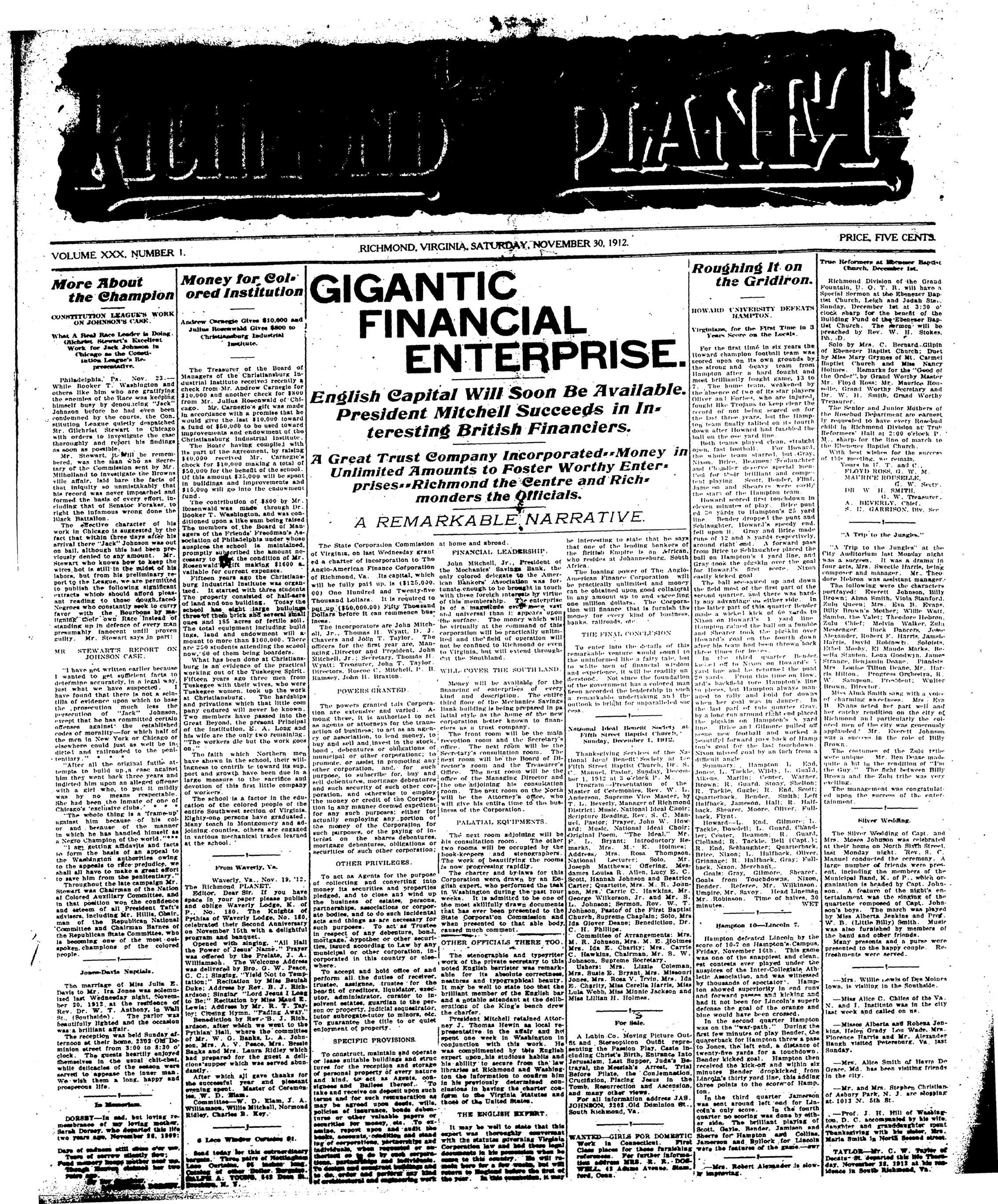
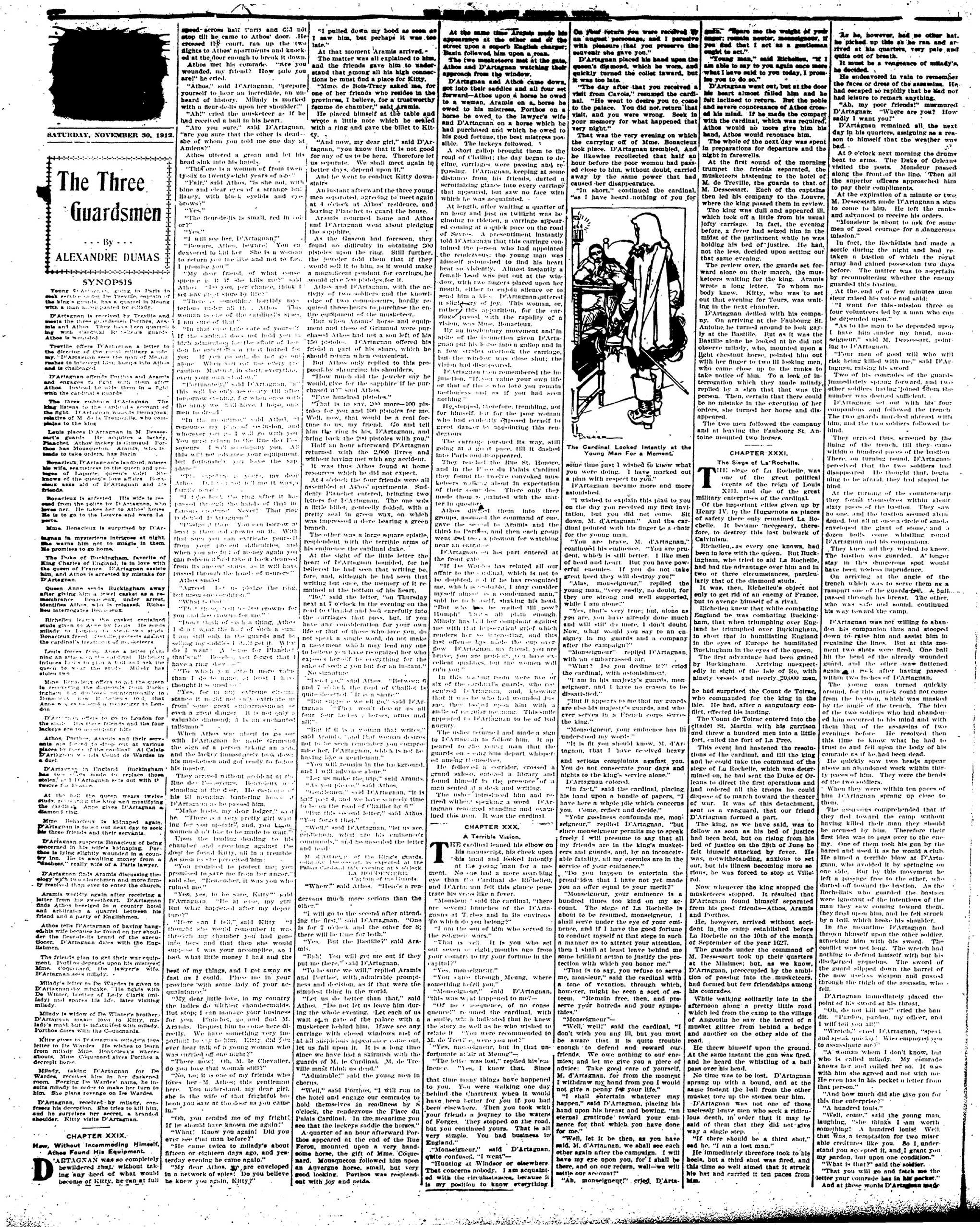
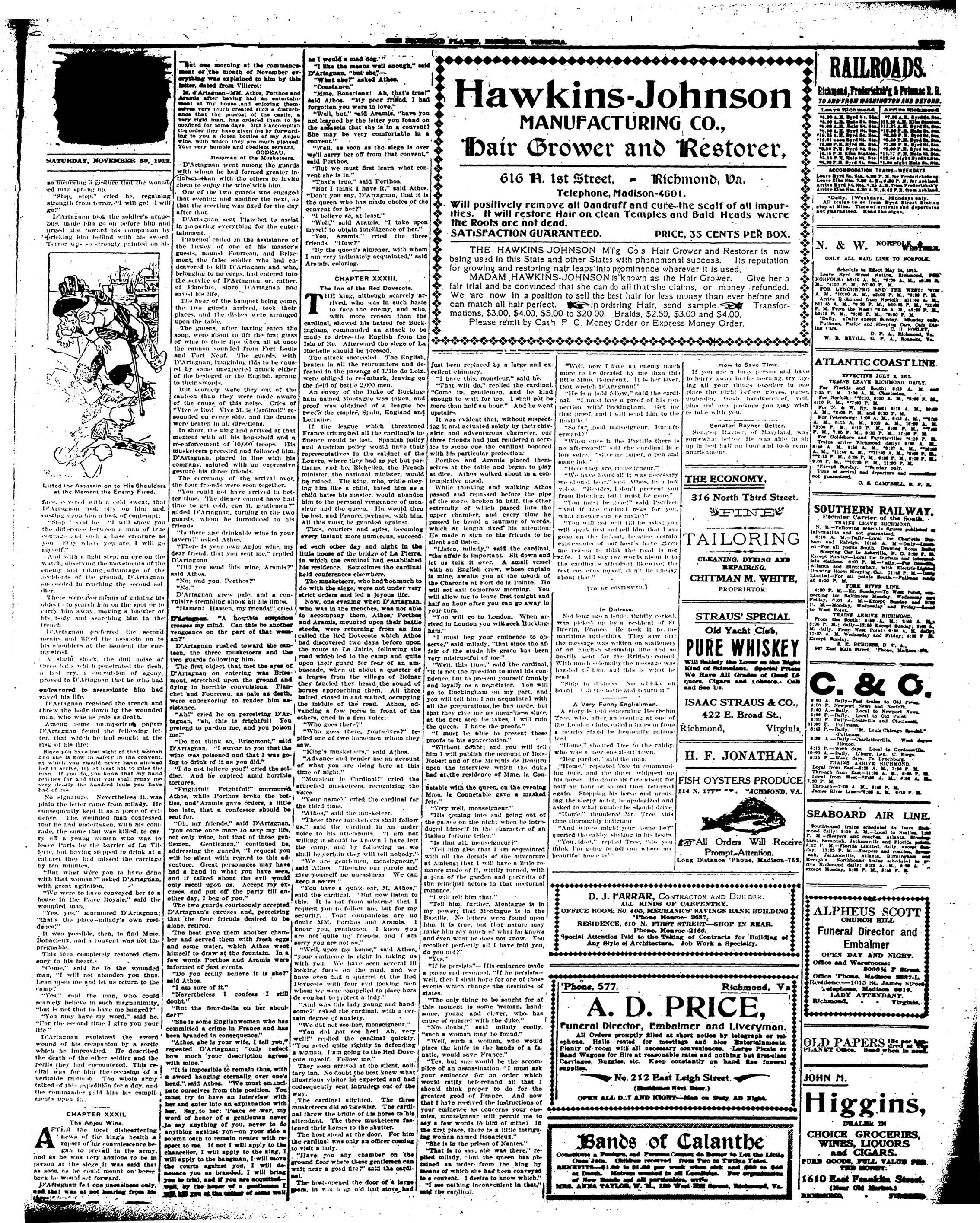
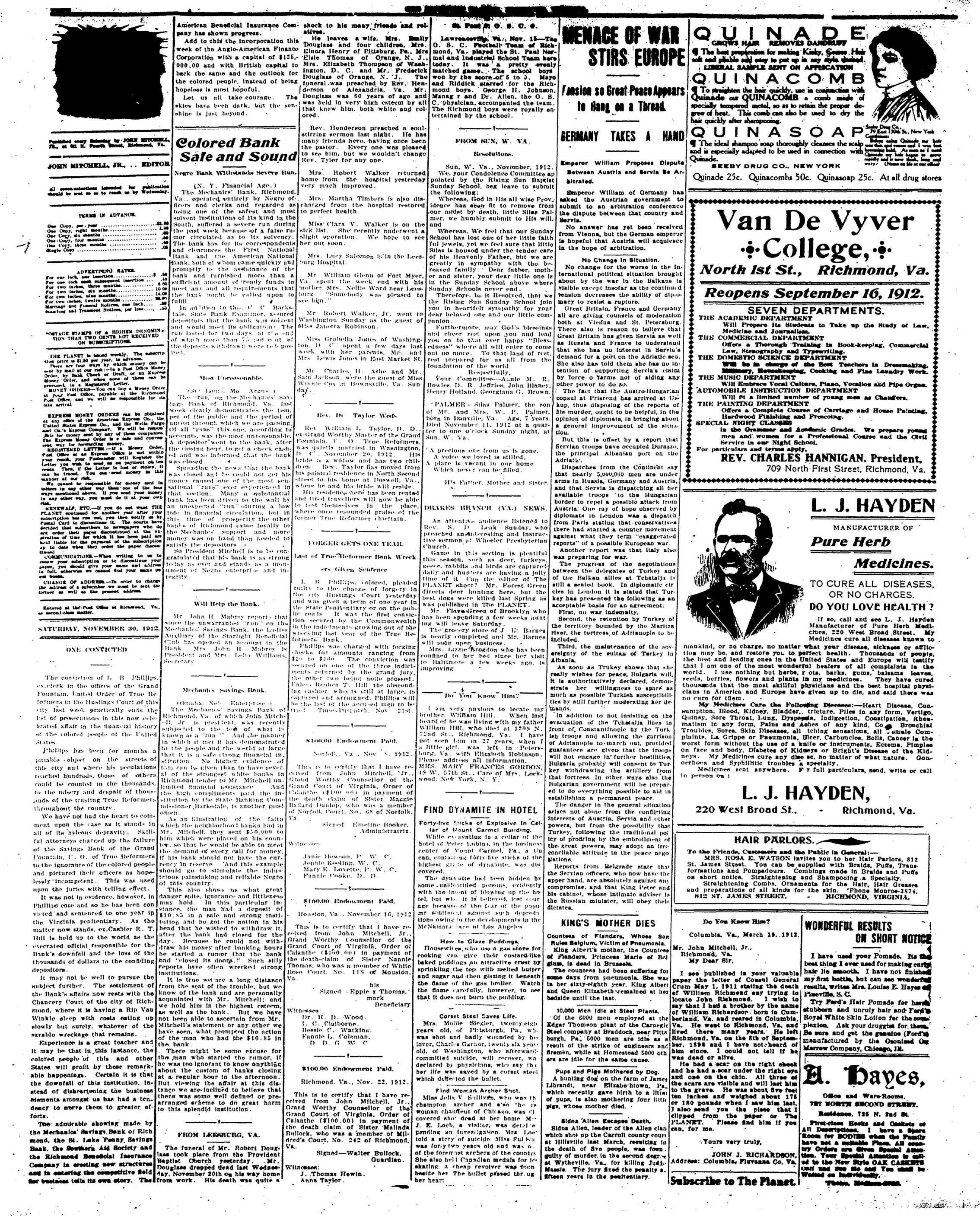
Page text (machine-generated)
PLANET
VOLUME XXX. NUMBER 1.
RICHMOND, VIRGINIA, SATURDAY, NOVEMBER 30, 1912.
PRICE, FIVE CENTS.
More About the Champion
CONSTITUTION LEAGUE'S WORK ON JOHNSON'S CARE.
What A Real Race Leader Is Doing. Gilchrist Stewart's Excellent Work for Jack Johnson in Chicago as the Constitution League's Representative.
Philadelphia, Pa. Nov. 23.—While Booker T. Washington and others like him who are gratifying the enemies of the Race was keeping himself busy by denouncing "Jack" Johnson before he had even been condemned by the courts, the Constitution League quietly despatched Mr. Gilchrist Stewart to Chicago with orders to investigate the case thoroughly and report his findings as soon as possible.
Mr. Stewart, Jr. will be remembered, was the man who as Secretary of the Commission sent by Mr. Millholland to investigate the Brownville affair, laid bare the facts of that iniquity so unmistakably that his record was never impacchel and formed the basis of every effort, including that of Senator Foraker, to right the infamous wrong done the black Battalion.
The effective character of his work in Chicago is suggested by the fact that within three days after his arrival there "Jack" Johnson was out on ball, although this had been previously denied to any amount. Mr. Stewart who knows how to keep the wires, hot is still in the midst of his labor, but from his preliminary report to the League, we are permitted to publish the following significant extracts which should afford pleasant reading to those dough-faced Negroes who constantly seek to curry favor with the bourbons by magnifying their own Race instead of standing up in defence of every man presumably innocent until proven guilty. Mr. Stewart says in part:
MR STEWART'S REPORT ON
JOHNSON CASE.
"I have not written earlier because I wanted to get sufficient facts to determine accurately, in a legal way, just what we have suspected. I have found that there is not a selftilla of evidence upon which to base the prosecution much less the prosecution of "Jack" Johnson, except that he has committed certain offenses against the established codes of morality—for which half of the men in New York or Chicago or elsewhere could just as well be instituted and railroaded to the penitentiary."
"After all the original future attempt to build up a case against him they went back three years and indicted him upon an alleged offense with a girl who, to put it mildly was by no means respectable. She had been the inmate of one Chicago's 'exclusive clubs.' "
"The whole thing is a 'frame-up against him because of his color and, because of the manner in which he has handled himself as a Negro Champion of the world.' "
"I am getting amdavits and facts to form the basis of an appeal to the Washington authorities owing to the appeals to rife prejudice, we shall all have to make a great effort to save him from the penitentiary."
Throughout the late campaign Mr. Stewart was Chairman of the National Al Colored Auxiliary Committee, and in that position won the confidence and esteem of all President Taft's advisers, including Mr. Hillis, Chairman of the Republican National Committee and Chairman Barnes of the Republican State Committee, who is becoming one of the most outspoken champions of the colored people.
Jones-Davis Nurtiels.
The marriage of Miss Julia E. Davis to Mr. Ira Jones was solemnized last Wednesday night, November 20, 1912, at the residence of Rev. Dr. W. T. Anthony, in Wall St. (Southside). The parlor was beautifully lighted and the occasion was a brilliant affair.
The reception was held Sunday afternoon at their home, 2302 OH Domination street from 3:00 to 5:20 o'clock. The guests heartily enjoyed themselves in the usual chit-chat, while delicacies of the season were served to appease the inner man. We wish them a long, happy and prosperous life.
DORSEY - In sad, but loving remembrance of my loving mother, Sarah Dorsay, who departed this life two years ago. November 28, 1909:
Money for Colored Institution
Andrew O'Regane Gives $10,000 and
Julius Rosenwald Gives $800 to
Christianburg Industrial
Industries
The Treasurer of the Board of Managers of the Christianburg Industrial Institute received recently a check from Mr. Andrew Carnegie for $10,000 and another check for $800 from Mr. Julius Rosenwald of Chicago. Mr. Carnegie's gift was made in accordance with a promise that he would give the last $10,000 toward a fund of $60,000 to be used toward improvements and endowment of the Christianburg Industrial Institute.
The Board having compiled with its part of the agreement, by raising $40,000 received Mr. Carnegie's check for $10,000 making a total of $50,000 for the benefit of the school. Of this amount $55,000 will be spent in buildings and improvements and $15,000 will go into the endowment fund.
The contribution of $800 by Mr. Rosenwald was made through Dr. Booker T. Washington, and was conditioned upon a like sum being raised The members of the Board of Managers of the Friends' Freedman's Association of Philadelphia under whose auspices the school is maintained, promptly subscribed the amount necessary to meet the condition of Mr. Rosenwald's gift making $1600 available for current expenses.
Fifteen years ago the Christianburg Industrial Institute was organized. It started with three students. The property consisted of half-acre of land and one building. Today the school has eight large buildings three of them brick and several small ones and 185 acres of fertile soil. The total equipment including builds, land and endowment will amount to more than $100,000. There are 250 students attending the school now, 60 of them being boarders.
What has been done at Christiansburg is an evidence of the practical working out of the Tuskegee Spirit. Fifteen years ago three men from Tuskegee with their wives, who were Tuskegee women, took up the work at Christiansburg. The hardships and privations which that little company endured will never be known. Two members have passed into the Great Beyond, the present Principal of the institution, E. A. Long and his wife are the only two remaining. "The workers die but the work goes on."
The faith which Northern men have shown in the school, their willingness to contrib to toward its support and growth have been due in a large measure to the sacrifice and devotion of this first little company of workers.
The school is a factor in the education of the colored people of the entire Southwest section of Virginia. Eighty-one persons have graduated. Many teach in Montgomery and adjoining counties, others are engaged in various mechanical trades learned at the school.
From Waverly, Va.
Waverly, Va., Nov. 19, 12. The Richmond PLANET.
Editor, Dear Sir. If you have space in your paper please publish and oblige Waverly Lodge, K. of P., No. 180. The Knights of Pythias of Waverly Lodge, No. 180, celebrated their Second Anniversary on November 15th with a delightful program and banquet.
Opened with singing, "All Hall the Power of Jesus' Name." Prayer was offered by the Prelate, J. A. Williamsoh. The Welcome Address was delivered by Bro. G. W. Peace, C. C.; Singing, "Yield Not to Temptation;" Recitation by Miss Beulah Duke; Address by Rev. B. J. Richardson; Singing "Lord Jesus I Long to Be"; Recitation by Miss Maud E. Lewis; Address by Mr. R. T. Taylor; Chosing Hymn, "Fading Away."
Benediction by Rev. B. J. Richardson, after which we went to the Pythian' Hall, where the committee of W. M. G. Banks, L. A. Johnson, Mrs. A. V. Peace, Mrs. Beesle Banks and Mrs. Laura Ridley which had prepared for the guest a delicious supper which was served abundantly.
After which all gave thanks for the successful year and pleasant evening spent. Master of Ceremonies, W. D. Blam.
Committee—W. D. Elam, J. A. Williamsoh, Willie Mitchell, Normond Ridler, Charles B. Key.
J
6 Lace Window Curtain $1.
Send today for this extraordinary
curtain. Three pairs of Nottingham
Lace Curtain, $6 inches long.
Cutting of other Daffler, Burgundy.
BALPH. A. YOUNG. $42 Done St.
Burgundy, N. Y.
RICHMOND, VIRGINIA, SATURDAY, NOVEMBER 30, 1912.
GIGANTIC FINANCIAL ENTERPRISE
English Capital Will Soon Be Available. President Mitchell Succeeds in Interesting British Financiers.
A Great Trust Company Incorporated Money in Unlimited Amounts to Foster Worthy Enterprises Richmond the Centre and Richmonders the Officials.
The State Corporation Commission of Virginia, on last Wednesday granted a charter of incorporation to The Anglo-American Finance Corporation of Richmond, Va. Its capital, which will be fully paid up, is ($125,000.00) One Hundred and Twenty-five Thousand Dollars. It is required to put up, ($50,000.00) Fifty Thousand Dollars before it can commence business.
The incorporators are John Mitchell, Jr., Thomas H. Wyatt, D. J. Chavers and John T. Taylor. The officers for the first year are, Managing, Director and President, John Mitchell, Jr.; Secretary, Thomas H. Wyatt; Treasurer, John T. Taylor; Directors, Roscoe C. Mitchell, P. H. Ramsey, John B. Braxton.
POWERS GRANTED
The powers granted Tails Corporation are extensive and varied. Among these, it is authorized to act as agents or attorneys for the transaction of business; to act as an agency or association; to lend money, to buy and sell, and invest in the stock, bond, debentures or obligations of municipal or other corporations; to promote, or assist in promoting any other corporation, and, for such purpose, to subscribe for, buy and sell debentures, mortgage debentures and such security of such other corporation, and otherwise to employ the money or credit of the Corporation in any manner deemed expedient for any such purposes; either for actually employing any portion of the money of the Corporation for such purposes, or the paying of interest on the shares debentures, mortgage debentures, obligations on securities of such other corporation;
OTHER PRIVILEGES
To act as Agent for the purpose of collecting and converting into money its securities and properties pledged, and to close and wind up the business of estates, persons, partnerships, associations or corporate bodies, and to do such incidental acts and things as are necessary for such purposes. To act as Trustee in respect of any debenture, bond, mortgage, hypothec or other securities, issued according to Law by any municipal or other corporation, incorporated in this country or elsewhere. To accept and hold office of and perform all the duties of receiver, trustee, assigne, trustee for the benefit of creditors, liquidator, executor, administrator, curator to insolvent estates, guardian to the person or property, judicial sequestrator, tutor subrogate-tutor to minors, etc. To guarantee the title to or quiet enforcement of property.
SPECIFIC PROVISIONS.
To construct, maintain and operate or lease suitable buildings and structures for the reception and storage of personal property of every nature and kind, to act as Agents, consignees and Balles thereof. To take and receive on deposit upon such terms and for such remuneration as may be agreed upon deals, wills, policies of insurance, bonds debentures or other valuable papers or securities for money, etc. To examine, report upon and audit the books, accounts, condition and standing of corporations, partnerships and individuals, when requested or authorized so to be by such corporations, partnerships and individuals. To design and construct buildings and to do, order and perform any kind of architectural and engineering work
at home and abroad.
FINANCIAL LEADERSHIP.
John Mitchell, Jr., President of the Mechanics' Savings Bank, the only colored delegate to the American Bankers' Association was fortunate enough to be brought in touch with these foreign interests by virtue of this membership. The enterprise is of a magnitude even more vast and universal than it appears upon the surface. The money which will be virtually at the command of this corporation will be practically unlimited and the field of operation will not be confined to Richmond or even to Virginia, but will extend throughout the Southland.
WILL COVER THE SOUTH LAND.
Money will be available for the financing of enterprises of every kind and description. The entire third floor of the Mechanics Savings Bank building is being prepared in partial style as the home of the new corporation better known to financiers as a trust company. The front room will be the main reception room and the Secretary's office. The next room will be the Secretary's consultation room. The next room will be the Board of Director's room and the Treasurer's Office. The next room will be the office of the Managing Director and the one adjoining his consultation room. The next room on the North will be the Attorney's office, who will give his entire time to the business of the Corporation.
PALATIAL EQUIPMENTS
The next room adjoining will be his consultation room. The other two rooms will be occupied by the hook-keepers and stenographers. The work of beautifying the rooms is now progressing rapidly.
The charter and by-laws for this Corporation were drawn by an English expert, who performed the task in Washington during the past four weeks. It is admitted to be one of the most skillfully drawn documents that has ever been presented to the State Corporation Commission and when presented to that able body caused much comment.
OTHER OFFICIALS THERE TOO.
The stenographie and typewriter work of the private secretary to this noted English barrister was remarkable for its absolute correctness, neatness and typographical beauty. It may be well to state too that the brilliant member of the English bar and a notable attendant at the deliberations of the King's bench drew the charter.
President Mitchell retained Attorney J. Thomas Hewin as local representative in the affairs and he spent one week in Washington in conjunction with this work. He was complimented by this English expert upon his studious habits and his ability to secure from the law libraries at Richmond and Washington the information to confirm him in his previously determined conclusions in having the charter conform to the Virginia statutes and those of the United States.
THE ENGLISH EXPERT.
It may be well to state that this expert was thoroughly conversant with the statutes governing Virginia Corporation law and had three legal documents in his possession when he came to this country. He will remain here for a few weeks, but will return to England before the first of the winter. In this conclusion, it may
he interesting to state that he says that one of the leading bankers of the British Empire is an African, who resides at Johannesburg, South Africa. The loaning power of The Anglo-American Finance Corporation will be practically unlimited and money can be obtained upon good collateral in any amount up to and exceeding one million dollars. The Corporation will finance that is furnish the money for every kind of business banks, railroads, etc.
THE FINAL CONCLUSION
To enter into the details of this remarkable venture would sound to the uninformed like a fairy tale, but to white men of financial wisdom and experience, it will be readily understood. Not since the foundation of the government has a colored man been recorded the leadership in such a remarkable undertaking and the outlook is bright for unparalleled success.
National Ideal Benefit Society at Fifth Street Baptist Church. Sunday, December 1, 1912.
Thanksgiving Services of the National Ideal Benefit Society at the Fifth Street Baptist Church, Dr. S. C. Manuel, Pastor, Sunday, December 1, 1912 at 3 o'clock P. M.
Program—Presentation of the Master of Ceremonies, Rev. W. L. Anderson, Supreme Vice Master, by T. L. Beverly, Manager of Richmond District; Music, National Ideal Choir; Scripture Reading, Rev. S. C. Manuel, Pastor; Prayer, John W. Howard; Music, National Ideal Choir; Original Poem, "The Ideal." Mr. P. L. Bryant; Introductory Remarks, Mrs. M. E. Holmes; Address, Mrs. Rosa Thompson; National Lecturer; Solo, Mr. Joseph Matthews; Offering, Mesdames Louisa R. Allon, Lucy E. C. Scott, Hannah Johnson and Beatrice Carter; Quartotte, Mrs. M. R. Johnson, Mrs. Carrie C. Hawkins, Mr. George Wilkerson, Jr. and Mr. S. L. Johnson; Sormon, Rev. W. T. Johnson, Pastor of the First Baptist Church, Supreme Chaplain; Solo, Mrs Ida Glover Deane; Benediction, Dr. C. H. Phillips.
Committee of Arrangements; Mrs. M. R. Johnson, Mrs. M. E. Holmes, Mrs. Ida E. Charity; Mrs. Carrie C. Hawkins, Chairman, Mr. S. W. Johnson, Supreme Secretary.
Ushers: Mrs. Lizzie Coleman, Mrs. Suele B. Bryant, Mrs. Missouri Jones, Mrs. Rosa V. Trinon, Mrs. Ida E. Charity, Misa Corella Harris, Misa Lula Webb, Misa Minnie Jackson and Misa Lillian H. Holmes.
A Labin Co. Moving Picture Outfit and Stereoicon Outfit representing the Passion Play, Caste Including Christ's Birth, Entrance Into Jerusalem, Last Supper, Judah's Betrayal, the Messiah's Arrest, Trial Before Pilate, the Conjemnation, Crucifixion, Placing Jesus in the Tomb, Resurrection and Ascension, and many other views.
For all information address JAS. JOHNSON. 2303 Old Dominion St. South Kuchennold, Va.
WANTED—GIRLS FOR DOMESTIC
Work in Connecticut. First
Class places for those furnishing
references. For further information
address MRS. R. R. DOS-
WELL, 42 Adams Avenue, Stam-
ford, Cana.
Roughing It on the Gridiron.
HOWARD UNIVERSITY DEFEATS HAMPTON.
Virginiaans, for the first Time in 3 Years, Score on the Locals.
For the first time in six years the Howard champion football team was scored upon on its own grounds by the strong and heavy team from Hampton after a hard fought and most brilliantly fought game, 13 to 7. The home team, weakened by the absence of (two of its star players Oliver and Forlest, who are injured) fought like Trojans to keep clear the record of not being scored on for the last three years, but the Hampton team finally tallied on its fourth down after Howard had fumbled the ball on the yard line.
Both teams played clean, straight open, fast football. For Howard, the whole team starred, but Gray, Nixon, Beecher, Beecher, Seahawker and Chandler deserve special mention for their brilliant and competent playing. Scott, Bender, Plint, Lams on and Shearers were early the star of the Hampton team. Howard scored first touchdown in eleven minutes of play. Breeze punted 30 yards to Hampton's 25 yard line. Bender dropped the punt and Seahawker, Howard's speedy end, fell upon it. Gray and Breeze made runs of 12 and 8 yards respectively, ground right end. A forward pass from Breeze to Seahawker placed the ball on Hampton's 1 yard line, and Gray took the piskin over the goal for Howard's first score. Nixon easily kicked goal. The ball see-sawed up and down the field most of the first part of the second quarter, and there was hardly any advantage on either side. In the latter part of this quarter Bender made a wicked kick of 60 yards to Nixon on Howard's 1 yard line. Howard gained the ball on a fumble and Shearer took the piskin over Howard's goal on the fourth down after his team had been thrown back three times for losses.
In the third quarter Bender kicked off to Nixon on Howard's 7 yard line and he returned the punt 29 yards. From this time on Howard's backfield toro Hampton's line to places, but Hampton always managed to rally and hold for downs when her goal was in danger. In the last part of tots quarter Gray, by a long run around right end placed the plinkin on Hampton's 8 yard line. Drive and Gilmore pulled off some new football and worked a beautiful forward pass back of Hampon's goal for the last touchdown. Nixon missed goal by an inch from a difficult angle.
Summary. Hampton L. End.
Jones, L. Tackle, Wilby, L. Guild,
Alkens, Martin; Center, Warner,
Brown; R. Guard, Stony, Shelton;
R. Tackle, Gugle; R. End, Scott;
Quartback, Bender, Smith; Left
Halfback, Jameson, Hall; R. Halfback,
Shearer, Moore, Oliver, Fullback,
Flynt.
Howard—L. End. Gilmore; L.
Tackle, Dowdell; L. Guard, Chandler,
Center, Heamon; R. Guard,
Cleveland; R. Tackle, Bell (Capt.);
R. End, Schlaughter; Quarterback,
Brice, Nixon; L. Halfback, Oliver,
Grinnage; R. Halfback, Gray; Fullback,
Nixon, Merchant.
Goals: Gray, Gilmore, Shearer,
Goals from Touchdown, Nixon,
Bender, Referee, Mr. Wilkinson,
Umpire, Mr. Savoy, Head Lineman,
Mr. Robinson. Time of halves, 30
minutes.
WET
Hampton 10—Lincoln 7.
Hampton defeated Lincoln by the score of 10-7 on Hampton's Campus, Friday. November 16th. This game was one of the anappest and cleanest contests ever played under the auspices of the Inter-Collegiate Athletic Association, and was witnessed by thousands of spectators. Hampton showed superiority in end runs and forward passes and kicking and had it not been for Lincoln's superb defense the goal of the orange and blue would have been crossed.
In the second quarter Hampton was on the "war-path." During the first few minutes of play Bender, the quarterback for Hampton threw a pass to Jones, the left end, a distance of twenty-five yards, for a touchdown. Bender kicked goal. Hampton then received the kick-off and within six minutes Bender dropkicked, from Lincoln's thirty yard line, this adding three points to the score of Hampton.
In the third quarter Jamerson was sent around left and for Lincoln's only score. In the fourth quarter no scoring was done by either side. The brilliant playing of Scott, Gayle, Bender, Jamison and Sherrie for Hampton and Collins, Jamerson and Bullock, for Lincoln were the features of the game.—ewr
Mrs. Robert Alexander is slowly improving.
True Reformers at Blessed Baptist
Church, December 1st.
Richmond Division of the Grand
Fountain, U. O. T. R. will have a
Special Sermon on the Ebenezer Baptist
Church, Leigh and Judah Sts.
Sunday, December 1st at 3:30 o'clock sharp for the benefit of the Building Fund of the Ebenezer Baptist Church. The sermon will be preached by Rev. W. H. Stokes,
Pb. D.
Solo by Mrs. C. Bernard-Gilpin of Ebenezer Baptist Church; Duet by Miss Mary Grymes of M. Carmel Baptist Church and Miss Nancy Holmes. Remark for the "Good of the Order" by Grand Worthy Master Mr. Floyd Ross; Mr. Maurice Rouelle, Grand Worthy Secretary and Dr. W. H. Smith, Grand Worthy Treasurer.
The Senior and Junior Mothers of the Rosebud Department are earnest to request to have every Rosebud child in Richmond Division at True Reformers' Hall at 2:00 o'clock P. M., sharp for the line of march to the Ebenezer Baptist Church.
With best wishes for the success of this meeting, we remain.
Yours in U. T. and C.
FLOYD ROSS, G. W. M.
MAURICE ROUSELLE.
G. W. Secy.
DR W. H. SMITH.
G. W. Treasurer.
A. BEVERLY, Chief.
S. E. GARRISON, Div. Sec.
"A Trip to the Jungle."
"A Trip to the Jungles" at the City Auditorium last Monday night was a success. It was a drama in four acts, Mrs. Sweetie Harris, being composer and manager, Mr. Theodore Hebron was assistant manager. The following were the characters portrayed: Everett Johnson, Billy Brown; Alma Smith, Viola Stanford, Zulu Queen; Mrs. Eva H. Evans, Billy Brown's Mother; Willie Watt, Sambo, the Valet; Thoredo Hebron, Zulu Chief; Melvin Walker, Zulu Messenger; Juck Dancers, Jose Alexander, Robert F. Harris, Jamie Harris, David Robinson, Solofes, Ethel Mosdy, El Maude Marks, Beailla Stanfon, Lona Goodwyn, James Strange, Benjamin Deane, Planets Mrs Louise Tilton Deane, Mr. Harris Hilton, Progress Orchestra, R. W. Sampeon, President; Walter Brown, Director.
Miss Alma Smith sang with a voice of charming sweetness. Mrs. Eva H. Evans acted her part well and her catchy rendition on the city of Richmond and particularly the colored men of the city was generously applauded. Mr. Everett Johnson was a success in the role of Billy Brown.
The costumes of the Zulu tribe were unique. Mr. Ben Deane made quite a hit in the rendition of "I'm the Guy." The fight between Billy Brown and the Zulu tribe was very exciting.
The management was congratulated upon the success of the entertainment.
Silver Welding
The Silver Wedding of Capt. and Mrs. Moses Johnson was celebrated at their home on North Sixth Street. Inst Monday night. Rev. S. C. Manuel conducted the ceremony. A large number of friends were present, including the members of the Municipal Band, K. of P., which organization is headed by Capt. Johnson. A feature of the night's entertainment was the singing of the quartette composed of Capt. Johnson's boys. The march was played by Miss Alberta Jenkins and Prof. W. B. (Little Billy) Smith. Music was also furnished by members of the band and other friends. Many presents and a purse were presented to the happy couple. Refreshments were served.
—Mrs. Willie Lawn of Den Moines
town, is visiting in the Southside.
—Miss Alice C. Chiles of the Va.
N. and I. Instituto was in the city
last week and called on us.
—Miss Alberta and Robena Jenk-
kins, Helen Grady Lou Wade, Mrs.
Florence Harris and Mr. Alexander
Hugh visited Petersburg, Va. last
Sunday.
—Mrs. Alice Smith of Havro De
Grace, Md. has been visiting friends
in the city.
—Mr. and Mrs. Stephen Christian
of Aubury Park, N. J. are mopping
at 1013 N. 5th St.
—Prof. J. H. Hill of Washington,
D. C. accompanied by his wife.
Daughter and granddaughter spent
Thanksgiving with his sister, Mrs.
Maria Smith in North Second street.
TAYLOR—Mr. C. W. Taylor of
Decatur St. departed this life Thursday,
November 28, 1912 at his residence in South Richmond, Va.
SATURDAY, NOVEMBER 30, 1912.
The Three Guardsmen
SYNOPSIS
Young D'Artagnan, going to Paris to seek service under the Tressile, contains of the king's guards, has a quarrel in Meung with a man accused by pollard.
D'Artagnan is received by Tressile and meets the three guards, Porttous, Aramie and Athos. They have been quarrelled with the king's guards. Athos is wounded.
Tressile offers D'Artagnan a letter to the director of the royal military aideship. D'Artagnan sees the man of Meung reaches to intercept him, brings into Athos and is challenged.
D'Artagnan offends Porttous and Aramie and engages to fight with them after Athos. Instead he helps them in a fight with the cardinal's guards.
The three embroile D'Artagnan. The king listens to the cardinal's account of the fight. D'Artagnan wounds Bernoulli, relative of M. de la Tremouille, who complains to the king.
Leuis places D'Artagnan in M. Desseurart's guards. He acquires a jacket, the king gives him a dagger. The thou has Mouquetelle, Aramie, who intends to take orders, has Harin.
Bonacieux, D'Artagnan, last month, makes his wife, seismetra, to the queen and proteges of Laporte, queen's valet. She knows of the people she loves affair. Bonacieux takes aid of D'Artagnan and his friends.
Bonacieux is assisted. His wife is rescued from the police by D'Artagnan, who loves her. He takes her to Athos' house. He is to go to the Louvre and warn La porte.
Mme. Bonacieux is surprised by D'Artagnan in mysteries intrigues at night. She warns him not to misleave in them. He promises to go home.
The Duke of Buckingham, favorite of King Charles of England, is in love with the queen of France, D'Artagnan assists him, and Athos is arrested by minkake for D'Artagnan.
Queen Anne sends Buckingham away after giving him a level casket as a remembrance. Buckingham, under arrest, identifies Athos who is released. Buckingham interrogates Buckingham.
Richiehe leaves the casket contained suda given to Athos by Louis. He people with the casket. Bonacieux frees the process against the cardinals in the courtroom.
Louis forces from Anne a letter planning an attack on the original Bickleigh induces Louis to plan a ball and ask the queen to wear the study. Milady has stolen two.
Mme Bickleigh offers to pull the queen in covering the diamonds from Bickleigh at the doors unintentionally to Bickleigh. Now Bickleigh is a tool that Anne Wales is to send a messenger to London.
D'Artagnan offers to go to London for the attack. He takes their friends and the four hackers are to accompany him.
Athos, Dorothy, Aramis and their servants are forced to stop out at various places by the doors of the cardinal. At Calais D'Artagnan works Count de Wardes in a duel.
D'Artagnan in England. Buckingham hides in D'Artagnan sets out with two stolen D'Artagnan sets out with two twelve for France.
At the ball the queen wears twelve studs, restoring the king and mystifying the cardinal. Anne gives D'Artagnan a diamond ring.
Mme Bickleigh is kidnapped again. D'Artagnan is to set out next day to seek their friends and their servants.
D'Artagnan suspects Bonacieux of being concerned in his wife's kidnaping. Forthoose is lying slightly wounded in a country inn. He is awaiting money from a "whore," really wife of a Paris lawyer.
D'Artagnan finds Aramis discussing theology with two churchmen and more firmly resolved than ever to enter the church.
Aramis worthy again after receiving a letter from his sweetheart. D'Artagnan finds Athos hegelled in a country hotel and artifices a quarrel between his friend and a party of Englishmen.
Athos tells D'Artagnan of having hanged his wife because he found on her about the four-leafed brand of the executioner D'Artagnan does with the Englishmen.
The friends plan to get their war equipment. Portoos depends upon his mistress, Coguard, the lawyers wife D'Artagnan sees milady.
Milady's letter to De Wardes is given to D'artagnan's mistake. He fields with De Winer, brother of Lady Clark (milady), and spares his life, later visiting milady.
Milady is widow of De Winter's brother, D'Artagan makes love to Kitty, milady's maid but is infatuated with milady. Porthos dines with the Coquenards.
Kitty gives to D'Artagan milady's love letter to De Warder. He wishes to learn from her. Porthos tells a scout abouts, Mine Coquenard gives Porthos a deceptive room.
Milady, taking D'Artagan for De Warder, receives him in her darkened room. Forging De Warder's name, he insults milady in order to make her turn to him. She plans revenge on De Warder.
D'Artagan, received by milady, consides his despair. She tries to kill him, and he is blinded. Fended shoulder, Kitty visits D'Artagan.
CHAPTER XXIX.
How, Without Incomending Himself,
Athes Found His Equipment.
ARTAGNAN was so completely
bewildered that, without taking
any heed of what would
become of kitty, he ran at full
speed across half tears and GI'll not stop till he came to Athos' door. He crossed the court, ran up the two sights to Athos' apartments and knocked at the door enough to break it down. Athos met his comrade. "Are you wounded, my friend? How pide you are!" he cried.
"Athos," said D'Artagnan, "prepare yourself to hear an incredible, an unheard of history. Milady is marked with a neurdele upon her shoulder." "Ah!" cried the musketeer as if he had received a ball in his heart.
"Are you sure," said D'Artagnan, "are you sure that the other is dead—she of whom you told me one day at Amlona!"
Athos uttered a groan and let his head slink into his hands.
"This one is a woman of from twenty-six to twenty-six years of age." "Fair," said Athos, "is she not, with blue and clear eyes of a strange bellany, with black eyelids and eyebrows."
"The deure deits is small, red in color or?"
"Yes."
"I will see her, I'Artagian."
"Howare, Athos, howare! You en denervored to kill her. She is a woman to return you like and not to face. I promise you."
"My dear friend, of what consequence is it if she kills me?" asked Athos. "If you, per chance, think I set any great store by life."
"There is something horribly mysterious under all the Athos. This woman is one of the cardinal's spies. I am sure of that."
"In that case take care of yourself if the cardinal does not hold you in high admiration for the affair of how he beasts a great hatred for you. If you do not do, do not go alone. When you not use every precaution, Maturat, in short, everything, even your own shadow."
"Dermatomyosis!" said I'Artagian, "for this will be only necessary till after tomorrow, for when once with the army we shall have I hope, only men to die."
"In the morning, said Athos, "I remember my trip of vision, and wherever you go, I will go with you. You must return to the line de Paysours. I will accompany you. All this will not advance your equipment, but fortunately you have the sap phone."
"The expedition is yours, my dear Athos. Do you not tell me it was a familiar one."
"I take back the ring after it has passed through the hands of that informant, course. Never! That ring belonged to Athos."
"Please of them. You can borrow at least a thousand crowns on it. With that ring you can extract yourself from your present difficulties, and when you are full of money again you can reclaim it and take it back cleansed from its ancient status as it will have passed through the hotel of usurers."
"Agrieved. Let us pledge the ring, but upon one condition."
"That they will be crowned for you and be crowned for me."
"I don't think of such a thing. Athena I don't want the half of such a sum I am still only in the guards and be selling my saddles I shall get it. What do I want? A house for Planeet that is that." She you forget that I have a ring so much.
"To which you attach more value than I do to mine at least I have thought it so much."
"Yes, for in any extreme circumstance it might not only extract us from some great embarrassment or even a great danger. It is not only a valuable diamond. It is an enchanted talisman."
When Athena was about to go out with Artagnan he made Grimald the sign of a person taking an ash and the luckey imputed took down his musket and got ready to follow his master.
They arrived without incident at the Rue des Dauphins. Reminding me standing at the door. He cast aside his lit memorial, banting loudly of D'Artagran as he passed him.
"Make listen to my dear lodger," said he.
"There is a very pretty girl waiting for you to sit up and, you know, women don't have to be made to want."
Upon the building heading to his chamber and greeting against the door he found Kitty, all in a tremble. As soon as she perceived him:
"You promised to protect me; you promised to save me from her anger."
she said. "Remember, it was you who ruined me."
"Yes, yes, to be sure, Kitty," said D'Artagran.
"Be at ease, my girl. But what happened after my departure?"
"How can I tell," said Kitty.
"I thought she would remember it was through my chamber you had gone into hers and that then she would suppose it was your accomplish, so I took what little money I had and the
best of my things, and I get away as fast as I could. Place me in your province with some lady of your acquaintance.
"My dear little love, in my country the ladies do without chambermaids. But stop; I can manage your business for you. Panic! go, and find M. Armands. Request him to come here directly. We have something very important to say to him. Kitty, did you ever hear talk of a young woman who was carried off one night?
"There now! Oh, M. le Chevallier, do you love that woman still?
"No, too! It is one of my friends who loves her M. Athos; this gentleman here. You understand, my dear girl, she is the wife of that frightful baboon you saw at the door as you came in."
"Oh, you remind me of my fright! If he should have known me again."
"What? Know you again! Did you ever see that man before?"
"He came twice to milady's about fifteen or eighteen days ago, and yesterday evening he came again."
"My dear Athos, we are enveloped in a network of spies! Do you believe he knew you again, Kitty?"
"I pulled down my bood as soon as I saw him, but perhaps it was too late."
At that moment Aramis arrived. The matter was all explained to him, and the friends gave him to understand that among all his high connections he must dud a place for Kitty. "Mime, de Bols-Tracy asked me, for one of her friends who resides in the provinces, I believe, for a trustworthy femme de chamber," said Aramis. He placed himself at the table and wrote a little note which he sealed with a ring and gave the billet to Kitty.
"And now, my dear girl," said D'Artagnan, "you know that it is not good for any of us to be here. Therefore let us separate. We shall meet again in better days, defend upon it."
And he went to conduct Kitty downstairs.
An instant afterward the three young men separated, agreeing to meet again at 4 o'clock at Athos' residence, and leaving Pinchester to guard the house.
Aramis returned home and Athos and D'Artagnan went about pledging the siphire.
As the Gasson had foreseen, they found no difficulty in obtaining 200 pistols upon the ring. Still further, the Jeweler told them that if they would sell it to him, as it would make a magnificent pendant for earrings, he would give 500 pistols, for it.
Aramis and D'Artagnan, with the activity of two soldiers and the knowledge of two commissars, hardly required three hours to purchase the entire equipment of the musketer.
But when Aramis' horse and equipment and those of Grimland were purchased Athos had not a son left of his 10 pistols.
D'Artagnan offered his friend a part of his share, which he should return when convenient.
But Athos only replied to this proposal by shrugging his shoulders. "How much did the jeweler say he would give for the sapphire if he purchased it?" and Athos.
"Five hundred platoles."
"That is to say, 290 more—100 pistoles for you and 100 pistoles for me. Well, now, that would be a real fortune to us, my friend. Go and tell him the ring is his D'Artagnan, and bring back the 290 pistoles with you." Half an hour afterward D'Artagnan returned with the 2000 livres and without having met with any accident. It was thus, Athos found at home resources which he did not expect. At 4 o'clock the four friends were all assembled at Athos apartments. Suddenly Pancheter entered, bringing two letters for D'Artagnan. The one was a little billet, gently folded, with a pretty seal in green wax, on which was impressed a dove bearing a green branch. The other was a large square epistle, resplendent with the terrible arms of his entourage the cardinal duke.
At the sight of the little letter the heart of D'Artagnan bombed, for he believed he had seen that writing be fore, and, although he had seen that writing but once, the memory of it remained at the bottom of his heart.
"Be," said the letter, "on Thursday next at 7 o'clock in the evening on the road to Chinah and look carefully into the carriages that pass, but if you have any consideration for your own life or that of those who love you, do not speak a single word, do not make a movement which may lead any one to believe you have recognized her who expresses her love to everything for the sake of saving you but for an instant."
No signature.
"Do not," said Attiez, "between 6 and 7 o'clock in the road of Chinah is quite deserved." "It is a share."
"But suppose we all go," said D'Artagnan, "They won't devour us all four four bodies, horses, arms and all."
"But if it is a woman that writes," said Tillman, "and that woman desires not to be seen remember you compromise her, D'Artagnan, which is not being like a gentleman."
"You will remain in the background, and I will advance alone."
"Let us make the trip" said Aramis.
"As you piece" said Athos.
"But this second letter," said Athos,
"You must that."
"Well," said IArtagian, "let us see,
explain what he his enemies'
commands," and he miscalled the letter
and read.
M. Artagian, of the King's guards,
composed the book, is expected at the
Pallas Academy to check
LA HAOSEX NEXUS
"Whew!" said Athos. "Here's a run
droves much more serious than the
other."
"I will go to the second after attend-
ing the first," said D'Artagnan. "One
is for 7 o'clock, and the other for S;
there will be time for both."
"Yes. But the Bastille?" said Aramis.
"Bah! You will get me out if they
put me there," said D'Artagnan.
"To be sure we will," replied Aramis
and Fortune, with admirable prompt-
ness and decision, as if that were the
simplest thing in the world.
"Let us do better than that," said Athos. "Do not let us leave him during the whole evening. Let each of us wait on a gate of the palace with a muskeeter behind him. I have see any carriage with closed windows at all such prisoners appear come out, let us fall upon it. It is a long time since we have had a skirmish with the guards of M. le Cardinal, M. de Treville must think us dead."
"Admirable!" said the young men in chorus.
"Well," said Porthos. "I will run to the hotel and engage our comrades to hold themselves in readiness by K'clock, the rendezvous of the Place du Palais Cardinal. In the meantime you see that the lockkeys saddle the horses."
A quarter of an hour afterward Porthos appeared at the end of the Rue Feron, mounted upon a very handsome horse, the gift of Mme. Coquard. Monsqueton followed him upon an Auvergne horse, small, but very good looking. Porthos was resplendent with joy and pride.
At the same time Argana made his appearance at the other end of the street upon a super English charger; Bazin followed him upon a roan. The two mucketeers met at the gate, Athos and D'Arganan watching their approach from the window. D'Arganan and Athos came down, got into their saddles and all four set forward—Athos upon a horse he owed to a woman, Aramis on a horse he owed to his mistress, Porthos on a horse he owed to the lawyer's wife and D'Arganan on a horse which he had purchased and which he owed to his good fortune, the best mistress possible. The lackens followed.
A short gallop brought them to the road of Challier; the day began to decline, cartoons were passing and reposing. D'Arganan, keeping at some distance from his friends, darted a scrutinizing glance into every carriage that appeared, but saw no face with which he was acquainted.
At length, after waiting a quarter of an hour and just as twilight was beginning to tideown, a carriage appeared coming at a quick pace on the road of Sevres. A presentiment instantly told L'Artagnan that this carriage contained the person who had appointed the rendezvous; the young man was himself astonished to find his heart beat so violently. Almost instantly a female head was put out at the window, with two fingers placed upon her mouth, either to expain silence or to send him a kiss. L'Artagnan uttered a silently cry of joy. This woman, or, rather, this appiration, for the carriage, passed with the rapidity of a vision, was Muse, Bonadeux.
By an involuntary movement and in spite of the connection given L'Artagnan put his beeve into a gallop and in a few strides overtook the carriage, but the window was close shut; the vision had disappeared.
Arlington once remembered the injunction, "If you value your own life or that of those who love you remain motionless and as if you had seen nothing." He stopped, therefore, trembling, not for himself, but for the poor woman who had evidently exposed herself to great danger by appointing this rendezvous.
The carriage pursued its way, still going at a great pace, till it dashed into Paris and disappeared.
They reached the Rue St. Henore, and in the Place du Palais Cardinal they found the twelve convoked muskets walking about in expectation of their comedies. There only they made them a joint with the matter in question.
Athes divided them into three groups, assumed the command of one, gave the second to Aramis and the third to Portes, and then each group went and took a position for watching near an entrance.
L'Artagnan on his part entered at the front gate:
"If I be Wandred has related all our affair to the ordinal, which is not to be doubted, and if he has recognized me, which is sensible, I may consider myself almost as a condemned man," said he to be himself, shaking his hand. "But why is he waited till now? Humph! There's all plain enough. Malthy has bad her complaint against me with that he persecuted grief which renders her so interesting, and this last offense has made the cup overglow. L'Artagnan, my friend, you are brave, you are proud, you have excellent qualities, but the women will ruin you."
In this waiting room were two or six of the ordinal's guards, who recognized L'Artagnan, and, knowing that it was he who had wounded Jesse, they begged upon him with a smile of peculiar meaning. This smile appeared to L'Artagnan to be of bad acquaintance.
The usher returned and made a sign to PArtagan to follow him. It appeared to the young man that the guards on one side depart whispered among themselves.
He followed a corridor, crossed a grand salesman, entered a library and found himself to the presence of a man sented at a desk and writing.
The usher introduced him and retired without speaking a word. PArtagan remained standing and examined this man. It was the cardinal.
CHAPTER XXX
A Terrible Vision.
THE cardinal leaned his elbow on his manuscript, his check upon his hand and looked intently at the young man for a moment. No one had a more searching eye than the Cardinal de Rihehelen, and D'Artagnan felt this glance penetrate his eyes like a fever.
"Monsleu: 'said the cardinal, 'there are several branches of the D'Artagnans at Tables and in its environs. To which do you belong?'
"I am the son of him who served in the religion, wars."
"That is well. It is you who set out seven or eight, months ago from your country to try your fortune in the capital?"
"Yes, man-eignour."
"You came through Meung, where something lofted you."
"Monsleuignour: 'said D'Artagnan, 'this was what happened to me'—
"Of no consequence, of no consequence," returned the cardinal, with a smile, which indicated that he knew the story as well as he who wished to relate it. "You were recommended to M. Treile were you not?"
"Yes, misgourneur, but in that unfortunate air at Meung—"
"The letter was lost," replied his ennounce. "Yes, I know that. Since that time many things have happened to you. You were walking one day behind the charrettes when it would have been better for you if you had been elsewhere. Then you took with your friends a journey to the waters of Forges. They stopped on the road, but you continued yours. That is all very simple. You had business in England."
"Monsigneur," said D'Artaguan, quite confused. "I went—"
"Hunting at Windsor or elsewhere. That concerns nobody. I am acquainted with the circumstances, because it is my position to know everything
On your return you were received by an august personage, and I perceive with pleasure; that you preserve the souvenir she gave you."
D'Artagnan placed his hand upon the queen's diamond, which he wore, and quickly turned the collet inward, but it was too late.
"The day after that you received a visit from Cavola," resumed the cardinal. "He went to desire you to come to the palace. You did not return that visit, and you were wrong. Seek in your memory for what happened that very night."
That was the very evening on which the carrying off of Mme. Bonacieux took place. D'Artagnan trembled. And he likewise recollected that half an hour before the poor woman had passed close to him, without doubt, carried away by the same power that had caused her disappearance.
"In short," continued the cardinal, "as I have heard nothing of you for
D. B.
The Cardinal Looked Intently at the Young Man For a Moment.
some time past I wished to know what you were doing. I have marked out a plan with respect to you."
D'artagnan became more and more astonished.
"I wished to explain this plan to you on the day you received my first invitation, but you did not come. Sit down, M. d'artagnan." And the cardinal pointed with his finger to a chair for the young man.
"You are brave, M. d'artagnan, continued his enmity. "You are prudent, which is still better. I like men of head and heart. But you have powerful enemies. If you do not take great heed they will destroy you."
"Alas, monsieur," replied the young man, "very easily, no doubt, for they are strong and well supported, while I am alone."
"Yes, that's very true; but, alone as you are, you have already done much and will still do more. I don't doubt Now, what would you say to an enignee in my guards and a company after the campaign?"
"Monstrousour," replied D'Artagnan, with an embarrassed air.
"What? Do you decline it?" eroded the cardinal, with astonishment.
"I am in his majesty's guards, monsigneur, and I have no reason to be disatisfied."
"But it appears to me that my guards are also his majesty's guards, and who ever serves in a French corps serves the king."
"Monsigneur, your enfluence has ill understood my word."
"It is fit you should know, M. D'Artagnan, that I have received heavy and serious complaints against you. You do not consecrate your days and nights to the king's service alone."
D'Artagnan colored.
"In fact," said the cardinal, placing his hand upon a bundle of papers, "I have here a whole pile which concerns you. Come, reflect and decide."
"Your goodness confounds me, monsigneur," replied D'Artagnan, "but since monsigneur permits me to speak freely I will presume to say that all my friends are in the king's musketeers and guards, and by an inconceivable fatality, all my enemies are in the service of your enmineur."
"Do you happen to entertain the proud idea that I have not yet made you an offer equal to your merit?" "Monsigneur, your enmineur is a hundred times too kind on my account. The siege of La Rochelle is about to be resumed, monsigneur, I shall serve under the eye of your enmine, and if I have the good fortune to conduct myself at that siege in such a manner as to attract your attention, then I shall at least leave behind me some brilliant action to justify the protection with which you honor me."
"That is to say, you refuse to serve me, monsieur," said the cardinal with a tone of rexation, through which, however, might be seen a sort of esteem. "Remain free, then, and preserve your hatreds and your sympathies."
"Moneigment—"
"Well, well," said the cardinal, "I don't wish you any ill, but you must be aware that it is quite trouble enough to defend and reward our friends. We owe nothing to our enemies; and let me give you a piece of advice: Take good care of yourself, M. d'Artagnan, for from the moment I withdraw my hand from you I would not give a penny for your life."
"I shall entertain whatever may happen," said D'Artagnan, placing his hand upon his breast and bowing, "an eternal gratitude toward your eminence for that which you have done for me."
"Well, let it be then, as you have said, M. d'Artagnan, we shall see each other again after the campaign. I will have my eye upon you, for I shall be there, and on our return, well we will settle our account!"
"Ab, moneigment!" cried D'Arta-
girl. "Wear me the weight of your anger; remain nocter, monogamous, if you and that I act as a gentleman ought to act." "Young man," said Richelieu, "M I am able to say to you again once more what I have said to you today, I promise you to do so." D'Artagnan went out, but at the door his heart almost failed him and he felt inclined to return. But the pobre and severe countenance of Athos crossed his mind. If he made the compact with the cardinal, which was required, Athos would no more give him his hand, Athos would renounce him. The whole of the next day was spent in preparations for departure and the night in farewells.
At the first sound of the morning trumpet the friends separated, the musketeer hastening to the hotel of M. do Treville, the guards to that of M. Dessousart. Each of the captains then led his company to the Louvre, where the king passed them in review.
The king was dull and appeared ill, which took off a little from his usual lofty carriage. In fact, the evening before, a fever had seized him in the midst of the parliament while he was holding his bed of justice. He had, not the less, decided upon setting out that same evening.
The review over, the guards set forward alone on their march, the musketeers waiting for the king. Aramis wrote a long letter. To whom nobody knew. Kitty, who was to set out that evening for Tours, was waiting in the next chamber.
D'Artagnan delilied with his company. On arriving at the Faunbourg St. Antoine he turned around to look gayly at the Bastille. But as it was the Bastille alone he looked at he did not observe military, who, mounted upon a light chestnut horse, isolated him out with her finger to two ill-looking men, who came close up to the ranks to take notice of him. To a look of interrogation which they made militarily replied by a sign that that was the person. Then, certain that there could be no mistake in the execution of her orders, she turned her horse and disappeared. The two men followed the company and at leaving the Faunbourg St. Antoine mounted two horses.
CHAPTER XXXI.
The Siege of La Rochelle.
III. stage of La Rochelle, was one of the great political events of the reign of Louis XIII, and one of the great military enterprises of the cardinal. Of the important cities given up by Henry IV. to the Huguenots as places of safety there only remained La Rochelle. It became necessary, therefore, to destroy this last bulwark of Calvignan. Richelle, as every one knows, had been in love with the queen. But Buckingham, who tried to aid La Rochelle, had had the advantage over him and in two or three circumstances, particularly that of the diamond studs. It was, then, Richelle's object not only to get rid of an enemy of France, but to avenge himself of a rival.
Richiebon knew that while combating England he was combating Buckingham, that when triumphing over England he trumped over Buckingham, in short that in humiliating England in the eyes of Europe he humiliated Buckingham in the eyes of the queen. The first advantage had been gained by Buckingham. Arriving unexpectedly in sight of the Isle of Re, with ninety vessels and nearly 20,000 men, he had surprised the Count de Toulrue, who commanded for the king in the Isle. He had, after a sanguinary conflict, effected his hindung. The Count de Toulrue entered into the citadel St. Martin with his garrison and threw a hundred men into a little fort, called the fort of La Prec.
This event had hastened the resolutions of the cardinal, and till the king and he could take the command of the sieve of La Rochelle, which was determined on, he had sent the Duke of Orleans to direct the first operations and had ordered all the troops he could dispose of to march toward the theater of war. It was of this detachment, sent as a vanguard, that our friend D'Artagan formed a part.
The king, as we have said, was to follow as soon as his bed of justice had been held, but on rising from his bed of justice on the 28th of June he felt himself attacked by fever. He was, notwithstanding, anxious to set out, but his illness becoming more serious, he was forced to stop at Villeur.
Now whenever the king stopped the musketeers stopped. It resulted that D'Artagan found himself separated from his good friends—Athos, Aramis and Forthes.
He, however, arrived without accident in the camp established before La Rochelle on the 10th of the month of September of the year 1627.
The guards under the command of M. Dessart took up their quarters at the Minimes; but, as we know, D'Artagnan, preoccupied by the ambition of passing into the musketeers, had formed but few friendships among his comrades.
While walking solitarily late in the afternoon along a pretty little road which led from the camp to the village of Angouville he saw the barrel of a musket glitter from behind a hedge and another on the other side of the road.
He threw himself upon the ground. At the same instant the gun was fired, and he heard the whistling of a ball pass over his head.
No time was to be lost. D'Artagnan sprung up with a bound, and at the same instant the ball from the other musketeer tore up the stones near him.
D'Artagan was not one of those unlessly brave men who seek a ridiculous death, in order that it may be said of them that they did not give way a single step.
"If there should be a third shot," said he, "I am a lost man."
He immediately therefore took to his boots, but a third shot was fired, and this time so well aimed that it struck his hat and carried it ten paces from him.
As he, however, had no other hat, he picked up this hat he ran and arrived at his quarters, very pale and quite out of breath.
It must be a vengeance of miady's he decided.
He endeavored in vain to remember the faces or dress of the assassin. He had escaped so rapidly that he had not had leisure to remark anything.
"Ah, my poor friends!" murmured D'Artagnan. "Where are you? How sadly I want you!"
D'Artagnan remained all the next day in his quarters, assigning as a reason to himself that the weather was bad.
At 0 o'clock next morning the drum beat to arms. The Duke of Orleans visited the posts. Mondeur passed along the front of the line. Then all the superior officers approached him to pay their compliments.
At the expiration of a minute or two M. Dessoussart made D'Artagnan a sign to come to him. He left the minks and advanced to receive his orders.
"Monsieur is about to ask for some men of good courage for a dangerous mission."
In fact, the Rochéllais had made a sortie during the night and had retaken a bastion of which the royal army had gained possession two days before. The matter was to assemble by reconnoitering whether the enemy guarded this bastion.
At the end of a few minutes monseur raised his voice and said: "I want for this mission three or four volunteers led by a man who can be depended upon."
"As to the men to be depended upon I have him under my hand, monsieur," said M. Dessart, pointing to D'Artagnan.
"Four men of good will who will risk being killed with me" said D'Artagnan, raising his sword.
Two of his comrades of the guards immediately spring forward, and two other soldiers having joined them the number was desired sufficient.
D'Artagnan set out with his four companions and followed the trench. The two guards marched abreast with him, and the two soldiers followed behind. They arrived thus, screened by the lining of the trench, till they came within a hundred paces of the bastion. There, on turning round, D'Artagnan perceived that the two soldiers had disappeared. He thought that, beginning to be afraid, they had stayed behind. At the turning of the counter-scarp they found themselves within about sixty paces of the bastion. They saw no one, and the bastion seemed abandoned, but all at once a circle of smoke enveloped the giant of stone, and a dozen balls come whistling round D'Artagnan and his companions. They knew all they wished to know. The bastion was guarded. A longer stay in this dangerous spot would have been useless impidence.
On arriving at the angle of the trench which was to serve them as a rampart one of the guards fell. A ball passed through his breast. The other, who was safe and sound, continued his way toward the camp.
D'Artagnan was not willing to abandon his companion thus and stooped down to raise him and assist him in regaining the lines. But at this moment two shots were fired. One ball hit the head of the already wounded guard, and the other was flattened again at a rock after having passed within two inches of D'Artagnan.
The young man turned quickly around, for this attack could not come from the boston, which was masked by the angle of the trench. The idea of the two soldiers who had abandoned him occurred to his mind and with them that of the assassins of two evenings before. He resolved then this time to know what he had to trust to and fell upon the body of his comrade as if he had been dead.
He quickly saw two heads appear above an abandoned work within thirty paces of him. They were the heads of the two soldiers. When they were within ten paces of him D'Artagman spring up close to them. The assassins comprehended that if they fell toward the camp without having killed their man they should be accused by him. Therefore their first idea was to pass over to the enemy. One of them took his gun by the barrel and used it as he would a club. He aimed a terrible blow at D'Artagman, who avoided it by springing on one side. But by this movement he left a passage free to the other, darted off toward the bastion. As the Rochelle们 who guarded the bastion were ignorant of the intentions of the man they saw coming toward them, they fired upon him, and he fell struck by a ball, which broke his shoulder.
.
In the mountain D'Artagnan had thrown himself upon the other soldier, attacking him with his sword. The conflict was not long. The wretched had nothing to defend himself with but his discharged grenades. The sword of the guard slipped down the barrel of the now useless weapon and passed through the thigh of the assassin, who fell.
D'Artagnan immediately placed the point of his sword at his throat. "Oh, do not kill me!" cried the bandit. "Tarden, parson, my officer, and I will tell you all."
"Wretch," cried D'Artagnan, "speak, and speak quietly." Were employed to assassinate me!
"A woman whom I don't know, but who is called misty. My comrade knows her and called her so. It was with him she agreed and not with me. He even has in his pocket a letter from that person."
"And how much did she give you for this fine enterprise?"
"A hundred louis."
"Well, come," said the young man, laughing, "she thinks I am worth something." A hundred louis! Well, that was a temptation for two minor able creatures like you. So I understand you accepted it, and I grant you my pardon, but upon one condition.
"What is that?" said the soldier.
"That you will go and fetch me the letter your comrade has in his pocket."
And at these worlds D'Artagnan made
SATURDAY, NOVEMBER 30, 1912
so mentioning a gesture that the wound
ed man sprang up.
"Stop, stop," erled he, regaining
strength from terror. "I will go! I will
go!"
D'Artagnan took the soldier's arquebus,
made him go on before him and
argued him toward his companion by
crickling him behind with his sword.
Terror was so strongly painted on his
A man is falling down a wall. He is wearing a helmet and a mask. There are buildings in the background.
Lifted the Assassin on to His Shoulders at the Moment the Enemy Fireed.
face, covered with a cold sweat, that D'Artagnan took pity on him and, easing upon him a look of contempt: "Stop!" said he. "I will show you the difference between a man of true courage and such a base creature as you. Stay where you are, I will go myself."
And with a light step, an eye on the watch, observing the movements of the enemy and taking advantage of the accidents of the ground, D'Artagnan succeeded in reaching the second solider.
There were two means of gaining his object to search him on the spot or to carry him away, making a backer of his body and searching him in the trench.
D'Artagnain preferred the second means and lifted the assassin on to his shoulders at the moment the enemy stred.
A slight shock, the dull noise of three balls which penetrated the death, a last cry, a convulsion of agony, proved to D'Artagnan that he who had endeavored to assassinate him had saved his life. D'Artagnan regained the trench and threw the body down by the wounded man, who was as pale as death. Among some unimportant papers D'Artagnan found the following letter, that which he had sought at the risk of his life: Since you have lost sight of that woman and she is now in safety in the convent, at which you should never have allowed her to arrive, try at least not to miss the man, you know that my and relatives of such that you shall repay me very deadly the hundred louls you have had of me.
No signature. Nevertheless it. was plain the letter came from milady. He consequently kept it as a piece of evidence. The wounded man confessed that he had undertaken, with his comrade, the same that was killed, to carry off a young woman who was to leave Paris by the barrier of La Ville, but having stopped to drink at a cabaret they had missed the carriage by ten minutes.
"But what were you to have done with that woman?" asked D'Artagnan, with great agitation.
"We were to have conveyed her to a house in the Place Royale," said the wounded man.
"Yes, yes," murmured D'Artagnan; "that's the place-milady's own residence."
It was possible, then, to find Mme. Boncleux, and a convent was not impregnable.
This idea completely restored clemency to his heart.
"Come," said he to the wounded man, "I will not abandon you thus. Lean upon me and let us return to the camp."
"Yes," said the man, who could scarcely believe in such magnanimity, "but is not that to have me hanged?" "You may have my word," said he. "For the second time I give you your life."
D'Artagnan explained the sword wound of his companion by a sortle which he improvised. He described the death of the other soldier and the perils they had encountered. This recital was for him the occasion of a veritable trumpet. The whole army talked of this expedition for a day, and the commander paid him his compliments upon it.
The Anise Wine
AFTER the most disheartening news of the king's health a report of his convulsion began to prevail in the army, and as he was very anxious to be in person at the siege it was said that as soon as he could mount on horseback he would not forward. D'Attagnan felt one uneasiness only, and that was at not hearing from his
But one morning at the commencement of the month of November everything was explained to him by this letter, dated from Vilierot:
M. d'Artagnan-MM. Athos, Porthos and Aramis after having had an entertainment at my house and enjoying themselves very much created such a disturbance that the provoker of the castle, a very right man, has ordered to confine for some days. But I accomplish the order they have given in by forwarding to you a dozen bottles of my Anjou wine, with which they are much pleased. Your very humble and obedient servant, GODEAU, Measman of the Musketera.
D'Artagnan went among the guards with whom he had formed greater infiltration than with the others to invite them to enjoy the wine with him.
One of the two guards was engaged that evening and another the next, so that the meeting was fixed for the day after that.
D'Artagnan sent Planchet to assist in preparing everything for the entertainment.
Planchet called in the assistance of the lackey of one of his master's guests, named Fourreau, and Brisemont, the false soldier who had endeavored to kill D'Artagnan and who, belonging to no corps, had entered into the service of D'Artagnan, or, rather, of Planchet, since D'Artagnan had saved his life.
The hour of the banquet being come, the two guests arrived, took their places, and the dishes were arranged upon the table.
The guests, after having eaten the soup, were about to lift the first glass of wine to their lips when all at once the cannon sounded from Fort Louis and Fort Neuf. The guards, with D'Artagnan, imagining this to be caused by some unexpected attack either of the besieged or the English, sprang to their swords.
But scarcely were they out of the canteen than they were made aware of the cause of this noise. Cries of "Vive le Roi! Vive M. le Cardinal!" resounded on every side, and the drums were beaten in all directions.
In short, the king had arrived at that moment with all his household and a re-enforcement of 10,000 troops. His musketeers preceded and followed him. D'Artagnan, placed in line with his company, saluted with an expressive gesture his three friends.
The ceremony of the arrival over, the four friends were soon together.
"You could not have arrived in better time. The dinner cannot have had time to get cold, can it, gentlemen?" added D'Artagnan, turning to the two guards, whom he introduced to his friends.
"Is there any drinkable wine in your tavern?" asked Athos.
"There is your own Anjon wine, my dear friend, that you sent me," replied D'Artagnan.
"Did you send this wine, Aramis?" said Athos.
"No; and you, Portheus?"
"No."
D'Artagnan grew pale, and a convulsive trembling shook all his limbs.
"Hasten! Hasten, my friends!" cried D'Artagnan. "A horrible suspicion crosses my mind. Can this be another vengeance on the part of that woman?"
D'Artagnan rushed toward the canteen, the three musketeers and the two guards following him.
The first object that met the eyes of D'Artagnan on entering was Brimstone, stretched upon the ground and dying in horrible convulsion. Planchet and Fourreau, as pale as death, were endeavoring to render him assistance.
"Ah!" cried he on perceiving D'Artagnan, "ah, this is frightful You pretend to pardon me, and you poison me."
"Do not think so, Brisemont," said D'Artagnan. "I swear to you that the wine was poisoned and that I was going to drink of it as you did."
"I do not believe you!" cried the soldier: And he expired amid horrible tortures.
"Frightful! Frightful!" murmured Athos, while Forthos broke the bottles, and "Aramis gave orders, a little too late, that a confessor should be sent for."
"Oh, my friends," said D'Artagnan, "you come once more to save my life, not only mine, but that of these gentlemen. Gentlemen," continued he, addressing the guards, "I request you will be silent with regard to this adventure. Great personages may have had a hand in what you have seen, and if talked about the evil would only recoil upon us. Accept my excuses, and put off the party till another day, I beg of you." The two guards courtously accepted D'Artagnan's excuses and, perceiving that the four friends desired to be alone, retired.
The host gave them another chamber and served them with fresh eggs and some water, which Athos went himself to draw at the fountain. In a few words Forthos and Aramis were informed of just events.
"Do you really believe it is she? said Athos.
"I am sure of it."
"Nevertheless I confess I still doubt."
"But the deur-de-lis on her shoulder"
"She is some Englahwoman who has committed a crime in France and has been branded in consequence."
"Athos, she is your wife, I tell you," repeated D'Artagnan; "only reflect how much your description agrees with mine."
"It is impossible to remain thus, with a aword hanging eternally, over one's head," said Athos. "We must en-incipate ourselves from this position. You must try to have an interview with her and enter into an explanation with her. Stay, to her: Peace or war, my word of honor of a gentleman never to say anything of you, never to do anything against you-on your side a solemn oath to remain neuer with respect to me. If not I will apply to the chancellor, I will apply to the king, I will apply to the hangman, I will move the courts against you. I will demean you as branded, I will bring you to trial, and if you are acquitted—well, by the honor of a gentleman I will kill you at the center of some well
as I would a mad dog."
"I like the means well enough," said D'Artagnan, "but she."—
"What she?" asked Athos.
"Constance."
"Mme. Bonacieux! Ah, that's true!"
said Athos. "My poor friend, I had forgotten you were in love."
"Well, but," said Aramis, "have you not learned by the letter you found on the assasin that she is in a convent? She may be very comfortable in a convent."
"Well, as soon as the sage is over we'll carry her off from that convent," said Porthos.
"But we must first learn what convent she is in."
"That's true." said Porthoa.
"But I think I have it," said Athos.
"Don't you say, D'Artagnan, that it is the queen who has made choice of the convent for her?"
"I believe so, at least."
"Well," said Aramis, "I take upon myself to obtain intelligence of her."
"You, Aramis!" cried the three friends. "How?"
"By the queen's almoner, with whom I am very intimately acquainted," said Aramis, coloring.
CHAPTER XXXIII.
The Inn of the Red Dovecote.
THE king, although scarcely arrived, who was in such haste to face the enemy, and who, with more reason than the cardinal, showed his hatred for Buckingham, commanded an attack to be made to drive the English from the Isle of Re. Afterward the siege of La Rochelle should be pressed. The attack succeeded. The English, beaten in all the recounters and defeated in the passage of Lille de Loix, were obliged to reenburk, leaving qu the field of battle 2,000 men. An envoy of the Duke of Buckingham named Montague was taken, and proof was obtained of a league between the empire, Spain, England and Lorraine.
If the league which threatened France triumphed all the cardinal's influence would be lost. Spanish policy and Austrian policy would have their representatives in the cabinet of the Louvre, where they had as yet but parrisians, and be, Rihelchen, the French minister, the national minister, would be ruined. The king, who, while obeying him like a child, hated him as a child hates his master, would abandon him to the personal vengeance of monsteur and the queen. He would then be lost, and France, perhaps, with him. All this must be guarded against. Thus, courtiers and spies, becoming every instant more numerous, succeeded each other day and night in the little house of the bridge of La Pierre, in which the cardinal had established his residence. Sometimes the cardinal held conferences elsewhere.
The musketeers, who had not much to do with the siege, were not under very strict orders and led a joyous life. Now, one evening when D'Antagnan, who was in the trenches, was not able to accompany them, Athos, Porthes and Aramis, mounted upon their battle steeds, were returning from an inn called the Red Dorecote which Athos had discovered two days before upon the route to La Jairie, following the road which led to the camp and quite upon their guard for fear of an ambuscade, when at about a quarter of a league from the village of Bolnar they fancied they heard the sound of horses approaching them. All three halted, closed in and waited, occupying the middle of the road. Athos, advancing a few pages in front of the others, cried in a firm voice: "Who goes there?" "Who goes there, yourselves?" replied one of two horsemen whom they saw.
"King's musketeers," said Athos.
"Advance and render me an account of what you are doing here at this time of night."
"Monsieur le Cardinal!" cried the stupefied musketeers, recognizing the voice.
"Your name?" cried the cardinal for the third time.
"Athos," said the musketeer.
"These three musketeers shall follow us," said the cardinal in an under voice to his attendants. "I am not willing it should be known I have left the camp, and by following us we shall be certain they will tell nobody."
"We are gentlemen, monsieurneur," said Athos. "Require our parole and give yourself no uneasiness. We can keep a secret."
"You have a quick ear, M. Athos," said the cardinal. "But now listen to this. It is not from mistrust that I request you to follow me, but for my security. Your companions are no doubt MM. Porthos and Aramis. I know you, gentlemen. I know you are not quite my friends, and I am sorry you are not so."
"Well, upon my honor," said Athos, "your confidence is right in taking us with you. We have seen several ill looking faces on the road, and we have even had a quarrel at the Red Dovecote with four evil looking men whom we were compelled to place bors de combat to protect a lady."
"And was this lady young and handsome?" asked the cardinal, with a certain degree of anxiety.
"We did not see her, monsignour."
"You did not see her! Ah, very well!" replied the cardinal quickly.
"You noted quite rightly in defending a woman. I am going to the Red Dovecote myself. Follow me."
They soon arrived at the silent, solitary inn. No doubt the host knew what illustrious visitor he expected and had consequently sent intruders out of the way.
The cardinal alighted. The three musketeers did so likewise. The cardinal threw the bridle of his horse to his attendant. The three musketeers fastened their horses to the shutter.
The host stood at the door. For him the cardinal was only an officer coming to visit a lady.
"Have you any chamber on the ground floor where these gentlemen can wait near a good fire?" said the cardinal.
The host-opened the door of a large
gorm, in which an old bad store had
---
Hawkins-Johnson MANUFACTURING CO., Hair Grower and Restorer,
616 N. 1st Street. Richmond, Va.
Will positively remove all Dandruff and cure the scalp of all impurities. It will restore Hair on clean Temples and Bald Heads where the Roots are not dead.
THE HAWKINS-JOHNSON Mifg Co's Hair Grower and Restorer is now being used in this State and other States with phenomenal success. Its reputation for growing and restoring hair leaps into prominence wherever it is used.
MADAM HAWKINS-JOHNSON is known as the Hair Grower. Give her a fair trial and be convinced that she can do all that she claims, or money refunded. We are now in a position to sell the best hair for less money than ever before and can match all hair perfect.
In ordering Hair, send sample. Transformations, $3.00, $4.00, $5.00 to $20.00. Braids, $2.50, $3.00 and $4.00.
---
just been replaced by a large and excellent chimney. "I have this, monsieur," said he. "That will do," replied the cardinal. "Come in, gentlemen, and be kind enough to wait for me. I shall not be more than half an hour." And he went upstairs. It was evident that, without suspecting it and actuated solely by their chivalric and adventurous character, our three friends had just rendered a service to somone one the cardinal honored with his particular protection: Porthos and Aramis placed themselves at the table and began to play at dice. Athos walked about in a contemplative mood.
While thinking and walking Athos passed and repassed before the pipe of the store, broken in half, the other extremity of which passed into the upper chamber, and every time he passed he heard a murmur of words, which at length fixed" his attention: He made a sign to his friends to be silent and blaten.
"Listen, militia," said the cardinal, "the affair is important. Sit down and let us talk it over. A small vessel with an English crew, who captain is mine, awaits you at the mouth of the Charente at Fort de la Pointe. He will set sail tomorrow morning. You will allow me to leave first tonight and half an hour after you can go away in your turn.
"You will go to London. When arrived in London you will seek Buckingham."
"I must beg your eminence to observe," said milady, "that since the affair of the studs his grace has been very mistrustful of me."
"Well, this time," said the cardinal, "it is not the question to steal his confidence, but to present yourself frankly and locally as a negotiator. You will go to Buckingham on my part, and you will tell him I am acquainted with all the preparations, he has made, but that they give me no uneasiness since, at the first step he takes, I will ruin the queen. I have the proofs."
"I must be able to present these proofs to his appreciation."
"Without doubt; and you will tell him I will publish the account of Bols-Robert and of the Marquis de Beautru upon the interview which the duke had at the residence of Mme. in Connetable with the queen, on the evening Mma. la Connetable gave a masked fete."
"Very well, monsigneur."
"His coming into and going out of the palace on the night when he introduced himself in the character of an Italian fortune teller."
"Is that all, monsigneur?"
"Tell him also that I am acquainted with all the details of the adventure at Amenga; that I will have a little romance made of it, wittyly turned, with a plan of the garden and portraits of the principal actors in that nocturnal romance."
"I will tell him that."
"Tell him, further, Montague is in my power; that Montague is in the Bastille. No letters were found upon him, it is true, but that nature may make him say much of what he knows and even what he does not know. You recollect perfectly all I have told you, do you not?"
"Yes."
"If he persists!" His eminence made a pause and resumed. "If he persists—well, then I shall hope for one of those events which change the destinies of states.
"The only thing to be sought for at this moment is some woman, hand-some, young and clever, who has cause of quarrel with the duke."
"No doubt," said millady coolly, "such a woman may be found."
"Well, such a woman, who would place the knife in the hands of a fanatic, would save France."
"Yes, but she would be the accomplice of an assassination." "I must ask your eminence for an order which would ratify beforehand all that I should think proper to do for the greatest good of France. And now that I have received the instructions of your eminence as concerns your enemies, monacleanour will permit me to say a few words to him of mine? In the first place, there is a little intriguing woman named Bonacieux." "She is in the prison of Nantes." "That is to say, she was there," replied milady, "but the queen has obtained an order from the king by means of which she has been conveyed to a convent. I desire to know which." "I see nothing inconvenient in that," midf the cardinal.
Telephone, Madison-4601.
Save all Dandruff and cure the Hair on clean Temples and Road.
GUARANTEED. PRICE,
JOHNSON Mfg Co's Hair Group and other States with phenomenal hair leaps into prominence where JOHNSON is known as the Hair that she can do all that she claims to sell the best hair for less money.
In ordering Hair, send $0.00 to $20.00. Braids, $2.50, $3.00. F. C. Money Order or Express
PRICE, 35 CENTS PER BOX.
Hair Grower and Restorer is now nominal success. Its reputation is wherever it is used.
As the Hair Grower. Give her a she claims, or money refunded. Or less money than ever before and, send sample. Transfor-
2.50, $3.00 and $4.00.
Express Money Order.
316 North Third Street.
FINE
TAILORING
CLEANING, DYEING AND
REPAIRING.
CHITMAN M. WHITE,
PROPRIETOR.
STRAUS' SPECIAL
Old Yacht Club,
PURE WHISKEY
D. J. FARRAR, CONTRACT
ALL KINDS OF CA
OFFICE ROOM, NO. 405, MECHANIC
Phone Monroe-
RESIDENCE, 610 N. FIRST ST.
Phone, Monroe-
Special Attention Paid to the Taking
Any Style of Architecture. Jo
CONTRACTOR AND BUILDER.
BADS OF CARPENTRY.
MECHANICS' SAVINGS BANK BUILDING
the Monroe-2087.
FIRST STREET—SHOP IN REAR.
the Monroe-2166.
The Taking of Contracts for Building of
Sectura. Job Work a Specialty.
D. J. FARRAR, CONTRACTOR AND BUILDER. ALL KINDS OF CARPENTRY. OFFICE ROOM, NO. 405, MECHANICS SAVINGS BANK BUILDING Phone Monroe-2037. RESIDENCE, 610 N. FIRST STREET—SHOP IN REAR. Phone, Monroe-2166. Special Attention Paid to the Taking of Contracts for Building of Any Style of Architecture. Job Work a Specially.
Funeral Director, Embalmer and Liveryman. All Orders promptly filled at short notice by telegraph or telephone. Halls rented for meetings and nices Entertainments. Plenty of room with all necessary conveniences. Large Pieces or Band Wagons for Hire at reasonable rates and nothing but first-class Carriages. Buggies, etc. Keep constantly on hand fine funeral supplies.
Bands of Calanthe
Constructs a Footwear, and Perons Connect de Batter to Let the Little
Open Join. Children received from Two to Twenty Years.
RENEFITTE—$1.00 to $1.50 per week on back stock and $20 to $40
at Death. Matrons owned in all Localities. Per organization
of New Bands and all participation, works.
MRS. ANNA TAYLOR, W. M., 120 West Hill Street, Richmond, Va.
"Well, now I have an enemy much more to be decrypted by me than this little Mine Bonacieux. It is her lover, that wretch I Artagannn"
"He is a loid fellow," said the cardinal.
"I must have a proof of his connection with' Backingham. Get me that proof, and I will send him to the Bastille."
"So far, good, monsigneur. But afterward?"
"When once in the Bastille there is no afterward?" said the cardinal in a low voice. "Give me paper, a pen and some ink."
"Here they are monsigneur."
"We have heard all it was necessary we should hear," said Athos, in a low voice. "Besides, I don't prevent you from listening, but I must be gone." "You must be gone!" said Porthos. "And if the cardinal asks for you, what answer can we make?" "You will not wait till he asks; you will speak first and tell him that I am gone on the lookout, because certain expressions of our host's have given me reason to think the road is not safe. I will say two words about it to the cardinal's attentive likewise; the rest conures myself, don't be uneasy about that."
In Distress.
Not long ago a bottle, tightly corked, was picked up by a resident of St Brevin, France. He took it to the maritime authorities. They saw that the message was written on stationery of an English steamship line and so hastily sent for the British consul. With much solitude the message was handed to him, and this is what he read: "Ship in distress. No whisky on board. Fill the bottle and return it."
A Very Funny Englishman
A story is told concerning Beerbohm Tree, who after an evening at one of the London clubs, called a hansom from a nearby stand he frequently patronized.
"Home," shouted Tree to the cabby, who was a new one about town.
"Beg pardon," said the man.
"Home," repeated Tree in commanding tone, and the driver whipped up his horse. He drove his fare about for half an hour or so and then returned again. Stopping his horse and arousing the sleepy actor, he apologized and asked to what number he should drive.
"Home," thundered Mr. Tree, this time thoroughly indignant.
"And where might your home be?" queried the cabby, shaking in his boots.
"You, idiot," replied Tree, "do you think I'm going to tell you where my beautiful home is."
How to Save Time.
If you are a busy person and have to hurry away in the morning, try tasting all your things together in one place the right before gloves, purse, umbrella, fresh handkerchief, velv, plims and any package you may wish to take with you.
Senator Rayner Better.
Senator Rayner, of Maryland, was somewhat better. He was able to sit up in bed half an hour and took some nourishment.
THE ECONOMY
Will Satisfy the Lover on the High
Kind of Stimulant. Special Primes
We Have All Grades of Good Liquor,
Ogars and Johnson. Call
and See Us.
ISAAC STRAUS & CO.,
422 E. Broad St.,
Richmond, Virginia
H. F. JONATHAN.
FISH OYSTERS PRODUCE
114 N. 17TH ST. JACKMOND, VA.
All Orders Will Receive
Prompt Attention.
Long Distance Phone, Madison-752.
ONLY ALL RAIL LINE TO NORFOLK.
Schedule in Effect May 14, 1911
Leave Byrd Street station, Richmond, FOR
NORFOLK: b10:1 A. M., *9:09 A. M., 8:28 A.
M., *10:1 P. M., b7:09 P. M.
FOR LYNCHBURG AND THE WEST: *9:18
P. M., *10:10 P. M., b7:09 P. M.
Arrive Richmond from Norfolk: b10:15 A. M., *9:25 P. M., b10:28 P. M.
P. M. From the West: *9:05 A. M., 8:29 P. M.
b7:15 P. M., *9:05 P. M., *9:29 P. M.
*Daily, a daily except Sunday. Monday only,
Pollman, Parlor and Sleeping Care, Cafe Dining
Cars.
G. II NORFOLK.
ATLANTIC COAST LINE
EFFECTIVE JULY 8, 1911
TRANS LEAVE RICHMOND DAILY.
For Florida and South: 8:15 A. M.
7:25 P. M. 1:08 A. M. Charleson.
For Fortworth: 8:10 A. M. 8:00 A. M. "2:00 P. M.
4:10 P. M.
For N. & W. Ky. West: 8:15 A. M. 10:00
A. M. "2:00 P. M. and 9:00 P. M.
For Peterburg: 1:00 A. M. "8:15 A. M. "2:00
A. M. 1:08 A. M. 10:00 A. M.
"3:00 P. M. "4:10 P. M. "6:00 P. M.
P. M. "7:25 P. M. "9:30 P. M. "11:25 P. M.
For Goldsboro and Payetteville: "4:10 P. M.
Trains arrive Richmond daily: 8:00 A. M.
8:00 A. M. "6:00 P. M. "6:25 P. M. "8:00 P. M.
A. M. "11:40 A. M. "11:45 A. M. "2:00 P. M.
"2:15 P. M. "6:00 P. M. "6:25 P. M. "8:00 P. M.
9:00 P. M. "10:25 P. M. "11:20 P. M.
Peterburg, Sunday only.
Time of arrival and departure and connection
not guaranteed.
C. & C. CAMPBELL, P. L.
SOUTHERN RAILWAY.
Premier Carrier of the North.
TRAINS LEAVE RICHMOND.
N. B.—Following schedule figures published
in information booklet.
6:10 A. M.—Daily—Local for Charlotte
Bram and Kaleigh. 10:45 A. M.—Daily—Local
For all points South. Drawing Room South.
Drawing Car To Alovery, N. O. 8:00 P. M.
Except Sunday. 8:00 P. M.—Daily and inter-
mediate stations. 8:00 P. M.—Daily
Atlanta and Birmingham, with electric Light.
Drawing Room Sleeping Car. 11:45 P. M.—Daily
Limited—For all points South—Fullman round
at 8:00 P. M.
YORK RIVER LINE.
4:30 P. M.—Kz. Sunday—To West Point,
assuring for Baltimore Monday, Wednesday and
Friday. 4:30 P. M.—Kz. Except Sunday and
Friday. 4:30 P. M.—Wednesday and Friday—Low
to West Point.
TRAINS ARRIVE RICHMOND.
From the South: 8:00 A. M.; 8:45 A. M.
8:00 P. M.; daily: 12:15 Except Sunday; 8:00 P. M.
daily: West Point: 8:00 A. M. daily
11:45 A. M. Wednesday and Friday; 8:45 P. M.
Except Sunday.
B. E. BURGER, D. F. A.
967 East Main Street, Phone: Madison-888
C. & O.
9:00 A. Daily—First trains to Old Prison.
6:00 P. Newport News and Norfolk.
7:40 A. Daily—Newport News and Norfolk.
8:00 P. Daily—Local to Old Polet.
8:00 P. Daily—Louisville and Cincinnati.
11:00 P. Lincoln.
8:45 P. Daily—"St. Louis Chicago Special."
Pullman.
8:20 A. Daily—Charlotteville. Work days
until.
6:15 P. Week days. Local to Goodsworth.
10:50 A. Daily, L'burg, Laf, C. Forg.
6:15 P. Week days. To Lynchburg.
TRAINS ARRIVE RICHMOND.
Local from East-8:35 A. M., 7:50 P. M.
Through from East-8:35 A. M., 8:15 P. M.
Local from West-8:35 A. M., 8:00 A. M.
7:20 P. M.
Through-7:08 A. M., 8:45 P. M.
James River Line-7:08 A. M., 8:15 P. M.
SEABOARD AIR LINE
Bouthound trains scheduled to leave Richmond daily: 12:10 A. M. - Local to Nollan, Atlanta. Birmingham, Ham, Savannah, Atlanta. Birmingham, Ham, Savannah. 12:12 P. M. - Florida Limited, daily, except Sunday. 12:15 P. M. - Mirabreer and coaches, Savannah. Jacksonville, Atlanta, Birmingham, and Bouthound trains scheduled to leave Richmond daily: 12:10 A. M. - Local to Nollan, except Sunday. 12:15 P. M. - Mirabreer and coaches, Savannah.
ALPHEUS SCOTT
CHURCH HILL
Funeral Director and
Embalmer
OPEN DAY AND NIGHT.
Office and Warrooms:
2006% P Street.
Office 'Phone, Madison 2827-L
Residence—1015 St. James Street
Telephone, Madison 6019.
LADY ATTENDANT.
Richmond, . . . Virginia.
OLD PAPERS Ibe per hour dred at the PLANET Office. Send when in need.
JOHN M.
Higgins,
DEALER IN
CHOICE GROCERIES,
WINES, LIQUORS
and CIGARS.
PURE GOODS, FULL VALUE FOR
THE MONEY.
1610 East Frankita Street.
(Near Old Market.)
BRIDGWOOD. FIRMED.
Published every Saturday by JOHN MITCHELL,
JR., at 81 K. Fourth Street, Richmond, Va.
JOHN MITCHELL, JR., ... EDITOR
all communications intended for publication
should be put so as to reach us by Wednesday.
TERMS IN ADVANCE.
One Copy, per year ..... $1.00
One Copy, eight months ..... 2.00
One Copy, six months ..... .80
One Copy, four months ..... .40
One Copy, three months ..... .20
Single Copy ..... .00
ADVERTISING RATER
ADVERTISING MATRIX
For one inch, one insertion ..... 8.44
For one inch each insertion, insertion ..... 41
For two inches, three months ..... 6.00
For two inches, six months ..... 10.00
For two inches, nine months ..... 14.00
For two inches, twelve months ..... 28.67
Marmay and Funeral Notice, one inch ..... 18.88
Dialing and Transmit Notice, per line ..... 18.88
COTTAGE STAMPS OF A HIGHER DKNOMINATION THAN THE STAMP OF THE RECEIVED
STAMP ON SUBSCRIPTION.
THE PLANET is issued weekly. The subscription
requires a $10,000 year fee, in advance.
copier price is $1.50 per year, which money can be sent by mail at our rank—in a Post Office Money Order, by Bank Check or Draft, or an Expense Money Order, or a Check. These can be marrieded Letter.
MONEY ORDERS—You can buy a Money Order at your Post Office, payable at the Richmond Post Office, and we will be responsible for its late arrival.
EXPENSE MONEY ORDERS can be obtained at any office of the American Express Co., the United States Express Co., and the Wells Fargo and Co.'s Express Company. We will be responsible for money sent by any of these companies. The Express Money Order is safe and convenient.
REQUESTED LETTER.—If a Money Order, Post Office or an Express Office is not within your reach, your Postmaster will keep the Letter you wish to receive. If the Letter is lost or stolen, it can be treasured. You can send money in this manner at our risk.
We cannot be responsible for money sent in letters in any way you send them. If you send your money in any other way, you must do it at your own risk.
KENWALP, ETO.—If you do not want THE MONEY you send, you must not send your subscription run out, you must specify your Postal Card to discontinue it. The courts have decided that subscribers to newspapers who do not order their paper discontinued have been paid a hold liable for the payment of the subscription up to date when they order the paper discontinued.
COMMUNICATION.—When writing to us for your subscription or to discontinue your paper, you should give your name and address full otherwise we cannot find your name on our book.
CHANGE OF ADDRESS.—In order to change the name of a subscriber we must be sent the letter as well as the promised address.
SATURDAY, NOVEMBER 30, 1912.
ONE CONVICTED
The conviction of L. B. Phillips, ex-clerk in the offices of the Grand Pountain, United Order of True Reformers in the Hustings Court of this city last week, practically ends the list of prescriptions in this now celebrated affair in the financial history of the colored people of the United States. Phillips has been for months a valuable object on the streets of this city and where his peculiations reached hundreds, those of others could be counted in the thousands, to the nobery and despair of thousands of the trusting True Reformers throughout the country.
We have not had the heart to comment upon the case as it stands in all of its hideous depravity. Skillful attorneys charged up the failure of the Savings Bank of the Grand Mountain, U. O. of True Reformers to the ignorance of the colored people and pictured their officers as hopelessly incompetent. This was used upon the juries with telling effect. It was not in evidence, however. In Phillips case and so he has been convicted and sentenced to one year in the Virginia penitentiary. As the matter now stands, ex.Cashier R. T. Hill is held up to the world as the executed official responsible for the Bank's downfall and the loss of the thousands of dollars to the confiding depositors.
It may not be well to pursue the subject further. The settlement of the Bank's affairs now rests with the Chancery Court of the city of Richmond, where it is having a Rip Van Winkle sleep with costs eating up slowly but surely, whatever of the savable wreckage that remains.
Experience is a great teacher and it may be that in this instance, the colored people of this and other States will profit by these remarkable happenings. Certain it is that the downfall of this institution, instead of disheartening the business elements amongst us has had a tendency to move them to greater efforts.
The admirable showing made by the Mechanics' Savings Bank of Richmond, the St. Lake Penny, Savings Bank, the Southern Aid Society and the Richmond Benedictal Insurance Company in erecting new structures and in entering the competitive field for business to its own story. The
American Benedictal Insurance Company has shown progress.
Add to this the incorporation this week of the Anglo-American Finance Corporation with a capital of $125,000.00 and with British capital to back the same and the outlook for the colored people, instead of being hopeless is most hopeful.
Let us all take courage. The skies have been dark, but the sunshine is just beyond.
Colored Bank Sale and Sound
Negro Bank Withstands Severe Run.
(N. Y. Financial Age.)
The Mechanic's Bank, Richmond, Va., operated entirely by Negro officers and clerks and regarded as being one of the safest and most solvent institutions of its kind in the South, suffered a severe run during the past week because of a false rumor circulated as to its solvency. The bank has for its correspondents and clearances the First National Bank and the American National Bank, both of whom came quickly and promptly to the assistance of the bank and furnished more than a sufficient amount of ready funds to meet any and all requirements that the bank might be called upon to fulfil.
In addition to this, C C Barkas
State Bank Examiner, asured
depositors that the bank was solvent
and would meet its obligation. The
run lasted for two days, at the end
of which of which 75.4 per cent of
the deposits withdrawn were deposited.
Most Formalable
(St. Louis) Mo. Arms
The "run" on the Mechanics' Savings Bank of Richmond, Va. last week clearly demonstrates the tomper of the public and the period of untest through which we are passing of all "runs" this one, according to accounts, was the most unreasonable A depositor went to the bank, after the closing hour, to get a check cashied and was informed that the bank was closed.
Spreading the news that the bank was closed and it could not get his money caused one of the most persuasive "runs" ever experienced in that section. Many a substantial bank has been driven to the wall by an unexpected "run" during a low tide in financial circulation, but in this time of prosperity the other banks of Richmond came loyally to the Mechanics' support and more money was on hand than needed to satisfy the depositors.
So President Mitchell is to be congratulated that his bank is as strong today as ever and stands as a monument of Nexto enterprise and integrity.
Will Help the Bank.
Mr John H Mabrey reports that since the unwarranted "run" on the Mechanics' Savings Bank, the Ladies Antiquary of the Starlight Beneficial Club has opened an account in the Bank Mrs John H Mabrey is President and Mrs Lella Williams, Secretary
_____
Mechanics Savings Bank
(Osaka, Neb. Enterprise)
The Mechanics' Savings Bank of Richmond, Va. of which John Mitchell, Jr. is president, was recently subjected to the test of what is known as a "trum." And the manner in which it met it has demonstrated to the people and the world at large that it is a safe strong financial institution. No higher evidence of this can be given than to have several of the strongest white banks in Richmond tender to Mr. Mitchell unlimited financial assistance. And the high compliments paid the institution by the State Banking Commissioner, Barkside, is another good one.
As an illustration of the failure which the neighborhood banks had in Mr. Mitchell, they sent $10,000 to him which were placed on his counter, so that he would be able to meet the demand of every call for money, if his bank should not have the currency in reserve. And this example should go to stimulate the industrious patainting and reliable Negro of this country. This also shows us what great danger spite, ignorance and littleness may hold. In this particular instance, the man had a deposit of $10,85 in a safe and strong institution and he got the notion in his head that he wished to withdraw it, after the bank had closed for the day. Because he could not withdraw his money after banking hours he started a rumor that the bank had "closed its doors." Such silly reports have often wrecked strong institutions.
It is true we are a long distance from the seat of the trouble, but we know of the bank and are personally acquainted with Mr. Mitchell; and we hold him in the highest esteem, as well as the bank. But we have not been able to ascertain from Mr. Mitchell's statement or any other we have seen, what prompted the action of the man who had the $10.85 in the bank.
There might be some excuse for the man who started the rumor. If he was too ignorant to know anything about the custom of banks closing at a regular hour in the afternoon. But viewing the affair at this distance we are inclined to believe that there was some well defined or pre-arranged scheme to do great harm to this splendid institution.
FROM LESBURG, VA.
The funeral of Mr. Robert Douglass took place from the Provident Baptist Church yesterday. Mr. Douglass drapped dead last Wednesday, November 20th on his wally home from work. His death was quite a
shock to his many friends and relatives.
He leaves a wife, Mrs. Emily Douglass and four children, Mrs. Elnora Henry of Pittsburg, Pa., Mrs Elsie Thomas of Orange, N. J., Mrs. Elizabeth Thompson of Washington, D. C. and Mr. Frederick Douglass of Orange, N. J. The funeral was preached by Rev. Henderson of Alexandria, Va. Mr. Douglass was 60 years of age and was held in very high esteem by all that knew him, both white and colored.
Rev. Henderson preached a soul-stirring sermon last night. He has many friends here, having once been the pastor. Every one was pleased to see him, but we wouldn't change Rev. Tylor for any one.
Mrs. Robert Walker returned home from the hospital yesterday very much improved.
Mrs. Martha Timbers is also discharged from the hospital restored to perfect health.
Miss Clara V. Walker is on the sick list. She recently underwent a slight operation. We hope to see her out soon.
Mrs. Lucy Salomon is in the Leesburg Hospital.
Mr. William Glenn of Fort Myer, Va. spent the week end with his mother, Mrs. Nellie Ward near Leesburg. "Somebody was pleased to see him."
Mr. Robert Walker, Jr. went to Washington Sunday as the guest of Miss Janetta Robinson.
Miss Graubella Jones of Washington, D. C. spent a few days last week with her parents, Mr. and Mrs. Lewis Jones in East Market St.
Mr. Charles, H. Ashe and Mr.
Sam Jackson. Were the guest of Miss
Wendie Coy, at Downsville, Va. Sunday.
Rev. Pt. Taylor Wests
Rev William L. Taylor, D. D.
ex-Grand Worthy Master of the Grand
Fountain, F. O. True Reformers,
was quietly married in Washington,
D. C. November 29, 1912. His
bride is a widow and has two children.
Rev Taylor fias moved from his palatial residence in North Second
street to his home at Dowell, Va.,
where he and his bride will reside.
His residence there has been rented
and tired travellers will now be able
to test themselves. In the place,
where once resounded praise of the
former True Reformer chittain.
FORGER GETS ONE YEAR
Last of True Reformer Bank Wreck
cts. Given, Sentence
L. B. Phillips, colored, pleaded guilty to the charge of forgery in the city Hustings Court yesterday and was given a term of one year in the State Conti- nentiary or on the public roads. It was the first conviction secured by the Commonwealth in the indictments growing out of the wrecking last year of the True Reformers' Bank. Phillips was charged with forging checks for amounts ranging from $20 to $100. The conviction was sworn on one of the three indictments returned by the grand jury, the other two being nole pressed. Unless Remben T. Hill the abscendant cashier who is still at large, is captured and arraigned. Phillips will be the host of the accused men to be tried. Times District. Nov. 21st.
$100.00 Endowment Paid
Norfolk, Va. Nov. 5, 1912.
This is to certify that I have received from John Mitchell, Jr.,
Grand Worthy Counsellor of the
Grand Court of Virginia, Order of
Calanthe ($100 000) in payment of
the death claim of Sister Maggie
Ballard Dunlap, who was a member
of Norfolk Court, No. 68 of Norfolk,
Va.
Signed: Emeline Booker.
Administratrix.
Witnesses:
Janie Hewson, P. W. C.
Jennie Kooling, W. C.
Mary E. Lovette, P. W. C.
Fannie Cooke, D. D.
$100.00 Endowment Paid.
Houston, Va., November 16, 1912
This is to certify that I have received from John Mitchell, Jr.,
Grand Worthy Counsellor of the
Grand Court of Virginia, Order of
Calanthe ($150,00) in payment of
the death-calm of Sister Nannie
Thomas, who was a member of White
Rose Court, No. 118 of Houston,
Va.
Dr. H. D. Wood.
I. C. Claiborne.
Bossie C. Watkins
Fannie L. Coleman.
D. D. W. C.
$100.00 Endorsement Paid.
Richmond, Va., Nov. 22, 1912.
This is to certify that I have required from John Mitchell, Jr.
Grand Worthy Counsellor of the Grand Court of Virginia, Order of Calanthe ($100.00) in payment of the death claim of Sister Malinda Bullock, who was a member of Mildred's Court, No. 242 of Richmond, Va.
Signed—Walter Bullock.
Guardian.
Witnousen:
J. Thomas Hewin. Anna Taylor.
Lawrenceville, Va.; Nov. 15—Tes-
O. 8. C. Football Team of Richmond,
Va.; played the St. Paul Normal
and Industrial School Team here
today. It was a pretty evenly
matched game. The school boys
won by the score of 5 to 1. Mayo
and Riddick starred for the Richmond boys. George H. Johnson,
Manag r and Dr. Allen, the O. 8.
C. physician, accompanied the team.
The Richmond boys were royally
entertained by the school.
FROM SUN; W. VA.
Revolutions.
Sun, W. Va., November, 1912.
We, your Condolence Committee are pointed by the Rising Sun Bargain Sunday School, beg leave to submit the following:
Whereas, God in His all wise Providence has seen fit to remove from our midst by death, little Silas Palmer, we humbly submit to His will, and
Whereas, We feel that our Sunday School has lost one of her little faithful jewels, yet we feel sure that little Silas is housed under the tender care of his Heavenly Father, but we are greatly in sympathy with the bereaved family. Dear father, mother and sister, your dear little one is in the Sunday School above where Sunday Schools never end.
Therefore, be it Resolved, that we the Rising Sun Sunday School join you in heartfelt sympathy for your dear beloved one and our little companion.
Furthermore, may God's blessings and cheer rest upon you and lend you on to that ever happy "Blessedness" where all will enter to come out no more. To that land of rest, rest prepared for us all from the foundation of the world. Respectfully.
Your Committee—Anne M. R. Bowles, D. D. R. Jeffries, John Blaney, Henry Holland, Georgiana G. Brown.
"PALMER—Silas Palmer, the son of Mr. and Mrs. W. P. Palmer, born in Danville, Va. Age, 7 years Died November 11, 1912 at a quarter to one o'clock Sunday night, at Sun, W. Va.
"A precious one from us is gone. A voice we loved is stilled. A place is weant in our home Which never can be filled.
His Father, Mother and Sister
DRAKES BRANCH (VA.) NEWS
An attentive audience listened to Rev. S. D. Leak Sunday, who preached an interesting and instructive sermon at Wheeler Presbyterian Church.
Game in this section is plentiful this season, such as deer, turkeys, geese, rabbits and birds are captured daily and hunters are having a jolly time of it. Can the editor of The PLANET shoot? Mr. Forest Green directs deer hunting here, but the best dogs were killed last Spring as was published in The PLANET.
Mr. Flave Green of Brooklyn who has been spending a few weeks hunting will leave Saturday.
The grocery store of J. E. Barnes is nearly completed and Mr. Barnes will soon open business.
Mrs. Lazzie Brogdon who has been confined to her bed since her visit to Baltimore a few weeks ago, is improving.
I am very anxious to locate my brother, William Hill. When I first board of he was living with my father William Hill, who died at 1209 N. 32nd St., Richmond, Va. I have not seen him in 27 years, when I a little girl, was left in Petersburg, Va. with Elizabeth Robinson. Please address all information. MRS. MARY FRANCES GORDON, 49 W. 57th St., Care of Mrs. Lockwood, New York, N. Y.
FIND DYNAMITE IN HOTEL
Forty-five Sticks of Explosive In Cellar of Mount Carmel Building.
While evacuating in a collar of the hotel of Peter Lubbins, in the business center of Mount Carmel, Pa., a tucan, containing forty-five sticks of the highest grade of dynamite, was discovered.
The dynatite had been hidden by some unidentified persons, evidently with the intent of blowing up the hotel, but who it is believed, lost courage because of the fear of the poison sentiment against such depressions owing to the developments in the McNamara estate at Los Angeles.
How to Glaze Puddings
Housewives, who use a gas store for cooking can give their custard-like baked puddings an attractive crust by sprinkling the top with melted butter and sugar and then glazing it beneath the dame of the gas broiler. Watch the flame carefully, however, to see that it does not burn the pudding.
Correct Steel Saves Life.
Mrs. Mollie Sleeker, twenty-eight years old, of Pittsburgh, Pa., who was shot and badly wounded by lover, Charlie Gartner, twenty six years old, of Washington, who afterward committed suicide, will recover, was declared by physicians, who say that her life was saved by a corpse steel which deflected the bullet.
Find Worcan Archer Shot
Miss Julia V. Skillum, who was the champion archer and also the in woman chauffeur of Chicago, was covered she died at her home M. J. E. Loeb, a visitor, was deter- panding an investigation. Mrs Loeb told a story of suicide Miss Sulzer was fory two years old and was one of the foremost archers of the country. She also hell Canadian medals for le- skating. A cheap revolver was found beside her. The bullet passed thru- ger her heart.
Emperor William Proposes Dispute Between Austria and Servia Be Arbitrated.
Emperor William of Germany has asked the Austrian government to submit to an arbitration conference the dispute between that country and Servia.
No answer has yet been received from Vienna, but the German emperor is hopeful that Austria will acquiesce in the hope of arbitration.
No Change In Situation
No change for the worse in the international political situation brought about by the war in the Balkans is visible except insofar as the continued tension decreases the ability of diplomacy to resist a rupture.
Great Britain, France and Germany all are giving counsels of moderation both at Vienna and St. Petersburg. There also is reason to believe that Great Britain has given Servia as well as Russia and France to understand that she has no interest in Servia's demand for a port on the Adriatic sea. She also has told them she has no intention of supporting Servia's claim by force o Yarmas not of aiding any other power to do so.
The fact that the Austro-Hungarian consul at Prisend has arrived at Uskup, thus disposing of the reports of his murder, ought to be helpful, in the opinion of diplomats, in bringing about a general improvement of the situation.
But this is offset by a report that Servian troops have occupied Durazzo, the principal Albanian port on the Adriatic. Dispatches from the Continent say that nearly 5,000,000 men are under arms in Russia, Germany and Austria, and that Servia is dispatching all her available troops to the Hungarian border to repel a possible attack from Austria. One ray of hope observed by diplomats in London was a dispatch from Paris stating that conservatives there had started a counter movement against what they term "exaggerated reports" of a possible European war. Another report was that Italy also
Another report was that Italy also was preparing for war.
The progress of the negotiations between the delegates of Turkey and of the Halkan allies at Tchatalja is still a sealed book. In diplomatic circles in London it is stated that Turkey has presented the following as an acceptable basis for an agreement:
First, no war indemnity.
Second, the retention by Turkey of the territory bounded by the Maritza river, the fortress of Adrianople to be included.
Third, the maintenance of the sovereignty of the sultan of Turkey in Albania.
As soon as Trukey shows that she really wishes for peace, Bulgaria will, it is authoritatively declared, demonstrate her willingness to spare as much as possible Turkish susceptibilities by still further moderating her demands.
In addition to not insisting on the evacuation of the Tchadella lines in front of, Constantinople by the Turkish troops and allowing the garrison of Adrianople to march out, provided guarantees are given that the troops will not engage in further hostilities. Bulgaria probably will consent to Turkey withdrawing the artillery from that fortress. In other ways also the Bulgarian government will be prepared to do everything possible to aid in establishing a permanent peace.
The danger in the general situation arises not alone from the conflicting interests of Austria, Servia and other powers, but from the possibility that Turkey, following the traditional policy of profiling by the embroilment of the great powers, may adopt an irreconcilable attitude in the peace negotiation.
Reports from Belgrade state that the Servian officers, who now have the upper hand, are absolutely against any compromise, and that King Peter and his cabinet, whose intimate adviser is the Russian minister, will obey their dictates.
KING'S MOTHER DIES
Countess of Flanders, Whose Son Rules Belgium, Victim of Pneumonia.
King Albert's mother, the Countess of Flanders, Princess Marie of Belgium, is dead in Brussels.
The countess had been suffering for some days from pneumonia. She was in her sixty-eighth year. King Albert and Queen Elizabeth remained at her bedside until the last.
10,000 Men idle at Steel Plants.
Of the 6000 men employed at the Edgar Thomson plant of the Carnegie Steel company at Braddock, near Pitta burgh, Pa., 5000 men are idle as a result of the strike of engineers and firemen, while at Homestead 5000 others are idle for the same cause.
Pups and Pigs Mothered by Dog.
A hunting dog on the farm of James
Librandt, near Elizabethtown, Pa.
which recently gave birth to a litter
of pups, is also mothering four little
pigs, whose mother died.
Bidna Allen Ecclese Death
Bidna Allen, leader of the Allen clan which shot up the Carroll county court at Hillville last March, resulting in the death of five people, was from guilty of murder in the second degree at Wytheville, Va., for killing Judd-Massie. The jury fixed the penalty a fifteen years in the sententiary.
Van De Vyver College, North 1st St., Richmond, Va.
SEVEN DEPARTMENTS.
THE ACADEMIC DEPARTMENT
Will Prepare Its Students to Take up the Study of Law, Medicine and Journalism.
THE COMMERCIAL DEPARTMENT
Offers a Thorough Training in Book-keeping, Commercial Law, Stenography and Typewriting.
THE DOMESTIC SCIENCE DEPARTMENT
Will be in charge of the Best Teachers in Dressmaking, Military, Homekeeping, Cooking and Fine Laundry Work.
THE MUSIC DEPARTMENT
Will Embrace Vocal Culture, Piano, Vocalius and Pipe Organ.
AUTOMOBILE INSTRUCTION DEPARTMENT
Will fit a limited number of young men as Chauffers.
THE PAINTING DEPARTMENT
Offers a Complete Course of Carriage and House Painting, Hardwood Finishing and Frencoling.
SPECIAL NIGHT CLASSES
In the Grammar and Academic Grades. We prepare young men and women for a Professional Course and the Civil Service in our Night School.
For particular and terms apply.
REV. CHARLES HANNIGAN. President,
709 North First Street, Richmond, Va.
JOHN H.
mankind, or no charge, no matter
tion may be, and restore you to pe
the best and leading ones in the U
that I am one of the most wondrous
world. I use nothing but herbs,
seeds, berries, flowers and plants
thousands that the most skillful p
clans in America and Europe have
no cure for them.
My Medicines Cure the Follo
sumption. Blood, Kidney, Bladder,
Quinay, Sore Throat, Lung, Dyspe
matism in any form, Pains and A
Troubles, Sores, Skin Disease, all
plaints. La Gripe or Pneumonia,
worst form without the use of a k
on face and body. Diabetes of Kid
neys. My Medicines cure any dise
orthoea and Syphilitic troubles a
Medicines sent anywhere. F
in person on.
mankind, or no charge, no matter what your disease, sickness or affliction may be, and restore you to perfect health. Thousands of people, the best and leading ones in the United States and Europe will testify that I am one of the most wonderful healers of all complaints in the world. I use nothing but herbe, rots, barks, gums, balsam leaves, seeds, berries, flowers and plants in my medicines. They have cured thousands that the most skillful physicians and the best hospital physicians in America and Europe have given up to die, and said there was no cure for them.
My Medicines Care the Following Diseases:—Heart Disease, Consumption, Blood, Kidney, Bladder, tincture, Piles in any form, Vertigo, Quinay, Sore Throat, Lung, Dyspnea, Indigestion, Constipation, Rheumatism in any form, Palms and Aches of any kind, Cochlear Troubles, Sorex, Skin Diseases, all tching sensations, all female Complaints, La Grippie or Pneumonia, Ulcer, Carbuncles, Bolls, Cancer in the worst form without the use of a knife or instruments, Exema, Pimples on face and body, Diabetes of Kidneys or Bright's Disease of the Kidneys.
My Medicines cure any disease, no matter of what nature. Gonorrhoea and Syphilis cure troubles a specialty.
Medicines sent anywhere. For full particulars, seed, write or call in person on.
L. J. HAYDEN.
220 West Broad St.
HAIR PARLORS.
To the Friends, Customers and the
MRS. ROSA E. WATSON law
St. James Street. You can be an
formations and Pompadours. Col
on short notice. Straightening s
Straightening Combs, Ornam
and preparations of all kinds for
812 ST. JAMES STREET.
To the Friend, Customers and the Public in General:—
MRS. ROSA E. WATSON invites you to her Hair Parlors, 812
St. James Styest. You can be supplied with Braids, Puffs, Transformations and Pompadours. Combings made in Braids and Puffs on short notice. Straightening and Shampooing a Specialty.
Straightening Combs, Ornaments for the Hair, Hair Greases and preparations of all kinds for the skin. 'Phone Monroe-3874. 812 ST. JAMES STREET. MICHMOND, VIRGINIA.
Do You Know Him?
Columbia, Va., March 19. 1912
I see published in your valuable paper the letter of Consul General Crum May 1, 1911 stating the death of William Richmond any trying to locate John Richmond. I wish to say that I had a brother by the name of William Richardson, born in Cumberland, Va. and reared in Columbia, Va. He went to Richmond, Va. and lived there many years. He left Richmond, Va. on the 8th of September, 1898 and I have not heard of him since. I could not tell if he was dead or alive.
He had a scar on the right cheek and he had a scar under the right eye and one on the chin. All three of the scars are visible and will last him to the grave. He was about five feet ten inches and weighed about 175 or 180 pounds when I saw him last. I also send you the piece that I clipped from the paper or The PLANET. Please find him if you can, for me.
*Yours very truly.*
JOHN J. RICHARDSON,
Address: Columbia, Fluvanna Co. Va.
Subscribe to The Planet.
Mr. John Mitchell, Jr.,
Richmond, Va.
My Dear Sir.
SOAP
Sunday Drug Co.
27 East 100th St, New York
City
Barely cleanses the scalp
and in connection with
becoming bald.
As man as I used
Quinasoap my hair begins to grow thick, long and wavy.
On the last one called
50c. Quinasoap 25c. At all drug stores
De Vyver
College,
Richmond, Va.
October 16, 1912.
DEPARTMENTS.
MENT
Students to Take up the Study of Law,
Team.
MENT
Training in Book-keeping, Commercial
Typewriting.
DEPARTMENT
the Best Teachers in Dressmaking,
Cooking and Fine Laundry Work.
Culture, Piano, Vocalion and Pipe Organ.
DEPARTMENT
other of young men as Chauffers.
MENT
Course of Carriage and House Painting,
and Frencoling.
Academic Grades. We prepare young
a Professional Course and the Civil
School.
HANNIGAN. President,
North First Street, Richmond, Va.
L. J. HAYDEN
MANUFACTURER OF Pure Herb
TO CURE ALL DISEASES,
OR NO CHARGES.
DO YOU LOVE HEALTH?
If so, call and see L. I. Hayden
Manufacturer of Pure Herb Medicines,
220 West Broad Street. My
Medicines cure all diseases known to
for your disease, sickness or affliction perfect health. Thousands of people, United States and Europe will testifyful healers of all complaints in the rots, barks, gums, balsam leaves, in my medicines. They have cured physicians and the best hospital physician given up to die, and said there was
**Bouling Diseases:**—Heart Disease, Conj., tincture, Piles in any form, Vertigo, episiac, Indigestion, Constipation, Rheumatics of any kind, Co. Bronchial all tching sensations, all female Com- Ulcer, Carbuncles, Bolls, Cancer in the knife or instruments, Eczema, Pimples dnneys or Bright's Disease of the Kidney, no matter of what nature. Gon- a speciality.
For full particulars, send, write or call
RS. The Public in General:— Invites you to her Hair Parlors, 812 supplied with Braids, Puffs, Transcombings made in Braids and Puffs and Shampooing a Specialty. Moments for the Hair, Hair Greases or the skin. 'Phone Monroe-3874. RICHMOND, VIRGINIA.
WONDERFUL RESULTS ON SHORT NOTICE
I have used your Pomade. Its the best thing I ever used for making curly hair lie smooth. I have not finished my first bottle, but can see wonderful results, writes Mrs. Louise E. Hayes of Pineville, S.C.
Try Peard's Hair Pomade for hair stubborn and unruly hair and Ford's Royal White Skin Lotion for the complexion. Ask your druggist for them. Be sure and get the guarantee (Ford's manufactured by the Ozonised Or Marrow Company, Chicago, IL.
A. Hayes,
Office and Ware-Rooms,
727 NORTH SECOND STREET.
Residence, 725 N. Sad St.
First-class Hacks and Outlets of
All Descriptions. I have a Spare
Room for BODIES when the Family
have not a suitable Place. All country
Orders are Given Special Attention.
Your Special Attention is called
to the New Style OAK CARDBEETS
tint and See Me and You shall be
Wanted on Individuality.
M
Medicines.
SATURDAY, NOVEMBER 29, 1912
MINIMUM WAGE FOR ENGINEERS
Arbitrators Point Out Danger to Public of Strikes and Federal and State Commission Suggested as Remedy. Thirty thousand locomotive engineers on fifty-two eastern railroads gain a partial victory in their demand for more wages, under the award announced by the board of arbitration. In its decision, however, the board holds that the public, which had no voice in the controversy, and no choice but to abide by the decision, had more at stake than either engineers or railroads; and the report emphasizes the necessity of plans to safeguard the public against the possibility of a future strike, whose consequences it depicts in somber vein.
"It would be difficult to exaggerate the seriousness-of such a calamity," reads the report. "It is safe to say that the large cities of the east would find their supply of many articles of food exhausted within a week. Of so important a commodity as milk they would have no more than a day's supply. If a strike of the character lasted for only a single week, the suffering would be beyond our power of description. The interests of the public so far exceed those of the parties to a controversy as to render the former paramount. To this paramount interest both the railroad operators and the employees should submit."
To place such a strike beyond the realms of probability, the board advocates the creation of federal and state wage commissions. These commissions, the board suggests, should be vested with practically the same powers over organized labor as public utilities commissions now exercise over quasi-national corporations.
"It is the belief of the board," continues the decision, "that in the last analysis the only solution is to qualify the principle of free contract in the railroad service."
From this suggestion P. H. Morrissey, the representative of the engineers on the board, dissents.
While the award increases wages on some railroads and for some classes of service, it holds that a general increase on all roads is not warranted. The award dates back to May 1 last, and will hold for one year from that date.
Mr. Morrissey, representing the engineers, has already indicated doubt as to its renewal. In the past, with several notable exceptions, the contracts between the roads and the engineers have been renewed annually.
Following are the more important of the board's awards and the requests of the engineers.
In passenger service, a minimum wage was granted for $4.25 for 100 miles or less; and an overtime rate of 50 cents per hour with an average speed of twenty miles per hour. The engineers asked $4.40 and $4.60 per day of 100 miles, according to the size of the locomotive cylinder, with an overtime rate of 70 cents per hour after five hours.
In through freight service, a minimum was granted for $4.75 per day of 100 miles or less, with overtime proata after ten hours. The engineers requested rates of $5.25, $5.90 and $5.75 per day of 100 miles, according to size of the engine; and $7 for Mastel engine; the same rates to apply to mine runs, work, wreck, helper or pusher, milk and circus trains.
In local freight service, twenty five cents additional to the through freight rates was granted. This met the full request of the engineers.
In switching service, a minimum of $4.10 a day of ten hours or less was granted. The engineers asked $4.50 per day of ten hours in switching service and for belt line service. All existing rates higher than the minimum granted by the board are continued in force. In fixing the minimum wage in passenger service at $4.25 per day, a higher minimum rate is established for the roads, parties to the arbitration with the exception of a few. In awarding the minimum through freight rate of $4.75 per day, the board establishes wages for the district that measurably approach the current minimum of roads now paying the better rates. In making the rate for local freight service twenty-five cents higher than through freight service a general increase of compensation is granted.
The effect of the twenty-mile per hour basis of computing overtime in the passenger service, the rules regarding final terminal delay and other changes in the rules of service are all more favorable to the engineers than existing rules on many of the roads.
Farmer Killa Bandit in Home.
After being held up in his barn and then being marched to his house with his hands behind him, Lee Inakeep, a prosperous farmer living near Romney, W. Va., shot and killed one of his associants.
The dead robber proved to be Frank
Hardy, a negro living in the vicinity. Mr. Insheep wounded the other robber; who is said to be Anjie Hardy, a brother of the dead bandit, and who managed to escape. Insheep narrowly escaped death, a bullet plowing its way through one cheek, and his housekeeper, Mary Heath, was beaten on the head with the butt end of a revolver and seriously injured.
Officers and possess of citizens of Hampshire county, assisted by Police Lieutenant John Triber, of Cumberland, Md., and bloodhounds, have been searching the woods and mountains for the fugitive, and so incensed are the citizens over the attempted murder and robbery of Insheep and his housekeeper that no one living in the vicinity expects to see the negro brought back alive.
Eighteen Miners Hurt in Cave-in.
Eighteen men were seriously injured by a cave-in at the Barnum mine, No. 2, of the Pennsylvania Coal company at Duryea, near Wilkes-Barre, Pa.
The cave-in came without warnings, and the injured men were partly covered by the slate and coal. Rescuers promptly went to work and the entombed men were taken to the surface before gas could accumulate.
Thirty other men, who were in the mine at the time, escaped by a second opening.
The most seriously Injured are: A. B. Jetter, superintendent of the colliery, injured internally; John J. McNulty, miner and treasurer of the school district of Pittsburg; Frank Flannery, miner; Martin Reap, miner, and James Langan, miner. All the other victims are foreigners. Several of the injured are likely to die.
Nearly all the physicians in the vicinity were summoned to the shaft to attend to the injured. Most of the victims were removed to the Pitston hospital.
An investigation shows that the accident was caused by a depression in the surface, which caused the roof to fall and entombed the men in the place they were working.
Commits Schrank to Asylum.
John Schrank, the New York man, who also Colonel Roosevelt was committed by Judge A. C. Backus in Milwaukee, Wis., to the Northern Hospital for the Insane at Oshkosh.
This disposition of the case was taken after the commission of five alienists had filmed its report declaring Schrank insane and after ten or twelve witnesses had given testimony in connection with the shooting.
The conclusions of the report signed by the alienists follow:
"First — John Schrank is suffering from insane delusions, grandiose in character and of a systematic variety,
"Second—In our opinion, he is insane at the present time.
"Third—On account of the connection between his delusions on the act with which he stands charged, we are of the opinion he is unable to confer intelligently with counsel on the conduct of his defense."
Family Slain With Axe.
The bodies of William Esley, his wife and four-year old child were found in their home in Philadelphia, Miss.
All had been murdered with an axe. The police believe that they were victims of the "acrifice sect" to which they were reported to have belonged. Clementine Barmabet, "high priestess" of the cult, who admitted taking eighteen human lives, is in prison at Lafayette, La. but she is believed to have knowledge of the killings in Philadelphia.
Ferry Bumper Crushes Man.
Frank Leaver, of Port Richmond, a suburb of Philadelphia, was at work repairing a weight box under the alip of the Philadelphia & Reading railroad ferry in Camden, N. J., when his head was caught between the bumper of a ferryboat and the end of the swing bridge. He was crushed to death.
Take 596 Gall Stones From Woman
Mrs. John Schnehe, forty-two years
of age, of Lavelle, near Shenandoah,
Pa., died at the state hospital at
Fountain Springs, following an oper
ation in which 596 gall stones were
removed from her. The woman suffer
exerculating pain for the last six
months.
Two Years For Intimidating Workmen
L. A. Hays, charged with intimidating
workmen in the strike district in
West Virginia, was sentenced by the
military, commission to serve two
years in the pententary, and the sen
ence was officially approved by Gover
nor Glasscock.
Mildred Sheehan, twelve years old, who with a party of school children was enjoying an outing in the mountains, fell 500 feet down the Devil's Slide into Cheyenne' Canyon, near Colorado Springs. Colo., and was instantly killed.
GENERAL MARKETS
PHILADELPHIA — FLOUR dulit:
MAJOR. $442.5; MILIT. mills fancy;
$6.80; $6.00.
RYE FLOUR quiet, at $3.60@3.75
per barrel.
WHEAT quiet; No. 2 red, $74¢/16¢
ready; No. 2 yellow, $74¢/16¢
$8c. per lb
OATS quiet. No. 2 white, 39c.; low or grade, 37c.
POULTRY: Live heady; henn, 12©
14©; old rooster, 11© 11¼©; Dressed
firm; choice fowls, loc.; of rooster,
12©; turkeys, 24© 25©;
BUTTER steady; fancy creamy,
21©; BUTTER
EGGS steady; selected, 41© 45©;
noshery, 37©; western, 37©;
POTATOES steady; 77© 73©; bain?
Live Stock Markets
PITTSBURGH (Union Stock Yard)
--CATTLE steady; choice; $9.25
--SHEEP slow; prime wethers; $4.10
--SHEEP slow; prime wethers; $4.10
@4.25; culls and common; $22.50
lamba; $4.50($6.75 veal calves; $
10.60.
NGS higher; prime wethers; $4.25
@7.91; mediums and large; $7.50
lamba; $7.50 lorkhorns; $6.75 pla
$7.25($7.50 rouba; $6.75 $7.25
--Subscribe to The Richmond
PLANET. $1.50 per year.
An Afterclap
or
A Victory Won
by Stratagem
By CLARISSA MAGKIE
I WAS spending a week in Quince Harbor at the hospitable home of Captain Barnabas Fish and his wife, who was Maria Weeka, a few months ago. We were nearly through one of Maria's excellent dinners when Captain Barnabas leaned back in his chair and addressed his wife.
"Any afterclap, Maria?" he asked genially, for that was his term for dessert in any form.
"Apple pie," returned Maria as she beasted out with the dishes.
"That's good, but I thought I smelled mince pie this morning," hinted the captain.
"I Twasn't any of my making. Lucy's been making pie all the morning. I smelled 'em, too. She had too much clove in 'em. Maria had served her own daky pantry and now sat down.
"Good Lord, how do you know there was too much clove in her pleas?" The captain stared at his wife.
"I smelled that tool. But I would have known anyway, for Lucy Drake always was partial to cloves. That's why she's dried up. Cloves are drying to the blood."
"It's too bad she can't get Orville Beers to eat more of them. He's growing fatter every day." The captain passed his plate for a second helping of ple. "Wouldn't hurt him if he dried up some—and blower away after ward!"
"Why, Captain Barnabas!" I gasped, astonished at the bitterness of his tone.
"Why, captain. I say, too." chimed in Maria coldly. "I don't wonder Miss Telham is surprised to hear such details from a man of your years, who was supposed to have left all wild talk and ways in the deep seas! And you a deacon in the church too!"
"Hum!" bellowed the captain omloudly. "Jest because a mash leaves the deep seas and gets married and settles down, so to speak, is it any reason he can't call his soul his own? Can't be criticise a fellow being if he so minded?"
"He can," sniffed Maria, "but it ain't Christian-like so to do." "Then," declared the captain, filling his beloved pipe and leading the way to the front plaza—"then, if I don't act Christian-like, I'm a heathen because I can't bear the sight of Lucy Drake's husband!"
Maria's lips snapped together omloudly. Her dark eyes flashed dangerously. From previous symptoms I had observed in this newly married couple I knew that Maria was joyous
Her next neighbor was Lucy Drake, who had married Orville Beere on the same day that Captain Fish had led Maria to the altar. Indeed, there was still some feeling in the matter of the weddings, for it seemed that Lucy was to be Maria's bridemaid and Orville was to be the best man, but they had slipped away to the church a half hour before the time set for the captain's wedding, and, taking advantage of the assembled guests and the decorated church, they had been married by the bewildered minister and were out in the ready room to greet Maria and her prospective husband when they arrived.
The Bermes had come to live in Lucy's cottage, next door to Marina's, and Orville was gaining a livelihood in the same manner as Captain Fish—he "fellowed the bay," as they called it—that is, he fished and clammed and dredged for oysters, set cel pots and lobster pots and by pedilting his funny spoon here and there was enabled to set a bountiful table as well as to cut into Captain Fish's particular line of trade. "It's too bad you didn't show preference for Lucy before you was married," murmured Maria in a tone inended for the captain's car alone, but I heard it.
"It ain't Lucy that bothers me; it Orville," explained the captain hastily. "What's he cuttin' into my business for, eh?"
"Why indeed?" I beheaded, and Marina sat down on the top step and took some knitting from her apron pocket.
"Why don't he stick to his farm over to the Wella? I don't raise potaters and run competition to him!" argued the captain angrily.
---
"Of course not!" I soothed.
"He can't raise potatoes in April."
put in Maria.
"He can plant 'em, Maria, and you know it." retorted the captain. "Why ain't he doin' it instead of goin' fish in' and eatin' mince plen?"
"Orville don't eat them plen, Barna bas," said Maria mildly.
"Who does, then? Seems as if I smell mince ples there every day, and I know I've seen him a-eatin' em down the bay."
"Lucy told me about it. She's put ting 'em away in cold storage against next, winter. She read something about it and she says it's a great success."
"You know there was an old loe house on the Drake place, Barnabas Mhle it was while you was at me that Lock's pa was in the ice business Well, Orville tinkered it up and made it right, and when Willow poad was from over he had the icehouse filled to the brim. Orville always was a good business man."
"And where was I all this time? naked Captain Barnabas with a bewildered glance at me.
"You? Why, you was, down to New York testifying in that salvage case. There was a schooner broke from her mooring and snook out here in a blow
Not winter. Captain nosed R happened.
While he was away there came a heavy cold wave. Ice was twelve inches thick on Willow pond, so Orville stored ice while the froze stored insid of making hay while the sun shines" laughed Maria.
"And you really mean that Lucy Drake's cold storage" mince pies against next winter" demanded the captain incredulously.
"Yes; no she says. She showed me a batch yesterday. There was seven of 'em. She has to put in an extra allowance of brandy so they're keep She poured melted paraffin all over the crust and everything to seal it tight. Then next fall when she takes 'em out all she's got to do is to lift off the paraffin cover and there's her pie. Of course it's only one of Orville's experiments. I guess it comes about because he had a dreadful fit of indigestion, and Lucy shut down on pie. Said he couldn't have another one till next winter. Well, I guess them dishes won't wait any longer. I'll leave you and Miss Tehallam to talk scandal, captain."
"Something's the matter, Captain Barnaban," blinded. "What was that you meant about seeing Orville Beera eating mince pie?"
"I did see him—seen him every day," stoutly asserted the captain. "You see, he's sort of cutin' into my fashin' business, and I've made it my duty to keep a watch on him and his doings and keep count of how many fishes he ketches and so forth. So the other day I got out my applause and looked at Orville. He was way down the bay in his boat, and I declare if he wasn't eatin' a pie—a bull pie! Yes, ma'am. Miss Telham. He took it from outer a bag, took something off the top and flung it overboard, and then he just waded right into, that mince pie." "How did you know you were mince?" I queried with Quince Harbor Inguilitrens. "I smelled the cloak," and the cap hin winked a blue eye at me.
When we had enjoyed a little laugh at his witticism the captain leaned over and whispered, "I've got evidence of a deep laid scheme on Orville's part; come down to the boathouse an' I'll show you." I followed him willingly down the front walk and across the road to the boathouse on the beach. He opened the door, and from within he brought a clam basket in which was something hard and white and brittle and round.
"What is it?" I asked.
"It's a paradee coverings for cold storage inplees." he said solemnly.
O. K. Kaukha
"I found 'em floatin' down the bay."
exhibiting them to my amused gaze
"I found 'em floatin' down the bay
where that developer flung 'em before
eatin' the plies. See his game?"
"Well, this is the way it looks to me Lucy, she cuts Orville short on mimespies. He's a terribly greedy fellow and he fixes up a plan where his wife will be persuaded to make a lot of pleas and parade them and store them against next winter; that's the experiment on her part. Now, Orville puts the plies in the feeble and helps him self to 'em whenever he wants one of two or three, an he cats 'em down the bay, throwin' the paradeeen top overboard, forgettin' they're evidence of his crime. Now, I'll bet you that I Lucy Beers was to count her cold storied plies today she'd find out that there wasn't many left against next winter. This plee cattin' trick is Orville's experiment."
"How dreadful!" I exclaimed, even as I laughed at the thought of fat Orville Beers guiltily devouring mince pies down the bay in perfect unconsciousness that his peridy was wilt nessed by Captain Barnates Fish.
"What are you going to do, captain? It doesn't seem right that Lucy should be so deceived by her husband."
"I'm goin' to protect Lucy because she was a Drake, an' if you were born in Quince Barrard you'd know that the Drakes are some kin to know an sucks, but nearer greese. I'm goin' to protect my dain't business, too, an' see that Orville gets his potatoes into the ground over at his farm by the 15th. Excuse me, ma'am."
Captain Barnabas shot toward the house, and I followed him slowly to take in whatever comedy might be played before me.
"I knew that Orville Beers was miles down the bay. I could see his boat with its patched sail white against the headland. "I suppose he is eating mince ple. I mused.
Then events moved rapidly, as they usually do when Captain Barnabas sets them in motion.
Maria emerged from her back door and entered Lucy's house. I heard Lucy's skrill examination and saw her
sir from the house, followed by Martin, both heading for the icehouse. Lucy's thin arms dragged at the heavy door, and Maria helped. The two were gone five minutes. When they emerged Lucy was scolding sharply, and in her arms she carried a pile of empty pie tins. "Only eight pies left out of four dozen," she was saying angrily. The next morning when I went down to the front porch a farm wagon rattled out of Lucy Drake Boers' yard, and on the seat sat Lucy herself, smiling triumphant and holding a lunch basket in her lap. Beside her sat her husband. Orville, meek and downcast, driving the white horse with a loose rein. Lucy waved her hand at me in farewell as they rattled away. Orville nodded in his customary churlish way.
"Where are they going?" I asked Maria at the breakfast table. "And where is Captain Barnabas?" "Orville Beers has gone to his farm to plant potatoes, and Lucy's gone with him. Captain Barnabas has gone down the bay a fishing." "So Orville Beers won't eat any more 'afterclaps' in solitude down the bay," I smiled over my coffee cup. "No more be won't." commented Maria dryly. "There were afterclaps to spare when Lucy got to talking to him when he got home last night."
Capitol Chandler Falls.
A 3000-pound chandelier in the hall of the house of representatives at Harrisburg, Pa. fell twenty feet, but did little damage, as the floor of the big room is made of heavy concrete. The chandelier was being taken down because it obstructed the view of the Abey paintings. It is to be stored away in the cellar, notwithstanding the face that it cost the state about $15,000. This was one of the lighting fixtures manufactured by the late John Sanderson and sold to the state at $4.80 a pound.
GUNMEN IN DEATH HOUSE
Murders of Rosenthal to Die Week of Jan. 6.
The door of the death house at Sling Sing prison in Ossining, N. Y., has closed upon the four gunmen convicted as the actual assassins of Herman Rosenthal.
Within this structure they will remain, presumably, until they march in rapid succession to the electric chair to which they were sentenced by Justice Goff, who fixed the week of Jan. 6 as the time for the payment of the murder penalty.
A mob of more than a thousand excited persons swooped down upon "Lefty Louie" Rosenberg, "Gib the Blood" Horowitz, "Whitty Louis" Muller and "Daso Frank" Cirofiel as they left the train, and the prison guards had to be called out to conduct the prisoners safely to the prison.
When the four men also barked, handcuffed together and closely guarded by a dozen deputy sheriffs, they were being hurried along by their guard, while the crowd bowed, when suddenly the tightly packed ranks of curiously seekers broke in on the lines of the sheriffs, nearly knocking the prisoners from their feet in their mad struggle to see the faces of the doomed quartet.
10,000 TURKEYS ON PARADE
Governor of Texas Reviews Great
March of Native Fowl.
Ten thousand miles marigaded in a
parade in Cuero, Texas Governor
Colquitt and his military staff held the
"turkey-trot."
It was the greatest victory of turk
key ever seen in one time in this
country. The turkeys were brought in
by farmers from all over the state.
Mother and Three Sons Burned.
Mrs. John C. Cayman and three
young sons were burned to eat an
fire which destroyed a tavern on the
Mennonite settlement at near the
port News, Va. Though burned
by several families and a number
of other occupants had narrowed
capes. One woman was dangling in
burned.
VIRGINIA—In the Law and Equity
Court of the City of Richmond,
the 28th day of October, 1912.
Sarah Johnson.....Plaintiff
vs. In Chancery
Henry Johnson.....Defendant
The object of this suit is to obtain a Divorce from the bonds of matrimony upon the ground of Desertion. And an andavit having been made and filed that the defendant, Henry Johnson is a non-resident of the State of Virginia; it is ordered that said 'defendant Henry Johnson appear here within fifteen days after the due publication of this order and do what may be necessary to protect his interest herein.
To Henry Johnson:
You'll take notice that I shall on the 19th day of December, 1912 at the office of Phil B Shields, room No 701. Travellers Insurance Building, situated on the North side of Main Street between (11) Eleventh and (12) Twelfth Street, in the City of Richmond, Virginia, between the hours of 9 o'clock A. M. and 6 o'clock P. M. of that day, proceed to take the deposition of witnesses to be read an evidence in my behalf in a certain suit to Chancery depending in the Law and Equity Court of the City of Richmond, Virginia, wherein you are defendant and I am plaintiff, and if from any cause, the taking of the said depositions be not commenced on that day, or, if commenced, be not concluded on that day, the taking of the same will be adjourned and continued from day to day, or from time to time, at the same place and between the same hours until the same shall be completed.
J. Henry Crutchfield, p. q.
1215 E. Broad St.
Richmond, Va.
Why Not be a Chiropodist?
Learn a profession in a few weeks that will pay you from $2,000 to $5,000 yearly, and will give you prestige the rest of your life! No matter where you live or what your occupation, I will teach you by mail to be a Specialist in Diseases of the Foot. A Graduate Chiropodist. I only want 15 minutes of your time daily.
Eighty (80) per cent of the people must have their feet cared for by a Chiropodist, either in their homes or at the Chiropodist's office. You are wanted for this lucrative profession, so get started today and build up an independent practice. It has been done, and you can do it. This profession is open to men and women.
VIRGINIA—In the Law and Equity Court of the City of Richmond, the 20th day of November, 1912.
Lillie Eubank, Wyatt Eubank, her husband, Idia Anderson and Lula Pettus ..... Plaintiffs vs.
Fannie Brown, William Brown, Birdie Wilson, Thomas Wilson, her husband and Christopher Brown, Defendants.
The object of this suit is to partition a certain lot of land, of which Joseph Hill died slept and possessed situated and being in the city of Richmond, fronting together 244 feet on the East side of Haker Street bounded by Baker and Coulter Sts. and an alley 12 feet wide, numbered 8, 9, 10, 11, 12, more formally described in a deed of Owen O'nell and wife to the said Joseph Hill, recorded in D. B. 94 p 280, Henrico County Court, clerk's office, among those entitled thereto, if the same can conveniently be done unless one of the parties interested is willing to take over the whole property and pay the others a fair price for the same, if not, to have the property sold and the money divided among those entitled thereto; to take an account of all liens, if there be any and the order of their priority.
And an affidavit having been made and filed that the defendants, Birdie Wilson and Thomas Wilson, her hus band, are non-residents of the State of Virginia, it is ordered that the said defendants, Birdie Wilson and Thomas Wilson, her husband, appear here within fifteen days after the due publication of this order, and do what may be necessary to protect their interest herein.
A Copy
Teste: P. P. WINSTON, Clerk.
GILES B. JACKSON, pq.
Claims to be the Right One, Too
Philadelphia, September 9, '12
Mr. John Mitchell, Jr.
Editor, Richard Tidnell
Dear Sir:—In an issue of your paper of August 31st I see a notice asking you to find the brother of a William Richmond of your city. Be living myself to be the brother of the one referred. I take this opportunity of writing to you to tell you I am located at 926 So. 15th St. I will be grateful to you if you will convey this information to the Consul seeking the information. I can be communicated with at the address given below.
Thanking you in advance for any interest you will display in my behalf, I am
Respectfully yours.
JOHN HENRY RICHMOND
926 So. 15th St..
Philadelphia, Pa.
All over the country, carpenters, brick masons, plasterers and all other mechanics are in demand, at from $3 to $5 per day for eight and nine hours work. Why not begin at once by taking a course in the Industrial Union Training School, to fit yourself for life's work? A limited number of Special Scholarships will be given to industrious young men who will apply between November 1, 1912 and January 1, 1913. The price of these special Scholarships is only $15 which covers all expenses from November 1, 1912 until April 1, 1913.
Domestic Science for Young Ladies at same terms. Music extra. All students must wear uniforms, which can be purchased at the institution. Address The President. INDUSTRIAL UNION INSTITUTE. Southern Plains, N. C.
Educate!
THE YOUNG MEN.
To have happy homes, good churches, strong societies they must have an intelligent head. The boys of today must be prepared to meet the responsibilities of the future. The AGRICULTURAL & MECHANICAL COLLEGE offers splendid advantage for practical training for young men Open all the year. For males only Board, lodging and tuition $7.00 per month. For catalogue and other in formation address,
JAMES B. DUDLEY, President,
Greenboro, N. C.
Pipe Organ For Sale at
An 18 Stop Erbin Organ, which cost $4,500. Still does satisfactory service. Reason for selling: larger organ required for new and larger church. Address Organ, Box 1136, Richmond, Va.
Philadelphia, Pa., Sept. 23, 12.
Dear Sir: I am John Henry Richmond of 926 Bo. 15th St., Philadelphia, Pa. My family and I were born in Campbell County, Virginia and I have no relatives that I know of and the last time I saw my brother it was about six years ago and he gave me a fancy case, near Pembroke Store, Campbell Co., Va.
POLLOW THE CROWD
FOR
REAL COLORED
PEOPLES' HAIR.
We absolutely guarantee our hair to stand combing and washing and to retain its color and crimp.
TRANSFORMATIONS
& PUFFS
In stock or to order, all shades
none too difficult. Str. lightening
Comb and Toilet Articles.
SEND TWO CENTS FOR PRICE LIST
Mail orders receive prompt
attention.
THE OLD RELIABE MME BAUM'S
HAIR EMPORIUM
486 8TH AVE., NEW YORK, CITY
Don't neglect yourself when you have a COUGH. There is nothing more likely to lead to SERIOUS COMPLICATIONS.
JEFFRIES NO. 1
NO1
TRADE
MARK
Will relieve your cough soon after taking. For Thorn and Lung Trouble it has no equal. You can depend on it. SEE the trade mark on every bottle. Price: 25c. SOLD at all drug stores. If your drugglat hasn't it, write
THOS. TABB JEFFRIES,
214 E. Broad St., Richmond, Va.
COLORED PEOPLE'S HAIR
We are the largest manufacturers of colored people's hair. We make wigs, switches, braids, transformations and all styles of hair that can comb the same as your own hair.
We also sell straightening combs,
hair nets and cut hair by the pound.
Our prices are lower than those
quoted elsewhere. Send two cent
stamp for Catalog. Agents Wanted.
HUMANIA HAIR COMPANY.
HUMANIA HAIR COMPANY,
Dept. A, 23 Duane St., N. Y. City.
JURGEN'S SON
Before making your Purchase you would do well to call at the Most Reliable Furniture House in the City and See the Fine Line of
REFRIGERATORS.
MATTINGS, OIL-CLOTHS And in fact everything that is needed in house furnishings.
RUGS AND CARPETS.
Of every description; also the latest designs in ROCKERS and Special CHAIRS.
Our goods are the best for the price and the price is very low.
C. G. JURGEN'S SON
Adams and Broad Streets.
```markdown
```
JESUS IS GOD'S GIFT TO ALL HUMANITY
Salvation is of God's Love. Not of Justice or Necessity.
Misunderstanding of What Constitutes the Divine Penalty For Sin Has Misled Us in Respect to Every Feature of God's Program For Our Recovery From the Penalty.
Reinster, N. Y.
Nov. 21 - Pastor Russell of Brooklyn. We are part of his disciple from the text, "Thanks be unto God for His unspoken gift." - H. Golithams 1875.
PASIOR CUSSALL
The Paster said that in order to facilitate the Signatures on all
appreciate the Scriptures on all subjects, we must handle the Word of God honestly. We must recognize that our Lord Jesus is one person and the Father another person. The oneness between the Father and the Son is that declared by our Master Himself, saying that He and the Father are one in the same sense that He destroys all of His disciples to become in mind, in purpose, in will in effect. (John xvii, 21, 23). Our Lord Jesus is God's unspoiled Gift.
The Scriptures declare that the RSA desider to tell the nature of man in order to redeem sinners, but that in Him there was to be. Only a sinless one could give to God a Baptism for Adam, and thus redeem from destruction, not only Adam, but all his posterity, involved in sin and death through him.
The speaker then showed that God set before our Lord a great joy, the influence of which led Jesus to enshure cheerfully the latter experiences of His earthly life. This joy is intimated to have been: (1) His pleasure in doing the Father's will; (2) His privilege of "bringing many sons to glory"—the Church; (3) His pleasure and joy in being by and by the world's Restorer, delivering them from the power of Satan, sin and death. "Wherefore," St. Paul says, "God hath highly exalted Him," far above "angels," princehood and powers, and every name that is named."
An Opposite Course From Satan's.
An Opposite Course From Satan's.
Pastor Russell then contrasted the course pursued by Satan with that followed by our Lord. Meditating ambitious designs, Satan found an opportunity in Eden. He behold in our first parents a new order of beings, designed to bring into existence a race that would fill the earth. Satan essayed to be ruler or prince over this human creation; and by so doing, he not only became a rebel against God, but bespectat sin and death into the world.
Our Lord Jesus pursued an opposite course, and demonstrated His loyalty and obedience. St. Paul infiltrates that although the Logos was much higher than was Lucifer, yet He was humble, and "meditated" not a usurpation," as the Greek text declares. (Phil. ii. 6). He thought not by robbery to be equal with God. On the contrary, our Lord willingly accepted the Divine proposal that He should be humbled to the human plane for a time, in order to carry out the Father's Plan.
To the Church, Jesus is God's unspeakable Gift. He is indeed a Gift to the whole world, unspeakable in value, but He is more to the Church than to the world. To His footsteps, followers, He is the "Captain of their Salvation," their Bridegroom, their "Elder Brother," their great High Priest. Through Him they are privileged to be the Royal Priesthood. Through the merit of the sacrifice of Christ, they are privileged to present their bodies living sacrifices, holy, acceptable unto God.
The Pastor then said that Justice is the foundation of God's Throne. In the past, endeavors to harmonize Justice with our great Creator's dealings with humanity have involved us in difficulty. We were assured by the prominent creeds that God had knowingly brought mankind into existence under such conditions that the great majority would spend eternity in torture. We perceived no Justice in any such arrangement. But whily desisting from criticising the Creator, we could not indorse such a course, nor see it to be in harmony with the Divine regulations governing ourselves. If we are to love our enemies, should more be expected of fallen human beings than of our perfect Creator?
The Scriptures declare only the consecrated Church age the "lengths, breadths, heights and depths of the Love of God," which parasch understand. This class alone is in any sense prepared to give thanks to God now for His unspeakable Gift. Their thanks go up, not only in words, but also in actions, which "spoke louder than words." These thanks second as sweet incense to God.
By and by, "All the blind eyes will be opened and all the deaf ears will be unstopped." Then the whole world of mankind, including those awakened from the sleep of death during Messiah's reign, will be in condition to recognize God's unspeakable Gift and renew thanks. When wilful evil does
shall have been destroyed, then every creature in Heaven, on earth and in the sea shall be heard saying, "Praise, glory, honor, dominion" and might be unto Him that sitcheth on the Throne, and to the Lamb, forever," through the humbleable Gift.
SAYS HE KILLED TWELVE BOYS
Postal Card Told Buffalo Police Where Dismembered Body of One Victim Was Hidden.
The dismembered corpse of seven year old Joseph Josephs, murdered by an unknown manne, was taken from the vault of an outhouse in the rear of a saloon on the Ridge road at Lacawawanna, N.Y.
The body was found in slate parts, the shell being the last portion recovered. The flesh had entirely disappeared from it.
It does not appear that the body had been carved or chopped up, but that it had become dismembered in the twelve men it had lain in the slime of the outhouse, where it was crammed by the murderer after he had first as awailed and then strangled the little Syrian lad.
The Joseph boy had been missing for a year, and his body was found by means of postal cards written at in ternate to the Buffalo police and the new paper. The last card described the spot where the body of the lad was buried.
One of the postal cards written by the deprived murderer of the boy stated that he had killed twelve other boys. The police at first were not in clued to believe this, but Chief of Police Reagan declared that other commissions with other cities from which postal cards had been mailed by the murderer that the beautiful murderer probably is telling the truth in regard to the number of crimes he has committed.
Postal cards received from time to time where the disappearance of the Joseph boy was dated in Boston, New York, Washington and Philadelphia.
Offer of rewards, aggregating 15,000 failed to give any trace of the boy, but the postal cards telling of his death appeared quite regularly at police headquarters, at the home of his parents and at the business house of the boy's father, who is a wealthy Syrian merchant.
For a time these cards were ignored by the police, but when last Friday one was received describing the exact spot where the body was buried the police and medical examiners began an investigation, which resulted in the finding of the body, place by place. The last part formal was the bond.
Immediately after the body was on earth the police appealed to the police inspector to try and trace the writer of the cards.
The murderer writes that he is a thirty-seven degree Mason, and declares that on Wednesday he will return to Buffalo and give himself up to the police. Thus, it is thought, is merely a blunt to forestall a search for him.
Do latening that other boys were attacked by him, the writer gives the places where the attacks occurred, and in one instance, that of a newsboy stabbed at an outlying street car transfer point, the police have verified this statement.
Girl Kills Her Mother on Train.
Mrs. J. Rappe Myers, wife of the proprietor of the Rappe hotel, Greenbush, Pa., was shot by her daughter, Gladys E. Myers, in mistake for a burglar in a sleeping car on a Pennsylvania railroad train, bound for New York.
Mrs. Myers died a short time later in a Trenton, N.J. hospital. The shooting took place when the tractor was passing Croydon, near Bristol, Pa. Miss Myers and W. R. Cuthbert, fifty years old, of Lynchburg, Va. were arrested by the Trenton police. It was thought at first that Cuthbert was concerned in some way with the shooting, as he was found with Mrs. Myers a few seconds after the sound of the shot around the other passengers in the car and brought the porter and conductor. Later he explained that he had been standing on the front platform of the car next in the rear, and had run in when he heard the shot.
After the details of the shooting he came known Miss Myers was released from custody. The police decided that the shooting was an accident and the district attorney decided to drop the case. There will be no corerers in quiet. Cutthroat, who was held as a material witness, was also discharged. Miss Myers, in company with her father, brother and J. Blair Dillard, her fiancée, left Trenton immediately in an automobile for Philadelphia.
Wilson In Bermuda.
President elect Woodrow Wilson and his family landed in Hamilton, Bermuda, from the steamship Bermudian. All are well.
The Corporation of the City of Hamilton presented an illuminated address of welcome to the American, and the governor sent Lieutenant Lawrence, his aide-de-camp, specially to represent him.
The American consul, W. Maxwell Greene, and great crowds greeted the president elect as he landed.
The city is gayly decorated in honor of the visit of the next president of the United States. The weather is splendid During the voyage the
YOU will help The PLANET, if, when answering our advertisers, you will mention our name.
A Story of Real Thrills!
THE WINDOW AT THE WHITE AT
"The Greatest Work of a Great Author"—That is a Fitting Description of the Sensational Novel of Politics, Love and Intrigue
The Window at the White Cat BY MARY ROBERTS RINEHART Which Will Appear in This Paper
weather was also good and Mr. Wilson and his family enjoyed the trip exceedingly.
All Bermuda is greatly excited over the journey of the president-elect and many proposals have been made to honor him, including sports, entertainments and even a holiday. Bermuda seems much in favor of Mr. Wilson's prospective reduction of the tariff.
When Mr. Wilson set foot on the pler Mayor Wainwright promptly delivered the address of welcome, and the president-elect in reply said that he hoped nothing would disturb the cordiality between Bermuda and the United States during his administration.
sident of Penna. R. R. Rosigna.
Unheralded by the usual crop of rumors, the resignation of James McCrea, president of the Pennsylvania Railroad company, was presented to the board of directors in Philadelphia. It was accepted, effective Jan. 1.
Immediately afterwards the board received the resignation of Samuel Ren, vice president, as a "company director," reelected him to the directorate as a "shareholders' director," to succeed Clement A. Grincom, who died on Sunday, and then elected him president of the company to succeed Mr. McCrea at the first of the year.
In his letter of resignation, read to the board and accepted by it with "great reluctance," Mr. McCrea said he desired a rest. He pointed out that he is sixteenth years old, that he had been in the company's service nearly fifty years, and that it is his wish to rest from active labor and conserve his health.
Mr. Ron, the president elect, is fifty-seven years old. He had been with the company since 1871, rising from chairman to president. He was the right hand man of A. J. Cassatt, whom Mr. McCrea succeeded six years ago, and won fame through his planning and building of the Pennsylvania's New York tunnels and the great new station.
Found Finger In Cigar.
While he was making his rounds as an assessor in Shamokin, Pa., Frank Dormer purchased a cigar at a store, and after lighting the cigar he had great difficulty in keeping the end lighted.
He puffed until he got a headache. He pressed the cigar with his fingers in an effort to loosen the wrapper in the hope that he would be able to make the perfect smoke. He felt something hard in the filler. Cutting the cigar open, he was borrified to find an inch of a man's finger.
It is believed that a cigarmaker while cutting tobacco lost a portion of his finger and the severed piece got into the cigar.
JURY WAS OUT AN HOUR
The Four Young Men Were Unmoved When They Heard the Verdict of the Jury.
Harry Forowitz ("Gyp the Blood"),
Louis Reinhardt ("Leffty Lotte"),
Iris Coffey ("Imago Frank") and
Frank Muller ("Whitey Lowly"), the four young punners charged with the assassination of Herman Rescendon on the morning of July 10, last, were found guilty of murder in the first degree by a jury in the criminal branch of the supreme court in New York. The jury was out just one hour.
Justice Hoff then regained the prisoners for sentence. The entire proceeding in court after the jury came out occupied only seven minutes. The gunmen were brought in by four prison wardens and a uniformed policeman. They heard the vordict with faces unmoved, staring straight ahead. On the way back to their cells the convicted men, except "Whitey" Lewis, walked erect; Lewis went with bowed head. The crowd in the court room received the vordict without demonstration and the news caused po visitation eximent when it reached the throng outside the building. Those who heard Justice Goff's charge expected a severe verdict. Although maintaining strict legal impartiality, he brought out facts from the testimony which were damaging to the defense.
The verdict against the gunmen was a severe blow to the case of former Police Lieutenant Charles Becker, whose hopes of a new trial were based on a possible acquittal of the gunmen. He is now in Sing Sing, sentenced to the electric chair for having instigated the murder.
Becker was alleged to have hired the gunmen through Jack Rose, the state's chief witness, to put Rosenthal, the "quasing gambler," out of the way. The verdict against the gunmen carries with it a penalty of death in the electric chair.
Mr. Wahle, counsel for the young gangsters, announced after hearing
the verdict that he would continue to fight the cases and attempt to get another trial.
The quick verdict came as a surprise to everybody. The jury in the case of Charles Becker deliberated for nearly seven hours before reaching a verdict.
For more than three hours Supreme Court Justice Goff charged the jury before it retired. "If the state's informers committed the crime, as the defense contends," he asked, "was it reasonable to assume that the informers would invite the gunmen as witnesses?"
"If Jack Rose had lied," he said, "in swearing that the gunmen did the shooting, why then did he not go further and swear that he had actually seen the shooting at the hands of the defendants? These are circumstances for you to consider," cautioned the court.
As in the charge to the Becker Jury, Justice Geff ruled that Rose, Vallon and Weber were accomplices. Sam Schepps' status he left for the jurors to decide. "There is nothing in the law," he added, "to prevent your giving full credence to the testimony of Rosa."
SCHRANK, WHO SHOT T. R., IS INSANE
"Leak" in Alienists' Report Stirs Court.
John Schrank, the New York man, who shot Colonel Roosevelt in Milwaukee, Wis., on the night of Oct. 14, was found to be insane by the commission of five aliens appointed to inquire into his mental state, according to a report circulated in Milwaukee.
Judge Blackus, who named the commission, denied that the commission had finished its work.
"If any member of the commission has given out advance information to the effect that Schrank has been held to be insane," he said, "I shall adjudge him to be in contempt of court."
"It was learned from another source that the information that Schrank had been found insane came from the district attorney's office.
The decision of the doctors was said to be unanimous. It means that Schrank cannot be tried for the atempt to murder Roosevelt, but that he will be committed to the Northern Hospital for the Insane at Oshkosh. Schrank may remain in the asylum for the rest of his life, as he cannot be released unless it is shown that he
The image provided does not contain any text or content. It appears to be a blank or empty space with a black rectangle.
ITS THEOLOGICAL COURSE is for many years been the standard course for colored students. Barrow, Greek and all the regular subjects given in Northern dominates, given here. One hundred students for the Ministry are enrolled in different departments of the school.
ITS NINE GRANTEE BUILDING, its finely equipped, science laboratories, the library of University to offer colored mts as education equal to that enjoyed by the favored of other races.
PHOTOS.
We offer you, the Latest and Most Artistic Photos, at a More Moderate Figure than you can obtain elsewhere.
Special Attention Paid to Children. Enlarging and Copying Interior View Work.
We will also be Pleased to Quote you Prices on Exterior and from Old Photos, A Specialty.
Geo. O. Brown, PHOTOGRAPHER,
603 North 2nd St., Richmond, Va.
LADIES LOOK!
Every lady can have a beautiful and luxurious head of hair if she she uses a MAGIC. After a shampoo or bath the Magic will set in more or injure the hair, because the curliest head of hair strengthens the curliest head of hair, because the comb is never broken. The stink heating bar which leaves the hair, because the comb is never broken. The Aluminum Comb is easily detached from the heating bar, because the comb or glove heater. The Aluminum Comb goes back into place and is held by a turn of the handle. The Magic Shampoo for curling hair has a cover and can be carried in a hand bar. Magic Shampoo Drier $1.00 or Magic Alcohol Heater $3.50. Liberal terms to agents Write for Literature today.
in cured and will not be subject again
to an attack like that which cause
him to attempt Roosevelt's life.
A.
President-elect Wilson announced that he will call congress together in extraordinary session not later than April 15 of next year to revise the tariff.
In his statement, made public in New York on the eve of his departure for a four weeks' vacation in Bermuda, he says that he has determined upon this course not only because he was elected on a platform which declared for an immediate downward revision of the tariff schedules, but also because he feels it is due to the business interests of the country that they should be relieved of all uncertainty as to what the general purpose of the incoming administration at Washing ton is.
Beyond his bald statement that he will call an extraordinary session the president-elect has made no comment on the situation other than that so far as he was concerned the pledges on his party and its platform would be carried out. Governor Wilson sailed for Bermuda on the steamship Bermudian and will rest there until Dec. 16. One of his first acts on arriving in Bermuda will be to call upon the governor of Bermuda and to request him that he be permitted to spend his time there
Minneapolis, Minnesota.
Why Not Now?
Eventually.
Imported & Domestic
LIQUORS
S. W. ROBINSON
Mail Order House,
Richmond, Va.
without recognition of his official status, either as governor of New Jersey or as president elect of the United States.
McClung Resigns as U. S. Treasurer.
Lee McClung has resigned as treasurer of the United States and his resignation was accepted by President Taft.
Mr. McClung handed his resignation to the president at a conference at the White House, and its acceptance was announced by the president from the executive office, with the explanation that Mr. McClung had resigned voluntarily.
It is believed that Carmi Thompson, now private secretary to the president, will succeed McClung and that Charles D. Hilles, Republican national chairman, will resume his old position as secretary to the president.
Mr. McClung's resignation becomes effective as soon as his successor is appointed. He declined to discuss his retirement in any way, but it was rumored that his resignation came as the result of continued friction with Secretary MacVeigh.
Earl Murrel, ten years of age, has confessed that he shot and killed Daniel Miller, an eighty-year-old hermit, in Anderson county, near Lawrenceburg, Ky. William Murrell, the boy's father, and two of his brothers were arrested, charged with the crime, when the boy admitted to Sheriff Johnson that Miller attacked his father and then that he had shot him.
Eggs at 72 Cents > Dozen
"Strictly fresh" eggs sold for 72 cents a dozen at retail, one of the highest prices ever recorded for them in New York city. Western ladle eggs were quoted from 10 to 15 cents a dozen under this price, while storage eggs went begging at 24 cents a dozen.
Man Killed by Caskete.
Caught, in the collapse of a casket display case, George Newton, seventy years old, was killed in an undertaking establishment, in Raleigh, N. C., where he had gone to buy a coffin for the burial of his wife.
HIGH GRADE JOB WORK
In Fact Printing of All Kinds Executed Promptly.
THE PLANET is the Leading Journal in the Country
JOHN MITCHELL, JR., 311 North Fourth Street, Richmond, Va. Long Distance Telephone, Monroe-2213.
```markdown
```
We Do Linotype Work for the Trade.
We print CALENDARS. Our prices are as low as is consistent with First Class Work. We furnish Invitations for Balls, Weddings and Special Entertainments.
We have a Stock Room here in which we carry Book Paper, Bond Paper, Flat Writings, Manilla Paper, Envelopes. Card Board, Wedding Stock. in fact, Every thing in the Printing Line.
TWO CONSECUTIVE HITS.
An American Clergyman's Brilliant Performance in Paris.
A well known illustrator while studying in Paris was visited by his father, a dignified and amiable old clergyman from the west. The student took great delight in conducting his father about and showing off the real life of the Parisians. One evening in a quint cafe the pair sat on a sort of balcony watching excitable men gesticulating and talking to each other, when the reverend gentleman inadvertently put his hand on a siphon of vichy and squirted a stream straight into the face of an anarchistic looking individual at a table below. The cafe was in an uproar at once. The two Americans were surrounded by Frenchmen, talking vehemently, demanding explanations and apology, and it was
A
"LIKE THIS, YOU BEER"—only on arrival of the proprietor that order was restored. The men resumed their places, and the interrupted meal was taken up again. The clergyman, againt at his mishap, kept brooding over the matter, showing a wistful desire to set himself right with his son at least. "Why, Bob," he said earnestly, laying a trembling finger on the siphon, "I just touched the bottle—barely touched it—like this, you see—"
There was a bliss of charged water, followed by a rumble of fury from the table below. The clergyman had repeated his performance with unerring aim, the stream striking the long hairred Frenchman in the identical spot of the first performance. There was no use attempting a second apology. The two Americans seized their hats and laid from the gathering wrath.—New York Press.
When the seventh vertebra is misplaced you can often replace it by exercise. Stand erect with arms relaxed at your sides, chest up. Now hold the chin down, so that the crown of the head is slightly higher than the forehead and the back of the neck is pressing against the collar button. Now reach the chin out as far as you can, then draw it back without moving the body or changing the position of the head. Repeat several times. Now stand erect, resting on the balls of the feet; extend the arms out in front of you, just the width of the body apart; keep the elbows straight, turn the palms up, with the back of them toward you. Now reach out with the palms as if you were trying to touch the wall with the palms of the hands, draw the arms and the shoulders back as far as possible and keep the elbows perfectly straight. Repeat the stretching about ten times. Get some one so place his hands over the back of the neck and he can feel the action caused by the exercise. This will soon improve the shape of the back of the neck, if you remember to carry your head and shoulders correctly. Massage would also be helpful.
RESPITE FOR THE ALLENS
Governor Stays Execution of Outlaw to Dec. 13.
Richmond, Va. Nov. 20.—Governor
Mann, of Virginia, resplited until Dec
13 Floyd Allen and his son, Claudia
Rawson Allen, both condemned to die
on Friday for their complicity in the
murders at Judge Massie's court room
in Hillsville, Va. The stay was unev
pected.
Costly Fire at Centralia, Pa.
Almost an entire block in Centralia
Pa. was destroyed by fire, causing a
loss estimated at $60,000. The Fire
National bank, five double duellings
Talumbo's grocery, Albert Hall's ice
cream and confectionery store, Charles
Meehan's sgloon, O'Connor's variety
store and John Tantner's wholesale l
iquor store were almost completely
destroyed. The fire started in the groc
ery store.
Live Stock Markets.
PITTSBURGH (Union Stock Yards)
—CATTLE steady; choice, $9.25¢
$8.50; prime, $8.50¢ $9.10;
SHEEP steady; prime wethers, $1.25
$4.40; culls and common, $2¢ $2.50;
lambs, $4.50¢ $7.25; veal calves, $10¢
10.75.
HOGS lower; prime heavies, $7.85
$7.80; mediums and heavy Yorkers,
$7.75¢ $7.80; light Yorkers, $7.40¢ $7.65;
pigs, $6¢ $7.25; roughs, $6.75¢
Bill-Heads, Letter and Note Heads, Envelopes, Business & Visiting Cards, Policies, Medical Blanks, Insurance Blanks, Financial Cards, Lodge Labels, Checks, Check Books, Minutes, Pamphlets, Whole Sheet Handbills, Placards.
Devoted to the Interests of the Citizens of Color.
Mrs. Annie Walbarrow, 4th & Broad
W. H. White, 601 W. Leigh Street.
Robert R. Roper, 405 W. Leigh St.
Peter Thompson, 710 N. First St.
Street.
Wm. H. Scott, 2218 E. Main St.
R. B. Sampson, 523 N. 2d St.
N. Winston, 537 Brpok Ave.
C. D. Grimes, 224 S. 2d St.
William B Smith, 3 W. Leigh St.
Tom Bird.
Thomas Page, 815 State Street
David Page, Sr., 922 N. 11st St.
Clarence Williams
1411 Ross Street.
M. C. Waller, 1100 W. Leigh St.
E. Dandridge, 107 P. Baker Street.
LONG BRANCH, N. J.
Jesse W. Shreaves, 182 Belmont Ave.
HACKENSACK, N. J.
OAKLAND, CAL.
J. W. Nuby, 1736-7th St.
PORTSMOUTH, VA.
J. T. F. Cross, 2621 Emingham St.
NEWPORT NEWS, VA
J. C. Allen, 2107 Marshall Ave
Charles G. Davia, 604-25th St.
CLEVELAND, O.
J. E. Branham, 4401 Central Ave.
E. F. Boyd, 2604 Central Ave.
Jas H. Jackson, 3315 Central Ave.
BOSTON, MASS.
C. Branum, 657 Snawmut Ave.
BROOKLYN, N. Y.
Mrs. L. Langon, 516 Classon Ave.
John H. Ashby, 125 Steuben St
TARBORO, N. O.
V. B. Howard
STAUNTON 94
J. H. Allen, 130 S. Augusta St.
A. C. Mabry, 137 H. Main St.
You will receive courteous attention and your patronage is earnestly solicited. Out of Town Orders Promptly Attended. If our prices are higher, you can go elsewhere if you can better them in the same grade and class of work. If our prices are lower, we stand ready to accept the business.
A. D. Hayes, 3640 State St.
R. M. Harvey, 3924 State Street
W. Gaughan, 2636 State Street.
BLUE RIDGE SPRINGS, VA.
Miss Marion Minter.
DALLAS, TEXAS.
Gilmore & Baltimore,
717 Fairmount Street.
WASHINGTON, D. C.
J. S. Jones, 1020 U St., N. W.
Columbia News Agency, 921-D St.
N. W.
RALEIGH, N. C.
N. B. Blount, 22 W. Worth St.
PHILADELPHIA, PA.
Union Post Card Co.,
N. E. Corner 16th and South St.
E. P. Mackens, 1116 Pine Street.
James E. Warwick, 254 S. 11th St.
Mrs. Lavinia Aldridge, 521 S. 12th
Street.
J. A. Stokes, 1411 Fitzwater St.
Quaker City Advertising Company
1221 Pine Street.
DANVILLE, VA.
Harry A. Clark, 117 Craghead St.
PROVIDENCE, R. I.
Donglass A. A., P. A., 910 Westminster
Street
NEW YORK, N. Y.
Cleveland G. Allen, 252 W. 63d St.
Mrs. Leanna Hamilton,
263 West 134th street.
Samuel Hobbs, 228 R. 137th St.
K. A. Williams, 200 W. 63d St.
J. H. Schmidt, 268 W. 63d St.
Colored American News Company,
411 Milam Street.
PITTSBURG, PA.
E. K. Thumm. 1402 Wylie Avenue
AUSTIN, TEXAS.
P. A. Williams, 1209 E. 3rd St.
TOWN END, DEL.
A. E. Skarga.
SPRINGFIELD, OHIO.
L. A. Quisenberry, 364 Sherman Ave.
FT. SMITH, ARK.
W. Eugance Clark, 622 N. 9th St.
BROOKLYN, N. Y.
W. R. Lofton, 1777 Atlantic Ave.
PULASKI, VA.
Theodore Pickett, Care J. M. Baford
Special Correspondents and Agents
F. Z. S. Peregrino,
121 Lopp Street,
Cape Town, R. A.
Prof. I. S. Moore,
26 Rua dos Capitans,
Bahia, Brazil.
We Do PressWork for the Trade.
We have a full line of the stationery to be obtained at the United States. We supply Paper and Envelopes.
and your patronage is earned. If our prices are higher, you grade and class of work. For the business.
Street, Richmo Monroe-2213.
DO YOU KNOW HIM?
Consul General Crum's Letter. May 1, 1911.
Promptly.
We a full line of the Finest Stats to be obtained anywhere in United States. We supply Mourn and Envelopes.
The Country
patronage is earnestly solicited prices are higher, you can go else and class of work. If our price less.
t, Richmond, Va
-2213.
We have a full line of the Finest Stationery to be obtained anywhere in the United States. We supply Mourning Paper and Envelopes.
John Mitchell, Dr., Editor of Richmond Planet, Richmond, Va.:
My Dear John Mitchell.—I have been trying to locate John Richmond brother of William Richmond, a colored American who died here about three weeks after his arrival of malignant malaria, called the black water fever out here. William Richmond registered in this office as an American citizen, giving as his nearest kin, John Richmond, whose post office address in America was given at Pombroke Store Postoffice, Campbell county, Va.
I addressed a dispatch to the State Department, reporting the death of William Richmond, requesting that they assist me in locating the brother of the deceased. The department acknowledged the receipt of the dispatch. I wrote John Richmond, sending the letter to the above address. The letter was returned marked uncalled for.
This property of the deceased, consisting of traveling bag, clothing.
Mrs. Hannah
516 N. HAR
PHONE MADISON 7165.
BADGES AND REGALIA O
Odd Fellows and Household of
Paw Furnished Lodges Endlessly
Mrs. Hannah L. John
516 N. HARRISON ST.
E. MADISON 7165.
RICHMOND
BADGEN AND REGALIA OF EVERY DESIGN
Fellows and Household of Ruth Badges A S
Furnished Lodges Entirely Free of Cost or
Mrs. Hannah L. Johnson,
PHONE MADISON 7165. RICHMOND VIRGINIA. BADGES AND REGALIA OF EVERY DESCRIPTION. Odd Fellows and Household of Ruth Badges A Specialty. Sample Furnished Lodges Entirely Free of Cost or Obligation.
Great Combination Offer.
Send us $2.00 and secure the Richmond Planet and The Crisis for one year and thereby save 50 cents. The Crisis is the magazine published by the National Association for the advancement of colored people, etc. Make money order payable to Planet Publishing Company, etc.
10 West Leigh Street, Richmond, Virginia.
LARGE CAPACIOUS WARE-ROOMS, FILLED WITH THE LOWEST DESIGNS FROM THE BEST MANUFACTORIES IN THE UNITED STATES. PROMPT AND POLITE SERVICE. ORDERS REQUESTED. TO DAY OR NIGHT.
Determined to furnish the very BEST service at the LOWEST Rates possible, the Patronage of the Public is Solicited.
LONG DISTANCE PHONE. MADISON—888.
ly.
The Finest Sta-
nywhere in
apply Mourn-
ntry
stly solicited..
you can go else-
If our prices
nd, Va.
money and bank book are in my possession. I am anxious that his effects reach his brother, or if he be dead, satisfactory proof of the same must be furnished in order that I can proceed in settling the estate. I know no one better qualified than yourself to whom I can turn for assistance. Will you help me and the help of William Richmond?..... I take this opportunity to congratulate you upon the splendid showing of the Mechanics' Bank in its achievements in the field of finance. If industry, honest endeavor, perseverance, determination and intelligent management are essentials of success (and they are) then your future and the success of the great financial institution of which you are the honored head is assured. Many Americans, white and colored, come out here and lead careless lives, disregarding advice as to the care of their health, and quickly pay the penalty in an early grave.
W.M. D. CRUM.
American Consul General
Liberia, Africa.
N. L. Johnson,
RISON ST.
RICHMOND VIRGINIA.
OF EVERY DESCRIPTION.
Ruth Badge A Specialty. Sam-
Free of Cost or Obligation.
MONEY HERE!
THE MECHANICS SAVINGS BANK
OF RICHMOND, VIRGINIA.
WE MAKE PROMISES AND WE KEEP THEM.
We Guarantee Prompt and Satisfactory Service.
dealing of eleven years standing, backed up by our large amount of real-estate holdings, clear of encumbrances. Our palatial institution is at your service and we cordially invite you to make use of its many conveniences. We loan money on real estate and good negotiable paper. We are loaning money now. Call and see us. For further information, apply to the President or to the Cashier. The humble and the lowly; the thrifty and the unexcitable citizen will find this bank a veritable place of refuge in time of trouble.
If you have money, let us keep it for you. It will work while you sleep, and be ready for you when you want it. We PAY interest on all time deposits. We make a SPECIALTY too of checking accounts.
Our Bank is run upon sound business principles. That it is safe and sound, no longer admits of a question. We have erected a palatial banking house for your comfort with every MODERN convenience. We solicits the deposits of the public. Advice on financial matters given free. If you wish to save money, come and see us. If you wish to purchase a home come and tell us about it. If you wish to borrow money, and have good security, we are here wanting to accommodate you.
FOR REFERENCES: State Bank Examiner, American National Bank and the First National Bank of Richmond, Va., National Park Bank of New York and our own reputation for fair and square
THOMASH. WYATT, Cashier.
President-Elect Received 6,154,748; Roosevelt, 3,928,140; Taft, 3,276,422 and Debe, 673,783.
The popular vote for president in the elections of 1913 shows that Wilson polled throughout the country a total of 6,164,747 votes. Roosevelt 3,928,140. and Taft 2,276,422.
The Socialist vote for Depa amount ed to 673,784, with the Socialist count still unfinished in seven states. In 1908 Bryan's popular vote was 6,393,182 and that of Taft 7,637,676.
6,393,182 and that of 7,637,676.
The vote in New Jersey gives Wilson 178,296; Roosevelt, 145,410; Taft, 88,835; Debs, 15,901; Chafin, 2878.
Maryland — Wilson, 112,674; Roosevelt, 57,789; Taft, 54,596; Debs, 3996; Chafin, 2244.
Virginia — Wilson, 90,338; Roosevelt, 21,737; Taft, 23,277; Debs, 787; Chafin, 699.
Delaware — Wilson, 22,189; Roosevelt, 8061; Taft, 16,222; Debs, 350; Chafin, 434.
West Virginia — Wilson, 112,584; Roosevelt, 76,608; Taft, 56,282; Debs 20,000; Chafin, 4500.
1,217,502 Votes Cast in Pennsylvania. The computation of the official vote cast in Pennsylvania Nov. 5 is completed, the returns of Allegheny county, the last to be filed, having arrived at Harrisburg. The returns show a total of 1,217,502 votes cast for the presidential elec
The image provided is too blurry to accurately recognize any text. It appears to be a grayscale photograph of a person's face, but no identifiable features or details can be discerned. Therefore, no text can be extracted from this image.
THOMAS M. CRUMP, Secretary.
tors, the vote for the first elector on each ticket being an follows in the order the parties appended on the ballot: Republican, 273,305; Democratic, 395,619; Prohibition, 19,533; Socialist, 80,916; Bull Moose, 60,964; Industrialist, 704; Roosevelt Progressive, 35,513; Washington, 350,949.
This makes Roosevelt's total vote in the state 447,426, a plurality over Wilson of 51,807, and over Taft of 174,121.
The vote for state treasurer was: Young, 607,743; Republican, 263,743; Bull Moose, 43,780; Rodsevelt Progressive, 25,583; Washington, 274,669; Berry, 413,853; Democratic, 377,826; Keystone, 36,070; Huntingdon Prohibition, 18,141; Schwartz, Socialist, 79,962. Total, 1,118,800. Young's plurality over Berry, 193,890. Young's majority, 96,686.
The vote for auditor general was: Powell, 621,234; Republican, 269,292; Bull Moose, 44,828; Roosevelt Progressive, 26,912; Washington, 290,642. Crosswell, 381,967; Democratic, 366,974; Keystone, 25,413; Cannon, Prohibition, 20,948; Eldridge, Socialist, 81.
JOHN MITCHELL, JR., President,
237. Total, 1,105,406. Powell's purality over Greenwell, 239,247. Powell's majority, 137,062.
The total vote for presidential elections is 19,248 less than that cast in 1908.
The horribly mutilated body of the seventeen-year-old daughter of George Barham, a farmer living near Pleasant Ridge, Boone county, Ark., was found. The girl rode horseback to the post office at Pleasant Ridge, but failed to return. Searchers found her dismembered body. She had been dragged from her horse and attacked. Her head was cut off, both legs were severed from the body and the trunk was cut in two. Armed booses are searching, for the murderer. A lynching is expected if he is caught.
The Wells-Fargo express office at Lake Charles, La. was robbed of 800, 200. The arreo was dynamited.
Blocks Chimney Flue and Man and WHe Are Asphyxiated.
A last summer bird's nest caused the deaths in Mount Zion, Ill., of Henry Scott and his wife.
The nest blocked a chimney flue, and when a gas stove was lighted in the couple's bedroom the fumes were forced back and they were asphyxiated.
Scott was forty-eight years old, and his wife six years his senior. They were married last August.
If you are thinking of renting out your property, or changing your agent, you should ensure my servise at once. I make a specialty of the collection of roads, and give all such business my personal attention, thereby ensuring you the very best results.
B. A. CMPHAS, 525 R. 3rd St.
H. F. JONATHAN, Vice-President.
Published at last, having over 20 chapters of supreme importance to every reader. It deals with some of the world's vital questions and seven of these chapters are: 1st, Miss Ethiopia sympathizing with her subJECTS; 2nd, Lincoln Union educating and looking after the aged people; 3rd, Pastors of our churches and their success; 4th, Diamond chapter on preventing strikes; 5th, Our ancestors watching the Northern Star 1620; 6th, Calm and the Ethiopian as keepers of others rights; 7th, What Bridge is this and who constructed it. Every chapter ends with a prayer for the cause of which it is meant.
The price of the book in 50 cents. $15.00 in Gold offer to Agents selling the largest number before December 15, 1912.
Watch for the announcement of our next serial story, which will commence on page two soon. Don't miss the first installment.