Richmond Planet
Saturday, August 16, 1913
Richmond, Virginia
Page text (machine-generated)
PLANE
A Beautiful Playhouse—Lafayette Theatre in Harlem Presents Night Class Acts of all Kinds—Wants Good Colored Acts—Theatre Employees, Colored Orchestra and Colored Girls as Ushers—Benjamin Nilbur, Manager of Lafayette Gives Colored Men Square Deal—Prominent General Officer of A. M. K. Zion Church Redemption to Keep Bushnold Promise—Church Extension Spray Secty. Owens Debt to Correspondent—National Association for the Advancement of Colored People Plans to Fight Discrimination under Wilson Administration—Correspondent will Enter Columbia University—General Notes.
(Alicon's National News Service
252 West 53rd Street.)
One of the most beautiful and well appointed play houses in this city is the Lafayette Theatre located at 132nd Street and Seventh Avenue in the heart of the Negro section of the city. It is one of the most popular play houses dedicated to high class amusement in this city. The Lafayette Theatre is doubtless the most unique play house in the country; and is supported almost wholly by colored people. The large colored patronage is due to the theatre is situated in a motion where live 50,000 colored people; making up perhaps the most thirty-thirty colored district in the world. All though there are other play houses in the neighborhood, it is safe in saying that the Lafayette is the largest patronage from our people Benjamin Nibur, the propriety of the theatre, is one of the best known theatrical promoters in the country, and one of the greatest white stars in the business. Reasoning that the book of the patronage of the Lafayette is colored, Mr. Nibur has made it possible for many of our young, colored men and women to find employment at the theatre. Mr. Nibur employs a colored breestheat, and the ushers are young colored women. This broadminded attitude of Mr. Nibur in giving employment to colored men and women, has made the Lafayette theatre the popular play house in this city for our people. The opening of the Lafayette theatre by Mr. Nibur marks a new era for the motion picture artists and high class acts of the comedy type. The bill at the Lafayette is always made up of the most prominent men and women of the footlights; and consists of both white and colored acts. Mr. Nibur always encourages good, clean colored acts, and such acts are usually booked. The motion pictures at the Lafayette are of the very highest order, and are usually of an instructive and educative nature. The bill at the Lafayette the week of August 11 measured up to past ones which have made the Lafayette a reliable house. The Southland Jubilee Company made up the bill last week. The company put on a good act, showing scenes of the South. The first scene showed the visit of Gov. Pinchback to Uncle Remus. The Wednesday matinees have become one of the most popular features at the Lafayette when a thrilling bill of fifteen stellar acts are presented. The Lafayette theatre glands a solution of the problem of presenting strictly first class acts to patron. Mr. Nibur is ever studying the comfort of his patrons, and he has made the Lafayette one of the most attractive amusement centers of this city. Colored performers coming to New York with good, clean acts, write Cleveland G. Allen.
PROMINENT GENERAL OFFICER
OWES CORRESPONDENT.
Your correspondent is calling attention to the failure of many of our public men to keep their business promises with the newspaper men of the race. From time to time your correspondent has called attention through our race papers of helpful enterprises fostered by members of the race. This wide publicity has given much prominence to these movements. A few weeks ago your correspondent made arrangement to write up a prominent general officer of the Zion Church, and called attention to the particular department of the Church of which he is interested. As this is the only business of which your correspondent is engaged, the understanding was that I was to be compensated for my work. After writing this prominent church official of Zion, who is the Secretary of the Church Extension Society of the connection, he has failed to keep his word, and has not as much as sent a letter of acknowledgment or of appreciation. It is this lack of business integrity on the part of many of our public men that is giving the race so little prestige. This particular general officer is in weakness at all of the annual conferences of his department, and the department is not doing well in the
LIST OF GUESTS AT HOTEL DALE
DURING WEEK OF AUGUST 9.
Philadelphia, Pa.—Mr. John W.
Holland and family; Mr. J. B. Johnson,
Mr. A. M. Milton, M. D.
Mr. John Thomas Butler, Mr. Gibson
Pierce, Mr. A. Jackson, Mr. William
A. St. Clair, M. D., Mrs. A. Foster,
Mrs. A. Gaskins, Dr. and Mrs. John
P. Turner and daughter, Miss Mary
Medley, Mr. H. Scott, Mrs. George
Kelly, Mr. J. B. Morris, Dr. Agnes
P. Berry, Dr. and Mrs. Max Batber,
Thomas Stanford, Mr. Thomas A.
Long, Mr. and Mrs. Sol. A. Hatchett,
Mr. P. V. Baugh, Mr. George H.
Walker, Mr. D. J. Pinder, M. Pinder.
Miss M. A. White.
Mr. and Mrs. Richard P. Davis
Ardmore, Ma.; Mrs. Thomas M.
Thomas, Mr. and Mrs. George Nugent,
Mrs. E. Bullock, Chester Pa.,
Mr. and Mrs. J. H. Dickinson, Cranford, N. J.; Mr. and Mrs. William G. Butler, Miss Estelle Butter, Coville Pa.; Miss Eva H. Harvey, Miss Annie E. Churty, Miss Helene J. Moore, M. s M. F. Bush, Louis J. Foster, Washington, D. C.; Miss Ethel G. Bush, Miss Little Tylor, Miss Laura Tyler, Mrs. Bert Williams, Miss H. O. Watts, Miss E. Moore, New York City; Mrs. Seth Thomas, Mr. and Mrs. John W. Lowe Mrs. W. Forrest Coarzt Atlantic City N. J.; Bishop C. S. Smith, Detroit, Mich.; Prof. M. D. Cornish, Camden, N. J.; Mr. and Mrs. E. S. Mousserone, West Cape May, N. J.; Mrs. T. Hatchett, Baltimore, Md.
THE NEGRO MEMOCRAT.
It must be humiliating for the old Negro Democrat of the Matthew Rise-Wood-Clark—Broad Taylor and others, who for years advocated the rise of Democracy and the fall of Republicanism. The members of their own party were the president's now-informal assistantman of Minnesota. The Negro Jim Crowed and segregated under the federal government—The Star.
It is nothing new for us to find opposition we have been schooled in this far as we are concerned. Nothing blights our ardor, or our fight in the past for that which we believed was right, as yet we have not been humiliated, because we feel that right will prevail, though postponed. It may look dark, but we believe in the language of Secretary of Navy Daniels. That violent or hostile position will not remedy the civil complained of. That this is in the hands of God and our friends, and we believe that the senators that oppose us now will eventually become our friends, as all are subject to a change of heart. And we are fighting in the breastwork of our party and our friends. We must remember that we are the under dog in the fight—that we should be brave and cudure. If wrongs are inflicted until our friends and the Christian world are awakened to the fact. Justice is not asleep. Men have not lost their reasoning, and God still reigns. What appears to be gloomy now the rays of sunshine will soon be seen. The prayers of the race do more good than the opposition of the Negro press. It should be remembered that several years ago when colored men were being displaced in notions the Negro press had nothing but hostile words. We counseled against this, and today the very houses and proprietors that had taken the initiative are the first to replace the white men with colored help. Also when several railroads began supplanting wherever it was possible colored help with Japanese, several of the papers of the race could not hold their denunciation of this step. We then took the position that if the race had been wronged, would be righted, and today we see the Negro in full control. Many papers found fault with the treatment, extended to the race in New York. We argued a pacific policy and today we are given all that we prayed for, and under a Democratic governor and legislature.
Several years ago we were one of the prime movers in the organization of a Negro exposition, and went before the several states asking for an appropriation to make this a success; it was then refused, and today we see each of the states that opposed it, making ten times the appropriation then asked. So you see it only requires time and effort on our part to make the decision and untitled to certain consideration, and when the condition changes in our favor it will remain. So let us be patient and bear manly the opposition that confronts us, and pray for a change of heart in those who oppose us. God hath power.—Detroit Informer.
Washington, Aug. 7.—As the result of his open advocacy of banking finance as the primary investment for affluent middle classes, Benjamin Franklin of Philadelphia was the first to establish a banking system.
approval which bids fair to dwarf either the tariff or the currency questions so far as this city is concerned.
Vardaman's speech dealt entirely with segregation. He insisted that it was against all proprieties of life that whites and blacks should work side by side in Government departments. He especially desounced the practice in certain departments where black forces are in charge of white girls. He referred to the many outrages against white women recently reported here, and insisted that the existing conditions were entirely responsible.
Vardaman characterized the Ku Klux movement that immediately folowed the civil war as the "best organization for good, excepting the church, that ever existed in this country."
"Let the South and the North stop hating each other," he declared. "for we will need all the love at our command all the intellect and patience and Christian forbearance to save this country from the black race."
"Immediate punishment is the only way to prevent crimes against white girls and women at the hands of black flends. No person with a spark of manhood in him could bear to see the victim of such a tragedy dragged through the horror of a court trial."
FISTIC ENCOUNTER
Head of Institute. Engages in Deepen
encounter with Station Master
Bristol, Va., Aug. 6.—The union railway station here was the scene of a desperate encounter this afternoon. The combatants wore Captain W. W. Boaz, station master and Prof. F. W. Woodin, colored, head of the Bristol Normal Institute for Negroes. Woodin was starting to board a Norfolk and Western train when Boaz turned him back and advised him of a rule to prevent colored people from going out of the station through the door of the women's waiting room. Woodin resented the officer's firm manner and a struggle ensued. Blows were exchanged, and the station master's face was bruised and scratched. Woodin, according to a statement by Boaz, took the latter's billy away from him, and when the station master reached for his revolver, Woodin's hand was upon the weapon and prevented its use. Officer Carmey separated the combatants and prevented bloodshed. Woodin was locked up, but gave bond in time to board the next train. Woodin is prominent among the colored people here, being highly educated. His school is supported by the Freedmens Board of Aid of the Presbyterian Church (white).
Colored Educator Acquitted.
Bristol, Va., Aug. 13.—Prof. F. W. Woodfin, colored principal of the Bristol Normal Institute, a school for Negroes, today was acquitted on the charge of assaulting Station Master Boaz, of the Norfolk and Western depot. Captain Boaz charged that Woodfin assaulted him because he turned the educator back when he was about to pass through the door of the white waiting room. Mayor Warren heard the case. Several hundred people attended the trial, the race feature having made the interest intense.
Mr. James. Johnson continues sick at his home, 2302 Old Dominion St., Southside.
Our brilliant journalistic friend, Mr. J. Finley Wilson of Baltimore, called on us recently and left a word of cheer.
Mrs. Annie G. Hill reports a delightful stay at 2003 N. 2nd St., Harrisburg, Pa. She has not decided just when she will return.
Mr. Charles White, formerly of New York but now of this city called on us this week.
Mr. John H. Jones of South Richmond, Va. left the city to-day (Saturday) for a visit to New York and other Northern cities.
—Mrs. W. T. Johnson and Miss A. V. Brown are spending the remainder of the Summer in Washington, D. C., Riverton, N. J., Atlantic City, N. J., New York City and Norwich Conn.
Marriage Announcement
Mr. and Mrs. D. B. Scott, Sr.
announce the marriage of their
daughter, Olivia E.; to Mr. Stewart
L. Minor, which took place Tuesday,
July 16, 1913 in Washington, D. C.
The Rev. Dr. James Lee performed
the ceremony.
Reception will take place Wednes
day, August 20, 1913 at 1214 North
Second St. . Richmond, Ft. from 8:30
to 11:00 P. M. Friends are invited.
No charge.
BOW WITH CONDUCTOR.
Senator Tillman Hayes Capital Traction Man Was Edu.
Ordered Him Inside of Car—Would Not Take Tickets for Himself and Wife Until He Compiled—Waiting to "Cool Off" Before Deciding What He Will Do About It—Not Discourse, Conductor's Claim.
(Washington, D. C. Post Aug. 8, '13)
Indignant at what he termed the abrupt and discontentous manner in which he had been addressed by a conductor of a Capital Traction car on which he had ridden home in the afternoon, Senator Benjamin R. Tillman, of South Carolina was endearing last night to "cool off" before conclusion, what step he should take in an effort to have the traveling public receive more courteous treatment at the hands of street railway employees in this city. Several members of Congress have recently unpleasant experiences with conductors on local street railways, and there have been repeated suggestions of conformal action.
Senator and Mrs. Tillman boarded the car near the Capitol. Mrs. Tillman had entered the car while the Senator says, he stood upon the stop and held out his tickets to the conductor, Joseph F. Grandstaff.
SAYS CONDUCTOR WAS RUDE.
The latter, Senator Tillman added, very rudely ordered him to enter the car, remarking that he would not take the tickets until the senator entered. Mr. Tillman paused to make inquiry if this was a company rule, but said that he got no satisfaction from the reply.
When the car reached 1 street, where Senator Tillman was to alight, he went to the conductor and ask for his number, informing him that he intended to make a report to the company.
"My number is 74, and you may do what you please." Grandstaff is reported to have replied.
Asked last night what he intended to do in the case, Senator Tillman said that he would wait until he had "cooled off" before reaching a conclusion, but thought that he would make a report to the company, feeling that the conductor deserved a rebuke. "I would not care however, to deprive any man of his bread and butter." Senator Tillman added.
Grandstaff denied that he had, or intended to be, in any manner dis courteous.
When Senator Tillman offered him the tickets he contended that the latter stood with one foot on the car step and the other on the ground, thus preventing him from starting the car. He says that he merely asked Senator Tillman to step aboard.
A Fine Outing.
Mrs. William Miller, wife of the popular proprietor of Miller's Hotel, who so splendidly initiated and managed the outing at Fulton Park on Thursday, July 31st, for the benefit of the inmates of the Baptist Old Folk's Home on Baker Street, and the children of the Friends' Orphan Asylum, desires to thank all persons who assisted her in making this outing and picnic a huge success. She especially thanks those who tendered the free use of their automobiles, the riding of which was so much enjoyed by the children and old people. The spirit which actuated these people in giving the use of their machines for these people and children fully attest the high water mark of charity of our citizenship.
A bountiful dinner of spring chicken, all kinds of vegetables, and cake and cream was served to these deserving old people and fatherless children. It was indeed a most gracious act on the part of Mrs. Miller and her associates in rendering these services.
As a result of their efforts, they will be able to give the Old Folk's Home one ton of coal; and to the Orphan Asylum a barrel of flour and a quantity of sugar. Mrs. Miller has said she will render further services to these institutions in the near future.
Wilson Appoints Negro.
(Keystone, W. V. Wa. Times)
President Wilson has appointed Arms E. Patterson of Oklahoma to the position of Register of the Treasury, vice J. C. Napler, resigned.
Mr. Patterson is a lawyer of ability and is a successful business man. His record is clean, yet Southern Democratic Congressmen are about to run attack over the appointment. It is stated that several Democratic Senators will vote against confirmation and it is even suggested that the President withdraw the nomination. No one believes that the President is as weak as to yield to South
ern projudice. While everyone knows that the Southern Democrats who now control the Democratic party are opposed to giving the Negro any recognition notwithstanding the fact that thousands of Negroes voted the Democratic ticket, helped to elect Mr. Wilson and a Democratic Congress. It is true that the Republican party has been ungrateful to the Negro and we can expect nothing from the Progressives but the Democratic party as now controlled is dangerous not only for the Negro but the whole country.
NEGRO OFFICE SEEKERS GET A JOLT.
Haytian Post is Given Former Congressman Smith, of Missouri.
Washington, August 8.—Amittions Negroes who hoped to hold office under the present administration were given another shock when the president appointed former Congressman Madison R. Smith, of Missouri, to be Minister to Haytii.
"Republican presidents have for years given this post to Negroes. The government to which these diplomats are accredited, are run by Negroes. The population is almost wholly black and for these reasons American Negro politicians have come to regard the Haytian ministership as one of their choice plums.
President Wilson and Secretary Bryan, however, decided that the relations between this and the Hartiana governments, would be in safer hands if a new policy were adopted. For this reason Smith has been named for the place. It became known, however, that the President had decided to fill one diplomatic berth with a Negro. He will nominate G. William Buckner, of Evansville, to be Minister to Liberia. This republic is populated with colonized Negroes largely from the United States, and the Buckner appointment follows a long precedent.
Dr. Davis Greatly Improved.
Rev. D. Webster Davis, D. D. has returned from Hot Springs, Ark. where he has been undergoing treatment for his ailments. His wife accompanied him. He is greatly improved. When he had taken sixteen baths, he was taken seriously ill and the 21 baths treatment was suspended for seven days, after which time he took four more and he then started for home, arriving here Friday, 8th inst.
He delivered an impressive sermon at his church last Sunday morning and he expects to resume his duties as teacher in September.
Have Issued No Orders for Race Segregation.
Washington August 6.—No formal orders for the segregation of colored and white employees have been enforced in any government department in Washington, according to statements made today by department officials. The question came up in connection with the introduction in the Senate last week of a resolution by Senator Clapp providing for an inquiry to deprime if such an order had been issued for the postal service. The chief clerks of different departments, including the Postoffice Department, declared today that no such orders have been issued. They added that as a general thing it was customary for colored employees to keep more or less to themselves, but that no formal action had ever been taken. Senator Clapp said today he knew nothing of the facts in the case, but that it had been reported to him that the races were segregated in the postal service. He added that he expected speedy action on his resolution and hoped that the Senate Postoffice Committee would investigate the question.
A particularly large number of colored people are employed in the Treasury Department, but it was said there today that there is no formal segregation except in regard to the lavatory facilities. In the Department of Agriculture very few colored people are employed, except as laborers, and therefore the question has never arisen.
The chief clerk of the Interior Department said no formal segregation orders have been issued there. The question has never come up in a definite manner in any department, it was said, and no ruling has ever been required. According to government officials the question is one which generally regulates itself. The colored employes usually occupy desks or chairs somewhat apart from the other employees. It was said although in many cases even this rule does not obtain.
—Mr. T. J. Blackwell; the Brook Avenue merchant, in sick at his residence under the care of Dr. Tremant
Watchman Nabbed at Safe Cracking.
Two men who own stalls in the Second Market, F. K. Fairlamb and Julian E. Flournoy, filled the role of amateur detectives last night with such success that they captured an unfaithful night watchman. Joseph Fisher, in the act of riffing the safe in Fairlamb's office, and incidentally unraveled a mystery that has completely shrouded a chain of safe robberies in this market for the last six months. Fisher looked up from the opened safe last night to stare into the barrel of a pistol in the hands of Flournoy, threw his hands above his head, and said calmly: "Well, you've got me. I'll quietly." Flournoy kept Fisher covered while Fairlamb busied himself with the telephone, and in a few minutes the prisoner was over to Bicycle Policeman L. M. Reld and removed to the Second Police Station. Upon searching the safe-cracking night watchman, Reld found in his pocket a perfect duplication of the intrigue key which opens the outer door of the old-fashioned safe. Thanks to the trap laid for his detection, Fisher found the safe empty of cash, and was rewarded for his pains only by his arrest.
WAS NIGHT. WATCHMAN.
Joseph Flahar, who is a white man about forty years old, is employed by the proprietors of stalls in the butcher market in the capacity of a night watchman. Back in September Mr. Fairlamb mislaid his key to the office safe, and it was some time before he recovered it. Shortly after the incident he began missing money from the cash drawer in the safe, and was completely at a loss to explain the robbery at the safe lock had apparently not been tampered with. The robbery continued, however, and, profiting by the experience, although unable to make his safe burglar-proof Mr. Fairlamb left money in it over night only when absolutely compelled by circumstances.
Finally he became suspicious of the night watchman, and laid a trap. Several nights ago he placed a piece of paper in the safe*door at the top, and when he opened the safe the following morning he found the paper crumpled up on the floor. This was sufficient evidence to convict him that the safe was being opened by a key. So last night he obtained permission to place himself at a window on the second floor of the Blues' Armory from which he had an unobstructed view of his meat stall and the office safe. He waited only a short time, when, he says, he saw Fisher walk into the office, draw a key from his pocket and open the safe.
Mr. Fairlamb immediately went in search of Flournoy, who had a revolver, and the two butchers surprised the night watchman at his occupation Fisher confessed his guilt to the police and said that he had found the lost key and had made a duplicate, being led to rob the safe by financial losses he had experienced. ---Times Dispatch, August 5, 1912.
Fisher was tried in the Police Court and only put under bond for $100 for six months.
GENERAL BATTLE AT SALEM CHURCH.
One Colored Man Killed and Others Wounded—Woman Hit by Stray Bullet.
Dilliwyn, Va., Aug. 4.—Gabriel Palmer, colored was killed outright in a free-for-all pistol fight waged between colored people at Salem Church yesterday afternoon. It is reported that four or five other people were wounded, and that twenty-five or more shots were fired by the combatants. Mrs. C. Johnson, a white woman, who was passing the scene of the fuselight in a buggy, was struck on the foot by a stray bullet, but was not badly wounded.
Factional feeling between the mem bers of two churches was the cause of the trouble, and several at the Salem Church were reported to have been drinking new wine. Two young colored men named Mosely are said to have started the shooting. They had not been apprehended at the time of the inquest held over the body of Palmer.
Good Specimens
We were shown some highly creditable specimens of free hand drawing and also some in water colors by Miss Elizabeth Eleanora Brown, a pupil of Navy Hill School. She has fine artistic talent.
Dr. Ramsey at Hot Springs, Ark.
Dr. P. B. Ramsey is undergoing treatment at Hot Springs, Ark. At the time of writing he had not noted any improvement in his condition, but the indications are that he will be ultimately benefited.
PRICE, FIVE CENTS
LANGFORD MATCHED TO FIGHT JOHNSON.
Rival Colored Heavyweights to Clash in Paris for Title in the Fall.
Sam Langford, who has arrived at his home near Boston after the long trip from Australia, confirms the Sun's story that he will go to Europe in the Fall to fight Jack Johnson for the heavyweight championship of the world. Langford's manager, Joe Woodman has received cable advice from a leading French promoter, who says that he already has signed Johnson to articles of agreement for a twenty round battle with the Tar Baby in Paris next October or November. Johnson will receive a $30,000 guarantee, win, lose or draw, and Langford has received an offer of 25 per cent. of the gross. In Paris it is figured that this fight will draw a $100,000 state. Woodman will cable his acceptance this week and Langford will sail for the other side about the middle of September.
The Tar Baby before leaving is planning to take part two bouts on American soil. One will be a ten round affair with Joe Jpannette at the St. Nicholas A. C. of this city on or about September 3. The other will be with Porky Flynn, the Boston white hope, if Flynn will accept a challenge and a club can be found that will stage the match. Langford is extremely bitter toward Flynn because the latter declared some time ago after a trip to the Antipodes that the Tar Baby was a back number. Langford wants to prove Flynn's entire satisfaction that such is not the case.
In finally cornering Johnson Langford's uniting efforts for four years to get a match have been rewarded, but he says that he will not believe that Johnson is willing to try con clusions with him until the champion actually appears inside the ropes. If the fight takes place Langford will receive big backing, especially in Great Britain.
Virginia Baptist Sunday School Convention to Meet in Newport News, Va., August 19-23. — A Great Time Expected.
The Baptist State Sunday School Convention of Virginia will hold its next annual session at Newport News, Va., August 19-23. This is the largest and one of the most intellectual bodies in the state and is doing an excellent work in fostering education and mission work generally. Its plan is to raise $1000 at its next session for missions, and to assist other worthy institutions. One moth od will be through the "Dollar Rally Exercise," which will be on Thursday afternoon during its session.
One of the most eminent and distinguished clergymen in this country will deliver an address on the "Book of Lovittus," after which the "Dollar Rally" will commence. All delegates and visiting friends are asked to contribute $1.00 on this occasion for home and foreign mission work.
This is an opportunity for all to do something to help the work which all of us are required to do. Some one has said, "He who would be a free man must strike the first blow." If we would be free from some of the existing conditions we must strike the blow that will crush the chain of litteracy and other fetters.
We must not sit idly by and wait for others to do all for us; for they are looking after the development of their kith and kindred. Their exam ple is worthy of our emulation. As we would grow more financial, we must do more for our own woe than ever before.
We need a seat of learning in this state second to none in our country, manned and conducted by those of our race who have been touched by our infirmities, and who "will lift us as they climb" that we may do our share of the world's work.
To this end, reader, you are invited to attend the Baptist State Sunday School Convention at Newport News, August 19-23.
Very respectfully.
J. S. LEE, President.
SOLUTHERN RAILWAY
Offer greatly reduced rates on certificate plan to NASHVILLE TENN. account of NATIONAL MEDICAL ASSOCIATION, *Colored* August 26, 27, 28, 1913, operating Special Pullman for this purpose. For sleeping car accommodation rates and other information, write phone, S. E. BURGERS, D. P. 1907 E. Main St., Telephone, Medford 272 or DR. D. A. FERUSON, Press and Marshall Sts., Richmond, Va.
The
Argyle Case
A Novelization by J. W.
McConaughey of the Successful New Play by Harriet Ford, Harvey J. O'Higgins and Detective William J. Burns, In Which Robert Hilliard Is Appearing :: ::
Copyright 1912 by Journal-American Examiner
SYNOPSIS
Pamela Argyle, wealthy and eccentric, is found shot dead in the library of his New York home. His only son, Bruce, an artist, and his ward, Miss Mary Maxuriel, are suspected.
Arche-Kayton, a detective of repute, is called in. He is given carte blanche as to expose and told to run down the murderer. The library where Mr. Argyle was shot is opened.
The detectives find a woman's finger on the library table. Mrs Wyatt, Mrs Mazuret's companion, tells Kayton that the girl's mother was a Mra. Nellie Marsh of San Francisco.
Kayton learns from the servants that Mrs Mazuret was awake and about at the time the crime must have been committed. In the dead man's desk he finds an unusually fine counterfeit $100 bill.
Bruce Argylo comes in. He tells Kayton of the events of the evening before the murder. Reluctantly he admits secreting one in the upper hall on the fateful night. Miss Mazuret, pale and worn, enters.
Miss Mazuret unwillingly tells Kayton that she had heard an angry voice later that night and had thought that lurched and his father were quarrying. She admits that she knew of the will being in her favor.
Kayton telephones Chief Kildle of the United States secret service about the mysterious counterfeit. Later he inserts a "take" advertisement in one, of the newspapers in the hope of locating Nellie Marsh.
Hurley calls on Kayton in his office and inquires about the "fake" advertisement. He is told it concerns a large legacy for Mrs. Marah. A telegram from San Francisco informs Kayton that Kellie Marah, a good businesswoman, her husband, Dr. Kreisler, the head of a band of countercetera. Mrs. Marah answers the "fake" advertisement in person. She is known as Mrs. Martin, she tells Kayton, and keeps furnished rooms. He secures a record of finger prints and then arranges with her to take Miss Mazuret as a roomer.
CHAPTER X.
CHAPTER X
the door closed noiselessly be-
hind the woman and Kapton
was left alone with her, he
took her in from shoes to bat
88 the door closed noiselessly behind the woman and Kayton was left alone with her, he took her in from shoes to hat in one-swift scrutiny. What he saw quickened him with a thrill that was not usual with him—the sense of a man worthy of his steel. This was no ignorant, money hunting creature. In age she might have been anywhere between thirty-eight and forty-five years. She was dressed well, but not expensively, and in excellent taste. Her eyes were large and dark, and Kayton saw in them something that made him suppress a gasp of surprise. In manner and appearance she was the well bred woman beyond all doubt, and she still held much of a beauty that once must have been unusual.
Kayton pretended to be busy at his desk after this one swift glance, and he kept up the protense until after she had seated herself facing him and Joe had departed.
"You have been referred to me," he said slowly, going on with his writing as if her errand were of no especial importance, "by Tolworth & Mead." "Yes," she replied quietly, studying his face as it bent over the desk. "I answered their advertisement."
Kayton went on with his writing. "You have some information concerning the person advertised for?" "Yes."
"Then you know the name those initials stand for?"
The woman did not reply at once, and he raised his head and looked directly at her for the first time.
"You understand we took that means of avoiding publicity," he said courteously. "You're not a newspaper woman."
"No," was the low reply. "I'm Nellie Marsh."
Not a ripple of the tintest muscle be traced Kayton's triumphant eagerness.
"Oh," he said with indifferent surprise, and bent over his writing again. "I suppose you have some proof of your identity besides your knowledge of the name."
"My name is now Martin," replied the visitor, taking a card out of her bag and laying it on the desk. He glanced at it with mild interest. "This is your present address?" he inquired.
"Yes. I rent furnished rooms," she said.
"Furnished rooms?"
"Yes."
Kayton laid down his pen and looked up. "Well, Mrs. Martin, Mr. Argyle has left a considerable sum of money to Nellie Marsh for reasons that you doubtless know and nobody else appears to, so we have taken this rather unusual means of getting in touch with you."
Mrs. Martin indicated that she understood and volunteered an explanation.
"The legacy has been left to me because of an obligation Mr. Angley's part to my dead husband, who assisted him at a time when he greatly needed money. There are personal reasons why"—he beheaded and showed "that signs of suppressed emotion"—why I don't want to make my known to the family. And if I
THE MISSING MAN
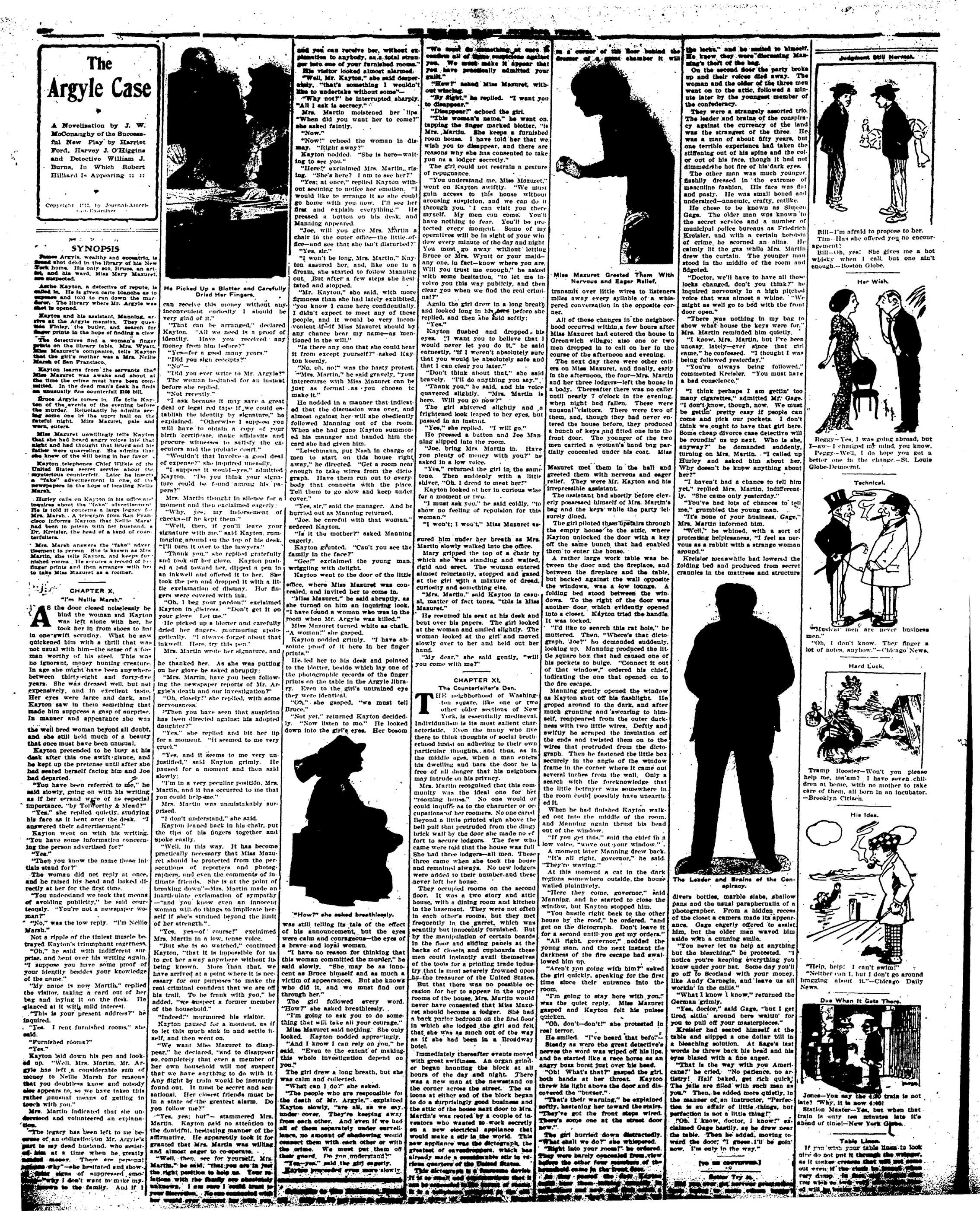
He Picked Up a Blotter and Carefully Dried Her Fingers.
can receive this money without any inconvenient curiosity I should be very glad of it."
"That can be arranged," declared Kayton. "All we need is a proof of identity. Have you received any money from him before?"
"Yes—for a good many years."
"Did you sign receipts?"
"No—"
"Did you ever write to Mr. Argyle?"
The woman hesitated for an instant before she replied.
"Not recently."
"I ask because it may save a great deal of legal red tape if we could establish the identity by signature," he explained. "Otherwise I suppose you will have to obtain a copy of your birth certificate, make affidavits and procure witnesses to satisfy the executors and the probate court."
"Wouldn't that involve a good deal of expense?" she inpired unanimely.
"I suppose it would—yes," admitted Kayton.
"Do you think your signature could be found among his papers?"
Mrs. Martin thought in silence for a moment and then exclaimed eagerly:
"Why, yes, my indemnement of checks—if he kept them."
"Well, then, if you'll leave your signature with me," said Kayton, rumaging around on the top of his desk. "I'll turn it over to the lawyers."
"Thank you," she replied gratefully and took off her glove. Kayton pushed a pad toward her, dipped a pen in an inkwell and offered it to her. She took the pen and dropped it with a little exclamation of dismay. Her fingers were covered with ink.
"Oh, I beg your parion!" exclaimed Kayton in distress. "Don't get it on your glove. Let me."
He picked up a shorter and carefully dried her fingers, murmuring apologetically. "I always forget about that inkwell. Here, try this pen."
Mrs. Martin wrote her signature, and he thanked her. As she was putting on her glove he asked abruptly:
"Mrs. Martin, have you been following the newspaper reports of Mr. Argyle's death and our investigation?"
"Oh, closely!" she replied, with some nervousness.
"Then you have seen that suspicion has been directed against his adopted daughter?"
"Yes," she replied and hit her tip for a moment. "It seemed to me very cruel."
"Yes, and it seems to me very unjustified," said Kayton grimly. He paused for a moment and then said slowly:
"I'm in a very peculiar position, Mrs. Martin, and it has occurred to me that you could help me."
Mrs. Martin was unmistakably surprised.
"I don't understand," she said.
Kayton leaned back in his chair, put the tips of his fingers together and spoke easily.
"Well, in this way. It has become practically necessary that Miss Mazuret should be protected from the persecutions of reporters and photographers, and even the comments of intimate friends. She is at the point of breaking down"—Mrs. Martin made an inarticulate exclamation of sympathy—and you know even an innocent woman will do things to implicate herself if she's strained beyond the limit of her strength."
"Yes, yes—of course!" exclaimed Mrs. Martin in a low, tense voice.
"But she is so watched," continued Kayton, "that it is impossible for us to get her away anywhere without its being known. More than that, we have arrived at a point where it is necessary for our purposes to make the real criminal confident that we are off his trail. To be frank with you," he added, "we suspect a former member of the household."
"Indeed!" murmured his visitor. Kayton paused for a moment, as if to let this much sink in and settle itself, and then went on.
"We want Miss Maruret to disappear," he declared, "and to disappear so completely that even a member of her own household will not suspect that we have anything to do with it. Any flight by train would be instantly found out. It must be secret and sensational. Her closest friends must be in a state of the greatest alarm. Do you follow me?"
"Yes, yes; but"—stammered Mr. Martin. Kayton paid no attention to the doubtful, hesitating manner of the affirmative. He apparently took it for granted that Mrs. Martin was willing and almost eager to co-operate. "Well, then, see for yourself, Mrs. Martin," he said; "that you are in just the right position to help us. Your relations with the family are absolutely unknown, I am sure I could trust to your discretion. No one connected with
and you can receive her, without explanation to anybody, as a total stranger into one of your furnished rooms.
"He visitor looked almost alarmed: "Well, Mr. Kayton, she said desperately, "that's something I wouldn't like to undertake without some"—"Who not?" he interrupted sharply.
"Why not?" he interrupted sharply. "All I ask is secrecy."
Mrs. Martin moistened her lips "When did you want her to come?" she asked faintly. "Now." "Now!" echoed the woman in dismay. "Right away?" Kayton nodded. "She is here—waiting to see you." "Here!" exclaimed Mrs. Martin, rising. "She's here? I am to see her?" "Yes; at once," replied Kayton without seeming to notice her emotion. "I would like to irrange it so she could go home with you now. I'll see her first and explain everything." He pressed a button on his desk, and Manning appeared. "Joe, will you give Mrs. Martin a chair in the outer office—the little office—and see that she isn't disturbed?" "Yes, sir."
"I won't be long, Mrs. Martin," Kayton assured her, and, like one in a dream, she started to follow Manning out. But after a few steps she hesitated and stopped.
"Mr. Kayton," she said, with more firmness than she had lately exhibited, "you know I came here confidentially. I didn't expect to meet any of these people, and it would be very inconvenient if—if Miss Mazuret should by any chance hear my name—as mentioned in the will."
"Is there any one that she could hear it from except yourself?" asked Kayton keenly.
"No, no.!" was the hasty protest.
"Mrs. Martin," he said gravely, "your intercourse with Miss Mazuret can be just as formal as you choose to make it."
He nodded in a manner that indicated that the discussion was over, and almost against her will she obediently followed Manning out of the room. When she had gone Kayton summoned his manager and handed him the card she had given him.
"Lelschmann, put Nash in charge of men to start on this house right away," he directed. "Get a room near enough to take wires from the diocraph. Have them run out to everybody that connects with the place. Tell them to go slow and keep under cover."
"Yes, sir," said the manager. And he hurried out as Manning returned.
"Joe, be careful with that woman." ordered Kayton.
"Is it the mother?" asked Manning eagerly.
Kayton grunted. "Can't you see the family in the face?"
"Gee!" exclaimed the young man, wriggling with delight.
Kaytoo went to the door of the little
office, Miss Masuret was con-
treated, and invited her to come in.
"Miss Masuret," he said abruptly, as
she turned on him an inquiring look.
"I have found a woman who was in the
room when Mr. Argyle was killed."
Miss Masuret turned white as chalk.
Miss Mazurte turned white as chalk. "A woman!" she gasped. Kayton nodded grimly. "I have absolute proof of it here in her finger prints." He led her to his desk and pointed to the blitter, beside which lay one of the photographic records of the finger prints on the table in the Argyle library. Even to the girl's untrained eye they were identical. "Oh," she gasped, "we must tell Bruce." "Not yet," returned Kayton decidedly. "Now listen to me." He looked down into the girl's eyes. Her bosom
```markdown
```
"How? she asked breathlessly.
was still telling its tale of the effect of his announcement, but the eyes were calm and courageous—the eyes of a brave and loyal woman.
"I have no reason for thinking that this woman committed the murder," he said slowly. "She may be as innocent as Bruce himself and as much a victim of appearances. But she knows who did it, and we must find out through her."
The girl followed every word. "How? she asked breathlessly.
"I'm going to ask you to do something that will take all your courage."
Miss Marcuret said nothing. She only looked. Kayton nodded approvingly.
"And I know I can rely on you," he said. "Even to the extent of making this whole investigation depend on you."
The girl drew a long breath, but she was calm and collected.
"What can I do?" she asked.
"The people who are responsible for the death of Mr. Argyle," explained Kayton slowly, "are all, as we any under cover. They're keeping away from each other. And even if we had all of them separately under surveillance, no amount of shadowing would connect them with each other or with the crime. We must put them off their guard. Do you understand?"
"You-you," said the girl eagerly. Kayton proceeded even more slowly.
"We need to something at once to confirm all of these suspicions against you. We must make it appear that you have practically admitted your guilt."
"How!" asked Miss Mazuret, without wincing.
"By sight," he replied. "I want you to disappear."
"Disappear!" echoed the girl.
"This woman's name," he went on, tapping the finger marked blotter. "is Mrs. Martin. She keeps a furnished room house. I have told her that we wish you to disappear, and there are reasons why she has consented to take you as a lodger secretly."
The girl could not restrain a gesture of repugnance.
"You understand me, Miss Maxuet," went on Kayton swiftly. "We must gain access to this house without arousing suspicion, and we can do it through you. "I can visit you there myself. My men can come. You'll have nothing to fear. You'll be protected every moment. Some of my operatives will be in sight of your win dow every minute of the day and night. You must, go away without letting Bruce or Mrs. Wyatt or your maid—any one, in fact—know where you are. Will you trust me enough," he asked with some hesitation, "to let me involve you this way publicly, and then clear you when we find the real criminal?"
Again the girl drew in a long breath and looked long in his eyes before she replied, and then she said softly: "Yes."
Kayton flushed and dropped his eyes. "I want you to believe that I would never let you do it," he said earnestly. "If I weren't absolutely sure that you would be absolutely safe and that I can clear you later." "Don't think about that," she said bravely. "I'll do anything you say." "Thank you," he said, and his voice quenched slightly. "Mrs. Martin is here. Will you go now?" The girl shivered slightly and a frightened look leaped to her eyes, but passed in an instant. "Yes," she replied. "I will go."
"Joe, bring Mrs. Martin in. Have you plenty of money with you?" he asked in a low voice.
"Yes," returned the girl in the same tone. Then suddenly with a little shiver, "Oh. I dread to meet her."
Kayton looked at her in curious wise for a moment or two.
"I must ask you," he said cothly, "to show no feeling of repulsion for this woman."
"I won't; I won't." Miss Mazuret assured him under her breath as Mrs. Martin slowly walked into the office.
Mary gripped the top of a chair by which she was standing and waited, rigid and erect. The woman entered almost reluctantly, stopped and gazed at the girl with a mixture of dread, curiosity and something else.
"Mrs. Martin," said Kayton in casual, matter of fact tones, "this is Miss Mazuret."
He resumed his seat at his desk and bent over his papers. The girl looked at the woman and smiled slightly. The woman looked at the girl and moved slowly over to her and held out her hand.
"My dear," she said gently, "will you come with me?"
CHAPTER XL
THE neighborhood of Washington square, like one or two other older sections of New York, is essentially medicaeval. Individualism is its most salient characteristic. Even the many who live there to think thoughts of social brotherhood insist on adhering to their own particular thoughts, and thus, as in the middle ages, when a man enters his dwelling and bars the door he is free of all danger that his neighbors may intrude on his privacy.
Mrs. Martin recognized that this community was the ideal one for her "rooming house." No one would or could inquire as to the character or occupations of her roomers. No one cared Beyond a little printed sign above the bell pull that protruded from the dingy brick wall by the door she made no effort to secure lodgers. The few who came were told that the house was full She had three lodgers—all men. These three came when she took the house and remained always. No new lodgers were added to their number, and these never left her house.
They occupied rooms on the second floor. It was a two story and attic house, with a dining room and kitchen in the basement. They were not often in each other's rooms, but they met frequently in the garret, which was scantily but innocently furnished. But by the manipulation of contain boards in the floor and sliding panels at the backs of closets and cupboards these men could instantly avail themselves of the tools for a printing trade industry that is most severely frowned upon by the treasurer of the United States.
But that there was no possible occasion for her to appear in the upper rooms of the house. Mrs. Martin would never have consented that Miss Mazurret should become a lodger. She had a back parlor bedroom on the first floor in which she lodged the girl and felt that she was as much out of the way as if she had been in a Broadway hotel.
Immediately thereafter events moved with great swiftness. An organ grinder began haunting the block at all hours of the day and night. There was a new man at the newstand on the corner across the street. The sootons at either end of the block began to do a surprisingly good business and the attic of the house next door to Mrs. Martin's was rented by a couple of inventors who wanted to work secretly on a new electrical appliance that would make a stir in the world. This new appliance was the dictograph, the greatest of carved advertisements, which has already made a considerable stir in various quarters of the United States. This dictograph is a funnel device. It is so small and compact that it must be positioned in the middle of it in a coil-shaped pitfall to the side.
in a corner of the Roar behind the dreamer of a great chamber it will
Miss Maxuret Greeted Them With Nervous and Eager Relief.
transmit over little wires to listeners miles away every syllable of a whispered conversation in the opposite corner.
All of these changes in the neighborhood occurred within a few hours after Miss Maxuret had entered the house in Greenwich village; also one or two men dropped in to call on her in the course of the afternoon and evening.
The next day there were other callers on Miss Maxuret, and finally, early in the afternoon, the four—Mrs. Martin and her three lodgers—left the house in a body. Thereafter there was no caller until nearly 7 o'clock in the evening, when night had fallen. These were unusual visitors. There were two of them, and, though they had never entered the house before, they produced a bunch of keys and fitted one into the front door. The younger of the two men carried a woman's hand bag partially concealed under his coat. Miss Maxuret met them in the hall and greeted them with nervous and eager relief. They were Mr. Kayton and his irrepressible assistant. The assistant had shortly before cleverly possessed himself of Mrs. Martin's bag and the keys while the party leisurely dined.
The girl piloted them upstairs through the empty house to the attic, where Kayton unlocked the door with a key off the same bunch that had enabled them to enter the house.
A rather large work table was between the door and the fireplace, and between the fireplace and the table, but backed against the wall opposite the windows, was a low lounge. A folding bed stood between the windows. To the right of the door was another door which evidently opened into a closet. Kayton tried the handle. It was locked.
"I'd like to search this rat hole," he muttered. Then, "Where's that diograph, Joe?" he demanded suddenly, looking up. Manning produced the little square box that had caused one of his pockets to bulge. "Connect it out of that window," ordered his chief, indicating the one that opened on to the fire escape.
Manning gently opened the window as Kayton shut off his flashlight. He groped around in the dark, and after much grunting and swearing to himself, reappeared from the outer darkness with two little wires. Definitely and swiftly he scraped the insulation off the ends and twisted them on to the wires that protruded from the dictograph. Then he fastened the little box securely in the angle of the window frame in the corner where it came out several inches from the wall. Only a search with the foreknowledge that the little betrayer was somewhere in the room could possibly have unearthed it.
When he had finished Kayton walked out into the middle of the room, and Manning again thrust his head out of the window.
"If you get this," said the chief in a low voice, "wave out your window."
At this moment a cat in the dark regions somewhere outside, the house walled plaintively.
"Here they come, governor," said Manning, and he started to close the window, but Kayton stopped him.
"You must right back to the other house by the roof," he ordered. "and get on the dictograph. Don't leave it for a second until you get my orders."
"All right, governor," nodded the young man, and the next instant the darkness of the fire escape had swallowed him up.
"Aren't you going with him?" asked the girl quickly, speaking for the first time since their entrance into the room.
"I'm going to stay here with you," was the quiet reply. Miss Mazuret gasped and Kayton felt his pulses quicken.
"Oh, don't—don't!" she protested in real terror.
He smiled. "I've heard that before." Steady as were the great detective's nerves the word was wiped off his lips, and he started like a race horse as an angry buzz burst just over his head. "Oh! What's that?" gaped the girl, both hands at her throat. Kayton throw his light above the door and discovered the "buzzer."
"That's their warning," he explained softly, hastening her toward the stairs. "They've got the front steps wired. There's some one at the street door now."
The girl hurried down distractedly. "What shall we do?" she whispered. "Right into your room?" he ordered. They were barely concocted from view before the other four members of the household came in the front door.
As they passed the door Kayton could hear them snorting snortily in a whisper and now told them a whisper.
the lectra" and he needed to himself.
He knew they were "disarming Manning's theft of the bag.
On the second floor the party broke up and their voices died away. The woman and the older of the three men went on to the attic, followed a minute later by the youngest member of the confederacy.
They were a strangely assorted trio.
The leader and brains of the conspiracy against the currency of the land was the strangest of the three. He was a man of about fifty years, but one terrible experience had taken the stiffening out of his spine and the color out of his face, though it had not dimmed the hot fire of his dark eyes.
The other man was much younger, flashily dressed in the extreme of masculine fashion. His face was flat and pasty. He was small boned and underalized—anaemic, crafty, rattik.
He chose to be known as Slipmom Gage. The older man was known to the secret service and a number of municipal police bureaus as Friedrich Kretsler, and with a certain heredity of crime, he scorned an alias. He calmly lit the gas while Mrs. Martin drew the curtain. The younger man stood in the middle of the room and fidgeted.
"Doctor, we'll have to have all those locks changed, don't you think?" he inquired nervously in a high pitched voice that was almost a whine. "We might as well go to bed with the front door open."
"There was nothing in my bag to show what house the keys were for." Mrs. Martin reminded him quietly.
"I know, Mrs. Martin, but I've been unacuse, lately—ever since that girl came," he confessed. "I thought I was being followed yesterday."
"You're always being followed," commented Kreisler. "You must have a bad conscience."
"I think perhaps I am gettin' too many cigarettes," admitted Mf. Gage. "I don't know, though, now. We must be gettin' pretty easy if people can come and pick our pockets. I don't think we ought to have that girl here. Some cheap divorce case detective will be roundtin' us up next. Who is she, anyway?" he domanded suddenly, turning on Mrs. Martin. "I called up Hurley and asked him about her. Why doesn't he know anything about her?"
"I haven't had a chance to tell him yet," replied Mrs. Martin, indifferently. "She came only yesterday."
"You've had lots of chances to tell me," grumbled the young man.
"It's none of your business. Gage." Mrs. Martin informed him.
"Well," he whined, with a sort of protesting helplessness, "I feel as nervous as a rabbit with a strange woman around." Krelater menwhile had lowered the folding bed and produced from secret crannies in the mattress and structure
```markdown
```
The Leader and Brains of the Conspiracy.
divera bottles, marble slabs, shallow pans and the usual paraphernalia of a photographer. From a hidden recess of the closet a camera made its appearance. Gage eagerly offered to assist him, but the older man waved him aside with a cunning smile.
"You never let us help at anything but the bleaching," he protested. "I notice you're keeping everything you know under your hat. Some day you'll go off to Scotland with your money, like Andy Carnegie, and leave us all workin' in the mills."
"What I know I know," returned the German grimly.
"Yes, doctor," said Gage. "but I get tired sitin' around here waitin' for you to pull off your masterpieces."
Kreisler had seated himself at the table and slipped a one dollar bill in a bleaching solution. At Sage's last words he threw back his head and his eyes blazed with a fine anger.
"That is the way with you Americans!" he cried. "No patience, no artistry! Half baked, get rich quick! The jails are filled with such men as you." Then, he added more quietly, in the manner of an instructor, "Perfection is an affair of little things, but perfection is not a little thing."
"Oh. I know, doctor, I know!" exclaimed Gage hastily, as he drew near the table. Then he added, moving toward the door; "I greeks. I'll be gold now, I'm only in the way."
Judgment Still Narrated.
Bill--I'm afraid to propose to her.
Tim--Has she offered you no encouragement?
Bill-Oh, yes! She gives me a hot whisky when I call, but one ain't enough--Boston Globe.
Her Wish.
Reggy-Yes, I was going abroad, but I-aw-I changed my mind, you know.
Reggy-Well, I do hope you got a better one in the change-St. Louis Globe-Democrat.
Technical.
Musical men are never business men."
"Oh, I don't know. They finger a lot of notes, anyhow."—Chicago' News.
Hard Luck.
Trump Roooster—Won't you please help me, ma'am? I have seven children at home, with no mother to take care of them, all born in an incubator. —Brooklyn Citizen.
His Idea.
"Help, help! I can't swim!"
"Neither can I, but I don't go around
bringing about it."—Chicago Daily
News.
Due When It Gets There.
Jones—You say the 4:30 train is not
late? Why, it is now 4:40.
Table Line
If you wish your table lines to look
also do not put it through the whisker,
as it unknocks creases that will not come
out even if the cloth is bound, when
every damp . . . in them can be removed,
now which to keep very well, and
will not be broken.
SATURDAY.....AUGUST 16, 1913.
```markdown
```
A penny'saved is a penny earned Benjamin Franklin
The Housewife's Pocketbook.
In a magazine article J. J. Hill, the railroad magnate, gives his ideas on how the housewife should spend money.
"There is nothing," he says, "more important in this nation or the life of any other nation than the pocketbook of the wife.
"The original question of social economics which we have to consider at the present time is not the tariff or the finances of one of the richest governments in the world, but the pocketbook of the wife. I emphatically state that I do not mean the pocketbook of the husband.
"I will suppose she knows how to expend the money that is placed in her charge. She may have earned it through the truck garden at the rear of the house. The husband may give it to her every Saturday night. The children may through their efforts bring in part of it.
"But the greatest question is not where that money came from so long as it was honestly received, but does she know what to do with it? How far can she make it go, not merely in paying household expenses, but in placing part of it so that it will begin to earn interest and duplicate itself?"
"Contrary to general opinion, the securing of money is not a very difficult task if one is willing to work. The real importance of finances for a man or woman, for a boy or a girl, is what is done with the money after it is earned.
"It makes no difference whether one is purchasing miles of steel rails or underclothing for the children or a bunch of onions. Buy the beat, pay the price, keep on working and realize finally that the control of living is within your hands."
How to Use Discarded Paper
How to Use Discarded Paper.
The oilied paper that comes over, butter can be used for papering cake tins, while that which comes from the inside of cracker boxes is good for a dozen different things—for instance, cheese may be kept moist by wrapping in this paper, also sandwiches.
If the cake is getting brown too quickly covering with waxed paper will check it.
Sheets of wrapping paper will save labor very often. One can use it to prepare chickens on for the oven, roll crackers, paper apples or slice bread, when the paper can be rolled up and dropped into the garbage pail.
Newspapers laid upon the door before an open grate when taking out the ashes will save the carpet considerably, and one lightened when shaking down a grate will carry the dust up the chimney.
These little conveniences do not cost a cent, but once they are put in their value is sure to be appreciated.
How to Sharpen a Lawn Mower.
A great many women mow their own lawns, and when the mower is sharp it is a delight, but if the mower is dull it becomes a laborious task. Here is a way to sharpen a dull mower: Get some real fine emery powder and mix it up with a thick oil, such as linenseed oil, lard oil or crude oil. The latter is the cheapest and best for this purpose. Apply the mixture to the edge of the knives with a paint brush and turn the mower just as you would while cutting grass. In a very few minutes you will have a cutting edge that will last a long time.
Now try this and you can make lots of pin money sharpening mowers for your friends and neighbors.
HOW TO BE COMFORTABLE
DURING WARM WEATHER.
Savon feuilles and papiers
poudres are never really appreciated until warm weather comes upon us. Then the small books of powder paper, which comes in several tints, and the books of soaped paper, the leaves of which turn into a free lather as soon as they are wet, seem like gifts from the fairies. A woman who travels with a book of powder papers, a book of soap leaves and a few lengths of the absorbent paper fowling, which can be bought by the roll, neatly stowed in her hand bag, can be comfortably clean wherever she is with little effort.
How to Cure Baldness
If you are growing bald and want to encourage your hair to remain with you learn to play the violin, cello or double bass, or even the piano will do. M. de Parville, a French scientist, has been collecting statistics of musicians, and he finds that playing string instruments has a tonic effect on the hair. This may explain why victoriaans and planets so often have long menus. The vibration of the strings comes to be just the sort of message that the hair thirstens on. On the other hand, we are poor learners if you play a wind instrument.
Hawaiianism. The vibration for such
intentions seems to be too much for
the new brain, and they give up and
go on. So accepted is this effect now
that the French doctors call it "brain
tumor hallucination."
HOW TO AVOID ACCIDENTS WITH KEROSENE LAMPS
The two great and very real dangers in connection with lamps are dirt and caroliness, and to these two causes are attributed most lamp accidents. Lamps with metal reservoirs are safer than those of glass or china, as the former, if upset, can be picked up and replaced before the oil can escape. Of course the oil used must be of good quality. There is no saving, but some waste and some danger in poor oil. Bad oil clogs the wick and the burner, besides giving off an unpleasant and very dirty vapor. Never turn down a lamp. It is meant to burn with the flame at full height, and when allowed to smolder in this way it will either smoke or smell and most certainly beat rapidly and become a distinct source of danger.
An alcohol lamp should always be placed in a shallow dish, as it is liable to run out on table or dresser and ignite. Never keep the alcohol bottle near the lighted lamp. Do not pour fresh alcohol into the tank if there is burning char on it, for the entire contents may burst into flames.
How to Make Delicious Pickle That Can Be Recommended.
An easy way of canning cherries and a way which preserves much of the beauty of the cherries is to bottle them after they have been washed, dried, and pitted and to put two ounces of sugar in each bottle. Then cork them tightly and put the bottles in cold water. Bring the water to the boiling point and boil gently until the cherries are covered with juice. They are then done. Cool them in the water, push the corks in more tightly and store them away.
Raspberry vinegar makes a refreshing and easily prepared beverage, and the vinegar is not troublesome to make. Cover four quarts of red raspberries with vinegar. Twenty-four hours later scald and strain the mixture. Measure the juice and add a pound of granulated sugar to each plot of juice. Boll twenty minutes and bottle. This concoction will keep for years. When it is to be used add a tablepoonful to a glassful of cold water.
To make spiced currants wash, dry and stem the currants. Measure them and for four pounds allow a pint of vinegar and two pounds of brown sugar. Add half a cupful of whole spices tied in a thin muslin bag. Cinnamon, casata buds, cloves and allspice should be included. Boll the spices, sugar, and vinegar for ten minutes, skim and add the fruit. Boll until the currants are tender; then put them in jars and boll down the sirup, pour it over the jars and seal.
Spliced cherries are a less usual but no less delicious pickle. To make them both six pounds of granulated sugar with eight pounds of stoned cherries for twenty minutes. Remove the fruit and put it in scalded jars. Add two tablespoonfuls of ground cinnamon tied in a piece of cheesecloth, a tablespoonful of whole mace, a tablespoonful of whole cloves, a pint of vinegar and boll the sirup down until it is thick. Then pour it over the fruit and seal the jar.
How to Get Bid of Bedbugs
Paint the mattress over lightly with bichloride. It neither stains nor smells. Wipe the bedstand and springs with a cloth wet in it and drench crannies unwipable. Wipe the backs of pictures and of dressers—in fact, any sheltered and static space. Wipe the floor with bichloride if bare and wax or oil afterward. Sprinkle a carpet or rugs with bichloride, then sweep with a broom dipped in very hot water. Empty cloets, wipe over, examine all accumulations of paper, boxes, etc. A bug overlooked will in a month's space infest a whole house. Couches of rattan, wicker or upholstered are strongholds of the blood suckers. Set in air and drench with benzine or gasoline, leave standing a day and drench again, shaking, brushing and boating between drenchings.
How to Make Children's Gulpses. Why is it that children's gulpses are not sold as reasonably as white lawn dresses of the same quality? One mother, after looking in vain for everyday gulpses at a low price, turned to a bargain counter offering daisy white lawn dresses. Here she solved her difficulty. She chose those with a rather full ruffled skirt and no other trimming except a narrow edging at the neck and wrists. She did not wish to sacrifice the quality of material for the elaborate embroidery with which bargain counter white goods are generally advertised.
How to Dry Wash Gloves
A wooded frame over which wash gloves are stretched to dry is a convenience to the woman who wears chamols, doekins and silk gloves in the warm weather. A wooden hand with a stationary thumb costs 40 cents. For 20 cents more a hand with a movable thumb, adjusted by means of a wooden screw, can be bought. The gloves can be put on the frames either before they are washed or afterward, while they are still wet. They cannot shrink, as the frame holds them in shape.
RIGHT AND BATTY.
Right is the faith of the individual. Duty is the common collective faith. Right can but organise resistance. It may destroy; it cannot found. Duty builds up, associates and unites. It is derived from a general law, whereas right is derived only from human will. There is nothing, therefore, to forbid a struggle against right. Any individual may rebel against any right in another individual which is injurious to him, and the sole judge left between the adversaries is force, and such, in fact, has frequently been the answer which societies based upon right have given to their opponents.
Societies based upon duty would not be compelled to have recourse to force. Duty, once admitted as the rule, excludes the possibility of struggle, and by rendering the individual subject to the general aim it cuts at the very root of those evils which right is unable to prevent and only affects to cure. Moreover, progress is not a necessary result of the doctrine of right. It merely admits it as a fact—Joseph Mazzini.
THE SANDS O' DEE.
"Oh, Mary, go and call the cattle home,
And call the cattle home,
And call the cattle home,
Across the sands o' Dee!"
The westen wind was wild and dank wi' foam,
And all alone went she.
The creeping tide came up along the sand,
And o'er and o'er the sand,
And round and round the sand
As far as eye could see.
The blinding mist came down and hid the land,
And never home came she.
"Oh, is it weed or fish or floating hair—
A tree o' golden hair,
A drowned malden's hair—
Above the nets at sea?
Was never salmon yet that shone so fair
Among the stakes on Dee?"
They rowed her in across the rolling foam—
The cruel, crawling foam,
The cruel, hungry foam—
To her grave beside the sea,
But still the boatmen hear her call the cattle here.
Across the sands o' Dee.
—Charles Kingsley.
WAR NEEDLE88.
War is in the interest of a few people, not of all. The profits are garnered by a few, while the masses pay the taxes. A few men gain glory, while the mothers of the nation furnish the sons who make food for battlefields. War rests upon feeling, not upon necessity. As people increase in intelligence they not only take an increasing pride in deciding questions upon the basis of intelligence, but with increasing information they learn the awful cost of war as well as its uneasiness. Intelligence leads us to understand the causes that lend up to war. We understand as we grow in intelligence what subsidized patriotism means, what it means for people to hide behind the idea of patriotism as they attempt to advance their own peculiary interests. - W. J. Bryan.
IT NEVER COMES AGAIN.
There are gains for all our hearts.
There are balms for all our pain.
But when youth, the dream, departs.
It takes something from our hearts.
And it never comes again.
We are stronger and are better. Under manhood's sterner reign.
Still we feel that something sweet.
Followed youth with flying feet.
And will never come again.
Something beautiful is vanished.
And we sigh for it in vain.
We behold it everywhere—
On earth and in the air—
But it never comes again.
—Richard Henry Stoddard.
MAN WHO ARRIVES.
The man who arrives is the man who has will, who has a vision and looks into the future to make life worth while. In business he is not satisfied to do the work that is before him. He will do the work of the other man. He can do two men's work as well as one—the kind of man who goes to school at night to better his position. He is the kind of man you cannot down, the kind of man Paul was, for if there ever was a man to arrive it was certainly Paul-J. D. Rockefeller, Jr.
How to Wash China Silk
When washing china silk never hang it up to dry, but instead wring it dry and wrap it in a piece of white material, leaving it this way for about one hour, then fringing it. By doing this one gets much better results and the silk does not turn yellow.
WOMANKIND.
Love has no such sacredness,
is incapable of such exaltation
with man, as it has and is with
women. To him it is the appa-
nage of egotism; it is flattered
vanity; it is selfishness glossed
with sentiment. He loves to be
loved. She loves to love.—Ju-
nius Henri Browne.
Every pretty girl one sees is a
reminiscence of the garden of
Eden.—Frederick Sheldon.
The woman we love most is
often the one to whom we
express it the least.—Elmo Pierre
Chanvot de Beauchene.
Woman's counsel is not worth
much, yet he that despises it is
no wiser than he should be.—
Miguel de Cervantes.
Woman is the nervous part of
humanity, man, the muscular.—
Jean Noel Hally.
O woman, woman, they art
formed to bless the heart of rest-
less man!—J. Bird.
Women are often ruined by
their sensitiveness and saved by
their copiety—Mile. Azals.
WARFARE.
Regular troops alone are equal to the exigencies of modern war as well for defense as offense, and when a substitute is attempted it must prove illusory and criminal. No militia will ever acquire the habits necessary to resist a regular force. The firmness requisite for the real business of fighting is only to be attained by constant course of discipline and service. I have never yet been a witness to a simple instance that can justify a different opinion, and it is most earnestly to be wished that the liberties of America may no longer be trusted in a material degree to no prevaricious a defense—George Washington.
The frontiers of states are either large rivers or chains of mountains or deserts. Of all these obstacles to the march of an army the most difficult to overcome is the desert; mountains come next, and broad rivers occupy the third place—Napoleon.
RANDOM THOUGHTS.
No greater grief than to remember days.
Of joy when misery is at hand.
—Dante.
One inch of joy surmounts of grief a span.
Because to laugh is proper to a man.
—Rabelais.
In bed we laugh, in bed we cry,
And, born in bed, in bed we die.
The near approach a bed may show
Of human bliss to human woe.
—Benserade.
Art is long; life is short, judgment difficult, opportunity transient.—Goethe.
History is little else than a picture of human crimes and misfortunes—Voltaire.
Although I am a plous man, I am not the less a man.—Mollere.
ATHENIAN DEMOCRACY.
Our form of government does not enter into rivalry with the institutions of others. We do not copy our neighbors, but are an example to them.
It is true that we are called a democracy, for the administration is in the hands of the many and not of the few. But, while the law secures equal justice to all alike in their private disputes, the claim of excellence is also recognized, and when a citizen is in any way distinguished he is preferred to the public service, not as a matter of privilege, but in the reward of merit. Neither is poverty a bar, but a man may benefit his country whatever be the obscurity of his condition—Thucydides.
LOW SPEECH
You know we condemn lowness of speech, and justly so, for the gift of speech is peculiar to a man and a boon which God granted to him, that he may be distinguished from the rest of living creatures. This gift, therefore, which God gave us in order to enable us to perfect ourselves, to learn and to teach, must not be employed in doing that which is for our most degrading and disgrueful. We must not imitate the songs and tales of ignorant and inaccessible people. It may be suitable to them, but it is not for those who are told, "Azd ye shall be unto me a kingdom of priests and a holy nation" (Ex. xix. 80—Maimonides.
WHITE TUB FROCKS.
How to Add Daintiness and Charm to the Summer Wardrobe.
The white tub frock, if it is really a
tub frock, comes out from the launder
each time it is washed looking
fresh and cool. Even if it is not sheen
Wably modish those qualities continue to give it charm so long as it holds together.
The woman who yields to the lure of the delicate plinks and blues and ilias and greens or of the delightful flowered cottons, which are so tempting in the first spring showing after a winter of dark, skies and dark frogs, may have an attractive summer wardrobe, but it will be neither practical nor so economical as that of the woman's who turns her back upon the flowery spring lines and buys the white that is not so switching in the hand, but is so efficiently satisfactory on the back.
This season the wife buyer of white will find an unusual number of desirable white materials from which to make her choice. Whether she wishes to spend much money or little the white goods counters will offer a satisfactory solution of her problem, and among ready made frocks there are more pretty white models than in the ordinary season.
The simple type of lingerie frock for example, has improved unimaginably. Not so very long ago it was almost impossible to buy for a moderate sum a sheer white tub frock that was of good material and neatly and attractively made. The manufacturers tried to give too much for the money, piled cheap laces, cheap embroidery, cheap machine work upon white lawn and achieved shoddy copies of lingerie models, copies that a woman of taste could not be persuaded to wear. If such a woman wanted a simple and inexpensive white lingerie frock she had it made at home.
How to Make Versailles Cream.
This dessert is molded so that it can stand alone when turned out on a platter. Have ready a quart of milk, three-quarters of a cupful of sugar, a teaspoonful of vanilla extract, a scant half teaspoonful of salt, six eggs and two tablespoonfuls of water. Put the water and about half the sugar into a frying pan. Stir them together until a rich red brown syrup forms, taking care that it does not burn. Have the milk boiling slowly and stir this caramel into it.
Heat together the eggs, the salt and the rest of the sugar. Add the vanilla and stir the mixture into the milk. Butter a two quart mold very lightly and pour the cream into it. Put the mixture into a basin of warm (not hot) water and bake it in a slow oven until it is firm in the center. When done set it in the feboob to become very cold before serving. Turn it out on a platter when serving time arrives and decorate it with whipped cream.
How to Prepare a Cheap Roast
Cut the top from a loaf of stale bread and scoop out the inside. Mix the crumbs with a little water, thyme, chopped onion, salt and pepper to taste, add a pound of rare meat (underdone beef is best) and work with a fork into a crumbly forcement. Put this into the loaf, ruff the top, cover top and sides with a thin layer of suet and put into the roaster. Bake from one-half hour to forty minutes, according to size of loaf. If you have a little gravy thin with hot water and baste the loaf frequently with it. If not, use a little water and butter. The crust will be crisp, yet tender. Transfer to a heat-
HOTEL
HOTEL DALE
THE HOTEL
CAPE MAY, N. J.
This magnificent hotel, located beautiful seashore resort in the western improvement, superlative in our service, and refined patronage. Path houses, tennis, etc., on premise en to ladies and children. Send for E. W. DX
This magnificent hotel, located in the heart of the most beautiful seashore resort in the world; replete with every modern improvement, superlative in construction, appointments, service, and refined patronage. Orchestra daily. Garage, bath houses, tennis, etc., on premises. Special attention given to ladies and children. Send for booklet.
E. W. DALE, Owner
D. J. FARRAR, CONTRACTOR AND BUILDER. ALL KINDS OF CARPENTRY. OFFICE ROOM, NO. 405, MECHANICS' SAVINGS BANK BUILDING 'Phone, Monroe—2637. RESIDENCE, 610 N. FIRST STREET—SHOP IN REAR 'Phone, Monroe—2166. Special Attention Paid to the Taking of Contracts for Building of Any Style of Architecture. Job Work a Specialty.
Funeral Director, Embalmer and Liveryman.
All Orders Promptly Filled at Short Notice by telegraph or telephone. Halls rented for meetings and nice Entertainment. Plenty of room with all necessary conveniences. Large Picnic or Band Wagons for Hire at reasonable rates and nothing but first-class Carriages, Buggies, etc. Keep constantly on hand fine funeral annuaries.
add platter and serve. Carve with a sharp knife into slices three quarters of an inch thick. One can also use leftover sausage in place of beef.
We count the man who cares nothing for the public, weak as a worthless nuisance and not simply an inoffensive nonentity. — Thucydides.
"Half the world doesn't know how the other half lives."
"I know. I've just been wondering how ever Greens can afford a limp sine when you can't even buy gasoline for a motorcycle." -Detroit Free Press.
Eyeballs.
Did it ever occur to you to inquire why the eyeball of the eye is white?
The reason is rather curious. The blood vessels which supply its surface are so fine that they do not admit the red corpuscles of the blood.
Shifting the Responsibility.
Miss Rocksey—Oh, papa, why do you wish me to marry the kind of man who can get money out of the other fellow? Old Rocksey—Because, dear, then he won't be trying to get it out of me—Judge.
Not Much on Him.
"Oh, I know a few things," said the worthy senior.
"Well, you've got nothing on me."
"Owed the freshman." "Guess I know things as anybody."—Philadel-
THE ECONOMY
316 North Third Street.
FINE
TAILORING
CLEANING DYEING AND
REPAIRING.
CHITMAN M. WHITE,
Proprietor.
STRAUS' SPECIAL
Old Yacht Club,
PURE WHISKEY
Will satisfy the Lover of the Right
Kind of Stimulation. Special Friends
We Have All Grades of Good Liquor,
Ogara and Robinson. Only
and See Us.
ISAAC STRAUS & CO.,
422 E. Broad St.,
Richmond, Virginia
DALE
ed in the heart of the most world; replete with every mod- construction, appointments, Orchestra daily. Garage, lses. Special attention giv- for booklet. ALE, Owner
PUBLIC SPIRIT.
Her Problem.
Eyeballa.
**INVESTIGATION TEAMS - WEEKDAYS.**
Lovey Boat
Leave Klina Sea
Leave Klina Sea
Arvore Bird Sea, Na. R. 38 A. H. From Producer/delivery.
Arvore Bird Sea, Na. R. 38 A. H. From Producer/delivery.
Arvore Bird Sea, Na. R. 38 A. H. From Producer/delivery.
All travel to and from Birmingham by car, train and departures set guaranteed. Read more.
N. & W. МОЛНОЕ
ONLY ALL RAIL LINE TO NORSOLE.
Schedule in Effect September 30, 1918.
Byrd Bryl Strain, Strain.
NORSOLEK: "9:00 A. M., 9:00 P. M., 9:00 P. M.
FOR LYNCHBURG AND THE WEST: "6:15 A.
M., "7:50 A. M., "8:00 P. M., "8:00 P. M.
FOR NORSOLE: "11:40 A. M., "11:50 A. M.
"8:55 A. M., "11:20 P. M., "8:55 A. M.
"4:04 A. P., "4:21 P. M., "8:14 P. M., "8:2
P. P., "9:00 P. M.
W. B. BELLVIL, Sunday, 8:00 Only.
W. C. BAUERDE, G. P. A., R. A. RENDE, V.
C. I. BOGLEY, D. P. A., Richmond, V.
ATLANTIC COAST LINE
TRAINS LEAVE ENCUMBRATI DAILY.
For Florida and South: 8:1' A. m. and
7:5' E. m. M. Charleston.
For Norfolk: 4:18' A. m. 7:48' F. m.
4:10' P. m. 7:00' P. m.
Trains arrive Richmond daily: 6:20 A. M.
6:40 A. M., 6:25 A. M., 6:17 A. M., *8:00
A. M., 11:40 A. M., *11:40 A. M., *7:40 P. M.
*7:15 P. M., 8:15 P. M., 6:25 P. M., 6:50 P. M., 8:40
P. M., 8:00 P. M., *10:25 P. M., 11:30 P. M.
*Except Sunday.
Time of arrival and departure and commuter
not guaranteed,
G. R. SAYFELLE, P. R. P.
SOUTHERN RAILWAY.
Premier Carrier of the South.
ham and Raleigh, 10:30 A. M.-Dally-Landing—For all points South, Drawing-Room Bottles Sleeping Car to Ashverilla. 8:00 P. E. Except Sunday-Local for Durham and Interim-Rate station. 6:00 P. M.—For Burden, Atlanta and Birmingham. 8:00 P. M.
Drawing-Room Sleeping Car. 11:45 P. M.-Dally-Limited—For all points South,—Palman ready at 9:00 P. M.
YORX RIVER LINE. 4:30 P. M.-Ex. today-To West Pediat, now connecting for Baltimore Monday, Wednesday and Friday. 6:06 A. M.-Except Sunday and Sell F. M.-Monday, Wednesday and Friday-Show to West Pediat.
TRAINS ARRIVE RICHONO. From the South: 6:00 A. M.; 6:00 E. SLS: 6:06 P. M.; daily-13:30 Except Sunday; 6:00 K. M. daily. From West Pediat: 9:30 A. M. dairy. 11:56 A. M. Wednesday and Friday; 6:58 P. M. Except Sunday.
C. & O.
7:50 A.-Local-Daily-Newport News.
8:15 A.-Local-Daily-Charlestonville. Rows
Sunday Thurwood.
9:00 A.-Local-Daily-Nortfolk. Old Punish.
10:00 A.-Local-Daily-Lynchburg, Lexington.
Clifton Forges.
FORWARD
*12:00 Noon-Express-Daily-Nortfolk, Old Pud-
*12:15 P.-Express-Daily-Oscillanct, Loud-
*4:00 P.-Express-Daily-Nortfolk, Old Pud-
*5:00 P.-Local-Daily-Newport News, Old Pud-
*5:15 P.-Local-Daily-Sunday-Gordonville.
*5:15 P.-Local-Daily-Exxon.
*6:00 P.-Limited-Daily-Oscillanct, Chicago.
*11:00 P.-Express-Daily-Cin., Loudville.
*11:00 P.-Express-Daily-Cin., Loudville.
TRAINS PARCOR
TRAINS NORTMONT-Local from
East: 8:45 A. M., 7:40 F. M.
East: 11:30 A. M., 2:05 P. M., 8:20 F. M.
Local from West: 8:20 A. M., *9:25 A. M.
M. Through: 8:20 A. M., 11:25 A. M.
and 8:20 P. M.
James River Line: *8:25 A. M., 7:10 P. M.
M. Expires Sunday.
SEABOARD AIR LINE
Southbound trains scheduled to leave Richmond daily: 9:00 A. M.-Local to Norrham. 1:00 P. M.-Sleepers and coaches, Atlanta, Minneapolis, Racine, Jacksonville. 11:30 P. M.-Sleepers and coaches, Atlanta, Tulsa, Philadelphia. 1:00 A. M.-Sleepers and coaches, Jacksonville. Northbound trains scheduled to arrive in Richmond daily: 8:30 A. M., 7:40 A. M., 5:00 P. M., 6:50 P. M. Local.
ALPHEUS SCOTT
CREEKUM HILL
Funeral Director and Embalmer
OPEN DAY AND NIGHT.
Office, 3006 P St. Phone Mad. 2337
Residence, 1015 St. James St.
Phone, Mad, 6619
Paraphernalia, Material and
Service of the Best, Reliable
Service, Moderate Rates.
MADAME SCOTT, Embalmer for
for Women and Children and in
attendance at funerals.
OLD PAPERS
PLANET
JOHN M.
Higgins,
DEALER IN
CHOICE GROCERIES,
WINES, LIQUORS
and CIGARS.
PURS GOODS, FULL VALUE FOR
THE MONEY.
1610 East Franklin Street
JOHN M.
Higgins,
DEALER IN
CHOICE GROCERIES,
WINES, LIQUORS
and CIGARS.
PURE GOODS, FULL VALUE FOR
THE MONEY.
1610 East Franklin Street
(Near Old Market)
RICHMOND
Published every Saturday by JOHN MITCHELL
Jr., at Rhi X. Fourth Street, Richmond, Va.
JOHN MITCHELL, Jr., ... EDITOR
all communications intended for publication
should be sent as an e-mail to me by Wednesday.
TERMS IN ADVANCE
Oasis Copy, per year ..... 11.11
Oasis Copy, per month ..... 11.09
Oasis Copy, six months ..... 10.08
Oasis Copy, four months ..... 9.88
Oasis Copy, three months ..... 9.88
Landscape Copy ..... 9.88
ADVERTISING MATRIX
for one inch, one insertion ..... 9.10
for one inch each subsequent insertion ..... 9.10
for two inches, six months ..... 9.10
for two inches, six months ..... 10.10
for two inches, twelve months ..... 10.10
for two inches, one inch ..... 9.10
Mailing and Transit Notions, per line ..... 9.10
OFTAGE STAMPS OF A RIVERHILL DENOMINATION THE ONLY DENOMINATED ON SUBSCRIPTION.
THE PLANET is issued weekly. The subscription price is $1.50 per year, in addition. There are all the mail runs in a Post Office Money Order, by Bank Check or Draft, or an Express Money Order, and when none of these can be procured, in a Registered Letter.
MONEY ORDERS - You can buy a Money Order at your Post Office, payable at the Richmond Post Office, and we will be responsible for its arrival.
EXPRESS MONEY ORDERS can be obtained at any office of the American Express Co., the United States Express Ou, and the Wells Fargo and On's Express Company, and of these companies. The Express Money Order is a safe and convenient way for forwarding money.
REGISTERED LETTER - If a Money Order, for the Express Money Order is not within your reach, your Postmaster will Register the Letter you wish to send us on payment of two cents. Then, if the Letter is lost or stolen, it may be mailed and paid money in this manner at our risk.
We cannot be responsible for money sent in letters in any other way than one of our letters may be mailed to you in any other way, you must do it at your own risk.
RENEWAL, ETC.—If you do not want the FLANKT continued for another year after your death, you may easily be made hard to discontinue it. The courts have enabled that subscribers to newspapers who do not order their paper discontinued, the courts have allowed that subscribers to have and are held liable for the payment of the subscription up to date when they order the paper discontinued.
COMMUNICATION—When writing to us to renew your subscription or to discontinue your paper, you should give your name and address to the advertiser we must send your name on our basis.
CHANGE OF ADDRESS—In order to change the address of a subscriber we must visit the author as well as the present address.
Referred at the Post Office at Richmond, Va., as commissioner.
SATURDAY...AUGUST 10, 1913.
Colored folks are just like the white folks of the same class. They differ only in color and language.
Senator James K. Vardaman, who has "done nothing" but malign and abuse the Negroes since he entered the United States, Senate considers that he has fulfilled his mission and is entitled to a vote of thanks from his constituents. All we ask is that when he is dead, Adam E. Patterson, Esq. of Oklahoma he permitted to write the epitaph on his tombstone.
President Woodrow Wilson has nominated a white citizen as United States Minister to the black republic of Hayti. This action demonstrates conclusively that all hope of political recognition of the colored democratic contingent has disappeared. We would like to know what the leaders in the movement at Baltimore will say now, or are they too empty for utterance.
GOV. SULZER'S PREDICAMENT.
---
The Impachment of Gov. William Sulzer by the New York Assembly will be generally regretted by his friends everywhere. While the situation just now is acute and the array of alleged facts against him damaging, it should not be forgotten that the defense has not been heard and that his trial for "alleged high crimes and misdemeanors" is yet to take place. If it is true that he has been made the escape-goat for his wife the outcome will be all the more distressing and embarrassing. In many states of this union, the charges against him would not be offences against the law. The distinguished statesman though has been active in enacting these very provisions which have brought about the undoing of himself and family.
There is something admirable and
admirable in his open de-
fance of his enemies. He comes of fighting stock and there seems to be little doubt but what, even as he leaps into the gulf of objection he will face no quarter and ask none.
A ROSEATE VISION?
The esteemed Richmond Planet had a vision the other day of "the dawn of a new day in the political affairs of the Colored people of this Country." In the opening paragraph of an editorial lauding President Wilson for appointing Mr. Patterson Register of the Treasury, The PLANET museus musely: "It seems to us that we are about to witness the dawn of a new day in the political affairs of this country. When His Excellency, Woodrow Wilson, President of the United States, a Virginian by birth and a Jerseyan by adoption, sent to the United States the name of Adam E. Patterson of Muskogee, Oklahoma, for condemnation as Register of the Treasury of the United States we see or think we see the streaks of this political dawn in the distance.
"It has caused us to recollect our prediction that President Wilson hailed from that section of Virginia where white men are of the highest type and noblest mold. It also brought to mind, too, the declaration that we would sooner trust an outspoken white man than we would a vacillating Northern white one. It is a pity that The Planet's hopeful vision was destined to be obliterated so soon. Wilson did his courage to stand by his appointment when opposition developed. He did not have the courage of Cleveland, his Democratic predecessor, nor of McKinley, or Roosevelt, or even Taft. He yielded with surprising prompts to the whims of Southern color prejudice—Notofik (Va.) Journal and Guide.
The joke is on us, neighbor. It was not a vision, but a dream. We stand ready to treat you and your staff to a quart bottle of Brygian's grape juice, as we learn that you do not partake of anything stronger—in public (or anywhere else).
COLORED DEMOCRAT
BETRAYED.
We have not heard from Bishop Alexander Walters recently and his recent addresses seem to have been confined specifically to religion and the glories of the Cross. Certain it is that his invitations have been directed to God and His only Son, Jesus.
We are led to believe that this sudden return, to religious subjects has been due to the forgetfulness of one, the Hon. Woodrow Wilson, of New Jersey, who after attempting to carry out one of his ante-election promises to his colored supporters ignominiously retreated from his position, virtually announcing that a Cloetaw Indian as Register of the Treasury was as near as he could come to it" at this time.
In this attitude, he has sacrificed every colored Democrat in the country. It begins to look to us that if Bishop Walters and his friends will notify the White House officials that they have reached that stage of "Anything, Lord," they will be speedily rewarded with positions as messengers, Janitors, floor-scrubbers and the like.
Senator James K. Vardaman would hardly have objected to the appointment of Hon. Adam E. Patterson as janitor of the Register of the Treasury, and Hon. Adam E. Patterson would not accept any position that the Hon. James K. Vardaman would be willing for him, to hold. So "If we're ye."
President Cleveland had a similar experience. His nominations of colored men were held up at first, but he appointed them during the recess of Congress and they were finally confirmed. President Wilson was either right in nominating Mr. Patterson or he was wrong. If he were right, he should have insisted upon his confirmation.
There has been much criticism of the Hon. Adam E. Patterson for having resigned. Even the Boston, Mass. Guardian which was editorially silent on the question charges him with being a traitor in the headlines of the news article concerning his withdrawal.
We are not disposed to be so harsh in our criticism. Resignations now may be voluntary or involuntary.
That is, they may be tendered on one's free will and volition or they may be forced. In these modern days of diplomacy all discharged persons are permitted to resign, and thereby not endanger their prospects for future preferment. In the "wall" accompanying his resignation, Mr. Patterson announces to the world that he was forced to re-
sign and the demand was urgent. He was in the same predicament of a man whose watch and pocket-book are demanded under the muzzle of a revolver. His anguish was pitiable as he told of the disimpaction of his life's ambition. Whom should we blame then Adam E. Jatterson, who was forced to stand and deliver or Hon. Woodrow Wilson, Senator Gore of Oklahoma, Senator Hoke Smith of Georgia or Senator James K. Vardaman of Mississippi or all of them? The question, it seems to us carries
its own answer. Colored Democrats have been notified that the liberal minded Democrats have surrendered to the Nazis having contingent. The silk hat crowd, the professional citizens, the ministerial politicians of color must now file homeward, while their illiterate followers of humble men may remain and enjoy the blessings of a few janitorials as their reward and at salaries, which they might obtain in any first class business establishment.
Thus ends the colored man's dream of equal rights and equal recognition within the confines of the Democratic Party for half a dozen years or more. Such recognition as colored Democrats may secure along the lines of party politics must be obtained within the boundaries of the respective states. This will hold some colored men within the ranks of the Democratic Party, but nationally speaking they are barred out.
We cannot just understand how Hon. Wowrowd Wilson can, square his "before" election promises with his "after" election performances. An observation of thirty years has taught us that a democratic mule (donkey) is a "mighty onsartin" and unreliable animal. Friendliness may be in evidence one minute and a "hindquarter" elevation at another minute, much to the ambarrassment and disagreement of a friend.
We renew our suggestion. If President Wilson cannot put colorate men in office, he can keep those in, who have not as yet been forced out. Even this attitude would be preferable to the plain manifestation of ingratitude and failure to recognize the services of one of the most faithful brigades of political supporters, that bore his banners aloft and who withstood the storm of criticism that their action evoked in supporting him and his ticket at the polls.
Leesburg Locals
Leeburg, Va.—Mrs. John Dorsey was taken very ill on Monday at her daughter's, Mrs. George W. Jackson, N. Wirt St. Her daughter, Willie Ann Rucker and niece of Washington were called to her bed side.
Mr. James C. Walker had a very serious accident while driving a young horse to St. Louis the other day. He was knocked down and otherwise bruised and had to be taken to the hospital. We hope he will soon be out again. Mrs. Sarah Pinkney arrived home from New York. Miss Bessie Jones of New York arrived on Friday. Mr. W A Gordon of Washington has opened a restaurant on Wirt St., where meals will be served at all hours. Call and see him.
Miss Cork Wright attended the colt show at Saint Louis.
Mrs. James Carberton of Syroclin.
Va. left to spend the week in Washington. D. C.
Mrs. Gilbert Carter of Washington will spend ten days visiting friends in town.
Mr. Robert Dison of Washington has returned to his place of employment after going through a serious operation.
Andrew G. Washington had a very painful cut on the head with a beer bottle by J. R. Beucerler. The case went to court and was dismissed under penalty not to do so again.
Miss Helen Butler went through a serious operation this week at the hospital for appendicitis. She is getting along very nicely.
Rev. Dr. Tyler was at his post as usual Sunday at eleven o'clock. He was on the roosting. Hff thome was Holding Faint. We were all glad to hear him. At 8 o'clock he took for second chapter Miecl, 10th vory. Arise and take your departure. All were delightfully entertained.
Mrs. William Roberts is somewhat indisposed. We hope for early recovery.
Mr. Waswood Walker of Washington has returned to D. C. after spending a few days with his family.
Mrs. Henrietta Helma and Mrs. John Helma spent Sunday with friends at Ashburn.
In a game of baseball between Leesburg and Hillsbury, Leesburg was the winner by 16 to 1.
Mrs. John N. Johnson of Washington and daughter, Mrs. C. H. Davies are visiting her sister, Mrs. Dr. Stephenson.
Farmville (Va.) News.
Mr. Editor: It has been some time since you have had an article in your columns from our little town "Farmville." There are several reasons, one of which I will mention, is this, we have been trying to catch up with that man, Mr. "Rambler," who has created quite a sensation in these parts. He reminds us of a diver. However we are still on the lookout for him.
We learned that he has been out of town for several weeks visiting other sections and meddling, as usual into other people's affairs and slipped into our town again the other night on the midnight train. Of late there have been several visitors in our community, just which one is Mr. Tambler we are not sure. We don't thank any friends to come here meddling with our affairs. We re-identify the old citizens, set in our ways, have our own plans and ideas as to how things should be conducted here among us.
We learn that Mr. "Rambler" is now probing into the moral and spiritual condition of our community and he wants to know who is responsible for so many of the young people of the Church in this day resorting to the public dance halls, card tables and peanut galleries of the theatre. Is it the presachers, officers of the church or the church proper? We guess he will drop another note book so that we can get his ideas. If so we will give our people the benefit of what may be said.
We will accommodate us to him as adviser, any adviser coming into our town trying to restrain our young people from the above mentioned places if amusements and attempt to include us on the officers of our churches here in our love by instituting that they are promoters of, or favor in any way the above mentioned, so-called amusements, will get in hot water.
The services at First Baptist Church 11 A. M. were well attended. The Pastor, Rev. Adams preached from 7th Cor. 6:14.
Rev. Harmon of the A. M. E. Church was at his post of duty at 11 A. M. Rev. W. T. Johns of Second M. Zion preached at night for his people.
Mr. Margaret Weber of Radford St., Mr. Robert May of Raco St. are on the sick list.
Misses Casandra Branch, Flosse C. Coles, Ee Ward and Evelyn Hairson will attend the Va. Baptist State Sunday School Convention next week in Danyell, Va.
Rev. Adams will visit his old home Danville in a few days.
The excursion plaine of First Baptist Sunday School will leave on Friday 7:30 A. M. on Tidewater, Road.
There will be on herafter an article each week from Farmville. Those not paid for the paper, please pay Mrs. Ethel Pogue and baby Alphonse, and friend from Bedford City, Va. are visiting Mr. and Mrs. John Paige of Race St.
Virginia-In the Law and Equity Court
of the City of Belford
Grand Mountain United Order of True Reformers
Savings Bank of the Grand Mountain
United Order of True Reformers of
Virginia.
(Extract of Decree of July 29, 1913)
And it appear from the report of the receivers herein this day file that they have filed with Commissioner G Carlton Jackson, who is executing the decree of reference herein, a list of the alleged depositors and creditors of said Savings Bank as shown by its ledgers, who number several thousand, and a large number of whom are either dead or so scattered that it is impracticable to reach them personally, it is ordered that all creditors of the Grand Foot in it in it in the Order of The Reformers of Virginia do appear before Commissioner G Carlton Jackson at his office, No. Sir Travelers Insurance Building, Richmond, Va., on the 10th day of Sept. 19, at 8 o'clock A.M., and establish their claims against said Savings Bank.
And it further appearing from said report that many of the alleged claims against said Savings Bank and into $2.00 or less; and that the assets of said Savings Bank will probably be insufficient to pay a greater dividend than 20 percent to its deposition; and that the expense of the claims of $2.00 or less would make it impracticable and inexpert to attempt to deal with said claims except on the personal application of the claimants it is ordered that all creditors of the said Savings Bank of the Grand Mountain United Order of True Reformers of Va., whose claims amount to $a poor less, do appear before Commissioner G. Carlton Jackson (Nebraska) of the Insurance Bank, 'Richmond, Va., on the 10th day of Sept., 1933, at 10 o'clock A.M. and show cause, if any they can, why their said claims should not be ignored by him in making up his report of the liabilities of said bank.
G. CARLTON JACKSON,
Commissioner.
NATIONAL MEDICAL ASSOCIATION
15th Annual Session, Nashville, Tennessee.
August 20, 27, 28, 1913.
Special Announcement.
In order that every feature of the N. M. A. convention in Nashville shall be equally profitable and pleasant (and this of necessity includes transportation to and from the convention city), arrangements have been made for a Special Pullman for this purpose.
The schedule will be as follows:
Going—(Train No. 37) Leave Richmond, Va., Saturday, Aug. 23, 11:45 p. M.; Washington, Saturday, Aug. 23, 10:45 p. M.; Lynchburg, Sunday, Aug. 24, 3:43 a. M.; Danville, Sunday, Aug. 24, 4:17 a. M.; Greensboro Sunday, Aug. 24, 7:15 a. M.; Arrive Salisbury, Sunday, Aug. 24, 8:45 a. M.; Leave Ashville, Sunday, August 24, 2:45 p. M.; Arrive Nashville, Monday, Aug. 25, 2:55 a. M.; Pullman may be occupied until 7 a. M.
Certificate Plan tickets will be on sale August 22-28, 1913. Inclusive. Ask for them. The party leaving Washington will unite with the Richmond party at Danville.
Returning—Train leaves Nashville Saturday, Aug. 30, at 11:25 A. M., arriving at Chattanooga at 3:45 P. M.; leaves Chattanooga at 10:00 P. M., arriving at Salisbury, Sunday, Aug. 31, at 11:50 A. M.; Greenboro, 1:25 P. M.; Dahlonegge, 2:48 P. M.; North Carolina, 3:48 P. M.; Lyndhurst, 6:30 P. M.; Washington, 10:00 P. M.; Norfolk, Monday, Sept. 1, 8:50 A. M.
The arrangement of this schedule allows one whole day in Nashville before the opening session of the convention. Returning, there will be a six (6) hour stop-over in Chattanooga, which will allow an excellent opportunity for sightseeing.
NEGRO-YOUTH IS LYNCHED
Laurens, B. C., Mob Hanga Boy Acused of Attacking White Woman. Pretesting his innocence to the last, Richard Puckett, a young negro, who was charged with attacking a white woman, was taken from the jail at Laurens, S. C., and lynched. His swinging body afterward was riddled with bullets. Two thousand men composed the mob. The sheriff declared Puckett had confessed the crime. The mob overpowered the sheriff and his deputies, tearing to pieces a steel cage in which Puckett was confined.
Art Critic's Fatal Fall
David C. Pratt, an art critic of international reputation, fell from a window on the fifth floor of an apartment house in the Central Park West section in New York and was instantly killed.
Mrs. Bacon—Did they make him talk?
"Yes."
"What did he say?"
"I couldn't understand. I think it's a great mistake for a mother to teach a child to talk when she has hairpins in her mouth!"—Yonkers Statesman.
Arabian Greeting
The Arabblans shake hands six or eight times. Once it is not enough should, however, they be persons of distinction they embrace and kiss one another several times and also kiss their own hands.
A. Philosopher.
Frances Willard once wrote to a friend who had just lost a daughter: "Dear Sister: Anna, how much richer are you than I? Here I sit alone without a child to die, while you are mother to an angel."
Nice For Pa.
Peter (to gentleman caller)—You ain't (to blight) are you? Caller—Black child? Why, no; I should hope not What inside you think I was? Peter—O, nothin'; in said you were awfully giggly—London Express.
$3.50 Recipe Free.
For Weak Men.
Send Name and Address Today—
You Can Have It Free and Be
Strong and Vigorous.
We have in our possession a prescriptio
for nervous debility, lack of vigor weakened manhood, falling
memory and lame back, brought on by excesses, unnatural drains, or the
follicles of youth, that has cured so many worn and nervous men right in
their own homes—without any additional help or medicine—that we
think every man who wishes to regain
his manly power and virility, quickly
and quietly, should have a copy. So
we have determined to send a copy of the prescription free of charge. In a plain ordinary sealed envelope to
any man who will write us for it.
This prescription comes from a
physician who has made a special
study of men and we are convinced
it is the surest-acting combination for
the cure of deficient manhood and
vigor failure ever put together.
We think we owe it to our fellowmen to send them a copy in confidence so that any man anywhere who is weak and discouraged with repeated failures may stop drugging himself with harmful patent medicines, secure what we believe is the quickestening restorative, upholding, SPOT-FOUCHING Remedy ever devised, and so cure himself at home quietly and quickly. Just drop us a line like this: INSTERATE REMEDY CO. 3895 Luck Building, Detroit, Mich. and we will send you a copy of this splendid recipe in a plain ordinary envelope; free of charge. A great many doctors would charge $3.00 to $5.00 for merely writing out a prescription like this—but we send it entirely free.
Do You Know Them?
The Richmond PLANET.
Dear Sir: Will you kindly inform me of the whereabouts of my brother Alfred Hill, or his daughter, Mary Hill. When I last heard from my brother, he was living at No. 16 Haven Road. Now Richmond. Since then I have written three letters and can't get an answer. I am an old pension veteran and my brother is all I have living and I wish to hear from him.
Yours truly,
-RICHARD HILL.
Answer in care of Mrs. M. L. Lawrence, 36 Ruglesk Street, Suite 2. Roxbury, Mass.
Do You Know Them?
I desire to know the whereabouts of Battie Giles, the mother of Susan Green. She lived in Petersburg, Va. She belonged to Billy Moody. Her husband's name was Henry Giles. She had four other children. Their names were Joshua, Rachel Jane and Martha. Any information will be thankfully received.
R. D. DAVENPORT, Newberry P. O., 8. R. F. R. D., No. 4. Box 37.
· Do You Know Them?
I desire to know the whereabouts of my four brothers. I left there 25 years ago. One of my brothers was named Thomas Jefferson and another's name is Mencer Thomas. Any information will be thankfully received.
ROBERT COLE, P. O. Box 1025, Marquette, Mich.
Agricultural & Mechanical COLLEGE.
OPEN ALL THE YEAR
Fall Term begins September 1, 1913.
Best Opportunities for Negro Youth.
Board. Lodging and Tuition $7.00
per month.
Write today for Catalog or free
tuition. Address.
JAMES B. DUDLEY, President.
A. AND M. COLLING,
Greenberg, N. C.
Female Embalmer.
Van De Vyver College, North 1st St., Richmond, Va
Reopens September 16, 1912.
SEVEN DEPARTMENTS.
THE ACADEMIC DEPARTMENT
Will Prepare Its Students to Take up the Study of Law,
Medicine and Journalism.
THE COMMERCIAL DEPARTMENT
Offers a Thorough Training in Book-keeping, Commercial
Law, Stenography and Typewriting.
THE DOMESTIC SCIENCE DEPARTMENT
Will be in charge of the Best Teachers in Dressmaking,
Military, Homekeeping, Cooking and Fine Laundry Work.
THE MUSIC DEPARTMENT
Offer a Complete Course of Carriage and House Painting,
Hardwood Finishing and Frescoing.
SPECIAL NIGHT CLASSES
in the Grammar and Academic Grades. We prepare young
men for the Professional Course and the Civil
Service in our Night School.
For particuliers and those apply.
---
mankind, or no charge, no matter what your disease, sickness or affiliation may be, and restore you to perfect health. Thousands of people, the best and leading ones in the United States and Europe will qualify that I am one of the most wonderful healers of all complains in the world. I use nothing but herbs, rats bark, gums, balances leaves, seeds, berries, sowers and plants in my medicine. They have cared thousands that the most skillful physicians and the best hospital physicians in America and Europe have given up to die, and said there was no cure for them.
Our the Falling Diseases:—Heart Disease, Consumption, Blood, Kidney, Bladder, triculture, Piles in any form, Vertigo, Qulay, Sore Throat, Leaf, Droplets, Indication, Constipation, Rheumatism in any form, Pains and Aches, any kind, Culde, Bronchial Troubles, Sore, Skin Disease, all thing complications, all Fungal Complaints, Lice or Psoriasis, Wear, Carbamide, Bone, Cancer in the worst form without the use of a knife or instrument, Burns, Fingers on face and body, Diabetes of Kidneys or Bright's Disease of the Kidneys.
My Medicines cure any disease so no matter of what nature. Gororrhoe and Syphilite treasures a specialty.
Medicines sent anywhere. P. r full particular, send, write or call in person on 21.
220 West Broad St. Richmond, Va.
"The Allogait Gentleman"
This quiet man was recently published in a Cardinal stab: "If the allogait gentleman who test three breeds from Mr. — a color box imagines they will paint poultry without the assistance of the master hand he is gravely mistaken and therefore may as well return them to their rightful owner."—Pall Mall Gazette.
A Tale of Red Tape
Among the titles of red tape the following should hold a high place: M. Roger Cavallion, a young French gentleman rider, who had won his hundredth steeplechase, was drawn for the conscription and had to serve for a year. He naked to be placed in the cavalry, explaining with due modesty that he was not unknown as a horseman. The military council of revision refused the request on the ground that as his period of service was only one year he would not have time to learn to ride.
Female E
MADAM LUCLE CHRISTIAN SCOTT is associated in business with her husband, Mr. Alphous Scott. Madam Scott claims the honor of being the only Negro woman in the State of Virginia—holding a State license to practice Embalming, and is indeed, one of the few women in the United States, Embalming and Conducting Minerals. She ranks with the best in her profession.
She is prominent in fraternal organizations, namely: Courts of Calanthe, I. O. of St. Luke, I. O. of G. Samaritans. Household of Ruth, Tents, Sous and Daughters of Richmond, Shepherds of Bethlehem and Ideal Benefit Society.
Your Patronage and Influence will be greatly appreciated. Please remember that she is always at your service.
Reliable Service at Moderate Rates.
OFFICE: 3006 P Street, 'Phone,
Madison 2337.
RESIDENCE: 1015 St. James St.
'Phone, Madison 6619.
Van Dee
College
North 1st St.,
Reopens September
SEVEN DEPARTMENT
THE ACADEMIC DEPARTMENT
Will Prepare Its Students
Medicine and Journalism.
THE COMMERCIAL DEPARTMENT
Offers a Thorough Training
Law, Stenography and Type.
THE DOMESTIC SCIENCE DEPARTMENT
Will be in charge of the
Military, Homeschooling, Co.
THE MUSIC DEPARTMENT
Will Embrace Vocal Cultures.
AUTOMOBILE INSTRUCTION DEPARTMENT
Will fit a limited number of
THE PAINTING DEPARTMENT
Offers a Complete Course of
Hardwood Finishing and FF
SPECIAL NIGHT CLASSES
in the Grammar and Academic
men and women for a Pre-
Service in our Night School
For particulars and terms apply.
REV. CHARLES H.
709 North P.
J.
mankind, or no charge, no matter what
motion may be, and restore you to perfe-
the best and leading ones in the Uni-
t that I am one of the most wonderful
world. I use nothing but herbs, r ose
seeds, berries, sowers and plants in
thousands that the most skillful医
icians in America and Europe have got
no cure for them.
My Medicines Oure the Pullen in
sumption, Blood, Kidney, Bladder, r
Quinay, Sore Throat, Lung, Dyspnea
matism in any form, Pains and Ache
Troubles, Bones, Skin Diseases, all to
plants, La Gripe or Pneumonia, We
worst form without the use of a puff
on face and body, Diabetes of Kidney
nay. My Medicines oure any dise
orrhoe and Syphilite troubles a s
Medicines sent anywhere. P. r
in person on 2 1.
In force will accommodate with us at
Y.A. TRACHER. CO-OPERATIVE
VA. TRACHERN CO-OPERATIVE ASSOCIATION
14 East 18th St. St. Richmond, Va.
Branch Office, 718 N. 1st St.
FREE FREE FREE
$5.00 CASH will be paid to the person sending us the best 20 word advertisement for the fascinating and beautifying AMOUR DORE'.
Only users of the Facinating AMOUR DORE' are entitled to enter this competition therefore all answers must be accompanied by the envelope that comes with a 20c package of AMOUR DORE'. You can get it from your druggist or direct from the manufacturers. 20 Cents.
THE DON GRAVE CO., Perfumers.
1711 Bergen St., Brooklyn, N. Y.
Contest closes July 31, 1913.
Embalmer.
```markdown
```
The Vyver College, Richmond, Va.
September 16, 1912.
DEPARTMENTS.
To Take up the Study of Law.
MENT
Cooking in Book-keeping. Commercial Epwriting.
DEPARTMENT
The Best Teachers in Dressmaking, Cooking and Fine Laundry Work.
DEPARTMENT
Piano, Vocalion and Pipe Organ.
DEPARTMENT
Of young men as Chamfers.
Of Carriage and House Painting.
Frescoing.
Educatic Grades. We prepare young Professional Course and the Orril School.
HANNIGAN. President,
First Street, Richmond, Va.
L. J. HAYDEN
MANUFACTURER OF Pure Herb
Medicines.
TO CURE ALL DISEASES,
OR NO CHARGES.
DO YOU LOVE HEALTH?
If so, call and use L. J., Hayden
Manufacturer of Pure Herb Medicines,
220 West Broad Street. My
Medicines cure all diseases you need.
what your disease, sickness or affliction health. Thousands of people, United States and Europe will identify healers of all complaints in the pets, barks, gums, balances in heavenly medicines. They have cared医icians and the best hospital physicians, given up to die, and said there was living Diseases:—Heart Disease, Constriction, Piles in any form, Vertigo, Indigestion, Constipation, Rheumatism of any kind, Colds, Bronchial tching symptoms, All Fungal Comfort, Carbuncles, Bells, Cancer in the face, or Instrumentum, Bursa, Fingers days or Bright's Disease of the Knee, no matter of what nature. Gen-specialty. r full particulars, send, write or call
OIL FIRE WIPES OUT CITY BLOCK
Philadelphia Has a Disastrous Blaze.
Fed by Exploding Tanks of Gasoline and Benzine, Flames Gave Firemen a Hard Fight.
Fanned by a strong wind, fire in the plant of the Union Petroleum company, at Water and Miflin streets, in Philadelphia, completely destroyed a city block.
The fire caused damage estimated at $1,500,000, and for a time threatened to completely wipe out more of that section of the city. The firemen only gained control of the conflagration after a third of the city's fire fighting force had made a stubborn fight against burning grease and oils. The fire was discovered by Charles Ward, a chauffeur.
Besides the plant of the Union Petroleum company, the Niles-Bement Pond company's crane works, the Holmer Brass works and O'Donnell's barrel works were completely destroyed. Explosion afterexplosion rent the air as tanks filled with oil caught fire. All the tanks except twelve in the yards of the Union Petroleum company were destroyed.
One fireman was so badly injured that he will probably die, and many suffered minor cuts and burns, caused by burning oil carried through the air by the high wind. Joseph Fahoy, of Engine company 32, was standing on a ladder on the Mifflin street side of the fire when one of the tanks exploded. Fahay was hurled to the ground, and it was necessary to take him to the Pennsylvania hospital, where it is said he might die.
The fire started from a spark made by an ember wheel on which a man in the Union Petroleum company's plant was sharpening a knife. The fire spread with lightning-like rapidity and before the first engine arrived the entire place was in flames. Four alarms brought eighteen fire companies to the scene, together with Director of Public Safety Porter and Superintendent of Police Robinson, who ordered 250 policemen and all members of the police school, 107 in number, to establish fire lines two blocks away. As soon as the firemen arrived they realized that it was impossible to save the Union company's plant and devoted their energies to keeping the fire from spreading. Fifty dwellings on Water street, just across from the fire, were menaced by the flames and the police drove out all who lived in the houses and roped off the square.
The Union Petroleum company had eighty tanks in its boiling, each containing 500 barrels of oil, besides 500 drums, each containing fifty gallons. All of this oil, with fourteen tanks in the yard, which held 80,000 gallons each, were burned after first apploding.
---
Find Slain Man Buried In Creek.
Coroner Miller, of Lancaster county, Pa., is investigating a murder mystery which was uncovered by a fisherman, when the body of an aged German farm laborer was found buried in the bed of Indian creek, near Schoneck.
John Jacoby and his wife were out fishing along the stream, and the latter, stopping on a soft spot on a sand shoal, investigated with a stick and brought to light a pair of suspenders, shirt, turt of hair and finally a man's head.
The coroner was notified and exhumed the body. He learned that the victim was Frank Goldsmith, eighty-five years old. There was a wound on his right temple, caused by a blunt instrument, and the throat was cut.
Goldsmith, who, was a farm laborer, had not been seen since July 22. It is believed he was murdered on Monday and his body covered in a clump of bushes until night, when it was buried in the stream under six inches of sand.
The shoal in which the body was found is located below a grist mill, and at night the stream is very low, because the water is conserved for next day's milling.
Revenge and robbery were probably the motives for the murder. Goldsmith refused to associate with his fellow laborers, by whom he became disliked. He was a pensioner, and a leather bag, in which he kept his possessions, has not been found. A large keen-ed knife he carried is also missing, and it is believed the murder was committed with the murdered man's own knife. No arrests have been made.
Aviator Beats Train.
Flying a Moissant monoplane in a race with a special Pennsylvania railroad train from New-York to Washington, C. Murvin Wood, a daring aviator, came to grief at Gathessburg, Md., when within a few miles of his goal. Wood made remarkable time in his flight from New York, overtaking and leaving behind the fast train with which he was racing, and would easily
have captured a number of new run
horses his engine not failed him as
he was end of his long flight.
The train with which Wood was rue-
ning made the run of 135 miles from
Philadelphia to Washington in 138
minutes. Had there been no motor
trouble the aviator could have beaten
the train by many minutes.
Wood, after a most successful flight
from Hempstead Flats, Long Island,
was compelled to alight at Galberts-
burg to inquire his location, having
bost his bearings in the heavy fog that
enveloped Maryland. When he ascend-
ed again he encountered the trouble
with his engine which lost him the
race after it had been nearly won with
race.
Peace Pact Signed by Balkan States.
The peace treaty between the Balkan
states was signed in Bucharest,
Roumania.
The two wars in which the Balkan states have been embroiled have been extremely costly in human life and treasure. An Italian correspondent who has visited all the chief cities of conflict has made an approximate table of the losses - in men and money up to the present of the combatant nations. For the first war his estimate is as follows: Bulkaria -350,000 soldiers mobilized: $8,000 dead; $300,000,000.
Sorinin—250,000 soldiers; 30,000
dead: 600,000,000
Greece—10,000 dead out of 150,000;
$70,000,000.
Montenegro—8000 dead out of 30,
000: $4,000,000.
Turkey—$50,000; 100,000 dead;
$400,000,000.
For the second war his figures are
as follows:
Burgaria—60,000 dead; $180,000,000
Servilia—40,000; $160,000,000
Greece—30,000; $50,000,600.
When the number of persons masacred and the victims of the cholera epidemics are added to the totals it is reckoned that nearly 400,000 must have perished. The monetary loss all told is said to be $1,350,000,000. The Boer war cost England 20,000 dead and $1,000,000,000.
Was Bedrldden 27 Years
Thomas F. Lockheart of Wellington, Mo., after spending twenty-several years in bed, virtually in one position, came to the death he for years had prayed for.
Lockheart's joints were ossified, so that the only movements of the body he could make were a shrugging of the right shoulder and the middle joints of two fingers on the right hand.
With this shoulder and finger movement Lockheart had written an autobiographical book which brought him funds sufficient to buy the home in which he died and to pay for a nurse to care for him constantly.
Lockheart took to his bed Christmas night, 1886, following a long ride through a cold rain. One after another his joints became useless. He was forty three years old.
Girl and Spokes In Accord
With a sixfoot blacksnake colled about her arms and waist, Mollie Hilber, a pretty Conewao township girl, created a sensation in a city market in York, Pa.
Miss Hilber caught the snake after it had plundered a gufne hon's nest, and she invited persons who stood about in awed wonder to feel the shapo of the eggs, still unbroken, in its stomach.
Her parents say she has played fearlessly, with all sorts of snakes, including copperheads and rattlers, since she was a baby, and that they never hurt her.
Two Students Electrocuted
While connecting up switches at the Harwood plant of the Lobigh Navigation and Electric company at Haxleton, Pa, Arthur May and Walter Fey, both of Haxleton, and employed by the General Electric company, were electrocuted.
No one saw the accident, but it is thought May came in contact with the 25,000 volt wire leading to Berwick.
Both young men were students at State college and were working their way through.
Eagle Carries Off Child
An enormous eagle carried off the four-year-old child of a wood cutter while it was playing -car him when he was working in a foet -in the vicinity of the village of Ate w. not far from Chur, Switzerland.
A large body of hunters, accompanied by dogs, set off to the rescue of the child, but they were unable to find any traces of the eagle or its prey.
Child Eats Heart Tablets; Dice.
Orpha Gramley, the four-year-old child of Mr. and Mrs. Samuel P. Gramley, of Alfarata, near Lewistown, Pa. climbed to the cupboard and ate fifteen heart tablets used by her mother. She died before the family physician could afford any relief.
GENERAL MARKETS
PHILADELPHIA -- FLOUR dull;
farmers' $25.00, $50.00; city mills'
farmers' $25.00, $50.00.
RYE FLOUR steady; per barrel
$3.40/3.55.
POULTRY; Lire steady; hens, 17©
17½¢; old roosters, 18½¢; 12¢Dress;
dress; choice fowls, 18½¢; old roosters,
12½¢.
BUTTER firm; fancy creamery, 30¢.
EGGS steady; selected, 29 ¢G2C;
sacred, 24¢; western, 28¢.
POTATOES steady; per barrel, 65¢.
¢130
Live Stock Markets
PITTIBURGH (Ublson Stock Yard)
5177018000 (choice, 97.5%)
Briple, 830.80.80.
Briple, 830.80.80.
SHEEP higher; prime wethers, $6.10
@8.5; lambs, $5@7.75; veal calves,
$11@11.66.
HOOT higher; prime heavies, $9.25
@9.5; med duck, heavy Yorker, ligat
@9.5; broad piga, $9.38@9.5; roughs,
$9.38@8.10
— Subtract from the PLANET.
Plug your own numbers.
Ex-Governor of Minnesota sent to Mexico an Special Envoy.
```markdown
```
© by J. A. Zimmerman.
Ex-Governor John Lind of Minnesota has been sent to Mexico as the personal representative of the president of the United States to act as adviser to the embassy in the present situation. When the president is ready to communicate with the Mexican authorities as to the restoration of the peace, please publish views. Governor and Mrs. Lind have already started for Mexico City.
Aviator Cody Killed by Fall.
Colonel S. F. Cody, one of the best known aviators in England, and a passenger, Lieutenant Evans, of the Indian civil service, were killed when Cody's monoplane turned turtle near Aldershot, Eng., and buried both men under it when it crashed to earth. Cody's two sons, Leon and Frank, were among the spectators who saw the machine fall. Cody's neck was broken. The watchers saw the wings of the monoplane suddenly double up. The machine at once buckled and fell into a group of trees. Cody's monoplane fell from a height of 200 feet and was so broken up that it was impossible to tell what had caused the accident.
"Colonel" S. F. Cody was born an American, but in 1909 took out naturalization papers as a British citizen in order that he might retain his connection with the British war department in the development of the aerial corps of the army.
Cody was addressed as "Colonel" by King George in a message of congratulation upon his flights in 1912. The king apparently confused him with "Buffalo Bill." Subsequently Cody declared that as the king had addressed him as "Colonel" he would retain the title.
Pensions of half pay for every Episcopal clergyman more than sixty-five years old, and financial aid for widows and orphaned children of clergymen, are recommended in a preliminary report of the commission on pensions of the Episcopal church, of which Bishop Lawrence, of Marsacaueta, is chairman.
The pension plan, which has been framed by Monoll Sayre, an expert of the Carnegie Foundation, after an exhaustive investigation by the commission of every pension system in the world, embraces in its scope the entire body of 5500 clergymon employed in domestic and foreign fields.
A fund of $7,000,000 would be necessary at the start and $500,000 would be expended annually thereafter. The annual obligations would be met, under the plan, by a tax on the individual churches.
Browned in Atlantic City.
While a crowd looked on without making the least effort to rescue them, Miss Edith Rockey, aged twenty-one years, of Quarryville, Pa., a town twelve miles outside of Lancaster, and William Lewis, of Washington, were drowned off States avenue, at Atlantic City, N. J., while bathing in the ocean before the guards went on duty.
It remained for a colored man, who came on the scene just before the girl sank out of sight, to risk his life in a vain effort to save her.
This hero, Rufus Bradley, is in the City hospital recovering from the effects of his brave effort to save the girl. His condition is serious and he has only a fighting chance for recovery.
Seventeen persons were drowned at Swinemuende, Germany, on Thursday, by the capsizeing of a sailing boat fitted up with an auxiliary motor. The boat was hit by a squall while proceeding to inspect Emperor William's yacht Hobenzollen. There were twenty two on board, of whom five were rescued.
Woman Found Murdered.
A murder was committed at Stowe,
a suburb of Pottstown, Pa. Thursday.
Mrs. Mary Talac, aged twenty-four,
was shot twice in the head. John Talac,
the husband, aged thirty years,
has disappeared. The body of the
murdered woman was found in a field near
her home.
Named Minister to Haiti.
President Wilson nominated Madi
son R. Smith, of Missouri, as minister
to Haiti.
Golf Ball Burge Girl
Agnes Marek, twelve years of age, of Chicago, was probably fatally burned by hydrochloric acid from the core of a golf ball, which she placed in her mouth to crack and out what was inside. The child, found the core of the ball, Oleander, after tootling off the outer coating also at the core with her teeth.
Virginia Theological Seminary & College
COLLEGE OF LIBERAL ARTS, standard Bachelor of Arts (B. A.)
Course, Scientific Course leading to the degree of Bachelor of
Science (B. S.)
THEOLOGICAL SEMINARY, with full theological course leading to
degree Bachelor of Divinity (B. D.), including Greek.
Sociology and Social Psychology.
ACADEMIC COURSE, which prepares for college, teaching and
professional schools.
NORMAL DEPARTMENT, offering special training to teachers. Doing
extensive work in Pedagogy and Education. Co-Educational.
Three hundred and five students last year, representing fifteen
States. So. and W. Coast Africa, So. America and British West Indies.
Strong, efficient experienced faculty.
BORKET C. WOODS, President.
IND HAS NOTE
READY FOR HUERTA
WILL- GO TO POWERS ALSO
The Attitude of the United States Government to Be Outlined in Formal Terms.
The message from President Wilson which John Lind, his personal representative in Mexico City, Miss, has for President Huerta, is ready for presentation. At least a part of the American administration's desires are expressed in a document that was translated into Spanish.
Nelson O'Shaughnessy, the American call charge of affairs, took steps to ascertain whether the Huerta government would receive the communication. That it will do so there is little doubt, since it has never expressed unwillingness to accept embassy communications, and the receipt of the message would not involve the reception of Lind or Dr. William Bayard Hale, who also is in Mexico on behalf of the state department.
All persons concerned in the presentation of the statement of the attitude of the United States government to ward Mexico are reticent as to its character, but there is reason to believe that the first note, if it is accepted, will be followed by at least one other, and that the full import of Washington's suggestions or demands will be left for a still later stage.
Mexican officials are uncommunicative regarding Lind's mission, but unofficially their attitude of non-compliance with any plan of interference on the part of the United States government has not been changed.
Lind and Hille were in close conference for several hours. The most of Lind's time, however, was spent at his hotel, chiefly that he might be near Mrs. Lind, who is unable to leave her room because of illness. Her indisposition is not serious.
Land declared that he did not have the slightest intention of discussing affairs regarding Mexico with private individuals. He said his business was with official Mexico and that he would be careful with whom he talked. There need be no apprehension, he added, that he would embarrass the government by any indignations of that sort.
President Huerta and Henry Lane Wilson, former American ambassador to Mexico, have exchanged telegrams on the subject of Mr. Wilson's attitude on the questions between the United States and Mexico. The dispatch of President Huerta says:
"The Mexican republic, through myself, thanks you for the justice with which you expressed yourself regarding the government of this country."
Mr. Wilson in acknowledging the telegram expressed the belief that wise counsel would prevail and that an honorable settlement of the questions at issue compatible with the dignity of both countries would be reached.
---
Songs of the Balkans
The part played by Balkan song in keeping fresh the hatred of the Christians against the Turks in the peninsula has been very great. Popular poetry in the Balkans has ended by creating one unique hero, Marka Kraljevitch. He is a great warrior, combining in his own person the most notable qualities of William Tell, the Cid, Don Quixote and Pantagruel. He is continually decepting the Turk by all manner of disreputable stratagems and always justifies the means by success. Marka is a great feudal lord, and he spends his time in challenging Turks to single combat. Hero-like, his successes are prodigious.
Chase People
Cheap people are always looking for something cheaper than themselves—Chicago News.
Colord Man Killa Oirl
Bell Porter, thirteen years old, the daughter of Newton Porter, was killed by Goldie Winkfield, colored, employed at the Porter firm, near Lexington, Bld. The murderer arrested.
ROKEBT C. WOODS, President.
WILSON TO MOVE SLOWLY
Statement of Administration's Attitude Soon Will Be Presented to Huerta. Nelson, O'Shaughnessy, the American charge d'affaires in Mexico, cabled the state department in Washington that the situation in Mexico City was peaceful and quiet.
His message was gratifying to administration officials, who desire that all misunderstandings the Mexican government may have as to the intentions of the United States shall be cleared up before any further steps are taken in the peace policy of President Wilson.
The presentation of a note representing the views of President Wilson is expected soon, but the various stops in the American government's program will be carried out gradually. The first note will be transmitted in duplicate to all foreign governments represented in Washington and will declare for the first time in formal terms the attitude of the administration toward Mexico.
BAD HAM KILLS GIRL
Mother and Father Seriously Ill From Ptomaleine Polsoning.
Ptomaleine poisoning has caused the death of Edith M. Nero, of Warron, Pa., after an illness caused, it is supposed, from eating ham and ice cream. Shortly after eating the noon meal Sunday, the parents, Mr. and Mrs. Edward Nero, and the daughter were taken ill. The father is in a sorious condition and the mother is also ill. A small boy of the family, who ate none of the ham, is not sick.
The White Line.
The late David Christie Murray on one occasion, told the story, of the champion printer's error of his experience to this effect:
"I wrote at the close of the story of 'Grace Forbearth.' Are there no troubles now? the lover asks. 'Not one, dear Frank, not one.' And then, in brackets, thus [1] I set the words [White line]. This was a technical instruction to the printer and meant that one line of space should be left clear.
The genius who had the copy in hand put the lover's speech in type correctly and then, setting it out as if it were a line of verse, he gave me:
"Not one, dear Frank, not one white line."
The first book printed on English paper, "The Proprietatius Rerum" appeared in 1495, the paper having been made at Hertford by John Tate, who subsequently became lord mayor of London. It is of excellent quality and bears a watermark consisting of an eight pointed star inclosed in a double circle. At the end of the book are printed the lines:
And John Tate the Younger doe make this Paper chine.
That is an English this boke is printed Jane.
Precautions of Old Time Doctors. It was formerly the practice among physicians to carry a cane having a hollow head, the top of which was gold, pierced with holes like a pepper box. The top contained a small amount of aromatic powder or of spuff, and an entering the house or room where a disease supposed to be infectious prevailed the doctor would strike his cane on the floor to agitate the powder and then apply it to his nose; hence all the old prints of physicians represent them with canes to their nose.
The Tree of Life.
The banana is believed by some people to be the forbidden fruit which is mentioned in the story of the Garden of Eden. In any case, it is one of the curiosities of the vegetable kingdom being not a tree, a palm, a palm or abrub, a vegetable or a herb, but an herbaceous plant with the stature of a tree. Although it sometimes attains a height of thirty feet, there is no woody fiber in any part of the structure, and the bunches growing on the dwarf banana plant are often heavier that the stalk which supplants them. No plant gives such a quantity of food to the acre as the banana. It yields forty-four times more by weight than the potato and 133 times more than wheat.
Advertising.
"There goes a business man who was ruined by advertising."
"Impossible! How could that happen?"
Advertising.
"He let his competitors do it all"= Transcript.
Nothing on earth is so valuable as a human kind. If a thought of worth painting as great beauty and cool, much more in the mind of a boy or young man worth all the painting that the mind can give. The best education is not the good for a providing worth, but the choose a poor physician to-move a few units when health by its superior! And who would choose an interior school to give a few dollars when a better school will increase the strength of character and of mind for life and prepare one for a larger manhood?
LECTURE HALL.
It has a Fine ACADEMY COURSE including manual taining for those who have completed common school subjects.
Its COLLEGE COURSE in Broad and complete. Its requirements and standing are as high as those of any college for white youth in the State, according to the rating of the Carnegie Board.
Its THEOLOGICAL COURSE has for years been the standard course for colored Baptist Schools. Hebrew, Greek and all the regular subjects given in Northern Seminaries are given here. One hundred students for the Ministry are enrolled in different departments of the school.
Its NINE GRANTS BUILDINGS, its finely-equipped science laboratory les, its library of 12,000 volumes, its able faculty and its full courses of study enable Virginia Union University to offer colored men an education equal to that enjoyed by the favored of other races.
For further information, address the President.
RIGHT ON
THE BAY S
OPEN FROM M
The best summer hotel with roundings.
Situated on Chesapeake Bay miles from Fortress.
A charming location, a fine and safe Thirty-two bedrooms, spacious parlor. The hotel has just been greatly improved rooms, baths, porches and an Our patrons will be delighted with beautified.
No restless nights here for the breeds TERMS MODERATE!
The Bay Sh
P. O. Box 364, Hampton, Va.
Good traille car service between Monroe and Newport News.
S. W. ROBINSON & SON
DEALERS IN
HIGH GRADE LIQUORS.
PHONE MONROE 2313.
19 and 21 N. 18th St.,
Richmond, Va.
HOW TO CLEAN
YOUR ICEBOX.
Right on the Beach THE BAY SHORE HOTEL.
OPEN FROM MAY TO OCTOBER.
The best summer hotel with the most delightful surroundings.
Situated on Chesapeake Bay, RIGHT ON THE BEACH, three miles from Fortress Monroe, Virginta.
A charming location, a fine and safe bathing beach and good fishing.
Thirty-two bedrooms, spacious parlors, broad piazas and a large pavilion.
The hotel has just been greatly improved by the addition of several bedrooms, baths, porches and an up-to-date kitchen.
rooms, baths, petches and all up to bedside kitten.
Our picture is the delighted with "Tear Old, Bay Shore" enlarged
beautiful.
No restless nights here for the breezes blow while you sleep.
TERMS MODERATE. Address
The Bay Shore Hotel Co.
P. O. Box, 364, Hampton, Va. J. HENRY.ROBINSON, M.G'R.
Good trolley car service between the hotel and Hampton, Fortress
Monroe and Newport News.
The feebox is the most important part of the entire household equipment. Upon its cleanliness depend the health of your family and the purity of the foods you use.
When you have an hour to spare, take every article of food from the box or refrigerator, which we hope is enamel, porcelain or the lined. Lift out the racks, the waste pipe and every particle of ice from the ice chamber.
If possible move refrigerator and see the condition of the trap. Have a pan of hot water in which is dissolved a generous tablepoonful of borax or baking soda. Scroll all trays and pipes, using a small brush or rug on a stick to clean out every particle of silice if present.
Rinse all parts well and cool.
Leave the doors and lid open and do not replace any food until the box is cold and dry. Never put bannanas, onions or strong smelling food in box. Never by any means, use paper or rags to cover the lee. A piece of asbestus is permissible. Do not put food in the lee chamber, but in the separate compartments. Never put warm food in the box. Scald the waste pipe at least once a week. A piece of charcoal kept in the box will absorb odors.
75,000 Pennsylvania Auto Licensee.
Pennsylvania automobile license registrations passed the 75,000 mark.
This is over 15,000 beyond the total for 1912. It represents an income of over $750,000.
How to Embroider Buttonholes.
If the large ceyelens in French embroidery are first worked in outline stitch, as one would a stem, and then cut out and embroidered they will hold their shape much better.
VIRGINIA UNION UNIVERSITY.
RICHMOND, VIRGINIA.
in the Beach
SHORE HOTEL.
IN MAY TO OCTOBER.
bel with the most delightful sur-
take Bay, RIGHT ON THE BEACH, three
press Monroe, Virginia.
and safe bathing beach and good fishing.
and pariors, broad pizzas and a large pavilion.
may improve the addition of several bed-
and an up-to-date kitchen.
with "Bear Old, Bay Shore" enlarged
breezes blow while you sleep.
TE. Address
Shore Hotel Co.
J. HENRY-ROBINSON, M.G'R.
between the hotel and Hampton, Fortress
NEW 1918 CATALOGUE.
We are the largest importers and manufactures of colorful people's hair and the most reliable in this line. We make wigs, Switches and transfers, and all types of hair that can comb the same as your own. We also sell straightening c jobs, hair nets, and all hair by the pound. We give people our hair and our prices are lower than those quoted elsewhere. Send two-cent stamp and seal well and absolutely. Free our illustrated catalogue. Agents wanted.
HOMANIA HAIR COMPANY.
Dept. D 23 Duane 85.
New York City.
JURGEN'S SON
JURGEN'S SON
EVERYBODY BE COMFORTABLE.
Fine, Large, Strong, Solid Oak
Morris Chair, Upholstered in Leatherette,
Tufted Back; Handsomely
Machine Carved, is a Bargain you
don't see often at $4.99. See it in
our window. We have other Morris
Chaire as high as $54.
You Can Pay Your Bill. February
5th and Save Your Discounts.
$100,000.00 Worth of
FURNITURE AND RUGS
Reduced 20, 25, 33 1-2, & 50 percent.
Not only do you save big money
by making your purchase at its sale
but when you get your Christmas
presents of us you are giving some
thing sensible and useful. Our furni-
ture is noted for its lasting qualities.
ADAMS AND BROAD STREETS.
A. Hayes,
Office and Ware-Room,
727 NORTH SECOND STREET.
Residence, 726 N. 2nd St.
First-class Hacks and Omnibots
All Descriptions. I have a Space
Room for BODIES when the Puppy
has set a suitable Piece. All country
Orders are Given Special Attention
to the New Style OAK CAMELBELL
Call and see me and You shall be
Walked on Individuality.
The two main types of supporting data are
SATURDAY.....AUGUST 16, 1913.
The Scrap Book
One Better.
The Cramps built a cruiser for the Russian government some years ago, and there were a number of Russian naval officers at the yard during the course of its construction. After the boat had been accepted the Russians gave a dinner in Washington to celebrate the event and invited the builders and the men who had furnished the armor plate, and so on. When it came time for toasts the Russians proposed the health of the czar, drank it and crashed their glasses on the floor. This amazed the Americans, who asked
why the Russians were, breaking the glassware in that fashion.
MILITARY
"because," it was explained. "that is the custom in our country. Whenever we drink to the ear we break the glasses, so they may never be profiled by any less worthy toast."
AMASHEED ALL THE DINIS
Two days later
Two days after the steel man gave a return dinner. The time for toasts came, and the head steel man gave one to the president of the United States.
After the toast had been drunk the head steel man grabbed the tablecloth, yanked it from the table, sent every thing on it to the door and unrailed all the dishes. The nose could be heard two blocks away.
"Why do you do that?" asked the nationalist Russians.
"Because," said the head steel man, "when we drink the health of the president of the United States we not only break the glasses, but everything else on the table."—Saturday Evening Post.
To Friendship drink, and then to Love,
and last to Loyalty!
The first of these were not enough
Without the last, through whom we prove
That Love is Love and right enough
What Friendship's self may be.
So here's to Loyalty!
A award he wears, but never a mask
So all the world may see—
Let Friendship give him any task.
Or Love—no question doth he ask,
But drawn his award and does his task
And never takes a fee
So here's to Loyalty!
-Madison Cawin in "The Republic—A
Little Book of Homespun Verse."
A Simple Mistake.
In a part of the city where the conductors on the street cars will come around to collect fares George Cohen recently jumped on a car. The conductor collected fares and went to the rear of the car. Mr. Cohen, wishing to be near the exit, left his seat and took another nearer the door. The conductor meantime, on the look-out for passengers, saw, as he thought, a new man taking a seat and went to collect his fare. "THIS IS ONLY A CENT."
doctor. Some of fares and went to the seat of the car. Mr. Cohan, wishing to be near the exit, left his seat and took another nearer the door. The conductor meantime, on the look-out for passengers, saw, as he thought, a new man taking a seat and went to collect his fare. Mr. Cohan put his hand in his pocket and offered the conductor a coin. "This is only a cent," said the conductor, handling it back.
"Yes." said George slowly. "I know that. I paid my fare when I was in the other seat. This time I supposed you were taking up a collection."—Everybody's
Chance Had His Chance.
While the New York American baseball team was training in Bermuda a cricket match began between a couple of the island teams. At 4 o'clock every afternoon the teams had to kick off and drink tea. Mr. Chance, the New York manager of the baseball artists, viewed the cricket game with disfavor. One day he stood upon the aide lines, lily watching it. An outfielder made a brief run and caught a little popup fly. "Well caught, sir," roared an English enthousiasl. "Well caught, sir." Mr. Chance was pained. Pretty soon another outfielder ran for a long hit and failed to catch it. The cricket fan at Chance's elbow approved an show. "Well run, sir," he bowled. "Well run." Mr. Chance glared at him. A moment later an infielder tried to run and fell on his face. It was Chance's chance. "Well fell, sir," he shouted. "Well fell."
Bettled the Question.
"I was in a German barber shop in Stockton," relates a railroad man, "when a nervous and excited German fellow dropped in to be barbered. He was very nervous indeed. I suspected that he wanted to catch a train. At any rate, he was so nervous that he couldn't keep his seat. He began pacing up and down the floor, waiting his turn, and as this did not seem to calm his nerves he stepped outside and he began pacing up and down the sidewalk. He came back in a moment and discovered, much to his horror, that some one had got in ahead of him and had taken the first vacant chair. The nervous man stalked up to the head carberunterstytig and said:
"The head barber looked at him searchingly and replied with dignity and emphasis:
"He has, but so isn't."
"Whatever that meant, it ended the dispute quite effectively."
HE MADE ONE MISTAKE.
Quaint Persian Tale of the Taming of
the Shrew.
In Persia a wealthy man will often have a friend of whose society he is fond living in the house with him. Abdullah was such a friend to Aly Khan, a very wealthy and influential merchant of Ispahan, who was delighted with his charm and cleverness and so pleased with his services that he thought he would make a very good son-in-law and suggested him as such to his beautiful daughter. She was very overbearing and bad tempered; but, thinking that Abdullah was rattier good-looking, she agreed to it. They were married. Soon his friends came to congratulate him, among them Housseyn, who was known to have a very overbearing and bad tempered wife. He said, "I congratulate you on your marriage," and then he asked the bridegroom, "Are you really happy with a woman who is known to have such a bad temper?" "I assure you that she is perfectly charming and that I am perfectly happy." "May I ask how you manage it?"
"Certainly," answered Abdullah. "On the night of the marriage I went into her apartments in full uniform with my sword on. She did not take any notice of me, but put on a supercellous air and made a purse of stroking her cat. I quietly picked up her cat and cut off his head with my sword, took the head in one hand, the body in the other and threw them out of the window. My wife was amazed, but did not show it. After a few seconds she broke into a smile and has been a most sentimental and charming wife ever since."
Housesen went straight home and put on his uniform and went into the barn. The domestic pet came to greet him. He saluted it with the hand that was accustomed to caress it, drew his sword and with a single blow decapitated it. At the same moment he received a blow in the face delivered by his shrewish wife and before he recovered from his astonishment a second and a third. "I can see to whom you have been talking," the lady hissed. "but you are too late. It was on the first day that you ought to have done this."
Your Duties.
Don't object that your duties are so insignificant. They are to be reckoned of infinite significance. Whatever thy hand thunder, to do, do it with all thy might and all thy worth and con stance.—Carlyle.
A Lawyer's Thrust
It was a timber law case, in which Tim Healy was compelled for the defense. In the course of the case if youthful witness was put up as an expert on the plaintiff's side, Tim got up to cross examine.
"What age are you?"
"Twenty-one years."
"How long have you been in the timber trade?"
"Two years."
Tim sat down, saying, "A regular bale in the wood, my lord," which discounted the evidence of the youthful expert - London Tatter.
They Wouldn't Salute.
Black Jack Perelval, who was a naval captain in the old days, once brought a cargo of Spanish jackets home in a man of war. He was in Spanish waters when the jackets were given to the United States by Spain and was ordered to bring them to this country in his ship. It made him angry, but he got the beasts aboard and satled for New York. When he came through the Narrows the guns had been rolled
a Baldacci
back, and out of every port there stuck a jack's head. Thus decked out and without a salute, he came to his anchorage. The admiral commanding, in a rage, sent posthaste to demand why Captain Percival had not saluted. "I didn't salute," was the doughy captain's answer, "because I couldn't. I had two men twisting every jack's tail, but not a blanketed one of them would bray."
When to Shoot a Critic.
At a supper party at the Garrick club in London some years ago a theatrical manager wound up a humorous speech by declaring his conviction that it would be to the advantage of the drama if a master were made of all the theatrical critics and they were shot offhand. Joseph Knight, the critic, called upon to reply to this playful stricture, rose and in his richest tone spoke as follows:
"Gentlemen. I have not the falunest objection, understand me, to the course proposed by Mr. X, provided that in mercy we are shot before being invited to witness such entertainments as our dear friend has recently produced at his theater."
Subscribe to The PLANET.
BOTH GROUPS "THE CALL ON THE RAILWAY"
FASHION HINT
FASHION HINT
By JUDIC CHOLLET
The Halkan idea is to be found in boys' suits as well as in girls' dresses, and it is so becoming and attractive that mothers are sure to welcome it. The white suit shown here is made of galenex, with trimmings of blue braid. In the back view plain white
SCHOOL UNIFORM
BOY'S BALKAN SUIT
linen is combined with colored serge,
and the older boys will like wool serge
with the coming of cooler weather.
The trousers are in the regulation
knickerbocker style, finished with
wristbands. The shield is separato and
is adjusted under the blouse.
For the four-year-old size the suit
will require three and three-eighths
yards of material twenty-seven inches
wide.
This May Manton pattern is cut in sizes
for boys of two, four and six years of
age. Send N cents to this office, giving
number, 2723, and it will be promptly forwarded
to you by mail. If in haste send
an additional two cent stamp for letter
postage. When ordering use coupon.
No..... Size.....
Name .....
Address .....
---
FIRMNESS
There is one sort of man that never wins respect. He is the weak wabbler, who never knows where he stands, who is always slipping about, apologizing, never daring to take a firm stand on anything. Everybody despises him. He is a weakling. Better a thousand times have the reputation of being eccentric and cranky, even, than never to stand for anything.
Pineona of St. Mark's
Nothing is more amusing than to watch on a winter's day the marvelous intelligence with which the pilgrons of St. Mark's, in Venice, can discriminate between residents and visitors in the Grand square of that city, the Plaza of St. Mark. The moment a foreigner shows his face in the plaza the pilgrons set upon him in crowds, hoping to be fed. They do not trouble the natives, who may be sunning themselves by the hundred in the square.
"She has rejected me again. She
moves this is final."
"Did she say how final?" inquired the older and more experienced man. —Washington Herald
FASHION HINT
By JUDIC CHOLLET
The present style of dress renders a brassiere or fitted correct cover a real necessity for any but the most slender figures. The one illustrated is very easy to make, serves its purpose admirably well and can be in any
1
number of ways to adapt it to both day and evening wear.
Just now there is a tendency to use eyelid embroidered linen, but the first essential is strength sufficient to support the figure. Whether it is better to finish the brassiere at the waist line or to join it to a smooth fitting peplum is entirely a matter of individual choice.
For evening wear straps over the shoulders make a good suggestion, and these straps can be made of ribbon, beading or lace banding.
For the medium size the brassiere will require one and two-eighths yards of material twenty-seven inches wide, two and a half yards of beading and three and a half yards of edging.
This May Stanton pattern is cut in sizes from 30 to 44 inches bust measure. Send 10 cents to this office, giving number, 7920 and it will be promptly forwarded to you for your stamp. Send an additional two cent stamp for letter postage. When ordering use coupon.
He Meant Well.
The company was mostly medical, and a little discussion arose about the conduct of another doctor who always had afternoon tea served to patients who called between 2 and 6. Some of the younger doctors were Indigent and asked if the next tiling would be free lunch-counters in the surgery. But the oldest doctor smiled cheerfully. "Don't you worry about him. Any man who encourages the public to eat or drink between meals is, consciously or unconciously, a benefactor to our profession."—Manchester Guardian.
Making the Home Look Flank
Making the Look Cook Book
The mane and tail of a horse may be improved in thickness by simply bathing them once a day with cold water. If any skin trouble is present pour on or rub in a mixture of two parts machine oil and one part kerosene two or three times a week. Grows the horse thoroughly every day and feed carrots to improve the condition of the skin—Varm Journal!
-Kirby in New York World.
FASHION HINT
By JUDIC CHOLLET
Here is a charming little frock that includes all the newest features and at the same time is simple and not difficult to make. It consists of a blouse
1
BALKAN CORTUNE FOR GIRLS.
in the Balkan style and a three place skirt.
The collar and the rolled over cuffs that finish the elbow sleeves are an especially pretty feature.
The material used is a checked ratine, with collar and cuffs of white, and the result is very charming.
For the twelve-year-old size the dress will require five and five-eighths yards of material twenty-seven inches wide, with five-eighths extra for the collar and cuffs.
This May Manton pattern is cut in sizes for girls of eight, ten and twelve years of age, with 60 cents to this office, giving number, 192, and it will be personally awarded to you by mail. If in haste send an additional two cent stamp for letter postage. When ordering use coupon.
No..... Size.....
Name.....
Address.....
Corseta Need Special Care in Summer.
A woman who is very athletic and
finds that her corneta soon soll from
perpiration says that her maid
constantly freshens them for her by very
simple means. She places them flat on
a wooden table and scrubs them with
ammonia and soapsuds, then hangs
them in the sun. When they are
perfectly dry she naces sparingly on them
the mixture used for whitening canvas
shoes, smearing it on lightly with a
rag to give an even whiteness.
With each bath the corns are retrimmed at the top with inexpensive face or a shirred band of footing, as this goes far toward making them look almost like new, and, though old corns are best for exercising, there is no need to have them look shabby, "for," as this woman naively remarked, "one may some time have an unhasty accident, and mortification, added to pain, would be more than I could survive."
Try This Dessert.
Take two boxes of raspberry and
MARKET
We offer Jigs, the Lapel and Wrist Apparel Photos at a Real
Milkshake Store that you can Glance at.
We have a Wardrobe Fold to Glance, Manipulating and Grooming
Inside your Wardrobe.
We will give you Floss to Quinoa pen Doll on Monday and
from Old Photos. A Speciality.
Geo. O. Brown, PHOTOGRAPHER.
603 North 2nd St., Richmond, Va.
MAILED ONLY IN U.S. 100
200 LINES BY POST OFFICE HONEY CARE
Address and Letters to Meat Shampoo Drier Co.
Murneapolis, Mn., not to individuals.
A BEAUTIFUL HEAD OF HAIR IS A LADY'S CROWNING GLORY.—And every lady can have it if she will use the Magic. The Magic will dry the hair after a shampoo or bath, and straighten the curly head of hair. It will also stimulate its growth. The Aluminum Cobalt compact infuse the hair, because it is power humidified, but takes its heat from the heating bar which is heated on our Aluminum Heater, or any other heater. We advise the use of Hayes' Hair Foam. Best on the market. Price per box, $50. Alcohol Heater, price $50. Liberal terms to agents. Write for literature today.
pick them over, reserving the best to serve whole, says the Woman's World Magazine. What remains maash and strain through a cheesecloth and place this juice in a granite pan to come to the boiling point. After adding half a pint of sugar, measure, and if it lacks being a cupful add hot water to make up the lack. Put the cupful of juice where it will boil; then stir into it two
1808. When about to sail from that port in command of the brig Charles Doggett, in the year 1831, he was presented with a large American dag. As it was sent aloft and broke out to the air Captain Driver christened the beautiful emblem Old Glory, and this was the name he evermore used for it.
His dag shared with the captain the perils and adventures of the deep, and on his retirement from the sea it was taken by him to Nashville, Tenn., where he finally made his home and where he died in 1858. Everybody wanted his dag at the time of the civil war, but Captain Driver quilted it with his own hands and made it into a comfortor for his own bed.
However, when the Federal troops took Nashville the stanchion Union captain carried it to the capitol at Washington, and as it floated from the flag.
rounding tablespoonfuls of cornstarch wet in two tablespoonfuls of cold water, add one cupful of sugar and stir until it looks transparent; then add one level tablespoonful of butter and the juice of one-half lemon and fold in the stiffly boaten whites of four eggs; turn the mixture into cupcake or fancy molds and set in a place where it will become cold. When serving place on a cold dish and fill the center of the crown and the base with the fruit that has been reserved Pass sweet cream with this dish.
Bleave Do Not Match:
The pegtop mantics started the vogue, for it was found that the fullness of the material necessary about the shoulders could produce the sleeves and afterward be narrowed down to make the tapering silhouette. Numbers of the new dance frocks are given an individualistic touch by sleeves which do not match. A model of much distinction was been developed in blush pink chameuse, with a limp corsage of the same colored mousséline de sole draped over ice. The skirt was knotted on one side and was draped over an ivory face simulated pottieout, threaded with gold to match the face of the corrugage chemisette.
FOR YOUNG FOLKS
Pretty English Girl Conductor on Her Father's Motorbus.
When a Rainy Cold Evening Comes Along This Summer Try Playing the Game of Miller as Described Below. You'll Find It Fun.
You never heard of a little girl—or a woman, for that matter—being a conductor on a car, did you? No. In this country a girl of fifteen would not be allowed to collect fares on a public conveyance, but in England the young girl whose picture you see is a conductor on her father's motorbus, which
```markdown
```
LITTLE MISS HILLE MILLE.
runs between St. John's Wood and Woking. two lovely villages just outside London.
The young lady's name is Hille Mills, and she is a dark eyed, clever inside of fifteen. Miss Hille is a dine mechanic, and when anything gets the matter with the bus, she helps her father. make repairs and in this way is as useful to him as a big, strong boy.
The Origin of Old Glory
Did you ever wonder where the American flag got its nickname, Old Glory? If you have thought anything about it, then the origin of the name will interest you. Captain Stephen Drieve was without doubt the first man to christen our flag old Glory. He was born at Nelson, Mass. March 17,
1808. When about to sail from that part in command of the brig Charles Doggett, in the year 1831, he was presented with a large American flag. As it was sent aloft and broke out to the air Captain Driver christened the beautiful emblem Old Glory, and this was the name he evermore used for it. His flag shared with the captain the porls and adventures of the deep, and on his retirement from the sea it was taken by him to Nashville, Tenn., where he finally made his home and where he died in 1880. Everybody wanted his flag at the time of the civil war, but Captain Driver quilted it with his own hands and made it into a comfortor for his own bed.
However, when the Federal troops took Nashville the stanch Union captain carried it to the capitol at Washington, and as it floated from the fing-staff—unquilted again and a real flag—he exclaimed, "Now that Old Glory is up there, gentlemen, I am ready to die."
At present this same flag is in the Easex institute, in Salem, Mass. 'Isn't it an interesting thing to know about?
The Miller.
The players decide among themselves what one of their number shall act the part of the miller. When this is done each boy chooses a girl as partner. The miller takes his stand in the middle of the room, and they all walk arm in arm around him, singing the following lines:
There was a jolly miller who lived by himself.
As the wheel went round he made his wealth.
One hand in the hopper and the other on the bag.
As the wheel went round he made his grab
At the word "grab" all must change partners, and while the change is going on the miller has the opportunity given him of securing a partner for himself. Should he succeed in doing so the one left without a partner must take the place of the miller and must occupy the center of the room until he gets another partner.
The Leat Box
Little Jack was lost, could not be found.
All the family looked around.
They searched the attic, the cellar and
shed.
Under each chair and under each bed.
They called the neighbors; they rang the
bell;
They looked in the cistern and down in the well
Alas, he was gone, that bright little boy—
The pet of the house, their pride and their joy.
His mother looked frightened, and then she cried.
And all the friends were sad and sighed.
Last they heard a funny snore
The door was open, the door
They all gave a jump and then a peep.
And there all Jack, sound, sound sleep.
—Clara E. Detwiler.
The Landing of Columbus
Christopher Columbus was sent to break a colt.
But horse and pickaninny were parted
with a jolt.
"Oh, are you badly hurt, my boy?" his
master naked in dread.
"Why, no, sah! not a hit, sah! case I
landed on my head!"
-8t Nicholas.
SMALL SACRIFICES
Thousands that are capable of great sacrifices are yet not capable of the little ones which are all that are required of them. A multitude of successive small sacrifices may work more real, good in the world than many a large one.
A Rabuff
"Do you think your father would like me as a son-in-law?"
"Yes. I believe he would."
"Oh, joy! 1"—
"Papa and I never agree about anything, you know."
Advice:
Go to the aunt, thou newly made wife—consider her pise and be wise!— Judge.
The Tented Field.
Mrs. Nightone—Yes, my husband comes of a noble family. His ancestors woug great renown on the tented field. Mrs. Wibbles—How odd! My husband's people were in the circus business too—Houston Transcript.
Proof Positive
"My wife will know I drank too much at the banquet."
"Why, you are walking straight enough."
"But look at the hum umbrella I picked out! Pittsburgh Post."
Bull Wreck Train: Two Die.
Two train cars were killed and two
injured when a bull sleep on the
truck caused the arrest of a We
bash freight train near Kamlook, Iowa
HIGH GRADE JOB WORK
In Fact Printing of All Kinds Executed Promptly.
We print CALENDARS. Our prices are as low as is consistent with First Class Work. We furnish Invitations for Balls, Weddings and Special Entertainments.
We have a supply of Fine Commencement Folders for Graduates of our Educational Hospital Institutions. They are here for Your Inspection.
We have a full line of the Finest Stationery to be obtained anywhere in the United States. We supply Mourning Paper and Envelopes.
THE PLANET is the Leading Journal in the Country
JOHN MITCHELL, JR., 311 North Fourth Street, Richmond, Va. Long Distance Telephone, Monroe-2213.
```markdown
```
We Do Linotype Work for the Trade.
We have a Stock Room here in which we carry Book Paper, Bond Paper, Flat Writings, Manilla Paper, Envelopes. Card Board, Wedding Stock. in fact, Every thing in the Printing Line.
JUVENILE STYLES
Color Note on Young Girls' Dresses Smart Thing This Season.
Many Original Materials For the Midsummer Freaks of Sheer White Veille, Marquisette and Batiste to Be Found in the Shops at Reduced Prices.
It has been the objection of many American mothers that Parisian styles for children were absurdly grownup and "fuzzy." There is some truth in the statement, but the children of the better class in Paris are modishly clothed in frocks of extreme simplicity that have, however, all the earmarks of the latest vogue.
"Clothes consciousness" in a child is a deplorable thing. On the other hand, there is no good reason why a little girl, for instance, should not wear pretty, attractive dresses, coats and hats without incurring this consure. The summer kiddie styles all smack of the ideas, some of them rather ax-
```markdown
```
UP TO DATE CHILDREN'S PROCESS.
treme, that are to be seen on mother's costumes, but they have brought an element of originality into the woe felin' clothes that otherwise have been monotonous, if not exactly ugly.
It is a summer fed for the little girl's frock to show a touch of color, and the combination of lemon yellow and white is a happy change from the more usual blue and white or red and white variations.
Materials this season in white are charming, and the mother in counsel of a fabelle has a number of sheer mists from which to choose. Among these yellow, muscled, smope and butthed are particularly present.
Paris. One of the dresses is of white plique, and a black velvet sash pams through buttonholed slashes. The scaloping is done in pink on this frock. Even children's clothes have the slouchy effect so noticeable a feature of grownup styles. The other gown pictured is of stone blue linen, with collar and cuffs of batiste. trimmed with plaited frills, and the entire effect is absurdly "sloppy" and modish.
UNSIGHTLY STAINS.
Just What to Do When One's Clothes Meet With Accidents.
Tea and coffee stains, unsightly as they seem, are not difficult to manage if they are treated without delay. Tea and also cocoa stains should be rubbed out in cold water first, and then boiling water should be poured slowly through the spot. Coffee stains may be treated with the boiling water in the same way, but it should be poured through at once, omitting the rubbing in cold water.
Stains of coffee or tea containing cream should be treated with pure glycerin, which can be used successfully allike upon silk, wool or cotton fabrics. Rub it on the spot thoroughly with a brush or a soft cloth, let it lie for a little while and then wash out with lukewarm water, afterward pressing it with a warm iron.
An excellent cleaning liquid, made with a pint of grain alcohol, a pint of ether or chloroform and a tablespoonful of household ammonia, is pretty sure to be efficacious in taking out the stains of black coffee or of strong clear tea. It is equally good for removing the traces of almost any kind of dirt and grime and grease. The mixture leaves no mark if properly used and does not injure the fabric. It can be used with a brush or a soft cloth. Several folds of clean cloth should always be kept underneath the spot that is being cleaned.
Two Simple Desserts.
Banana Pudding.—Lady fingers or stale cake, two large bananas sliced, one-half cupful seeded raisins, two egg, two tablespoonful cornstarch, one and a half pints of milk.
Line deep baking dish with cake. Lay sliced bananas and raisins in bottom. Make custard of egg, yolks only, milk and cornstarch. Pour hot custard over bananas. Make meringue of egg whites, spread on top of pudding, and bake a few minutes until well savored and brown.
Date Cake—One pound dates (cut, not chopped), one pound English walnuts, cut; one cupful granulated sugar, one cupful flour, three eggs.
Don't open well, add sugar, and then
the mixer and doze. Lest the flour
and spread one-half inch in shallow
pit. Dust in dry open. Out in spiced
eggplant white hot. When cold bag in
shower jar. This cake accompanies with
sauce.
Bill-Heads, Letter and Note Heads, Envelopes, Business & Visiting Cards, Policies, Medical Blanks, Insurance Blanks, Financial Cards, Lodge Books, Labels, Checks, Check Books, Minutes, Pamphlets, Whole Sheet Handbills, Placards.
Devoted to the Interests of the Citizens of Color.
SUMMER DRINKS.
Several Thoroughly Reliable Recipes For Cold Dainties.
It is a good idea to have on hand several cooling beverages to serve when the weather is warm. Iced tea, coffee, lemonade and orangeade are favorite summer drinks, while ice creams and ice are always hailed with joy. Several recipes for cold dainties are given below:
lead Coffee.
To each quart of strong black hot coffee add half a pint of milk and four tablespoonfuls of aifted sugar and when coffee add half a pint of thick cream. Ice in the freezing machine and then place in a large jug in a pan of freezing salt and cover with a blanket. The coffee should be freshly roasted and made as strong as for after dinner coffee. Serve in tall glasses with a spoonful of whipped cream on each.
Barley Water.
Juice of four lemons with the rind, one-quarter pound of pearl barley, one or two ounces of loaf sugar, three quarts of boiling water. Well wash the barley in a little cold water. Peel the rind of the lemons very thin. Pour the boiling water on to all the ingredients. When cold strain off and serve.
Pineapple Lemonade
Pare and grate a ripe pineapple and pour over this the strained juice of five lemons. Make a sirup with one pound of sugar and one pint of water boiled together for ten minutes. Mix all the ingredients and add one quart of water, strain through muslin, put into well corked bottles and keep in a cool place. When serving pour it over broken ice and put a cherry in each glass. The above keeps some months if tightly corked down.
Lemon Sirup
Peel the rind thinly, use the juice of sixteen small lemons, six pounds of granulated sugar, two quartes of water, two ounces of tartaric acid. Pour the water when boiling on to the rind, juice and sugar. Cover it over and let it stand for twenty-four hours. Next day add the tartaric acid and strain. Let it stand another twenty-four hours. Bottle and keep in a cool place.
Lemon Shaker
Rub the yellow rind of five small lemons with three-quarters of a pound of loaf sugar. Crush the latter to a powder, put it into a saucepan with a pint of water and simmer gently till the sugar is dissolved. When cold add the strained juice of the lemon. Take out the rind and serve the shortest in glasses. This quantity is sufficient for six or seven persons.
An assistant doctor may also be her
friend a patient's partner to help her
at 100. When a patient significantly
after making a bad decision, the
patient may be the source of trouble.
You will receive courteous attention and your patronage is earnestly solicited. Out of Town Orders Promptly Attended. If our prices are higher, you can go elsewhere if you can better them in the same grade and class of work. If our prices are lower, we stand ready to accept the business.
Jones-Well. Smith. how did you like the show last night? Smith-Oh. fair. Jones-What was the plot? Smith-Don't know. Think it was between the author and the manager to get 2 out of the audience.-Life
Bridge
Bridges were built by the ancients at a very early date. The Euphrates at Babylon was crossed by a stone bridge prior to 2000 B. C., and it is known that the Chinese built bridges as public works as early as 2000 B. C.
AGENTS FOR THE PLANET
RICHMOND, VA.
Mrs. Annie Walbarrow, 4th & Broad.
W. H. White, 601 W. Leigh Street.
Peter Thompson, 710 N. First St.
street.
Wm. H. Scott, 2215 E. Main St.
N. Winston, 537 Brook Ave.
W. H. Greene, 752 N. 8th St.
ATLANTIC CITY, N. J.
Harold P. Douglas, 11 N. Kentucky
Avenue.
WILMINGTON, N. C.
Wm. H. Moore.
NORFOLK, VA.
Walter R. Henry, 19 C Avenue.
Huntersville.
John DeBona, 610 Church St.
Thomas E. W. Perry, 2 Joeset
Place.
FARMVILLE, VA.
Rev. R. O. Adama, 318 South St.
CHICAGO, IL.
A. D. Hayes, 2640 State St.
R. M. Harvey, 3924 State Street.
W. Gaughan, 2626 State Street.
F. Bishop, 8 W. 27th St.
WASHINGTON, D. C.
Columbia News Agency, 921-D St.
N. W.
C. L. Battle, 1020 You St., N. W.
RALHIGH, N. C.
N. B. Blount, 22 W. Worth St.
PHILADELPHIA, PA.
Union Post Card Co.,
N. E. Corner 16th and South St.
E. P. Mackenna, 1116 Pine Street.
James E. Warwick, 254 S. 11th St.
J. A. Bickes, 1411 Pitwater St.
Quaker City Advertising Company,
1221 Pine Street.
DANVILLE, VA.
Harry A. Clark, 117 Craighead St.
PROVINCE, R. L.
We Do PressWork for the Trade.
We have a full line of stationery to be obtained in the United States. We bring Paper and Envelopes in the Co.
and your patronage is easy. If our prices are higher, the grade and class of work the business.
Street, Richmond Monroe-2213.
NEW YORK, N. Y.
W. E. Hill, 244 W. 18th St., ment.
Cleveland G. Allen, 262 W. 52
Mrs. Leanna Hamilton,
263 West 134th street.
Promptly.
We a full line of the Finest Stars to be obtained anywhere in United States. We supply Mourn-er and Envelopes.
The Country
patronage is earnestly solicited prices are higher, you can go else and class of work. If our price less.
t, Richmond, Va
-2213.
NEW YORK, N. Y.
PASS
ill, 244 W. 18th St., Bano W. J. Smith,
Samuel Hobbs, 228 M. 127th St.
E. A. Williams, 200 W. 63d St.
J. E. Schmidt, 268 W. 85th St.
LOT, VA.
Rev. R. J. Langston.
AMBURG, VA.
J. H. Walker.
ASBURY PARK, N. J.
R. Bell, 102 Springwood Ave.
SALT LAKE CITY, UTAH.
Charles Ludwig, P. O. Box 1776
LOUISVILLE, KY.
Jesse E. Brown, 1216 W. Green
Langston.
AMBURG, VA.
Ker.
BURY PARK, N. J.
92 Springwood Ave.
LAKE CITY, UTAH.
Andwig, P. O. Box 1776.
LOUISVILLE, KY.
Brown, 1216 W. Green St.
Deacon W. H. K.
YONKI
John W. Adams,
LOS ANG.
William S. Brow
DETRO
New York Book
492 Antolne S.
BLUEFIELD
Richard K. W.
NEW ORLANDS, LA.
World's News Co., Box 1124.
A. O. Smith, 202 S. Rampart St.
MONESSEN, PA.
Smith & Williams, 602 Sixth St.
LEESBURG, VA.
Miss Cora L. Wright.
FLORENCE, S. C.
E. B. Webster.
SUSAN, VA.
MONESSEN, PA.
Williams, 602 Sixth St.
EESBURG, VA.
L. Wright.
LORENCE, S. C.
Enter,
SUSAN, VA.
GARV
L. J. Phillips, 19
CHATTANG
Rollins Broso, 19
Special Correspondent
F. Z. S. Peregrine
121 Lopp Street
Prof. I. S. Moore
26 Run dos Oc
ly.
Finest Sta-
nywhere in
ply Mourn-
entry
tly solicited..
u can go else-
lf our prices
nd, Va.
PASSAIC, N. J.
W. J. Smith, 414 Main Ave.
PITTSBURG, PA.
Mrs. Charlotte Brightwell. 3151
Penn. Ave.
E. K. Thumna, 1403 Wylie Avenue.
HARMONY VILLAGE, VA.
Deacon Cary G. Laws.
SALUDA, VA.
Deacon W. H. Banks.
# CONTENTS
From New York
(Continued From 1st Page.)
keep promises, etc. He is well known in public life, and was formerly Recorder of Dodge at Washington. He represents the usual type of the "Bik Negro," which is the most disturbing set the race has to deal with. Your correspondent feels justified in taking this course, as he has written several letters to the party in question without any reply. I will call attention to other cases like this.
ADVANCEMENT ASSOCIATION TO FIGHT.
That this country is facing a national crisis due to the Wilson policy is the opinion of the National Association for Advancement of Colored People of this city. The Association is getting ready for a national protest, condemning in the severest terms the attitude of the present administration to the Negro. Several of the members of the Association have been in Washington the past week in conference with President Wilson and familiarizing themselves with the situation, Miss Normey. Secretary of the Association, in talking to your correspondent said that the Association felt terribly hurt over the intense situation, and that she felt that a crisis was upon us. She expressed regret at the weak attitude of Patterson in refusing to contend for his confirmation to the office of Register of the Treasury.
CORRESPONDENT WILL ENTER COLUMBIA UNIVERSITY.
Your correspondent will enter this fall the School of Journalism of Columbia University to thoroughly prepare himself for his chosen profession. Journalism. He is making an effort to get a scholarship, and has been promised aid from several of the prominent educators of both races. Your correspondent is planning to take the full four years course. While in college your correspondent will keep his relation with the colored press.
GENERAL NOTES
Rev. Charles S. Brown, pastor of Baptist Churches of Jamaica, B. W. L. is in the city in the interest of the work. Rev. Brown is pastor of three Baptist chapels of Jamaica, with a membership of 900, and 2,000 Sunday School pupils. Rev. Brown on his mission hopes to raise $15,000 to assist in the erection of adequate buildings to carry on the work. Rev. Brown is working under the auspices of the Jamaica Baptist Union and since coming to this country he has met the hearty endorsement of prominent Baptists of this city. Rev. Brown is very anxious that his countrymen in every section of the country assist in this campaign. He may be reached at 252 West 53rd Street: John W. Cox, in the employ of the Atlantic Coast Line at Lakeland. Fla., is in New York spending his vacation. Mr. Cox, before returning will visit Baltimore and Washington. He is one of the most energetic young men of Lakeland, and is a member of the Mt. Pleasant A. M. E. Church. Mr. Cox conducts a large boot black parlor at the station in Lakeland, and while in the city he is making study of the boot black trade. Secretary T. J. Bell of the Y. M. C. A. arrived in the city after a month's vacation in the South. Rev. J. W. Gilbert, president-elect of Milva Memorial College at Birmingham, Ala., is spending a few days in the city on business.
CLEVELAND G. ALLEN.
Love and Charity Here.
The harmony meeting of the two wings of the Sisters of Love and Charity has been in session since last Tuesday at the Pythian Castle, 727 N. Third St. The sessions have been characterized by the kindest feelings. Still the purposes of the meeting were not realized The National Grand United Order of Brothers and Sisters of Love and Charity and the General Grand Accepted Order of Brothers and Sisters of Love and Charity are the names of the two organizations. Up to last Thursday the former organization was unwilling to accept the nationally incorporated name of the other. They agreed however to fraternize and exchange passwords. Mr. A. J. Johnson of New Orleans was present. The meeting at the Second Baptist Church was a success. Mr. Willis Wyatt was Master of Ceremonies.
COLLEMAN—The funeral of Mr. Ed. T. Coleman. Jr. took place from the residence of his parents, Mr. and Mrs. Ed. T. Coleman, 1003 North Eighth Street, Wednesday, August 6, 1913, 4 o'clock P. M. Rev. W. F. Graham, D. D. Philadelphia, Pa. officiated, assisted by Rev. S. C. Manuel, D. D., pastor Fifth St. Bapt. Church. Mr. Coleman departed this life in Huntington W. Va. Wednesday, July 30, 1917 at the age of 22 years, 9 months and 1 day. Peace to his ashes.
— Mrs. Carrie Alexander, wife of Mr. Robert Alexander was called to the bedside of her aunt, Mrs. Eliza Lundy at Ridgeway, Va., Sunday, August 10th. We hope her a speedy
SPEND LABOR DAY! SEPTEMBER 1st AT Washington Park!
There will be a Grand Day on MONDAY, SEPT. I
PROM 9 A. M. to 10 P. M., under the auspices of the
USHERS UNION
For the benefit of Charitable Funds of Ushers Union.
There will be Baseball, Sack Race, a Great Quartetto Contest by
Three of the Leading Quartettes of the South, a full Band of Music
will be in attendance all day. Twenty-five Dollars in Prizes will
be Given Away. Brunswick Stew and Lunch will be served free.
Take car at First and Broad to Stop 31 and Chamberlyne Ave.
From there you will be met by automobiles and taken to the Park
and returned Free of Charge. ADMISSION ONLY TEN CENTS.
H. G. CARTER, Gen. Manager; J. H. ROBINSON, Secy.; J. M.
EDWARDS, Treas.; CHARLES E. STEVENS, WALTER POIN-
DEXTER, President.
Government Uses Improper Influence Borah Insists
Works to Ask More Light—Report of Attorney General McReynolds on Investigations of Federal Judiciary Demonounced in Senate as "Evasive," "End of Republic in Sight If Sinister Influences (Continue)," Sutherland.
(Washington, D. C. Port, August 8, 1913.)
The flat charge that Department of Justice agents had investigated Federal judges of influence their action in cases in which the government was interested was made in the Senate yesterday by Senator Borah, and indented, partially at least, by Senator Norris.
Senator Borah's charge was brought out by a report from Attorney General Moody'sholds, responding to a Senate resolution asking where Federal agents were investigating judges. The resolution reflected sentient aroused in the case of Federal Judge Speer, of Georgia, whose court had been investigated, and who had attacked the Department of Justice in a public speech. The Attorney General's reply to the inquiry was that any report that the Federal Department of Justice was maintaining a system of exploitation over judges "was entirely without foundation."
Mr. Borah responded with his charge.
BORAH MAKES GRAVE CHARGE.
"I know this is a very serious charge," said he, "that I am so reliably informed that I make the statement that within the last four or five years special agents have carried on such investigations, with a view to influencing judges."
Senator Norris declared he did not have all the Information Senator Borah had, but believed his statements were based on fact.
The Attorney General's report declared that only three judges had been investigated—one of those being Robert W. Arehald.
"No inspectors or other agents are appointed by the Attorney General or by the Department of Justice specifically to investigate and report upon the conduct or proceedings of any of the courts or judges of the United States," said the Attorney General's report.
It is stated, however, that a force is employed under authority of Congress to investigate subjects that it is the duty of the department to follow.
PARTICULARS ARE WITHHELD.
"To state with particularity what courts and judges have been under investigation within the last five years by agents of this department would, in my opinion, be incompatible with the public interests."
Senator Works, who introduced the resolution, denounced the attorney general's report yesterday as "evasive" and unsatisfactory, and announced he would make a further demand for information.
"END OF REPUBLIC IN SIGHT."
Senator Borah's charge was charterized as "startling" by Senators Crawford and Sutherland. The latter declared it "needed investigation," and that if such "stinker influences" continued, the "end of the republic was in sight."
"Give me a committee to investigate this charge and I will prove it," said Senator Borah.
"These judges are practically under the control of the department as far as promotion and domination is concerned," said Senator Borah.
"They have been made to know what kind of a decision the government desires handed down. If we are going to have a judiciary subject to secret influences, I am in favor of popular election and recall of judges, much as I am opposed to that on principle."
Senator Colt, of Rhode Island, declared that in his 21 years' experience on the Federal bench in New England never had an attempt been made by the Department of Justice to influence the judges. He knew, however, that special agents had been sent to New England.
No final action was taken on the attorney general's report.
VIRGINIA—Ip Vacation:
In the Clerk's Office of the Law and Equity Court of the City of Richmond, the 8th day of August, 1913.
Oscar Payne.....Plaintiff
vs.....In Chancery
Bettie Payne.....Defendant
The object of this suit is to obtain a Divorce, a Vincuola Matrimonii, by the plaintiff from the defendant. And an affidavit having been made and filed that the defendant is not a resident of the State of Virginia; It is Ordered that the said defendant Bettie Payne appear here within fifteen days after the due publication of this Order and do what may be necessary to protect her interest herein.
To Bettle Payne:
You'll take notice that I shall on the depositions of Witnesses to be the office of Phil B. Sheld, Room No. 401, Travellers Insurance Building, situated on the North side of Main street, between (11) Eleventh and (12) Twelfth streets in the City of Richmond, Virginia, between the hours of 9 o'clock A. M. and 6 o'clock P. M. of that day proceed to take the depositions of Witnesses to be read as evidence in my behalf in a certain suit in Chancery depending in the Law and Equity Court of the City of Richmond, Virginia, wherein you are defendant, and I am plaintiff and I, from any cause the taking of the said depositions be not commenced on that day or if commenced, be not concluded on that day the taking of the same will be adjourned and continued from day to day, or from time to time at the same place and between the same hours until the same shall have been concluded.
Respectfully.
J. HENRY CRUTCHFIELD, Pg.
Office: 1215 E. Broad St.
Richmond, Va.
VIRGINIA—In Vacation:
In the Clerk's Office of the Law and
Equity Court of the City of Richmond, the 8th day of August, 1013.
Susie Harris.....Plaintiff
va.....In Chancery
Cornellus Harris.....Defendant
The object of this suit is to obtain
a Divorce, a Vinculo Matrimonii, by
the plaintiff from the defendant upon
the ground of Desertion. And an
affidavit having been made and filed
that the defendant is not a resident
of the state of Virginia. It is ordered
that the said defendant Cornellus
Harris, appear here within fifteen
days after the due publication of
this Order and do what may be nec-
sary to protect his interest herein.
A Copy.
Teste, P. P. WINSTON,
Clerk:
J. HENRY CRUTCHFIELD, p.9.
To Cornellus Harris:
You'll take notice that I shall on the 9th day of October, 1913 at the office of Phil B. Shelld, room No 401. Travellers Insurance Building, situated on the North side of Main street, between (11) Eleventh and (12) Twelfth streets in the City of Richmond, Virginia, between the hours of 9 o'clock A. M. and 6 o'clock P. M. of that day proceed to take the depositions of Witnesses to be read as evidence in my behalf in a certain suit in Chancery depending in the Law and Equity Court for the City of Richmond, Virginia, wherein you are defendant, and I am plaintiff and if, from any cause the taking of the said depositions be not commenced on that day or if commenced, be not concluded on that day the taking of the same will be adjourned and continued from day to day, or from time to time at the same place and between the same hours until the same shall have been concluded. Respectfully.
J. HENRY CRUTCHFIELD, pq.
Office: 1215 E. Broad St.,
Richmond; Va.
Subscribe to the
Richmond Planet.
The Bank of the People BECAUSE The People are Supporting it.
Is second to none of its size in equipment. Safety brings Confidence and Confidence brings Business.
WHEN WE WERE BUYGHT THE BEST SON THAT WE BEST WAS NO FOR OUR
If our people had failed to patrol their fault and not ours. When we went, we chose the National Park based upon the present value of our thousand dollars above the amount of this guarantee the safety of every invite correspondence and urge upon for safe keeping. Amounts in sums of interest paid on sums of $1.00 and ours.
Our President is under Bond. Our Vaults insured against loss by but insured and the bulk of our able Real Estate. Our T
Our Banking Hours are and Saturdays from
JOHN MITCHELL, JR., President
THOMAS H. WYATT,
WALTER
NORTH-WEST CORNER
RICHMOND
WHEN WE WERE BUYING A VAULT, WE BOUGHT THE BEST FOR THE REASON THAT WE BELIEVED THE BEST WAS NONE TOO GOOD FOR OUR PEOPLE.
If our people had failed to patronize the Bank, it would have been their fault and not ours. When we selected a New York Correspondent, we chose the National Park Bank of that City. Our actual assets, based upon the present value of our real-estate holdings are over fifty thousand dollars above the amount on deposit with us.
This guarantees the safety of every dollar on deposit with us. We invite correspondence and urge upon every one to bring us their money for safe keeping. Amounts in sums of ten cents and upwards received. Interest paid on sums of $1.00 and over.
Our President is under Bond. Our Cashier is under Bond. Our Vault, although Burglar-proof is insured against loss by burglarls. Our Building is insured and the bulk of our funds invested in desirable Real Estate. Our Tellers are under Bond.
Our Banking Hours are from 9 A. M. to 2 P. M. and Saturdays from 9 A. M. to 8 P. M.
JOHN MITCHELL, JR., President.
THOMAS H. WYATT, Vice-President.
WALTER T. DAVIS, Cashier.
THOMAS M. CRUMP, Secretary
NORTH-WEST CORNER THIRD & CLAY STS..
RICHMOND, VIRGINIA.
WELLER'S
Established 1856. Oldest
YOU CAN HAVE STRAIGHT HAIR
SPECIAL THIS WEEK
CORONET BRAIDS.—Black or
Brown, 36 inches long-made from
Real Fine Human Crimp Hair. We
pay the postage—Special...50c.
Established 1856. Oldest Hair Store in the South. YOU CAN HAVE STRAIGHT HAIR. IF YOU WANT IT.
HAVE YOUR HOUSE PAINTED.
We will paint your house and wait for the money. You only pay one-third cash and a little each month, thus giving you a plenty of TIME to FIND out as to QUALITY of MATERIAL used before paying for same.
This Watch FREE
In order to introduce our Remedy,
warm your hands, comfort, and finish, engraved
markers made from steel and steel
set with silver for all ages, for all ages and
for all years, for all ages and for all
Hi Kidney and Kinder Remedy.
When you send the watch, order the
money and send the watch, order the
The Champion Kidney Remedy Co., Sarfield, Ohio
Please mention the PLANET.
FREE SCHOLARSHIPS.
Great Opportunity for Colored Students.
This Saint Emma Industrial and Agricultural College at Belmead, Va. is doing a great work. Free scholarships in agricultural college training have been established and arrangements have been made to feed the train and educate ten colored students. Trained farmers are in demand and agricultural courses will tend to increase the productive value of the soil. Applicants should write at once a BROTHER GORDIAN, Saint Emma Industrial and Agricultural College Belmead, Va.
A first class colored Hotel and Cafe largest in the City, centrally located; up-to-date, newly built; all modern improvements, telephone in each room, located at 423-25-27 South 17th St., Philadelphia, Pa.; doing a business of $1,300 monthly. Will sell entirely, or one-half interest in the business. If desired will sell the building and business in its entirety. Reasons for retiring from business. Ill health. Kaiden as the "Hotel Woodson." Terms arranged to suit purchaser. Address John Woodson, 495 Bo. 17th St., Philadelphia, Pa.
COLGIN COMPANY,
1422 Floyd Avenue,
'Phone, Monroe-4513.
For Sale—Cheap.
HUMAN HAIR STORE
This $1 size "Queen" Electric Comb mashed to you for 60c in 2c stamps.
SPECIAL THIS WEEK TRANSFORMATIONS—In Black Only, 15 inches long, Made from Fine Crimp Human Hair that is 18 inches long—Special...50c
Those, South 1845—M.
MRS. S. E. JONES EMPLOYMENT AGENCY
Wants First Class Cooks (both sex) Male and Female Waltresses, Chambermaids, Housekeepers, Laundresses, Farm-hands, and Laborers.
Apply at West Point House, 29 E. Lee St., Baltimore, Md., 1-3 square from Richmond boat landing, where you can also get Boarding and Lodging at Reasonable Rates by Day or Week or Month.
March 7—Sir Green Hampton, Macedonia Lodge, No. 59
March 13—Sir Benjamin Johnson, Fulton Lodge, No. 42
March 16—Sir Richard Ferguson, Mt. Ararat, No. 134
March 26—Sir Fred Speights, Empire Lodge, No. 77
March 26—Sir George H. Wills, Staunton Lodge, No. 62
March 26—Sir C. J. Owens, Cavalier Lodge, No. 56
March 26—Sir John T. Morgan, Pocahontas Lodge, No. 41
March 29—Sir R. B. Pace, Ebenezer Lodge, No. 116
April 4—Sir Marshall Taylor, Unity Lodge, No. 24
April 8—Sir W. F. Stepney, Rescue Lodge, No. 4
April 16—Sir William Dandridge, Virginia Lodge, No. 6
April 17—Sir Granderson Smith, Independent, No. 75
April 21—Sir Andrew Taylor, Orange Lodge, No. 150
April 28—Sir Lewis Wingfield, Virginia Lodge, No. 6
April 28—Sir Henry Trummell, Fulton Lodge, No. 42
April 28—Sir E. D. Carter, Buckner's Lodge, No. 149
April 28—Sir Roland Young, Virginia Lodge, No. 6
April 28—Sir William W. Hill Royal Lodge, No. 26
April 28—Sir George E. Lipscombe, Capital Lodge, No. 81
April 28—Sir Jesse Murphy, Blooming Lily Lodge, No. 15
April 28—Sir C. C. Lottler, Peak Knob Lodge, No. 64
May 10—Sir Jake McFarland, Unity Lodge, No. 24
May 10—Sir J. D. Hagan, Damon Lodge, No. 12
May 17—Sir G. H. Mason, Crescent Lodge, No. 151
May 23—Sir Solomon General, Pythias Lodge, No. 21
May 23—Sir John H. Martin, Ebner Lodge, No. 116
May 23—Sir Joseph Parson, Charity Lodge, No. 32
May 24—Sir Charles Lee, Rescue Lodge, No. 4
May 24—Sir John R. Cannon, Rescue Lodge, No. 4
June 2—Sir Isaham Morris, Scotland Lodge, No. 119
June 10—C. L. English, Pocahontas Lodge, No. 41
June 3—Wilson Hunt, Natural Bridge Lodge, No. 124
June 10—Edward Clay, Planet Lodge, No. 23
June 13—Robert L. Brown, North Star Lodge, No. 62
June 25—William E. Winston, Mt. Ararat Lodge, No. 134
June 26—Ell Wilson, North Star Lodge, No. 62
July 10—John H. Chappell, Maceo Lodge, No. 35
July 15—A. J. Foster, Crescent Lodge, No. 151
A. JONES, Proprietor.
```markdown
```
VIRGINIA—In the Circuit Court of the County of Hearlco, the 18th day of July, 1918
Minnie Young ..... Plaintiff
VB
Court
Calvin Young.....Defendant
The object of this suit is to obtain
a divorce, a vinculo matrimonii, by
the plaintiff from the defendant, on
the ground of desertion. And an
affidavit having been made and filed
that the defendant is a non-resident
of the State of Virginia, it is ordered
that he appear here within fifteen
days after the due publication of this
order and do what may be necessary
to protect his interests herein.
SUPERIOR TO COPAIBA & INJECTIONS
SAN JOAQUIN
CALIFORNIA
Phone, Madison 83. Phone, Madison 84.
TRY US ONCE AND YOU WILL
ALWAYS BE SATISFIED.
Crump & West
Coal Company
COAL AND WOOD.
1811 E. Cary St. RICHMOND, VA.
$31,000.00 Paid out from January 1, 1912 to July 29, 1913.
FINE SHOWING FOR BOTH BRANCHES OF THE KNIGHTS OF PYTHIAS—READ AND CONSIDER-VIRGINIA DOING GRAND WORK