Richmond Planet
Saturday, September 27, 1913
Richmond, Virginia
Page text (machine-generated)
MARY ELL
EDITOR ADAMS' EXPLAINS.
Information That Enlightened Him
Those Constitutional Questions,
Birmingham. Ala., Sept. 18, 1913
Dear Mr. Mitch II.
In our editorial of last week entitled "John, Mitchell, Jr. and The Supreme Lodge," we did not seek to go into the writs of the controversy at all, but simply deplored the con dition that existed. Had we done so, perhaps we would not have made the statement to which you take respectful exceptions. As to the fact that you had at one time tendered the tax under protest, we were not then informed, or if we had ever been so informed, the fact had escaped us. We lay no claim to infallibility.
EXHAUSTED ALL AVENUES
Since you appear to have exhausted all other avenues in the effort to reach a satisfactory adjustment of the affair, it appears to us that the courts are your only recourse, and there is hardly a disposition on the part of any one to believe that you will fall in the end. Notwithstanding these appearances, we contend that we can hardly afford the necessity of going to the Courts so often with these matters, and it is very bad that you have it to do to conserve your rights in the matter.
TAX UNCONSTITUTIONAL.
We hold now, as we did in Kannan City, that the tax is unconstitutional and collected without warrant of authority, and the friendly suit, as offered by you, according to your letter, seems in our judgment the only fair and brotherly way to have adjusted the whole matter. We repeat that since none of these suggestions were acceptable to the Supreme Chancellor of the Supreme Lodge, it is our opinion that your address your grievance to the civil courts, since you do not seem to get the satisfaction warranted in the Supreme Lodge. If we are to go from the evidence here adduced
DELIEVES RIGHT WILL WIN.
Believing that you will come out all right, and hoping nevertheless to see an amicable adjustment of the whole contention, we are.
Very truly yours.
The Birmingham Reporter Pub. Co.
Oscar W. Adams.
Leeaburg (Va.) Locals
Mrs. Etta Salsbury of New York arrived in town this week to pay her sister an extended visit.
Miss Clara Walker, our new barber is situated on Market street, West, adjacent to Morgan's Lunch Rooms. Mr. William Scroggins of Washington is visiting his mother week end. Market street, W. The entertainment at the M. E. parsonage, trip around the world, last night was quite a success. Mr. Gilbert Tates in Liberty street has a patch of corn, standing 12 feet, 2 inches. Mr. William Taylor left this Saturday morning for Princeton, N. J. where he is employed. Mrs. Jamie Davis left Saturday for a flying trip to D. C., shopping.
Mr. Noble Corum left Saturday morning for Bull Run where he will visit his sick mother, who we are told is very ill.
At Mt. Zion M. E. Church Sunday was a high day. Rev. Dotson, the pastor read the opening. On the rostrum were Dr. I. L. Thomas, Rev. Sidney Dickerson Swane and W. R. Manley of Washington. Rev. Dr. I. L. Thomas, formerly of Baltimore, preached from the text Matthew 17:3 "And behold there appeared unto them Moses and Elie talking with him." As he rose higher and higher in eloquence we were held spellbound for fifty minutes to the gratification of all. A true gospel preacher. The rain caught us in church—a good place to be.
After the services Manley and Mrs. Thomas of Charlestown, Rev. Dotson's mother-in-law, was introduced to the congregation.
Mr. Amos Gandall of Washington is visiting parents, Mrs. Charles Randall. Amos is getting mighty fond of his parents here of late.
Mrs. William Roberts is very much
Mrs. William Roberts is very much indisposed.
Mrs. George Davis is on the sick list.
Cord of Themica.
Through this paper I wish to thank my friends for their kindness to me during the long illness and recent death of my brother, William H. Dodd who died Tuesday morning, September 21st of Richardson Hospital, with a number of Old Daughters. No. 1, B. of F., and June 26th, No. 115 A. F., and A.
LETTER CARRIER ARRESTED
WHILE RIPLING MAIL BOX.
Israel Edmunds, Respectfully Suspended,
Is Caustat Hand-Handed.
Caught red-handed in the act, Israel S. Edmunds, a colored mail carrier who has been under suspension since early in August, was arrested, last night by Policeman W. E. Harris on a charge of riqing the mail box at the corner or Hancock and Clay streets. When searched in the Second Station, Edmunds's pockets were bulging with unstamped mail, and many of the letters had been opened, and perhaps emptied of money.
Postmaster Edgar Allan, Jr., was notified immediately of the arrest, and at once telegraphed the information to the Post Office Department in Washington. He said that he would appear in Police Court this morning, and that he would request that the prisoner be turned over to the Federal authorities. He stated that Edmunds had been placed under suspension pending an investigation into alleged irregularities.
FIRST SEEN BY WOMAN
Edmunds was first noticed standing at the corner of Hancock and Clay streets by a Mrs. Warren, who lives in the neighborhood. According to her statement, he had already opened the mail box once and taken out mail, and was evidently waiting for another opportunity to finish his work, when she ran across to the home of Policeman Harris, 1100 W. Clay street, to notify him of the suspicious-looking man lurking on the corner.
Harris was preparing to go to bed, as he had been relieved at 7 o'clock. He peered out of his window, and also noticed Edmunds. A westbound Clay street car came up and Edmunds according to the officer, waited until it passed, and then stepped to the curbing and looked up and down the mounds opened the mail box and took out the mail, which he shoved into his pockets.
OFFICER SHOOTS WARNING.
Hastily donning a few clothes and throwing his raincoat over his shoulder, the officer crept out of his house and advanced toward the man. But the latter saw him coming, and leaping back from the mail box, ran westward up the street. Drawing his revolver and shouting a warning, the officer started in pursuit. But he soon outran Edmunds, and caught him within the square.
Edmunds offered no resistance. In custody of the officer, he walked to the station, where he quietly submitted to the customary search. He voiced no protest, and replied haltily to all questions put to him. He appeared to be dazed and nervous.
Letters were found in every pocket. Many of them had been opened, but the prisoner would not say whether he had taken money from them. Two one-dollar bills and some small change were also found among his possessions. In addition there was a small file and a key which had but recently been filed.
SOME MAILED IN AUGUST.
The police believe this to be the key with which Edmunds opened the mail box. Some of the letters which had been opened were dated August 19, showing, the police say, that Edmunds had evidently been riffing mail boxes for some time. They were discolored from much handling and pocket wear. On one was an outside address, showing that the letter had been mailed somewhere on Allen Avenue. There were postcards and picture postals. One of the postcards was, by some strange fortune, addressed to the First Police Station being a notice from City Electrician W. H. Thompson.
Some of the letters were intended for the foreign mails, and there was one written in Greek. At least the police took it to be Greek. Berg, Keres placed all the mail in a package, and it will be used as evidence against Edmunds when he appears in Police Court this morning. Postmaster Allan will ask, however, that it be turned over to him as property of the United States authorities. Whether, however, it will have to be kept until Edmunds comes up for formal trial to be used again as evidence, remains a question.
THREE MAIL AWAY.
Bismands was suspended by Mr. Allan on August 5, following a charge that he had left large mounds of soil, containing fifty circulars and one letter, in pile of riffled timber on the trunks of the Bismands Fred Ortsberg and Potemane Railroad. One of the letters found on Bismands was a personal one to him from the company, explaining why he had been sent another. Another letter, written by Bismands himself, which had not been settled, continued his investigation of the not charged Bismands him.
He made them by was governing the settlement of two bays, and that the settlement was not completed.
The image provided is too blurry and low-resolution to accurately recognize any text. It appears to be a grayscale photograph with no discernible content. Therefore, no text can be extracted from this image.
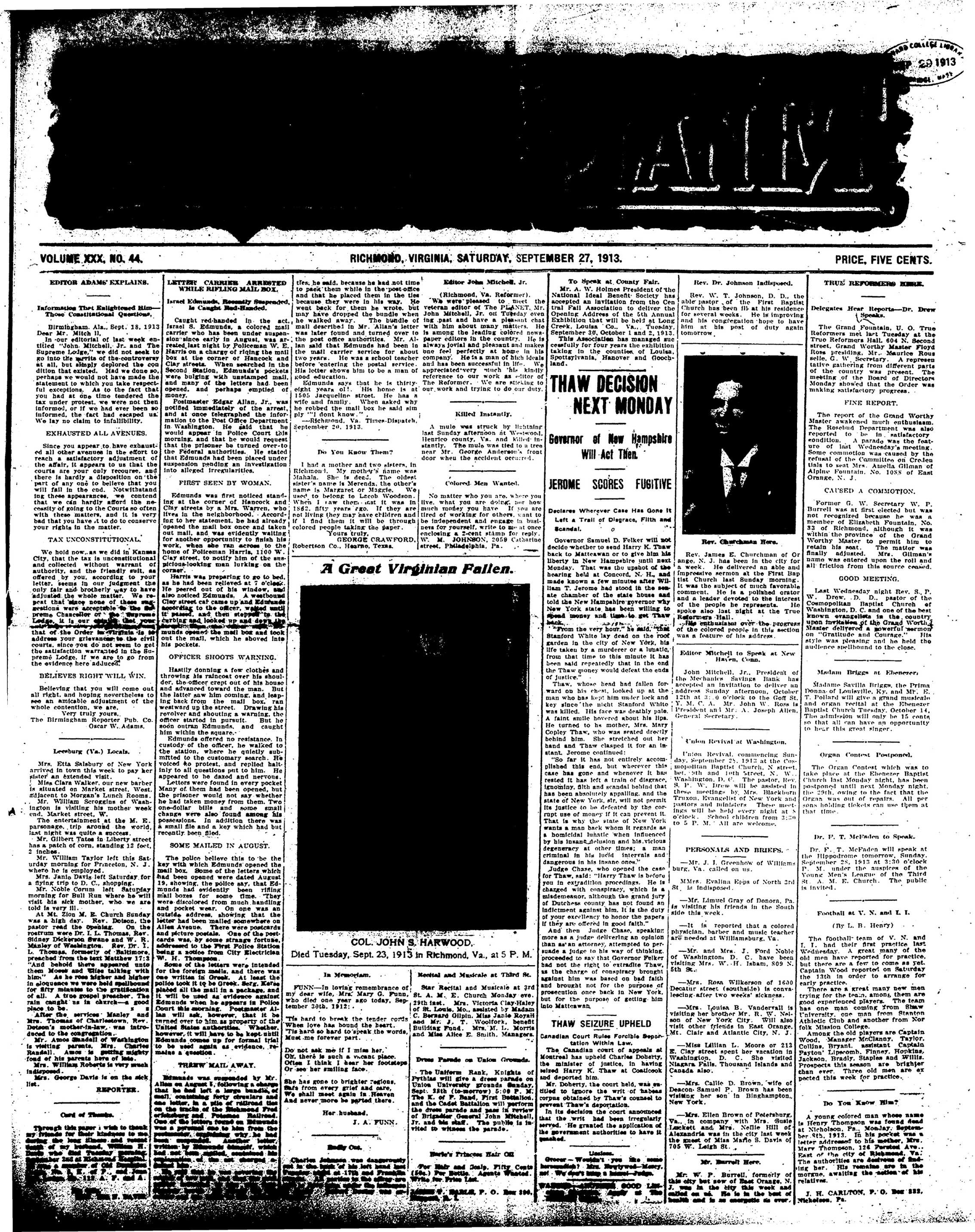
Died Tuesday, Sept. 23, 1913 in Richmond, Va., at 5 P. M.
ties, he said, because he had not time to pack them while in the post-office and that he placed them in the ties because they were in his way. He went back for them he wrote, but may have dropped the bundle when he walked away. The bundle of mail described in Mr. Allan's letter was later found and turned over to the post office authorities. Mr. Allan said that Edmunds had been in the mail carrier service for about two years. He was a school teacher before entering the postal service. His letter shows him to be a man of good education.
Edmunds says that he is thirty-eight years old! His home is at 1505 Jacqueline street. He has a wife and family. When asked why he robbed the mall box he said simply "I don't know.".
—Richmond, Va. Times-Dispatch,
September 20, 1913.
Do You Know Them?
I had a mother and two sisters, in Richmond. My mother's name was Mahala. She is deed. The oldest sister's name is Merenda, the other's name is Margaret or Magrie. We used to belong to Leob Woodson. When I saw them, that it was in 1862, fifty years ago. If they are not living they may have children and if I find them it will be through colored people taking the paper.
Yours truly,
GEORGE CRAWFORD,
Robertson Co., Hearne, Texas.
COL. JOHN S.
Died Tuesday, Sept. 23, 1913
In Memoriam
FUNN—In loving remembrance of my dear wife, Mrs Mary G. Funn, who died one year ago today, September 30th, 1912:
"Tis hard to break the tender cords When love has bound the heart.
"Tis hard so hard to speak the words, Must me forever part.
Do not ask me if I miss her. Ok, there is such a vacant place. Otten I think I hear her footsteps Or see her smiling face.
She has gone to brighter regions. Sails from every grief and care, We shall meet again in Heaven And never more be parted there.
Her husband.
Brady Out.
Charles Johnson was dangerously put in the back of his left hand and Franklin Wright at 17th and Franklin Wright. His parting in the alley are not known but under the influence
Editor John Mitchell, Jr.
(Richmond, Va. Reformer). We were pleased to meet the veteran editor of The PLANET, Mr. John Mitchell, Jr. on Tuesday evening past and have a pleasant chat with him about many matters. He is among the leading colored newspaper editors in the country. He is always jovial and pleasant and makes one feel perfectly at home in his company. He is a man of high ideals and has been successful in life. We appreciated very much his kindly reference to our work as editor of The Reformer. We are sticking to our work and trying to do our duty.
Killed Instantly.
A mule was struck by lightning last Sunday afternoon at Westwood, Henrico county, Va., and killed instantly. The mule was tied to a tree near Mr. George Anderson's front door when the accident occurred.
Colored Men Wanted
No matter who you are, where you live, what you are doing, nor how much money you have. If you are tired of working for others, want to be independent and engage in business for yourself, write to me at once enclosing a 2-cent stamp for reply. W. M. JOHNSON, 2059 Catharine street, PMLadelfia, Pa.
S. HARWOOD.
3 in Richmond, Va., at 5 P. M.
Kential and Musicale at Third St.
Star Recital and Musicale at 3rd St. A. M. E. Church Monday eve. 29th inst. Mrs. Victoria Clay-Haley of St. Louis, Mo. assisted by Madam C. Bernard Glipin, Mrs. Janie Royall and Mr. J. T. Woolfork, benefit Building Fund. Mrs. M. L. Morris and Miss Alice E. Smith Managers.
Dress Parade on Union Grounds.
The Uniform Rank, Knights of Pythias will give a dress parade on Union University grounds Sunday, Sept. 28th (to-morrow) 5:00 P. M. The K. of P. Band, First Battalion, and the Cadet Battalion will perform the dress parade and pass in review of Brigadier General John Mitchell, Jr. and his staff. The public is invited to witness the parade.
Barbie's Princess Hair Oil
For Hair and Scalp, Fifty Coins
(50.) For Bottle, Agents Whited.
Write For Price List.
F. BARLE, P. O. Box 200.
Milwaukee, N. 1
To Speak at County Fair.
To Speak at County Fair.
Mr. A. W. Holmes President of the National Ideal Benefit Society has accepted an invitation from the Central Fall Association to deliver the Opening Address of the 5th Annual Exhibition that will be held at Long Creek, Louisa Co., Va., Tuesday, September 30, October 1 and 2, 1913.
This Association has managed successfully for four years the exhibition taking in the counties of Louton, Spotsylvania, Hanover and Goochland.
THAW DECISION NEXT MONDAY
Governor of New Hampshire Will Act Then.
JEROME SCORES FUGITIVE
Declares Wherever Case Has Gone It Left a Trail of Disgrace, Filth and Scandal.
Governor Samuel D. Felker will not decide whether to send Harry K. Thaw back to Matteawan or to give him his liberty in New Hampshire until next Monday. That was the upshot of the hearing held at Concord, N. H., and made known a few minutes after William T. Jerome had stood in the senate chamber of the state house and told the New Hampshire governor why New York state has been willing to spend money and time to get Thaw back.
"From the very hour," he said, "Stanford White lay dead on the roof garden in the city of New York, his life taken by a murderer or a lunatic, from that time to this minute it has been said repeatedly that in the end the Thaw money would defeat the ends of justice."
Thaw, whose head had fallen forward on his chest, looked up at the man who has kept him under lock and key since the night Stanford White was killed. His face was deathly pale. A faint smile hovered about his lips. He turned to his mother, Mrs. Mary Copley Thaw, who was seated directly behind him. She stretched out her hand and Thaw clasped it for an instant. Jerome continued:
"So far it has not entirely accomplished this end, but wherever this case has gone and whenever it has rested it has left a train of disgrace, ignominy, filth and scandal behind that has been absolutely appalling, and the state of New York, sir, will not permit its justice to be defeated by the corrupt use of money if it can prevent it. That is why the state of New York wants a man back whom it regards as a homicidal lunatic when influenced by his insane delusion and his vicious degeneracy at other times; a man criminal in his lucid intervals and dangerous in his insane ones."
Judge Chase, who opened the case for Thaw, said: "Harry Thaw is before you in extradition proceedings. He is charged with conspiracy, which is a misdemeanor, although the grand jury of Dutchess county has not found an indictment against him. It is the duty of your excellency to honor the papers if they are offered in good faith."
And then Judge Chase, speaking more as a judge delivering an opinion than as an attorney, attempted to persuade a judge to his way of thinking, proceeded to say that Governor Felker had not the right to extradite Thaw, as the charge of conspiracy brought against him was based on bad faith and brought not for the purpose of prosecution once back in New York, but for the purpose of getting him into Matteawan.
THAW SEIZURE UPHELD
Canadian Court Rules Forcible Depar-
tation Within Law.
The Canadian court of appeals at Montreal has upheld Charles Doberty, the minister of justice, in having beaten Harry K. Thaw at Coastcook and deported him.
Mr. Doberty, the court held, was entitled to ignore the writ of habeas corpus obtained by Thaw's counsel to prevent Thaw's deportation.
In its decision the court announced that the writ had been irregularly served. He granted the application of the government authorities to have it punished.
Lieuten.
Grocer — Wouldn't you like some harumadish? Mrs. Howlywed—Merry, not. We don't keep a hensel-Judge.
WARNING — GOOD LAW — Apply at The
Rev. Dr. Johnson Indisposed.
Rev. W. T. Johnson, D. D., the able pastor of the First Baptist Church has been ill at his residence for several weeks. He is improving and his congregation hope to have him at his post of duty again tomorrow.
Rev. Churchman Here.
Rev. James E. Churchman of Orange, N. J. has been in the city for a week. He delivered an able and impressive sermon at the First Baptist Church last Sunday morning. It was the subject of much favorable comment. He is a polished orator and a leader devoted to the interest of the people he represents. He spoke also last night at the True Reformers Hall. He enthusiast over the progress of the colored people in this section was a feature of his address.
Editor Mitchell to Speak at New Haven, Conn.
John Mitchell, Jr., President of the Mechanics Savings Bank has accepted an invitation to deliver an address Sunday afternoon, October 12 at 3: 0 o'clock to the Goff St. Y, M. C. A. Mr. John W. Ross is President and Mr. A. Joseph Allen. General Secretary.
Union Revival at Washington.
Union Revival, commencing Sunday, September 25, 1913 at the Cosmopolitan Baptist Church, N street, bet. 19th and 10th street, N. W., Washington, D. C. The pastor, Rev. S. P. W., Drew will be assisted in these meetings by Mrs. Blackburn Truxon, Evangelist of New York and pastors and ministers. These meetings will be held every night at 9 o'clock. School children from 3:30 to 5 P. M. All are welcome.
---
PERSONALS AND BRIEFES.
Mr. J. I. Greenhow of Williamsburg, Va. called on us.
MMrs. Evalina Erps of North 3rd St. is indisposed.
Mr. Limuel Gray of Donora, Pa. is visiting his friends in the South side this week.
It is reported that a colored physician, barber and music teacher are needed at Williamsburg, Va.
Mr. and Mrs. J. Ford Noble of Washington, D. C. have been visiting Mrs. W. H. Isham, 809 N. 5th St.
Mrs. Rosa Wilkerson of 1600 Decatur street (southside) is convalescing after two weeks' sickness.
Mrs. Louisa B. Vandervall is visiting her brother Mr. R. W. Nelson of New York City. Will also visit other friends in East Orange, Mt. Clair and Atlantic City, N. J.
Miss Lillian L. Moore or 213 E. Clay street spent her vacation in Washington, D. C. She visited Niagara Falls. Thousand Islands and Canada also.
Mrs. Callie D. Brown, wife of Deacon-Samuel P. Brown has been visiting her son in Binghamton, New York.
—Mrs. Ellen Brown of Petersburg, Va., in company with Mrs. Susie Lackett and Mrs. Nellie Hill of Alexandria was in the city last week the guest of Miss Marlo S. Davin of 705 W. Leigh St.
Mr. Burrell Here.
Mr. W. P. Burrell, formerly of this city but now of East Orange, N. J. was in the city this week and called on us. He is in the best of health and is an enthusiastic over
PRICE. FIVE CENTS.
TRUÉ REFORMERÉ HIRE.
Delegates Hear Reports—Dr. Drew
(Speaks.)
The Grand Fountain, U. O. True Reformers met last Tuesday at the Truo Reformers Hall. 604 N. Second street, Grand Worthy Master Floyd Ross presiding, Mr. Maurice Rous selle, G. W. Secretary. A representative gathering from different parts of the country was present. The meeting of the Board of Directors Monday showed that the Order was making satisfactory progress.
FINE REPORT
The report of the Grand Worthy Master awakened much enthusiasm. The Rosebud Department was also reported to be in satisfactory condition. A parade was the feature of last Wednesday's meeting. Some commotion was caused by the refusal of the Committee to Creed tails to seat Mrs. Amelia Gilman of Alpine Fountain. No. 1088 of East Orange, N. J.
CAUSED A COMMOTION.
Formor G. W. Secretary W. P. Burrell was at first elected but was not recognized because he was a member of Elizabeth Fountain, No. 33 of Richmond, although it was within the province of the Grand Worthy Master to permit him to retain his seat. The matter was finally adjusted. Mrs. Gilman's name was entered upon the roll and all friction from this source ceased.
GOOD MEETING
Last Wednesday night Rev. S., P. W. Drew, D. D., pastor of the Cosmopolitan Baptist Church of Washington, D. C. and one of the best known evangelists in the country, upon invitation of the Grand Worthy Master delivered a powerful mormon on "Gratitude and Courage." His style was pleasing and he held the audience spellbound to the close.
Madam Briggs at Ebengzer
Madame Saville Briggs, the Prima Donna of Louisville, Ky, and Mr. E. T. Pollard will give a grand musicale and organ recital at the Ebenezer Baptist Church Tuesday, October 14. The admission will only be 15 cont so that all can have an opportunity to hear this great singer.
Organ Contest Postponed.
The Organ Contest which was to take place at the Ehenezer Baptist Church last Monday night, has been postponed until next Monday night, the 29th, owing to the fact that the Organ was out of repairs. All persons holding tickets can use them at that time.
Dr. F. T. McFaden to Speak.
Dr. F. T. McFaden will speak at the Hippodrome tomorrow, Sunday, September 28, 1913 at 3:30 o'clock P. M. under the auspices of the Young Men's League of the Third St. A. M. E. Church. The public is invited.
Football at V. N. and L. I.
(By L. B. Henry)
The football team of V. N. and L. I. had their first practice last Wednesday. A great many of the old men have reported for practice, but there are a few to come as yet. Captain Wood reported on Saturday the 13th in order to arrange for early practice.
There are a great many new men trying for the team, among them are good experienced players. The team has one man coming from Shaw University, one man from Stanton Athletic Club and another from Norfolk Mission College.
Among the old players are Captain Wood, Manager McClanny, Taylor, Collins, Bryant, assistant Captain Payton' Lipecomb, Finney, Hopkins, Jackson, Bradly, Staples and Willis. Prospects this season are brighter than ever. Three old men are expected this week for practice.
Do You Know Him?
A young colored man whose name is Henry Thompson was found dead at Nicholson, Pa.. Monjay. September 8th, 1913. In his pocket was a letter addressed to his mother, Mrs. Marv Thompson. 126 Portsmouth Ave... East of the city of Richmond, Va. The authorities are desirous of finding her. His remains are in the morgue, awaiting the action of his relatives. J. H. CARLTON, P. O. Box 882, Nicholson, Pa.
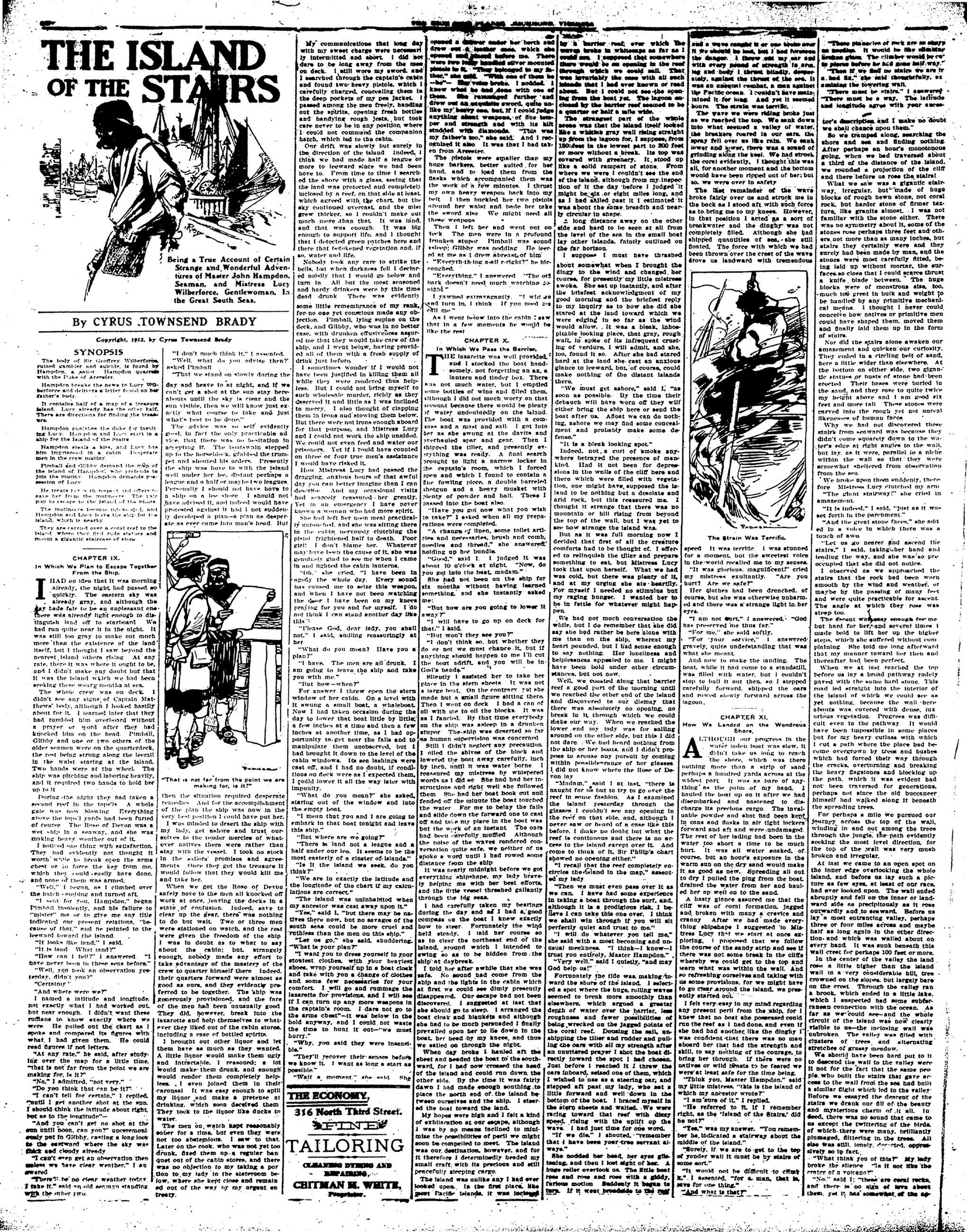
THE ISLAND OF THE STAIRS
Being a True Account of Certain Strange and Wonderful Adventures of Master John Hampdon, Seaman, and Mistress Lucy Wilberforce, Gentlewoman, In the Great South Seas.
By CYRUS ,TOWNSEND BRADY
Copyright, 1912, by Cyrus Townsend Brady
SYNOPSIS
The body of Sir Geoffrey Witherforce ruined kamber and suicide is found by Hampion, a sailor. Hampion quarrels with the Duke of Arcelier.
Hampion breaks the news to Lucy Witherforce and delivers a letter found on her father's body.
It contains half of a map of a treasure island. Lucy already has the other half. There are directions for finding the treasure.
Hampion punishes the duke for insulting Lucy. Hampion and Lucy start in a ship for the island of the Stairs.
Hampion steals a kite, and Lucy has him imprisoned in a cabin. Inmate men in the crew mutiny.
Fimball and Giltby demand the map of the island of Hampion, who pretends to join the mutiny. Hampion demands possession of Lucy.
He treats her with respect and offers to save her from the mutiners. The pair put to escape to the Island of the Stairs. The mutineers become intercepted, and Lucy leaves the island for the island, which is nearby.
They are carried over a coral reef to the island where they find hide stations and mount a gigantic staircase of stone.
In Which We Plan to Escape Together From the Ship.
I HAD no idea that it was morning already, the night had passed so quickly. The eastern sky was already gray, and although the day had fair to be an unpleasant one there was already light enough to distinguish land off to starboard. We had run quite near it in the night. It was still too gray to make out much more than the existence of the land itself, but I thought I saw beyond the nearest island others rising. At any rate, there it was where it ought to be, and I didn't make any doubt but that it was the island which we had been seeking these weary months at sea.
The whole crew was on deck. I didn't see any signs of Captain Matthews' body, although I looked hastily about for it. I learned later that they had tumbled him overboard without a prayer or word after they had knocked him on the head. Pimhall, Gibbly and one or two others of the older seamen were on the quarterdeck, the rest being strung along the leerail in the waist starring at the island. Two hands were at the wheel. The ship was pitching and lashing heavily, and it required two hands to hold her up to it.
During the night they had taken a second reef in the topsl. A whole gale was now blowing. Everything above the topal gards had been furred of course. The Rose of Devon was a wet ship in a seaway, and she was making heavy weather out of it.
I noticed one thing with satisfaction. They had evidently not thought it worth while to break open the arms chest or to force the key from me, which they could easily have done, and none of them was armed.
"Well," I began as I climbed over the hatch coupling and turned up.
"I sent for you, Hampion," began Fimlah insolently, and his failure to "mister" me or to give me any title indicated our present relations, "because of that," and he pointed to the leeward toward the island.
"It looks like land," I said.
"It is land. What land?"
"How can I tell? I answered. "I have never been in these past before."
"Well, gen took an observation yesterday, didn't you?"
I named a attitude and longitude not exactly what I had worked out, but near enough. I didn't want these ruffians to know exactly where we were. He pulled out the chart as I spoke and compared its figures with what I had given them. He could read figures if not letters.
"At any rate," he said, after studying over the map for a little time. "that is not far from the point we are making for, is it?"
"No," I admitted, "not very."
"Do you think that can be it?"
"I can't tell for certain," I replied, "until I get another shot at the sun. I should think the attitude about right, but as to the longitude"—
"And you can't get no shot at the sun until you can you" unceremonially put in Gibbby, casting a long look to the eastward where the sky was thick and cloudy already.
"I can't even get an observation then unless we have clear weather." I anewed
There'll be no clear weather today.
I take it. said an old seaman standing
with the other two.
CHAPTER IX.
"It looks like land." I ask
"It is land. What land?"
"And where were we?"
"I don't much think it," I assented. "Well, what do you advise then? asked Pimball. "That we stand on slowly during the day and heave to at night, and if we can't get a shot at the sun stay bereabouts until the sky is clear and the sun visible, then we will know just exactly what course to take and just what's best to be done." The advice was so self evidently good, in fact the only practicable advice, that there was no hesitation in accepting it. The boatwain stepped up to the horseback, glanced the trumpet and shouted his orders. Presently the ship was howe to with the island well under her lee, distant perhaps a league and a half or may be two leagues. Personally I should not have bove to a ship on a less shore. I should not have advised it, and indeed would have protested against it had I not suddenly developed a plan—a plan as desperate as ever came into man's head. But
T
"That is not far from the point we are making for, is it?" then the situation required desperate remedies. And for the accomplishment of the plan the ship was now in the very best position I could have not her.
When we got the Rose of Devon safely hove to the men all knocked off work at once, leaving the decks in a state of confusion. Indeed, save to clear up the gear, there was nothing to do but wait. Two or three men were stationed on watch, and the rest were given the freedom of the ship I was in doubt as to what to say about the cabin; but, strangely enough, nobody made any effort to take advantage of the mastery of the crew to quarter himself there. Indeed, their quarters forward were almost as good as ours, and they evidently preferred to be together. The ship was generously provisioned, and the fate of the men had been unusually good. They did, however, break into the lazarette and help themselves to whatever they liked out of the cabin stores, including a case of bottled spirits.
I brought out other liquor and let them have as much as they wanted. A little liquor would unmake them ugly and intractable. I reasoned; a lot would make them drunk, and enough would render them completely helpless. I even joined them in their carousel. It was easy enough to spill my liquor and make a pretence at drinking, which soon decimated them. They took to the liquor like ducks to water.
The men on, watch kept reasonably sober for a time, but even they were not too abstemious. I saw to that. Later on the cook, who was not yet too drunk, sized them up a regular banquet out of the cabin stores, and there was no objection to my taking a portion to my lady in the aisle below, where she kept close and remain out of the way by my urgent en tresty.
My communications that long day with my sweet charge were necessarily intermitted and short. I did not dare to be long away from the men on deck. I still wore my sword, and I searched through the captain's cabin and found two heavy pistols, which I carefully charged, couceiling them in the deep pockets of my peanut jacket. I passed among the men freely, handing out the spirit, opening fresh bottles and bandying rough jests, but took care never to be in any position where I could not command the companion hatch, which led to the cabin.
Our drift was slowly but surely in the direction of the island. Indeed, I think we had made half a league or more to leeward since we had been here to. From time to time I searched the shore with a glass, seeing that the land was protected and completely inclosed by a reef, on that side at least, which agreed with the chart, but the sky continued overcast, and the mist grew thicker, so I couldn't make out much more than that. It was land, and that was enough. It was big enough to support life, and I thought that I detected green patches here and there that估okened vegetation and, if so, water and life.
Nobody took any care to strike the bells, but when darkness fell I declared nobly that I would go below and turn in. All but the most seasoned and hardy drinkers were by this time dead drunk. There was evidently
some little remembrance of my rank
for no one yet conscious made any
objection. Pimball, lying sulphe on the
deck, and Gilbby, who was in no better
case, with drunken effusiveness assured
me that they would take care of the
ship, and I went below, having provided
all of them with a fresh supply of
drink just before.
I sometimes wonder if I would not
have been justified in killing them all
while they were rendered thus helpless. But I could not bring myself to
such wholesale murder, richly as they
deserved it and little as I was inclined
to mercy. I also thought of clapping
them in irons and stowing them below.
But there were not irons enough aboard
for that purpose, and Mistress Lucy
and I could not work the ship unnified.
We could not even feed and water our
prisoners. Yet if I could have counted
on three or four true men's assistance
I would have risked it.
How Mistress Lucy had passed the dragging, anxious hours of that awful day you can better imagine than I can describe. And my occasional visits had sensually reassured her greatly. Yet in an emergency I have never known a woman who had more spirit. She had left her meal practically intomached, and she was sitting there in the cabin nervously clutching the plaid frightened half to death. Poor girl! I don't blame her. Whatever may have been the cause of it, she was generally glad to see me when I came in and lighted the cabin latters. "Oh," she cried, "I have been in agony the whole day. Every sound has caused me to seize this weapon, and when I have not been watching the door I have been on my knees praying for you and for myself. I do not think I can stand another day like this." "Please God, dear lady, you shall not" I said, smiling reassuringly at her.
"What do you mean? Have you a plan?"
"I have. The men are all drunk. I am going to leave, the ship and take you with me."
"But how-when?"
For answer I throw open the stern window of her cabin. On a level with it sawing a small boat, a whaleboat. Now I had taken occasion during the day to lower that boat little by little, a few inches at a time and then a few inches at another time, as I had opportunity to get near the falls and to manipulate them unobserved, but I had brought it down to the level of the cabin windows. Its sea lashings were cast off, and I had no doubt, if conditions on deck were as I expected them, I could lower it all the way later with impunity.
"What do you mean? she asked, staring out of the window and into the empty boat.
"I mean that you and I are going to embark in that boat tonight and leave this ship."
"But where are we going?"
"There is land not a league and a half under our ice. It seems to be the most easterly of a cluster of islands." "Is it the island we seek, do you think?" "We are in exactly the latitude and the longitude of the chart if my calculations are correct." "The island was uninhabited when my ancestor was cast away upon it."
"Let us go," she said, abuddering. "What is your plan?"
"I want you to dress yourself in your stoutest clothes, with your bestiest shoes, wrap yourself up in a boat cloak and take with you a change of clothes and some few necessaries for your comfort. I will go and rummage the lazarette for provisions, and I will see if I can turn up any more weapons in the captain's room. I dare not go to the arms chest"—it was below in the hold anyway, and I could not waste the time to hunt it out—"we must hurry."
"Why, you said they were insendible."
"They'll recover their senses before we know it. I want as long a start as possible."
"Walt a moment." she said. Shg
THE ECONOMY,
316 North Third Street.
FINE
TAILORING
CLEANING DYING AND
REPAIRING
CHITMAN M. WHITE,
opened a diaper under her birth and drew out a partner once, which she opened and joined before me. There were two badly bruised silver mounted pistols he it. "Those belonged to my father," she said. "With one of them he—he—voted vote brute. I nodded. I know what he had done with one of them. She remained further and drew out an attractive sword, quite unlike my heavy one, but, if I could judge anything about weapons, of fine temper and strength and with its hilt studded with diamonds. "This was my father's too," she said. And I recognized it also. It was that I had taken from Averroet.
The pistols were smaller than my huge barkers, better suited, for her hand, and to load them from the danks which accompanied them was the work of a few minutes. I thrust my own heavy weapon back into my belt. I then buckled her two pistols around her waist and bade her take the sword also. We might need all these weapons.
Then I left her and went out on deck. The men were in a profound trunken atuper Pimball was sound sleep; Gilbbr was maddling. He leered at me as I drew abreast of him. "Everything aall reight?" he be-coughed.
"Everything." I answered. "The old bark doesn't need much watching on night."
I yawned extravagantly. "I wld go and turn in. I think if you need go call me."
As I went below into the cabin I saw that in a few moments he would be like the rest.
THE lazarette was well provided,
and I stocked the boat hand-
somely, not forgetting an ax,
a lantern and tinder box. There
was not much water, but I emptied
some bottles of wine and filled them,
although I did not much worry on that
account because there would be plenty
of water undoubtedly on the island.
The boat was provided with a com-
pass and a mast and sail. I got into
her as she swung at the davits and
overhauld apar and gear. Then I
shipped the tiller, and presently every-
thing was ready. A final search
brought to light a narrow locker in
the captain's room, which I forced
open and which I found to contain a
few fowling piece, a double barrelled
shotgun and a heavy musket with
plenty of powder and ball. These
lapsed into the boat also.
"Here you got now what you wish
to take?" I asked when all my prepa-
rations were completed.
"A change of linen, some toilet articles and necessaries, brush and comb, needles and thread," she answered, holding up her bundle.
"Good," said I. I judged it was about 10 o'clock at night. "Now, do you get into the beat, madam."
She had not been on the ship for six months without having learned something, and she instantly asked me:
"But how are you going to lower it away?"
"I will have to go up on deck for that," I said.
"But won't they see you?"
"I don't think so, but whether they do or not we must chance it, but if anything should happen to me I'll cut the boat adrift, and you will be in God's hands."
Silently I assisted her to take her place in the stern sheets. It was not a large boat. On the contrary got the made but on a small figure sitting there. Then I went on deck. I had a can of oil with me to oil the blocks. It was as I fancied. By that time everybody on the ship was asleep in a drunken stupor. The ship was deserted so far as human superstition was concerned
Still I didn't neglect any precaution.
I oiled the shivers of the block and lowered the boat away carefully, inch by inch, until it was water borne. I reassured my mistress by whispered words as I did no. She had had her instructions and right well she followed them. She had her boat book out and fended off the minute the boat touched the water. For me to belay the falls and slide down the forward one to cast off and take my place in the boat was but the work of an instant. The oars had been carefully muffled. Although the noise of the waves rendered conversation quite anse. we neither of us spoke a word until I had rowed some distance from the ship.
It was nearly midnight before we got everything shipshape, my indy bravely helping me with her best efforts, and the little vessel threshed gallantly through the idg seas.
I had carefully taken my bearings during the day and ad I had a good compass on the boat I knew exactly how to steer. Fortunately the wind held steady. I laid her course so as to clear the northeast end of the island, around which I intended to swing so as to be hidden from the ship at daybreak.
I told her after awhile that she was safe. No sound had come from the ship and the lights in the cabin which at first we could see dimly presently disappeared. Our escape had not been discovered. I suggested at last that she should go to sleep. I arranged the boat cloak and blankets and although she had to be much persuaded I finally prevailed upon her to lie down in the boat, her head by my knees, and thus we sailed on through the night.
When day broke I hauled aft the sheet and beaded the boat to the southward, for I had now crossed the head of the island and could run down the other side. By the time it was fairly dawn I had made enough soothing, to place the north end of the island between ourselves and the ship. I steered the boat toward the land.
My hopes were high and I felt a kind of exhilaration at our escape, although I was by no means inclined to minimize the possibilities of peril we might soon be compelled to meet. The island was our destination, however, and for it therefore I determinedly headed my small craft, with its precious and still peacefully sleeping cargo.
The island was unlike any I had ever looked upon. In the first place, like poor Pacific islands, it was included
by a barrier roof, over which the waves broke in whitecaps as far as I could see. I supposed that somewhere there would be an opening in the road through which we could sail. That was invariably the case with all such islands that I had ever known or read about. But I could not see the opening from the boat yet. The lagoon enclosed by the barrier roof seemed to be a quarter or half a mile wide.
The strongest part of the whole scene was that the island itself looked like a whitish gray wall rising straight up from the lagoon for, I suppose, from 150-feet in the lowest part to 300 feet or more without a break. Its top was covered up like a solid rampart of stone. From where we were I couldn't see the end of the island, although from my inspection of it the day before I judged it might be six, or eight miles long, and as I had sailed past it I estimated it was about the same, breadth and nearly circular in shape.
2. Long distance away on the other side and hard to be seen at all from the level of the sea in the small boat lay other islands, faintly outlined on the far horizon.
I suppose I must have insisted about somewhat when I brought the dingy to the wind and changed her course, for presently my little mistress swoke. She sat up instantly, and after the bristlest acknowledgment of my good morning and the bristlest reply to my inquiry as to how she did she stared at the land toward which we were edging in so far as the wind would allow. It was a bleak, inhospitable looking place, that gray, rough wall, in spite of its infrequent cresting of verdure. I will admit, and she, too, found it so. After she had stared hard at the land she cast an anxious glance to leeward, but, of course, could make nothing of the distant islands there.
"We must get ashore," said I, "as soon as possible. By the time their debauch will have worn off they will either bring the ship here or send the boat after us. Afloat we can do nothing, ashore we may find some concealment and probably make some defense."
"It is a bleak looking spot."
Indeed, not a curl of smoke anywhere betrayed the presence of mankind. Had it not been for depressions in the walls of the cliff here and there which were filled with vegetation, one might have, supposed the island to be nothing but a desolate and arid rock, but this reassured me. I thought it strange that there was no mountain or hill rising from beyond the top of the wall, but I was yet to see how strange the island was.
But as it was full morning now I decided that first of all the creature comforts had to be thought of. I offered to relinquish the tiller and prepare something to eat, but Mistress Lucy took that upon herself. What we had was cold, but there was plenty of it, and at my urging she heartily. For myself I needed no stimulus but my raging hunger. I wanted her to be in fettle for whatever might happen.
We had not much conversation the white, but I do remember that she did say she had rather be here alone with me than on the ship, wherecat my heart pounded, but I had sense enough to say nothing. Her loneliness and helpliness appealed to me. I might have been bold under other circumstances, but not now.
Well, we coasted along that barrier reef a good part of the morning until we reached the other end of the island and discovered to our dismay that there was absolutely no opening, no break in it, through which we could shake our way. When we reached the lower end my indy was for sailing around on the other side, but this I did not dare. We had heard nothing from the ship or her hostess, and I didn't propose to arouse any pursuit by coming within possible range of her glasses. I did not know where the Rose of Devon lay.
"Madam," said I at last, "there is naught for me but to try to go over the reef in some fashion. As I examined the island yesterday through the glasses I couldn't see any opening in the reef on that side, and, although I never saw or heard of a case like this before, I shake no doubt but what the reef is continuous and there is no access to the island except over it. And come to think of it, Sir Philip's chart showed no opening either."
"I recall that the reef completely encircles the island in the map," ascertained my lady.
"Then we must even pass over it as we can. I have had some experience in taking a boat through the surf, and, although it is a prodigious risk, I believe I can take this one over. I think we shall win through if you will sit perfectly quiet and trust to me."
"I will do whatever you tell me," she said with a most becoming and unusual meekness. "I think—I know—I trust you entirely, Master Hampdon." "Very well," said I quietly, "and may God help us!"
Fortunately the tide was making toward the shore of the island. I selected a spot where the huge, rolling waves seemed to break more smoothly than elsewhere, which argued a greater depth of water over the barrier, less roughness and fewer possibilities of being wrecked on the jagged points of the coral reef. Dousing the sail, unshipping the tiller and rudder and pulling the cars with all my strength after an unuttered prayer I shot the boat directly toward the spot I had chosen. Just before I reached it I threw the cars inboard, seized one of them, which I wished to use as a steering car, and stepped aft past my lady, who sat a little forward and well down in the bottom of the boat. I braced myself in the stern sheets and waited. We were racing toward that reef with dixy speed, rising with the uplift up the wave. I had just time for one word. "If we die," I shouted, "remember that I have been your true servant always."
She nodded her head, her eyes glinting, and then I lost sight of her. A huge reverie overtook us. The Little bird rose and rose and rose with a giddy, furious motion. Seddenly it began to turn. If it went broadside to the roof
and a wreath caught it or one broke over it. We should be lost, but I had foreseen the danger. I threw out my car and with every pound of strength in arm, leg and body I thrust blindly, desperately, against the threat of the sea. It was an unequal combat, a man against the Pacific ocean. I couldn't have maintained it for long. And yet it seemed hours. The strain was terrific. The wave we were riding broke just as we reached the top. We sank down into what seemed a valley of water, the breakers ruined in our arm, the spray fell over us like rain. We sank lower and lower, there was a sound of grinding along the tool. We had struck the coral evidently. I thought this was all, for another moment and the bottom would have been ripped out of her; but so, we were over in safety.
The last remainder of the wave broke fairly over us and struck me in the back as I stood aft with such force as to bring me to my knees. However, in that position I acted as a sort of breakwater and the dinghy was not completely filled. Although she had shipped quantities of sea, she still floated. The force with which we had been thrown over the crest of the wave drove us landward with tremendous
PADRE
The Strain Was Terrific.
speed. It was terrific. I was stunned for a moment, but the sweetest voice in the world recalled me to my senses.
"It was glorious, magnificent!" cried my mistress exultantly. "Are you hurt? Are we safe?"
Her clothes had been drenched, of course, but she was otherwise unharmed and there was a strange light in her eyes.
"I am not hurt." I answered: "God has preserved me thus far."
"For me," she said softly.
"For your service." I answered gravely, quite understanding that was what she meant.
And now to make the tanding. The boat, while it had come to a standstill, was filled with water, but I couldn't stop to ball it out then, so I stepped carefully forward, shipped the oars and rowed slowly forward across the lagoon.
CHAPTER XI
How We Landed on the Wondrous Shore.
ALTHOUGH our progress in the water inden boat was slow, it didn't take us long to reach the shore, which was there nothing more than a strip of sand perhaps a hundred yards across at the widest part. It was as bare of anything as the palm of my hand. I hauled the boat up it after we had disembarked and hastened to discharge its previous cargo. The invaluable powder and shot had been kept in cans and flasks in air tight lockers forward and aft and were-anddamaged. The rest of her lading had been in the water too short a time to be much hurt. It was all water soaked, of course, but an hour's exposure in the warm sun on the dry sand would make it as good as new. Spreading all out to dry I pulled the pling from the boat, drained the water from her and hauled her up well on to the sand.
A hasty glance assured me that the cliff was of coral formation, jagged and broken with many a crevice and cranny. After we had made everything slipshape I suggested to Mistress Lucy that we start at once exploring. I proposed that we follow the course of the sandy strip and see if there was not some break in the cliffs whereby we could get to the top and learn what was within the wall. And so refreshing ourselves and taking with us some provisions, for we might have to go clear around the island, we presently started out.
I felt very easy in my mind regarding any present peril from the ship, for I knew that no boat she possessed could run the reef as I had done, and even if she had bad another like the dinghy I was confident that there was no man aboard her that had the strength and skill, to say nothing of the courage, to bring her through. If there were no natives or wild beasts to be feared we were at least safe for the time being.
"Think you, Master Hampdon," said my little mistress, "this is the island of which my ancestor wrote?"
"I am sure of it." I replied.
"He referred to it. If I remember right, as the 'island of the Stairs,' did he not?"
"Yes." was my answer. "You remember be indicated a stairway about the middle of the island."
"Barely. If we are to get to the top of yonder wall it must be by stairs of some sort."
"It would not be difficult to climb k." I insisted, "for a man, that is, save for one thing."
"And what is that?"
"These planets of rock are an sharp noon moon. It would be the climatic bright moon. The climber would be so please before he had gone half way." "Then if we find no stairs we are in a bad Ear," she said thoughtfully, ex amusing the towering wall. "There must be stairs." I answered. "There must be a way. The latitude and longitude agree with your successor's description, and I make no doubt we shall chance upon them." So we tramped along, searching the shore and sea and finding nothing After perhaps an hour's monotonous going, when we had traversed about a third of the distance of the island, we rounded a projection of the cliff and there before we rose the stairs!
What we saw was a gigantic stairway, irregular, but made of huge blocks of rough hewn stone, not coral rock, but harder stone of firmer texture, like granite almost. I was not familiar with the stone either. There was no symmetry about it, some of the stones rose perhaps three feet and others not more than as many inches, but stairs they certainly were and they surely had been made by man, and the stones were most carefully fitted, being laid up without mortar, the surfaces so close that I could scrape thrust a knife, blade between. The huge blocks were of monstrous size, too, much too great in bulk and weight to be handled by any primitive mechanical means. I thought I never could conceive how natives or primitive men could have shaped them, moved them and finally laid them up in the form of stuits.
Nor did the stairs alone awaken our amazement and quicken our curiosity. They ended in a circling belt of sand, here a little wider than elsewhere. At the bottom on either side, two gigantic statues or busts of stone had been erected. Their bases were buried in the sand, and they rose to quite twice my height above and I am good six feet and more tall. These stones were carved into the rough yet not unreal likenesses of human faces.
Why we had not discovered these stairs from seaward was because they didn't come squarely down to the water's edge at right angles to the wall, but lay, as it were, parallel to a niche within the wall so that they were somewhat sheltered from observation from the sea.
We broke upon them suddenly, therefore Mistress Luce clutched my arm "The giant stairway!" she cried in amazement.
"It is indeed," I said, "just as it was set forth in the parchment."
"And the great stone faces," she added in a word in which there was a touch of awa.
"Let us go nearer and ascend the stairs," I said, taking her hand and leading the way, and she was no preoccupied that she did not notice.
I observed as we approached the stairs that the rock had been worn smooth by the wind and weather, or maybe by the passing of many feet and were quite practicable for ascent. The angle at which they rose was steep too.
The front was easy enough for me but hard for her, and several times I made bold to lift her up the higher steps, which she suffered without complaining. She told me long afterward that my manner toward her then and thereafter had been perfect.
When we at last reached the top before us lay a broad pathway rudely paved with the same hard stone. This road led straight into the interior of the island of which we could see as yet nothing, because the wall there abouts was covered with dense, luxurious vegetation. Progress was difficult even in the pathway. It would have been impossible in some places but for my heavy cuttas with which I cut a path where the place had become overgrown by trees and bushes which had forced their way through the cracks, overturning and breaking the heavy flagstones and blocking up the path, which it was evident had not been traversed for generations, perhaps not since the old buccaneer himself had walked along it beneath the spreading trees.
For perhaps a mile we pursued our fourway across the top of the wall, winding in and out among the trees through the jungle, the path evidently seeking the most level direction, for the top of the wall was very much broken and irregular.
At last we came to an open spot on the inner edge overlooking the whole island, and before us lay such a picture as few eyes, at least of our race, had ever looked upon. The wall ended abruptly and fell on the inner or landward side as precipitously as it rose outwardly and to seaward. Before us lay a most entrancing valley, perhaps three or four miles across and maybe half as long again in the other direction and which was walled about on every hand. It was wank beneath this wall crest for perhaps 100 feet or more.
In the center of the valley the land rose a little higher than the island wall in a very considerable hill, tree crowned on the slopes, but largely bare on the crest. Through the valley ran a brook, which ended in a little lake, which I suspected had some subterranean connection with the ocean. As far as we could see—and the whole circuit of the island was now clearly visible to us—the enclosing wall was unbroken. The valley was filled with clusters of trees, and alternating stretches of grassy meadow.
We should have been hard put to it to descend the wall to the valley were it not for the fact that the same people who built the stairs that gave access to the wall from the sea had built a similar flight which led to the valley. Before we essayed the descent of the stairs we drank our fill of the beauty and mysterious charm of it all. Indeed, there was no sound that came to us except the twirting of the birds, of which there were many, brilliantly plumaged, flittering in the trees. All else was still, lonely, deserted, oppressively so up fact.
"What think you of this?" My lady broke the silence. "Ia not like the crater of a volcano."
"No," said I: "there are coral rocks, and there is no sign of lava about them, yet it has somewhat of the
```markdown
```
pornance, especially that fattened billock in the center."
"I have always talked with many men and studied the writings of the most learned geologists. They have fancied that perhaps the rainy promenon in the middle of the valley, where we saw the great star of sacrifice with its attendant idols later on, was the original island, which was once surrounded by a coral reef, which was now become a wall, and that some great upboat had lifted the whole up out of the water in ages gone by and that the barrier reef over which we had passed was the second attempt of the busy little insects to surround the island again.
"What is to be done now?" asked my little mistress.
"I hardly know," I answered. "What is exercising me most now, is first of all, what is going on in that same multious ship, and, next, how we shall finally get away from here."
"You are impatient," returned my lady, smiling.
"I impatient for you, madam," I interrupted, checking myself from further self-revealing speech just in time. "One thing at a time," she continued. "By the favor of God, we have escaped from the murderers and mutilators. We shall not starve upon this island, and I have no doubt that sooner or later you will devise some means of our escape."
It was pait noon by this time. I made sure of it by looking at the sum and confirming it by my watch, which I most carefully kept running during all our sojourn on the island, which indicated close on two bells, I o'clock. Our talk of the ship recalled me to myself.
"I think" said I. "that we had better postpone the exploration of the island until another, day and go back to our landing place. If I know the men on that ship they will guess that we have escaped to this island and they will bring her round to this side, where we may have them under view and they us."
"Think you that they can come at us?" she asked, in sudden alarm. "I think not," I answered confidently. "but still to make sure I should like to have them under observation." Well, to make a long story short, we retrained our steps over the broken path until we reached the stairs on the other side. The descent of them was much easier than the accept, and by 2 of the clock we stepped on the sand again. There before us in the office was the ship. We saw them quite plainly, and I doubt not they caught sight of us immediately also. They were scarcely a quarter of a mile away from the reef, perilously near. I thought, and we could mark them crowding the rail and staring inward. We could see them brandishing their weapons and we could tangle the yells which must have arisen from the decks when they caught sight of us.
The ruffians aboard the ship did not content themselves with simply starting at us, for presently they assembled on the port quarter—the ship was under all plain sail on the starboard tack at the time, the wind having fallen to a gentle breeze during the day—and clambered into the cutter, awinging at the davits. As she was lowered
T. M.
"Let us fly! They are coming to take gel"
into the water, fully manned. Mistress Lucy drew closer to my side, seizing my arm with both hands.
"Let us fly! They are coming to take us!" she cried in great alarm.
"But they are on a vain errand," I measured her.
"But why? How can you know that? Oh, Master Hampdon, let us master away."
"We have a protector," I answered confidently enough.
"Hod? asked she.
"His handwork." I repiled as I indicated with a gaiture the barrier rear over, which the waves were breaking.
"But we jeered it."
"Yes, in a light dinghy, and you re member the difficulty and danger They will never mount. It in the heavy eater They will not attempt it trust me."
"But if there should be an opening?" "I don't believe there is one," said my remembrance稍稍, "I have no fun that they can get at it."
"And we can't get to them," she answered more composedly.
"I have no wish to do that," I hugged.
"You don't understand me," she persisted. "What keeps them out keeps me in."
"Yes," I admitted, "that is true, but for the present I don't mind being kept in so long as they are kept out."
She looked at me quickly and confessed afterward that my words begot some quick simulation which she admitted was unworthy of her and unwarranted by any act of mine, but I looked so placid that it soon passed from her mind. As a matter of fact, I had not appreciated the significance of my words, I should have been perfectly willing. I should be still, to pass the rest of my life alone on that island or anywhere else with my little mistress only. I was happy then. I had got her to myself; she must look to me for everything. The haughty little queen of the quartdeck was now the humble dependent by my side.
[TO BE CONTINUED.]
KNIGHTS OF PYTHIAS HELD FINE BIENNIAL MEETING.
Recent Gathering Was Harmonious
Hawkins Supreme Chancellor.
Philadelphia.—After a most harmonious and successful session the thirteenth biennial meeting of the supreme lodge of Knights of Pythias and the supreme court of Cotoanthe, eastern and western hemispheres came to an end Saturday, Sept. 6.
The business sessions were held at the Masone temple.
The reports submitted showed that the order was debt free and prosperous. The beneficial department was reported as having met all claims, amounting to $14,000, within the past three years. The offices of secretary and treasurer of the fraternal and beneficial departments were created.
The next session will be held in a New England city.
The supreme lodge elected the following officers:
W. Ashble Hawkins, Baltimore supreme chancellor; W. H. Hillis, New York city, supreme chancellor; W. E. Grumbish, Cambridge, Mass., supreme keeper of records and seal; W. W. Lawrences, Newbern, N. C., supreme master of exchequer; J. C. Anderson, Crewe, Va., supreme prelate; J. R. Farrer, Bridgeport, Conn., supreme master at arm; J. B. Martin, Harrisonville, Va., supreme inner guard; W. H. Burton, Newbern, N. C., supreme outer guard; George E. Gordon, secretary of beneficiary board; W. H. Heathman, Providence, R. l.treasurer of fraternal and beneficiary board; the Rev. W. Spencer Carpenter, Philadelphia, major general of the uniform rank; G. Fred Freeman, Cambridge, Mass.; Solomon Tripp, Baltimore, and T. G. Schuyler, Boston, supreme trinates.
The supreme court of Galantine elect-
ed the following officers: Mrs. Jennie
Rosa, Baltimore, supreme worthy
composer; Mrs. Adaline Johnson, Phil
adelphia, supreme vice commissioner; Mrs
Carrie Harris, New York city, and
Mrs. Ela Tripp, Baltimore, supreme
escorts; Mrs. Phoebe Stewart, Hart-
ford, comp. supreme onitor; Mrs. Julia
Hatch, Philadelphia, supreme receiver
of deposits; Mrs. Elizabeth Wright,
Philadelphia, supreme register of
deeds; Mrs. Jesse Draper, New York,
supreme register of accounts, and Miss
Ida Ia. Cummings, Baltimore, supreme
organizer of juveniles.
CONCORD BAPTIST CHURCH.
Brooklyn Congregation Prospera Under Pastorate of Dr. William M. Moss.
On Sunday, Sept. 7, the Rev. William M. Moss, D. D. began his fourth year as pastor of the Concord Baptist church in Brooklyn. The fact that the church property was free of debt when Dr. Moss took charge three years ago was no inducement to the pastor to take things easy, for he is naturally energetic and progressive and believes in making his own record.
During the three years of his ministry at Concord Dr. Moss has increased the membership by 547 and with the co-operation of the board of trustees had plans drawn for a new church edifice.
Funds for the erection of the new meeting house are being raised by subscriptions from among the members and friends, and a financial rally has been set for Sunday, Oct. 12. The church is making satisfactory progress along all lines of its work.
In order that the out of town members may be kept informed on all matters pertaining to the building fund Church Clerk Peter H. Fisher has sent printed matter containing full particulars to each of them.
PRESS ASSOCIATION NOTES
New Publications Enrolled at Philadelphia Meeting in August.
The Boston Rellance, Minor F. H. Franklin editor, and the Advance, Providence, R. L. Filtmore R. Pernell editor, were the New England publications which joined the National Negro Press association at the annual meeting recently held in Philadelphia, Dr. W. Alexander Cox of the Rellance staff joined the association two years ago at Little Rock, Ark. Among other publications enrolled were the Colored Man, Molvyn J. Chisholm, Baltimore; the Odd Fellows Journal, W. J. Baylor associate editor; the Christian Banner, G. L. P. Tallferro editor, Philadelphia; the Christian Review, R. W. Golf editor, Philadelphia. Several newspaper correspondents also joined the association.
New York Emancipation Exposition Commission Employs Statistician of Well Known Southern School to Prepare Charts and Diagrams Illustrating Economic Progress of the Race.
New York.—A New York paper, the latest addition to the ranks of the Negrophoba philo-Vardanan journals of the metropolis, chose as the subject of one of its frequent anti-Negro fulminations a statement attributed to Dr. Booker T. Washington at the recent convention of the National Negro Business league relative to the vastness of the unoccupied lands in the south. The lands, it says, awaken the toil of black hands and the sweat of black brows to make them fields bearing fruit for the benefit of Major Bales of Cottonville and Colonel Julep of Mintbore.
"This Washington," says the paper. In question in its usual sarcastic tone, "has a veritable head for figures, but it will be interesting to know where he gets them. It may be that in the next twenty years, or so the rural Negro population in the south will increase by 400,000, but that that section now has lands awaiting that number of Negro settlers nobody will believe. Where does Washington get his figures, anyway?"
He gets them from Monroe N. Work, the cipher man of Tuskegee institute, and he gets them from somebody who knows what he is talking about. For this reason also Mr. Work has been engaged to prepare charts and diagrams illustrating the economic and social progress of the Negro for the emancipation exposition to be held in this city next month.
Historian Who Knows His Business..
Mr. Work knows about the vacant lands in the south, because, as he says, he was born "in the woods" of redrel county, N. C. His "steady upward climb to the place he now holds has given him an intimate acquaintance
PETER H.
NORROE N. WORK.
with the woods and fields of practically every southern state. In fact he had so much to do with the soil in Dixie that it was not until he had reached his twenty-third year that he had a chance to go to high school at Arkansas City, Kan.
A lazy man would have said he was too old to go to school at that time of life, but Monroe N. Work stuck to it and rapidly overcome the disadvantages and lack of opportunity of his earlier years. Graduating from high school, he attended the Chicago Theological seminary.
He then entered the University of Chicago, where in 1902 he received the degree of 1th B. Another year of graduate study in sociology and economics brought him the M A degree, for which he presented a thesis on the "Negro Real Estate Owners of Chicago." Since 1903 he has taught at the Georgia State Industrial college, at Savannah, and at Tuskegee, where, in addition to his duties of furnishing the figures for Dr. Washington's lectures, he compiles the admirable Negro Year Book.
Typical San of the Sunny Southland.
Mr. Work's career is typical of the possibilities for broad culture and all around development open to the ambitions and industrious colored man born on a farm, appreciating the importance of agricultural training for the Negro. Mount N. Work knew that he could broaden his sphere of usefulness to himself and to society by going to high school to prepare himself for entry and a successful course of study in one of the leading institutions for higher education in the country.
The New York emancipation commission's best guarantee of the accuracy of his figures and calculations is illustrating Negro progress in his own prominent figure as a successful, progressive Negro. Those who seek information or have any to offer relative to his work for the expositions should address him at Emancipation Practitioner commission, 2217 Seventh avenue, New York city.
Brooklyn's New Business Organization
The most recent business organization formed in Brooklyn is the Beehive Mechanical association. It has seventy-five members and has for its purpose the bringing together of car penters, bricklayers, plumbers, painters and such like for mutual business interest.
OF THE BAPTISTS
Business End of Mammoth Religious Concern Received by Secretary Richard H. Boyd, LL. D., In Annual Report—Constructive Work of an Ex-Slave Who Knows How to Marage
By N. BARNETT PODSON.
Nashville, Tenn.—Blazing the way for a higher civilization among the Negro's religious and educational life, Richard Henry Boyd, D. D., LL. D., secretary of the national Baptist publishing board and the home mission board of the national Baptist convention, showed the remarkable progress made by the two boards under his direct supervision during the past few years.
In making his reports to the national Baptist convention that is in session in this city observing the fifty years of freedom in the form of a religious' jubilee Friday, Sept. 10, he showed conclusively that when it comes to the constructive part of the Negro, whether he be in the educational, religious or skilled labor world, he has played a remarkable part.
With practically no aid and, with only plaudits and flattering compliments from a stranger here and there
MICHAEL H. BOTH, Lt. D.
he has been able by the courage of his convictions to carry on a religious publishing business concern that has handled during this fiscal year 1013 over $200,000, completed contributions to more than 200 individuals and operating a subsidiary department at a cost of over $42,000 for the past year.
But the gigantic strikes made by the boards have reached such a proportion that they appear to stagger one as they look up at the great heights attained in proficiency and excellence. The record of the institution, which is just seventeen years old, as shown in Dr. Boyd's report extends the old motto "Excellent" in point of circulation this report shows that more than 12,000,000 copies of religious Sunday school periodicals have gone throughout the counties of the convention and that they have paid the government, railroads, express and telegraph companies more than $1,000 per month in the transmission of their mail, messages, products and output and that they are leading the entire race in the publishing and business world in the high grade, intricate printing and publishing machinery. The convention was loud in its appease in involving the report of this exile, who has known no university training except what is often said of him that which he got out of the "swamp university" a school which he claims existed around the needles in slavery times, where only a pine knot served as the lamp giving light by which to read.
Dr. Boyd was twenty-one years old before he learned his alphabet, but lays no claim whatever to having accomplished anything except through prayer and perseverance and by the faith of his people. The National Baptist Publishing house, as the report shows, occupies seven brick buildings, located at the corner of Second avenue north and Locust streets, Nashville, Tenn., and is the pride of more than 250,000 communicants in this denomination.
It has often been said and was brought out very clearly in this report that they are supplying churches with everything the church may need, from picture lesson card for little ones in the Sunday school to the finest grade of pastors' help and religious books, or from a collection plate to the most expensive, well made high grade church pews. In the missionary department the report shows tremendous progress.
Especially is this true in the work accomplished on the listings of Panama, where they have succeeded in establishing, organizing and erecting four, mainseason church edifices and built up a membership in the neighborhood of Loom. In the Sunday school department the report says that one of the most astounding features was the modern and improved Sunday school methods, maintained through their Sunday school congress, the last session of which was held at Muskoka, Okla. for a week in June of this year under the most encouraging circumstances.
BIG CROWDS AT EXPOSITION.
Bishop Tyres and Other Great Divines
and Educators Deliver Addresses.
Philadelphia. - The program for
Wednesday. Thursday and Friday.
sept. 17, 18 and 19, at the encampment
exposition exercise in this city
was full of interest and attended by
D. J. FARRAR, CONTRACTOR AND BUILDER. ALL KINDS OF CARPENTRY. OFFICE ROOM, NO. 405, MECHANICS'S SAVINGS BANK BUILDING 'Phone, Monroe—2637. RESIDENCE, 610 N. FIRST STREET—SHOP IN REAR 'Phone, Monroe—2166. Special Attention Paid to the Taking of Contracts for Building of Any Style of Architecture. Job Work a Specially.
Funeral Director, Embalmer and Liveryman.
All Orders Promptly Filled at Short Notice by telegraph or telephone. Halls rented for meetings and also entertainments. Plenty of room with all necessary conveniences. Large Picnic on Band Wagons for Hire at reasonable rates and nothing but first-class Carriages, Buggies, etc. Keep constantly on hand fine funeral supplies.
great throne of visitors. It was as follows:
Wednesday, Sept. 17, religious congress.
Bishop C. Joseph, D. D. presiding.
Prince Rev. H. C. McCarthy.
Address, "Moral Condition of the Negro Race." R. L. Vann.
Address, "Religious Condition of Negro." Bishop Tyre, D. D.
Five minute addresses by Revs. E. W. Miles and Matthew Anderson. Bishop G. L. Blackwell. W. L. Lee. I. N. Ross. Hon. J. C. Abbury.
Paper, "The Phalxique of the Negro,"
Kelly Stiller, david Howard
university
Paper, Professor Earl Pinch, Wilberforce
Discussion, three minutes each, Rev. H. L. Phillips, Charles H. Brooks, David H. Lane, G. L. Blackwell and Mia G. E. Dickerson
Presentation, Rev. W. H. Davis
Rev. H. L. Phillips prebble, 3 h. m.
Report of progress of N. gross in different states by special representatives appointed by governors
Paper, "The Emasipation and the Negro," Bishop H. S. Smith, D. D. Discussion, "The Negro for the Negro," Rabbit Joseph Reusandt, Discussion, H. H. W. Ross, Bishop G. B. Blackwell, Miss Caroline R. Lountain, Benediction, Rev Charles A. Blackwell
BUSINESS LEAGUE LAUDED.
High Tribute Paid Our Race by John Wanamaker.
One of the most important as well as enjoyable features of the recent meeting of the National Negro Business league, held in Philadelphia, was the visit by invitation to the big store of Mr John Wanamaker by hundreds of delegates in a body: They were entertained in Egyptian hall, a part of the store which is devoted to the sale of musical instruments and various works of art.
After music and speeches by the Hon. George H. White, Hon. J. C. Napier, Mr. J. H. Bldgett, President Washington and Vice President Charles Banks on behalf of the Business league Mr. Wanamaker delivered a very encouraging address in response. Mr. Wanamaker said in part:
"The American people are becoming proud of their Negro brothers and sisters, who have proved their rights to citizenship. When they can stand up together as you are doing today no praise can be too great for them.
"I cannot remember when this platform has had upon it a more distinguished body of men, and I came here simply to sit among you as one of the family.
"This hall has held many meetings, but never one like this. I believe the story of this gathering should be set down in history, to offset the story of William Lloyd Garrison and his treatment on this spot over half a century ago.
"I am one of those who would like to go colored women in the offices of the various business houses in our cities. They should be equipped to take their places in the stores as stenographers, cashiers and clerks."
Named For Great English Statsman.
In 1853 the Cincinnati conference of the M E church decided to establish a college for the higher education of the colored race. In 1854 Tawanna Springs (sweet water), a summer resort three miles from Xenia, in Greene county, was purchased and named Wilberforce university in honor of the great English statesman and benefactor of the
colored race, William Wilberforce
This far, over a half century, Ohio has
been contributing her quota of support
toward higher education for Afro
Americans
Capable Newspaper Correspondente,
Franklin F. Johnson of Baltimore,
George F. King of Wilson, N. C.,
and Cleveland G. Allen of New York city
compose a trio of newspaper correspondents of whom the National Negro Press association is justly proud to
number among its members. Each has
worked his own way up from obscurity
to prominence.
---
James B. Whitaker, thirty years old, toiler in a bank in Shenandoah, Pa., was fatally injured. He was horseback riffing, when his horse stumbled and fell upon him, breaking his right leg and internally injuring him. The victim was rushed to the State hospital, where he died. The deceased was grand knight of the Knights of Columbus, prominent in total absinthe and fraternal societies and one of the most prominent and riding young men of Shenandoah.
.
Society of Birmingham Firm.
The first contractors, with
contractors in Birmingham, Ala.
employ 100 men the year round. The
payroll of the concern amounts to
$2,000 per week and the nearly
contracts from $70,000 to $30,000. The
company does business in Alabama,
Louisiana and Arkansas. The com-
mercial credit of the concern is $20,000.
For the first seven months of 1013
the contractors did a business of
$25,000.
RECRET
Regret comes into all lives that are worth while. The life without regret is the life without gain. Regret is but the light of fuller wisdom from our past, illuminating our future. It means that we are wiser today than we were yesterday.
Atmospheric Voids:
Waves, eddies and vortices are much more common in the air than has been generally supposed. Showing this to the British Aeronautic society, Colonel H. E. Rawson described eddies that, especially near mountains, descend sometimes with hurricane force and may cause the so called "holes in the air."
Better Castles Than Caverns.
I find the嘉威 castles in the air that were capped far better for comfort and for use than the dungeons in the air that are daily dug and covered out by grumbling, discontented people. -Ralph Waldo Emerson.
Setting Him Right.
He — Tell me confidently how much did that pretty hat cost you? She—George, there is but one way in which you can obtain the right to inspect my military bills. He popped.
Newton's Telescope
Newton's telescope is a clumsy booking instrument, nine inches in length, two inches in aperture and capable of magnifying thirty-eight times. It was entirely made by Newton himself, who first exhibited it before the Royal society in 1071, and more than 100 years later his successor in the presidency of the society laid before George III. Sir William Herschel's scheme for making a telescope on Newton's plan, to be forty feet in length and four feet in aperture—Fall Mall Gazette.
```markdown
```
The Right Way With Manure.
Do not pile manure around the barn
and do not pile it in the fields. Spread
it as fast as it can be taken out.
STRAUS' SPECIAL
Old Yacht Club.
PURE WHISKEY
Will satisfy the Lover on the Right
Kind of Stimulation. Special Price
We Have All Grades of Good UJ
quots, Ogars and Tobacco, Owl
and See Us.
ISAAC STRAUS & CO.
422 E. Broad St.,
Richmond, Virginia
TRACTOR AND BUILDER.
carpentry.
GCS' SAVINGS BANK BUILDING
—2637.
STREET—SHOP IN REAR
—2166.
ing of Contracts for Building of
Job Work a Specialty.
RAILROADS.
All trains to or from Bydov Island departed
stop at St. Petersburg and departed
from St. Petersburg.
N. & W. KOONOOK
ATLANTIC COAST LINE
IMPROVATIVE JOHN & SAL
TRAINING LEAVE BOOKEND DAILY.
For Florida and South: 5:20 A.M. M. 10
7:25 P.M. 1:00 A.M. Charleson.
For Florida: 10:45 A.M. M. 9:00 P.M. M.
4:10 P.M. 7:00 P.M.
For N. & W. Rd. West: 1:25 A.M. M. 9:00
A.M. 7:00 P.M. and 8:20 P.M.
SOUTHERN RAILWAY.
Premier Carrier of the Railway.
B. TRANS LEAVE BLOOMSBURY
N. B.-Following schedule given published
in information and not guaranteed.
6:10 AM for Charlotte B. Barn
and Raleigh, NC for Charlotte B. Barn
ham and Ridley. 18:30 A. M.-Daily-Lunch and
For all potsets Beach. Room Basket
8:30 P.M. Except Sunday. Room Basket
8:30 P.M. Except Sunday. Local Lor Durham and
Pearl station. 8:30 P.M. M.-
Hirschman Room. Hirschman Room. 11:45 A. M.-Daily-
Drawing Room. C. 11:45 A. M.-Daily-
Limited For all potsets Beach-Palmore ready
at 8:30 P.M.
YORK RIVER LINE.
4:30 P.M. M.-Daily-To West Point, bus-
tring for Baskets Beach. Friday.
4:30 P.M. A. M.-Except Sunday and Friday.
P. M.-Monday, Wednesday and Friday-To
West Point.
TRANS ARRIVE BENCHMARK.
From the South. A. M.; 8:30 P.M.
8:30 P.M.; 18:30 Except Sunday; 8:30 P.M.
From West Point; 8:30 A. M.; daily
11:45 A. M.; Wednesday and Friday; 8:30 P.M.
Except Sunday.
L. R. BURGUM, D. F. A.
597 Bed St. Nebraska, "Playground," Nebraska-681.
C. & O.
James River Line: *9108 A. M., 9120 P. M.
*Daily Brook Sound*
SEABOARD AIR LINE
OLD PAPERS
PLANET Office. Send when it is made.
JOHN M.
Higgins,
DEALER IN
CHOICE GROCERIES,
WINES, LIQUORS
and CIGARS.
PURE GOODS, FULL VALUE FOR
THE MONEY.
1610 East Franklin Street.
(Near Old Market)
BROOKLAND VIRGINIA.
```markdown
```
Published every Saturday by JOHN MITCHELL,
JR., at 911 N. Fourth Street, Richmond, Va.
JOHN MITCHELL, JR., ... EDITOR
All communications intended for publication
should be sent so as to reach us by Wednesday.
TERMS IN ADVANCE
One Copy, per real ... $1.50
One Copy, eight months ... 1.00
One Copy, six months ... 0.80
One Copy, four months ... 0.60
One Copy, three months ... 0.50
Magic Copy ... 0.50
ADVERTISING HAYES
For one inch, one insertion ..... 0.50
For two inches, two insertions ..... 1.00
For two inches, six months ..... 14.00
For two inches, twelve months ..... 20.00
Marriage, twice notices, one inch ..... 30.00
Marriage, twice notices, one inch ..... 30.00
Travels, notices, per line ..... 1.00
GROUPE BLAIR OF A HIGHER DENOMINATION THAN
THE BLAIRS RECEIVED
ON SUBSCRIPTIONS.
THE PLANET is loved weekly. The subscription price is 50 per year, in advance. There are four ways by which money can be sent by mail on our rail: In a Post Money Order, by bank cheque or bank check, or in a kipre Money Order, and also upon proof of these can be provided in a Registered Letter.
MONEY ORDERS—To can buy a Money Order at your Post Office, payable at the Richmond Post Office, and we will be responsible to you at arrival.
KEYHAM MONEY ORDERS can be obtained at any office of the American Express Co., the United States Express Co., and the Well Fargo and Co. Express Company. We will be responsible for money sent by day of these occasions. The Express Money Order is safe and convenient way for forwarding money.
REGISTERED LETTER—A Money Order, Post Office or an Express Office is not within your reach, your Postmaster will keep a Letter you wish to receive. If the Letter is lost or stolen, it be traced. You can send money in this manner at our risk.
We cannot be responsible for money sent in return is any other way than one of the four ways mentioned above. If you send your money in any other way, you must do it as your own debt.
BENEWALR, BTC.—If you do not want THE FLANKT conditioned for another year after your subscription has run out, you then notify us by Faxal Card to discontinue it. The courts have decided that subscribers to newspaper not ordered of times for which it has been paid are liable for the payment of the subscription up to date when they order the paper unannounced.
COMMUNICATIONS—When writing to us to cover your subscription or to discontinue your paper, you should give your name and address in truth otherwise we cannot find your name on our books.
CHANGE OF ADDRESS—In order to change the address of a subscriber we must be sent the former as well as the present address.
Released at the Post Office at Richmond, Va.
or preceding matter.
SATURDAY, SEPTEMBER 27, 1913.
Rev G. W. Allen, D. D., editor of the Nashville Teen, Southern Christian Recorder's publishers, Bishop Charles S. Smith's address, on "The Noonday Curse" but shows plainly that he regards the distinguished Bishop as heretical in many of his declarations.
---
The St Louis, Mo. Argus publishes a convincing editorial under the caption of "Does the White Man of America Want the Negro's Friendship?" It gives an array of facts that is staggering. We are of the opinion that some of them do and that some of them don't. Many want this friendship with the Negro as a servile servant class and a minority want this friendship upon a basis of separation while recognizing all of our political rights and privileges. To separate these classics is the puzzle of the century.
"KNIGHTS OF PYTHIA SHOULD CONSIDER."
---
Our able contemporary. The New York Age, under the caption of "Knights of Pythias Should Consider," says:
We note that there seems to be a determination on the part of the Virginia Knights of Pythias to bring action in the United States Court to compel the national organization to comply with certain conditions which the Virginia organization demands.
Two things we want to say. First it is a great blunder for our-secret organizations to go into the courts to have their differences settled by peo-ple on the outside. It is costly. Not only that, but it advertises our weaknesses to the outside world.
The second thing is this: Could not the two parties connected with this controversy agree to select an arbitration board of colored people composed of three, five or seven members, and reach party agree in advance to be guided by the findings of this board?
It would be less costly and would accomplish, the same results as a long drawn out trial in the United
States Court. The only thing that any court could do would be to give an opinion based upon law and custom. An arbitration board could do exactly the same thing.
When we have been notified that the Supreme Lodge or its duly accredited representative has answered the New Lork Age, we shall be pleased to aid our reply to each one of its queries.
CAN STAND NO MORE
Now comes forward one, Emanuel M. Hewlett, formerly Justice of the Peace of the District of Columbia with the title and designation of a judge and in his hand is a copy of a letter addressed to Hon. Woodrow Wilson, President of the United States. He further declares that he voted for this distinguished Democrat expecting to get full and equal rights and privileges under the afore said statesman, although he knew that Hon. Woodrow Wilson was born south of the Maron and Dixon Line and had chosen his charming spouse from the state of Georgia.
He was forgetful of the fact that the first impression is the most lasting and that fundamental traits acquired in the South cannot be eradicated by superficial traits engrafted in the North. But to Judge Hewlett's better. Here it is just as it appeared in W. Calvin Chase's Washington Bee.
The President:
Str. As a member of the National Independent Political League I, with thousands of others of my race supported you for the Presidency. We believed, from what we had learned of you, and from promises given by you to many representatives of the race, that the Negro had nothing to fear, from your administration, in the way of discrimination on account of color and that he would be dealt with, not according to his color, but according to his worth as a man and a citizen. I still believe, Mr. President, that you intended to carry out the promises made by you, but have allowed an element from the South, that is attempting to accomplish under your administration what it failed to accomplish with the canon, rifle and sword, to control you.
It is freely admitted, on all sides, that no other race of people, starting where we did, have made the progress, along all lines, that we have made in the same space of time, fifty years. In the face of all this, your administration has done and is doing more to hinder the progress of the Negro than has been done by any other administration since Emancipation. You have allowed the heads of your departments to segregate the Negro, you have discriminated against him in your appointments to office, even going so far as to send a white man to represent this country at the Black Republic of Haiti, where he must mingle socially with the blacks.
Shortly after you entered upon your duties as President many of my friends filed with you papers urging my appointment as Recorder of Deed for the District of Columbia; but since your administration has done so much in an effort to humiliate and degrade my race, I would be wanting in manhood and self respect if I allowed the endorsements. In my behalf, to remain on file, or accepted an office under your administration, if tendered, I therefore most respectfully ask that all papers endorsing me be returned and my name not considered. The Negro asks no favors, but insists that he be treated as all other citizens, without regard to color. Will you, Mr. President, who believes in the fatherhood of God and the brotherhood of man, see that this order segregating the colored clerks in the departments is rescinded and that all other discrimination against my race ceases?
EMANUEL M. HEWLETT
That's "nightly good" reading Judge, but how you ever landed in the Democratic camp with your Democratic notions in one part of your brain and those plain, unadulterated Charles Sumner, Wendell Phillips and William Lloyd Garrison princes in the other is a mystery to us. Speaking of President Woodrow Wilson and those who expected so much from him, reminds us of a story. A farmer's children found some eggs and took them home. They were of a peculiar kind. They were hatched and the children were delighted with the pretty birds which played with them. Time passed and the birds grew. One day, the farmer, his wife and his children were horrified when they went to their play-room. The pretty pets had vomited over everything. They were young buzzards.
Judge Hewlett is evidently in the same predicament after nurturing those Wilson's eggs. We are sorry for him. Among the great, brainy colored men in this country he occupies front rank.
COL. HARWOOD GONE.
The death of Col. John S. Hart
wood in this city last Tuesday at 5
P. M. removes from public life one
of the best and greatest citizens of
the commonwealth. He was a man
of high ideals and unquestionable
integrity. He was a friend of all
classes in the right and an uncompromising enemy to wrong everywhere.
We knew him well and regretfully
noted his persistent battle against
As inroads of his arch enemy, Disciple and his grim associate, Death. That he should lose so soon in the struggle is the cause of the grief now everywhere manifest among the white people, and the colored people, among the upper classes and the lower ones. Well may we conclude in the language of Shakespeare: "His life was gentle; and the elements
So mix'd in him that Nature might stand up.
And say to all the world, 'This was a man!'
THE LAST RESORT.
In view of the sensible advice given by the New York Age, it may be well to place the responsibility for the needless number of legal actions and suits which have beset the Supreme Lodge at every turn, so to speak since Supreme Chancellor S. W. Green and his law department of the Knights of Pythias, N. A. S. A., E. A.; A. and A. have had undisputed way in the handling of the affairs of that Order.
In his report to the Supreme
Lodge at Indianapolis, he showed that
some of the money collected for the
purpose of defending the name of
the colored Order of Knights of
Pythias against the assaults of the
white Knights of Pythias of the
World had been expended in fighting
colored Knights of Pythias in Mississippi and in New York. In his report (see Page 50 of the Supreme Lodge Minutes, 1911) Supreme Chanceler Geller said:
"When the late Supreme Worthy Counsellor attempted to carry out the orders of the Supreme Court and issued a proclamation convoking the Grand Court, O. C. O. of Mississippi in extraordinary session, to be held at Greenville, Miss. October 26th, 1902, he was met by an injunction dated September 25th, 1909 issued by Hon. G. G. Lryell, Chancellor of Hins county, Miss. upon petition of W. A. Scott, et al., by attorneys representing them**.* W. A. Scott et al. by injunction proceedings of the civil courts of the State of Mississippi, would not permit the aforementioned Supreme Court to regulate the affairs of the Grand Court, O. C. O. of Mississippi or even enquire into the matter where charges of the violation of the laws of the Order were concerned, as all superior bodies have a perfect right to do with subordinate bodies working under their authority and control.
"To add to the enormity of his offense, Sir Scott was himself elected Grand Worthy Counselor of the Order of Calanthe for the State of Mississippi the first time at an extra ordinary session of the Grand Court aforementioned under orders of the Ald Supreme Court at Vickburg, Miss. Feb. 1994 under the supervision of Sup. Worthy Counselor L. M. Mitchell, and a committee of three appolated by the Supreme Worthy Counselor in the persons of Dr. R. F. Boyd of Tennessee, Mrs. S. L. Catledge of Georgia and S. W. Green of Louisiana.
The Supreme Worthy Counselor with the committee was not prevented from carrying out their duties by injunction suits. The work accomplished there resulted in great benefit to the Order of Calasthe and peace and satisfaction followed that work for a season. Sir Scott responded at that time with alicerity to the call issued by the Supreme Worthy Counselor, as did all other loyal Calastheans in the state of Mississippi.
"The Supreme Lodge, K. of P. of N. A. etc., the Supreme Court, O. O. C., their officers and representatives were included in the injunction and thereby prevented from doing their duty with respect to the Grand Court, O. O. C., of Mississippi and thereby placing that Grand Court, its officers and members in open rebellion to the authority of the Supreme Court, O. O. C., and the Supreme Lodge, K. of P. of N. A. etc."
Dr. W. A. Scott and his friends won in Mississippi and they were seated at the meeting of the Supreme Lodge and Supreme Court at Indianapolis, Ind. in 1911. What they did, Virginia could have done, but her representatives preferred to make every effort to settle the trouble inside of the Order before resorting to the public press and the courts outside of the Order.
But the injunction was even more sweeping for Sir S. W. Green said:
"A further injunction was sought and obtained under Date of December 7th, 1940 restraining the Supreme Lodge, the Supreme Court, S. W. Green, S. A. T. Watkins, R. A. Jones, R. G. Taylor, M. E. Jackson and their agents, representatives and attorneys from giving any advice or instructions, oral or written to the Calantheens of the State of Mississippi, except to obey W. A. Scott as Grand Worthy Counselor. Under this sweeping injunction the Supreme Lodge and Supreme Court officers were merely dummies to execute the orders of W. A. Scott et al in the Calantheen Order in the State of Mississippi."
This experience should have been sufficient, but it was not. After stating that he had issued a proclamation convening the Grand Lodge of New York over the head of its legally elected Grand Chancellor, he says:
"Sir Lee Crawford of New York issued a counter proclamation dated September 28, 1910 adressing the officers and representatives to the aforesaid Grand Lodge to ignore the call for the session to be held under the proclamation issued from this office."
He further asserts that only five subordinate lodges in the state of New York responded to his (Green's)
shall be held the authority to attempt to set up another Grand Lodge in the state and most officers although the Constitution and Bylaws of the Supreme Lodge expressly prohibit such a proceeding. Supreme Chancellor Green in his report (Page 53) says: "Str Lee" Crawford et al applied to the civil courts of New York for an injunction restraining the officers elected at that session from exercising the duties of their office. The injunction was sustained by the civil courts of that state."
This case was "adjusted." New York's supreme representatives were seated at Indianapolis. Virginia could have adopted the same policy but it preferred to appeal to the courts and the public press only after it had exhausted all remedies inside of the Order. It underwent all of the inconveniences of suspension by the Supreme Chancellor from July 20, 1912 to the session at Baltimore, August 25, 1913 and then waited six days until the adjournment of the Supreme Lodge for that justice which was denied. Supreme Chancellor Green recognized the right of members and officials to appeal to the civil courts when in his report he says:
"It is very much to be regretted that members of our Order are acquiring the habit of resorting to the civil or criminal courts of the land for the settlement of every real or fancied grievance they may have against the officers or some other member of the Order without first exhausting all remedies within the Order as the principles and practices of fraternal organizations require them to do."
In the light of past experiences, both Scott and Crawford showed commendable judgment in properly estimating the calibre and motives of the officials in charge of the Supreme Lodge. They took timely action and achieved results which, in dealing with some people can only be obtained by brute force.
The Grand Lodge, Knights of Pythias of Virginia is incorporated under the laws of this state and "stands on all fours" in its contention upon the points raised in both the Mississippi and New York cases. The Supreme Chancellor cannot exercise any jurisdiction within the boundaries of Virginia and any attempt to set up subordinate lodges or to re-instate a Grand Lodge will be met with the same mailed fist that encountered his official cranium in those other states.
One of the most pathetic cases brought to our attention in ten years is the killing of an inoffensive colored man, named George Washington Saturday night, September 29th on Mayo's Bridge. The following account in the Richmond, Va. Times, Dispatch explains itself:
As he was in the act of picking up a stone to burl at George W. Still on Mayo's Bridge at 6 o'clock last night George Washington, an aged Negro living in South Richmond, dropped dead in his tracks. Judge R. Carter Scott, of the City Circuit Court, and a friend with whom he was walking across the bridge, witnessed the afray between the two men, but did not know that the Negro was dead until a few minutes later.
Still was arrested in half an hour by Polkemore Moore and Duke, who had been called to the scene by an alarmed citizen who wanted the patrol automobile full of officers to come to the bridge. The only charge lodged against Still, however, was that of being dunk, and he was later admitted to Ball in the sum of $1,000. Coroner Taylor viewed the body of the Negro, and made a cursory examination. He could find no marks or bruises or other visible cause of death, but decided to perform an autopsy some time to day. He will hold an inquest at 10 o'clock Monday morning.
Judge Scott informed Coroner Tayor that Still struck the Negro in the face with his fist, and that he saw the cleam of a knife, in whose hands though, he could not tell. A knife was not found on the Negro, though. Still had a closed clasp knife. Judge Scott also stated that Still kicked the Negro two or three times when he was down, and, evidently, after he was dead. According to the story told by Still to Policeman Moore, the Negro brushed against him on the bridge, and words followed between the two men. Then Still struck the Negro with his fist, "billed" him, as he expressed it, and the Negro stooped down to pick up a stone. He foll as he stooped, and did not move again. He stated that he did not take out his knife. Afterwards, in talking with Detective Sergeant Wiley, Still denied striking the Negro or even seeing him. Policeman Moore stated that the prisoner showed indications of having been drinking.
According to Judge Scott, the Negro seemed to be intensely afraid of the white man, and was backing away from him when he noticed them. He thought afterwards that the Negro might have died of fright. The body was turned over to an undertaker.
Still is fifty two years of age, and is married and the father of one child. His home is at 21 West 9th street, South Richmond. He is watchman for the Morrison Machinery Company on Mayo's Island.
This was not all for the Richmond, Va. Times-Dispatch of Monday. September 22nd, says:
An autopsy performed yesterday by Coroner Taylor on the body of George Washington, the Negro who dropped dead Saturday night on Mayo's Bridge in an altercation with George
W. HILL, showed that the Negro was suffering with heart disease. Dr. Taylor said that the heart was very much enlarged, and his opinion was that Washington's death was caused by that disease.
Washington and Still quarreled on the bridge after Washington brushed against him. Still said. The Negro backed away and dropped dead while in the act-of picking up a stone to hurl at the white man. Judge R. Carter Scott, of the City Circuit Court witnessed the quarrel and its sudden end. He stated to Coroner Taylor that Still kicked the Negro several times when the latter was down. Dr. Taylor said, however, that there were no bruises on Washington's body.
Still was arrested by Policemen Moore and Duke, but was charged only with being drunk. He was bailed a short time later in the sum of $100.
Coronor Taylor will hold an in quest into the death of Washington at 10 o'clock this morning.
The question arises as to whether or not George Washington would have been alive today if George W. Still in his drunken frenzy had not struck him. The killing took place under the eyes of Judge R. Carter Scott, one of the highest jurists in this country. Laying aside technicalities, the fact that a helpless aged unarmed colored man was the victim of this brutal assault shows conculsively that his death may have been the direct result of this controversy.
It seems though that the city officials took a second thought as the following extract from the Richmond Va. Evening Journal of September 23rd will show:
Owing to the absence of Judge R. Carter Scott, one of the material witnesses, the case of George W. Still, charged with the murder of George Washington: colored was continued until October 2nd, when called in Police Court today. Still was held in $1,000. He was rearrested on the murder charge yesterday afternoon after being released in Police Court on the simple charge of drunkenness.
Still and the Negro were engaged in an altercation on Mayo's Bridge when the latter suddenly exploded. It is alleged that Still kicked him several times before death ensued, but it was the view of the coroner that those blows were not responsible for death. After consultation with the coroner, the police authorities decided that it would be more advisable to let the whole affair be aired in court. Consequently, the murder charge was sworn out.
The question arises, if a man is able to walk and perform his duties although having an enlarged heart and another man meets him, strikes him in the face, knocks him down and then kicks him three times and he is a few minutes thereafter found to be dead. Is the man who struck him responsible for his death and is he punishable under the law?
This is the phase of the case which presents itself to the officers of the law. In the answer given will be found an explanation as to whether a helpless colored man's life is safe when passing in proximity to a certain class of white men who have an antipathy to colored men and who do all in their power to injure them?
We have never expressed or felt any contempt for the National Negro Press Ass'n. of the National Negro Business League. It has a practical, influential editor and publisher as President and it has our best wishes for its success. Will the Norfolk, Va. Journal and Guide now correct the erroneous statement made in this connection? We hope so.
$3.50 Recipe Free.
For Weak Men.
Naml Name and Address Today—
You Can Have It Free and Be
Strong and Vigorous.
We have in our possession a pres-
cription for nervous debility; lack of
vigor, weakened manhood, falling
memory and lame back, brought on
by excesses, unnatural drains, or the
follicles of youth, that has cured so
many worn and nervous men right
in their own homes—without any addi-
ditional help or medicine—that we
think every man who wishes to regain
his manly power and virility, quickly
and quietly, should have a copy. So
we have determined to send a copy
of the prescription free of charge, in
a plain ordinary sealed envelope to
any man who will write us for it. This prescription comes from a physician who has made a special study of men and we are convinced it is the surest-acting combination for the cure of deficient manhood and vigor failure ever put together.
We think we owe it to our fellowmen to send them a copy in confidence so that any man anywhere who is weak and discouraged with repeated failures may stop drugging himself with harmful patent medicines, secure what we believe is the quickest-acting restorative, upbuilding, SPOT-FOUCHING Remedy ever devised, and so cure himself at home quietly and quickly. Just drop us a line like this: INTEBESTATE REMEDY CO. $895 Luck Building, Detroit, Mich., and we will send you a copy of this splendid recipe in a plain ordinary envelope, free of charge. A great many doctors would charge $2.00 to $5.00 for merely writing out a prescription like this—but we send it entirely free.
In Prestbury churchyard, near Macleodfield, England, may be found the following epiphath on a chemist:
Willie's dead—we're full of woe—
We'll never see him more.
He thought to drink of H₂O.
Twas H₂O.
Female Embalmer.
Female Embalmer.
Van De Vyver College, North 1st St., Richmond, Va.
REV. CHARLES HANNIGAN. President,
709 NORTH FIRST STREET, RICHMOND, VA.
DAY SCHOOL: DAILY, 9 A. M. TO 2:30 P. M.
Includes Primary and Grammar Grades and Sowing. Music
Extra. Kindergarten 9:00 to 12:30. Apply to
MOTHER EVANGELIST, 715 N. 1st Street, Richmond, Va.
mankind, or no charge, no matter what your disease, sickness or illi-
tion may be, and restore you to perfect health. Thousands of people,
the best and leading ones in the United States and Europe will testify
that I am one of the most wonderful healers of all complains in the
world. I use nothing but herbs, rets barks, gums, balances leaves,
seeds, berries, flowers and plants in my medicines. They have cured
thousands that the most skillful physicians and the best hospital physicians
in America and Europe have given up to die, and said there was
no cure for them.
My Medicines cure the Falling in Disease:—Heart Disease, Consumption. Blood, Kidney, Bladder, trifurcation, Piles in any form, Vertebra, Quinay, Sore Throat, Lung, Dyspnoea, Indigestion, Constipation, Blumism in any form, Palate, and Ages of any kind, Colon, Bromeliad Troubles, Sore, Skin Disease, all tching sensations, all Female Complaints, Lariae or Phenomena, Wear, Carburetions, Kidney, Cancer in the worst form without the use of a knife or instrument, Bone, Fluoresce on face and body, Diabetes of Kidneys or Bright's Disease of the Kidneys. My Medicines cure any dime so, no matter of what nature. Gororrhoea and Sysphite-troubles a specialty.
Medicines sent anywhere. P r full particulars, send, write gr and
in person or I
220 West-Broad St. Richmond, Va.
Fine, Large, Sturdy, Solid Oak
Morris Chairs, Upholstered in Linen-
crest, Tufted Back: Handmade
Machine Carved, is a Bargain you
don't see often at $9.99. See it in
our window. We have other Morris
Chairs as high as 854.
You Can Pay Your Bill February 5th and Save Your Discounts
$100,000.00 Worth of
CLEARANCE FURNITURE
FURNITURE AND RUGS
Reduced 20, 25, 28 1-3, & 50 percent.
Not only do you have big money
by making your purchase at this sale
but when you get your Christmas
presentes of us you are giving som-
thing sensible and useful. Our furni-
ture is noted for its lasting qualitie
ADAMS AND BROAD STREETS
Female E
MADAM LUCIE CHRISTIAN SQOTT is associated in business with her husband, Mr. Alpheus Scott. Madam Scott claims the honor of being the only Negro woman in the State of Virginia—holding a State license to practice Embalming, and is indeed, one of the few women in the United States, Embalming and Conducting Bunerals. She ranks with the best in her profession.
She is prominent in fraternal organizations, namely: Courts of Calanthe, I. O. of St. Luke, I. O. of G. Samaritans, Household of Ruth, Tents, Sons and Daughters of Richmond, Shepherds of Bothelohem and Ideal Benefit Society.
Your Patronage and Influence will be greatly appreciated. Please remember that she is always at your service.
Reliable Service at Moderate Rates.
OFFICE: 3006 P Street, 'Phone,
Madison 2337.
RESIDENCE: 1015 St. James St.
'Phone, Madison 6619.
Van De
Colle
North 1st St., K
Reopens Septem
NIGHT SCHOOL—SIX
THE ACADEMIC DEPARTMENT
Includes Lessons in Spoiling, Gram
THE COMMERCIAL DEPARTMENT
Offers a thorough training in Book
THE DRESSMAKING DEPARTMENT
Embraces Sewing, Cutting, Making
THE AUTOMOBILE DEPARTMENT
Gives Instruction in Driving and R
THE STENOGRAPHIC AND TYPEW
Fits its Students to fill the position
THE MUSIC DEPARTMENT
Embraces Voice Culture, Piano and
CLASSES: MONDAY, WEDNESDAY
AT 8:00 O'C
For particulars and terms apply
REV. CHARLES HAN
709 NORTH FIRST STREET
DAY SCHOOL: DAILY, 9 A.
Includes Primary and Grammar
Extra. Kindergarten 9:00 to 12:30.
MOTHER EVANGELIST, 715 N.
```markdown
```
mankind, or no charge, no matter what you
dion may be, and restore you, to perfect
the best and leading ones in the United
that I am one of the most wonderful heal
world. I use nothing but herbs, r ots
seeds, berries, Sowers and plants in my
thousands that the most skillful physicians
in America and Europe have given
no cure for them.
My Medicine Cure the Painful D
Dumption, Blood, Kidney, Bladder, trictur
Bulinary, Sore Throat, Lung, Dyspnea, In
nation in any form, Palms and Aphes or
Frobles, Sore, Skin Disease, all thing
alinate. La Gripe or Pneumonia, Wee, O
worst form without the use of a wipe or
on face and body, Diabetes of Kidneys or
boys. My Medicine cure any dime no, no
orrhoea and Syphilis-troubles a special
Medicines sent anywhere. P r full
on person on 11
OPEN ALL THE YEAR.
Fall Term begins September 1, 1913.
Best Opportunities for Negro Youth.
Board, Lodging and Tuition $7.00
per month.
Write today for Catalog or free
tuition. Address.
JAMES B. DUDLEY, President,
A. AND M. COLLEGE,
Greensboro, N. C.
Embalmer.
1. 2. 3. 4. 5. 6. 7. 8. 9. 10. 11. 12. 13. 14. 15. 16. 17. 18. 19. 20. 21. 22. 23. 24. 25. 26. 27. 28. 29. 30. 31. 32. 33. 34. 35. 36. 37. 38. 39. 40. 41. 42. 43. 44. 45. 46. 47. 48. 49. 50. 51. 52. 53. 54. 55. 56. 57. 58. 59. 60. 61. 62. 63. 64. 65. 66. 67. 68. 69. 70. 71. 72. 73. 74. 75. 76. 77. 78. 79. 80. 81. 82. 83. 84. 85. 86. 87. 88. 89. 90. 91. 92. 93. 94. 95. 96. 97. 98. 99. 100.
De Vyver College, Richmond, Va.
September 15, 1913.
SIX DEPARTMENTS.
MENT
Grammar, Arithmetic and Hygiene.
MENT
Book-keeping and Commercial Law.
MENT
Making and Fitting Dresses.
MENT
and Repairing Automobiles.
TYPEWRITING DEPARTMENT
Position of Stenographer & Typewriter.
O and Organ Lessons.
TUESDAY AND FRIDAY NIGHTS.
O'CLOCK.
HANNIGAN. President,
STREET, RICHMOND, VA.
9 A. M. TO 2:30 P. M.
Grammar Grades and Sewing. Music
2:30. Apply to
55 N. 1st Street, Richmond, Va.
L. J. HAYDEN
MANUFACTURER OF
Pure Herb
Medicines.
TO CURE ALL DISEASES,
OR NO CHARGES.
DO YOU LOVE HEALTH?
If so, call and see L. J. Hayden
Manufacturer of Pure Herb Medicines,
220 West Broad Street, My
Medicines cure all diseases.
what your disease, mistakes or ill-affect health. Thousands of people, United States and Europe will treat all healers of all complaints in the pets barks, gruns, balances leaves, in my medicines. They have cured医士 and the best hospital physician up to die, and said there was ling. Diseases:—Heart Disease, Constriction, Piles in any form, Vertebra, India, Indigestion, Constipation, Necessity of any kind, Ocidia, Brometal taching sensation, all Female Comet, Carbuncles, Bells, Cancer. In the life or instruments, Boneca, Phlegm says, or Bright's Disease of the Kidney, no matter of what nature. Gone especially, or full particular, send, write or call
SATURDAY, SEPTEMBER 27, 1913
SUNDAY SCHOOL.
Lesson XIII.—Third Quarter, For Sept. 28. 1913.
THE INTERNATIONAL SERIES.
Text of the Lesson, Quarterly Review,
Read Neh. ix, 9-21—Golden Text,
Neh. ix, 17—Commentary Prepared by Rev. D. M. Stearns.
*L'esson L. The Child Moses Saved
From Death Ex I. 4.22 to I. 10, Golden
Text Matt. with 5 "Whoso shall receive
one such little child in My name
respectively Me?" See the great deliverer
saved from death and cared for by the
daughter of the enemy of God's people.
Mark the faith of Jochebed and
the part that Mrum took in the events
of that day. When individuals or
nations attempt to work against God we
conquer that task. Ex I. 4.
Lesson II. Moses Prepared For His Work, Ex. 11. 11:25. Golden Text, Matt. v. 5. "Blessed are the meek, for they shall inherit the earth." After forty years' to belong in the institutions of Egypt and living become learned in all the wisdom of the Egyptians and mighty in words and in deeds (Acts v. 22). he had to spend forty years alone with God, far away from all the wisdom of this world, in an occupation that was an ablimentation to Egyptians.
Lesson III. Moses Called to Deliver Israel, Ex. 11. 11:14. Golden Text, Matt. v. 5. "Blessed are the pure in heart, for they shall see God." An unusual event one day broke in upon the motony of Moses' shepherd life, for God's time had come to deliver Israel and to call Moses to the work. Out of a bush that burned with fire, but was not consumed God revealed Himself.
Lesson IV. - Moses' Request Refused.
Ex. v. 1:14 Golden Text. Matt. v. 4,
"Blessed are they that mourn, for they shall be comforted." In reply to Moses' demand that Israel be set free to serve their task, Pharman expressed ignorance of and contempt for Jehovah and in defiance of Him increased their burdens and refused to let them go. Moses appealed to the Lord, and He said, "Now shalt thou see what I will do to Pharman" (Ex. v. 1).
Lesson V. - The Plagues of Egypt.
Ps. cv. 12:338 Golden Text. Matt. xxll.
12, "Whoever shall exalt himself shall be humbled, and whoever shall humble himself shall be exalted." The mighty hand of Jehovah was shown to Pharman and his people by plague after plague until they learned to know something of His great power and were willing to let Israel go.
Lesson VI. - The Passover. Ex. xil,
2131. Golden Text, Matt. xx. 28. "The
Son of man came not to be ministered
unto, but to minister and to give His
life as ransom for many." While the
plagues were being sent upon the
Egyptians the Lord put a difference, or
resumption, and delivered Israel. But
in this last plague the only difference
was the blood on the doorposts.
Lesson VII. - Crossing the Red Sea.
Ex. xil. 1931. Golden Text, Isa. ixv,
24. "Before they call I will answer."
From the time that they left Egypt
the most manifest thing about them to
other people must have been the pillar
of cloud by day and fire by night,
which He never took from them (Neh.
ix. 12. 10).
LESSON VIII. - The Bread From Heaven. Ex. xx. 215. Golden Text. John vi. 25. "Jesus said unto them, I am the Bread of Life." Singing when they saw deliverance and murmuring when they saw trial was their way and too often is ours. He bore patiently with them, sweetened Marah, brought them to Elim, gave them quails and angels food and water from the rock, and He who did it all is Himself the Bread from heaven and the Living Water and the Rock. Lesson IX. - Israel at Mount Sinai. Ex. xx. 146. 1621. Golden Text. "Let us have grace, whereby we may offer service well pleasing to God with reverence and awe" (Hob zil. 29). There is much of interest in Jethro's visit, bringing Moses' wife and sons; his worship of Jehovah and advice to Moses. But the most important thing is Jehovah bringing Israel unto Himself, to be His peculiar treasure above all people.
LEMON X.-The Ten Commandments.
Ex. xx. 111. Golden Text, Luke x.
27. "Thou shalt love the Lord thy God
with all thy heart, and with all thy
soul, and with all thy strength, and
with all thy mind." These commands
were not given until they were re-
deemed. God does not ask an unavowed
person to keep his commandments, ex-
cept to show him his guilt and con-
vince of sin and lead to Christ, who is
the end of the law for righteousness
to exorge one that belighs.
LESSON XI.-The Ten. Commandments (second part). Ex. xx. 12-21. Golden Text. Luke x. 27, same as last lesson, with the addition of "and thy neighbor as thyself." When we have been redeemed and can rejoice that there is no condemnation because we are in Christ Jesus, then by the Spirit we are expected to fulfill the righteousness of the law (Beth. vll. 1-4). The only way is by the appropriation of "I live, yet not I, but Christ lives come" (Gal. ii. 20). "Not I, but the wrath of God." LESSON XII.-The Golden Can. Fx. xxii: 15-20. 30-35. Golden Text. John v. 21. "My little children, guard ourselves from idolas." The age of the
people was very great (turn 30 but
greater was the sin of Aaron, who was
in Moses' stead for the time and who
led the people into great industry,
changing their glory into the gratitude
of an ox that saved great Pa-
cti, 10, 20).
Child Welfare.
"I can certainly recommend these cakes, Miss Gladys. They are made with a liberal percentage of albumen." —Punch
For His Own Good.
"Why didn't you speak to Mr. Rag about when he bowed? He's all right even if he hasn't much style. He's a diamond in the rough."
"A diamond in the rough ought to be cut."—Chicago News.
No Cause to Worry.
"For some reason that girl begins to
giggle every time she and I are alone
together."
"Don't mind that, old chap. Girls
often giggle at nothing." — Chicago
Record-Herald.
Different.
Foreman Builder--Now then, you
hurry up, can't yer?
Laborer—Orl right, boss. Rome was not built in a day. Foreman Builder—No, p'r'apa not, but I wasn't foreman o' that job. Punch.
Scanty.
First Critic-How were the chorus costumes?
Second Critic-Oh, nothing to speak of-Chicago News.
BLACKSMITH
—Subscribe to The PLANET.
KILLING DISEASE GERMS IN MILK.
KILLING DISEASE GERMS IN MILK.
In order to determine the best way of pasteurizing milk so far as to kill the disease germs and yet not give the milk a cooked flavor or lessen its nutritive value, the department of agriculture through its dairy division has been conducting a series of experiments, treating milk at different temperatures and for different lengths of time. According to the report on these experiments in bulletin 106 of the bureau of animal industry, when milk is pasteurized at 145 degrees F for thirty minutes the chemical changes are so slight that it is unlikely that the protein (muscle building element) or the
Princess Jane Mercedes, the pure bred Holstein cow illustrated, is a dairy animal of magnificent type and individuality. At the age of four years and a half she made a seven day record of 64.10 pounds of milk and 153.3 pounds of butter and five years made a semiofficial year's record of 1,641.07 pounds of milk and 59.5 pounds of butter. She is the dam of a bull calf recently purchased at a long price to head a Holstein herd in Japan.
phosphates of lime and magnolia are rendered less digestible, than they are in raw milk.
Moreover, from a bacteriological standpoint, pasteurizing at low temperatures is found to be more satisfactory than pasteurizing at high temperatures. According to bulletins 126 and 101, where low temperatures are used the majority of bacteria that survive are lactate acid organisms, which play an important part in the normal souring of milk. When milk is efficiently pasteurized at high temperatures the bacteria which survive are largely of the purificative kinds, and milk is treated, if kept for any length of time, has a tendency to not instead of sour. From the standpoint of economy, the technologist of the dairy division finds that pasteurizing at low temperatures calls for less heat. It is found that it takes about 23% per cent less heat to raise milk to the temperature of 145 degrees F. than to a temperature of 165 degrees F. A similar gain is a saving of ice needed, because it will require 23% per cent more refrigeration to cool milk to the shipping point when it is pasteurized at the higher temperature. The department, therefore, recommends that "when market milk is pasteurized it should be heated to about 145 degrees F. and held at that temperature for 30 minutes."
CO-OPERATIVE BREEDING.
Does For the Farmer Things He Can't
not Do For Himself.
In discussing the economic aspect of the work of co-operative breeding former Assistant Secretary Hays of the department of agriculture said: "Co-operation in animal breeding, in other forms of country life co-operation, is a direct aid to the retention of the family farm, making less need for large farms and the consequent landlordism and peasantry of the people. Co-operation in testing and weeding out the ordinary herd used for production, in owning male animals and in improving pure breed families and breeds will enable farmers to delegate to collective management those things which the individual farmer can not well do for himself. If properly organized under suitable cooperative relations with the state and federal departments of agriculture and encouraged by suitable laws, the hereditary values of our breeds of live stock can be improved much more rapidly than if left to individual effort alone.
"There doubtless are at stake some hundreds of millions of possible added profit from the application of scientific knowledge of animal breeding in the United States alone. Private breeders could do even much more than now if the scientific breeding of animals were taken in hand by public agencies co-operating with a selected portion of breeders of each class of live stock. There will be developed a class of technical public workers as superintendents of co-operative breeding enterprises, as well as investigators and teachers, who will so develop the science and practice of breeding that all private breeders will better know how to improve their stock, and will be better able to make profits from supplying superior breeding stock to the farmers who grow live stock products."
Hint For Horzeman
Never start to lead the horse from his stall till you hold or fasten back the door. Doors have been known to swing to where they were not fastened open, catching the horse's head. The animal pulling back and breaking his neck. Farm Progress.
Plaster of Paris.
Plaster of paris mixed with cold water has an expansion of about one sixteenth of an inch to the foot when hardening. Should this be undesirable mix with warm water or limewater, and there is no expansion.
FACE YOUR TROUBLES
Face your troubles and fight on bravely till you master them. The escape from all the fret and fever and burry and arrest of the world in to be achieved not by running away from the difficulties, but by deceiving the life.
A Copy of Supreme Keeper of Records & Seal C. K. Robinson's Timely Report:
To the Officers and Representatives to the Sixteenth Biennial Session to be held at Baltimore, Maryland, August 25th to 30th, '13. Greeting:
St. Louis, Mo., July, 1913.
Dear Sir and Brother—As the time approaches for the next Supreme Lodge Session, I feel that the representatives and officers should know our true financial condition, in order that they may think and plan for the betterment of those conditions. The very short time allowed at the Supreme Lodge Session for the consideration of vastly important questions, is not sufficient to permit the members to become thoroughly familiar with conditions as they really exist. At this time I feel it highly important to lay these matters before you, believing as I do that the hearts of the majority of our members are true to the principles of our great institution.
Dear Sir and Brother—As the time approach Prime Lodge Session, I feel that the representatives should know our true financial condition, in order to plan and plan for the betterment of those conditions time allowed at the Supreme Lodge Session for of vastly important questions, is not sufficient subjects to become thoroughly familiar with correctly exist. At this time I feel it highly important users before you, believing as I do that the hearts our members are true to the principles of our gos. During all the years that I, by your trust and need as S. K. of R. and S., the desire nearest my eyes our beloved Order established on a firm basis attain this end, the records will show that I have and your attention to much needed reforms in the nursing of the funds, but as stated above, the skill which to carefully consider my suggestions and which has caused the representatives to look light no doubt has brought about the present crisis. In the face of the record of my frequent, off-duty of our financial system, as well as to add a nuance, no honest member of the Order will dare motives.
at the time approaches for the
that the representatives and
condition, in order that the
ment of those conditions. The
Time Lodge Session for the co-
cours, is not sufficient to per-
familiar with conditions and
it highly important to lea-
l me that the hearts of the m
principles of our great insti-
by your trust and confidence
de desire nearest my heart
will show that I have time and
used reforms in the hand
stated above, the shortness
my suggestions and investi-
tatives to look lightly upo-
t the present crisis.
of my frequent, efforts to ra-
as well as to add to our so-
the Order will dare accuse
During all the years that I, by your trust and confidence, have served as S. K. of R. and S., the desire nearest my heart has been to see our beloved Order established on a firm financial basis, and to attain this end, the records will show that I have time and again called your attention to much needed reforms in the handling and disbursement of the funds, but as stated above, the shortness of time in which to carefully consider my suggestions and investigate conditions has caused the representatives to look lightly upon them and no doubt has brought about the present crisis. In the face of the record of my frequent efforts to raise the standard of our financial system, as well as to add to our source of revenue, no honest member of the Order will dare accuse me of impure motives.
CAREFULLY STUDY.
I sincerely trust that you will take the time to
figures given in the following statement before
any one. In order that you may be fully fami-
ny biannual report submitted to the Supreme L.
L. Ind., in 1911, I presented to you a very cai-
ment showing your general expenses; salaries a
5,200.00 for the term of two years ending Au-
t. The following table which will be found on p.
minutes shows the amount of salaries paid
of what funds they are payable:
Salaries of Officers. Out of What Fund.
S. L. Fund. U.
per term $5,000 $1,250
S. C. per term 2,400 600
of R. & S. per term 3,000 1,500
of B. per term 600 600
Atty. per term 1,200
Genl. per term 2,000 2,000
Totals. $15,200 $5,950 $1
The above table shows the proper divisions of
des and expenses of officers as recommended in
mittee and adopted by the Supreme Lodge at
will take the time to carefully
ing statement before discuss
may be fully familiar with
it to the Supreme Lodge at
and to you a very carefully pr
expenses; salaries alone ame
two years ending August, 1918
will be found on page 146
of salaries paid to officer
able:
Out of What Fund Payable
S. L. Fund. U. R. En.
000 $1,250
400 600
600 1,500
600 600
200
00 2,000 1,000
00 $5,950 $1,000
proper divisions of expense
as recommended by the F
Supreme Lodge at Kansas C
I sincerely trust that you will take the time to carefully study the figures given in the following statement before discussing it with any one, in order that you may be fully familiar with them. In my biennial report submitted to the Supreme Lodge at Indianapolis, Ind., in 1911, I presented to you a very-carefully prepared statement showing your general expenses; salaries alone amounting to $15,200.00 for the term of two years ending August, 1911.
The following table which will be found on page 146 of the 1911 minutes shows the amount of salaries paid to officers, and out of what funds they are payable:
Salaries of Officers. Out of What Fund Payable.
S. L. Fund. U. R. En. Fund.
S. C. per term $5,000 $1,250 $3,750
Clerk. S. C. per term 2,400 600 1,800
S. K. of R. & S. per term 2,000 1,500 1,500
S. M. of R. per term 600 600
Sup. Atty. per term 1,200 1,200
Maj. Genl. per term 2,000 2,000 1,000
Totals $15,200 $5,950 $1,000 $8,250
The above table shows the proper divisions of expenses for salaries and expenses of officers as recommended by the Finance Committee and adopted by the Supreme Lodge at Kansas City in 1909.
FURTHER EXPLANATION.
$5,950.00 of this amount, according to your law,
the Supreme Lodge fund, $1,000.00 out of the
fund, and $8,250.00 out of the Endowment-fund.
It does not include the general expenses for
stationery, traveling expenses of officers, etc.
term amounted to $13,203.39 to be paid from
the fund. The receipts for the Supreme Lodge
1911 amounted to $5,272.02, which left your
laws as follows:
Disbursements $13.2
Collections 8.2
Deficit in S. L. Revenue $4.9
I believe that Uniform Rank Department should
give The Receipts in that department now equi-
tis the Supreme Lodge receipts, see Major General's
is no reason why the Supreme Lodge should be
giving the salary and carrying other expenses of th
according to your law, is payable
.000.00 out of the Uniform
Endowment-fund. The for-
mal expenses for office rent,
ce of officers, etc., which f
.39 to be paid from the Su-
the Supreme Lodge fund to
, which left your Supreme
..... $13,203.29
..... 8,272.02
..... $4,931.27
Department should be re-
department now equal if no
use Major General's report.
The Lodge should be burdened
other expenses of that depart
$5,950.00 of this amount, according to your law, is payable out of the Supreme Lodge fund, $1,000.00 out of the Uniform Rank fund, and $8,250.00 out of the Endowment fund. The foregoing amounts do not include the general expenses for office rent, printing, stationery, traveling expenses of officers, etc., which for the last term amounted to $13,203.39 to be paid from the Supreme Lodge fund. The receipts for the Supreme Lodge fund to July 31, 1911 amounted to $8,272.02, which left your Supreme Lodge treasury as follows:
Disbursements ..... $13,203.39
Collections ..... 8,272.02
Deficit in S. L. Revenue ..... $4,931.27
I believe that Uniform Rank Department should be self-sustaining. The Receipts in that department now equal if not surpass the Supreme Lodge receipts, see Major General's report. And there is no reason why the Supreme Lodge should be burdened with paying the salary and carrying other expenses of that department.
THE ENDOWMENT DEPARTMENT.
The disbursements and collections of the Endowment of the Supreme Lodge, were as follows:
Endowment expense disbursed.....$26,99
Endowment collected.....14,50
Deficit in Endowment Revenue.....$12,49
Left the total deficit as follows:
Deficit in Supreme Lodge.....$ 4,99
Deficit in Endowment.....12,49
Total Deficit in both.....$17,39
This enormous deficit was met by the Emergence does not permit the expenditure of more than the endowment fund collected annually for operational collection, you will observe for the last term where the expense incurred against that department was:
General expenses.....$ 2,89
Salaries.....8,18
Rent.....33
Legal expense......
$11,33
Death claims.....15,60
Total.....$26,93
There is no emergency fund now from which the Est. $5000 was loaned out of the Pythian Temple as this term.
actions of the Endowment Dues
as follows:
subsured . . . $26,981.00
. . . 14,560:00
revenue . . . $12,431.00
wes:
e. . . $ 4,936.00
. . . 12,431.00
. . . $17,367.00
set by the Emergency fund.
future of more than 25 per c
annually for operating expe
for the last term was $14.5
that department was
. . . $ 2,807.81
. . . 8,181.00
. . . 337.60
. . . 5.00
. . . $11,331.31
. . . 15,650.00
. . . $26,981.31
now from which the deficiency
of the Pythian Temple fund for
The disbursements and collections of the Endowment Department of the Supreme Lodge, were as follows:
Endowment expense disbursed.....$26,981.00
Endowment collected ..... 14,560.00
Total Deficit in both.....$17,367.00
This enormous deficit was met by the Emergency fund. The law does not permit the expenditure of more than 25 per cent of the Endowment fund collected annually for operating expenses; your collection, you will observe for the last term was $14,550.00, yet the expense incurred against that department was
There is no emergency fund now from which the deficiency can be met. $5000 was loaned out of the Pythian Temple fund for this purpose this term.
FACING A CRISIS.
at the last session I warned you of the condition, and you, and urged you to prepare to meet the critical men of the convention saw the impending to correct it by presenting remedy after remedy, failed. I have no criticism to offer as to the city at that time but I feel it my selemn duty to send on to the deplorable condition of your treasuries of the officers of the Supreme Lodge have September 1912, and when the session convenes will find an enormous deficit, that can only be remediation, and proper regulation of expenses.
Already one Grand Lodge has been forced to put it terms unjust taxation, and it remains for the R. Baltimore session to exercise their very best will with this question as well as the question the manner of handling our financing our expenses or increasing our revenue, in order that the several departments of the Lodge may be self-sustaining. There is not in this broad country, today that is successful the loose financial methods used by our Supreme experience of the True Reformers should be going to all.
of you of the conditions which
apare to meet the crisis. The
saw the impending danger,
remedy after remedy, all of w
to offer as to the action of
my solemn duty to again call
of your treasury at this
supreme Lodge have not been
the session convenes at Baltic
that can only be met by
of expenses.
has been forced to protest as
it remains for the Representa
to their very best wisdom in
well as the question of
billing our finances, either
creating our revenue by
several departments of
ining. There is no other or
may that is successfully oper
used by our Supreme Lodge.
Reformers should be a suff
At the last session I warned you of the conditions which confronted you, and urged you to prepare to meet the crisis. The conservative men of the convention saw the impending danger, and sought to correct it by presenting remedy after remedy, all of which efforts failed. I have no criticism to offer as to the action of the majority at that time but I feel it my selemn duty to again call your attention to the deplorable condition of your treasury at this time. The salaries of the officers of the Supreme Lodge have not been paid since September 1912, and when the session convenes at Baltimore, you will find an enormous deficit, that can only be met by wise legislation, and proper regulation of expenses.
Already one Grand Lodge has been forced to protest against what it terms unjust taxation, and it remains for the Representatives at the Baltimore session to exercise their very best wisdom in dealing with this question as well as the question of adjusting the manner of handling our finances, either by reducing our expenses or increasing our revenue by wise legislation, in order that the several departments of the Supreme Lodge may be self-sustaining. There is no other organization in this broad country today that is successfully operating upon the loose financial methods used by our Supreme Lodge. The recent experience of the True Reformers should be a sufficient warning to all.
ORDER TAXED AND OVER-TAXED
The Order has been taxed and over-taxed, until the membership has almost reached the breaking point. Attention to page 292 of the minutes of the meeting bears the following resolutions presented by S. A. D. D. S. C. of Michigan to be acted upon by the Baltimore session this year. "Paragraph 5 is amended. To provide a revenue for the Superintendent of a tax on each member of the Order, and to enshrined by it, and taxes from Subordinate Imediate jurisdiction."
Article 10, to be amended to read as follows: "The Order shall pay to the Supreme Lodge, by and subordinate Lodges thereof, a tax not to be sum, and each Grand and Subordinate Lodges such sums as may be fixed in the by-laws of and all work or supplies so ordered must be paid, or on date of delivery."
over-taxed, until the patient
and the breaking point, and I
the minutes of the 1911 se-
cions presented by Sir Francis
to be acted upon by the Sup-
pee a year. "Paragraph 6, of All
Revenue for the Supreme Lodge
to the Order, and charges for
from Subordinate Lodges must
read as follows: "Each more
reme Lodge, by and through
feef, a tax not to exceed 10
Subordinate Lodge shall pay
in the by-laws of the Super-
ordered must be paid for w
The Order has been taxed and over-taxed, until the patience of the membership has almost reached the breaking point, and I call your attention to page 292 of the minutes of the 1911 session, which bears the following resolutions presented by Sir Francis H. Warren, D. D. S. C. of Michigan to be acted upon by the Supreme Lodge at the Baltimore session this year. "Paragraph 6, of Article 1, to be amended. To provide a revenue for the Supreme Lodge by means of a tax on each member of the Order, and charges for supplies furnished by k. and taxes from Subordinate Lodges under its immediate jurisdiction."
Article 10, to be amended to read as follows: "Each member of the Order shall pay to the Supreme Lodge, by and through the Grand and Subordinate Lodges thereof, a tax not to exceed 10 cents per annum, and each Grand and Subordinate Lodge shall pay for supplies such as sums as may be paid in the by-laws of the Supreme Lodge, and all work or supplies so ordered must be paid for when ordered, or on date of delivery."
THAT PROPOSED AMENDMENT.
We above resolution prophesies to amend your Secu-
tion and seeks to relieve our financial strains and
to amend your Depreciation Co
financial straits and give to
The above resolution provides to amend your Supreme Constitution, and seeks to relieve our financial grievals and give to the
PHOTOS.
We offer you, the Learns and Mini Artistic Photos, at a Minor Moderate Picture than you can obtain elsewhere.
Special Attention Paid to Children, Bathing and Ongoing Interior Work.
We will also be Planned to Quote you Primer on Bathtub and from Old Photos, A Speciality.
Geo. O. Brown, PHOTOGRAPHER,
603 North 2nd St., Richmond, Va.
MAGIC SHAMPOO. DRIER COMPANY, MINNEAPOLIS, MINNESOTA
Supreme Lodge its proper authority to receive a Per Capita tax upon the membership.
If this resolution prevails there will be no further need of extra taxations. It will produce a revenue of about $15,000 annually that with the sale of supplies and the control of a regalia and printing plant, with proper regulations will place the Supreme Lodge on a sound financial footing. Article X of the original laws as adopted, amended and published in 1880 in 1886 read as follows: "Each Grand Lodge shall pay to the Supreme Lodge the sum of $125 annually for each representative to which they are entitled, etc. and to make annual returns to the Supreme Keeper of Records and Seal with same." The collection of $25.00 biennially, is inadequate and there should either be an increase in representative tax or a new law enacted creating a per-capita tax upon the membership as outlined in the foregoing paragraph.
Since I have been your Supreme Keeper of Records and Seal, I have built up a spillid revenue from the supply department, and made several efforts to direct your attention to the advisability of operating a National Supply and Regalia House, and I again urge here, there is no good reason why certain officers should be operating Regalia Houses for their personal benefit when the Order needs the revenues from sales for its maintenance; that if you are not in a position to start a plant-equipped and owned by the Supreme Lodge, you should at least control the sales of supplies and regalia to Grand Lodges and members of the Order, through the office of the Supreme Keeper of Records and Seal, in order that the Supreme Lodge may receive its just portion of the revenue derived from its influence and membership, by private concerns, as is the case at present.
FINANCIAL SYSTEM SHOULD BE ALTERED.
There should be some alteration in your financial system. The largest amount of revenue coming into the organization is through the Endowment fund, and if the Supreme Chancellor is to continue handling this fund as at present, collecting and paying them out at will, it is certainly not good business sense to permit him to appoint his own Finance Committee to audit his own accounts, as they are not independent, and subject to removal by him at any time, which of course unfit them to render the Supreme Lodge honest, efficient service. This is a burning issue and ought to be remedied at once. Officers came to the last session without reports, some with their books and vouchers missing, acknowledging their carelessness and failure to make proper reports for two years, while the Finance Committee, overlooking all these fragrant violations of the law, were losing time attempting to find flaws in the books and accounts of the Supreme Keeper of Records and Seal, which after all, they were forced to admit were properly kept, as examination by experts had previously shown.
If the Supreme Lodge owed $13,000 and had only $8,000 with which to pay it, and it was paid, my books must show where the money came from to pay it with, if I am to live up to my obligations as a man and honored, officer, of the order. I refuse to conceal it and shall continue to perform my duties fearlessly as God gives me wisdom to see the rights.
Finance Committee was free to act, the above condition possibly exist and your Supreme Chancellor would be enforce the law and the recommendations of the Council duty it is to rigidly examine the books and determine issues without fear or favor to any one, then confend them and The Supreme Lodge would soon be restored. Moreover suggestions if approved will sufficiently amend the present demands.
The facts I have plainly put before you. I trust you will still stature of your manhood at the Baltimore sessilization taking such steps as will secure the future of organization, and thus enable those who trust you to say: "I shall not fear."
If your Finance Committee was free to act, the above conditions could not possibly exist and your Supreme Chancellor would be in a position to enforce the law and the recommendations of the Committee whose duty it is to rigidly examine the books and determine the expenditures without fear or favor to any one, then confidence in the Officers and the Supreme Lodge would soon be restored. I believe the above suggestions if approved will sufficiently amend our laws to meet the present demands.
With the facts I have plainly put before you, I trust you will rise to the full stature of your manhood at the Baltimore session, and assist in taking such steps as will secure the future of our beloved organization, and thus enable those who trust you with their interests to say: "I shall not fear."
He holds no parley with unmanly fears.
Where duty bids, he confidently steers;
Faces a thousand dangers at her call.
And, trusting in his God surmounts them all.
Yours in F. C. & B..
C. K. ROBINSON, S. K. of R. & S.
ly's Bedtime
Where the
First Boat
Came From.
He Learned to Paddle
About.
is putting the finishing touches to a little boat he had been
for Jack.
Came From. He Learned to Paddle About. DADDY was putting the finishing touches to a little boat he had been whittling for Jack.
"Who made the first boat?" Evelyn wondered, and daddy, who was doing his best to think up a story, replied:
"We don't exactly know that, but I'll tell you a story about it."
"Long ago, when the world was young and people began to live on it, they didn't know so much about things as they do now.
"Their homes were caverns which they found in the rocks or which they dug out for themselves. Once in those faroff times there was a likely small boy whose name I don't just know. I'm afraid he was not a very good boy, for instead of staying at home and scraping the skin of the deer which his father had killed so that they should have warm winter clothes he one day elipped off to the river in which he liked to go swimming.
"Now it happened there had been a big storm the night before and a tree had been rooted up by the wisp and fallen into the stream. It came floating down the river, and the boy saw it. At first he amused himself by throwing stones at the log. Then he ran a race with it in the water. After awhile he swam up to it and climbed up and sat astride of the floating log.
"He had such fun with the tree that day that the next day he hunted up a hollow log in the woods and rolled it down to the river. In doing so he broke out a piece from the side of the log.
"When he shoved the log into the water the broken place was just big enough for him to sit in.
"One day his mother caught him paddling about in his hollow log. She ran and brought his father to see. They understood now why their son liked to spend so much time at the river instead of at work.
"The father called the boy to come to shore, but instead of doing so the lad hurriedly paddled to the other side of the river. He was afraid he would be punished. But his father wanted to try riding about in the hollow log, too, and he at last coaxed the boy to come back. The boy taught his father to paddle, and the other people of their tribe soon hunted up hollow logs, too, for they found that they would be useful in travelling about on the river.
"By and by, instead of hunting hollow logs, people burned out the inside of good ones, which they found was a much better way, as the hollow logs were apt to be rotten and go to pieces in the river just when they should not.
"And from these they went on improving until the boats in thousands of years, have become the handsome painted launches and grayly painted craft that we now see on rivers and lakes and at the seashore."
Attitudinous.
"Finks appears to have risen high in the world." "Tea." He is even above reproach."—Buffalo Express.
Boiled Puddings.
When making a steamed or boiled pudding plant the cloth is at the top to allow the pudding to swirl.
SHOULD BE FREE TO ACT.
Daddy's Bedtime Story Where the First Boat Came From.
HIGH GRADE JOB WORK
In Fact Printing of All Kinds Executed Promptly.
THE PLANET is the Leading Journal in the Country
JOHN MITCHELL, JR., 311 North Fourth Street, Richmond, Va. Long Distance Telephone, Monroe-2213.
We Do Linotype Work for the Trade.
We print CALENDARS. Our prices are as low as is consistent with First Class Work. We furnish Invitations for Balls, Weddings and Special Entertainments.
We have a Stock Room here in which we carry Book Paper, Bond Paper, Flat Writings, Manilla Paper, Envelopes. Card Board, Wedding Stock. in fact, Every thing in the Printing Line.
Discuses Expert Methods of Solving Many Difficult Problems With Which Publishers Have to Contend—Value of a Good Traveling Agent Who Knows How to Get Results.
The paper read by Mr. P. B. Young, editor of the Norfolk (Va.) Journal and Guide, at the recent meeting of the National Negro Press association created much favorable comment among the editors and correspondents who were present. The subject of Mr. Young's paper was "Expert Methods of Extending Newspaper Circulation and the Management of Agents." In discussing this important topic the speaker in part said: Publishers of papers for one people cannot afford to neglect the
general news features. As a rule, this is not the field of the weekly publication, but the dailies do not cover in any satisfactory degree news of general interest, such as our national conventions and other meetings. This department of news is being specialized in a very satisfactory manner by Mr. N. Barnett Dodson through the Afro-American page, and many of our papers are using it to great advantage. I am convinced, after sufficient experimentation, that the general news feature is a splendid circulation builder among that large element of discriminating readers who also demand a good editorial page.
Aside from the local and general news features as circulation builders, there is a number of office methods in use, among which are the prize contests, the premium methods and personal canvassing, in which enters the very knotty problem of agent management.
The prize content is a splendid sort of whirlwind campaign and usually results in a large increase of subscribers when conducted by an expert in subscription contents. They rarely ever prove to be profitable when conducted by the newspaper management.
The prizes must be of sufficient value to create the necessary enthusiasm among capable canvassers. As an example of the efficiency of this method I refer to the content conducted just by the Durham (N. C.) Re
M.
EDITOR P. B. YOUNG.
former. The Reformer gave away a piano, a diamond ring and a scholarship as the principal awards. The content netted an increase of about fifteen hundred subscribers within sixty days and left a handsome profit after paying expenses. The awarding of premiums is a very satisfactory method of obtaining renewals, but as a new subscription getter it has most of the faults of the prize contest. Personally I am opposed to prizes and premiums because I should want my paper to possess in itself enough merit to invite subscriptions.
After experimenting with nearly every method known to the business of circulation building 1 am of the opinion that the house to house, man to man salesmanship is the best method of securing permanent subscribers. Good traveling agents with the ability to cover a lot of ground and possessing the best element of salesmanship are the best circulation builders. On my staff I have one who has written over 5,000 subscriptions—mostly yearly subscribers—within the past two years. This agent covers a district once or twice a year and invariably gets a renewal from every one whose subscription has expired. Whether it is the salesmanship qualification of the agent or the morris of the newspaper that get the subscribers I am not prepared to say, but I am inclined to the opinion that it is a combination of both. The difficulty in this method is in getting and holding such an agent.
In Virginia and North Carolina we have tried very successfully a method of building circulation in the smaller cities and towns. Our plan is to secure an energetic and intelligent local agent and correspondent who knows everybody in the community and is popular with the people.
Bill-Heads, Letter and Note Heads, Envelopes, Business & Visiting Cards, Policies, Medical Blanks, Insurance Blanks, Financial Cards, Lodge Labels, Checks, Check Books, Minutes, Pamphlets, Whole Sheet Handbills, Placards.
We have a supply of Fine Commencement Folders for Graduates of our Educational Hospital Institutions. They are here for Your Inspection.
Devoted to the Interests of the Citizens of Color.
LOTT CAREY CONVENTION.
Influential Baptist Organization Holds Profitable Meeting in Washington. Washington.-The educational and missionary work which the Lott Carey Baptist convention is doing in West and South Africa was one of the interesting features of the recent meeting held in the First Baptist church in this city. The sessions were all well attended and the delegates from the various churches manifested great interest in each report submitted. Plans for the extension of its missionary and educational work were formulated and favorably received by the ministers and delegates after being discussed.
The Silverian government ceded a tract in South Africa, on which a school and church will be built in the near future. The convention started a fund to aid in the erection of the proposed buildings. Provision was made to assist the work in South Africa. President C. S. Brown of Winston-Salem, N. C., delivered a most timely annual address, which included accounts of the achievement of the convention during the year and a forecast of what should be attempted in the future.
Rev. William M. Alexander of Baltimore, who has been corresponding secretary of the convention since its inception, gave a comprehensive report in detail of the trials and successes of the missionaries employed by the association, together with an itemized statement of the financial aid given these foreign field workers by the convention. The organization has raised over $40,000 for mission work.
The Woman's auxiliary to the main body, held its annual meeting at the same time. The reports from this meeting were most gratifying. It was freely admitted by President Brown and other officials that without the assistance which the woman's department gives each year it would be impossible for the convention to accomplish the great task of sustaining financially its missionary and educational work in the manner in which it has been able to do for the past year.
---
St. Paul Church Burns Mortgage.
The pastor and members of the St.
Paul A. M. E. church in St. Louis are
jubilant over the fact of having cleared
their church property of debt. Dr.
W. Simpson Brooks pastorate of twenty-two months at this church has been
a great blessing to the many members
of this particular parish as well as
to the denomination at large. Diving his brief ministry at the St. Paul church Dr. Brooks has raised over $14,000. Such a leader is worthy of the highest office in the gift of his denomination.
Well Known Christian Worker Dies.
Mrs. Helena Quarrier, a well-known
You will receive courteous attention and your patronage is earnestly solicited. Out of Town Orders Promptly Attended. If our prices are higher, you can go elsewhere if you can better them in the same grade and class of work. If our prices are lower, we stand ready to accept the business.
religious, charitable and social worker in Brooklyn, died on Saturday, Sept. 6. She was a teacher in the Concord Baptist Sunday school for many years, a member of the Ladies' auxiliary of the society of Sons of Virginia Linen Shower club and the Dorcas Home Mission societies
Courage.
"Henry is a brave man. The other night his wife thought she heard a burglar."
"And he went down."
"No. He had the courage to tell her he was afraid."—Exchange.
AGENTS FOR THE PLANET
RICHMOND. VA.
Mrs. Annie Walbarrow, 4th & Broad.
W. H. White, 601 W. Leigh Street.
Peter Thompson, 710 N. First St.
Street.
Wm. H. Scott, 2213 E. Main St.
N. Winston, 537 Brook Ave.
William B. Smith, 2 W. Leigh St.
Tom Bird.
Thomas Page, 815 State Street.
Clarence Williams
1411 Rose Street.
M. C. Waller, 1100 W. Leigh St.
H. Dandridge, 107 W. Baker Street.
SO. RICHMOND, VA.
Walter Roberson, R. F. D. Np. 8,
Box 86.
LONG BRANCH, N. J.
Lense W. Shreaves, 183 Belmont Ave.
OAKLAND, OAL.
J. W. Naby, 1736-7th St.
NEWPORT NEWS, VA.
J. C. Allen, 3107 Marshall Ave.
Charles G. Davie, 604-96th St.
CLEVELAND, O.
Reuben Neal Mitchell, 18709 Frank
Ave., E. C.
J. B. Branham, 4491 Central Ave.
H. P. Boyd, 2604 Central Ave.
Frank H. Weaver, 2816 Central Ave.
BOSTON, MASS.
CHICAGO, IL.
A. D. Hayes, 2640 State St.
R. M. Harvey, 2934 State Street.
W. Gaughan, 2626 State Street.
F. Bishop, 8 W. 27th St.
WASHINGTON, D. C.
Columbia News Agency, 921-D St.
N. W.
C. L. Battle, 1020 You St., N. W.
RALEIGH, N. C.
PHILADELPHIA, PA.
Union Post Card Co.,
N. E. Corner 16th and South St.
E. P. Mackenna, 1116 Pine Street.
James E. Warwick, 254 S. 11th St.
J. A. Stoken, 1411 Fifthwater St.
Quaker City Advertising Company,
1221 Pine Street.
We Do PressWork for the Trade.
We have a full line of stationery to be obtained in the United States. We bring Paper and Envelopes.
and your patronage is earnest. If our prices are higher, the grade and class of work the business.
Street, Richmond
Monroe-2213.
NEW YORK, N.Y.
W. E. Hill, 244 W. 18th St., E. ment.
Cleveland O. Allen, 262 W. 63d.
Mrs. Leanna Hamilton,
253 West 134th street.
Samuel Hobbs, 228 E. 127th St.
E. A. Williams, 200 W. 63d St.
J. E. Schmidt, 262 W. 85th St.
LOT, VA.
Rev. R. J. Langston.
AMBURG, VA.
J. H. Walker.
ASBURY PARK, N. J.
R. Boll, 102 Springwood Ave.
SALT LAKE CITY, UTAB.
Charles Ludwig, P. O. Box 1776.
LOUISVILLE, KY.
Jesse E. Brown, 1216 W. Green St.
NEW ORLANDS, LA.
World's News Co., Box 1124.
A. O. Smith, 202 8. Rampart St.
Promptly.
We have a full line of the Finest Stars to be obtained anywhere in the United States. We supply Mourn and Envelopes.
The Country
Patronage is earnestly solicited; prices are higher, you can go elsewhere and class of work. If our price business.
It, Richmond, Va.
2213.
NEW YORK, N.Y.
Wall, 244 W. 18th St., Baso
G. Allen, 262 W. 53d St.
Bona Hamilton,
est 134th street.
Jobbe, 238 W. 127th St.
Williams, 200 W. 62d St.
Goldt, 263 W. 85th St.
LOT, VA.
Langston.
AMBURG, VA.
Ker.
BURY PARK, N. J.
202 Springwood Ave.
LAKE CITY, UTAH.
Andwig, P. O. Box 1776.
LOUISVILLE, KY.
Brown, 1216 W. Green St.
NEW ORLANDS, LA.
Bows Co., Box 1124.
Th, 202 8. Rampart St.
PITTSBURY
Mrs. Charlotte Penn. Ave.
E. K. Thumm,
HARMONY
Deacon Cary G.
SAL
Deacon W. H.
YONKY
John W. Adams,
LOS ANGE
William S. Brown
DETRO
New York Book
492 Antoline S.
BLUEFIELD
Richard K. Wa
PULA
J. M. Buford.
We have a full line of the Finest Stationery to be obtained anywhere in the United States. We supply Mourning Paper and Envelopes.
MONSESSEN, PA.
Smith & Williams, 602 Sixth St.
LEESBURG, VA.
Miss Cora L. Wright.
FLORENCE, B. C.
E. B. Webster,
SURAN, VA.
F. S. Brown.
W.I.J.
FUNERAL DIRECTOR
LIVE
10 West Leigh Street,
LARGE CAPACIOUS WARE-MA-
DESIGNS FROM THE BEST N
STATES. PROMPT AND POLL
NO TO D
W. I. Johns
UNERAL DIRECTOR, EMBALM
LIVERYMAN.
West Leigh Street; Richmen
CAPACIOUS WARB-ROOMS, FILLED WITH
S FROM THE BEST MANUFACTORIES IN
PROMPT AND POLITI SERVICE. ORD
NO TO DAY OR NIGHT.
10 West Leigh Street; Richmond, Virginia. LARGE CAPACIOUS WARD-ROOMS, FILLED WITH THE LATEST DESIGNS FROM THE BEST MANUFACTORIES IN THE UNITED STATES. PROMPT AND POLITE SERVICES. ORDERS REQUESTED TO DAY OR NIGHT.
Determined to furnish the very BEST service at the LOWEST Rates possible, the Patronage of the Public is Sollicited.
LONG DISTANCE PHONE: 800-800-800.
PASSAIC, N. J.
W. J. Smith, 614 Main Ave.
PITTSBURG, PA.
Mrs. Charlotte Brightwell, 3151 Penn. Ave.
E. K. Thumm, 1403 Wylie Avenue
HARMONY VILLAGE, VA.
Deacon Cary G. Laws.
SALUDA, VA.
Deacon W. H. Banks.
YONKERS, N. Y.
John W. Adams, 231 N. Main St.
LOS ANGELES, CAL.
William S. Brown, 1304 B. 9th St.
DETROIT, MICH.
New York Book and News Co.
492 Antoline St.
BLUEFIELD, W. VA.
Richard K. Watkins.
PULASKI, VA.
J. M. Buford.
GARY, IND.
L. J. Phillips, 1648 Washington St.
CHATTANOOGA, TEXAS.
Rollins Broso, 137 B. 9th street.
Special Correspondents and Agents
F. Z. S. Peregrine,
131 Loop Street,
Cape Town, R. A.
Prof. I. S. Moore,
26 Rua dos Capitanes,
Bahia, Brazil.
Johnson,
R. EMBALMER AND
YMAN.
Richmond, Virginia.
IS FILLED WITH THE LATEST
MANUFACTORIES IN THE UNITED
SERVICE. ORDERS REQUESTED
OR NIGHT.
```markdown
```
The Scrap Book
Sandy McPherson took his lass to Edinburgh for a day's outing. He did not get back until late at night, left his girl at her mother's door, and when the door opened the girl fell into her mother's arms, sniffing with hunger. When her mother said: "Maggie, dear me! What's the matter? Maggie said: "Mother, something to eat, quick! I haven't had a bite since I left home this morning at 7 o'clock." Her mother said: "Do
the girl fell into her mother's arms, fainting with hunger. When her mother said: "Maggie, dear me! What's the matter? Maggie said: "Mother, something to eat, quick. I haven't had a bite since I left home this morning at 7 o'clock." Her mother said, "Do you mean to tell me Sandy McPherson has had you away all day and never treated you with something to eat, not even a cup of tea?" She said, "Yes, mother." "Well," she said, "take your supper
```markdown
```
In the morning when a Maggie awoke her mother asked her how much McPherson had paid for her return fare and Maggie said, "Two shillings, eightpence." Then handing her the money her mother said, "You go straight over to his holdings and give him the money and tell him
give him the mon- HANDED HIM THE ey and tell him MONEY. you are finished with him forever." When she went over and handed Me- Pherson the money he said: "You needn't have been in such a big hurry. I could have waited a day or two!"—Detroit Free Press.
Quietus
Man and his strife, and beneath him the earth in her green ropes.
And out of the earth he cometh, and into the earth he goes.
For out of the silence he cometh and into the silence goes!
And the great sea round him glistens and alive him the great night glistens and
And out of the sea he cometh and into
The new "bearer," or underclass man, at West Point had never heard a heavy stage gun fired. The first class man was solicitous.
"You have never been close when one of these guns was fired, eh?" he inquired.
"No."
"No, sir," commented the first class man.
"Yes, sir. No, sir," replied the "bearer."
"I'm it. It's liable to burst your car drums for life. Now here, don't tell him I told you, but get to the commandant and ask him for—" The upper class man was so solicitous that he whispered the rest of his communication.
A few minutes later the raw cadet presented himself before the commandant.
"Please, sir," he said. "I want some gunnition for my ears."—New York Post.
Her Age.
The midden lady of uncertain age became very indignant when the census taker asked her age.
"Did you see the girls next door?" she asked. "the Hill twins?"
"Certainly," replied the census man.
"And did they tell you their age?"
"Yes."
"Well," she snapped as she shut the door in his face. "I'm just as old as they are."
"Oh, very well!" said the census man to himself, and he wrote down in his book:
Jane Johnson, as old as the Hills.
A Poetic Match.
6. E. Kiser, the Chicago poet, wrote a poem, and Randmaster Innes set it to music, and between them they won the thousand dollar prize offered by West Virginia for a state ode.
Wilbur D. Neabt, another Chicago poet, was riding out toward Eraston one night with Kiser and Joining Kiser about winning half a thousand dollars with a set of rimes like those, and Kiser proclaimed himself a natural born winner.
"You can't beat me," said Kiser. "I'm a natural born one; but, just to show you I'm not unduly puffed up, I'll match you to see who pays the car fare for everybody who gets on this car, between this spot and your home attract."
They matched, and Neabt lost it was late. Few people were about. The car proceeded for blocks, and nobody got ahead.
"You may be a natural born winner," said Neilhit. "but you won't stick me much on this proposition."
The car then stopped at a corner where there was a Swedish Lutheran
church, and forty-two men and women who had been attending a prayer meeting got aboard. Nesbit is now trailing to clear Kiser to write the Swedish national ode, guaranteeing to get it accepted if Kiser will give him a commission of $2.10. -Saturday Evening Post.
GOT A FINE TITLE
It Was Made to Order in Paris For the Man From Boston.
"My grandfather," impressively said the oldest man in the group that faced the campfire, "used to say that the age long traditions of old world society were nothing more than soap bubbles, which any American might aliver with a snap of the fingers.
"The proved his assertion—to his own satisfaction, at least—by relating a Park experience of a friend, a worthy Massachusetts tourist, who was desirous of being present at a court ball, but who hacked the costume. Military or naval uniform or a court dress was indispensable, and there was not time to procure either.
"His more fortunate friends, 'in full rig,' took leave of him at his hotel, with many expressions of regret that he could not accompany them. As soon as they were gone he determined to follow, and within an hour he made his appearance at the Tulleries, arrayed in all the glory of his best blue coat, white waistcoat and buff nankeen trousers.
"He was promptly halted by a horrified dunky, who pointing at his nankeens in particular, endeavored by word and gesture to convince him that his dress was not de rigueur, and that he must retire.
"My dress,' said the American, with a gesture which comprehended in its sweep coat, waistcoat and trousers, 'is the same that I always wear in the general court at Boston."
"No sooner were the words out than the door opened as if by magic, and the new obsequious master of ceremonies, bowing low, and going before the American into the bellitant apartment, so seriously announced,"
"Monsieur be general court de Boston" to the infinite amazement of all Americans present, and to the great delight of the new made general,
"All nationalities bow before the Caesarian democracy of America, was my grandfather's invariable tag," concluded the story teller, with an amused smile - Youth's Companion.
Three Great Things
True character, good habits and from
industry are important to the as-
saults of all the Kluck that fools
ever dreamed of - Joseph Addison.
A Tribute to His Beauty.
Joseph G. Common ex speaker of the house of representatives was standing on the sidewalk in Pennsylvania avenue one day talking with a friend, when an elderly, quick speaking man approached. "Exume me," said the elderly man, "that I've been waiting long you and wondering if I ever seen you before." Mr. Carlson smiled in answer. "Do you know," continued the elderly man. "I thought at first you were Uncle Joe Cannon." "They say that Uncle Joe and Uncle Shelby Cannon both look like me," responded the ex speaker. "Well, I don't know about that," said the elderly man. "but I'll say this for you you're a durn sight better looking than either of them."—New York Times.
Welcome to Everybody.
In Russia, newspaper correspondents have a hard time of it. Not long ago a private company was discovered, and the correspondent of the London Standard want to see the building. "Can I come in?" he asked the officer in charge. "Portrait?" he said the officer.
The correspendent entered and took copious notes; but when he turned to go the officer learned the way.
"Anybody who likes may come in," he explained, "but he is immediately arrested."
In vain the prisoner pleaded; the officer had his orders.
The correspondent walked to the wta.
THE OFFICER BARRED THE WAY
dow and saw the London Times man on the street.
"Hello!" he called out. "Here's the philistine place. Come up."
He came up, and when he found himself a prisoner he was furious.
Then the two correspondents spent the afternoon inviting other newspaper files into the splider's web until there was quite a company of furious and cursing correspondents, and there they remained until released the next morning.
Substantial Dessert
Big Tim Sullivan took a Bowery
scraper in to dinner with him one
night. By and by he said:
"What'll you have for dessert?"
"What's dessert?" naked the Bowery
man.
"Something you eat after you're all
through." said Sullivan;
"All right." said the Bowery man.
"Bring me a beef stew."
Please mention The PLANET.
THE RICHMOND PLANET, RICHMOND, VIRGINIA.
IDLENESS
Know thy work and do it, and work at it like Hercules. One monster there is in the world—an idle man.—Thomas Carlyle.
Drowns Child and Hangs Self.
When Carl Hirsch, a glass cutter, entered his home in Monocca, Pa., for his luncheon, he discovered the body of his infant son in the bathtub and its mother, Mrs. Ida Hirsch, hanging to a beam in the collar.
The woman had drowned the child and then committed suicide. It is supposed that the deed was committed in a fit of insanity.
Children Drowned in Rainwater Barrel
Lain at their reflection in a barrel of rainwater, two small daughters of Mrs. Herman Ostrander, of Marmarth, N. D., lost their balance. Heads downd and arms entwined, the bodies were found by the mother.
VIRGINIA—In Vacation:
In the Clerk's Office of the Law
and Equity Court of the City of
Richmond, the 25th day of August
1913.
Mattie Sims.....Plaintiff
vs. In Chancery
Jacob Sims.....Defendant
The object of this suit is to obtain
a Divorce, a Vinculo Matrimonil, by
the plaintiff from the defendant
up on the ground of desertion. And an
affidavit having been made and filed
that the defendant is not a resident
of the State of Virginia; it is ordered
that the said defendant Jacob Sims
appear here within fifteen days after
the due publication of this Order and
do what may be necessary to protect
his interest herein.
J. HENRY CRUTCHFIELD. pq.
To. Jacob Stma:
You'll take notice that I shall on the 23rd day of October, 1913, at the office of Phil H. Sheld, room No. 402. Travellers Insurance Building, situated on the North side of Main street, between (11) Eleventh and (12) Twelfth streets in the City of Richmond, Virginia, between the hours of 9 o'clock A. M. and 6 o'clock P. M. of that day proceed to take the depositions of Witnesses to be read as evidence in my behalf in a certain suit in Chancery depending in the Law and Equity Court of the City of Richmond, Virginia, wherein you are defendant and I am plaintiff, and if from any cause the taking of the said depositions be not commenced on that day or if commenced be not concluded on that day the taking of the same will be adjourned and continued from day to day or from time to time at the same place and between the same hours until the same shall have been concluded.
J. HENRY CRUTCHFIELD, pq.
Office: 1215 E. Broad Street.
Richmond, Virginia.
VIRGINIA—In Vacation:
In the Clerk's Office of the Law
and Equity Court of the City of
Richmond, the 25th day of August
1913.
Mary Harris.....Plaintiff
vs
In Chancery
James Harris' (some times called
James Parker).....Defendant
The object of this suit is to obtain a Divorce, a Vinculo Matrimonium, by the plaintiff from the defendant, upon the ground of Desertion, and an amdavid having been made and filed that due diligence has been used by and on behalf of the plaintiff to assert in what County or Corporation the defendant James Harris, (sometimes called James Parker) is, without effect, and that the plaintiff does not know his whereabouts: It is ordered that said defendant James Harris, (sometimes called James Parker) appear here within fifteen days after the due publication of this Order and do what may be necessary to protect his interest herein.
J. HENKY CRUTCHFIELD. pq.
To James Harris, (sometimes called
James Parker).
You'll take notice that I shall on the 30th day of October, 1913, at the office of Phil B. Sheld, room No. 402, Travellers Insurance Building, situated on the North side of Main street, between (11) Eleventh and (12) Twelfth streets in the City of Richmond, Virginia, between the hours of 9 o'clock A. M. and 6 o'clock P. M. of that day proceed to take the depositions of Witnesses to be read as evidence in my behalf in a certain suit depending in the Law and Equity Court of the City of Richmond, Virginia, wherein you are defendant and I am plaintiff, and if from any cause the taking of the said depositions be not commenced on that day or if commenced be not concluded on that day the taking of the same will be adjourned and continued from day to day or from time to time at the same place and between the same hours until the same shall have been concluded.
By Counsel.
J. HENRY CRUTCHFIELD, pq.
Office: 1215 E. Broad Street.
Richmond, Virginia.
HAVE YOUR HOUSE PAINTED.
We will paint your house and wait for the money. You only pay one-third cash and a little each month, thus giving you a plenty of TIME to FIND out as to QUALITY of MATERIAL used before paying for same.
OOLGIN COMPANY,
1422 Floyd Avenue.
'Phone, Mparue-4513.
The Bank of the People BECAUSE The People are Supporting it.
MECHANICS SAVINGS BANK
Is second to none of its size in equipment. Safety brings Confidence and Confidence brings Business.
```markdown
```
WHEN WE WERE BUYED BOUGHT THE BEST SON THAT WE BEST WAS NOW FOR OUR
If our people had failed to patronize their fault and not ours. When we went out, we chose the National Park Band based upon the present value of our thousand dollars above the amount on this guarantee the safety of every invite correspondence and urge upon for safe keeping. Amounts in sums of Interest paid on sums of $100 and over.
Our President is under under Bond. Our Vault, insured against loss by bus, insured and the bulk of our able Real Estate. Our Te
Our Banking Hours are free and Saturdays from
JOHN MITCHELL, JR., President.
THOMAS H. WYATT,
WALTER
NORTH-WEST CORNER
RICHMOND
WE WERE BUYING A VALUE
RIGHT THE BEST FOR THE
THAT WE BELIEVED
THE BEST WAS NONE, TOO GOOD
FOR OUR PEOPLE.
had failed to patronize the Bank, it was
out. When we were selecting a New York
National Park Bank of that City, Our
present value of our real estate holding
above the amount on deposit with us,
ceases the safety of every dollar on deposit
and urge upon every one to bring
amounts in sums of ten cents and up
sums of $100 and over.
Resident is under Bond. Our
rid. Our Vault, although Burglars
against loss by burglars. Our B
ed the bulk of our funds Invested
Estate. Our Tellers are under
Long Hours are from 9 A. M. to 8
Saturdays from 9 A. M. to 8
LL, JR., President.
THOMAS H. WYATT, Vice-President.
WALTER T. DAVIS, Cashier.
THOMAS M. ORD.
WEST CORNER THIRD & C
RICHMOND, VIRGINIA.
WHEN WE WERE BUYING A VAULT, WE BOUGHT THE BEST FOR THE REASON THAT WE BELIEVED THE BEST WAS NONE TOO GOOD FOR OUR PEOPLE.
If our people had failed to patronize the Bank, it would have been their fault and not ours. When we were selecting a New York Correspondent, we chose the National Park Bank of that City. Our actual assets, based upon the present value of our real estate holdings are over fifty thousand dollars above the amount on deposit with us. This guarantees the safety of every dollar on deposit with us. We invite correspondence and urge upon every one to bring us their money for safe keeping. Amounts in sums of ten cents and upwards received. Interest paid on sums of $100 and over.
Our President is under Bond. Our Cashier is under Bond. Our Vault, although Burglar-proof is insured against loss by burglars. Our Building is insured and the bulk of our funds invested in desirable Real Estate. Our Tellers are under Bond.
Our Banking Hours are from 9 A. M. to 2 P. M. and Saturdays from 9 A. M. to 8 P. M.
NORTH-WEST CORNER THIRD & CLAY STS. RICHMOND, VIRGINIA.
W108
SD1W
OUR SPECIALTY
THE OLD RELIABLE MME
480-8th Avenue, (Between 84th
HELLER'S
Established 1856. Oldest
YOU CAN HAVE STRAIGHT HAIR
This ma
SPRINT. THIS WEEK
RELIABLE MME, BAUM'S HAIR B
(Between 34th and 35th Street)
THE OLD RELIABLE MME, BAUMS HAIR EMPORIUM,
480-8th Avenue, (BETWEEN 84th and 85th Street) New York City.
ER'S 712 7th St., W
1856. Oldest Hair Store t
STRAIGHT HAIR IF YOU WANT
Established 1856. Oldest Hair Store in the South. YOU CAN HAVE STRAIGHT HAIR IF YOU WANT IT.
CORONET BRAIDS, Black or Brown, 36 inches long—made from Real Fine Human Crimp Hair. We pay the postage—Special. 50c.
DO YOU KNOW THEM?
Died in Oklahoma.
A. B. Johnson, formerly of Mecklenburg county, Va. is reported to have died at Nowata, Oklahoma. Sunday, August 24, 1913. He was 76 years of age and it is desired to know the whereabouts of his children. He had not heard from any of them for many years. He spoke of one of his children as Etta Johnson. He left some property. Send information to J. J. Rose. Nowata, Oklahoma.
Subscribe to The PLANET
NATIONAL CONSERVATION
EXPOSITION.
Knoxville, Tenn., September 1st to
November 1st, 1918.
For this occasion SOUTHERN
RAILWAY offers extremely low
round trip fares to Knoxville and
return. Convenient train service,
Sleeping Cars, Dining Cars.
For fares, reservations and other
information, consult nearest SOUTH
RAILWAY Ticket Agent, or
write S. E. BURGESS, D. P. A.,
Richmond, Va.
Subscribe to the Recommend Planet.
---
BUYING A VAULT, WE REST FOR THE REA- THE BELIEVED THE ONE, TOO GOOD FOR PEOPLE.
Atronize the Bank, it would have been we were selecting a New York Correspondent Bank of that City. Our actual assets, our real-estate holdings are over fifty at on deposit with us. Every dollar on deposit with us. We on every one to bring us, their money of ten cents and upwards received over.
Under Bond. Our Cashier is built, although Burglar-proof is burglars. Our Building is our funds invested in desir- Tellers are under Bond.
Are from 9 A.M. to 2 P.M.
From 9 A.M. to 8 P.M.
Agent.
ATT, Vice-President.
ER T. DAVIS, Cashier.
THOMAS M. CRUMP, Secretary.
NER THIRD & CLAY STS.
BEND, VIRGINIA.
People's Hair.
WIGS, PLATS, BRAIDS, TRANSFORMATIONS, Puffs, Etc.—All Shades, Guarantee to Wash and Comb.
All Kinds of Straightening Combe, Pomades and Skin Preparations.
Send two cent stamp for new 1913 Catalogue.
The Largest Manufacturer of Hair Goods in the United States.
ME, BAUM'S HAIR EMPORIUM, 7th and 85th Street) New York City.
HUMAN HAIR STORE
712 7th St., Washington, D.C.
dest Hair Store in the South.
R IF YOU WANT IT.
This $1 aise "Queen" Electric Comb
mailed to you for 60c in 2c stamps.
SPECIAL THIS WEEK
TRANSFORMATIONS—In Black
from Only. 15 inches long. Made from
Fine Crimp Human Hair that is 18
inches long—Special... 50c.
Evangelistic Services Conducted by Rev. Gypay Smith of Cambridge England, Sept. 14:29, 1918.
For this occasion SOUTHERN
RAILWAY will sell round trip tickets from stations on its line within a radius of 150 miles of Danville.
also from Norfolk, Va. and intermediate stations to Danville, Sope.
13, 15, 17, -19, 20, 22, 24, 26 and
27, 1913, final limit, three days, including date of sale.
The Gypsey Smith Meetings will be held under the auspices of the Ministerial Association of Danville.
Call on nearest Ticket Agent.
SOUTHERN RAILWAY, or write S.
E. BURGESS, D.P. A., Richmonl.
Va.
---
Phone, Madison 83. Phone, Madison 84.
TRY US ONCE AND YOU WILL
ALWAYS BE SATISFIED.
Crump & West
Coal Company
COAL AND WOOD.
1811 E. Cary St. RICHMOND, VA.
$32,750.00
FINE SHOWING FOR BOTH BRANCHES OF THE KNIGHTS OF PYTHIAS—READ AND CONSIDER—VIRGINIA DOING GRAND WORK
Brought Forward..... $ 6,900.00
1913
Jan. 15—Elizabeth Johnson, Myrtle Court, No. 106.
Feb. 8—Emma Lee Marable, Fearless Court, No. 142.
Feb. 19—Rachel A. Burna, Staunton Court, No. 76.
March 7—Martha Branch, Arneta's Court, No. 72.
March 22—Charlotte Fearby, Pride of East Court, No. 56
April 4—Courtney Booker, Planet Court, No. 137.
April 9—Carrie Martin, Visitoria Court, No. 52.
April 17—Emily Allman, Narcissus Court, No. 229.
April 21—Matilda Hall, Unity Court, No. 132.
April 22—Tahlieu Skinner, Golden Rule Court, No. 86.
April 28—Milena M. Robinson, Unity Court, No. 132.
April 28—Minnie Johnson, Sarah's Court, No. 246.
April 28—Cora Preston, Fulton Court, No. 244.
April 25—Maggie Moeby, Kings Daughters Court, No. 70.
April 28—Margaret Loftish, Old Dominion Court, No. 114
April 28—Ella Shepherd, Ivy Leaf Court, No. 85.
April 28—Salle Taylor, Fulton Court, No. 244.
April 28—Rebecca Banks, Blooming Lily Court, No. 142
April 28—Sarah Burwell, Suffolk Court, No. 63.
May 3—George Belling, Old Dominion Court, No. 114.
May 10—Celia Brown, Pride of Farmville Court, No. 144
May 24—Margaret Soool, Venus Court, No. 47.
May 24—Lorie Ann Prunty, Jupiter Court, No. 80.
May 24—Annie Johnson, Pride of the East Court, No. 56
May 24—Emily Allman, Narcissus Court, No. 229.
June 11—Lula Lewis, Zion Traveller's Court, No. 96.
June 12—Emily Allman, Narcissus Court, No. 229.
June 12—Jane Wingfield, Martha's Court, No. 138.
July 23—Martha Douglas, Arria Court, No. 49.
July 29—Laura Johnson, Violet Court, No. 152.
July 29—Caroline Clemente, Josephine Court, No. 228.
July 29—Bettie Powell, Venus Court, No. 47.
July 29—Alice Burrows, Ivy Leaf Court, No. 85.
August 4—Emily Moeby, Friendship Court, No. 143
August 7—Matilda Jones, Planet Court, No. 137
August 15—Eliza James, Jella's Court, No. 235
August 16—Lola C. Hall, Bristol Court, No. 162
August 23—Susan Dobson, Planet Court, No. 137