Richmond Planet
Saturday, November 22, 1913
Richmond, Virginia
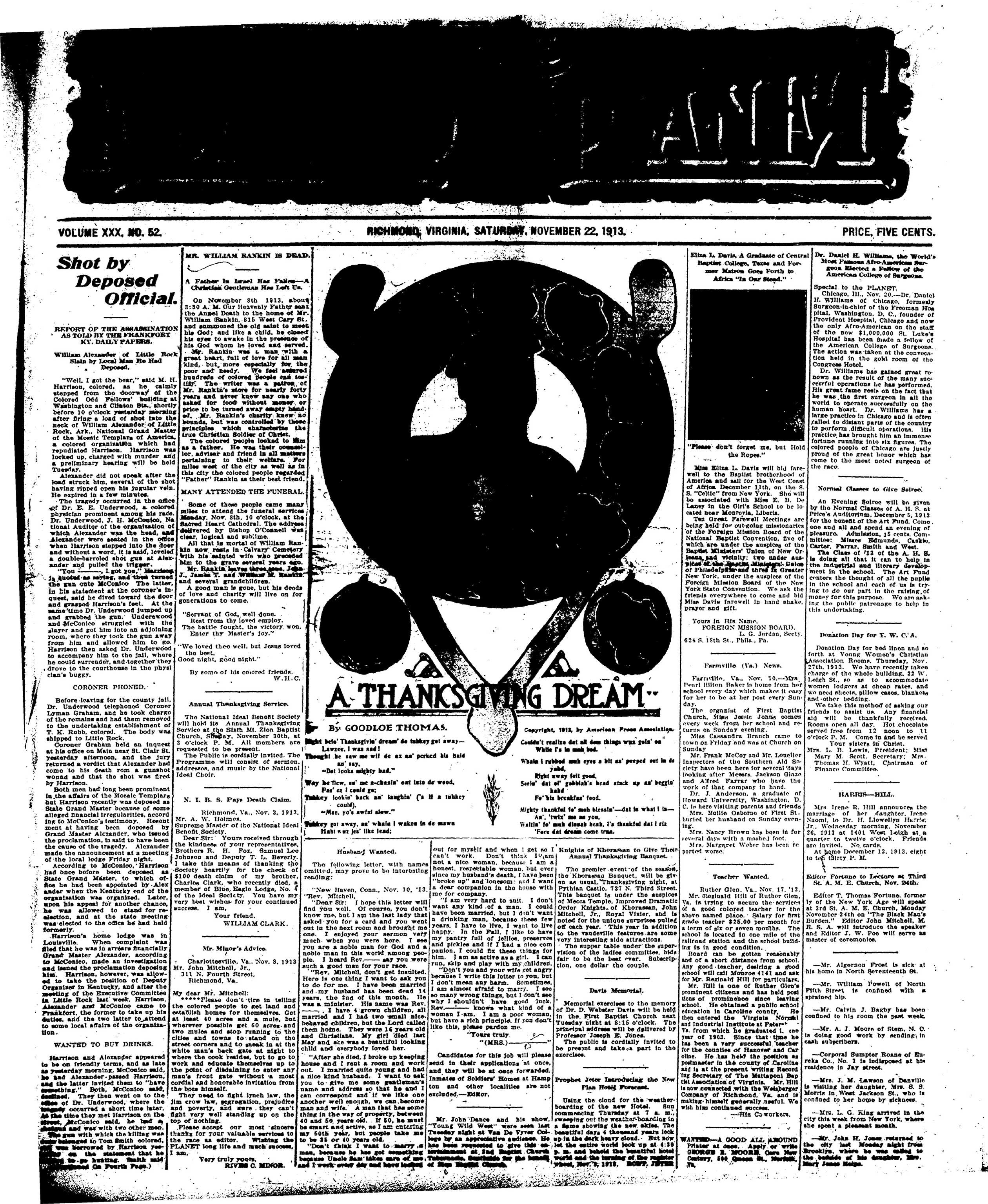
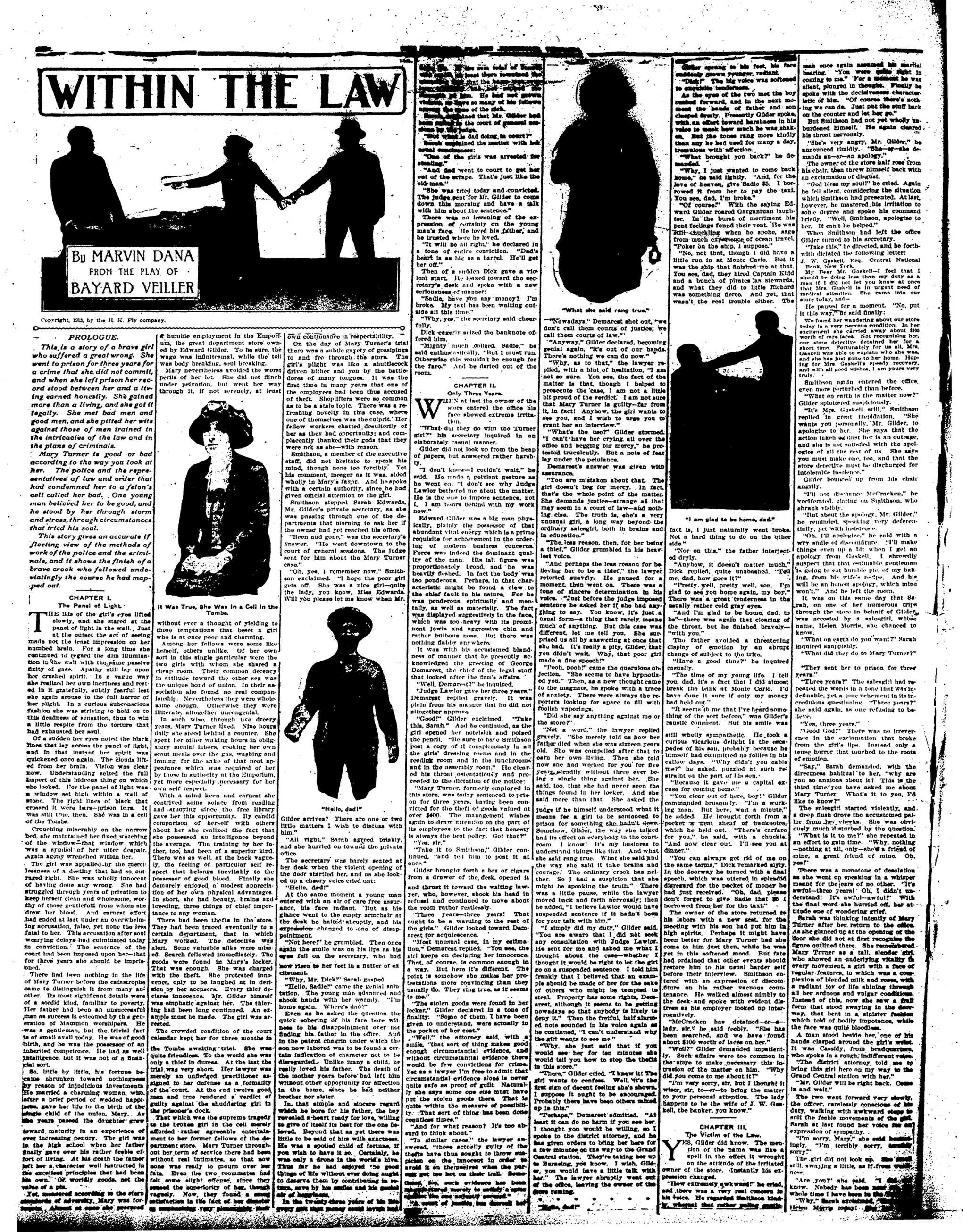
Page text (machine-generated)
PANEL
Shot by Deposed Official.
REPORT OF THE ASSASSINATION AS TOLD BY THE FRANKFORT KY. DAILY PAPERS.
William Alexander of Little Rock Slain by Local Man He Had Deposed.
"Woll, I got the bear," said M. H. Harrison, colored, as he calmly stepped from the doorway of the Colored Odd Fellows' building at Washington and Cilaton St., shortly before 10 o'clock yesterday morning after firing a load of shot into the neck of William Alexander of Little Rock, Ark., National Grand Master of the Mosaic Templars of America, a colored organization which had repudiated Harrison. Harrison was locked up, charged with murder and a preliminary hearing will be held Tuesday.
Alexander did not speak after the load struck him, several of the shot having ripped open his jungular vein. He expired in a few minutes.
The tragedy occurred in the office of Dr. E. E. Underwood, a colored physician prominent among his race, Dr. Underwood, J. H. McConico, National Auditor of the organization of which Alexander was the head, and Alexander were seated in the office when Harrison stepped into the door and without a word, it is said, leveled a double-barreled shot gun at Alexander and pulled the trigger.
"You _____, I got you," Harrison is quoted as saying, and then turned the gun onto McConico. The latter, in his statement at the coroner's inquest, said he dived toward the door and grasped Harrison's feet. At the same time Dr. Underwood jumped up and grabbed the gun. Underwood and McConico struggled with the player and got him into an adjoining room, where they took the gun away from him and allowed him to go. Harrison then asked Dr. Underwood to accompany him to the jail, where he could surrender, and together they drove to the courthouse in the physi clan's buggy.
---
CORONER PHONED.
Before leaving for the county jail, Dr. Underwood telephoned Coroner Lyman Graham, and he took charge of the remains and had them removed to the undertaking establishment of T. K. Robb, colored. The body was shipped to Little Rock.
Coroner Graham held an inquest at his office on Main near St. Clair St. yesterday afternoon, and the jury returned a verdict that Alexander had come to his death rom a gunshot wound and that the shot was fired by Harrison.
Both men had long been prominent in the affairs of the Mosaic Templars but Harrison recently was deposed as Stake Grand Master because of some alleged financial irregularities, accord ing to McConico's testimony. Resent ment at having been deposed by Grand Master Alexander, who issued the proclamation, is said to have been the cause of the tragedy. Alexander made the announcement at a meeting of the local lodge Friday night.
According to McConico, Harrison had once before been deposed as State Grand Master, to which office he had been appointed by Alexander when the Kentucky end of the organization was organized. Later, upon his appeal for another chance, he was allowed to stand for reelection, and at the state meeting was elected to the office he had held formerly. Harrison's home lodge was in Louisville. When complaint was filed that he was in arrears financially Grand Master Alexander, according to McConico, made an investigation and issued the proclamation deposing him. Harrison, however, was allowed to take the position of Deputy Organizer in Kentucky, and after the meeting of the Executive Committee in Little Rock last week, Harrison, Alexander and McConico came to Frankfort, the former to take up his duties, and the two latter to attend to some local affairs of the organization.
WANTED TO BUY DRINKS.
Harrison and Alexander appeared to be on friendly terms, and as late as yesterday morning, McConico said, he and Alexander-passed Harrison, and the latter invited them to "have something." Both, McConico said, declined. They then went on to the office of Dr. Underwood, where the tragedy occurred a short time later. As the time they met Harrison on the street, McConico said, he had a student and was with two other men. The gun with which the killing was being belonged to Tom Smith colored, and was borrowed by Harrison yesterday on the statement that he needed to go hunting. Smith said he witnessed On Fourth Pass.)
MR. WILLIAM RANKIN IS DEAD.
A Father In Israel Has Failed—A
Christian Gentleman Has Left Us.
On November 8th 1913, about 3:30 A. M. Our Heavenly Father sent the Angel Death to the home of Mr. William Rankin. 815 West Cary St. and summoned the old saint to meet his God; and like a child, he closed his eyes to awake in the presence of his God whom he loved and served. Mr. Rankin was a man with a great heart, full of love for all man kind, but, more especially for the poor and needy. We feel assured hundreds of colored people can testify. The writer was a patron of Mr. Rankin's store for nearly forty years and never knew any one who asked for food without money, or price to be turned away empty handed. Mr. Rankin's charity knew no bounds, but was controlled by these principles which characterize the true Christian Soldier of Christ. The colored people looked to him as a father. He was their counselor, adviser and friend in all matters pertaining to their welfare. For miles west of the city as well as in this city the colored people regarded "Father" Rankin as their best friend.
MANY ATTENDED THE FUNERAL.
Some of these people came many miles to attend the funeral services Monday. Nov. 8th, 10 o'clock, at the Sacred Heart Cathedral. The address delivered by Bishop O'Connell was clear, logical and sublime.
All that is mortal of William Rankin now rests in Calvary Cemetery with his sapted wife who preceded him to the grave several years ago.
Mr. Rankin leaves three sons, John J., James T. and William M. Rankin and several grandchildren.
A good man is gone, but his deeds of love and charity will live on for generations to come.
"Servant of God, well done.
Rest from thy loved employ.
The battle fought, the victory won,
Enter thy Master's joy."
"We loved thee well, but Jesus loved the beet.
Good night, good night."
By some of his colored friends.
W. H. C.
Annual Thanksgiving Service
The National Ideal Benefit Society will hold its Annual Thanksgiving Service at the Sixth Mt. Zion Baptist Church, Sunday, November 30th, at 3 o'clock P. M. All members are requested to be present.
The Public is cordially invited. The Programme will consist of sermon, addresses, and music by the National Ideal Choir.
N. I. B. S. Page Death Claim.
Richmond, Va., Nov. 3, 1913.
Mr. A. W. Holmes.
Supremo Master of the National Ideal
Benefit Society.
Dear Sir: Yours received through the kindness of your representatives, Brothers R. H. Fox, Samuel Lee Johnson and Deputy T. L. Beverly. I take this means of thanking the Society heartily for the check of $100 death claim of my brother, Charles Clark, who recently died, a member of Blue, Eagle Lodge, No. 4 of the Ideal Society. You have my very best wishes for your continued success. I am,
Your friend.
WILLIAM CLARK.
Mr. Minor's Advice
Charlottesville, Va., Nov. 8, 1913
Mr. John Mitchell, Jr.
311 N. Fourth Street.
Richmond, Va.
My dear Mr. Mitchell:
Please don't tire in telling the colored people to get land and establish homes for themselves. Get at least 40 acres and a mule, but wherever possible get 60 acres and two mules and stop running to the cities and towns to stand on the street corners and to sneak in at the white man's back gate at night to where the cook resides, but to go to work and educate themselves up to the point of disdainting to enter any man's front gate without a most cordial and honorable invitation from the bots himself.
They need to fight lynch law, the Jim crow law, aggregation, prejudice and poverty, and sure they can't fight very well standing up on the top of nothing.
Please accept our most sincere thanks for your valuable services to the race as editor. Wishing the PLANET long life and much success, I am.
Very truly yours,
RIVEN C. MINOR.
A THANKSGIVING DREAM
night hello' Thanksgiving' dream' de tulkey got away Lawrce, I was sad!
Tinkey got away, an' whale I waken in de mawa
Hacht uz lez' like lead;
~Man, yo's awful slow."
Husband Wanted.
The following letter, with names omitted, may prove to be interesting reading:
"New Haven, Conn., Nov. 10, '13.
Rev. Mitchell.
"Dear Sir: I hope this letter will find you well. Of course, you don't know me, but I am the last lady that asked you for a card and you went out in the next room and brought me one. I enjoyed your sermon very much when you were here. I see you are a noble man for God and a noble man in this world among people. I heard Rev.—— say you were such a good man for your race.
"Rev. Mitchell, don't get insulted. Here is one thing I want to ask you to do for me. I have been married and my husband has been dead 14 years, the 2nd of this month. He was a minister. His name was Rev. I have 4 grown children, all married and I had two small nice behaved children, but the Lord called them home. They were 16 years old and Christians. My girl died last May and she was a beautiful looking child and everybody loved her.
"After she died, I broke up keeping house and I rent a room and work out. I married quite young and had a nice kind husband. I want to ask you to give me some gentleman's name and address so that he and I can correspond and if we like one another well enough, we can become man and wife. A man that has some thing in the way of property, between 40 and 50 years old. If 50, he must be smart and active, as I am entering my 50th year, but people take me to be 35 or 40 years old.
"Don't think I want to marry a man, because he has got something because Uncle Sam takes care of me and I work every day and have leisure."
Copyright, 1912, by American Press Association.
Couldn't realize dat all dem things wux' goin' on
While I'm in muh bed.
Whain i rubbed muh eyes a bit an' peeped out in de
vahd.
de wood.
If a tukkey
de mawn
Whalm i ruh
y
Right a
Secin' dat
h
Fe' his
Mighty than
An', 'ty
Waltin' fo'
'Fore d
Bogt away felt good.
Seeln' dat al' gobblah's head stack up an' beggin'
kahd
Fe' his breakfast' food.
Mighty thankful fo' mab blessin'—dat is what I is—
An', 'twix' me as you.
out for myself and when I get so I can't work. Don't think I am not a nice woman, because I am a honest, respectable woman, but ever since my husband's death, I have been "broke up" and lonesom; and I want a dear companion in the house with me for company.
"I am very hard to suit. I don't want any kind of a man. I could have been married, but I don't want a drinking man, because these few years, I have to live, I want to live happy. In the Fall, I like to have my pantry full of jellies, preserves and pickles and if I had a nice companion, I could fix these things for him. I am as active as a girl. I can run, skip and play with my children.
"Don't you and your wife get angry because I write this letter to you, but I don't mean any harm. Sometimes, I am almost afraid to marry. I see so many wrong things, but I don't see why I shouldn't have good luck. Rev. _____ knows what kind of a woman I am. I am a poor woman, but have a rich principle. If you don't like this, please pardon me.
Candidates for this job will please send in their applications at once, and they will be at once forwarded. Inmates of Soldiers' Homes at Hampon and other localities are not excluded.—Ed Mor.
---
Mr. John Dance and his show, "Young Wild West" were seen last Tuesday night at Van De Vryer College by an appreciative audience. He has been requested to give this entertainment at And Baptist Church, Tahawaii, Southside for the benefit of Van De Vryer Church.
Fe' his breakfast' food.
Knights of Khorassan to Give Their Annual Thanksgiving Banquet.
The premier event of the season, the Khorassan Banquet, will be given as usual, Thanksgiving night, at Pythian Castle, 727 N. Third Street. This banquet is under the auspices of Mecca Temple, Improved Dramatic Order Knights of Khorassan, John Mitchell, Jr., Royal Visiter, and is noted for the unique surprises pulled off each year. This year in addition to the vaudeville features are some very interesting side attractions.
The supper table under the supervision of the ladies committee, bids fair to be the best ever. Subscription, one dollar the couple.
Davis Memorial.
Memorial exercises to the memory of Dr. D. Webster Davis will be held in the First Baptist Church next Tuesday night at 8:15 o'clock. The principal address will be delivered by Professor Joseph E. Jones. The public is cordially invited to be present and take a part in the exercises.
Prophet Jeter Introducing the New Plan Hotel Forecast.
Using the cloud for the weather-
boarding of the new Hotel. Sun
commencing Thursday at 7 a.m.
sweeping out the weather-boarding in
a same showing the new skies. The
beautiful days 4 thousand years lock
up in the dark heavy cloud. But now
let the entire world look up at 4:56
p. m. and behold the beautiful hotel
world and the turning of the register
wheel. Nov. 7, 1918. BOST, JEFFER
Eliza L. Davis, A Graduate of Centra Baptist College, Texas and Former Matrom Goes Forth to Africa "In Our Stead."
"Please don't forget me, but Hold the Ropes."
Miss Eiliza. L. Davis will bid farewell to the Baptist brotherhood of America and sail for the West Coast of Africa December 11th, on the S. S. "Celtic" from New York. She will be associated with Miss E. B. De Laney in the Girl's School to be located near Monrovia, Liberia.
Ten Great Farwell Meetings are being held for out-going missionaries of the Foreign Mission Board of the National Baptist Convention, two of which are under the auspices of the Baptist Minister's Union of New Orleans, and vicinity; two under auspices of the Baptist Minister's Union of Philadelphia and three in Greater New York, under the auspices of the Foreign Mission Board of the New York State Convention. We ask the friends everywhere to come and bid Miss Davis farewell in hand shake, prayer and gift.
Yours in His Name,
FOREIGN MISSION BOARD.
L. G. Jordan, Secy.
624 S. 18th St., Philadelphia, Pa.
Farmville (Va.) News.
Farmville, Va., Nov. 10.—Mrs. Pearl Bilton Baker is home from her school every day which makes it easy for her to be at her post every Sunday.
The organist of First Baptist Church, Miss Jessie Johns comes every week from her school and returns on Sunday evening.
Miss Cassandra Branch came to town on Friday and was at Church on Sunday.
Mr. Frank McCoy and Mr. Loueller Inspectors of the Southern Aid Society have been here for several days looking after Messrs. Jackson Glaze and Alfred Farrar who have the work of that company in hand.
Dr. J. Anderson, a graduate of Howard University, Washington, D. C. is here visiting parents and friends.
Mrs. Mollo Osborne of First St. buried her husband on Sunday evening.
Mrs. Nancy Brown has been in for several days with a mashed foot.
Mrs. Margaret Weber has been reported worse.
Teacher Wanted
Ruther Glen, Va., Nov. 17, 13.
Mr. Reginald Hill of Ruther Glen,
Va. is trying to secure the services
of a good colored teacher for the
above named place. Salary for first
grade teacher $25.00 per month for
a term of six or seven months. The
school is located in one mile of the
railroad station and the school building
is in good condition.
Board can be gotten reasonably
and of a short distance from school.
Any good teacher, desiring a good
school will call Monroe 4141 and ask
for Mr. Reginald Hill for particulars.
Mr. Hill is one of Ruther Glen's
prominent citizens and has held posi-
tions of prominence since leaving
school. He obtained a public school
education in Caroline county.
He then entered the Virginia Norma-
l and Industrial Institute at Pater-
na. from which he graduated 1. one
year of 1902. Since that time he
has been a very successful teacher
for the counties of Hanover and Car-
oline. He has held the position as
postmaster in the county of Caroline
and is at the present writing Record
Secretary of The Mattaponi Bap
tist Association of Virginia. Mr. Hill
is now connected with the Wesbarger
Company of Richmond, Va. and is
making himself generally useful. We
wish him continued success.
—His Co-workers.
WANTED—A GOOD ALL AROUND
Printer at once. Apply or write
GEORG B. MOORE, Care New
Century, 500 Queen St., Norfolk,
Va.
PRICE, FIVE CENTS.
Dr. Daniel H. Williams, the World's Most Famous Afro-American Surgeon Elected a Fellow of the American College of Surgeons.
Special to the PLANET.
Chicago, Ill., Nov. 20.—Dr. Daniel H. Williams of Chicago, formerly Surgeon-in-chief of the Freeman Hospital, Washington, D. C., founder of Provident Hospital, Chicago and now the only Afro-American on the staff of the now $1,000,000 St. Luke's Hospital has been made a fellow of the American College of Surgeons. The action was taken at the convocation held in the gold room of the Congress Hotel. Dr. Williams has gained great known as the result of the many successful operations he has performed. His great fame rests on the fact that he was the first surgeon in all the world to operate successfully on the human heart. Dr. Williams has a large practice in Chicago and is often called to distant parts of the country to perform difficult operations. His practice has brought him an immense fortune running into six figures. The colored people of Chicago are justly proud of the great honor which has come to the most noted surgeon of the race.
Normal Classes to Give Soiree
An Evening Solice will be given by the Normal Classes of A. H. S. at Price's Auditorium, December 5, 1913 for the benefit of the Art Fund. Come one and all and spend an evening of pleasure. Admission, 15 cents. Committee: Misses Edmunds, Caskey, Cartor, Farrar, Smith and West. The Class of '13 of the A. H. H. is doing all that it can to help in the industrial and literary development in the school. The Art Fund centers the thought of all the pupils in the school and each of us is trying to do our part in the raising, of money for this purpose. We are asking the public patronage to help in this undertaking.
Donation Day for Y. W. C.'A.
Donation Day for bed linen and so forth at Young Women's Christian Association Rooms, Thursday, Nov. 27th, 1913. We have recently taken charge of the whole building, 22 W. Leigh St., so as to accommodate women lodgers at cheap rates, and we need sheets, pillow cases, blankets and other bedding.
We take this method of asking our friends to assist us. Any financial aid will be thankfully received. Rooms open all day. Hot chocolate served free from 12 noon to 11 o'clock P. M. Come in and be served Your sisters in Christ.
Mrs. L. D. Lewis, President; Miss Mary M. Scott, Secretary; Mrs. Thomas H. Wyatt, Chairman of Finance Committee.
HARRIS-HILL
Mrs. Irene R. Hill announces the marriage of her daughter, Irene Naomi, to Dr. H. Lloewellyn Harris Jr., Wednesday morning, November 26, 1913 at 1401 West Leigh at a quarter to twelve o'clock. Friends are invited. No cards.
At home December 12, 1913, eight to ten thirty P. M.
Editor Fortune to Lecture at Third St. A. M. E. Church, Nov. 24th.
Editor T. Thomas Fortune, formerly of the New York Age will speak at 3rd St. A. M. E. Church, Monday November 24th on "The Black Man's Burden." Editor John Mitchell, M. R. S. A. will introduce the speaker and Editor J. W. Poo will serve as master of ceremonies.
---
Mr. Algernon Frost is sick at his home in North Seventeenth St.
Mr. William Powell of North Fifth Street is confined with a sprained hip.
Mr. Calvin J. Bagby has been confined to his room the past week.
Mr. A. J. Moore of Stem, N. O. is doing good work by sending in cash subscribers.
Corporal Sumpter Roane of Eureka Co., No. 1 is indisposed at his residence in Jay street.
Mrs. J. M. Lawson of Danville is visiting her daughter, Mrs. S. S. Morris in West Jackson St., who is confined to her home by sickness.
Mrs. L. G. King arrived in the city this week from New York, where she spent a pleasant month.
Mr. John H. Jones returned to the city last Monday night from Brooklyn, where he was called to the bedside of his daughter, Mrs. Mary Jones Heine.
WITHIN THE LAW
By MARVIN DANA
FROM THE PLAY OF
BAYARD VEILLER
This is a story of a brave girl who suffered a great wrong. She went to prison for three years for a crime that she did not commit, and when she left prison her record stood between her and a living earned honestly. She gained more than a living, and she got it legally. She met bad men and good men, and she pitted her wits against those of men trained in the intricacies of the law and in the plans of criminals.
Mary Tarner is good or bad according to the way you look at her. The police and the representatives of law and order that had condemned her to a felon's cell called her bad. One young man believed her to be good, and he stood by her through storm and stress, through circumstances that tried his soul.
This story gives an accurate if flaunting view of the methods of work of the police and the criminals, and it shows the finish of a brave crook who followed undeviatingly the course he had mapped out.
CHAPTER I
THE lids of the girl's eyes lifted slowly, and she stared at the panel of light in the wall. Just
at the outset the act of seeing made not the least impression on her humbled brain. For a long time she continued to regard the dim illumination in the wall with the same passive fixity of gaze. Agathy still lay upon her crushed spirit. In a vague way she realized her own inertness and rested in it gratefully, subtly fearful less she again arouse to the full horror of her plight. In a curious subconscious fashion she was striving to hold on to this deadness of sensation, thus to win a little respite from the torture that had exhausted her soul.
Of a sudden her eyes noted the black lines that lay across the panel of light, and in that instant her spirit was quickened once again. The clouds lifted from her brain. Vision was clear now. Understanding seized the full import of this hideous thing on which she looked. For the panel of light was a window not high within a wall of stone. The right lines of black that crossed it were tars—prison bars. It was still true, then. She was in a cell of the Tombs.
Crouching miserably on the narrow bed, she maintained her fixed watching of the window—that window which was a symbol of her utter despair. Again agony wrenched within her. The girl was appalled by the mercilessness of a destiny that had so outraged right. She was wholly innocent of having done any wrong. She had struggled through years of privation to keep herself clean and wholesome, worthy of those gentlefolk from whom she drew her blood. And earnest effort had ended at last under an overwhelming accusation, false, yet none the less fatal to her. This accusation after soul worrying delays had culminated today in conviction. The sentence of the court had been imposed upon her—that for three years she should be imprisoned.
There had been nothing in the life of Mary Turner before the catastrophe came to distinguish it from many another. Its most significant details were of a sordid kind, familiar to poverty. Her father had been an unsuccessful man as success is esteemed by this generation of Mammon worshipers. He was a gentleman, but the trivial fact is of small avail today. He was of good birth, and he was the possessor of an inherited competence. He had as well intelligence, but it was not of a financial sort.
So, little by little, his fortune became shrunken toward nothingness by reason of injudicious investments. He married a charming woman, who, after a brief period of wedded happiness, gave her life to the birth of the single child of the union, Mary. As the years passed the daughter grew
toward maturity in an experience of ever increasing penury. The girl was in the high school when her father finally gave over his rather feeble effort of living. At his death the father left her a character well instructed in the excellent principles that had been his own. Of worldly goods, not the value of a pth.
Yet, measured according to the stern standards of adversity, Mary was fortnight. Almost at once she prowored
& humble employment in the Emporium, the great department store owned by Edward Gilder. To be sure, the wage was infinitesimal, while the toll was body breaking, soul breaking.
Mary nevertheless avoided the worst perils of her lot. She did not finch under privation, but went her way through it, if not serenely, at least
1920
It Was True, She Was In a Cell in the Tombe.
without ever a thought of yielding to those temptations that beset a girl who is at once poor and charming. Among her fellows were some like herself, others unlike. Of her own sort in this single particular were the two girls with whom she shared a cheap room. Their common decency in attitude toward the other sex was the unique bond of union. In their association she found no real companionship. Nevertheless they were wholesome enough. Otherwise they were illiterate, altogether uncongenial. In such wise, through five dreary years, Mary Turner lived. Nine hours daily she stood behind a counter. She spent her other waking hours in obligatory mental labor, cooking her own scant meals over the gas, washing and froning, for the sake of that neat appearance which was required of her by those in authority at the Emporium, yet more especially necessary for her own self respect.
With a mind keen and earnest she contrived some solice from reading and atuying since the free library gave her this opportunity. By could comparison of herself with others about her she realized the fact that she possessed an intelligence beyond the average. The training by her father, too, had been of a superior kind. There was as well, at the back vaguely, the feeling of particular self respect that belongs inevitably to the possessor of good blood. Finally she demurely enjoyed a modest appreciation of her own physical advantages. In short, she had beauty, brains and breeding, three things of chief importance to any woman.
There had been thefts in the store. They had been traced eventually to a certain department, that in which Mary worked. The detective was alert. Some valuable alks were missed. Search followed immediately. The goods were found in Mary's locker. That was enough. She was charged with the theft. She protested innocence, only to be laughed at in derision by her accusers. Every thief declares innocence. Mr. Gilder himself was emphatic against her. The thieving had been long continued. An example must be made. The girl was arrested. The crowded condition of the court calendar kept her for three months in
the Tombus awaiting trial. She was quite friendless. To the world she was only a thief in durea. At the last the trial was very short. Her lawyer was merely an unfedged practitioner assigned to her defense as a formality of the court. At the end twelve good man and true rendered a verdict of guilty against the shuddering girl in the prisoner's dock.
That which was the supreme tragedy to the broken girl in the cell merely afforded rather agreeable entertainment to her former fellows of the department store. Mary Turner throughout her term of service there had been without real intimates, so that now some was ready to pour over her fate. Even the two roommates had felt, some slight offence, since they seemed the superiority of her, through vagueness. Now, they found, a strong satisfaction in the fact of her dimeter comprehension very important.
complemento in importancia
own community in respectability.
On the day of Mary Turner's trial there was a subdued rage of gossiping to and fro through the store. The girl's plight was like a shuttlecock driven hither and yon by the battle-dores of many tongues. It was the first time in many years that one of the employees had been thus accused of theft. Shopliflers were so common as to be a stale topic. There was a refreshing novelty in this case, where one of themselves was the culprit. Her fellow workers chatted, desultorily of her as they had opportunity, and complacently thanked their gods that they were not as she—with reason.
Smithson, a member of the executive staff, did not hesitate to speak his mind, though none too forceful. Yet his comment, merger as it was, stood wholly in Mary's favor. And he spoke with a certain authority, since he had given official attention to the girl.
Smithson stopped Sarah Edwards,
Mr. Gilder's private secretary, as she
was passing through one of the de-
partments that morning to ask her if
the owner had yet reached his office.
"Been and gone," was the secretary's
answer. "He went downtown to the
court of general sessions. The judge
sent for him about the Mary Turner
case."
"Oh, yes, I remember now," Smithson
exclaimed. "I hope the poor girl
gets off. She was a nice girl—quite
the lady, you know, Miss Edwards.
Will you please let me know when Mr.
```markdown
```
"Hello, dad!"
Gilder arrives? There are one or two little matters I wish to discuss with him."
"All right." Sarah agreed briskly, and she hurried on toward the private office.
The secretary was barely seated at her desk when the violent opening of the door startled her, and as she looked up a cheery voice cried out:
"Hello, dad!" At the same moment a young man entered with an air of care free assurance, his face radiant. But as his glance went to the empty armchair at the desk he halted abruptly, and his expression changed to one of disappointment. "Not here!" he grumbled. Then once again the amlilo was on his lips as his eyes fell on the secretary, who had now risen to her feet in a flutter of excitement. "Why, Mr. Dick!" Sarah gasped. "Hello, Sadie!" came the genial salutation. The young man advanced and shook hands with her warmly. "I'm home again. Where's dad?"
Even as he asked the question the quick sobering of his face bore witness to his disappointment over not finding his father in the office. And in the patent chagrin under which the son now labored was to be found a certain indication of character not to be disregarded. Unlike many a child, he really loved his father. The death of the mother years before had left him without other opportunity for affection in the home, since he had neither brother nor sister.
In, that simple and sincere regard which he bore for his father, the boy revealed a heart ready for love, willing to give of itself its best for the one beloved. Beyond that an yet there was little to be said of him with exactness. He was a spotted child of fortune, if you wish to have it. Certainly, he was only a drone in the world's hive. Thus far he had enjoyed the good things of life without ever doing ought to deserve them by contributing in return, save by his smile and his gentle air of happiness.
In the twenty three yews of his life
grew and that meant so much loved
hard.
Sidney. By the sum total of Honour who spoke to just three remembered the occasion that that the boy was sent to the prison, and supported him. He had not grown violent, so there so many of his fellows among the lines of the rich. Sidney explained that Mr. Glider had been sent to the court of general condemn by the judge.
"Not what is dad doing, in court?"
Bernah explained the matter with her usual conciliences:
"One of the girls was arrested for stealing."
"And dad went to court to get her out of the scrape. That's just like the old man."
"She was tried today and convicted. The judge sent for Mr. Glider to come down this morning and have a talk with him about the sentence."
There was no lessening of the expression of certainty on the young man's face. He loved his father, and he trusted where he loved.
"It will be all right," he declared in a tone of entire conviction. "Dad's heart is as big as a barrel. He'll get her off."
Then of a sudden Dick gave a violent start. He looked toward the secretary's desk and spoke with a new seriousness of manner:
"Sadie, have you any money? I'm broke. My taxi has been waiting outside all this time."
"Why, yes," the secretary said cheerfully.
Dick eagerly seized the banknote offered him.
"Mighty much obliged. Sadie," he said enthusiastically. "But I must run. Otherwise this wouldn't be enough for the fare." And be darted out of the room.
CHAPTER II
WHEN at last the owner of the store entered the office his face showed extreme irritation.
"What did they do with the Turner stilt?" his secretary inquired in an elaborately casual manner.
Gilder did not look up from the heap of papers, but answered rather harshly.
"I don't know—I couldn't wait," he said. He made a petulant gesture as he wont on. "I don't see why Judge Lawlor bothered me about the matter. He is the one to impose sentence, not I am hours behind with my work now."
Edward Gillier was a big man physically, plainly the possessor of that abundant vital energy which in the prime requisite for achievement in the ordering of modern business concerns. Force was indeed the dominant quality of the man. His tall figure was proportionately broad, and he was heavily fleshed. In fact the body was too ponderous. Perhaps, in that characteristic might be found a clew to the chief fault in his nature. For he was ponderous, spiritually and mentally, as well as materially. The fact was displayed suggestively in the face, which was too heavy with its prominent jowls and aggressive chin and mother bulbous nose. But there was nothing dabby anywhere. It was with his accustomed blandness of manner that he presently acknowledged the greeting of George Domarest, the chief of the legal staff that looked after the firm affairs.
"Judge Lawlor gave her three years," Demarest replied gravely. It was plain from his manner that he did not altogether approve.
"Good!" Glider exclaimed. "Take this, Sarah." And he continued, as the girl opened her notebook and polished the pencil. "Be sure to have Smithson post a copy of it conspicuously in all the girls' dressing rooms and in the reading room and in the lunchrooms and in the assembly room." He cleared his throat ostentatiously and proceeded to the dictation of the notice:
"Mary Turner, formerly employed in this store, was today sentenced to prison for three years, having been convicted for the theft of goods valued at over $400. The management wishes again to draw attention on the part of its employees to the fact that honesty is always the best policy. Got that?" "Yes, sir."
"Take it to Smithson," Glider continued, "and tell him to post it at once."
Gilder brought forth a box of cigars from a drawer of the desk, opened it and thrust it toward the waiting lawyer, who, however, abook his head in refusal and continued to move about the room rather restlessly.
"Three years-three years! That ought to be a warning to the rest of the girls." Gilder looked toward Demarest for acquiescence.
"Most unusual case, in my estimation." Demarest replied. "You see, the girl keeps on declaring her innocence. That, of course, is common enough in a way. But here it's different. The point is somehow she makes her protestations more convincing than they proclaims do. They ring true, as it seems to me."
"The stolen goods were found in her locker." Gilder declared in a tone of finality. "Some of them, I have been given to understand, were actually in the pocket of her coat."
"Well," the attorney said, with a smile, "that sort of thing makes good enough circumstantial evidence, and without circumstantial evidence there would be few convictions for crime. Yet as a lawyer I'm free to admit that circumstantial evidence alone is never quite safe as proof of guilt. Naturally she says some one else must have put the stolen goods there. That is quite within the measure of possibility. That sort of thing has been done countless times."
"And for what reason? It's too absurd to think about."
"In similar cases," the lawyer answered, "those actually guilty of the thefts have thus sought to throw suspicion on the innocent in order to avoid it on themselves when the paranoid get too hot on their trail. Sometimes, such evidence has been misinterpreted merely to indicate a lesser offense than one actually occurred."
"A court of justice has himself had
```markdown
```
"What she said rang true."
"Nowadays," Demarest shot out, "we don't call them courts of justice; we call them courts of law."
"Anyway," Gilder declared, becoming genial again. "It's out of our hands. There's nothing we can do now."
"Why, as to that," the lawyer replied, with a hint of hesitation, "I am not so sure. You see, the fact of the matter is that, though I helped to prosecute the case, I am not a little bit proud of the verdict. I am not sure that Mary Turner is guilty—far from it, in fact! Anyhow, the girl wants to see you, and I wish to urge you to grant her an interview."
"What's the user?" Gilder stormed. "I can't have her crying all over the office and begging for mercy," he protested truculently. But a note of fear lay under the petulance. Demarest's answer was given with assurance.
"You are mistaken about that. The girl doesn't beg for mercy. In fact, that's the whole point of the matter. She demands justice—strange as that may seem in a court of law—and nothing else. The truth is, she's a very unusual girl, a long way beyond the ordinary salesgirl, both in brains and in education."
"The less reason, then, for her being a thief. Glider grumbled in his heaviest voice.
"And perhaps the less reason for believing her to be a thief, the lawyer retorted suavely. He paused for a moment, went on. There was a tone of sincere determination in his voice. "Just before the judge imposed sentence he asked her if she had anything to say. You know, it's just a usual form—a thing that rarely means much of anything. But this case was different, lot me tell you. She surprised us all by answering at once that she had. It's really a pity, Glider, that you didn't wait. Why, that poor girl made a fine speech!"
"Pooh, pooh!" came the querulous objection. "She seems to have hypnotized you." Then, as a new thought came to the magnate, he spoke with a trace of anxiety. There were always the reporters looking for space to fill with foolish vaporings. "Did she say anything against me or the store?" "Not a word," the lawyer replied gravely. "She merely told us how her father died when she was sixteen years old. She was compelled after that to earn her own living. Then she told how she had worked for you for five years, steadily without there ever being a single thing against her. She said, too, that she had never seen the things found in her locker. And she said more than that. She asked the
judge if he himself understood what it means for a girl to be sentenced to prison for something she hadn't done. Somehow, Glider, the way she talked had its effect on everybody in the courtroom. I know. It's my business to understand things like that. And what she said rang true. What she said said the way she said it take brains and courage. The ordinary crook has neither. So I had a suspicion that she might be speaking the truth. There was a little pause, while the lawyer moved back and forth nervously; then he added, "I believe Lawlor would have suspended sentence if it hadn't been for your talk with him."
"I simply did my duty," Glider said. "You are aware that I did not seek any consultation with Judge Lawlor. He sent for me and asked me what I thought about the case—whether I thought it would be right to let the girl go on a suspended sentence. I told him frankly that I believed that an example should be made of her for the sake of others who might be tempted to steal. Property has some rights, Demarest, although it seems to be getting nowadays so that anybody is likely to deny it." Then the fretful, half alarmed note sounded in his voice again as he continued, "I can't understand why the girl wants to see me."
"Why, she just said that if you would see her for ten minutes she would tell you how to stop the theft in this store."
"There," Glider cried. "I knew it. The girl wants to confess. Well, it's the first sign of decent feeling she's shown. I suppose it ought to be encouraged. Probably there have been others mixed up in this."
"Perhaps," Demarest admitted. "At least it can do no harm if you see her. I thought you would be willing, so I spoke to the district attorney, and he has given orders to bring her here for a few minutes on the way to the Grand Central station. They're taking her up to Bursing, you know. I wish, Glider, you would have a little talk with her." The lawyer abruptly went out of the office, leaving the owner of the store fuming.
Gilder sparing to his feet, his face suddenly younger, radiant. "Dink!" The big voice was softened to enquire tranquility. As the eyes of the two met the boy rushed forward, and in the next moment the hands of father and son clapped firmly. Frequently Gilder spoke, with an effort toward harmless in his voice to mask how much he was shaken. But the tones rang more kindly than any he had used for many a day, tranquil with affection.
"What brought you back?" he demanded.
"Why, I just wanted to come back home," he said lightly. "And, for the love of heaven, give Sadie $5. I borrowed it from her to pay the taxi. You see, dad, I am broke."
"Of course!" With the saying Edward Gilder roared Gargantuan laughter. In the burst of merriment his pent feelings found their vent. He was still chuckling when he spoke, anger from much experience of ocean travel. "Poker on the ship, I suppose."
"No, not that, though I did have a little run in at Monte Carlo. But it was the ship that finished me at that. You see, dad, they hired Captain Kidd and a bunch of pirates as stewards, and what they did to little Richard was something fierce. And yet, that wasn't the real trouble either. The
THE WESTERN KNIFE
"I am glad to be home, dad."
fact is, I just naturally went broke.
Not a hard thing to do on the other side."
"Nor on this," the father interjected dryly.
"Anyhow, it doesn't matter much."
Dick replied, quite unashamed, "Tell me, dad, how goes it?"
"Pretty well, pretty well, son. I'm glad to see you home again, my boy."
There was a great tenderness in the usually rather cold gray eyes.
"And I'm glad to be home, dad, to be—there was again that clearing of the throat, but he finished bravely—"with you."
The father avoided a threatening display of emotion by an abrupt change of subject to the trite.
"Have a good time?" he inquired casually.
"The time of my young life. I tell you, dad, it's a fact that I did almost break the bank at Monte Carlo. I'd have done it sure if only my money had held out."
"It seems to me that I've heard something of the sort before" was Glider's caustic comment. But his smile was still wholly sympathetic. He took a curious vicarious delight in the encapades of his son, probably because he himself had committed no follies in his callow days. "Why didn't you cable me?" he asked, puzzled at such restraint on the part of his son.
"Because it gave me a capital excuse for coming home."
"You clear out of here, boy!" Glider commanded brusquely. "I'm a working man. But here, wait a minute," he added. He brought forth from a pocket a neat sheaf of banknotes, which he held out. "There's carfaro for you," he said, with a chuckle.
"And now clear out. I'll see you at dinner."
"You can always get rid of me on the same terms." Dick remarked slyly. In the doorway he turned with a final speech, which was uttered in splendid disregard for the packet of money he had just received. "Oh, dad, please don't forget to give Sadie that $ I borrowed from her for the taxi." The owner of the store returned to his labors with a new seat, for the meeting with his son had put him in high spirits. Perhaps it might have been better for Mary Turner had she come to him just then, while he was yet in this softened mood. But fate had ordained that other events should restore him to his usual harder self before their interview. Smithson entered with an expression of discontent on his rather vacuous countenance. He walked almost nimply to the desk and spoke with evident distress as his employer looked up interrogatively.
"McCracken has detailed—er—a-
lady, sir," he said freely. "She has
been searched, and we have found
about $100 worth of laces on her."
"Well?" Glider demanded impatiently.
Such affairs were too common in
the store to make necessary this in-
trusion of the matter on him. "Why
did you come to me about it?"
"I'm very sorry, sir, but I thought it
wiser, sir, to—er—to bring the matter
to your personal attention. The lady
happens to be the wife of J. W. Gaskell,
the banker, you know."
CHAPTER III
YES, Gilder did know. The mention of the name was like a spell in the effect it wrought
on the attitude of the irritated owner of the store. Instantly his expression changed. "How extremely awkward" he cried, and there was a very real concern in his voice. He regarded Maitlanik kindly, whether that rather putting gait
main once again assumed his martial bearing. "You were quite right in coming to me." For a moment he was silent, plunged in thought. Finally he spoke with the decisiveness characteristic of him. "Of course there's nothing we can do. Just put the stuff back on the counter and let her go." But Smithson had not put wholly unburdened himself. He again cheered his throat nervously.
"She's very angry, Mr. Glider," he announced timely. "She—she demands an—er—an apology." The owner of the store half rose from his chair, then threw himself back with an exclamation of disgust.
"God bless my soul!" he cried. Again he fell silent, considering the situation which Smithson had presented. At last, however, he masted, his irritation to sheege degree and spoke his command briefly. "Well, Smithson, apologize to her. It can't be helped."
When Smithson had left the office Glider turned to his secretary.
"Take this," he directed, and be forth with dictated the following letter:
J. W. Gaskell, Esq. Central National Bank, New York.
My dear Mrs. Gaskell—I feel that I am not done less than my duty as a man if I did not let you know at once that Mrs. Gaskell is in urgent need of medical attention. She came into our store today, and—
He paused for a moment. "No, put it this way." He said finally:
We found her wandering about our store today in a very nervous condition. In her excitement she came away, about 10 miles away. Not recognizing her, our store detective detained her for a short time. Fortunately for us all, Mrs. Gaskell was able to explain who she was, and she has just got her keys. Our store's quickly recovery, and with all good wishes, I am yours very truly.
Smithson again entered the office, even more perturbed than before. "What on earth is the matter now?" Glider subtracted suspiciously.
"It's Mrs. Gaskell still," Smithon replied in great trepidation. "She wants you personally, Mr. Gilder, to apologize to her. She says that the action taken against her is an outrage, and she is not satisfied with the apologies of the rest of us. She says you must make one, too, and that the store detective must be discharged for intolerable hostility."
Gilder bounced up from his chair angrily.
"I'll not discharge McCracken," he voicedferent, glaring on Smithson, who shrank viably.
"But about the apology, Mr. Gilder," he reminded, speaking very deferentially, yet with hostility.
"Oh, I apologize," he said with a wry smile of discomfiture. "I'll make things even up a bit when I get an apology from Gaskell. I shrewdly suspect that estimable gentleman is going to eat humble pie, of myaking, from his wife's recipe. And his will be an honest apology, which mine won't." And he left the room.
It was on this same day that Sarah, on one of her numerous trips through the store in behalf of Glider, was accosted by a salesgirl, whose name, Helen Morris, she chanced to know.
"What on earth do you want?" Sarah inquired suspiciously.
"What did they do to Mary Turner?"
"They sent her to prison for three years."
"Three years?" The salesgirl had repeated the words in a tone that was indelible, yet a tone vehement in its incredulous questioning. "Three years?" she said again, as one refusing to believe.
"Yes, three years."
"Good God!" There was no irreverence in the exclamation that broke from the girl's lips. Instead only a tense horror that touched to the roots of emotion.
"Say," Sarah demanded, with the directness habitual to her, "why are you so anxious about it? This is the third time you have asked me about Mary Turner. What's it to you, I'd like to know?" The smiles! started violently, and a deep flush drove the accustomed pallor from her cheeks. She was obviously much disturbed by the question. "What is it to me?" she repeated in an effort to gain time. "Why, nothing—nothing at all, only—she a friend of mine, a great friend of mine. Oh, yes!" There was a monotone of desolation as she went on speaking in a whisper meant for the ears of no other. "It's awful—three years! Oh. I didn't understand! It's awful—awful!" With the final word she hurried off, her attitude one of wondering grief.
Sarah was thinking intently of Mary Turner after her return to the office. As she glanced up at the opening of the door she did not at first recognize the figure quilted there. She remembered Mary Turner as a tall, slender girl, who showed an underlying vitality in every movement, a girl with a face of regular features, in which was a complexion of blended milk and rose, with a radiant joy of life shining through all her ardour and vulgar conditions. Instead of this, now she saw a fruit form that stood awaying in the doorway, that bent in a sinister fashion which told of bodily impotence, while the face was quite bloodless.
A man stood beside her, one of his hands clasped around the girl's wrist. It was Cassidy, from headquarters, who spoke in a rough, indifferent voice. "The district attorney, told me to bring this girl here on my way to the Grand Central station with her." "Mr. Glider will be right back. Oceane is and wait."
The two went forward very slowly, the officer, carelessly concious of his duty, walking with awkward steps to untit the feeble movements of the girl Sarah at last found her voice for an expression of sympathy.
"I'm sorry, Mary," she said beautifully, "I'm terribly sorry, terribly sorry."
The girl did not look up. She stood still, swirling a little, as if from whirl ness.
"Are you?" she said. "I did not know. Nobody has been near you whole time I have been in the house."
"Why," Sarah exclaimed, then Helen Morris roared:
```markdown
```
talking about you again and again. She's all broken up over your trouble." "Who is Helen Morris?" the lifeless voice demanded. There was no interest in the question. Gilder entered, the office with the quick, bustling activity that was ordinarily expressed in his every movement. He paused as he beheld the two
```markdown
```
"The district attorney told me to bring this girl here."
"You may go, Sarah. I will ring when I wish you again."
There followed an interval of silence while the secretary was leaving the office and the girl with her warder stood waiting on his pleasure. Gilder cleared his throat twice in an embarrassment foreign to him before finally he spoke to the girl.
"My girl," Gilder said gently—his hard voice was softened by an honest regret—"my girl, I am sorry about this."
"You should be!" came the instant answer.
"Come, come!" Gilder exclaimed testily. "That's no tone to take with me."
"Why? What sort of tone do you expect me to take?" was the retort in the lastless voice.
"I expected a decent amount of humility from one in your position."
Life quickened swiftly in the drooping form of the girl. She stood suddenly erect, and her face lost its blackness of pallor. The eyes opened wide and looked straight into those of the man who had employed her.
"Would you be humble," she demanded, and now her voice was become softly musical, yet forbidding, too, with a note of passion, "would you be humble if you were going to prison for three years for something you didn't do?"
"Don't mind her, sir," Cansky said. He meant to make his manner very reassuring. "They're say that. They are innocent, of course. Yep, they all say it. It don't do 'em any good, but just the same they all sweep they're innocent. They keep it up to the very last, no matter how right they've been got."
The voice of the girl rang clear. There was a note of insistence that
a
"I tell you I didn't do it!"
carried a curious dignity of its own.
The very simplicity of her statement might have had a power to convince one who listened without prejudice, although the words themselves were of the trite sort that any protesting criminal might utter.
"I tell you I didn't do it!"
Glider himself felt the surge of emotion that swung through these moments, but he would not yield to it.
"What's the use of all this pretense?" he demanded sharply. "You were, given a fair trial, and there's an end of it."
"Oh, no, I wasn't. Why, if the trial had been fair I shouldn't be here. Do you call it fair when the lawyer I had was only a boy—one, whom the court told me to take, a boy trying his first case, my case, that meant the rule of
Some followed a few seconds of alarms. Then Gilder made an effort to shout off the feeling that, had no possessed him, and to a certain degree he succeeded.
"Who jury found you guilty," he asserted, with an attempt to make his video magisterial in its severity.
"Yes, the jury found me guilty. Do you know why? I can tell you, Mr. Gilder. It was because they had been out for three hours without reaching a decision. The evidence didn't seem to be quite enough for some of them, after all. Well, the judge threatened to lock them up all night. The men wanted to get home. The easy thing to do was to find me guilty, and let it go at that. Was that fair, do you think? And that's not all either. Was it fair of you, Mr. Gilder? Was it fair of you to come to the court this morning and tell the judge that I should be sent to prison as a warning to others?"
"You know?" he exclaimed in momentary consternation.
"I heard you in the courtroom," she said. "The dock isn't very far from the bench where you spoke to the judge about my case. Yes, I heard you. It wasn't. Did I do it? or, Didn't I do it? No. It was only that I must be made a warning to others."
Again silence fell for a tense interval. Then finally the girl spoke:
"Mr. Glider," she said simply. "My God is my judge. I am going to prison for three years for something I didn't do. Why did you ask the judge to send me to prison?"
"The thieving that has been going on in this store for over a year has got to stop." Glider answered emphatically, with all his usual energy of manner restored.
"Sending me to prison won't stop it," Mary Turner said drearily.
"Perhaps not," Gilder sternly retorted. "But the discovery and punishment of the other guilty ones will." His manner changed to a businesslike alertness. "You sent word to me that you could tell me how to stop the thefts in the store. Well, my girl, do this and, while I can make no definite promise, I'll see what can be done about getting you out of your present difficulty." He picked up a pencil, pulled a pad of blank paper convenient to his hand and looked at the girl expectantly, with aggressive inquiry in his gaze. "Tell me now," he concluded, "who were your pals?" "I have no pals!" she ejaculated furiously. "I never stole anything in my life. Must I go on telling you over and over again?" Her voice rose in a wall of misery. "Oh, why won't any one believe me?"
"Unless you can control yourself, you must go." Glider pushed away the pad of paper and tossed the pencil aside in physical expression of his displeasure. "Why did you send that message if you have nothing to say?" he demanded, with increasing choler. "I have something to tell you, Mr. Glider," she cried quietly. "Only I—I sort of lost my grip on the way here, with this man by my side." "Well?" Glider insisted querulously, as the girl besitated.
"When you sit in a cell for three months waiting for your trial, as I did, you think a lot. And so I got the idea that if I could talk to you I might be able to make you understand what's really wrong. And if I could do that and so help out the other girls, what has happened to me would not, after all, be quite so unwful...so useless, somehow." Her voice lowered to a quick pleading, and she bent toward the man at the deck. "Mr. Glider," she questioned, "do you really want to stop the girls from stealing?" "Most certainly I do," came the forcible reply. The girl spoke with a great earnestness deliberately. "Then give them a fair chance."
"Then give them a fair chance."
The magnate stared in sincere astonishment over this absurd, this futile suggestion for his guidance.
"What do you mean?" he vociferated, with rising indignation.
"Why," she said very gently, "I mean just this: Give them a living chance to be honest."
"A living chance!" The two words were exploded with dynamic violence. Glider found, himself unable to express the rage that d famed within him. The girl showed herself undismayed by his anger.
"Yes," she went on quietly, "that's all there is to it. Give them a living chance to get enough food to eat and a decent room to sleep in and shoes that will keep their feet off the pavement winter mornings. Do you think that any girl wants to steal? Do you think that any girl wants to risk"—By this time, however, Glider had regained his power of speech, and he interrupted stormily:
"And is this what you have taken up my time for? You want to make a maddin plea for guilty, dishonest girl, when I thought you really meant to bring me factual."
"We work nine hours a day," the girl's quiet voice went on, a curious pathos in the rich timbre of it. "nine hours a day for six days in the week. That's a fact, isn't it? And the trouble is an honest girl can't live on $6 a week. She can't do it and buy food and clothes and pay room rent and carfare. That's another fact, isn't it? Mary regarded the owner of the store with grave questioning in her violet eyes.
"I don't care to discuss these things," he declared peremptorily as the girl remained silent for a moment.
"And I have no wish to discuss anything." Mary returned evenly. "I only want to give you what you asked for—facts. When they first locked me up I used to sit and hate you."
"Oh, of course!"
"And then I thought that perhaps you did not understand—that, if I were to tell you how things really are, it might be you would change them somehow."
"I!" he cried incredulously. "I
Subscribe to The MAILER.
There was something important in the quality of the vole as the girl went repeatedly forward with her explanation.
"Do you know how we girls live? But, of course, you don't. Three of us in one room, doing our own cooking over the two burner gas hove and our own washing and tending evening, after being on our feet for nine hours."
"I have provided chairs behind the counter," he stated.
"But have you ever seen a girl sitting in one of them?" she questioned coldly. "Please answer me. Have you? Of course not," she said, after a little pause during which the owner had remained silent. She shook her head in emphatic negation. "And do you understand why? It's simply because every girl knows that the manager of her department would think he could get along without her if he were to see her sitting down—loosing, you know! So she would be discharged. All it amounts to is that after being on her feet for nine hours the girl usually walks home in order to save car fare. Yes, she walks, whether sick or well. Anyhow, you are generally so tired, it don't make much difference which you are."
"What has all this to do with the question of theft in the store? That was the excuse for your coming here. And instead of telling me something you rant about gas stoves and car fare."
[TO BE CONTINUED.]
Augustus Thomas in his recollections of Frederic Remington relates the following: "One Sunday morning in those later days I went with him to the office of an osteopathic physician who was treating him. The osteopath was a slight man and not tall. Remington, lying face downward on the operating table, presented a sky line, so much higher than that of the average patient that the doctor standing on the floor lacked the angle of
THE DOCTOR MOUNT-
ED A CHAIR
pressure necessary to his treatment.
The doctor, therefore, mounted a chair,
from which he stepped to the table
and finally sat nastrite of Remington,
applying his full weight to the manipulation which he was giving to the spinal column. "I hope I'm not hurting you, Mr. Remington?" said the doctor. Remington answered, "It's all right, doctor, so long as you don't use your spurn.""
The Ultimate Peace.
There is a peace which no man know
Save those whom suffering hath laid low—
The peace of pain.
A strength which only comes to those
Who've borne defeat—greater, God knows.
Than victory.
A happiness which comes at last,
After all happiness seems past—
The lot of peace.
Gave It In Full.
An old Scottish minister took it into his head to marry his housekeeper. His precenter being ill on the day when the banns were to be proclaimed,
the minister, not
caring to make
the intimation
himself, arranged
with his heir
boy to do it.
"Now," he said.
"you just call out
in a loud voice.
'Proclamation of
marriage' between the Rev.
Mr. Murray.
of this parish and
Jean Lowe'o the
name.' Ha, ha!
launched the min-
"WHA'D HAE TROCET
IT!"
later as he concluded. "What'd have thocht it?" The Sabbath came round and the congregation assembled. When the moment arrived the lad, who had duly prepared himself, rose and called out: "Proclamation of marriage between the Rev. Mr. Murray of this parish and Jean Lowe o' the same! He, has' he laughed, thinking this to be a part of the proclamation. 'What'd have thocht it?' The effect on the minister and the congregation can be imagined.
The Same Old Suit
One Eyed Bill Plaster, long since passed to his reward, moved suddenly from Texas to Arizona.
"How comes it, Bill," asked Marc Smith, now senator from Arizona; "that you left Texas and came over here?
"Why," said Bill, "I'll tell you, Marc. It's all on account of a lawsuit. Every term of court I was posted with a lawsuit. Always there was that durn lawsuit every blamed term, and I just sloped to get rid of it."
"What lawsuit?"
"Oh, Bill answered, "the same old lawsuit every time. They allus called it the commonwealth of Texas again Bill Plaster."-Saturday Evening Post
Gave the Price.
A wealthy New York syndicate determined that it would be much to the furtherance of some large plans in hand if it could purchase the New York Herald. So a cable was sent to James Gordon Bennett: "Please wire best price for which you will sell New York Herald."
A man may make a guess at what woman is going to do, but that is his limit—Chicago News.
THANKSGIVING DAY
Though the fingers that beckon are old,
Yet the one who is joosting a肩
Must come hurrying back to the fold
And lay by his lance and his a肩
Nor think of the tourney and fray,
Forgetting his penchant to roam.
And offer up thanks for a day
In his home.
ROAST BEEF
AND BROWN GRAVY
By O. B. BREUER
By O. B. BRUER
© 1913, by American Press Association.
YOU may rava, if you wilt, about turkey and dressing.
You may worship it still as an edible blessing.
But for me mashed potatoes, all creamy and wavy.
A cut of roast beef and a lot of brown gravy.
Give me beef, I repeat, and my Thanksgiving money.
And, with never a taunt from the saucy cranberry,
I will eat with a relish to cause admiration.
Never thinking at all of the "bird of the nation."
```markdown
```
I suppose many people will my it is treason
To renounce the great fowl of the holiday season.
But the juicy, roast beef, I would have loved, remember.
Is as good in July as it is in November.
It's an all the time friend, and the ones who stick to it.
Will never have cause to regret or to lose.
While the wisdom of feasting on turkey I question.
Since it often is known to produce indigestion.
So I'll pass the proud turkey with all my wishes.
And will choose for myself such detectable diabes.
As the good old reliable bean of the navy.
A cut of roast beef and a lot of brown gravy.
A 8 mile.
What a sight there is in that word "smile!" It changes like a chameleon. There is a vacant smile, a smile of hate, a satirical smile, an affected smile, but above all there is a smile of love. Halliburton.
Not Much of a Sport.
You are looking interest in life when a thermometer is able to qualify as a pastime. Atchison Globe.
"Yea, John," said his wife sweetly, and the cook has just new it."
A Terror.
He—Will you marry me if I ask your father? Six—Yes, if you are still able to work—Hold him Trescript.
Smoking in Parliament.
In the seventeenth century smoking was allowed in the British house of commons.
D. J. FARRAR, CONTRACTOR AND BUILDER,
ALL KINDS OF CARPENTRY.
OFFICE ROOM, NO. 405, MECHANICS' SAVINGS BANK BUILDING
'Phone, Monroe----2167.
RESIDENCE, 610 N. FIRST STREET----SHOP IN REAR
'Phone, Monroe----2166.
Special Attention Paid to the Taking of Contracts for Building of
Any Style of Architecture. Job Work a Specialty.
Funeral Director, Embalmer and Liveryman.
All Orders Promptly Filled at Short Notice by telegraph or telephone. Balls rented for meetings and stop Entertainments. Flatty of room with all necessary conveniences. Large Photo on Hand Wagon for Hire at reasonable rates and nothing but first-class Curtingen, Buggien, etc. Keep constantly on hand five funeral supplies.
No. 212 East Leigh Street.
(Broadman North Door.)
SILLKILL the birds to the bird at the first
To the wondrous array of the best
Do they tell of the pilgrim come east?
Do they tell of the pilgrim come west?
With the wanderlust in him to roam,
But who hears—and who hears to obey
The call of his heart crying, "Home
On this day"
Though for gormands and gluttonns they
sing,
All the troubadours beet in our land,
I shall strive in my verses to bring
A rouse to the wandering band
Who ease in their dash for the day
And come from the lands they would
roam
To thrill to the lure of the day—
SAVED HIS REPUTATION.
He Did It by Proving That He Could
Tell Belt From Sugar.
"Didn't you have good coffee at the restaurant today?" naked Mrs. Lackey, cutting another slice of bread.
"It didn't taste very sweet to me," replied Mrs. Lackey with a chuckle.
"Oh, yes; there was plenty of sugar on the table," replied Mr. Lackey, "but, you see, I made a mislake and put in a spoonful of salt."
"Mercy me!" exclaimed Mrs. Lackey. "You surely didn't drink it, Illram?"
"I had to," answered her husband.
"You see there was a young fellow, atting right by me, and I saw right away that I had done something wrong because he sort of grinned and winked at
"I HOPE YOU HAD ANOTHER GOOD CUT."
another young man at the table. I didn't know what the trouble was, though. The coffee tasted kind of queer, but I didn't realize what the trouble was till I had about finished it. Then I got a taste of pure salt that hadn't dissolved at all." "Well, I hope you had another good
mop after them now!" said Lackey. "You I had another, replied her husband. "I gave my cup to the waitress, and then when it came back I said to the young man, 'Will you please pass me the salt?' "Hram Lackey" exclaimed. Mrs. Lackey in horrified tone. "You surely didn't put salt in your coffee again?" "I just had to," replied her husband. "You don't suppose I wanted those young fellows to think I was such an old farmer I didn't know salt from sugar, do you?"—Youth's Companion.
Decision of Character:
Decision of character is one bright golden apple which every young person should strive in the beginning to pluck from the tree of life.
Nice For the Teacher.
Tommy had broken one of the school rules, and the teacher told him to tell his mother about it and also about the punishment he had received. She thought his mother might thrash him again. The next morning she asked, "Well, Tommy, did you tell your mother about your bad behavior yesterday and how I punished you." "Yes, ma'am," said Tommy quickly. "Well, what did your mother say?" "Said she'd like to write your neck," replied Tommy calmly.
A Lost Cigar.
Mr. J. Pierpont Morgan smoked large black and costly cigars. They were made of a particularly dark and fragrant leaf brown on his own estates in the Santa Clara province of Cuba. These cigars were very valuable and were highly prized by any of Mr. Morgan's friends who were lucky enough to get a few.
Here is a story as he told it himself: "One day I was going abroad my yacht in New York when I found I had nothing to light my cigar with. I stopped one of the men on the plor and asked him for a match, which he gave readily. In return for his courtesy I handed him one of my cigars, which I think a good deal of.
"He accepted it promptly. 'Thanks,' he said; 'I was just out of tobacco.' Then he broke it into little bits and began to stuff it into his pipe."
January Harvest.
January is the wheat harvesting month of Australia, New Zealand, Chile and Argentina.
Where the Plasma Lines
Where the Blame lies.
Governor Francis M. Mevern of Wisconsin tells this one:
"A representative of Illinois, who never lost an opportunity to expatriate upon the glories and material prospects of Chicago, was one day holding forth in his usual strain when he touched upon the part played by the railroads in that prosperity.
"Statistics show," declared the member from Illinois, "that 1,150 trains arrive daily in Chicago. These trains, run by some twenty odd companies, carry over 165,000 passengers. The railroads have undeniably been a strong factor in making Chicago what it is today."
"Whereupon a senator from New York smilingly interjected:
"That's an awful charge to prefer
"That's an awful charge to prefer against the railways!" "Lippincott's.
Subscribe to the Richmond Planet.
THE ECONOMY,
316 North Third Street.
FINE
TAILORING
CLEANING DYMING AND
REPAIRING.
CHITMAN M. WHITE,
Proprietor.
STRAUS' SPECIAL
Old Yacht Club,
PURE WHISKEY
Will Satisfy the Lover on the Night
Kind of Stimulation. Special Prices
We Have All Grades of Good Liquors,
Cigars and Tobacco, Oil
and See Us.
ISAAC STRAUS & CO.,
422 E. Broad St.,
Richmond, Virginia
DRACTOR AND BUILDER,
HARPENTRY.
ICE SAVINGS BANK BUILDING
2427.
STREET—SHOP IN REAR
2146.
ing of Contracts for Building of
Job Work a Specialty.
Leave Byrd St. Stu, 6.00 P.E. by Proderiohbury. Leave Byrd Stu, 1.00 A.E., 6.00 P.E. by Ashland. Arrive Byrd St. Stu, 6.00 A.E. from Proderiohbury. Arrive Rha Stu, 6.00 A.E., 6.00 P.E. from Ashland.
\(^{*}\)Daily, \(\dagger\)Weekdays. \(^{2}\)Buddays only. All trains to or from Byrd Street Station stop at Rha. Time of arrival and departures not guaranteed. Roads the others.
N. & W.
ONLY ALL RAIL LINK TO NORFOLK.
Saturday is Infect September 28, 2012.
Leave Bryd St Station, Richmond, FOBS
NORFOLK: "9:30 A. M. "9:30 P. M. "9:30 P. M.
FOR LYNCHBURG AND THE WEST": 9:30 A. M.
FOR LYNCHBURG AND THE WEST": 9:30 P. M.
Arrive Richmond St Station, M. "9:30 P. M.
"9:30 P. M. "11:30 P. M. From the West:
"9:30 A. P. "11:30 P. M. From the West:
"9:30 A. P. "11:30 P. M. "11:30 P. M. "9:30
P. P. "9:30 P. M.
*Daily.. Abelby Jr. Sunday.. Wednesday Only.
W. R. BENVILLE, Pam. Trust, Mgr.
W. C. LAUNDERS, G. P. A., Bennett, Fau.
C. H. DOLEY, B. P. A., Richmond, Fau.
ATLANTIC COAST LINE
SOUTHERN RAILWAY
Premier Carrier of the South
N. D.-Following schedule figures published as
information and not guaranteed;
TRAINS LEAVE RICHMOND
For 10:30 A. M.-Express, 9:00 P. M.-Express, with
10:30 A. M.-Express, 9:00 P. M.-Express, with
Birmingham 11:50 A. M.-Express, Week Days:
8:00 P. M.-Local.
YORK RIVER SERVICE
4:30 P. M. Monday, Friday for Baltimore
Monday, Wednesday and Friday for
Except Sunday and 2:13 P. M.-Monday, Wed.
and Friday
TRAINS ARRIVE RICHMOND
From the South: 6:00 A. M. and 8:40 A.
2:00 P. M. 8:00 P. M. daily: 12:58 Km. Run.
From the North: 6:00 A. M. daily: 11:38 A.
M. Mon. Wed. and Fri. D. P. A.
H. L. DRIOP, D. P. A.
C. & O.
Clifton Forge.
*11:20 Northeast-Daily-Northeast, OldPoint.
4:00 P. Express-Daily-Northeast, OldPoint.
8:00 P. -Local-Daily-Newport News, OldPoint.
5:15 P. -Local-Kc. Sunday, Charlotteville.
*7:20 P. -Express-Daily-Cincinnati, Louisville.
6:15 P. -Days except Saturday to
Warren, Saturday to Gladstone.
*6:40 P. -Lincoln-Daily-Cincinnati, Chicago,
St. Louis.
*11:00 P. -Express-Daily-Cincinnati, Louisville
Lyndhurst, Natural Bridge,
"Parker Cars."
TRAINS AIRRIVE, RICHMOND -Local from
Stanton: 9:55 A. M. 7:40 P. M. Through from
Mississippi: 9:50 A. M. 8:50 P. M. Through from
Louisville: 9:55 A. M. 8:50 A. M. and
7:20 P. M. Through: 8:15 A. M. 11:55 A. M
and 8:35 P. M.
James River Line: 7:35 A. M., 4:55 P. M.,
10:35 A. M., 5:35 P. M.
"Daily utility lines."
SEABOARD AIR LINE
Southbound trains scheduled to leave Richmond daily: 9:00 A. M.-Local to Norfolk. 1:10 P. M.-George and coach, Atlanta, Birmingham, Bavamach, Jaunville. 1:15 P. M.-P. M.-George, Birmingham, Maclea, 1:00 A. M.-Birmingham, Maclea, 1:00 A. M.-Northbound trains scheduled to arrive in Richmond daily: 6:25 A. M., 7:00 A. M., 8:05 P. M., 8:00 P. M.-Local.
ALPHEUS SCOTT
CORRIGEN MILK
Funeral Director and
Embalmer
OPEN DAY AND NIGHT.
Office, 2006 P St., Phone Mad. 2357
Residence, 1015 St. James St.,
Phone. Mad. 6619
Paraphrarnaia, Material and
Service of the Best, Reliable
Service, Moderate Rates.
MADAMS SCOTT, Embalmer for
for Women and Children and in
attendance at funerals.
JOHN M.
Higgins,
DEALER IN
CHOICE GROCERIES,
WINES, LIQUORS
and CIGARS.
PURE GOODS, FULL VALUE FOR
THE MONEY.
1610 East Franklin Street.
(Near Old Market)
RICHMOND - VIRGINIA.
Subscribe to the
Richmond Planet.
Yet, measured according to the stern urgency. Now, they found a strong satisfaction in the fact of her desirability. In the twenty-three years of his life, a spell of joy and devotion has
TERMS IN ADVANCE.
One Copy, per year ..... 19.25
One Copy, eight months ..... 1.65
One Copy, four months ..... 1.65
One Copy, four months ..... 1.65
One Copy, three months ..... 1.65
Bertil Copy ..... 19.25
ADVERTISING RATIOR.
For one inch, one insertion.....0.50
For one inch with subsequent insertion.....0.00
For two leashes, three months.....0.00
For two leashes, six months.....14.00
For two leashes, nine months.....20.00
For two leashes, twelve months.....20.00
Marriage and Funeral Notions, one fresh.....20
POSTAGE STAMPS OF A ENGINEER DEMONSTRATED
WITH TITLE AND DESIGN INVOLVED
ON SCREENPRINTS.
THE PLANET is bound weekly. The subscription is $1.50 per year, in advance. There are four ways by which the Money Order can be paid by Ink Cheek or Draft, or an Express Money Order, and when none of these can be ground, is a Registered Letter.
MONEY ORDER—You can buy a Money Order at your Post Office, payable at the Richmond Post Office, and we will be responsible for its arrival.
REFERRED MONEY ORDERS can be obtained at any office of the American Express Co., the United States Express Co., and the Wells Fargo and Co.'s Express Company, or at the American Express Company of these companies.
REFERRED MONEY ORDER is a sale and convenient way for forwarding money.
REGISTERED LETTER—If a Money Order, Post Office or American Express Office is not within the Letter you wish to send an payment of two weeks. Then, if the Letter is lost or damaged, it can be returned. If no money is in this
KENNWALL, BTO.—If you do not want THE PLANET condition for another year after your subscription you can cut, you may satisfy it by Factual and email information to newspapers who have not order their paper discontinued at the expiration of time for which it has been paid and hold liable for the payment of the paper up. to date when they order the paper discontinued.
CHANGE OF ADDRESS. In order to change
the address of a subscriber we must be meet the
former as well as the present address.
Hurried at the Post Office at Richmond, Va.
as ordered above matter.
SATURDAY, NOVEMBER, 22, 1913.
We return thanks for an invitation
from the Trustees and Faculty of the
Virginia Union University of Richmond,
Virginia, to attend the dedication of the New Dormitory of Huntley Hall, Thursday morning,
November 27, 1913, at 10:30 o'clock.
---
Justice John S. Barron has renamed a decision that the Norfolk Va. segregation law is unreasonable void and invalid. He might have added that it is devilish. The colored people of Norfolk have taken the proper step in the matter and they have found in Justice Barron, an official who will fearlessly do his duty. The number of mulattoes in this country shows that this segregation agitation was begun too late. Let us have peace.
Editor Harry C. Smith of the Cleveland O. Gazette tolls of his success in having Editor Erie C. Hopwood, of the Cleveland Plaindealer issue instructions to his subordinates not to use the word "darky" in the columns of that journal. We congratulate both Editor Smith and Editor Hopwood.
It seems to us that if we were to adopt Mr. Smith's plan in every city in the country, it would result in much good and perchance would be fraught with similar results. The better class of white folks will help us when we go about it in an open, manly way to get help.
---
The Washington Bee's local correspondent tells of a new game in the capital city.
"You take a lot of photographs, shuffle them up just like you would cards and deal them out, and each one is supposed to say all the mean things he or she can about the photograph dealt them."
That game is likely to be mighty popular among colored folks throughout the country. All you have to do is to get the photographs of all of the alleged race leaders and have some other race leaders parties to the game and the remarks would be as interesting and amusing as a speech by Booker T. Washington or Theodore Roosevelt or the play, Ziegfeld Follies.
value of a pin
Yet, measured according to the step
The Washington, in St. Paul, engraved in the benedictus that "this is a white man's country." It came on us that it would be right and proper to emasculate the Declaration of Independence and eliminate certain sections of the Constitution of the United States before proceeding further with these revolutionary utterances during the hey-day of Twentieth Century enlightenment. Both of these constitutional instruments enunciate the doctrine that ours is a government of all the people, without regard to race, color or previous condition of servitude.
---
Columbus Holcombe, a colored man charged with killing T. B. Austin and Ernest Chancey, both white, when they attacked him in his home was exonerated by a grand jury at Tampa, Florida November 12, 1913. The grand jury took this action on the ground that the colored man was justified in defending his home. This is good news from Florida. It seems that these white men went to Holcombe's home one night to collect a debt owed to Austin by another colored man, who lived with Holcombe and as a result of their attakk they were killed. Holcombe was in jail at Birmingham, Ala. where he was fighting extradition. He has since been released.
It is needless to say that Holcombe had powerful Southern white friends, else he'd now have a harp and be singing with the angels. When these Southern white folks are for you, there is hope, but when 'they are against you, there is damnation.
---
The concensus of opinion among conservative men will be that Editor R. R. Wright, Jr. was indiscreet in attacking a member of the journalist's staff of the A. M. E. Christian Recorder until he had exhausted all means within the Church to secure his removal and punishment. If he knew, though, that the offending official was backed up by a church "ring" which would sustain the offending manager, whether right or wrong, then heroin treatment was necessary and he was justified in using it.
But the character and standing of some of the officials on that Publication Board would not seem to sustain such an extreme position. Still, what have we to do with the affairs of the A. M. E. Church and in what respect is it any of our business? To ask these questions is to answer them and so we bidd farewell to this controversy and leave the disagreeing "God's people" to right it out among themselves.
For the benefit of the Petersburg Va., Colored Virginian, we beg leave to state that the editor of the Charleston, West Virginia Advocate does not contribute a penny towards the operating expenses of the Planet. If a balance was struck just now, the number of copies of this journal sent to the Advocate as against the number received it would be "mightily" in our favor. It has received the Planet as a matter of journalistic courtesy.
For this reason and many others we do not recognize its right to pass upon either the make-up or the class of matter contained in these columns. Gentlemanly courtesy and good breeding would forbid our passing upon either the business methods or the editorial and news arrangement of the Advocate's columns or the kind or class of matter contained therein.
A similar line of conduct should govern over there in West Virginia. For this reason we have not deemed it either advisable or necessary to notice such a breach of journalistic decorum and we pass by the incident in silence.
NEGRO DEMOCRATS AND THE
CAMPAIGN MONEY.
Editor J. R. Clifford, of the Martinsburg, W. Va. Pioneer Press has been to Washington recently and he says:
While in Washington not long ago it was suggested that as President of the National Independent Political League, it would be wise to call on a certain power in authority and we did. To make a long story short, we were given to understand that no direct promises were made and that money was freely given for all the work done by Negroes; that they had no moral claim on democracy. The Negro democrats "asked for seventy-five thousand dollars," and a certain editor got over two thousand, and asked for more. No wonder we are weak-influentially.
We are gratified and pleased to be informed that the Negro democrats got something and that an editor got as much as two thousand dollars. We cannot unfavorably criticize them for getting it, for we advised them "to be on the lookout" for anything financial that they could grasp for that was about all that they would go. What is bothering us is not the fellows who got this money, but the
beneath intelligence officers not only did and got command of the did not even see the order of that which was gotten. Surely, they are entitled to some of the appointments to office.
According to Editor Clifford, the colored "independents" were outwitted and the Negro Democrats got in at the "ple counter" when the campaign funds were being distributed. It is too bad.
HE GOT NO ANSWER.
We have received copies of the correspondence of Attorney Francis H. Warren of Detroit, Michigan in which he called upon President Woodrow Wilson to take action in the case of the alleged mobbing of Mr. S. W. Green of New Orleans near Milton, Florida and also against the segregation of colored employees in the departments at Washington. One of these communications was a telegram. Up to this time, Mr. Warren has not only been ignored, but treated with contempt by the President and his private secretary, for the receipt of his communication has not even been acknowledged.
It may be interesting to the public to know that Hon. Francis H. Warren is an ardent uncompromising Democrat and an ardent Wilson supporter. He even antagonized the Democratic State machine in Michigan in his support of the national Democratic organization. He is a colored lawyer of good repute and his ability is recognized by the jurists of that Northern state. He was a candidate for Minister to Liberia, but his devotion to race being placed above that of party will result in his remaining in this country.
On "first blush," it seems that President Wilson has surrendered to the Negro-hating contingent of the Democratic Party and that he will be leaf to protests and impervious to criticisms for many years at least. Some Democrats as individuals are mighty trust worthy creatures, but Democrats as a political organization are "mighty on cartin" animals as Sam said of the army mule that kicked him clean over the top of the commissary wagon. And he and that mule had been friends for years, too.
---
A QUESTION OF "INCAPACITY."
The Southern Christian Recorder of Nashville, Tennessee, organ of the A.M. E. Sunday School Union, edited by Rev. G. W. Allen, D. D. has espoused the cause of Dr. R. R. Wright, Jr. by publishing his plea for vindication upon the first page of that journal in double loaded type. Editor Wright is in charge of the organ of the Church at Philadelphia.
This is a church matter, and involves the power of the Publication Board. Editor Wright admits that the Board has the power to dismiss him for "incapacity" whatever that may mean. It is evident that it was right in its action in dismissing Rev. Dr. J. L. Lowe for "incapacity" to drink whiskey. We risk the opinion that we have whiskey drinkers hereabouts, who could have loaded on as much again as Rev. Dr. Lowe carried the day he was arrested, without showing any indications of it other than increased livelihood and an odor which would have betokened that a whiskey still was in the neighborhood.
Editor Wright can't drink whiskey and he knows it. He is therefore guilty too of an "incapacity" to take on the usual load of "cheer-me-up." If, then, Manager Lowe was discharged for his "incapacity" to drink whiskey, why shouldn't Editor Wright be discharged for his "incapacity" to do the same thing;
Viewed from this logical standpoint, it begins to dawn upon us that the Publication Board of the A. M. E. Church was right, it was absolutely consistent in dealing with the one and then with the other.
TOLERATION OF EVIL.
The Little Rock, Ark. Mosaic Guide published in full the scholarly and descriptive oration delivered by National Auditor J. H. McConico, over the remains of National Grand Master William Alexander, who was assassinated at Frankfort, Ky. by M. H. Harrison.
The tragedy took place in the office of Dr. E. E. Underwood, recently elected Supreme Keeper of Records and Seal of the Supreme Lodge. Knights of Pythias. The wound was fatal, being made with a shot-gun and Alexander was in need of a corper instead of a surgeon. Dr. S. J. Elliott, of Alabama succeeds Mr. Alexander as National Grand Master of the National Order of the Mosaic Templars of America.
Tolerating a man who was admittedly crooked and elevating to high places members of the Order who had no character seemed to have been the indirect cause of one of the most astounding murders that has ever taken place in the history of secret organisations. It emphasizes the
THE WASHINGTON SCHOOL MUSEUM
has been established to
be the museum will be located
This building and the diving hibern
the "Washington well as pray."
INFORMATION AT WASHINGTON
Miss M. C. Nersey, secretary of the National Association for the Advancement of Colored People has made a report on her investigation of the "Segregation in Government Departments" at Washington, D. C. She makes the remarkable statement that segregation is no new thing in Washington and the present administration cannot be said to have inaugurated it. This means that segregation of white and colored employees was in operation not only during the administration of President William H. Taft, but during the regime of President Theodore Roosevelt.
Mr. Kram, the Chief, a hold-over from the Taft administration emphasized the fact that he had been segregating colored employees for five years. It also accounts for the disgust shown by colored leaders for these alleged expounders of the principles of the Republican Party. They supported the Democratic Party to "get even" and in the light of present disclosures "swapped the devil for the witch," and many are now ready to swap the witch for the devil.
In view of President Woodrow Wilson's assertions of his friendship for the colored people and his oath to support the 13th, 14th and 15th Amendments to the Constitution of the United States and to recognize the civil and political equality of all men before the law, we cannot see how he can honorably discriminate against one of the kindiest races of people on the face of the globe.
Interesting Recitals.
(Martinsburg, W. Va. Pioneer Press)
Recent issues of the Richmond PLANET, contained very interesting recitals of the experiences of its editor, John Mitchell, Jr., during his attendance upon the 1913 sessions of the American Bankers Association which met in Boston, Mass. These stories are annual features with the PLANET, and are always written in the usual entertaining and descriptive Mitchell style.
Hard to Fill the Gap.
(Martinsburg, W. Va., Pioneer Press)
In the death of Rev. Dr. D. Webster Davis, of Richmond, Virginia, the Negro Baptists of this country have suffered a severe loss. Dr. Davis was poet, preacher and lecturer, and had a style peculiarly his own. Coming so soon after the death of Rev.orge Gorski, Dr. Davis's demise is especially frightening here, no denying the fact that the skip left by his sentimply taking off will he hard to fill.
Can't Keep Him Down.
(Martinsburg, W. Va., Pioneer Press)
Editor W. P. Dabney, of the Cincinnati Union, has been having a warm time lately with some of his black and white chemists. The struggle has been a fierce one, but to date the Union man has easily outdistanced his pursuers. The case of friend Dabney is an apt reminder of the ever patent fact that you can't keep a good man down. Like the cork, he will always bop up personally.
Southern Medical Association Convention Thrown Into Uproar by His Appearance.
Lexington, Ky., Nov. 18.—The annual convention of the Southern Medical Association was thrown into uproar this morning, by remarks of P. D. Robinson, a colored physician of Philadelphia, who attempted a defense of his race on charges that the Negro is a disease carrier.
Several physicians had addressed the convention briefly on the subject of disease-infected Negro servant and the danger of their communicating diseases to members of white families in whose homes they are employed. One older suggested that the family physician and domestic servants of the household at proper intervals and in this way possible spread of disease would be checked. The Negro was declared to be a good imitator, and it was remarked that he usually contracted the same diseases from which white people suffer
Aking the privilege of the floor Robinson said it was true that the Negro was an imitator and that the Negro sometimes imitated the bad traits of the white man as well as the good traits. He declared his experience and observation had led him to believe the Negro, with good environment, who worked for white people whose homes were clean and who otherwise were careful in ob serving theories of sanitation, usually made a decidedly improved citizen.
COLORED DOCTOR IS SILENTED.
Dr. Robinson was interrupted by demands from physicians in all parts of the assembly hall who wanted to know why the colored physician was given the privilege of the floor. After a brief, acrimonious discussion, Dr. Robinson's remarks were accepted from the record and he was not permitted to continue.
Harrison asked him what size shot he used to kill rabbits. Harrison in 55 years of age and unmarried. He lives with a Negro family on Mero street. Alexander was 51 and married. Upon advice of Attorney Leahie Morris, whom he retained, Harrison refused to make any statement.
Never before in the history of the state was such a large body of citizens gathered together to pay tribute to a well-beloved and popular citizen, hurchman and leader in the fraternal world as that of Thursday afternoon, when the funeral of N. G. M. of the M. T. of A., William Aluxander, was held from the First Baptist Church, where he was a loyal member. The deceased has served in many capacities of the church, both local and state. For several years he was superintendent of the Sunday School, and was also a member of the Trustee Board and served one year as president of the State B. Y. P. U.
Long before 1 o'clock Thursday afternoon hundreds of citizens could be seen wending: their way to the First Baptist Church, so as to be able to secure seats. At the same time there was a constant stream of humanity going in and coming out of the National Mosaic Templars building at Ninth street and Broadway to get a final gaze upon the lifeless form of the noble chieftain. Nearly all of the officers (particularly the State Grand Masters) of the entire Mosaic jurisdiction and many of the Committee of Management, alongside with many of the latty of the fraternal world, were among the great number of mourners and sympathizers.
As near as possible to the hour (1
glock) for the leave from the hall to
the church, the Uniform Rank,
under the direction of Maj. Gen. W.
B. Higgins, assisted by Officers Weathers,
Searls, and Dublison and others,
and a large body of members from
the various lodges of the city and
nearby towns, formed the line of
march, headed by the Mosaic Templars' brass band. Every available hack in the city and also Argentia, besides a great number of private carriages, burguys, etc., were brought into service. While the band played "Nearer My God To Thee," the body which had lain in state in the auditorium of the Templars' building for nearly 36 hours was borne downstairs and placed in the hearse. The funeral cortege proceeded to the First Baptist Church.
All along the path of procession hundreds stood with bared heads and utmost silence out of respect to the sad occasion. With the arrival of the procession at the church came hundreds of citizens, who with the great number of Sister Zephroes soon had the largest church edifice (colour) taxed beyond its seating and standing capacity. A great number who were unable to enter the church remained on the outside. With the usual fraternal ceremony or funeral occasion, presided over by Grand Master P. H. Jordan, Jr., resolutions coming from many district branches wherein the deceased was identified were road. The funeral oration delivered by National Auditor J. H. McConico was a masterpiece.
The floral offerings, besides being the largest collection, were also the finest and more fitted in design than has ever been offered before in the history of the city. The R. C. Jordan building, the main building, gave credit in the most manner in which their services were rendered.—Little Rock, Ark. Mosaic Guide.
$3.50 Recipe Free.
For Weak Men.
Name and Address Today
You Can Have It Free and Be
Strong and Vigorous.
We have in our possession a prescription for nervous debility, lack of vigor, weakened manhood, falling memory and lame back, brought on by excesses, unnatural drains, or the follicles of youth, that has cured so many worn and nervous men right in their own homes—without any additional help or medicine—that we think every man who wishes to regain his many power and virility, quickly and quietly, should have a copy. So we have determined to send a copy of the prescription free of charge, in a plain ordinary sealed envelope to any man who will write us for it.
This prescription comes from a physician who has made a special study of men and we are convinced it is the surreal-acting combination for the cure of deficient manhood and vigor failure ever put together.
We think we owe it to our fellowmen to send them a copy in confidence so that any man anywhere who is weak and discouraged with repeated failures may stop drugging himself with harmful patent medicines, secure what we believe is the quickest-acting restorative, upbuilding, SPOT-FOUCHING Remedy ever devised, and so care himself at home quietly and quickly. Just drop us a line like this: INTERTATE REMEDY CO.; 3995 Luck Building, Detroit, Mich., and we will send you a copy of this splendid recipe, in a plain ordinary envelope, free of charge. A great many doctors would charge $2.00 to $5.00 for merely writing out a prescription like this—but we send it entirely free.
SUPERIOR TO COPAIBA & INJECTIONS
SANTA
MARIA
RELEVES IN 24 HOURS
SUBSCRIPT TO THE RICHARD
$1.50 per year in advance.
ELLOW WATCHES 1-2 PRICE
This $29.50 Grand Imperial Right Elbow Watch
Estimated and Preliminary for 30 years. A
Thin Model Perfect Time Keeper
of Elgant Appearance. In Ladies' Costs and
Young Men's sizes. Everyone should avail themselves
of the opportunity of securing one of these Elgins at
much an extremely low price. Never again will you
get such a bargain. Don't hesitate SEND NOW!
THE AGINE COMPANY, Mills, and Johnson
Elderly Building, Reg. K. Gostumbane, Ohio
Broad Port Office or Elgant Money Order. Do in now.
We sell Elgine Watches cheaper than may retail dealer in the world.
GRAND LODGE Knights of Pythias of Virginia.
N. A., S. A., E. A. & A.
Under the Laws of the State of Virginia.
AYS AN ENDOWMENT.
ENDOWMENT of $300.00 for Only $3.00
Days From $3.00 to $4.00 per week SICK DUES
ENEFIT of from $25.00 to $50.00 for Only
National. It has a STRONG TREASURY and
Pays and Special Deputies will give information
onizing of New Lodges in Virginia.
State Department is known as
URT, ORDER OF CALANTHE
$300.00 ENDOWMENT. The Cost Is Only
Pays SICK DUES of $3.00 Per Week and
ENEFIT of from $25.00 to $50.00.
Information apply to
L. JR., Grand Chancellor, 311 North Fourth
Va.
UMP, Grand Keeper of Records and Seal,
Street, Richmond, Va. or to
LES, Grand Worthy Register of Deeds,
Street, Richmond, Va.
e Embalmer.
Incorporated under the Laws of the State of Virginia.
IT PAYS AN ENDOWMENT.
A GRADUATED ENDOWMENT of $300.00 for Only $3.00
Per Year. It Pays From $3.00 to $4.00 per week SICK DUES
and a BURIAL BENEFIT of from $25.00 to $50.00 for Only
$6.00 per year additional. It has a STRONG TREASURY and
owns Much Property.
District Deputies and Special Deputies will give information
concerning the organizing of New Lodges in Virginia.
GRAND COURT, ORDER OF CALANTHE
IT PAYS $150.00 ENDOWMENT. The Cost Is Only $3.00 Per Year. It Pays SICK DUES of $3.00 Per Week and a BURIAL BENEFIT of from $25.00 to $50.00.
For further information apply to JOHN MITCHELL, JR., Grand Chancellor, 311 North Fourth Street, Richmond, Va.
THOMAS M: CRUMP, Grand Keeper of Records and Seal,
511 North Third Street, Richmond, Va. or to
MISS M. L. CHILES, Grand Worthy Register of Deeds, 114 West Leigh Street, Richmond, Va.
Female Embalmer.
MADAM LUCIE CHRISTIAN SCOTT is associated in business with her husband, Mr. Alpheus Scott. Madam Scott claims the honor of being the only Negro woman in the State of Virginia—holding a State license to practice Embalming, and is indeed, one of the few women in the United States, Embalming and Conducting Minerals. She ranks with the best in her profession.
She is prominent in fraternal organizations, namely: Courts of Calantio, I. O. of St. Luke, I. O. of G. Samaritans, Household of Ruth, Tents, Sons and Daughters of Richmond, Shopherds of Bothelehem and Ideal Benefit Society.
Your Patronage and Influence will be greatly appreciated. Please remember that she is always at your service.
these are the illnesses known
mankind, or no charge, no matter what your disease, sickness or affliction
may be, and restore you to perfect health.
the best and leading ones in the United States and Europe will people
that I am one of the most wonderful healers of all campaigns in the
world, use nothing but herbs, rets bark, gums, balmines, lavender,
seeds, berry and plants in my medicine. They have cured
thousands that the most skilled physicians and the best hospital phys-
clinics in America and Europe have given up to die, and said there was
no cure for them.
matter what your disease, stigma or affliction, to perfect health. These people of people, in the United States and Europe will treat wonderful healers of all complaints in the harts, rota bark gums, bananas leaves, plants in my medicine. They have cared skilful physicians and the best hospital physicians have given up to die, and said there was the Pollen Blow Disease:—Heart Disease, Cumidiedder, tristure, Piles in any form, Vertigo, Dyspnoea, Indigestion, Constipation, Ebruce, and Agen of any hip. Ocuse, Bronchial necrosis, all thinges in need, all Female Oumomnia, Woor, Carbunose, Bells, Cancer in the form of a bruit or insect.
My Medicines Owe the Pillen ing Diseases—Heart Disease, Consumption, Blood, Kidney, Bladder, trifure, Piles in any form, Vertigo, Quinine, Sore Throat, Lung, Dyspnoea, Indigestion, Constipation, Bromination in any form, Pains and Agen of any kind, Guts, Brunean Troubles, Sore, Skin Diseases, all tching conditions, all Kidney Oculiplastis, La Gripe or Pneumonia, Wear, Carburetion, Bone, Cannula in the worst form without the use of a knife or instruments, Bone Disease on face and body, Diabetes of Kidneys or Bright's Disease of the Kidneys. My Medicines cure any dime, so no matter of what nature. Gonorrhoea and Syphilis troble a specialty.
Meet someone anywhere. For full participation, send, write or call in person on 1
220 West Broad St.. Richmond, Va.
Reliable Service at Moderate Rates.
OFFICE: 3006 P Street, 'Phone,
Madison 2337.
RESIDENCE: 1015 St. James St.
'Phone, Madison 6619.
TITTLE
---
1. 2. 3. 4. 5. 6. 7. 8. 9. 10. 11. 12. 13. 14. 15. 16. 17. 18. 19. 20. 21. 22. 23. 24. 25. 26. 27. 28. 29. 30. 31. 32. 33. 34. 35. 36. 37. 38. 39. 40. 41. 42. 43. 44. 45. 46. 47. 48. 49. 50. 51. 52. 53. 54. 55. 56. 57. 58. 59. 60. 61. 62. 63. 64. 65. 66. 67. 68. 69. 70. 71. 72. 73. 74. 75. 76. 77. 78. 79. 80. 81. 82. 83. 84. 85. 86. 87. 88. 89. 90. 91. 92. 93. 94. 95. 96. 97. 98. 99. 100.
L. J. HAYDEN
MANUFACTURER OF Pure Herb Medicines.
TO CURE ALL DISEASES,
OR NO CHARGES.
DO YOU LOVE HEALTH?
If so, call and see L. J. Burden
Manufacturer of Pure Herb Medicines,
226 West Broad Street. My
Medicines are all disease.
_
MILLER DEFENDS .
WHIPPING POST
Sorener says Slat ‘Will Reg-
“Wate ts Own Affairs. -
WILL GAORE. CRITICISM
Delaware Executive Replies to Pro
tests Against Rellc of Barbarlam and
Warne Evil-Doers It Will Stay...
_ Deapite the nation-wide protent made
against the continuance of the whip
Ding post in the stato of Delaware
Governor Charles K, Miller gave out s
Statement In Wilmington, {0 which be
Meclared that his state would con.
tinue to do as It pleased, without re
‘spect to the opinion of the natfon In
wenecal.
Governor Miller's defi was issued,
+ following a storm of protest against
tho public whipping of two. negroes.
The punishment of tho two men fol-
Yowed closely on an agitation atarted
in congress to foreo Delaware to avol-
fh tts relic of barbarism—probably
the Iaat whipping post to the civilized
wortd.
Governor Miller's statement reqds:
“The courtnand other legal author
ttle of the state of Delaware will ad-
minister the internal affairs of tho
commonwealth regardless of any at
tempted interference by: x member of
congress or of Individuals residing In
other states, who ara Ignorant of con:
ditions and permit themsclres to be
misled by extravagant and highly col-
ored nowspapor articles,
“The persons who have written me
‘Bumerous letters, some of thom abus
Ive and Insulting to the citizenship. of,
the state, should pause to consider!
that state government !n America {a
‘based upon x statutory Taw by men
elected by the’ people.
“I shall uphold the state's courts In,
the administration of the Iaw and
‘warn all cvil-dosrs to give Delaware a
wide berth if they wish to escape the
whipping post.”
He said the whipping port was tho
fundamental puntabment for erime to}
evildoers in Delaware alnce 1656 and
‘will continue to be no far an he ts por
sonally concerned uatll tho people by
their own free will decreo otherwinc,
Governor Miller personally favors
the whipping post. He considew it
‘one of the most effective barriers to
vicious criminals, and pointe to the
minimum record of crime In Delaware |
‘as largely dno to tho fear of the whip
ping post. With this mode of punish-|,
ment abandoned, he ts of the dellef]
that Wilmington would become a stop | |
ping off place for tho bigxoat criminals |
in the country from the largo citloe,
with, which Wilmigton is in Ino,
namely, New York, Philadelphia, Bal
Umore and Washington. t
a :
Defends Whipping Post In Congress.
The baroback whipping of convicts! \
tn Delaware was defended in the house|
by Representative Brockson, of that|#
tate, In # speech that bristled with | 4
Biblical quotations and legal citations
in favor of the rod and thou shalt de
liver his soul froxi hell. 3
Mr. Brockton declared as false the|f
charge that Delaware had adminis-| a5
tered “crue! and unusual punishment,” |
and sald the practice of making man| >
tyre of criminals was a curse to mod-
orn society.
“The state of Delaware,” Mr. Brock-
yon declared, “being satiafled of the] ,,
justice of her laws, {a willing to stand]
lone for that which fs right rathor|r,
han to stand with tho multitude for] 7
nat which is wrong.
“All through the Bible,” cried be.
‘we are taught that corporal ponish-
nent does have a good effect. “With w
1014 not correction from the child, for} he
{ thou beatest him with the rod he| of
hall not die,’ he-quoted. ~‘Thoa/ as
halt beat him with the rod and thoa| ¥
halt deliver his soul from hell.’
Mr. Brockaon quoted Theodore Roose-| 5
elt as saying, when prosident, that
ertaln offenders needed s special
ype of punishment and that “prob-| py
bly some form of corporal punish-| ,
sent would be the most adequate way
f meeting this kind of etlme” (wife
eating).
‘A resolution by Representative | #1.
vans, of Sfontana, to direct thé preal-| 1y
ent and attorner g*neral to bring in-| {0;
snction proceedings against tho Dele-| Cs
are ‘authorities to prevent the whip | th
Ing of prisoners at New Castle, Del, | th
as left by the house without action. 2
es wi
jan, 28, Killed Giri, 42, and Himeelf.| 12
Maddened by the unrequited love of ; #01
twelve-yearold girl, Michael’ Martin, | ho
renty-five years’S!d, shot and killed | Wh
apa Recklea, a pretty little schoolgirl, | 08
1d then shot bimseif in Scranton, Pa, | th
Martin had boon boerding at the tts
scklee home for the last year. His-at- | ¥®
ations to the gir aroused the saept- | Of
ons of the parents, and they ordered ;
nh to leave. the
Making bis plaos of munter with de. | 4%
eration and coolness, Martin car eI
rd them Into effect in every detail. | 4
iticing tbe «irl into his room om the dee
cond floor of the home, while-m girl O01
end was in the ball, and ber mother, ty),
baa ae tea aac SB attri
Pa: Sa ae, ar oar Cee
Te ee nes Ne Orem te sons Sele
mt porine one ‘baad te provay
“frat dollet pierces
Yoke. Another straxgle eacued
Martin eally placed the revolves
hhor.vemupio-sad Bred. The little vic
‘tie weak own on the bed. uncom
Martia thon turned the gua oa
@f the family, hearing the
java rolnes ta-the room. Martin baa
Urenily Beeathed his last snd. the girl
fas undonscious, She dled one-hour
later at the State hospital.
Pottaviile Offers Armor ‘Plate Site,
_& Baval-armor plant free of coat to
the goverament {s offered formally by
Pettertile, Pa, through Congressman
Revert K. Lee, of that town. ‘
‘The site offerog by Mr. Lee a lo
zated om the maln lines of the Phila-
feiphia & Beading and the Pennsylva-
ala railroads {a the heart of the an-
thracite coal rogions./ ~~ GC
‘There will bo no charge to the navy
Jepartment if it dectded.to take the
round offered by the Pottsville com
gressman. Fe
Mr. Leo made hia offer through this
letter to Secretary Daniels:
“In view of tho fact that the gow
ranent is considering the erection of
ts awn armor plant, I am authorized
Dy the citizens of Schuylkill county,
Penpaylvaiia, the district that I have
be honor to ropresent, to fender to
be government, freo of charge, a sult
ble plot of Krownd for tho erection of
aid pladt. Tho ground Is located on
he” ayy ilace of the Philadelptla &
teadinf® and tho Penisylvania rail
oads, In the heart of tho anthracite
cal region.
“The labor market fs oxcellent and
be .cost of living in that section
yould not be so bigh as it is tn large
Itles.”” 7
Killa Her Two Children.
Suspended by a bolt from a nail in
the home of ber father, Wilhelm Se»
bolt, in Portage, near Johnstown, Pa,
Mra. Amelia Banks was cut down [a
time to save her life.
On & bed ay the boiler of ber two
sons, aged three and four years, cach
with bis neck broken. Mra, Banks, af.
ter boing revived, was lodged In the
Cambria county fall, charged with
murder,
The woman wrote to her husband In
Bisbee, Ariz., telling ber need of
money, There Was no responre. Bre:
Banks wrote a recond thine, telling ber
biraband that if no money was recely-
ed within ten, days sho would kill her.
relf and their two children. Thortea
days expired on Sunday,
Chum Kills Lad at Play,
‘While at play with companions, Le
roy Robinson, eighteen yoarn old. a
student at the Bridgeton, N. J., high
jschool, wan shot anil killed,
He and Theodore Law. Edgar Wol-
don and Howard Balley were jn the
wagon shed of his father'n home.
* An old musket stood In one coracr,
It had dot been fired for years, and
thinking that {t wan pot foaded, tbv |!
boys began snapping tho hammer. It
was Qnally discharged while in the
hands of young Inw, who in only four-
torn yeara old. The charke entered
just below Robinson's eye, piercing bis
bral, und be fell dead.
died Bax ka meld
Secretary of State Hryan had @ nar
row escape when bie horse, on which
ho wa stakig bis customary morning
ride in Washington, slipped to ite
Knee on the wet asphalt pavement.
Secretary Bryan manage! to Keop
front falling under the horas, Neither
Mr, Bryan nor the aninial was Injured,
Dut the secretary dtsrontinted his Fide
and walked tu bis house,
Pass Anti-Slavery Law.
An andslavery law was passed by
the Philippine national assembly in
Mantla, after a heated debate,
‘The measure, which wax franied by
Willtam H. Phipps, the insular auditor,
reaffirms tho old Spanixh statutes:
against slavery and incorporates the
American laws, . |
|. Dies in Dentiat’s Chatr.
| Mra. George G. Rambo, a prominent
resident of Easton, Pa., died in a don-
Ust’s chalr while she was having ®
tooth treated. it was at first thought
she had fainted, but physicians found
her dead. *
Planter fs Killed In Duet.
To m ducl with pistola at the old
regulation distance. Henry Sivard was
killed dy Louls Gural at Loreourille,
La, Both mon were wealthy planters.
They had quarreled over a woman.
Shoots Mother With New Rifle,
While bo waa showing a friend the
workings of bis new rife, with which
he bad juat killed a deer, Roy Haskin,
of Superior, Wis. accidentally shot
and Killed bis mother: Mrs, Fred Has
kins.
SHOOTS BROTHER WHO INVADES
HOME. L
Dr. H, H. Cox Kitked in Petersbarg,
nnd His Blayer Claims “Unwritten |
__ Petersburg, Va. Nov, 2).—Dr, H.
H. Cox, colored, was shot and instant
ly Killed at 12:30 o'clock this morn
fog dy bis half brother, Dr. W. H.
Carter. The shooting took place at
the home of the latter. Carter claims
the “unwritten law’ bat his story
does not agree with that told by bis
witp The woman clafms, that at
12:30 o'clock ahe was awakened dy
some one trying to set fire to the
house. She aroused-her husband,
who secured his gun, and, stepping
outside the house, fired at a form in
the darkness, The airst shot found
ite mark, and when the deed body
was examined It was found to be that
of Dr. Cor. 0
Dr. Carter immediately went to
te police station; where he surren
dered hitmeelf, and was locked up
pending « preliminary hearing which’
will be given this moraing. :
Dr. Carter and Dr. Cor had tong
pean partners in a patent medicine
enterprise. and were widely known
throughout Virginia, North Carolina
und South Carolina. " It ty stated that
pad blood had existed between them
ror the pest two years, Both of
hess have stood well im this etty.
Ie ody eet Fait t= is eee Rye sw
eet Ramey Wp ‘Oot
With Medean ‘Rabote,
z
Se Se EmMy nee Key
Second Lieutenant C Peery Bich, of
the Philippine Scouts, U. 8. A, was
Adlled ia 8 fall with » bydro-eeroplane
foto Mantle bay, P. 1.
The accident was due to » faulty
cylinder In-the motot, Licutenant Rich
discovered the defect before be lett
the ground, and at first dectded to
adaidon bis fight, but he afterward
Tepalred the cylinder and ascended.
‘He bad ascended to a height of 200
fect and was making a preperatory
trip around the fleet bofore starting on
his intended Sixht over tho vessels,
during which be was to attemp to
drop a bomb on one of them, when his
motor again broke down.
Lieutenant Rich, who was the only
member of tho Phitippine Scouts at-
tached to the aviation corps, was em
circling the Asiatic fect; which was
at anchor in tho bay, when the acct
dent occurred.
Vellede Seite Mareied j
Declaring that ho had not scen the
face of hin bride until after the cere.
mony had been performed, Dr. Fran-
cia W. Hartley admitted that he was
married Wednexday cvoning at the
Franklin. Square Baptist church tn
Baltimore, Md.. to Mrs, Marian A. Ar.
nett, of Philadelphia:
“When Mra. Arnett arrived in this
city sho Immediately went to the
ebureh,” sald Dr. Hartley. “She was
wearing = thin biack vell, and to pre-
yeot mo from recing hor face sho bela
It sideways from me wntll the pastor
of the church had performed tho cere
mony and pronounced us man and
wife.”
Mra, Hartloy admitted that such
was tho case .and says that she is
now happy. ‘
Hunts Body of Son Stolen by Ghouls.
‘Alleging that ghouls robbed the
grave of hin sun'and sent the body tc
‘a maiical school {a Maltimore, August
Kubloman, of Pavia, Hedfort couaty,
Pa, lett Altoona for Baltimore to try
to recover the corpye.
The non. olxhteon years old, was
bitten by a nerpent last summer, His
mind was'a blank for a time and then
hie head crew to (wico {ts normal
size, Finally he lost bis reason, and
two weeks ago he dled. Doctors want-
#4 to examine tho brain, but Kublo-
man refuted to permit It,
| When ho weat to place Hose on
the grave bo found the body had been
stolen, and the shipment of-e big Dor
to Baltimore gave him a clow.
Taft Calle on Wilson. j
Former Prealdent Taft visited the|
While Houso offices for the third time
since March 4. Ho came to town to
lecture before the National Geographle
woctety. é
“I Just ‘came to pay my respects,"*
he sild to Aanistant Secretary For
ator. “Plate take my card to the
president and tell him so. { know he ts
@ busy man, and { don't want to trou:
bie him.”
President Wilson, however, directed
that his predecoxsor be ushered fn tm
mediately: The two men chatted for
a few minutes, greeting each other
heartily. :
Senn tee: tane
More than 8000 persons are home
Joan and. at leant 150 aro dead athe
result of an earthquake tat occured
last Friday in the ‘province of Aban:
cay, Peru.
Big sugar plants were razed by the
‘shocks and the employea wore crushed
to death. The tremors wrecked all
telegraph wires, and the nows of the
disaster bad to be brought to Lima by
couriers, The gov=rnment has ordered
food and nurses to the city of Aban-
Schoo! Teacher a Suicide,
Fearing that she would not pees
examinations for promotion, Anna
Burnett, twenty-four years old, »
‘teacher in the primary grammar grade
at public school No. 15, the ‘Bronx, in
New York, committed suicide by jump-
ing from the roof of her home, fire
stories, to the ground,
Leaves $60,000 For Cats and Dogs,
‘The will of Mrs. Helen D. Winans,
fast fled in New York, loaves her ea-
Ure estate of $50,000 to the Bidew-Wee
Home for Cats and Doge. |
‘Vacejnatior”’ Holds Up Freight Trac.
‘Tho departure of freight trains frosa,
the Enola yards of the Pennsylvania
railroad, near, Harrlebura, Ps, was]
held up tor « couple of hours until
eighty-five men could be vaccinated,
This was neceaitated by the prevalence
of smallpor at Huntingdon and other|
points on the middle division. i
Canen'e Mette | Mowe | Bur
| Nothing: we re. the | colored
population ot ae: utrenciia more
than the dig that ts about
to be launched ta thi elty by colored
dranehes of the ¥. MC. A. and Y.
W. 0. A, of this tty. The ¥. uC.
A. campaigns whieh have been aweoy
Ing over the country to raise funds
to erect modern asosiation bulldincs
for colored mem‘and women, and to
/meet the Rosenwald preposition made
January 1, 1911, that In tho ovent
ef ¥,coloréa ssebetation ralsing 325,
000 he would give $76,000 additional,
has reached this city in earnest. -
‘The campaign whieh !s under tho
direction of Dr. J. B. Moreland, ono
of the tgtérnational secrotarles will
be launched here in a fow days, and
already headquarters havo been
opened at Lafayette Hall at 132n4
street ‘aad ‘7th avenue, In tho heart
‘of the Nogro section of tho city, in
‘the district where the two associa
ons will build. 7 |
‘The two associations will raise
$50,000, the amount necessary to
meet the offer of Mr. Rosonwal’. |
Dr. Moreland has organized a cory ut
young men and women in tcams in
chargo of captains who Will ralso tho
funda. ‘The campaign ¥ill continue
two weeks, during which timo tho
amount necessary will bo ralsed.
To work up interest in tho cam-
paign, a series of meetings aro being
held in the various. churches. ‘Ono
of the largest of these meetings was
heks last Sunday afternoon at Lafsy
ette Hall at 132nd strect and 7th
avenue. A large representative aut-
lenco made up of young men and
women members of the atsociations,
logether with representative protes-'
sional and business men and women
of this city who applauded to tho
cho thé Work the associations wore:
joing for colored young men and
women throughout tae country.
‘The principal address was mado by]
Dr. J. B. Moreland. api wan an
ljustrated one,.{n which the work of
ojored younk men caas shown in
Hides depicting the. social, religious,
ducational and physical ride of the
association work. Dr. Moreland:
howed tho pictures of the now mod
rm buildings for colored men in
‘hicako, Indianapolis, Wushington
nd other cites. In each of theso|
ssociations Dr. Moreland showod|
arious phases of association work—f |
oung men in the ewimming pools.|
ymnantums, educational clascea, an‘
ypen of young mon members of Y.}'
. C. A's. The addrosg vividly de-f
icted tho purport of the axoclation. | §
Others who apoko were ov. Dr. | 4
Y. H. Brooks, Dr. E. P. Roberts and] -
. J. Bell, Secretary of the Axsocta-
— ee
Saturday evening your corrcepond.
‘ent vieitot! tho residence of Prof Joc!
BD. Spingarn, who {n one of the most
ardont champions of the Nexto’s
dghta In this country.
Moro than any other white Ameri
cans Dr. Spingaln stands tn the fore
front of modern abolitionists who
pollevo that the traditions and ideals
of the country are trampled upon.
land hava been submerged by Ameri
can projudiro. Prof. Spingarn tx one
fof the most Influential niembers of
the National Associntion for the Ad-
vancement of Colored People and on
more than one occasion he hu» shown
up the hypocrisy of the American
whito man to the Negrv. fi
Dr. Spingarn belteves that the
Negro will yet havo to fight before
ho will get his comple» civil and
political rights In this nation. Dr.
Spingurn jw among the foremost of
the brave Americans whe have come
forth and attacked tho un-American
attitude of the Wilson administration
towarda the Negro.
‘Tho boautifil reaiden-s of Prof.
Spingarn on 73rd strocts f4 the ane
bodiment of American {deals and
awink¥ open, to high and low allke,
Prof. Spingarn’s interest ia the Ne
RTO was seen at tho annual conven-
ion of the National Agvciation for
the Advancemant of Colored People.
when ho stirred the coxvontion by;
annougcing hie intention of giving a}
gold modal annually to the Negro!
man and wpman who would make the
mont distinct achlevement along somo
honorable endeavor.
c America is much the botter for
uch high minded Americans as Prof.
Spingarn.
irs, Ida Wella Barnett ere.
Sirs, Ida. Wolls Barnett of Ciicago
nd one of tho best knowa women of
\merica is spending a few days in
his city the quest of lishop and
{ra. Aloxander Walters at their bea
{ful reatdence on West 134th stroct.
(re. Barnett has figured Jargoly io},
novements pertaining to, the uplift}
f the Negro and haa been actuated ||
y motives of the highest altruism. |,
Mrs, Barnett arrived Ia this city
rom Washington where sho was a
ember of the dolegation headed by
fonroe'Trotter who protested tu,
resident Wilson against the seqre-
ation of the Negro in the Federal
epartments at Washington. Mrs.
arnett {s prominent in uplift. Iifo|g
1 Chicago, 4
CLEVELAND G. ALLEN.
W. C. BROWN RESIGNS
Man Who Rose From Section Hand tt
President New York Central to Quit.
‘William C. Brown, who rose from
secon hand to the presidency of the
New York Contral lines, realigned from
that position.
The directorates of the four raft
roads comprining the New York Cen
tral ayntem accepted his realmnation.
Tt will become effective New Year's
day. A. H. Smith, senior vice preat-
dent of the lines, tt tx reported, will
“succeed him. :
Mr. Brown is sixty years old and
has doen In railway necvice for more
than forty-four years, }ir haa been
president of the New York Central for
the past five years. Prior to that Ume
he waa for two years senior vice pres
ident and for five years In charge of.
operatien and maintenance As preal-
dent of the lines he wax commander:
imcbiet of an army of 160,000 om
ployes.
—SESeE
Minteter In” Huerta’s Cabinet
Dlemleeed For Advocating Pones, |
a
Pa
Ys
oF a
lt a b
pe acini |
aes. ie
a, oa
eee
Be Oe
aes ae
pee. SoBe
! THAW IS RE-ARRESTED
| IN EXTRADITION SNARI
Action Is to Clear Record Be-
fore Federal Court = -
By ordor of Federal. Judgo Edga
Aldrich, Harry K. Thaw was arroste
in Concord, N. HL, on the extraditior
warrant tneued by Governor Felker.
Hin attorneys will at once taker th
water before the federal court.in du
couree by ewWng out « petition for 1
writ of babens corpus.
Mr, Morris, representing Thaw; W.
T. Jerome, representing th state o
Now York, and Judgo Aldrich went
Mato conference. Jerome fled a mo
tion suggesting a mode of procedure.
The following agroement was reachod::
1. Sheriff Holman A. Drew will at
once exectte the extradition warrant
upon Thaw and arrest bim under It.
2, Thaw will be allowed to flo a
Rew petition for a writ of habeas cor-
pus.
3. The court will permit this writ to
de brond an to require an answer.
4. ‘Thaw will be committed to the
Joint custody of United Staten Mar
shal Nute and Sheriff Drew.
5. New York state will be given
seven days to file an annwer to the
new petition for a writ of habeas cor.
pus.
The arrest waeordered to clear the
revord at n hewisag Lefore Judgo Al
Urich on Thax's anvended ‘petition for
a writ of habeas corpus and also on
the motion of the ntate of New York
that the habean corpus proceedings be|
Uinminsed, ‘
’ DAYTON WANTS GOETHALS
Offers anal Qulider Clty Managerahl;
Under Commision Rule.
A telegrim was sont to Cotone
George Yo Goetials, builder of th
Panama canal offering tlm the celts
manageship of Dayton, Ohfo, under
the new ceminianton farin of govern
ment.
The city comminsioners toht Colonel
Goothata In thetr telesram that “Day
ton wanta the best equipped man ip
America,” and avaured him that the
city was “willing to pay a largerealary
than the federal government pays itr
army officers,”
2,000,000 Women bn Liquor Crusade.
‘A petition signed by more than 2,
000,000 French women was presented
to tho chamber of deputies In Paris,
asking that a limit be placed on the
number, of plnces at which distilled)
Heuere are sold.
aN ACTIVE
PERSON
To purchase 4 interest and
assist in the management of
the Horet Date; the largest,
and most modern equipped
Negro Hotel in the country.
For particulars write
E. W. DALE, :
Cape. May, N. J.
PPOSOOOSSSOSD
Raricuttura
& Mechanical
Sceetmsteeeeennannces
| COLLEGE. |
euimiicinenlienstctmet
. ‘orm ALL THE YEAR, ~ |
Bee Octane ree ct
Board, Ledging and Tuition $7.00
+ er menth. a:
Write today for Catalog or free
tuition. Address.
JAMES ‘® DUDLEY, President, |
A. AND i.’ COLLEGE,
2 Greenabore, N.C. |
a as ee
a
- YOU MUST —
a EES aa
@ome'to see us in our New Home
‘ No. 310 E. Broad St.
(Next to Weisberger’s.) ~
a BETTER TERMS
ITS coop
ABRICKS Workmanship.
‘ We Make Your Clothes
AND TAKE
Your Promise to} Pay.
Popular Price Tailoring. @o. Inc.
_ *Phone Monroe 1028.
oe ORE.
Yo the Friends, Customers and the Pablic tn Gemeral:—
MMS. ROSA FE, WATSON invites you to her Hair Parlors, 813
®t James Street. You can be supplied with Bralds, Puffs, Trass
formations and Pompadours, Combings made ia Braids and Putts”
on short notice. Straightening and Shampooing a Specialty.
Straightening Combs, Ornaments for the Hair, Hair Greases
and preperations of all kinds for the akin. ‘Phdae Monrde-3876.
812 8ST. JAMES STREET, - RICHMOND, VIRGINIA.
| ”
2— Colored People’s batr. —m
] - was WIG6, PLATS, BRAIDS, TRANS
formations, Puffs, Wtc..—All Shades,
2. Guarantee to Wash and Comb.
. All Kinds of Straighteaing Combe,
2 4 Pomades and 6kin Preparations.
3
iE & Bend two cent stamp for new 1915
Catalogue.
= ‘The Largest Manufacturer of Hatr
OUR SPECIALTY Goods in the United States. .
i ‘THE OLD RELIABLE MMB BAUM'S HAIR EMPORIUM,
486-8tb Avenue, (Becwern ‘84% ead B5eh Street) New York City.
EEE
# ER’ S HUMAN HAIR STORE
———$——$
712 7th St.,Washington, D.C
Established 1856. Oldest Hair Store in the South.
YOU CAN HAVE STRAIGHT HAIR IF YOU WANT IT.
| A This $1 aise “Queen” Blectric Com>
N mailed to’ you for 600 im 30 atampe.
SPECIAL THIS WEEK SPECIAL THB WEEK
Creole Transformation ‘Creole Switches
Pompadour: or parted styles Real] 22 inches long—Wavy and Fall.
Human Hair‘in Brown, Black or}Made with 3 stems. Brown or
Saudy—a real $2.50 value. Black. We have erlmpod hair if
Special—We. pay postase 1.50] Fou profer it. *Spocial.........98¢
Other People
Judge You by
Your Furniture
Now _sz»
Whes vou can get FURNITURE
and RUGS from an Old Established
housu ike JUROENS—that's known
to sell the best quality goods. just as
reasonable as elfewhoro—why not
give your friends good impression:
It will give us the greatest pleasure
to show you our wondorful stock of
home-making comfort giving Furnt-
ture and Rugs and—don't fail to ask
our salesmen about our banking plan
which gives you 5, 10 or 15 mooths
fn whicb to pay for apy purchase —
CHAS. G. :
BsTaBLisHeD 1880.
ADAMS AND BROAD.
S. W. ROBINSOG & SON
{DEALERS IN
| HIGH GRADE]
| Liquors.
| "PHONE MONROE 2113,
19 and 21N. 13th St.,
| Richmond, Vo.
COLORED PROFLE HAI,
" .
a s
a .
» s
NEW 1914 CATALOGUE.
‘Wo are the largeat importers and manufart-
area af oolgret peoples hair and the cart
Felishle ia this ine.” We make wigs, Bitches
braide, traseformotion and all siyiea of alr
that can comb the sae as your own. We
also sal sraightening cotabe, hair ‘nets, aod
at hair by the pound. We guaraaves ail car
hair and oar priens ate lower than thoes
qnoid alsewhate, eed tworcent stamp. and
We will seod absolately free our iilssrated
eatalogue., Agente wanted
HUMANLA HALE COMPANY,
Dept. D, 23 Duane 61. New York City.
H. Dayes,
Office and WareRooms,
72? NORTH SERCOKD STREET,
Residence, 736 N. tnd Be
at ee ee ane Coane
anc eae ee
Heom fer BODIRS when te Puniy
have net a suitable Place, All evsn-
tien. Your pedal Attention ts call
San ene oes Es an vos ee
Weed ou Desividuany,
_ Whee, Medisse-eTes.
OUT ON THE DESERT
A THANKSGIVING TALE
BY ADDISON HOWARD GIBSON
@ 1212, by American Press Association.
A RE you sure we are on the right trail, father?" asked June Haskins, peering anxiously out of the covered wagon across miles of tawny desert, relieved only by straggling clumps of dwarfed sagebrush and cactus.
She was in a nervous dread test he should. Their situation was deploreble enough without having to undergo the renewal of the old family quarrel out there on the desert. But as her father gave no sign that he remember ed the man she sank back in the sea relieved.
"The stranger we passed at the last water hole directed as this way," answered an old man as he thrust a white head and a weather beaten face forward to take a fresh survey of their surroundings. "There were so many trails there I might have made a mistake. This isn't a very well marked one, but wed best follow it. I don't want to turn back." freetly. The wagon was old, and the wheels creaked dismally as the lift matched
odorko
WE CAN TRUST IN GOD TO HELP US
SAID THE GIRL
team, a jaded, rawboned horse and a
plucky little mule, pulled it along over
an almost obliterated trail.
"I poor old Bob!" said the girl pity-
ingly, looking at the horse as he panted
and dounded along in the sand,
trying to do his share. "I don't be-
lieve he will last to the next water
hole if we are on the right trail."
"He does seem nearly done for," re-
turned her father. "The trip's too hard for him, but I did think hed
stand it with Peekaulf to get us to the
mines."
A mile farther on they were obliged
to stop. Old Bob had given out. June
jumped from the wagon and undil
the harness, leading the horse to the
back of the wagon. She was just
bringing him a basin of water from
the meager supply in the little keg,
which had been filled at the last water-
watering place, when, with a groan, old
bob sank to the ground. In a few
moments he was dead.
The girl could not keep back the tears as she gazed upon the attested limbs of Old Bob.
"We'll well," exclaimed her father, a quaver in his voice. "Old Bob's a goner." Then he turned away, rubbing his hardened hands in nervous bewilderment. "This is a cheerful situation for us. June, and Thanksgiving day at that! Here we are with only Pecksnail left alone out here in the desert forty miles from nowhere and scarcely enough food in the wagon to feed a jack rabbit. I've brought you to this I've always been a crazy old fool." No, no, father," said June, recovering herself to cheer the disheartened old man. "We both thought it was best to go to the mines, where you are sure to get work. Never mind. We'll rest an hour or two; then we'll take Pecksnail and go on to the mines on foot. You can ride and I'll walk."
"We can't ride Peckkniff," returned the old man as the girl lifted him back to the wagon. "He bucks like the dickens. No. June." In a despairing tone; "we never can reach the mines without help. I tell you we are in a worm six than you think."
"We can trust in God to help us," said the girl as she assisted her father back into the wagon.
Although late in November, the sun in the cloudless sky shone down upon the arid sand of the desert with great force. Blue Hills off to the south loomed vaguely in the hazy distance, and a broad mirage bordered the horizon.
Presently out of the quivering heat waves a horseman rode toward the stranded wagon.
"Hello!" he called, retaining in his horse a few feet in front of the wagon. "You've met with bad luck. I see," causing the carrass of old Bob.
At the sound of the horseman's voice June Haakins' face went white, then red, by turn. Her heart began such a wild beating she could scarcely keep from crying out. In spite of the six years since she had last seen Kenneth Doland, in spite of the beard and the costume which had changed his ap pearance so vastly, she recognized the man at once. She quickly drew back within the shadow of the wagon cover to escape his recognition.
"Yes, bad luck!" Haakins replied in a hopeless tone. As he spoke June glanced quickly at her father's face. Would he recognize the horseman?
She was in a nervous dread lost he should. Their situation was deplorable enough without having to undergo the renewal of the old family quarrel out there on the desert. But as her father gave no sign that he remembered the man she sank back in the seat relieved. "Where are you bound?" asked Kenneth Dolland. "To Crawley's mines." answered Haskins. "Crawley's mines?" with surprise. "You're thirty miles out of your way." "As bad as that?" said the old man, sighing despondently. "You were right, June. We're on the wrong trail." As Haskins turned to his daughter with the helplessness of old age in trouble the horseman caught a full view of the girl's face. Their eyes met. With a quick start he cried: "You here."
Instantly June's eyes enjoined him to silence. With an effort Kenneth Dolland controlled his desire to speak to the woman he loved, the one that he had wandered hundreds of miles from the old home to forget.
"What did you say?" inquired the old man, looking curiously at the horoscope.
"That it's fortunate I found you," returned Dolland, shooting an understanding look from his eyes straight at the girl.
"Yes," agreed Hankins, "wed: he might grateful for some help just now. You saw: he went on, waxing confidential under the stranger's evident sympathetic interest." "When I canwest from Missouri I got a little orchard in the hills near the Sierra Madre mountains. Everything was promising, fruit fine, but the mountain fires swept down on us, burning us out of house and home. I know Crawley, and if I can reach his mines hell give me work."
"Maybe you wouldn't object to helping me," sack the young man. "I have a good little niece, in Blue Hills, about five miles from here. I am at present alone except my cook, Ching Lee. I have tents and plenty of food and water. If you you're willing I'll hitch my horse alongside that pugnacious fellow," indicating Pecksniff, who was showing some hostile demonstrations toward the strange horse, "and drive you over there. You will be my Thanksgiving guests," be added, with a smile, "and if you don't like Blue
המשתמשים
WHAT DON'T THIN MEAN? THE DESTINED HARMILY.
Hills after you've rented a day or two well we'll see about your getting over to the Crawley mines."
Years ago the Haskinses and the Dollands had lived on adjoining farms in Missouri. In spite of a bitter quarrel that existed between the heads of the family, Kenneth and June loved each other. When Haskins had discovered the attachment he had angry dismissed the young man, sold out and left the country. Unable to trace the movements of Haskins and finally despairing of ever finding June, Kenneth had buried himself in prospecting for gold in the far west.
After weary days of wandering over dusty, half iterated trails, where the bleached skeletons of ill fated animals hinted many a terrible tale of suffering, the tired old man and his faithful daughter found Blue Hills an ideal retreat.
Obeying the directions of his em-
player, Ching Lee was soon busy in the shed kitchen preparing dinner for the guests.
"We'll eat our Thanksgiving meal together under the trees," announced Kenneth, his eyes flashing with joy as he watched June's deft fingers arranging a tablecloth of paper napkins. Certain details of the feast the girl had insisted on taking out of Ching Lee's hands.
Looking up from her self appointed task, June encountered Kenneth's gaze—yearning, appealing. They were alone, sheltered by the tree. Her father was behind the big tent inspecting an ore dump. Ching Lee saw only his appetizing roast, which he was beating. As Kenneth opened, his arms she did not resent him.
"My June: At last I find you!" was
the city of the men's possession.
Just as their lips met the old man's voice demanded harshly:
"What does this mean?" He stood before the trapped lovers, his face full of anger. Kenneth had removed his hat, and as he faced Haskins the latter went on: "So you are Ken Dolland, eh? I know you now. You decoyed me here just to get June in your power again. But I defy you. Come, June! And, jerking her rudely from Kenneth's side, he drew, her toward the trail.
"Where are you going?" asked Dolland.
"Back on the desert," retorted Haskins. "We'll starve out there before I'll accept favors from you."
The old man was shaking with mingled fatigue and anger, but slowly dragging June, white and speechless, toward the desert. Kenneth followed them.
"You have no right to drag June into suffering if you will go yourself," Dolland said in firm tones. "Listen here! I have a good claim, and I can take good care of you and June. Who's the sense of nursing that old feud? I never harmed you, and I'll be a son to you if you'll let me. I've found June after you've kept her hidden from me all these years, and I intend to keep her now, with or without you, just as you choose."
June was clinging to her father, sobbing. Hinska gave a long look across the desert; then his eyes tested tenderly upon the girl's bowed head. After a pause, he looked back at the stalwart young man determinedly folowing them. Suddenly the anger left his face, and he moved toward Ken neth.
"I've been an old fool, Ken," he said, "but I won't stand between you and June any longer. It isn't any use to fight love and Providence."
BEECHER'S CONCEPTION OF THE THANKSGIVING FEAST
While many able writers and orators have given expression to their conception of Thanksgiving, none perhaps ever more beautifully defined the meaning of the day than Henry Ward Beecher. Said he:
Thanksgiving day is the one national festival which turns on home life. It is not a day of ecclesiastical maltition. It is not a national anniversary. It is not a day celebrating a religious event. It is a day of nature. It is a day of thanksgiving for the year's history. And it must plot on the household. It is the one great festival of our American life that plots on the household. A typical Thanksgiving dinner represents everything that has grown in all the summer fit to make glad the heart of man. It is not a riotous feast. It is a table plied high among the group of rollicking young and old with the treasures of the growing year, accepted with rejoicings and interchange of many festivities as a token of gratitude to Almighty God.
"Remember God's boony in the year. String the pearls of his favor. Hide the dark parts except so far as they are breaking out in light. Give this one day to thanks, to joy, to gratitude."
THANKSGIVING NOVELTIES
Vegetable decorations are the feature of many Thanksgiving parties, especially in the country. The turkey is decorated with strings of cranberries, tiny sausages and small yellow onions. A large flat, round basket filled with yellow toned vegetables serves as a centerpiece. The appetizer consists of anchovies curled in a ring of carrot resting on a small lettuce leaf. With the vegetable small carrots molded of soft yellow salad cheese are served with a sprig of parsley in the end. The dessert is a garden basket made of apun sugar filled with ice cream vegetables with their natural color and markings.
The following Day is
Thanksgiving Day in Japan.
The Japanese Thanksgiving, which is called the Kan-name Matsuri or "Festival of Divine Tasting," comes immediately after the rice crop is gathered. The streets blossom with lanterns and flags, and the first rice of the garnered crop is solemnly offered to the gods by the emperor in the palace chapel and by the priests at every Shinto shrine. After the ceremonies are concluded there is foasting.
How the Hollander Celebrates
How the Hollander Celebrates
The Dutch used to celebrate their
Thanksgiving by eating a sort of
Spanish hodgepodge of stewed meat
and vegetables in commemoration of
their deliverance from Spain. In
recent years, however, the custom has
been on the wane
Very Flowery.
In a lecture the other day Sir Arthur Quiller-Couch, the well known author who is professor of English literature at Cambridge, said that certain writers, like the Hindu Babu, were always trying to make "our poor dear language more forliferous, more poetical." Babus are notorious, of course, for their passion for using flowery English, and they seize cagely on any phrase, whether poetical or slang, that may happen to catch their fancy. Sir Arthur gave as an example a story of a Babu who wanted to send a telegram announcing the death of his mother. A plain statement of the fact of death did not satisfy him, so he wired. "The hand that rocked the cradle has kicked the bucket."
Hia Authority:
Jim Jackson-No. sah; yo' don't
ketch dis coon wuklun' on a rainy day
like dis. Squire Hennessy (astonished)
-Rainy? Jim Jackson-Waal, daa' wot de almancar says, an' daa' good
'auf foh me - Puck.
A Copy of Supreme Keeper of Records & Seal C. K. Robinson's Timely Report:
To the Officers and Representatives to the Sixteenth Biennial Session to be held at Baltimore, Maryland, August 25th to 30th, '13.
St. Louis, Mo., July, 1913.
Sir and Brother—As the time approach Lodge Session, I feel that the representatives we our true financial condition, in order plan for the bettiment of those couds allowed at the Supreme Lodge Session is only important questions, is not sufficient to become thoroughly familiar with co. At this time I feel it highly important to believe that the holders are true to the principles of our all the years that I, by your trust and K. of R. and S., the desire nearest my beloved Order established on a firm fin's end, the records will show that I have attention to much needed reforms in of the funds, but as stated above, the carefully consider my suggestions and caused the representatives to look ill it has brought about the present crisis face the record of my frequent of financial system, as well as to add a honest member of the Order will daivos.
the time approaches for t
that the representatives and
condition, in order that the
ent of those conditions. T
the Lodge Session for the co
ons, is not sufficient to pay
familiar with conditions
I it highly important to
I do the principles of our great inst
by your trust and confidence
desire nearest my heart h
shed on a firm financial h
ill show that I have time and
needed reforms in the handl
stated above, the shortness
my suggestions and investig
tatives to look lightly upon
the present crisis
m my request to ts as
swell as to add to our so
the Order will dare accuse
Dear Sir and Brother—As the time approaches for the next Supreme Lodge Session, I feel that the representatives and officers should know our true financial condition, in order that they may think and plan for the betterment of those conditions. The very short time allowed at the Supreme Lodge Session for the consideration of visibly important questions, is not sufficient to permit the members to become thoroughly familiar with conditions as they really exist: At this time I feel it highly important to lay these matters before you, believing as I do that the hearts of the majority of our members are true to the principles of our great institution. During all the years that I, by your trust and condidence, have served as S. K. of R. and S., the desire nearest my heart has been to see our beloved Order established on a firm financial basis, and to attain this end, the records will show that I have time and again disbelieved in the value of the Order, and disbelieved of the funds, but as stated above, the shortness of time in which to carefully consider my suggestions and investigate conditions has caused the representatives to look lightly upon them and no doubt has brought about the present crisis. In the face of the record of my frequent efforts to raise the standard of our financial system, as well as to add to our source of revenue, no honest member of the Order will dare accuse me of impure motives.
CAREFULLY STUDY.
only trust that you will take the time to
given in the following statement before
in order that you may be fully fam-
ial report submitted to the Supreme L
in 1911. I presented to you a very ca-
nowing your general expenses; salaries
so for the term of two years ending An-
allowing the table will be found on
shows the amount of salaries paid
funds they are payable:
Out of What Fund
S. L. Fund. U.
per term $5,000 $1,250
per term 2,400 600
S. per term 3,000 1,500
per term 400 600
per term 1,200
per term 3,000 2,000
Totals. $15,200 $5,950
two table shows the proper divisions
responses of officers as recommended
and adopted by the Supreme Lodge at
will take the time to carefully
ing statement before discuss
may be fully familiar with
to the Supreme Lodge at
to you a very carefully pr
expenses; salaries alone and
two years ending August. 1911
will be found on page 146.
of salaries paid to office
able:
Out of What Fund Payable
S. L. Fund. U. R. En.
$1,250
600
1,500
600
2,000
$5,950
1,000
proper divisions of expense
as recommended by the F
Supreme Lodge at Kansas 0
I sincerely trust that you will take the time to carefully study the figures given in the following statement before discussing it with any one, in order that you may be fully familiar with them. In my biennial report submitted to the Supreme Lodge at Indianapolis, Ind., in 1911, I presented to you a very carefully prepared statement showing your general expenses; salaries alone amounting to $16,200,000 for the term of two years ending August, 1911.
The following table which will be found on page 146 of the 1911 minutes shows the amount of salaries paid to officers, and out of what funds they are payable:
Salaries of Officers. Out of What Fund Payable.
S. L. Fund. U. R. En. Fund.
S. C. per term $5,000 $1,250 $3,750
Clerk—S. C. per term 2,400 600 1,800
S. K. of I. A. S. per term 3,000 1,500 1,500
S. M. of Ex. per term 900 600
Sup. Atty per term 1,200 1,200
Maj. Gerl. per term 3,000 2,000 1,000
Totals $15,200 $5,950 $1,000 $8,250
The above table shows the proper divisions of expenses for salaries and expenses of officers as recommended by the Finance Committee and adopted by the Supreme Lodge at Kansas City in 1909.
FURTHER EXPLANATION.
1,000 of this amount, according to your law
name Lodge fund. $1,000.00 out of the
$8,250.00 out of the Endowment fund.
not include the general expenses for you,
traveling expenses of officers etc.
amounted to $13,250.39 to be paid from
the receipts for the Supreme Lodge
counted to $2,722.02, which left your
follows:
bursements $13.3
sections 8.
left in S. L. Revenue $4.4
to that Uniform Rank Department show
the Receipts in that department now eq-
nire Supreme Lodge receipts. Major
reason why the Supreme Lodge should be
biliary and carrying other expenses of the
according to your law, is paya
000.00 out of the Uniform
Endowment fund. The for-
mal expenses for office rent,
of officers, etc., which f
eeds to be paid from the
Supreme Lodgo fund to
which left your Supreme
$13,203.39
8,272.02
$4,931.27
k Department should be se
department now equal in no
other way. No Lodgo should be burdened
other expenses of that dopar
$6,250.00 of this amount, according to your law, is payable out of the Supreme Lodge fund, $1,000.00 out of the Uniform Rank fund, and $8,250.00 out of the Endowment fund. The foregoing amounts do not include the general expenses for office rent, printing, stationery, traveling expenses of officers, etc., which for the last term amounted to $13,203.39 to be paid from the Supreme Lodge fund. The receipts for the Supreme Lodge fund to July 31, 1911 amounted to $8,272.02, which left your Supreme Lodge treasury as follows:
Disbursements ... $13,203.39
Collections ... 8,272.02
Deficit in S. L. Revenue ... $4,931.27
I believe that Uniform Rank Department should be self-sustaining. The Receipts in that department now equal if not surpass the Supreme Lodge receipts, see Major General's report. And there is no reason why the Supreme Lodge should be burdened with paying the salary and carrying other expenses of that department.
THE ENDOWMENT DEPARTMENT.
Enquiries and collections of the Endowment Supreme Lodge, were as follows:
Endowment expense disbursed. $26,9
Endowment collected. 14,6
Crit in Endowment Revenue. $12,4
Total deficit as follows:
Crit in Supreme Lodge. $ 4,8
Crit in Endowment. 12,4
Total Deficit in both. $17,3
Formous deficit was met by the Emergency permit the expenditure of more than the fund collected annually for operation, you will observe for the last term we are incurred against that department with total expenses. $ 2,8
Series. 8,1
t. 3
total expense. $11,3
with claims. 15,6
total. $26,9
An emergency fund now from which the 100 was loaned out of the Pythian Temple term.
actions of the Endowment D
as follows:
bursars ..... $26,981.00
14,650.00
revenue ..... $12,431.00
was:
o ..... $ 4,936.00
12,431.00
..... $17,367.00
set by the Emergency fund.
euro of more than 25 per co
annually for operating expere
for the last term was $14,50
that department was
..... $ 2,807.81
8,181.00
337.50
6.00
..... $11,331.31
15,650.00
..... $26,981.31
now from which the deficiency
the Pythian Temple fund for
The disbursements and collections of the Endowment Department of the Supreme Lodge, were as follows:
Endowment expense disbursed ..... $26,981.00
Endowment collected ..... 14,650.00
Deficit in Endowment Revenue ..... $12,431.00
This left the total deficit as follows:
Deficit in Supreme Lodge ..... $ 4,936.00
Deficit in Endowment ..... 12,431.00
Total Deficit in-both ..... $17,367.00
This enormous deficit was met by the Emergency fund. The law does not permit the expenditure of more than 25 per cent of the Endowment fund collected annually for operating expenses; your collection, you will observe for the last term was $14,650.00, yet the expense incurred against that department was
General expenses ..... $ 2,807.81
Salaries ..... 8,181.00
Rent ..... 337.50
Legal expense ..... 6.00
Total ..... $26,981.31
There isn't an emergency fund now from which the deficiency can be met. $5000 was loaned out of the Pythian Temple fund for this purpose this term.
FACING A CRISIS
just session I warned you of the condition and urged you to prepare to meet the criteria of the convention saw the impending effect it by presenting remedy after remediation. I have no criticism to offer as to the time but I feel it my solemn duty to the deplorable condition of your treasury of the officers of the Supreme Lodge have for 1912, and when the session convened an enormous deficit, that can only be proper regulation of expenses.
One Grand Lodge has been forced to punish taxation, and it remains for the Rare session to exercise their very best will in this question as well as the queen manner of handling our finances or increasing our revenue in order that the several departments may be self-sustaining. There is a broad country today that is successful financial methods used by our Supremacies of the True Reformers should be
you of the conditions which we are to meet the crisis. The saw the impending danger, remedy after remedy, all of which to offer as to the action of my solemn duty to again call on your treasury at this supreme Lodge have not been the session convenes at Baltic that can only be met by of expenses. It is been forced to protest againt remains for the Representatives their very best wisdom in well as the question of billing our finances, either seizing our revenue by several departments of mining. There is no other ouy that is successfully operad by our Supreme Lodge, reformers should be a sum
At the last session I warned you of the conditions which confronted you, and urged you to prepare to meet the crisis. The conservative men of the convention saw the impending danger, and sought to correct it by presenting remedy after remedy, all of which efforts failed. I have no criticism to offer as to the action of the majority at that time but I feel it my solemn duty to again call your attention to the deplorable condition of your treasury at this time. The salaries of the officers of the Supreme Lodge have not been paid since September 1912, and when the session convenes at Baltimore, you will find an enormous deficit, that can only be met by wise legislation, and proper regulation of expenses.
Already one Grand Lodge has been forced to protest against what it terms unjust taxation, and it remains for the Representatives at the session to exercise their very best wisdom in dealing with the question as to the question of re-adjusting the manner of handling our finances, either by reducing our expenses or increasing our revenue by wise legislation, in order that the several departments of the Supreme Lodge may be self-sustaining. There is no other organization in this broad country today that is successfully operating upon the loose financial methods used by our Supreme Lodge. The recent experience of the True Reformers should be a sufficient warning to all.
ORDER TAXED AND OVER-TAXED
or has been taxed and over-taxed, until the tip has almost reached the breaking point to page 292 of the minutes of the following resolutions presented by the S.C. of C. Michigan to be acted upon by Baltimore session this year. "Paragraph 10. To provide a revenue for the Superintendent on each member of the Order, and asked by it, and taxes from Subordinate to Jurisdiction." It to be amended to read as follows: "The shall pay to the Supreme Lodge, by and onordinate Lodge taxes, a share of the Grain and Subordinate Lodge taxes as may be found in the by-laws of work or supply so ordered must be paid date of delivery."
over-taxed, until the patient
and the breaking point, and I
the minutes of the 1911 meeting
presented by Mr Francis
be acted upon by the Super
year. "Paragraph 6, of A
venue for the Supreme Lodge,
the Order, and charges for
from Subordinate Lodges u
read as follows: "Each more
Lodge, by and through
of the no. to queen 10 of
subordinate Lodge, shall pay
in the by-laws of the Super
ordered must be paid for w
The Order has been taxed and over-taxed, until the patience of the membership has almost reached the breaking point, and I call your attention to page 292 of the minutes of the 1911 session, which bears the following resolutions presented by Sir Francis H. Warren, D. D. G. C. of Michigan to be acted upon by the Supreme Lodge at the Baltimore session this year. "Paragraph 6, of Article 1, to be amended. To provide a revenue for the Supreme Lodge by means of a tax on each member of the Order, and charges for supplies furnished by it, and taxes from Subordinate Lodges under its immediate jurisdiction." Artist 10 to be amended to read as follows: "Each member of the Order shall be to the Supreme Lodge, by and through the Grand and Subordinate Lodges thereof, a tax not to exceed 10 cents per annum, and each Grand and Subordinate Lodge shall pay for supplies such sums as may be Exed in the by-ways of the Supreme Lodge, and all work or supplies no ordered must be paid for when ordered, or on data of delivery."
THAT PROPOSED AMENDMENT.
to resolution preposes to amend your budget to relieve our financial strains and
to amend your Supreme Co
nancial structure and give to
The above resolution proposes to amend your Supreme Constitution, and seeks to relieve your financial stress and save the
A HEAUTIFUL HEAD OF HAIR IS A LADY'S CROWNING GLORY—And every lady can have it if she will use the Hair. The Hair will dry the hair after a shampoo or bath, and straighten the curled head of hair. It will also stimulate the growth. The Aluminum Club goes and before the hair, because it is never heated direct, but takes its heat from the heating bar which is heated on our Aluminum Hair, or any other bar. We advise the use of Hair Hair Fins in. Best on the market. Price per box, 99s. Alcohol Hair, price 8s. Liberal terms to agents. Write for Literature today.
MAGIC SHAMPOO DRIER COMPANY, MINNEAPOLIS, MINNESOTA
Supreme Lodge its proper authority to receive a Per Capita tax upon the membership.
If this resolution prevails there will be no further need of extra taxations. It will produce a revenue of about $15,000 annually that with the sale of supplies and the control of a regalia and printing plant, with proper regulations will place the Supreme Lodge on a sound financial footing. Article X of the original laws as adopted, amended and published in 1880 in 1886 road as follows: "Each Grand Lodge shall pay to the Supreme Lodge the sum of $125 annually for each representative to which they are entitled, etc. and to make annual returns to the Supreme Keeper of Records and Seal with same." The collection of $25.00 biennially, is inadequate and there should either be an increase in representative tax or a new law enacted creating a per capita tax upon the membership as outlined in the foregoing paragraph.
Since I have been your Supreme Keeper of Records and Seal, I have built up a splendid revenue from the supply department, and made several efforts to direct your attention to the advisability of operating a National Supply and Regalia House, and I again urge here, there is no good reason why certain officers should be operating Regalia Houses for their personal benefit when the Order needs the revenues from sales for its maintenance; that if you are not a position to start a plant equipped and owned by the Supreme Lodge, you should least control the sales of supplies and regalia to Grand Lodges and members of the Order, through the office of the Supreme Keeper of Records and Seal, in order that the Supreme Lodge may receive its just portion of the revenue derived from its influence and membership, by private concerns, as is the case at present.
FINANCIAL SYSTEM SHOULD BE ALTERED
There should be some alter- largest amount of revenue com- the Endowment fund, and if this handling this fund as at present will, it is certainly not good busi his own Finance Committee to a not independent, and subject to of course unit them to render service. This is a burning issue Officers came to the last session books and vouchers missing, ack failure to make proper reports Committee, overlooking all these losing time attempting to find f the Supreme Keeper of Records forced to admit were properly k prevenu to pay it with, if the Supreme Lodge owed which to pay it, and it was paid money came from to pay it with, as a man and honored officer of and shall continue to perform my wisdom to see the right.
There should be some alteration in your financial system. The largest amount of revenue coming into the organization is through the Endowment fund, and at present, collecting and paying them out at will, it is certainly not good business sense to permit him to appoint his own Finance Committee to audit his own accounts, as they are not independent, and subject to removal by him at any time, which of course unfit them to render the Supreme Lodge honest, efficient service. This is a burning issue and ought to be remedied at once. Officers came to the last session without reports, some with their books and vouchers missing, acknowledging their carelessness and failure to make proper reports for two years, while the Finance Committee, overlooking all these fragrant violations of the law, were losing time attempting to find flaws in the books and accounts of the Supreme Keeper of Records and Seal, which after all, they were forbidden to were properly kept, as examination by experts had previously shown. If the Supreme Lodge owed $13,000 and had only $2,000 with which to pay it, and it was paid, my books must show where the money came from to pay it with. If I am to live up to my obligations as a man and honored officer of the order, I refuse to conceal it and shall continue to perform my duties fearlessly as God gives me wisdom to see the right.
SHOULD BE FREE TO ACT
If your Finance Committee would not possibly exist and you a position to enforce the law and mittee whose duty it is to rigidly the expenditures without fear or in the Officers and The Supreme believe the statute suggestions if a laws to meet the present demand With the facts have plausi rise to the full stature of me and assist in taking such steps beloved organization, and thus their interests to say: "I shall n
If your Finance Committee was free to act, the above conditions could not possibly exist and your Supreme Chancellor would be in a position to enforce the law and the recommendations of the Committee whose duty it is to rigidly examine the books and determine the expenditures without fear or favor to any one, then confidence in the Officers and The Supreme Lodge would soon be restored. I believe the above suggestions if approved will sufficiently amend our laws to meet the present demands.
With the facts I have plainly put before you, I trust you will rise to the full stature of your manhood at the Baltimore session, and assist in taking such steps as will secure the future of our beloved organization, and thus enable those who trust you with their interests to say: "I shall not fear."
He holds no parley with unmanly tears.
Where duty bids, he confidently steers;
Faces a thousand dangers at her call.
And, trusting in his God surmounts them all.
Yours in F. C. & B.,
C. K. ROBINSON, S. K. of R. & S.
Yours in F. C. & B.
C. K. ROBINSON, S. K. of R. & S.
A dopeless Passimist
At a gathering of men, and women each one in turn was called upon to cite the attribute he or she considered of greatest worth in the formation of character, each attribute to be followed by the name of some one who best embodied it. For instance, a man gave sterling integrity and as his example Abraham Lincoln; a woman tact, with Mine, de Maintenon as illustration; another woman, loyalty, adding the name of George Washington. At last it came the turn of a very plain-spoken woman, who, in loud, clear tones, cried, "Honesty, and I know of no example, either living or dead."
THE SIMPLE LIFE
If one advances confidently in the direction of his dreams and endeavors to live the life which he has imagined he will meet with a success unimagined in common hours. In proportion as he simplifies his life the laws of the universe will appear less complex and solitude will not be solitude nor poverty poverty nor weakness weakness. — Thomas
Told Him the Tune.
A lieutenant in the United States army was crossing from England is one of the large steamers when one afternoon the hand on deck played "Yankee Doodle." A grunt Englishman who stood by, inquired whether that was the tune the old cow died of. "Not at all!" retorted the lieutenant "That is the tune the old Bull died off!"—Harper's Weekly.
Pearly Warned.
"I believe in calling a spade a spade," declared the stranger.
"It is mighty dangerous to call one card of any other suit if you sit in a game around here." warned the native. - Buffalo Express.
1
A story is told of a "printer's error" that once caused consternation in a country village. An arch in the church had become dilapidated and a fund was started for its repair. Upon one occasion, so as to make the appeal more widely known, the rector had a notice regarding the arch fund printed in the village, with the result that on the following Sunday the announcement appeared in large type. "The collection today will be for the arch fund."—Church Family Newspaper.
Dramatic Author
Like most actor-innaggers, Macready was pestered by would be dramatic authors. An ambitious young fellow brought him a five act tragedy one morning to Drury Lane.
"My piece," modestly explained the author, "is a chef d'oeuvre. I will answer for its success, for I have consulted the sanguinary taste of the public. My tragedy is so tragic that all the characters are killed off at the end of the third act."
"With whom, then," asked the manager, "do you carry on the action of the last two acts?"
"With the ghosts of those who died in the third."—Corolln Magazine.
Mirrors and Sunlight
Never allow a mirror to hang in the sunlight or the backing will become clouded.
Our Every Language
A sleeper is one who sleeps. A sleeper is that in which a sleeper sleeps. A sleeper is that on which the sleeper runs while the sleeper sleeps. Therefore, while the sleeper sleeps in the sleeper the sleeper carries the sleeper over the sleeper under the sleeper until the sleeper, which carries the sleeper, jumps the sleeper and takes the sleeper in the sleeper by taking the sleeper under the sleeper the sleeper, and there is no longer sleep for the sleeper sleeping in sleeper at the sleeper.
HIGH GRADE JOB WORK
In Fact Printing of All Kinds Executed Promptly.
THE PLANET is the Leading Journal in the Country
---
We Do Linotype Work for the Trade.
We print CALENDARS. Our prices are as low as is consistent with First Class Work. We furnish Invitations for Balls, Weddings and Special Entertainments.
We have a Stock Room here in which we carry Book Paper, Bond Paper, Flat Writings, Manilla Paper, Envelopes. Card Board, Wedding Stock. in fact, Every thing in the Printing Line.
DO YOU KNOW HER?
BECAUSE her sex was feminine she
bore the title "wife".
Since she was a mississippi
She longed to burst her chrysalis and lift her wings and soar.
She wouldn't wash the diapers, and she wouldn't make a bed.
She wouldn't do the weekly wash, because it hurt her back.
She didn't care for children. "They are nuisances," said she.
With her ambitious visions of a notable career.
She garbed herself most modishly, in all the latest frills.
The while her husband sacrificed and slaved to pay her bills.
She wondered why on earth she ever wed the stupid dub.
Her only consolation was a session at the club.
For there she sensed a larger field brim full of strange delights.
couldn't take a cake.
But who could marshal armies when her
country was at stake.
The neighbors from her gossip had a re-pleite of surcease.
While from offspring she adnounced uni-
wonder folk went wild
To hear one tell of children's wrongs who
never had a child.
She spoke of loving sacrifice, of work she
would perform.
Whose husband sourcely ever ate a supper
that was warm.
She guaranteed to rid the earth of all its
present lilies.
And what became of hubby? Why, he
went on paying bills.
—Cincinnati Commercial Tribune.
Appearance Decisive
A man lay groaning and writhing by the roadside when up dashed a policeman and proceeded to investigate, but all he could get out of the sufferer was:
"I ate one, too; I ate one, too," and he was puzzled, but not for long.
"Polson!" was his diagnosis, and mindful of his training, he at once procured an antidote, which simply electrified the recipient.
Between convulsions he managed to ask the reason for such treatment, and on his being told and asked what it was he had eaten he became more abusive.
"What did I eat?" yelled he. "Why, you kilot, I 812" is the number of the car that knocked me down!"—London Exchange.
Natural Death,
natural death,
"Did he die a natural death?"
"Yes. A bear bottle from an already
fall on his head."—Satire.
JOSEPH P. TUMULTY.
President's Secretary May Head Democratic National Committee.
```markdown
```
New Job For Tumuif.
President Wilson soon may be confronted with the difficult task of finding a new secretary as faithful and efficient in Joseph P. Tumulty. Serious talk has arisen in Washington indicating strongly that Tumulty may be called to the chairmanship of the Democratic national committee to succeed William F. McCombs, who will retire from that position in consequence of accepting the long-standing offer of the ambassadorship to France. Secretary Tumulty would make no comment on the suggestion that he would be an ideal man for the chairmanship of the national committee, but it is believed the movement to elect him to the post is a serious one, and will be successful if the president will consent to release him from his present position, which he has filled with notable ability.
His Later Declaion.
"Huggins, didn't you tell me you were going to resign your job as traveling man for Spotcash & Co. after next month?"
"I think I did, Snoodle, but I've just had a confidential talk with the boss himself, and I find—er—I am going to resign next Saturday."—Chicago Trib
First British Regatta.
First British Regatta.
June 23 was the date of the first
British regatta, held between West-
minster bridge and Ranchoing in 1778,
to which Dr. Johnson appears to have
Bill-Heads, Letter and Note Heads, Envelopes, Business 2 Visiting Cards, Policies, Medical Blanks, Insurance Blanks, Financial Cards, Lodge Books, Labels, Checks, Check Books, Minutes, Pamphlets, Whole Sheet s, Handbills, Placards.
We have a supply of Fine Commencement Folders for Graduates of our Educational Hospital Institutions. They are here for Your Inspection.
Devoted to the Interests of the Citizens of Color.
taken Mrs. Thrale. It was suggested by Lady Montague's description of a regatta she had witnessed in Venice. The only rowing contest was "a race of wager boats," after which a procession of boats manned by red, white and blue carrmen rowed from Westminster to Ranelagh, where various festivities followed in a temple of Neptune. Some of the 200,000 who attended seem to have supped "not wisely, but too well," for on the return journey "many accidents occurred," and seven persons were drowned.
PRESSURE
"I can" has aided many a man, Where high obstructions rose. To conquer bravely, rather than Sit down and nurse his woes.
"I will" has often served the weak On steep and stony ways And caused the fearful still to seek The sweet reward of praise.
More potent than "I can" and still Backed by a sharper thrust And stronger purpose than "I will"
Is man's old friend "I must." —Chicago Record-Herald.
No Doubt About It.
A
Chapple (on steamer in midocean)—
Going over, old top?
Old Top—Yeah. Are you?—Portland
Oregonian.
An Inducement
"Do you think you are able to support my daughter in the style to which she has been accustomed?"
"I don't know, sir, but I'll tell you what I can do."
"What's that?"
"I can save you about 50 per cent of her present cost to you."—Detroit Press Press
You will receive courteous attention and your patronage is earnestly solicited. Out of Town Orders Promptly Attended. If our prices are higher, you can go elsewhere if you can better them in the same grade and class of work. If our prices are lower, we stand ready to accept the business.
Thinking he mount the critics, I said:
"Aha, the little birds told you, chr
"Well," he said, "they'd have become
birds, I suppose, if they'd been allowed
to hatch."—Detroit Free Press.
Sure Proof.
"How can a girl be sure that a young man loves her?" "Oh, there are reliable signs. Now, my beau stands for my father's stale stories and even for an occasional touch."—Louisville Courrier-Journal.
Sure Enough.
"That man you just introduced me to impresses me as one who knows how to keep his mouth shut at the right time."
"Yes. He's trying to get used to his new teeth."—St. Louis Post-Dispatch.
When a Job Looks Good.
"Yes, he started yesterday. You see, he hasn't been in it long enough to discover the work that goes with it."—Detroit Free Press.
Against High Prices.
"I'm going to sell kisses at the charity bazaar. Do you think $1 a kiss is too high?"
"Oh; no. People expect to be robbed at these charity affairs."—Philadelphia Record.
AGENTS FOR THE PLANET.
RICHMOND, VA.
Mrs. Annie Walbarrow, 4th & Broad
W. H. White, 501 W. Leigh Street.
Peter Thompson, 716 N. First St
Street.
Wm. H. Scott, 2218 B. Main St.
N. Winston, .527 Bryok Ave.
William B. Smith, 2 W. Leigh St.
Tom Bird.
Thomas Page, 215 State Street.
Clarence Williams
1411 Bem Street.
M. G. Whiler, 1100 W. Leigh St.
R. Benderson, 107 B. Benderson Street
Tense W. Shreaves, 182 Belmont Ave
OAKLAND, CAL.
J. W. Nuby, 1736-7th St.
NEWPORT NEWB, VA.
J. C. Allen, 2107 Marshall Ave.
Charles G. Davis, 751-23rd St.
CLEVELAND, O.
Rouben Neal Mitchell, 10709 Frank
Roube., E. C,
Frank H. Weaver, 3315 Central Ave
BOSTON, MASS.
C. Branum, 657 Shawmut Ave.
BROOKLYN, N. Y.
John H. Ashby, 125 Steuben St.
TARBORO, N. C.
V. B. Howard.
STAUNTON VA.
J. H. Allen, 120 S. Augusta St.
STEUBENVILLE, O.
W. H. Greene, 752 N. 8th St.
ATLANTIC CITY, N. J.
Harold P. Douglas, 11 N. Kentucky Avenue.
WILMINGTON, N. C.
Wm. H. Moore.
NORFOLK, VA.
Walter R. Henry, 19 O Avenue,
Huntersville.
John DeBona, 610 Church St.
Thomas R. W. Perry, 2 Jemest Place.
CHICAGO, IL.
C. Cunningham. 3242 State St.
Mine Malinda Stuart, 17 B. 23d St
A. D. Hipen, 3640 State St.
B. M. Harvey, 3924 State Street.
W. Gunnison, 3924 State Street.
We Do PressWork for the Trade.
We have a full line of the stationery to be obtained and the United States. We supply Paper and Envelopes.
and your patronage is earnest. If our prices are higher, you may grade and class of work. For the business.
Street, Richmond
Monroe-2213.
FARMVILLE, VA.
Rev. R. G. Adams, 318 South St.
WASHINGTON, D. C.
Columbia News Agency, 921-D St.
N. W.
RALEIGH, N. C.
N. B. Blount, 22 W. Worth St.
PHILADELPHIA, PA.
Promptly.
We have a full line of the Finest Stamps to be obtained anywhere in the United States. We supply Mournals, Paper and Envelopes.
The Country
Patronage is earnestly solicited. Prices are higher, you can go elsewhere and class of work. If our prices business.
St, Richmond, Va.
-2213.
FARMVILLE, VA.
O. Adams, 318 South St.
WASHINGTON, D. C.
News Agency, 321-D St.
RALEIGH, N. C.
Mount, 22 W. Worth St.
PHILADELPHIA, PA.
LOUM
Jesse E. Brown
NEW O.
World's News C.
A. O. Smith, 20
We have a full line of the Finest Stationery to be obtained anywhere in the United States. We supply Mourning Paper and Envelopes.
Union Post Card Co.,
N. E. Corner 16th and South Stn.
D. P. Mackens, 1116 Pine Street.
James E. Warwick, 254 B. 11th St.
J. A. Stokes, 1411 Fitswater St.
Quaker City Advertising Company,
1221 Pine Street.
DANVILLE, VA.
Harry A. Clark, 117 Craghead St.
PROVIDENCE, R. I.
Douglas A. A., P. A., 916 Westminster Street.
NEW YORK, N. Y.
Cleveland G. Allen, 252 W. 53d St.
Mrs. Leanna Hamilton,
253 West 134th street.
Samuel Hobbs, 228 M. 137th St.
M. A. Williams, 200 W. 62d St.
J. M. Schmidt, 268 W. 35th St.
LOT, VA.
Rev. R. J. Langston.
ASBURY PARK, N. J.
R. Bell, 102 Springwood Ave.
SALT LAKE CITY, UTAL.
Charles Ledwig, P. O. Box 1770.
W. I. JO
FUNERAL DIRECTOR
LIVERY
10 West Leigh Street,
LARGE CAPACIOUS WARE-ROOF
DESIGNS FROM THE BEST MAR
STATES. PROMPT AND POLITE
ED TO DAY
W. I. Johns
TUNERAL DIRECTOR, EMBALM
LIVERYMAN.
West Leigh Street, Richme
CAPACIOUS WARB-ROOMS, FILLED WITH
NEWS FROM THE BEST MANUFACTORIES
PROMPT AND FOLTER SERVICER, OR
ED TO DAY OR NIGHT.
10 West Leigh Street, Richmond, Virginia.
LARGE CAPACIOUS WARE-ROOMS, FILLED WITH THE HATTEST
DESIGNS FROM THE BEST MANUFACTORIES IN THE UNITED
STATES. PROMPT AND POLLER SURVIVOR. ORDERS REQUIRED
TO DAY OR NIGHT.
Fineest Sta-
nywhere in
apply Mourn-
stly solicited.
you can go else-
If our prices
nd, Va.
LOUISVILLE, KY.
Jesse E. Brown, 1216 W. Green St.
NEW ORLANDS, LA.
World's News Co., Box 1124.
A. O. Smith, 203 S. Rampart St.
MONESSEN, PA.
Smith & Williams, 602 Nixd St.
LEESBURG, VA.
Miss Cora L. Wright.
FLORENCE, S. C.
E. B. Webster,
PASSAIC, N. S.
W. J. Smith, 414 Main Ave.
PITTSBURG, PA.
E. K. Thumm, 1402 Wylie Avenue.
YONKERS, N. Y.
John W. Adams, 231 N. Main St.
LOS ANGELES, CAI.
William S. Brown, 1204 N. 9th St.
BLUEFIELD, W. VA.
Richard K. Watkins
Special Correspondents and Agents
F. Z. S. Peregrine,
121 Loop Street,
Ocape Town, R. Z.
Prof. I. S. Moeru,
26 Rua dos Ocupaces,
Bahia, Brazil.
Johnson,
MR, EMBALMER AND
YMAN.
Richmond, Virginia.
MR. FILLED WITH THE NATURAL
MANUFACTORIES IN THE BOUND
SERVICER. ORDERS MEMBER
OR NIGHT.
```markdown
```
SPORTS.
BIG FOOTBALL GAME FOR THANKSGIVING.
- Closing Game of the Season.
The last important game of the season will take place on the University Campus on Thanksgiving Day when Virginia Union University plays the strong team from the Virginia Theological Seminary of Lynchburg. This is the first appearance of the Seminary Eleven here in ten years and the invading forces expect to put up a strong battle for supremacy. There has always been a demand for a good Thanksgiving game here in Richmond. The football management hopes to bring a member of the Colored Intercollegiate Athletic Association here for an annual football classic on each Thanksgiving Day that comes to a large extent on the support which the city of Richmond would be likely to give in the way of attendance. An interesting game is promised to all who wish to enjoy the characteristic American holiday. Thanksgiving.
Hampton Defeats Howard----8 to 6.
Howard University, the undaunted champion of many seasons, went down to defeat on the Hampton gridiron. Friday, November 14, in the greatest football game ever played between elevenes representing Negro institutions.
Those elevenes, representing the two foremost institutions of learning in America for Negro youth, met to decide the championship, not as shaves to battle by the hand of an unloved master; not as adventurers who seek their prey, happy in the chance of spoils; not as ambassadors who coldly treat with only hope as a guide to ultimate success; but as warring kings—fighting for their own, to whom the issue was one of life and death.
Throughout the game Hampton had a slight advantage. The ball was in the visitors' territory most of the time, yet it was the last three minutes that decided the contest. Both touchdowns in the Howard-Hampton game were made in the last five minutes of play.
Gilmore and Beamon, Bell and Chelton, former stars for Howard were completely outplayed by Gayle and Alken, Stoney and Wildy. Howard did not make first down more than three times by rushing the ball. Moore and Captain Oliver of Hampton played exceptionally well, while Brice and Slaughter of Howard stood out in bold relief.
Score—Hampton 5, Howard 6.
Touchdowns—Slaughter and Johnson. Hampton—one safety. Time of quarters—15 minutes. Referee—Wilkinson. Umpire—Robinson; Lipsman—Henderson.
"Desiree No Game With Negroes."
Manager "Prof." Johnson of the Olympia Athletics received a communication from Fredericksburg College asking for a game of football. He proceeded to arrange for a Thanksgiving game and wrote them in order to complete the arrangements. The following is the reply:
"Fredericksburg, Va., Nov. 12, '12.
"George H. Johnson.
"Sir: We cannot play you at any time this year. It was by mistake that you received my letter as I wrote to the white Olympias, Fredericksburg College is an institution for white students and we desire no game with negroes. J. M. H. WILLINS."
The Olympias will play the Monarchs Thanksgiving Day at Atheletic Park, 14th and Everett Sts., South Richmond. This game with the Monarchs, the champions of Norfolk is for the independent championship of the State. Admission 25 cents, boys, 15 cents.
Pythian Cadet Athletic Association to Hold First Annual Championship Walk, Thanksgiving.
The Pythian Cadet Athletic Association will hold its first annual championship walk Thanksgiving evening. The contestants will start from the Athletic Ball Park, 14th and Everrott Sts., South Gichmond and finish in front of the Pythian Castle, 727 N. 3rd St. This is the first event to be pulled off by the Association, which has been recently organized, and is composed of members of the Pythian Cadet Battallon. The prince will be awarded at night at the Khornean Banquet by Grand Chancellor John Mitchell, Jr.
---
Union to Play Hampton Inst. Today
Wins From St. Paul.
The Union team returned from Lawrenceville with a victory of 19 to 0 over St. Paul to its credit. Today's game (Saturday) will bring a great crowd to the University campus. Coach Williams of Hampon will bring along Gayle, Alken and Flyat. Fred Bender, Chippewa Indian and a brother of "Big Chief" Bender of the Athletics will be seen in action at right end for the Hampon team.
Loosburg ('Vo.) Briefu.
After three weeks' meeting with little success, Rev. Dr., E. D. Tyler left Friday morning for his home. He preached in one of his wonderful sermons last night (Thursday) from Deut. 6-10. Subject, "Beware, Least You Forget God." He preached to an appreciative audience and all eyes were upon him. He told us of our sins. He seems to put his whole soul in the meeting for three weeks. Rev. J. E. Dotson is holding meetings at Gleedsville with his good people.
Mrs. Nannie Hughes of Washington arrived in town Wednesday and the young gentleman came up Thursday. Mr. David Helma moved to his new home Thursday. Gilbert Tatos left town very suddenly. Whiskey was the cause. Mrs. Sarah Whiten spent Wednes day in Washington visiting friends. Mr. Florod Malory and Susie Sewell were happily joined in matrimony Monday night by Rev. William Sidney. Mr. and Mrs. French Stanton are the recipients of a ton pound boy. Liberty street is growing. Rev. Dr. E. D. Tytler will be with us the fourth Sunday as usual. The inclement weather has made it very hard on the churches today. Mr. William Valentine and Miss Charlotte Randall left Saturday for Baltimore, where they will be employed.
Mrs. Hester Galt underwent an operation Wednesday for tumor. She is doing well.
Mr. Percy Evans of St. Louis, Va. and Mollie Moore of Middlesbury were happily jotten in woodlock at the home of Mrs. Annie Carter this week. Rev. J. E. Dotson officiating.
Bro. W. R. Manley preached for us at the Baptist church Sunday night from 2d Peter. 5th Subject. Satan Agencies and Our Temptation to Sin. He seemed to put his whole soul in the work.
W. L. JONES.
Leesburg (Va.) News
Please allow me space in your valuable paper to say Capt. C. P. Sina of Mount Vernon, our old esteemed friend was in town Sunday visiting friends and looking after his property.
We have been favored with a newspaper published January 13, 1795, nearly eighteen years more than a century ago, published in Philadelphia, Pa. A Virginia runaway Negro taken up in New Jersey was advertised and held by a Northern brother for a reward. Two young Negro follows ran away from their masters in New Jersey, which must then have been a slave state and a reward of $40 was offered for them.—The Loudon Mirror.
Mrs. Hester Gaint is in the hospital getting along nicely.
Robert White is improving.
Sack Zeners was taken to the hospital Sunday.
Mrs Malinda Bentley is still on the sick list.
We also learn that Mr. Frank Cole man is on the sick list.
Mrs. Frank Collins is convale cent
Do You Know Them?
I am very anxious to get in touch with some of my people. I left my home, Ashville, N. C., in 1896 and for three years kept up a regular correspondence. Since then I have heard nothing of my people. My mother, Martha Ross and step-father Brooks Ross were living at No. 10 Ann St., Ashville, N. C.
My mother had two brothers Frank and Henry Swanson and one sister by the name of Hattie Alexander, whose husband's name was Julius. Any information concerning them will be thankfully received. JOHN ADAMS, Box B, Dannemora, N. Y.
Fulton Social Settlement House
Friday, November 14th was the first anniversary of the Fulton Social Settlement House, 511 State Street, Fulton. The House was opened one year ago on this date by the Colored Juvenile Protective League as a social centre for the colored children of this neighborhood.
Various activities are carried on in this Settlement House, among them is a Day Nursery, Kindergarten, Reading Rooms, Boys' and Girls' Clubs hold weekly meetings. Sewing Classes. The Settlement welcomes and specially provides for boys and girls separate rooms in which they spend their social hour in games and books, etc. Secures employment. Houses and care for neglected (children) and homeless, until suitable homes are secured for them.
This work has no appropriation, and is carried on only by voluntary contributions. They are asking aid of any who will aid. Their special need is Groceries, Bedding, Fuel and money.
Send contributions to the Settlement, 811 State St., Fulton. Dr. Anna R. Cooper is the head of the settlement. Mrs. C. J. Madison, Secretary, M. M. Suell, Treasurer.
VIRGINIA—In the Law and Equity Court of the City of Richmond, the 5th day of November, 1918.
Roberta Boddie.....Plaintiff vs In Chancery.
Edward Boddie.....Defendant
The object of this suit is to obtain a Divorce, a Vinculo Matrimonil, by the plaintiff from the defendant upon the ground of adultery. And an affidavit having been made and filed that said defendant is a non-resident of the State of Virginia; it is ordered that said defendant Edward Boddie appear here within fifteen days after the due publication of this Order and do what may be necessary to protect his interest herein.
A Copy.
Teste, P. P. WINSTON Clerk
To Edward Boddie:—
You'll take notice that I shall, on
the 23rd day of December, 1913, at
THE RICHMOND PLANET, RICHMOND, VIRGINIA.
Old Virginia Corn Meal.
Water Ground. Mills in Hanover Co., Va. IN.2 POUND AND 5 POUND BAGS.
R. H. Macy & Co., New York.
Greenhut Siegel Cooper Co., New York
Onell Adams Co., New York.
Acker Merrall, Condit, New York.
Charles & Co., New York.
14th St. Store, New York.
Abraham & Straus, Brooklyn.
Park & Tilford, New York.
the office of Phil. B. Sheild, room No. 401. Travelers Insurance Building, situated on the North side of Main Street, between (11) Eleventh and (12) Twelfth Streets In the City of Richmond, Virginia, between the hours of 9 o'clock a.m. and 6 o'clock p.m. of that day proceed to take the depositions of Witnesses to be read an evidence in my behalf in a certain suit in Chancery, depending in the Law and Equity Court of the City of Richmond, Virginia, wherein you are defendant and I am plaintiff, and if from any cause the taking of the said depositions be not commenced on that day or if commenced be not concluded on that day the taking of the same will be adjourned and continued from day to day or from time to time at the same place and between the same hours until the same shall have been concluded.
Respectfully.
ROBERTA BODDIE
-By Counsel
J. HENRY CRUTCHFIELD, pq.
1215 E. Broad St..
Richmond, Va.
8 Grape Vines, 6 Currant Bushs $1.
All best 5 year old stock. If planted now will fruit next summer.
Grapes are Worden, Niagara, Iona.
Concord, the best early medium and late varieties. THE LANDSCAPE GARDEN CO., Newburgh, N. Y. 22
Wanted!
COLORED MEN.
Colored Men Wanted to Prepare
as Sleeping Car and Train Porters.
No experience necessary. Positions
pay from $65.00 to $100.00 per
month. Steady work on first class
trains running through Virginia.
Passes and uniforms furnished when
necessary.
Write Immediately.
Dept. 126, INTER. RAILWAY, Indianapolis, Ind.
COUGHS, COLDS, GRIPPE.
A hard stubborn COUGH and COLD that hang on is broken up by
JEFFRIES NO. 1
COUGH MIXTURE.
NO.1
TRADL
MARK
It is a GUARANTEED REMEDY. Pure and Reliable. Rolloves Immediately.
Protect yourself. Don't wait until your COUGH becomes Chronic and brings on serious complications which often lead to CONSUMPTION.
You are advised to take JEFFRIES NO. I COUGH MIXTURE. Sold at all drug stores. Three sizes 25c,
50c, $1.00. If your Druggist has not it we will send it to you by Parcel
post on receipt of price.
THOS. TARB JEFFRIES
Manufacturing Chemist.
214 E. Broad St., Richmond, Va.
Wants to Locate Her Father.
Miss Daisy Taylor is very anxious to locate her father or some of her relatives. Mr. Phil Taylor, her father, was a resident of Lynchburg, Va. Sho has been from Lynchburg Va. about twelve years.
Any information will be thankfully received. WILLIAM T. JORDAN,
1760 Pacific street, Brooklyn, N. Y.
Correspondent Wanted.
A Western boy, rich, handsome, dapper and i debonair, who's "awfully lonesome," desires correspondence with a pretty, vivacious, and accomplished girl, who is graceful, can sing dance, play piano and cook. Widows wallflowers, firts and coquete brush by. State age, height, weight and send photo first letter to receive reply. Photos exchanged. Write to a lonesome boy 'way out West, girls, and send photo; you'll receive a long sweet, lovely letter. Address, J. G. J., Box 621, Detroit.
Gimbell Bros., Philadelphia.
Mitchell Fletcher Co.; Philadelphia.
Thos. C. Fluke Co., Philadelphia.
J. J. Pletcher & Bro., Germantown.
Siegel Cooper Co., Chicago.
Aaron Ward's Sons, Newark.
Chas. M. Deeker & Bros Stores, Orange,
New Jersey.
Kelly Miller's Monographic MAGAZINE. A comprehensive Essay of permanent value in each
No.1 Education for Manhood.
No.2 The Political Plight of the Negro.
No.3 Social and Industrial Capacities of Negroes. (part 1).
No.4 Social and Industrial Capacities of Negroes. (part 2).
10 cents a copy. Annual subscription
(12 numbers) $1.00
Agents Wanted Everywhere.
Address, PROF. KELLY MILLER,
Howard University, Washington, D. C.
OF RICHMOND, VIRGINIA cond to none of its size in equip Safety brings Confidence and Confidence brings Business.
Is second to none of its size in equipment. Safety brings Confidence and Confidence brings Business.
WHEN WE WERE BUYING A VAULT, WE BOUGHT THE BEST FOR THE REASON THAT WE BELIEVED THE BEST WAS NONE TOO GOOD FOR OUR PEOPLE.
If our people had failed to patronize the Bank, it would have been their fault and not ours. When we were selecting a New York Correspondent, we chose the National Park Bank of that City. Our actual assets, based upon the present value of our real-estate holdings are over fifty the usand dollars above the amount on deposit with us. This guarantees the safety of every dollar on deposit with us. We invite correspondence and urge upon every one to bring us their money for safe keeping. Amounts in sums of ten cents and upwards received. Interest paid on sums of $1.00 and over.
Our President is under Bond. Our Cashier is under Bond. Our Vault, although Burglar-proof is insured against loss by burglaries. Our Building is insured and the bulk of our funds invested in desirable Real Estate. Our Tellers are under Bond.
NORTH-WEST CORNER THIRD & CLAY STS. RICHMOND, VIRGINIA.
WANTED-EVERYBODY TO KNOW I HAVE opened an Entire NEW DRUG STORE at corner 6th and Clay Sts. Clean, Fresh Stock, Full Line of Everything kept in an up-to-date Pharmacy. 80 years' experience. Best Prices. Prompt Delivery. POLITE Attention. I solicit the Patronage of all the People. Respectfully,
$35,625.00
FINE SHOWING FOR BOTH BRANCHES OF THE KNIGHTS OF PYTHIAS—READ AND CON- SIDER—VIRGINIA DOING GRAND WORK
Brought Forward..... $ 6,900.00
2012
Jan. 15—Elisabeth Johnson, Myrtle Court, No. 106
Feb. 8—Emma Lee Marable, Fearless Court, No. 142
Feb. 19—Rachel A. Burns, Staunton Court, No. 76
March 7—Martha Branch, Arneta Court, No. 72
March 22—Charlotte Yearby, Pride of East Court, No. 56
April 4—Courtney Booker, Planet Court, No. 137
April 9—Carrie Martin, Victoria Court, No. 52
April 17—Emily Allman, Narcissus Court, No. 229
April 21—Matilda Hall, Unity Court, No. 133
April 22—Tahliie Skinner, Golden Rule Court, No. 86
April 28—Elizabeth M. Robinson, Unity Court, No. 182
April 28—Minnie Johnson, Sarah's Court, No. 246
April 28—Cora Preston, Fulton Court, No. 244
April 28—Maggie Moeby, King's Daughters Court, No. 76
April 28—Margaret Leftwich, Old Dominion Court, No. 114
April 28—Ella Shepherd, Ivy Leaf Court, No. 35
April 28—Sallie Taylor, Fulton Court, No. 244
April 28—Rebecca Banks, Blooming Lily Court, No. 142
April 28—Sarah Burwell, Suffolk Court, No. 63
May 2—George Bellings, Old Dominion Court, No. 114
May 10—Celia Brown, Pride of Farmville Court, No. 144
May 24—Margaret Scott, Venus Court, No. 47
May 24—Louis Ann Prunty, Jupiter Court, No. 89
May 24—Annie Johnson, Pride of the East Court, No. 56
May 24—Emily Allman, Narcissus Court, No. 229
June 11—Lula Lewis, Zion Traveller's Court, No. 96
June 12—Emily Allman, Narcissus Court, No. 229
June 12—Jane Wingfield, Martha's Court, No. 138
July 28—Martha Douglas, Arris Court, No. 43
July 29—Laura Johnson, Violet Court, No. 152
July 29—Caroline Clements, Josephine Court, No. 228
July 29—Bettie Powell, Venus Court, No. 47
July 29—Allie Burrows, Ivy Leaf Court, No. 85
August 4—Emily Moeby, Friendship Court, No. 143
August 7—Matilda Jones, Planet Court, No. 187
August 15—Eliza James, Jalla's Court, No. 235
August 16—Lula C. Hall, Bristol Court, No. 182
August 22—Susan Dobson, Planet Court, No. 187
Sept. 2—Mary Gaines Keys, Star of the Valley, No. 87
Sept. 10—Pattie Carter, White Rose Court, No. 118
Sept. 10—Rosa Stratton, Victoria Court, No. 62
Oct. 1—Anna Archer, Mildred's Court, No. 248
Oct. 4—Bella Lightfoot, Lily of the Valley Court, No. 247
Oct. 4—Louisa D. Myers, Martha's Court, No. 188
Oct. 4—Sarah Brodon, Mossingford Court, No. 185
Oct. 4—Bettie Thomas, Golden Crown Court, No. 122
Oct. 28—Mary Graves, Olivette Court, No. 88
Oct. 28—Christian A. Williams, Mechanics Court, No. 45
Total..... $ 11,825.00
Amount Field by Grand Lodge..... $ 22,000.00
Amount Field by Grand Court..... $ 11,825.00
Phones, Mad, 9516, Mon, 5386.
H. M. SHEILD.
5.00
January 1, 1912
1913.
RANCHES OF THE
HEAD AND CON-
RAND-WORK
$18,050.00
$ 21,825.00
$ 20,000.00
$ 11,000.00
$ 60,000.00