Richmond Planet
Saturday, November 29, 1913
Richmond, Virginia
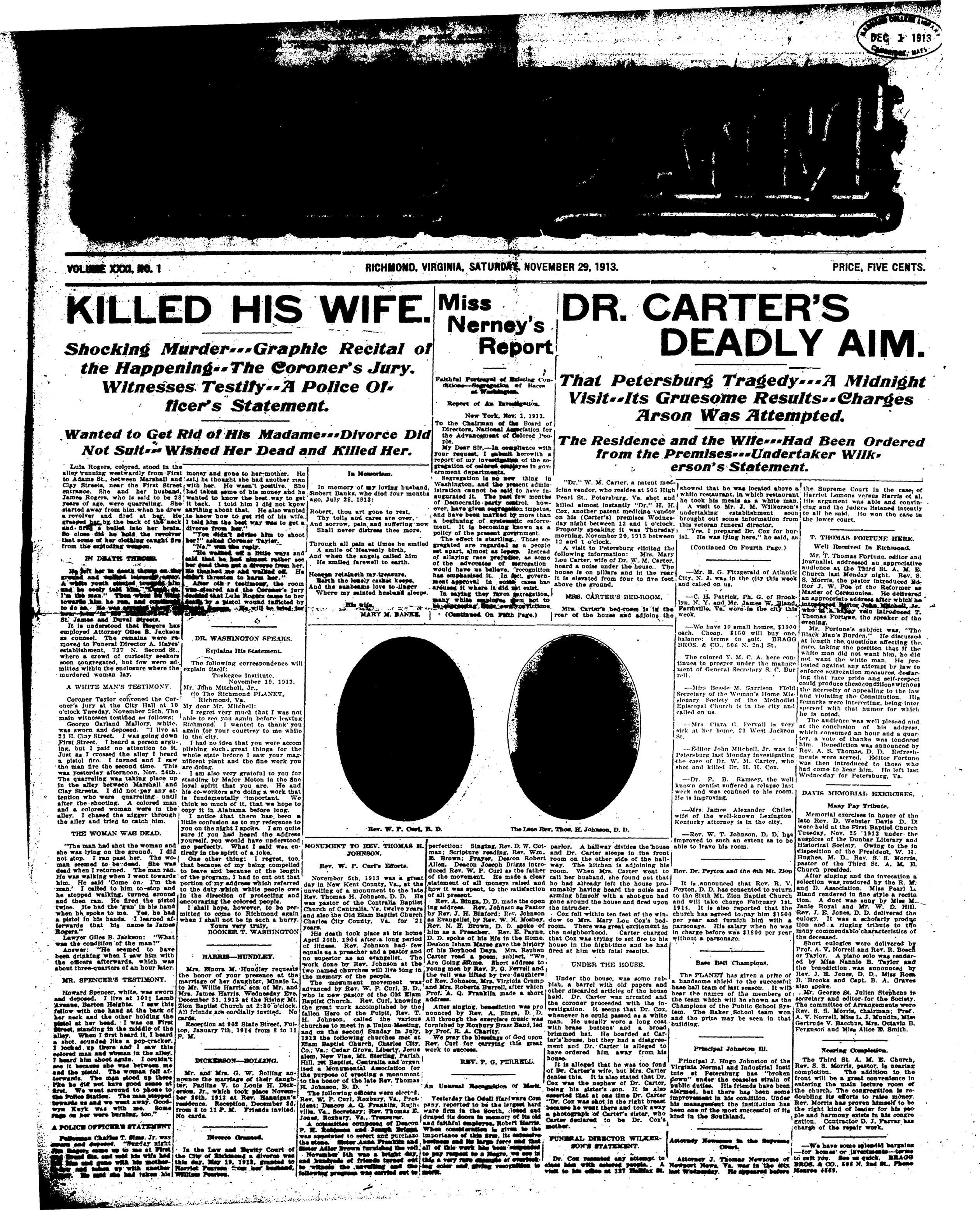
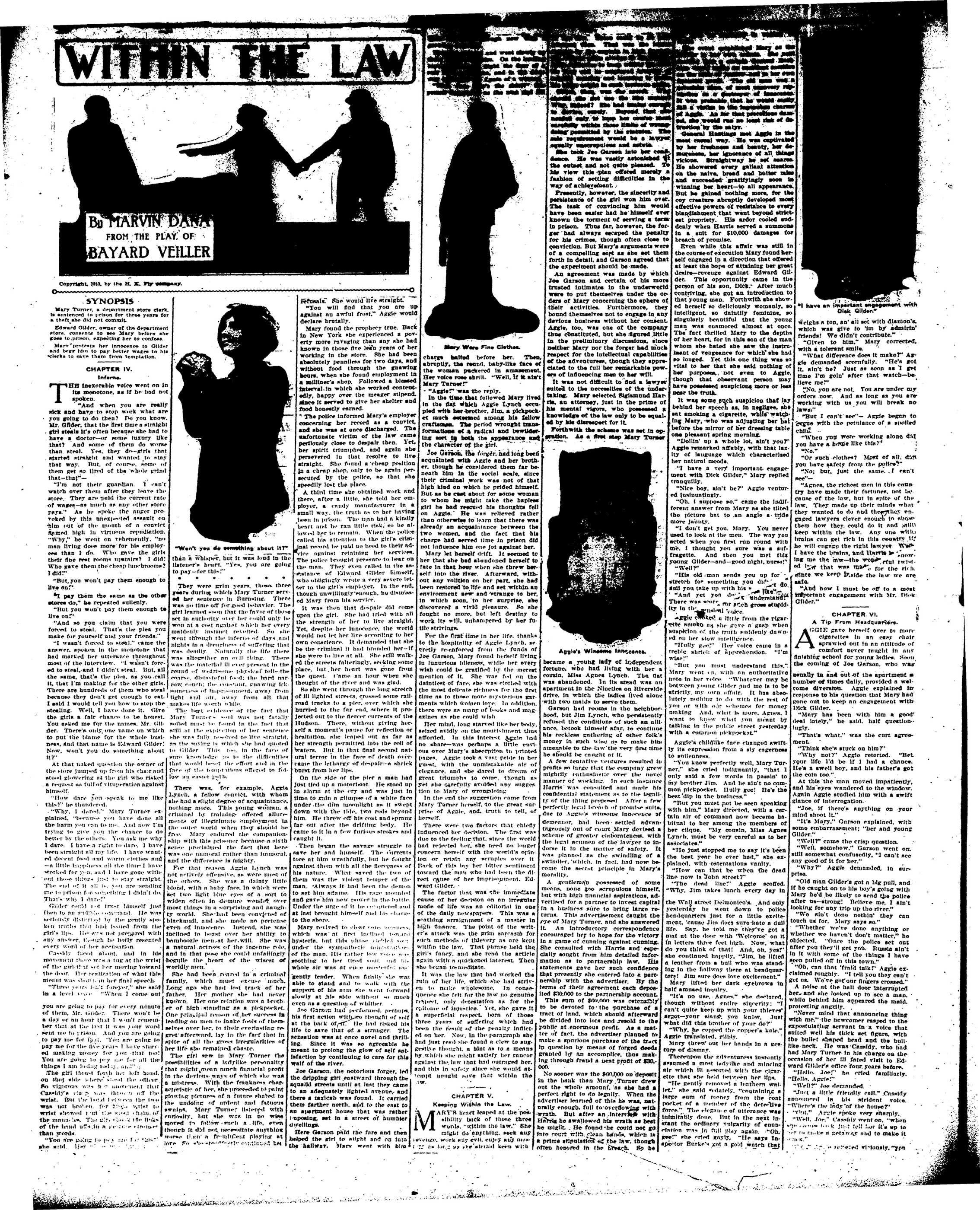
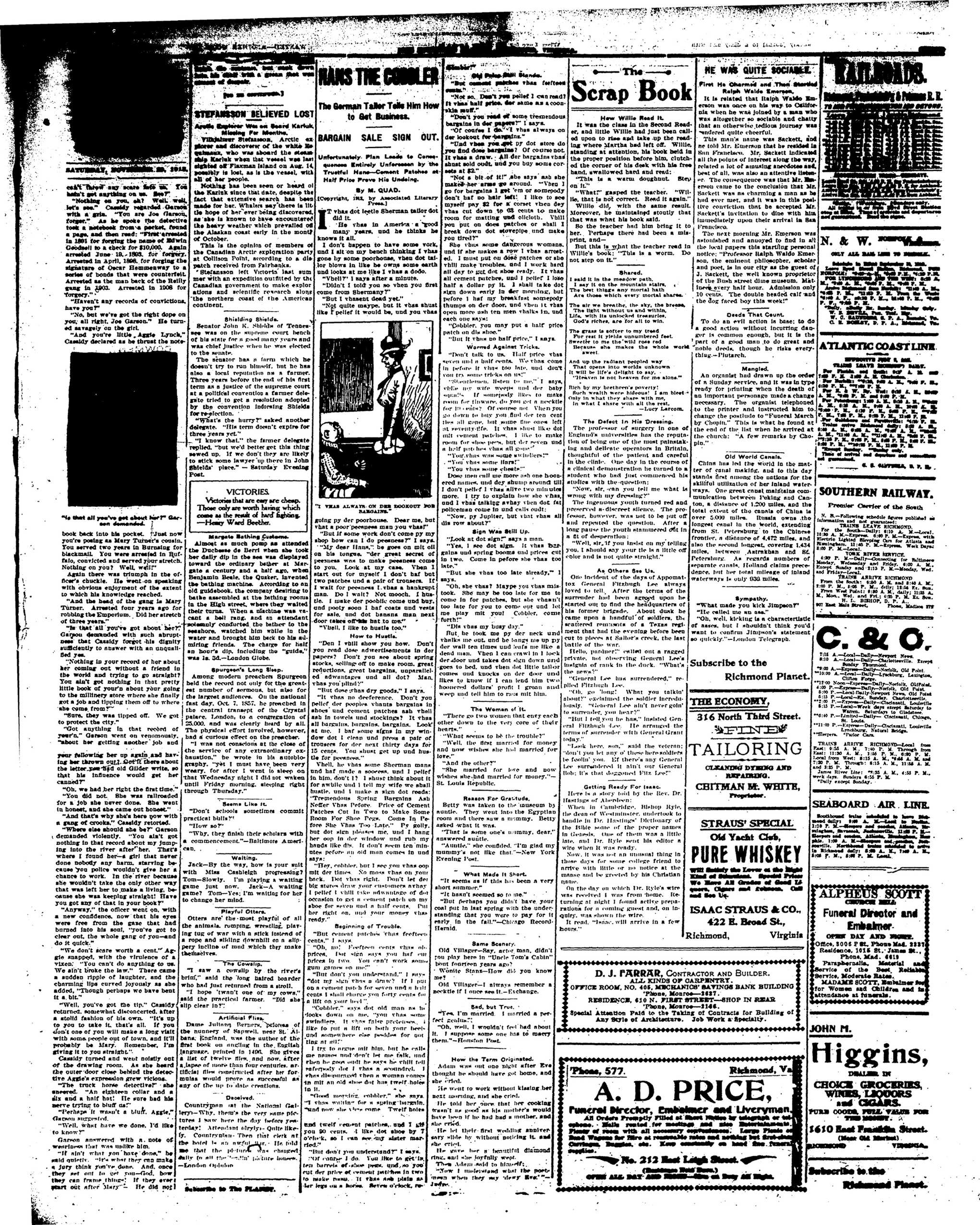
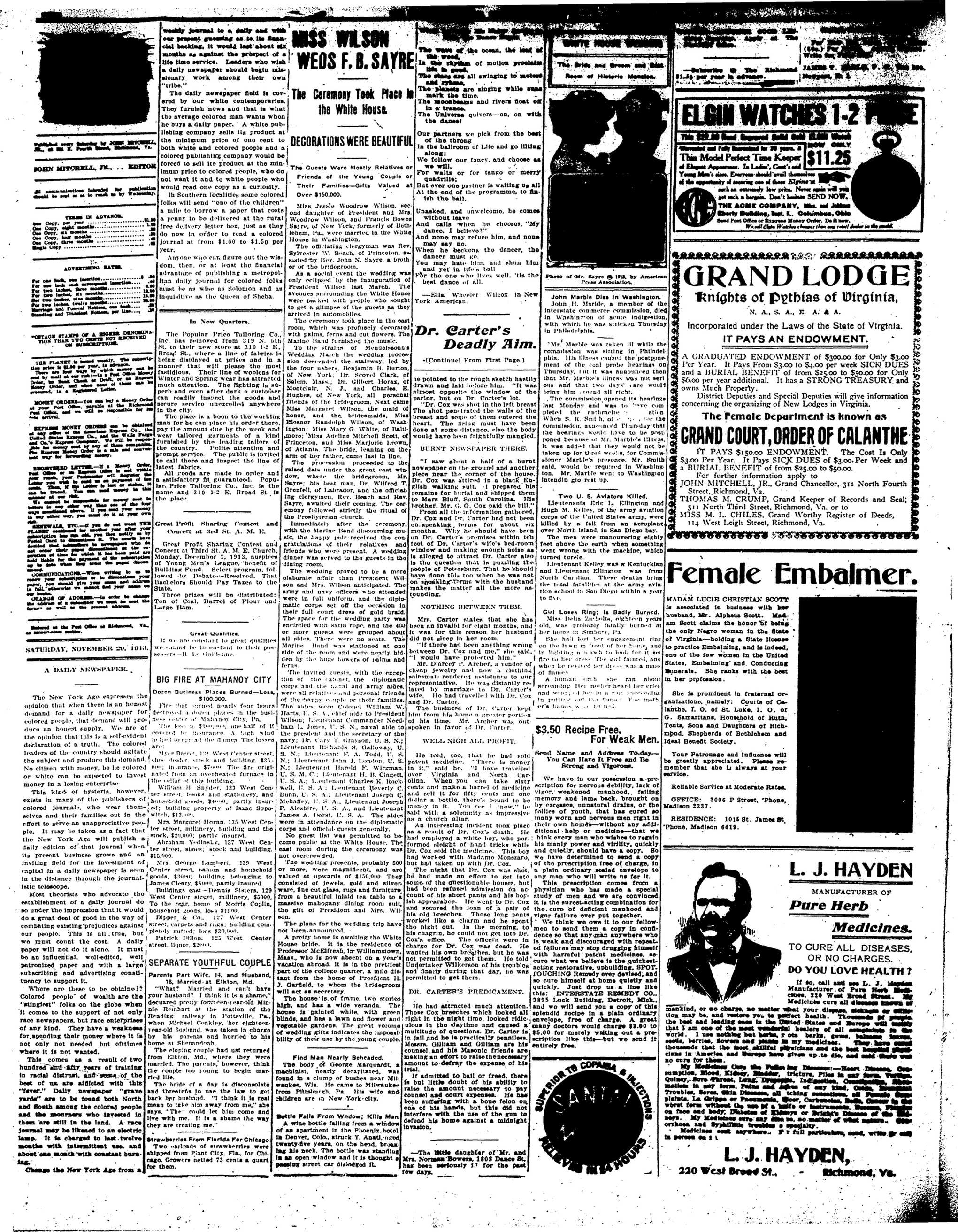
Page text (machine-generated)
DEC 1 1913
Cambridge, MA13
KILLED HIS WIFE.
Shocking Murder---Graphic Recital of the Happening---The Coroner's Jury. Witnesses Testify---A Police Officer's Statement.
Wanted to Get Rid of His Madame Divorce Did Not Suit Wished Her Dead and Killed Her.
VOLUME XXXI, NO. 1
KILLE
Shocking Mist
the Happen
Witnesses
Wanted to Get
Not Suit
Lula Rogers, colgred, stood in the alley running westwardly from First to Adams St., between Marshall and Clay Streets, near the First Street entrance. She and her husband, James Rogers, who is said to be 28 years of age, were quarreling. She started away from him when he drawn a revolver and fired at her. He grasped her by the back of the neck and fired a bullet into her brain. So close did he hold the revolver that some of her clothing caught fire from the exploding weapon.
IN DEATH THROUGH
He left her in death thrups on the ground and walked leisurely away. A while youth strolled towards him and he cozy told him, "Dear me, I'm the man." Then what he went towards him he run, and continued to do as. He was arrested and sent to four hours in the hospital at St. James and Duval Streets.
It is understood that Rogers has employed Attorney Giles B. Jackson as counsel. The remains were removed to Funeral Director A. Hayes' establishment, 727 N. Second St., where a crowd of curiosity seekers soon congregated, but few were admitted within the enclosure where the murdered woman lay.
A WHITE MAN'S TESTIMONY
Coroner Taylor cohoncel the Coroner's jury at the City Hall at 10 o'clock Tuesday, November 25th. The main witnesses testified an follows: George Garland Mallory, white, was sworn and deposed. "I live at 21 E. Clay Street. I was going down First Street. I heard a person arguing, but I paid no attention to it. Just as I crossed the alley I heard a pistol fire. I turned and I saw the man fire the second time. This was yesterday afternoon, Nov. 24th. The quarreling was taking place up in the alley between Marshall and Clay Streets. I did not pay any attention who were quarreling until after the shooting. A colored man and a colored woman were in the alley. I chased the nigger through the alley and tried to catch him.
THE WOMAN WAS DEAD.
"The man had shot the woman and she was lying on the ground. I did not stop. I ran past her. The woman seemed to be dead. She was dead when I returned. The man ran. He was walking when I went towards him. He said 'Come on. I'm the man.' I called to him to stop and he stopped walking, turned around and then ran. He fired the pistol twice. He had the 'gun' in his hand when he spoke to me. Yes, he had a pistol in his hands. I learned afterwards that his name is James Rogers."
Lawyer Giles B. Jackson: "What was the condition of the man?"
Answer: "He seemed to have been drinking when I saw him with the officers afterwards, which was about three-quarter of an hour later."
MR. SPENCER'S TESTIMONY.
Howard Spencer, white, was sworn and deposed. I live at 1011 Lamb Avenue, Barton Heights. I saw this fellow with one hand at the back of her neck and the other holding the pistol at her head. I was on First Street, standing in the middle of the alley. When I first heard it, I heard a shot, sounded like a pop-cracker. I looked up there and I saw this colored man and woman in the alley. I heard him shoot again. I couldn't see it because she was between me and the pistol. The woman fell afterwards. The man stood up there like he did not have good sense at first. We went around to phone to the Police Station. The man stepped towards us and we went away. Goodwyn Kuyk was with me. Some men on her were burning, too."
A POLICE OFFICER'S STATEMENT
Petebrown Charles T. Sine, Jr. was
sown and deposed. "Sunday night
Jim Reynolds came up to me at First
Broad St. and told his wife had
him and gave with his mother-
day and taken up with another
murder. He said she had taken his
money and gone to her-mother. He said he thought she had another man with her. He wasn't positive. She had taken some of his money and he wanted to know the best way to get it back. I told him I did not know anything about that. He also wanted to know how to get rid of his wife. I told him the best way was to get a divorce from her."
"You didn't advise him to shoot her!" asked Coroner Taylor.
"No." was the reply.
"He walked off a little ways and said that he had almost rather see her dead than get a divorce from her. He thanked me and walked off. He didn't threaten to harm her."
After othr testimony, the room was cleared and the Coroner's jury decided that Luke Rogers came to her death by a pistol wound inflicted by Coroner. He will be tried for
DR. WASHINGTON SPEAKS.
Explain His Statement.
The following correspondence will explain itself:
Tuskegee Institute.
November 19, 1913.
Mr. John Mitchell, Jr.
In The State of Louisiana
Mr. John Mitchell, Sr.
to The Richmond PLANET,
Richmond, Va.
My dear Mr. Mitchell:
I regret very much that I was not
able to see you again before leaving
Richmond. I wanted to thank you
again for your courtesy to me while
in the city.
I had no idea that you wore accom
plishing such great things for the
whole state before I saw your magnificent plant and the fine work you are doing.
I am also very grateful to you for
standing by Major Moton in the fine
loyal spirit that you are. He and
his co-workers are doing a work that
is fundamentally important. We
think so much of it, that we hope to
copy it in Alabama before long.
I notice that there has been a
little confusion as to my reference to
you on the night I spoke. I am quite
sure if you had heard the address
yourself, you would have understood
me perfectly. What I said was
entirely in the spirit of a joke.
One other thing: I regret, too,
that because of my being compelled
to leave and because of the length
of the program, I had to cut out that
portion of my address which referred
to the duty which white people owe
in the direction of protecting and
encouraging the colored people.
I shall hope, however, to be permitted to come to Richmond again when I shall not be in such a hurry.
Yours very truly,
BOOKER T. WASHINGTON
HARRIE—HUNDLEY.
Mrs. Minora M. Hundley requests
the honor of your presence at the
marriage of her daughter, Minnie L.
to Mr. Willie Harris, son of Mr. and
Mrs. James Harris, Wednesday Eve,
December 31, 1913 at the Rising Mt.
Zion Baptist Church at 2:30 o'clock.
All friends are cordially invited. No
cards.
Reception at 902 State Street, Fulton,
January 7th, 1914 from 8 to 11
P. M.
DICKERSON—BOLLING.
Mr. and Mrs. G. W. Bolling announce the marriage of their daughter, Pauline V. to Louis H. Dickerson, Jr., which took place November 26th, 1913 at Rev. Hansigan's residence. Reception, December 3d, from 8 to 11 P. M. Friends invited. No cards.
Divorce Granted.
In the Law and Equity Court of the City of Richmond a divorce was this day, May 19, 1913, granted to Harriet Pauyns from her husband, William Pauyns.
RICHMOND, VIRGINIA, SATURDAY, NOVEMBER 29, 1913.
Rev. W. P. Owl, B. D.
The Late Rev. Thomas H. Johnson, D. D.
In Memoriam.
In memory of my loving husband,
Robert Banks, who died four months
ago, July 28, 1913:
Robert, thou art gone to rest,
Thy tolls and cares are over,
And sorrow, pain and suffering now
Shall never distress thee more.
Through all pain at times he smiled
A smile of Heavenly birth,
And when the angels called him
He smiled farewell to earth.
Heaven retaineth my treasure,
Earth the lonely casket keeps,
And the sunbeams love to linger
Where my mainted husband sleeps.
His wife.
MARY M. BANK
Rev. W. P. Owl, E.
MONUMENT TO REV. THOMAS H
JOHNSON.
Rev. W. P. Curl's Efforts.
November 5th, 1913 was a great day in New Kent County, Va., at the unveiling of a monument to the late Rev. Thomas H. Johnson, D. D. He was pastor of the Centralia Baptist Church of Centralia, Va. twelve years and also the Old Elam Baptist Church Charles City County, Va. for 21 years.
His death took place at his home April 30th, 1904 after a long period of illness. Rev. Johnson had few equals as a preacher and a pastor and no superior as an evangelist. The work done by Rev. Johnson at the two named churches will live long in the memory of the people.
The monument movement was advanced by Rev. W. P. Curl, B. D., who is new pastor of the Old Elam Baptist Church. Rev. Curl, knowing the great work accomplished by the fallen Hero of the Pulpit, Rev. T. H. Johnson, called the various churches to meet in a Union-Meeting, and on the second Sunday in July, 1912 the following churches met at Elam Baptist Church, Charles City, Co. Va.; Cedar Grove, Liberty, Jerusalem, New Vine, Mt. Sterling, Parish Hill, 101 Baptist, Centralia and organised a Monumental Association for the purpose of erecting a monument to the honor of the late Rev. Thomas H. Johnson, D. D.
The following officers were elected
Rev. W. P. Curl, Roxbury, Va., President; Duncon A. Q. Franklin, Ruthville, Va., Secretary; Rev. Thomas E. Jones, Roxbury, Va., Treasurer.
A committee composed of Deacon P. H. Robinson and Joseph Briggs was appointed to select and purchase the stona. Father Anna Franklin and Sister Adler Brown furnished the wall.
November 5th was a bright day, and hundreds of friends turned out to witness the unveiling and the following program was carried out to
Miss Nerney's Report
Faithful Portrayal of Existing Conditions—Segregation of Houses at Washington.
To the Chairman of the Board of Directors, National Association for the Advancement of Colored People.
My Dear Sir,—In compliance with your request, I submit herewith a report of my investigation of the segregation of colored employees in government departments.
Segregation is no new thing in Washington, and the present administration cannot be said to have inaugurated it. The past few months of Democratic party control, however, have given segregation impetus, and have been marked by more than a beginning of systematic enforcement. It is becoming known as a policy of the present government.
The effect is startling. Those segregated are regarded as a people set apart, almost as leopards. Instead of allaying race prejudice, as some of the advocates of segregation would have us believe, recognition has emphasized it. In fact, government approval in some cases has areused it where it did not exist.
In saying they favor segregation, many white employees form not to be segregated. Their own victories
(Continued On Fifth Page.)
```markdown
```
The Late Rev. Thomas H. Johnson, D. D.
perfection: Singing, Rev. D. W. Cotman; Scripture reading, Rev. Wm. E. Brown; Prayer, Deacon Robert Allen. Deacon Joseph Briggs introduced Rev. W. P. Curl as the father of the movement. He made a clear statement of all monies raised and how it was spent, to the satisfaction of all present.
Rev. A. Binga, D. D. made the opening address. Rev. Johnson as Pastor by Rev. J. H. Binford; Rev. Johnson as Evangelist, by Rev. W. M. Mosby. Rev. N. H. Brown, D. D. apoke of him as a Preacher. Rev. E. Payne, D. D. spoke of his life in the Home. Deacon Isham Marne gave the history of his Boyhood Days. Mrs. Reuben Carter read a poem, subject, "We Are Going Home. Short address to young men by Rev. P. G. Ferrell and the veil was lifted by two daughters of Rev. Johnson, Mrs. Virginia Crump and Mrs. Roberta Burrell, after which Prof. A. Q. Franklin made a short address.
After singing, benediction was pronounced by Rev. A. Binga, D. D. All through the exercises music was furnished by Roxbury Brass Band, led by Prof. R. A. Charity.
We pray the blessings of God upon Rev. Curl for carrying this great work to success.
Report of An Investigation.
REV. P. G. FERRELL
An Unusual Recognition of Merit
Yesterday the Odell Hardware Company, reported to be the largest hard ware firm in the South, closed and draped its doors in memory of its old and faithful employee, Robert Harris. When consideration is given to the importance of this firm, its extensive business and its large force and that all of this work has been responded to pay respect to a Magro, we see in this a very rare example of overlocking color and, giving recognition to merit.
DR. CARTER'S DEADLY AIM.
That Petersburg Tragedy----A Midnight Visit----Its Gruesome Results----Charges Arson Was Attempted.
The Residence and the Wife—Had Been Ordered from the Premises—Undertaker Wilkerson's Statement.
"Dr." W. M. Carter, a patent medicine vendor, who resides at 606 High Pearl St., Petersburg, Va. shot and killed almost instantly "Dr." H. H. Cox, another patent medicine vendor on his (Carter's) premises Wednesday night between 12 and 1 o'clock. Properly speaking it was Thursday morning, November 20, 1913 between 12 and 1 o'clock.
A visit to Petersburg elicited the following information: Mrs. Mary Lou Carter, wife of Dr. W. M. Carter, heard a noise under the house. The house is on pillars and in the rear it is elevated from four to five feet above the ground.
showed that he was located above a white restaurant, in which restaurant he took his meals as a white man. A visit to Mr. J. M. Wilkerson's undertaking establishment soon brought out some information from this veteran funeral director. "Yes, I prepared Dr. Cox for burial. He was lying here," he said, as the Supreme Court in the case of Harriet Lemona versus Harris et al. His argument was able and convincing and the judge listened intently to all he said. He won the case in the lower court.
T. THOMAS FORTUNE HERE.
Well Received In Richmond.
Mr. T. Thomas Fortuno, editor and journalist addressed an appreciative audience at the Third St. A. M. E. Church last Monday night. Rev. S. S. Morris, the pastor introduced Editor J. W. Roe of the Referee.
MRS. CARTER'S BED-BOOM
Mrs. Carter's bed-room is in the rear of the house and adjoining the
parlor. A hallway divides the house and Dr. Carter sleeps in the front room on the other side of the hallway. The kitchen is adjoining his room. When Mrs. Carter went to call her husband, she found out that he had already left the house presumably having heard the noise and arming himself with a shot-gun had gone around the house and fired upon the intruder. Cox fell within ten feet of the window to Mrs. Mary Lou Cox's bedroom. There was great excitement in the neighborhood. Carter charged that Cox was trying to set fire to his house in the night-time and he had fired at him with fatal results.
UNDER THE HOUSE
Under the house, was some rubbish, a barrel with old papers and other discarded articles of the house hold. Dr. Carter was arrested and the coroner proceeded with the investigation. It seems that Dr. Cox, whenever he could pass as a white man. He usually wore a long coat with brass buttons' and a broad brimmed hat. He boarded at Carter's house, but they had a disagreement and Dr. Carter is alleged to have ordered him away from his house.
It is alleged that he was too fond of Dr. Carter's wife, but Mrs. Carter denies this. It is also stated that Dr. Cox was the nephew of Dr. Carter, being his sister's son. It is also asserted that at one time Dr. Carter "Dr. Cox was shot in the right breast because he went there and took away a photograph of Carter's sister, who Carter declared to be Dr. Cox's mother.
FUNERAL DIRECTOR WILKERSON'S STATEMENT.
Dr. Con resented any attempt to
close him with colored people. A
visit to his office at 127 Hallst. St.
showed that he was located above a white restaurant, in which restaurant he took his meals as a white man. A visit to Mr. J. M. Wilkerson's undertaking establishment soon brought out some information from this veteran funeral director.
"Yes. I prepared Dr. Cox for burlain. He was living here," he said, as
(Continued On Fourth Page.)
Mr. B. G. Fitzgerald of Atlantic City, N. J. was in the city this week and called on us.
C. H. Patrick, Ph. G. of Brooklyn, N. Y. and Mr. James W. Bland, Farmville, Va. wore in the city this week.
We have 10 small homes, $1000 each. Cheap, $150 will buy one, balance: terms to suit. BRAGG BROS. & CO., 506 N. 2nd St.
The colored Y. M. C. A. here continues to prosper under the management of General Secretary S. C. Burrell.
Miss Bessie M. Garrison Field Secretary of the Woman's Home Missionary Society of the Methodist Episcopal Church is in the city and called on us.
Mrs. Clara G. Pervall is very sick at her home, 21 West Jackson St.
Editor John Mitchell, Jr. was in Petersburg last Monday investigating the case of Dr. W. M. Carter, who shot and killed Dr. H. H. Cox.
Dr. P. B. Ramsey, the well known dentist suffered a relapse last week and was confined to his room. He is improving.
—Mrs. James Alexander Chiles, wild of the well-known Lexington Kentucky attorney is in the city.
—Rev. W. T. Johnson, D. D. has improved to such an extent as to be able to leave his room.
---
Rev. Dr. Peyton and the 6th Mt. Zion
It is announced that Rev. R. V. Peyton, D. D. has consented to return to the Sixth Mt. Zion Baptist Church and will take charge February 1st, 1914. It is also reported that the church has agreed to pay him $1500 per year and furnish him with a parsonage. His salary when he was in charge before was $1800 per year without a parsonage.
Base Ball Champions.
The PLANET has given a prize of a handsome shield to the successful base ball team of last season. It will bear the names of the members of the team which will be shown as the Champions of the Public School System. The Baker School team won and the prize may be seen in that building.
Principal Johnston Ill.
Principal J. Hgo Johnston of the Virginia Normal and Industrial Institute at Peterburg has "broken down" under the ceaseless strain of public duties. His friends have been alarmed, but there has been some improvement in his condition. Under his management the institution has been one of the most successful of its kind in the Southland.
Attorney Newsome in the Supreme Court.
Attorney J. Thomas Newsome of Newport News, Va. was in the six hst Wednesday. He appeared before
PRICE, FIVE CENTS.
R'S
LY AIM.
y...A Midnight
ults...Charges
empted.
Mad Been Ordered
artaker Wilk-
nt.
the Supreme Court in the case of Harriet Lomons versus Harris of al. His argument was able and convincing and the judge listened intently to all he said. He won the case in the lower court.
T. THOMAS FORTUNE HERE
Well Received In Richmond
Mr. T. Thomas Fortuno, editor and journalist addressed an appreciative audience at the Third St. A. M. E. Church last Monday night. Rev. S. S. Morris, the pastor introduced Editor J. W. Poe of the Reformer as Master of Ceremonies. He delivered an appropriate address after which he introduced Editor John Minhell, Jr., who is a bishop vein introduced T. Thomas Fortuno, the speaker of the evening.
Mr. Fortune's subject was, "The Black Man's Burden." He discussed at length the questions affecting the race, taking the position that if the white man did not want him, he did not want the white man. He protested against any attempt by law to enforce segregation measures, dodging that race pride and self-respect could produce these conditions without the necessity of appealing to the law and violating the Constitution. His remarks were interesting, being inter-sporsed with that humor for which he is noted.
The audience was well pleased and at the conclusion of his address, which consumed an hour and a quarter, a vote of thanks was tendered him. Benediction was announced by Rev. A. S. Thomas, D. D. Refreshments were served. Editor Fortuno was then introduced to those who had come to hear him. He left last Wednesday for Peterburg, Va.
DAVIS MEMORIAL EXERCISES
Many Pay Tribute
Memorial exercises in honor of the late Rev. D. Webster Davis D. D. were held at the First Baptist Church Tuesday, Nov. 25 "1913 under the auspices of the Dunbart Literary and Historical Society. Owing to the in disposition of the President, W. H. Hughes, M. D., Rev. S. S. Morris, pastor of the Third St. A. M. E. Church presided.
After singing and the invocation a selection was rendered by the R. M. and D. Association. Miss Pearl L. Bland rendered in fine style a recitation. A duet was sung by Miss M. Janie Royal and Mr. W. D. Hill. Rev. J. E. Jones, D. D. delivered the eulogy. It was a scholarly production and a ringing tribute to the many commendable characteristics of the deceased.
Short eulogies were delivered by Prof. A. V. Norrell and Rev. R. Beech or Taylor. A piano solo was rendered by Miss Nannie B. Taylor and the benediction was announced by Rev. J. E. Jones, D. D., Miss Rosa B. Brooks and Capt. B. A. Graves also spoke.
Mr. George St. Julien Stephens is secretary and editor for the Society. The committee of Arrangements were Rev. S. S. Morris, chairman; Prof. A. V. Norrell, Miss L. J. Mundin, Miss Gertrude V. Bacchus, Mrs. Octavia B. Ferguson and Miss Alice B. Smith.
Nearing Completion
The Third St. A. M. E. Church,
Rev. S. S. Morris, pastor, in nearing
completion. The addition to the
front will be a great convenience in
entering the main lecture room of
the church. The congregation is re-
doubling its efforts to raise money.
Rev. Morris has proven himself to be
the right kind of leader for his peo-
ple and harmony exists in his congre-
tation. Contractor D. J. Farrar has
charge of the repair work.
We have some splendid bargains
for homes or investments—terms
to suit you. See us quick, BRAGG
BROS. & CO., 506 N. 3rd St., Phone
Monroe 4569.
WITHIN THE LAW
BY MARVIN DANA
FROM THE PLAY OF
BAYARD VEILLER
SYNOPSIS
Mary Turner, a department store clerk, is sentenced to prison for three years for a theft, she did not commit.
Edward Gilder, owner of the department store, consents to see Mary before she goes to prison, expecting her to confess.
Mary protects her innocence to Glider and bears him to pay better wages to his clerks to save them from temptation.
CHAPTER IV.
Inferme.
THE inexorable voice went on in its monotone, as if he had not spoken.
"And when you are really sick and have to stop work what are you going to do then? Do you know, Mr. Gilder, that the first time a straight girl steals it's often because she had to have a doctor—or some luxury like that? And some of them do worse than steel. Yes, they do girls that started straight and wanted to stay that way. But, of course, some of them get so tired of the whole grind that—"
"I'm not their guardian. I can't watch over them after they leave the store. They are paid the current rate of wages—as much as any other store pays." As he spoke the anger provoked by this unexpected assault on him out of the mouth of a convict named high in virtuous repudiation. "Why," he went on vehemently, "no man living down more for his employees than I do. Who gave the girls their fine rent rooms upstairs? I did! Who gave them the cheap lunchrooms? I did!" "But, you won't pay them enough to live on!"
"I pay them the same as the other stores do," he repeated sullenly. "But you won't pay them enough to live on!"
"And so you claim that you were forced to steal. That's the plea you make for yourself and your friends."
"I wasn't forced to steal," came the answer, spoken in the monotone that had marked her utterance throughout most of the interview. "I wasn't forced to steal, and I didn't steal. But, all the same, that's the plan, as you call it, that I'm making for the other girls. There are hundreds of them who steal because they don't get enough to eat. I said I would tell you how to stop the stealing. Well, I have done it. Give the girls a fair chance to be honest. You asked me for the names, Mr. Gilder. There's only one name on which to put the blame for the whole business, and that name is Edward Gilder. Now, won't you do something about it?"
At that naked question the owner of the store jumped up from his chair and stood glowering at the girl who risked a request so full of vituperation against himself.
"How dare you speak to me like this?" he thundered.
"Why, I dared!" Mary Turner explained, "because you have done all the harm you can to me. And now I'm trying to give you the chance to do better by the others. You ask me why I dare. I have a right to dare. I have been strained all my life. I have wanted descent food and warm clothes and — a little happiness all the time I have worked for you, and I have gone without those things just to stay straight. The end of it all is, you are sending me to prison for something I didn't do. That's why I dare."
Glider could not trust himself just then to an audible command. He was seriously distracted by the gently spoken truths that had issued from the girl's lips. He was not pregured with any answer, though he hotly resented every word of her accession.
Casually faced about, and in his movement there was a tug at the wrist of the girl that set her moving toward the door. Her realization of what this meant was shout in her final speech. "Three years back forever," she said in a level voice. "When I come out you are going to pay for every minute of them, Mr. Gider. There won't be a day or an hour that I won't remember that at the last it was your word sent me to prison. And you are going to pay me for that. You are going to pay me for the five years I have starved making money for you that tool. You are going to pay me for all the things I am looking for."
The girl trust forth her left hand, on that side when she slid the officer. So vigorous was the movement that Casey's cuff was thrown off the wrist. But the hand between the two was not broken, for Pope wrist to wrist showed that the good chain of the manuscript. The girl clocks the links of the hand up in a precise manner than words.
"You are going to pay me for this she said. Here."
A
"Won't you do something about it?" than a whisper, but it was loud in the listener's heart. "Yes, you are going to pay-for this."
They were grim years, those three years during which Mary Turner served her sentence in Burning. There was no time off for good behavior. The girl learned soon that the favor of those in authority over her could only be won at a cost against which her every maledonly instinct revolted. So she went through the inferior of days and nights in a drearness of suffering that was deadly. Naturally the life there was altogether an evil thing. There was the material ill ever present in the round of wartime physical tell-tale, distasteful food; the hard narrow couch; the constant, gnawing likeness of imprisonment, away from light and air, away from all that makes life worth while.
The best evidence of the fact that Mary Turner’s soul was not fatally soiled must be found in the fact that still at the expiration of her sentence she was fully resolved to live straight, as the saying is which she had quoted to Gilder. This too, in the face of sure knowledge as to the difficulties that would beset the effort and in the face of the temptations offered to follow an easier path.
There was, for example, Aggie Lynch, a fellow convict, with whom she had a slight degree of acquaintance, nothing more. This young woman, a criminal by training offered allurements of illegitimate employment in the outer world when they should be free. Mary endured the companionship with this prisoner because a sixth sense predisposed the fact that here was one immoral rather than immoral, and the difference is nighly.
For that reason Aggie Lynch was not actively offensive, as were most of the others. She was a dainty little blond, with a baby face, in which were set two light blue eyes of a port to widen often in demure wonder, over most things in a surprising and naughty world. She had been convicted of blackmail, and she made no pretense even of innocence. Instead, she was inclined to boast over her ability to bambooze men at her will. She was a natural actress of the ingenuine role, and in that pose she could unfailingly beguile the heart of the wisest of worldly men.
She had been roared in a criminal family, which must excuse much. Long ago she had lost track of her father. Her mother she had never known. Her one relation was a brother of high standing as a pickpocket. One principal reason of her success in leading on men to fake tools of themselves over her, to their everlasting regret afterward, lay in the fact that in spite of all the gross irregularities of her life she remained chaste.
The girl saw in Mary Turner the possibilities of a ladylike personality that might mean much financial profit in the devious ways of which she was a mistress. With the frankness characteristic of her, she proceeded to paint glowing pictures of a future shattered to the undoing of ardent and fatuous swain. Mary Turner listened with curiosity, but she was in no wise moved to follow such a life, even though it did not necessitate anything worse than a frusturable playing at love. So she steadily continued bet
refusals. She would live straight.
"You will find that you are up against an awful frost." Aggie would declare brutally.
Mary found the prophecy true. Back in New York she experienced a poverty more ravaging than any she had known in those five lean years of her working in the store. She had been absolutely penniless for two days, and without food through the gnawing hours, when she found employment in a milliner's shop. Followed a blessed interval in which she worked contentedly, happy over the meager stipend, since it served to give her shelter and food honestly earned.
The police informed Mary's employer concerning her record as a convict, and she was at once discharged. The unfortunate victim of the law came perilously close to despair then. Yet, her spirit triumphed, and again she persevered in that resolve to live straight. She found a cheap position in a cheap shop, only to be again persecuted by the police, so that she speedily lost the place.
A third time she obtained work and there, after a little, she told her employer, a candy manufacturer in a small way, the truth as to her having been in prison. The man had a kindly heart and he ran little risk, so he allowed her to remain. When the police called his attention to the girl's criminal record he paid no head to their advice against retaining her services. The police brought pressure to bear on the man. They even called in the assistance of Edward Gilder himself, who obligingly wrote a very severe letter to the girl's employer. In the end, though unwillingly enough, he dismissed Mary from his service.
It was then that despair old came upon the girl. She had tried with all the strength of her to live straight. Yet, despite her innocence, the world would not let her live according to her own conscience. It demanded that she be the criminal it had branded her—if she were to live at all. She still walked the streets falteringly, seeking some place, but her heart was gone from the quest. Came an hour when she thought of the river and was glad. So she went through the long stretch of all lighted streets, crossed some railroad tracks to a pier, over which she hurried to the far end, where it projected out to the river currents of the Hudson. There, without giving herself a moment's pause for reflection or heathitation, she leaped out as far as her strength permitted into the coil of waters. But in that final second natural terror in the face of death overcame the lethargy of despair—a shriek burst from her lips.
On the side of the pier a man had just tied up a motorboat. He stood up in alarm at the cry and was just in time to gain a glimpse of a white face under the dim moonlight as it swept down with the tide, two rods beyond him. He threw off his coat and sprang far out after the drifting body. He came to it in a few furious strokes and caught it.
Then began the savage struggle to save her and himself. The currents tore at him wreatfully, but he fought against them with all the hereness of his nature. What saved the two of them was the violent temper of the man. Always it had been the demon to set him afame. Hisrage mounted and gave him new power in the battle. Under the urge of it he computed and at last brought himself and his charge to the shore.
Mary received to clear some issues which was at first inclined toward hysteria, but this phase violated not under the sympathetic ministration of the man. His father low voice was soothing to her tired soul and his whole air was at once masterful and gently tender. When finally she was able to stand and to walk with the support of his arm she went forward slowly at his side without so much even as a question of whither. Joe Garson had performed, perhaps, his first action with no thought of self at the back of it. He had risked his life to save that of a stranger. The sensation was at once novel and thrilling. Since it was so agreeable be meant to prolong the glow of self satisfaction by continuing to care for this waft of the river.
Joe Garson, the notorious forger, led the dripping girl eastward through the aquaid streets until at last they came to an adequately lighted avenue, and there a taxicab was found. It carried them farther north, and to the east to an apartment house that was rather imposing, set in a street of humbler dwellings.
Here Garson pled the fare and then helped the girl to alight and on into the hallway. Mary went with him.
1
Mary Were Fine Clothes.
charge halted before her. Then,
abruptly, the round, baby-like face of
the woman packeried in amusement.
Her voice rose abrill. "Well, if it ain't
Mary Turner!"
: "Axel!" was the reply.
In the time that followed Mary lived in the flat which Aggie Lynch occupied with her brother, Jim, a pickpocket much esteemed among his fellow craftsmen. The period wrought transformations of a radical and bewildering sort in both the appearance and the character of the girl.
Joe Garson, the forger, had long been acquainted with Aggie and her brother, though he considered them far beneath him in the social scale, since their criminal work was not of that high kind on which he prided himself. But as he cast about for some woman to whom he might take the hapless girl he had rescued his thoughts fell on Aggie. He was relieved rather than otherwise to learn that there was already an acquaintance between the two women, and the fact that his charge had served time in prison did not influence him one lot against her.
Mary let herself drift. It seemed to her that she had abandoned herself to fate in that hour when she threw herself into the river. Afterward, without any volition on her part, she had been restored to life and set within an environment new and strange to her, in which soon, to her surprise, she discovered a virid pleasure. So she fought no more, but left destiny to work its will, unhampered by her fateful strivings.
For the first time in her life, thanks to the hospitality of Aggle Lynch, secretly re-enforced from the funds of Joe Garson, Mary found herself living in luxurious idleness, while her every wish could be gratified by the mercant mention of it. She was fel on the daintest of fare, she was clothed with the most delicate richness for the first time as to those more mysterious garments which women love. In addition, there were as many of books and magazines as she could wish.
Her mind, long starved like her body, seized avidly on the nourishment thus afforded. In this interest Aggie had no share—was perhaps a little envious over Mary's absorption in printed pages. Aggie took a vast pride in her guest, with the unmistakable air of elegance, and she dared to dream of great triumphs to come, though as yet she carefully avoided any suggestion to Mary of wrongdoing.
In the end the suggestion came from Mary Turner herself, to the great surprise of Aggie, and truth to tell, of herself.
There were two factors that chiefly influenced her decision. The first was due to the feeling that, since the world had rejected her, she need no longer concern herself with the world's opinion or retaliate any scruples over it. Back of this lay her bitter sentiment toward the man who had been the direct cause of her imprisonment. Edward Glider.
The factor that was the immediate cause of her decision on an irregular mode of life was an editorial in one of the daily newspapers. This was a scathing assignment of a master in high finance. The point of the writer's attack was the grim sarcasm for such methods of thievery as are kept within the law. That phrase held the girl's fancy, and she read the article again with a quickened interest. Then she began to meditate.
It was the law that had worked the ruin of her life, which she had driven to make wholesome. In consequence she felt for the law no genuine respect, only detestation as for the cultism of injustice. Yet, she gave it a superficial respect, born of those three years of suffering which had been the result of the penalty inflicted on her. Now, in the paragraph she had just read she found a clew to suggestive thought, a blint as to a means by which she might satisfy her rancor against the law that had outraged her, and this in safety since she would attemptought save that within the
Keeping Within the Law.
MARY'S heart leaped at the poik
ability back of those three
words, "within the law." She
might do anything, seek any
revenge, work any evil, enjoy any
murder as long as she's kept with
agently misunderstood and savaged
the task Joe Gearn into her cond-
don. He was vastly astonished if
the outset and not quite pleased. To
his view this plan offered merely a
fashion of setting difficulties in the
way of achievement.
Presently, however, the sincerity and
persistence of the girl won him over.
The task of convincing him would
have been easier had he himself ever
known the torment of serving a term
in prison. Thus far, however, the for-
ger had always escaped the penalty
for his crimes, though often close to
conviction. But Mary's arguments were
of a compelling sort as she set them
forth in detail, and Garson agreed that
the experiment should be made.
An agreement was made by which Joe Garson and certain of his more trusted intimates in the underworld were to put themselves under the orders of Mary concerning the sphere of their activities. Furthermore, they bound themselves not to engage in any devious business without her consent. Aggrie, too, was one of the company thus constituted, but she figured little in the preliminary discussions, since neither Mary nor the forger had much respect for the intellectual capabilities of the adventures, though they appreciated to the full her remarkable powers of influencing men to her will.
It was not difficult to find a lawyer suited to the necessities of the undertaking. Mary selected Sigismund Harris, an attorney, just in the prime of his mental vigors, who possessed a knowledge of the law only to be equaled by his disrespect for it. Forthwith the scheme was not in operation. As a first step Mary Turner
```markdown
```
Apple's Winsome Innocence.
became a young lady of independent fortune, who had living with her a cousin, Miss Agnes Lynch. The that was abandoned. In its stead was an apartment in the Nineties on Riverside drive, in which the indices lived alone with two maids to serve them.
Garson had rooms in the neighborhood, but Jim Lynch, who persistently refused the conditions of such an alliance, betook himself afar, to continue his rockless gathering of other folk's money in such as to make him amenable to the law the very first time he should be caught at it.
A few tentative ventures resulted in profits so large that the company grew mightily enthusiastic over the novel manner of working. In each instance Harris was consulted and made his confidential statement as to the legality of the thing proposed. After a few perfectly legal branch of promise suits, due to Agnès's winnowance innocence of Demenor, had been settled advantageously out of court Mary devised a scheme of greater elaborateness, with the legal accumen of the lawyer to indorse it in the matter of safety. It was planned as the swindling of a swindler, which, in fact, had now become the secret principle in Mary's morality.
A gentleman possessed of some means, none go scrupulous himself, but with high financial aspirations, advertised for a partner to invest capital in a business sure to bring large returns. This advertisement caught the eye of Mary Turner, and she answered it. An introductory correspondence encouraged her to hope for the victory in a game of cunning against cunning. She consulted with Harris and especially sought from him detailed information as to partnership law. His statements gave her such confidence that presently she entered into a partnership with the advertiser. By the terms of their agreement each deposited $20,000 to the partnership account. This sum of $40,000 was ostensibly to be devoted to the purchase of a tract of land, which should afterward be divided into lots and resold to the public at enormous profit. As a matter of fact, the advertiser planned to make a spurious purchase of the tract in question by means of forged deeds granted by an accomplice, thus making through fraud a neat profit of $30,000.
No sooner was the $20,000 on deposit in the bank than Mary Turner drew out the whole amount, as she had a perfect right to do legally. When the advertiser learned of this he was, naturally enough, full to overdoing with wrath. But after an interruption with Harry he awallowed his wrath as best he might. He found he could not go into court with clean hands, which is a prime stipulation of the law, though often honored in the Dewey. So he
He even established Mary at the court in her own palace. The poet William Shakespeare wrote a whimsical British lady that she had forbidden not to see the lady of justice, and in her own humiliated pride. The old man was a privileged man, of most unwary reputation in a governor of Immeasur. It was probable that he would easily fall a victim to the supernatural charm of Agatha. As for that pretension dashed, she would run no least risk of incarring the martyrs.
General Hastings met Apple in the most casual way. He was captivated by her freshness and beauty, her deposition, her ignorance of all things vicious. Straightway he not smear. He showered every gallant attention on the naive, bread and butter mans and succeeded graftifying soon in winning her heart—to all appearance. But he gained nothing more, for the coy creature abruptly developed most effective powers of resistance to every blandishment that went beyond strictest propriety. His ardor cooled suddenly when Harris served a summons in a suit for $10,000 damages for breach of promise.
Even while this affair was still in the course of execution Mary found herself engaged in a direction that offered at least the hope of attaining her great desire-revenge against Edward Gilder. This opportunity came in the person of his son, Dick. After much contriving, she got an introduction to that young man. Forthwith she showed herself so deliciously womanly, so intelligent, so dalutily feminine, so singularly beautiful that the young man was enamored almost at once. The fact thrilled Mary to the depths of her heart, for in this of the man whom she hated she saw the instrument of vengeance for which she had so longed. Yet this one thing was so vital to her that she said nothing of her purposes, not even to Aggle, though that observant person may have possessed suspicion more or less near the truth.
It was some such suspicion that lay behind her speech as, in negligee, she sat smoking a cigarette, while watching Mary, who was adjusting her hat before the mirror of her dressing table one pleasant spring morning.
"Dollin' up a whole lot, ain't you?" Aggie remarked affably, with that laxity of language which characterized her natural moods.
"I have a very important engagement with Dick Gilder," Mary repiled tranquilly.
"Nice boy, ain't be?" Aggie ventured justnuntingly.
"Oh, I suppose so," came the indifferent answer from Mary as she tilted the picture hat to an angle a trifle more jainty.
"I don't get you. Mary. You never used to look at the men. The way you acted when you first run round with me, I thought you sure was a suffragette. And then you met this young Glider—and—good night, nurse!"
"Well?"
"His old man sends you up for stretch for something you did and you take up with his like."
"And yet you do understand. There was score for such gross stupidity in the gradual voice."
"Agile choked a little from the cigarette smoke as she gave a gasp when unpleasant of the truth suddenly dawned on her slow intelligence."
"Hully good!" Her voice came in a treble shriek of apprehension. "I'm wise!"
"But you must understand this." Mary want on, with an authoritative note in her voice. "Whatever may be between young Glider and me fa to be strictly, my own affair. It has absolutely nothing to do with the rest of you or with our schemes for money making. And, what is more, Agnes. I want to know what you meant by talking in the public street yesterday with a common pickpocket."
Aggle's childlike face changed swiftly its expression from a sly cagerness to sullenness.
"You know perfectly well, Mary Turner," she cried indignantly, "that I only said a few words in passin' to my brother Jim. And he ain't no common pickpocket. Huly gee! He's the best dick in the business."
"But you must not be seen speaking with him." Mary directed, with a certain air of command now become habitual to her among the members of her clique. "My cousin, Miss Agnes Lynch, must be very careful as to her associates."
"He just stopped me to say it's been the best year he ever had," she explained, with ostentations vanity.
"How can that be when the dead line now is John street?"
"The dead line" Agile scoffed.
"Why, Jim takes lunch every day in
the Wall street Deimonele's. And only
yesterday he went down to police
headquarters just for a little excitement,
cause Jumio does sure hate a dull life.
Say, he told me they've got a mat at the door with 'Welcome' on it in letters three feet high. Now, what do you think of that? And, oh, yes!" she continued happily, "Jim, he lifted a leather from a bull who was standing in the fallway there at headquarters! Jim sure does love excitement."
Mary lifted her dark eyebrows in half amused inquiry.
"It's no use. Agnes," she declared,
though without entire sincerity: "I can't quite keep up with your theres' argot—your since, you know. Just what did this brother of your do?"
"Why, he coped the copper a kale"
Agrie translated, silly.
Mary threw out her hands in a gesture of dismay.
Thereupon the adventures instantly assumed a most indulge and mincing air which it usurped with the cigarette that she held between her lips.
"He gently removed a northern wallet," she said suddenly, "containing a large sum of money from the coat pocket of a member of the detective force." The elegance of utterance was inimitable done. But in the next instant the ordinary vulgarity of enunciation was in full play again. "Oh, gee!" she cried gently. "He says Inspector Burke" got a gold watch
The image provided is too blurry and pixelated to accurately recognize any text or content. It appears to be a blank or heavily distorted image with no discernible features. Therefore, no text can be extracted from this image.
"I have an important engagement with Dick Gilden."
weighs a ton, an' all set with diamon's, which was give to 'im by admirin' friend! We didn't contribute."
"Given to him." Mary corrected, with a tolerant smile.
"What difference does it make?" Aggie demanded scornfully. "He's got it, aln't he? Just as soon as I get time I'm goin' after that watch—be lieve me."
"No, you are not. You are under my orders now. And as long as you are working with us you will break no laws."
"But I can't see"—Aggie began to argue with the petulance of a spoiled child.
"When you were working along did you have a house like this?"
"No."
"Or such clothes? Most of all, did you have safety from the police?"
"Agnes, the richest men in this country have made their fortunes, not because of the law, but in spite of the law. They made up their minds what they wanted to do and they they engaged lawyers clever enough to show them how they could do it and still keep within the law. Any one with brains can get rich in this country. If he will engage the right lawyer. When I have the brains, and I want to be showing me the imw—the wonderful twisted law that was made for the rich since we keep inside the law we are also. "And how I must be off to a most important engagement with Mr. Dick Glider."
CHAPTER VI
AGGIE gave herself over to more cigarettes in an easy chair sprawled out in an attitude of comfort never taught in any finishing school for young ladies. Since the coming of Joe Garson, who was usually in and out of the apartment a number of times daily, provided a welcome diversion. Aggie explained in response to his question that Mary had gone out to keep an engagement with Dick Gilder. "Mary has been with him a good deal intely," he said, half questioningly. "That's what." was the curt agreement.
"Think she's stuck on him?"
"Why not?" Aggie retorted. "Bet your life I'd be if I had a chance. He's a swell boy, and his father's got the coin too."
At this the man moved impatiently, and his eyes wandered to the window. Again Aggie studied him with a swift glance of interrogation.
"Joe, if there's anything on your mind shoot it."
"It's Mary," Garson explained, with some embarrassment; "her and young Gilder."
"Well?" came the crisp question.
"Well, somehow," Garson went on, still somewhat confused, "I can't see any good of it for her."
"Why?" Aggie demanded, in surprise.
"Old man Gilder's got a big pull, and if he caught on to his boy's going with Mary he'd be likely to send the police after us—strong! Believe me. I ain't looking for any trip up the river."
"We ain't done nothin' they can touch us for. Mary says so."
"Whether we've done anything or whether we haven't don't matter," he objected. "Once the police set out after you you'll get you. Russia ain't in it with some of the things I have seen pulled off in this town."
"Oh, can that 'fraid talk' Aggie exclaimed roughly. 'I tell you they can't get us. We've got our fingers crossed.' A noise at the hall door interrupted her, and she looked up to see a man, while behind him appeared the maid, protesting angst.
"Never mind that announcing thing with me," the newcomer rasped to the expostulating servant in a voice that suited well his thick set figure, with the bullet shaped head and the bull-like neck. He was Cassidy, who had Mary Turner in his charge on the occasion of her fated visit to Edward Gilbert's office four years before.
"Hello, Joe," he cried familiarly.
"Hello, Aggie."
"Well?" Joe demanded.
"Just a little friendly call." Cassidy announced in his strident voice.
"Where's the lady of the house?"
"Out." Angie spoke very sharply.
"Well, Joe." Cassidy went on, "when you come back just tell for it's up to her to make a getaway and to make it click."
cool! Throw! any score here! You
don't get anything on us. Best.
"Nothing on you, oh! Well, well, let's see." Candily regarded Garson with a grin. "You are Joe Garson, forget." As he spoke the detective took a notebook from a pocket, found a page, and then read: "First arrested in 1891 for forging the name of Edwin Goodsell to a check for $10,000. Again arrested June 19, 1893, for forgery. Arrested in April, 1898, for forgiving the signature of Oscar Hemmeway to a series of bonds that were counterfeit. Arrested as the man back of the Belly gang in 1903. Arrested in 1908 for forgery." "Haven't any records of convictions, have you?" "No. We've got the right dope on you, all right. Joe Garson." He turned savagely on the girl. "And you're little, Aggie Lynch." Candily declared as he thrust the note.
"Is that all you've got about her?" Gar-oon demanded.
book back into his pocket. "Just now you're posing a Mary Turner cousin. You served two years in Burning for blackmail. You were arrested in Buffalo, convicted and served your stretch. Nothing on you? Well, well!" Again there was triumph in the officer's chuckle. He went on speaking with obvious enjoyment of the extent to which his knowledge reached.
"And the head of the gang in Mary Turner. Arrested four years ago for robbing the Emporium. Did her stretch of three years."
"Is that all you've got about her? Garpo demanded with such abruptness that Cassidy forgot his dignity sufficiently to answer with an unqualified yes.
"Nothing in your record of her about her coming out without a friend in the world and trying to go straight? You can't got nothing in that pretty little book of yourn about your going to the millinery store where she finally got a job and tipping them off to where she come from."
"Sure, they was tipped off. We got to protect the city."
"Got anything in that record of years." Garson went on renomously, "about her getting another job and your following her up again and having her thrown out." Got it there about the letter, pawn and old Glider write, so that his influence would get her canned"
"Oh, we had her right the first time."
"You did not. She was railroaded for a job she never done. She went in honest, and she came out honest."
"And that's why she's here gone with
"And that way she here pow with a gang of crooks." Cassidy retorted.
"Where she should she be?" Gordon demanded violently. "You ain't got nothing in that record about my jumping into the river after her." That's where I found her—a girl that never done nobody any harm, starving because you police wouldn't give her a chance to work. In the river because she wouldn't take the only other way that was left her to make a living, because she was keeping straight! Have you got any of that in your book?
"Anyway," the officer went on, with a new confidence, now that his eyes were free from the gaze that had burned into his soul, "you've got to clear out, the whole gang of you—and do it quick."
"We don't scare worth a cent." Angie snapped, with the virulence of a vixen. "You can't do anything to us. We ain't broke the law." There came a sudden ripple of laughter, and the charming lips curved joyously as she added. "Though perhaps we have bent it a bit."
"Well, you're got the tip." Cassidy returned, somewhat disconcerted, after a stolid fashion of his own. "It's up to you to take it, that all. If you don't one of you will make a long visit with some people out of town, and it'll probably be Mary. Remember, I'm giving it to you straight." Cassidy turned and went nolously out of the drawing room. As she heard the outer door close behind the detective Aggle's expression grew vicious. "The truck horse detective" she sneered. "An eighteen collar and a six and a half hat. He sure had his nerve trying to bluff us." "Perhaps it wasn't a bluff. Aggle." Garapon suggested.
Garson answered with a note of weakness that was unlike him.
"I don't what you have done," he said quietly. "What it they can make a jary think you have done. And, once they set out to get you-God, how they can frame things? If they ever start out after Mary?" He did not
STEPANSSON BELIEVED LOST
Arctic Explorer Wes on Board Karluk Missing For Months.
Vilgainur Steffanson. Arctic ice explorer and discoverer of the white icequamau, who was aboard the steamship Karluk when that vessel was last sighted of Flaxman island on Aug. 14 possibly is lost, as is the vessel, with all of her people.
Nothing has been seen or heard of the Karluk since that date, despite the fact that extensive search has been made for her. Whalers say there is lit the hope of her ever being discovered, as she is known to have encountered the heavy weather which prevailed of the Alaskan coast early in the month of October.
This is the opinion of members of the Canadian Arctic exploration party at Collison Point, according to a dispatch received from Fairhanks.
Steffanson left Victoria last summer with an expedition outfitted by the Canadian government to make explorations and scientific research along the northern coast of the American continent.
Shielding Shields
Senator John K. Shields of Tennessee was on the supreme court bench of his state for a good many years and was chief justice when he was elected to the senate. The senator has a farm which he doesn't try to run blimself, but he has also a local reputation as a farmer. Three years before the end of his first term as a justice of the supreme court at a political convention a farmer delegate tried to get a resolution adopted by the convention indorsing Shields for re-election. "What's the hurry?" asked another delegate. "His term doesn't expire for three years yet." "Well," the farmer delegate replied, "but" the wet better give this thing sowed up. If we don't they are likely to stick some lawyer up in there in John Shields' place." — Saturday Evening Post
VICTORIES
Victories that are easy are cheap.
Those only are worth having which
come as the result of hard fighting.
—Henry Ward Beether.
Marmate Bathing Customs
Almost as much pomp as attended the Duchesse de Berri when she took her daily dip in the sea was displayed toward the ordinary bather at Margate a century and a half ago, when Benjamin Beale, the Quaker, invented the bathing machine. According to an old guidebook, the company desiring to bath assembled at the bathing rooms in the High street, where they waited their turns. When a machine was vacant a bell rang, and an attendant solemnly conducted the bather to the seashore, watched him while in the water and brought him back to his salining friends. The charge for half an hour's dip, including the "guide," was 1s. 3d.-London Globe.
Spurgeen's Long Sleep
Among modern preachers Spurgeon held the record not only for the greatest number of sermons, but also for the largest audiences. On the national fast day, Oct. 7, 1857, he preached in the central transept of the Crystal palace. London, to a congregation of 25,000, and was clearly heard by all. The physical effort involved, however, had a curious effect on the preacher. "I was not conscious at the close of the service of any extraordinary exhaustion," he wrote in his autobiography. "yet I must have been very weary, for after I went to sleep on that Wednesday night I did not waken until Friday morning, sleeping right through Thursday."
Beams Like It.
"Don't schools sometimes commit practical bullets?"
"How so?"
"Whr, they finish their scholars with a commencement."—Baltimore American
Waiting.
Jack-By the way, how is your progress with Miss Cashleigh's proing? Tom-Slowly. I'm playing a waiting game just now. Jack-A waiting game? Tom-Yes. I'm waiting for her to change her mind.
Playful Otter
Otters are 'the most playful of all the animals, rumping, wrestling, playing tug of war with a stick instead of a rope and sliding downhill on a slippery incline of mud which they make themselves.
The Cowalip.
"I saw a cowboy by the river's brind," said the long haired border who had just returned from a stroll.
Artificial Elise
Dame Julianne Berners, predeceased of the funnery of Sapwell, near St. Albans, England, was the author of the first book on angling in the English language, printed in 1406. She gives a list of twelve files, and now, after a lape of more than four centuries, artificial files constructed after her formulas would prove as successful as any of the up to date creations.
Dacived.
Countrypian at the National Gallery-
Why, them the very same picture
I saw here the day before
tuesday! Attendant ollylyn. Quite like-
ly. Countrypian. Then that clerk at
the hotel is an new girl. He hold
me that the picture. And changed
daily to all the excellent picture houses.
-London Quinton
Unfortunately- Plan Leads to Consequences Entirely Unforeseen by the Trustful Mane-Cement Patches at Half Price Prove His Undealing.
By M. QUAD.
[Copyright, 1932, by Associated Literary Press.]
T vhas dot leetle Sherman tailor dot did it.
He vhas in America a good many years, und he thinks he knows it all.
I don't happen to have some vork, and I sit on my bench thinking I vhas gone by some poorhouse, when dot tailor blows in like he owns some earth and looks at me like I vhas a dodo.
"Vbell!" I says after a minute.
"Didn't I told you so when you first come from Shermany?"
"But I vhas sent dead yet."
"Not quite maype, but it vhas shust like I pelfelt it would be, and you vhas
A woman in a hat stands in front of a painting, looking at a child sitting on the floor.
"I WAS ALWAYS ON DER BOOKOUT FOR BARAGINE."
going pyr der porohouse. Dear me, but that a poor peeeness man you vhast!
"But if some work don't come py my shop how can I do peeeness?" I says.
"My dear finn," he goes on milt on his tongue, "der great secret of peeeness was to make peeeness come to you. Look at my case. When I start out for myself I don't haf but two patches and a pair of trousers. If I wait for peeeness I vhast a bankrupt man. Do I wait? Not mooch, I hustle. I make der poobic come und buy, and pooody soon I haf coats and veats for sale, and dot banana man next door takes off the hat to me."
How to Hustle
"Don I will show you how. Don't you read dose advertisements in der papers? Don't you see about spring stocks, selling off to make room, great reductions, great bargains, unparalleled advantages and all dot? Man, what you jillind?"
"But dose dyes干货 goods," I says.
"It thas no deference. Don't you pellef der poeplies vhants bargains in shoes and cement patches ash swhil ash in towels und stockings? It thas all bargains, bargains, bargains. Look at me. I baf some signs in my window dot I clean und press a pair of trousers for der next thirty days for 15 cents. You must get up und hustle for perenness."
Whell, he vhas some Sherman manns und haf made a success, and I pelfie in him, don't ? I shus think about it for awhile and I tell my wife we shall bustle, and I make a sign dot reads: "Tremendous Spring Bargains Ash Neffer Vhas Prefer. Price of Cement Patches Cut In Two to Make Some Room For Shoe Pegs. Come In Prefer She Vhas Too Late." Py golly, but dot sign please me, and I hang her oop in der window and rub my hands like dbs. It don't seem ten minutes before an old man comes in and says: "Ther, cobbler, but I see you vhas oop mit der times. No moss vhas on your back. Dot thas right. Don't let der big stores draw your customers arthur. I pelfie I will take advantage of dot occasion to get a cement patch on my shoe for seven and a half cents. Put her right on, and your money thus ready."
Beginning of Trouble
"But cement patches this feefees cents," I says.
"Oh, no." Feefees cents thus chas ol' prices, but sign says you huf cur prices to two. You can't work some gum games on me!
"But don't you understand," I says "dot my skin thus a draw?" If I put on a cement patch for seven and a huf cents I shall charge you forty cents for a lift on your bed!
"Cobbler," says dot old man as he looks down on me, "you than some swaddles. It has false pretensions. I like to put a lift on both your bed and somewhere else besides for not getting at all!"
I try to argue him, but he calls me names and don't let me talk, and then go out he says he will tell safely陌 dot I thus a sounded, I has disaslaughed) then a woman comes in mit an old shoe dot has twelf holes in it.
"Good morning, cobbler," she says "it thus waiting for a sparing bargain, and now she thus come. Twelf holes
and twelf rent patches, and I give
you 60 cents, I like dot also by
7 o'clock, so I can see my sister
married."
"But don't you understand?" I says.
"Not concern I do. You like to get in
ten barrels of sake beans, and so you
cut the price of vodafone patches in two
to make money. If that and plans on
her legs on a horse. Better o'clock, re-
Old Pine Hill Stands.
"But cement patches whas feetteen comes."
"Not so. Don't you pellet I can read? it has half price. dor same as a coonskin muff."
"Don't you read of some tremendous bargains in der papers?" I says.
"Of course I do. I thus always on der lookout for bargains."
"And when you get by dot store do you find dose bargains? Of course not. It has a drew. All der bargains that shust out outd, and you buy some corpse."
"Not a bit of it" she says. she makes her arms go around. "When I go for bargains I get 'em or somebody don't haf no hair left! I like to see myself pay $2 for a corset when dey has cut down to $3 cents to make room for matting and oilcloth. Whill you put on does patches or shall I break down dot stovepipe and make roon tired!"
She wha some dangerous womans, and if she makes a row I wah arrested, I must put on dose patches or she whill make troubles, and I work hard all day to get dot shoe ready. It wha all cement patches, and I pelter I lose half a dollar py it. I shall take dot sign down early in der morning, but before I half my breakfast somepody thumps on der door, and when it wha open more ash ten men whalks in, and each one says: "Gobbler, you may put a half price patch on die shoe."
"But it vhss no half price." I says.
Wormed Against Tricks.
"Don't talk to us. Half price vhss seven and a half cents. We vhss come in before it vhss too late, and don't you try some tricks on us?"
"Stonewaller. Listen to me." I says, while my wife weeps and der baby squints. If somebody tries to make room for thwarm, do you get a necklace for it to enlarge. Of course not. When you go down to buy you find der ten cent all the game, but some the ones left at seventy-five. It vhss shunt like dot mit cement patches. I like to make room for shoes pee, but der seven and a half patch vhss all game."
"Your vhss was some swimmers."
"You vhss some flairs."
"You vhss some cheats!"
Dose men call me more and one booed names, and day shump around till I don't pelle! I vhss alive two minutes more. I try to explain how she vhss, and I vhss talking awhay that dot policeman come in and call out: "Now, poy Jupiter, but that vhss all
"Now, py Jupiter, but what rham all ils row about?"
Sign Was Still Up.
"Look at dot sign!" says a man.
"Yes, I see dot sign. It vhas bargalna and spring booms and prices cut in two. Come in preface she vhas too late."
"But she vhas too late already," I says.
"Oh, she vhas? Maype you vhas mis-took. She may be too late for me to come in for patches, but she vhasn't too late for you to come out and let me play mit you! Cobbler, come forth!"
"Dis vhas my busy day."
But he took me py der neck and whinks me out, and he hangs me up py der wall ten times and hems me like a dead man. When I can crawl in I look der door and takes dot sign down and goes to bed, and then dot tailor comes and knocks on der door and likes to know if I can lend him two honered dollars' profit I groan and weep and tell him to run mit him.
The Woman of It
"There go two women that envy each other down to the very core of their hearts."
"What seems to be the trouble?"
"What seems to be the trouble?
"Well, the first married for money and now wishes she had married for love."
"And the other?"
"She married for love and now wishes she had married for money."—St. Louis Republic.
Reason For Gratitude.
Betty was taken to the museum by a naughty. They went into the Egyptian room and there saw a mummy. Betty asked what it was. "That is some one's mummy, dear," answered naughty. "Auntie," she confided. "I'm glad my mummy's not like that."—New York Evening Post.
What Made It Short.
"It it seems as if this has been a very short summer."
"It hasn't seemed so to me."
"But perhaps you didn't have your coal put in last spring with the understanding that you were to pay for it early in the fall."—Chicago Record-Hermid.
Same Scenery
Old Village~Say, actor man, didn't you play here in "Uncle Tom's Cabin" bout fourteen years ago?
Wonite Stanz~How did you know me?
Old Village~I always remember a noctile if I once it~Exchange.
Bad, but True
"Yes, I'm married. I married a perfect geum." "Oh, well, I wouldn't feel bad about it. I suppose some one has to macry them." "Houston Post."
Adam was out one night after Eve thought he should have got home, and she cried.
He went to work without kissing her next morning, and she cried.
He told her once that her cooking wasn't as good as his mother's would have been if he had had a mother, and she cried.
He let their first wedding anniversary slide by without noticing it, and she cried.
He gave her a beautiful diamond ring, and she joyfully wept.
Then Adam said to himself:
"Now I understand what the poet means when they say 'Eve.'" Judge.
D. J. FARRAR, CONTRACTOR AND BUILDER,
ALL KINDS OF CARPENTRY.
OFFICE ROOM, NO. 405, MECHANICS' BAYINGS BANK BUILDING
'Phone, Monroe'-3827.
RESIDENCE, 610 N. FIRST STREET—SHOP IN REAR
'Phone, Monroe'-3146.
Special Attention Paid to the Taking of Contracts for Building of
Any Style of Architecture. Job Work a Specialty.
A. D. PRICE,
Funeral Director, Embalmer and Liveryman.
All Orders Promptly Filled at Hard Plates by telegraph or telephone. Halls rented for meetings and also Entertainment. Flats of room with all recovery convenience. Large Plates on Road Wagons for Hire at reasonable rates and nothing but first-class Curtains, Baglines, etc. Keep community on hand for funeral supplies.
No. 212 East Leigh Street.
(Bradford West Brow.)
OPEN ALL DAY AND NIGHT—Also on Duty All Night.
The Scrap Book
How Willie Read It.
It was the class in the Second Reader, and little Willie had just been called upon to rise and take up the reading where Martha had left off. Willie, standing at attention, his book held in the proper position before him, clutched the corner of his desk with his free hand, swallowed hard and read:
"This is a warm doughnut. Step on it."
"What?" gasped the teacher. "Willie, that is not correct. Read it again."
Willie did, with the same result. Moreover, he maintained stoutly that that was what his book said.
So the teacher had him bring it to her. Perhaps there had been a misspelling. But this is what the teacher read in Willie's book: "This is a worm. Do not step on it."
8hared.
The air we breathe, the sky, the breeze,
The light without us and within,
Life, with its unlocked treasuries,
God's riches, are for all to win.
The grass is softer to my tread
For rest it yields unnumbered feet.
Sweet to me the 'wild rose red
Because she makes the whole world
sweet.
And up the radiant peopleled way
That opens into worlds unknown
It is to be so bright
Heaven is not heaven for me alone.
Rich by my brethren's poverty!
Burh wealth were hideous. I am bleet-
On what we meet with me
In what I share with all the rest.
The Defect In His Dressing.
The professor of surgery in one of England's universities has the reputation of being one of the most painstaking and delicate operators in Britain, thoughtful of the patient and careful in the clinic. One day in the course of a clinical demonstration he turned to a student who had just commenced his studies with the question: "Now, sir, can you tell me what is wrong with my dressing?" The ingenious youth turned red and preserved a dissect silence. The professor, however, was not to be put off and repeated the question. After a long pause the youth stammered out in a fit of desperation: "Well, sir, if you insist on my telling you, I should say your tie is a little off color and is not quite straight."
As Others See Us
One incident of the days of Appomattox General Fitzhugh Lee always loved to tell. After the terms of the surrender had been aggroyed upon he started out to find the headquarters of his former bighead. About dusk he came upon a handful of soldiers, the scattered remnants of a Texas regiment that had the evening before been cut to pieces at Sailor's creek, the last battle of the war.
Hello, patron!" called out a ragged private, not observing General Lee's insignia of rank in the duck. "What's the news?"
"General Lee has surrendered," replied Fitzhugh Lee.
"Oh, go long! What you talkin' about?" exclaimed the soldier incredulously. "General Lee isn't never gone to surrender, you hear?"
"But I tell you he has," insisted General Fitzhugh Lee. He arranged the terms of surrender with General Grant today.
"Look here, son," said the veteran; "don't you let any of these soldiers be foolish you. If there's any General in the room, you should have a job. It's that disfigured Fitz Lee."
---
Getting Ready For Isaac.
Here is a story told by the Rev. Dr
Hastings of Aberdeen:
When in Cambridge, Bishop Ryle, the dean of Westminster, undertook to handle in Dr. Hastings' Dictionary of the Bible some of the proper names in Genesis. One of them was a little late, and Dr. Ryle sent his editor a wire when it was ready.
Now, it was not an unusual thing in those days for some college friend to arrive with little or no notice at the mansse and be greeted by his Christian name.
On the day on which Dr. Ryle's wire was received I was from home. Returning at night I found active preparations for a coming guest and, on inquiry, was shown the wire.
It read, "Isaac will arrive in a few hours."
N. & W. HOSPITAL
ONLY ALL HALF LINE TO BROOKLY.
Per Form. 606 501 N° 1. M. mD
T100 P. M. 3100 A. M. Charlston.
For Har�h: *9130, 910 A. M., 9100 P. M.
6130 P. M. 00100 F. M.
For F. M. & W. By. Wd: 010 A. M., 0000
A. M., 9100 P. M. and 9100 P. M.
For Porodong: 1100 A. M., 9110 A. M., 9100
A. M., 9110 A. M., 9100 A. M., 9100 A. M.,
9100 P. M., 6120 P. M., 6050 P. M., 6000
F. M., 9100 P. M., 9100 P. M., 91100 P. M.
For Goldstone and Porodong: 6100 F. M.
Tval: active Mediated Duty: 9100 A. M.
6100 A. M., 6100 A. M., 9100 A. M., 9100
A. M., 91100 A. M., 91100 A. M., 9100 F. M.
91210 F. M., 6100 F. M., 6100 P. M., 6100
9100 P. M., 9100 P. M., 91100 P. M.
*Except Sunday. *Sunday only.
Time of arrival and date of return and version
SOUTHERN RAILWAY.
N. R.-Following schedule agrees published on
information and not guaranteed:
FOR THE SOUTH-6:10; A. 10:00 M.-Local.
For the South-WEST-6:10; A. 10:00 M.-Express, with
A. 10:00 M.-Express Cars for Atlanta and
Simmingham. 11:40; P. M.-Express. Week Days:
8:00; P. M.-Local.
YORK RIVER SERVICE.
4:20; P. M.-Express. Baltimore.
4:20; P. M.-Express. Monday, Wednesday and Friday.
Except Sunday and 2:15; P. M.-Monday, Wed.
and Friday.
TRAIN ARISE RICHMOND
From the South-6:10; A. 10; and 4:20; A. 10;
2:00; P. 10; 6:05; P. m., daily; 12:35; Ft. Sun.
A. 10; 6:05; P. m., daily; 12:35; A. 10; M. Mon., Wed. and Fri.; 4:20; K. Sun.
A. 10; B. I. BIRCH; D. P. A.
C. & O.
*10:00 A. - Local - Daily - Lucknow, Latesting,
*12:00 C. - Clinton Daly - Lucknow, Latesting,
*12:00 D. - Clinton Daly - Lucknow, Old Palt.
*6:00 P. - Express - Daily - Norfolk, Old Palt.
*6:00 P. - Local - Daily - Newport, Old Palt.
*6:00 P. - Local - Exx. - Sunday, Charlotteville,
*6:00 P. - Local - Exx. - Sunday, Charlotteville,
*6:00 P. - Local - Week days except Saturday to
Warren. Saturday to Gladstone.
*6:00 P. - Limited - Daily - Cincinnati, Chicago,
*6:00 P. - Limited - Daily - Cincinnati, Chicago,
THE ECONOMY,
316 North Third Street.
FINE
TAILORING
**11:00 P. -- Express -- Daily -- Clinsicmatl, Louisville Lynchburg, Natural Bridges.
**Sleepers. *Pailor Cars.
TRAIN'S ARRIVE RICIDMOND-Local from
East: 0:55 A.M. 7:40 P.M. Through from
East: 11:30 A.M. 3:56 P.M. 6:80 P.M.
Local from West: 8:15 A.M. *8:56 A.M. and
7:30 P.M. Through: 8:15 A.M. 11:55 A.M.
and 3:25 P.M.
James River Line: *8:55 A.M. 4:55 P.M.
week days. Sundays 6:55 P.M.
*Daily exorc Sunday
SEABOARD AIR LINE
STRAUS' SPECIAL
Old Yacht Club,
PURE WHISKEY
Southbound train scheduled to have blood-mood daily: 9:00 A.M.—Local to Northem.
1:10 P.M.—Hospital and casher, Atlanta, Washington, Savannah, New York, 11:50 P.M.—Hospital and casher, Atlanta, Washington, New phle. 1:00 A.M.—Hospital and casher, Northbound train scheduled to arrive in Richmond day: 8:00 A.M., 7:00 A.M., 5:05 P.M., 5:00 P.M. Local
ALPHEUS SCOTT
CHURCH HILL
Funeral Director and
Embalmer.
OPEN DAY AND NOON.
Office, 8006 P St. Phone Mad. 2337
Residence, 1015 St. James St.,
Phone Mad. 6619
Paraphernula, Material and
Service of the Best, Reliable
Service, Moderate Rates.
MADAME SCOTT, Embalmer Suit
for Women and Children and in
attendance at funerals.
ISAAC STRAUS & CO.,
422 E. Broad St.,
Richmond, Virginia
DRACTOR AND BUILDER.
DARPENTRY.
ICE'S BAVINGS BANK BUILDING
----2627.
STREET--SHOP IN REAR
----2146.
ing of Contracts for Building of
Job Work & Specialty.
JOHN M.
Higgins,
DRALER IN
CHOICE GROCERIES,
WINES, LIQUORS
and CIGARS.
PURC COODA, FULL VALUE FOR
THE MONEY.
1610 East Franklin Street.
(More Old Market)
RICHMOND VIRGINIA.
Subscribe to the
Richmond Planet.
AIR LINE COACH A OF INDIA. VIJAYAM
First He Charmed and Then Started
Ralph Walde Emerson.
It is related that Ialph Walde Emerson was once on his way to California when he was joined by a man who was altogether so sociable and chatty that an otherwise tedious journey was undered quite cheerful.
This man's name was Sackett, and he told Mr. Emerson that he resided in San Francisco. Mr. Sackett indicated all the points of internet along the way, related a lot of amusing anecdotes and, best of all, was also an attentive listener. The consequence was that Mr. Emerson came to the conclusion that Mr. Sackett was as charming a man as he had ever met, and it was in this positive conviction that he accepted Mr. Sackett's invitation to dine with him immediately upon their arrival in San Francisco.
The next morning Mr. Emerson was astonished and annoyed to find in all the local papers this startling personal notice: "Professor Ralph Waldo Emerson, the eminent philosopher, scholar and poet, is in our city as the guest of J. Sackett, the well known proprietor of the Bush street dime museum. Matriarch every half hour. Admission only 10 cents. The double headed calf and the dog faced boy this week!"
Deeds That Count.
To do an evil action is base; to do a good action without incurring danger is common enough, but it is the part of a good man to do great and noble deeds, though he risks everything.—Plutarch.
Mangled.
An organist had drawn up the order of a Sunday service, and it was in type ready for printing when the death of an important personage made a change necessary. The organist telephoned to the printer and instructed him to change the postcode to "Funeral March by Chopin." This is what he found at the end of the list when he arrived at the church: "A few remarks by Chopin."
Old World Canals.
China has let the world in the matter of canal making, and to this day stands first among the nations for the skilful utilization of her inland waterways. One great canal maintains communication between Peking and Canton, a distance of 1,200 miles, and the total extent of the canals of China is over 5,000 miles. Russia owns the longest canal in the world, extending from St. Petersburg to the Chinese frontier, a distance of 4,472 miles, and also the second longest, covering 1,434 miles, between Astrakhan and 86. Peterburg. As regards numbers of separate canals, Holland claims precedence, but her total mileage of inland waterways is only 930 miles.
$ympathy.
"What made you kick Jimpson?"
"He called me an ass."
"Oh, well. kicking is a characteristic of asses, but I shouldn't think you'd want to confirm Jimpson's statement so quickly." - London Telegraph.
Subscribe to the
Richmond Planet.
CLEANING DYING AND
REPAIRING.
CHITMAN M. WHITE,
Proprietor.
Will Satisfy the Lover at the Right
Kind of Solitude. Special Price
We Do. Graded Class of Grades 1
through 12. Clover, Oak and Robin. Owl
and See Big.
�әғәғәғәғәғәғәғәғәғәғәғәғәғәғә
70 அடி) நீளத்திற்கு 2000 அடி செயற்கைக் கோள் உள்ளது. பின்னர்
கோள் சுற்று வட்டப் பகுதியில் சுற்றி வரும் 1500 கோள்களில்
கொண்டது. பூக்கள் பிரகாசமான நிறத்தில் இருக்கும்.
கோள் புதனின் ஈர்ப்பு விசை 0.38 GAp (340 M) என்று கணக்கெடுத்தார்.
All rights reserved. No part of this material may be reproduced in
any form or by any means, electronic or mechanical, except with the
permission of the publisher.
Scheduled for Bishop September 28, 2014.
**P. K. M.**
FOR LINCOLN AND THE WEST; 420 A.
FOR LINCOLN AND THE WEST; 420 A.
Arvine Riverton State Bank; 212 A. M.
M. 212 P. M. 212 P. M. M. From the World
M. 212 P. M. M. M. From the World
M. 212 P. M. M. M. From the World
W. C. BURKE, N. B. BURKE, N. B. BURKE
W. C. BURKE, N. B. BURKE
W. C. BURKE, N. B. BURKE
W. C. BURKE, N. B. BURKE
ATLANTIC COASTLINE
4. 5. 4.177834, 5. 7. 8.
Published every Saturday by JOHN MITORELL,
M.L., at 81 M. K. Fourth Street, Baskinwood, Va.
JOHN MITORELL, J.M. . . EDITOR
All communications intended for publication should be sent so as to reach us by Wednesday.
TERMS IN ADVANCE
Copy, per year ..... $1.50
One Copy, eight months ..... 1.00
One Copy, six months ..... 30
One Copy, four months ..... 50
One Copy, three months ..... 40
Single Copy ..... $5
ADVERTISING RATING
For one inch, one insertion.....0.84
For one lock each subsequent insertion.....0.00
For two lachets, three months.....0.00
For two lachets, six months.....14.00
For two lachets, nine months.....20.00
For two lachets, twelve months.....0.00
Marriage and Transient Notions, one lash.....0.00
Standing and Transient Notions, per Line.....0.00
*OUTAGE STATES OF A HIGHER DENOMINATION THAN TWO CHOICE HAS RECEIVED DEPOSITIONS.
THE PLANET is issued weekly. The subscription price is $1.50 per year, in advance. There are four ways in which Money Order can be by mail—In a Post Office Money Order, by Bank Check or Draft, or an Expense Money Order, and when none of these can be provided, in a Registered Letter.
MONEY ORDERS—You can buy a Money Order at your Post Office, payable at the Richmond Post Office, and we will be responsible for its arrival.
EXPRESS MONEY ORDERS can be obtained at any office of the American Express Co., the United States Express Co. and the Walleys Corp. and On's Express Company, or at them companies. The Express Money Order in a sale and convenient way for forwarding money.
REGISTERED LETTER—In a Money Order, Post Office or your Postmaster will register the letter you wish to send on an payment of the sum. Then, if the Letter is later paid out, it can be freed. You can send money in this
We cannot be responsible for money lost in failure in any other way than one of the ways mentioned above. If you need money in any other way, you must do it as your own.
GENERAL, STD. You must do not want THE PLANT condition for another year after your subscription has run edd, you must pay the postal Card to him now. You have to order their newspapers who do not order their paper dissemination at the expiration of line for which it has been paid and hold liable for the payment of the paper discount be due when they order the paper discom-
COMMUNICATION—When writing to us to
renew your subscription or to discuss your
paper, you should give your name and date
in full otherwise you cannot and your name
on
CHARGE OF ADDRESS.—In order to change the address of a subscriber we must be sent the former as well as the present address.
Missed as the First Offer as Richmond, Va.
as second matter.
SATURDAY, NOVEMBER 29, 1913.
A DAILY NEWSPAPER
The New York Age expresses the opinion that when there is an honest demand for a daily newspaper for colored people, that demand will produce an honest supply. We are of the opinion that this is a self-evident declaration of a truth. The colored leaders of the country should agitate the subject and produce this demand. No citizen with money, be he colored or white can be expected to invest money in a losing enterprise.
This kind of hysteria, however, exists in many of the publishers of colored journals, who wear themselves and their families out in the effort to serve an unappreciative people. It may be taken as a fact that the New York Age will publish a daily edition of that journal when its present business grows and an inviting field for the investment of capital in a daily newspaper is seen in the distance through the journalistic telescope.
Most theorists who advocate the establishment of a daily journal do so under the impression that it would do a great deal of good in the way of combating existing prejudices against our people. This is all true, but we must count the cost. A daily paper will not do it alone. It must be an influential, well-edited, well patronized, paper and with a large subscribing and advertising constituency to support it.
Where are these to be obtained? Colored people of wealth are the "singiest" folks on the globe when it comes to the support of not only race newspapers, but race enterprises of any kind. They have a weakness for spending their money where it is not only not needed but oftimes where it is not wanted.
This comes as a result of two hundred and fifty years of training in racial distrust, and woma, of the best of us are afflicted with this "fever." Daily newspaper "grave yards" are to be found both North and South among the colored people and the mourners who invested in them are still in the land. A race journal may be likened to an electric lamp. It is charged to last twelve months with intermittent use, and about one month with constant burning.
Change the New York Age from a
weekly journal to a daily and with our present guiding as to its financial backing, it would last about six months as against the prospect of a life time service. Leaders who wish a daily newspaper should begin missionary work among their own "tribe."
The daily newspaper field is covered by 'our white contemporaries. They furnish news and that is what the average colored man wants when he buys a daily paper. A white publishing company sells its product at the minimum price of one cent to both white and colored people and a colored publishing company would be forced to sell its product at the minimum price to colored people, who do not want it and to white people who would read one copy as a curiosity.
In Southern localities some colored folks will send "one of the children" a mile to borrow a paper that costs a penny to be delivered at the rural free delivery letter box, just as they do now in order to read a colored journal at from $1.60 to $1.50 per year. Anyone who can figure out the wisdom, then, or at least the financial advantage of publishing a metropolitan daily journal for colored folks must be as wise as Solomon and as inquisitive as the Queen of Sheba.
In New Quarters.
The Popular Price Tailoring Co. Inc. has removed from 319 N. 5th St. to their new store at 310 12 E. Brogal St., where a line of fabrics is being displayed at prices and in a manner that will please the most fastidious. Their line of woolens for Winter and Spring wear has attracted much attention. The Lighting is superb and even after dark a customer can readily inspect the goods and secure service unexcelled anywhere in the city. The place is a boon to the working man for he can place his order there, pay the amount due by the week and wear tailored garments of a kind by the time the order comes before the country. Police attention and prompt service. The public is invited to call there and inspect the line of latest fabrics. All goods are made to order and a satisfactory fit guaranteed. Popular Price Tailoring Co., Inc. is the name and 310 12 E. Broad St. is the place.
Great Profit Sharing Context and Concert at 3rd St. A. M. E.
Great Profit Sharing Context and Concert at Third St. A. M. E. Church, Monday, December 1, 1913, aupiece of Young Men's League, benefit of Building Fund. Select program, followed by Debate--Resolved, That Bachelors Should Pay Taxes to the State.
Three prizes will be distributed: Ton of Coal, Barrel of Flour and Large Ham.
Great Quality.
If we are constant to great qualities
we cannot be in constant to their passions—R. Le Clairière.
BIG FIRE AT MAHANOY CITY
Dozen Business Places Burned—Loss,
$100,000.
Fire that burned nearly four hours
destroyed a dozen places in the business
center of Mahanoy City, Pa.
The loss is $100,000, one half of it
covered by insurance. A high wind
hit to spread the flames. The losses are
William H. Snyder, 133 West Center street, books and stationery, and household goods, $4,000; partly insured; building property of Isaac Supowitch, $13,000.
Mrs. Margaret Horan, 135 West Center street, millinery, building and the stock, $20,000; partly insured.
Abraham Yodinsky, 137 West Center street, shoes, stock and building, $15,000.
Mrs. George Lambert, 139 West Center street, saloon and household goods, $300; building belonging to James Cheery, $800, partly insured.
Buildings east—Dennis Sisters, 129 West Center street, millinery, $500. To the rear, home of Morris Coplin, household goods, loss $1,150.
Dipper & Co., 127 West Center street, carpets and rugs; building completely gutted; loss $30,000.
Patrick Dillon, 125 West Center
street, Bipur, $2000.
SEPARATE YOUTHFUL COUPLE
Parents Part Wife, 14, and Hueband,
18 Married at Elisha Md.
18, Married at Elkton, Md.
"What? Married and can't have your husband! I think it is a shame!" decured pretty fourteen-year-old Minnie Reinhart at the station of the Reading railway in Pottsville, Pa., when Michael Conkley, her eighteen-year-old husband, was taken in charge by his parents and hurried to his home at Shenandoah.
The eloping couple had not returned from Elkton, Md., where they were married. The parents, however, think the couple too young to begin married life.
The bride of a day is disconsolate and threatens to use the law to get back her husband. "I think it is real mean to take him away from me," she says. "The could let him come and live with me. It is a shame the way they are treating me."
Strawberries From Florida For Chicago
Two carriages of strawberries were shipped from Plant City, Fla., for Chicago. Growers netted 75 cents a quart for them.
MISS WILSON
WEDS F. B. SAYRE
DECORATIONS WERE BEAUTIFUL
The Guests Were Mostly Relatives on Friends of the Young Couple of Their Families—Gifts Valued at Over $150,000.
Miss Jessie Woodrow Wilson, secreddaughter of President and Mrs. Woodrow Wilson, and Francis Bowers Sayre, of New York, formerly of Bethlehem, Pa., were married in the White House in Washington.
The officiating clergyman was Rev. Sylvester W. Bouch, of Princeton, assisted by Rev. John N. Sayre, a brother of the bridegroom.
As a social event the wedding was only eclipsed by the inauguration of President Wilson last March. The avenues surrounding the White House were packed with people who sought to get a glimpse of the guests as they arrived in automobiles.
The ceremony took place in the east room, which was profusely decorated with palms, ferns and cut flowers. The Marine Band furnished the music.
To the strains of Mendelssohn's Wedding March the wedding procession descended the stairway, led by the four ushers, Benjamin B. Burton, of New York; Dr. Scovel Clark, of Salem, Mass.; Dr. Gilbert Horax, of Montclair, N. J., and Charles E. Hurgh, of New York, all personal friends of the bridegroom. Next came Miss Margaret Wilson, the maid of honor, and the bridesmaids, Miss Eleanor Randolph Wilson, of Washington; Miss Mary G. White, of Baltimore; Miss Adeline Mitchell Scott, of Princeton, and Miss Marjorie Brown, of Atlanta. The bride, leaning on the arm of her father, came last in line.
The procession proceeded to the raised dale under the great east window, where the bridegroom, Mr. Sayre; his best man, Dr. Wilfred T. Grentell, of Labrador, and the officiating clergymen, Rev. Beach and Rev. Sayre, awaited their coming. The ceremony followed strictly the ritual of the Presbyterian church.
Immediately after the ceremony, with the Marine Hand discounting music, the happy pair received the congratulations of their relatives and friends who were present. A wedding dinner was served to the guests in the dining room.
The wedding proved to be a more elaborate affair than President Wilson and Mrs. Wilson and anticipated. The army and navy officers who attended were in full uniform, and the diplomatic corps set off the occasion in their full court dress of gold braid. The space for the wedding party was enriched with satin rope, and the 400 or more guests were grouped about all sides. There were no seats. The Marine Hand was stationed at one side of the room and were nearly hidden by the huge bowers of palms and ferns.
The invited guests, with the exception of the cabinet, the diplomatic corps and the naval and army aides were all relatives and personal friends of the happy couple or their families. The aides were Colonel William W. Harts, U. S. A.; chief aide to President Wilson; Lieutenant Commander Needham J. Jones, U. S. N.; naval able to the president and the secretary of the navy; Jr. Cary T. Grayson, U. S. N.; Lieutenant Richards S. Galloway, U. S. N.; Lieutenant F. A. Todd, U. S. N.; Lieutenant John J. London, U. S. N.; Lieutenant Harold F. Wrigman, U. S. M. C.; Lieutenant H. B. Clagett, U. S. A.; Lieutenant Charles K. Rockwell, U. S. A.; Lieutenant Beverly C. Dunn, U. S. A.; Lieutenant Joseph C. Mehaffre, U. S. A.; Lieutenant Joseph P. Aleshire, U. S. A.; and Lieutenant James A. Dorat, U. S. A. The aides were in attendance on the diplomatic corps and official guests generally.
No guest list was permitted to become public at the White House. The east room during the ceremony was not overcrowded.
The wedding presents, probably 500 or more, were magnificent, and are valued at upwards of $150,000. They consisted of jewels, gold and silverware, fine cut glass, rugs and furniture, from a beautiful inlaid tea table to a massive mahogany dining room suit, the gift of President and Mrs. Wilson.
The plans for the wedding trip have not been announced.
A pretty home is awaiting the White House bride. It is the residence of Professor McElfresh, in Williamstown, Mass., who is now absent on a year's vacation abroad. It is in the prefectest part of the college quarter, a mile distant from the home of President H. J. Garfield, to whom the bridegroom will act as secretary.
The house is, of frame, two stories high, and has a wide veranda. The house is painted white, with green blinds, and has a lawn and flower and vegetable gardens. The great volume of wedding gifts indicates the impossibility of their use by the young couple.
Find Man Nearly Beheaded.
The body of George Marquardt, a machinist, nearly decapitated, was found in a clump of bushes near Milwaukee, Wis. He came to Milwaukee from Pittsburgh, Pa. His wife and children are in New York city.
Bottle Falls From Window; Killis Man
A wine bottle falling from a window of an apartment in the Phoenix hotel in Denver, Colo., struck Y. Anatil, aged twenty-five years, on the head, breaking his neck. The bottle was standing in an open window and it is thought a passing street car dislodged it.
The Universe quivers—on, on with the dancer!
Our partners we pick from the best of the throng
In the ballroom of Life and go lilting along;
We follow our fancy, and choose as we will.
For waits or for tango or merry quadrille;
But ever one partner is waiting us all.
At the end of the programme, to finish the ball.
Unasked, and unwelcome, he comes without leave.
And calls when he chooses, "My dance, I believe?"
And none may refuse him, and none may say no.
When he beckons the dancer, the dancer must go.
You may hate him, and shun him and yet in life's ball.
For the one who lives well, 'tis the best dance of all.
-- Ella Wheeler Wilcox in New York American.
Dr. Carter's Deadly Aim.
(Continue From First Page.)
he pointed to the rough sketch hastily drawn and laid before him. "It was almost opposite the window of the parlor, but on Dr. Carter's lot. Dr. Cox was shot in the lot beast. The old girl appeared the walls of the breast and some of them entered the heart. The firing must have been done at some distance, also the body would have been frightfully mangled.
BURST NEWSPAPER THERE.
"I saw about a half of a burnt newspaper on the ground and another piece near the corner of the house. Dr. Cox was attired in a black English walking suit. I prepared his remains for burial and shipped them to Mars Bluff, South Carolina. His brother, Mr. G. O. Cox paid the bill." From all the information gathered, Dr. Cox and Dr. Carter had not been on speaking terms for about six months. Why he should have been on Dr. Carter's premises within ten foot of Dr. Carter's wife's bed-room window and making enough noisef as is alleged to attract Dr. Carter also is the question that is puzzling the people of Petersburg. That he should have done this too when he was not on speaking terms with the husband makes the matter all the more astounding.
NOTHING BETWEEN THEM.
Mrs. Carter states that she has been an invalid for eight months, and it was for this reason her husband did not sleep in her room.
"If there had been anything wrong between Dr. Cox and me," she said, "I would have protected him."
Mr. D'Arce P. Archer, a vendor of cheap jewelry and now a clothing salesman remanding assistance to our representative, he was distantly related by marriage to Dr. Carter's wife. He had travelled with Dr. Cox and Dr. Carter.
The business of Dr. Carter kept him from his home a greater portion of his time. Mr. Archer was outspoken in favor of Dr. Carter.
WELL NIGH ALL PROFIT.
He told, too, that he had sold patent medicine. "There is money in it," said he. "I have travelled over Virginia and North Carolina. When you can take sixty cents and make a barrel of medicine and sell it for fifty cents and one dollar a bottle, there's bound to be money in it. You see I know," he said with a solemnity as impressive as a church altar.
An interesting incident took place as a result of Dr. Cox's death. He had employed a white boy, who performed alight of hand tricks while Dr. Cox sold the medicine. This boy had worked with Madame Monszaro, but had taken up with Dr. Cox.
The night that Dr. Cox was shot, he had made an effort to get into some of the questionable houses, but had been refused admission on account of his short pants and his boyish appearance. He went to Dr. Cox and secured the Joan of a pair of his old brecches. Those long pants worked like a charm and he spent the night out. In the morning, to his chargin, he could not get into Dr. Cox's office. The officers were in charge for Dr. Cox was dead. He wanted his own braces, but he was not permitted to get them. He told Undertaker Wilkerson of his troubles and finally during that day, he was permitted to get them.
DR. CARTER'S PREDICAMENT.
He had attracted much attention. Those Cox breeches which looked all right in the night time, looked ridiculous in the daytime and caused a multitude of questions. Dr. Carter is in jail and he is practically penniless. Mossar, Gilliam and Gilliam are his counsel and his Masonic friends are making an effort to raise the necessary amount to detray the expense of his trial.
If admitted to bail or freed, there is but little doubt of his ability to raise the amount necessary to pay counsel and court expenses. He has been suffering with a bone felon on one of his hands, but this did not interfere with the use of the gun to defend his home against a midnight invasion.
The little daughter of Mr. and Mrs. Norman Bowers, 1808 Dance St. has been seriously ill for the past few days.
WHITE HOUSE WEDDING
The Bride and Groom and Best
Room of Historia Moncloa.
Photo of Mr. Sayre 1912, by American Press Association.
John Marble Dies in Washington.
John H. Marble, a member of the interstate commerce commission, died in Washington of acute indigestion, with which he was stricken Thursday in Philadelphia.
Mr. Marble was taken ill while the commission was sitting in Philadelphia. His illness caused the postponement of the coal probe hearings on Thursday, but it was announced then that Mr. Marble's illness was not serious and that two days' care would bring him to mind all right.
The commission opened its hearings last Monday and was to have completed the authracieation. When S. R. Smith, of Cincinnati, the commission, announced Thursday that the hearings would have to be postponed because of Mr. Marble's illness, it was added that they would not be taken up for three weeks, for Commissioner Marble's presence. Mr. Smith said, would be required in Washington. Mr. Marble went to Washington intendio gt rost up.
Lieutenants Eric L. Ellington and Hugh M. Kelley, of the army aviation corps of the United States army, were killed by a fall from an aerospace over North Island, in San Diego bay. The men were maneuvering eighty feet above the earth when something went wrong with the machine, which turned turbine. Lieutenant Kelley was a Kentuckian and Lieutenant Ellington was from North Carolina. These deaths bring the total fatalities at the army aviation school in San Diego within a year to five.
Girl Lones Ring; Is Badly Burned.
Miss Debra Zachulis, eighteen years old, was probably fatally burned at her home in Sunbury, Pa.
She had lost her engagement ring on the lawn in front of her home, and in lighting a match to look for it set fire to her eyes. The girl fainted, and when he revived her dress was a maze of flames.
A button torch she ran about screaming. Her mother heard her erles and wiped off her in a roc proceeding in puttin out the hance! The moth erla hams was wounded.
$3.50 Recipe Free.
For Weak Men.
Send Name and Address Today—
You Can Have It Free and Be
Strong and Vigorous.
We have in our possession a prescrip-
tion for nervous debility, lack of
vigor, weakened manhood, falling
memory and lame back, brought on
by excesses, unnatural drains, or the
follicles of youth, that has cured so
many worn and nervous men right
in their own homes—without any addi-
tional help or medicine—that we
think every man who wishes to regain
his many power and virility, quickly
and quietly, should have a copy. So
we have determined to send a copy
of the prescripation free of charge, in
a plain ordinary sealed envelope to
any man who will write us for it.
This prescripation comes from a
physician who has made a special
study of men and we are convinced
it is the surrest-acting combination for
the cure of deficient manhood and
vigor failure ever put together.
We think we owe it to our fellowmen to send them a copy in confidence so that any man anywhere who is weak and discouraged with repeated failures may stop drugging himself with harmful patent medicines, secure what we believe is the quickest-acting restorative, upbuilding, SPOT-TOUCHING Remedy ever devised, and so cure himself at home quietly and quickly. Just drop us a line like this: INTERSTATE REMEDY CO., 3895 Luck Building, Detroit, Mich., and we will send you a copy of this splendid roope in a plain ordinary envelope, free of charge. A great many doctors would charge $2.00 to $5.00 for merely writing out a prescription like this—but we send it entirely free.
SUPERIOR TB COPAIBA & INJECTIONS
SANTA
RELEVES IN 64 HOURS
MISSISSippi Advertiser GOOD LINK
Mississippi Bureau. Apply at The
Mississippi Office.
— Subscribe to The Richmond
$1.50 per year in advance.
ELGIN WATCHES 1-2 PIECE
This $22.00 Bond Suggested Solid Gold ELGIN Watch
NOW ONLY.
Thin Model Perfect Time Keeper
of Elgint Apparel. In Lakin's Cost's and
Young Men's sizes. Everyone should avoid threeds
of the opportunity of securing one of these Elgins at
such an extremely low price. Never again will you
get such a bargain. Don't hesitate SEND NOW.
THE AME COMPANY, Mrs. and Johns
Ebony Building, Sept. K., Columbus, Ohio
Band Post Office or Expense Money Order. Do it now.
We sell Elgin Watch's cheaper than any retail dealer in the state.
---
GRAND LODGE Knights of Pythias of Virginia,
N. A., S. A., E. A. & A.
Incorporated under the Law
IT PAYS AN E
A GRADUATED ENDOWMENT Per Year. It Pays From $3.00 and a BURIAL BENEFIT of $6.00 per year additional. It has owns Much Property.
District Deputies and Special concerning the organizing of New
The Female Depar
GRAND COURT, ORI
IT PAYS $150.00 ENDOW $3.00 Per Year. It Pays SICKEN a BURIAL BENEFIT of from For further information ap JOHN MITCHELL, JR., Grand Street, Richmond, Va.
THOMAS M. CRUMP, Grand 511 North Third Street, Richmond MISS M. L. CHILES, Grand 114 West Leigh Street, Richm
Incorporated under the Laws of the State of Virginia.
IT PAYS AN ENDOWMENT.
A GRADUATED ENDOWMENT of $300.00 for Only $3.00 Per Year. It Pays From $3.00 to $4.00 per week SICK DUES and a BURIAL BENEFIT of from $25.00 to $50.00 for Only $6.00 per year additional. It has a STRONG TREASURY and owns Much Property.
District Deputies and Special Deputies will give information concerning the organizing of New Lodges in Virginia.
The Female Department is known as
GRAND COURT, ORDER OF CALANTHE
IT PAYS $150.00 ENDOWMENT. The Cost Is Only $3.00 Per Year. It Pays SICK DUES of $3.00. Per Week and a BURIAL BENEFIT of from $25.00 to $50.00.
For further information apply to
JOHN MITCHELL, JR., Grand Chancellor, 311 North Fourth Street, Richmond, Va.
THOMAS M. CRUMP, Grand Keeper of Records and Seal;
511 North Third Street, Richmond, Va. or to
MISS M. L. CHILES, Grand Worthy Register of Deeds,
114 West Leigh Street, Richmond, Va.
Female Embalmer.
MADAM LUCIE CHRISTIAN SCOTT is associated in business with her husband, Mr. Alphna Scott. Madam Scott claims the honor of being the only Negro woman in the State of Virginia—holding a State license to practice Embalming, and is Indeed, one of the few women in the United States, Embalming and Conducting Minerals. She ranks with the best in her profession.
She is prominent in fraternal organizations, namely: Courts of Calantho, I. O. of St. Luke, I. O. of G. Samaritans, Household of Ruth, Tonta, Sons and Daughters of Richmpnd, Shepherds of Bethlehem and Ideal Benefit Society.
Your Patronage and Influence will be greatly appreciated. Please remember that she is always at your service.
Reliable Service at Moderate Rates.
OFFICE: 3006 P Street, 'Phone,
Madison 2337.
RESIDENCE: 1015 St. James St.
'Phone, Madison 6619.
PETER H.
mankind, or no charge, no matter what position may be, and restore you to paint the best and leading ones in the United States that I am one of the most wonderful world. I use nothing but herbs, r ose seeds, berries, Sowers and plants in thousands that the most skillful painters in 'America and Europe have got no cure for them.
My Medicines Care The Pulse in sanitation, Blood, Kidney, Bladder, Tranquility, Sore Throat, Lung, Dyspnea mations in any form, Pestils and Aids Troubles, Sore, Skin Diseases, all to plants, Le Gripe or Pneumonia, the worst form without the use of a brush.
mannkind, or no charge, no matter what your disease, sickness or infection may be, and restore you to perfect health. Thousands of people, the best and leading ones in the United States and Europe will surely that I am one of the most wonderful healers of all complaints in the world. I use nothing but bark, pots bark, gums, balmine leaves, seeds, berries, soaps and plums in my medicines. They have caused thousands that the most skillful physicians and the best hospital physicians in America and Europe have given up to die, and there were no cure for them.
My Medicines cure the Puffing Disease:—Heart Disease, Consumption, Blood, Kidney, Bladder, tincture, Piles in any form, Varicose, Quilay, Pro-throat, Lung, Dyspnea, Indication, Constipation, Mastitis, Infection of any kind, Oedema, Bromeliad Troubles, Sorex, Skin Dermatitis, allching sensations, All Puffing Gum Plains, La Gripe or Pneumonia, Goose, Carbuncle, Bells, Cancer in the wrist form without the use of a knife or carver knife, Rosacea, Pimples on face and body, Diabetes of Kidney or Brights Disease of the Kidneys.
My Medicines cure any sinno be, so matter of what nature. Ophorone and Syphilite troubles a specialty.
Medicines sent anywhere. For full participation, send, write or call in person on 1.
220 West Broad St., Richmond, Va.
Laws of the State of Virginia.
ENDOWMENT.
MENT of $300.00 for Only $3.00
0.00 to $4.00 per week SICK DUES
of from $25.00 to $50.00 for Only
has a STRONG TREASURY and
Special Deputies will give information
New Lodges in Virginia.
Department is known as
ORDER OF CALANTHE
ENDOWMENT. The Cost Is Only
SICK DUES of $3.00. Per Week and
from $25.00 to $50.00.
apply to
and Chancellor, 311 North Fourth
and Keeper of Records and Seal;
Richmond, Va. or to
and Worthy Register of Deeds,
Richmond, Va.
Embalmer.
1. 2. 3. 4. 5. 6. 7. 8. 9. 10. 11. 12. 13. 14. 15. 16. 17. 18. 19. 20. 21. 22. 23. 24. 25. 26. 27. 28. 29. 30. 31. 32. 33. 34. 35. 36. 37. 38. 39. 40. 41. 42. 43. 44. 45. 46. 47. 48. 49. 50. 51. 52. 53. 54. 55. 56. 57. 58. 59. 60. 61. 62. 63. 64. 65. 66. 67. 68. 69. 70. 71. 72. 73. 74. 75. 76. 77. 78. 79. 80. 81. 82. 83. 84. 85. 86. 87. 88. 89. 90. 91. 92. 93. 94. 95. 96. 97. 98. 99. 100.
L. J. HAYDEN
MANUFACTURER OF Pure Herb
TO CURE ALL DISEASES,
OR NO CHARGES.
DO YOU LOVE HEALTH?
If so, call and see L. J. Mayden
Manufacturer of Pure Herb Medicines, 220 West Broad Street. My
Medicines cure all diseases known
at your disease, malignness or other
fect health. Thousands of people,
United States and Europe will treat
all healers of all complains to the
ots barks, gums, balmines, knives
my medicines. They have cured
drivers and the best hospital physicians
given up to die, and said there will
ing Diseases:—Heart Disease, Oste-
tructure, Piles in any form, Vertigo,
Indigestion, Constipation, Bladder
of any kind, Colds, Breastfeeding
tching sensations, All Purpose Gear
boot, Carbunodes, Bells, Cancer in the
life of instruments, Human Waste
Medicines.
so much as to be reflecting what they regard as the spirit of the new administration. Those who have been appointed in previous administrations, apparently think that if they do not put themselves on record as approving this policy, the danger of losing their positions will be thereby increased. How far this attitude is the result of official suggestion cannot be recognized. A well-known person who is in touch with several government officials, told the investigator of a personal call upon the chief of one of the department's investigators under previous administration, to urge him to segregate his colored employees, for the reason that if he did not he might expect to be succeeded by some one who would. Immediate results bear witness that he acted promptly upon this suggestion.
The same person further stated that the white people really do not object to the colored people particularly as a race, but are using this worn out prejudice as an excuse to get their positions. If the colored people protest against segregation, it probably would be only a question of time before the present civil service act was annulled and another passed, making black people all colored people in the services of the government of their positions. Competition has been eliminated. In time, the few colored people who are now so expert as to prevent their being segregated will leave the government service, and their positions will be filled by white people. Colored clerks, in other words, will be limited to positions in a few offices, which have been designated for colored help only. Those who advance the argument that assigning a given职位 to colored people gives the latter a greater test of the efficiency of the race, ignore the fact that efficiency can be developed only by competition, which is the basis of all economic opportunity.
The investigator visited the following departments. Segregation may be more or less in force in other departments, such as the Bureau of Consus, but only those departments were visited where it was said to have increased considerably under the present administration:
BUREAU OF ENGRAVING AND PRINTING.
Here colored clerks are segregated in work by beng placed at separate tables, and in separate sections of rooms whenever possible. White guides told the investigator that it was to be the future policy of the bureau to segregate all its colored employees, but that this could not be moved into its new building. In both the Miscellaneous Division and Examining Division segregation has been increased. In the former division, the employees operate perforating machines, one on either side, perforating the blocks of stamps. Here the workhorses have been patrol according to race. In the same room the counters of these stamps have also been segregated according to the workhorse stamps, where tissue separating is carried on, the employees have been grouped according to color.
Colored girls no longer use the lunch rooms which for nine years they have been using in common with white girls. (See articles in LaFollette Magazine, August 23, August 30.) Though no official order was issued in regard to this, since Director Ralph, told the three colored girls, who had been cating in these lunch rooms, that they must have been able to table, the bus left and gone to the rooms assigned to them. Those are most unpleasant, the wash rooms, lavatories and lunch rooms being all in one. One girl who objected has since been discharged.
POST-OFFICE DEPARTMENT
In the dead letter office colored men and women have been aggronat back of lockers in one corner of the room. The guide (the superintendent of the building) explained to the investigator that these lockers had to be moved, because in their former position they had interfered with ventilation. He was unable, however to give a satisfactory explanation of how it happened that all the clerks behind these lockers were colred. The reason could not have been lock of efficiency, because the colored men were working diligently high up in work, that is sorting letters and delicating them to the proper division. In another room, where the purely mechanical process of opening, letters was carried on, all the clerks were white.
Later the investigator learned on credible authority that up to May 29, of the thousands of clerks employed in the Post-Office Department, seven only were colored, three being in the dead letter division, three in the bureau of supplies, and one in the office of the chief post-office inspector. On the day following, Decoration Day, these men were assembled back of the lockers mentioned above. Contrasted with this "Jim Crowing" of colored clerks in the apparent lack of opposition to the employment in this Department and error of colored clerks drawing clerical pay provided they do the work of messengers or laborers. There are now six colored men on the clerical roll who do messenger service. The authority quoted stated further that of the seven colored clerks now in the Post-Office Department, six have been in
A student in a second year transferring
from the United States Post-
Office to the United States Post-Office
Department, leaving one colored shirt
in the United States Post-Office Department.
No lunch room is provided for the current employee in the Post-Office department. The white employee have a very attractive room. The guide advancing as a convincing argument, in explanation of this condition, that as no restaurants in Washington were open to colored people, the government could not be expected to furnish one. He further stated that only one colored man had "ever given them trouble" by trying to get his lunch in this room, and that happened but once.
TREASURY DEPARTMENT
In the Treasury Department there are about 270 colored employees. In the Treasury Building colored clerks are scattered throughout the offices, and have not yet been segregated, though it seems to be understood that an attempt will be made to assemble as many as possible in the Registry Division. The investigator visited twelve offices in this department, finding in each colored clerks working with white clerks; in some offices working with white women.
In the office of the Auditor for the Post-Office, which is a part of the Treasury Department, but situated in the Post-Office Building, segregation seems to have been carefully worked out. Mr. Kram, the chief, a hold over from the Taft administration, emphasize the point that he had been forced to employes for five years, and that, as far as his office was concerned, it was no new departure. He further stated that he would not lose an opportunity to perfect it. He admitted that, he had able to segregate without interference with the work of his office, because in the last few years known as the producing a new system, which reduces many of the processes of the work to an absolutely mechanical level. If, for instance, he has one hundred clorks working on the "key punch," it is very easy to segregate the colored alarms and place them in a separate room or alcove. has been done. In one room colorer machines is known as the "gang machine," and in room, the force working at the far sorting machines" is entirely colored. White operatives doing the same work occupy separate rooms.
In one alcove, which the investigator visited, there were nine colored women working on the "key punch." The light and ventilation were poor. These women had been moved several times, but originally had been in rooms with white clerks, where they had light and air. While the new tabulation system was being introduced, Mr. Kraus system was been excused by Congress from making of the audit of a certain year. As the omission of this audit has been brought as a criticism against this office, he has since decided to have it made. This, apparently, afforded the excuse for moving these colored women, since the rooms they occupied (with the white clerks), were necessary for the corps of bookkeepers who were to rush through this arrears in and out. All the clerks, both in work and residence, were moved out. The white clerks, who were interviewed in rooms where they have good light and ventilation, while the colored women were segregated in the alcove mentioned above. As usual, those segregated were placed in the poorest quarters.
In some of the rooms of this office
STILL WORK TOGETHER.
white and colored employees still work together. For example, in the mail and files room there were six white and four colored employees. In two rooms, which had been not set aside for fourth grade bookkeepers, colored and white employees were working together. There were no women in this room. The obvious intention is to segregate ultimately the colored bookkeepers in one of the rooms and the white in the other. As an indifference to the difference of the people in regard to this segregation, may be cited the case of an old colored bookkeeper, who has recently been reduced from first to fourth grade bookkeeper with no change in salary. The reason assigned was that he could not first grade work. This may be true. He resented the change bitterly, and his chief told the investigator that he had cried like a baby when he was moved, not so much because of the reduction in work, but because he felt that taking him out of the room where he had sat for ten or more years with the investigator, he had a reflection upon him personally. The investigator overheard the chief of the division, Mr. Kram, ask several of these women if they did not miss the old bookkeeper. They all replied they did, and spoke of him in the kindest manner.
One of the most interesting rooms in this department is where international 'coupons' are audited. Mr. Kram explained that this was as difficult work as was done in his office, and that he had found colored men more express in it than white men. The experience of that the four men employed here, all colored, in charge of a fifth, slab colored, had gradually. been collected from other parts of the office. Those who advance the argument in favor of segregation, that it will give the colored people a chance to demonstrate their efficiency as a race, had better avoid this room, for the colored men had been bad at their ability, not by competition with members of their own race, but by competition with white men, whom they have beaten in a fair contest.
COULD NOT SPARE HIM
Another illustration of how economic efficiency refuses to follow the color line, in the case of a young colored man who has become an expert operator on the adding machine. He is the only colored clerk employed in a room of white clerks doing the same work. Mr. Kram, when asked why he left him here, said he could not spare him, as he was his most expert operator. Here again the colored man won in competition, not with his own race, but with the white man. Thaf the basis of the whole segregation idea is casta, and not race.
and followed on the floor, but the implementation of the procedure building and the staff who acted as guide in the Treasury Department repeatedly called attention to the absence of segregation in the obliteration form, emphasizing the fallback with which the colored help is treated. When pressed for an explanation of the apparent inconsistency in policy, the staff, who had been blinded, plant from the "white serub ladies." In answer to the question as to what would be the procedure should difficulty arise, they said it would be impossible to segregate without interfering with the efficiency of the work.
Another difficulty is carrying out segregation by color consistently unexpectedly arose, to the great embarrassment of the clerk who was acting as guide in the Treasury Department. As he was taking the investigator into one of the rooms of the department, he remarked, "There are two in here, that man in the fat corner of the room"—turning to a white man at the door—"You are the other colored clerk in here, aren't you?" The reply was too eloquent for publication. It is significant that the man making it was considerably darker, than some of the colored clerks who will have to be segregated if the present policy is perfected.
A Southerner in charge of one of the offices in the Treasury Building, mistakenly the investigator for a sympathizer, remarked that they wanted to inaugurate segregation everywhere in the Treasury Department, but were handicapped because they did not know how to go about it, it being most difficult to determine upon the best method. Before he could give more information, he was warned by the guide.
UNSANITARY LUNCH ROOM.
In Washington, history repeats its self in relegating to those segregated what no one else wants or in falling entirely to meet their needs. For ex example, as has already been indicated, in the Bureau of Engraving and Printing, the lunchroom assigned to the colored women is unsanitary. In the Post-Office Department there is no lunch room at all for colored help. In the office of the Auditor for the Post-Office, the colored women were taken from light and airy rooms and placed in plain rooms above. In the latter office, where the colored workers have been grouped back of a row of lockers, the part of the room, chosen is the least desirable.
The way in which segregation has been effected so far without official orders is worthy of study. No orders have been issued segregating colored people in their work, yet the practice goes on. Generally the excuse is a readjustment in the work to increase efficiency. In this reorganization clerks are moved from one room to another when the work is completed, the colored clerks always find themselves in some mysterious way together.
The only official order issued in regard to segregation related to fava tortes and this is still in force in the Post Office Division, the Treasury Department and the Bureau of Engraving and Printing. The signs original to the tortes have been taken down. The investigator learned on good authority that they are still posted on the inside and outside of the doors of dressing rooms in the Bureau of Engraving and Printing. Officials in Washington repeatedly call attention to the fact that the tortes are against this order but have made no objection to segregation in their work.
The reason is, of course, that the colored people are sensitive and respect what they feel to be a personal affront; but more important is the fact that they cannot protest against segregation in their work when no official orders have been issued in regard to this. Should they make such complaint they would be asked to cite a discriminating order and failing that would probably be told they should not be coordinated by agencies in work, color having had nothing to do with it. They would be unable to prove their case and might jeopardize their positions because of "insubordination." Even the white man is not fond of juggling with his broad and butter.
As far as could be acertained, only one official has given the colored people an opportunity to express their opinion of the policy of segregation. Arrangements for segregation had been made by the Pension Bureau, but when the Chief of the Division learned that the colored employees were opposed to separation, he gave them an opportunity to vote on the matter. They were unanimous in their opposition. The Chief of the Division said that segregation should not be introduced while he was the Chief of this Division.
That the matter is likely to receive future attention seems probable from statements like the following made by a high official in Washington: "We cannot have colored men working in the same room with white women or colored men in charge of departments employing white women." What per cent of these people are the earliest of this statement another official as saying: "We are determined to reduce these people to menial and subordinate positions." How long it will be before further steps are taken to perfect the policy of segregation can only be conjectured. There is a persistent rumor in Washington that as soon as fall elections are are held, both cities, a bill already pared will be forced through Congress introducing "Jim Crow" cars into the District of Columbia. Respectfully submitted, M. C. NERSEY, Secretary.
BARREGATION LAW INVALID.
Police Speech Plainly.
Norfolk, Va.—Police Justice Jaz. S. Barron rendered his decision Friday morning as regards, to the Norfolk segregation law, declaring that it was unreasonable, void and invalid. In rendering his decision, he said:
"The ordinance provides that the question as to whether a block or section should be white or colored is to be determined by the ownership of the property is unreasonable and
and is administered by the county attorney in the district.
The county attorney's statute of 1912 passed an act allowing cities of the county to permit the registration ordinance, and permitting things that the city must do in order to meet such ordinances. Few, if any of these provisions prescribed are contained in the present ordinance.
"The provision that the city at its own expense should provide a plat open to the inspection of all citizens has not been carried out."
To the city attorney he suggested that in preparing a new ordinance, attention should be given to providing the nature of the colored population or within a few miles would be found to be hemmed in and this would again prove grounds for unreasonableness, in that the colored people would be cut off from expansion and development.
AN ARRAY OF COUNSEL
The decision was rendered as the result of the presentation of the ordinance before Justice Barron in his private chamber on October 17, by Captain Tazewell Taylor, Attorneys W. H. C. Brown, J. E. Diggs and James G. Martin. Capt Taylor and Attorney Brown, appointed the police commissioner which was appointed to arraghge for the concept of the law.
The committee retained W. H. C. Brown, Eaq., and instructed him to retain the most distinguished counsel possible and Captain Taylor was selected to take general charge of the case. This selection was based upon the fact, not alone of Capt. Taylor's great legal ability, but because of the added fact that he is sufficiently large, mentally and morally, to take a stand in the face of color prejudice and do full and complete justice to the same; the conclusion of the case justifying the selection.
Attorneys Diggs and Martin appeared for individuals who had been arrested for violation of the ordinance by city jail. The Pillow Pilch appeared for the city.
CAPT. TAYLOR'S ARGUMENT.
It was, no doubt, largely through the efforts of Captain Taylor, who made the principal argument for the citizens, which was a masterly one, that Justice Barron made his decision. Capt. Taylor's argument lasted two hours and thirty minutes and it is conceded by those who heard it, to have been the most thorough and explanatory legal presentation ever heard in this city. Capt. Taylor was the only one to concede a single thing as to the validity of the ordinance, but insisted that every phase of it was wrong and unjust, declaring that there could be no question as to such should the case reach the Supreme Court.
Justice Barron had the moral cour age to do what no other Southern jurist has done, to render such a decision in the face of color prejudice and what not. His decision was a great victory for the color prejudice that determined from the very day the ordinance was made that they would resist its enforcement to the lastditch.
While Captain Taylor is entitled to the gratitude of the colored citizens of the entire state and country, the fact should not be overlooked that he was a strong supporter up to a high state of Judicial fairness. Norfolk, Va. Journal and Guide.
Lecaburg (Va.) Briefs
Mr. Frank Coleman deacon of the Baptist Church was taken very slick on Wednesday and was brought to the home of his daughter, Mrs. Maggie Collins on Market St. W., where he could get the best attention. He is under the care of the WC Corrina Maggie for his only recovery. Roy, Dotson is having quite an success at Gleadville. Souls are returning home to God. Mr. Frank Coleman is much improved.
Mrs. Garnes Diggs is on the sick list.
Mr. Charles Gaint is coming around all right again.
Rev. E. D. D. Tyler was at his post all day Sunday. In the morning he peeched from the 100th division of Psalms, 4th verse. Into His gates 6th prince. At night, Doe Singh. The Man Without a Sky. He spoke a never before to an appreciative audience. As it was Communion, the hand of fellowship was given to four. Collection was good. We had a grand meeting. Our souls were lifted up.
On Saturday night, Mr. Robert Coe and Miss Warnota Calery were happily joined in wodkell. Dr. Tyler officiated. The boys are getting ready for Winter. Hail ha.
The American Beneficial is forging ahead in spite of many drawbacks. W. W. Johnson. Mr. John Johnson of Washington was in town yesterday visiting his sick father-in-law, Mr. Frank Coleman
Mr. Zack Genus who died at the hospital was buried at his home at Asburn on Sunday.
Mrs. Dr. Thompson of Washington spent Saturday and Friday visiting Mrs. Thomas Dorsey and friends.
MARYLAND MOUNTAINS AFIRE
Wall of Flame Sweeps Over an Area of Two Miles.
Fire started in North mountain, in the vicinity of Cherry Run, Md., and driven by a high wind blowing from the west, spread rapidly until it swept an area of two miles.
The reflection of the flames leaping high in the air was clearly seen in Hagerstown, eighteen miles distant. The dry leaves and undergrowth furnished ready fuel for the flames. Much valuable standing timber cordwood and crossties were burned.
A large force of men are fighting the flames.
French Avilator Killed by Fall.
Edmond Ferreyon, one of the best known French aviators, was crushed to death under the motor when his monoxide capsulated while he was flying at a low altitude over the aeroframe at Dux, France.
Many Were Killed and Wounded In
Two Days' Battle Near Border
Town.
Repelled Monday and Monday night
in their attack on the robels, who re-
cently captured Juerez, oppose El Pa-
so, Texas, the Mexican Federal
forces attacked again and again were
worsted in the fierce fighting.
The Federales were driven back and
the Constitutionalists, under General
Francisco Villa, claim a complete victory.
The Constitutionalist officers in
Juerez reported that the Federales had
been driven back all along the rebel
front, and that General Villa had or-
dered a general advance of his men
against the Federales, declared to be
in retreat.
A newspaper man stationed at the
top of a wireless telegraph tower 300
feet high, three miles east of El Pa-
so, confirmed the rebel report that the
Federales were falling back south of
Juerez. He could see the maneuvers
with field glasses.
A general advance was ordered by General Villa. The only tightening close to Juarez was that directed against General Salazar's Federals at Zaragoza, east of Yalta. General Salazar, one of the four Federal leaders, is reported to have been shot to death in the battle. Forty more of his command were taken before General Villa and immediately executed. They were lined up and shot, according to a wounded officer, brought to Juarez. Colonel Juan N. Medina denied any knowledge of the capture of Salazar, but the report was current in Yalta that he was a prisoner. It was also reported that Villa had been personally directing his men against Salazar, whom the rebels are anxious to capture and bring to Juarez, where he will be hanged as a traitor.
The fighting at Zaragosco, opposite Yalea, Texas, where the battle began, ceased at noon. The battle there had been heavy, the roar of artillery being plainly heard in El Paso, Texas, twelve miles away. Colonel Juan N. Medina, chief of staff to General Villa, said the Federals had been driven back as far as thirty miles south of Junrez, except those surrounded at Zaragosco.
It was announced that Colonel Porfirio Talamantes, one of the robel colonels, was killed in the battle.
The Federal troops resumed fighting after attempt to capture Juarez from the General Francisco Villas.
Apparently they depended on their heavy guns to break the robel lines, the battle opening with heavy cannonading. Monday the fighting was ten to twelve miles south of Juarez, and about 10 robels and 5000 Federals were engaged.
Simultaneously dring opened southeast of the Juarez race track and opposite Yelta, Texas. The Federalals cannon. The appearance of the Federalals near the race track indicate that had worked their way around the relay outposts during the night.
Reports from Yelta were that the fighting was heavy. These reports stated that Villa had taken four wagon loads of supplies and ammunition across the border at Socorro during the night, together with a considerable supply of forage.
The sound of the battle south of Juarez, the center of General Villa's battle front, was heard in El Paso early, but the fighting was not close enough for any missiles to fall in Juarez or El Paso.
SEIZE AMERICAN SCHOONER
Fishermen Get Away With Vessel
Held by Mexican Authorities.
A party of American fishermen
from San Diego, Cal., entered the harbor of Esquimalt, in Lower California, Mexico, where they seized the fishing launch Utowana, belonging to E.W. Potter, of San Diego, which had been held by the Mexican customs officials.
The last seen of the Utowana she was heading north and travelling at full speed. The gums are the court-martialled. The Utowana's owner was charged with poaching in Mexican waters.
Give what you have. To some one it may be better than you dare to think—Longfellow.
Agricultural & Mechanical COLLEGE.
OPEN ALL THE YEAR.
Winter Term Begins December 1, '13.
Best Opportunities for Negro Youth.
Board. Lodging and Tuition $7.00 per month.
Write today for Catalog or free tuition. Address.
JAMES R. DUDLEY, President,
A. AND M. COLLEGE,
Greensboro, N. C.
QUEEN
QUEEN
DEBBIE D. LOMAN
Come to see us in our New Home No. 310 E. Broad St. (Next to Weisberger's.)
We Make
AN
Your Prom
Popular Price
'Phone M
We Make Your Clothes AND TAKE Your Promise to Pay. Popular Price Tailoring Co. Inc. 'Phone Monroe 1028.
HAIR PARLORS
To the Friends, Customers and
MRS. ROSA E. WATSON N.
St. James Street. You can be
formations and Pompadours. On
on short notice. Straightening,
Straightening Combe Orn
and preparations of all kinds
812 ST. JAMES STREET.
Colored Pencil
WIGS
801A
OUR SPECIALTY
THE OLD RELIABLE MOUSE
486-8th Avenue, (Between 849-
Mids. Customers and the P
OSA E. WATSON invites
street. You can be sup-
pied and Pompadours. Combe
lice. Straightening and
lining Combs. Ornamental
ions of all kinds for the
JAMES STREET.
colored People
for
Gur
Port
Cat
Good
SOCIALITY
RELIABLE MME, BE
(Between 84th and
To the Friends, Customers and the Public in General:—
MRS. ROSA *E* WATSON invites you to her Hair Parlors, $13
St. John's Church, Puffs, Puffs, Transformations and Pompadoures. Combines made in Braids and Puffs on short notice. Straightening and Shampooing a Specially
Straightening Combs, Ornaments for the Hair, Hair Greases and
Styling Tools for the Hair
812 87, JAMES STREET, BIGDOND, VIRGINIA
HELLER'S
Established 1856. Older
YOU CAN HAVE STRAIGHT HAIR
SPECIAL THIS WEEK
Create Transformation
Pompadour or parted styles Real
Human Hair in Brown, Black or
Sandy—a real $3.50 value.
Special—We pay postage $1.50
1856. Oldest HAIR STRAIGHT HAIR IF Y
Established 1856. Oldest Hair Store in the South. YOU CAN HAVE STRAIGHT HAIR IF YOU WANT IT.
THIS WEEK
information
started styles Real
Brown, Black or
Black
50 value.
postage $1.50 you
Other People Judge You by Your Furniture Now
When you can get FURNITURE and RUGS from an Old Established house like JURGENS—that's known to sell the best quality goods. Just as reasonable as elsewhere—why not give your friends a good impression; It will give us the greatest pleasure to show you our wonderful stock of home-making comfort giving Furniture and Rugs and—don't fail to ask our salesmen about our banking plan which gives you 5, 10, 6 or 15 months in which to pay for any purchase.
CHAS. G.
JURGENS SON,
ESTABLISHED 1880.
ADAMS AND BROAD.
S. W. ROBINSON & SON
DEALERS IN
S SON,
1880.
D BROAD.
ASHIONS
ITS
ABRICKS
The Largest Manufacturer of Hair Goods in the United States. MME, BAUM'S HAIR EMPIORUM. (6th and 30th Street) New York City.
Best Hair Store in the South.
HIR IF YOU WANT IT.
This $1 size "Queen" Electric Comb
mailed to you for 60c in 20 stamps.
SPECIAL THIS WEEK
Cycle Switches
bal 22 inches long—Wavy and Full.
or Made with 3 stems. Brown or
Black. We have crimped hair if
you prefer it. Special.....08c
We are the largest importers and manufacturers of colors people hair and the most popular hair brands, transformation and all styles of hair that can combine the same as your own. We can cut hair by the pound. We guarantees all our hair and our prices are lower than those we will sell, and we own a stamp and we will absolutely our illustrated catalog. Agents wanted
HUMANIA HAIR COMPANY,
Dept. D. 21 Duane St.
New York City.
A. Hayes,
Office and Ware-Beams,
727 NORTH SECOND STREET.
Residence, 735 N. 3rd St.
First-class Hacks and Onkels of
All Descriptions. I have a Space
Room for BODIES when the Family
have not been able. Each country
Orders are Given Special Attention.
Your Special Attention is called
to the New Style OAK CASKETS
Tail and See Me and You shall be
Warned on Individually.
Thomas, Madison 0798.
WIGG, PLATS, BRAIDG, TRAN-
formations, Puffs, Wtc.-All Shades,
Guarantee to Weah and Comb.
All Kinds of Straightening Combs,
Pomades and Skin Preparations.
Send two cent stamp for new 1913
Catalogue.
HUMAN HAIR STORE
712 7th St.Washington.D.C
COLORED PEOPLE'S HAIR.
---
---
CHRISTMAS GIFTS FOR THE PRACTICAL
FOR the steadily practical member of the family something to wear never comes amiss as a Christmas gift. There are so many things in this line that one may give that one need never be in doubt what to present to those who prefer the useful to the merely ornamental souvenir. There are collars and trinkets of all sorts, handkerchiefs, gloves, etc., all suitable for this purpose. Illustrated here is a sailor collar for a young girl. It is of tan linen, embroidered in blue and red. The pattern is a simple one, but any other that pleases the taste might be substituted for it. As to slippers, they are always in demand, from the daintest of boudou creations fashioned of ribbon to the coyy knitted or crocheted ones which are the delight of the invalid.
Very easy to make are the crocheted slippers shown here. They are in double crochet, the work being done to give the familiar ribbed pattern. As each slipper must be shaped to suit the size of the foot for which it is intended, no directions in regard to number of stitches to be used would be generally useful. The size can be gauged
GIRL'S SAILOR COLLAR.
by measuring. Select a color of yarn
that you know the receiver of the gift
to be fond of and do not economize
on the ribbon for bown.
A nice gift for a little one is a crocheted bootie. Winter peds袜 may be made for the older children. The crocheting or knitting of a pair of slippers may be accomplished in the course of a few evenings. For a pair of, really dainty slippers use mercerized worsted, which looks like silk flosses of a very heavy quality and which works up so closely that the slipper grows with extraordinary rapidity. Having worked with hook or needles the strip that is long enough to cover the lower portion of the foot, overstitch one side of it to a silk lined linole, crochet a fancy finish to the upper side, run through its meshes a ribbon and have this drawstring terminate in a huge rosette at the husten, while the toe is decorated with a large round buckle of the mercerized worsted. Then make the slipper.
Even more quickly made is the "mule" type of bedroom slipper. This consists of merely a matin lined inside to which is attached a V shaped piece of woven metacarpal wristed forming
```markdown
```
CROCHITED SLIPPERS AND BOOTIES
a toe section. When a pair of ribbon ankle ties have been attached to the sides of the insole's heel a quilling of ribbon trims it daintily.
A pretty bedroom slipper is made of satin ribbon, shirred up thickly to give the slipper "body" across the toe. Two thicknesses of the ribbon are used for the sides, elastic being run through a mating at the top. The sole of the slipper is lined with quilted satin.
If the gift given really lacks the time to work for her friend she can at least buy a pair of inexpensive ready made wrapped slippers, trim them attractively with big bows of satin ribbon matching quiltsa forming fuzzy edge tags and give a touch of daintiness to the inner side of the shoes by covering them with a shaped machet of fine twining and delicately colored chiffon silk. Or she may take a pair of inexpensive "mules" of wadded silk, edge them with swaintained marmor for any
dresser their own with their runners, of
ribbons or sandals—in fact, rather than
dressings to make them different from
the cheap looking, impersonal sort of
footwear which the fastidious recipient
will not wear.
DAINTY NAPERY.
This is a gift Within the Mains of All
and Useful to All.
The housewife's linen closet is never
so full that she fails to appreciate a
well selected gift of napery. Anything
from tablecloths to doilies, from fancy
sheets to pillowcases, will be welcomed.
Illustrated herb is a benefitted pillowcase, one of a set. They are all embroidered with the recipient's initial
and are handmade of fine linen.
Centerpieces of heavy linen incense and
massilin embroidery are easily made
and are not expensive considering their
ornamental effect. Exceedingly pretty
centers can be evolved from claxy lace
and heavy Irish linen, handworked
with eyeletting.
In addition to the napery which goes
upon the table, every housekeeper
EMBROIDERED FULLOWSCASE
needs a number of scarfs or squares for the tops of her sideboard and serving stand. These are best made of heavy linen finished with hemstitching or drawn work or edged with button-holoded scallops and band embroidered in a fine design.
Bed sets, consisting of spread, pillow covers and valance, are always a welcome addition to the napery closet, and what color to select need not worry the donor, as the smart thing in these outfits is white serim trimmed with eyellet embroidery or fillet insertion, edging and motif. A dressee buckback towels of extra length, bordered with an applied design in color, are useful. If you would carry joy to the housewife's heart seed her some guest room towels in heavy linen with ends done in fourteenth century stitching. These scroll and floral designs are most of all quaint when developed on a background of yellow darning, and as the centers of the flowers used with the scrolls are also in yellow stitching the work is extremely effective.
UTILITY GIFTS.
They May Be as Charming and as Dainty as One Can Make Thorn.
A useful and attractive gift for the housekeeper is a handy telephone directory like the one shown here. This one was made of fancy silk and mohre, with a fancy braid around the edge.
A tiny picture cut out of tapestry and framed in braid adorned the front of the pad. Underneath each of the little faps alphabetically marked was a white space for recording the names and numbers of those most frequently called up over the phone.
Very small details, which access of little importance, often mar or make more beautiful a piece of handiwork, so it is always wise to heed the little things.
Never knot the thread. Fasten it by running it in the cloth or by sewing over and over in some portion of the design that is to be covered by the work.
Finish in the same way and always clip the alik short so the work will
```markdown
```
TELEPHONE DIRECTORY.
present a neat appearance. If knots are used the finished work will have a rough look.
When working with silk it is imperative to have a sharp needle and smooth thimble for a rough thimble will rough the silk, and it is impossible to do good work with a bent or dull needle.
A pair of small sharp scissors should always be used to cut the thread or a ragged appearance will be the result when the work is finished.
The busy Christmas giver who has not time to make gifts or take an extensive shopping tour might step into a bookstore and select some neatly bound volumes whose contents would be appreciated by the recipient. This shopping can be done quickly.
Anything I Do Quit Him
Baby cried this morning for an hour.
"Why didn't you give it to him?"
Boston Trainspotter
```markdown
```
POWDER PUFF FANCY, 18 SMART.
I
FUR CHIN STRAPS THE
LATEST.
"Maria," sharply asked Mr. Dorkins, "is that worthless young whiper snapper of a Dick Doogood still coming to see Benie?" "What do you mean by talking that way, John?" said Mr. Dorkins. "He hasn't been here in six weeks." "Hann't he? Is the second trifling with her affections?"—Chicago Tribune.
Eggs 75c. a Deer in San Francisco. Eggs are 58 cents a dozen whole male and 75 cents retail in San Francisco. If conditions adverse to laying continue they will go to $1.
A Copy of Supreme Keeper of Records & Seal C. K. Robinson's Timely Report:
To the Officers and Representatives to the Sixteenth Biennial Session to be held at Baltimore, Maryland, August 25th to 26th, 18. Greeting:
St. Louis, Mo., July, 1818.
Dear Sir and Brother—As the time approaches for the next Supreme Lodge Session, I feel that the representatives and officers should know our true financial condition, in order that they may think and plan for the settlement of these conditions. The very short time allowed at the Supreme Lodge Session for the consideration of vastly important questions, is not sufficient to permit the members to become thoroughly familiar with conditions as they really exist. At this time I feel it highly important to lay these matters before you, believing as I do that the hearts of the majority of our members are true to the principles of our great institution.
During all the years that I, by your trust and confidence, have served as B. K. of R. and S., the desire nearest my heart has been to see our beloved Order established on a firm financial basis, and to attain this end, the records will show that I have time and again called your attention to much needed reform in the handling and disbursement of the funds, but as stated above, the shortness of time in which to carefully consider my suggestions and investigate conditions has caused the representatives to look lightly upon them and no doubt has brought about the present crisis.
In the face of the record of my frequent efforts to raise the standard of our financial system, as well as to add to our source of revenue, no honest member of the Order will dare accuse me of impure motives.
CAREFULLY STUDY.
rely trust that you will take the time to
give in the following statement before
in order that you may be fully fam-
ial report submitted to the Supreme L
in 1911. I presented to you a very c
showing your general expenses; salaries
400 for the term of two years ending A
following table which will be found on
shows the amount of salaries paid
funds they are payable:
S. of Officers. Out of What Fund.
G. L. Fund. U.
per term $5,000 $1,250
per term 2,400 600
S. per term 2,000 1,500
per term 600 600
per term 1,200
per term 3,000 2,000
Totals. $15,200 $5,950
move table shows the proper divisions
expenses of officers as recommended
and adopted by the Supreme Lodge at
...I sincerely trust that you will take the time to carefully study the figures given in the following statement before discussing it with any one, in order that you may be fully familiar with them. In my biennial report submitted to the Supreme Lodge at Indianapolis, Ind., in 1911, I presented to you a very carefully prepared statement, showing your general expense; salaries alone amounting to $15,200.00 for the term of two years ending August, 1911.
...The following table which will be found on page 146 of the 1911 minutes shows the amount of salaries paid to officers, and out of what funds they are payable:
The above table shows the proper divisions of expenses for salaries and expenses of officers as recommended by the Finance Committee and adopted by the Supreme Lodge at Kansas City in 1999.
FURTHER EXPLANATION.
00 of this amount, according to your law
same Lodge fund, $1,000.00 out of the
$250.00 out of the Endowment fund.
not include the general expenses for
very, traveling expenses of others, etc.
mounted to $12,203.39 to be paid from
The receipts for the Supreme Lodge
counted to $8,272.02, which left your
follows:
bursements.....$13.
elections.....8,
Smit in S. L. Revenue.....$4.
e that Uniform Rank Department show
the Receipts in that department now ex
reme Lodge receipts; see Major General
reason why the Supreme Lodge should be
salary and carrying other expenses of the
$6,550.00 of this amount, according to your law, is payable out of the Supreme Lodge fund, $1,000.00 out of the Uniform Rank fund, and $2,500.00 out of the Endowment fund. The foregoing amounts do not include the general expenses for office rent, printing, stationery, travelling expenses of officers, etc., which for the last term amounted to $13,203.39 to be paid from the Supreme Lodge fund. The receipts for the Supreme Lodge fund to July 31, 1911 amounted to $8,272.02, which left your Supreme Lodge treasury as follows:
Disbursements ..... $13,203.39
Collections ..... $8,273.02
Deficit in S. L. Revenue ..... $4,921.27
I believe that Uniform Rank Department should be self-austaining. The Receipts in that department now equal if not surpass the Supreme Lodge receipts, see Major General's report. And there is no reason why the Supreme Lodge should be burdened with paying the salary and carrying other expenses of that department.
THE ENDOWMENT DEPARTMENT.
invements and collections of the Endowment Lodge, were as follows:
Inowment expense disbursed. $26,99
Inowment collected. 14,59
Discit in Endowment Revenue. $12,49
Total deficit as follows:
Discit in Supreme Lodge. $ 4,99
Discit in Endowment. 12,49
Total Deficit in both. $17,39
Firmous deficit was met by the Emergency Permit the expenditure of more than the amount fund collected annually for operation, you will observe for the last term when you use incurred against that department with several expenses. $ 2,89
Interes. 8,18
Tax. 82
Total expense. $11,89
Both claims. 15,69
Total. $26,99
Any emergency fund now from which the 100 was loaned out of the Pythian Temple term.
FACING A CRISIS.
Last session I warned you of the condition and urged you to prepare to meet the criteria of the convention saw the impending act it by presenting remedy after remedy. I have no criticism to offer as to the time but I feel it my selemn duty to ask the deplorable condition of your treasury of the officers of the Supreme Lodge have ever 1912, and when the session convenes an enormous deficit, that can only be and proper regulation of expenses.
Some Grand Lodge has been forced to pay unjust taxation, and it remains for the Rear session to exercise their very best wish in question as well as the question as manner of handling our finances or increasing our revenue as order that the several departures may be self-sustaining. There is not broad country today that is successful financial methods used by our Supremeance of the True Reformers should be
This enormous deficit was met by the Emergency fund. The law does not permit the expenditure of more than 25 per cent of the Endowment fund collected annually for operating expenses; your collection, you will observe for the last term was $14,550.00, yet the expense incurred against that department was
There is no emergency fund now from which the deficiency can be met. $5000 was loaned but of the Pythian Temple fund for this purpose this term.
FACING A CRISIS.
At the last session I warned you of the conditions which confronted you, and urged you to prepare to meet the crisis. The conservative men of the convention saw the impending danger, and sought to correct it by presenting remedy after remedy, all of which efforts failed. I have no criticism to offer as to the action of the majority at that time but I feel it my solemn duty to again call your attention to the deplorable condition of your treasury at this time. The salaries of the officers of the Supreme Lodge have not been paid since September 1912, and when the session convenes at Baltimore, you will find an enormous deficit, that can only be met by wise legislation, and proper regulation of expenses.
Already our Grand Lodge has been forced to protest against what it terms unjust taxation, and it remains for the Representatives at the Baltimore session to exercise their very best wisdom in dealing with this question as well as the question of adjusting the manner of handling our finances, either by reducing our expenses or increasing our revenue by wise legislation, in order that the several departments of the Supreme Lodge may be self-maintaining. There is no other organization in this broad country today that is successfully operating upon the lease financial methods used by our Supreme Lodge. The recent experience of the True Reformers should be a sufficient warning to all.
ORDER TAXED AND OVER-TAXED
he has been taxed and over-taxed, until the top has almost reached the breaking point, to page 292 of the minutes of the following resolutions presented by G. B. C. of Michigan to be noted upon by the Baltimore session this year. "Paragraph 10. To provide a revenue for the Supreme Court on each member of the Order, and charged by it, and taxes from Subordinate Irradiation." To be amended to read as follows: "I will pay to the Supreme Lodge, by and ordinate Lodge thereof, a tax not to be paid each Grand and Subordinate Lodge, as may be fixed in the by-laws of work or supply no ordered must be paid date of delivery."
The Order has been taxed and over-taxed, until the patience of the membership has almost resumed the breaking point, and I call your attention to page 292 of the minutes of the 1911 session, which bears the following resolutions presented by Sir Francis H. Warren, D. D. G. C. of Michigan to be acted upon by the Supreme Lodge at the Baltimore session this year. "Paragraph 6, of Article 1, to be amended. To provide a revenue for the Supreme Lodge by means of a tax on each member of the Order, and charges for supplies furnished by it, and taxes from Subderate Lodges under its immediate jurisdiction."
Article 10, to be amended to read as follows: "Rough member of the Order shall pay to the Subderate Lodges, by and through the Grand and Subderate Lodges thereof, a tax not to exceed 10 cents per annum, and each Grand and Subderate Lodges shall pay for supplies such sums as may be fixed in the by-laws of the Subderate Lodge, and all work or supplies no ordered must be paid for when ordered, or in date of delivery."
THAT PROPOSED AMENDMENT.
resolution prophets to extend your support to relieve our financial distress and
The above resolution proposes to extend your Supreme Consultation, and needs to relieve your Federal burden and also to this
PHOTOGRAPHY.
We offer you the finest and highest quality photography, the best
international quality and the best in quality.
Geo. O. Brown, PHOTOGRAPHER,
803 North 2nd St., Richmond, Va.
A BEAUTIFUL HEAD OF HAIR IS A LADY'S CROWNING GLORY. And every lady can have it if she will use the Slipper. The Slipper will dry the hair after a shampoo or bath, and straighten the condition of hair. It will also stimulate its growth. The Alcoholism Club cannot before the hair, because it is never housed direct, but takes its head from the heading bar which is hosted on our Alcohol Heater, or any other heater. We advise the use of Hair' Hair Fans in Best on the market. Price per box, $50. Alcohol Heater, price $50. Liberal terms to agree.
Write for Narrature today.
Supreme Lodge its proper authority to receive a Per Capita tax upon the members.
If this resolution prevails there will be no further need of extra taxation. It will produce a revenue of about $15,000 annually that with the sale of supplies and the control of a regalia and printing plant, with proper regulations will place the Supreme Lodge on a sound financial footing. Article X of the original laws as adopted, amended and published in 1880 in 1888 read as follows: "Much Grand Lodge shall pay to the Supreme Lodge the sum of $125 annually for each representative to which they are entitled, etc. and to make annual returns to the Supreme Keeper of Records and Seal with same." The collection of $25,000 biennially, is inadequate and there should either be an increase in representative tax or a new law enacted creating a per capita tax upon the membership as outlined in the foregoing paragraph.
Since I have been your Supreme Keeper of Records and Seal, I have built up a splendid revenue from the supply department, and made several efforts to direct your attention to the advisibility of operating a National Supply and Regalia House, and I again urge here, there is no good reason why-certain officers should be operating Regalia Houses for their personal benefit when the Order needs the revenues from sales for its maintenance; that if you are not in a position to start a plant equipped and owned by the Supreme Lodge, you should at least control the sales of supplies and regalia to Grand Lodges and members of the Order, through the office of the Supreme Keeper of Records and Seal, in order that the Supreme Lodge may receive its just portion of the revenue derived from its influence and membership, by private concerns, as is the case at present.
FINANCIAL SYSTEM SHOULD BE ALTERED
There should be some alter- largest amount of revenue com- the Endowment fund, and if the handling this fund as at present will, it is certainly not good busi- his own Finance Committee to a not independent, and subject to of course units them to reader service. This is a burning issue Officers came to the last session books and vouchers missing, not failure to make proper reports Committee, overlooking all these losing time attempting to and if the Supreme Keeper of Records a forced to admit were properly shown.
If the Supreme Lodge owed which to pay it, and it was paid money came from to pay it with, as a man and deserved officer and shall continue to perform my wisdom to see the right.
There should be some alteration in your financial system. The largest amount of revenue coming into the organization is through the Endevement fund, and if the Supreme Chancellor is to continue handling this fund as at present, collecting and paying them out at will, it is certainly not good business sense to permit him to appoint his own Finance Committee to audit his own accounts, as they are not independent, and subject to removal by him at any time, which of course unfit them to render the Supreme Lodge hostet, efficient service. This is a baring issue and ought to be remedied at once. Officers came to the last session without reports, some with their books and vouchers missing, acknowledging their carelessness and failure to make proper reports for two years, while the Finance Committee, overlooking all these disgrant violations of the law, were losing time attempting to find laws in the books and accounts, of the Supreme Keeper of Records and Seal, which after all, they were forced to admit were properly kept, as examination by experts had previously shown.
If the Supreme Lodge owed $13,000 and had only $8,000 with which to pay it, and it was paid, my books must show where the money came from to pay it with, if I am to live up to my obligations as a man and deserved officer of the order. I refuse to conceal it and shall continue to perform my duties fearlessly as God gives me wisdom to see the right.
SHOULD BE FREE TO ACT.
If your Finance Committee would not possibly exist and you a position to enforce the law and mittee whose duty it is to rigidly the expenditures without fear bribe in the Officers and The Supreme believe the above suggestions if a laws to meet the present demand. With the facts I have plain rise to the full stature of your and assist in taking such steps beloved organization, and thus their interests to say: "I shall n
If your Finance Committee was free to act, the above conditions could not possibly exist and your Supreme Chancellor would be in a position to enforce the law and the recommendations of the Committee whose duty it is to rigidly examine the books and determine the expenditures without fear or favor to any one, then confidence in the Officers and The Supreme Lodge would soon be restored. I believe the above suggestions if approved will sufficiently amend our laws to meet the present demands.
With the facts I have plainly put before you. I trust you will rise to the full stature of your manhood at the Baltimore session, and assist in taking such steps as will secure the future of our beloved organization, and thus enable those who trust you with their interests to say: "I shall not fear."
He holds no parley with unmanly fears,
Where duty bids, he confidently steers;
Faces a thousand dangers at her call,
And, trusting in his God surmounts them all.
Yours in F. C. & B.,
C. K. ROBINSON, S. K. of R. & S.
Yours in F. C. & B.
C. K. ROBINSON, S. K. of R. & B.
Wanted His Duaa.
A reservation Indian in the old days was disconsolate over the breaking of his ax handle. He laid his misfortune before the "farmer" of the reservation, who, through pity, took a new handle from his private stock and adjusted it
D. A. L. U.
LOOKED AT IT ADMIRINGLY.
to the ax. The farmer then noticed that the ax was shockingly dull. So motioning the owner to turn the grindstone, he expended a half hour's time in sharpening the blade. When the rehabilitated ax was given to the Indian he was childishly gleeful, and he looked at it admiringly, but still lingered about, indicating by his actions that some feature of the transaction had not been adjusted.
The farmer was a little annoyed and called to an interpreter. "Ask the old fellow what he wants now," he directed.
After an exchange of grunts and gestures the interpreter announced, "He wants 25 cents."
"Twenty-five cents! What for?"
"For turning the grindstone."
---
Silenced.
Dad.(neverly)--And look here, Ethel,
you mustn't encourage that young man
to stay so late every night. It's
disgraceful! What does your mother say
about it? Ethel--She says men haven't
altered a bit, duad.
But It Does No Good
Mrs. Payton-Have you ever been introduced to Mrs. Bloodgood? Mrs. Parvenu-Lots of times-Judge
Big Handkerchief
Dr. Paul Ehrlich, the famous German scientist, had a habit in his younger days, says Mr. Wile in "Men Around the Kaiser," of collecting any pieces of old linen he found about the house with which to clean his scientific instruments, his microscope aides, and so on. Castoff shirts and old handkerchiefs were his specialties, and he used to stuff them all into his capacious pockets so as to have them handy whenever he required them.
At a public lecture one hot day Dr. Ehrlich purified freely and, wanting to mop his brow, he put his hand into the nearest pocket and grasped what he thought to be a handkerchief. He tugged and tugged, and it came out and came out until he had exposed to the full view of his astonished audience a complete nightgown belonging to his wife.
A Judge's Postical Request
In "Memoirs of Famous Trials," by Rev. E. V. Burnaby, is an amusing story about the late Lord Boven, "a brilliant, intellectual and clever judge." His lordship wanted a lift to the lord chancellor's breakfast in 1883 and addressed the following request to his old friend, Mr. Justice Mathew:
My Dear J. C.-Will you be free to capture me, beside of her, in your biggest place? I have a lot of life here. If breakfast he intends to be, on 2 November next D. V., eighty hundred and five Stivethree A. D. for Lady S. from Creswell C. will spent be and my first one would not see her husband he's still in their next to footing. Or by way of note, the encally agree
HIGH GRADE JOB WORK
THE PLANET is the Leading Journal in the Country
JOHN MITCHELL, JR., 311 North Fourth Street, Richmond, Va. Long Distance Telephone, Monroe-2213.
---
We Do Linotype Work for the Trade.
We print CALENDARS. Our prices are as low as is consistent with First Class Work. We furnish Invitations for Balls, Weddings and Special Entertainments.
We have a Stock Room here in which we carry Book Paper, Bond Paper, Flat Writings, Manilla Paper, Envelopes. Card Board, Wedding Stock. in fact, Every thing in the Printing Line.
PLOT DISCOVERED
TO CUST HUERTA
General Blanquo Controls the
National Palace.
MANY ARRESTS MADE
Foreigners in Mexico City Fear Isolation of Capital and Many Are Fleeing to Vera Cruz.
International complications were overthawed in Mexico City. Mox., by the alleged discovery of a plot among Provisional President Huerta's former followers to oust him from power.
In this connection there were four startling developments. The dictator ordered the arrest of many of his political foes.
General Blanquet, minister of war, was said to be in practical possession of the National Palace. Blanquet's own men were detailed as guards, replacing those selected by Huerta when he took office.
The officers and soldiers of the federal garrison have threatened to mutiny because they have not received their pay.
Despite the pressure brought upon him through European and South American diplomats, Huerta is maintaining his policy of defiance of the United States. He summoned Dr. Urrutia, former minister of the interior, and offered him his old post, which was made vacant by the removal of Manuel Garza Aldape. Urrutia is expected to accept. He has always hated Americans, and if he goes into the cabinet will undoubtedly use all his influence against the United States.
No important developments in the situation involving the American and Mexican governments is expected before Thursday. On that day congress is scheduled to complete its permanent organization. There is no indication that the plans for this will be modified in any way as a result of the demands made by Washington. Huerta is keeping close watch over all the congressional leaders. This was shown when he detailed an officer to act as "bodyguard" for General Francisco Pronce, elected chairman of the senate. This officer is, in reality a spy, and all of Pronce's movements are immediately reported to the dictator. Huerta emphasized his defiance of the United States by removing from his command Manuel Garm Adaples, minister of the interior, who was a leader in the movement to have Huerta re-entered the movement negotiations, with
The United States. Signalance is attached to the troop movements. Part of General Blanquet's old Twenty-ninth regiment was sent to the National Palace. This regiment took part in the battle of Mexico City when President Madero was overthrown, and the men, through long association, have been deeply attached to General Blanquet.
The announcement that a diplomatic reception would be given by the wife of President Huerta at Chapultepec Castle gave rise to a nerroneous report that Huerta had taken up his residence there.
Owing to the menacing of the town of Orlando by the rebels and the consequent threatening of communication between the federal capital and Vera Cruz, foreigners are flocking to the coast in large numbers. They see a possibility of being bottled up in Mexico City, and every train to Vera Cruz is loaded to its capacity.
Rebels Ask Recognition
Francisco Escudero, minister of foreign relations in the Carranza cabinet, asked William Bayard Hale, President Wilson's agent in Nogales, Max, to present his credentials before continuing further with the conferences, that have been under way informally for several days. This was interpreted by many as a virtual demand for recognition of the Constitutionalist revolution before the exchanges between the Carranzistas and the Washington government are concluded.
AWAITING DEVELOPMENTS
Talk of a Blockade Revised, But No Such Action Taken.
President Wilson and his cabinet met and discussed the latest phases of the Mexican situation.
Overnight developments apparently brought no change, but keen interest was shown in the organization of the new Mexican congress. Some officials were inclined to believe that body would heed the warning of the United States and take 'no action on concessions.
Talk of a blockade of Mexican ports was revived, but high officials said such a step had not been determined upon. Many moves are under consideration, but foremost advisers of the administration are counseling patience, while the Constitutionalists pursue their campaign.
Reports from Dr. William Bayard Hale, special investigator for the presideat, who has been conferring with General Cairanza, show that the northern rebels have a complete organization and are strongly armed. Now that they have captured Juarez, the chief gateway from the United States, it is expected that before many weeks have passed the rebels will be hammering at the gates of Mexico City.
Two Plains Through Canal
Bill-Heads, Letter and Note Heads, Envelopes, Business Visiting Cards, Policies, Medical Blanks, Insurance Blanks, Financial Cards, Lodge Labels, Checks, Check Books, Minutes, Pamphlets, Whole Sheet Handbills, Placards.
We have a supply of Fine Commencement Folders for Graduates of our Educational & Hospital Institutions. They are here for Your Inspection.
Devoted to the Interests of the Citizens of Color.
A miner who was proud of his boy's attainments at school one evening picked up a home lesson book and read from it a quotation which ran like this: "Some books should be tasted, some swallowed and some chewed and digested.—Bacon." "Turning to his boy, he said: "What's this, sonnie? Thou doesn't eat books at school, does that? I know you are very clever, but you cannot do those nannygoat tricks, I'm sure. I'll warrant that'll be one of those printer's errors, sonne." "Oh, no, father," said the boy. "Metaphorically speaking, we eat books."
"Now, you cannot fuddle me like that," said the father. "I didn't go to school very long, but I ken that's one of those printer's errors. Why, sonnet, can thou not see? He's put the word 'Bacon' in the wrong place. It should be: 'Some bacon should be tasted, some swallowed and some chewed and digested. Books.'"—London Tit-Bits.
"She Did Her Best."
If I can live.
To make some pale face brighter and to give
A second hunter to some tear dimmed eye.
Or even impart
One throb of comfort to an aching heart,
Or cheer some wayworn soul in passing by;
If I can lend
A strong hand to the fallen or defend
The right against a single envious strain,
My life, though bare.
Rushaps, of much that seemeth dear and fair
To us on earth, will not have been in vain.
The purest joy.
Most near to heaven, far from earth's alloy,
In bidding clouds give way to sun and shine.
And "twill be well"
If on that day of days the angels tell
Of me, "She did her best for one of thine."
He Knew He Was Dramatic.
Here is a story told by Sir Herbert Tree in "Thoughts and Afterthoughts" in reference to the many curious applications for employment he receives: "I received a letter informing me that the writer was a house decorator by trade, but that as circumstances over which he had no control had recently subjected him to epileptic fits, he would be glad to take a part in my next production. He added that he had a strong thato for the literary drama, of which indeed he had several samples on hand. The letter concluded thus: To prove to you that I am not lacking in dramatic instinct I inclose a newspaper clipping, which please return." Underlined in red ink I read these words: The prisoner, who denied the assault, conducted his own case and defended himself in a somewhat dramatic manner."
Lowell Alberni, a theatrical man,
hoped in an 11th avenue car.
You will receive courteous attention and your patronage is earnestly solicited. Out of Town Orders Promptly Attended. If our prices are higher, you can go elsewhere if you can better them in the same grade and class of work. If our prices are lower, we stand ready to accept the business.
KILLS PARTNER FOR WIFE
cuses Him of insulting Her.
J. Van Cleave, a well known real estate dealer, was killed in Shreveport, La., by Harvey Little, his business partner.
Mrs. Little stood beside her husband and demanded that he shoot Van Cleave to avenge an allowed insult to her.
After firing one bullet into Van Cleave's breast, Little stood over the prostrate victim and fired five more shots into his body.
Kitty's Advantage.
"Love is like a kitten," gurgled the sweet young thing. "It is born blind."
"Yes, but it only takes a kitten nine days to get its eyes open," replied the utterly unfeeling brute—Philadelphia Record.
AGENTS FOR THE PLANET.
RICHMOND, VA.
Reuben Neal Mitchell, 16709 Frank Ave., E. C.
J. E. Branham, 4491 Central Ave.
E. F. Boyd, 2604 Central Ave.
Frank H. Weaver, 3816 Central Ave
BOSTON, MASS.
C. Branum, 657 Shawmut Ave.
BROOKLYN, N. Y.
John H. Ashby, 125 Steuben St.
TARBORO, N. C.
V. H. Howard.
STAUNTON VA.
J. H. Allen, 120 S. Augusta St.
STEUBENVILLE, O.
W. H. Greene, 752 N. 8th St.
ATLANTIC CITY, N. J.
Harold P. Douglas, 11 N. Kentucky
Avenue.
WILMINGTON, N. O.
Wm. H. Moore.
NORFOLK, VA.
Walter R. Henry, 19 C Avenue.
Huntersville.
John Dallena, 610 Church St.
Thomas B. W. Perry, 2 James
Place.
CHICAGO, IL.
C. Cunningham, 3242 State St.
Miss Mallinda Stewart, 17 W. 35d St.
A. D. Magun, 1900 State St.
B. M. Harvey, 1904 State Street.
W. Graceum, 1908 State Street.
We Do PressWork for the Trade.
Promptly.
we a full line of the Finest Sta-
to be obtained anywhere in
United States. We supply Mourn-
er and Envelopes.
the Country
patronage is earnestly solicited.
prices are higher, you can go else-
e and class of work. If our prices
ness.
t, Richmond, Va.
2213.
FARMVILLE, VA.
D. Adams, 318 South St.
WASHINGTON, D. C.
LOUIS
Jesse E. Brown.
ly.
Finest Sta-
anywhere in
ply Mourn-
entry
tly solicited.
u can go else-
lf our prices
nd, Va.
LOUISVILLE, KY.
Jesse E. Brown, 1216 W. Green
We have a full line of the Finest Stationery to be obtained anywhere in the United States. We supply Mourning Paper and Envelopes.
News Agency, 921-D St.
BALENIGH, N. O.
Count, 22 W. Worth St.
PHILADELPHIA, PA.
Post Card Co.,
Corner 16th and South St.
Jackens, 1116 Pine Street.
Warwick, 254 S. 11th St.
Fres, 1411 Fitzwater St.
NEW ORLANDS, LA.
World's News Co., Box 1124.
A. O. Smith, 202 S. Rempart St.
MONESSEN, PA.
Smith & Williams, 602 Main St.
LUESBURG, VA.
Miss Cora L. Wright.
FLORENCE, S. O.
MONESSEN, PA.
Smith & Williams, 602 King St.
LWESBURG, VA.
Miss Cora L. Wright.
FLORENCE, S. C.
---
W. I. Johnson,
FUNERAL DIRECTOR, EMBALMER AND
LIVERYMAN.
10 West Leigh Street, Richmond, Virginia.
LARGE CAPACIOUS WARE-BOOKS, FILLED WITH THE RATES
DESIGNED FROM THE BEST MANUFACTURERS IN THE UNITED
STATES. PROMPT AND POLITE SERVICE. ORDERS REQUIRED
ED TO DAY OR NIGHT.
Determined to furnish the very BEST service in
the LOWEST Rates possible, the Patronage of
the Public is fulfilled.
LONG DISTANCE PRINTER, MEMPHIS—604.
```markdown
```
Gain Ring Fame.
Negro Pugilists Are Closest Approach to Natural Fighters.
When the static follower gazes through the dope and notes the prominent part taken by fighters of the negro race since the days that the maulers were used in their naked state, the conclusion is forced that the colored battler comes just about as close to being the natural ringster as could be found. When the comparatively small field from which such wonderful millors as Peter Jack son, George Dixon, Joe Welch, Joe Gana, Sam Langford, and Joe Jee pretimer up to make history in the sprink up to make history in the sport, the argument is all the more convincing that the negro race has contributed talent of a remarkable degree.
It is only necessary to direct attention to the fact that three colored fighters have occupied the distinguished position of world's champion since the glove game began.
PETER JACKSON GREAT FIGHTER
The negro's first real prominence in the fighting game came when Peter Jackson entered the field. That was in the late eighties, when John L. Sullivan was the ruler of the heavyweight division. The fact that the famous John L. drew the color line was unfortunate for Jackson, for there are many-who contend to this day that if Sullivan had fought the negro, he would have been beaten.
That this argument carries strength in evident, for this same Peter Jackson fought James J. Corbett to a draw after sixty-one rounds of terrific milling, and it was Corbett who later stopped Sullivan in twenty-one rounds. Any man that could make such a battle against Corbett at that time must have ranked in the first class, for, besides his defeat of John L., Corbett had given many other white pugilists, including Joe Choynski, who was some "shucks" in the game, a training. But Jackson never got a chance to win the title, for the titleholders barred him when he was good.
DIXON BEST FEATHERWEIGHT.
It would be the hardest thing in the world to decide which was the greater fighter, George Dixon or Joe Gans, for they were members of different classes. "Little Chocolate" was a wonderfully clever boy, and in his remarkably long string of battles he fought everybody that could be stacked against him. Perhaps the most notable of his achievements were his battles against the man who many contend was the cleverest borer that ever put on a pair of gloves, "Young Griffo". Twice they met in the ring, the first time for a great encounter, with the result a drawn victory was over the ten-round route, and so closely did they battle that the referee was forced to call another draw.
There was no one in the big field of featherweights in Dixon's time who had anything on him, and he hold the title until Ben Jordan, a clever Britisher, came along and shaded him in twenty-five rounds at New York. But when Jordan appeared, Dixon was well on the road to the finish, for loose living had made inroads on his constitution. He continued to battle, however, and there followed the worst beating that "Little Chocolatole" ever met. That him when he clashed with Terry McCoyon all the terrible Terry" battered the negro all the ring, and finally stopped him in eight rounds. Dixon never really recovered from that beating, and in the bouts he engaged in afterwards, he wasn't the same boy. It wasn't long after Dixon stopped fighting that he died.
WALCOTT MEETS ALL COMERS.
Joe Walcott was the eighth wonder of the boxing world at the time he was milling. Only five feet one and one-half inches in height, and weighing in the neighborhood of 145 pounds, he barred no one of any weight, meeting heavyweights just as readily as wolfers.
The big fellows in particular accused "made" for Walcott, and the records show that the "Demon" scored a knockout over Joe Choynak in seven rounds as one of his big performances. But there was one man who had Walcott's "number," and that was "Kid" Lavigne, the Sarknaw, Mich. welter. Twice Walcott tackled Lavigne, losing the first time in fifteen rounds, and the second time in twelve. Among those Walcott scored victories over were Tommy West, Billy Edwards, Dan Creedon, "Mysterious Billy" Smith, Jack Bonnet, "Kid" Carter and George Gardner, which is ample evidence of his caliber.
JOE GANS WELZ: VERSED.
When Joe Gans was lightweight champion, he certainly was the "smartest" thing in the boxing line, but, like Dixon, Gans has passed on, his and coming men after he quit the ring. If there was anything that Gans didn't know about the game, it is still to be learned. Gans is rightfully so. Wonderfully clever, Gans know how to punch with the steam that scores knock-outs. It is doubtful too. If any boy ever knew the
art of defense better than this negro. For six years the Baltimore boy held the championship of his class, and for a long time before he gained his honors he was battling in the ring. He captured the title from Frank Erase, the Buffalo boy, in a one-round mill of the knock-out order. Gans held his honors until 1908, when Battle Nelson scored a knock-out victory. It can be said for Gans that he was "through" when he lost the crown, for consumption had taken a grip on him, and it wasn't long after that he passed. Now that Jack Johnson has come beaten by a few champions, little it was did bout him, except that he was a good fighter, but not, however, of the wonderful class of a Dixon or a Gans. Johnson came at a time when there was little opposition, and none of real class, while the other two mentioned were champions when a stone couldn't be thrown without hitting a good fighter.
One Hundred and Sixteen Years Old.
Gloucester Courthouse, Va., November 24.—Aunt Dinah Grimes, colored, died yesterday at her home, near James Store, Gloucester, at the age of 116 years.
Aunt Dinah was a well-known character for many years in that part of Gloucester. Her daughter, Mary died lately at the age of eighty years. Aunt Dinah's grand children have grandchildren. She was converted after the war, and had been a good member of the church ever since.
Aunt Dinah's vitality was very remarkable. She attended to household duties until a few days before her death. Her mind was perfectly clear until the end. Aunt Dinah had been a pensioner for several years of the North Valley, Gloucester. They visited her frequently, and kept her supplied with many comforts to brighten her last days.
Aunt Dinah formerly belonged to Mr. Adams, of Mathews, who has a record of her birth. She was buried in the Rising Valley churchyard today.
FIVE JUSTICES AT HIS RIER.
Supreme Court Pays Unanual Tribute to Veteran Negro Employee.
As a last tribute to a faithful servant, five members of the United States Supreme Court, including Chief Justice White, crowded into the humble home of Archie Lewis, the court's negro messenger, yesterday, and were present during the funeral services over the aged man. Lewis, who had been an employee of the court for almost sixty-four years, had always been true to his duty, and all of the justices were fond of him. The funeral was held from his small home M Street, near New Jersey Avenue. "He was a man of great character," said Justice Willis Van Devanter. "He had a wonderful disposition, and endeared himself to my associates and myself. He worked up to a few days ago, and died rather suddenly Wesleyan." The justices who attended the funeral were Chief Justice Edward Douglass White, Justices Willis Van Devanter, Joseph Lamar, William R. Day, and Oliver Wendell Holmes.
DISCHARGED NEGRO
MAKES HIM RESIGN.
Custodian Bailey, of Raleigh Federal Building, Quite Because Reinstated.
Raleigh, N. C., November 22. Joshua Williams Bailey, recently appointed and confirmed to be collector of internal revenue for the Eastern North Carolina District, and who became custodian of the government buildings in Raleigh when he was sworn into office, to-day sent in his resignation of the latter position under peculiar circumstances.
Collector Bailey, who was one of Senator Simmons's political managers in his fight against Governor Kitchin and Chief Justice Clark, in the State primary, for renomination as a proponent citizen and political leader. Recently he charged a negro man, who had been working as a laborer in the United States building under Bailey's predecessor. The negro claimed to be immune from such action on the part of the custodian and appealed to Washington for reinstatement.
The negro was successful in his appeal, the Washington authorities holding that the employee was protected by the civil service rules. Mr. Bailey, upon being so advised, refused to reinstate the negro and forwarded his resignation to Washington. It is not known whether the resignation has been or will be accepted. The last inhabitant living a small place only, is attracting much interest because of the application to others, "higher up" who are hoping to keep in office though Republicans.
MALE STENOGRAPHERS AND
TYPEWRITERS IN DEMAND
The United States Civil Service Commission announces that, while it has no difficulty in securing sufficient female stenographers and typewriters to meet the needs of the departments at Washington, the supply of male eligibles has not been equal to the demand. Young men who are at least eighteen years of age, and who are willing to accept the usual entrance salaries, which are $840 and $800 a year, have excellent opportunities for appointment. While the entrance salaries are low, advancement is reasonably paid to those writing it. The examinations which may competent stenographers should be able to pass, are held each month in the year, except December, at the principal cities of the United States.
Full information is regard to the examination may be secured by advertising the United States Civil Service Commission, Washington, D.C. or the District Secretary, Post-Principal, Atlanta Ga.; Cincinnati Ohio; Chicago, IL; St. Paul, Minn.; Seattle, Wash.; San Francisco, Cal.; Creston,
THE RICHMOND PLANET, RICHMOND, VIRGINIA.
Old Virginia Corn Meal.
Water Ground. Mills in Hanover Co., Va. IN 2 POUND AND 5 POUND BAGS.
R. H. Macy & Co., New York.
Greenhut Siegel Cooper Co., New York
Onell Adams Co., New York.
Acker Merrall, Condit, New York:
Charles & Co., New York.
14th St. Store, New York.
Abraham & Straus, Brooklyn.
Park & Tillford, New York.
House, New York, N. Y.; New Orleans, La.; or Old Customhouse, St.
Louis, Mo.
$10,00 A DAY AND MORE to live
agents. 200 per cent. profit. Sollas
to every colored man and woman
on earth. Quick Easy Money.
Send 15 cents, stamps or coin for
50 cent sample and terms. Money
back if not satisfied at first glance.
THE DOUGLASS SPECIALTIES
Co. Dept. E. 3548 Vernon Avenue,
Chicago, Ill.
Jewel Presented Achilles Williams.
Achillea Williams, Right Eminent Grand Commander of King Baldwin's Grand Commandery of K. T. and Past District Deputy Grand Master of the ninth Masonic District of A. F. and A. M. State of Virginia, was presented a very handsome combination jewel, Past Master and Past High Priest, on November 24th, 1919 by L'Ouverture Lodge, No. 166 of A. F. and A. M. and Haglia Chapter of Royal Arch Masons of which he had the honor of organizing them both. This was presented as a token, for the appreciation they had for him for his work. Presented by Shirley Williams, J. W. Thompson, committee.
Econ Preacher's Beward.
Henry E. H. Basky, pastor, of the Twenty-fifth Street Christian Church in Baltimore, Maryland received a stainedglass of tears from his congregation. He had just concluded a successful revival and the congregation wanted to thank him in a useful way
If You Are Troubled With COUGHING AT NIGHT and Can't Sleep Just Take a Trespoonful of JEFFRIES NO.1 COUGH MIXTURE. NO1 TRADE MARK
and you will be relieved immediately
and will sleep well. It is the best
remedy for THROAT and LUNG
troubles, LA GRIPPE, PNEUMONIA,
COUGHS, COLDS, SORE THROAT
etc. You can depend on it. GUAR-
ANTED
the sites. 25c, 50c, $1.00.
If your drugist hasn't it, write to
THOS. TABB JEFFRIS
214 E. Broad St., Richmond, Va.
and it will be sent to you by parcel
post on receipt of price.
Correspondent 'Vanted.
A Western boy, rich, handsome, dapper an, donbairn, who's "awfully lonesome," destres correspondence with a pretty, vivacious and accompanished girl, who is graceful, can sing dance, play piano and cook. Widows wall-flowers, flirts and coquets brush by. State age, height, weight and send photo first letter to receive reply. Photos exchanged. Write to a lonesome boy 'way out West, girls and send photo; you'll receive a long sweet, lovely letter. Address, J. G. J., Box 621, Detroit.
8 Grape Vines, 6 Currant Bushes $1
All best 2 year old stock. If planted now will fruit next summer. Grapes are Worden, Niagara, Iona, Concord, the best early medium and late varieties. THE LANDSCAPE GARDEN CO., Newburgh, N. Y. 2t
Do You Know Them?
I am very anxious to get in touch with some of my people. I left my home, Asheville, N. C., in 1896 and for three years kept up a regular correspondence. Since then I have heard nothing of my people. My mother, Martha Ross and step-father Brooks Ross were living at No. 10 Ann St., Asheville, N. C.
My mother had two brothers Frank and Henry Swanson and one sister by the name of Hattie Alexander, whose husband's name was Julia. Any information concerning them will be thankfully received. JOHN ADAMS, Box B, Dannemora, N. Y.
Gimbell Bros., Philadelphia.
Mitchell Fletcher Co.; Philadelphia.
Thos. C. Fluke Co., Philadelphia.
J. J. Pletcher & Bro., Germantown.
Siegel Cooper Co., Chicago.
Aaron Ward's Sons, Newark.
Chas. M. Deeker & Bros Stores, Orange,
New Jersey.
```markdown
```
OF RICHMOND, VIRGINIA
Is second to none of Safety brings Confidence
cond to none of its size in equip Safety brings Confidence and Confidence brings Business.
Is second to none of its size in equipment. Safety brings Confidence and Confidence brings Business.
```markdown
```
WHEN WE WERE BUYED BOUGHT THE BEST SON THAT WE BEST WAS NOT FOR OUR
If our people had failed to patrol their fault and not ours. When we went in, we chose the National Park BASED upon the present abus of our thousand dollars above the amount. This guarantees the safety of every invite correspondence and urge upon for safe keeping. Amounts in sums Interest paid on sums of $1.00 and one Our President is under Bond. Our Vault insured against loss by insured and the bulk of our able Real Estate. Our The Our Banking Hours are and Saturdays from
JOHN MITCHELL, JR., President
THOMAS H. WYATT
WALTER
NORTH-WEST CORNER
RICHMOND
WE WERE BUYING A VAULT, NIGHT THE BEST FOR THE DAY THAT WE BELIEVED THE BEST WAS NONE TOO GOOD FOR OUR PEOPLE.
He had failed to patronize the Bank, it would not ours. When we were selecting a New York City National Park Bank of that City, Our present value of our real estate holdings is above the mount on deposit with us, before the safety of every dollar on deposit, and urge upon every one to bring us. Amounts in sums of ten cents and upwards of $1.00 and over.
President is under Bond. Our Court. Our Vault, although Burglar against loss by burglars. Our Burden and the bulk of our funds invested in Estate. Our Tellers are under Banking Hours are from 9 A. M. to 8 P.M. Saturdays from 9 A. M. to 8 P.M.
BILL, JR., President.
THOMAS H. WYATT, Vice-President.
WALTER T. DAVIN, Owner.
THOMAS M. CRUM.
WEST CORNER THIRD & CLAY RICHMOND, VIRGINIA.
WHEN WE WERE BUYING A VAULT, WE BOUGHT THE BEST FOR THE REASON THAT WE BELIEVED THE BEST WAS NONE TOO GOOD FOR OUR PEOPLE.
If our people had failed to patronize the Bank, it would have been their fault and not ours. When we were selecting a New York Correspondent, we chose the National Park Bank of that City. Our actual assets, based upon the present value of our real estate holdings are over fifty thousand dollars above the amount on deposit with us. This guarantees the safety of every dollar on deposit with us. We invite correspondence and urge upon every one to bring us their money for safe keeping. Amounts in sums of ten cents and upwards received. Interest paid on sums of $1.00 and over.
Our President is under Bond. Our Cashier is under Bond. Our Vault, although Burglar-proof is insured against loss by burglars. Our Building is insured and the bulk of our funds invested in desirable Real Estate. Our Tellers are under Bond.
JOHN MITCHELL, JR., President.
THOMAS H. WYATT, Vice-President.
WALTER T. DAVIS, Counsel.
THOMAS M. CRUMP, Secretary.
NORTH-WEST CORNER THIRD & CLAY STS.,
RICHMOND, VIRGINIA.
VIRGINIA—In the Law and Equity
Court of the City of Richmond,
the 4th day of November, 1918.
Roberta Boddie.....Plaintiff
vs. In Chancery.
Edward Boddie.....Defendant
The object of this suit is to obtain
a Divorce, a Vinculo Matrimonii,
by the plaintiff from the defendant upon
the ground of having adultery. And affidavit
having been made and filed
that said defendant is a non-resident
of the State of Virginia; it is ordered
that said defendant Edward Boddie
appear here within fifteen days after
the due publication of this Order and
do what may be necessary to protect
his interest herein.
J. HENRY CRUTCHFIELD, pq.
To Edward Boddle:—
You'll take notice that I shall on the 23rd day of December, 1913, at the office of Phil. B. Shield, room No.
---
A
To Edward Boddie:
If its size in equipment. Confidence and Ferings Business.
BUYING A VAULT, WE REST FOR THE REA- BE BELIEVED THE ONE TOO GOOD FOR PEOPLE.
Organize the Bank, it would have been were selecting a New York Correspond- bank of that City. Our actual assets, our real-estate holdings are over fifty on deposit with us. We every dollar on deposit with us. We every one to bring us their money of ten cents and upwards received. Over Bond. Our Cashier is, although Burglar-proof is Burglars. Our Building is our funds invested in desir-ellers are under Bond. From 9 A. M. to 2 P. M. From 9 A. M. to 8 P. M.
Vice-President.
T. DAVIS, Cashier.
THOMAS M. CRUMP, Secretary.
R THIRD & CLAY STS.,
VIRGINIA.
(401. Travellers Insurance Building, situated on the North side of Main Street, between (11) Eleventh and (12) Twelfth Street in the City of Richmond, Virginia, between the hours of 9 o'clock a. m. and 6 o'clock p. m. of that day proceed to take the depositions of Witnesses to be read as evidence in my behalf in a certain suit in Chancery, depending in the Law and Equity Court of the City of Richmond, Virginia, wherein you are defendant and I am plaintiff, and if from any cause the taking of the said depositions be not commenced on that day or if commenced be not concluded on that day the taking of the same will be adjourned and continued from day to day or from time to time at the same place and between the same hours until the same shall have been concluded.
J. HENRY ORUTCHFIELD, Pg.
1215 M. Broad St.
Richmond, Va.
WANTED-EVERYBODY TO KNOW I HAVE opened an Entire NEW DRUG STORE at corner 8th and Clay Sts. Clean, Fresh Stock, Full Line of Everything kept in an up-to-date Pharmacy. 30 years' experience. Best Prices. Prompt Delivery. POLITE Attention. I solicit the Patronage of all the People. Respectfully,
$35,625.00
FINE SHOWING FOR BOTH BRANCHES OF THE
KNIGHTS OF PYTHIAS—READ AND CON-
SIDER—VIRGINIA DOING GRAND WORK
Brought Forward.....$13,050.00
4013
Jan. 15—Elisabeth Johnson, Myrtle Court, No. 106. 150.00
Feb. 8—Bruce Lee Marable, Fearless Court, No. 142. 100.00
Feb. 19—Rachel A. Burra, Stanley Court, No. 76. 100.00
March 7—Martha Brush, Arneta Court, No. 72. 100.00
March 12—Charlotte Yearly, Pride of Best Court, No. 56
April 4—Courtney Booker, Planet Court, No. 127. 100.00
April 9—Carrie Martin, Victoria Court, No. 52. 100.00
April 11—Bradley Allman, Narcissus Court, No. 229. 50.00
April 21—Mattie Hall, Unity Court, No. 132. 100.00
April 23—Tahlien Sinnor, Golden Rule Court, No. 86. 100.00
April 28—Missetha M. Robbins, Unity Court, No. 133. 100.00
April 28—Mindie Johnson, Sarah's Court, No. 246. 100.00
April 28—Cora Preston, Fulton Court, No. 244. 100.00
April 28—Maggie Meyers, King's Daughters Court, No. 70. 100.00
April 28—Margaret Lofthwell, Old Dominion Court, No. 114. 100.00
April 28—Bila Shepherd, Ivy Leaf Court, No. 55. 100.00
April 28—Sally Taylor, Fulton Court, No. 244. 100.00
April 28—Robeon Banks, Blooming Lily Court, No. 142. 100.00
April 28—Sarah Burwell, Suffolk Court, No. 82. 100.00
May 2—George Bottling, Old Dominion Court, No. 116. 100.00
May 16—Celia Brown, Pride of Farmville Court, No. 144. 100.00
May 24—Margaret Scott, Venus Court, No. 47. 100.00
May 24—Lotie Ann Prunty, Jupiter Court, No. 89. 100.00
May 24—Annie Johnson, Pride of the Best Court, No. 66. 100.00
May 24—Billy Allman, Narcissus Court, No. 239. 85.00
June 11—Lola Lewis, Zion Traveller's Court, No. 96. 100.00
June 12—Emily Allman, Narcissus Court, No. 229. 85.00
June 12—Jane Wingfield, Martha's Court, No. 158. 100.00
July 29—Martha Degrassi, Arria Court, No. 48. 100.00
July 29—Laura Johnson, Violet Court, No. 152. 100.00
July 29—Caroline Clements, Josephine Court, No. 228. 100.00
July 29—Bettie Powell, Venus Court, No. 47. 100.00
July 29—Alice Burrows, Ivy Leaf Court, No. 85. 100.00
August 4—Emily Mosby, Friendship Court, No. 143. 100.00
August 15—Bilina James, Julia's Court, No. 235. 100.00
August 16—Lola C. Hall, Bristol Court, No. 162. 100.00
August 23—Gusan Dobson, Planet Court, No. 187. 100.00
Sept. 2—Mary Gaines Keys, Star of the Valley, No. 87. 75.00
Sept. 10—Pattie Carter, White Rose Court, No. 118. 100.00
Sept. 10—Rosa Stratton, Victoria Court, No. 62. 100.00
Oct. 1—Anna Archer, Milred's Court, No. 242. 100.00
Oct. 4—Ella Lightfoot, Lily of the Valley Court, No. 247. 100.00
Oct. 4—Loum D. Myers, Martha's Court, No. 188. 100.00
Oct. 4—Garah Brosdon, Mossingford Court, No. 156. 100.00
Oct. 4—Bettie Thomas, Golden Crown Court, No. 132. 100.00
Oct. 28—Mary Graves, Olivette Court, No. 88. 100.00
Oct. 28—Christian A. Williams, Mechanics Court, No. 46. 100.00
Phones, Mad. 9516, Mon. 5386.
H. M. SHEILD.
5.00
January 1, 1912
1913.
ANCHES OF THE
HEAD AND CON-
RAND WORK
..... $13,050.00
$ 22,800.00
$ 6,900.00
No. 106 120.00
No. 142 100.00
No. 76 100.00
No. 72 100.00
Court, No. 56 150.00
No. 127 100.00
No. 52 100.00
No. 229 50.00
I. 100.00
Court, No. 28 100.00