Richmond Planet
Saturday, December 6, 1913
Richmond, Virginia
Page text (machine-generated)
PLANET
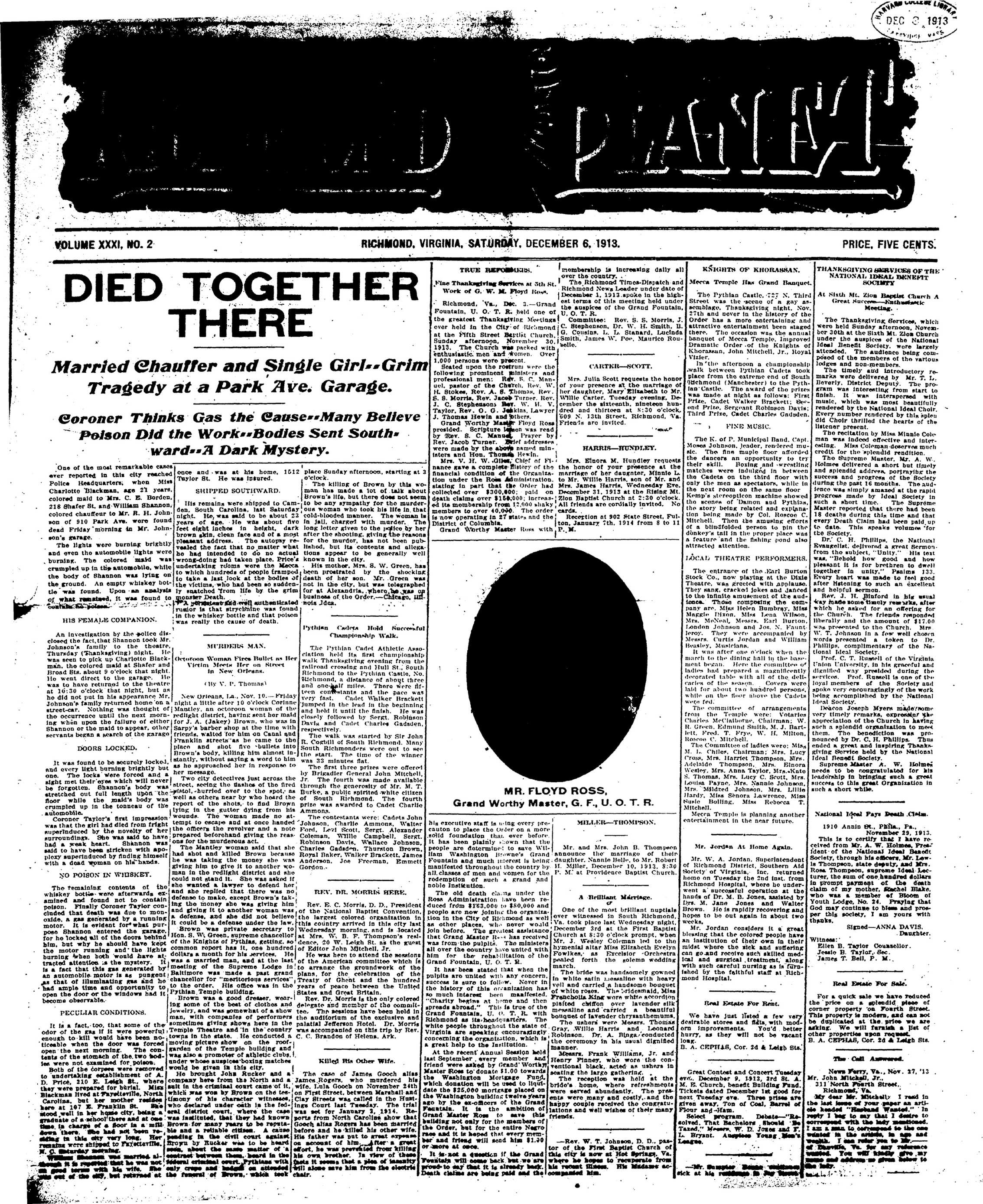
DIED TOGETHER THERE
Married Chauffer and Single Girl-Grim Tragedy at a Park Ave. Garage.
Coroner Thinks Gas the Cause Many Believe Poison Did the Work Bodies Sent Southward A Dark Mystery.
VOLUME XXXI, NO. 2
DIED
Married Cha
Tragedy
Coroner Think
Poison Did t
One of the most remarkable cases ever reported in this city reached Police Headquarters, when Miss Charlotte Blackman, age 21 years, colored maid to Mrs. C. E. Borden, 218 Shafer St. and William Shannon, colored chauffeur to Mr. R. H. Johnson of 910 Park Ave. were found dead Friday morning in Mr. Johnson's garage.
The lights were burning brightly and even the automobile lights were burning. The colored maid was crumpled up in the automobile, while the body of Shannon was lying on the ground. An empty whiskey bottle was found. Upon an analysis of what remained, it was found to contain the poison.
HIS FEMALE COMPANION.
An investigation by the police disclosed the fact, that Shannon took Mr. Johnson's family to the theatre, Thursday (Thanksgiving) night. He was seen to pick up Charlotte Blackman, the colored mall at Shafer and Broad Sts, about 9 o'clock that night. He went direct to the garage. He was to have returned to the theatre at 10:30 o'clock that night, but as he did not put in his appearance Mr. Johnson's family returned home on a street-car. Nothing was thought of the occurrence until the next morning when upon the failure of either Shannon or the maid to appear, other servants began a search of the garage
DOORS LOCKED.
It was found to be securely locked, and every light burning brightly but one. The locks were forced and a sight met their eyes which will never be forgotten. Shannon's body was stretched out full length upon the floor while the maid's body was crumpled up in the tonneau of the automobile. Coroner Taylor's first impression was that the girl had died from fright superinduced by the novelty of her surroundings. She was said to have had a weak heart. Shannon was said to have been stricken with apoplexy superinduced by finding himself with a dead woman on his hands.
NO POISON IN WHISKEY.
The remaining contents of the whiskey bottle were afterwards examined and found not to contain poison. Finally Coroner Taylor concluded that death was due to monoxide, a gas generated by a running motor. It is evident for what purpose Shannon entered the garage, for he locked all of the doors behind him, but why he should have kept the motor running and the lights burning when both would have attracted attention as the mystery. It is a fact that this gas generated by an automobile motor is as pungent gas that of illuminating gas and he had ample time and opportunity to open the door or the windows had it become observable.
PECULIAR CONDITIONS
It is a fact, too, that some of the odor of the gas if it were powerful enough to kill would have been noticeable when the door was forced open the next morning. The contents of the stomach of the two bodies were not examined for poison. Both of the corpse were removed to undertaking establishment of A. D. Price, 210 E. Leigh St., where they were prepared for burial. Miss Blackman lived at Fayetteville, North Carolina, but her mother resides here at 107 E. Franklin St. She stood well in her home city, being a graduate of a school there and at one time, in charge of a floor in a mill-down there. She had not been residing in this city very long. Her remains were shipped to Fayetteville. M. C. Saturday morning.
William Shannon was married although it is reported that he was not in good terms with his wife. She was part of the city, but returned at
once and was at his home, 1512
Taylor St. He was insured.
SHIPPED SOUTHWARD.
His remains were shipped to Camden, South Carolina, last Saturday night. He was sold to be about 23 years of age. He was about two feet eight inches in height, dark brown skin, clean face and of a most pleasant address. The autopsy revealed the fact that no matter what he had intended to do no actual wrong-doing had taken place. Price's undertaking rids were the Macca to which hundreds of people framed to take a last look at the bodies of the victims, who had been so suddenly snatched From life by the grim monger Death.
A person should well authenticated junior is that strychnine was found in the whiskey bottle and that poison was really the cause of death.
MURDERS MAN.
Octoonoo Woman Fires Bullet as Her Victim Meets Her on Street in New Orleans.
(By V. P. Thomas)
New Orleans, La. Nov. 10.—Friday night a little after 10 o'clock Corinne Mantley, an octoonor woman of the red light district, having sent her mall for J. A. (Jakey) Brown, who was in Sarpy's barber shop at the time with friends, waited for him on Canal and Franklin streets as he came to the place and shot into bullets into Brown's body, killing him almost instantly, without saying a word to him as he approached her in response to her message.
Two city detectives just across the street, seeing the flashes of the fired pistol, hurried over to the spot, as well as others near by who heard the report of the shots, to find Brown lying in the gutter dying from his wounds. The woman made no attempt to escape and at once handed the officers the revolver and a note prepared beforehand giving the reasons for the murderous act.
The Mantley woman said that she had shot and killed Brown because he was taking the money she was giving him to give it to another woman in the red light district and she could not stand it. She was asked if she wanted a lawyer to defend her and she replied that there was no defense to make, except Brown's taking the money she was giving him and giving it to another woman was a defense, and she did not believe it could be a defense under the law.
Brown was private secretary to Hon. S. W. Green, supreme chancellor of the Knights of Pythias, getting, so common report has it, one hundred dollars a month for his services. He was a married man, and at the last meeting of the Supreme Lodge in Baltimore was made a past grand chancellor for "meritorious services" to the order. His office was in the Pythian Temple building. Brown was a good dresser, wonning some of the beat of clothes and jewelry, and was somewhat of a show man, with companies of performers sometimes giving shows here in the Temple Theatre and in the country towns in the state. He conducted a moving picture show on the rooft garden of the Temple building and was also a promoter of athletic clubs, under whose auspices boxing matches would be given in this city. He brought John Rucker and a company here from the North and a suit in the criminal court came of it, which was won by Brown on the testimony of his character witnesses, who declared under oath in the federal district court, where the case was instituted, that they had known Brown for many years to be reputable and a reliable citizen. A cause pending in the civil court against Brown by Rucker was to be heard soon, about the main matter of a contract between them, heard in the federal criminal court. Pythias with only crops and hedges on attended the funeral of Brown, which took
place Sunday afternoon, starting at 3 o'clock.
The killing of Brown by this woman has made a lot of talk about Brown's life, but there does not seem to be any sympathy for the murderous woman who took his life in that cold-blooded manner. The woman is in jail, charged with murder. The long letter given to the police by her after the shooting, giving the reasons for the murder, has not been published, but its contents and allegations appear to be generally well known in the city.
His mother, Mrs. S. W. Green, has been prostrated by the shocking death of her son. Mr. Green was not in the city, but was telegraphed for at Alexandra, where he was on business of the Order.—Chicago, Illinois Jdaa.
Pythian Cadeta Hold Successful Championship Walk.
The Pythian Cadet Athletic Association hold its first championship walk Thanksgiving evening from the railroad crossing and Hull St., South Richmond to the Pythian Castle, No. Richmond, a distance of about three and one-half miles. There were fifteen contestants and the pace was very fast. Cadet Walker Brackett jumped in the lead in the beginning and hold it until the finish. He was closely followed by Sergt. Robinson Davies and Cadet Charles Gadsden, respectively.
The walk was started by Sir John R. Coghill of South Richmond. Many South Richmonders were out to see the start. The time of the winner was 33 minutes flat.
The first three prizes were offered by Brigadier General John Mitchell, Jr. The fourth was made available through the generosity of Mr. M. T. Burke, a public spirited white citizen of South Richmond. The fourth prize was awarded to Cadet Charlie Ammons.
The contestants were: Cadets John Johnson, Charlie Ammons, Walter Ford, Levi Scott, Sergt. Alexander Coleman, Willo Campbell, Sergt. Robinson Davis, Wallace Johnson, Charles Gadsden, Thurston Brown, Royal Baker, Walker Brackett, James Anderson, Joe Freeman, Emmett Gordon.
REV. DR. MORRIS HERE
Rev. P. C. Morris, D. D., President of the National Baptist Convention, the largest colored organization in this country arrived in this city last Wednesday morning, and is located at Mrs. W. B. F. Thompson's residence, 20 W. Leigh St. as the guest of Editor John Mitchell, Jr.
He was here to attend the sessions of the American committee which is to arrange the groundwork of the plans, for the celebration of the Treaty of Ghent and the hundred years of peace between the United States and Great Britain.
Rev. Dr. Morris is the only colored delegate and member of the committee. The sessions have been held in the auditorium of the exclusive and palatial Jefferson Hotel. Dr. Morris was accompanied on this trip by Rev. C. C. Brandon of Helena, Ark.
Killed His Other Wife
The case of James Gooch alias James Rogers, who murdered his wife, Lula Gooch on November 24th on First Street, between Marshall and Clay Streets was called in the Huntings Court last Tuesday. The trial was set for January 2, 1914. Reports from North Carolina show that Gooch alias Rogers has been married before and he killed his other wife. His father was put to great expense on account of him after a great effort, he was prevented from killing his own brother. In view of these facts it seems that a plan of insanity will alone save him from the electric chair.
MR. FLOYD ROSS,
TRUE BEFORE ME.
Fine Thanksgiving Services at 5th St.
Work of G. W. M. Floyd Rose.
Richmond, Va., Dec. 3.—Grand Fountain, U. O. T. R. hold one of the greatest Thanksgiving Meetings ever held in the City of Richmond at the Fifth Street Baptist Church, Sunday afternoon, November 30, 1913. The Church was packed with enthusiastic men and women. Over 1,000 persons were present.
Soated upon the rostrum were the following prominent ministers and professional men: Rev. S. C. Manuel, pastor of the Church, Rev. W. H. Stokes, Rev. A. S. Thomas, Rev. S. Morris, Rev. Jacob Turner, Rev. J. C. Stephenson, Rev. W. H. V. Taylor, Rev. O. G. Jackins, Lawyer J. Thomas Hewin and others.
Grand Worthy Master Floyd Ross presided. Scripture lesson was read by Rev. S. C. Manuel. Prayer by Rev. Jacob Turner. Brief addresses were made by the above named ministers and Hon. Thomas Hewin.
Mrs. V. H. W. Gillen, Chief of Finance gave a complete history of the financial condition of the Organization under the Ross Administration, stating in part that the Order had collected over $300,000; paid on death claims over $158,000; increased its membership from 12,000 shaky members to over 40,000. The order is now operating in 27 states and the District of Columbia.
Grand Worthy Master Ross with
MR. FLOY
Grand Worthy Master
his executive staff is using every precaution to place the Order on a more solid foundation than ever before. It has been plainly shown that the people are determined to save William Washington Brown's Grand Fountain and much interest is being manifested throughout the country by all classes of men and women for the rodemption of such a grand and noble Institution.
The old death clause under the Ross Administration have been reduced from $163,000 to $80,000 and people are now joining the organization in the City of Richmond as well as other places, who never would join before. The greatest assistance that Grand Master R. has received was from the pulpits. The ministers all over the country have united with him for the rehabilitation of the Grand Fountain, U. O. T. R.
It has been stated that when the pulpits are united with any concern, success is sure to follow. Never in the history of this organization has so much interest been manifested. "Charity begins at home and then spreads abroad." This is true of the Grand Fountain, U. O. T. R. with Richmond as its headquarters. The white people throughout the state of Virginia are speaking encouragingly concerning the organization, which is a great help to the Institution.
At the recent Annual Session held last September, every member and friend were asked by Grand Worthy Master Rose to donate $1.00 towards the Washington Mortgage Fund, which donation will be used to liquidate the $25,000 mortgage placed on the Washington building twelve years ago by the ex-officers of the Grand Fenstaur. It is the ambition of Grand Master Rose to save this building not only for the members of the Order, but for the entire Negro race and it is hoped that every member and friend will send him $1.00 or more at once.
It is not a question if the Grand Fenstaur will come back but we are proud to say that it is already back. Death claims are being made and the
membership is increasing daily all over the country.
The Richmond Times-Dispatch and Richmond News Leader under date of December 1, 1913 spoke in the highest terms of this meeting held under the auspices of the Grand Fountain, U. O. T. R.
Committee: Rev. S. S. Morris, J. C. Stephenson, Dr. W. H. Smith, B. G. Cousins, L. L. Stanford, Lucinda Smith, James W. Poe, Maurice Roubelle.
CARTER—SCOTT.
Mrs. Julia Scott requests the honor of your presence at the marriage of her daughter, Mary Elizabeth to Mr. Willie Carter. Tuesday evening, December the sixteenth, nineteen hundred and thirteen at 8:30 o'clock, 609 N. 13th Street, Richmond, Va. Friends are invited.
HARRIS—HUNDLEY.
Mrs. Elinora M. Hundley requests the honor of your presence at the marriage of her daughter, Minnie L. to Mr. Willie Harris, son of Mr. and Mrs. James Harris, Wednesday Eve, December 31, 1913 at the Rising Mt. Zion Baptist Church at 2:30 o'clock. All friends are cordially invited. No cards. Reception at 902 State Street, Fulton, January 7th, 1914 from 8 to 11 P. M.
DYD ROSS,
ster, G. F., U. O. T. R.
MILLER-THOMPSON.
Mr. and Mrs. John B. Thompson announce the marriage of their daughter, Nannie Belle, to Mr. Robert H. Miller, December 10, 1913, 8:30 P. M. at Providence Baptist Church.
A Brilliant Marriage
One of the most brilliant nuptials over witnessed in South Richmond, Va. took place last Wednesday night, December 3rd at the First Baptist Church at 8:30 o'clock prompt, when Mr. J. Wesley Coleman led to the hymenial altar Miss Elizabeth Evelyn Fowkes, as Excelsior - Orchestra poened forth the solemn wedding march.
The bride was handsomely gowned in white satin messaline with heavy vell and carried a handsome bouquet of white roses. The Bridesmaid, Miss Francholia King wore white accordion plaited cliffion over lavender silk messaline and carried a beautiful bouquet of lavender chrysanthemums.
The ushers were Mosers. Thomas Gray, Willie Harris and Leonard Robinson. Dr. A. Binga conducted the ceremony in his usual dignified manner.
Mosers, Frank Williams, Jr. and Henry Finney, who wore the conventional black, acted as ushers in seating the large gathering.
The reception was held at the bride's home, where refreshments were served abundantly. The presents were many and costly, and the happy couple received the congratulations and well wishes of their many friends.
—Rev. W. T. Johnson, D. D., pastor of the First Baptist Church of this city is now at Hot Spring, Va. where he hopes to recuperate from his recent illness. His Madame accompanied him.
THANKSGIVING SERVICES OF THE
NATIONAL IDEAL BENEFIT
SOCIETY
At Ninth Mt. Zion Baptist Church A
Great Success—Enthusiastic
Meeting.
The Thanksgiving Services, which
were held Sunday afternoon, November
30th at the Sixth Mt. Zion Church
under the auspices of the National
Ideal Benefit Society, were largely
attended. The audience being com-
posed of the members of the various
lodges and non-members.
The timely and introductory
remarks were delivered by Mr. T. L.
Beverly, District Deputy. The pro-
gram was interesting from start to
finish. It was interspersed with
music, which was most beautifully
rendered by the National Ideal Choir.
Every number rendered by this splen-
d Choir thrilled the hearts of the
listener present.
The recitation by Miss Minnie Cole-
man was indeed effective and inter-
esting. Miss Coleman-doserves much
credit for the splendid rendition.
The Supreme Master, Mr. A. W. Hyman delivered a short but timely and splendid address, portraying the success and progress of the Society during the past 16 months. The audience was simply amazed at the rapid progress made by Ideal Society in such a short time. The Supreme Master reported that there had been 18 deaths during this time and that every Death Claim had been paid up to date. This speaks volumes for the Society.
Dr. C. H. Phillips, the National Evangelist, delivered a great Sermon from the subject, "Unity." His text was, "Behold how good and how pleasant it is for brethren to dwell together in unity," Psalms 133. Every heart was made to feel good after Histoning to such an excellent and helpful sermon.
Rev. J. H. Blinford in his usual way made some timely remarks, after which he asked for an offering for the Church. The friends responded liberally and the amount of $17.00 was presented to the Church. Mrs. W. T. Johnson in a few well chosen words presented a token to Dr. Phillips, complimentary of the National Ideal Society.
Prof. C. T. Russell of the Virginia Union University, in his graceful and dignified way presided during the services. Prof. Russell is one of the loyal members of the Society and spoke very encouragingly of the work being accomplished by the National Ideal Society.
Deacon Joseph Myers made/never very timely remarks, expressing the appreciation of the Church in having such a splendid organization to meet them. The benediction was pronounced by Dr. C. H. Phillips. Thus ended a great and inspiring Thanksgiving Service held by the National Ideal Benefit Society. Supreme Master A. W. Holmes needs to be congratulated for his leadership in bringing such a great success to this great Organization in such a short while.
National Ideal Pays Death Claim
November 29, 1913.
This is to certify that I have received from Mr. A. W. Holmes, President of the National Ideal Benefit Society, through his officers, Mr. Lewis Thompson, state deputy, and Mrs. Rosa Thompson, supreme Ideal Lecturer, the sum of one hundred dollars in prompt payment of the death claim of my mother, Michel Blake, who was a member of Bloom of Youth Lodge, No. 24. Praying that God may continue to bless and prosper this society, I am yours with thanks.
Witness:'
Ellen B. Taylor Counsellor.
Jessie B. Taylor, Sec.
James T. Bell, P. M.
For a quick sale we have reduced the price on a splendid, piece of corner property on Fourth Street. This property is modern, and can not be duplicated at the price we are asking. We will furnish a list of other properties upon request. B. A. CEPHAR, Cor. 2d & Laugh Sts.
News Ferry, Va., Nov. 27, '13
Mr. John Mitchell, Jr.
311 North Fourth Street.
Richmond, Va.
My dear Mr. Mitchell I read in
the last issue of your paper an arti-
cite headed "Husband Wanted." In
reply I beg to my that I desire to
correspond with the lady mentioned.
I am a man to correspond to the one
wanted in the artiice, in age and
wealth. I can refer you to Mr.——
Daville, Va. For any reference
wanted. You will kindly give my
name and address no given below to
the lady.
---
KNIGHTS OF KHORASSAN.
Mecca Temple Has Grand Banquet.
The Pythian Castle, 727 N. Third Street was the scene of a gay assemblage. Thanksgiving night, Nov. 27th and nover in the history of the Order has a more entertaining and attractive entertainment been staged there. The occasion was the annual banquet of Mecca Temple, Improved Dramatic Order of the Knights of Khorassan, John Mitchell, Jr., Royal Vizier.
In the afternoon a championship walk between Pythian Cadets took place from the extreme end of South Richmond (Manchester) to the Pythian Castle. The award of the prizes was made at night as follows: First Prize, Cadet Walker Brackett; Second Prize, Sergiant Robinson Davis; Third Prize, Cadet Charles Gudden.
FINE MUSIC
The K. of P. Municipal Band, Capt. Moses Johnson, leader, rendered music. The fine maple floor afforded the dancers an opportunity to try their skill. Boxing and wrestling matches were indulged in between the Cadets on the third floor with only the men as spectators, while in the next room on the same floor Kemp's stereopticon machine showed the scenes of Damon and Pythias, the story being related and explanation being made by Col. Roscoe C. Mitchell. Then the amusing efforts of a blindfolded person to pin the donkey's tail in the proper place was a feature and the fishing pond also attracted attention.
LOCAL THEATRE PERFORMERS.
The entrance of the Earl Burton Stock Co., now playing at the Dixie Theatre, was groomed with applause. They sang, cracked jokes and danced to the infinite amusement of the audience. Those composing the company are Miss Helen Bumbray, Miss Maggie Dixon, Miss Lena Wilson, Mrs. McNoal, Missress, Earl Burton, London Johnson and Jos. N. Fauntleroy. They were accompanied by Messrs. Curtis Jordan and William Beasley, Musicians.
It was after one clock when the march to the dining hall in the basement began. Here the committee of ladies had prepared a magnificently decorated table with all of the delicacies of the season. Covers were laid for about two hundred persons, while on the floor above the Cadets were fed.
The committee of arrangements from the Temple were: Volatries Charles McClahorne, Chairman; W. R. Green, Edmund Smith, M. J. Bartlett, Fred. T. Frye, W. H. Milton, Roscoe C. Mitchell.
The Committee of ladies were: Miss M. L. Chiles, Chairman; Mrs. Lucy Cross, Mrs. Harriet Thompson, Mrs. Adelhade Thompson, Mrs. Elinora Westley, Mrs. Anna Taylor, Mrs. Kato S. Thomas, Mrs. Lucy C. Scott, Mrs. Louisa Payne, Mrs. Nannie Johnson, Mrs. Mildred Johnson, Mrs. Lillie Hardy, Miss Snoora Lawrence, Miss Nusle Bolling, Miss Rebocca T. Mitchell.
Mecca Temple is planning another entertainment in the near future.
Mr. Jordan At Home Again
Mr. W. A. Jordan, Superintendent of Richmond District, Southern Aid Society of Virginia, Inc., returned home on Tuesday the 2nd inst. from Richmond Hospital, where he underwent a successful operation at the hands of Dr. M. B. Jones, assisted by Drs. M. Jane Jones and Walter Brown. He is rapidly recovering and hopes to be out again in about two weeks.
Mr. Jordan considers it a great blessing that the colored people have an institution of their own in their midst where the sick and suffering can go and receive such skilled medical and surgical treatment, along with such careful nursing as is furnished by the faithful staff at Richmond Hospital.
Real Estate For Rent
We have just listed a few very desirable stores and flats, with modern improvements. You'd better hurry, as they will not be vacant long.
B. A. CEPHAS, Cor. 2d & Leigh Sta.
Great Contest and Concert Tuesday eve. December 9, 1912, 2rd St. A. M. E. Church, benefit Building Fund. Tickets dated December 1st good for next Tuesday eve. Three prizes are given away, Ton of Coal, Barrel of Flour and Ham. Select program. Debate—"Resolved, That Bachelors Should Be Taxed," Moores, W. D. Jones and F. L. Bryant. Anspices Young Men's League.
PRICE, FIVE CENTS.
---
1910 Annin St., Phila., Pa.
Real Estate For Sale
The Cell Answered.
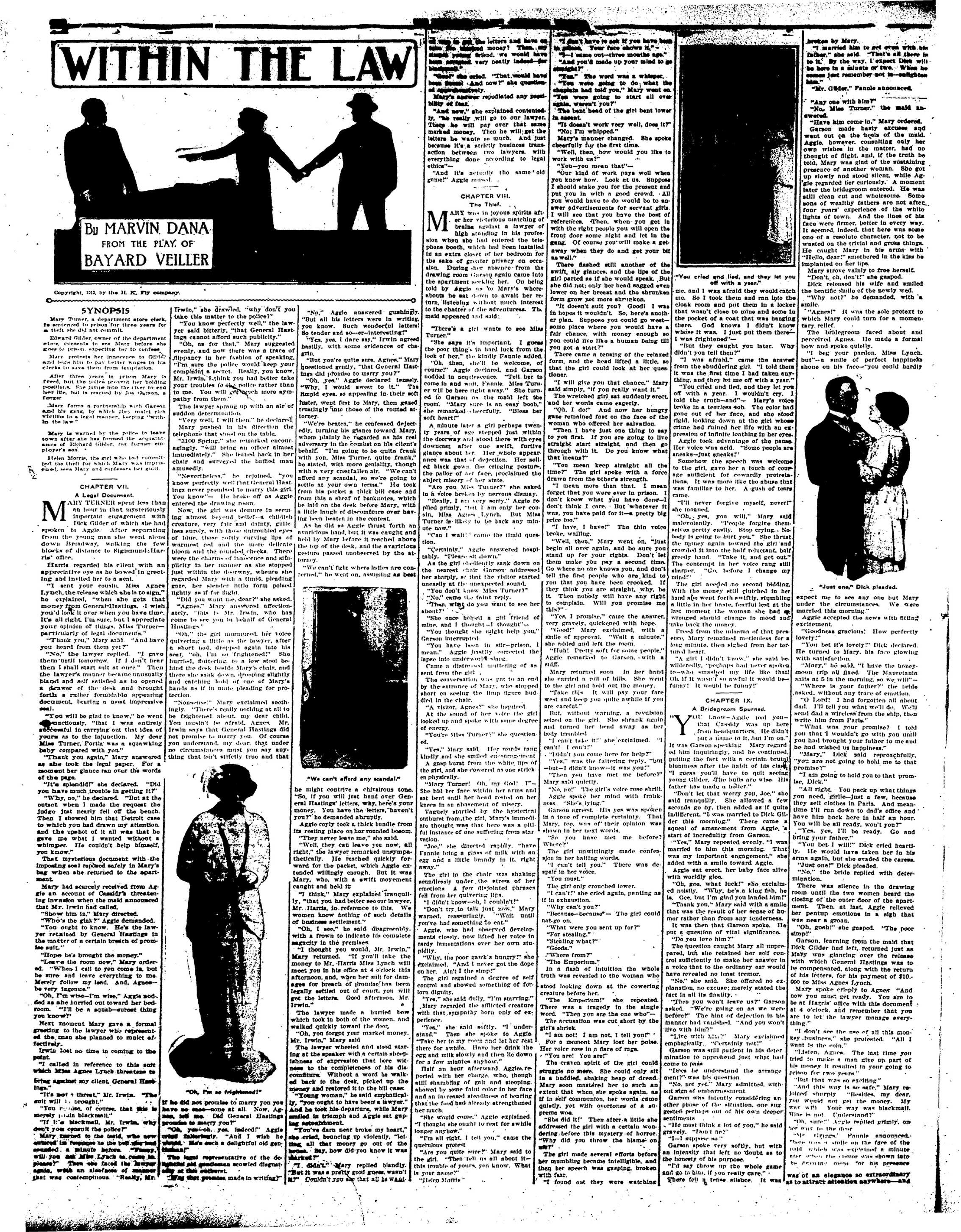
WITHIN THE LAW
By MARVIN DANA
FROM THE PLAY OF
BAYARD VEILLER
SYNOPSIS
Mary Turner, a department store clerk, is sentenced to prison for three years for a theft she did not commit.
Edward Gilder, owner of the department store, consents to see Mary before she goes to prison, expecting her to confess.
Mary protests her innocence to Gilder and begs him to pay better wages to his clerks to have them from temptation.
After three years, in prison Mary is freed, but the police prevent her holding positions. She jumps into the thief to end her life, but is rescued by Joe Glyson, a forger.
Mary forms a partnership with Gareon and his gang, by which they must rich victims in a legal manner, keeping "within the law."
Mary is warned by the police to leave town after she has formed the acquaintance of Richard Gilder, her former employer's son.
Helen Morris, the girl who had committed the theft for which Mary was imprisoned,Area Mary and confess her guilt.
---
CHAPTER VII
A Legal Document
MARY TURNER spent less than an hour in that mysteriously important engagement with Dick Gilder of which she had spoken to Agile. After separating from the young man she went alone down Broadway, walking the few blocks of distance to Sighmunda-Harris' office.
Harris regarded his client with an appreciative eye as he bowed in greeting and invited her to a seat.
"I sent your cousin, Miss Agnes Lynch, the release which she to sign," he explained, "when she gets that money from General-Hastings. I wish you'd look it over when you have time. It's all right, I'm sure, but I appreciate your opinion of things. Miss Turner—particularly of legal documents."
"Thank you, Mary said." "And have you heard from them yet?"
"No," the lawyer replied. "I gave them until tomorrow. If I don't hear then I shall start suit at once." Then the lawyer's mummer became unusually bland and self-satisfied as he opened a drawer of the desk and brought forth a rather formidable appearing document, bearing a most impressive seal.
"You will be glad to know," he went functionally, "that I was entirely successful in carrying out that idea of yours as to the injunction. My dear Miss Turner, Fortla was a squawking baby compared with you."
"Thank you again," Mary answered as she took the legal paper. For a moment her glance ran over the words of the page.
"It's splendid!" she declared. "Did you have much trouble in getting it?"
"Why, no," he declared. "But at the outset when I made the request the judge just nearly fell off the bench. Then I showed him that Detroit case to which you had drawn my attention, and the upshot of it all was that he gave me what I wanted without a whimper. He couldn't help himself, you know."
That mysterious document with the imposing soal replaced safely in Mary's bag when she returned to the apartment.
Mary had scarcely received from Aggie an account of Cassidy's threatening invasion when the maid announced that Mr. Irwin had called.
"Show him in." Mary directed.
"Who's the gink?" Aggie demanded.
"You ought to know. He's the lawyer retained by General Hastings in the matter of a certain breach of promise suit."
"Hope he brought the money."
"Leave the room now." Mary ordered. "When I call to you come in, but be sure and leave everything to me. Merely follow my lead. And, Agnes—be very ingenuous."
"Oh, I'm wise. I'm wise." Aggie nodded as she hurried out toward her bedroom. "I'll be a squab—surreal thing you know!"
Next moment Mary gave a formal greeting to the lawyer who represented the man she planned to muck effectively.
Irwin lost no time in coming to the point.
"I called in reference to this suit which Miss Agnes Lynch threatened to bring against my client, General Hammings."
"It's not a threat," Mr. Irwin. "The suit will be brought."
"You re-ise, of course, that this is merely plain blackmail."
don't you consult the police?
Mary learned to the world, who now entered in response to the bell she had sounded, a minute before. "Thank you, will you ask Mrs Lynch to come in please?" Then she faced the lawyer again, with an aloofness of manner that was contemptuous. "Really, Mr.
Irwin," she drawled, "why don't you take this matter to the police?"
"You know perfectly well," the lawyer said bitterly, "that General Hastings cannot afford such publicity."
"Oh, as for that," Mary suggested evenly, and now there was a trace of slippancy in her fashion of speaking, "I'm sure the police would keep your complaining a secret. Really, you know. Mr. Irwin, I think you had better take your troubles to the police rather than to me. You will get much more sympathy from them."
The lawyer sprang up with an air of sudden determination.
"Very well, I will then," he declared. Mary pushed in his direction the telephone that stood on the table.
"3100 Spring," she remarked encouragingly, "will bring an officer almost immediately." She leaned back in her chair and surveyed the battled man amusedly.
"Nevertheless," he rejoined, "you know perfectly well that General Hastings never promised to marry this girl. You know—" He broke off as Aggie entered the drawing room. Now, the girl was demure in seeming almost beyond belief—a childish creature, very fair and dimly, grittle loss surely, with those unattroiled eyes of blue, those softly curving lips of warmmeat red and the more delicate bloom and the rounded cheeks. There were the charms of innocence and siphplity in her manner as she stopped just within the doorway, whence she regarded Mary with a timid, pleading gaze, her slender little form polished lightly as if for flight.
"Did you want me, dear?" she asked.
"Agnes," Mary answered affectionately, "this is Mr. Irwin, who has come to see you in behalf of General Hastings."
"Oh," the girl murmured, her voice quivering a little as the lawyer, after a short nod, dropped again into his coat, "oh, I'm so frightened!" She hurried, fluttering, to a low stool behind the desk beside Mary's chair, and there she sank down, drooping slightly and catching hold of one of Mary's hands as if in pleading for protection.
"Nonsense!" Mary exclaimed soothingly. "There's really nothing at all to be frightened about, my dear child. You mustn't be afraid, Agnes, Mr. Irwin says that General Hastings did not promise to marry you. Of course you understand, my dear, that under no circumstances must you say anything that isn't strictly true and that
```markdown
```
"Oh, I'm no frightened!"
If he did not promise to marry you you have no one none at all. Now, Agnán, tell me. Did General Hastings promise to marry you!
"Oh, you oh, you, indeed!" Agnán grinned fatally. "And I wish he wiped. He such a delightful old gentleman."
The legal representative of the delightful old gentleman sowled disgrace at the courtroom.
*What that promise made in writing?*
"No," Aggie answered gushingly.
"But all his letters were in writing,
you know. Such wonderful letter!
So tender and so—er—interciting!"
"Yes, yes, I dare say." Irwin agreed hastily, with some evidences of chagrin.
"But you're quite sure. Agnes." Mary questioned gently, "that General Hastings did promise to marry you?"
"Oh, yes." Aggie declared tensely.
"Why, I would sweat to it." The impid eyes, so appealing in their soft fuster, went first to Mary, then gased truttingly into those of the routed attorney.
"We beaten," he confessed defectedly, turning his glance toward Mary, whom plainly he regarded as his real adversary in the combat on his client's behalf. "I'm going to be quite frank with you. Miss Turner, quite frank," he stated, with more genitality, though with a very crestfallen air. "We can't afford any scandal, so we're going to settle at your own terms." He took from his pocket a thick bill case and from this a shear of banknotes, which he laid on the desk before Mary, with a little laugh of discomfort over having been beaten in the contest. As he did so Aggie thrust forth an avaricious hand, but it was caught and held by Mary before it reached above the top of the desk, and the avaricious gesture passed unobserved by the attorney. "We can't fight where ladies are concerned," he went on, assuming as best
```markdown
```
"We can't afford any scandal."
he might contrive a chivalrous tone. "So, if you will just hand over General Hastings' letters, why, here's your money. You have the letters, 'haven't you' he demanded abruptly. Aggie copy took a thick bundle from its resting place on hor rounded bosom. 'They never leave me,' she said. "Well, they can leave you now, all right," the lawyer remarked unsympathetically. He reached quickly forward for the packet which Angle ex-
"I think," Mary explained tranquilly, "that you had better see our lawyer, Mr. Harris, in reference to this. We women know nothing of such details of business settlement."
"Oh, I see," he said disagroohly, with a frown to indicate his complete sagacity in the premises.
"I thought you would, Mr. Irwin," Mary returned. "If you'll take the money to Mr. Harris Miss Lynch will meet you in his office at 4 o'clock this afternoon, and, when her suit for damages for breach of promise has been legally settled out of court, you will get the letters. Good afternoon, Mr. Irwin."
The lawyer made a hurried how which took in both of the women, and walked quickly toward the door.
"Oh, you forget your marked money. Mr. Irwin," Mary said.
The lawyer wheeled and stood staring at the speaker with a certain sheeniness of expression that bore witness to the completeness of his discomfiture. Without a word he walked back to the desk, picked up the money and restored it to the bill case. "Young woman," he said emphatically, "you ought to have been a lawyer." And he took his departure, while Mary smiled in triumph and Aggie sat gaping astonishment. "You've darn near broke my heart," she cried, bouncing up violently, "letting all that money go out of the house. Say, how did you know it was started?" "I didn't." Mary repiled blandly. But it was a pretty good guess, wasn't it? Couldn't you see that all he want
all we do to get the letters and have on them the wanted money? Then, my simple young friend, we would have been accepted very neatly indeed for bankroll." "Geez!" she cried. "That would have been found." And now!" she questioned apparently. Mary's answer repudiated any possibility of fax. "And now," she explained contentedly, "he really will go to our lawyer. There he will pay over that same marked money. Then he will get the letters he wants so much. And just because it's a strictly business transaction between two lawyers, with everything done according to legal ethics"—
"And it's actually the name *old game!* Aggie misused.
MARY was in joyous spirits after her horrific matching of brains against a lawyer of high standing in his profession when she had entered the telephone booth, which had been installed in an extra closet of her bedroom for the sake of greater privacy on occasion. During her absence from the drawing room Garison again came into the apartment seeking her. On being told by Aggie as to Mary's whereabouts he sat down to await her return, listening without much interest to the chatter of the adventures. The maid appeared and said:
"There's a girl wants to see Miss Turner."
"She says it's important. I guess the poor things in hard luck from the look of her," the kindly Fannie added.
book of her, the phantom added,
"Oh, then, shall be welcome, of course!"
Aggie declared, and Garson nodded in acquiescence. "Tell her to come in and wait, Fannie. Miss Turner will be here right away." She turned to Garson as the maid left the room. "Mary sure is an easy boob," she remarked cheerfully, "Bless her soft heart!"
A minute later a girl perhaps twenty years, of age stepped just within the doorway and stood there with eyes downcast after one swift, furtive glance about her. Her whole appearance was that of dejection. Her solled black gown, the cringing posture, the pallor of her face, proclaimed the abject misery of her state.
"Are you Miss Turner?" she asked in a voice broken by nervous dismay.
"Really, I am very sorry." Aggie replied primly, "but I am only her cousin, Miss Agnes Lynch. But Miss Turner is likely to be back any minute now."
"Can I want to come the timid question."
"Certainly." Aggie answered hospitably, "Please sit down."
As the girl confidently sank down on the nearest chair Garson addressed her sharply, as that the visitor started unceasely at the unexpected sound.
"You don't know Miss Turner?"
"No!" came the faint reply.
"Then, what do you want to see her about?"
"She once helped a girl friend of mine, and I thought—I thought—
"You thought she might help you." Garson interrupted.
"You have been in self-prison, I mean." Aggie hastily corrected the lapse into underworld shang. Came a distressed muttering of as sent from the girl. The conversation was put to an end by the entrance of Mary, who stopped short on seeing the trip figure huddled in the chait. "A visitor, Agnes?" she inquired.
"A visitor, Agnes," she inquired. At the sound of her voice the girl looked up and spoke with some degree of energy.
"You're Miss Turner!" she questioned.
"Yes," Mary said. Her words rang kindly and she smiled encouragement. A gnap burst from the white lips of the girl, and she cowered as one stricken physically.
"Mary Turner! Oh, my God! I—" She bid her face within her arms and sat bent until her head rested on her knees in an abasement of misery.
Vaguely startled by the hysterical outburst from the girl, Mary's immediate thought was that here was a painful instance of one suffering from starvation.
"Joe," she directed rapidly, "have Fannie bring a glass of milk with an egg and a little brandy in it, right away."
The girl in the chair was shaking soundlessly under the stress of her emotions. A few disjointed phrases fell from her quirling lips.
"I didn't know—oh, I couldn't."
"Don't try to talk just now," Mary warned, reassuringly. "Wait until you've had something to eat."
Aggie, who had observed developments closely, now lifted her voice in tardy lamentations over her own stupidity.
"Why, the poor gawk'a hungry!" she exclaimed. "And I never got the dope on her. Ain't I the simp?"
The girl regained a degree of self control and showed something of forlorn dignity.
"Yes," she said dully. "I'm starving."
Mary regarded the afflicted creature with that sympathy born only of experience.
"Toe," she said softly, "I understand." Then she stoked to Aggie. "Take her to my room and let her rest there for awhile. Have her drink the egg and milk slowly and then lie down for a few minutes anyhow." Half an hour afterward Aggie, reported with her charge, who, though still shambling of gait and stooping, showed by some faint color in her face and an increased steadiness of bearing that the food had already strengthened her much.
"She would come." Aggie explained. "I thought she ought to rest for awhile longer anyhow."
"I'm all right. I tell you," came the querulous protest. "Are you quite sure?" Mary said to the girl. "Then tell us all about it—this trouble of yours, you know. What is your name?"
"I don't have to ask if you have been in prison. Your face shows it." —
"I came out-three months ago."
"And you'd made up your mind to go straight!"
"Yes." The word was a whisper.
"You were going to do what the chaplain had told you." Mary went on.
"You were going to start all over again, weren't you?"
"The bent head of the girl bent lower in ascent.
"It doesn't work very well, does it?"
"No: I'm whipped."
Mary's manner changed. She spoke cheerfully for the first time.
"Well, then, how would you like to work with us?"
"You—you mean that!"—
"Our kind of work pays well when you know how. Look at us. Suppose I should stake you for the present and put you in with a good crowd. All you would have to do would be to answer advertisements for servant girls. I will see that you have the beat of references. Then, when you get in with the right people you will open the front door some night and let in the gang. Of course you will make a getaway when they do and get your bit as well."
There dashed still another of the swift, ally glances, and the lips of the girl parted as if she would speak. But she did not; only her head sagged even lower on her breast and the shrunken form grew yet more shrunken.
"It doesn't suit you? Good! I was in hopes it wouldn't. So, here's another plan. Suppose you could go west—some place where you would have a fair chance, with money enough so you could live like a human being till you got a start?" There came a tensing of the relaxed form, and the head lifted a little, so that the girl could look at her questioner.
"I will give you that chance," Mary said simply, "if you really want it." The wretched girl sat suddenly erect, and her words came eagerly.
"Oh, I do!" And now her hungry gaze remained fast on the face of the woman who offered her salvation.
"Then I have just one thing to say to you first. If you are going to live straight start straight, and then go through with it. Do you know what that means?"
"You mean keep straight all the time?" The girl spoke with a force drawn from the other's strength.
"I mean more than that. I mean forget that you were ever in prison. I don't know what you have done—I don't think I care. But whatever it was, you have paid for it—a pretty big price too."
"I have, I have!" The thin voice broke, walling.
"Well, then." Mary went on, "just begin all over again, and be sure you stand up for your rights. Don't let them make you pay a second time. Go where no one knows you, and don't tell the first people who are, kind to you that you have been crooked. If they think you are straight, why, be it. Then nobody will have any right to complain. Will you promise me this?"
"Good!" Mary exclaimed, with a smile of approval. "Walt a minute," she added and left the room.
"Huh! Pretty soft for some people." Aggie remarked to Garson, with a sult.
Mary returned soon. In her hand she carried a roll of bills. She went to the girl and hold out the money.
"Take this. It will pay your fare west and keep you quite awhile if you are careful."
But, without warning, a revulsion selzed on the girl. She shrank again and turned her head away as her body trembled.
"I can't take it!" she exclaimed. "I can't! I can't!"
"Didn't you come here for help?"
"Yes," was the faltering reply, "but—but—I didn't know—it was you!"
"Then you have met me before? Mary said quietly.
"No, no." The girl's voice rose shrill. Aggle spoke her mind with frankness. "She's lying."
Garson agreed. His yes was spoken in a tone of complete certainty. That Mary, too, was of their opinion was shown in her next words.
"So you have met me before? Where?"
"I can't tell you." There was despair in her voice.
"You must."
The girl only crouched lower.
"I can't!" she cried again, panting as if in exhaustion.
"Why can't you?"
"Because—because"—The girl could not go on.
"What were you sent up for?"
"For stealing."
"Stealing what?"
"Goods."
"Where from?"
"The Emporium."
In a flash of intuition the whole truth was revealed to the woman who
stood looking down at the cowering creature before her.
"The Emperium!" she repeated. There was a tragedy in the single word. "Then you are the one who"—the accusation was cut short by the girl's shriek.
"I am not! I am not. I tell you!" For a moment Mary lost her pulse. Her voice rose in a flare of rage.
"You are! You are!" The craven spirit of the girl could struggle no more. She could only sit in a huddled, shaking heap of dread. Mary soon mastered her to such an extent that when she spoke again, as if in self communion, her words came quietly, yet with overtones of a supreme woe.
"She did it!" Then after a little she addressed the girl with a certain wonder, before this mystery of horror.
"Why did you throw the blame on her?"
The girl made several efforts before her mumbling became intelligible, and then her speech was gasping, broken with faint.
"I found out they were watching
THE LIFE OF MARY C. MAYER
A biography of Mary C. Mayer, a pioneering American woman who was a pioneer in the field of women's health and a trailblazer in the fight against cancer. She was a pioneer in the field of women's health and a trailblazer in the fight against cancer.
"You cried and lied, and they let you off with a year."
me, and I was afraid they would catch me. So I took them and ran into the cloak room and put them in a locker that wasn't close to mine and some in the pocket of a coat that was hanging there. God knows I didn't know whose it was. I just put them there—I was rightened"—"But they caught you later. Why didn't you tell them?"
"I was afraid," came the answer from the abuddering girl. "I told them it was the first time I had taken anything, and they let me off with a year." "You cried and lied, and they let you off with a year. I wouldn't cry. I told the truth—and—Mary's voice broke in a tortuous sob. The color had gone out of her face, and she stood rigid, looking down at the girl whose crime had ruined her life with an expression of infinite loathing in her eyes.
Aggie took advantage of the pause. Her voice was nud. "Some people are anneaks—just eneaks."
Somehow the speech was welcome to the girl, gave her a touch of courage sufficient for cowardly protections. It was more like the abuse that was familiar to her. A gush of tears came.
"I'll never forgive myself, never!" she moaned.
"Oh, yes, you will." Mary said malevolently. "People forgive themselves pretty easily. Stop crying. Nobody is going to hurt you." She thrust the money again toward the girl and crowded it into the half reluctant, half greedy hand. "Take it, and get out." The contempt in her voice rang still sharper. "Go, before I change my mind."
The girl needed no second bidding. With the money still clutched in her hand she went forth swiftly, stumbling a little in her haste, fearful lest at the last moment the woman she had wronged should change in mood and take back the money.
Freed from the ulmana of that presence, Mary remained motionless for a long minute, then sighed from her tortured heart.
"A girl I didn't know," she said bewilderedly, "peechaps had never spoken to-who unsnushed my life like that! Oh, if it wasn't so awful it would be--funny! It would be funny!"
CHAPTER IX
A Bridegroom Spurned.
"YOU know-Aggie told you-that Cassidy was up here from headquarters. He didn't put a name to it, but I'm on." It was Garson speaking. Mary regarded him inquiringly, and he continued, putting the fact with a certain brutal bluntness after the habit of his clan. "I guess you'll have to quit seeing young Glider. The bulbs are wise. His father has made a holter." "Don't let that worry you, Joe," she said tranquilly. She allowed a few seconds go by, then added as if quite indifferent. "I was married to Dick Glider this morning." There came a squeal of amazement from Aggie, a start of incredulity from Garson.
Aggie sat erect, her baby face alive with worldly glee.
"Oh, gee, what luck!" she exclaimed notily. "Why, he's a king fish, he is. Gee, but I gind you landed him!" "Thank you." Mary said with a smile that was the result of her sense of humor rather than from any tenderness. It was then that Garson spoke. He put a question of vital significance. "Do you love him?"
The question caught Mary all unprepared, but she retained her self control sufficiently to make her answer in a voice that to the ordinary ear would have revealed no least tremor. "No," she said. She offered no explanation, no excuse; merely stated the fact in all its finality.
"Then you won't leave us?" Garson asked. "We're going on as we were before." The hint of dejection in his manner had vanished. "And you won't live with him?"
"Live with him." Mary enchained emphatically, "Certainly not."
Garson was still patient in his deter mination to apprehend just what had come to pass.
"Does he understand the arrangement?" was his question.
"No, not yet." Mary admitted, without sign of embarrassment.
"He must think a lot of you," he said gravely. "Don't he?"
"I—I suppose no."
Garron spoke very softly, but with an intensity that left no doubt as to the honesty of his purpose.
"I'd say throw up the whole game and go to him, if you really care." There fell a fense silence. It was
There fell a tense alliance. It was
broken by Mary.
"I married him to set even with his Father," she said. "That's all, there is to it. By the way, I expect Dust will be here in a minute or two. When he comes just remember not to enlighten him."
"Mr. Gilder." Fannie announced.
"Any one with him?"
"No, Miss Turner," the maid answered.
"Have him come in." Mary ordered. Garson made hasty excuses and went out on the heels of the maid. Aggie, however, consulting only her own wishes in the matter, had no thought of flight, and, if the truth be told, Mary was glad of the sustaining presence of another woman. She got up slowly and stood silent, while Aggie regarded her curiously. A moment later the bridegroom entered. He was still clean cut and wholesome. Some sons of wealthy fathers are not after four years' experience of the white lights of town. And the lines of his face were firmer, better in every way. It seemed, indeed, that here was some one of a resolute character, not to be wanted on the trivial and gross things. He caught Mary in his arms with "Hello, dear!" smothered in the kiss he implanted on her lips.
Mary strove vainly to free herself.
"Don't, oh, don't!" she gasped.
Dick released his wife and smiled the beatful smile of the newly wed.
"Why not?" he demanded, with a smile.
"Agnes! It was the sole pretext to which Mary could turn for a momentary relief.
The bridgroom faced about and perceived Agnes. He made a formal bow and spoke quietly.
"I beg your pardon. Miss Lynch, but" a smile of perfect happiness shone on his face-"you could hardly
THE DANCE
"Just one," Dick pleaded. expect me to see any one but Mary under the circumstances. We never married this morning." Aggie accepted the news with fitting excitement. "Goodness gracious! How perfectly lovely!" "You bet it's lovely!" Dick declared. He turned to Mary, his face glowing with satisfaction. "Mary," he said, "I have the honey-moon trip all fixed. The Mauritania sail at 5 in the morning, so we will"— "Where is your father?" the bride asked, without any trace of emotion. "O Lord! I had forgotten all about dad. I'll tell you what we'll do. We'll send dad a wireless from the ship, then write him from Paris." "What was your promise? I told you that I wouldn't go with you until you had brought your father to me and he had wished us happiness."
"Mary," Dick said reproachfully,
"you are not going to hold me to that promise?"
"I am going to hold you to that promise, Dick."
"All right. You pack up what things you need, girlie—just a few, because they sell clothes in Paris. And meantime I'll run down to dad's office and have him back here in half an hour. You will be all ready, won't you?"
"Yes, yes, I'll be ready. Go and bring your father."
"You bet. I will!" Dick cried heartily. He would have taken her in his arms again, but she evaded the cares.
"Just one!" Dick pleaded.
"No," the bride replied with determination.
There was silence in the drawing room until the two women heard the closing of the outer door of the apartment. Then, at last, Aggie relieved her pentup emotions in a sigh that was near a groan.
"Oh, goosh!" she gasped. "The poor simp!"
Garson, learning from the maid that Dick Gilder had left, returned just as Mary was glancing over the release with which General Hastings was to be compensated, along with the return of his letters, for his payment of $10,000 to Miss Agnes Lynch.
Mary spokecriply to Agnes "And now you must get ready. You are to be at Harriet's office with this document at 4 o'clock, and remember that you are to let the lawyer manage everything."
"I don't see the use of all this monkey business," she protested. "All I want is the coin."
"Listen. Agnes. The last time you tried to make a man give up part of his money it resulted in your going to prison for two years."
"But that was so exciting"
"And this way is so safe." Mary rejoined shurply. "Besides, my dear, you would not get the money. My way will. Your way was blackmail. Wine is not understand?"
"Oh, sure." Angela replied primarily, on her way to the door.
"Mr. Griggs." Fannie announced. "There was a smile on the face of the cold which was explained a minute later when the visitor was shown into the drawing room for his presence was of an elegance so extraordinary that it attract attention anywhere—and
```markdown
```
marth as well from ribald observers.
Mountain Garson had explained to Mary.
"It's English Eddie. You met him once. I wonder what he wants! Probably got a trick for me. We often used to work together."
"Nothing without my consout," Mary warned.
"Oh, no, no, sure not!" Garson agreed.
Further discussion was cut short by the appearance of English Eddie himself, a tall, handsome man in the early thirties, who paused just within the doorway and delivered to Mary a bow that was the perfection of elegance. Mary made no effort to restrain the smile cause by the costume of Mr. Griggs. Yet there was no violation of the canons of good taste, except in the aggregate. From spats to bat, from walking coat to gloves, everything was perfect of its kind. Only there was an overrelaaboration, so that the ensemble was flamboyant. And the man's manners precisely harmonized with his clothes, whereby the whole effect was emphasized and rendered blizarre. Garson took one amazed look and then rocked with laughter. Griggs regarded his former associate reproachfully for a moment and then grinned in frank sympathy.
"From your costume," Mary suggested, "one might judge that this is purely a social call. Is it?"
"Well, not exactly," Griggs answered with a smile.
"So I fancied," his boaters replied.
"So, sit down, please, and tell us all about it."
English Edible wasted no time.
"Now, look here." he said rapidly, "I've got the greatest game in the world. Two years ago a set of Gothic tapestries worth $200,000 and a set of Fragonard panels worth nearly as much more were plucked from a chateau in France and smuggled into this country."
"Are them things really worth that much?" Garson exclaimed.
"Sometimes more," Mary answered.
"Morgan has a set of Gothic tapestries worth half a million dollars."
Griggs went on with his account.
"About a month ago the things I was telling you of were hung in the library of a millionaire in this city." He hitched his chair a little closer to the desk and leaned forward, lowering his voice almost to a whisper as he stated his plan.
"Let's go after them. They were snuggled, mind you, and no matter what happens he can't squel. What do you say?"
Garson shot a piercing glance at Mary.
"It's up to her," he said. Griggs regarded Mary eagerly as she sat with eyes downcast.
Mary shook her head decisively.
"It's out of our line," she declared.
"I don't see any easier way to get half a million." Griggs said aggressively.
"If it were fifty millions it would make no difference. It's against the law."
"Oh, I know all that, of course," Griggs returned impatiently. "But if you can?"
"My friends and I never do anything that's illegal. Thank you for coming to us, Mr. Griggs, but we can't go in, and there's an end of the matter."
"But wait a minute," English Eddie expostulated. "You see, this chap Glider is."
"Glider?" Mary exclaimed questioningly.
"Yes. You know who he is—the dry goods man."
Mary, however, had regained her self control, and her voice was tranquil again as she replied:
"I know; but, just the same, it's illegal, and I won't touch it. That's all there is to it."
"But half a million!" Griggs exclaimed disconcertedly. "There's a stake
```markdown
```
"English Eddie" Griggs
worth playing for. "Think of it!" He
turned pleadingly to Garron. "Half a
million, Joe!"
"The telephone rang, and Mary excused
herself. The instant she was out of the room Griggs turned to Garron anxious.
"It's a inch," he pleaded. "I've got a plan of the house." He drew a paper from his breast pocket and handed it to the former, who studied it with instant, aardous eyes.
"It looks easy," Garron agreed.
"It is easy. What do you say?"
"I promised Mary never to-"
"But a chance, like this! Anyhow
come around to the back room at Blin-
bay's tented and we'll have a talk.
Will you?"
"What time?"
"Make it early, say 9."
"I'll come," Garson replied half
guilty. And in the same moment
Mary re-entered.
Griggs rose and spoke with an air of
regret.
"It's 'follow the leader,'" he said,
and since you are against it that
settles it."
[TO BE CONTINUED.]
GENERAL AGUILAR.
Commander of Rebels That Captured Territory Noar Tuxpan.
A.
When the Mexican rebels captured the valuable oil fields at Tuxpan the forces were under the command of General Aguilar. The supply of oil was cut off from Mexico City. The loss of life at the capture was enormous.
SCORE INJURLD BY EXPLOSION OF GAS
Ten City Blocks in Pittsburg Are Shaken.
A score or more persons were in injured, many windows were broken and tom city blocks and several buildings were shaken by an explosion of gas in a nine-foot sewer in the Lawrenceville district of Pittsburgh, Pa.
None of the injured persons will die, but the property loss will amount to thousands of dollars.
Five men working at a manhole in Thirty-eighth, street, were tossed into the air. Alexander Campbell, one of the number, was buried in the hole the explosion tore in the hillside.
Another hole 200 feet long and ten feet deep was torn in Sassafras alley, and another fifteen feet deep cut the surface of Thirty-third street. A section of the Baltimore & Ohio railroad track was lifted from its bed and a number of girls employed in the upper stories of a factory were cut by flying glass from broken windows.
Many of the other persons injured were struck by flying stones from the fissures in the streets. Ten city blocks were shaken.
The Conversation Was Short.
A very modest young woman boarded a street car one day and sat down beside a smart looking little chap, whose big eyes were busy taking in the sights as the car moved swiftly toward the center of town. They had not gone very far when the lady looked down at the little fellow and, smiling, said, "May I ask who you are, my little man?" The little fellow turned his head and in a very dignified manner replied, "I am Mr. Samuel R. Brown, thank you," and turned his eyes to the sights again. The little fellow's manner aroused the lady's interest, so she again called the chap's attention and said, "Well, Mr. Samuel R. Brown, how old are you. If I may ask."
Again the little fellow turned his head from the sights and, looking the woman square in the eyes, said, "I am four, thank you. How old are you?" The conversation ended.—Woman's Home Companion.
COMPENSATION
The whole story of earthly existence is one of compensations. Many a gift we craved and were denied held in its train ills we are glad to have been spared. Many a sorrow that has darkened our way, though its memory may still remain bitter, has wrought some change of character or conditions that we would be unwilling to give up.
Reading between the Lines. 6
To get the good of the library in the school of life you must bring into it something better than a mere bookish tate. You must bring the power to read between the lines, behind the words, beyond the horizon of the printed page. Phillip's question to the chamberlain of Ethiopia was crucial. "Understandeth that what thou readest? I want books not to pass the time, but to fill it with beautiful thoughts and images, to enlarge my world, to give me new friends in the spirit, to purify my ideas and make them their, to show me the local color of unknown regions and the bright stars of universal truth. Henry van Dyke.
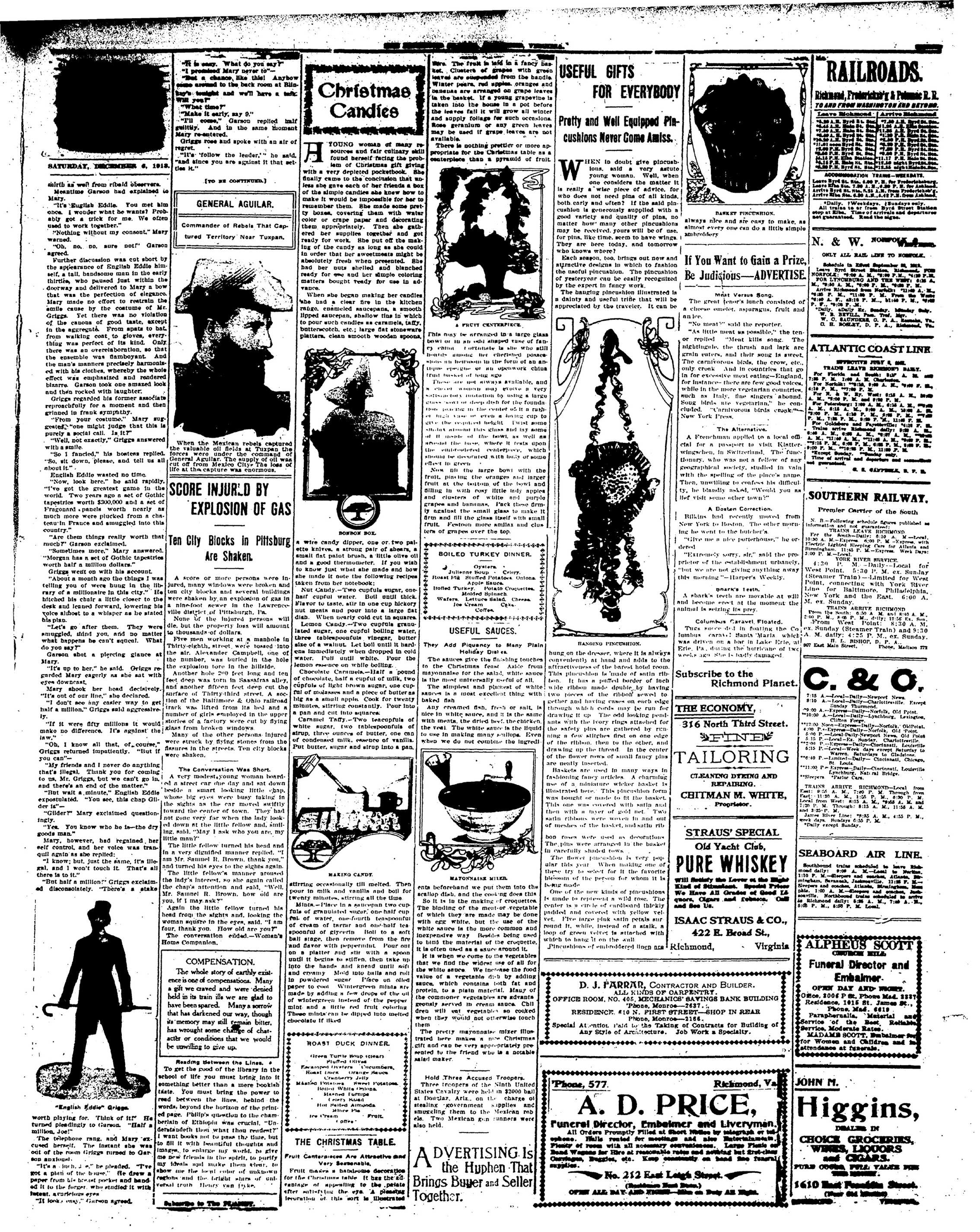
Christmas Candies YOUNG woman of many resources and fair culinary skill found herself facing the problem of Christmas gift giving
with a very depleted pocketbook. She finally came to the conclusion that unless she gave each of her friends a box of the simple candies she knew how to make it would be impossible for her to remember them. She made some pretty boxes, covering them with water color or crape paper and decorating them appropriately. Then she gathered her supplies together and got ready for work. She put off the making of the candy as long as she could in order that her sweetmeats might be absolutely fresh when presented. She had her nuts shelled and blanched ready for use and her simple coloring matters bought ready for use in advance.
When she began making her candles she had a clear fire in the kitchen range, enameled saucepans, a smooth lipped saucepan, shallow in which to pour such candles as caramels, taffy, buttercotch, etc.; large flat stoneware platters, clean wooden spoons,
```markdown
```
DONBON BOX
a wire candy dipper, one or two palette knives, a strong pair of shears, a small fat paint brush, a little olive oil and a good thermometer. If you wish to know just what she made and how she made it note the following recipes taken from her notebook:
Nut Candy.--Two cupful sugar, one half cupful water. Boll until thick flavor to taste, air in one cup hickory nut meats and pour into a large fat dish. When nearly cold cut in squarea Lemon Candy.--Two cupful granulated sugar, one cupful boiling water, three tablespoonful vinegar, butter size of a walnut. Let boll until it hardens immediately when dropped in cold water. Boll until white. Pour the lemon essence on white boiling.
Chocolate Caramels.-Half a pound of chocolate, half a cupful of milk, two cupfuls of light brown sugar, one cupful of molasses and a piece of butter as big as a small apple. Cook for twenty minutes, stirring constantly. Pour into a pan and cut into squares.
Caramel Taffy.-Two teacupfuls of white sugar, two tablepoonfuls of sugar, three ounces of butter, one can of condensed milk, essence of vanilla. Put butter, sugar and sugar into a pan.
BREWERY
MAKING CANDY.
attiring occasionally till melted. Then pour in milk and vanilla and boil for twenty minutes, attiring all the time.
Mints.—Place in a gingerpan two cupsfuls of granulated sugar, one-half cupful of water, one-fourth teaspoonful of cream of tartar and one-half teaspoonful of glycerin. Ball to a soft ball stage, then remove from the fire and flavor with peppermint. Pour out on a platter and stir with a spoon until it begins to stiffen, then take up into the hands and knead until soft and creamy. Mold into balls and roll in powdered sugar. Place on oiled paper to cool. Wintergreen mints are made by adding a few drops of the oil of wintergreen instead of the pepper mint and a little red fruit coloring. These mints can be dipped into melted chocolate if liked.
(Green Turtle Soup (clear)
Huffed Milk)
Farmer's Herbs (Cucumbers)
Hoot Duck (Orange Sauce)
Cranberry Jelly)
Mashed Potatoes (Sweet Potatoes)
Honey White Oranges
Mashed Turnips
Celery Root
Hut Nectar Almonds
Mince Pie
Ice Cream
Fruit
Coffee
THE CHRISTMAS TABLE.
Fruit Centerspieces Are Attractive and Very Sensible.
Fruit makes a bamboo decorative for the Christmas table. It has the advantage of appearing to the palate after satisfying the eye. A pleasing decoration of this sort is illustrated.
Here. The fruit is laid in a fancy basket. Clusters of grapes with green leaves are arranged from the handle. Winter pears, red apples, oranges and bananas are arranged on grape leaves in the basket. If a young grapevine is taken into the house in a pot before the leaves fall it will grow all winter and supply foliage for such occasions. Rose geranium or any green leaves may be used if grape leaves are not available. There is nothing prettier or more appropriate for the Christmas table as a centerpiece than a pyramid of fruit.
A FREIT CENTERPIECE
This may be arranged in a large glass bowl or in an odd shaped tube of fancy china. fortunate is she who still honours among her cherished possessions an hourglass in the form of an antique ephegia or an openwork china trunk basket of long ago.
These are not always available, and a short woman may evoke a very satisfactory imitation by using a large glass bowl or deep dish for the foundation placing in the center of it a ruthenium vase or even a loving cup to give the required height. Iwist some shiny around this glass and lay some of it inside of the bowl, as well as around the base, where it rests upon the encircled centerpiece, which should be dissolved with body or some effect in green.
Now fill the large bowl with the fruit, placing the oranges and larger fruit at the bottom of the bowl and dilling in with rosy little lady apples and clusters of white and purple grapes and bananas. Pack these firmly against the small glass to make it firm and fill the glass itself with small fruit. Festoon more amilax and clusters of grapes over the top.
BOILED TURKEY DINNER.
Oysters.
Julienne Soup.
Celery.
Roast Ink. Stuffed Potatoes. Onions.
Apple Sauce.
Holled Turkey. Potato Croquettes.
Molished Spinach.
Wafers. Lettuce Salad. Cheese.
Joe Cream.
Coffee.
They Add Piquancy to Many Plain Holiday Dishes
The sauces give the finishing touches to the Christmas feast. Able from mayonnaise for the salad, white sauce is the most unreally useful of all.
The simplest and pliestest of white sauces is a most excellent thing with baked fish
Any creamed fish, fresh or salt, is nice in white sauce, and it is the same with meats, the dried beef, the chicken, the veal. The white sauce is the liquid to use in making many saillops. Even when we do not combine the ingredi
MAYONNAIRE MILKER
ents beforehand we put them into the
scallop dish, and the cooking does this
So it is in the making of croquettes. The binding of the meat-or vegetable of which they are made may be done with egg white, but the use of the white sauce is the more common and inexpensive way. Besides being used to bind the material of the croquette, it is often used as a sauce around it. It is when we come to the vegetables that we find the widest use of all for the white sauce. We increase the food value of a vegetable dish by adding sauce, which contains both fat and protein, to a plain material. Many of the commoner vegetables are advantageally served in cream sauce. Children will eat vegetables so cooked when they would not otherwise touch them. The pretty mayonnaise mixer illustrated here makes a nice Christmas gift and can be very appropriately presented to the friend who is a notable salad maker.
---
Hold Three Accused Troopers.
Three troopers of the Sixth United States Cavalry were held in $2000 ball at Douglass, Artz. on the charge of stealing government supplies and smuggling them to the Mexican robbers. Two Mexican gun runners were also held.
ADVERTISING Is the Hyphen That Brings Buyer and Seller Together.
D. J. FARRAR, CONTRACTOR AND BUILDER. ALL KINDS OF CARPENTRY. OFFICE ROOM, NO. 405, MECHANICS' SAVINGS BANK BUILDING 'Phone, Monroe—2637. RESIDENCE. 610 N. FIRST STREET—SHOP IN REAR Phone, Monroe—2166. Special Attention Paid to the Taking of Contracts for Building of Any Style of Architecture. Job Work a Specialty.
Funeral Director, Embalmer and Liveryman.
All Orders Promptly Filled at Short Notice by telegraph or telephone. Halls rented for meetings and also Entertainment. Plenty of room with all necessary conveniences. Large Plots on Band Wagons for Hire at reasonable rates and notifying but first-class Carriages, Baggies, etc. Keep constantly on band free funeral supplies.
Pretty and Well Equipped Pincushions Never Come Amiss.
WHEN in doubt give pincushions, said a very astute young woman. Well, when one considers the matter it is really a wise piece of advice, for who does not need pins of all kinds, both early and often? If the said pincushion is generously supplied with a good variety and quality of pins, no matter how many other pincushions may be received, yours will be of use, for pins, like time, seem to have wings. They are here today, and tomorrow who knows where?
Each season, too, brings out new and attractive designs in which to fashion the useful pincushion. The pincushion of yesteryear can be easily recognized by the expert in fancy work.
The hanging pincushion illustrated is a daunting and useful trifle that will be appreciated by the traveler. It can be
```markdown
```
HANGING PINCERION.
bung on the dresser, where it is always conveniently at hand and adds to the attractiveness of the barest hotel room. This pincercion is made of satin ribbon. It has a puffed border of inch wide ribbon made double, by having two pieces of the ribbon newel to gather and having cases on each edge through which cords may be run for drawing it up. The odd looking pendants with the ivory rings attached for the safety pins are gathered by running a few stiffest first on one edge of the ribbon, then to the other, and drawing up the thread. In the center of the flower rows of small fancy pins are neatly inserted.
Baskets are used in many ways in fashioning fancy articles. A charming use of a miniature wicker basket is illustrated here. This phasedon form was bought or made to fit the basket. This one was covered with satin and then with a layer of gold net. Two satin ribbons were woven in and out of meshes of the basket, and satin ribbon roses were used as decorations. The plus were arranged in the basket in carefully shaded rows. The flower phasedon is very popular this year. When making one of these try to select for it the favorite blossom of the person for whom it is being made.
One of the new kinds of pinceauhions is made to represent a wild rose. The center is a circle of cardboard thickly padded and covered with yellow velvet. Five large pink satin petals surround it, while, instead of a stalk, a loop of green velvet is attached with which to hang it on the wall.
BASKET FINCUNION.
always nice and are easy to make, as almost every one can do a little simple amphibians.
If You Want to Gain a Prize Be Judiqious—ADVERTISE
If You Want to Gain a Prize Be Judiqious—ADVERTISE
Meat Versus Song.
The great lenoir's lunch consisted of
a cheese omelet, asparagus, fruit and
an ice.
"No meat!" said the reporter.
"As little meat as possible," the tenor
replied. "Meat kills song. The
nightingale, the thrush and lark are
grain eaters, and their song is sweet.
The carnivorous birds, the crow, etc.
only crank. And in countries that go
in for excessive meat eating--England,
for instance--there are few good voices,
while in the more vegetarian countries,
such as Italy, the singers abound.
Song birds are vegetarian," he concluded.
New York Press.
The Alternative.
A Frenchman applied to a local official for a passport to visit Klatterwingschen, in Switzerland. The functionary, who was not a fellow of any geographical society, studied in vain with the spelling of the place's name. Then, unwilling to confess his difficulty, he blandly asked, "Would you not visit some other town?"
A Dosten Correction.
Rikks had recently moved from New York to Boston. The other morning he went to the butcher's.
"Give me a nice porterhouse," he ordered.
"Extremely sorry, sir," said the proprietor of the establishment urbanly, "but we are not giving anything away this morning—Harper's Weekly."
Dark's Teeth.
A shark's teeth are movable at will and become erect at the moment the animal is seizing its prey.
Columbus Caravel, Floated.
Tux succeed in floating the Columbus caravel Santa Maria, which was driven on a bar in Lake Erie, at Erie, Pa., during the hurricane of two weeks ago. She is badly damaged.
Subscribe to the Richmond Planet.
THE ECONOMY,
316 North Third Street.
FINE
TAILORING
CLEANING DYEING AND
REPAIRING.
CHITMAN M. WHITE,
Proprietor.
STRAUS' SPECIAL
Old Yacht Club.
Will Satisfy the Lever on the Night
Kind of Stimulant. Special Fees
We Have All Grades of Good Liquor,
Cigars and Tobacco. Call
and See Us.
ISAAC STRAUS & CO.,
422 E. Broad St.,
RICHMOND, Virginia
DRACTOR AND BUILDER.
DARPENTRY.
COS' SAVINGS BANK BUILDING
2637.
STREET—SHOP IN REAR
2166.
ing of Contracts for Building of
Job Work a Specialty.
RAILROADS.
N. & W. NORFOLM
ONLY ALL RAIL LIFTS TO NORFOLM.
Schedule in Effect September 11, 1913.
Leave Byrd Street Station, Richmond, FOB
NORFOLM: °0:00 A.M., °5:00 P.M., °1:10 P.M.
FOR LYNCHBURG AND THE WENT: 0:15 A.M., °0:50 A.M., °0:00 P.M., °0:50 F.M.
Arrive Richmond from Norfolk: 11:40 A.M., °0:25 P.M., °11:50 P.M., From the Went
°0:40 A.F., °1:10 P.M., °1:40 P.M., °0:40 F.W., °0:00 F.M.
Daily, eDaily Kx, Sunday, Monday Only.
W. R. BETILL, Pam. Trof, Mgr.
W. O. SAUNDER, O. P. A., Rankman, Va.
O. H. BOLLEY, D. P. A., Richmond, Va.
ATLANTIC COAST LINE
# WILLIAMS
For Virtan and South; 8:3F A. M. and
7:5F M. I. 1:00 A. M. Corporation.
For Norwich; *8:10F, 9:00 A. M., *9:00 F. M.
6:10 P. M., *7:70 F. M.
For N. & W. Ry. West; 8:25 A. M., 8:00
A. M., *8:00 P. M., and 8:00 F. M.
A. M. "4:00 P. M. and 9:00 P. M.
M. A. "4:00 P. M. and 9:00 P. M.
M. A. "8:15 A. M. and 9:15 A. M.
M. A. "8:15 A. M. and 9:15 A. M.
A. M. "4:00 P. M. and 9:00 P. M.
M. A. "7:15 P. M. and 9:20 P. M.
M. A. "7:15 P. M. and 9:20 P. M.
For Oakdale and Payetteville: "4:15 P. M.
Daily; "4:15 P. M.
Total A. M. "8:00 P. M. and "9:00 P. M.
A. M. "11:00 A. M. and "11:00 A. M. "9:00 P. M.
A. M. "2:15 P. M. and 6:05 P. M. and 6:05 P. M.
Oakdale: "11:00 P. M. and 11:00 P. M.
*Except weekend, Sunday only.
Time of arrival and departure and commuter and guaranteed.
G. R. CAYKELP. R. P. M.
SOUTHERN RAILWAY
Premier Carrier of the South
N. B.-Following schedule figures published as
information and not guaranteed.
LEAVE RICHMOND
For the South End, A. M.-Local,
10:30 P. M.-Express, 6:00 P. M.
Electric Lighted Sleeping Care for Atlanta
and Birmingham, 11:45 P. M.-Express, Week Days
5:00 P. M.-M.-Express
YORK RIVER SERVICE,
4:20 P. M.-Daily--Local for
West Point, 6:30 P. M. ex. Sunday
(Steamer Train)--Limited for West
Point, connecting with York River
Line for Baltimore, Philadelphia,
New York and the East, 6:00 A.
M. ex. Sunday.
TRAIN ARRIVE RICHMOND
From the South: 6:00 A. M. and 8:40 A.
M. 8:40 P. M.-daily, 12:55 E. Sun.
From the North: 8:30 A. M.
M. ex. Sunday (Steamer Train) and 9:30
A. M. daily, 4:25 P. M. ex. Sunday.
H. H. HISTORY
007 East Main Street. Phone, Madison 272
C. & O.
7:15 A.—Local—Daily—Newport News.
8:10 A.—Local—Daily—Charlotteville. Except
Sunday Thurmond.
5:00 A.M.-Fripps-Daily-Norfolk, Old Point.
=10:00 A.M.-Lynchburg, Lexington, Lexington.
Clifton Fife,
**12:00 Noon—Express—Daily—Norfolk, Old Polet.
6:00 P—Express—Daily—Norfolk, Old Polet.
6:00 P—Local-Daily-Newport News, Old Polet.
6:00 P—Local-Knox, Sunday, Charlottetown.
**2:00 P—Express—Daily—Chelsea, Louisville.
6:00 P—Local-Week days except Saturday to
Warren, Saturnsay to Gladstone.
**6:40 P - Limited-Daily - Cincinnati, Chicago,
11:00 P - Express-Daily - Cincinnati, Louisville
Lynchburg, Natural Bridge.
**Sleeper *Polar Care.
TRAINS ARRIVE RICHMOND-Local from
East: 9:55 A. M., 7:40 P. M. Through from
Past: 11:30 A. M., 11:55 P. M., 6:00 P. M.
11:30 A. M., 11:55 P. M., 9:55 A. M. and
11:55 P. M. Through: 8:15 A. M., 11:35 A. M.
and 8:55 P. M.
James River Line: 7:85 A. M., 4:55 P. M.,
11:35 Days, Saturnsay 5:55 P. M.
SEABOARD AIR LINE
Southbound trains scheduled to leave Richmond daily: 9:08 A.M. M.-Local to Norfolk, 1:10 P.M. M.-Glipseep and coach, Atlanta, Birmingham, Savannah, Jacksonville, 11:15 P.M. M.-Glipseep and coach, Atlanta, Birmingham, Memphis, Jacksonville, 11:15 P.M. M.-Glipseep and coach, Atlanta, Birmingham, Memphis, Jacksonville, Northbound trains scheduled to leave Richmond daily: 8:55 A.M. M., 7:08 A.M., 8:50 P.M. M., 8:50 P.M. M.-Local.
ALPHEUS SCOTT
CHURCH MILLS
Funeral Director and
Embalmer
OPEN DAY AND WEEK.
Office, 2006 P St., Phone Mad. 2337
Residence, 1015 St. James St.,
Phone, Mad. 6619
Paraphernilla, 'Material and
Service' of the Best, Reliable
Service, Moderate Rates.
MADAMB SCOTT, Embalmer for
for Women and Children and in
attendance at funerals.
JOHN M.
Higgins,
DEALER IN
CHOICE GROCERIES,
WINE, LIQUORS
and CIGARS.
PURE OOZS, PULL, VALUE PER
TWO BOXES.
1610 East Franklin Street.
(New 60d House)
Published every Saturday by JOHN MITCHELL,
JR., at ELL M. Fourth Street, Richmond, Va.
JOHN MITCHELL, JR., ... EDITOR
All communications intended for publication would be sent as to result as by Wednesday.
TERM IN ADVANCE
One Copy, per year ..... $11.95
One Copy, eight months ..... 1.00
One Copy, six months ..... 3.88
One Copy, four months ..... 5.84
One Copy, three months ..... 6.88
Magic Copy ..... 6.88
ADVERTISING RATER
For one such case insertion.....0.04
For one such same subsequent insertion.....0.04
For two inches, three months.....0.00
For two inches, six months.....10.00
For two inches, nine months.....10.00
For two inches, twelve months.....10.00
Marriage and Funeral Notice, one Ish.....0.00
Marriage and Transient Notice, per line.....0.00
POSTAGE STAMPS OF A HIGHER DENOMINATION THAN TWO CENTS NOT-RECEIVED ON SUBSCRIPTIONS.
THE PLANET is bound wroxly. The subscription is in $1.50 per year, in advance. There are four ways by which money can be sent by mail at our rank: In a Post Office Order, by Bank Check or Draft, or an Express Money Order, at the when of these can be promised, in a Registered Letter.
MONEY ORDERS—You can buy a Money Order at your Post Office, payable at the Richmond Post Office, and we will be responsible for its to arrival.
EXPRESS MONEY ORDERS can be obtained at any office of the American Express Co., the United States Express Co., and the Wells Fargo Company, for money sent by say of these companies. The Express Money Order is a sale and convenient way for forwarding money.
REGISTERED LETTER.—Money Order, at any office of the American Express Co., is not within your reach, your Postmaster will Register the Letter you wish to send us an payment of two cents. Then, if the Letter is lost or stolen, it can be traced. You can send money in this form.
We cannot be responsible for money sent in letters in any other way than one of the four ways mentioned above. If you need your money in any other way, you must do it at your own risk.
MANWALL ETC.—If you do not want THE PLANET conditioned for another year after your subscription has run out, you then notify in by Postal Card to discontinue it. The courts have decided that subscribers to newspapers who do not order their paper discontinued at expiration date will be paid and liable for the payment of the subscription to date when they order the paper discontinued.
COMMUNICATIONS.—When writing to us to renew your subscription or to discontinue your paper, you should give your name and address in full otherwise we cannot and your name on our brochure.
CHAUSE OF ADDRESS.—In order to change the location of a subscriber we must not post the letter as well as the present address.
Entered at the Post Office at Richmond, Va. on second matter.
SATURDAY, DECEMBER 6, 1913.
The Philadelphia Tribune, which is synonymous with C. J. Perry, came to us as a seven column journal and the announcement that it has moved into its nine thousand dollar home. It deserves the success it is enjoying and we congratulate Friend Perry, and his hustling associate G. Grant Williams.
Ragtime music, in conjunction with dance halls may not lead its patron straight to hell, but it will stop them on the way at a jail or a penitentiary. --Richmond PLANET.
Gospel, facts--always had it in our think tank that Editor Mitchell was cut out for a preacher--Martinsville, W. Va. Pioneer Press.
Yes, and everytime we put on our long-tailed Prince Albert coat, they call us one.
PRESIDENT WILSON'S MESSAGE.
President Woodrow Wilson's brief message to the Congress of the United States has met general favor and commendation on account of the fact that it makes no radical declarations to upset financial conditions and to stagnate business. Even the Mexican situation is handled in a manner to discount the utterances of the sensationalists and to emphasize the fact that the peaceful policy of the administration will be pursued to the end.
If a conflict ensues as a result of these plans, it must be precipitated by the Mexican dictatorship now in control at the capital of that distracted country. Still we must admit that the references to the defacto government in Mexico are not the utterances of a diplomat. It indicates that President Wilson's patience has been wrought up to the breaking point. He denominates him as "Gen. Huerta" and Victoriano Huerta, but never as President Huerta.
With the lights before us, and gauged by modern standards of morality and upright living we have not been able to see how President Wilson could have conscientiously pursued any other course. The dark pall of suspicion resting over the national capital of Mexico and hanging like an omen of evil over the National Pahoon itself would seem to stand
indicate that the recognition that President Taft denied should have been withheld by his brilliant successor. The message is one of the best ever delivered by a President and will do much to strengthen his party in Congress.
THE NEWS-LEADER'S APPEAL
It is indeed a fact that the white press of this city can do more to facilitate and increase the friendly feeling between the white and colored people of this community than any other agency. That the colored people have friends among the stockholders and the editorial management of these newspapers, does not admit of a question. This fact has been emphasized by a rather remarkable appeal in the Richmond, Va. News-Lender of the 25th ulto. It says:
In approving the proposal to use the Virginia hospital for the care of the city's sick, the finance committee has met the wishes of the people of Richmond.
This arrangement will, at small cost, provide a hospital where the honest workingman and the artisan can receive medical attention without being domiciled with paupers. It will also give the Medical College of Virginia clinical material of great value, and it will insure to the city's sleek the best possible medical and surgical attention. As a large part of the Virginia hospital, is comparatively new, improvements will not be costly and maintenance will not be expensive.
But if the action of the finance committee means that no provision is to be made for the colored sleek of the city, that action needs review.
This is a broad, catholic, humanitarian view to take of the situation. It says further.
Richmond negroes are among the best and most law abiding in the world. They suffer from the misconduct of the disreputable element, but in the main, they are prosperous, self-respecting and thrifty. Moreover, they are being decimated by disease and are suffering from the lack of medical attention. Our tuberculosis death rate for Negroes is appalling in Virginia---256 the 100,000 of population per annum. Heart disease, bronchial complaints and other ailments without number affect them. From a purely selfish viewpoint, we must protect ourselves by caring for our Negroes; from a broad standpoint of humanity, we must give them better sanitation and abundant hospital facilities.
To add to or take away from any thing said by this far seeing Viginia, newspaper would injure rather than benefit, destroy the force of the state ment rather than emphasize the truth therein contained. We venture the assertion though, the "Riemond white folks are among the best and most law-abiding in the world. They do not suffer from the misconduct of a dispathetic element for the reason that they are kept under absolute control. It continues:
As the matter stands today, the Negro who needs hospital treatment and does not wish to leave the city has no other alternative than to go to one of the small private hospitals operated by Negro physicians. He can go to the almshouse, if he can endure the humiliation, or he can accept a free bed in the colored ward of the Memorial hospital. But beyond this he has no way of procuring in a hospital the attention of a competent white physician. Do Richmond people want this continued, or do they wish the city to build a hospital where the self-respecting colored man can get medical attention? We know the answer and the council knows it. A hospital for the colored people we must have, and if it can be in connection with the Medical College of Virginia, so much the better.
Let us hope that the News Leader's appeal may be answered and that the proper arrangements will be made for the class of people who need it most. In the meantime, let us help ourselves while other people are helping us and do what we can to make the Richmond Hospital all that
It should be by providing the necessary funds to, give it the most improved facilities for the carrying on of the work it was intended to do. Thousands of white folks are our best friends. Thousands of colored folks are their own worst enemies. Self-help is the watch-word and progress our guiding star. With the white people helping us at the Virginia Hospital and we helping ourselves at the Richmond Hospital our health condition must necessarily be improved and our death rate curtailed. Let us take courage.
WANTS TO KNOW
The Rock Hill, S. C. Messenger says:
What is the basis of operation of the Colored Pythians of the State of Virginia? We notice from the Richmond PLANET that there still seems to be something doing among them, when the fact is, according to information received hereabouts, the warrant of the Grand Lodge of that jurisdiction has been arrested by the Supreme Lodge. If it is not asking too much of The PLANET, will it please explain?
We are not sure that we understand our contemporary. It seems
to be wondering how a live body can be dead and a dead body alive. The Grand Lodge, Knights of Pythias of Virginia, N. A., S. A., E., A. and A. is incorporated under the laws of the State of Virginia and within those state lines is legally independent, and will remain so until its charter of incorporation is legally revoked by the State of Virginia. It is making new members and it is paying its death claims. It owns about thirty thousand dollars worth of property. Its fraternal charter has not been lawfully revoked by the Supreme Lodge, although an unlawful effort was made to do so at the Baltimore session of the Supreme Lodge. Neither the Supreme Chancellor nor his deputy can lawfully cross the Virginia line and come into this state to set up either a subordinato lodge or a 'grand lodge. We have the "triggers set" to get any one of them should he come.
The basis of our operation then is our-charter granted by the State of Virginia and the fraternal charter granted by the Supreme Lodge, which charter has not as yet been lawfully revoked. As the Supreme Lodge was taking out of this state two thousand dollars per term, and not giving the state anything but the password, it would seem that Virginia could better afford to do without the Supreme Lodge than the Supreme Lodge can do without Virginia.
The Supreme Lodge, Knights of Pythias, N. A., S. A., E., A. A., and A. under the present "ring" leadership and consequent abolition of its own constitutional laws seems to be having a stormy time of it. In fact it seems that the Nemesis of till luck is camping upon its trail.
The country was startled by the report that Supreme Chancellor S. W. Green had been mobbed and lynched in Florida for riding in a Pullman car. As a matter of fact he had been forced to run into the "Jim Crow car" from the Pullman car, and then to shut himself in the toilet to escape the mob. Finally, he was taken from the train and put in jail at Milton, Florida. He paid a fine and was released. The Supreme Looke after an extended discussion of the outrage failed to adopt resolutions condemning the same or to take any legal steps concerning the lawlessness.
As a result of the recent fire at Hot Springs, Arkansas, the Crystal Bath House in which the Supreme Lodge had invested more than twenty two thousand dollars was destroyed. It had been previously operated at a financial loss apt the squabbles over the management were in the nature of a national scandal. Then came news of the murder of William Alexander. National Gramp Master of the Mosaic Templars of America at Frankfort, Kentucky, in the office of Dr. E. E. Underwood, the recently elected Supreme Keeper of Records and Seal of the Supreme Lodge.
Dr. Underwood is a reputable physician of high standing, but it only remained for him to accept the office vacated by that veteran official C. K. Robinson of Missouri, for his office to be turned into a veritable "charnel" house by a turn of "the wheel of fortune." That any one could have selected such a place for such a purpose is the mystery of the century. A crime like this might have been committed in a dive, a gambling house or a bar-room in the "red light district," but that it should have been "staged" in the office of such a gentleman as Dr. Underwood is something past finding out.
Then came the tragedy in New Orleans, Louisiana. J. A. Brown better known as "Jankle" Brown was called from a harber shop in the Pythian Temple Building, in which building he was employed as Executive Secretary to Supreme Chancellor S. W. Green at a salary of one hundred dollars per month, and fatally shot five times by a woman of the "red light district" with which woman he had been admittedly cohabiting.
Brown was the son of Supreme Chancellor S. W. Green's wife and had been given Past Grand Chancellor's honors at Baltimore. He was good-natured and friendly, but his life was snuffed out. He leaves a widow, to whom he had been married but a short time.
In addition to all of this, despite the declaration of the legal department of the Order that the recent decision of the Supreme Court of the United States had settled the status of the Knights of Pythias in all the States, the members of the Order in Tennessee are still in the throes of a law-suit and the Supreme Chancellor and his associates are trying to collect taxes from this over-burdened state.
"The mills of the gods grind slowly, but exceeding fine." "Righteousness exalteth a nation and sin is a reproach to any people." Let us hope that the leaders of this great Order will take warning. It looks as though "the handwriting is on the wall" and that the beginning of the end is at hand. Golish.
PETER H.
EGGS AT 25 CENTS, PLAN OF FARMERS
Propose to Chicago Boycotters to Sell Consumers Direct
Illinois farmers extended the right hand of cooperation to the women of Chicago who have taken up the budgels against high priced storage exports and proposed to the boycotters what they believe is a permanent solution of the question.
"We are organized and are willing to sell directly to the housewives of Chicago if they sell only insure us as a steady market," she said the substance of the message sent to the women by delegates who are attending the annual meeting of the Illinois Farmers' Institute.
The farmers are planning to establish cold storage plants in connection with their creations, and instead of selling their spare supplies of eggs to the cold storage, can they propose to store them. Then they can establish direct compaction with organizations of consumers and be sure of a steady market they can do out the product at 25 cents a dozen and have a good margin of profit.
Egg prices wavered as the boycott spread to many other cities in the country. Two large Chicago firms announced that markets would be opened in various parts of the city and eggs would be offered for 21 cents a dozen. The retail price predominating in Chicago was 48 cents.
Dispatches from Detroit, St Paul, Kansas City, Baltimore, Washington and a dozen other large cities told of club women who would not buy eggs until the price dropped at least three cents a dozen.
Federal District Attorney Wilkerson has begun planning for a sweeping grand jury investigation of charges against men who own stored eggs in Chicago, with a view to bringing criminal proceedings. The district attorney has promised to bring about the prosecution of members of the Chicago butter and egg board as members of a trust in restraint of trade before the end of the week.
THREE MAY DIE OF BURNS
Two Children and Mother Near Death
Taken From Blasting Home
Mrs. Irvin Derk and her sons, Harry, three years old, and Howard, two months old, were probably fatally burned when their home at Sharp-town, a suburb of Shamokin, Pa., was destroyed by fire. The origin of the fire has not been learned. Robert Derk and several others rushed into the burning home and brought out Mrs. Derek and her children. The victims' clothes had been burned from their bottles.
Court House Bandit Road
Byrd Marton, who figured as one of the noted Allen gang which shot up the Hillsville, Va., court house in March, 1912, is dead in the federal prison at Moundsville, Va., where he was serving a term for illicit distilling.
Where Navy Gets Recruits
More men are enlisted for the navy in the states of New York, Pennsylvania and the District of Columbia than fro many other section, according to statistics compiled at the navy department.
Vegamen Rob Postoffice
Yergmen blew open the sale of the Youngstown postoffice, near Lowstown, N. Y., securing $2500 in money and stamps. The robbers escaped across the Niagara river to Canada in a boat.
Rear Admiral Clark Dead.
Rear Admiral John Howe Clark, former medical director of the navy, died in Amherst, N. H., of paralysis. He was seventy-six years old.
May Arrest Mrs. Pankhurst.
It is believed that when the White Star liner Majestic arrives at Plymouth, England, Mrs. Emmeline Pankhurst, who is returning from her tour in America, will be arrested and sent back to fall to complete her sentences of three years' imprisonment.
Mode of selected kindness. No wires to injure the hair or ears. Howery of imitation. This brush is used to clean hair, with companion to test power.
Change of Heart.
Parson Palinrose. Why do you think it was out of place for your father to say grace? Freddie. Because it was only a few minutes afterward that he was swearing over having to cave. Philadelphia Inquirer.
TUXPAN'S FALL REPORTED
Important Oil Port Sail to Have Been Captured by Rebels.
A private dispatch that was received in Mexico City, Mex., said that Tuxpan, an important port on the east coast and the key to the oil fields, had been taken by insurgents under General Cando Aguillar after a sharp fight.
Tuxpan is the distributing center for the oil produced by the Pearson syndicate, of which Lord Cowdray is the head. It has extensive contracts with the government of Mexico, the National railway system and the British government.
With practically all of northern Mexico in the possession of the rebels and the Constitutionalists holding important ports on both coasts, Mexico City may soon be incarced.
Locking money to run his government, his army threatened with mutiny and his coasts lined with foreign ships which, at any moment may establish a blockade. Huerta is confronted by three great perils.
SAYRES SAIL FOR EUROPE
White House Bride and Groom Leaves on Wedding Tour.
Mr. and Mrs. Francis Bowes Sayer the White House bride and grooms sailed from New York on Saturday for Europe on the George Washington. It is said that they will first visit London, going later to Paris and Berlin. The length of their stay abroad has not been announced. They were accompanied to the pier by President Wilson and Miss Eleanor Wilson.
$33,812,872 In Postal Savings
$33,027,570 in Postal Savings.
Postmaster General Burkinson reported to central on Tuesday that during the day an email on June 3 postal savings deposits increased from $20,270.4 to $21,979.4, and the number of deposit waits from $24,101 to $23,106. The average deposit has risen to $102. Upon the overall impact the system to the tampering of savings deposits amounts to $200,000 written into the bank.
Emperor on Throne 65 Years.
Emperor Francis Joseph of Austria celebrated the sixty-fifth anniversary of his accession to the throne. Only one governor, Louis XIV, of France has reigned longer. He was on the throne seventy-two years.
$3.50 Recipe Free.
For Weak Men.
Send Name and Address Today—You Can Have It Free and Be Strong and Vigorous.
We have in our possession a prescription for nervous debility, lack of vigor, weakened manhood, falling memory and lame back, brought on by excesses, unnatural drains, or the follicles of youth, that has cured so many worn and nervous men right in their own homes—without any additional help or medicine—that we think every man who wishes to regain his many power and virility, quickly and quietly, should have a copy. So we have determined to send a copy of the prescription free of charge, in a plain ordinary sealed envelope to any man who will write us for it.
This prescription comes from a physician who has made a special study of men and we are convinced it is the surent-acting combination for the cure of deficient manhood and vigor failure ever put together.
We think we owe it to our fellowmen to send them a copy in confidence so that any man anywhere who is weak and discouraged with repeated failures may stop drugging himself with harmful patent medicines, secure what we believe is the quickest-acting restorative, upbuilding, SPOT-POUCHING Remedy ever devised, and so cure himself at home quietly and quickly. Just drop us a line like this: INTERSTATE REMEDY CO., $895-Luck Building, Detroit, Moh., and we will send you a copy of this splendid recipe in a-plain ordinary envelope, free of charge. A great many doctors would charge $6.00 to $5.00 for merely writing out a prescription like this—but we send it entirely free.
SUPERIOR TO COPAIRA & INJECTIONS
SANTAL
MIDY
RELIEVED IN 24 HOURS
ELGIN WATCHES 1-2 PRICE
This $22.60 Brand Engraved Solid Gold ELGIN Watch
Warranted and Fully S guaranteed for 20 years. A
Thin Model Perfect Time Keeper
of Elgant Appearance. In Ladies' Cost's and
Young Men's sizes. Everyone should avail themselves
of the opportunity of securing one of those Elgins at
such an extremely low price. Never again will you
get such a bargain. Don't hesitate $END NOW.
THE ACME COMPANY, Mt. and Jubbors
Liberty Building, Sept. K., Columbus, Ohio
Send Post Office or Express Money Order. Do it now.
We call Elgin Watch a cheaper then any retail dealer in the world.
A GRADUATED ENDOWMENT of $300.00 for Only $3.00 Per Year. It Pays From $3.00 to $4.00 per week SICK DUES and a BURIAL BENEFIT of from $25.00 to $50.00 for Only $0.00 per year additional. It has a STRONG TREASURY and owns Much Property. District Deputies and Special Deputies will give information concerning the organizing of New Lodges in Virginia. The Female Department is known as
GRAND COURT,ORDER OF CALANTHE
IT PAYS $150.00 ENDOWMENT. The Cost Is Only $3.00 Per Year. It Pays SICK DUES of $3.00 Per Week and a BURIAL, BENEFIT of from $25.00 to $50.00.
For further information apply to
JOHN MITCHELL, JR., Grand Chancellor, 311 North Fourth Street, Richmond, Va.
THOMAS M. CRUMP, Grand Keeper of Records and Seal, 511 North. Third Street, Richmond, Va. or to MISS M. L. CHILES, Grand Worthy Register of Deeds, 114 West Leigh Street, Richmond, Va.
Female Embalmer.
MADAM LUCIE CHRISTIAN SCOTT is associated in business with her husband, Mr. Alpheus Scott. Madam Scott claims the honor of being the only Negro woman in the State of Virginia—holding a State license to practice Embalming, and is indeed, one of the few women in the United States, Embalming and Conducting Minerals. She ranks with the best in her profession.
She is prominent in fraternal organizations, namely: Courts of Calanthe, I. O. of St. Luke, I. O. of G. Samaritans, Household of Ruth, Tents, Sons and Daughters of Richmond, Shepherds of Bethlohem and Ideal Benefit Society.
Your Patronage and Influence will be greatly appreciated. Please remember that she is always at your service.
Reliable Service at Moderato Rates.
OFFICE: 3006 P Street, 'Phone, Madison 2337.
RESIDENCE: 1015 St. James St. 'Phone, Madison 6519.
JOHN H.
mankind, or no charge, no matter what condition may be, and restore you to perform the best and leading ones in the United States that I am one of the most wonderful world. I use nothing but herbs, not seeds, berries, flowers and plants in thousands that the most skillful physicians in America and Europe have given no cure for them.
My Medicines Cure the Pulse by sumption, Blood, Kidney, Bladder, trisquia, Sore Throat, Lung, Dyspnea, malaria in any form, Palm and Aloe Troubles, Bore, Skin Disease, all ticks plants, La Grippa, or Pneumonia, worst form without the use of a knife on face and body, Diabetes of Kidney noys. My Medicines cure any dea sorrhhoea and Syphilitic troubles a spc Medicines sent anywhere. P F in person on 1
mankind, or no charge, no matter what your disease, sickness or affiliation may be, and restore you to perfect health. Thousands of people the best and leading ones in the United States and Europe will tertify that I am one of the most wonderful beaches of all companies in the world. I use nothing but herbs, rota barks, gums, balmine leaves, needles, berries, flowers and plants in my medicines. They have cured thousands that the most skillful physicians and the best hospital physicians in America and Europe have given up to die, and said there was no cure for them.
My Medicine Oure the Pullicing Disease:—Heart Disease, Consumption, Blood, Kidney, Bladder, tructure, Piles in any form, Vertigo, Quinasy, Sore Throat, Lung, Dysgeia, Indigestion, Constipation, Rheumatism in any form, Palpe and Agnes of any kind, Colds, Bronchial Troubles, Bores, Skin Disease, all tching sensations, all Female Complaints, La Gripe, or Pneumonia, Wier, Carbunose, Bolia, Cancer in the worst form without the use of a knife or instruments, Hesena, Pimples on face and body, Diabetes of Kidneys or Bright's Disease of the Kidneys. My Medicine cure any dime so, no matter of what nature. Gonorrhoea and Syphilitic troubles a speciality.
Medicines sent anywhere. For full particular, send, write or call in person on 1
L. J. HAYDEN.
220 West Broad St.
220 West Broad St.. Richmond, Va.
D LODGE
Sythias of Virginia,
S. A., E. A. & A.
The Laws of the State of Virginia.
IN ENDOWMENT.
WMENT of $300.00 for Only $3.00
$3.00 to $4.00 per week SICK DUES
T of from $25.00 to $50.00 for Only
It has a STRONG TREASURY and
Special Deputies will give information
of New Lodges in Virginia.
Department is known as
ORDER OF CALANTHE
ENDOWMENT. The Cost Is Only
SICK DUES of $3.00 Per Week and
from $25.00 to $50.00.
In apply to
Grand Chancellor, 311 North Fourth
Grand Keeper of Records and Seal,
Richmond, Va. or to
and Worthy Register of Deeds,
Richmond, Va.
Embalmer.
1. 2. 3. 4. 5. 6. 7. 8. 9. 10. 11. 12. 13. 14. 15. 16. 17. 18. 19. 20. 21. 22. 23. 24. 25. 26. 27. 28. 29. 30. 31. 32. 33. 34. 35. 36. 37. 38. 39. 40. 41. 42. 43. 44. 45. 46. 47. 48. 49. 50. 51. 52. 53. 54. 55. 56. 57. 58. 59. 60. 61. 62. 63. 64. 65. 66. 67. 68. 69. 70. 71. 72. 73. 74. 75. 76. 77. 78. 79. 80. 81. 82. 83. 84. 85. 86. 87. 88. 89. 90. 91. 92. 93. 94. 95. 96. 97. 98. 99. 100.
L. J. HAYDEN
MANUFACTURER OF
Pure Herb
Medicines.
TO CURE ALL DISEASES,
OR NO CHARGES.
DO YOU LOVE HEALTH?
If so, call and see L. J. Hayden
Manufacturer of Pure Herb Medicines
220 West Broad Street. My
Medicines cure all Diseases.
what your disease, sickness or affliction health. Thousands of people, United States and Europe will testify to beaches of all complaints in the pots barks, gums, balances leaves, in my medicines. They have cared physicians and the best hospital physicians given up to die, and said there was living Disease:—Heart Disease, Constricture, Piles in any form, Vertigo, India, Indication, Constipation, Rheumatism of any kind, Colds, Bromeliad tching sensations, all Female Cancer, Carbuncles, Bells, Cancer in the life or instruments, Benoma, Pimple days or Bright's Disease of the Kidney, no matter of what nature. Specially, for full particulars, send, write or call
Richmond, Va.
---
SATURDAY DECEMBER 4, 1913
TO SWEEP NATION FOR V. FOR W.
Suffrage Delegates so Declare at Annual Convention
WILL WIELD A BIG BROOM
Together With the "Antis" They Will, March on House Rules Committee and Argue Their Cause.
Enthusiasm over reports on what already has been accomplished by the woman suffrage movement, and even greater enthusiasm over prophecies of what the future will bring forth, marked the formal opening sessions in Washington of the forty-fifth annual convention of the National American Woman Suffrage association.
In calling to order the delegates from all over the country, Dr. Anna Howard Shaw, president of the organization, declared:
"The time is past when we say, 'Please let women vote.' This has been changed to 'We demand an amendment to the federal constitution enfranchising women.'"
The Illinois suffrage victory this year was celebrated, six speakers from that state telling how the result had been accomplished. Three street meetings in various parts of the city were held, as will be done every day during the convention.
No greater ovation was given any speaker than to Mrs. Patty R. Jacobs, of Birmingham, Ala., when she declared that it was an "indictment of the southern woman's intellect" to say that she did not want the ballot. She was responding to the welcome to the convention by Mrs. Nina Allendar and Miss Alice Paul, of Washington.
Government ownership of railroads was suggested as a result of woman suffrage, when Miss Marie V. Smith, of New York, reported that difficulty had been found in getting reduced railroad fares for delegates.
Dr. Shaw exclaimed, "When we vote well own the railroads."
Suffrage legislation has been introduced or passed in various states this year on a unprecedented scale, according to the report of Mrs. Mary W. Dennett, at New York, corresponding secretary.
The suffragists, together with the "antis"—those opposed to "the cause"—will appear before the house committee on rules tomorrow and Thursday. Workers for "the cause" seek the appointment of a new house committee on woman's suffrage. All the rules committee can do is to hear the arguments pro and con and then report to the house favorably or unfavorably on the project.
Glorification of municipal life, reform of the schools, falls, poorhouses and saloons and a feminine influence in settling national and international problems, was prophesied for Illinois in an address delivered by Mrs. Ella S. Stewart, of Chicago. Mrs. Stewart formerly was president of the Illinois Equal Suffrage association and secretary of the national association.
"Without prophecying too much," she said, "we have faith to believe that the torch which has been lighted for Illinois women will illumine some of the dark places of government.
"The township suffrage is to open up a new era for the Illinois women of the farms. The women voters' broom will find its task."
"Voodoo" Doctors Practice in Cuba. A sensation was caused in Havana, Cuba, by the discovery of an alleged extensive organization among the groves of Cuba for the practice of witchcraft or "voodoolism." It is said that the negro wizards constitute a powerful trust. The revelation was made as a sequel to the recent murder of a white girl, six years old, in connection with a mysterious method of healing an all negro woman, to whom the child's blood was said to have been administered. It is generally reported that the "voodoolists" have relations with politicians who control their votes and protect them. Several crimes of a similar nature to the one which led to the discovery of the "voodoos" have been committed recently. The newspapers now call o congress to find a remedy.
---
Children See Mother Murdered
Five little children, the oldest thirteen and the youngest two years old were made homeless, heart-broken or phans when their stepfather, Frank Poll, of 4951 Thompson street, a grocer, drove the blade of a butcher knife through the neck of his wife, Mary, thirty years old. Creed for a part of a small fortune which she inherited from relatives in Italy prompted the murder. The man escaped. Poll married his victim, a widow, last July, according to the police and Father Paul Gettle, of the Church of Our Lady of Angels, performed the ceremony. Soon after, the latter said, the wife came into some money upon the death of a relative. Her husband, he said, immediately began to beset her for
some of it, but she always refused, because she wanted her children to share an advantage.
Those of the children, Jennie, thirteen; Willie, five, and Dominick, two years old, had trudged off to church an hour or so before their mother was killed, but for some reason Louis, twelve, and Helen seven, stayed at home. They were playing in another room, when they heard their mother's frightened voice raised in argument and the threatening tones of Pollil. Childishly curious, they crept to the door and peered into the other room. They were just in time to see their stepfather seize a knife from a table and start chasing his terrified wife around the room. A second later Mrs. Pollil, shrieking for help, dashed out of the door and into a rear alley, with the infuriatated husband close behind. The little ones followed as fast as their scared legs could carry them, crying to him not to harm 'their "Mamma."
Polli overtook the woman, and with one hand jabbed the blade entirely through her throat. He left the knife sticking in the wound and dashed away. The police searched several houses in the vicinity in the hope that he might have taken shelter in them, but he had vanished.
Man Killis Buck and Doe at One Shot. Because of the freak action of a bullet on the last day of the deer hunting season, R. C. Yocum, of Mapleton, near Carlisle, Pa., voluntarily laid information against himself and paid a fine of $100 for shooting a doe he had not aimed at.
Yocum had stationed himself at one of the deer crossings on the mountain near his home, when a large buck passed. He fired and hit the animal. The bullet mortally wounded the buck, but passed through its body on for more than 100 yards and killed the doe.
Old hunters say that such an incident has not hitherto occurred in the shooting annals of Pennsylvania...
Tbker have been seven convictions for the shooting of does in the Cumberland valley in the season just closed. Many dead does, however, have been found in the woods, abandoned by careless hunters.
---
Invalid Trials to Stop Suicide
After struggling desperately with her stalwart son in an attempt to prevent him from taking poison; Mrs. Elizabeth Kvot, an aged invalid, of Baltimore, Md., was fung from him and compelled to look on with horrified eyes as he took four tablets of poison.
The woman's cries brought neighbors to the house, and a policeman sent the man to St. Joseph's hospital. He is sinking rapidly.
The son is Albert Kvot, twenty-four years old. Several weeks ago he lost his job, and since then has been unable to get employment.
Dye In Needle's Eye Kills
Mrs. F. W. Keiferle is dead in Lewistown, Pa., after three weeks of terrible suffering from blood poisoning from the prick of a needle. On Oct. 22 she stopped over to pick a needle from the floor and, losing her balance, fell so that the eyelid end of the needle penetrated the palm of her right hand, causing a wound a quarter of an inch long, which immediately became infected. The needle's eye contained a small portion of red silk, which is said to be responsible for the infection.
Body of Missing Lawyer Found
The body of Attorney Henry J. Kotz, seventy years old, of Stroudsburg, Pa., who was the oldest member of the Monroe county bar, was found in Ackerman's mill dam, about a quarter mile from Stroudsburg's main street, by Irwin Bachman, a car shop foreman. Kotz has been missing for more than a month and, a systematic search had been made for him since.
---
Pennay Cuts Off Passes.
Notices were posted in the stations of the Pennsylvania railroad in Philadelphia that no more free passes will be issued to the families of officers or employees of the road in Pennsylvania after Jan. 1.
This will make it impossible for any relative of the president of the road, as well as of the humble section man, to ride free.
Doctor Dies Seeing Patient.
Dr. Robert Alvin Walker, fifty-eight years old, of Monterey, near Clarion, Pa., died suddenly in the home of Jacob Rosenhover, where he had gone to attend Mrs. Rosenhover.
Edward Griffith, church sexton of Groveville, near Trenton, N. J., was found dead in a swamp. In crossing a marsh he had become mired and drowned in six inches of water.
Shot as She Opens Door.
Mrs. Dorei Galderston, the wife of Ernest Balderton, of Newtown, Pa., shot as she stepped to the back door of her house. Kies in the Mercer hospital in a critical condition. The woman left the breakfast table to do an errand. As she opened the back door there was a loud, though distant, report, and she screamed. Her husband and children rushed to her side. A bullet had entered her body. The surgeon located the bullet by the aid of an X-ray. It lies directly over the heart. The authorities are looking for the man who fired the shot.
---
Reading Laye Off 1000 Men
One thousand men employed in the various shops of the Philadelphia & Reading railway have been, laid off. Announcement to this effect was made in Reading, Pa. In announcing the lay-off it was explained that it was in accordance with the recent order issued to curtail expenses from 5 to 10 per cent. Every shop operated by the Philadelphia & Reading railway is said to have been affected by the order.
Tellis Congress He Waits Huerta's Collapse in Mexico.
URGES PRESIDENTIAL PRIMARY
Mr. Wilson Pleads For Early Action on Currency and Says Anti-Trust Law Should Stand, Supplemented by More Explicit Legislation.
President Wilson read his first annual message to congress on Tuesday at a joint session of both branches in the house chamber.
The message, among the briefest of documents of its kind from any president, and some 3000 words long, required less than thirty minutes for reading, though it treated upon a variety of subjects.
This was the third time the president had personally addressed congress, the two previous occasions being the expression of his views on the tariff and the Mexican situation. This was the first opportunity he had of communicating his views and recommendations regarding the state of the union.
The Mexican situation, President Wilson dismissed with brief comment, referring the Sentiments he expressed in a special address to congress upon the same subject some time ago, and expressed the belief that the Huerta government slowly was crumbling and that the United States probably would not be obliged to alter its policy of waiting.
The following are the other salient features in the message:
Currency.—The president pleads for early final action on the currency bill, and makes special point of the need of a rural credit system.
Anti-Trust Laws.—"I think it will be easily agreed that we should let the Sherman anti-trust law stand, unaltered, as it is, with its debatable ground about it, but that we should as much as possible reduce the area of that debatable ground by further and more explicit legislation." The president promises a special message on this subject later.
President Primaries—"I urge the prompt enactment of legislation that will provide for primary elections throughout the country at which the voters of the several parties may choose their nominees for the presidency without the intervention of nominating conventions."
Philippines—"We must hold steadily in view their ultimate independence, and we must move toward the time of that independence as steadily as the way can be cleared and the foundations thoughtfully and permanently laid."
Alaska—"Alaska as a storehouse should be unlocked. One key to it is a system of railways. • • • These the government should itself build and administer, and the ports and terminals it should itself control in the interest of all who wish to use them for the service and development of the country and its people."
Employers' Liability—"We owe it in mere justice to the railway employee of the country, to provide for them a fair and effective employer's liability act . . . Social justice comes first . . . We ought to address ourselves among other things to the prompt alleviation of the very unsafe, unjust and burdensome conditions which now surround the employ-ment of sailors."
GOES COOLLY TO HIS DOOM
Youthful Murderer, Caim While Slater and Mother Faint, Denice Crime. Displaying more bravery than any other murderer who was ever hanged in Sunbury, Pa., and even after his mother and slater, Mrs Katherine Macloney, of Philadelphia, and his sister-in-law, Mrs Albert Nye, of Pittsburgh, had fainted in his cell, Fred Nye paid the death penalty for the killing of Harry E. Miller, of Sunbury, by hanging in the Northumberland county fall yard.
The boy cheered his mother and relatives after they were revived and told Sheriff Glass that he would not cause any trouble. He went to his death in a talkative mood, denied committing the crime and blamed it on his companion, David Everitt. He never finched until the drop was made. Soon, after he was pronounced dead.
Nye was twenty years old. He was convicted of murdering Miller on Feb. 12, 1912, in Miller's poolroom in Sunbury. The motive was robbery. Nye and Everitt got $8, some chewing gum and the contents of a slot machine. Nye was soon captured, and his companion was arrested at Hazleton. On a train from Hazleton to Mount Carmel Everitt is said to have confessed, clearing himself of the actual murder. A jury hollowed his tale and he was sentenced to twelve years for manlaughter.
Killed In Runaway
George Dreher was found dying near his wrecked wagon just outside of Ordenburg, near Newton, N. J. He died soon after. Apparently his team ran away.
Mrs. and Miss Roosevelt on Way Home
Mrs. Roosevelt and Miss L. Margaret Roosevelt arrived at Lima, Peru, and continued their journey to Panama.
Postmaster F. M. Alltand, of Dillsburg, near Hariburst, Pa., declined to handle some parcel post mail. It was delivered to his office by the stage from Franklintown; and consisted of a skinned skin, duly placarded. The postmaster kicked it into the street, refusing to have it in his office.
CHINUANUA IS FREE OF FEDERALS
Evacuated by Federals Who Faced Starvation.
ARE FLEEING TO BORDER
Yuxpan Reported Taken by Robela and Siege of Mexico City Predicted in a Month.
Hasty reparations are under way in the ranks of the robels for the occupation of Chihuahua, the capital of the state of Chihuahua, Mexico, which is reported to have been evacuated by the Federals because of threatened starvation.
Pointing out that of the important Federal strongholds in the north only Monterey and Guaymas remain, General Francisco Villa, the rebel leader, at Mazee, said that Chihuahua would be made the base of aggressive activity southward.
Just when forces were sent to pursue General Salvador Mercado, Huerta's military governor, who is reported to be fleeing to the United States border at Ojinaga with 2000 nearly furnished soldiers, and Generals Orozco and Salazar, said to have taken to the mountains, Villa declined to say, but declared the rebel advance toward Mexico City would continue briskly.
"We will be shooting at the ramp parts of Mexico City within a month," said Villa. "We are confident that when the people in the capital realize that we have captured almost all the north and are in sight of the city's gates they will voice their feelings, which they are now afraid to do, and will clamor for the downfall of the warrior. A mob in the capital can oust Huerta in a day."
Near Rancheria the rebels came on the wreckage of two Federal troop trains which had crashed head on, one carrying defeated Federals from La Meson, the other bringing reinforcements to them.
In the wreckage were several wounded men and many dead. General Macchio Huerrera, commanding the rebels, wired to Villa that he had given assistance to the wounded Federalists and had buried the dead. Parts of the wrecked trains had caught fire after the collision, and wounded Federalists that many soldiers had been burned to death.
Coenel Joel Medina, chief of staff to General Villa, is in the El Paso county jail, charged with striking stolen rope to the value of $70 into the state. He was arrested when he came to El Paso.
GENERAL MARKETS
PHILADELPHIA - FLOOR QUARTER
winter clean, $3.00; 3.50; 4.00;
farm $4.50; 5.00;
RYE FLOOR film, at $3.00;
per barrel
WHEAT stady, No. 1; red, no. 5;
84½ lb.
OAKS work, No. 2; yellow, no. 5;
81½ lb.
OATS wean, No. 2; white, no. 15;
lower grades, 4½ lb.
POTATOES ready, bulk, No. 70;
6½ lb.
POULTRY live ground, bulk, No. 14;
17c; old rooters, 11; turkeys, 18;
18/20c; Dressed fillet, 11c; fowls, 18c;
old rooters, 11c; kegs, 23
6½ lb.
BUTTER fillet, frozen, one pint, near
by, 4½c; western, 43.
Live Stock Price:
CHICAGO - HOGS meat, bulk, of
sales, $7.60; 7.80; 8.10; 7.20;
mixed, $7.45; 7.55; 8.10; $7.30;
tough, $7.50; 7.60; $10.10
CATTLE study: $6.6299.50; Texas: $6.577.70; stock pers and theo, $3.507.40 news and heifers, $3.215.15; calves, $7.11; SHFIP week; active stock, $3.90796; year¶¶ers, $5.1216.50; Lumb, now five, $5.907.50.
Glue Poison For Medicine
"Take it and stop your coughing," said M. Louis Snyder, of Scranton Pa. to her five year old son Leo, Jr. placing a cup supposed to contain medicine to the boy's lips. The boy swallowed and tilt the floor writhing in axony, she and given him poison in mistake for medicine. The lad was resisted to the same hospital, where his condition improved after three hours' work by doctors.
Paralyzed by Spider's Bite
Representative B. R. Walter, of the Eleventh Georgia congressional district, was bitten by a spider while in a fishing camp. In half an hour he was paralyzed. Doctors were called and administered remedies, but his condition was no critical that he was removed to a hospital at Valdosta by special train.
Mahanoy City Newspaper Burned.
The plant of the Daily American of
Mahanoy City, Pa., was destroyed by
fire. The cause is unknown. The pub-
llication is owned by David M. Gra-
ham. The American will be issued
from the office of another newspaper.
The loss is about $30,000.
1913 DECEMBER 1913
S M T W T F S
1 2 3 4 5 6
7 8 9 10 11 12 13
14 15 16 17 18 19 20
21 22 23 24 25 26 27
28 29 30 31
Principal Owner of British Oil Wells Threatened by Rebels.
PETER H.
Man, 65, and Girl, 12. Want to Wed.
Judge Frank I. Duncan, of the circuit court in Baltimore, Md., declared that he license would be issued for the marriage of William Still, sixty-five years old, of Parkton, Baltimore county, and his twelve-year-old housekeeper, Bertha Grove.
Judge Duncan explained that while the law does not specify at what age persons may marry with the consent of their parents, his judgment would make him fortid the granting of the license because of the tender age of the girl.
William Still, accompanied by the girl, appeared at the Towson court house, and after showing the written consent of her parents to the marriage, asked for a license. He was refused because the paper was not signed by two other witnesses.
John Haines, of Wolfs' Mills, Snyer
dere county, near Sunbury, Pa., a farmer, was shot dead while moving around some brush. A party of hunters mistook him for game.
He Has Two Signatures.
There is one New York business man who is reasonably proof against the forger, as he has two signatures, and the forger must first get hold of one of his bank checks to get any action. Seeking the signature on a letter or hotel register would do the forger no good. The bank would not recognize it. "I don't particularly fear the forger," the business man admitted. "but my two signatures make me feel safer just the same. I am surprised that everybody doesn't bit on the same plan. It is very easy after you get the knack of signing your name two separate and distinct ways."—New York Globe.
The most ancient piece of English music in existence, "Summer is leavened in," is quite modern in comparison with a score of the "firestones" of Euripides, dating from the fourth century B. C., which was exhibited at the international exhibition of music at Vienna some years ago. Even more ancient is the chant "The Blessing of the Priests," which was sung in the temple of Jerusalem before the captivity and is still in use in the Jewish synagogue in Spain and Portugal.
Roosevelt or Mitchell, Which?
October 21st we sat in Congress during the discussion of the Naval Holiday bill.
When Speaker Chump Clark left the chair and during his remarks referred to "the distinguished traveler," we wondered to whom reference was made—Cincinnati, O. Pythian Monitor.
I am very anxious to get in touch with some of my people. I left my home, Ashville, N. C., in 1896 and for three years kept up a regular correspondence. Since then I have heard nothing of my people. My mother, Martha Ross and stop-father Brooks Ross were living at No. 10 Ann St., Ashville, N. C. My mother had two brothers Frank and Henry Swanson and one sister by the name of Hattie Alexander, whose husband's name was Jolus. Any information concerning them will be thankfully received. JOHN ADAMS, Box B, Dannomora, N. Y.
Agricultural & Mechanical COLLEGE.
Winter Term Begins December 4. '15.
Best Opportunities for Negro Youth.
Board, Lodging and Tuition $7.00
per month.
Write today for Catalog or free tuition. Address.
---
Hunters Kill Farmer
He Has Two Signatures
Mort Ancient Music
---
Do You Know Them?
OPEN ALL THE YEAR.
---
QUINADE
QUINA DAY
QUINA MB
SEEBY DRUG COMPANY, NEW YORK CITY, N.Y.
Come to see us in our New Home No. 310 E. Broad St. (Next to Weisberger's.) FASHIONS TERMS ITS GOOD ABRICKS Workmanship.
We Make You
ANNE
Your Promo
Popular Price To
'Phone Me
HAIR PARLO
To the Friends, Customers and the
MRS. ROSA E. WATSON I
St. James Street. You can be
formations and Pompadours. O
on short notice. Straightening,
Straightening, Combs, Orn
and preparations of all kinds f
812 ST. JAMES STREET,
Colored Post
We Make Your Clothes AND TAKE Your Promise to Pay. Popular Price Tailoring Co. Inc. 'Phone Monroe 1028.
Straightening Combs, Ornaments for the Hair, Hair Grasses and
Branches, for the Hair for the Hair. 412 N. 11, JAMES STREET,
RICHMOND, VIRGINIA.
WL08
WL08
WL08
OUR SPECIALITY
THE OLD RELIABLE MME
486-8th Avenue, (between 24th
HELLER'S
Established 1856. Older
YOU CAN HAVE STRAIGHT HAIR
Established 1856. Oldest Hair Store in the South. YOU CAN HAVE STRAIGHT HAIR IF YOU WANT IT.
SPECIAL THIS WEEK
Crowe Transformation
Pompadour or parted styles Real
Human Hair in Brown, Black or
Sandy—a real $3.50 value.
Special—We pay postage $1.50
Other People Judge You by Your Furniture Now
When you can get FURNITURE and RUGS from an Old Established house like JURGENS—that's known to sell the best quality goods. just as reasonable as elsewhere—why not give your friends a good impression; it will give us the greatest pleasure to show you our wonderful stock of home-making comfort giving Furniture and RUGS—and don't fail to ask our salesmen about our banking plan which gives you 5, 10, or 15 months in which to pay for any purchase CHAS. G.
JURGENS SON.
ESTABLISHED 1880. ADAMS AND BROAD.
S. W. ROBINSON & SON
DEALERS IN
HIGH GRADE
LIQUORS.
PHONE MONROE 2113.
19 and 21 N. 18th St.,
Richmond, Va.
WIGS, PLATS, BRAIDS, TRAN-
formations, Puffs, Etc.—All Shades,
Guarantee to Wash and Comb.
All Kinds of Straightening Combs,
Pomades and Skin Proparations.
Send two cent stamp for new 1912
Catalogue.
The Largest Manufacturer of Hair
Goods in the United States.
BAUM'S HAIR EMPORIUM,
and 35th Street) New York City.
HUMAN HAIR STORE
712 7th St.,Washington, D.C.
---
22 inches long—Wavy and Full. Made with 3 stems. Brown or Black. We have crimped hair if you prefer it. Special.....08c
NEW 1914 CATALOGUE.
We are the largest importers and manufacturer of cotton people's hair and the most reliable in this line. We make wigs, wristless braids, transformation and all styles of hair that can comb the same as your own. We also sell styling combs, hair nets and cut hair by the pound. We guarantee all our hair and our prices are lower than those on sale, whether good or not. Our stamp and we will end absolutely free our illustrated catalogue. Agreed wante
HUMANIA HAIR COMPANY.
Dept. D. 23 Duane St.
New York City.
A. Hayes,
Office and Ware-Booms,
727 NORTH SECOND STREET.
Residence, 726 N. 2nd St.
First-class Houses and Offices of
All Descriptions. I have a Spare
Room for BODIES when the Family
have not a suitable Place. All country
Orders are Given Special Attention to
the New Style OAK GARMENTS
Can and We No and You shall be
Wasted on Individuality.
SATURDAY, DECEMBER 4, 1913.
THE SCRAP BAG IS A USEFUL FRIEND
From Its Odds and Ends Many Holiday Gifts May Be Made.
DDS and tools of cretome, silk
linen or velvet should be
brought out when the Christmas gift gives slits down to
plain tokens that shall be both attractive and useful.
With these fabrics she can design bags of any sort, from daubly party or opera bags for the society girl to staple looking laundry or work bags for the housewife.
The house mother will appreciate a sewing bag like the one here illustrated. It is made of stout cretome and is knotted with plain material. A feature of this bag is its comfort. The
```markdown
```
NEWING BAG
top is gathered over a wooden embroidery hoop, and a cover is cut out of heavy cardboard to fit it. The cardboard is covered with cretonne and lined to match the inside of the bag. A band of elastic is sewed inside the cover, and in it is slipped a paper of needles of assorted sizes or a little needlebook supplied with them. Scaffors, bokkins, darning needles and a thimble case are added. Suspended inside are a little button bag and a pincushion well supplied with all sizes of pins. Two ribbons are added to the bag, by which it may be carried. Figured ribbon was used for making the dainty fancy workbag, which has two ribbon covered embroidery hoops
FANCY WORKDAY.
as handles. A wide band of the ribbon was gathered to the hoops to form the lower part of the bag, while inserted inside the circle were bands of the ribbon gathered on elastic. Inside the bag are pockets in which to place embroidery silk, needlebooks, scissors, etc. required by the fancy worker. The other bag illustrated is made with plain red ribbon combined with dressed ribbon. It is intended as a party bag for a girl. Made in rather smaller proportions, it will do for the accommodation of opern glasses, gloves and the fan for the theater. Canvas may be made into many daly articles. A big workbag or a
9
PARTY DAG.
bag for soiled, handkerchiefs or cotton is fashioned of cream white can be decorated with a simple design in
cross stitch. This is lined with pink or blue lawn, and the top is gathered over an embroidery hoop. Bewitching little powder puff bags are contrived from squares of sash ribbon, finished off with a frill of lace.
JEWELED TRIFLES
There Are Inexpensive | One That
Make the Keywords Get Heavy
Make the younger Bet Happy.
A charming gift for a pretty girl is one of the small watches worn on bracelets. Some of these are very attractive, and the one illustrated here has the additional morit of being odd and convenient, for it is set into a square mount that fits neatly on the bracelet.
There are many inexpensive trifles in the way of jewelry that may be given to one's friends as well as relatives at this season. Trinkets of this sort are always valued by the younger set. Novelies are what appeal most to the taste.
Buying a last minute jewel gift? Perhaps you know just what she wants and the choosing is easy. And perhaps you don't. If so and the gift is for December's child, why not select
PHASELIT WATCH
a turquoise? The turquoise is the stone for December, and it stands for prosperity.
All told, though, the diamond and the pearl are the most desired stones. The pearl should have an article all to itself, though, summed up briefly, its characteristics are whiteness, softness of texture and purity of luster. As for the diamond, it must have what has been called, liquid lusciousness—must be of the first water. In fact, the term "water" as applied to diamonds—"first water," etc. is not a captious term, but is directly applicable to the characteristics of the stone.
This liquid appearance is the first dominating quality which denotes the real thing. The artificial one lacks it. Note here that the chief difficulty in judging is between good gems and imitations, not between poor ones and imitations.
HANDKERCHIEF CASES.
These Will Be Gifts Prized by the Dainty Woman.
Handkerchiefs are standard gifts for Christmas. Quite the nicest way to present them is in a fancy box or case. A folding case of woven ribbon in white and pale green is illustrated here. It is lined with plain satin, and between the covers is a thick layer of wadding sprinkled with suet candle powder. A wreath of toes made from satin ribbon ornaments the front of the case, while ribbon ties attached to the front hold it securely together when the handkerchiefs are placed inside. Ribbon straps may be attached to the inner face of the handkerchief case or satin pockets as handkerchief holders.
A handkerchief case that will be flat, that will not take up much room, yet perhaps contain not only handkerchiefs, but many odds and ends of lace, tlen, etc., as well, that otherwise might tumble about and secrete themselves at the bottom of a trunk, as they invaria.
HANDERCHINE CASE.
bly do, just at the particular moment when they are most wanted, will be liked by the prospective traveler. The cost of the handkerchief case is small, and when finished it will be durable and always look clean, as it can be washed as often as it becomes soiled—a desirable point in traveling accessories. A very beautiful handkerchief box was covered with linen. The top of the box was adorned with a bird and a branch of a tree. The foliage was embroidered in satin stitch, but the bird was worked very evenly in long and short stitch. This stitch is particularly effective where used for the plumage of a bird. The embroidery was further enhanced by a darned background. It really gives a most exquisite effect. The entire surface of the linen is darned with small stitches in the softest shade of blue.
A spray of cherries makes a pleasing decoration for the top of one of these boxes. The background should be darned with ivory flosse.
Highest Church Steeple
The highest church stele in the world is that of the cathedral of Antwerp, 470 feet.
Although For a Time He Feels Dissolution Near.
HE BEARS UP. LIKE A MAN.
Meanwhile Mrs. B. Is Kept. Buay Attending to His Wants, Which Are Many—Invalid Recovera Through Sheer Power of Will.
By M. QUAD.
FOR ten days or more Mrs. Bowser had noticed that Mr. Bowser dragged one of his legs a bit when walking, and in going up and down stairs he aware several times under his breath. At length she asked:
"Have you had a fall or hurt your hip?"
"Of course not," was the reply.
"I notice that you limp."
"The shine on my right foot pinches a little."
"Oh, that's it. I didn't know but it was rheumatism. You've got wet several times lately."
"When rheumatism comes I'll take care of it."
She said no more, but the other evening she noticed that he had hard work getting up the steps and that he had a scared look in his eyes. He was very sober during dinner hour and for some time after, but after numerous sighs and grunts he suddenly exclaimed: "By John, Mrs Bowser, but what in thunder has got into my legs? I don't believe I can walk three steps." "It's rheumatism, probably," she replied, "and you ought to attend to it."
P.
WHAT IN THUNDER HAS GOT IN MY LEGS?
very sharply. Your legs must be well rubbed with lintine."
"You--you don't mean that I've actually got rheumatism!" he whispered as he grew white around the mouth.
"I'm sure of it. I think you've had it hanging around for some weeks."
"And rheumatism then a man up in knots and often goes to his heart and kills him like a bullet."
Bowser Turns Pale
Mr. Bowser grew paler, and his chin quivered, but as Mrs. Bowser began to express her hopes that this was only a mild attack and would yield readily to treatment he took a sudden resolve and almost sternly said:
"Well, we won't worry. Whatever it is, I will bear it like a man. I may be a cripple in the house for months or years, but you won't hear one word of complaint from me."
He managed to get upstairs after a great deal of trouble, and after he had been rubbed and helped into bed he felt so much better that he went to sleep. When he awoke in the morning, however, it was a different thing. His legs were almost as stiff as crowbars, and the doctor arrived to warn him that he was good for three days in bed. He was naked to exercise patience and keep a cheerful spirit, and he replied:
"Not one complaint shall be heard from me, doctor, and I'll whistle and sing all the time."
That was the way the first day started in. The doctor had been gone exactly four minutes when Mr. Bowser suddenly occluded:
"By gum, you are taking it cool for a woman with a dying husband."
"But what can I do for you?" asked Mrs. Bowser.
"You can turn my pillow over, rub my feet, give me that campher, give me the morning paper, bring me a cigar. A loving wife would think of a hundred things to do."
His First Day In Bed.
During that first day Mr. Bowyer was assisted to turn over in bed twenty-eight times, his pillow was elevated or lowered thirty four times, he smelled of the camphor bottle twenty-two times and he had his feet rubbed fourteen times. The window of his bedroom, was lowered or raised thirty six times, and he had four kinds of broth and twelve special dishes. He had made twenty-three predictions as to being dead in the morning. All this, and yet at 10 o'clock at night he said to Mrs. Bowyer:
"If you have no interest in this case, just let me know, and I'll hire a trained nurse."
The second day really began one minute after midnight, as Mr. Bowyer awoke at that instant and complained of a jerky sensation in one of his big boots. At 2 o'clock he had cold streaks, at 5 his knees wore numb, and at 7 he
just a buttering of the heart. During the day he set up and lay down, grounded and whistled, predicted that he would live for twenty years and that he would die before night. A neighbor who had heard of his illness called to tender his sympathies, and Mr. Bowen took advantage of the occasion to remark: "This is a serious case, and, of course, I am suffering as if on the
milk, but you notice how calmly it
M. I am put a man to make com-
promise, and even with death staring
me in the face I am trying to preserve
a charming denouement."
Patient Has Many Wants.
Mr. Bowser wanted beer, ginger ale and lemonade. He wanted strawberries and jellies and ice cream. He insisted that Mrs. Bowser telephone his condition to the doctor every hour, and yet be declared that the family physician didn't know enough to doctor a dizzy headed cat.
He set out with tears in his eyes to tell Mrs. Bowser what to do as a widow, but at the end of ten minutes charged her with a desire to see him "planted" so that she could marry again. Of the fifteen special dishes prepared for him he slipped at one or two, and when night came he drew up his knees with a skib and groomed out: "I should have gone to the hospital in the first place. I might have known that I couldn't get any attention in my own house."
Mr. Bowser began this day at 1 o'clock in the morning. He woke Mrs. Bowser to inform her that he had a feeling in the small of his back as if a cold fation was resting there. An hour later he browsed her again to ask her if an itching heel was a good sign. He and his heel got along somehow until 6 o'clock, and then he demanded that she go down and club a fish peddler who was showing his stock.
During that day he threatened the life of the cat twelve different times, be called the doctor a quick twenty-one times, and he made use of over sixty cuss words. Mrs. Bowser cooked beef, mutton and chicken in every way known to women, but he found fault with each dish as it was presented. His feet were too high or his head too low, and the bed either had a hollow or a hump in it. Not for three minutes at a time was he quiet or satisfied, but at 5 o'clock in the afternoon Mrs. Bowser had to go down to the kitchen to show the new cook about her work.
Invalid Gets Up.
Half an hour later, as she started up
the stairs, she almost screamed out as
she glanced into the sitting room.
There stood Mr Bowser fully dressed
and bowing and smiling as the cat
rubbed his legs and purrred.
"You—you here!" she gasped in astonishment.
"I am here, Mrs. Bowser," he blandly
answered.
"But your rheumatism?"
"Rheumatism? Yes, I was at death's
door with rheumatism, but I brought
my will power to bear on the physical
and this is the result. You would
have lain there and died."
"But I don't understand."
"Simply because you don't know
your husband, I could have filled the
house with complaints, but I uttered
not one word. I could have folded my
arms and died, but I willed it otherwise.
Let this be a great moral lesson to
you, Mrs. Bowser, and behold—"
And he went waltzing around the room with his knees as luther as springs, and the cat followed after, while Mr. Bowser raised her hands in astonishment and said to herself: "Was there ever another man in all this world like Mr. Bowser?"
He Kept His Seat.
"I'll bet there isn't a man in this audience who ever did anything around the house for his wife. If there is a man in this room that ever made the fire, milled the cow, cleaned the windows and made the beds every day without a kick I like to see him, that's all." But she forgot her husband was at the meeting. And he didn't dare stand up. St. Louis PostDispatch.
There Ain't None
Great Picture Buyer (to hostess)—What do you think of an artist who painted cobwebs on the ceiling so truthfully that the servant wore herself into an attack of nervous prostration trying to sweep them down? Hostess (a woman of experience)—There may have been such an artist, but there never was such a servant.—Tit Bits
Claiming His Share
The Insolvent—I'm berry, but I've lost everything. If it would do any good I'd let you cut my body in pieces and divide it among you.
A Loser-Gentleman. I'm the biggest creditor. I speak for his gall.—New York globe.
Deduction.
"That young statesman says he has names to control only one vote and that is his own." "Controls his own vote," repeated Miss Cuyenne thoughtfully. "Evidently unmarried."—Washington Star.
Had It Fixed.
Eugenice.
The self made man was speaking. He said: "My father was a raiser of bogs. There was a large family of us." And then his voice was commanded by the appliance. Life
---
The No. Jersey court of errors and appeal has affirmed the conviction of Louis Kuehle, who was for many years the Republican leader of Atlantic City, who was found guilty of being "unlawfully and corruptly interested" in the awarding of a contract for a costly water main while a member of the Atlantic City board of water commissioners.
The lower court sentenced Kuehle to one year in prison and a fine of $500.
Platol Peto Gota Fourteen Years.
For carrying a plow, in violation of the Sullivan law, Antonio Concha, as Best Side gunman, was sentenced to New York to fourteen years' imprisonment in Sing Sing.
A woman carrying a bag.
THE SULTANA GOWN.
A
POIRET EVENING CREATION.
```markdown
```
LAMP SHADE SUIT THE
LATEST.
NEWSPAPER ADVERTISING PAYS
PHOTOS.
We offer you, the Least and Most Artistic Photos, of a Mile Wideen Figure, from you on which elsewhere.
I Special Attention Paid to Children, Babies, and Cuddling Intensive View Work.
We will also be pleased to Quote you Prints on Holiday stalls from Old Photos, A Speciality.
Geo. O. Brown, PHOTOGRAPHER,
603 North 2nd St., Richmond, Va.
THE MAGIC SHAMPOO AND HAIR STRAIGHTENER
MAILED ANY WHERE IN U.S. 1,000 POSTAGE PAID — SEND HONELY BY POST OFFICE HONEY GROUND Address all letters to Magic Shampoo In Co. Minneapolis, Minn. not to individuals.
A BEAUTIFUL HEAD OF HAIR IS A LADY'S CROWNING GLOBE. And every lady can have it if she will use the Magic. The Magic will dry the hair after a shampoo or bath, and straighten the earliest head of hair. It will also stimulate its growth. The Aluminium Comb cannot injure the hair, because it is never heated direct, but takes its heat from the heating bar which is heated on our Alcohol Heater, or any other heater. We advise the use of Magic' Hair Pens to Best on the market. Price per box, $8. Alcohol Heater, price $90. Liberal terms to agents.
Write for Literature today.
MAGIC SHAMPOO DRIER COMPANY, MINNEAPOLIS, MINNESOTA
LINENS AND CRETONNES:
-They Make Durable and Attractive Fashions For The Yuleide Season.
Cretone or then may be made up into many attractive gifts. Boxes covered with it are not only handmade but useful Christmas tokens. Ornate nary pateboard boxes may be covered with the material and lined with a plain fabric to match the color in the pattern of the cretonne, or the boxes may be cut up and put together again to form any odd or pretty shapes which the maker may devise. The miniature cabinet illustrated here was made in that way. The separate pieces in this case were covered with the material and then attached together to form drawers, while a large flat box was taken apart, covered and then joined to make the cabinet. The edges were finished with a narrow braid. Crystal buttons instead of the tiny brass handles may be used on the drawers if more convenient. This may be used as a trinket box.
An ordinary cardboard collar box may be turned into a thing of real beauty if it is covered with linen. It then becomes a delightfully, artistic
THUNKET CABINET.
box for a man's collars. The cardboard "daps" must be taken off the lid, and these will not be required again. Now the box itself must be carefully taken to pieces. Each piece must be covered with linen previously embroidered in ribbon work and the inner sides lined with sateen. When you have covered and lined each piece of cardboard they must each be neatly stitched together to form the box. The box can be finished off round its edges with a narrow silk cord.
Many men appreciate the gift of a little pocket plushshion, and delightful ones may be made of heart shaped pieces of cardboard, size about 2½ by 2 inches. The plushshion should be covered with satin, upon which little pansies and a motto are worked.
FOR MILADY'S PURSE.
Beaded Bags Make Attractive and Handsome Holiday Remembrances.
The beaded bag shown here is in gray and silver mounted on a silver frame. Beaded effects are very popular, and bags of this sort make acceptable tokens for women of all ages.
Beaded bags, with white background squared off with gold and silver beads and with a rose of green and red at the intersections of the gold and silver lines, have gilt clasps.
Small silver mesh purses, with chained clasps, provided with a finger ring and a smaller ring so that they can be worn on a chain, are shown with silver tassels at the three points of the triangular shaped lower edge.
In needlework heads used in place of French knots give a very up to date touch to a design. They may be used
M
as centers or as filling for petals. In the latter case a cord outlining is often seen. For the table padded dolls covered with glass beads are preferred to all other kinds by women who like to combine beauty with utility.
The forefinger ring is supposed to be excessively oriental, and the more huge the ring the more one's hand resembles—it is presumed—the hand of a maharajah or an Indian princess. These forefinger rings are usually set with one large cabochon stone or a single pearl surrounded by smaller stones.
Of course a genuine pearl large enough to form the center of such a ring would be worth, a maharajah's ransom, but no stigma attaches itself to the imitation pearl these days, and some of these near pearls are really marvellous in their color and luster. Such a pearl, set in a ring of small diamonds or rubles, makes a beautiful ring.
IDLENESS
Few men and women have enough character to be idle with safety. Also very few men and women of strong or sterling character are willing to be idle. Idleness therefore is nearly always the sign of weakness as well as of danger.
1ry • Woodchuck!
"I tried to dine on a woodchuck once when I was a boy, but never have felt inclined to repeat the experiment," says John Burroughs in the Century. "If one were born in the woods and lived in the woods maybe he could relish a woodchuck. Talk about being autochthonous and savoring of the soil—try a woodchuck! The feeding habits of this animal are as cleanly as those of a sheep or a cow—clover, plantain, peas, beans, cucumbers, cabbages, apples—all sweet and succulent things go to the making of his fabby body; yet he spends so much of his time in pickle in the ground that his flesh is rank with the earth flavor."
Shaw Disasant.
Mr. George Bernard Shaw was once lecturing in London on the benefits of socialism. At the close of his lecture he said he would be glad to answer any questions that any member of the audience might care to put to him.
A man rose in the middle of the hall. "I should just like to ask you one thing, Mr. Shaw," he said. "Don't you think that those huge incomes one hears of are all wrong? Don't you think that there should be a law passed to prevent any man having more than a thousand a year?"
"Certainly not!" Mr. Shaw exclaimed promptly. "Why. I make more than a thousand a year myself!"—London Globe.
legal Length For Nermon.
What is the ideal length for a sermon? The question is raised by Dean Hole in his "Memories." By way of illustration, he tells a story of a sheriff's chaplain who had once naked a judge what was the proper length of a sermon. "Well, twenty minutes," was the answer, "with a leaning to the side of mercy." That is good advice—and, by the way, it is advice which Queen Victoria would have heartily approved. In 1867 the queen presented a pulpit glass to the Chapel Royal, Savoy, and it was timed for exactly eighteen minutes. There was no mistaking the hint. If you wanted to please the queen you stopped preaching at eighteen minutes.
Removal of the Tonsils.
The operation of removal of the tonsilis is a much more serious one than it is popularly considered and should certainly not be entered upon lightly, but discreetly, adriously and soberly. Tonsilis should not be removed for trivial symptoms. Tonsilotomy is not justifiable simply because the tonsilis protrude in front of the pillars, or because they look ragged or for occasional sore throat, or because they contain plugs, or because the patient is under ether for adenoides, or for any remote symptoms not of a serious nature, or to protect the child from indefinite infection, or for an occasional attack of simple acute tonsillitis—Boston Surgical Journal.
Wholesome Pearl
Miss H., the principal of a grainmarch school, was investigating a case brought her by a papil.
"Are you quite sure that was the way it happened, Mrs. P.?"
"Miss H., that was just the way. I'm telling you the truth. I wouldn't care tell you a lie. I'm not well enough today."—Woman's Home Command.
HIGH GRADE JOB WORK
In Fact Printing of All Kinds Executed Promptly.
THE PLANET is the Leading Journal in the Country
JOHN MITCHELL, JR., 311 North Fourth Street, Richmond, Va. Long Distance Telephone, Monroe-2213.
We Do Linotype Work for the Trade.
We print CALENDARS. Our prices are as low as is consistent with First Class Work. We furnish Invitations for Balls, Weddings and Special Entertainments.
We have a Stock Room here in which we carry Book Paper, Bond Paper, Flat Writings, Manilla Paper, Envelopes. Card Board, Wedding Stock. in fact, Every thing in the Printing Line.
TAX COLLECTOR
SLAIN AND BURIED
Murderers Confess and Lead Way to His Body.
VICTIM MISSING TWO WEEKS
Was Found Buried in Lonely Woods After Slayers Accompanied Authorities to the Spot.
B. Lowis Pinkerton, the missing Delaware county tax collector, and farm superintendent, was found murdered and buried in a strip of lonely woodland half way between Wawa and Darlington near Media, Pa. His head had been beaten until his features were almost unrecognizable and his arms and body were cut and bruised.
The body which had been buried by the murderers, lay in a shallow grave, where it had rested since the night of November 7, when Pinkerton had been slain. On top of it was a bloody blackjack which had been used to beat Pinkerton to death in a stable on the "Brick House Farms" of G. Searing Wilson, at Glen Mills, twelve miles away. Pinkerton was superintendent of four farms belonging to Wilson.
District Attorney Hannum, of Delaware county, and O'Toole, a detective were led to the place, where the body had been hid by the confessed murderers. They are Roland S. Pennington, a twenty-year-old farm hand on the Wilson place and George H. March thirty-two years old, employed by Wilson as a dairyman. Both are now confined in the Media hall.
The arrest of Pennington and March occurred after, the former had confessed and implicated March. At first the latter denied the crime, but when he was confronted by the mutilated body at the grave, broke down and admitted the murder.
After the District Attorney and O'Toole had wormed the narrative of the murder out of Pennington, he agreed to lead the men, to the body. Both Pennington and March had been "swetted" in the stable where the murder had taken place, and from there the four, in a motor car, started on their ghastly search.
Pennington did the directing, and the party started to follow the route traversed by Pennington and March with the body on the night of the murder.
Pennington's eyes were almost bursting from his head and he scanned
The roadway ahead, revealed in the glare of the motor's search lights. About a mile and a half from Wawa he turned to O'Toole.
"We're getting near it, now," he muttered. "Stop here."
The motor halted, and the four men got out. Pennington led the way with a lantern held high over his head. District Attorney Hannum, O'Toole and March followed, the first two carrying lanterns and spades. They crossed the old Darlington estate, covering about half a mile of field, meadow and woodland, scrambling over fence and stumbling through the darkness, coming to a wood-covered hill on the farm of Mrs. Mary Crosby.
Entering one strip of lonely woods, Pennington stopped, swung his lantern around and finally kicked at some loose earth.
Dig here, he said to O'KOole.
The district attorney stood guard over the two prisoners, but there was no need. Pennington and March stood limp and trembling, incapable of moving, while the detective dug into the molt earth. He had penetrated about two feet when he began to go more carefully. He was digging around a long, still object. Then he called to Hannum. Together they lifted the thing out of the hole. Pinkerton's body lay before them.
District Attorney Hannum still believes that March has not told all the truth. The man still maintains that robbery was not the motive for the crime. Pennington declares it was a motive and that the money found on Pinkerton, with his signet ring, were taken by them and division made. Pinkerton had between $300 and $600 with him when he disappeared.
To Probe Navy's Deal In Cheap Meat
Another federal investigation into the high cost of living, promising criminal prosecutions if Attorney General McReynolds can find an alleged cold storage conspiracy, got under way and a congressional investigation of a different phase of the cost of living problem was threatened.
While special agents of the department of juxice are afting charges that eggs, poultry and dairy products are being held up in cold storage to maintain high prices and even to force them higher, Representative Britten, of Illinois, is preparing to ask for a congressional investigation into the prices of meat.
The proposal for a most investigation was prompted by an announcement that the navy had bought nearly 300,000 pounds of Australian fresh beef at a half cent a pound lower than the best prices of American packers, and 100,000 pounds of canned corned beef from the Australian packers at eight cents a pound cheaper than the lowest price in the United States. The price paid was 11.90 cents a pound for the fresh beef and 18.27 cents for the corned product. Announcing his intention to ask for
Bill-Heads, Letter and Note Heads, Envelopes, Business 2 Visiting Cards, Policies, Medical Blanks, Insurance Blanks, Financial Cards, Lodge Books, Labels, Checks, Check Books, Minutes, Pamphlets, Whole Sheet Handbills, Placards.
We have a supply of Fine Commencement Folders for Graduates of our Educational Hospital Institutions. They are here for Your Inspection.
Devoted to the Interests of the Citizens of Color.
a congressional investigation of the navy's beef contract. Congressman Britten ascertained that he wanted to develop why the public could not benefit by the advantage of buying from Australia if the navy could do so.
Representative McKellar, of Tenderness, has pending in the house a bill to prohibit interstate transportation of any food products kept in cold storage more than ninety days. He contends that its enactment into law would go far toward solving the cold storage question.
Agents of the department of justice took up their work in all the principal cities. They will report particularly on eggs and dairy products and will attempt to make an estimate of the quantities in cold storage and how long they have been there.
Negro Killed Assaulting Woman.
A mob tried desperately to secure possession of the body of James Davis, a negro, thirty-five years old, in order to burn it.
Davis had been shot and instantly killed by a white man and a negro for an attempted attack up on Mrs. Alice Hilton, a negress, at Price's Corner, five miles from Wilmington, Del.
Isaiah Hilton, husband of Mrs. Hilton, and Ellsworth-Longland, a white man, a contractor, both of whom shot Davis after they responded to Mrs. Hilton's cries for help, as the negro tried to overpower her in her home, were arrested, but later released.
Longland declares he saw Davis enter Mrs. Hilton's home after breaking in the door. Before Longland could reach the house Mrs. Hilton's ten-year-old son, in an effort to protect his mother, planted himself in the negro's way. He was knocked down with the butt of Davis' pistol.
The contractor reached the woman just as the negro began choking her. Longland drew his revolver and fired at Davis, who fell to the floor, probably mortally wounded.
Hilton, who had been escorting two women to a car, rushed into the house, attracted by his wife's screams. As he saw Davis collapse, he whipped out his revolver and sent a bullet into the body of the already dying man.
Warrant For Zelaya.
A warrant for the arrest of Jose Santos Zelaya, former dictator of Nicaragua, charging him with the murder of the two Americans, Cannon and Groce, has been issued by Attorney General McKeynolds at the request of the government of Nicaragua and Secretary of State Bryan.
The warrant has been forwarded to New York, where federal officers will endeavor at once to serve it upon the former Nicaraguan after nearly four years exile in Europe. Zelaya will be taken to Nicaragua if he is found.
Steel Movie Lantern; Prevent. Show.
State police are searching for burglars who entered a motion picture theater at Creasona, near Portaville.
You will receive courteous attention and your patronage is earnestly solicited. Out of Town Orders Promptly Attended. If our prices are higher, you can go elsewhere if you can better them in the same grade and class of work. If our prices are lower, we stand ready to accept the business.
Ta., and stole the projecting machine valued at $250. They escaped in a wagon. The theft was not discovered until the owner went to open the theater. The proprietor ost the business the following day because he could not get another machine shipped until two days after the robbery.
Woman Denied Pass to Hanging.
Mrs. Jennette Stine, sister of Harry E. Miller, of Sunbury, Pa. for whose murder Frederick Nye will be hanged in Sunbury, Pa., on Dec. 2, applied to Sheriff John H. Glass, of Northumberland county, who will conduct the hanging, for a pass to see Nye die, and was refused.
Yegamen In Postoffice.
Yekgmen blew the safe in the post office at Chatham, N. J., and got away with $200 in money and stamps. Some passersby saw the men through a window and notified Postmaster S. J. Wulffe. By the time he got there the robbers were gone.
Tax Collector Suicide
Theodore H. Wellad, tax collector of Dickson City, near Stamton, Pa. for over seventeen years, killed himself by inhaling gas. He was a candidate for reelection this month and was defeated by thirty votes, since which time he was dependent.
Two Killed at U. S. Naval Station. Two men were killed when they were caught under a boating apparatus as it toppled down an embankment at the United States naval station at Ionia Island, in the Hudson river, near Newburgh, N. Y.
Militant Torch Still Active. Suffragettes burned the boathouse and boats in the municipal park at Bristol, near London, Eng. Militants also set fire to the grand stand of the football grounds at Blackburn.
AGENTS FOR THE PLANET.
RICHMOND, VA.
Jesse W. Shreaves, 182 Belmont Ave.
OAKLAND, CAL.
J. W. Nuby, 1786-7th St.
NEWPORT NEWS, VA.
J. C. Allen, 3107 Marshall Ave.
Charles G. Davia, 751-23rd St.
CLEVELAND, O.
Rouben Neal Mitchell, 10709 Frank Ave., E. C.
J. E. Branham, 4401 Central Ave.
E. F. Boyd, 2604 Central Ave.
Frank H. Weaver, 2315 Central Ave
BOSTON, MASS.
O. Branum, 657 Shawmut Ave.
BROOKLYN, N. Y.
John H. Ashby, 135 Steuben St.
TARBORO, N. C.
V. H. Howard.
STAUNTON - VA.
J. H. Allen, 120 S. Augusta St.
STEUBENVILLE, O.
W. H. Greene, 752 N. 8th St.
ATLANTIC CITY, N. J.
Harold P. Douglass, 11 N. Kentucky Avenue.
WILMINGTON, N. C.
Wm. H. Moore.
NORFOLK, VA.
We Do PressWork for the Trade.
We have a full line of the stationery to be obtained at the United States. We supply Paper and Envelopes in the Court.
and your patronage is earned. If our prices are higher, you grade and class of work in the business.
Street, Richmo Monroe-2213.
FARMVILLE, VA.
Rev. R. O. Adams, 118 South St.
WASHINGTON, D. C.
Columbia News Agency, 921-D St.
N. W.
RALRIGH, N. C.
N. B. Blount, 11 W. Worth St.
PHILADELPHIA, PA.
Promptly.
We a full line of the Finest Stats to be obtained anywhere in United States. We supply Mourn and Envelopes.
The Country
Patronage is earnestly solicited; prices are higher, you can go else and class of work. If our price less.
It, Richmond, Va.
2213.
We have a full line of the Finest Stationery to be obtained anywhere in the United States. We supply Mourning Paper and Envelopes.
Union Post Card Co.
N. E. Corner 16th and South St.
D. F. Mackens, 1116 Pine Street.
James E. Warwick, 254 B. 11th St.
J. A. Stokes, 1411 Fitzwater St.
Quaker City Advertising Company,
1221 Pine Street.
DANVILLE, VA.
Harry A. Clark, 117 Craighead St.
PROVIDENCE, R. I.
Douglass A. A., P. A., 310 Westminster Street.
NEW YORK, N. Y.
Cleveland G. Allen, 252 W. 53d St.
Mrs. Leanna Hamilton,
253 West 134th street..
Clark, 117 Craighead St.
COVIDENCE, R. I.
A. A., P. A., 910 Westminst
NEW YORK, N. Y.
G. Allen, 252 W. 53d St.
PITTLE
E. K. Thums, YONKIE
John W. Adams,
Samuel Hobbs, 228 B. 137th St.
M. A. Williams, 200 W. 68d St.
J. M. Schmidt, 262 W. 25th St.
LOT, VA.
Rev. R. J. Langston.
ASBURY PARK, N. J.
R. Bell, 102 Springwood Ave.
SALT LAKE CITY, UTAH.
Charles Ludwig. P. O. Box 1776.
W. I. JO
FUNERAL DIRECTOR
LIVERY
10 West Leigh Street,
LARGE CAPACIOUS WARN-BOOK
DESIGNS FROM THE NEXT HAR
STATES. PROMPT AND POLLISH
NO TO BAY.
W. I. Johns
UNERAL DIRECTOR, EMBALMER
LIVERYMAN.
West Leigh Street, Richmond
CAPACIOUS WARN-BOOKS, FILLED WITH
IS FROM THE NEW MANUFACTURERS DE
PROMPT AND POLLING SERVICER, CURSE
ED TO DAY OR NIGHT.
10 West Leigh Street, Richmond, Virginia. LARGE CAPACIOUS WARD-BOOMS, FILLED WITH THE BEST DESIGNE FROM THE BEST MANUFACTURERS IN THE BEST STATES. PROMPT AND FOLLOWING SERVICES, ORDERS REQUIRED ED TO BAY OR NIGHT.
Determined to furnish the very BEST service in the LOWEST Rates possible, the Patronage of the Public is Billed.
tly.
the Finest Sta-
anywhere in
apply Mourn-
ntry
restly solicited..
you can go else-
. If our prices
nd, Va.
LOUISVILLE, KY.
Jesse E. Brown, 1216 W. Green St.
NEW ORLANDS, CA.
World's News Co., Box 1124.
A. O. Smith, 202 &. Rampart St.
MONBESEN, PA.
Smith & Williams, 402 Main St.
LUESSBURG, VA.
Miss Corn L. Wright.
FLORENCE, S. C.
PASSAIC, N. R.
W. J. Smith, 414 Main Ave.
PITTSBURG, PA.
E. K. Thumm, 1403 Wylie Avenue.
YONKERS, N. Y.
John W. Adams, 291 N. Main St.
LOS ANGELES, OAL.
William S. Brown, 1204 M. 9th St.
BLUEFIELD, W. VA.
Richard K. Watkins.
PULASKI, VA.
J. M. Duford.
Special Correspondents and Appointed
F. Z. S. Faregrine,
121 Loop Street,
Ocea Town, R. Z.
Prof. I. S. Moore,
26 Rua dos Cipreses,
Bahia, Brazil.
Johnson,
R, EMBALMER AND
YMAN.
Richmond, Virginia.
R, FILLED WITH THE MOST
IMPACTUED IN THE MOST
REVIVOR, ORDERS MEMORIAM
```markdown
```
Who Will Save Us?
Editor of The PLANET.
Dear Sir: We are face to face with these facts. Who will save us? And it should be the question of the hour with every soul of the Ethiopian race. Yet many say that a large percent of our people are not interested in the race welfare as to what the outcome may be. But if this is so, by a large number of our people, we must feel and at heart and more so, too, when the conditions on every corner appear against us.
And is there a reason for those in our race to leave us, or for what reason has the people who started a thousand years ahead of us to make the whole of us feel as if it was intended from the first that the Ethiopian was created to be an outcast for all the world? In this the reason why so many of our people are turning their backs upon us? If so, who will save us?
Please think this question over. Are you guilty of helping others to damn the people of whom you are a member? But here is another question, which drove the millions upon millions away from association of the Ethiopian race, after it was found not worthy of high respect. So we are known the world over as N-r-o, followed by many other titles which are a reflection and if the truth was known, these titles are the cause of so many of our people leaving the race. But you are willing to join these titles. Speaking of other people that run in this way, Japanese born in Japan, Chinese born in China. But how hard it is to get away from the title N-r-o. Please think it over and you believe that it matters not how dark the night may be, you feel sure that day will follow. Yet your faith in your own people is lost.
We beg you to return home again.
Especially if your faith is in God.
And have you noticed how discrimination, segregation, jim Crowism have driven the colored people back during the last nine months? And we ask in good faith, who will save us? To you who have left us to the mercy of the world, will you join us again?
Please think it over, and to men and women of note, you have in the past made the beds for millions of us, the colored people 36 1-2 per cent. hard or than it was at the day of creation because of a fancy you have in using the title N-r-o.
Your dear mother and father, wife and sister suffer from it as no other people on earth suffer. And have you not caused much of the trouble that confronts us to-day? Please think it over and to all. Would Jesus treat the Ethiopian people with scorn that some of the leading people throw in our faces? If He was on earth to day, do you think if He preached to us on Sunday that He would call us Nero like we hear in the house of God every Sunday?.
Please think it over and is virtue and character just as valuable to the progress of the world from the Ethiopian people as that which comes from others. Please think it over.
R. H. BALL
Lawrence, Msg
J. A. Brown Shot to Death by Red Light District Woman Who Loved Him.
New Orleans was stirred last week when J. A. Brown, a Pythian official was shot dead by Corrine Mantley, a woman of the lower world, who lived in the red light district. The only defense she offered when arraigned in the First Criminal Court was that Brown was giving the money she was giving him to another woman of the same class in the red light district. She sent for him where he was in a barber shop with some friends and when he approached where she was awaiting at Canal and Franklin Sts. she fired five bullets into his body without saying a word to him. Two detectives who were near across the street and saw the flashes following the report of the revolver, ran to the spot only to find Brown lying dying in the gutter. She was held by the Criminal Court for trial without ball.
Brown was Private Secretary to Supreme Chancellor, Knights of Pythias, S. W. Green. He was a married man. He was made Past Grand Chancellor by the Supreme Lodge at the Baltimore meeting. He had an office in the Pythian Temple. He was familiarly known as "Jakie." This is the second man of a fraternal organization recently shot down in cold blood.
It seems that the attachments, affections and jealousies of this class of women are so strong that they will go to almost any extreme when they think that they have been wronged by the man they love, admire or to whom they become attached for some reason. There may be a motive in their love which may be for the other the man or his money.
A long chapter of these kind of murders can be cited among both races and many of the victims have been men of wealth who were high up in social circles. Some of the cases were deeply pathetic. It is true that there are men who prefer that class of women, stranger as it may seem, and who frankly say no. For a long time these women have been trying to teach men the lesson that if they prefer them and make love to them and win their love that they must forever thereafter remain true or else take the chances of sacrificing their lives as a ransom for playing them false.
No use to win them and then jilt them. They will not stand for it, and this has been proven, sufficiently and often enough for them to have fully learned this long before this time. Love, like Justice, is blind and sees no faults. The "woman in
Van De Vyver College, North Ist St., Richmond, Va.
Includes Lessons in Spolling, Grammar, Arithmetic and Hygiene.
THE COMMERCIAL DEPARTMENT
Offers a thorough training in Book-keeping and Commercial Law.
THE DRESSMAKING DEPARTMENT
Embraces Sewing, Cutting, Making and Fitting Dresses.
THE AUTOMOBILE DEPARTMENT
Embraces Voice Culture, Plano and Organ Lessons.
CLASSES: MONDAY, WEDNESDAY AND FRIDAY NIGHTS.
AT 8:00 O'CLOCK.
For particulary and terms apply
REV. CHARLES HANNIGAN. President,
709 NORTH FIRST STREET, RICHMOND, VA.
DAY SCHOOL: DAILY, 9 A. M. TO 2:30 P. M.
Includes Primary and Grammar Grades and Sowing. Music
Extra. Kindergarten 9:00 to 12:30. Apply to
MOTHER EVANGELIST, 715 N. 1st Street, Richmond, Va.
the case" is not always to blame. Just as well tell the truth.
Then there is another thing that men ought to learn, and that is the fact that these women have some legal rights even if they do live open lewd lives before the public. A man has no more right to take undue advantage of a woman because she lives in a red light district than he has to take undue advantage of a woman living in the highest moral society. The law and the Courts of Justice take cognizance of both and will not allow either to be wronged as to her personal or legal rights.
Fargoille (Va.) News.
Farmville, Va., Nov. 24.—Rev. Adams was at his best on Sunday morning. After the sermon the Lord's Supper was administered to a large congregation.
The prayer services on Wednesday evening is better attended at present at the First Church, than has been during the pastorate of Rev. Adams.
Deacon P. W. Moore of Grove St., Mrs. Annie Carter of Third St., Mrs. Lucy Joffress of Virginia St. have been reported on the rick list.
The Southern Aid. Society with
Van De
Coll
North 1st St.,
Now
NIGHT SCHOOL—
THE ACADEMIC DEPARTMENT
Includes Lessons in Spoiling, G
THE COMMERCIAL DEPARTMENT
Offers a thorough training in B
THE DRESSMAKING DEPARTMENT
Embraces Sewing, Cutting, Male
THE AUTOMOBILE DEPARTMENT
Gives Instruction in Driving and
THE STENOGRAPHIC AND TYPE
Fits its Students to fill the posit
THE MUSIC DEPARTMENT
Embraces Voice Culture, Piano
CLASSES: MONDAY, WEDNES
AT 8:00
For particulars and terms apply
REV. CHARLES H.
709 NORTH FIRST STRE
DAY SCHOOL: DAILY, 9
Includes Primary and Gram
Extra. Kindergarten 9:00 to 12
MOTHER EVANGELIST, 715
Messrs. Jackson Glaze and Alfred Farrar as Agents, has opened their new office on Third St. This central location of office is destined to give them much prominence in this vicinity.
The Knights of Pythias and Courts of Calanthe have extended to John Mitchell, Jr., Grand Chancellor of Virginia an invitation to be present at their reunion, December 12, 1813 at First Baptist Church and deliver an address for the occasion. Mr. Mitchell needs no introduction to the Virginia. Most especially to the citizens of this community. He who injured so conspicuously in the Marable and Pokey Barns' trial here will long be remembered. We know of no man in Virginia whose appearance will bring more hearers than Mr. Mitchell.
Mr. Thomas Pankey of Fourth St. studied Sunday, 23rd. Funeral will take place Tuesday from First Baptist Church. Two daughters from N. Y. City came today, other children expected
Miss Adelle Adams, of Virginia St. accidentally sprained her ankle. While suffering from much pain it is fearful she will not be able to spend her Thanksgiving Day in Richmond visiting Hartshorn College and friends in the city.
Miss Emie Ward, Cassandria Branch E. Hairston, Mrs. Pearl Hilton Baker were in from their schools Saturday and Sunday.
Mr. Charlie Patrick of Brooklyn, N. Y. has been here for several days visiting friends. He is the son of Deacon James Miller's sister.
The Dr. is looking well.
Rev. James Harvey is erecting a new building on Grove St. and expects to bring his better half to live in town.
Mrs. P. B. Hairston and daughter, Thela meil Sunday morning to visit friends in Richmond, Washington and New York City.
Mrs. Samuel Jackson is on the sick list.
Mrs. Charles Gaint was removed from the hospital to her home after a successful operation. She is getting along nicely.
Mrs. Garner Diggs is still confined to her bed.
Mrs. William Roberts is coming around all right again.
The Masons will give an entertainment at Odd Fellows' Hall Friday and Saturday next. The friends are cordially invited to be present. A grand time is expected.
Miss Louise Helms and daughter Mary spent Friday and Saturday in Washington shopping.
Mrs. Henry Blue of Washington was the guest of her parents Sunday Mrs. Annie Adams on Market St., W. Capt C. F. Sims of Mount Vernon paid us a flying trip Sunday.
THE HEATH AND JOHNSON BOUT
Johnson snatched the basket of clothes from Heath, whereas Heath gave Johnson a black eye. Referee Mayor Harrison stepped in. Heath being a colored woman was fined $4.60, while Johnson carries a black eye.
Sunday night, the 30th, Bro. W. R., Manley spoke to us, though the congregation was small. Text, Matt. 6:9, Our Father who art in Heaven.
THE RICHMOND PLANET, RICHMOND, VIRGINIA.
Old Virginia Corn Meal.
Water Ground. Mills in Hanover Co., Va. IN 2 POUND AND 5 POUND. BAGS.
R. H. Macy & Co., New York.
Greenhut Siegel Cooper Co., New York
Oneil Adams Co., New York.
Acker Merrall, Conditt, New York.
Charles & Co., New York.
14th St. Store, New York.
Abraham & Straus, Brooklyn.
Park & Tilford, New York.
Mr. Landon Webb of this place who died in Washington last week was brought here and entered in the cemetery. He leaves five sons and one daughter and grand and great grandchildren and a host of friends to mourn their loss. There will be a birthday party given at Providence Baptist Church, December 12th and free supper at the Old Fellows' Hall. We expect a grand time. Under auspices of the Sunday School committee, Mr. Wm. Roberts, Supt., Mrs. Lucy G. Williams, Miss Corp. Wright, Mrs. T. Dorsey, Miss Baltimore, Mrs. Dr. Thompson of Washington and others. Recitations and music. Put a penny in the sack for every year you are old. That is the secret. We will not tell your age.
Johnson Uses Fist in Wrestling Match
Paris, Nov. 20.--Jack Johnson, the colored pugilist, who has gone in for wrestling, knocked out Spoul, a Liberian, during a wrestling match at the Nouveau Cirque last night. Spoul frequently fouled Johnson, and after two warnings the pugilist lost his temper and landed a stiff punch in the solar plexus, knocking the Liberian cold.
# Grape Vines. 6 Currant Bushes #1.
All host 3 year old stock. If planted now or early spring will fruit next Summer. Should ground be frozen we tell you how to protect and keep them dormant ready for early spring planting. Grape are Worden, Niagara, Iona, Concord, the best early medium and late varieties. Large cherry currant. Surprise free gift—Roses, shrubs or plants with every order. THE LANDSCAPE GARDEN CO., Newburgh, N. Y. 2t
If You Are Troubled With
COUGHING AT NIGHT and Can't
Sleep Just Take a Teaspoonful of
JEFFRIES NO. 1
COUGH MIXTURE.
NO.1
TRADE MARK
and you will be relieved immediately
and will sleep well. It is the best
remedy for THROAT and LUNG
troubles, LA GRIPPE, PNEUMONIA,
COUGHS, COLDS, SORE THROAT
etc. You can depend on it. GUAR-
ANTEED.
Three doses, 25c, 50c, $1.00. If
your drugist hasn't it, write to
THROAT. TABE JEFFREYS
214 E. Broad St., Richmond, Va.
and it will be sent to you by parcel
post on receipt of price.
Gimbell Bros., Philadelphia.
Mitchell Fletcher Co., Philadelphia.
Thos. C. Fluke Co., Philadelphia.
J: S. Pletcher & Bro., Germantown.
Slegel Cooper Co., Chicago.
Aaron Ward's Sons, Newark.
Chas. M. Deeker & Bros Stores, Orange.
New Jersey.
REAL ESTATE AGENTS & BROKERS.
```markdown
```
The Bank of the People BECAUSE The People are Supporting it.
Is second to none of its size in equipment. Safety brings Confidence and Confidence brings Business.
```markdown
```
WHEN WE WERE BUYED BOUGHT THE BEST SON THAT WE BEST WAS NOT FOR OURS.
If our people had failed to patrol their fault and not ours. When we went, we chose the National Park based upon the present value of our thousand dollars above the amount of this guarantee the safety of every invite correspondence and urge upon for safe keeping. Amounts in sums of interest paid on sums of $1.00 and over.
Our President is under Bond. Our Vault insured against loss by bus insured and the bulk of our able: Real Estate. Our T
Our Banking Hours are and Saturdays from
JOHN MITCHELL, JR., President
THOMAS H. WYATT,
WALTER
NORTH-WEST CORNER
RICHMOND
WE WERE BUYING A VACANT THE BEST FOR THE THAT WE BELIEVED WE WAS NONE TOO GOOD FOR OUR PEOPLE.
had failed to patronize the Bank, it took hours. When we were selecting a New National Park Bank of that City, the present value of our real-estate holding above the amount on deposit with us was the safety of every dollar on deposit and urge upon every one to bring Amounts in sums of ten cents and uss of $1.00 and over.
President is under Bond. Our Vault, although Burglar inst loss by burglars. Our Bank the bulk of our funds invested estate. Our Tellers are under long Hours are from 9 A. M. to 8 A. M. Saturday from 9 A. M. to 8 A. M. JR., President.
MAS H. WYATT, Vice-President.
WALITER T. DAVIS, Omaha.
THOMAS M. ORT.
BEST CORNER THIRD & CENTRIC RICHMOND, VIRGINIA.
WHEN WE WERE BUYING A VAULT, WE BOUGHT THE BEST FOR THE REA SON THAT WE BELIEVED THE BEST WAS NONE TOO GOOD FOR OUR PEOPLE.
If our people had failed to patronize the Bank, it would have been their fault and not ours. When we were selecting a New York Correspondent, we chose the National Park Bank of that City. Our actual assets, based upon the present value of our real-estate holdings are over fifty thousand dollars above the amount on deposit with us.
This guarantees the safety of every dollar on deposit with us. We invite correspondence and urge upon every one to bring us their money for safe keeping. Amounts in sums of ten cents and upwards received. Interest paid on sums of $100 and over.
Our President is under Bond. Our Cashier is under Bond. Our Vault, although Burglar-proof is insured against loss by burglars. Our Building is insured and the bulk of our funds invested in desirable Real Estate. Our Tellers are under Bond.
NORTH-WEST CORNER THIRD & CLAY STS. RICHMOND, VIRGINIA.
Hustings Court Nolle Prossen Case Against Youthful Forger on Plea of Friends.
Raymond Saunders, the seventeen-year-old boy indicted on Monday by the grand jury in the Hustings Court on the charge of forgery, was released from custody yesterday, after his case had been nolle prossed. A strong plea was made by relatives and friends, who asked the court to give him another chance to mend his ways. The true bill charged him with forging the name of A. B. Williams to a check for $37.50 on the Planters' National Bank.
The trial of Antonio Mallolani, who was indicted Monday for the murder of Isaac Randolph, was, upon motion of the defense, postponed until January 13. He was released under a $2,000 bond, furnished by John Luechner.
James Gooch, alias James Rogers, indicted for the murder of Leila Gooch on November 24, was remanded to jail to await trial on January 9. The postponement was asked by
---
counsel for the defense.
Lewis Drake, indicted for house-
breaking, pleaded guilty to the charge
of petty larceny, and was sentenced
by Judge Gitchardson to serve fifteen
days in jail.
Writ of Error for Sussex Murderer.
A writ of error and superneces was granted by the Supreme Court of Appeals last Tuesday in the case of Emanuel Jackson, colored, under sentence to die on Friday for murder. The writ will have the effect of staying the execution until the court has finally passed on the case.
Jackson was convicted in the Circuit Court of Sumex County for the murder of Andrew J. Dunn. He was first sentenced to die on September 10, and the sentence has been twice commuted by the Governor in order to give his counsel time to prepare an appeal to the Supreme Court. The case will come up for argument before the Supreme Court at the January term.
$37,025.00
FINE SHOWING FOR BOTH BRANCHES OF THE KNIGHTS OF PYTHIAS-READ AND CONSIDER-VIRGINIA DOING GRAND WORK
A child
Brought Forward $ 8,900.00
1912
Jan. 15—Elizabeth Johnson, Myrtle Court, No. 106
Feb. 8—Emma Lee Marable, Fearless Court, No. 142
Feb. 19—Rachel A. Burns, Staunton Court, No. 76
March 7—Martha Branch, Arnet's Court, No. 72
March 22—Charlotte Yearby, Pride of East Court, No. 56
April 4—Courtney Booker, Planet Court, No. 137
April 9—Carrie Martin, Victoria Court, No. 52
April 17—Emily Allman, Narcissus Court, No. 239
April 21—Matilda Hall, Unity Court, No. 133
April 22—Tahliau Skinner, Golden Rule Court, No. 86
April 28—Elizabeth M. Robinson, Unity Court, No. 123
April 28—Minnie Johnson, Sarah's Court, No. 246
April 28—Cora Preston, Fulton Court, No. 244
April 28—Margie Mosby, King's Daughters Court, No. 70
April 28—Margaret Leftwich, Old Dom统一Court, No. 114
April 28—Elia Shepherd, Ivy Leaf Court, No. 85
April 28—Sallie Taylor, Fulton Court, No. 244
April 28—Rebecca Banks, Blooming Lily Court, No. 143
April 28—Sarah Burwell, Suffolk Court, No. 63
May 2—George Bolling, Old Dem'lon Court, No. 114
May 10—Celia Brown, Pride of Farmville Court, No. 144
May 24—Margaret Scott, Venus Court, No. 47
May 24—Loxie Ann, Prunty Jupiter Court, No. 80
May 24—Annie Johnson, Pride of the East Court, No. 56
May 24—Emily Allman, Narcissus Court, No. 229
June 11—Lola Lewis, Zion Traveller's Court, No. 96
June 12—Emily Allman, Narcissus Court, No. 229
June 12—Jane Wingfield, Martha's Court, No. 138
July 23—Martha Douglass, Arria Court, No. 43
July 29—Laura Johnson, Violet Court, No. 162
July 29—Caroline Clements, Josephine Court, No. 228
July 29—Bottle Powell, Venus Court, No. 47
July 29—Alice Burrows, Ivy Leaf Court, No. 85
August 4—Emily Mosby, Friendship Court, No. 143
August 7—Matilda Jones, Planet Court, No. 137
August 15—Ella James, Julia's Court, No. 235
August 16—Lola C. Hall, Bristol Court, No. 162
August 23—Susan Dobson, Planet Court, No. 127
Sept. 2—Mary Gaines Keys, Star of the Valley, No. 87
Sept. 10—Pattie Carter, White Rose Court, No. 118
Sept. 10—Rosa Stratton, Victoria Court, No. 53
Oct. 1—Anna Archer, Mildred's Court, No. 242
Oct. 4—Ella Lightfoot, Lily of the Valley Court, No. 247
Oct. 4—Louisa D. Myers, Martha's Court, No. 138
Oct. 4—Sarah Brogdon, Mossingford Court, No. 155
Oct. 4—Bottle Thomas, Golden Crown Court, No. 122
Oct. 28—Mary Graves, Olivette Court, No. 88
Oct. 28—Christian A. Williams, Mechanics Court, No. 45
Nov. 1—Marinda Fitzgerald, Even