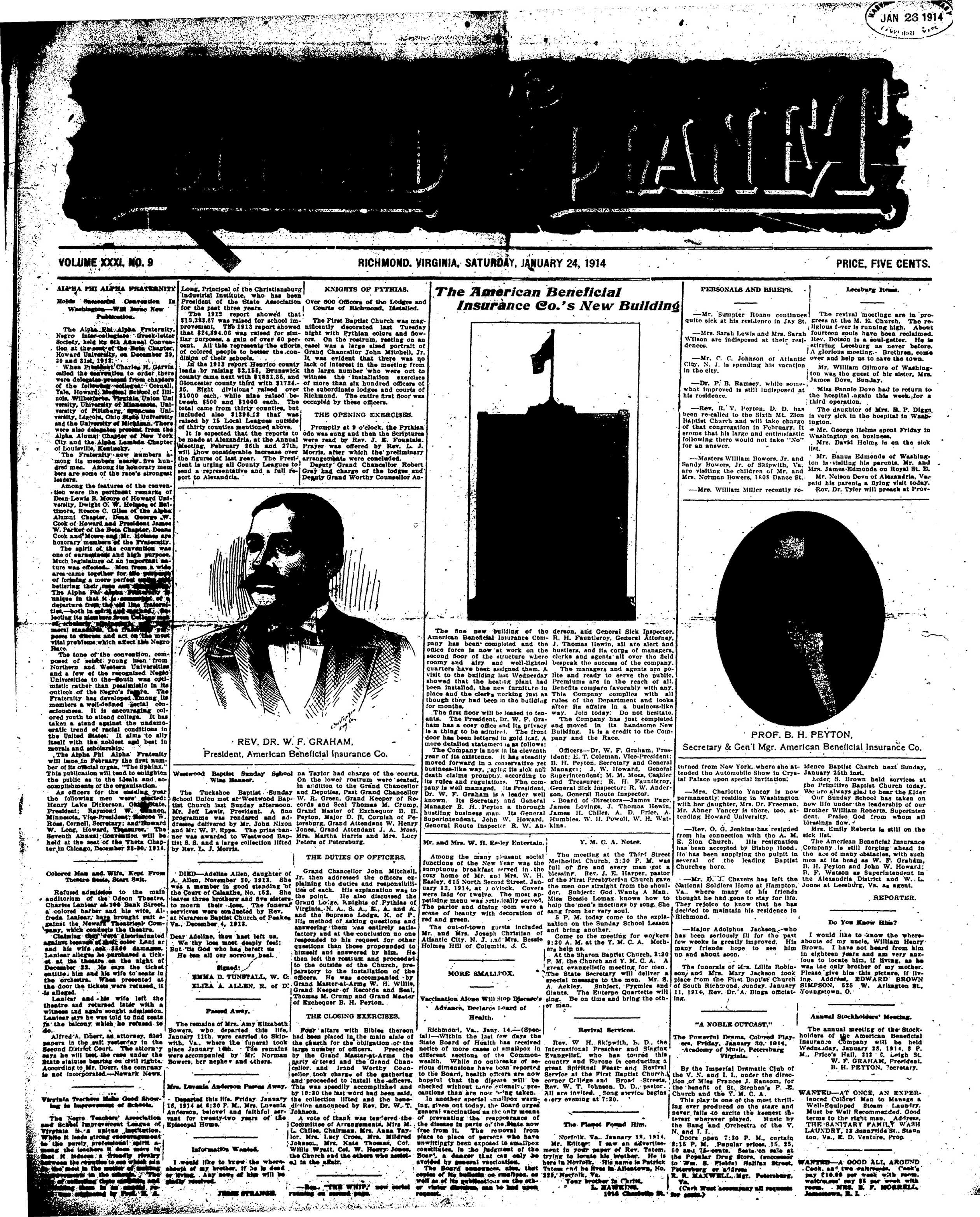
Richmond Planet
Saturday, January 24, 1914
Richmond, Virginia
Page text (machine-generated)
ALPHA PHI ALPHA FRATERNITY
Holds Successful Convention In
Washington—Will Issue New
Publication.
The Alpha Phi Alpha Fraternity,
Negro inter-collegiate Greek-letter
Society, held its 6th Annual Convention
at the request of the Beta Chapter,
Howard University, on December 29,
20 and 21st, 1912.
When President Charles H. Garvin called the convention to order there were delegates present from chapters of the following colleges: Cornell, Yale, Howard, Medical School of Illinois, Wilberforce, Virginia, Union University, University of Minnesota, University of Pittsburg, Syracuse University, Lincroix, Ohio State University and the University of Michigan. There were also delegates present from the Alpha Alumni Chapter of New York City and the Alpha Lambda Chapter of Louisville, Kentucky.
The Fraternity now numbers among its members nearly five hundred men. Among its honorary members are some of the race's strongest leaders.
Among the features of the convention were the pertinent remarks of Dean Lewis B. Moore of Howard University, Dwight O. W. Holmes of Baltimore, Roscoe C. Giles of the Alpha Alumni Chapter, Dean George W. Cook of Howard and President James W. Parker of the Beta Chapter, Dean Cook and Moore and Mr. Holmes are honorary members of the Fraternity.
The spirit of the convention was one of earnestness and high purpose. Much legislature of an important nature was effected. Men from a wide area came together for the purpose of forming a more perfect union and bettering their race and culture. The Alpha Phi Alpha Society is unique in that it is committed to a departure from the old line fraternities—both in spirit and method, reflecting its members from college men of scholarly institutions, and moral standards, the fraternity's purposes to discern and act on the most vital problems which affect the Negro Race.
The tone of the convention, composed of select young men from Northern and Western Universities and a few of the recognized Negro Universities to the south was optimistic rather than pessimistic in its outlook of the Negro's future. The Fraternity has developed among its members a well-defined social consciousness. It is encouraging colored youth to attend college. It has taken a stand against the undemocratic trend of racial conditions in the United States: It aims to ally itself with the noblest and best in morals and scholarship:
The Alpha Phi Alpha Fraternity will issue in February the first number of its official organ, "The Sphinx." This publication will tend to enlighten the public as to the ideals and accomplishments of the organization.
As officers for the ensuing year the following men were elected: Henry Lake Dickerson, Ohio State, President; Raymond W. Cannon, Minnesota, Vice-President; Renee W. Rom, Cornell, Secretary; and Howard W. Long, Howard, Treasurer. The Seventh Annual Convention will be held at the seat of the Theta Chapter in Chicago, December 28-30, 1914.
Colored Man and. Wife, Kept From
Theatre Seats, Start Suit.
Refused admission to the main auditorium of the Odeon Theatre, Charles Lanear at 190 Bank Street, a colored barber and his wife, Alfreda Lanear, have brought suit against the Newark Theatrical Company, which conducts the theatre.
Claiming they were discriminated against because of their color Lanar and his wife, ask $500 damages. Lanear alleges he purchased a ticket at the theatre on the night of December 22. He says the ticket entitle him and his wife to seats in the orchestra. When presented at the door the tickets were refused, it is alleged.
Lanear and his wife left the theatre and returned later with a witness and again sought admission. Lanear says he was told to find seats in the balcony which he refused to do.
Alfred-A. Diurr, as attorney, filed papers in the suit yesterday in the Second District Court. The attorney says he will test the case under the State statutes bearing on civil rights. According to Mr. Diurr, the company is not incorporated.—Newark News.
Virginia Teachers Make Good Shows
ing in Improvement of Schools.
The Negro Teacher's Association and School Improvement League of Virginia is a unique institution. While it leads strong encouragement to the purely professional spirit among the teachers, it does more in fact. It induces a friendly rivalry between the counties to see which can do the most in the matter of making improvements in the village. The aim of collecting these statistics and measuring them in an annual report is obtained by Fred R. A.
REV. DR. W. F. GRAHAM,
President, American Beneficial Insurance Co.
Long, Principal of the Christiansburg Industrial Institute, who has been President of the State Association for the past three years.
The 1912 report showed that $15,383.67 was raised for school improvement. The 1913 report showed that $24,894.06 was raised for similar purposes, a gain of over 60 percent. All this represents the efforts of colored people to better the condition of their schools.
In the 1913 report Henrico county leads by raising $2,155. Brunswick county came next with $1831.35, and Gloucester county third with $1726.25. Eight divisions raised over $1000 each, while nine raised between $500 and $1000 each. The total came from thirty counties, but included also $1396.12 that was raised by 15 Local Leagues outside of thirty counties mentioned above.
It is expected that the reports to be made at Alexandria, at the Annual Meeting, February 26th and 27th, will show considerable increase over the figures of last year. The President is urging all County Leagues to send a representative and a full report to Alexandria.
REV. DR. W. F.
President, American Belt
Westwood Baptist Sunday School
Wine Banner.
The Tuckahoe Baptist - Sunday School Union met at Westwood Baptist Church last Sunday afternoon. Mr. Jeff Lewis, President. A fine programme was rendered and addresses delivered by Mr. John Nixon and Mr: W. P. Epps. The prize banner was awarded to Westwood Baptist S. S. and a large collection lifted by Rev. L. J. Morris.
---
DIED—Adeline Allen, daughter of A. Allen, November 30, 1913. She was a member in good standing of the Court of Calanthe, No. 152. She leaves three brothers and five sisters to mourn their loss. The funeral services were conducted by Rev. at Nararene Baptist Church of Peakes Va., December 4, 1913.
Dear Adeline, thou hast left us. We thy loss most deeply feel; But 'tis God who has bereft us He can all our sorrows heal.
Signed:
EMMA D. TUNSTALL, W. C.
ELIZA A. ALLEN, R. of D.
The remains of Mrs. Amy Elizabeth Bowers, who departed this life, January 11th, were carried to Skipwith, Va., where the superal took place January 10th. The remains were accompanied by Mr. Norman Bowers, her nephev and others.
Mrs. Luvenia Anderson Passes Away.
Departed this life. Friday January
16, 1914 at 6:30 P. M., Mrs. Luvenia
Anderson, beloved and faithful servant
for twenty-two years of the
Episcopal Home.
Information Wanted
I would like to know the whor-
nage of my brother, if he is dea-
dy or living. Any news of him will be
gladly received.
KNIGHTS OF PYTHIAS.
Over 600 Officers of the Lodges and Courts of Richmond, Installed.
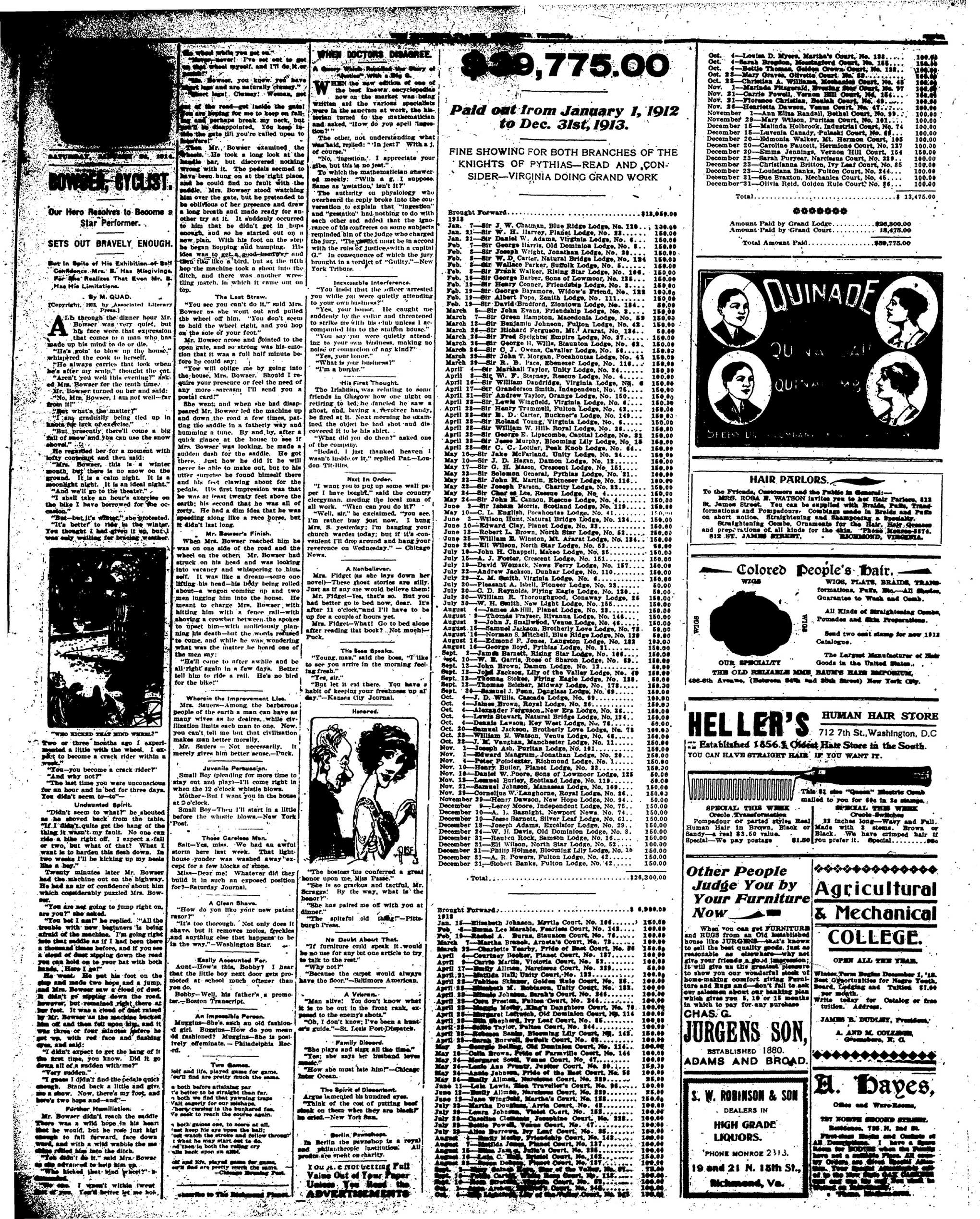
The First Baptist Church was magnificently decorated last Tuesday night with Pythian colors and flowers. On the roostrum, resting on an easel was a large sised portrait of Grand Chancellor John Mitchell, Jr. It was evident that there was no lack of interest in the meeting from the large number who were out to witness the installation exercises of more than six hundred officers of the subordinate lodges and courts of Richmond. The entire first floor was occupied by these officers.
THE OPENING EXERCISES
Promptly at 9 o'clock, the Pythian ode was sung and then the Scriptures were read by Rev. J. E. Fountain. Prayer was offered by Rev. L. J. Morris, after which the preliminary arrangements were concluded. Deputy Grand Chancellor Robert Gray had charge of the lodges and Deputy Grand Worthy Counselor An-
W. F. GRAHAM,
Beneficial Insurance Co.
na Taylor had charge of the courts.
On the lower rostrum were seated,
in addition to the Grand Chancellor
and Deputies, Past Grand Chancellor
W. R. Green, Grand Keeper of Records
and Seal Thomas M. Crump,
Grand Master of Exchequer B. H.
Peyton, Major D. B. Cornish of Petersburg, Grand Attendant W. Henry
Jones, Grand Attendant J. A. Mons,
Mrs. Martha Harris and Mrs. Lucy
Peters of Petersburg.
THE DUTIES OF OFFICERS
Grand Chancellor John Mitchell, Jr. then addressed the officers explaining the duties and responsibilities of each. His explanation was to the point. He also discussed the Grand Lodge, Knights of Pythias of Virginia, N. A., S. A., K., A. and A. and the Supreme Lodge, K. of P. His method of asking questions and answering them was entirely satisfactory and at the conclusion no one responded to his request for other questions than those propounded to himself and answered by him. He then left the rostrum and proceeded to the outside of the Church, preparatory to the installation of the officers. He was accompanied by Grand Master-at-Arms W. H. Willis, Grand Keeper of Records and Seal, Thomas M. Crump and Grand Master of Exchequer B. H. Peyton.
THE CLOSING EXERCISES
Four altars with Bible thereon had been placed in the main alley of the church for the obligation of the large number of officers. Preceded no by the Grand Master-at-Arms the party erected and the Grand Chancellor, and Irand Worthy Counsellor took charge of the gathering and proceeded to install the officers. This was speedily accomplished and by 10:30 the last word had been said, the collection lifted and the benefit announced by Rev, Dr. W. T. Johnson.
A vote of thank was tendered the Committee of Arrangements, Mrs M. L. Chille, Chairman, Mrs. Anna Taylor, Mrs. Lucy Cross, Mrs. Mildred Johnson, Mrs. Kate Thomas, Col. Willis Wyatt, Col. W. Henry Jones, the Church and the others who assisted in the affair.
Rev. "THE WHIP" now serial running on second page.
1
The fine new building of the American Beneficial Insurance Company has been completed and the office force is now at work on the second floor of the structure where roomy and airy and well-lighted quarters have been assigned them. A visit to the building last Wednesday showed that the heating plant had been installed, the new furniture in place and the clerks working just as though they had been in the building for months.
The first floor will be leased to tenants. The President, Dr. W. F. Graham has a cosy office and its privacy is a thing to be admired. The front door has been lettered in gold leaf. A more detailed statement is as follows:
The Company is now in its eleventh year of its existence. It has steadily moved forward in a conservative yet business-like way, saying its slick and death claims promptly, according to its rules and regulations. The company is well managed. Its President, Dr. W. F. Graham is a leader well known. Its Secretary and General Manager B. H. Peyton a thorough hustling business man. Its General Superintendent, John W. Howard, General Route Inspector R. W. An-
Mr. and Mrs. W. H. Easley Entertain.
Among the many pleasant social functions of the New Year was the sumptuous breakfast served in the cozy home of Mr. and Mrs. W. H. Easley, 615 North Second Street, January 13, 1914, at J. O'clock. Covers were laid or twelve. The most appetizing menu was artificially served. The parlor and dining room were a scene of beauty with decoration of red and green. The out-of-town guests included Mr. and Mrs. Joseph Christian of Atlantic City, N. J., and Mrs. Bessie Holmes Hill of Columbia, J. C.
Vaccination Alone Will Stop Disease's
Richmond, Va., Jany. 14.—(Special)—Within the last few days the State Board of Health has received notice of more cases of smallpox in different sections of the Commonwealth. While no outbreaks of serious dimensions have been reported to the Board, health officers are now hopeful that the disease will be checked without more extensive precautions than are now being taken.
In another special smallpox warning, given out today, the Board urges general vaccination as the only means of preventing the reappearance of the disease in parts of the State now free from it. The removal from place to place of persons who have unwittingly been exposed to smallpox constitutes, in the judgment of the Board, a danger that can only be avoided by general vaccination. The Board announces, also, that copies of its bulletins on smallpox, as well as of its publications on the other winter diseases, can be had upon
Anderson, and General Sick Inspector,
R. H. Fauntleroy, General Attorney,
J. Thomas Howin, all are alert and
hunters, and its corps of managers,
clerks and agents all over the field
bospak the success of the company.
The managers and agents are poilto
and ready to serve the public.
Premiums are in the reach of all.
Benefits compare favorably with any.
This Company complies with all
rules of the Department and looks
after its affairs in a business-like
way. Join today: Do not hesitate.
The Company has just completed
and moved in its handsome New
Building. It is a credit to the Company
and the Race.
Officers—Dr. W. F. Graham, President;
E. T. Coleman, Vice-President;
B. H. Peyton, Secretary and General
Manager; J. W. Howard, General
Superintendent; M. M. Moss, Cashier
and Treasurer; R. H. Fauntleroy,
General Sick Inspector; R. W. Anderson,
General Route Inspector.
Board of Directors—James Page,
James Lovings, J. Thomas Howin,
James H. Chiles, A. D. Price, A.
Humbles, W. H. Powoll, W. H. Watkins.
Y. M. C. A. Notice.
The meeting at the Third Street Methodist Church, 3:30 P. M. was full of fire and every man got a blessing. Rev. J. E. Harper, pastor of the First Prebysterion Church gave the men one straight from the shoulder. Subject: God. Want. A Man. Miss Beasle Lomax knows how to help the men's meetings by song. She sang from her very soul.
5 P. M. today come to the explanation on the Sunday School Lesson and bring another.
Come to the meeting for workers 9:30 A. M. at the Y. M. C. A. Mothers help us.
At the Sharon Baptist Church, 3:30 P. M. the Church and Y. M. C. A. A great evangelistic meeting for men. The State Secretary will deliver a special message to the men. Mr. S. A. Ackley. Subject: Pygmies and Giants. The Futurpe Quartette will sing. Be on time and bring the other man.
Revival Services
Rev. W H. Skipwith, B. D., the International Proacher and Singing Evangelist, who has toured this country and Europe is conducting a great Spiritual Feast and Revival Service at the First Baptist Church, corner College and Broad Streets.
Rev. W. T. Johnson, D. D., pastor. All are invited. Song service begins every evening at 7:30.
The Planet Found Him.
Norfolk, Va. January 18, 1914.
Mr. Editor. I saw an advertisement in your paper of Rev. Tatem, trying to locate his brother. He is here in Norfolk. His name is Patrick Tatem and he lives in Allentown, No. 228, Norfolk, Va.
Your brother in Christ,
L. HAWKINS.
PROF. B. H. PEYTON,
Secretary & Gen'l Mgr. American Beneficial Insurance Co.
PERSONALS AND BRIEF'S.
Mr. Sumpter Roano continues quite sick at his residence in Jay St.
Mrs. Sarah Lewis and Mrs. Sarah Wilson are indisposed at their residences.
Mr. C. C. Johnson of Atlantic City, N. J. is spending his vacation in the city.
Dr. P. B. Ramsey, while somewhat improved is still indisposed at his residence.
Rev. R. V. Poyton, D. D. has been re-called to the Sixth Mt. Zion Baptist Church and will take charge of that congregation in February. It seems that his large and enthusiastic following there would not take "No" for an answer.
Masters William Bowers, Jr. and Sandy Bowers, Jr. of Skipwith, Va. are visiting the children of Mr. and Mrs. Norman Bowers, 1808 Dance St.
Mrs. William Miller recently re-
PROF. B. H.
Secretary & Gen'l Mgr. Amerl
turned from New York, where she attended the Automobile Show in Crystal Palace upon special invitation:
—Mrs. Charlotte Yancey is now permanently residing in Washington with her daughter, Mrs. Dr. Freeman. Mr. Abner Yancey is there, too, attending Howard University.
—Rev. O. G. Jenkins has resigned from his connection with the A. M. E. Zion Church. His resignation has been accepted by Bishop Hood. He has been supplying the pulpit in several of the leading Baptist Churches here.
—Mr. D. J. Chavers has left the National Soldiers Home at Hampton, Va., where many of his friends thought he had gone to stay for life. They rejoice to know that he has decided to maintain his residence in Richmond.
—Major Adolphus Jackson, who has been seriously ill for the past few weeks is greatly improved. His many friends hope to see him up and about soon.
The funerals of Mrs. Lillie Robinson and Mrs. Mary Jackson took place from the First Baptist Church of South Richmond, Sunday, January 11, 1914, Rev. Dr. A. Binga officiating.
"A NOBLE OUTCAST."
The Powerful Drama, Colored Players, Friday, January 30, 1914, Academy of Music, Petersburg Virginia.
By the Imperial Dramatic Club of the V. N. and I. I., under the direction of Miss Frances J. Rannom, for the benefit of St. Stephen's P. E. Church and the Y. M. C. A.
This play is one of the most thrilling ever produced on the stage and never fails to excite the keenest interest wherever played. Music by the Band and Orchestra of the V. N. and I. I.
Doors open 7:30 P. M., curtain 2:15 P. M. Popular prices. 15. 25, 50 and 75 cents. Seats on sale at the Popular Drug Store. (accessor to Wm. S. Plevis) Hallfaz Street, Petersburg or address R. R. MAXWELL, Mgr. Petersburg,
R. R. MAXWELL, Mgr. Petersburg,
Va.
(Cash Must accompany all requests
MAIN
JAN 23 1914
COLUMBIA CASE
PRICE, FIVE CENTS.
The revival meetings are in progress at the M. E. Church. The religious fever is running high. About fourteen souls have been reclaimed. Rev. Dotson is a soul-getter. He is stirring Leesburg as never before. A glorious meeting. Brothren, come over and help us to save the town.
Mr. William Gilmore of Washington was the guest of his sister, Mrs. James Dove, SunJay.
Miss Fannio Dove had to return to the hospital again this week, for a third operation.
The daughter of Mrs. R. P. Digge is very sick in the hospital in Washington.
Mr. George Helme spent Friday in Washington on business.
Mrs. Davki Holms is on the sick list.
Mr. Banus Edmonds of Washington is visiting his parents, Mr. and Mrs. James Edmonds on Royal St. E.
Mr. Nelson Dove of Alexandria, Va. paid his parents a flying visit today.
Roy, Dr. Tyler will preach at Prov-
H. PEYTON,
American Beneficial Insurance Co.
Idenco Baptist Church next Sunday, January 25th inst.
Elder, S. Brown held services at the Primitive Baptist Church today. We are always glad to hear the Elder Our Sunday School has taken on new life under the leadership of our Brother William Roberts, Superintendent. Praise God from whom all blessings flow.
Mrs. Emily Roberts is still on the sick list.
The American Beneficial Insurance Company is still forging ahead in the age of many obstacles, with such men at its head as W. F. Graham, B. H. Peyton and John W. Howard; B. F. Watson as Superintendent in the Alexandria District and W. L. Jones at Leesburg, Va. as agent.
REPORTER.
Do You Know Him?
I would like to know the whereabouts of my uncle, William Henry Brown. I have not heard from him in eighteen years and am very anxious to locate him, if living, as he was the only brother of my mother. Please give him this picture, if living. Address, EDWARD BROWN SIMPSON, 526 W. Arlington St., Youngstown, O.
Annual Stockholders' Meeting
The annual meeting of the Stock-
holders of the American Beneficial
Insurance Company will be held
Wednesday, January 28. 1914. $ P.
M., Price's Hall. 212 C. Leigh St.
WANTED—AT ONCE, AN EXPERIenced Colored Man to Manage a Well-Equipped Steam Laundry. Must be Well Recommended. Good terms to the right man. Address. THE SANITARY FAMILY WASH LAUNDRY. 13 Sunnyridge St. Staunton, Va., E. D. Venture, Prop.
WANTED—A GOOD ALL, AROUND
Cook, and two caterers. Cook's
pay $10.00 per week with room,
waitresses' pay $5 per week with
room.
MRS. R. P. MORRELL,
Jonestown, R. L.
NEWSP
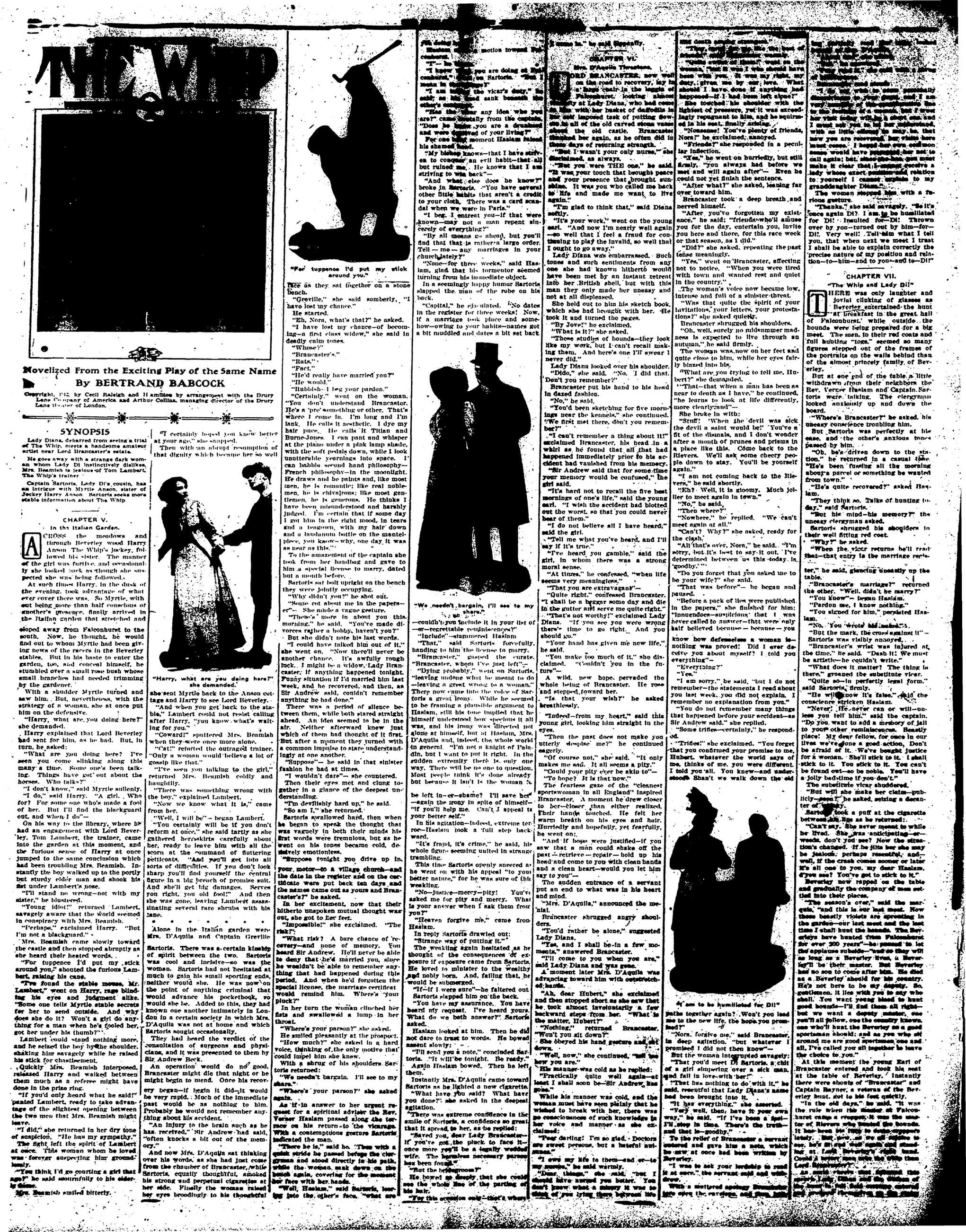
Novelized From the Exciting Play of the Same Name By BERTRAND BABCOCK
Copyright 1972 by Cecil Raleigh and H. Hamilton by arrangement with the Drury
Lane theater of London.
SYNOPSIS
Lady Diana, debarred from seeing a trial of The Whip, meets a handsome amateur artist near Lord Brancaster's estate.
He goes away with a strange dark woman whom Lady D Intractively dislikes. Mrs Beamish is jealous of Tom Lampert, the Whip trainer.
Captain Station Lady Dílis cousin, has an Intruder in Miltle Anson, sister of Jockey Harry Anson. Nartors seeks more stable information about The Whip.
CHAPTER V.
ACROSS the meadows and through Beverley wood Harry Anson The Whip's jockey, followed his sister. The manner of the girl was furious, and accidentally she looked back as though she suspected she was being followed.
At such times Harry, in the dusk of the evening, took advantage of what ever cover there was. So Myrtle, with out being more than half conscious of another's presence, finally arrived in the Italian garden that stretched and sloped away from Falconburst to the south. Now, he thought, he would find out to whom Myrtle had been giving news of the races in the Beverley stables. But in his haste to enter the garden, too, and conceal himself, he stumbled over a small rose bush whose small branches had needed trimming by the gardener.
With a shudder Myrtle turned and saw him. But, nevertheless, with the strategy of a woman, she at once put him on the defensive.
"Harry, what are you doing here?" she demanded. Harry explained that Lord Beverley had sent for him, as he had. But, in turn, he asked: "What are you doing here? I've seen you come silkling along this many a time. Some one's been talking. Things have got out about the horses. Who talk?" "I don't know," said Myrtle sullenly. "I do," said Harry. "A girl. Who for? For some one who's made a fool of her. But I'll find the blackguard out, and when I do"— On his way to the library, where he had an engagement with Lord Beverley, Tom Lambert, the trainer, came into the garden at this moment, and the furious sense of Harry at once jumped to the same conclusion which had been troubling Mrs. Beamish. Instantly the boy walked up to the porphy but sturdy elder man and shook his fist under Lambert's nose. "I'll stand no wrong—not with my sister," he blustered.
"Young idiot!" returned Lumberd, savagely aware that the world seemed in conspiracy with Mrs. Beanmish.
"Perhaps," exclaimed Harry. "But I'm not a blackguard."
Mrs. Beamish came slowly toward the castle and then stopped abruptly as she heard their heated words.
"For tuppence I'd put my stick around you," shouted the furious Lambert, raising his cane.
"Two found the stable mouse, Mr. Lambert," went on Harry, rage blinding his eyes and judgment alike. "Some one tells Myrtle stable secrets for her to send outside. And why does she do it? Won't a girl do anything for a man when he's fooled her, got her under his thumb?"
Lambert could stand nothing more, and he seized the toy by the shoulder, shaking him savagely while he raised his stick for chantishment.
Quickly Mrs. Beamish interposed, released Harry and walked between them much as a referee might have done in the prize ring.
"If you'd only heard what he said," panted Lambert, ready to take advantage of the slightest opening between the two men that Mrs. Beamish might leave.
"I did," she returned in her dry tone of suspicion. "He has my sympathy."
The right left the spirit of Lambert at once. This woman whom he loved was forever suspecting him ground-lamely.
"You think I'd go courting a girl that age?" he said scornfully to his elderly friend.
Mrs. Beamish smiled bitterly.
"I certainly hoped you knew better at your age," she shrugged.
Then with an adopt resumption of that dignity which because he so well
I
"Harry, what are you doing here?" she demanded. she sent Myrtle back to the Anson cottage and Harry to see Lord Beverley. "And when you get back to the stable," Lambert could not resist calling after Harry, "you know what's waiting for you." "Coward!" sputtered Mrs. Bomham when they were once more alone.
"I've seen you talking to the girl," returned Mrs. Beamish coldly and laughfully.
"There was something wrong with the boy," explained Lambert.
"Now we know what it is," came from her.
"Well, I will be"—began Lambert.
"You certainly will be if you don't reform at once," she said tartly as she gathered her skirts carefully about her, ready to leave him with all the scorn at the command of fluttering petticans. "And you'll get into all sorts of difficulties. If you don't look sharp you'll find yourself the central figure in a big breach of promise suit. And she'll get big damages. Serves you right, you old fool." And then she was gone, leaving Lambert assasinating several rare shrubs with his sane.
"Alone in the Italian garden were Mrs. D'Agulis and Captain Greville
Sartoris. There was a certain kinship of spirit between the two. Sartoris was cool and inclusive—so was the woman. Sartoris had not hesitated at much to gain his small sporting ends, neither would she. He was now on the point of anything criminal that would advance his pocketbook, so would she be. Added to this, they had known one another infinitely in London in a certain society in which Mrs. D'Aquila was not at home and which Sartoris sought occasionally. They had heard the verdict of the conanitation of surgeons and physicians, and it was presented to them by Sir Andrew Bock.
An operation would do no good, Brancaster might do that night or he might begin to mend. Once his recov-
"An injury to the brain such as he has. received." Mr Andrew had said, "often knocks a bit out of the memory."
And now Mrs. D'Aquila sat thinking over his words as she had just come from the chamber of Brancaster, while Sartoria, equally thoughtful, smoked his strong and perpetual cigarette at her side. Finally the woman raised her eyes broodingly to his thoughtful
```markdown
```
"For tuppence I'd put my stick around you."
Face as they sat together on a stone bench.
"Groville," she said somberly, "I have lost my chance."
He started.
"Eh, Norn, what's that?" he asked.
"I have lost my chance—of becoming—a first class widow," he said in deadly calm tones.
"Whose?"
"Brancaster's."
"Rats."
"Fact."
"He'd really have married you?"
"He would."
"Rubbish—I beg your pardon."
"Certainly," went on the woman. "You don't understand Brancaster. He's a 'pre' something or other. That's where I come in. I'm long and I'm lank. He calls it nosthetic. I dye my hair price. He calls it Titan and Burne-Jones. I can pant and whisper at the piano under a pink lamp shade, with the soft pedals down, while I look unutterable yearnings into space. I can bubble second hand philosophy—French philosophy—in the moonlight. He draws and he paints and, like most men, he is romantic; like real noblemen, he is chivalrous; like most gentlemen, he is generous. He thinks I have been misunderstood and harbly judged. I'm certain that if some day I got him in the right mood, in tears and a tongown, with my hair down and a humidum bottle on the mantelpiece, you know—why, one day it was as near as this."
To the amazement of the captain she took from her handbag and gave to him a special license to marry, dated but a month before.
Sartorius sat bolt upright on the bench
they were jointly occupying.
"Why didn't you?" he shot out.
"Some rot about me in the papers—
er" She made a vague gesture.
"There's more in about you this morning," he said. "You're made divorce rather a hobby, haven't you?" But she didn't note his last words. "I could have talked him out of it," she went on. "Now there'll never be another chance. It's awfully rough luck. I might be a widow, Lady Bran-caster. If anything happened tonight. Funny situation if I'd married him last week, and he recovered, and then, as Sir Andrew said, couldn't remember anything he had done."
There was a period of silence between them, while both stared straight ahead. An idea seemed to be in the air. Neither afterward knew just which of them had thought of it first. But after a moment they turned with a common impulse to start understandingly at one another.
"Suppose"—he said in that sinister fashion he had at times.
"I'm devilishly hard up," he said.
"So am I." she returned.
Sartoris swallowed hard, then when he began to speak the thought that was vaguely in both their minds his first words were tremulous, but as he went on his tones became cold, delicately emotionless.
"Suppose tonight you drive up in your motor—to a village church—and the date in the register and on the certificate were put back ten days and the names came out as yours and Brancaster's?" he asked.
In her excitement, now that their hitherto unspoken mutual thought was out, she got to her feet.
"Iimpossible!" she exclaimed. "The risk!"
"What risk? A bure chance of recovery—and none of memory. You heard Sir Andrew. He'll never be able to deny that he'd married you, since he wouldn't be able to remember anything that had happened during this period. And when he'd forgotten the special license, the marriage certificate would remind him. Where's your pluck?"
In her turn the woman clinched her fists and swallowed a lump in her throat.
"Where's your parson?" she asked.
He smiled pleasantly at the prospect.
"How much?" she asked in a hard
voice, thinking of the only motive that
could impel him she knew.
With a shrug of his shoulders. Sartoris returned:
"We needn't bargain. I'll see to my share."
"Where's your parson?" she asked again.
As if in answer to her urgent request for a spiritual adviser the Rev. Vernor Haasam passed along the terrace on his return to the vicarage. With a contemptuous gesture Bartoris indicated the man.
"There he is," said be. "Then with a quick stride he paused before the clergyman and stood directly in his path, while the woman, mink down on the bench again, covering for the moment her face with her hands.
"Well, Hanlan," said Barbari, looking into the other's face, "what are
"I hope you are doing all well
combated," I lean on Sarbaria. "But I
means in the image K"
"I am taking the vicar's duty," he
only, as he had sank beneath the
other's contempt.
"Has the dear any idea who you are?" came instantly from the captain. "Does he know, you are a drunken and were deceived of your living?" For one boy moment Haslam failed his shamed head.
"My blonde knows—that I have arrived to conquer an evil habit—that all but ruined me. He knows that I am striving to win back."
"And what else does he know?" broke in Martina. "You have several other little habits that aren't a credit to your cloth. There was a card scandal when we were in Paris."
"I beg. I entreat you—if that were known—may not a man repent sincerely of everything."
"By all means go ahead, but you'll find that that is rather in large order. Tell me—my marriages in your church hastily?"
"None—for three weeks," said Haslam, glind that his tormentor seemed turning from his immediate object.
In a seemingly happy humor Sartoria slapped the man of the robe on his back.
"Capital," he exasulated. "No dates in the register for three weeks! Now, if a marriage took place and somehow—owing to your habits—names got a bit muddled and dates a bit set back
```markdown
```
"We needn't bargain, I'll see to my share."
—couldn't you include it in your list of—
—or regrettable redundancy?"
"Include," stammered Haslam
"That," said Sartoris forcefully,
handing to him the license to marry.
"Brancaster," gushed the curate.
"Brancaster, whom I've just left—"
"Dying probably," went on Sartoris.
"leaving undone what he meant to do—leaving a great wrong to a woman."
There now came into the voice of Sartoris a great irony. While he seemed to be framing a plausible argument to Haslam, still his tone implied that he himself understood how specious it all was, and his irony was directed not alone at himself, but at Haslam, Mrs. D'Aquila and, indeed, the whole world in general. "I'm not a knight of Paladin, but I want to put it right. In the sudden extremity there is, only one way. There will be no one to question. Most people think it's done already but because it isn't the woman is
be left in-er-shame? I'll save her
—again the irony in spite of himself—
"if you'll help me. Can't I appeal to
your better self."
In his agitation—indeed, extreme terro-
rce—Haslam took a full step back-
ward.
"It's fright, it's crime," he said, his
whole figure seeming united in strange
trambling.
This time Sartoris openly anneered as
he went on with his appeal "to your
better nature," for he was sure of this
weakling.
"No—justice—mercy—pity! You've
asked me for pity and mercy. What
is your answer when I ask them from
you?"
"Heaven forgive me," came from
Haslam.
In reply Sartoris drawled out:
"Strange war of putting it."
The weakling again hesitated as he thought of the consequences of exposure if exposure came from Sartoria. He loved to minister to the wealthy and nobly born. And, failing that, he would be submerged.
"If-If I were auto," he faltered out. Sartoria slipped him on the back.
"You have my assurance. You have heard my request. I've heard yours. What do we both answer?" Sartoria asked.
Haslam looked at him. Then he did not dare to trust to words. He bowed assent slowly:
"I'll send you a note," concluded Sartoria. "It will be tonight. Be ready."
Again Haslam bowed. Then he left them.
Instantly Mrs. D'Aquila came toward Sartoria as he lighted a new cigarette.
"What have you said? What have you done?" she asked in the deepest agitation.
"There was extreme confidence in the smile of Sartoria, a confidence so great that it appeared to her, as he replied:
"Saved you, dear Lady Brasscaster,
if you've got the plack to face it
once more you'll be a legally wedded
wife. The humble necessary parents
has been found."
"But the bridegroom."
He bowed so deeply that she could
see the whole face of the parting of
his hair.
Tay this occasion only—that's where!
ORD BRANCASTER, now well on the road to recovery, lay in a huge chair in the length of a Paleyhurst, looking almost directly at Lady Diana, who had come in with her basket of daffodils in her own imposed task of putting flowers in all of the old carved stone vases about the old castle. Brancaster thinned her again, as he often did in these days of recurring strength.
"But I wasn't your only nurse," she disclaimed, as always.
"But you were THE ONE, he said. 'It was your touch that brought peace and your presence that brought sunshine. It was you who called me back to life and made me want to live again.'"
"I'm glad to think that," said Diana softly.
"It's your work," went on the young ear. "And now I'm nearly well again—so well that I feel a fraud for continuing to play the invalid, so well that I ought to go away."
Lady Diana was embarrassed. Such
tones and such sentiments from any
one she had known hitherto would
have been met by an instant retreat
into her. British shell, but with this
man they only made her uneasy and
not at all displeased.
She held out to him his sketch book,
which she had brought with her. He
took it and turned the pages.
"By Jove!" he exclaimed.
"What is it?" she asked.
"Those studies of bounds—they look
like my work, but I can't recall
them. And here one I'll sweep I
never did."
Lady Diana looked over his shoulder.
"Dido," she said. "No. I did that.
Don't you remember?"
Brancaster put his hand to his head
in dazed fashion.
"No," he said.
"You'd been sketching for five mornings near the kennels," she continued.
"We first met there, don't you remember?"
"I can't remember a thing about it!" exclaimed Brancaster, his head in a whirl as he found that all that had happened immediately prior to his accident had vanished from his memory.
"Sir Andrew said that for some time your memory would be confused," the girl said.
"It's hard not to recall the five best mornings of one's life," said the young earl.
"I wish the accident had blotted out the worst, so that you could never bear of them."
"I do not believe all I have heard;" said the girl.
"Tell me what you've heard, and I'll say if it's true."
"I're heard you gamble," said the girl, in whom there was a strong moral sense.
"At times," he confessed, "when life seems very meaningless."
"That you are extravagant"—
"Quite tight," confessed Brancaster.
"I shall be a bigger some day and die in the gutter and serve me quite right."
"That's not worthy," exclaimed Lady Diana. "If you see you were wrong there's time to go right. And you should go."
"Your hand has given me new life," he said.
"You make too much of it," she declared. "Couldn't you in the future"—
A wild, new hope, pervaded the whole being of Brancaster. He rose and stepped, toward her.
"Is that your wish?" he asked breathlessly.
"Indeed—from my heart," said this young girl, looking him straight in the eyes.
"Then the past does not make you utterly describe me?" he continued eagerly.
"Of course not," she said. "It only makes me sad. It all seems a pity." "Could your pity ever be skim to"—"To hope? It is that now."
The fearless gaze of the "cleanest sportwoman in all England" inspired Brancaster. A moment he drew closer to her—closer than either realized. Their hands touched. He felt her warm breath on his eyes and hair. Hurriedly and hopefully, yet fearfully, he went on:
"And if hope were justified—if you saw that a main could shake off the past—retrieve—repair—hold up his head and come to you with clean hands and a clean heart—would you let him say to you"—
The sudden entrance of a servant put an end to what was in his heart and mind.
"Mrs. D'Aquila," announced the menial.
Brincaester shrugged angry shoulders.
"Tou'd rather be alone," suggested Lady Diana.
"Yes, and I shall be-in a few moments," answered Brancaster.
"I'll come to you when you are," said Lady.Diana and was gone. A moment later Mrk. D'Aquila was advancing toward him with outstretched hands. "Ah, dear Hubert," she exclaimed and then stopped short as she saw that he took almost invariably a few backward steps from her. "What is the matter, Hubert!"
"Nothing," returned Brancaster,
"Won't you sit down?"
Won't you sit down?
obeyed his hand, gesture and sit
down.
"Well, now," she continued, "will he how you are."
His manner was cold as he replied: "Practically quite well again—at least I shall soon be—Sir Andrew has gone."
While his manner was cold, and the woman must have seen plainly that he wished to break with her, there was no consciousness of such knowledge in her voice and manner as she exclaimed:
"Poor darling! I'm so glad. Doctors are sweet persons, but a bitter nutman."
"I love my life to them—and or—to my mother," he said warmly.
"Dear, things," she said, "but I should have nursed you better. You don't know what a辛苦 it was to think of you trying between life
new death passing onward."
"They, saved me up, like the best of friends," she said.
"Quite awsome as himself, went on the woman, but it all I who should have been with you. It was my right, my duty, given me by our love. What should I have done if anything had happened—I had been left alone?"
"He touched his shoulder with the lightest of pressure, yet it was exceedingly repugnant to him, and he squirmed in his seat, finally asking.
"Nonsense! You're plenty of friends, Noral! he excused, annoyed.
"Friends!" she responded in a peculiar inflection.
"Yes," he went on hurriedly, but still firmly, "you always had before we met and will again after" — Even he could not yet finish the sentence.
"After what?" she asked, leaning far over toward him.
Brancaster took a deep breath and nerved himself.
"After you've forgotten my existence," he said: "friends who amuse you for the day, entertain you, invite you here and there, for this race week or that season, as I did." "Did?" she asked, repeating the past tense meaningly. "Yes," went on Brancaster, affecting not to notice. "When you were tired with town and wanted rest and quiet in the country." The woman's voice now became low, intense and full of a shister-threat. "Was that quite the spirit of your invitations," your letters, your protestations?" she asked quietly.
Brancaster shrugged his shoulders.
Brancaster shrugged his shoulders.
"Oh, well, surely no midummer madness is expected to live through an autumn," he said firmly.
The woman was, now on her feet and quite close to him, while her eyes fairly blinked into his.
"What are you trying to tell me, Hubert?" she demanded.
"That—that when a man has been as near to death as I have," he continued, "he learns to look at life differently, more clearly—and"
She broke in with:
"Stuff! 'When the devil was sick the devil a saint would be.' You've a fit of the dismaus, and I don't wonder after a month of prunes and prisms in a place like this. Come back to the Rievers. We'll ask some cheery people down to stay. You'll be yourself again."
"I am not coming back to the Rievers," he said shortly.
"Eh? Well, it is gloomy. Much joller to meet again in town."
"No," he said.
"Then where?"
"Nowhere," he replied. "We can't meet again at all."
"Can't? Why?" she naked, ready for the clash.
"All that's over, Norn," he said. "I'm sorry, but it's best to say it out. I've determined between us this today in goodbyy."
"Do you forget that you asked me to be your wife?" she said.
"That was before"—he began and paused.
"Before a pack of lies were published in the papers," she finished for him: "innuendoe—suspicion that I was never called to answer—that were only half believed because—because you know how defenses a woman is—nothing was proved: Did I ever deceive you about myself? I told you everything."
"I am sorry," he said, "but I do not remember—the statements I read about you last week, you did not explain. I remember no explanation from you." "You do not remember many things that happened before your accident—as Sir Andrew said," she replied. "Some trifles—certainly," he responded. "Trifles!" she exclaimed. "You forget that you confirmed your promise to me, Hubert, whatever the world says of me, thinks of me, you were different. I told you all. You knew—and understood Shan't we walk down the old
THE WORLD'S FIRST WOMEN'S MUSEUM
"if am to be humiliated for Dll"
paths together again? Won't you lead
me to the new life, the hope you promi-
nued?
"Nom, forgive me," said Brancastle,
in deep agitation, "but whatever I
promised I did not then know"—
"That has nothing to do with it," he said, resentful that Lady Diana's name had been brought into it.
"It has everything," she asserted.
"Very well, then, have it your own way," he said. "If I've been a spoil-I'll stop in time. There's the truth—and that is—goodby."
To the relief of Branconer a servant entered and gave him a note, which he saw at once had been written by Beverley.
"I was to ask your lordship to read it at once," the servant said and with drowsy.
but carefully read and little bothered
pursued of the business.
"Almost like the wife of
him," he answered.
"They're right," she said with a
sorrow of helplessness.
Bernardine said simply.
"I do well, who to come personally
discussions to, from great, and I am
very kindly of the companymate like
to the faculty of a woman, but I trust
her visit today with her a short one, and
I must ask you to let her understand,
with as little attention as may be, that
now you are recovered, her whole here
must come. I hoped her own old son
some would have persuaded her not to
call again; but, since the ban, you must
make it clear that I cannot receive a
lady whose exact position and relation
to yourself I cannot explain to my
granddaughter Diana."
The woman stopped him with a furious gesture.
"Thanks," she said savagely. "So it's once again DI! I am to be humiliated for DI! I insulted for-DI! Thrown over by you turned out by him-for-DI! Very well! Tell him what I tell you, that when next we meet I trust I shall be able to explain correctly the precise nature of my position and relation-to-him—and to you-and to-DI!"
CHAPTER VII.
"The Whip and Lady Dil"
HERE was only laughter and jovial clinking of glasses as Berwerley entertained the hunt at breakfast in the great hall of Faleonburst, while outside, the bounds were being prepared for a big meet. The men, in their red coats and full hunting "tops," seemed so many figures stepped out of the frames of the portraits on the walls behind than of the almost princely family of Berwerley.
But at one end of the table, a little withdrawn from their neighbors the Ber. Verner Thalam and Captain Sartoria were talking. The clergyman looked anxiously up and down the board.
"Where's Brancaster?" he asked, his uneasy conscience troubling him. But Sartoria was perfectly at his ease, and the other's anxious tone passed by him.
"Oh, he's driven down to the station." he returned in a casual tone. "He's been fusing all the morning about a parcel or something he wanted from town." "He's quite recovered!" asked Hassan. "They think no. Talks of hunting today," said Barton.
"But his mind- his memory?" the uneasy clergyman asked.
Sartorius shrinked his abogdern in their well fitting red coat. "Why" he saked.
ter," he said, glancing usually up the table.
"Brancaster's marriage?" returned the other. "Well, didn't be marry?"
"You know—began Haslam.
"Pardon me, I know nothing."
"You aimed for him, persecuted Haslam."
No. You wrote had minded.
"But the mark the crowd against it"—Sartoria was visibly annoyed.
"Brancaster's wrist was injured at the time," he said. "Dash it! We must be artistic; he couldn't write."
"What does it matter? The thing is there," grounded the substitute vicar.
"Quite so—in perfectly legal form," said Sartoria, firmly.
"He will know it's false," said the conscience stricken Hamam.
"Never, if he never can or will—unless you tell him," said the captain.
"Do you want to add a memory of jail to your other reminiscences. Beauty place." My dear fellow, for once in our lives we've done a good action, Don't be afraid of it. We've bought justice for a woman. She'll stick to it. I shall stick to it. You stick to it. You can't be found out—so be noble. You'll have a jolly bad time if you don't."
The substitute vicar shuddered.
"But will she make her claim—publicly—nearly? He asked, asking a docenter of money."
Barton took a puff at the cigarette between him. As he returned:
between him. As he returned:
"Can't say. She never meant to while he lived. She was anticipating—weeds, don't you see? Now the situation's changed. If he jitter his she may be jealous, perhaps resentful, and—well, if the crash comes sooner or later it's all one to you, my dear Hanilam, dyes you? You've got to stick to it."
Beverly now rapped on the table and gradually the company of men settled into their pieces.
"The season's over," said the marquis, "and this is our last meet. Now these beautiful violets are sprouting in the garden—our last meet and the last time I shall hunt the haunts. The Beverlys have hunted from Pembroke for over 200 years—but you must to let the applause subside—hand so they will be long as a Beverley Even, a Beverley'll be their master. But Beverley had no son to come after him. He died as a Beverley should for his country. He's not here to be my deputy. So, gentlemen, it lies with you to say who she will. You want young blood to hunt good haunts. I'll find them all right—but we want a deputy master, one you'll all follow, one the country known, one who hunt the Beverley as a good sportman should; and as you who sit around me are good sportmen one and all, I've called you all together to leave the choice to you."
At this moment the young Earl of Brancaster entered and took his seat at the table of Beverley, instantly there were shouts of "Brancaster" and Captain Bayner, a veteran of the Beverley hunt, got to his feet quickly.
"In the old days," he said, "it was the rule when the master of Falkenhurst came a rogue, it was the master of Rivers who hunted the boars. It has been his life to doze support laterly. But now, as we all agree to see, he is still well and standing at the foot of Rivers' wild band. Could a bovine man take the title than Lord Beverley?"
As much veneration that affirmed the proud lady Dilton and the widow of the bovine he held marriage entered and marriage entered in the
SATURDAY, NOV. 24, 1994
to hear the new leaders of the speeches
Bhaskar snow and with a how to
the company bums in a low voice,
which gradually increased in power:
"Gentlemen, you pay us a very thin
compliment, but I'm afraid I don't
deserve it. To command the support of
the Beverley hunt I have not yet
proved that I can ride hard enough or
as straight as I shall when I follow
THE MUSEUM OF THE WORLD
But will she make her claim—publish—soon?
the lead that I am certain, will appeal most nearly to you—the lead not of a deputy master, for there is none here fitted to take that place, but the lead that is given in some counties by the mistress of the bounds. Gentlemen, let us follow that example and declare by acclamation today that Lady Diana Kestore in the chosen deputy mistress of the Beverley bounds.
Only the greatest positive and affirmative about arrived this declaration, and answered by it. Ranunculus walked slowly to the foot of the stairway and took from his pocket a jewel case containing a peninsular with in chambers the promise of had been quarreled in the proceedings.
"Lady Kestore, bound to the young mistress of the bounty, will surely bound the deeds of the bounty. But I beg that so much money you will answer the whole."
And she came to New York to give the
giving, and she was very happy and
they seemed happy and they lay in
her arms in the bed.
"Greetings from New York, especially
it is time to be here with you. I will
do my best to learn and love and as
strange as a strange thing—I thank
you very much. Do I hold the whip
you please? We look one so late but
tender."
"Greetings from New York as ever, the
old man came to the table, filled
a big box and thanked to all the
secretary's guests at the table.
"Lady D, you are very kind and very
fried, the honorable one, I thank for a
attractive cup. PM very pleased: I give
you a heart."
"Ode of the whip" and "Lady D"
granted him.
"Yes, the whip and Lady D," he said,
"and not only the whip and my
dear Dl—for the whip may soon have
a new handle to its name—"
A general mourn greeted this statement.
"Paleauhurst and Elevers may be bound by a new thong." went on Beaverley. "On a day like this it's a great pleasure to ask you to drink not only to your new whip—to my grandchild Di—but to the future." The stridest tides of a big footman at the door interrupted him, or rather inserted themselves into the pane he had intended to be impassive. The footman's words completed the marquis' sentence, but they also gave
```markdown
```
heinstein, who are turned their eyes up the doorway to behold them, proudly, Mrs. D. Aguilar.
After a moment there was a general pause after half the company had got to the look. Baden moved toward himself so it'll be required the strength of his personality. Baden turned toward the woman standing there coldly self pomponed.
"Madam, be exclaimed.
In a most decided drawing room manager Mr. D. Aguilar faced him.
"Lord Barrieray, pray forgive this—or intrudation," she said sweetly. "Certain rumors have reached my ears. I had come to ask for a private interview with a view to obstruct a public scandal. But happily—or unhappy—I have just heard the words that have fallen: from your lips. Therefore though I request the pain, that I may cause, it is die by myself that I should speak here—unpublicly as you have spoken and say—that I am Lord Brancaster's wife."
Bramaster shirtered forward, his hand at his forehead as he struggled to regain memory of the last days before his death. "Wife," he shouted. "It's a lie!"
But Mrs. PAquit took the words from his mouth.
"It is an attempt to save your granddaughter humiliation. Lord Reverley," she said; "perhaps something worse. It is now an endower to assist you in explaining to her exactly your position in this house."
While Lady Diana's eyes followed Brancastell, wiltfully, desperately, the young earl turned to the company of his friends and neighbors.
"Gentlemen, on my honor—be exploded. "Beverley, this is an outrage! Turn this woman out.
"Both inclined to take the hothothed suggestion of his neighbor, and act upon it.
"Mrs. D. Aguila—he began.
"That is not, my name," she said firmly. "You didn't believe it."
"I believe information" mild the rac-
cism clausing band of the
motor man
Buddyily the woman held out to him a paper. "Then read that," she ordered. Bevereil, without taking into his own hand the document, looked at it as though it were a thing which might search him. It plainly was a marriage-certificate.
"Great beavers!" he exclaimed.
Best Brancaster had been looking over his shoulder.
"It's forged—it's false—you know it" he almost shouted into the face of the smiling woman.
Lord Beverley gave another long look at the document and read there the signature of the Rev. Verner Haslam. He walked slowly toward the vicar, but not before Sartoris had whispered to him savagely:
"Stick to it."
Lord Beverley now had the paper in his own hands, and he passed it to Haslam.
"Mr. Haslam is this true?" he said, extending the document.
But the vicar did not look at it. Speaking with the greatest possible effort, he slightly bowed as he answered in a low tone:
"That is my signature, Lord Beverley."
His manifest difficulty in speaking but strengthened his assertion, as all present thought that the clergyman manifested merely because he found a very unpleasant duty before him.
out telling a real falsehood.
"It can't be Beverley—Dt—I
wear," began Brancaster, and stopped.
Again Haslam bowed, and then as he felt the cold, menacing eyes of Saratts on him he managed to add a booze:
"Tee."
With a half sob and a scream, Lady Diana sung, herself into the arms of Lord Bergerley. The old man gathered her closely to himself and then glowed upon the smiling Bru. D'Aquila and the stricken Brancaster, equally.
"Tee bound!" he gawled sternly to Brancaster. "Tee, knowing this! come here and would have— Out of my sight, both of you! Turn this woman and this blighted out of my booze!"
[NO CONTINUED.]
The Antee Line.
Descendants of the Aztec monarchs of Mexico still live. There is one in Mexico and another in Mexico itself, while some of the lesser kinmen are still drawing pensions from the Mexican government on the strength of great kinship. During descendants of Mexico live in Salamanca, represented by the Madrona family, allied by marriage with the English house of Lancaster. The Emperors Ensign of France claims descent from the great Madrona, and as a biographer writes, "the widow of Napoleon III is thus of greater imperial stock than her husband and brought to the alliances more dignity than she acquired by R. "Chicago Moon."
George Man No Barryway Stone.
I have often served the Botanical Hall
sitting, inaugurating pastor, written as
Saintman in the Markerbury Guardian.
The gift of singing the gracious
dance, as in this year, reported to me
by a body of the same rite who heard
the monkey moose. An old priestess
wielded upon a Kisselstern, told her
the priests and clerks that he had not
seen her for thirty years. As an priest-
ess he held and passed into her face he
beheld a lady, a lady, and a bona fide
so wore them out, as, what they saw.
ADVERTISING
Go together. The most successful merchants in this town, in every town, are the most persistent and extensive advertisers.
In these cases the advertising is the cause; the successful business is the effect. Ono follows the other as certainly as day follows night. Our advertising columns are at your service.
Green Sunset
Green sunsets seen by the Russian explorers in the polar regions have been matched in England. Throughout November and December of 1883 the sunsets and afterglows were of wonderful intensity and varied colors. At Chelsea especially the sun went down over the Thames amid a blaze of unearthly beauty ranging from deepest red to green, as may be seen in a series of water sketches made at the time and now preserved in the Chelsea free library. Sit Norman Lockyer and other astronomers attributed these winter sunsets to the volcanic dust projected by the great eruption of Krakatoa, in Java, in the previous August.
An Interacting Book
A French marquise whose country house is crowded with guests during the hunting season hit upon the original idea of placing a register at the disposal of her visitors in which to record their desires and criticisms. The pages of the richly bound book soon began to be covered with notes such as:
"Count de R. still owes 25 louls. He knows to whom."
"The green peas yesterday were burned."
"Baroness M. flirts—unfortunately not with me."
The marquise has withdrawn the register.
Khyber Pass.
The Khyber pass, from the time of Alexander the Great, has been noted as the great military and trade gateway into India from the Anatistic countries to the east. The pass begins near Jarned in India, ten and one-half miles west of Peahshar, and twists through the hills for about thirty-three miles in a northwesterly direction till it debouches at Dakka, in Afghanistan.
Weightiest King in the World. One of the most interesting monarchs who besk under British protection is King George Tabar II, whose kingdom—the Tonga islands—is situated in an obscure corner of the south Pacific ocean. King George can claim to be a man of weight, for he turns the scales at 306 pounds. He governs by means of a native parliament, the sessions of which seem to be mainly determined by the amount and quantity of the edibles collected at the capital. He has a high opinion of his importance, for he sent an ambassador to Great Britain at the time of the Russo-Japanese war announcing his neutrality.—Montreal Star.
Sea Reser.
The sea rose is a leathery looking creature which attaches itself to a stone at the bottom of the sea in infancy and ultimately attains a size about three inches in length and an inch and a half in breadth. When quiet and feeding under water its top opens and blossoms into the semblance of a large plum rose, with petals fully inch long, a really handsome object. As soon as it is disturbed, however, it abuses itself resolutely into its leather pod.
The Glover's Advantage
Orators should beware of criticizing their audiences. They are likely to provoke returns that will go far toward marring their effects.
A school principal was lecturing his corps of teachers upon efficiency: "What," he demanded, "would be thought of a glove inker who at the close of the season found 10 per cent of his stock returned because it fell below standard requirements? Why should we require 100 per cent efficiency of the glove maker and only 90 per cent of the teacher?" "Because," promptly responded a fearless teacher, "he can select his kids" - Toutt's Commandant.
The Digest Book
Egyptologists of the Berlin school think it necessary to warn their pupils that every line of the Book of the Dead is "corrump." By this they mean that the grammatical forms in which it is written seldom fit into the hard and fast lines within which, as did Procrastin, they seek to confine the ancient Egyptian language. But when all is said the Book of the Dead is the oldest book in the world, and so have copies of it in one form or another dating from somewhere shortly R. C. to within a few centuries of our era it can hardly be explained as that its expressive meaning contains their style in German, London, Amsterdam.
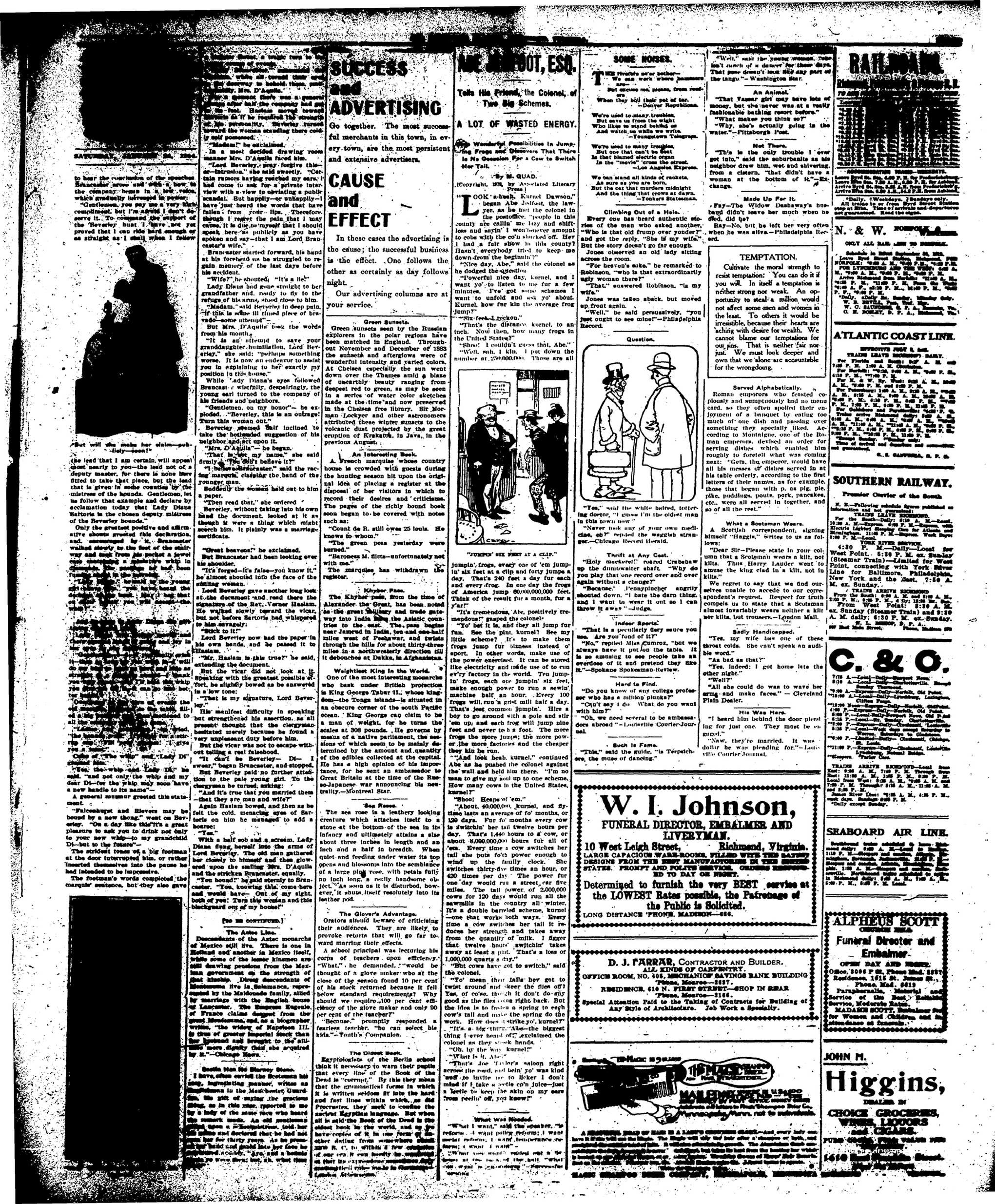
A LOT OF WASTED ENERGY.
Wonderful Possibilities in Jumping
Frogs and Discoverers That There
Is No Occasion For a Cow to Switch
Her Tail.
By M. QUAD.
(Copyright 1978 by Associated Literary
Press)
"LOOK a-hush, Kurnel Dawson."
"Began Abe Jaffoot, the lawyer, as he met the colonel in
the postoffice," people in this
county are callin' me lazy and shift-
less and sayin' I won't ever amount
to cobs with the coin shucked off. Her
I had a fair show in this county?
Havn't, everybody tried to keep me
down from the beginnin'."
"Nice day, Abe," and the colonel as
he dodged the question
"Powerful nice day, kurnel, and I want yo' to listen to me for a few minutes. I've' got some schemes I want to unfold and ask yo' about. Kurnel, how far kiln the average frog imprisoned?" "Six feet reckon."
"That's the distance kornel, to an inch. Now then, how many frogs in the United States?" "Shoo! I couldn't guess that, Abe." "Well, sah, I kni. I put down the number at 250,000. Those are all
CARVY
"JUMPIN' BIX FIRST AT A CLIP."
jumpin' frogs, every one of 'em jumpin'
six feet at a clip and forty jumpa
a day. That's 240 feet a day for each
and every frog. In one day the frogs
of America jump 60,000,000,000 feet.
Think of the result for a month, fur a
yar!
"It's tremendous, Abc, positively tremendous," graped the colonel:
"To bet it is, and they all jump fur
fun. See the plint, kurnel? See my
little scheme? It's to make them
frogs jump fur blizzard instead of
sport. In other words, make use of
the power exercised. It can be stored
like electricity and made use of to run
every factory in the world. Ten jumpin'
frogs, each one jumpin' six feet,
make enough power to run a newwl,
machine half an hour. Every 100
frogs will run a grist mill half a day.
That's just common jumpin'. Hire a boy to go around with a pole and stir
em up, and each frog will jump nine
feet and never be a foot. The more
frogs the spore jump; the more power
the more factors and the cheaper
they will be run.
"And look beeh, kurnel," continued Abe as he pushed the colonel against the wall and held him there. "I'm no man to give my soul up to one scheme. How many cows in the United States, kurnel?"
"Shoot! Hears you 'em."
"About, 40,000 kurnal, and by time lasts an average of 10' months, or 120 days. For 60 months every cow is switchin' her tail twelve hours per day. That's 1,440 hours to a cow, or about 8,000,000,000 hours for all of them. Every time a cow switches her tail she puts forth power enough to wind up the family clock. She switches thirty-five times an hour, or 420 times per day. The power for one day would run a street, car five miles. The tail power, of 2,000,000 cows for 120 days would run all the sawmills in the country all winter. It's a double barreled scheme, kurnal—one that works both ways. Every time a cow switches her tail it reduces her strength and takes away from the quantity of milk. Iigger that twelve hours' switchin' takes away at least a pint. That's a loss of 1,000,000 quarts a day."
"But cows have not to switch," said the colonel.
"To' mean their falls hey got to twist around and keer the files off. Yes, of course, the chill it don't do any good as the files are right back. But the idea is to fasten a spring to each cow's tall and make the spring do the work. How does strike yo' kurnel?"
"It's a thick thair. Also the biggest thing I ever heard of," exclaimed the colonel as they stank hands. "Oh by the way kurnel!"
"What is it. Also"
"That's Joe Taylor's saloon right across the road, and both yo' was kind 'n' so invite me to licker I don't mind if I take a bottle con juice—just a bottle to keep the skin on my ears from peeling' off, you know?"
"What I want," said the speaker, "reforms. I want police reform; I want medical reform; I want temperature reform; I want I want"—
"What you want" called me in the court at the end of the ball. "What you want" in the court. "What you want" in the court.
W. I. Johnson, FUNERAL DIRECTOR, EMBALMER AND LIVERYMAN.
D. J. FARRAR, CONTRACTOR AND BUILDER.
ALL, KINDS OF CARPENTRY.
OFFICE ROOM, NO. 405, MECHANIC'S SAVINGS BANK BUILDING
Tuson, Moore—2037.
RESIDENCE, 610 N. FIRST STREET, SHOP IN SHAR
Tuson, Moore—2037.
Special Attention Paid to the Making of Contracts for Building of
Any Style of Architecture. Job Work a Specialty.
When they built their pot of tar.
—Denver Republican.
We're used to many troubles.
But the night
Who likes to stand behind us
And watch us while we write.
—Youngstown Telegraph.
We're used to many troubles.
But one that can't be beat
In that blamed electric organ
In the "movie" "crow the street.
—Los Angeles Kipman.
We can stand all kinds of rockets.
As sure as you are born.
But the thing that crowts at dawn
And the thing that crowts at dawn.
—Tookers Statesman.
Climbing Out of a Hole
Every one has heard authentic stories of the man who asked another, "Who is that old frump over yonder?" and got the reply, "She is my wife." But the story doesn't go far enough. Jones observed an old lady sitting across the room. "For heaven's sake," he remarked to Robinson, "who is that extraordinarily ugly woman there?"
"Well," he said persuasively, "you just ought to see mine!"—Philadelphia Record.
Question.
"Yes," said the white bred,ittering doctor, "I know I'm the old man in this town now"
"Never take any of your own medicine, eh?" replied the waggail stranger.-Chicago Record Herald.
Thrift at Any Cost.
"Holy mackerel!" roared Crabbaw up the dumbbell shaft. "Why do you play that one record over and over again without a change?"
"Because," Jennypincher angrily shouted down. "I hate the darn thing, and I want to wear it out so I can throw it away."-Judge
Indoor Sports
"That is a particularly dery nuce you use. Are you fond of it?"
"No." replied Mia Cameron, "but we are also in the table. It is no annoyance to see people take an overdose of it and pretend they like it." Spokane Spokesman-Review
Hard to Find.
"Oh, we need several to be ambassadors abroad" - Lindsayville Courier-Journal
Such is Fame.
"This," said the guide, "is Terpetch-ere, the muse of dancing."
W. I. Jo
FUNERAL DIRECTOR
LIVERY
10 West Leigh Street,
LARGE CAPACIOUS WARD-BOOMS
DESIGNS FROM THE BEST MANU
"Well, let's be the young women. They
don't sort of a damn for them daily.
That does not hurt, but they any part of
the range" — Washington Star.
An Animal
"That Vassar girl may have lots of money, but she never was at a really fashionable bathing resort before."
"What makes you think so?" ...
"Why, she's actually going in the bathroom."
Not There.
"This is the only trouble I ever got into," said the suburbanite as his neighbor drew him, wet and shivering, from a clistern, "that didn't have a woman at the bottoms of it."—Exchange.
Made Up For It
Fay-The Widow Dashaway's husband didn't leave her much when he died. did he?
Ray-No, he be left her very often when he was alive-Philadelphia record.
TEMPTATION.
Cultivate the moral strength to resist temptation: You can do it if you will. In itself a temptation is neither strong nor weak. An opportunity to steal a million would not affect some men and women in the least. To others it would be irresistible, because their hearts are aching with desire for wealth. We cannot blame our temptations for our sins. That is neither fair nor just. We must look deeper and own that we alone are accountable for the wrongdoing.
Served Alphabetically.
Roman emperors who fostered copiously and sumptuously had no menu card, so they often spotted their enjoyment of a banquet by eating too much of one dish and passing over something they specially liked. According to Montaligne, one of the Roman emperors, devised an order for serving dishes which enabled him roughly to foretell what was coming next: "Gent, the emperor, would have all his messes of dishes served in at his table orderly, according to the first letters of their names, as for example, those that began with p, as plg, plie, puddings, pouts, pork, pancakes, etc., were all served in together, and so of all the rest."
What a Scottsman Wears
A Scottish correspondent, signing himself "Haggis," writes to us as follows:
"Dear Sir--Please state in your column that a Scotoman wear a kilt, not kiltas. Thus, Harry Lauder went to amuse the king clad in a kilt, not in kiltas."
We regret to say that we find ourselves unable to accede to our correspondent's request. Respect for truth compels us to state that a Scotaman almost invariably wears neither a kilt nor kiltas, but trousers—London Mall.
Badly Handicapped.
"Tes, my wife has one of these throat colds. She can't speak an audible word."
"As bad as that?"
"Tes, indeed: I got home late the other night."
"Well?"
"All she could do was to wave her arm and make faces." — Cleveland Plain Dealer.
"I heard him behind the door pleading for just one. They must be on guard."
"Naw, they're married. It was dollar he was pleading for."—Louisville Courier Journal.
Johnson,
R. EMBALMER AND
YMAN.
Richmond, Virginia.
FILLED WITH THE BAYED
TACTICALS IN THE HOUSE.
All trains to or from Bryd Street Station
are operated by the National Railway and departures
are guaranteed. Read the sign.
OCCLY ALL BANK LINK TO BONDWALK
Schedule to Effect September 31, 2011
Leave Ryd Street Station, Hargreaves, FOD
NORFOLK: °000 A. M., °000 P.M., °000 F.M.
FOR LYNCHBURG AND THE WSP: 0.00 A.
M., °000 A. M., °000 P. M., °000 F. M.
Arrive Richmond from Svalbard: 21:00 A. M.
°000 P. M., °11:00 P. M., From the Wards
°000 A. F., a2100 P. M., b100 P. M., °000
P. F., °000 P. M.
B. C. D. E. F. G. H. I. J. K. L. M. N. O. P. Q. R. S. T. U. V. W. X. Y. Z.
ATLANTIC COAST LINE
TRAINING LAKE BROOKS) BABY.
For Florida and New York: BOB' F. M. and
7:58 P. M.
For New York: "7010, 9090 A. M., 9090 P. M.
4110 P. M., 9770 P. M.
For N. & W. Ry. Ww. Test: 0:53 A. M., 1:00 A.
A. M., 7:00 P. M. and 9:00 P. M.
SOUTHERN RAILWAY.
Premier Carrier of the South
N. R.-Following schedule forms published as
information and not guaranteed:
TRAINS RIVER BROOKDON
For the South-Daily: 6:30 A.M. - Local.
18:30 A.M. - Local. With Electric Lighted Dome Owner for Alliance, with MiracleHall. 11:45 A.M. - Mepress. Week Day 3:00 P.M. - Mepress.
YORK RIVER SERVICE
4:30 P.M. - M-Daily - Local for West Point. 5:30 P.M. ex Sunday (Steamer Train) - Limited for West Point, connecting with York River Line for Baltimore, Philadelphia, New York and the East. 7:50 A.M. ex Sunday.
TRAINS RIVER BROOKDON
From the North: 6:30 A.M. - Local. From the West: 8:30 A.M. ex Sunday (Steamer Train) and 8:30 A.M. daily. 6:30 P.M. ex Sunday. N. L. Browne, D. P. A.
C. & O.
T/25 A. - Local Daily - Airport News.
8:10 A. - Local Daily - Charlottville, Beap
Sunday Thurrood.
*10:00 A. - Local - Daily - North, Old Point.
*10:00 A. - Local - Daily - Lynnburg, Lexington,
Cilford Park.
*11:09 New - England - Daily - Northbilt, Old Point.
4:00 F. - Express - Daily - Norfolk, Old Point.
8:00 F. - Local - Daily - Newport News, Old Point.
*11:15 A. - Local - Dr. Sunday, Charlottville.
*11:20 F. - Express - Daily - Charlottville, Lexington.
*11:25 F. - Local - Work days - must be Saturday to
Waves. Saturday to Gladstone.
*11:40 F. - Limited - Daily - Clarkham, Chlorge,
M. Lords.
*11:00 F. - Express - Daily - Clarkham, Limerick.
Lydsborg, Federal Bridge.
*11:00 F. - Quarter Case.
TRAITS ARRIVE BOOK/G/D - Local News
East: 11:05 A. M. 7100 F. M. Through Stress
East: 11:00 A. M. 11:05 A. M. 6:00 P. M.
Local from West: 8:00 A. M. 11:05 A. M. and
7:00 F. M. Through Stress
7:00 F. M. M. 11:05 A. M. and Blue
West: 8:00 A. M. 11:05 A. M. 4:00 P. M.
Day's exost. Sunday 8:00 F. M.
SEABOARD AIR LINE
Berkshire based established to serve New York,
New Jersey, and Delaware. 110 P. M. Lounge and
Museum. Berkshire, Berkshire, Berkshire, M.A. P.
Lounge, Museum. 110 P. M. Lounge and Museum.
110 P. M. Lounge and Museum. Berkshire, Berkshire,
Berkshire, Berkshire, M.A. P. Lounge, Museum.
Berkshire based established to serve New York,
New Jersey, and Delaware. 110 P. M. Lounge and
Museum. Berkshire, Berkshire, Berkshire, M.A. P. Lounge, Museum.
ALPINE SCOTT
CENTRAL HILL
Funeral Director and
Embalmer
OPEN DAY AND HOURS
Office, 3006 P St., Phone Mid. 2837
Residence, 1618 St. James St.
Phone, Mid. 6019
Parish Church, St. James and
Service of the Bost. Rehina
MADAKIN SCOTT, Rehina Sur-
for Women and Children and in
attendance at funerals.
JOHN M.
Higgins,
DEALER IN
CHOICE, GROCERIES,
WINE, LIQUORS
and CIGARS.
PURE COGNAC, PURE VALLEY PUB
1610 North Franklin Street.
Midland of the Mills.
WESTMINSTER.
ADVERTISING RATEL
For one inch, one insertion.....$ .50
For one larch each subsequent insertion.....$ .00
For two in-shop, three months.....$ .00
For two leاهos, six months.....$ .00
For two leahos, nine months.....$ .00
For two leach, twelve months.....$ .00
Marriage and Financial Notices, one book.....$ .00
Standing and Technical Notices, per two.....$ .00
OUTAGE STATES OF A ENGINE DEMONSTRATED FROM TWO TYPES OF ENGINE BROKEN BY INVESTIGATION
THE PLANET is loved mostly. The subscription price is $1.90 per year, in advance. There are four ways to pay: Money Order can be and be mail at the Post Office Office, Post Office Office, or Exempt Money Order, and when none of these can be groceried, in a Registered Letter.
MONEY ORDERS—You can buy a Money Order or an Exempt Office, payable at the Richmond Post Office, and we will be responsible for its arrival.
EXPENSES. MONEY ORDERS can be obtained at the office of the American Express Ox., the United States Express Ox., and the World Payee and O's Express Company. You can also make your payment of these companies. MONEY ORDER is a cash and convenient way for borrowing money.
REGISTERED LETTER—If a Money Order, Post Office or an Exempt Office will not be within the Letter you wish to send to a payment of the credit. Then, if the Letter is lost or damaged, you can send money in this form.
We must be responsible for money and
bake in any other way than one of the
eggs mentioned below. If you have
money in any other way, you must do it on your own.
BENEWALA, NY—If you do not want THE PLANET equipped for another year, you must notify by P.O. Box 1007 to Discussion 11. The courts have decided that submissions to investigations who did not order their submission which it has been paid are held liable for the payment of the submissions up to date when they enter the paper distribution.
COMMUNICATION—When writing to us to answer your subposition or to discuss your paper, you should give your name and address to the person we cannot find your name on our business.
CHANGE OF ADDRESS—In order to change the address of a subposition we must be sent the notice to the present address.
There is no man of the race to-day who can do as much as Dr. Booker T. Washington in securing a hearing for the colored people in the forum of the world. Leading white journals will publish his observations and arguments and he can diplomatically pload our side of the case in a way that no other man of the race can do. In later years, he is exhibiting a tendency to do this and for this reason is entitled to such commendation as his action mortis. In discussing in "The Country Gentleman," the right way to handle Negro labor, he says:
"First I mention G. W. McLeod, who owns a large tract of land in Macon County, Alabama. He is a good example of the white planner who treats his tenants well. Mr. McLeod believes in having a good school in the community, so he gave an acre of ground upon which the school house was built, and $100 in addition to help put up the $700 schoolhouse. He deeded the land to a set of colored trustees. Mr. McLeod also offers annual prizes for the best-kept stock, best-kept farm, best-kept garden, best attendance at. Sunday school and church. The man or woman guilty of taking intoxicating liquors or engaging in family quarrels is not eligible to prizes and must go at the end of the year.
"J. C. Finkston, of Macon County, Alabama, owns several thousand acres of land. He sees to it that the colored people are encouraged in building good schoolhouses and that their children are sent to school. He has given $200 toward the building of two $600 schoolhouses, but on the way to the building they also raise a large amount of money for the building. He discourages whisky drinking. He encourages churchgoing.
"Judge William Henderson, of Wilcox County, Alabama, with a plantation of about ten thousand acres of good land, on the Alabama River and several hundred tenants, is a stunning supporter of Negro farm demonstration work. He not only calls his tenants together in gatherings of from two hundred and fifty to three hundred and fifty, but in the midst of presenting business courses to the meetings himself. Judge Henderson always makes it a point to comment on the instruction given in each way as to impress every farmer.
"On one occasion, to show how his tenants stood up, he stood up in a gathering of about three hundred tenants and made a statement: If there is a tenant from my
information who ever sent or multiplied phone calls." Out of the huge number of tombs from his place, there was only one man who stood, and his account was so small that he was more than able to take care of it. He gave the land for the erection of the Miller's Perry Industrial School in order that his children might send their children there and at the same time keep them in the community."
And again:
"Probate Judge J. C. Woods, of Lowndes County, Alabama, argues his tenants to have a hog and a cow aplace, and to raise their own food-stuffs at home and stay out of the store. He gave $50 in 1913 for the improvement of the Negro schoolhouse, and in May that if the pupils would continue to improve he would give them $50 more.
Another method of accomplishing the same thing is used by W. W. Campbell, of Macon County., Mr. Campbell is a banker and a large planner. Since his banking business prevents his being on his farms and giving personal attention to the tenants, Mr. Campbell has a graduate of the agricultural department of the Tukeague Institute who lives right among the tenants and directs and helps them, not alone in their farming, but in their schools and churches as well.
"In 1909 W. W. Thompson, of Mason County, purchased a farm of about three, thousand five hundred acres. Before he came into possession of this place it was operated on the old "absentee-landlord" system and passed from owner to owner; it was usually looked upon as a hopeless, business proposition.
"There were many colored tenants on the farm; but since the owners seemed to manifest little interest in the permanent success of the place it was natural that the tenants should manifest little interest. As soon as Mr. Thompson bought the farm he moved his family on it and began let the tenants it know and were directed to work well as in the farm. Instead of abusing them he began praising them and impressing upon them the fact that in proportion as they prospered he would prosper. Amping the first things he did was to tear down the little one-room cabling and build comfortable cottages with two and three rooms.
"On this point Mr. Thompson says: 'As a result of improving the houses a better class of tenants has been secured, and this means a permanent tenant instead of a shuffling and roaming one.' Near his farm is a church and a day school that is in session seven or eight months of the year.
See how the colored tenants respond to this new kind of treatment: A Birmingham newspaper, in speaking of one of the tenants on Mr. Thompson's farm, says: 'On one patch of an acre and a half this year Kelly Sparks has grown three crops—Irish potatoes, cotton and beetles and potatoes to the aggregate value of about $100 per acre.' The paper further says: 'The story of Kelly Sparks should be a lesson to the farmers, white and colored, of Alabama.'
"The net result on this place within four years, according to Mr. Thompson's report, is as follows: In 1909 the farm grew 139 bales of cotton, 500 bushels of corn and 500 bushels of oats. In 1913, four years later, the same farm has grown 850 bales of cotton, 15,000 bushels of corn, 6000 bushels of oats, 300 bushels of corn and 100 heads of cattle. Converted into money these lands made more than $7.50 in 1913 for every dollar that they made in 1909."
He tells of the liberal-minded white man of the Southland when he says:
"Some time ago the Hon. Walter Clark, one of the most prominent and wealthy Southern planters, living at Clarksville, Mississippi, said: 'I am sick and tired of this eternal abuse of the Negro. The Negro is what the Southern people have made of him. We are absolutely responsible for nine-tenths of his short comings, and we should, like men, do so. There is no question but that he has some of the worst traits of any human beings, but he also has some of the noblest."
"All persons who deal with Negro labor must bear in mind that the colored man is extremely social. He likes to have a let-up now and then; he likes to have a good time; he is fond of attending church, funerals, camp meetings, lodge meetings, revivals, frolics, and going to town on Saturday. I have noticed that colored landowners vary often control colored labor more successfully than white owners for the reason that they understand this element in colored labor better than the white man. And here let me form the average of the two, so that no one inside of the South, does not realize to what an extent colored people themselves are becoming employers of colored labor. There are not a few colored men scattered through the South who employ on their farms and in one way or another as many as two hundred or three hundred colored laborers each."
This is a now phase of a most interesting subject. He continues:
"Nearly every one of the white planters I have held up as examples of employers who know how to use Negro labor successfully has once or twice a year a barbecue for his tenants. It is made a great holiday, when the people are not only amused and entertained but are instructed by persons who are experts in various lines of farming.
"I know that as many people will say that this large social element in the case of the Negro constitutes his weakness. This may or may not be true. Any one who has visited Southern Europe and has noted the tremendous amount of time thrown away in holidays will say that the Negro is far above the average of the European workman in the master of time wasted in holidays and the like. Where the Negro wastes one day I am safe in saying the average workman in the Latin countries of Europe or in Mexico wastes three or four days."
"How can the colored laborer be kept on the farm where, in my opinion, he is best off, and out of the
someone will not lend you the money. This is not an easy question to answer, for the tendency put over the world in recent years has been toward the other. In many cases, he expected that the farmer will not be indebted by the tendency, even though he like the rather free life in the country. Why do, so many leave the land then?
He answers the question when he says:
"From direct investigation I find that many valuable colored laborers leave the farm for the reason that they sellm see or handle cash. The Negro laborer likes to put his hands on real money as often as possible. In the city, while he is not so well off in the long run, as I have said, he is usually paid off in cash every Saturday night. In the country he soildm gets cash oftener than once a month or once a year."
That answer is the "Gospel truth."
That is why so many country boys go to the railroads and coal mines. He continues:
"Not a few of the best colored laborers leave the farms because of the poor houses furnished by the owners. The miserable condition of some of the one-room cabins is almost beyond description. In the towns and cities, while he may have a harder time in other respects, he can find a reasonably comfortable house with two or three rooms.
"No matter how ignorant or worth less a colored man may be, he wants his children to have education. A very large and valuable element of colored labor leaves the farm because education cannot be secured in many cases. The farming district of the South the Negro finds public schools provided for him which run only from two to five months in the year. In many cases children have to walk miles to reach these schools. The school-houses are poor. In most cases, beyond description children are not morid on $18 or $25 a month, and of course poor pay means a poor teacher."
And again:
"In the larger towns and cities the Negro laborer finds schools provided by the public missionary or denominational agencies. These schools are in session eight and nine months in the year, the schoolhouses are good and the teachers are competent.
"More and more each year the South is being forced into competition with other farming sections. This means that the South has to use in an increasing degree more labor-saving machinery of a complicated character. Ignorant persons cannot understand or successfully use complicated labor-saving devices. There is only one way out of this—to make the laborer of the South just as intelligent and skilled as the laborer of other sections.
Dr. Washington "drives the nail home" when he says:
"Again a large number of the most industrious, conservative and law-abiding valuable colored laborers leave the country districts and go to the towns and cities to get police protection. In the country these colored laborers fear that if they are charged with crime they will be dealt with by the mob or without trial by jury."
Surely the distinguished educator is coming out into "the lime light" with "the truth, the whole truth and nothing but the truth." He "sticks to his text" when he says:
"This same element of colored people, too, often leaves the country to avoid the constant harassing to which they are subjected in many sections by petty officers of the law. Few white men realize to what an extent. minor officers get into the habit of following up colored people in the country districts and arresting them on all kinds of charges. The police officer made for the sake of the fee, which goes either to the man making the arrest or to some local magistrate who is many cases is anxious to put as many persons as possible into the chain gang in order to increase the revenue that will come from prison labor.
"But, as I have just stated, if in every country district the Negro-could be sure that when he or members of his family are accused of a crime, they would be impartially investigated and a legal trial of the case would be held it would keep many colored people on the farms.
"It would help tremendously to make the Negro more efficient and contented as a farm laborer if more were done in the way of educating him as to the importance of farming and better methods of farming. I know that the usual objections will be urged—that educated Negroes do not often go back to the farm. Be this as it may, it means much the measure of the ministers and other leaders to know about farming and to be interested in country life, even though they do not earn their living by farming, for these leaders, both directly and indirectly, exert a great influence on the average working man and woman."
Dr. Washington concludes his most interesting recital as follows:
"But conditions are charging for the better in all parts of the South. White people are manifesting more interest each year in the training of colored people, and, what is equally important, colored people are beginning to learn to use their education in sensible ways; they are learning that it is no disgrace for an educated person to work on the farm. As white people see this they are going to be willing to spend more on the Negro for farm training."
Thousands of liberal-minded white people have read all that this leader has seen fit to say. In the hundreds of words written, he has said much that will start these people to thinking. That it will benefit the colored people of the country goes without.
THE DREAM OF THE WORLD
YOU CAN'T
START THE ROAD TO PROPERTY today. The first milestone
is a BANK ACCOUNT. It is a check against extravagance. Read
is a BANK ACCOUNT. It is a book against extravagance. Read the autobiography of any of our great captains of industry and finance. Invariably, close to the opening paragraph, he will tell of his FIRST BANK ACCOUNT. It was the first milestone in his ROAD TO SUCCESS!
saying. Dr. Washington is speaking of the race of workers and not of a race of loafers.
If the average white man can be brought to understand that the dissolute, immoral, shiftless, loafing colored people constitute but a small proportion of the great mass of an industrious race, then Dr. Washington's plea for us will not have been in vain.
"LOOK BEFORE YOU LEAP."
The Wall Street Journal in its issue of the 16th last, advises state banks to go slow in entering the new Federal reserve system. It says:
There appears to be no reason why state banking institutions should be healthy in joining the new Federal reserve system, unless they are fully satisfied that it will be for their advantage. The national- banks are practically they-settled into the new system by several provisions of the law which would involve direful con sequences, if they were ignored. Those in reserve clite promptly lose deposit for country banks, and they will with the risk of the depreciation of the 2 per cent. bonds held to secure circulation if they fail to avail themselves of the privileges of refunding and redeemment attached to entry into the system.
None of these consequences operates directly, however, upon state banks and trust companies, and there are several special reasons why the latter are justified in examining the effects of the new law carefully before surrendering their present independence.
For the cautious trust company directorate, it would seem to be wise to await the regulations to be framed under the new law by the Federal Reserve Board. Among the fields in which wide powers are given to the Reserve Board is to make rules and regulations, governing state institutions which become members of the new system. But the full importance of its bearing upon the competition of trust companies and national banks is the authority given to the Federal Reserve Board to permit national banks "to act as trustee, executor, administrator, or registrar of stocks and bonds."
Even this function cannot be exercised under the law however, until the promulgation of "such rules and regulations as the said Board may prescribe," and cannot be "in contravention of state or law law. These regulations, which may be decided either broadly or narrowly, according to the temper of the Federal Reserve Board, which has yet to come into existence. There has always been doubt whether a national bank had legal authority to perform any of these functions, and the assumption that such a bank would be the ones they would seem to be that they had not heretofore existed.
Another question of importance is the relation which will be held towards the new system by those institutions which decide not to enter it. If they are practically boycotted, without power to appeal to a member bank for aid in times of stress, this fact might operate powerfully to force them into the new system. The member bank shall set as the medium or agent of a non-member bank is applying for or receiving discounts from a Federal reserve bank under the provisions of this act, except by permission of the Federal Reserve Board."
Interpreted strictly, as such a statute should be, this would seem to prohibit only the direct rededuction by a Federal reserve bank of paper originating with a non-member bank. If this is all the disability which is imposed in the matter, it will not preclude close relations between non-member and member banks all times to have sufficient paper which has not originated with non-member institutions to enable them to obtain such radioscopes as conditions may require.
Evidently, with the wide powers which are conferred in all these matters upon the Federal Reserve Board a strong state bank or trust company can afford to wait for an indication of the attitude of the Board before deciding whether to surrender its independence.
Subscribe to the Richmond Planet.
Every day in your talk and reading, at home, on the street car, in the office, shop and office of an art new word. A friend asks: What makes a poster harrier? You ask: What makes a poster harrier? What makes a poster harrier? What makes a poster harrier? This New Goddess creation all kinds of fiction in Language, History, Literature, Science, and food authority.
400,000 Words.
600,000 Illustrations.
Cost $400,000.
3700 Pages.
The only dictionary with
these two numbers authorised
as a Dictionary of Gutenberg."
John W. Bentham
On this, opaque, strong
India paper. What a mis-
tinction between the Durham
Workshop and the Worcester
Workshop and so convenient to use.
One half the thickness and
weight of a Regius Baldin,
wheat flour.
On prismatic book paper, W.
10k lbs. 10mm x 94k x
8 inches.
With fourteen pages,
permanently on the
pages this
permanently
folds a gill of
prismatic
pages.
L. & F.
Bentham
O. Springfield, Illinois.
A cablegram that was received in Lancaster, Pa., from Gibraltar by Judge Charles L. Landis announces the death at sea of his brother, James L. Landis, editor and one of the owners of the Lancaster New Brn, from typhoid fever.
Mr. Landis and his wife and piece called from New York on Jan. 8 on a trip around the world for his health. The body will be brought home for burial. The deceased, who was fifty-one years old, was prominent in business affairs and was a leader in Republican politics. He was a member of the board of managers of the Huntington Reformatory.
Score of Students Hurt.
A trolley car crashing into a hay wagon in which were seated thirty members of the senior class of the Sunbury, Pa., high school, smashed the wagon, killed a horse and seriously injured Miss Josephine Morgan, William Koch, William Rockefeller, Hilam Bloom, Joseph Reedy, Margaret Townsend and Emily Weary. Several were unconscious. Broken arms, ribs and cuts about the head constituted the injuries. Fifteen others were alightly hurt. The accident occurred on a bridge between Sunbury and Northumberland.
$13,000 Package Bonus.
It has become known in Pittsburgh, Pa. that a package containing $15, 600 was stolen from the office of the United States Express, company at Connellville on Monday night. The money had been sent by a Pittsburgh bank to the Second National bank, of Connellville. Express company detectives and the police are looking for Ralph Wyant, night clerk in the express company's office at Connellville. It is said he has not been seen since Monday night, when he reported for duty.
HINDOO SALVE .
The world wonder hair preparation.
Cures Dandruff and Grows Hair in
abundance. It has been used by the
Hindoes for centuries. Guaranteed
under the Food and Drugs Act, June
1976. Encourages to buy. $566. Price
500 per jar. Encourages to buy in stamps
for sample. Agents wanted.
HINDOO SALVE CO. 2645 Lawton
Avenue, St. Louis, MO. 64
For Hair pad, Joinp, Fifty, Cents
(50c.) For Bottle, Agents Wanted.
Write for Price List.
A GRADUATED ENDOWMENT of $300.00 for Only $3.00
Per Year: It Pays From $3.00 to $4.00 per week SICK DUES
and a BURIAL BENEFIT of from $5.00 to $6.00 for Only
$6.00 per year additional. It has a STRONG TREASURY and
owns Much Property.
District Deputies and Special Deputies will give information
concerning the organizing of New Lodges in Virginia.
GRAND COURT, ORDER OF CALANTRE
IT PAYS $150.00 ENDOWMENT. The Cost Is Only $3.00 Per Year. It Pays SICK DUES of $3.00 Per Week and a BURIAL BENEFIT of from $25.00 to $50.00. For further information apply to JOHN MITCHELL, JR., Grand Chancellor, 311 North Fourth Street, Richmond, Va.
Female Embalmer.
mankind, or so charge, no matter what your disease, sickness or affliction may be, and restore you, to perfect health. The thousands of people, the best and leading ones in the United States and Europe will satisfy that I am one of the most wonderful healers of all pamphilies in the world. I use nothing but harm, rats harm, gums, balmies, lavender, incense, and my medicines. Their care earned thousands that the most skilled medicalians the best hospital physicians in America and Europe have given up to do, and said there was no cure for them.
My Medicine here the Following Diseases:—Heart Disease, Occupation, Kidney, Bladder, Binder, trifurc, Piles in any form, Vagus, Quiney, Sore Throat, Lung, Dyspnea, Indigestion, Constipation, Abdominal in any form, Pains and Agents of any kind, Cordia, Bronchial Troubles, Seven, Skin Diseases, all telling symptoms, all Ponder Complaints, Lia Ogrange or Pneumonia, Wear, Carbunosis, Bed, Drainer in the work form without the use of a knife or instrument, Bunches, Pumping on face and body, Diabetes of Kidneys or Bright's Disease of the Kidneys. My Medicine here any dime so, no matter of what nature. General orophthalmic troubles a specialty.
The Planet for one year is an excellent gift--only $1.50
MADAM LUCH CHRISTIAN SCOTT is associated in business with her husband, Mr. Alphens Scott. Madam Scott claims the honor of being the only Negro woman in the State of Virginia—holding a State Honor to practice Embalming, and is indeed, one of the few women in the United States, Embalming and Conducting Earrings. She Tanks with the host in her profession.
She is prominent in fraternal organizations, namely: Courts of Chelanhe, I. O. of St. Luke, I. O. of G. Samaritans, Household of Bust, Tentus, Sons and Daughters of Richmond, Shepherds of Bethlehem and Ideal Benefit Society.
Your Patronage and Influence will be greatly appreciated. Plain remember that she is always at your service.
Reliable Service at Moderate Rates.
F.
OFFICE: 2006 P Street, 'Phone,
Madison 2287.
RESIDENCE: 1015 St. James St.
'Phone, Madison 6619.
```markdown
```
1. 2. 3. 4. 5. 6. 7. 8. 9. 10. 11. 12. 13. 14. 15. 16. 17. 18. 19. 20. 21. 22. 23. 24. 25. 26. 27. 28. 29. 30. 31. 32. 33. 34. 35. 36. 37. 38. 39. 40. 41. 42. 43. 44. 45. 46. 47. 48. 49. 50. 51. 52. 53. 54. 55. 56. 57. 58. 59. 60. 61. 62. 63. 64. 65. 66. 67. 68. 69. 70. 71. 72. 73. 74. 75. 76. 77. 78. 79. 80. 81. 82. 83. 84. 85. 86. 87. 88. 89. 90. 91. 92. 93. 94. 95. 96. 97. 98. 99. 100.
L. J. HAYDEN
MANUFACTURER OF
Pure Herb
Medicines.
TO CURE ALL DISEASES,
OR NO CHARGES.
DO YOU LOVE HEALTH?
If so, call and see L. J. Hayden
Manufacturer of Pure Herb
Medicines, 320 West Broad Street. My
Medicines cure all disease known.
what your disease distresses or afflicted health. The thousands of people United States and Europe will testify all heals of all pensions in the rest of the world, balances leave, in my medicine. They have exalted Christians and the best hospital physicians given up to die, and said there was
HIGH GRADE JOB WORK
---
We print CALENDARS. Our prices are as low as is consistent with First Class Work. We furnish Invitations for Balls, Weddings and Special Entertainments.
We have a Stock Room here in which we carry Book Paper, Bond Paper, Flat Writings, Manilla Paper, Envelopea. Card Board, Wedding Stock. in fact, Every thing in the Printing Line.
AN APPEAL TO THE NEGRO EXHIBITION
For Help While Collecting Materials for the International Exhibition of the Book, Industry and Graphic Arts, Leipzig, May-October, 1914.
On account of the celebration of the 150th Anniversary of the Royal Academy for the Graphic Arts and the Book-Industry, at Leipzig, Germany; there will be a great Exhibition made up and organised to show the Graphic products of all people, lands and nations from the earliest times up to these days.
The plan of the exhibition shows the following sixteen groups: 1, Graphic Arts; 2, Applied Graphics and Book-making, Illustrating; 3, Instruction, Education, Schools; 4, Paper Manufacturing; 5, Stationery and Writing Materials; 6, Colors, Lithographics and copper-plates; 7, Photography; 8, Reproduction; 9, Sterotypy, Electrotypy; 10, Printing Processes; 11, Paper-binding; 12, Pub Hailing, book-thrills; 13, Newspapers, Advertising, Canvases, Periodicals; 14, Libraries; 15, Machinery; 16, Measures for the Protection and Welfare of the workers etc.
These groups have been subdivided into about 63 classes. Each group is to be introduced by a historical and a technical instructive department. The development and the position in the history of civilization of the various branches of the book industry will be clearly demonstrated models and apparatus for demonstrating purposes and the cinematographic art will be shown.
The publications of booksellers and music publishers will be brought directly to the notice of the public through the medium of libraries and reading rooms, through lectures, public readings, recitations and concert recitals. Anything in our minds will be under the banner of the "black girl." Many learned societies and associations connected with the book industry will have their congresses and meet at the exhibition ground. When I read the news I asked myself if it would be possible to show at the exhibition some exhibits of the Negro people in America, in whose matter I am especially interested. So I came to all willing to help me in my undertaking, to ask for their cooperation while collecting exhibition matters.
Any printing, writing, photos,
pictures out of the slavery times
this day will be welcome. Pupils
and students, lessons, schoolplans
and pictures, photos of professors,
students and buildings,
models of publishing houses,
colleges and universities will
immediately accepted. Likewise draw
out of restraints and students.
they or publicists have
in hand of all book and
and writing they have published.
ii. have been engaged with
authors that prey on authors
by having an advantage of
their knowledge of the subject
and their ability to glean
their own knowledge of the subject.
the market. Editors should send the best they have, if possible a model of the whole business plan.
Here is an opportunity for the Colored people of America and for those who have devoted their lives to the culture-work among the colored people, to demonstrate what they have done already and what they could do in the future. Another important feature while collecting exhibition materials is that all will have great value for the future, as the great Museum-library of Leipzig will participate in the exhibits when the fair is over.
You will have no expenses to pay for the exhibition of what you send. I will care for that. But what ever you send write your name upon it. Please do what you can in the matter. Write about your help as soon as possible and send your exhibits—old or new, good and bad—to PASTOR PAUL O. HENTECH, Gun dorferstr. I, I, Leipzig-Li., Germany.
Other Negro papers are asked to print the foregoing lines of Pastor Hentash in their respective columns. —The Editor.
Next Week.
"SHERLOCK HOLMES."
At the Grayce Scott Bijou next week Miss Scott and her Company will present one of the most, if not the most interesting play of their engagement. It is none other than William Gillette's famous play, "Sherlock Holmes." For many years the fascinating detective character has held millions of readers on two continents inthralled by the wonderful crime deductions made by him and when William Gillette stepped forward in a dramatic version of the famous A. Conan Doyle stories, the play was a tremendous success, over whimming all of the other successes he had ever achieved.
The story of the play 'is woven about the attempt of James and Madge Larrabee to secure from Alice Paulknner letters and papers which prove the deep wrong done Miss Paulknner's sister by a man of royal blood, who is about to be married. If the Larrabee an secure the papers it is their intention to blackmail the nobleman with threats to tell his fames of the old affair. The girl, Alice Paulknner, is struggling to retain possession of the letters while she is being kept in virtual captivity in the home of the Larrabee, whether she was lured by the pretended friend ship of Madge Larrabee. Her purpose is to warn the fames and thus to prevent the intended marriage.
Sherlock Holmes, commissioned by the nobleman to obtain it permits the letter, arrives at the Lawrence residence when the girl in being threatened, with death if she does not divulge the place where she has hidden the paper. With plans and counterplots the play appears and finds this point with the scintillating piled audience flashing faintly.
London, who has frequently escaped Holmes, although he has caused them considerable trouble, enters into the matter, not because he wants Miss Faulkner's letters but because he wants to outwit and if possible to put an end to the career of Sherlock Holmes. The battle of wits and nerve between the two men and their underlings is told with stirring dramatic scenes following fast upon each other and holding the spectator's breathless interest to the very last line of the play.
This play will afford another splendid opportunity to Mr. Thompson in the part of Sherlock Holmes and Miss Scott will be the Alice Faulkner, around whom the plot revolves. Mr. Bassett will have an excellent role as Professor Moriarty and Mr. Newing will be the detectives' loyal boy, "Billy." Miss Dudley will be the Madge Larrabes and Mr. Warner, Mr. Anders and the other members of the company will-all have excellent characters.
As usual the matinee days will be Tuesday, Thursday and Saturday.
CONGRESSMAN IN HOT FIST BATTLE
Johnson, of Kentucky, Has Fight With Lawyer.
Representative Ben Johnson, of Kentucky, and John R. Shields, a Washington attorney, engaged in a fight in the room of the house District of Columbia committee.
The faces of both men were cut and badly bruised. Johnson called for his pistol and a dozen members and clerks separated the combatants. More than a dozen blows were exchanged.
Shields was knocked down once in a general melee when various menbers were trying to separate the men. Shields was shoved out into the hall. He tried to return, but was prevented. He then disappeared from the building.
Johnson appeared later nursing his injuries with a towel. His face was cut in several places. Shields got an early rush under the chin.
The fight resulted from bitter feeling over an effort by Shields to have a bill giving firemen and policemen the right to ride free on street cars reported by the committee. Shields was charged by Johnson, who is chairman of the District of Columbia committee, with being the "lobbyist" for the firemen and policemen.
Completion
He—Are you happy, darling? How—
Oh, I am doubly happy! He—How—
you, oh? What's the other follow?
You will receive courteous attention and your patronage is earnestly solicited. Out of Town Orders Promptly Attended. If our prices are higher, you can go elsewhere if you can better them in the same grade and class of work. If our prices are lower, we stand ready to accept the business.
311 North Fourth Street, Richmond, Va. Long Distance Telephone, Monroe-2213.
Photos by American Press Association.
Senator Cullem Dying.
Former Senator Shelby M. Cullom,
of Illinois, is critically ill at his
home in Washington. The attending
physicians have given up all
hope for his recovery. He is suffering
from heart trouble and complications.
He has been a suffered from
heart trouble for twenty years, but
the most serious attack he has had
was that of a mouth age. Senator Cullem was eighty-four years of age last November.
Trade in Dogs' Tooth.
That considerable trade in dogs'
beeth has sprung up in the Pacific
islands, where they are used for currency
and currency, was revealed in Mil-
gam in London. May, concerning a
bounty for 40,000 dogs at 90 cents.
Thief Beats Woman; Loots Home.
Margaret Buckley was kicked by a thief while at her home in Wilmington, Del., and knocked unconscious.
The thief poured fodine down her throat, and then ransacked the home of several watches and some money.
Bandita Bob Bank
Two bandits held up Cashier John J. McBride, of the State bank, of Pittsburg, Okla., in Jesse James style and escaped on their horses, with all the money in the bank, amounting to several thousands of dollars.
AGENTS FOR THE PLANET.
RICHMOND, VA.
Mrs. Annie Walbarrow, 4th & Broad.
Peter Thompson, 710 N. First St.
street.
Wm. H. Scott, 2218 B. Mala St.
N. Winston, 527 Brook Ave.
William B. Smith, 8 W. Leigh St.
Toon Bird.
Thomas Page, 215 State Street.
Clarence Williams
1461 Rose Street.
We Do PressWork for the Trade.
We have a full line of the stationery to be obtained in the United States. We suing Paper and Envelopes in the Court and your patronage is earned. If our prices are higher, you grade and class of work the business.
Street, Richmond
Monroe-2213.
BROOKLYN, N. Y.
John H. Ashby, 135 St.
TARBORO, N. C.
V. R. Howard.
STAUNTON, VA.
J. H. Allen, 126 S. Augusta St.
STEUBENVILLE, O.
W. H. Greene, 752 N. 8th St.
ATLANTIC CITY, N. J.
Harold P. Douglas, 11 N. Kentucky Avenue.
John S. Lee, 101 N. New York Ave.
NEWARK, N. J.
Chas. H. Lanlear, 100 Bank St.
WILMINGTON, N. C.
Wm. H. Moore.
Promptly.
we a full line of the Finest Sta-
ty to be obtained anywhere in
United States. We supply Mourn-
ber and Envelopes.
the Country
patronage is earnestly solicited.
prices are higher, you can go else-
d and class of work. If our prices
ness.
t, Richmond, Va.
-2213.
We have a full line of the Finest Stationery to be obtained anywhere in the United States. We supply Mourning Paper and Envelopes.
STAUNTON 74 A.
New, 120 S. Augusta St.
STEUBENVILLE, O.
Greene, 753 N. 2nd St.
LANTIC CITY, N. J.
S. Douglas, 11 N. Kentucky
Lee, 101 N. New York Ave.
NEWARK, N. J.
Lanlear, 100 Bank St.
BILMINGTON, N. C.
Loora.
Rev. R. J. Lange
ASBURY
R. Bell, 102 Spr
SALT LAKE
Charles Ludwig.
LOUISVILLE
Josee B. Brown.
NEW OR
World's News On
A. O. Smith, 202
Rev. F. C. Hamill
NORFOLK, VA.
Walter R. Henry, 19 C Avenue,
Huntersville.
John DeBona, 610 Church St.
Thomas E. W. Perry, 3 Jesse's
Place.
CHICAGO, IL.
C. Cunningham 3242 State St.
A. D. Hayes, 3640 State St.
B. M. Harvey, 3924 State Street.
W. Gaughan, 3624 State Street.
WASHINGTON. D. C.
Columbia News Agency 921-D St.
N W
PHILADELPHIA, PA.
7 P. Mackenna 1114 Pine Street
James W. Warwick 264 R 111h St
J. A. Stokes 1411 Pitcawker St.
PITTSBURG, PA.
Monroe Cabinine, 6 White St.
D. L. Lewis, 1707 Wylie Ave.
B. K. Thames, 1400 Wynne Avenue.
DANVILLE VA.
Harry A. Clark, 117 Greendale St.
PROVIDENCE R. L.
Douglas A. A. P. A. 910 Westminster
cor Street
NEW YORK, N. Y.
New London, Massachusetts
260 Wine Street.
DANVILLE VA
MARK. 117 Graebend St.
OVERBROW R. L.
A. P. A. 919 Westminster
NEW YORK, N.Y.
W. A. Jackson.
Senior Counsel
P. R. R. Pergamon.
191 Lester Street.
ly.
Finest Sta-
anywhere in
ply Mourn-
entry
tly solicited.
can go else-
if our prices
nd, Va.
Samuel Kobin, 228 R. 157th St.
R. A. Williams, 200 W. 62d St.
J. R. Schmidt, 268 W. 85th St.
LOE, VA.
Rev. R. J. Langston.
ASBURY PARK, N. J.
R. Bell, 102 Springwood Ave.
SALT LAKE CITY, UTAR.
Charles Ludwig, P. O. Box 1776
LOUISVILLE, KY.
SEP RE YES a Tene MEER Se
AO Sa hitercerni.mpee Toa Ev = Ae
= as
SATURDAY, JANUARY @4, 2014.
n “ten
ORCHARD AND GARDEN PEST.
Poisoned Bran and Clean Cultivation
‘Two Ways of Fighting the Cutwerm,
‘The most nativfactory reimedy for
cutworms, which do' much damage tn
garden and:.orvhard, In homemade
material koown as pulwued dren
mnab. tt ts prepared ns follows:
ff a large amount Is needed ailx
thoroughly onetulf pound of paris
erven with twenty-five pounds of dry
bran, Theu pregre none sweetened
water by mixing one quart of cheap
tiolowen or two or three pounds of
ausar with (wo gallons of water,
Molnten the pobwne! tran? with the
aweetened witer Use fust enough of
the water to make the bran fably
molt.
Tem ama quantity is nested ents
one teospuntfal of pitts green with
amare of dry brn "tt ts got really
Peveasaey to tivwaure the paris green
accurately: simply tine enough to give
ot St a Eg
a ~ Y +
4 S i
= es ae se
Ke ee
Bole ae eel
bebe S.A
Photoeraph by New Uarmpahire college
et vouemsecs Canina
PaReE? BOTs OF Cureeee
the bran a alichtly greenish, tinge
:Then prepare a pint of aweetened wa-
‘ter and moisten the bran with thie
Fill a pail with “this matectal and
scatter’ the polioned bran over the
surface of the ground so that small
chanks balf ae bic as « waloot or
larger wil be distributed every feot
or two. Do this fust before the plants
are due to come up.
Pooltry munt be kept away from
the ganien for a few days. After =
week or two or after one of two raise
the bite of bran usually Gleappear sut-
ficiently v0 that there ts ite danger
of polsontog ptultry.
Often cutworms cause excessive
damage by cutting off newly eet to:
inato plants, or cabbage plants ‘that
have joat been transplanted from seed
boxes, Such fants may be rather
easily protected by wrapring & sinall
square of atrip of paper around the
atem when setting them out, #0 fhat
the atem near the ground wil) be pro-
tected by a cylinder or caltar of pay
Per. Thle paper protector should ex-
tend into the ground txlf nn tach and
abore ground two of thie (nehes. If
soft paper in used the collur should
make two or three turns around the
stem.
If Tand te kent tu clenu cultivation fn
late summer. keeping down weeds,
capectaity tf {t finn crop mucb aa po-
ntors ee tumatwns. tn yehich there ts
only one plant to eansidemble nren of
soll, there will tm few exsn Inld there
he the moths.—Clrealnr New Hamp.
shire Collece and Uxpertinent Station.
Sime way n nent farm home
with tmlldinn well patoted ale
venga sore lth @ good farm and
gens farming Does anybody
wonder why? Lo
SPOSEENE EES SOS TOTES OSCE OOF
Turning Alfsite Into'Perk.
At the Kamas experiment station
900 pounds’ of pork were made from
soe ton of alfalfa bay and 770 pounds
trom an acre of alfalfa pasture. , At
he Nebranka atation tox rations Zon-
sting of one-fourth alfaita hiay sbow-
4 the alfalfn fay worth ite weigbt to
frames! aod auperior to the sume
weight of bran The fows station
mado pig furk at $384 per 167 jmuda
and realized 711 ents per tuisticl for
orm, WIth nifatfa and corn, pork com
52.88 per, lim pounds. and corn return:
od 866 centn por bushel, a difference
2€ 88.158 por cont to favor of alfalfa.
eds kc Mee Mane
When picking biackberries get them
oat of the sun a3 sbon ax possible or
they'll turn end ln xpote and not be s0
salable. furry them into the crates
apd then {nto # cool.cellar ontil time
for sbippiug or eefiing Rill the boxes
(oN and pack neatly In cleam pack-
ages. If you want.a fancy price make
the crates look attrattire—Farm Jour
eal.
+ Te Kill Burdock.
Te kiM burdock put crude carbotic
teh on the. roots after cutting close te
the grand with a bos This metbod'te
Slacking 204 probably a0 cheap as any,
thing. ‘The carbolic. acid may be ay
plied with = stiall off cua A ‘few
feepe poured (mo the crown of the
pleat will be fecnd fective—Ne’
Mena! Stockmas ned Farmer.
ee ne #
+ Be Mereifel te Your Des.
Rites there lo a conning ntreee
ear. be m1 that the Gon con, get a
Meta “wher Be te thirety. ae hea "a
@teh “and ner that It th rigularty ‘eup-
pited with freab.water'-A deg ie a
“Sea; be lw your dog and your frieed:
‘eat kim as euch.-Fart Journal
PAYS &1X TO ONE
A wan who could invest a:
quarter and get beck « dollar:
and a Dalf would think he bad
strack « good: ting, That fe
about what = farmer can do im
Sthe -Sandiiag of manure. Two
% ty-Sve cents’ worth of acid ples.
phates Rdded to the stable ‘sig-
ure will return 160 cents’ worth;
of crops The Ohio experiment:
station has proved it, many
farmers have, found it to be #9,
and yet mont of us fall to Invest
the Quarter of make the worse
mistake of failing to care for the
manure at all—Sntional Btock-
man and Farmer,
Feeesieenises?
FOUR SPUD CROPS A YEAR.
Spaniard’s Methods May Be Good Fer
Others to Imitata,
. From Spain comen the report of «
Spaniard who grew four crops of po
tatoes.on the samo land in twelve
montbs, ” The potutocs were grown.un-
der ordiuary conditions, and the
ground was fertilized with horee ma-
Bure. -
First crop, Scotch seed potatoes,
planted Aug. 22 and dug Nov. 6 1911,
foie elze, Sra: aud good quality; sec
ond crop, Scotct need potatoes, planted
Nov. 9, 1911, and dug Feb, 19, 3912,
fair alte and very good quality; third
crop, Scotch seal potatoes, planted
Feb. 21 and dug May 19, 1912, large
size and much better than tboso of
Preceding cropa: fourth crop, Spanish
seed potatoes, planted May 22 and dug
Aug. 19, 1912. poor yield and potatoes
small.
‘Tho grower attribotes the poor qual
ty of the lant crop to inferior need, lack
of water for Irrizntion mnd to sercral
very bot wiitn that prevailed in July;
but, an In other years, the crop of thie
sare period lina. becn m goot one, the
low yield of 1912 does not detract from
the feasibility of the plan.—Rural New
Yorken :
FOES OF THE ROSEBUD.
Get After the Fly and the Slug if Yeu
‘Want to Save Your Flowers.
‘To deatroy the green Hy, colonies of
which congregato-on the young growth
of the roscbuslics and suck the Jaices
‘of the plant, and‘other lasect pests, we
apray the bushes with tobacco dust
after wetting them eo the dust will
adhere. We have also found ‘fresh
white hellebore dusted on the bushes
a very gopd remedy... A aifter can be
made-by punching the corer of n bnk-
tng powder can full of «mnt holes nnd
uslog the can {a the snes snanner an
& aalt or pepper stinker
‘The rose slag. a Mint cree worn
that eate*the feared, ming he control
fed Uy applying winite oll soap, one
Balé poand dimolvest in four gallons
of water, ‘The rove tus, n Ine abell
deetle that‘ ents tle lenves att blow:
soms and greatly dnmazes the roses,
te beat controled hy hand picking oF
knocking affett a xtievt In the early
morning. Kowetnintes can be kept
Gulte free of Inecta bowerer, by
Uderally and frequently sprinkling
with tobreco dunt.—Itural Life
— ‘
Keep the Calves “Coming.”
‘The. calves must be kept “coming.”
whether they muck the cows of. are
hand fed Sklmmilk calves grow
strong and thrifty If given 9 chance
Their milk hus to be elvan and enough
of ft With It thes nerd something to
take the place uf the cream that te
one, Corn I< n goal aubstitute. Oxta
help also Ground daxneed In the mil
fe One, but It conts too mach these
daze For cheapness ait rexatts corm
[and onte caidtied texethor or Jort plate
corn coarnely griund and fed dry are
bard to beat.—lown Hormentend. |
Hand er Power Spraying?
Fland spraying I* more expenaive
than power spraying. The cost varies
mach In different carce. depenting ow
the eflictency of Ishor. conrentence,
and other casentinis, and inach de
pends on’ the apparatus wed. The
pomp ahonld tnve capacity to male
taln Bich premmice, ant the Nozzle mast
throw m flow xpeny.” The, requirements
are the xnme for every kind of spray:
ing.—Faem Proxtess .
peace Veenah Glenna’ ..
To a abort plee of half round pont |
securcly*tack on the curred alde with:
ramen cuingie swatia a
, sheet of bosey eal
Cantzed. Iron about
7 ittoen tochee tone.
Tore «bole Inthe
= block at an angle
of about forty-five
— OF aoe ere
~ agp SS Seer eee ae
: nheot of heary ah
vantzed tron about
* + fifteen tnchies lone,
itore a bole in the
= block at an angle
of about forty-five
a, degrees, deey
choveb te receive along bandie. This
works very ~atlituctorily.—Farm and
Firealse
“GOING TO LAW.”~-
A conveyaure of nnd described a0
ruriniog with the meanders of # Don:
narizable xtrenm gives title to the
thread of the .xtronm In the absence
‘9 @ contrary Intention rbown by. the
Jeed.—RobimmaLeras Wells, Ky., 185
& W. 317, Some
* be selling personal property the geo-
eral_role is that where ne misrepre
ventationn .are’ made by the seller ip
reapect to the quality or condition of
the property the purchaser beys at
bis own rixk apd camnct recover dem-
area ob account of defects of mneouad-
nese, bat where xnimials of articles are
sold for food, the law tmpliens a war-
Fanty,o0 the part of the bayer that
geek “provisions are wholesome und
St 09 ent. anid the rule of buyer’ rhets
Youn sot Ari. eae ad
+
THE ROAD. TO SUCCESS I LINED
THAT HE WHO RUNS MAY READ.
- YOU GnOw SWEET Conn
eee tees. WY
we Gon poked edtee is a
i Treatment Thea Thie Ona. -
Every truck tarmac Enews that th
Grat carly sweet corn ie ‘market
paya an\ creat a pro@t as any crop
ere
It fx usually sold by the humdred and
marketed in sacks ¢oataining that
aumber of care The fodder remain
img after the crop is cold ke mearly.aa
valuxble ‘an timothy bay. The best
proft comes from the eprilest sere,
etye a writer in the: 4, Rasiew.
Sweet corm cannet ‘a geeat
distance. as lt deterfirates rapidly:
i
4 {
H |
esis |
Photograph by Long Island agricultural
ne ceaene
GUEET CORN AND GIMA BRAXK |”
therefore the locat grower doen tot
bare such competition pa docs the
grower of lean perishable products
Sandy ‘or Wsht loum soll: with an
open subsol, ts beat for this crop.
‘The very bent need of the beat and
wont popular varieties abould be pro-
vided. Home grown nerd, well nclect
ed and well cured, will pay bls profits
on the cost of tabor eiwployed for this
work, The drat plantiuge must be
made early In the neason, ani reed
only of the greatent vitality will with-
stand the unfavorable weather condl-
Yoon that are Hkely to provall at this
season. i
‘The cultivation of “thin crop should
bo thorough. ani no crop will respond
sooner to oo! treatment.
‘To succeed In Krowing Sweet com
for the early market a Uberal amoiint
of plant food must be provided at the
right time and In arallable form.
‘This means cover crops and no In-
creased une of commercial fertilizers
gocobrisissesseepeseeteees
Roostern not weeded, loafing
tiena. boarding cows, small Iitter
sows, run down aoll—these are
what bold a foriner down.—tows
Homestead. -
VP-P sE et: ,
Dry Feed or Wet Mach?
‘The wet tonsb of coramoal and bran
that ured (u be the standard mording
feed of the farm Sock weamn to be &o-
lag out of wtslo in favor of the’ bopper
full of # mixture of dry ground grain.
The new plan in better foF lange Bocks,
‘bot for a winall flock the wet manb bas
advantages. For one thing It is enstee
to Keon up the water supply than
where the fowin are given all @ry
grain, Another potnt ta thet the con-
stant prevetice of dry feed attracts
rats, while the wet mnab as axoalty
fed will be eaten up clean —Amertean
Caltivator :
Handle Manure Once Only.
It ahould be the rule never to bande
eoanure more than once, Wheo te
mored from the bara or feeding shed,
it sbould be fonded at once inte the
spreader and bnuled to the elt If
the farm {s nmall and the, amoant pro-
duced ts only at the rate of ode or two
fonds a week, the convenience ané im:
provement of taking it directly from
the stable and spreading It at eace on
the Geld will certitaly justity driving
the manure spreader slowly.—Orange
Judd Fariner
ALL AROUND THE GARDEN.
As soon as the cutting of rbeberb
stalks tn ofer xive the xroumd = good
@reealng of manure
Cauligoner can be grown more east
ly than cabbage. It lt alwase to de
mand at got priten
Wild atinwberrier have the most de
Uclous davor. They are eaaSly trane
planted to the garden,
Do not ‘nexlect to mark the wild
Bower now which yoo wish to trens-
‘plant Inter In the horder
In some nections of the country the
practice of matching potatoes ts fol-
lord ty & number of srowera
Pick the blowoms of rmanles, nator.
tama, and asect, pean every day.. If
allowed to sced they erase to bloom.
Very One fruit and Inngp yields can
be secured from temntoes by setting
posts And running horizontal wires
aimitar to the crape trellis.
Where the soll ts atrnje @ god crop
of vegetthien sos be rained between
the favs of trees tn the young of
chard. ‘This meann cultivation and
gmanuring.—Farm Progress :
Out of the Garden.
Mr, Rural Hamlet (to miplatertas
agint)—Do hove some..mere of the
corn, Dr. Rixhthly: it came out of our
own gprden. Little Batun Hamlet—
Yes, ‘a’ the chicken came onter oor
ewn garten tw. (a anid bé bet tbe
folks next donr would keep thelr eas
at home aftyr he caught a few more of,
‘aloud. ls |
If You Want to Sell of
7 Bay an Auto, -.
ADVERTISE
SP | ee ee
AeA ins Vina? ai
Tell Us About It ‘So We Can
a ee ee
« *Aequaintances. ‘
GLOSGOD E+ 1 1 2OCLOSPOOSS
; ALITTLE FARM.
BU Aetes Dournt & farm thet waa.
Barer ine foe tauas greens
‘Ne colder Ul 1 well becaueg s”
Trae wecnttered Over tee sweille
arvand a
We qeald not wwep the weeds ot
neMieaia te weep the ages es
sia Ted to vel and’ move to town?
LAM gow ose nolhiog bat © pep
Tien Hemigstent Courht's Utte tract
So emall thu when he started out
Foltg:taughod at him, but "te @
fect ‘
‘That he ls rich now and about
Aa free Trot care ae he could be
‘And-igads s life that's full of
‘sharon.
He tlle the soil so well that he |
Tust sade i vay—that ttle farm,
Charlee it. Melere to Americas
‘Agrioutwuri.
POOSOEE Et E-EOHEOOe
TYING UP A FLEECE...
Direetions For the Proper Care ef the
‘Weol Grower's Crop.
Fjret. all the tag locks must be re
mored. whether they de dung of
krease and dirt, writes W. CG 'Coffey
of the IMinols station. describing the
Droper way to tle up @ fleece: second.
tho fleece atwuld be carefolly rolled
Mp-by band (it tn wool Dex), with
no ends of stray locks protruding ax
with the flesh’ nile out: third, the
Aeece about! be ted with a bard
Rinzed twine. not Inrger than one-
cigbth inch in diameter, In tying the
ends of the twlte eapecial caro sbould
be taken to inke # firm, hard knot
that will Bot sip. * z
Tag locks are not 20 comnkos that
their presene in Teeces from farm
flocks. Is Uiv rule mther.than an ex-
ception. « ‘Tv total effect of leaving
thetd ob ‘fewen t# bad. I pute our
wools ty tnd xtanding with wool
houses and nianufactorera Long coo-
tloued, ft has ted to the only logical
reault—aamels, discrimination in price
agaioat,our wool
Carefol vrolling. with the Besb side
out_and 50 rivdn or atray locks show-
ing: adds creatly to the appearance of
the dieece It also prevents mixing
the woot from different Meecen, and,
by the way. ench Seece should be tied
10 Iteelf. in the wool warehouse it
iu a pretty right to ace the heaps of
graded wow! faced with a tler of care
fully rolled und ted deeces.
GOOD FOR. THE .GRUNTERS.
Mhie Handy Swill Barrel Deeqnt Need
‘Much Material or Laber,
A very handy awill barrel for feed:
ing al6t of bogs wheo they come
crewafed=eroand' the trough We mete
as follows, xnss the Iowa Homestead,
from which article and {ustration are
reproduced.
‘The barrel A in act on @ email plat-
form tmmedintciy abore a trough, B,
next to the hydrant‘, which bas «
gone neck nv that water can be drawn
Into the barrel ilirectty from the. by:
rant. In the center of the bottoes of
the barret is bore!
a to foch auger
hole which Is kept
closed hy meany of
a plug, C. the, han.
die of which tm
eal
2S EES Be
hee
ee
MAXDY AWILL. Fame
tuade of’an uld broom handie and Jong
enough to reach to the top of the bar
rel. A
Swill in ude of ground feed, and
when It tedexirable to feed the bogs
all the qperajor bas to do te to etir
the awill ahd ‘pull the plog, and the
awill ron# out Into the treagh witheut
aby trouble, i - :
‘When eovugh bas run out, the plog
may be returned to tte place-and tn
this way there ts no epilling or ban-
Ging of ewill. - The trougk may be of
any conredient length
gestae Cultare of Wihent:
Harrowing wheat in the spring ts «
practice that is receiving conaiderable
attention of late yeara Where the
ground ts compacted bard trom beating
rains of early spring, followed by rath-
ar dry weather, the harrowing of wheat
Filth a drag barrow $s good practice.
‘So far experiments pare shown at
the Misourl station, however, the bar-
rowing of wheat In not always sufi.
lently baneti“lal.to pay for the work,
‘aluouch where une barrows ta clover
eed «it the «ine thne the practice’ ts
anuatls # paying ove. :
Where’ the wheat te badly “heaved”
the ure of @ heavy roller. tn-the early
spring lua good practice, All depends,
howerer, upon.the extent of the “beay.
incr :
ST ae ere eT en
in noswer to a mubscriber who. com:
plains of mite getting away: with Dis
youns chickn ond requesting @ remedy
for exterminating the rodents, a-corre-
spontent of the Kansas City Farmer
says that ff powdered ‘aniphur and eay:
eane pepper are acnttered around the
rat tutes “the vermin wilt disappear:
Another ‘remedy Is to’ batter powder.
ed tye Aron} thelr holt, The tye
will stick to the nits feet He com
Denes to tek Chem, which envses
seat, Ree, eam
7 ‘why Rety on Corn? 7
In sevfleun where corn has mot peer:
ef a sarrem It In folly to rety epew
corn tp’ such sectiona.there ate orepe|
Which dbjewcreed, and If le the part of
Intellixesre (plant them, “Katie, mile
and orkpr:crtm qriw and Go welll
whers este faild Theb why vety ob
yern)—Paras ned Rawk lg
BEATS tse ob xe oq ee
EON ape 3
ies wits Shin. n oe array ot jw
'@e prove that be ceaid not posfbiy have
Gecaindtied ‘the miedemeaner of Which
i re aes ba
what" le your'elcuse golsg tebe
thie time?” tnquired the judge.
‘“T cam prove an alibi, your honor.”
27am elibi?. What. again? Why. to
‘ty personal recollection you've been
wp betore me Gre tines. and you're al-
fqays hed an alfbl. It may be right—
Thvete may He boort-bat I'm, sartons 00
Issew, whether you were evcr-onde. ia
your whaje life where you were wup-
poued to bel"—Cleveiand Pisin Dealer.
« ‘Bpiritual Magnetion.
Ir the world gets from you today
the best you have to give you may rest
asvored it will’ pay you back in your
ewn coln tomorrow, and with interest.
On the other band, if you seek revenge
‘the same law bolds good. for io “tak-
ing revenge” you afe but even with’
your enemy, but ln paming over an tn-
Jury you are superior. Such thoughts
as.“getting cro" if cberished. swell
and overflow the entire trina, leaving
im thelr wake x peyctlc malaria. He
who never forgets a friend and always,
forgives = foo is making no mistake.
That is the way the soul grows. That
fa the way to cultivate personal magy
netism—spiritual — Edward B. War
man io Nautilus. *
‘The Stick Fer Wives.
' Tm the old Anglo-Norman marriage
ceremony the gentlewoman uscd to
promise ber busbang to be buxom
“into my .gentil\maane.” The word
buxom corresponds to the'modern Ger-
man biegsam, meaning bending or’ pll-
ant. amd the old English was “busk-
jaxi.” all of which goes to show tbat
tings most bave been very pleenantty
ordered io the good old days that are
Gead apd: gone.” According to the old
English law, which ts still Unroseinded
ta the atatute book, the “gentil manne”
‘was allowed to deat his goode. wife
‘with a stick the dlaweter of which did
Rot exceed a quarter of an incb.—New
York World.
_, Two Points of View.
“American women spen' more money
on clothes today than they ever spent
mand very mock more than hey shouts
wpend in many cased.” ‘sald a Fifth
avenné modiste. “A $200 drew worn
by the wife of a man whove income a,
say, $100 2 week, looks unbecoming
and axtrevagent. One of my custra-
exs, wearing for the @rit time #n ip
perted robs trimmed with ekupk, wald
to her husband. with whom she was
walking: .
"How people stare at my new Gress!
I suppose they wonder if I've besa
shopping in Paris.” ”
“EMTS “HHicety.': ber husband replied |
sourly, they wonder if I've been em:
pening” “—New York Tribune. :
. ;
+ We Believe
Advertising
| ‘That (s why we are using this space
te call attention to our Job Printing de-
partment. We are xlad to sbow saw:
pies and quote prices, and perhaps we
ean offer suggestions that wil) be val-
Radle to you. If you are undecided on
Some potnt ank un to beip yeu out. We
may be able to cite you Just what you
‘wast. + =
You have read this
advertisement. If your
ewn advertisement
were here others would
read it. Mts
. Baecehall In Alaska.
‘Unéer conditions probably more un-
‘wsual than anywhere else in the world
fe baseball played at Ketchikan, Alas
ka, where the only level streteh of
land suitable for grownds i along the
ovean edge. Consequently the games
mast be playsd at low tide, for nearly
twenty feet of water cover the. home
Plate when the tide at food.—Argo-
i = Joo
Afghanistan, the baffer state be
tween British India apd the Rossian
possessions in Asis, with an aree of
About 28,000 equare miles and ® pop-
Blation of:-probabty abost 5,000,000
Momnnette (o census bas ever
besa takesi, i with the exception of
‘bet, the Jargert closed country in the
° + Realty Explained.
“How fs it your daughters have nev-
‘er learned to cook ?* * =<
“Well, TU tell you. My" daughters
Bave always beén oo busy with the
prodlems ‘of the working stl, scttle-
ment house matters and the like that
yey Mave never had: time for such!
stedenic matters as learning to cook.”
Eesterite CourterJoursal. .
Walking on Your Hat.
“Hething a wasted in this. house”
fo the prosd remark whicti you moy
@tiom beat from the lps of an Expert
henssheeper. It ie 5: benet, hewerer:’
that.few people cowid really Sastity..
Spin in soe: of worsen Sochy Bet
thi shaserity of iastaness thie die
deren Wis ot harem fede He
grag te the. rethicl. luce or. pesbagn|
ae * a de 8 ego SONS aS Oe eas:
i | sey Tan Ween: . EM aise Ss
Put NEGRO: FARMER
Something New: Something Needed :
* _AvPaper That Helps People to. Béoomd =
Better:Farmers‘is an Aid to the Church, ~~
the School and ‘to the Secular and. Relig-
.. It has been decided to‘publish at Tuskegee Insti-
tate Post Office, Every-Other-Week for the present,
‘anational-farm paper to be knéwn as THE NEGRG
‘FARMER. « It will be published in the interest of.
Negro landowners, tenant farmers and of those who*
employ Negro labor. There. is.no other: strictly
farm bewspaper in the world devoted to the interest
of Negro farmers, ° 2 5
Many of the white farm newspapers enjoy huge
circulations and theresis no reason why a farm-paper’
inthe interest of Negroes should not prove equally
ssuccessful. . In fact, occupying an exclusive field it
should enjoy 2 success far beyond that of the usual
farm publication. It is proposed to circulate this pa-
5: per. sinong the 2,000,000 -black farmers of the United’
States. he paper iwill “be eight pages, of about
the size of ‘‘The Country Gentleman.”
coy ae:
"DR. BOOKER T, WASHINGTON STATES: -
. The Tuskegee loaitute has uo financial faterest or contral ower
this dew publication, but some of the active officers of the Institution
are interested in its success and believe that it, will not_oaly ac
complinh great good but will be a paying investment. The paper :
___lnbected by a stronx organization sn {unde ‘have been provided in
advance to asute its publication. Thote i activerootrol of THE
NEGRO FARMER have my cate confidence and rood will.
ae BOOKER T. WASHINGTON. .
* "The success of this project is assured because of the solid and
sensible lines upon which it is being laid out... .
All tlie capital stock has been-subscribed for. . :
The subscription ‘price is $1.00 2 year and Subscriptions and Ad-
vertisementsare invited. Clubbing rates with important Negro news-
papers will be arranged for on a satisfactory basis, We are now °
ready to receive Subscriptions and Advertisements. i
The first issue of the paper will sppear February first, 1914. ¢ :7
Ad dress all communications to: ee
. ‘TUSKEGEE INSTITUTE, ALA.
be
oe
‘We efier you, the Latest and Most Artievie Phetes, at « Mere
Mederess Figers than pou ane ebcute seowiors.
‘We willl alse be Phensed te Quote pon Fries: os Betesier andl
$ trom Old Photos, 4 Spestaity. sy .
Geo. ©, Brown, enotocrapnees -4
603 North 2nd St., <"" Richmon@, Ve.
"Phone, 577. : Dinhancad, Vo
_A. D, PRICE,
'Tuncre| Sirector, Embelmer e 5
=.= Sie %
Sa eoe see cone ee es |
srw Ne. 252 Bast Leigh Stent.
Sis: the hands, of 2 passing tramp. | Subseribe te the .
the nest ecelest tt voles for oe} AUeewid Planat
inaide of their bouts and slippers are Be ai a sri E toe no .
‘thus being discarded. ‘These soles can | “=7=sw=aneannAansenniinsieene
be cut from the sides ofan old bat | TIE a
am@ are moch more coiafortable than .
th eine cork ve Se oe. a.
sow ies Ge SEINEW | -
a do you ake your new-neigh- :
ss inest Son tenance] E ALLORING
SIE tie trots date ones tere cman cam:
aay a alt
“Hiram Greeve—What did your sister
may when yon ‘told’ her I was going to
make a speech in the towp hall to-
wight? Willle—She didn't say nothin’.
‘Bho just langhed lL she had hysterics!
—Exchange. .
: “AMystery,
“Robert. deur, how do you suppose
these dosens and dosena of énpty bot-
‘tes ever got {nto our cellar?” ’
“AWhy, don't know, my dear: I
never brought liome an empty bottle!
ja my lfe"- Philadelphia Ledger. |
a lw
“Why the divorce? Couldn't.be «ap-
Dort ber {1 the «tsle to which abe was
jeccumtomed?” “+
| “Yea, bit ten she wanted something
Altoxether better than that.”—Wasbing-
tom Heralé. ee 8
_ On] trate Onflerant.
Voo Hine inmctig wb camer
Who suit ‘vent to pat tbat paper od
te ents, :
Lirenitioe “Vout wife ate *
Vou Kiamer iretty, lane 1020p
Gee Aterers : :
Centeosion? :
Leet veoninte tne ne free Eafe
pares
Vem, Ale UU tet she pivked Joon
fet 06 11) ito, Walter Retief (out youn.
“2 Were Bd te | Ptr: Are Pred
Subscribe te the .
“2 .. a icine
=e i
346 Reeth Steset.
SEIN EW
TAILORING
mame. |.
. CBITMAN M. WHITE,
Peepriceer. .
SRT
STRAUS SPRCIAL .
Ol Yacht Cheb,
ISAAC STRAUS &CO.,
4220 Bret Bi,
‘a xieg. Hacpangee mal wwe:
as come of the cffeinis te a grant son:
pte. a 53
grum, -you are talking cheat une of
atreat. You deo) ween o *
Se
DOWSON, CYCLIST.
But In Spite of His Exhibition of Both Confidence, Mrs. B. Has Misgivings, For She Realizes That Even Mr. B. Has His Limitations.
By M. QUAD.
[Copyright, 1973 by Associated Literary Press.]
LB through the dinner hour Mr. Bowser was very quiet, but his face was that expression that comes to a man who has made up his mind to do or die.
"He's gone" to blow up the house, whispered the cook to herself. He always came to look when he'd come home, thought the get.
"Aren't you well this evening" asked Mr. Bowser for the fourth time.
ed. I ask: "Bowser for the tent thou
turned on her and said:
"No, Mr. Bowser, I am not well—far
from it!"
"What's the matter?"
"I am gradually being tied up in knots for lack of exercise."
"But presently there'll come a big fall of snow and you can use the snow above." I am glad her for a moment with heavy snow, and then said:
silly companion and then said,
"Winter weather, winter weather, winter
mouth, but there is no snow on the
ground. It is a calm night. It is a
moonlight night. It is an ideal night."
"And we'll go to the theater."
"I shall take an hour's exercise on
the bike I have borrowed for the occasion."
"But—but it's winter," she protested.
"It's better to ride in the winter.
You thought I had given it up, but I
was only waiting for brushing weather.
"WO FICKER THAT HAD WEEK!"
Two or three months ago I experimented a little with the wheel. I expect to become a crack rider within a week.
"You—you become a crack rider?"
"And why not?"
"The last time you were unconscious for an hour and in bed for three days. You didn't seem to—"
Undaunted Spirit.
"Didn't seem to what?" he bounced as he shoved back from the table. "If I didn't quite get the hang of the thing it wasn't my fault. No one can ride a blue right off. I expect a fall or two, but what of that? What I want is to harden this flesh down. In two weeks I'll be kicking up my heels like a bug."
Twenty minutes later Mr. Bowser had the machine on on the highway. He had an air of confidence about him which considerably puzzled Mrs. Bowser.
"You are not going to jump right on, are you?" she asked.
"You but I am!" he replied. "All the trouble with new beginners is being afraid of the machine. I'm going right into that saddle as if I had been there a thousand times before, and if you see a cloud of dust slipping down the road you can hold on to your hat with both hands. Here I am!"
He went. He got his foot on the glip and made two hopes, and a jump, and Mrs. Bower saw a cloud of dust. It didn't go sipping down the road, however, but remained right there at her foot. It was a cloud of dust raised by Mr. Bower as the machine bucked him off and then fell upon him, and it was three or four minutes before he got up, with red face and flashing eyes, and said:
"I didn't expect to get the hung of it the first time, you know. Did it go down all of a sudden with me?"
"Very sudden."
"I guess I didn't find the pedals quick enough. Stand back a little and give me a show. Now, there's my foot, and here's two boots and—and"
Further Humiliation:
Mr. Bower didn't reach the saddle. There was a wild hope in his heart that he would, but he rose just high enough to fall forward, face downward, and with a wild wobble the man refused him into the ditch. "You didn't do it," said Mrs. Bowne as she advanced to help him up. "Who kicked that bind piece?" he demanded. "No, I wasn't within twenty feet of you. You'd better let me hook
"Murray here!" I've set out to get
that wheel myself, and I'll do it, or
not!"
out of the read-get inside the gate you are jumping for me to keep on falling and perhaps break my neck, but you'll be disappointed. You keep inside the gate till you're called upon to be farewell."
Then Mr. Bowser examined the wheels. He took a long look at the handle bar, but discovered nothing wrong with it. The pedals seemed to have been hung on at the right place, and he could find no fault with the paddle. Mrs. Bowser stood watching him over the gate, but he pretended to be oblivious of her presence and drew a long breath and made ready for another try at it. It suddenly occurred to him that he didn't get in hops enough and so he started out on a new plan. With his foot on the step he began hopping and humping. His idea was to get a good footwear and then like a bird, but at the tith hop the machine took a shoot into the ditch, and there was another wrestling match, in which it came out on top.
The Last Straw.
"You see you can't do it," said Mrs. Bower as she wont and pulled the wheel off him. "You don't seem to hold the wheel right, and you hop on the sole of your foot." Mr. Bower arrose and pointed to the open gate, and so strong was his emotion that it was a full half minute before he could say:
"You will oblige me by going into the house, Mrs. Bower. Should I require your presence or feel the need of any more anacramis I'll send you a postal card."
She went; and when she had disappeared Mr. Bower led the machine up and down, the road a few times, patting the huddle in a fatherly way and humming a tune. By and by, after a quick glance at the house to see if Mrs. Bower was looking, he made a sudden dash for the saddle. He got there. Just how he did it he will never be able to make out, to but his utter surprise he found himself there and his feet clawing about for the pedals. His first impression was that he was at least twenty feet above the earth; his second that he was all of porty. He had a dim idea that he was speeding along like a race horse, but it didn't last long.
Mr. Bowser's Finish.
When Mrs. Bower reached him he was on one side of the road and the wheel on the other. Mr. Bower had struck on his head and was looking into vacancy and whispering to himself. It was like a dream—some one lifting his head—his body being rolled about—a wagon coming up and two men lugging him into the house. He meant to charge Mrs. Bower, with hitting him with a fence rail—with aboving a crowder between the spokes to upset him—with maliciously planning his death—but the world reduced to come, and while he was wondering what was the matter he heard one of the men say:
"He'll come to after awhile and be all-right again in a few days. Better tell him to ride a rail. He's no bird for the bike!"
Wherin the Improvement List.
Mrs. Saunen--Among the barbarian people of the earth a man can have as many wives as he desires, while civilization limits each man to one. Now, you can't tell me but that civilization makes man better morally.
Mr. Saunen -- Not necessarily. It merely gives him better sense. Puck.
Juvenile Persuasion
Small Boy (pleading for more time to stay out and play)—I'll come right in when the 12 o'clock whistle blows.
Mother—But I want you in the house at D o'clock.
Small Boy—Then I'll start in a little before the whistle blows.—New York Post.
Those Gaceless Man
Salt-Yes, miss. We had an awful storm here last week. That lighthouse.yonder was washed away'except for a few blocks of stope.
Miss.-Dear me! Whatever did they build it in such an exposed position for-7-Saturday Journal.
A Clean Shave.
"How do you like your new patent razor?"
"It's too thorough. Not only does it shave, but it removes moles, freckles and anything else that happens to be in the way."—Washington Star.
Easily Accounted For
Aunt-How's this, Bobby? I hear that the little boy next door gets promoted at school much oftener than you do.
Bobby-Well, his father's a promoter. Boston Transcript.
An Impossible Person
Murgins--She's such an old fashioned girl. Bugnins--How do you mean id fashioned? Murgins--She is possibly definite. Philadelphia Recruit.
Twrp Games.
loff and life, played game for game,
*you'll find are pretty much the same.*
*a both before attaining par*
*we better to be straight than far.*
*a both we find that yawning traps*
*Vait eagerly for our mishaps.*
*there cursing in the bunkerked farm.*
*We seek to reach the source again.*
*a both games one, to score at all.*
*to keep his eye upon the ball;*
*to match the ball through*
*what he may start out to do.*
*and then in both the rolling cry*
*he back upon an alley.*
*off and life, played game for game.*
*we'll find are pretty much the same.*
*Change Blowing Post.*
A Story Which Reprinted the Story of "Justice" with a Big B.
WHEN the new edition of one of the best known encyclopedias now on the market was being written and the various specialists were in the sanctum at work, the historian turned to the mathematician and asked, "How do you spell 'ingestion'?"
Paid out from January 1, 1912 to Dec. 31st, 1913.
The other, not understanding what was said, replied: "In jeat? With a j, of course."
FINE SHOWING FOR BOTH BRANCHES OF THE KNIGHTS OF PYTHIAS—READ AND CONSIDER—VIRGINIA DOING GRAND WORK
"No, ingestion." I appreciate your gib, but this is no jeet.
To which the mathematician answered meekly: "With a g. I suppose. Same as 'gestation,' isn't it?
The authority on physiology who overheard the reply broke into the conversation to explain that "ingestion" and "gestation" had nothing to do with each other and added that the ignorance of his conferences on some subjects reminded him of the judge who charged the jury. The "gestion must be in accord with the rules of justice" with a capital G." In consequence of which the jury brought in a verdict of "Guilty."—New York Tribune.
Inexsurable Interference
"You insist that the officer arrested you while you were quietly attending to your own business."
"Yes, your honor. He caught me suddenly by the collar and threatened to strike me with his club unless I accompanied him to the staffon house."
"You say you were quietly attending to your own business, making no noise or commotion of any kind?"
His First Thought.
The Irishman was relating to some friends in Glasgow how one night on retiring to bed, he fancied he saw a ghost, and, having a revolver handy, he fired at it. Next morning he examined the object he had shot and discovered it to be his shirt.
"What did you do then?" asked one of the company.
"Bledad, I just thanked heaven I wasn't inside it," replied Pat.-London Tit-Lits.
Next In Order:
"I want you to put up some wall paper I have bought," said the country clerkman, meeting the local man of all work. "When can you do it?" "Well, mir," he exclaimed, "you see. I'm rather busy just now. I hung Mrs. s. yesterday; I'm hanging your church wardens today; but if it's convenient I'll drop around and hang your reverence on Wednesday." — Chicago News.
A Nanbeliever
Mrs. Fidget (as she lays down her novel)—These ghost stories are silly. Just as if any one would believe them!
Mrn. Fidget-What! Go to bed alone after reading that book? Not much!- Puck.
The Bee Speaks.
"Young, man," said the boss, "I like to see you arrive in the morning feeling fresh."
"Yes, sir."
"But let it end there. You have a habit of keeping your freshness up all day."—Kansas City Journal.
Honored.
"The hostess has conferred a great honor upon me. Miss Passé."
Brought Forward: $ 6,000.00
1918
Argus lamented his hundred eyes.
"Think of the cost of putting beef
sneak on them when they are black!
F he cried.—New York Sun.
Berlin, Pawnshops.
In Berlin the pawnshop is a royal
and philanthropic institution. All
profits are meant on charity.
You m. e not getting Full
Value Out of Your Paper
Unless You Read the
ADVERTEMENTS
Oct. 4—Louis D. Myers, Martina's Court, No. 128. 100.00
Oct. 4—St. Gregson, Gloukaford Court, No. 155. 155.00
Oct. 4—Bottle Teares, Golds Court, No. 128. 128.00
Oct. 25—Mary Graves, Ohio's Court, No. 62. 62.00
Oct. 22—Christian A. Williams, Mechanism Court, No. 48. 48.00
Nov. 1—Marinda Fitzgerald, Evening Star's Court, No. 97. 97.00
Nov. 21—Carrie Powell, Vernon Hill Court, No. 154. 154.00
Nov. 21—Florence Christian, Benlah Court, No. 49. 49.00
Nov. 26—Henrietta Dawson, Varnus Court, No. 47. 47.00
November 1—Ann Elita Randall, Bethel Court, No. 99. 99.00
November 29—Mary Wilson, Puritans Court, No. 161. 160.00
December 15—Malinda Holbrooz, Industrial Court, No. 74. 74.00
December 1—Lovenia Canady, Pulaski Court, No. 68. 68.00
December 20—Elginia Walker, Mt. Hermans Court, No. 100.00
December 20—Carolina Fulton, Hermione Court, No. 127. 127.00
December 20—Emma Jennings, Verona, Hill Court, No. 154. 154.00
December 23—Sarah Puryear, Narcissus Court, No. 239. 239.00
December 23—Christiana Britton, Ivy Leaf Court, No. 85. 85.00
December 23—Louisiana Banks, Fulton Court, No. 244. 244.00
December 31—Sue Braxton, Mechanics Court, No. 45. 45.00
December 31—Olivia Reid, Golden Rule Court, No. 56. 56.00
nt Paid by Grand Lodge...
nt Paid by Grand Court...
total Amount Paid.
QUINADE
QUINA DAL
QUINA MG
SEEKS UN COMPANY
HAIR PARLORS
To the Friends, Customers and
MRS. ROSA E. WATSON
St. James Street. You can be
formations and Ponpadours-
on short notice, straightening
Straightening Combs, Orn
and preparations of all kinds
812 ST. JAMES STREET.
Colored P
WIGS
OUR SPECIALTY
THE OLD RELIABLE MOO
486-6th Avenue. (Between 84th a
HELLER'S
Established 1856. Oldest
YOU CAN HAVE STRAIGHT HAIR
SPECIAL THIS WEEK
Customers and the Public
OGA H. WATSON invites you
to meet. You can be supplied wi-
and Pompadours, Comblage wi-
fee, Straightening and shampoo-
ing Combs, Ornaments for
orns of all kinds for the chin-
AMES STREET.
Colored People's
WINGS
WINGS,
formation,
Guarantee
All Kinds
Pomades
Send tw
Catalogue
The La-
Goods in
SOCIALITY
RELIABLE MORE BAUM'S
(Between 84th and 85th St.
LER'S
HUMAN
712 7th
1856. Oldest Hair S
STRAIGHT HAIR IF YOU W
This $1 also
mailed to you
THIS WEEK
To the Friends, Customers and the Public General:
MRS. ROSA B. WATSON invites you to her Hair Parlor, 812
St. James Street. You can be supplied with Braids, Puffs, Transformations and Pompades. Combains made in Braids and Puffs on short notice. Straightening and Shampooing a Specialty.
Straightening Combe, Ornaments for the Hair, Hair Grease and preparations of all kinds for the skin. *Phone: 8374-812. ST. JAMES STREET, RICHMOND, VIRGINIA.*
Established 1856. Oldest Hate Store in the South. YOU CAN HAVE STRAIGHT HAIR IF YOU WANT IT.
Oracle Transformation
Pompadour or parted styles Real
Hickory, Black or Slack or
Sandy—a real $3.50 value.
Special—We pay $1.50
Other People Judge You by Your Furniture Now
When you can get FURNITURE and RUGS from an Old established house like JURGENS—that's known to sell the best quality goods, just as reasonable as elsewhere—why not give your friends a good impression; It will give us this greatest pleasure to show you our wonderful stock of home-making comfort giving Furniture and RUGS—and don't fail to ask our salesmen about our banking plan which gives you 5, 10 or 15 months in which to pay for any purchase CHAS: G.
ESTABLISHED 1880.
ADAMS AND BROAD.
S. W. ROBINSON & SON
DEALERS IN
HIGH GRADE
LIQUORS.
PHONE MONROE 2313
SON & SON
ERS IN
GRADE
RS.
HOUSE 2313.
N. 18th St.,
Ed. Va.
A.
Office
727 NOR
Boston
First-door
All-Deposit
Morn for
have not a
by Ordinance.
Sum. Four
ed to the
SUM and
Written on
---
Write today for Catalog or free tuition. Address.
```markdown
```
(Chicago, Illinois Idea.)
Like a bombsholl thrown suddenly into a peaceful camp came the news from Springfield last Friday that Governor Dunne Lail demanded and that Col. John R. Marshall had tendered his resignation as colonel of the Eighth Infantry, Illinois National Guard. No explanation was given in the reports contained in the daily papers, except the statement that the colonel was a republican.
Since the news of his retirement the colored people throughout the state have been wrought to a high pitch of excitement, fearing, it is said that the enforced resignation of Col. Marshall is but the first step in the direction of ultimately eliminating the regiment from the National Guard. This, it is contended, would be a blow to the colored people of this state and indeed, the nation, from which it would take years to recover.
The Eighth Regiment came into prominence during the Spanish-American war, and owe its existence to the late Governor Tanner, under whose administration it was recruited and tendered to the national government. It was sent to Cuba in 1898 to relieve the famous dandy First Regiment of Illinois, whose ranks were feast being decimated by the ravages of fever. During the eleven months while the Eighth Regiment was stationed there, only two men were lost by death, and the reports in the adjutant general's office at Washington show that it was one of the most efficient regiments of volunteers mustered for service during the Spanish-American war.
The return of the regiment was made the occasion of a great demonstration by the citizens of Chicago, regardless of race or creed. When it was finally mustered out of the United States service the people of the state recognizing and appreciating its valuable service rendered in time of war, unanimously demanded that it be made intact a part of the National Guard of Illinois. This wish being in harmony with the desire of Governor Tanner he immediately ordered the adjutant general to increase the original Ninth Battalion to a full regiment, to be thereafter known as the Eighth.
Since that time, down to January 2, 1914, John R. Marshall has been its colonel. The splendid record which has characterized its existence in the National Guard has been a source of much genuine and just pride to the colored people, not only of this state of Illinois, but throughout the entire country. It enjoys the distinction of, being the only regiment of soldiers in the world officered from colonel) to corporal by members of the Negro race.
At a special caller meeting of the officers stationed at Chicago East Monday night at the armory Col. Marshall made a farewell speech to those present. He feelingly referred to his long career as the commander of the regiment and regretted that circumstances for which he was not responsible and over which he had no control had forced his separation. In pathetic tones he recounted the loyal support he had received from officers and men alike and hoped that the future of the regiment would have no obstacles or barriers that would tend to disrupt. He admitted the officers to wield together closer than ever, so that at no time could the charge be brought that they were not in the highest sense loyal and obedient soldiers. The officers were visibly affected at the parting and as an evidence of their feeling Major R. R. Jackson introduced the following resolutions, which were unanimously passed:
RESOLUTION.
Whereas, The Eighth Regiment of Infantry, Illinois National Guard, has been deprived of the valuable services of Col. John R. Marshall, who, since it was mustered into the military service of the state as a regiment, has been its commanding officer; and
Whereas, During the entire period since he assumed command he has untiringly and unselfishly devoted his ripe military experience and scrupulously honest management to the end that, today, this splendid organization officiated from colonel to corporal by members of the Negro race, is the equal in point of efficiency of any military organisation in this country; and
Whereas, The officers and men alike feel that in his loss as their intrepid and fearless commander a vacancy has been created most difficult to fill; therefore, be it
Resolved, That the officers stationed at chicago, in meeting assembled, hereby and herein express their deep sense of regret that circumstances over which he had no control have produced a condition which has caused his retirement; and
Resolved, Further, That we shall always cherish with owing memory his unselfish loyalty to officers and men alike, and his faithful stewardship randered from beginning to the end of his administration as the commanding officer; be it further
Resolved, That as a small token of our high esteem and loving regard for him, which in no sense is commensurate with the heavy loss we have sustained by his retirement, the sum of five hundred (4500) dollars be presented to him out of the regimental funds; be it further
Resolved, That these resolutions become a part of the regimental records and that an engrossed copy be presented to Col. John R. Marshall.
Col. Marshall will be leader of a public demonstration Thursday evening, January 16, at Odd Fellow's hall, by citizens of Chicago. Col. Marshall leaves the regiment in the biggest man in the country among his race in military dress.
---
The image provided is too blurry and low-resolution to accurately recognize any text. It appears to be a blank or heavily pixelated area with no discernible content. Therefore, no text can be extracted from this image.
Send Name and Address To-day-
You Can Have It Free and Be
Strong and Vigorous.
We have in our possession a prescription for nervous debility, lack of vigor, weakened manhood, falling memory and lame back, brought on by excesses, unnatural drains, or the follies of youth, that has cured so mannervous and nervous man right in their own homes—without any additional help or medicine—that we think every man who wishes to regain his manly power and virility, quickly and quietly, should have a copy. So we have determined to send a copy of the prescription free of charge, in a plain, ordinary sealed envelope to any man who will write us for it.
This prescription comes from a physician who has made a special study of men and we are convinced it is the aurest-acting combination for the cure of deficient manhood and vigor failure ever put together.
We think we owe it to our fellowmen to send them a copy in confidence so that any man anywhere who is weak and discouraged with repeated failures may stop dragging himself with harmful patient medicine, secure what we believe is the quickest-acting restorative, upholding, SPOT-TOUCHING Remedy ever devised, and so cure himself at home quietly and quickly. Just drop us a line like this: INTERSTATE REMEDY CO.
$295 Luck Building, Detroit, Mich., and we will send you a copy of this splendid recipe in a plain ordinary envelope, free of charge. Of great many doctors would charge $2.00 to $5.00 for merely waking out a prescription like this—but we send it entirely free.
The Metropolis is caught in a great revival wave, and never before in the history of this city has there been such a united effort to win souls for Christ as is manifest at this season. Throughout the city churches of all denominations are conducting revival campaigns for new additions to the church, and from what your correspondent has learned much interest is being manifested on the part of the city.
St. Marks' M. E. Church and Abyssinia Baptist Church, two of the most influential churches of this city have unified in a revival campaign and are making a great impression on the city. Last Sunday at St. Marks' M. E. Church a joint service was held between the two churches. Fully 500 men and women were presen- tent, and the service took on the form of the great meetings held in the days of Moody and Sankey. The two churches alternate weekly in the services.
NOTABLE EMANCIPATION
MERITING.
Last Sunday the citizens of this city held an enthusiastic meeting in commemoration of the fifteenth anniversary of the Emancipation Proclamation of the Negro. The meeting was held at the Y. M. C. A. and the auditorium was crowded with a large and enthusiastic audience of men and women who entered fully into the spirit of the meeting.
The principal speaker was, Oswald G. Villard, the great race champion who was presented by Secretary Bell as the grandson of Oswald Garrison Villard of historic renown. Mr. Villard in a notable emancipation address told what the National Association for the Advancement of Colored People was doing to suppress race prejudice and since the organization of the Association it had been able to do much to bring about a better sentiment for the Negro. Mr. Villard in his a dress urged the Negro to unite and corporate more for the things that will mean the most to them. Mr. Villard said it was greatly deplored that here was no little evidence of unity in the Negro race and it was that feature that caused the Negro to be so little respected.
Before Mr. Villard spoke Harry T. Burleigh, the well known solitary sang several plantation melodies, among them being Freedom in which the audience joined. Cleveland O. Allen read the Emancipation Proclamation, and J. D. Jones gave Lincoln's Get tree rg Address. The meeting was an inning one and was much on
WEEK JAN. 26 MOVING PICTURES BEATEN WEEK JAN. 26
and Her Company in THE MOST EXCITING PLAY EVER WRITTEN SHERLOCK HOLMES
Matinees
10--20
MATT
Tues.
Satu
SLAB
BLOCK LENGTH $4.50
ANYWHERE
H. C. JONES & S
Joyed by the young men and women
present.
ORISIS IN FIGHTING MOOD.
The Crisis published in this city at 26 Vesey Street and the official organ of the National Association for the Advancement of Colored People in its January issu up sounds the clarion call for battle on its front page. The Crisis quotes the famous motto that stirred on the early abolitionists, which reads, "He who would be free, himself must strike the blow." Your correspondent takes this as a call to arms, and the race to stand in readiness to secure its freedom.
CLEVELAND G. ALLEN.
Liverpool (Ohio) Notes.
Special to The PLANET.
January 18th, the Second Baptist Sunday School was largely attended. There were about forty present. The pastor, Dr. T. R. Hall preached a strong sermon, subject, The Perpetual Name of Jesus.
Master Carl Phillips of Steubenville, Ohio, who was reported killed by a train last July, was in the city over Sunday. Glad to know that he is yet alive.
Brother William Vaughan is yet on the sick list.
The Missionary Circle of the Second Baptist Church met at Sister M. B. Fountain's and V. V. Logan's home with a short prayer meeting, before the business of the evening was taken up. We had a great meeting and at the close of the meeting a nice luncheon was served. We will be glad when it comes their time to serve again.
The Personal Workers League of
Kent Liverpool and Wellville held
a memorial service of the deceased
Brother George L. Loran. The service
was very impressive. The following
programme was rendered: Fifteen minutes praise service: Invocation Dr. J. M. Tate; choir: As a Citizen, W. W. Allen; solo: P. T. Brown: As A Hunhand, Mr. Joe Jackson: solo Mr. Iris Brown: As A Sunday School Worker, Mrs. J. A. Gooder; choir: A Brave Knight, R. B. Foster; duet: Missen Richardson: As A Church Member, Dr. I. R. Wall Dr. I. R. Hall was late: Rev. William Woodson, pastor of the First Baptist Church of Wellville, O. filled his place: Rev. G. ... Cotton of the A. M. B. Church of Wellville and
---
Rev. J. M. Tate of the A. M. E. Church of this city made strong speeches.
At six o'clock the B. Y. P. U. opened up. Most of the young people were out, because of the late hour of the memorial service at 7:30. The services consisted of a memorial service of the deceased Deacon Major Younger who died December 27, 1913 at Meadville, Va. He had lived here member of the Second Baptist Church for twelve year, and had been also a member of the I. O. of St. Luke, No. 540 and a member of Oakland Lodge, No. -5, Knights of Pythias. All the participants filled their places. The pastor was on the program and his subject was, "His Sun Went Down Without A Cloud. The service was very impressive. We had one conversion.
Mrs. John Field of 1061 Penn. Ave. is indisposed from a fall she had last week.
Bro. J. W. Crawford is yet on the sick liai.
"Join Or Die."
(Richmond, Va. Times-Dispatch, January 12, 1914.) Some one has sent us a special num-
ber of a Negro monthly magazine, which appears to us to be about the most incessant document that has
passed through the mails since the anarchist literature was barred.
On its title page this remarkable
publication bears this legend: "Hered
Itary Bondmen! Know Ye Not,
Who Would Be Free Must Strike the
Blow!" Answering its own question
the magazine proceeds to list some of
the "blown" valant Negroes have
struck, the race-hatred they have
aroused, the bloodshed they have
precipitated, the insolence which has
aroused so many against them.
Altogether the array would be amusing
were not the purpose so manifestly
vicious.
But it is in the editorial columns that the katee is struck. Readers are informed that "The National Association for the Advancement of Colored People" exists to right the wrongs of the Negro race, and that every Negro must "join or die." A little further, we learn that the magazine interprets and informs its readers for the one object and the sole object of arresting their lighting blood."
It stands for "for a definite method
of lightning." R "down . . . of simply
protect or simply tell the unprotected
Gimbell Bros., Philadelphia.
Mitchell Fletcher Co.; Philadelphia.
Thos. C. Fluke Co., Philadelphia.
J. J Pletcher & Bro., Garmantown.
Siegel Cooper Co., Chicago.
Aarqn Ward's Sons, Newark.
Chas. M. Deeker & Bros Stores, Orange
R. H. Macy & Co., New York.
Greenhut Siegel Cooper Co., New York
Onell Adams Co., New York.
Acker Merrall, Condit, New York.
Charles & Co., New York.
14th St. Store, New York.
Abraham & Straus, Brooklyn.
Park & Tilford, New York.
JEFFRIES NO. 1
COUGH MIXTURE.
THE WINNER.
No.1
TRADE MARK
Warrooms, 289 N. 17th St. Residence, Corr. Full and St. John St.
Hall For Rent, $1.00 Per Meeting. Place for Storage of Dead Bed-
hacks. Hacks for Balls, Marriages and Christenings, Day or Night.
Residence Phone, Monroe, 647-J. Office Phone, Mad., 8276.
Man On Duty All Night.
THE OLD EAST INDIAN HAIR TREATMENT is the one that you can depend on, and the one everybody should use regardless of what you have formerly used, if you want your hair to grow. It grows everybody's hair. Its merits are unexcelled by any other treatment on the market. Falling hair and breaking and splitting at the ends are immediately stopped. It straightens the hair, if kinky, without the use of irons.
Excellent for Conghs Gold, Hoarsen,
Le Grippe, Brouchittie, Sore
Threat and all ailctions of the
Threat and Lunge. You can depend
on it—guaranteed. If coughing at
night one dose will relieve you and
enable you to rest and sleep well.
Three sizes, 25c, 50c, $1.00. If your
dealer hasn't it write to THOS. TABB
JEFTRIES, Manufacturing Chemist.
214 East Broad Street Richmond,
Va.; and enclose 45c in stamps and
the goods will be sent to you by
parcel post.
OUR FACE CREAM and LOTION are unexcelled by any other. Everybody hikes them. All Our HERB JONICS, HERB LINIMENTES are Wonderful. If you are bothered with Indigestion and Rheumatism, we have treatments for you, which make a permanent cure of them.
Guaranteed under the Pure Food and Drugs Act, June 20, 1906:
EAST INDIAN HAIR POMADE CO., 273 Morris Ave., Elizabeth, N. J.
truth, or simply cry fight wildly and crassly." It orizes "fight," and adds: "Here are weapons and here is the battle line. What are the weapons? Organized publicity, advertisement, public meeting, petitions, arrest, law suits, protest, investigation, research, resistance—every way in which the civilized world has fought and must fight and will fight wrong."
This particular magazine is of limited circulation, and is probably the organ of ambitious Negroes in New York. Its remarks, therefore, are scarcely worthy of consideration and its opinions beneath notice. But we wish spirit to spread among the Negroes can but think how disaster can be its works. Ordered to night," the Negro would appeal to the weapons with which he is most familiar—the razor and the revolver; forced to crush the presumption of the blacks, some of the whites would be inclined to answer with ruthless repression and cruel injustice. All that has been gained in a generation for good will and peace would be sacrificed.
Is second to none of its size in equipment. Safety brings Confidence and Confidence brings Business.
How different is the tone of this magazine from that voiced time and time again in the South—voiced, for instance, at the Southern Sociological Conference and at the Virginia Conference of Charities and Corrections. At these meetings white men and black meet and discuss their problems, meet in a spirit of friendship and conciliation, meet in an honest desire to deal justly and to give the Negro a fair chance. From these conferences will come, we trust, the solution of the race question: from orders to "fight or die" naught but disaster can follow.
```markdown
```
Housekeeper Wanted.
Wanted—A Housekeeper to take charge of my home, my wife having died. My house is brick and lighted with natural gas. I have horses and plga. A good home for the right party. Address, REV. C., THOMPSON Rondeau, Ontario, Canada.
Veterinaries
If our people had failed to patronize the Bank, it would have been their fault and not ours. When we were selecting a New York Correspondent, we chose the National Park Bank of that City. Our actual assets, based upon the present value of our real estate holdings are over fifty thousand dollars above the amount on deposit with us.
Hippocrates, the "father of medicine," wrote a treatise on the veterinary art, but its true founder was Vegetius, who wrote "De Arte Veterinaria," 300 A. D. But the first attempt to elevate the practice into a science was as late as 1761, when France set the example of establishing the first veterinary college at Lyona. — Exchange.
This guarantees the safety of every dollar on deposit with us. We invite correspondence and urge open every one to bibg us their money for salt-keeping. Amounts in sums of ten cents and upwards received. Interest paid on some of $1,000 and over.
Our President is under Bond. Our Cashier is under Bond. Our Vault, although Burglar-proof is insured against loss by burglaries. Our Building is insured and the bulk of our funds invested in desirable Real Estate. Our Tellers are under Bond.
First Postal Bank Swindle
What is believed to have been the first case of successful winding of the postal savings bank through forgery came to light in Omaha, Neb. with the announcement of the arrest there of Philip Nugent, alias Jack D. Lynch, of Phoenit, Ariz. Nugent is accused of forging the name of Coval Morris and obtaining $30 deposited by him in the Omaha postal bank.
Scranton Coal Dealer Stain.
The frozen body of Robert Pidliam fifty-eight years of age, prominent in coal mining circles in Scranton, Pa. was found in the Green Ridge section. The head was battered in and the air circumstances pointed to murder. Searching parts were sent out after Mr. Pidliam when he failed to return home after having been absent since New Day morning.