Richmond Planet
Saturday, March 21, 1914
Richmond, Virginia
Page text (machine-generated)
PLANEY
The National Ideal Benefit Society Forgiving to the Front—Great and Enthusiastic Meetings Held.
Within the past two weeks Supreme Master A. W. Holmes and the members of the various lodges have been constantly "On the go" looking after the interest of the Grand Lodge. Several interesting and enthusiastic meetings have been held. All are anxiously looking forward to the great Rally for Senior and Junior members which will be held the first week in May. Valuable prizes have been offered for those bringing in the largest number of members.
On march 6th, at the residence of Mr. and Mrs. A. W. Holmes a large committee of Nursery workers met and laid plans for the great Nursery Convention which will be held in Philadelphia, the fourth week in May. Wednesday night, March 13th, another large meeting was held with the Grand Nursery Lecturer, Mrs. A. W. Holmes for the purpose of effecting plans for a most elaborate "Queen of May" which will be at the City Auditorium the first week in May by all of the National Ideal Nursery in the city. This promises to be a great affair.
The people of South Richmond are yet speaking in complimentary terms of the grand Sacred Concert, which was given at the First Baptist Church by the National Ideal Choir for the benefit of the Young Men's League of cold church. All of the participants rendered their pure exceptionally well. "The music and vocalizations were all of a high order." The address of Supreme Master was timely and to the point. The offering for the church was asked by by Mrs. A, W. Holmes, assisted by Prof. J. H. Blackwell, in her usual, dignified and characteristic way. Mrs. Holmes is indeed a pleasing speaker.
Monday night, March 16th a splendid meeting was held at the Now Baptist Church, Rev. T. J. J. Mouby, B. D., Parlor. Supremo Master A. W. Holmes precalled; Roll call of Lodges by Deputy Thomas L. Boverly; Scripture reading, Rev. Blinford; Prayer was offered by Brother P. L. Bryant. Though the Choir was not asked especially to be present some of the members were out and rendered choice selections.
Supreme Master A. W. Holmes gave a very interesting talk as to the work of the National Ideal Benefit Society, showing that the Society was in a prosperous condition. New members being added etc. He stated that of the 28 deaths during these 20 months of the organization all claims had been paid up to date. This always speak volumes for any organization. Timely addresses were also made by Mrs. A. W. Holmes and Rev. Blinford.
Representatives from various lodges were present and each one reported that his or her Lodge was in a healthy and growing condition. A nice offering was left with the church.
* Mrs. Charlotte A. Tyler Gone.
Mrs. Charlotte A. Tyler died Friday night, 8:30 P.M. She leaves one son Mr. M. P. Tyler of Richmond and a daughter, Mrs. Rhoda S. Willis of New York City, two daughters-in-law, grand children and a host of friends.
Funeral services were held Monday evening. Marsh 16, 1914 at 3rd St. A. M. B. Chudch of which she had been a member from childhood. Rev. S. S. Morris preached the funeral sermon. He was assisted by Reva S. C. Burrell, R. O. Johnson. M. B. Brown and Easley. The choir sang beautiful selections.
Pallibearers—Honorary: Monsra. Irwin East and Charles Lilley. Active: Monsra. John Mabrey, J. P. Graham, Nelson Harris, Joseph Crump, Aaron Nelson, Simon Travis.
Harry S. Cummings, Esq. of Baltimore will be the owner at the anniversary exercise of the Knights of Pythia, at the City Auditorium, Sunday afternoon, March 29, 1914 at 3:30 o'clock. The seats are free and the public is invited. Made will be furnished by the choir of the Second Baptist Church, Col. Thomas M. Crump, leader. It will be an enjoyable affair. Mr. Cummings is at present a member of the City Council of Baltimore. He distinguishes himself in mounting the nomination of Col. Theodore Beaverkill.
Money Borrow!!
We have loan money. Please borrow it when we need it. We will lend
The second blow, to segregation since the national anti-segregation petition by colorist citizens was presented to President Wilson in the White House by a delegation of the National Independent Political League on November 6th last, was announced by the Washington Correspondent of the Boston Advertiser as follows:
"Boston Man Puts an End to Discrimination Against Negroes in Government Departments."
Special Dispatch
Washington, March 6—Colored people report that the last of Negro Segregation in the departments of the Government has come to an end in an order issued by Charles S. Hamlin of Boston, the Senior Assistant Secretary of the Treasury. The segregation has hooved longest in the bureau of engraving and printing of the treasury, where some 300 Negro girls were in the course of last Summer ordered by Director-Ralph to desist using the common dining room at the luncheon hour, but to use instead a small room, containing the lavatories assigned to Colored people. The crowding was terrible and there were other, obvious objections.
Ralph refused to make a change, however, and the former head of the fiscal division, Asst. Sec. J. S. Williams, a Virginian, did not make use of his authority, lying in trap, not a little responsible for the endorsement in the Treasury Department of Negro segregation.
Mr. Hamlin has now succeeded Mr. Williams, and he has eliminated the last of the segregation, as reported, by ordering, now that the Bureau of Engraving and Printing is to occupy its new quarters, that all employees shall use the common dining room there provided.
The Colored people are very grateful to Mr. Hamlin. Today prominent Negroes appeared in protest to a committee in Congress giving hearings on a bill purposeing a legal enforcement of Negro segregation in general in Washington."—Advertiser ser.
When the delegation of the Nation al Independent Political League made the argument against segregation, the President promised an investigation, which he made. Later on in the Auditor of the Postoffice Department a separate room of colored men was changed.
When John Skelton Williams was made comptroller of the Treasury the League's secretary, W. Monroe Trotter asked Rep. Peters of Boston to use his influence for the appointment of Mr. Hamlin to first assistant treasury, as the following letter to Mr. Trotter shows:
Mr. Wm. Monroe Trotter,
Cornbill, Boston, Mass.
Dear Trotter:
Your wire is at hand. I wish to
say that I am urging on Mr. Hamlin
the appointment of some one unpre
judiced to take Mr. Williams' place
left vacant in the Treasury.
Og Feb. 19, Secretary Trotter telegraphed Rep. Peters to see Mr. Hamlin as to undoing segregation. In reply he wrote "Have you any recent information which would show that the relief which was promised your committee is not being carried out in the department here." In reply Secretary Trotter wrote on the last instant that the Prolific's promise had not been carried out and urged action. Then, came this reported blow to segregation by Assistant Secretary Hamlin, on the 6th instant.
When the League's delegation has its hearing, being presented by Rep. Thacher of Man, the League did not cease its work. At Christmas it issued a second appeal to the President which was presented to him in person by Rep. Poters, before the President went. South Again on Jan. 31st, the League had another protest on a clear case of railway post office segregation, filed with the President by Rep. Thacher. The Kansas branch is now fighting a case of segregation in the Boston Navy Yard.
Dr. Chandler at West Church.
Dr. J. A. C. Chandler appointed a huge audience at the White House Church. He served as the President of the Church.
RICHMOND, VIRGINIA, SATURDAY, MARCH 21, 1914
Items of Interest
Farmville, (Va.) News.
Farmville, Va., March 16, 1914.
Mr. Editor: I was told, the other day, by one or two of our leading citizens that in Orange, N. J., New York City and many other cities and towns where the Farmville people have gone and settled in large numbers, that there is clamor each week for The PLANET for news from our town. This shows that The PLANET has become the medium through and by which information is conveyed and old friends are hearing from their old home and friends at the old home are hearing from the friends of the new homes.
This speaks well for the friends who once lived in Old Farmville. Is it true? Those who have gone from here within the last fifteen or twenty years and settled in other sections of the country are more intelligent and progressive than those left here. The intelligent and progressive people are readers, most especially current history and those who have race pride will surely patronize racial enterprises, especially those which are devoting their time to the uplift and protection of our people.
There is not a newspaper in the country which has stood so long and strived so hard to get the American people thinking aight concerning us, then The Richmond PLANET, under its gallant Editor, John Mitchell, Jr. Now, Mr. Editor, as many of our people as there are here, who say in words, they are lovers of the race and the only hope of the race from a financial and unification point, is to support our worthy enterprises there ought to be at least five hundred copies of your paper sold here each week. We have professional men here, preachers, doctors, business men and school teachers, quite a number, who are, according to diplo may capable of filling a column each week in your paper.
Now some may say we would do more if it were not for that Mr. Rambler, who is no maddiesome and tries to say something about us who have been here all these years. That wont do. What did you do before Mr. Rambler came to town? If some of these whom I have mentioned among the professional men, business men or school teachers, would select some two or three correspondents for The PLANET, let them write each week consecutively and select some good young woman to take the agency of the paper, untold good would be accomplished among our people right here, while some good woman, the agent, would be helped financially.
Among the Divines we have, Rev. J. W. Harmon, W. T. Johns, C. H. McDaniel, P. M. Robinson; Frank Ellis, J. H. Harry-y, Dr. N. Jordan and R. G. Adams. Among the business men we have, P. B. Hafraton Charles Blue, Blain and Son, J. C. Carter, W. F. Holmes, P. W. Moore, Vaughn's Bros, Vaughn and Son, James Brown, W. H. Cousins, Jeffress and Branch, P. H. Hilton'(leading contractor), James Millie, A. W. Lancaster, Prof. Colman, Dr. J. A. Baker and Dr. Alvin Mason. The school teachers are many.
Now, Mr. Editor, with this list of men and women of culture, who have been trained to teach and lead the people, don't you think that Farm ville ought to be, from a moral, intellectual, business a spiritual view point, a beacon light among our people? If not, why not?
The man whom the police officer beat over the head unmercifully about ten days ago dropped dead on the street last Friday or Saturday in Lynahburg, Va.
Just before the close of this letter news came to us that Mrs. Hannah Himbric is under the treatment of Dr. Baker.
We heard that Mr. Rambler is still alive.
Mrs. Sallie Moton, Mrs. Mary Washington are on the sick list.
It being a bright day, Sunday the churches were well attended. At Providence Baptist Church at 2:20 the School children and teachers meet each other with amies on their faces. The lesson was taught to the delight of all. New scholars are coming every Sunday,
Mr. and Mrs. Sallie Paral of Lenderville, Va. were the guest of Mrs. Frank Collins Sunday and Monday.
There will be given a little fellow concert Easter Monday night at Providence Baptist Church for the benefit of the church.
The North Bay school of Mine Agnes is continuing the day before the school will be closed.
Have You Thought of It?
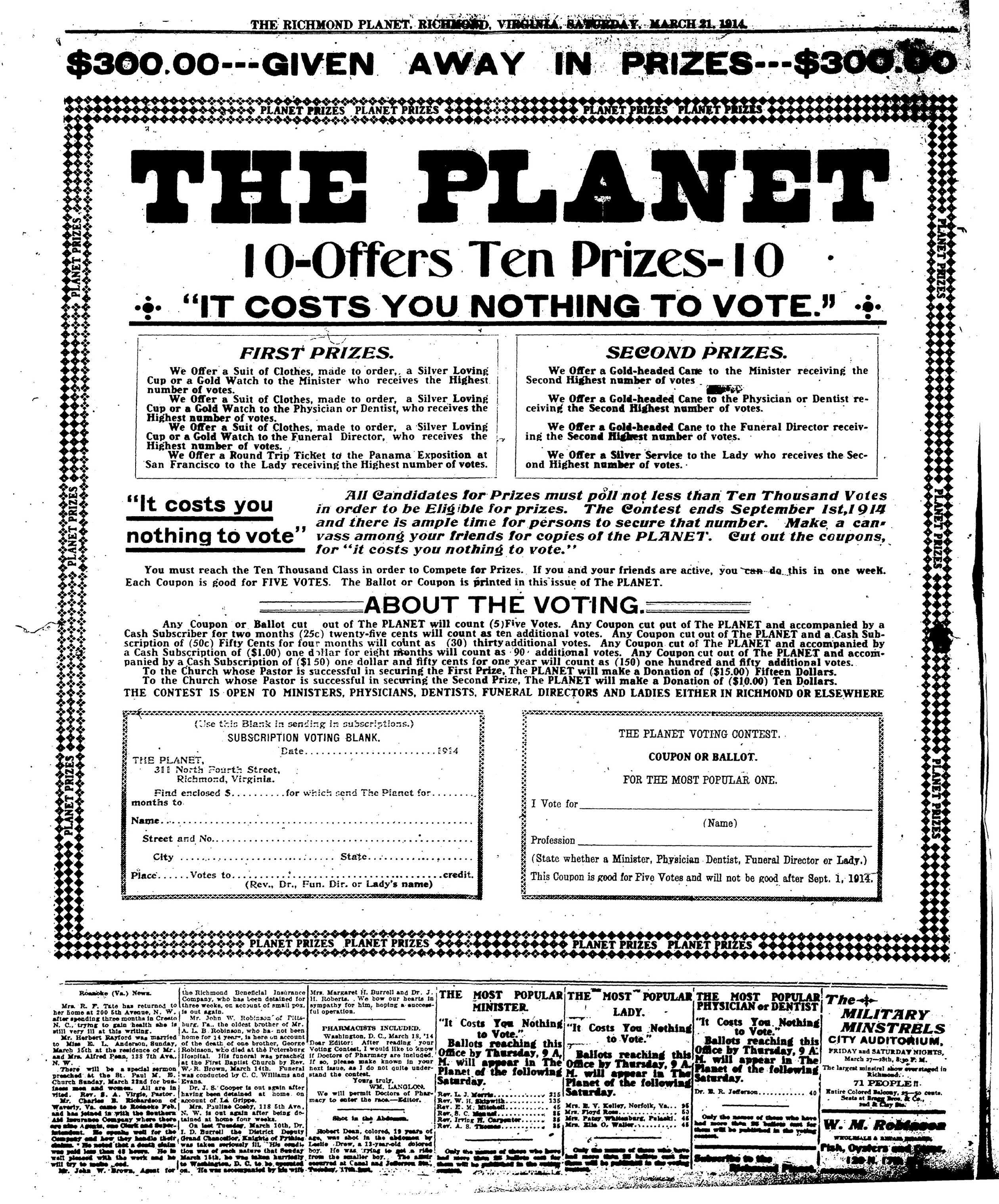
Have you read our list of prizes? Have you given the voting coupon in your PLANET to any one? If not, decide whether you wish your pastor to have the first prize. Your family physician can get a first prize, too. Send in a vote for him. Your dentist is obliging. Send in a vote for him. Read the announcement carefully. We are actually giving away $300.00 in prizes. No money outlay is necessary. It is simply a question of whether a minister, a physician, a dentist, a funeral director and a lady have any friends. It is a question as to which one of them has the most friends. You can help another way. Secure new subscribers to The Planet. A two months subscriber (25c) means ten votes. A four months' subscriber (50c) means thirty votes. An eight months' subscriber means ninety votes and a yearly subscriber (1.50) means one hundred and fifty votes. Hundreds of your friends will give you the subscriptions for the asking and thousands will give you the coupons out of their regular papers at the same price. When you get a new subscriber, your candidate not only gets the votes on the subscription, but the votes out of the weekly papers that come afterwards. It is a friendly contest that will be most amusing and profitable to the candidates.
Easter Service.
There will be an Annual Easter Service given at St. Luke's Hall, Westhampton under the auspices of Ham's Council, No. 115 at 2 P. M. Sunday, April 12th conducted by District Deputy Rev. S. L. Burleigh. Sermon by Rev. G. Carter of Richmond, Va. All members of the order of St. Luke's and friends are cordially invited. Come one, come all and enjoy a good service.
By order of District Deputy, Rev
S. L. Burleigh.
Mrs. Hawkins at 3rd St. A. M. E.
Mrs. Estelle Spiller Hawkins, Evangellist and Field Worker for the Allen Christian Endeavor League, will preach at the Third St. A. M. E Church, Sunday, 11:00 A. M. and 8:00 P. M. Mrs. Hawkins is the daughter of Rev. Dr. Spiller of the Baptist Church.
Mr. Charles E. T. Steward Injured.
Mr. Charles E. T. Steward, a letter carrier, was painfully and dangerously injured recently when a street cannibal into the mall wagon, destroying the vehicle and throwing him out, at the corner of Nineteenth and Main Streets. It was thought that his skull was fractured and that an operation would be necessary. He was conveyed to the Memorial Hospital, but the next day was taken to his home on 29th Street. Mr. Steward is the son of the late O. M. Steward.
Negro in American History.
Traces status of the Negro from discovery, colonization and settlement to the close of the Revolution, Evolution of Citizenship to 20th Century. Also biographical sketches of eminent men and women as illuminating Middell史s.
To every instructor of colored youth; every student in secondary schools; every one desires of making further researches or wishes to get a special history of the race in this county, this work is commended by educators, scholars and investigators.
Full bibliography, chronology and comprehensive index. Illustrations. $1.25; by postage. $1.40. Agents Wanted. Address.
J. W. CROMWELL 1439 Swann St., W. W. Washington D. C.
Desirable homes on good terms—
suburban and city. Splendid small
Truck Farm. A good paying busi-
ness in Jackson Ward.
BRAGG BROOK & CO.
The Fight Is Over!
Harrison St. Baptist Church (First Baptist) Petersburg, Va., Rev Ell Tartte, D. D., Pastor.
For two weeks or more we have been in midst of a great revival fighting against sin, flesh and the devil, in which the Lord has wonderfully blessed the labor and the laborers. While attending the National Baptist Convention, September inst at Nashville, Tenn., we heard the Rev. W. H. Skipwith, the Inter national Preacher and Singing Evangelist, speak and sing, we wore so elated at the manner in which he conducted the services there, until we sought to have him come to Petersburg
Having been successful, our doors were thrown on Sunday, March 8th and for two weeks or more people came from every book and corner of our city. There were some nights during our meetings on account of the inclement weather, it seemed too fearful for human beings to be out but the people came just the same. For ten years we have been the honored pastor of this church and have had some splendid meetings, but never on this order before. Those who have been here for thirty and forty years say that these meetings surpassed all they have ever witnessed. Our brother is a preacher, singer and prayer. He knows what to say and how to say it. He catches all classes of people and never wants for an audience. Our church has a seating capacity for 1500 and we couldn't accommodate his audience. There were 105 conversions and 50 restorations, with 50 seakers, loft at the mercy seat. Rev. Skipwith is now at First Baptist, South Richmond, Va. with Dr. Drlinga, but he will never be forgotten in Petersburg.
His Great Work in Philadelphia—The
Outlook in Virginia—Rev. Dr.
Galvin's Leadership.
Editor Richmond Planet: .... Permit me to thank you for your kindly expression editorially of me in your last issue. I am! I am to say to you that I have had no flight with any body since I have been in these parts except great debts I found on the Holy Trinity Baptist church. The church is now in splendid condition: in two years and five months 1200 members have joined, $11,000.00 (eleven thousand dollars) have been paid on the debts, the church bequeathed at a cost of $5800.00. Our congregations over run the building every Sunday. On yesterday we baptized 25, and took in $212.00 for the ordinary expense. In the face of such work do my friends in Virginia think it wise on my part to get into unpleasant controversy with men who delight in strife? My calling is a higher one. The 40,000 Virginians who dwell in this great city are high in their praise of the no editor Of The Planet for his expressions labiatory of your humble friend. What ever is put in the Planet is known all over the city here as though it were published here
I want to call upon the brethren of Virginia to heed the call of Dr. A. A. Galvin, the able President of the Virginia Baptist Convention. He has issued the battle cry for our May convention which meets this year in Roanoke with the First Baptist church, Dr. W. R. Brown pastor. Let us come up to this annual gathering in first class order. My church sent $100.00 to the corner stone laying, but we are going to be in Roanoke with $100.00 more. Boys, did you hear the old man? We must come up strong this year. Just think of it! The Convention is now run officially, almost, by graduates of our own Seminary. A. A. Galvin is President of the convention, R. C. Woods, President of Va. Seminary, J. H. Burks, Chairman of the Trustee Board of the school, T. W. White, corresponding secretary of the convention, J. G. St. Clair Drake, Statistician and W. D. Woods, 3rd Vice-President. Our scholarly W. R. Ashburn is chairman of all the B. Y. P. U. Work of the State. Can we let this work fall under the men who have come up under our way of thinking?
Mr. Better, tell the men of the Virginia Baptist State Convention to gird up their zeal and get ready to meet us in Roanoke the Second Wednesday in May.
Years for the work.
W. F. GRAHAM.
Only the names of those who have had some then fill below one for those who will be published in the year
The Call to Arms!
"Cry aloud and spare not. We are with you in the mighty struggle. Though my struggling church gave one hundred dollars in the corner stone laying, she will be on hand in May with the same amount. Local on, my strong young man and God will give us a mind to follow."
Such is an extract from a letter just received from Rev. W.F.Graham D. O. L.L. D, who, many years ago in the good old enthusiastic days of the formative period of our work, was, with Prof. G. W. Hayes, Drs. B. F. Fox and R. H. Bowling, called by their friends the "Hig on the mighty army of the Most very distinguished men Dr. Graham is the sole survivor, and we trust that he may live many long years to lead on in the mighty army of the Most High.
While the letter referred to above speaks for itself in a way that none can do for it, I must, with pleasure, declare my appreciation of such a letter from such a man. It comes as "good news from a far country." Brethren, who will "follow suit with a letter and with his pledg for the Convention"?
Those who read the appropriation bill in the Va. Legislature and noted the educational feature of the same must have been impressed with the fact that Virginia law makers are awake to the question of education as to gards the young white people of the state. And this is but a tangible expression of the spirit, the sentiment of the masses of intelligent white people of the "Old Dominion, and inded of the enlightened world. For the enlightened world is right now more aroused about education then at any moment in history.
Now what are the evidences that the black men and women of our state are not absolutely sleep on the question of education? Why the increased numbers of our young people in the various institutions of learning; the amount of money that is appropriated by our people, from their personal donations, for improving public school facilities and for lengthening school terms, are all evidence that as a people, we too are awakening and are wafting the misty well of dreamland from our earth-will sleeping eyes, and that we too see the need of educational endeavors on our part.
Our new building on Seminary Hill which is well on its course of erection, speaks to us an speaks for us, in a language that is so plain that "the who runs may read." That Girl's Dormitory will stand as a speaking monument to the intrepid prowess of the women and men of these two conventions who believe that we must, as a people, do more for our own education.
Brethren of the convention and friends, let us be awake, thoroughly awake. And let us prove, in Rosnoke to the watching world, that we are awake.
Let us make one good strong personal sacrifice and urge upon our churches and friends to do the same that the amount of the "battle cry" which is so much needed, may be realised.
We may set our faces toward the "magic city". Roanoke for she is preparing for us, as a bride adoring her self for her husband. Drea Brown, Burks and Revs. Moore, Jefferson, King, Henderson and other men of God are busy making ready to receive us as their distinguished guests. Yes, Rev. Henderson has contributed to the interests of our entertainment in May although he has been called to a larger field of labor even to First Church. Newport News. And I am sure that I voice the sentiment of our brethren in saying that with heartiest congratulations, both for the church and her new pastor, we wish unprecedented success in the great work of the Lord in that city by the sea.
I beg that the brethren who have not responded to our appeals to do so very soon.
Let me hear from you. If you have good to say let me hear from you. If we have criticism to make, let me hear from you. But at any rate let me hear from you. As your humble servant, I desire to know what you think and how you feel.
I am yours for $10,300.00 in Roanoke, Va. May 13-17, 1914.
Grand Chancellor John Mitchell,
Jr. will speak in the High Street
Baptist Church at Dawville, Va.
Tuesday night, March 24th, 1914 to
members of the Order of Knights of
Pythania District Deputy Grand
Chancellor George W. Rixon has
charge of the arrangements. All
members of the Order of Councill
PRICE. FIVE CENTS.
Big Time There.
Public Meeting at the City Auditorium.
The Uniform Rank and subordinate lodge members of the Knights of Pythias, N. A., S. A. E., A. and A. will assemble Sunday afternoon at the Pythian Castle, 727 N. Third St. to march to the City Auditorium, where Hon. Harry S. Cummings will deliver an address. Attorney Cummings is a high Old Fellow and many members of that Order are expected to be out to hear him.
He was retained as counsel for the Grand Lodge, K. of P., at Baltimore in the contention with the Supreme Lodge. He is a polished orator and became noted as the colored leader selected to second the nomination of Col. Theodore Roosevelt at Baltimore. Admission to the City Auditorium is free and everybody is invited to be present.
POLLARD—WHITE
Mrs. Kate White announces the marriage of her daughter, Lizzie E. to Mr. E. T. Pollard, Thursday morning, April 2nd, 1914 at 7 o'clock at the bride's residence, 1400 North First Street, Richmond, Va. Reception, Thursday, April 9th, 1914 from 8:30 to 11:30 P.M., 1400 N. First Street. Friends are invited, no cards
PERSONALS AND BRIEF
Mr. Clarence Forrester is ill.
Col. Willis Wyatt is out again.
Mr. Charles E. T. Steward is still dangerously ill.
Mr. Robert Gray, who has been indisposed for about three weeks is much improved.
Mr. John Walker the well-know member of the Third St. A. M. E. Church, who resided at 519 B. N. Third Street, is dood.
Cut out the ballots and send them to The PLANET Office. Your candidate needs them.
Mr. Robert A. Jackson of Chicago, Ill. formerly of Richmond was in the city last week. He was looking well.
Messrs. B. A. Finney, Charles Ross, William Lacy and party of friends stopped over Monday in our city enroute from Palm Beach, Fl. to Hot Springs, Va.
Mr. Hardaway Pleasant of Court land, Arizona writes us that he is improving after a long illness.
Mrs. Mary L. Brown Carvel, who has been very ill, under the care of Dr. M. H. Tyler for six weeks, is now out again at her home, R. 7, Box 65, South Richmond, Va.
Rev. E. D. Caffeo Succeeda Dr. White.
Rev. E. D. Coffee, who for four years was the successful pastor of the First Baptist Church of Salem, Va., has been recently called to the pastorate of the Mt. Carmel Baptist Church in North First Street. In the early Fall he resigned the First Baptist Church of Salom, Va. to reenter the University for further studies. While here he was secured as supply pastor of Mt. Carmel. The wonderful success of the Church during those months was a convincing proof of his capacity as a pastor, therefore his recent unanimous election to the full pastorate of the Church was but a natural sequence of the love and respect that he had merited from the people.
We congratulate the Mt. Carmel Church and welcome her new pastor in our mldst.
Wm. Sidney Barlowe—
Catherine S. Nuclea.
1889—1914.
Mr. and Mrs. Sidney Barlowe will celebrate their Twenty-fifth Wedding Anniversary, Friday evening, March 27th, 1914 at their residence, 720 Munford Street. Friends are invited. No cards.
George Maron Context
George Mason School Most Popular
Grade Content Almost March 30th.
First and Second Picture Prize will
be awarded, in connection with a
program rendered by George Mason
School Teachers at. Anbury M. R.
Courch, Monday, March 30th, Roy,
L. M. Courch, pastor.
The Mystery of the Boule Cabinet.....
Copyright, 1913, by Burton E. Stevenson.
SYNOPSIS
Apparently by mistake Philip Vantine possesses an antique Boule cabinet from Paris. A strange Frenchman is mysteriously killed near it. The hand inexpertly through two wounds on the hand he caused of death Vantine's friends, Lester and Godfrey, a reporter, are greatly interested.
Vantine himself is killed in the same mysterious manner while or shortly after commaling the Boule cabinet.
Rogers, a servant, accuses a woman who visits Vantine of Vantine's murder. Rogers acts suspiciously.
With the aid of Parks, Vantine's valet, Lester makes plans to carefully guard the Boule cabinet from masqueraders.
Godfrey and Lester conclude that the cabinet has a secret drawer guarded by a mechanism which stabs and poisons.
While Godfrey vainly searches for the drawer with a steel gunstilt on his hand Lester sees two burning eyes watching them through a shutter.
Lawyer Hornblower, representing "Miner Lester" (or a pack of her fingers) holds the boule cabinet, which has been stolen from her.
She calls upon Lester, says there is no deadly mechanism in the cabinet and gets letters from a secret drawer.
"Kim, Xa'i'm said, Julie showed Vantine a letter from the Frenchman who knew Drewel, the dead Frenchman, who sought the letters for blackmail purposes.
"Armand," captured by a giant Frenchman, kills the giant with a poison barb, but escapes from Gelfrey and Lester. The Boule cabinet is locked in a police station cell as a bait for "Armand," who is really Crochard, a great French criminal. Crochard audaciously notifies Gelfrey that the will claims his property; the boule cabinet, at the police station the following Wednesday.
CHAPTER XIV.
I HAD, of course, read in the papers many times of the Gargantuan exploits of Crochard—"The Invictible," as he loved to call himself, and with good reason. "Crochard is one of the greatest criminals who ever lived, full of imagination and resource and with a sense of humor most acute," said Godfrey. "I have followed his career for years. It was this fact that gave me my first clues. He killed a man once before, just as he killed this last one. The man had betrayed him to the police. He was never betrayed again."
"What a friend he must be!" I said, with a shudder.
But Godfrey shook his head quickly. "Don't get that idea of him!" he protested earnestly. "Up to the time of his arrival in New York he had never killed any man except that traitor. Him he had a certain right to kill—recording to thieves' ethics, any way."
"But Drouet and Vantine," I objected.
"An accident for which he was in no way responsible," said Godfrey promptly.
"You mean he didn't kill them?"
"Most certainly not. This last man he did kill was a traitor like the first Crochard. I think, reasons like this: To kill an adversary is too easy; it is too brutal; it lacks finesse. Besides, it removes the adversary. And without adversaries Crochard's life would be of no interest to him."
"I don't understand a man like that." I said.
"Well, look at this," said Godfrey and tapped the letter again. "He honors me by considering me an adversary. Does he seek to remove me? On the contrary, he gives me a handicap."
"But, surely, Godfrey," I protested. "you don't take that letter seriously; if he wrote it at all; he wrote it merely to throw you off the track. If he says Wednesday, he really intends to try for the cabinet tomorrow."
"I don't think so. I told you he would think me only a tyro. He wrote that letter right in the Record office. That is a sheet of our copy paper. He sat down there, right under my nose, wrote that letter, dropped it into my box and walked out. And all that some time this evening, when the office was crowded."
"But it's absurd for him to write a letter like that, if he really means it. You have only to warn the office."
"You'll notice he says it is in confidence."
"And you're going to keep it any."
"Certainly I am. I consider that he has paid me a high compliment. I have shown it to no one but you—also in confidence."
"It is not the sort of confidence the law recognized." I pointed out. "To keep a confidence like that is practically so what a felony."
"And yet you will keep it." said Godfrey cheerfully. "You see, I am going to do everything I can to prevent that felony. And we will see if Crochard is reallyifiable."
"I'll keep it." I agreed, "because I think the letter is just a blind. And, by the way," I added, "I have a letter from Armand & Boo confirming the fact that their books show that the Boo cabinet was bought by Philip Vanitton. Under the circumstance, I shall have to claim it and hand it over to the Metropolitan."
"I help you won't disturb it until after Wednesday," said the Boo quicker. "If you won't have my interest in it after that," I arrived to do so.
office the next afternoon when Godfrey called me up.
"How are you feeling today, Lester?"
he asked
"Not as fit as I might." I said.
"How would you like a whiff of salt
air this evening?"
"First rate. How will I get it?"
First rate. How will I get it?
"The Savole will get to quarantine about 6 o'clock. I'm going down on our table to meet her. I want to have a talk with you, or sit alongside the French detective. Will you come along?" "Will I?" I said, almost.
"Will I?" I said "Where shall I meet you?"
"At the foot of Liberty street at 7 o'clock"
"I'll be there," I promised. And I was.
The boat was cast loose as soon as we got aboard, backed out into the busy river, her whistle shrieking shrilly, then swung about and bended down stream. There were two other men on board—the regular ship reporters, I suppose.
"It is a great sight, isn't it? he is at last. 'Hello! Look at that boat!' he added, as a yacht coming down the bay drew abreast of us and then slow ly forged ahead. 'She can go some- can't she? This boat of ours is no slouch, you know, but just look how that one walks a way from us. I wonder who she is? What boat is that, captain?" he called to the man on the bridge. "Don't know, sir," answered the captain, after a look through his glasses. "Private yacht-can't make out her name-there's a flag or something hanging over the stern. She's dying the French flag. There come the other press boats held us, sir," he added. "And there's the Savoy just slowing down at quarantine."
Far ahead we could see the great hull of the liner, dark against the horizon and crowned with row upon row of glowing lights.
The Savoye had slowed down until she was just holding her own against the title, and one of her lower ports awing open. A moment later a boat puffed up beside her, made fast and three or four men clambered aboard and disappeared through the port. "There go the doctors," said Godfrey, "And there is that French boat going alongside."
The tug from quarantine dropped eastern and the French yacht took her place. After a short colony one man from her was helped aboard the Savoye. Then it was our turn, and a moment later Godfrey and I and the other two men were aboard the liner.
My companions exchanged greetings with the officer in charge of the open port, and then we hurried forward along a narrow corridor, smelling of rubber and heated metal, then up stair after stair, until at last we came to the main companionway. Here the two men left us, to seek certain distinguished passengers. Godfrey stopped in front of the pursuer's office and passed his card through the little window to the man inside the cage.
"I should like to see M. Pigot of the Paris detective force," he said. "Perhaps you will be so kind as to have a steward take my card to him?
"That is unnecessary, sir," replied the pursuer courteously. "That is M. Pigot yonder—the gentleman with the white hair, with his back to us. You will have to wait for a moment, however. The gentleman speaking with him is from the French consulate and has but this moment come aboard."
I could not see inspector Pigot's face, but I could see that he held himself erect, in a manner besieking military training. The messenger from the legation was a young man, with waxed muschel and wearing an eyeglass. He was greeting M. Pigot at the moment and, after a word or two, produced from an jungle pocket an official looking envelope, tied with red tape and secured with an immense red seal.
M. Pigot looked at it an instant, while his companion added a sentence in his ear. Then, with a nod of assent, the detective turned down one, of the passgways, the other man at his boeis.
"Official business, no doubt," commented the punser. "He will, no doubt, soon be disengaged."
"Yes, but meanwhile my esteemed contemporaries will arrive," said Godfrey, with a grimace. "They are on my boeis. Here they are now!"
In fact, for the next twenty minutes reporters from the other papers kept arriving, till there was quite a crowd before the pumper office. And from nearly every paper a special man had been detailed to interview M. Pigot. Evidently all the papers were alive to the importance of the subject. There was some good natured chaffing, and then one of the stewards was brushed to carry the cards of the assembled multitude to M. Pigot's stateroom, with the request for an audience.
The steward went away laughing and came back presently to say that M. Pigot, would be pleased to see us in a few minutes. But when five minutes seemed short and he did not appear impatient before out answer. The width of the plums were not increased to being brief writing.
THE RICHMOND PLANET, RICHMOND, VIRGINIA
an ill friend he was surrounded.
"My good friends of the press," he said, speaking slowly, but with only the finest accent. "you will pardon me for keeping you in waiting, but I had some matters of the first importance to attend to, and also my bag to pick. Bieward," he added, "you will find my bag outside of my bedroom door. Please bring it here, so that I may be ready to go ashore at once." The steward hurried away, and M. Pitot turned back to us.
It was to Godfrey that the position of spokesman naturally fell.
"We wish first to welcome you to America. M. Pitot," he said, "and to hope that you will have a pleasant and interesting stay in our country. We hope that with your assistance our police may be able to solve the mystery surrounding the death of the three men recently killed here, and to arrest the murderer. Of themselves they seem to be able to do nothing."
M. Pigot spread out his hands with a little depreciating gesture.
"I also hope we may be successful," he said, "but if your police have not been, my poor help will be of little account."
He spoke with an accent so sincere that I was almost convinced he meant every word of it, but Godfrey only amled.
"It is a proverb," he said, "that the French police are the best in the world. You, no doubt, have a theory in regard to the death of those men."
"I fear it is impossible sir," said M.
Pigot regretfully, "to answer that question at present, or to discuss this case with you. I have my report first to make to the chief of your detective bureau. Tomorrow I shall be most happy to tell you all that I can. But for tonight my lips are closed, and as it makes me to seem discourteous."
I could hear behind me the little in drawn breath of disappointment at the failure of the direct attack.
A voice was heard inquiring loudly for Mooseford Piggott. I recognized that voice, and so did Godfrey, and I saw the cloud of disappointment which fell upon his face. An instant later Grady, with Simmonds in his wake, allowed his way through the group.
"Mooseford Piggott" he cried, and enveloped the Frenchman's slender hand in his great paw and gag it a squeeze, which was no doubt painful.
"Glad to see you, sir. Welcome to our city, as we say here in America. I certainly hope you can speak English, for I don't know a word of your lingo. I'm Commissioner Grady, in charge of the detective bureau, and this is Simmonds, one of my men."
M. Pigott's perfect sinuity was not even ruffled.
"I am most pleased to meet you, sir, and you, Mooseford Simmond," he said.
"Yes, I speak English, though, as you see, with some difficulty."
"These reporters bothering your life out. I see." And Grady glanced about the group, srowling as his eyes met Godfrey's.
"I have but just told them that my first report must be made to you, sir," said Pigot. "I was hoping that we might go ashore at once. I have my papers ready for you."
"All right," agreed Grady. "And after I looked over your papers I'll show you Broadway, and I'll bet you agree with me that it boats anything in gay Parce. Our boat's waiting, and we can start right away. This your bug? Yes? Bring it along, Simmonds." And Grady started for the stair.
But the attentive steward got ahead of Simmonds.
M. Pigot turned to us with a smile.
"Till tomorrow, gentlemen," he said. "I shall be at my hotel and shall glad to see you—shall we say at I o'clock? I am truly sorry that I can tell you nothing tonight."
He shook hands with the purser, waved his hand to us and joined Grady, who was watching these amicities with evident impatience. Together they disappeared down the stair. "Come on, Lester," Godfrey said, "we might as well be getting back. I can send the boat down again after the other boys," and he turned down the stair.
Godfrey bade me goodby at the dock and hastened away to the office to write his story. As for me, that whiff of salt air bad put an unacustomed edge to my appetite, and I took a cab to a good restaurant, deciding to spend the remainder of the evening there, over a good dinner.
I ambled through the dinner in a fashion so leisurely and trifled so long over coffee and cigarette that it was far past 10 o'clock when I came out into Forty-second street. After an instant's hesitation I decided to walk home and turned back toward Broadway, already filling with the after the after crowd.
Reaching Madison square, I walked out under the tree, as I almost always do, to have a look at the Flatiron building, white with the sky. Then I glanced up at the Metropolitan tower, higher but far less romantic in appearance, still saw by the big illuminated clock that it was nearly half part 11. I crossed back over Broadway at last and turned down Twenty-third street in the direction of the Marathon, when, just at the corner I came face to face with three men as they swung around the corner in the same direction, and with a little start, I recounted Grisby and Simmons, with M. Piglet, between them. Evidently Grace and began introducing the stranger to a number of typical American drapes and the result of all this was that Grisby's legs wobbled uncomfortably. As a member of racial competition, I glanced at M. Piglet, but they admired the stranger very normal.
Sir Philip Lester, and Sir Bamheads in a voice which showed that he had not yet enjoyed the indifference of the official celebration, and even freely disrespected to sed, from which I learned that he was feeling very uneasy.
"Proudly domestically a member of the
male." A strong sport would be an excellent
condition for late evening. We may
perform here in the same when with the
town."
"Where are you going now?" I asked.
"We're going round to the staircase. Pigget may have got a something to his share for us. It's got something to do with that cabinet."
"With the cabinet?"
"Yes; that shiny thing Godfrey got me to look up in a cell."
"Hummmms," I said seriously. "Goes
"Simmonds," I said seriously, "does Godfrey know about this?"
"No," said Simmonds, looking a little uncomfortable. "I told Grady we ought to phone him to come up, but the chief got mad and told me to mind my own business. Godfrey's been after him, you know, for a long time."
"Buggage I phone him," I suggested. "There'd be no objection to that, would there?"
"I won't object," said Simmonds. "and I don't know who else will, since nobody else will know about it. Good night," and be followed his companions into the station.
CHAPTER XV.
The Secret of the Cabinet.
THERE was a drug store at the corner, with a public telephone station, and two minutes later I was asking to be connected with the city room at the Record office. No, said a supercilious voice, Mr. Godfrey was not there; he had left some time before. No, the speaker did not know where he was going, nor when he would be back. "Look here," I said, "this is important. I want to talk to the city editor—and be quick about it." There was an instant's astonished silence. "What name?" asked the voice.
"Lester of Royce and Lester—and you might tell your city editor that Godfrey is a close friend of mine."
The city editor seemed to understand, for I was watched on to him a moment later. But he was scarcely more satisfactories.
"We sent Godfrey up into Westchester to see a man," he said, "on a tip that looked pretty good. He started just as soon as he got his Piglost story written, and he ought to be back almost any time. Is there a message I can give him?
"Yes. Tell him Piglost is at the Twenty-third street station and that he'd better come up as soon as he can."
"Kerry good. I will give him the mes-
"Very good. I'll give him the message the moment he comes in."
In the street again, I paused hesitantly at the curb, in eyes on the red light of the police station. What was about to happen there? What was the sensation M. Pigot had up his sleeve? I turned toward the light, pushed open the door and entered. There was no one in sight except the sergeant at the desk.
"My name is Lester." I said. "You have a cabinet here belonging to the estate of the late Philip Vantine."
"We've got a cabinet, all right, but
I don't know who it belongs to."
"It belongs to Mr. Vantine's estate. I'd like to see it a minute."
"You can't see it tonight. Come around tomorrow. Besides, I don't know you."
"Here's my card. Either Mr. Simmonds or Mr. Grady would know me, and tomorrow won't do."
The sergeant took the card, looked at it and looked at me.
"Walt a minute," he said at last and disappeared through a door at the farther side of the room. He was gone three or four minutes, and the station clock struck 12 am, I stood there. At last the sergeant came back.
"Come along," he said, opening the gate in the railing and motioning me through. "Straight on through that door," he added, and sat down again at his desk.
With a desperate effort at careless unconcern, I opened the door and passed through. Then involuntarily I stopped for three in the middle of the floor was the little cabinet, with M. Pilgot standing beside it and Grady and Simmonds sitting opposite, flung carelessly back in their chairs and puffing at black cigars.
"Well, Mr. Leatan," Grady said, "so you want to see this cabinet?"
"Yes," I answered, "It really belongs to the Vandine estate, you know. I'm going to put in a claim for it—that is, if you are not willing to surrender it without contest."
"Did you just happen to think of this in the middle of the night?" he inquired quizzingly.
"No," I said boldly, "but I saw you and Mr. Simmonds and this gentleman," with a bow to M. Pilgot, "turn in here a moment ago, and it occurred
to me that the cabinet might have something to do with your visit. On course we don't want the cabinet in jared. It is very valuable."
"Don't worry, and Grady easily. We're not going to injure it. And I think well be ready to surrender it to you at any time after tonight. Moosemer Piglett here wants to do a few tricks with it first. I suppose you have a certain right to be present, so if you like weight of hand sit down." I healthily sought a chalk, my heart singing within me. Then I attempted to assume a mask of indifference, for Mr. Plant was obviously annoyed at my presence, and I hated a message that his Gatsby anxiety would be strained to breathing. But Grady, if he noticed his guest's annoyance, paid me heed to it, and I began to suspect that the Freedman's courtesy and good breeding had ended by rubbing Grady the wrong way, they were in such painful contrast to his own best-paid margarita. Whatever the reason, there was a curious motif in the smile he moved upon the Freedman.
"And now, Mr. Kennedy Pigott, he said, metiline back in the chair a little further, we're ready for the show." [3] "I never be full grown, you know, if I just get old, I will be dead." Mr. Pigott said and said that he was ready to be dead.
V. V.
"And now, Moessner Piggett, we're ready for the show."
asked, looking at me. And I nodded.
I saw Piggett's eye fame and his face finish with anger, for Grady's one, was almost insulting. I looked at him with interest. He was typically French—smooth shaved, with a face seemed with little wrinkles and very white eyes shadowed by enormously bushy lashes and close cropped hair as white as his face. He was about sixty years of age. I guessed, and there was about him the air of a man who had passed through a hundred remarkable experiences without once losing his aplomb. Certainly he was not going to lose it now.
"The story which I have to relate," he began in his careful English, clipping his words a little now and then, "has to do with the theft of the famous Michaelovitch diamonds. You may perhaps remember the case."
I remembered it certainly, for the robbery had been conceived and carried out with such brilliancy and darling that its details had at once arrested my attention—to say nothing of the fact that the diamonds, which formed the celebrated collection belonging to the Grand Duke Michael of Russia, sojourning in Paris because unappreciated in his native land and, also because of the supreme attraction of the French capital to one of his empirement—were valued at something like 8,000,000 francs.
"That theft," continued M. Pigot, "was accomplished in a manner at once so bold and so unique that we were certain it could be the work of but a single man—ransal named Crochard, who calls himself also. The Invincible—n ransal who has given us very great trouble, but whom we have never been able to convict. In this case we had against him no direct evidence; we subjected him to an interrogation and found that he had taken care to provide a perfect alibi; so we were compelled to release him. We kept Crochard under constant surveillance. We searched his rooms not once, but many times.
"He knew thoroughly what we were doing, for what we were searching. He knew also that nowhere in Europe would he dare to attempt to sell a single one of those jewels. We suspected that he would attempt to bring them to this country, and we warned your department of customs. For we knew that here he could sell all but the very largest not only almost without danger, but at a price far greater than he could obtain for them in Europe. We closed every avenue to him, as we thought—and then, all at once, he disappeared.
"For two weeks we heard nothing, then came the story of this man Droust, killed by a stab on the hand. At once we recognized the work of Crochard, for he alone of living men possesses the secret of the poison of the Medici. It is a fearful secret, whiche, in his whole life he had used but once, and that upon a man who had betrayed him."
M. Pilot paused and passed his hand across his forehead.
"We were at a loss to understand Crochard's connection with Droset." M. Pignt continued, "Droset, while a mere hanger-on of the cates of the boulevard, was not a criminal. Then came the death of that creature. Morel, in an effort to gain possession of this cabinet, and we began to understand. We made inquiries concerning the cabinet. We learned its history, and the secret of its construction, and we arrived at a certain conclusion. It was to ascertain if that, condition is correct that I came to America." "What is the conclusion?" queried Grady, who had listened to all this with a manifest impatience in strong contrast to my own absorbed interest.
to be to the town. Mr. Dewar was
with the undertaker, but I knew that
did not happen probably at all.
"My mother, mother," I said,
finding her so friendly to remote longer
distance. "This is all so wonderful—we
mustness—will you see me an alley?
What were these three men search-
ing for the private?"
"Mustness is an element with the
power as it is," he explained in a surreal
mood. "The kapitalist Depot was
white while containing for a pocket of
things, which would have compounded
the great gravity a great lady. He
knows that it. Volunteer was killed
while underway, to then the drawer
after its marble and been revealed to
the by the tail of that same great
ady, who was hoping to get a reward
for them. Morel met death directly
at the hands of Crockard because he
was a traitor and deserved it."
More and more fascinated, I stared at him. What secret was safe, I asked myself, from this astonishing man! "But even yet," I stammered, "I do not understand. We have opened the secret drawer of the cabinet—there was no poison. How could it have killed the Dr. and Mr. Vantine?"
"Very simply," said M. Pigot coldly,
"Death came to Drouet and M. Vintine because the maid of madame is duchess inlook her left hand for her right. The drawer which contained the letters is at the left of the cabinet—see," and be pressed the series of springs, caught the little handle and pulled, the drawer open. "You will notice that the letters are gone. The drawer which Drouet and M. Vintine opened," and here his voice became a little strident under the stress of emotion. "Is on the right side of the cabinet, exactly opposite the other and opened by a similar combination. But there is one great difference. About the first drawer there is nothing to harm any one; the other is guarded by the deadliest poison the world has ever known. Observe me, gentlemen."
As he spoke he bent over the desk and pressed three fingers along the right edge. There was a sharp click and a section of the inlay fell outward, forming a handle, just as I had seen it on the other side of the desk.
M. Pigot hesitated an instant. Then, catching the handle firmly with his armored hand, he drew it quickly out. There was a sharp clash as of steel on steel and the drawer stood open!
M. Pigot, cool and impracturable, held out to us, with a little smile, a hand which showed not a quiver of emotion—his gauntleted hand; and I saw that on the back of it were two tiny depressions. At the bottom of each depression lay a drop of bright red liquid. What nerves of steel this man possessed?
"That liquid, gentlemen," he said in his smooth voice, "is the most powerful poison ever distilled by man. Those two thy dooms would kill a score of people, and kill them instantly. Its odor betrays its origin"—and, indeed, the air was heavy with the scent of bitter almonds—"but the poison ordinarily derived from that source is as nothing compared with this. Its distillation was supposed to be one of the lost arts but the secret was rediscovered by this man Crochard. No secret, indeed, is safe from him. No man can stand against him. Even the secret of this drawer was known to him, and he availed himself of it when need arose."
M. Pilot pinned his head bent in thought.
"Now, M. Simmon," he said briskly in an altered voice. "If you will have the kindness to hold the drawer for a moment in this position, I will draw the serpent's fangs. There is not the slightest danger," he added, seeing that Simmonds very naturally healtated.
Thus assured, Simmonds grasped the handle of the drawer, and held it open, while the Frenchman took from his pocket a tiny mask of crystal.
"A little farther," he said; and as Siphlonda, with evident effort, drew the drawer out to its full length, a tiny, two tind pinned pushed itself forward from underneath the cabinet. "There are the fangs," said M. Pigot. He held the flask under first one and then the other, passing his other hand carefully behind and above them. "The poison is held in place by what we in French call attraction capillaire—I do not know the English; but I drive it out by introducing the air behind it—ah, you see!"
He stood erect and held the flask up to the light. It was half full of the red liquid.
"Enough to decimate France," he said, screwed the stopper carefully into place and put the flask into his pocket. "Release the drawer, if you please, monteur," he added to Simmonds.
It sprang back into place, on the instant the arabequed handle snapping up with a little click.
"You will observe its ingenuity," said M. Pilot. "It is really most clever. For whenever the hand, struck by fire, penetrated strings, incensed its hold on the drawer, the drawer sprang shut and you see, and everything was as before—except that one man move had tasted death. Now I open it. The fangs still again; they strike the gaudet but for that, they would pierce the hand, but death no longer follows. By tyring this barbion, I lock the spring, and the drawer remains open. The man who devised this mechanical was so proud of it that it described it in a secret memoir for the entertainment of the thread lamb. There is a copy of that memoir among the archives of the Prince. National library; the ornament is owned by Crowdwell. It was he who conceived that memoir with this artist, who rediscovered the merchandise, rewound the spring, and removed the poison."
The Grimster—or whatever the name
may be—was a man of humble
society. He lived in a small town
in the countryside, retiring his clear,
snowy days. He was a man of great
virtue and integrity, and he was a
fellow of the community. He was a
man of great integrity and virtue.
The first of the two
days, which I had
occurred to you
and I was very
afraid of being
to be
able to be
used for
the
first time.
That of a Citizen Putting on Aim and
Taking His Shirt to the *Laundry-A*
Poker Game Won by the Court Without Cards.
By M. QUAD.
T THIS CASE," said Judge Hoke, as he rapped for order at Sandy Bend. "Is as plain as a jack- rabbit, bookin', an all- wise
Iabout todd up but, and thar ain't any need of lawyers, witnesses or a jury. In the first place, Joe White suddenly decides to hev his shirt washed. That ain't exactly agin the law, but he knows that it's the custom in these parts to wear a shirt right" along till you lose it at poker or strike up a trade with an Injun. When the notion gifts fixed in his head he don't buy soap and go down to the creek and wallop, the dirt out of' that old red shirt himself. He plays the high fulmin' dodge, and walks over to Hop Lee's laundry.
"Hid Hop Lee any right to take in a shirt without unmin' his price for the wash or bein'" secured for his pay? None whatever, but he goes right ahead and does it. When it's done he wants 30 cents for the job, and Joe White sets his limit at 15 cents. Joe starts out to take the shirt, and Hop Lee draws a kuffe eleven inches long.
A
"HOP LEE DRAWS A KNIFE."
Does Joe bour away that shirt in triumph? Does that Chinaman draw one single drop of blood? No, feather citizen—no! I'm bury in my Red Dog salon when Joe White comes aboard and yells for justice. He was breathin' hard when Hop Lee comes up and wants some of the same thing.
"Gentlemen, that's justice in Sandy Brend-heaps' o' justice, and I'm here to lattice it out. I'm gain' to see justice done here this morning. If that's a manner bookin' critter in this territory than Joe White I don't know what holds out. He's allus blowin' about the number of men he's planted, and I've known men to dodge him, and grit with two guns and a hearty applique he leas a Chinaman blunt, him out. Is it any wonder that our graveyard is standin' 'till and our real estate criblin' backwild with sich men as him to the front? The sentence of this 'court is that he take a walk, and if he should so far forget himself as to return he'll be took care of by the vigilance committee.
"Hop Joe will pay a fine of $5 and costs. The fine is for runnin' a laundry trust, and the costs is put on tohim bekase Joe couldn't pay 'em. If the shirt is a fit the court will wear it as an emblem of justice.
"We how come to our second case. It is that of Slippery Tom versus the Hoosier Kid.
"We call him Slippery Tom because of his habit of slipping two other areas into his hand when he finds himself holding two.
"The Hoosier Kid is a tenderfoot out here for his health. Until yesterday Slippery Tom let the Kid severely alone. Yesterday, however, he hunted him up.
"For the first half hour the Kid played jeet good enough to lose on every hand. Slippery had a paddling of it. He wasn't satisfied, however, to make a good jib of it. After winning about $10 in small bites and encouraging the Kid to think his luck would change Tom worked up two hands as he wanted them and made a raise of $50. The Kid swat it and went $50 better. Tom bettered it.
"That was over $500 in that pot when Tom got cold feet and called. He had ranched out for the got when the Hoosier had laid down a straight stump, and he also beat Tom to his game.
"Did Slippery Thomas own up to being henten at his own slippery game? Not much. He came to me and swore out a warrant for a boiler. Tom stand up."
"You need for Equestrian First, and
we don't want to go past it in Berry
Bred again for a year. Equestrian start
up."
The minutes of the session, by that
you come down in Red Bed, will and
trust Beauty Board the minutes of 9th
---
---
```markdown
```
Farm and Garden
BETTER FARMHOUSES.
Department of Agriculture Makes a
Winter Garden Building
Plan For Commercial Buildings.
The importance to the farmer of having an economical farmhouse has been emphasized by the farm architect of the department of agriculture, who states that the mental and physical fitness of the laborers both within the house and in the fields is vitally affected by the building that affords the family shelter. The average American farmhouse has failed to share in the improvements that are every day being made in agricultural conditions and, according to the architect, is a rebuke to our boasted civilization. Relatively, he says, the housewife of a century ago, with her fireplace cooking and log cabin, was better provided for than is the housewife today.
The most important building on a farm is the home. The health, comfort and happiness of the family are dependent upon its construction, and equipment, and unless these matters are looked after the sanitary dairy
barn and the economically constructed buildings for stock are of little value. Supplies and equipment in the family life is essential to efficient service on well-used land and construction. Although the residential spans, in many cases, a location in her "workshop," the kitchen and the family room, is not as a rule, capable of planning a home in the highest degree serviceable and comfortable without assistance. Her help, however, is essential to the farm architect, as the result of his plans most vitally concerns her.
In 1800 a western farm paper, at the suggestion of the department of agriculture, conducted a competition for farmhouse plans. About 600 plans of farmhouses were submitted, not one of which was fully satisfactory. The larger number limited on some particular pet motion and emphasized a single feature to the neglect of other important ones. The man and woman who familiarise themselves with the work to be done and then apply themselves to the single task of deviling means are the ones who, with the co-operation of the farmers' and their wives, can beat handle the farmhouse problem.
One of the most important, detailis regarding the average American farmhouse is that it must be inexpensive. The average annual net income of a farmer today after deducting 5 per cent interest on his investment is less than $400. This does not mean that the houses may not be attractive. They may, if intelligently planned with the help of vise, shrubs and trees, become the prettiest spots in the landscape, and more beautiful and inexpensive than the crowded city houses. After economy in the construction of the building and in the house work has been attained, attention will be given to developing beauty. Simplicity in line and good proportions are meant the use of this word beauty, and not so called applied "ornaments". This simplicity is entirely in keeping with a general plan of economy.
Economy, however, is not a synonym for cheapness. Double strength glass may even be more economical in a tenant house than single strength, not withstanding its greater first cost. A kitchen sink may be a paying investment, although it excludes a bay window, or a drappee, which has been the pet notion of the housewife. Scripted in kitchen porches, sleeping porches, double or triple windows and kitchen conveniences are fine economical features which even the smallest butteo plane may well consider.
3,500,000 Chinese Eggs Har Carpe.
The Canadian Pacific steamship the Empress of Asia arrived at Vancouver.
B. C. with 3,500,000 Chinese eggs consigned to places in the United States.
Gets Coffin by Parcel Post.
Understaker Correntine Grassleaf, of Hackensack, N. J. received a coffin by parcel post. The postage was only 12 cents.
- Bombs on you
I check. What do you do when your wife asks you to mind that job?
Fook - Hook your wife - Katchup.
"There are none so blind as those who will not see."
Colored men must observe high ideals and act in accordance with fundamental right principles in order to maintain self-respect and equilist the sympathy and support of the best people, regardless of color in this country. They cannot properly complain of unfair treatment of themselves by a certain class of white people, and then when vested with power, practice upon each other the very injustice of which complaint is made in others.
The opportunities afforded colored men of intelligence and learning in the fraternal organizations of the country should be used to demonstrate our ability for self-government. The best class of white people should be imitated and not the worst classes. When we observe the actions of some of our educated people, their conduct is disheartening. Yet, we know that the great body of the colored people is all right.
We were induced to make these remarks after observing the attitude of the officer of the Supreme Lodge, Knights of Pythias, N. A., S. A., E., A., A. and A., at Baltimore last August. In a wild scramble for money, they threw discretion to the winds.
Let us see. Under the laws of the order each Grand Lodge has exclusive, original jurisdiction over the subordinate lodges and the members attached to the same. The Supreme Lodge or its officers cannot tax the members of a lodge in a state having a Grand Lodge. The Constitution provides a representative tax of $25 on each Supreme Representative to the Supreme Lodge. 'As no State has less than two Supreme Representatives or more than four, the tax was not less than $50.00 per term or more than $100.00 per term. For this the only return is the password. The salaries and travelling, expenses of the Supreme Chancellor and other officers had been increased. The Supreme Keeper of Records and Seal warned the Supreme Lodge of these reckless expenditures and for this he was put out of office.
The Grand Lodge, K of P, of Virginia protested and for this the Supreme Chancellor suspended and put out of the Order, not only the Grand Lodge, but also the subdinion lodges and the members attached to the same, although he has no power ever any but the Grand Lodge.
The new constitution which requires a two-thirds vote to adopt was alleged to have been adopted. One test vote disclosed the fact that there were 51 nyeen. 14 nyeen with 53 members of the Supremo Lodge absent. Of the 61 nyeen, 20 were office-holders and 8 Deputy Supreme Chancellors appointed by Supreme Chancellor S. W. Green, with the power to vote. This loft 23 Supreme Representatives out of an elected membership of 90, all of whom had been in Baltimore to attend the session, but they were tired out, for the Constitution was finally "adopted" after 9 o'clock Saturday night, after a wook's deliberations.
All that a Grand Lodge receives from the Supreme Lodge is the password. The password is a word framed and promulgated by the Supreme Chancellor. In order to pay high salaries and running expenses, for each Grand Lodge pays its own endowment and defrays its own expenses, the Supreme Lodge with a majority of the elected Supreme Representatives absent made an increase in taxation. It was done under the guise of a ten cent and a five cent tax on each member. As it was only for a password, the value of a password may be estimated from the following statement of facts:
Alabama's biennial tax was $100.
It was changed to $1440.00, an increase of $1340.00 per term. Arkansas' biennial tax was $100.00. It was changed to $1,125.20, an increase of $1,026.20. California's biennial tax was $50.00. It was changed to $65.25, an increase of $15.25. Colorado's biennial tax was $50.00. It was changed to $46.50 a decrease of $2.50, but as the membership increases will pass the $100 limit. The District of Columbia's biennial tax was $50.00. It was changed to $58.35, an increase of $8.25.
THE SUMMER FLIGHT, RICHMOND, VIRGINIA.
Court of Judgment
The following is a copy of the Injunct
Lodge, Knights of Pythias, of Virginia,
Friday, January 30, 1914.
The Doeores Wife Entered Monday, F
IN THE SUPREME COURT OF THE
COLUMBIA.
of the Injunction granted the Grand
of Virginia, at Washington, D. C.,
and Monday, February 2, 1914.
COURT OF THE DISTRICT OF
OLUMBIA.
The following is a copy of the Injunction granted the Grand
Lodge, Knights of Pythias, of Virginia, at Washington, D. C.
Friday, January 30, 1914.
The Degree Was Entered Monday, February 28, 1914.
IN THE SUPREME COURT OF THE DISTRICT OF
COLUMBIA.
Holding an Equity Court.
Grand Lodge of Knights of Pythias of North America, South America, Europe, Asia and Africa, a corporation.
The Knights of Pythias of North America, South America, Europe, Asia, Africa and Australia, and others, Defendants.
Equity No. 32281.
This cause coming on to be heard upon the affidavits in support thereof, the rule to answer, it is, upon consideration thereof February, 1914 by the Court—
ADJUDGED, ORDERED and DECREANTs and each of them and their officers, and all others on their behalf, be and they during the tendency of this suit, or until the Court, from declaring or treating the fraud plaintiff corporation as revoked and from the Grand Lodge, Knights of Pythias, or Virginia, as discovered; and from declaring a subordinate to the plaintiff in the State of Vibers attached to the same as not entitled to lieges of members of the order of the defense from calling members elsewhere to re-subordinate lodges and members as not attempting to enforce the decree or enacting Lodge, supporting to revoke the charter or dissolve the said Grand Lodge, of the jury and from circulating any proclamations on the Grand Lodges, subordinate lodges and calling attention to or calculated or intender and enforce the attempted revocation of the charter and dissolution of said Grand Lodge up or attempting or purporting to set up, Virginia, a Grand Lodge, other than the plaque of Pythias of the order of the defendant doing any other act or thing on the assurance Grand Lodge of the State of Virginia has by its fraternal charter lias been revoked.
ASH
(Seal)
A TRUE COPY—Test
J. R. YOUNG, Clerk.
by F. E. Cunningham, Asst. Clerk.
be heard upon the bill of complaint, thereof, the rule to show cause, and the operation thereof, this second day of art—
EED and DECREED that the defendant their officers, agents and attorneys, be, be and they are hereby restrained, suit, or until the further order of the creating the fraternal charter of the ked and from declaring or treating of Pythias, of the jurisdiction of from declaring or treating the lodges in the State of Virginia and the member not entitled to the rights and priver of the defendant corporation, and elsewhere to regard and treat such members as not so entitled; and from decree or enactment of the Supreme charter of the plaintiff and to judge of the jurisdiction of Virginia; declarations or letters addressed to the lodges and members of the order, dated or intended to carry into effect evocation of the plaintiff's fraternal Grand Lodge; and from setting to set up, within the State of longer than the plaintiff, of the Knights the defendant corporation; and from on the assumption that the said Virginia has been dissolved or that he revoked.
ASHLEY, M. GOULD
Justice.
Clerk.
This cause coming on to be heard upon the bill of complaint, the affidavits in support thereof, the rule to show cause, and the answer, it is, upon consideration thereof, this second day of February, 1014 by the Court—
ADJUDGED, ORDERED and DECREED that the defendants and each of them and their officers, agents and attorneys, and all others on their behalf, be and they are hereby restrained, during the tendency of this suit, or until the further order of the Court, from declaring or treating the fraternal charter of the plaintiff corporation as revoked and from declaring or treating the Grand Lodge, Knights of Pythias, of the jurisdiction of Virginia, as dissolved; and from declaring or treating the lodges subordinate to the plaintiff in the State of Virginia and the members attached to the same as not entitled to the rights and privileges of members of the order of the defendant corporation, and from calling members elsewhere to regard and treat such subordinate lodges and members as not so entitled; and from attempting to enforce the decree or enactment of the Supreme Lodge, importing to revoke the charter of the plaintiff and to dissolve the said Grand Lodge; of the jurisdiction of Virginia; and from circulating any proclamations or letters addressed to the Grand Lodges, subordinate lodges and members of the order, calling attention to or calculated or, intended to carry into effect and enforce the attempted revocation of the plaintiff's fraternal charter and dissolution of said Grand Lodge; and from setting up or attempting or purporting to set up, within the State of Virginia, a Grand Lodge, other than the plaintiff, of the Knights of Pythias of the order of the defendant corporation; and from doing any other act or thing on the assumption that the said Grand Lodge of the State of Virginia has been dissolved or that its fraternal charter has been revoked.
assessed biennially ($3,252.75) nine thousand, two hundred and fifty-two dollars and seventy-type cents and the District Deputy Supreme Chancellors are not assessed as much as a penny. The new constitution alleged to have been adopted at the last session requires all Grand Lodges to surrender their present state charters of incorporation and to reincorporate in the name of the Supreme Lodge. This would place all of the real-estate, money in the treasury and other property under the direct control of the Supreme Lodge. It can now be seen why Virginia and her Supreme Representatives were not wanted in the Supreme Lodge.
It may be well to enquire how will the Supreme Representatives who were present explain all of these things to their constituents? What induced them to support these measures? Were they sleep, hypnotized or absent when these things took place? Who can defend it?
Texas' biennial tax was $100.00. It was changed to $1,500.00, an increase of $1,400.00. Virginia's biennial tax was $100.00. It was changed to $619.10, an increase of $761.90. West Virginia's biennial tax was $100.00. It was changed to $375.00, an increase of $275.00.
What is the amount of this taxation? ($18,520.50) Eighteen thousand, five hundred and twenty dollars and fifty cents. How much increase is this new taxation over the old taxation? ($16,124.00) Sixteen thousand, one hundred and twenty-four dollars. What will the Grand Lodges and subordinate lodges receive, in return for this large amount of money paid over to Supreme Lodge officers? The pass-word.
In fact, how can anybody explain it? If the taxation is increased, then the benefits should be increased. .. But what did Suprome Keeper of Records and Seal C. K. Robinson, who knows more about the 'internal affairs of the Supreme Lodge than any other person in the United States tell the Supreme Lodge? In his report, he said:
ing them the power to vote and extend, to them the voting strength of six states, some of which paid as high as $1,400.00 per term for the post-word. This was in violation of the Constitution of the Supreme Lodge.
"At the last session, I warned you of the condition which confronted you and urged you to prepare to meet the crisis. The conservative men of the convention saw the impending danger and sought to correct it by presenting remedy after remedy, all of which efforts failed. I have no criticism to offer as to the action of the majority at that time, but I feel it my solemn duty to again call your attention to the deployable condition of your treasury at this time. The authorities of the officers of the Magnificent Lodge have not been paid since September, 1918 and when the命令突尼斯 at Baltimore, you will find an enormous debt. This can only be met by wise legislation, and proper regulation of expenses." The Order
The records show that 24 Deputy
Sayrene Chancellors were appointed
by the Supreme Chancellor at Baltimore last August. He was previously ruled that they had the right to vote. These sworn four deputies, all present at the plenary session of the Supreme Lodge will have the voting power equal to that of an American member of the Lodge. Thus, the Lodge will be entitled to the same voting power as the Lodge elected will be
一
W. I. Johnson,
FUNERAL DIRECTOR, EMBALMER AND
LIVERYMAN.
10 West Leigh Street, Richmond, Virginia.
LARGE CAPACIOUS WARE-ROOMS, FILLED WITH THE BEST
DESIGNS FROM THE BEST MANUFACTURERS IN THE INDIAN
STATES. PROMPT AND POLITE SERVICE. ORDERS REQUIRED
TO DAY OR NIGHT.
Determined to furnish the very BEST service at
the LOWEST Rates possible, the Patronage of
the Public is Sollicited.
LONG DISTANCE PHONE, MADISON—486.
MAJOR CHAMPUS GIRL
MAILBOX MAILBOX
Marypopup Munn, not to individuals.
A BRIGHTFUL HEAD OF EAR IS A LASTS CHRISTMAS GLORY—And every lady can have their christmas glory. The Munn will dry the hair after a shampoo or bath, and shampooing the hair of help. It will glittering in spring. The Abundance Corp. cannot improve the lady, because it frequents her hair, but will not harm her from the picking which is hosted on one abundant Hair, or any other glitter. It will glitter the hair of Royal Munn to, and apply her hair, after drying it. Abundance Corp. will not harm the hair of her. MASSIC OF AMERICA, NEW COUNTY, MISSISSIPPIA
He been band and overband, until the petition of the membership has almost reached the breaking point."
What was the reply to this common noise, business plies? C. K. Robinson was put out of office and the Grand Lodge, K. of P. of Virginia, that backed up his plea for retrenchment and reform was put out of the Supreme Lodge. Was the Grand Lodge, K. of P. put back into the Supreme Lodge? Yes, by the Supreme Court at Washington. How was this done? Because the Supreme Lodge, being incorporated under the laws of the District of Columbia is subject to the courts thore. This Supreme Court is higher than the Supreme Lodge.
Has Virginia paid the unlawful tax levy? No, but it has tendered all of the money for lawful tax levies, which amount was $100.00. Can the Supreme Lodge officials disregard the injunction and keep the Grand Lodge K. of P. of Virginia out of the Supreme Lodge? No, not during the pendency of this suit or until the Supreme Court revokes the restraining order or injunction.
What will be the result if other Grand Lodges refuse to pay the unlawful taxes? They can be suspended by the Supreme Chancellor and their charters revoked by the Supreme Lodge. Can they get back into the Supreme Lodge again, without paying the unlawful taxes? Oh, yes, they can come back by the "injunction route." Just as Virginia has done and at much less cost. In fact, it would be cheaper to get the injunction than it would be to pay the tax.
What is the penalty for violation of an injunction? Fine or imprisonment or both. The Supreme Court usually metes imprisonment, commonly known as "jail punishment." What is the Grand Lodge, K. of P. of Virginia's contention? That it has paid all taxes lawfully assessed against it. It refuses to pay any taxes unlawfully assessed against it. How shall the question be settled? By the Supreme Court of the District of Columbia, at Washington, when upon the plan of the Grand Lodge, K. of P. of Virginia is investigating the facts and will render a decision in keeping with its findings.
Can the facts herein cited be verified? Yes. Where? By examining the minutes of the Supreme Lodge at Baltimore and by reading the Supreme Statutes, alleged to have been adopted at the same session. Is the Grand Lodge, K. of P. of Virginia in favor of peace? Yes, and it believes this is the surest way to getting peace. We conclude with the words of Bunyan:
"I have determined—the Almight God being my help and my sheild—yet to suffer: if frail life might continue so long, even until the most shall grow over my eye-brows, rather than violate my faith and my principles."
New England Baptist Sunday Schools.
The next annual meeting of the New
England Baptist Sunday school will be
held in the Messiah Baptist church,
Bridgeport, Conn. Rev. W. N. Morton
pastor, beginning on Tuesday, June
16. The convention is composed of
regular. Baptist, Sunday schools
connected with the churches of the New
England Baptist missionary convention,
whose jurisdiction covers eight
states and includes the District of
California.
REV. JAMES H. GORDON BREW
Head of Orphan School Passes Away
In Brooklyn After Brief Illness.
Brooklyn—In the death of the Rev.
James H. Gordon, superintendent of
the Howard Colored Orphanage and
industrial school, located at King's Park,
N. Y., the institution loses one of its
most stanch friends and tireless workers.
Superintendent Gordon died in
the German hospitals in this city on
Tuesday, March 3, after an illness of
only ten days. He had been superintendent of the orphanage for eleven years. He was a well known Baptist preacher and had been pastor of a church in Nicecotton, Pa., and the Baptist temple on West Fifty-ninth street, New York, previous to taking charge of the Howard orphanage.
The institution was located on Troy avenue, at Bergen street in Brooklyn when Rev. Mr. Gordon became its superintendent. Under his able and businesslike administration the work took on new life, and it was found necessary to seek larger quarters in order to accommodate the great number of children whom the home was constantly residing, and also room was needed for the industrial work which Rev. Mr. Gordon had put in operation. A suitable tract of land and a few buildings were purchased at King's Park, and the institution was removed to that place a few years ago. While in charge Mr. Gordon aimed to put the Howard orphanage on a par with Tuskegee Institute in Alabama, and he worked untriflingly to that end, making good success.
Though Mr. Gordon's personality and activities new life was infused into the institution, and strong substantial white friends by the hundreds were won to the cause. One of the features of popularity in connection with the asylum was the introduction of an annual southern dinner which soon became a function to which both white and colored persons looked with pride. The Rev Mr. Gordon was a native of Virginia, having been born in Sparkshire, that state, fifty six years ago. He was a man of broad experience and devoted his life to upfit work among our people along many lines. He is survived by Mrs Mary S. Gordon, his widow, and an only daughter, Mrs Edith Gordon.
The Assassins.
The Assassins were a religious and military order who came into existence during the eleventh century in Persia and who devoted themselves to the destruction after stealthy approach of all who opposed the Moslem faith in any way. The crusaders met with a branch of the deserte zealists in Syria, and many of the warriors of the cross were slain relentlessly and with mysterious suddenness in consequence. The Turtars determined the Persian Assassins in 1256, and fourteen years later the Syrian band of murderers was wiped out by an Egyptian ruler. But the name they bore remains as a designation of dread.
```markdown
```
Fresh Water From the Ocean.
Mangana, the principal port of the Bahrain islands, the center of the pearl fisheries, gets its fresh water from the ocean from springs at the bottom of the sea. These springs well up strongly at a considerable depth, and the entire water supply of the town is obtained from them. The fresh water is procured in two ways either in a goatskin water bag, which a diver takes down with him and carefully closes before baling it to the surface, or by letting down long hollow pipes of bamboo weighted at the lower end, through which the water rises uncontaminated to the surface. London Telegraph
AUTHORIZATION TEAM--WREKWELL.
Louise Kline Kna, S. J. A. H. A. G. F. P. F. for admission.
Arvie Jryl St. St. B. S. S. A. H. from Professor's g.
Arvie Jryl St. St. B. S. S. A. H. from Professor's g.
All trains to Istanbul, Bydar Street, Bldg
on the left, Bldg on the right, and departure
not guaranteed. Use the sign.
ONLY ALL RAIL LIN TO NORTHERN
Schedule to Report September 26, 1955.
Leave Byrd Street Station, Northeast, FON
NORFOLK: °9:00 A.M., °0:00 P.M., °4:00 P.M.
FOR LYREBURG AND THE WING: 5:00 A.M., °0:00 A.M., °0:00 P.M., °0:00 P.M.
Arrive Richmond from Norfolk: °1:00 A.M., °0:00 P.M., °0:11:00 P.M., 11:00 P.M. From the Wings
°0:40 A.M., °2:10 P.M., °1:00 P.M., °0:00 P.M., °0:00 P.M.
Daily. aDaily Ex. Sunday. iSunday Only.
W. R. KEVLL, Pass. Truf. May.
W. O. BAUNDING, G. P. A., Bemplein, Vn.
O. E. BOEKY. D. P. A.
ATLANTIC COAST LINE
BALY.
For Florida and South; 8:19 P. A. and
7:20 P. M. 1:20 A. M. Chamberton.
For Norwalk; "7:19 P. A. M., 8:20 P. M.
4:10 P. M. 1:20 P. M.
For N. W. A. P. M. 1:20 P. M.
For N. W. A. P. M. 8:20 P. M.
For Petersburg 1:20 A. M. 8:19 P. A. M.
1:20 A. M. 8:19 P. A. M. 8:20 P. M.
1:20 A. M. 8:20 P. M. 8:20 P. M.
1:20 A. M. 8:20 P. M. 12:19 P. M.
For Goldsboro and Phyllisboro; "8:19 P. M.
Trail arrive Richmond daily; 8:19 P. A. M.
8:19 P. A. M. 8:20 P. M. "7:19 P. A. M.
"7:19 P. A. M. 8:20 P. M.
"7:19 P. A. M. 8:20 P. M.
"7:19 P. M. 12:19 P. M.
Orientation and waiting only.
Time of arrival and departure and commute
and guaranteed.
G. E. GARFIELD.
SOUTHERN RAILWAY
Premier Owner of the South
N. B.-Following schedule figures published as
information and not guaranteed;
N. B.-Following schedule figures published as
information and not guaranteed;
FOR THE LEAVEN BACKMONT.
For the South A. M.—Local
10:30 A. M.-Express; 6:00 P. M. ex
Lighted Lighted Board for Atlanta
and Nittany Lighted Board for Atlanta
1:45 P. M.-Express; Week Days
8:00 P. M.-Lake.
YORK RIVER SERVICE.
4:30 P. M.-Daily—Local for
West Point. 5:30 P. M. ex Sunnes
(Steamer Train)—Limited for West
Point, connecting with York River
Line for Baltimore, Philadelphia,
New York and the Nort. 7:50 A. M.
ex Sunday.
TRAINS ARRIVE BACKMONT.
From Point: 8:30 P. M. ex
8:00 P. M.; 8:00 P. M. d. 12:30.
From West Point: 8:30 A. M.
ex Sunday (Steamer Train) and 8:30
A. M. daily; 6:30 P. M. ex Sunday.
H. L. BISHOP, D. P. A.
C. & O.
7:15 A. - Local-Daily, Newport Plymouth.
8:10 A. - Local-Daily, Charlestonville, Roseday Sunday Thurmond.
9:00 A. - Local-Daily, Norfolk, Old Point.
*10:00 A. - Local-Daily, Lynchburg, Lexington, Clifton Plymouth.
*11:00 A. - Newport-Daily, Norfolk, Old Point.
4:00 P. - Local-Daily, Newport News, Old Point.
6:00 P. - Local-Daily, Newport News, Old Point.
5:00 P. - Local-Daily, Sunday, Charlestonville.
6:55 P. - Local-Daily, Sunday, Charlestonville.
8:55 P. - Local-West day except Saturday to Warwick, Warwick to Chickensett, S. Lakes.
*11:00 P. - Local-Daily, Chickensett, Chickensett, S. Lakes.
*11:00 P. - Newport-Daily, Chickensett, Loosville
*Elsepers. *Parker Cain.
TRAINS ARRIVE BRENDON. Thorough from East: 9:55 A. M. 7:00 P. M. Thorough from East: 11:00 A. M. 1:55 P. M. 6:00 P. M.
Thorough from East: 11:00 A. M. 1:55 P. M. 6:00 P. M.
Thorough from East: 9:55 A. M. 7:00 P. M. and 12:00 P. M. M.
James River Line: 9:55 A. M. 4:25 P. M.
*Daily arrives Sunday.
Berkshire bride *submitted to have hard
mind daily*: 9:00 A.M. - Lennard to Bride-
1:10 P. M. - Hospice and comfort. Affirmat-
tion. Bermuda. Bermuda. Bermuda. P. M. -
Hospice. Bermuda. Bermuda. Bermuda. P. M. -
Hospice. Bermuda. Bermuda. Bermuda. Phila-
ble: 1:00 A. M. - Lennard to Bride-
Berkshire bride *submitted to have hard
mind daily*: 6:00 A. M. - 7:00 A. M. -
5:00 P. M. - 6:00 P. M. Lennard.
ALPHEUS SCOTT
CHEMISTRY HILL
Funeral Director and
Embalmer
OPEN DAY AND NOON.
Office, 2004 P. St., Phone No. 3337
Residence, 1015 St. James St.,
Phone No. 6012
Parliamentary Memorial and
Service of the Best, Rotinbeer
Service, Midwife Rates.
HADAMS SCOTT, Embalmer Bro-
sar, Women and Children, and
narratives as required.
JOHN M.
Higgins,
DEALER IN
CHOICE GROCERIES,
WINE, LODGES
and CRAFTS.
650 High Street.
```markdown
```
Published every Tuesday by JOHN MITCHELL,
JR., at 11 N. Fountain Street, Midland, Va.
JOHN MITCHELL, JR. . . EDITOR
All communications intended for publication
should be sent so as to reach us by Wednesday.
TERMS IN ADVANCE.
One Copy, per year . . . 81 M.
One Copy, eight months . . . 1.00
One Copy, four months . . . 3.00
One Copy, four months . . . 3.00
One Copy, three months . . . 4.00
Single Copy . . . 60
ADVERTISING RATES
For one inch, one insertion . . . 9
For one inch each subsequent insertion . . . 9
For two inches, six months . . . 6.00
For two inches, six months . . . 15.00
For two inches, nine months . . . 15.00
For two inches, twelve months . . . 20.00
Harrisons, two inches, Boston, one inch . . . 8.00
Triumph Motors, per line . . . 10
*OUTAGE STAMPS OF A HIGHER DENOMINATION THAN THEIR RECEIVED DENOMINATION STAMPS.
THE PLANET is issued weekly. The subscription is $8.50 per year, in advance. There are four ways by which money can be sent by mail or out of stock: In Office Money Order, by Bank Check or Drift, or an Expense Money Order, and when none of these can be pressed, in a Registered Letter.
MONEY ORDERS—You can buy a Money Order at your Post Office, payable at the Michael J. Foster Office, and we will no responsible for its arrival.
EXPRESS MONEY ORDERS can be obtained at any United States Express Office, or the Wells Fargo and Oce's Express Company. We will be responsible for money sent by any of these companies. The Express Money Order is a safe and convenient way for forwarding money.
BROTHERED LETTER—Ul a Money Order, Post Office or an Expense Office is not within your reach, your Postmaster will Register the money you wish to send us on payment of the money. Then, if the Letter is lost or damaged, you can be troubled. You can send money in this
We cannot be responsible for money sent in
inquiry or any other way than one of the four
extra mentioned above. If you send your money
in any other way, you must do it as your own
own.
RENEWAL, HTO.—If you do not want THE
PLANET continued for another year after your
subscription you run out, you then notify us by
Postal Card to discontinuation in. The course
have decided that subscriber to manage your
subscription will be discontinued at the
expiration of time but which it has paid are
up date when they order the paper discount.
COMMUNICATIONS.—When writing to us to
renew your subscription or to discontinue your
paper, you should give your name and address
a full statement we cannot find your name or
address.
ADVERT OF ADDRESS.—In order to change
the address of a subscriber we must be sent the
correct as well as the proper address.
Matured at the First Office at Richmond, Va.
as Secretary General.
SATURDAY ..... MARCH 21, 1914
COLORED BABY WON.
---
The New York Evening Journal in its issue of the 14th first, says that a "perfect baby" show was held at the Young Women's Christian Association Building last week and a gold medal was the first prize to the most perfect baby and three bronze medals was the second prize to the next three most perfect babies.
There were 700 babies entered without regard to race or color. The contest was held for the purpose of having better babies in Newark. Examining physicians looked over every child entered and upon finding youngsters with low ratings informed the parents as to just what action to take. Many mothers were horrified, when the examining physicians had completed their findings.
The first prize,—the gold medal was won by a colored baby, commonly known as "a Negro baby" and three white babies carried off the bronze medals.
The Evening Journal was not as fair as the white judges.—It published the pictures only of the three white babies. Colored folks will "bob up" serenely even though they are weighted down with the leaden sinks of race prejudice.
ANOTHER · REPUBLICAN GONE
Wrong.
Were it not for the fact that United States Senator William E. Borah of Idaho is being spoken of as a probable candidate and nominee of the Republican Party for the presidency of the United States we would not pay any attention to what he says. The Washington Post of the 18th inst. has this to say in its news columns:
Senator Borah, of Idaho, prominently mentioned as a probable candidate for the Republican nomination for President, yesterday expressed his convictions on female suffrage, the treatment of the colored men in the South, States' rights, immigration, and the Japanese situation on the coast, fearlessly and boldly.
In a vigorous speech he defended
women's suffrage, but to the establishment of the female occupants of the galleries declared it was impracticable and impossible to obtain through constitutional amendment, so long as the fifteenth amendment remained unrepealed. Equal suffrage must be obtained only through the separate States, he said.
Senator Borah predicted that after fifteen years of vain endeavor the women would renew their abandoned request for the ballot before the people of the States, because in seeking an amendment to the Federal Constitution they had loaded themselves down with the color question, the Japanese question, and a dozen other States' rights problems.
There is much more. Here it is:
Responding to a question by Senator Thomas, Senator Borah said he would vote for the repeal of the fifteenth amendment, if only by so doing could equal suffrage be obtained. The fifteenth amendment, giving colored men the right to vote, the senator declared, was a blunder, engendered in a spirit of retaliation, with the result that after the first blush of satisfaction the North had connived at the South's violation of it. The amendment infringed upon State rights, and might furnish a president for an amendment declaring that her right to hold real estate or attend school should not be denied because of race or color.
Here then is a United States Senator, sworn to maintain and support the Constitution of the United States and to recognize the civil and political rights of all men before the law, pledged to the platform principles of the Republican Party which Party championed the United States Amendment, boldly declaring that he would vote for the repeal of this War Amendment, to the Constitution of the United States.
He hails, not from Georgia, Florida, Alabama, Mississippi or Texas but from the least climate of Indiana a state in the Far North. If he could be induced to advocate the repeal of the Fifteenth Amendment, it would be but one step to the repeal of the Fourteenth Amendment and but two steps to the repeal of the Thirteenth Amendment and then would come a war of determination, with the colored people to be the victims to be exterminated.
Was there mention of the commen-
ments, a blunder, encumbered in a
spirit of retaliation, but not so
gen. Benjamin F Butler, who com-
manded colored troops at Fort Hari-
rison, a few miles below this city
and who witnessed a charge of the
black regiment paid to them the fol-
lowing tribute:
"It became my painful duty, to follow in the track of that charming column, and there in a space no wider than the Cherk's deck and three hundred yards long, lay the dead bodies of five hundred and forty three of my colored comrades, fallen in defense of their country, who had offered up their lives to uphold their flag and its honor, as a willing sacrifice, and as I rode along among them, cuddling my horse this way and that way, let he should profane with his hoof what seemed to me the sacred dead, and as I looked on their bronzed faces upturned in the shining sun to Heaven, as if in mute appeal against the wrises of the country for which they had given their lives, and whose flag had only been to them a flag of stripes, on which no star of glory had ever phone for them,—feeling I had wroned them in the past and believing what was the future of my country to them, among my dead comrades there I swore to myself a column oath, "May my right hand forget its cunning and my tongue cleave to the roof of my mouth. If ever I fall to defend the rights of these men who had given their blood for me and my country this day, and for their race forever, and God helping me, I will keep that oath.
From that hour, all prejudice was gone, and an old-time States-right Democrat became a lover of the Negro race, and as long as their rights are not equal to the rights of other men under this Government, I am with them against all comers; and when their rights are assured, as other men's rights are held sacred, then I trust we shall have what we sought to have, a united country, North and South, white and black, under operglorious flag, for which we and our
fathers have fought with an equal
and not to be distinguished valor."
Senator Borah is not moved by
sentiment. He is clilled by the
winds of political expediency. This
tribute of Gen. Butler to the colored
troops, whose valor became celebrated
wherever they were seen in action
gives the answer to his assertions,
and flatly contradicts them. Senator
Borah is quoted further:
"Until some plan is devised by
which the colored man is allowed to
exercise the right to vote given him
under the fifteenth amendment I
shall not consent to write into the
Constitution another provision that
will be violated 365 days in every
year."
He would repeal the Amendment giving the colored man the right to vote and then he would insist upon the enforcement of the present Amendment in order to arouse sufficient sentiment against it to ensure its repeal. Then followed a discussion between Senator Vardaman and Senator Borah. Here are brief extracts from arguments of both:
The discussion of the color question brought the statement from Senator Vardaman that "time has not shown the colored man's capacity to participate in government or to rule the white man. While he has made
John Healy, "The Cullud Parson," is known to all, and he will be here with a new line of side-splitting comedy. Brower and flowers are a sensational pair of necrobats, who produce laughter as well as clever gymnastic feats. Then there will be Capt. Tony Miller and Col. Tom Hooker and their famous "Old South Quartette," and everyone knows what they can do.
The show will be real old time minstrelsy, all the old favorite songs, and an evening of clean, healthful enjoyment. All told, there will be 71 people participating.
Committee: C. A. Crawford, chair man; L. T. Christian, secretary; Jas, N. Broy, treasurer; Charles T. Lohr, Lawrence T. Price, W. L. Warting, Thos. L. Jeter, H. G. Stickerson, Charles O. Saville, George P. Shackelford.
White ridge
historic
for Girls,
dents, nuns,
behavior,
from the
One hain
hing the n
domestic
the buildi
It was a roll call, made while the flames were sweeping through the corridors and formitories, that the bravery of the girl students was well exemplified.
The roll call showed that five students and three members of the faculty were missing. There was no time to spare. It Miss Olive Davis, director of hall hurriedly issued orders to the floor monitors. They rushed back through the smoke and aroused the missing point, all of whom were gotten to safety.
It was a sterling tribute to the remarkable coolness of the girls. Just as the head of the line of students reached the ground floor of the five-story building, it was wrapped in flames. When all were out ranks were broken and the girls, not members of the "fire brigade," watched the destruction of their old college home.
The college officials gave the girls' fire brigade unstated credit for the escape of those in the building. Many of the students lost all their valuables.
some improvement, he is easy as incompetent and unreliable as 50 years ago."
"I don't believe in all the history of the world," replied Senator Borah, "that you can find a race that has improved so much as the colored man has in the same period of time."
"In what respect?" interjected Senator Vardaman. "He is more criminal today than in 1861."
"Oh, that is true of the white man, also," retorted Mr. Borah. "We are a lawless people. The colored man may not understand the workings of our government as we do, but no one has more loyalty for the flag. This government and the flag are his religion. He may do many things of which the white man may not approve, but from him we never hear a disloyal word."
"Did you ever know one in your life whose vote could not be influenced by a few dollars?" queried the Mississippi senator.
"That," retorted Senator Borah. "is an absurd argument. No colored man ever bribed himself. There usually are about 50 white men around trying to bribe. The colored man ling withstood temptation with remarkable strength."
It would seem then that Senator Borah indulged in "lightning changes." When not interrupted, he would "put us out of business" in a constitutional way and when disputed he argued our side of the contention with the provisional skill of a Philadelphia lawyer.
A white gentleman told to us the other day that the situation in Mexico was that of two rattlesnakes fighting each other. He wanted to know what else would a sensible onlooker do than keep on the outside of the fence and watch these reptiles kill each other. In reading the account of the two United States Senators, we thought of our white friends' comparison and felt that we had a similar case in the United State Senate at Washington. Senator betah may be our friend, but he has a blankety blank way of showing it.
Mr. N. G. Becker Remembered.
A hand-made bath towel and slipper to match were presented to Mr. N. G. Booker by the choir members of 4th St. Baptist Church March 11th, 1914, in remembrance of his birthday anniversary. The presentation was made by Dr. S. C. Manuel. Mr. Booker accepted in a neat speech. Donors: Miss Virginia D. Wood, Blain Bailock, Kate Doyle, Rosa H. Johnson, Meadiness Mary Satterfield, Estelle Jones, Annie Chaffin, Jonne Johnson, Rosa Loyings, Gertrude Davis, Cordelia Manuel, Luberta Blackwell, Mr. Matthew Doyle, Mrs. Mary Hamn Harris, Mrs. Corn Mayo, Mrs. Goldie Lee, Rev. Charles Harris. Among those present were Mr. and Mrs. Joe N. Griffin, Miss Irma Davis, Miss Alma Hamn, Mr. S. Bradford Johnson. Mr. Booker is Director of the choir.
Public School Athletic League
On Friday night, March 17th, the first union meeting of the Colored Public School Athletic League was held at the Bauer School building. The meeting was for the purpose of giving inspiration to the boys. The program in part was as follows:
Instrumental solo George Rowell; paper, "The Value of Athletics." Romney Moore; remarks, "The Purpose of the League," B. L. Allen; address, "The Moral Value of Athletics," L. T. Jones; Director of Physical Education of Richmond Public Schools; violin solo, Matthew Brown; address, "Preparation," Rosece C. Mitchell, of Pythian Cadets; round table talk, "Athletics," A. L. Morton, Mrs. Rosa D. Browser, Miss H. B. French, Dr. J. H. Blackwell, Y. H. Thomas, S. C. Howell, Earle Harris; quartetto, Navy Hill School.
The presentation of track meet medals was as follows:
Running broad jump Edgar Lee,
Moor School.
Standing bron! Jump—Arthur
Braxton; George Mason School.
High Jump—Wister Dillard, Baker
School.
Fifty yard dash. Edward Johnson, Moore School.
Seventy-five yard dash. Isaac Epps Baker School.
The Richmond PLANET offered a fine shield for the champion team of the basketball series of 1913. The Planet Trophy was won by Baker School. It is now on exhibition in the school building.
The league is a year old and is one of the first of its kind for colored boys. It will open its season of baseball the first week in April. The following schedule has been arranged.
April 6—Moore vs. Baker, George Mason vs. Buchanan, Navy Hill vs. Maury.
April 14—George Mason vs. Maury, Baker vs. Navy Hill, Moore vs. Buchanan.
April 17—Maury vs. Buchanan, Baker vs. George Mason, Navy Hill vs. Moore.
April 21----Moore vs. Maury, Baker vs. Buchanan, Navy Hill vs. George Mason.
April 24----Baker vs. Maury, Navy Hill vs. Buchanan, Moore vs. George Mason.
L. T. Jonos, President; B. L. Allen, Secretary.
--Misa Arsena Robinson continues quite sick.
—Miss Lucy Clay, who was injured by a fall recently, is now much improved.
—Carrier James H. Barrett is improving slowly. He hopes to be out next week.
—Mrs. W. J. Smith of Fall River, Mass. called on us in company with Mine Sanada Morris.
The Mechanics Savings Bank,
North-West Cor. Third & Clay Streets
A Bank Deposit is the
Combination to
Success
SAVINGS
"OPPORTUNITY knocks once at every man's door." Buff many an opportunity is lost when the man who sees it hasn't the wherewithal to take advantage of it. It is the man with the READY CASH IN BANK who derives the benefit! If you haven't an account, open on today. When the opportunity arrives
YOUR CHECK BOOK WILL BE READY!
Military Minstrels at Auditorium.
The Military Minstrels have received the entire galley of the City Auditorium for colored people, Friday and Saturday nights, next week. This show is being put on by the First Virginia Regiment Association, and will be one of the biggest shows ever staged in Richmond. In addi-
[Name]
JOHN HEALY, "The Cullud Patson." tion to the best local talent, high class professionals have been engaged, among them being Ross Professor, the greatest lyric tenor ever on the minstrel stage. The theatre-goers will remember him in Ai, G. Fielde', Low Dockstader's and Geo. Evans' Honey Bom Minstrels.
GIRLS' BRAVERY AT FIRE SAVES EIGHT
ing flames enveloped College of the largest and most settings at Wellesley College Wellesley, Mass., the stu-
tering 250, showing superb arched in orderly ranks inning building.
red other persons, includ-
bers of the faculty and
also made their escape from
to the building is catlmatto $1,000,000. No one was
roll call, made while the sweeping through the cor-
fermitories, that the bravirl students was well ex-
Rev. Dr. Peyton Preaches
Rev. R. V. Peyton D. D. is again in charge of the Sixth Mt. Zion Baptist Church, of which the late Rev. John Jasper was pastor. He is preaching to large audiences who seem delighted over his return. Arrangements are being made to remodel the church. Fifteen feet in the rear of the structure will be covered by the extension. The repairs will cost a considerable amount.
Ziontown Pythbans to Celebrate.
Ziontown Lodge will celebrate the annivarary of the Order March 22nd at Quilocoon Baptist Church. The sormon will be preached by Rev. L. J. Morris. The members of the lodge will march from their hall to the church.
Madame. On receipt of $1.00,
will mail you.
A Bottle Earle's Princess Hair Oil.
A Bottle Earle's Violet or Lilac Water.
A Jar of Earle's Princess or Cold Cream.
Goods shipped by return mail.
JAMES T. EARLE P. O. Box 390,
Newport, R. I.
FREE
FREE
FREE
Our New 1914 Catalog, Showing the Latest Styles in Colored People's Hair.
We are the largest importers and manufacturer of colored people's hair. We wear two our hair to stand combing and washing.
Our prices are lower than those quoted elsewhere. We sell hair by the pound, also hair and skin and all our quoting, and all styles of hair. Perfect satisfaction guaranteed or money back. Send two cent stamps for our beautiful catalog. Agents Wanted.
HUMANIA HAIR COMPANY,
Department D,
23 Duane Street,
New York City
Hoarseness.
Coughs & Colds
LA GRIPPE, BRONCHITJS, PNEU MONIA, ETC.
PROTECT YOURSELF from the great danger of contracting thes horrious complications which often lead to CONSUMITION. Take
JEFFRIES NO. 1
TRADE MARK
COUGH MIXTURE
See the trade mark on every bottle and insist on the genuine.
It is a GUARANTEED REMEDY pure and reliable. Relieves immedately. Three sizes—25c, 50c, $1.00 Sold at all drug stores.
If your dealer hasn't it, write to THOS. TABB JEFFRIES, Manufacturing Chemist, $24 E. Broad St. Richmond, Va. and enclose 25c, 50 or $1.00 in stamps, or Money Order and the goods will be sent to yo by parcel post.
KNIGHTS OF PYTHIAS.
History of Orland Pythiamum. Currently and beautifully told. Independable to mention. Prison, 50 Cocks. O. B. TUGGER, Magnum, Texas. Positively no stamps accepted.
Sales Rentals Leasing
BRAGG BROS. & CO.
REAL ESTATE AGENTS & BROKERS.
506 N. 2nd St. Phone, Mon. 4369
THE BAR
CAPE MAY. NEW JERSEY.
This Magnificent Hotel, located shore Resort in the World; replaces superlative in construction, appo Orchestra daily. Garage, Bath Hotel attention given to ladies and Reliable Hat R
This Marmificent Hotel, located in the heart of the Mont Beautiful Sea, shore Resort in the World; replete with modern improvement, superintive in construction, appointments, service and refined patronage. Orchestra daily. Garage, Bath Houses, Tennis, Etc., on premises. Special attention given to indies and children. Send for booklet.
Reliable Hat Repairing
Female E
Female Embalmer.
MADAM LUCIE CHRISTIAN SCOTT is associated in business with her husband, Mr. Alphpeus Scott. Madam Scott claims the honor of being the only Negro woman in the State of Virginia—holding a State license to practice Embalming, and is indeed, one of the few women in the United States, Embalming and Conducting Minerals. She ranks with the best in her profession.
She is prominent in fraternal organizations, namely: Courts of Calanthe, I. O. of St. Luke, I. O. of G. Samaritans, Household of Ruth, Tents, Sons and Daughters of Richmond, Shepherds of Bethlehem and Ideal Benefit Society.
Your Patronage and Influence will be greatly appreciated. Please remember that she is always at your service.
Reliable Service at Moderate Rates.
OFFICE: . 3006 P Street, 'Phone,
Madison 2237.
RESIDENCE: 1015 St. James St.
'Phone, Madison 6619.
J.
mankind, or no charge, no matter nation may be, and restorer to be, to parry the best and leading ones in the U.S. that I am one of the most wonderful world. I use nothing but berries, seeds, berries, flowers and plants in thousands that the most skillful pilots in America and Europe have no cure for them.
My Medicine Ours the Pillar is sumption. Blood, Kidney, Bladder, Quaily, Sore Throat, Lung, Dyspnea motions in any form, Pains and Adn Toughness, Stroke, Dizziness.
mankind, or no charpe, no matter what your disease, sickness or infliction may be, and restore you to perfect health. Thousands of people, the best and leading ones in the United States and Europe will satisfy that I am one of the most wonderful healers of all complains in the world. I see nothing but herbs, rots barke, gums, benign leaves, seeds, berries, flowers and plants in my medicines. They have saved thousands that the most skilled physicians and the best hospital physicians in America and Europe have given up to die, and mild there was no cure for them.
My Medicines cure this Polluting Diseases:—Heart Disease, Consumption, Blood, Kidney, Bladder, trifecture, Piles in any form, Vesicle, Quisey, Sore Threat, Lung, Dyspnea, Indication, Constipation, Mismatch in any form, Pains and Aches of any kind, Osteo, Boneheaded Troubles, Sore, Skin Diseases, all taking sensations, all Pimple Complaints, La Griffe or Phleomania, Bice, Carbunosis, Beds, Cancers in the worst form without the use of a knife or instrument, Boneus, Phleomus on face and body, Diabetes of Kidneys or Bright's Disease of the Kidneys.
My Medicines cure any sin so, no matter of what nature... Gonorrhoea and Syphilis trouble a specialty.
Medicines sent anywhere. For full particulars, send, write or call in person on r.
The Planet for one year is an excellent gift- only $1.50
In the heart of the Most Beautiful Seat
lectic with every modern improvement
solutions, service and refined patronage
houses, Tennis, Etc., on premises. Special
children. Send for booklet.
E. W. DALE, Owner.
Repairing
MEN'S PANAMA & STRAW HATS
CLEANED, BLEACHED, BLOCKED.
RETRIMMED—LATEST STYLE.
Felt and Soft Hats Cleaned and
Blocked.
'AMERICAN HAT COMPANY.
Fifth and Marshall Streets.
mbalmer.
The image provided is too blurry to accurately recognize any text. It appears to be a blank or heavily pixelated area with no discernible content.
L. J. HAYDEN
MANUFACTURER OF Pure Herb Medicines. TO CURE ALL DISEASES. OR NO CHARGES.
If so, call and see L. J., Mayden Manufacturer of Pure, Herb Medicines, 230 West Broad Street. My Medicines cure all diseases known to what your disease, sickness or affect health. Thousands of people, United States and Europe will treat healers of all complaints in the oats barke, gums, balances leaves, my medicines. They have good医icians and the best hospital physicians given up to die, and said there was big Discourses!—Heart Disease, Constriction, Piles in any form, Vesdosis, Indication, Constipation, Rheumatism of any kind, Osteo, Bonefall taking
---
SATURDAY MARCH 21, 1814
FRENCH CABINET
REORGANIZES
Calllaux, Finance Minister, Resigns Because of Tragedy.
POLITICS CAUSED SHOOTING
The Slaying of Paris Editor by Madame Calllaux Causes Hostile Demonstration.
The French cabinet has decided to retain office in spite of the resignation of Joseph Calllaux, minister of finance, whose wife shot and killed Guston Calmette, editor of the Figaro in Paris as the result of attacks made in that newspaper upon M. Calllaux.
Although Calliaux was considered the strongest and most influential member of the cabinet, his colleagues determined to accept his resignation and to reorganize the various portfolios.
M. Calliaux appeared at the ministry of finance for a few minutes in order to dispose of several urgent matters of departmental business. He called into his private office several of the higher officials of the ministry and informed them of his resignation. The minister was extremely depressed. He broke down during his interview with the officials and wept like a child. His colleagues quietly withdrew and left him alone. When he had become somewhat more composed, M. Calliaux proceeded to his private residence.
Because of the hostile demonstrations, by street crowds a number of detectives were assigned to protect the minister.
Madame Calllaux, who caused the upheaval in French political life, is meanwhile confined in the St. Lazare prison. Acting on information given by Madame Calllaux, the police took possession of various papers in the office of the editor of the Figaro. It is understood that among these papers were various private letters written by Calllaux to his present wife before they were married and while she was still the wife of Leo Claretle. It is generally supposed that Madame Calllaux had received an intimation that Calmette was about to publish these letters, and it was this that led her to attack him. Calmette was a bitter political foe of M. Calllaux.
Madame Calliaux deliberately shot four bullets into M. Calmette's body. The editor of the Figaro had been conducting in his newspaper a vigorous political campaign against M. Calliaux, denouncing him as corrupt and insincere.
There was a pathetic and dramatic scene when the minister of finance was allowed to meet and talk with his wife. Tears rolled down the cheeks of the statesman as he embraced Madame Calliaux. The minister was in a state of almost complete collapse as he repeated over and over again:
"Why did you do it? You have ruined my life, but I forgive you."
Madame Calllaux also broke down and sobbed. As the couple embraced and wopt they heard through the barred windows of the gall the shouts of mobs in the streets. Aroused to frenzy by the crime and enlores of the dead man printed in the papers, hundreds of persons danced about the St. Lazaire prison and the Calllaux residence percusing "Calllaux is a murderer" Calllaux should be killed!"
THREE KILLED ON FERRYBOAT
Five Others Injured in Collision on Hudson River.
Three men were crushed to death and five were injured in a collision between the Lackawanna railroad ferryboat Ithaca and a Jersey Central freight car float on the Hudson river at New York.
All the killed and injured were commuters in the men's cabin on the main deck of the ferryboat
The float, towed by a tug, cleft the Ithaca amidships. A protruding freight car bore into the mens cabin, wrecked it, and when the ferry boat bore away dived to the bottom.
The accident was caused by neither captain seeing the other in time, another ferryboat crossing the river between them.
FOUR MEN KILLED BY CAVE-IN
Buried Under Tons of Earth In Railroad Trench In West Virginia.
Four men were killed instantly when they were buried beneath tons of earth by the caving-in of the sides of a deep trench along the Baltimore & Ohio railroad, at Paw Paw, W. Va.
The men were at the bottom of the twenty-foot trench when the sides fell in on them. The bodies were recovered. The dead are D. M. Postlewite, a foreman, and three Italian laborers.
Strike Closes Lawrence Mill.
The print works of the Pacific mills in Lawrence, Mass., employing over 2000 hands, was shut down in consequence of the strike of employees of the dyeing department for a wage increase.
The Ne'er-Do-Well A Romance of the Panama Canal * By Rex Beach
THE BATTLE OF THE BAY OF BAY
The scenes are laid in Panama during the construction of Uncle Sam's great interoceanic waterway. "The Ne'cr-Do-Well" will be printed serially in this paper. LOOK FOR IT!
She Plans to Visit the United States in May.
M.
QUEEN OF BULGARIA TO VISIT AMERICA
The announcement is made in Sofa that it has been definitely decided that Queen Eleonora, of Bulgaria, accompanied by an exclusive suite, will visit the United States, either at the beginning or middle of May.
It will probably be about the middle of May when the tour will begin, and it will last six or eight weeks. Details of the length of the stay of the queen and her entourage in America and the itinerary of the trip are now being worked out.
The visit is the result of the deep interest which King Ferdinand and Queen Eleonora have long held in the United States, which has also been strengthened by the close association of the king and queen with the American doctors who were in charge of the Bulgaria hospitals during the recent war.
The purposes which Queen Klisonora and King Fordinand hope to achieve by this visit are two-fold. In the first place they are hopeful that the queen will be able to counteract any antagonism to Bulgaria which may have resulted from the late Balkan wars and to show that the Bulgarians are not such barbarians as they have been pointed.
Queen Eleanora was the Princess of Rozen. She is about fifty-four years of age, and was married to King Fer-
THE RICHMOND PLANE, RICHMOND, VIRGINIA.
a band in 15.8.
MISS WILSON'S RING
It is a Large Diamond Solitaire and
Weighs About $4\frac{1}{2}$ Carats.
The enagement ring of Miss Elea-
nor Wilson is in strong contrast to
that of her sister, Jessie, now Mrs.
Sayre.
Mr. McAdoo's choice for his fiance
is a large diamond solitaire, set in
platinum. The stone weighs about
four and a half carats and is blue
white. It is set in prong, surrounded
by an elaborate and delicate fillgree,
studded with small diamonds on each
side of the Solitaire. Miss Wilson has
shown her ring to all her friends.
HARLAN ELECTED CHAIRMAN
Chosen Head of Interstate Commerce Commission.
The interstate commerce commission elected James S. Harlan as chairman, in succession to Edward E Clark. Harlan has assumed the duties of chairman.
Harlan's election was in pursuance of a policy adopted in 1911, that the term of the chairman should be one year, and that it should be filled by each commissioner in the order of seniority.
Two Dead, One Dying, In Land Dispute
Guy Bailey, manager of the Jerome Ariz, branch of the Bank of Arizona a dead, and Carl M. Helm, an attorney, is dying as a result of wounds inlicted by Peter Nojokites, a Russian who committed suicide after shooting the two men. There had been a dispute over a land deal.
Drug Seller Elped.
Charged with making drug flends of eight young men, Dr. H. M. Weaver a prominent druggist of Altoona, Pa. was sentenced by the Blair county court at Holldaysburg, to pay a fine of $50 and costs. This is the only punishment provided by the Pennsylvania statutes.
Drops Dead In 100-Yard Dash
In an indoor meet at the high school in, Lacrosse, Wis. George Michaela, while enqueued in the 100-yard dash, fell dead from heart failure on the running track in the gymnasium.
Death Ends Banquet
A banquet of the New York Knight Templars came to a sudden end in Willimantle, Conn., when Edward A. Krausman, grand commander, was stricken with apoplexy and died a few minutes later in a hospital.
Postmaster For South Bethlehem,
President Wilson nominated J. H. McGee to be postmaster at South Bethlehem, Pa.
Florida Cities at 111.
Isaac Cox, to be 111 years old, is in New York in New Colon, Fin.
He was a member of the New York City attributed to Him.
at his home, Liberty, on his
served in the army. He will
Civil War Family in the city, N.
he was born in the city, N.
Jan. 10, 1825.
MRS. GOELET GRANTED DIVORCE
Children to Be in Joint Custody of Parents.
NO MENTION OF ALIMONY
Multi-Millionaire Was Accused of Extreme Cruelty and Violation of His Marriage Vows.
Mrs. Robert Goelet, formerly Miss Elsie Whelen, of Philadelphia, was granted a divorce by Justice Barrows in the superior court in Newport, R. I., after the reading of depositions for three hours.
The court in summing up the testimony had the following to say: "Extreme cruelty may consist of insulting and abusive language, as well as physical violence. The testimony shows a continuous use of insulting, vulgar and abusive language by Godlet toward his wife, accompanied by numerous petty acts, clearly calculated to annoy and embarrass her and accomplish this result. The effect has been, according to the testimony, a serious impairment of her health, and the conditions fully warrant, the court in granting this divorce."
Counsel had previously agreed as to the disposition of the children, a decree being entered that Peter, now two years old, should remain, in the custody of Mrs. Goetlet until he is six years of age; then his custody will be ointly between mother and father. Ogden, now seven years old, is to be ointly in the custody of the father and mother. No mention was made of allmony.
While Mr. Goetlet did not contest the divorce he was represented by counsel:
Counsel for Mrs. Goetlet read affidavits to substantiate the charges made against her husband of extreme cruelty and gross wickedness and misbehavior in violation of the marriage covenant. Mrs. Goetlet's petition was dated New York city, Jan. 19, 1814, and was read in a voice so low that only the presiding justice could hear its reading.
In her deposition Mrs. Goolet accused her multimillionaire husband of telling her that if she did not like his conduct she "could go to —," "He told me he would much prefer to send me away than to send his valet away," the wife deposed. Mrs. Goolet accused her husband of having spies keep an enlistment upon her in house. She said he was always rude to her friends; had slammed the door in the face of one of her guests; had said reportedly "marriage is —," and had tried to suppress her in every way and to keep her down mentally. The wife's testimony was corroborated by depositions from three of the Goolet domestics.
Countess of Devon Dies at Age of 108
Elizabeth Ruth, Countess of Devon,
widow of the tenth Earl of Devon, died
at Chittenham, Eng. She celebrated
the century of her birth on March 13.
```markdown
```
OLD Hair Pomade Company.
EAST INDIAN HAIR POMADE COMPANY.
EAST INDIAN HAIR TREATMENT is the one that man, and the one everybody should use regardless of formerly used if you want your hair to grow. It is hair. Its merits are unexcelled by any other market. Falling hair and breaking and splitting immediately stopped. It straightens the hair, if the use of irons.
CREAM and LOTION are unexcelled by any other item. All Our HERB TONICS, HERB LINIMENTS. If you are bothered with Indigestion and Rheumatism treatments for you, which make a permanent cure under the Pure Food and Drugs Act, June 30, 1906.
HERB POMADE CO.273 Morris Ave. Elizabeth, N. J.
Office: 8. H. SHACKELFORD, Sole Agent.
Street, Richmond, Va. Phone, Madison 1582-J
N. WINSTON, 537 BROOK AVE., RICHMOND, VA.
The Old East Indian
THE OLD EAST INDIAN Hair you can depend on, and the one what you have formerly used grows everybody's hair. Its most treatment on the market. Falling at the ends are immediately stinky, without the use of irons.
OUR FACE CREAM and LOCAL Everybody likes them. All Our are Wonderful. If you are both matism, we have treatments for of them.
Guaranteed under the Pure EAST INDIAN HAIR POMADE C
Local Office—S. H. 81
618 St. Peter Street, Richmond
THE OLD EAST INDIAN HAIR COMADE COMPANY.
THE OLD EAST INDIAN HAIR TREATMENT is the one that you can depend on, and the one everybody should use regardless of what you have formerly used if you want your hair to grow. It grows everybody's hair. Its merits are unoxcelled by any other treatment on the market. Falling hair and breaking and splitting at the ends are immediately stopped. It straightens the hair, if thicky, without the use of irons.
OUR FACE CREAM and LOTION are unoxcelled by any other. Everybody likes them. All Our HERB TONICS, HERB LINIMENTS are Wonderful. If you are bothered with Indigestion and Rhoumatism, we have treatments for you, which make a permanent cure of them.
Guaranteed under the Pure Food and Drugs Act, June 30, 1906. EAST INDIAN HAIR POMADE CO273 Morris Ave. Elizabeth, N. J.
Local Office—S. H. SHACKELFORD, Sole Agent.
618 St. Peter Street, Richmond, Va. Phone, Madison 1582-J
HELLER'S
712 7th St., Washington, D.C.
856. Oldest Hair Store in the South.
SPECIALS—TO-DAY
188c.
Transformation,
22 inches long. Crimp
or Creole.
$1.50
Transformation.
Parted Wig. Crimp or
Creole.
Established 1856. Older
WRITE FOR THESE SPECIALS
98c.
Creole Switch
24 inches long, wavy
and full.
Trans
22 inches or
98c.
Creole Switch
24 inches long, wavy
and full.
98c.
Transformation.
22 inches long. Crimp
or Creole.
$1.50
Transformation.
Parted Wig. Crimp o
Creole.
Cut Out This Coupon.
We will send you our $1.00 COMB for 00c in stamps. Best
Bumps, 25c.; Double Braids, 25c.
Puffs, 50c.; Coronet Braids, 50c.
25c.; Pin Fuzzets, 39c patr; Gray
WRITE US FOR WHAT YOU WANT
ou our $1.00 "QUEEN" HAIR STRAIGHTENING stamps. Best in the World.
le Braids, 25c.; Half Transformation, 25c.; Cluster Braids, 50c.; rescent Shape Puffs, 50c.; Switches, 53c pair; Gray Switches, 50c.
HAT YOU WANT IN HAIR GOODS.
We will send you our $1.00 "QUEEN" HAIR STRAIGHTENING
COMB for 60c in stamps. Best in the World.
Bangs, 25c.; Double Braids, 25c.; Half Transformation, 25c.; Cluster
Puffs, 50c.; Coronet Braids, 50c.; rescent Shape Puffs, 50c.; Switches,
25c.; Pin Fuzzes, 39c pair; Gray Switches, 50c.
WRITE US FOR WHAT YOU WANT IN HAIR GOODS.
Are You Proud of Your Town and of Your Business? 'Yes? THEN ADVERTISE YOUR BUSINESS and THEREBY ADVERTISE YOUR TOWN.
Robert Rice, a young colored man, charged with felonious assault upon Lola Bailey, a colored girl, was convicted in the general sessions court in Wilmington, Del., and sentenced to life imprisonment.
The penalty is the crime is death and the life of the man was saved by Deputy Attorney General Chaytor, who stated that the state was satisfied with a verdict of guilty with a recommutation to mercy.
The jury, without leaving the box brought forth the verdict, after which the youth was sentenced.
Five armed robbers broke into the mail order branch of the Hartman Furniture company, in Chicago, blew the sale, throw and valuable securities, discarded $10. in money or deeds and evaded with $15,000 cash the weekly payroll of the company. Leaving a guard outside, the four men attacked, bound and paged the four watchmen before blowing the safe.
$3.50 Recipe Free.
For Weak Men.
eak Men. RICHMOND. VA.
Send Name and Address Today
You Can Have It Free and Be
Strong and Vigorous.
session a pre-
priblity, lack of
wood, falling
brought on
brains, or the
was cured so
men right in
out any addi-
ne—that we
needs to nega-
tility, quickly
a copy. So
send a copy
of charge, in
envelope to
us for it.
neces from a
site a special
convinced
combination for
manhood and
together.
o our fellow-
Wm. H. Scott, 2318 B. Main St.
N. Winston, 637 Brigok Ave.
William B. Smith, I W. Leigh St.
Tom Bird.
Thomas Page, 815 State Street.
Clarence Williams
1411 Rose Street.
M. C. Waller, 1160 W. Leigh St.
E. Dandridge, 107 W. Baller Street.
BALTIMORE, MD.
F. C. Pratt, 1113 Penn. Ave.
Wm. H. Reverdy Johnson.
1115 Penna. Ave.
LONG BRANCH, N. J.
We have in our possession a prescription for nervous debility, lack of vigor, weakened manhood, falling memory and lame back, brought on by excesses, unnatural drains, or the follicles of youth, that has cured so many worn and nervous men right in their own homes—without any additional help or medicine—that we think every man who wishes to negate his manly power and virility, quickly and quietly, should have a copy. So we have determined to send a copy of the prescription free of charge, in a plain ordinary sealed envelope to any man who will write us for it. This prescription comes from a physician who has made a special study of men and we are convinced it is the surreal-acting combination for the cure of desident manhood and vigor failure ever put together.
We think we owe it to our fellow men to send them a copy in confidence so that any man anywhere who is weak and discouraged with repeated failures may stop dragging himself with harmful patent medicine, so cure what we believe is the quirkiness restorative, upholding, SPOT-FOUCHING Remedy ever deviced, and so care himself at home quietly and quickly. Just drop us a like like this: INTENTIVE STATE REMEDY CO., 1895 Goodyear Ridge, Detroit, MN, and we will send you a copy of this colored violet in a plain ordinary envelope, from all Chicago. A great many dainting colors change $1.99 and $4.99, our ordinary violet, and a production like this—but we need it
NEWPORT NEWS, VA.
J. O. Allen, 2167 Marshall Ave.
Charles O. Davis, 751-36rd St.
CLEVELAND, O.
J. H. Boulman, 4691 Central Ave.
R. F. Boud, 8004 Central Ave.
Reginald H. Warner, 600 Central Ave.
WINSTON'S
Headquarters for Pure Home Made
Ice-Cream, $1.00 Per Gallon.
Fancy Blocks, three stripes, $1.25
per gallon.
Dishes, spoons, platters, paper
napkins, etc. furnished to order.
Special attention to out of town
orders.
Special Prices on Large Orders.
Banquets, Entertainment, Plics
etc. furnished on short notice.
'Phone your orders' Madison 2253
HUMAN HAIR STORE
Mide Faraday Hot
When Faraday was allowed a pension for his research additions to scientific knowledge, from which untold millions of pounds storing have浸ured, an important load was selected to amuse the grand, but informed Faraday that he did not think much of this science business and said "Now, really, Faraday, it's all a humbug anyway, isn't it?" The insulted chemist refused the pension until other better informed officials apologized humbly for the impertinence of "his lordship."
Earle's Princess Hair Oil
For Hair and Scalp. Fifty Cents
(50c.) Per Bottle. Agents Wanted.
Write for Price List.
JAMES T. EARLE, P. O. Box 390,
Newport, R. I.
WANTED—Another Good LINOTYPE
OPERATOR. Apply at The Planet
Office.
AGENTS FOR THE PLANET.
Mrs. Annie Walbarrow, 6th & Breed.
Peter Thompson, 716 N. First St.
Street.
Josee W. Shreaves, 99 Lippincott Ave
OAKLAND, CAL.
J. W. Nuby, 1786-7th St.
H. LIVENPOOL, O.
H. S. Broadway, 512 Virginia Ave.
BROOKLYN, N.Y.
G. Brennan, 69 Broadway Ave.
BROOKLYN, N.Y.
John K. Ashby, 185 Broadway St.
TARBORO, N. Q.
STAUNTON VA.
J. H. Allen, 120 S. Augusta St.
STEUBENVILLE, O.
W. Z. Greene, 752 N. 8th St.
ATLANTIC CITY, N. J.
Harold P. Douglas, 11 N. Kentucky
Avenue.
John S. Lee, 101 N. New York Ave.
NEWARK, N. J.
Chas. H. Lanlear, 100 Bank St.
WILMINGTON, N. C.
Wm. H. Moore.
NORFOLK, VA.
Walter R. Henry, 19 O Avenue.
Hunterville.
John DeBona, 610 Church St.
Thomas E. W. Perry, 2 Jenner
Place.
CHICAGO, IL.
C. Cunningham 3242 State St.
A. D. Hayes, 3640 State St.
R. M. Harvey, 3924 State Street.
W. Gaughan, 3626 State Street.
FARMVILLE, VA.
Rev. R. G. Adams, 316 South St.
WASHINGTON, D. C.
Columbia News Agency, 931-D St.
N. W.
BALLEIGH, N. C.
N. B. Blount, 82 W. Worth St.
PHILADELPHIA, PA.
D. P. Mackens, 1116 Pine Street.
James H. Warwick, 254 S. 11th St.
J. A. Stokus, 1411 Pinewater St.
Quaker City Advertising Company,
1821 Pine Street.
Monroe Obanian, 4 White St.
D. L. Lewis, 1707 Wylie Ave.
N. K. Wittman, 1688 Wylie Ave.
DANVILLE, VA.
Harry A. Ock, 117 Groughead St.
PROVINCIPAL, R. L.
Douglas A. A. P. A., 910 Westminster
bar Street.
NEW BROOK, N. Y.
Mrs. Loanna Hamilton,
253 West 134th Street.
Samuel Hobbs, 222 R. 137th St.
R. A. Williams, 200 W. 62d St.
J. E. Schmidt, 262 W. 85th St.
LOE, VA.
Rev. R. J. Langton.
ASBURY PARK, N. J.
R. Bell, 103 Springwood Ave.
SALT LAKE CITY, UTAN.
Charles Ludwig, P. O. Box 1776.
LOUMVILLE, KY.
Jesse B. Brown, 1316 W. Green St.
NEW ORLAND, LA.
World's News Co., Box 1124.
A. O. Smith, 202 S. Kampart St.
Rev. F. C. Hamilton,
1513 Terpsichore St.
ALEXANDRIA, LA.
W. M. King, 1031 Lee St.
MONROE, PA.
Smith & Williams, 601 Ninth St.
LINESBURG, VA.
B. B. Wester,
YONKIRR, N. Y.
John W. Adams, 201 N. Main St.
BLUFIELD, W. VA.
Richard K. Wattman.
PULASKI, VA.
J. M. Butler.
MUMPHIS, TENN.
Jos. A. J. Cochrell, 243 1-2 Denle Ave.
COLUMBUS, GA.
C. A. Rogers, 1443 First Ave.
ROCKDALE, TEX.
Mrs. M. M. Allen,
SMITHVILLE, TX.
Rev. A. Denman.
HEARNE, TX.
J. R. M. Lea, Box 141.
TUSOON, ARIZONA.
W. A. Jaekson.
Special Counselors and Agents
F. R. S. Manning,
191 Kettering Street,
Gray Street, R. M.
Brad. I. S. Miles,
201 King Street,
Washington, D. C.
SATURDAY.....MARCH 21, 1914
ASQUITH REVEALS HOME RULE PLANS
If Exclusion Carries Majority in Kingdom is Needed to Subject People to New House.
Premier Asquith, of England, and his cabinet yielded to the demands of the antihome rule forces of the Ulster counties of Ireland.
In a formal address to the house of commons the premier outlined the provisions of a home rule compromise by which the people of Ulster province may escape for a time at least the dominance of a Dublin parliament. The terms of the compromise are:
1. The counties of Ulster provinces will be allowed to say whether or not they desire to be excluded from the operations of the home rule for Ireland bill.
2. A poll will be taken of the parliamentary electors on the question of exclusion before the home rule bill becomes operative.
5-If a majority favors exclusion, the county or counties wherein there has been such a decision will be auto matically excluded for a period of six years from the time of the first meeting of the new parliament.
6-If a majority of the Ulster counties favor exclusion, only the assent of a majority of the people of the whole United Kingdom can bring them under sovereignty of the proposed Dublin parliament.
The declaration of terms brought prolonged cheers from the ranks of the Unionists and grooms and glasses from the Liberals and Irish Nationalists.
Home rule in Ireland, with the four Protestant counties of the nine counties of the province of Ulster—Antrim Armagh, Londonderry and Oown—retaining for six years their old standing in the United Kingdom outside the jurisdiction of the Dublin government would, in the general opinion expressed in parliament, be the result of the compromise offered. The view is generally taken that there can be no doubt of the result of a referendum.
George Vanderbilt Dies in Washington
George W. Vanderbilt, of New York died in Washington. He submitted to an operation for appendicitis several days ago. His wife and one daughter Miss Cornelia, survive him.
George Washington Vanderbilt, multi-millionaire, philanthropist, art collector and owner of Blitmore, the largest country estate in America, was born at New Dorp, Staten Island, New York, Nov. 14, 1862. He was the third son of William Henry and Maria Louise (Klasam) and the brother of William K. Vanderbilt and Frederick William Vanderbilt, and the uncle of the Duchess of Marlborough.
Mr. Vanderbilt's tastes were entirely different from his brothers. He cared nothing for any kind of sport but was literary and artistic to a degree. From 1888 to 1898 he spent the greater part of his time in travelling in Japan, India and nearly every portion of the civilized globe.
About 1692 Mr. Vanderbilt purchased 30,000 acres of land in western North Carolina, near Asheville, to which he subsequently added until he possessed 100,000 acres, which he named Biltmore. Much of the ground was bought for less than $50 an acre and $200,000 was spent in mapping and laying out the grounds, through which two rivers flow. The beautiful Swanance cuts off one corner, while the French Broad traverses the estate for ten miles. In one direction Mr. Vanderbilt's ownership extended for twenty miles.
May Be Murder Victim
The body of William Balliet, a rich lumberman, ground to pieces, was dis covered Thursday on the D. L. & W. railroad tracks at Shickshinny, Pa. near Wilkes-Harre, and the county authorities believe that the man was robbed and probably murdered, be cance $200 in cash, a gold watch and other valuables he was known to have carried are missing.
Balliet went to Hastleton on business. He returned to Mocanaqua, and while there it is known that he had the money and other valuables with him. Later he went to Shickshinny and then started for Pond Hill to visit relatives. That was the last seen of him alive.
The authorities believe that Balliet was followed from Mocanaqua by men, who robbed and beat him and then left his body on the tracks to be cut up by a freight train.
The authorities are trying to learn whether Balliet was dead or alive at the time his body was struck and dismembered by the freight.
Boat and Rob Aged Couple.
The police of Pittston, Pa., have
arrested George Bennett, twenty-two
years of age, and he has contended that he went to the house of Peter Learn, in Laceyville, and after fracturing the skull of Mrs. Learn, sixty-five years old, and beating her husband sixty-three, with a club, tie, and bound the couple and robbed the house of $.
Mrs. Learn is now confined in a hospital at Sayre, hovering between life and death, and her husband, who was at the same hospital, has recovered.
Beanett was frequently befriended by the aged couple. When his money was gone he left his boarding house in Pittston, Feb. 21, and after disguising himself, went to the home of the old couple and beat them badly, he said.
He was seen in that vigilance by a telegraph operator, and when it was learned that he had burned a blood-stained coat at his boarding house, it was decided to arrest him. When charged with the crime he broke down and confessed.
"Slamese Twins" Cut Apart
The delicate operation of separating the "Slamsee twins," Madeleine Suzanne, who had been born united, was performed successfully in Paris. No such operation had taken place in France since, Dr. Dozen in 1992 separated the two Hindu children, Radica-Roodin, who died of tuberculosis after the operation.
The twins operated on were born Nov. 26, 1912. At birth they weighed ten pounds. Both children appeared perfectly healthy, and were extremely likely.
Madeleine Suzanna were joined together in the region of the stomach. The juncture was of the most superficial kind, and an X-ray examination showed that there was no organ of importance in the uniting membrane.
Dynamitera Muét Go to Jail.
Former President Frank M. Ryan, of the Bridge and Structural Ironwork union, and twenty three other members of that organization, convicted at Indianapolis in the dynamite company cases, exhausted their last local resource in their fight to escape prison when the supreme court of the United States declined to review their cases. Under the criminal appeals act, a criminal case may not be appealed from the federal courts of appeal to the highest court without a writ of certiorari, which the court refused. Only a pardon can now keep the convicted man from the penitentiary.
Scala Two Furnacemen
William Callahan, aged thirty two years, an engineer, and Dominic Burloa, a fireman, were killed at the Worth Brothers' blast furnace ship dump in Contestville, Pa., when a travelling crane, known to mill men as the "Black Marta," turned over. The two men were terribly scaled and the fireman was killed instantly and Engineer Callahan died in the hospital. The men were dumping fine dirt when the crane went over. Before dumping it is customary to chain the crane down to the rails, but these men neglected to do this.
Say They Killed Man.
Sheriff W. H. Hood, of Tlonesta, Pa., is much puzzled over the situation presently, following the arrest of George Strain and his wife in connection with the death of Burt Allen, who was found stabbed to death near Turkeyville.
The sheriff says that Mrs. Strain had said she stabbed Allen after he had persisted in making advances to her. Later Strain, the sheriff says, admitted he stabbed Allen. The couple, refused bail, are in the Forest county jail.
Refuses Increase in Salary.
Governor Walsh of Massachusetts, sent to the legislature in Boston a special message saying he would refuse to accept an increase in his salary from $500 to $12,000 a year.
While conceding that the present salary is inadequate, the governor said the verdict of the election constituted a blinding contract with the people at a fixed sum.
WOMAN INDICTED FOR MALPRACTICE Say She Performed Operations on Young Wives.
The grand jury in Wilkes-Barry, Pa. returned nine true bills against Mrs. Caroline West Lynch, alias Caroline West, of West Hazleton, who is charged by County Detective D. T. McKelvey with performing operations on young widows and wives at her home.
Mrs. Lynch is now under $6000 bail for her appearance at the next term of court.
Mrs. Lynch was convicted some time ago of practicing medicine illegally and of "powwowing." She was never called for sentence, but later she has again started practicing, it is charged.
Signed statements have been procured from eleven women, in which they declare that they were operated on in the Lynch home. Two young women have informed the county detective that they gave birth to children in the home of Mrs. Lynch, but they declare they have never seen the children.
Attempts are being made to get evidence of a very serious nature against the woman, and County Detective McKelvey has been told to spare no expense in running down the clews he has obtained.
This is a Good Town
LET'S ALL PULL TOGETHER
9
SEEK DEAD IN
ST. LOUIS FIRE
Believe 35 Bodies Are In Ruined
Athletic Club Building.
SEVEN HAVE BEEN RECOVERED
Flames Spread So Rapidly Scores
Were Forced to Jump From Windows—Thirteen Escape by Rope.
The ruins of the Missouri Athletic club's building, in St. Louis, Mo. which was destroyed by fire, are being searched for thirty-one missing men, believed to be victims of the worst conflagration in the history of the city. Seven of the dead have been recovered. The property loss is $350,000.
The blaze spread with such rapidity that for a time the entire retail district was threatened. So intense was the heat that the firemen were beaten back several times. Every fire fighter in the city was on the scene, and every piece of apparatus, but for four hours the men were hardly able to get close enough to battle with the flames, while the screams of the dying could be heard above the roar of the fire and the crash of falling walls.
The hero of the conflagration was the telephone operator, a small boy, who remained at his post until the flames actually were licking his telephone board. Only then did he flee through the main entrance, passing through flame and smoke. Many of those who escaped death said that his warning had undoubtedly saved their lives.
The figures on the dead and missing were given in a statement issued by a committee of the club, which sought a record of every man known to have been registered at the clubhouse. For the thirty-one missing hope was practically abandoned.
The fire is believed to have started on the third floor, where the dining room had been. With incredible speed the flames spread, and before the first firemen arrived on the scene the entire upper part of the building was an inferno.
Within an hour the walls began to buckle, and one after another fell inward, carrying down the roof and every story above the second. A mass of burning embers and sparks flow hundreds of feet into the air, and settled on scores of buildings in the neighborhood.
It was then that the possibility of an even greater disaster was realized, and unable to cope with the main blaze, the fire fighters concentrated their attention on preventing the spread of the flames.
Before they could act the fire had spread to the St. Louis company, the St. Louis Poultry and Shed company, the Beckman Butter and Lig company and the Boutten Commission company.
Only part of the front and rear walls of the Missouri Athletic club building remain. The debris was stopped by the Vanilla of the Bontnen bank, which owned the mulling and occupied the first floor.
The bank has opened temporary quarters in a building four blocks distant. In the results of the burned building, bank officials said, were $1,349, 600 in currency and $2,000 in coin. Thirteen men escaped from the fifth floor of the building by sliding down a rope made out of two sheets.
POSSE KILLS INSANE MAN
Worried about Broffit and Barricades Himself In House,
Samuel Godwin, sixty years old, an insane man, was shot and killed by a
Now they he had shot and probably safely rounded Sheriff Babcock, Gosh of Ligers county, and herviried himself in his shanty in the woods near Bedfordstane, Ohio.
The sheriff had gone to Godwin's home, to arrest him on a charge of homicide. When the officer approached him Godwin fired at him with a rifle, surrounding him in the shoulder and neck.
On the arrival of the officer, the police surrounded the house and began firing. Godwin returned the fire several times before he fell.
JOHN B. MOORE
Counselor to U. S. Department of State, Who Resigned.
[Name]
1912 by American Press Association
Moore Leaves the State Department.
John Bassett Moore, counsellor for
the department of state, ranking next
to Secretary Bryan and acting secretary
in the absence of Mr. Bryan, has
resigned, and his resignation has been
accepted by President Wilson.
For the present Mr. Moore will continue
his work for the Carnegie Institute
and later will resume his connection
with Columbia university.
No announcement was made regarding
Mr. Moore's successor, but the
president filled another post in the
department when he nominated William
Phillips, of Boston, as third as
sistant secretary of state, succeeding
Dudley Field Malone, now collector at
the port of New York.
Mr. Moore's resignation had been rumored for several weeks, and each time he met with unqualified denial. Various reports have had it that there was a lack of harmony in his views and those of higher officials, but they never were supported by anything of facial.
Aged Man Confesses Murder.
Rev. John B. Cook, pastor of the Methodist Episcopal church at Girard near Erie, Pa., notified District Attorney ney J. O. Wait that John Turner, aged eighty-three years, had confessed to him that he murdered his wife at Lineville, Pa. in 1985.
According to the story told the district attorney, Turner, who has been very ill, commended Mr. Cook to his home and told him that while the Turners lived at Lineville, he became angry at his wife and his hor with a club. He was arrested and tried for the crime but was acquitted by the testimony of members of the family.
The jury held that Mrs. Turner had died as the result of a fall. The trial, which began on October 16, was held at Meadville, Pa. The authorities there were notified of the alleged confession
Lost Masterpiece Found.
Keen Interest has been arouse in art circle over the discovery of the masterpiece of Gustavus Hessellus, the first American painter. This work had been lost since 1773, and has just been found in the little town of Rockville, Md., a suburb of Washington. Charles Henry Hart, a well known art critic of Philadelphia, vouches for the authenticity of the painting.
South American Tour For Bryan.
Secretary of State Bryan has informed the governing board of the Pan-American Union, composed of the representatives in Washington from all the American republics, that he had accepted the invitation of Chile and would visit Santiago, Chile, next September at the time of the meeting there of the fifth Pan-American conference.
Find Hidden Fortune
Representatives of the Farmers' Trust company in Lancaster, Pa., which is settling the estate of Jefferson Miller, have searched a basement where he spent most of his time, and bonds and cash amounting to $17,000 were found hidden. Miller, who left an estate of $40,000, was afraid of banks after losing $60,000 in a Lancaster institution which failed.
Emberried $6000: Arrested
Alleged to have abscended with $500 belonging to the Ocean County Trust company, of Toms River, N. J., of which company he was the treasurer, William F. Simmons, thirty-seven years of age, was arrested in Pittsburgh, Pa. When Simmons was arrested he had $1000 in cash in his possession. Simmons blames his downfall to boor.
We Print Auction Bills That
Attract Attention
IMPRESSION ON
LABOR UNIONS
Speech of Judge Karamoughi
Provides Wide Comment.
OUNTS IMPORTANT FACTS.
List of Organizations in Which Afro-
Americans Hold Membership. Shows
That an Attitude of Fairness Prevails—Colored Trademen Are Hum-
erable, Says One Official.
Chicago.—Comments 'on the speech of Judge Marcus A. Vanaugh, delivered before the Irish Fellowship club in this city not long ago, are still being made both in the newspapers and by individuals. The full text of the speech has been carried by a large number of papers belonging to the National Negro Press association more than once, and the race press generally has given liberal space to the various phases of the learned Judge's great deliverance.
The Daily News of this city, through one of its correspondents, who is a member of our race, comments at length on this statement in the Judge's speech—namely:
"Let a black man get work of equal rank among white brick masons, electricians, clerks, bookkeepers, and what happens? Every white employee will quit the job as though the place had been covered by a pestleuse."
This correspondent declares that in his own experience the contrary has proved to be the case. He is sustained in some measure at least by a study of the "Negro American Artisan," made by Atlanta university, which treats rather exhaustively of the relations of Negroes with trade unions. According to this report, some unions adult Negroes in considerable numbers. The Tunnel and Subway Contractors' International union of New York city, for example, reported about 200 Negro members and added, "In our trade they are as good as there are in the business." The tobacco workers reported 400 or 500 members, a decrease, however, from the 1,500 they had in 1000. The United Mine Workers of America reported 25,000 colored members, while Negro members predominated in the largest local organization of the union. The secretary of the organization described them as "intelligent, honorable, progressive and good workman."
Fifty Negro members were enrolled in the Brotherhood of Railroad Freight Handlers, while the Hid Carriers and Building Laborers' union included about 1,000 Negro members. Several hundred were reported as members of the Bricklayers, Masons and Plasterers' union, the constitution of which provides for a fine for discrimination against workers on account of their color.
From the secretary of the Amalgamated Society of Carpenters and Joiners came this reply to the request for information: "Our constitution does not discriminate against Negro membership, although to the best of my knowledge, so far as the United States is concerned, they are a very rare exception, probably owing to the fact that we have but very few local establishments in the south. I have never heard any uncomplimentary remarks made against any Negro that has been admitted into our organization."
The secretary of the International Typographical union has this to say "Competent persons of both races have always been eligible to membership in our organisation. In some of our southern unions there are objections to the admission of Negroes. This is a natural condition which time will probably eliminate." An enlightened position was taken by the Molders' union. The editor of the International Molders' Journal wrote, "The International Molders' Union of North America, now in its fifty-third year of existence, has never in its laws discriminated against the Negro molders." He explained that some difficulty had been experienced in local unions in the south, though "here and there, in the east, north, central west and Pacific coast, Negroes have been taken into membership and placed on an equality with the other members."
In the summary of the report relating to conditions in Illinois the Chicago Federation of Labor is recorded as replying that "we have one local union comprising all Negro members, the Asphalt Pavings and Helpers union, No. 25 who are regularly affiliated with the international, which is affiliated with the American Federation of Labor. We have Negro delegates from several organizations. I know of no union affiliated with the federation that prevents Negroes from joining at least, this office has never received any complaint from that direction. We often try to organize the Negro, but find it difficult for one reason or another; principally the employer is always getting some Negro to tell others that organized labor is not their best friend. etc. The employer always has in mind it is to his best interest to keep the negroes unorganized."
The trade and labor council of Dan-
ricke, Ill., had about 700 Negro members in the Miners' union and forty in the Brick, Tile and Terra Cotta Work-
alliance. The Springfield Fed-
tion of Labs included Negro mem-
y local unions of miners, barbers,
writers and cement workers.
President William Shaw Fairman in Reappointing Judge R. H. Terrell. Washington—The reappointment of Robert M. Terrell as municipal court Judge in the District of Columbia by President Whitten is both an evidence of Judge Terrell's eminent fitness for
BROWN BRIDGE
Excuse me to inform you that
uncertain Directors, Emblazoned with the
RICHMOND
Vancouver, 60th N. 19th St. Bedford St. Burlington St. Burlington St.
Hall For Dues, $1.00 Per Meeting. Shops for Balls, Marriages and Weddings
Jon. Shops for Balls, Marriages and Weddings
Residence Phones, Murray-847-J. Office Phone, 847-J.
Any Miss On Duty All Night.
the place and also of the president's williness to recognize worth and ability in the selection of men for important official positions. Judge Terrell's career on the bench has been marked by fairness and a strict adherence to the law. He has given satisfaction in the most difficult cases upon which he has had to pass sentence. Opposition to his confirmation by the senate has developed in some quarters by persons known to be opposed to Afro-Americans holding 'high federal position simply on the ground of color. It is not thought, however, that the majority of the members of the senate will vote against Judge Terrell's confirmation for any frivolous reasons or because of race or color. A better be-
P.
JUDGE BOBERT H. TERRILL
section could not have been made, and the race feels grateful to President Wilson for thus recognizing one of its members who has proved his worth as a citizen, a judge and a man of high moral standing.
The National Association For the Advancement of Colored People, with headquarters at 70 Fifth Avenue, New York, has forwarded the following letter to Senator Moses E. Clapp:
Hon. Moore E. Clapp, United States Senate, Washington, D.C.
Dear Sir--The National Association for the Advancement of Colored People has heard with apprehension the announcement that the nomination by President Wilson of Robert H. Terrell as municipal judge of the District of Columbia is to be defeated by the action of one senator who is determined that no colored man shall hold office.
We submit that this procedure is most unfair under any circumstances, but parallels the situation in the candidate is unquestioned and when the protecting senator holds his seat by reason of the disfranchisement of the majority of the adult male citizens of his state. It is bad enough to have, race it. It is bad enough to have, race it. It is worse when such hatred gains voice and power through the enforced silence and helplessness of the very persons who are made to suffer.
We protest against any senator being placed in such grounds, and we plead for an immediate consideration of this nomination on its merits. Respectfully yours.
NATIONAL ASSOCIATION FOR THE ADVANCEMENT OF COLORED PEOPLE.
Moorfield Storey, President.
J. F. Spingarn, Chairman Board of Directors.
W. E. D. DuBois, Director of Publicity and Research
Oswald Garrison Villard, Treasurer.
Chapin Brinamade, Attorney
ADVANCE IN EDUCATION
High Honors Awarded to Two Public School Pupils in Brooklyn.
The splendid record which many of the high and public school pupils in Brooklyn are making in their studies is encouraging. Boe Taylor of public school No. 2 recently completed the full course in six years. She bears the distinction of being the only pupil to finish the full course under the limited time. School No. 3 was founded 250, years ago. Marion Allen of the same school recently won the silver medal for proficiency in German. Out of 106 pupils in the class eighteen were of German descent. Thus with all the drawbacks attending the efforts of the Afro-Americans they are advancing along all lines of work and brilliant achievement. The silver medal was the highest honor given at the mid-year promotion and is the gift of the German American band.
Several young women are taking the regular course for teachers at the Bupatiya training school and are spiking good records. Miss Dorothy May Smith and Miss Buse Pewitt have volunteered far enough to serve as substitute teachers and are frequently designed to such duty. Miss Mia Gillis completed the course in菲律宾 and has been assigned to teach in the School No. 4. Miss Jacqueline participated with high honors.
Subscribe to the Richmond Planet.
THE ECONOMY,
316 North Third Street.
TAILORING
CLEANING DYING AND
REPAIRING.
CBITMAN M. WHITE,
Proseller.
STRAUS' SPECIAL
Old Yacht Club,
PURE WHISKEY
Will satisfy the Laws on the Right
Kind of Shipping. Reported Prices
We Have All Guests of Kind Lig-
guers, Oligars and Robinson, Odd
and See Uts.
ISAAC STRAUS & CO..
422 E. Broad St.,
Richmond, Virginia
RICHARD B. THORNE WINS
SUIT AGAINST EMPLOYERS.
Awarded $25,000 For Injuries Received
in an Elevator Accident.
New York.—The salt of Richard B.
Thorne against Johnson, Adam &
Greenson, a real estate firm at 694
Broadway, this city, for injuries
received in an elevator accident while
in the employ of the said firm last
December was settled by a jury in the
supreme court before Justice Philbin
on Saturday, Feb. 28 by awarding the
injured man the sum of $25,000.
Thorne's back was broken, and he has
been lying in St. Vincent's hospital in
a helpless condition since the 8th of
December, 1912.
The evidence showed that Thorne was sent to the pit of an elevator shaft to replace the cables on the drum. While he was at work the elevator was brought down, crushing Thorne against the machinery and elevator pit. Thorne was taken to the hospital at once, and Mr. Almy and Henry C. Meyer, attorneys, were instructed to sue for damages.
The suit was brought under the new employee's liability law. It was the contention of the attorneys for Thorne that the engineer of the building, who under the law was Thorne's superintendent temporarily, was negligent in permitting the elevator to be operated below the first door after he had assured Thorne that he would see that the car was not run to the basement.
Because of Thorne's helpless condition it was impossible to produce him in court. Dr. Jesse D. Hand and Dr. Robert J. McGuire, both house surgeons at St. Vincent's, testified that Thorne would be paralyzed from the waist down for life. It therefore became necessary to take the testimony of the injured man at the hospital.
The attorneys went to the hospital and Thorne's testimony was taken. This testimony was read to the jury. Robert H. McCormick of 45 William street, New York, counsel for the defendants, endeavored to show that had not Thorne been careless he would not have been injured.
Thorne's own statement and other evidence convinced the jury that Thorne's employers were liable under the employer's liability act.
When the $25,000 verdict was announced Mr. McCormick made a motion to set it aside and then asked for a new trial. Both these moves were denied by Justice Philbin.
Rev J. M. Travis of Orange, N. J., Dum.
The Rev. John H. Travis, who died
in the Orange Memorial hospital,
Orange, N. J., Sunday, March 1, was
one of the most prominent Baptist
ministers in New Jersey. At the time
of his death he had been present of the
Columbia Baptist church in North
Germany for the post twenty seven years.
Death was due to appendicitis, an ap-
plication for that disease having been
performed on Friday, Feb. 27.
PURCHASES:
Full shares were purchased in 1888.
Hill MacLure in 1889, sold in 1890
and cumulative in 1893.
SATURDAY MARCH 21, 1914
FAR TREATMENT FOR OUR USE
Mead of Tuskegoe Institute Interviews Railway Officials.
SUGGESTS DAY OF APPEAL
African Americans Are Urged To Take a United Stand In The Matter of Unequal Accommodations on Railroads. Replies From Passenger Officials Indicate Desire to Give a Square Deal.
Tuskegee, Ala. - Some months ago I sent out marked copies to railway officials in every part of the south of an article written for the Century Magazine. In which I referred to the unjust treatment of colored people on railroads. In addition, a letter was written calling attention to the portion of the article marked. It might interest those of our people who are seeking to improve the bad conditions that exist on many railroads to read some of the replies from these officials to these communications. In one case, for example, the president of the railroad had a copy of the Century article placed in the hands of every officer on his road.
Later on it is my purpose to urge our people to set aside one day in the year that might be called "railroad day," upon which throughout the country, wherever conditions demand it we can go to the officials of the railroads and speak to them about the bad conditions that exist with a view of our co-operating with these railroad officials in order to bring about better conditions.
I think the extracts from these letters indicate that the railroad officials are now in a state of mind where, in most cases, they are willing to recognize the justice of our claim for better design—in fact, some of them have already acted.
When the proper time comes we should take up with the officials concerned the matter of accommodations provided in restaurants, sitting rooms, street cars, steam cars, steamboats, etc. For the present, I am giving you three extracts for publication in order to show that there is an opportunity. If we go about it in the right way, to do away with what has been a long standing source of complaint.
Views of Several Railroad Officials.
Mr. C. J. Millis, assistant to President William Sproule of the Southern Pacific, writes: "Am very much obliged for your letter of Oct. 0 transmitting your printed article 'Is the Negro Having a Fair Chance' and note with interest your reference to transportation facilities afforded in the south. These matters are bound to receive attention, and we hope the objections will be overcome in due course."
Mr. William J. Black, passenger manager of the Atchison, Topeka and Santa Fe railway system, wrote as follows: "I am in receipt of your favor of the 8th inst., inclosing an article by yourself recently published in the Country Magazine, which I have read with interest. You will, no doubt, be pleased to learn that the Santa Fe has already provided equipment for colorful travel in conformity with the plan outlined in your article."
"At the present time 75 per cent of the coaches used in Oklahoma and Texas for colored people have two compartments, one being a smoking compartment and the other for men and women, and they have separate toilet facilities for each sex. As new cars are purchased or present ones are converted, they will be of that type, and we expect before long to have all our cars for colored traffic on the same plan."
The Place Is Not Getting a Square Deal.
Mr. J. M. Parker, receiver and general manager of the Arkansas, Louisiana and Gulf Railway company, says "I have your favor with inclusion, being marked copy of an article which recently appeared in the Century Magazine. I shall take pleasure in reading this article, and from glancing through it I am inclined to think that the statement that the Negro is not got that degree died in the way of transportation included in well founded."
student of the Missouri, Oklahoma and
the Kentucky colleges, which
have carefully read the article to which
you have called special attention and
in connection therewith. Wish to add
that within no doubt, there is ground
for complaint at times, are factored to
the opinion that, as a whole, the situation
appealed to in improving. In fact,
accommodations for white and colored
passengers on our motor trains are
abnormal.
"On other trains there is not much
appreciation in interstate freeways
where to become necessary to use less
priority accommodations that may not be
indicated for interstate trains but could
be used for interstate freeways on well
the patronage of the colored people and that it is our desire to do what we are intently for their comfort while we live on our road."
Aid to Sanfer With Other Offices.
Mr. W. R. Biddle, receiver and chief gentle officer of the fit. Louis and Ban Francisco railroad, writes: "I have read pages of Oct. 10 and the pamphlet explained with a great deal of interest. I am quite sure that there is a discussion on the part of the carriers to do anything that they properly can to improve the conditions of the colored race. The conditions under which the carriers are operating at this time are so many exceptions so hardening as to have very little opportunity for the provisions of any philanthropic purpose. I shall be very glad, however, to discuss this subject with the executive officers of other lines as opportunally offices."
Mr. B. F. Bush, president of the Missouri Pacific Railway company, states: "The complaints cited in the article are not applicable to the Missouri Pacific. It is a fact that separate cars are maintained on the St. Louis, from Mountain and Southern for the Negroes, but my information is that they are cleanly kept and adequate to meet all demands. However, I thank you for bringing the matter 60 my attention."
Mr. N. M. Leach, truffle manager of the Texas and Pacific Railway company, writes: "In recent times the Texas and Pacific railway has made some improvement in the service afforded our colored patrons, and we are making an effort to further improve this service. We have received a number of expressions of appreciation from our colored patrons in Louisiana and Texas. I have read all of your article with a great deal of interest."
Statement of Sunset-Central Lines. W. G. Van Vleck, writing for the president, W. B. Scott, of the Sunset-Central lines, says: "The matters referred to in your letter of Oct. 10 have been given very careful consideration by these lines. A few months ago we installed in our Sunset express all steel equipment, and precisely the same character of car is used for colored as well as white passengers. Later on we did the same thing with Nos. 7 and 8 and still later Nos. 11 and 12. These cars are all steel and all of the same kind. On the Central lines north of Houston trains 15, 10, 17 and 18 and on H. E. and W. T. trains 1 and 2 are similarly equipped. Local trains will be taken care of as fast as more equipment of this kind is available."
George H. Taylor, vice president of the International and Great Northern Railway company, writes as follows: "I have your letter of the 11th inst. addressed to Frank J. Gould, including copy of your article recently printed in the Century Magazine entitled 'The Greatest Source of Dissatisfaction to the Negro in the South'—namely, railway travel conditions. I have forwarded your letter and its inclusions to Mr. Gould in France." J. K. Franklin, president of the San Antonio, Uvalde and Gulf railroad, replies as follows: "I think you are entirely right in what you say in the pamphlet you inclose me. So far as this railroad is concerned, we are in a section of Texas where there is not much Negro travel, but we are giving the Negroes just as good accommodations as we are giving to the whites."
Appreciate Patronage of Our Race.
J. C. Halle, general passenger agent of the Central of Georgia Railway company, writes: "Yours of recent date, with marked copy of an article which recently appeared in the Century Magazine, has been duly received. The same will be given consideration, and I hope to write you further later. The management of this company appreciates the colored travel, and we desire to handle it satisfactorily."
A. A. Matthews, superintendent of the Missouri, Kansas and Texas Railway system, says: "I have read with interest your article entitled 'Is the Negro Having a Fair chance?' which you inclose with your letter of Oct. 0. The subject of better accommodation for Negro passengers is one that is receiving much thought by the railroads of the south, and I think, as our lines are improved and better coaches are used, that the Negro will share in the benefit. As for the Texas Central, except for a short distance, we very seldom handle Negro passengers, but when we do their compartment in our coaches is upholstered the same and receives the same care as the part provided for white passengers."
C. B. Rhodes, general passenger agent of the Georgian Southern and Florida Railway company, replies as follows: "I wish to acknowledge receipt of your letter of the 33th inst., including marked copy of an article of yours which was recently printed in the Century Magazine, for which please accept my thanks."
Financial Aid For a Southern School.
The Lucy Loney league, an organization composed of graduates and former students of the Haines Normal and Industrial school in Augusta, Ga., gave a large reception at Manhattan Casino, New York city, in the interest of their alma mater Friday evening.
March 13. A short drama and good music were features of the occasion. The audience was huge and the entertainment was a social and financial event, and the proceeds will go far beyond曼提娜 the trustees of the school in enabling the heavy demands of the institution.
June 15th the Fifteenth Anniversary of the Ownership and Management of the Institution by the A. M. E. Church—Girl Dedicated Memorial For One of School's Liberal Doctors
Wilkesforce, O.—Fordham may exercise at Wilkesforce university the last week in February marked the celebration of the fifteenth anniversary of the ownership and management of the institution by the African Methodist Episcopal church. It was an event which will long be remembered by the faculty and students.
Bishop C. T. Shaffer, D. D., of Chicago, chairman of the university trustee board and presiding bishop of the Third episcopal district, in which the institution is located, was one of the
THE
MUSIC
OF
THE
WEST
WEST
PRESIDENT SCARBOROUGH.
leading spirits in the celebration. He presided and in the opening made an able address on higher education.
Addresses were also made by Professor H. E. Archer of Selma, Ala., president of Payne university; Bishop Joshun A. Jones, Dr. Thomas H. Jackson, Bishop B. F. Lee, Miss Hallie L. Brown, Charles Stewart, Secretary Horace Talbert and Professor W. S. Scarborough, Bishops H. M. Turner and Evans Tyre were unable to be present.
Bishop Shaffer in his opening address told of the establishment of the university, the purchase of the property by Bishop Payne from the Cinchnaff conference of the Methodist Episcopal church and how a Mrs. Shorter had given the first $100, Bishop Payne having only faith. He also told about the work, how the school had grown year after year and of its bright future.
The address of Dr. Thomas H. Jackson was interesting for two reasons—first, because Dr. Jackson was a member of the first graduating class of the university in 1760 and in now connected with the Payne Theological seminary, and, second, because he had been a professor in the college many years ago. Secretary Horace Talbert furnished figures in his address, showing the collections for fifty years, and presented property owned by the institution to the value of $1,427,110.17. The collections were: From 1803 to 1876, $2,784.82; to 1884, $79,202.80; to 1805, $2,123.56; to 1806, $144,303.88; to 1910, $106,352.50; to January, 1914, $84,214.29.
Private gifts of sums of money to various interests of the school ranging from $1 to $1,000 were not reported in this amount collected. The dedication of the Emery hall dormitory for girls was also a feature of the celebration, and to President W. B. Scarborough belongs the credit for one of the finest and one of the best buildings on the campus. It has been erected under his administration as president.
Professor Scarborough ranks with the great scholars of the age and is a member of a number of the leading societies of the country and is also recognized by men of intellectual worth and scholarship in Europe. In this line he has been very successful in helping his race and church. It was through this connection that he was able to raise the necessary amount to erect the building after he had secured a premise from Mr. Carnegie to give $12,000 if a life account could be raised by Mr. Scarborough. The amount was raised. Among the men who assisted in this was President Taft, who addressed a meeting in Washington in interest of Wilberforce university.
While President MacBorough was working here for funds Miss Halie Q. Brown was working in Europe, and when she returned home she came with a proposal of $20,000 for the building from Miss Emory. The Emory hall was appropriately dedicated by Bingham C. T. Shaffer, B. F. Loe and Jeannah A. Jones. Mrs. Brown made a strong address, and then followed the reading of a poem which had been prepared for the occasion by Ms. R. F. Loe, wife of Miss Loe.
This was a busy time in the final
judicial duty of the clerics. A huge
adherent of money was raised to assist
in the general work of the self-sufficiency.
Love Here and Work There:
Day Here and Night Here. That's
the Way to Make the Town
THE Most Successful Merchants In the United States Are the Largest Advertisers.
See the Point?
e Point?
An Inducement
Dealer (to new person) - Quiet! Of course he's quiet. He's just the little 'orse to suit yer. Why'd a burst of confidence, you can leave that 'orse standin' outside the all day and he won't shift a bed - Sydney Bulletin.
Well, we don't believe in bragging,
but we know three ladies who smoke
cigarettes.—Newark News.
Villain.
Her Mother--You say Henry has
own cruel to you. What has he dope?
Young Mrs. Snoops--He keeps bury
Schools in all of his pocket.—Chicago
News.
$41,27
Paid out from J
to Feb. 7
FINE SHOWING FOR BOTH
KNIGHTS OF PYTHIA
SIDER—VIRGINIA DO
Brought Forward...
1914
January 19—John Adam Shefley, S
January 19—Joseph Logan, Ebenezer
January 19—John H. Kidd, Rehue
January 26—Joe Fountain, Douglas
Feb. 3—E. H. Armfield, Friendah
Feb. 4—William Kee, Lovely Mt.
Feb. 4—Daniel Reid, Jonathan Lo
Feb. 7—Andrew McClannan, King
TOTAL...
Brought Forward...
1914
January 26—Clarkie Bell, Victoria
Jan. 31—Josephine Western, Chris
Feb. 3—Ola Wagstaff, Zion Travel
Feb. 3—Frances Carter, White Ro
Feb. 3—Annie Clegg, Magic City
TOTAL...
Amount Paid by Grand Lodge
Amount Paid by Grand Court
The Bank of the
BECA
The People are
THE
MECHAN
SAV
OF RICHMOND
Is second to none of his
Safety brings Con
Confidence bring
41,275.0
Out from January
to Feb. 7th, 1914
SOWING FOR BOTH BRANCH
S OF PYTHIAS—READ
—VIRGINIA DOING GRAN
ard.
John Adam Sheffer, Summit Lodge,
Joseph Logan, Ebenezer Lodge, No.
John H. Kidd, Bessue Lodge, No. 5.
Joe Fountain, Douglas Lodge, No.
L. Armfield, Friendship Lodge, No.
Am Kee, Lovely Mt. Lodge, No. 5.
El Reid, Jonathan Lodge, No. 20.
New McClannan, King David Lodge
ard.
Markie Bell, Victoria Court, No. 5.
John Western, Christian, Light,
Wagstaff, Zion Travelers Court, N.
Ces Cartor, White Rose Court, No.
Clegg, Magic City Court, No. 8
Paid by Grand Lodge.
Paid by Grand Court.
TAL.
Bank of the People
BECAUSE
people are Support
THE
ECHANICS
SAVINGS
OF RICHMOND, VIRGINIA
and to none of its size in eqn.
Safety brings Confidence and
Confidence brings Business.
$41,275.00
Paid out from January 1, 1912 to Feb. 7th, 1914.
FINE SHOWING FOR BOTH BRANCHES OF THE KNIGHTS OF PYTHIAS-READ AND CONSIDER-VIRGINIA DOING GRAND WORK
January. 19—John Adam Sheley, Summit Lodge, No. 20. $ 50.00
January 19—Joseph Logan, Ebenezer Lodge, No. 116. $ 150.00
January 19—Jose H. Kidd, Bessemer Lodge, No. 4. $ 150.00
January 26—Joe Fountain, Douglas Lodge, No. 69. $ 50.00
Feb. 3—E. H. Armfield, Friendship Lodge, No. 3. $ 150.00
Feb. 3—William Kee, Lovely Mt. Lodge, No. 57. $ 150.00
Feb. 4—Daniel Reid, Jonathan Lodge, No. 20. $ 150.00
Feb. 7—Andrew McClannan, King David Lodge, 198. $ 50.00
January 26—Clarke Bell, Victoria Court, No. 52... $ 100.00
Jan. 31—Josephine Western, Christian, Light, No. 157 $ 150.00
Feb. 3—Ola Wagstaff, Zion Travelers Court, No. 96 ... $ 150.00
Feb. 3—Frances Carter, White Rose Court, No. 118... $ 100.00
Feb. 3—Annie Clegg, Magic City Court, No. 83... $ 100.00
The People are Supporting it.
Is second to none of his size in equipment. Safety brings Confidence and Confidence brings Business.
```markdown
```
WHEN WE WERE BUYING
BOUGHT THE BEST I
SON THAT WE BE
BEST WAS NONE
FOR OUR PE
If our people had failed to patronize
their fault and not owe. When we were
not, we chose the National Park Bank of
held from the present value of our re-
sources above the amount on days
that ensures the safety of every d
invite correspondence and urge upon every
for sale keeping. Amounts in mums of ten
between paid on some of $10,000 and over.
Our President is under F
WE WERE BUYING A VACANT THE BEST FOR THE THAT WE BELIEVED IT WAS NONE TOO GO FOR OUR PEOPLE.oad failed to patronize the Bank, it oums. When we were selecting a New National Park Bank of that City, except value of our real-name holding the amount on deposit with us, we the safety of every dollar on disposition and urge upon every one to bring Amounts in some of ten cents and in none of 50.00 and over.
WHEN WE WERE BUYING A VAULT, WE BOUGHT THE BEST FOR THE REASON THAT WE BELIEVED THE BEST WAS NONE TOO GOOD FOR OUR PEOPLE.
If our people had failed to patronize the Bank, it would have been their fault and not ours. When we were selecting a New York Correspondent, we chose the National Park Bank of that City. Our actual assets, held upon the present value of our real estate holdings are over fifty thousand dollars above the amount on deposit with us.
This provides the safety of every dollar on deposit with us. We invite correspondence and urge upon every one to bring us their money for safe keeping. Amounts in some of ten cents and upwards received. Interest paid on some of $1.00 and over.
Our President is under Bond. Our Cashier is under Bond. Our Vault, although Burglar-proof is insured against loss by bulldogs. Our Building is insured and the bulk of our funds invested in desirable Real Estate. Our Tellers are under Bond.
Our Banking Stocks are from 9 A. M. to 2 P. M. and Saturdays from 9 A. M. to 8 P. M.
NORTH-WEST CORNER THIRD GLAY STS. RIDGWOOD VIRGINIA.
R. H. Macy & Co., New York.
Greenhut Siegel Cooper Co., New York
Oneil Adams Co., New York.
Aker Merrall, Condit, New York.
Charles & Co., New York.
14th St. Store, New York.
Abraham & Straus, Brooklyn.
Park & Tilford, New York.
Old Virginia Corn Meal.
Gimbell Bros., Philadelphia.
Mitchell Fletcher Co.; Philadelphia.
Thos. C. Fluke Co., Philadelphia.
J. J. Pletcher & Bro., Germantown.
Siegel Cooper Co., Chicago.
Aaron Ward's Sons, Newark.
Chas. M. Decker & Bros. Stores, Org.
KNOX CRUTCH
Richmo
QUINAS
QUINAS
Sirberville, New York.
Tea Company's Stores
CRUTCHFIELD,
Richmond, Virginia.
QUINADE
QUINASOAP
QUINASOAP
SAN ANTONIO, NEW JERSEY.
QUINADE
QUINASOAP
QUINADE CLUB
SALDEN, NEW YORK, CITY, N.
HAIR PARLORS.
To the Friends, Customers and the PU
MRS. ROBA E. WATSON invites
St. James Street. You can be sup
formations and Pompadours. Combi
on short notice. Straightening and
Straightbearing Combs, Ornaments
and preparations of all kinds for the
812 ST. JAMES STREET.
customers and the Public in General:—
E. MATSON invites you to her Hair Parlour, 813
You can be supplied with Braids, Puffs, Tran-
mpadours. Combings made in Braids and Puffs
Straightening and Shampooing a Specialty.
Combs, Ornaments for the Hair, Hair Groomes
of all kinds for the skin. Phone Moore-2874.
STREET, RICHMOND, VIRGINIA.
red People's Hair.
WIGS, PLATS, BRAIDS, TRAN-
formations, Puffs, Inc.—All Shades,
Guarantee to Wash and Comb.
All Kinds of Straightening Combs,
Pomades and Skin Preparations.
Send two cent stamp for new 1913
Catalogue.
To the Friends, Customers and the Public in General: —
MRS. ROBA E. WATSON invites you to her Hair Parlors, 813
St. James Street. You can be supplied with Braids, Puffs, Transformations and Pampadons. Combings made in Braids and Puffs on short notice. Straightening and Shampooing a Specialty.
Straightening Combs, Ornaments for the Hair, Hair Groomes and preparations of all kinds for the skin. 'Phone Monroe' 874.
812 ST. JAMES STREET, - BACHCHOND, VIRGINIA.
Colored Pe
WTG8
BDLA
WTG8
OUR SPECIALTY
NABLE MME, BAUM'S HAIR IMPORTUM,
West 54th and 55th Street) New York City.
Richmond, Va.
D. PRICE,
'Phone, 577.
A. D. P.
Funeral Director, Embalmer.
All Orders Promptly Filled at Show
phone. Balls rented for meetings.
Plenty of room with all necessary ceil-
dard Wagons for Hire at reasonable rate.
Oursignes, Baggies, etc. Keep consti-
surers.
No. 212 East Let
(Brentham New
OPEN ALL DAY AND NIGHT—
THE OLD REJIABLE MME, BAUM'S HAIR EMPORIUM,
466-8th Avenue, (Between 34th and 35th Street) New York City.
Funeral Director, Embalmer and Liveryman.
All Orders Promptly Filled at Short Notice by telegraph or telephone. Halls rented for meetings and also Entertainment. Flatty of room with all necessary conveniences. Large Plates on Band Wagons for Hire at reasonable rates and nothing but fire alarm Carriage, Buggles, etc. Keep constantly on hand fine funeral supplies.
Other People Judge you by Your Furniture Now
When you can get FURNITURE and RUGS from an Old established house like JURGENS—that's known to sell the best quality goods. Just as reasonable as elsewhere—why not give your friends a good impression; It will give us the greatest pleasure to show you our wonderful stock of home-making comfort giving Furniture and Rugs and—don't fall to ask our salesman about our banking plan which gives you 5, 10 or 15 months in which to pay for any purchase CHAS. G.
JURGENS SON,
ESTABLISHED 1880.
ADAMS AND BROAD.
S. W. ROBINSON & SON
DEALERS IN
HIGH GRADE
LIQUORS.
The Largest Manufacturer of Hard Goods in the United States.
THE RICHMOND PLANET. RICHMOND. VIRGINIA. SATURDAY. MARCH 21, 1914.
PLANET PRIZES PLANET PRIZES PLANET PRIZES PLANET PRIZES
THE PLANET 10-Offers Ten Prizes-10 "IT COSTS YOU NOTHING TO VOTE."
We Offer a Suit of Clothes, made to order, a Silv Cup or a Gold Watch to the Minister who receives the number of votes.
We Offer a Suit of Clothes, made to order, a Silv Cup or a Gold Watch to the Physician or Dentist, who receives the Highest number of votes.
We Offer a Suit of Clothes, made to order, a Silv Cup or a Gold Watch to the Funeral Director, who receives the Highest number of votes.
We Offer a Round Trip Ticket to the Panama Expedition San Francisco to the Lady receiving the Highest number
We Offer a Suit of Clothes, made to order, a Silver Loving Cup or a Gold Watch to the Minister who receives the Highest number of votes. We Offer a Suit of Clothes, made to order, a Silver Loving Cup or a Gold Watch to the Physician or Dentist, who receives the Highest number of votes. We Offer a Suit of Clothes, made to order, a Silver Loving Cup or a Gold Watch to the Funeral Director, who receives the Highest number of votes. We Offer a Round Trip Ticket to the Panama Exposition at San Francisco to the Lady receiving the Highest number of votes.
"It costs you nothing to vote"
You must reach the Ten Thousand Class in order to Collect Each Coupon is good for FIVE VOTES. The Ballot or Coupon.
ABOU
Any Coupon or Ballot cut out of The PLANET will Cash Subscriber for two months (25c) twenty-five cents with acription of (50c) Fifty Cents for four months will count as a Cash Subscription of ($1.00) one dollar for eight months, panied by a Cash Subscription of ($1.50) one dollar and fifty. To the Church whose Pastor is successful in securing the To the Church whose Pastor is successful in securing the CONTEST IS OPEN TO MINISTERS, PHYSICIANS, DECISION.
(Use this Blank in sending in subscriptions.)
SUBSCRIPTION VOTING BLANK.
Date.....
THE PLANET,
311 North Fourth Street,
Richmond, Virginia.
Find enclosed $... for which send The Planet for months to.
Name.....
Street and No.....
City..... State.....
Place..... Votes to.....
(Rev., Dr., Fun. Dir. or Lady's name)
PLANET PRIZES PLANET PRIZES
You must reach the Ten Thousand Class in order to Compete for Prizes. If you and your friends are active, you can do this in one week. Each Coupon is good for FIVE VOTES. The Ballot or Coupon is printed in this issue of The PLANET.
Any Coupon or Ballot cut out of The PLANET will count (5) Five Votes. Any Coupon cut out of The PLANET and accompanied by a Cash Subscriber for two months (25c) twenty-five cents will count as ten additional votes. Any Coupon cut out of The PLANET and a Cash Subscription of (50c) Fifty Cents for four months will count as (30) thirty additional votes. Any Coupon cut of The PLANET and accompanied by a Cash Subscription of ($1.00) one dollar for eight months will count as 90 additional votes. Any Coupon cut out of The PLANET and accompanied by a Cash Subscription of ($150) one dollar and fifty cents for one year will count as (150) one hundred and fifty additional votes.
THE CONTEST IS OPEN TO MINISTERS, PHYSICIANS, DENTISTS, FUNERAL DIRECTORS AND LADIES EITHER IN RICHMOND OR ELSEWHERE
Find enclosed $.....for which send The Planet for..... months to
Place.....Votes to.....credit.
(Rev., Dr., Fun. Dir. or Lady's name)
PLANET PRIZES PLANET PRIZES PLANET PRIZES PLANET PRIZES
PLANET PRIZES
You m
Each Coup
An
Cash Subs
scription o
a Cash Sub
panied by
To the
To the
THE CONT
THE PL
311
Find
months t
Name.....
Street
City
Place....
Mrs. R. F. Tate has returned to her home at 200 5th Avenue, N. W. after spending three months in Creator N. C., trying to gain health she is still very ill at this writing.
Mr. Herbert Rayford was married to Miss E. L. Anderson, Sunday, March 15th at the residence of Mr. and Mrs. Alfred Pean, 138 7th Ava, N. W.
There will be a special sermon preached at the St. Paul M. B. Church Sunday, March 22nd for business men and women. All are in vited. Rev. S. A. Virgie, Pastor. Mr. Charles B. Richardson of Waverly, Va. came to Redemption Feb. and has joined in with the Southern All Insurance Company where there are nine Agents, one Clark and Superintendent. He speaks well for the Company and how they handle their claims. He noted that a death claim was paid less than 48 hours. He is well pleased with the work and he will try to make good. Mr. John W. Brown, Agent for
Roaanoke (Va.) Newz
FIRST PRIZES.
the Richmond Beneficial Insurance Company, who has been detained for three weeks, on account of small pox, is out again.
Mr. John W. Robinson of Pittsburg, Fa., the oldest brother of Mr. A. L. B. Robinson, who has not been home for 14 years, is here on account of the death of one brother, George Robinson, who died at the Petersburg Hospital. His funeral was proached at the First Baptist Church by Rev. W. R. Brown, March 14th. Funeral was conducted by C. C. Williams and Evans.
Dr. J. G. Cooper is out again after having been detained at home, on account of La Grippie.
Mrs. Pauline Cooby, 118 5th Ave., N. W. is out again after being detained at home four weeks.
On last Tuesday, March 10th, Dr. I. D. Burrell the District Deputy Grand Chancellor, Knights of Pythia was taken seriously ill. His condition was of such nature that Sunday March 15th, he was taken hurriedly to Washington, D. C. to be appointed on. He was accompanied by his wife
All Candidates for Prizes must poll not less than Ten Thousand Votes in order to be Eligible for prizes. The Contest ends September 1st,1914 and there is ample time for persons to secure that number. Make a canvas among your friends for copies of the PLANET. Cut out the coupons, for "it costs you nothing to vote."
Mrs. Margaret H. Burroll and Dr. J. H. Roberts. We bow our hearts in sympathy for him, hoping a successful operation.
PHARMACISTS INCLUDED.
Washington, D. C., March 18, '14
Dear Editor: After reading your
Voting Contest, I would like to know
if Doctors of Pharmacy are included.
If so, please make known in your
next issue, as I do not quite understand
the contest.
You're truly,
WM. LANGLON.
We will permit Doctors of Pharmacy to enter the race—Editor.
fhot in the Abdomen
Robert Dean, colored, 19 years of age, was shot in the abdomen by Leslie Drew, a 13-year-old colored boy. He was trying to get a ride from the smaller boy. The officer occurred at Canal and Jefferson Rd., Tuesday, 17th hour.
SECOND PRIZES.
A Gold-headed Cane to the Minister
at number of votes.
A Gold-headed Cane to the Physician
at second Highest number of votes.
A Gold-headed Cane to the Funeral
at Highest number of votes.
A Silver Service to the Lady who r
number of votes.
Will not less than Ten Thous
the Contest ends September
to secure that number. A
the PLANET. Cut out
our friends are active, you can do
the PLANET.
NG.
Coupon cut out of The PLANET and
Any Coupon cut out of The PLANET
Any Coupon cut of The PLANET and
otes. Any Coupon cut out of The PLAN
is (150) one hundred and fifty add
make a Donation of ($15.00) Fifteen
will make a Donation of ($10.00) Ten
AND LADIES EITHER IN RICHMOND
THE PLANET VOTING CONTEST.
COUPON OR BALLOT.
We Offer a Gold-headed Cane to the Minister receiving the Second Highest number of votes
We Offer a Gold-headed Cane to the Physician or Dentist receiving the Second Highest number of votes.
We Offer a Gold-headed Cane to the Funeral Director receiving the Second Highest number of votes.
We Offer a Silver Service to the Lady who receives the Second Highest number of votes.
FOR THE MOST POPULAR ONE.
(Name)
(State whether a Minister, Physician Dentist, Funeral Director or Lady.) This Coupon is good for Five Votes and will not be good after Sept. 1, 1914.
THE MOST POPULAR MINISTER.
"It Costs You Nothing to Vote."
Ballots reaching this Office by Thursday, 9 A. M. will appear in The Planet of the following Saturday.
Rev. L. J. Morris ... 215
Rev. W. H. Stipwith ... 135
Rev. E. M. Mitchell ... 45
Rev. S. C. Manual ... 85
Rev. Irving H. Carpenter ... 85
Rev. A. S. Thomas ... 85
Only the names of those who have had more than 25 ballots cast for them will be published in the young content.
THE MOST POPULAR LADY.
"It Costs You Nothing to Vote."
Ballots reaching this Office by Thursday, 9 A. M. will appear in The Planet of the following Saturday.
Mrs. E. V. Kelley, Norfolk, Va. ... 95
Mrs. Floyd Ross ... 50
Mrs. Patty Whitensburg, Palaski ... 45
Mrs. Ella O. Waller ... 45
Only the names of those who have had more than 25 ballots cast for them will be published in the young content.
THE MOST POPULAR PHYSICIAN or DENTIST
"It Costs You Nothing to Vote."
Ballots reaching this Office by Thursday, 9 A. M. will appear in The Planet of the following Saturday.
Dr. E. R. Jefferson ... 40
Only the names of those who have had more than 25 ballots cast for them will be published in the young content.
Subscribe to the Richmond Planet.