Richmond Planet
Saturday, April 18, 1914
Richmond, Virginia
Page text (machine-generated)
J. Hugo Johnston Laid to Rest.
SIMPLE EXERCISES HERE—PROF. J. M. GANDY
SUCCEEDS HIM.
Dr. J. Hugo Johnston, for twenty-
six years president of the Virginia
Normal and Industrial Institute, Et-
triks, Va. died last Monday morning
at 3 o'clock at his home, on the
college grounds, of heart trouble, with
which he had suffered for several
pathetic and soul-stirring prayer
months. His condition grew worse. Rev. Wm. H. Stokes, Ph. D. lia-
following a reprise a month ago.
President Johnston was born in Rich-
mond, was fifty-five years old, and is
survived by a wife and six children.
His life was one of service and devotion
to his race, whose moral and
educational elevation was ever close
to his heart.
T. Johnson, who had charge of the
service. The school chorus from B
V. N. and J. Institute sang a selec-
tion at 3 o'clock at his home, on the
19th Psalm was read by Ro-
w. H. Brooks, D. D. He offered
which he had suffered for several
pathetic and soul-stirring prayer
months. His condition grew worse. Rev. Wm. H. Stokes, Ph. D. lia-
following a reprise a month ago.
President Johnston was born in Rich-
mond, was fifty-five years old, and is
survived by a wife and six children.
His life was one of service and devotion
to his race, whose moral and
educational elevation was ever close
to his heart.
EXERCISES BRIEF.
To the surprise of the congregation
WAS CLERK OF THE CHURCH.
At the age of seventeen years he was elected the clerk of the First African Baptist Church, of Richmond, serving in that capacity for thirteen years, and at the age of twenty-one he was ordained pastor of the church, serving for three years. He served for some years as a treasurer of the Virginia Union University, and in 1886 he was elected grand master of the Grand United Order of Masons of Virginia.
SUCCEEDED LANGSTON.
In 1888, while a member of the board of visitors of the Virginia Normal and Industrial Institute, he was elected president of the institute, succeeding John M. Langston, which position he ably and satisfactorily filled to the time of his death.
President Johnston's most efficient and beneficient service to society was rendered as teacher and educator. He was a graduate of the Richmond High and Normal School in this city, and taught for ten years in the public schools here.
A TESTIMONIAL TO HIS CHARACTER.
The present standard of the Virginia Normal and Industrial Institute is a testimonial to his character and labors. He rendered valuable aid to the board of visitors in developing the usefulness of the institution. During his administration the main building with completed, and new building—the president's house, two cottages for teachers, a dormitory with classrooms for girls, a laundry and many smaller buildings—have been erected.
HIS REMAINS HERE.
His remains were brought to this city at 11:45 last Wednesday morning, in charge of Funeral Director J. M. Wilkerson of Porssberg, Va. Here, they were in charge of Funeral Director W. Lahce Johnson; whommade all arrangements on this idea. The work was satisfactorily performed. In the First Baptist Church here, many friends had gathered and they arose as the sorrowful cemetery entered the office amidst a humbled silence.
FINISH GREENG.
The First Blessed Our Lady chapel under the leadership of Mrs. Rose K. James with Mrs. Nancele Obbey crowned, resided the education, Rev. W. T. Johnson D. D., the pastor led the way on the spacious side, several white friends and gather there. There was no funeral service. The casket was raised to the Dearth of the rostrum while the active pallbearers walked on either side. The honorary pill-begins were indented with flowers which were quenched the most expensive ever seen in this city.
DISTINGUISHED VISITORS
On the rostrum were Rev. W. K. Brooks, D. D., pastor of the 16th Baptist Church of Washington, D. K. Rev. G. R. Browne, A. M., President of Virginia Union University; Rev. James S. Browne, Phi B. St. Paul Industrial School of Pennsylvania, Va.; Rev. W. K. Ph. D., Rev. S. A. Brown, pastor of the Guildhill Baptist Church of Petersburg, Va.; Rev. R. P., Rev. R. A. S. Thomas, D. D., Rev. A. B. Mann, D. D., Rev. G. C. Obbey, Rev. G. W. Browne, D. D., President of Northwestern University College. Among the congregants were Rev. R. Bisman of Northwestern University, Rev. S. G. Browne, G. P. J. Nibley.
SCHOOL AND PLASTER SERVICES
Recognition offered by Rev. Dr. W.
T. Johnson, who had charge of the service. The school chorus from the V. N. and I. Institute sang a selection. The 19th Psalm was read by Rev. W. H. Brooks. D. D. He offered a pathetic and soul-stirring prayer. Rev. Wm. H. Stokes. Ph. D. lined the hymn, "Jesus Lover of My Soul." Another selection was sung by the school chorus and then a selection by the choir of the First Baptist Church.
EXERCISES BRIEF
To the surprise of the congregation,
this ended the exercises. Prof.
Johnston had requested prior to his
death that the exercises be brief and
it was the desire of the family,
announced Rev. Dr. Johnson that his
wishes be respected.
The deceased was a member of Social
Lodge, No. 6...A. F. M. William
Board, Master. The lodge was assisted
by other members of the
Order.
The active palli-bearer was B. A. Gouen, Prof. James T. Phillips, B. J. Farrary, Prof. Walter Johnson, Prof. J. M. Gandy, Prof. C. D. Haynes, George W. Lewis, Prof. Jas. E. Shields, Honorary, Rev. J. Andrew Bowler, G. W. Lindsey, J. E. Jones, D. D. Miles Cognor, L. B. Henry, John S. Powell, E. R. Cartor A. V. Norrell, G. W. Owens, William H. Hughes, M. D. C. J. Winfree, A. W. Holmes, Thornton Wyatt, W. R. Minor, A. C. Hines, R. J. Christian, R. H. Briggs, R. L. Harris, B. P. Vandernell, Luscious Storms.
OTHERS HERE.
Moors, R. R. Maxwell of the, Petersburg, V. Colored Virginian and William H. Majors, reporter for the Petersburg, V. Daily Progress came over with the funeral party. Interment was in Ewingwood Cemetery, President Johnston leaves a wife and six children. Thus ends the career of one of the most successful educators this state has ever produced.
A tribute to President James Hugo Johnston, by M. T. Baller, President Alumun Association, Chicago, Illinois: The occasion which brings forth the following remark, is not only that V. N. and I. I. lost his president; not alone that the Afro-American has lost one of their most leaders, but that the world has lost a man. It is not always true that our leaders are clean morally,粗眉 honest and stand firmly for the principles that are based in the foundation of American civilization. It is not now, always, to find a man who at once combines scholarship, intellectual ability and creative genius, as was true of our late imputed President James Hugo Johnston.
His early training was thorough and of the best in his graduate training placed him in the ranks of our most beloved; his work is important, which is always the greatest opportunity training placed him in the vault of American progress, with the world's greatest workforces for the spirit of humanity. The institution which he leaves in an overarching command in his consecutive guards and the one element of the Respectful Respondence to American Citizenship. His example is an ethology, actor, educator and administration lesson representative of the example of American and European philanthropy, so he has, so all that he has been taught, all that he is meant to learn, all that he must be known to be known to be used widely. The Advocacy Guild to the world's elite
'fought a good fight and kept the faith.'
Whereas, We the members of the
Alumni Association students and
friends realizing the fact; that his
patience and Herculean labors com-
bined with his ability and tact, has
brought to the attention and good
faith of the outside world, the worth
of the school, for whom he labored
so auspicious, have endured him, not
only to the graduates and former
students of the school but to the race
and country at large, for he is indeed
a contribution to Humanity.
Resolved. That we, the Alumni Association, hold memorial exercises one month from to-day, in our regular biennial meeting.
Resolved. That a copy of these resolutions be given to the Daily and Associated Press, as well as the weekly papers, a copy to the family, and a copy filed in the archives of the V. N. and I. I., as well as upon the records of the Alumni Association.
The Alumni Association of the V. N. and I. I.
M. T. BAILEY, President.
ORA BROWN STOKES, Orc. Sec.
MAUDE REYNOLDS, Rec. Sec.
A Card of Thanks
We take this means to extend our heartfelt thanks to the many friends who rendered assistance during the illness, death and funeral services of our mother, Mrs. Susan Williams, who departed this life, Sunday, April 5th, 1914, at nine A. M. She was sick five weeks and bore her sickness with Christian fortitude. Her many friends, white and colored, never tired in their efforts to comfort and console her to the last.
The funeral took place from the Second Baptist Church, the 7th last, at three P. M., where the deceased had been a member for quite a number of years. The sermon was presented by the pastor, Dr. S. D. Lowry, and was preached by Dr. W. H. Stokes.
She is survived by two sons, Standard R. and Walter T., one daughter, Mrs. Edith L. Bradford; one grand daughter, Audrey W. Bradford and one sister, Mrs. A. C. Brown.
Again we extend sincere thanks for the many and beautiful floral design; also to the S. M. James Council, I. O. of St. Luke, the Dorcas Sewing Circle, Elizabeth Fountain, U. O. T. R. and to our neighbors and friends for their assistance and kindly remembrances.
Dearest mother, thou hast left us.
We thy loosest deeply feel, T's God who hast beset us.
He can all our sorrows heal.
—Her Children and Son-In-Law
Card of Thanks.
Mr. and Mrs. William Sidney Barlow wish to thank their many friends for the beautiful presents and handsome purse given them on the occasion of their Wedding Anniversary, March 27, 1914. May Heaven's blessings rest-upon each.
at the City Auditorium, Monday
Night, April 27, 1918, 8:30 P. M.
under auspices, The Richmond Baptist
Sunday School Union and the
Ushers Union of Richmond, and Vlclalty.
One hundred and fifty (150) little folks arrayed in Beautiful costumes, bearing bunches of the season's chicest flowers, as maids of honor to Tom Thumb and his Bride.
The admission will be in the reach of all. Admission 10 cents. Reserved seats. 15 cents. Tickets on sale by the Sunday Schools and Usheres of the various churches.
Rev. Samuel Christian Bond.
Rev. Samuel Christian, a docteur,
well-known in this city disappeared
from his home at 635 John St. He
lost and gold-bound coins were found
on the canal bank of North Street and
her fourth result resulted in hiding his
body in the canal at the foot of
Twelfth Street. It was recovered by
Mr. James Trifano of 912 St. John
Street.
Rev. Christian was well-known here and had been presiding his preliminum for thirty years in this city and in the country district affecting this neighbourhood. He made many friends who was recently sent to jail for a misdemeanor and this is thought to have unleashed his mind and led him to take his own life.
Notion!
Delegates expiring to attend the session, President State Conference 10.11, sent in their papers and received at which by 10.11, W. W.
PERSONALS AND BRIKFS.
Mrs. Anna Taylor continues quite sick at her residence, 120 W. Hill St.
We received an invitation to the opening of Mr. B. G. Fitzgerald's Cafe in Atlantic City, N. J., Thursday April 9, 1914.
Miss Moxelle Taylor, daughter of Mr. and Mrs. Moses Taylor was married to Mr. Richard Jones, April 8th at 8 P. M. Gov. W. H. Matthews performed the ceremony.
Mr. W. B. F. Thompson is able to be at his post of duty again after being detained at home for about two weeks, on account of sickness.
Mr. P. H. Coles, Henderson, N. C., Business Manager for the Hawkins-Johnson Mfg. Co. of Richmond, Va. toured from Richmond, Va. to Denmark, Maine in interest of the said business.
Standing of Teams in Colored School League.
TUESDAY'S RESULTS.
George Mason, 20; Maury.
Baker, 10; Navy Hill, 6.
Moore, 15; Buchanan, 9.
STANDING OF TEAMS.
W. I. P. C.
George Mason. 2 0 1.000
Baker. 2 0 1.000
Maury. 1 1 0.000
ed Moore. 1 1 0.000
le Navy Hill. 0 2 0.000
Buchanan. 0 2 0.000
NEXT GAMING.
April 21—Moore vs. Maury; Baker vs. Buchanan; Navy Hill vs. George Mason.
April 24-Baker vs. Meury; Navy
Till vs. Buchanan; Moore vs. George
Mason.
Colored Public School League.
L. T. JONES, Prex.
B. L. ALLEN, Sect.
Emma's Wallop Mortell's
Rock Castle, Va., April 13. — The four team league at Rimelde Industrial and Agricultural College opened Easter Monday at 3 P.M. The first ball was thrown by Gen. Edward Morrell of Philadelphia, the founder of the School, who had previously presented the league with over a hundred and twenty-five dollars worth of sporting goods, remarking that he hoped the teams would appreciate them by their care, good playing and take great interest in this great American sport and aspire to be proficient players.
Randolph and Haynes pitched for Morrell's and both did good work. Boone hurled the entire contest for the Emma's. The game, which was umpified by two members of the faculty, was won by the Emma's, sooze 7-4. Though rather a slow game it was not wanting in thrills as when, in the fifth a Morrell player stole second with a great slide. Bourke, the Emma catcher throw the ball to J. Chapain, the second baseman, who caught it close, to the ground, but immediately turned and yelled to center field for the ball. The ruse worked. The runner strolled on to third and was of course tagged out.
Uton University Plays Great Game.
Lincoln, Omaha Next.
Easter Monday marked one of the greatest days in athletics at Union. Playing before society helpless and chaoticistic fans, the home team held Hampton Institute soccer until the ninth fanning when Jasper, who had pitched no nobly, lost his own game by throwing wild to third and letting in one run. Union had scored in the first round. Hampton' had made some awful try to register a tying run for eight gruelling innings.
Then come that fatal ninth and error, error, error and an many run for Hampton. The work of both teams abounded, in brilliant play. Union has a choice combination work ing in the infield. It is said to be the best team that the league have had in years. Coach Winston is doing good work.
Before by insignia:
Hampton 0-0 0-0 0-0 0-0 3-2 2 2
Union .1 1 0-0 0-0 0-0 1-2 2
Butterflies—Williams and Junger and Nash. Umpires—Hill and Scott.
Manager Buckner announcing that Lincoln University or Pennsylvania will be here for two games already. Both will be played on the Ground, the first being on Thursday, April 23 and the second on Tuesday, April 23.
On the 25th Union's side will go down to Hampton for the replay game. It is said that the Penguins will bring a great team here. Buckner and the head coach of the Lincoln game, Martin the home team will take sweet advantage when Lincoln counts.
JOHN MITCHELL AND VA, K. OF P
LODGE SECURE AN INJUNCTION
Editor Garrett's Tribute.
(Wichita Factarian.)
It has been very interesting to us to watch closely the fight between the Grand Lodge of Virginia led by Hon. John Mitchell of Richmond, and the Supreme Lodge of Knights of Pythias. Having visited Mr. Mitchell in his home city and having at that time studied the great work he has accomplished, and realizing the material required of any man to perfect what he has, we realised he was a man of brain and stability that wins. Then knowing Mr. Green, Supreme Chancellor of the great order of Knights of Pythias, we have known it would be a battle royal when John Mitchell and his Grand Lodge were refused admittance to the Supreme sessions at Baltimore last year because they refused to pay the excess of $761.90 levied taxes. John Mitchell has fought the Supreme Lodge and now the United States court has granted to the Virginia Grand Lodge an injunction preventing the dissolution of the Grand Lodge of Virginia by Supreme Chancellor Green. Mitchell is jubilant over his success thus far and feels he will yet win his point.
He is not alone, for the sympathy of many of the more prominent men of other states is with him, and we should not be surprised at a general revolution in the ranks of the K. of F. order if Mitchell wins his suit in full. Men like C. K. Robinson, the man who made printing possible for Negroes in St. Louis, and who lost his office as Supreme Keeper of Records and Seal because he dared to sanction the unjustness of such taxation, stand with Mr. Mitchell.
We trust that peace may yet reign in the house of Pythianism where as it may not end in a disruptable state for the caucus which now divides the house against itself. Some say Mitch all seeks supremacy: we feel he seeks justice and protection to the order as a whole, looking into the future as he does.
Leesburg (Va.) News Items.
The bride and groom, Mr. and Mrs. Hales Fox of Washington paid their parents, Mr. and Mrs. Edward Fox a two day's visit. The family was the invited guest at a dinner of Mrs. M. R. Scroggins. On Thursday they were invited to dine with Mr. and Mrs. Bradley Mune. They left on a late train for Huntington, West Virginia, where they will reside. A very saving young man. He has started to buy property in this town. He is bound to make good. He says he wants a large family. What do you know about that?
Mr. W. I. Jones wishes to thank the public for their kindness toward him while he was confined on the account of sickness some 112 days. He is still convaleasing.
Sunday the sun came out beautiful. The pastor Rev. Dr. E. D. Tyler, not feeling the best was on hand at eleven o'clock. Rev. W. R. Magley read 3rd chapter Phil. He took the 10th verse of that chapter. Subject. The Power of His Resurrection. He said Paul wanted to see for him self. He urged his hearers to know for themselves. Many strangers came out to hear the word.
Mrs. Dr. Thompson of Washington was with us also.
At 2:30 the Sunday School reconvened. The program was rendered very nicely. The church was packed to its utmost capacity. Rev. Manley gave us a very appropriate talk on Education.
At 8 o'clock Pastor Tyler was again at his post and another strong sermon from the subject, The Desire of a Better Country, That Is An Heavenly One. Wherefore God is not Ashamed to be called Their God, for He has Prepared for them a City. How our hearts did burn while he talked with us by the way. Several strangers worshipped with us during the day.
We were glad to see Sister Agnes Holmes and Sister Mary Thornton with us again, who have been on the sick list for some time.
Mrs. Jamie Davis and Sistera spent their Buster in Washington. They will return Monday eve.
Mrs. Robert Lewis and sister, Miss Bottle Berry of Madison county paid their sister, Mrs. John Ward a flying visit Buster. They were looking fine. They will return home on 13th inst.
W. L. JONES. Corres.
Crutchfield Spoken to Y. M. C. A.
Last Sunday the Y. M. C. A.
Greater Meetings for Men at RICH
mood Beneficial Auditorium, was
addressed by J. Henry Crutchfield,
Bog. The opening exercises were
conducted by Director Crump. Law
year Crutchfield spoke on the subject,
Love Forever. It was an excellent
discussion, calling the education of his
subject to many truths often over
loved by the Creation of beauty. He
honored his student with praise and all
mannerized beware.
FROM AFRICA.
Editor Peregrino's Observations—The Question of Labor.
South Africa, Feb. 21, 14.
Mr. Editor: I dare say the white people on your side of the stream have kept you fairly informed as to the trend of things here during the past few weeks. I have, reference to matters political and industrial, and yet, they are hardly, likely to give undue emphasis to that phase of the question wherever the black man is concerned.
I would address myself therefore to The PLANET in order that those among us, who pause long enough in the patronage and perusal of the white man's to patronize and peruse their own race papers—may have the opportunity of learning from an authoritative source.
The colored American, who has kept abreast with the industrial history of his own country need not have attained the age of the patriot, Methusalah, to remember the historic Homestead Strike in Pennsylvania, and which ended so tragically. The student of affairs will recall the fact that strenuous efforts were made by the labor leaders of that day to get at and swallow the colored man so as to enable their white labor to present the necessary frontal proportions, which would scare the employers as you call them on your side of the wall, and "marsters" as we call them here, for in England add in the British Colonies, you are employed by your "marster." "Alice samee slavery, oh?"
I recall also that on your side, there is a certain historic yelp, Jamestown, so English, you know your scribe, then a resident of Pittsburgh-had a hand in the controversy. As the result of an open letter, to the gentleman with the title of General Master Workman, I believe that was his "handle." I think there was a "General" in his name. I know there was a "workman" in it, mostly mouthy though. As the result of all this, there was formed shortly the regular branches of the Knights of Labor among the colored people, although to what extent they have prospered or otherwise I am unable to say.
COME OUT TO COME IN. BLACK
BROTHER.
A year and a half ago, there was a strike of printers all over South Africa and Mr. Black Man being also a printer was approached and asked to come out, so as to swell the ranks and that the masters may speedily cry capiol. I was called upon, by a number of the colored printers, soliciting my advice what to do, as the labor leaders had promised to accept them, the colored printers to membership in the Typographical Union of South Africa.
I saw these leaders and propounded to them the conundrum. What guarantee are you prepared to give me that the colored man who joins the Union in the Cape Colony would receive recognition on his crossing the Vaal in quest of work? Such a man will be expected to pay the same assessments and contribution as do the whites, wouldn't he? O, yes, but will you or they protect him equally in the North? Or would he be ostracised in Natal, Transvaal and O. F. States remain only a part of a number? And it still remains a conundrum.
Many of the men, heeding my advice, remained at work. Others, especially those of the North known as near white, went out on a strike. The strike ended white man went back to work. Near white man is kicking up his heels on the street.
NEW TRIAL FOR JACK JOHNSON.
United States Appellate Court Rules in Favor of Negro Pugilist.
Chicago, April, 14.—Jack Johnson, the Negro pugilist, was granted a new trial to-day by the United States Appellate Court on one count of the indictment charging violation of the Mann act, of which he stood convicted. Johnson, who was under sentence of one year in the penitentiary and to pay $1,000 fine was held to have been proved guilty only of transporting Beile Schreiber, a white woman, from Pittsburgh to Chicago, for improper purposes. The other count was held not proven, the court stating that the Negro had not been shown to have any commercial interest in the woman's misdoping. Johnson left Chicago secretly nearly a year ago, and has been in Paris since. Johnson's attorneys were jubilant, asserting it ended the possibility of his serving a prison term. A fine, they said, was the only punishment that could be imposed on him. The district attorney's office asserted that the decision made little change in the situation.
Acidstability Foot.
Charles Friendster was accidentally shot and slightly wounded last Sunday while playing with a gun at 912 Abigail Street.
(National Baptist Union-Review)
Announcement is made that Rev. Sutton E. Griggs, A. M., D. D., Corresponding Secretary National Baptist Educational Board, famous as an essayist, novelist, philosopher and orator, is arranging a tour of the country for the purpose of carrying to the Negro race a new message of hope.
The message will come in the form of an address from the subject, "Nature's Great Dream with Reference to the American Negro." This address was delivered recently at the Central Baptist Church, of St. Louis, Mo., where it was pronounced by the unanimous vote of the many auditors the most remarkable deliverance of its character that they had ever heard.
From the standpoint of overshadowing eloquence, reinforced by originality and depth of thought and closeness of reasoning, Dr. Griggs ranks with the master spirits of the age and is rated as one of the greatest orators of modern times.
The character of the treat in store for those who shall hear this address may be judged from the following tributes to Dr. Griggs' power as an orator:
Hon. T.-O.-Fuller, A. M., Ph. D., Ex-Senator North Carolina Legislature, President Howe Institute: "If any man living or dead ever made a stronger plan for his people, I have never heard it, seen it nor heard of it."
Rev. A. B. Callid, Boston, Mass. : "Never since the days of Frederick Douglass have I been so stirred as I have been by the address of Mr. Griggs, to which we have listened tonight."
Rev. R. C. Judkins, D. D. Editor Colored Alabaman: "That was the greatest speech that I over heard fall from human lips."
Mumphis Commercial Appeal: "Dr. Griggs is rewarded by many as one of the most eloquent and forceful orators that his race has produced. His power over audiences is said to be little short of invaluable, and he has been known to lift audiences to their feet by the sheer force of his eloquence."
St. Louis Republic: "The delegates (to the Southern Baptist Convention, white) cheered when Rev. Sutton E. Griggs, a Negro Educational Secretary of the National Baptist Convention, spoke. ***President E. C. Dargan checked the applause, but could not quiet the shouts of encouragement from the Convention members."
St. Louis Globe-Democrat: "He made what was considered one of the most eloquent speeches of the Convention."
Rev. H. M. Moore, D. D.: "Among the many addresses that I have listened to during my life that was the masterpiece of them all."
The National Baptist Union: "The most able, learned and logical speech made during the entire Philadelphia, Penn.) convention was delivered by Sutton E. Griggs. For fully an hour and twenty minutes, Dr. Griggs held his audience of five thousand securely within his grasp. The lowest demonstration followed the matchless eloquence of this fascinating young hero. The audience cheered wildly, hats were tossed in midair, the Chautauqua salute was given repeatedly, lusty lungs poured forth their contents in loud voluminous applause, and Dr. Griggs retired from the platform the hero of that eventful morning."
The Daily Metropolis, Jacksonville, Fla.: "Much has been said of the eloquence and close reasoning of the speaker and it was not long after he began before every one present felt that all had been said was true." Towns and cities that are desirous of having Dr. Griggs visit them in the course of his coming tour can address him at 658 South Lauderdale street, Memphis, Teen. He will go as far south as Galveston, Texas and as far north as Denver, Colorado.
The presentation of copies of "Wisdom's Call." written by Dr. Griggs to the lawmakers of the nation, will take place upon the occasion of his stop at Washington, D. C. The pre sentation was ordered by the National Baptist Convention - some time ago, but has been delayed thus far from the failure to provide a sufficiency of support for the project. It is believed that the matter will be fully consummated on this trip.
A Wound in the Arm.
William Woody was shot in the arm at Seventeenth and Franklin Streets last Sunday morning. He stated that he did not know who shot him.
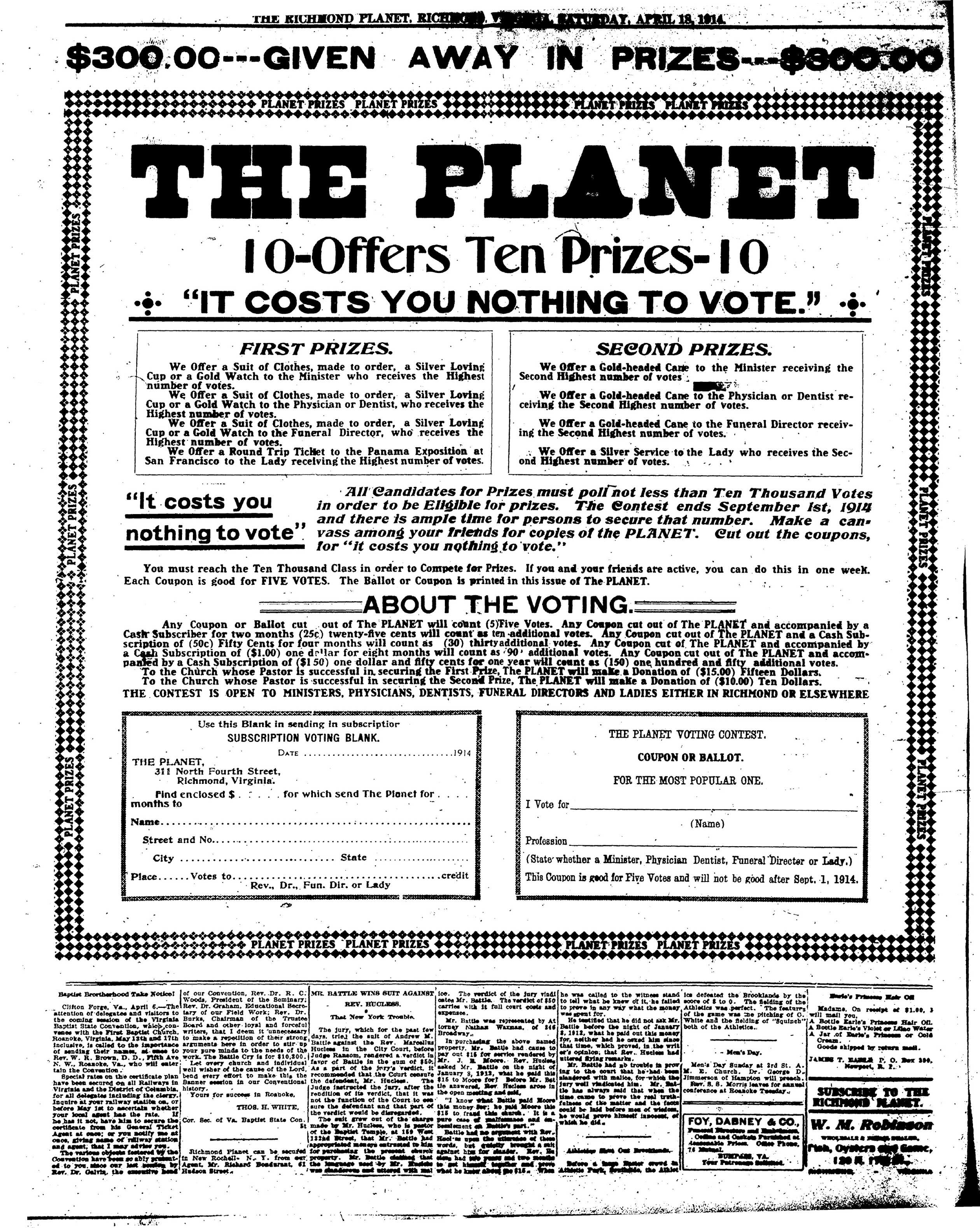
VALUE OF VOTES.
2 Months, 25e. 10
4 Months, 50e. 30
8 Months, $1.00 90
12 Months, $1.50 150
The
Abysmal Brute
By JACK LONDON
Copyright, 1912, by The Century Co.
SYNOPSIS
Sam Glendon, manager of boats, bears a wonderful unknown bait called Pat Glendon. He finds the boy in the wadersmen.
Glendon, innocent of the world's ways, goes to San Francisco and is matched "Roughhouses Kelly."
He whips Kelly, and other boats so easily that he is called "Glendon" more than the Flying Dutchman.
Glendon wins again. He nears the top in pugilism. His manager, Hubberen, chops off the ring practices, unknown to Glendon.
Through Mau Mang Singer, a reporter, Glendon first learns of the crooked practices and first suspects Hubberen.
CHAPTER V.
BUT the purpose grew larger and larger. In place of $100, such as his first battles had earned him, he was now receiving from $2000 to $2000 a right, as well as equally large sums from the moving picture man.
Stubener took his manager's percent age of all this according to the terms of the contract old Pat had drawn up, and both he and Glendon, despite their heavy expenses, were waging rich. This was due more than anything else to the clean lives they lived. They were not wasters.
Stubener was attracted to real estate, and his holdings in San Francisco, consisting of building flats and apartment houses, were bigger than Glendon ever dreamed.
There was a secret syndicate of betters, however, which could have made an accurate guess at the size of Stubener's holdings, while heavy bonuses after heavy bonus, of which Glendon never heard, was paid over to his manager by the moving picture men.
Stubener's most serious task was in maintaining the importance of his young gladiator. Nor did he find it difficult. Glendon, who had nothing to do with the business end, was little interested Besides, wherever his travels took him, he spent his spare time in hunting and fishing. He rarely mingled with those of the sporting world, was notoriously aby and secluded and preferred art galleries and books of verse to sport coasts.
Also, his trainers and sparing partners were rigorously instructed by the manager to keep their tongues away from the slightest blurs of ring rotten ness.
In every way Stubener, intertwined between Glendon and the world. He was never even interviewed save in Stubener's presence.
Only once was Glendon approached. It was just prior to his battle with Henderson, and an offer of $100,000 was made to him to throw the fight.
It was made hurriedly, in swift whispers, in a hotel corridor, and it was fortunate for the man that Pat controlled his temper and shouldered past him without reply. He brought the tale of it to Stubener, who said:
"It's only con, Pat. They were trying to Josh him." He noted the blue eyes blaze. "And maybe worse than that. If they could have got you to fall for it there might have been a big sensation, in the papers that would have finished you. But I doubt it.
"Such things don't happen any more. It's a myth, that's what it is, that has come down from the middle history of the ring. There has been rottenness in the past, but no fighter, or manager of reputation would dare anything of the sort today.
"Why, Pat, the men in the game are as clean and straight as those in professional baseball, than which there is nothing cleaner or straighter."
And all the while he talked Stubberen knew in his heart that the forthcoming fight with Henderson was not to be shorter than twelve rounds—this for the moving pictures—and not longer than the fourteenth round.
And, he knew, furthermore, so big were the stakes involved, that Henderson himself was pledged not to last beyond the fourteenth.
And Glendon, never approached again, dismissed the matter from his mind and went out to spend the afternoon in taking color photographs. The camera had become his latest hobby. Loving pictures, yet unable to paint, he had compromised by taking up photography. In his hand bagage was
One grip packed with books on the subject, and he spent long hours in the dark room, realizing for himself the various processes.
Never had there been a great fighter who was as an aloof from the fighting world as he. Because he had little to say with those he encountered he was called sullen and unsocial, and out of this a newspaper reputation took form that was not an exaggeration so much as it was an entire misconception.
Bolled down, his character in print was that of an ox muscled and dumbly stupid brute, and one callow sporting writer dubbed him the "abyssal brute."
The name stuck. The rest of the fraternity halted it with delight, and thereafter Glendon's name never appeared in print unconnected with it. Often, in a headline or under a photograph, "The Abyssal Brute," capitalized and without quotation marks, appeared alone.
All the world knew who was this brute. This made him draw into himself closer than ever, while it developed a bitter prejudice against news paper folk.
Regarding fighting itself, his earlier mild interest grew stronger. The man
woman been guilty in Europe made me a goodly home.
She had won the state, kept with her, from Ran time on a sensation team at a game. In for art and Francisque. All this until her faeces. Acute. Pete yet having could gin those who her father of life and social misgoing to swear.
Beginning had swiftly was prince
"it's only con. Pat."
he now fought were anything but dubs, and victory did not come easily. They were picked men, experienced ring generals, and each battle was a problem.
There were occasions when he found it impossible to put them out to any designated later round of a fight. Thus with Sitzberger, the gigantic German, try as he would in the eight eighth round, he failed to get him. In the nineteenth it was the same story, and not till the twentieth did he manage to break through the battling guard and drop him.
Glendon's increasing enforcement of the game was accompanied by severity and probabilistic training. Never dispassing, spending much of his time on hunting trips in the hills, he was practically always in the pink of condition, and, unlike his father, no unfortunate accidents marred his career. He never broke a bone, nor injured so much as a knuckle.
One thing that Stubener noted with secret glee was that his young fighter no longer talked of going permanently back to his mountains when he had won the championship away from Jim Hanford.
The consummation of his career was rapidly approaching. The great champion had even publicly intimated his readiness to take on Glendon as soon as the latter had disposed of the three or four aspirants for the championship who intervened.
In six months Pat managed to put away Kid McGraw and Philadelphia Jack Meltide, and there remained only Nat Powers and Tom Cannam. And all would have been well had not a certain society girl gone adventuring into journalism, and had not Stubber agreed to an interview with the woman reporter of the San Francisco Courier-Journal.
Her work was always published over the name of Mand Sangster, which, by the way, was her own name. The Sangsters were a notoriously wealthy family.
The founder, old Jacob Sangster, had packed his blankets and worked as a farm hand in the west. He had discovered an inexhaustible borax deposit in Nevada, and, from hauling it out by mule teams, had built a railroad to do the freighting. Following that he had poured the profits of borax into the purchase of hundreds and thousands of square miles of timber, lands in California, Oregon and Washington. Still later he had combined politics with business, had bought statesmen, judges and machines and become a captain of complicated industry. And after that he had died, full of honor and pessimism, leaving his name a muddy blot for future historians to amudge, and also leaving a matter of a couple of hundreds of millions for his four sons to squabble over.
The legal, industrial and political battles that followed vexed and amused California for a generation and culminated in deadly hatred and unspeaking terms between the four sons.
The youngest. Theodore, in middle life experienced a change of heart, sold out his stock farms and racing stables and plunged into a fight with all the corrupt powers of his native state, including most of its millionaires, in a quidistic attempt to purge it of the infamy which had been implanted by old Jacob Sangster. Maud Sangster was Theodore's oldest daughter. The Sangster stock uniformly bred fighter among the men and beauties among the women, nor was Maud an exception; also the must have inherited some of the virus of adventure from the Sangster, breed, for she had come to womanhood and done a multitude of things of which
no woman in her position should have been guilty.
A match in ten thousand, she remained unmarried. She had sojourned in Europe without bringing home a nobleman for spouse and had declined a goodly portion of her own set at home.
She had gone in for outdoor sports, won the tennis championship of the state, kept the society weekends agog with her unconventionalities, walked from San Mateo to Santa Cruz against time on a wager and once caused a sensation by playing polo in a men's team at a private Burlingame practice game. Incidentally she had gone in for art and maintained a studio in San Francisco's Latin quarter.
All this had been of little moment until her father's reform attack became acute. Passionately independent, never yet having met the man in whom she could gladly submit and bored by those who had inspired, she resented her father's interference with her way of life and put the climax on all her social misdeeds by leaving home and going to work on the 'courier-journal.
Thus she scooped the big interview with Morgan at a time when he was being fully realist by a dozen New York-star journalists, went down to the bottom of the Golden Gate in a diver's suit and flew with Rood, the
"What do they want to come butting into the game for?"
bird man, when he broke all records of continuous flight by reaching as far as Riverside.
Now, it must not be imagined that Sand Singer was a hard bitten Amazon. On the contrary, she was a gray eyed, slender young woman of three or four and twenty, of medium stature and possessing uncommonly small hands and feet for an outdoor woman or any other child of a woman.
Also, far in excess of most outdoor women, she knew how to be daintily feminine.
It was on her own suggestion that she received the editor's commission to interview Pat Glendon. With the exception of having caught a glimpse once of Bob Fitzsimmons in evening dress at the Palace grill, she had never seen a prizefighter in her life.
Nor was she curious to see one—at least, she had not been curious until young Pat Glendon came to San Francisco to train for his right with Nat Powers. Then his newspaper reputation had aroused her.
THE abysmal brute! It certainly must be worth seeing. From what she read of him she gleaned that he was a man monater, profoundly stupid and with the sullenness and ferocity of a jungle boast. True, his published photographs did not show all that, but they did show the burgess of brawn that might be expected to go with it. And so, accompanied by a staff photographer, she went out to the training quarters at the Cliff House at the hour appointed by Stubener. That real estate owner was having trouble. Pat was rebellious. He sat, one big leg dangling over the side of the armchair and Shakespeare's "Bonets", face downward on his knee, crating against the new woman.
"What do they want to come butting into the game for?" he demanded. "It's not their place. What do they know about it anyway? The men are bad enough as it is. I'm not a holy show. This woman's coming here to make me one. I never have stood for women around the training quarters, and I don't care if she is a reporter." "But she's not an ordinary reporter," Stubener interposed. "You've heard of the Sangsters, the millionaires?" Pat nodded.
"Well, she's one of them. She's high society and all that stuff. She could be running with the Blingum crowd now if she wanted to instead of working for wages. Her old man's worth 80,000,000 if he's worth a cent."
"Then what's she working on a paper for--keeping some poor dill out of a job?"
"She and the old man fell out, had a tiff or something, about the time he started to clean up San Francisco. She quit, that all-left home and got a job. And let me tell you one thing, Pat. She can everlastingly aling English. There isn't a penpusher on the coast can touch her when she gets going."
Pat began to show interest, and Buster hurried on:
THE RICHMOND PLANET, RICHMOND, VIRGINIA.
tation should have
bousand, she re-
she had soiled her
it bringing home a
and had declined
her own set at
for outdoor sports,
championship of the
empty weeklies agro-
nationalities, walked
ants Cruz against
and once caused a
polo in a men's
ringling practice
she had gone in
and a studio in San
arter.
of little moment
form attack became
independent, never
man in whom she
and bored by
red, she resented
once with her way
limax on all her
having home and
courier Journal.
weeks her salary
$50. Her work
musical, dramatic
ugh she was not
stuints if they
untly interesting
the big interview
me when he was
a down town man.
News every big actor hits this
berg."
"I've seen her name in the papers."
Pat commented.
"Here you have. And you're honored.
Pat, by her coming-to-interview
you. It won't bother you any. I'll
stick right by and give her most of the
dome myself. You know I've always
done that."
Pat looked his gratitude.
"And another thing. Pat, don't for-
get you've got, so put up with this in-
terviewing. It's part of your business.
It's big advertising, and it comes free.
We can't buy it. It interests people,
draws the crowds, and its crowds that
pile up the gate receipts."
He stopped and listened, then looked
at his watch. "I think that's her now.
I'll go and get her and bring her in.
I'll tip it off to her to cut it short, you
know, and it won't take long."
He turned in the doorway. "And be de-
cent. Pat. Don't shut up like a clam.
Talk a bit to her when she asks you
questions."
Pat put the screen on the table,
took up a newspaper and was apparently
deep in its contents when the
two entered the room and he stood up.
The meeting was journal shock.
When blue eyes not gray it was al-
most as if the man and the woman
shouted triumphantly to each other, as
if each had found something sought
and unexpected. It this was for the
instant only.
In a masculine use
the curtain and the
any gallows.
In a battling
crushed, if what she
was no. In vain a
marks of the brat
attempted to settle
For one thing, a
about prismighters
whenever she open-
promptly coated Stub.
It must be more
of pessimistic
with sigh: "About it. Tell me.
Oh, aside from most
lazy fighting? Are
by jitting yourself
I hardly know how
mean, so you must
no."
Pat and Krubener
gether, but for once
agger down.
"I didn't care for
you see, it was
him. Stubener into
But later, Pat
encountered the be
real big, clever or
more—
On your mottle.
"Yes, that's it; care
I found it; care
in fact. But still it
to me as it might
Each had antitested in the other something so tenacious different that the next moment the cry of recognition gave way to confusion.
As is the way of women, she was the first to achieve control, and she did it without having given any outward sign that he had ever lost it. She advanced in the distance across the floor to meet Glendon. As for him, he seems know how stumbled through the introduction.
Here was a woman in a woman. He had not known such a creature could exist. The women he had not had never configured this. He wondered what it was. It’s judgment would have been there if she was the sort he had received to hang on to with both his hands.
He discovered that in some way he was holding her hand. He looked at it, curious and animated, marveling at its fragility.
She, on the other hand, had proceeded to obliterate the shoes of that first clear call. It had been a peculiar experience, that was all, this sudden outrush of her toward this strange man.
For was not be the abysmal brute of the prize ring, the great, fighting, stupid bulk of a male animal who hummered up his fellow males of the same stupid order. She smiled at the way he continued to hold her hand.
“I will have it back please, Mr. Glendon,” she said. “I really need it you know.”
He looked at her blankly, followed her gaze to her imprisoned hand, and dropped it in a rush of awkwardness that sent the blood in a manifest blush to his face.
She noted the laugh, and the thought came to her that he did not keep quite the unmouth brute she had pictured. She could not consolve of a brute blushing at anything.
And also, she found herself pleased with the fact that he backed the easy gibbness to murmur an apology. But the way he decoured her with his eyes was disconcerting.
He stared at her as if in a trance, while his cheeks flushed even more reddly.
Stubber by this time had fetched a chair for her, and Glendon automatically sank down into his.
"He's in the shape, Miss Sangster, in fine shape," the manager was saying. "That's right, isn't it? But? Never felt better in your life?"
Glendon was bothered by this. His brows contracted in a troubled way, and he made no reply.
"I've wanted to meet you for a long time, Mr. Glendon." Miss Sangster
"I'll have it back, please, Mr. Glenden," she said. "I never interviewed a pugilist before, so if I don't go about it expertly you'll forgive me. I am sure."
"Maybe you'd better start in by seeing him in action," was the manager's suggestion. "While he's getting into his fighting tonight I can tell you a lot about him—fresh stuff too. We'll call in Wish, Pat, and go a couple of rounds."
"We'll do nothing of the sort." Glendon growled, roughly, in just the way an abrasal bead should. "Go ahead with the interview."
The business went ahead unsatisfactorily. Stainbera did most of the talking and suggesting, which was sufficient to irritate Maud Sangster, while Pat volunteered nothing.
She studied his fine countenance, the eyes clear blue and wide apart, the well modelled, almost aquiline, nose, the firm cheek tips that were swept
in a masculine way in their curls in the corners and that gave no hint of any gallows.
It was a buffling personality, she reminded. If what the papers said of him was no. In vain she sought for marks of the brute. And in vain she attempted to establish contacts.
For one thing, she knew too little about priesthood and the ring; and whenever she opened up a lead it was promptly snatched away by the information coding Stubener.
"It must be most interesting, this life of a pagist," she said once, adding with a sigh: "I wish I knew more about it. Tell me, why do you fight? Oh, aside from money reasons." (This letter to forestall Stubener.) "Do you enjoy fighting? Are you stirred by it, by pitting yourself against other men? I hardly know how to express what I mean, so you must be patient with me."
Pat and Stubener began speaking together, but for once Pat bore his manager down.
"I didn't care for it at first"—"You see, it was too dead easy for him," Stubener interrupted.
"But later," Pat went on, "when I encountered the better fighters, the real big, clever ones, where I was more"—"On your mettle," she suggested.
"Yes, that's it; more on my mettle, I found I did care for it—a great deal, in fact. But still it's not so absorbing to me as it might be. You see, while each battle is a sort of problem which I must work out with my wits and muscle, yet to me the issue is never in doubt"—
"He's never had a fight go to a decision," Stubenber proclaimed. "He's won every battle by the knockout route."
"And it's this certainty of the outcome that robs it of what I imagine must be its finest thrills," Pat concluded.
"Maybe you'll get some of them thrills when you go up against Jim Hanford," said the manager.
Pat smiled, but did not speak.
"Tell me some more," she urged—"more about the way you feel when you are fighting."
And then I am amazed his manager, Miss Sangster and himself by blurting out:
"It seems to me I don't want to talk with you on such things. It's as if there are things more important for you and me to talk about. "—
"Yes," she cried eagerly. "That's it. That is what makes a good interview — the real personality, you know." But Pat remained tongue tied, and Stubener wandered away on a statistical comparison of his champion's weights, measurements and expansions with those of Sandow, the Terrible Turk Jeffries and the other modern strong men. This was of little interest to Maud Dangster, and she showed that she was bored. Her eyes chanced to rest on the sonnets. She picked the book up and glanced inquiringly at Stubener. "That's Pat's," he said. "He goes in for that kind of stuff and color photography and art exhibits and such things. But for heaven's sake don't publish anything about it. It would ruin his reputation."
[TO BE CONTINUED]
Find Pin in Appendix.
Surgeons at the State hospital in
Ashland, Pa., operating on Michael
Foley, of Mahanoy City, for appendicitis, found a bent pin in the boy's appendix. Young Foley has no recollection of swallowing the pin. He will recover.
Cuba's Oldest Man Dies at 120.
Bias Casanova, said to have been the oldest man in Cuba, died at the age of 120 in Havana. He was born in Africa and was brought to Cuba as a slave when a boy.
A GOOD LINGUIST.
The Class In German Throws a Fit
When She Arches Her Attitude.
MRS. BEEMAN became an earnest member of a local German class and developed into a very enthusiastic student. It was not long before she learned to read a little German; but the pronunciation of the language was somewhat more arduous. At a recent meeting of the class she afforded them more amusement than they got out of the German humors they were reading.
One of the questions in the lesson for the day was, "Are you not glad you are able to learn German?"
The answer, which was, of course, in German, was "Ja, gewid," which means "Yes, certainly."
When Mrs. Beeman was called upon to read the question and answer she upset the whole class by saying: "Ya, gee whit!"-Detroit Free Press.
Had Overlooked One
One morning Rosele's teacher noticed her hanging around the desk with rather a wistful expression.
"Well, Rose, what is it?' she finally asked, drawing the child to her.
"Please, teacher, we've got a new baby f' our house."
"Oh, have you, Rosie? Isn't that fine? What's the baby's name?"
"Ikle."
The child looked bewildered. "Oh, teacher, we ain't got no lke." "Yes; you told me, you had a baby." A gleam of intelligence appeared on Ronda's face. "No, teacher, his name Mose; his name ain't lke. We found we already got one lke." "Everybody's."
Tell the Truth.
She. You told me I was the only woman you ever proposed to.
He. True.
She. True. is it? I've heard that you've been engaged to three women.
He. All of them were widowed love.
They, didn't wait for a proposal. Exchange.
HOME RULE WINS BY 80 MAJORITY
Commons Passes Measure to Third Reading.
Timothy Healy Charges John E. Redmond With Deluding Ireland Over Settlement.
By a majority of 80 an amendment for the rejection of the home rule bill was defeated in the house of commons in London, and without division the bill was given for the third time its second reading in the house.
The second reading of the home rule bill was carried the first time by a majority of 101, and the second time by a majority of 98.
Eight O'Friarities abstained from voting and two Liberals voted against the government. One Nationalist was absent through illness. Three Laborists also were absent, and Charles F. G. Masterman, who had previously voted as a member of the government, lost his seat in the election for Bethnal Green last February.
National, Independents, Nationalists and Liberates clashed in partisan debate over the home rule bill.
Timothy Healy, the independent Nationalist, charged Mr. Redmond with deluding Ireland.
"From Sir Edward Groy's speech announcing there must be an appeal to the electorate before the bill comes into operation," he said, "it is clear that the whole matter is the purest gamble for Ireland.
"If the advocacy of conditions made by William O'Brien had been followed instead of calling the Ulsterman 'Orange dogs' and carrion crowns' the question would be much nearer settlement."
Mr. Healy then announced that the followers of O'Brien, ten in number, would not vote for the second reading of the bill.
The Nationalists, Mr. Redmond said, would have been glad to accept the scheme proposed by Sir Horace Plunkett in February, by which a plebiscite would be taken after a certain number of years on the question whether any section of Ulster desired to continue subject to the Irish parliament.
Sir Edward Carson, the Ulster Unionist leader, declared that the government's attempt to "jump" Ulster with naval and military forces had made him skeptical of any reality in its professions of peace and coercion.
Sir Edward suggested Mr. Redmond, like the government, was trying to create an atmosphere favorable to himself without an attempt to and a practical compromise.
"The talk of federalism," he said, "has not advanced the settlement of the Ulster question an lota."
Sir Edward Carson repeated his offer that if the government would agree to allow parliament to decide at the end of the six years' period of exclusion whether or not Ulster should have the continued right of local option he would call an Ulster convention and submit the question to it.
---
Torrent Falls: Loss Over 5000
Not only is Pancho Villa's rebel army in undisputed possession of Torreon, Mex., but his army is in close pursuit of the losing Federal army, recently defending the city.
The cavalry, under Generals Hornandez and Ortega, sent in pursuit of General Velasco and his seeing Federalals, overtook the rearguard of the Federalals at San Pedro de Los Colonias, and in the fight which followed 100 Federalals were killed and 153 taken prisoners. The rebel losses were not given.
Torreon was the last stronghold held by Huerta in northern Mexico. The town, strewn with the dead and wounded of a six-day battle, was occupied by the victorious rebels on the heels of the flying Federalals, the remnants of General Refugio Velasco's army.
In all the fighting no foreigner was killed or injured.
The losses have not been compiled, but General Villa estimates his own losses at 500 killed and 1500 wounded and the Federal loss at 1000 killed and 2500 wounded, with an unknown number of prisoners. This is by far the largest number of casualties in any of the many battles that have marked the Mexican revolution of the last four years.
Venango County, Pa., is "Dry." All of the applications for wholesale and retail liquor licenses in Venango county were refused by Judge George S. Criswell in court at Franklin, Pa., who had granted licenses for eighteen years, and three new applications were made this year. Judge Criswell hasn't disposed of two brewery applications. The applications were refused on the ground that saloons are not necessary, and in this connection Judge Criswell took into consideration the public welfare. The court that falls to do this, he says, falls to, exercise the discretion which it possesses relative to public interest. To regard as proper for consideration only the useful and nonjudgeable functions of a liquor license is to do violence not only to the adjudged law of the state, but to the common sense of men, the judge says Judge Criswell declares that the Brooks high license law does not say it is "lawful" for courts to refuse licenses, but provides that they, "shall" refuse them when they aren't necessary, and the question of necessity is left to the discretion of the court. The Judge admits that the Brooks law is not a local option law, but says it contains a legal option in feature, in that it requires courts to have re
Two Die Looking at Fight
Patrick Engleman, seventy years old,
and Mrs. Daniel Arsenault, sixty
years old, of Espencer, them dropped
and from fright in the street in Worcester, Mass., as they witnessed a three-cornered sight between Martin
Niederberger, a chauffeur, and Stanley Oratt and Charles Banes, the employee of a cereal company.
Orutt and Bannon, while distributing samples, had called at the home of Walter Watson, Niederberger's employer. Mrs. Watson claims she was insulted by one of the men and informed her husband.
Watson and Niederberger started out after the two distributors, and located them at the trolley waiting station. A sight followed and Mr. Engleton, who was waiting for a car, collapsed from fright and died. Mrs. Arsenault sank to the floor of the station and died.
Twelve Reserve Banks Named.
The twelve districts and twelve reserve cities of the federal reserve banking system authorized by the new currency law were announced by the organization committee. This is the first formal step to be taken in the organization of the new banking system. The cities that are to have federal reserve banks are: New York, Boston, Philadelphia, Cleveland, Richmond, Va.; Atlanta, Chicago, St. Louis, Minneapolis, Dallas, Tex.; San Francisco and Kansas City.
Twelve districts are outlined, with these cities as financial centers, it being required that the reserve bank of each district shall subscribe to a minimum of $4,000,000 of capital in the reserve system.
Gets $50,000 For Loss of Extra
A verdict awarding $0,000 to Natt
Yurkun for the loss of both eyes was
returned in the United States district
court in Brooklyn, N. Y., a district
the Delaware, Lackawanna and West
ern railroad.
This is said to be the largest verdict
ever obtained in New York state for
an injured workman. Yurkun was
working in the "railroad company's
Pettitone coal mine at Luzerne, Pa.
when he was injured by the explosion
of a south of fuse in a powder bale.
March Guilty of Murder
George H. March was found guilty of murder in the first degree at Media, Pa., for the killing of S. Lewis Pinkerton, an Edgmont township tax collector and farm manager, by whom March was employed.
The jury had deliberated for more than thirty-six hours and several times had returned to the court room for further instructions.
Pinkerton was slain in a barn on Nov. 7, 1913. His body was later found buried in a woods five miles distant.
"Rube" Waddell Is Dead.
George Edward ("Rube"), Waddell, the famous ball pitcher, formerly a member of the Philadelphia Athletics, died in San Antonio, Texas. He had been ill for a long time of tuberculosis.
Waddell was the most eccentric and unreliable pitcher in the country, but the most effective when in shape. He was born in Bradford, Pa., in 1875. Waddell went to the Bradford schools, but paid more attention to base ball than his education and early won repon as a twirler of phenomenal ability.
In 1897 he went to Volant college and later in the year joined Louisville. in 1898 he was with Detroit and Homestead, Pa.; with Columbus and Louisville in 1899; with Pittsburgh and Milwaukee in 1900, and with Chicago and Los Angeles in 1901.
Connie Mack took a trip to Los Angeles in 1902 and was so favorably impressed with his work that he made him a big offer to jump to the Athletics. It was his wonderful pitching that enabled the Athletics to win the pennant in that year, and he was also a big factor in the 1905 pennant winning team. In 1908 Waddell was sold by the Athletics to the St. Louis American team.
For a "Dry" Navy
A dry navy is to take the place as the right arm of grape juice diplomacy in the scheme of the Wilson administration.
Secretary of the Navy Daniels has signed an order which absolutely prohibits the use or introduction of alcoholic liquors on any vessel of the navy or within the confines of any navy yard or shore station.
This order will be issued to the service at once and will become effective on July 1, 1914.
Victim of March Hot Wave Dies.
George A. Klare, a letter carrier, of Portsville, Pa., who was stricken with the heat while delivering mail during the sudden hot wave in March, which lasted but one day, died from the effects of the stroke. He had been only partly conscious since being stricken. Klare had a weak heart and was obliged to use caution during hot weather, but did not think it necessary to do so in March.
Dynamite Refused to Explode.
The town of Bath, Pa., had a narrow escape from being blown off the map when a carload of dynamite was wrecked at the switch south of here. The force of the collision caused the freight car to fall completely to pieces and scatter the dynamite, yet not one stick exploded.
Sanate Cuts Out Telegrams
By a vote of 47 to 4 the senate do-
prived itself completely of the privilege of sending telegrams on official or other business at the government's expense. Senators O'Gorman, Oliver, Tillman and Lippitt voted against the resolution.
Named by President.
President Wilson sent to the senate the nomination of Richard H. Mann, of Petersburg, Va., to the United States attorney for the eastern district of Virginia.
---
U. S. BATTLESHIPS SENT TO TAMPICO
Insist on Public Apology For Insult
When American Marines Were Arrested by Mexican Federal Commander.
A general concentration of the Atlantic fleet at Tampico, Mexico, was ordered by Secretary of the Navy Daniel lea after a cabinet meeting in which President Wilson laid before the cabinet the necessity for backing up the demand of Rear Admiral Mayo that the American flag be saluted by the Huerta commander there.
The Atlantic fleet is under command of Rear Admiral Badger and comprises the second strongest fleet in the world.
In addition to the fleet the 1300 marines at New Orleans, 800 of whom were on their way to Philadelphia, when stopped, have been ordered to Tampico at once.
Naval experts in Washington stated that a single broadside from the fleet would blow all the Tampaico fortifications, to pieces. It is not believed however, that the fleet will do anything more at present than make a hostile demonstration. No shots will be fired unless congress authorizes a declaration of war.
The cabinet had discussed the situation in a two-hour meeting and the consensus of opinion was that the Washington government should insist on a salute. After the meeting there was a conspicuous silence on the part of all officers, and Secretary Daniels hurried to the navy department, where he prepared a memorandum of naval orders.
This action followed an earlier announcement that further investigation of the arrest of the United States marines at Tampaico had been decided upon.
It was learned that Charge d'AF
fairs O'Shaughnessy had reported that
the Huerta government actually had
promised to fire a salute to the Dolph
phin, but conditioned it on a salute of
response. The American government,
it is understood, has set forth, through
Mr. O'Shaughnessy, that it wished a
public salute to the colors without
conditions.
No time limit for the salute has
been fired or is likely to be, it was
said on high authority. President Wilson
and Secretary Bryan, it was said,
are not disposed to regard time as
essential, but are insistent that a public
salute must be fired.
It became known that Senor Algarra charge of the American embassy in Washington, called personally on Secretary Bryan, had Saturday and transmitted the apology of President Huerta for the Tampico incident. Secretary Bryan reiterated to Senor Algarra at that time that the United States would insist on the American flag being sutured at Tampico. Officials said that while no ultimatum had been issued to the Huerta government, the mobilization of the fleet at Tampico was intended to put the United States in position to enforce one should the immediate developments make it necessary.
MEXICO'S INSULT TO U. S.
Incident That·Has Brought on the Acute Criele.
The incident which led to the war like action of the United States government toward Mexico happened on April 9.
The paymaster of the U. S. S. Dolphin and a fall whaleboat crew landed near the turtlebridge bridge, Tampico, this being within the Federal lines and also within the some of operations.
Colonel Hinojoe, the Federal guard commander, ordered the men detained and brought before him, whereupon all were arrested by Mexican soldier, including several who remained in the boat from which the flag was flying.
All were taken before Hinojoe, who questioned them regarding their purpose within Federal lines in modern during active operations. The paymaster explained that he had landed to obtain gunfire, whereupon Hinojoe ordered them escorted back to the boat and released.
United States General Miller judge dially protected to General Marion Maragon, the port commander, who arrested Hincjone personally and verbally expressed regret over the incident.
Rear Admiral Moya, who did not consider this sufficient, asked for a formal apology, the punishment of Hincjone and a spike of twenty-one guns to the American flag before his arrest when afternoon.
When the time had expired it was thought of Washington that the incident had been adjusted to Admiral Moya's mindlessness; but it developed that the Madman idea of a civilized apology did not meet those of the American commander. The officer then took on a nervous aspect.
Some Startling Information
Some Startling Information
"There are none so blind as those who will not see"
Colored men must observe high ideals and act in accordance with fundamental right principles in order to maintain self-respect, and enlist the sympathy and support of the best people, regardless of color in this country. They cannot properly complain of unfair treatment of themselves by a certain class of white people, and then when vested with power, practice upon each other the very injustice of which complaint is made in others.
The opportunities afforded colored men of intelligence and learning in the fraternal organizations of the country should be used to demonstrate our ability for self-government. The best class of white people should be imitated and not the worst classes. When we observe the actions of some of our educated people their conduct is disheartehing. Yet, we know that the great body of the colored people is all right. We were induced to make these remarks after observing the attitude of the officer., of the Supreme Lodge Knights of Pythias, N. A., S. A., E., A., A. and A., at Baltimore last August. In a wild scramble for money, they threw discretion to the winds.
Let us see. Unier the laws of the Order each Grand Lodge has exclusive, original jurisdiction over the subordinate lodges and the members attached to the same. The Supreme Lodge or its officers cannot tax the members of a lodge in a state having a Grand Lodge. The Constitution provides a representative tax of $25 on each Supreme Representative to the Supreme Lodge. As no State has less than two Supreme Representatives or more than four, the tax was not less than $50.00 per term or more than $100.00 per term. For this the only return is the password. The salaries and traveling expenses of the Supreme Chancellor and other officers had been increased.
The Supreme Keeper of Record and Seal warned the Supreme Lodge of these reckless expenditures and for this he was put out of office.
The Grand Lodge, K. of P. of Virginia protested and for this the Supreme Chancellor suspended and put out of the Order, not only the Grand Lodge, but also the subordination lodges and the members attached to the same, although he had no power over any but the Grand Lodge. The new constitution which requires a two-thirds vote to adopt was alleged to have been adopted. One test vote disclosed the fact that there were 51 acres, 14 noses with 63 members of the Supreme Lodge absent. Of the 51 votes, 20 were office-holders and 8 Deputy Supreme Chancellors appointed by Supreme Chancellor S. W. Green, with the power to vote. This loft 23 Supreme Representatives out of an elected membership of 90, all of whom had been in Baltimore to attend the session, but they were tired out, for the Constitution was finally "adopted" after 9 o'clock Saturday night, after a week's deliberations.
All that a Grand Lodge receives from the Supreme Lodge is the password. The password is a word framed and promulgated by the Supreme Chancellor. In order to pay high salaries and running expenses, for each Grand Lodge pays its own endowment and defrays its own expenses, the Supreme Lodge with a majority of the elected Supreme Representatives absent made an increase in taxation.
It was done under the guise of a ten cent and a five cent tax on each member. As it was only for a pass word, the value of a password may be estimated from the following statement of facts:
Alabama's biennial tax was $100.
It was changed to $144.00, an increase of $1340.00 per term.
Arkansas' biennial tax was $100.00. It was changed to $1,136.20, an increase of $1,026.20.
California's biennial tax was $50.00. It was changed to $65.25, an increase of $15.25.
Colorado's biennial tax was $50.00. It was changed to $46.50 a decrease of $3.50, but as the membership increases will pass the $100 limit.
The District of Columbia' biennial tax was $50.00. It was changed to $58.25, an increase of $8.25.
THE RICHMOND PLANET, RICHMOND, VIRGINIA.
Copy of Injunction.
The following is a copy of the Injunction
Lodge, Knights of Pythias, of Virginia; and
Friday, January 30, 1914.
The Degree Was Entered Monday, F
IN THE SUPREME COURT OF THE
COLUMBIA.
Holding an Equity Cou
of the Injunction granted the Grand
of Virginia; at Washington, D. C.,
Wednesday, February 2, 1914.
COURT OF THE DISTRICT OF
COLUMBIA.
an Equity Court.
The following is a copy of the Injunction granted the Grand Lodge, Knights of Pythias, of Virginia, at Washington, D. C., Friday, January 30, 1914.
The Degree Was Entered Monday, February 2., 1914.
IN THE SUPREME COURT OF THE DISTRICT OF COLUMBIA.
Grand Lodge of Knights of Pythias of North America, South America, Europe, Asia and Africa, a corporation,
The Knights of Pythias of North America, South America, Europe, Asia, Africa and Australia, and others, Defendants.
Equity No. 32281.
This cause coming on to be heard upon the afflavits in support thereof, the rule to answer, it is, upon consideration thereof, February, 1914 by the Court—
ADJUDGED, ORDERED and DECRETS and each of them and their officers, and all others on their behalf, be and they are during the tendency of this suit, or until the Court, from declaring or treating the fraud plaintiff corporation as revoked and from the Grand Lodge, Knights of Pythias, or Virginia, as dissolved, and from declaring or subordinate to the printiff in the State of Vibers attached to the same as not entitled to ileges of members of the order of the defense from calling or members elsewhere to re-subordinate lodges and members as not attempting to enforce the decree or enacting Lodge, purporting to revoke the charter of dissolve the said Grand Lodge, of the jury and from circulating any proclamations or the Grand Lodges, subordinate lodges and calling attention to or calculated or intended and enforce the attempted revocation of the charter and dissolution of said Grand Lodge up or attempting or purporting to set up, Virginia, a Grand Lodge, other than the plaintiff of Pythias of the order of the defendant doing any other act or thing on the assume Grand Lodge of the State of Virginia has been its fraternal charter has been revoked.
(Seal)
A TRUE COPY—Test
J. R. YOUNG, Clerk.
by F. E. Cunningham, Asst. Clerk.
to be heard upon the bill of complaint, therefore, the rule to show cause, and the ratification thereof, this second-day of March and DECREED that the defendant, their officers, agents and attorneys, be, and they are hereby restrained, suit, or until the further order of the treating the fraternal charter of the locked and from declaring or treating of Pythias, of the jurisdiction of from declaring or treating the lodges in the State of Virginia and the member not entitled to the rights and privilege of the defendant corporation, and elsewhere to regard and treat such members as not so entitled; and from decree or enactment of the Supreme court of the plaintiff and to judge, of the jurisdiction of Virginia; declarations or letters addressed to the lodges and members of the order, stated or intended to carry into effect revocation of the plaintiff's fraternal Grand Lodge; and from settingting to set up, within the State of longer than the plaintiff, of the Knights the defendant corporation; and from lying on the assumption that the said Virginia has been dissolved or that revoked.
This cause coming on to be heard upon the bill of complaint, the affidavit in support thereof, the rule to show cause, and the answer, it is, upon consideration thereof, this second-day of February, 1914 by the Court—
ADJUDGED, ORDERED and DECREED that the defendants and each of them and their officers, agents and attorneys, and all others on their behalf, be and they are hereby restrained, during the tendency of this suit, or until the further order of the Court, from declaring or treating the fraternal charter of the plaintiff corporation as revoked and from declaring or treating the Grand Lodge, Knights of Pythias, of the jurisdiction of Virginia, as dissolved; and from declaring or treating the lodges subordinate to the plaintiff in the State of Virginia and the members attached to the same as not entitled to the rights and privileges of members of the order of the defendant corporation, and from calling members elsewhere to regard and treat such subordinate lodges, and members as not so entitled; and from attempting to enforce the decree or enactment of the Supreme Lodge, purporting to revoke the charter of the plaintiff and to dissolve the said Grand Lodge, of the jurisdiction of Virginia, and from circulating any proclamations or letters addressed to the Grand Lodges, subordinate lodges and members of the order, calling attention to or calculated or intended to carry into effect and enforce the attempted revocation of the plaintiff's fraternal charter and dissolution of said Grand Lodge; and from setting up or attempting or purporting to set up, within the State of Virginia, a Grand Lodge, other than the plaintiff, of the Knights of Pythias of the order of the defendant corporation; and from doing any other act or thing on the assumption that the said Grand Lodge of the State of Virginia has been dissolved or that its fraternal charter has been revoked.
Clerk.
assessed biennially ($9,252.75), nine thousand, two hundred and fifty-two dollars and seventy-five cents and the District Deputy Supreme Chancellors are not assessed as much as a penny. The new constitution alleged to have been adopted at the last session requires all Grand Lodges to surrender their present state charters of incorporation and to reincorporate in the name of the Supreme Lodge. This would place all of the real-estate, money in the treasury and other property under the direct control of the Supreme Lodge. It can now be seen why Virginia and her Supreme Representatives were not wanted in the Supreme Lodge.
70. Mississippi's biennial tax was $100.00. It was changed to $1,577.
70. an increase of $1,477.70. Missouri's biennial tax was $100.00. it
was changed to $792.75, an increase of $692.75. Maryland's biennial tax
was $100.00. It was changed to $300.75, an increase of $200.75.
North Carolina's biennial tax was $100.00. It was changed to $608.25,
an increase of $508.25. New Jersey's biennial tax was $100.00. It
was changed to $240.00, an increase of $140.00.
It may be well to enquire how will the Supreme Representatives who were present explain all of these things to their constituents? What induced them to support these measures? Were they asleep, hypnotized or absent when these things took place? Who can defend it?
Texas' biennial tax was $100.00. It was changed to $1,500.00, an increase of $1,400.00. Virginia's biennial tax was $100.00. It was changed to $861.90, an increase of $761.90. West Virginia's biennial tax was $100.00. It was changed to $375.00, an increase of $275.00.
What is the amount of this taxation? ($18,520.50) Eighteen thousand, five hundred and twenty dollars and fifty cents. How much increase is this new taxation over the old taxation? ($16,124.00) Sixteen thousand, one hundred and twenty-four dollars. What will the Grand Lodges and subordinate lodges receive, in return for this large amount of money paid over to Supreme Lodge officers? The parish word.
In fact, how can anybody explain it? If the taxation is increased, then the benefits should be increased. But what did Supreme Keeper of Records and, Seal C. K. Bollinson, who knows more about the internal affairs of the Supreme Lodge than any other person in the United States tell the Supreme Lodge? In his report, he said:
This is not all. At the session of the Supreme Lodge at Indianapolis the Supreme Chancellor appointed 25 Deputy Supreme Chancellor, giving them the power to vote and extending to them the voting strength of six states, some of which paid high as $2,400.00 per term for the pane-word. This was in violation of the Constitution of the Supreme Lodge.
"At the last session, warned you of the condition which confronted you and urged you to prepare to meet the ordee. The conservative man of the convention saw the impending danger and sought to correct it by presenting remedy after remedy, all of which efforts failed. I have no criticism to offer us to the action of the majority at that time, but I feel it my mission duty to again call your attention to the deployable condition of your treasury at this time. The interest of the officers of the Supreme League have not been paid since September, 1913 and when the question concerns of Baltimore, you will find an enormous detail, that can only be met by who legislature, and proper regulation of exporum."*The Order
The records show that 14 Deputy Supreme Chancellors were appointed by the Supreme Chancellor at Baltimore last August. He and previously ruled that they had the right to vote. These twenty-four Chancellors, if present at the next session of the Supreme Lodge will have the voting power equal to that of Armenia, Georgia, Michigan, Texas, Tennessee, and Alabama. These six states, according to the Supreme quoted will be
ASHLEY M. GOULD Justice.
10 West Leigh Street, Richmond, Virginia.
LARGE CAPACIOUS WARB-ROOMS, FILLED WITH THE BEST
DESIGNS FROM THE BEST MANUFACTORIES IN THE U.S.
STATES. PROMPT AND POLITE SERVICE. ORDERS REQUIRED
TO DAY OR NIGHT.
D. J. FARRAR, CONTRACTOR AND BUILDER. ALL KINDS OF CARPENTRY. OFFICE ROOM, NO. 605, MECHANIC SAVINGS BANK BUILDING Tupua, Marne—3087. RESIDENCE, 610 N. FIRST STREET—GROUP IN SHAR Tupua, Marne—3106. Special Attention Paid to the Training of Contractors for Building of Any Style of Architecture. Job Work a Specialty.
has been taxed and over-taxed, until the patience of the membership has almost reached the breaking point."
What was the reply to this common sense, business plea? C. K. Robinson was put out of office and the Grand Lodge, K. of P. of Virginia, that backed up his plea for retrenchment and reform was put out of the Supreme Lodge. Was the Grand Lodge, K. of P. put back into the Supreme Lodge? Yes, by the Supreme Court at Washington How was this done? Because the Supreme Lodge, being incorporated under the laws of the District of Columbia is subject to the courts there This Supreme Court is higher than the Supreme Lodge.
Has Virginia paid the unlawful tax levy? No, but it has tendered all of the money for lawful tax levies, which amount was $100.00. Can the Supreme Lodge officials disregard the injunction and keep the Grand Lodge K. of P. of Virginia out of the Supreme Lodge? No, not during the pendency of this suit or until the Supreme Court revokes the restraining order or injunction
What will be the result if other Grand Lodges refuse to pay the unlawful taxes? They can be suspended by the Supreme Chancellor and their charters revoked by the Supreme Lodge. Can they get back into the Supreme Lodge again, without paying the unlawful taxes? Oh, yes, they can come back by the "injunction route." Just as Virginia has done and at much less cost. In fact, it would be cheaper to get the injunction than it would be to pay the tax.
What is the penalty for violation of an injunction? Fine or imprisonment or both. The Supreme Court usually metes imprisonment, commonly known as "jail punishment."
What is the Grand Lodge, K. of P. of Virginia's contention? That it has paid all taxes lawfully assessed against it. It refuses to pay any taxes unlawfully assessed against it. How shall the question be settled? By the Supreme Court of the District of Columbia, at Washington, which upon the plea of the Grand Lodge, K. of P. of Virginia is investigating the facts and will render a decision in keeping with its findings.
Can the facts herein cited be verified? Yes. Where? By examining the minutes of the Supreme Lodge at Baltimore and by reading the Supreme Statutes, alleged to have been adopted at the same session. Is the Grand Lodge, K. of P. of Virginia in favor of peace? Yes, and it believes this is the surest way of getting peace. We conclude with the words of Bunyan:
"I have determined the Almight God being my help and my shield—yet to suffer; if frail life might continue so long, even until the mos shall grow over my eye-brows, rather than violate my faith and my principles."
Dispeased: Cuts Throat
Sitting against a boulder in Nay-Aug park, in Scranton, Pa., heading a constable's bill of sale for his household goods, Charles King, sixty-seven years old, was found bleeding to death from four cuts in his throat. King had been put out of his house and the furniture sold for rent. He cut his throat with a razor. It is said he will recover.
JOHN D. ROCKEFELLER. JR.
```markdown
```
John D.'s Millone Back Open Shop.
John D. Rockefeller, Jr., son of the richest man in the world, testified before the house mines committee in Washington about the question of his moral responsibility for the industrial strife which has kept the coal fields of southern Colorado in turmoil for six months.
After more than four hours of cross-examination Mr. Rockefeller had told the committee:
That he and three other directors represented his father's interest of about 40 per cent in the Colorado Fuel and Iron company, central figure in the big coal strike.
That as a director he had fulfilled all of his interest and responsibility in the company when he placed the officers, "competent and trusted men," in charge of the company's affairs.
That he knew nothing of conditions in the strike district except from reports of the officers of the company.
That the strike had become a fight for the "principles of freedom of labor," and that he and his associates would rather that the present violence continue "and that they lose all of their millions invested in the coal fields, rather than that American workingmen should be deprived of the right under the constitution to work for whom they pleased."
That he favored arbitration in industrial disputes generally, but that in the present instance he supported the officers of the company in their refusal to submit the question of unionizing the mines to arbitration.
Shakespeare Netwithstanding.
"In there anything in a name?" I inquired the man with mouse colored whiskers. "You can bet there is. Namo a boy Stuyvenant or Van Rensselaer or Gouverneur and he'll never hold anything but a first class job. Nobody will ever dure ask him to swab windows or mop floors. And by the time he's forty hell be head of a trust company and director in twenty-seven prominent concern. Oh, yes; there's a heap in a name, lemme tell you."—Washington Herald.
Good Eye Water.
The best eye water known to oculists for the treatment of sore eyes or lids is made by mixing ten grains of borneic acid and five grains of tannic acid with one dram of camphor water and enough ordinary water to make a total of one ounce. The ingredients are cheap, purchased from the apothecary, and you can prepare them yourself if you care to...Detroit Free Press.
MOVEMENTATION TRANS. WEIGHTS.
Lovey Bd. Sir. Ss. 6,80 P. H. for Frederickbury
Arrive Bd. Sir. 7,50 A.M. , 8,50 P. H. for Ashby
Arrive Bd. Sir. 7,50 A.M. , 8,50 P. H. for Ashby
Arrive Bd. Sir. 8,50 A.M. , 8,50 P. H. for Ashby
"Daily. | Weekdays. | Sundays only.
All are from Byrld Street Station
chap at Slt. Town, Town and depart
not guaranteed. Read the note.
ONLY AIL RAIL LINE TO NORFOLK.
Schedule of Effect December 1, 1913
Lease Hynd Street Station, Richmond, FOR
NORFOLK: *9.00 A.M., *3.00 P.M., *4.10 P.M.
FOR LYNCHBURG AND THE WEST: 6:15 A.M., *9:50 A.M., *3.00 P.M., *9:30 P.M.
Arrive Richmond From Norfolk: *11:40 A.M.,
*6:55 P.M. *11:30 P.M. From the West
*6:50 A.M., a2:10 P.M., b1:40 P.M., *6:06 P.M.
*Daily, a daily Ex Sunday, Sunday Only.
W. H. REVILL, Passenger Traffic Manager
W. C. SACSDRS, G. P. A., Rosnole, Va.
C. H. BOSLEY, D. P. A., Richmond, Va.
ATLANTIC COAST LINE
EFFECTIVE APRIL 12, 1914
TRAINS LEAVE RICHMOND DAILY
Train to Leave South 8:15 A.M. and 6:30
P.M. at 12:50 P.M.
For North 9:10 A.M. at 3:00 P.M. at 4:10 P.M.
For N A W Roast West 6:15 A.M. at 9:50 A.M.
3:00 P.M. at 9:20 P.M.
For South 9:10 A.M. at 6:15 A.M. at 8:15
P.M. at 9:00 P.M. at 9:00 P.M. at 3:00 P.M.
4:10 P.M. at 6:00 P.M. at 6:30 P.M. at 9:20 P.M.
11:45 P.M.
For Goldfield and Pavettville: *4:10 P.M.
Travel to Goldfield and Pavettville at 5:00 P.M.
10:15 A.M. at 6:00 A.M. at *5:30 P.M. *10:45 A.M.
11:40 A.M. at 6:20 P.M. *7:10 P.M. *14:40 P.M.
6:00 P.M. at 6:30 P.M. at 8:00 P.M. at 9:00 P.M.
11:45 P.M.
*星期六 Sunday.* *Sunday only*
Time of arrival and departure and connections
not guaranteed.
C. S. CAMPBELL, D. P. A. AM MAIN ST.
SOUTHERN RAILWAY.
Premier Carrier of the South.
Trains Leave Richmond-Main Street Station
Nine miles south schedule figures published
on information and maps.
For the South-Daily: 5:50 A. M.-Local 10:10
A. M.-Express 8:00 P. M.-Express with Eileen
L. M.-Express, Nursing Care for Atlanta and
Hermingham. 11:30 P. M.-Express. Week Days:
2:00 P. M.-Local.
YORK RIVER LINE.
5:10 P. M.-Express, Nursing Care, except
Sunday, no local step, until 15 P. M.-Daily.
Local-Connecting for Baltimore, daily, except
Sunday. 7:30 A. Express Sunday.
From the North: 7:05 A.M. M and 8:55 A.M.
2:15 P.M. M, 8:20 P.M. M, daily: 1:00 E. Sunday.
daily except Sunday: 1:25 A.M. (stammer trum),
daily except Sunday: 9:40 A.M. daily, 6:45
P.M. except Sunday
C. & O.
2:00 A - Local-Daily-Newport News
2:00 A - Local-Daily-Chattotownville Europe
Sunday Thurmond.
9:00 A - Express-Daily-Norfolk, Old Point
9:00 A - Local-Daily-Lenbury, Leamington
Clinton-Port.
*12:00 Noon - Express-Daily-Norfolk, Old Point.
*4:00 P - Express-Daily-Norfolk, Old Point.
5:00 P - Local-Daily-Newport News, Old Point.
5:25 P - Local-Daily-Sunbury, Charlestonville.
5:15 P - Local-Daily-Warrington.
2:10 P - Express-Daily-Cincinnati, Louisville.
6:40 P - Limited-Daily-Cincinnati, Chicago,
St Louis.
*11:00 P - Express-Daily-Cincinnati, Louisville,
Shelter-Park Car.
TRAINS ARRIVE RICHMOND - Local from East:
9:20 A, M, 8:10 P, M - Through from East: 11:30
A, M, 2:40 P, M, 6:30 P, M - Local from West:
A, M, 2:40 P, M, 6:30 P, M - Local from West:
A, M, 2:40 P, M, 6:30 P, M - Local from West:
Through: 8:30 A, M, 11:55 A, M, and 5:00 P,
James River Line: *7:52 A, M, 5:25 P, M,
Daily
SEABOARD AIR LINE
Southbound trains scheduled to leave Richmond daily: 8:00 A. M.-Local to Northins. 1:10 P. M.-Gilberts and coaches, Atlanta, Birmingham, Ravannah, Jacksonville. 11:35 P. M.-Gilberts and coaches, Atlanta, Birmingham, Memphis. 1:00 A. M.-Gilberts and coaches, Jacksonville. Northbound trains scheduled to arrive in Richmond facility: 5:35 A. M. 7:40 A. M. 5:05 P. M. 6:50 P. M. Local.
Subscribe to the Richmond Planet.
ALPHEUS SCOTT
CORONER HILL
Funeral Director and
Embalmer
OPEN DAY AND HOURS.
Officer, 2004 P St., Flame St., 2007
London, 1015 St., James St.
Phonex Mld., 6019
Prayerfulness, Memorial, and
Service of the Body, Relief,
Survival, Resurrection.
HADAPE HOME, Missions for
For Woman and Children and the
adventures of Souls.
JOHN M.
Higgins,
PRODUCED BY
CHOICE GROCERIES,
WINE, LODGERS
and CATERERS.
PUBLIC CHEF, GROCERIST, MARKET
1610 East Franklin Street,
London on the north.
Reappointment of Robert H. L. Negro, as municipal police of the District of Columbia. Surprising to ross who are running banks—hence relate the nomination has been made you had better invite "the Southern and is on the executive cadena far," Democrats in Congress" to New York. though no petition has been taken on St. Luke Herald.
Published every Saturday by John Mitchell, Jr., at 311 N. 4th St. Richmond, Va.
All communications intended for publication should be sent so as to reach us by Wednesday.
Entered at the Post Office at Richmond, Va., as second-class matter.
It is indeed fortunate and regrettable that a newspaper, championing great moral issues and alleging that it stands for right, should wave the red flag of color prejudice and oppose the action of a Democratic President and a Democratic Attorney General in according to a citizen of color simple justice.
We read with interest, supplemented by amazement the editorial in the Richmond Virginian of the 15th inst. under the caption, "Time to Replace Judge Terrell." It is as follows.
It is a matter of considerable wonderment that the Southern senators have not sooner beftried themselves and submitted the name of a competent white jurist to replace Terrell—certainly there could be no excuse of a lack of material. To sit suprely by and see the nomination go in without any effort to head it off is not creditable to somebody, though we are not presuming to place the blame at the door of any one man. Possibly those who are to blame can excuse themselves by the plea of overlooking this minor appointment when Congress has been engaged in matters of such moment.
Among the thousands of judicial offices, Judge R. H. Terrell is the only colored citizen of these United States to fill any one of them. He is courtroomable, amiable and Secretary McKennoldy, a Southerner, is quoted as saying that he is the best of all the judges of the Municipal Courts of the District of Columbia, but the Virginia uses peculiar argument, contrary to every right principle and in violation of every moral principle when it says:
The fact remains that Terrell is one of great responsibility and it dutty brings him into contact constantly with white men and white women. He has it said made a fine record, and is endured by the department of justice but that does not alter the case the position should be filled by a white man. Southern newspapers were quick enough to resent the appointment of Crum as collector at Charleston and the naming of a Negro postmaster at Indianola and heapled tons of abuse upon President Roosevelt, but the fact that the Negro Terrell is named for reappointment as judge of the District of Columbia seems to have escaped attention. At least it has escaped their wrath.
It is to be hoped and expected that the delay in sending this appointment to the Senate means that Mr. Wilson himself is holding it up with the intention of giving the District a white judge. The Southerners who supported him cannot expect less.
We might have expected such argument 'from the lower classes of white men of the North and West and from the hoodlum elements of the South, who never owned a Negro and who never knew the value of one. But that a Virginian, who was born and bred with colored folks, who romped and played with the Little pleasantines and who ate at the same table with colored folks, in the nurseries of the Southland and who shared their luncheon with their black companions, exchanging "bite for bite" from the same blacuit should now talk about responsibilities and duties bringing Judge Terrell, a colored jurist into contact with white men and white women, is too ridiculous to be for a moment considered.
The evidence goes to show that he has conducted himself as a gentleman and that the patrons of his court are the ones who are foremost in asking for his re-appointment and confirmation.
Mr. Virginian, these appeals to race prejudice can do neither the white folks down here nor the colored folks any good. You are publishing a good paper, championing great moral issues, why should you hostile in backing up President Wilson and Attorney General McReynolds in according to our people deserved recognition and substantial justice?
We hope that the sunlight of reason will penetrate the utterment recessions of your editorial chamber and that the gospel of equal political rights and political opportunity may regenerate your need to the end that no
more shall the ten. million enforced chants of people of this country be insulted and their feelings lacerafter by such unkind assertions as appeared in that fateful issue of the Richmond Virginian of April 13, 1814. Let us have peace.
It would have a sobering effect on the Southern Democrats in Congress if they would in a body visit Richmond and thoroughly inspect the St. Luke Penny Savings Bank and the Mechanics Savings Bank—two as up to date institutions of their kind as can be found in the country. But they do not want demonstrations of this kind, that the old slave Negro is dead and that the new free Negro is getting strictly on the job of doing for himself what he should not expect others to do for him and what his Southern white enemies insist that he cannot do for himself.—New York Age.
Now, of course, we know that Brother Moore means well, and wishes us well; but we don't want any visits from "Southern Democrats in Congress" just at this particular time.
There are some folks in Congress who say the Negro is shiftless, but are opposing him on account of his thrift. There are some folks in Congress, who say the Negro is ignorant and incapable of education, but who are fighting him because of the amazing reduction he has made to his illiteracy, and the readiness with which he acquires knowledge. There are some folks in Congress who behave the Negro, simply because they have not sense enough to measure up to broad, national statesmanship, who boo, with envy, hate and fear upon every step of advancement made by the Negro.
"Poor white folks" are at present running and dominating the democratic party, hence we don't want any visitors for the purpose of "sobering effect" but it should produce drunken tag.
Come, Let Us Reason Together.
When the Tenth U.S. Cavalry was in the City of Washington in the mouth of January, he it said to the credit and honor of the Colored residents over $100 was raised to entertain the famous cavalrymen one evening. A few weeks later a mass meeting was called to protest against segregation of the colored clerks in some of the department, of the Federal Government. Prominent speakers, both white and colored, were present in this and subsequent occasions.
After the shaping, appeals were made to the bishops for money to continue the fight against the humiliation and deprivation of the Negro and to add to the discredit and dislover of the auditors less than $100 was raised in the different gatherings held for that purpose. And that too as society that beset of more intelligence and culture among the members of the race than in any other race in the United States, and where the pay roll for the Negro almost amount to over $1000 a year. What is the case of this seeming youth and lack of interest in homes that affect the vital health of the race. To get up in a few words, it is primarily due to a lack of self-reliance.
The North Carolina Teachers' Association at its last annual meeting appointed Professor James, R. Dudley of Greenbelt and P. W. Moore, Elizabeth City, a Commission upon casual surger accommodations on the railroad lines of this State. This Commission carefully prepared, had signed and sent out over 2,000 pamphlets during the months of November, December and January, containing an appeal to the colored people of North Carolina.
In this appeal, as those of you who received and read it already know, the Commission explained their object stated what they have done, what they plan to do and what they desire you to do and what they hope to accomplish—of course with your sympathy, co-operation and financial backing, without which their efforts would be fruitless.
Well, how much lendway has been made in this movement, since the circulation of these pamphlets? How much money has thus far been raised? Listen! To my surprise, upon Inquiry, I am informed by Professor Dudley that there hasn't been forwarded all response to the appeal enough money to pay for the printing of the pamphlets and for the postage necessary to mail them. Such a record is a discreditable commentary upon the manhood of every intelligent Negro in the State, to say the least.
There are not less than 50,000 pro- sessional men and women (preachers, teachers, doctors, lawyers) well-to- do farmers and mechanics in North Carolina. Suppose one-half this number sent at least $1,000 each, the minimum amount asked for by the Commission, they would then be enabled to begin to take steps to employ able and skillful counsel to secure equal ac-commodations upon the public car-riers in the State. We may complain in season and out of season; we may beg and implore as much as possible for fair treatment, but our appeals will fall upon deaf ears of the railroad authorities, in the future as they have in the past, unless some other influ-ence is brought to bear.
The only thing that will make the most of them "come across" is the "mailed hand" of the law. But this cannot be effected without the sinews of war, namely, Money. As you doubtless know the white merchants of North Carolina by appealing to the Inter-State Commerce Commission recently won a victory in the rate case, where in they had been discriminated against in favor of Virginia for years,vin: being charged higher freight rates than the merchants of their sister State. The winning of this victory, it is said, will save to the merchants of the Old North State over $2,000,000 a year in freight expenses. This victory never would have been accomplished and the law not been invoked; for the white mer
Please Don't
chances of the State had appealed to the railroad authorities time and again for just and fair treatment in this matter, but their appeals were unavailing.
The position which the Inter-State Commerce Commission takes regarding discrimination Between the races in the accommodation furnished by the railroads may be seen in the following cases brought to their attention in the past:
Heard vs. Georgia Railroad Company-decided February 15, 1888. The Commission held that, "While the reasonableness of such regulation as the separation of white and colored passengers is not unlawful, it by no means follows that carriers may discriminate between white and colored passengers in the accommodations which they furnish to each. If a railroad provides certain facilities and accommodations for first-class passengers of the white race, it is commanded by the law that like accommodations shall be provided for colorful passengers of the same class. Failure to do this is discrimination and subjects the passengers to undue and unreasonable prejudice and disadvantage."
In the month of June, 1907, Mrs. Georgia Edward of Chattanooga, Tennessee brought suit against the Nashville, Chattanooga and St. Louis Railway Company, because she was made to ride in a car set apart for colored passengers, which she claimed was not only dirty, but was, also, without such conveniences as towels and washballs, which the white passengers had.
The Commission's report in part, in the foregoing case was: "It is ordered that the defendant, the N. C. and St. L. R. R. Co. be, and it is hereby notified and required on or before the first day of October 1907, to furnish and provide during a period of at least two years thereafter washbowl and towels and a separate smoking compartment on said railroad for colored passengers, paying first class fare where the same accommolations are provided for white passengers paying first-class fare."
Only last week the Associated Press carried the news that indictments were returned against the L. and N. and two other railroads by the grand jury in the U.S. Circuit Court in session at Hopkinsville, Ky. These indictments were brought by the colored people of Hopkinsville because of the discrimination in the quality of the care and service given to colored people in the separate transportation in that State. Are the Negroes in this State going to prove by their indifference and lack of interest that they possess less manhood, race loyalty and self-respect than their brothers in Kentucky? This is no personal matter. It is wide-rate.
Every intelligent and thoughtful married colored man should ask himself whether he is satisfied with the fifty one room closed for his wife and daughter's use on some of the railroads in this State. Or, if you are single, are you willing that the women of the race be subjected to such in self and humiliation." The standard of a race, civilization, measured largely by the respect which the men of that race show for their women. Are you satisfied with these unfair and illegal distinctions, made mention of in the appeal sent out by the Topographer "Passenger Commuters" one of which you doubtless received and read?" If you are not, as you might not to be then, result without $10 at least, more if you can spare it to Professor James B. Dudley. Greenfield, that action may be taken as soon as practicable to remedy these wrongs in operation against its a race on the railroads in North Carolina.
There is no intention of craft in this movement. It is a matter of vital import and every dollar contributed will be honestly accounted
Farmville (Va.) News
Farmville, Va. April 14.. Since our last article we have had two debates in our town. The first was a contest between our two pastors, Rov. J. W. Harmon of the A. M. E. and Rev. R. G. Adams of First Baptist Church. Subject: "Resolved, That It Is Projudice Against the Color, and not the Condition of the Negro in Civic, Political and Religious Rights in This Country." A large audience assembled and Its tened to the discussion. Rev. P. F. Morris, D. D. of Lynchburg, Va., Prof. Erwin of the Direx School, Dln widdle county, Va., Mr. Nathaniel Griggs, Alexandr Branch and J. A. Baker, M. D., the judges, in a few minutes rendered verdict in favor of the negative, Rev. R. G. Adams. It is admitted by all that both of the gentlemen acquitted themselves with credit.
The second debate was on last Friday night. Subject, "Who Was the Greater Leader, Moses or Joshua?" Affirmative, A. W. Lancaster, P. H. Hilton; negative Rev. C. H. McDaniel, Rev. Henry Buckner. The affirmative won the victory.
Rev. W. L. Fowks of Hampden-Sidney, Va. died on Friday, 10th inst. Rev. Fowks was a graduate of the Richmond Seminary. He spent many years teaching in the Public Schools of Virginia. At the time of his death he was pastor of four of the Baptist churches near here. The life and character of this brother should be emulated. He leaves a widow, six children, four sisters, one brother and a mother. Rev. R. G. Adams preached his funeral in the Mercy Scot Church, where he pastored fifteen years.
The Anniversary Service of Rev. Adams begins the 19th and continues through the 26th. Rev. S. D. Middleton of Virginia Union University, Richmond, Va. will fill the pulpit on Sunday the 26th and Rev. J. A. Carter of South Boston, Va. will preach Sunday the 19th.
The death of Prof. Huso Johnston President of V. N. and I. I..Potterburg, Va. brought sorrow to many in this community.
Wintwood Baptist R. S. held the
Baptist service last Sunday night at
Wintwood Baptist Church and the
worship was a fine one. Thank
The Moorhaven Savings Bank,
North-West Cor. Third & Clay Streets
Fate Holds You in the
Hollow
of Her
Hand
YOUNG people, this is meant for you. Don't laugh at fate. Prepare now for the "rainy day," when life is not all rosy sunshine. Save your pennies now. WORK, WORK, WORK! SAVE, SAVE, SAVE! This picture may change your whole life if you give it EARNEST THOUGHT for just five minutes. Concentrate your mind on it. Suppose you RESOLVE to be one of the few who will REALLY DO THIS. Then-
OPEN AN ACCOUNT WITH US.
bition was lifted by Rev. L. J. Morris.
Ham's Earl Cornell L. O. St. Lake had their Easter ordon preached at Westampton by Rev. George W. Carter, D. D. of Richmond, Va. The collection was lifted by Rev. L. J. Morris.
Woman's Auxiliary of St. Luke
Counsel held the following program
Sunday, April 18 at Ham's Hall,
Westhampton, Opening song, prayer
Roy, T. H. Carter; Scripture reading,
Mrs. F. H. Ryrd; opening address, Roy,
H. H. Paterson; solo, Mr. Joseph
Price; recitation, Miss Mary Mosley;
recital in Miss Ethel Carter; singing,
recitation, Miss Corene Soay; recitation,
Miss Berkley Bradford; instrumental solo, Miss Berkley Carter; reading, Rev. Green quartette, Messra.
Price, Nixon, Robinson, Pembleton; solo, Mr. Cris Dixon; recitations,
Miss Funnelo Burrell, Miss Virgile
Williams, Miss Louise Coleman, Master Royal Coleman, solo, Mr. Willie Holmes. Silver opening taken, by Roy, L. J. Morris amounted to $6.16; Mistress of Ceramics, Ruth Burleigh.
The officers of Pilgrim Baptist Sunday School were installed Sunday, April 5th by Rev. Fountain. Past assisted by Rev. Willie Holmes. The officers are as follows: Supt. Eliff Jillburr Burrell; Asst. Supt. B. A. Ellis; Advance Teached, Dante Burrell; Primary Teacher, Lulu Coleman; Infant Teacher, Mrs. Diane Johnson; Clerk Miss Caitlin Mitchell; Treasurer, Miss Virginia Williams; Chaplain, David Thompson; Librarian, Joseph Anderson.
On To Lynchburg, Va.
Bridgeport, Conn., Messiah Baptist Church, Rev. W. N. Morton, D. D. Pastor—For ten days the battle against sin, flesh and the devil has been raging. People have been coming from New Haven, Milford, Greenwich, Norwalk and the adjacent town to help fight for the Master's Kingdom and in our own city the members and friends of our sister church have been just as loyal, so much so until some 35 persons have been made to see their error and now stand ready to do work for their Maker. Rev. W. H. Skipwith, the Evangelist Preacher and Singer, who conducted our meetings, was equal to the task, and a man after my own heart. His sermons were forceful and confining. His songs were uplifting and inspiring. Easter Sunday he spoke three times to a large and appreciative audience, and to short, he has had a large audience every night.
I don't know when we have had a man who could hold an audience so well in these special meetings. "The members of our church are clated over the wonderful success and they well deserve it for they have been very faithful to the church and pastor in caring for Rev. W. H. Skipwith. And now our brother leaves us for the Diamond Hill Baptist Church of Lynchburg. Va., pastored by the Rev. Dr. H. Tyrrell. "We hate to give him up, but previous engagement therefore we pray God's blessings upon him, while there and wherever he may go. The fire is still burning."
VINCENT ASTOR SERIOUSLY ILL
Stricken White at the Country, Home of His Glances.
Vincent Actor, son of the late John Jacob Actor, and heir to his large esate, is seriously ill at the country place of Mr. and Mrs. Robert P. Huntington, at Staatsburg, N. Y., whose daughter, Helen, he is to marry on April 30.
He was stricken Monday night and his temperature rose to 105. He is better, but Mr. Huntington said that the physicians still regard his condition as serious.
There was, however, such a marked improvement that they hoped the crisis had been passed. The physicians added that it might be necessary to postpone the wedding, but they were hoping for the best.
"It seems impossible to uplift the stage." "Why, what's the matter with its wings?" Baltimore American.
Bill For Embassy to Argentina Passes
The senate passed the bill putting to an embassy the United States home to Argentina. The bill now goes to President Wilson, who approves it.
Grand Queen of May, Doll Baby and
Fancy Costume Drills.
At the City Auditorium, Monday
night, May 4, 1914. This Grand
Entertainment will be under the auspices
of the National Ideal Benefit Society
Nursery Board. This is the first
Queen of May of the season. The
outlook is, it will be the best. There
will be many new characters, beautiful
costumes, splendid recitations and
songs by 150 sweet little girls and
10 Indian boys. Don't forget the
date, Monday night, May 4, 1914 at
8:15 o'clock. The admission fee is
in the reach of all, 10 cents.
Mrs. M. E. Holmes, President and
Manager; Mrs. Louise. T. Denne,
Directress and Pianist.
CROWN YOUR TEETH
With our Gold Finished Shells
Great Fad. Resembles Dentists
work. Slips over the tooth; easily
adjusted; removed at will. Over two
million gold. Thousands of pleased
customers. Price 10 cents or 3 for
25 cents. P. B. HAIRSTON. 206
Main Street, Farmville, Va.
Steals Errors: Cots 18 Years.
Edward cailed, a Newark, N. J.
iron and a court, was sentenced
behind the court for the
the court of warriors, by
buffalo, the court of execution
in Newark.
All court letters, hear-
ing orders, decrees of the
court, decrees of the case
in day
on strike because the last last have voted to call off the strike. It is unofficially reported that the country in favor of calling off the strike was 1912.
Despite all the strikes denoted by the militant companies, it was voted by the strikers for voters to return to work. They claim that practically all of their other demands have been complied with. These include better working conditions, an eight-hour day and a minimum daily wage of $3.
Several thousand men have been imported to fill the strikers' places and the companies will be hard pressed to find work for the returning strikers.
FREE
F
R
E
E
COLORED PEOPLE'S HAIR.
Our New 1914 Catalog. Showing the Latest Styles in Colored People's Hair.
We are the largest importers and manufacturers of colored people's hair. We guarantee our hair to stand combing and washing. We provide hair care services where. We sell hair by the pound, also hair and nose straightening combs, toilel articles and all styles of hair. Perfect satisfaction and two cost stamps for our beautiful catalog. Agree Wanted.
HUMANIA HAIR COMPANY,
Department D.
23 Duane Street,
New York City
Sales Rentals Lease
BRAGG BROS. & CO.
REAL ESTATE AGENTS & BROKERS.
50G N. 2nd St. 'Phone, Mon. 4569
HOTEL DALE.
```markdown
```
CAPE MAY. NEW JERSEY.
This Magnificent Hotel, located shore Resort in the World; replies superlative in construction, appo Orchestra daily. Garage, Bath Hotel attention given to ladies and
Reliable Hat R
This Magnificent Hotel, located in the heart of the Most Beautiful Seashore Resort in the World; replete with every modern improvement-superlative in construction, appointments, service and refined patronage. Orchestra daily. Garage, Bath House, Teenis, Etc., on premises. Special attention given to ladies and children. Send for booklet. E. W. DALE. Greer.
Reliable Hat Repairing
Female E
Female Embalmer.
MADAM LUCIB CHRISTIAN SCOTT is associated in business with her husband, Mr. Alpheus Scott. Madam Scott claims the honor of being the only Negro woman in the State of Virginia—holding a State license to practice Embalming, and is indeed, one of the few women in the United States, Embalming and Conducting Minerals. She ranks with the best in her profession.
She is prominent in fraternal organizations, namely: Courts of Calanthe, I. O. of St. Luke, I. O. of G. Samaritans, Household of Ruth, Tents, Sons and Daughters of Richmond, Shepherds of Bethlehem and Ideal Benefit Society.
Your Patronage and Influence will be greatly appreciated. Please remember that she is always at your service.
Reliable Service at Moderate Rates.
OFFICE: 3006 P Street, 'Phone,
Madison 2387.
RESIDENCE: 1015 St. James St.
'Phone, Madison 6619.
A.
manklhd, or so charge, no matter what may be, and ruinte you, to part the best, and leading ones in the Dust that I am one of the most wonderful world. I am nothing but hern, re seeds, berries, Sewere and plains in thousands that the most misfellow priests in America and Europe have no cure for them.
My Medicians Oure the Punts h summation, Blood, Kidney, Bladder, tu Quinay, Sore Threat, Leng, Burying medium in any form, Punts and Ade Troubles, Sorcer, Skin Disease, gil to
mankind, or so charge no matter what your disease, sickness or illiation may be, and restores you to perfect health. Thousands of people the best and leading ones in the United States and Europe will benefit that I am one of the most wonderful healers of all complications in the world. I use nothing but herbs, rice, barbs, gums, balances herpes, seeds, berries, flowers and plants in my medicine. They have saved thousands that the most skilled physicians and the best hospital physicians in America and Europe have given up to die, and said there was no cure for them.
My Medicine Ours the Pollen hay Disease—Heart Disease, Gum numpties, Blood, Kidney, Bladder, trifecta, Piles in my Knee, Vegetation, Quaily, Rare Throat, Leaf-Burnage, Indication, Connexion, Blister malaria in my Skin, Petechia and fistula of any kind, Colds, Bromeliad Troubles, Seurat, Skin Disease, all taking connections, all Burnage Gum plains, Le Gripe or Pneumonia, Gear, Carbunosis, Bone, Gum in the worst form without the use of a spider or instrument, Burnage, Pleasure on face and body, Dislocation of Hairline or Bruising of Hairline of the Nails.
My Medicine Ours may differ in so many of what nature. Our orchre and Syphilis bred especially.
The Planet for one year is an excellent gift--only $1.50
in the heart of the Most Beautiful Sea-ete with every modern improvement-ointments, service and refined patronage. House, Tennis, Etc., on premises. Speci-ild children. Send for booklet.
E. W. DALE, Owner.
Repairing
MEN'S PANAMA & STRAW HATS
CLEANED, BLEACHED, BLOCKED.
RETRIMMED—LATEST STYLE.
Felt and Soft Hats Cleaned and
Blocked.
AMERICAN HAT COMPANY,
Pitch and Marshall Streets.
Embalmer.
The image provided is too blurry and low-resolution to accurately recognize any text. It appears to be a blank or heavily blurred screen with no discernible content. Therefore, no text can be extracted from this image.
L. J. HAYDEN
MANUFACTURER OF
Pure Herb
Medicines.
TO CURE ALL DISEASES,
OR NO CHARGES.
DO YOU LOVE HEALTH?
If so, call and see L. J. Hayden
Manufacturer of Pure Herb Medicines,
230 West Broad Street. My
Medicines care all diseases known to
that your disease, sickness or afflict
first health. Thousands of people,
gited States and Europe will benefit
all healers of all complaints in the
cust barks, gums, balances herpes,
my medicine. They have cared
brians and the best hospital pro-
gives up to die, and said there was
buy Diseases:—Heart, Dizziness,
Constricture, Piles in any form, Vegeta-
tion, Indigestion, Constipation, Abnor-
mation of any kind, Colds, Dizziness,
being sometimes, all Diseases Great
BANDIT SLIPS OUT OF JAIL
Soaps Body and Slides Through Six-Inch Window.
Man Who Robbed Altoona Bank
Leaves Flippant Note For District
Attorney, "See Me Later, F. G. C."
Frank G. Carroll, alias Wilson, a
product of Tin Can alloy, Harrisburg,
Pa., the confessed bandit, who robbed
the Union bank in Altoona and shot
Cashier A. S.P. Rupert and Pennsylvania
Railroad Foreman W. E. Blackburn,
on March 23, wriggled through a six-inch window opening in his cell
in the jail in Holidaysburg, Pa., on
Saturday night, climbed with the dexterity of a circus athlete up the outer
wall to the roof and then slid down a forty-foot rope made of his bed clothing to the street.
He then walked to the district attorney's office, directly opposite the court
house, and scrawled with a nail on the brick under the window of the commonwealth's guardian this parting
message:
"See me later—F. G. C."
Nearby residents say a high-powered motor car was stationed in the street close to the jail at midnight and that the prisoner had the aid of accomplices in his successful dash for freedom.
The greatest vigilance had been exercised by the county authorities in imprisoning Carroll. He was placed in a cell behind double doors and a guard patrolled the jail yard below his window throughout the night.
Carroll's only aid within the cell to escape was a bar of soap. With this soap he greased his naked body and the six-inch slit in the window, wrigled cell fashion through the narrow opening, and then, hatless, clad only in pajamas and bedroom slippers, fled to the recesses of the Allegheny mountains.
His escape was not discovered until five hours later. Thousands of people have visited the recent fall home of the bandit, and the detectives and officers have spread a police dragnet within a radius of 100 miles around Holidaysburg for his ennaring.
Carroll last week signed papers, in which he plead guilty to a multitude of crimes of sufficient gravity to constrain him to the penitentiary for fifty years. Judge Thomas J. Baldridge arrived home from Atlantic City and would have sentenced him in court on Monday.
A reward of $1000, offered for his capture, will be paid to the chief of police of Salem, Ohio. The Blair court commissioners will offer a reward for his second capture.
His wife and alleged accomplice in his sensational exploits is ill and is now in the custody of officers at Salem; Obto.
Ex-Convict Killed Man For Revenge.
Found dying, with a bullet wound, self-inflicted, in his breast, in the vacant summer retreat of the Convent of Notre Dame, near Moylan, Pa., a negro known as Walter Smith and also as Richard Jones, of Media, and who had been paroled from the eastern penitentiary on March 10, was arrested and placed in jail, suspected of murdering William H. McKniff in Media on Wednesday evening. A reward of $1500 has been offered for his arrest.
The police believe that the motive of the killing was revenge, as McKniff was the son of former Police Chief James E. McKniff, who arrested Smith four years ago, after a struggle, in the home of former United States Marshal John B. Robinson. The younger McKniff was shot in front of the Robinson home.
It was reported at the jail in Media that, Smith had confessed this, and had said he had intended to "get" the father, who is seventy nine years old. Falling in that, he shot the son. Smith was, found, weak from the loss of blood, and grooming in pain in a bed on the second floor of the convent by John L. Fox, of Media, a plumber, and three other men. He was in his underclothing. On the floor was found a revolver of Bismarck bore, the same size as the weapon with which McKniff was shot. In a burglar in a room nearby were servants of his clothing which he had beloved. In the burg were found also pieces of letterheads which are believed to have been those of the Burdell & Adams company, of Media, cigar manufacturers by whom McKniff was employed. Papers of this kind were taken from McKniff after he had been shot down.
Jock Johnson Wins Repeat
Jack Johnson Wins Appoint.
The United States Court of Appeals in Chicago on Tuesday reversed the judgment of the lawyer, court in contending Jack Johnson, the negro persecutor, to the pentagonist for one year and one day on wrong-payment charges and granted the lawyer a new trial. Johnson was also held liable. This is no surprise.
The Ne'er-Do-Well A Romance of the Panama Canal By Rex Beach
The scenes are laid in Panama during the construction of Uncle Sam's great interoceanic waterway. "The Ne'er-Do-Well" will be printed serially in this paper. LOOK FOR IT!
THE MOST POPULAR MINISTER.
"It Costs You Nothing to Vote."
Ballots reaching this Office. by Thursday, 9 A. M. will appear in The Planet of the following Saturday.
Rev. L. J. Morris. 2015
Rev. W. H. Skipwith. 1705
Rev. W. F. Graham, Phila. Pa. 280
Rev. S. C. Manuel. 590
Rev. W. P. Curl, Norfolk, Va. 175
Rev. R. G. Adams, Farmville 175
Rev. W. T. Johnson. 116
Rev. Irving H. Carpenter. 90
Rev. A. S. Thomas. 55
Rev. W. H. Stokes. 55
Rev. S. S. Morris. 55
Rev. E. M. Mitchell. 50
Only the names of those who have had, more than 25, ballots cast for them will be published in the voting contest.
Speech Restored by Eflight
The sight of a strange man in the house frightened Miss Sopronia Lowe, of Rockport, Mass., into the recovery of her voice, which she had lost as the result of a heavy cold on Thanksgiving Day.
Miss Lowe is sixty-five years old. She occupies half of a large house. She had not seen the tenant of the other half until Wednesday. When she met him on her way to the attic she screamed. Since then she has talked without difficulty.
Had 3 Wlyca; Gota 6 Years.
Joseph Umberger, with one wife in Savannah and another wife in Newark, N. J., pleaded guilty to bigamy in the superior court in Savannah, Ga., and was sentenced to serve six years in the penitentiary. In the meantime he had lived in Atlanta and other places with another Newark woman, who also is the mother of a child.
Man Killed In Gulpeen Fire
Four large business houses in Culepepper, Va., were destroyed by fire. One man was killed in fighting the flames, which spread rapidly because of the lack of water. Help was summoned from surrounding towns.
Mrs. Taft an Anti-Buffcast
Mrs. William Howard Taft, wife of the former president, has become a member of the New Haven, Conn., Anti-Woman Suffrage association, according to an announcement made by the organization.
Ends His Life in Cemetery.
Daniel R. Page, a steel worker, committed suicide in the Harrisburg, Pa., cemetery. His body was found on the graves of a once distinguished preacher, Rev. James R. Calder. Page had added his life with a revolver:
College Head a Suicide
Professor Henry H. Savage, head of the Hampton Woman's college, near Newport News, Va., committed suicide. He shot himself.
E. P. Holcombe Sulede in Hotel.
E. P. Halcodbe, chief supervisor of the Indian business, shot and killed him, for a raid in a Washington hotel.
THE RICHMOND PLANET. RICHMOND. VIRGINIA.
THE MOST POPULAR LADY.
"It Costs You Nothing to Vote."
Ballots reaching this Office by Thursday, 9 A.M. will appear in The Planet of the following Saturday.
Mrs. E. V. Kelly, Norfolk, Va. 1485
Mrs. Ella O. Waller 765
Miss Mariotta L. Chiles 665
Mrs. Eva B. Evans 250
Mrs. Patty Whitenburg, Pulaski 160
Mrs. Floyd Ross 95
Mrs. G. A. Patterson, Lynchburg 30
Only the names of those who have had more than 25 ballots cast for them will be published in the voting contest.
Eben S. Draper Dilea
Eben S. Draper, former governor of Massachusetts, died in Greenville, S.C. Mr. Draper was stricken with paralysis in Greenville on Tuesday. He was eldest five years old and a prominent manufacturer of textile machinery in New England. The dead man was prominent in both the industrial and political life of Massachusetts. Previous to his election as governor of Massachusetts in 1909, he served as lieutenant governor from 1906, to 1908. He was governor of the state from 1909 to 1911. Mr. Draper was elected as a Republican to both positions.
Sufficient Reward.
time" and the investigator.
"I know" and the trust mag
gate. "There" and plenty of profit in
fooling off from half the time."
Chistie, 11/19/1918.
"How are you modern women on the skirt question?" asked the ancient shade.
"Divided!" lawd the young potent spirit informatively. Judge
GENERAL MARKETS
PHILADELPHIA -- FLOUR quiet:
winter, clear, $3.95/4.10; city mills,
money $6.525.
LOUR quiet, at $3.50/7.3.60
per barrel.
WHEAT steady: No. 2 red, 98¢
18¢c.
CORN firm: No. 2 yellow, 77¢/78¢c.
OATS quiet: No. 2 white, 45¢/50¢c.
BOWFERN frasier: 4¢/4¢c.
POTATOES steady: per bushel, 85
18¢c.
POULTRY: live steady, leng. 18G
18G: old rooster, 12G/13G. Dressed
im; choice fowls, 20G. old roosters,
BUTTER 4m; fancy creamy, 22C.
BEGS steady; selected, 23 G 28c;
nearby, 21c.; western, 21c.
Live Stock Prices
CHICAGO-HOOG strong: bulk of
milk, $8.85 @ 8.90; Mett, $8.75 @ 8.95;
mixed, $8.70 @ 8.95; dairy, $8.45 @ 8.92;
vegetable, $8.70 @ 8.95; plum, $7.40 @ 8.90;
CATTLE malt, leaves, $7.40 @ 8.90;
tuna malt, $7.40 @ 8.90; stock kew and
vegetable, $7.40 @ 8.90; cows and heifers,
$7.40 @ 8.90; grain, $7.10;
CHICAGO strong: milk, $8.00 @ 7.10;
vegetable, $7.00; dairy, native
Ballots reaching this Office by Thursday, 9 A.M. will appear in The Planet of the following Saturday.
Dr. George R. Ferguson, 1st Lottesville, Va. 21040
Dr. Albert A. Tennant, 210
Dr. E. R. Jefferson, 210
Dr. J. O. Dawson, 65
Dr. R. O. Mundin, 50
Only the names of those who have had more than 25 ballots cast for them will be published in the voting contest.
SIX HURT IN GUN
FIGHT; TWO MAY DIE
Revolvers Used in Baille in Shamokin Restaurant.
Six persons were shot in a pistol battle in Simon Visefskie's restour ant in Shamokin, Pa.
Visefskie and Paul Kolbe were probably, fatally injured, and Joseph Linderman, Alex Golden, Joseph Varbage and Alexander Visefskie were severely injured.
Dusin Visefskie's absence crowd entered his restaurant and started fighting. He appeared with a gun which he fired several rushes to his assistance, while others began wrecking the interior.
A score of revolvers were brought into play and after Vlasenko became unconscious, from his wounds, his brother, Alexander, and friends drove the antagonists to the hills. The injured were removed to the hospital.
THAW WINS FIGHT
Federal Judge Grants Writ of Habeas Corpus.
Harry K. Thaw's petition for a writ of habeas corpus was granted by Judge Edgar Aldrich, of the United States district court, in Concord, N. H. The court said, however, that no order would be issued for the prisoner's discharge from custody until arrangements had been completed to take the case to the United States supreme court of appeals.
The effect of the order is:
Thaw is declared same by the action of the court approving the finding of the insanity commission which reported to the court.
Thaw is declared to be no monace to New Hampshire.
Thaw is declared to have the right to go free without extradition.
The entire finding is held in abeyance until the supreme court can pass upon the decision.
diamond time. Thaw will remain in the custody, of the court until his lawyers can apply for ball at the bar of the highest court.
Men Admire Women with Beautiful Hair!
NELSON'S HAIR DRESSING will make you proud of your hair
It is unsurpassed for making harsh, kinky, and stubborn hair—soft, glossy and luxurious.
It not only beautifies the hair—but also keeps it in good condition.
Price, 25 and 50 Cents Everywhere
NELSON MFG. CO., RICHMOND, VA.
```markdown
```
Men
Wo
w
Bea
H
NELSON
HAIR D
will make you
It is unsurpassed for
stubborn hair—soft, gl
It not only beautifies
in good condition.
Price, 25 and 50
NELSON MFG. CO.
Home
THE MOST POPULAR
FUNERAL DIRECTOR.
"It Costs You Nothing
to Vote."
Ballots reaching this Office by Thursday, 9 A. M. will appear in The Planet of the following Saturday.
Only the names of those who have had more than 25 ballots cast for them will be published in the voting
HARRY VALLON.
Named as One of' Rosenthal's Murderers By "Dago Frank."
Mary
STARVED FIVE DAYS IN MINE
Aged Man Rescued From Predicament
by Passeraby.
Entombed in a mine cave fifty feet
below the surface of the earth for five
days without food, Gottlieb Fern, an
aged resident of Tuscarora, near Potts
ville, Pa., was rescued by passerby
and his only injuries are severe
bruses.
Fern was passing along the moun-
tainside when he came to an old mine
hole covered with a growth of small
bees. Before he realized his danger
he was engulfed and the steep sider
of the cave made self-recue impossible.
Patrick Lawler and Frank Thompson
said, when they discovered his predic-
ment, had to go to Tuscarora and get
repares to haul him out.
Baron Dice In 1944 Year
Baron Ferdinande Turchkos, a French Alatian exile shows the Prose alman conquest, died in Montreuil, Switzport, aged 104 years. The warriors who were born in 1819, and married him in 1849, was at his bedside when he died.
WINSTON'S
Headquarters for Pure Made
Ice-Cream, $1.00 Per Gallon.
Fancy Blocks, three stripes. $1.25
per gallon.
Dishes, apoons, platters, paper napkins, etc. furnished to order. Special attention to out of town orders. Special Prices on Large Orders. Banquets, Entertainment, Picnics etc. furnished on short notice. Phone your orders, Madison 2253. 57 BROOK AVE., RICHMOND, VA.
In Admire Women with Beautiful Hair!
WILSON'S HAIR DRESSING
a proud of your hair
for making harsh, kinky, and glossy and luxurious.
area the hair—but also keeps it
50 Cents Everywhere
CO., RICHMOND, VA.
GUNMEN PAY
DEATH PENALTY
Electrocuted in Sing Sing For Rosenthal Murder.
"DAGO FRANK" CONFESSED
An Hour Before He Was Executed
He Named Harry Vallon, "Lefty
Louie" and "Gyp the Blood" as the
Actual Murderers of the Gambler.
The four gunmen paid the death
penalty in the electric chair in Sing
Sing prison at Oschling, N. Y., Monday
morning for the murder of Herena
Rosenthal, the gambler, in New York.
They were Harry Horowitz, alias "Gyp the blood," Louis Repennberg, alias "Tatty Leafie," Jacob Seldon schenner, alias "White Leafie," and Frank Crotel, alias "Duro Frank." They were taken shortly from their cells, and four solenium proximen marched down the corridor to the death room, where they met their fate without finishing. Three of them were attended by Jewish rabbis, while Frank Crotel was attended by a Catholic priest. The witnesses of the execution were limited to the number required by law, and all passport off without any unusual incidents. "Whittey Lewis" wrote a statement which he asked the representative of a Jewish newspaper to publish as a warning.
"There are many boys on the East Side," he said, "who are well brought up, and who have good parents who do not look out for the company they get in. Bad company is the cause of their fall. 'They get a bad record, no matter whether they are guilty or not they will be framed up. Keep away from bad company, is the last mess sage I can send to Jews."
To say their last farewells to the doomed men their families came late Sunday evening, and there were touching scenes when they finally parted from their young wives, who had ex-hauled every possible means to save them from death.
An hour before he was executed "Dago Frank," was taken out of the death house into another part of the prison.
In the room to which he was taken were his mother, his sister, Wardon Clancy, the principal keeper, Melner ney, and Pather Cushin, Catnolle chap lain of the prison.
At that time he was on the verge of collapse. He was able, however, to make his statement, and this state ment was taken down and signed by himself and by Clancy, the prison war den. The statement was sent to Gover nor Glynn, at Albany.
At the start of his confession Cloelial told how "Sain" Schepps, "Jack" Rose and Vallon went to his flat in Harlem on the night of the murder He went back with them to "Bridge" Webber's gambling place at Forty-sec end street and Sixth avenue. There they met the three other gunmen.
He said that he left the other gunmen in "Bridgle" Webber's place because he received word that his girl had been arrested uptown. He wanted to get her out of jail. He insisted that as a result, he was not present at the shooting, and then declared that the shots that killed Rosenthal were fired by "Letty Louie," "Gyp the Blood" and Harry Vallon. "Whitey Lewis," he said, did not fire a shot because his gun missed fire. He declared here and at other stages of his statement that he had never heard of Charles Becker in the case, that none of the gunmen knew of Becker having any connection with the plot to kill Rosenthal.
It was recalled that the testimony at the trial showed that the gunmen never heard of Charles Becker in their murderous transaction.
FIVE
"Dugo Frank" said the day following the crime he received one-fourth of $1000 for the murder.
Clancy, as soon as he could, talked with Governor Glynn on the telephone and told him of the statement. He asured the governor that what "Dad Frank" said made it certain that there had been no miscarriage of justice.
PAID DEATH PENALTY.
The Four Gunmen Who Were Electrocuted In Bing Bing.
JOHN H. BURKE
Photos by American Press Association.
They are: (Top) Harry Horowitz,
(second) Louis Rosenberg, (third) Jack
Soldenshener, (fourth) Frank
Chronel.
Women Close 1600 Saloons.
Women write for the first time in
Illinois town. Up election of mannistrat
of their power by closing the doors of
more than 100 saloons outside of Gut
cause, adding seven counties to the
dirty city already "dry" and barring
the safe into civilians in approx
mately two of the six townships in
which local option was an issue.
The "dry" victory included eleven
of the larger (Ple) of the state, hith
470 "wet." They are Bloomington
Galesburg, Elgin, Decatur, Canton
Freeport, Delivere, Nonmouth, Ke
wanness, Lockport and East Galena.
No cities in township which was "dry" before the election was lost by the anti-abolition forces, but the cities of Springfield, Quincy, Rock island, Aurora, Alton, Molline, Dixon and West Galena remained "wet."
White House Wedding May 8
After the meeting in formal antiquum room in Washington as yet of the date for the well-qualified Secretary of State and the Chairman of the Senate Wilson, volunteered daughter of the President and Mrs Wilson, friends who are in a position to know say Friday, May 8, has been tentatively selected. The affair is expected to be private. Mr. McAdoo's colleagues in the cabinet being practically the only guests outside of the two families.
$32,500 For Parents' Death.
The son of Mr. and Mrs. John Zimmer, of Scranton, Pa., both of whom were killed in the wreck on the Lackawanna railroad at Corning, N. Y., on July 4, 1912, has received a check for $3,600 from the company in settlement of his claim. This is the last of the damage actions against the company arising out of that wreck to be settled.
League Tennis to Chick Cancer
Displaying, rare nerve, Dr. Edward F. Lake, of Denver, Colo., past grand chief of the Fraternal Order of Eagles, underwent an operation at St. Agnes hospital in Baltimore, Md., for the removal of his tongue, in a last heroic effort to check the ravages of cancer. Dr. Lake had taken the radium treatment, but this was unsuccessful.
Miss Wilson's Wedding Slippers
The slippers which Miss Meanos Wilborn will wear when she becomes the bride of Secretary McAdoo will be the product of a Lynn, Mass., factory, an order having been received by a manufacturer there. They will be of white satin, but the manufacturer refuses to make known their size.
No Sunday Bases Ball in Massachusetts
Advocates of Sunday base ball in
Massachusetts were again defeated in
the lower house of the legislature. The vote was 128 to 84.
Big League Stories
By CHARLES E. VAN LOAN
II.-SWEENEY TO SANGUINETTI TO SCHULTZ
From "The Ten Thousand Dollar Arm and Other Tales of the Big League"
Copyright, 1912, by Small, Maynard & Company
WEENEX to Sauguntelli to Schultz." Thus it used to appear in the box score summary of the games in which
SWEENEY to Sanguinetti to Schultz. "Thus it used to appear in the box score summary of the games in which the old Mudhens took part. Sometimes, of course, it was "Sanguinetti to Sweeney to Schultz," which was a mere matter of inconsequential detail, depending upon which side of the bag the ball was hit. If anything of a chain lightning nature was due to happen in the infield it was a certainty that it would be started by the Irishman, pushed along by the Italian and finished by the German. As for the third baseman, he was only a married man, with three children and a touch of rheumatism in his right knee. He did not count. The real stars of the Mudhens infield were Sweeney, Sanguinetti and Schultz.
Whether it was the red headed, fighting Mick at short who first got his hands on the ball or the nervous, temperamental Italian at second, it was always the mountain of a Teuton at first who closed the incident with a sweep of his broad; flat mitt. Sweeney and Sanguinetti were wonders at starting things, but whenever they started something which they could not stop they yelled for Schultz. That was when Schultz shone. He was a noble fighter, that German first baseman.
This was just as true off the diamond as on, for the three were as closely allied in their hours of busy leisure as when they were working at their trade. That was what caused all the trouble. Sweeney. Sanguinetti and Schultz were too much together—too much together for their own good and the good of the club. When they were together they went hunting for trouble—that is to say, Sweeney wished to find trouble, and Sanguinetti told him where to look for it. After they had found it and amused themselves with it for awhile they turned it over to Schultz. He knew what to do with trouble, that big German.
For three years the trio lasted, skating on the thin edge of suspensions, managerial lines and police court proceedings. For three years they whipped policemen, taxi mahouts, waiters, and cab drivers. They demoralized towns and teams; they split the league wide open, and then, just as they had made up their minds to reform, the overstrained hair parted, the sword flashed, and calamity fell upon them as a reward for an act of pure heroism —pure, unadulterated heroism, mind you. It doesn't seem right even to this day.
From the beginning of the alliance Sweeney, Sanguinetti and Schults were "in Dutch" with the management of the club. After a time they grew used to it. The worst thing about Johnny Moore, the manager of the team, was that he had absolutely no sense of humor. He could not see any fun in a combination formed of an Irishman, an Italian and a German. Johnny should not be blamed for that. He was born that way.
Sweeney, of course, was the fountainhead of nearly all the devilment which flowed from the coalition. Sweeney had originality, initiative and inventiveness. He was a red headed, square shouldered, freckle-faced young man who came from the gas house district of a great city. He began his career by playing ball upon the crowded streets and dodging policemen who wanted to arrest him for it. He has
---
been playing ball and dodging police men ever since. Sweeney was the bright star of the combine, the guiding genius, the trouble boss, a prospector for excitement, an ugly customer in a mixed battle and a terror to unimpress and bone runners who did feet first. Sanguinetti was born on the east side in New York, and there was nothing really Italian about him but his name, his dark, soulful eyes and his artistic temperament. Sanguinetti will present this statement about his temperament, but it is true nevertheless. On the field and off he depended a great deal upon Sweeney's leadership, but Sanguinetti was a sash of lightning when it came to baggage up a load and carrying a play along to the point where the Sita got to fly. There was nothing yellow about Sanguinetti but his teeth, and, while he could not invent new ways of getting little trouble or creating a disturbance, he was over brittle to have them invented for him. He did the best he could, considering his limitations, and what man of me
can do more?
And Schultz well, he was just Her man Schultz, a German. He was born in the old country, a fact which his tongue seemed unable to forget. He came to America at the tender age of seven, but after twenty years he still talked like a fresh importation from the delicatessen belt. It was not his fault; he simply could not help it. Sweeney used to say that Schultz joined the Irish alliance for protection from the women who wished to marry him. The Mudhens were rather extensively wedded as a team. Sweeney, Sanguetti and Schultz were teachers and hoped so to remain. But this was just one of Sweeney's jokes. The real truth of the matter was that Schultz fought his way into the alliance and never was able to fight his way out again.
It happened in St. Louis, where the fans grow peple toward the end of the season and skip pop bottom off the heads of the umbrella. They do this in some other places, too. New York, for instance—only in St. Louis, when they throw at an umbrella they generally hit him. Ask Bill Evans.
It was during Schultz's first year with the team and the Mudhens were playing a St. Louis date with the full strength of the company. The second game of the series was a dingdong affair, and the Mudhens won, 1 to 0. In the eighth inning there was quite a celebration. It grew out of a decision at second time. Warner of the St. Louis club started to steal and slid to the bag. Sanguinetti handling the throw. About 9,000 people in the stands thought Rangulnett failed to get the ball on Warner in time. One man on the diamond took the other end of the argument. He was the umbrella, and he called Warner out.
The St. Louis players came roaring from the tench, and the fans came roaring from the bleachers. The umpire pelled for the police. It was an unfortunate affair all around, for the next batter spanked out a double which would have scored Warner from second if—but no postmortem. Warner was out. The umpire said so. St. Louis went home to his wife with his collar wilted down, smacking in whispen, blaspheming hoosely. It was a close race that year, and every game counted. That evening Sweeney and Sangulnett started out to examine into the electric lighting system of the city.
"Wherever we see plenty of light," said Sweeney, "we will go in and see what it is all about."
"You said it for me, too, Larry," remarked Sanguetti.
Along about 11 o'clock the two ball players strolled into a place which they had evidently overlooked in their earlier rounds. The white aproned gentleman with the curly bang built low upon his forehead was requested to arrange a brace of intricate beverages, the construction of which demanded a shaker, plenty of ice, the white of an egg—some other trifles.
If Sweeney and Sanguetti had looked about them they would have seen Herman Schultz sitting at a table in a far corner, thoughtfully concealing a tall goblet of dark, foreign looking brew. In like manner Schultz overlooked his teammates. No German can drink a genuine imported beer and keep an eye out for his friends at the same time.
While Sweeney and Sanguinetti were standing peacefully at the bar waiting for the artist to produce twin masterpieces, the door opened and in came seven naked young men wearing No. 6 hats and No. 10 collars: One of them, a dish faced person with an undershot jaw, recognized Sanguinetti. He gathered his clan at the far end of the bar and spoke in a low tone. Then, with the dish faced youth in front, the newcomers moved forward in a body.
"Hey! You're that wop second baseman, ain't you!"
Thus the leader saluted Sanguinetti, who turned with his back to the bar and dropped his right hand to his side. Sweeney took his elbows off the rail and looked over his shoulder.
"Well," said Sanguinetti pleasantly, "what's it to you? What if I am?"
"Oh, nothing." said the dish faced person. "Nothing. Only you never put the ball on Warner this afternoon. That was a rotten, dirty steal."
Sanguinetti, with one eye on the dish faced party, estimated the strength of the attacking force. Seven to two-odd odds should be shorter. A chore of growls came from the six young men:
"Naw! He never even come close!"
"Warner ald under the ball!"
"This wop couldn't tag an elephant in an alley!"
Sweeey faced about.
"Be a-ay-ay," be remarked, "what's eating you guys?" You looking for something?
That was what Ranguineitl had been waiting for. His leader had spoken. It was to be war, then. Oh, very well!
"You say I didn't tag this bird today?" said Ranguineitl softly. "Well, I'll tell you the truth now. I didn't, but I'm going to tag-yee-"
Flat and word inked at the same time, and down wrest the dish fused person in a dip heap, wondering in a dreadful frown, and hung up.
THE RICHMOND PLANET, RICHMOND, VIRGINIA.
It was a little little party while it lasted. Sweeney did the best that it was in him, landing his leather hat with tremendous execution, and Sanguinetti began to pump rights and leaks into every strange face in sight. Sanguinetti did not last long. The dish faced person on the floor, recovering consciousness, identified Sanguinetti's legs and attached himself to them with such force that the second baseman pitched head first to the doughnut. That made it bad—very bad—and it might have been worse but for the fact that the attacking party was suddenly split into two sections by a gigantic young man, who bellowed like a bull.
"Gif it to 'um, Sweeney?" be yelled. "Knock 'um owit!"
It was Schultz to the rescue, and just in the nick of time. He planted a terrific kick in the midsection of the dish faced person, who was trying to get his thumb into Sanguinette's eye, and in the second baseman jumped to his feet Schultz knocked one of the nozzles up first across the free bounce land with another powerful blow that dropped a second one kicking not to the door.
There wasn't very much to the better offer that. Three of the seven were the teenagers and they ran, taking one of the swinging doors with them. The others were on the floor. Two of them could draw and they crawled for the room.
"The boys!" pointed Sweetey. "Let's beat it."
"Hey!" shouted the bartender. "Ain't you going to pay for these drinks?"
Even as that question being quivering in the air the ball players vanaled through a side door. When the "bull" finally arrived on the scene of battle they found nothing but one very sick young man on the floor. He said he did not know what had happened to him, but method to the belief that some one must have murdered him when his head was turned. Later the ambulance surgeon located three broken rifles—one for Sweeney, one for Sanguinetti and one for Schultz. Of course the bartender didn't know a thing about it—not a thing. Never saw any of them before—hoped he would never see any of them again.
That was the way Schultz fought himself into the alliance. Is it any wonder that Sweeney and Sanguinetti received him with open arms?
Johnny Moore stood for a great many quiet things in the course of three seasons, for there wasn't a better infield in the whole country, but at last his few remaining grains of patience were exhausted. The international triplets were getting upon his nerves.
"Now, listen here!" he said. "I'm going to announce myself. It's all very well for you to be three little pals together and take a drink once in swallow, but this business of raising b — from April 11 October has got to stop! You hear me? It's—got—to—stop! That last jab you got in down to Coney Island was the extreme tip of the limit. The next time I hear of you birds going on a but—the very next time, mind you—down comes the ax! And it won't be a fine or a suspension either. You can jake that in your little brown bats. I will bust up this combination, that's what I'll do, and I'll bust it three ways from the liver! You won't going to make me the goat any more and have everybody saying that I run a rowdy ball club. You start anything now, and I'll set you plumb outside."
"The chief is peered," said Sanguinetti to Sweeney. "Who do you suppose put him next to that little run in down at Coney?"
"Aw, some trouble detective," said Sweeney wearily. "I thought we had those fellows squared. Day, Nettle, the old man menus business this time. Let's cut out the rough stuff for awhile. We'll be getting ourselves disliked if we don't. Me for the water wagon."
"You said it for me, Larry," announced Sanguinetti. "Water wagon she in."
Schulz would not climb on with his friends. He said there was no sorrow in it as he drank nothing but beer, anyway, and very little of that. But he warmly applauded the idea of his friends making a trial trip. Schulz was black and blue from the neck to the beak as a result of the last mess of trouble which Sweeney, had found for him, and be welcomed signs of reform. Schulz was not quarrelsome by nature. He was always sad and when down on the floor with three or four perfect strangers. There never was a German who did not agree with Occlie Hilly Sherman about that war business.
So the international alliance devoted itself additionally to auction pinnacle and "race horse-pitch." went early to bed and drank nothing but water. Schulz having been persuaded against his better judgment, Johnny Moore could hardly believe his senses. Fate deceived that the blow which was to fall upon the alliance should
fall in St. Louis, the place of its origin.
It came about through Sanguinetti's fatal fondness for the theater. The second manman was passionately devoted to the work, the breakin' and the pink flirtings—unfitting so long as it was a "abow" of some sort. As for sweetness, he demanded girls and music, but principals girls. Musical comedy was his pet attraction. Sensults had no love for the drama in any form, and musical comedy made also very tired, but he had formed the habit of traveling with the others, so he took his medicine uncomplainingly, like the good fellow he was.
When the Madness arrived in St. Louis upon the trip selected by dummy, Sanguinetti, sensing the morning papers, announced that a new musical comedy was being produced at a house where he said he "thus was good."
"We'll go around and look 'em open," said Sanguinetti.
"You and me both," said Sweeay. Schultz ground, but said nothing. That evening Langoustett pressed himself at the street window and shook hands with the treasurer of the house.
"I are you, boy!" said the treasurer.
"What to see the show?"
"Susan."
"Well, the best I can do for you is an upper single box. It's the one we set apart for members of the profes-
The thought Sanguinetti Failed to Get the Ball on Warner In Time.
Theought Sanguinetti Failed to Get the Ball on Warner In Time.
[Posed by Speaker, Red Box, and Fletcher, Glanta]
sion. It isn't likely I have to put any one in there with you. You're actors, all right, at that—bad actors."
"Good news, says Mrs. Hughes" remarked the treasurer.
He scripted a few hieroglyphics upon the back of an envelope and passed three coupons through the window, and Sweeney, Sangulnett and Schultz, led by the finger of fate, disappeared through the lobby. If their seats had been anywhere else in the house, anywhere but in that upper stage box—but, as we said before, no postmortem. Life is made up of the trivial things, the petty decisions, the trivial details which make or mar the future. And we never know until afterward and then, it is too late.
Having guided the three ball players to their seats the machinery of destiny began to revolve rapidly.
While the first act was in progress, Schultz, half sleep in the back of the box, was amazed to see a young lady enter, look about her disdainfully, sniff a few times, and take a seat as far away from him as possible. She was all of five years old.
"Hey! Look who's been!" said Schultz.
Sweeney and Sanguinetti were surprised tour Sanguinetti thought the young lady might be lost. He asked her about it. She regarded him with scorn.
"Lost!" said the young lady. "Well, I sh'd say not! I sing with my mamma in the third act. It's the hit of the piece."
"Oh!" said Sweeney. "Is mamma an actress?"
"She's the principal boy with this show," announced the little stranger. "Walt till you see her. She's got the rest of these troupers beat to death!"
"I'm going to duck," announced Schultz suddenly. "She's singing up her in dis box, unt re give a twirlowit!"
"Bick around," said Sweeney. "It won't come off until the last act."
Schultz collapsed, mumbling, and the young lady amused her stuffy skirts and suffled contentiously.
Destiny, in order to play out the hand, was using the press agent of the house. A press agent is a young man whose business it is to get the name of his show into print as often as possible, no matter what the city editors think about him.
This press agent, whose name was Harley Q. Walker, was a live wire. He was the live wire in St. Louis. He kept in touch with the dolls of his professional brother in the seat, and when a new press agent stunt appeared on Broadway Harley Q annexed it for St. Louis. Consequently when a baby elephant walked down the stile of a New York theater and handed a bouquet over the footlights to the leading lady Walker knew about it. Great idea! Bully stuff! But baby elephants are scarce, and none was to be found in St. Louis. What to do now? Harley Q. slapped his brood, high forehead, and reflected deeply. Aha! There was a troupe of performing babies appearing at a summer garden in the city. Mr. Walker was saved.
It took some time to make the arrangements. The man who trained the baboons demanded money. It was pointed out to him that he would secure a great deal of advertising, which was better than money. After some talk he enlisted. Then the baboons had to be trained to march down the alley, carrying bouquets. There were eight of them, and they were particularly honesty brutes; but, like most unbandsome people, they were sagacious.
They took to the bouquet carrying act like Forty-second street Johnsons. Excellent! Mr. Harley Q. Walker was pleased with himself, the management was pleased with him, and the newspaper men would be on hand to watch the parade of the flowering baboons. Mr. Walker, calculated that it should be worth a column and pictures to every paper in town.
We now have thirteen characters in the cast—Sweeney, Schultz, lengthenit, the little lady in the box, the press agent and the eight taboons. Dusty sent the fourteenth actor in the drama lurching through the doors shortly after the opening of the second act. The fourteenth actor was fat, red in the face and of fitful, troubled eyes. His name makes no difference at all, though he told the police afterward that it was John Smith.
An older brother at John Smith doubtfully as he treated him in the very last row upon an aisle. "Keep your eyes on that scene," he warned his companion. John Smith coined into his act. He found the music soothing and, with a series of nervous jerks and quivers, fell upstairs and dreamed of strange animals.
In the upper stage box Langoustie and lawyer directed out over the rail trying to flirt with the third one from the end. Aircrafts stowed firmly, for he was tired, having staged up north on the train. The night button.
The scuffled little lady counted the house and saluted.
"Got in the lobby Mr. Walker and the trainer marveled the eight flower bearing bibbons."
"The house is dark for the next song," said the press agent, "and that's the time we'd better bend the mounks into their positions. She lights up right after the moon song for the finale of the act. Now, let's see—four mounks to one aisle and four to the other, and you're to send 'em down with the flowers after the third curtain call. The newspaper man are all down in front."
"Did you give 'em my picture?" asked the trainer anxiously.
"Surest thing you know!" lied Harley Q. glibly. "They'll probably want to interview you afterward." They did too.
"All right," said the trainer. "All set? Hup! You, Hattling Nelson, quit that?"
Butting Nelson, a blond baboon with a blue face, and pink whiskers, showed his teeth in a deprecatory smile, and the procession began to move.
The lights were low when the flower bearers entered the auditorium. The stage was deserted, save for a very big woman with a very little voice, who was singing a song to a greenish property moon. The house was absolutely quiet save for the vocal struggles of the large lady upon the stage.
At that very moment John Smith, dreaming of pink lizards and purple mice, awoke with a short and a gurgle. He jerked his head about to make sure of his surroundings, and in the shadowy gloom of the place his astounded eyes rested upon a solemn procession of dog faced apes with bouquets in their bands. The baboons were passing along the runway behind the last row of seats, and they were to close that John Smith might have touched them.
Now, every one knows that when a man is accustomed to pink lizards and purple mice, baboons with roses in their hands are a terrible shock to his nervous system.
John Smith feeped to his feet with a bodee hood of terror, and even as he yelled he launched a tremendous kick at the baboon nearest to him.
Then everything happened at once.
You can kick a baboon if you see him first, but you cannot make him like it. A baboon is sensitive. He doesn't look it, but you never can tell from the color of a baboon's face what his disposition may be.
Two baboons and three ushers hurled themselves upon John Smith, who began to fight like a maniac, screaming at the top of his voice. Those in the back of the house had jumped to their feet with the first reel. Now Smith's cries were mixed with the chattering and barking of the eight baboons.
Down in front a woman began to scream hysterically. It was her voice which stamped the six baboons who had up to that point taken no part in the battle. One of the brutes sprang upon the railing and spared for the footlights over the beads of the people, and as be went be used his shear of American Beauties as a club. The other baboons followed him, shrieking and chattering like crazy things. One baboon would have been enough to create a disturbance; eight of them complicated the situation somewhat. A panic resulted. Men and women were swept out of their seats and carried in a wave toward the front of the house. The alces were full of struggling, screaming human beings, and behind them came the baboons, like hairy furles.
From their seats in the upper box Sanguinetti and Sweeney could not see what was causing the excitement. They saw only the panic swirling down the alces toward the orchestra pit.
"Hell's loose in the back of the house!" aboutted Sweeney above the clamor. "Let's jump down on the stage and beat it out of the back door."
"You said it for me!" yelled Sanguinetti excitedly.
Just then the scornful little lady called attention to her presence with a succession of piercing screams.
"Mamma, mamma!" she wailed.
"We can't leave this poor kid here," said Sweeney. "Got to take her along somehow."
He picked the child up in his arms, and she clung to him, still screaming with fright.
"It's all right now," said Sweeney. "It's all right. Cheese on the nose, little one. We'll get you to your mamma. Herman."
"Vot is?" demanded the big German.
"Herman, you jump down on the stage. Sangulnetti, you drop into the box below here. I'll pass the kid along to you and you toss her to Schultz; I'll follow. Quik, now."
It was the commanding officer speaking, and, like trained soldiers, Schultz and Sangulnetti ayed. By this time the uprone in the back of the house had begun to subside, but the sight of two men leaping from an upper stage box did not tend to restore public confidence.
One of the men had jumped on the stage. A third man appeared in an upper box with a child clamped in his arms.
"Now then!" he yelled. "Sweaway to Sangulnetti to Schultz! All set!" Sangulnetti braced himself against the rail below.
"Shoot her along!" he cried.
Sweaway leaned far out over the rearing abyss, with the squirting screaming child balanced in his muscular hands.
A loud shout of protest woke up from the maze of humanity jammed into the slaves. Swampy gagged distance and drop with a practiced eye, and the pull of waving changed to a gag on the little white handle flanked downward. Sanguinetti caught the child shortly about the way wrist and, with one rattle of the powerful shout, must her lying over the floorlight to recline.
And that put the Basking tooth to
the peak, for it showed the crowd a
way out of the place.
In less than ten seconds the stage
BROWN BROTHERS.
Suspects to Johns T. Brown.
Funeral Directors, Embalmers & Liverymen,
BROTHMOND, VA.
Wavercrest, 220 N. 17th St. Residence, Our, Pull and St. John St.
Hall For Rent, $1.40 Per Meeting. Place for Storage of Dund Bed-
den. Hacks for Bella, Marriages and Christenings, Day or Night.
Residence Phone, Monroe-347-7. Office Phone, Mad. 247-7.
Man On Duty All Night.
was black with scurrying people, and when the curtain came down hundreds tried to fight their way through it. Sweeney. Sanguinetti and Schultz trotted down an alley, chuckling to themselves. "And nobody but us could have done it so slick." and Sweeney. "I wonder how you'd score that play?"
They found out in the morning.
They found out in the morning.
You might think that an affair of that sort would give a press agent pause, so to speak.
Nothing of the kind.
Harley Q. Walker needed an alibi badly, also a scapegoat, and fate sent him three of the best little scapegoats that ever went bleating into the wilderness.
In some subtle way, known only to press agents and diplomats, Walker contrived to cast most of the blame for the entire affair upon the battle scarred shoulders of Sweeney, Banguinetti and Schultz.
Tees: he admitted that there had been a trifling disturbance in the back of the house, but that was nothing. It would have blown over in a minute and the people would have gone back to their seats but for the melodramatic homepage introduced by three rowdy ball players who belonged to a visiting team.
"They're bad fellows," explained Walker to the newspaper men. "They're always getting sounded and creating a row. Look up their records if you don't believe me. Why, they might have killed that poor little kid, throwing her around like that. Her mother is going to sue for heavy damage—shock to the kid's nervous system and all that sort of thing. And there wasn't any excuse. Hand it to 'em good and pliant.'" Johnny Moore read all the papers every morning in bed.
This was one of the front page headlines which greeted him:
RODY BALL PLAYERS CREATE PANIC IN THEATER!
This was another:
SWERNEY, SANGUINETTI AND SCHULTZ AGAIN GO ON A RAMPAGE!
And this was the way one of the articles began:
Not content with their rowdy conduct on the diamond, three ball players named Sanguinetti, Schultz and Sweney last night broke up a performance of "The Woolly Man" and hurried off to practious lives. As a result several suits for heavy damages may be filed.
Reputation can be a fearsome thing at times.
Before Sweeney, Sanginetti and Schults rolled out of their beds in the morning the fate of the international alliance was sealed. They rolled out when Johnny Moore sent for them, and they went up on the managerial carpet with clear consciences. They had not seen the morning papers, but Johnny shook them at the culprits as they entered.
When the manager got through frothing at the mouth the defendants began to talk to him all at the same time.
"A-h-h-h, shut up!" snapped the manager. "Think you can play me for a snucker all the time? This is where I've got you with the goods: I'm going to split this combination so far apart that no two of you will ever be together again. That's what I'm going to do. I wish they had a baseball league in China."
Considering the limitations of organised baseball, Moore did fairly well. Sweeney went to Boston, Sangulnett went to Chicago and poor old Schultz remained with the Mudbens. Moore said that Schultz would have been all right but for Sweeney and Sangulnott. And all, mind you, for an act of pureroblem. It doesn't seem right even to this day.
THE THINGS YOU HAVE
Think not so much of what thou hast not as what thou hast, but of the things which thou hast select the best and then reflect how eagerly they would have been sought after if thou hadst them not—Marcus Aurubis.
'A Long Drought.
They were discussing the drought in a small town, many Everybody's Magazine, and some one asked an old farmer:
"How would you like to see it rain, Mrnra?"
"I don't care about it myself," he replied, "but I've got a boy six years old who would like to see it rain."
The Way of Favoring
"How did your favorite son do at college?"
Subscribe to the Richmond Planet.
THE ECONOMY,
316 North Third Street.
FINE
TAILORING
CLEANING DYES AND
BEPAIRING.
CHITMAN M. WHITE,
Prosperer.
STRAUS' SPECIAL
Old Yacht Club,
PURE WHISKEY
Will satisfy the Lover on the Night
Kind of Minimum. Special Prices
We Have All Grades of Good Lif-
gence, Cigars and Sodworms, Call
and See Us.
ISAAC STRAUS & CO.,
422 E. Broad St.,
Richmond, Virginia
A
AN OLD FASHIONED EFFECT.
Reminiscent of the seventies is this delightful hat of milan with garland of roses and their foliage. The frock is of pumy willow infaels. The hat is slightly raised at the back and has streamers of rose colored velvet.
The Phenograph.
You will have to say this much for the phonograph. It never sings through its nose. -Toledo Hinde.
SLP ON OF TWISTAL.
Of heavy weight past life in this
cup on which with the available
plates, makes a difficult dance past
on all contours. The huge edifice
has 3 mids of length thickness.
```markdown
```
NILLES PLANS CUT IN SOUTH'S VOTE
He Asks Republicans to Ratify the Action of the Committee. Before Jan. 1.
Charles D. Hilles, chairman of the Republican national committee, made public in New York Tuesday the proposed plan to decrease the percentage of the southern and territorial representation in the Republican national convention in 1916, and thereafter from approximately 35 per cent of the total voting strength to less than 16 per cent, as provided in resolutions adopted by the committee at its meeting last December.
The plan is addressed to the Republican conventions of the several states, which are asked to ratify the action of the national body before Jan. 1, 1915.
A special committee, composed of C. B. Warren, of Michigan; Senator Borah, of Idaho, and ox-Governor H. D. Hatfield, of West Virginia, drafted the report, which embodies other resolutions adopted by the national committee. These guarantee:
Recognition, in the call to be issued for the next national convention, of the right of any state to provide for the election of delegates in direct primaries:
The right of any state to elect al. delegates from the state at large, of part from the state at large and part from congressional districts.
These provisions were adopted with a view to eliminating contests before the national body, such as in the past have produced discord and dissension.
The plan adopted and recommended for ratification provides that the Republican voters in each state shall hereafter be represented in a national convention of the party by four delegates-at-large; two delegates for each representative-at-large in congress; one delegate from each congressional district, and an additional delegate from each congressional district in which the vote of 1908 for any Republican elector or for the Republican nominee for congress in 1914 shall not have been less than 7500.
Alaska and the District of Columbia under the plan presented will each be entitled to two voting delegates, while Hawaii, Porto Rico and the Philippine Islands will each be entitled to two delegates without the right to vote.
The result of this change in the basis of representation, if ratified by the requisite number of state conventions, will be a decrease of eighty-nine votes, as follows: Alabama will lose eight; Arkansas, three; Florida, four; Georgia, eleven; Louisiana, eight; Mississippi, eight; New York, two; North Carolina, three; South Carolina, seven; Tennessee, three; Texas, sixteen; Virginia, eight; Hawaii, four; Porto Rico, two, and Phillipine Islands, two.
MONOPOLY CHARGE DISMISSED
Government Fails to Break Up Alleged Combine in Coal Trade
The United States court in Trenton, N.J., has filed an opinion dismissing the suit of the United States against the Delaware, Lackawanna & Western railroad and the Delaware, Lackawanna & Western Coal company for alleged violation of the commodities clause and the Sherman anti-trust law.
The court holds that there is no United States law or decision prohibiting the same set of individuals holding stock in two distinct corporations, even though they may be engaged in kindred business.
CATTLE FROM ENGLAND
The First Shipment in Nine Months Reached New York.
Six hundred and forty-eight head of Jersey and Guernsey cattle, valued at $700,000, arrived in New York on the steamship Minneaska from the British Isles.
This is the first shipment of cattle arriving in New York for nearly nine months, importations having been checked by the federal quarantine enforced because of prevalence of disease.
The cattle on the Minneaska are consigned to C. S. Cooper, of Cooperburg, Pa., and Frederick Phillips, of Villanova, Pa., and other breeders.
GONFESSES BANK ROBBERY
Prisoner Admits That He Shot Two Men in Altoona Institution.
Frank Carroll, also known as Hohl and Wilson, who is in jail in Hollih Daybury, Pa., in connection with the recent bank robbery in Altoona, conflated to District Attorney Patterson that it was he who shot two men and robbed the United National bank of $2900 ten days ago.
Profit in Crop Leone.
Secretary of the Treasury McAdoc neglected that all of the loans made
by the government to aid crop movements last fall have been paid and that the clear profit of the transaction was $100,000. The banks borrowed only $27,000,000 of the $150,000,000 which Secretary McAdoo declared he would ready to loan if the farmers needed it.
CHARLES W. BRYAN.
Brother of Secretary of State to Run For Governor of Nebraska.
11
Charles W. Bryan, brother of the secretary of state, is preparing to announce himself a gubernatorial candidate in Nebraska, according to good authority. Mr. Bryan has demanded that a progressive Democrat be named to the statewide debate and has told close friends that he is about to progressive candidate that in order to insure a Democrat of that class he will himself enter the ring.
WINTER WHEAT CROP BIGGEST IN HISTORY
The Prospect Is For 649, 000,000 Bushcls.
Reports issued by the department of agriculture indicate that the United States this year will have a larger crop of winter wheat by 108,000,000 bushels than in any other year of the country's history.
The government estimate of the total winter wheat crop, based on an acreage of 4,807,000, is for 649,800,000 bushels. The largest winter wheat crop in any previous year was about 542,000,000, in 1901.
Not in years has the condition of winter wheat been so nearly perfect as it is now, according to the report. This is that the wheat, on April 1, was 95.6 per cent of a normal, as against 97.2 per cent on Dec. 1, and 91.6 per cent on April 1, 1913, and 80.6 per cent on April 1 the previous year.
The average condition for the last ten years, on April 1, in 85.7 per cent, while the average decline in the condition of the crop from Dec. 1 to April 1, in the last ten years, has been 3.5 per cent, or more than twice as great as the deterioration has been this year, which was only 1.6.
In these statistics the percentage is based upon the total crop that could be obtained if all the wheat planted grew to maturity.
Rye also is shown to be in good condition in the report, which says the average on April 1 was 91.3 per cent of a normal, against 95.3 per cent Dec. 1: 89.3 per cent April 1, 1913, and 87.9 per cent April 1, 1912.
LEE STOPS RUNAWAY
Congressman Saves Woman's Life in Pottaville.
Congressman Robert E. Lee risked his life in Pottaville, Pa., to save Mrs. Anna Neovier, a farmer's wife, who would have been dragged to death by runaway horses had he not stopped the team.
Congressman Lee was on a trolley car returning from the funeral of Mrs. W. J. McCarthy, at St. Clair, when he saw the horses dash across the Mill creek, bridge, dragging a wagon in which sat a young woman. At a curve the wagon upset, pinning the woman beneath the box.
Congressman Lee sprang from the car and ran in front of the horses, stopping them before Mrs. Neovier was seriously injured.
FOUR GUNMEN MUST DIE
Gov. Glynn Refuses to Stay Execption of Rosenthal's Slayers.
Governor Glynn, of New York, in Albany refused to stay the executions of the four gunmen convicted along with Lieutenant Becker of the murder of Herman Rosenthal, the gambler. Lieutenant Becker has already been granted a new trial.
The four who must pay the penalty in the death chair are: "Dago Frank" Cirofct, "Gyp the Blood" Harry Horowitz, "Whitey Lewis," Jacob Seidenher, and "Letty Louis" Rosenberg. They are condemned to die during the week of April 13.
Two Bank Bandit Killed
Two bandits were killed and two others, put to flight when they attempted to hold up the Union Bank of Canada at New Hastleton, near Vancouver, B. C.
8775.000 Fire at Charleston.
Firemen succeeded in extinguishing a fire which had raged in a block near the state capitol in Charleston, W. Va., and caused damage estimated at $716,000. The fire began in the plant of an electrical company and extended to a number of wholesale establishments.
Paid out from January 1, 1912 to March 6th, 1914.
FINE SHOWING FOR BOTH BRANCHES OF THE KNIGHTS OF PYTHIAS-READ AND CONSIDER-VIRGINIA DOING GRAND WORK
January 19—John Adam Sheffey, Summit Lodge, No. 20. $ 50.00
January 19—Joseph Logan, Ebenezer Lodge, No. 116. $ 150.00
January 19—Joe H. Kidd, Rescue Lodge, No. 4. $ 150.00
January 26—Joe Fountain, Douglas Lodge, No. 69. $ 50.00
Feb. 3—E. H. Armfield, Friendship Lodge, No. 3. $ 150.00
Feb. 3—William Kee, Lovely Mt. Lodge, No. 67. $ 150.00
Feb. 4—Daniel Reid, Jonathan Lodge, No. 20. $ 150.00
Feb. 7—Andrew McClannan, King David Lodge, 193. $ 50.00
February 16—D. W. Davis, Planet Lodge, No. 23. $ 150.00
February 17—Andrew William Jackson, Pride of Dante, 187 $ 50.00
March 6—Henry Williams, Venus Lodge, No. 46. $ 150.00
January 26—Clarkie Bell., Victoria Court, No. 52. $ 100.00
Jan. 31—Josephine Western, Christian, Light, No. 157 150.00
Feb. 3—Ola Wagstaff, Zion Travellers Court, No. 96. 150.00
Feb. 3—Frances Carton, White Rose Court, No. 118. 100.00
Feb. 3—Annie Clegg, Magic City Court, No. 83. 100.00
February 17—Bottle Stewart, Randolph C urt, No. 150. 100.00
February 17—Carrie Ridley, Silver Key Court, No. 75. 100.00
February 17—Maggie Riddick, Victoria Court, No. 52. 100.00
February 18—Henrietta Brown, Pleasant Grove Court, 151 100.00
TOTAL. $14,475.00
Amount Paid by Grand Lodge. $27,550.00
Amount Paid by Grand Court. 14,475.00
MECHANICS SAVINGS BANK
OF RICHMOND, VIRGINIA Is second to none of its size in equipment. Safety brings Confidence and Confidence brings Business.
```markdown
```
If our people had failed to patronize the Bank, it would have been their fault and not ours. When we were selecting a New York Correspondent, we chose the National Park Bank of that City. Our actual assets, based upon the present value of our real-estate holdings are over fifty thousand dollars above the amount on deposit with us. This guarantees the safety of every dollar on deposit with us. We invite correspondence and urge upon every one to bring us their money for safe keeping. Amounts in sums of ten cents and upwards received. Interest paid on sums of $100 and over.
Our President is under Bond. Our Cashier is under Bond. Our Vault, although Burglar-proof is insured against loss by burglars. Our Building is insured and the bulk of our funds invested in desirable Real Estate. Our Tellers are under Bond.
Our Banking Hours are from 9 A. M. to 2 P. M. and Saturdays from 9 A. M. to 8 P. M.
JOHN MITCHELL, JR., President.
THOMAS H. WYATT, Vice-President.
WALTHER T. DAVIS, Owner.
THOMAS M. CRUMP, Secretary
NORTH-WEST CORNER THIRD & CLAY STS.,
RICHMOND, VIRGINIA.
$50,000 PAINTING STOLEN
Painting of Madonna and Child by
Van Dyke Taken From Motor.
The famous painting of the Christ
child on the knee of the Hadonna by
Van Dyke was stolen from the automobile of M. Bernus, who was carrying it from Brussels to Antwerp. The canvas was valued at $50,000.
This was the first big art theft in northern Europe since the "Mona Lisa" was stolen from the Louvre in Paris, and the police were urged to take every precaution to prevent the picture from being carried out of the country.
Twelve Bookmakers Arrested.
A death blow was dealt to racing in Virginia by Attorney General Poliard at Jamestown, when he visited the course with a force of deputies and arrested the twelve bookmakers laying odds on the horses running there, shortly after they had marked up the prizes in the second race.
PHILADELPHIA — FLOUR quiet;
winter, clear, $3.85@4.10; city mills,
fancy, $@5.25.
CORN firm: No. 2 yellow, 77% 77%
OATS quiet: No. 2 white, 45% 45%
FOTATOES steady, at $0@$3c, per
humbol.
POULTRY: Live steady; hen, 180;
18c.; old roosters, 120c. Driven
firm; choice fowls, 20c. old roosters.
HUTTER firm; fancy croamery, 25c.
EGGS steady; selected, 23 © 25c.
soarby, 21c.; western, 21c.
Live Stock Price
CHICAGO-JIOSS weak; bulk on
sales, $8.75/85; light; $8.65/85;
mixed, $8.60/85; heavy, $8.35/85;
rough, $8.60/85; pigs, $7.80/85;
CATTLE slow beets, $6.90/9.50;
farm store, $7.70/9.50; livestock
store, $6.90/8.0; cow and heifers,
$7.70/8.50; calves, $7.30/10;
RHREP slow; natives, $5.25/6.75;
earlins, $5.75/7.85; lambs, natives,
$6.25/8.5
Old Virginia Corn Meal.
R. H. Macy & Co., New York.
Greenhut Siegel Cooper Co., New York
Onell Adams Co., New York.
Acker Merrall, Condit, New York.
Charles & Co., New York.
14th St. Store, New York.
Abraham & Straus, Brooklyn.
Park & Tilford, New York.
SECOND SHIP MAY BE LOST IN STORM
Bellef Grows That Southern Cross Was Wrecked.
SEALER CARRIED CREW OF 173
The Funeral Vessel Bellaventure, With Fifty-eight Boddies Aboard, Caught in Ice Floes.
Blocked by the great masses of floating ice and unable to make progress in the blinding snow and against a terrific gale talt is sweeping St. Johns, N. E., rescue ships failed in their efforts to go to the aid of the Southern Cross, imprisoned somewhere in the ice floes, together with 173 members of her crew.
Fears that the sealer has been crushed and that her crew has been frozen to death or are lost on the fields of floating ice were revived when government authorities stated that the vessel had not arrived at Channel, N. E., as previously reported, and that an extended search for the missing ship would begin as soon as the blizzard and gale abate and make it safe to navigate vessels.
The Southern Cross, formerly used in Antarctic exploration by Sir Ernest Shackleton, carried a crew of 173 men and was loaded with more than 17,000 sealskins, trophies of a hunt in the Gulf of St. Lawrence. The Southern Cross started homeward a week ago, and passed safely down the west coast, through Cabot strait and along the southern coast. On Tuesday morning she was sighted off Cap Pine, nineteen miles west of Cape Race. Since then the blizzard struck this section and nothing further has been heard from her. Messages sent to New York stated that when the Newfoundland was caught in the ice 100 of her men were on the floe, and that various vessels have picked up more than eighty bodies of men who were frozen to death and that nearly a score of survivors were found.
The message stated that the Newfoundland's men were bringing the pelts of the seals toward that steamship when overtaken by the blizzard, and that the Newfoundland has not a single sealskin now on board.
The other vessel reported a catch of 28,000 seals. This would mean that the Newfoundland's financial loss is perhaps $70,000, as each skin is worth about $2.50. The Newfoundland is reported to be undamaged.
The steamship Bellaventure, bringing fifty-eight bodies and some of the survivors of the Newfoundland to St. Johns, is blocked in the ice. Many of the rescued seagulls are reported to be dying, and the death list will be increased before the rescue steamship arrives.
CY WARMAN. POET. DEAD
Wrote "Sweet Marie" and Was Pioneer of Railroad Literature.
Cy Warman, the poet and short story writer, died in Chicago after a long illness.
Warman was stricken with paralysis in a hotel last winter. The outlook was unfavorable from the first. He was removed to a hospital a few weeks ago, where he continued to sink until the end came.
Cy Warman was known as the "Poet of the Rockies," and was a pioneer in the school of railroad literature. His tales about railroad men were based on personal experiences at Salida, Colo., where, in the early 80s, he worked as a wiper, a fireman and engineer. After a few years of railroading he became ill and was compelled to seek other employment.
The poot later met and was married to Miss Marie Myrtle Jones, who inspired the lines for "Sweet Marie," a song which became a great success. Warman was born in 1855 near Greenup, Ill., on a homestead presented to his father by the government for gallant service in the Mexican War.
Taft to Honor Memory of Aide. William Howard Taft will be the principal steak...at the dedication exercises in Augusta, Ga., of a memorial bridge to Major Archibald Butt, on April 14, the second anniversary of Major Butt's death in the Titanic disaster.
Gimbell Bros., Philadelphia.
Mitchell Fletcher Co.; Philadelphia.
Thos. C. Fluke Co., Philadelphia.
J. J Pletcher & Bro., Germantown.
Siegel Cooper Co., Chicago.
Aaron Ward's Sons, Newark:
Chas. M. Deeker & Bros Stores, Orange.
QUINADE
QUINASOAP
QUINACOMB
SEEBY DRUG COMPANY, NEW YORK CITY, N.Y.
HAIR PARLORS.
To the Friends, Customers and
MRS. ROSA E. WAATSON 10
St. James Street. You can be
formations and Pompadours. O
on short notice. Straightening
Straightening Combe, Orn
and preparations of all kinds
812 ST. JAMES STREET,
Colored Po
WIGS
WIGS
OUR SPECIALTY
THE OLD RELIABLE DOME
486-6th Avenue, (Between 24th a
'Phones, 577.
A. D. B
Funeral Director, Emb
All Orders Promptly Filled a
uphone. Halls rented for me
Plenty of room with all necessa
Band Wagons for Hire at reasona
Carriages, Buggies, etc. Keep
supplies.
No. 212 East
(Residence
OPEN ALL DAY AND NIGHT
Bldgs. Customers and the P
NOSA E. WATSON invites
STREET. You can be supply
and Pompadour. Combi-
tice. Straightening and
enclosing Coppe. Ornamenta-
tions of all kinds for the
JAMES STREET,
Colored People
WIGS
for
Gur
A
Por
B
Cat
T
SPECIALTY
Good
D RELIABLE MOE, BAU
(Between 84th and 86th
77.
A. D. P.
Director, Embalm
Are Promptly Filled at She
illa rented for meetings
with all necessary coo-
for hire at reasonable re-
maggies, etc. Keep cons
No. 212 East Le
(Residence Next
ALL DAY AND NIGHT—
To the Friends, Customers and the Public in General:—
MRS. ROSA E. WATSON invites you to her Hair Parlors, $12
St. James Street. You can be supplied with Braids, Puffs, Trans-
formations and Pompadours. Combings made in Braids and Puffs
on short notice. Straightening and Shampooing a Specialty.
Straightening Cogbe, Ornaments for the Hair, Hair Greens and preparations of all kinds for the skin. 'Phone Monroe-3874.
812 ST. JAMES STREET. RICHMOND, VIRGINIA.
Funeral Director, Embalmer and Liveryman.
All Orders Promptly Filled at Short Notice by telegraph or telephone. Halls rented for meetings and also Entertainment. Plenty of room with all necessary conveniences. Large Places on Band Wagons for Hire at reasonable rates and nothing but first-class Carriages, Buggies, etc. Keep constantly on hand fine funeral supplies.
No. 212 East Leigh Street.
(Residence Next Door.)
OPEN ALL DAY AND NIGHT—Man on Duty All Night.
Other People Judge You by Your Furniture Now
When 'you can get FURNITURE and RUGS from an Old established house like JURGENS—that' known to sell the best quality goods, just as reasonable as elsewhere—why not give your friends a good impression; It will give us the greatest pleasure to show you our wonderful stock of home-making comfort giving Furniture and Rugs and—don't fail to ask our salesmen about our banking plan which gives you 5, 10 or 15 months in which to pay for any purchase
CHAS. G.
JURGENS SON,
CHAS. G.
JURGENS SON,
ESTABLISHED 1880.
ADAMS AND BROAD.
S. W. ROBINSON & SON
DEALERS IN
HIGH GRABE
LIQUORS.
JENSON & SON
LERS IN
GRAPE
DRS.
A. Hayes,
Office and Ware-Box,
727 NORTH SECOND STREET,
Residence, 726 N. Red St.
First-class Houses and Controls of
All Descriptions. I have a Spare
Room for BODIES when the Family
have not a suitable Place. All country
Orders are given Special Affection.
Your Beautiful Attention is called
by the New Style Guild of Guilds
Call and See No and You shall Be
Waited on Individually.
Phone, Madison, 600.
THE FIFTEENTH ANNUAL SESSION
OF THE STATE SUMMER SCHOOL
FOR COLORED TEACHERS OF
BOTH SEXES AT THE
Agricultural & Mechanical COLLEGE.
Will begin JUNE 29, 1914, and continue five weeks. In addition to the regular work, an attractive lecture course has been arranged, in which will appear some of the most distinguished white and colored educators in the country.
Board and Lodging for the entire session $12.00. Tuition 25 cents per subject unless other arrangements have been made.
Limited accommodations. Send $1 and have room reserved in advance.
For further information write at once to JAMES B. DUDLEY, President or D. J. JORDAN, Director. A. and M. College, GREENBORO, N. C.
THE PLANET 10-Offers Ten Prizes-10 "IT COSTS YOU NOTHING TO VOTE."
You must reach the Ten Thousand Class in order to Compete for Prizes. If you and your friends are active, you can do this in one week. Each Coupon is good for FIVE VOTES. The Ballot or Coupon is printed in this issue of The PLANET.
Any Coupon or Ballot cut out of The PLANET will count (5)Five Votes. Any Coupon cut out of The PLANET and accompanied by a Cash Subscriber for two months (25c) twenty-five cents will count as ten additional votes. Any Coupon cut out of The PLANET and a Cash Subscription of (50c) Fifty Cents for four months will count as (30) thirty additional votes. Any Coupon cut of The PLANET and accompanied by a Cash Subscription of ($1.00) one dollar for eight months will count as 90' additional votes. Any Coupon cut out of The PLANET and accompanied by a Cash Subscription of ($1.50) one dollar and fifty cents for one year will count as (150) one hundred and fifty additional votes. To the Church whose Pastor is successful in securing the First Prize, The PLANET will make a Donation of ($15.00) Fifteen Dollars. To the Church whose Pastor is successful in securing the Second Prize, The PLANET will make a Donation of ($10.00) Ten Dollars. THE CONTEST IS OPEN TO MINISTERS, PHYSICIANS, DENTISTS, FUNERAL DIRECTORS AND LADIES EITHER IN RICHMOND OR ELSEWHERE
PLANET PRIZES PLANET PRIZES PLANET PRIZES PLANET PRIZES
We Offer a Suit of Clothes, made to order, a Silver Loving Cup or a Gold Watch to the Minister who receives the Highest number of votes. We Offer a Suit of Clothes, made to order, a Silver Loving Cup or a Gold Watch to the Physician or Dentist, who receives the Highest number of votes. We Offer a Suit of Clothes, made to order, a Silver Loving Cup or a Gold Watch to the Funeral Director, who receives the Highest number of votes. We Offer a Round Trip Ticket to the Panama Exposition at San Francisco to the Lady receiving the Highest number of votes.
Find enclosed $ . . . . for which send The Planet for months to
Place.....Votes to.....credit
Rev., Dr., Fun. Dir. or Lady
Clifton Forge, Va., April 6.—The attention of delegates and visitors to the coming session of the Virginia Baptist State Convention, which convenes with the First Baptist Church, Roanoke, Virginia, May 13th and 17th inclusive, is called to the importance of sending their names, at once to Rev. W. R. Brown, D. D., Fifth Ave. N. W., Roanoke, Va., who will enter tain the Convention.
Special rates on the certificate plan have been secured on all Railways in Virginia and the District of Columbia, for all delegates including the clergy. Inquire at your railway station on, or before May 1st to ascertain whether your local agent has the rate. If he has it not, have him to secure the certificate from his General Ticket Agent at once; or you notify me at once, giving name of railway station and agent, that I may advise you.
The various objects featured by the Convention have been so ably presented to you, since our last session by Rev. Dr. Galvin, the executive head
THE RICHMOND PLANET, RICHMOND, VIRGINIA, SATURDAY, APRIL 18, 1914.
FIRST PRIZES.
Suit of Clothes, made to order, Watch to the Minister who receiv
Suit of Clothes, made to order, Watch to the Physician or Dentist, of votes.
Suit of Clothes, made to order, Watch to the Funeral Director, of votes.
Round Trip Ticket to the Panache, the Lady receiving the Highest
you to vote"
All Candidates in order to and there are vass among for "it cost
the Ten Thousand Class in order for FIVE VOTES. The Ballot
AE
for Ballot cut out of The PLANET two months (25c) twenty-five cents for four months will cost ($1.00) one dollar for eight cents description of ($1.50) one dollar whose Pastor is successful in, second whose Pastor is successful in, OPEN TO MINISTERS, PHYSICI
is Blank in sending in subscription
SUBSCRIPTION VOTING BLANK.
DATE
North Street,
Virginia.
for which send The P
State
Rev., Dr., Fun. Dir. or Lady
PLANET PRIZES PLANET
of our Convention, Rev. Dr. R. C. Woods, President of the Seminary; Rev. Dr. Graham, Educational Secretary of our Field Work; Rev. Dr. Burks, Chairman of the Trustee Board and other loyal and forceful writers, that I deem it unnecessary to make a repetition of their strong arguments here in order to stir up your pure minds to the needs of the work. The Battle Cry is for $10,300. Let every church and individual well wisher of the cause of the Lord, bend every effort to make this the Banner session in our Conventional history. Yours for success in Rosahoke.
THOS. H. WHITE,
Cor. Sec. of Va. Baptist State Con.
Richmond Planet can be secured in New Rochell- N. Y. from our Agent, Mr. Richard Bondurant, 61 Hudson Street.
---
All Candidates in order to be Elected and there is ample vass among you for "it costs you a thousand Class in order to Compete. The Ballot or Court.
ABOUT
out of The PLANET with 25c) twenty-five cents will four months will count as a dollar for eight months (150) one dollar and fifty successful in securing the successful in securing the MASTERS, PHYSICIANS, DEVOTING BLANK.
which send The Planet for
State
Fun. Dir. or Lady
PRIZES PLANET PRIZES
MR. BATTLE WINS SUIT AGAINST REV. HUCLESS.
All Candidates for Prizes must poll not less than Ten Thousand Votes in order to be Eligible for prizes. The Contest ends September 1st, 1914 and there is ample time for persons to secure that number. Make a canvas among your friends for copies of the PLANET. Cut out the coupons, for "it costs you nothing to vote."
ABOUT THE VOTING.
That New York Trouble
The jury, which for the past few days, tried the suit of Andrew M. Battle against the Rev. Marcellus Huclen in the City Court, before Judge Ranaom, rendered a verdict in favor of Battle in the sum of $50. As a part of the jury's verdict, it recommended that the Court consute the defendant, Mr. Huclen. The Judge instructed the jury, after the rendition of its verdict, that it was not the function of the Court to ensure the defendant and that part of the verdict would be disregarded. The suit grew out of the charge made by Mr. Huclen, who is pastor of the Baptist Temple, at 159 West 132nd Street, that Mr. Bottle had appropriated money entrusted to him for purchasing the present church property. Mr. Bottle clothing that the language used by Mr. Huclen was dandrous and uttered with mal
---
We Offer a Gold-headed Cane to the Minister receiving the Second Highest number of votes.
We Offer a Gold-headed Cane to the Physician or Dentist receiving the Second Highest number of votes.
We Offer a Gold-headed Cane to the Funeral Director receiving the Second Highest number of votes.
We Offer a Silver Service to the Lady who receives the Second Highest number of votes.
(State whether a Minister, Physician Dentist, Funeral Directer or Lady.) This Coupon is good for Five Votes and will not be good after Sept. 1, 1914.
foo. The verdict of the jury vindicated Mr. Battle. The verdict of $50 carries with it full court costs and expenses.
Mr. Battle was represented by Attorney Nathan Waxman, of 246 Broadway.
In purchasing the above named property, Mr. Battle had cause to pay out $15 for service rendered by Mr. J. B. Moore. Rev. Hudson asked Mr. Battle on the night of January 8, 1913, what he paid this $15 to Moore for! Before Mr. Battle answered, Rev. Hudson arose in the open meeting and said,
"I know what Battle paid Moore this money for; he paid Moore this $15 to fraud his church. It is a pure case of malicious and embeondment on Battley's part."
Battle had no argument with Rev.
Huei as upon the utterance of these
words, but quietly brought a suit
against him for slander. Rev. He
came had two years and two months
to get himself together and prove
what he knew about the $15. When
SECOND PRIZES.
THE PLANET VOTING CONTEST. COUPON OR BALLOT.
COUPON OR BALLOT. FOR THE MOST POPULAR ONE.
for
on
whether a Minister, Physician
upon is good for Five Votes and
PLANET PRIZES PLANET
Minister, Physician Dentist, Funeral Director
and for Five Votes and will not be good after Sep
PRIZES PLANET PRIZES
he was called to the witness stand to tell what he knew of it, he failed to prove in any way what the money was grant for.
He testified that he did not ask Mr. Battle before the night of January 3, 1912, what he paid out this money for, neither had he ceded him since that time, which proved, in the writer's opinion, that Rev. Hucum had uttered dying remarks.
Mr. Battle had no trouble in proving to the court that he had been slandered with malice, for which the jury well vindicated him. Mr. Battle has always said that when the time came to prove the real truthfulness of the matter and the facts could be laid before men of wisdom, he would prove himself innocent, of which he did.
Athletics Start Out Brooklyn.
Before a Rage Master crowd in
Athletic Park, Southside, the Athlet
Frothside, the Athlet
(Name)
ics defeated the Brooklands by the score of 8 to 0. The fielding of the Athletics was perfect. The features of the game was the pitching of C. White and the fielding of "Squinch" both of the Athletics.
Men's Day.
Men's Day Sunday at 3rd St. A. M. M. E. Church. Dr. George D. Jimmerson of Hampton will preach. Rev. S. S. Morris leaves for annual conference at Booneake Tuesday.
FOY, DABNEY & CO.,
Funeral Director and Embroiderer.
Officine and Couture Pursuited at
Leasonable Price. Office Phone,
76 Mutual.
BURPANS, VA.
Your Petrone Satisfied.
Madame, On receipt of $1.00, 3 will mail you.
A Bottle Earle's Princess Hair Off.
A Bottle Earle's Violet or Lilac Water.
A Jar of Earle's Princess or Cold Cream.
Goods shipped by return mail.
JAMES T. EARLE, P. O. Box 390,
Newport, R. P.
SUBSCRIBE TO THE RICHMOND PLANET.
W. M. Robinson
WHOLESALE & PRINTING, SELLER,
Fish, Oysters and Game,
120 N. 170TH ST.