Richmond Planet
Saturday, May 9, 1914
Richmond, Virginia
Page text (machine-generated)
PLEASE ENTER
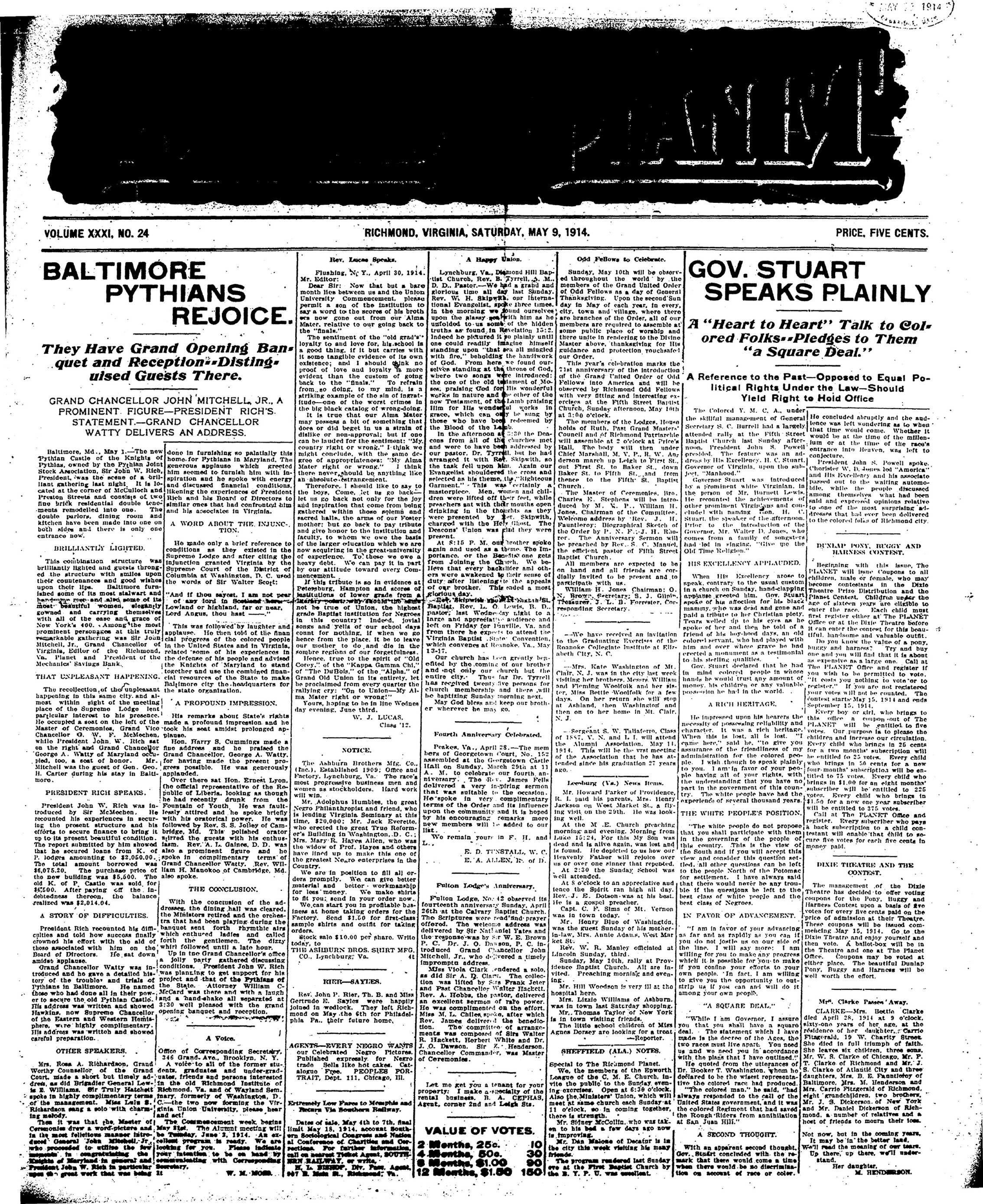
BALTIMORE PYTHIANS REJOICE.
GRAND CHANCELLOR JOHN MITCHELL, JR., A PROMINENT FIGURE—PRESIDENT RICH'S STATEMENT.—GRAND CHANCELLOR WATTY DELIVERS AN ADDRESS.
VOLUME XXXI, NO. 24
BALTIMORE
PYTH
They Have Grand
quet and Recei
uised Guest
GRAND CHANCELLOR
PROMINENT. FIGURE
STATEMENT.—GRAND
WATTY DELIVER
Baltimore, Md., May 1.—The new Pythian Castle of the Knights of Pythias, owned by the Pythian Joint Stock Association, Sir John W. Rich, President, was the scene of a brilliant gathering last night. It is located at the corner of McCulloch and Preston Streets and consists of two fine brick residential double tenements remodelled into one. The double parlors, dining room and kitchen have been made into one on both sides and there is only one entrance now.
BRILLIANTLY LIGHTED.
This combination structure was brilliantly lighted and guests thrombed the structure with smiles upon their countenances and good wishes upon their lips. Baltimore furnished some of its most stalwart and handsome men, and also some of its most beautiful women, elegantly gowned and carrying themselves with all of the ease and grace of New York's 400. Among the most prominent personages was Sir John Mitchell, Jr., Grand Chancellor of Virginia, Editor of the Richmond, Va. Planet and President of the Mechanier' Savings Bank.
THAT UNPLEASANT HAPPENING.
The recollection of the unpleasant happening in this same city, and almost within sight of the meeting place of the Supreme Lodge lent particular interest to his presence. He occupied a soat on the left of the Master of Ceremonies, Grand Vico Chancellor G. W. F. W. McMechen, while President John W. Ritchat on the right and Grand Chancellor George A. Watty of Maryland occupied, too, a soat of honor. Mr. Mitchell was the guest of Gon. Geo. H. Carter during his stay in Baltimore.
PRESIDENT RICH SPEAKS.
President John W. Rich was introduced by Sir McMeoch. He recounted his experiences in securing the present structure and his efforts to secure finance to bring it up to its present beautiful condition. The report submitted by him showed that he secured loans from K. of P. lodges amounting to $2,050.00. The total amount borrowed was $6,075.20. The purchase price of the new building was $5,600. The old K. of P. Castle was sold, for $6,500. After paying off the indebtedness thorow, the balance realized was $2,014.04.
A STORY OF DIFFICULTIES.
President Rich recounted his difficulties and told how success finally crowned his effort with the aid of those associated with him on the Board of Directors. He sat down amidst applause.
Grand Chancellor Watty was introduced and he gave a detailed history of the trouble and trials of Pythians in Ballimore. He named those who had done all in their power to secure the old Pythian Castle.
His address was written and showed Hawkins, now Supreme Chancellor of the Eastern and Western Homisphere, were highly complimentary. His address was writtt and showed careful preparation.
OTHER SPEAKERS.
Mrs. Ross A. Richardson, Grand Worthy Counsellor of the Grand Court, made a short but timely address, as did Brigadier General Lewis E. Williams. Sir Truly Hatchett spoke in highly complimentary terms of the management. Miss Lula S. Richardson sang a solo with charming melody. Then it was that the Master of Coronies drew a word-picture and in the most felicious manner introduced General John Mitchell, Jr. who proceeded to utilize the few moments in congratulating the Knight of Maryland in general and President John W. Rich in particular upon the great work that was being
done in furnishing so palatially this home, for Pythians in Maryland. The generous applause which greeted him seemed to furnish him with inspiration and he spoke with energy and discussed financial conditions, likening the experiences of President Rich and his Board of Directors to similar ones that had confronted him and his associates in Virginia.
A WORD ABOUT THE INJUNCTION.
He made only a brief reference to conditions as they existed in the Supreme Lodge and after citing the injunction granted Virginia by the Supreme Court of the District of Columbia at Washington, D. C. used the words of Sir Walter Scott:
"And if thou sayest, I am not pear of any lord in Scotland there: Lowland or highland, far or near, Lord Angus, thou hast —"
This was followed by laughter and applause. He then told of the financial progress of the colored people in the United States and in Virginia, related some of his experiences in the defense of his people and advised the Knights of Maryland to stand together and use the combined financial resources of the State to make Baltimore city the headquarters for the state organization.
A PROFOUND IMPRESSION.
His remarks about State's rights made a profound impression and he took his seat amidst prolonged applause.
Hon. Harry S. Cummings made a fine address and he praised the Grand Chancellor, George A. Watty, for having made the present progress possible. He was generously applauded.
Over there sat Hon. Ernest Lyon, the official representative of the Republic of Liberia, looking as though he had recently drunk from the Fountain of Youth. He was faultlessly attired and he spoke briefly with his oratorical power. He was followed by Rev. S. S. Jolley of Cambridge, Md. This polished orator spirited the guests with his enthusiasm. Rev. A. L. Gaince, D. D. was also a prominent figure and he spoke in complimentary terms of Grand Chancellor Watty. Rev. William H. Manokoo of Cambridge, Md. also spoke.
THE CONCLUSION.
With the conclusion of the address, the dining hall was cleared, the Ministers retired and the orchestra that had been playing during the banquet sent forth rhythmic airs which enthured ladies and called forth the gentlemen. The dizzy whirl followed until a late hour. Up in the Grand Chancellor's office a jolly party gathered discussing conditions. President John W. Rich was planning to get support for his project and that of the Pythias of the State. Attorney William C. McCard was there and with a laugh and a hand-shake all separated at 3:30 well pleased with the grand opening banquet and reception.
A Voice.
Office of Corresponding Secretary.
146 Grand-Ave. Brooklyn. N.Y.
346 Grand. Ave., Brooklyn, N. Y.
A voice to all of the former students, graduates and under-graduates, friends and persons interested in the old Richmond Institute of Richmond, Va. and of Wayland Seminary, formerly of Washington, D. C.-the two now forming the Virginia Union University, please hear and act!
The Commencement week begins May 31st. The Alumni meeting will be Tuesday, June 2, 1914. An excellent program is ready. We are looking for you. Please indicate your intention to be on hand by communicating with Corresponding Secretary.
Ilev. Lucas Speaks.
Flushing, N.Y., April 30, 1914.
Mr. Editor:
Dear Sir: Now that but a bare month lies between us and the Union University Commencement, please permit a son of the institution to say a word to the scores of his broths now gone out from our Alma Mater, relative to our going back to the "finals."
The sentiment of the "old grad's" loyalty to and love for, his school is a good thing, if it but carries with it some tangible evidence of its own existence; and I should think no proof of love and loyalty is more evident than the custom of going back to the "finals." To refrain from, so doing, to my mind, is a striking example of the sin of ingratitude—one of the worst crimes in the big black catalog of wrong-doing.
It is true that our Alma Mater may possess a bit of something that does or did beget in us a strain of dislike or non-approval; but if one can be lauded for the sentiment: "My country right or wrong." I think we might conclude, with the same degree of appropriateness: "My Alma Mater right or wrong." I think there never should be anything like an absolute estrangement.
Therefore, I should like to say to the boys, Come, let us go back—let us go back not only for the joy and inspiration that come from being gathered within those solemn and sacred halls, the arms of our Foster mother; but go back to pay tribute and give honor to the institution and faculty, to whom we owe the basis of the larger education which we are now acquiring in the great-university of experience. To those we owe a heavy debt. We can pay it in part by our attitude toward every Commencement.
If this tribute is so in evidence at Petersburg, Hampton and scores of institutions of lower grade from a literary school, you should not be true of Union, the highest grade Baptist institution for Negroes in this country? Indeed, jovial songs and yells of our school days count for nothing, if when we go hence from the place, it be to leave our mother to do, and die in the sombre regions of our forgetfulness. Hence, true to the spirit of "Old Corey," of the "Kappa Gamma Chi," of "The DuBols," of the "Alpha," of Grand Old Union in its entirety, let he proclaimed from every quarter the rallying cry: "On to Union—My Alma Mater right or wrong!"
Young, hoping to be in line Wednesday day evening, June third.
NOTICE.
The Ashburn Brothers Mfg. Co. (Inc.) Established 1909; Office and Factory, Lynchburg, Va. The race's most progressive business men and women as stockholders. Hard work will win.
Mr. Adolphus Humbles, the great Negro Philanthropist and friend, who is lending Virginia Sominary at this time, $20,000: Mr. Jack Everett, who erected the great True Reformer's Building in Washington.D. C.; Mrs. Mary R. Hayes Allen, who was the widow of Prof. Hayes and others have lined up to make this one of the greatest Negro enterprises in the Country.
We are in position to fill all orders promptly. We can give better material and better workmanship for less money. We make shirts to fit you; send in your order now.
We can start you in profitable business at home taking orders for the Factory. Send $1.50 for first-class sample shirts and outfit for taking orders.
Stock sale $10.00 per share. Write today, to THE ASHBURN BROS. SHIRT MFG. CO., Lynchburg, Va. 4t
RIER—SAYLES.
Rev. John P. Rier, Th. B. and Miss Gertrude J. Sayles were happily joined in wodlock. They left Richmond on May the 6th for Philadelphia Pa., their future home.
AGENTS—EVERY NEGRO WANTS
our Celebrated Negro Pictures.
Published expressly for Negro
trade Sola like hot cakes.
Catalogo Free. PEOPLES POR-
TRAIT, Dept. 111, Chicago, Ill.
Extremely Low Faces to Memphis and
Retreat Via Southern Railway.
Dates of sale, May 4th to 7th, final
limit May 18, 1914, account Southern
Sociological Congress and Nation
al Conference of Charities and Corrections. For further information,
call on nearest Ticket Agent, SOUTHERN BN RAILWAY, or write,
M. L. BRUNDF, Dv. Paw, Agent,
907 B. Mora St., Richmond, Va.
A Happy Union.
Lynchburg, Va., Diamond Hill Baptist Church, Rev. B, Tyrrell, A. M. D. D. Pastor—We had a grazd and glorious time all day last Sunday. Rev. W. H. Shipwith, our International Evangelist, spoke three times in the morning we found ourselves upon the glassy sea with him as he unfolded to us some of the hidden truths as found. In Revelation 15:2. Indeed he pictured it so plainly until one could readily imagine himself standing upon "that sea all mingled with fire," beholding the handwork of God. From here we found ourselves standing at the throne of God, where two songs were introduced: the one of the old testament of Moses, praising God for His wonderful works in nature and the other of the now Testament, of the Lamb praising Him for His wonderful works in grace, which can only be sung by those who have been redeemed by the Blood of the Lamb.
In the afternoon at 5:30 the Deacons from all of the churches met and were to have been addressed by our pastor, Dr. Tyrrell, but he had arranged it with Rob. Skipwith, so the task fell upon him. Again our Evangelist shouldered the cross and selected as his theme, the "Righteous Garment." This was certainly a masterpiece. Men, women and children were lifted off their foot, while preachers sat with their mouths open drinking in the thoughts as they were presented by Rob. Skipwith, charged with the Holy Ghost. The Deacons' Union was glad they were present.
At 8:15 P. M. our brother spoke again and used as a theme. The Importance, or the Benefactor one gets from Joining the Church. We believe that every backsider and others were awakened to their sense of duty after listening to the appeals of our brother. This ended a most glorious day.
Rev. Skipwith with Markh/St. Baptist, Rev. L. O. Lewis, B. D., pastor; last Wednesday night to a large and appreciative audience and left on Friday for Danville, Va., and from there he expects to attend the Virginia Baptist State Convention, which convenes at Reanoke, Va., May 13-17.
Our church has been greatly benefited by the coming of our brother and not only our church but the entire city. Thus for Dr. Tyrell has received twenty five persons for church membership and there will be baptizing Sunday morning next.
May God bless and keep our brother wherever he may go.
Fourth Anniversary Celebrated.
Peakes, Va., April 28.—The members of Georgetown Court, No. 152 assembled at the Georgetown Castle Hall on Sunday, March 29th at 11 A. M. to celebrate our fourth anniversary. The Rev. James Fells delivered a very inspiring sermon that was suitable to the occasion. He spoke in very complimentary terms of the Order and its influence upon the community and it is hoped by his encouraging remarks more new members will be added to our list.
We remain yours in F. H. and L.
E. D. TINSTALL, W. C.
E. A. ALLEN, K. of D.
Fulton Lodge's Anniversary.
Fulton Lodge, No. 42 observed its fourteenth anniversary Sunday, April 26th at the Calvary Baptist Church. The Scriptures were road and prayer offered. The welcome address was delivered by Sir Nathan Yates and the response was by S. W. E. Brown P. C. Dr. J. O. Dawson, P. C. introduced Grand Chancellor John Mitchell, Jr., who delivered a timely impromptu address. Miss Viola Clark tendered a solo, as did Sir A. D. Clark. The collection was lifted by Sir Frank Jeter and Past Chancellor Walter Hackett. Rev. A. Hobbs, the pastor, delivered an excellent sermon of rake power. He was complimented on the effort. Miss M. L. Chiles spoke, after which Rev. James delivered the benediction. The committee of arrangements was composed of Sirs Walter R. Hackett, Herbert White and Dr. J. O. Dawson. Sir Z. Henderson. Chancellor Commander, was Master of Ceremonies.
Let me get you a tenant for your
property; I make a speciality of the
rental business. B. A. CEPHAS,
Agent, corner 2nd and Leigh Sts.
VALUE OF VOTES.
Odd Fellows to Celebrate.
Sunday, May 10th will be observed throughout the world by the members of the Grand United Order of Odd Follows as a day of General Thanksgiving. Upon the second Sunday in May of each year, in every city, town and village, where there are branches of the Order, all of our members are required to assemble at some public place of worship and there unite in rendering to the Divine Master above, thanksgiving for His guidance and protection touchscaled our Order.
This year's celebration marks the 71st anniversary of the introduction of the Grand United Order of Odd Follows into America and will be observed by Richmond Odd Follows with very fitting and interesting exercises at the Fifth Street Baptist Church, Sunday afternoon, May 10th at 3:00 o'clock.
The members of the Lodges, House holds of Ruth, Past Grand Masters' Council and of Richmond Partnership will assemble at 2 o'clock at Price's Hall. The body will then under Chief Marshall, M. V. P., R. W. Anderson march up Lolich to First St., out First St. to Baker St., down Baker St. to Fifth St., and from thence to the Fifth St. Baptist Church.
The Master of Ceremonies, Bro
Charles E. Stephens will be introduced by M. N. P., William H.
Jones, Chairman of the Committee.
Welcome address by Rev. J. H.
Fauntleroy; Biographical Sketch of the Order by P. N. F.; J. H. Rhoer.
The Anniversary Sermon will be preached by Rev. S. C. Manual,
the efficient pastor of Fifth Street Baptist Church.
All members are expected to be on hand and all friends are cordially invited to be present and to participate with us.
William H. Jones Chairman; O.
N. Brown; Secretary; S. J. Gillippe
Treasurer; J. L. B. Forrester, Corresponding Secretary.
"We have received an invitation to the Graduating Exercises of the Roanoke Collegiate Institute at Elizabeth City, N. C.
Mrs. Kate Washington of Mt. Clair, N. J. was in the city last week visiting her brothers, Messrs. William and Fliening Woolfolk and her sister, Miss Bottle Woolfolk for a few days. On her return she will stop at Ashland, then Washington and then on to her home in Mt. Clair, N. J.
Sergeant S. W. Tullaferro, Class of 1887, V. N. and L. I. will attend the Alumni Association, May 11, 1914. This will be the first meeting of the Association that he has attended since his graduation 27 years ago.
Leesburg (Va.) News Items.
Mr. Howard Parker of Providence, R. I. paid his parents, Mrs. Henry Jackson on West Market St., a flying visit on the 29th. He was looking well.
At the M. E. Church preaching morning and evening. Morning from Luke 15:24. For this My Son was dead and is alive again, was lost and is found. He depicted to us how our heavenly Father will rejoice over us or over one dinner that reported. At 2:30 the Sunday School was well attended.
At S'clock on an appreciative and fenco the Spirit ran high all day. Rev. J. E. Dotson-was at his host. He is a gospel preacher.
Capt. C. F. Sims of Mt. Vernon was in town today.
Mr. Henry Blue of Washington was the guest Sunday of his mother-in-law, Mrs. Annie Adams, West Market St.
Rev. W. R. Manley officiated at Lincoln Sunday, third.
Sunday, May 10th, rally at Providence Baptist Church. All are invited. Preaching morning and evening.
Mr. Hill Woodson is very ill at the hospital here.
Mrs. Lizzie Williams of Ashburn, was in town last Saturday shopping.
Mr. Thomas Taylor of New York is in town visiting friends.
The little school children of Miss Agnes Dorsey are looking for a treat Reportor.
SHEFFIELD (ALA.) NOTES.
Special to The Ricamond Planet.
Special to The Ricmond Planet.
We, the members of the Epworth
Lague of the C. M. E. Church, invi
ite the public to the Sunday, even
ing exercises. Open at 6:30 o'clock.
Also the Ministers' Union, which will
meet at same church each Sunday at
11 o'clock, so in coming together,
there is strength.
Mr. Sidney McCollin, who was tak
en to his bed a few days ago now
is improving.
Mr. Dan Malone of Decatur is in
the city this week visiting his many
friends.
The program rendered last Sunday
eve at the First Baptist Church by
the R. Y. P. U. was excellent.
GOV. STUART SPEAKS PLAINLY
A "Heart to Heart" Talk to Colored Folks--Pledges to Them "a Square Deal."
A Reference to the Past—Opposed to Equal Political Rights Under the Law—Should Yield Right to Hold Office
The Colored Y. M. C. A., under the skillful management of General Secretary S. C. Burrell had a largely attended rally at the Fifth Street Baptist Church last Sunday afternoon, President John S. Powell presided. The feature was an address by His Excellency, H. C. Sturt, Governor of Virginia, upon the subject, "Manhood." Governor Sturt was introduced by a prominent white Virginian, in the person of Mr. Burnett Lewis. He recounted the achievements of other prominent Virginians and concluded with naming Hon. H. C. Sturt, the speaker of the afternoon. Prior to the introduction of the Governor, Mr. Walter D. Jones, who comes from a family of songsters had led in singing, "Give me the Old Time Religion."
HIS EXCELLENCY APPLAUDED.
When His Excellency arose to speak, contrary to the usual custom in a church on Sunday, hand-clapping applause greeted him. Gov. Stuart spoke of his affection for his black mummy, who was dead and gone and paid a tribute to her Christian pltery. Tears welled dip to his eyes as he spoke of her and then he told of a friend of his boyhood days, an old colorful servant, who had played with him and over whose grave he had erected a monument as a testimonial to his sterling qualities. Gov. Stuart declared that he had in mind colored people in whose hands he would trust any amount of money, his children or any valuable possession he had in the world.
A RICH HERITAGE.
He impressed upon his hearers the necessity of possessing reliability and character. It was a rich heritage. When this is lost, all is lost. "I came here," said he, "to give you assurance of the friendliness of my administration for the colored people. I wish thought to speak plainly to you. I am in favor of your people having all of your rights, with the understanding that you have no part in the government of this country. The white people have had the experience of several thousand years.
THE WHITE PEOPLE'S POSITION.
"The white people do not propose that you shall participate with them in the governing of the people of this country. This is the view of the South and if you will accept this view and consider this question settled, all other questions can be left to the people North of the Potomac for settlement. I have always said that there would never be any trouble if the questions he left to the best class of white people and the best class of Negroes.
IN FAVOR OF ADVANCEMENT.
"I am in favor of your advancing an far and as rapidly as you can if you do not jostle us on our side of the line. I will say more: I am willing for you to make any progress which it is possible for you to make if you confine your efforts to your own people. In fact, I am willing to give you the opportunity to outstrip us if you can and will do it among your own people."
"A SQUARE DEAL."
"While I am Governor, I assure you that you shall have a square deal. The statement which I have made is the decree of the Agos, the two races must live apart. You need us and we need you in accordance with the plans that I have outlined." He quoted from the utterances of Dr. Booker T. Washington, whom he declared to be the wisest representative the colored race had produced. "The colored man." he said, "had always responded to the call of the United States government, and it was the colored Regiment that had saved the Rough Riders from annihilation at San Juan Hill."
A SECOND THOUGHT.
With an apparent second thought, Gov. Stuart concluded with the remark that there would come a time when there would be no discrimination on account of race or color.
PRICE, FIVE CENTS.
QUART IS PLAINLY
"art" Talk to Col- Pledges to Them are Deal."
st—Opposed to Equal Po- der the Law—Should to Hold Office
He concluded abruptly and the audience was left wondering as to when that time would come. Whether it would be at the time of the millen- um or at the time of the race's entrance into heaven, was left to conjecture.
President John S. Powell spoke, Chorister W. D. Jones led "America" and His Excellency and his associate passed out to the waiting automobile, while the people discussed among themselves what had been said and expressed opinions relative to one of the most surprising addresses that had ever been delivered to the colored folks of Richmond city.
DUNLAP PONY, BUGGY AND
HARNESS CONTEST.
Beginning with this issue, The PLANET will issue Coupons to all children, male or female, who may become contestants in the Dixie Theatre Prize Distribution and the Planet Contest. Children under the age of sixteen years are eligible to enter the race. Each child must first register either at The PLANET Office or at the Dixie Theatre before it can enter the contest for this beautiful, handsome and valuable outfit. Do you know the value of a pony, burgery and harness? Try and buy one and you will find that it is about as expensive as a large one. Call at the PLANET Office and register if you wish to be permitted to vote. "It costs you nothing to vote or to register." If you are not registered your votes will not be counted. The contest starts May 15, 1914 and ends September 15, 1914.
Every boy or girl, who brings to this office a coupon out of The PLANET will be entitled to five votes. Our purpose is to please the children and increase our circulation. Every child who brings in 25 cents for a two months' subscription will be entitled to 25 votes. Every child who brings in 50 cents for a new four-months' subscription will be entitled to 75 votes. Every child who brings in $1.00 for an eight months' subscriber will be entitled to 225 votes. Every child who brings in $1.50 for a new one year subscriber will be entitled to 375 votes.
Call at The PLANET Office and register. Every subscriber who pays a back subscription to a child contestant will enable that child to secure five votes for each five cents in money paid.
DIXIE THEATRE AND THE CONTENT.
The management of the Dixie Theatre has decided to offer voting coupons for the Pony. Buggy and Harness Content upon a basis of five votes for every five cents paid on the price of admission at their Theatre. These coupons will be issued commencing May 15, 1914. Go to the Dixie Theatre and enjoy yourself and then vote. A ballot-box will be in the Theatre and one at the Planet Office. (Coupons may be voted at either place. The beautiful Dunlap Pony, Buggy and Harness will be well worth the effort.
Mr. Clarke Passes Away
CLARKE-Mrs. Bottle Clarke died April 28, 1914 at 9 o'clock, sixty-one years of her age, at the residence of her daughter, Carrie Fitzgerald, 19 W. Charity Street. She died in full triumph of faith. She leaves six children, three sons, Mr. W. S. Clarke of Chicago, Mr. P. T. Clarke of Richmond and Mr. J. S. Clarke of Atlantic City and three daughters, Mrs. B. E. Faunttioy of Baltimore, Mrs. M. Henderson and Mrs. Carrie Fitzgerald of Richmond, eight grandchildren, two brothers, Mr. J. S. Dickerson of New York and Mr. Daniel Dickerson of Richmond, a number of relatives and a host of friends to mourn their loss.
Not now, but in the coming years, It may be in the better land. We'll read the meaning of our tears. Up there, up there, we'll understand.
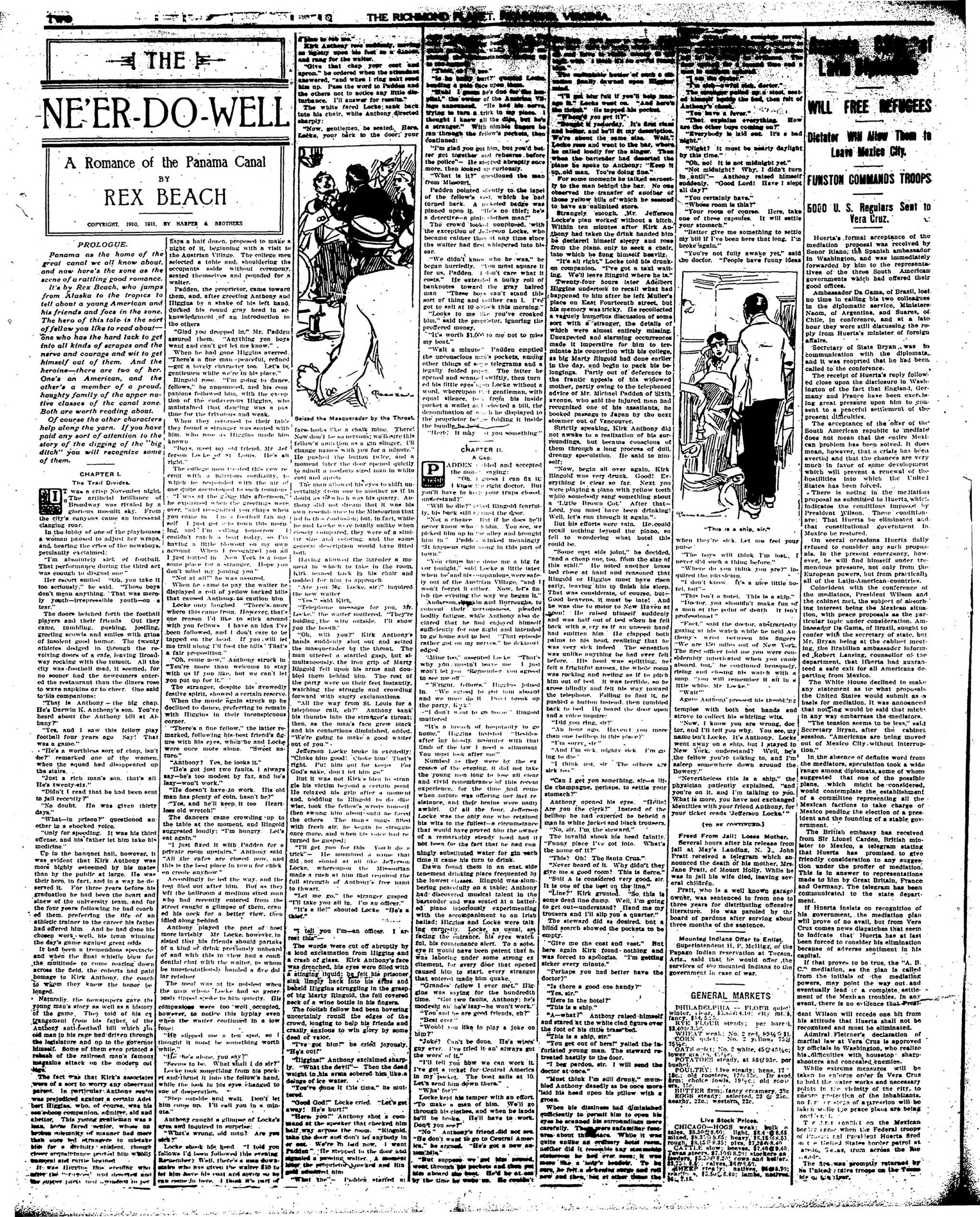
NE'ER-DO-WELL
A Romance of the Panama Canal BY REX BEACH
COPYRIGHT. 1910. 1911. BY HARPER & BROTHERS
PROLOGUE.
Panama as the home of the great canal we all know about, and now here's the zone as the scene of a rattling good romance. It's by Rex Beach, who jumps from Alaska to the tropics to tell about a young American and his friends and foes in the zone. The hero of this tale is the sort of fellow you like to read about—one who has the hard luck to get into all kinds of scrapes and the nerve and courage and wit to get himself out of them. And the heroine—there are two of her. One's an American, and the other's a member of a proud, haughty family of the upper native classes of the canal zone. Both are worth reading about.
Of course the other characters help along the yarn. If you have paid any sort of attention to the story of the digging of the "big ditch" you will recognize some of them.
CHAPTER I.
The Trail Divides.
I was a crisp November night. The artificial brilliance of Broadway was rivaled by a glorious moonlit sky. From the city's canyons came an incessant changer roar. In the lobby of one of the playhouses a woman paused to adjust her wraps, and hearing the cries of the newsboys, petulantly exclaimed: "I'm absolutely sick of football. That performance during the third act was enough to disgust one." Her escort smiled. "Oh, you take it too seriously." he said. "Those boys don't mean anything. That was merely youth—irreprotable youth—on a tear."
The doors beckoned forth the football players and their friends. Out they came, rumbling, pushing, jostling, greeting scowls and smiles with grins of insolent good humor. The twenty athletes dugged in through the revolving doors of a cafe, leaving Broadway rocking with the tumult. All the city was-football mad, it seemed, for no sooner had the newcomers entered the restaurant than the dinners rose to wave napkins or to cheer. One said to his companions:
"That is Anthony – the big chap. He's Darwin K. Anthony's son. You've heard about the Anthony bill at Albany?"
"Yes, and I saw this fellow play football four years ago. Say! That was a game."
"He's a worthless sort of chap, isn't he?" remarked one of the women, when the squad had disappeared up the stairs.
"Just a rich man's son, that's all He's twenty-six."
"Didn't I read that he had been sent to jail recently?"
"No doubt. He was given thirty days."
"What—in prison?" questioned another in a shocked voice.
"Only for speeding. It was his third offense, and his father let him take his medicine."
Up in the banquet hall, however, it was evident that Kirk Anthony was more highly esteemed by his mates than by the public at large. He was their hero, in fact, and in a way he deserved it. For three years before his graduation he had been the heart and sinew of the university team, and for the four years following he had coached them, preferring the life of an athletic trainer to the career his father had offered him. And he had done his chosen work well, his team winning the day's game against great odds.
It had been a tremendous spectacle and when the final whistle blew for the multitude to come roaring down across the field, the cohorts had paid homage to Kirk Anthony, the coach to whom they knew the honor be longed.
* Naturally, the newspapers gave the young man's story as well as a history of the game. They told of his egregious from his father, of the Anthony anti-football bill which the old man in his rage had driven through the legislature and up to the governor himself. Some of them even printed a rebash of the railroad man's famous magazine attack on the modern col.
The fact was that Kirk's associates were of a sort to worry any observant parent. In particular: Anthony sepoon was prejudiced against a certain Adelbert Higgins, who, of course, was his own school companion, admirer, aid and abetter. This young gentleman was a man, hands faced senior, whose unbroken almamy of manner had more than once felt strangers to misleave him for a divinity student, though clever acquaintance proved him wholly manual and little brained. It was flirting that creeping who after the school and dissected and the supper packs and intended to per
Haps a half dozen, proposed to make a night of it, beginning with a visit to the Austrian Village. The college men selected a table and, shouldering the occupants aside without ceremony, seated themselves and pounded for a waiter. Padden, the proprietor, came toward them, and after greeting Anthony and Higgins by a shake of his left hand, ducked his round gray head in acknowledgment, of an introduction to the others. "Glad you dropped in," Mr. Padden assured them, "Anything you boys want and can't get let me know." When he had gone Higgins averred, "There's a fine man—peaceful, refined—got a lovely character too. Let's be gentlemen while we're in his place." Ringed rose, "I'm going to dance, fellows," he announced, and his companions followed him, with the exception of the caddiservant Higgins, who maintained that dancing was a pastime for the frivolous and weak.
When they returned to their table they found a stranger was seated with him, who rose as Higgins made him known.
"Boys, meet my old friend, Mr Jefferson Luke of St. Louis, he all right."
The college teacher treated this new recruit with a hilarious cordiality, to which he responded with the air of one quite unacquainted to such tumults.
"I was at the gating this afternoon," he explained when the greetings were over, "and recognized on chapen when you came in. In a football fan my self I just got into town this morning, and I'm salting tomorrow. I couldn't catch a boat today, so I'm having a little blown out on my own account. When I recognized you all I just barred in. New York is a long some place for a stranger. Hope you don't mind my joining you."
displayed a roll of yellow backed hilt that caused Anthony to caution him. Locke only laughed. "There's more where this came from. However, that's one reason I like to stick around with you fellows. I have an idea I've been followed, and I don't care to be tapped on the head. If you will let me trail along I'll foot the hills' That's a fair proposition." "Oh, come now." Anthony struck in "You're more than welcome to stay with us if you like, but we can't let you put up for it." The stranger, despite his arowely festive spirit, showed a certain reserve. When the music again struck up he declined to dance, preferring to remain with Higgins in their inconspicuous corner. "There's a fine fellow," the latter remarked, following his best friend's figure with his eyes, which he and Locke were once more alone. "Sweet nature." "Anthony? Yes, he looks it."
"He's got just two faults, I always say—he too modest by far, and he's lazy—won't work."
"He doesn't have to work. His old man has plenty of coin, hasn't he?"
"Yes, and he'll keep it too heartless old wretch."
The dancers came crowding up to the table at the moment, and Ringold suggested loudly: "I'm hungry. Let's eat again."
"I just fixed it with Padden for a private room upstairs." Anthony said "All the cafes are closed now, and this is the best place in town for chick on creole anyhow."
Accordingly he led the way, and the test fled out after him. But as they left the ballroom a medium sized man who had recently entered from the street caught a glimpse of them, cramped his neck for a better view, then idled along behind.
Anthony played the part of host more lavishly. Mr Locke, however, in slated that his friends should share a kind of drink previously unheard of and with this in view had a confidential chat with the waiter, to whom he unquestionably handed a five dollar retainer.
The meal was at its poorest when the man whom Locke had so generously tipped spoke to him quietly. His companions were too well occupied, however, to notice this by play even when the winter continued in a low tone:
"He slipped me a ten spout, so I thought it must be something worth while."
"He's the alum, you say?"
"Become to be. What shall I do alr?"
Locke took something from his pocket and thrust it into the follow's hand, while the look in his eyes changed to one of desperation.
"Step outside and wait. Don't let him come up. I'll call you in a minute."
Locke shook his head. "I told you
follows I'd been followed this evening
Remember? Well, there's a new down-
sizer who now gives the waiter $10 to
set him down his file and alarm so he
can come in here. I think the part of
"Joke? Can't be done. He's what's guy ever. I've tried it all, always got the word of it."
"I tell you how we can work it. I've got a ticket for Central America in my pocket. The boat sails at 10. Let's send him down there."
"What for?"
"Locke kept his temper with an effort. To make a man of him. We'll go through his clothes, and when he lands he'll be broke. He'll have to work. Don't you see?"
"No. Anthony's friend did not see. He don't want to go to Central America. he argued. 'He's got a new automobile.'
"But suppose we got him sound, went through his pockets and then put him aboard the boat. He'd be at once by the time he woke up. He couldn't
I plan to to see her.
Kristy Anthony rose suddenly, moving
nistory upon his feet to a dance,
and rang for the water.
"Give that chap your cost and apron," be ordered when the attendant answered, "and when I ring next send him up. Pass the word to Pudden and the others not to notice any little disturbance. I'll answer for results."
The white faced Locks; sank back into his chair, while Anthony, directed sharply:
"Now, gentlemen, be seated. Here, Locks, your back to the door; your
Pierre Zén
Seized the Masquerader by the Throat.
face-looks like a chalk mine. There! Now don't be so nervous; well we care this fellow's antion as a gin slinger. I'll change names with you for a minute.
He pushed the button twice, and a moment later the door opened quietly to admit a medium sized man in white coat and apaea.
The man allowed his eyes to shift uncertainly from one to another as if in doubt as if which was his quarry. Anthony did not dream that it was his own resultance to the Missouri that led to this confusion, but, in fact, white he and Locke were totally unlike when closely compared, they were of a similar size and coloring, and the same general description would have fitted both.
Having allowed the intruder a moment in which to take in the room, kirk teamed back in his chair and nodded for him to approach.
"Are you Mr. Locke, sir?" required the new winter.
"Yes," said Kirk
"Telephone message for you, Mr.
Locke," the waiter muttered. "They're
holding, the wire outside. I'll show
you the booth."
"Oh, will you?" Kirk Anthony's
hands suddenly shot out and seized
the masquerader by the throat. The
man uttered a startled gasp, but al-
muchunately, the iron grip of Mary
Ringold fell upon his arms and doubled
them behind him. The rest of
the party were on their feet instantly,
watching the struggle and crowding
forward with angry exclamations.
"All the way from St. Louis for a
telephone call, eh?" Anthony bank
his thumbs into the stranger's throat;
then, as the man's face grew black
and his contortions diminished, added.
"We're going to make a good waiter
out of you."
Jefferson Locke broke in excitedly:
"Choke him good! Choke him! That's
right. Put him out for keeps. For
God's sake, don't let him go."
But it was not Kirk's idea to strain his victim beyond a certain point. He relaxed his grin after a moment and, nodding to Hildagh to do the wise, took the fellow's wrists himself then anew him about until he forced the others. The man images tilted with fresh air, he began to struggle once more, and when his voice had returned he gasped: "I'll get you for this. You'll do a trick." He mumbled a name that did not sound at all like Jefferson Locke, whereupon the Missourian made a rush at him that required the full strength of Anthony's free hand to thwart.
"Let me go," the stranger gnashed "I'll take you all in. I'm an officer." "It's a lie!" aboutted Locke. "He's a thief."
"I tell you I'm—an officer. I arrest this."
The words were cut off abruptly by a loud exclamation from Higgins and a crash of glass. Kirk Anthony's face was drenched, his eyes were filled with a stinging liquid; to felt his prisoner sink limply back into his arms and babel Higgins struggling in the grasp of his Marty Ringgold, the foll covered neck of a wine bottle in his fingers. The foolish fellow had been hovering uncertainly round the edges of the crowd, longing to help his friends and cratly anxious to win glory by some deed of valor. "I've got him!" he cried joyously, "He's out!"
"You're done it this time," he muttered.
"Good God!" Locke cried. "Let's get away! He's hurt!"
"Here you!" Anthony shot a command at the speaker that checked him half way across the room. "Hingoed, take the door and don't let anybody in or out. We're in bad now. I want Padden." He heaped to the door and signaled a passing walker. A moment later, the property smacked and Hin gold admitted him.
"What the -" Padden starred at.
"So he badly hurt!" grinned Lena.
A smile arose on her face.
"What I guess he'd due for the hospital," the owner of the American Village announced. "He had his serve trying to turn a trick in my piece. I thought I knew all the dill, but he was a stranger." With nimble fingers he ran through the fellow's pocket, then continued: "I'm glad you got him, but you'd better get together and rehearse before the police"—he stopped abruptly once more, then looked up curiously. "What is it?" questioned the man from Missouri. "Padden pointed directly to the lapel of the fellow's vest, which he had turned back. A marked badge was plinned upon it. 'He no thief; he a detective—a pink clothes man.' The crowd looked unplanned, with the exception of Johnson Locks, who became calmer than at any time since the walter had first whispered into his ear.
"We didn't know who he was," he began hurriedly, "You must square it for us. Padden, I don't care what it costs." He extended a bulky roll of banknotes toward the gray haired man. "These boys can't stand this sort of thing and bother can I. I've got to sit at 10 o'clock this morning." "Looks to me like you've crooked blim," said the proprietor, ignoring the profered money. "It's worth $1,000 to me not to miss my book."
"Walt a minute!" Padden emptied the unconscious man's pockets, among other things of a wise telegrams and a legally folded paper. The latter he opened and scanned swiftly, then turned his little eyes upon Locke without a word, whereupon that gentleman, with equal silence, took from his inside pocket a wallet and selected a bill, the denomination of which he displayed to the proprietor before folding it inside the bundle he be.
"Hert! It may sit you something"
A Giac.
P
ADDEN: waited and accepted the movie ending:
"Oh, I guess I can fix it. I know the right doctor. But you'll have to keep your traps closed, understand!"
"Will he die?" asked Kinggirl fearfully, his back still in the door.
"Not a chance. But if he does hell never know who he is. You see, we picked him up in the alley and brought him in." Paddle winked meaningly "it happens right along in this part of town."
"You chaps have done me a big far tonight," said Locke a little later, when he and his companions were safely out of the Australian Village, "and I won't forget it either. Now, let's趴 the evening the way we began it."
Anderson, blink and burrow, to conceal their nervousness, pleaded bodily fatigue, while Authority also declared that he had enjoyed himself sufficiently for one night and intended to go home and to bed. "That episode rather got on my nerves" he denounced.
"Aline too," insisted tooke "That's why you mustn't leave me I just won't let you "Remember you agreed to see me off" "Slight," followed. Higgins joined in. "We agreed" to put him aboard and we must do it "Don't break up the party, Krys" "I don't want to go home" "Hungold muttered" "It's a breach of hospitality to go home," Higgins insisted "Residence after my hasty nexus with that limb of the law I need a stimulant You must look after me"
Numbed as they were by the excecse of the evening, it did not take the young men long to lose all clean and vivid remembrance of this recent experience, for the time and come when nature was offering her fast resistance, and their brains were badly awhile. Of all the four, Jefferson Locke was the only one who retained his wit to the fullest - a circumstance that would have proved him the owner of a remarkably stendy head and it not been for the fact that he had connly substituted water for gin each time it came his turn to drink.
Dawn found them in an east side tenement drinking place frequented by the lowest classes. Hiligold was slumbering peacefully on a table; Anthony had discovered musical talent in the bartender and was seated at a battered piano laboriously experimenting with the accompaniment to an Irish ballad: Hiligins and Locke were talking earnestly. Locke, as usual, are facing the entrance, his eyes waterful, his countenance alert. To a sober eye it would have been patent that he was laboring under some strong excitement, for every door that opened caused him to start every stranger that entered made him quake. "Grandee fellow I ever met," Hiligins was saying for the hundredth time. "Not two faults, Anthony: he's modest and he's lazy—he won't work." "You and he are good friends, eh?" "Best ever." "Would you like to play a joke on him?"
"Who for?"
all and have have some money to buy tight wits. I think it's an excellent fountain.
"The unassuming beauty of such a woman family dwind upon Eligor mind.
"I'll get him fall if you'll help manage it." Locke went on. "And have the twitch." he trapped his pocket.
"What would you get it?"
"Beautiful if yesterday. It's first class and better, and he'll fit my description. We're about the same size. Walk." Locke rose and went to the bar, where he called loudly for the singer. Then when the bartender had deserted the plane he spoke to Anthony: "Keep it up, old man. You're doing fine."
For some moments he talked earnestly to the man behind the bar. No one observed the transfer of another of those yellow bills of which he seemed to have an unlimited store.
Strangely enough, Mr. Jefferson Locke's plan worked without a hitch. Within ten minutes after Kirk Anthony had taken the drink banded him he declared himself sleepy and rose from the piano, only to seek a chair, into which he fung himself heavily.
"It's all right." Locke told his drunken companion. "I've got a taxi waiting. We'll leave Ringgold where he is." Twenty-four hours later Adelbert Higgins undertook to recall what had happened to him after he left Muller's place on East Fourteenth street, but his memory was tricky. He recollected a vaguely humorous discussion of some sort with a stranger, the details of which were almost entirely missing. Unexpected and alarming occurrences made it imperative for him to terminate his connection with his college, as big Marty Rugloid had done earlier in the day, and begin to pack his belongings. Partly out of deference to the frantic appeals of his widowed mother, partly owing to the telephoned advice of Mr. Michael Paddon of Sixth avenue, who said the injured man had recognized one of his insultants, he booked passage to Japan by the next steamer out of Vancouver.
Strictly speaking, Kirk Anthony did not awake to a realization of his surroundings, but became conscious of them through a long process of dull, dreary speculation. He said to himself:
"Now, begin all over again. Kirk Ringold was very drunk. Good! Everything is clear so far. Next you were playing a piano with yellow teeth while somebody sang something about a 'Little Brown Cot'. After that—Lord, you must have been drinking! Well, let's run through it again."
But his efforts were vain. He could recall nothing beyond the piano, so fell to wondering what hotel this could be.
"Some opt side joint," he decided,
"and a cheap one, too, from the size of
this still." He noted another brass
bed close at hand and reasoned that
Ringold or Higgins must have risen
early, leaving him to unhail his sleep.
That was considerable, of course, but-
good heavens, it must be late! And
he was due to motor to New Haven an-
gout! He raised himself suddenly
and was half out of bed when he fell
back with a very as if an unseen hand
had sniffed him. He chapped both
palms to his head, realizing that he
was very sick indeed. The sensation
was unlike anything he had ever felt
before. His head was spitting, he felt a frightful nausea, the whole room was rocking and roiling as if to pitch
him out of bed. It was terrible, so he
gave blindly and felt his way toward
the telephone. Falling to find it, he
pushed a button instead, then tumbled
back to bed. He heard the door open
and a voice inquire:
"An hour ago, haven't you more than one bellhop in this place?"
"I'm sorry, sir."
"And I'm sick, mighty sick. I'm going to die."
"I think not, sir. The others are sick too."
"Can I get you something, alright—a little champagne, perhaps, to settle your stomach?"
Anthony opened his eyes. "Hello! Are you the clerk?" Instead of the bellhop he had expected he beheld a man in white jacket and black trousers. "No, air. I'm the steward."
The invalid shook his head faintly. "Funny place I've got into. What's the name of it?"
"This? Oh. The Santa Cruz."
"Never heard of it. Why didn't they give me a good room? This is fierce."
"Suit A is considered very good. Air is one of the best on the line."
"Line?" Kirk grunted. "So, this is some dead line dump. Well, I'm going to get out—understand? Hand me my trousers and I'll slip you a quarter." The steward did as desired, but a blind screen showed the pockets to be empty.
"Give me the coat and vest." But here again Kirk found nothing and was forced to apologize. "I'm getting sticker every minute."
"Is there a good one handy?"
"Yes, sir."
"Here in the hotel?"
"This is a ship."
"A-what?" Anthony raised himself and stared at the white clad figure over the foot of his little brassed bed.
"This is a ship, sir."
"You get out of here?" yelled the infurred young man. The steward retreated hastily to the door.
"I beg pardon, sir. I will send the doctor at once."
"Must think I'm still drunk," mumbled Anthony dazedly as he once more laid his head upon his pillow with a groom.
When his disdain had diminished sufficiently to permit him to open his eyes he scanned his surroundings more carefully. There were unfamiliar features about the place. While it was quite unlike an ordinary hotel room, neither did it resemble any sturdy classroom he had ever seen. It was more like a 'kidy's bedroom.' To be sure, he felt a dreadning surge and rallied and then, but at other times the
Now, she sat in the bed, with the shovel
left in her arm, as if deflated. The time
opening for her a second time and a
moment to southern quail
"I am the doctor."
"The dot," a wrist stick, dorsor.
The surgeon patted up a stool, seated
himself beside the bed, then fell of
Arthlean's chest.
"You have a fever."
That explains everything. How are the other boys coming on?
"Everybody is inid out. It's a bad night."
"Night? It must be nearly daylight by this time."
"Oh, no! It is not midnight yet."
"Not midnight? Why. I didn't turn in until!"— Anthony raised himself suddenly. "Good Lord! Have I slept all day?"
"You certainly have."
"Whose room is this?"
"Your room of course. Here, take one of these capsules. It will settle your stomach."
"Better give me something to settle my bill if I've been here that long. I'm broke again."
"You're not fully awake yet," said the doctor. "People have funny ideas
J. H. H.
"This is a ship, sir."
when they're sick. Let me feel your pulse.
"The toys will think I'm lost. I never did such a thing before."
"Where do you think you are?" inquired the physician.
"I don't know. It's a nice little hotel, but."
"This isn't a hotel. This is a ship."
"Historian, you shouldn't make fun of a man at the point of death. It isn't professional."
"Fact," said the doctor, abstractedly gazing at his watch while he held Anno's wrist between his fingers.
"We are 12 miles out of New York. The first officer told me you were considered intertwined when you came aboard but, he continued brusquely, rising and losing his watch with a amp. "You will remember it all in a little while. Mr Locke."
"Wate."
Again, Anthony pressed his throbbing temples with both hot hands and strove to collect his whirling wits.
strove to collect his whirling wits.
"Now, I know you are wrong, doctor, and I'll tell you why. Why, see my name isn't Locke. It's Anthony. Locke went away on a ship, and I stayed in New York. understand? Well, be's the fellow you're talking to, and I'm aleep somewhere down around the Dowery.
"Nevertheless this is a ship," the physician patiently explained, "and you're on it, and I'm talking to you. What is more, you have not exchanged identities with your friend Anthony, for your ticket reads Jefferson Locke."
[TO BE CONTINUED.]
Freed From Jail: Loses Mother,
Several hours after his release from
jail at May's Landing, N. J., John
Pratt received a telegram which announced
the death of his mother, Mrs.
Jane Pratt, of Mount Holly. While he
was in jail his wife died, leaving several
children.
Pratt, who is a well known garage
owner, was sentenced to from one to
three years for distributing offensive
literature. He was paroled by the
board of pardons after serving about
three months of the sentence.
Mounted Indians Offer to Enlist.
Superintendent H. F. McLellig, of the
Papago Indian reservation at Tucson,
Ariz., said that he would offer the
services of 400 mounted Indians to the
government in case of war.
GENERAL MARKETS
BILH ADELPHIA -- FLOOR quiet
city mall
fancy $499
POULTRY: live steady; heens, 17
18c.; old roosters, 120 13c. Dr. good
firm; choice fowls, 191c.; old roost
farm, 13c.
Live Stock Prices
CHICAGO—HOOG weak; bulk on
tales, $8.25/8.50; light, $8.4, $8.65
light, $8.4, $8.65; rough, $8.15/8.35; plive, $7.25/8.40;
GATTLE slow; beaves, $7.40/8.40; stockers an
sellers, $6.5/8.20; stockers an
sellers, $6.5/8.20; before, $7.55/8.55; calves, $8.55;
HEEP ready; natives, $8.50; natives
, $8.50; lamb, $8.75; natives
, $8.15
Example City of Lafia Departure
WILL FREE REFUGEES
Dictator WIN Allow Them to Leave Mexico City.
FUNSTON COMMANDS TROOPS
5000 U. S. Regulars Sent to Vera Cruz.
Huerta's formal acceptance of the mediation proposal was received by Senior Riano; the Spanish ambassador in Washington, and was immediately forwarded by him to the representatives of the three South American governments which had offered their good offices.
Ambassador Da Gama, of Brazil, lost no time in calling his two colleagues in the diplomatic service, Ministers Naom, of Argentina, and Suarez, of Chile, in conference, and at a late hour they were still discussing the reply from Huerta's minister of foreign affairs.
Secretary of State Bryan, was in communication with the diplomats, and it was recaptured that he had been called to the conference.
The receipt of Huerta's reply followed close upon the disclosure in Washington of the fact that England, Germany and France have been exerting great pressure upon him to consent to a peaceful settlement of the present difficulties.
The acceptance of the offer of the South American republic to mediate does not mean that the entire Mexican problem has been solved. It does mean, however, that a crisis has been averted and that the chances are very much in favor of some development which will prevent a renewal of the hostilities into which the United States has been forced.
There is nothing in the mediation proposal as submitted to Huerta which indicates the conditions imposed by President Wilson. These conditions are: That Huerta be eliminated and that constitutional government in Mexico be restored.
On several occasions Huerta finally refused to consider any such proposals. In the present emergency, however, he will find himself under tremendous pressure, not only from the European powers, but from practically all of the Latin-American countries.
Colleident with the conference of the mediators, President Wilson and the cabinet met, the subject of absorbing interest being the Mexican situation, with peace proposals as the particular topic under consideration. Ambassador Da Gama, of Brazil, sought to confer with the secretary of state, but Mr. Bryan being at the cabinet meeting, the Brabillian ambassador informed Robert Lansing, counselor of the department, that Illuera had guaranteed a safe exit for all Americans departing from Mexico. The White House declined to make any statement as to what proposals the United States would submit as basis for mediation. It was announced that nothing would be said that might in any way embarrass the mediators. "The tension seems to be less," said Secretary Bryan, after the cabinet session. "Americans are being moved out of Mexico City without interruption."
In the absence of definite word from the mediators, speculation took a wide range among diplomats, some of whom suggested that one of the possible plans, which might be considered, would contemplate the establishment of a committee representing all the Mexican factions to take charge of Mexico pending the election of a president and the founding of a stable government.
The British embassy has received from Sir Lionel Carden, British minister to Mexico, a telegram stating that Huerta has promised to give friendly consideration to any suggestion under the proffer of mediation. This is in answer to representations made to him by Great Britain, France and Germany. The telegram has been communicated to the state department.
If Huerta insists on recognition of his government, the mediation plan will prove of no avail, but from Vera Cruz comes news dispatches that seem to indicate that Huerta has at last been forced to consider his elimination because of adverse sentiment in his capital.
If that proves to be true, the "A. B. C." mediation, as the plan is called from the initials of the mediating powers, may point the way out, and eventually lead to a complete settlement of the Mexican troubles. In any event, there is no evidence that President Wilson will recede one bit from his attitude that Huerta shall not be recognized and must be eliminated.
Admiral Fletcher's declaration of martial law at Vera Cruz is approved by officials in Washington, who realize his difficulties with housetop sharpshooters and concealed enemies.
While extreme measures will be taken to enforce order in Vera Cruz to hold the water works and necessary points in the vicinity of the city, to ensure protection of the inhabitants, no force or arms of aggression will be taken while the peace plans are being conducted.
The first conflict on the Mexican border came when the Federal troops of Mexico invaded Huerta arod on the United States border patrol at arido, Texas, from across the Rio Grande.
The fire was promptly returned by the United States troops on the Texas side of the river.
---
GEO. F. BAER DIES SUDDENLY
Was Taken Sick on Street in Philadelphia.
UNCONSCIOUS TO THE END
President of the Reading Railroad Company Suffered Attack of Gastritis and Never Rallied.
George F. Baer, president of the Philadelphia & Reading Railway company, died at his home-in Philadelphia from an attack of gastritis. He was seventy-one years old last September.
There was no struggle, no pain, no unhappiness in the end except the fact itself. Not from a few minutes after he became ill on Saturday on his way to his office was he conscious.
When he died there were in the sick room Mrs. Baer, the five daughters—Mrs. William Griscom Coxe, of Wilmington; Mrs. William N. Appel, of Lancaster; Mrs. Hober L. Smith, Mrs Isaac Hester and Mrs. Frank L. Conard, whose husband is dead, all of Reading; the four sons-in-law, Walter Douglass, the family coachman for thirty-two years, and four physicians Mrs. Baer wanted Walter Douglass to be at the bedside; she depended on him a whole lot, just as Mr. Baer had done for so many years.
Mr. Baer's death came in a manner to remove one of the city's and state's foremost figures without warning. So quickly did the illness take hold that Mr. Baer had time to speak only his name and then sank into unconsciousness. This condition continued to the end.
George Frederick Baer was one of the country's outstanding figures as a manager of corporation industries. He made the Reading railroad pay from the time he became its president; made it pay big, though it was a contract experience to the railroad company's stockholders. It was in 1901 that he became president of the railway. Prior to 1901 he was president of the Reading Coal and iron company.
Mr. Baer was a son of Major Solomon and Anna Maria (Baker) and was born near the village of Lavanville Somerset county, Pa., on Sept. 26 1842. He was educated at Somerset in situte. Somerset academy and Franklin and Marshall college.
At the age of thirteen Mr. Baer entered the office of the Somerset Democrat and worked at the printing trade more than two years, and in 1861, with his brother Henry, became the owner of that paper.
In August, 1862, he raised a company for the One Hundred and Thirty third regiment of Pennsylvania Volunteers, of which he was selected captain and proceeded to the front, serving in Humphrey's division of the Army of the Potomac. Joining the army at the second battle of Bull Run, he partied in all the engagements up to and including Antietam, Frederick'sburg and Chancellorville, when he was detailed as adjutant general of the Second brigade.
Returning from the war, Mr. Baer resumed his legal studies. He read law with his brother, William J. Baer—a student of Judge Kimmel—who was one of Jeremiah L. Black's first schoolars. In 1866 he married Miss Emily Kimmel. In 1868 he removed from Somerset to Reading, and in a short time after his admission to the Berkshire county bar—Jan. 22, 1868—became the undisputed leader of this bar and easily maintained his pre-eminence for the many years which he continued to practice there.
England Begins to See Real Huerta. A painful sensation was caused in London by news that Huerta is holding American women and children as hostages.
It has rather shaken the curious British belief that Huerta is a worthy object of support. None of the Mexican houses has had cables from Mexico City within forty-eight hours, and evidently a complete censorship is in operation.
What is now happening is slowly convincing Huerta's partisans that it is impossible for the United States to have in any case refrained from intervention much longer, and that the establishment of a civilized government in Mexico is essential.
May Destroy Legation If They Wish Should anti-American demonstrations develop an attack on the American embassy in Mexico City, the of leaders will be injuring Mexican property and not American. The United States does not own the embassy building in the Mexican capital and its leases run out on June 1.
800 Cattle For Head of Texas Ranger
There is a standing reward of 800
head of cattle among Mexican for the
head of any Texas ranger, beautiful,
Mexican soil, according to information
received by Governor Colquitt Indi
really iron. In Madera ranch on the Rio Grande.
Startling Information
"There are none so blind as those who will not see."
Colored men must observe high ideals and act in accordance with fundamental right principles in order to maintain self-respect and enlist the sympathy and support of the best people, regardless of color in this country. They cannot properly complain of unfair treatment of themselves by a certain class of white people, and then when vested with power, practice upon each other the very injustice of which complaint is made in others.
The opportunities afforded colored man of intelligence and learning in the fraternal organizations of the country should be used to demonstrate our ability for self-government. The best class of white people should be imitated and not the worst classes. When we observe the actions of some of our educated people their conduct is disheartening. Yet, we know that the great body of the colored people is all right. We were induced to make these remarks after observing the attitude of the officer., of the Supreme Lodge Knights of Pythias, N. A., S. A., E., A., A. and A., at Baltimore last August. In a wild scramble for money, they threw discretion to the winds.
Let us see. Under the laws of the Order each Grand Lodge has exclusive, original jurisdiction over the subordinate lodges, and the members attached to the same. The Supreme Lodge or its officers cannot tax the members of a lodge in a state having a Grand Lodge. The Constitution provides a representative tax of $25 on each Supreme Representative to the Supreme Lodge. As no State has less than two Supreme Representatives or more than four, the tax was not less than $50.00 per term or more than $100.00 per term. For this the only return is the password. The salaries and travelling expenses of the Supreme-Chancellor and other officers had been increased.
The Supreme Keeper of, Record and Seal warned the Supreme Lodge of these reckless expenditures and for this he was put cut of office. The Grand Lodge, K. of P. of Virginia protested, and for this the Supreme Chancellor suspended and put out of the Order, not only the Grand Lodge, but also the subordin ate lodges and the members attached to the same, although he had no power over any but the Grand Lodge.
The new constitution which requires a two-thirds vote to adopt was alloged to have been adopted. One test vote disclosed the fact that there were 51 ayes, 14 noes with 53 members of the Supreme Lodge absent. Of the 51 votes, 20 were office-holders and 8 Deputy Supreme-Chancellors appointed by Supreme Chancellor S. W. Green, with the power to vote. This left 23 Supreme Representatives out of an elected membership of 90, all of whom had been in Baltimore to attend the session, but they were tired out, for the Constitution was finally "adopted" after 9 o'clock Saturday night, after a week's deliberations.
All that a Grand Lodge receives from the Supreme Lodge is the password. The password is a word framed and promulgated by the Supreme Chancellor. In order to pay high salaries and running expenses, for each Grand Lodge pays its own endowment and defrays its own expenses, the Supreme Lodge with a majority of the elected Supreme Representatives absent made an increase in taxation. It was done under the guise of a ten cent and a five cent tax on each person. As it was only for a pass word, the value of a password may be estimated from the following statement of facts:
Alabama's biennial tax was $100.
It was changed to $1440.00, an increase of $1240.00 per term.
Arkansas' biennial tax was $100.00. It was changed to $1,126.20, an increase of $1,026.20.
California's biennial tax was $50.00. It was changed to $65.25, an increase of $15.25. Colorado's biennial tax was $50.00. It was changed to $46.50 a decrease of $2.50, but as the membership increases will pass the $100 limit. The District of Columbia' biennial tax was $50.00. It was changed to $53.25, an increase of $8.25.
THE RICHMOND PLANET. RICHMOND. VIRGINIA.
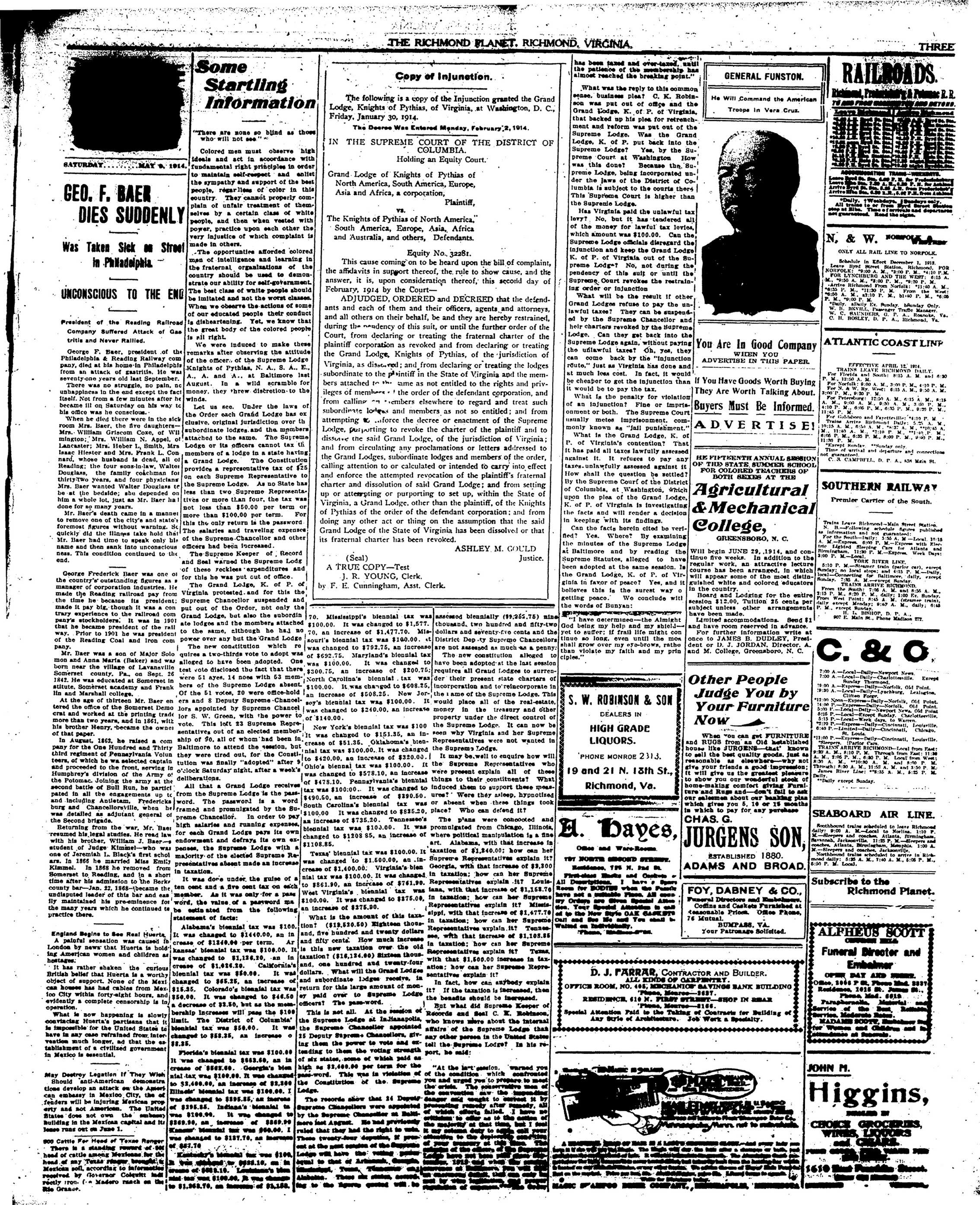
Copy of Injunction.
The following is a copy of the Injunction granted the Grand Lodge, Knights of Pythias, of Virginia, at Washington, D. C., Friday, January 30, 1914.
The Deeroe Was Entered Monday, February 2, 1914.
IN THE SUPREME COURT OF THE DISTRICT OF COLUMBIA.
Holding an Equity Court.
Grand Lodge of Knights of Pythias of North America, South America, Europe, Asia and Africa, a corporation,
The Knights of Pythias of North America," South America, Europe, Asia, Africa and Australia, and others, Defendants.
Equity No. 32281.
This cause coming on to be heard upon the bill of complaint, the affidavits in support thereof, the rule to show cause, and the answer, it is, upon consideration thereof, this second day of February, 1914 by the Court—
ADJUDGED, ORDERED and DECREED that the defendants and each of them and their officers, agents and attorneys, and all others on their behalf, be and they are hereby restrained, during the pendency of this suit, or until the further order of the Court, from declaring or treating the fraternal charter of the plaintiff corporation as revoked and from declaring or treating the Grand Lodge, Knights of Pythias, of the jurisdiction of Virginia, as dissolved; and from declaring or treating the lodges subordinate to the plaintiff in the State of Virginia and the members attached to the same as not entitled to the rights and privileges of members of the order of the defendant corporation, and from calling on members elsewhere to regard and treat such subordinate lodges and members, as not so entitled; and from attempting to enforce the decree or enactment of the Supreme Lodge, purporting to revoke the charter of the plaintiff and to dissolve the said Grand Lodge, of the jurisdiction of Virginia; and from circulating any proclamations or letters addressed to the Grand Lodges, subordinate lodges and members of the order, calling attention to or calculated or intended to carry into effect and enforce the attempted revocation of the plaintiff's fraternal charter and dissolution of said Grand Lodge; and from setting up or attempting or purporting to set up, within the State of Virginia, a Grand Lodge, other than the plaintiff, of the Knights of Pythias of the order of the defendant corporation; and from doing any other act or thing on the assumption that the said Grand Lodge of the State of Virginia has been dissolved or that its fraternal charter has been revoked.
ASHLEY M. GOULD Justice
(Seal)
A TRUE COPY—Test
J. R. YOUNG, Clerk.
by F. E. Cunningham, Asst. Clerk.
assessed biennially (99,265.75) nine thousand, two hundred and fifty-two dollars and seventy-five cents and the District Deputy Supreme Chancellors are not assessed as much as a penny. The new constitution allowed to have been adopted at the last session requires all Grand Lodges to surrender their present state charters of incorporation and to reincorporate in the name of the Supreme Lodge. This would place all of the real-estate, money in the treasury and other property under the direct control of the Supreme Lodge. It can now be seen why Virginia and her Supreme Representatives were not wanted in the Supreme Lodge.
It may be well to enquire how will the Supreme Representatives who were present explain all of these things to their constituents? What induced them to support these measures? Were they asleep, hypnotized or absent when these things took place? Who can defend it?
Texas' biennial tax was $100.00. It was changed to $1,500.00, an increase of $1,400.00. Virginia's biennial tax was $100.00. It was changed to $861.90, an increase of $761.90. West Virginia's biennial tax was $100.00. It was changed to $275.00, an increase of $275.90.
What is the amount of this taxation? ($12,520.50) Eighteen thousand, five hundred and twenty dollars and fifty cents. How much increase is this new taxation over the old taxation? ($16,194.00) Sixteen thousand, one hundred and twenty-four dollars. What will the Grand Lodges and subordinate lodges receive, in return for this large amount of money paid over to Supreme Lodge officer? The pawn-word.
In fact, how can anybody explain it? If the taxation is increased, then the benefits should be increased. But what did Supreme Keeper of Records and Seal C. K. Robinson, who knows more about the internal affairs of the Supreme Lodge than any other person in the United States tell the Supreme Lodge? In his report, he said:
This is not all. At the session of the Supreme Lodge at InHanapolia, the Supreme Chancellor appointed 25 Deputy Supremo+ Chancellor, giving them the power to vote and extending to them the voting strength of six states, none of which paid as high as $2,400.00 per term for the pess-word. This was in violation of the Constitution of the Supreme Lodge.
"At the last session, warned you of the condition which confronted you and urged you to prepare to meet the crisis. The conservative man of the convention saw the insounding danger and sought to curtail it by preventing remedy after remedy, all of which efforts failed. I have no criticism to offer as to the action of the majority at that time, but I feel it my mission duty to explain your attention to the deploying condition of your memory at this time. The subjection of the editions of the Supreme League have not been well given Thursday, 1919 and when the serious convenance of Indiana, you will find in our congression, that one can be met by wise legislators and proper organization of congress."
The records show that 24 Deputy Supreme Chancellors were appointed by the Supreme Chancellor at Baltimore last August. He had previously ruled that they had the right to vote. These twenty-seven deputies, if present at the post session of the Supreme Lodge will have the voting power equal to that of Armenia, Georgia, Mississippi, Texas, Tennessee and Alabama. These six states, according to the Agreee quoted will be
D. J. FARRAR, CONTRACTOR AND BUILDER.
ALL KINDS OF CARPENTRY.
OFFICE ROOM, NO. 405; MECHANIC SAVINGS BANK BUILDING
'Phoenix, Moore'—3637.
RESIDENCE, 610 N. FIRST STREET—SHOP IN REAR
'Phoenix, Moore'—3636.
Special Attention Paid to the Taking of Contracts for Building of
Any Style of Architecture. Job Work a Specialty.
MALEWELL BROTHERS OF HARRIS IN A LIGHT MOTION GLASS—and every lady you bring it if the will pay for it. The night will day the night after a change or bath, and you will be the only one of all. It will be followed by magnificent. The admiration shall pervide the lady's handsome face and belated from the husband her bested on any ill-tempered woman, every other woman. We publish them of Mayor Mile Waugh, just on the maplet. Please pay him. Admiral Waugh, please fill. Librarian to acquaint.
LARC OF ANFOO BROTH COMPANY, MIDDLEFIELD, MIDDLEFIELD
has been taxed and over-taxed, until the patience of the membership has almost reached the breaking point."
What was the reply to this common sense, business plea? C. K. Robinson was put out of office and the Grand Lodge, K. of P. of Virginia, that backed up his plea for retrenchment and reform was put out of the Supreme Lodge. Was the Grand Lodge, K. of P. put back into the Supreme Lodge? Yes, by the Supreme Court at Washington How was this done? Because the Supreme Lodge, being incorporated under the Jaws of the District of Columbia is subject to the courts thers This Supreme Court is higher than the Supreme Lodge.
Has Virginia paid the unlawful tax levy? No, but it has tendered all of the money for lawful tax levies, which amount was $100.00. Can the Supreme Lodge officials disregard the injunction and keep the Grand Lodge K. of P. of Virginia out of the Supreme Lodge? No, not during the pendency of this suit or until the Supreme Court revokes the restraining order or injunction
What will be the result if other Grand Lodges refuse to pay the unlawful taxes? They can be suspended by the Supreme Chancellor and their charters revoked by the Supreme Lodge. Can they get back into the Supreme Lodge again, without paying the unlawful taxes? Oh, yes, they can come back by the "injunction route," Just as Virginia has done and at much less cost. In fact, it would be cheaper to get the injunction than it would be to pay the tax.
What is the penalty for violation of an injunction? Fine or imprisonment or both. The Supreme Court usually metes imprisonment, commonly known as "jail punishment."
What is the Grand Lodge, K. of P. of Virginia's contention? That it has paid all taxes lawfully assessed against it. It refuses to pay any taxes-unlawfully assessed against it. How shall the question be settled? By the Supreme Court of the District of Columbia, at Washington, which upon the plea of the Grand Lodge, K. of P. of Virginia is investigating the facts and will render a decision in keeping with its findings.
Can the facts herein cited be verified? Yes. Where? By examining the minutes of the Supreme Lodge at Baltimore and by reading the Supreme Statutes, alleged to have been adopted at the same session. Is the Grand Lodge, K. of P. of Virginia in favor of peace? Yes, and it bolloves this is the surest way o getting peace. We conclude with the words of Bunyan:
"I have determined—the Almighty God being my help and my shield—yet to suffer: if frail life might continue so long, even until the mos shall grow over my eyes-brows, rather than violate my faith and my principles."
S. W. ROBINSON & SON
DEALERS IN
HIGH GRADE
LIQUORS.
PHONE MONROE 2313.
19 and 21 N. 18th St.,
Richmond, Va.
A. Dayes,
Office and Ware-Room.
757 NORTH SECOND STREET.
Randolph, 756 N. 2nd St.
First-class Hours and Coffee or
All Descriptions. I have a Sports
Room for BUDDIES when the Family
have not a suitable Place. All com-
mary Orders are Given Special Attention.
Your Special Attention is call
up to the New Style OAK GACKBTS
Call and See Me and You shall be
Walked on Individually.
D. J. FARRAR, CONTRACT
ALL KINDS OF CARE
OFFICE ROOM, NO. 406; MECHANICOR
'Phone, Meurer-1
RESIDENCE, 610 N. FIRST STRE
'Phone, Meurer-1
Special Attention Paid to the Taking of
Any Style of Architecture. Job
1930
You Are In Good Company
WHEN YOU
ADVERTISE IN THIS PAPER.
If You Have Goods Worth Buying
They Are Worth Talking About.
Buyers Must Be Informed.
ADVERTISE!
THE FIFTEENTH ANNUAL SESSION
OF THE STATE SUMMER SCHOOL
FOR COLORED TEACHERS OF
BOTH SEXES AT THE
Agricultural
& Mechanical
College,
GREENSBORO, N. C.
Will begin JUNE 29, 1914, and continue five weeks. In addition to the regular work, an attractive lecture course has been arranged, in which will appear some of the most distinguished white and colored educators in the country.
Board and Lodging for the entire session $12.00. Tuition 25 cents per subject unless other arrangements have been made.
For further information write at once to JAMES B. DUDLEY, President or D. J. JORDAN, Director. A. and M. College, Greensboro, N. C.
Other People Judge You by Your Furniture Now
When you can get FURNITURE and RUGS from an Old established house like JURGENS—that's known to sell the best quality goods, just as reasonable as elsewhere—why not give your friends a good impression; it will give us the greatest pleasure to show you our wonderful stock of home-making comfort giving Furniture and RUGS and—don't fail to ask our salesmen about our banking plan which gives you 5, 10 or 15 months in which to pay for any purchase CHAS. G.
JURGENS SON,
ESTABLISHED 1880.
ADAMS AND BROAD.
FOY, DABNEY & CO.,
Funeral Directors and Embellissements,
Coffins and Castets Furnished at
seasonable Price. Office Phone,
76 Mutual.
BUMPASS, VA.
THREE
Loave Bred St. Stn. 4.00 F. N. for Yroderfelsberg
Loave Stöne Stn. 7.20 A. N., 6.20 F. N. for Ashland
Arrive Byrd St. Stn. 5.05 A.N. from Yroderfelsberg
Arrive Rühe Stn. 6.20 A.N., 6.02 F.N. from Ashland
*Daily. *JWokdays. *Sundays only.
All trains to and from Blyrd Street Station
stop at Elba. Time of arrival and departure
not guaranteed. Read the signs.
N. & W.
ONLY ALL RAIL LINE TO NORFOLK.
Schedule in Effect December 1, 1913.
Leave Bryd Street Station, Richmond, POR
NORFOLK at 9:00 A.M. 9:30 P.M. 14:10 P.M.
FOR LYNGUCHAN THE WEST: 6:15 A.M.
9:50 A.M. 8:00 P.M.
Arrive Richmond from Norfolk: 11:40 A.M.
8:55 P.M. 11:30 P.M. From the West:
8:50 A.M. a2:10 P.M. d1:40 P.M. 8:08
P.M. 9:00 P.M.
*Daily. allyly Ex. Sunlay. b Sunday Only. H. B. HNKIL. Passenger Traffic Manager. W. C. BAUNDER, G. P. A. Roanoke, F. C. H. BOSLY. D. P. A. Richmond, F.
ATLANTIC COAST LINE
EFFECTIVE APRIL 12, 1914.
TRAINS LEAVE RICHMOND DAILY.
For Florida and South: 8:15 A. M. and 6:30
P. M., 12:50 A. M.
For Carroll: 9:00 A. M., 3:00 P. M., 4:10 P. M.
For N. A. M., West: 6:15 A. M., 3:00 P. M.
3:00 P. M., 9:20 P. M.
For Petersburg: 12:50 A. M., 6:15 A. M., 8:15
A. M., 9:00 A. M., 9:50 A. M., 3:03 P. M,
4:10 P. M., 6:06 P. M., 6:35 P. M., 9:20 P. M.
11:45 P. M.
For Golithabor and Payetteville: *4:10 P. M.
Trains Arrive Richmond Daily: 5:25 A. M.
11:55 A. M., 9:00 A. M., *6:35 A. M., *10:45 A. M.
M., 11:40 P. M., 10:10 P. M., *11:40 P. M.
6:05 P. M., 6:35 P. M., 8:00 P. M., 11:30 P. M.
*Except Sunday. **Sunday only.
Time of arrival and departure and connections
not guaranteed.
C. S. CAMPBELL, D. P. A., 134 Main St.
SOUTHERN RAILWAY
Premier Carrier of the South.
Trains Leave Richmond - Main Street Station.
Near - Following schedule figures published
as information.
For the South - Intl: 5:55 A.M. - M.-Local: 10:15
A. M.-Express: 6:00 P.M. M.-Express with Eileen
Express Car for Atlanta and
Birmingham: 11:20 P.M. M.-Express Week Day:
3:00 P.M. M.-Local:
YORK RIVER LINE:
6:10 P.M. M.-Local (car); except
Sunday; no local stop; and 4:15 P.M.
M.-Local - Connecting for Baltimore; daily; except
Sunday; no local stop; and 4:15 P.M.
TREASURE ARRIVES
From the North: 7:08 A. M. and 8:55 A. M.
2:15 P. M. 8:20 P. M. daily; 1:00 Ft. Sunday.
2:15 P. M. 8:20 P. M. (stramer tmin);
daily except Monday; 8:49 A. M. daily; 6:58
P. M. except Sunday.
H. L. BINIOP, D. P. A.,
807 E. Main St., Phone Madison 772
C. & O,
7:00 A-Local-Daily-Newport News.
7:00 A-Local-Daily-Cheltonville. Except
Sunday Thursmond.
*12:00 Noon—Express—Daily—Norfolk, Old Point.
*12:00 Express—Daily—Norfolk, Old Point.
*12:00 Express—Daily—Norfolk, New Point, Old Point.
*6:15 P.—Local—Rescue Run, Norfolk, Newville.
*6:15 P.—Local—Rescue Run, Norfolk, Newville.
*6:15 P.—Local—Week days, to Warren.
*6:10 P.—Express—Daily—Cincinnati, Louisville.
*6:10 P.—Limited—Daily—Cincinnati, Chicago.
*6:10 P.—Limited—Daily—Cincinnati, Louisville.
*11:00 Noon—Express—Daily—Cincinnati, Louisville.
*Sleepers. Carrier Car.
TRAINS ARRIVE RICHMOND—Local from East: 11:30
*9:20 A.M. 8:10 P.M. Through from East: 11:30
*9:20 P.M. 8:30 P.M. Local from West: 8:30
*11:30 P.M. 8:30 P.M. Local from West: 11:30
Through: 8:30 A.M. 11:55 A.M. and 13:50 P.M.
James River Line: *8:35 A.M. 8:25 P.M.*
Daily.
SEABOARD AIR LINE
Northbound trains scheduled to leave Richmond daily: 9:00 A. M.-Local to Norlina. 1:10 P. M.-Sleepers and coaches, Atlanta, Birmingham, Savannah, Jacksonville. 1:25 P. M.-Sleepers and coaches, Atlanta, Birmingham, Birmingham. 1:00 A. M.-Sleepers and coaches, Jacksonville.
Northbound trains scheduled to arrive in Richmond daily: 5:25 A. M., 7:40 A. M., 6:05 P. M., 6:50 P. M. Local.
Subscribe to the Richmond Planet.
ALPHEUS SCOTT
COPPERHEAD HILLS
Funeral Director and
Embalmer
OPEN DAY AND SUNDAY.
Office, 2008 P St. Pinewood Mad. 3837
Residence, 1015 St. James St.
Phones, Mad. 6019.
Paraphernula, Material and
Service of the Best Relief Service, Madura Rates.
MADAMS SCOTT, Embalmer Sector Women and Children and in attendance at funerals.
JOHN M.
Higgins,
PRINTED BY
CHOICE GROCERIES,
WINES, LODURS
and CHARS.
FURNISH GROCERIES, WITH VALUE FROM
1610 East Franklin Street.
NEW YORK
Published every Saturday by John Mitchell, Jr., at 311 N. 4th St., Richmond, Va.
Polliteness and good manners always pay.
Gov. Stuart said some things that we did not like, but he said much that we did like.
Colored people should make friends with the white people in their neighborhood, even though they do not agree with them.
The best friend of the colored people should be the colored people but from present indications the colored folks are their own worst enemies.
If the colored folks will hold close, stintart's advice along material and moral lines, they will improve the own condition fifty per cent. The better class of them have been working along that line all the time.
---
Congressman Madison, Jr. introduced a bill in the House to representatives at Washington, presiding for an appeal, reprisonation of $100,000 to and the National Half-Court Exposition to be held at Chester, IL. August 1, 1915. Right Rev. Samuel Fallowes, D. D. LL. D. President and Thomas Waffle, Swain, Secretary. From the looks of the literature lying sent out and the appeal being made, the management means comfort.
```markdown
```
GOV. STUART'S DELIVERANCES
His Excellency Henry C. Stuart,
Governor of Virginia, delivered an
address to the colony people of this
city last Sunday afternoon at the
11th Street Baptist Church, under
the auspices of the Colored Y. M. C.
A. This adroit has been the subject
of much discussion during the
week, for that distinguished
statesman made some plain statements.
On the whole, he won the con-
didence of those who were fortunate
enough to hear him. We are of the
opinion that the greatest effort of
the Governor was in forming an
opinion as to the culture and char-
acter of the people who sat before him.
Our own opinion was that we were listening to the fatherly advice of an ex-slave-owner, who had in mind the "Old Antebellum Negro" rather than the "New Post-bellum Negro," now known sometimes as the "new issue" product. When this great Virginian spoke of his black mamma, tears welled up to his eyes. He would have done anything for her and he would do anything for her off-spring, but when it came to anyone else, unless distantly or intimately related, he looked the person over with the cynical eye of a Southerner, who had his doubts about trusting the average Negro.
Gov. Stuart's references to his old family, servant, who was his playmate and over whose grave he had objected a tombstone was also touching. We believe that His Excellency has a friendly feeling for the better class of colored people and but little sympathy or patience with the other elements. In this, he has the cordial sympathy and support of right-thinking people everywhere.
We saw, or thought we saw, two elements in this great Virginian struggling for masturbation as the good old-fashioned hymns awakened memories of other days—the lilabies and croonings of that mammy, whose black form had been laid away forever.
Under the mystic influence of that spell, he reached out to offer aid and to promise "a square deal" to her people for her sake, and yet he was bound by party ties, which caused him to say that he would speak plainly, he would not concede that a colored man, he matter how able or how intelligent had a right or would be accorded the privilege of participating in the governmental department of this country. He supplemented this statement and in a memoir, apologized thereby by declaring that "it was the course of
As though the very thought strained him as he gazed into the anxious faces of those colored people who awaited some definite word of hope, he announced that he would make no promises to them, but they could rest assured that his Administration would be friendly towards them. To our mind, it seemed that Gov. Stuart was fearful lost some wily politician would take advantage of his utterances and attempt to construe them as being too friendly to our people and as being a aid for Nokro support.
Under strict construction of what he did say, colored men should not aspire to any public office within the gift of the government or permit their names to appear upon a ballot in any contest where the result of the election would result in their elevation to any body which has for its purpose the government of a county, city, state or nation. This then is the South's position and this is the position of the distinguished occupant of the gubernatorial mansion at Richmond. As a friend, he advised that colored men of the South do not attempt to antagonize or to reverse this position.
At the conclusion, he told those who had a hopeless look upon their faces that there would come a time when there would be no discrimination on account of race or color. He stopped there. We can understand how the wealthy Virginian as an individual can hold these views and under his education and training, we would be surprised if he hold any other. But the same difference between social functions and attitudes. The socialization we recognize the civil and political quality of the society before the law is a part of both the state and national path of life.
This account, to all these, both white and colored Jews and Gentiles, the road to participation in the affairs of the government and it is grimly implied not only by the law of Worcester, Worcester, within the city of democracy in the country, but also by the most influential leaders of the democratic Party.
Under these circumstances, the rule of consent of the people of Europe would be to parateate in the affairs of the government, which the worthy of the people of Europe would be of the people of Europe, and beheaded that provide
how it should not open, the im-
portance of good character and re-
liability, and its ability to bear
harshes a lasting service for too many
others, leader are living upon the
credibility of both the white and colo-
ral people, and they cannot be
trusted behind a two-cent piece
turned edge while
Gus Stuart was framed in his arrest, and there was no ground or excuse for a misconstruction of his remarks. We are equally so in dismissing his address so replete with sound advice and containing but one false note, and that was in the superiority of every white man regardless of his educational attainments or his moral character. When it comes to intruding upon the privacy of the family of this great Virginian, no colored person in the Southland would tolerate the idea for a moment.
There will be no jostling of the races here, for the average colored person would feel about as much out of place as an Indian would in the White House at Washington, but where it comes to the exercise of civil and business functions, we are face to face with another proposition. The colored race as a whole is hundreds of years behind the white race, but the colored man as an individual is certainly not as far behind all of the individual members of that celebrated caravan. Still, we have no inclination or desire to force our views with this distinguished Virginian or even to take issue with him.
He ranks with the great men of the country and if we are not mightily mistaken, future honors are in store for him. Still, we hope that foreign travel, the pondering of the histories of both the great nation and the leaders composing the same will tend to liberalize his views and enable him to recognize ability in any American citizen in this country first and then enquire as to his race and his color afterwards.
Roanoke (Va.) News
Mr. Walter Jones of Columbus, Ohio was called to the city on account of the illness of his sister, Mrs. Monroe Booth.
Mrs. Eddie Pittman, wife of Mr. Lee Pittman died Friday, May 1st, 8:20 A. M. after illness of three months. Funeral was preached Saturday eve. 2:30 at Mr. Zion A. M. E. by the pastor, Rev. Taylor assisted by Rev. Woods. Prayer by Rev. Lee. Solo by Mr. Dr. R. J. Holden. Resolutions read from Sewing Circle by Miss Hattie Trayham. Complimentary remarks by Bro. Howell, her class leader. The flowers were numerous. She leaves a husband, mother, two sisters, four sons and two daughters and a host of relatives and friends to mourn their Jom. The body was conveyed to Rensburg, Va. Sunday eve for interment in the family cemetery. Underwinker, Mr. C. C. Williams.
dent of Roanoke departed this life May 2nd. Funeral Monday eve. He leaves wife, daughter, two sons-in-law.
Miss Penri Davidson of Lynchburg is visiting Mrs. Monroe Booth, 8th Ave., N. W.
Mrs. E. E. Bundley of Lynchburg, Va., Miss Mary, Bundley of Richmond Mrs. J. M. Peoples, Lynchburg, are the guests of Mr. and Mrs. John P. Brown, 518-17 Ave., N. W.
Mr. and Mrs. Columbus Fqua entertained a few friends at their residence Tuesday, April 28th. The occasion was her sixth anniversary.
Out of town guest wore Mrs. E. E. Bundley, Lynchburg, Va., Miss Mary Bundley, Richmond, Va. and Miss Emma Lorgwood of Philadelphia, Pa.
Monday, May 4th, Mr. W. E. Miller opened new drug store in East Roanoke, with Dr Detroit Johnson, Manager. Your patronage is solicited.
Mr. Henry Jones departed this life May 4th in Summit, N. J. His body was brought to this city Tuesday morning. He is the husband of Mrs. Maude Oliver Jones.
Mr. W. H. Elridge, Manager of Southern Aid Insurance Company, 111-7th Ave. N. W. gave a ten at his beautiful residence Sunday, May 3rd at 6:00 o'clock P. M. Messrs. W. H. Michele, J. H. Fowkes, C. B. Richardson, A. L. B. Robinson, C. A. Wright, W. M. Smith.
ALL STARS WIN AGAIN.
Owner Burge of the All Stars is wearing a smile, equal to Sunny Jim's three days, due to his team's six straight victories. The Stars won over Virginia Seminary and College Thursday, 8-4. On Friday they took the scalp of the strong Virginia Union University team 4-3. Union proved easy on Saturday, falling by 4-2 score. Monday, Christian High Industrial School was beaten by 4-1. The Stars leave Rennoke about May 10th to play off a hard schedule in Virginia. West Virginia and North Carolina Chippeau Gardner, the popular little athlete and co-founder of N.Y. Cuban College, have the All Stars
Larnville (Vn.) News
Jerusalem Va May 5 1911
Mr W. Wittor Obligation to reach
business the correspondent from Farm
Ville we unable to let you hear from
our little town on the 11th Apo-
sition Lot week
Mr Nathan McKinnon of Elly St.
died a few days ago. Funeral services
concluded by Rev. Joseph Randolph
at the home.
The 50th Anniversary service of
Rev. Robert G. Adams is presided over
of First Church closed Sunday the
20th with two excellent cermon
by Rev. Mr. S. D. Middleton of Va-
lton University. Our people are
answered to have him come again
The death of Mr. Mary Brown
Nation of Edmond St. who died in
Edmond, Va at the Richmond Hosp-
ital brought to our town much sad-
ness. Her funeral was presided by
Rev. David Randolph in Ursa-Rapti-
t Church.
Mrs. Clancey Brown of the A. M. K. Church died last week. Funeral was conducted by Rev. J. W. Harmon of A M. K. Church at 2:00 P. M. Sunday May 1st.
The intelligence came to us of the death of Philip and Samuel White, two of the sons of the late Rev. J. W. White. They died at Eccles, W. Va. In the explosion in the coal mines last week. It is reported that their bodies will be brought here this week for burial.
Rev. L. V. Jeffress of Virginia Union University filled the pulpit at First Baptist Church, Sunday morning at 11 A. M. and at 7:30 P. M. The Rev. preached two good sermons and the people were much pleased.
The dedication of the used-to-be Mr. Zion Baptist Church, but now the Grace Street Baptist Church, was on last Sunday, Rev. J. W. Johns, pastor. Rev. Johns has done well to load them out of debt. Rev. P. W. Price preached for them at 11 A. M. Rev. Moses Booker at 2:00 P. M. and Rev. Jacob Randolph at 5:00 P. M. Rev. R. G. Adams left on Saturday to visit the good people of Lexington Va. and to preach for the Odd Fellows and Household of Ruth of that town and vicinity. The two lodges I am told numbered 140 members. It is said they made a fine appearance and that they said to Rev. Adams they never and a better sermon.
Rev. Adams returned home delight ed with his trip. Rev. Bre. J. A. Brinkley pastor at Lexington was pleased to have Rev. Adams with him at communion service at 5:00 P. M. Rev. J. A. Brinkley is a fine young man and is destined to do much good in his field of labor.
Old Folka Queen of May
At the Fifth Street Baptist Church Monday night, May 11, 1914 for the benefit of the Woman's Educational Circle and Macedonia Club. Participants are well drilled and a rare treat is in store for all who attend. Admission, Ten Cents. Doors open at 7:30. Come, Laugh and Grow Fat.
Mrs. Eva B. Evans, Manager; Miss Bessie Curtis, Pianist; Rev. S. C., Manuel, Pastor.
May Queen of the Reason.
One hundred handsomely gowned women and pretty misses will appear at the City Auditorium, Monday night, May 18, 1914 in a May Queen. The entertainment is to benefit the Home School for Delinquent Girls, of which Mrs. Maggie L. Walker is President and Mrs. Ora B. Stokes, Secretary.
This May Queen promises to be the finest ever given in this city. It is interspired with beautiful catchy songs to be sung by some of the leading local singers. Mrs. Mildred A. Crane will appear as Queen and Mrs. Pamela Crime. White a Paradian Model. Remember the date, Monday, May 18, 1914, so as not to make this rare treat. Watch for the characters on screen. Admiration 10 spots. Mrs. Carrie Coleman Hawkins, Manager.
BANK BOOK
A LAWYER received $10,000 for suggesting those words to a railroad. That sign, "Stop, Look, Listen!" saved the road many thousands of dollars in damages. It's a good sign. It's worth $10,000. Wise people are often warned by a similar sign on the road of extravagance. They stop in time. How about yourself? Think this over seriously. A bank account is the BEST KIND OF SECURITY at any time.
DUNLAP Pony, Buggy and Harness CONTEST!
THE PLANET
SUMMER PRICES
Place Your Order
50c. p
Coal and
kept dry un
Crump
Coal and Wood kept dry under shelter.
Coal Company.
1811 E. Cary St. THE CHURCH CASE.
1811 E. Cary St. 'Phones, Mod. 83 & 84
Writ of Error Granted.
Judge Kolth of the Supreme Court of Appeals of Virginia has granted a writ of error in the Harrison St. Baptist Church case at Potersburg, known as James Avery et al. versus Ell Tartre et ala. Bond was fixed at $400.
Under New Management.
OCEAN HOUSE, SEA ISLE, N. J.
Butler, Known, as The Gordon Sea
View. Open June 15th; Close,
September 15th.
The only Hotel for Colored People
fronting on the Atlantic Beach. Fishing,
Boating, Bathing, Amusements.
Band concerts twice daily. Special
rates for June, July and September.
Write for rates. MRS. LUCY LEE,
5 Plain Street, Elmhurst, N. Y.
WANTED—A RELIGIOUS LADY,
with moral principles, that will
take charge of everything as her
own. I have a good home. My
house is brick, a story and a half
high and uses all natural gas. For
any information apply to REV. C.
THOMPSON, Rondeau, Ont., Can.
—Mrs. Alma Morris Fitzgerald
continues very sick at her home in
East 16th St., South Richmond.
PANAMA EXPLOSION KILLS 8
Nineteen Others Injured When Dynamite Magazine Blew Up.
Eight persons were killed and nineteen others injured when the government of Panama's dynamite magazine blew up.
The explosion destroyed the building and wrecked surrounding structures. The explosion was caused by a brush fire, which made its way to the interior of the magazine building.
Six of the dead and most of the wounded are firemen who had been summoned to combat the firemen. A man and a woman who were watching the blaze from a distance were torn to pieces. The conduction of the explosion shook Panama.
Candidates must not be over 16
years of age. Only those who have
registered at the Planet Office or
at the Dixie Theatre are eligible to
enter the contest. This coupon will
entitle the holder to receive FIVE
VOTES, when presented at the
Planet Office.
S NOW IN FORCE.
er Now and Save
per ton.
nd Wood
nder shelter.
& West
Phones, Mod. 83 & 84
13 SAILORS OF BURNED SHIP SAVED
Rescue Vessel. Seeking Second Boat With I9 Men.
The freight steamship Columbian, of the Leyland line, bound from Antwerp to New York, caught fire and was wrecked by a series of explosions in her hold when 150 miles south of Sable island on Sunday night.
A boat containing fourteen of her crew was picked up by the Cunard line steamship Franconia, one of the vessels which responded to the wireless call from the North German Lloyd steamship Seydlitz, the first craft to sight the burning Columbian. They were adrift forty hours.
Another boat containing nineteen men is being searched for by the Franconia. Shief Steward Matthews, of the Columbian, was one of the men in the boat picked up by the Franconia, but he died either just before or just after being rescued.
Many explosions followed quickly after the fire started on the Columbian.
Bulgar Queen Cancela Vialt.
Queen Eleanor, of Bulgaria, is not coming to the United States, for the present at least. An official statement says: "In view of events in America, which Queen Eleanor follows with especial interest, her majesty's visit has been postponed until the circumstances are more favorable."
Mother and Baby Burned
Mrs. George Sander and her six
weeks old daughter were initially
burned in their home at South Bath-
leham, Pa. While building a kitchen
fire she held her baby in her arms as
she poured coal oil in the stove. In
instant a threat of fire enveloped
mother and child.
Yokes Long Loop to Death.
An unidentified man shoots city.
three years old, kills to his death
from High Bridge into the Harlem
river at New York. Four of his rife
were hewn by the impact with the
water, one孕育 the heart.
HOTEL DALE.
THE HISTORY OF THE CITY
CAPE MAY, NEW JERSEY.
This Magnificent Hotel, located shore Resort in the World; replet superlative in construction, appoi Orchestra daily. Garage, Bath Hotel attention given to ladies and
Reliable Hat R
This Magnificent Hotel, located in the heart of the Most Beautiful Seashore Resort in the World; replete with every modern improvement, superlative in construction, appointements, service and refined patronage. Orchestra daily. Garage, Bath Houses, Tennis, Kite, on premises. Special attention given to ladies and children. Send for booklet.
Reliable Hat Repairing
Female E
Female Embalmer.
MADAM LUCIE CHRISTIAN SCOTT is associated in business with her husband, Mr. Alpheus Scott. Madam Scott claims the honor of being the only Negro woman in the State of Virginia—holding a State license to practice Embalming, and is indeed, one of the few women in the United States, Embalming and Conducting Minerals. She ranks with the best in her profession.
She is prominent in fraternal organizations, namely: Courts of Calanthe, I. O. of St. Luke, I. O. of G. Samaritans, Household of Ruth, Tents, Sons and Daughters of Richmond, Shepherds of Bothelehem and Ideal Benefit Society.
Your Patronage and Influence will be greatly appreciated. Please remember that she is always at your service.
Reliable Service at Moderate Rates.
OFFICE: 8006 P Street, 'Phone,
Madison 2337.
RESIDENCE: 1015 St. James St.
'Phone, Madison 6619.
Dr.
mankind, or no charge, no matter umpition may be, and restore you, to permit the best and leading ones in the Dust that I am one of the most wonderful world. I use nothing but herbs, r seeds, berries, Sewers and plants in thousands that the most spiritful people in America and Europe have no cure for them.
My Medicine Once the Pulse is summoned, Blood, Kidney, Bladder, Tr Quilay, Sore Throat, Lung, Dyspnea misman in any form, Furin and Aloe Troubles, Soren, Skin Dissension, all to plains, La Gripe or, Pneumonia, the worst form without the use of a flu on face and body, Diabetes of Kidney nays.
My Medicine cure any dime or rhoeae and Syphilis troubles or Medicines sent anywhere. P in person on 1.
mankind, or no charge, no matter what your disease, sickness or affliction may be, and restore you to perfect health. Thousands of people the best and leading ones in the United States and Europe will admit that I am one of the most wonderful healers of all complete in the world. I use nothing but herbs, r ota barke, gums, behamus heaven, seeds, berries, sowers and plants in my medicines. They have cared thousands that the most skillful physicians and the best hospital physicians in America and Europe have given up to die, and said there was no cure for them.
My Medicine Chore the Fulfill ing Discourses:—Heart Disease, Consumption, Blood, Kidney, Bladder, tructure, Piles in any form, Varicose, Quizsy, Threat, Lung, Dyspnea, Indication, Cumulative, Mismanion in any form, Pneum, Pneum and Aphas of any kind, Golden, Bromeliad Troubles, Sorex, Skin Discosis, all thing sometimes, all Fungus Complaints, La Gripe or Pneumonia, Goer, Carbamide, Bells, Gum in the worst form without the use of a knife or instrument, Benzene, Fungus on face and body, Diabetes of Kidneys or Bright's Disease of the kidneys.
My Medicine cure any dime so, no matter of what nature. Gumorrhoea and Syphilis treat a speciality.
Medicines sent anywhere. P r full partitions, seed, write or call in person on 1.
L. J. HAYDEN.
The Planet for excellent gifts
220 West Broad St., Richmond, Va.
The Planet for one year is an excellent gift--only $1.50
in the heart of the Most Beautiful Seas
eto with every modern improvement
colm ments, service and refined patronage
loues, Tennis, Ete., on premises. Spec-
children. Send for booklet.
E. W. DALE, Owner.
Repairing
MEN'S PANAMA & STRAW HATS
CLEANED, BLEACHED, BLOCKED.
RETRIMMED--LATEST STYLE.
Felt and Soft Hats Cleaned and
Blocked.
AMERICAN HAT COMPANY,
Fifth and Marshall Streets.
Embalmer.
The image provided is too blurry and low-resolution to accurately recognize any text. It appears to be a blank or heavily blurred screen with no discernible content. Therefore, no text can be extracted from this image.
L. J. HAYDEN
MANUFACTURER OF
Pure Herb
TO CURE ALL DISEASES,
OR NO CHARGES.
DO YOU LOVE HEALTH?
If so, call and see L. J. Mayes
Manufacturer of Pure Herb Medicines,
230 West Broad Street, Mp
Medicines care all diseases become
what your disease, sickness or afflicted health. Thousands of people, United States and Europe will treat healers of all complete in the pota barks, gums, balances heaven, in my medicine. They have earned医士 and the best hospital physicians up to die, and said there was living Disease:—Heart Disease, Constriction, Piles in any form, Vertebra, India, Indication, Constipation, Hemorrhage of any kind, Oedema, Bromidal tching sensation, all Furious Gumear, Carbunodon, Bulla, Gumear in the life or Instrumentum, Bone, Fungus, Furry or Bright's Disease of the Elder, no matter of what nature. Comespecially, for full participation, send, write or call
Richmond, Va.
one year is an
only $1.50
FLORENCE, S. C., May 1.—The funeral of Brother Isham Brown took place at Trinity Baptist Church on April 28th at 3:30 P. M. Brother Brown, died on Sunday; morning, April 27th at his home in Chase St., West Florence. Messrs. Robert Morris, Peter Brown, R. Cannon, William Gupple and E. Black acted pall bearers. Officers of the church presen-ent were Brothehr Joseph Fleglar, Henry Brown, Gabe Smith, General Robinson and E. B. Webster.
Prayor was offered by Rev. E. R. Rolberts. Rev. C. T. Taylor, the pastor, selected as a text the 16th chapter of Mark. 15th and 16th verses. "He said unto them, go ye into all the world and proach the gospel to every creature. He that believeth and is baptized shall be saved; but he that believeth not shall be damned." Rev. Taylor said that the deceased Brother Brown died in a room to himself. The lamp was still burning when his family came in the room with his breakfast. He said nothing at his death; so concerning that, we have nothing to say, said the preacher. But the Bible says. He that believeth and is baptized shall be saved. So Brother Brown was baptized on his confession of faith, so here is where we leave him with his God.
Among those present we mention a few: Mrs. Almena Horn, Mrs. Serena Jefferson, Mrs. E. L. Grant, Mr. W. H. Gatroy, Mr. Allen Black, E. B. Webster.
The funeral of Mrs. Phillis Parnell took place at Trinity Baptist Church, April 27, 1911. She died at the home of her granddaughter, Mrs. C. E. Godbold on Marion St. on Sunday, 25th inst. Mrs. Parnell was 55 years of age and a faithful member of Trinity Baptist Church for more than 25 years. She was the widow of Rev. Parnell, the first pastor of Trinity Baptist Church.
4. Rev. Taylor selected as a text, 11th chapter of Revelations and 13th verse. And I heard a voice of Heaven saying unto me, thrice blessed are the dead which die in the Lord from homeforth, yet saith the Spirit that they may rest from their labor; for their works do follow them.
Dr. E. R. Roberts, exp pastor of the church gave an interesting biographical sketch of the life of the deceased. He said she was faithful to church obligation and always inquired concerning the welfare of the church and brethren of the Pee Dee Association, of which her husband was a member.
Rev. Taylor said he scarcely felt the need of using a text for such a Christian character as Sister Parcell was. He spoke of the life of the deceased as worthy of emulation by those left behind. Prayer was offered by Rev. J. J. Rance.
Among those present we mention a few: Mrs. E. R. Roberts, Mrs. Douglas, Missen Ruth and Ruble Webster, Mrs. Katie Watson, Mrs. Francis Rhino, Mrs. Grace Wells, Mrs. Ellen Wolla, Mrs. Julia Jordon Mrs. Laura McLeaou, Miss Sarah Rhine, Mrs. Lury Wilds, Mrs. C. R. Brown, Stev. W. S. Thompson, E. Reed, Joseph Fleglar, Rev. H. C. Cooper, Rev. Arthur Eggleston, E. B. Webster.
Those who acted as pall bearers: Messrs. Aaron Fraser, Wm. Stokes, Gabe Smith, Peter Brown, Bright Lee. Relatives: Mr. and Mrs. L. W. Gadson, Mrs. C. E. Godbolt, Mr. and Mrs. James McWhirte.
Mrs. James H. Myers of Bennettville, S. C., who had been spending some time with relatives and friends at her old home at Charleston, S. C., passed through the city on 30th inst. enroute for home at Bennettville, S. C. Mrs. Myers is quite agreeable.
Miss Maybel Mack, principal of the Graded School at Clausen, S. C. was in the city on Saturday, having closed her school on Friday, May 1st.
Messrs. Armstrong Thomas, Robert Fraser, Malschiah Whooper, Selpio Williams, Bruns Thomas, Edmund White, Wesley Gregg, Sandy Pettigrew and Mrs. Ida Thomas are the trustees I am told that Miss Mack has given satisfaction in her work.
Mr. R. K. Kollock of Kollock, S. C. was in our city recently in attendance of the funeral of deceased William Harper.
Miss Bertha Jackson and Mr. Ellhu Pagers were married on Easter Sunday at Tritty Baptist Church, Rev. Taylor officiating.
Mr. Ed. Owens spent a few days in Mayesville, S. C. visiting relatives and friends.
Rev. S. B. Thompson of Cheraw, S. C. passed through the city recently for Timmonsville, S. C.
The Rev. M. W. Evans of Society Hill, S. C. passed through the city recently returning from Sumter, S. C., where he had conducted a revival for Rev. K. W. Baylor. Rev. Evans is a successful revivalist. He leaves soon for Savannah, Ga., as an Evangelist.
Desson Joseph Flegiar and Mrs. Mimi Bradford of this city were happily raised in marriage on Thursday evening, April 9 at the home of the bride, Rev. C. T. Taylor officiating. Many of the friends and acquaintances were present.
Mr. Robert Fletcher died on his
residence, 14 Marriott Street, Charleston,
B. C., Ayr. 4, 1814. The Southern
book place at New Prestbury
Paid out from January 1, 19 to April 23rd, 1914.
FINE SHOWING FOR BOTH BRANCHES OF THE KNIGHTS-OF PYTHIAS-READ AND CON SIDER-VIRGINIA DOING GRAND WORK
January 19—John Adam Sheffey, Summit Lodge, No. 80. $ 53.00
January 19—Joseph Logan, Ebenezer Lodge, No. 116. $ 150.00
January 19—John H. Kidd, Rescue Lodge, No. 4. $ 150.00
January 26—Joe Fountain, Douglas Lodge, No. 69. $ 50.00
Feb. 3—E. H. Armfield, Friendship Lodge, No. 3. $ 150.00
Feb. 3—William Kee, Lovely Mt. Lodge, No. 57. $ 150.00
Feb. 4—Daniel Reid, Jonathan Lodge, No. 20. $ 150.00
Feb. 7—Andrew McClannan, King. David Lodge, 193. $ 50.00
February 16—D. W. Davis, Planet Lodge, No. 23. $ 150.00
February 17—Andrew William Jackson, Pride of Dante, 187 $ 150.00
March 6—Henry Williams, Venus Lodge, No. 46. $ 150.00
March 7—Alexander Brown, Benevolent Lodge, No. 34. $ 100.00
March 10—James T. Brown, Myrtle Lodge, No. 17. $ 100.00
March 16—W. S. Walker, Flying Eagle Lodge, No. 130. $ 100.00
March 17—R. A. Sholton, Moravian Lodge, No. 13. $ 100.00
March 17—Thomas A. Richardson, Golden Seal, No. 39. $ 100.00
March 31—D. D. Weaver, Newport News Lodge, No. 74. $ 100.00
March 31—Champ West, Crescent Lodge, No. 151. $ 100.00
April 4—David Bullett, Rockingham Star Lodge, No. 72. $ 100.00
April 4—Dalon Smith, Charity Lodge, No. 32. $ 100.00
April 9—Edward J. Evans, Blooming Lily Lodge, No. 15 $ 100.00
April 22—Ananlas Simpson, Lily of the Valley, No. 40. $ 150.00
TOTAL. $29,100.00
January 26—Clarkle Bell, Victoria Court, No. 52. $ 100.00
Jan. 31—Josephine Western, Christian Light, No. 157. 150.00
Feb. 3—Ola Wagstaff, Zion Travellers Court, No. 26. 150.00
Feb. 3—Frances Carter, White Rose Court, No. 118. 100.00
Feb. 3—Annie Clegg, Magic City Court, No. 83. 100.00
February 17—Bettie Stewart, Raydolph Curt, No. 150. 100.00
February 17—Carrie Ridley, Silver Key Court, No. 75. 100.00
February 17—Maggie Riddick, Victoria Court, No. 52. 100.00
February 18—Henrietta Brown, Pleasant Grove Court, 151. 100.00
April 6—Ida Levi, Stiloh Court, No. 110. 150.00
April 14—Martha Brown, King's Daughters Court, No. 70. 100.00
April 15—Anna Washington, Queen Victoria Court, No. 115. 100.00
April 18—Laura J. Minor, Salem Court, No. 81. 100.00
April 18—Rebecca Mitchell, Old Dominion Court, No. 114. 150.00
April 23—Mary A. P. Grey, Venus Court, No. 47. 100.00
TOTAL. $15,175.00
AMOUNT PAID BY GRAND LODGE. $29,100.00
AMOUNT PAID BY GRAND COURT. 15,175.00
TOTAL. $44,275.00
Church, Rev, C. H. Ukgams, pastor.
Mr. Fields was in the employ of the firm of Goldsmith for 52 years. He was a trusted employee. During his illness frequent visits were made to his bedside by members of the firm. He leaves a wife and daughter, Mrs. Mamie F. Vaughans of Winston-Salem, N. C., to mourn his death.
Rev. W G. Deas of Timmonsville, S. C. was in the city recently. He is pastor of New Haven and Mt. Prospect.
Mr. Charles W. Jackson passed through the city recently on his way home to Bishopville, S. C. returning from Waycross, Ga.
Mr. W. A. Mach and son, S. J. Mach, prominent farmers of Darlington county, spent Thursday, the 23rd inst. in the city.
Dr. J. H. Goodwin and wife, Mrs. E. B. Goodwin and Dr. Frank B. Johnson of Columbia were among those who attended the Medical Association held here from the 23rd to 24th. They came over in their touring car, Oakland 1914.
Miss Dr. M. A. Evans, Dr. H. H. Cooper and Dr. L. M. Damels of Columbia, S. C. also attended the State Medical Association here. They came over in touring car, Ford No. 30.
Dr. G. K. Adams, dentist, from Spartanburg also attended the Medical Association here. Dr. Adams is pleased with his field.
Miss Lillie Hatchett passed through the city from Lynchburg, S. C. to Wilmington, N. C.
Mr. T. B. Gordon passed through the city recently returning from his father's funeral at Darlington, S. C. He was enroute for Washington, D. C.
Mr. L. J. Jackson from Waycross, Ga. enroute for his home at Bishonville, S. C.
Miss Alice Pegues, having closed her school at Centree, S. C. passed through the city on Monday, 20th of April, for her home at Cheraw, S. C.
Mr. E. W. Jackson of Winston-Salem, N. C. passed through the city recently for Wilmington, N. C.
Mr. Julian Dicks passed through the city recently for Sumter, S. C.
Mr. Collie Landers on his way to Warrenton, Ga., stopped at Florence a short while.
Mr. Samuel Hampton of Florence S. C. visited his sister at Wilson, N. C. recently.
Mr. James Logget from Chesterfield, S. C. passed through the city recently, going to Marion, S. C. to see her mother.
Mrs. Charles H. Davis from Delane Florida to Lansdown, Penn.
Miss Ella L. Boostick from Society Hill passed through the city recently enroute for Goldsboro, N. C. to visit friends.
Mr. J. Jones spent a week in our city recently. He spoke in the several churches. He was treated fine.
Mr. F. R. Miller and wife. Mrs. Anna Miller of Bingham, S. C. were in the city recently.
Miss R. R. Staggers of Mayerville
S. C. is visiting the Pee Dee town
representing the McBrady Perfumery
Co. of Chicago, Ill.
Miss Mia Bracy from Camden, S.
C. passed through the city recently
choreo for South Fort, Coon,
Miss. Georgia McCloud, a teacher
at Datum, Florida passed through
the city recently from Mayerville, S.
C. to Datum, Fla.
Mr. Benchipan A. Goddard of Mina,
G. C. and Mike Mignon Brown
of this city were married on March
53.00
150.00
150.00
50.00
150.00
150.00
150.00
50.00
150.00
50.00
150.00
150.00
150.00
150.00
150.00
150.00
150.00
100.00
150.00
150.00
150.00
100.00
100.00
100.00
100.00
100.00
150.00
100.00
100.00
150.00
150.00
100.00
25th at the home of the bride.
Mr. M. T. Titus a prominent farmer of Timmonsville, S. C. was in our city recently.
Miss Stella Smith passed through the city recently enroute for Manning, S. C.
Rev. E. W. Cooper of Marlon was brought over for burial at New Providence, Darlington county, on Wednesday, April 1, 1914. The following named gentlemen of Marlon, S. C. accompanied the remathes: Rev. W. B. Washington, Rev. JY. Daniels, Rev. F. C. Jordon, Rev. F. W. Rean, Rev. D. C. Daya.
Many of our progressive colored farmers have a good stand of cotton and corn. We mention a few: Messrs. Paul Phillips, Bove Davis, Prince Jordon, Horace Hudson, Napoleon Adderson, William Thomas, W. P. Peterson, Thomas Capers, P. S. Brackes, H. H. Dargan, J. E. Emanuel, L. Neutes, Isaac Loney, M. S. Sweet, A. Deas, L. D. Davis, P. M. Muler Harvey Charles, E. Reed, Allen Sanders, J. M. Millow, Carolina Bee, J. R. Richardson, R. T. Luke, Jack Johnson, S. M. Cooper, G. W. Spears, Van Mumfred, Joseph Mumfred, Ed. Roberts, Rev. L. B. Thompson, Sandy Moses, Jack Rivers, Charles Brown, P. P. Proston, E. Slims. Dr. E. R. Roberts delivered the annual address of the St. John's Benevolent Society at Trinity Baptist Church, Saturday, May 2, 1914.
Some years ago I was in New York City and while there I visited the stock exchange. I saw how people buy and sell stock—invest their money. The question with the buyers was, "Will the investment pay?" The idea of profit should enter into most of our actions or transactions. We are asked to do certain things. Why not sife it and use what profit it is to us? Some substantial benefit ought follow. our action certain as the sound follows friction. Why take a walk through the forest with Col. A unlucky one is to be benefited? Many men spend their time and money for that which helps neither himself nor their family. If I should, leave home looking for business, why waste time with one who is not interested in any business? I have a long story to tell, should I tell it to one who is deaf to that kind of literature?
I wish for every step of mine to count, each word to be as a seed sown in good soil bringing forth fruit for the Master's Kingdom. Many people spend enough time in the back yard of their neighbors, if converted into money, to pay their grocery bill. We read of the prodigal son squandering his money in a far country. How wicked, we say. But how about those of us squandering our lives at home in foolishness and vice? The majesty of us sleep too late, think too little and pleasure too much for any good. Only for a short time are we to be in this world. Our days are numbered. But while I am here I hope to keep busy since this is the proper time to work. I like to work—it enhances my value and induces my friends to say in clear tope "God morning, sir."
I once selected a spot for a school building and there stood an old fat lightwood tree which had been there possibly more than a century. Time and again I had seen it there. How proud I felt when with our ox, we felt it to the ground and need it in building our schoolhouse. I like to change things as I go along. Always for the better.
M. B. WESTER
---
In Class 5, pay 5c. the 1st week; 10c. the 2nd week; 15c the 3d week and so on, and we will mail you a check two weeks before Christmas for $21.75, with interest at 3 per cent.
Or In Class 2, pay 2c. the 1st week; 4c. the 2d week; 6c. the 3d week and so on, and we will mail you a check two weeks before Christmas for $8.70, with interest at 3 per cent.
You may join Class 25 and pay 25 cents each week for 29 weeks, making a total of $7.25.
You may join Class 50 and pay 50 cents each week for 29 weeks, making a total of $14.50.
Payments Must Be Made Every Week.
or may be made in advance. Can you think of an easier way to provide money for Christmas presents? Join yourself-get everyone in the family to join. Show this to your friends and get them to join. Everybody is welcome to join. The National Christmas Savings Club opens Monday, May 18th, 1914. Call and let us tell you all about our plan.
Mechanics Savings Bank,
N. W. Cor. Third and Clay Sts., Richmond, Va.
Ballots reaching this
Office by Thursday, 9 A.
M. will appear in The
Planet of the following
Saturday.
Rev. W. H. Skipwith . . . 4260
Rev. L. J. Morris . . . 3840
Rev. W. F. Graham, Phila. Pa. 2295
Rev. S. C. Manuel . . . 540
Rev. W. T. Johnson . . . 360
Rev. W. P. Curl, Norfolk, Va. 175
Rev. R. G. Adams, Farmville 175
Rev. Irving H. Carpenter, Hari-
risburg, Pa. 100
Rev. W. H. Stokes . . . 65
Rev. A. S. Thomas . . . 65
Rev. S. S. Morris . . . 55
Rev. E. M. Mitchell . . . 50
Only the names of those who have
had more than 25 ballots cast for
them will be published in the voting
contest.
4
DR. RYAN IN MEXICO CITY
Scranton Physician, Condemned to Die as a Spy, Arrives Safely.
as a spy, Arrives safely.
Dr. Edward W. Ryan, of Scranton, Pa., who was sentenced to be executed as a spy by the Federales at Zacatecas, Mex., has arrived in Mexico City.
Dr. Ryan is at the Brazilian legation in Mexico City, according to information in Washington. Dr. Ryan's release was ordered by General Huerta on demand of the state department.
Dr. Ryan is an intimate friend of Secretary Bryan. It is said that he is charged with spying while ostensibly doing Red Cross work. He had confidential codes of the United States government, and was sentenced to die when he refused to translate them for the Mexican officials. It is admitted that Dr. Ryan had performed, invaluable servil, for this government in caring for Americans in turbulent Mexico, but it was vigorously denied that any of his work was of the nature of spying.
Two others are also in port at Zacatecas. They are Augustus B. Emery, at Docton, manager of a mine at Guadalupe, near Zacatecas, and C. A. Smith, an Englishman, employed as an engineer in the mine. They are held by the rebels for $100,000 ransom. The British consul at Zacatecas is later codicum for all three men.
Men Admire Women with Beautiful Hair!
NELSON'S HAIR DRESSING will make you proud of your hair
It is unsurpassed for making harsh, kinky and stubborn hair—soft, glossy and luxurious.
It not only beautifies the hair—but also keeps it in good condition.
Price, 25 and 50 Cents Everywhere
NELSON MFG. CO., RICHMOND, VA.
B. W. I. Liniment.
Have you ever tried the B. W. L. Liniment for your aches and pains? It relieves and acts quickly. A trial will convince you. Read the great things it will do.
1. Five drops in milk 3 times daily will check tubercle bacilli and thereby build up the system.
2. Apply to the chest and lungs and it will relieve pain and reduce fever in pneumonia, pleurisy and other troubles.
Ballots reaching this
Office by Thursday, 9 A.
M. will appear in The
Planet of the following
Saturday.
Mrs. E. V. Kelly, Norfolk, Va. 3450
Miss Marietta L. Chilos 1950
Mrs. Ella O. Waller 1586
Mrs. Patayt Whitenburg, Pulaski 320
Mrs. Eva B. Evans 250
Mrs. Floyd Ross 145
Mrs. O. A. Patterson, Lynchburg 30
Only the names of those who have had more than 25 ballots cast for them will be published in the voting contest.
Need Money Now
Easy Way to get it--A Sure Christmas Savings Shorts May 18th, 1911
5c. the 1st week; 10c. the 2nd week
small you a check two weeks;
3 per cent.
May 2c. the 1st week; 4c. the 2d week
small you a check two weeks
per cent.
Pass 25 and pay 25 cents each.
Pass 50 and pay 50 cents each.
Must Be Made Even
may be made in advance
A way to provide money for
one in the family to join. Show
Everybody is welcome to join.
Monday, May 18th, 1914.
nics Savings
Third and Clay Sts., Richh
Men Act
Women
with
Beauty
Hair!
NELSON
HAIR DRESS
will make you pro-
It is unsurpassed for ma-
stubborn hair—soft, glossy.
It not only beautifies the
In good condition.
Price, 25 and 50 Cc.
NELSON MFG. CO..
WESTERN STATE
N. WINSTON, 537 BROOK
B. W. I. LIN
Have you ever tried the B. W. L. Linloves and acts quickly. A trial willugs it will do.
Five drops in milk 3 times daily,reby build up the system.
Apply to the chest and lungs and in pneumonia, pleurisy and other Rub on the gum and it will-relieve
Ballots reaching this Office by Thursday, 9 A. M. will appear in The Planet of the following Saturday.
Dr. George' R. Ferguson, Charlottesville, Va. 790
Dr. Albert A. Tonnant 420
Dr. B. R. Jefferson 335
Dr. James E. Jackson 70
Dr. J. O. Dawson 65
Dr. R. O. Mundin 65
Only the names of those who have had more than 25 ballots cast for them will be published in the voting contest.
New Next Xmas
Sure Way to have it.
Bags Club which
1914.
2nd week; 15c the 3d week
weeks before Christmas for
2d week; 6c the 3d week
weeks before Christmas for
each week for 29 weeks.
each week for 29 weeks.
Every Week,
advance.
for Christmas presents?
Show this to your friends
in. The National Christ-
Call and let us tell you
Bank,
Richmond, Va.
In Admire
Women
with
beautiful
Hair!
LSON'S
DRESSING
a proud of your hair
for making harsh, kinky and
glossy and luxurious.
Makes the hair—but also keeps it
50 Cents Everywhere
CO., RICHMOND, VA.
WINSTON'S
Headquarters for Pure Home Made
Ice-Cream, $1.00' Per Gallon.
Fancy Blocks, three stripes, $1.25
per gallon.
Dishes, spoon's, platters, paper
napkins, etc. furnished to order.
Special attention to out of town
orders.
Special Prices on Large Orders.
Banquets, Entertainment, Picnics
etc. furnished on short notice.
Phone no. orders 2052
BROOK AVE., RICHMOND, VA.
Liniment.
L. Liniment for your aches and pains?
Special will convince you. Read the great
daily will check tubercle bacilli and
ings and it will relieve pain and reduce
other troubles. Used in cholec
Ballots reaching this Office by Thursday, 9 A. M. will appear in The Planet of the following Saturday.
Robert C. Scott.....180
A. D. Price.....55
W. I. Johnson.....45
UNOFFICIAL LIST.
Only the names of those who have had more than 25 ballots cast for them will be published in the voting
CROWN YOUR TEETH
With our Gold Finished Shells
Great Fad. Resembles Dentists
work. Slips over the tooth; easily
adjusted; removed at will. Over two
million gold. Thousands of pleased
customers. Price 10 cents or 3 for
25 cents. P. B. HAIRSTON, 206
Main S.reet. Farmville, Va.
FREE
FREE
Our New 1914 Catalog, Showing the Latest Styles in Colored People's Hair.
We are the largest importers and manufacturer of colored people's hair. We guarantee that your hair to stand confident. Our prices are lower than those quoted elsewhere. Wool-silk hair by the panel, also hair nota and straightening couches, toilet articles and all styles of hair. Perfect satisfaction. Two week stamp for our beautiful catalog. Agents Wanted.
HUMANIA'HAIR COMPANY,
Department B.
23 Duane Street, New York City
We manufacture all the Latest Styles of Creole Hair Goods, Electric Combs Raw Hair, Etc.
air Dealers, and show a
larger variety of styles,
and sell more Fine Creme
Wide than any other man-
ufacturers in the United
States. Write for New
Cataloger. It is FREE.
larger variety of styles
and sell more Fine Creole
Wide than any other man
factoryer in the United
States. Write for New
Catalogue. It is FREE
AGENTS-WANTED
Sam Willer Human Hair Goods Co.
P. O. Box 298
SHREVEPORT, LA
MOVE TO ATTACK SALTILLO
Villa Expected to Hurl 18,000 Against Federal Garrison.
The Federal troops are strongly fortifying Saltillo and preparing to make a desperate stand against the rebel forces of General Villa.
Advices from the front say that 1800 Federal reinforcements have reported to Saltillo, brinching the strength of the garrison up to more than 12,000 men.
Federal deserters say conditions in Saltillo are growing desperate, as the large garrison has exhausted the food supplies and there is suffering among the people.
The rebel advance against Saltillo has become general. General Villa has begun entraining troops at Torreon for San Pedro de Las Colonais. Villa has 18,000 men to send against Saltillo and virtually the whole force is moving to the attack.
ARREST MEXICAN WOMAN
Sho Is Accused of Killing Eight United States Seamen.
A woman said to have killed eight American bluejackets and marines by "sniping" them in the streets during the first day of the American occupation, was given into custody of the military authorities in Vera Cruz.
A Mexican had informed army officials of her whereabouts, upon which her house was searched and a quantity of arms were found. She to be tried by a military court or arms of murder.
Two More Seamen Die.
Two of the sailors wounded in the occupation of Vera Cruz died. They were Harry Pulliam, freeman, and Clarence R. Hirschberger, seaman, both of the battleship Utah.
Burglaries bleen open the safe in the postoffice at New Windsor, near Hagerstown, Md.; and secured $35 in cash and more than $200 worth of stamps.
1914 MAY 1914
S M T W T F S
1 2
3 4 5 6 7 8 9
10 11 12 13 14 15 16
17 18 19 20 21 22 23
21 25 26 27 28 29 30
Big League Stories
BY CHARLES E. VAN LOAN
V.—BEHIND THE MASK
From "The Ten Thousand Dollar Arm
and Other Tales of the Big League"
Copyright. 1912 by Small, Maynard & Corppey
Some men have many friends, and some have few; still others are baseball umpires. (Kind regards to Kln Hubbard)
THE umpire is, as a general thing, a human being.
He has the same feelings toward friendly intercourse with his fellows, the same universal desire for approbation, the same hopes, the same ambitions, the same sorrows which stir his more fortunate brethren, but if he is a good umpire he will button all these things carefully underneath his blue serge jacket before he walks out upon the field.
Con O'Higgins was an umpire of the old school—praise be, there are still a few of them left, even though we howl because their eyesight is not what it once was.
Cornelius edged his way into an umpire's mask after making a careful study of the national pastime for several years. Like all great men, he began on the sand lots. Blimbed into a minor league, and thence to the "big show." There is no royal road to the dizzy eminence occupied by a big league umpire, the candidate must first make good and then keep on making good.
Before OHiggins became an umpire he was something else—never mind what; it is enough for you to know that Con OHiggins was always respectable, and, no matter what his business, you may rest assured that he attended strictly to it during business hours.
By studying other umpires very closely Cornelius knew what to avoid when he began his long climb from the sand lot upward to the limelight of the big league.
O'Higgins observed that the umpire who traveled in the same car with the ball players, stopped at the same hotel, joined in the same nightly fanning bees and pawed the same bar rail made the great mistake of establishing confidential relations with the men whose play he was paid to judge and consequently had more difficulty in separating himself from them upon the field.
"You can't be one of the boys and an umpire at the same time," remarked Mr. Coriellus O'Higgins.
He was right, for if a ball player in the sudden heat of passion inclines to wallop an umpire on the nose he is more than likely to wallop the nose of the umpire whom he regards as his close personal friend. Trace his impulse to his source and you will find it lies in the same kink of human nature which makes some married men uglier to their wives than they would dare to be to any other living female.
Con O'Higgins decided that he would never make the error of becoming too friendly with the boys, consequently he did not seem to know the first name of any man in any league. It was "Mister This" and "Mister That" with Con at all times, and a ball player is apt to hesitate before walloping an ampire who always addresses him as "Mister." That sort of emotional insanity is likely to come quite high, and it was Con's idea to make familiarity so expensive that few could afford to indulge in it.
Away back in the old days, when O'Higgins made his first how to a big league grand stand, there, was more rowdy ball than there is at the present day. Some unpressed bore reputations as fighters and deserved them. Con came in from the bushes with the beginning of a very fine reputation of his own, with which his fists had nothing whatever to do.
O'Higgins owed his big league appointment to one man, the captain and manager of the toughest fighting club in the league. This man knew, Con, had seen him work on several occasions and believed that he had the makings of a great umpire, so he mentioned the fact in the proper quarters, and Cornellus O'Higgins came on to the big town for his tryout. Con did not know it, but the, Reague president had two accouts in the grand stand on the day of his initial appearance. They were on hand to note the attitude of the fighting captain-manager, whom we will disguise as Bill Shertliff, toward the bush umpire whom he had recommended.
Bill had a reputation himself, mostly bad, when it came to deplays with umpires. Bill was a fright when it came to handling the poor, miscrable judge of a play; a bulldozer; a bluffer, a loud talker, a button snatcher and a nose puller. And the boss of the league was quite naturally interested in getting a line on the attitude of Bill Shertliff toward the umpire whom he had made, and vice versa. It would be just like Bill to "try to own O'Higgins from the jump."
Con's first big league game took place on Bill Shertliff's home grounds. Now, in those days there was a strict rule foridding the pitcher to "warm up" or throw the ball about in practice while in the box. Bill Shertliff was forced to jump a cold pitcher to "warm up" before delivering a ball to the batter.
"Don't do that," said Cen warningly.
"You know the rules, Shortifl."
The general manager cursed the rules and yelled, "Go stoned and throw that ball!"
"Hold on!" said O'Higgins. "If he throws that ball it will cost him ten, and it will cost you twenty-five. Short!"
liter."
"Pay no attention to this new applire," said Shortlift. "He's just in from Dubuque, and he's got funny notions. Throw the ball."
"Watt!" said O'Higgins. "Every ball he throws will cost him twenty-five and you a hundred. Throw as many as you like, because this time is going to stand."
To make a long story short, O'Higgins' only friend in the big money paid into the treasury the sum of $125 for warming up one pitcher, and it cost the pitcher $110, which it is presumed Shortlift paid. Shortlift was too stubborn to quit, but four pitched balls was about all he was willing to stand after the price went up to a century each.
After the game he crossed over behind O'Higgins and whispered something in his ear.
"You're all right, fellow," said Bill Sheriff. "But I had to get that pletcher warm and I'm willing to pay for it. You're some ungrateful."
Later, Con O'Higgins decided that tiring ball players was a poor way to enforce discipline. He began sending men to the clubhouse, and putting scrapy players out of games. They preferred the fines, but Con had it figured out in his own mind that publishing a ball player's wife by taking her husband's money away was not exactly fair to the wife.
They were not long in finding out that O'Higgins could jerk his thumb toward the clubhouse in nine different languages. You may find a ball player Sa and he will forgive you, but if you put him out of a close game he will remember it from one end of the season to the other.
Before the new man had obliterated in a dozen games he had established himself as an unpleasant of big league timber.
It was no use trying to scare him
The old Gameboy tried it once-past
THE BASEBALL TEAM
"Every ball he throws now will cost him twenty-five, and you a hundred." [Dosed by Umpires Klem and Evans, McGraw of Giants and Stahl of Red Box.] on their famous mob scene, with the full strength of the company. O'Higgins pointed toward the clubhouse until their infeld was riddled like a sieve, and the Gamescocks finished that game with five pitchers in the lineup. "Never again!" said the captain of the Gamescocks. "This guy threw so many men out of the game that we came near having to put a uniform on the bat boy. He didn't got no heart at all, this umpire, but he has got cast iron bowels."
The players got on well enough with O'Higgins after they found, that they could neither fight him nor make friends with him. So far as a ball player could see Con had no more human emotion than the steel mask which he wore. He attended strictly to his business while on the field, that business being to see that the ball players attended to theirs, and before he had been in the league six weeks he broke the hearts of the rowdies by making them wear a path toward the clubhouse.
The managers screamed, some of the partisan fans roared for O'Higgins' blood, but the great public at large—which is generally fair, no matter what any one may say—respected the new umpire, while appreciating the fact that he gave them fast, clean games, free from wrangling and riots.
The league raised his salary and of-
ferred him a long term contract, which he accepted after cautiously stipulating for a sliding scale of remuneration. In words of few syllables and for a summing up of the whole matter one might say that Cornelius O'Higgins, big league umpire, said goodbye to friendship and chose respect rather than fellowship as the hard, cold foundation upon which to build his career. * From the first week O'Higgins was a mystery. The tall players never knew which train he took, never knew which hotels he favored with his modest presence. All they knew of him was that he would be on hand in time for the opening of the game, stiff and severe in his plain blue wore uniform. When the last man went out, O'Higgins would disappear into the crowd.
Subscribe to the PLANET
stand on his way to the little room where he changed his clothes. All his conversation while on the field was about business. He never wasted a word, never commented upon a play, never allowed anything remotely re-embracing familiarity. All the little duties which went with the job were景ually performed. O'Higgins never slighted anything, and in time the reporters came to call him "Reliability."
It was only natural that the shell which O'Higgins built for himself should harden and thicken with the passage of years. The man began by denying himself friendship with any one inside the organization which paid him a salary. This self denial grew into the fixed habit of his life. His taciturn demonstrated a sort of a tradition of the league.
Had Con O'Higgins smiled upon the ball field, the players would have received the news from one end of the field to the other. Time made of him a griff surfly machine, tabbing balls and strokes with a keen eye, and that his deeds with attention the motions of his hands.
He was the man of the play O'Higgins, the most lonely man in the field of the games, but if he had the never showed it.
The president of the league had two times three talks a year with his star player usually about new rules. First of O'Higgins offered a suggestion that it was always a good one. The president depended upon his players stood behind him in his dresses with managers and players. The president gained the idea he never said how that O'Higgins was a married man. He was certain that mail would reach him during the winter months. If addressed to a small Michigan town.
The whole league changed during *Citigine*'s tenure of office. The ball players who were the bright stars of the fourth declined and faded away into the minor leagues. The veteran impulse of his early days dropped out and levied their savings in small business, concerning even the managers changed and the franchisees shifted about, but old con *Citigine*s always reported for duty in the springtime as regular as the month of April.
They called him "old" cop, but he was not old as years go somewhere between forty and fifty, but he seemed old and on his weather beaten countenance they appeared the hard lines we sometimes see upon the faces of our judges, the storm carvings of conscious authority.
After Gons teeth year in the big league the was young managers and the players began to look for signs of a boltown. Each spring they expected to see "the old man" go to smash on balls and strikes, the crucial test for aerial eyes. They expected to see the old hardball begin to "guss" as the others had done before enforced retirement. They were disappointed. O'Diggins remained the best unpleaser in the league on balls and strikes, and when it came to "getting on top of a play" on the bases none of the youngsters could outfit him.
This was a disappointment, for O'Diggins did not soften with the years. He grew harder. As one of the crack pitches expressed it, "You don't dart back, cross eyes at the old gatot these days or he'll throw you out of the game. Who does he think he is—the owner of the league or the fellow who invented baseball?"
Olliggins was not popular. The ball players thought he was too stern and too fond of showing his authority. They would have been glad to see him give way to a younger man, who might on occasions listen to reason or "stand for" an argument on the field. The crowds had never really loved Olliggins because there was nothing about the public side of his character which attracted anything like affection or noloy enthusiasm.
A cigar store Indian is a good sign and faithful to duty in all sorts of weather, but nobody ever gave three cheers for one. Look up the public idols of the day-you will, find them very human and full of faults, which may be the very reasons that make idols of them. They are so much like the rest of us.
Poor old O'Higgins chose respect and confidence—n cold, but solid, backing—and younger umplets allowed him aside in the race for public favor. But the league president—the third one since O'Higgins' arrival in fast company—advised the younger men to copy O'Higgins' style as much as possible. None of them ever succeeded. The thirteenth year brought trouble with the umpleting staff. There were three new men to be tried out and it is a great deal harder to find a good umple then it is to discover a new left-banded pitcher. If you do not believe that ask the next baseball magistrate who happens to run across you to his French touring car.
One of the new men was incompetent and tried to bluff his way
through. He failed. Another had not the requisite amount of firmness necessary to handle eighty high string athletes. Ball players are like colts they know by instinct whether the driver knows his business or not. The third man was only passable and six towns were howling about incompetent unimping. Along in June, when the race was stiffening up, Joe Kerrigan, a veteran of long service, went all to smash, and interested parties had no trouble in proving that Joe's eyesight was very, very bad. Joe took his broken heart into the salon business and it seemed as if the very devil himself was after the big league unimping staff. It was at this time that Cornelius O'Mulligan in his old derby hat, and double breasted gray traveling suit put in an appearance at the office of the president of the league.
"Mr. Daily," said O'Higgins, "I've never asked any favors of you." "Go to it!" said the young president. "What's on your mind?" "I want to ask you if you can let me take ten days off." The president leaned back in his swivel chair and paused until he was red in the face. Failed down to a
Women Can Do Great Work by Helping Along the Go to Church Movement
T is up to the women to make the men GO TO CHURCH.
It is unnecessary to say that women have a wonderful in-
It is unnecessary to say that women have a wonderful influence with men. It is not enough that a woman go to church. She should insist on her father, brother, husband or sweetheart attending divine service. And there is no denying that if the women will take an interest in the GO TO CHURCH movement it will be a wonderful help.
DOES ANY ONE DOUBT THAT THE YOUNG GIRL WHO HAS A SWEETHEART CAN INDUCE HER YOUNG MAN TO ATTEND CHURCH? IF SHE CAN'T PREVAIL ON HIM TO GO TO THE HOUSE OF GOD SHE SHOULD DROP HIM. HE WILL NOT MAKE A GOOD HUSBAND. IF THERE IS A GIRL WHO HAS A BROTHER WHO DOES NOT ATTEND CHURCH LET HER BEGIN RIGHT NOW TO START HIM ON THE RIGHT PATH. LET THE LOVING WIFE PLEAD WITH HER HUSBAND TO GO TO CHURCH WITH THE SAME FERVOR THAT SHE ASKS FOR AN EASTER BONNET. SHE GENERALLY GETS THE EASTER BONNET. IT WILL BE JUST AS EASY—PROBABLY A GREAT DEAL EASIER—TO GET HER HUSBAND TO GO TO CHURCH.
X X
Men will not deny women anything. If some of the women of the country would put one-half the energy into the GO TO CHURCH movement that they do into other uplift work the churches wouldn't hold the crowds. The wife should tell her husband that when he was married he went to church; that when their child was born he went to church. Women can and must make the men GO TO CHURCH. The churches are the very life of the nation. If the attendance has fallen off it is due to carelessness. Men need but to be reminded and they will do their part.
Make the men GO TO CHURCH next Sunday!
Then make them go the following Sunday!
wouldn't talk to me at all. Just climbed on a car and went downtown. They tell me at the hotel that he has been getting two and three telegrams a day. He's in trouble of some sort."
"I know that," said O'Higgins correctly. "But this is important." "Maybe this league isn't important," interjected the president. Then he talked facts and backed them up with figures. The race was close. O'Higgins as the best ampie in the business—the salty passel without a nod—was scheduled to care for the important games. It was impossible to spare him.
"But if you knew—"
"I know that Kerrigan is out," said the president. "I know that Harding ain't worth his salt. I know that Fanning hasn't made good. I know that all the towns in the league are howling: 'Umple,' 'Umple.' Why, man, we can't spare you." You've got to stick.
The game begins with harding behind the bat and Olliggius on the base line. The bleacherites, hooted and yelled as the old fellow walked to his place. They advised him to see an outstretched, they offered to buy him a yellow dog to lead him back and forth from the ball park and they laid at his feet the loss of the two games and asked him what he was going to do about it.
Ottiglias did not press the point. He accepted the situation, made an explanation and went away at last, looking gray and old.
As President Billy watched his veteran impress she through the door it struck him that Ottiglias had agreed since the beginning of the season.
For three innings a child might have umplied the bases, the decisions made themselves wide open as a barn door. Then, in the fourth, came the trouble. New York put two men on the bases, with two down, and McClue, the short-
Olligrins had come to New York to officiate in the series between the New York club and the Bets both fighting for first place. His assistant would be young Harding, a singer from a western league goal on balls and strikes, but backing the firm hand in a pinch. A great deal depended upon the series between the two clubs, and Daly hoped that Harding would be benefited by his association with so steady an ampire as Olligrins.
```markdown
```
The day after the opening series every morning paper in New York called attention to the fact that the home club might have won the game but for some very rotten decisions by the veteran O'Illeggans. He had allowed three of the Kels to walk when it seemed that the New York pitcher had fanned them with balls across the corners of the plate.
One writer contributed a long article pointing out that Joe Kerrigan had just been dropped because of the informations of age, and Joe, so the writer stated, was a babe in arms compared with O'Illeggans, the Methunelab of the staff.
The Runner on Second Flashed Toward Third.
Others were inclined to believe that the old man had bad an off day, but none attempted to disguise the fact that his impulsing had been very, very bad.
[Posed by Otto Williams of the St. Louis Brown.]
stop, rolled a slow, twisting grounder between first and second. The runner on third dashed for the plate; the runner on second flashed toward third. It was up to McCue to beat the throw to first, and New York could not have had a speedier man on the path.
Business took only out of town the next day, but he read the accounts of the game in the New York papers. O'Higgins working on the bases, had made three decisions which the critics arrured were the worst ever seen on the ground, and the last one had led to a riot. All the papers commented on the fact that, though surrounded by unyery bad players, some of whom had held hands upon him, O'Higgins had ordered nobody from the field. It was openly charged that O'Higgins was going to pieces on a critical series.
It was plain that the decision would be a close one, for the second baseman had to travel some distance to reach the ball, and nothing but a perfect throw would beat McCue. The infielder accepted the ball, jingled it from his glove to his bare hand, and then whipped it to first. It seemed to every New Yorker in the stand that McCue's spikes patted the bag before the ball thudded into the first baseman's hands—it seemed to the Reds, fighting desperately on the defensive, that the ball and foot arrived at the same time, in which case it is safe enough for us to assume that McCue should have had the decision.
"O'Hhamsie Loves His Nerve" said the headlines.
Daily find a long telegram at his secretary and finished his business as soon as possible, returning to New York in time for the fourth game. The baseball population of New York was in an uprush. O'Higgins, the reliable, the most prominent umpire in the league, had missed three games by exeercial decisions, and the New Yorkers felt that but for his decisions they might have won all three games instead of dropping two to their rivals.
O'Higgins, racing with the play, spread both hands downward as he ran, seemed to hesitate for an instant, and then jerked his right hand high into the air. He had done the worst thing an umbrella can do—reversed a close decision and called McCusot out after making the "safe" sign. The roar of joy which greeted the first motion of O'Higgins' hands changed to a bowl of rage.
"Well, and just try to his secretary,
"how we left it," as bad as they say?"
"Worse," was the answer. "If I
didn't know O'Ilghinnan for a sober
man, I didn't had been drunk on the
field. You never saw ball and
strike decisions in your life. The
teams are all up in the air and he
doesn't use any authority whatever.
Just has seen raye. I think the old
man's head is going, Pete."
"Robber! Robber!"
"Oh, you're rotten! Rotten!"
"Back to the Old Man's house for you!"
"Hey, you called him safe at South Think again!"
"If you see him demanded
donts, 'what does he say?'
The infuriated spectators were rocking the grand stand with their boots and curtains, and the New York players awarded on to the diamond, pulling their product against the cheonging of
"We've been at his hotel every day at least twice," said the secretary, "that I have caught him, and when I saw him after the game last night he
There are times when an umpire changes a base decision, usually when the baneman drops the ball after making a catch. In this case the catch had been clean, and it was plain to every fan inside the fence that O'Illeggins' judgment had wavered. He had taken a second thought, and that second thought had cost the New York club a run.
Howfit, who had been coaching off first base, selzed O'Illeggins, by the arm and shook him. The other players jammed about him on all sides, plunging at his clothes and yelling into his ears. If he had been the old O'Illeggins he would have sent three or four men off the field and backed up his decision with penalties. He did nothing of the kind, but remained in the storm center, snaking his head.
"Lost his nerve," thought the president bitterly. "And that was a rotten decision."
The Reds, saved by a miracle, trooped to the visitors bench, snerving over their shoulders. No decision is a bad decision to the team which it favors.
At last the game went on again, but O'Higgins seemed miles at sea. He foundered hopelessly, made two frightful guesses on simple decisions at sea and base, kept the crowd in an uprune and at the bitter end was escorted to his dressing room by the police, for the home team had lost the game by one run, the run which O'Higgins took away from the team.
Daily dodged the reporters, escaped the commission at the end of the game and decided to wait until the umpire appraised. "
Young Harding was out in ten minutes, neat and neat in a new summer suit. He nodded at the president.
"Awful, wasn't it?" he asked cheerfully.
Daily refused to commit himself.
"What's the matter with the old man?" he asked.
"Don't know," said Harding, taking out a cigarette case. "He won't talk to me. He is in there with his clothes half off sittin' on the bench."
Daily routine, a cigarette and Harding stroked away, twirling his cane. Only looked after him so seriously. Ten minutes passed and then the president of the league tapped on the door of the dressing room.
O'Higgins was sitting on the bench in his underclothes. He did not seem surprised to see Italy. He had the air of a man who would not have been surprised at anything. He looked up, rose to his feet and reached for his trousers. After a time he spoke.
"Would?" said he. It was a question, asked without hope of a favorable answer.
"What's the matter, Con?" asked the president of the league. "What's the trouble?"
O'Higgins shuffled on his trousers without answering.
"I told you I wanted to get away," he humbled at length. "You wouldn't let me. You understand, I isn't blaming you at all. I—I guess I just went to pieces, that's all. I haven't had any sleep since I saw you last."
The man was not seeking to excuse himself; neither was he asking pity. The dull hopelessness of his tone proved that he appreciated the situation and expected nothing of sympathy. He was simply stating facts.
Daily sat down on the bench.
"Come on and tell me all about it," he said. "If there's anything I can do—money, or"—
"Money!" The umpire laughed, a hard, fierce note that was more like a cry. "Money! I wish it was!"
There was a silence, an uncomfortable one for both men. Daly tried to postpone an unpleasant duty.
"You'd better come down to the office in the morning," said he. "We'll talk it over then."
O'Higgins paused with his collar in his hand.
"No," he said. "No. You can tell me here. I'm all through—is that it?"
As he waited for the verdict of the league there came a sharp rap at the door. Daly opened it.
"Telegram for you, Con," he said. "I'll sign for it."
O'Higgins leaped forward, snatched the envelope and began fumbling it in his fingers. Daly signed the boy's hip, gave him a quarter and turned in time to see O'Higgins' expression as he opened the message.
The umpire's hands did not shake but his face went white as he unfolded the yellow sheet—dead white, and hard in marble, every storm line accentuated by the twilight in the room. Daly felt, rather than understood, that here was the answer to the whole mystery. He read it in the white face, set to receive a blow. As O'Higgins peered at the paper, Daly saw the hard lines waver and melt—and the next thing he knew O'Higgins was shaking him by the shoulder and thrusting the telegram into his hands.
"Look at that!" the umpire cried.
"What do I care for the job? Read that!"
This is what Daly read:
Cornelius O'Higgins, Umpire,
Polo Groggins, New York:
Operation wonderful success. Chicago specialist says no danger, and Cousteau will be walking by the end of the year. Thank God!
MARY.
Daly looked from the paper to O'Higgins' face.
"Come!" said the president curiously.
"Why, who's O'Higgins?"
oonly. "Why, who's Cupid?"
"My little girl," said the simp.
"Twelve years old. Lena. She's been
sick a long time. I didn't expect to
rule her. There was just the one
WILL Satisfy the Lover on the Right
Kind of Stimulation. Special Prices
We Have. All Grades of Good LU-
quency. Oignes and fruits. Owl
and See Us.
chance. This operation. That was why I asked for the time off. She might not have come out all right—and I thought I ought to be there.
"But you didn't tell me," said Daly. "I tried to," said the umbrella attify. "You didn't let me."
Then he went on buttoning his collar.
"But I'm going home now," he said. The president of the league carefully folded the telegram, stood for a few seconds, wondering what he should say, took out his watch, then ripped out a sudden order:
"Sure you're going home. You're just got time to get that fast-night train on the Pennsylvania. You stay until you know that everything is all right, then report by wire, and I'll assign you to duty."
O'Higgins dropped his madeup necktie to the floor.
"Then it isn't all off!" he said. "I stay."
"You—hey—your—life!" said the president of the league.
The story never got into the paper, though a number of good reporters tried to sweat it out of the president. There were many wild surprises about the O'Higgins case, and some of the young amputees preened themselves for Con's job. They were very much discouraged when the old man came back at the end of two weeks as fresh as green paint and apparently as good as ever, and the first bull player to presume upon the late lenency of Emprey O'Higgins took three days' suspension and bowled for three months. Yes, he was the old O'Higgins, all right, and remained so as long as he stayed in the game.
O'Higgins never explained matters—which was like him—and neither did the president, though he realized that he was wanting a very fine newspaper store and told the secretary so.
Mrs. O'Tillegas was a woman, so she understood why the president of the league sent her an elaborate silver tea at Christmas time. O'Tillegas did not understand it. He was not a sentimental man.
GEORGE F. BAER.
Railway Magnate Who Died in Philadelphia.
Photo by American Public Association.
1
2
assemblage of the international fleet in her harbor, all it became the most strategic point in the alliance between the United States and the defiant southern republic. As a matter of fact, Vern Cruz, in all the wars that Mexico has experienced, has felt the first blow. An invading army to reach Mexico City would have to land its troops at this port and then begin a trip across a mountainous country, peculiarly adapted to the style of warfare the Mexicans like. There was a time when the general staff of the United States army did think an invasion of Mexico an easy matter. It was, thought then that a certain phenomenal military success, which had landed troops in Mexico
Photos by American Press Association.
BIRDSEYE VIEW
1—Vera Cruz water front as seen from
City before the world had thought this possible could be repeated at pleasure. To day a different view prevails in the war department.
Vera Cruz offers the best opportunity as a base for the main attack upon Mexico City. The distance to be traversed is not very great-294 miles by the best route. There is no difficulty in landing at that point a sufficient force to penetrate to the capital in time, but there is the mountainous formation that makes operations from this point difficult. At Jalapa, but eighty-two miles from the coast, the country rises to an altitude of 4,610 feet, or nearly fifty-seven feet to the mile. Beyond Jalapa and until Puebla is reached the country is every bit as difficult. At Puebla, about 172 miles from Vera Cruz, the elevation is no less than 7,125 feet. The passes that may be negotiated are few in number and all of them are easily defended. The country which meets an army on the offensive is such that artillery could not be used effectively.
It is admitted that there is likely to be a great loss of life in a series of engagements that would have to be fought in the country which the central plateau of Mexico offers. The fact that south of Vera Cruz the country is even more difficult and that in operations toward the northwest the factors of distance and insulubity of climate have to be met has been fully taken into consideration by the United States.
Some military experts have held that it is doubtful if the City of Mexico could be taken via Vera Cruz with less than 125,000 men. It has been declared that the only hope of the officers in charge of these operations would lie in the superiority of numbers—the possibility that an extended front or line of attack would develop weak spots in the defensive tactics of the Mexicans.
Might Take It In Six Weeks.
The City of Mexico might be taken via Vera Cruz in six weeks if no severe revenge had been suffered. Seven miles per day with the country to be carried is no mean performance.
Needless to say, the railroad to the capital could not be used by the invading forces, and such is the territory which the line traverses that in many places it could be put out of compaction for months. The line between the City of México and Vera Cruz is in difficult a piece of railroad engineering can be found. The name is true of most of the other railroads opening
Estimating the cost of military operations at $2 per derm for each man employed, the taking of the Mexican capital, outside of the mobilization expenditure and cost of equipment, would amount of $12,000,000, it be figured.
It must be borne in mind, however, that the case here presented does not discount even a single serious reverence.
With the Mexicans hard to distract the invading army might find the checkmated to such an extent the weeks would be consumed in therying of points of strategic importance. It must be remembered the American army must fight from the moment it sets foot on Mexican soil and that every military creed would be a point of vantage for the
W OF VERA CRUZ AND ITS FAMOUS
from American battleship. 2—San Juan d
Mexicans. Most of the fighting would occur in the defiles between the encarpment walls, with fanatical Mexican soldiery holding the heights. But with Mexico City taken and with the territory toward the coast cleared the pacification of Mexico would not
1. 2. 3. 4. 5. 6. 7. 8. 9. 10. 11. 12. 13. 14. 15. 16. 17. 18. 19. 20. 21. 22. 23. 24. 25. 26. 27. 28. 29. 30. 31. 32. 33. 34. 35. 36. 37. 38. 39. 40. 41. 42. 43. 44. 45. 46. 47. 48. 49. 50. 51. 52. 53. 54. 55. 56. 57. 58. 59. 60. 61. 62. 63. 64. 65. 66. 67. 68. 69. 70. 71. 72. 73. 74. 75. 76. 77. 78. 79. 80. 81. 82. 83. 84. 85. 86. 87. 88. 89. 90. 91. 92. 93. 94. 95. 96. 97. 98. 99. 100.
Photo by American Press Association.
NATIONAL PALACE, MEXICO CITY, GUARDIEN
DUDING REBELLION.
Photo by American Press Association.
NATIONAL PALACE, MEXICO CITY, GUARDED
DURING REHELLION.
yet be complete. To all intents and
purposes that part of the republic is an
tranquil today as it ever has been or
probably ever will be.
the capital influence the Mexicans? is now the question to be considered. To be sure, when the Germans had taken Paris in 1871 the backbone of all resistance had been broken. There are many instances of this sort in history, but in this respect Mexico City means no little to the Mexicans that such a result could not be hoped for. The pacification of Mexico (for that could be the only reasonable objective of intervention) would have to be carried into the most remote parts of the republic. In that would be the difficulty. There is the hope, of course, that the senior element of Mexico would by that time realize the law and order were all the American army demanded. But this is merely a hope, not well supported by the country's authorities. One has to know the instance history
AUTHORIZED METHODS FOR HELPING HUMAN
JURIS DOWN TO understand how little
justification there is for such a con-
stitution. The Mexican is not above de-
manding that before he would treat
with the invader for his own good
there would have to be a complete
evacuation. Naturally to this the
United States government could not
consent. Interminable guerrilla war-
fare would be the consequence.
The claim made now and then that it would take from ten to fifteen years to subdue Mexico is very extravagant, of course. Yet the task might stretch over three to four years easily enough. The public is so accustomed to seeing maps of Mexico on a very small scale that there is constant danger of underestimating the extent of the republic. The distance from Laredo to Mexico City is roughly 800 miles, from El Paso the distance is even greater, and between Matamoros and Mazatlán lie hundreds of miles of the most difficult terrain an army might wish to try. Its mettle on Mexico is a country of magnificent distances, not so much by reason of extent as by reason of inaccessibility.
Would have to Get Railroad.
For strategic purposes the Americans would be obliged to gain control of the Laredo-Mexico City railroad line from the very first. With this in view, several divisions, having San Antonio, Tex., as their main base, would operate from the north. The country north of Monterey might not present any serious problems, though in the vicinity of Lampasas, N. L., some resistance might be expected. Here one of the lower
AMOUS OLD FORT.
an de Ulua, oldest fort in Mexico
plateaus place to an elevation of about 1,300 feet from a plain 500 feet above sea level. At Viladhama more encounters would take place. The Mexicans even might decide to contest possession of the railroad leading to Monterey through a terrain rendered severe by the fact that the valley in which the line runs is danked on both sides by hills and mountains excellently suited to guerrilla operations. It would be no small matter at any rate to keep open this line of communication.
Monterey lies at an elevation of 2,313 feet, and if held by a force well supplied with artillery a siege of some duration might precede its reduction. It is not likely, however, that the Mexicans would make a stand there, though, if minded to do so, they could make its tenure precarious for a long time. The mountains south, east and west of the city would lend themselves to this purpose.
Between Monterey and Saltillo lies a stretch of country sixty-seven miles in width that would give an invading army-many an auxiliary moment. Within that shaft distance the country rises to an elevation of roughly 5,400 feet or a little more than 3,000 feet for sixty-seven miles. The easiest pass is negotiated by the railroad, but little energy would be expended in rendering this line useless for many days if not weeks.
Firebug Confessas
W. H. Fogleson, a discharged member of the fire department in Peoria, Ill., has confessed to dring the cattle sheds of the Morris Cattle company last Monday, which caused a loss of $200,000 and resulted in 1000 cattle being burned to death.
Fogleson was discharged from the fire department two weeks ago, when it was charged he had a mania for turning in false alarms.
We Take Pride In Doing
Work Right
BRING YOUR JOB TO
US, AND SEE
The Merchant
WHO DOES NOT ADVERTISE
In the Standstill Class
THE SUNSHINE
GENERAL VILLA, whose successes in the north of Mexico are believed to have led Huerta to seek war with the United States as a last recourse to bolster up his fading reputation with his people, is here seen aiming one of his up to date rapid fire guns. After the United States lifted the embargo from the exportation of arms and ammunition Villa secured many of these modern death dealers.
THE TRAVELLER
General Villa and Principal Aides.
GENERAL PANCHO VILLA leader of the Constitutionalist army, was the hero of the many rebel victories in the north of Mexico. He captured Jaenas, took possession of Chihuahua and then pressed his triumphant way south. He is shown here with three of his generals; left to right, Fierro, Villa, Ortega and Medina.
THE STREET
Photo by American Press Association.
Guarded International Line at Nogales.
THIS picture shows the international line in Nogales, Ariz., and Sonoran, Mexico. One side is patrolled by American regulars and the other by Mexicana. The American consulate is located in the building at the right. American troops planned to cross here.
1. 2. 3. 4. 5. 6. 7. 8. 9. 10. 11. 12. 13. 14. 15. 16. 17. 18. 19. 20. 21. 22. 23. 24. 25. 26. 27. 28. 29. 30. 31. 32. 33. 34. 35. 36. 37. 38. 39. 40. 41. 42. 43. 44. 45. 46. 47. 48. 49. 50. 51. 52. 53. 54. 55. 56. 57. 58. 59. 60. 61. 62. 63. 64. 65. 66. 67. 68. 69. 70. 71. 72. 73. 74. 75. 76. 77. 78. 79. 80. 81. 82. 83. 84. 85. 86. 87. 88. 89. 90. 91. 92. 93. 94. 95. 96. 97. 98. 99. 100.
MEXICAN federalists are a guevar lot of militants, from the eyes of an American. They take their fighting an autonomy as a dink tauke water and is easily. They take their time in their campaigning as in their living. The man are always accompanied by the women, who are a general homepage for the cause. Here is a typical view of men and women in the Mexican army.
Funeral Director, Embalmer and Liveryman.
All Orders Promptly Filled at Short Notice by telegraph or telephone. Halls rented for meetings and also Entertainment. Plenty of room with all necessary conveniences. Large Places or Band Wagons for Hire at reasonable rates and nothing but first-class Carriages, Buggies, etc. Keep constantly on hand fine funeral supplies.
QUINADE
QUINASOAP
QUINACOMB
METHOD COMPANY, NEW YORK
THE BATTLE OF THE BAY OF BALTIMORE
The Michigan Firing a Broadside.
WHEN the American battleships began their blockade of the Mexican seaports it was feared that they would have to open fire upon some of the cities in case the Mexicans attempted to outrage the Americans who still remained in the country or burned down their property. This picture shows what a broadside of one of the big battleships looks like. It is the Michigan
BIG MEX-CAN FORCE IS NEAR VERA CRUZ
10,500 Federals Hold Strong Positions.
A refugee train, with seventy-five Americans on board, arrived in Vera Cruz. They left Mexico City on Sunday morning.
They were not molested on the way down. Most of the refugees made their way into Mexico City from Real Del Monte and Pachuca, important mining towns north of the capital.
Field pieces and rapid fire guns of the United States warships in the harbor were brought ashore and parked on the Sanidad wharf for distribution to repol any attack which might be made by the 10,500 Federals under General Gustavo Maa, reported near the city.
Reconnoitering parties and aviators reported to Brigadier General Funston, the military governor, that there are 4000 Federals at *Solenade*, 4000
SEVEN
more at Jalapa and 1500 at El Palma.
Jalapa and El Palma are on the Interoceanic railway, respectively eight) and fifty-five miles northwest of Vera Cruz.
The artillery was placed within the lines of the Twenty-eighth regiment, which is stationed along the harbor front. Sailors were sent ashore with each field piece and rapid-fire gun to operate it if quick action is necessary.
W. W. Canada, the United States consul, received a report from a Mexican refugee that General Mae has been receiving reinforcements of artillery and that a rumor is current that he will move against Vera Cruz and bombard the city.
The outposts guarding the water works at El Tejara has been strengthened as a result of the demand by Mexicans that the pumping station be surrendered. It is probable that a cavalry patrol will be established along the other lines to reinforce the outposts, as Mexican guerrillas are becoming bolder and have now cut off the shipments of provisions which were formerly brought into the city from the land side.
The outpost under Major Smedley D. Butler at El Tejara, which has been increased to 600 men, with field and machine guns, since the alarm, is in a naturally strong position, easy to defend, but is isolated from the city.
THE PLANET 10-Offers Ten Prizes-10 "IT COSTS YOU NOTHING TO VOTE."
You must reach the Ten Thousand Class in order to Compete for Prizes. If you and your friends are active, you can do this in one week. Each Coupon is good for FIVE VOTES. The Ballot or Coupon is printed in this issue of The PLANET.
Any Coupon or Ballot cut out of The PLANET will count (5) Five Votes. Any Coupon cut out of The PLANET and accompanied by a Cash Subscriber for two months (25c) twenty-five cents will count as ten additional votes. Any Coupon cut out of The PLANET and a Cash Subscription of (50c) Fifty Cents for four months will count as (30) thirty additional votes. Any Coupon cut of The PLANET and accompanied by a Cash Subscription of ($1.00) one dollar for eight months will count as 90 additional votes. Any Coupon cut out of The PLANET and accompanied by a Cash Subscription of ($1.50) one dollar and fifty cents for one year will count as (150) one hundred and fifty additional votes.
To the Church whose Pastor is successful in securing the First Prize, The PLANET will make a Donation of ($15.00) Fifteen Dollars. To the Church whose Pastor is successful in securing the Second Prize, The PLANET will make a Donation of ($10.00) Ten Dollars. THE CONTEST IS OPEN TO MINISTERS, PHYSICIANS, DENTISTS, FUNERAL DIRECTORS AND LADIES EITHER IN RICHMOND OR ELSEWHERE
PLANET PRIZES PLANET PRIZES PLANET PRIZES PLANET PRIZES
We Offer a Suit of Clothes, made to order, a Silver Loving Cup or a Gold Watch to the Minister who receives the Highest number of votes. We Offer a Suit of Clothes, made to order, a Silver Loving Cup or a Gold Watch to the Physician or Dentist, who receives the Highest number of votes. We Offer a Suit of Clothes, made to order, a Silver Loving Cup or a Gold Watch to the Funeral Director, who receives the Highest number of votes. We Offer a Round Trip Ticket to the Panama Exposition at San Francisco to the Lady receiving the Highest number of votes.
"It costs you nothing to vote"
Use this Blank in sending in subscription
SUBSCRIPTION VOTING BLANK.
DATE .....1914
THE PLANET,
311 North Fourth Street,
Richmond, Virginia.
Find enclosed $ . . . for which send The Planet for
months to
Name.....
Street and No.....
City ..... State ...
Place.....Votes to.....credit
Rev., Dr., Fun. Dir. or Lady
Baptist Brotherhood Take Notice!
Clifton Forge, Va., April 6.—The attention of delegates and visitors to the coming session of the Virginia Baptist State Convention, which convenes with the First Baptist Church, Roanoke, Virginia, May 13th and 17th inclusive, is called to the importance of sending their names, at once to Rev. W. R. Brown, D. D., Fifth Ave. N. W., Roanoke, Va., who will entertain the Convention.
Special rules on the certificate plan have been secured on all Railways in Virginia and the District of Columbia, for all delegates including the clergy. Inquire at your railway station on, or before May 1st to ascertain whether your local agent has the rate. If he has it not, have him to secure the certificate from his General Ticket Agent at once; or you notify me at once, giving name of railway station and agent, that I may advise you.
The various objects footed by the Convention have been so ably presented to you since our last session, by Rev. Dr. Calvin: the executive hand
THE RICHMOND PLANET. BROOKLAND, VIRGINIA, SATURDAY, MAY 9, 1914.
FIRST PRIZES.
We Offer a Suit of Clothes for a Gold Watch to the Male member of votes.
We Offer a Suit of Clothes for a Gold Watch to the Phi Beta number of votes.
We Offer a Suit of Clothes for a Gold Watch to the Furthest number of votes.
We Offer a Round Trip Ticket Francisco to the Lady recounts you going to vote"
Just reach the Ten Thousand and a half is good for FIVE VOICES.
By Coupon or Ballot cutter, subscribe for two months (2 of (50c) Fifty Cents for four subscription of ($1.00) one a Cash Subscription of ($1.00) Church whose Pastor is Church whose Pastor is TEST IS OPEN TO MINORS.
Use this Blank in send.
SUBSCRIPTION VOICE
DATE
PLANET,
North Fourth Street,
Richmond, Virginia.
enclosed $ . . . . for v
and No.
Votes to.
Rev., Dr.,
Suit of Clothes, made to order, match to the Minister who receives it.
Suit of Clothes, made to order, match to the Physician or Dentist, of votes.
Suit of Clothes, made to order, match to the Funeral Director, of votes.
Round Trip Ticket to the Panther, the Lady receiving the Highest you to vote"
All Candidates in order to and there are vass amounts for "it cost the Ten Thousand Class in order for FIVE VOTES. The Ballot for Ballot cut out of The PHYSICIAN. Two months (25c) twenty-five Cents for four months will be of ($1.00) one dollar for eight Cents description of ($1.50) one dollar whose Pastor is successful in seeing whose Pastor is successful in seeing OPEN TO MINISTERS, PHYSICIAN.
Blank in sending in subscription SUBSCRIPTION VOTING BLANK.
Date
North Street, Virginia.
for which send The Physician.
State
Rev., Dr., Fun. Dir. or Lady
PLANET PRIZES. PLANET
ABOUT THE VOTING.
of our Convention, Rev. Dr. R. C. Woods, President of the Seminary; Rev. Dr. Graham, Educational Secretary of our Field Work; Rev. Dr. Burke, Chairman of the Trustee Board and other loyal and forceful writers, that I deem it unnecessary to make a repetition of their strong arguments here in order to stir up your pure minds to the needs of the work. The Battle Cry is for $10,200. Let every church and individual well wisher of the cause of the Lord, bend every effort to make this the banner session in our Conventional history. You're for success in Roanoke, THOS. H. WHITE, Cor. Sec. of Va. Baptist State Con.
Delegates expecting to attend the Virginia Baptist State Convention, May 15-17, send in their names and addresses at once to REV. W. R. BROWN, 208-5th Avenue, N. W., Roanoke, Va.
---
Notice!
All Candidates in order to be Born and there is ample vass among you for "it costs you a thousand Class in order to Count NOTES. The Ballot or Court.
ABOUT
It out of The PLANET with 25c) twenty-five cents will four months will count as one dollar for eight months (150) one dollar and fifty successful in securing the successful in securing the MISTERS, PHYSICIANS, DEVOTING in subscription VOTING BLANK.
Which send The Planet for
State
Fun. Dir. or Lady
PRIZES. PLANET PRIZES
The Ideals Better Acquaintance Week in Philadelphia
All Candidates for Prizes must poll not less than Ten Thousand Votes in order to be Eligible for prizes. The Contest ends September 1st, 1914 and there is ample time for persons to secure that number. Make a canvas among your friends for copies of the PLANET. Cut out the coupons, for "it costs you nothing to vote."
Beginning May 27 and ending May 31, 1914, when delegates from all parts of the Brotherhood of the National Ideal Benefit Society led by Mr. A. W. Holmes, Supreme Master, will meet in the first annual session of the Ideal Nursery Convention. The program will begin with a Great Virginia Concert by the popular Ideal's Choir, composed of some of the best talent of Richmond, Va., Wednesday evening. May 27th, 8:30 o'clock at Varick A. M. E. Zion Temple, Nineteenth and Catharine Sts., Rev. S. L. Corrothers, D. D., pastor. Tickets on sale at the door.
Thursday morning, the 28th, the sessions will open promptly at ten o'clock in the historic Cherry Memorial Baptist Church, Sixteenth and Christian Sta., Rev. William A. Creditt, D. D., LL. D., pastor. At 8:30 P. M. the doors will be open to the public. Admission free. The pastor will deliver the address of
We Offer a Gold-headed Cane to the Minister receiving the Second Highest number of votes
We Offer a Gold-headed Cane to the Physician or Dentist receiving the Second Highest number of votes.
We Offer a Gold-headed Cane to the Funeral Director receiving the Second Highest number of votes.
We Offer a Silver Service to the Lady who receives the Second Highest number of votes.
(State whether a Minister, Physician Dentist, Funeral Directer or Lady.) This Coupon is good for Five Votes and will not be good after Sept. 1, 1914.
welcome to the delegates. Special music for the occasion. Address by A. W. Holmes, Supreme Master.
Friday evening, 29th will be the Supreme Official and Delegates Review at the famous Shiloh Baptist Church, Lombard Street above Eleventh, Rev. A. R. Robinson, D. D., pastor, who will deliver an address. You can't afford to miss the Supreme Review. Admission free. Prof. John A. Lively with Shiloh's splendid choir, that sung at the exposition will have charge of the music for the evening; you will know the rest.
SPECIAL FOR SUNDAY, MAY 31.
Sunday afternoon, May 31st, at 3-o'clock, a great Woman's Platform Meeting at Calvary M. E. Church. Broad and Fitzwater Streets, Rev. C. Albert Tindler, D. D., pastor, who will deliver the sermon. He will be introduced by Mrs. S. W. Layton, President of the Woman's Auxiliary to the National Baptist Convention. Other addresses will be made by
SECOND PRIZES.
THE PLANET VOTING CONTEST. COUPON OR BALLOT. FOR THE MOST POPULAR ONE.
for _____
ion _____
whether a Minister, Physician
upon is good for Five Votes a
PLANET PRIZES PLANET
(Name)
Minister, Physician Dentist, Funeral Director
for Five Votes and will not be good after Se
PRIZES PLANET PRIZES
prominent ladies of Virginia, Maryland, Pennsylvania, New Jersey, New York and the District of Columbia, Mrs. Mary S. Tribbitt, financial agent of the Downingtown Industrial and Agricultural School will preside. This will be the crowning event and Calyary's charming choir, directed by Prof. W. A. Miller, will render special music for the occasion. All members of the Ideal Society together with the Ideal Nurseries of this district will be out in full regalia. To all of these meetings the public is most cordially invited to attend. MRS. ROSA THOMPSON, S. N. L., Northern D. C., President; MRS. M. E.' HOLMES, S. N. L., Southern D. C., 1st Vice-President; MISS LUCY A. HALL, National Secretary.
BARBER WANTED—GOOD WAGES to right party. Address, O. G. CONN, 119 B. Main Street, Charlottesville, Va.
---
(Name)
SOUTHERN RAILWAY announces extremely low round trip fares from points on its line to Charlotte and return on account of 'he above'; dates of sale May 17 to 21, 1914, inclusive final limit May 24th, 1914, prior to midnight of which date, return trip must be completed. In addition to the '20th of May Celebration, there will be held at Charlotte at this same time, the Mecklenburg Declaration of Independence Celebration, Grand Aerie, Fraternal Order of Eagles, Farmers' Congress, Mayors' Convention, Red Men's Convention. For further information, call on nearest Southern Railway Ticket Agent, or write, H. L. BISHOP, D. P. A., Richmond Va.
Now is the time to subscribe to THE PLANET.
Madame. On receipt of $1.00. I will mail you.
A Bottle Earle's Princess Hair Oil.
A Bottle Earle's Violet or Lilac Water
A Jar of Earle's Princess or Cold Cream.
Goods shipped by return mail.
JAMES T. BARLR. P. O. Box 390,
Newport, R. I.