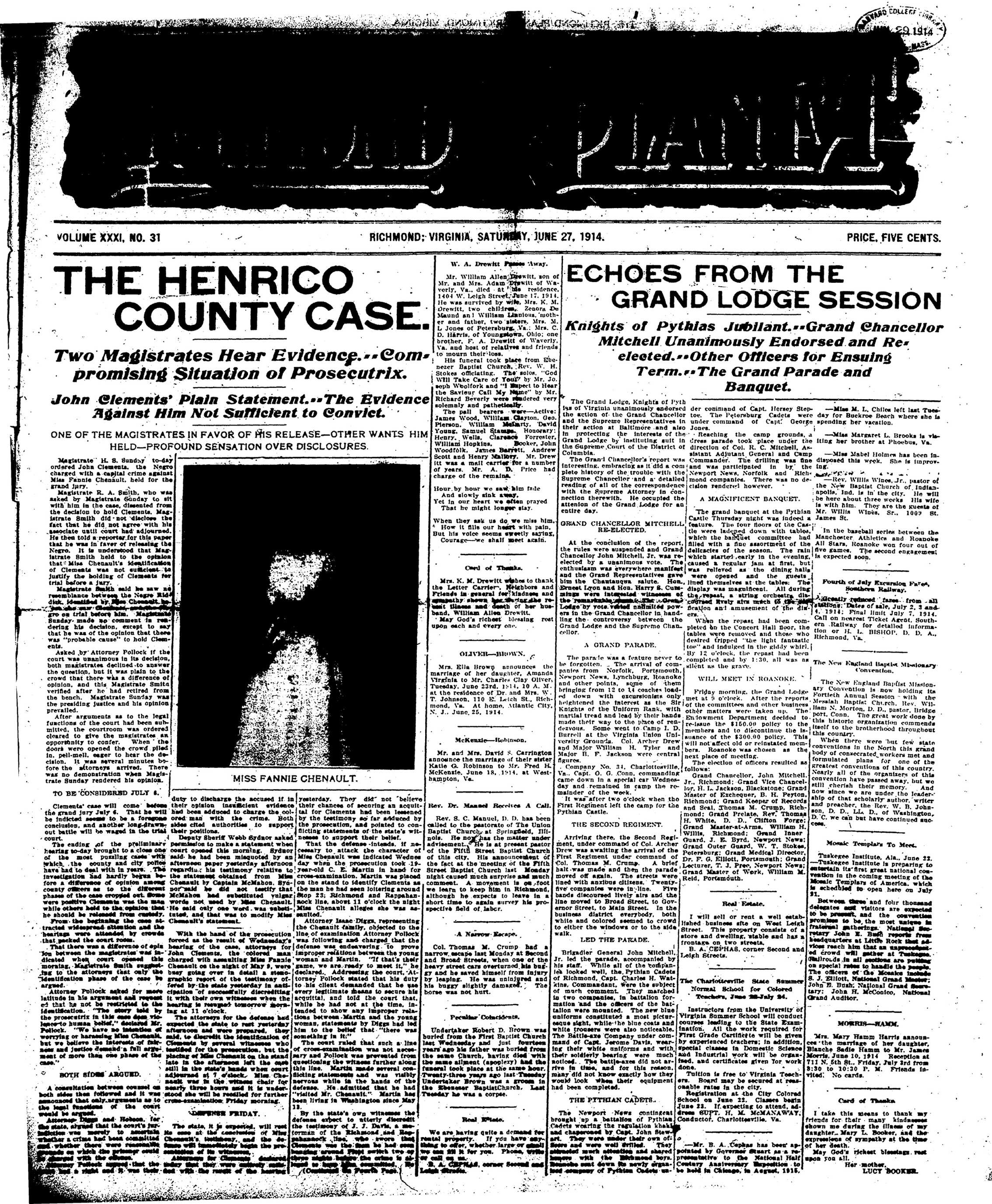
Richmond Planet
Saturday, June 27, 1914
Richmond, Virginia
Page text (machine-generated)
STANFORD COLLEGE
JUNE 29, 1914
MASS.
THE HENRICO COUNTY CASE.
Two Magistrates Hear Evidence...Com-
promising Situation of Prosecutrix.
John Clements' Plain Statement...The Evidence
Against Him Not Sufficient to Convict.
ONE OF THE MAGISTRATES IN FAVOR OF HIS RELEASE—OTHER WANTS HIM
HELD—PROFOUND SENSATION OVER DISCLOSURES.
Magistrate H. S. Sunday to-day
ordered John Clements, the Negro
charged with a capital crime against
Miss Fannie Chenault, held for the
grand jury.
Magistrate R. A. Smith, who was
asked by Magistrate Sunday to sit
with him in the case, dissented from
the decision to hold Clements. Magistrate Smith did not disclose
the fact that he did not agree with his
associate until court had adjourned.
He then told a reporter for this paper
that he was in favor of releasing the
Negro. It is understood that Magistrate Smith held to the opinion
that Miss Chenault's identification
of Clements was not sufficient to
justify the holding of Clements for
trial before a jury.
Magistrate Smith said he saw no resemblance between the Negro Ridick, identified by Jim Chessett, he saw no similarity between the gro on trial before him. Magistrate Sunday made no comment in rendering his decision, except to say that he was of the opinion that there was "probable cause" to hold Clements.
Asked by Attorney Pollock if the court was unanimous in its decision, both magistrates declined to answer the question, but it was plain to the crowd that there was a difference of opinion, and this Magistrate Smith verified after he had retired from the bench. Magistrate Sunday was the presiding justice and his opinion prevailed.
After arguments as to the legal functions of the court had been submitted, the courtroom was ordered cleared to give the magistrates an opportunity to confer. When the doors were opened the crowd piled in, pell-mell, eager to hear the decision. It was several minutes before the attorneys arrived. There was no demonstration when Magistrate Sunday rendered his opinion.
TO BE CONSIDERED JULY 4.
Clementa case will come before the grand jury July 6. That he will be indicted seems to be a foreground conclusion, and another long-drawn-out battle will be waged in the trial court.
The ending of the preliminary hearing to-day brought to a close one of the most puzzling cases with which the county and city police have had to deal with in years. The investigation had hardly begun before a difference of opinion among county officers as to the different phases of the case cropped out. Some were positive Clementa was the man while others held to the opinion that he should be released from custody. From the beginning the case attracted widespread attention and the hearings were attended by crowds that packed the court room.
That there was a difference of opinion between the magistrates was indicated when court opened this morning. Magistrate Smith suggesting to the attorneys that only the Identification phase of the case be argued.
Attorney Pollock asked for more latitude in his argument and request of that he not be restricted to the identification. "The story told by the prosecutrix in this case does violence to human belief," declared Mr. Pollock. "We have no intention of worrying or harassing Miss Chesnault, but we believe the interests of faith and justice demand a full argument of more than one phase of the case."
BOTH SIDES ARGUED.
A consultation between counsel on both sides then followed and it was announced that only arguments as to the legal functions of the court would be argued.
Attorney Dugan and Hobson, for the state, argued that the court's jurisdiction was merely to amortize whether a crime had been committed and whether there were reasonable grounds on which the pronger could be charged with the offence.
Attorney Foleck argued that the
MISS FANNIE CHENAULT.
duty to discharge the accused if in their opinion insufficient evidence had been added to charge the colored man with the crime. Both sides cited authorities to support their positions.
Deputy Sheriff Webb Sydnor asked permission to make a statement when court opened this morning. Sydnor said he had been misquoted by an afternoon paper yesterday afternoon regarding his testimony relative to the statement obtained from Miss Chemeult by Captain McMahon. Sydnor said he did not testify that McMahon had substituted vulgar words not used by Miss Chemeult. He said only one word, was substituted, and that was to modify Miss Chemeult's statement.
With the hand of the prosecution forced as the result of Wednesday's hearing of the case, attorneys for John Clements, the colored man charged with assaulting Miss Pamie Chemeult on the night of May 9, were busy going over in detail a stenographic report of the testimony offered by the state yesterday in anticipation of successfully discrediting it with their own witnesses when the hearing is resumed tomorrow morning at 11 o'clock.
The attorneys for the defense had expected the state to rent yesterday afternoon and were prepared, they said, to discredit the identification of Clements by several witnesses who testified for the prosecution, but the placing of Miss Chenakil on the stand late in the afternoon left the case still in the state's hands when court adjourned at 7 o'clock. Miss Chenakil was in the witness chair for nearly three hours and it is understood she will be recalled for further crime examination. Friday morning.
DEFENSE FRIDAY.
The state, it is expected, will rest its case at the concession of Nigel Cromwell's testimony, and the defense will immediately begin the presentation of its witness.
Attorneys for Cromwell denied today that they were seriously injured with the result of the hearing.
RICHMOND; VIRGINIA, SATURDAY, JUNE 27, 1914.
yesterday. They did not believe their chances of securing an acquittal for Clements had been lessened by the testimony so far adduced by the prosecution, and polled to conflicting statements of the state's witnesses to support their belief.
That the defense intends, if necessary to attack the character of Miss Chenault was indicated Wednesday day when the prosecution took 19-year-old C. E. Martin in hand for cross-examination. Martin was placed on the stand to identify Clements as the man he had seen loitering around Stop 23: Richmond and Rappahannock line, about 11 o'clock the night Miss Chenault alleges she was assaulted.
Attorney Isaac Diggs, representing the Chenault family, objected to the line of examination Attorney Pollock was following and charged that the defense was endeavoring. To prove improper relations between the young woman and Martin, "If that's their game, we are ready to meet it," he declared. Addressing the court, Attorney Pollock stated that his duty to his client demanded that he use every legitimate means to secure his acquittal, and told the court that, while he had not at the time, intended to show any improper relations between Martin and the young woman, statements by Diggs had led him to the belief that "there was something in it."
The court ruled that such a line of cross-examination was not necessary and Pollock was prevented from questioning the witness further along this line. Martin made several conflicting statements and was visibly nervous while in the hands of the defense. He admitted that he had "visited Mr. Chenault." Martin has been living in Washington since May 12.
By the state's own witnesses the defense expect to utterly discredit the testimony of J. J. Dark, a mortorman of the Richmond and Hopshamneck line, who swore that Clemente was the man he had seen hanging around First switch two or three minutes before the crime is being to have been committed. He (Clemente in the Fourth Post.)
W. A. Drewitt Punxs Away.
Mr. William Allen, Drewitt, son of Mr. and Mrs. Adam Drewitt of Waverly, Va., died at his residence, 1404 W. Leigh Street, June 17, 1914. He was survived by wife, Mrs. K. M. Drewitt, two children, Zenora De Maud and William Lahoulous, mother and father, two sisters, Mrs. M. L Jones of Petersburg, Va., Mrs. C. D. Härsir, of Youngdown, Ohio; one brother, F. A. Drewitt of Waverly, Va. and host of relatives and friends to mourn their loss.
His funeral took place from Ebenezer Baptist Church, Rev. W. H. Stokes officiating. The solos, "God Will Take Care of You?" by Mr. Joe. soph Woolfork and "I Expect to Hear the Saviour Call My Name" by Mr. Richard Beverly were rendered very solemnly and pathetically.
The pall bearers were—Active: James Wood, William Clayton, Geo. Plerson. William Melairy, David Young, Samuel Stamps, Honorary: Henry, Wells, Clarence Forster, William Hopkins. Booker, John Woodfolk, James Barrett, Andrew Scott and Henry Malbray. Mr. Drewitt it was a mail carrier for a number of years. Mr. A. D. Price had charge of the remains.
Yet in our heart we often prayed
That he might longer stay.
When they ask us do we miss him,
* How it fills our heart with pain,
But his voice seems sweetly saying,
Courage—we shall meet again.
Cord of Thanks.
Mrs. K. M. Drewitt wishes to thank the Letter Carrier, Neighbors and Friends in general for kindness and sympathy shown during the restilless and death of her husband, William Allen Drewitt.
May God's richest blessing rest upon each and every one.
OLIVER-BROWN.
Mrs. Ella Brown announces the marriage of her daughter, Amanda Virginia to Mr. Charles Clay Oliver. Tuesday, June 23rd, 1914, 10 A. M. at the residence of Dr. and Mrs. W. T. Johnson, 110 E. Leach St., Richmond, Va. At home, Atlantic City, N. J., June 25, 1914.
McKenzie—Hobinson.
Mr. and Mrs. David S. Carrington announce the marriage of their sister Katie G. Robinson to Mr. Fred H. McKenzie. June 18, 1914, at Westhampton, Va.
Rev. Dr. Manuel Receives A Call.
Rev. S. C. Manuel, D. D. has been called to the pastorate of The Union Baptist Church at Springfield, Illinois. He now has the matter under advisement. He is at present pastor of the Fifth Street Baptist Church of this city. His announcement of the fact at the meeting of the Fifth Street Baptist Church last Monday night caused much surprise and much comment. A movement is on foot we learn to keep him in Richmond, although he expects to leave in a short time to again survey his prospective field of labor.
A Narrow Escape.
Col. Thomas M. Crump had a narrow, escape last Monday at Second and Broad Streets, when one of the heavy street cars overturned his buggy and he saved himself from injury by leaping. He was uninjured and his buggy slightly damaged. The horse was not hurt.
Percultor Colocidenta.
Undertaker Robert D. Brown was buried from the First Baptist Church last Wednesday and just fourteen years ago his father was buried from the same Church, having died with the same alliment (apoplexy) and the funeral look place at the same hour. Twenty-three years ago last Tuesday Undertaker Brown was a groom in the Ebenezer Baptist Church. Last Tuesday he was a corpse.
Real Estate
We are having quite a demand for rental property. If you have any thing to offer, whether large or small we can fill it for you. Phone, write or call us.
B. A. CPMAS, corner Second and Leigh Street.
ECHOES FROM THE GRAND LODGE SESSION
The Grand Lodge, Knights of Pythias of Virginia unanimously endorsed the action of the Grand Cancellor and the Supremo Representatives in their action at Baltimore and also in protecting the interests of the Grand Lodge by instituting suit in the Supreme Court of the District of Columbia.
The Grand Chancellor's report was interesting, embracing as it did a complete history of the trouble with the Supreme Chancellor and a detailed reading of all of the correspondence with the Supreme Attorney in connection therewith. He occupied the attention of the Grand Lodge for an entire day.
GRAND CHANCELLOR MITCHELL
RE-ELECTED.
At the conclusion of the report, the rules were suspended and Grand Chancellor John Mitchell, Jr. was re-elected by a unanimous vote. The enthusiasm was everywhere manifest and the Grand Representatives gave him the Chautauqua salute. Hon. Ernest Lyon and Hon. Harry S. Cummings were interested witnesses of the remarkable victory. Grand Lodge by vote voted unlimited powers in the Grand Chancellor in handling the controversy between the Grand Lodge and the Supremo Chancellor.
A GRAND PARADE
The parade was a feature never to be forgotten. The arrival of companies from Norfolk, Portsmouth, Newport News, Lynchburg, Roanoke and other points, some of them bringing from 12 to 14 coaches loaded down with excursionists only heightened the interest as the Sir Knights of the Uniform Rank, with martial tread and lead by their hands made their way to the place of rendezvous. Some went to Camp I. D. Burrell at the Virginia Union University Grounds. Col. Archer Drew and Major William H. Tylor and Major B. F. Jackson were central figures.
Company No. 34, Charlottesville, Va. Capt. O. G. Conn, commanding came down in a special car Wednesday and remained in camp the remainder of the week.
It was after two o'clock when the First Regiment left the camp for the Pythian Castle.
THE SECOND REGIMENT
Arriving there, the Second Regiment, under command of Col. Archer Drew was awaiting the arrival of the First Regiment under command of Col. Thomas M. Crump. A brief halt-was made and then the parade moved off again. The streets were lined with anxious citizens. Twenty-five companies were in-line. Five bands discouraged lively airs and the line moved to Broad Street, to Governor Street, to Main Street. In the business district everybody, both white and colored seemed to crowd to either the windows or to the side walk.
LED THE PARADE.
Brigadier General John Mitchell. Jr. led the parade, accompanied by his staff. While all of the companies looked well, the Pythian Cadets of Richmond, Capt. Charles H. Watkins. Commandant, were the subject of much comment. They matched in two companies, in battalion formation and the officers of the battalion were mounted. The new blue uniforms constituted a most picturesque sight, while the blue coats and white trousers were also noticeable. The Battle-axe Company under command of Capt. Jerome Davis, wearing their white uniforms and with their soldierly bearing were much noticed. The battle-axes did not arrive in time, and for this reason, many did not know exactly how they would look when their equipment had been completed.
THE PYTHIAN CADETS..
The Newport - News continent brought up a battalion of Pythian Cedds wearing the regulation khaki and chaparron by Capt. John Stewart. They were under their own of officers and were well skilled. They attained much attention and shared happiness with the Richmond boys. Someone sent down its newly organized community of Pythian Cedds un-
der command of Capt. Horsey Steptoe. The Petersburg Cadets were under command of Capt. George Jones. Reaching the camp grounds, a dress parade took place under the direction of Col. R. C. Mitchell, Assistant Adjutant General and Camp Commander. The drilling was fine and was participated in by the Newport News, Norfolk and Richmond companies. There was no decision rendered however.
A MAGNIFICENT BANQUET.
The grand banquet at the Pythian Castle Thursday night was indeed a feature. The four floors of the Castle were laden down with tables, which the bandquet committee had filled with a fine assortment of the delicacies of the season. The rain which started early in the evening, caused a regular jam at first, but was relieved as the dining halls were opened and the guests lined themselves at the tables: The display was magnificent. All during the repeat, a string orchestra discured Brassy all much as theification and amusement of the dirers.
When the repeat had been completed on the Concert Hall floor, the tables were removed and those who desired tripped "the light fantastic toe" and indulged in the giddy whirl. By 12 o'clock, the repeat had been completed and by 1:30, all was as silent as the grave.
WILL MEET IN ROANOKE.
Friday morning, the Grand Lodge met at 9 o'clock. After the reports of the committee and other business other matters were taken up. The Enlowment Department decided to re-launch the $150.00 policy to the members and to discontinue the insurance of the $300.00 policy. This will not affect old or relinquated members. Roanoke was chosen as the next place of meeting. The election of officers resulted as follows:
Grand Chancellor, John Mitchell.
Jr., Richmond; Grand Vice Chancellor, H. L. Jackson, Blackstone; Grand Master of Exchequer, B. H. Peyton, Richmond; Grand Keeper of Records and Seal, Thomas M. Crump, Richmond; Grand Prelate, Rev. Thomas H. White, D. D., Clifton Forge;
Grand Master-at-Arms, William H. Willis, Richmond; Grand Inner Guard, J. E. Byrd, Newport News;
Grand Outer Guard, W. T. Stokes, Petersburg; Grand Medical Director, Dr. F. G. Elliott, Portsmouth; Grand Lecturer, T. J. Pree, Newport News; Grand Master of Work, William M. Reid, Portsmouth.
Real Estate.
I will sell or rent a well established business site on West Leigh Street. This property consists of a store and dwelling, stable and has a frontage on two streets. B. A. CEPHAS, corner Second and Leigh Streets.
The Charlottesville State Summer Normal School for Colored Teachers, June 28-July 24.
Instructors from the University of Virginia Summer School will conduct courses leading to the State Examination. All the work required for First Grade Certificate will be given by experienced teachers; in addition, special classes in Domestic Science and Industrial work will be organised, and certificates given for work done.
Tuition is free to Virginia Teachers. Board may be secured at reasonable rates in the city.
Registration at the City Colored School on June 22. Classes begin June 22. If expecting to attend, address GUPT, H. M. McMANAWAY, Conductor, Charlottesville, Va.
—Mr. B. A. Caphas has been appointed by Governor Stuart as a representative to the National Half Century Anniversary Exposition to be held in Chicago, in August, 1915.
THE
SESSION
Grand Chancellor
horsed and Re-
for Ensuing
grade and
—Miss M. L. Chiles left last Tue-
ere day for Buckroe Beach where she is
large spending her vacation.
--Miss Margaret L. Brooks is visiting her brother at Phoebe Va.
Miss Mabel Holmes has been indisposed this week. She is improving.
Rev, Willis Wines, Jr., pastor of the New Baptist Church of Indianapolis, New is in the city. He will be here about three weeks. His wife is with him. They are the guests of Mr. Willis Wines, Sr., 1009 St. James St.
In the baseball series between the Manchester Athletics and Roanoke All Stars, Roanoke won four out of five games. The second engagement is expected soon.
Fourth of July Excursion Fares
Southern Railway
Directly reduced taxes from all
stations: Dates of sale, July 2, 3 and
4, 1914; Final limit July 7, 1914.
Call on nearest Ticket Agent, Southern
Railway for detailed information
or H. L. BISHOP, D. D. A.,
Richmond, Va.
The New England Baptist Missionary Convention.
The New England Baptist Missionary Convention is now holding its Fortleth Annual Session with the Messiah Baptist Church, Rev. William N. Morton, D. D., pastor, Bridgeport, Conn. The great work done by this historic organization commends itself to the brotherhood throughout this country.
When there were but few state conventions in the North this grand body of consecrated workers met and formulated plans for one of the greatest conventions of this country. Nearly all of the organizers of this convention have passed away, but we still cherish their memory. And now since we are under the leadership of that scholarly author, writer and preacher, the Rev. W. B. Johnson, D. D., LL. D., of Washington, D. C. we can but have continued success.
Mosaic Templates To Meet
Tuskegee Institute, Ala., June 22.—Tuskegee Institute is preparing to entertain its first great national convention in the coming meeting of the Monica Templars of America, which is scheduled to open here on July 21.
Between three, and four thousand delegates and visitors are expected to be present, and the convention promises to be, the most unique in fraternal gatherings. National Secretary John E. Bush reports from headquarters at Little Rock that advice reach him that an unprecedented crowd will gather at Tuskegee. Railroads in all sections are putting on special rates to handle the people. The officers of the Monaca include S. J. Elliott, National Grand Master; John E. Bush; National Grand Secretary; John H. McConico, National Grand Auditor.
MORRIS—HANOM
Mrs. Mary Hamm Harris announces the marriage of her daughter, Blanche Sadie Hamm to Mr. James Morris, June 10, 1914. Reception at 711 N. 5th St.. Friday, July 3rd from 8:30 to 10:30 P. M. Friends invited; No cards.
Card of Thanks
I take this means to thank my friends for their many kindnesses shown me during the illness of my daughter, Mary L. Booker, and the expressions of sympathy at the time of her death.
May God's richest blessings rest upon you all.
Her mother,
LUCY BOOKER.
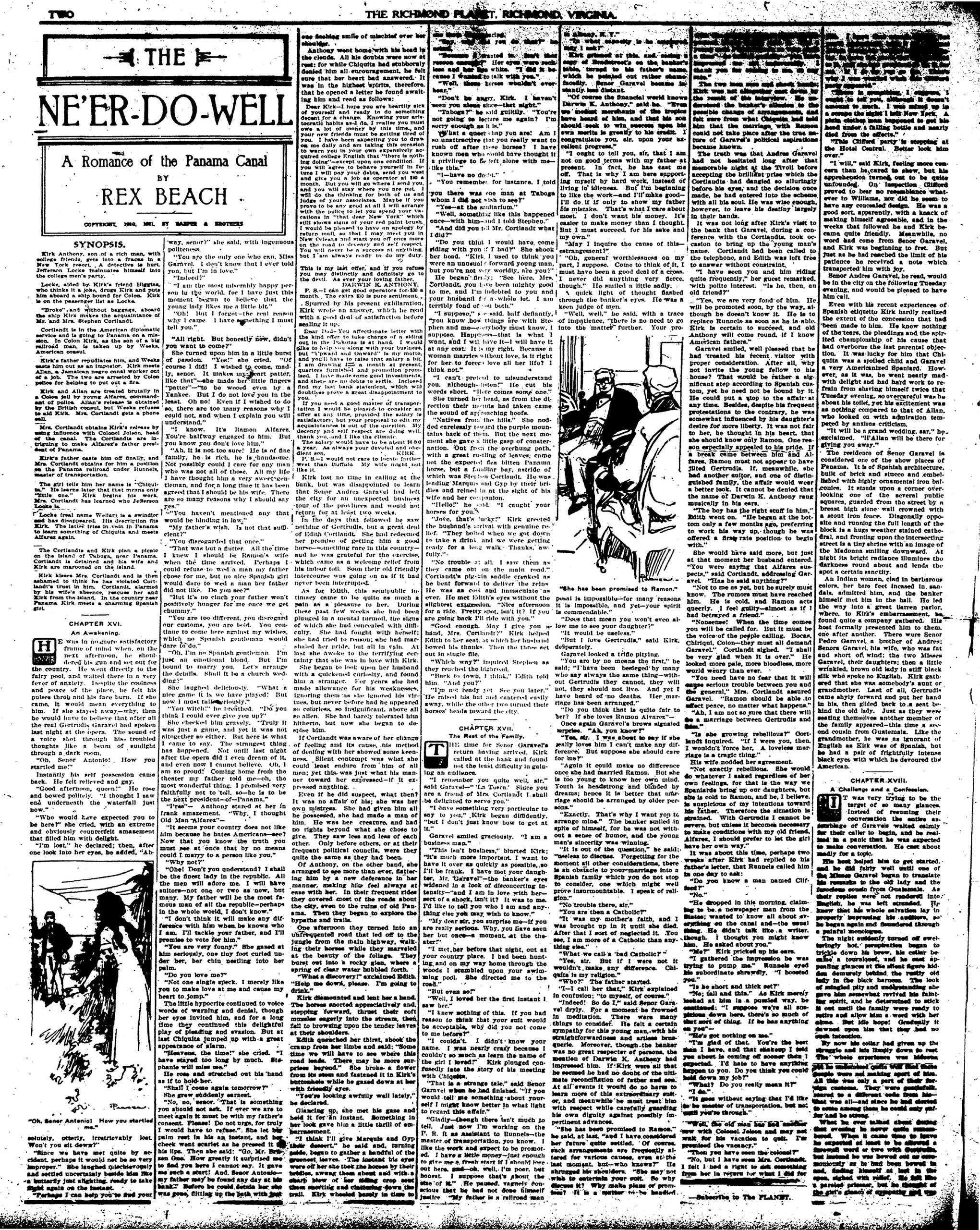
NE'ER-DO-WELL
SYNOPSIS.
Kirk Anthony, son of a rich man, with college friends, gets into a fracase in a New York resort. A detective is hurt. Jefferson Locke malinutes himself into the college men's party.
Locke, aided by Kirk's friend Higgins, who thinks it a joke, drills Kirk and puts the ship on a ship bound for Colon. Kirk is on the passenger list as Locke.
"Broke", and without baggage, aboard the ship Kirk makes the acquaintance of Mr. and Mrs. Stephen Cortlandt.
Cortlandt is in the American diplomatic service and is going to Panama on a mission. In Colon Kirk, as the son of a big railroad man, is taken up by Weeka, American consul.
Kirk's father repudiates him, and Weeks meets him out as an impostor. Kirk meets Allan, a Jamaican negro canal worker out of a job. The two are arrested by Colon police for helping to put out a fire.
Kirk and Allan are treated brutally in a Colon jail by young Alfarex, commandant of police. Allan is obtained by Colon police, but Weeka calls to add Kirk. Mrs. Cortlandt gets phone call.
Mrs. Cortlandt obtains Kirk's release by using influence with Colocel John, head of the canal. The Cortlandts are intriguing to make Alfarez's father president of Panama.
Kirk's father cuts him off finally, and Mrs. Cortlandt obtains for him a position on the Panama canal and in Hunneln, master of transportation.
The girl tells him her name is "Chiquita." He learns later that that means only "little one." Kirk begins his work. Mrs. Cortlandt has learned Jefferson Lookin is.
Locks (real name Wellar) is a swindler and has disappeared. His description fits Kirk. The latter tries in vain in Panama to learn something of Chiquita and meets Alfarez again.
The Cortlandts and Kirk plan a picnic on the island of Taboga, near Panama. Cortlandt is detained and his wife and Kirk are marooned on the island.
Kirk kisses Mrs. Cortlandt and is then ashamed to think he has violated Cortlandt's trust in him. Cortlandt, alarmed by his wife's absence, rescues her and is in the country near Panama Kirk meets a charming Spanish girl.
CHAPTER XVI
An Awakening.
H E was in no more satisfactory frame of mind when, on the next afternoon, he should dered his gun and set out for the country. He went directly to the fairy pool, and waited there in a very fever of anxiety. Despite the coolness and peace of the place, he felt his pulses throb and his face burn. If she came, it would mean everything to him. If she stayed away—why, then he would have to believe that after all the real Gertrudis, Garavel had spoken last night at the opera. The sound of a voice shot through his troubled thoughts like a beam of sunlight through a dark room. "Oh, Senior Antonio! How you startled me!" Instantly his self possession came back. He felt relieved and gay. "Good afternoon, queen!" He rose and bowed politely. "I thought I saw end underneath the waterfall just now."
"Who would have expected you to be here?" she cried, with an extreme and obviously counterfeit amazement that filled him with delight.
"I'm lost," he declared; then, after one look into her eyes, he added, "Ab-
Pierre
"Oh, Senor Antenial! How you startled me."
solutely, utterly, irretrievably lost.
Won't you sit down?
"Since we have met quite by accident perhaps it would not be so very improper. She laughed mischievously and settled uncertainly beside him like a butterfly junt slighting, ready to take sight again on the instant.
"Forename I can help you to find your
way, senor? she said, with ingenuous politeness.
"You are the only one who can, Miss Garavel. I don't know that I ever told you, but I'm in love."
"Indeed?"
"I am the most miserably happy person in the world, for I have just this moment begun to believe that the young lady likes me a little bit."
"Oh! But I forget—the real reason why I came. I have something I must tell you."
"All right. But honestly now, didn't you want to come?"
She turned upon him in a little burst of passion. "Yes!" she cried. "Of course I did! I wished to come, madly, senor. It makes my heart patter, like that—she made her little fingers "patter"—"to be wood even by a Yankee. But I do not love you in the least. Oh no! Even if I wished to do so, there are too many reasons why I could not, and when I explain you will understand."
"I know. It's Ramon Alfarcz. You're halfway engaged to him. But you know you don't love him."
"Ah, it is not too sure! He is of fine family, he is rich, he is handsome. Not possibly could I care for any man who was not all of those. All my life I have thought him a very sweet gentleman, and for a long time it has been agreed that I should be his wife. There are so many reasons why I should say yes."
"You haven't mentioned any that would be binding in law."
"My father's wish. Is not that sufficient?"
"You disregarded that once."
"That was but a futter. All the time I knew I should be Ramon's wife when the time arrived. Perhaps I could refuse to wed a man my father chose for me, but no nice Spanish girl would dure to wed a man her father did not like. Do you see?"
"But it's no cliché your father won't positively hunger for me once we get chummy."
"You are too different, you disregard our customs, you are told. You continue to come here against my wishes, which no Spanish gentleman would dare to do."
"Oh, I'm no Spanish gentleman. I'm just an emotional blond. But I'm bound to murry you. Let's arrange the details. Shall it be a church wedding?"
She laughed deliciously. "What a nice game it is we have played! But now I must take seriously."
"You witch!" he breathed. "Do you think I could ever give you up?"
She checked him gravely. "Truly I was just a game, and yet it was not altogether so either. But here is what I came to say. The strongest thing has happened. Not until last night after the opera did I even dream of it, and even now I cannot believe. Oh, I am so proud!" Coming home from the theater my father told me—oh, the most wonderful thing. I promised very faithfully not to tell, so—he is to be the next president—of Panama."
"Ires"— Anthony stared at her in frank amazement. "Why. I thought Old Man Miffard"—
"It it seems your country does not like him because he hates Americans—see? Now that you know the truth you must see at once that by no means could I marry to a person like you." "Why not?"
"Ohe! Don't you understand? I shall be the finest lady in the republic. All the men will adore me. I will have autitors—not one or two as now, but many. My father will be the most famous man of all the republic—perhaps in the whole world, I don't know." "I don't think it will make any difference with him when he knows who I am. I'll tackle your father, and I'll promise to vote for him." "You are very fony." She gaced at him seriously, one tiny foot curled under her, her chin nestling into her palm.
"Do you love me?"
"Not one single speck. I merely like you to make love at me and cause my heart to jump."
The little hypocrite continued to voice words of warning and denial, though her eyes invited him, and for a long time they continued this delightful play of pleading and evasion. But at last Chiquita jumped up with a great appearance of alarm.
"Heaven's the time!" she cried. "I have stayed too long by much. Stephanie will miss me." He rose and stretched out his hand as if to hold her.
"Shall I come again tomorrow?"
She grew suddenly earnest.
"No, no, senor. That is something you should not ask. If ever we are to meet again it must be with my father's consent. Please. Do not urge, for truly I would have to refuse." She let her palm rest in his an instant, and her cheek went scarlet as he pressed it to his lips. Then she said: "Go, Mr. Brinson Gne. How greatly it surprised me to send you here I cannot say. It gave me such a start! And, Senator Antonio—my father may be found any day at his bank." Before he could detain her she was gone, flitting up the bath with just
THE RICHMOND PLANET. RICHMOND. VIRGINIA.
one fleeting smile of mischief over her shoulder
Anthony went home; with his head in the clouds. All his doubts were now at rest; for while Chiquita had stubbornly denied him all encouragement, he felt sure that her heart had answered. It was in the highest spirits, therefore, that he opened a letter he found awaiting him and read as follows:
Dear Kirk--I hope you are hearty sick and ready to do something decent for a change. Knowing your aristocratic habits as I do, I realize you must owe a lot of money by this time, and you should be best assured to be tired you. I have been expecting you to draw on me daily and am taking this occasion to warn you in your own expensively acquired college English that "there is nothing doing"—except upon one condition. If you will agree to behave yourself, you will be assured you will want and give you a job as operator at $10 a month. But you will go where I send you, and you will stay where you are put. I will do the thinking for both of us and judge of your associates. Maybe if you have a job with the police to help you spend your vacations in "that dear New York" which still shows stains of your red paint brush, I would be pleased to have an apology by return mail, so that I may meet you in New Orleans and stark you off once more. You will never be a success at anything, but I am always ready to do my duty.
This is my last offer, and if you refuse you may distinctly and definitely go to the devil. As ever your loving father,
P. 8-1 I can get good operators for $30 a month. The extra $10 is pure sentiment. Spurred by his present exhilaration, Kirk wrote an answer, which he read with a good deal of satisfaction before sealing it up.
Dear Dad- You affectionate letter with the kind offer to take charge of a sliding door. I hand him a gift to help you along with your business, but "Upward and Onward" is my motto, and you'll have to raise that salary a bit. I am drawing $25 a month at present, quarters furnished and promotion promised. I have made some good investments, and there are no debts to settle. Inclosed, and my last bank statement, which will doublets prove a great disappointment to you.
If you need a good master of transportation I would be pleased to consider an offer at any time, provided the salary is satisfactory, but your proposal to edit my acquaintances is out of the question. My advice is to be well, well, thank you, and I like the climate.
D.S. I would not care to locate farther west than Buffalo. My wife might not like it.
Kirk lost no time in calling at the bank, but was disappointed to learn that Senior Andres Garavel had left the city for an unexpected business tour of the producers and would not return for at least two weeks.
In the days that followed he saw nothing of Gertrudia, but a great deal of Edith Cortlandt. She had redeemed her promise of getting him a good horse—something rare in this country—and he was grateful for the exercise, which came as a welcome relief from his indoor toll. Soon their old friendly intercourse was going on as if it had never been interrupted.
As for Edith, this sentimental intimacy came to be quite as much a pain as a pleasure to her. During those past few weeks she had been plunged in a mental turmoil, the signs of which she had concealed with difficulty. She had fought with herself; she had tried to reason; she had marshaled her pride, but all in vain. At last she awoke to the terrifying certainty that she was in love with Kirk. She began to look upon her husband with a quickened curiosity, and found him a stranger. For years she had made allowance for his weaknesses, ignoring them as she ignored his virtues, but never before had he appeared so colorless, so indignificant, above all so alien. She had barely tolerated him hitherto, but now she began to despise him.
If Cortlandt was aware of her change of feeling and its cause, this method of dealing with her showed some keenness. Silent contempt was what she could least endure from him of all men; yet this was just what his manner toward her expressed—if it expressed anything.
Even if he did suspect, what then? It was no affair of his; she was her own mistress. She had given him all he possessed, she had made a man of him. He was her creature, and had no rights beyond what she chose to give. They saw less and less of each other. Only before others, or at their frequent political councils, were they quite the same as they had been.
Of Anthony, on the other hand, she arranged to see more than ever, flattering him by a new deference in her manner, making him feel always at ease with her. In their frequent rides they covered most of the roads about the city, even to the ruins of old Panama. Then they began to explore the bryths and trails.
One afternoon they turned into an unfrequented road that led off to the jungle from the main highway, walking their horses while they marveled at the beauty of the foliage. They burst out into a rocky glan, where a spring of clear water bubbled forth. "What a discovery!" exclaimed Edith. "Help me down, please. I'm going to drink." Kirk discounted and lent her a hand. The horses snorted appreciatively and, stepping forward, thrust their soft muscles eagerly into the stream, then fell to browning upon the tender leaves at their shoulders. Edith quenched her thirst, shook the cramp from her limbs and said: "Some time we will have to see where this road leads. There may be more surprises beyond." She broke a flower from its stem and fastened it in Kirk's bottomside while he gazed down at her with friendly eyes. "You're looking awfully well lately," he declared.
Glancing up, she met his gaze and held it for an instant. Something in her look gave him a little thrill of embarrassment. "I think I'll give Marquis and Gyp their dessert," he said and, turning aside, began to gather a handful of the groovest leaves. The instant his eyes were off her she took the house by their bedside, awaing them about and with a sharp blow of her tilting crop sent them snorting and chastening down the trail. Kirk wheeled barely in time to
"Well, these horses wouldn't ever bear."
"Don't be angry, Kirk. I haven't seen you alone since—that night."
"Taboga?" he said guiltily. "You're not going to lecture me again? I'm sorry enough as it is."
"What a queer chap you are! Am I so unattractive that you really want to rush off after those horses? I have known men who could have thought it a privilege to be left alone with me—like this."
"I—have no doubt."
"You remember, for instance, I told you there was one man at Taboga whom I did not wish to see."
"Yes—at the militarism."
"Well, something like this happened once—with him—and I told Stephen."
"And did you tell Mr. Cortlandt what I did?"
"Do you think I would have, come riding with you if I had?" She shook her head. "Kirk I used to think you were an unusual forward young man, but you're not very worldly, are you?" He began firmly; "See here, Mrs. Sortland, you have been mighty good to me, and I'm indebted to you and your husband for a whole lot. I am terribly fond of you both."
"I suppose," she said, half defiantly, "you know how things are with Stephen and me—everybody must know, I suppose. Happiness—that is what I want, and I will have it—I will have it at any cost. It is my right. Because a woman marries without love, it is right for her to forces love all her life? I think not."
"I can't pretend to misunderstand you, although listen!" He cut his words short. "Here comes some one." She turned her head, as from the direction their mounts had taken came the sound of approaching hoofs.
"Natives from the hills." She nodded carelessly toward the purple mountains back of them. But the next moment she gave a little gap of consternation. "Out from the overhugging path, with a great rustling of leaves; came not the expected flies bitten Panama horse, but a familiar bay, natride of which was Stephen Cortlandt. He was leading Marquis and Gyp by their bridles and relined at the sight of his wife and her companion.
"Hello," he said. "I caught your horses for you."
"Jove, that's lucky!" Kirk greeted the husband's arrival with genuine relief. "They bolted when we got down to take a drink, and we were getting ready for a long walk. Thanks, awfully."
"No trouble at all. I saw them as they came out on the main road." Cortlandt's pigs-in saddle cranked as he bent forward to deliver the reins. He was as cool and immaculate as ever. He met Edith's eyes without the slightest expression. "Nice afternoon for a ride. Pretty spot, isn't it? If you are going back I'll ride with you."
"Good enough. May I give you a hand, Mrs. Cortlandt?" Kirk helped Edith to her seat, at which her husband bowed his thanks. Then the three set out in single file.
"Which way?" inquired Stephen as they reached the highroad.
"Back to town. I think," Edith told him. "And you?"
"I'm not ready yet. See you later." He raised his hat and canded easily away, while the other two turned their borses' heads toward the city.
1112 time for Senior Garavelva return having arrived, Kirk called at the bank and found not the least difficulty in gaining an audience.
"I remember you quite well, sir," said Garavel—"La Toscn. Since you are a friend of Mrs. Cortlandt I shall be delighted to serve you."
"I have something very particular to say to you," Kirk began diffidently, "but I don't just know how to get at it."
Garavel amiled graciously. "I am a business man."
"This isn't business," blurted Kirk; "it's much more important. I want to have it over as quickly as possible, so I'll be frank. I have mot your daughter, Mr. Garavel—"the banker's eyes widened in a look of disconcerting intensity—and I am in love with her sort of a shock, isn't it? It was to me. I'd like to tell you who I am and anything else you may wish to know."
"My dear air, you surprise me—if you are really serious. Why, you have seen her but once—a moment at the theater."
"I met her before that night, out at your country place. I had been hunting and on my way home through the woods I stumbled upon your swimming pool. She directed me to the road."
"But even so."
"Well, I loved her the first instant I saw her."
"I knew nothing of this. If you had reason to think that your suit would be acceptable, why did you not come to me before?"
"I couldn't. I didn't know your name. I was nearly crazy because I couldn't so much as learn the name of the girl I loved." Kirk plunged confusedly into the story of his meeting with Chiquita.
"That is a strange tale," said Senior Garnel when he had finished. "If you would tell me something about yourself I might know better in what light to regard this affair."
"Gladly—though there isn't much to tell. Just now I'm working on the P. R. R. as assistant to Runnels—the master of transportation. you know. I like the work and expect to be promoted. I have a little money—just enough to give me a fresh start if I should leave out here, and—oh, well. I'm poor, but honest. I suppose that's about the size of it." He paused, vaguely conscious that he had not done himself justice "My father is a railroad man
as alhany, N. Y."
"In what capacity is he employed, may I ask."
Kirk grinned at this, and sitting a copy of Brundstroet's on the backers' table, turned to his father's name, which he painted out rather shamefully. Senior Garavel became instantly less distant.
"Of course the financial world knows Darwin K. Anthony," said he. "Even we incident merchants of the tropics have heard of him, and that his son should seek to win success upon his own merits is greatly to his credit. I congratulate you, sir, upon your excellent progress."
"I ought to tell you, sir, that I am not on good terms with my father at present. In fact, he has cast me off. That is why I am here supporting myself by hard work, instead of living in silence. But I'm beginning to like the work—and I'll make good—I'll do it if only to show my father his mistake. That's what I care about most. I don't want his money. It's easier to make money than I thought. But I must succeed, for his sake and my own."
"May I inquire the cause of this—estrangement?"
"Oh, general worthlessness on my part. I suppose. Come to think of it, I must have been a good deal of a cross. I never did anything very fierce, though." He smiled a little sadly.
"A quick light of thought flashed through the banker's eyes. He was a keen judge of men."
"Well, well," he said, with a trace of impatience, "there is no need to go into the matter further. Your pro
B. B.
"She has been promised to Ramon."
pocal is impossible—for many reasons it is impossible, and yet your spirit is commendable.
"Does that mean you won't even allow me to see your daughter?"
"It would be useless."
"But I love Gertrudia," said Kirk, desperately.
Garnel looked a trifle nitying.
"You are by no means the first," he said; "I have been bearded by many who say always the same thing—without Gertrudis they cannot, they will not, they should not live. And yet I have heard of no deaths. Her marriage has been arranged."
"Do you think that is quite fair to her? If she loves Ramon Alvarez"—Once again Garavel's brows signaled surprise. "Ah, you know?"
"Yes, sir. I was about to say if she really loves him I can't make any difference. But suppose she should care for me?"
"Again it could make no difference once she had married Ramon. But she is too young to know her own mind. Youth is headstrong and blinded by dreams; hence it is better that marriage should be arranged by older persons."
"Exactly. That's why I want you to arrange mine." The banker smiled in spite of himself, for he was without a sense of humor, and the young man's sincerity was winning.
"It is out of the question," he said; "unless to discuss. Forgetting for the moment all other considerations, there is an obstacle to your-marriage into a Spanish family which you do not stop to consider, one which might well prove insurmountable. I speak of religion."
"No trouble there, sir."
"You are then a Catholic?"
"It was my mother's faith, and I was brought up in it until she died. After that I sort of neglected it. You see, I am more of a Catholic than anything else."
"What we call a 'bad Catholic?'
"Yes, sir. But if I were not it wouldn't make, any difference. Chiquita is my religion."
"Who? The father started."
"I-I call her that," Kirk explained in confusion; to "myself, of course." "Indeed! So do I," said Senor Garavel dryly. For a moment he frowned in meditation. There were many things to consider. He felt a certain sympathy for this young man, with his straightforwardness and artifice brusquely. Moreover, though the banker was no great respecter of persons, the mention of Darwin K. Anthony had impressed him. If Kirk were all that he seemed he had no doubt of the ultimate reconciliation of father and son. At all events it would do no harm to learn more of this extraordinary tutor, and meanwhile he must treat him with respect while carefully guarding his own dignity against possibly impriment advances.
"She has been promised to Ramon. He said, at last, "and I have considered her future quite settled. Of course, such arrangements are frequently altered for various causes, even at the last moment, but—who knew?" He shrugged his shoulders. "She may not wish to entertain your suit. So why discuss it? Why make plans of promises? It is a matter to be handled."
The two men rose and shook hands. Klick was not altogether sure down by the result of the interview. He understood the banker's allusion to the possible change of arrangements, and felt sure from what Chiquita had told him that the marriage, with Rancho could not take place after the true nature of Garavel's political aspirations became known.
The truth was that Andres Garavel had not hesitated long after that memorable night at the Tivoli before accepting the brilliant prize which the Cortlandts had dangled so alluringly before his eyes, and the decision once made, he had entered into the scheme with all his soul. He was also enough, however, to leave his destiny largely in their hands.
It was not long after Kirk's visit to the bank that Garavel, during a conference with the Cortlandts, took occasion to bring up the young man's name. Cortlandt had been called to the telephone, and Edith was loft free to answer without constraint.
"I have seen you and him riding quite frequently," her guest remarked, with polite interest. "Is he, then, an old friend?"
"Yes, we are very fond of him. He will be promoted soon, by the way, although he doesn't know it. He is to replace Runnels as soon as he is able. Kirk is certain to succeed, and old Anthony will come round, if I know American fathers."
Garavel smiled, well pleased that he had treated his recent, visitor with proper consideration. After all, why not invite the young fellow to his house? That would be rather a significant step according to Spanish custom, yet he need not be found by it. He could put a stop to the affair at any time. Besides, despite his frequent protestations to the contrary, he was somewhat influenced by his daughter's desire for more liberty. It was not fair to her, he thought in his heart, that she should know only Ramon. One reason especially appealed to his pride. If a break came between him and Alfres. Ramon must not appear to have filled Gertrudis. If, meanwhile, she had another suitor, and one of distinguished family, the affair would wear a better look. It cannot be denied that the name of Darwin K. Anthony rang musically in his ears.
"The boy has the right stuff in him," Edith went on. "He began at the bottom only a few months ago, preferring to work his way up, though he was offered a first rate position to begin with."
She would have said more, but just at that moment her husband entered. "You were saying that Alfares suspects," said Cortlandt, addressing Garavel. "Has he said anything?"
"Not to me as yet, but he surely must know. The rumors must have reached him. He is cold, and Ramon acts querely. I feel guilty—almost as if I had betrayed a friend."
"Nonsense! When the time comes you will be called for. But it must be the voice of the people calling. Bocan, Chiriqui, Colon—they must all demand Garavel." Cortlandt sighed. "I shall be very glad when it is over." He looked more pale, more bloodless, more world weary than ever.
"Ah, I am not so sure that there will be a marriage between Gertrudis and him."
"Is she growing rebellious?" Ortmann inquired. "If I were you, then I wouldn't force her, a loveless marriage is a tragic thing."
His wife nodded her agreement.
"Not exactly rebellious. She would do whatever I asked regardless of her own feelings, for that is the way we Spaniards bring up our daughters, but she is cold to Ramon, and be, I believe, insuspicious of my intentions toward his father. Therefore the situation is strained. With Gertrudis I cannot be severe, but unless it becomes necessary to make conditions with my old friend, Alfarea, I should prefer to let the girl have her own way."
It was about this time, perhaps two weeks after Kirk had replied to his father's letter, that Runnels called him in one day to ask:
"Do you know a man named Clifford?"
"He dropped in this morning, claiming to be a newspaper man from the States; wanted to know all about everything on the canal and—the usual thing. He didn't talk like a writer, though. I thought you might know him. He asked about you."
"Me?" Kirk pricked up his ear.
"I gathered the impression he was trying to pump me." Runnels eyed his subordinate shrewdly. "I boosted you."
"Is he short and thick set?"
"No; fall and thin." As Kirk merely looked at him in a pummed way, he continued: "I suppose we're all suspicious down here, there's so much of that sort of thing. If he has anything on you?"
"He's got nothing on me."
"I'm glad of that. You're the best man I have, and that shakeup I told you about is coming off sooner than I expected. I'd hate to have anything happen to you. Do you think you could hold down my job?"
"What? Do you really mean it?"
"I do."
"It goes without saying that I like to be master of transportation, but not until you're through."
"Well, the old man has had another now with Colonel Jaloe and may not wait for his vacation to quit. I'm promised the vancacy."
"Then you have seen the colonel?"
"No, but I have seen Mrs. Cortlandt. I felt I had a right to ask something from her in return for what I did for."
Subscribe to The PLANET.
"There is in suspicion, I suppose, I might be told you, although it doesn't amount to much. I was mixed up in a scrape the night I left New York. A plain clothes man happened to get his hand under a falling bottle and nearly died from the effects." "This Clifford party is stopping at the Hotel Central. Better look him over." "I will," said Kirk, feeling more concern than he cared to show, but his apprehension turned out to be quite unfounded. On inspection, Clifford proved to bear no resemblance whatsoever to Williams, nor did he seem to have any concealed design. He was a good sort, apparently, with a knack of making himself agreeable, and in the weeks that followed he and Kirk became quite friendly. Meanwhile, no word had come from Sonor Garavel, and Kirk was beginning to fret. But just as he had reached the limit of his patience he received a note which transported him with joy.
Senor Andres Garavel, he read, would be in the city on the following Tuesday evening, and would be pleased to have him call.
Even with his recent experiences of Spanish eliquetto Kirk hardly realized the extent of the concession that had been made to him. He knew nothing of the tears, the pleadings and the spirited championship of his cause that had overborne the last parental objection. It was lucky for him that Chiquita was a spoiled child and Garavel a very Americanized Spanish. However, as it was, he was nearly mad with delight and had hard work to refrain from shaving himself twice that Tuesday evening, no overcareful was he about his toilet, yet his excitement was as nothing compared to that of Allan, who looked on with admiration tempered by anxious criticism.
"It will be a grand wedding, sar," he exclaimed. "If Allan will be there for giving you away."
The residence of Senor Garavel is considered one of the show places of Panama. It is of Spanish architecture, built of brick and stucco and embellished with highly ornamental iron balconies. It stands upon a corner overlooking one of the several public squares, guarded from the street by a breast high stone wall crowned with a stout iron fence. Disagonally opposite and running the full length of the block is a huge weather stained cathedral, and fronting upon the intersecting street is a tiny shrine with an image of the Madonna smiling downward. At night its bright radiance illumines the darkness round about and lends the spot a certain sanctity.
An Indian woman, clad in barbarous colors, her bare feet incased in sandals, admitted him, and the banker himself met him in the hall. He led the way into a great barren parlor, where, to Kirk's embarrassment, he found quite a company gathered. His host formally presented him to them, one after another. There were Senor Pedro Garnavel, a brother of Andres; Senora Garnavel, his wife, who was fat and short of wind; the two Misses Garnavel, their daughter; then a little wrinkled, brown old lady in stiff black silk who spoke no English. Kirk gathered that she was somebody's aunt or grandmother. Last of all, Gertrudis came stylish and put her hand in his, then glided back to a seat behind the old lady. Just as they were seating themselves another member of the family appeared—this time a second cousin from Guatemala. Like the grandmother, he was as ignorant of English as Kirk was of Spanish, but he had a pair of frightfully intense black eyes with which he devoured the American.
CHAPTER XVIII.
A Challenge and a Confession.
T was very trying to be the target of so many glances. Instead of resuming their conversation the entire assentage of Garavels waited calmly for their caller to begin, and he realized in a panic that he was expected to make conversation. He cast about mainly for a topic.
He best helped him to get started, and he did fairly well until one of the Minus Garavel began to translate his remarks to the old lady and the funnies sound from Guamahua. As their replies were not rendered into English, he was left stranded. He knew that his whole salvation lay in properly improving his auditions, so he began again and discovered through a painful monologue.
The night suddenly turned off sweatingly hot, perception began to trickle down his brow, his collar became a tourmaline, and he must appalling glances at the silent figure hidden demurely behind the rusty old lady in the black harness. The look of mingled pity and understanding she gave him somewhat revived his faint spirit, and he determined to stick out until the family were ready to satire and allow him a word with her alma. But idle hope! Grumplily it dawned upon him that they had no such intention. By now his collar had given up the struggle and his limply down to rest. The whole experience was bittersweet and he uneducated grief will that these people were and making apart of him. All this was only a part of their foreign customs. They were gentlefolk, accented to a different code from his—that was all—and since he had started to ode among them he could only suffer and be screwed.
What he ever talked about during that evening he never quite remembered. When it came time to leave he expected of heart to be allowed a flower word or two with Gustavus, but instead he was bowed out as monotonously as he had been bowed in and, finding himself at last in the open, sighted with relief. He felt like a parental prisoner, but he thought of the girl's glamour of exaggeration and joy.
SATURDAY... JUNE 27, 1914.
Instantly consolled. He crossed slowly to the plaza, pausing a moment for a good night look at the house, then, as he turned, he caught a glimpse of a figure slinking into the shadows of the side street and smiled indulently. Evidently Allan had been unable to resist the temptation to follow him. But when he had reached his quarters he was surprised to find the boy there ahead of him.
"How did you beat me home?" he inquired.
"I have been waiting h'impatiently ever since you went out. To be sure, I have had one little dream"—
"Didn't you follow me to the Garnvels'?"
"Oh, boss! Never would I do such."
Seeing that the negro was honest, Kirk decided that somebody had been spying upon him, but the matter was of so little consequence that he dismissed it from his mind.
Although Runnels and spoken with confidence of the coming skimpup in the railroad organization, it was not without a certain surprise that he swoke one morning to find himself actively in charge of the entire system. He lost no time in sending for Kirk, who took the news of their joint advancement with characteristic匀amnity.
"Now, there is nothing cinched yet, understand," the acting superintendent cautioned him. "We're all on probation, but if we make good I think we'll stick."
"I'll do my best to fill your shoes."
"And I have the inside track on Blakeley, in spite of Colonel Jolson, so I'm not alarmed. The break came sooner than I expected, and now that we chaps are in control it's the chance of our lifetimes."
Kirk nodded. "You're entitled to all you get, but I've never quite understood how I managed to forge ahead so fast. I've been mighty lucky." "You don't really call it luck, do you?" Runnels looked at him curiously.
"I'm not conceived enough to think I'm a downright genius."
"Why, the Cortlandts engineered everything. It was they who arranged your promotion to the office in the first place, and they're behind this last affair. They have stood back of you at every step and, incidentally, back of me and the other boys."
"When you say 'they' you of course mean 'she.'"
"Of course. One has to recognize him, though, as the head of the family. And he really did have a part in it too. At least if he had been against us we never would have won."
"I'd like to show the Cortlandts that we appreciate what they've done, but we can't openly thank her without humiliating him. I'd like to give him something."
"Suppose we give him a quiet little supper some night and tell him frankly how grateful we are. He's the sort to appreciate a thing like that, and it would be a delicate way of thanking his wife too."
"Good! I'll speak to the other fellows, and now the acting master of transportation is going to shake with the new acting superintendent and wish him every success."
Runnels grasped the outstretched hand.
"Say, Anthony," he said. "we're young and we have a start. I have what you lack, and you have what I lack. If we stick together, we'll own a railroad some day. Is it a go?"
With a warm glow in his breast the new master of transportation plunged into his duties. He really was making a success, it seemed, although it was a bit disappointing to learn that he owed so much of it to Edith Cortlandt. But this last advancement, too, was very timely, for it would surely have its effect upon Andres Garavel.
But his new work brought new troubles and worries. He began to sleep shorter hours; he concentrated with every atom of determination in him; he drove himself with an iron hand. He attacked his task from every angle, and with his fine constitution and unbounded youthful energy he covered an amazing quantity of work. He covered it so well moreover, that Runnels complimented him.
This stress of labor served one purpose for which he was very grateful; it separated him from Edith Cortlandt and took his mind from that occurrence in the jungle.
Soon after his promotion he received from Andres Garavel a warmly worded note of congratulation, and some few days later an invitation to dine, which he accepted eagerly.
The dinner proved to be another disappointing ordeal, for again he was allowed no opportunity of speaking with Gertrudis and had to content himself with feasting his eyes upon her. But, although the family were present on masses, as on the former occasion, they unbent to a surprising degree, and he found them truly gracious and delightful.
Later in the evening he found himself alone with Chiquita and the old Spanish lady, and, knowing that the latter could not understand a word of his tongue, he addressed himself to the girl with some degree of naturalism.
"I was sorry for you the last time, senor," she said, in reply to his half humorous complaint, "and yet it was tweny; you were so frightened."
"It will say first memorial service. I thought I will going to see you aloud." "Oh, that is never allowed."
What Caravel did her blushing face behind her fan. "Indeed." You seem capable of asking that absurd question under any circumstances." "I wish you would straighten me out
"I wish you would straighten me out on some of your customs."
She gave him an odd look, smiling thickly.
"As for tonight, do you attribute any meaning to my father's request that you dine with us?"
"Of course. It means I wasn't black-balled at the first meeting, I suppose."
She blushed delightfully again.
"Since you are so ignorant of our ways you should inquire at your earliest convenience. I would advise you; perhaps, to learn Spanish."
"Will you teach me? I'll come every evening."
She did not answer, for the old lady began to show curiosity, and a conversation in Spanish ensued which Kirk could not follow. He departed with a feeling of exaltation. Beyond doubt his sult was progressing—slowly, perhaps, but still progressing.
His understanding of Spanish customs received a considerable enlargement on the following day, when he met Ramon Alfarez outside the railroad office. Ramon had evidently waited purposefully for him, and now began to voice a protest in the greatest excitement. "You 'ave insult me," he cried furiously, "and now you 'ave the inso-
Pamela
"Make it yourself ready to fight tomorrow."
lence to interfere in my affairs." He paused dramatically. "Make it yourself ready to fight on tomorrow."
"What's the use of putting it off? I couldn't make your weight in that time. I'll do it now, if you say."
"No, no! Ondertan' we shall fight like gentlemen. I shall feel you with any weapon you prefer."
"By Jove!" Kirk exclaimed in amazement. "This is a challenge. You want to fight adulter. Why, this reads like a book?" He began to laugh, at which Ramon became white and calm. "Listen," Kirk went on. "I'll tell you what we'll do; we'll fight with fire hose again. I suppose you want satisfaction for that ducking."
"I prefer to shoot you, senor," the other declared quietly. "Those marriage shall never occur until first I walk upon your dead body. As matter of honor I offer you this opportunity bifore it is too late. All Panama is speaking of those engagements to Senorita Garnavel. Come, then, must I insake you further?"
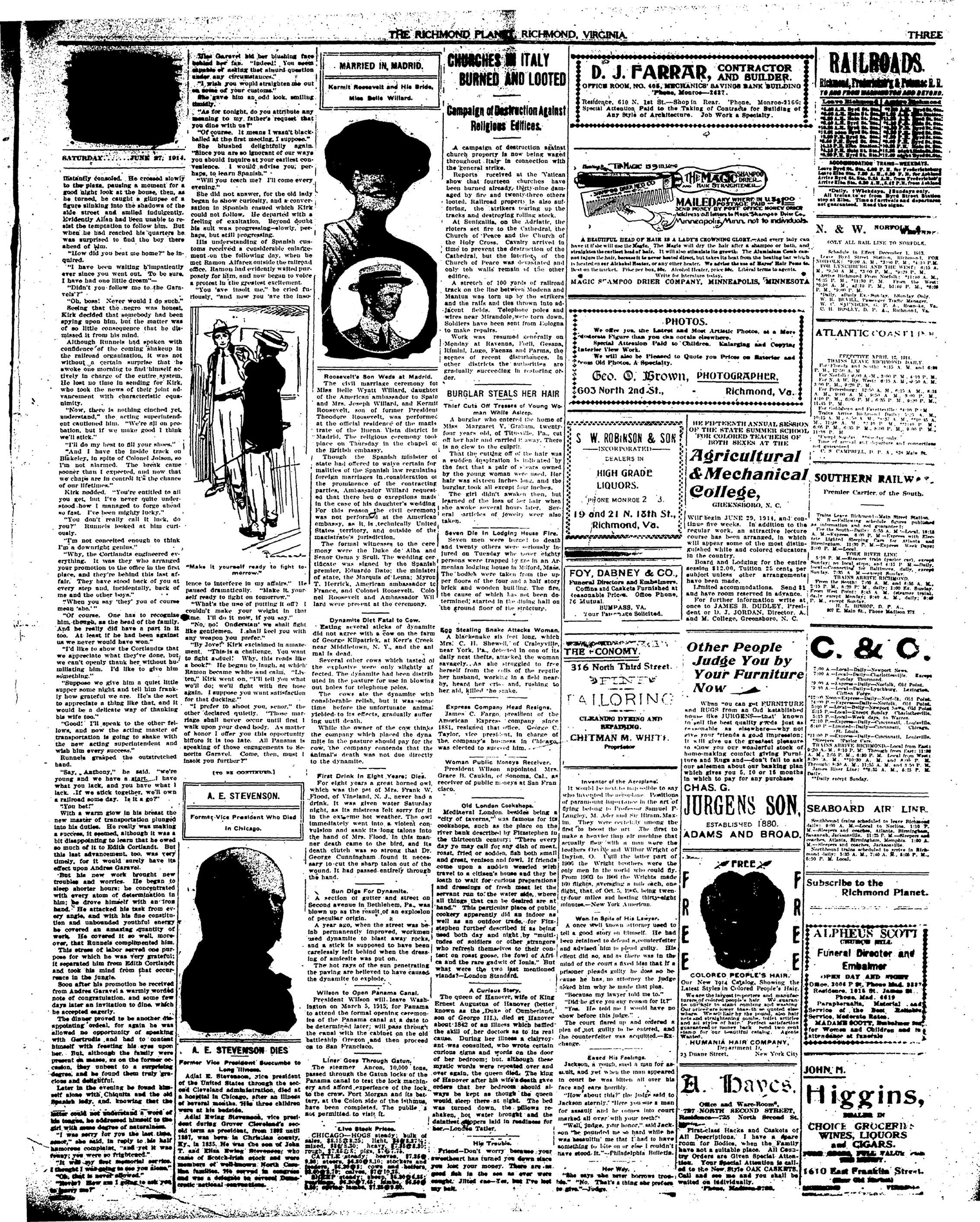
A. E. STEVENSON.
Former Vice President Who Died
In Chicago.
A. E. STEVENSON DIES
Former Vice President Succumbe to Long Illinois.
Adalian E. Stevenson, vice president of the United States through the second Cleveland administration, died at a hospital in Chicago, after an illness of several months. His three children were at his bedside.
Adalian Ewing Stevenson, vice president during Grover Cleveland's second term as president, from 1893 until 1897, was born in Christian county, Ky., in 1835. He was the son of John T. and Eliza Ewing Stevenson, who came of Scotch-Irish stock and were members of well-known North Carolina families. He served in congress and was a delegate to several Democratic national conventions.
THE RICHMOND PLANET, RICHMOND, VIRGINIA
Kermit Roosevelt and His Bride,
Miss Belle Willard.
M.
Roosevelt's Son Weds at Madrid. The civil marriage ceremony for Miss Holle Wyatt Willard, daughter of the American ambassador to Spain and Mrs. Joseph Willard, and Kermit Roosevelt, son of former President Theodore Roosevelt, was performed at the official residence of the magistrate of the Buena Vista district in Madrid. The religious ceremony took place on Thursday in the chapel of the British embassy. Though the Spanish minister of state had offered to walyon certain for maturities of the Spanish law regulating foreign marriages in consideration of the prominence of the contracting parties, Ambassador Willard requested that there be no exceptions made in the case of his daughter's wedding. For this reason the civil ceremony was not performed at the American embassy, as it is, technically United States territory, and outside of the magistrate's jurisdiction.
The formal witnesses to the cermony were the Duke de Alba and Senator Osmany Scull. The wedding certificate was signed by the Spanish premier, Eduardo Dato; the minister of state, the Marquia of Lema; Myron T. Herrick, American ambassador to France, and Colonel Roosevelt. Colonel Roosevelt and Ambassador Willard were present at the ceremony.
Dynamite Diet Pale to Cow
Eating several sticks of dynamite did not agree with a cow on the farm of George Kilpatrick, at Kerr's Creek near Middletown, N. Y., and the animal is dead.
Several other cows which tasted of the explosive were only slightly affected. The dynamite had been distributed in the pasture for use in blowing out holes for telephone poles.
The cows ate the dynamite with considerable relish, but it was some time before the unfortunate animal yielded to its effects, gradually suffering until death.
While the owner of the cow thinks the company which placed the dynamite in the pasture should pay for the cow, the company contends that the animals death was not due directly to the dynamite.
First Drink in Eight Years; Dies.
For eight years a great horned owl which was the pet of Mrs. Frank W. Flood, of Vineland, N. J., never had a drink. It was given water Saturday night, as its mistress felt sorry for it in the extreme hot weather. The owl immediately went into a violent convolution and sank its long talons into the hand of Mrs. Flood. In this manner death came to the bird, and its death clutch was so strong that Dr. George Cunningham found it necessary to cut the sharp talon out of the wound. It had passed entirely through the hand.
Sun Digs For Dynamite.
A section of gutter and street on Second avenue in Bethlehem, Pa., was blown up as the result of an explosion of peculiar origin.
A year ago, when the street was be inb permanently improved, workmen used dynamite to blast away rocks, and a stick is supposed to have been carelessly left behind when the dressing of amifite was put on. The hot rays of the sun penetrating the paving are believed to have caused the dynamite to explode.
Wilson to Open Panama Canal.
President Wilson will leave Washington on March 5, 1915, for Panama to attend the formal opening ceremonies of the Panama canal at a date to be determined later; will pass through the canal with the cabinet on the old battleship Oregon and then proceed on to San Francisco.
Liner Goes Through Gatun.
The steamer Ancon, 10,000 tons, passed through the Gatun locks of the Panama canal to test the lock machinery and afford experience of the lock to the crew. Port Morgan and its battery, at the Colon side of the Isthmus, have been completed. The public is not permitted to visit it.
Live Stock Prices
CHICAGO--HOGS steady; bulk of
sales. $81.15; $2.55; light. $82.27;
mixed. $86.30; heavy. $78.30;
rough. $84.50; ofg. $74.48.
CATTLE steady; heavens $7.25@
9.35; steers, $6.50; 8.10; stockers and
holders, $6.30@; 8; cows and heifers,
$7.10@; 8; goats, $6.30@; 8; sheep,
$6.30@; 8; goats, $6.30@; 8; sheep,
$6.30@; 7.45; lambs, $9.50@
8.55; warmer lamb, $7.25@9.50.
CHURCHES IN ITALY BURNED AND LOOTED
A campaign of destruction against church property is now being waged throughout Italy in connection with the general strike. Reports received at the Vatican show that fourteen churches have been burned already, thirty-nine damaged by fire and twenty-three others booted. Railroad property is also suffering. The attackers tearing up the tracks and destroying rolling stock. At San克拉尼亚, on the Adriatic, the rioters set fire to the Cathedral, the Church of Peace and the Church of the Holy Cross. Cavalry arrived in time to prevent the destruction of the Cathedral, but the interior of the Church of Peace was devastated and only ten walls' remain of the other edifice.
A stretch of 100 yards of railroad track on the line between Modena and Mantua was torn up by the strikers and the rails and ties thrown into adjacent fields. Telephone poles and wires near Mirandole were torn down. Soldiers have been sent from Bologna to make repairs. Work was resumed generally on Monday at Ravenna, Porti, Gessana, Rimini, Lugo, Faenza and Parma, the scenes of recent disturbances. In other districts the authorities are gradually succeeding in restoring order.
BURGLAR STEALS HER HAIR
Thief Cuts Off Tresses of Young Woman While Asleep.
A burglar who entered the home of Miss Margaret V. Graham, twenty-four years old, of Titusville, Pa., cut off her hair and carried it away. There is no clew to the culprit.
That the cutting off of the hair was a sudden inspiration is indicated by the fact that a pair of scars owned by the young woman were used. Her hair was sixteen inches long, and the burglar took all except four inches.
The girl didn't awaken then, but learned of the loss of her hair when she awoke several hours later. Several articles of jewelry wee also taken.
Seven Die In Lodging House Fire.
Seven men were burned to death and twenty others were seriously injured on Tuesday when twelve eighty persons were trapped by fire in an Armenian lodging house in Milford, Mass. The bodies were taken from the upper floors of the four and a half story brick and wooden building. The fire, the cause of which has not been determined, started in the dining hall on the ground floor of the structure.
Egg Stealing Snake Attacks Woman.
A blackenake ala feet long, which Mrs. C. H. Shewell, of Craleyville, near York, Pa., detained in one of its daily nest thefts, attacked the woman savagely. As she struggled to free herself from the roils of the reptile her husband, working in a field nearby, heard her cry, and, rushing to her aid, killed the snake.
Express Company Head Resigns.
James C. Fargo, president of the American Express company since 1881, resigned that office. George C. Taylor, vice president, in charge of the company's business in Chicago, was elected to succeed him.
Woman Public Moneys Receiver.
President Wilson appointed Mrs. Grace B. Caukin, of Sonoma, Cal., as receiver of public moneys at San Fran cloce.
Old London Cookahope
Medieval London, beided being a "city of taverns," was famous for its cookshops, such as the place on the river bank describled by Fitzstephen in the thirteenth century: "There every day yo may call for any dish of meat, roast, fried or sodden, fish both small and great, venison and fowl. If friends come upon a sudden weared with travel to a citizen's house and they be loath to wait for curious preparations and dressings of fresh meat let the servant run to the water side, where all things that can be desired are at hand." This particular place of public cookery apparently did an indoor as well as an outdoor trade, for Fitzstephen further described it as being used both day and night, by "multitudes of soldiers or other strangers who refresh themselves to their content on roast goose, the fowl of Africa and the rare gaduit of Ionla." But what were the two last mentioned vandals—London Standard.
A Curious Story.
The queen of Hanover, wife of King Ernest Augustus of Hanover (better known as the Duke of Cumberland, son of George III.), died at Hanover about 1842 of an illness which hamed the skill of her doctors as to its real cause. During her illness a clayroyant was consulted, who wrote certain curious signs and words on the door of her bedroom; but, although these myatic words were repeated over and over again, the queen died. The king of Hanover after her wife's death gave orders that her bedroom should always be kept as though the queen would sleep there at night. The bed was turned down, the pillows reshaken, hot water brought and the daintest slippers laid in readiness for her—London Tatler.
Hie Trouble.
Friend—Don't worry because your sweetheart has turned you down since you lost your money. There are no good fish in the sea as ever were caught. Jilted one—Yes, but I've lost my heart.
OFFICE ROOM, NO. 405, MECHANICS SAVINGS BANK BUILDING
'Phone, Monroe—2627.
Residence, 610 N. Iat St.—Shop in Rear. 'Phone, Monroe-2166:
Special Attention Paid to the Taking of Contracts for Building of
Any Style of Architecture. Job Work a Specialty.
THE MAGIC SHAMPOO DRIED AND MAIR STRAIGHTENER
MAILED ANY WHERE IN U.S.$100 POSTPAID PAID SEND MONEY BY POST OFFICE MONEY ORDER ADDRESS LETTERS TO Magic Shampoo Drier Co. Minneapolis, Minn. not to individuals.
A BEAUTIFUL HEAD OF HAIR IS A LADY'S CROWNING GLORY. And every lady can have it if she will use the Magic. The Magic will dry the hair after a shampoo or bath, and straighten the earliest head of hair. It will also estimate its growth. The Aluminum Comb cannot injure the hair, because it is never heated direct, but takes its heat from the heating bar which is located on our Alkohol Heater, or any other heater. We advise the use of Haper' Hair Poms 6s. Best on the market. Price per box, $6c. Alcohol Heater, price $6c. Liberal terms to agents.
Write for literature today.
MAGIC STAMPOO DRIER COMPANY, MINNEAPOLIS, MINNESOTA
We offer you the Latest and Most Artistic Photon, at a More
Moderate Figure than you can obtain elsewhere.
Special Attention Fold to Children. Enlarging and Copying
Interior View Work.
We will also be pleased to Quote you Prices on Exterior and
From Old Photon. A Specialty.
FOY, DABNEY & CO.,
Funeral Directors and Embalmers.
Comma and Caskets Furnished at
reasonable Price. Office Phone,
76 Mutual.
BUMPASS, VA.
Your Purchase Sollicited.
316 North Third Street.
FINE
TAILORING
CLEANING DYEING AND
REPAIRING.
CHITMAN M. WHITE.
Proprietor
INVENTOR OF THE AEROPLANE.
It would be unimaginable to say who invented the aeroplane. Positions of paramount importance in the art of flying belong to Professor Samuel P. Langley, M. Ader and Sir Hiram, Maxim. They were crucial among the first to boost the art. The first to make a heavier than air machine that actually flew with a man were the brothers Orville and Wilbur Wright of Dayton, O. Until the latter part of 1806 the Wright brothers were the only men in the world who could fly. From 1803 to 1806 the Wrights made 100 flights, averaging a mile each, one flight, that of Oct. 5, 1806, being twenty-four miles and lasting thirty-eight minutes. - New York American.
Won In Spite of His Lawyer.
A once well known attorney used to tell a good story on himself. He had been retained to defend a counterfeiter and advised him to plead guilty. His client did no, and as there was in the mind of the court a fixed idea that if a prisoner pleads guilty he does so because he has, no attorney the judge asked him why he made that plea. "Because my lawyer told me to." "Did he give you any reason for it?" "Yes. He told me I would have no show before this judge." The court flared up and ordered a plea of not guilty to be entered, and the counterfeiter was acquitted.—Exchange.
Eased His Feelings.
Jackson, a rough, and a man for assault, and yet when the man appeared in court he was bitten all over his face and ears horribly.
"How about this?" the judge said to Jackson sternly. "Here you sue a man for assault and he comes into court marked all over with your teeth."
"Well, judge, your honor," said Jackson "he pounded me so hard while he was heascult" me that I had to have something to bite on or else I couldn't have stood it."—Philadelphia Bulletin.
"She says she never borrows troubles." "No. That's a thing she prefers to give." - Judy
THE FIFTEENTH ANNUAL SESSION OF THE STATE SUMMER SCHOOL FOR COLORED TEACHERS OF BOTH SEXES AT THE
Agricultural & Mechanical College.
GREENSBORO, N. C.
Will begin JUNE 29, 1914, and continue five weeks. In addition to the regular work, an attractive lecture course has been arranged, in which will appear some of the most distinguished white and colored educators in the country.
Board and Lodging for the entire session $12.00, Tuition 25 cents per subject unless other arrangements have been made.
Limited accommodations. Send $1 and have room reserved in advance.
For further information write at once to JAMES B. DUDLEY, President or D. J. JORDAN, Director. A. and M. College, Greensboro, N. C.
Other People Judge You by Your Furniture Now
Other People Judge You by Your Furniture Now
When you can get FURNITURE and RUGS from an Old katafied house like JURGENS—that's known to tell the best quality goods just as reasonable as elsewhere—why not give your friends a good impression; it will give us the greatest pleasure to show you our wonderful stock of home-making comfort giving Furniture and Rugs and—don't fail to ask our salesmen about our banking plan which gives you 5, 10 or 16 months in which to pay for any purchase
JURGENS SON.
ESTABLISHED 1880. ADAMS AND BROAD
FREE
FREE
FREE
COLORED PEOPLE'S HAIR.
Our New 1914 Catalog, Showing the Latest Styles in Colored People's Hair.
We are the largest importers and manufacturers of hair in our country and our hair is to stand combing and washing.
Our prices are lower than th' an quoted elsewhere. Our hair is straightening combs, toilet articles and all styles of hair. Perfect satisfaction guaranteed or money back. Send two cents to our our beautiful catalog. Agree. Wanted.
HUMANIA HAIR COMPANY,
23 Duane Street,
New York, NY
A. Hayes.
First-class Hacks and Caskots of All Descriptions. I have a spare room for Bodies, when the Family have not a suitable place. All Country Orders are Given Special Attention. Your Special Attention is called to the New Style OAK CASKETS. Call and see me and you shall be waited on individually.
THREE
ACCOUNTABILITY TRANS. WEEKDAYS.
Leave Bryd M. St., 6.00 P.M. for Frederick St.
Arrive Bryd M. St., 6.00 P.M. for Ashleigh
Arrive Bryd M. St., 6.00 P.M. for Krista
Arrive Krista M. St., 6.00 P.M. from Ashleigh
*Daily, 11 Wkdays, 5 Pundays only.
All trains stop at Klina. Time of arrivals and departures
not guaranteed. Read the signs.
N. & W. NORTON
ONLY ALL RAIL LINE TO NORFOLK.
Schedule in Effect December 1, 1953.
FOR LINCOLBURG: FOR NORFOLK: "2:00 A. M., 3:00 P. M., 10 P. M.
FOR LINCOLBURG AND THE WEST: "6:55 A. M.,
9:50 P. M., 3:00 P. M., 9:20 P. M.
FOR LINCOLBURG From Norfolk: "11:50 A. M.
9:55 P. M., 3:00 P. M., From the West:
"9:50 A. M., 4:20 P. M., 8:10 P. M., "9:50 P. M.,
9:20 P. M.
Daily, a daily Ex. Sun., Sunday Only.
For LINCOLBURG: For Traffic Manager,
W. C. SUNNIES, Va.
C. H. BOLLY, D. A. Richmond.
ATLANTIC COASTLINE
PERFECT APRIL 12, 1914.
THANKS LEAVEN RICHMOND DAILY.
For Philadelphia and North: 8:15 A. M. and 6:00
P. M. 12:20 A. M. 8:00 P. M. 4:10 P. M.
For Northland: 9:00 A. M. 8:00 P. M. 4:10 P. M.
For N. A. W. Ry. West: 6:15 A. M. 9:00 A. M.
5:00 P. M. 9:20 P. M.
For Northland: 9:00 A. M. 6:15 A. M. 8:18
A. M. 9:00 A. M. 9:00 A. M. 8:00 A. M.
4:10 P. M. 6:00 P. M. 6:00 P. M. 9:20 P. M.
11:45 P. M.
For Goldstein and Favretteville: 74:10 P. M.
For Northland Richmond Daily: 7:25 A. M.
10:15 P. M. 72:10 P. M. 77:10 P. M.
11:45 A. M. 6:15 P. M. 8:00 P. M. 9:00 P. M.
11:40 P. M. 6:35 P. M. 8:00 P. M.
Egypt Sudan Sudan only
Time of arrival and departure and connections not guaranteed
SOUTHERN RAILW
Premier Carrier of the South.
Train Leave Richmond - Main Street Station
published as information and not guaranteed.
For the South-Daily: 5:35 A.M. M—Local, 10:15
Boston: 6:00 P.M. M—Express with Electric
Lighted Flight Service to Atlanta and
Birmingham. 11:30 P.M. M—Express Week Days.
3:00 P.M. M—Local.
YORK RIVER LINE
5-10 P. M.—Rteamer train (parlor car), except Sunday; no local stops; and 4:15 P. M.—Daily, local—Connecting for Baltimore, daily, except Sunday. 7:35 A. M.—except Sunday. TRAINER ARRIVE RICHMOND.
From the Month: 7:05 A. M. and 8:55 A. M.
7:15 P. M. 8:20 P. M. daily: 1:00 A. M. Sunday.
8:15 P. M. 8:20 P. M. daily: 1:00 A. M. (deamer talm).
8:15 except Sunday: 8:40 A. M. daily: 8:55
P. M. except Sunday.
H. L. BISHOP, D. P. A., 807 E. Main St., Phone Madison ST.
C. & C.
7:00 A - Local - Daily - Newport News.
7:00 A - Local - Daily - Charlotteville. Excuse
Sunday. Thursday.
12:00 - Noon - Express - Daily - Norfolk, OI. Old Point.
12:30 - Noon - Express - Daily - Norfolk, OI. Old Point.
15:00 - F - Local - Daily - Norfolk
15:15 - F - Local - Except Sunday - Charlestonville.
15:30 - F - Local - Except Sunday - Warren.
12:10 - P - Local - Express - Daily - Norfolk.
1. Greenwich-Dalry-Cincinnati, Louisville
6:40 P - Greenwich-Cincinnati, Chicago
7:15 P - St. Louis,
*St. Louis.
*O'Farrell-Dilly-Cincinnati, Louisville.
*St. Louis.
TRANS ARRIVE HICHMOND - Local from East:
9:20 A.M. 8:10 P.M. Through from East: 11:50
A.M. 2:05 P.M. 6:30 P.M. Local from West:
8:10 P.M. 10:15 P.M. and 8:20 P.M.
Through: 8:20 A.M. 10:15 P.M. and 8:20 P.M.
James River Line: *8:25 A.M. 6:25 P.M. M.
Dalry.
**Daily except Sunday.
SEABOARD AIR LINE.
Northbound trains scheduled to leave Richmond
daily: 9:00 A. M. - Local to Notions. 1:10 P.
M. - Slippee and coaches. Atlanta. Birmingham,
Jacksonville. Atlanta. Birmingham. Memphis. 1:00 A.
M. - Slippee and coaches. Jacksonville.
Northbound trains scheduled to leave Richmond
daily: 3:35 A. M. ; 7:40 A. M. ; 8:05 P. M.
5:00 P. M. Local.
Subscribe to the Richmond Planet.
ALPHEUS SCOTT
(CHRISTOPHER HILL)
Funeral Director and Embalmer
OPEN DAY AND NIGHT
Office, 2006 P St. Phone Mad. 9397
Residence, 1018 St. James St.
Phone, Mad. 6619
Paraphernalia, Material and
Service of the Best Restoration
Service, Moderate Rates.
MADAME SCOTT, Embalmer Funer
for Women and Children and in
attendance at funerale
JOHN M.
Higgins,
DEALER IN
CHOICE GROCERIES:
WINES, LIQUORS
and CIGARS.
FOR MORE FULL VALUE
AND MORE.
1610 East Franklin Street.
(New York Old Street)
Published every Saturday by John Mitchell, Jr., at 311 N. 4th St., Richmond, Va.
Published every Saturday by John Mitchell, Jr., nt 311 N. 4th St., Richmond, Va.
All communications intended for publication should be sent so as to reach us by Wednesday.
Entered at the Post Office at Richmond, Va., as second-class matter.
According to the Indianaapolis Indiana Ledger, colored folks have no more rights there than they have in the Far South. It is complaining about a cowardly assault made upon Mr. J. W. Nicholson, a colored business man of that city. It is certainly interesting to learn that in a city where the colored folks have both voice and vote, they cannot secure protection in their common-law rights and privileges.
THE CHENAULT CASE.
We have published in the issue of The Planet a full account of the preliminary trial of John Clement, charged with criminally assauling Fanny Chenault, a white female. We have chosen to take this from the columns of the Richmond, Va. News Leader, an admitted fair and impartial newspaper in this matter. In view of the disclosures, it is little short of an outrage to send John Clements on to the grand jury and keep him incarcerated in a jail.
There are many runners, which a little investigation will corroborate, but which up to this time have been permitted to go practically unchallenged. Liberal minded white citizens are most outspoken in their opinion of the case, which is that the sooner the matter is permitted to drop the better for the unfortunate young white woman, who has been so grievously compromised by the disclosure. That she admits that she remained in the bushes with a man, three hours and reached home between eleven and twelve o'clock at night, not having made any outterware whatever and that she dressed herself and attended church the next day tells its own story.
The law prohibits in such a case that whatever was done was with her consent and this being a fact no crime was committed. The young woman said the man struck a match to light a cigarette, that he left her and came back and she made no effort to get away from him. This is proof positive that she has known all along just who stayed with her.
She has caused the death of one colored man, admittedly innocent and is trying to cause the death of another one admittedly not guilty. The most charitable view of the situation was expressed by a white gentleman with whom we talked when he remarked, "I'd turn the man loose and any other man, would do the same thing, who reads her statement. She's nutty."
This is one time where we can trust the better class of white people hereabouts and we indulge in the thought that a jury and a judge will be all that is necessary to give to John Clements the freedom for which he craves.
Rally Day Oxford Mt. Zion Baptist Church.
Ruther Glen, Va., June 23.—Sunday was rally day at the Oxford Mt. Zion Baptist Church and a creditable sum of money was raised by the Clubs. The pastor, Rev. W. M. Washington having been sick, Rev. Lewis Terrell had charge of services. Text, Malachi 3rd chapter, 3rd verse, "And he shall sit as a g refiner and purifier of silver; and he shall purify the sons of Levi, and purge them as gold and silver, that they may offer unto the Lord an offering of eighteousness." Subject, "Christ as a Church, Purifier."
After listening to a very practical sermon by Rev. Terrell the Captains of the various clubs made their reports. Captain of the ten-dollar club, Deacon Samuel Taylor reported $10.05. Mrs. Rosa Byrd of Richmond gave $5.05 of this amount. Mr. M. E. Tyree, the Ruther Glen Architect gave $5.00 of the said amount. Mrs. C. M. Beverly, Captain of the $5.00 Club reported $23.83. Mr. E. J. Taylor, Captain of the $4.00 Club reported $14.10. The total collection for the day amounted to $74.34.
The importance of seeing that good moral teachers are secured for the public schools and that the children are educated were largely discussed by Bro. Joseph Derricote and Bro. Reginald N. Hill.
Rev. W. M. Washington, Pastor; Miss L. G. Clalborne, Clerk.
The Henrico County Case (Continued From First Page.)
identified Clements by a large brimmed slouch hat he wore.
Mrs. Brooks, placed on the stand in the afternoon rofuted Davis' statement regarding the slouch hat, by declaring that she gave the hat to elements the day before the alleged crime was committed. It belonged to a dead brother, she said, and she gave it to Clements when she paid him off for some wore he had done for her.
MISS CHENAULT ON STAND.
Subjected to a grilling and "third degree" cross-examination by Attorney Pollock, during which she related in detail the alleged attack on her, Miss Chenault made statements that it is antithelped, attorneys for the defense will make capital of when they put to sum up their case. Her testimony will be vigorously attacked tomorrow, when the defense places on the stand Captain Thomas McMahon, of the detective force, Sherif Kemp will also take the stand for the defense.
Miss Chenault swore that her assistant did not accomplish his purpose. By Captain McMahon the defense expects to produce a signed statement made by Miss Chenault to the city police, in which she made a statement in direct conflict with the one she made on the stand yesterday.
Attorney Pollock succeeded in bringing before the Court the fact that Miss Chenault had made a Signal statement. Attorneys for the prosecution exerted every means to prevent the statement being produced in court, but, the defense succeeded in having a subpoena issued for Captain Mc-Mahon, and he is expected to produce the statement. The statement was admitted by Miss Chenault, though Attorney Diggs did not admit his knowledge of it until Deputy Sherig, Webb W. Suller made the assertion that the prosecution did know of its existence.
THAT'S THE MAN
There was no hesitation on the part of Miss Chenault in identifying Clements as her assistant. "That's the man sitting over there," she explained, pointing to the colored man, when asked by Attorney Diggs if she knew who attacked her. "His intention was to assault me."
Continuing her testimony, under direct examination, Miss Chenault said: "I had gotten within the yards of my home when I heard something behind me. I turned and saw a man. He rushed at me, and grabbed me, smothering my screams, with his hand. "If you holler I'll kill you," he said. He put his hand on his hip pocket and I thought he had a gun. I offered him my purse and he said he didn't want it.
"We fell in the road and he gave to me. 'Get up from here and go in the bushes.' I could see the light in my home. It was bright and clear and about 9 o'clock. I went with him because I knew it was obedience or death. He kept me in the bushes with him until 11:35 o'clock.
I "A few minutes after ten he left me and went to the wire fence. We could hear the voices of people passing by. I, said to him look out, don't hurt yourself with your gun. He told me to sit still while he went to the fence. I was extremely frightened. He brushed me about the body and limbs and neck. I was stiff from my experience." The witness said her assailant failed in his designs.
POLLOCK CROSS EXAMINES
Taken in hand by Attorney Pollock for cross-examination. Miss Mae nault said she had some bundles when the man attacked her, and told Pollock that she did not drop them while tussling with her assistant.
"Did he use both hands in pulling you to the bushes?" Attorney Pollock asked. "I don't know, I won't be positive. He pulled me across the road eight or ten yards."
"He told me to go under the fence and we both went under together. I made no outcry. I was afraid to drag back. I was afraid he would kill me. I laid my bundles together after we got in the bushes. He lit a match and searched my pocketbook. No, I did not scream when I heard voices. I said to him. "What are you doing around here, anyway?" He replied. "I was at the car when you got off." "Haven't you stated to Captain McMahon, Clarence Wyatt and Mr. Sydnor, that your assistant did mistreat you?" asked Attorney Pollock. "No." replied the witness.
"How far were you from Mr. Mar-
tin's house?"
"About two squares.
Here Attorney Pollock over objections of the prosecution had Miss Chenault go over every detail of her story. Attorney Hobson said such an examination was revolting to him and Mr. Pollock replied that he regretted that it was necessary for him to make such a one, but reminded Hobson that a human life was at stake.—News-Lender, Thursday, June 15, 1914.
Captain of Detectives McMahon, who was the first witness offered by the defense at this afternoon's session of the trial of John Clements, a negozi accused of attacking Miss Fannie Chenault, which is being conducted at Henrico courthouse, related the circumstances of a trip made to the city jail by Miss Chenault a few days after she reported her experience.
McMahon said a number of negozi stood in line for Miss Chenault to look at. She singled out one and asked Deputy-Sheriff Sydney to open his mouth so she could see his teeth.
After looking at him closely she remarked, McMahon swore, "That looks like the man. The negro in me now is the elephants, the negro now on trial."
LOOKED LIKE THE MAN.
H. T. Veitch was also at the jail and said, "That's the man," speaking of the Nerro Miss. Chessau had
THE RICHMOND PLANET. RICHMOND. VIRGINIA
picked out, according to the witness. McMahon said he cautioned Miss Chenault against making a hasty identification.
"I will swear, to the best of my knowledge and belief, that this is the man," she then told him, McMahon testified.
A young man named C. A. Martin, who was one of the party visiting the jail, attracted the detective's attention and he inquired of Sydnor who he was. Miss Chenault heard this question and herself replied, according to Sydnor, saying, "That is a boy named Martin. He is going to stick to me."
McMahon testified that he asked Miss Chenault what she meant by that, but got no satisfactory answer. Counsel for the defense intimated this afternoon they expected to prove an alibi for Clements.
IDENTIFIED ANOTHER MAN.
Deputy Sheriff Webb Sydnor, of Henrico, testified that he was at the city jail when Miss Chenault identified Edward Riddick, a negro, as her masseaut. Sydnor said Miss Chenault picked Riddick out of seven or eight other negroes. Velch and Martin were also present and took part in the identification. Sydnor testified that Miss Chenault said, "That's the man, I am sure she the man; I am quite positive of it. Capuchin McMahon, said Sydnor, identified her as a successful in her identification, because a human life way at stake. She replied that she realized that and reiterated, "I'm satisfied he is the man. I know he's the man."
MADE TO GET ON HIS KNEES
Sydnor also testified that Riddick was made to get down on his knees, show his hands and also show his teeth. After he had done all these things, Miss Chamault said she was more satisfied than ever that Riddick was her assistant. At this juncture, according to Sydnor, Vetch spoke out and said, "that's the man all right." (Sydnor said, "I asked Vetch how he knew it was the man. He replied, 'because he was the negro I saw sitting at Phoet switch. I would swear on a million Ibiza he is the man.' Sydnor said, "Phoet Martin then said he was sure Riddick was the right negro. I asked him how he knew it. He replied, 'I know that he is the man. I swear it.'"
The deputy sheriff stated on the stand that the description Miss Chonault gave of her assault was that "he was a dark, finger-bread-colored negro, with thin lips a shaggy nose, like a white man's, a small mustache and beautiful teeth." Clements is a very black negro. He has a small mustache, but his lips are unusually thick and heavy.
MANY DIFFERENT STORIES
Syphor said that while investigating the case he heard so many different stories about persons connected with the affair that he was at a loss as to how to proceed, and on the Thursday following the reporting of the case, he went to Captain McMahon, at detective headquarters, to consult with him about what to do in the matter. He said Captain McMahon replied that he could not tell him just then how to proceed. Later Mrs. Chenault was asked to make a statement, which she did.
Sydnor said when Miss Chenault went to the Herrice county jail and saw Clements the first time she declared she could not identify him as her assailant, she would come back the next day and look at him again. Polleman Tiller, said Sydnor, wanted to release Clements then and there. "I advised against this," the witness declared, "and stated that before I would see Clements released I would sweat out a warrant against him myself so as to hold him and give Miss Chenault an opportunity of seeing the prisoner again. But Miss Chenault did not return the next day, and having heard nothing from her the county authorities released Clements. I gave no order for his release.
WASTED HIM ARRESTED AGAIN
"When Miss Chenault heard that Clements had been released, she telephoned to the jail and asked that he be rearrated. She said she had heard that Clements had stolen a wrench from Dean's dairy, which she thought resembled the pair of pliers her assault had on the night of the attack. I told her that I would not rearrest Clements unless we got further evidence, because policemen Martin and Tiller had investigated Clements' story of his whereabouts and had verified it by talking with persons living in Browne street and had reported that an nobil could be established for the prisoner.
Placed on the stand by the defense when the preliminary trial was resumed this morning, Captain T. J. McMahon, of the city detective force, produced a signed statement made to him by Miss Chenault, in which she is said to have made assertions differing greatly from her testimony Wednesday afternoon.
THE STATEMENT.
The statement was delivered into the hands of the court and later turned over to attorneys for the defense for examinations. Attorney Isaac Diggs announced to the court that there had never been any opposition on the part of the prosecution to the production of the statement. He objected to its being used to contradict Miss Chenault on cross-examination. The court ruled with the defense. The paper will be offered as evidence "at the proper time," the defense announced.
Miss Chenault was then called to the stand for further cross-examination by Attorney Pollock. The court ordered the room cleared. Miss Chenault Pollock what time she reached home after the attack; Miss Chenault replied: "It was about 11:35 o'clock." The witness said she was awake when her father went to notify the authorities and she was preparing to retire when he returned, from the courthouse. (On Wednesday her father testified that she was "sleeping peacefully" when he returned home.)
Miss Chenault said she areas at
5:30 o'clock on Sunday, May 10th the man entered the office and described her assistant to Pollyman away of the county locked in the house and caused she did no wish to disturb them. Witness said here, in reply to a question, that she is 24 years old.
At 9:45 o'clock Sunday morning she dressed and walked to Sunday school with her sisters and several friends. She said she walked home. Miss Chenault said she "went to Sunday School because duty called me. If I had not been so excited I would not have gone."
"Why did you not take the pistol the negro had on him and use it on him?" asked, Attorney Pollock.
"I never said I saw a pistol in his pocket," replied Miss Chenault.
"Didn't you tell Detective Wiley you saw a pistol in the negro's pocket and that it dropped to the ground within your reach?"
MADE \ DENIAL.
"No. I never told anybody that."
"Do you deny describing your assaultant as a short, light-skinned man?" interrogated Attorney Pollock.
"I did not describe him as a short light-skinned man."
The witness said she did not recall having told Detective Krengel that her assaultant was a short, light-skinned negro.
"Ask about a handkerchief and when she did not keep it, Miss Chenault said it belonged to the diog. and she was afraid to keep it. She said the negro wanted her to return to the city with him. She denied that she was in the habit of remaining out late at night.
Counsel for the prosecution objected to the defense's line of investigation. Attorney Diggs said, "If the purpose of this line of interrogation is to impugn this young lady's character then the doors are wide open, but if the defense does not intend to attack the character. I will not attack the character in order of order. The court ruled that it was not the best opinion that the young woman's character was belug called into question."
SUBSTANTIALLY CORRECT.
The statement produced by Captain McMahon was handed to Miss Chenault. She said it was substantially correct, but said that some of the words used were not her own. She denied having used the term "assault."
She said officers before whom she made the statement promised to protect unless they had good proof on her assailant.
K. C. Pollard, of 2206 Fairmount avenue, a newspaper reporter, was the next witness.
He said he visited the scene of the attack and found a cigarette on the spot Miss Chenault indicated.
Miss Chenault testified that her assailant smoked several cigarettes while he held her a prisoner.
J. R. Morrison, who lives about half a mile from the Chenault home, identified Clements as a negro who was employed by him last November and December. Clements is said to have told the police, that he knew W. W. Chenault, the young woman's father, because he had been sent by Morrison to borrow farming implements from him. Morrison didn't remember having sent Clements on such an errand, but was not positive that he had not. He said he frequently borrowed from Chenault.
IN THE HANDS OF PROSECUTION
When court adjourned for lunch the case was still in the hands of the prosecution and indications were that the hearing would continue into Saturday. Another overflow crowd was present when the case was called this morning, and it was necessary to detail court officers to keep the alces and corridors clear. In going over a stenographic report of the testimony adduced Wednesday, it was found that the wrench or pliers with which the prosecution hopes to convict Clements, was found at the home of Morris Carter, to whom it was sold by Clements, the defense claims, and not on the ground near the scene of the alleged crime, as was stated — News-Leader, June 19, 1914.
---
ANOTHER DAY.
Indications are that another day will be consumed in hearing evidence in the Chenault case. When court adjourned Saturday afternoon until noon Monday, the defense had not completed its testimony. Witnesses to be placed on the stand by the prosecution in rebuttal will probably consume half a day in testifying. It is not likely that the case will be argued.
The feature of the hearing today was the placing of Alfred James Browne, the man, on the court by the court to explain how he happened, to find a handkerchief, with the words "2 E. ave, N. Y. Clemmona" on it at the scene of the crime.
Bealdes Brown's testimony, today's hearing was featured by the presence in court of Edward Ridick, the negro who is said to have been identified in the city jail by Miss Chenault as her assailant. Ridick was taken to the Henried courthouse so that the magistrates might see him and determine if there was such a similarly between him and Clementa as to cause Miss Chenault to make a mistake.
NO REBEMBLANCE
Riddick and Clemente do not resemble each other. They both wore black slouch hats and have mustaches, but further than this there is no similarity. Brown said he wont to the Chenault home one day last week and asked to be shown the scene of the alleged crime. One of Miss Chenault's brothers offered to show him. On reaching the spot, Brown said the brother said, "There's a handkerchief." They both made a dive for it, and Brown got it. He turned it over to the Chenault boy and told him to give it to his father. The handkerchief was taken to the office of Attorney Diggs the next
morning .
THE FINDING OF A HANDKEB-
CHIEF.
Brown was positive that Chenault was the first to see the handkerchief. The witness said he knew neither the Chenaults nor Clements. The court was treated to a bit of Irish wit and humor when Brown took the stand. Asked by Attorney Pollock if he wasn't a Scotchman; the witness replied, "What the devil dye take me for—a Scotchman?" I am Olrish." Attorney Diggs wanted to know why he had an English name if he was Irish, "Sure, and ye will have to ask me father." Brown replied. He said he did not know at the time that the boy who accompanied him to the scene was a brother of the proseutrix.
Policeman Wilson Seay was called to the stand by the court. He said Clements answered the description given him by Miss Chenault. Asked by Magistrate Smith if Miss Chenault had not made a statement to him relative to the treatment she had received at the hands of her assailant, the witness said she had. More the court handed Seay the signed statement made by the young woman with the request that he read it and underscore any statements in it that she had not made verbally to him. Seay will return the statement Monday. Seay testified that Miss Chenault told him she had no idea the negro she identified in the city jail was the man after she had seen Clements.
THE OTHER POSITIVE IDENTIFICATION.
He told of positive identification of Riddick in the city jail by H. T. Velch and C. E. Markin. He said the ground and weeds had been trampled at the spot Miss Chenault said she had been attacked and there were signs that a struggle had taken place. He found several charred matches but no cigarette stumps. After Seay left the stand Riddick was brought into court and after he and Clements had been lined up for comparison, court adjourned until Monday. When the hearing was resumed today, Edward Pollock of counsel for the negro, arrogant, and charme that the prosecution was withholding evidence and was keeping from the court a matter which would shed light on the case.
During the controversy between the prisoner's attorneys and those representing the prosecution, it developed that Alfred James Brown, a white man, had found a handkerchief with the name "Clemmons" on it and that the Miss Chemnault was attacked. The handkerchief was found last week.
BROWN ACTIVE.
According to the statement of the attorneys, Brown went to the Chenault home, asked for one of Miss Chenault's brothers and requested the latter to go with him to the scene of the attack. Miss Chenault's brother accompanied Brown. There the handkerchief was found. Mr. Pollock said it struck him as queer that three weeks after the attack was made, and after the police and members of the press had thoroughly search the scene of the attack, that a stranger should come along and find the handkerchief. Attorney Diggs said it was not the intention of the prosecution to conceal anything or he unfair. Mr. Diggs added that the handkerchief had been in court every day during the hearing but he did not think it had any bearing on the case. He said he regarded it as the attempt of someone to get some cheap notoriety, or the handkerchief was placed, at the scene of the attack by some of Clements' friends who wished to help him.
ATTORNEY POLLARD'S STATEMENTS
Attorney Pollock replied that if he had been the prosecutor he would have called the matter to the attention of the court immediately and not withheld it. Mr. Dhksa said he did not regard this as his duty and did not feel that he was called upon to do that.
Attorney Hobson then said the responsibility rested with him, but he denied anyone to say that he had not been absolutely fair to the accused negro.
The court announced that Judge Richardson had been asked to sign an order for Edward Riddick, the negro Miss Chenault is said to have identified in the city fall as her assailant, to be taken to Henrico for comparison with Clements.
Counsel for the prosecution charged that eight copies of the statement made to Captain McMahon and Deputy Sheriff Sydnard had been made and that they were being generally circulated. The court was asked to recall these statements and seal them. It was denied that the statement had been generally circulated. Attorney Haddon said he had four copies made yesterday after he was arrested because he thought all the lawyers in the case should have a copy. Counsel for the prosecution wanted the statements recalled to protect Miss Chenault. It was stated in court.
CAPT. MCAHON MISREPRESENTED.
Attorneys May, Diggs and Hobson, addressing the court, stated that an afternoon paper yesterday and a morning paper today had misrepresented Captain McMahon's testimony of yesterday by misquoting him and putting a "wrong construction on his testimony." The three lawyers stated to the magistrate that Captain McMahon "toned down" the statement as to make it less embarrassing to Miss Chenault, "and did what any other gentleman would have done under similar circumstances."
That they would be successful in utterly discrediting the alibi attorneys for the defense believe they established for the accused negro yesterday afternoon was the hope of counsel for the state today.—News-Lender, June 20, 1914.
The third day's hearing of the
(Continued On Fifth_Page.)
The Mechanics Savings Bank
North-West Cor. Towne Ave. Waltham.
OUR strong box is a GREAT MAGNET for the money of those who conduct their homes and business by check. INDEXES the DOLLARS. You'd find it POSITIVELY TO YOUR ADVANTAGE if you would let it magnetize your money. Our FINAL CALCULATION SERVICE is BACKED by YEARS OF EXPERIENCE. THE DISCINGUISHED TOWNSMEN on our board of directors is our DEAL GUARANTEE YOUR NEIGHBOR BANKS WITH US. GO YOU?
DUNLAP Pony, Buggy and Harness CONTEST!
Smallwood Memorial Institute.
Twenty-two years of successful Collegiate, Academic and Vocational Training for Colored Youth.
Faculty of College Graduates. Courses thorough. Location and sanitary arrangements and health conditions unsurpassed. 50 Free Scholarships. Through the generosity of a friend of Negro Education this is made possible 'Applicants for Free Scholarship must meet with requirements most simple. Write
THE MUSIC
N. WINSTON 537
Smallwood
Institute
CLAREMONT,
Twenty-two y
Collegiate, Academ
Training for Colo
Non-ectarlan
Curriculum S
Faculty of Coll
Courses thorough. Location and
conditions unsurpassed.
50 Free Sch
Through the generosity of a fri
possible Applicants for Free Scholars
most simple. Write
J. R. POL
FREE CATALOGUE
NEW STYLES
We manufacture all its Latest Styles of Cruises
and offers a wide range of options to you.
We get the highest Dealer Deserts, and show
We are the largest Hair Dresser, and our
larger variety of stylish
and sell-prey Flax Creations
With these
affectiveness in the United
States. We love for New
Catalogue. It is FREE.
AGENTS WANTED
San Willer Human Hair Goods Co.
P. O. Box 305
SUNVEFORT, LA
He. Wee Posted.
"Are you fond of Bach, Mr. Duhaf?"
"Really, Mr. de Sonn, I needom drink
anything."—Burton Express.
Candidates must not be over 16
years of age. Only those who have
registered at the Planet Office or at
the Dixie Theatre are eligible to enter
the contest. This coupon will
entitle the holder to receive FIVE
VOTES, when presented at the
Planet Office.
WINSTON'S
Headquarters for Pure Home Made
Ice Cream, $1.00 Per Gallon.
Fancy Blocks, three stripes, $1.25
per gallon.
Dishes, spoon, platters, paper
napkins, etc. furnished to order.
Special attention to out of town
orders.
Special Prices on Large Orders.
Banquets, Entertainments, Plechics
etc. furnished on short notice.
Phone your orders. Madison 2253
Good Memorial Institute.
:: VIRGINIA.
years of successful
emic and Vocational
fored Youth.
Co-educational
Standardized.
College Graduates.
and sanitary arrangements and health
scholarships.
Friend of Negro Education this is made
scholarship must meet with requirements:
LLARD, President.
Negro In American History.
Traces status of the Negro from discovery, colonization and settlement to the close of the Revolution. Evolution of Citizenship to 20th Century. Also biographical sketches of eminent men and women as illuminating sidelights.
To every instructor of colored youth; every student in secondary schools; every one destroys of making further researches or wishes to give a succinct history of the race in this country, this work is commended by educators, scholars and investigators.
Full bibliography, chronology and comprehensive index. Illustrations, $1.25; by postage, $1.40. Agents Whated. Address.
J. W. CROWWELL, 143 C. St. N. W. M. Washington, K. D.
WELL, CLASS TO THE CAPTAIN OF THE OLD SPORTS CLUB, HEY?
SURE, DON'T PAINT, SWEETNESS! IN CAPTAIN OF THE OLD SPORTS CLUB, PRETTY CLASSY, HEY?
COME ON! ZOWIE! BANG! ZIP! PUT ONE OVER BO!
YAS, AM I FORGOT TO TELL YOU AS HOW IN CAPTAIN OF THE OLD SPORTS'S CLUB, BANG! ZIP!
I'LL TAKE THIS ONE
OO! WEE
A WOMYAN BUYING THE FIRST HAT SHE TRIES ON.
```markdown
```
The Henrico County Case (Continued From Fourth Page.)
case of John Clements, the negro charged with a capital crime against Miss Fannie Chenault, was resumed at Henrico courthouse this morning. Witnesses placed on the stand by the prosecution, to rebut testimony offered by the defense yesterday would, it was said, flatly contradict Clements' statements as to his whereabouts on the night of May 9th, the night on which Miss Chenault alleges she was attacked.
It was also understood that city and county police cement would take the stand for the prosecution and swear that Pompey Flournoy, who testified yesterday that Clements came to his house in Brown street about 10 o'clock on the night of May 9th, had told them when they first interviewed him he had not seen Clements that night. Clements statement that he spent the night of May 9th at the home of Amy Robinson will, it is said, be denied by a city policeman, who raided Amy's house about 2 o'clock that night. It was understood that this policeman would testify that he did not see Clements when he entered the house.
The placing of witness on the stand yesterday by the defense, who swore that Miss Chenault had positively identified a negro named Riddick, in the city jail as her assailant, dealt the prosecution a telling blow, and it is believed by the prisoner's attorneys, created some doubt in the mind of the court as to the guilt of Clements.
THE PROSECUTION INSISTENT.
All the prosecution has to show, however, to have the case sent on to the grand jury is that a crime has been committed and that there is reason to believe that Clements committed it, and this, they believe, they have done. Attorneys for the negro expressed themselves as being confident of an acquittal in the lower court.
Clements was entirely self-possessed when he took the stand yesterday afternoon and made a good witness for himself. He traced his movements on the day the crime is alleged to have been committed. He denied he had been in the vicinity of Picot switch that night and said he spent the night at Amy Robinson's and was at Pompey Flournoy's about 10 o'clock. Flournoy corroborated this statement. The prisoner told of places he had worked, giving the names of his employers for the last three years. He said he had ample opportunity to escape from the police after his first arrest, but didn't do so because he "hadn't done nothing." He went back to work.
Attorney Diiggs was unable to break down the prisoner's testimony as to his movements on May 9, but caught him in several discrepancies as to his movements for the last three years. The general impression was that Clements had made an excellent witness for himself.—News Leader, June 20, 1914.
MAYOR AINSLIE'S REMARKS
Mayor, George Ainslie, who is chairman, ex-officio of the board of police commissioners, told newspaper reporters today that he had made inquiries to ascertain the whole truth about the statement furnished Captain of Detectives McMahon by Miss Fannie Chenault a few days after she reported having been attacked by a negro near her home in Henrico county. John Clements, a negro, accused by Miss Chenault, has been on trial in the Henrico courthouse several days this week.
The mayor said his interest was first aroused when he read a newspaper account yesterday of McMahon's testimony at Clements' trial: McMahon was reported to have said that he used, words in writing Miss Chenault's account of her experience which she did not use herself.
"I telephoned McMahon yesterday afternoon," said the mayor, "telling him that his position in the matter was a rather ambiguous one, and
asking him to complain. He replied he had put read the newspaper account to which I referred, and, therefore, was unable to tell me precisely what I wished to know. I have not heard from him since."
NO. CRITICISM OF THE
DETECTIVE CHIEF.
Mayor Alnisaile said McMahon told him about Miss Chenaault's statement at the time it was made. "It appears," said the mayor, "that the young woman recited her narrative to McMahon and that he wrote it out in his own handwriting, condensing the story here and there. I believe. It was signed by Miss Chenaault."
The mayor said there was no question, that the way in which the statement had been taken was an archival, unsatisfactory one. "Of course," he continued, "statements of this kind should be taken stenographically. In this way every word spoken by the person giving the statement would be recorded accurately and the statement would have value. I cannot see that a statement not taken down by a stenographer would be worth much of anything."
"It is a fact. I believe, that McMahon went out of his way to secure the statement. The offense under investigation was committed in Henrico county. I was led to believe that McMahon had been requested to lend his assistance to the Henrico county police and in such a capacity had Miss Chenault come to his office and tell her story."—News-Leader, June 20, 1914.
THE TESTIMONY CONCLUDED.
Taking of testimony in the Clements case was concluded at 4 o'clock last Monday, June 22d.
Policeman Hertzuel testified that he raided the house in which Clements said he spent the night of May 9th, but did not see Clements. On cross-examination he admitted that Clements may have been in the house at the time of the raid and that it was possible for him to have been there without his seeing him.
Policeman Hardy told of having arrested Alfred James Brown as a stranger in the county and a suspicious character.
Tucker Chenault, a boy 10 years old, brother of Miss Chenault, testified that Brown came to his home and asked to be shown the scene of the attack. The boy said he took Brown to the scene. Young Chenault testified that Brown found the handkerchief with the name "Clemens" on it.
When court reconvened this afternoon the defense called Dr. Collins, who treated Miss Chenault, to the stand and asked him if the young woman used the same language to him in describing the attack as the policemen had used in quoting her. He said the account was substantially the same, but there were some words used in the statement which he did not recall having heard Miss Chenault use. He was asked if he talked with Miss Chenault between the time she first saw Edward Ridick in the city jail and the second time she saw the negro.
OBJECTIONS MADE.
Objection was made to this question, as well as to the interrogation of the physician along medical lines. In objecting to the last named interrogation, the prosecution intimated that the purpose of the inquiries was to call Miss Chenault's character into question. The objection was austained.
Edward Riddick was recalled to the stand. "He said he did not know Miss Chenault, her father, brother or any other member of her family, and that he was not at Pleot switch on the night of May 9th.
That the statement Captain McMahon obtained from Miss Fannie Chenault was "about the same" as she gave County Policeman Seay, was the testimony of the latter on the witness stand today.
Seay was given the McMahon statement Saturday and asked to underscore any expressions, words or ideas in it that Miss Chengqul did not use to him in describing the attack made upon her. Today he returned the statement to the court and said the words, phrases and ideas were "about the same" as the young woman conveyed to him.
ORDERED CLEMENTS' RELEASE
Policeman Tiller asked permission to make a statement when court convened. He said: "There seem some doubt as to who ordered Clements' release after he was arrested the first time. I am the man who did it. I went to Magistrate Sunday with my information and he referred me to Commonwealth's Attorney Sutton. Mr. Sutton referred me to Mr. Sydnor, who was investigating the case. I told Mr. Sydnor that Clements could establish an alibi. I never had a description of Miss Chenault's assailant until after
THE RICHMOND PLANET.
Clemente's second arrest. The court announced that Alfred James Brown, who testified Saturday concerning the finding of a handkerchief at the scene of the crime, and who was released from custody after he testified, was wanted again as a witness.
Asked by Attorney Pollock if he had visited the scene of the crime, Pollicoman Seay said he had. It looked to him like there had been a scuffle there. He saw tracks in the road where Miss Chenault said she was assaulted and saw tracks leading from the scene of the alleged crime to the car line. He was of the opinion that the tracks were made by the same person. He found a comb where Miss Chenault, says she was first accosted.
DETECTIVE SMITH POSITIVE.
Detective Gordon Smith then took the stand for the defense. After telling of an interview with Miss Chenault the day after the alleged crime, Detective Smith said the young woman told him her assailant did not have a flat nose, but his nose was like a white man's. He would not have arrested Clements on the description given by Miss Chenault. The detective said he would not be believer. Pompey Flournoy, who said Clements was at his home about 10 o'clock on the night of May 9th, Detective Wiley was next called. He would hardly have arrested Clements on the description given by Miss Chenault.
Detective Sergeant Atkinson teenth dead that when Miss Chenault first saw the negro killed by Sergeant Krogle, she at first said: "That looks like the man." but later said "His lips are too thin." The detective said Clements' lips were thicker than those of the dead negro. The witness then told of the measuring of the dead negro from his waist to chin by Clarence Wyatt, who did so after talking to Miss Chenault. The young woman was then measured in the same manner and the measurements compared. After the measurements Miss Chenault said the dead negro was an inch taller than her assailant. She said, Atkinson testified, that the brim of the hat on the dead man was a little larger than that worn by her assailant. Shown the hat worn by Clements, the witness said the brim was about three-quarters of an inch wider than that worn by the dead man. He said Clements' lips were thicker than those of the colored man killed by Krogle. Atkinson said the general description given by Miss Chenault did not tally with Clements. Attorney Diggs here asked that Atkinson make an effort to obtain the hat of the dead man and bring it into court.
DEPUTY SHERIFF'S STATEMENT.
Deputy Sheriff Webb Sydnor was here recalled by the defense. He told of an interview with Miss Chennault in the presence of Commonwealth's Attorney Sutton and Policeman Seay, in which he told of a reply made by Miss Chennault to a certain question propounded to her by Mr. Sutton. Anked by Mr. Diggs how the defense came to know of this rehmark. Sydnor said it did not come from him. He did not see Miss Chennault before she had been attended by Dr. Collins. He declined to allow Dr. Collins to see the signed statement made by Miss Chennault without the consent of the Commonwealth's Attorney. He did not want Miss Chennault's father to see the statement, because he felt that it would worry the parent.
Amy Robertson testified that Clements spent the night of May 5th at her house in Brown street. She said he came there about 10 o'clock. Fleming White, who was at Amy's that night, thought Clements was the man he saw there. He said Clements was in bed when Policeman Bertucchio raided the house. He testified that Bertucchio could have seen Clements if he had looked in the room good. A light was shining in the room occupied by Clements, the witness said. W. Woody, another inmate of Amy's house that night, identified Clements as the man who came there with Amy about 10 o'clock. Court then recessed for lunch.
When the Clementa' hearing was resumed at the Henrico courthouse at noon attorneys representing the two sides in the case held widely different views as to the probable outcome of the preliminary examination.
Attorneys Diggs and Hobson, who have conducted the prosecution, were of the opinion that they had established the fact that a crime had been committed and that the finger of ghit pointed to Clements, and that on the strength of this the accused negro would be held for the grand jury.
That the negro would be liberated at the conclusion of today's proceed-
DIFFERENT VIEWS
Rev. L. J. Morris.....13.125
Rev. W. H. Skipwith, Phila.....12.225
Rev. W. F. Graham, Phila.....4.220
Rev. S. C. Manuel.....1.630
Rev. W. T. Johnson.....525
Rev. E. M. Mitchell.....325
Rev. W.-P. Curl, Norfolk.....175
Rev. R. G. Adams, Farmville.....175
Rev. S. S. Morris.....130
Rev. A. S. Thomas.....110
Rev. Irving H. Carpenter, Har-
risburg, Pa.....100
Rev. W. H. Stokes.....95
Rev. J. Gay Grant, Char-
lottesville, Va.....80
Only the names of those who have had more than 25 ballots cast for them will be published in the voting
ings because a case had not been made out against him was the belief of Attorneys Pollock, Haddon and May counsel for the defense
Although it has been announced that the prosecution will introduce at least one witness who will attempt to shatter the alibi which the defense has sought to establish for Clements on the night of May 9th, the negro's attorneys still predicted their client's liberation. They based their prediction on the testimony of witnesses who swore Miss Chenault had identified another negro in the city jail as her assailant. This fact alone, they said, had created doubt as to the guilt of Clements and they did not believe the prosecution had offered sufficient evidence to justify the court in holding Clements for the grand jury.
Leesburg (Va.) Notes.
Mah. Jackson near Akebo was scalded from head to foot by a stationery engine and was brought to the hospital here where he died a few minutes after. Mr. A. W. Ricks, of Mana, was this week in the interest of his school. Mr. Walter O. Cruson, of Washington gave us a very fine entertainment at the Baptist Church Saturday June 20th. Mr. Robert Tison started to Washington Sunday morning. He had a spell at the station, some brain trouble, fell and cut himself. He had to be brought to the hospital in a serious condition. His mother was called to his bed side. The Children's Day program was rendered nicely at the M. E. Church on Sunday. 21st. Collected $23,06. The Primitive Baptist hold services Sunday. Elder Brown was at his host all day. All went away rejoicing in their Savor.
We are glad to note the infant of Mr. Wilson Townson is much improved.
Prof. R. H. Tyler and Mr. Frederick Taylor are on the road again.
Mr. Robert White and wife were in town Sunday.
The Masonic Lodge, No. 161; A. F. and A. M. will out at Providence Baptist Church Sunday 2nd at 3:00 P. M. Rev. Dr. Tyler will preach the sermon.
Mr. Lott Wiley of Boston arrived in town Monday.
Mr. Lewis Harris is convalescing.
Miss Cleely J. Digs and Miss Kathleen Allen have returned home after a year's work in the Washington schools.
Miss Marguerite Digs, after a serious illness of four months is convalescent and visiting Miss Mary Digs of the D. C.
Mrs. E. P. Diggs made her report of the campaign for the Home for Wayward Girls, presenting a receipt for fifty-five dollars, having been collected with the assistance of Miss Davis for Leesburg, returning many thanks for the hearty response to the cause.
Sheffield (Aln.) Notice
To The PLANET.
The city has been well entertained for the last ten days with the Sanctified Camp Meeting. Revs. Martin and Gray have been delivering some forceful sermons to the people of this city. The congregations have been very numerous of both white and colored. We hope that much good will result from their preaching. Mr. Sullivan Armstrong and Miss Velma Warren entered matrimony
"It Costs You Nothing
Ballots reaching this Office by Thursday, 9 A M. will appear in The Planet of the following Saturday.
Mrs. E. V. Kelly, Norfolk, Va. 8655
Miss Marletta L. Chiles . . . . . . . . . . 8600
Mrs. Ella O. Waller . . . . . . . . . . 8625
Mrs. Patsy Whitenburg, Pulaski . . . . 727
Mrs. Eva B. Evans . . . . . . . . . . 675
Mrs. Floyd Ross . . . . . . . . . . 270
Only the names of those who have
had more than 25 ballots cast for
them will be published in the voting
Monday night, June 15th. We have
this couple success in life.
Roy, R. H. Goodloe, pastor of the
1st Cumberland Presbyterian Church
Pratt City, Ala. preached at the C.
P. Church' of this city Thursday
night.
The city was well entertained Wednesday and Thursday nights with Huntington's Mighty Minutrels. It had colored actors and they played well their part. Jolly E. Davis, better known as Papa Snowball was the chief actor and the center of attraction.
The two Pleasure Gardens that are run by Mr. James McGregor and Mr. Calvin W. Wilson are two fine places where the young people can go and be nicely waited on with ice cream and cold drinks.
Mr. Dave Abernathy of this city is on the slick list.
Rev. C. R. Moore, pastor of C. C. P. Church has been preaching at Killens, Ala. for the past week. Rev Moore is blind, but he's well educated and well qualified for the ministry. The revival at the First Baptist Church is expected to begin soon. Mr. Bonnie Parham, of Memphis, is in the city visiting his mother, Mrs. Emer Parham.
Guest at Hotel Dale, Cape May, N. J.
Mr and Mrs H. J Downey, R. A Campbell, J. Thomas Stanford, Th. G. Cortes, M. D. Proston M. Edwards, M. D. J. B. Johnson, Paul Hoggens, Philadelphia, Pa.; William H. Ferris, New Haven, Conn.; Mr and Mrs R. C. Harris, Hot Springs, Va.; Mr. Edward Pugh, Mr. Martin Mealy, Rev. and Mrs. R. H. Tabb, Mr. Edward Pugh, Mrs. R. H. Tabb, Mr. Edward Pugh, Mrs. R. H. Tabb, Mrs. John E. Poulson, Mr. Ralph Walker, Mr. and Mrs. S. H. Bythwood, Mrs. Gortride B. Monsell, Anna H. Brown, Helen M. Green, Mrs C. H. Baugh, Philadelphia, Pa.; Mr. David J. Dixon, Washington, D. C.; Mr. Walter Harris, Sr. Camden, N. J.; Mr. Howard C. Polk, Pittsburgh, Pa.; N. Ullalla V. Lewis, Cape May, N. J.
Farmville (Va.) News
Farmville, Va., June 22 — Rev. M. P. Robinson, Mrs. M. C. Adams, Matte Allen, Adline Dean, Bettie Brown, Rev. Robert G. Adams, Susie B. Foster, Rosa Hughes, James Brown, P. W. Holmes returned home from Richmond, Va., where they attended the Grand Lodge, of K. of P. and Court of Calanthe. They were delighted to bring news that the response to the address of the Mayor of Richmond was given to Farmville and Rev. Adams was the one upon whom this honor was conferred. In his usual way he arose and addressed himself to the occasion. Several times the audience applauded. The speaker acquitted himself with credit and brought home the boquet of distinction and honor.
A Ministers' Conference was organized in the Ninth Baptist Church a few weeks ago. Rev. Nelson Jordan. President; Rev. J. W. Harvey, Vice President; Rev. W. T. Johns, Treasurer; Rev. R. G. Adams, Secretary.
There was also organized a Literary Society known as the Dunbar League. President, Miss Blanche Palge; Vice President, W. J. Pettit, Treasurer, Lottie Palge; Secretary, Cassandra Branch; Pianist, Marian Hankins; Critic, Nathaniel Millie; Chaplain, Josephine Hughes; Editors, Irma Adams; Sergeant-at-Arms Bernard Ward.
Miss Ethel Bowler, of Richmond, Va. is visiting Mrs. Annie Vaughn of Main Street.
Miss Hunter of Lynchburg, Va. a
visiting Mm. W. F. Holmes of Vlr-
Ballots reaching this
Office by Thursday, 9 A.
M. will appear in The
A Planet of the following
Saturday.
Dr. Albert A. Tennant 1785
Dr. George R. Ferguson, Char-
lottesville, Va. 1485
Dr. E. R. Jefferson 955
Dr. James E. Jackson 155
Dr. J. O. Dawson 100
Dr. R. O. Mundlin 100
Only the names of those who have
had more than 25 ballots cast for
them will be published in the voting
contest.
Mrs. M. C. A. Adams is attending the Women's Convention at Fredericksburg, Va.
Rev. Adams preached to the True Friends Society at Mt. Marinah Church at three P. M. Sunday.
If this long, dry spell, which has proven distractive to the crops is not sufficient to teach the lesson of obelence to God. He will send another warning to the people.
---
HONOR AND PROMOTED PUPILS
NEWTOWN SCHOOL
Mr. H. G. Carlton, Principal of Newtown School, has reported to the Superintendent, Dr. J. A. C. Chandler the following Roll of First Honor and Promoted Pupils for the term ending June 15, 1914:
2B GRXDE: First Honor: Bernard Johnson, Lizzie Mallory, Madeline Wray.
Others Promoted: Forest Alston, Virgile Brown, Kernith Cartge, Eva Epps, William Cooper, Mabel Fox, Porress Rogers, Mamie Jones, Leroy Thomas, Rosa Randolph.
2A GRAGE--First Honor: Adolph Cohn, Viola Fleming.
Others Promoted: William Abernathy, James Brown, Simeon Duncan, Ernest Hall, Defend Johnson, Herbert Lacey, Edward Peterson, Walter Price, Junius Riddick, Cecil Austin, Grace Charity, Louise Crawford, Irene Goodall, Mollie Goodall.
IB.GRADE—First Honor: Louise M. Smith, Halle Telson.
Others Promoted: Joseph Dawson, Jennie Aycock, Maud Clayton, Elizabeth Carter, Alma Carter, Viola Douglass, William Fox, Burnetta Leecost, Lucie Simon, William Watkins, Palmer Williams, Thomas White, James Ivy, Lucy Crawford.
LA GRADE--Promoted: Pupils: John Aycock, Wilbur Baugh, Virginia Banks, Isiah Crawford, Cora Lee Cook, Rebecca Clayton, Milfred Douglas, Isiah Crawford, Richard L. Logan, Herman Stokes, Marle Heks, Pearl Johnson, Emma Johnson, Lotte Lankford.
Rev. W. H. Skipwith is Here.
Moore St. Baptist Church, Rev. R. O. Johnson, D. D. Pastor. On Sunday morning next at 11:20 A. M. we will immerse 150 persons, the remainder of the 210 who professed faith in Christ during our recent revival which was conducted by our International Preacher and Singing Evangelist, Rev. W. H. Skipwith. This will make 190 we have baptized out of his meeting, the ages of which range from twelve years old to 60.
This being the 25th Anniversary of the Church we are trying to raise $2000. To this end we caringly ask the help of each member and friend. The program for Sunday will be as follows: 10:30 A. M. Baptismal Sermon by Rev. W. H. Skipwith; 12:15 P. M. Baptizing; 3:30 P. M. Communion; 18:15 P. M. Preaching by Rev. W. H. Skipwith. Subject, "Marching Orders to the Church." On Monday night, June 25th, Rev. Skipwith will give an Illustrated Lecture on The Prologial Son at the First Baptist Church, Rev. W. T. Johnson, D. D. pastor, to which all are cordially invited.
Truible No More
God intends that you have continual happiness. You should have it. I want to tell you something. You can be happy. Write,
W. C. SPENCER, Lester, W. Va.
v Gross
AM I FORGOT TO TELL YOU
NOW IN CAPTAIN OF THE
SPORTS'S CLUB.
NG! ZIP!
Ballots reaching this
Office by Thursday, 9 A.
M. will appear in The
Planet of the following
Saturday.
Robert C. Scott..... 330
G. W. Peace, Waverly, Va..... 115
A. D. Price..... 55
W. I. Johnson..... 45
UNOFFICIAL LIST
Only the names of those who have had more than 25 ballots cast for them will be published in the voting
Mount O Goes to Buckroe, July 4 times 4 plus 4.
Dear Friends: This is to notify you that Mount Olivet Baptist Church will give her annual excursion to Buckroe Beach, Monday, July 20, 1914. Two years ago we were put out of doors, the building being condemned by the Building Inspector. Last year we said we were going back home. By your assistance, we are home again.
As you are going to take a day off this season Walt and Go With Us. Lend a helping hand now as in the past and He will make it right, all right.
REV. J. ANDREW BOWLER, Pastor
Adults, $1: Children under 12 years
50 cents.
WANTED—A RELIGIOUS LADY,
with moral principles, that,
will take charge of everything as her
own. I have a good home. My
house is brick, a story and a half
high and uses all natural gas. For
any information apply to REV. C.
THOMPSON, Rondeau, Ont., Can.
THE WESTVIEW COTTAGE.
Jamestown, R. I.
Will open July 1st, 1914. All modern improvements. Weekly hops, lawn tennis, croquet, etc. Excellent table, farm products and pure spring water. Splendid bathing and an opportunity to see some of the most formidable battleships afloat, this being the Summer headquarters of the North Atlantic Fleet of the U. S. Navy. Ferry to Newport and Narragansett Pier every half hour. MRS. B. F. MORRELL. Box 216, Jamestown, R. I. Long distance phone.
H.M.WILLIAMS.JR.
OPTICIAN
DON'T DECEIVE YOURSELF by imagining your vision will rectify itself—it won't! Right Glassware will help nature—will relieve the strain, the blurs, itch ing and watering. We're here to help you quickerly and satisfactorily. We know we can! Put us to the Test. THE H. M. WILLIAMS JR.
OPTICAL COMPANY.
502 N.2nd St. at Clay St. Richmond
Something New.
Readers of The Richmond PLANET can always find copies of the paper on sale. Subscriptions and advertisements and local news are taken at office rates.
THE STANDARD NEWS CO., Chas.
Gary, President and General Manager, 131 W. 53rd St., New York.
WANTED—SALESMEN—For REAL ESTATE. Big commission paid. Experienced men preferred. Write A. RODGERS, Lester, W. Va.
SET OF SILVER FREE
To introduce our
intelligently written
from a 1-piece box of Silver in a
luxurious leather box bis the cost,
a lighthouse box at the cost,
position of our wonderful Kidney
and Bladder Remedy. Send for
us $6.00 within 20 days and you will
receive the Chest of Silver as our
Gift. Celebrate January 20.
Things We Never See
I'll take
this one
OU!'
WEE
SATURDAY... JUNE 27, 1914.
U. S. WINS R. R.
RATE DISPUTE
END OF THREE-YEAR FIGHT
Southern Pacific Claim Involving $700,
000,000 Worth of Oil Land Is Uphold.
The United States supreme court reversed the commission court and upheld the intermountain rate order of the interstate commerce commission.
The decision had been awarded for months, as it affects practically every railroad in the United States.
The case involved the validity of the long and short trial classes of the interstate commerce and the validity of an order of the interstate commerce commission requiring traffic to the Pacific coast and intermountain cities.
Chief Justice White first decided that the long and short had change was constitutional.
The commerce court had held that the commission could not make blankket or "zone" rates. That is the contention of those who are opposed to the five per cent increase in freight rates now being asked by the eastern railroads.
The chief justice next upheld the making of rates by the commission by zones. "The zones selected by the commission were in substance the same as those previously fixed by the carriers as the basis of the rate making which was included in the tariffs which were under investigation and therefore we may put that subject out of view," said he.
"Indeed, except as to questions of power, there is no contention in the argument as to the inequality of the zones or percentages or as to any undue preference or discrimination resulting from the action taken."
The inter-mountain rate orders were issued in June and July, 1911, by the interstate commerce commission, under authority of the "long and short hauls act", which clothed the commission with discretion to make exceptions to the general rule laid down in the law that railroads should not charge more for a short haul than for a longer haul in the same direction and over the same lines or routes.
Transcontinental railways won the fight for title to some $700,000,000 worth of oil lands when the supreme court hold void the clause in the patents making the land revert to the government If found to contain minerals.
The court held that the patents were irregular, but that they could not be attacked collaterally—by other claimants—but could only be set aside by a direct attack by the government Justice Vandevauenter, for the court, in evidently emphasized the claim that the government's time in which it could attack the patents had expired in 1900 or 1901.
May Kill Lions That Devoured Man.
A squad of Chicago police, armed with rifles, had charge of the five young lions and their mother which killed and partly devoured their keeper, Emerson D. Dietrich, football player and son of a Brooklyn, N. Y., architect.
The animals are the property of Miss Adgie Castillo, a vandeville performer, who exhibited them. She employed Dietrich as her assistant. They were engaged to be married.
Whether or not the animals will be destroyed will be decided after an inquiry into the tragedy. Trilby, the mother, was a tame old lion. The five young lions were not quite full grown born in captivity, bottle reared and considered harmless. Dietrich was knocked down in the cage, accidentally, it is thought, but as soon as the beasts smelled his blood they were transformed from playful cubs to jungle man-eaters. The cage was in a freight car in the rail road yards. George McCord, an assistant, who had entered the cage with Dietrich, could not save him from the lions and fled. Neither Dietrich nor McCord had any previous experience in wild beast taming, it was said. The police plan to inquire how Dietrich went into a dimly lighten den with six hungry lions without means at hand for his protection.
The police were prepared to kill all the lions at once, but were urged not to by McCord, who said the cage would not be strong enough to hold the animals if they were roused to frenzy by the shooting.
Used Pepper to Blind Victim.
Throwing pepper into the eyes of Miss Verona Hicks, twenty years of age, a comely hopkeeper for her two uncles, John and Charles Stard, in Altoona, Pa., an unknown foreigner was prevented from committing an outrage upon her only by the timely arrival of Charles Stard, who hurried to the rescue in response to her screams.
Her assailant brought a violin to the house two weeks ago to be repaired.
by the Stards, and on his second visit was to take it away. Giving the girl a $5 bill, she turned to get the change, when he seized her by the throat and threw the pepper into her face.
Evidently the man thought she was alone, but Charles Stard was in an ad joining room, and when the latter appeared on the scene the man knocked him down and escaped.
Miss Hicks is prosecuted by the shock, and under the case of a physician. The police have a good description of her aerial.
Boosevelt's Threat Bad
Colonel Roosevelt will make no open air speeches when he returns to the United States and will limit the number of addresses indoors during the campaign to a considerably smaller number than he had expected to deliver.
Dr. St. Clair Thompson, the throat specialist in London, Eng., whom he visited, has placed an absolute prohibition on continuous speaking by the colonel.
Many persons who heard Mr. Roosevelt's lecture before the Royal Geographical Society were surprised at the weakness of his voice. The stenotian tones to which those who had heard him before were lacking. Colonel Roosevelt himself was surprised and anxious, so he determined to consult the specialist.
The physician said it would be impossible for Colonel Roosevelt to undertake a continuous campaign, or to speak in the open air during the next three months. In the meantime, he advised him to make only a few speeches. Colonel Roosevelt was the guest at breakfast of the bishop of London, to whom he expressed great interest in his work in the East End slums of London.
Child Victim of Attack
Mildred Yunikovitz, five years old, daughter of late Yunikovitz, a near chant of Edwardville, near Willis Harre, Pa., who had been lured from her home by a strange man, was found on the mountainide by Chief of Police James Williams and a band of searchers.
The child is in a critical condition, having been attacked by the man who led her away. The stranger induced the child to follow him from her father's store by promising her candy. They went two miles to the mountain site.
The police have not arrested the assailant, although they have an excellent description of him.
Snake Attacks Baby.
When Mrs. Amos Edwards, of Cedar Top, near Reading, Pa., returned to the house after working in her truck garden she was horrified to find a snake attacking her year-old baby. The snake had hold of one of the child's fingers, and when Mrs. Edwards shook the little one's hand the reptile let go and wriggled away! Later the snake was shot by the child's grandfather and was found to measure four feet.
$85,000 Stolen From Bank.
President J. C. Giagnini, of the Colonial Trust company in Pittsburgh, Pa., admitted that $5,000 had been mysteriously stolen, from the Freehold bank's deposit box in Colonial Vaulte. The Freehold bank is controlled by the Colonial. The theft was discovered ten days ago. Detectives have been working on the case since that time, without result.
Box: 19 to Pic Lo Chalc
Harley Pearl, aged nineteen years, was sentenced to death in the electric chair Oct. 2 for the murder of Mrs. Nancy Massie and her daughter and son, Mary and Robert, at Greenville Ridge, near Ironton, Ohio, on May 12. Heard confessed. He was employed by the Massie family as a farm hand.
Bavarian Queen Inpired.
Struck on the head by a sky rocket, the queen of Bavaria was seriously injured while attending a celebration at Passeau, near Munich, Bavaria. She was reported as resting well and as almost certain to recover.
Too Much Snake For Bulldog
After haying battled fiercely for several minutes with a large blacksnake, a thoroughbred bulldog belonging to William Allen, of New Sharon, N. J., conquered and ate the reptile. A few hours later the dog died in convulsions.
The currency famine has not been relieved at Tampico, Mex., and boxes of celluloid poker chips are now circulating as small change.
KILLS HERALF Lifting Stove
While hitting a heavy stove, Mrs. Annie Bendik, of South Bethlehem, Pa., burst a blood vessel and fell over dead. She was thirty years old.
BASE BALL: SCORES
PHILADELPHIA — FLOUR weak;
PORTS: $3.85 @ 4.10; city milia;
PORTS: $5.22.
RYE FLOUR firm, at $3.60@3.70 per barrel.
WHEAT auct. No 2 rod, 95½c.
GROAT auct. No 2 yelled, 95½c.
OATS auct. steady; No 2 white, 47½c.
47½c. lower grades, 45½c.
POTATO'S ateady; per bushel, old,
90c. new, $1.5953.25 per barrel.
103½c. old roosters, 103½c. Dresen-
d firm; choice fowls, 18c.; old ro at-
ers, 12c.
BUTTER firm: fancy creamery. perf
th. 291c.
EGGS stealy: select', 26 27 28c;
earbay, cw: write, 25c.
Live Stock Prices
CHICAGO - HILLS unsettled, light
$8.10, $8.25, $8.40, $8.55, $8.75, $8.95
$8.10, but $8.25, $8.40, $8.55, $8.75, $8.95
$8.40, storer, feeders, $8.70, $8.85, $8.95, $8.10, $8.25, $8.40, $8.55, $8.75, $8.95
yearlin, spring
—Subscribe to The PLANET.
THE RICHMOND LANET, RICHMOND, VIRGINIA.
REBELS TO REJECT INFORMAL PARLEY
Declare New Peace Plan Is Not Acceptable.
ON WAY TO WASHINGTOP
Carranza's Secretary Says Rebels Will Not Treat With Huerta Except on the Battlefield.
General Venustiano Carranza, "first chief" of the Constitutionalists, will not accept the Invitation of the United States peace delegates to send representatives to meet informally with the envoys of Huerta at Niagara Falls in
an endeavor to select a provisional president of Mexico, according to a statement made in New Orleans by Alfredo Breceda, private secretary to Carranza, and a member of the latest commission Carranza is sending to Washington.
"Carranza is firm in his attitude that he will not treat with Huerta except on the battlefield," Breceda said. "We are on a very important mission to Washington of which we cannot talk, but it is not to meet with representatives of Huerta, formally or informally."
That the commissioners were to be fully informed of the situation at Washington and Niagara Falls was indicated by the arrival direct from Washington of J. F. Urquid, who recently delivered the Carranza note to the meditation conference at Niagara Falls.
Brocela is accompanying Fernando Iglesias Calderon, who, fresh from a visit to Carranza, is on the way to Washington to confer with President Wilson and Secretary of State Bryan, not as a representative of Carranza, but as leader of the Liberal party. Calderon was emphatic in his declaration that he would not represent Carranza in any negotiations that he might enter at Washington or at Niagara Falls. His travelling companions stated that Calderon might act as go-between for the Constitutionalists in whatever negotiations he might be a party to.
Washington Is Hopeful.
No formal answer to the invitation extended by the American peace commissioners at Niagara Falls to the Constitutionalist agents for an informal conference over Mexican peace plans is expected to be made until confidential agents of General Carranza reach Washington.
Senors Calderon, Breceda and Explinosa are on the way with special instructions from the Constitutionalist chief. In official quarters it was declared by one high in authority that he saw "absolutely no clouds now on the meditation horizon." In administration circles the hope for ultimate success of the peace conference was considered more promising. This, however, was before news dispatches from New Orleans brought the information that Carranza would not accept the invitation to an informal conference.
One menace to the success of the plan, it was pointed out, was the recent breach between Villa and Carranza, the Constitutionalist chiefs. Villa was reported to be determined to fight his way through to Mexico City. However, plans for the meeting of the Carranza and Huerta representatives do not contemplate an armistice at this time. Not until they had reached some definite agreement over the establishment of a provisional government would there be an attempt to call a halt to hostilities.
OBREGON ALSO SWITCHES
Rebel General Announces He Will Accept Villa's Orders.
General Olvaro Obrogon, Constitutionall commander of the division of the west, has desorted General Carranza, who placed him in that position, and has announced that he will adhere to General Francisco Villa.
This fact, together with the report that the Federals have withdrawn from Calera toward Zacatecas, nineteen miles distant, in the fact of General Villa's advance, served to keep the Mexican rebels in an excited frame of mind.
Announcement of Obrogon's detection from Carranza came by way of Nogales, Ariz. It was regarded as his reply to the order from Carranza to capture Guadalajara at once and proceed toward Mexico City with the ut most rapidity in order to anticipate Villa's arrival at the capital.
Messages from Hermosillo state that virtually every commander of the Constitutionalist troops in Sonora, Sinaloa and the territory of Teplo has publicly espoused Villa's cause, with the implied provision that General Felipe Angeles is to be provisional president of Mexico. Thus the entire west coast is for Villa.
Find Body at "Bulice Point."
The body of a man was taken from the upper rapids of the Niagara river at a point known as "Sulcide Potan" above the brink of the American Falls. In the right temple there was a bullet wound. His clothing bore the name of J. M. Humat and of an Indianapolis tailoring company.
Head of Mint Residens
John H. Landis, superintendent of the mint at Philadelphia, resigned. He has held the place since 1802.
Not His Heart.
Person—Good morning, Mrs. Stubbins. Is you, husband home? Mrs. Stubbins—E's home, air, but e's abed. Person—How is it that he didn't come to church on Sunday? You know we must have our hearts in the right place. Mrs. Stubbins—Lov, air, 'is pant's all right. It's a treasure—London Truth.
GENERAL OBREGON.
Representer Who Pushes Forces
ward Guadalajara.
```markdown
```
Photo by American Press Association.
While notation proceedings go merrily on, while they are held up over the obliquity of one of the other, Goner. Villa is slowly pushing Goner. Goner. Goner. Alvaro Obrien, one of the ablest of Villa's satees, is already at the gates of Guajara with a large force. It is believed that unless the mediators with some trust under standing be in Villa enters Mexico City the proceedings at Niagara Falls will be futile.
CONGRESS ORDERS BATTLESHIP SALE
By a vote of 411 to 181, the people of Reading, Fla., in Pennsylvania's first referendum, elected the introduction of a paid tree department, and they will retain the present volunteer system.
Despite the protest of the Turkish government against the sale of the ships to the Greek navy, the deal was authorized, President Wilson and Secretary Daniels are known to favor the sale.
Secretary Daniels was anxious to forward the sale, because Greece will pay $12,000,000, which is full cost price for vessels that are ten years old. In the ordinary course the two ships would be consigned to the scrap beam or be used as targets. The secretary would use the money thus obtained to pay for building another dreadnought similar to the Wyoming.
It was understood that Greece has the money ready to pay for the battle ships and that the sale can be consumed immediately. The Mississippi is at the Peninsula navy yard. The Idaho arrived Saturday at Gibraltar with the Illinois and Missouri, and if sold while in the Mediterranean her crew probably could be transferred to the other ships.
HURLS BQY FROM WINDOW
Watchman, Trying to Sleep, Becomes
Foreword, Where Bitterly
Enraged When Disturbed.
Enraged at being awakened from his sleep, John Boyer, of Newark, N. J., picked up eleven-year-old Martin Kierated and threw him out of the third-story window of his home.
The last is in St. Baruabas hospital. Newark, suffering from many bruises and cuts and a broken left arm. He is expected to recover.
Boyer is in a police cell. He is a night watchman, and after returning home tried to sleep. The boy, who lives next door, was being made the target for a fusillade of stones.
The youngster claimed that a small daughter of Boyer was hurling the stones. Martin ran up the three flights of stairs and complained to the girl's mother.
It was during the controversy that Boyer rushed into the kitchen; apparently frenzied, and threw the lad out of the window, after striking him, the police report. The boy fell thirty feet, but landed in soft earth.
Veteran, Once Nearly Hanged, Died.
Captain J. W. Haas, commander of the Ninety-four Pennsylvania Volunteers during the Civil War, died in Shamokin, Pa., on Tuesday. Following the assassination of President Lincoln Haas, who bore a striking resemblance to J. Wilkes Booth, while on the way to the Clearfield doll region in Pennsylvania, was arrested by troopers who had hard work preventing a mob from hanging him.
Mississippians Must Curb Thirst. The supreme court of Mississippi has upheld as constitutional the provision of the recently passed Lewis Mott liquor bill providing that only one gallon of liquor may be shipped to an individual in "dry" territory at any one time.
Earthuska, In : Alaska
An earthquake which lasted fifty
seconds, accompanied by a rumbling
like thunder, occurred at Fairbanks,
Alaska.
There Was a Change.
A government inspector, entering a rural postoffice, expressed surprise upon seeing a woman at the delivery window. "I was under the impression," said he, "that a man was in charge of this office."
"And me he was," replied the woman sharply, "but I married him."-Atlanta
I
Champion Jack Johnson, who Fights Frank Morran to-day, Saturday, in Paris, France.
M'Auliffe Sees No Chance for Frank Moran.
With the Jack Johnson-Frank Moran match less than a week away, it is time for the "dopesters" to get in line and voice their opinions. In my mind, however, there is little to fathom out. To be candid, I don't think Moran has a ghost of a show with the champion, although my heart will be with him and I will be the happiest man in the world if the unexpected happens.
I have been asked to write the facts and reason, why I think Johnson will win the fight, and here they are:
Moran is too young and inexperienced to cope with the greatest heavyweight of all times. Johnson is a wonderful mechanic, with the build and strength of a giant: has a cunning head and is the greatest defensive fighter that ever entered the ring.
Providing he is not in the best of condition. Johnson still has his defense, and his style of milling will wear down any man who tackles him. He makes the other man do the work and that is where he will outgeneral Moran from the start.
It is absolutely useless to try and make Johnson fight. He plays a waiting game, pulling his opponent
REPORT SCORES
JUDGE SPEER
But Majority Do Not Favor
Impeachment
MINORITY MEMBER DISSENTS
Attacks Colleagues' Methode and Find-
inge and Saye It is "Cruel Injustice."
"The sub-committee regrets its inability to either recommend a complete acquittal of Judge Speer of all culpability so far as these charges are concerned, on the one hand, or an impeachment, on the other hand."
This was the conclusion submitted to the house judiciary committee by the special sub-committee that has been investigating charges of official misconduct filed against Emory Speer, of Macon, federal judge for the southern district of Georgia.
The report held that some of Judge Speer's official actions "tend to approach a condition of tyranny and oppression," but recommended that no further proceedings be had by the house.
These conclusions now rest with the full committee on judiciary. The subcommittee comprises Representatives Worth of North Carolina, Fitz
and gradually sapping his strength. The most discouraging thing to a young fellow up against a veteran like Johnson is to be blocked at every move and feel his strength leaving him.
When Johnson sees his opponent weakening it is then that he starts ripping in his deadly right upper arm—his one best asset. He never wastes time fooling around with long leads and sidestepping, but waits for a rush! and then plants his uppercuts. When Morin begins to show the first sign of faltering he will be like a baby in Johnson's hands.
MORAN LACKS EXPERIENCE.
Of course, as they say in Ireland, condition beats gameness and breeding, and on this score Moran will have the advantage. But it will be of little use to him without the experience of having met a high-class man of Johnson's calibre. Moran is a high-strung fellow and has worked himself into a nervous state that will weaken him when he gets in the ring. He will be all perved up and over- anxious, which will make it an easy matter for the crafty Johnson to burn him up in a hurry. Confidence
henry, of Illinois, Democrats, and Volstead, of Minnesota, Republican.
The complete exoneration of Judge Speer was recommended in a minority report by Representative Volstead, who is the Republican member of the subcommittee. Representative Volstead also attacked the methods and findings of the majority. The majority report said:
"There has been an inequitable exercise of judicial discretion, many instances of which have been frequently criticised where the cases in which they were committed have been reviewed by the courts of appeal, while in others littrants were unable financially to proscribe appeals. That the power of the court has been exercised in a despotic and autocratic manner by the judge cannot be questioned."
"While I concur in the recommendations made in the majority report that no further proceedings be had, upon the charge against Judge Speer, I desire to express in an emphatic language as possible my protest against the methods that have been pursued," says Representative Volstead in his report.
"I desire to have, it distinctly understood that I do not criticise the motives of my associates, but the proceedings in this investigation have been marked by acts cruelly unjust and unfair. No effort was made to protect the judge against mere slander and abuse that could serve no other purpose than to disgrace and humiliate him.
"Every enemy that twenty-nine years on the bench had produced was invited and eagerly encouraged to devil his grievance and to supplement that with all sorts of breaches, intrusions and insulting opulence utterly. Negal as evidence and inscrutory."
is a great thing, but overconfidence, combined with the anxiety to get things over with, in a hurry, is the worst thing in the world.
The harder. Moran fights the quicker he will fall, for the while he is wasting his strength trying to land, Johnson will be conserving his strength until the time is ripe to go in and win. And the more Moran tries the more discouraged and careless he will get, thus affording Johnson plenty of opportunity to pick him to pieces.
Johnson doesn't have to be at his beat to heat Moran. He stops blows with his arm without moving his body as he did with Jeffries at Reno. He handled Big Jim like a child whenever they clinched. It is almost impossible to hit Johnson cleanly when he is on the defensive, and no one ever saw him the aggressor until the other man was "dead" without a good lunch left.
I think the fight will go the full twenty rounds for the reason that Moran will fall to make Johnson hurry, and the fight will drag along uninterestingly until the limit is reached, unless it is stopped by the referee on a foul or Moran is too weak to continue.
for any proper purpose. It is humiliating to read this record and have to admit that a committee of congress is responsible for this sort of cruel injustice. No court in any civilized country would tolerate any such proceeding."
The Voluntead report declares that "the evidence. introduced was nearly all either hearay or secondary evidence," and that this short cut method of arriving at the guilt or innocence of the judge created confusion as to actual facts.
REAL WRECK IS FILMED
$15,000 is Cost of Scene Staged for the Movies.
An engine drawing four coaches at fifty miles an hour crashed into an open switch at Milltown, near New Brunswick, N. J., and rolled down a thirty-five foot embankment while six movie operators stood by and turned the creams of their cameras.
No one was hurt, as there was no one on the train but the engineer, Thomas McGuire, who jumped while the engine was in motion.
The cars burst into flame when they had tumbled, to the bottom of the embankment, the engine blew up and the stunt was such a success generally that the Vitagraph company considered the expenditure of $15,000 a good investment.
Sutway Worker Killed.
One man was killed and a score in
jured by a collapse that hurled many
tons of earth and rock into a subway
excavation at Fourth avenue and Sev-
enty sixth street. Brooklyn. For a
time, owing to sorrows in the police re-
port, it was feared that the death list
would be much larger.
Wilson Accuses Certain Interests of Opposing Him.
Declares Campaign is Being Carried
On Against Anti-Trust Measure and
For a Rate Increase For Railroads.
President Wilson made the direct
charge that sentiment in favor of the
postponement of the administration
trust legislation program was the
result of a campaign of certain inter-
ests.
The president intimated that it was
the cause of the "psychological bus-
ness depression" of which he recently
spoke.
In support of the president's views copies of letters and telegrams circulated among business men calling for an adjournment of congress without completion of the trust bills, praying for the freight rate increase being asked by the railroads of the interstate commerce commission and calling for a halt of the "attacks on business" were made public at the White House.
Not since President Wilson made his charge of "an insidious lobby" in Washington to influence tariff legislation has there been a sensation on such a sort in official circles. News of what the president had said and of the giving out of the circular letters spread quickly to the capitol, where it became the subject of animated discussion in both houses of congress.
President Wilson made it clear to his callers that the campaign, if such it may be called, would have no effect upon him and that it was his plan to push the trust program through the senate with the aid of all the means at his command.
He expressed the view that business was as good if not better now than a while ago, and that it would be less harmful to the business of the country to have the trust legislation program completed than to be confronted with a period of uncertainty which would accompany delay.
One of the circular letters, which came into the possession of the White House, was circulated by the Simmons Hardware company, of St. Louis. E. C. Simmons, the head of the company had been selected to be a member of the federal reserve board, and his nomination was to have gone to the senate.
It was announced at the White House that Mr. Simmons had declined the place, and that Charles S. Hamlin, of Boston, now an assistant secretary of the treasury, would be nominated in his place.
White House officials emphatically denied, however, that the circular letter sent out by the Simmons company had any connection with the declination of Mr. Simmons.
One circular letter, made public purported to have been sent out by the Pictorial Review company, of New York, and was signed by W. P. Ahnel as president. It was dated May 1, and enclosed a draft of a letter "which embraces the views of a majority of the thinking business people of our section of the country, and which should be addressed to the president of the United States, the congress and members of the interstate commerce commission respectively." The letter ended:
If you prefer to use copies of the enclosed letter we will mail you as many as you can conveniently use. It will be more effective, however, if you write them on your own letter heads."
The form letter attached was an appeal for postponement of trust logolation and a. five per cent freight rate increase for the railroads. A copy of a night telegram containing the contents of the form letter in condensed terms was attached.
The letter, purported to have been sent out by the Simmons company was dated June 9, which was after Mr. Simmons had been offered a place on the reserve board.
Women Glued to Boots in Theater.
The intense heat caused an awkward situation at a theater in Pottsville, Pa., where a thousand women most of them in white dresses, attended an operatic performance.
When the play ended 200 of them were glued to their seats, the intense heat having melted the varnish on the chairs. Many were able to get away only after ruining their presence. Some of the women and girls as they walked home were made the object of much measurement. Some of the victims regarded the matter as a false while others were very indignant. Among those who suffered was the wife of the manager of the theater. After trying various ways to remove the varnish the finally succeeded with plain soap and water. This method has been communicated among the victims, and many of them grouped the suggestion and tried the same method. The income head worried final to
Annoy School Director King. King
modified a monarch on Monday, but
finally better, get up and was known
daily graduated again, dying soon
afterward.
high school, Edward Killowski, who was captured by the juniors and died to a flag pole, was accidentally stabbed by Mrs. Josephine Parney, who rushed to his assistance with the hope of cutting the ropes that bound him. Killowski was among the soldiers who tried to raise their colors on the pole. He was tied to the pole, and later, when Mrs. Parney went to rescue him the juniors reappeared, and while she tried to cut the ropes they rushed on her and Killowski was seriously stabbed in the right arm and breast.
The police were called out to quiet the students and most of them fled.
Eight Burned to Death.
Eight persons were burned to death, five were badly hurt and nine others less seriously injured in a fire that swept through the five-story tenement building at 90 Essex street, New York city:
The lives of many other occupants were probably saved by Miss Cecilia Shapiro, who discovered the blaze and ran screaming through the balls to give the alarm.
Policemen were the first to reach the building. They found the flames shooting from the upper windows and the fire escapes filled with a screaming mass of men, women and children. They climbed to the roof of an adjoining building and from there extended ladders by which the lives of more than a hundred persons were saved.
Some of the occupants of the building were unable to leave their rooms and reach the fire escapes and perished.
U. 8. Judge Impeached.
Impeachment proceedings against Judge Alston G. Dayton, of the northern district of West Virginia, charging "high crimes and misdemeanors," were started in the house by representative M. M. Neely, of West Virginia. Neely's charges were referred to the Judiciary committee.
It is alleged that Judge Dayton has shown marked favoritism to certain corporations having litigation in his court; that he conspired to bring about the removal of Judge John G. Jackson that he. Dayton, might succeed him; that he has put on grand and petit juries persons favorable to corporations having litigation in his court, and that he assisted his son, Arthur Dayton, an attorney, in preparing cases tried before him.
Thomas Dolan Dies In 89th Year.
Thomas Dolan, for many years the president of the United Gas Improvement company prior to 1912, and one of the wealthiest men in Philadelphia, died at his home in Torresdale, a suburb of Philadelphia.
Mr. Dolan was approaching his dignified birthday. His fortune has been estimated at between $20,000,000 and $35,000,000.
With the financier at the time were Mr. Dolan, his widow, and his three sons, Thomas, Jr. Yale, and Clarence, who wives of the two former
Want Wilson to Stump.
The possibility of President Wilson taking the stump for Democratic nominees in the fall congressional and senatorial elections was discussed with him by Representative Connolly, of Iowa, the Democratic nominee for the senate. The president told Mr. Connolly he had not decided whether to make any speeches. Representative A. Mitchell Palmer, Democratic nominee for senator in Pennsylvania, also has made efforts to have the president speak in his state.
Dressed For Gallows; Gets Respite.
Dressed and waiting to be taken to
the gallows on which he was to be
hanged for the murder of his wife,
Bilas Jones was notified by the warden
of the Moundville penitentiary,
near Wheeling, W. Va., that Overseer
Hafield had telephoned a respite
of thirty days. Leading citizens of
Huntington, W. Va., where Jones resided, interceded in his behalf, declaring that new evidence had been discovered.
Four Drawn Trying Rescue.
E. G. Gililam, superintendent of the Raven coal mine, and W. J. Lewis and his two sons were drowned at Raven, Va., in an attempt to rescue a young son of Lewis. The boy had gone beyond his depth and the others were to his rescue.
Defeater's Bondmen Pay $15,000.
The bondmen for Frank S. Pooling, defending Lewistown, Pa., tax-collector, paid his $15,000 shortage to the county commissioners.
GENERAL MARKETS
PHILADELPHIA - FLOUR ddl;
gutter clear, $2.85¢.41; city milk,
$2.85¢.41.
BY PLOUR firm, at $3.60¢.2.70 per
harel.
WHEAT steady; No. 2 red, 99¢.c.
$1.89.
CORN quiet; No. 2 yellow, $1.89
$1.89.
OATE steady; No. 2 white, 47¢
45¢.c.
LEWER grades, 45¢.c.
POATATOR steady; bushel, old,
45¢.c.
LEWER per barrel.
POULTRY; Live mats, 16¢
11¢.c.; old roosters, 10¢.c. Dres-
ed firm; choice fown, 17¢; old roost
own, 19¢.
BUTTER BOMB: Spicy creamery, $60
BUTTER BOMB: 24 oz. $60
BUTTER BOMB: western, $60
A young publicer who had just finished a picture included upon a friend calling to see it.
"There, now," outcured the artist, "you are my new picture. What's the matter with that?"
"I don't know," replied the broad friend, "but I should say it was a case of an autumn." Widowed identity.
THE RICHMOND PLANET, RICHMOND, VIRGINIA.
WILLIAM A. JOHN.
Associate Public Virginia with
Urius Photos Post Philosophe.
by American Press Association.
Bomb For Czar Blews Up Train.
An unsuccessful attempt was made to assassinate Czar Nicholas of Russia, the czarina and the Czarevitch Alexis.
They were on their way from Kisheney on the return journey to St. Petersburg from their recent visit to King Charles of Roumania at Kustendje.
A bomb had been placed upon the railroad tracks over which the imperial train was traveling, and the lives of the imperial family were probably saved by the fact that a postal train which was acting as pilot passed over the bomb first, exploding it.
It was officially stated later, however, that the wreck of the postal train was due to a defect in the locomotive; that the locomotive of the mail train and three freight cars were thrown off the tracks and three employees suffered injuries. The report that the accident was brought about by an attempt on the lives of members of the imperial family was officially declared unfounded. It is the custom of Russian officials to refuse to admit any attempt upon the life of the sovereign.
German Ambassador Elred On-
Count von Berutorft, ambassador from Germany to the United States, had a narrow escape when a special policeman fired at the motor car in which the ambassador was being driven to the commencement exercises of the University of Illinois at Champaign. The shot went wild and was not repeated.
Count von Berutorft was riding to the campus from the railroad station. He was escorted by Arthur, Meeker, of Chicago; Dr. David Kinley, vice president of the university, and Dr. Ewarts Boutelle Greene.
As the car neared First street and University avenue, Michael Murphy, a special policeman employed by neighborhood business men, held up his hand as a warning signal. Murphy was not in uniform and the chauffeur paid no attention to him. Apparently angered at the inattention, Murphy fired one shot at the motor car. "I fired at the tires," explained Murphy.
Colonel Theodore Roosevelt will accept the Progressive party nomination for the presidency in 1916.
The colonel made this known in an interview given out in Southampton just before embarking on the Imperator for New York.
In so doing Mr. Roosevelt dropped the mask of silence about politics which he had put on when he landed on British soil and plunged into the subject win his old-time enthusiasm and vigor.
Mr. Roosevelt declared emphatically that he would not run for the governorship of New York, because he "beant the time," nor will he consent to be a candidate for the United States senatorship, because the suggestion is "palpably preposterous." He will be a candidate for president, however, because he is convinced the country is in the most unhealthy state and the majority of the men of the nation want him to cure it.
Canal's First Cash Return
The first cash return to the United States for the millions spent on the Panama canal was recorded from collections upon barge traffic begun on May 18 transporting cargoes because of the congestion of freight traffic on the Panama railroad.
They were mostly composed of sugar from Hawaii. On that business the tolls in May amounted to $7,356.12, on the basis of $1.20 per ton.
Gold Bricks In Delaware
Several persons at Bridgeville, near Milford, Fell, have awakened to the fact that they have been film-sammed and that they are owners of a number of "gold bricks" in the shape of deeds for lqts of worthless land in Oklahoma.
Swedish Queen Billed in One Eye.
Queen Victoria of Sweden has lost the sight of her left eye as the result of a cataract. Court physicians in Stockholm expressed the fear that the other eye may become affected.
The Dairy's Orders
"My husband is just getting over a spell of sickness, and I want to buy him a shirt," said Mrs. Blinkz.
"Yes, maxam," replied the clerk. "Would you want something in a cold beverage?"
"No, mr.," said Mrs. Blinkz. "The days may be more avoid anything with almost no it."—Kansas City Star.
THE HISTORY OF THE MUSEUM
CAPE MAY, NEW JERSEY.
This Magnificent Hotel, located
shore Resort in the World; replie
superlatives in construction, appo
Orchestra daily, Garage, Bath Hof
ial attention given to ladies and
Reliable Hat R
This Magnificent Hotel, located in the heart of the Most Beautiful Sea, shore Resort in the World; replete with every modern improvement, superlatives in construction, appointments, service and refined patronage. Orchestra daily. Garage, lath Houses, Tennis, Etc., on premises. Special attention given to ladies and children. Send for booklet.
Reliable Hat Repairing
Female E
Female Embalmer.
MADAM LUCIE CHRISTIAN SCOTT is associated in business with her husband, Mr. Alpheus Scott. Madam Scott claims the honor of being the only Negro woman in the State of Virginia—holding a State License to practice Embalming, and is indeed, one of the few women in the United States, Embalming and Conducting Minerals. She ranks with the best in her profession.
She is prominent in fraternal organizations, namely: Courts of Calanthe, I. O. of St. Luke, I. O. of G. Samaritans, Household of Ruth, Tents, Sons and Daughters of Richmond, Shepherds of Bethlehem and Ideal Benefit Society.
Your Patronage and Influence will be greatly appreciated. Please remember that she is always at your service.
Reliable Service at Moderate Rates.
OFFICE: 3006 P Street, 'Phone,
Madison 2887.
RESIDENCE: 1015 St. James St.
'Phone, Madison 6819.
```markdown
```
mankind, or no charge, no matter w
tion may be, and restore you to perfi
the best and leading ones in the Uni
that I am one of the most wondorful
world. I use nothing but herbs, ro
seeds, berries, flowers and plants in
thousands that the most skillful phy
clans in America and Europe have g
no cure for them.
My Medicine Cure the Follows
sumption, Blood, Kidney, Bladder, St
Quinax, Sore Throat, Leng, Dysppea
matism in any form, Puffs and Ach
Troubles, Sorcer, Skin Disease, Nit
makind, or no charge, no matter what your disease, sickness or affliction may be, and restore you to perfect health. Thousands of people the best and leading ones in the United States and Europe will testify that I am one of the most wonderful healers of all complaints in the world. I use nothing but herbs, roots, barks, gums, balsams, leaves, seeds, berries, flowers and plants in my medicines. They have cured thousands that the most skillful physicians and the best hospital physicians in America and Europe have given up to die, and said there was no cure for them.
My Medicines Cure the Following Diseases:—Heart Disease, Consumption, Blood, Kidney, Bladder, Stricture. Piles in any form. Vertigo, Quinsy, Sore Throat, Lung, Dyspepsia, Indigestion, Constipation, Rheumatism in any form, Pains and Aches of any kind, Colds, Bronchial Troubles, Sores, Skin Diseases, all Itching sensations, all Female Complaints, La Gripe or Pneumonia, Ulcer, Carbuncles, Bolls, Cancer in the worst form without the use of a knife or instrument, Eczema, Pimples on Face and Body, Diabetes of Kidneys or Bright's Disease, of the Kidneys. My Medicines cure any disease, no matter of what nature. Gonorrhoea and Syphilitic troubles a Specialty.
Medicines sent anywhere. For full particulars, send, write or call in person on
220 West Brood St., Richmond, Va.
The Planet for one year is an excellent gift--only $1.50
In the heart of the Most Beautiful Se
ete with every modern improvement
joinments, service and refined patrona
Houses, Tennis, Etc. on premises. Spo
children. Send for booklet.
E. W. DALE, Owner.
Repairing
MEN'S PANAMA & STRAW HAT
CLEANED, BLEACHED, BLOCKED
RETRIMMED—LATEST STYLE.
Felt and Soft Hats Cleaned and
Blocked.
AMERICAN HAT COMPANY,
Fifth and Marshall Streets.
Embalmer
1. 2. 3. 4. 5. 6. 7. 8. 9. 10. 11. 12. 13. 14. 15. 16. 17. 18. 19. 20. 21. 22. 23. 24. 25. 26. 27. 28. 29. 30. 31. 32. 33. 34. 35. 36. 37. 38. 39. 40. 41. 42. 43. 44. 45. 46. 47. 48. 49. 50. 51. 52. 53. 54. 55. 56. 57. 58. 59. 60. 61. 62. 63. 64. 65. 66. 67. 68. 69. 70. 71. 72. 73. 74. 75. 76. 77. 78. 79. 80. 81. 82. 83. 84. 85. 86. 87. 88. 89. 90. 91. 92. 93. 94. 95. 96. 97. 98. 99. 100.
L. J. HAYDEN
MANUFACTURER OP
Pure Herb
Medicines.
TO CURE ALL DISEASES.
OR NO CHARGES.
DO YOU LOVE HEALTH?
If so, call and see L. J. HAYDEN.
Manufacturer of Pure. Herb Medicines: 220 West Broad Street. My Medicines cure all diseases known to
what your disease, sickness or afflicted health. Thousands of peopleUnited States and Europe will testifyhealers of all complaints in theroots, barks, gums, balsams, leaves,in my medicines. They have curedmysicians and the best hospital physi-given up to die, and said there wasling Diseases:—Heart Disease, Constricture, Piles in any form, Vertigo,ila, Indigestion, Constipation, Rheu-ches of any kind, Colds, Bronchialtching sensations, all Female Com-
Funeral Director, Embalmer and Liveryman.
All Orders Promptly Filled at Short Notice by telegraph or telephone. Halla rented for meetings and nice Entertainment. Plenty of room with all necessary conveniences. Large Places on Band Wagons for Hire at reasonable rates and nothing but first-class Carriages. Buggies, etc. Keep constantly on hand fine funeral supplies.
QUINAPE
QUINAPE
QUINAPE
SUMMER PRICES NOW IN FORCE. Place Your Order Now and Save 50c. per ton.
Hindoo Salve
Hindoo Salve
The world wonder hair grower obtained from plants that grow in South and Central America and the Indies. Nothing can equal the Hindoo Salve to promote the growth of the hair and remove dandruff. Price 25 cents in cash or stamps.
B. W. I. Liniment.
Have you ever tried the B. W.J. Lintim for your aches and pain? It relieves and acts quickly. Rub on the gum for Toothache. Used in Chronic Rheumatism, Swollen Joints, Local Pains, Neuralgia, Etc. Price. Prepaid: 60 and 75 cent. size.
Men Admire Women with Beautiful Hair!
NELSON'S HAIR DRESSING will make you proud of your hair
It is unsurpassed for making harsh, kinky and stubborn hair—soft, glossy and humble.
It not only beautifies the hair—but also keeps it in good condition.
Price, 25 and 50 Cents Everywhere
NELSON MFG. CO., RICHMOND, VA.
WIGS
SOJA
WIGS
OUR SPECIALTY
All Kinds of Straightening Cosmetics,
Pomades and Skin Preparations.
Send two cent stamp for new 1913
Catalogue.