Richmond Planet
Saturday, August 15, 1914
Richmond, Virginia
Page text (machine-generated)
By right of honor, for all men; Who labor under God's own plan. And to his dictum humbly bend. Through all the years of stiffed Law, And kindred grievances combined: "ONWARD!"—the cry, thro' batter'd
Rings out of burdon'd heart and mind.
I am a seeker after 'PEACE';
Yes, question not my right to go.
And find the long-sought promised land.
Along this way of weal and woe!
Give me one part —not all the road.
I'll find the way with courage bold;
The sweat—drops falling from my brow.
Are bitter weepings of the soul.
"The Promised Land!" A glorious sight
With all its hope; when shall I see
Its awaying vineyards, blooming trees
And tread its fertile soil care-free
And taste its fruit of MANHOOD RIGHTS.
While ripening yea, on every hand!
O. what a hard and tedious flight—I LONG TO SEE THE "PROMISED LAND!"
—Hey! Mister, save me a ticket for Buckroe, August 18.
LOTT CAREY BAPTIST FORGE
MISSION CONVENTION.
The eighteenth annual session of the Lott Carey Convention will convene at Raleigh N. C. with the First Baptist Church. Rev. Askew, D. D. Pastor. The session will open Tuesday. S.P. M. when the addresses of welcome and responses will be made. The meeting will continue through Friday, when a great mass meeting in the city's Auditorium will be held and when distinguished speakers will make addresses. Persons wishing to attend the convention will add to their entertainment and enjoyment by informing the pastor of the church at Raleigh at once. The amount of money the convention is pledged to raise this year is $10,000 and the churches and organizations in affiliation with the convention are urged to report liberal contributions. The convention has five missionaries at work on fields in Africa to whom it is responsible to pay salaries and square up with them at the annual meeting. It is therefore important that the churches and organizations respond liberally.
Recent reports from the field in Liberia are most encouraging that the buildings are in course of erection and that the missionaries have every reason to be encouraged. The work in S. Africa, according to Rev. Midodona's report, is having its usual prosperity. It is the hope of the board of the convention to make this year the banner year of our foreign mission work, at the coming meeting in Raleigh N. C.
In Christ's service,
W. M. ALEXANDER,
Corres. Secretary.
—Man, if I don't carry out gal August 18 to Buckroe, I can't stay on the place.
WHAT DOES IT MATTER?
While I lay claim to having no authority to speak for other than myself, yet I do feel that I be speak the sentiment of the overwhelming majority of my race in Virginia when I say that we admire and appreciate the ability, fairness and justice of our white representatives both in the State Administration and in the Senate of the United States; that our civic pride in Richmond is as great as as stamach as in the civic pride of any race; that we rejoice with ardor and enthusiasm over the annexation of sixteen square miles of new territory to our city; and that the colored people are as truly proud of a Greater Richmond as are other people.
Since this is true, what does it matter if because of greatly increasing numbers we must encroach upon what has formerly been known as white territory? What does it matter if the white people in the vicinity of Leigh and Fifth Streets are crowded out? They have everywhere to go while colored people have nowhere else to go. We are not only segregated in Jackson Ward but segregated in certain sections of that Ward, confined to the narrow limits of the blocks and even half blocks. Here we are cooped up like fowl in a crate, packed together like sardines in a box, piled upon each other like rate in a trap. Not alone must we live in houses built for us in blind alleys, but we must live in houses built for us in the rear of other houses where there are no alleys, blind or otherwise, and where entrance andgress for the family in the rear house are to be gained only through the actual living rooms of the family in the front house.
There is located in Jackson Ward no public play grounds for children, no public park for adults, but in their stead is maintained a cemetery a public dump for the city's refuse matter, a crematory for diseased, dead and putrifying animals. In this Ward we must live, move and have our being. In this Ward we must erect our churches and build our homes. In this Ward our children must be born, oke out a miserable existence and finally die. For this congested, unanitary and unhealthy manner of housing we must pay fifty percent more rent than other people pay.
What does it matter that the death rate in this black Jolt is 36, percent while among the white people of the same class, but better housed, it is only 14 percent? Wha does it matter that the undertaker is the most popular business man and the grave digger the most over-worked individual in our community? What does it matter that we must ruthlessly sacrifice 22 percent. of our kith and kin; that 22 percent. more of human lives is the extra toll we must pay for the privilege of living in Jackson Word? What does it matter that 22 percent of colored people are by law actually murdered; that the separation of the races may be an unqualified success?
Since segregation is interwoven with everything in life, since it bears upon every question, permit me to call attention to an article in the daily press of this city, July 29th, wherein it is reported that a delegation of white Christians called upon the Mayor, the administrative board and concil, to protest against the purchase of a church by colored Christians at Leigh and Fifth Sts. For white people to protest to the Mayor before whose honor colored people are as dumb as sheep before their shearers and can open not their mouths; for white people to appear before the administrative board, a body that regards not the wants, wishes nor prayers of the Negro; for white people to appeal to a white council in whose election the masses of colored people have neither voice nor vote, is a contest of the strong and mighty against the weak and helpless. This is a struggle in Richmond, manifestly as unequal as has ever taken place since Grant threw his mighty legions against the broken and wavering ranks of that small but valiant army of General Lee's.
It is obvious that God in his goodness has bountifully supplied Richmond with air, space and land, available for every human need, so that none may suffer or die because there is not enough for all and to spare. Hence on the oye hand these natural resources are infinitely greater than is the demand of the white people for them. On the other hand there is a great unsatisfied need, a crying want due to a neglect of the council to widen the segregated district for our people. Under existing circumstances we feel that our white friends should see to it that every citizen without regard to race changes in the blessings and advantages of communism; that a Greater Richmond must move room, better living conditions and happier homes.
those who embody all that is highest and best in Virginia manhood and womanhood: We ask for methods of improved housing: for an opportunity to get a greater abundance of God's free air; for the means of better health; and for a diminution of the awful death rate among the colored people of the great and historic city of Ridamond.
THEODORE W. JONES,
730, North Fifth Street.
—The Astoria Beneficial Club will run its usual select excursion to Claremont, on August 31st.
Hey, mister, what price of dem spring chickens? Bring me four, cause I go to go August 18, to Buckroe.
Elks to Meet at Norfolk, Va.
Norfolk, Va., August 9th.
Already this city is at work preparing to entertain the grand lodge of Colored Elks, which is to meet here the last week in this month. Norfolk's hospitality will be taxed, judging from reports of the number that will be in attendance from the various states. Information received is that New York, Pennsylvania, Maryland, the District of Columbia and Virginia especially will send large delegations. Ample provisions are being made however to properly take care of all, and excursions on water and other amusements are being arranged by the committee on arrangements. The contest promised for the position of Exalted Grand Ruler, between Theos. Nutter, of West Virginia, and Armand W. Scott, of Washington will swall the attendance. Mr. Scott has already reserved headquarters at the Brighton hotel, and his campaign, backed by New York, Penssylvania, Maryland, Washington and Virginia is being pushed with vigor. Mr. Nutter is prosecuting his campaign with vigor also. At the last annual meeting Grand Exalted Ruler Nutter won by the narrow margin of 4 votes Mr. Scott's supporters enthusiastically predict that he will win this time by a good margin because of the resolution passed committing the order to one term for the Grand Exalted Ruler. In order that the honors may go around and thus maintain greater interest and enthusiasm. The other officers have been lost sight of because of the context on for the Exalted Ruler.
It is Norfolk's intention to give the visiting Elks a reception and entertainment exceeding any previous meeting. Citizens, without regard to their connection or not with the order will vie with each other in properly entertaining the Elks. Private homes will be thrown open, and no stone left unturned to make this the greatest meeting in the history of the Elks. It is reported that a boat load of delegates and visiting Elks will come from Washington and Baltimore, and an effort is being made to bring the New York and Pennsylvania Elks here by boat, they meeting either at Baltimore or Washington to take a steamer.
Don't forget, the boat leaves for Claremont at seven o'clock on August 31st.
NOT GUILTY
No evidence upon which to hold Charles Robinson, colored, ten years old, responsible for the death of his aged grandmother was adduced Friday morning, 7th inst., when the child was arraigned in the Juvenile Court on a technical charge of murder. The boy will be kept in custody, however, until provision for his future can be made.
The Robinson woman was found dead in a closet in her home. 2 East Federal Street. She was nude and her hands and feet were bound tightly with heavy cord. Doctors pronounced death to have been caused by starvation.
Do You Know Them?
My brother and sister Thomas Jones and Matilda Jones were sold out before freedom was introduced She was a Miss Jones but she married a gentleman by the name of Mr. New man she was taken from her husband and sold by Colonel Miller and Jane Miller. Their parents were named Alfred Jones and Ellia Jones belonging to Edmund Perry. They had a sister named Sarah Ann and brother named Alfred Jones This is your youngest sister, inquiring for you name Mrs. Julia Price Hill Top Chen, Co. Md.
. BOYS' AND GIRL' CONTEST.
The Dixie Theatre management has had some misunderstanding with the Dunlap Pony people and accordingly, the pony price has been discontinued. They were offering this price and not The PLANET. For this reason the advertisement has been dropped.
We have decided however to substitute prizes for those who have voted at The PLANET Office and all ballots deposited here will count.
We are extending the time to November last and the prizes which, will be given to the boy or girl receiving the highest number of voices will be as follows:
FIRST PRIZE .
Diamond Ring, Gold Watch or Boy's or Girl's Bicycle. The winner can choose any one of these prizes.
SECOND PRIZE
Moving Picture Eastern, Large Doll, Doll Carriage or Child's Automobile. The one receiving the second highest number of votes can choose any one of these prizes.
THIRD PRIZE
Mil. Ball and Bat; Roller Skates or Football. The winning receiving the third highest number of votes can choose any one of these prizes.
FOURTH PRIZE
Hand Satchel, Automatic Toy or Engine. The winner of the fourth highest number of votes can choose any one of these prizes.
FIFTH PRIZE
Electric Search Light
Votes will be published in The PLANET. Votes may be obtained for each penny paid on subscriptions or job work or for PLANETS sold. These prizes are guaranteed by The PLANET. Ballots obtained at Dixie Theatre will not be good in the ballot box at the PLANET Office unless they were cast prior to July 15, 1914.
Colored Y. W. C. A.
The Colored Y. W. C. A.. 22 West Lough Street offers cool and comfortable rooms to respectable girls and women from 50 to 75 cents per week. Those traveling alone will find protection in our home, and any assistance will be cheerfully given. Let us direct you to safe employment. Music scholars wishing practice hour can find a first-class piano on which to play for 50 cents a month.
Mrs. Lucy B. Lewis, President;
Miss Mary M. Scott, Secretary.
—Billy. I think you would look so nice going in one of those Palm Beach suits to Buckroe. August 18.
Yes, I'm going to Claremont. August 31st with Astoria Club.
In Memoriam.
In sad but loving remembrance of our devoted classmate, Loroy C. Bolding, who departed this life, June 1914, at his home in Petersburg, Va.
Ah, broken is the golden bowl. The spirit flown forever.
The bell was toiled, a saintly soul
floated 'oer on Jordan's river.
See in yon cold and rigid 'grave, low
lies any dear Lotor.
Avaut. Avaut...from flands below
the indignant ghost is risen.
From hell unto a high estate, far up
with-in the Heavens.
Oh, dream too bright to last. Ah,
starry hope that didst. Arise
But to be overcast—A voice from out
the future cries.
"On, On!" But o'er the past our
spirits hovering lies.
Mute, Motionless, Agitat.
E. F. B. Class of Jan. '14.
Roanoke, Va.
Rev. Dr. Brooks To Be Here.
Rev. Walter H. Brooks, D. D., the able pastor of the Nineteenth Street Baptist Church, Washington, D. C. will preside all day Sunday, September 15th of the Fifth St. Baptist Church. This will be a rare opportunity for the public to listen to the personal witness of this great
REV. DR. PHILLIE FUNERAL
The funeral of Rev. Charles H. Phillips, D. D., who died suddenly at his residence, 814 1-2 N. Fourth St. Tuesday night at about ten minutes to eleven o'clock, August 4th, took place Friday, 7th inst. at the Fifth Street Baptist Church. Rev. W. F. Graham, D. D., pastor of the Holy Trinity Baptist Church, Philadelphia Pa., and a bosom friend of the deceased had been chosen by the family to conduct the funeral obsequies and right well did he perform the task.
MANY MINISTERS PRESENT.
Prominent divines from all over the State were present. Rev. Dr. Phillips was an evangelist with a national reputation. Among those present and on the rostrum were: Rev. Walter H. Brooks, D. D., pastor of the Nineteenth St. Baptist Church of Washington; Rev. R. C. Woods, President. Virginia Theological Seminary and College, Lynchburg, Va.; Rev. C. E. Jones, of Newport News, Va.; Rev. W. H. Ford First Vice-President of Mattaponi Baptist Association; Rev. A. S. Thom as, D. D., Rev. J. J. Nickerson, of Williamsburg, Va.; Rev. Z. D. Lewis, D. D., Rev. W. H. Stokes, D. D., Rev. Thomas H. White, Clifton Forge, Va.
THE PALL-BEARERS.
The honorary pall-bearers were J. Thomas Hewin, Esq., Thomas H. Wyatt, E. C. Burke, Rev. Thomas H. White, Thomas M. Crump, B. H. Peyton, A. V. Norrell, A. W. Holmes. The active pall-bearers were: Rev. J. J. Carter, B. A. Graves, Peter Rilley, York Harris, T. G. White, Rev. Lee R. Frayer.
King Solomon Lodge, No. 27. Masons, Samuel W. Turner, Master; Sydney Jones, S. W. A. W. Holmes represented the National Ideal Society of which Rev. Phillips was the Supreme Chaplift.
HIS COUNTRY CHURCH
Rev. Phillippe was pastor of the Union Baptist Church, of Beaver Dam, Va. and a large number were present to attend the funeral. The deceased present were: William Miner, Alick Marshall, P. H. Robinson, Isaac Jones, Allen Haines and George Berkeley.
Rev. C. E. Jones lined hymn, "Servant of God, Well Done." Rev. Dr. Brooks, read the 10th Psalm. Rev. Marshall Payne offered prayer. Resolutions were read from his Church, the Union Baptist, King David Lodge, Twilight. No. 1, N. I. B. S., Board of Directors, Philadelphia District of the same, organization. Baptist Minister Conference of Philadelphia, Foreign Mission Board. Dexter Avenue Baptist Church, of Montgomery, Ala., Rev. R. C. Jodkins, pastor, State Foreign Mission Board.
THE BEREAVED ONES.
The Fifth Street Baptist Church choir sang, "My Days are Gliding Swiftly By." The letter from his wife was read by Rev. W. F. Graham. He left a wife, two stepsons, a sister and a brother. Rev. Dr. Graham made sympathetic references to the family and also announced the serious illness of Rev. Dr. G. L. P. Tallafrore of Philadelphia, who was then ill with catarrhal hemorrhages.
He reviewed the life of the deceased and told of the many he had brought to Christ. He gave practically a biographical sketch of his career and pronounced him to be one of the greatest evangelists before the public. His devoted wife had done all in her power for him, but earthly help was of no avail. His present illness extended over a period of three years.
A FINE EULOGY.
The eulogy was one of the best ever heard in this city and the services were managed with consumate ability, well worthy of the occasion. Rev. W. H. Brooks, D. D. Rev. W. H. Ford, Rev. R. C. Woods, Rev. Z. D. Lewis, D. D. and John Mitchell, Jr. also spoke.
The deceased was also an ardent member of the I. O. of St. Luke. He held membership in Venus Lodge, Knights of Pythias. Funeral Director A. D. Price officiated. The floral designs were numerous and costly. The casket was black cloth on cedar shell and was a massive affair.
Stay, Jim, if my boss don't let me get off to go to Buckroe, August 18, I is gwine to sing job up.
LULLABY
Darling, sleep and stop your crying,
Sleep and dream of gnomes
and fairies,
Dream of giants, and little Brownies.
And the Golden-bird that carries
Messages to frogs and crickets
Telling them of darling's joys.
That he's tired and must be sleeping
And to please to hush their noise.
Darling, sleep while I am crooning
This sweet lullaby to you:
Close our eyes and wake in dream-
land
Where the fairies wait for who?
Wait for you, my precious darling.
With your little tired head:
Let your mind roam round in dream-
land
While your holy rests in bed.
Darling, sleep while darkness hovers
Over all the beauteous night.
Soon to pall it and to wend it
Into dark mysterious night.
Sleep and linger in the blessed
Land of rest and joy and mirth;
And mayhaps to-morrow's living
Will be better by your birth.
—C. LESLIE FRAZIER.
The Great Evangelist to Come.
Rev. Wm. H. Skipwith, the noted evangelist will conduct revival services at the Fifth Street Baptist Church all day, Sunday, September 6th. This means that the people of this city will be able to hear him during a period that will give them food for thought and time for meditation. Dr. Skipwith's work nation wide and his reputation has been so well established here that to announce his coming is to ensure a large attendance.
$25.00 Reward for Information.
A reward of $250 is hereby offered to the first person giving information leading to the whereabouts of Mr. Joseph B. Louden, who left his home here in the Spring of 1905.
ATTY. GEORGE W. MILFORD.
171 Florida Ave. N. W. Wash. D. C.
---
BIG DAY AT THE FIFTH STREET
BAPTIST CHURCH
Sunday Aug. 15th, 1911
Sunday School at 9:30 A.M.
11:30 A. M. Rev. J. H. Greene of Patterson N. J. will fill the pulpit. 1:00 P. M. Everiss known as Convention Day of the B. Y. P. will be held. An excellent programme will be rendered. Newly elected officers will be installed by Rev. J. H. Greene All B. Y. P. Us. and Christian Endeavor Societies are invited to be present. A silver offering will be appreciated. 9:00 P. M. Rev. J. H. Green will again fill the pulpit.
On the fourth Sunday, the pulpit will be filled by Dr. W. P. Lawrence of Orange, N. J. On the fifth Sunday, Rev. Boykins, of Camden, S. C. On the first Sunday in September, by Rev. W. H. Skipwith and on the second Sunday in September by Rev. Walter H. Brooks, D. D. of Washington, D. C. All friends are cordially invited to these services.
3rd St. Bethel A. M. E. Notes.
Presiding Elder O. T. Day of the Richmond District will hold his quarterly meeting Sunday.
Rev. S. S. Morris, Mr. E. J. Johnson, Mrs. Amanda West and Miss Rosa Liggins have returned from the District Conference, which met in Handsome, Southampton county. They report as having had a splendid meeting.
Rev. Morris will leave Thursday for South Boston to attend the Roanoke District Conference.
Mrs. Mary E. Williams and Mrs. Mary F. Lawson, of Danville, who have been the guest of Rev. and Mrs. S. S. Morris for the past three weeks have returned home. They attended the rededication of Third Street Bethel A. M. E. Church.
A: Card of Thanks
The Pastor and Trustees of Third Street Bethel A. M. E. Church take this means of publicly thanking each friend of the church who contributed money, presence or in any other way to the success of the rededication of their beloved, Bethel. May Heaven's chosen blessings rest upon each and all.
HARVARD COLLEGE
AUG 17 19
CAMBRIDGE, N.Y.
3
PRICE, FIVE CENTS.
PERSONALS AND BRIEF'S.
Mrs. Elizabeth Pierce, of West 20th St. continues very sick.
—Rev. Thomas H. White, D. D., of Clifton Forge, Va. called on us.
—Wake me early on August 21st as I may go to Claremont with A. B. C.
—Dr. A. A. Tennants, and wife are spending their vacation at Newport, R. I.
—John, I want all the washing I can do betwixt this and August 18, for Buckroe.
—Mrs. Nannie Stovall, of West 22nd St. is out again after two weeks' sickness.
—Mrs. Cora Epps Hill is visiting in Atlantic City, Philadelphia and Washington, D. C.
—Deacon Ed. T. Coleman, of 5th St. Bapt. Church who has been sick for the past few weeks, was out last week looking much improved.
—Miss Annie Mosby, accompanied by Miss Helen Harris left the city August 5th, to spend a month with Mrs. L. D. Byrd, of Newport News, Va.
Mrs. Bertha Wilson and Miss Mary Harris are spending their vacation in Atlantic City, N. J., Philadelphia, Pa. and other Northern cities.
Where, you gwine, Sam? I gwine wid the Old Rellable Boys and Circles 7 and 9 of the First Baptist Church, Buckroe, August 18.
Rev. J. J. Nickerson, of Williamsburg, Va. was in the city last week in attendance at the funeral of Rev. C. H. Phillips.
Mrs. Hawkins-Johnson, of 616 N. First St. left the city Monday, August 10th for New York City to visit her sister, Miss 'ora Montague and also to respect her branch offices in Trenton, N. J. and New York City.
Mr. Orbia Deane spent Sunday and Monday visiting in the Tidewater section. He was the guest of Mr. and Mrs. Romoo Hall of Phoebe Virginia.
Mrs. Sylvia L. Mitchell returned to Montclair, N. J. last Sunday, after spending a month in this city with her children, Roscoe C. and Rebecca T. Mitchell.
Mr. B. G. Fitzgerald has been given a strong backing in his candidacy as Freeholder from his ward in Atlantic City N. J. We hope he will win
Rev. Junius Gray, D. D., pastor of Psalmist Baptist Church, Baltimore, Md. has been visiting in the city. He preached at the Zion Baptist, 2nd Baptist Church, South Richmond and also at 6th Mt. Zion.
Lucinda Wilson well known as a domestic in Brooklyn N. Y. and in Springfield Ohio has been confined to her bed since March, and is dangerously ill. Her many friends may communicate with her at 1010 Tenth St. Lynchburg Virginia.
Our good friend G. Grant Williams announces that he is still with the Philadelphia Tribune and that he has no idea of quitting that position. We noted in the Baltimore Tribune that he would serve that journal and accordingly drew this erroneous conclusion. We tender him an apology.
Editor William Monroe Trotter of Boston announces that the National Independent Political League will meet at the Bethe A. M. E. Church, New York city, September 7-9, 1914. This will be a good place to meet and there should be a large attendance. We are reminded of the fact that Col. Theodore Roosevelt lives in New York.
Mrs. Martine A. Hughes who is with her daughter, Mrs. Truly Hatechell of Baltimore Md. still remains quite sick.
Dr. William H. Hughes, accompanied by his little daughter, Helpen, of this city visited his mother last week on account of her illness. Mrs. Hughes has many friends here and all wish for her speed recovery.
A delightful hay ride was given Thursday night. August 13th by Mr. Leroy Thornton in honor of Miss Martie Holmes, of Winchester, Ky. The party assembled at the home of Miss Lillie Burrell in North Fourth street and indulged in dancing and other social pleasure, after which, they were conveyed in two large auto trucks to the residence of Mr. Beaty on the Winsthampton Line. An enjoyable time was had.
Dance and Hay Ride.
Copyright: 1914, by Little, Brown & Co.
"DOE YE NEXTE THYNGE."
From an old English parsonage, down by the sea.
There came in the twilight a message to me.
Its quaint Naxon legend, deeply engraven.
Hath as it seems to me, teaching for heaven.
And all through the hours the quiet words ring.
Like a low inspiration, "Doe ye nexte thynge."
Many a questioning, many a fear.
Many a doubt, hath its quieting here.
Moment by, moment, let down from heaven.
Time, opportunity, guidance, are given.
Fear not tomorrow, child of the king!
Trust them with Jesus, "Doe ye nexte thynge."
—Anonymous.
SYNOPSIS
James Montgomery, an innocent country lad, is arrested for killing a bank watchman. His finger prints are taken by the New York police.
His old mother pleads in vain for him with Detective Michael Kearney. Montgomery is placed on trial for his life, charged with murder.
Convicted of murder in the second degree, he is sent to Sing Sing as a life prisoner and enters the machine shop.
His collate, Bill Hawkins, a burglar, plans to aid Montgomery in escaping from the prison.
Bill makes Montgomery a suit of clothes. It is seized. Montgomery craves into a box of machinery that is to leave the prison.
Escaping, he hides in the New Jersey marshes and changes his clothing for that of a drowned man.
CHAPTER VII
Help From the Dead
THE long ride on the breakbeam had covered Montgomery's face, hands and clothes with dust and grease must he sooamed a part of the bog in which he had sought shelter from the hounds at his heels. Moving cautiously and always fearful of a pit of quicksand, he sought one of the high and dry bunnocks Bill had told him of.
He needed sleep and rest, for he had worn out his feet and legs in the race from Sing Sing to North Turpytown and his arms in the swimming of the river. Clinging under a freight car for the rest of the flight had racked over nerve and muscle in him.
Montgomery came to a little cottary of the bay pleasing the marsh grass. On the other side he could see as he peerled through the dunt he made in the green wall a rise in the marsh javel and, topping it, a cluster of wild flowers. He recognized it as his refuge against high tide and a place where he could lie down and sleep. No bed ever felt so soft and alluring to a worn creature.
The sun at meridian beat down in a straight shaft upon the sleeping man, and gnats and mosquitoes fed upon him, but still he slept. Only semi-conscious of the act, he pulled his gray blouse over his head and face and stuck his hands under it when the torment became too great.
In the afternoon the breeze from the sea increased to a gale as the tide reached the flood and the skies became overcast. A great clap of thunder awakened the sleeping rugidue. The water was lapping at his feet. The wind had sent mosquitoes and gnats to cover. He stripped and washed himself clean. A glance at the heavens told him, that soon the rain would fall. He had been twenty-four hours without a drink of water or a particle of food. Bill had warned him about the tortures of thirst. He placed the felt bat given him by the burglar so that it would catch the rain. He followed Bill's advice and of his blouse made a little cloth reservoir supported on sticks of driftwood. The fall of the rain on his naked body and upturned face would reduce the fever set up by the stings of the pests, and he would board as best he could what rainwater he could catch in blooms and hat.
The rain began to fall, and the first splashing of it against his body was as a sow of ointment to the sores of job after a food of stale woods from his comforter Mildad, the Shahula. Up from the distant ocean the chops rolled in great black fields, ripped riggedly in white streams as the lightning played and as the thunderous voices proclaimed that a hot sky and a smiling sea had brought forth a summer's storm.
The sale increased as the afternoon waned, and as his cloth reservoir filled he squatted beside it, making that the sticks that held the corners and carefully guarding it. Twice he leased ever and drank thirstily when it filled and began to overflow.
He was grapping for more sticks of driftwood to strengthen his reservoirs support when a white object in the main ash grout struck his eye.
In the gleaming of a stormy twilight he could not make out just what the object was, and he parried the game and learned more. He paused with
a little cry of horror. He had leaped upon the face of a drowned man!
For several minutes he stood maked and alivering, awed but not frightened. Then he parted the grass again, reached down and dragged to his little hand the abandoned tenement of a man's soul.
James Montgomery knelt beside the body and prayed. And as he prayed there came to his mind the thought that none other, than his merciful Father in heaven had sent to him this outcast of life. He had brought with him an offering of a suit of clothes. In the pitch black of a night of storm the fugitive put upon the dead man the blouse with the white disk and white star of honor and the baggy trousers. In the soaked and muddled suit of working clothes he took in exchange Montgomery knelt for a final prayer in part with the dead and then disappeared in the marsh grass toward the nearest shore lights.
As the men directing the bands of hunters reported by telephone from hour to hour that no trace of the escaped convict had been found the warden of Sing Sing extended his son of search. Inspector Ranscombe was reached by telephone at his New York home. He gave orders for a search of all railroad yards, and the Oak street police station was instructed over the telephone to send a man to the little flat in Oliver street and rout out Mike Kearner.
At headquarters the lieutenant in charge of the detective bureau informed Kearney that there was no reason for haste.
"The inspector just telephoned for you to wait here until he comes," he said. "Jim Montgomery, the yegg you sent up for life, escaped from Sing Sing last night and"—
"What?" gnashed Kearney.
The tone of his voice was that of a man who had been deeply aggrieved. "How'd he get out?"
"Here's a morning paper. It will give you all the details."
Kearney read the story carefully and then went to the identification bureau and secured all the records in the case of the police against James Montgomery. The Inspector arrived at 0 o'clock, and Kearney was summoned before him immediately.
"Well, Mike," hailed the inspector, "what do you think of the departure of Mr. Montgomery?"
Kearney shrugged his shoulders. He didn't the first year to get out," he said. "They got plenty of money and don't mind spending it. The papers say he was the best machinist in the prison. I guess he'll be using electric drills on safes around the country."
"He was only a boy as I remember him," suggested the Inspector, "and somehow he impressed me as truthful, although the evidence convicted, him of the crime."
"There's lots of boy wonders among the crooks," replied the detective. "There's the Boston Kid, Little Jimmie Moran, Baby Hermelin and a whole raft of them that's just out of short pants."
"Well, everything is pretty quiet now," said the Inspector, "and we might just as well spend a little time on the Montgomery cage. Do you think you can find him?"
"I gotta good start on the job."
Kearney replied. "We got his record.
He can grow whiskers, change his
name and hide where he wanna to, but
if I ever get the print of one of his
fingers and check up on it he comes
back to Mulberry street with me."
It is only a part of an hour's journey from the Grand Central station,
in Fort-second street, to the prison
village of Ossining.
Detective Lieutenant Michael Kearney presented himself in the warden's
office at Sing Sing at 10:20 o'clock the
morning after the escue, of convict
No. 60,105.
He showed his authority to the
warden and said abruptly. "We put
him in here for life, and we want to
get him back here and keep him here."
The warden flushed, but controlled
his anger.
"Well, this isn't exactly the place to
hunt for No. 60,108," said he. "He left
here about 11 o'clock last night."
"Did he have any help from the outside?" asked Kearney.
"None that we know of. He managed to slip out in a box with a lot of machinery."
"Did he get any inside help?"
"None that we know of."
"Did he have a cellmate?"
"He did."
"I'd like to talk with him."
In a few minutes the great hulk of Bill Harkins showed in the door of the office.
Kearney had taken a cheft with his back to a window filled with sunlight.
The old convict saw him, but could not make out his features because of the giarro in his eyes. He sensed the human bloodbound in him, however.
He recognized the big feet and droopy form of the plain clothes man and was fully acquainted with the old trick of sitting with the back to the light.
Bill nodded to the warden.
"Hello, Bill," was Kearney's greeting. The detective had recognized him as an old offender. Bill turned to him and walked so that the light would not be directly in his eyes. From a better position he studied the detective's face a moment.
"Ten years and then some," was the answer.
"Marks against you?"
The old burden, besitched.
"He ain't got no stripes on his arm, warden," said Kearcy. "Would you mind finding out what the prison charges were against him?" The deputy warden furnished the record. It showed that on his own confession he had been found guilty of planning to escape and had suffered the addition of more than two years' extra time to his sentence. A suit of clothes had been found in his cell, the report of the conviction related. "You got the suit still, warden!" asked Kearcy.
THE RICHMOND PLANET, RICHMOND, VIRGINIA.
The deputy was sent for it.
"Try on the coat, Bill." ordered Kearney when the clothes were brought him.
Bill, a mothered volcano of anathemes, did as he was instructed. The eleven of the coat reached barely beyond the elbows of his gorilla-like arms, and so tight was it that buttons and buttonholes were a good six inches apart.
"You didn't expect to escape in that?" asked Kearney.
The convict ignored the question.
"You made it for your cell mate who did escape," the detective said sharply.
"What are you kicking about?" demanded Bill, his sunken eyes flashing hate as he spoke. "Ain't I taking the extra time?"
"But you don't have to. Bill," coached Kearney. "You can get that time taken off, and then, some of the original sentence, too. If you will help us out."
The bribe was offered.
Bill sneered and looked to the warden as if in supplication that Kearney be kicked from the room.
The warden had no sympathy with the class of work his detective visitor was indulging in. He made a motion with his hand to the convict, a sign to him to control himself.
"Nothing doing," said the old burglar to Kearney.
"You've served a good part of your sentence," suggested Kearney. "Now, suppose I get a pardon or a parole through for you, will you help?"
"I don't know nothing." Bill choked out.
Kearney sat quietly for a moment as if deciding on the size and quality of his next bride offering.
"Bill," began Kearney slowly.
"What?"
"I saw your old girl one night last week—Hosie."
The heavy jaw of Huskins dropped.
Rage Had Blinded the Convict,
and he felt as if the talons of a great
eagle had grimmed his heart.
"She was pretty hard up," added Kearney. "She had changed from Broadway to Third avenue and then to the Lawry."
Bill's tongue was protruding over his yellow lower teeth. Rage was choking big.
"She was a pretty girl when I was a kid on the cops," continued Kearney.
A coughing sound, such as a tiger makes when he swallows a sharp silver of bone, came from the convict. A cloud swept by the warden in his chair and fell upon Detective Lluentant Michael Kearney of police headquarters, New York.
For a moment Mike Kearney was close to death, but rage had blinded the convict, and he fumbled in his ranch for the throne of his enemy. A dozen prison attendants were in the room at the sound of the crash, and Bill Hawkins was dragged from his prey in time.
The detective struggled to his feet and straightened out his rumpled clothes. When he got his wind he turned to the convict and said, "I guess that means a little more time for you, Bill."
The warden had had enough of the practice of the third degree in the office.
"One minute," he said to the attendants holding Bill. He turned to Kearney. "Have you finished?" he asked.
"Yes."
He turned to the livid old prisoner before him.
"Bill, was this woman he told you about your wife?"
"She's my wife," he papted. "She's got the certificate to prove it. If she's on the Bowyer it's because she didn't have nowhere else to go."
"Go back to your cell, Bill," said the warden.
Working on the trite axiom that chickens-come home to roost, Kearney looked up every friend of the Montgomery family in Nyack and the country around. He impressed the town police with the necessity for alertness and patience in adding in the recapture of the escaped convict.
Montgomery would come back some day to the place of his birth. When the exile years grew stale and profiled the bedmwhew would get him and he would succumb to it. Kearney arranged with the postal department to put a watch on all letters sent to the immediate friends of his quarry and his dead and buried mother.
All this carefully attended to, Kearney had the printer of the police department spread on his form photographic plates showing Montgomery's face in profile and in full. A reward of $1,000 for information leading to his recapture was announced in black type above the pictures. Below was given a minute description of the convict taken from the police records. These circulars were printed and sent to every police center in every city and town in the country.
It was not ending detective work.
but Kenssey went at it as if he whose career depended on its mechanical accomplishment. With the aid of a camera and a micrograph, he sent special letters to the heads of all big firms employing machines. This narrowed the search to a considerable extent.
CHARGER VIII
ONTGOMENY traveled all night
and with morning dropped off
on the 'outskirts of a little
blow. Jawson willle. He's
Montgomery traveled all night and with morning dropped off on the outskirts of a little New Jersey village. He remained in the woods all day, determined that the road start, so providentially given him, should not be lost through any lack of caution on his part.
At a brook he cleaned himself and the muddied garments he wore, and at evening of the second day of his escape he felt that he could present him self among his fellows again. During this time he had appended his hunger with carrots, radishes and turnips from the edge of a truck farm.
He craved a warming drink and more substantial food. After dark he entered the village and found a lunch wagon near the milford station. It was while eating in this roadside caravanary that he overheard two men gossiping about the $1,000 reward offered for his recapture.
"It was a dark escape," said the man next him. "The newspapers all wrote it up in fine style and announced that the police would pay the reward. I asked Constable Mikkeljohn about it, and he told me that soon a description and his pictures would be in the hands of every police office everywhere."
Montgomery finished his meal in silence, paid for it from the money he had brought with him from prison and departed.
He realized that within a week of ten days he would not dare show his face to a police officer in city or village. He would have to get beyond the police net if he could. It would take time for him to grow a beard and change his appearance. He would seek refuge in a part of the country where villages and towns were not so closely crowded together. In some remote corner he could, perhaps, secure for himself some little social standing, just enough to feel as if he had some identity other than that written in the police records. He would willingly work his hands to the quick in any form of honest toll for this boon. He secured a time table at the railroad station and, finding that a southern express paused there, bought a ticket to Richmond, Va.
On the train he secured copies of the New York newspaper and read the accounts of the search for the escaped convict. In all of the stories reference was made to the fact that he was an expert machetlist, and he felt that the police would surely look for him among those of his craft. His heart sank in him. His craft was to bring him the means by which some day his name would be cleared so that he would have the inestimable boon of moving without a police shadow at his heels, of living in the open and of doing his best in the struggle of life.
Montgomery fingered in Richmond for several days, taking a humble lodging in a cheap boarding house and gradually equipping himself with a modest wardrobe. He lived with a strict economy, boarding his scanty supply of money. He yearned for a chance to work with his hands, but he feared to show himself in the daytime as yet. At the end of a week he learned from an afternoon paper that the local police had posted circulars offering a reward for his captures. He saw his own picture on the front page of the paper and under it a close and accurate description of himself. He would have to move on.
He did not return to his lodging house for the little supply of clothes he had gathered, though he had paid for his room in advance. He knew that every other city in the country would soon be added to the police mesh, and he determined to leave the paved streets for the quiet and exclusion of country roads. In a section of the city where the poorer people did their shopping he bought a tin of meat and a box of crackers. He still had $25, and he would have spent the most of it for a kit of tools, but he did not dare run the rink. He managed to pick up in a small shop a soldiering outfit, a light hammer, resin, a spool of wire and a few other essentials for a tinker's outfit. He made a light pack and as night was falling found his way southward out of the city. It was summer, and he could sleep in barns and stables or in the open during fair weather. He determined to travel on foot by night and sleep by day until his beard was fully grown.
Into the lower bay of New York came welling one of the highest tides of the early summer. Higher and higher the water rose until the nests of the much fowl floated away and only the top of the New Jersey sedge was to be seen. The highest of the hummocks in the meadow was covered. With the turning of the tide their gatherings of spindrift were returned to the waters whence they came and the dead friend of Montgomery floated from Newark bay through the Kill von Koll to the barber of New York.
Among the scores of telephone reports from Harbor Square A at Pier No. 1, North river, during this busy season of the year for the men on the police boots, one read, "Body of convict found fording near Tompkinsville, Staten Island." Sent to morgue.
This report was made direct to central office. Mike Kearney, was preparing a new circular to send broadcast and stimulate interest in the recapture of James Montgomery when the desk侍ante called him and showed him the slip, from Harbor A. He read it carefully and handed it back, then put his unfinished composition in his desk, printed up his weathermart dirty and left headquarters for the morgan.
He asked the morgan to show him the clothes taken from the body of the convict brought in by the barber patrol. He examined them and found no written description of the crime.
had won by five years of exemplary conduct. This would have earned a careless worker that the body was that of the man who had escaped only recently from Sing Sing. But Kearny was no careless worker. He asked to be shown the body itself, but because of the wear of the elements he could make no satisfactory identification of the features. A month had passed since his quarry had slipped him. "Just a minute," he said to the keeper.
From one of his pockets he produced a little tin box, a sheet of white paper and a brush of camel's hair. The box contained "charcoal powder. Kearny reached into the receptacle of the dead body and pulled out the right hand. He dusted the finger tips with the charcoal, and pressed them against the paper. With this token as to the identity of the dead man, he returned to police headquarters.
The Bertilion records gave up the tallying card for the finger prints of James Montgomery. Kearny studied the official record and the print he had made at the morgue and then smiled grimly.
The charcoal prints were of the fingers of a different man!
He went back to his desk and continued the composition of his new circular.
After the fourth night of lonely journeying beneath the stars and three days hidden in forest nooks, drinking from brooks and eating sparsely from his little stock of food, Montgomery found that he would have to change his plan of flight. He was now far enough from the capital of the Old Dominion to feel a degree of safety. The leather he got from civilization on a large scale the deeper became the conviction that he could now afford to travel by day. Farmhouses were far apart, and for the better share of each day the streets of little hamlets, where the country people did their trading, were deserted. He abandoned living in the woods under shelters knocked up hastily with boughs and leaves and took the road at daybreak one morning, his tinker's pack over his shoulder, ready to be dropped and put in at the first job that offered. The whole summer was spent atop on the highway. In many a pleasant farmhouse he found welcome in the evening after a day of usefulness. Frequently the warm bed under the shingles and the hearty meals offered him in return for his labor he felt to be wages as great as any man might desire. He met kindness and godliness at every hand.
Sometimes he would find a host who would keep him employed for a week or ten days. In every thy farm settlement he found a little white stelepe of a clapboarded church topping the oaks and pines, and on Jabbath days he joined these little congregations, offering up his constant prayer of gratitude for his deliverance.
The last sickly trace of the prison pallor had left him quickly. A short brown beard and mustache had grown to old the change of his appearance. The large brown eyes in the bearded face gave the suggestion of one who had suffered much and who had gained the essence of divinity.
In every farmhouse he found a bible, that book which is a library in itself. Being a tinker, a creature of the highways and byways, he could glimpse and cherish the beauties of the poetry written by Isaiah and Amos and Alcea. Then, too, he gained access during the long, quiet evenings to other books in the houses where the stranger was made welcome.
This wholesome, if itinerant, life gradually shaped his character to a wonderfully fine combination of saintliness and vigor. The dust and turmoll of a city street again would have made him reel and become faint. The rush and confusion of a crowded habitation of men would have been to him a veritable court for dragons.
Occasionally he would feel that the police net from Mulberry street was thrown too closely to him. Going into villages for supplies, he would hear about new efforts to recapture him and of new circular sent out by his hunters. On such occasions he would hasten back to remote roads and farmhouses. Would he ever be able to get far enough away from his impulse purchasers to again take his work with
He Applied For Work In a Cotton MIL.
machinery? He had taken the name of John Nelson and had saved every penny that he had earned with his little handful of tees. After making long stops in various farmhouses during the autumn and the first winter of his regained liberty he found himself on the boundary of Virginia and North Carolina.
Ahead of him were the great cotton mills of the south, with their myriad workers and with their great images of the most modern machinery turned and by machines by humans.
great mountains back of his laboratory in that he would build his future work.
One day he got inside his little minker tinker kit and applied wool in a cotton mill in a machinehunt. A year had passed since his escape from the prison on the Hidogen.
John Nelson had advanced far beyond the circle of the ordinary man of his craft, and he could have pushed rapidly ahead of many of his fellow employees in the first cotton mill where he obtained employment. But he was content, with obscurity for awhile yet, and he knew that the time would not be wasted, for every hour of it would give him a better group of cotton mill work.
He lived in a mill town that soilders saw the coming of strangers, and he made his habitat among the poorer class of employees, preferring to spend his board money as a means of help where it was most needed. He made no intimate friends among the people, concentrating all his effort of mind in the study of mill machinery and in reading works on mechanical engineering, which he borrowed from his superintendent.
Despite his effort to remain in the background of workers, he was quickly recognized as an expert and was advanced in wages as well as in the importance of his tasks. By sheer force of ability he had attained the degree of mechanical engineer and was already at that point of bonest attainment when at any moment he might be called to strip off his overalls and step to the desk of a ten thousand a year man.
Nelson did not feel that his first mill was the place for his ultimate effort to reach the top. He had come whence no man knew. He had no past to offer. He could give no reference of any sort as to his life or character. He could never tell truthfully where he had gained the working foundations for the knowledge he possessed.
He prepared to move on and made his first request: for a letter of recommendation, which was gladly given by his superintendent. With this bit of paper, in his possession he had established a past. He had something by which he could identify himself as John Nelson, mechanic. No one would have, to take his word, only he could offer this reference. The few kindly words of praise written at his request were more precious to him than alver or gold.
The garments of a laborer were no longer suitable. He patted with them for clothes of better texture. His old pack was cast aside forever, and in its place was a heavy trunk, big enough and strong enough to carry his wardrobe and the books he had begun to buy with his savings.
He said goodbye to his first mill and took the train south, crossing the North Carolina state line into the Piedmont section of South Carolina.
His objective was the mountain city of Greenville and the great plant of the Reedy River mills. These mills were situated outside of the city and were famous not only for their superb equipment and product, but also for the administration of their labor and social affairs. They made a community by themselves, a community governed by the president of the company, a humane, wealthy and capable man. Montgomery had every reason to believe that he would be safer employed with the Reedy River company than he would be elsewhere in the cotton belt. He sought that of all cover from his pursuers.
He left the train at Greenville and found it a thriving little city resting in the deep, cool shade of the Blue Ridge mountains. He looked toward the distant giant tumult; they seemed to him a wall that God had funged against his pursuers and as a mighty stockade against the evils and miseries of the outside world.
He ordered his baggage sept to the hotel near the station and took a trolley car to the mills. He found the superintendent, Howard Lansing, anxious for just such a man, satisfied with the letter of recommendation, and was employed at high wages immediately. Here, among the mountains, he would make his stand and his fight. Here was the home of John Nelson. James Montgomery was dead.
[TO BE CONTINUED.]
CHIVALRY.
Be chivalrous. In nobility of spirit, high courage, magnanimity and gallantry there dwells chivalry. Exercise it. Wherever a child can be helped, wherever a stranger can be guided or a friend who is shy set at ease, wherever a weak brother can be saved from falling and shame, wherever an old man's step can be made easy, wherever a servant's position can be digested in his eyes, is the chance for chivalry to show itself.
A Woman Executioner.
It will be a surprise to most people to learn that there has actually been a woman executioner in this country. In old times few cared to undertake the office of executioner, and occasionally death sentences were repelled on condition that the criminal should perform this office. A case of this sort occurred in prerevolutionary days, when a woman was sentenced to death for a murder she had committed in Virginia. The death sentence was repelled on her offering to become public executioner, and, known as Lady Betty, she performed these duties for many years, like officiated on the sofa fold without any mask or disguise and flogged criminals through the streets with vigor.
THE STREAM OF LIFE.
Keep yourself in the midst of life. Do not violate yourself. Be among men and among things and among troubles and difficulties and obstacles. You should remember Goethe's words, "Tellt developers hard to estimate, character in the atmosphere."
GENERAL OFFICE
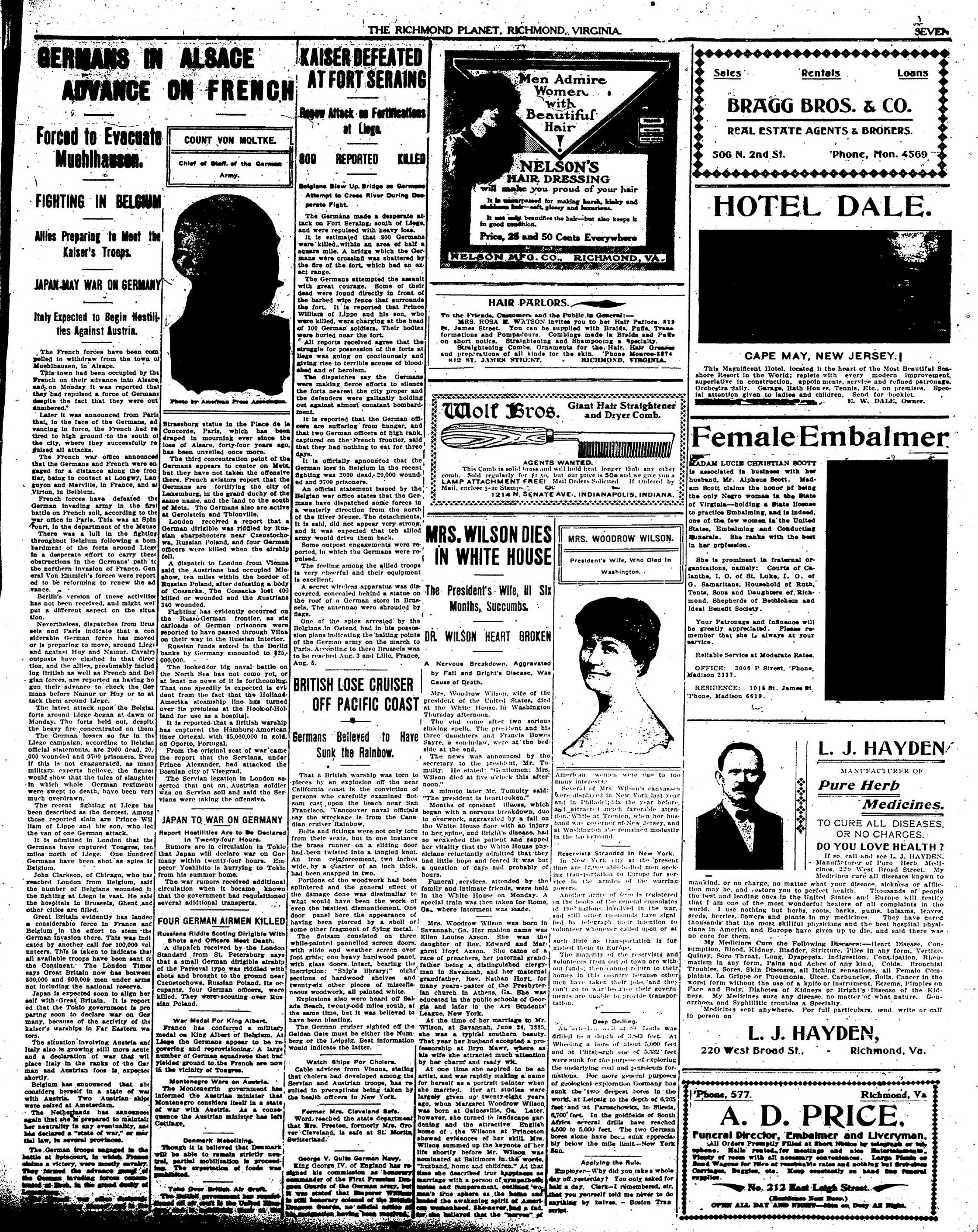
Chief of Staff of Engineer/Army
Fighting on Fratern.
Canadian Bride Blown Up by Spy.
The railroad bridge on the Lake St John railway, north of Quebec, Can. at Lake Bouchette, was blown up.
According to a report received at the war ministry, three railway employees were killed, and a treasurer, understood to be a German spy, was shot. This report has not been confirmed.
The war minister says that the bridge was apparently blown up to embarrass Canada's mobilization. As a result, orders were issued to guard all Canadian bridges with militia or special police.
One million bags of flour were contributed by the people of Canada toward the defense of the British empire. The Duke of Connaught, governor general of Canada, sent the following cablegram to the British government in London:
"My advisers request me to inform you that the people of Canada, through their government, desire to offer one million bags of flour as a gift to the people of the United Kingdom, to be placed at the disposal of his majesty's government for such purposes as may be expedient."
The gift, which represents a value of $3,000,000, was eagerly accepted by the British government and will be shipped to Liverpool in a few days on merchantmen which will be convoiced across the Atlantic by British cruisers.
Japan Is Ready to Strike.
An official at the Japanese consulate in Shanghai, China, said that upon the first receipt of the official news of the beginning of the clash of arms between England and Germany, Japan would send a fleet with 10,000 men to attack Tsing-Tau and 10,000 more to relieve the British garrisons at Tien-Tsin and Pokin. Preparations for such action, he said, were now under way.
GENERAL MARKETS
PHILADELPHIA - FLOUR firm
$3,75.49*4; city, mills, fans
Oy, $62.20
KYE FLOUR firm, at $3.85/4 per
bread. WHEAT firm; No. 2, red, 91/96
CORN firm; No. 2, yellow, 94/96
CORN firm; No. 2, yellow, 94/96
4/1c; lower grades, 41/96
POTATOES steady, at $173 per barrel.
POULTRY: Live steady; hone, 17½
18½; old rooster, 12½ to 13½. Dresse-
firm; choice fowls, 20½ to 24½. old rooster.
BUTTERFIRM; fancy creamy, 32¾.
EGGS steady; selected, 31½ to 33¾.
nearby, 28¾; western, 28¾.
Live Stock Prices
CHICAGO--HOGS hither bulk of
mixed, $9.15 to 10.15; heavy, $8.65 to
rough, $8.85 to 9.10; pigs, $8.25 to 9.80;
CATTLE hither; sheaves, $7.25 to
and feeders, $5.50 to cows and heifers,
$8.80 to 9.40; calves, $5.50 to 11.75;
SHEEP steady; sheep, $3.00 to 6.15;
wings, $6.10 to 7.05; lambs, $6.75 to
88.
All Scandinavia United.
Much satisfaction is expressed over a statement issued by the president of the Norwegian storthing, in which he said that Denmark, Norway and Sweden had agreed that, whatever happened, they would live in mutual peace.
Arrest Crank at White House. Louis Vanas, a Hungarian, believed to be insane, tried to gain access to the White House grounds in Washington. He declared that the American people wanted to kill him and that he wanted to talk to the president. He was arrested.
Mediation Offer Acknowledged. President Wilson's offer of the good offices of the United States government in the European conflict has been acknowledged by four governments—Great Britain, Austria, France and Russia. The responses are under stood to be non-committal.
German Spy Smit in England. A German spy was challenged on the Tyne bridge at Newcastle-Tyne line, and refused to step on the side of the country as ground-truthing on the bridge was deemed to be unacceptable.
---
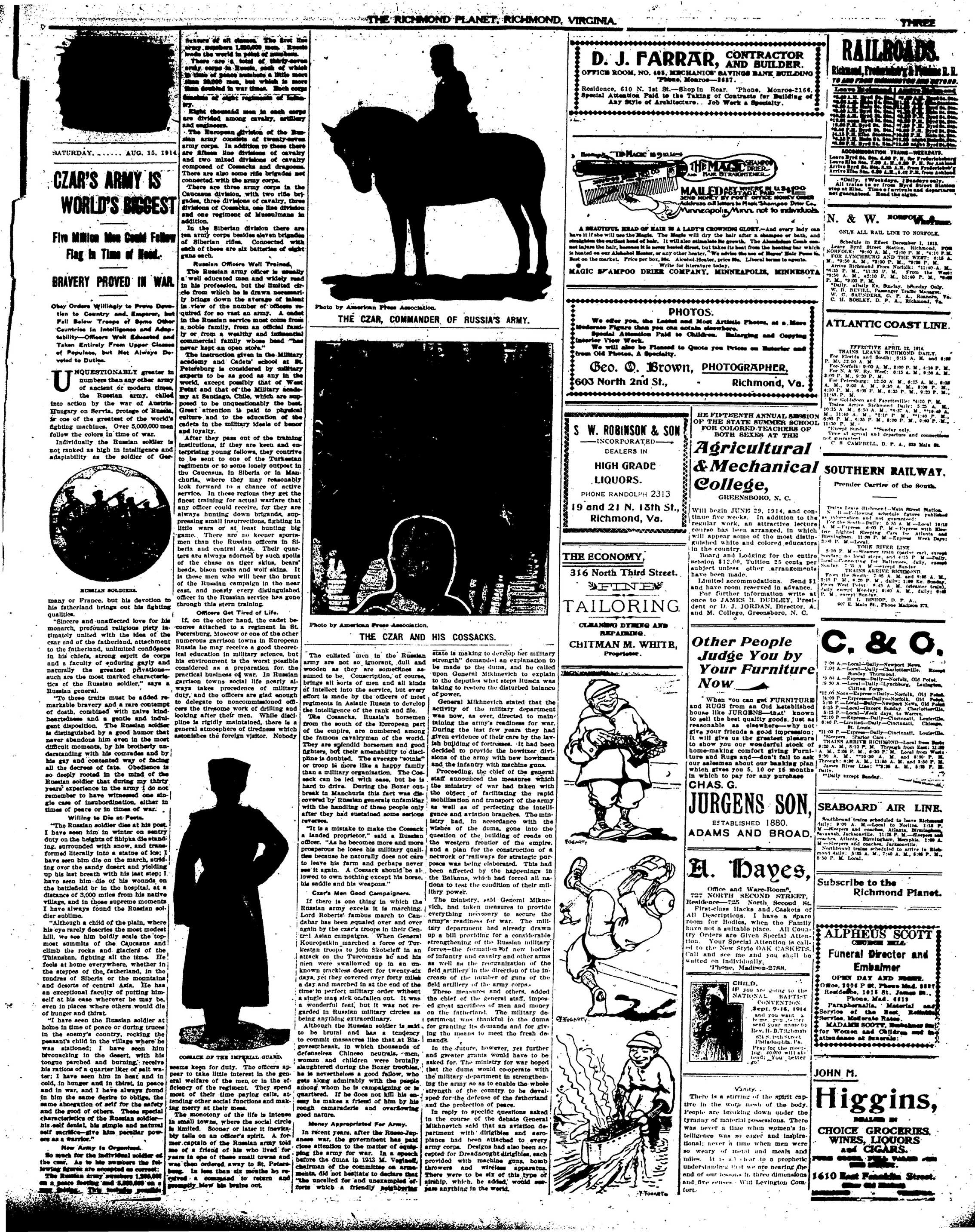
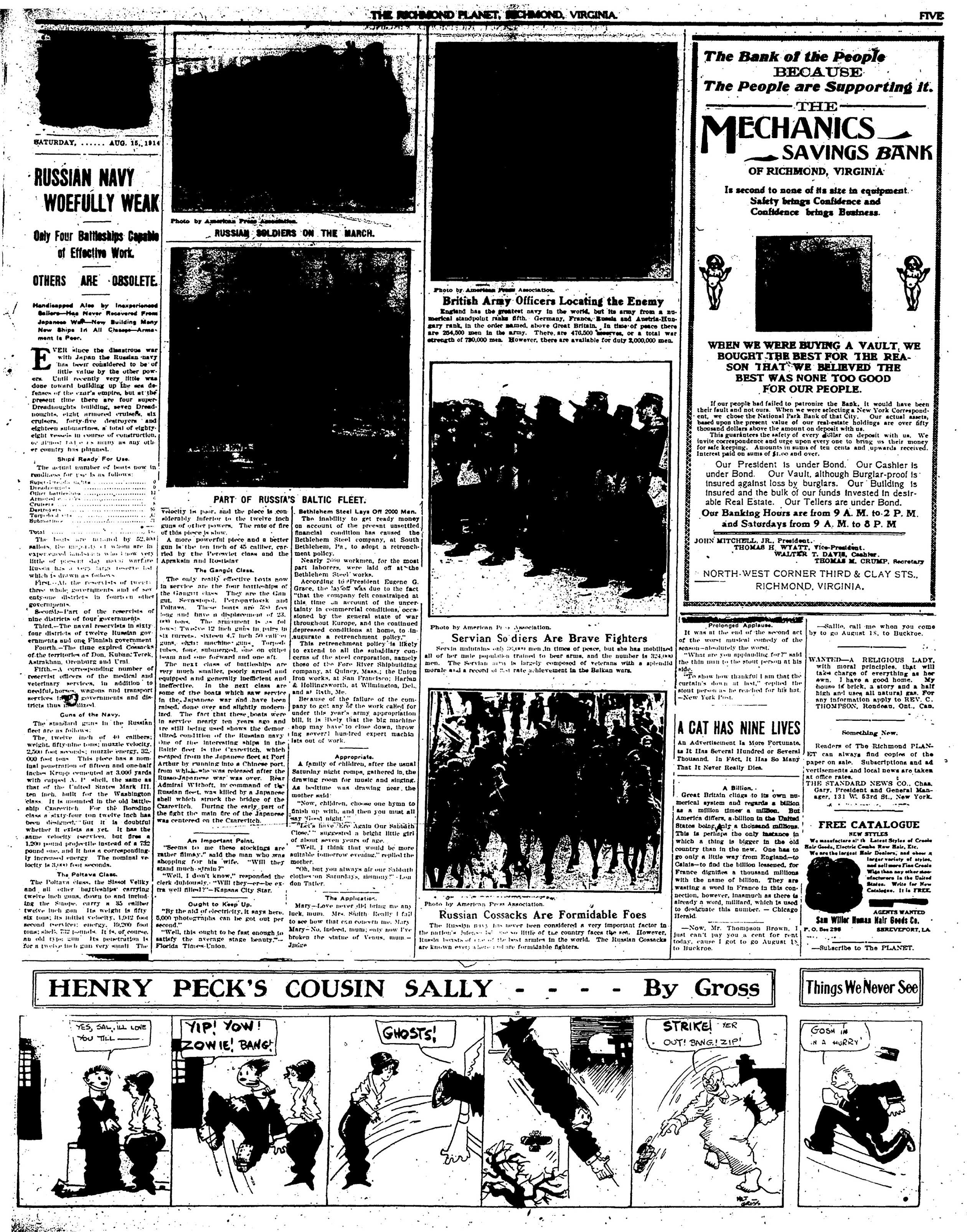
CZAR'S ARMY IS WORLD'S BIGGEST
Five Million Men Could Fellow Flag In Time of Need.
BRAVERY PROVED IN WAR.
Obey Orders Willingly to Prove Devotion to Country and. Emperor, but Fall Below Troops of Spme Other Countries in Intelligence and Adaptability—Officers Well Educated and Taken Entirely From Upper Classes of Population, but Not Always Devoted to Dutina.
UNQUESTIONABLY greater in numbers than any other army of ancient or modern times, the Russian army, called into action by the war of Austria-Hungary on Servia, protege of Russia, is one of the greatest of the world's fighting machines. Over 5,000,000 men follow the colors in time of war. Individually the Russian soldier is not ranked as high in intelligence and adaptability as the soldier of Ger-
RUSSIAN SOLDIERS
many or France, but his devotion to
his fatherland brings out his fighting
qualities.
"Sincere and unaffected love for his monarch, profound religious piety intimately united with the idea of the czar and of the fatherland, attachment to the fatherland, unlimited confidence in his chefs, strong esprit de corps and a faculty of enduring gayly and naturally the greatest privations—such are the most marked characteristics of the Russian soldier," says a Russian general.
"To these traits must be added remarkable bravery and a rare contempt of death, combined with naive kind-heartedness and a gentle and indulgent disposition. The Russian soldier is distinguished by a good humor that never abandons him even in the most difficult moments, by his brotherly understanding with his comrades and by his gay and contented way of facing all the decrees of fate. Obedience is so deeply rooted in the mind of the Russian soldier that during my thirty years' experience in the army I do not remember to have witnessed one single case of insubordination, either in times of peace or in times of war.
Willing to Die at Pasta.
"The Russian soldier dies at his post, I have seen him in winter on sentry duty on the heights of Shipka die standing, surrounded with snow, and transformed literally into a statue of ice; I have seen him die on the march, striding over the sandy desert and yielding up his last breath with his last step; I have seen him die of his wounds on the battlefield br in the hospital, at a distance of 3,000 miles from his native village, and in those supreme moments I have always found the Russian soldier sublime.
"Although a child of the plain, where his eye rarely descries the most modest hill, we see him boldly scale the topmost summits of the Caucasus and climb the rocks and glaciers of the Thianahan, fighting all the time. He feels at home everywhere, whether in the steppes of the fatherland, in the tundras of Siberia or the mountains and deserts of central Asia. He has an exceptional faculty of putting himself at his case wherever he may be, even in places where others would die of hunger and thirst.
"I have seen the Russian soldier at home in time of peace or during truces in the enemy's country, rocking the peasant's child in the village where he was stationed; I have seen him bivouacking in the desert, with his tongue parched and burning; receive his rations of a quarter liter of salt water; I have seen him in heat and in cold, in hunger and in thirst, in peace and in war, and I have always found in him the same desire to oblige, the same abnegation of self for the safety and the good of others. These special characteristics of the Russian soldier—his self dental, his simple and natural self sacrifice—give him peculiar powers as a warrior."
New Army Is Organized.
So much for the individual soldier of the war. As to his numbers the following figures are accepted as correct: The Russian army numbers 1,200,000 on a pane footing and 5,800,000 on a new footing. This includes positions 10,100.
Auretum of all classes. The first line
army, numbers 1,500,000 men. Russia
becomes the world in point of numbers.
There are a total of thirty-six
army corps in Russia, each of which
in time of peace numbers a little more
than 20,000 men, but which is more
than doubled in war times. Each corps
simulates of eight regiments of Infantry.
Eight thousand men in each corps
are divided among cavalry, artillery
and engineers.
The European division of the Russian army consists of twenty-seven army corps. In addition to these there are fifteen line divisions of cavalry and two mixed divisions of cavalry composed of Comsacks and dragons. There are also some rifle brigades not connected, with the army corps.
There are three army corps in the Caucasus division, with two rifle brigades, three divisions of cavalry, three divisions of Comsacks, one line division and one regiment of Musulmana in addition.
In the Siberian division there are ten army corps besides eleven brigades of Siberian rifles. Connected with each of these are six batteries of eight guns each.
Russian Officer Well Trained.
The Russian army officer is usually a well educated man and widely read in his profession, but the limited circle from which he is drawn necessarily brings down the average of talent in view of the number of officers required for so vast an army. A ousted in the Russian service must come from a noble family, from an official family or from a wealthy and influential commercial family whose head "has never kept an open store."
The instruction given in the Military academy and Cadets' school at St Petersburg is considered by military experts to be as good as any in the world, except possibly that of West Petat and that of the Military academy at Santiago, Chile, which are supposed to be unquestionably the best. Great attention is paid to physical culture and to the education of the cadets in the military ideals of honor and loyalty.
After they pass out of the training institutions, if they are keen and enterprising young fellows, they contrive to be sent to one of the Turkestan regiments or to some lonely outpost in the Caucasus, in Siberia or in Manchuria, where they may reasonably look forward to a chance of active service. In these regions they get the finest training for actual warfare that any officer could receive, for they are always hunting down brigands, suppressing small insurrections, fighting in little wars or at least hunting big game. There are no keener sportsmen than the Russian officers in Siberia and central Asia. Their quarters are always adorned by such spoils of the chaso an tiger skins, bear's heads, bison tusks and wolf skins. It is these men who will bear the brunt of the Russian campaign in the near east, and nearly every distinguished officer in the Russian service has gone through this stern training.
Officers Get Tired of Life.
If, on the other hand, the cadet be comes attached to a regiment in St Petersburg, Moscow or one of the other numerous garrison towns in European Russia he may receive a good theoretical education in military science, but his environment is the worst possible considered as a preparation for the practical business of war. In Russian garrison towns social life nearly always takes precedence of military duty, and the officers are glad enough to delegate to noncommissioned officers the tiresome work of drilling and looking after their men. While discipline is rigidly maintained, there is a general atmosphere of tiredness which astonishes the foreign visitor. Nobody
```markdown
```
COBLAK OF THE INMIRAL GUARD
neems keen for duty. The officers appear to take little interest in the general welfare of the men or in the efficiency of the regiment. They spend most of their time paying calls, attending other social functions and making merry at their mess.
The monotony of the life is intense in small towns, where the social circle is limited. Sooner or later it inevitably tells on an officer's spirit. A former captain of the Russian army told me of a friend of his who lived for years in one of these small towns and was then ordered, away to St. Petersburg. In less than six months he received a command to return and promptly blew his brains out.
THE RICHMOND PLANET, RICHMOND, VIRGINIA.
```markdown
```
THE CZAR, COMMANDER OF RUSSIA'S ARMY.
THE NEW YORKER
The collated men in the Russian army are not so ignorant, dull and wooden as they are sometimes assumed to be. Conscription, of course, brings all sorts of men and all kinds of intellect into the service, but every effort is made by the officers of most regiments in Anatolic Russia to develop the intelligence of the rank and site.
The Cossacks. Russia's horsemen from the south of the European part of the empire, are numbered among the famous cavalrymen of the world. They are splendid horsemen and good fighters, but their amenability to discipline is doubted. The average "totals" or troop is more like a happy family than a military organization. The Cossack can be led with ease, but he is hard to drive. During the Boxer outbreak in Manchuria this fact was discovered by Russian generals unfamiliar with the handling of these people only after they had sustained some serious reverence.
"It is a mistake to make the Cossack a landed proprietor," said a Russian officer. "As he becomes more and more prosperous he loses his military qualities because he naturally does not care to leave his farm and perhaps never see it again. A Cossack should 'be allowed to own nothing except his horse, his saddle and his weapons."
Cxara's Men Good Campaigners
If there is one thing in which the Russian army excels it is marching. Lord Roberts' famous march to Candahar has been equaled over and over again by the czar's troops in their Central Asian campaigns. When General Kouropatkin marched a force of Turkestan troops to join Skobleeff in an attack on the Turcomans he and his nien were swallowed up in an unknown trickless desert for twenty-six days, yet they covered over forty miles a day and marched in at the end of the time in perfect military order without a single mug slick or fallen out. It was a wonderful feat, but it was not regarded in Russian military circles as being anything extraordinary.
Although the Russian soldier is said to be brutal and has a tendency to commit massacres like that at Blagovestcheensk, in which thousands of defenseless Chinese neutrals, men, women and children were brutally slaughtered during the Boxer troubles, he is nevertheless a good fellow, who gets along admirably with the people among whom he is campaigning or is quartered. If he does not kill his enemy he makes a friend of him by his rough camaraderie and overflowing good nature.
Money Appropriated For Army.
In recent years, after the Russo-Japanese war, the government has paid close attention to the matter of equipping the army for war. In a speech before the duma in 1913 M. Vergini, chairman of the committee on armaments, did not hesitate to declare that "the uncalled for and unexamined efforts which a friendly neighbouring
state is making to develop her military strength" demanded an explanation to be made to the duma, and he called upon General Mikhnevich to explain to the deputies what steps Russia was taking to restore the disturbed balance of power.
General Mikhnevich stated that the activity of the military department was now, an ever, directed to maintaining the army's readiness for war. During the last few years they had given evidence of their care by the lavish building of fortresses. It had been decided to provide the howitzer divisions of the army with new howitzers and the infantry with machine gun.
Proceeding, the chief of the general staff announced the measures which the ministry of war had taken with the object of facilitating the rapid mobilization and transport of the army as well as of perfecting the intelligence and aviation branches. The ministry had, in accordance with the wishes of the duma, gone into the question of the building of reads on the western frontier of the empire, and a plan for the construction of a network of railways for strategic purposes was being elaborated. This had been affected by the happenings in the Balkans, which had forced all nations to test the condition of their military power.
The ministry, said General Miknevich, had taken measures to provide everything necessary to secure the army's readiness for war. The military department had already drawn up a bill providing for a considerable strengthening of the Russian military forces—the formation of new bodies of infantry and cavalry and other arms as well as the reorganization of the field artillery in the direction of the increase of the number of guns of the field artillery of the army corps.
These measures and others, added the chief of the general staff, imposed great sacrifices of men and money on the fatherland. The military department was thankful to the duma for granting its demands and for giving the means to meet the fresh demands.
In the future, however, yet further and greater grants would have to be asked for. The ministry for war boped that the duma would co-operate with the military department in strengthening the army so as to enable the whole strength of the country, to be developed for the defense of the fatherland and the protection of peace.
In reply to specific questions asked in the course of the debate General Mikhnevich said that an aviation department with dirigibles and aeroplanes had been attached to every army corps. Designs had also been accepted for Dreadnought dirigibles, each provided with machine guns, bomb throwers and wireless apparatus.
There were to be six of this type of ship, which, he added, would surpass anything in the world.
OFFICE ROOM, NO. 405, MECHANICS' SAVINGS BANK BUILDING
'Phone, Monroe—2637.
Residence, 610 N. 1st St.—Shop in Rear. 'Phone, Monroe-2166.
Special Attention Paid to the Taking of Contracts for Building of
Any Style of Architecture. Job Work a Specialty.
THE MAGIC SHAMPOO DRIER
AND HAIR STRAIGHTENER
MAILED AT WHERE IN U.S.A. 100
22ND MONLY BY POST OFFICE MONEY ORDER
Address all letters to Magic Shampoo Drier Co.
Minneapolis, Minn. not to individuals.
A BEAUTIFUL HEAD OF HAIR IS A LADY'S CROWNING GLORY.—And every lady can have it if she will use the Magic. The Magic will dry the hair after a shampoo or bath, and straighten the earliest head of hair. It will also stimulate its growth. The Aluminum Comb can infuse the hair, because it is never heated back, but takes its heat from the heating bar which is heated on our Alcohol Hater, or any other heater. We advise the use of the Hair 'Hair Foam' in Bed on the market. Price per box, $84. Alcohol Hater, price $84. Liberal terms to agents.
Write for literature today.
MAGIC AMPOO DRIER COMPANY, MINNEAPOLIS, MINNESOTA
PHOTOS.
We offer you, the Latest and Most Artistic Photos, at a More Moderate Figure than you can obtain elsewhere.
Special Attention Paid to Children. Enharging and Copying Interior View Work.
We will also be pleased to Quote you Prices on Interior and from Old Photos, A Specialty.
Geo. O. Brown, PHOTOGRAPHER,
603 North 2nd St., Richmond, Va.
HIGH GRADE LIQUORS.
PHONE RANDOLPH 2313
19 and 21 N. 18th St.,
Richmond, Va.
THE ECONOMY,
316 North Third Street.
CLEANING DYING AND
REPAIRING.
CHITMAN M. WHITE,
Proprietor.
FOGADTY
FOGADTY
F. FOGADTY
HE FIFTENTH ANNUAL SESSION OF THE STATE SUMMER SCHOOL FOR COLORED TEACHERS OF BOTH SEXES AT THE
Agricultural &Mechanical College,
GREENSBORO, N. C.
W begin JUNE 29, 1914, and continue five weeks. In addition to the regular work, an attractive lecture course has been arranged, in which will appear some of the most distinguished white and colored educators in the country.
Board and lodging for the entire session $12.00. Tuition 25 cents per subject unless other arrangements have been made.
Limited accommodations. Send $1 and have room reserved in advance.
For further information write at once to JAMES B. DUDLEY, President or D. J. JORDAN, Director. A. and M. College, Greenboro, N. C.
Other People Judge You by Your Furniture Now
When you can get FURNITURE and RUGS from an Old established house like JURGBNS—that' known to sell the best quality goods. Just as reasonable as elsewhere—why not give your friends a good impression; It will give us the greatest pleasure to show you our wonderful stock of home-making comfort giving Furniture and Rugs and—don't fail to ask our salesmen about our banking plan which gives you 5, 10 or 15 months in which to pay for any purchase CHAS. G.
ESTABLISHED 1880. ADAMS AND BROAD.
E. Hayes,
727 NORTH SECOND STREET,
Residence—725 North Second St.
First-class Hacks and Caskets of
All Descriptions. I have a spare
room for Bodies, when the Family
have not a suitable place. All
Country Orders are Given Special Attention. Your Special Attention is called to the New Stylo OAK CASKETS. Call and see me and you shall be waited on individually.
Phone, Madison-2788.
CHILD.
If you are going to the
NATIONAL BAPTIST
CONVENTION
Sept. 9-16, 1914
and you want a home, you better
send your name to
Rev. H. B. Tischman
6045 10th Street
Philadelphia, Pa.
Pray for the meeting.
4000 will attend.
You better go.
Vanity.
There is a stirring of the spirit captive in the work mesh of the body. People are breaking down under the tyranny of material possessions. There was never a time when women's intelligence was so eager and inspirational; never a time when men were so weary of metal and meals and miles. It is all clear to a prophetic understanding that we are nearing the end of our lessons in three dimensions and five reuses. Witt Levington Comfort.
THREE
ACCOMMODATION TRANS—WEEKDAYS.
Loews Bld. St. Sq. Ben. 6.00 P.M. For Frederickshire
Loews Bld. St. Sq. Ben. 6.00 P.M. For Anchorage
Artrite Bld. St. Sq. Ben. 6.00 P.M. For Anchorage
Artrite Bld. Sq. Ben. 6.00 A.M. .5.00 P.M. From Anchorage
*Daily, 5 Weekdays. 5 Sundays only.
All trains to Anchorage depart at stop at Kite. Time of arrival and departures not guaranteed. Read the signs.
N. & W.
ONLY ALL RAIL LINE TO NORFOLK.
Schedule in Effect December 1, 1913.
Leave Byrd Street Station, Richmond, FOR
NORFOLK. *8:00 A. M. *8:00 P. M. *8:40 P. M.
FOR WORK AND THE WEST: *6:15 A. M.
*8:00 A. M. *8:00 P. M.
Arrive Richmond From Norfolk. *8:40 A. M.
*8:35 P. M. *11:00 P. M. From the West.
*8:50 A. M. *8:20 P. M. b1:40 P. M.
P. M. *9:00 P. M.
*Daily*, *baily Ex*. *Bunday*, *Bunday Ouly*
W. B. *BENKILI*, *Passenger Traffic Managew*
W. C. *SAINDERS*, *G. P. A.*, *Ronanova*, *Va. C. H. BOLGIL*, *D. P. A.*, *Richmond, Va.*
ATLANTIC COAST LINE
EFFECTIVE APRIL 12, 1914.
TRAINS LEAVE RICHMOND DAILY.
For Florida and South: 8:15 A. M. and 6:00
P. M. 12:50 A. M.
Foer-Norfolk: 9:00 A. M. 8:00 P. M. 4:10 P. M.
1:00 P. M. 8:15 A. M. 9:50 A. M.
2:00 P. M. 9:30 P. M.
For Petersburg: 12:50 A M, 6:15 A M, 8:18
A M, 9:00 A M, 9:50 A M, 8:08 P M,
4:10 P M, 6:05 P M, 6:35 P M, 9:20 P M,
11:45 P M.
For Gollomb and Favretteville: *4:10 P. M.
Trains Arrive Richmond Daily: 5:55 A. M.
10:15 A. M. 6:50 A. M. *8:37 A. M. *10:19 A.
M. 6:50 A. M. *10:19 A. M. *11:40 P. M.
6:40 P. M. 6:55 P. M. 8:00 P. M. 9:00 P. M.
11:30 P. M.
*Except Sunday* *Sunday only.
Time of arrival and departure and connections
not guaranteed.
C 8 CAMPBELL, D. P. A., 639 Main St.
SOUTHERN RAILWAY.
Premier Carrier of the South
Train Leave Richmond - Main Street Station
published as information and not guaranteed.
1:30 P. M. -- Steamer train (parlor car), except
Sunday; no local stops, and 1:45 P. M. -- Daily,
local -- Connecting to Baltimore, daily, except
Sunday; no local stops, except Sunday
TRAINS ARRIVE (HOUNDSTOCK)
From the South: 7:05 A. M. and 8:45 A. M.
1:25 P. M. 2:00 P. M. daily; 1:00 Kr. Sunday.
From West Point: 8:45 A. M. (steamer train),
daily except Monday; 8:00 A. M. daily; 8:00
P. M. parent HIPOP, P. P. A.
9:27 P. M. Main St., Phone 777-2222
C. & O.
7:00 A.—Local—Daily—Newport News.
7:01 A.—Local—Daily—Charlottsville. Receipt
Bunlay Thurmond.
7:01 A.—Express—Daily—Norfolk, Old Potts.
7:03 A.—Local—Daily—Lynchburg, Lexington,
Citizen's Journal.
*12:00 Noon—Express—Daily—Norfolk, Old Pole.
0:00 P—Express—Daily—Norfolk, Old Pole.
1:00 P—Local—Daily—Newport News, Old Pole.
1:15 P—Local—Accept Sunday, Charleston, Va.
1:15 P—Local—Accept Sunday, Charleston, Va.
1:20 P—Express—Daily—Cincinnati, Louisville,
6:00 P—Limited—Daily—Cincinnati, Chicago,
St Louis.
*12:00 P—Express—Daily—Cincinnati, Louisville,
Sterling, Sharp Corp.
TRAINS ARRIVE RICHMOND—Local from Bristol
9:20 A. M. 8:10 P. M. Through from East: 11:58
A. M. 2:04 P. M. 8:30 P. M. Local from West:
8:30 P. M. End and 9:00 P. M.
Through: 8:30 A. M. 11:58 A. M. and 8:50 P. M.
James River Line; *9:36 A. M. and 8:58 P.
Daily.
SEABOARD AIR LINE
Northbound trains scheduled to leave Richmond daily: 9:00 A. M.-Local to Norfolia. 1:18 P. M.-Sleepers and coaches, Atlanta, Birmingham, Savannah, Jacksonville. 11:30 P. M.-Sleepers and coaches, Atlanta, Birmingham, Memphis. 1:40 A. M.-Sleepers and coaches, Jacksonville.
Northbound trains scheduled to arrive in Richmond daily: 8:35 A. M., 7:40 A. M., 8:06 P. M., 6:50 P. M. Local.
Subscribe to the Richmond Planet.
ALPHEUS SCOTT
CHURCH HILL
Funeral Director and
Embalmer
OPEN DAY AND NIGHT.
Office, 2006 P St. Phone Mad. 8887
Residence, 1015 St. James St.
Phone, Mad. 6619
Paraphernalia, Material and
Service of the Best, Reliefs
Service, Moderate Rates.
MADAMN SCOTT, Embalmer Bar
for Women and Children and the
attendance at funerals:
Higgins,
DEALER IN
CHOICE GROCERIES,
WINES, LIQUORS
and CIGARS.
FARM CROSS, PARK, VIEW AND
WEST MARKET.
1610 East Franklin Street.
Glen Old Manor
| HENRY PECK’S COUSIN SALLY - - - - By Gross
‘ : YES, SAU, WL Love we! Yow! \- “y). fem oe oe , “YE
+ ee _ MZow te! Be! oS a, /-_ a (. Sraversei_)
I eS ‘a a 5 i ff iN INA / LES
6 Beas GE OS No
' Me eo ip Ae
: cn, , Ng 4 Sis 4 | Key,
a a 4 s, wr 7 | ‘ g - , , - as? : “<A: ‘ 1] : |
Gia =F ee A\\ Re i ie ee S t. * :
RUSSIAN NAVY —
“WOEFULLY WEAK
Only Four Battleships Capable
‘ot Effective Work
OTHERS ARE OBSOLETE.
Handicapped Ales by Inexperienced
Baillere—tHae Never Recovered From
Japanese We—New Building Meny
New Ships In All Chasepe—Arma-
ment te Peer,
VE xluce the disastrous war
with Japan the Russlan -navy
‘bin bevir cobsldered to be’ of
little value by the other pow-
em Until revently very tte was
dove tuwnnt building up the sea de-
Tenses of the ezare empire, but wt the
Present thne there are four super
Dreadnougsbts building, seven Dread-
honghta, elsht armoured cruise, als
crulmers, forty-five deatruyom * and
edghteen submarines, ab total of elgbty-
eight teaein tn cuure of cunstructien,
ve abhest Tate as many un any othe
er country bas plannet.
: Ships Ready For Use.
The vctual number ef bowte gow tn
pest hieccccsac! Hiaeercca: Hesse, Bacbbioucer
Bunt ei itecctie Getto ccee cee eeeeeeees Ol
Dieasteoncn eeepmsettsuesstesteeee iN
Other battleniie oigecia eee
Alsielnes Ueland 8
Cruinete: sa: 4 savestesdl essay enester
Derttnyers 0 ARNLITY
Torprrhe torte eee, teeeeesencers ae as
Bubrrwrine ne sasrensesdess atasestusers ob
c=
Wi cecee, ceva cxdwagt™ wea Decwaccscteiee
The beste are tired by Soe
pallets, the ane gents ef when are fa
caper suerd jandsis a wile bow very
Uttle of qeesent day uotas warfire
Russia has a tests lara teserte Lest
which fs drewn as fotos
FING AL the resorsiats of twents
three whole, gevernunents sant of sev
enty-one distrters ly fonrteen other
gorerninents,
Becordty-Part of the reserviits of
nine districts of four governments
Third.—The naval reservinta tn wixty
four districtn of twelve Runaan gor:
ernments aud ong Finnish government
Fourth.—The tine expired Coaxacks
of.the territortes of Don, Kubun: Terek,
Astrakhan, Orenburg and Ural.
Fifth.—A corresponding number of
reserrist Meer of the mevical and
veterinary services, in addition" to
Beedful, horses, waguns and transport
nervices ae severninents and dis
tricta thus TMi zed,
Guns of the Navy.
The xtaniiind gine inthe Rusatan
fect are as foiluws: :
The, twelve inch of 400 caliber:
welght. dfty-nine tonx; marzle velocity.
2500 foot mevords: muzzle energy, 32;
000 four tons This plece bax a nom:
tual penetention of fifteen and onebalt
ines Keepy cemented at 3000 yards
with capped A. Pf xhell, the aame as
thar af the Cufted States Mark IT. |
ten fuch, bullt for the Wasbington
‘olaxs, It te nonutedt tn the old battle
sbip Canreviteh For thé Bomdino
clase a stxty-four ton twelve Inch has
deen dénisned "Gut if ta doubtful
whether It vxitts an yet It bas the
anme velocity (servies. but Ores a
1.200 ponnd projectile instead of a TH
Pound une. und It has a corresponding:
ly increta) energy The nominal ve.
locity ta 8.000 font xeconds.
The Poltava Class,
The Poltavn Gluss, the Stavot Veltky
and wll other “bustlesbips’ carrying
Cwelte net vans, doven to and tnetud:
ing the Siuupe, carry mn 3S enllber
tweve Inch gan Ite welght ts fifty
six tuna: Hts futlat veluetty, LOZ toot
necund (ervicer: energy. 19,200 foot
tons: xed, T32 ponds, If, of coure.
ap old type: cin Ets: peuetratyn te
for n twelve teh gun ery sinnt) The
= = Tee ee eee >
toe ee aia gk ma
oe Are yoy co eesieriiamesl pons : “ ee
Sempesee ts PE: . aN
= te ee * i
et
, ot
ey : Bee axe J
eat Nee ee ek 5 ial ie
vt eee Sn
Photo by Amertoan Préeas Agsedinticen, _ .
_, RUSSIAN: SOLDIERS ‘ON THE MARCH.
Sydnee neem
eee te Pere oe
> ae Pe a 3
See aa oN
a
ic 4 aa E > Bo
mers, i Pe
ee
[ cae
a Cia .
<i SET ie Tp’
PORTE AVE :
pe Ls a
oe
ha wo :
PART: OF RUSSIA’S BALTIC FLEET.
‘Y¥ewoctty In puor. and the plece is con
alderobly infertor to the twelte inet
Runs of ether powers, The rtg of fire
of thin piece js low,
| A more powerfnt plece and a better
| gon tn'the ten tneh of 4% caliber, car
Ted by the Bervaviet clans and the
| Aprakain and Rowivine
The Gangut Claas,
The only realy effective tits now
fn service are the four battleship of
the Ganget cise They are the Gan
ut, Sevastopel, Petropaviossk snd
Poltnva, These bante ane fish feet
tong and) Dave nm displacement of 23.
OW tom, The armament ts as fol
tows: Tweive 12 theh gis tn pate in
sia turrets. sixtewn 4.7 tneh 50 enlier
gunk. eet: machines guns, Torpedh
tubes, fone, subunerget, ine on elttet
team and one forward and one aft.
The next cliaw of battleships are
very much xmaller, poorly armed wnt
equipped and generally Inefictent and
ineffective. In the next clans are
rome of the bonts which aaw rervice
fn the, Japanese war find -have been
rained. done over and lightly modern.
ized. The fact that these boats wer
in nervice nearly ten searm ago and
tre ati being used shows the demor
Alized. condition of the Roxaian nary
One of the Intereating rhtpa in the
Raltte Seor ts the Czareviteh, whieh
escaped from the Japanese Geet at Port
Arthur by running Into a Chinese port.
from whik- ste was lensed after the
Rusao-Japanene war’ waa over. Rear
Admiral Withoft, in command of thy
Roraian fleet. was killed by a Japanese
abel which atrick the bridge of the
Cxarevitch. During the carly. part of
the fight the main fire of the Japanese
was centered onthe Crareviteb,
Am Important Point. , of ab
“Seems to me there stockings are’ “W
rather filmay.” naid the man who xen Aultat
abopping for bin ‘wife. “WIN they mothe
stand much. strain 7 a Oh
Well, I don't know.” responded the clothi
“clerk duptounty,- “WI! they—er—be ex- don T
tra well filled ?"—Kapsna City Star,
A aii '
Ought to Keep Up. ‘Mar
“By the ald of electricity, It magn here. luck,
$000 photoztaphs can be got oUt per to see
second.” Mec:
“Well, this ought to be fat enough to MA
sattafy the average stage beauty.- broke
Florida Times-Unton. Jinixe
pi
Se
PECK’S C¢
rs
Ye! Yow!
ow te! Bader
|. Bethichem Steel Lays Off 2000 Men.
Tho inabiiity to get ready money
on account of the preexnt unsettled
financial condition han caused — the
Bethlehem Steel company, at South
Bethlehem, I's, to adopt a retronch:
ment policy.
Nearly 260 workmen, for the mos!
part Inborers, were lafd of at tho
Bethichem Steel’ works.
According té President Eugene G.
Grace, the tay was due to the fact
“that the company felt constraiped at
thig, time sn account of the unrer.
tainty In commercial conditions, occn-
sioned by the general state of war
throughout Europe, and tha continued
Aepresned conditions at home, to .tn-
mugurate a retrenchment poltcy.”
| Thin retrenchment policy “ia Mkely
to extend to all the aubaldlary con-
cerns uf the steel corporation, namely
those of the Fore River Shipbuilding
company, at Quincy, Maas.; the Union
Iron works, at San Francisco; Harkaa
& Hollinesworth, at Wilmington, Del.,
and a? itxth, Me.
Berause of the fallure of the com:
pany to get any Bf the work caHed for
under this year's army, appropriation
DIN, it Js HHkely Mat the big machine
shop may have to close down, throw
Ing nevers] hundred expert machia
ists out of work.
Appropriate,
A family of children, after the usual
Satuniny nicht romps, gathered In, the
dmwing room for muste and aftsing.
As bedtime woe dmwing near, the
mother wxfd:
“Now, children, choowe one hymn to
Snish up with, and then you must all
Saas (Gord mbght! 7
TALS hinte “Ere Again Our Sabbath
Closes" wuggested a bright Mtue git
of about seven years of age,
"Well, think that would te more
aultatle tomorrow evening.” replied the
mother.
“Oh, but you always alr our Sabbath
clothes -on Satundays, rimmeny! = Lea
don Tatler. + Ro
The Application.
Mary—Love never dit tring me ans
luck, mum. Mra. Sintth: Really 1 fail
to see bow that ern cuncert tue, Mary
Mary-No, forleed, tnum; eniy now Dre
broken the statue of Venus, mum. —
Indice
LASS xg iy i] a
{ Pe SS be a y ;
tea) 9 ‘.
SS a Bacal a
BE aomies wR Lo
aa. Pare
‘on Pe 8 od
’ 7 en ; ff % |
-_ m a J ‘
aaa eT er Ten
, ees tay Ke WZ rary.
| g hAapeaey -«* eee ge. Pe: sf
\ 1 dy tate cs ie eet NER
MeO PEE Re Se Pee Saas
GN SS ESOT EK pat oR Se
Russian Cossacks Are Formidable Foes
The Russian mivy bas never been considered a very tmportant factor tn
the nation’s luferns. int ise se Httle of tue country faces the ret. However,
Russia beasts of ene of the best armies in the world. The Russlan Cossacks
are known ever: vivre ord are formidable fighters. a
The Bank. of the People
a BECAUSE
The People are Supporting it.
MECHANICS _»
S ~» SAVINGS BANK
; OF RICHMOND, VIRGINIA
Is second to none of its size in equipment. -
Safety beings Confidence and
Confidence brings Bosiness. ~
, Fu
y i
WHEN WE WERE BUYING A VAULT, WE
. BOUGHT-THE BEST FOR THE REA-
SON THAT“WE BELIEVED THE
BEST WAS NONE TOO GOOD Y
' FOR OUR PEOPLE.
Hour people bad failed to patronize the Baok, it would have been }
thelr fault end not ours, When we were selecting « New York Cortespond:
“gat, we chose the National Park Dank of that City. Our actual atscta,
based upon the present value of our real-estate holdings are over fifty
| Chowsand dollars bore the amount on deposit with us. : — |
: This guarantees the safety of every @vllar on deposit with us, We
| tavite correspondence and urge upon every one to bring vs their money §
for mae keeping, | Auiounts it wume of tell cents and upwards received. §
} Interest paid on sums of $1.00 and over. / :
| Our President 1s under Bond. Our Cashleris
| under Bond. Our Vault, although Burglar-proof is" &
| {insured against loss by burglars. Our’ Building Is
insured and the bulk of our funds Invested tn desir- 8
able Real Estate. Our Tellers are under Bond. e
_Oor Banking Hoors are from 9 A.M. to-2 P.M. }
and Saturdays from 9 A, M. to 8 P. M iS
JOHN MITCHBLL, JR.. Presideat.- . A *
THOMAS H. WYATT, Vice-President. is
: WALTER T. DAVIS, Cashier. é
- THOMAS M. CRUMP, Recretary
~ NORTH-WEST CORNER THIRD & CLAY STS., j
~ RICHMOND, VIRGINIA.
EILEEN EXER pire gs ee me erp ee ae ager eS
_
——
. Photo by. Amertean fveus Association. - | am .
British Army Officers Locating the Enemy
Engtand bas the greatest onvy tn the world, but Its army from a no-
merical standpoint rinks @fth. Germany, France, Buesia sod Austria-Hun-
gary rank, in the order mamed. atwre Great Britain. In thme-of peace there
are 254,500 men in the army. There, are 470.500 ‘weerves, or a total war
etrength of 780,000 men. However, there are available for duty 2,000,000 men.
EY ~
eto rs B > 2. ;
Be OS Pi 7 a Lm
ae RA a ; aca
a n Fy i
} H 3
% a fi
P ar ae | 2
» 3 ‘ oa:
& oe ee :
4 , ba PM
7 i? ae
| _. r
a “2 :
—-:)[ =~
eget s 7 ; we. Tbe Pel i
: : Sty ieee all hy |
he os ae . Te eee
a sg ISS MP ei ss
Grats _ t ek ee ee
Proionded Applause. ~—
Photo by American Pr -» .A\naociation. ve
. Servian So'diers Are Brave Fighters
Servin maintains only Soc men Jin times of peace, but she has mobtiized
aD of ber male populatien trained to beat arms, and the number tn 324,000
men. The Servian aimy tx largely composed of veterans with a splendid
morale anda recund ol Sst rate achievement tm the Balkan ware,
It wan nt the end of the sevond act
of the worst musical comedy of the
Reason —Obsulutely Che wort,
“What are yeu applauding fer?” xald
the thin man te the stout permoy at bis
mide. : :
“To show how thankful [am that the
curtain’s down at best,” tepled the
Aout person as he reached for Mis hat,
—New York Post.
An Advertisement Is More Fortunate,
ts It Lins Gereral Hundred or Several
Thousand. In Fact, It Has So Many
That It Never Really Dies.
| A Billion.
. Great Britain cliaga to its own nv.
merical system avd regards s billion
les a million timer a milton, Bot
America differs, a.billion tn the United
States bolng gals a thousend millions.
‘This ia pertiapa tho only taatance fn
which a thing ts bigger in the old
country than in tho new. One has to
go only a Iittle way from England—to
Calais—to find the billion lessened, for
France dignifies a thousand millions
with the name of billion, They are
wanting a wont In Franco fa this con-
nection, bowever, Inasmuch an there ts
already a word, millinrd, which 1s used
to designate thls number. — Chicago
Herakt. :
—Now, Mr. Thompson Brown, I
Just can't pay you a cent for rent
today, cause I got to go August 1S
to Buckroe.
FIVE
Sallie, call ‘me when you come
by to go August 15, to Buckroe.
WANTED—A RELIGIOUS LADY,
with moral principles. that will
taxes charge of everything as her
evn. I hare a good home. My
touse if brick, a story and a half
high anc! useq all natural gan. For
any information apply to REV. C.
THOMPSON, Rondeau, Ont., Can.
Something New.
Readers of The Richmond PLAN-
ET can always find copies of the
paper on sale. Subscriptions and ad
vertisementa and local nows aro takem
at office rates, t
THE STANDARD NEWS CO.. Chas,
Gary, Preatdent and General Man-
ager, 131 Wi 53rd St., New York
Ao ewww ce ees
- FREE CATALOGUE
NEW STYLES
We masufactare al! th Latest Styles of Cresta
Bair Geeda, Ciectria Combe Rew Bair, Lie,
We arethe largest alr Dealers; nad shew x
lneger variety of styles,
nad sel! mere Fine Creele
‘Wigs than any ether soe
‘wfacterers In the United
Binion. Write for New
Cotaletee. [tis TREX.
~ Aeewre Watrrn
larger variety Of styles,
nad sel! more Fine Cresie
‘Wigs than any ether mes
‘wtacterers In the United
Bintes. Write for New
Catalogo. [tis FREZ.
Sam Willer Homan alr Geeds Ce, -
P.O, Ber 298 z SERCVEPFORT, LA
* _-guuserite to The PLANET.
Things We Never See
Gosu | 7
; 8 = :
, a .
i <i
THE TRIPLE ALLIANCE
The Triple Alliance
Germany, Austria and Italy Joined In Strong Bond For Offensive and Defensive War
BY ERNEST WELLECK.
[Copyright, 1914, by American Press Association.]
THE triple alliance at present existing between Germany, Austria Hungary and Italy was originally formed on May 20, 1882, and renewed from time to time, the last time on Dec. 7, 1912. It was the crowning masterpiece and, next to the unification of Germany, the greatest diplomatic achievement of Prince Bismarck, Germany's great "iron chancellor." It was really the outgrowth of the dual alliance between Germany and Austria concluded on Oct. 7, 1870, and signed at Vienna by Count Andreas, then Austro-Hungarian minister of foreign affairs, and Prince Renus, at that time German ambassador at the Austrian court.
In his "Reminiscence" Prince Bismarck with remarkable censor explained the considerations which prompted him to form the alliance with Austria. He realized the necessity of protecting Germany against aggression by an alliance with another great power. An alliance with France, for obvious reasons, was out of the question. The choice was between Russia and Austria-Hungary. Bismarck did not hastate long with his decision in favor of Austria.
He knew that Russia would be a more powerful ally but with his usual acumen and almost prophetic forewedge be realized that such an alliance would in the end be fatal to the national and racial interests of the Teutonic peoples of Europe. He forewarn the tremendous growth of pan-Slavism so carefully nurtured and disseminated by Russia and aiming at the supremacy in Europe of the Slavs, with Russia as the ruling power. Bismarck knew that Austria, in a greater measure even, was threatened by the ascendancy of the Slavs and, had even more reason than Germany to fear Russian aggression and interference, particularly in the Balkan peninsula.
Austria as a Bulwark.
The preservation of Austria as a balwark against pan-Slavism was considered necessary by Bismarck to maintain the balance of power in Europe and insure the continuance of peace. Racial kinship, national traditions and common interests strongly favored Austria as the natural ally of Germany, and these considerations induced the chancellor to conclude the defensive alliance of 1870.
Under the terms of the original treaty the two powers were to combine their entire military strength for mutual support in case either of the two powers should be attacked by Russia. Should one of the two allied powers be attacked by some other power the other agreed not to support the attacking power and to preserve at least a neutral state friendly to the allied power. Should Russia support the attacking power, however, the two allies should make common cause against the enemy as if Russia had been the aggressor. The terms of the alliance were rather one sided and lacked the element of reciprocity. Under the agreement the two allied powers were bound to support one the other only against Russia. But only Austria was in imminent danger of being attacked by Russia. Germany's most dangerous enemy was
France and hot Russia. Yet, under the terms of the alliance, Austria was bound only to preserve a state of friendly neutrality should Germany be attacked by France. To protect the interests of Germany Rismark arranged in 1887 a neutrality treaty with Russia, which was canceled, however, a few years later by his successor, Carvali.
Italy entered the triple alliance in 1852, soon after the French invasion of Tunis and caused the Italian people to a point of wrath and bitterness which for the moment spite enthused all ancient grudges toward Austria and even temporarily quipped the agitation for the "resemption" of the Trentino and Triest.
This Italian bitterness toward France lasted until 1860. In its fiercest moments it provoked a tariff war which cost Italy many millions. The military expenditures necessary to keep Italy up to her engagements with her allies cost still more. As for Tunis, it remained French, and in 1850 and 1862 France and Italy recognized France in Tunis and Morocco as well. France agreed to an ultimate Italian protectorate in Triest.
With these treaties the Italian enthusiasm for the Austro-German alliance cooled visibly. The Italian desire to include in the kingdom the Italian speaking territories of Austria reasserted itself. Finally the Austrian annexation of Bosnia and Herzegovina brought Italy face to face with the possibility of a future Austrian expansion along the Adriatic in Albania, and the increasing strength of the Austrian fleet raised questions concerning the mastery of the Adriatic which profoundly stirred the whole nation.
Italy's Army Divided.
With the Tripolitian expedition the last sentimental connection with Berlin and Vienna vanished, if any still survived. From Berlin came a denunciation of Italian aggression which fairly astounded the Italians. While Paris journals viewed with calmness and even with a certain measure of sympathy Italian expansion, which French agreements had legalized, German newspapers denounced Italy as a worthless and perilous ally and gave ready currency to reports of the brutality of Italian troops.
To all these sources of Italian differences there is now added the serious change in conditions the Tripolitan annexation has brought. Henceforth for many years a large Italian army will have to be kept in Tripol. But in the event of a war between the triple alliance and the triple entente British and French factions would command the communication with the Italian peninsula, while Egyptian and Algarian armies would be able to invade Tripol itself. By her African expedition Italy has in a measure given hostages to the sea powers.
Weakened as an Ally.
As for the German aspect of the case, the Italian course toward Turkey weakened Italy manifestly as an ally since it diminished her European army and increased her vulnerability to Angle French attack. But, what was even more serious, it shattered the bonds between Germany and Turkey because, although Germany had assumed the position of a protector of Turkey and in return counted upon the Turkish army as a re-enforcement to the armies of the triple alliance, she was obliged to stand aside and permit her ally to attack and dismember her friend.
As for Austria, for nearly a dozen years the statesmen of the dual monarchy have perceived the change in the direction of Italian ambition. Trieste, the Trentino, the Bosnian annexation, the future of Albania—all of these are points where Italian and Austrian designs conflicted, and for several years Austria has been building forts from the Tyrol to the gulf of Cattaro and preparing for a conflict with Italy.
Based on Three Treaties.
The original triple alliance of 1882 was concluded for a term of five years, and when it expired in 1887 the representatives and other radical factions in Italy strongly opposed the renewal of the agreement. It required all the influence and political persuasion of Premier Crispi to bring Italy into line. In 1891 the treaty was again renewed, as it was in 1892, but with added distrust and opposition on the part of Italy. The last renewal was for a term of twelve years, and in 1904 the alliance, somewhat modified in its terms, was renewed for ten years, with the provision that any one of the contracting powers had the right to cancel its adherence to the alliance by giving notice one year before the expiration of the treaty.
The last renewal of the alliance was made on Dec. 7, 1912, two years before the expiration of the agreement, and it is understood that this premature renewal was due to the fact that certain changes in the treaty were necessary so as to make the alliance more binding in view of the expected complications in the Balkan peninsula resulting from the annexation of Bosnia and the Herzegovina by Austria and the war in the Balkans.
The triple alliance is based upon three treaties; the first between Germany and Austria, the second between Germany and Italy, and the third between Austria and Italy. The terms of the treaty between Germany and Austria are practically the same as those of the original treaty of 1870 and are directed against Russia. The German-Italian treaty provides for mutual assistance in case either of the two powers should be attacked by France. By the terms of the treaty between Austria and Italy friendly neutrality is assured by Italy should Austria be attacked by Russia, and by Austria, should Italy be attacked by France. The terms of the treaties between Germany and Italy and between Austria and Italy have never been made public. The German-Austrian agreement, however, was published on Feb. 8, 1888, at the instigation of Bismarck, to put a stop to Russia's war-like preparations.
The Fleet of Italy.
Ostensibly the treaties upon which the alliance is based provide only for the conduct and attitude of the contracting powers in the event of war with Russia or France.
There is little doubt, however, that under these general terms specifications were made as to the conduct of each of the powers intertwined in time of peace. It thus became evident soon after the rearrangement of the treaty by Blanmarck and Cruspi at Friedrichsau. In the spring of 1871, that Italy had undertaken, to maintain a formidable fleet on the Mediterranean, whilo as a quid pro quo Italian agricultural products were to have convenient access to Germany and Austria. It is also evident that since Germany has begun to construct a modern fleet, Italy has not maintained the fleet of the late eighties in first class order or augmented it by distinctively modern craft.
Will Cure Most Anything
Suburban Life quotes Dallas Lore
Sharp, the naturalist, as giving "a pres-
cription to cure most anything" as
follows:
"A small farm—of an acro or more.
"A small income—of a thousand or
more.
"A small, family—of four boys or
more.
"A real love of nature.
"Sig. Morning and evening chores.
The dose to be taken daily, as long as
life lasts."
An Unfair World.
"What's the matter now?"
"Pop-pop-papa np-panked me!"
"What for?"
"F-for calling him."
"What did you say?"
"I called him just wh-what you called him this morning when he wouldn't give you a d-dollar."—Cleveland Plain Dealer.
The Triple Entente
Great Britain, Russia and France Allied For Joint Armed Action to Protect Common Interests
By CAPTAIN GEORGE L. KILMER
Copyright, 1974, by American Press Association
Edward VII. of England left to posterity. He was the moving spirit in its formation. It began with an agreement entered into between Great Britain and France and was completed by a later agreement with Russia and the two others in 1807. Its formation was actuated by several things, but chiefly by the growth of Germany's naval power. That could be interpreted only as a menace to England, for England is the superpower led of the sons. England's admittance into the understanding between Russia and France made the triple entente a formidable force to reckon with if united in action.
Anglo-French Agreement of 1804.
The Anglo-French agreement, so called, of 1804 was rather a diplomatic compromise than an agreement. France conceded certain rights claimed on the "French shore" of Newfoundland for an indemnity. England on her part recognized the claims and ambitions of France in Morocco, in other words a free hand in that sphere. France agreed not to fortify opposite Gibraltar, accepted British occupation of Egypt, and England guaranteed the neutrality of the Suez canal. Other agreements covered thirty years free trading in Egypt and Morocco and minor disputed boundaries.
'Anglo-Russian Agreement of 1897.
Anglo-Russian Agreement of 1807.
The Anglo-Russian, convention of 1007 regulates the interests in west and central Asia, and amounted, when made to practical abandonment of the traditional hostility of England to Russia, also removing the chances of collision in Asia, where the two nations had long been in a state of antagonistic contact, in Persia, Thibet and Afghanistan, England agreed not to work concessions in certain parts of Persia, and Russia to observe the same rule in other parts. In their respective spheres of influence either power might use force to collect debts. Afghanistan Russia declared outside of her sphere, and both powers agreed to negotiate as to Thibet, through China.
The Triple Entente in 1914.
The arrangement and terms of the triple entente have been formally set forth as follows:
The aims of the triple entente, so called, great Britain, France and Russia, are:
First. The balance of power.
Second. Strengthening of the treaty law in the interests of peace and the status quo.
Third - Disarmament
In April, 1904, the entente was made between France and England. This year when King George of England visited Paris in April there was much speculation among statesmen and publicists about the possible transformation of the entente into an alliance. This notwithstanding the fact that in 1907 Russia had become a member of the entente, making a triplicate.
The difference between an entente and an alliance is said to resemble on its face that between tweedledum and tweedledum, but in fact it may be very much more. An alliance may be just so much stronger than an entente, as an entente is stronger than no relation whatever. The triple entente at present is a series of dual understandings between three powers.
In fact it may be said of all these
In fact, it may be mild of all these
alliances between the great powers that they are entered into with great caution and a determination on the part of the statesmen not to go too far, not to commit themselves to alliances which may entangle them in broils with nations with which they really have no quarrel. An instance of this caution is found in the so called entrance of Great Britain in 1007 in the sphere of the triple alliance. Friendship between Italy, a party to the triple alliance, and England is traditional. The triple alliance was alleged to be hostile to Great Britain, yet Italy could but feel that in some spheres she had, with respect to Great Britain, a common policy.
While this was for some time a mere understanding, it was of such importance that Lord Lindsowne said on one occasion in the house of lords, "If the status quo in the Mediterranean should be disturbed, this country might find itself acting in cooperation with Italy." The bearing of that remark upon the Italian relations with Germany and Austria, the other two parties to the triple alliance, was made plain by the Italian prime minister in 1906, when he said that, "Cordially faithful to the triple alliance we shall maintain our traditional intimacy with Great Britain and our sincere friendship with France, thus continuing the policy which in carefully fostering the harmony of international relations, permits us to exercise a rule of concord and peace in the council of nations."
The Entente's Rival
The triple entente appears to have sprung from a desire on the part of England to check Rusdan and French aggressiveness—that is to say, by allying itself with these two powers and securing a balance of power in the entente it might be able to hold its co-partners within bounds. For instance, in any quarrel in which either France or Russia, or both combined, might engage, England would not consider itself bound to join with them, but would as a matter of justice or policy seek to restrain them. For this reason the position that the triple entente as a whole may take, or that the individual powers to the agreement may take in accords like that of a quarrel between a member of the triple alliance and a petty power, is usually a matter for slow deliberation.
However, in any event the attitude of the two combinations, the triple alliance and the triple entente, toward each other, in a crisis makes important the relative strength of each. It is estimated that the war fooding of the triple alliance—that is, Austria, Germany, Italy—is 8,000,000 men in round numbers. To offset, this military strength of the nations which Austria may call to her assistance in case of aggression by any one of the three powers in the triple entente there are approximately 10,000,000 men. The troops of the Balkan states, Bervia, Roumania, Montenegro and Bulgaria, as well as of Greece, are trained veterans today, having emerged recently from arduous campaigns against Turkey.
Relative Fighting. Strength.
Assuming that the war must spread from the local field to other strategic points, the strength of the three great powers of the entante is of vital moment. Russia is believed to have at least 5,500,000 soldiers in its army when the fall war strength of its establishment is called out. The estimate for France is 2,500,000 to 4,000,000, while that of Great Britain is less than a fifth of that of Russia and less than one-half, of the minimum of
France, being about 760,000 men. In a clash between the three great powers of the triple alliance and the three of the triple entente the navies must necessarily, play a great part, if not the chief part.
Just what the objective will be when the great forces are launched forth upon foreign soil can only be determined by the exigencies of the campaign. If it is a seacoast or port then the navy may virtually decide the struggle before the army gets to the field to strike its blow.
Navies-In the Entente.
Russia's naval complement today is approximately 200 vessels. Of this number thirteen are battleships, six armored cruisers, eight cruisers, nine-ty-five destroyers, forty-two torpedo boats, thirty one submarines. Alming
$47,17
PAID OUT FROM Jan 1,
FINE SHOWING FOR BOTH
KNIGHTS OF PYTHIA
SIDER—VIRGINIA DO
Brought Forward.....
January 19—John Adam Sheffey, S.
January 19—Joseph Logan, Ebanee.
January 19—John H. Kidd, Rescu.
January 26—Joe Fountain, Douglas.
Feb. 3—E. H. Armfield, Friendship.
Feb. 3—William Kee, Lovely Mt.
Feb. 4—Daniel Reid, Jonathan L.
Feb. 7—Andrew McClannan, King
February 16—D. W. Davia, Planet
February 17—Andrew William Jack
March 6—Henry Williams, Venup.
March 7—Alexander Brown, Bene.
March 10—James T. Brown, Myrtle.
March 16—W. S. Walker, Flying E.
March 17—R. A. Shelton, Moravian.
March 17—Thomas A. Richardson.
March 31—D. D. Weaver, Newport.
March 31—Champ West, Crescent.
April 4—David Bullett, Rockingham.
April 4—Dalton Smith, Charity Love.
April 9—Edward J. Evans, Bloom.
April 22—Anaglas Simpson, Lily of
April 25—James W. L. Carter, Nat.
April 29—Matthew Foster, Manchester.
April 29—William H. Robb, Venus.
May 2—Lorenza Easley, Mt. Pride.
May 2—Patrick Woolridge, Winton.
May 4—Samuel Hopson, Crystal L.
May 16—Martin Russell, Vernon H.
May 25—Nat Hooper, Golden Link J.
May 30—Charles Hogue, White Oak
June 8—Wesley Hendrick, New L.
June 8—Eustace Shelton, Nighting.
June 24—J. R. Griffin, Crispus Attu.
June 29—John W. Miller, Staunton.
June 29—Herbert Matthews, Coving.
July 1—Albert Hughes, Macedonia.
July 1—Christopher Archer, Magic.
July 8—John A. Walker, Capital
Total.
Brought Forward.....
January 26—Clarkie Bell, Victoria
Jan. 31—Josephine Western, Christ
Feb. 3—Ola Wagtaff, Zion Travel
Feb. 3—Frances Carter, White Rose
Feb. 3—Annie Clerg, Magic City
February 17—Bettie Stewart, Rande
February 17—Carrie Ridley, Silver
February 17—Maggie Riddick, Victory
February 18—Henrietta Brown, Please
April 6—Ida Levi, Shiloh Court, No.
April 14—Martha Brown, King's Day.
April 15—Anna Washington, Queen V.
April 18—Laura J. Minor, Salem Court
April 18—Robebe Mitchell, Old Don
April 23—Mary A. P. Qrey, Venus C.
April 29—Mattie Lane, Star of Hope
May 2—Estelle Morris, Friendship
May 18—Winnie Holmes, Ivy Leaf C
May 23—Annie Robinson, Georgetown
May 30—Sylvia Randolph, Georgetown
July 1—Mary Nash, Elizabeth Court
Total.
FROM Jan 1, 1912 to July 8.
WING FOR BOTH BRANCHES OF
GES OF PYTHIAS—READ AND O
-VIRGINIA DOING GRAND WOR
John Adam Sheffey, Summit Lodge, No. 20.
John Logan, Ebanevist Lodge, No. 116.
John H. Kidd, Rescue Lodge, No. 4.
Fountain, Douglas Lodge, No. 69.
Armfield, Friendship Lodge, No. 2.
Kee, Lovely Mt. Lodge, No. 57.
Reid, Jonathan Lodge, No. 20.
McClannan, King David Lodge, 193.
D. W. Davia, Planet Lodge, No. 23.
Andrew William Jackson, Pride of Dante, 187.
Jerry Williams, Venup Lodge, No. 46.
Blander Brown, Benevolent Lodge, No. 34.
Les T. Brown, Myrtle Lodge, No. 17.
Walker, Flying Eagle Lodge, No. 130.
Shelton, Moravian Lodge, No. 13.
Tomas A. Richardson, Golden Seal, No. 39.
Weaver, Newport News Lodge, No. 74.
Camp West, Crescent Lodge, No. 151.
Bullett, Rockingham Star Lodge, No. 72.
Smith, Loyalist Lodge, No. 32.
J. Evans, Blooming Lily Lodge, No. 15.
Simpson, Lily of the Valley, No. 40.
W. L. Carter, Natural Bridge, No. 124.
New Foster, Manchester Lodge, No. 11.
Ham H. Robb, Venus Lodge, No. 46.
Easley, Mt. Pride Lodge, No. 138.
Woolridge, Winterpock Lodge, No. 132.
Hopson, Crystal Lodge, No. 156.
Russell, Vernon Hill Lodge, No. 154.
Hopper, Golden Link Lodge, No. 83.
Hogue, White Oak Lodge, No. 67.
Hendrick, New Light Lodge, No. 155.
She Shelton, Nightingale Lodge, No. 45.
Griffin, Crispus Attucks Lodge, No. 117.
W. Miller, Staunton Lodge, No. 62.
Art Matthews, Covington Lodge, No. 60.
Hughes, Macedonia Lodge, No. 59.
Phopher Archer, Magic City Lodge, No. 181.
A Walker, Capital Lodge, No. 81.
$31
$13
Wrinkle Bell, Victoria Court, No. 52.
Gene Western, Christian, Light, No. 157.
Magstaff, Zion Travelers Court, No. 96.
Carton, White Rose Court, No. 118.
Clegg, Magic City Court, No. 82.
Bottle Stewart, Randolph Curt, No. 150.
Rarrie Ridley, Silver Key Court, No. 75.
Angie Riddick, Victoria Court, No. 52.
Nrietta Brown, Pleasant Grove Court, 151
Avil, Shiloh Court, No. 110.
Ana Brown, King's Daughters Court, No. 70
Washington, Queen Victoria Court, No. 115
J. Minor, Salem Court, No. 81.
Ana Mitchell, Old Dominion Court, No. 114
A. P. Gray, Venus Court, No. 47.
Lane, Star of Hope Court, No. 93.
Morris, Friendship Court, No. 143
Holmes, Ivy Leaf Court, No. 85.
Robinson, Georgetown Court, No. 152.
Randolph, Georgetown Court, No. 152.
Rash, Elizabeth Court, No. 210.
$15.
PAID BY GRAND LODGE
$31,350.00
PAID BY GRAND COUNT
15,825.00
$47,175.00
FINE SHOWING FOR BOTH BRANCHES OF THE KNIGHTS OF PYTHIA$—READ AND CONSIDER—VIRGINIA DOING GRAND WORK.
January 19—John Adam Sheffey, Summit Lodge, No. 20.3
January 19—Joseph Logan, Ebenezer Lodge, No. 116.
January 19—John H. Kidd, Rescue Lodge, No. 4.
January 26—Joe Fountain, Douglas Lodge, No. 69.
Feb. 3—E. H. Armfield, Friendship Lodge, No. 2.
Feb. 3—William Kee, Lovely Mt. Lodge, No. 57.
Feb. 4—Daniel Reid, Jonathan Lodge, No. 20.
Feb. 7—Andrew McClannan, King David Lodge, 192.
February 16—D. W. Davia, Planet Lodge, No. 23.
February 17—Andrew William Jackson, Pride of Dante, 187
March 6—Henry Williams, Venus Lodge, No. 46.
March 7—Alexander Brown, Benevolent Lodge, No. 34.
March 10—James T. Brown, Myrtle Lodge, No. 17.
March 16—W. S. Walker, Flying Eagle Lodge, No. 130.
March 17—R. A. Shelton, Moravian Lodge, No. 13.
March 17—Thomas A. Richardson, Golden Seal, No. 39.
March 31—D. D. Weaver, Newport News Lodge, No. 74.
March 31—Champ West, Crescent Lodge, No. 151.
April 4—David Bullett, Rockingham Star Lodge, No. 72.
April 4—Dalton Smith, Charity Lodge, No. 32.
April 9—Edward J. Evans, Blooming Lily Lodge, No. 15
April 22—Anaglas Simpson, Lily of the Valley, No. 40.
April 25—James W. L. Carter, Natural Bridge, No. 124.
April 29—Matthew Foster, Manchester Lodge, No. 11.
April 29—William H. Robh, Venus Lodge, No. 46.
May 2—Lorenza Easley, Mt. Pride Lodge, No. 138.
May 2—Patrick Woolridge, Wintorpock Lodge, No. 132.
May 4—Samuel Hopson, Crystal Lodge, No. 156.
May 16—Martin Russell, Vernon Hill Lodge, No. 154.
May 25—Nat Hooper, Golden Link Lodge, No. 83.
May 30—Charles Hogue, White Oak Lodge, No. 67.
June 8—Wesley Hendrick, New Light Lodge, No. 155.
June 8—Eustace Shelton, Nightingale Lodge, No. 45.
June 24—J. R. Griffin, Crispus Attucks Lodge, No. 117.
June 29—John W. Miller, Staunton Lodge, No. 62.
June 29—Herbert Matthews, Covington Lodge, No. 60.
July 1—Albert Hughe, Macedonia Lodge, No. 59.
July 1—Christopher Archer, Magic City Lodge, No. 181.
July 1—John A. Walker, Capital Lodge, No. 81.
January 26—Clarkie Bell, Victoria Court, No. 52. $ 100.00
Jan. 31—Josephine Western, Christian, Light, No. 157 150.00
Feb. 3—Ola Wagstaff, Zion Travellors Court, No. 96. 150.00
Feb. 3—Frances Cartor, White Rose Court, No. 118. 100.00
Feb. 3—Annie Clerg, Magic City Court, No. 82. 100.00
February 17—Bettie Stewart, Randolph Curt, No. 150. 100.00
February 17—Carrie Ridley, Silver Key Court, No. 75. 100.00
February 17—Maggie Riddick, Victoria Court, No. 52. 100.00
February 18—Henrietta Brown, Pleasant Grove Court, 161 100.00
April 6—Ida Levi, Shiloh Court, No. 110. 150.00
April 14—Martha Brown, King's Daughters Court, No. 70 100.00
April 15—Anna Washington, Queen Victoria Court, No. 115 100.00
April 18—Laura J. Minor, Salem Court, No. 81. 100.00
April 18—Robecca Mitchell, Old Dominion Court, No. 114 150.00
April 23—Mary A. P. Qrey, Venus Court, No. 47. 100.00
April 29—Mattie Lane, Star of Hope Court, No. 93. 150.00
May 2—Estelle Morris, Friendship Court, No. 143. 100.00
May 18—Winnie Holmes, Ivy Leaf Court, No. 85. 100.00
May 23—Annie Robinson, Georgetown Court, No. 152. 100.00
May 30—Sylvia Randolph, Georgetown Court, No. 152. 100.00
July 1—Mary Nash, Elizabeth Court, No. 210. 100.00
Total $15,825.00
AMOUNT PAID BY GRAND LODGE $21,380.00
AMOUNT PAID BY GRAND COUNT $15,825.00
TOTAL.....847,175.00
It only lay an example navy and prowest, by pursuing a column point or muzzle with the navy of a friendly power, the creature and destroyer and auxiliary vessels would be able to do good work.
The naval strength of France is nearly three times that of her counterpart, Russia. France already has two Dreadnoughts about, twenty-seven other battleships, twenty-two armored cruisers, fifteen cruisers, eighty-four destroyers, three hundred and twenty-four torpedo.
boats and seventy-eight submarines. Thus France alone would make a very good showing against Germany alone on the sea. Germany having fewer vessels in number than France, or against Austria and Italy combined, the two navies of which number but three hundred and four vessels against the five hundred and fifty-two of France. Germany is stronger in battleships than France, but not so strong in armored cruisers nor in torpedo boats.
Great Britain's Sea Power
A great European conflict is almost unthinkable unless the tremendous sea power of Great Britain would play a part. England's naval force is greater than that of France. If the number of vessels in a navy is to be taken as an indication of its effective strength. England has thirteen of the class of super-Dreadnoughts, of which class no power in the triple alliance has even one afloat today, although Germany has three in the process of building. As for Dreadnoughts, of which Germany has seventeen, Great Britain has sixteen to supplement her thirteen super-Dreadnoughts and forty-eight other battleships as against the thirty of this class in the German navy. In cruisers and destroyers, torpedo boats and submarines, vessels for speed and rapid action. England is again the superior of Germany.
Great Britain's destroyers number two hundred and fifteen, Germany's destroyers one hundred and forty-one; Great Britain's torpedo boats number one hundred and eighteen as against Germany's forty-seven, and Great Britain's submarines number seventy-seven to offset twenty-seven in the navy of the kaiser.
Our Lumber Production
About 45,000,000,000 feet of lumber of all kinds is the annual production in the United States. Of this nearly 25,000,000,000 feet, board measure, are further manufactured, the other portion remaining for rough construction lumber and, for similar purposes. This is exclusive of material which reaches its final use in the form of fuel, railroad ties, posts, poles, pulp wood, cooperage, wood distillates and the barks and extracts demanded by the tanning industry.
$13,475.00
Italy Expected to Begin Hostilities Against Austria.
The French forces have been compelled to withdraw from the town of Muehlhausen, in Alsace. This town has been occupied by the French on their advance into Alsace, and, on Monday it was reported that they had repulsed a force of Germans despite the fact that they were out numbered.
Later it was announced from Paris that, in the face of the Germans, advancing in force, the French had retired to high ground to the south of the city, where they successfully reguled all attacks.
The French war office announced that the Germans and French were engaged for a distance along the frontier, being in contact at Longwy, Languyon and Marville, in France, and at Virton in Belhium.
French forces have defeated the German invading army in the first battle on French soil, according to the war office in Paris. This was at Spin Court, in the department of the Mouse. There was a lull in the fighting throughout Belgium following a bomb hardment of the forts around Liege in a desperate effort to carry these obstructions in the Germans' path to the northern invasion of France. General Von Emmich's forces were reported to be reforming to renew the advance. Berlin's version of these activities has not been received, and might well put a different aspect on the situation.
Nevertheless, dispatches from Brussels and Paris indicate that a con siderable German force has moved or is preparing to move, around Liege and against Huy and Namur. Cavalry outposts have clashed in that direc tion, and the allies, presumably includ ing British as well as French and Bel gian forces, are reported as having bo gun their advance to check the Germans before Namur or Huy or to at tack them around Liege. The latest attack upon the Belgian forts around Liege began at dawn or Monday. The forts hold out, despite the heavy fire concentrated on them
The German losses so far in the Liege campaign, according to Belgian official statements, are 2000 dead, 20,000 wounded and 9700 prisoners. Even if this is not exaggerated, as many military experts believe, the figures would show that the tales of slaughter in which whole German regiments were swept to death, have been very much overdrawn.
The recent fighting at Liege has been described as the fiercest. Among those reported slain are Prince William of Lippe and his son, who led the van of one German attack.
It is admitted in London that the Germans have captured Tongroes, ten miles north of Liege. One hundred Germans have been shot as spies in Belgium.
John Clarkson, of Chicago, who has reached London from Belgium, said the number of Belgians wounded in the fighting at Lloge is vast. He said the hospitals in Brussels, Ghent and other cities are filled.
Great Britain evidently has landed a considerable force in France and Belgium in the effort to stem the German invasion there. This was indicated by another call for 100,000 volunteers. This is taken to indicate that all available troops have been sent to the Continent. The London Times says Great Britain now has betweet 500,000 and 600,000 men under arms not including the national reserve.
Japan is expected soon to align her self with Great Britain. It is report ed that the Tokio government is preparing soon to declare war on Germany, because of the activity of the kaiser's warships in Far Eastern waters.
The situation involving Austria and Italy also is growing still more acute and a declaration of war that will place Italy in the ranks of the German and Austrian foes is expected shortly.
Belgium has announced that she considers herself in a state of war with Austria. Two Austrian ships were seized at Amsterdam.
The Netherlands has announced again that she is prepared to maintain her neutrality in any eventuality, and has declared a "state of war," or marital law, in several provinces.
The German troops engaged in the battle at Spitnock, in which France claims a victory, were mostly cavalry. They formed the advance group of the German invading forces concentrated at Buss, in the grand dauw of Luxembourg.
The French war officer demonstrated in the
Strassburg statue in the Place de la Concorde, Paris, which has been draped in mourning ever since the loss of Alsace, forty-four years ago, has been unveiled once more.
The third concentration point of the Germans appears to center on Metz, but they have not taken the offensive there. French aviators report that the Germans are fortifying the city of Luxemburg, in the grand duchy of the same name, and the land to the south of Metz. The Germans also are active at Gerolstein and Thionville.
London received a report that a German dirigible was riddled by Russian sharpshooters near Czenstochowa, Russian Poland, and four German officers were killed when the airship fell.
A dispatch to London from Vienna said the Austrians had occupied Mieshow, ten miles within the border of Russian Poland, after defeating a body of Cossacks. The Cossacks lost 400 killed or wounded and the Austrians 140 wounded.
Russian funds soiled in the Berlin banks by Germany amounted to $25,000,000.
The looked-for big naval battle on the North Sea has not come yet, or at least no news of it is forthcoming. That one speedily is expected is evident from the fact that the Holland-Amerika steamship line has turned over its premises at the Hook-of-Holland for use as a hospital.
It is reported that a British warship has captured the Hamburg-American liner Ortegal, with $5,000,000 in gold, off Oporto, Portugal.
From the original seat of war came the report that the Servians, under Prince Alexander, had attacked the Bosnian city of Visegrad.
The Servian legation in London asserted that not an Austrian soldier was on Servian soil and said the Servians were taking the offensive.
JAPAN TO WAR ON GERMANY
Report Hostilities Are to Be Declared
In Twenty-four Hours.
Rumors are in circulation in Tokio
that Japan will declare war on Gep-
many within twenty-four hours. Emperor Yoshihito is hurrying to Tokio
from his summer home.
The war rumors received additional
circulation when it became known
that the government had requisitioned
several additional transports.
FOUR GERMAN AIRMEN KILLED
Russeliana Riddle Scoting Dirigible With
Shots and Officers Meet Death
Shots and Ones meet Death.
A dispatch received by the London Standard from St. Petersburg says that a small German dirigible airship of the Pariseval type was riddled with shots and brought to the ground near Czenetochowa, Russian Poland. Its occupants, four German officers, were killed. They were scouting over Russian Poland.
War Medal For King Albert
France has conferred a military medal on King Albert of Belgium. At Liege the Germans appear to be regovering and reprovisioning. A large number of German squadrons that had yielded ground to the French are now in the vicinity of Tosgres.
Montenegro Ware on Austria.
The Montenegrin government has informed the Austrian minister that Montenegro considers itself in a state of war with Austria. As a consequence the Austrian minister has left Cottage.
Denmark Mobilizing
Though it is believed that Denmark will be able to remain strictly neutral, partial mobilization is proceeding. The expervation of foods was prohibited.
Take Over British Air Craft.
The British government has requested all air craft in the United Kingdom and its neighbours to cease all the
THE RICHMOND PLANET. RICHMOND. VIRGINIA.
Belgians Blew Up. Bridge as Germans Attempt to Cross River During Desperate Fight.
The Germans made a desperate attack on Fort Seraing, south of Liege, and were repulsed with heavy loss. It is estimated that 800 Germans were killed, within an area of half a square mile. A bridge which the Germans were crossing was shattered by the fire of the fort, which had an exact range.
The Germans attempted the assault with great courage. Some of their dead were found directly in front of the barbed wire fence that surrounds the fort. It is reported that Prince William of Lippe and his son, who were killed, were charging at the head of 100 German soldiers. Their bodies were hurled near the fort.
All reports received agree that the struggle for possession of the forts at liege was going on continuously and giving rise to terrible scenes of blood-shed and of heroism.
The dispatches say the Germans were making fierce efforts to silence the forts nearest the city proper and the defenders were gallantly holding out against almost constant bombardment.
It is reported that the German officers are suffering from hunger, and that two German officers of high rank, captured on the French frontier, said that they had nothing to eat for three days.
It is officially announced that the German loss in Belgium in the recent fighting was 2000 dead, 20,000 wounded and 2900 prisoners.
An official statement issued by the Belgian war office states that the Germans have dispatched some forces in a westerly direction from the north of the River Meuse. The detachments, it is said, did not appear very strong, and it was expected that teh allied army would drive them back. Some outpost engagements were reported, in which the Germans were repulsed. The feeling among the allied troops is very cheerful and their equipment is excellent. A secret wireless apparatus was discovered, concealed behind a statue on the roof of a German store in Brussels. The antennae were shrouded by dags.
One of the spies arrested by the Belgians in Ostend had in his possession plans indicating the halting points of the German army on the march to Paris. According to these Brussels was to be reached Aug. 3 and Lille, France, Aug. 5.
That a British warship was torn to pieces by an explosion off the near California coast is the conviction of persons who carefully examined foot sam cast, upon the beach near San Francisco. Vancouver naval officials say the wreckage is from the Canadian cruiser Rainbow. Bolts and fittings were not only torn from their seats, but in one instance the brass runner on a sliding door had been twisted into a tangled knot. An iron reinforcement, two inches wide, by a quarter of an inch thick, had been snapped in two. Portions of the woodwork had been splintered and the general effect of the damage done was dissimilar to what would have been the work of even the leastest dismantlement. One door panel bore the appearance of having been pierced by a shell or some other fragment of flying metal.
The foatsam consisted on three white-painted pannellied screen doors, with slide and weather screen over foot grids; one heavy hardwood panel, with glass doors, intact, bearing the inscription: "Ship's library;" eight sections of hardwood shelves and twenty-six other pieces of miscellaneous woodwork, all painted white.
Explosions also were heard off Salada Beach, twenty-odd miles south, at the same time, but it was believed to have been blasting.
The German cruiser sighted off the Golden Gate must be either the Numberg or the Leipzig. Best information would indicate the latter.
Watch Ships For Cholera.
Cable advice from Vienna, stating that cholera had developed among the Servian and Austrian troops, has resulted in precautions being taken by the health officers in New York.
Word, reached the state department that Mrs. Preston, formerly Mrs. Grover, Cleveland, is safe at St. Morita Switzerland.
George V. Quite Gorman Navy.
King George IV. of England has resigned his commission as honorary commander of the First Presidential Dugun Guards of the German army, but it was stated that Emperor William is still honorary colonel of the British Dugun Guards, no official notice of his information having been received.
Men Admire Women with Beautiful Hair!
NELSON'S HAIR DRESSING will make you proud of your hair
It is unperpassed for making harsh, kinky and stubborn hair—soft, glossy and luxurious.
It not only beautifies the hair—but also keeps it in good condition.
Price, 25 and 50 Cents Everywhere
NELSON MFG. CO., RICHMOND, VA.
HAIR PARLORS.
To the Friends, Customers and
MRS. ROSA E. WATSON I
St. James Street. You can be
formations and Pompadours. O
on short notice. Straightening
Straightening Combs. Orn
and preparations of all kinds f
812 ST. JAMES STREET.
Wolf Brose
AGENTS
This Comb is solid brass and
comb. Sold regularly for $1.50.
LAMP ATTACHMENT FREE!
Mail, enclose 5-2c Stamps.
1214 N. SENATI
MRS. WILSON DIES
IN WHITE HOUSE
The President's Wife, MI Six
Months, Succumbs.
DR. WILSON HEART BROKEN
MRS. ROSA E. WATSON invites you to bet Hair Parlors. 612 St. James Street. You can be supplied with Braids, Puffs, Trass formations and Pompadours. Combings made in Braids and Puffs on short notice. Straightening and Shampooing a specialty.
Straightening Combs, Ornaments for the Hair, Hair Greens and preparations of all kinds for the skin. 'Phone Monroe-8874 812 ST. JAMES STRENT. RICHMOND. VIRGINIA.
Wolf Bros. Giant Hair Straightener and Dryer Comb.
This Comb is solid brass and will hold heat longer than any other comb. Sold regularly for $150, but our price is $50 and we give you a LAMP ATTACHMENT FREE! Mail Orders Solicited. If Ordered by Mail, enclose 5-2c Stamps. CK
1214 N. SENATE AVE., INDIANAPOLIS, INDIANA.
A Nervous Breakdown, Aggravated by Fall and Bright's Disease, Was Cause of Death.
Mrs. Woodrow Wilson, wife of the president of the United States, died at the White House, in Washington Thursday afternoon.
The end came after two serious sinking spells. The president and his three daughters and Francis Bowes Sayre, a son-in-law, were at the bedside at the end.
The news was announced by the secretary to the president, Mr. Tumulty. He stated: "Gentlemen: Mrs. Wilson died at five o'clock this afternoon."
A minute later Mr. Tumulty said: "The president is heartbroken."
Months of constant illness, which began with a nervous breakdown, due to overwork, aggravated by a fall on the White House floor with an injury to her spine, and Bright's disease, had so weakened the patient and sapped her vitality that the White House physicians reluctantly admitted that they had little hope and feared it was but a question of days and probably of hours.
Funeral, services, attended by the family and intimate friends, were held in the White House on Monday. A special train was then taken for Rome, Ga., where interment was made.
Mrs. Woodrow Wilson was born in Savannah, Ga. Her maiden name was Ellen Louise Axson. She was the daughter of Rev. Edward and Margaret Hoyt Axson. She came of a race of preachers, her paternal grandfather being a distinguished clergyman in Savannah, and her maternal grandfather, Rev. Nathan Hoyt, for many years-pastor of the Presbyterian church in Athens, Ga. She was educated in the public schools of Georgia and later in the Art Students' League, New York.
At the time of her marriage to Mr. Wilson, at Savannah, June 24, 1895, she was a typical southern beauty. That year her husband accepted a professorship at Bryn Mawr, where as his wife she attracted much attention by her charm and ready wit.
At one time she aspired to be an artist, and was rapidly making a name for herself as a portrait painter when she married. Her art studies were largely given up twenty-eight years ago, when Margaret Woodrow Wilson was born at Gainesville, Ga. Later, however, she turned to landscape gardening and the attractive English home of the Wilsona at Princeton showed evidences of her skill. Mrs. Wilson summed up the keynote of her life shortly before Mr. Wilson was nominated at Baltimore in the words, "husband, home and children." At that time she described true happiness as marriage with a person of sympathetic tastes and temperament, outlined women's true sphere as the home and handed the awakening spirit of American womanhood. She never had a fad, she believed that the "nervous" of
the Public. in General:—
invites you to her Hair Parlors. 819
to supplied with Braids, Puffs, Trans-
Combings made in Braids and Puffs
ing and Shampooing a specialty.
innaments for the Hair, Hair Grease
for the skin. Phone Monroe-8874
RICHMOND. VIRGINIA.
S. Giant Hair Straightener
and Dryer Comb.
ITS WANTED.
and will hold heat longer than any other
but our price is 50¢ and we give you a
Mail Orders Solicited. If Ordered by
TE AVE., INDIANAPOLIS, INDIANA.
MRS. WOODROW WILSON.
President's Wife, Who Died In
Washington.
1920
American women were due to too many interest4:
Several of Mrs. Wilson's canvasses were displayed in New York last year and in Philadelphia the year before, and attracted much favorable attention. While at Trenton, when her husband was governor of New Jersey, and at Washington she remained modestly in the background.
Reservists Stranded In New York.
In New York city at the present time are 12,000 able-bodied men seeking transportation to Europe for service in the armies of the warring powers.
Another army of them is registered on the books of the general consulates of the nations involved in the war, and still other thousands have signed by telegraph their intention to volunteer whenever called upon or at
such time as transportation is furnished them to Europe.
The majority of the reservoirs and volunteers from out of town are without funds; then cannot return to their homes in this country because other men have taken their jobs, and they can't go to war because their governments are unable to provide transportation.
Deep Drilling.
An artillery shell of St. Louis was drilled to a depth of 5,543 feet. At Wheeling a bore of about 5,000 feet and at Pittsburgh one of 5,552 feet were sunk for the purpose of exploring the underlying coal and petroleum formations. For more general purposes of geological exploration Germany has sunk the two deepest bores in the world, at Leipzig to the depth of 0,205 feet and at Paroschowitz, in Silenia, 6,700 feet. In the goldfields of South Africa several drills have reached 4,500 to 5,000 feet. The two German bores alone have been sunk appreciably below the mile limit—New York Sun.
Applying the Rule.
Employer—Why did you take a whole day off yesterday? You only asked for half a day. Clerk—I remembered, sir, that you yourself told me never to do anything by halves. - Boston Transcript.
Sales Rentals Loans
BRAGG BROS. & CO.
REAL ESTATE AGENTS & BROKERS.
506 N. 2nd St. Phone, Mon. 4569
HOTEL DALE.
The image provided is too blurry and low-resolution to accurately recognize any text or graphics. It appears to be a grayscale image with indistinct shapes and lines. Therefore, no text can be accurately extracted from this image.
CAPE MAY, NEW JERSEY.
This Magnificent Hotel, located in the heart of the Most Beautiful Seashore Resort in the World; replete with every modern improvement, superlative in construction, appointments, service and refined patronage, Orchestra daily. Garage, Bath Houses, Tennis, Ete., on premises. Special attention given to ladies and children. Send for booklet.
FemaleEmbalmer
FemaleEmbalmer
mankind, or no charge, no matter what your disease, sickness or affliction may be, and restore you to perfect health. Thousands of people the best and leading ones in the United States and Europe will testify that I am one of the most wonderful healers of all complaints in the world. I use nothing but herbs, roots, barks, gums, balsams, leaves, seeds, berries, flowers and plants in my medicines. They have cured thousands that the most skillful physicians and the best hospital physicians in America and Europe have given up to die, and said there was no cure for them.
My Medicines Cure the Following Diseases:—Heart Disease, Consumption, Blood, Kidney, Bladder, Stricture, Piles in any form, Vertigo, Quinsey, Sore Throat, Lung, Dyspopia, Indigestion, Consipation, Rheumatism in any form, Palms and Aches of any kind, Colds, Bronchial Troubles, Sorea, Skin Diseases, all Itching sensations, all Female Complaints, La Gripe or Pneumonia, Ulcer, Carbuncles, Rolls, Cancer in the worst form without the use of a knife or instrument, Eczema, Pimples on Face and Body, Diabetes of Kidneys or Bright's Disease of the Kidneys. My Medicines cure any disease, no matter of what nature. Gonorrhoea and Syphilitic troubles a Speciality.
Medicines sent anywhere. For full particulars, send, write or call in person on
Phone, 577. Richmond, Va.
A. D. PRICE,
Funeral Director, Embalmer and Liveryman.
All Orders Promptly Filled at Short Notice by telegraph or by telephone. Halls rented, for meetings and also Entertainments. Flenty of room with all necessary conveniences. Large Plants on Band Wagons for Fire at reasonable rates and nothing but fire-stain Carriages, Duggies, etc. Keep constantly on hand fine funeral supplier.
No. 212 East Leigh Street.
(Residence Next Door.)
OPEN ALL DAY AND NIGHT—Sun on Duty All Night.
MADAM LUCIE CHRISTIAN SCOTT is associated in business with her husband, Mr. Alpheus Scott. Madam Scott claims the honor of being the only Negro woman in the State of Virginia—holding a State license to practice Embalming, and is indeed, one of the few women in the United States, Embalming and Conducting Minerals. She ranks with the best in her profession.
She is prominent in fraternal organizations, namely: Courts of Caianthe, I. O. of St. Luke, I. O. of G. Samaritans, Household of Ruth, Tents, Sons and Daughters of Richmond, Shepherds of Bebblehem and Ideal Benefit Society.
Your Patronage and Influence will be greatly appreciated. Please remember that she is always at your service.
Reliable Service at Moderate Rates.
OFFICE: 3006 P Street, 'Phone, Madison 2337.
RESIDENCE: 1015 St. James St.
'Phone, Madison 6619.
J.
mankind, or no charge, no matter wi-
tion may be, and restore you to per-
the best and leading ones in the Unit-
that I am one of the most wonderfu-
world. I use nothing but herbs, re-
seeds, berries, flowers and plants in
thousands' that the most skillful phi-
cians in America and Europe have
The image provided is too blurry to accurately recognize any text. It appears to be a blank or heavily pixelated area with no discernible content. Therefore, no text can be extracted from this image.
L. J. HAYDEN
MANUFACTURER OF
Pure Herb
Medicines.
TO CURE ALL DISEASES,
OR NO CHARGES.
DO YOU LOVE HEALTH?
If so, call and see L. J. HAYDEN.
Manufacturer of Pure Herb Medicines, 220 West Broad Street. My Medicines cure all diseases known to
what your disease, sickness or afflicted health. Thousands of people fitted States and Europe will testify healers of all complaints in the roots, barks, gums, balsams, leaves, in my medicines. They have cured physicians and the best hospital physi-given up to die, and said there was
PLANET PRIZES PLANET PRIZES PLANET PRIZES PLANET PRIZES
THE PLANET 10-Offers Ten Prizes-10 "IT COSTS YOU NOTHING TO VOTE."
PLANET PRIZES PLANET PRIZES PLANET PRIZES PLANET PRIZES
FIRST PRIZES.
We Offer a Suit of Clos Cup or a Gold Watch to the number of votes.
We Offer a Suit of Clos Cup or a Gold Watch to the Highest number of votes.
We Offer a Suit of Clos Cup or a Gold Watch to the Highest number of votes.
We Offer a Round Trip San Francisco to the Lady
Suit of Clothes, made to order, match to the Minister who received it.
Suit of Clothes, made to order, match to the Physician or Dentist of votes.
Suit of Clothes, made to order, match to the Funeral Director, who received it.
Round Trip Ticket to the Panama to the Lady receiving the Highest
us Blank in sending in subscription
SUBSCRIPTION VOTING BLANK.
We Offer a Suit of Clothes, made to order, a Silver Loving Cup or a Gold Watch to the Minister who receives the Highest number of votes. We Offer a Suit of Clothes, made to order, a Silver Loving Cup or a Gold Watch to the Physician or Dentist, who receives the Highest number of votes.
We Offer a Suit of Clothes, made to order, a Silver Loving Cup or a Gold Watch to the Funeral Director, who receives the Highest number of votes.
We Offer a Round Trip Ticket to the Panama Exposition at San Francisco to the Lady receiving the Highest number of votes.
Use this Blank in sending in subscription SUBSCRIPTION VOTING BLANK.
THE PLANET,
311 North Fourth Street,
Richmond, Virginia.
Find enclosed $ . . .
months to
for which send The PH
State
Rev., Dr., Fun. Dir. or Lady
PLANET PRIZES PLANET I
Find enclosed $ . . . . . for which send The Planet for months to
THE BICYCLE
British Rapid Fire Gun Drawn by Bicycles.
One of the novel features of the British army is a machine gun division consisting of rapid fire guns drawn by bicycles. Three bicyclists draw each gun, but the photograph shows only one.
Died by Lawsmen Farm Association
The artillery arm of Sorvia, like the remainder of her military force, is in superior condition, having recently played a most effective part in the Balkan war. In this respect, Sorvia has the advantage over Austria.
THE RICHMOND PLANET, RICHMOND, VIRGINIA, SATURDAY, AUGUST 15, 1914.
iss, made to order, a Silv
minister who receives the
iss, made to order, a Silv
physician or Dentist, who re
iss, made to order, a Silv
general Director, who re
acket to the Panama Exp
receiving the Highest number
holding in subscription
VOTING BLANK.
which send The Planet for
State
Fun. Dir. or Lady
PRIZES PLANET PRIZES
Didn't Believe In It.
The Squire—That's a splendid horse, Giles. I suppose you feel it daily with punctuality.
Giles—Naw, zur. None o'er nor noo-fangled foods fur me. Just 'ny and oats—oats and 'ny.—London Mail.
Kaiser Defies "World of Enemies."
A proclamation by Emperor William addressed to the German nation, was published in the Official Gazette in Berlin. The text follows:
"Since the foundation of the German empire it has been for forty-three years the object of the efforts of myself and my ancestors to preserve the peace of the world and to advance by peaceful, means our vigorous development.
"Our adversaries, however, are fearous of the success of our work and there has been latent hostility to the east and to the west and beyond the seas. This has been borne by us till now, as we were aware of our responsibility and our power.
"Now, however, these adversaries wish to humiliate us, asking that we should look on with folded arms and watch our enemies preparing themselves for the coming attack.
"They will not suffer that we maintain our resolute fidelity to our ally who is fighting for her position as a great power and with whose humiliation our power and honor would equally be lost.
"No the sword must decide.
"In the midst of perfect peace the enemy surprises us. Therefore to arms:
"Any dailyling and temporizing would be to betray the Fatherland.
"To be or not to be, is the question for the empire which our fathers founded. To be or not to be, is the question for German power and German existence.
"We shall resist to the last breath of map and horse and we shall fight out the struggle even against a world of enemies.
"Never has Germany been subdued when she was united.
"Forward with God who will be with us as he was with our ancestors."
Russolan Minister Abused.
The Russian ambassador to Germany, S. N. De Sverbew, while phasing through Stockholm, gave an interview, in which he confirmed earlier reports of the scenes attending his departure from Berlin. He stated that he and his staff were brutally treated by a mob in the German capital.
We Offer a Gold-headed Cane to the Minister receiving the Second Highest number of votes
We Offer a Gold-headed Cane to the Physician or Dentist receiving the Second Highest number of votes.
We Offer a Gold-headed Cane to the Funeral Director receiving the Second Highest number of votes.
We Offer a Silver Service to the Lady who receives the Second Highest number of votes.
(State whether a Minister, Physician Dentist, Funeral Director or Lady.) This Coupon is good for Five Votes and will not be good after Sept. 1, 1914.
THE MOST POPULAR MINISTER.
Ballots reaching this Office by Thursday, 9 A. M. will appear in The Planet of the following Saturday.
Rev. L. J. Morris. 20,400
Rev. W. H. Skipwith, Phila. 17,695
Rev. W. F. Graham, Phila. 7,555
Rev. S. C. Manuel, Springfield
Illinois. 1,780
Rev. W. T. Johnson. 560
Rev. E. M. Mitchell. 325
Rev. S. S. Morris. 180
Rev. J. Gray Grant, Char-
lottesville, Va. 180
Rev. W. I. Curl, Norfolk. 175
Rev. R. G. Adams, Farmville. 175
Rev. A. S. Thomas. 145
Rev. Irving, H. Carpenter, Har-
rlsburg, Pa. 100
Rev. W. H. Stokes. 95
Only the names of those who have
had more than 25 ballots cast for
them will be published in the voting
Do You Know Them?
I would like to locate, my aunts Mrs. Lucy Byrd and Mrs. Kitty Robertson, also Miss Sadie Roberta. Mrs. Byrd lived at one time at 928 West Leigh St., Richmond, Va. and Mrs. Robertson at 1134-1-2 W. Moore St. Miss Sadie Roberts lived near Second and Byrd Sts. In 1899, she lived in Newport News. Va. I think she married a Mr. Frank Sampson, of Newport News, Va.
I was born and reared in Richmond, Va., attended Baker School. Miss Lillian Harris was my teacher. Having served a long time in the Army of the United States, I have lost all traces of my kindred and friends and would be very grateful for any information concerning them. Address
ROXY, GARNET,
Co. G. 25th U. S. Inf.
Lolishua, Oahu,
Hawaiian Islands.
WANTED—FIRST CLASS SODEX
Barber wanted. Guarantee of $10
per week. 80g. over. $18.00.
JESSM M. TURNER, Harrisonburg
Virginia.
SECOND PRIZES.
COUPON OR BALLOT. FOR THE MOST POPULAR ONE.
for
whether a Minister, Physician upon is good for Five Votes a
PLANET PRIZES PLAN
THE MOST POPULAR LADY.
"It Costs You Nothing to Vote."
Ballots reaching this Office by Thursday, 9 A.M. will appear in The Planet of the following Saturday.
Mrs. E. V. Kelly, Norfolk... 18,396
Miss Marietta L. Chiles... 17,575
Mrs. Ella O. Waller... 1,755
Mrs. Eva H. Evans... 1,070
Mrs. Patsy Whitenburg, Pulaski, Va... 900
Mrs. Floyd Rose... 150
Minister, Physician Dentist, Funeral Director
for Five Votes and will not be good after Se
PRIZES PLANET PRIZES
ST POPULAR THE MOST POPULAR
ADY.
You Nothing PHYSICIAN or DENTIST
Vote."
reaching this
Thursday, 9 A
"It Costs You Nothing
to Vote."
Only the names of those who have had more than 25 ballots cast for them will be published in the voting contest.
—What's Carter and Tharps fighting about? Who shall sell that ticket. What ticket? Buckroe, Aug. 18.
AVOURNEEN.
the sense of honor
to inspire thee
hospitality leaves
more.
tions that know
or admire thee
inourneen. I'll
more.
Children's Free
TO EACH CHILD
Presenting ONE of the
OFFICE will be given
Saturday Matinee.
DIXI
ERIN. MAVOURNEEN.
When the pure sense of honor shall cease to inspire thee
And kind hospitality leaves thy gay shore.
When the nations that know thy longer admire thee.
Then learn myourneen. I'll love thee more.
When the impact of fame shall cease to be bound in thee.
Of woe the nurse in thee's future.
When the nurse and the record of good wills shall cease.
Then learn myourneen. I'll love thee no more.
When the brave sons no longer are generous and witty.
And come to be loved by the fate they make.
When thy death is no longer are likewise and pretty.
Then learn myourneen. I'll love thee no more.
Anonymous.
Goods shipped by return mail.
JAMES T. BARRIL P. O. BEN MA.
Milwaukee, W. I.
Children's Free Matinee Ticket.. TO EACH CHILD Presenting ONE of these COUPONS at BOX OFFICE will be given a FREE TICKET to any Saturday Matinee. DIXIE THEATRE.
(Name)
Ballots reaching this Office by Thursday, 9 A. M. will appear in The Planet of the following Saturday.
Dr. Albert A. Tennant.....4,180
Dr. E. R. Jefferson.....2,230
Dr. George R. Ferguson. Charlottesville. Va.....2,105
Dr. James E. Jackson.....230
Dr. J. O. Dawson.....125
Dr. R. O. Mundin.....160
Only the names of those who have had more than 25 ballots cast for them will be published in the voting contest.
Marie's Princess hair Oil
Madame. On receipt of $1.00, I
will mail you.
A Bottle Barie's Princess Hair Oil.
B Bottle Barie's Violet or Lime Water.
A Jar of Barie's Princess or Cold
Cream.
Ballots reaching this Office by Thursday, 9 A. M. will appear in The Planet of the following Saturday.
Robert C. Scott.....410
E. W. Murray.....335
Isham Mann.....225
G. W. Peace, Waverly, Va.....115
W. I. Johnson.....60
A. D. Price.....55
UNOFFICIAL LIST.
Lawyer J. Thomas Hewin..... 150
Only the names of those who have had more than sixholes cast for them will be published in the voting
Matinee Ticket.
these COUPONS at BOX
a FREE TICKET to any
IE THEATRE.
SUBSCRIBE TO THE RICHMOND PLANET.
W. M. Robinson
WORLD MARK & MARK MARKET
Fish, Oysters and Snails