Richmond Planet
Saturday, September 12, 1914
Richmond, Virginia
Page text (machine-generated)
HARVARD COLLEGE
SEP 14 1914
FROM SOUTH AMERICA.
Bahia, Brazil, Aug. 2, 1914.
To the Richmond PLANET,
Richmond, Va., U. S. A.
My Aear Editor; I take this
opportunity to console you and all who
trust in the true Gogi, least your
amusement might turn to fear and
doubt. Thus, I bid you, in God's
name wait a while longer! Do not
bother the Master in His work. Remember what I told you two or three
years ago.
Now, where is that "Universal Peace Alliance?" Where are those Christian white people who had so completely forgotten God's commandments that they should call together men of the world to inquire how the almighty white man should treat his dark skin brothers of the world? They had forgotten Osiris in their prosperity and many of you had gone down in doubt with them.
But I wrote then what I shall write now. This is only the beginning. The great struggle between the greatest white nations of the world, in 1916. Then will all the modern war strategy be called into play. But the old flag will survive: No white nation shall prevail against the English flag. But when she shall fall it will be before one of the despised races. And even this shall be sooner than many have an idea of.
I have warned America that her only hope is in the amalgamation and equal recognition of all men regardless of race or color, or previous conditions. The destiny of your government is in the hand of the black race. I know the very name, the one to whom it is said the key would be given. No, it is not Booker Washington.
But he had One saying, "Walk, little children, wait" and this not the first time I have heard it altruism. I can recognize that voice any time I hear it. This is the one who told me to tell them to come to Me!
I know that this is very difficult for some of you to believe; in these days of realization, but you are not near so realistic, as I am because I do not fear to speak what I know to be right, and you do. I say fight for every right and privilege of men and women, in your country—and you don't.
I tell you again, too that Roosevelt has asked in his heart to be your next President. But I doubt that he shall land. I know, too, that Dr. Booker Washington is very disconsolate these days, or he will be very soon, even if no one knows it but himself. I have told you, too, that you should not count the power of America by the number of her ships of war and guns. Nor by her great number of sailors and soldiers.
I will say again, that the salvation of your or the American government lies in the will, contentment of the Ethiopian race. - Let them all try to keep him down who, wish. But it is with God and his own people or race whether he shall rise or not. Thus I may, fear not; though what you think to be impossible, comes to past.
Wait upon God while you content
ever for the rights of the poor. Turn
from this and you shall lose.
Though God has wonderfully blessed
you, your place may be given to
another just as easy as it was given
to you. My prayers are ever for
you; even when I can not do other
things which I wish to. Thus I am
for absolute social equality to all,
under similar conditions and with
the best wishes. I remain.
Bahia. Brazil.
P. A.—Whether you believe it or not, the laws which your Governor Stuart gare out to Negroes, in accesive address, shall not stand. And you may hear white men saying the same within three years. Why, they are trying to reduce you to tribularies, and you are the biggest pack of sowards in the world if you persuade your weaker brothers to submit to any such. This is the result of your great Dr. Booker T. Washington's. Dubol' and some others' theories. Washington really must give up. The time is about at hand. His place must be given to another. He has made a very bad mess of all that he has done. He was and is now ignorant of the first principles of a democratic government.—I. S. M.
FROM SOUTH CAROLINA.
FLORENCE. S. C., Sept. 15.—Rov. Clarence Brooks preached at Mt. Olive Baptist Church at Mullin's, S. C. Sunday, August 23rd.
Miss Leonas Maa Webster returned home on September 5th after spending three weeks at Lagof, S. C. with her class mate, Kiss Estell B. Woods.
Miss Mamie Patterson after spending three weeks, at Honey Path, S. C. with her classmate, Miss Alma Waller returned to her home at Mount, S. C. September 5th.
Gina W. C. Williamson is visiting
Mrs. Heynsworth, her husband, Mr. Hasel and daughter Leah and Master Harel, Jr. have returned from visiting relatives and friends at Rocky Mount, N. C. Mrs. Laura McLease and children have returned from visiting relatives and friends at Wilmington, N. C.
Mr. J. T. Ridley is fond of reading
Nexto newspapers.
E. B. WEBSTER.
GAINS WORLDWIDE
The marriage of Mr. Alex. Gaines to Mrs. Lucy Holmes took place Sunday, September 6th, at Buckner, Louisa, Co. Va., the home of the bride's mother, Mrs. Sarah Waddy, Deacon A. Washington, of Second Baptist Church, Richmond, Va. acted as boat man.
Among those present were the brothers and sisters of the bride, Messrs Willie, Robert and F. L. Waddy and Mrs. Emma Johnson, her niece, Mrs. Lizzie Kimberg, Deacon Ashton Johnson and many other friends. Rev. A. T. Harris omitted, most handsome person for lovingly with all the delicacies of the season, after which the bride and groom, accompanied by Deacon Washington, left for their home in Richmond.
(Charleroi (Pa.) Notes.
Rev. C. H. McPhail was called to preach at the Bethlehem Baptist Church, Bentleville, Pa. At 11 a.m. he preached to a good number, Text, Luke 18:15, Subject, Sell Out. The people rejoice in the law of God because of the manner of preaching.
At 7:45 p. m. Rev. McPhail preached for theirs, Text, John 11:1, subject, Joy. Rev. C. H. McPhail who himself a home wherever he preaches. God is using him. We are proud of him in this section. God bless him in all his work in the gospel. Pray for him.
He will preach at his own field Sunday in Brownville, Pa. where he will preach his first anniversary. The Hill Prayer Meeting is still going on to victory.
Eugene Gaskins, who has been down the fever, is able to be up by the prayers of his dear mother and father.
Slater Patterson is not able to be
the K. of P. lodge of Charleroi,
around on account of rhoumatjam.
The K. of P. lodge of Charleroi,
Magic City. No. 53, will hold a
Union Service with the various
lodges on September 13-14. Rev.
C. H. McPhail will be on hand. He
is the old stand-by for the lodge.
Pray for him.
COLBERT COUNTY COLORED FAIR
Tucumbia, Ala.
The Colbert County Colored Fair will begin October 14th and last until the 17th. Street Carnival to play the Fair and any other attractions that will be interesting. For further information apply to N. T. PERKINS, Sheffield, Ala. Box 365.
WANTED TEACHERS FOR PUBLIC Schools and Other Institutions.
Register early. Send for enrollment blank. Address, Box 678,
Hamlet, N. C. 4t
Subscribe to The PLANET. Only $1.50 per year to advanced.
WOULD BLOCK GATE TO COLORED PEOPLE.
Councilman Jones Offers Amendment to Negregation Ordinance to Fit Immunary Church Case.
If the activity of the opening meeting is a dependable index to the work the new Common Council will do in the next two years, the lower branch of the city's legislative machine will write a new efficiency record in Richmond's municipal annals. More than a score of new ordinances and resolutions—many of them of the first importance—were sent to the dearest night when the Common Council met for the first regular business session of the new term.
Councilman Jones, of Madison Ward, introduced an ordinance carrying an amendment to the segregation law, which, if adopted, will effectively bar, the sale of Immanuel Baptist Church, Fifth and Leigh Sts, to a Negra congregation. The proposed sale of this property recently caused a number of property owners in the vicinity to rise in protest and an ordinance, which has been introduced, suspending the segregation law to permit the sale, had to be withdrawn.
DEPEND8 ON WHETHER
INTERSECTING STREET COUNTS.
The Fifth Street block between Leigh and Jackson streets contains white residents in the majority, Jackson street, however, does not intersect Fifth street, and the Immunel Baptist Church congregation made the point that the entire Fifth street stretch between Leigh and Duval streets, should, therefore, be considered a single continuous block between adjacent streets. Thus considered, the block would contain ordered residents in the majority, and the church could be used by a colored congregation under the segregation law. In order to take advantage of this circumstance, however, it would be necessary to change the entrance of the church from Leigh street to Fifth street.
The amused ordinance offered by Councilman Jones forestalls and bars this procedure with a provision that:
"In case any street is intersected or crossed by one street and morely entered but not intersected or crossed by an adjacent street, all houses on any such street between the intersecting or crossing street and the middle line of the adjacent and non-intersecting street, as extended, shall be deemed and held to be as being between two adjacent streets, and in the event that the middle line of such intersecting street so extended, shall be found to intersect any house, such house shall be deemed to be between the intersecting and the non-intersecting street."
AMENDMENT DESIGNED TO
BLOCK SALE OF CHURCH
This amendment, if adopted, would prevent the Fifth street long block between Leigh and Dural streets, from being considered a single continuous block within the meaning of the segregation law, and would bar the use of the white church as a "place of public assembly" by colored people.
It was announced recently, notwithstanding the objection of property owners and the strictures of the segregation law that the congregation of Immunel Baptist has practically concluded negotiations for the sale of the church to the colored congregation. It is understood that the actual transfer is being deferred pending an order from the City Circuit Court appointing certain additional trustees and authorizing the sale.
Councilman Haddon introduced again an ordinance providing for the creation of a municipal employment bureau. The provisions of the ordinance are same as those of the ordinance which failed of passage last month, except that the salaries of the manager and clerk are lost blank, to be fixed by the Council.
Brilliant Recognition.
Harbourville, Va.-Mr. and Mrs. Edgar Law gave a very elaborate and brilliant reception for their daughter, Maurer Eust, who became the bride of Mr. George Logan, of Scottsburg, Virginia, on September 2, at three p.m. in their home after the ceremony. The bridal party was attractive in every respect, and each was richly attired in the latest fashion. At 8:10 p. m. the happy couple left for the home of the groom's parents, and thence to Augusta, Ga. where they will reside. Miss Lewis was an excellent teacher and an ardent supervisor. She halls the well known Hampton Institute, from which she graduated in 1909. Mr. Logan is a graduate of the same school, class 1910. He has accomplished much as supervisor of
manual training in the city public schools of Augusta. The friends and relatives of the happy couple wish for them success, happiness and a long life.
THE GREAT CONTENT AND THE PRIZE WINNERS.
The PLANET Contest ended with renewed interest. The long-drawn struggle between Rev. William H. Skipwith and Rev. L. J. Morris attracted national attention. It was well-nigh impossible to tell just who was ahead and the summary made in this office was only completed Thursday of last week prior to our going to press. Many of Rev. Skipwith's friends sent in ballots at the last moment and 160 came into this office for him on Friday after the vote had ended.
MADE GREAT EFFORT.
Rev. L. J. Morris exhausted every effort to come to the top and he almost succeeded. The contest was along friendly lines and in view of the failure of some of the second prizes going a begging. It was deemed advisable to give Rev. L. J. Morris a suit of clothes also and this plan will be carried out. Congratulations are in order. The ladies left the ministers behind in the matter of votes. Mrs. Emma V. Kelley made a most remarkable canvass. She secured help from many questioners and her vote was highly satisfactory. She polled during the last week of the contest 10065 votes.
FINE RUN.
Miss Marielle L. Chiles succeeded in so many far beyond what she had anticipated by her best friends. Her rally on the last week of the contest was phenomenal. Her friends all over the State sent in help, but Mrs. Kelley had secured too heavy a lead for it to be overcome. She polled during the last week of the contest 10,800 votes.
The round trip rate to San Francisco, where the Parama Exposition will be held is $175.50 although it is worth whatever whisper the time comes. The trip is well worth the money and the education of a lifetime. So well has the run been made that The PLANET will send both ladies to the Exposition.
A LAST MINUTE RALLY.
Dr. Albert A. Tentant made a rally at the last minute and Dr. E. R. Jefferson came in heavily too at the last moment. Dr. Tentant crossed the ten thousand limit set on Tuesday afternoon and went into the winning class. Dr. George R. Ferguson did remarkably well with his backing in Charlotteville. Funeral Director A. D. Price was at the bottom of the list and as The PLANET expresses it, seemed to be "mailed to a post." Funeral Director Robert C. Scott was leading the funeral directors.
THAT TEN THOUSAND MARK
It was on Tuesday that Douglas Price arrived on the scene and before the office closed, Funeral Director Price had taken a long lead and had crossed the required ten thousand mark. The tailor will have a full-sized customer in this candidate. What he saves on Dr. Teenant, he will certainly lose on Mr. Price.
Mrs. Emma V. Kelley desires us to express her thanks to all who assisted her. Miss Marletta J. Chiles is under lasting obligations to those who assisted her. Rev William H. Skipwith expresses his heartfelt thanks for the votes cast for him. Rev. L. J. Morris is "bubbling over" with joy for the votes cast for him. Dr. Albert A. Tennant is grateful to his friends for the support tendered him and Mr. A. D. Price is forward in expressing his thanks for the Sailors cast by his friends for him.
—Rev. Mrs. C. H. McDaniel has returned to Farmville, Va. after a pleasant stay visiting relatives and friends in Milford and Richmond.
—Mrs. Mattle W. Bullock, after spending part of the Summer with her parents and friends has returned to Washington, D. C. to resume her school duties in Maryland.
—Rev. W. E. Partee, D. D. Professor in Biddle University, N. C. was in the city this week and called on us.
—Miss Anna Mae Vann, representative of the Norfolk, Va. Journal and Guide was in the city this week.
—Mr. George St. Julien Stephens has returned to the city from a two-weeks' visit to Charlottesville in search of rest and rest.
THE UNIFORM RANK.
Walked to Ashland-Fine Time There—The Dress Parade— Babe Ball Game.
The Uniform Rank, Knights of Pythias, N. A., S.A., E., A. & A. observed their anniversary last Saturday night by leaving the Pythian Castle at 2:20 after midnight and marching by roadway to "Ashland, Va., a distance of 16.7 miles according to official measurement and about 20 miles by leg measurement, if the feelings of the persons who took the march are to be considered. Boys of eight years and upwards took a part in the "hike."
THE TESTED GROUND
The first contingent arrived at Ashland at 7:48 the next morning and the next at 8:20, the rear guard bringing up the straddlers at 9:30. Camp was pitched on the ground owned by Sir Samuel Hamilton. The neighbors did all in their power to make the stay there pleasant. A wagon had been secured and this was ladened down with food and refreshments. A short stop was made at Solomon's. This was only for half an hour. Other stops aggregated twenty minutes. Dress parade was held Sunday afternoon, Many Richmond people went up on the train. Gen. John Mitchell, Jr. and Col. Albert A. Tonnant, after resting from the long walk returned to Richmond at 2:50. Gen. Mitchell returned to Ashland at 5:20, returning to Richmond again at 9:00 p.m.
THAT BASE BALL GAME
A game of base ball was played between the Ashland team and the Westwood team. It ended in favor of Westwood after much disagreements. Rev. L. J. Morris, Observation, spoke at the church. Dress parade took place at 5:30. It was a fine affair. The entire party returned to the city Monday night at 9 o'clock via R. F. and P. R. after a most enjoyable trip and no one much the worse for wear. Pioneer marched were: Brigadier General John Mitchell, Jr., Col. J. Roscoe C. Mitchell, Col. W. H. Willis, Col. A. A. Tennant, Major Edmund Smith.
First Battalion - Major James H. Hammons, Jr., commanding; Capt. David Allen, Sergt. Norman Bowers, Corp. Sumpter Roane, Eureka Co. Capt. Lestle L. Green, Sergents Luther Jones, William Milton, W. H. D. Lucas, Corp. Paul Taylor, Sir Knights Robert Henderson, Planet Co. Capt. Charles McClathorne, Lleut. T. J. Blackwell, Sergt. Daniel W. Booker, Corp. W. D. Chatmen, Sir Knights George Kenny, William Brown, Hand dy Brooks, Corp. D. F. Walker, Fred. Dy Brooks, Corp. D. F. Walker, Fred. Dy Brooks, Winston, Battle Axe Co. Wm. Wm. Wm. Wm. Ira Brown, William Johnson Jon Dixon, Charles Gordon, Jesse Morton, Earl Johnson, Alfred Jackson, Everett Hill, W. W. Jones
Cadet Battallion---Capt. John C. Dahney, commanding; Q. M. Robert Green, Capt. Robert H. Smith, Leut. Ellsworth Washington, Leut. Leonard G. Woodson, Sergeant Robinson Davis, Lee Johnson, Charles Ammons, Corporals Wallace Johnson, James Anderson, Drummers Allen Porter, Russell Booker, Willie Campbell, Cadets William Euoll, Walter Harris, James Carter, Collin Johnson, Irwin Turner, Edgar Lee, Wellington Harris, Junius White, Moses Taylor Anderson Brandon, Charles Gadsden, Elon Thompkins, Henry Wade, John H. Strayhorne, Levi Scott Harry Thompson, Malecol Trice, Charles Muse, Wilbur Wade, Walker Brackett, Beverly Brackett, Linwood Mason, Willie Allen, George Turner, Frank Lewis, Alfonso. Ransom, Fitzhugh Chandler, Claude Henderson, Robert Washington, Samuel Harris.
National Ideal Benefit Society
The Supreme Lodge of the National Ideal Benefit Society, Inc. held its Second Annual Session at Trinity Baptist Church, Newport News, Va., beginning September 1st, 1911. A. W. Holmes, S. M. presiding. Addresses of welcome were delivered by A. F. Williams, Secretary Y. M. C. A. of Newport News and Lawyer J. Thomas Newsome.
Lawyer Newsome was introduced by Rev. J. S. Smith, pastor of First Baptist Church, East End. Lawyer J. Thomas Newsome said among other things "I like the man of this Society." The word Ideal means perfection and from what I know of Fraternal Societies, this Society is nearer perfection than any other. I have talked with different Society leaders concerning its principles and told them the same things.
"I know Mr. Holmes, the leader of this Society and I know no man that I love and esteem more highly. The Sun has never shown upon a cleaner man in spirit, character, finance and morals. Therefore it gives me great pleasure to welcome him and this Society to the people of Newport Mews." An able address was delivered by
Rev. W. L. Anderson, Vice Supreme Master. Responses were made by Mrs. Rosa Thompson, Supreme National Lecturer and Lawyer J. Henry Crutchfield, which were inspiring. The Supreme Secretary showed by her report a steady increase in membership. All death claims paid. The National Ideal Choir gave several grand concerts which were highly appreciated by the people of Tidewater. Closed to meet in Richmond September, 1915.
Rev. Dr. Skipwith to Come Again.
Rev. William H. Skipwith, the noted evangelist will deliver one of his soul-stirring sermons and sing his evangelistic songs at the Fifth St. Baptist Church. Wednesday night September 16. All are invited to come out and hear him. His subject will be, "A Crowd of People." Rev. Skipwith desires to express his thanks to all who added him in winning the first prize in the PLANET contest.
Rev. Walter H. Brooks, D. D. to
French Here.
Rev. Walter H. Brooks, D. D., pastor of the Nineteenth Street Baptist Church, Washington, D. C., and one of the ablest pulpit divines in the country will preach at the Fifth St. Baptist Church to-morrow (Sunday) at 11 a. m. He will preach also at 11 p. m. The public will have an opportunity of hearing him at his beat. Dr. Brooks is now in Philadelphia, but will reach the city in couple time to fulfill his engagement.
ELKS CONVENTION AT NORFOLK
Officers Elected.
With rivalry and enthusiasm running extremely high before one of the largest attended conventions in the history of the noble order, the members and delegates to the Grand Lodge of the Elks, held at Norfolk, Va., during the past week, re-elected Hon. T. Gillis Nutter, Grand Exalted Ruler over his determined rival. Attorney Armond W. Scott, of Washington, D. C.
On Monday evening past, Attorney Isaac H. Nutter, of this city, who was detained here on account of the serious illness of his wife, received a telegram from his brother, Hon. T. Gillis Nutter, requesting him to come immediately to Norfolk and take charge of the cannism. Mr. Nutter immediately wired the chairmen of each state delegation to meet him at headquarters on he following morning, and three hours after his arrival in Norfolk, his forces were thoroughly organized and his master hand, together with that of his colleagues, could easily be seen dominating the convention. At the close of Tuesday's session, the local attorney informed his brother that he was ready for the election and that the latter could count on a two-thirds vote of the convention for his re-election. From thence on the fight grew bitter as time passed on. However on Thursday evening when the final vote was taken, our astute lawyer had come within two votes of polling the number predetected. Mr. Isaac H. Nutter was able assisted in the management of his brother's campaign by Messrs. C. Clay York, Travers, Dancy and Hubbard; of New Jersey; Past Grand Excalibur; Messrs. Wheaton, of New York; Place, of Georgia; and Atkina of Virginia; Grand Secretary Rates, of New Jersey; Lawyer Staunton, of Pittsburgh; Attorney Harrison, of Virginia; Attorney Hobart, of Minnesota; Messrs. Noble and Hoyt, of Boston; Roy. Gullins, Chesthires and Churchman, of New Jersey; Shands and Rev. Weatherly, of Pennsylvania, and Dr. Jones, of Richmond, Va. Mr. Scott's forces were under the determined management of Attorney Collins, Washington; Attorney Randolph, of Virginia; Attorney Norris, of Ohio; Jones and Harris, of Pennsylvania; and Attorney McMechen, of Maryland, who furnished a noble and determined fight to elect their candidate.
Attorney J. Frank Wheaton, Past Grand Exalted Ruler, placed the Hon. T. Gillis Nutter in nomination for re-election and was followed by Attorney McMechen, of Baltimore, who nominated Attorney Armond W. Scott, of Washington, D. C., for the same office. However, from the beginning of his address it could be seen that the able New York attorney was at his best, and as his masterful oratory awayed the large convention, the delegates sat back in their seats, realizing that here was a combat of powerful minds pitting wits in the nomination of their perspective candidates. Mr. Nutter's nomination was seconded by such able orators and leaders as Meurs, Staunton; Harrison, Hobart; Pace, Gullins, Chesthire and Churchman, while Mr. Scott's was seconded by Meurs, Randolph, Collins; Brown and two other
delegates from the District of Columbia.
After the re-election of Grand Secretary Bates, of New Jersey, had been made by acclamation, Attorney Isaac H. Nutter was summoned home by a telegram, stating that his wife's condition necessitated his immediate presence at home. However, before departing he called the leaders of his forces together and acquainted them with the remainder of his program, which was carried out to the letter in the re-election of Grand Treasurer Carter, of Virginia; Grand' Exteemed Leading Knight Hoyt, of Boston, by acclamation, and election of J. H. Sturkley, of Cleveland, O. as Grand' Exteemed Loyal Knight, William H. Leonard, as Grand Exteemed Lecturing Knight.
A SUCCESSFUL ADMINISTRATION
Grand Exalted Ruler Nutter's administration for the past year was considered the best in the history of the order. Through his conference with Hon. Leach, Grand Exalted Ruler of the B. P. O. E., harmony has been restored between the colored and white Elks, of America. The petition of the Hon. T. Gillus Nutter asking for a thorough understanding between the two grand bodies was presented to a committee of the B. P. O. E. at their last convention, held at Denver Col., where it was agreed that the law suits, between the two orders, should be discontinued and no fraternal recognition should be sought by the colored Elks, they being content to confine their efforts to their own ranks for the intellectual and moral development of their members and race. The members of the B. P. O. E. committee were astounded at the accomplishment and masterful minds, composing the committee representing the colored Elks.
The white citizens of Norfolk were highly pleased with the showing of the order and gave full space in their daily papers to that part of Grand Exalted Ruler Nutter's report, as was permitted to be published, which was credited by the citizens as being a masterpiece.
Attorney Isaac H. Nutter who so ably managed his brother's campaign at Norfolk, will leave Atlantic City on September 12th for Boston, Mass. where he will be in charge of Hon. H. Lincoln Johnson's candidacy for Grand Master of the G. U. O. of O. F. together with Attorney W. L. Houston, of Washington, D.C.; B. J. Davis of Atlanta, Ga. L. Cummings, of Baltimore Md. and Noel, of West Virginia. More than two thousand delegates will attend the Old Pellows' convention and it is hoped that our local attorney will meet with the same success in Boston, as he did in the Norfolk convention. Mr. Nutter is also a candidate for Grand Director at this convention.
The next session of the Grand Lodge of Elks will be held in Chicago, Ill. during August 1915.
Blow Caused Death.
Charlotteville, Va. - Sir Knight James Dickerson, who accidently struck himself in the stomach with a hatchet, while working for Vimmon-Link Drug Co., Main street, died Monday, August 31st, after five days illness. He was burted September 2nd. He was a member of Eagle Lodge, K. of P. and U. R. K. of P. Va. 34. The funeral was presed by Roy. R. B. Hardy, at Mount Zion Church. Interment in Oakwood. There were present a large number of Pythians from both Monticello and Eagle Lodges. The Uniform Rank took charge, Capt. O. G. Conn in command, assisted by Capt. W. A. Millner. He was survived by a wife and two children. He will be missed by all of us, as he was faithful to his duties and well liked by all who knew him.
Sister Elizabeth Lewis Pamela Ayrre
Ritchmond, Va., Sept. 12.—Our link is again broken. Stater Elizabeth Lewis, being one of our chartered members, died Friday, Sept. 4, 1914. We bow our heads to His will and her everlasting happiness. Her Christian life has been well spent. We leave her dear, children to the care of Heaven.
Day by day we saw her
Fading and slowly stealing away.
We saw her thirsty spirit faint
To reach the land of love.
Done by order of Julia's Court.
No. 235, Order of Calanthe, Julia Fauntleroy, W. C., Clara G. Pervall
R. of D.
True Reformers Here.
The Grand Fountain, U. O. True Reformers are in session here this week. President R. C. Woods, of the Virginia Theological Seminary and College at Lynchburg, spoke there last Tuesday night. Grand Worthy Master Floyd Rose 'is in charge and made a most encouraging report. Mr. Maurice Rousselb is Grand Worthy Secretary.
SYNOPSIS
James Montgomery, an innocent country boy, is arrested for killing a bank robber. His finger prints are taken by the NY State Police.
His old mother pleads in vain for him with Detective Michael Kearney, Montgomery is placed on trial for his life charged with murder. —
Convicted of murder in the second degree, he is sent to Sing Sing as a life prisoner and enters the machine shop.
His estimate, Bill Hawkins, a burglar, plans to aid Montgomery in escaping from the prison.
Bill makes Montgomery a task of clothes but it is set aside. Montgomery is but a box of machinery that is to leave the prison.
Encapsing, he hides in the New Jersey marsh and changes his clothing for that of a drowned man.
Detective Kearney vainly questions Bill Hawkins concerning Montgomery's whereabouts. Montgomery becomes a tinker and travels nightly.
As "John Nelson," Montgomery enters a cell and invents very valuable machinery. He meets Molly Bryan, a beautiful girl
They fall in love with each other. "Nelson" learns that Detective Kearny is still hunting for him. He notifies Bill of his whereabouts.
Bill is released from Sing Sing so that he can chase him and find Montgomery. Hawkins cleverly gives Kearny the ally.
Hawkins finds his wife and decides to start again in life as an honest man after he finds Montgomery.
They meet at "Nelson"'s house, and "Nelson" commissions Bill to find the real murderer of the bank watchman and supplies him with money.
"Nelson" tells Molly he is an innocent convicted murderer of the bank. She imitates upon marrying him. Kearney traces Montgomery to Greenville.
Kearney calls "Nelson" Montgomery and demands to see his finger prints. While playing for delay "Nelson" saves a girl's life.
He then mangles his fingers to change his finger prints. Bill finds the real murderer and all ends happily for Montgomery. Molly and Bill.
NELSON did not know the face of the man who sat waiting to address him. His visitor had resorted to the old trick of sitting with his back to the light.
"Well, sir?" asked Nelson.
The visitor half rose in his chair.
"I'd like to talk with you in private," he said.
"There is nothing that my secretary should not hear." Nelson informed him, surprised.
"Mebbe there is, Mr. Nelson," the visitor said, with a suggestion of warning in his voice.
"What is your business, please?"
The visitor approached the desk and moved the right label of his coat as he did so.
Nelson saw on the man's breast a gold badge. After the first curious glance he studied it and from the inscription in blue enamel learned that his caller was a captain of detectives of New York city.
For the fraction of a second Nelson felt as though his blood had turned to ice water.
Molly, entered the office, and her bright face brought him in fuller realization of the tragedy that was at hand. But the years of self dental, his whole life of splendid control of himself, were to stand him in good stead.
"What is it now, dear?" he asked calmly, smiling as she came to him.
"I just came in to tell you that the girls are doing splendidly," she said, sitting on the edge of his desk.
He forced a laugh to his lips.
"I am busy, Molly," he said in feigned reproof. "There is a gentleman here who desires to see me on some business." She turned and gave a glance to the detective.
"Well," she said, with a sigh, "I shall be back in twenty minutes."
She left the room, waiving a kiss to her husband.
"Mr. Adams," he said to his secretary, "you are excused for half an hour. "This gentleman desires to see me alone."
Adams put aside the correspondence he had started to go through and left the room.
"Mr. Montgomery!" began Kearney.
"I am Mr. Nelson."
Cautiously Kearney abandoned this line of attack.
"Beg your pardon, Mr. Nelson," he said, "but I am looking for James Montgomery, who came here about six years ago, got a job in one of the mills as a mechanic and rapidly made a name and fortune for himself."
"I never heard of him," replied Nelson, realizing that the change he had made in his appearance had produced uncertainty in the mind of his questioner. "May I ask your name and business?"
"I'm Mibel Kearney of the New York detective bureau," the sleuth told him. "You wish to arrest this man Montgomery?"
"Yes."
"What has he done?"
"Murder. He is an escaped convict." "In such a quiet community as this we would soon know of the presence of a man of the criminal type."
Nelson rose from his chair and walked to the window. His powerful presence was near enough to the window, and he lay in spring and heed no call from him. The thought came to him, and he had not it. "We are not acquainted with him, and he is not here."
business means it impolite for an officer of the law to write a notice in illimitation. I got his primer." He reached into his handle quiet and pulled out the two rugs "pol
D. G.
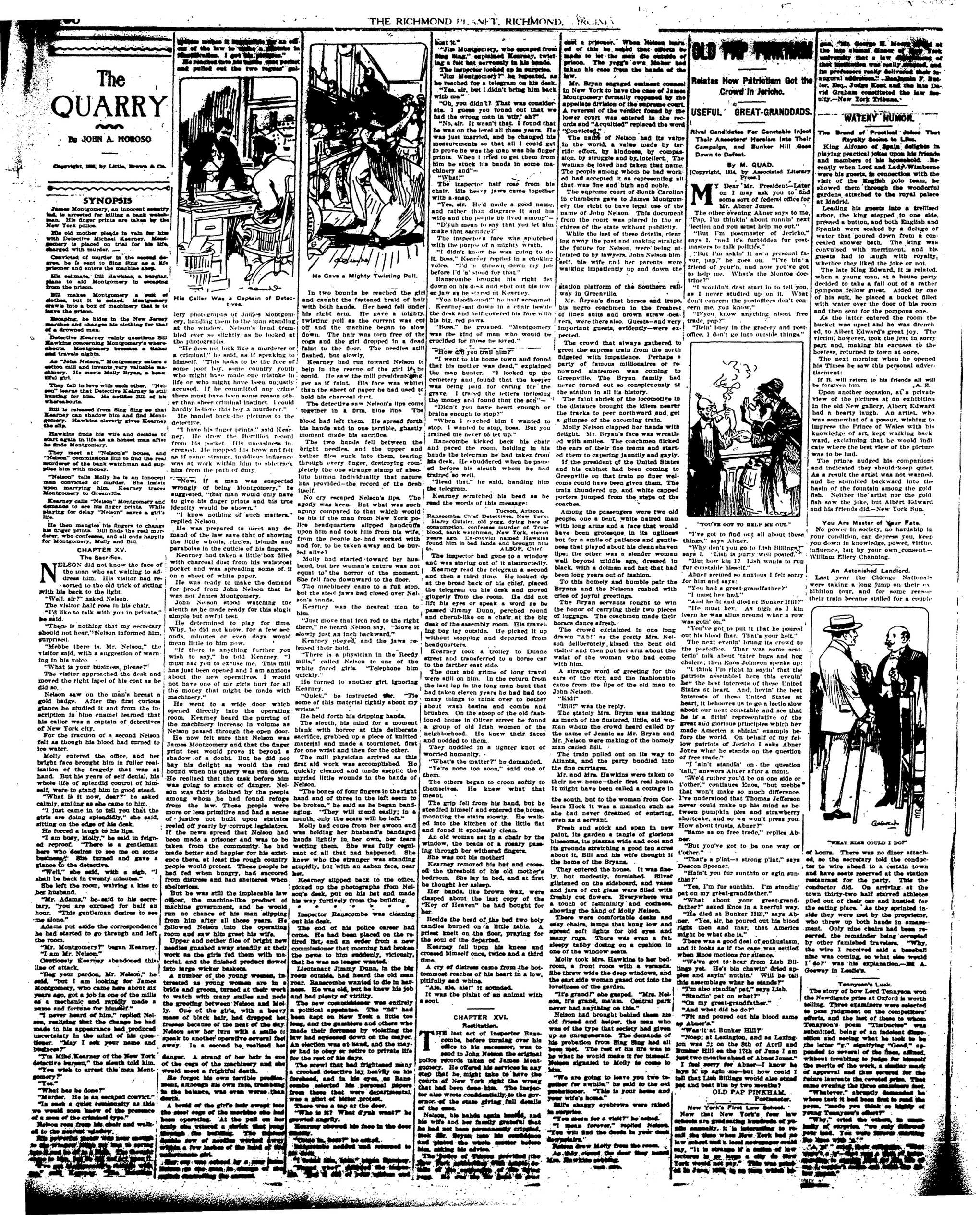
His Caller Was a Captain of Detectives.
His Caller Was a Captain of Detectives.
lery photographs of Judges Montgomery, handing them to the hunn standing at the window. Nelson's hand trembled ever so slightly as he looked at the photographs.
"He does not look like a murderer or a criminal," he said, as if speaking to himself. "This looks to be the face of some poor boy, some country youth who might have made one mistake in life or who might have been unjustly accused. If he committed any crime there must have been some other reason than show criminal instinct. I could hardly believe this boy a murderer."
He handed back the pictures to the detective.
"I have his finger prints," said Kearney. He drew the Bertillon record from his pocket. His uneasiness increased. He moped his brow and felt as if some strange, insidious influence was at work within him to sidetrack him from the path of duty.
"Now, if a man was suspected wrongly of being Montgomery," he suggested, "that man would only have to give his finger prints and his true identity would be shown."
"I know nothing of such matters" replied Nelson.
He was prepared to meet any demand of the law save that of showing the little whorls, circles, islands and parabolas in the cuticle of his fingers.
Kearney had taken a little box filled with charcoal dust from his walnut pocket and was spreading some of it on a sheet of white paper.
He was ready to make the demand for proof from John Nelson that he was not James Montgomery.
John Nelson stood watching the elm as he made ready for this single simple but awful text.
He determined to play for time. Why, he did not know, for a few seconds, minutes or even days would mean little to him now.
"If there is anything further you wish to say," he told Kearney, "I must ask you to excuse me. This mull has just been opened and I am anxious about the new operatives. I would not have one of my girls hurt for all the money that might be made with machinery. I would want to a wide door which opened directly into the operating room. Kearney heard the purging of the machinery increase in volume as Nelson passed through the open door.
He now felt sure that Nelson was James Montgomery and that the dunge print test would prove it beyond a shadow of a doubt. But he did not buy his delight as would the real hound when his quarry was run down. He realized that the task before him was going to smack of danger. Nelson was fairly foolish by the people among whom he had found refuge from the law. These people were more or less primitive and had a sense of justice not built upon statutes reeled off yearly by corrupt legislators. If the news spread that Nelson had been made a prisoner and was to be taken from the community, he had made better and happier for his existence there, at least the rough country people would protest. These people he had fed when hungry, had succeeded from distress and had sheltered when sheltered.
But he was still the implacable law officer, the machine-like product of machine government, and he would no chance of his man slipping from him after all these years. He followed Nelson into the operating room and saw him greet his wife. Upper and nether dies of bright new needles gnashed away steadily at their work as the girls fed them with material, and the finished product flowed into large wicker beakets.
A number of the young women, interested as young women are in a bride and groom, turned at their work to watch with many smiles and nod the greeting between Nelson and Molly. One of the girls, with a heavy mass of black hair, had dropped her treasures because of the heat of the day. Nelson saw her turn with a smile to speak to another operative several feet away. In a second he realised her danger. A strand of her hair in one of the ceas of the machinery and she would meet a frightful death.
He forgot his own terrible predicament, although his own fate, trembling in the balance, was even worse than death.
A braid of the girl hair swept into the steel caps of the machine she had been operating. At the pell on her arm she uttered a shriek that pungent through the building. The shattered double sow of molasses wormed away within a few inches of the hotel of the underwater girl.
Her way was obeyed by a poor woman hiding on the stairs, in charge of the ship, disarming the current.
THE RICHMOND PLANET. RICHMOND.
C. C. M.
He Gave a Mighty Twisting Pull.
In two bounds he reached the girl and caught the fastened braid of hair with both hands. Her head fell under his right arm. He gave a mighty twisting pull as the current was cut out and the machine began to slow down. The hair was torn free of the cogs and the girl dropped in a dead faint to the floor. The needles still flashed, but slowly.
Kearney had run toward Nelson to help in the rescue of the girl if he could. He saw the mill president giggler as if faint. His face was whiter than the sheet of paper he had used to hold his charcoal dust.
The detective saw Nelson's lips come together in a firm, blue line. The blood had left them. He spread forth his hands and in one terrible, ghastly moment made his sacrifice.
The two hands fell between the bright needles, and the upper and neither files sunk into them, tearing through every finger, destroying completely the one strange stamp of absolute human individuality that nature has provided—the record of the flesh itself.
No cry escaped Nelson's lips. The agony was keen. But what was such agony compared to that which would be his if the man from New York police headquarters slipped handcuffs upon him and took him from his wife, from the people he had worked with and for, to be taken away and be buried alive?
Molly had started toward her husband, but her woman's nature was not equal to the horror of the moment. She fell face downward to the floor.
The machinery came to a full stop, but the steel jaws had closed over Nelson's hands.
Kenney was the nearest man to him.
"Just more that iron rod to the right there," he heard Nelson say. "Move it slowly just an inch backward." Kearney pheed, and the jaws released their hold.
"There is a physician in the Reedy mills," called Nelson to one of the white faced girls. "Telephone him quickly."
He turned to another girl, ignoring Kearney.
"Quick," he instructed her. "The some of this material tightly about my wrists."
He held forth his dripping hands. The sleuth, his mind for a moment blank with horror at this deliberate sacrifice, grabbed up a piece of knitted material and made a tourniquet, first for one wrist and then for the other. The mill physician arrived as this first aid work was accomplished. He quickly cleaned and made aseptic the myriad little wounds in the hands of Nelson.
"The bones of four fingers in the right hand and of three in the left seem to be broken." he said as he began bandaging. "They will mend easily; in a month, only the scars will be left." Molly had come from her swoon and was holding her husband's bandaged hands lightly in her own, her tears wetting them. She was fully cognizant of all that had happened. She knew who the stranger was standing stupidly, but with an ashen face, near her. Koeney slipped back to the office, picked up the photographs from Nelson's desk, put on his hat and made his way furiously from the building. Inspector Ranscombe was cleaning out his desk. The end of his police career had come. He had been placed on the retired list, and an order from a new commissioner that morning had broken the news to him suddenly, viciously, that he was no longer wanted.
Leastman Jimmy Dunn, in the big room outside, had heard the old man roar. Ranacome wanted to die in hater. He was old, but he knew his job and had plenty of virility.
The new commissioner was entirely a political appointee. The "hd" had been kept on New York a little too long, and the gambblers and others who made their fortunes by violating the law had squashed down on the mayor. An election was at hand, and the mayor had to obey or retire to private life for the rest of his days.
The scowl that had frightened many a crooked detective lay heavily on his foreshead, and in his eye, as Ranacome selected his personal papers from those that were departmental, was a glint of bitter protest.
There was a tap at the door.
"Who is it? What did you want?" he growled eagerly.
Ranacome showed his face in the door finally.
"Where is, beet?" he asked.
Ranacome nodded and returned to the door.
```markdown
```
beat it."
"Jim Montgomery, who escaped from Sine Mine," explained Marmay, twisting a fist that recently in his hands.
"The inspector looked up in surprise.
"Jim Montgomery!" he repeated, as he reached for a telegram on his desk.
"Yes, air, but I didn't bring him back with me."
"Oh, you didn't? That was considerate. I guess you found out that we had the wrong man in stir, ah?"
"No, sir. It wasn't that. I found that he was on the level all these years. He was just married, and he changed his measurements so that all I could get to prove he was the man was his finger print. When I tried to get them from him he stuck his hands in some machinery and—"
"What."
The inspector half rose from his chair. His heavy jaws came together with a snap.
"Yes, sir. Hed made a good name, and rather than disgrace it and his wife and the people he lived among—" "Dyuth mean to say that you let him make that sacrifice?" The inspector's face was aplotted with the purple of a mighty wrath. "I didn't know he was going to do it, boss." Kearney replied in a choking voice. "I'd thrown down my job before I'd'n stood for that." Ranscombe brought his right foot down on his desk and shot his low ear jaw as he stared at Kearney. "You bloodbound!" he half screamed. Kearney dawn in a chair beside the desk and half covered his face with his big, red paws. "Boss," he grounded. "Montgomery was the kind of man who would be crucified for those he loved." "How did you train him?"
"I went to his home town and found that his mother was dead," explained the man hunter. "I looked up the cemetery and, found that the keeper was being paid for caring for the grave. I trawled the letters including the money and found that the son—" "Didn't you have heart enough or brains enough to stop?" "When I reached him I wanted to stop. I wanted to stop, boss. But you trained me never to let up." Ianscombe kicked back his chair and paced the room, holding in his hands the telegram he had taken from his desk. He shuddered when he paused before his sleuth whom he had trained so well. "Read that," he said, handing him the telegram. Kenney scratched his bead as he read the words of this message:
Tucson, Arizona
Ranchoscoba Chef Dale Hewitt
Harry Gutier, old years, dying half of
consumption, confesses murder of Trueblood, bank watchman, New York, eleven years ago. Ex-convict named Hawkins found him in bad lands and brought him in to the police. The inspector had gone to a window and was stealing out of its windowed,
The inspector and gone to a window and was staring out of it abstractedly. Kearney read the telegram a second and then a third time. He looked up at the broad back of his chief, placed the telegram on his desk and moved gingerly from the room. He did not lift his eyes or speak a word as he passed Jimmy Dunn, perched round and cherub-like on a chair at the big desk of the assembly room. His traveling bag lay outside. He picked it up without stopping and departed from headquarters. Kearney took a trolley to Duano street and transferred to a horse car to the farther east side. The dust and grime of long travel were still on him. In the return from the last lap in the long man hunt that had taken eleven years he had had too many things to think over to bother about wash basins and combs and brushes. On the stoop of the old fashioned house in Oliver street he found a group of old Irish women of the neighborhood. He knew their faces and nodded to them.
They huddled in a fighter knot of worried humanity. "What's the matter?" he demanded. "We're none too soon," said one of them.
The others began to croon softly to themselves. He knew what that meant.
The grip fell from his hand, but he steedd himself and entered the house, mounting the stairs slowly. He walked into the kitchen of the little flat and found it spotlessly clean.
An old woman sat in a chair by the window, the beads of a rosy passing through her wifered fingers.
She was not his mother!
Kearnay removed his hat and crossed the threshold of his old mother's bedroom. She lay in bed, and at first he thought her asleep.
Her bands, like brown wax, were clasped about the last copy of the "Koy of Heaven" he had bought for her.
Beside the head of the bed two holy candles burned on a little table. A priest knelt on the floor, praying for the soul of the departed.
Kearnay fell upon his knees and crossed himself once, twice and a third time.
A cry of distress came from the bottommost reaches of his heart in a low, pitifully and whine.
"Ale, ale, ale!" it sounded.
It was the point of an animal with a soul.
CHAPTER XVI.
Restitution.
THE last act of Inspector Rancombe, before turning over his office to his successor, was to send to John Nelson the original police records taken of James Montgomery. He offered his services in any step that he might take to have the courts of New York right the wrong that had been done him. The inspector also wrote confidentially to the governor of the state giving full details of the case. Nelson, his hands again bound, and his wife and her family grateful that he had not been permanently crippled, took his. Bryan into his confidence and placed the whole matter before him, making his advice. The judge of Titus provided the New York postmaster with details of the evidence of the crime. He said that he had no doubt
cited a prisoner. When Nelson handed off this be, asked that efforts be made to let the men die outside of prison. The reggae's own Maker had taken his case from the hands of the law.
Mr. Bryan engaged eminent counsel in New York to have the case of James Montgomery formally responded by the appellate division of the supreme court. A reversal of the verdict found by the lower court was entered in the records and "Acquitted" replaced the word "Convicted."
The name of Nelson had its value in the world, a value made by terrife effort, by kindness, by compassion, by struggle and by intellect. The woman be loved had taken that name. The people among whom he had worked had accepted it as representing all that was fine and high and noble.
The supreme court of South Carolina in chambers gave to James Montgomery the right to have legal use of the name of John Nelson. This document from the court was placed in the archives of the state without publicity.
While the last of these details, clearing away the past and making straight the future for Nelson, were being attended to by lawyers, John Nelson himself, his wife and her parents were walking impatiently up and down the station platform of the Southern railway in Greenville.
Mr. Bryan's finest horses and traps, his mr. coachmen in the freshest of linen suits and brown straw-bevera, were there also. Guests—and very important guests, evidently—were expected.
The crowd that always gathered to greet the express train from the north subjected with impatience. Perhaps a party of famous millionaires or renowned statesmen was coming to Greenville. The Bryan family had never turned out so conspicuously at the station in all its history.
The faint shriek of the locomotive in the distance brought the kilters nearer the tracks to peer northward and get a glimpse of the oncoming train. Molly Nelson clapped her hands with delight. Mr Bryan's face was wreathed with smiles. The coachmen flicked the ears of their fine teams and startled them to capering juntily and gaily. If the president of the United States and his cabinet had been coming to Greenville on that train no finer welcome could have been given them. The train thundered up, and white capped porters jumped from the steps of the coaches.
Among the passengers were two old people, one a bent, white haired man with long arms and a face that would have been grotesque, in its uginess but for a smile of patience and gentleness that played about his clean shaven lips; the other was a slender woman well beyond middle age, dressed in black, with a dolman and hat that had been long years out of fashion.
To this homely and humble pair the Bryans and the Nelsons rushed with cries of joyful greetings.
The Bryan servants fought to win the honor of carrying their two pieces of luggage. The coachmen made their horses dance a strech.
The crowd exclaimed in one long drawn "AbI" as the pretty Mrs. Nelson deliberately, kissed the bent old visitor and then put her arm about the waist of the woman who had come with him.
A strange word of greeting for the ears of the rich and the fashionable came from the lips of the old man to John Nelson.
"Kid!" "Bill!" was the reply.
The stately Mrs. Bryan was making as much of the flustered, little, old woman whom the crowd heard called by the name of Jennie as Mr. Bryan and Mr. Nelson were making of the homely man called Bill.
The train pulled out on its way to Atlanta, and the party bundled into the fine carriages.
Mr. and Mrs. Hawkins were taken to their new home—their first real home. It might have been called a cottage in the south, but to the woman from Corlears Hook it was a mansion such as she had never dreamed of entering, even as a servant.
Fresh and spick and span in new paint, its garden a tangle of gloriosa blossoms, its pierscape wide and cool and its grounds stretching a good ten acres about it. Bill and his wife thought it the home of the Bryans.
They entered the house. It was finely, but modestly, furnished. Silver glistened on the sideboard, and vases and jars of cut glass were filled with freshly cut flowers. Everywhere was a touch of femininity and comfort, showing the hand of Molly Nelson.
There were comfortable decks and easy chairs, lamps that hung low and spread soft lights for old eyes and many rugs. There was even a fat, sleepy tabby dosing on a cushion in one of the window seats.
Molly took Mrs. Hawkins to her bedroom, a front room with a vanity. She threw wide the deep windows, and the eart side woman gased out into the loveliness of the garden.
"It's grand!" she gaped. "Mrs. Nelson, it's grand, me'am. Central park never had anything on this."
Nelson brought behind them his old friend and helper, the man who was of the type that society had given up as unregenerate. The demands of his probation from Sing Sing had all been met. The rest of his life was to be what he would make it for himself. Nelson signaled to Molly to come to him.
"We are going to leave you two together for awhile," he said to the old promoter. "This is your home and your wife's home."
Molly shaggy arabebrews were raised in surprise.
"You mean for a visit?" he asked.
"I mean forever," replied Nelson.
"You will find the doors in your dust downstairs."
Mason drew Mofty from the room.
As they stared the door they heard
Mon, Rawlins popping.
OLD PAP PINKHAM
Relates How Patriotism Got the Crowd In Jericho.
Rival Candidates For Centenary Injuct
Their Ancestors' Heroism Injuct Their
Campaign, and Bunker Hill. Goes
Down to Defeat.
B. M. QUAD.
[Copyright, 1934, by Associated Literary Press.]
MY Dear Mr. President-Later on I may ask you to find some sort of federal office for Mr. Abner Jones.
The other evening Abner says to me, "Pap, I'm thinkin' about runnin' next election and you must help me out." "But I'm postmaster of Jericho," says I, "and it's furbidden for postmasters to talk politics." "But I'm askin' it as a personal favor, jap," he goes on. "I've bin' a friend of you, and now you've got to help me. What's the Monroe doctrine?" "I wouldn't dast start in to tell you, as I never studied up on it. What don't concern the postoffice don't concern me, you know." "Did you know anything about free trade, pap?" "Bein' busy in the grocery and postoffice, I don't go into outside things."
YOU ARE 907 TO HAVE ME OUT.
"I've got to find out all about these things," says Abner.
"Why don't you go to Lish Billings?" says L. "Lish is purty well posted." "But how kin l? Lish wants to run fur constable himself."
Abner seemed so anxious I felt sorry for him and says:
"You had a great grandfather?"
"I must hey had."
"And he fit and died at Bunker Hill."
"He must hey. As nigh as I klin learn he was allun around what a row was goln on."
"You've got to put it that he poured out his blood (har. That's your holt."
The next evenn' buring its crowd to the postoffice. Thar was some scatterin' talk about 'tater bugs and hog cholera; then Enos Johnson speaks up;
"I think I'm right in sayin' that the patrons assembled here this eventin' hey the best interests of these United States at heart. And, hewin' the best interests of these United States at heart, it behoves us to go a lectle slow about our next constable and see that he is a titttt' representative of the great and glorious principles which he made America a shinin' example before the world. On behalf of my fellow patrons of Jericho I ask Abner Jones what he stands on the question of free trade."
"I ain't standin' on the question tall,' answers Abner after a minit. "We'd ruther you'd be on one side or tother,' continues Enox, "but metbe that won't make so much difference. I've understood that Thomas Jefferson never could make up his mind as between pumpkin pies and strawberry shortcake, and so we won't press you. How about trusts, Abner?"
"Same as on free trade,' replies Abner.
"But you've got to be one way or l'other."
"That's a p'int—strong p'int," says Deacon Spooner.
"Hain't you for sunthin or agin sunthin?"
"Tee, I'm for sunthin. I'm standin' pat on my great-grandfather."
"What about your great-grandfather?" asked Enno in a keerful way.
"He died at Bunker Hill." says Abner. "Yes, air, he poured his blood right then and that, that America might be what she is."
There was a good deal of enthusiasm, and it looks as if the case was settled when Enoe motions for silence.
"We've got to hear from Lish Billings yet. He's bin chawin'd dried up and sayin' nuthin'. Will be tell this assemblage what he stands?"
"I'm also standa' pet," says Lish.
"Standin' pet on what?"
"On my great-greatfather."
"And what did he do?"
"Fit and poured out his blood same as Abner?"
"Was it at Bunker Hill?"
"Noop; at Lexington, and as Lexington was St. on the 5th of April and Bunker Hill on the 17th of June I am just two months ahead of Abner Jones."
"I feel sorry for Abner—I know he hays it up igname—but how could I tell that Lish Billings would also stand and pet and beat him by two months?"
New York's First Law School
Now that New York's four law
schools are graduating hundreds of people annually, it is interesting to re-
call the time when New York had no law school and a local newspaper could
say, "It is strange if a nation of law
lectures in go huge in a city on New
York would not pay." This was published in June, 1981, in an issue which be-
man, "the George H. Moore at the late Abraham Dinner of New York university that a law department of that institution was really shaped, and his professors really delivered their inaugural address." — Benjamin F. Butler, Eq. Seq. Judge Kent and the late David Graham constituted the law faculty—New York Tribune.
The Brand of Practical Jokes That Royalty Seems to Like.
King Alfonso of Spain, delights in playing practical jokes upon his friends and members of his household. Recently when Lord and Lady Wimberne were his guests, in connection with the visit of the English polo team, he showed them through the wonderful gardens, attached to the royal palace at Madrid.
Leading his guests into a trellised arbor, the king stepped, to one side, pressed a button, and both English and Spanish were soaked by a deluge of water that poured down from a concealed shower bath. The king was convulsed with merriment, and his guests had to laugh with royalty, whether they liked the joke or not.
The late King Edward, it is related, when a young man, at a house party decided to take a fall out of a rather pompous fellow guest. Aided by one of his suit, he placed a bucket filled with water over the door of his room and then sent for the pompous one.
As the latter entered the room the bucket was upset and he was drenched, to Albert Edward's great joy. The victim, however, took the jeet in sorry part and, making his excuses to the hostess, returned to town at once.
The next morning when he opened his Times he saw this personal advertisement:
If B. will return to his friends all will be forgiven him. A. E.
Upon another occasion, at a private view of the pictures at an exhibition in the old New gallery, Albert Edward had a hearty laugh. An artist, who was somewhat of a poseur, wishing to impress the Prince of Wales with his knowledge of art, kept walking back ward, exclaiming that he would indicate where the best view of the picture was to be had.
The prince nudged his companions and indicated they should keep quiet. As a result the artist was not warned, and he stumbled backward into the basin of the fountain among the gold fish. Neither the artist nor the gold fish saw the joke, but Albert Edward and his friends did.—New York Sun.
You Are Master of Your Fate.
No power in society, no hardship in your condition, can depress you, keep you down in knowledge, power, virtue, influence, but by your own consent.—William Ellery Channing.
An Astonished Landlord
Last year the Chicago Nationals were taking a long jump on their exhibition tour, and for some reason their train became stalled for a couple
Gabriel
"WHAT KEAR COULD I DO"
of hours. There was no diner attached, so the secretary told the conductor to wire ahead to a certain town and have seats reserved at the station restaurant for the party. This the conductor did. On arriving, at the town thirty-two half starved athletes piled out of their car and hustled for the eating place. As they sprinted inside they were met by the proprietor, who threw up both hands in amusement. Only nine chairs had been reserved, the remainder being occupied by other famished travelers. "Why, the wire I received said a baseball nine was coming, so what else would I do?" was his explanation.—M.D. A. Goeway in Lentil.
Tennyson's Look.
The story of how Lord Tennyson won the Newgate prize at Oxford is worth talling. Three examiners were selected to pess judgment on the competitors' efforts, and the last of these to whom Tennyson's poem "Timbacote" was submitted, being of an indifferent disposition and seeing what he took to be the letter "g." signifying "Good," appended to several of the lines, affixed, without troubling to judge for himself the merits of the work, a similar mark of approval and thus secured for the future laureate the coveted prize. That same evening the three examiners foot. "Whatever," abruptly demanded he whose task it had been first to read the poem, "made you think so highly of young Tennyson's effort."
"Why," cried the others, in community of expatriation, "we only followed your lead. You were slower than the ones with it."
```markdown
```
30,000 Prisoners Reported Taken at Complegne.
Fresh Troops From Paris Forts Help Them.
The allied forces, assuming the offensive along the far-dung battle line from Nantouill-le-haudouin to the left wing of the German forces east of Vordun, have hurled back the invading army and forced the Germans to retreat along the right wing and in the center.
It is officially reported from Paris that the Toulons Have been forced to retreat between Meaux and Sozzane and at Fere-Champenose and Vitry-le-Francois. The allies' advance reaches from the banks of the river Ourqc into the region of Montmiral.
Accounts of wounded soldiers who reached Paris indicate that the result of the three days' fighting in the Complegne country has been more favorable for the allies than at first supposed. They say the German losses in killed were enormous and a great number of prisoners were taken. One French officer estimates the prisoners at 30,000.
The following official communication bearing on the fighting now in progress east of Paris was made public:
"The left wing of the allied armies, comprising certain portions of the forces now defending Paris, continues to make progress against the enemy.
"The French advance reaches from the banks of the River Oureq into the Montmirail region (Montmirail is 48 miles east of Paris).
"The enemy is retiring in the direction of the River Marne, between Moaux (20 miles east of Paris) and Sevanne (42 miles east of Moaux).
"The French and the English armies have taken numerous prisoners, including a battalion of infantry and a company serving a detachment of rapid fire guns; they captured also many gun carriages."
"There have been violent encounters with the enemy on the center, between For-Champenoise (12 miles east of Sezanne) and Vitry-le-Francois, the southern point of the forest of Argonne. (Vitry-le-Francois is 27 miles east of Fere-Champenoise). "At no place have we fallen back; the enemy has lost ground.
"The reported retiring of the enemy near Vitry-le-Francois has been confirmed. "
"On our right a division of German troops delivered an attack on the axis of Chateau, Saline-Nancy, but they were repulsed to the northward, passing the forest of Champenoux.
"Further to the east, our troops occupied the crest of Mandry and the peak of Fourneaux.
"There has been no change in the situation in the province of Alsace."
Germans Ask Armistice.
It is reported unofficially in Paris that the Germans east of the city have sacked for an armament to bury their dead and care for their wounded.
The leading military authorities are convinced that General Joffre, commander-in-chief of the French forces, is at last holding at bay the vast German army of invasion.
The worn-out troops of Emperor William, who may constitute an army totalling 750,000 men, are encountering the relatively fresh soldiers of the French and British armies upon ground selected by the allies, and in positions within easy reach of supplies and reinforcements.
The Germans are in a hostile country and at distances relatively great from their home bases. The invaders are probably now at their greatest strength, while the defenders of France, especially the British contingents, are being augmented steadily.
The fighting on the long line to the east of Paris probably will last for a number of days; no quick and decisive outcome is expected. The results of
the encounters of the past two days are regarded as distinctly favorable to the allies, and there is an atmosphere of cheerfulness at the French war office.
A great area of country, probably 4000 square miles in extent, has been ravaged by the fighting so far. Bridges across the Grand Morin, the Pottit Morin, the Ourcq, Marne, Alsane and the Oise rivers have been blasted to impede operations.
A heavy British force; supported by French troops, is reported to be moving in a northeastward direction along the Oise valley, in an effort to get in the rear of the German flank.
The German force lying between Paris and Compiegne has been forced to retrain, owing to the pressure of the British, who set fire to the forests behind which the Germans had taken up their position.
THE TRAIN
4,000,000 men in the two gigantic grand armies which face each other, although not all of them are taking an active part in the battle that is now going on.
The advance guards of the Germans had been able to swing farther south than was generally believed. One section of it reached Vitry-le-François, 105 miles east by southwest from Paris and 45 miles south of the city of Rhelms.
There is no doubt that the fate of Paris may depend on the outcome of this conflict.
It is indicated that the fighting over a considerable part of the battle line has consisted of long-range artillery duels, and that the soldiers of the opposing forces were not really at each others' throats. At other points the men are at grips, and the fighting is furious.
The losses, especially on the German side, have been heavy, but no official figures have been given out.
TURKS READY TO OPPOSE RUSSIANS
A dispatch to the London, Eng. Exchange Telegraph company from Athens declares the Turks, in order to be prepared to oppose a possible landing of Russians, have concentrated about 90,000 men at Tchatalja, 26 miles northwest of Constantinople, and Rodosto, on the Sea of Marmora. Furthermore, they are fortifying along the Sea of Marmora at other points.
A dispatch to the Times from Constantinople, commenting on conditions there, says:
"Although thethe is still a large section of influential Turks clamoring for intervention in the present European war, the situation seems to be improving, owing to the precarious economic situation and the unwillingness of the reservists to take part in any but a defensive war.
"The total number of German officers now in Turkey is estimated at 600. All British merchantmen in the Black Sea have been ordered."
5000 SERVIANS CAPTURED
Austrians Rout Invaders Under Crown Prince in Bosnia.
Five thousand Servians were captured near Mitrovich by the Austrian army, the German embassy in Washington was advised by wireless from Berlin.
The dispatch declared also that 600 Russians were captured by the Austrials on Russian territory.
"The column under command of General Kestranek (Austrian), advancing with the eastern army of General Bankl (Austrian) on Russian territory repulsed a violent attack of Russians and captured 600 soldiers.
"In the south the Servians tried near Mitrovich to break into Croatian territory. About 5000 Servians taken prisoners of war. Much war material captured."
Ladies First
Here is a little story of the late Admiral Fremantle, told by Dr. Ernest Young in his book of travel sketches entitled "From Russia to Slam." When the steamer anchored off Canton the guide, as is their custom, boarded her at once. The admiral and his friends chose their guide and prepared to follow him. The admiral was about to descend the ladder and got into a native sampan when the guide pushed him back, saying: "Ladies first." "Oh, that doesn't matter," said the admiral. "I'm an old man." "Ole man!" quickly responded the Chinaman. "Ole man all more ought to know me better."
THE RICHMOND PLANET, RICHMOND, VIRGINIA
THE FIRE
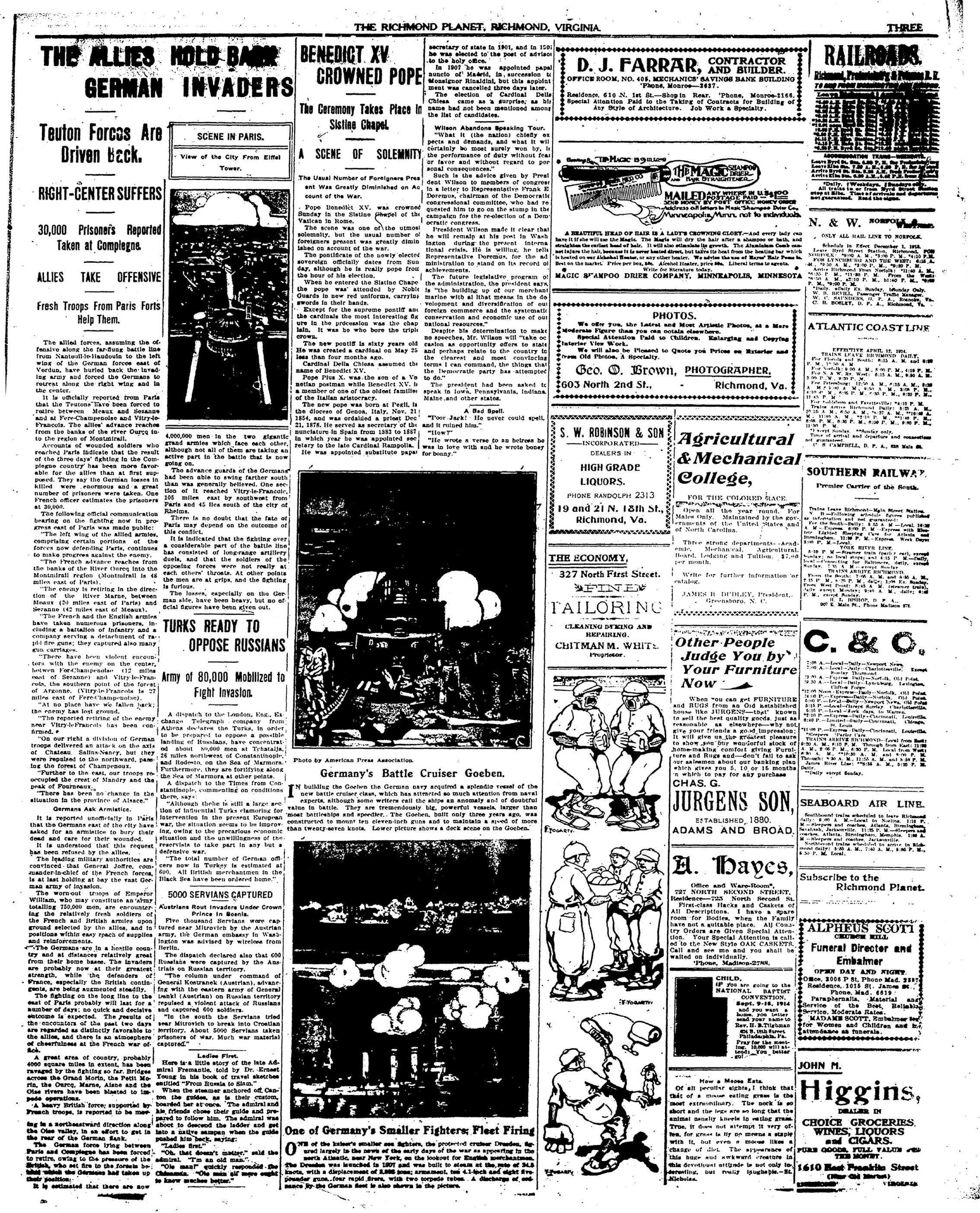
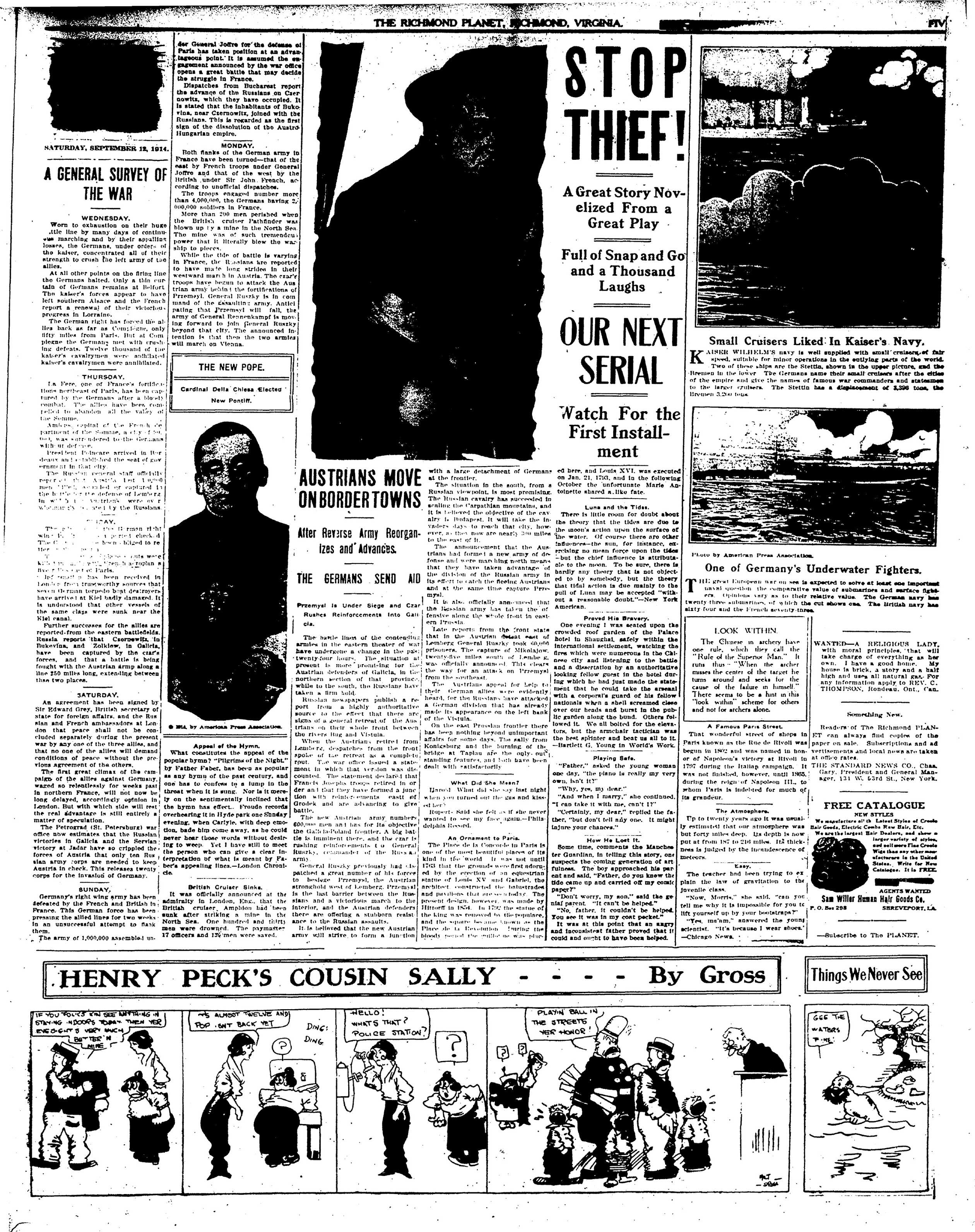
Germany's Battle Cruiser Goeben.
IN building the Goeben the German navy acquired a splendid vessel of the new battle cruiser class, which has attracted so much attention from naval experts, although some writers call the ships an anomaly and of doubtful value in battle. They are tremendously big, powerful vessels, larger than most battleships and speedier. The Goeben, built only three years ago, was constructed to mount ten eleven-inch guns and to maintain a speed of more than twenty-seven knots. Lower picture shows a deck scene on the Goeben.
THE FIRE
One of Germany's Smaller Fighters; Fleet Firing
ONE of the kaiser's smaller sea fighters, the protected cruiser Dresden, figured largely in the news of the early days of the war as appearing in the north Atlantic, near New York, on the lookout for English merchantmen. The Dresden was launched in 1907 and was built to steam at the rate of 24.5 knots, with a displacement of 3,882 tons; armament, ten 4.1-inch and eight five-pounder guns, four rapid fireers, with two torpedo tubes. A discharge of ordnance by the German船队 is also shown in the picture.
The Usual Number of Foreigners Present Was Greatly Diminished on Account of the War.
Pope Bonedict XV. was crowned Sunday in the Sistine Chapel of the Vatican in Rome.
The scene was one of the utmost solemnity, but the usual number of foreigners present was greatly diminished on account of the war.
The pontificate of the newly elected sovereign officially dates from Sunday, although he is really pope from the hour of his election.
When he entered the Sistine Chapel the pope was attended by Noble Guards in new red uniforms, carrying swords in their hands.
Except for the supreme pontiff and the cardinals the most interesting figure in the procession was the chapel lain. It was he who bore the triple crown.
The new pontifix is sixty years old. He was created a cardinal on May 25 less than four months ago.
Cardinal Della Chiesa assumed the name of Benedict XV.
Pope Plus X. was the son of a Venetian postman while Benedict XV. is a member of one of the oldest families of the Italian aristocracy.
The new pope was born at Pegli, in the diocese of Genoa, Italy. Nov. 21 1854, and was ordained a priest Dec 21, 1878. He served as secretary of the nunculature in Spain from 1893 to 1887 in which year he was appointed secretary to the late Cardinal Rampolla.
He was appointed substitute papal
secretary of state in 1901, and in 1902 he was elected to the post of advisor to the holy office.
In 1907 he was appointed papal nuncio of Madrid, in succession to Monsignor Rinaldini, but this appoint ment was cancelled three days later.
The election of Cardinal Della Chiesa came as a surprise; as his name had not been mentioned among the list of candidates.
Wilson Abandone Speaking Tour.
"What it (the nation) chiefly expects and demands, and what it will certainly be most surely won by, in the performance of duty without fear or favor and without regard to personal consequences."
Such is the advice given by President Wilson to members of congress in a letter to Representative Frank E. Doremus, chairman of the Democratic congressional committee, who had re-quested him to go on the stump in the campaign for the re-election of a Democratic congress.
President Wilson made it clear that he will remain at his post in Washington during the present international crisis. He is willing, he tells Representative Doremus, for the administration to stand on its record of achievements.
The future legislative program of the administration, the president says, is "the building up of our merchant marine with all that means in the development and diversification of our foreign commerce and the systematic conservation and economic use of our national resources."
Despite his determination to make no speeches, Mr. Wilson will "take occasion as opportunity offers to state and perhaps relate to the country in the clearest and most convincing terms I can command, the things that the Democratic party has attempted to do."
The president had been asked to speak in Iowa, Pennsylvania, Indiana, Maine, and other states.
A Bad Spell
"Too Jack! He never could spell,
and it ruined him."
"How?"
"He wrote a verse to an heiress he
was in love with and he wrote boney
for bonny."
OFFICE ROOM, NO. 405, MECHANICS' SAVINGS BANK BUILDING 'Phone, Monroe—2637. Residence, 610 N. 1st St.-Phone in Rear. 'Phone, Monroe-2166. Special Attention Paid to the Taking of Contracts for Building of Any Style of Architecture. Job Work a Specialty.
THE MAGIC SHAMPOO DRIER AND Hair STRAIGHTENER
MAILED ANY WHERE IN U.S. COUNTY BY PORT OF OFFICE OR MONEY OR ADDRESS ALL LETTERS TO Magic Shampoo Drier Co., Minneapolis, Minn. not to individuals.
A BEAUTIFUL HEAD OF HAIR is A LADY'S CROWNING GLORY.—And every lady can have it if she will use the Magic. The Magic will dry the hair after a shampoo or bath, and straighten the earliest head of hair. It will also stimulate its growth. The Aluminum Comb cannot before the hair, because it is never heated direct, but takes its heat from the heating bar which is heated on our Alcohol Heater, or any other heater. We advise the use of Mayer's Hair Pens to Best on the market. Price per box, $9. Alcohol Heater, price $9. Liberal terms to agents.
Write for Literature today.
MAGIC SHAMPOO DRIER COMPANY, MINNEAPOLIS, MINNESOTA
* We offer you, the Latest and Most Arithmetic Photos, as a More
* Moderate Figure than you can obtain elsewhere.
* Special Attention Paid to Children. Enlarging and Copying
* Interior View Work.
* We will also be pleased to Quote you Prices on Exterior and
* from Old Photos. A Specialty.
THE ECONOMY
327 North First Street.
CLEANING DETAILING AND REPAIRING.
CHITMAN M. WHITS.
Proprietor.
TOGARTY.
```markdown
```
K. FOGARTY
```markdown
```
Agricultural & Mechanical College,
Open all the year round. For
Males Only. Maintained by the
governments of the United States and
of North Carolina.
Three strong departments--Academic, Mechanical, Agricultural,
Board, Lodging and Tultlon. $7.00
per month.
Write for further information or
catalog.
JAMES B. DUDLEY, President,
Greensboro, N. C.
When you can get FURNITURE and RUGS from an Old established house like JURGENS—that's known to sell the best quality goods, just as reasonable as elsewhere—why not give your friends a good impression; it will give us the greatest pleasure to show you our wonderful stock of home-making comfort giving Furniture and RUGS—and don't fail to ask our salesmen about our banking plan which gives you 6, 10, or 16 months in which to pay for any purchase
JURGENS SON.
ESTABLISHED. 1880. ADAMS AND BROAD.
A. Hayes,
Office and Ware-Room",
727 NORTH SECOND STREET,
Residence-725 North Second St
727 NORTH SECOND STREET,
Residence—725 North Second St.
First-class Hacks and Caskets of
All Descriptions. I have a spare
room for Bodies, when the Family
have not a suitable place. All Country Orders are Given Special Attention. Your Special Attention is called to the New Style OAK CASKETS. Call and see me and you shall be waited on individually.
Phone, Madison-2788.
CHILD,
IF you are going to the
NATIONAL BAPTIST
CONVENTION,
Sept. 9-16, 1914
and you want a
home, you better
send your name to
Rev. H. B. Tighman
624 B. 18th Street
Philadelphia, Pa.
Pray for the meeting. 10,000 will attend. You better
Sept. 9-16, 1914
and you want a
home, you better
send your name to
Rev. B. H. Tilghman
624 H. 18th Street
Philadelphia, Pa.
Pray for the meet-
1000 will attend.
You better go!
Of all peculiar alights, I think that that of a mouse eating grain is the most extraordinary. The nock is so short and the legs are so long that the animal manually kneels in eating grain. True, it does not attempt it very often, for grass is ity no means a staple with it, but even a mouse like a change of diet. The appearance of this huge and awkward creature in this devoid attitude is not only in observing, but really laughable.—St. Michelas.
THREE
AGGREGATION TRANS—WESTMINSTER
Leave St. Dy. St. 6.80 F. P. 1.80 Proceeding
7.80 A. E. 6.90 F. P. 1.80 B. N. A. 6.90
Artist's Dy. St. 6.80 F. P. 1.80 B. N. A. 6.90
Artist's Dy. St. 6.80 F. P. 1.80 B. N. A. 6.90
*Daily. | Weekdays. | Sundays only.
All appointments Street Street
step at Kirk. Time of arrival and depart-
ment not guaranteed. Read the signs.
---
N. & W. NORPOLE
ONLY ALL HAIL LINE TO NORFOLK.
Scheduled in Effect December 1, 1928.
Leave Bird Street Station, Richmond, P08
NORFOLK. *9:00 A.M. *12:00 P.M. *9:40 P.M.
NORFOLK. *9:00 A.M. *12:00 P.M. *9:40 P.M.
NORFOLK. *9:00 A.M. *12:00 P.M. *9:20 P.M.
Arrive Richmond from Norfolk: *11:40 A.M.
M. *8:00 P.M. M. From the West.
M. *8:00 A.M. M. bl 12:00 P.M. M.
P. M. *9:00 P.M.
*Daily, a daily Ex. Sunday, Sunday Only.
W. B. BEVILLE, Passenger Traffic Manag.
W. C. SAUNDERS, O. P. A., Repsons, Va.
C. H. BOLLEY, D. P. A., Richmond, Va.
ATLANTIC COASTLINE
EFFECTIVE APRIL 12, 1915.
TRAINS LEAVE RICHMOND DAILY.
For Florida and South: 8:15 A. M. and 8:00
P. M. 12:50 A. M.
For North: 9:00 A. M. 8:00 P. M. 4:10 P. M.
For N. A. W. Re. West: 8:15 A. M. 8:00 A. M.
3:00 P. M. 9:20 P. M.
For Petersburg: 12:50 A. M. 6:15 A. M., 8:10
P. M. 6:50 A. M. 9:50 A. M. 3:00 P. M.
4:10 A. M. 6:50 A. M. 9:50 P. M., 8:20 P. M.
11:45 P. M.
For Suffolk and Fayetteville: 8:10 P. M.
Trains arrive Richmond Daily: 8:25 A. M. M.
10:15 A. M. 6:50 A. M. 9:50 A. M.
11:40 A. M. 8:20 P. M. **14:40 P. M.
8:00 P. M. 6:35 P. M. 8:00 P. M. 9:00 P. M.
11:00 P. M.
except Sunday. *Sunday only.
Time of arrival and departure and connection
not guaranteed.
C. S. CAMPBELL, D. P. A., 925 Male 00
SOUTHERN RAILWAY
Premier Carrier of the South.
Trains Leave Richmond—Main Street Station.
N. B.—Schedule figures published as information and research data.
For the South-Daily: 8:35 A.M.—Local, 10:35 A.
M.—Express, 8:00 P. M.—Express with Electric
Flatbed Riding Care for Atlanta and
Birmingham, 11:30 P. M.—Express, Week Day
2:00 P. M.—Local.
YORK RIVER LINE.
A 10 P M local train (park car), around
Sunday, to local train (park car), around
Pally, local connecting for Baltimore, daily, around
Sunday, to local train (park car), daily, around
From The South: 7:00 A. M. D. A. M.
7:15 P. M. 7:30 P. M. dalle: 1:00 F. Runday.
From West Point: 8:45 A. M. (steamer train).
dalle: 1:00 Muster: 9:40 A. M. dalle: 6:40
P. M. dalle: 10:40 H. F. HINSPOT, D P. A.
007 E. Main R. F., Phone Mallinson 73
C. & C. 7:00 A.-Local-Daily-Newport News. 7:00 A.-Local-Daily-Charlotteville. Except Sunday Thurmond.
10:00 A - Express-Dally-Nortfolk, Old Pole.
10:00 A - Local-Daily-Lynchburg, Lathrop,
Coffees Forge.
10:00 N - Newport-Dally-Nortfolk, Old Pole.
10:00 P - Express-Daily-Nortfolk, Old Pole.
10:00 P - Local-Daily-Newport News, Old Pole.
10:10 P - Local-Heartbeat-Sunday, Charleston-
Warren.
10:10 P - Express-Daily-Cincinnati, Louisville.
10:40 P - Limited-Daily-Cincinnati, Chicago,
St. Louis.
*10:00 A - Express-Daily-Cincinnati, Louisville,
Snyder, St. Louis.
TRAINS RICHMOND - Local from Bristol
9:20 A.M. 8:10 P.M. Through from East: 12:10
A.M. 2:05 P.M. 6:30 P.M. Lowl. from West:
A.M. 2:05 P.M. 6:30 P.M. Lowl. from West:
A.M. 10:30 A.M. and 1:00 P.M.
Through: 10:30 A.M. and 1:00 P.M.
James River Line: *8:35 A.M. 8:10 P.M.
Dalry.
**daily except Sunday.
SEABOARD AIR LINE
Northbound trains scheduled to leave Richmond daily: 9:00 A. M.-Local to Nottingham. 1:10 P. M.-Hierpers and coaches, Atlanta, Birmingham, Nashville, Jacksonville. 1:15 P. M.-Hierpers and coaches, Atlanta, Birmingham, Memphis. 1:00 A. M.-Hierpers and coaches, Jacksonville.
Northbound trains scheduled to arrive in Richmond daily: 6:05 A. M., 7:40 A. M., 8:05 P. M., 6:20 P. M. Local.
Subscribe to the Richmond Planet.
ALPHEUS SCOT1
CHURCH MILL
Funeral Director and Embalmer
OPEN DAY AND NIGHT.
Office 2005 P St. Phone Mad. 2397
Residence, 1015 St. James St.
Phone Mad. 6418.
Paraphernalia, Material and
Service of the Best, Religious
Service, Moderate Rates.
MADAME SCOTT, Embalmer for
for Women and Children and in
attendance as funerals.
Higgins,
DEALER IN
CHOICE GROCERIES.
WINES, LIQUORS
and CIGARS.
PURE GOODS, FULL VALUE
THE MONEY.
1610 East Franklin Street
(Near Old Market)
Published every Saturday by John Mitchell, Jr., at 411 N. 4th St., Richmond, Va.
JOHN MITCHELL, JR. . EDITOR.
All communications intended for publication should be sent so as to reach us by Wednesday.
Entered at the Post Office at Richmond, Va., as second class matter.
SATURDAY, SEPTEMBER 12, 1914.
Sickness and death are alliments of mankind.
Many people talk about Heaven and its happiness, but few folks want to go there.
Colored folk believe in singing and praying and many of them believe in working just enough "to keep buckle and tongue" together.
The colored folks are great Elks Their display at Norfolk recently is said to have been the finest display ever seen in that city.
Colored folks who have no self- respect and no politeness should either get out of this world or have some one get them out of it.
The Baptists will be "fussing" at Philadelphia this week and the Old Fellows will be "seraining" at Boston next week. Colored folks are great on having "a high old time" at their big meetings.
CAN GERMANY WHIP THE
WHOLE WORLD?
"War is that miserable desolation that finds a land before it like Eden, and leaves it behind like Sodom and Gomorrah, a desolate forsaken wilderness. Let it be sowed with the seed of man and heart as a field with wheat, will eat it up."—T. Adams.
The remarkable conditions now obtaining in Europe lead one to believe both in God and in destiny. How else can such a remarkable war of nations take place with the causes therefor being of a kind and character as to cause the world to believe that such a result would not only be improbable, but impossible?
The facts plainly stated are as follows: The Crown Prince of Austria and his wife visited the kingdom of Servia and were assassinated. A Crown Prince is an heir to a throne. He would become Emperor of Austria-Hungary upon the death of Emperor Francis Joseph. It may be well to state that race prejudice exists in these countries, the same as it exists in the United States, but it is between the Slavs and the Teutons, two separate races. The Servian government promised to ferret out and punish the murderers, but further investigation by the Austrian monarch convinced him that some high personages in Servia, close to the throne of that country were at the bottom of the outrage and that they would not be punished.
It may be well to state, too, as a matter of diversion that these Servians assassinated their own king and queen some twenty years ago and the present King Peter became their king but the assassins were never punished. Austria demanded that it be given the privilege of seeing that the murderers were punished and that the trial be conducted under Austrian supervision. The Servians yielded to all the demands of Austria except the one relative to Austrian supervision of the trial, but held that for future consideration. Its reply was delivered ten minutes within the time limit set by the Austrian Government.
The reply was announced to be not for the satisfactory and Austria immediately whip the declared war against Servia. There it is no comparison in the size of Austria. Certainia and Servia, except that of a person Newfoundland dog and a fox terrier, tion of Servia though, like Switzerland, is which mountainous and this natural prox of protection is practically its only safe the guard against its big neighbor, will not Servia was in an alliance with Rus- tivity sia and when war was declared, Rus- country wanted to know the extent of see to Austria's proposed chastisement of fruits, Servia and a guarantee that its auton- itmate may as an independent State or and for
country would not be disturbed. Some say Austria gave these assurances. In the meantime Russia began mobilizing her troops on the Austrian and Servian frontier. Germany was in a close alliance with Austria and was evidently conversant with all of Russia's demands and Austria's intentions. Under the guise of promoting peace, diplomatic correspondence ensued and Germany demanded that Russia cease the mobilization of its army. As this gathering of troops, called mobilization was close to the German frontier Ene. Emperor William gave notice that he would consider it an unfriendly act:
Cear Nicholas paid but little attention to Kaiser Wilhelm's demands and Germany declared war on Russia. Russia was in a close alliance with France and England and Germany demanded France to state its attitude. France's answer was the harried objection of its army and this being construed as an act of war. Germany declared that a state of war existed with France. The German army proceeded to march on Paris, the digital of France. The French had been preparing for this for more than thirty years and forts line the French frontier and were considered impregnable.
Germany did not care to go up against them and it found that Belgium, a neutral kingdom which lay between German territory and France was the weak point through which an entrance could be made. It had been agreed that the neutrality of Belgium should be respected by all of the Great Powers and England, Germany and France were signatories of this guarantee. It was thought that Germany would respect this agreement but instead it made a request
itself to pay for all damage done and to treat the inhabitants with proper courtesy. The Belgians declined to do this and called upon England to carry out its plea to protect Belgium's neutrality. In the meantime the small Belgian army resisted the entrance of the invaders and made history for itself. The British government exchanged diplomatic messages with the German government and took the position that it would enforce the neutrality of Belgian territory, if need be with force of arms.
England declared that a state of war existed and the result was that the entire British Empire throw the weight of its influence against Germany. Germany had possessions, that is, rights and property on the Pacific in Eastern Asia. Its war with England brought into play the alliance existing between Japan and Great Britain and Japan declared war on Germany in support of its ally, Great Britain. It ordered Germany to retreat from the Orient and gave it about a week in which to do.
Germany met this by formally refusing to answer within the time limit set by Japan, virtually treating the demand of Japan with contempt Italy, which was under oblations to Germany and Austria declined to be drawn into the conflict and remained neutral, that is, did not take sides with either. Germany continued to advance into France, sweeping everything before it and to counteract this. Russia proceeded to march into Austria and into Germany with the intention of threatening the German capital, Berlin, just as the Germans were marching on the French capital, Paris.
It has become a question as to which country would attain its goal first. The Germans are within thirty miles of Paris and practically at its gates, while the Russians are about two hundred and fifty miles from Berlin. Emperor William and his commanders had to send troops from France to protect eastern Prussia against the invasion of the Russians. The situation is fast becoming one of a dead-lock. In the meantime England is pouring its troops into France and Belgium, and Africa is being drained of its best warriors by France to aid in the struggle.
It is true that Belgium might have confined itself to a nominal resistance as China has done in the case of the violation of its neutrality by Japan in its attack upon German possessions. Germany's answer or rather the answer of one of her statesmen in reply to her violation of her own international law, was, "Necessity knows no law." This brings us back to the question, "Can Germany whip the whole world?" It may be better to ask, "Can the whole world whip Germany?" To ask the question is to answer it.
Certain it is that the German Emperor has given a wonderful exhibition of the power of the machine which he controls. With the expenditure of its force and its energy, unless the empire succeeds in its mission, it will not recover from this undue activity in an hundred years. The countries that are now fighting will see to it that it is robbed of the fruits of its victory. It has been estimated that more than one hundred and forty thousand man have been
killed and wounded in this gigantic struggle.
A few statesmen and kings and emperors could have avoided all of this. The weapons of modern warfare needed a trial as to their killing and wounding power. The exhibition has been made and mothers, fathers, widows and orphans mourn as a result of the experiment.
The end must come, the dove of peace must again find a resting place and the brutality and flandishness of men must again be doomed to a long exile from the confines of civilization.
O. the pity of it!
"Take my word for it, if you had seen but one day of war, you would treat to 'Almighty God, that you might never see such a thing again." Wellington.
PRAISE AND CENSURE
Do not rely upon praise in pushing your life work, and do not permit censure to discourage you if you know you are right.
Praise is of no use as a mainspring. Power lies outside of it, and entirely independent of it, in all truly valuable lives. Tennyson, the poet, was also the practical man when he remarked, "I think it is wisest in a man to do his work in the world as quietly and as well as he can without breeding praise or dispraise."
Aroused Her Curiosity After All.
"Don't want any," said a housekeeper from her second story window to a street wonder whose covered wagon was standing a few steps away and who had just pulled the bell.
"Don't want any what?" grudely asked the vender, who hadn't had even a chance to tell what his wares were.
"What have you got?" asked the housekeeper, whose curiosity was getting the better of her annoyance.
"Oh, never mind. You don't want any. Glt up, Bob."
"Now, I wonder what that exasperating man is selling, anyway!" she explained as the wagon disappeared around the corner. - Exchange.
New Start For Poor Boys.
"I'd like to start at the bottom," said the young man applying for work.
"I'm sorry, but we can't use you there. All those places are reserved for the sons of our directors, who think it fashionable to start that way. We can give you a place a little higher up, though, at less money." - Detroit Free Press.
---
F. FOGARTY
F. TOCARTY
Boys and Girls Contest
VOTING COUPON:
Name ...
Address ...
This Coupon is good this week for (15) Fifteen Votes.
---
WOLF BROS. Giant Hair Straightener and Dryer Comb.
50c
AGENTS WANTED.
This comb is solid brass and will hold heat longer than any other comb. Sold regularly for $1 so, but our price is 50c and we give you a LAMP ATTACHMENT FREE! Mail Orders Solvent. If Ordered by Mail, enclose 5-2c Stamps.
HIDING THE TRUTH
No good can come from a policy of hiding the truth. Be sure your ans will find you out, but there is no need to have ans. If you begin by hiding small things you will develop cowardice and dishonesty in almost everything you do.
PARKING
I. FOWMARY
Y YOGABY.
F. POGARTY
---
$25.00 Reward for Information.
A reward of $25.00 is hereby offered to the first person giving information leading to the whereabouts of Mr. Joseph B Leaden, who left his home here in the Spring of 1905.
ATTY. GEORGE W. MILFORD.
471 Florida Ave., N. W., Wash., D. C.
FREE
COLORED PEOPLE'S HAIR.
Our New 1914 Catalog, Showing the Latest Styles in Colored People's Hair.
We are the largest importers and manufactures of colored people's hair. We warrant our hair to stand combing and washing.
Our prices are lower than th' so quoted elsewhere.
We sell hair by the pound, also hair neted and lightening combs, toilet articles and all styles of hair. Warrant satisfaction guaranteed or money back. Send two cent stamp for our beautiful catalog. Agents Wanted.
HUMANIA HAIR COMPANY,
Department D.
23 Duane Street. New York City
BOYS' AND GIRLS' CONTEST.
The Planet Offers Many Prizes for the Boys and Girls.
The Dixie Theatre management has had some misunderstanding with the Dunlap Pony people and accordingly, the pony prize has been discontinued. They were offering this prize and not The PLANET. For this reason the advertisement has been dropped.
We have decided however to substitute prizes for those who have voted at The PLANET Office and all ballots deposited here will count. We are extending the time to November 1st and the prizes which will be given to the boy or girl receiving the highest number of votes will be as follows:
FIRST PRIZE
Diamond Ring, Gold Watch or Boy's or Girl's Bicycle. The winner can choose any one of these prizes.
SECOND PRIZE
Moving Picture, Lantern, Large Boll, Doll Carriage or Child's Automobile. The one receiving the second highest number of votes can choose any one of these prizes.
THIRD PRIZE
Mit, Ball and Bat: Roller Skates or Football. The winner receiving the third highest number of votes can choose any one of these prizes.
FOURTH PRIZE
Hand Satchel, Automatic Toy or Engine. The winner of the fourth highest number of votes can choose any one of these prizes.
Votes will be published in The PLANET. Votes may be obtained for each penny paid in subscriptions or job work or for PLANETS sold. These prizes are guaranteed by The PLANET.
Ballots obtained at Dixie Theatre will not be good in the ballot box at the PLANET Office unless they were cast prior to July 15, 1814.
Allowance.
"Of course I admit your son is an travagant. But you must make allowance; he's young."
"That's all right, but the more allowances I make the quicker he blows 'em."—Judge.
PINK, SOFT, SELKY HAIR IS TOUCHED
By the use of the New Wonderful
Cocolatum
Made of Cocoanut Oil and Lily-White Petroleum
Combined with a well-known skin food, it is the finest soft message ever
offered for the growing and preservation of the hair. Make and keeps the
hair straight, soft and silky. For Sale by all Druggists—Price 10c and 25c
Manufactured by LARUE CHEMICAL CO., Baltimore, Md.
Dixie Theatre!
Week Beginning Monday,
September 14th.
Two New Vaudeville Acts.
Feature Picture Program
MONDAY, 14TH.
The Trey O' Hearts.
Beginning Monday Night and continuing each week for fifteen thereafter. Conceded to be the greatest, most sensational serial picture yet produced. Be sure to see the first installment:
TUESDAY and WEDNESDAY, 15th and 16th
Mattnee Wednesday at 3:30
GERMANIA.
A powerful, sensational war drama in big action.
5 REELS.
THURSDAY, FRIDAY and SATURDAY.
17th 18th and 19th
THE GREAT STROKE.
A big 5 reel detective production. This is the strongest feature we have ever looked.
BANK YOUR MONEY WITH US
WE asked the artist to attract your attention to our advertisements in this paper by making his sketches so that they will HOLD YOUR EYE and INTEREST YOU. Everybody is interested in DOLLAR SIGNS. Everybody ought to be interested in OUR BANK. We're enterprising, sound, judicious, fair.
OPEN YOUR ACCOUNT HERE.
North First Street, Richmond, Va.
Every School Day, 9 a.m. to 2:30 p.m. Kindergarten to Eighth grade. Students prepared to teach. Classes in charge of the Franciscan Sisters, 715 North First Street.
Every Monday, Wednesday and Friday, 8:00 p. m. to 10:00 p. m. Courses, -Stenography and Typewriting, Book-keeping, Dressmaking, Music, Automobile REV. CHAS. F. HANNIGAN, President.
Bessie Hine
Will straighten the most kinky and stubborn hair
Will dry the hair after Shampoo. Will cultivate
the hair and make it grow long and beautiful.
The Best And Only Solid Bread Comb Made
THE COMPLETE $2.80
We are the largest manufacturers of
Colored People's Hair Cone. Stand 24
stores for our beautiful illustrated Catalogue.
THE OLD RELIABLE
Mme. Baum's Hair Emporium
486 - 8th Ave. New York City
Mechanics Savings
North-West Cor. Third & C
BANK
YOUR
MONEY
WITH
US
artist to attract your attention to our paper by making his sketches so that the WE and INTEREST YOU. Everybody. Everybody ought to be interested in sound, judicious, fair.
YOUR ACCOUNT HERE
De Vyver Co.
First Street, Richmond, V
and Night Sch
DAY SCHOOL
Ol Day, 9 a.m. to 2:30 p.m. Eighth grade. Students p. classes in charge of the Fra 5 North First Street.
After Uhler
HENRY PECK'S COUSIN SALLY - - - By Gross
IF YOU POLICE CAN SEE ANYTHING IN STAYING IN DOORS TODAY THEN VER EVERIGHT IS VERY MUCH BOTTER IN MINE
IS ALMOST TWELVE AND POP CAN'T BACK YET
HELLO! WHAT'S THAT? POLICE STATION?
PLAYIN' BALL IN THE STREETS VER HONOR!
GEE THE WATERS TIME!
```markdown
```
A GENERAL SURVEY OF THE WAR
WEDNESDAY
Worn to exhaustion on their huge little line by many days of continuous marching and by their appalling losses, the Germans, under orders of the kaiser, concentrated all of their strength to crush the left army of the allies.
At all other points on the firing line the Germans halted. Only a thin curtain of Germans remains at Belfort. The kaiser's forces appear to have left southern Alsace and the French report a renewal of their victorious progress in Lorraine.
The German right has forced the allies back as far as Compiègne, only fifty miles from Paris. But at Compiègne the Germans met with crushing defeats. Twelve thousand of the kaiser's cavalrymen were annihilated. kaiser's cavalrymen were annihilated.
THURSDAY
La Fere, one of France's fortifications northeast of Paris, has been captured by the Germans after a bloody combat. The allies have been compelled to abandon all the valley of the Somme.
Amilps, capital of the French department of the Somme, a city of soot, was surrendered to the Germans without defense.
President Pelotare arrived in Bordeaux and established the seat of government in that city.
The Russian general staff officially reported that Austria's last 1,000 men were killed or captured in the battle for the defense of Lemberg in which 1,000 Austrians were overruned by the Russians.
the human right
a period checked
been obliged to re
The
win
The
The
the British navy were killed in a French airoplan a five-hour sort of Paris. Information has been received in London from trustworthy sources that seven German torpedo boat destroyers have arrived at Kiel badly damaged. It is understood that other vessels of the same class were sunk near the Kiel canal. Further successes for the allies are reported from the eastern battlefields. Russia reports that Czornewitz, in Bukovina, and Zolkiew, in Galicia, have been captured by the cark forces, and that a battle is being fought with the Austrian armp along a line 250 miles long, extending between than two places.
3ATURDAY.
An agreement has been signed by Sir Edward Grey, British secretary of state for foreign affairs, and the Russian and French ambassadors at London that peace shall not be concluded separately during the present war by any one of the three allies, and that no one of the allies will demand conditions of peace without the previous agreement of the others.
The first great climax of the campaign of the allies against Germany, waged so relentlessly for weeks past in northern France, will not now be long delayed, accordingly opinion in London. But with which side will rest the real advantage is still entirely a matter of speculation.
The Petrograd (St. Petersburg) war office now estimates that the Russian victories in Galicia and the Servian victory at Jadar have so crippled the forces of Austria that only ten Russian army corps are needed to keep Austria in check. This releases twenty corps for the invasion of Germany.
SUNDAY.
Germany's right wing army has been defeated by the French and British in France. This German force has been pressing the allied lines for two weeks in an unsuccessful attempt to flank them. The army of 1,000,000 assembled un-
der General Joffre for the defense of Paris has taken position at an advantageous point. It is assumed the engagement announced by the war office opens a great battle that may decide the struggle in France. Dispatches from Bucharest report the advance of the Russians on Czernowitz, which they have occupied. It is stated that the inhabitants of Bukovina, near Czernowitz, joined with the Russians. This is regarded as the first sign of the dissolution of the Austro-Hungarian empire.
MONDAY
Both flanks of the German army in France have been turned—that of the east by French troops under General Joffro and that of the west by the British under Sir John French, according to unofficial dispatches.
The troops engaged number more than 4,000,000, the Germans having 2,000,000 soldiers in France.
More than 200 men perished when the British cruiser Pathfinder was blown up by a mine in the North Sea. The mine was of such tremendous power that it literally blew the warship to pieces.
While the title of battle is varying in France, the Russians are reported to have made long strides in their westward march in Austria. The czar's troops have begun to attack the Austrian army behind the fortifications of Przemysl. General Ruszyk is in command of the ensaulting army. Anticipating that Przemysl will fall, the army of General Reenenkampf is moving forward to join General Ruszyk beyond that city. The announced intention is that then the two armies will march on Vienna.
THE NEW POPE.
Cardinal Della Chlesa Elected New Pontlift.
S.
Appeal of the Hymn.
What constitutes the appeal of the popular hymn? "Pilgrims of the Night," by Father Faber, has been as popular as any hymn of the past century, and one has to confess to a lump in the throat when it is sung. Nor is it merely on the sentimentally inclined that the hymn has effect. Froude records overhearing it in Hyde park one Sunday evening, when Carlyle, with deep emotion, bade him come away, as he could never hear those words without desiring to weep. Yet I have still to meet the person who can give a clear interpretation of what is meant by Faber's appealing lines.—London Chronicle.
---
British Cruiser Sinks
It was officially announced at the admiralty in London, Enk., that the British cruiser, Amphion had been sunk after striking a mine in the North Sea. One hundred and thirty men were drowned. The paymaster 17 officers and 151 men were saved.
THE RICHMOND PLANET. RICHMOND. VIRGINIA.
The image provided is too blurry and pixelated to accurately recognize any text or figures. It appears to be a monochrome photograph of a person wearing a hooded garment. Due to the low resolution, no clear details can be discerned.
AUSTRIANS MOVE ONBORDERTOWNS
After Reverse Army Reorganizes and Advances.
THE GERMANS SEND AID
Przemyal is Under Siege and Czar Rushes Reinforcements Into Galicia.
The battle lines of the contending armies in the eastern theater of war have undergone a change in the past twenty-four hours. The situation at present is more promising for the Austrian defenders of Galicia, in the northern section of that province, while to the south, the Russians have taken a firm hold.
Russian newspapers publish a report from a highly authoritative source to the effect that there are signs of a general retreat of the Austrians on their whole front between the rivers Ling and Vistula.
When the Austrians retired from Lemberg, despatches from the front spoke of the retreat as a complete rout. The war office issued a statement in which that version was discounted. The statement declared that Francis Josephs troops retired in order and that they have formed a junction with reinforcements east of Grodek and are advancing to give battle.
The new Austrian army, numbers 600,000 men and has for its objective the Galicia-Poland frontier. A big battle is imminent there, and the czar is rushing reinforcements to General Ruszy, commander of the Russ army.
General Ruszky previously had dispatched a great number of his forces to besiege Przenemysl, the Austrian stronghold west of Lemberg. Przenemysl is the last barrier between the Russians and a victorious march to the interior, and the Austrian defenders there are offering a stubborn resistance to the Russian assaults. It is believed that the new Austrian army will strive to form a function
COUSIN S
with a large detachment of Germans at the frontier.
The situation in the south, from a Russian viewpoint, is most promising. The Russian cavalry has succeeded in scaling the Carpathian mountains, and it is believed the objective of the cavalry is Budapest. It will take the invaders days to reach that city, however, as they now are nearly 300 miles to the east of it.
The announcement that the Austrians had formed a new army of defense and were marching north means that they have taken advantage of the division of the Russian army in its effort to catch the fleeing Austrians and at the same time capture Przemyśl.
It is also officially announced that the Russian army has taken the offensive along the whole front in eastern Prussia.
Late reports from the front state that in the Austrian desert east of Lemberg General Ruzky took 60,000 prisoners. The capture of Mikolajow, twenty-five miles south of Lemberg, was officially announced. This clears the way for an attack on Przemyal from the southeast.
The Austrians appeal for help to their German allies were evidently heard, for the Russians have attacked a German division that has already made its appearance on the left bank of the Vistula.
On the east Prussian frontier there has been nothing beyond unimportant affairs for some days. The sally from Konigsburg and the burning of the bridge at Taplau are the only outstanding features, and both have been dealt with satisfactorily.
What Did She Mean?
Harold What did she say last night when you turned out the gas and kissed her?
Rupert Said she felt as if she never wanted to see my face again. Philadelphia Record.
An Ornament to Paris
The Place de la Concorde in Paris is one of the most beautiful places of its kind in the world. It was not until 1753 that the grounds were first adorned by the erection of an equestrian statue of Louis XV and Gabriel, the architect, constructed the balustrades and pavilions that are second today. The present design, however, was made by Hittorf in 1854. In 1872 the statue of the king was removed by the populace, and the square became known as the Place de la Revolution. During the bloody period the miller was place
STOP THIEF!
A Great Story Novelized From a Great Play
Full of Snap and Go and a Thousand Laughs
OUR NEXT SERIAL
Watch For the First Installment
ed here, and Louis XVI, was executed on Jan. 21, 1793, and in the following October the unfortunate Marie Antoinette shared a like fate.
Luna and the Tides.
There is little room for doubt about the theory that the tides are due to the moon's action upon the surface of the water. Of course there are other influences—the sun, for instance, exercising no mean force upon the tides—but the chief influence is attributable to the moon. To be sure, there is hardly any theory that is not objected to by somebody, but the theory that tidal action is due mainly to the pull of Luna may be accepted "without a reasonable doubt."—New York American.
Proved His Bravery.
One evening I was seated upon the crowded roof garden of the Palace hotel in Shanghai, safely within the international settlement, watching the fire which were numerous in the Chinese city and listening to the battle and a dissertation by an authoritative looking fellow guest in the hotel during which he had just made the statement that he could take the arsenal with a corporal's guard of his fellow nationals when a shell screamed close over our heads and burst in the public garden along the bund. Others followed it. We all bolted for the elevators, but the armchair tactician was the best spinter and beat us all to it.—Bartlett G. Young in World's Work
Playing Safe.
"Father," asked the young woman one day, "the piano is really my very own, isn't it?"
"Why, yes, my dear."
"And when I marry," she continued, "I can take it with me, can't I?"
"Certainly, my dear," replied the father, "but don't tell any one. It might injure your chances."
How He Lost It.
Some time, comments the Manchester Guardian, in telling this story, one suspects the coming generation of artfulness. The boy approached his parent and said, "Father, do you know the tide came up and carried off my comic paper?"
"Don't worry, my son," said the genial parent. "It can't be helped."
"No, father. It couldn't be helped. You see it was in my coat pocket."
It was at this point that an angry and inconsistent father proved that it could and ought to have been helped.
THE LAND OF THE LORD
Small Cruisers Liked In Kaiser's Navy. KAISER WILHELM'S navy is well supplied with small cruisers, of fair speed, suitable for minor operations in the outlying parts of the world. Two of these ships are the Stettin, shown in the upper picture, and the Bremen in the lower. The Germans name their small cruisers after the cities of the empire and give the names of famous war commanders and statesmen to the larger cruisers. The Stettin has a displacement of 3,396 tons, the Bremen 3,240 tons.
THE MARITIME MARKET
One of Germany's Underwater Fighters.
THE great European war on sea is expected to solve at least one important naval question the comparative value of submarines and surface fighters. Opinions vary as to their relative value. The German navy has twenty three submarines, of which the cut shows one. The British navy has sixty four and the French seventy three.
PHOTO by American Press Association
One of Germany's U
THL great European war on sea is a naval question the comparative era. Opinions vary as to their twenty three submarines, of which the sixty four and the French seventy three
LOOK WITHIN
The Chinese in archery have one rule, which they call the "Rule of the Superior Man." It runs thus - "When the archer masses the center of the target he turns around and seeks for the cause of the failure in himself." There seems to be a hint in this "look within" scheme for others and not for archers alone.
A Famous Paris Street
That wonderful street of shops in Paris known as the Rue de Rivoll was begun in 1802 and was named in honor of Napoleon's victory at Rivoll in 1797 during the Italicap campaign. It was not finished, however, until 1805, during the reign of Napoleon III., to whom Paris is indebted for much of its grandeur.
The Atmosphere
Up to twenty years ago it was usually estimated that our atmosphere was but forty miles deep. Its depth is now put at from 187 to 210 miles. Its thickness is judged by the incandescence of meteors.
Easy.
The teacher had been trying to explain the law of gravitation to the juvenile class.
"Now, Morris," she said. "can you tell me why it is impossible for you to lift yourself up by your bootstrap?"
"Yes, ma'n'm," answered the young scientist. "It's because I wear shoes."
—Chicago News.
WANTED—A RELIGIOUS LADY,
with moral principles, that will
take charge of everything as her
own. I have a good home. My
house in brick, a story and a half
high and uses all natural gas. For
any information apply to REV. C.
THOMPSON, Rondeau, Ont., Can.
Something New.
Readers of The Richmond PLANET can always find copies of the paper on sale. Subscriptions and ad advertisements and local news are taken at office rates. THE STANDARD NEWS CO., Chas Gary, President and General Manager, 131 W. 53rd St., New York.
FREE CATALOGUE
We manufacture all the Latest Styles of Creeds
Hair Goods, Electric Combs Raw Hair, Etc.
We manufacture Latest Hair Density and shape.
air Dealers, and show a larger variety of styles, and sell more Fine Crepe Wide than any other major structures in the United States. Write for New Catalogue. It is FREE
PENNY
AGENTS WANTED
Sam Willer Human Hair Goods Co.
P. O. Box 298
SHREVEPORT, LA
- Subscribe to The PLANET.
Speculation as to the Future Status of the Race as to Color Viewed From Many Angles - Unconscious Assimilation by the Whites Believed to Be Multiplying.
BY RALPH W. TYLER.
Washington.-The article by Colonel Roosevelt a short time since referring to the race absorption process going on in Brazil attracts attention to the possible absorption by the whites of the Negro in the United States. As things are drifting at the present time there is but one alternative for the Negro in this country—i.e., either removal by absorption, or becoming a separate and distinct race in all things.
The farreaching statemanship of Dr. Booker T. Washington doubtless became cognizant of a possible race separation nearly twenty years ago, and his "In all things that are purely social we can be as separate as the fingers, yet one as the hand in all things essential to mutual progress," uttered in his address at the Atlanta expedition in 1836, in the light of accumulative evidence showing the trend of the separation movement, appears to have been prophetic. And his earnest efforts to prepare his people for an economic independence seems to confirm the statement that his wise statesmanship foreseaw and foresees a possible separation into distinct races in all things.
The fact, however, that Dr. Washington's father was a white man and his mother a colored woman shows that the absorption process in this country is not of recent beginning and that the whites, not the Negro, prior to the abolition of slavery, paved the way for the admixture of races.
Were it not for his fecundity the time when the Negro shall have become extinct might be prophesied with reasonable accuracy, no high is his death rate in cities. The Indian is no longer a serious problem because rapid extinction by death is proving the solution. But while the Negro's death rate is high his birth rate is relatively higher. The death rate of the Negro is highest in the congested cities, but less than one-third of the negro population is in the cities. Two thirds is a rural population, the death rate of which is practically normal.
In the congested cities the death rate of the Negro, as compared with the rate for the whites, is as 10 to 6, and the birth rate among Negroes, as compared with the birth rate among whites, native whites, is as 10 to 4k. By far the larger per cent of white births is among the foreign born whites, and the heavy immigration of foreign whites each year, which favorable immigration laws make possible, assures white supremacy in this country.
For instance, in this city, which has the largest Negro population of any in the United States, the mulattoes increased nearly 60 per cent. The close student of the race problem knows that each generation of mulattoes more nearly approach the point where they can cross the boundary line and become, unchanted by their color, lost among those of the dominant race. Every close student of the race is aware of the fact that a large per cent of the Negroes collated as mulattoes are today in all large cities safely "passing" occasionally or permanently, as whites and enjoying the resultant unrestricted rights and privileges enjoyed by pure whites. They occupy, uncovered, choice seats at theaters whose practice is to segregate the race in the balcony and gallery or exclude them; they dine at fashionable cafes whose practice is not to serve Negroes, and they are guests at hotels whose rule is to refuse accommodations to Negroes.
Even in the south they frequently ride in security on railroad coaches and in street cars reserved for whites exclusively, dine at southern cafes exclusive for whites and rest on downy beds at white hotels from Cincinnati to Galveston. Illustrating how difficult it frequently is for whites to discover some. Kagreso' racial identity I have traveled through Minnesota some
INTERESTING NEWS.
some time ago and witnessed the attempt of a very light complexioned Negro to board the car reserved for Negroes. I knew the man personally and knew that he was identified with the Negro race, but the conductor, touching him on the shoulder, said: "This car's for 'migrants', white people ain't lowed to ride on it; take the next car back." And he did and rode to his Journey's end.
In Washington so many mulattoes, whose completion is as fair as any whites, were securing choice seats at theaters whose policy is to restrict Negroes to the balcony or gallery or exclude them altogether it was found expedient to employ Negroes as spotter. The duty of the Negro spotter, an insufferable traiter—is to stand on the outside of the ticket window, and whenever one of those "white Negroes" apply for seats tip it off to the ticket seller.
There are 80,000 (80) blacks in this country as against 200,000 (200) mulattoes. Without a recognized and honored propaganda in favor of absorption at the rate black is being evolved into mulatto and mulatto crystallized into white it will take many generations for the whites to absorb the Negro race in this country. The increasing restrictions and exclusions the Negro is meeting with, north as well as south, suggests that segregation, harsh as the term may sound and an American as some may think the policy to be, is but in its infancy.
Schools in which Negro students may now matriculate do not require blink beyond the classroom, with the result that he learns an isolated human being. Destable as education is worthy of every sacrifice as we acknowledge it to be, the number of Negro students who have the courage to become social outcasts at white universities grows perceptibly less each year. This very discrimination and restriction frequently induces very bright mutuettes to pass for white either to gain entrance to a white university or to enjoy a measurable social equality, so desirable in student life, after gaining entrance. It is this discrimination and restriction that induces thousands of mutuettes to assist absorption by passing unknown as whites.
Once a Negro drops on the other side to acquire an education, employment or citizenship's rights and privileges when the fear of detention has been entirely dispatched the unrestricted rights and privileges he enjoys are so compensating he frequently loses himself permanently among the whites and thus assists absorption. The sole reason for a Negro desirous to pass as white is to enjoy rights and privileges vouchsafed by the constitution whites enjoy and to secure employment commensal with his abilities it is easy for the white man to secure, but almost impossible for him as a Negro to obtain.
I have just concluded a tour of 25,000 miles, during which I made a close study of this possible race abortion. I learned that few, if any, traction lines will employ a Negro motorman or conductor, and yet I encountered many of them serving in these capacities who are passing as white. I found that railroad and sleeping car companies, whether north or south, decline to employ Negroes as conductors or train breakmen, and yet I learned that many Negroes are employed while passing unknown as white.
The disinclination on the part of department heads and bureau chiefs in the government service to appoint a Negro to a clerical position or position requiring technical knowledge, when certified by the civil service commission. If discovered that the certified is a Negro, has induced hundreds of mottos to secure federal appointments by not bragging their racial identity. And many of these, fearing the loss of their positions, should their identity become known, are permanently passing as white, and not a few have married on the other side. In every large city in this country there are hundreds of very fair mottos who are occasionally or permanently passing as white, and the larger the city the easier it is for them to hide their identity.
Taking the per cent increase of mulattoes during the last decade as a basis for making computations, in the next fifty years the mulatto population of the United States will have equaled that of the blacks. In the same period, by absorption, 17 per cent of those physically mulattoes will have lost themselves among the whites. In 1920, if the present ratio of increase continues, the mulattoes will form 26.6 per cent of the total Negro population of this country. The same ratio, if maintained, will cause the mulatto population to form 26.6 per cent of the total Negro population in 2020-100 years hence.
During the next hundred years that are to evolve the present mulatto minority into a mulatto majority (82.0 per cent) of the Total Negro population, the absorption of mulattoes by the whites will be steadily going on. Permit the present, unnoticed and unrealized, rate of absorption to continue without legislative check or blindance. In 200 years there will be no Negro problem in this country.
The mulattoes that have been born out of wedlock, to white and Negro parents, have been far greater in numbers. it must be said regrettably, than those born to white and Negro parents legally married. Intermarriage between whites and Negroes, even in those states where it is not prohibited by law, is so rare as to attract attention because of its rarity. There is just an strong an aversion to intermarriage on the part of Negroes as on the part of whites, and the majority of Negroes who marry whites are those mulattoes who have permanently gone away to the whites.
THE RICHMOND PLANET, RICHMOND, VIRGINIA.
Status of the Colored People in Little British Colony Given in Report of Zealous Churchman, Who Labors Among Them—Dr. Patton Delivers Optimistic Address.
Hamilton, Bermuda.—Imagine a country with fewer than 20,000 inhabitants in which the colored people largely dominate in numbers; one where the climate is delightful and is attractive to many tourists; one where the colored people are segregated in all things in about the same way as they are in the southern states; and you will have a fair idea of Bermuda.
This little colony of Great Britain is situated in the West Indies, and the dominating characters are all white. It has a colonial parliament, in which only two of the members are colored. Also colored man holds any other governmental position. There are no colored lawyers in the country, and there are only four of five physicians of the race. There are several colored merchants, however, and they do a business amounting to more than $250,000 yearly.
There is no legislation here, as in the United States, against colored people, but there seems to be a tacit understanding that the colored people must be segregated in all things. Separate schools exist, not by law, but at the whims of the ruling class. Hotels will not take colored patrons, and in the churches the colored people are allowed to occupy only the rear seats.
The only distinctly colored religious denomination here is the African Methodist Episcopal church, which has
JUNCHOR JOHN MURTE
eleven church clerics and is doing a most creditable work. At the recent session of the Bermuda A. M. E. conference, held at Someret, Bishop John Hurst presided. The reports received showed increases along all lines. The sessions of the conference were held in Allen chapel. A notable feature of the session was the reception tendered Bishop and Mrs Hurst.
Addresses were delivered by Sir Thomas Wadson, speaker of the colonial parliament, the Rev Dr Cameron pastor of the Scottish Presbyterian church, and the Rev Dr. Francis I. Patton, president emeritus of Prince ton university Dr. Patton made a most thoughtful address, in which he ventured the hope that the coming of the African Methodist church to her muda may awaken in the colored people a sense of larger responsibility. Bishop Hurst in his response mentioned the incidents that led up to the starting of the denomination in 1287, which, he asserted, was a protest against prejudice toward the colored race.
"Born as a protest against unright
countess, receiving its first imprint
from men unlearned and poor, the Afri-
can Methodist Episcopal church has
accomplished that for which it aimed
namely, the establishment of a Chri-
tian brotherhood worldwide, where every man, he be Capitan, African or Mongolian, stands above the same footing," said Bishop Hurst. "It contributed its influence toward the abolition of slavery in the United States, under
took the work of education in the south in 1805, sent missionaries in the vanguard of the Union army, and as the shackles fell from the slaves gathered them into squads and organized them into Cortisthen bodies."
He then traced the present day activi-
ties of the denomination, with its
thousands of churches, many schools
and colleges, mission, schools in the
West Indies, South America and Africa as well as its general influence in racial不平. He said:
"If you know how this Christian church was started in 1757 and the circumstances that attended its development and how it has brought together in the field of evangelism, education, temperance and Christian citizenship you would perhaps have a higher appreciation of its active men and the women who are giving their time and money for the advancement."
Topics Discussed at Various Institutions by Dr. G. E. Haynes.
Dr. George E. Haynes, director of the National League on Urban Conditions Among Negroes, recently completed a course of ten lectures on social problems given before the teachers attending the summer normal at the Virginia Union university, Richmond, Va., Tuskegee institute, the Tennessee Normal school and the West Virginia institute.
These lectures are designed to stimulate an interest among leaders of Negro groups in community needs and to lead these favorably impressed to organize their followers in the various sections for general improvement in conditions that have been made better by the branch organizations of the Urban league in New York, Philadelphia, Richmond, Atlanta, Augusta, Savannah and Louisville.
Dr. Haynes' opening lecture emphasized the relative importance of heredity and environment in their effect on future and immediate generations. He urged the teachers to guide the young while acquiring characteristics toward those habits of life which would lead the race to achievement and higher standards of living. In subsequent lectures housing, industrial and health conditions were treated intensively. By means of lantern slides the various types of homes and occupations of Negroes were indicated to the audience.
The lecturer was unusually frank in his treatment of the industrial problems. He urged upon his hearers the importance of diligence in service—the absolute necessity of well trained, competent artisans in the skilled trades and regular, sober and reliable unskilled labor. "An employer of labor," he said, "whites a job well done in as brief a period of service as the most skilled workman can execute it. It does not matter to the employer whether black or white hands bring about the results so long as the desired result follows."
Dr. Haynes' that lecture was on "The Faith of the Fathers," in which he showed the earnestness with which the Negroes of the years just before and after slavery struck to the ideals of progress and kept the faith with their country, their race and their God. He emphasized the necessity of the present generation of the race keeping faith with their preachers by sticking to the same ideas and improving upon their methods because of the added advantage in intelligence and opportunity for service at the command of the race today.
Dr. Haynes also delivered this series of lectures at the Teachers' Institute at Tuskegee institute, the Tennessee normal school at Nashville and the West Virginia normal institute, near Charleston, W. Va.
The National League on Urban Conditions, among Negroes, with head headquarters 110 West Fortighth street, New York city, has for its main purpose the improvement of the general social conditions of Negroes in the cities of America and is following the plan of work as suggested by Dr. Haynes in his lectures.
PROMOTERS OF PLAYHOUSES FAVOR NATIONAL CIRCUIT
Good Work of Lester A. Walton at the Lafayette Noted.
New York—Active plans are afoot to form a circuit of colored theaters throughout the United States with the Lafayette in this city as the keystone of the proposed chain. Beginning with New York the circuit would embrace playhouses in Philadelphia, Baltimore, Washington, Richmond, Norfolk, Memphis, Nashville, Atlanta, New Orleans, Jacksonville (Fla.), Pittsburgh, Columbus, Indianapolis, Chicago, St. Louis and Kansas City.
At this time the plans are of a tentative nature, although more tangible developments are expected before the inaugural of another season. For a long time there has been talk of a colored circuit, but something always bubbled up to keep it from becoming a reality.
The interest is at fever point now and with the right kind of influence back of the movement there should be something doing before long. There are plenty of theaters available for the culmination of the project and sufficient colored population in the cities mentioned to give the proper paying patronage.
Just what the policy will be is a matter for future development. It would probably be a half week of vanderville, with traveling combinations booked in the remainder of the week. If the circuit materializes there will be great reeling among the numerous colored actors and players who are forced to remain idle half of the playing season.
Since May, when Martinsson & Nilbu relinquished their leasehold on the Lafayette (Seventh avenue and One Hundred and Thirty-first street) in this city owing to nonpayment of a yearly rental of $25,000, Lester W. Aatton and another have had the house, and to all appearances are making it pay. The house is at the edge of the colored residential district. It offers a six act show, with three colored posts and three white.
New Weekly Paper at Ashbury Park. The People's Recorder is the name of a new weekly paper recently started at 1514 Springwood avenue, Ashbury Park, N. J. It is neatly got up and looks prosperous. It has a good field in which to circulate, and the National Negro Press association welcomes the Recorder to its membership.
Friendly Relations Between the White and Colored People and the Latter's Capacity to Organize For Material Advancement Given as Chief Cause For Their Remarkable Success.
BY RALPH W. TYLER.
Dallas, Tex.--There are 23,000 colored people in this city, forming one-fourth of the total population. One who spends a little time here among the members of the race soon discovers that these 23,000 of our people also form one-fourth of the city's energy. I found little or no whining among them, Recognizing their present limitations and the odds against them, the race, under capable leadership, is spending no time in deploring, but rather striving to better conditions.
Dallas is a beautiful city, the residences suggesting to the visitor that he is in some northern city fanned for the architectural beauty of its homes. The vast amount of commerce, building operations and industrial enterprises here suggests to the visitor that he is in some bustling most of commerce east of the Mississippi and north of the Ohio. Dallas boasts of one of the strongest local Negro Business leagues in Texas or any other state. The cooperative spirit engendered by a business league, and the activity resultant therefrom invariably make for business progress. The race's business men in this city have $300,000 invested in business enterprises; $200,000 of the city's taxable property belongs in five simple to the members of the race, and $300,000 in Dallas' banks is deposited to their credit.
Dallas has been enjoying an unprecedented business boom, and the establishment by the federal government of a regional bank served only to increase business and draw attention to this Texas' metropolis, as a wonderfully progressive city, whose future has practically no limitations. In all the progress being made here the race is largely contributing, and in all the business success being achieved the race is sharing. I met Mr. W. Sibley Pittman Here, an architect then whom there is none better, and he told me of his success. Coming from Washington, where his architectural ability was well known, but little employed by his own people, the race here in Dallas recognized and employed him. Here the race places a premium upon ability and efficiency.
Mr. Pittman is enjoying prosperity here that is in contradiction to what he enjoyed in the north, and in every movement for racial betterment he is an active, helpful factor. Largely through his efforts the Local Business league was given new life. W. E. King, sole editor and proprietor of the Dallas Express, one of the very best newspaper published in this country, has done more perhaps than any single man to advertise Dallas and to accelerate race advancement.
The race in Dallas recognizes that business, education and religion should go hand in hand, and, while making rapid and wonderful material progress, the educational and religious advancement is not lagging. Twenty-four churches conserve the religious interests of the race, and six public schools, with sixty-eight efficient teachers, conserve the educational interests of the race. I was much pleased with the character of the school buildings for our race. They are substantial, modernly equipped and sanitary. I was advised that the whites are very considerate of the requests made by the race for improved educational facilities.
The unicable relations existing between the two races here is one of the very encouraging signs which points to that unrestricted freedom that is the hope of us all. Tayos, one observer, is trying the vipot to dispel the long time held belief that the state stands for race retardance. The appropriations made down here for Negro schools—greater than any southern state—and the helpful assistance given by white men to men of our race in business indicates a condition just the opposite to that which many think. There are sixty-eight Negro teachers, sixteen physicians, four dentists and five lawyers to make up the race's professional class in Dallas. There are six business corporations, twenty-five excellent grocery stores, two drug stores, one moving picture theater, one hotel, a number of well conducted cafes, real estate agencies, a furniture store, three undertakers an automobile repair shop and a number of enterprising contractors to represent the race's diversified business activities.
In this city I find that among the men who have made possible the property that the race is now enjoying and who are providing for a splendid future, Dr. B. R. Bliasit, Rev. A. S. Jasenck, J. C. Jordan, N. W. Harlesen, S. C. Beck, D. Romen, F. P. Mayen, Rev. B. Watson, Dr. B. T. Hamilton, J. Ward, W. E. King, Dr. M. O. Custer, Dr. J. W. Anderson, Rev. C. W. Abington, S. R. Johnson, D. V. Hoopar, W. Sidney Pittman, R. L. Logans, H. Strickland, E. T. Williams and the very active president of the local business league.
ENERGETIC YOUNG WOMAN.
Educational and Secret Society Work of Miss Pauline D. Owens.
Mounds, Ill.-That merit, ability and worth count in this 'world' is shown in the repeated re-election of Miss Pauline Dabney Owens to the position of grand worthy counselor by the Grand Court of Calanthe of Illinois and the honors that have been conferred upon her from time to time in her native state along other lines for the advancement of the race. Miss Owens was born in southern Illinois. She received her early education in the graded schools of Illinois and then prepared for the profession in which she takes the front rank as a teacher.
At the age of seventeen Miss Owens finished her training and began teaching in the public schools of Mounds, where she has worked ever since. She is ranked as one of the best primary
A.
MISS PAULINE D. OWENS
teachers in the state regardless of race or color. She comes from a literary family. She has four sisters and two brothers, and all are successful schoolteachers.
With a desire to render some tangible service to her race in another direction Miss Owens connected herself with the organizations which have for their object racial uplift and the saving of the youth. Her worth was soon recognized by the local Court of Calanthe, and she was promoted until elected grand representative.
Three years she served in the position of grand register of deeds for the Grand Court of Calanthe rendering such excellent service and making so many friends that she was called from that position to that of grand worthy counsel, to which she has been elected four successive times. Since she has been at the head of Calanthe it has been brought prominently before the people as never before. Illinois is regarded as one of the leading jurisdictions in the country. The officers and members are proud of their leader. As a public speaker Miss Owensa is eloquent and convincing in her arguments, and these qualities have united in winning for her the position she now occupies in the hearts of the people. Wherever there is anything which means good for the race Miss Pauline Dabney Owens will be found assisting in any way possible. She is an inspiration to the girls and young women of our race.
POET FRIEND OF EDUCATION.
James Whitcomb Riley Hears Dra
Washington Deliver Address.
Greenfield, Ind.-When Dr. Booker T. Washington spoke here recently James Whitcomb Riley, the famous Hoosier poet, although he was ill motored out from Indianapolis to Greenfield so as to be present at the meeting and testified by his presence his sincere regnal for Dr. Washington. Mr. Riley has been a friend of the Tuskegee "wizard" for many years and felt that he could in no better way show his friendship and good will than by being present at the Chautauqua meeting about referred to.
As the many readers of the author of "When the Frost Is on the Punkin and the Folder's In the Shock" know, Mr. Riley is a native of this place. He came to Indianapolis in the eighties and laid the foundation of his career as a poet, literateur and lecturer. Dr. Washington was presented with a picture of the old Riley home at Greenfield.
Iowa Odd Fallows Hold Annual Meeting
The thirty second annual meeting of
district grand, lodge No. 30, Grand
United Order of Odd Fallows, was held
in Dex Moines, In., from Tuesday, Aug.
25, to Thursday, Aug. 27, inclusive.
The grand lodge was the guest of Bil-
ver Leaf lodge No. 1075. Among the
social features held during the week
in honor of the delegates and visitors
were a reception in honor of the grand
offices at North Star Masonic temple,
a big parade, which was thoroughly
enjoyed by the public, and a grand
banquet at Namur's skating rink.
National Ideal Benefit Association.
Statewide interest is being taken in the sessions of the second annual meeting of the National Ideal Benefit association of Richmond, Va., which began in the Trinity Baptist church, Newport News, Va., Sept. 1. The National Ideal choir arranged four big concerts for the work as follows: Tuesday night at Taborian Hall, Newport News, Va.; Wednesday night at Barnes academy, Hampton, Va.; Thursday night at Queen St: Baptist church, Norfolk, Va., and Friday night at Tulane Baptist church, Portsmouth, Va.
DELAWARE IS FIRST FOR WILSON IN 1916
Democrats Start Boom to Renominate President.
Dover, Del., Sept. 9—The Delaware state convention of the Democratic party, which assembled here, opened the nom for a second term for President Wilson, the adoption of a special plank in the platform. The Delaware delegates at Baltimore cast the first votes for Wilson at the last national convention, and this action by the convention gives Delaware Democrats the honor of having the first convention to boom him for 1916.
Congressman Franklin Brockman was renominated for congress. The nomination was made by acclamation State Treasurer Charles H. Hastings and State Auditor W. Poole Prettyman also were nominated by acclamation. The platform was adopted with no changes.
Governor Walsh's Arm Broken.
Governor David I. Walsh, of Massa
chusette, was thrown from a horse in
the Park riding school in Boston and
his right arm was broken just above
the Show. The injury was a compound
fracture of the right arm just above
the elbow joint.
Hedded Hirm Off.
H- You know. Clarn, about the diamond engagement ring I want to give you, diamonds have gone up so- Bha- Oh, you dear boy! How sweet of you to want to make sacrifices to prove your love!
Wilson Will Run In 1916
Vice President Marshall gave out a statement in Washington announcing that President Woodrow Wilson will be a candidate for re-election in 1916. Political leaders, both within and without the Democratic party, concede that if Mr. Wilson is a candidate for the Democratic nomination he will not be seriously opposed. From an authoritative source it has been learned that not long ago Secretary of State Bryan expressed the view that if the Wilson administration was a success Mr. Wilson could have the Democratic nomination for the asking, and that if the administration did not measure up to public expectations the nomination would not be worth having for anybody else.
Wilson Urges Mine Peace
President Wilson has addressed letters to the miners and operators concerned in the Colorado coal strike, virtually demanding that the long strike be ended.
He addressed his letters to the heads of the mining companies and to officers of the United Mine Workers of America.
Two mediators sent to Colorado months ago have heard proposals and counter proposals, but have reached no solution.
Because federal troops are on duty in the strike, district the president feels that the government has an interest.
War department officials announced that preparations were being made to keep the federal troops in the Colorado coal fields throughout the winter.
McReynolds Sworn In.
James C. McKennyold, attorney general of the United States, put aside his duties as a cabinet member and ascended the bench of the United States supreme court as an associate justice. Shortly before he was sworn in he had the satisfaction of seeing his successor, Thomas W. Gregory, take up the task of superintending the department of justice. The oaths of office in both cases were administered by Chief Justice White, of the supreme court.
School Principal Shot
Joseph Kelly, principal of the Maribwood school, near Scranton, Pa., while on the way to open school, was set upon by four Italians, who fired four bulettes into his body and then died into the woods. Kelly was taken to the Mid-Valley hospital, at Blakey, where he is in a dying condition. The shooting is said to have been in revenge for the punishment of one of the children of the Italians in the last school term.
Fleet Staya In Mexico.
No warships are to be taken away from Mexican waters at present, and transfer of command of the fleet from Rear Admiral Badger to Rear Admiral Fletcher has been postponed until next month. It was the plan to bring the United States fleet to Hampton Roads for the transfer. Secretary of the Navy Daniels made the announcement.
GENERAL MARKETS
PHILADEL:PHILA — FLOUR quiet;
winter clear, $4.75.4.90; city mills;
fancy, $8.75.7.
YEAR FLOUR quiet; per barrel, $5
5.60
WHEAT firm; No. 2 ped, $1.15
1.20
CORN quiet: No. 2 yellow. 92@32c.
OATS steady: No. 2 white. 56@
56@ lower grades. 54c.
POTATOES steady, at 70@90c. per
bucket.
POULTRY: Live steady; bena. 17¹¹
18¹⁰; old roosters. 12¹¹³; Dressed
farm; choice, fowls, 20¹⁰³; old roosters.
13¹⁰.
BUTTER 58m. tacoya creamery, 32c.
BREAD 58m. tacoya creamery, 32c.
beerwheat, 31c.; wortle, 31a.
Live Stack Priem.
CAGO—HOOG lower; bulk of
7.50; 7.15; light; 8.50; 9.25;
8.50; 9.00; reash; 8.45; 8.60; plum;
8.50.
CATTLE dull; beowes; 8.70; 10.75;
fruits; 8.20; 8.10; stockings; 10.00;
fruits; 8.40; 8.15; cows and buffers;
8.25; 8.25; calves; 7.50; 11.50;
8.25; 8.25; calves; 7.50; 11.50;
SATURDAY, SEPTEMBER 12, 1914
BROOKLYN
TABERNACLE
BIBLE STUDY ON
THE TEN VIRGINS.
Matthew 25:1-11—Sept. 13.
"Watch therefore; for ye know not the day
nor the hour." Verse 13.
THE parable of today's Study is
supposed to have been uttered
by our Lord about three days
before His crucifixion, as part
of His response to the question, "What
shall be the sign of Thy Coming and
of the end of the Age?" In the pre-
ceding chapter the Master traces vari-
ous experiences of His people down to
the time of His Second Coming.
This parable has not been applicable at all times and under all conditions. This is shown by the first word, "Then"—at that time—"the Kingdom of Heaven will be likened unto ten virgins." The parable does not describe the world in general, but merely the virgin class—the Church—the pure ones who
have left the world, have come to God through Christ, have been justified by faith in His blood, and thus have been made prospective member of the Kingdom class, the Bride class. This parable shows, then, that in the end of this Gospel
world, have come to God through Christ, have been justified by faith in His blood, and thus have been made prospective members of the Kingdom class, the Bride class. This parable shows, then, that in the end of this Gospel Age a separation, division, will take place in the true Church of Christ.
With the Jews, a betrothed took place between Bride and Bridegroom about a year before marriage. During that year any unfaithfulness to the Bridegroom annulled the contract, which was usually made through intermediaries. So, during this Gospel Age, a Church is being betrothed to Christ, and covenant obligations are being entered into. These agreements are made through brethren, ministers, servants, of the Lord and the Church.
Parousia and Epiphania.
Many Bible students hold that this parable began to have its fulfillment in the Millerite Movement, which in 1844 culminated in disappointment. For some fourteen years prior a cry had gone forth throughout the Church that the Second Coming of Christ was at hand. History tells us that many noble characters of all denominations believed the Message and went forth to meet the Bridegroom. But the Bridegroom tarried. Then all the virgins slumbered and slept. Later, at midnight, the Bridegroom came apparently; and announcements were made to that effect.
An increasing number of Bible students believe that this latter cry sounded forth just thirty years after the disappointment of Wm. Miller's followers; namely, in 1874. They do not claim that Jesus came in the flesh then; on the contrary, they hold that He will never come in the flesh—that He is flesh no longer, that He has ascended to the spirit plane—far above angels. They call attention to the fact that the Bible distinctly differentiates between the Parousia of Christ and His Epiphania, at His Second Coming.
The word Parousia signifies presence, without in any sense indicating that the presence is visible. The word Epiphania signifies the revealing of one already present. These Bible students claim that in the end of this Gospel Age Christ will be present, invisible to men, during a period of forty years, doing a work especially in His Church—rewarding the faithful servants, as shown in the parables of the Pounds and the Talents, and receiving the wise virginas, as in this parable.
The Lamps and the Oil.
The oil of the parable evidently represents the Holy Spirit, while the lamps represent the Bible. In response to the Message, the wise virgins trimmed their lamps—searched the Scriptures. Thus they had light in their Lamps, as well as oil, the Holy Spirit, in their hearts. Then the foolish virgins said, "Give us of your oil." However, there is but one way to get the Holy Spirit—from the Lord Himself and upon His terms. In order to
receive a fresh supply we must look well to our Covenant with the Lord and to our loyalty to the principles of righteousness. This costs something of time and study, perhaps of neglect of the things of this life. It means to forgo strife for fame and wealth, God. This is the OL
#
and to live close to God. This is the cost of the precious Oil.
Hence the wise virgins declared, in no ungenerous spirit, that they had more too much of the oil of the Holy Spirit for themselves. Then they advised their brothers who were devilish to go to God, and to seek it by obedience to His Word, by searching the Scriptures and by close following of the Master's leading in the narrow way.
Hence the wise virgins went in, and after another—pending beyond the will. Then the three was shut. Once in the microfilm copying we thought
that this represented that the foolish virgins and all the remainder of mankind were banked to eternal torment. New, however, we notice that the door shuts in the Kingdom class. While others will never enter that Kingdom, God has other blessings for them, to come through the Kingdom class—Christ and His Bride.
A HUSBAND'S IMPRESSION.
Explain Away What Looked to Be an Exaggerated Statement.
MRS. KNOALL was greatly puzzled—and not without reason. The fact is, she happened to meet Mr. Newlywed one morning as he was rushing to catch his train and ventured, with her usual solicitude for other folks' affairs, to hope that Mrs. Newlywed wasn't having trouble with her servants.
"Oh, not" said Mr. Newlywed. "We have got three."
Then he dashed off, leaving Mrs. Knoll gapling. Three servants, indeed! Why, it was common knowledge in Suburville that the Newlyweds were anything but rich. How on earth, then, could they afford to keep three servants? Mrs. Knoll felt forced to call on the bride that afternoon to make investigations.
On his return home in the evening Mr. Newlywed was greeted with this question:
"John, whatever made you tell Mrs. Knall this morning that we keep three servants?"
John smiled.
"Well, don't we, my dear?" he asked.
"It seems to me that we always have one going, one coming and one here."
—Philadelphin Record.
Same Meaning.
"Mother, what does it mean when you read about escaping Scylla only to get into worse trouble with Charybdis?" asked Mrs. Baker's young hopeful. Mrs. Baker looked appealingly at her husband. "It's like this, Willie," explained his father, coming to his wife's rescue. "It means that just as soon as we get through paying ice bills, we have to buy coal!"—Judge.
Family Classified.
Hemmandhaw, who was writing a letter, looked up to Inquire: "Is it ever permissible to apply gender to volcanoes?" "I don't know," Mrs. Hemmandhaw returned, "but if it is they are surely masculine." "Why?" "Because they sputter, grumble and smoke." "Youngstown Telegram."
In the Crisis
"Your husband has been ill," said the caller.
"Yes," replied the little, worried looking woman, "he has been feeling very badly. I do my best to please him, but nothing seems to satisfy him."
"In his condition critical."
"It's worse than critical," she answered, with a sigh: "it's abusive."
Corneliment Ehl
Little Johnny-Mrs. Talkdown
paid you a big compliment today.
paid you a big compliment today.
Mother--Did she really? Well, there's no denying that woman has sense.
What did she say?
Little Johnny--She said she didn't see how you came to have such a nice little boy as I was.-Hartford Times.
A. Sting to it.
"My wife made me a success," remarked the man.
"I am glad to hear you any that," declared his pastor.
"Yes; she has always wanted so many things that I've just had to hustle." - Kannas's City Journal.
Why He Was Working
"Had a puncture, my friend?" asked the passerby, with an air of interest. The chauffeur looked up and swallowed his feelings with a huge gulp. "No, sir," he replied. "I'm just changing the air in the trees. The other lot's worn out, you know!"—Tit Bits.
Baking Food.
"These summer girls say they would rather dance than eat."
"That suits me," declared the proprietor of the summer hotel. "Close the dining room an hour earlier and let the fiddlers tune up."—Kansas City Journal
Great Success
"Did the play have a good run in the one pight stands?"
"Splendid. The run was ahead of the local sheriff every time."—Baltimore American.
Knicker-Why did he propose to her?
Bocker-He wanted to get points on how to refuse an office and yet be sure of having it offered again.-Baltimore Sun.
Heartless Man.
"He wouldn't sell her an ice cream sundae for her dog."-Kansas City Journal.
Faithful Love.
Of all the girls that I have known
(And you know how girls vary)
Ive lost my faithful heart alone
Unto my charming Mary.
I loved her as a little tot.
And then I called her "Miaia."
Her proper name I have forgot—
My memory grows heavy.
I loved her as we older grew.
"Twice then I called her "Mabella!"
I thought that we should marry too
As soon as we were able.
To Mary Smith and Jones and Brown
And others in association
My Mary loving heart bowed down
And found renewed appreciation.
I've lost of Margo quite a gren.
Of love I am not wary.
But over, as I said before,
I've suffered been to Mary.
—Chicago News.
THE RICHMOND PLANET, RICHMOND, VIRGINIA
THE MAXIXE—AND OTHERS.
LA modern version of "The Minuet."
GRANDMA told me all about it.
Told me so I couldn't doubt it.
How she danced—the gay maxize
All last night.
Grandma's gown was tight and trig
(Grandma never was a prig).
But I thought her new blue wig
Was a fright.
Have you seen my dear old tante
(No one nowadays says "aunt")
Since she danced off fifty pounds
From her hips?
She who walks today with vim
Takes one step toward being slim.
Tante's a mermaid in the swim
Doing dipa.
Sister Anna, our debutante,
Goes to all the thes dansanta.
Mother tangoes, trots and glides.
(Father laughs,
Bit some day he change his view.)
Both my mother and I just see.
With their other halves now do
Half-and-ball.
Ready for my own debut,
'Twe a "dancing partner" too.
We can do the innovation
With scat.
Do you think we'll hesitate?
No; we'll strike h lively gait.
Who is he? My frisky great-
Grantpapa!
The Obstacle.
"I don't know what I'm ever going to make of that son of mine," said a prominent citizen of the City of Good Will the other day. The P. C., it may be said, is a self made man, graduate of the university of hard knocks, etc. And it naturally grieves him that his son is not aggressive.
"May your son hasn't found himself yet," we consoled. "Isn't he gifted in any way?"
"Gifted? I should say he is. That's the trouble. He hasn't got a darned thing that wasn't given to him!"—Cleveland Plain Dealer.
Full of Surprises
"I never saw a man get so much pleasure out of his motorcar as Pilkin does. It seems a never falling source of delight to him."
"That's true. Pilkin says what he enjoys most about his motorcar is the unexpectedness of the thing. It keeps him always wondering what it's going to do next."—Hirmingham Agw. Herald.
During the French Elections
"Yes, I lunched with the Conservative candidate, had dinner with the Radical and coffee and liquor with the Socialist."
"And then how did you vote?"
"My dear sir, how can you ask? Of course the most simple regard for delicacy kept me from the polls altogether."—I Illustration.
"I'll have to get you another chair for the kitchen, Katle. I see you have only one."
"Only gentlemen, ma'am."—Yonker
Stetraman.
Not Quite Exhausted.
He—You are tired. Shall we sit out our dance and talk?
Bshe-Oh, I'm pot so tired as that!-
Philadelph Record.
The Gradurte
"Has your boy landed a job yet?"
"Not yet. But he seems to be getting gumption."
"How so?"
"He has quit carrying his diploma around with him to show to prospective employers."-Kansas City Journal.
Different Times.
"The old fashioned boy used to walk twenty miles to borrow a book, which he read by the light of a pine knot." "Well?"
"Now you phone to the library and have your volume delivered by parcel post."-Louisville Courier Journal.
The Reason.
"Tell me, old man," said the perennial necker after knowledge, "why is your hair gray and your beard brown?" "Easy," answered the facetious old man. "My hair is twenty years older than my beard."-London Opinion.
Oh. Those Tight Skirt!
"Jane is so very romantic. She says she's going right down on her knees to beg her father to let her marry Bobby." "What's she waiting for?" "For the styles to change."—Cleveland Plain Daleer.
Unreasonable Child
Small Nettis—Oh, he got funny because I tried to open his mouth wide with your glove, stretcher—Penn State Broth.
Capital Punishment.
Bill—I saw a woman hung yesterday.
Tom—Where?
Bill—Around her lover's neck—Judge.
Quarantined.
Aleck, who is a very "man's Alck" indeed, came rushing in to his mother saying:
"Mamma, did you know they had closed the city library?"
"No, Johnna. Why?"
"Because they found smugglers in the dictionary."—Women's Home Administration.
Men Admire Women with Beautiful Hair!
NELSON'S HAIR DRESSING will make you proud of your hair
It is unsurpassed for making harsh, kinky and stubborn hair—soft, glossy and luxurious.
It not only beautifies the hair—but also keeps it in good condition.
Price, 25 and 50 Cents Everywhere
NELSON MFG. CO., RICHMOND, VA.
To the Friends, Customers and the Public in General:
MRS. ROSA E. WATTON invites you to her Hair Parlors, 819 St. James Street. You can be supplied with Braids, Puffs, Transformations and Pompadour. Combings made in Braids and Puffs on short notice. Straightening and Shampooing a Specialty. Straightening Combs. Ornaments for the Hair, Hair Greases and preparations of all kinds for the skin. 'Phone Monroe-3874. 812 St. JAMES STREET. RICHMOND, VIRGINIA.
$49,025.00
PAID CUT FROM Jan. 1, 1912 to Aug. 18, 1914
FINE SHOWING FOR BOTH BRANCHES OF THE KNIGHTS OF PYTHIAS-READ AND CONSIDER-VIRGINIA DOING GRAND WORK
Brought Forward..... $26,300.00
1914
January 19—John Adam Shuffey, Summit Lodge, No. 80. $
January 19—Joseph Logan, Ebenezer Lodge, No. 116. $
January 19—John H. Kidd, Rescue Lodge, No. 4. $
January 26—Joe Fountain, Douglass Lodge, No. 69. $
Feb. 3—E. H. Armfield, Friendship Lodge, No. 3. $
Feb. 2—William Kee, Lovely Mt. Lodge, No. 57. $
Feb. 4—Daniel Reld, Jonathan Lodge, No. 20. $
Feb. 7—Andrew McClannan, King David Lodge, 193. $
February 16—D. W. Davis, Planet Lodge, No. 23. $
February 17—Andrew William Jackson, Pride of Dante, 187
March 6—Henry Williams, Venus Lodge, No. 46. $
March 7—Alexander Brown, Benoventol Lodge, No. 34.
March 10—James T. Brown, Myrtle Lodge, No. 17. $
March 16—W. S. Walker, Flying Eagle Lodge, No. 130.
March 17—R. A. Shelton, Moravian Lodge, No. 13. $
March 17—Thomas A. Richardson, Golden Seal, No. 39.
March 31—D. D. Weaver, Newport News Lodge, No. 74.
March 31—Champ West, Crescent Lodge, No. 151.
April 4—David Bullott, Rockingham Star Lodge, No. 72.
April 4—Dalton Smith, Charity Lodge, No. 32.
April 9—Edward J. Evans, Blooming Lily Lodge, No. 15
April 22—Ananias Simpson, Lily of the Valley, No. 40.
April 25—James W. L. Carter, Natural Bridge, No. 124.
April 29—Matthew Foster, Manchester Lodge, No. 11.
April 29—William H. Robb, Venus Lodge, No. 46.
May 2—Lorenza Easley, Mt. Pride Lodge, No. 138.
May 2—Patrick Woolridge, Winterpork Lodge, No. 132.
May 4—Samuel Hopson, Crystal Lodge, No. 156.
May 16—Martin Rusell, Vernon Hill Lodge, No. 154.
May 25Nat Hooper, Golden Link Lodge, No. 83.
May 30—Charles Hogue, White Oak Lodge, No. 67.
June 8—Wesley Hendrick, New Light Lodge, No. 155.
June 8—Eustace Shelton, Nightingale Lodge, No. 45.
June 24—J. R. Griffin, Crispus Attucks Lodge, No. 117.
June 29—John W. Miller, Staunton Lodge, No. 62.
June 29—Herbert Matthews, Covington Lodge, No. 60.
July 1—Albert Hughes, Macedonia Lodge, No. 59.
July 1—Christopher Archer, Magic City Lodge, No. 181.
July 8—John A. Walker, Capital Lodge, No. 81.
July 20—Charles Manning, Pride of the East Lodge, 33.
July 27—W. H. Burke, Rescue Lodge No. 4.
July 27—Moses Drew, Pride of the East Lodge, No. 83.
July 30-Graves Walker, Morning Glory Lodge, No. 97.
Aug. 1—A. S. Thompson, Pocahontan Lodge, No. 41.
Aug. 8—William Taylor, Union Lodge, No. 92.
Aug. 11—Fred. McGuire, Suffolk Lodge, No. 5.....
Aug. 11—Frank Chappell, Rising Star Lodge, No. 106.....
Aug. 11—Albert Roquemore, Langston Lodge, No. 182.....
Aug. 18—Allen Booth, Magic City Lodge, No. 181.....
Brought Forward..... $18,475.00
1944
January 26—Clarkie Bell, Victoria Court, No. 52..... 8
Jan. 31—Joephine Western, Christian, Light, No. 157
Feb. 3—Ola Wagstaff, Zion Travelers Court, No. 96.
Feb. 3—Frances Carter, White Rose Court, No. 113.
Feb. 3—Annie Clegg, Magic City Court, No. 82.
February 17—Bottle Stewart, Randolph Curt, No. 150.
February 17—Carrie Ridley, Silver Key Court, No. 75.
February 17—Maggie Riddick, Victoria Court, No. 52.
February 18—Henrietta Brown, Pleasant Grove Court, 151
April 16—Ida Levi, Shiloh Court, No. 110.
April 14—Martha Brown, King's Daughters Court, No. 70
April 15—Anna Washington, Queen Victoria Court, No. 115
April 18—Laura J. Minor, Salem Court, No. 81.
April 18—Rebecca Mitchell, Old Dominion Court, No. 114
April 23—Mary A. P. Gray, Voeau Court, No. 47.
April 28—Mattie Lane, Star of Hope Court, No. 92
May 2—Bethel Morris, Friendship Court, No. 142
May 18—Whale Holmes, Ivy Leaf Court, No. 85
May 22—Anna Robinson, Georgetown Court, No. 152
May 30—Sylvia Randolph, Georgetown Court, No. 152
July 1—Mary Nash, Elizabeth Court, No 310.
July 14—Jennie Vlaha, Friendship Court, No. 143
July 15—Ada Hilton, Blooming Rose Court, No. 104
July 18—Alma Riddick, P. Mary's Court, No. 101
Aug. 10—L. D. Burrell, Magic City Court, No. 88.
David J. Palmer David G. A. R.
Comrade David H. Palmer, of Washington, Iowa, member of the Mighth and Twenty-fifth Iowa regiments in the Civil War, was elected commander in chief of the Grand Army of the Republic at the closing session of the forty-eighth national encampment of the G. A. R., which has been in session in Detroit, Mich., a week.
Washington, D. C., was unanimously chosen for the encampment place next year.
Other officers elected were:
Sergeon general, L. S. Pilcher, o
Brooklyn, N. Y.
Chaplain-in-chief, Orville J. Nave, o
California.
A committee of past commanders
in-chief was appolated to frame a con-
gressional bill providing for the retention of all Civil War veterans in public employment, irrespective of age. Another resolution, adopted unan-
imously, opposed any change in the national flag.
Sales Rentals Loans
BRAGG BROS. & CO.
REAL ESTATE AGENTS & BROKERS.
506 N. 2nd St. Phone, Mon. 4569
HOTEL DALE.
HOTEL DALE.
CAPE MAY. NEW JERSEY.
This Magnificent Hotel, located in shore Resort in the World; repletes superlative in construction, appoints Orchestra daily. Garage, Bath House attention given to ladies and c
Female E
Different Hotel, located in the heart of the Most Beautiful in the World; replete with every modern life construction, appoinments, service and refinement. Garage, Bath Houses, Tennis, Etc., on premise given to ladies and children. Send for booklet E. W. DALE, Orca nale Embaln
This Magnificent Hotel, located in the heart of the Most Beautiful Sea abore Resort in the World; replete with every modern improvement superlative in construction, appointments, service and refined patronage. Orchestra daily. Garage, Bath House, Tennis, Etc., on premises. Special attention given to ladies and children. Send for booklet.
FemaleEmbalmer
MADAM LUCIE CHRISTIAN SCOTT is associated in business with her husband, Mr. Alpheus Scott. Madam Scott claims the honor of being the only Negro woman in the State of Virginia—holding a State license to practice Embalming, and is indeed one of the few women in the United States, Embalming and Conducting Nurseries. She ranks with the best in her profession.
She is prominent in fraternal organizations, namely: Courts of Calanthe, I. O. of St. Luke, I. O. of G. Samaritans, Household of Ruth, Tents, Sons and Daughters of Richmond, Shepherds of Bothelehem and Ideal Benefit Society.
Your Patronage and Influence will be greatly appreciated. Please remember that she is always at your service.
Rollable Service at Moderate Rates.
RESIDENCE: 1015 St. James St.
Phone. Madison 6619:
PETER H.
MANUFACTURER Pure Herb Medic
mankind, or no charge, no matter which condition may be, and restore you to port the best and leading ones in the Unit that I am one of the most wonderful world. I use nothing but herbs, reseeds, berries, flowers and plants in thousands that the most skillful physicians in America and Europe have no cure for them.
My Medicines Cure the Follower's sumption, Blood, Kidney, Bladder, Sea Quinny, Sore Throat, Lung, Dyspepsia, malatism in any form, Palms and Ach Troubles, Sores, Skin Diseases, all 10 plants, La Grippe or Pneumonia, UR worst form without the use of a knife Face and Body, Diabetes of Kidney neys. My Medicines cure any disease orrhoea and Syphilitic troubles a Sp Medicines sent anywhere. For in person on
mankind, or no charge, no matter what your disease, sickness or affliction may be, and,store you to perfect health. Thousands of people the best and leading ones in the United States and Europe will testify that I am one of the most wonderful healers of all complaints in the world. I use nothing but herbs, roots, barks, gums, balms, leaves, seeds, berries, flowers and plants in my medicines. They have cured thousands that the most skillful physicians and the best hospital physicians in America and Europe have given up to die, and said there was no cure for them.
charge, no matter what your disease, sickness and restores you to perfect health. Thousands of leading ones in the United States and Europe will of the most wonderful healers of all complains nothing but herbs, roots, barks, gums, balances flowers and plants in my medicines. They will be the most skillful physicians and the best hospitals and Europe have given up to die, and saluted them.
Assess Cure the Following Diseases:—Heart Disease, Kidney, Bladder, Stricture, Piles in any form, Throat, Lung, Dyspepsia, Indigestion, Constipation, Form, Palms and Aches of any kind, Colds, Skin Diseases, all itching sensations, all Fever,ope or Pneumonia, Ulcer, Carbuncles, Bolls, Care about the use of a knife or instrument, Eczema, Diabetes of Kidneys or Bright's Disease of Kleine cure any disease, no matter of what native phyllitic troubles a Specialty.
Present anywhere. For full particulars, send, write
My Medicines Cure the Following Diseases:—Heart Disease, Consumption, Blood, Kidney, Bladder, Stricture, Piles in any form, Vertigo, Quinsey, Sore Throat, Lung, Dyspepsia, Indigestion, Constipation, Rheumatism in any form, Palms and Aches of any kind, Colds, Bronchial Troubles, Sores, Skin Diseases, all itching sensations, all Female Complaints, La Gripe or Pneumonia, Ulcer, Carbuncles, Boils, Cancer in the worst form without the use of a knife or instrument, Eczema, Pimples on Face and Body, Diabetes of Kidneys or Bright's Disease of the Kidneys. My Medicines cure any disease, no-matter of what nature. Gonorrhoea and Syphilitic troubles a Speciality.
Medicines sent anywhere. For full particulars, send, write or call in person on
L. J. HAYDEN,
220 West Broad St.
'Phone, 577.
A. D. P
Funeral Director, Embal
St Broad St., Richmond,
77. Richmond
D. D. PRICE,
Director, Embalmer and Liverym
220 West Broad St., Richmond, Va.
Phone, 577. Richmond, Va.
A. D. PRICE,
Funeral Director, Embalmer and Liveryman.
All Orders Promptly Filled at Short Nights by telephone or telephone. Halls rented for meetings and also entertainments. Plenty of room with all necessary conveniences. Large Plants or Sand Wagons for Hire at reasonable rates and nothing but first-class Carriage, Buggles, etc. Keep constantly on hand fine funeral supplies.
No. 212 East Leigh Street.
(Street Number, Hours)
OPEN ALL DAY AND NIGHT - Only on Duty All Night.
In the heart of the Most Beautiful Socie with every modern improvement in ments, service and refined patronage sources, Tennis, Etc., on premises. Speak children. Send for booklet. E. W. DALE, Owner. Embalmer
The image provided is too blurry and low-resolution to accurately recognize any text. It appears to be a blank or partially obscured document. Therefore, no text can be extracted from this image.
L. J. HAYDEN
MANUFACTURER OF Pure Herb Medicines. TO CURE ALL DISEASES, OR NO CHARGES. DO YOU LOVE HEALTH? If so, call and see L. J. HAYDEN. Manufacturer of Pure Herb Medicines, 220 West Broad Street. My Medicines cure all diseases known to
that your disease, sickness or afflicted health. Thousands of people fitted States and Europe will testify the healers of all complaints in the roots, barks, gums, balsams, leaves, in my medicines. They have cured physicians and the best hospital physician given up to die, and said there was living Disease:—Heart Disease, Constriction, Piles in any form, Vertiko, India, Indigestion, Consipation, Rheumatics of any kind, Colds, Bronchialitching sensations, all Female Complicar, Carbuncles, Bolls, Cancer in the life or instrument, Exema, Pimples on boys or Bright's Disease of the Kidney, no-matter of what nature. Gon-specialty. or full particulars, send, write or call
Richmond, Va.
Richmond, Va
PRICE,
Palmer and Liveryman.
SATURDAY, SEPTEMBER 12, 1911
WHEN DUNBAR SANG
(By Luelan B. Watkins.)
When Dunbar sang! his lyric means sweet.
Made music for the world of marching feet:
True hearts in love with beauty, listened long.
For, ah, a poet-blessing was his song.
He felt the pent-up passions of the past.
Dumb-silent souls of lowly life; an last.
His was a tongue interpreting their own.
Embosomed hope and haunting midnight mean.
He sought for joy and found the precious lure.
Within the cabin-palace of the poor;
Its wealth of laughter he revealed to all.
And Fame ordained him for her marble hall.
But he was just a spirit passing by.
A minstrel with a message from the sky:
A summer's brightness with the breath of youth.
A spell of gladness with the balm of truth;
The wounds of sorrow lost their cruel pang.
When Dunbar sang!
Since Dunbar sang! the world is reeling on
Deep-drunk with love and laughter.
Hushed and gone.
Is he who gave the pitio, and whose mirth
Danced as a happy stream around the earth.
He touched the cords of sadness but the strain
E'er sounded softly more of joy than pain:
Although his own uplifted heart was hurled
Down from the height of love, he wen the world.
Rebuilt the splendor of his shattered dream.
And placed men's faith upon the high est beam.
We laid him "down beneaf de willers"—where
"The quiet of the grave" is but "a prayer!"
Laid him away, a darling memory.
To love the more through all the years to be!
But, still he lives,—that we can no longer forget.
Fir "When Malinda sings, ('she's singing yet)."
We hear the harpe of heaven as they rang
When Dunbar sang!
Troy (N. Y.) Noten.
Troy, N. Y., Sept. 7.—Rev. J. A. Taylor made his last visit to the men on the brick yard at Caymans for this season, Sunday, September 6th and was in Albany, N. Y. afternoon and evening. Before going to church in the evening he called on Mrs. A. P. Simpson, who lives with her daughter, 51 Orange St. Mrs. Brown. He also called to see another of his friends, Mrs. Van Denson, who was so sick, she had to be taken to the Homeopathic Hospital on North Pearl St. He found her there very cheerful for a sick woman. She says when through with sickness and all other troubles in this life she expects to occupy the Mansion above. Here in Troy, Mrs. Corn Miller, who has been a great sufferer for a long time was called to meet her Judge last Wednesday, September 2. Her funeral took place at the residence Saturday, September 6, at 12 o'clock. Interment at Chatham, N. Y.
Mr. Hasbrook, formerly of this city, died suddenly in Syracuse, N. Y. and was brought here from that city where he lived with his family. He leaves a wife and five small children. His funeral was held here today, September 7.
Mr. and Mrs. Frank Thomas' daughter is still confined to her sick bed and she is a model for patience in her long sickness. She is very weak at present.
Miss Marie E. Sullivan, of Mt. Vernon, N. Y. is in the city visiting her brothers, Messrs. Joseph and J. C. Sullivan.
Miss Mary and Carrie Taylor, the daughters of the Rev. and Mrs. J. A. Taylor are visiting this week the daughters of Mr. and Mrs. Dixon at Round Lake, N. Y.
The friends who have been out this Summer are now coming into the city for the season.
Mr. and Mrs. C. C. Cartor, Mr. and Mrs. John Barnes, Mr. and Mrs. S. K. Bonar, occ. are all smiles.
Mr. E. D. Brinkley, Jr., of Suffolk, Va. spent a few days here with friends and relatives and returned to Suffolk Thursday.
Mr. J. F. Beaman was very ill last Saturday but is better at this writing. Sunday, regular service at New Hope Baptist Church, Dr. C. B. Brown, pastor.
Mrs. Julia E. J. Dey, the accomplished wife of Prof. A. O. Dey, of Fentress, Va. spent several days here with relatives and friends and returned Saturday a.m.
Mr. Daniel Norflet, of Berkley, Va. has spent some time with friends and relatives and returned Monday.
Mr. J. F. Beaman, Mr. William M.
Beaman, Mr. Thomas Beaman, Jr.
Mr. W. Lee Wade, Jr. Mr. and Mrs.
M. T. Fritt and Miss X. Q. I. Wade
spent Sunday 30th alt. drum Drum
Hill, N. C. in Middle Swamp vicinity,
guest of Mr. Cato Moturan and family
Mr. W. H. G. Brinkley and Miss
V. M. and K. L. Brinkley spent
Wednesday night near Tyner, N. C.
Mr. W. M. Beaman, the carpenter
and Mr. Thomas Beaman, Jr. will
have tomorrow (Tuesday) for Suffolk, Va. to do some building.
Miss Catherine Jenkins, Mrs. B. H.inton, Miss Dalish S. Kowcoe and Miss Florine B. Dildy left Thursday for the Koanoke Woman's Missionary Convention at Manteo, N. C.
Don't let another sun set before you subscribe to The PLANET.
Lecabury (Va.) Items.
Mrs. Jelley Cravens and Little
chairman,olly of Alexandria were
the guest to her sister, Mrs. Robert
Bentley,to London airport.
Mrs. Jelley Cravens,white crank-
ing the hoops andudi) incubated
by her sister.
Miss Cissy Fox left on the
list for Macdonald,whose she will
visit Miss Frances Hain. Miss Hain
will probably return via her.
Miss Robert Thomas is visiting
Mrs. Edward Fox for the week end.
The book brought Mr. and Mrs.
Daniel Johnson a uno boy the other
day. Germany is killing them off
mighty fast. We will need more
men soon.
Mrs. Annie Robinson and Miss
Irene F. Bailey left Saturday,5th
instr. for Orange,N. J.,where they
will be the guest of Mrs. Mable Atkinson for a few weeks.
The excursion from Halls Hill
Monday, August 31st was quite a
success. We never had a more
orderly crowd in the fair grounds.
We have one bad case of Diphtheria in town among that class of whites that is hard to control.
Mr. R. E. Gray left for Washington in company with Mr. Sexton Washington, Edward Murray, returning Saturday
The picnic from the Baptist Church Friday seemed to have been enjoyed by all.
We are told Dick Fur was badly sliced the other day by one white man named Bell.
Mr. Daniel Berry is still convulsing though we are glad to see him moving around
Miss Tena Jackson is still on the sick list.
Mrs. Mary Davis is improving a little
Brownsville (Pa.) Notes
Sunday was a great day at the Mission. The pastor preached at 11 a.m from Matthew 24:36, subject Get Ready. At 7:45 p.m. preached from Rev. 6:16, subject. The Great Day. The pastor's remarks were deep and simple teaching on the signs of the times.
The sick of the town are Bro. John Kenny, Sister McKenny, Sister Johnson, Sister Culling.
Some have departed this life.
Sister Gibson is on the sick list, but not in bed. The Lord has said long ago. My Spirit not always shine with man.
Sister McPhail is up again and was able to be with the Rev. Sunday on his field.
The pastor has declared that the signs of the times are at the doors of all nations. Watch the Scripture that you be not deceived. We hope these signs will not leave us unprepared for the day of judgment. He also added pray that your plight be not in the Winter nor on the Sabbath Day. Pray for us. Mount Lebanon Baptist Mission. Brownsville, Pa.
NO "JIM CROW" DISTRICT HERE
Los Angeles has no "Jim Crow" law to apply to business establishments. A Colored business man has the same privilege of establishing his concern in any legal location, so far as the city itself is concerned, as has the white man. This principle has just received emphatic enunciation by the Public Welfare Committee of the City Council. It is all about a Colored undertaking establishment. And as is often the case, there is much feeling over the suit just among property owners. They declare the affair is not yet settled and it is probable that a petition in a new form will go before the Council in their efforts to secure a change in conditions.
Smith & Williams, both Colored after long efforts, secured a location for their undertaking establishment at No. 654 San Fernando street. The location was not desirable, and they finally secured a location at Sixteenth and Main streets, and on Tuesday of last week the Health Commissioner granted a transfer to the new location, which is within the undertaking zone No. 1. The undertakers, however, have not yet formally taken out their permit for the transfer.
Yesterday a delegation of property owners in the block, headed by Gilbert S. Wright, appeared before the Public Welfare Committee of the Council to make vigorous protest against the location of a Colored undertaking, establishment there. They alleged that it would deteriorate the price of property and rentals, and asked that the Colored men be prohibited from locating such concerns in the block. The protest was signed by owners of all, but six lots in the block. These could not be found.
Members of the Council Committee took the stand that it is utterly impossible for them to discriminate against the Negro by ruling him out of a zone that has been set aside for a certain class of business, and they further denied the request of the petitioners that a district for Colored undertakers be created in the neighborhood of Tennessee street or some other place where Colored people have residence districts.
"Never in the world would I consent to shutting a man out of a district open for business simply because of the fact that he is a Negro,' declared Chairman Wheeler. "We take the Negroes taxes and we cannot discriminate against him, as re
presentatives of the city of Los Angeles. We are here to serve all of the people. We also have no right to set aside any certain place where the Colored man can do business and bar him from other localities.
The property owners who are protesting now propose to present a petition asking that this block be exempted from the undertaking zone.
In connection with this discussion the difficulty which undertakers find in securing locations was mentioned and Councilman Langdon advocated the plan proposed by former Councilman Reed when he was a member of the Council—that of making undertaking zones around the various communities, and giving undertakers a certain time limit within which to remove to such new locations. This plan is in successful operation in certain German cities.
Boys' and Girls
READ THE IND
and Govern Yourself
---
COLORED VOTERS AND PROHIBITION.
We presume we have heard the last of the charge that the local option forces of the commonwealth are registering Colored voters. The charge was so weak and time-worn may be sure that it had no otherfound arguments, the man in the streets cause of prohibition abandon one of anti-strikes leaders of the forlorn to drop the subject. And when the ate prohibitionist friends were forced overwhimming that even our desper- and the refutation so immediate and prohibitionist friends were forced to drop the subject. And when the panic-striken leaders of the forlorn cause of prohibition abhor one of their arguments, the man in the streets may be sure that it had no other foundation than be fancy of its framers.
But the record must be kept straight not only because this time work libel was a reflection on the integrity of some of the best men in the state, but because it is merely an indent in a campaign, the end of which will not come when the vote is cast on Sept. 22. In case Virginia adopts prohibition, we shall have reason to rethe responsibility for the law as it stands today. Let our readers remember, then that the qualifications for voting in the prohibition election were fixed not by the local optionist, but by the advocates of the state-wide prohibition. When the question was under discussion in the senate, the danger of enlisting a Colored vote was pointed out and proposals were made to amend the law in such a manner as to make it impossible, for the poll books to be padded with Colored voters. Senator after senator warned the majority that if the law were shaped to permit Colored men to register, an element would be added to our electorate which would remain always to taint and corrupt. But in the face of these warnings the prohibitionist calmly proceed to frame the measures as they pleased. If Colored men had been added to the qualified electorate, the blame for that calamity would rest not on the local optionists who look to the present good name and the future welfare of Virginia, but on our prohibition friends who are determined that the saloon "must go." It matters not what else may come.
---
ABRESTED IN CHICAGO
COLORED WOMAN WHO JUMPED
BAIL BOND WILL BE BROUGHT
BACK.
Requisition papers for the return
of Sarah E. Garrett. Colored, under
arrest in Chicago charged with being
a fugitive from justice in this city,
have been prepared, and Detectivo-
Sergeant Wiley will probably leave
this week to bring her back.
She is charged with forging a note
for $55. on J. H. Braxton, a Colored
real estate dealer here, and after the
proliminary healing had been post-
poned was graned freedom in a $500
bond furnished by A. D. Price, a color
undertaker. She failed to appear
for her trial, and both the real-estate
dealer and the undertaker have been
looking for her since.
Wiley succeeded in locating her in
Chicago. She is said to be willing to
return without papers, but following
the usual practice in such cases, pap-
ers will be prepared.
Boonoke (Va.) News.
Jesse Halriston, a well known hack driver was shot and killed in Norfolk Avenue, September 7.
The Magic City Co. No. 26, U. R. K. of P. and the Pythian Cadets made a fine showout in a parade Monday, September 7, the celebration of the Flay Day and Labor Day.
Mrs. Sallie Statam, 325-9th Ave. N. E. departed this life Saturday, September 5. Funeral was proached by Rev. W. R. Brown.
Mr. W. H. Pierce has returned home after visiting Raleigh, N. C.
Mr. John Whales, of 314-8th Ave. N. E. is very ill at this writing.
Miss Willie Smith, of Lynchburg, Va. has returned home after four weeks pleasant stay with Miss Mattie Perkerson. L. Hitch St.
Mrs. Cordelia Halille left for Brimston W. Va last Monday, 7th.
Mr. Samuel Clarke, of 4th Ave. is critically ill at this writing.
Mr. and Mrs. Onell of 4th Ave., N. W. entertained a few of their friends Monday, September 7th. Music, games and other amusements were indulged in until a late hour. An elaborate supper was served.
Visitors To Our Office.
Mrs. C. H. Pickett, Chicago, Ill.
Miss M. L. Sutton, Richmond, Va.
Miss Louise Lewis, New York, N. Y.
Mr. B. F. Johnson, Winchester, Ky.
Mr. J. L. Berryman, D. D. S., Lexington, Ky.; Mr. W. E. Freeman, Jersey City, N. J.; Mrs. A. P. Danbar, Columbia, S. C.; Mrs. O. A. Avery, Richmond, Va.; Rev. N. J. W. Reading, Pa. Mr. C. Mullerd
Boys' and Girls' Contest
READ THE INDUCEMENTS and Govern Yourselves Accordingly.
Open to All Children Under 16 Years. The Voting Ends Dec. 1st, 1914
For each job brought and paid for, the same allowance will be made. This includes money for job work, notices of any kind and advertisements. Votes will be published from time to time. A fair race and no favors. Persons already listed at The PLANET Office will be entered.
The coupon will be found in another column of this paper.
Williams, St. Louis, Mo.; Major W
H. Wyatt, D. S. W. C., Greenaboro
N. C.; Mr. S. M. Smith, Greenaboro
N. C.; Rev. A. B. Callis, D. D.
Baltimore, Md.; Mr. and Mrs. W
L. Avont, Rocky Mount, N. C.; Mr.
and Mrs. Ernest Dewey, New Or
leans, La.; Mtss Ella M. Bland, Chil
icago, Ill.; W. E. Partee, Biddle Univ.
Charlotte, N. C.
Do You Know Them?
I would like to locate my aunts, Mrs. Lucy Byrd and Mrs. Kitty Robertson, also Miss Sadie Roberts, Mrs. Byrd lived at one time at 928 Wost Leigh St., Richmond, Va. and Mrs. Robertson at 1114 1-2 W. Moore St. Miss Sadie Roberts lived near Second and Byrd Sts. In 1899 she lived in Newport News, Va. I think she married a Mr. Frank Sampson, of Newport News, Va.
I was born and reared in Richmond, Va. attended Baker School. Miss Lillian Harris was my teacher. Having served a long time in the Army of the United States, I have lost all trace of my kindred and friends and would be very grateful for any information concerning them. Address.
ROXY GARNET.
Co. G. 25th U. S. Inf.
Lellishua, Oahu.
Hawaiian Islands.
Partner Wanted
An experienced Undertaker and Embalmer, having New Jersey and Virginia License, desires a partner to operate in either State. Address: W. J. GREENF, caro Bell, 70 West 123d St., New York City.
TRUSTEE'S SALE.
By virtue of a certain Deed of Trust to the undersigned Trustee, dated May 22, 1914 recorded in the clerk's office of the Henrico County Court in D. B. 202 B, P. 219, fault having been made in the payment of the debt thereby secured and being required by the beneficiary. therein so to do. we will on MONDAY, SEPT. 14, 1914, at 5 o'clock p.m. on the premises, proceed to sell at public auction the following described property mentioned therein.
"All, that certain lot, piece or parcel of land lying and being in Brooklyn District, Henrico County, Va., near the Northeast corner of Ginter Park in what is known as "Omohundro's Plan" or Oak Park, being lot No. 11 in section 6 according to said plan, duty recorded in plat book p. 25. Henrico County Clerk's office, more particular bounded, and described as follows: Beginning at the Northwest corner of Cordia St. and Birch or Second Avenue, the
At 12 o'clock Midnight.
THE PRIZES:
311 N. 4th St., Richmond, Va.
in a Westerly direction along the Northern line of Birch or Second Avenue. One Hundred Twenty (120) Feet to an alley Ten (10) Feet wide, thence at right angle and in a North orly direction along the Eastern line of said alley Thirty (30) Feet to a point on the same, thence at right angles and in an Easterly direction One Hundred Twenty (120) Feet to Corbin Street, thence at right angles and in a Southerly direction along the Western line of Corbin Street Thirty (30) Feet to Birch or Second Avenue the place of beginning.
TERMS: Cash sufficient to pay all costs of the sale, taxes, etc. to date of sale and a debt of $75.00.
This property is in the name of I. H. Hines, and is located in the heart of Washington Park where several new houses have been recently built on the latest model and improved plans. It would make an ideal spot for a colored suburban home and should attract the attention of speculators and investors general.
THOMAS H. WYATT. Trustee.
Master Emmott Scott is visiting Philadelphia, Atlantic City and other Northern points.
Misses Armeta and Marie Stokes have returned to the city after spending a most delightful trip, visiting Philadelphia, Atlantic City and other Northern points.
Miss Alico Chiles has returned to the city after spending a most delightful time visiting Boston, Mass and other Northern cities.
Miss Willie Hewin, of Washington, D. C. is the guest of Mr. and Mrs. Walter Peyton.
Miss Hattie Harris and Miss Ruby, Coutts have returned to the city after a pleasant trip to Harrisburg, Pa.
Sir Norman Bowers spent last week at White Sulphur Springs, W. Va. with a party on Car 15. He reports having a fine time and having met several of the "boys."
TRIALS OF LIFE
The difficulties trials and temptations of every kind in this mortal life really drive us up into the higher elements of our nature, practice us in them, make us veterans as distinguished from mainstay in the field, old men of wisdom and experience as compared with young men just coming into the trial of life.
OF. THAT SPLENDID, CORNER, DETACHED BUILDING KNOWN AS THE "True Reformers Hotel" ON WEDNESDAY, SEPTEMBER 16, 1914 AT 5:30 O'CLOCK P. M.
This building contains many delightful rooms, fronting on Baker and 66 streets that can be easily converted into an attractive apartment house that will produce you most profitable results. It is also an ideal place for a hospital or hall and headquarters for some society, as it is centrally located and specially convenient to street cars and everything desirable, where values are increasing every day.
```markdown
```
Children's Free Matinee Ticket.
Presenting ONE of these COUPONS at BOX OFFICE will be given a FREE TICKET to any Saturday Matinee.
His Hot Dinner.
The voice of the tempatar was heard outside the works at Saturday midday.
"Bill, come and 'ave a pint."
"Not me; I've a nice 'ot dinner waiting."
"Jus' one pint, Bill."
"I can't miss a nice 'ot dinner."
"I won't take you a minute."
"That 'ot dinner'd be spoilin'."
At this point the hospitable man lost his temper.
"Go 'ome, ole man, to your bread and mustard."—Manchester Guardian.
Children's Free
TO EACH CHILD
Presenting ONE of the
OFFICE will be given
Saturday Matinee.
DIX
Mistle's Princess Mistle On
Madame, On receipt of $1.00, I
will mail you.
A Bottle Marie's Princess Hair Oil
& Bottle Marie's Violet or Lilac Water
A Jar of Marie's Princess or Cold
Cream.
Goods shipped by return mail.
JAMES T. MARLEY F. O. BOX 306.
Newport, R. I.
English Money Billing.
Among certain classes of persons in
London the following terms are per-
fectly understood and commonly used:
A tanner is equal to sixpence.
A bob is equal to a shilling.
A bull is equal to 5 shillings.
Half a bull is equal to 2s. 6d.
A quid is equal to £1.
A pony is equal to £25.
A monkey is equal to £500.
A kite means an accommodation bill.
Copper or bronze coins are familiarly
known as browns, while money genera-
ly is designated tin, dust or bronze.
Matinee Ticket.
these COUPONS at BOX
a FREE TICKET to any
IE THEATRE,
SUBSCRIBE TO THE RICHMOND PLANET.
W. M. Robinson