Richmond Planet
Saturday, September 26, 1914
Richmond, Virginia
Page text (machine-generated)
VOLUME XXXI, NO. 44
Address to
the Country
Meeting at the very time when all Europe is engulfed in the bloody war, on which account England will accord freedom to Ireland and suffrage to women, while despotic Rumani offers freedom to the Poles and the Finn, abolition of the male and the Ghetto and civil disability to the Jew, the National Independent Royal Rights League (formerly "Punical") calls the attention of the 50,000,000 white citizens of the Republic to the disregardful law that our own native land 17,000 000 suffer more cracks more insulting proscriptions and persecution for racial extraction than the expressed in Europe. Organised to fight against race prejudice, in behalf of ourselves we Colored Americans may beware to the various states and especially the Federal government, and urge the President of the United States to free his Colored soldiers, millions that they are, from the repression, lynching, disenfranchement, Jim Crowism and segregation, even repression under the national government; itself, not waiting for enlistment of some awful war, we failed an act of expedition under the laws of justice.
the whalecule disfranchisement
in the South, is violating
the Federal constitution, renders
unfederal offence helpless to do
his life, his family, his home in
unfriendly fashion on the harbour
in which are but the worst
The funeral of Hanky L. Jackson,
the well-known merchant, who departed this life at Minneapolis, Thursday, September 17, 1824, took place Sunday, September 20th and his remains were interred in a burial plot about five miles from the town. His smoke Wednesday night, the 10th inat, at a Mothbedd gathering. The effort was too much for him and he was forced to deaden. He died the next morning at about 4 a.m.
SHOOK TO HIS FRIENDS
The note of his death was a check to his friends throughout the state, although R. was known that he had been in a precarious condition for more than a year. Many glimpsed the funeral service. Those from Richmond were John Bingham, Jr., Thomas M. Crump, Dr. R. R. Johnson, Dr. A. A. Tuppey, R. J. Covers, John R. Chiles, Thomas H. Wyatt, R. H. Purdue; Sue Punbury came from W. Wood, W. T. Stoken; from Harper New, T. J. Free and J. B. Spell; from Bemuson, John H. Powell; from Puppeyston, D. C. Johnson; from Puppeyston, Archer Drew; from Norfolk, R. R. Bledred.
LODGES REPRESENTED.
The Monson fraternity was well represented. A. W. Harris, Bq, and others were there. Dr. K. L. Harris R. W. Grand Child of the I. O. of St. Luke was there in the dual capacity of Monson and St. Luke. The small Monson Church, which was his shape of H. L. Jackson at the time of his death, was draped. Archbishop James R. Kunsel, one of the most prominent churchmen and orthodox in the country, had charge of the monastery. He was the first person to be appointed a local impressively appointed.
THE FUNERAL PROCESSION.
The funeral procession was led by the Courts of Calanthe, the St. Lukes the Knights of Pythias and the Masons arriving at the church, the mourners cortège was led by Archdeacon Russell. It was 2 p. m. He read the Scriptures and hyma, "O Lamb of God, Still Keep Me Near to Thy Wounded Side" was sung. Rev. Fletcher offered prayer. The Apostle's Crest was recited. Hymn, "Peace, Perfect Peace in This Dark World, etc." was sung. Hon. Joseph M. Hurt, Cashler (white) made one of the most praiseworthy and eulogistic addresses ever delivered in that section.
A BANKER'S TRIBUTE
He had known Mr. Jackson for thirty years and during that time his Christian upright conduct had endured him to the community. He took the opportunity to advise the colored people to accept such leadership. He doubted if Jackson's place could be filled.
REV. RUSSELL'S GREAT EFFORT.
Rev. James S. Russell, then spoke from Rev. 2nd chapter, 10th verse. He announced that this was the second time in his career that he had taken a text from Revelation. Then this brilliant churchman proceeded to preach, to deliver a sermon that for its imagery and power could hardly have been surpassed. He told of the many virtues of the deceased and brought home with full force and effect the promise of the Lord when he said, even to H. L. Jackson. "Be thou faithful unto death and I will give you a crown of life."
COSTLY FUNERAL DESIGNS.
The funeral design was curricular and costly. The Grand Lodge, Knights of Pythias, N. A., B. A., B., A. & A. sent a full delegation with a beautiful floral design in honor of H. L. Jackson, who was Grand Vice Chancellor. Newport News, Va. also sent a handsome design and the Courta of North Dauville and the K. of P. Lodges of Dauville sent a design. Deputy G. W. Rison and Deputy Wilson being instrumental in securing it.
"He Lendeth Me" was sung. Then the long presentation of carvings and bonuses went to the last resting place. Personal Director B. H. Drau and him affiliated, the socket being one of a massive cloth covered domain.
THE ODD FELLOWS HAVE STORMY TIME AT BOSTON
Calm After the Storm--Waring Factions Unite. Washington is Next Place of Meeting. Boston Advocate Issues a Creditable Daily.
The Grand United Order of Odd Fallows have charge of Boston, and they are here from all parts of the country, and almost every State in the Union is represented. The second day's session was full of interest, and there were many short talks made.
women from all parts of the country. Thirty-seven States have resumed at the opening afternoon morning. Among the detainees were doctor, lawyer, merchant, college presidents and professors, bankers, farmers, editor, teacher, messrs. Phillip E. Richardson and W. E. L. Smith, of South Richmond have returned from Boston, where they attended the B. M. C.
Editor John Mitchell, Jr. has been
There is no effort on the part of Grand Central Morris to keep the men from talking, but declares that every man shall have his rights, and he permitted at the same time to have his say. His rulings are fair and impartial, and he is one of the greatest providing officers in the race, or any other race. There was a little delay in putting opened yesterday morning, but very briefed with on time, and took part in the opening. Rev. W. H. Milton, D. D., of Columba, AU., led the assembly in shining. The French boy helped himself to the audience, and bevett prayed for the success of the meeting during the entire session.
Immediately following the opening Secretary Needham read the Journal, which was approved, and then followed the first skirmish, so to speak. It was the election of a secretary for the session. In this it was said would be a test of the strength of the administration and anti-administration forces.
There were placed in nomination two candidates for the place, and after the poll call, W. Randolph Smith, of Chicago, was elected, and J. H. Johnson, of North Carolina, was elected assistant secretary. This was victory of the administration. The Grand Lodge at this point took recess for dinner.
Boy-Miron prayed at the opening for the afternoon session. Time for holding sessions was fixed by unanimous vote from ten o'clock daily, and the Grand Master, E. H. Morris, will have power by action of the B. M. C. to call an afternoon session if found necessary.
Easily the feature of yesterday could be termed the masterly address delivered by Grand Master E. H. Morris of Chicago. It is not surprising that, the master mind should produce such an address. He said some plain things to the Odd Follows. He set forth the position of the Order.
"The Grand United Order of Odd Fellows in America, as well as in other parts of the world is the apostle of liberty, and is the defender of the principles of friendship, love and truth," was the declaration made by Hon. E. H. Morris, of Chicago. "We draw no line or race or color, but all human beings who are worthy are welcome, and in any part of the world you are recognized if you are a member of this Order. We received our charter from England and were the first Odd Fellows in this country."
Grand Master Morris scored race prejudice as being inhuman, mean and cruel, and marred the happiness of mankind. He was also opposed to sectionalism, Jim Crowism, segregation, and everything else which worked against human beings. Continuing his address he said, "I am not prejudiced against a white man, because many of my clients are white: I am not prejudiced against a Chishman, an Indian, an Irishman or any other man; with men a man is a man, and as for my people, most of you were born down South and moved up here."
In his biennial address Mr. Morris touched every phase of the Order, and named some of the men who had been in the way. He scored some of the officers who had not worked in harmony with the administration. At the close of the address, the convoyed took record until this morning at 10 o'clock. It is thought that there will be a lively time today when the committee will report on Samuel Buster's address. Grand secretary R. J. Davin of Georgia served notice that he would rise to a question of privilege after the reading of the minutes this morning.
women from all parts of the country. Thirty-seven States were represented at the opening of yesterday morning. Among the delegates were doctor, lawyer, merchant, college presidents and professors, township bankers, farmers, editors, business, domestic servants—in first, entry line of business, trade or profession is represented. Men and women from the extreme South, all working with those in this section of the country are a unit for the betterment of their race.
Last night an executive meeting was held by Dr. W. M. Mason Grand Chaplain, and presiding officer of the A. M. E. Church in Washington, K. M. W. Theatrical, and Charles Street A. M. E. Church provided, and addressed the audience by the President of the P. Jones W. D. of Montgomery; Joseph J. Jones of Ohio, Charles Stewart of Illinois; J.-P. Needham of Pennsylvania, T. L. Brooks of Kentucky; Ira T. Bryant of Tenn., Miss Nora Taylor of Chicago, Ill., Madam C. J. Walker of Indianapolis, Md., Mrs. W. H. Brice of Boston and others.
The delegates will be entertained tonight at Charles Street A. M. E. Church; by Charles Stewart, A. M. of Chicago, who will deliver a lecture on "Sambo Waxed Fat and Kicked."
At the fourth biennial conclave of the Patriarchal Order of Past Grand Master's Councils, G. U. O. of O. F., in Odd Fellows' Hall, North Russell Street, yesterday morning Robert J. Taylor of Boston was unanimously re-elected Grand Master. The other officers chosen were W. R. Janay of Indiana, D. G. M.; W. H. Coleman of Washington, G. S.; W. H. Jones of Richmond, G. C.; Alexander D. Coursey of Washington, D. C., G. W.; James T. Johnson of Washington, D. C., G. G.
When asked by the Advocate reporter for a statement regarding his candidacy for re-election, Grand Master Morris declared he had nothing to say. However, judging from what he said at the reception given him by the Court of Honor Committee at Paul Revere Hall, we guess the duties which he has pursued for some time will not overburden him.
The Grand Household of Ruth opened its session at 4:20 Monday P. M., with Grand Worthy Superior Mary A. Parker of Washington, D. C., in the chair. More than 900 delegates responded to the roll call, with more than 25 from Georgia. In the session Tuesday the meeting was closed after the Grand Worthy Superior appointed the following committee: Congratulations, Grievances, Rules, Regulations, Condolences and Annual Address.
"Majestic. Casino" on Northfield and Tremont Streets, was packed last night when a grand reception was tendered the officers and delegates of the Grand Household of Ruth, which is now in session at Emmanuel Baptist Church. The affair was up to date every way. The committee was composed of members from the Local Households.
Manager Scott received many praises for the way in which he took care of the large crowd.
Fat Toy and his famous orchestra furnished the music.
While the fourth day's session of the R. M. C. convention was short on account of the street parade, yet it was interesting and important, and will stand out prominent in history. No session ever held by the order will perhaps have a greater place, because of the occasion of the body in purifying for a friend in the memory of a man who spoke for the race at a time when R. M. C. helpless.
Messrs. Phillip E. Richardson and W. E. L. Smith, of South Richmond have returned from Boston, Mass., where they attended the B. M. C.
Editor John Mitchell, Jr. has been elected Moderator of the Fifth St. Baptist Church to serve until a pastor is called and takes charge of the church.
Miss Mary Kyles has returned home after a week's stay in Basic City, where she attended the Grand Sitting of the United Order of Abraham and also visited Baker and Litchi Springs and had a delightful trip.
Mrs. Berenice Nash,nee Brown has located in this city after wandering on the officers of her late husband, Dr. Nash, who had an thriving practice at Brunswick, Ga. She will reside with her parents, Mr. and Mrs. Samuel P. Brown, 512 N. Third St.
At Home.
Mr. and Mrs. Fred H. McKenzie will be at home to their friends Friday evening, October 2, 1914 from 8 to 11 p. m., at 105 E. Leigh St.
What Shall We Do?
Buckner, Va., Scrut. 21, 1914.
The Richmond PLANET.
Dear Editor: We road and road your editorial entitled, "An Unbearable Condition" and to your question, "What shall we do?" we feel like answering, but we pause to ask you, our old-time defender, to come to the front once more and tell us, "What can we do?" This mountain is surely getting steep and rough and the injustice that we in country sections suffer, the mon higher up of our race have no idea.
Sincerely,
E. B. JOHNSON.
A. M. E. Church, Electoral College
The Virginia electoral college of the A. M. E. Church assembled yesterday in the Main Street Church, Farmville, Va., Rev. J. W. Harmon, pastor. There was a large representation of delegates—from nearly every church in the State—to elect two delegates and two alternates to the General Conference of the church which meets in Philadelphia in May, 1915, to celebrate the anniversary of the founding of the church.
W. H. Thorogood, from St. John's Church, Bute street, Norfolk, made a determined and winning fight for the delegate. He controlled the convention from the beginning to the end, and carried with him to success his running mate, H. J. Johnson, of Richmond. The alternates are Lewl Brown, of Portsmouth and H. L. Jackson, of Staunton.
This is the first time in sixteen years that St. John's Norfolk, has been represented in the General Conference by a lay delegate, the pastor, Rev. E. H. Hunter and the members are much elated over the signal honor now brought to them.
In response to a strong opposition from W. H. Thorogood no resolutions were passed instructing delegates.
BROOKS—ROGLESTON.
The marriage of Miss Jesse Eglington to Mr. Joseph Brooks, of South Richmond took place Thursday night, 17th inet, at the residence of Rev. J. B. Brown in Petersburg, Va. The bridal party left the city about 8:15 in Scott's automobile and returned about 11:30. Among these guests were, Mrs. Brooks, mother of the women, Mr. and Mrs. John R. Brooks, and Mrs. Brown. We were very pleased.
4th Annual Session.
The Fourth Annual Session of the Improved Order Shepherds and Daughters of Bottlehom hold at Fredericksburg, September 1, 2, 8, 1914, found a representative body of men and women from the different sections of the State. The Convention was held in historic Shiloh (Old Site) Baptist Church.
Promptly at 10:30 a.m. on Tuesday, the first day Grand Shepherd J. Thomas Howin, Esq. called the Grand Fold to order. Devotional exercises were conducted by G. C., Rev. N. W. Wyatt. The Hon. J.-P. Rowe, Mayor of Fredericksburg delivered an address of welcome on behalf of the city. We have rarely listened to an address so full of words of encouragement and good will. The address was well received. Rev. Adolphus Hobbs responded on behalf of the Grand Fold.
The Grand Shepherd made some opening remarks in which he called the delegates' attention to the information he had gained concerning the general condition of Fraternal Societies in our State and Country. Mr. Hewin stated that the outlook was encouraging, nevertheless there was no time in the history of the organization that strong and conservative men and women were needed than now. The Grand Shepherd's words seemed to have struck a responsive chord in the hearts of the delegates present, and they set to work not only to do the work of the Grand Fold then in session, but they went further, even to lay the foundation for real progress in the fraternal insurance field.
There was no feature more thoroughly enjoyed than the public meetings held each night during the Grand Fold's Session. On Tuesday night the Hon. Floyd Ross, of Richmond, Va. Grand Master U. O. True Reformers delivered an address. Mr. Ross was truly at his best and his remarks were well received. The speaker was liberally applauded for his splendid effort.
On Wednesday night crowds could be seen wending their way to the church to hear the brilliant Dr. W. F. Graham, pastor of Holy Trinity Baptist Church, Philadelphia preach the Annual Sermon of the Order. Dr. Graham took as a text, "Render unto Caesar the things that are Caesar's and to God the things that are God's." It was truly a great sermon. Especially touching was the Doctor's appeal to our people as a race to stand for that which is noblest and beat in every walk of life. The great audience was wrought up to the richest pitch of enthusiasm. At the conclusion of the sermon, Rev. W. H. James, Jr. by request sang, "The King's Business." The song was thoroughly enjoyed. On Thursday night, Dr. Irvin Bass M. D. of Fredericksburg delivered an address to the delegates after which G. S., J. Thomas Howin, following his custom each year distributed hundreds of health bulletins to delegates and visitors.
A review of the year's work showed that nearly one thousand (10000) persons had joined the Order during the year. The Order paid out more than ($3000) three thousand dollars in death claims during the year. The Organization has not a single unpaid claim, and the Shepherds are proud of the record, that during the four years of its existence, while thousands of dollars have been paid for death alone, there has been no claim that has remained for a period of thirty days unpaid if satisfactory proof of death had been furnished. The officers and Deputies are going to make the effort of their lives to bring two thousand new members in the Order during the coming year.
The Grand Fold will meet in Richmond in September, 1915. The following named persons compose the Officers and Directors:
Grand Shepherd, J. Thomas Hewin, Esq., Richmond, Va.; Grand Vice Shepherd, Rev. N. J. E. Moore, Cullen, Va.; Grand Secretary-Treasurer, Rev. W. H. James, Jr., Richmond, Va.; Grand Recording Secretary, G. L. Juhans, Richmond, Va.; Grand Degree Mistress, Delliah Jones, Varne Grove, Va.; Grand Deputy, Mary J. Jenkins, Scottville, Va.; Grand Chaplain, Rev. N. W. Wyatt, Pamplin, Va.; Grand S. S. S., Fannie Pope, Richmond, Va.; Grand Junior S. S., M. W. Garland, Manteo, Va.; Grand I. P., D. M. Haskins, Prospect Va.; Grand O. P., I. L. W. Redwood, Arvonia, Va.; Grand S. of W. Annie C. Coleman, Manteo, Va.; Grand M. of S., J. F. Archer, Chula, Va.; Grand Regalia Maker, Clara Rolins Middlesex, Va.; Austin Johnson, Fredericksburg, Va.; J. B. Clarke, Richmond, Va.; Irvine Bast, Richmond, Va.; Annandale Dunnson, Richmond, Va.; Rev. Adolph Hobbs, Richmond, Va.
SEP 2819
CAMBRIDGE
```markdown
```
PRICE, FIVE CENTS.
In the State and we invite correspondence from the public. We have room in the Fold for all. Address all communications to Improved Order Shepherds and Daughters of Bethlehem, Mechanics Bank Building, Third and Clay, Richmond, Va.
Marriage Announcement
TAYLOR-MITCHELL
Miss Elizabeth L. Mitchell and Mr.
James S. Taylor were married Thursday,
September 17, 1914, at eight
o'clock; at the home, of the bride,
1130*Pink street, Rev. Evans Payne
officiating. Reception October 8,
1914 from 8:00 to 11:30 p. m.
at 2407 Carrington street. Friends are
invited.
HOLMES—BOXLEY.
Miss Etta Boxley and Mr. T. W. Holmes were joined in wedlock at St. John's Baptist Church, Caroline county, Va., September 20, 1914. The reception was held at the home of the bride's mother. Mr. Elisha Boxley, deacon of St. John's Church.
Mrs. Temple Scott Drew Dead.
Portchester, N. C., Sept. 7. —On Tuesday, September 1, 1914 at eight o'clock p. m. at 125 Pearl St., Portchester, N. Y., God saw it to take Sis. Temple Scott Drew from this life. Sister Drew was the daughter of Sister Martha Ann Scott, of Burkville, Gottoway county, Va. Sister Drew leaves a brother, George Scott and a sister, Sylvia Scott. Her husband could not be located by telegraph and she leaves many relatives in Notloway county, Va.
Sister Drew lived a consistent Christian life and died in the faith. Sister Drew was a member of the First Baptist Church of Greenwich, Conn., where she did much work for the Master. We pray God's blessings upon her husband, who is an officer of that church, whom we all love, Bro. James K. Drew.
REV. G. W. DESKINS, Pastor.
Mrs. Hughes Passes Away.
Mrs. M. A. Hughes, formerly of "Old Manchester, Va." but late of Baltimore, Md., died at the residence of her daughter, Mrs. Bertha Hughes Hatchett, 2026 Drulid Hill Avenue. Tuesday morning, the 22nd inst., about four o'clock. Her remains were brought to Richmond Wednesday evening about 6:30 and rested at the residence of her son, Dr. William H. Hughes, 502 N. Second street until Friday at three o'clock. when the funeral took place from the First Baptist Church, South Richmond.
The sad, intelligence of Mrs. Hughes' death spread rapidly throughout the city and many expressions of sympathy for the bereaved family were heard from her large number of friends.
WANTED--A GOOD HOUSE GIRL.
Fine home for right person. Apply
514 N. Second Street.
WANTED—TEACHERS FOR PUBLIC Schools and Other Institutions Register early. Send for enrollment blanks. Address. Box 678. Hamlet. N. C. 4t
WANTED - A COLORED BARBER
for White trade. Apply to CONN
and ROBINSON, 119 East Main
St. Charlotteville, Va.
TO HOLD COUNTY FAIR AT LONG CREEK, VA.
The sixth annual fair of The Central Fair. Fair Association will hold its sixth exhibition at Long Greek, Va. September 29-30 and October 1st. This Association has successfully managed the fair for several years, embracing Losiza, Goodland, Hanover and Spotylvania counties.
On Wednesday fraternal organizations will unite in a parade, after which Mr. A. W. Holmes of the National Ideal Benefit Society of Richmond, Va. will address the organizations. A large crowd is expected.
The officers of the Association are as follows: R. S. Johnson president; C. E. Dennis, vice president; Charles Andrews, treasurer; W. T. Coleman, secretary.
Mr. Truly Hatchent, of Baltimore, Md. is in the city, having accompanied the body of Mrs. M. A. Hinton.
t. of Burl-
ly, having su-
Bry. M. A.
Stop Thief!
Novelized From the Great Play of the Same Name by
George C. Jenks and Carlyle Moore
Copyright, 1913, by The H. K. Fly Company
TWO
SYNOPSIS
Detective Thompson's watch is stolen by Jack Doogan, a thief, accompanied by his sweetheart, Neil. The sleuth arrests William Carr, an unattended business man, in muggle for a hotel crook, Douglas Jamson, (carr is a muggle) to return and to muggle after they have turned their last trick in obbing the Carr home, where Neil is to start work as maid. Thompson cornered Doogan.
CHAPTER III.
A. Close Call.
JACK DOOGAN'S own room was two floors below. He had reached the bottom of the first flight of stairs when Nell's voice called over the bannister in an eager whisper:
"Jack! Jack!"
A man in Jack Doogan's profession is nothing it not vary. Therefore he did not respond "What is it?" or anything else in words. Instead, he sprang lightly upstairs again until he stood by her side on the landing just outside her door.
Even then he did not speak. Nell drew, him into her room, closed the door and locked it. The room was in darkness. She led him to the window.
"Stand on one side and look!" she whispered.
"Do you mean the guy standing under the lamp across the street?"
"Yes. He's watching this house."
"Looks like it. Nell. Who is he? Do you know?"
Before she could answer the stranger moved so that the light of the electric lamp fell full upon his face. It was that redoubtable thief hunter, Lieutenant Joseph Thompson. At the same instant a small, rat-like individual who, even in the semidarkness, would have been picked out as a gangster and gun man by any one at all familiar with underworld types, stole out from the shadows and joined the detective under the lamp. Doogan saw the little man nod and pointfurtely across the street.
"Billy George, by Jonas'" ejaculated Doogan. "That's the stool pigeon I told you about. Nell. He's found out that I'm the professor" and given the tip to the copa. Good night. Nell. Don't forget to call me up from the Carrs' tomorrow. I'll be there all right."
"But Jack, you're not going out, are you? They'll get you before you're off the front steps."
"Don't worry, kidda. I won't be on the front steps. It's a hike over the roofs for mine. I couldn't afford to be pinched tonight, just when I'm quitting the game. Good night, dearle." He had unlocked the door by this time, and his final words were spoken in a whisper on the landing.
"But, Jack, the ladder to the trap in the roof is right here—in the corner. What are you going downstairs for?" "To get some things out of my room. There's stuff there that would give me away. I'll be down and back before those stairs across the street can get into the house."
He ran swiftly down to the second story, unlocked and opened a room at the back and hastily took from a suit case some silver spoons, a gold bracelet and a revolver. He stowed the jewelry away in his clothing, dropped the revolver into an outside pocket of his coat and darted up the stairs.
It was pitch dark, and as he reached the next landing above he ran plump into a fat stomach, the owner of which exclaimed "Oof!" and throw two big arms around Jack Doogan's neck. Multaneously a squeaky voice, which Doogan recognized as that of Silky George, said: "Look out. Joel! I can't see, but I bet this is the guy trying to make his getaway"
Doogan shot out his left fist in the direction of Silky George's voice and had the satisfaction of feeling his knuckles come into sharp collision with a chin which seemed to crumple up and melt away under the impact.
There was a groan and the sound of somebody tumbling downstairs. But Doogan did not trouble himself about that. The arms of the fat man—Lemantant Thompson, no doubt—were still around his neck and tightened their hold. So Doogan felt in his pocket for his revolver, changed his mind and drew forth another weapon that would be just as effective as a club and not so dangerous as the pistol—to wit, the heavy repeating gold watch which had been ticking away industriously in his waistcoat pocket.
Swinging it by its fob chain, he brought the watch down on the detective's forehead with a slam that caused the arms to leave his neck as if they had been suddenly paralysed and promptly made a bolt for the upper flight of stairs.
He might have, escaped that way,
but it happened that when he stared at
the lieutenant in the dark with the
watch he gave the repeating spring a
blow that set the bells inside to striking.
"One, two!"
"Gawd! My watch!" shouted the de-
vour.
"Four, aree"
"Silky! Wake up! Help me get him! Ita the dip who pinched my gold watch!"
"Eight, nine, ten," Jack Dodge was on the top landing by this time, with the detective puffing after him, a bad second.
"Ding-dong! Ding-dong!"
The time was half past 10, and the watch was announcing the fact recently. Jack Doogan made a bolt for the door leading to the trap in the roof and already had one foot upon it when two hands seized one of his legs and Silky George squeaked:
"All right, Joe! Here be al! I've got him! On the ladder!"
With a mighty effort Doogan kicked himself loose and ran up the ladder. But the shaking of the ladder below told him that somebody was climbing after him, and he heard the detective panting at his heels, while Silky George swore verbosely in the rear.
"Come down or I'll shoot!" threatened the detective. "I've got you dead to rights. Throw up your hands!"
But Jack Doogan had no idea of rendering. He had been in tight places before and always had contrived to wriggle out of them. This was to be no exception. Active and strong, he was not afraid of being trapped on this ladder, even with two men after him. As Thompson reached up to grasp his leg he dung himself around to the back of the ladder, went down a few rungs, hanging by his hands, and dropped easily to the door.
He beamed Thompson's bowl of bewilderment as the detective went higher and realized that the ladder was empty, and, slipping past Silky George, who kept on aboutting encouragement to the lieutenant, thereby telling just where he was, Doogan ran downstairs on tippet and gained the front door just as the landlady and several boarders came running out of the various rooms to see what all the racket was about. Jack Doogan stepped outside, closed the door softly after him and walked away.
When a man is about to be married he may be parloned if he is more or less flustered. But James Cluney, pa
```markdown
```
"Then you assure me that it is perfectly safe for me to marry."
ing the sitting room of his handsome bachelor suit overlooking Central park, showed a distress hardly compatible with the inner rapture that should have possessed him.
Mr. Chinney was a good looking young man of the well bred English type, and he was already dressed for the wedding ceremony which would make him the husband of Miss Madge Carr, in the regulation long black coat, white waistcoat and gray trousers prescribed for an afternoon function in good society.
He was talking rapidly and nervously to a man named Willoughby, a doctor and a close friend of Chinney's. He was to stand beside that gentleman and give him moral support at his forthcoming wedding.
"Then you assure me, on your professional reputation, that it is perfectly safe for me to marry?" said James Cluney.
"My dear James," replied Dr. Wlothough, "In a semiprofessional tone, I repeat what I have already said, that your mother's peculiar alterations can have no possible effect upon you, and I tell you this not only as your medical adviser, but as your friend and best man" on this most complex sentence.
THE RICHMOND·PLANET. RICHMOND. VIRGINIA.
The doctor amused as he said this. But there was no answering smile from the prospective bridegroom, who was again doing his wild boast cakewalk between the front window and the door as if he were facing against time.
"I suppose I shall have to believe you." he said finally, "but I am all on edge."
He picked nervously at an imaginary speck on his faultless coat and shuddered. "Two or three experiences of the sort and I should be a nervous wreck."
"What are you running about?"
"My late Uncle James' affliction—his occasional tendency to tell outrageous falsehoods and stick to them, not understanding that sometimes they caused terrible complications. Suppose his dreadful weakness should suddenly express itself in me?"
"Nonsense?"
"Well, wouldn't my wife or her parents should learn of my uncle's alliment—I believe it was an alliment and not moral perversity?"
"I'm sure of it," threw in Dr. Wilboughly quietly.
"Well, wouldn't they think that, as Uncle James was my father's brother, I might be subject to the same sort of attack? Then they would be sure to watch me, and the nervous strain of being under constant surveillance would bring on the trouble, I am sure."
"Bugaboo!" declared the doctor, with a shrug. "Your uncle's aberration of mind, which evinced itself only at long intervals, was closely guarded, and hardly any one outside of the family ever knew of it. A nervous breakdown from overwork brought it on."
"Would you keep a skeleton like that from your future wife?"
"Certainly. Why should I worry her about a thing that might never happen? Nervous troubles take various directions. There's kleptomania, for instance."
"Stelling things?"
"Yes; only we doctors don't speak of it that way. We know the difference between an uncontrollable impulse when the mind is slightly out of balance and vulgar, sordid theft."
"Ifn't!"
"A kleptomania nearly always takes something for which he has no need or for which he could pay without feeling it if he did happen to want it."
"Ah!"
"That's kleptomania."
"Do the magistrates and furles usually call it that?"
"No. And I believe that sometimes a person morally innocent, but guilty in the opinion of the law, suffers punishment when he should be placed under medical treatment."
"Well, doctor, I am glad of one thing—that if I have inherited any mental weakness it does not take the direction of the thievery"—
"Kleptomania," corrected Dr. Wilkoughby.
"All right. Call it what you like. But I would rather be a liar than a thief." He paused. "At least I think I would. Either of them is detestable."
"You are not likely to be troubled to decide between them, my dear James," laughed Dr. Wilkoughby. "In the first place, an uncle is not like a direct ancestor—your father, (for example—and again, it was only when your uncle gave way under the strain of overwork"—
"Overwork?" broke in James Cluney violently, stopping in his walk as if he had been abot to face the doctor. "That's it! Nervous breakdown! That is what you said"—
"Exactly." Dr. Wilkoughby was becoming impatient of his friend's obstinacy, and he spoke shortly.
"Dr. Willoughby, I think this marriage should not be allowed to go on."
"In the name of heaven, why?" roared the doctor.
"Why?" echoed Climay in a voice almost as loud as the other's. "Don't you realize I have been working like a horse to straighten up my affairs so that I can leave my business for the four molts I intended to be away from New York on my-ha, ha-ly my wedding tour? And can't you see that I'm run down and am in my uncle's exact condition when he was stricken? I feel even now as if I should have to go outside and proclaim that I am the emperor of Germany or Lillian Russell or—somebody, just for the pleasure of uttering an outrageous life. Oh. I've got it! I know I have."
"Don't be a fool, James," said Willoughby, with the familiarity of a comrade. "I never knew you to tell a deliberate falsehood in your life."
"I'm glad of it. But that doesn't say I may not begin now."
"Fudgel. You're not in the slightest danger. You'll be thinking next you're a kleptomanic."
"No, I'm not afraid of that. I have too much contempt for that sort of thing. But the other—this awful disposition to disregard the truth—that's what I fear."
Dr. Willoughby picked up his hat and bustled out. James Clooney put on his hat and stuffed his white gloves into his tall pocket. Then he drew his hand out of the pocket in a hurry, gloves and all, and again dived in. When his hand came out this time it held a valuable lace dolly, which he recognised as one he had admired at a house he had visited the last afternoon on which he had worn the clothes he now had on.
For a minute or more he stood with the dolly in his hand, staring at it vavantly. Then he put it on the table and examined the elaborate initial worked in one corner.
"Yes, it's a 'V'. This is the thing Mrs. VanZoon showed me and said it had cost $20 before she had her initial pet on it. Decease took the thing! How did it come into my pocket?"
He rumbled up and down, trying to remember. Suddenly he stopped his right fist into his ear "I'll hand and swore softly. Then he placed the delicate web of ice carefully in his desk and locked it.
"I'll have to get this back to Mrs. VanZoon and explain it the best way I can. I wonder what I was thinking about. Probably I wasn't thinking at all. Better. Whenever he has lost that gold pendant someone got of his on the floor."
Mechanically, we placed the faucet pipe in the upper pocket of the wall with watercress and took up his hat, gown and overcoat, just as Willeighy came in.
"Hurry, now, damn. The task is at the door, and you haven't too much time. You've got to be at the house at least half an hour before the ceremony to talk over things with your new father-in-law and the bride's parents."
"Is that the regular thing?"
"Always," replied Dr. Willoughby, with the confidence of one who had never been through it. "By the way, did you see anything of my fountain pen? I think I left it on the table."
"Did you?" asked Cluney absently.
"I wonder how my new sisters will like me when they get to know me well."
"I wonder what can have become of that peer," grumbled Willoughby, looking about the floor when he did not find his property on the table. "What do you think, Cluney?"
"I don't know what to think" was the reply, for James Clemens's mind had left the fountain pen and was fixed on his approaching marriage.
"I certainly thought I left it here," went on Dr. Walthigby. "Well I have to let it go, but I hate to lose it. It's a very good one, and it was a present too. There have not been any servants or strangers up here since I went out, have there James?"
"Of course not."
"You can never tell whether a stranger in honesty you know. Ready?" "Yes."
CHAPTER IV
Taking Things:
As James Cluney moved toward the door in front of Willoughby, the latter suddenly darted forward and placed his hand on Cluney's coat inpled. Then he pointed to his friend's waistcoat pocket, from which poutrude the end of the fountain pen.
"Is that yours, James?" he asked.
"What?"
"That pen."
"Why, yes. I always carry my pen with me."
"Let's have a look at it."
James Cluney took the pen from his pocket—and it seemed to Willoughby that he did it slowly—and banded it to the doctor.
"This is my pen, James."
There was a note of horror in the doctor's voice, as if he had discovered something he feared, but had been hoping was not there.
"Your pen?" cried Cluney. "Lord bless my soul so it is! I thought it was mine. Forget I had on a different waistcoat." Then, as Willoughby went out of the room, James Cluney pressed his hand to his forehead and groomed. "But good Lord, how is it I find myself with two pieces of property that don't belong to me in one afternoon? Can it be—klepto? No. I can't believe that. It would be too horrible."
Hysteria reigned in the house of Carr. True, but not yet evinced itself in shibbets of wild laughter or convulsions of tears, the beating of high French beats on the floor, feminine grape and gurgles and perplexed oaths from strong men, anxious but incompetent. The excitement was tense rather than demonstrative.
It was Madge Carr's wedding day, and the highly respectable home of Mr. William Carr of Scott, Carr and Co. importers, in West Seventy-second street, was in a ferment that one would not have suspected from a survey of its sedge exterior. It was to be what is generally known as a "private wedding." The ceremony by which Miss Madge Carr would become Mrs. James Cluney would take place in the presence only of relatives and a very few intimate friends, and, so far as the public at large was informed, the whole proceeding would be as cool and devoid of excitement at the north pole before Peary got there. Some such estimate of the Carr family and their wedding was in the mind of the young girl whom Jack Doogan called Nell as she ascended the brown stone steps to take her position as lady's mural in the employ of Mrs. William Carr. A suit case was in her hand.
The young lady who had let her in was too full of her own affairs and her sister's, who was so nearly married, to take careful note of the new lady's maid's manner. She merely said:
"I'm the bride's sister. You know that we have a wedding here today?" "Mrs. Carr told me yesterday. I am to wait on the bride—Miss Madge." "Yes. Well, you may call me Miss Carolina. Our other sister is Miss Joan."
"Yes, Miss Caroline."
"We have had a little trouble with our servants, and there was no one to answer the door. That is why I came" volunteered Miss Caroline, as she led Nell into the library overlooking the rear garden. "Walt here a few minutes. Mother will come and give you full instructions."
Caroline, Carr founced out, her hands raising a perfumed nephyr that Nell unified appreciatively, while her thoughtful may eyes appeared every bit of dainty and jewelry worn by the self attested young lady.
"Jack would figure her worth about $150. I should say." murmured Nell of the downcast eyes, as Caroline disappeared. "There's a solitary ring on her finger worth about $75, and her gown and shoes and bruschett would probably fetch $75 more. That pearl comb in the back of her head is pony."
Nell made these calculations according to a strenuous given to her by Jack.
Doogan. It was to figure as closely as possible the value of a thing you wanted to sense, and then cut it down to one-fourth. The latter was what you would get from a "fence"—if you were lucky and put up a strong enough fence. Bohore Hall had enclosed her estimate of Caroline Carr's worth to the spouses who could lift her personal credit she had given the next time to take up repairing pieces at the hands. As the older client oneoman publicly added, the two swapping pieces together to be a book without a title.
```markdown
```
Nell Arrives at the Carr Residence
opened and shut swiftly. Beef for an
instant over a large steel safe near
the table and tried the handle-only to
find it securely locked, and, after
listening a moment, went to each of the
doors in the room and listened again.
"Somebody coming?" she murmured.
"Well, let them come."
"Hello!" suddenly blurted out Mr.
Carr. "Waiting to see some one?"
"Yes, sir. I am waiting to see Mrs.
Carr."
"Eh? Well, I'm Mrs. Carr's husband.
What did you want to see her about?"
His speech was jerky, and he seemed
to be embarrassed, as if this were an
unusual situation and therefore rather
too much for him.
"Mrs. Carr engaged me yesterday as
sally's maid to your daughter," said
Nell.
"Oh, yes—the lady's maid. I remember.
She told me. But I'd forgotten.
Does she know you're here?"
"Miss Caroline has gone to inform
her."
"Inform her? Eh? Oh, yes. Then I tell her you come."
He trotted to the door by which his daughter had disappeared a few moments before, as if glad to escape, but as he opened the door he ran plump into Caroline, who was entering.
"Hello, father. Where are you going? I didn't know you were home."
"Didn't know I—well, but I am home, ain't it? He looked about as if to assemble himself. "Of course I'm home. Madge's wedding day, you know. I was down in Pearl street, buy in my office, when some one reminded me, and I came up right. Yes, of course I'm here."
Caroline turned to Nell, who stood demurally in the background, her suitcase on the floor beside her.
"Mother will see you in a moment. Nellie."
"Very well," Miss Caroline.
"Well, Caroline, as you've seen mother about the lady's maid I needn't go to her," remarked Mr. Carr. "Need I?"
"Why, no father. Why should you?"
He reflected on this for a few seconds he responded: "That's so, my dear. Why should I? But wait a moment, Caroline. I've something to show you."
"What is it?"
Mr. Carr fumbled in all his pocketa, his face a study in alternate hopes, tears and hopes again. At last a slow smile crept over his continence and he brought out a small packet tied up in white paper. It looked very much like the one he had shown the detective and Douglas Jamison at the Grand Central. He held it up before the eyes of Caroline and smiled broader than before. Nell as well as Caroline was gacing aheadfastly at the packet.
He opened the paper and revealed a jeweler's box, from which he took a magnificent ruby ring. Nell gave a grasp, but the other two were occupied in looking at the ring and did not hear her.
"My, what a beauty!" thought Nell. "Jack and I could furnish half our flat with that."
"I brought this for Madge," said Mr. Carr, observing with pleasure that Caroline was gazing at the ring rapturiously. "It's a pigeon blood ruby. Do you think Madgo will like it?"
"Like it!" almost screamed Caroline.
"Why, father, it is simply scrupulous."
"She's right," thought Nell.
"It ought to be," observed Mr. Carr.
"It cost enough."
He threw the paper that had inwrapped the packet into the wastebasket. Then he placed the ring in the box, closed it and put it in the pocket of his light overcoat, which he laid on a chair near the table. Nell watched those operations steadily, and yet whenever Caroline happened to glance in the lady's maid's direction the gray eyes were always cast down at the carpet, and Nell seemed to be patiently waiting without seeing anything around her.
"I know it must have cost an awful lot," said Carolina.
"Yes. But now look here, Carolina. Not a word of this to any one. I want it to come as a great surprise."
"I won't say a word, father. Madge has the most beautiful wedding presents. There's a diamond brooch."
Nell's eyes glistened under their long hairs.
"A bracelet?" said Mr. Carr. "Who from?"
"Mother. And there's something else.
She has a glorious string of pearls from James."
Nell shifted from one foot to the other. If she could only get Jack! Pigeon blood ruby! Diamond bracelet! Sling of pearl! Why, it was a snaffle for him not to be here! With all this rich glistening! It was a perfect fisky-hand of sweets!
For thinking about father I enclosed all Carvinia, granddaughter.
"Nothing, my dear. But I'm dreadfully absteminded. But never mind me. Go to Madge. She wants her sister with her on her wedding day, of course."
"Very well, father," said Carolina. Then, to Nell: "Walk here, my girl. Mother will see you directly. Oh, that scrimpsions ruby ring! I can't forget it. Won't Madge be perfectly wild when she sees it."
"I wonder what I have forgotten, muttered Mr. Oarr, as his daughter vanished. Then, as he caught sight of Nell: "Oh, it's you, I guess. What are you waiting for? Who do you want?"
"I'm the new lady's maid. Nell reminded, him, remarking inwardly: 'The old man doesn't seem to be all there.'"
"The new lady's maid," be exclaimed. "Ob yes; I know. Why will I be
```markdown
```
"Why will I be so forgetful?"
no forgetful? Ah, I know what I had forgotten. It was my hat.
He picked up his hat from the table and, remarking to Neil, "Mrs. Carr will be with you directly," followed his daughter out of the room.
Neil was alone with the pigeon blood ruby!
For a period during which one might count six Nell stood perfectly still by the side of her suitcase.
"If I only knew whether any of those idiots would come back again soon," she said to herself. "Well, I must chance it. It's all for Jack, and I don't care for anything else."
She tripped lightly across the room to the chair on which lay William Carrs light overcoat and with deft fingers extracted the box containing the ring from the pocket. Her gray eyes shot swift glances in all directions the while, and her sense of bearing was keyed up to concert pitch. She could have heard a toothpick falling upon the carpet.
"I don't want the box," she murmured. "It would be in the way."
In a second she had the ring out of the box, but she could not help pawing to admire its wonderful fire, like the heart of a dying furnace, and to note how it seemed to throw out red-bot threads intermittently as she moved it about.
She thought she heard a slight noise outside the door from the hall, and she thrust the ring into her low shoe like lightning. The box was in her hand, and she was about to put it in the overcoat pocket when the door opened.
As she hid the box behind her Mr. James Cluney poked his head inside and chirped playfully:
"Start 'the band playing. Here comes the bridegroom."
"Sir?" stammered Neil.
"Oh, I beg pardon! I thought for a moment that you were one of the family."
He smiled good naturally, noticed that Neil was a very pretty girl and remarked as he took off his light over cont: "Strange weather, this. It's hot to suffocation one day and downright cool the next. But I suppose it's what one must expect in September. Eh? Miss-or-
I'm the new maid, sir," interrupted Neil, with a little bow.
"Oh, the new maid? I see. Mrs. Carr telephoned and told me that all the servants had gone on a strike. Does she know you are here?"
"I believe she does, sir."
"Well, by Jove, I'll make sure! And do you know how I'll make sure?" he continued, with a grin. "I'll tell her myself."
He threw his overcoat on the sofa and went to the door by which Mr. Curr had just gone out. He met that gentleman in the doorway coming in. Mr. Curr looked flustered. "I forgot my coat!" he brushed out before James Climney could speak, and hastily took his overcoat from the chair where he had left it.
"Hello, father-in-law!" said Clancy broadly. "How are you?"
"Hello, James! But I'm not your father-in-law yet," was the old gentleman's sober rajahbinder as he shook hands.
"But you will be an hour from now," giving William Carr's hand a grip that made him wince. "And threw no doubt but that I'm the happiest Englishman in America."
"I hope you are, my boy," said Mr. Carr, getting his head away. "I hope you always will be. Mother. That's the doorbell. Will you go and do what it is?"
lashed. He was not accustomed to answering doorbells.
"Will I love who it is?" he commended. Then, as he reminisced laughter. "Oh, yes, of course." All of the servants have gone have had? They Well, I might as well make myself useful before marriage. I'll have to do it afterward."
As James Cluney disappeared the old man said in his bestiating way:
"Now I'll go and tell my wife the new cook—I mean the new waitress—has arrived."
"Not waitress, sir," corroded Nell, "the maid."
"Oh, yes—the maid," reported Mr. Carr after her, with a shrug of innocence at his own mistake. "Who will I be so forgetful?"
He blundered out, his evercoat on his arm, and once more Nell found herself alone.
"This is getting hot," she told herself. "There are so many people about I rather mixed up. Just to make things sage I'll put this ring where I can find it easily when I want it, and if there should be any fuss about it, they won't find it on me. That's a trick Jack has taught me. Never to be caught with the goods."
She slipped over to the sofa, took the ruby ring from her shoe and deposited it in one of the pockets of Cluney's overcoat.
"There! They'll never suspect him, of course, and he won't know he has it. Somebody else coming! I wonder who it is this time. I wish the old lady would come and tell me to do All this is getting on my nerves."
The telephone bell rang at this juncture, and Neil was already on her way to the instrument on the table, when Mr. Carr came in hastily, asking: "Won't that the telephone?" "Yes, sir," replied Neil, in her quiet, innocent way. "Who do you want?"
"I don't know, sir."
"No, of course not," assented the old gentleman, as he went over to the telephone. "How could you know without asking over the wire? I'm so absent minded that!" He broke off, having taken the receiver from the book, to listen to what was being said at the other end.
"I gmees thats for me, Mr. Carr,
interposed Nell. "My name is Nellie
Jones."
"Oh! I never thought of that," returned Mr. Carr. Then, after directing
the person telephoning to "hold the
wire," he said to Nell as he held out
the receiver to her. "Your brother
wants to talk to you."
Nell took the receiver and in her
meal calm tone spoke into the
instrument. "Hello."
"Well, I'll leave you here to telephone
by yourself." said Mr. Carr.
"You know how to do it. I suppose."
"Yes, sir," answered Nellie. "I have
need the telephone before."
William Carr doddered out of the
room, closing the door after him, and
Nell, bending till her mouth was close
to the instrument, spoke rapidly in
low, even tones:
"Yes, dear, go abead. Yes, you,
I understand. I haven't had time to call
you up. I've only been here ten
minutes. Now, listen. Get this quick.
Jack. I've got the lay. Wedding press
ents all over the place. Safe in the library, which they use for a reception room. Clinch to handle this nest. Easy picking. Come over right away. I'll be on the watch. I've grabbed a sparkler already. We can turn the trick in half an hour while they're at the wedding breakfast. Come to the kitchen door in the basement. I'll see that it is open. The servants are all on a strike, and you will have a clear way. Come up to the library on the parlor Sapar. I'll take care of the rest. You got me? Hang up!" From the corner of her eye Nell perceived that James Clunny was entering, with a stockily built gentleman behind him, and she went on talking mellifluously into the phone, although she knew Jack had hung up the receiver: "Yes, brother dear, I like this place. The people"here are very kind, and the gentleman who is going to be married is so baisdais and"—
"Harel Here!" called out James Cluney, laughing. "Don't give away my secret, young lady."
She gave him a roughish gritch and gray eyes can look as rugged as any eyes in the world-but without implying to him and finished her talk into the telephone with "Goodby, brother dear!"
Stepping back from the table, Mall looked for one sharp instant at the stocky gentleman and decided that she did not know him as James Cluney said:
"Come right in, Mr. Jamison. This is quite a surprise. I'll tell Mr. Chur you here're here."
"Thank you, Mr. Clumay," replied the other, who was indeed no other than the Douglas Jamison who had helped Mr. Carr out of his imprisonment. Almost at the railroad terminal the night before, "Oh, here is Mr. Cam," he added, as the stately lady who had gone to the station with her daughter Joan the night before called into the room, her jawed our trumpet sound aggressively. "Good morning, master-in-law."
Mr. Carr smiled and closed into his trumpet at him in mock impassion. "Not yet, James."
"Not yet, but soon," he continued to burst of brilliant and original imagination.
---
seen if he found the ruby in his pocket and whether she could get at his coat first.
"I'll have to do it; that's all," she thought. "I'm not going to lose that sparkler now. If I can help it."
"Oh, Mrs. Carr," observed Cluney from the door. "that young lady is waiting to see you. I believe."
Then he went out, and Nell could hardly restrain herself from running after him and poking the pocket of his overcoat in the hall.
"I am glad you have come," said Mrs. Carr, to Nell. "Our servants have all left us most unwarranted. Did you bring your things with you?
"Yes, ma'am," returned Nell, rather astonished at the composure with which Mrs. Carr accepted such a disconcerting state of things as a large house destitute of servants. "That is my suit case over there, and my trunk will come this evening."
Nell stalked this into the ear trump pet which Mrs. Carr had thrust into her face, and she felt as if she were furnishing a routine record for a photograph company.
"Well, I'll take you right up to my daughter's room, and you can place yourself at her disposal." Then, turning to Jamison: "You'll excuse me, Mr. Jamison."
"Of course," browzed that rough and ready individual. "Don't mind me. Just want to have a short business talk with your husband, that's all."
A
"I am glad you have come," said Mrs Carr to Nell.
"I am glad you have come," said Mrs Carr to Nell.
"Oh, I see. Well, don't trouble him more than you can help about business matters this afternoon, will you?" she asked, with a smile. "It's his daughter's wedding day, you know, and he seems to be more absent-minded than usual. I want to keep his nerves undisturbed if I can."
"Quite right, Mrs Carr," roared Jamison into the trumpet.
"Hello, Jamison," said Carr, as the door closed behind his wife and Nell. "So you have come to the wedding, after all. You were afraid last night you couldn't. I tell you what, Jamison. If it hadn't been for you last night that detective would have, locked me up, I do believe."
"Oh, no. You could have straightened things out at headquarters easily enough. You might have had to stay in a cell all night, but you'd have been all right this morning."
"In a call all night? Good gracious! Wouldn't that be very unpleasant?"
"Not very. What I want to see you about is that steel common stock you hold as security for the money you lent me some time ago."
"Steel common stock?" repeated Mr. Carr vaguely. "I don't remember."
"You don't? Don't remember that I borrowed some money of you?"
"Eh? Oh, yes. I do remember now. And I took some steel stock as collateral. The stock is in that safe."
"Good! ejaculated Jamson, rubbing his hands." "Well, before the day is ever I may be able to pay you back and redeem that stock. I'm very busy. That's why I can't accept your invitation to be present at the wedding. I have a big deal on hand, and if put it through I shall ask you for the stock."
of long mounted white round
head on the table while the
contemporary at the front of
in her little hand.
Mother! I love you and she snapped
the ear requiring to put ear.
Good mother! In going he redens
his mouth I met him that money on."
"It's about time," was the good lady's sober response. "What on earth is that you're carrying in your hand, William?"
"This home! Yes, I've just been trying to think where I got it!" he answered with a distressed look. Then his brow cleared. "Oh, of course, I recollect. It's a piece of garden house—a remarkable fine piece of house. I'm going to have it duplicated."
"William! What a thing to think of on such a day?"
"Such a day? What day is it?"
"What day is it? Only your daughter's wedding day. That's all."
"Oh yes. Madge's wedding day. And, mother, I've bought her a ring." "You have!"
"Yes, a pigion blood ruby that I paid over a thousand dollars for. I love it here," he went on, as he began to search his packets. "I want you to see it. Now, what did I do with it?"
Mrs. Carr knew her husband, and it was in a worried voice that she exclaimed, "Now, don't tell me you're mislaid it. William."
She laid her ear trumpet on the table and arranged the flowers in a vase, while William Carr fumbled again in his pockets, having put the piece of hose on the table by the side of the trumpet.
"Oh, I remember now; mother," he said. "The ring is in my overcoat in my room. Come with me. I want you to see it. It is very beautiful."
"Very well."
Mrs. Carr was already at the door with her husband, when he muttered, "I don't want to mislay that hose," and returned to the table.
When one remembers that William Carr was perhaps the most absent-minded gentleman in New York outside of a sanitarium, it is not to be wondered at that he picked up his wife's car trumpet in mistake for the hose and placed it carefully in the table drawer. At all events, that is what he did, and immediately ran after her calling out, as his custom was, "Mother, mother, wait for me!"
"Yes, don't" she responded, as she came back into the room. "Go on, I'll be with you. I've forgotten my car trumpet. I'm getting as careless as you are."
Hastily she snatched up the piece of hose from the table without looking at it and bolted after her husband, holding the hose to her car as he called back something to her on his way upstairs.
Thirty seconds later Madge's two sisters, Caroline and John, burst into the room, both intent on one thing—the finding of their mother's car trumpet.
"Where can it be?" exclaimed Joan
"Mother says she left it on the table.
She thinks. But she found that piece
of garden rose in her hand when she
got upstairs, and now she doesn't know
where the trumpet is. Papa doesn't
know, of course?"
Caroline shrugged her pretty shoulders
and laughed sourfully.
"When did he ever know where anything was, Joan? What's the use of talking about him in connection with anything lost? Oh, here's Nellie." she added, as Nell came in, looking prettier than ever in her black frock and white apron and lace cap "Have you seen anything of my mother's ear trumpet, Nellie?"
"No, Miss Caroline. Did she lose it
in this room?" she naked innocently.
"We think so."
"Well, I'll look around, and perhaps
I can find it." said Nell.
There was a ring at the front door, and Nell shot an inquiring look at Caroline, who responded to the unspoken question with:
"Yes, please, Nellie, go to the door. There is no one else to do it."
Nell went out and ushering in Dr. Willoughby and a natty little man in clerical attire whom Caroline greeted with a pleased "How do you do, Mr. Spelain?" while Joan allowed Dr. Willoughby to take her hand in a rapturous grasp which seemed to presage another wedding in the future.
"Joan! breathed Dr. Willoughby soulfully."
"Don't be silly," was Joan's response.
"Are we nearly ready?" asked Mr. Spelain, who was the minister intruded to make James Cluney and Madge
1
Don't be silly! We don't respond
Cher man and with. "I have another
wedding today, you know, so that I
shall have to have been immediately
after the ceremony."
"Very soon, Mr. Ripkin," replied
Cheriana. "We are just looking for
mother's ear trumpet. You know she
is perfectly helpless without it."
"The door burst open, and Mom, Cher
entered in a burrow of settlement."
"Social Christian Marriage of you
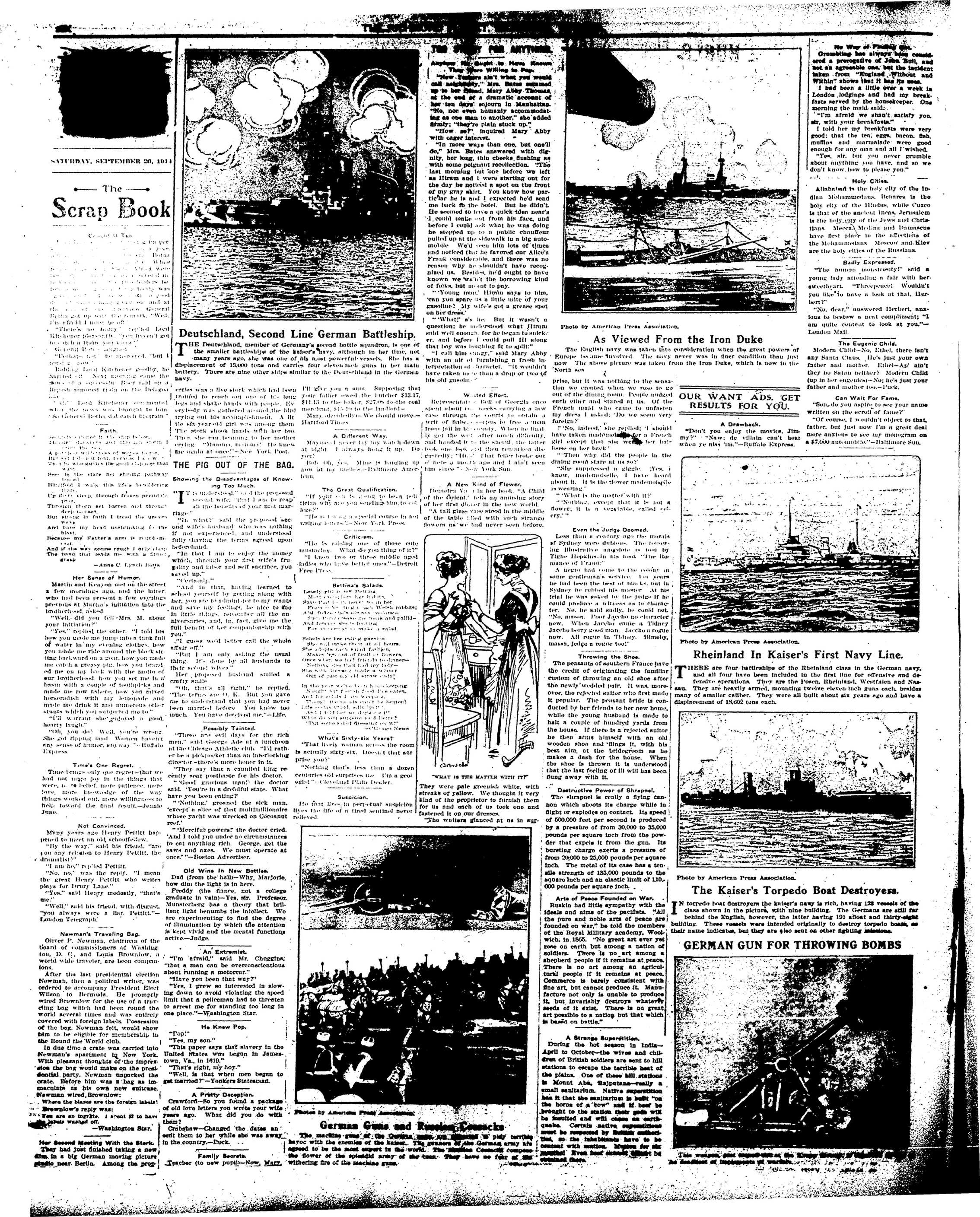
THE FORTRESS OF THE SEA
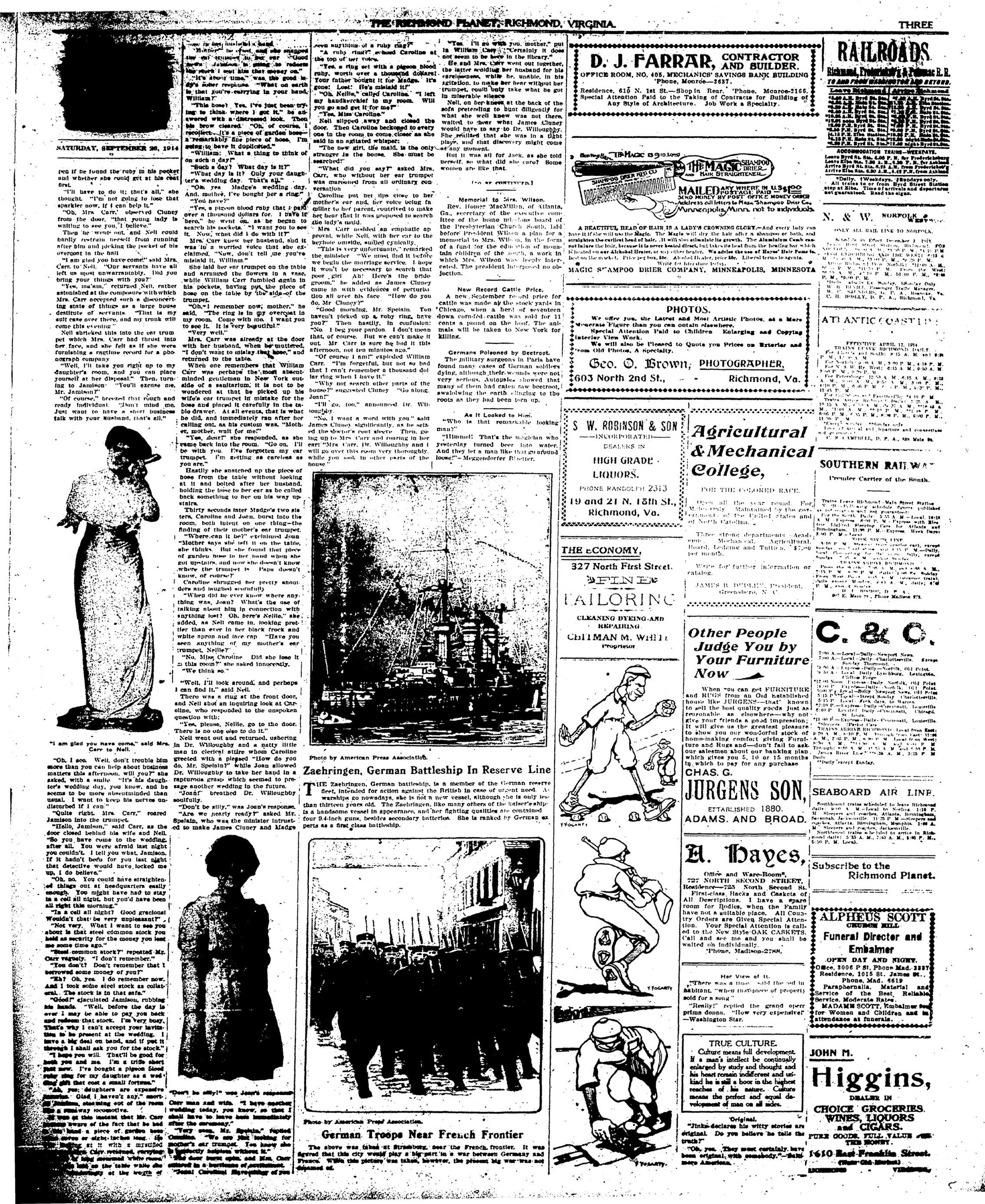
Zaehringen, German Battleship In Reserve Line
THE Zaehringen, German battleship, is a member of the German reserve fleet, intended for action against the British in case of urgent need. A warships go nowadays, she is not a new vessel, although she is only less than thirteen years old. The Zaehringen, like many others of the insular ship is a handsome vessel in appearance, and her fighting qualities are contained four 9.4-inch guns, besides secondary batteries. She is ranked by German ex perts as a first class battleship.
THE STREETS OF LONDON
The above was taken at Strasbourg, near the French frontier. It was figured that this city would play a big part in a war between Germany and France. While this picture was taken, however, the present big war was not dispaired of.
been anything of a ruby ring?
"A ruby ring!" accused Caroline at the top of her voice.
"Yes, a ring set with a pigeon blood ruby, worth over a thousand dollars. Your father bought it for Madge, it's gone! Lost! He's mislaid it!"
"Oh, Nellie," called Caroline. "I left my handkerchief in my room. Will you go and get it for me?"
"Yes, Miss Caroline"
Nell slipped away and closed the door. Then Caroline beckoned to every one in the room to come, closer as she said in an agitated whisper:
"The new girl, the maid, is the only stranger in the house. She must be searched!"
"What did you say?" asked Mrs. Carr, who without her ear trumpet was marooned from all ordinary conversation.
Caroline put her lips close to her mother's ear and, her voice being in miller to her parent, contrived to make her hear that it was proposed to search the lady's maid.
Mrs. Carr nodded an emphatic ap prowl, while Nell, with her ear to the bore outside, smiled cynically.
"This is very important," remarked the minister. "We must find it before we begin the marriage service. I hope it won't be necessary to search that poor girl, Ab! Here's the bridegroom," he added as James Cluney came in with evidences of perturbation all over his face. "How do you do, Mr Cluney?"
"Good morning, Mr. Spelain. You haven't picked up a ruby ring, have you?" Then hastily, in confusion: "No. I beg your pardon. I don't mean that, of course. But we can't make it out. Mr. Carr is sure he had it this afternoon, not ten minutes ago."
"Of course I am!" exploded William Curr. "I'm forgetful, but not so bad that I can't remember a thousand dollar ring when I have it."
"Why not search other parts of the house?" suggested Cluney. "Go along. Joan!"
"I'll go, too," announced Dr. Wiltonchuck.
"No, I want a word with you," said James Climney significantly, as he selfted the doctor's coat sleeve. Then, going up to Mrs. Carr, and cooring in her carr "Mrs. Carr, Dr. Willoughby and I will go over this room very thoroughly, while you look in other parts of the house."
"Yes. I'll do with you mother," put in William Cary. "Certainly it does not seem to be here in the library."
He and Mrs. Cary went out together, the latter would bring her husband for his caretaker, while he, unable, in his agitation, to make her hear without her trumpet, could only take what he got in miserable silence.
Nell, on her knees at the back of the sofa pretending to hunt diligently for what she well knew was not there, waited to hear what James Cluney would have to say to Dr. Willoughby. She realized that she was in a tight play, and that discovery might come at any moment.
But it was all for Jack, as she told herself, so what did she care? Some women are like that.
CONTINUED
Memorial to Mrs. Wilson.
Rev. Homer MacMillan, of Atlanta, Ga., secretary of the executive committee of the home missions board of the Presbyterian Church South, laid before President Wilson a plan for a memorial to Mrs. Wilson, in the form of a fund for the education of mountain children of the south, a work in which Mrs. Wilson was deeply interested. The president interposed no objection.
New Record Cattle Price.
A new September record price for cattle was made at the stock yards in Chicago, when a herd of seventeen down corn-fed cattle was sold for 11 cents a pound on the hoof. The animals will be taken to New York for killing.
Germans Polished by Beetroot.
The military surgeons in Paris have found many cases of German soldiers dying, although their wounds were not very serious. Autopsies showed that many of them had eaten raw beetroot, swallowing the earth clinging to the roots as they had been torn up.
"Who is that remarkable looking man?"
"Himmel! That's the magician who yesterday turned beer into water. And they let a man like that go around loose" - Meggendorfer Ribetter.
D. J. FARRAR, CONTRACTOR AND BUILDER.
OFFICE ROOM, NO. 405. MECHANICS SAVINGS BANK BUILDING Phone, Monroe-2637 Residence, 610 N. 1st St.—Shop in Rear. 'Phone, Monroe-2166. Special Attention Paid to the Taking of Contracts for Building of Any Style of Architecture. Job Work a Specialty.
THE MAGIC SHAMPOO DRIER AND HAIR STRAIGHTENER
MAILED ANY WHERE IN U.S.$100
SEND MONEY BY POST OFFICE MONEY ORDER
Address all letters to Magic Shampoo Drier
Minneapolis, Minn. not to individuals.
A BEAUTIFUL HEAD OF HAIR IS A LADY'S CROWNING GLORY. And every lady can have it if she will use the Magic. The Magic will dry the hair after a shampoo or bath, and straighten the earliest head of hair. It will also stimulate its growth. The Aluminum Comb cannot injure the hair, because it is never heated direct, but takes its heat from the heating bar which is located on our Alcohol Heater, or any other heater. We addie the use of Hayes' Hair Pens to heat on the market. Price per box, $5c. Alcohol Heater, price $6c. Liberal terms to agents.
MAGIC SHAMPOO DRIER COMPANY, MINNEAPOLIS, MINNESOTA
PHOTOS.
We offer you, the Latest and Most Artistic Photos, at a More
Widereate Figure than you can obtain elsewhere.
Special Attention Paid to Children Enlarging and Copying
Interior View Work.
We will also be Pleased to Quote you Prices on Exterior and
from Old Photos, A Special.
Geo. O. Brown: PHOTOGRAPHER,
19 and 21 N. 18th St.,
Richmond, Va.
THE ECONOMY,
327 North First Street.
FINE
TAILORING
PHONE RANDOLPH 2313
CLEANING DYEING. AND
REPAIRING
CHILMAN M. WHITE
Proprietor
STOCANTI
Y FOGARTY
Y. YOSANTY.
---
Agricultural & Mechanical College,
FOR THE COLORED RACE.
Open all the year round. For
Municipality. Maintained by the
government of the United States and
of North Carolina.
Three strong departments - Acad-
eum, Mechanical, Agricultural,
Board, Lodging and Tuition. $7,00
per month.
Write for further information or
catalog.
JAMES B. DEMLEY, President,
Greensboro, N. C.
Other People Judge You by Your Furniture Now
When you can get FURNITURE and RUGS from an Old established house like JURGENS—that's known to sell the best quality goods just as reasonable as an elsewhere—why not give your friends a good impression; it will give us the greatest pleasure to show you our wonderful stock of home-making comfort, giving Furniture and Rugs and—don't fail to ask our salesman about our banking plan which gives you 5, 10 or 15 months to, which to pay for any purchase
JURGENS SON.
ESTABLISHED 1880. ADAMS. AND BROAD.
E. Hayes,
Office and Ware-Boom$^{a}$,
727 NORTH SECOND STREET,
Residence—725 North Second 8t.
Residence—725 North, Second St.
First-class, Hacks and Caskets of
All Descriptions. I have a spare
room for Rodios, when the Family
have not a suitable place. All Country
Orders are Given Special Attention.
Your Special Attention is called
to the New Style-OAK CASKETS.
Call and see me and you shall be
waited on individually.
Phone, Madison-2788.
"There was a time," said the old in habitant, "when their piece of property sold for a song."
"Really!" replied the grand operr prima donna. "How very expensive!—Washington Star.
TRUE CULTURE
Culture means full development. If a man's intellect be continually enlarged by study and thought and his heart remain indifferent and unkind he is still a boor in the highest reaches of his nature. Culture means the perfect and equal development of man on all sides.
Original
"Jinha declares his witty stories are original. Do you believe he tells the truth?"
"Oh, you. They must certainly have been original, with somebody."—Baldi more American.
THREE
ACCOMMODATION TRAINS - WEEKDAYS.
Lovey Bld. St. Naa. 4.00 P. M. for Predikschung
Lovey Kiba Naa. 7.30 A. M. 6.30 P. M. for Ankheim
Lovey Kiba Naa. 7.30 A. M. 6.30 P. M. for Predikschung
Arrive Kiba Naa. 8.00 A. M. 4.68 P. M. from Athlone
*Daily. *Weekdays. *Bundays only.
All trains are on time.
stop at Xibu. Time of arrivals and departures
not guaranteed. Read the sign.
N. & W. NORFOLK
ONLY ALL RAIL LINE TO SOUTHERN
Schedule to Effect December 2 1919.
Lice Road Street Station, Holmout,� 008
North City, 200 A.M., #30 P.M., #41 P.M.
West Lyrichillay, AND THE WEST 615 C
M.C.A.M., #20 P.M., #25 P.M.
Arsex, Holmout,� Northk: 1140 A.M.,
s.e. P.W., #120 P.M., From the West:
#0 A.M., #20 P.M., #140 P.M., #06
P.M., #200 P.M.
Dals abode Ex. Shiray, Shandav Only
W.R. HILL, Passenger Traffic Manager.
W.C. SAUNOIS, G.P.A., Remoke, Va.
C.H. BOSLLY, D.P.A., Richmond, Va.
ATlANTIC COASTLINE
SOUTHERN RAILWAY
Premier Carrier of the South
Travis Lease Richmond - Main Street Station
(212) 255-5555 - Main Street Station published as
the Travel Guide schedule Source published
for the South Palm Beach 5:55 A.M - Local 10:10
P. Palm Beach 6:00 P. M. Pressman with Blue
Lace Illustrated for Atlanta and Birmingham
11:30 P. M. Pressman. Week Inport
3:00 P. M. Local
NOOK MAYHEL LINE
Ain P M Brennan (pulitzer carpe) erase
Simply, not long ago, the Pulitzer Carpe
M—Dolly, erase
Just long ago, the Pulitzer Carpe
Sally, erase
Just long ago, the Pulitzer Carpe
Sally, erase
*12th Sonn-Eyres-Daily Norfolk, Old Point
1400 F - Eyres-Daily-Norfolk, Old Point
500 W Local-Daily Newport News, Old Point
5-15 P Local-Neck Sunday Charlottesville
5-15 P Local-Folk days, to Warren
*2:10 P - Express-Daily-Cincinnati, Louisville
6:40 P - Located Daily-Cincinnati, Chicago, St. Louis.
*11th F - Express-Daily-Cincinnati, Louisville
*Sleeves-Parker-Cars
TRANS AIRLINES RECRUITMENT Local From New York
P 250 A M 100 P M 100 M Through New York
A M 250 P M 600 P M Local From West
A M 250 P M 600 P M Local From West
Throught 250 A M 100 P M Local From West
James River Line 250 A M 100 P M
Daily
daily except Sunday.
SEABOARD AIR LINE
Southland trains scheduled to leave Richmond
daily; 9:30 A. M.-Local to Nothings; 1:10 P. M.
Sleeper and coaches, Atlanta, Birmingham,
Nassauan, Jacksonville; 11:25 P. M.-Sleeper and
coaches, Atlanta, Birmingham, Morganthe; 1:00 A.
M.-Sleeper and coaches, Jacksonville.
Northland trains scheduled to leave Richmond
daily; 5:25 A. M.; 5:40 A. M.; 8:05 P. M.; M.
5:00 P. M., Local.
Subscribe to the Richmond Planet.
ALPHEUS SCOTT
CHURCH HILL
Funeral Director and
Embalmer
OPEN DAY AND NIGHT.
Office, 3006 P St. Phone Mad. 2237
Residence, 1015 St. James St.,
Phone, Mad. 6619
Paraphernalia, Material and Service of the Best, Reliable Service, Moderate Rates.
MADAMS SCOTT, Embalmer Seed for Women and Children and in attendance at funerals.
JOHN M.
Higgins,
DEALER IN
CHOICE GROCERIES
WINES, LIQUORS
and CIGARS.
PURE GOODS. FULL VALUE.
THE BONNY.
1610 East Franklin Street.
(Porter Old Market)
LICHMOND VIRGINIA
Published every Saturday by John Mitchell, Jr., at 411 N. 4th St., Richmond, Va.
JOHN MITCHELL, JR. . EDITOR
All communications intended for publication should be sent so as to reach us by Wednesday.
Entered, at the Post Office at Richmond, Va. as second-class matter.
The Anti-Saloon League of Virginia has won a most notable victory as a result of the election held Tuesday, September 22, 1911 and as a result the liquor interests in this state have been doomed to practical annihilation. The mandate of the voting electorate will go into effect November 1, 1912. After that date it will be unlawful for any person, so all else, firm or corporation to sell or purchase for sale any whiskey or spirituous liquors. This includes wine, beer, etc. Whiskey can be sold for medicinal purposes.
Whiskey and beer can be manufactured in the State and shipped to outside places for sale. Social clubs will be "hard hit" too for the reason that only the "locker system" can be used. The law does not prohibit the purchase of liquor by a citizen from places outside of this State and the mall-order houses in other States will do a flourishing business. Each citizen can secure by express a quantity not exceeding a gallon at one time and this must be for his personal use.
The social clubs will surely feel the effect of the new law. They must resort to the locker system, which while satisfactory in a way to the members is not profitable to the social club. The Statewide people now propose to pass supplementary laws to make the state-wide legislation effective, and to this end will endeavor to secure the election to office of only anti-saloon people.
Tens of thousands of dollars worth of bar fixtures were virtually confiscated by the action of the electorate last Tuesday. The advocates of the restricted ballot are bewailing their losses at the polls. Practically all of the white daily papers in this city and State advocated the disfranchisement of the colored people and during this contest, they advocated the whiskey interests
The answer given has given all of them the headache, even though they profess their willingness to "continue to take medicine." If the white folks can do with a limited supply of liquor certainly the colored folks can, for the latter are now saying, "We don't like the stuff, nohow."
THE B. M. C. AT BOSTON.
The Biennial Movable Committee recently in session at Boston, Mass. is now a matter of history. The complete triumph of Mont Worshipful Grand Master Edward H. Morris of Chicago, shows that he and his associates had carefully planned just what they would do.
The cumbersome judicial department was abolished. The general opinion seems to be that the opponents of the machine alleged more than they were able to prove and that while some of the allegations made were true, many of the charges were untrue.
This necessarily reacted upon the insurgents and gave the statute attorney from Chicago, the opportunity for, which he had long waited. It must be evident though that some of the abuses exist and must be remedied before the great organization can reach an era of unilateral peace. The rank and file of the membership seemed to have believed that the evils existing were only soited upon by gentlemen anxious to secure official preferment and financial reward. It is a pity that so many great organizations are made the prey of designing schemers and politicians and that the interests of the people are never really in serious consideration at any time during the controversy.
We hope to see the B. M. C. take a long step forward at its next meeting. Hon. Edward H. Morris is one of the ablest and most distinguished leaders in the country and is thoroughly fitted for the task of inaugurating reforms which will result in making the colored Odd Fellow organization one of the greatest leavers in this world for good along practical financial lines. Here's to
---
Drakes Branch (Va.) Nown.
This neighborhood has for several weeks been stirred to a high pitch of fright. This was especially true on the part of persons who traveled at night or a distance in the daytime. Such reports as we are about to mention have been circulated but to keep people from some blind tiger or watermelon patch or corn-field. In those cases it is usually said that a bear or some dangerous beast is out and has seen near the field, still. Wet it! Wet it! it was reported that a wild woman was out in the woods. Several persons claimed to have seen her and that she was well armed.
Miss Partheena Carter, of Charlotte C. H. said she chased her last Thursday while on her way to do some shopping. Mrs. Nancy Watkins said she passed her house later the same day and when she ran out to speak to her (thinking she was Manerra Grey) demanded her to go indoors at once. Sunday night at two o'clock Mr. Paul Roberts said he was sleeping soundly and could not get his eyelid apart but knew his wife was shaking and calling him, saying some one was at the door.
Monday night she is reported to have gone to Mrs. Betsie Guthriehs a widow woman who lives alone at Charlotte C. H. She woke up Mrs. Guthriehs and demanded admittance. Mrs. Guthriehs was in an embarrassed condition, for she said she was afraid to open the door and afraid not to do so, but believing the wild woman would come in anyhow. She finally opened and she spent the rest of the night with her. She was caught Saturday and given a house to live in and clothes and food. Having lost her husband she had no one to care for her and was living in the woods, being grief stricken. She appears mentally unbalance at times and Neighbors would rather help her than to believe a wild woman is out. If any one is interested in this woman her name will be sent.
Miss Fannie Ellis of Richmond is visiting her mother at Charlotte C. H. Mrs. George Watkins' hogs are second to none seen here.
Boys'--Girls'
Contest.
VOTES CART SINCE SEPT. 1, 1914.
BOYS.
Trilby Smith. 1605
Prince Bass. 825
J. Floyd Dawson. 760
James Irvin Threat. 400
Henry Beard. 15
GIRLS.
Ruby L. Peyton. 4350
GERMAN REPLY
DIMS PEACE HOPE
The President Feels His Hands Are Tied.
WILL NOT ACT FURTHER.
The Expressions From Warring Nations Are Almost Identical—Mr. Wilson Will Avoid Entanglements. President Wilson soon little prospect of peace in Europe reflected in the unofficial exchanges which American ambassadors have been conducting with Germany, Great Britain, France and Russia.
This was learned, following a careful study of the message which Ambassador Gerard called giving his recollection of an informal conversation with the Imperial German chancellor, Von Bethmann-Hollweg.
Until something more tangible and more definite in the way of overtures comes from the bullets, the president feels that his hands are tied. To undertake to elicit terms from Great Britain, France and Russia, as Germany has suggested, would place the president, he believes, in a delicate position, in view of what Sir Edward Grey has told Ambassador Page.
The British foreign secretary recently took the position that the war had been forced on Great Britain, that the neutrality of Belgium had been disregarded and that it would be necessary to crush German militarism before the allies could feel safe against new attacks, and before treaty of peace could be worth a "scrap of paper." Sir Edward said the allies could make no comment until they had received a definite statement of terms from Germany and Austria. On comparing expressions from the allied powers and that of the imperial German chancellor, the president found that they took almost an identical position. He is not disposed to take any action as a result of the unofficial exchange because of their informal character, all of them having been conducted brutally, and is anxious to avoid entangling the United States in the intricacies of European diplomacy.
The German imperial chemistol told Ambassador Gerard that before entering upon any negotiations looming toward peace, the Germans want to know the attitude of their faeom, and that any peace must provide for the territorial integrity of the German empire and its protection from neighbors in the future.
With complete returns from all cities, and practically every county board from in detail, the voters of the Commonwealth of Virginia today placed the State in the "dry" column by a majority of more than 30,000 votes. It was conceded that a majority of the counties would vote for State-wide prohibition, but a distinct surprise was sprung when the returns showed that Petersburg, Newport News and Ranokne rolls up large majority for the "dry" column, and Petersburg was 2,123 for State-wide prohibition and 1,233 against: Newport News gave a "dry" vote of 1,024 against 761, and Ranokne went 2,329 for and 1,226 against.
Lynchburg, the home of Representative Cartier Glass, who made several prohibition speeches, gave a vote of 1,713 and 973 against. Not more than 8 out of the 100 counties in the State registered majority against State-wide prohibition laws, and at midnight was even greater than the Virginia Anti-Saloon League claimed in its forecast on the one of battle.
SALOONS CLOSE IN 1916.
Under the provisions of the enabling act under which today's State-wide election was held the returns are to be certified by the clerks of the cities and counties to the secretary of the Commonwealth, who, in turn, will certify the same to Governor Stuart. The Governor thereupon will issue a proclamation declaring the State of Virginia "dry" and after November 1, 1916. The General Assembly, which meets in regular session in January, 1916, will enact laws which will govern the State under prohibition.
The result of today's election means that when the State-wide prohibition laws go into effect the State will be deprived of more than $700,000 annual revenue.
The manufacture of whiskey will be prohibited within the bounds of the State, but wine and its products, elder, and beer, of not more than 2.14 per cent, alcohol may be manufactured by-porons, firms, or corporations now engaged in the business, but the product must be shipped outside the State and into territory where its sale is legally authorized.
The sale or giving away of liquor by persons or social clubs will be prohibited after November, 1916.
STATEMENT BY OPPONENTS.
At 11 o'clock the Virginia Local Self-Government Association issued a statement, which in part, follows:
"The returns indicate that State-wide prohibition has been carried by a majority of about 30,000. It is clear that the people of Virginia desire to give this law a trial. This association was founded to oppose the enactment of State-wide prohibition in Virginia. Its members hold the conviction that the law did violence to the principles of self-rule, which is the foundation of our State government. The men who compose the committee of the triotic Virginia, and an loyal citizens of this State they will lend their best efforts in assisting to make the new law effective."
Dr. James Cannon, Jr., superintendent of the Virginia Anti-Saloon League, said: "I feel like the fellow who had too much whiskey—too full for utterance. I can only say that the people all over Virginia have made up their minds to dissolve partnership with the liquor traffic. "We have heard from practically every county in the State, with the exception of Franklin, and I believe that the majority in favor of State-wide prohibition will be from 70,000 to 40,000."
The vole is for all locations 1:132
British, for 352 against 282, Buenos
Vista, for 188, against 102; Char-
lottesville, for 343, against 196;
Cifton Forge, for 281 against 266;
Danville, for 744; against 948;
Fredericksburg, for 236 against 317;
Lynchburg, for 1,713 against 973;
Newport News, for 1,024 against
761; Norfolk, for 3,326 against 3,
347; Peterburg, for 2,122 against
1,123; Portsmouth, for 1,294,
against 1,231; Rutland, for 428,
against 4,282; Hickory, for 6,011; Ronnoke, for 2,329,
against 1,226; Staunton, for 340,
against 512; Suffolk, for 423, against
236; Williamsburg, for 86, against
51; Winechester, for 550, against 292.
"DRYS" SWEEP SOUTHWEST.
BRISTOL, VA., September 22.—Returns from a majority of precincts in southwest, Virginia counties show that this section of the State has cast about three votes to one in favor of State-wide prohibition. The result is a surprise to even the "drys." The advocates of local option worked hard all day, and seemed hopeful of carrying counties in this section. Figures in hand, indicate that the counties of southwest Virginia have given majorities for prohibition ranging from 500 to 2,000 each.
Address to
the Country
(Continued From First Page.)
nationalizing of costs and color prejudice altogether.
Against disfranchisement, lynching persecution, denial of civil and political rights, we protest and shall maintain a struggle in organized strength. We ask for ourselves as favors because of our color, only our rights under the constitution and the same treatment that all other Americans, even the foreign-born receive. Nor shall we wee until all citizens in every state shall have impartial suffrage, full civil rights, and trial by jury when accused of crime.
We advocate the enforcement of the Federal constitution, the placing of lynching in the category of Federal crimes, the nobilization of legal color segregation, and Federal aid to education in the Southern States with impartial distribution.
Colored citizens know that proscription for race is an enmity visited upon them alone in this country; and we warn them that they should insistently acitate and campaign against it; that only by organization can they effectively combat it. Only by being a strongly organized group under trained Colored leaders can we either secure full rights, or keep rights once gained.
The ballot is the citizens weapon, and we urge the use of it for evidence, voting independently for our rights and liberties and not for the welfare of a party, voting for true men and sound measures.
We extend greetings to the Nation Association for the Advancement of Colored People and the Constitution League and appreciate their efforts to better our condition. We thank Congressman T. C. Thacher and A. J. Peters of Mass, for securing the audience for our delegation and opposing segregation.
We advise Colored voters to look in to the records of every Congressman up for reelection, to make an issue of the color segregation practiced by certain cabinet officers and encountered in bills already introduced into Congress. Find out where each candidate stands on these anti-Negro bills and the anti-intermarriage bill and act accordingly.
We advise that another delegation be sent to President Wilson to ascertain whether he will eliminate Federal segregation. Next to segregation denial of employment for color is America's greatest inhumanity.
For Colored Americans the attempt to establish a permanent caste of color is the gravest danger. So deep-seated is this movement that we warn our fellows against accepting the segregation of philanthropy in the North, as in the last analysis all segregation is alkinx and non-local paves the way, and is pleaded as an excuse for legal segregation. To all Americans we appeal to justice and fair play in the land of our birth.
SUMMARY OF ADDRESS.
To recapitulate:
Let the American people and especially the president, in view of the bloody war of all Europe and the probable grant of freedom to Ireland suffrage to women, freedom to Poles and Finns and relief from segregation and political disabilities for the Jews, induced by the needs of warring nations, remember that 12,000,000 native citizens in this country are worse prescribed than those of Europe. We appeal to President Wilson to free Colored Americans from Jim-crow cars, disfranchisement lynching and segregation, especially under the Federal government at the Federal capital now rather than await some awful war here.
Southern distranchisement encourages other forms of lawlessness and renders the Colored citizens helpless as cowardly fashion as the lynching which its disrespect for law breeds. Jim-crow cars were aburd enough but resident segregation shows the South knows, no limit in proscription it let alone.
Segregation of Federal employees is the most alarming symptom. The position presented against it to President Wilson by a delegation of this league checked it only. We ask President Wilson to entirely remove the nationalizing of the protest against distranchisement, segregation, denial of civil and political rights. We want only the rights all others enjoy, even the forsaker. We shall never cease until all citizens have full equal rights in every state.
We advocate enforcement of the constitution, making lynching a Federal crime, abolition of legal segregation, federal and educational. This prescription, visited upon no Americans but those of color, is serious and not to be minimized. Colored citizens are warned that, they must ever visit it by agitation and organization. Organization of Colored persons is the only means to gain rights or retain them if gained. We urge the use of the ballot as the real weapon of self-defense, voting independently for our rights and liberties and not for party.
Greetings and appreciations are extended to the National Association for the advancement of colored people and the Constitution League for aid, and thanks given Congressmen R. C. Thacker and A. J. Peters of Massachusetts for securing a hearing against segregation and opposing it. Federal segregation is practiced in the departments and encouraged in various halls should be made an issue as to supporting candidates for Congress, and no doubtful man on these issues should be voted for.
Another delegation to see President Wilson on undoing Federal segregation is advised. Next to segregation, the denial of employment of industry is the most inhumane practice of this country. As an attempt to reduce Colored Americans to permanent castes is no powerful, acceptance of non-legal segregation in philanthropic institutions in the North is opposed.
Rev. Bryce Gunner, New York:
Rev. J. B. Johnson, Ohio; Rev. C. L.
Miller; Rev. B. J. and R. C. Ramoson
New York; Rev. Thurman Theodore
D. C. J. A. Hoyne; D. C. J. A.
Hoyne; Communicat: W. A. Streicher;
Fidelity Bank; B. W. Arroyo; New
A new lodge of Knights of Pythia N. A., S. A., E., A. and A. was instituted last Wednesday night at Shiloh Hall, Westwood, Henrico Co. Va. by Grand Chancellor John Mitchell, Jr. There were 21 candidates and the work was completed in the three ranks in just one hour and twenty minutes to the infinite amusement of those present.
Grand Chancellor John Mitchell, Jr. installed the following officers of the new body, which will be known as Westwood Lodge, No. 198: Chancellor Commander, Joseph Price; Vice Chancellor, Wesley Smith Master of Work, McBurleigh; Prelate, Nelson McCargo; Keeper of Records and Soal, Leonard Warden; Master of Finance, Edmund Pemberton; Master of Exchequer, Lewis Woodson; Mastur-at-Arms Thomas Holmes; Inner Guard, James Holmes Outer Guard, Anthony Leamus; Trustees, Oscar Holmes, Sol. Turner, Elijah Robinson.
Short addresses were delivered by Grand Chancellor John Mitchell, Jr., Grand Medical Register Frank G. Elliott, Col. Roscoe C. Mitchell, District Deputy Grand Chancellor L. J. Morris and others. Many announced their intention to join the Uniform Rank.
Among those present and assisting in the initiation were: Sirs J. A. Carter, J. S. Pryor, Jr. H. Fountain, Charles Wilkins, Scott Hart, A. B. Carter, J. M. Lewis, Robert A. Carter, Edward Norrell, P. C., Ziontown Lodge; J. E. Wesley, P. C., J. H. Hopkins, Royal Lodge; J. A. Conway Sir J. E. Byrd, Crystal Lodge.
A bountiful repast was spread in the hall below and all enjoyed themselfs. Grand Chancellor John Mitchell, Jr. complimented Rev. L. J. Morris highly on his work and wished him continued success in his efforts in this neighborhood.
Roanoke (Va.) News.
Mrs. Rosa E. Saunders, 807 Norfolk Avenue, S. W. departed this life Sunday, September 20th, at two a.m. Funeral was preached at the Jerusalem Baptist Church Tuesday, September 22nd. Her remains were carried to N. and W. station and shipped to her old home, Burkoville, Va., where she was buried Wednesday on her brother's place, where she was married from twenty-six years ago. She leaves a husband, one brother, Mr. W. H. Jeter, of Burkoville, Va. She was a faithful member of Jerusalem Baptist Church and of the St. Luke.
Miss Carrie J. Claytor is visiting her brother, Dr. J. B. Claytor.
Rev. W. R. Brown has returned to the city from National Baptist Convention at Philadelphia.
Rev. J. H. Burks was at his post of duty Sunday after being away a month on his vacation. He attended the National Baptist Convention.
Mr. John W. Howard, General Superintendent of American Beneficial Insurance Company is in the city.
Mr. J. H. Fowlkes left Saturday night for Blackstone to attend Sir K. L. Jackson's funeral.
Mr. Samuel Clarke continues very sick. We hope him speedy recovery.
Mrs. Mamie Clarke, who has been visiting her brother, Mr. Thomas Mars left Tuesday, September 23nd for Washington and other Northern points.
Greatly Reduced Farms Via Southern
Hills and Northwest
"County Farms, as Follows
Mecklenburg County Fair, Chase City, Va., September 20-October 2, 1914. Tickets on sale September 27-October 2nd. Final return limit October 4, 1914. Agricultural Stage Fair, Richmond, Va., October 5, 1914. Tickets on sale October 2nd to 10th, Inc. Final return limit, October 12, 1914. Agricultural and Industrial Fair, Dantville, Va., October 15-17, 1914. Tickets on sale-October 13-17, inc. Final return limit October 19, 1914.
Hallifax County Fair Association,
South Boston, Va., October 20-24,
inc. Final return limit Oct. 26. '14.
Pittsylvania County Fair, Chatham, Va., October 30, 1914. Ticket on sale, October 29-30. Final return limit 31st, 1914.
Legal to Censer Wireless.
Censorship of wireless messages by the federal government is legal, according to an opinion by Attorney General Grocory, announced by Secretary Daniels.
H.M.WILLIAMS, JR.
OPTICIAN
See to it that your children's eyes are thoroughly and scientifically examined.
You, as parents, owe this precaution to them and should not fail to do your part to "nip in the bud" vampire that might, otherwise, lead to diastrophous We're here to help you with both "know how" and long experience.
NEW, 100% NEXT MODEL IN POWDER
in the use of the New Handmade
Coconut Oil
Hands of Coconut Oil and Lily-White Petroleum
Combined, with a well-known, skin food, it is the finest scalp massage over
offered for the growing and preservation of the hair. Milkweed keeps the
hair straight, soft and silky. For Sale by all Droughts—Price 10c and 25c
Manufactured by LAURK CHEMICAL CO., Baltimore, Md.
Wolf Bros. Giant Hair Straightener and Dryer Comb.
50c AGENTS WANTED.
This Comb is solid brass and will hold heat longer than any other corub. Sold regularly for $1.50, but your price is 50c and we give you a LAMP ATTACHMENT FREE! Mail Orders Solicited. If Ordered by Mail, enclose 5-2c Stamps.
1214 N. SENATE AVE., INDIANAPOLIS, INDIA.
HELLER'S HUMAN HAIR STORE,
712 7th St., Washington, D. C.
Established 1856. Oldest Hair Store in the South.
This wonderful comb sent by mail—prepald—to any address upon the receipt of One Dollar. Wavy Creole Transformation, Jet Black and Brown—Large, full and fine. Worth $3.00—mailled to you for $1.69. Wavy. Creole Switch—made with three stems, 26 inches long. Jet Black and all colors worth $2.50. Mailed to you for $1.33. The Crowning Glory of Woman is HELLERS HAIR.
BEWARE!
KEEP out of danger! When you feel the GUNS of your CONSCIENCE pointed squarely at you TAKE CARE! Your conscience is the fleet that is warring with your CARRIESS HABITS, with your EXTRAVAGANCE, with your NEGLECT of the FUTURE. The guns warn you. Heed them.
OUR BANK IS AT YOUR SERVICE.
Every School Day, 9 a.m. to 2:30 p.m. Kindergarten to Eighth grade. Students prepared to teach. Classes in charge of the Franciscan Sisters,—715 North First Street.
---
Every Monday, Wednesday and Friday, 8:00 p. m. to 10:00 p. m. Courses, -Stenography and Typewriting, Book-keeping, Dressmaking, Music, Automobiles REV. CHAS. F. HANNIGAN, President.
InvadersRightWing Imperilled.
French Forces Attempt to Turn Flank of Enemy.
Attack Center of Allies' Lines and Are Repulsed.
The tremendous struggle on the Alno and the Olse in France continues. On their left the allies are gaining new positions by desperate fighting. Their turning movement continues.
Not a moment's respite was given to the German forces entrenched along the two rivers and extending into the Woevr district. The batteries of the allied forces never coaxed firing all eight, although their activity diminished somewhat after sidelow.
The French and British on several occasions succeeded in surprising and driving back the occupants of the German trenches, but only after the most stubborn fighting and after heavy losses both to the attacking and to the descending forces. In every instance the allied troops retained the ground captured and immediately dug themselves in.
Further east the Germans developed a strong with it, but were beaten back with the largest, only to return again and again, to be finally driven on to their original positions. The allied commanders were able to give the troops who had been occupying the advance hiring and a welcome rest, pushing to the south freshorigines of batteries batteries and to reserve and which were only too anxious to come into actual contact.
Unofficial reports, which are not confirmed from the various headquarters, indicate that the turning movement of the French and British troops on the extreme German right is succeeding. General Von Kluk's staff is reported as having been transferred to Mona, inside the Belgian border. Other towns near St. Quentin and Cambrai are mentioned as places to which the German troops under General Von Kluk have already retreated.
The German official statement credits the allies with great valor in attack, but speaks of them as showing signs of weakening—credits the German arms with taking a marked offensive and growing stronger at all the points. The main German claim is their recapture of the heights of Cranes, north of the Alane, and the village of Bethemy, near Rheims.
The French Statement.
The following official communication was made public in Paris:
"Along the entire front, from the Oise to the Wooveu, the Germans manifested a certain activity, without, however, obtaining appreciable results.
"On our left wing on the right bank of the River Oise, the Germans were obliged to yield ground before the French attacks. Between the Oise and the Alanse the situation remains unchanged. The enemy has not delivered any serious attack, contenting himself Monday evening with a continued canonading.
"On the center, between Rheims and Souain, the enemy attempted an offensive movement, which was repulsed, while between Souain and the Argonne we have made some progress.
"Between the Argonne and the River Meuse there has been no marked change.
"In the Woever district the enemy made a violent effort. He attacked the heights of the Mouso along the front, between Trousaursaux, Vigneuilles and Headcourt, without, however, succeeding in gaining position on these heights.
"On our right wing, in Lorraine, the enemy has again passed the frontier, using in this operation a number of small columns. Donestre, to the south of Blamont, has been reoccupied by the enemy.
"During Sunday and Monday we captured twenty automobiles used in moving provisions, together with all the men attached to them. We also captured on these days numerous prisoners belonging principally to the Fourth, Sixth, Seventh, Eighth, Ninth, Fourteenth, Fifteenth and Sixteenth German corps, to the Davarian Landwehr and to the reserve corps."
Official denial that the allies have forced General Von Kluk to retreat seven miles is made by the war office in Beijing.
The statement adds that the right wing is standing firm at all points, although the allies have been heavily punished.
Further announcement is made that attacks by the French and British forces on the German bases are diminishing in strength, and the German offensive is growing stronger at all edges.
English Woman Daee Effective Hospital Work on Battlefield.
```markdown
```
Photo by American Press Association.
This is one of the party of English Red Cross nurses now on duty in Belgium. She is mounted and thus better able to search for the wounded on the battlefield.
village or Betheny.
"We are attacking the strong forts on the line south of Verdun and have crossed the east border, in the direction of Lorraine, which is defended by eight French army corps (320,000 men). A sortie from the northeast of Verdun has been repulsed.
"The French troops camping to the north of Toul (thirteen miles east of Nancy) have been surprised by our artillery."
A later statement says:
"The attack of the German troops on the line of fortifications south of Verdun continues uninterrupted.
"Cote, in Lorraine, which was de-
fended by the Eighth French army
corps, has been occupied, the Gers-
mans now holding this point.
"A sortie of the French troops
from the northeast front of Verdun
was repulsed.
"The enemy shows signs of weak-
ening as a result of his continued at-
temps to capture our positions. On
the contrary, our troops, fighting from
well fortified points, have had a rest
and are taking a strong offensive.
Their attacks are growing stronger at
all points."
The statement that the French have eight army corps in the Lorraine region indicates that the allies' Right wing is trying to turn the German left. With the heights of Crannone held by the German center, it will be possible to withdraw troops from that part of the line to strengthen both the right and left wings if they are threatened.
German reinforcements, according to Berlin reports, have been rushed to the fighting zone. The result seen in the rapid series of strokes which General Von Klunk has been able to deliver in an effort to steam the allies' enveloping movement around Saar Quentin.
The engagement, taken as a whole seems to be partaking of the nature of a siege. Both sides continue to hold most of their strongly entrenched positions. The German lies for 100 miles are described as virtually a continuation of forts and heavy entrenchments. The artillery exchanges go on day and night, and under their cover sorties of infantry are made.
AIR BOMB IN MAESTRICHT
Missile Dropped From Aeroplane Tore Up. Earth, But Took No Lives:
An aeroplane of unknown nationality dropped a bomb in Maastricht near the Brussels gate, according to a dispatch received in Amsterdam.
No lives were lost, but a big hole was torn in the ground; trees were broken, the doors of a nearby house were riddled, and windows for a considerable distance shattered.
Automobiles were sent to trace the course of the aircraft, but it disbanded, going south.
Take German Ship and 300.
The German steamer Professor Woermann, of the Woermann Line with 300 German reservists on board has been taken captive and brought into Sierra Leon, on the west coast of Africa, according to information that has reached London.
No More Relief Needed in Norway.
The American relief committee that has been helping stranded Americans in Christianity, Norway, has about finished its work and will sail for London Friday.
Most Nearly $1 a Pound in Berlin.
The Park Figure says: "Most is nearly $1 a pound in Berlin. Two bus drivers babesies are making brave with painstress and bartery."
Australian Armies Were Forced to Retreat to Await Reinforcements From Germany.
Russian troops have occupied the fortified Austrian position of Jarosław, according to official announcement made in Petrograd. The Russian flag is now flying over the town.
Jarosław is an important railroad center. A bridge near the town crosses the San and commands the passage of the river. The town is seventeen miles northwest of Przemysl, and is on the railroad line between Lemberg and Cracow. Jarosław has been under heavy bombardment for several days).
The bombardment of Przemysl continues, but no breaches have yet been made in the walls of the forts.
At the request of the Austrian commander at Przemysl, General Von Colrad, an armistice of five hours was declared to permit of the departure of the non-combatants who wished to leave. Many decided to remain.
While part of the Russian forces are investing Przemysl the main parts of the first and second armies continue their operations west of the River San and south of the Vistula. The Austrians defeated at Doblecko have fallen back in disorder to Jaslo, on the Wistok river, and the Russians have occupied Rzeszow.
The seizure of Rzeszow severs all railroad communication between the Austrians in Przemysl and those in Tarnow and Cracow. It is understood that German reinforcements are joining the Austrians as Jaslo, and the most great battle may be fought between the San and Wistok rivers in the foot hills of the Carpathians.
The combined German and Austrian forces will be in a dangerous position there, as it would be possible for the second Russian army to flank them by a sudden movement along the line extending from Ranizok to Baranow. On account of the many swamps in Galicia west of the San river it is expected that the progress of the Russian troops will necessarily be much slower now.
THREE WARSHIPS SUNK
British Cruisers Torpedoed in the North Sea.
The silence of the British authorities regarding naval operations in the North Sea was suddenly broken by the announcement in London of a disaster to the British navy which, according to official information, has suffered the loss of three armored cruisers, sunk by German submarines. The victims of this brilliant stroke on the part of the German fleet are the Cressy, the Aboukir and the Hogue.
The loss of life among the crews of these three vessels probably will be heavy, although a considerable number of men were picked up by the cruiser Lowestoft, a division of torpedo boat destroyers and some trawlers.
Neither the time nor the scene of the disaster is given in the official report.
The Aboukir was torpedoes first. The Hogue and the Cressey drew in closes to her and were standing by to save her crew, when they also were torpedoed.
The Cressey, Captain Robert W. Johnson; the Aboukir, Captain John E. Drummond, and the Hogue, Captain Wilmot S. Nicholson, were sister ships. They were armored cruisers of a comparatively obsolete type, and were built fourteen years ago.
The lists of the casualties among their crews will be published as soon as they are known.
The Aboukir cost $3,755,590; the Cressey, $3,746,620, and the Hogue, $3; 749,045. The Aboukir had a speed of 21.6 knots, the Cressey 20.8 knots and the Hogue 22.6 knots.
31,000 CANADIANS TO FRONT
A Second Contingent, 19,000 Strong
Will Be Raised at Once.
It has been decided to raise immedi-
dately a second contingent of Canad-
ians, 19,000 strong, making 50,000
men in all.
Thirty-one thousand Canadian sol-
diers are already being moved to Eu-
ropean battlefields. The second con-
tenginten is to be ready by Nov. 1.
We, are at peace. Business is going ahead. Now is your time to watch for real estate bargains. You can't go wrong if you seize opportunities presented in our classified columns.
10
BRITISH PONTOON FOR BRIDGE
THE FEDERAL MUSEUM OF ART
THE CANNON
THE FIELD
1914 by American Press Association
BRITIS
Photo by American Press Association
A GENERAL SURVEY OF THE WAR
WEDNESDAY.
After suffering very heavy losses in unsuccessful counter attacks, the kaiser's strongly entrenched armies along the river Alsace in France began giving way.
To the eastward the army of the crown prince, routed from Varennes, was hurled back along the river Meuse toward Luxemburg by a triumphant French force, which now holds the roadways to Metz, by which the crown prince might have retreated to Germany.
Continued Russian successes are reported from Gallicia, where the soldiers of the czar are said to have nearly surrounded the fortified city of Przemysl. A Rome dispatch from Austrian sources says two Austrian armies have effected a juncture at Rzeszow, thirty-two miles north of Przemysl.
Crown Prince William, with his armies, has been driven twenty miles in retreat in the last three days. His rearguard is now intrenched at Montfaucon, where his personal headquarters were located Monday, contesting the advance of the French, who are striving to cut off the escape of the heir to the German throne by way of
FRENCH
Photo by American from Association.
the River Mouse. The French and British have been victorious at several points on the River Alsace and have repulsed counter attacks by the Germans in other sections of the battle.
The resistance of the Germans has not been broken, although at certain points they are described as giving back slightly. At other points they continue to fortify themselves.
censive onslaughts to break the lines of the French and British in the center and in the western end of the battle line of 150 miles. The crown prince hastily constructed earthworks to hold off the French engaged in surrounding his troops. The German center army was decisively defeated in a determined night attack to retake the city of Rheina for occupation as a center in offensive operations. Artillery duels make up the greater part of the fighting along the 150-
FIVE
survey at the site of the conflict.
Republican from Philadelphia say that
Bryanton, a principal defense south-
west of Frensham, in Calgary, has been
taken and that the fall of Frensham is
expected in a short time.
SATURDAY.
Although no decisive result has been achieved by either of the great armies facin, gench other in northern France, it would appear from the latest French official report that the allied forces are beginning to make their continued pressure felt.
The French army, operating on the right bank of the River Oise, in the region of Noyon, according to this report, has made some progress, while the Anglo-French force which a week ago crossed the River Alsine in the face of a withering fire from the German guns, now holds the heights to the north of that point. In the center the Germans have not moved from the trenches which they dug when they were compelled to fall back, while the crown prince's army, which holds the German left, again has retired.
SUNDAY
Rhelma, one of the most beautiful cities in France, with 105,000 population, an important link in the French defence, is in flames, following a furious bombardment of three days by the Germans, in which 400 civilians were killed and in which the cathedral and the greater portion of the city were demolished by shells.
An official Russian announcement states that the German offensive movement in east Prussia has been checked, with severe losses to the kaiser's forces. The German invasion of that part of Russian Poland, lying east of Prussia, continues highly successful, the Germans having taken Grajewo and St. Shutchin, border towns.
In Galicia the Russians are reported to have cut off General Dankl's army.
G THEIR SHIP
which was attempting a function with the main Austrian army under General Aufbonborn.
MONDAY
German troops were repulsed on Monday with heavy losses all along the battle line of 150 miles in France. Desperate attacks near the center of the firing zone ended in defeat for the kaiser, leaving his right wing army exposed to the flanking maneuvers of the French and British, and compelling the crown prince, on the German left, to stand at bay before the French forces harassing his retreat.
Fighting was most sanguinary near Craonne, where reaped bayon't charges by the Germans ended in their defeat. Bombardment of Rhelma continued for four days.
The two Russian armies which have been operating in Russian Poland and Galicia have formed a junction and are moving against the newly organized Austro-German army, now in the vicinity of Cracow.
The German Baltic fleet has defeated a Russian squadron in the Baltic, east of Kielberg, according to advisors which have reached Copenhagen.
Steal 300-Pound Church Bell.
Thloves broke into the Episcopal Church of the Redemption in Philadelphia, where they cut away 50 feet of brass altar rail and even stole a 300-pound bell that was stored in the basement to await hanging in the belly in the spring.
WANTHD—A RELIGIOUS LADY,
with moral principles, that will
take charge of everything as her
own. I have a good home. My
house is brick, a story and a half
high and uses all natural gas. For
any information apply to REV. C.
THOMPSON, Rondeau, Ont., Can.
Something New.
Roaders of The Richmond PLANET can always find copies of the paper on sale. Subscriptions and advertisements and local news are taken at office rates. THE STANDARD NEWS CO., Chas Gary, President and General Manager, 131 W. 53rd St. New York.
FREE CATALOGUE
NEW STYLES
Wetman manufactory all the latest Styles of Creation
Hair Goods, Electro Combs New Hair, Ext.
Wear the highest Hair Scales, and show of
larger variety of styles,
and sell more Fine Creations.
Wide than any other superstores in the United
States. Works for New
Catalogues. Is in FREE
AGENTS WANTED
San-Wilfer Human Hair Goods Co.
P. C. Box 200
SUNVILLE, LA
---
The Scrap Book
g in per
a poor
Bohm
Bohm
While
New York
Ward, were
several in
the
leaders he
was
good
at the
leaders he
and at
the
leaders he
General
Bohm got up with the team's "Well,
I'm afraid I must be off."
"There's no hurry," replied Lord
Kitchener, please. "You haven't got
to catch a train you know."
General Bohm smiled.
"Perhaps I must be answered," but I
just go now.
Balding Lord Kitchener goodbye, he
hurried off. Next morning came the
show of a successful Beel ball on a
Russian armored train on the Delagoon.
"AL" Local Knotcher commented
when the news was brought to him
"S-Genial Father did catch his trajn"
Faith
Secure the ship in the ship bow.
The ship's stern and the ship's stern I
have not seen.
A little while with water, I see.
But the ship's stern, because I saw.
That the who guides the good ship that
want.
See in the state her shining pathway
travelled.
Ritual of I walk this life bewildering
1920.
Up first, sleep, through frozen mounts
1920.
Through them act barren and through deep notices.
But atong in faith I tread the univer
west.
And bare my head unshrinking to the
blast.
Because my Father's arm is round me.
And the way he sees rough I only clash.
The hand that leads me with a firm grab
-Anne C. Lynch Etta
Her Sense of Humor.
Martin and Kieron met on the street a few mornings ago, and the latter who had been present a few eagles previews at Martin's initiation into the brotherhood, asked
"Well, did you tell Mrs. M. about your initiation?
"Yes," replied the other. "I told her how you made me jump into a tank full of water in my evening clothes, how you made me ride around the block stirring backward on a goat, how you made me catch a greasy pig, how you branded me on my back with the motto of our brotherhood, how you set me in a basin with a couple of toothpicks and made me row ashore, how you mixed horseradish with my lemonade and made me drink it and numerous other stunts which you subjected me to"
"I'll warrant she enjoyed a good, hearty laugh."
"Oh, you do? Well, you're wrong.
She got hiping and Women haven't any sense of humor, anyway." Buffalo Express.
Time's One Repeat.
Time brings only one regret—that we had not more joy in the things that were, in belief, more patience, more love, more knowledge of the way things worked out, more willingness to help toward the final result. -Jennie June.
Not Convinced
Many years ago Henry Pettitt happened to meet an old schoolfellow. "By the way," said his friend, "are you any relation to Henry Pettitt, the dramatist?" "I am he," replied Pettitt. "No, no," was the reply. "I mean the great Henry Pettitt who writes plays for Drury Lane." "Yes," said Henry modestly, "that's me." "Well," said his friend, with disgust, "you always were a liar. Pettitt."—London Telegraph.
Newman's Traveling Bag
Oliver P. Newman, chairman of the board of commissioners of Washington, D. C., and Louis Brownlow, a world wide traveler, are boon companions.
After the last presidential election Newman, then a political writer, was ordered to accompany President Elect Wilson to Bermuda. He promptly wired Brownlow for the use of a traveling bag which had been round the world several times and was entirely covered with foreign labels. Possession of the bag, Newman felt, would show him to be eligible for membership in the Round the World club.
In due time a crate was carried into Newman's apartment in New York. With pleasant thoughts of the impression the bag would make on the presidential party, Newman unpacked the crate. Before him was a bag as immaculate as his own now enitcase. Newman wired Brownlow:
Where the blazes are the foreign labels?
Brownlow's reply was:
You are an invite. I sent $2 to have
labels washed off.
-Washington Star.
Her Second Meeting With the Stark.
They had just finished taking a new
diam. in a big German moving picture
media near Berlin. Among the prog-
THE SEA.
Deutschland, Second Line German Battleship.
THE Deutschland, member of Germany's second battle squadron, is one of the smaller battleships of the kaiser's navy, although in her time, not many years ago, she was one of his most powerful vessels. She has a displacement of 13,000 tons and carries four eleven-inch guns in her main battery. There are nine other ships similar to the Deutschland in the German navy.
terries was a live stock which had been trained to reach out one of his long legs and shake hands with people. Even coylyly was gathered around the bird trying out his accomplishment. A lit the six older girl was among them. The stock shook hands with her too. Then she ran beaming to her mother crying "Muntana munita." He knew the again at once" - New York Post.
I'll give you a sum. Supposing that trained to reach out one of his long legs and shake hands with people. Even coylyly was gathered around the bird trying out his accomplishment. A lit the six older girl was among them. The stock shook hands with her too. Then she ran beaming to her mother crying "Muntana munita." He knew the again at once" - New York Post.
A Different Way.
Maymee I never lay my watch down on at night I always bring it up. Do
THE PIG OUT OF THE BAG.
Showing the Disadvantages of Knowing Too Much.
"I is understood," said the proposed second wife, "that I am to reap all the benefits of your most marriage."
"In what?" said the proposed second wife's husband, who was nothing if not experienced, and understood fully sharing the terms agreed upon beforehand.
"In that I am to enjoy the money which, through your first wife's fragrance and later and self sacrifice, you saved up."
"Certainly."
"And in that, having learned to school yourself by getting along with her, you are to administer to my wants and save my feelings, be nice to you in little things, remember all the aniversaries, and, in fact, give me the full benefit of her companionship with you."
"I guess wed better call the whole affair off."
"But I am only asking the usual thing. It's done by all husbands to their second wives."
Her proposed husband smiled a cynical smile.
"Oh, that's all right," he replied.
"The terms are OK. But you gave me to understand that you had never been married before. You know too much. You have deceased me"—Life.
Possibly Tainted
"These are cell days for the rich men," said George Ade at a lunchroom at the Chicago Athletic club. "I'd rather be a pickpocket than an interlocking director—there's more honor in it." They say that a cannibal king recently sent posthaste for his doctor. "Good gracious man!" the doctor said. "You're in a dreadful state. What have you been eating?"
"Nothing," grounded the sick man, "except a slice of that multimillionaire whose yacht was wrecked on Coconut rock."
"Merciful powers!" the doctor cried. "And I told you under no circumstances to eat anything rich. George, get the saws and axes. We must operate at once."—Boston Advertiser.
Old Wine In New Bottles
Dad (from the hall)—Why, Marjorie,
how dim the light is in here.
Freddy (the flame, not a college
graduate in vain)—Yes, sir. Professor.
Munsterberg has a theory that brilli
light benumbs the intellect. We
are experimenting to find the degree
of illumination by which the attention
is kept vivid and the mental functions
active—Judge.
An Extremist
"I'm afraid," said Mr. Changgina; "that a man can be overconcientious about running a motorcar." "Have you been that way?" "Yes, I grew so interested in slowing down to avoid violating the speed limit that a policeman had to threaten to arrest me for standing too long in one place."—Washington Star.
He Know Pop.
"Yes, my son."
"This paper says that slavery in the United States was begun in Jamestown, Va., in 1610."
"That's right, my boy."
"Well, is that when men began to get married?"—Yonkers Stateman.
A Pretty Deception
Crawford—So you found a package of old love letters you wrote your wife years ago. What did you do with them?
Crabshaw—Changed the dates an sent them to her while she was away, in the country—Duck
Teacher (to new pupil)—Now, Mary
THE LEGEND
Line German Battleship.
Many's second battle squadron, is one of Kaiser's navy, although in her time, not of his most powerful vessels. She has a series four eleven inch guns in her main similar to the Deutschland in the German
I'll give you a sum. Supposing that
your father gave the bucher $13,17
$11.13 to the bucher, $27.05 to the coal
merchant, $15.10 to the landlord—
Mary, absolutely—We should move—
Hartford Times.
A Different Wax
Mayne I never lay my watch down
at night. I always bring it up. Do
you?
Bob oh, yes. Mine is hanging up
now at my uncle's Baltimore Amer-
ican.
The Great Qualification.
"If your job is going to be a pat-
tition why are you sending him to col-
lege?"
"He is taking a special course in not
writing letters." New York Press.
Criticum.
"He is raising one of those cute
mustache. What do you thing of it?"
"I take two or three middle aged
ladies who have better ones."—Detroit
Free Press.
Bettina's Salad.
Lovely girl in new Petting,
Most beautiful her hairs,
Saves that little love in her
Friend to bring to the Welsh rabbits;
And she loves the week and palid-
Spirit that loves the week and palid-
And forever she looks looking
For someone at to make a palad.
Salads are her railing passion
She will dress them at all hours.
She will dress them at all hours.
Make it out of fruit or flowers.
Once we had friends to dinner—
Nothing else had my lady—
She will dress it made a winner
Out of just my old straw only!
In the year we were keeping
Naughty but fresh food for eaten.
And for palds we were eating.
Though the salad must be heated!
Life is worth a salty pot?
And I will be no longer it?
What do you imagine and betray?
Put some wild dreams on it!
-Chicago News
What's Sixty-six Years?
"That lovely woman across the room is actually sixty-six. Doesn't that sort prise you?"
"Nothing that's less than a dozen centuries old surprises me. I'm a geologist." Cleveland Plain Dealer.
Suspicion.
He that lives in perfect suspicion lives the life of a tired sentinel never relieved.
---
THE CANNON BLAST.
The machine gun of the German army is designed to play terrifying havoc with the enemies of the kaiser. The gunners of the German army are agreed to be the most expert in the world. The German Council compares the flower of the splendid army of the tsars. They have no fear of the withering fire of the machine gun.
Suspicion
Anyone My Right to Move, Known
They Were Willing to Pay.
"Now You aren't what you would
call somebody." Mrs. Bates assumed
up to her friend, Mary Abby Thomas,
at the end of a dramatic account of
her ten days' sojourn in Manhattan.
"No, nor even humanly accommodating
as one man to another," she added
firmly, "they're plain stuck up."
"How so?" inquired Mary. Abby
wither interest.
"In more ways than one, but one'll do," Mrs. Bates answered with dignity, her long, thin cheeks, fushing as with some polignant recollection. "The last morning but one before we left as Illum and I were starting out for the day he noticed a spot on the front of my gray skirt. You know how partiar he is and I expected he'd send me back to the hotel. But he didn't. He seemed to have a quick idea near's I could make out from his face, and before I could ask what he was doing he stepped up to a public chauffeur pulled up at the sidewalk in a big automobile. We'd seen him lots of times and noticed that he favored our Alice's Frank considerable, and there was no reason why he shouldn't have recognized us. Besides, hard ought to have known we wasn't the borrowing kind of folks, but mount to pay.
"Young man! Hiram says to him, 'can you spare us a little mile of your gasoline? My wife's got a grease spot on her dress.' "What!'s it be. But it wasn't a question; he understood what I Hiram said well enough, for he began to snicker, and before I could pull Hiram that boy was laughing fit to split." "I call him stingy," said Mary Abby with an air of furnishing a fresh interpretation of character. "It wouldn't have taken more than a drop or two of his old gasoline."
Representative: Bell of Georgia once spent about 10 weeks carrying a law case through the courts to obtain a writ of habeas corpus in free a man from fall in his county. When he finally got the writ after much difficulty, and handed it to the shepherd, the latter took one look and then remarked disgustedly "Hur." That feller broke out of here a month ago and I didn't seen him since." New York Sun.
Demetra Vance in her book, "A Child of the Orient" tells an amusing story of her first dinner in the new world. "A tall glass vase stood in the middle of the table filled with such strange flowers as we had never seen before.
G. B. JOHN
WHAT IS THE MATTER WITH IT?
They were pale greenish white, with streaks or yellow. We thought it very kind of the proprietor to furnish them for us and each of us took one and fastened it on our dresses.
The waiters glanced at us in sur-
Wanted Effort.
A New Kind of Flower.
THE BATTLE OF THE HONG KONG
As Viewed From the Iron Duke
The English navy was taken into consideration when the great powers of Europe became involved. The navy never was in finer condition than just now. The above picture was taken from the Iron Duke, which is now in the North sea.
prise, but it was nothing to the sensation we created when we rose to go out of the dining room. People mudged each other and stared at us. Of the French man who came to unfasten my dress I asked: "Do we seem very foreign?"
"No, indeed," she replied; "I should have taken madmomolle for a French girl except that she wear her hair loose on her back."
"Then why did the people in the dining room stare at us so?
"She suppressed a giggle. Yes, I know, madmomolle. I have heard about it. It is the flower madmomolle is wearing."
"What is the matter with it?
"Nothing, except that it is not a flower; it is a vegetable, called celery."
Even the Judge Doomed.
Less than a century ago the morals of Sydney were dubious. The following illustrative anecdote is told by Tithe Hopkins in his book "The Remembrance of Frank."
A rugge had come to the colony in some gentleman's service. Too years he had been the host of blacks, not in Sydney he robbed his master. At his trial he was asked by the judge if he could produce a witness to character. No, he said sadly, he could not. "No, massa. Poor Jaccho no character now. When Jaccho came a Tidney Jaccho jerry good man. Jaccho a rogue now. All rogue in Tidney. Simby, massa, jedge a rogue too."
Throwing the Shoe.
The peasants of southern France have the credit of originating the familiar custom of throwing an old shoe after the newly wedded pair. It was, moreover, the rejected sutor who first made it popular. The peasant bride is conducted by her friends to her new home, while the young husband is made to halt a couple of hundred yards from the house. If there is a rejected sutor he then attains himself with an old wooden shoe and things it, with his best aim, at the bridegroom as he makes a dash for the house. When the shoe is thrown it is understood that the last feeling of ill will has been flung away with it.
The shrapnel is really a flying cannon which shoots its charge while in flight or explodes on contact. Its speed of 600,000 feet per second is produced by a pressure of from 30,000 to 35,000 pounds per square inch from the powder that expels it from the gun. Its bursting charge exerts a pressure of from 24,000 to 25,000 pounds per square inch. The metal of its case has a tensile strength of 155,000 pounds to the square inch and an elastic limit of 110,000 pounds per square inch.
Arts of Peace Founded on War. Ruskin bad little sympathy with the ideals and aims of the pacifists. "All the pure and noble arts of peace are founded on war," he told the members of the Royal Military academy, Woolwich, in 1863. "No great art ever rose on earth but among a nation of soldiers. There is no art among a shepherd people if it remains at peace. There is no art among an agricultural people if it remains at peace. Commerce is barely consistent with fine art, but cannot produce it. Manufacture not only is unable to produce it, but invariably destroys whatever seeds of it exist. There is no great art possible to a nation but that which is based on battle."
A Strange Superstition.
During the hot season in India—April to October—the wives and children of British soldiers are sent to hill stations to escape the terrible heat of the plains. One of these hill stations is Mount Abu, Rajputana—ruly a small sanitarium. Native superstition has it that the sanitarium is built on the horns of a "bow" and if heat be brought to the station their gown will be insulted and will come an earthquake. Certain native superstitions must be respected by British authorities, so the inhabitants have to be content with mutilation. Mutilation for six months. Even heat always must be contained there.
THE BATTLESHIP
Rheinland In Kaiser's First Navy Line.
THERE are four battalions of the Rheinland class in the German navy, and all four have been included in the first line for offensive and defensive operations. They are the Posen, Rheinland, Westfalen and Nassau. They are heavily armed, mounting twelve eleven-inch guns each, besides many of smaller caliber. They were all built about six years ago and have a displacement of 18,002 tons each.
SUNDERLAND
The Kaiser's Torpedo Boat Destroyess.
IN torpedo boat destroyer the kaiser's navy is rich, having 123 vessels of the class shown in the picture, with nine building. The Germans are still far behind the English, however, the latter having 191 atloat and thirty-eight building. These vessels were intended originally to destroy torpedo boats, as their name indicates, but they are also sent on other fighting missions.
GERMAN GUN FOR THROWING BOMBS
This weapon, past expedition at the Krupp station of the Imperial Army, was the deadliest of implements yet warfare.
A Drawback.
"Don't you enjoy the movie, Jimmy!" "Naw; de villain can't hear when ye niss 'tm-"Buffalo Express.
Rheinland In Kaiser
THERE are four battleships of the and all four have been included fensive operations. They are the sea. They are heavily armed, mounting many of smaller catber. They were all displacement of 18,002 tons each.
Photo by American Press Association.
The Kaiser's Torpedo
N torpedo boat destroyer the kaiser's
class shown in the picture, with nine
behind the English, however, the last
building. These vessels were intended o
hair name indicates, but they are also se
GERMAN GUN FOR T
Grumbling has always been considered a prerogative of John Boll, and not an agreeable one, but the incident taken from "England. Without and Within" shows that it has its own. I had been a little over a week in London lodgings and had my breakfast served by the homekeeper. One morning the maid said: "I'm afraid we shan't satisfy you, str, with your breakfast."
sir, with your breakfasts."
I told her my breakfasts were very good; that the ten, egga, bacon, fish, muffins and marmalade were good enough for any unn and all I wished.
"Yes, sir, but you never grumble about anything you have, and so we don't know how to please you."
Holy Cities
Allahabad is the holy city of the Indian Mohammedans. Benares is the holy city of the Hindus, while Cuzco is that of the ancient Incas, Jerusalem is the holy city of the Jews and Christians. Mecca, Medina and Damascus have first place in the affections of the Mohammedans Moscow and Kiev are the holy cities of the Russians.
Badly Expressed.
"The human monstrosity!" said a young lady attending a fair with her sweetheart. "Threepened! Wouldn't you like" to have a look at that, Herbert?
"No, dear," answered Herbert, anxious to bestow a neat compliment; "I am quite content to look at you."—London Mall.
The Eunonia Child
Modern Child—No, Ethel, there isn't any Santa Claus. He's just your own father and mother. Ethel—ain't they no Satan neither? Modern Child (up in her engenue—No; he's just your father and mother too—Puck.
Can Wait For Fame.
Can Wait For Fame.
"Son, you inspire to see your name written on the scroll of fame?"
"Of course, I wouldn't object to that, father, but just now I'm a great deal more anxious to see my monogram on a $7,000 automobile." - Baltimore Sun.
---
```markdown
```
BROOKLYN
TABERNACLE
BIBLE STUDY ON
"LET NO ONE TAKE THY CROWN."
Revelation 3:11—Sept. 27.
"I come quickly; hold fast that which thou hast, that no one take thy crown."—Revelation 3:11.
TODAY'S Study is a prophecy by Jesus Himself. Picturing the seven stages of His Church, the Master used these words in addressing one of them. There is, nevertheless, an appropriateness in the Lord's counsels at any time. So we now, as well as those who were particularly addressed, may find instruction in our text.
It teaches, in harmony with the entire Bible, that there can be no remedy for the reign of Sin and Death, except that which God has provided, to be applied at the Second Coming of our Redeemer, when He will set up His Kingdom. Meantime, God's Plan
is working, and will ultimately bring a blessing to the whole world, the blessing which God has promised since Abraham's day—the blessing of all the families of the earth.
RAINBOW CROWN
From the begin-
ning God has fore-
seen how the six
great Days of the
reign of Sin and
Death could be wisely permitted, in
view of the power to be exercised
by Messiah's Kingdom. Backed by
Power Divine, Messiah will be quite
competent to cope with sin, sorrow,
pain, death—everything that now troubles
humanity. The time appointed of
the Father, a thousand years, will be
abundantly long. When the Church
will have been selected from the world,
as the Bride, the Lamb's Wife and
Joint-heir in the Kingdom, everything
will be ready for the blessed work of
bringing all the willing and obedient
back to the image and likeness of the
Creator, lost through Adam's sin and
gained by Christ's death.
Encouragement to the Church.
Our text addresses, not the world, not the nominal Church, but the true Church. These, having turned from sin, having accepted Christ, having given their hearts to God, through Christ having been accepted of the Father and begotten of the Holy Spirit, are children of God; and, as the Apostle says, "If children, then heirs; heirs of God and joint-heirs with Christ." (Romans 3:17). A crown of glory is set apart for each son thus received of the Father, and the name of each is recorded in the Lamb's Book of Life.
So far as God is concerned, the matter is settled. But it still remains for the Church to fulfill their Covenant Having presented their bodies a living sacrifice, they are to continue in that attitude—daily presenting their bodies gladly, willing to endure, to suffer, to be anything and everything that God would be pleased to have them be. All who do this continue to grow in grace, knowledge and character-likeness to the Lord Jesus, and will thereby make their calling and election sure. But should any neglect this Covenant of Sacrifice, and through fear of death be subject to bondage either to sin or to sectarian errors, they would thereby fail to maintain their election and to make it sure. After a time of testing they would be relegated to a secondary place; they would no longer be counted of the Royal Priesthood, even though they might still maintain their standing as Lovites, servants of the Priests.
The thought of our text is: "Be of good courage. It will not be long until I will come to receive you to myself. Let the thought of the Kingdom cheer, strengthen, comfort you, and enable you to do God's will faithfully, nobly, courageously, loyalty. Do not let slip from you the blossomed relationship which I established for you when I made you acceptable on the basis of your Ovenant to be dead with Me, to suffer with me, to strive daily, for the great prize of joent-heirship in My Kingdom.
"The crown is yours now, by virtue of the arrangement which I have made with you as your Advocate and of the Ovenant of Sacrifice which you have made with Me. Do not allow your crown to pass to another! If any one of you is unfaithful, God will not permit him to have a share in the Kingdom, but will apportion another name instead of His."
This Scripture, with others, shows us definitely that the Church is to be
with others, shows
the Church to be to
composed of a
fixed number—not
one more or less.
This is illustrated
in the Law
pertaining to the Jewish
high priest.
The priest's head
represented Jesus;
his body, the
Church. As the
Apostle says,
"Now are ye the
Body of Christ,
and members in
fixed number—not one more or less. This is illustrated in the Law pertaining to the Jewish high priest. The priest's head represented Jesus; his body, the Church. As the Apostle says, "Now are ye the Body of Christ, and members in Jerusalem" (1 Corinthians 12:27). According to the Mosaic Law no one could serve as high priest unless he be the full number of fingers, ten, with no one could serve who had
a supernous member (Leviticus 21: 17-21). Thus the Lord indicated the completeness of the antitypical Priesthood, The Christ.
Those who, after having been tested as to their loyalty, prove to be not sufficiently loyal to be of the Bride class, will constitute a Great Company, whose number no man knows.
ARAGO'S NOSE
It Was Tremendous In Size, but It Was Safety Anchored.
Emmanuel Arago, the French politician, was a nephew of the noted astronomer and was considered a handsome man, although the nose was extremely conspicuous. At one time he was travelling by train to Versailles when a child who was in the same car and who had watched Arago for some time with dilated eyes began to cry. In vain did the child's mother endeavor to calm the perturbed juvenile. The poor mother was in despair, and as the shrieks grew more and more pleuring Arago felt bound to interfere and see what he could do. He said to the child:
"What all you, my dear?"
Thus addressed, the child sobbed out, "Take off your nose." Arango looked at the mother, who grew very confused and said:
"Ah, mondeur, excuse mo-excuse
my son."
"But, madame," said Arago, "what does he mean?" The mother then explained that she had during the egalitarian taken her
O. B. Bauer
"TAKE OFF YOUR FAIRHOSE!"
child to see a number of persons in masks and with false noses, and he had become so excited that he could think of nothing else.
"By an unfortunate occurrence," she added. "we got into the same carriage as you, who no doubt for some good reason are prolonging the carnival. But you see what a deplorable result has followed. Let me then bog of you to have pity on a poor mother and take off your nose."
"But, madame," said Arago, stupefied.
"A little more and my child will have convulsions!" shrieked the mother. "Take off your false nose."
"But, madame," said Arago in despair, "that is impossible. This is not a false nose, but my own!"
"Iimpossible, impossibler" cried the agonized lady. "Touch it," said Arago. The lady gave a pull at Arago's nose, but it did not come off in her hands, as she had expected. "A thousand pardons," she said, "but pray—oh, pray, hide it with your hat." So Arago continued his journey, with his nose in his hat, and the child's screams gradually subsided. Arago himself used to tell the story with much glee
Cheap Advertising.
A Washington correspondent was in a western city one night, sitting in a hotel lobby and wishing he might meet some one he knew.
A hotel page came by shouting, "Senator Blank! Senator Blank!"
The correspondent knew the senator whose name was being shouted, and he thought to have a talk with him. He stepped over to the desk and said to the clerk:
"Is Senator Blank in the hotel?"
"Oh, yes," the clerk replied, "who's having himself paged now."—Saturday Evening Post.
A Lost Joke
Soon after Miss Madge Leasing, the actress, went to Germany she was interviewed by the representative of a Berlin newspaper. The interviewer complimented her on being able to speak her lines in the piece without a trace of a foreign accent. "Oh," replied Miss Leasing frivolously, "I play in five languages-German, French, American, English and Irish." Poor Miss Leasing expected at least a smile at her little joke, but the interviewer wrote it down quite seriously, and in due course the statement appeared in print. Almost immediately another newspaper childed her, solemnly informing her that American, English and Irish were practically one and the same language. "Miss Leasing," it pointed out, "should know better than make a mistake like this."
New Murphy Swam the Torrent.
During army maneuvers in the Philippines, Sergeant Murphy with a patrol keen for getting back to camp and supper, came to a bridge over a mountain torrent, with the placard "Destroyed." Mesh avenue to a long debour, the sergeant did a little reconcerting and, finding the coast apparently clear, led his men to the bridge. Halfway they were caught by a galloping officer. "Hil! Can't you see that this bridge is supposed to be destroyed?" "Sure I do, sir." answered Murphy, "but this detachment is supposed to be swimming." And the passage was surely unsettled—Springing Reproducers.
THE RICHMOND PLANET. RICHMOND. VIRGINIA.
ORDERS TROOPS FROM VERA CRUZ
Mr. Wijson Says Their Presence is Not Necessary.
The President Says That Circum-
circumstances Justifying Use of U.
8. Soldiers No Longer Exists.
President Wilson ordered American
soldiers withdrawn from Vera Cruz.
He issued the following statement:
"Our troops have been ordered
withdrawn from Vera Cruz. This action is taken in view of the entire removal of the circumstances which were thought to justify the occupation. The further presence of the troops is deemed unnecessary."
It is understood that President Wil-
non took this action on the unanimous
advice of the cabinet. Secretary
Bryan, Garrison and Daniels joined in
the belief that the evacuation of Vera
Cruz would be a good stroke at the
present time. It would demonstrate
America's good faith and confidence in
the present administration, and would
have a good effect on the present de-
ficate situation in Mexico.
It is believed, also, that General
Carranza has frequently told Paul Ful-
ler, the president's confidential ag-
tion in Mexico City, that he would not
make any agreement with the United
States government regarding his fu-
ture conduct or policies until Vera
Cruz again became Mexican territory.
Reports are current in Washington
that recognition of the Carranza gove-
ernment will speedily follow the with-
drawal of troops from Vera Cruz
Those, however, cannot be confirmed
at the present time.
The United States forces were landed at Vera Cruz on April 28, seven days after Admiral Fletcher, in command of the American naval forces, had seized the custom house there. Fighting that followed the landing of the marines and bluejackets cost the lives of more than a score of the American forces. The Mexicans suffered much heavier loss.
About 10,000 United States troops were sent from the camps in Texas and nearly the same number was available from the powerful battleship squadron lying in front of the Mexican port. General Frederick Funston, who had distinguished himself in the Spanish-American war by capturing the Filipino chief, Aguinaldo, is in command.
"So you want to marry my daughter?" said Mr. Cumrox.
"Yes," replied the young man. "I am sure she loves me."
"That isn't the consideration that most affects your prospect of future happiness. What you want to do is to find out whether her mother likes you." — Washington Star.
```markdown
```
T
```markdown
```
COURAGE
Cultivate the spirit of courage. The timid man loses opportunities and is almost always a failure. Do not be timid. A great deal of talent is lost in the world for the want of a little courage. Every day sends to their graves a number of obscure men who have remained obscure only because their timidity has prevented them from making a first effort.
Men-
Wo-
w
Bea-
H
NELSON
HAIR D
will make you
It is unsurpassed for
stubborn hair—soft, gl
It not only beautifies
in good condition.
Price, 25 and 50
NELSON MFG. CO
Men Admire Women with Beautiful Hair!
NELSON'S HAIR DRESSING will make you proud of your hair.
It is unsurpassed for making harsh, kinky, stubborn hair—soft, glossy and luxurious.
It not only beautifies the hair—but also keeps good condition.
Price, 25 and 50 Cents Everywhere
ON MFG. CO., RICHMOND
Men Admire Women with Beautiful Hair!
NELSON'S HAIR DRESSING
will make you proud of your hair
It is unsurpassed for making harsh, kinky and stubborn hair—soft, glossy and luxurious.
It not only beautifies the hair—but also keeps it in good condition.
Price, 25 and 50 Cents Everywhere
NELSON MFG. CO., RICHMOND, VA.
HAIR PARLORS.
To the Friends, Customers and 6
MRS. ROSA B. WATSON 1
M. James Street. You can be
formation or Compound
on short notice. Straightening
Straightening Combs. Orn
and prepractions of all kinds 1
812 ST. JAMES STREET.
In Customers and the Public in General:
DRAIL WATSON invites you to het Hat root. You can be supplied with Braids and Pompadours. Combings made in Brice. Straightening and Shampooing aening Combs. Ornaments for the Hair, tons of all kinds for the skin. Phone AMEN STRENT. RICHMOND.
To the Friends, Customers and the Public in General:
MRS. ROSAEL WATSON invites you, to hear Hair Parlors, 819
St. James Street. You can be supplied with Braids, Puffs, Transformations and Pompafours. Combings made in Braids and Puffs on short notice. Straightening and Shampooing a Specialty.
Straightening Combs. Ornaments for the Hair, Hair Greases and prepations of all kinds for the skin. 'Phone Monroe'-3874.
812 ST. JAMES STREET. RICHMOND, VIRGINIA.
$49,375.00
PAID OUT FROM Jan. 1, 1912 to Aug. 25, 1914
FINE SHOWING FOR BOTH BRANCHES OF THE
KNIGHTS OF PYTHIAS—READ AND CONSIDER—VIRGINIA DOING GRAND WORK
Brought Forward..... $26,300.00
1914
January 19—John Adam Sheffey, Summit Lodge, No. 80. $ 50.00
January 19—Joseph Logan, Ebenezer Lodge, No. 116. $ 150.00
January 19—John H. Kidd, Rescue Lodge, No. 4. $ 150.00
January 26—Joe Fountain, Douglas Lodge, No. 69. $ 50.00
Feb. 3—E. H. Armfield, Friendship Lodge, No. 3. $ 150.00
Feb. 3—William Kee, Lovely Mt. Lodge, No. 57. $ 150.00
Feb. 4—Daniel Reid, Jonathan Lodge, No. 20. $ 150.00
Feb. 7—Andrew McClannan, King David Lodge, 193. $ 150.00
February 16—D. W. Davia, Planot-Lodge, No. 23. $ 150.00
February 17—Andrew William Jackson, Pride of Dante, 187. $ 150.00
March 6—Henry Williams, Venus Lodge, No. 46. $ 150.00
8—Wesley Hendrick, New Light Lodge, No. 155.
8—Eustace Seddon, Nightingale Lodge, No. 45.
24—J. R. Griffin, Crispain Attucks Lodge, No. 117.
20J. John W. Miller, Staunton Lodge, No. 62.
29-Herbert Matthews, Coyington Lodge, No. 60.
1—Albert Hughes, Macedonia Lodge, No. 59.
1 —Christopher Archer, Magic City Lodge, No. 181.
8 —John A. Walker, Capital Lodge, No. 81.
20 —Charles Manning, Pride of the East Lodge, 33.
27 —W. H. Burke, Rescue Lodge No. 4.
27—Moses Draw, Pride of the East Lodge, No. 33...
30—Graves Walker, Morning Glory Lodge, No. 97...
1—A. S. Thompson, Pocahontas Lodge, No. 41...
8—William Taylor, Union Lodge, No. 92...
11—Freed, McGuire, Suffolk Lodge, No. 5...
11—Frank Chappell, Rising Star Lodge, No. 106...
11—Albort Roquemore, Langton Lodge, No. 182...
11—Allen Booth, Magic City Lodge, No. 181...
st 22—Nelson Golns, Zenith Lodge, No. 111...
st 25—William Coleman, Rising Star Lodge, No. 106
January 26—Clarkie Bell, Victoria Court, No. 52.
Jan. 31—Josephine Western, Christian, Light, No. 157
Feb. 3—Ola Wagstaff, Zion Travellers Court, No. 96.
Feb. 3—Frances Carter, White Rose Court, No. 118.
Feb. 3—Annie Clegg, Magic City Court, No. 83.
February 17—Bettie Stewart, Randolph C urt, No. 150.
February 17—Carrie Ridley, Silvor Key Court, No. 75.
February 17—Maggie Riddick, Victoria Court, No. 52.
February 18—Henrietta Brown, Pleasant Grove Court, 51
April 6—Ida Levi, Stilhoff Court, No. 110.
April 14—Martha Brown, King's Daughters Court, No. 70
April 15—Anna Washington, Queen Victoria Court, No. 115
April 15—Laura J. Minor, Salem Court, No. 81.
April 18—Robeca Mitchell, Old Dominion Court, No. 114
April 23—Mary A. P. Grey, Venus Court, No. 47.
April 29—Mattie Lane, Star of Hope Court, No. 93.
May 2—Eustie Morris, Friendship Court, No. 143.
May 18—Winnie Holmes, Ivy Leaf Court, No. 85.
May 23—Annie Robinson, Georgetown Court, No. 152.
May 30—Sylvia Randolph, Georgetown Court, No. 152.
July 1—Mary Nash, Elizabeth Court, No. 210.
July 14—Mannie Vicks, Friendship Court, No. 143.
July 15—Ada Hilton, Blooming Rose Court, No. 104.
July 31—Almeta Riddick, St. Mary's Court, No. 101.
Aug. 10—T. D. Burrell, Magic City Court, No. 83.
August 22—Martha Frederick, Morning Star Court, 124.
Total. $ 16,225.00
AMOUNT PAID BY GRAND LODGE. $ 32,050.00
AMOUNT PAID BY GRAND COUNT. $ 16,825.00
The "Need Not Tell You" Man.
"I need not tell you" says the philosopher of folly. "that when an orator starts with the words I need not tell you' he goes right ahead and tells you all that he need not tell you."—Cleveland Plain Dealer.
Social Fact.
Mrs. Green-You spoke just now of social fact. Precisely just what do you mean? Mrs. Wyne-its social fact I mean getting familiar with all sorts of people without letting them get familiar with you.
Admire
men
with
beautiful
hair
SON'S
RESSING
proud of your hair
making harsh, kinky and
y and luxurious.
o hair—but also keeps it
Cents Everywhere
RICHMOND, VA.
Public in General:—
te you to bet Hair Parols. 819
plumbing with Braids, Pools, Trans-
portation wodes, Brushes and Pools
and Shampooing. Specialty
ents for the Hair. Hair Greases
the skin. 'Phone Monroe-3874.
RICHMOND, VIRGINIA.
THE FIGHT FOR THE HOME
English Infantry on the March
When Germany declared war on Russia there was the greatest activity in the English army. It is plain that with a general war on the continent it would be impossible for England to keep out of it. It was figured that the English infantry would give a good account of itself.
FemaleEmbalmer
mankind, or no charge, no matter what your disease, sickness or affliction may be, and restore you to perfect health. Thousands of people the best and leading ones in the United States and Europe will testify that I am one of the most wonderful healers of all complaints in the world. I use nothing but herbs, roots, barks, gums, balms, leaves, seeds, berries, flowers and plants in my medicines. They have cured thousands that the most skillful physicians and the best hospital physicians in America and Europe have given up to die, and said there was no cure for them.
My Medicines Cure the Following Diseases—Heart Disease, Consumption, Blood, Kidney, Bladder, Stricture, Piles in any form; Vertigo, Quinny, Sore Throat, Lung, Dyspnea, Indigestion, Constipation, Rhumatism in any form, Palms and Aches of any kind, Colds, Bronchial Troubles, Sore, Skin Diseases, all Itching sensations, all Female Complaints, La Grippie or Pneumonia, Ulcer, Carbuncles, Bolls, Cancer in the worst form without the use of a knife or instrument, Eczema, Pimples on Face and Body, Diabetes of Kidneys or Bright's Disease of the Kidneys.
My Medicines cure any disease, no matter of what nature. Gonorrhoea and Syphilis trouble a Specialty.
Medicines sent anywhere. For full particulars, send, write or call in person on
220 West Broad St., Richmond, Va:
Funeral Director, Embalmer and Liveryman. All Orders Promptly Filled at Short Nptice by telegraph or telephone. Halls rented for meetings and aided Entertainment. Flatty of room with all necessary conveniences. Large Places on Band Wagons for Hire at receivable rates and nothing but first-class Carriages. Buggies, etc. Keep constantly on hand fine funeral supplies.
Photo by American Press Association
English Infantry
When Germany declared war on in the English army. It is plain that it won't be impossible for England to English infantry would give a good ac
Female E
MADAM LUCIF CHRISTIAN SCOTT is associated in business with her husband, Mr. Alpheus Scott. Madam Scott claims the honor of being the only Negro woman in the State of Virginia—holding a State license to practice Embalming, and is indeed, one of the few women in the United States, Embalming and Conducting Minerals. She ranks with the best in her profession.
She is prominent in fraternal organizations, namely: Courts of Calanthe, I. O. of St. Luke, I. O. of G. Samaritans, Household of Ruth, Tents, Sons and Daughters of Richmond, Shepherds of Bethlehem and Ideal Benefit Society.
Your Patronage and Influence will be greatly appreciated. Please remember that she is always at your service.
Reliable Service at Moderate Rates.
OFFICE: 3006 P Street, 'Phone, Madison 2337.
RESIDENCE: 1015 St. James St.
'Phone, Madison 6619.
```markdown
```
mankind, or no charge, no matter w
tion may be, and restore you to per
the best and leading ones in the Uni
that I am one of the most wondor
world. I use nothing but herbs,
seeds, berries, flowers and plants in
thousands that the most skillful pla
clans in America and Europe have
no cure for them.
My Medicine Cure the Follow
sumption. Blood. Kidney Bladder.
1. 2. 3. 4. 5. 6. 7. 8. 9. 10. 11. 12. 13. 14. 15. 16. 17. 18. 19. 20. 21. 22. 23. 24. 25. 26. 27. 28. 29. 30. 31. 32. 33. 34. 35. 36. 37. 38. 39. 40. 41. 42. 43. 44. 45. 46. 47. 48. 49. 50. 51. 52. 53. 54. 55. 56. 57. 58. 59. 60. 61. 62. 63. 64. 65. 66. 67. 68. 69. 70. 71. 72. 73. 74. 75. 76. 77. 78. 79. 80. 81. 82. 83. 84. 85. 86. 87. 88. 89. 90. 91. 92. 93. 94. 95. 96. 97. 98. 99. 100.
L. J. HAYDEN
MANUFACTURER OF Pure Herb Medicines. TO CURE ALL DISEASES, OR NO CHARGES. DO YOU LOVE HEALTH? If so, call and see L. J. HAYDEN. Manufacturer of Pure Herb Medicines, 220 West Broad Street. My Medicines cure all diseases known to
what your disease, sickness or afflicted health. Thousands of people fitted States and Europe will testify ful healers of all complaints in the roots, barka, guma, balama, leaves, in my medicine. They have cured mysticians and the best hospital physi-given up to die, and said there was
HE PLANET
SATURDAY, SEPTEMBER 26, 1914
SEGREGATION ORDINANCE
IS HELD VALID BY COURT
Judge E. H. Wells Pronounces Richmond Law Regulation in Interest of Public Order.
Richmond's sequestration ordinance is declared to be a valid and lawful regulation in the interest of public order, in an opinion announced yesterday by Judge Ernest H. Wells, of Hustings Court, Part II. The enforcement of the ordinance is held by Judge Wells to be a legitimate exercise of the police power vested in municipalities by the State Constitution.
The ruling of Judge Wells is regarded as of the first importance. For more than a year the Vondelchr segregation ordinance has been the subject of attack in the Hospitals Court, where seven test cases have been pending, in which persons sought relief from Police Court fines imposed for violations of the act.
TO ENTER FORMAL, ORDER UP
HOLDING ORDINANCE.
In announcing his decision as to the validity of the ordinance, Judge Wells decides against Mary Hopkins, David Hooper, E. W. Henry, Della Austin, Amedde Toni, Betty Christian and Mary A. Hitchins—all appellants from the decision of the Police Court, where they have been fined for violating the segregation act. Judge Wells said yesterday that he will shortly, enter a formal order upholding the ordinance.
The cases enumerated came to trial in the Hustings Court, but Judge Wells, of Hustings Court, Part II, was called in to preside. Judge Richardson, as Mayor of the city when the ordinance was passed, approved it by giving it his signature, and held it to be improper for him to preside over the trial of cases involving its violation. Attorneys have argued the cases at length before Judge Wells, who has had the matter under advisement for several months.
NEGROWS CANNOT LIVE WHERE
MAJORITY IS WHITE.
The Richmond segregation ordinance makes it unlawful for a colored person to take up residence in a block in which the majority of the residents are white. In like manner it forbids white persons from residing; a block in which the majority of the residents are colored: The same inhibition applies to places of public assembly.
The law has been in the City Code for about three years. Several persons have been arrested for violations and fined in the Police Court. In each case the persons so fined appealed to the Hustings Court. It was recognized that the disposition made of these appeals by the Hustings Court would have an important bearing upon the cause, when it is brought before the State Supreme Court.
Judge Wells in the second judge in Virginia to uphold the ordinance. About two years ago Judge Chichester, of the Hanover County Circuit Court, handed down an opinion in which he upheld the validity of the Ashland segregation law, which is practically a verbatim copy of the Richmond ordinance. The test case in which the Ashland law was attacked has been taken to the State Supreme Court of Appeals, where it will come up for argument next winter.
EXERCISEING POWER FOR GOOD OF COMMUNITY.
In his oral opinion yesterday Judge Wells uphold the position taken by Judge Chichester, and agreed with him that in enforcing a segregation law like the one under consideration, a municipality was exercising a legitimate police power for the general good of the community. "I regard the law as thoroughly impartial and nondiscriminatory," said Judge Wells. "It imposes the same restrictions on both races, and cannot, therefore, be claimed to violate the Constitution's provision guaranteeing every person freedom from discrimination on account of race. It violated neither the State Constitution nor the Constitution of the United States."
CITY ATTORNEY POLLARD DEFENDER OF ORDINANCE.
At the office of the City Attorney, the decision of Judge. Wells was received with approval. Both City Attorney Pollard and Assistant City Attorney Anderson have followed the proceedings, and appeared before the court's Court in defense of the ordinance.
With the weight of two judicial opinions behind it, the Richmond law bids fair to stand in the foot of the highest courts. It is recognized as the most efficient law of its kind that has yet been drawn, and applications for copies of the ordinance have been received from a number of Southern cities. If it is upheld by the Supreme Court, it will probably be copied by every city in which race negotiation appears desirable.
The decision of Judge Wells is of particular significance at this time, because of the attempt of a white congregation to dispose of its church property, located at Fifth and Leigh Streets, to a colored congregation. White residents in the vicinity have filed a vigorous protest against the proposed sale, and an effort is being made to amend the segregation ordinance to remedy an omission, in order to bar the use of the church as a colored house of worship, if the sale is effected—Richmond. (Va.) Time-Dispatch, September 18, 2014.
THE ODD FELLOWS HAVE STORMY TIMES.
THE ODD FELLOWS HAVE STORMY TIMES.
(Continued From First Page.)
bauma. The opening prayer was made by Rev. J. C. Desverney.
Grand Master Morris declared the convention opened for business and the journal was read by W. Razdolph Smith, Grand Secretary for the session. With the adoption of the minutes, followed the announcement of committees.
A representative, Thomas J. Monroe, from Ohio, called attention to the importance of the place of meeting—historic Boston, and while he was aware of the fact that the men were not members of the Grand United Order of Odd Fellows, yet they were friends of the race, yet gave their best thoughts and their best talent to the race then in slavery and for that reason thought that the members should pay a tribute to the memory of the friends of human rights and liberty by placing a flower on the graves of Wendell Phillips and Charles Sumner.
"Let the world know that we are not ingrates" continued Mr. Monroe of Ohio. "This is our time to act."
"While it is out of order," said Grand Master Morris, "I will entertain a motion." And Mr. Monroe made the motion. This brought to the floor at least fifty men who were anxious to second the motion.
Rev. W. H. Mixon, D. D., of Alabama, said: "We shall never forget those great men, and as we hold this session in the historic city of our nation, let us not forget our own Crispus Attacks of blessed memory. The man whose blood was the first to flow for our country's independence, and whose name will ever figure in the history of the United States. I am proud of the opportunity to second the motion."
"We appreciate the work of our friends," said Henry Lincoln Johnson deputy grand master, "and I am glad that we are going to take advantage of this opportunity. Let us not forget Robert G. Shaw and Ilen Butler. They were also our friends." Their names were then included in the motion made, and continuing Mr. Johnson occasion. "Let us make this a grand occasion. Not only appoint a committee consisting of one from each state as provided in the motion, but let us also include the grand master, the grand officers and the officers of the Household of Ruth. Let us make it an occasion. Let us show our gratitude.
Several others spoke on the motion, and the floor was accorded H. L. Slaughter of the District of Columbia, who offered a resolution which was referred to committee without reading.
Major R. R. Jackson of Chicago was accorded the floor on the presentation of a resolution and invitation to the B. M. C. and Odd Fellows throughout America to take part in the celebration of the fifthth anniversary of the issuance of the Emancipation Proclamation by Abraham Lincoln. Major Jackson said that the State of Illinois had given $25,000 for the purpose of making it a success, and almost all the fraternal organizations in the country were planning for an exhibit, and it was the desire to have the Grand United Order of Odd Fellows in the number. He spoke of the progress made by the order, of the good work done, and it was but fitting that it should be in the great movement which would stand out prominent in history. The resolution was referred to the committee without reading.
Then followed the announcement for time and place of the meeting of the various committees, Grand Master Merris said that he was commander-in-chief of the uniform rank of the Order, and as such it was his duty to be ready to move in the parade. "It will soon be ready to start," he said, "and shall we return here after the parade and do some business?" "No, no," was the answer from all parts of the house. "We will then stand adjourned until 10 o'clock Friday morning," he said, and Rev. W. H. Mixon made a short prayer.
Hon. E. H. Morris of Chicago, the Grand Master of America, is one of the most successful and most noted lawyers in the country, saying nothing about race or color. He enjoys a lucrative practice, and among his clients are some of the wealthiest people of Chicago of both races. He is kept busy. He has been the leading spirit in public affairs around Chicago for years, and has contributed much to the success of Odd Fellows. There is a demand made that he fill the position of Grand Master for another term. It looks that he is going to be forced to accept. In that event there will be a few changes in the states.
When Grand Master Morris called the fifth day's session of the B. M. C. Friday morning all the delegates were present, and took part in the opening which was conducted by Rev. Wm. D. Johnson of Georgia. The Journal was read and then followed the visit of the Grand Household by a committee of forty-five women.
Miss Annie J. Bowman of Louisville, Ky., introduced Mrs. M. E. Washington, chairman of the committee. She said in part:
"It is our pleasure and privilege to greet you on this occasion of your B. M. C. Assembly and bring you greetings of that large body of women who compose the Supreme Grand Household of Ruth. I crave your patience and interest while I endeavor to present you this message which is yours to spread more widely."
"The past biennial term has been one of more than ordinary growth and activity. In the name of Ruth we bring heartiest wishes, our grandest memories and a spirit which seeks to co-operate with your own in the welfare of this-great fraternity the G. M. O. of O. F.
"To say the Ruth flourishes like the green bay tree but mildly expresses it. With this comes the joy we are broadening our field, widening our horizon, sowing our seed in new pastures, reaping new harvests in far away places, climbing onward and upward, rejoicing in the vast army following our banner.
MICHIGAN, VICTORIA, SATUKDAY, SEPTEMBER 26, 1914
God, the Brotherhood of man and the sisterhood of women. We teach our Ruths that to reach perfection is womanhood. We must purify ourselves in thought, word and deed.
The address was responded to by Rows. W. H. Mixon and H. L. Johnson of Maryland.
The entire morning session was spent in hearing reports of committees. The delegates got down to business, and were kept busy until 5 o'clock when a recess was had for dinner until 6.
When the B. M. C. met at 5 o'clock it looked as if every delegate was on hand and took part in the opening which was conducted by Rev. W. H. Mixon of Alabama.
The proposition was considered by the convention and so continued until 5 o'clock Saturday morning. Then followed the report of the committee on Grand Master's address road by J. C. Asbury of Pennsylvania.
On motion to adopt the report brought to the floor, B. J. Davis of Georgia and he made a fly, so to speak. "It was then that he took the opportunity to answer the charges made against him by the Grand Master.
Mr. Davis paid a compliment to J. C. Ashbury by speaking of him as an ex-Odd Fellow. He declared that Ashbury had tried to break up the Order in Georgia and Alabama because he could not get an office, and the Odd Fellows were forced to go into court, take out an injunction against the ancient order of Odd Fellows.
Bon H.; L. Johnson, Deputy Grand Master, spoke on the report. Grand Master Morris replied as did J. C. Ashbury and the Committee's report was adopted.
All night long the B. M. C. was in session.
Then came the election, and the following officers were duly elected: Grand Master, Edward H. Morris, re-elected; Deputy Grand Master, Julius C. Johnson, Maryland; Grand Treasurer, W. David Brown, New York; Grand Secretary, James F. Needham, Pennsylvania; Grand Director, A. T. Shirley, Virginia; E. P. Jones, Mississippi; J. H. Johnson, North Carolina; George H. Maya, Florida; L. I. Roberts, Massachusetts; Grand Auditor, T. J. Green, South Carolina; W. H. Mixon, Alabama; J. H. Miller, New Jersey.
One of the most hopeful and peaceful signs of continued friendship, love and truth was at the close of the season when, with tears running down their cheeks, Grand Master Morris and Benjamin F. Davis of Atlanta, Ga., grasped each other's hands, truly the same was beautiful to behold and offered a good example to the large delegation as to the real friendship, love and truth. Washington, D. C. was selected as the meeting place in August, 1916. After a very pleasing session and an excellent report during the past two years the following officers were elected in Grand Household:
Mrs. Mary A. Parker, Most Worthy
Grand Superior, D. C.; Mrs. Martha
J. Wells, Right Worthy Grand
Superior, Pa.; Mrs. Jessie L. Page,
Grand Treasurer, Superior, Fla.; Mrs.
B. E. Detocasc, Grand Worthy
Recorder, N. Y.; Mrs. Mary E. Wash-
ington, Grand Prelate, Ind.; Mrs.
Carry Brown, Grand Worthy Usher,
Mass.; Miss Mianie L. Bradley, Grand
Worthy Chamberjain, Conn.; Miss
Beasle Malone, Grand Worthy Sheph-
ler, Miss.; Miss L. P. Fortune,
Chairman Committee on Govern-
ment, Ga.; Miss H. E. Carolino,
Committee on Government, Ark.
FROM SOUTH CAROLINA.
FLORENCE, S. C., Sept. 20, Miss Leona Mae Webster, a graduate of Benefield College class of 1914 is member of the faculty of the city graded schools. She has charge of 4th grade. Prof. W. T. Simpleton, her former principal, highly recommended her to the board. Miss S. B. Henderson, who spent the Summer here as the guest of Dr. Roberts and family, returned home on Friday, September 18th. Miss Henderson is a teacher in the city graded school of Columbia, S. C. Mr. William McLeane is still "keepin' our hot" on train 32 between Florence and Augusta. Ga. He is one of the oldest and prominent volunteered porters.
Miss Fannye D. Harvio, a member of the faculty of Manning Graded School passed through the city recently returning from Collwood, N.J. where she had spent six weeks at Summer Normal. The greater part of the Summer was spent with her sister at Philadelphia, Pa. She was accompanied by her mother and sister enroute for home. She looked as well as I over saw her. Mrs. Fannie Johnson, of Hartsville, S.C. died on Monday, the 14th at the age of 101 years. Her son Mr. Dandy Johnson passed through the city on September 15th to attend the funeral at Hartsville, Mr. Johnson was in Wilmington, N. U. Mr. A. P. Brooks is one of our most reliable citizens of the county. He has faithfully served as clerk of Elizabeth Church for 20 years. He is president of the band and a first class farmer. We are always glad to meet him.
Mr. George W. Chlam and brother,
W. T. Chlam, of Mullins, S. C. passed
through the city on Thursday, Sept.
17th enroute for home. They were
returning from Kingstree, where
they had been doing brick work.
Mrs. Carrie Chlam, his wife, knows
well how to care for you when you
stop at her home.
Mrs. T. T. Green, of Sanford, Fla.
and her amitable daughter. Miss Carrie
House, after visiting friends and
relatives in the Carolinas and Virginia,
after visiting her aunt, Mrs.
T. E. Godfrey will return home
where a loving husband awaits their
return.
Miss Ella Evans of Vineland, N.
C. having spent the Sammer at Ashville,
N. C. passed through the city
on Thursday, September 17th
enroute for home. She very much enjoyed her visit while in Ashville.
Mrs. Heynworth, her husband, Mr. Hazel Haynworth, little Hazel, Jr. Mauler George and baby Leah, have returned from a pleasant trip to Rocky Mount, N.C. visiting relatives. Dr. C. C. Jacob, Sunday School
Boys' and Girls' Contest
Open to All Children Under 16 Years. The Voting Ends Dec. 1st, 1914
For each job brought and paid for, the same allowance will be made. This includes money for job work, notices of any kind and advertisements. Votes will be published from time to time. A fair race and no favors. Persons already listed at The PLANET Office will be entered.
The coupon will be found in another column of this paper.
Milionary of the M. E. Church Connection, passed through the city recently enroute for Marion, S. C. Dr. Jacob always purchases reading matter while passing to and fro. We are always glad to see him.
Mrs. James N. Sewell, who was taken very ill N. Wednesday was taken to the hospital: She underwent an operation. We are told she is doing well at this writing. We hope for her a speedy recovery.
Mr. Henry Johnson, of Washington was in town Thursday on business. He left on a late train.
Mrs. E. P. Diggs and Miss Bertie Newman after a visit to Dayton, O. have returned much elated.
Mr. Luther Adams has accepted the Janitorship with the National Bank.
Miss Corn Wright returned from an extensive trip to South Carolina. Tuesday. She left on 23 for Richmond. From there she will go to California for three years at least. We will miss her so much.
Mr. Nathan Johnson is on the sick list.
Mrs. Emily Dorney, of Washington is glasting her daughter, Mrs George Jackson for a while.
Mr. John L. Sima was called to Washington on business Thursday.
Mr. C. H. Johnson, of Washington is visiting his sister this week.
Mrs. Richard Stepherson will leave Sunday for Washington.
Capt. C. F. Sims of Mount Vernon and Mr. James Baden, of Washington were in town Sunday.
Mrs. Joseph E. Jones and Mrs. Chapman of Washington were visiting in town to-day.
The little nieces of Mr. Philip Briscoe, died Friday and was buried.
Charles Thomas is dead in Petersburg asylum.
Rev. J. E. Dotson was at his post to-day with Rev. Sidney and Manley on rostrum. He took for text John 1-17. A plece congregation greeted him. The Holy Spirit was felt all over the house.
Charley Collins left Wednesday for Huntington, W. Va., where he has been employed.
Mrs. Willie Sawell spent a day in Washington this week shopping. Rev. Dr. Tyler, pastor, will be at his post. Friday, business meeting. Sunday, preaching. Sunday all are invited to be present. Prayer meeting every Wednesday night. Our meetings are taking on new life.
If you want your shoes repaired, call on Willie Jones at his old stand. Mr. Richard Walker, of Madison county is visiting Mrs. John Ward.
Troy (N, Y.) Notes.
Troy, N. Y., September 21. We are having the most weather up here just now: All our friends who have
At 12 o'clock Midnight.
THE PRIZES:
THE PLANET,
311 N. 4th St., Richmond, Va.
been away for the Summer are returning to the city are settling down for business.
Rev. J. A. Taylor preached down at Selkirk Sunday, September 20th, and was back to the city little after eight p. m.
Mrs. Daniel Dixon, of 2850-5th Avenue just returned from Boston, Mass, where she has been attending the Convention of the Household of Ruth.
Thomas--Entered into rest in this city, September 16, 1914, Madeline Frances, only daughter of Mr. and Mrs. Frank Thomas, in her 16th year Funeral from the residence, 185 Tenth street, Saturday morning at 8:30 o'clock, then to St. Paul the Apostle's Church, where a requiem high mass will be sung. Friends are invited to attend. Interment in Albany Rural cemetery.
Rev. C. H. McPhall was speaker at the A. M. E. Church on Men's Day. There were a good number out with the presence of Rev. Dr. Morris, Dr. Wilson, Rev. Thomas of Iron City. At eleven a. m. Rev. C. H. McPhall was a caller at the Mount Olive Baptist Church, Monessen, Pa. The Rev. J. H. Brown will be installed as pastor of the said church.
The daughter of Rev. C. H. McPhall was home Sunday to spend the day with her mother and father, from Pittsburgh, Pa. She is one of the leading ladies in the Cayman Club Eugene Johnson is up again. Milton Gaskins is still on the sick list.
Rev. H. L. Emerson preached for Rev. Crable on Sunday night.
Rev. C. H. McPhall will be on his field next Sunday to fill his pulpit.
The year is closing in and Rev. C. H. McPhall is very courageous about the saving of souls. He is waiting for the time to come that he can thrust in the sickle of the gospel for the harvest is ripe and God is calling for laborers, true laborers; those that will stake their lives for the cause. This is the sentiment of my heart, to save the sinner.
Judge Terrell to Speak Here.
Judge Robert H. Torrell, of the Municipal Court of the District of Columbia, who enjoys the unique distinction of being the first official to be nominated for such an office by President Woodrow Wilson and who was confirmed by a Democratic United States Senate will speak in this city at the Fifth Street Baptist Church, Monday night, October 12, 1914. He will be introduced by John Mitchell, Jr., and will speak under the auspices of the Colored Y. M. C. A., General Secretary R. C. Surrell Being instrumental in moving the services.
Children's Free Matinee Ticket.
Presenting ONE of these COUPONS at BOX OFFICE will be given a FREE TICKET to any Saturday Mattinee.
SHEFFIELD ALABAMA NOTES.
(Special to The Planet.)
The city of Sheffield is much attired with great revivals at the Calvary Baptist Church and the First Baptist Church has at this present writing twenty-three converts. The Calvary Baptist Church has about twelve converts. The series of meetings are continuing at both of these churches. Rev. J. B. Love, pastor of the C. M. E. Church baptized eleven converts yesterday (Sunday). He had a successful revival. He added twenty members to his church this year and much loved by his members, and has made many at large.
Murdering took place in this city Saturday. Miss Limmie Gilliam and Miss Carrie Williams it is said were playing, and through an accident Miss Gilliam stabbed Miss Williams which caused instant death.
Mr. and Mrs. Simons Hood visited Mrs. Charles Parker last week from Corinth. Miss.
Mr. Whal Jones was in Town Creek, Ala. Saturday visiting his brother, Mr. Cecil Jones.
Partner Wanted.
An experienced Tudoraker and
Bombalmer, having New Jersey and
Virginia License, delivers a partner to
operate in either State. Addison,
W. J. GRINNES, are Doll, 79 West
13th St. New York City.
DIXIE THEATRE.
SUBSCRIBE TO THE RICHMOND PLANET.