Richmond Planet
Saturday, November 21, 1914
Richmond, Virginia
Page text (machine-generated)
VOLUME XXXI, NO. 52
RICHMOND, VIRGINIA, SATURDAY, NOVEMBER 21, 1914.
PRICE, FIVE CENTS.
INSULT CHARGE DENIED
Members of Delegation Which Went to White House Last Week Video Protest of Spokeman, Whose Tense Executive Declared War Offensive —Demonstration "Tendency to Draw Color Line."
(Washington, D. C. Nov. 16, 1914.)
Members of the delegation which went to the White House last week with a protest against race segregation in government departments laid their case before a mass meeting of colored persons yesterday. The meeting adopted a formal protest to the American people against "the pronounced tendency in American law and public opinion to draw the color line."
"We make this appeal at this time," said the statement, "because it has been ascertained by us from the highest authority. In the nation that it is the policy of the Federal government to draw the color line, to make what the newspapers of the country denominate and denounce as 'Jim crow government.'"
HELD AT SECOND BAPTIST CHI.
The second Baptist Church was the scene of the gathering, and at every opportunity the hundreds of colored persons present signified their approval of the speakers. W. Monroe Trotter, who was the chief speaker, denied he had used insulting or impertiment language to the President at his interview.
"For the first time in history," delicared Trotter, "a President had pronounced his administration's policy as one of racial discrimination. Our delegation wanted him to stop departmental segregation or say where he stood. Now, at last, after two years' silence, he has told."
RECALLS NEW JERSEY VISIT
Trotter then drew a picture of the different reception which, he said, Mr. Wilson had accorded a delegation from the Equal Rights League in July, 1912, when he was governor of New Jersey.
"At that time," said Trotter, "we were received open-handed, we Afro-Americans, over the heads of a score of 'nen-Afro-Americans' who were waiting in the anteroom. The governor had us draw our chasra right up around him and shook hands with great cordiality. When we left, he gave me a long handclasp, and used such a pleased tone that I was walking on air. What a change between then and now!"
OTHER SPEAKERS
VOICE-DENIAL
Other speakers voiced similar sentiments, all disclaiming that Trotter had been insulting or impertinent, and declaring against the President's attitude. On the platform were many of those who had composed the delegation on Thursday, besides the following: Thomas Walker, Judge C. M. Hewlett, T. T. Fortune, M. W. Spencer, F. Norris Murray, and W. Bishop Johnson. At the conclusion of the mass meeting a resolution was adopted appealing to all Afro-Americans to "stand fast for equal rights."
Mr. Sinclair and President Wilson.
Philadelphia Pa. Nov. 14, 1914.
My dear Editor:
I was slated to be a member of the Delegation which called on President Wilson on the 12th, inst. to protest against the abomination of segregation in the Government Departments at Washington and elsewhere, but on the 11th, inst. I found that it was impracticable for me to join the Delegation, so I sent the President a Telegram (a copy of which is herewith enclosed) and have received from him acknowledgment of the same, promising consideration.
I think that Mr. Trotter rendered the race his greatest service in his plain master-of-fact way in appealing to the President against "jim Crow" in the National Government. I stand put with Trotter and for the race.
The New York World in its editorial of Friday, November 18th, discussing this matter now:
"The President thinks that this is not a political question, but he is wrong. Anything that is unjust, discriminating and an-American in Government is certain to be a political question. Servants of the United States Government are servants of the United States Government, regiments or race or color." Other great duties of the North are also condoning the President for his attitude and it seems to me to be a Minister approaching a crime for any personal man or newspaper to do him.
For people for the sake of our children and children's children and for a Governor for all of the people with all of our might.
for only by so doing can we surely rally, mighty hosts of our white fel low citizens to our support.
Yours for the race and Constitutional Government.
Wm. A. Sinclair, Field Secretary Constitution League.
Hon. Woodrow Wilson,
President of the United States.
Executive Mansion,
Washington, D. C.
Honored Sir:
Unavoidable circumstances make it impracticable for me to poin the Delegation as Field Secretary of the Constitution League of the United States who are to present a Memorial to you on Thursday, the 12th inst., invoking your intervention against the segregation of government employees at Washington on elsewhere on the ground of race or color. I respectfully submit that such segregation violates the spirit and letter of the Constitution of the United States, forces hardships and degradations on colored employees, undermines civilization, is subversive of American institutions, contravenes every principle of righteousness and justice and is a shameful reproach to our Christian religion. Segregation represents not the ideals of freedom but the ideals of slavery. We pray that you as the Christian President of this free and Christian Nation will use your great powers which are more than amply efficient to remove this foul blot from our civilization.
(Signed) Wm. A. Sinclair.
A Sad Misfortune
Beaver Dam, Va.
Mr. and Mrs. Robert White lost their country home and all within by fire on Tuesday night, Nov. 3rd, 1914. In Beaver Dam Va. the loss including money and personal property is valued at $4,000, insurance had been carried but ran out, the wife is the daughter of Mr. and Mrs. Andrew Brown prominent settlers of the above place. Mrs. White holds the position as presiding Minstress of the National Ideal benefit Society in the above place, also prominent in other good work. So peculiar; the fire started from their front porch, this being the first place to collapse. Mrs. I. White was, here in town two weeks previous to the fire, and when she received the telegram, it was shocking to her, until it was rather more than she could stand. She is now here in this town under the Doctor's care; she will be so glad to receive any of her friends in 1127 St. James St.
Bey Garland Here.
Rev. L. C. Garland, pastor of the Second Baptist Church of Mononsahela, Pa. is in South Richmond conducting a revival at the Second Baptist Church, Rev. James E. Churchman, pastor. He will conclude his services tomorrow (Sunday night). Rev. Churchman will conclude his series of sermons in the Lord's Praver tomorrow (8:00Jay morning at 11:30 o'clock.
FIFTH STREET RAPTIST CHURCH
Rev. Dr. Jas. H. Burkes to Preach.
Services at the Fifth St. Baptist
Church. Sunday School at 9:30 A.
M.. Boys Day.
11:30 Sermon by Rev. Jas. H.
Burkes. D. D. Roanoke, Va.
3:00 P. M. Communion services
H. Burkes, D.D.
8:00 P. M. Sormon by Rev. Jae. H.
Burkes, D. D.
Delivery Motor Cycle Damaged
Mr. Paul L. Donaldson of 217 E. Clay St. is having bad luck with his motor cycle delivery vehicle. The brake failed to work as his chauffeur came down the hill from the Bowling Green Road. One of his employees was sitting astride of the handle bars. Notice was given but neither could shift positions. In order to avoid a mule and a wagon, the vehicle ran into a telegraph polo and then was ditched, the whole affair appearing as though it had been bombarded by the German army. Both John Clinton and William Hinton were slightly injured, but were thankful to escape with their lives. The machine has since been repaired and has been seen on the streets again.
Mr. James H. Anderson, editor of the Amsterdam, N. Y. News was a visitor to our office in company with Mr. Payton. He was most interested in what he saw in this office. Will requested that his copy was the short for him to enjoy our hospitality.
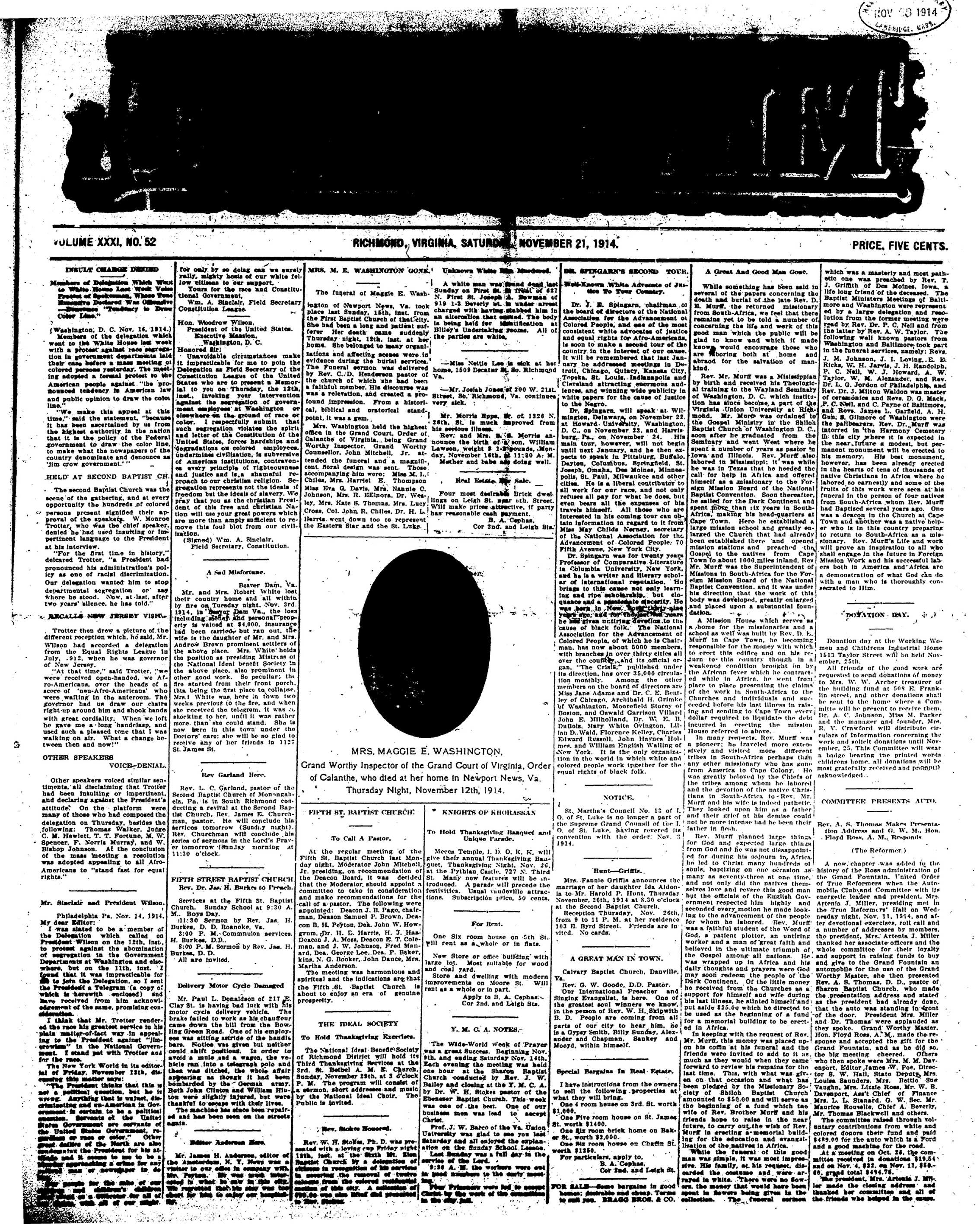
MRS. MAGGIE E. WASHINGTON.
Grand Worthy Inspector of the Grand Court of Virginia, Order of Calanthe, who died at her home in Newport News, Va. Thursday Night, November 12th, 1914.
ington of Newport News, Va. took place last Sunday, 15th, inst. from the First Baptist Church of that city. She had been a long and patient sufferer Her death came suddenly Thursday night, 12th, inst. at her home. She belonged to many organizations and affecting scenes were in evidence during the burial services. The Funeral cormon was delivered by Rev. C.D. Henderson pastor of the church of which she had been a faithful member. His discourse was a reelevation, and created a profound impression. From a historical, biblical and oratorical standpoint, it was a gem.
Mrs. Washington held the highest office in the Grand Court, Order of Calanthe of Virginia, being Grand Worthy Inspector. Grand Worthy Counsellor, John Mitchell, Jr. attended the funeral and a magnificent floral design was sent. Those accompanying him were: Miss M. I., Chiles, Mrs. Harriet E. Thompson Miss Eva G. Davis, Mrs. Nannie C. Johnson, Mrs. R. EElnora, Dr. Wesley, Mrs. Kate S. Thomas, Mrs. Lucy Cross, Col. John R. Chiles, Dr. H. L. Harris, went down too to represent the Eastern Star and the St. Luke.
MRS, MAGGIE E.
Grand Worthy Inspector of the C
of Calanthe, who died at her H
Thursday Night, Nov
FIFTH ST. BAPTIST CHURCH.
To Call A Pastor.
At the regular meeting of the Fifth St. Baptist Church last Monday night, Moderator John Mitchell Jr. presiding, on recommendation of the Deacon Board, it was decided that the Moderator, should appoint a committee to take in consideration and make recommendations for the call of a pastor. The following were appointed: Deacon J. B. Page, chiefman, Deacon Samuel P. Brown, Deacon B. H. Peyton, Deah. John W. Howgrum, Dr. H. L. Harris, H. J. HaaDeacon J. A. Moss, Deacon E. T. Coleman, and J. W. Johnson, Fred Manard, Dea. George Lee, Dea. P. Bsker, N. G. Booker, John Dance, Mrs. Martha Anderson.
The meeting was harmonious and spiritual and the indications are that the Fifth St. Baptist Church is about to enjoy an era of genuine prosperity.
THE IDEAL SOCIETY
To Hold Thanksgiving Exercises.
The National Ideal Benefit Society of Richmond District will hold its Third Thanksgiving Services at the 3rd. St. Bethel A. M. E. Church, Sunday, November 29th, at 3 o'clock P. M. The program will consist of a sermon, short addresses and music by the National Ideal Choir. The Public is invited.
Rev. Stokte Honored.
Rev. W. H. Molek, Ph. D. was presented with a loving cup Friday night 12th, just at the Sixth Mt. St. Joseph Church by a delegation of citizens in recognition of his services in securing the removal of twelve calvars from the colored residential section of this city. A collection of $99.00 was also kind and presented to New St.
Unknown White Film Mooded.
A white man was found dead last Sunday on First St. in trial of 627 N. First St. Joseph A. Bowman of 919 1-2. Beverly st. is under arrest charged with having stabbed him in an altercation that ensued. The body is being held for identification at Billys Undertaking Rooms. All of the parties are white.
Miss Nettie Lee is sick at her home, 1509 Decatur St. So. Richmond Va.
Mr. Josiah Jones of 200 W. 21st. Street, So. Richmond, Va. continues very sick.
Mr. Morris Epps, Mr. of 1226 N. 26th St. is much improved from his serious illness.
Rev. and Mrs. B. B. Morris announce the birth of a son, William Lawson, weight 2 1/2 pounds, Monday, November 16th, at 11:20 A. M. Mother and babe are doing well.
Real Estate, New Sale.
Four most desirable Brick dwellings on Leigh St. near 6th Street. Will make prices attractive, if party has reasonable cash payment.
B. A. Cephas,
Cor 2nd, and Leigh St.
E. WASHINGTON,
The Grand Court of Virginia, Order for home in Newport News, Va.
November 12th, 1914.
KNIGHTS OF KHORASSAN
To Hold Thanksgiving Banquet and Unique Parade.
Mecca Temple, I. D. O. K. K. will give their annual Thanksgiving Banquet, Thanksgiving Night, Nov. 26, at the Pythian Castle, 727 N. Third St. Many new features will be introduced. A parade will precede the festivities. Usual vaudeville attractions. Subscription price, 50 cents.
For Rent.
One Six room house on 5th St. will rent as a whole or in flats.
New Store or office building with large lot. Most suitable for wood and coal yard.
Store and dwelling with modern improvements on Moore St. Will rent as a whole or in part.
Apply to B. A. Cephas.
Cor 2nd, Leigh Sts.
Y. M. C. A. NOTES
The Wide-World week of Prayer was a great Success. Beginning Nov. 9th, and ending Saturday Nov. 14th. Each evening the meeting was held one hour at the Sharon Baptist Church conducted by Rev. J. W. Bailley and closing at the Y. M. C. A. by Dr. W. H. Stokes pastor of the Ebenezer Baptist Church. This week was one of the best. One of our business men was lead to accept Christ.
Prof. J. W. Barco of the Va. Union University was glad to see you last Saturday and all enjoyed the explanation on the Sunday School, Leason. Last Sunday was a full day in the service of the Lord.
9:30 A. M. the workers were out in good numbers to the early meeting.
Four Princess were led to accept Christ by the work of the conventions in the other hall.
Dr. J. H. Spingarn, chairman on the board of directors of the National Association for the Advancement of Colored People, and one of the most consistent white advocates of justice and equal rights for Afro-Americans, is soon to make a second tour of the country in the interest of our cause. It will be remembered that last January he addressed meetings in Detroit, Chicago, Quincy, Kansas City, Topoka, St. Louis, Indianapolis and Cleveland attracting enormous audiences, and winning wide publicity in white papers for the cause of justice to the Negro.
Dr. Spingarn, will speak at Wilmington, Delaware, on November 22 at Howard, University, Washington, D.C., on November 23, and Harrisburg, Pa., on November 24. His main tour, however, will not begin until next January, and he then expects to speak in Pittsburg, Buffalo, Dayton, Columbus, Springfield, St. Joseph, Omaha, Des Moines, Minneapolis, St. Paul, Milwaukee and other cities. He is a liberal contributor to all work for our race, and not only refuses all pay for what he does, but even bears all the expenses of his travels himself. All those who are interested in his coming tour can obtain information in regard to it from Miss May Childs Noreney, secretary of the National Association for the Advancement of Colored People: 70 Fifth Avenue, New York City.
Dr. Spingarn was for twenty years Professor of Comparative Literature in Columbia University, New York, and he is a writer and literary scholar of international reputation. He brings to this cause not only learning and ripe scholarship, but eloquence and a passionate curiosity. He was born in New York. Over thirty years ago, and for the last twenty years he has given nutritive devotion to the cause of black folk. The National Association for the Advancement of Colored People, of which he is Chairman, has now about 5000 members, with branches in over thirty cities all over the country, and its official organ, "The Crisis," published under its direction, has over 35,000 circulation monthly. Among the other members on the board of directors are Miss Jane Adams and Dr. C. E. B. Enstley of Chicago, Archibald H. Grimke of Washington, Moorefield Storey of Boston, and Oswald Garrison Villard John E. Milholland, Dr. W. E. B. DuBois, Mary White Ovington, Lillian D. Wald, Florence Kelley, Charles Edward Russell, John Haynes Holmes, and William English Walling of New York. It is the only organization in the world in which white and colored people work together for the equal rights of black folk.
NOTICE.
St. Martha's Council No. 13 of I. O. of St. Luke in no longer a part of the Supreme Grand Council of the I. O. of St. Luke, having revered its convention with the order. Nov. 3 1914.
Hunt—Griffle.
Mrs. Fannie Griffis announces the marriage of her daughter Ida Aldonla to Mr. Harold P. Hunt, Thursday November, 26th, 1914 at 8.30 o'clock at the Second Baptist Church. Reception Thursday, Nov. 26th, from 9 to 11 P. m. at her residence 103 E. Byrd Street. Friends are invited. No P. m.
A GREAT MAN IN TOWN.
Calvary Baptist Church, Danville, Va.
Rev. G. W. Goode, D.D. Pastor.
Our International Proacher and Singing Evangelist, is here. One of the greatest soul winners we know, in the person of Rev. W. H. Skipwith B. D. People are coming from all parts of our city to hear him, he is a Gypay Smith, Billy Sunday, Alexander and Chapman, Sankey and Mooyd, within himself.
Special Bargains In Real Estate.
I have instructions from the owners to sell the following properties at what they will bring.
One 4 room house on 3rd. St. worth $1,000.
One Five room house on St. James St. worth $1400.
One Six room brick home on Baker St., worth $2,000.
One Six room house on Chaffin St. worth $1250.
For particulars, apply to,
B. A. Cophas,
Cor 3rd. and Leigh St.
FOR SALE—Some bargains in good homes; desirable and cheap. Terms to sell per. BRAGG BRO. & CO.
A Great And Good Man Gone.
While something has been said in several of the papers concerning the death and burial of the late Rev. D. R. Murff, the returned missionary from South-Africa, we feel that there remains yet to be told a number of concerning the life and work of this good man which the public will be glad to know and which if made known would encourage those who are laboring both at home and abraod for the salvation of mankind.
Rev. Mr. Murff was a Mississippi by birth and received his Theological training in the Wayland Seminary of Washington, D. C. which institution has since become, a part of the Virginia-Union University at Richmond. Mr. Murff was ordained to the Gospel Ministry in the Shiloh Baptist Church of Washington D. C., soon after he graduated from the Seminary and went West where he spent a number of years as pastor in Iowa and Illinois. Rev. Murff also labored in Mississippi: it was while he was in Texas that he heeded the call for help in Africa and offered himself as a missionary to the Foreign Mission Board of the National Baptist Convention. Soon thereafter, he called for the Dark Continent and spent more than six years in South Africa, making his head-quarters at Cape Town. Here he established a large mission school and greatly enlarged the Church that had already been established there and opened mission stations and preached the Gospel to the natives from Cape Town to about 1000 miles inland. Rev. Mr. Murff was the Superintendent of Missions in South-Africa for the Foreign Mission Board of the National Baptist Convention, and it was under his direction that the work of this body was developed, greatly enlarged and placed upon a substantial foundation.
A Mission House which serves as a home for the missionaries and a school as well was built by Rev. D. E. Murff in Cape Town, he becoming responsible for the money with which to erect this edifice and on his return to this country though in a weakened condition brought on by the African fever which he contracted while in Africa, he went from place to place presenting the claims of the work in South-Africa to the Churches and individuals and succeeded before his last illness in raising and sending to Cape Town every dollar required to liquidate the debt incurred in erecting the mission House referred to above.
In many respects, Rev. Murff was a pioneer; he traveled more extensively and visited more different tribes in South-Africa perhaps than any other missionary who has gone from America to Cape Colony. He was greatly beloved by the Chiefs of the tribes among whom he labored and the devotion of the native Christians in South-Africa to Rev. Mr. Murff and his wife is indeed pathetic. They looked upon him as a father and their grief at his demise could not be more intense had he been their father in flesh.
Rev. Murff planned large things for God and expected large things from God and he was not disappointed for during his sojourn in Africa he led to Christ many hundreds of souls, baptizing on one occasion as many as seventy-three at one time, and not only did the natives themselves love and revere this good man but the officials of the English Government respected him highly and seconded every motion he made looking to the advancement of the people for whom he labored. Rev. Murff was a faithful] student of the Word of God, a patient plotter, an unfiring worker and a man of great faith and believed in the ultimate triumph of the Gospel among all nations. He was wrapped up in Africa and his daily thoughts and prayers were God may soon redeem the people of the Dark Continent. Of the little money he received from the Churches as a support for himself and wife during his last illness, he stilted himself and put aside $25.00 which he directed to be used as the beginning of a fund for a memorial building to be erected in Africa.
In keeping with the request of Rev. Mr. Murk, this money was placed upon his coffin at his funeral and the friends were invited to add to it as much as they would when they came forward to review his remains for the last time. This, with what was given on that occasion and what has been pledged by the Missionary Society of Shiloh Baptist Church amounted to $50.00 and will serve as the beginning of a fund which the wife of Rev. Brother Murk and his friends hope to raise in the near future, to carry out the wish of Rev. Murk in erecting a memorial building for the education and evangelisation of the natives in Africa. While the funeral of this good man was simple, it was most impressive. His family, at his request, discarded the costume and were arrayed in white. There were no flowers, the money that would have been spent in flowers being given in the collection. The funeral sermon
which was a masterly and most pathetic one was preached by Rev. T. J. Grifth of Des Moines, Iowa, a life long friend of the deceased. The Baptist Ministers Meetings of Baltimore and Washington were represented by a large delegation and resolution from the former meeting were read by Rev. Dr. P. C. Nell and from the latter by Rev. A. W. Taylor. The following well known pastors from Washington and Baltimore took part in the funeral services, namely: Revs.
J. M. Johnson, J. L. Loving, E. D. Ricks, W. H. Jawris, J. H. Randolph, P. C. Nall, W. J. Howard, A. W. Taylor, W. M. Alexander, and Rev. Dr. L. G. Jordon of Philadelphia, and Rev. Dr. J. Milton Waldon was master of ceramies and Revs. D. G. Mack, P. C. Nell, and C. Payne of Baltimore, and Revs. James L. Garfield, A. H. Gun, S. Gillmore of Washington were the palibearers, Rev. Dr. Murff was interred in 'the Harmony Cemetery' in this city where it is expected in the near future a modest, but permanent monument will be erected to his memory. His best monument, however, has been already erected in the hearts of tens of thousands of native Christians in Africa where he labored so earnestly and some of the fruits of this work were seen at his funeral in the person of four nativist from South-Africa whom Rev. Murff had Baptized several years ago. One was a deacon in the Church at Cape Town and another was a native helper who is in this country preparing to return to South-Africa as a missionary. Rev. Murff's Life and work will prove an inspiration to all who shall engage in the future in Foreign Mission Work and his successful labera both in America and Africa are a demonstration of what God can do with a man who is thoroughly consecrated to Him.
Donation day at the Working Women and Childrens Industrial Home 1613 Taylor Street will be held November, 25th. All friends of the good work are requested to send donations of money to Mrs. W. W. Archer treasurer of the building fund at 508 E. Franklin street, and other donations shall be sent to the home where a Committee will be present to receive them. Dr. A. C. Johnson, Miss M. Parker and the manager and founder, Mrs. R. V. Crawford will distribute circulars of Information concerning the work and solicit donations until November, 25. This Committee will wear a badge bearing the printed words children home, all donations will be most gratefully received and promptly acknowledged.
COMMITTEE PRESENTS AUTO.
Rev. A, S. Thomas Makes Presentation Address and G. W. M. Hon.
Flord Ross, A. M. Responds
(The Reformer.)
A new chapter was added to the history of the Ross administration of the Grand Fountain, United Order of True Reformers when the Automobile Club and Committee with its energetic leader and president, Mrs. Artenia J. Miller, presiding met in the True Reformers' Hall on Wednesday night, Nov. 11, 1914, and after devotional exercises, roll call and a number of addresses by members, the president, Mrs. Artenia J. Miller thanked her associate officers and the whole committee for their loyalty and support in raising funds to buy and give to the Grand Fountain an automobile for the use of the Grand Worthy Master, she then presented Rev. A. S. Thomas, D. D., pastor of Sharon Baptist Church, who made the presentation address and stated as the president had already done, that the auto was standing in front of the door. President Mrs. Miller and Dr. Thomas' were applauded as they spoke. Grand Worthy Master, Hon. Floyd Ross, A. M., made the response and accepted the gift for the Grand Fountain, and as he did so, the big meeting cheered. Others who then spoke were Mrs. M. M. Davenport, Editor James W. Poe, Director S. W. Hall, State Deputy Mrs. Loula Saunders, Mrs. Bettle Sue Vaughn, Mrs. Lizzie Ross, W. W. B. Davenport, Ass't Chief of Finance Mrs. L. L. Stanard, G. W. Sec. Mr. Maurice Rousseille, Chief A. Beverly, Mr. Thomas Blackwell and others.
The committee raised through voluntary contributions from white and colored donors their fund and paid $489.00 for the auto which is a Ford and a good machine for the road.
At a meeting on Oct. 28, the committee received in donations $19.54 and on Nov. 4, $82. on Nov. 11, $58.60, grapped total $494.75.
The president, Mrs. Artena J. Miller made the closing address and thanked her committee and all of the friends who helped in the case.
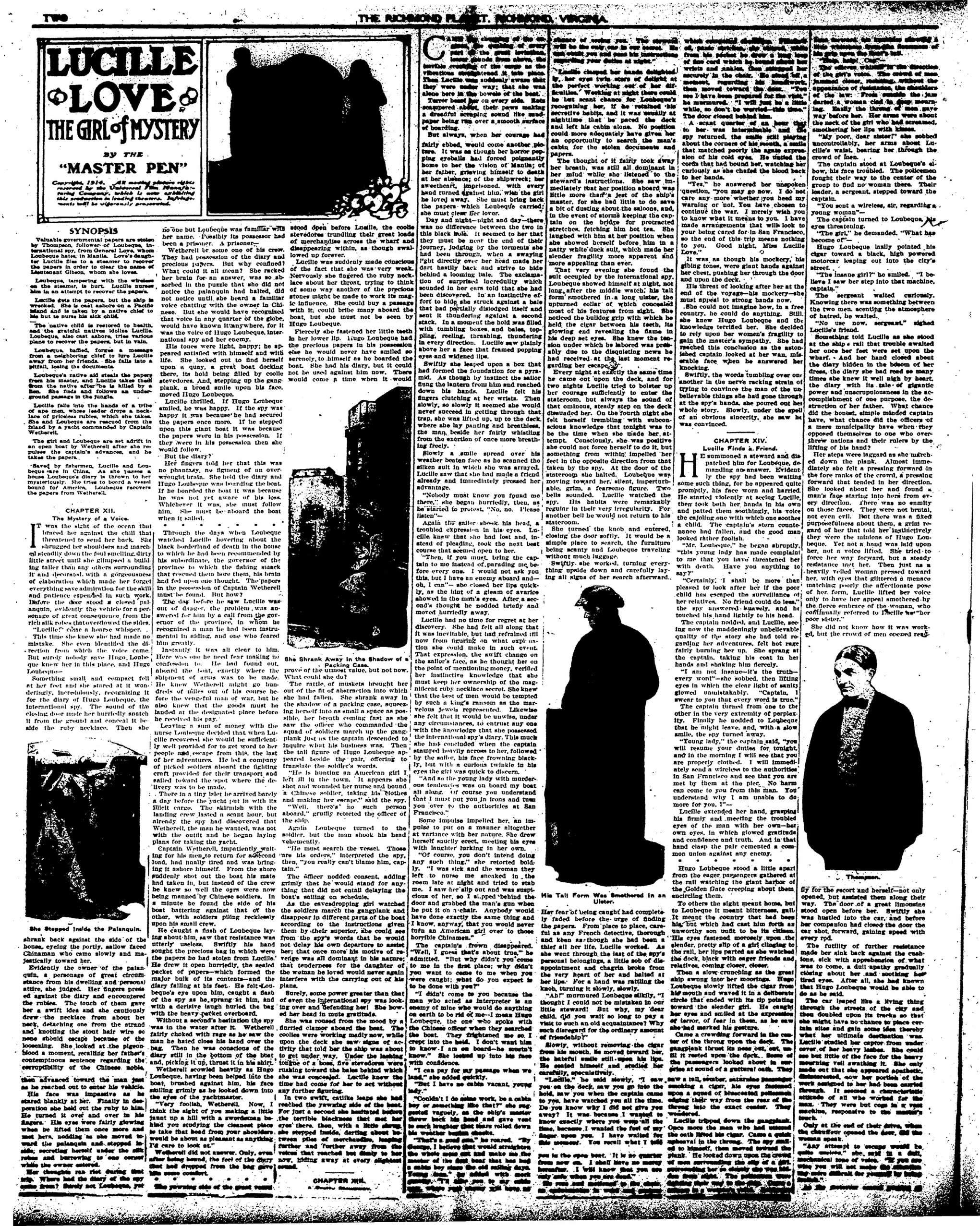
LUCILLE
LOVE
THE GIRL OF MYSTERY
BY THE
"MASTER PEN"
Copyright, 1914. All meeting picture rights reserved by the Universal Film Manufacturing Company which is aware of this production in leading theaters. Inquiries will be vigorously presented.
no one but Loubique was familiar with her name. Possibly its possessor had been a prisoner. A prisoner. Werehall or some one of his crew. They had possession of the diary and precious papers. But why confused? What could it all mean? She racked her brain for an answer, was so absorbed in the puzzle that she did not notice the palanquin had halted, did not notice until she heard a familiar voice chatting with the owner in Chinese. But she would have recognized that voice in any quarter of the globe, would have known it anywhere, for it was the voice of Hugo Loubique, international spy and her enemy. His tones were light, happy; he appeared satisfied with himself and wifie. She looked out to find herself upon a quay, a great boat docking there, its hold being filled by cooil stevedores. And, stepping up the gangplank, a broad smile upon his face, moved Hugo Loubique.
Lucille thrilled. If Hugo Loubeque smiled, he was happy. If the spy was happy it was because he had secured the papers once more. If he stepped upon this giant boat it was because the papers were in his possession. If they were in his possession then she would follow.
But the diary?
Her fingers told her that this was no phantasy, no figment of an overwrought brain. She held the diary and Hugo Loubeque was boarding the boat. If he boarded the boat it was because he was not yet aware of his loss. Whichever it was, she must follow him. She must be aboard the boat when it sailed.
Through the days when Loubeque watched Lucille hovering about the black borderland of death in the house to which he had been recommended by his subordinate, the governor of the province to which the dashing snake that rescued them bore them, his brain had fed upon one thought. The papers in the possession of Captain Wetherell must be found. But how?
The day before he saw Lucille was out of danger, the problem, was answered for him by a call from the governor of the province, in whom he recognized a man he had been instrumental in adding, and one who feared him greatly.
Instantly it was all clear to him. Here was one he need fear making no confession to. He had found out, aboard the boat, exactly where the shipment of arms was to be made. He knew Wetherell might go hundreds of miles out of his course before the vengeful man of war, but he also knew that the goods must be landed at the designated place before he received his pay. Leaving a sum of money with the nurse Louiseau decided that when Luille recovered she would be sufficiently well provided for to get word to her people and escape from this, the last of her adventures. He led a company of picked soldiers aboard the fighting craft provided for their transport and sailed toward the spot where the delivery was to be made.
There in a tiny islet he arrived barely a day before the yacht put in with his illicit cargo. The skirmish with the landing crew lasted a scant hour, but already the spy had discovered that Wetherell, the man he wanted, was not with the outfit and he began laying plans for taking the yacht.
Captain Wetherell, impatiently waiting for his men to return for a second load, had finally tired and was bringing it ashore himself. From the shore suddenly shot out the boat his mate had taken in, but instead of the crew he knew so well the ogrs were now being manned by Chinese soldiers. In a minute he found the side of his boat battering against that of the other, with soldiers piling recklessly upon his small crew.
He caught a flash of Loubeque laying about him, saw that resistance was utterly useless. Swiftly his hand sought the precious bag in which were the papers he had stolen from Lucille. He drew it open hurriedly, the sealed packet of papers—which formed the major bulk of its contents—and the diary falling at his feet. He felt Loubeque's eye upon him, caught a flash of the spy as he, sprang at him, and with a derisive laugh hurled the bag with the heavy-packet overboard. Without a second's hesitation the spy was in the water after it. Wetherell fairly choked with rage as he saw the man he hated close his hand over the bag. Then he was conscious of the diary still in the bottom of the boat, and picking it up, thrust it in his shirt. Wetherell scrawled heavily as Hugo Loubeque, having been helped into the boat, brushed against him, his face snalling grimly as he looked down into the eyes of the yachtmaster.
"Very foolish, Wetherell. Now, I think the sight of you making a little jawn up a hill with a swordman behind you studying the cleanest place to take that head from your shoulder would be about as pleasant as anything I'd care to look at."
Wetherell did not answer. Only, even after being bound, the feel of the diary that had dropped from the bag gave him some comfort.
SYNOPSIS
Valuable governmental papers are stolen by Thompson, follower of Loubeque, international spy, from General Love, whom he met in the city. Loubeque files to a steamer to recover the papers in order to clear the name of Lieutenant Gibson, whom she loves.
Loubeque, tampering with the wireless on the steamer, is hurt. Loubeque nurses him in an attempt to recover the papers.
Loubeque gets the papers, but the ship is wrecked. She is cast ashore on a Pacific island and is taken by a native chief to his hut to nurse his sick child.
The native child is restored to health. Loubeque, with the help of Loubeque, also cast ashore, tries various plans to recover the papers, but in vain.
Loubeque, baffled, forces a message from a neighboring chief to hure Loubeque away from her friends. She falls into a pitfall, losing the documents.
Loubeque's native aid steals the papers from his master, and Loubeque takes them from the mine, and is killed by a fire the mine and follows an underground passage in the jungle.
Lucille falls into the hands of a tribe of apes men, whose leader drops a necklace of priceless rubies, which she takes. Lucille Loubeque are rescued from the Island by yacht commanded by Captain Wetherell. The girl and Loubeque are set adrift in an open boat by Wetherell after she repulses the captain's advances, and he takes the papers.
*Saved by fishermen, Lucille and Loubeque are in China. As she passes a house Loubeque's diary is thrown to her mysteriously. She tries to board a vessel from Loubeque recovers the papers from Wetherell.*
CHAPTER XII.
It was the sight of the ocean that braced her against the chill that threatened to send her back. She shrugged her shoulders and marched steadily down the foul smelling, dirty little street until she glimpsed a building taller than any others surrounding it and decorated with a gorgeousness of elaboration which made her forget everything save admiration for the skill and patience expended in such work. Before the door stood a closed palanquin, evidently the vehicle for a personage of great consequence from the rich silk robes that overlaid the slides. "Lauttle" clenched a hoarse whisper.
This time she knew she had made no mistake. She even identified the direction from which the voice came. But surely nobody gave Hugo, Loubeque knew her in this place, and Hugo Loubeque—
Something small and compact fell at her feet and she stared at it wonderingly, incredulously recognizing it for the diary of Hugo Loubeque, the international spy. The sound of the closing door made her hurriedly snatch it from the ground and conceal it beside the ruby necklace. Then she
```markdown
```
She Stepped inside the Palanquin, shrank back against the side of the house, eyeing the portly, sallow faced Chinaman who came slowly and majestically toward her.
Evidently the owner of the palanquin, a personage of great circumstance from his dwelling and personal attire, she judged. Her fingers press against the diary and encountered the ruble. The touch of them gave her a swift idea and she cautiously drew the necklace from about her neck, detaching one from the strand and knotting the stout hair wire so none should escape because of the loosening. She looked at the pigeonblood a moment, recalling her father's contemptuous sentence regarding the corruptibility of the Chinese noble, then advanced toward the man just as he reached out to enter his vehicle.
as he reached out to enter his vehicle. His face was impassive as he stared blankly at her. Finally in despair she held out the ruby to him. He turned it over and over in his fingers. His eyes were fairly glowing when he lifted them once more and met her, nodding as she moved toward the palanquin and, stepped inside, securing herself under the silk robes and burrowing to one corner while the owner entered.
Her thoughts ran riot during that trip. Where had the diary of the spy come from? Surely not Leopards, yet
```markdown
```
THE RICHMOND PLANET, RICHMOND, VIRGINIA
stood open before Lucille, the coolie steweddeserts trundling their great loads of merchandise across the wharf and disappearing within, as though swallowed up forever.
Lucille was suddenly made conscious of the fact that she was very weak. Nervously she fingered the ruby necklace about her throat, trying to think of some way another of the precious stones might be made to work its magic influence. She could buy a passage with it; could bribe many aboard the boat, but she must not be seen by Hugo Loubeque.
Fiercely she fastened her little teeth in her lower lip. Hugo Loubeque had the precious papers in his possession else he would never have smiled so serenely, to himself as he boarded the boat. She had his diary, but it could not be used against him now. There would come a time when it would
T
She Shrank Away in the Shadow of a Packing Case.
prove of the utmost value, but not now.
What could she do?
The rattle, of muskets brought her out of the fit of obstruction into which she had fallen. She shrank away in the shadow of a packing case, squeezing herself into as small a space as possible, her breath coming fast as she saw the officer who commanded the squad of soldiers march up the gangplank just as the captain descended to inquire what his business was. Then the tall figure of Hugo Loubeque appeared beside the pair, offering to translate the soldier's words.
"He is hunting an American girl I left in the town. It appears she shot and wounded her nurse and bound a Chinese soldier, taking his clothes and making her escape" said the spy.
"Well, there's no such person aboard, gruntly retorted the officer of the ship.
Again Loubeque turned to the soldier, but the man shook his head vehemently.
"He must search the vessel. Those are his orders," interpreted the spy, then, "you really can't blame him, captain."
The officer nodded consent, adding grimly that he would stand for anything that did not entail delaying the boat's sailing on schedule.
As the eavesdropping girl watched the soldiers march the gangplank and disappear in different parts of the boat according to the instructions given them by their superior, she could see from the spy's words that he would not delay his own departure to assist her; that once more his motive of revenge was all dominant in his nature; that tenderness for the daughter of the woman he loved would never again interfere with the carrying out of his plans.
Surely, some power greater than that of even the international spy was looking over and defending her! She bowed her head in mute gratitude.
She was roused from the mood by a furried clamor aboard the boat. The coolies were working madly now, while upon the deck she saw signs of activity that told her the ship was about to get under way. Under the lapping tonique of a boat, five stewardors were rushing toward the bales behind which she was concealed. Lacille knew the time had come for her to act without any further figuring.
In two swift, catlike leaps she had reached the yawning side of the boat. For just a second she hesitated before the terrible blackness that met her eyes there. then, with a little alarm, she stepped inside, darting about between pilots of merchandise, leaping further and further away from the voices that reached but dimly to her now, hiding away at every slightest sound.
CAUSE the shaping of the ear
pads of the great earlobes
pairs up at the great earlobes
leaves grabs from above, the
turrible cresting of the cuff as the
vibrations staggered it into place.
Then Lecitha was suddenly swain that
they were under way; that she was
alone here in the bowels of the beast.
Tortor burst on every side. Rats
scarpered aboot, their paws making
a dreadful scrapping sound like the
paper being run over a smooth surface
of boarding.
But always, when her courage had fairly ebbed, would come another picture. It was as though her horror popping eyeballs had forced polygamous home to her the vision of Mantis; of her father, grieving himself to death at her abseuse; of the shipwreck; of sweetheart, imprisoned, with every hand turned against him, when the girl he loved away. She must bring back the paper-which Loubeque carried; she must clear her lover.
Day and night—night and day—there was no difference between the two in this black tide. It seemed to her that they must be near the end of their journey, judging by the torments she had been through, when a swaying light directly over her head made her dart hastily back and strive to hide behind a looming tide. The exclamation of surprised incredulity which sounded in her ears told that she had been discovered. In an instinctive effort to hide she struck against a bale that had partially dislodged itself and sent it thundering against a second stack. In a moment the hold was filled with tumbling boxes, and bales, toppling, reeling, thrashing, thundering in every direction. Lucille saw plainly above her a face that framed popping eyes and widened lips.
Swiftly she leaped upon a box that had formed the foundation for a pyramid. As though by instinct the sailor flung the lantern from him and reached down his hands. Lucille felt his fingers clutching at her wrist. Then slowly, so slowly it seemed she would never succeed in getting through that trap, she was lifted up, up to the deck where she lay panting and breathless, the man, beside her fairly whistling from the exertion of once more breathing freely.
Slowly a smile spread over his weather beaten face as he scanned the silken suit in which she was arrayed. Lucille saw that she had made a friend already and immediately pressed her advantage.
"Nobody must know you found me there," she began hurriedly, then as he started to protest, "No, no. Please listen"—
Again the galler shook his head, a troubled expression in his eyes. Lucille knew that she had lost and, instead of pleading, took the next best course that seemed open to her.
"Then, if you must, bring the captain to me instead of parading me before every one. I would not ask you this, but I have an enquiry aboard and—oh, I can—" she closed her lips quickly, as the hint of a gleam of avarice showed in the man's eyes. After a second's thought he nodded briefly and moved hurriedly away.
Ludicile had no time for regret at her discovery. She had felt all along that it was inevitable, but had refrained till now from figuring on what explination she could make in such event. That expression, the swift change on the sailor's face, as he thought her on the point of mentioning money, verified her instinctive knowledge that she must keep her ownership of the magnificent ruby necklace secret. She knew that the best of men would be tempted by such a king's ransom as the marvelous jewels represented. Likewise she felt that it would be unwise, under any circumstances, to entrust any one with the knowledge that she possessed the international spy's diary. This much she had concluded when the captain stamped heavily across to her, followed by the sailor, his face frowning blackly, but with a curious twinkle in his eyes the girl was quick to discern.
"And so the young lady with murderous tendencies was on board my boat all along. Of course you understand that I must put you in jrnns and turn you over to the authorities at San Franchoco."
Some impulse impelled her, an impulse to put on a manner altogether at variance with her nature. She drew herself sautely erect, meeting his eyes with laughter lurking in her own.
"Of course, you don't intend doing any such thing," she retorted boldly. "I was sick and the woman they left to nurse me snaked in the room late at night and tried to stab me. I saw her slip out and was snappacious of her, so I slipped behind the door and grabbed the man's gun when he put it on a chair. Anybody would have done exactly the same thing and I know, anyway, that you would never turn an American girl over to those horrible Chinamen."
The captain's frown disappeared,
"Well, I guess that's about true," he admitted. "But why didn't you come to me in the first place; why didn't you want to come to me when you were caught; what do you expect to be done with you?"
"I didn't come to you because the man who acted as interpreter is an enemy of mine who would do anything on earth to be rid of me—I mean Hugo Loubeque, the one who spikes with the Chinese officer when they searched the boat. They frightened me so, I crept into the heid. I don't want him to know. I am on board—he mustn't know." She loosened up into his face with confidence.
"I can pay for my passage when we lead," she added quickly.
"But I have no cuba vacant, yougs lady."
"Couldn't I do some work, be a cathin boy or something like that?" she suggested vaguely, as the oily's master throw back his hand and gave vent to each laughter that tears rolled down his weather begin shocks.
"That's a good idea," he roared. "By George, I believe that would straighten the whole men out and make me the master of the first boat that has had a cathin boy since the old calling days. Young men," he affixed with neck gauze, "I'll help you to my cathin boy, where white teeth have no
Lamie chapped her hands delighted by her eyes two stars of delight at the perfect working out of her difficulties. Working at night there could be but scant chance for Loubequer's recognizing her, if he retained his secretive habit, and it was usually at nighttime that he paced the deck and left his cabin alone. No position could more adequately have given her an opportunity to search the man's cabin for the stolen documents and papers.
The thought of it fairly took away her breath, was still all dominant in her mind while she listened to the steward's instructions. She saw immediately that her position aboard was little more thaff's jest of the ship's master, for she had little to do save a bit of dusting about the saloons, and, in the event of storms keeping the captain on the bridge for protracted stretches, fetching him hot tea. She laughed with him at her position when she showed herself before him in a natty white duck suit, which made her slender fragility more apparent and more appealing than ever.
That very evening she found the suit occupied by the international spy, Loubeque showed himself at night, not long, after the middle watch; his tail form smothered in a long uilster, the upturned collar of which concealed most of his features from sight. She noticed the bulldog grip with which he held, the cigar between his teeth, its glowing and revealing the flame in his deep set eyes. She knew the tension under which he labored was probably due to the disquieting news he had received at the last moment regarding her escape.
Every night at exactly the same time he came out upon the deck, and for two nights Lucille tried to bolster up her courage sufficiently to enter the stateroom, but always the sound of that ominous, steady step on the deck dissuaded her. On the fourth night she felt herself trembling with subconscious knowledge that tonight was to be the time when she made her attempt. Consciously, she was positive she could not force herself to do it, but something from within impelled her feet in the opposite direction from that taken by the spy. At the door of the stateroom she halted. Loubeque was moving toward her silent, imperturbable, grim, a fearsome figure. Two bells sounded. Lucille watched the spy. His habits were remarkably regular in their very irregularity. For another bell he would not return to his stateroom.
She turned the knob and entered, closing the door softly. It would be a simple place to search, the furniture being scanty and Loubeque traveling without much luggage.
Swiftly. she worked, turning everything upside down and carefully laying all signs of her search afterward.
```markdown
```
His Tall Form Was Smothered in an Ulster.
Her fear of being caught had completely faded before the urge of finding the papers. From place to place, careful as any French detective, thorough and keen as though she had been a thief all her life, Ludlie worked. As she went through, the last of the spy's personal belongings, a little sob of disappointment and chagrin broke from the very heart of her and halted at her lips. For a hand was rattling the knob, turning it slowly, slowly.
"Ah!" murmured Loubeque silently, "I thought I could not be mistaken in our little steward! But why, my dear child, did you wait so long to pay a visit to such an old acquaintance? Why such disregard for the ordinary amount of friendship?"
Slowly, without removing the cigar from his mouth, he moved toward her, the hateful smile still upon his lips. He seated himself and studied her carefully, accretively.
"Lacille," he said slowly, "I saw you on the deck, saw you go into the hold, saw you when the captain came to you, have watched you all the time. Do you know why I did not give you away? It was, because I waded to know exactly where you wiped all the time, because I wanted the fuel of my finger upon you. I have waited for this moment. You recall what I told you in the open boat. It is no question from now on. I shall have no money because. I will know that you are only once when you are dead." The ropes and mementos to the ship, the information in words and images.
when computed challenge. Punished, pinned straight, she slipped, while from his pocket he drew a long loop of the card which he bound above his wrists and ankles. He staggered her backward, then he knelt. He moved, recording his handwork, then moved toward the door. "Two so I have been prepared for the visit," he murmured. "I will just be a little white, so don't be worried—this time." The door closed behind him.
A scant quarter of an hour tilt to her - was intermittent and the any returned, the small still playing about the corners of his mouth, a smile that matched poorly the agree expression of his cold eyes. He tinted the corte that had bound her, watching her curiously as she chafed the blood back to her hands.
"Yes," he answered her unspoken question, "you may go now. I do not care any more whether he heed my warning or not. You have chosen to continue the war. I merely wish you to know what it means to you. I have made arrangements that will look to your being cared for in San Francisco, so the end of this trip means nothing to you. Good night, Miss Lucille Love."
It was as though his mockery, his gibbing tones, were giant hands against his chest, pushing her through the door and upon the deck.
His threat of looking after her at the end of the voyage - his mockery - she must appeal to strong hands now.
She could not imagine how, in a free country, he could do anything. Still, she knew Hugo Louboube and the knowledge terrified her. She decided to rely upon her women's fragility to gain the master's sympathy. She had reached this conclusion as the astonished captain looked at her wan, miserable face when he answered her knocking. Swiftly, the words tumbling over one another in the nerve racking strain of trying to convince the man of the unbelievable things she had gone through at the spy's hands, she poured out her whole story. Slowly, under the spell of an obvious sincerity, she saw he was convinced.
CHAPTER XIV.
Lucille Finds a Friend:
H summoned a steward and dis patched him for Loubéque de manding and answer. Evident in his words.
If the spy had been waiting some such thing, for he appeared quite promptly, his face worn and harried. He started violently at seeing Lucille, then took both her hands in his own and patted them soothingly, his voice the cailing one with which one soothes a child. The captain's stern countenance had fallen, and the good man looked rather foolish.
"Mr. Loubeque," he began abruptly, "this young lady has made complaint to me that you have threatened her with death. Have you anything to say?"
"Certainly," I shall be more than pleased to look after her if the poor child has escaped the surveillance of her relatives. No friend could do less," the spy answered-knawly, and he touched his hand lightly to his head.
The captain nodded, and Lucille, seeing now the maddeningly unbelievable quality of the story she had told regarding her adventures, felt hot rare fairly burning her up. She sprang at the captain, taking his coat in her hands and shaking him directly.
"I am not insane—it's the truth—every word"—she sobbed, then lifting eyes in which the clear light of sanity glowed unmistakably. "Captain, I swear to you that every word is true." The captain turned from one to the other in the very extremity of perplexity. Finally he nodded to Loubeque that he might leave, and, with a slow smile, the spy turned away.
"Young lady," the captain said, "you will resume your duties for tonight, and in the morning I will see that you are properly clothed. I will immediately send a wireless to the authorities in San Francisco and see that you are met by them at the plier. No harm can come to you from this man. You understand why I am unable to do; more for you, I—"
Luccheli extended her hand, grasping his firmly and meeting the troubled eyes of the man with her own—his own eyes, in which glowed gratitude and confidence and truth. And in that hand clasp the pair cemented a common union against any enemy.
Hugo Lobbeque stood a little apart from the eager passengers gathered at the rail watching the giant harbor of the Golden Gate creeping about them encircling them.
To others the sight meant home, but to Lobbeque it meant bitterness, gail. It meant the country that had been big, but which had cast him forth as unworthy son unit to be its citizen. His eyes fastened morovely upon the slender, pretty slip of a girl clinging to the rail, her lips parted as she watched the dock, black with eager friends and relatives, coming closer, closer.
Then a slow crunching as the great ship saw into her mooring. Hugo Loubeque slowly lifted the cigar from his mouth and waved it in a deliberate circle that ended with its dip palting toward the slender girl. He caught her eyes and smiled at the expression of terror, of fear in them, as he saw she had marked his posture.
Came a crowding forward in the center of the throng upon the deck. The gangplank thrust its nose out, out, until it rested upon the deck. Some of the passengers looked about in surprise at sound of a guttural oath. They saw a tail, sumber, saxonne passenger snuck a cigar, his eyes fastened upon a squared of blunted pollenmouth edging their way from the rear of the throng into the exact center. They wondered.
Lacie tripped down the gangplank. Once more the man who had stumbled the oath lifted his claw. Came a quick upheaval in the throng. The spy smiled to himself, then moved toward the plank. He looked down upon the crowd of men surrounding the ship of a girl, surrounding her so closely she was blind from sight. The palacemen were stalking their way to the plank. Came a stalking in a woman's blindness.
Bene threw the baskets showing a little whistle from the scream of the girl upon the lion's tail.
"This help, help," Cog—
"The officer, winnowed in the direction of the girl's voice. The crowd of men jumped clear, running, without the appearance of resistance, the shoulders of the law. From inside the jam darted a woman clad in grey, mourning. Easily the throng of men gave way before her. Her arms were about the neck of the girl who had screamed, smothering her lips with kisma.
"My poor, dear sister!" she sobbed uncontrollably, her arms about Lucille's waist, bearing her through the crowd of men.
The captain stood at Loubeque's elbow, his face troubled. The policemen fought their way to the center of the group to find no woman there. Their leader, a sergeant, stepped toward the captain.
"You sent a wireless, air, regarding a young woman"—
The captain turned to Loubeque, his
eyes threatening.
"The girl," he demanded. "What has become of—"
Hugo Loubeque insly pointed his cigar toward a black, high powered motorcar keeping out into the city's street.
"The insane girl?" he smiled. "I believe I saw her step into that machine, captain."
The sergeant waited curiously. Knowing there was something between the two men, scenting the atmosphere of hatred, he waited.
"No use now, sergeant," sighed Lucille's friend.
Something told Lucille as she stood at the ship's rail that trouble awaited her once her feet were set upon the wharf. And her hand closed about the diary hidden in the bloom of her dress, the diary she had read so many times she knew it well nigh by heart, the diary with its sale of gigantic power and unscrupulousness in the accomplishment of one purpose, the destruction of her father. What chance did the honest, simple minded captain have, what chance did the officers of a mere municipality have when they opposed themselves to one who overshrew nations and their rulers by the lifting of his hand?
Her atops were laggard as she matched immediately down the plank. Almost immediately she felt a pressing forward in the fore ranks of the crowd, a pressing forward that tended in her direction. She looked about her and found a man's face staring into her from every direction. There was no enmity on those faces. They were not brutal, not even evil. But there was a fixed purposefulness about them, a grim regard of her that told her instinctively they were the minions of Hugo Loubeque. Yet not a hand was laid upon her, not a voice lifted. She tried to force her way forward, but a steady resistance not her. Then just as a heavily veiled woman pressed toward her, with eyes that glittered a menace matching poorly the affectionate pose of her. form, Lucille lifted her voice only to have her appeal anothered by the fierce embrace of the woman, who continually referred to Lucille as "her poor sister."
She did not know how it was worked, but the crowd of men opened read
Thompson.
sly for the escort and herself—not only opened, but assisted them along their way. The door of a great limousine stood open before her. Swiftly she was hustled into the car, and before her companion had closed the door the car shot forward, gaining speed with every rod. The futility of further resistance made her sink back against the cushions, sick with apprehension of what was to come, a dull apathy gradually closing about her, and nothing but tired eyes. After all, she had known that Hugo Loubeque would be able to do as he said.
The car leaped like a living thing through the streets of the city and then doubled upon its tracks so that she might have no chance to place certain sites and gain some idea thereby what her ultimate destination was. Lance studied her captor from under cover of her heavy lambes. She could see but little of the face for the heavy mourning veil swathing it. She only made out that she appeared apathetic, disheartened, now her portion of the work assigned to her had been carried through. It seemed a characteristic attitude of all who worked for the max. They were but come in a vast machine, responsive to the master's touch.
Only at the end of their drive, when the chauffeur opened the door, did the woman speak.
"Any attempt to accept would be quite unwise," she said in a dark, mechanical tone of voice. "If you are why you will not make the situation more difficult for yourself by being foolish."
the curb, the woman pressed the door bell. Came a scuffling along the hall, a shadow fluttered there a second, then the door swung open. Lucille stepped across the threshold with her captor, surprised to see no one in sight. Apparently the door had opened of its own volition. Before her was a straight stairway, appearing to end at the second flight. To her left was a living room into which she was ushered. Again the woman pressed a bell. "You will want some tea and cakes," she said quietly. Lucille turned at a suggestive clink of china. She had heard no one enter the room, yet. In the shadows, she saw an attentive butler holding the tea tray while the mysterious velled woman poured. The man moved toward her, moved silently, swiftly, anoly. There was something about his manner, his perfection, strikingly reminiscent of some one she had seen before.
"Thompson!" she gaped. "Thompson! You here! What are you doing here?"
"Yes, Miss Love! Thank you! . I am employed by Mr. Loubeque, Miss Love! Thank you!"
And then gradually she understood, know who had stolen the papers from her father's safe, realized how completely they had all been fooled by this cunning servant.
"Go away!" she muttered brokenly.
"Go away! . I can't bear to look at you!"
"Yes, miss. Thank you!"
When she looked up he had disappeared.
Swiftly she gathered herself together. Such childish tricks must not be permitted to shatter her courage for even an instant. She slipped steadily to the door through which she had entered the house. In the hall she looked cautiously about, often put her foot upon the stairs and proceeded to move to the first flight. Midway, she was paralyzed into inactivity by finding the stairs to be in motion.
Horror seized her. Then once more she braced herself. Only another trick of Loubeque's it was. The stairs seemed to fold up within themselves like a miniature escalator. They grew steady once more, and the girl looked about an unfurnished room of stone walls. But she did not see these walls, did not mark the lack of decorations or furniture in the room, for a company of men formed a crescent facing her, one tall figure—that of Loubeque—standing apart from the rest, immovable, silent.
The solitary figure lifted his hand. Then, frozen with terror though she was, Loubeque saw that each figure was swathed in a black robe and that a plain silk mask of black covered every face. Masks through which threatening eyes glared upon her, masks so light they tinted against the wearer's features with hideous significance.
Slowly the company passed her, pausing before her to peer narrowly into her face, as though impressing her every feature indelibly upon their minds. When she regained her powers of observation the line had passed, had paused and disappeared. She looked about her. She was alone.
How the Needlewoman Can Set Colors in Wools.
A needlewoman who does a great deal of embroidery in colored wools always takes the precaution of setting the colors before using them.
She speaks the wools for at least an hour in boiling water to which a teapooil of vinegar has been added. At the end of an hour she hangs them up to dry, patting but not wringing out the moisture.
The first finger of the left hand of the woman who does much sewing, embroidering or crocheting becomes much disfigured because of pricking of the needle. In some instances the finger becomes very sore.
To prevent disfigurement and soreness put a strip of court plaster on the fingers. Such precaution is especially worth while when working on delicate fabric.
How to Make a Cheesecloth Bath Bag
The bath bag made of cheesecloth is filled with shaved white soap, cast
the being best, crushed oats and pow-
dered orchis root. Use the bag like a
washcloth, and it will be found most
refreshing to the skin.
Needed a Lesson Himself:
Professor—Too bad! One of my pupils, to whom I have given two courses of instruction in the cultivation of the memory; has forgotten to pay me, and the worst of it is I can't remember his name!
In a Quandary.
Worn out with a long series of appalling French exercises, wherein the blunders were as the minds of the sea, a hapless high school mistress declared her intention of writing to Florence's mother.
Florence looked her teacher in the face.
"Ma will be afully angry," quoth Florence.
"I am afraid she will, but it to my duty to write to her, Florence."
"I don't know," said Florence doubtfully.
"You see, mother always does my French for me."
Try Again to Break Through Position at Ypres, But Fall to Slodage the Obstinate Defenders.
Aided by the flooded condition of the outposts in Stanley, which has halted all offensive movements of the Germans, the allies have resumed their smashing attacks on the lines of the invaders in various sections of the battle front in Belgium and along the trfront in France.
Pronounced progress is reported by the official communication from the French war office, especially in the region of Armorietes and Arras.
Advices from the battle front in France and Flanders toll of the weakening of the attacks of the Germans and that all along the line the allies have flung forward their forces and have pushed back the enemy and have advanced their lines. In the region of Armanderes and Arras, on the right wing of the kaiser's line in France the allies have made their greatest advances, according to the dispatches, and have dealt severe losses to the Germans.
Although the Germans have been unable to press forward along the Yser, where they had made their greatest advances previously, they renewed their attacks on the British positions in the region of Ypres, that storm center of German attacks ever since the battle was shifted to the extreme north of France.
While the war offices of the warring powers have been silent for the last ten days, on the situation upon the heights of the Meseu, on the right wing of the allies, Paris announces that pronounced progress has been made in that section, following the series of attacks by the French forces, while farther to the west, in the Argonne, the French have driven back the Germans and have established new lines and taken new positions. Advice from Berlin are silent on the battle situation in France and Flanders. They say the day passed quietly in the western zone of war, and that several attacks by the French to the south of Verdun and northeast of Clery, were unsuccessful.
Official communications from Paris are more explicit and tell of the continuation of the artillery action by the hostile forces, particularly in the region between Damia and Neuport. The action is heavier than in the preceding days and on the canal the allies' artillery has checked the work that the Germans were endoering to carry out to keep down the inundation.
Although violent fighting between the allies and the Germans is still going on in West Flanders, troop movements have been completely checked by the floods and storms, which have turned the highways into swamps. French, Brits, Belgians and Germans are bearing without a complaint conditions which are causing terrible suffering.
Some of the Germans have been fighting in trenches half filled with ice cold water since Monday morning. The British have distinguished themselves by charging across an inundated district south of Diamude, where the soldiers had to wade through water to their walsits.
In the wake of a German detachment, which was compelled to fall back after a series of ineffectual attacks northeast of Ypres, many Germans were found upon the ground, helpless from exposure and exhaustion. The cavalry and artillery horses have suffered as well as the men, and hundreds of them have died as a result of the conditions under which they have been compelled to work.
FRENCH.
"According to the latest advises the enemy has renewed his attacks to the east and to the south of Ypres, but they have not altered the situation, which remains satisfactory.
"During the last two days we have registered progress more or less pronounced everywhere we have attacked; at Heltas, on the Yser, between Armontlorea and Arras, in the region of Vally, in the Argonne and on the heights of the Meuse.
"From Nieuport to Dixmude and in the region of Ypres, the cannonading has been resumed with greater violence than in the preceding days. On the canal, to the south of Dixmude, the action of our artillery checked the work that the Germans were endeavoring to carry-out to keep down the inundations. The enemy was compelled to evacuate a portion of his trenches, which had been filled with the water.
"Two attacks of German infantry, one to the south of Blixchoote and tibber other south of Ypres, resulted in failure. On our side we have made progress between Blixchoote and the canal.
"Between Armentieres and La Basse there has been an artillery duel, conducted with great spirit.
"On the Alsace certain German detachments which endeavored to cross the river in the vicinity of Valilly were either driven back or destroyed.
"On our positions on the right bank of the, Alsace, upstream from Valilly, there has been violent cannonading. This applies also to the Rhelms region, and several shells have fallen on the city of Rheims.
"In the Argonne there have not been any infantry engagements. We blew up with mines a certain number of German trenches. On the heights of the Mouse, to the south of Vortum, we have made advances at several
[Name]
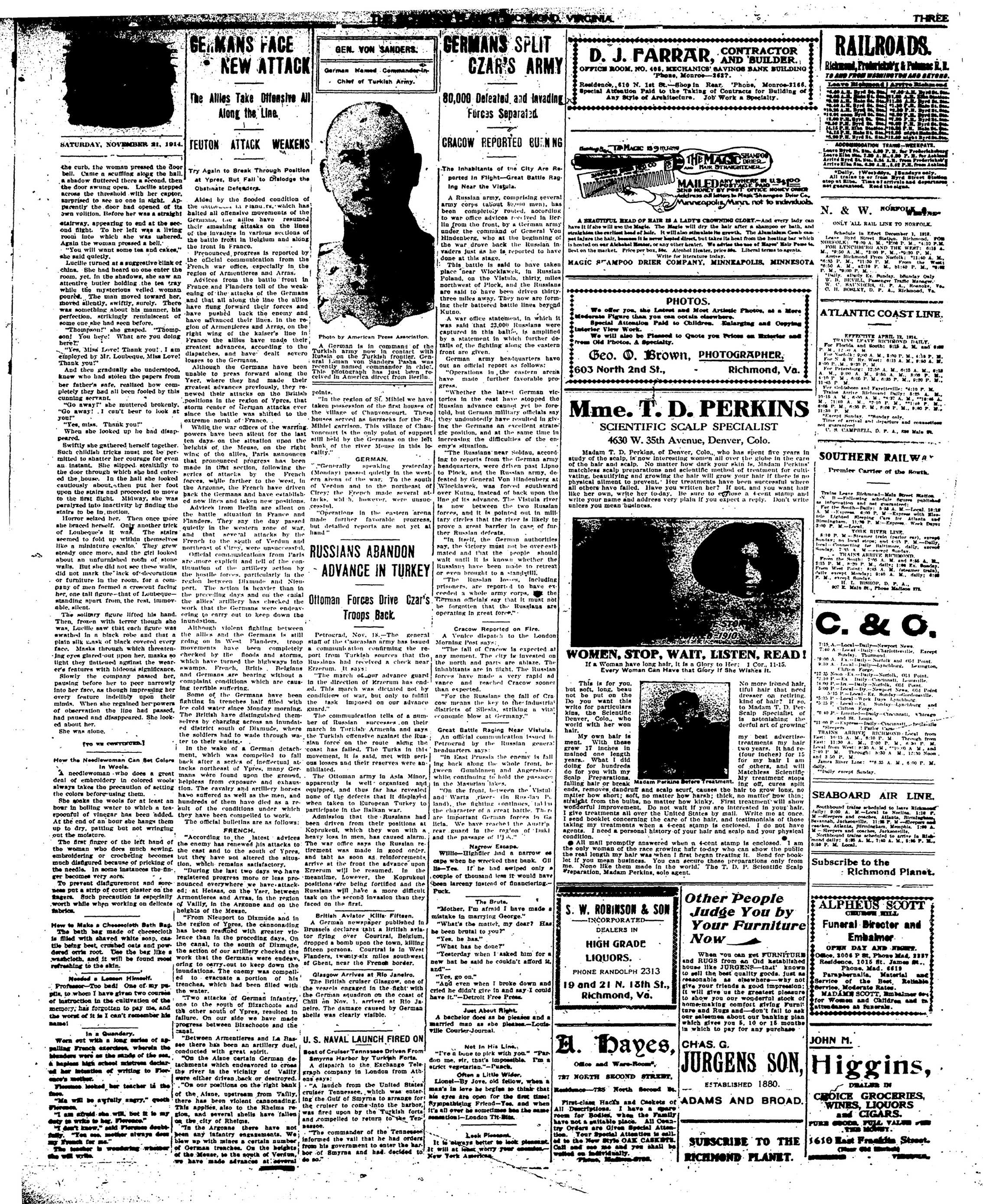
A German is in command of the Turkish army now in contact with Russia on the Turkish frontier. General Leman von Sanders Pasha was present at the battle. This photograph has just been received in America direct from Berlin.
points.
"In the region of St. Mihiel we have taken possession of the first houses of the village of Chauvoncourt. These houses served as barracks for the St. Mihiel garrison. This village of Chauvoncourt is the only point of support still held by the Germans on the left bank of the river Mouse in this locality."
GERMAN.
"Generally speaking yesterday (Monday) passed quietly in the western arena of the war. To the south of Verdun and to the northeast of Cifrey, the French made several attacks, which, however, were unsuccessful.
"Operations in the eastern arena made further favorable progress, but detailed reports are not yet at hand."
RUSSIANS ABANDON
ADVANCE IN TURKEY
Ottoman Forces Drive Czar's Troops Back.
Petrograd, Nov. 18.—The general staff of the Caucasian army has issued a communication confirming the report from Turkish sources that the Russians had received a check near Erzerum. It says:
"The march of our advance guard in the direction of Erzerum has ended. This march was dictated not by conditions of war, but only to fulfill the task imposed on our advance guard."
The communication tells of a number of Russian successes on their march in Turkish Armenia and says the Turkish offensive against the Russian force on the route along the coast has failed. The Turks in this movement, it is said, met with serious losses and their reserves were annihilated.
The Ottoman army in Asia Minor, apparently is well organized and equipped, and thus far has revealed none of the defects that it displayed when taken to European Turkey to participate in the Balkan war. Admission that the Russians had been driven from their positions at Koprukoul, which they won with a heavy loss in men, has caused alarm. The war office says the Russian retirement was made in good order, and tacht as soon as reinforcements arrive at the front the advance upon Erzerum will be resumed. In the meantime, however, the Koprukoul positions are being fortified and the Russians will have a more difficult task on the second invasion than they faced on the first.
British Aviator Kill-Fitten.
A German newspaper published in Brussels declares talt a British aviator flying over Courtrai, Belgium, dropped a bomb upon the town, killing fifteen persons. Courtrai is in West Flanders, twenty-six miles southwest of Ghent, near the French border.
Glasgow Arrives at Rio Janelro.
The British cruiser Glasgow, one of the vessels engaged in the fight with the German squadron on the coast of Chill on Nov. 1, arrived at Rio Janelro. The damage caused by German shells was clearly visible.
U. S. NAVAL LAUNCH FIRED ON
Boat of Cruiser Tannassae Driven From
Samarra deather to Turidish Forte
Smyrna Harbor by Turkish Forta.
A dispatch to the. Exchange Telegraph company in London from Athens says:
"A launch from the United States cruiser Tennessee, which was entering the Gulf of Smyrna to arrange for the cruiser to come into the harbor, was fired upon by the Turkish forts and compelled to return to the Tennessee.
"The commander of the Tennessee informed the vall that he had orders from his government to enter the harbor of Smyrna and had decided to do so."
GERMANS SPLIT CZAR'S ARMY
80,000 Deleated and Invading Forces Separated.
CRACOW REPORTED BURNING
The Inhabitants of the City Are Reported in Flight—Great Battle Rag-ing Near the Viatula.
A Russian army, comprising several army corps (about 80,000 men), has been completely routed, according to war office advises received in Berlin from the front, by a German army under the command of General Von Hindenberg, who at the beginning of the war drove back the Russian invaders just as he is reported to have done at this stage.
This battle is said to have taken place near Wlocklawsk, in Russian Poland, on the Vistula, thirty miles northwest of Plock, and the Russians are said to have been driven thirty three miles away. They now are forming their battered battle lines beyond Kutno.
A war office statement, in which it was said that 23,000 Russians were captured in this battle, is amplified by a statement in which further details of the fighting along the eastern front are given.
"Operations in the eastern arena have made further favorable progress.
"Whether the latest German victories in the east have stopped the Russian advance cannot yet be foretold, but German military officials say they undoubtedly have resulted in giving the Germans an excellent strategic position, and at the same time in increasing the difficulties of the enemy's situation.
"The Russians near Solden, according to reports from the German army headquarters, were driven past Lipno to Ploch, and the Russian army, defeated by General Von Hindenberg at Wlocklawek, was forced southward over Kutung, instead of back upon the line of its advance. The Vistula river is now between the two Russian forces, and it is pointed out in military circles that the river is likely to prove a great barrier in case of further Russian defeats.
"In itself, the German authorities say, the victory must not be overestimated and that the people should wait until it is known whether the Russians have been made to retreat or even brought to a standstill.
"The Russian losses, including prisoners, are reported to have exceeded a whole army corps, the German officials say that it must not be forgotten that the Russians are operating in great force."
A Venice dispatch to the London Morning Post says:
"The fall of Cracow is expected at any moment. The city is invested on the north and parts are ablaze. The inhabitants are in flight. The Russian forces have made a very rapid advance and reached Cracow sooner than expected.
"For the Russians the fall of Cracow means the key to the industrial districts of Silesta, striking a vital economic blow at Germany."
Great Battle Raging Near Vistula.
An official communication issued in Petrograd by the Russian general headquarters says:
"In East Prussia the enemy is falling back along the whole front, between Gumbeln and Angersburg, while continuing to hold the passage in the Masurian lakes.
"On the front, between the Vistul and Warta wars, (in Russian Poland), the fighting continues, taking the character of a great battle. There are important German forces in Galicia. We have reached the Austrian rear guard in the region of Dukli and the passage of Ulic."
Narrow Escape
Willio—Higgarder and a narrow cape when he wrecked that bank. Gill—Yes. If he had swiped only a couple of thousand less it would have been larceny instead of financiering—Puck.
The Brute.
"Mother, I'm afraid I have made a mistake in marrying George."
"What's the matter, my dear? Has he been brutal to you?
"Yes, he has."
"What has he done?"
"Yesterday when I asked him for a new hat he said he couldn't afford it, and"—
"Yes, go on."
"And even when I broke down and cried he didn't give in and say I could have it."—Detroit Free Press.
Just About Right.
A bachelor does as he pleases and a married man as she pleases—Louisville Courier-Journal.
Not In His Line.
"I've a bone to pick with you." "Pardon me, sir, that's impossible. I'm a strict vegetarian."—Punch.
Often a Little Wider.
Lionet—By Love, old fellow, when a man's in love he begins to think that his eyes are open for the first time!
Rypathabiging Friend—Yes, and when it's all over he sometimes has the same somethi—London Tit-Bits.
It is always better to look pleasant. It will at least worry your emotion. New York America.
OFFICE BOO, NO. 406, MECHANICS' SAVINGS BANK BUILDING
'Phone, Monroe—2627.
Residence, 610 N. 1st St.—Shop In Rear. 'Phone, Monroe-2166.
Special Attention Paid to the Taking of Contracts for Building of
Any Style of Architecture. Job Work a Specialty.
THE MAGIC SHAMPOO DRIER AND HAIR STRAIGHTENER
MAILED ANY WHILE IN U.S. $100 SEND HONEY BY POST OFFICE HONEY ORDER Address all letters to Magic Shampoo Drier Co., Minneapolis, Minn. not to individuals.
A BEAUTIFUL HEAD OF HAIR IS A LADY'S CROWNING GLORY.—And every lady can have it if she will use the Magic. The Magic will dry the hair after a coffee or bath, and straighten the earliest head of hair. It will also stimulate its growth. The Aluminum Coat can pet failure the hair, because it is never hated direct, but takes its heat from the heating bar which is heated on our Alcohol Heater, or any other heater. We advise the use of Hayes' Hair Fence to beat on the market. Price per box, $5c. Alcohol heater, price $5s. Liberal terms to agents.
Write for literature today.
MAGIC SHAMPOO DRIER COMPANY, MINNEAPOLIS, MINNESOTA
We will also be Planned to Quote you Prices on Exterior and
from Old Photos, A Specialty.
4630 W. 35th Avenue, Denver, Colo.
Madam T. D. Perkins, of Denver, Colo., who has spent five years in study of the scalp, is now interesting women all over the globe in the care of the hair and scalp. No matter how dark your skin is, Madam Perkins' matchless scalp preparations and scientific method of treatment for cultivating, beautifying and growing the hair will grow your hair if there is no physical alliment to prevent. Her treatments have been successful where all others have failed. Have you written her? If not, and you want hair like her own, write her to-day. Be sure to e-cover a 4-cent stamp and write your name and address very plain if you expect a reply. Don't write unless you mean business.
WOMEN, STOP, WAIT, LISTEN, READ!
If a Woman have long hair, it is a Glory to Her: I Cor., 11-15.
Every Woman Can Have that Glory If She Wishes it.
This is for you, but soft, long, beau not be put on the Do you want this write for particular kins, the Scientific Denver, Colo., who world with her won hair.
My own hair is ment. With these grew 17 inches in mained one length years. What I did doing for hundreds do for you with my Scalp Preparations, falling hair or break ends, removes dandruff and scalp scurf, causes the hair to grow long, no matter how short; soft, no matter how harsh; thick, no matter how thin; straight from the bulbs, no matter how kinky. First treatment will show wonderful improvement. Do not wait if you are interested in your hair.
I give treatments all over the United States by mail. Write me at once. I send booklet concerning the care of the hair, and testimonials of those taking my treatments when a 4-cent stamp is enclosed. I do not have agents. I need a personal history of your hair and scalp and your physical condition.
All mail promptly answered when a 4-cent stamp is enclosed. I am the only woman of the race growing hair to-day who can show the public the real length my hair was when I first began treating it. Send for booklot if you mean business. You can secure those preparations only from me. None like them made in the world! The T. D. P. Scientific Scalp preparation, Madam Perkins, sole agent.
S. W. ROBINSON & SON
INCORPORATED
DEALERS IN
HIGH GRADE
LIQUORS.
PHONE RANDOLPH 2313
19 and 21 N. 13th St.,
Richmond, Va.
A. Hayes,
Office and Ware-Room²,
727 NORTH SECOND STREET,
Rockhams—725 North Second St.
First-class Hacks and Cockets of
All Descriptions. I have a spare
room for Bodies, when the Family
have not a suitable place. All Coun-
try Orders are Given Special Attention.
Your Special Attention is called
to the New Style OAK CASKET.
Call and see me and you shall be
waited on individually.
This is for you, but soft, long, beau
not be put on the
Do you want this
write for particular
kins, the Scientific
Denver, Colo., who
world with her won
hair.
My own hair is
ment. With those
grew 17 inches
in maled one length
years. What I did
doing for hundreds
do for you with my
Scalp. Preparations.
curr, causes the hair to grow long, no now harsh; thick, no matter how thin; show kinky. First treatment will show that if you are interested in your hair, red States by mail. Write me at once of the hair, and testimonials of those stamp is enclosed. I do not have your hair and scalp and your physical upon a 4-cent stamp is enclosed. I am hair to-day who can show the public first began treating it. Send for book secure these preparations only from world! The T. D. P. Scientific Scalp ent.
Other People
Judge You by
Your Furniture
Now
When you can get FURNITURE and RUGS from an Old established house like JURGENS—that' known to sell the best quality goods. Just as reasonable as elsewhere—why not give your friends a good impression; it will give us the greatest pleasure to show you our wonderful stock of home-making comfort giving Furniture and RUGS—and don't fail to ask our salesmen about our banking plan which gives you 5, 10 or 15 months in which to pay for any purchase.
CHAS. G.
JURGENS SON,
ESTABLISHED 1880.
No more fronded hair,
tiful hair that need
dresser on retiring,
kind of hair? If so,
to Madam T. D. Per-
Scalp Specialist of
is astonishing the
durful art of growing
my best advertis-
treatments my hair
two years. It had re-
four inches) for 15
for my hair I am
of others, and will
Matchless Scientif-
My treatment stops
THREE
**SERVICE INFORMATION**—WEEKLY.
Loren Boerse Bin. 8.00 P.M. H. From Frederikshaven
Loren Boerse Bin. 8.00 P.M. H. From Frederikshaven
Arrived by fred St. Kate. 8.50 A.M. H. From Frederikshaven
Arrived by kate St. Kate. 8.50 A.M. H. From Frederikshaven
*Daily.* *Weakdays* $Bundays only.
All trains to or from Frederikshaven stop at Kibe.
Time of arrivals and departures not guaranteed. Read the sign.
N. & W. NORPOLL
ONLY ALL RAIL LINE TO NORFOLK.
Schedule in Effect December 1, 1918.
Leave Hyrd Street Station, Richmond, FOB
NORFOLK: 9:00 A.M. M, 12:00 P.M. M, 4:10 P.M.
M, 9:00 A.M. M, 12:00 P.M. M, 4:10 P.M.
M, 9:00 A.M. M, 12:00 P.M. M, 4:10 P.M.
Arrive Richmond from Norfolk: 11:40 A.M.
M, 11:30 P.M. M. From the West.
9:00 A.M. M, 12:00 P.M. M, 8:10 P.M.
M, 9:00 P.M. M,
Daily, allyly Ex. Sunday, bidayy Only
W. H. BRYNEL, Passenger Traffic Manager.
W. A. RAYNDERN, G. P. A., Roanoke, Va.
C. H. HOOKLEY, D. P. A., Richmond, Va.
ATLANTIC COAST LINE.
EFFECTIVE APRIL 12, 1814.
TRAINS LEAVE RICHMOND DAILY.
For Florida and South: 8:15 A. M. and 8:00
P. M.
For North: 9:00 A. M. 8:00 P. M. 8:15 P. M.
For North: 9:00 A. M. 8:15 A. M. 8:00 A. M.
For N. & W. Rv. West: 8:15 A. M. 8:00 A. M.
8:00 P. M.
For Petersburg: 12:00 A. M. 6:15 A. M. 8:15
A. M. 9:00 A. M. 8:00 P. M.
4:10 P. M. 6:00 P. M. 6:25 P. M. 8:20 P. M.
11:45 P. M.
For Goldblatt and Fayetteville: 8:10 P. M.
Trains Arrive Richmond Daily: 8:25 A. M.
10:15 A. M. 8:25 A. M. 7:07 A. M. 7:08 A. M.
10:15 A. M. 8:20 P. M. 7:10 P. M.
6:05 P. M. 6:35 P. M. 6:00 P. M. 8:00 P. M.
11:30 P. M.
*Except Sunday, *Sunday only,
Time of arrival and departure and consents
not guaranteed*
C. S. CAMPBELL, D. P. A., 838 Male 50
SOUTHERN RAILWAY
Premier Carrier of the South.
Trains Leave Richmond—Main Street Station.
N. B.—Following schedule figures published as information and not guaranteed:
For the South Daily: 5:45 A.M.—Local: 10:18 A.M.—Express: 4:00 P.M.—Keppel with Electric Lighted Reeping Care for Atlanta and Birmingham, 11:30 P.M.—Express: Week Dayer 3:00 P.M.—Local.
YORK RIVER LINE.
8:10 P.M.—Steamer train (parlor car), exce$6 Sunday; no local stop; and 4:15 P.M.—Daily, local: Connecting for Baltimore, daily, exceed Sunday, 7:45 A.M.—except Sunday.
THAIN ARRIVE RICHMOND.
From the South 7:00 A.M. and 8:45 A.M., 2:15 P.M. 8:20 P.M. daily; 1:00 F.S. Sunday. From West Point: 8:45 A.M. (steamer train), daily except Monday; 9:40 A.M. daily; 4:00 P.M., except Sunday.
H. L. BIRHOP, D. P. A., 907 K. Main St. Phone Mailbox 178
C. & O. 7:15 A.-Local-Daily-Newport News. 7:40 A.-Local-Daily-Charlottesville. Except Sunday. Thurmond.
19 00 A. La. Italy - Norfolk and Old Point
19 00 A. Italy - Lincoln - Lexington, Lexington
2:00 P. Local Dy. Newport News, OD Point
5:15 P. Local Lt. Rt. Bunny-Gordonville,
5:15 P. Local S. Sunny Lynchburg,
5:15 P. Local Rt. Lynchburg and
Cilent Forges,
5:40 P. Limited-Daily-Cincinnati, Ohio
5:40 P. Limited-Daily-Cincinnati, brownsville
"11:00 P. Hypset-Daily-Cincinnati, brownsville
Silverleaf, Parker Cars
5:10 P. Richmond, LOCAL from
East: 10:15 A. M, 10:15 A. M,
East: 11:30 A. M, 11:30 A. M,
East: 11:30 A. M, 12:00 A. M,
Local from West: 12:00 A. M, 12:00 A. M,
Through: 12:30 A. M, 12:30 N. Ome
and 3:00 P. James River Line: "8:35 A. M, 6:00 P. M."
James River Line: *6* 35 A. M., 6 00 P. M.
daily.
on the second Sunday.
**Daily except Sunday**
SEABOARD AIR LINE
Southbound trains aboarded to leave Richmond
daily: 9:00 A. M.-Local to Norlina. 1:18 F.
M.-Hippers and coaches, Atlanta, Birmingham,
Ravannah, Jacksonville, 11:38 F. M.-Hippers and
coaches, Atlanta, Hirimingham, Memphis. 1:00 A.
M.-Nepers and coaches, Jacksonville.
Northbound trains aboarded to arrive in Rich-
mond daily: 8:30 A. M., 7:40 A. M., 8:56 P. M.
6:50 P. M. Local.
Subscribe to the
Richmond Planet.
ALPHEUS SCOTT
CHURCH HILL
Funeral Director and
Embalmer
OPEN DAY AND NIGHT.
Office, 3006 P St, Phone Mad, 2357
Residence, 1015 St. James St.,
Phone, Mad. 6619
Paraphernalia, Material and
Service of the Best, Reliable
Service, Moderate Rates.
MADAMS SCOTT, Embalmer Gos.
for Women and Children and in
attendance as funerals.
JOHN M.
Higgins,
DEALER IN
CHOICE GROCERIES,
WINES, LIQUORS
and CIGARS.
PURE GROOD, FULL VALUE FOR
THE MONEY.
1610 East Franklin Street.
(Pier 60d Market)
Published every Saturday by John Mitchell, Jr., at 411 N. 4th St., Richmond, Va.
JOHN MITCHKILL, JR. . EDITOR
All communications intended for publication should be sent go as to teach us by Wednesday.
Entered at the Post Office at Richmond, Va., as second-class matter.
SATURDAY, NOVEMBER 21, 1914.
It pays to be police to both white and colored people.
President Wilson said he did and Chairman Trotter says he didn't, and "there ye are."
```markdown
```
There is no use howling about hard times. Colored folks have been experiencing the same for more than one hundred years.
The song: "We never speak as we pass by," should be very popular at the White House and in Editor Trooper's Guardian Office these days.
---
Colored folks should continue to make friends with the white folks, even with those who despitefully use them and say all manner of evil about them.
President Wilson's latch-string no longer hangs on the outside for colored northern delegations. He has pulled it in the inside or some one has done it for him.
---
- You May not believe it, but there is one thing on which you can safely bet. Dr. Booker T. Washington is not easily laughing, but he is wearing a mighty broad smile.
We can't blame Brother Trotter for being indignant, but we just criticise him for showing it. He had the right of the matter in the controversy and no fair minded man will deny it.
```markdown
```
Be respectful to your superiors in office, no matter what kind of office it is. We would remind the officers too to be courteous and respectful to those folks who are not in office.
Colored folks in the South-land are well acquainted with the Democratic trick mule. It is as dangerous in front as it is behind. Colored folks in the North-land will learn this thing too after a while.
Our good friend, William Monroe Trotter, the greatest aspirator in the country, who at the last election affiliated with the Democratic Party says that he is done with President Wilson and via Private Secretary, Tumulty, President Wilson is done with him.
The southern delegation that wanted something, and wont with hat in hand to nak for it, got it. The northern delegation that wanted nothing and went with the hat on the head got a lambasting that will be lasting for at least ten years, and it was all secured at the White House.
"Don't talk after you come out," is the motto for all future delegations. Bishop Alexander Walters violated this rule, but he was about the only one that has done it and gotten away after the performances. Since we come to think of it, even no has not landed the presidential appointments for his followers that he said the President promised to him.
President Woodrow Wilson has done mighty well to have held out as long as he did before expressing himself. He did not have to express himself to us for us to understand. When a member of his Cabinet pro-mented a discriminating order on
account of face and color, we know
at once he approved it.
Brother Trotter and his committee forgot that they were citizens of the United States without a country. They believed that the Constitution and the laws of the United States mean just what they say. If President Wilson and his associates will imagine this delegation to be naturalized, Germans, then it may be a more charitable view will be taken of their outburst.
When colored folks organize and determine to help themselves conditions will improve. They should support white men in their neighborhood who are friendly to them and who are willing to accord to them all of their civil rights and privileges. As to the social rights, they will take care of themselves. A citizen white or black selects his own social companions and "no man can hinder."
```markdown
```
We do not believe that President Woodrow Wilson is an enemy to the colored people. We believe he wishes them well, just as he wishes the Indians well or any other dependent people, who are not citizens of the United States. The difficulty is to get him to see that his personal feelings and, his official duty sometimes run counter to each other. Personal feeling must of course give way. Gauged by his surroundings though His Excellency has done well. Let us hope that he will hold out to the end.
---
We have received a most interesting pamphlet from the Louisiana Board of Health at New Orleans and it gives a comprehensive statement relative to the Conference for the Betterment of Health, Conditions among Negroes. The meeting was held in the Auditorium of the Association of Commerce. J. Madison Vance, Eng., and Rev. R. E. Joney, editor of the South-western Christian Advocate took a prominent part in the proceedings and made many friends for the cause by their wise and conservative utterances.
---
A. RELIGIOUS FINANCIER
Head-wafer R. N. Smith of the Homestead Hotel at Hot Springs, Va. has an eye strictly to business when it comes to raising money to promote the religious and educational welfare of his race. He deserves a place alongside of that king of money-raiders, Dr. Booker T. Washington. The Homestead Hotel is the favorite resort for wealthy white men, who after making much money usually find Hot Springs, Va., a good place to spend it. Prof. Smith has undertaken the task of making these magnates feel good with the aid of the chef, better known as the cook, supplemented no doubt by other beverages not permissible by the State laws, but readily accessible from the well-ended baggage of the guests shipped from New York and other places.
Count in Kentucky as being among the other places. He knew that John D. Rockefeller, Jr. Esq. and Charles F. Murphy, Esq. the latter the chief of Tammany Hall were in a measure philanthropic and when he considered the matter, he invited them to visit Sigith's Chapel, a colored church and deliver a sermon from the pulpit. Mr. Murphy declined, as was to be expected, but Mr. Rockefeller in declining promised before leaving he would fill the engagement. It did not cost anything fro the invitation unless these wealthy New Yorkers saw fit to help the cause along and aid in the support of the church.
Prof. Smith has also been the patron of an industrial school and it is to be regretted that the wealthy guests have not seen fit to edow it with sufficient funds to make the contribution of funds from local sources unnecessary. R. N. Smith is now having his name going the rounds of the newspapers and at the expense of Brother Rockefeller and Brother Murphy. Hon. Theodore Roosevelt would no doubt have paid one hundred dollars to the church just to have seen Brother Murphy in the pulp, believing that the lambasting he has been giving him resulted in his finding an humble and a contrite heart. Hon. Charles F. Murphy is regarded as the shrewdest politician in the country on the Democratis side and one of the characteristics of his shrewdness is that he knows when to say no. It is not our business to ask whether he made a contribution to Brother Smith's church. Oh not
DR WASHINGTON AND
Dr. Booker T. Washington is a diplomat of "the first, water," capable, if the Hon. Harry C. Smith is to be believed to represent this government at the Court of St. James. On the other hand, the Hon. Harry C. Smith missed his calling is not pre-
parting himself for the bar. An a press examiner, he is pre-empting. At what other conclusion could we arrive; after reading in the Cleveland Gasette, his attempt to "smoke out" Dr. Washington to ascertain whether or not he approved the segregation of the colored people in an address delivered by him at the meeting of the National Negro Business League in Oklahoma.
Of course, Mr. Smith does not take into consideration that Dr. Washington was in Okla. and it takes a mighty long time" to get out of that State, when the trip is uninterrupted and travelers, who have been indiscreet in their public utterances have been known not to get out of the State at all. Lien, H. C. Smith wishes to "nail" the distinguished educator and hn. is doing it. But let him speak for himself. In that "hornet-like publication, The Gazette, he says.
Relative to the charge that he directly or indirectly endorsed segregation in a speech to the National Business League of which he is president, at its annual meeting, some weeks ago, in Muskogee, Okla., Dr. Hoover T. Washington says in a letter, to Mr. C. Winston of St. Louis under date, Oct. 2, '14, and personally to the public;
"What I did attempt to say in Muskegon, and what I have attempted on numerous accents to say when speaking in public, was to urge our people not to become discouraged or disheartened in communities where they are segregated, but not withstanding such segregation, to go forward and make progress. In a word, to overcome evil with good; to make so much progress in the beauty, comfort and convenience of their surroundings that those who have treated them unjustly will be made to blush with shame because of the progress that the Colored people making. In a word, to express upon our people ideas that they should keep a cheerful heart and a strong will and not permit them to be continually on the defensive side of life/but to make such progress that the world will admire the rapid strides with which they are going forward."
It will be seen in the foregoing that Mr. Washington does not say FIGHT segregation, in the courts, the proper place, but "begs the question" by telling our people to do something else which would not be effective in the South or anywhere else, and he and everyone else knows tails. This does he give quasi endorsement to segregation. With prejudice whites continually attacking our rights, as citizens, if we are manly men, how in the name of all that is good and body are we to be otherwise than one defensive side of the one if we make any effort to protect and retain them, and register lost?" The man ought to be ashamed of himself for giving such "doctrine of surrender" advice and if he is not, it is our duty to make him to discontinue such pernicious harmful talk. It is enough to make Garrison, Phillips, Douglass and Langston turn over in their graves. Whoever heard of a people whose rights and privileges were assailed (and taken from them) as our aes are in this country, "overcoming" such injustice through evidence of progress by progressive constructive work, and by an "appeal to every white man whose good will and influence is worth having" to be done doing this ever since the close of the war of the rebellion, and what is the result? Loss of rights, insurgency, until we are now stacked up in the corner with our backs to the wall" where we must fight, fight, FIGHT! in all the courts, and to the "very last ditch" or be deprived of all the prejudice South, and its Northern allies, would have us lose. Then would come upon the terrible condition of the Russian soft and the masses of the Jews in that country.
Barring the caustic criticism of Dr. Booker T. Washington, we agree with the noted Ohioan in his statements. There can be no middle ground in the discussion of vital rights and vital wrongs. This compromising attitude has benefited us twenty per cent and has inflicted us fifty per cent. The sum and substance of the whole matter when a balance is struck shows that it has not benefited us at all. The Negroators have by argument and fair talk induced our leaders or some of them, for alleged peace's sake to abandon one right and then another until now we see the last one of them vanishing in the distance and that is the property right, for segregation of the races can mean no other thing.
In this connection, it may be well to cite a case that has just happened in this city. We clip from the Richmond, Va. Evening Journal of the 17th, inst.
Joseph Williams, colored, was fined $100 in Police Court today on the charge of violating the segregation ordinance. An appeal was noted to the Hustings Court.
Williams was first in Police Court October 24th, on this charge and was given a week in which to move from his residence at 626 North Fourth Street.
As he had failed to carry out the court's order, Justice Griggs said that there was nothing to do but fine him. Under the law negroes are not permitted to reside on a block if a majority of the residents are white, and vice versa.
Mr. Joseph Williams has been ordered to move out of his own house, which house is registered here on the land books and in the court house as belonging to him. The block adjoining the one in which he lives is solidly occupied by colored people. He has not gone into a white district but is living in his own house, practically
In a certain institution and he is to be prepared for sitting in his own house. If any one could conceive of anything more absurdly ridiculous we would like to hear it stated. What should he do? We say, fight it out, if it takes the house to pay the cost of the litigation.
We shall not believe until the Supreme Court, or Appeals of Virginia so decides that such an ordinance is constitutional. It involves the rights of a freeman and an American citizen. Hon. Harry C. Smith is all right. We are with him in his position. We believe though that our distinguished leader, Dr. Booker T. Washington has seen the light, so to speak. His explanation shows that he feels the force of the criticism keenly. But why discuss the matter further? Dr. Washington is a diplomat and Hon. Harry C. Smith is an uncompromising patriot. Both have their uses.
The action of the one disguises the other and vice versa. When the history of the race is written though and a record of racial achievements are noted, the name of Harry C. Smith will be written high upon the scroll of undying fame. Solah:
THE PRESIDENT AND MR. TROTTER
We hope that it is not true that Editor William Monroe Trotter of the Boston, Mass. Guardian offended His Excellency. Woodrow Wilson, President of the United States by his method and manner at the White House of the nation. It is but fair to state that Mr. Trotter disclaims any such intention or result. It is a well-known fact though that the word of the President of the United States and that of his Private Secretary will pass current as the truth throughout the length and breadth of this land by both the conservative elements and the partisan clauses of the nation.
It is "the trony of fate." We see or think we see the cause of the trouble. Editor William Monroe Trotter, by nature and training possesses an offensive manner towards those who disagree with him and the attitude of an angel towards those who favor him and his policies. We are frank to say we do not believe that he intentionally offended the Chief Executive of the nation. He just failed to exercise that transcendent diplomacy, for which his arch enemy, Dr. Booker T. Washington is noted. As a result, he has given his enemies a club with which to do him and his cause much injury.
The fact that a President of the United States, under oath to recognize the civil and political equality of all men before the law and to make no discrimination on account of race, color or previous condition of servitude should condone such American conditions on the plea that it was the best thing for colored folks evidently threw Mr. Trotter's "connecting rod" with his "exhaust pipe" of conservatism out of commission. He attempted to argue with a President of the United States, when his address should have been his argument and he should have stopped there. According to Mr. Trotter's own statement, he assumed an air of equality with the President of the United States which was rasping and provoking. Mr. Wilson was his superior, by virtue of position and training although he was equal before the law.
These are the nice points of diplomatic usage that enable a citizen to carry his point without offense. Men are trained in this kind of state craft in order to approach men in high places without giving offense. Chairman Trotter's position in this matter was absolutely correct from every angle, but his manner of maintaining it was evidently incorrect from his own statements. We have visited the White House many times and it has always been a rule of official conduct to give out no information, save that authorized by the President and he usually counselled silence.
It is no wonder then that Secretary Tumulty was disgusted and we might add angry over the fact that Mr. Trotter had talked to the reporters, although he afterwards requested them not to say anything about what he said. The meeting held in Washington on the following Sunday afternoon only made a bad matter worse. President Wilson, although hampered by other duties had found time to meet this delegation of colored men—democrats and then he found them not only antagonistic but ready to argue the question with him, when he wanted no argument.
We felt disposed at first to let the matter drop and to make no comment, but, after mature consideration, we have discussed the situation from our angle. President Wilson has gone, a step further than President Roosevelt and President Taft. He has openly discriminated against the colored man, and the white one. He pleads an equality in this discrimination, when as a matter of fact, he is sworn not to discriminate against a colored employee or account of race or color or against a white employee for the same reason. We take
if that it should be his business, his duty to observe the law, respect laws of the inconveniences to which some folks allure they are being subjected.
He knows or should know that this segregation is neither more nor less than an extension of the oaste system now in vogue in Europe, Asia and the lales of the seas and that it is contrary to American usage and procepts. It was as a protest against this very custom that the early settlers sought a home in this strange land. Mr. Wilson's personal feeling and opinions may be one way, but his official practices should be another and he should set his face like flint against race prejudice, in whatever form it may appear.
But then, we may be falling into the same channel with Editor Trotter. Let us remember that we all are in the hands of a good God, who will neither forget nor forsake. To Him, we confide our case and we call upon the ten million colored people to pray for the distinguished occupant of the White House. Brother Trotter does not need our prayers for he seems to be able to take care of himself and he lives in Boston, where his actions may be both endorsed and condemned without the liability of personal injury from either friends or foes.
We live down here among some of the best white people on the face of the globe and among some of the worst. Be that as it may, segregation in the departments at Washington is all wrong, both in principle and precept. Southern Governors avoid it by having no colored folks in State offices. A Southern President may avoid it by adopting a similar policy. The colored folks, who voted the Democratic ticket are now dishing up their own cooking and they are making wry faces. May God help them—and President Wilson.
Y. M. C. A. Notes.
The committee held special meetings in the city home 10 A. M.
General Society, Scott C. Burrell conducted a special meeting for women in the penitentiary and one accepted Christ 10.00 A. M. He also made a visit to the man who is to be electrocuted.
Committeeman C. K. Gaston addressed the boys 4 P. M. at the Y. M. C. A. and they were happy.
3:50 P. M. the 25th Anniversary Exercises of the Y. M. C. A. were continued at the 6th, M. Zion Baptist Church, Dr. D. S. Freeman delivered a special message which was crowded with much encouragement. The choir sang from the heart. Everybody was helped.
You and your friend are invited to the explanation on the Sunday School Lesson today 5 P. M. at the Y. M. C. A.
Come to the workers' meeting at the Y. M. C. A. 9:30 A. M.
Committeeman B. L. Allen will address the boys 4 P. M. at the Y. M.
C. A. Mothers send your boys. We thank you.
Leesburg (Va.) Notes.
The Mock Conference at the M. E. Church Thursday, Nov. 12th, was a signal success we are told that there were $128 realized, Rev. J. e. Dotson pastor.
The Masons meet in a business meeting Nov. 15th, and delegated W. A. Walker S. W. to the Grand Lodge to set in counsel.
Nov. 8th, the Primitive Baptist held services last night owing to the inclement weather the congregation was small. Elder Spots Brown in Charge.
Allthough it rained all day Rev. J. E. Dotsons people were found wonding their way to the house of God he unfolded the truth as he can do. Oh if we had some more Dotsons and Tyler's
Dr. Tyler will me in Dotson Sunday, Friday is our regular business meeting.
Our sick are all improving.
Mr. Johnson died here last week. His remains were removed to Warrenton Va. by undertaker Adam Your-Rorter W. L. J.
Roanoke (Va.) Notes.
Mr. John T. Taylor the general Manager and Sect. of the Richmond Beneficencia Pins. Co. and Mr. C. B. Glipin, Walter S. Banks and Mr. W. H. Thompson Inspectors in Roanoke inspecting the work. They are very pleased with the work.
Rev. W. R. Brown will preach his farewell semer Tuesday Nov. 24th at 8:00 P. M. He has a call to the Metropolitan Baptist Church in Pittsburgh Pa. which he will take charge Sunday Nov. 30. He has been pastoring the First Baptist Church for 10 years in which he has made many friends and the cause of husbands of souls to come, to Church. We are grateful to give him up.
Rev. and his family has best wishes and prayers of his congregation and the community.
Mrs. M. H. Burrell wishes to thank the Grand Lodge K. of P. of Va. for $150.00 death claim of her husband Dr. I. D. Burrell.
The High St. Baptist Church Congregation are straggling to get in the Auditorium of their church by the first Sunday in December. There will be usually the first Sunday in
Mr. H. R. Johnson of 532 Ave.
48 W. Tustenham the Gen. M. R. and
the Inspector and his agents Tuesday
Nov. 17th. Mr. R. P. Tate introduced
Mr. J. I. Taylor, Mr. Taylor in
his usual manner. Mr. Taylor in
his usual manner benefit to all.
After which 5 minutes talk from the
rest of the boys as given.
After the speaking the guest was invited in the beautiful dining room where every thing for appetite was served.
The guest was as follows:
M. Jno. T. Taylor of Richmond;
Mr. C. B. Gillip. T. GG. Hackley Mr.
W. S. Banks. W. H. Thompson. R. F.
Tate. T. G. Hackley. J. H. Cooper
and J. H. Fowlkes. Mr. H. C. Johnson
made the closing remark.
---
Drakes Branch' (Va.) Notice.
Mr. Eddie Lewis succeeded the other day in killing the largest buck captured here for many years. He was killed up Roanoke Creek on Boldins place.
Mr. Clem Green has moved to his home in town where the Planet is on sale on Saturdays. He will offer for sale his country home.
Mr. Charlie Brown declines to teach as principal of the High School at Charlotte this term. Says he is offered more money elsewhere.
Dr. Johnson of Richmond visited this town recently.
Mrs. Nannie Howell of Charlotte C. HL who was visiting her mother has returned to Baltimore, M. D.
Troy (N.Y.) Notes
The Planet, Richmond, Va.
The Emmanuel Baptist Mission,
will be moved to No. 213 6th, Ave.
Just south of Jacob Street, beginning
Sunday, Nov. 22nd, Preaching at
10:30 A.M. and 7:00 A.M.
Sunday School at 5:30 P. M. Young
People's Meeting at 6:30 P. M. Prayer
meeting at 8:00 P. M. Thursday.
Let every one remember and come to
the Thanksgiving entertainment
that will be given at The Presbyterian
Church, Thursday Nov. 26th, dinner
from 12 to 3 P. M. and supper 6:00
P. M. Come and eat all the turkey
you want.
Mr. Clifton, President, Rev. J. G.
Carrille, Pastor.
A friend Mr. Daniel Dixon of No.
150 Sth. Ave. decides to know If Mr.
John Mitchell, Jr. (The Editors)
Father Iyer, lyeh, in Yorktown Va.
Florence (S. C.) Notes.
Mr. W. T. Wurt of Drakes, S. C. was in the city today. He was a delegate to the Annual Meeting of the Joint Stock Company. He is president of his local lodge.
Mr. J. J. Petekin of Blenheim, S. C. accompanied him, as a delegate to the Joint Stock Annual meeting.
Prof. E. Bradley, of Wynnackey, S. C. was in the city on business Nov. 11. He was accompanied by his mother.
Rev. S. H. Trilerson of Timmonsville, S. C. was married to Miss Mary David at New Hope Church, Dillon County, Wednesday, Nov. 11, Rev. J. M. Lewis officiating. The couple passed through Florence on Train No. 52, West bound. They were enroute for home.
Mr. John W. White of Morrlin, N. C., Miss Mary A. Gandy, of Society Hill were married Nov. 11th at Darlington, S. C. They passed through Florence Nov. 12th, enroute for Mara-bluff S. C.
Mr. R. H. Mahoney, of Blahopville
S. C. was in the city Nov. 11, 1914.
Mr. B. DeLaine, of Live Oaks, Fla.
passed through the city Nov. 11th,
onroute for home.
Mr. Dorsey Godwill, of Hartsville
S. C. visited our city Friday Nov. 13.
He made a success farming this
month.
Mr. D. Flint and Mr. Davis visited
our city Nov. 13th.
Mr. Flint has a fine daughter, Miss
Ida Flint attending school at Allen
University.
Mr. Flint is president of the local
Lodge of Joint Stock.
Mr. Lonie Jones of Columbia, S.
C. spent several days in our City visiti
He left the city for Alken, S. C.
Nov. 13th. He envolved his stay.
Mr. Chas. Cussock, of Hyman, S. C. was in the city Nov. 13th, attending the Annual Session of the Joint Stock Society.
Miss Soonia Campbell of Harteville, passed through the city Nov. 14th, enroute for Chatburn N. C. to spend a few days.
Prof. S. B. Williams, of Georgetown passed through the city Sunday P. M. Nov. 16th, inst. enroute for Marton, S. C. to open the Flegas High School of which he is principal.
Prof. Williams is a graduate of Allen Columbia S. C. class 1913.
Miss Angusta R. Eleck, of the city Graded School at Cheraw S. C. passed through the City Nov. 15. to attend the funeral of Mr. S. V. T. McLaughlin at Sastover S. C.
The report rendered by the Grand Chief was Gilt adge.
The Treasurer reported that more money had been collected the next year than before in the history of the order.
Brother McClary Succeeded in over Coming all opposition
It more properly misunderstands, but we have the word of the Board of Epiphany by 5 and the decree of Virginae by 5, both affirming of the fact that thou shalt sow a tree, an diphtheria, autumns and it can be had at most reasonable rates. Columns have been written and statistics almost without a number have been compiled, but many parents do not know that this greatest remedy of modern medicine has robbed of all its horrors the most dreaded disease of childhood.
The story of diphtheria antitoxin is one of the miracles of our day. Since the discovery of the germ diphtheria more than 30 years ago, there has been steady progress in knowledge of the disease. Investigation early showed that diphtheria was caused only by taking into the nose or mouth the germs of diphtheria that came from some one who harbored the germs in his throat or nose. It has been found that the diphtheria germ multiply readily in the throats of human beings and that they do not always poison those in whose throats they grow. Some carry the germs indenitely and suffer little inconvenience but they give diphtheria to others. The use of a glass from which some one with diphtheria has drunk may cause disease. The chemical habit of putting the germs in the mouth is likewise responsible for the spread of diphtheria; a dozen ways might be mentioned by which the secretions from the mouth of one who has diphtheria may reach a healthy person and give him the disease.
It was on the basis of this knowledge that Behrin, perfected diphtheria antitoxin and introduced it in America just twenty years ago. The death-rate from diphtheria declined in proportion as antitoxin became more widely used. Prior to 1894, the death-rate in a severe epidemic of diphtheria was sometimes as high as 35 per cent; nowadays, where antitoxin is administered promptly, the mortality does not go above 5 per cent. In cases where the antitoxin is given on the first day of the disease, recovery is almost certain without ill-effects of any kind. Two million lives, it is estimated, have been saved by antitoxin since it was discovered—a record excelled only by that of Jenner's small box vaccine.
To the general use of diphtheria antitoxin there has been but one obstacle—the high price at which it has been sold. Ten, even twenty dollars have been demanded in some communities for antitoxin sufficient to cure a case of diphtheria. Happily however, this obstacle has been overcome by the introduction of which the State government has made. Antitoxin is now dispensed through the State Board of Health, at absolute cost, to all who need it. The standard dose of 5,000 units, which sometimes costs $7.50 can be had through the State Board for $1.95, bill being rendered direct by the manufacturer. We need only a wider knowledge of the structure of diphtheria of the methode by which it is spread and of the weapon available against it to list it among those diseases which man has conquered.
RICHMONDS DUTY TO THE
NEGRO AND HERSELF.
Insistent public demand that the city shall take over and operate Pine Camp, that haven of refuge for indigent white sufferers from tuberculosis, directs attention to the fact that for indigent negroes in the same unhappy situation the city makes practically no provision.
In extreme cases, such sufferers are sent to the City Home, but obviously that is not the proper place for them, neither surrounds the patient with those sufferers that provide necessary nor nurses adequately the real purposes of segregation. But the final and controlling consideration is that it can shelter and does shelter only a small proportion of those Negro consumptives, unable to care for themselves, whom the safety of the community demands shall be isolated and so prevented from spreading contagion.
In our Southern civilization the Negro comes into closest contact with the white race. In the streets, on the cars, in offices restaurants and homes this contact persists. The Negro is porter and sweeper, cook waiter, laundress and nurse. Surprises emerge from squall, neglected and congested dwellings to prepare and serve your food and to care for your children. Perhaps each week your clothes are laundered amid just such surroundings, invading and hospitable to every contagious disease, but more than all others to tuberculosis. The Negro death rate from tuberculosis here, as in other cities, is appalling—There is no other word for it—but no man liveth to himself, nor dieth, either. From the Negro Slum to comfortable home or stately mansion the progress of disease infection is easy and uninterrupted. In every community where the Negro forms a considerable part of the population it goes on every day of every year.
There is gross, inhumanity, of course, in permitting the ravages of tuberculosis among this dependent race, without every effort being made to check its spread, but there is something more. For the white-pacific man, who is always in constant message, always at their doors, involves many of the elements of self-destruction: Richmond, Times-Dispatch.
BOYS AND GIRLS CONTEXT.
The Boys and Girls Content is nearing a close. You can order new, send in a yearly subscriber and get 215 votes for your boy or girl. Pay up for job work or pay up back subscriptions and get the votes thereon. Save the coupon and get the votes. Save the coupon and have the prize for Christmas.
On Thanksgiving Day, Lincoln University will play a championship game with Va. Union University on the latter's campus at 2 P. M. This is the first opportunity the people of Richmond have had chance to see Lincoln in action on the gridiron. Both teams profess confidence of victory, Lincoln recently whitewashed Howard by the score of 12 to 0; Union did likewise to Shaw, Saturday, to the tune of 23 to 0. Both Shaw and Howard have excellent teams and several star players. So from all indications the Lincoln-Union game will be one between two evenly matched teams, and bids fair to be the hardest fought game ever seen in Richmond. A large attendance is expected.
UNION WINS FROM SHAW.
In an exceedingly hard game here Saturday, Shaw University went down in defeat before the stronger squad of Va. Union University, by the score of 23 to 0. Union played superior ball throughout the contest. Long gains were made on fakes and forward passes, while the visitors relied chiefly on going through line. The game was not as clean as one would expect particularly was this noticed in the third quarter when it seemed evident that Union was the winner. Shaw resorted to slugging matching balls, unfair holding and other illegalities. She was penalized five times for this kind of playing. Union made fourteen first downs; Shaw four. The visitors were not able to work a single forward pass; Union essayed seven. Union kept up her record for quick passing and made one minute the third in 30 seconds. On the first scrimmage, a beautiful 75 yard "dash through broken field by H. Thompson registered a touchdown for the "Red and Steel" in exactly one minute. On Union's kick off Shaw is downed before she could cross twenty yard line.
A chance to score, when she plowed, her way up field until Shaw's last foot line is reached. Here Shaw falls on the oval on Elliott browns. Brown punts up field, and the ball stays in the neutral zone, for the rest of the quarter. In the second quarter Union made large gains through the Daniel-Tolson forward pass combination, which took Union to Shaw's 20 yard line. Thompson now skirted Walken end for 25 yards and a touch down. Both teams played to a stand still in the next quarter Union opened up the last quarter with a forward pass between Daniel and Tolson for 35 yards. Here the protist play of the game was stayed. Howell received the ball and started around right end. Tolson met him, took the oval and doubled around left and for a run of 25 yards to goal. Daniel next contributed 3 points to Union's victory by cleverly playing the Brickley stunt of drop kicking goal from Shaw's 25 yard line.
the tie up.
Union Positiont Shaw
Wright L. E. Walker
Brown L. T. Jon-
Thompson L. G. Fulph
Ellott C. Bauchum
Purryear R. G. Winstead (C.)
J. Wright R. T. Lee
Tolson R. E. Williams
Howell (C.) L. H. Curtis
Taylor F. B. Browna
H. Thompson R. H. White
Daliel S. B. Mowry
Score by Quarters:
Summary—Touch down Thompson
(2) Tolson Field Goal, Daniel, Goal
from touchdown, Brown (2) Official
Referee Prof. Phillips (V. N. & I. L.)
Umpire—Dr. J. C. Carper, Head Lin-
man, Dr. H. A. Allen.
Substitutions Byrd for Brown,
Kirly for H. Thompson.
Time of quarters. 15 minutes.
Olympia 6. Monarchs 6.
The Olympia Athletics of Richmond and the Monarch Athletics of Norfolk, met in Broad St. Park on October 26th for Championship of Virginia, which resulted in a score of 6-6. This was one of the best games seen in the city this season. It is hoped that the two teams will be able to play off the tie before the season closes.
Olympia 0. St. Paul 0.
The Olympias journeyed to Lawrenceville, Va. Saturday, Nov. 7th to play the heavy St. Paul N. and I football team. The game was hoffed contented from start to finish and only once was there any chance of either side scoring. This was in the opening of the game when Miller made a long forward pass to Nelson, who carried the ball to the 2-yard line, only to be held for downs. The Olympias line held like a stone wall, Robert Nelson, a Richmond boy played star ball for St. Paul, while the whole Olympia team played well with Bast, Whiting, Heccles and Brown, staring.
Richmond, Va., Nov. 16, 1914.
Richmond and return, Nov. 25th,
and for trains scheduled to arrive
Richmond not later than 3 P. M.
Nov. 28th, account Thanksgiving Day
Football Game, University of Va. vs.
University of North Carolina, return
Mn., Nov. 29, 1914.
The recently constructed four story brick structure at Virginia Theological Seminary and College, as a dormitory for girls, was dedicated Thursday November 6th. This day marked a new epoch in education and Negro Baptist Church history. Great crowds assembled and packed the spacious new auditorium, to witness the exercise.
Ethusiasm ran high. The brother and friends wied with each other, helped by the lordios account, pallibments of the education. A feature of the occasion, was the singing of Negro Native Songs. These "ante bellum" songs of our fathers and mothers stirred the audience to great religious enthusiasm. Some laughed, others clasped hands and still others cried. It was a day of real rejoicing. God be praised. Prof. U. S. G. Patterson, the noted singer, was music leader. The scriptures were read by Rev. S. A. Moses, D. D. of Danyville, V. A. Opening prayer by Dr. William H. Stokes, of Richmond, made the introductory remarks of the occasion. He congratulated the Baptists of the noble achievements that are this day being recounted. First of all said he. "We thank God for all providence and His bless purposes that had so highly favored us as a nation, race and denomination. Again he paid glowing tribute to the fathers who blazed the way and laid the foundations upon which we now build and complimented those that had joined the ranks and that make up to-day the noble Negro Baptist constituency. The speaker lauded Deacon Adolphus Humble, the noble supporter of our nation and for his uniting work and profound interest in the cause. At this point the school sang "Pronzing in the Land will soon be over With." The president with fitting words introduced his honor. Mayor Royater Jester, Jr., who made a profound impression upon his audience. He said in part: "Friends, I am very glad to be here on this happy occasion. Happy for more than one reason. I was born in the city of Lynchburg, raised here and have lived here all of my life. I know much about this school, although not many of you know me. I have constantly watched its growth and interests. To the strangers in our midtoday, I extend a most hearty welcome to you one and all, in behalf of Lynchburg. Through me, the people of this city are glad indeed to welcome to our city strangers who manifest such an interest in education. We who have the best interests of city, state and nation realize the difficulties which many members of the race have had to encounter, sympathize with you, and you will never be over. When you call us, I will come as often as you need me and as often as I can. I am glad to see this new building and think it beautiful for its pride of not only this institution but also of the student body. I congratulate them upon their conduct and am glad to have them in our city because of the inspiration to others. I am glad of the strong president I you have. I have known him to be a man of ability, sterling character and a true Christian gentleman. I know several members of your faculty and they are honest and upright also. Aodiphus Humble is worthy of mention. He is Adolphus I to me for I have known him all of my life. He is true, honest and upright, one on whom you can count. I am glad again to be here. Men of this work the burdens rest upon your shoulders. You need sympathy and encouragement. This school has a strong president and faculty. Other men must come to your rescue and this institution will continue to grow. I am proud of its kind in the country. Again, I say, I am glad to be here. Lynchburg offers a very few pleasures but we extend all to you to make yourselves perfectly welcome." The Mayor was given an ovation by the entered and time after time.
The Mayor was given an ovation as he entered and time after time the audience cheered him. After singing "Free At Last" the president introduced the speaker of the day, who was to make the dedicatory address, Rev. W. F. Graham, L.L. D., pastor of the Holy Trinity Baptist Church of Philadelphia, Pa. The president spoke in glowing terms of the long relation of Dr. Graham to the work, and spoke of his creative ability, his distinction as a leader, and his impress as a noted minister and Christian gentleman. As Dr. Graham arose the audience gave him the Chautauqua salute. His audience was moved to enthusiasm and cheered him vociferously all the way through his mastery address.
He 'talked from the subject, "The Outlook." He reviewed the work for twenty-five years, recounting its struggles but its sure progress and the irresistible efforts of its founders. He assured his audience that the outlook was much brighter than some sombre pressismus would have us believe. He delighted in the fact that this building was the result of Negro effort, toll and brain. That had it been one of charity a different feeling would possess the supporters of it. He paid a tribute to the Fathers and referred to the work of the honored late president, Gregory Hayer. His women, Gregory Hayer, that that states are doing on the field and their wide spread influence. The speaker declared that the building itself was a declaration of the Negro's love for his women and that it was a refutation of the slanderous statement that the Negro did not care for his women.
Dr. Nelson Jordan, of Farmville Va., the senior member of the Convention prayed the dedicatory prayer. "Steal Away to Jesus" was sung and then Dr. A. K. Galvin, of Danville Va., president of the State Convention, was introduced in sitting words. He addressed the audience on the relation of the Virginia Baptist State Convention to Va. Theo. Sem. and College. His address was inspiring, correct and enthusiastic. His audience heard him gladly and cheered to the echo. He complimented very highly the work being done at the institution.
then presented on the life long friend of the work. Mr. Humble spoke of his furnishing the money twenty-five and how to build the main building and his furnishing same; also of his furnishing the money needed for this one. He told the bachelor that the school was now in the very best shape. He spoke of his love for the president and then recounted the many improvements of the work. The audience cheered him freely and showed signs of their appreciation for him for his great work.
Dr. J. H. Burks, of Roanoke, Chairman of the Trustee Board, spoke of the efforts of the board in perpetuating this. Institution. Dr. Burks gave a graphic account of the struggles and sacrifices of those who had labored for this cause. His address was stirring and was presented with force and the native eloquence with which the speaker is happily possessed. His audience followed him closely and applauded often. Mrs. Elliza P. Fox, president of the Women's State Educational Convention was the next speaker. She spoke of the relation of her Convention to the work. She made an interesting interview with speakers from the women. were Mrs. L. W. Tyrrell and Mrs. M. W. Walter Richardson. Mrs. R. C. Woods, wife of the president of the institution was then presented to the audience.
The other speakers who made ringing addresses that stirred their hearers to great enthusiasm were: Drs. G. H. Stims president of the New York Convention, S. A. Moses, of Danville, T: H. White of Clifton Fower, L. R. W. Johnson, L. O. Lewis, L. C. Scott all of Lynchburg, W. H. Stokes of Richmond, W. R. Auburn of Franklin, Nelson Jordan of Farmville, R. J. Torrell of Charlotteville, C. D. Henderson, of Newport Nowg, W. R. Brown of Ronoke. Among others present were Reva, A. O. Bell, C. C. Cabell, Drs. P. F. Morris and R. I. Wynn, all of the City. Dr. C. E. Miller of E. Radford, Rove, Murphy of Gordonville, Gordon, of Charlotteville, J. L. McDaniel of Rustburg and many others.
Another feature of the day was the money raising. The students thoroughly animated the occasion by giving each donor the "College Yell" as he would complete his report. Five Hundred Dollars were realized. The donors are as follows: Dr. A. S. Thomas . . . $ 5.00 Mr. Stewart Davenport . . . 1.00 Meryan Manor Baptist. Ch. Staun-
ton, Va
Sharon B. Ch. B. Island, Va.
Rev. B. S. Nowlin
Rev. E. Staples
Rose Chapel, Madison Va.
Ebenezer B. Ch. Stauton Va.
Un. Bapt. Ch. Boaverdam Va.
New York Convention
Penn. Convention
Dr. W. W. Graham
Ebenezer B. Ch. Richmond Va.
Court St. B. Ch. Richburg,
Dr. L. R. W. Johnson
Cool Sig. B. Ch. Franklin Va.
Eighth St. B. Ch. Lynchburg
Rev. Eppa
Dr. L. C. Scott
Staunton River Asan.
Dr. C. E. Miller
Miss Carrie Stone
Dr. J. C. Austin
Rev. Jas. Reed
Rev. Wm. Morton
Shiloh Bapt. Ch. Salem, Va.
Rev. W. B. Calloway
High St. B. Ch. Roanoke Va.
Diamond Hill B. Ch. Lynch-
I burg. Va
Dr. B. Tyrrell 5.00 pls
Morning Star B. Ch. Ever-
green. Va 2.00
uus Peaceful Bapt. Ch. Lynca-
burg. Va 2.00 pl
Rev. Galread 1.00 th
Dr. P. T. Morris 2.00
of Silver Grove Bapt. Ch. 5.00
Rev. McDaniel 1.00 an
Rev. T. P. Johnson 1.00
Rev. R. Wynna 2.00 ca
Rev. Sales 1.00 th
Loyall St. Bapt. Ch. Danville 30.00
Rev. M. H. Turner 1.00 an
Rev. Bapt. Ch. Roanoke Va 10.00
Mr. Armstead 2.00 as
Mrs. Eliza P. Fox 1.00 lot
Rev. C. G. Cabell 5.00 cl
First Bapt. Ch. Glasgow Va. 5.30
Prof. J. F. Chaft 5.00 th
Rev. M. F. Jones 5.0 the
Rev. R. J. Terrell 1.30 da
Dr. Nelson Jordan 1.00 of
1st Bapt. Ch. Clifton Forge 5.00
Due Deceofrate Club of V. T.
S. & C. 2.00 the
Minister of V. T. S. 3.00 the
Rev. J. H. Robinson 2.00 mo
Mrs. Mattie Anderson 1.00 cur
Mr. Zion Bapt. Ch. Staunton 5.00 ln
Va. 10.12 -000 pop
Total $503.02 the
VIRGINIA BAPTIST STATE
CONVENTION
232 South Main St. Danville, Vt.
Nov. 14 1914.
Members and Friends of the Virginia Baptist State Convention,
Greetings:
We now stand about midway between the last meeting of our convention in Roanoke and its next meeting Danville. And our Commissioner, Dr. W. R. Ashburn, has spent one successful month on the field in the interest of education and missions.
And we trust our friends and brothers, everywhere, will receive him with hospitality and co-operate with him in the work that lies so near our hearts. The work of the recently created Commission will be explained to you in the papers soon. We are asking individuals and organizations to make their pledges for the work, for the next five years, please.
We now view the brightest hour
And over four thousand of that has already been pledged as can be seen from the following list:
These pledges do not hinder those who made them extending their pledges for five years. For example my personal pledge for the next five years is $180.00 or an average of $20.00.
And yet my church and I am pledged $150.00 for the next meeting. And
before the amount that I pay, personally next meeting will be that much of my hundred dollars. We so much regret the fact Rev. W. R. Brown, D. D., LL. D. has decided to leave Virginia, for Pennsylvania. Dr. Brown is a strong man among us and holds strong official positions in the work. But his departure will not divorce him from the work. Dr. Brown will carry with him the prayers and best wishes of thousands of his friends.
tion.
A. A. Galvin Ch. $ 150.00
Monumental, Phila 100.00
J. G. Shelton 50.00
J. P. Hubbard & Ch. 50.00
John Mitchell, Jr. 100.00
W. D. Woods 100.00
R. C. Woods. 100.00
Fifth St. Ch Lybg 100.00
R. L. Kynn 100.00
J. E. Chrishman & Ch. 50.00
J. H. Archer 100.00
J. E. Carter & Ch. 100.00
R. W. C. Brown 50.00
T. H. Shorts 100.00
Fifth St. Richmond 100.00
N. Betts 75.00
John Lipscomb 25.00
Rosa Jones 5.00
J. L. McDaniel 100.00
Geo. Moore, M. D. 100.00
R. J. Miller 50.00
H. L. Auston & Ch. 25.00
J. H. Ashby & Ch. 50.00
M. C. Holland 50.00
S. A. Mosos & Ch. 100.00
J. G. St. Clare Brake 200.00
C. E. Jones 100.00
W. R. Ashburn 125.00
W. F. Graham 200.00
White Rock, Phila 100.00
R. W. Ashburn 100.00
J. H. Harvey & Ch. 50.00
T. P. Smith 15.00
First Ch. N. Port News. 100.00
L. W. C. Metts 50.00
Roy Robinson Lyburg 10.00
M. R. Bills 25.00
Godfrey Burwell 10.00
T. H. Cunningham 25.00
A. A. Spencer & churches 25.00
Julius Davis 5.00
Board Thos. Chapel 10.00
A. Gordon & Ch. 25.00
J. C. Auston and Ch. 125.00
J. Y. King & Ch. 50.00
C. W. Jones, Philadelphia 10.00
J. H. A. Cyrus 10.00
C. E. Miller & Ch. 50.00
W. T. Anthony & Ch. 50.00
W. R. Brown & Ch. 100.00
Bernard Tyrrell 100.00
W. H. Mitchell & Ch. 30.00
N. M. Kent & Ch. 25.00
C. H. Burka & Ch. 200.00
American Ben. Insurance 100.00
Cordella Williams 5.00
T. P. Johnson & Ch. 100.00
L. W. Holmes & Ch. 25.00
Mt. Zlon Rwke. 50.00
M. C. Allen and Ch. 50.00
J. J. Jefferson & Ch. 50.00
302 VICTIMS OF DIPHTHERIA.
Majority Died Because Antitoxin was Not Administered in Time.
Richmond, Va., November 15, 1914—(Special). Among the surprising facts disclosed by the State's vital statistics for the last year as compiled by the State Board of Health is a mortality of 302 from diphtheria. Such a heavy loss from a disease so rapidly cured when treated promptly is regarded by officers of the Board as a warning in behalf of the early administration of diphtheria antitoxin. Relatively, diphtheria ranks 14th among the causes of death in Virginia and is the fourth most frequent cause of death among children in the State. It causes more deaths than whoooping cough, meningitis and a number of other familiar diseases, and is responsible for almost half as many deaths as typhoid fever, long regarded as a scourge in this climate.
"Analysis of the deaths from diphtheria," says the weekly bulletin of the State Board of Health, issued today. "shows that the vast majority of these deaths occurred in localities; where antitoxin was not and perhaps could not be administered in the early stages of the disease. In the cities of Virginia which are classed separately in the Census Bureau's mortality tables, only 32 deaths occurred from diphtheria during 1913 in a total population of about 410,000. But in four counties, with a population not exceeding "100,000, there were 48 deaths from diphtheria. This showing demonstrates the necessity of keeping diphtheria antitoxin who can be used promptly. We have always stock of fresh antitoxin in Richmond, and send it by the first carriage, when an order is received and we have established depots for antitoxin in a number of cities throughout the State. But these do not suffice to meet the immediate wants of those living in counties distant from the railroad.
We have repeatedly urged the county boards of supervisors to authorize county health officers to keep antitoxin in stock, and we no way of preventing these needless deaths from this distressing disease until we can be sure that diphtheria antitoxin is available for needed quantities for every case of diphtheria. It is little short of criminal to let children die of diphtheria when the prompt administration of antitoxin will save them in almost every instance."
TOILET ARTICLES OF MERIT.
Attention is called to the advertisement of the Forreira Chemical Co., Manufacturing Chemists of New York City, in another column for a variety of Toilet articles, of a superior quality, among which is one for straightening curly hair. The preparation is of merit, with no objectionable features, and is as near perfect as can be desired. All articles thymus advertised are of superior intended, and should find elongation among the toilet articles of every lady and manchester.
BAYS WILSON PROMISED TO
"CALL IT ALL, RIGHT."
Equal Rights League Thakka Crisis
* In Rehab, Be Included
William Moores Trotter, whose remarks on segregation in Government departments stirred President Wilson at a hearing in the White House last Thursday, arrived in Boston yesterday afternoon, and, after, denying anything offensive either in his speech or manner, told of the way in which the report of the hearing was given to the newspapermen.
"As we left the President," said Mr Trotter, "I told him I was very sorry if he still considered that I had offended him. The President smiled and said: O, we'll call it all right."
When we came out our delegation caused in Sec. Tumulty's room as to what we should say for the newspapers. I told the newspapermen briefly about the conference, morally describing it as a warm affair.
"I had gone outside the White House when Mr. Tumulty called me back and said: 'Mr. Trotter, you have violated every courtey of the White House in quoting the President to the press.'
"I told Mr. Tumulty that I had done so in ignorance of the rules, and apologized. He accepted my apology. Then I asked the newspapermen not to publish what I told them, and they consented. Mr. Tumulty said he was satisfied and I left.
WHITE HOUSE STATEMENT ISSUED.
"The report of the conference was then given from the White House. It seems very peculiar to me, after the President had told me everything was all right, that a White House statement should say that I had offended the President of the United States."
Mr. Trotter and other members of the Negro delegation were representatives of the National Independent Equal Rights League. He declared letters were awaiting him in his office from Negroes in all parts of the country, approving everything he said at the White House. He al- said that other members of the delegation that his attitude was satisfactory to the President, have fully indored his part in the proceedings. "I want to say," he continued, "that neither in manner, language, tone nor in any other way was I discontourous, impertinent or insolent to President Wilson.
"My whole attitude was that of endeavoring, on the spur of the moment, to answer a piece of masterful sophistry and to refute it successfully, and feeling a great responsibility to do go, I spoke with positiveness, deliberateness and directness, looking the President full in the eye.
CRISIS IN REPUBLIC INDICATED
I did not quiz or cate, hize the President, and I did not attempt to debate with him. The difficulty did not come until the President had been permitted to declare for segregation of my race and to say that I should regard it as a benevolence and so represent it to my race.
"Although it was a trying ordeal to listen, to such a statement at length by the Chief Executive of the Nation, I had at no time any temper, mind, lost my temper.
"The President has indicted, that the President has indicted, if not brought about a crisis in this republic. It wishes all Americans to note the fact that for the first time in the country's history a President, speaking within the White House, has announced class distinction among citizens, based on ancestry, as an Administration policy."
TWO DEPARTMENTS BLAEMED
Mr. Trotter said that segregation drastically introduced in the Treasury and Postoffice Departments soon after the administration came in and was therefore not due to race friction, but must be due to the racial prejudices of John Skotoff Williams, Sec. McAdoo and Postmaster General Burleson; that the President declared if the league were ever to have another audience with him there must be another spokesman.
"I asked the President how I had offended him," said Mr. Trotter. "He answered. "By your tone!"
"I asked in what way," and he said: "By its background of passion!"
Mr. Trotter declared he was thunderstruck, and appealed to the President, saying it was doing him an injustice. The President frequently interrupted him later, Mr. Trotter said, saying once. "Leave personalities out of it!" and again, "I am the one to do the interrupting!"
New York, Nov. 13—The interview of Mr. William Mouroe Trotter and the delegation of colored gentlemen with the President of the United States brings forward again the burning question of the treatment of colored civil servants in Washington. The whole incident shows him timely and forcefully how deeply the colored people of this country feel the injustice which Mr. Wilson's government has inflicted upon them and still inflicted. The National Association for the Advancement of Colored People has been fighting segregation in federal departments ever since the first rumor of it was made public. Over a year ago an investigator was sent to Washington and a report printed. Since that time a representative of the National Association has kept in close touch with the local situation, and on one occasion this representative appeared before the Civil Service Committee and helped kill the bill of Edwards of Georgia and Aswell of Louisiana making segregation legal throughout the federal civil service. Much of the segregation has disappeared.
When the U. Street Station of the Post Office in Washington was abolished all the colored men employer, lost their positions but, through the intervention of this Association three of them were resettled. When the Bureau of Engraving and Printing moved to its new enclosure it was the
Boys' and Girls' Contest.
AT LAST THE THINGS YOU HOPED FOR!
original idea to segregate colored and white people throughout the entire building, but through the efforts of this Association there is no segregation in the lunch rooms or on the roof' garden. Segregation nevertheless, still exists in the Post Office Department and in the Treasury, and possibly here and there in a small degree in other places.
it still remains true that for the first time in a half century a President of the United States and distinguished members of his cabinet have deemed it necessary for the peace and quiet of these United States that clerks in the federal service having passed the same examinations and receiving the same rate of pay, must be separated in their work if the ancestors of any of them has a drop of Nogro blood. In some cases the colored clerks have been so white in appearance that the officials themselves have made mistakes in classifying them. In other case clerks of color have protested against the attempted separation. Always the separation has caused humiliation and inconvenience and added cost.
Negroes Had the Wrong Spokesman.
"The colored delegation which called on President Wilson yesterday to protest against the separation of the races in Government offices should have been composed of Southern negroes, or at least should have had a Southern perte for spokesman. The spokesman of the delegation, W. M. Trotter, of Boston, who was offensive in his remarks to the President of the United States, has been known for a long while chiefly as an agitator, the most of whose time is given to attaching himself to white and colored races so far as he is able to do so. And experience has shown that he is able to make just as much trouble in Boston as in any other city, North or South."
It was only the other day that a delegation of colored men headed by Giles B. Jackson, the well known colored lawyer of this city, called on the President to invite him to attend the exposition which the colored people of the centre country will hold here next year. Giles made a most excellent presentation of the plan of the colored men, and in a manner which could not have failed to impress President Wilson, extended a warm invitation to him to visit the exposition. That S.r. Wilson was impressed was indicated by his reply. He declared he felt the deepest interest in the movement, and by saying of something should make it impossible he would visit the exposition next summer. The members of the delegation came away delighted with the manner in which the President had received them, and the President could not have failed to be impressed by the appearance and the manner of the delegation.
The negroes, North and South, who really are laboring for the betterment of their race, are no busy with this work they have no time to devote to discussion of and agriculture for social equality. But he saw a Southern necro who demanded or believed in social equality?
The negro should be protected in every right which he possesses under the law. This is the rule in every Southern State. When the exception arises it invariably provokes a protest from the press of the South. Only the other day an instance of the fairness of the courts in dealing with negroes accused of crime was illustrated in this section. A negro of Henrico county was charged with criminal assault upon a white woman. The indictment was returned by a grand jury on which there were two negroes. Feeling against the accused of course, ran high. After a prolonged trial, the jury returned a verdict of acquittal. Nor is the significance of the incident impaired by the fact that the negro was defended by white lawyers who volunteered their services and who did not receive a penny of compensation.
We believe it would prove a very difficult matter to induce that acquitted negro to express the opinion that
a regulation which provides that colored employees in Government offices in Washington shall in rooms themselves and white employees in rooms to themselves is leagging to his race.—Richmond, Va. Journal.
Boys'--Girls' Contest.
VOTES CAST BINCH SEPT. 1, 1914.
Ruby L. Peyton 14160
Leon Wood 9280
Trilby Smith 6075
Florence M. Smith 3380
Prince Bass 3135
J. Floyd Dawson 1825
Henry Beard 1655
Emmie Bell Cole 1455
James Irvin Threat 400
Clara Thomas 500
Jaes Irvin Threat 400
Theresa R. Becks, Staunton 252
Joane Herndon 180
Cornellus Norrell 165
Shedrick Ford 120
The 25th, Anniversary Exercise of the Y. M. C. A. will continue at the Calvary Baptist Church (Fulton) N. P. M. The choir will sing. Women and men are invited. Director John H. Mabrey Master Of Ceremonies. Help us to make this a good meeting. Rev. A. Holba, pastor of the church will preach.
An open house to the men of Richmond at the Y. M. C. A. Thanksgiving light by the Women Auxiliary of the Y M. C. A. from 7 P. M. to 70 P. M. Everything will be free. Come and bring the other man. The Ladies will give you special attention. Come and have a good time. Free.
VALUE OF VOTES.
2 Months' Subscription, 25c.... 15
4 Months' Subscription, 50c.... 45
8 Months' Subscription, $1.... 135
12 Months' Subscription, $1.50. 225
FOR COUGHS, COLD, HOARSEN-
NESS, THROAT AND LUNG TROUB-
LES TAKE.
TRADE MARK
COUGH MIXTURE.
It is a guaranteed remedy you can depend on it. Money refunded if not as represented.
Expectantly recommended to speakers and Singers, it relieves he throat and strengthens the voice.
Three sizes 25-50 and $1.00.
Inquire of your dealer, if he hasn't it call, phone or write to.
THOS. TABB JEFFRIES.
Manufacturing Chemist.
214 E. Broad St.
Richmond, Virginia.
The goods will be sent to you by parcels post upon receipt of price.
Stamps or money order.
WANTED—A RELIGIOUS LADY,
with moral principles, that will
take charge of everything as her
own. I have a good home. My
house is brick, a story and a half
high and uses all natural gas. For
any information apply to REV. C.
THOMPSON, Rondeau, Oat., Can.
Girls' Contest.
NOTING COUPON.
city and State
credit of
SATURDAY, NOVEMBER 21, 1914.
KILL CATTLE TO CHECK PLAGUE
EPIDEMIG STILL SPREADING
Government Orders Agents Not to Appraise Condemned Cattle at Over $200.
While a few sections of Pennsylvania report a check on the food and mouth disease, many horses and cattle are being killed. From Westchester county comes the theory that the disease is caused by army worms. Fox hunting, either by the big hunt clubs or by private parties, has practically ceased around Philadelphia as a result of the epidemic of food and mouth disease. The fox hunters have voluntarily given up their sport as an insurance against the spread of the disease.
State veterinarians killed twenty eight head of cattle and fifteen hog belonging to Henry Cooper, of Mon tour county.
Veterinarian Welwiser made an examination of a Columbia county borough sapiton, but found no symptoms of the disease.
Cattle experts in Westmoreland county have found what they believe is the real cause of the present epidemic of food and in vitro disease. The army worm is now said by them to be the root of all the present troubles for cattle. The theory given by the Westmoreland county cattle experts is that the cattle have become affected with the disease (through traces of army worm) upon which still theology in the roots of the pathology.
Word was received at the office of the state have since heard that the federal government arrests had directed not to go above $500 in praising a bark of cattle infected with food and mouth disease without social instruction.
It is believed that the foot and amphibian disease in Franklin county has been checked. Three hords of cattle about 200 in all have been killed by Dr. A. O. Cawley, of the state livestock sanitary board. The milk supply of the State Hospital for the litame at Norristown has been cut off by the foot and amphibian disease. The ninety-five head of the finest cattle that exist in the county and which belong to Frank M. Jades, of Worcester, has been condemned for slaughter because of the out break of the disease. A host of fifty-seven cattle were killed on the farm of Jonathan Hilegas, at Swamp, Bork county. Drainfection and foundation of the Herr's island stock yards, at Pittsburgh, were completed, and it is expected that the yards will be thrown open for the receipt of cattle under conditions within the next few days.
Save Entombed Miners.
After being outworked for more than seventy hours in the working at the Brookside colliery, at Tower City, near Pottsville, Pa., William Schreiber, aged forty six years, an William Evans, aged forty-five years were rescued alive when they have given up all hope of ever seeing day light again and when the exhausted rescue force themselves expected to find only their bodies.
While working at "Robbing pillars" about 10 o'clock last Monday morning there was a sudden rush of coal and debris, which entirely closed up the gangway. Several hours later, when the men could not be accounted for an investigation was made and it was found that they were entombed.
For the last hour that the rescue tunnelled through hundreds of tons of loose "stuff," exceedingly dangerous work, carefully timbering as they pre-gressed, they were cheered by "rap pings" behind the barrier, which they attacked time and again with feverish haste.
Schreiner insisted upon walking home, but his companion was too weak and actually took advantage of the colliery ambulance. Evans, whose condition is the most serious, is in no immediate danger. Physically, any both men will be ready for work again by next week.
Fear Killa Murderer.
New Jersey's electric chair was cheated when Angelo Cercello, of Newark, died of fright in the state prison at Trenton. Cercello was to have been electrocuted Tuesday night at 8 o'clock. He died at 2.30. Three days ago Cercello ate the heads of matches in an attempt at suicide. It was discovered, however, and the prison physicians pumped the poison from his stomach. He fully recovered. On Tuesday a change came over him and he gradually declined until his death. Cercello was condemned to death for chopping his wife to pieces with an axe.
Lord Roberts's 'Gad.
Field Marshal Lord Roberts, the idealized "Bobs" of England, is dead at the front in France, and all of Great
Britain is in mournax.
Lord Roberts died as he probably would have wished—close to the trenches where his fighting men of India were engaged with the enemy. The cold, wet weather hanging over flooded Flanders brought about his death, for at his age he was unable
Ends of Mustache Cut Off, He Looks Like a Different Man.
JOHN B. HARRIS
Photo by American Press Association
A Colombian dispatch says that the killer has tipped the end off his
gun. The man's identity has been revealed.
him with us all to work with us, but can
withdraw, giving to his temporal glory
pass with the rays with the above
result. It is evident that the loss of the
Lord Robert was a great disappointment.
The rays William H. was made of his
soul that he had been praised upon
it being that he had been thrown very
gray since the end of the war.
The rays Philip shows him before his wish to the carter.
to stand the righthand of the climate
and contract pneumonia.
All the words which are in England
from the front of the death of
Lord Robert was the bare substance
from the third Martial which read.
"I deeply regret to tell you that
Lord Robert, good at his work to
the mariner.
Lord Robert was elderly two years old. He had come to France to see the Indian troops and find expected to remain only a short time. He was the colonel in chief of the native troops. On their way he was in the trenches with artillery and constructed a cold. Prison him developed and he quickly came in.
---
German Dead In Bundles
The National Swiss, in Geneva, publishes a long letter from a Swiss who is doing Red Cross work at Brussels. An extract says:
"The number of German wounded arriving here is unimaginable. Trains which we will collect trains, full of piloted upheld soldiers, continue to arrive from the front. They contain bundles of food, that is, four bodies tied together to facilitate transportation.
"The bodies are burned promptly in special lice spreads, except part outside the city of Brussels."
General George F. Dick Dead.
General George F. Dick, a brigadier general in the Civil War and leader of the historic charge of the soldiers up Missionary Ridge, died in Bloomington, Ill. General Dick also participated in Sherman's march to the sea. He had been postmaster of Bloomington since 1902. He was eight-six years old.
---
Four Children Burned to Death:
Four children of Robert Glass, a negro, were burned to death at Fairmount, W. Va., when he destroyed his home. The children were alone in the house when the fire occurred.
GENERAL MARKETS
PHILADELPHIA—FLORI stady:
milhouses, 4.75$4.90; city mills,
fancy, $6.500
OATS firm; No. 2 white, 54¢
54¢lc; lower grades, 53¢.
POTATOES steady, at 60¢63c, per bushel.
POLYLRY: Live ready, hens, 12¢
14c, old roosters, 10¢11c. Dressed firm; choice fowls, 17c.; old roosters, 18c. turkeys, 22¢23c.
BUTTER firm; fancy creamy, 27c.
EGGS steady; adlected, 43¢45c; nearby, 28¢; western, 38¢.
Live Stock Prices
CHICAGO—HOGS unattilled, early advance of 40c. to 50c. half lost; bulk of sales. $7.50@8; light. $7.40@7.90; mired. $40.00@8.50; heavy. $7.35@8.50; bait. $40.00@8.50; CATTLE irregular; opened strong to 50c. higher; advance lost; beavers. $2.25@11; steers. $6.00@9.30; cows and beavers. $2.20@9.50; calves. $7.00@9.50; BEEF lower; sheep. $7.50@6.80; beavers. $6.00@7.55; lamb. $7.00@7.90.
The kaiser's forces in Flanders have renewed their fierce attacks on the allies' line and have taken the town of Dixmude, between Ypres and the coast.
For their side the French announce the recapture of Lombaertzyde, near the northeast coast, thus signifying for the first time that this town had been taken by the kaiser's troops.
Petrograd asserts that the Russian forces have destroyed railroads in East Prussia, near the bodor line, although the advance into German territory has proceeded only a little way thus far. The German reinforcements are being sent to the line between Thorn and Breslau.
THURSDAY.
Great Britain and France warned
Ecuador and Colombia that violations
of neutrality by them will not be tolerated. The United States has been formally notified that hope is expressed that this government will be able to impress upon the South American countries the importance of being neutral.
Optimism in England has been dashed by the raid of the German submarine which sank the torpedo gunboat Niger near the mouth of the Thames.
The Lakshmi's army holds fast to Dixmude, Belgium. The allies hold the line between Dixmude and Dunkirk, barring further German advance westward.
The Russian army is reported to have advanced all along the Blue. They are thirty miles inside the border in East Prussia, Gracow, Southern Silesia, in under fire, Precensil, in Gailch, again is surrounded.
FRIDAY
Attempt by the German army in Belgium to rescue the Yser have been repaired. The allies report advances north of the Alpine and at other points in France.
General Von Hindenberg is reported to have been captured by the Russians. The battles are reported at various points along the eastern line of warfare. Russian forces are inside the First Prussian line, and near the border of the provinces of 'Silene and Pozen. The Germans are resisting stubbornly.
Constantinople reports that the Russian army in Trans-Caspia has been begun and is in retreat. Petr grad dispatches admit that the Turks have attacked fortunately, but says the ear's army holds its ground.
A German submarine was sunk by a French torpedo boat off the Holland coast.
SATURDAY
Canadian volunteers are on the fighting line in Danders. Confirmation of the report that the allies have captured Blanckade, Holkum, is lacking. British reports satisfactory progress in western field of the war.
The tattered army has begun a new invasion of Poland, from the German province of Leiden, with the apparent object of relieving the troops facing the czar's invasion of East Prussia. The Austrian army under General Daniel continues its retreat through Calgary, Vienna admits the Russians have taken Tarnow, Jasbow and Kosgo.
Constantnople reports the Russian army in Canada has been defeated with a loss of 500 men.
An unconfirmed report says that the British dreadnought Audacous was badly damaged by a mine off the north coast of Ireland.
SUNDAY.
Official dispatches from Paris say that the Germans were driven from the right bank of the Yser canal and that they had evacuated their positions on the left bank. Heavy storms have caused a full in the battle in Flanders. Reports from London say the Germans are preparing for a winter in Belgium and have built extensive defences in that section of the battle front. Great Britain is mourning the death of Field Marshal Lord Roberts, who died of pneumonia on the battle front in France. The Russians and Turks are engaged in a battle in the Caucasus, the result of which may have a marked effect on the war in that part of the world. It is announced in Vienna that the Austrian forces are meeting with fierce resistance at Valjevo, where the Servians and Montenegrina have massed their forces.
MONDAY.
It was announced in Washington that the United States government was informed two weeks ago of the destruction of the superdreadnought Audacious. Berlin published a report that the British torpedo boat destroyer Falcon, the cruiser Brilliant and the sloop of war Rinaldo have been disabled by German guns ashore. A blizzard is raging over the flooded battlefield in Flanders. German attacks near Ypres, Dixmude and Blixhoote have been repulsed. Seven Russian armies, 2,400,000 men, are pressing westward. One of the czars armies has reached Angersburg. Fast Prussia, apparently moving upon Koenigsburg, fifty miles distant. Petrograd reports the invasion of the province of Posen as continuing, with the Russians three days' march from the city of Cracow.
Fighting of severe character is reported from Trans-Caucasia, where the Russian advance guard is said to be falling back.
Sea Mine Kills Seven on Shores.
A mine was washed ashore near
Westkapelle, Holland, and while it
was being examined exploded, killing
three naval officers, one civilian and
three sailors. This information was
contained in an announcement made
by the Dutch ministry of marine and
heat cable from Amsterdam to the
Miss Garden Hands, W. C. T. U.
Miss Anna A. Gordon, of Evanston
Ill., was elected president of the Woman's Christian Temperance Union at its general convention in Atlanta, Ga.
NEGRO RULES PRESIDENT
IN PRESENTING PROTEST
Delegation Takes Up With Chief Executive Segregation of Races in Government Departments, but Admits Talk Is Disappointing.
Washington, november 12.—President Wilson, while receiving a delegation of 'negroes to-day, who came to the White House to protest against segregating the races in government departments, objected to the tone adopted by their spokesman, W. M. Trotter, of Boston, and told the committee that if it called on him again it would have to get a new chairman. The President added he had not been addressed in such a manner since he entered the White The delegation charged that Sec-House.
retury McAdoo and Comptroller William, in the Treasury, and Postmaster-General Burleson had enforced segregation rules in their offices. President Wilson replied that he had investigated the question, and had been assured that there had been no discrimination in the comforts and surroundings given to the negroes. He added he had been informed by officials that the segregation had been started to avoid friction between the races, and not with the object of injuring the negroes.
NEGRO SPOKESMAN TAKES
ISSUE WITH PRESIDENT
The President said that he was deeply interested in the negro race, and greatly admired its progress. He declared the thing to be sought by the negro people was complete independence of white people, and that he felt the white race was willing to do everything possible to assist them. Trotter and other members at once took .me with the President, declaring the nears people did not seek charity or assistance, but that they took the position that the negroes had equal rights with the whites, and that these rights should be respected. They denied there had been any friction between the two races before segregation was begun. President Wilson listened to what they had to say, and then told the delegation that Trotter was losing control of his temper, and that he the President would not discuss the matter further with him.
After leaving the President's private office, Trottier, Maurice V. Spencer and others of the delegation declared their talk and been "theirouchly disappointing." They declared they would hold a mass meeting in Washington on Sunday to discuss the question. Mr. Wilson is understood to have told the committee the question was not a political one, and that he would not take it up on political grounds. Trottier came to the White House with a prepared speech, to which the President listened. It was after delivering this address, however, that Trottier made remarks in a tone which displaced President Wilson.
DECLARES SEGREGATION
IS PUBLIC HUMILIATION
In the address Trotter reminded the President that the delegation called on Mr. Wilson a year ago, at which time he had promised to investigate the question. "We stated," said Trotter, "that there could be no freedom no respect from others and no equality of citizenship under segregation for race. For such placement of employees means a charge by the government of physical indecency or infection, or of being a lower order of beings, or a subjection to the prejudice of other citizens, which constitutes inferiority of status.
"We stated that such segregation was a public humiliation and degradation, entirely unmerited, and far-reaching in its injurious effects. Now after the lapse of a year, we have come back, having found that all the reforms of segregation of government employees of African extraction are still being practiced in the Treasury and Post Office Department buildings, and to a certain extent have spread into other government buildings."
The delegation presented a resolution of the Massachusetts Legislature and letters from several Massachusetts Democratic members of Congress protesting against race segregation in Federal government departments.
PRESIDENT TELLS TROTTER
HIS TONE IS OFFENSIVE
Trotter said in his address that his committee did not come "as wards looking for charity, but an full-fledged American citizens, vouchsafed equality of citizenship by the Federal Constitution."
"Two years ago," said Trotter. "you were thought to be a second Abraham Lincoln"—the President tried to interrupt, asking that personalities he left out of the discussion. Trotter continued to speak, and the President finally told him that if the organization he represented wished to approach him again it must choose another spokesman, adding that he had enjoyed listening to the other members of the committee, but that Trotter's tone was defensive. The President told Trotter that he was an American citizen as fully as anybody else, but that he (Trotter) was the only American citizen who ever had come into the White House and addressed the President in such a tone and with such a back-ground of passion. Here Trotter denied that he had any passion, but the President told him he had spoiled the cause for which he had come, and said he expected those who professed to be Christians to come to him in a Christian spirit.
The negro spokesman continued to argue that he was merely trying to show how the negro people felt, and asserted that he and others were now being branded as traitors to their race because they advised the negro
people "to support the ticket."
This mention of votes caused him Wilson to say politics must be left out, because it was a form of blackmail. He said he would resent it as quickly from one set of men as from another, and that his auditors could vote as they pleased; it mattered little to him, so long as he was sure he was doing the right thing at the right time.
INSISTS ON POLITICS
BEING LEFT OUT
The President spoke frankly, saying that if the negro people had made a mistake in voting for him, they ought to correct it but that h would insist that politics should not be brought into the question, because it was not a political problem. With some emotion, he declared he was not seeking office, and that a man who sought the office of the presidency was a fool for his pains. He spoke of the intolerable burden of the office, and of things which he had to do which were more than the human spirit could carry.
Emphasizing that he did not carve in the least for the political consideration involved. Mr. Wilson urged that he wanted his auditors to understand that it was a human problem, and not a political problem. While the American people wanted to support the advancement of the negro, the President was sure, that as a practical man, everybody knew that there was a point at which friction is apt to occur. The question must be stripped of sentiment and viewed in its facts, because the facts got the better of the individual whether one desired it or not.
The President said he thought his colleagues in the government departments were not trying to put the negro at a disadvantage, but simply to make arrangements which would present friction. He added that the question involved was not a question of intrinsic qualities, because all bad human souls and were equal in that respect, but that for the present it was a question of economic policy whether the negro race could do the same things that the white race could do with equal efficiency. He said he thought the negroes were proving that they could, and that every one wished to help them so that they would not be so dependent, and their conditions of labor would be bettered. The entire matter, however, should be treated with a recognition of its difficulties. Mr. Wilson said he was anxi us to do what was just, and asked for more memoranda from the committee as to instances of segregation about which they complained.
Perfectly Equipped.
When the large and healthy looking individual who has asked at the door for a little something to eat" was told that he might have it if he would work awhile at the wood pile he shook his head mountantly.
"I've got the anger," he explained, "and my band is that unstiddy I couldn't bit more one stick in seven."
"All right," exclaimed the mistress of the house. "Go out in the back yard and shake those ashes, for me."—Exchange.
INFLUENCE
Just as soon as you begin to think or do something you begin to have influence influence in something you can't keep at home. And when it gets away from you you can never recall it.
Your influence makes you something of somebody else. Influence has no boundaries. Once started, though it may seem ever so trivial, yet it may have as its destination the farthermost corners of the earth. If you would get a conception of power, realize the influence of a strong man—George Matthew Adams.
141 FULTON ST., NEW YORK CITY Manufacturers' Agents
N93
75¢
N91
75¢
N94
$1.00 FREE
N92
50¢
STOP! READ! LEARN!
What we are offering just to introduce ourselves to you. We will send you BEES with your first purchase a beautiful plated pocket safety grin. Lead Pencil, with which you will surely be delighted.
TO THE LADIES: We will give our customers an opportunity to purchase all for below their actual value a set of Eardrops, with seven water-white graduated oriental stems that only an expert can mount by a beautiful French pearl, for only 25 cents, on a lovely set of pearl shaped fridented pearl Eardrops for 50 cents. The earl do not have to be pierced for wearing three up-to-the-minute jewels, now so fashionable in New York and Paris.
TO THE GENTLEMEN: We will give a set of 14 carats Gold Filled Cuff Buttons with our abalone shell for durability and style for 25 cents. They must be seen to be appreciated.
Send for cuts showing our fall line of rich Brooches, Cuff Buttons, Watch Charma, Chains, La Vallitra, etc, which space prevents us from describing, now being offered at prices never before equaled.
We guarantee that each piece of our jewelry is exactly the same as the item we will give you, ensuring customer satisfaction.
We guarantee that our prices are the lowest possible for goods of such quality. We also guarantee to please you or refund your money.
Men Attend Women with Beautiful Hair!
NELSON'S HAIR DRESSING will make you proud of your hair
It is unsurpassed for making harsh, blaky and stubborn hair—soft, glossy and humerous.
It not only beautifies the hair—but also keeps it in good condition.
Price, 25 and 50 Cents Everywhere
NELSON MFG. CO., RICHMOND, VA.
Atlanta, Ga.
ExxonMobil Medicine Co.
New York
Fiona Moseley is cohost
grower which will do
what you claim it will
claim to. I follow very fast
and cleaned the dandraff
and stopped my
week using it. I am
sending you my photograph.
You will see
SILLA GREENE.
AGENTS WANTED.
Excelsior Medicine
The Mechanic
North-West
HERE'S A SAFE
YOU don't need to know that
discovered by Newton in 1660
don't need to know that Nu
months to the calendar of Romulus.
You don't need to know the deta
trust your money with us.
MOVE YOUR MO
EXCELSIOR
THE BEST REMEDY for
liance of the Hair and Insuring
Price for box 50 cents pos
WANTED. Write for terms,
Excelsior
know that the bishop in 1665 in order that Numa Post of Romulus in order by the details of the items.
OUR MONEY
MOR SC
MEDY for Promotion
1 Insuring & Health
2 cents postpaid.
3 terms.
HERE'S A SAFE
MOVE FOR YOU
YOU don't need to know that the binomial theorem in algebra was discovered by Newton in 1665 in order to count your change. You don't need to know that Numa Pompilius, in 738 B. C., added two months to the calendar of Romulus in order to know the days of the week. You don't need to know the details of the banking system in order to trust your money with us.
MOVE YOUR MONEY TOWARD US.
EXCELSIOR SCALP FOOD
THE BEST REMEDY for Promoting the Growth and Luxuriance of the Hair and Insuring a Healthy Condition of the Scalp.
Price for box 50 cents postpaid. No stamps taken. AGENTS WANTED. Write for terms.
?65 S. Bland Street,
H.M.WILLIAMS,JR
See it that your children's eyes are thoroughly and scientifically examined.
You, as parents, owe this precaution to them and should not fail to do your part to "slip in the bud" visual trouble that might, "otherwise lead to disastrous results.
H. M. WILLIAMS, JR.,
OPTICAL CO.,
02 N. 2nd St., at Clay St., Richmond.
'Phone Randolph 5755.
W. M. Robinson
WHOLESALE & RETAIL DEALER,
Pish, Oysters and Game,
120 N. 17th St.,
RICHMOND,
VIRGINIA
We Train the Heart and the Hand
W. M. Robinson
WHOLESALE & RETAIL DEALER,
Pish, Oysters and Game,
120 N. 17th St.,
RICHMOND, VIRGINIA
We Traina the Heart and the Hand
GO TO THE
Industrial
Union
Institute
But the highest eagle, but one of the best Friends, lay Awards of the Year. Parents need your help, so to us. Established location by the Board. A memorial service to Mrs. James B. Hargrove, R. E. Hargrove, P. E. Dot, Dot, Hargrove, R. E.
---
```markdown
```
KINKY HAIR
nics Savings Bank,
West Cor. Third & Clay Streets.
MOVE FOR YOU
that the binomial theorem in algebra was in 1665 in order to count your change. You at Numa Pompilius, in 738 B. C., added twoulus in order to know the days of the week. details of the banking system in order to
MONEY TOWARD US.
R SCALP FOOD
for Promoting the Growth and Luxur-
uring & Healthy Condition of the Scalp.
is postpaid. No stamps taken. AGENTS
ms,
ior Mfg. Co.,
Agricultural & Mechanical College,
Open all the year round. For
Males Only. Maintained by the
governments of the United States and
of North Carolina.
Three strong departments—Academic,
Mechanical, Agricultural.
Board, Lodging and Tuition, $7.00
per month.
Write for further information or
catalog.
JAMES B. DUDLEY, President,
Greensboro, N. C.
THE ECONOMY.
327 North First Street.
FINE
TAILORING
Don't be fooled by using some fail preparation which claims to straighten your hair. You can do it yourself, but you are just fearing yourself by using it. You have to have hair before you can straighten it. Now this Exemple Quinidae scapula and roots of the hair and make the hair grow very fast, and you can see the result using several times. It is a great tool for drying, drifting and stopping Hair at once. It leaves harsh, stubborn, nappy looking hair and dilly, and you can fix up your hair with money back if it don't do the way we claim. Price $26 for mail, stamp or coin.
Write for particular today.
Bluefield, W. Vg.
---
```markdown
```
Economy Hints
A penny saved is a penny earned—
Benjamin Franklin.
A FEW dimes well spent in stock-
ing up your "spot shelf" will
save a good many dollars in
the course of a year, for spots unremoved will bring destruction—to clothes or pots and pans or furniture, as the case may be. Like, attracts like in the world of dust and dirt. Moths swarm to solled parts of clothing. Rust left unremoved rapidly eats its way through metal. A grease spot on the wall paper attracts dust. Soon it is too late to repair what was at first a trifling damage. If a "spot shelf" is always well stocked there is no excuse for the long delay that is sometimes otherwise unavoidable. Powdered pumice stone should always be on hand in a small wooden or tin box or even in a bottle. Many things that are usually kept in boxes can be kept in bottles, which are more durable, cleaner and take up less room. Pumice stone is the best thing for removing spots from marble.
Vinegar should always be accessible, and a small bottle of it on the spot shelf is a good idea. Mix it with silver polish to remove deep seated tarnish from metal. Use it to get glue spots off from wood and furniture. Borax, of course, is indispensable: A solution of borax is a very good thing for cleaning the wash basins and bath tubes. Solled neckwear should be soaked in water to which borax has been added. It is also good for cleaning brushes. Ammonia can be used in many cases in place of borax, but it is harder on the hands, usually, than borax. Salts of lemon are efficacious in removing rust spots. The spots should be moistened and then covered with the salts and exposed to the sunlight.
Gasoline and naphtha are the easiest cleaning agents to use on fabrics of all kinds. But they should never be kept in the house in large quantities, as they are extremely dangerous. It is safer not to keep any amount of them in the house. It is often possible, if you live in the country, to keep a large corked bottle of gasoline in some sheltered place out of doors. If you live in the city the nearest drug store must be relied on to supply your want in small quantities.
Powdered French chalk should be used to remove grease spots from all sorts of surfaces—wall paper, clothes and carpets. It is not always successful in one application, but should be brushed off and replenished until the spot has disappeared.
FOR KEEPING BLOSSOMS.
How to Use Test Tubes For Flower Holders.
One of the useful ideas pleased recently from the study of a beautifully arranged florist's window was the possibilities of test tubes as flower holders. These were placed at each side of the handle of a basket of flowers and were tied in place with many twinnings of gauze ribbon and almost concealed by the many looped bows. The ribbon was the palest blue and in each test tube were a single full blown pink rose and a few buds.
The depth of the water allowed by these test tubes makes it possible to keep flowers in them fresh for a long time, while the effect is the same as though the loose flowers were held by the ribbons. Short test tubes can be used in candlesticks with good results provided the socket for the candle is deep enough to hold the tube firmly in them.
For a table decoration four glass candles, each with a test tube holding one or two long stemmed blossoms, the space between the candles sticks festooned with grape ribbon shimmering with the general color scheme, make one of the prettiest of arrangements at the minimum cost and trouble. This idea was borrowed from a sorter's window and it never fails to be commented on by guests who see it for the first time. Incidentally these glass test tubes are cheap, costing anywhere from 1 cent to 8 cents space, according to their size. The curving rim makes it possible to hang them almost anywhere by means of a heavy thread, and when a plant has caused blooming it is an easy matter to introduce detached blossoms in these glass tubes, thus prolonging the beauty of the plant.
How to Raise Moats and Poultry De-
hydrolyze.
The value of stock in giving body to sheep most dislikes is nowhere better demonstrated than in braking. In many an American family the pot pot dinner is a thing to be divided simply because the cook does not know how to prepare a cheap piece of meat. Braiding is the correct way of preparing a pot roast, and it is a mixture of boiling and baking accomplished in the same way and put to top of the oven.
can be employed in cooking beef, veal port or poultry when the latter is sound to touch and appreciating. A double roasting pan is used, and the meat almost floats in stock, highly fryed with hay leaves, carrots, onions and herbs. The meat browns while the stock evaporates, but it does not dry out, absorbing in the meanwhile the rich flavoring of the stock.
HOW TO PRESERVE POISE
AND BEAUTY.
When the eyes are tired and dulled, as after motorizing, use either an eye lotion bath or one made of water to which a little boracle powder or witch hazel has been added. Keep the eyes open in the water. This both strengthens and brightens them. Knitting the brows when reading or working is a habit certain to produce disfiguring lines on the face.
A good authority says that boxing and fencing are not good exercises for brain workers. They should select long walks, swimming or something of a similar nature where, after the movements are once learned, the direction is governed by the spinal nervous system.
The following astringent lotion is one of the best that can be had: One and one-half ounces of witch hazel, one-half ounce of tincture of benzol, one ounce spirits of wine and five ounces of orange flower water.
Many women allow their faces to become tense and self and then wonder why lines develop. Relax the muscles, cultivate a pleasant expression and remember that lips which curve upward and smile are much more attractive than the drooping sort.
Oily hands may be made comfortable and touchable by wetting them once or twice a day while clean with cologne alcohol or toilet vinegar.
FOOD VALUES.
How to Get the Best Results by Balancing One's Diet.
"Ham and egg, a glass of milk, a piece of custard pie with cheese." This order goes forth not only once, but hundreds of times daily in our restaurants from business men.
In the tea rooms another order goes forth frequently. "I'll have some waffles and honey, a cup of chocolate and a French pastry."
These meals are all wrong, and a further glance at them will show why. Here we have the business man ordering eggs, meat, milk, custard and cheese—the five most important foods of the same class—protein. In other words, he is taking the same kind of food in five different forms, and his meal therefore is really only one kind of food taken ad libitum. His wife in the tea room eats waffles, sirup, chocolate and pastry. Again four different forms of the same kind of food, so that her meal is all starch, sugar and fat.
Now, no meals so one sided can be healthful. A hasty glance would perhaps lead us to believe that the man's lunch was more wholesome than the woman's, but both are dietically bad. The ideal meal is composed of four different elements—the protied or muscle forming, the sugar, starch or fat forming, the fat or heat forming and the mineral elements which add flavor, refreshment and tonic qualities. The "balanced" meal must have some of each of the four qualities represented in the foods which compose it. In this way all the needs of the body are supplied by every meal, and no one need is oversupplied. If we had taken the eggs from the first lunch and added them to the waffles of the second, and put in a vegetable or fruit salad we would have had a nearly perfect meal. From the eggs there are protein, the waffles give starch and fat, and the vegetable or fruit would give the necessary watery and flavorful qualities to make the meal satisfying, energy producing and refreshing.
It is exceedingly simple to plan home meals or to choose meals from a bill of fare after the balanced plan. Select one food from each of the four groups or such combinations that will give the four different food qualities. Here are some wrong combinations:
Eggs, meat, cheese, milk (too much protein), rice, spaghetti, bread (too much starch), fried potatoes, doughnuts, roquettes (too much starch and fat), waffles, chocolate, cake, parry (too much sugar and fat), vegetable salad, baked apple, vegetable soup (too much water and mineral).
Here are the same foods in correct combination: Vegetable soup, eggs, pastry; meat, vegetable salad, doughnuts; cheese, rice, cake; milk, spaghetti, baked apple.
How to Make the Marble Table Top
Locky is the housewife who has sent her marble top table to the attic in place of the secondhand store, for she can and good use for it. No better mailing boarding was ever invented than this marble slab. Place it near the baking materials, where no needless steps may be taken, and the baking will be a source of comfort. It will also be a saving and a convenience for setting hot things when taken from the store. In keeping the marble clean there is no scrubbing with a brush, for a washing of hot water and soap will thoroughly clean it.
How to Make a Useful Knife and Scales
There is nothing more useful in the kitchen than a board covered with emery paper. It is splendid for sharpening hybrids and scissors and useful in removing rust from steel knives and ferns. Get a board axe, nickel bead, two knives wide and one thick. Cover with emery cloth. This puts a smooth edge on carving knives the same as a knife.
THE RICHMOND PLANET, RICHMOND, VIRGINIA
Scrap Book
Invitation Accepted
It was the habit of Charles H. Hoyt, the dramatist, to invite almost everybody he met to come up and spend a few weeks with him at his summer home in New Hampshire. "Come up and stay a couple of weeks with me," he would say when he had talked for a few moments. "Glad to have you. I need company up there." One night Hoyt, Ben Dasher, W. H. Currie, Frank McKee and several other house guests of Hoyt's were sitting on the veranda of Hoyt's summer house waiting for dinner. The train had just arrived, and they saw an old farmer and his wife coming up the path. "Who are they?" asked Hoyt. "I never saw them before." "The dickens you didn't," replied Currie. "That is that old chap and his wife you talked to over at Springfield and invited to visit you." "Oh, well," said Hoyt, "maybe they are just coming in to dinner. They will take the night train back."
Then he looked again and saw the hired man behind the farmer and his wife and wheeling a big trunk on a wheelbarrow.
"No, by George!" shouted Hoyt, "they are here for a run"
And they stayed a month—Cleveland Leader.
A Song In Your Heart
Whatever may be the weather
Or sunshine or rain or pleasure or pain
Or sunshine and shows together.
Keep singing, no matter how goes it, my
Keep singing when days are surprisingly
drear;
Keep singing—the skies will tomorrow be clear.
Keep a song in your heart, my lassie.
Keep a song in your heart, my lassie,
keep a song in your heart, my lassie,
keep a song in your heart, my lassie,
Or vantage or loss, a crown or cross
Or roses or thorns to sing you
Keep shining, no matter how goes it my way.
Keep shining mild shadows a carot of light.
Keep singing mid shadows a carol of joy;
Keep singing, no matter what troubles
annoy.
Keep a song in your heart, my ladda.
- Thomas Clark Clark
Real Flattery
Senator Kern of Indiana and John Sharp Williams of Mississippi are not only fellow Democrats, but very good friends and frequently pelt each other good naturally.
Upon one occasion, when Mrs. Kern was on a visit to the capitol, Senator Williams was introduced to her. After the usual exchange of greetings the gentleman from Mississippi looked gravely at Mrs. Kern and, with the expression of a judge who had a sympathetic comprehension of all things pertaining to prisoners at bar, inquired in a judicial voice to match, "Madam, did you marry this man of your own free will?"
Upon proper assurance that this was the case he remarked gallantly: "I think John has done what an old darky on the home place said I had done when I brought my wife back home a bride.
"The old nurse met us at the gate, and when I'd told her. This is your Miss Betty, now-my wife," the old darky looked "Miss Betty" over very admiringly; then she turned her shining black face to me and exclaimed, "Massa John Sha'p," I've been heah' to three generations' o' brides, but yoh, suh, yoh has jeet outmarried yo'self?" —Washington Star.
Unconscious Humor
The humor of ecclesiastics is sometimes unconscious. We may suppose, at any rate, that the learned and plaus Dean Burger was guiltless of any intention to make a pun when in a carion on the transacent merits of the high Anglican school of theology he en歌织 Jeremy Taylor and Doctor Bull and then enlisted with a characteristic intensity of fervor. "May I live the life of a Taylor and die the death of a Bull!"
An Opinion of Marriage.
A maid who had been employed in the Benner home for several years took unto herself a husband and went to a nearby town to live. One day about a month after the wedding she came to call on her former mistress, who said: "Well, Phoebe, I hope that you are happy in your new home. How is your husband?"
To this the bride of a month made reply:
"Well, I reckon I'm happy enough, but the chinney in the kitchen don't draw none too good, an' the water in the well is so brackish 'I can't never goin' to git used to it. As for my husband—well, ma'am, it's with him as it with your man an' all the rest of 'em—if the Lord had 'em to make over he could improve some on the job. Ain't eggs turrible high?'—New York Post.
Herself Before Her King
In the great war at the beginning of the last century the British public was asked to subscribe not merely for relief funds, but for the actual raising of forces. And by no means everybody subscribed even for that.
Dean Ramay reckons as the best of his stories of the old women of Montrose the one concerning the old maid who was canvassed for funds to organise a volunteer corps for the king's service.
"Indeed," she replied, "Till dae nae se thing. I neer could raise a man for myself, and I'm no gao to raise man for King George."—London Chronicle
COCKNEY WARBLERS.
Lions In Which They Could Rewal in
Dropped "Hatiboken."
Miss Cawford, the author of the
punishment book "Kapitan Mavroumena,
" admitted writing one line of the song
purposely to "wonder" the "cunning
women" who would be certain no
The two of the "matter is in hand on the
Among "Moore's "Mobiles" is "The
Woodpecker," and Moore once said
that he wrote its concealing lines with
the same mischievous intent as Mrs.
Owndford and that he had often enjoy-
ed hearing the panning butcher boy and
hunger monger throw into the utmost
aspiration of their sentimental
souls for the joys of love in a cottage
Hand I said. "Hif there's peace to be
found in the world."
A 'heart that was 'umble might 'ope for it 'areal'
A little group of literary men once supplying at a certain hotel in the heart of London after matching anecdotes of extra and omitted he's soially agreed to compete on the spot in writing a "Petition" of the aggrieved letter to the inhabitants of the district for better treatment. The prize was to be a set of chessmen, and the enclusion that won it was composed in fourteen minutes. It ran thus:
Whereas: By you I have been driven
from 'ouse, from 'oma, from 'opa, from
And place by your most learned society
In haste hangle and hankerty-
Nay, charred without one just preface
With harrance and himpudence
I 'are demand full restitution
And bag you might mend your hecation!
See Your Own Faults.
Make sure that, however good you may be, you have faults that, however dull you may be, you can find out what they are and that, however alight they may be, you would better make some patient effort to get quit of them.-Ruskin.
When Beet Meets Acet
The lady was the owner of a small shop, writes the London Telegraph, and her sweetheart acquired the habit of seeing her home and carrying the
C. M. C.
"YOU MUST BE DON'T WEEK."
cash bag that contained the day's receipts. It was generally heavy.
"You must be dong' well," remarked the gentleman frequently.
"Oh, ny," the lady would reply, "it's guld bit business."
But she did not disclose that besides the moderate receipts the bag contained the counter weights. The camp lover only discovered that fact after marriage.
A Cobb Story.
Irvin S. Cebol is a Kentuckian, and proud of it, though he can't resist poking fun at the Blue Grass State once in awhile. He heaped his fellow Kentuckians at a bounty in New York one time, telling them that every one of them cried or applauded when the orchestra played "My Old Kentucky Home" but that not one of them could be taken back until the extratime papers had been fought through every court.
Not on the Map.
Mrs. Norman had a mule, Jane, who had a lover in the army. One day, after receiving a letter from him she sought her mistress and asked if she might see a map. A while after she returned to Mrs. Norman again and said she could not find the place where her lover was.
"Where is it, do you say, Jane?" asked the mistress.
"Duranceville," replied Jane, after another careful perusal of the letter.
Mrs. Norman searched the map, but no such place could be found.
Jane complied, and Mrs. Norman read: "I am in durance vile, but hope soon to be sent home."—National Monthly.
Barred Out
An old gentleman by the name of Page, finding a young lady's glove at a popular resort, presented it to her with the following words:
If from your glove you take the letter O
Your glove is love, which I devote to thee
To this the lady returned the following
answer:
If from your Page you take the letter P
Your Page is age, and that won't do for
ma.
—Ladies' Home Journal
CHANCE
It is strictly and philosophically true in nature and reason, that there is no such thing as chance or accident, it being evident that these words do not signify anything really existing, anything that is truly an agent or the cause, of any event, but they signify merely man's ignorance of the real and immediate cause.—Adam Charles.
Needle and Thread.
"I know the law and sum of it," said the thread.
"Yon," replied the needle.
"you do L."
FREE
FREE
FREE
Beautiful Illustrated
Booklet
FOR EVERY COLORED WOMAN
Sent Absolutely Free.
Shows all latest styles in colored
Ladies' Hair and Toilet Articles.
We are positively the largest manufacturers and importers of natural circle hair, and we guarantee every article sold, or money refunded. Don't be miled in by competitors offering socialized bargains for cheap and inferior hair, which will not stand washing. Buy the best quality hair, price, also hair nets and tolst articles.
We have been doing business for years
that we have not had a disaffected gue-
mer. Send two-cent stamp to day for book.
AGENTS WANTED.
HUMANIA HAIR CO.
Dept. D. 23 Duane St. New York City
MADAMI
$40.00 to $50.00 a Month FOR YOU.
Why not become a Hair Dresser? This is your chance. We will set you up in the business. We will send you the Our park Course in Hair Dressing, give you a Diploma from our school to finish you with our Complete Hair Dressing Course. All students will be number 400. Hundreds of eager graduates all over this country are earning Big Money with our Outfit. Why not you! Write today, go not today.
MILPARK SCHOOL OF HAIR DRESSING, EDENTON, N. C.
Well, He Didn't.
When Napoleon was a youth of ten while at the military school at Brienne he wrote to his mother in Corsica. With Honor in my pocket and my sword to my side I hope to carve my way through the word."
```markdown
```
English Style.
Young Blood twisting to purchase
pincapple I age-new have you not
a pime? Stout Woman enjoying very
good health—Pime? Lor bless yer
guyver, do I look like it? Never
no illness in my life!-Printer's Ple.
When Words Burn: Deep
It is with words as with sunbeams—the more they are condensed the deeper they burn—Robert Southey.
Sorry For Him.
"John, there's a burglar in the house." "Pool fellow." It's hard to work for nothing—Kachange.
A Pessimistic Opinion.
"The good die young." Perhaps it is just as well. They starve to death today—Southey. Post-Intelligencer.
A Poser.
Uplifter—I can see good in all things. Pat—Can you see good in a fog?—Judge.
Crossing the Tracks.
People are incredibly careless in regard to crossing railway tracks. A statistical study of accidents states that out of 32,070 cases only 228 persons in vehicles or on foot fully obeyed the "Stop, Look and Listen" sign or waited for the watchman's signal before crossing the tracks; 3,770 persons looked in one direction, but not the other, 4,680 looked both ways, but neither listened nor stopped. The "safety first" campaign is surely a timely one in the face of such conditions.
You can never tell where the classified ad. is going to stop. Take the ones you see in this paper. They're read from Maine to California. Yes, that's true. Our circulation is nation wide in the respect that the paper is mailed to relatives and friends all over the land.
Many interesting things have happened in this way through the medium of our want ads.
Boys and Girls Contest
VOTING COUPON.
Name ...
Address ...
This Coupon is good this week for (15) Fifteen Votes.
This Comb is solid brass and will hold longer than any other comb. Sold regularly for $1.50, but our price is $50 and we give you a LAMP ATTACHMENT FREEI Mail Orders Solicited. If Ordered by Mail, enclose 5-2c Stamps.
ESTABLISHED 1856. OLDEST HAIR STORE IN THE SOUTH.
Patent Two Piece Hair Straightening Comb, $1.00
This comb is made in two pieces, you heat the rod, not the comb thus saving the soiling of the comb. Size 9 1-3 in. long, comb 4 in. long by 2 7-8 in. wide. Made of solid brass nickel plated with steel rod and spiral wire handle, weight complete 9 oz.
This wonderful comb sent by mail—prepaid—to any address upon the receipt of One Dollar.
BE SURE AND WRITE FOR THESE SPECIALS TO-DAY.
$3.00 Wavy Transformations, Creole $2.50 Wavy Creole Switch, 3 stems hair—black or brown. Mailed to—26 inches long. Mailed to you for... $1.63 for... $1.35
THE CROWNING GLORY OF WOMAN IS HELLER'S HAIR.
Female Embalmer
3 7-8 in. wide: Made of solid brass nickel plated with steel rod and
mold. Made of weight complete 9 oz.
The weight is intended to add weight upon the
mass nickel plated with steel rod and
to 9 oz.
all-prepaid—to any address upon the
of One Dollar.
ESE SPECIALS TO-DAY.
(1) $2.50 Wavy Creole Switch, 3 stems
(2) -26 inches long. Mailed to you
(3) for ..... $1.35
MAN IS HELLER'S HAIR.
Embalmer
BE SURE AND WRITE FOR THESE SPECIALS TO-DAY.
$3.00 Wavy Transformations, Creole $2.50 Wavy Creole Switch, 3 stems
hair—black or brown. Mailed to —26 inches long. Mailed to you
you for... $1.65) for... $1.35
THE CROWNING GLORY OF WOMAN IS HELLER'S HAIR.
FemaleEmbalmer
L. J. HAYDEN
MANUFACTURER OF
Pure Herb
DO YOU LOVE HEALTH?
If so, call and see L. J. HAYDEN,
Manufacturer of Pure Herb Medicines,
220 West Broad Street. My
Medicines cure all diseases known to
Medicine
mankind, or no charge, no matter w hat your
tition may be, and estore you to perfect hea
the best and leading ones in the United Stat
that I am one, of the most wonderful dealer
world. I use nothing but herbs, roots, bar
seeds, berries, flowers and plants in my me
thousands that the most skillful physicists
clans in America and Europe have given up
n cure for them.
My Medicines Cure the Following Dise
sumption, Blood, Kidney, Bladder, Stricture.
mankind, or no charge, no matter w what your disease, sickness or affliction may be, and store you to your perfect health. Thousands of people the best and leading ones in the United States and Europe will testify that I am one of the most wonderful dealers of all complaints in the world. I use nothing but herbs, roots, barks, gums, balsams, leaves, beads, flowers and plants in my medicines. They have cured thousands of the most skillful physicians and the best hospital physicians in America and Europe have given up to die, and said there was no cure for them.
that your disease, sickness or affliction health. Thousands of peopleUnited States and Europe will testifyful dealers of all complaints in theroots, barks, gums, balsams, leaves,my medicines. They have curedphysicians and the best hospital physigiven up to die, and said there was living Diseases:—Heart Disease,Constricture, Piles in any form, Vertigo,Indigo, Insignification, Rheu-
My Medicines Care the Following Diseases:—Heart Disease, Consumption, Blood, Kidney, Bladder, Stricture, Piles in any form, Vertigo, Quinay, Sore Throat, Lung, Dyspnea, Indigestion, Constipation, Rheumatism in any form, Palms and Aches of any kind, Colds, Bronchial Troubles, Sores, Skin Diseases, all Itching sensations, all Female Complaints, Le Grippie or Pneumonia, Ulcer, Carbuncles, Bolls, Cancer in the worst form without the use of a knife or instrument, Eosma, Pimples on Face and Body, Diabetes of Kidneys or Bright's Disease of the Kidneys. My Medicines cure any disease, no matter of what nature. Gonorrhoea and Syphilitic troubles a Specialty.
Medicines sent anywhere. For fall particulars, send, write or call in person on
220 West Broad St., Richmond, Va.
Phone, 577. Richmond, Va.
A. D. PRICE,
Funeral Director, Embalmer and Livcryman.
All Orders Promptly Filled at Short Nights by telegram or telephone. Halls rented for meetings and also Batteries maintained. Flats of room with all necessary conveniences. Large Plants or Bread Wagons for Fire at reasonable rates and nothing but fresh air. Cottages, Bedrooms, etc. Keep constantly on hand for funeral emergencies.
No. 212 East Leigh Street.
(Best Place Near Town)
OPEN ALL DAY AND NIGHT—See on Day All Night.
MADAM LUCIR CHRISTIAN SOOTT is associated in business with her husband, Mr. Alpheus Scott. Madam Scott claims the honor of being the only Negro woman in the State of Virginia—holding a State License to practice Embalming, and is indeed, one of the few women in the United States, Embalming and Conducting Minerals. She ranks with the best in her profession.
She is prominent in fraternal organizations, namely: Courts of Celanthe, I. O. of St. Luke, I. O. of G. Samaritans, Household of Ruth, Teens, Sone and Daughters of Richmond, Shepherds of Bethlehem and Ideal Benefit Society.
Your Patronage and Influence will be greatly appreciated. Please remember that she is always at your service.
Reliable Service at Moderate Rates.
OFFICE: 3006 P Street, 'Phone,
Madison 2337.
RESIDENCE: 1015 St. James St.
'Phone, Madison 6619.
```markdown
```
This comb is made in two pieces, you heat the rod, not the comb thus saving the rolling of the comb. Size 9 1/4 in. long, comb 4 in. long by
```markdown
```
Medicines.
TO CURE ALL DISEASES
OR NO CHARCES.
SATURDAY, NOVEMBER 21, 1914.
A REMARKABLE
TRIPLE ALLIANCE.
How A Jew is Helping The Negro
Through The Y. M. C. A.
(By Booker T. Washington.)
In the spring of 1910 the Chicago Young Men's Christian Association, during a canvass to raise $1,000,000 for its general purposes, approached Mr. Julius Rosenwald for a subscription. He inquired whether the objects for which the million-dollar fund provided included a building for colored men and, on being informed that it did not, stated that as soon as the Association was ready to undertake such a project he would contribute $25,000.
Later, encouraged by Hi. Rosenwald's offer, under the leadership of Dr. George C. Hall, the well-known colored surgeon, the Chicago Association undertook to raise a fund of $100,000 for a building for colored men. More than this amount was saved and a modern, well-equipped building costing, with land and equipment, nearly $200,000.
Shortly after the successful conclusion of the 'Chicago canvass Dr. J. E. Moorland, one of the colored International Secretaries of the Young Men's Christian Association who with Dr. Hall had directed the canvass of the Chicago Association for subscriptions among colored people, in company with Mr. Messer and Mr. Parker, of the Chicago Association, called on Mr. Rosenwald to explain the successful conduct of the campaign. During the course of the luncheon Mr. Rosenwald made careful inquiry regarding the progress of Association work among colored men elsewhere in the country, and, on learning that the work was of small volume owing largely to inadequate equipment, he, in the most matter-of-fact way, stated that he would duplicate his Chicago offer to any city in America—that is to say, during a period of five years he would contribute $25,000 to any city that gained $75,000 toward a Young Men's Christian Association building for its colored men.
That, as I have heard the story, in the way in which the first announcement was made of Mr. Rosinwald's offer of $25,000 to any city in the United States that could provide the remaining $75,000 toward a $100,000 building for the colored Young Men's Christian Association. This gift has proved to be one of the wisest and best-paying philanthropic investments of which I have any interest. In fact, only if it is any single gift to any public institution that has brought a greater return to the community than this one single benefaction, which is all the more interesting because it is the gift of a Jew to a Christian religious institution.
Since that time four buildings each costing $100,000 or more, have been erected. The one in Washington, D. C., was dedicated in May, 1912. Then followed the buildings in Chicago, Indianapolis; and Philadelphia. In addition to these, funds have already been subscribed for buildings costing upwards of $100,000 each at Los Angeles, California; Atlanta, Georgia; Baltimore, Maryland; Kansas City, Missouri; Cincinnati, Ohio; and New York City. There are to be two Association buildings in the Eastern metropolis, the second being for colored women. In Nashville, Tennessee, the colored people have subscribed $3,000 more than their allotment—$33,000, instead of $30,000—and the campaign ended one day ahead of time! The campaign is, as I write, under way among the white people of Nashville to subscribe $45,000 allotted to them.
Mr. Rosenwald has paid out $100,000 already; $175,000 more will be paid at the proper time in the construction period, and, if Nasville completes its fund, $25,000 more will be available there. Facing such a source of support, the source of disappointment has been, as Dr. Moorland tells me, that the demands upon him were not more frequent.
First and foremost among the ways in which this gift has helped the Young Men's Christian Association and the colored people has been the giving them an opportunity to help themselves. Since January, 1911, in response to Mr. Rosenwald's offer, not less than $411,500 has been subscribed by the colored people in the eleven cities I have named. In addition to this sum, $53,513.33 has been raised by colored people for the Young Men's Christian Association organizations in smaller towns, many of which have $658,133.33 has been subscribed by the colored people thus far, mostly in the Northern cities, for the erection of these buildings in which the Christian young men of the race may find opportunities for wholesome recreation, Christian education, and moral guidance.
Some notion of the enthusiasm and interest with which the colored people have gone at this work may be gathered from the fact that, in the campaign to erect the first $100,000 building in Washington, D. C., the campaign committee carried 4,500 different accounts with colored people. Practically one in every twenty of the Negro population of Washington contributed to the $27,000 raise by the membership of the committee of the president $25,000 by John B. Henkefeld, $26,000 by Jutan Reemson, and $28,000 by the white people of Washington. In the campaign to erect a Young Men's Christian Association building, in Chicago the sum of $99,000 was subservient by 18,000 colored people. This means that along one in every
four of the colored population of Chicago, according to the last census, contributed to the erection of a building coating $195,000.
In Philadelphia the colored people started out to raise $25,000, and succeeded in getting subscriptions amounting to $23,000 in six days. In Atlanta, Georgia, colored people raised among themselves $50,000, and among the white people $25,000. In Indianapolis colored people raised $18,000, and among the whites $60,000. In Baltimore the colored people started out to raise $25,000, but finished their campaign with subscriptions amounting to $31,000; the white people contributed $50,000. In Kansas-City colored people raised $31,000, the whites $50,000. In Cincinnati it was proposed that the white population raise $60,000 and the colored $15,00. As a matter of fact, I have seen that raised $25,000 each day. In New York City they subscribed $40,000 toward a $150,000 building. In Nashville, Tennessee, as I have said they raised over $33,000 among themselves, and they did it in nine days. In this campaign the Nashville "Globe" ordinarily published once a week, issued a daily edition announcing the amount of the day's subscription. This was one of the first daily papers ever published by and for colored people.
It is interesting to note the source from which this money raised by colored people came.
It must be remembered that this is the first time in the history of the world that the Negro race has had an opportunity of handling and of contributing to so large an enterprise Both those who handled the subscript lists and those who gave realized keenly that the whole race was on trial. Their gifts ran all the way from 25 cents to $1,200 per contributor. The number who gave $1,000 was both gratifying and surprising. Who were they, and how could they respond so liberally to this great cause? The first man to give $1,000 was James H. Tilgham, of Calcutta. Mr. Tilgham was born back in the days of slavery, 1844, in Washington, D. C.
For some fifteen years this man was driven hither and thither, seeking work, seeking some place to settle down and make good. Now he was in New Orleans working under the Reconstruction Government; now back in Washington, first in Government work, and then learning the trade of decorator; now in Boston as a waiter in the Harvard dining-room. Finally in 1881, he went to Chicago and after some struggle, began his work as a decorator. In 1891, H. Harrison, Sr., then to Engineer Clark, of the Lake Shore and Michigan Southern and Rock Island Railroad, system, then to the Chicago Telephone Company, with which he has been employed since 1901.
In giving his $1,000 Mr. Tilgham said: "Many years ago, when I left my Eastern home, a more boy, I landed in Chicago without friends and hardly a dollar I could call my own. I began to search here and there for a home and a place to work. After a time I was successful, but even then I did not get a desirable place where a young man can feel homelike and happy. It was during these times that my mind was formed to make it better for the 'wandered' who would perchance leave a good home to battle in this broad world to make himself a man and become a respected citizen in the community in which he lived.
"Seeing the door of hope closed to me and to my people, and my hands tied to give millions, I vowed to God that I would take advantage of my disadvantages, and, if ever the opportunity presented itself, I would give largely of my hard-earned means, which were from the sweat of my brow, to the first call that came that was interdemominational, which would help to fully develop the boy and man to fit him, not only for the service of himself, but for his country as well."
Another man to give $1,000 was David T. Howard, of Atlanta, Georgia. Mr. Howard started life as a slave. He, too, tried his hands at many kinds of work. Finally, in a humble way, he started the business of undertaking. During the later years of his success his means have been generously divided with the poor of his race. He takes the widows and children under his care and alms. They hit getting their business in the fields and instructed many young men who wanted to begin a business of their own. Mr. Howard owns not only much valuable city property, but a lot of farm land, on which, again he makes opportunities for his race.
R. H. Boyd, of Nashville, Tennessee was another ex-slave to contribute $1,000 towards the Young Men's Christian Association in his city. Mr. Boyd owns one of the few big Negro publishing houses. in the country. This man went to school—elementary school—after he was grown, married, and had a family of considerable size. To quote a part of his own story:
I went to Palestine, Texas, and formed a partnership with Dunlap and Smallwood and bought the first printing machinery furnishing Bible leaflets to the young people of the South. I went in partnership with Dunlap and Smallwood because they were white men and experienced printers. I had, at that time, $500, possibly $1,000. I invested it in machinery. I knew nothing of printing. I swindled both Dunlap and Smallwood. I swindled these men out of what they had. When we went into the business, they had the experience; I had the money. When we weat—we were finally burned out
—they got all the money and I left Palestine with all the experience. I went to Nashville in 1896 for the parpoe of devising some ways and means by which we could print all of the Bible leaflets, Sunday-school and Church literature used or required by our denomination. I secured a secretary, rented a room for $5 a month, furnished it nicely with one or two split-bottom chairs and a second hand table, which served as my desk. Then I bought a few pencils and some paper, opened my office, began business, and reported for work every morning promptly at or before nine o'clock. The next thing I did—purchase and bake—was to how down by the side of that table and milk delivery God in his
Boys' and Girls
READ THE IN
and Govern Yours
This is the type of life story back of nearly every large as well as small sum paid from the Negro purse in all those campaigns. So it has been with Thomas E. Lassiter, of Atlantic City, New Jersey, again a man who started with nothing, but who now, through hard work and self-control, is worth some $50,000. His wife, a hairdresser, is, I am told, worth in her own name almost as much as her husband.
Again, there is Mrs. C. J. Walker of Indianapolis, who not many years ago left the farm in Louisiana for the wash-tub, left the wash-tub for the kitchen, and then left the kitchen for business. She, too, was in the $1,000 class of donors. In all these instances of $1,000 Negro donors—in that of Mr. Preston Taylor, a wealthy undertaker of the same city; of the Rev. William Beckam and Mr. Henry Allen Boyd, also of Nashville; of Mrs. Daisy Merchant, of Cincinnati who gave $1,500 of Dr. E. P. Murray, of New York; of Mrs. Henry T. Troy, of Los Angeles, California. In all these cases it has been literally wrung fright the respective occupations by hard work, under trying circumstances and the greatest amount of personal restraints.
That most of the showing in wil-
lming Young Men's Christian Asso-
lations should have been made among
Negroes of the North to be a mast
matter of marked significance. In
the first place, these buildings themselves
as provide places of welcome where
they are most needed. Year by year
our boys get into Northern cities.
Often they are in schools and
work on trains or steamboats in sum-
mer to earn their tuition for the next
year. The Northern city gets attrac-
tive to them. They decide to stay
there. But in too many cases this
decision is the end of all that we
w hopeful in the young man's career
he misses the best people and get-
mong the easy-going. He gets into
a hotel, where money comes castl-
and regularly. Coming easily, it
oces easily. The Young Men's Christian
Association in these cities will
cad him among different compa-
ons and keep in him the ambition
to get out with.
It is sometimes said that the Young Men's Christian Association weakens the influence of the church This was not so in the case of the Negro. In many instances the persons who contributed the most in effort and money to make the erection of these buildings possible were men who had not been counted as particularly religious men. In a great num. ber of cases, after the building campaigns were oveg, they connected themselves with the church again. Men and women who had previously taken little or no part in any organized effort to help themselves or the race were drawn into the movement. Men of color, an denomination limited and pulled to the common good as they had never done before. The result of this was that when the work was over and the finished building came to be dedicated, the people felt that it belonged to them to an extent that they could not have felt if it had cost them any less effort and sacrifice.
Another way in which this gift has helped the Negro people has been by enabling the Young Men's Christian Association to teach how it is possible to make religion touch practical life. That "old-time religion," from which the Negro got so much comfort in slavery, turned all attention to the next world. In the Young Men's Christian Association he learns to associate religion with cleanliness, with health, with pure living. He learns to associate religion with the reading of books, with opportunities for study and advancement in his trade or profession. In short young colored men learn in the Young Men's Christian Association how religion can and should be connected up with all the ordinary practical interests and wholesome natural pleasures of life.
Another direction in which... it seems to me, Mr. Rosenwald's gift and the Young Men's Christian Association have been a help to the members of my race is in what they are doing to convince the white people of this country that in the long run schools are cheaper than policemen; that there is more wisdom in keeping a man out of the ditch than in trying to save him after he has fallen in; that it is more Christian and more economical to prepare young men to live right than to punish them after they have committed crime.
Some years ago at Burton, Iowa, where there is a community of about fifteen hundred Negro miners, the Consolidated Coal Company was persuaded to erect a colored Young Men's Christian Association building at a cost of $20,600. For several years this Christian Association was about the only government that community had. So satisfactory did this investment prove that, after a short time, another building was erected for a boy's branch of the Association. When the manager of this company was asked his opinion as to the value of this work, he said: "The Association has made a policeman and a prison unnecessary in this community."
This work, begin at Burton in 1865, has now become a regular feature of the Young Men's Christian Association's work. There are similar Associations among the humber of Yemen, North Carolina, and Alabama. Secondly an Association was started among the free the United States enslaved by
Boys' and Girls' Contest
READ THE INDUCEMENTS and Govern Yourselves Accordingly.
Open to All Children Under 16 Years. The Voting Ends Dec.15,1914
For each job brought and paid for, the same allowance will be made. This includes money for job work, notices of any kind and advertisements. Votes will be published from time to time. A fair race and no favors. Persons already listed at The PLANET Office will be entered.
---
the Newport Shipbuilding Company, at Newport News, Virginia. At this place night classes were established to give the boys and young men of the community a general education. In addition, there is a social room where members may play billiards, pool, and other games, and an athletic field where they have outdoor games and sports. Thousands of colored men are employed in mines, in lumber camps, iron mills, and construction camps, in which there are neither schools nor churches, nor any other influence that makes for better living. Under such conditions employers see that it is not only human and right, but sound economy, to provide some sort of welfare work for their employees, both white and black. The result is that these Associations are springing up more rapidly than the Association can find competent men to direct them. At Benham, Kentucky, an Association has recently been started for colored miners. At Birmingham, Alabama, the American Coal and Iron Company has recently fitted up a splendid plant for its employees, white and colored. This branch of the work illustrates how the Association has been able to adapt its work to all kinds and classes of men.
The organizing of the colored people for the gathering and collection of subscriptions, the inspiration that comes from labor in common for the common good—all this is in itself a character-building process, and has had a far reaching influence upon the churches and other religious organizations throughout the country. These efforts have helped not merely the black man, but the white man as well, in bringing the best element of both races together in labor and counsel for the common good. To the South especially, where the best black and best white people almost meet the sacrifices each other, struggle against the sacrifices the generous enthusiasm which the building campaign has brought out in the black man and white have served to reveal each race to the other and to bring about, an understanding and community interest between them that could probably have come about in no other way.—Tuskegee Institute Alabama.
I would like to know the whereabouts of some of my relatives. My mother died when I was 4 years old and my father, Frank Branton, passed me in the Colored Orphan Home, in Washington, D. G. On Jan. 8th, 1872, I was adopted by Emily Johnson.
When I grow up I found that my father had died. And as Ungle, but here not been able to leave him. Any information of any of my father's people will be appreciated.
Addres: Marie Mark Branton, Father Lennie, Brynne, More Smith.
At 12 o'clock Midnight.
THE PRIZES:
THE PLANET,
311 N. 4th St., Richmond, Va.
I would like to locate if living, the relatives of one, Abe L. Cary or Abraham L. Cary, formerly of Richmond, Va. He had been a porter on the L. P. R. R. for 20 years or more up to the time of his death. He was last employed at the Union Station, at Louisville. Description, as follows:
Age, 60 or 60 years, dark ponies, weight about 175 pounds.
Address, J. S. Bell, Attorney.
Jellico, Tenn.
"BEAUTY DRAWS MORE THAN OXEN"
Successfully used by thousands
Hillcree Safety Comb for
pressing the Hair . . $ 2.00
Hillcree Hair Tonic . . . $ 7.50
Hillcree Face Lotion . . . . $ 5.00
Hillcree Face Powder . . . . $ 5.00
Hillcree Skin Food . . . . $ 2.50
Hillcree Hair Food . . . . $ 2.50
Directions for use accompany
each article FREE advice given on hair and skin
culture. Strictly confidential.
Mail orders given prompt attent
ions.
**GRANTS WANTED.**
The most elaborate Beauty
Parlor and School in New York
City.
Muse. Lovine W. Hill, Inc.,
2003 Seventh Ave., New
York City.
WANTED—A good Linotype Operator. 16th. Apply Phila Tribune, 528 So 16th. St. Philadelphia, Pa.
Readers of The Richmond PLANET
ET can always and copies of the
paper on sale. Subscriptions and ad
vertisements and local news are taken
at office rates.
THE STANDARD NEWS CO., Chan-
Gary, President and General Manager,
121 W. 58rd St., New York.
Midland. On receipt of $1.00. 1
well paid post.
A Beverly Beverly Pineapple Mild Cil-
l. Beverly Beverly Pineapple Lemon Cil-
l. Beverly Beverly Pineapple Lemon Water
A Port of Beverly Pineapple or Cold
Cill.
will shimmer the most lively and stubborn hair
with its soft, shiny texture. The soft, shiny
hair and make it grow long and beautiful.
The Best and Only Solid Bristle Comb Made
from a blend of silk and cotton. We are the
fearless innovators and Manufacturers
of Colored Poppy's Hair Goods. Send 2c袋
for our bulk orders.
Mma. Baum's
480 - 8th Ave.
Before Using
Mme. Baum's Hair Emporium
400 - 9th Ave. New York City
DUINARD
DINNARD
```markdown
```
Doss N.
AMERICAN HAY
Murray St.,
Mary St.
P