Richmond Planet
Saturday, November 28, 1914
Richmond, Virginia
Page text (machine-generated)
VOLUME XXXII, NO. 1
RICHMOND, VIRGINIA, SATURDAY, NOVEMBER 28, 1914.
PRICE, FIVE CENTS.
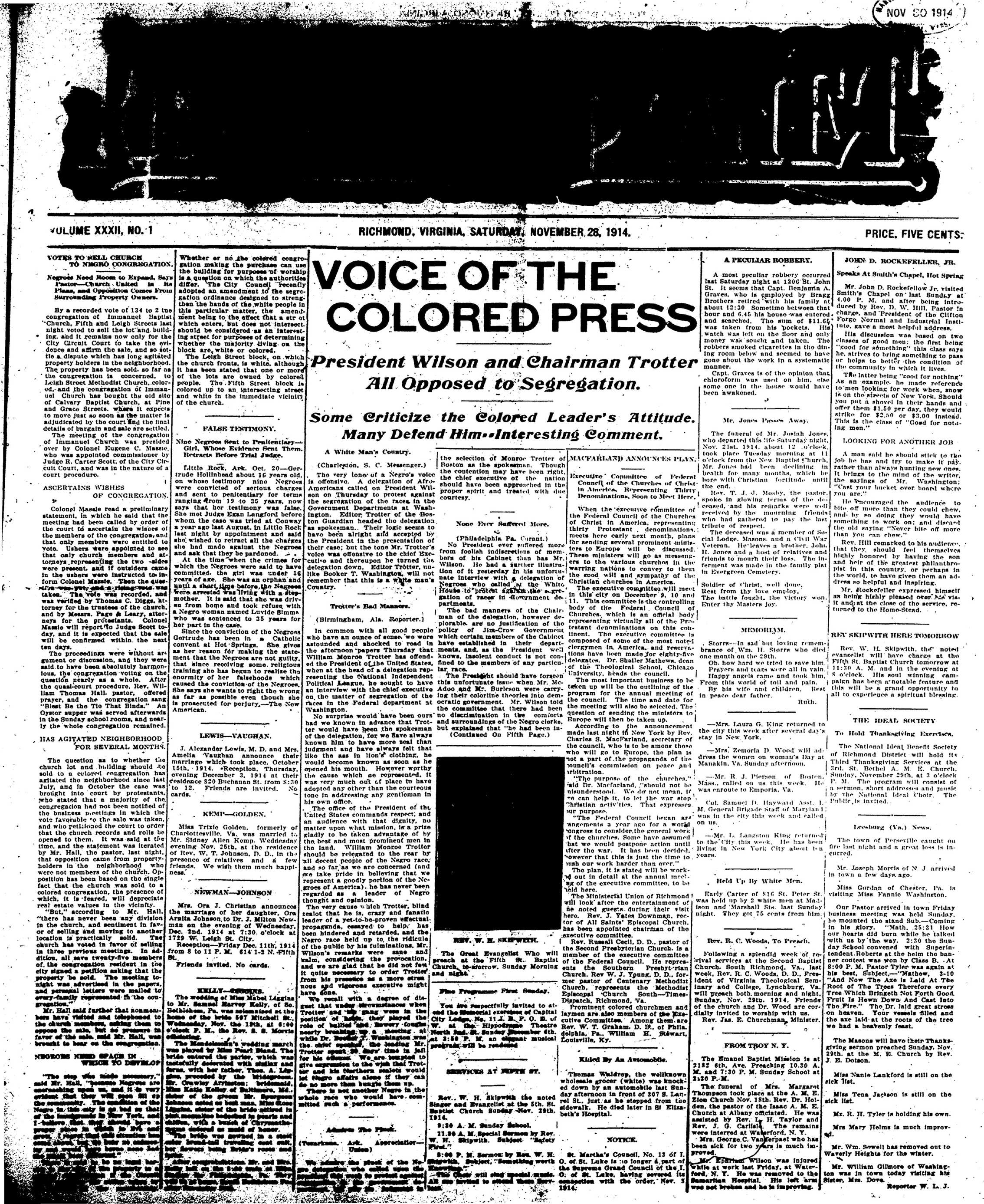
VOTES TO NELL CHURCH
TO NEGRO CONGREGATION.
Negroes Need Room to Expand, Saya
Pastor—Church, United in its
Plains, and Opposition Comes From
Surrounding Property Owners.
By a recorded vote of 134 to 2 the
congregation of Immanuel Baptist
Church, Fifth and Leigh Streets last
night voted to sell the lot and build-
ing, and it remains now only for the
City Circuit Court to take the evidence
and affirm the sale, and so settle
a dispute which has long agitated
property holders in the neighborhood.
The property has been sold, so far as
the congregation is concerned, to
Leigh Street Methodist Church, col-
ored, and the congregation of Immanuel
Church has bought the old site
of Calvary Baptist Church, at Pine
and Grace Streets, where it expects
to move just so soon as the matter is
adjudicated by the court and the final
details of bargain and sale are settled.
The meeting of the congregation of Immanuel Church was presided over by Colonel Eugene C. Massie, who was appointed commissioner by Judge R. Carter Scott; of the City Circuit Court, and was in the nature of a court procedure.
ASCERTAINS WISHES
Colonel Massile read a preliminary statement, in which he said that the meeting had been called by order of the court to ascertain the wishes of the members of the congregation, and that only members were entitled to vote. Usheres were appointed to see that only church members and attorneys representing the two sides were present, and if outsiders came in the usheres were instructed to inform Colonel Massile. Then the question was putty and a rising wave was taken. The vote was recorded, and was verified by Thomas C. Diggs, attorney for the trustees of the church, and by Messrs. Page & Leary, attorneys for the protestors. Colonel Massile will report to Judge Scott today, and it is expected that the sale will be confirmed within the next ten days.
The proceedings were without argument or discussion, and they were said to have been absolutely harmonious, the congregation voting on the question nearly as a whole. After the quasi-court procedure, Rev. William Thomas Hall, pastor, offered prayer, and the congregation sang "Blest Be the Tio That Binds." An Oyster supper was served afterwards in the Sunday school rooms, and nearly the whole congregation remained.
HAS AGITATED NEIGHBORHOOD
FOR SEVERAL MONTHS.
The question as to whether the church lot and building should be sold to a colored congregation has agitated the neighborhood since last July, and in October the case was brought into court by protestants, who stated that a majority of the congregation had not been notified of the business meetings in which the vote favorable to the sale was taken, and who petitioned the court to order that the church records and rolls be opened to them. It was said at the time, and the statement was iterated by Mr. Hall, the pastor, last night, that opposition came from property-holders in the neighborhood who were not members of the church. Opposition has been based on the single fact that the church was sold to a colored congregation, the presence of which, it is feared, will depreciate real estate values in the vicinity. "But," according to Mr. Hall, "there has never been any division in the church, and sentiment in favor of selling and moving to another location is practically solid. The church has voted in favor of selling in three previous meetings. In addition, all save twenty-five members of the congregation resident in the city signed a petition asking that the property be sold. The meeting tonight was advertised in the papers, and personal letters were mailed to every-family represented in the congregation."
Mr. Hall said further that nonmembers have visited and telephoned to the church members, asking them to oppose the sale, but no pressure in favor of the sale, said Mr. Hall, was brought to hear on the congregation.
NEGROWS NEED SPACE IN
WHERE TO DEVELOP
"The step who made necessary," said Mr. Hall, "because Negroes are encroaching upon us, and it is very evident that they will soon fill up the community. The condition of the Negro in this city is so bad as that of the immigrants in New York, and I believe that they should have a proper place in which to live and grow. I regret that this situation has come about, but we have no adversity and would have here none had the might been different."
There is still to be no legal hurdle to the establishment of the property to a Negro in the City of Chicago.
Whether or not the colored congregation making the purchase can use the building for purposes of worship is a question on which the authorities differ. The City Council Fecently adopted an amendment to the segregation ordinance designed to strengthen the hands of the white people in this particular matter, the amendment being to the effect that a str of which enters, but does not intersect, should be considered as an interesting street for purposes of determining whether the majority living on the block are, white or colored.
The Leigh Street block, on which the church fronts, is white, although it has been stated that one or more of the lots are owned by colored people. The Fifth Street block is colored up to an intersecting street and white in the immediate vicinity of the church.
FALSE TESTIMONY.
Nine Negroes Sent to Penitentiary—Girl, Whose Evidence Sent Them, Retracts Before Trial Judge.
Little Rock, Ark. Oct. 20—Gertrude Hollinhead about 16 years old, on whose testimony nine Negroes were convicted of serious charges and sent to penitentiary for terms ranging from 19 to 35 years, now says that her testimony was false. She mot Judge Egan Langford before whom the case was tried at Conway a year ago last August. In Little Rock last night by appointment and said she wished to retract all the charges she had made against the Negroes and ask that they be pardoned.
At the time when the crimes for which the Negroes were said to have committed the girl was under 16 years of age. She was an orphan and until a short time before the Negroes were arrested was living with a stepmother. It is said that she was driven from home and took refuge with a Negro woman named Luvide Simma who was sentenced to 35 years for her part in the case.
Since the conviction of the Negroes Gertrude has been in a Catholic convent at Hot-Springs. She gives as her reason for making the statement that the Negroes are not guilty, that since resolving some religious training she has begun to realize the enormity of her falsehoods which caused the conviction of the Negroes. She says she wants to right the wrong as far as possible even though she is prosecuted for perjury.—The New American.
LEWIS—VAUGHAN.
J. Alexander Lewis, M. D. and Mrs. Amelia Vaughan announce their marriage which took place. October 15th, 1914. *Reception, Thursday, evening December 3, 1914 at their residence 20 Buchanan St. from 8:30 to 12. Friends are invited. No cards.*
Miss Trixie Golden, formerly of Charlotteville, Va, was married to Mr. Sidney Allen Kemp. Wednesday evening Nov. 25th, at the residence of Rev. W. T. Johnson, D. D., in the presence of relatives and a few friends. We wish them much happiness.
Mrs. Ora J. Christian announces the marriage of her daughter, Ora Arnalta Johnson, to Dr. J. Milton Newman on the evening of Wednesday, Dec. 2nd. 1914 at 7:30 o'clock at 1729 W. Leigh St. City. Reception—Friday Dec. 11th, 1914 from 8 to 11 P. M. 614'1-2 N. Fifth St. Friends invited. No cards.
The wedding of Miss Mabel Liggins to Mr. Samuel Harvey Kelly, of So. Bethlehem, Pa. was solemnized at the home of the bride 507 Mitchell St. Wednesday, Nov. the 18th, at 6:00 o'clock P. M., the Rev. S. S. Morris officiating.
The Mandeleinna's wedding march was played by Miss Pearl Blond. The bride entered the parlor, which was tastefully decorated with similar and form, with her father, Thos. A. Liggins, preceded by the bridegroom, Mr. Crawley Ariston; bridemaid, Miss Katie Kelly of Baltimore, Md., sister of the groom Mr. Spurgeon Johnson noted as best man, Miss Grace Liggins, sister of the bride attired in pink mourning beaded in pearls and chiffon, with a bunch of Carytianthus flowers entered as mould of honor.
The bride was owned in a steel ear bound-tail traveling coat suit, her dress being Brider's robes and home.
After commencement Mr. and Mrs. Kelly left on the 8:40 o'clock at Nine Shannon, Pa. Philippehannon, Pa. Thory will be home, Philippehannon, Pa.
VOICE OF THE COLORED PRESS
President Wilson and Chairman Trotter All Opposed to Segregation.
Some Criticize the Colored Leader's Attitude. Many Defend Him—Interesting Comment.
A White Man's Country.
(Charleston, S. C. Messenger.)
The very tone of a Negro's voice is offensive. A delegation of Afro-Americans called on President Wilson on Thursday to protest against the segregation of the races in the Government Departments at Washington. Editor Trotter of the Boston Guardian headed the delegation as spokesman. Their logic seems to have been alright and accepted by the President in the presentation of their case; but the tone Mr. Trotter's voice was offensive to the chief Executive and thereupon he turned the delegation down. Editor Trotter, unlike Booker T. Washington, will not remember that this is a white man's Country.
the selection of Monroe Trotter of Boston as the spokesman. Though the contention may have been right, the chief executive of the nation should have been approached in the proper spirit and treated with due courtesy.
None Ever Suffered More.
(Philadelphia Pa. Curant.)
No President ever suffered more from foolish indiscretions of members of his Cabinet than has Mr. Wilson. He had a surer illustration of it yesterday in his unfortunate interview with a delegation of Negroes who called at the White Troops to protest the matter.
MACFARLAND ANNOUNCES PLAN
Executive Committee of Federal Council of the Churches of Christ in America, Representing Thirty Denominations, Soon to Meet Here
When the executive committee of the Federal Council of the Churches of Christ in America, representing thirty Protestant denominations meets here early next month, plans for sending several prominent ministers to Europe will be discussed. These ministers will go as messengers to the various churches in the warring nations to convey to them the good will and sympathy of the Christian churches in America. The executive committee will meet
In common with all good people who have an ounce of sense, we wore astounded and shocked to road in the afternoon papers Thursday that William Monroe Trotter has offended the President of the United States, when at the head of a delegation representing the National Independent Political League, he sought to have an interview with the chief executive on the matter of segregation of the races in the Federal department at Washington.
No surprise would have been ours had we known in advance that Trotter would have been the spokesman of the delegation, for we have always known him to have more zeal than judgment and have always felt that like the ass in lion's clothing, he would become known as soon as he opened his mouth. However worthy the cause which we represented, it was very much out of place to have adopted any other than the courteous tone in addressing any gentleman in his own office.
The office of the President of the United States commands respect; and an audience with that dignity, no matter upon what mission, is a prize gladly to be taken advantage of by the best and most prominent men in the land. William Monroe Trotter should be relegated to the rear by all decent people of the Negro race; and so far as we are concerned (and we take pride in believing that we represent a goodly portion of the Negroes of America), he has never been regarded as a leader of Negro thought and opinion.
The very cause which Trotter, blind realot that he is, crazy and fanatic leader of a yet-to-be-proven effectual propaganda, essayed to help, has been hindered and retarded, and the Negro race held up to, the ridicule of the public by his fulminations. Mr. Wilson's remarks were sane and calm, considering the provocation, and we are glad that he did not feel it quite necessary to order Trotter from his presence as a more strumous and vigorous executive might have done.
We recall with a degree of disgust that under circumstances when Trotter and the gang wore in the position of head, they played the role of bullied and Bowery fought nearly breaking up a shooting at while Dr. Boeder T. Washington was the chief opened, the leading Mr. Trotter spent 20 hours in jail for his offence. We are tempted to give expression to the witch that Trotter and his northern seals would bet Negro affairs alone if they can do no more than bungle them up.
There is not another Negro in the whole race who would have committed such a performance.
Admire The Pluck.
(Temarkana. Ark. Appreciator—Union)
We admire the pluck of the Negro defender who called upon the hypocrite this week to protest against antagonism in the government department, and who has indicted in
the selection of Monroe Trotter of Boston as the spokesman. Though the contention may have been right, the chief executive of the nation should have been approached in the proper spirit and treated with due courtesy.
None Ever Suffered More.
(Philadelphia Pa. Curant.)
No President ever suffered more from foolish indiscretions of members of his Cabinet than has Mr. Wilson. He had a further illustration of it yesterday in his unfortunate interview with a delegation of Negroes who called at the White House to protest injustice, the negotiation of races in government departments.
The bad manners of the Chairman of the delegation, however deplorable, are no justification of the policy of Jim-Crow Government which certain members of the Cabinet have established in their departments, and, as the President well knows, insolent conduct is not confined to the members of any particular race.
The President should have forseen this unfortunate issue when Mr. McAdoo and Mr. Burleson were carrying their colorline theories into democratic government. Mr. Wilson told the committee that there had been no discrimination in the comforts and surroundings of the Negro clerks, but explained that "the had been in" (Continued On Fifth Page.)
1. 2. 3. 4. 5. 6. 7. 8. 9. 10. 11. 12. 13. 14. 15. 16. 17. 18. 19. 20. 21. 22. 23. 24. 25. 26. 27. 28. 29. 30. 31. 32. 33. 34. 35. 36. 37. 38. 39. 40. 41. 42. 43. 44. 45. 46. 47. 48. 49. 50. 51. 52. 53. 54. 55. 56. 57. 58. 59. 60. 61. 62. 63. 64. 65. 66. 67. 68. 69. 70. 71. 72. 73. 74. 75. 76. 77. 78. 79. 80. 81. 82. 83. 84. 85. 86. 87. 88. 89. 90. 91. 92. 93. 94. 95. 96. 97. 98. 99. 100.
The Great Evangelist Who will preach at the Fifth St. Baptist Church, to-morrow. Sunday Morning and night.
Fine Programme First Sunday.
You are respectfully invited to attend the Memorial exercise of Capital City Lodge, No. 11 J. B. P. O. E. of W. at the Hippodrome Theatre North 3rd. St. Sunday December 6th. at 3:50 P. M. an elegant musical program will be readied.
SERVICES AT NEPTH ST.
Rev. W. H. Skipwith the noted Singer and Evangelist at the 5th St. Baptist Church Sunday Nov. 29th, 1914.
9:30 A. M. Sunday School.
11:30 A. M. Special Sermon by Rev. W. H. Skipwith. Subject "Safety First."
8:00 P. M. Sermon by Rev. W. H. Skipwith. Subject, "Something worth knowing."
MACFARLAND ANNOUNCES PLAN.
Executive Committee of Federal Council of the Churches of Christ in America, Representing Thirty Denominations, Soon to Meet Here.
When the executive committee of the Federal Council of the Churches of Christ in America, representing thirty Protestant denominations, meets here early next month, plans for sending several prominent ministers to Europe will be discussed. These ministers will go as messengers to the various churches in the warring nations to convey to them the good will and sympathy of the Christian churches in America.
The executive committee will meet in this city on December 9, 10 and 11. This committee is the controlling body of the Federal Council of Churches, which is an official body representing virtually all of the Protestant denominations on this continent. The executive committee is composed of some of the most noted clergymen in America, and reservations have been made for eighty-five delegates. Dr. Shaller Mathews, dean of the Theological School, Chicago University, heads the council.
The most important business to be taken up will be the outlining of the program for the annual meeting of the council. The time and date for the meeting will also be selected. The question of sending the ministers to Europe will then be taken up.
According to the announcement made last night in New York by Rev. Charles S. MacFarland, secretary of the council, who is to be among those who will go to Europe, the plan is not a part of the propaganda of the council's commission on peace and arbitration.
"The purpose of the churches," said Dr. MacFarland, "should not be misunderstood. We do not mean, if so can help it, to let the war stop Christian activities. That expresses our purpose.
"The Federal Council began arrangements a year ago for a world congress to consider the general work of the churches. Some have assumed that we would postpone action until after the war. It has been decided, however that this is just the time to rush our work harder than ever."
The plan, it is stated will be worked out in detail at the annual meeting of the executive committee, to be held here.
The Ministerial Union of Richmond will look after the entertainment of the noted guests during their visit here. Rev. J. Yates Dowman, rector of All Saints' Episcopal Church, has been appointed chairman of the executive committee. Rev. Russell Cecil, D. D., pastor of the Second Presbyterian Church. Is a member of the executive committee of the Federal Council. He represents the Southern Presbyterian Church. Rev W. J. Yupng, D. D., former pastor of Centenary Methodist Church, represents the Methodist Episcopal Church South—TimesDispatch, Richmond, Va. Prominent colored churchmen and laymen are also members of the Executive Committee. Among them are Rev. W. T. Graham, D. D., of Phila. delphia, Pa., William H. Stewart, Louisville, Ky.
Killed By An Automobile.
Thomas Wuldrop, the wellknown wholesale grocer (white) was knocked down by an automobile last Sunday afternoon in front of 307 S. Leruel St., just as he stepped from the sidewalk. He died later in St Elizabeth's Hospital.
St. Martha's Council, No. 12 of I. O. of St. Luke is *to longer a part of the Supreme Grand Council of the I. O. of St. Luke, having covered its connection with the order, Nov. 3, 1914;
A PECULIAR ROBBERY.
A most peculiar robbery occurred last Saturday night at 1200 St. John St. It seems that Capt. Benjamin A. Graves, who is employed by Bragg Brothers retired with his family at about 12:30. Sometimes between that hour and 6.45 his house was entered and searched. The sum of $11.65 was taken from his pockets. His watch was left on the floor and only money was sought and taken. The robbers smoked cigarettes in the dining room below and seemed to have gone about the work in a systematic manner.
Capt. Graves is of the opinion that chloroform was used on him, else some one in the house would have been awakened.
Mr. Jones Passes Away.
The funeral of Mr. Josiah Jones, who departed this life Saturday night, Nov. 21st, 1914, about 12 o'clock, took place Tuesday morning at 11 o'clock from the New Baptist Church, Mr. Jones had been declining in health for many months, which he here with Christian fortitude until the end.
Rev. T. J. J. Mosby, the pastor, spoke in glowing terms of the deceased, and his remarks were well received by the mourning friends who had gathered to pay the last tribute of respect.
The deceased was a member of Social Lodge, Masons, and a Civil War Veteran. He leaves a brother, John H. Jones and a host of relatives and friends to mourn their loss. The interment was made in the family plot in Evergreen Cemetery.
Soldier of Christ, well done,
Rest from thy love employ.
The battle fought, the victory won.
Enter the Masters joy.
MEMORIAM.
Storms...In sad but loving remembrance of Wm. H. Storra who died one month on the 29th.
Oh how hard we tried to save him.
Prayers and tears were all in vain.
Happy angels came and took him.
From this world of toil and pain.
By his wife and children. Rest in peace dear father.
Ruth.
—Mrs. Laura G. King returned to the city this week after several day's stay in New York.
—Mrs. Zemorla D. Wood will address the women on woman's Day at Manakin, Va. Sunday afternoon.
—Mr. R. J. Plerson of Boston, Mass., called on us this week. He was enroute to Emporia, Va.
Col. Samuel D. Hayward Asst. L. M. General Brigade Staff of Maryland was in the city this week and called on us.
—Mr. L. Langston King returned to the City this week. He has been living in New York City about ten years.
Early Carter of 816 St. Peter St. was held up by 2 white men at Madison and Marshall Sts. last Sunday night. They got 75 cents from him.
Following a splendid week of revival services at the Second Baptist Church, South Richmond, Va., last week, Rev. R. C. Woods, D. D., President of Virginia Theological Seminary and College, Lynchburg, Va. will preach both morning and night, Sunday, Nov. 29th, 1914. Friends of the church and Dr. Wood are cordially invited to worship with us.
FROM TROY N. Y.
The Emanuel Baptist Mission is at 2182 6th. Ave. Preaching 10.30 A. M. and 7:30 P. M. Sunday School at 2130 P. M.
The funeral of Mrs. Margaret Thompson took place at the A. M. E. Zion Church Nov. 18th. Rev. Dr. Holden, the pastor of the Isaac A. M. E. Church at Albany officiated. He was assisted by Rev. L. H. Taylor and Rev. J. G. Carillah. The remains were interred at Waterford, N. Y.
Mrs. George, C. Vanfurpeel who has been sick for two years is much improved.
Mr. Ephiram Wilson was injured while at work last Friday, at Waterford, N. Y. He was removed to the Samaritan Hospital. His left arm was not broken and he is improving.
JOHN D. ROCKEFELLER JR.
Speaks At Smith's Chapel, Hot Spring
Mr. John D. Rockefellow Jr. visited Smith's Chapel on last Sunday at 4.00 P. M. and after being introduced by Rev. D. W. Hill, Pastor in charge, and President of the Clifton Forge Normal and Industrial Institute, gave a most helpful address.
His discussion was based on two classes of good men; the first being "good for something" this class says he, strives to bring something to pass or helps to better the condition of the community in which it lives.
The latter being "good for nothing" As an example, he made reference to men looking for work when, snow is on the streets of New York. Should you put a shovel in their hands and offer them for $1.50 per day, they would strike for $2.50 or $3.00 instead. This is the class of "Good for notating men."
LOOKING FOR ANOTHER JOB
A man said he should stick to the job he has and try to make it palliative than always hunting new ones. It brings to the mind of the writer, the sayings of Mr. Washington; "Cast your bucket over board where you are."
He encouraged the audience to bite off more than they could chew, and by so doing they would have something to work on; and discarded the old saying "Never bite off more than you can chew."
Rev. Hill remarked to his audience, that they should feel themselves highly honored by having the son and heir of the greatest philanthropist in this country, or perhaps in the world, to have given them an address so helpful and inspiring.
Mr. stockefeller expressed himself as being highly pleased over Mr. visit and at the close of the service, returned to the Home-Stead.
REV SKIP WITH HERE TOMORROW
Rev. W. H. Skipwith, the noted evangelist will have charge at the Fifth St. Baptist Church tomorrow at 11:30 A. M. and in the evening at S. clock. His soul winning campaign has been a notable feature and this will be a grand opportunity to all to experience a spiritual blessing.
THE IDEAL SOCETY
To Hold Thanksgiving Exercise.
The National Ideal Benefit Society of Richmond District will hold its Third Thanksgiving Services at the 3rd. St. Bethel A. M. E. Church, Sunday, November 29th, at 3 o'clock P. M. The program will consist of a sermon, short addresses and music by the National Ideal Choir. The Public is invited.
Leesburg (Va.) News
The town of Perseville caught on fire last night and a great loss is incurred.
Mr. Joseph Morris of N. J. arrived in town a few days ago.
Miss Gordon of Chester, Pa. is visiting Miss Fannie Washington.
Our Pastor arrived in town Friday business meeting was held Sunday, he mounted the stand Sub.—Coming in his glory. "Math. 25:31 How our hearts did burn white he inked with us by the way. 2:30 the Sunday School convened with Superintendent. Roberts at the helm the banner contest was won by Class B. At 8:00 P. M. Pastor Tyler was again at his best, Subject.—"Mathew. 3-10 "And Now The Axe is Laid At The Root of The Trees Therefore every Tree Which Bringeth Not Forth Good Fruit Is Hown Down And Cast Into The Fire." The Dr. laid great stress on heaven. Your vessels filled and the axe laid at the roots of the tree we had a heavenly feast.
The Masons will have their Thanksgiving sermon preached Sunday, Nov. 29th, at the M. E. Church by Rev. J. E. Dotson.
Miss Nanie Lankford is still on the sick list.
Miss Tena Jackson is still on the sick list.
Mr. R. H. Tyler is holding his own.
Mrs Mary Helms is much improv-ed.
Mr. Wm. Sowell has removed out to Waverly Heights for the winter.
Mr. William Gilmore of Washington was in town today visiting his Sister, Mrs. Dove.
Reporter W. L. J.
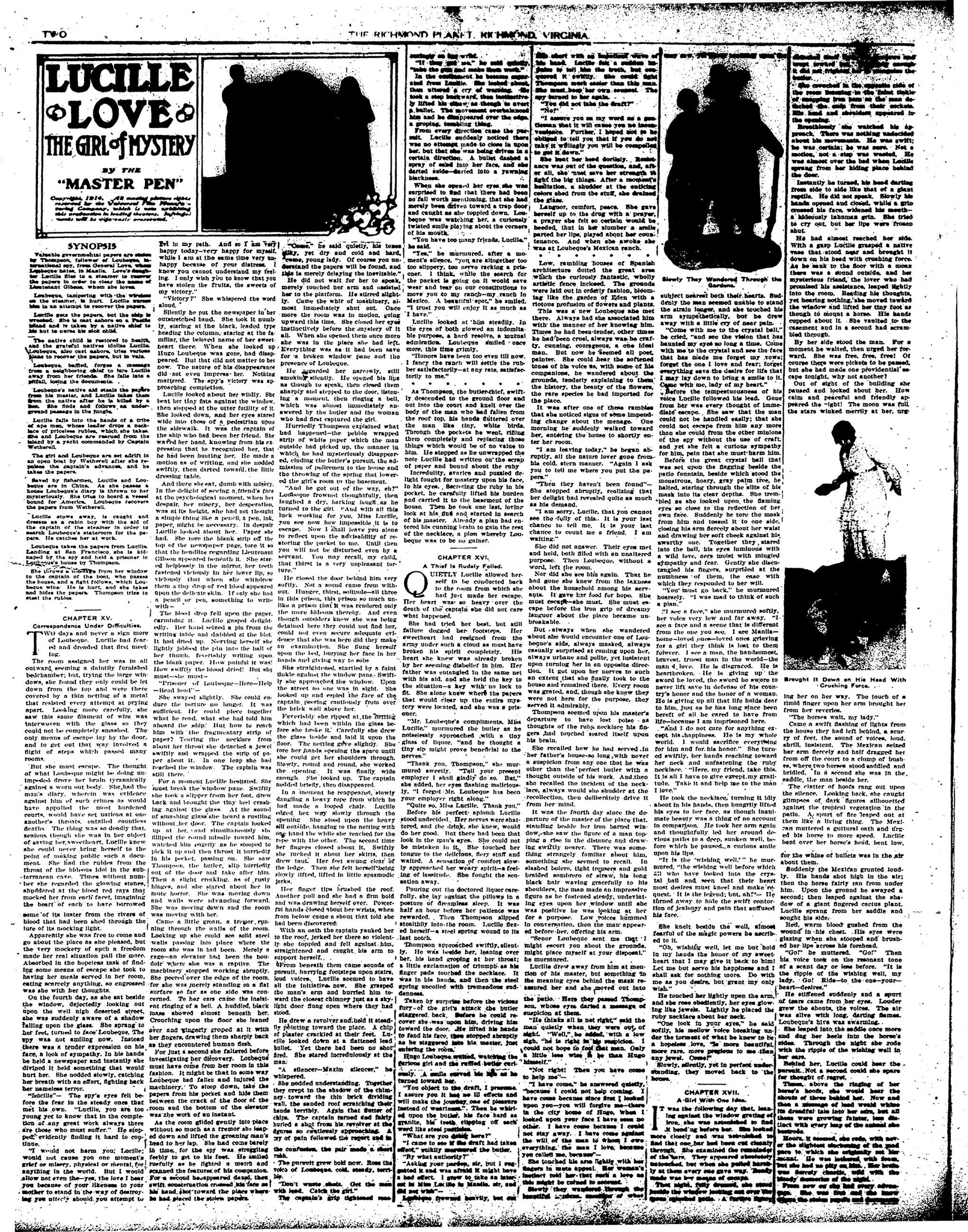
LUCILLE LOVE THE GIRL OF MYSTERY
Copyright 1914. All modeling picture rights
restored by the Universal Film Manage-
ment. All rights reserved. This production in leading theatres, high-
lightings will be widely presented.
Ell in my path. And so I am very happy today--very happy for myself, while I am at the same time very unhappy because of your distress. I know you cannot understand my feeling. I only wish you to know that you have stolen the fruits, the sweets of my victory."
"Victory?" She whispered the word aloud.
Silently he put the newspaper in her outstretched hand. She took it numbly, starting at the black, leaded type heading the column, staring at the familiar, the beloved name of her sweetheart there. When she looked up Hugo Loubeque was gone, had disappeared. But that did not matter to her now. The nature of his disappearance did not even impress her. Nothing mattered. The spy's victory was approaching completion.
Lucille looked about her wildly. She beat her tiny fists against the window, then stopped at the utter futility of it. She looked down, and her eyes stared wide into those of a pedestrian upon the sidewalk. It was the captain of the ship who had been her friend. She waved her hand, knowing from his expression that he recognized her, that he had been hunting her. He made a motion as of writing, and she nodded swiftly, then darted toward the little dressing table.
And there she sat, dumb with misery. In the delight of seeing a friend's face at the psychological moment, when her despair, her misery, her desperation, was at its height, she had not thought a simple thing like a pencil, a pen, ink paper, might be necessary. In despair Lucille looked about her. Paper she had. She tore the blank strip off the top of the newspaper page, tore it so that the headlines regarding Lieutenant Gibson appeared beneath it. She starred helplessly in the mirror, her teeth fastened viciously in her lower lip, so violently that when she withdrew them a tiny drop of red blood appeared upon the delicate skin. If only she had a pencil or pen, something to write with-
The blood drop fell upon the paper, carmining it. Lucille grasped delightedly. Her hand seized a pin from the writing table and dabbed at the blot. It had dried up. Nervously herself she lightly jabbed the pin into the ball of her thumb, feverishly writing upon the blank paper. How painful it was. How swift the blood dried! But she must—she must—"Trisoner of Loubeque—Here—Help—Read head"—
She swallowed slightly. She could endure the torture no longer. It was sufficient. He could piece together what he read, what she had told him aboard the ship. But how to reach him with the fragmentary strip of paper? Tearing the necklace from about her throat she detached a jewel swiftly and wrapped the strip of paper about it. In one leap she had reached the window. The captain was still there.
For a moment Laurelle hesitated. She must break the window pane. Swiftly she took a slipper from her foot, drew back and brought the tiny heel crashing against the glass. At the sound of smashing glass she heard a muffling without her door. The captain looked up at her, and simultaneously she tilted the round missile toward him, watched him eagerly as he stooped to pick it up and then thrust it hurriedly in his pocket, passing on. She saw Thompson, the butter, slip hurriedly out of the door and take after him. Then a slight creaking, as of rusty hinges, and she started about her in mute horror. She was moving down and walls were advancing forward. She was moving down and the room was moving with her.
Came a little groan, a tragrp, running through the walls of the room. Looking up she could see solid steel walls passing into place where the room she was in had been. Merely a rage—an elevator had been the boulder where she was a captive. The machinery stopped working abruptly. She peered over the edge of the room, for she was merely standing on a flat surface so far as one side was concerned. To her cars came the insistent ringing of a bell. A huddled, black mass showed almost beneath her. Crouching upon the floor she leaned over and gingerly groped at it with her fingers, drawing them sharply back as they encountered human flesh.
For just a second she faltered before investigating her discovery. Loubeque must have come from her room in this fashion. It might be that in some way Loubeque had fallen and injured the machinery. To stoop down, take the papers from his pocket and hide them between the crack of the floor of the room and the bottom of the elevator was the work of an instant. As the room gilded gently into place without so much as a tremor she leaped down and lifted the grooming man's head to her lap. She had come barely in time, for the spy was struggling feebly to get to his foot. He smiled rooftoply as he lighted a match and scanned the features of his companion. For a second he possessed dazed, then swift, conspiration crushed his face as his hand, shot toward the place where he had placed the stolen papers.
TWO
SYNOPSIS
Valuable governmental papers are stained by Thompson, follower of Loubeau, international spy, from General Love, whom he met in the city, to the Loubeau Liceile. She is to a steamer to recover the papers in order to clear the name of Lieutenant Gibson, whom she loven.
Loubeau, tampering with the wireless on the steamer, is hurt. Loubeau nurses him in an attempt to recover the papers.
Loubeau gets the papers, but the ship is swirled. She is cast ashore on a Friars ship and is weaved a native chief to his but to nurse his sick child.
The native child is restored to health. Loubeau, also cast ashore, tries various plans to recover the papers, but in vain.
Loubeau, baffled, forges a message from a neighboring chief to hire Loubeau away from her friend. She falls into a pitfall, losing the documents.
Loubeau's native aid steals the papers from his master, and Loubeau takes them from the native after he is killed by an underground passage in the fringe.
Lucielle falls into the hands of a tribe of ape men, whose leader drops a necklace of priciee rubles, which she takes. She and Loubeque are rescued from the lake by a yacht commanded by Captain Wetherall.
The girl and Loubeque are set adrift in an open boat by Wetherall after she replaces the captain's advances, and he takes the papers.
Saved by fishermen, Lucielle and Loubeque are in China. As she passes a house Loubeque's diary is thrown to her mysteriously. She tries to board a vessel bound for America. Loubeque recovers the papers from Wetherall.
Lucielle stows away, is caught and dresas in a cabin boy with the aid of the sailor in the ocean to search Loubeque's stateroom for the papers. He catches her at work.
Loubeque takes the papers from Lucielle Landing at San Francisco, she is kidnapped by the spy and held a prisoner in Loubeque's house by Thompson.
She throws a sieve from her window to the captain of the boat, who passes the house, and a fight follows, which Loubeque is hurt, and she takes and bides the papers. Thompson tries to steal the rubles.
CHAPTER XV.
Correspondence Under Difficulties.
TWO days and never a sign more of Loubeque. Lucille had feared and dreaded that first meeting.
The room assigned her was to all outward seeming a daintily furnished bedchamber; but, trying the large windows, she found they only could be left down from the top and were there covered by a thin netting of a metal that resisted every attempt at prying apart. Looking more carefully, she saw this same filament of wire she interwoven with the glass so they could not be completely smashed. The only means of escape lay by the door, and to get out that way involved a flight of steps which passed many rooms.
But she must escape. The thought of what Louise might be doing unimpeded drove her brain tyrannically against a worn out body. She had the man's diary, wherein was evidence against him of such crimes as would have appalled the most hardened courts, would have set unions at one another's throats, entailed countless deaths. The thing was so deadly that, zealous though she was in her object of saving her sweetheart, Lucille knew she could never bring herself to the point of making public such a document. She had the rubles from the throat of the biddles idol in the subterranean cave. Times without number she regarded the glowing stones, shuddered at the blood red rays that mocked her from each face, imagining the heart of each to have borrowed some of its luster from the rivers of blood that had been shed through the lure of its mocking light.
Apparently she was free to come and go about the place as she pleased, but the very mockery of such a freedom made her real situation pall the more. Absorbed in the hopeless task of finding some means of escape she took to having her meals served in her room, eating scarcely anything, so engrossed was she with her thoughts.
On the fourth day, as she sat beside the window, dejectedly looking out upon the well high deserted street, she was suddenly aware of a shadow falling upon the glass. She sprang to her feet, turned to face Loubeque. The spy was not smiling now. Instead there was a tender expression on his face, a look of sympathy. In his hands he held a newspaper and instantly she divined it held something that would hurt her. She nodded slowly, catching her breath with an effort, fighting back her nameless terror.
"Locilee"— The spy's eyes fell before the fear in the steady ones that met his own. "Locilee, you are too young yet to know that in the completion of any great work always there are those who must suffer." He stopped evidently finding it hard to continue.
"I would not harm you; Locilee; would not cause you one moment's grief or misery, physical or mental, for anything in the world. But I would allow not even the -yes, the love I hear you because of your likeness to your mother to stand in the way of destroying you utterly, should you attempt to
THE GHOSTS OF THE
WESTERN WESTERN WESTERN
THE RICHMOND PLANET, RICHMOND, VIRGINIA
"Come," he said quietly, his tone silky, yet dry and cold and hard, come, young lady. Of course you understand the papers will be found, and this is merely delaying the inevitable." He did not wait for her to speak, merely touched her arm and assisted her to the platform. He stirred alightly. Came the whir of machinery, almost immediately shut out. Once more the room was in motion, going upward this time. She closed her eyes instinctively before the mystery of it all. When she opened them once more she was in the place she had left. Everything was as it had been save for a broken window pane and the presence of Loubeque.
He guarded her narrowly, still smoky silently. He opened his lips as though to speak, then closed them sharply and stepped to the door, listening a moment, then ringing a bell, which was almost immediately answered by the butter and the woman who had first captured the girl.
Hurriedly Thompson explained what had happened—the pebble wrapped strip of white paper which the man outside had picked up, the manner in which he had mysteriously disappeared, eluding the butter's pursuit, the admission of policemen to the house and the throwing of the spring that lowered the girl's room to the basement.
"And he got out of the way, elf?" Louiseque frowned thoughtfully, then laughed a dry, barking laugh as he turned to the girl. "And with all this luck working for you, Miss Luelle, you see now how impossible it is to escape. Now I shall leave you alone to reflect upon the advisability of restoring the packet to me. Until then you will not be disturbed even by a servant. You may recall, my child, that thirst is a very unpleasant torture."
He closed the door behind him very softly. Not a sound came from without. Hunger, thirst, solitude—all three in this prison, this prison so much unliked a prison that it was rendered only the more hideous thereby. And even though outsiders know she was being detained here they could not find her, could not even secure adequate evidence that she was here did they make an examination. She flung herself upon the bed, burying her face in her hands and giving way to sobs. She straightened, started by a faint thikle against the window pane. Swiftly she approached the window. Upon the street no one was in sight. She looked up and cried the face of the captain peering cautiously from over the brick wall above her.
Ferreily she ripped at the netting which had been within the glass before she broke it. Carefully she drew the glass inside and laid it upon the floor. The netting gave slightly. She torched her hands opening the space until she could get her shoulders through. Slowly, round and round, she worked the opening. It was finally wide enough. She looked up. The captain nodded briefly, then disappeared.
In a moment he reappeared, slowly dangling a heavy rope from which he had made a looped chair. Lucille edged her way slowly through the opening. She stood upon the heavy sill outside, hanging to the netting with one hand the while she reached for the rope with the other. The second time her fingers closed about it. Swiftly she tucked it about her skirts, then drew taut. Her feet swung clear of the ledge. Then she felt herself being slowly lifted, lifted in little spasmodic jerks.
Her finger tips brushed the roof. Another pull and she had a firm hold and was drawing herself over. Powerful hands closed about her wrists, when from below came a shout that told she had been discovered.
With an oath the captain yanked her to the roof, jerked her there so violently she toppled and fell against him, straightened and caught, his arm to support herself.
From beneath them came sounds of pursuit, hurrying footsteps upon stairs, loud voices. Lucille seemed to have all the initiative now. She grasped the man's arm and hurried him toward the closest chimney just as a skylight door flung open where they had stood.
He drew a revolver and held it steadily pointing toward the place. A chip of plaster crackled at their feet. Lucille looked down at a fattened lead bullet. Yet there had been no shot fired. She stared incredulously at the man:
"A silencer-Maxim silencer," he whispered.
She nodded understanding. Together they crept in the shadow of the chimney toward the thin brick dividing wall, the sanded roof scratching their hands terribly. Again that butter of chips. The captain turned and fairly hurled a shag from his revolver at the figures so cautiously approaching. A cry of pain followed the report and in the confusion, the pair made a short rush.
The pursuit grew bold now. Rise the voke of Loubeque, cold, steady, terribly.
"Don't write shades. Get the men with lead. Catch the girl."
suitably on the wrist.
"If they got me, he said quietly 'take the gun and make them work.' In the entailment he became ingrated from Lancelle. She leashed about, then uttered a cry of warning. She took a step backward, then instinctively lifted his show, as though to avert a ballet. The movement overtained him and he disappeared over the edge, a groping, tumbling thing.
From every direction came the pursuit. Lucille suddenly noticed there was no attempt made to close in upon her, but that she was being driven in a certain direction. A bullet dashed a spray of sand into her face, and she darted aside—darted into a yawning blackness.
When she opened her eyes, she was surprised to find that there had been no fall worth mentioning, that she had merely been driven toward a trap door and caught as she toppled down. Longeque was watching her, a curiously twisted smile playing about the corners of his mouth.
"You have too many friends, Lucille," he said.
"Teen," he murmured, after a moment's silence, "you are altogether too slippery, too nerve racking a prisoner. I think, while the search for the packet is going on it would save wear and tear on our constitutions to move you to my ranch—my ranch in Mexico. A beautiful spot," he smiled. "I trust you will enjoy it as much as I have."
Lucille looked at him steadily. In the eyes of both glowed an indomitable purpose, a hard resolve, a mutual admiration. Louteque smiled once more, this time grimly.
"Honors have been too even till now. I fancy the ranch will settle the rubber satisfactorily—at any rate, satisfactorily to me."
As Thompson, the butter-thief, swiftly descended to the ground door and out into the court and knelt over the body of the man who had fallen from the roof top, his hands fluttered over the man like tiny, white birds. Through the pocket he went, riling them completely and replacing those things which would be of no value to him. He stopped as he unwrapped the note Lucille had written on the scrap of paper and bound about the ruby. Incredulity, aversion and puzzled delight fought for mastery upon his face, in his eyes. Securing the ruby in his pocket, he carefully lifted his burden and carried it to the basement of the house. Then he took one last, loving look at his fist and started in search of his master. Already a plan had entered hisunning brain to gain the rest of the necklace, a plan whereby Loubeque was to be no gainner.
CHAPTER XVI.
QUIETLY Luctile allowed herself to be conducted back to the room from which she had just made her escape. Her heart was so heavy over the death of the captain she did not care what happened.
She had tried her boat, but still failure dogged her footsteps. Her sweetheart had resigned from the army under such a cloud as must have broken his spirit completely. His heart she knew was already broken by her seeming disbelief in him. Her father was entangled in the same net with his aid, and she held the key to the situation—a key with no lock to fit. She alone knew where the papers that would clear up the entire mystery were located, and she was a prisoner.
"Mr. Louteque's compliments, Miss Lucille," murmured the butler as he noiselessly approached, with a tiny glass of liquor, "and he thought a tiny sip might prove beneficial to the nerver."
"Thank you, Thompson," she murmured sweetly. "Tell your present employer I shall gindly do so. But," she added, her eyes dashing maliciously. "I forgot Mr. Loubeque has been your employer right along." "Quite so, Miss Lucille. Thank you." Before his perfect aplomb Lucille stood undecided. Her nerves were shattered, and the drink, she knew, would do her good. But there had been that look in the giant's eyes. She could not be mistaken in it. She touched her tongue to the delicious, fiery stuff and waited. A sensation of comfort slowly approached her weary spirit—a feeling of latitude. She fought the sensation away.
Pouring out the doctored liquor carefully, she lay against the pillows in a posture of dreamless sleep. It was half an hour before her patience was rewarded. Then Thompson alipped stealthily into the room. Lucille flexed herself—a steel spring wound to its last notch.
Thompson approached swiftly, silently. He was beside her, leaning over her, his hand groping at her throat; a little exclamation of triumph as his finger pads touched the necklace. It was in his hands, and then the steel spring uncoiled with tremendous suddenness. Taken by surprise before the vicious fury of the girl's attack the butter staggered, back. Before he could recover she was upon him, driving him toward the door. He lifted his hands to send his face, then stopped abruptly as he staggered into his master, just entering the room.
Hugo Loubeque, wielded, watching the curious girl and the ruffled butter curiously. A smile curved his lips as he turned toward her.
"You object to the draft, I presume. I assure you it has no ill effects and will make the journey, one of pleasure instead of weariness." Then he whirled upon the builer, his face hard as granite, his teeth, clipping off each word like steel piercing.
"What are you doing here?"
"I came to see M the draft had taken effect," culturally measured the better, "By what authority?" "Aking your persep, sir, but I suggested it and was afraid M might have a bad effect. I grew to take an interest in Mie Lutie in Manila, sir, and did not wish"—
Landforms grown heavily, but out
She short with an inhuman wave of the hand. Linctite felt a sudden impulse to tell him the truth, but conquered it swiftly. She could fight. Thompson much easier than this man. He must keep her own counsel. The spy turned to her again.
"You did not take the draft?"
"No!"
"I assure you on my word as a gentleman that it will cause you no inconvenience. Further, I hoped not to be obliged to tell you that if you do not take it willingly you will be compelled to get it down."
She bent her head dociously. Resistance was out of the question, and, after all, she "must have her strength to fight the big things. After a moment's hesitation, a shudder at the enticing colors absed from the stuff, she drained the glass.
Langour, comfort, peace. She gave herself up to the drug with a prayer, a prayer she felt so certain would be beeded, that in her slumber a smile parted her lips, played about her countenance. And when she swoke she was at Loubeque's Mexican ranch.
Low, rambling houses of Spanish architecture dotted the great area which the curiously fantastic, wholly artistic fence inclosed. The grounds were laid out in orderly fashion, blooming like the garden of Eden with a riotous profusion of flowers and plants.
This was a new Loubeque she met there. Always had the associated him with the manner of her knowing him. Times he had been-tender, other times he had been cruel, always was he crafty, cunning, courageous, a one ideal man. But now he seemed all poet painter. She could hear the softened tones of his voice as, with some of his companions, he wandered about the grounds, tenderly explaining to them the history, the beauty of the flowers, the rare species he had imported for the place.
It was after one of these rambles that she noticed signs of some impending change about the menage. One morning he suddenly walked toward her, entering the house to shortly enter her room.
"I am leaving today," he began abruptly, all the nature lover gone from his cold, stern manner. "Again I ask you to tell me where you put the papers."
"Then they haven't been found"—She stopped abruptly, realizing that her delight had revealed quite as much as his demand.
"I am sorry, Lucille. that you cannot see the fully of this. It is your last chance to tell me. It is your last chance to count me a friend. I am waiting."
She did not answer. Their eyes met and held, both filled with an unaltered purpose. Then Loubeque, without a word, left the room.
Nor did she see him again. That he had gone she knew from the laxness about the household among his servants. It gave her food for hope. She must escape—she must. She must escape before the iron grip of dreamy languor about the place became unbreakable.
But always when she wandered about she would encounter one of Loubeque's alps, always masked, always casually surprised as coming upon her, always urbane and polite, yet insistent upon turning her in an opposite direction. It got upon her nerves to such an extent that she finally took to the house and remained there. Every room was granted, and, though she knew they were not here for the purpose, they served it admirably.
Thompson seemed upon his master's departure to have lost police as thoughts of the rubs necklace his fingers had touched seated itself upon his brain.
She recalled how he had served. In her father's house—so long, with never a suspicion from any one that he was other than the 'perfect butler with a thought outside of his work. And then she recalled the incident of the necklace, always would she shudder at the recollection, then delilierately drive it from her mind.
It was the fourth day since the departure of the master of the place that standing beside her iron barred window, she saw the figure of a man topping a rho in the distance and drawing swiftly nearer. There was something strangely familiar about him, something she seemed to recall. In shaded bolero, tight trousers and gold braided sombrero of straw, his long black hair waving gracefully to his shoulders, the man made an impressive figure as he fastened steady, undulating eyes upon her window until she was positive he was looking at her for a purpose. Low voices hummed in conversation, then the man appeared before her, offering his arm.
"Senor Louboue sent me that I might escort you about the grounds, might place myself at your disposal," he murmured.
Lucille drew away from him at mention of his master, but something in the meaning eye behind the mask reassured her and she moved out into
the patio. Here they passed Thompson, whose eyes darted a message of suspicion at them.
"He thinks all is not right," said the man quietly when they were out of sight. "Well," he added, with a low sigh, "he is right in his suspicion. I could not hope to find that man. Only a little loss wise, he than Hugo himself."
"Not right! Then you have come to help me"—
"I have come," he answered quietly, "because I could not help coming. I have come because since first I looked upon you—you will forgive me—there in the city home of Hugo, when I looked upon your face I have seen no other. I have come because I could not stay away. I have come against the will of the man to whom I owe everything, the man I love, because you called me, because"—
She touched his arm lightly with her fingers in mine appeal. Her woman's instinct told her that much a love she might be trained to account. Slowly they wandered, through the beautiful realm, together of what
A
Slowly They Wandered Through the Gardens.
subject nearest both their hearts. Suddenly the man seemed unable to stand the strain longer, and she touched his arm sympathetically, but he drew away with a little cry of near pain.
"Come with me to the crystal ball," he cried, "and see the vision that has haunted my eyes no long a time. Come with me to the crystal and see the face that has made me forget my tows; forget the one I love and fear; forget everything save the desire for life that I may lay down to bring a smile to it. Come with me, lady of my heart."
Before the tempestuousness of his voice Lucille followed his lead. Gone from her was every thought of immediate escape. She saw that the man could not be handled easily; that she could not escape from him any more than she could from the other minions of the spy without the use of craft; and yet she felt a curious sympathy for him, pain that she must harm him.
Before the great crystal ball that was set upon the fingering bebes the patio fountain, beside which stood the monstrous, hoary, gray palm tree, he halted, staring through the slits of his mask into its clear depths. She trembled as she looked upon the faming eyes so close to the reflection of her own face. Suddenly he tore the mask from him and tossed it to one side, closing his arm derecly about her waist and drawing her soft cheek against his awarthy one. Together they, stared into the ball, his eyes luminous with a wild love, nera moist with mingled sympathy and fear. Gently she disentangled his fingers, surprised at the numbness of them, the cense with which they responded to her will. "You must go back," he murmured hoarsely. "I was mad to think of such a plan."
"I see a face," she murmured softly, her voice very low and far away. "I see a face and a scene that is different from the one you see. I see Manila—home-loved ones—loved ones grieving for a girl they think is lost to them forever. I see a man, the handsomest, bravest, trust man in the world—the man I love. He is disgraced. He is heartbroken. He is giving up the sword he loved, the sword he swore to never lift save in defense of his country's honor and the honor of a woman. He is giving up all that life holds dear to him, just as he has long since been bereft of all he cared to have from life—because I am imprisoned here.
"And I do not care for anything except his happiness. He is my whole world. I would sacrifice everything for him and for his honor." She turned swiftly, her hands reaching toward her neck and unfastening the ruby necklace. "Here, my friend, take this. It is all I have to give except my gratitude. Take it and help me to the man I love."
He took the necklace, turning it idly about in his hands, then hunger lifted his eyes to her face, as though immanate beauty was a thing of no account in comparison. He took her arm again and thoughtfully led her around devious paths to a deep, sunken well, before which he paused, a curious smile upon his lips.
"It is the 'wishing well.'" he murmured, "the wishing well before which all who have looked into the crystal ball and seen that their heart most desires must kneel and make request. It is the legend; but, ah." He turned away to hide the swift contortion of jealousy and pain that affuenced his face.
She knelt beside the well, almost fearful of the magic powers he ascribed to it.
"Oh, wishin' well, let me but hold in my hands the honor of my sweet heart that I may give it back to him. Let me but serve his happiness and I shall ask for nothing more. Do with me as you desire, but grant my only wish."
He touched her lightly upon the arm, and she rose obediently, her eyes glowing like jewels. Lightly he placed the ruby necklace about her neck.
"One look in your eyes," he said softly, his mellow voice breaking under the torment of what he knew to be a hopeless love. "Be more beautiful, more rare, more precious to me than any jewel. Come."
Slowly, silently, yet in perfect understanding, they moved back to the house.
It was the following day that, leaning against the window grating of iron, she was associated to find it bending before her. She looked more closely and was associated to find that one_bar had been cut cleanly through. She examined the remainder of the burn. They appeared absolutely untouched, but when she pulled hardly at them every one gave way. Ready made was her means of escape. That night, fully dressed, she stood beside the window looking at over the green applespot potion. A fracture flamed.
dismally small but beautiful flowers and wept toward him, but the crying amount it did not frighten her to summon the tender.
She covered in the opposite side of the room listening to the faint whisp of clapping from her on the man described the side from their neckbones. His hand and shoulders appeared in the opening.
Breathlessly she watched his approach. There was nothing undecided about his movements. He was swift; he was certain; he was sure. Not a motion, not a step was wanted. He was almost the bed when Lacie sprang from her hiding place behind the door.
Instantly he turned, his head darting from side to side like that of a giant reptile. He did not speak. Slowly his hands opened and closed, while a grin crossed his face, widened his mouth—a hideously inhuman grin. He tried to cry out, but her lips were frozen shut.
He had almost reached her side. With a grip Lucille grasped a native vase that stood near and brought it down on his head with crushing force. As he sank to the floor with a moon there was a sound outside, and her mysterious friend, the lover who had promised his assistance, leaped lightly into the room. Reading his thoughts, yet hearing nothing, she moved toward the window and lifted her tiny foot as though to mount a horse. His hands cupped about it. She vaulted to the casement and in a second had scrambled through. By her side stood the man. For a moment he waited, then urged her forward. She was free, free, free! Of course there were pickets to be passed, but she had made one providential escape tonight, why not another? Out of sight of the building she paused and looked about her. How calm and peaceful and friendly appeared the 'light!' The moon was full, the stars winked merrily at her, urge
A woman in a long dress is standing on a rock, holding a spoon in her hand. She appears to be looking down at something below her.
Brought It Down on His Head With
Crushing Force.
Brought It Down on His Head With Crushing Force. ing her on her way. The touch of a timid finger upon her arm brought her from her reverence.
"The horses wait, my lady."
Came a swift dashing of lights from the house they had left behind, a scurry of feet, the sound of voices, loud, shrill, insistent. The Mexican seized her arm fiercely and half dragged her from off the court to a clump of bushes, where two horses stood saddled and bridled. In a second she was in theaddle, the man beside her.
The clatter of hoops rang out upon the silence. Looking back, she caught glimpses of dark figures silhouetted against the tropical vegetation in the patio. A spurt of fire leaped out at them like a living thing. The Mexican muttered a guttural oath and frigged his horse to more speed. Lucille bent over her horse's head, bent low, for the whine of bullets was in the air about them.
Suddenly the Mexican grunted loudly. His hands shot high in the air; then the horse fairly ran from under him. Upon the ground he swayed a second; then leaped against the shadow of a giant fingered cactus plant. Lucille sprang from her saddle and sought his side.
Red, warm blood gushed from the wound in his chest. His eyes were glazing when she stooped and brushed her lips across his forehead.
"Go!" he muttered. "Go!" Then his voice took on the resonant tone of a scant day or lens before. "It is the ripple of the wishing well, my lady. Go! Ride-to the one-your-heart-desire."
He stiffened suddenly and a spurt of tears came from her eyes. Louder grew the shouts, the voices. The air was alive with long, darting fames. Loubeque's hive was swarming.
She leaped into the saddle once more and dug her heels into the horse's sides. Through the night she rode with the ripple of the wishing well in her care.
Beginnd her, Lucille could hear the pursuit. Not a second could she spare for thought of regret.
Then, above the ringing of her horse's hoofs, she would hear the shouts of those behind her. Now and then a message of lead would whine its dreadful tale into her ear, but all these were growing faster, less distinct with every leap of the animal she bursts.
From now on she had every advantage. She was fine and she knew
those the stories people and document
Were secreted in the mysterious house of inexplicable disappearing rooms and stairs. She had, the diary of Hugo Loubeque in her possession, and she had the ruby neckpiece which was equivalent to vast wealth. She had the outward seeming of gullibleness, was girlish and delightfully affectionate, but she knew the power of the claws she had, and her eyes rested fondly on the revolver which she found in a holster attached to the Mexican saddle, even as she urged her horse to greater speed.
Across the trackless plain she rode with only the moon and stars looking down upon her, a wild, cerie figure of a bareheaded girl. Behind the pursuit had died away and before there was nothing save a slender ribbon of water that the moon buried its face in contentedly.
She heard voices, low pitched, yet carrying far in the silence of the night. Instantly she drew rein and fugged herself to the ground; listening intently, Creeping cautiously to a slight rise, she looked down upon an adobe shack, before which a little squad of bare-footed Mexicans loafed idly, their brown hands laxly supporting old fashioned Springfield rifles, such as she recalled the soldiers of Uncle Sam to have carried in the old days.
From where she watched she said suddenly noticed a stir among the men. From the interior of the shack stepped a gaudy dressed little Mexican, evidently an officer from the awkward salutes accorded him by the tattered mails gathered before the house. For some reason she could not analyze, Lucille listened eagerly, her breath coming in quick, eager gagges as she overheard their daring plot to cross the river and stampede the corral of an American ranchman. A little cry of delight came from her lips as she heard their allusions to the United State cavalry they must sift through before hoping for success. Her eyes were glittering with excitement when she stole cautiously to the adobo shack, peering inside slowly and carefully before entering. She knew all their plans, and her blood was boiling; but she also know from what they had said that they, too, would be on the lookout for any upset to the well laid plot.
From a chest in the corner, which she hurriedly overhauled, she drew a similar suit to the one the little leader had worn. It would just about fit her, and she must take no chances of trying to cross the Rio Grande attired as she was.
Swiftly she changed, for every moment now was precious to others as well as to herself. Daughter of General Sumpter Love, she was also with rage at the way the Mexicans had spoken of the border patrol of her country, the presumption of the plan she had heard outlined. The gaudy costume fitted her beautifully, and the broad straw sombrero, with its weight of silver cording and tassels, made it easy for her feminine features to be unrecognizable even as it concealed her long hair.
She was well pleased with herself when again she mounted her horse. The boast had been ready to drop in his tracks any moment, and she had killed two birds with one stone while changing her costume. Cautiously toward the glittering ribbon of river she rode, her eyes always alert for any sign of the Mexican foraging party. The horse hesitated at the bank of the stream, but Lucille boldly urged him forward.
"Hurrah! We're across!" she said to herself, as, dripping and disheveled, she stood upon the "right side of the Rilo." Up and down the bank she looked for sign of the border patrol, but none was in sight. But in the distance she could make out a tiny speck. The chances were it was one of the Mexicans. But something must be done if the ranchman was to be saved from the plot she had overheard. Fiercely she urged her mount toward the speck in the distance until her heart sank as she recognized the man for one of the plotters.
Hours it seemed to her she purned the silkling figure until it joined with two others. Gradually, after a few miles journeying, a great blaze shot high in the air, a blaze punctuated by shots and wild cries.
The three men cruelly dashed their spurs into the sides of their horses.
Came a thunder of sound as a great bunch of cattle from the remuda of the American were driven toward her by the Sandish Mexicans. Loccul saw the danger she was in of being trapped underfoot by that wild herd, driven to frenzy by the flames and popping revolvers from behind them. She urged her own horse to the right, escaping just as the cattle whizzed by her in a wild spot of sound. Here and there the Mexicans had assembled themselves, always alert, marynous horsesmen all, keeping the frightened beasts together while they drove them in a direct line for the river.
Louise felt a sheet slam through the sleeve of her jacket. She raised in her horse instantly, for she knew the Mexicans had passed. As she turned she almost collided with a long mantached, grinned man, driving bullet after bullet (the marauders). She did not speak, did not even rain in, but urged her own horse beside him, drawing her own revolver.
The ranchman stitched a bewildered ejaculation as he saw she was of his own blood.
"I was trying to get there in time to warn you," she gasped. "There's
I
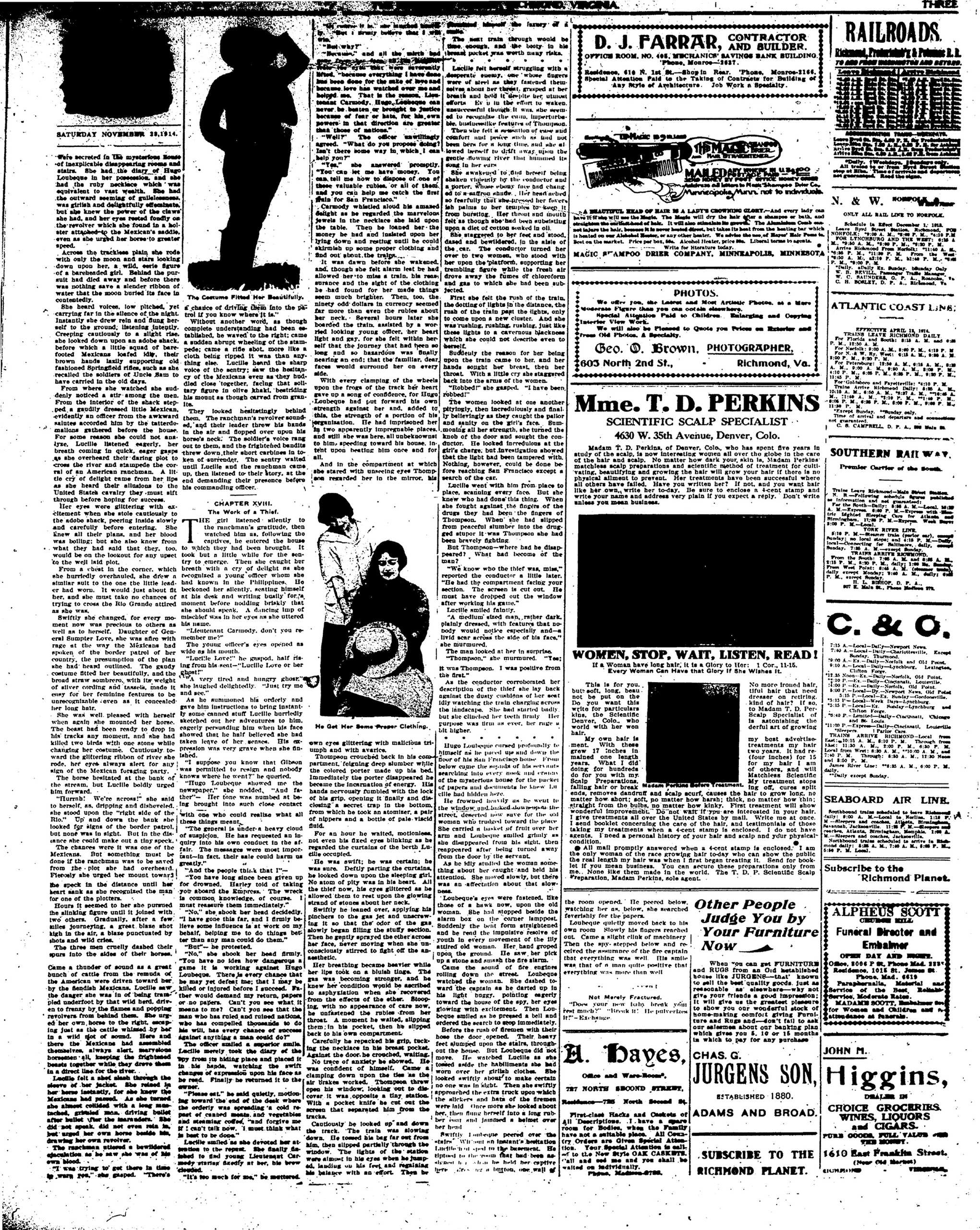
The Costume Fitted Her Beautifully,
a choice of driving them into the patrol if you know where it is."
Without another word, as though complete understanding had been established, he waved to the right; came a sudden abrupt wheeling of the stampede; came a rifle shot, more like a cloth being ripped it was than anything else. Lucille heard the sharp voice of the sentry; saw the heastancy of the Mexicans even as they budded close together, facing that solitary figure in olive khak!, bestriding his mount as though carved from granite.
They looked hesitatingly behind them. The ranchman's revolver sounded, and their leader throw his hands in the air and flopped over upon his horse's neck. The soldier's voice rang out to them, and the frightened bandits throw down, their short carbines in token of surrender. The sentry waited until Lucille and the ranchman came up, then listened to their story, at the end demanding their presence before his commanding officer.
THE girl listened silently to the ranchman's gratitude, then watched him as, following the captives, he entered the house to which they had been brought. It took but a little while for the sentry to emerge. Then she caught her breath with a cry of delight as she recognized a young officer whom she had known in the Philippines. He beckoned her silently, seating himself at his desk and writing busily for a moment before nodding briskly that she should speak. A dancing limp of mischief was in her eyes as she uttered his name.
"Leutenant Carmody, don't you remember me?" The young officer's eyes opened as wide as his mouth.
"Lucielle Love!" he gasped, half rising from his seat—"Lucielle Love or her ghost?" A very tired and hungry ghost" she laughed delightedly. "Just try me and see."
As he summoned his orderly and gave him instructions to bring instantly some canned stuff Lucille hurriedly sketched out her adventures to him, eagerly perunding him when his face showed that he half believed she had taken leave of her senses. His expression was very grave when she finished.
"I suppose you know that Gibson was permitted to resign and nobody knows where he went?" he quired.
"Hugo Loubeque showed me the newspaper," she nodded. "And father"—Her tone was numbed at being brought into such close contact with one who could realize what all these things meant.
"The general is under a heavy cloud of suspicion. He has requested an inquiry into his own conduct in the affair. The messages were most important—in fact, their sale could harm us greatly."
"You have long since been given up for drowned. Harley told of taking you aboard the Empress. The wreck is common knowledge, of course. I must reassure them immediately."
"No," she shook her head decidedly.
"I have gone this far, and I firmly believe some influence is at work on my behalf, helping me to do things better than any man could do them."
"But—" he protested.
"No," she shook her head firmly.
"You have no idea how dangerous a game it is working against Hugo Loubeque. There is every chance that he may yet defeat me; that I may be killed or injured before I succeed. Father would demand my return, papers or no papers. Can't you see what it means to me? Can't you see that the man who has ruled and ruined nations, who has compelled thousands to do his will, has every chance of success against anything a man could do?"
The officer smiled a superior smile. Lecile merely took the diary of the boy from its hiking place and placed it in his hapda, watching the swift changes of expression upon his face as he read. Finally he returned it to the owner.
"Please eat," he said quietly, motioning toward the end of the desk where the orderly was spreading a cold repast of canned meats, and vegetables and steaming coffee, and forgive me if I can't talk now. I must think what is best to be done."
Lecile smiled as she devoted her attention to the repast. She finally danced to the repast. Lieutenant Carney started fadedly at her, his brown cheeks.
"It's too much for me," be muttered.
"He never it is, nor matched himself by. But I surely believe that I will win."
"Best way?"
"Because, and all the earth and planets have been formed from the same material. Hence they were currently formed, because everything I have done has been done for the sake of hope and because love has watched over me and helped me. That is the reason. Lieutenant Carmody, Hugo, Leboeque can never be beaten or brought to justice because of fear or hate, for his own powers in that direction are greater than those of nations."
"Well?" the officer unwillingly agreed. "What do you propose doing? Isn't there some way in which I can help you?" "Yes," she answered promptly. "You can let me have money. You can tell me to dispose of one of these valuable rubies, or all of them, and you can help me catch the first gain for San Francisco." Carmody whistled aloud his amazed delight as he regarded the marvelous jewels in the necklace she laid upon the table. Then he loaned her the money he had and insisted upon her lying down and resting until he could skimmish up some proper clothing and find out about the traps.
It was dawn before she waked, and though she felt alarm lee be had allowed her to miss a train, his reassurance and the sight of the clothing he had found for her made things seem much brighter. Then, too, the ninety odd dollars in currency seemed far more than even the rubles about her neck. Several hours later she boarded the train, assisted by a worried looking young officer, her heart light and gay, for she felt within herself that the journey that had been so long and so hazardous was finally nearing an end; that the familiar, dear faces would surround her on every side.
With every clamping of the wheels upon the frogs of the track her heart gave up a song of confidence, for Hugo Loubeque had put forward his own strength against her and, added to this, the strength of a portion of his organization. He had imprisoned her in two apparently impregnable places, and still she was here, all unknownast to him, speeding toward his house, intent upon beating him once and for all.
And in the compartment at which she stared with unseeing eyes Thompson regarded her in the mirror, his
THE WEEKLY NEWS
He Got Her Some Proper Clothing.
own eyes glittering with malicious triumph and with avarice.
Thompson crouched back in his compartment, foligning deep slumber while the colored porter made up his bed. Immediately the porter disappeared he became the incarnation of energy. His hands nervously fumbled with the lock of his grip, opening it finally and disclosing a secret trap in the bottom, from which he took an atomizer, a pair of nippers and a bottle of pale viscid fluid.
For an hour he waited, motionless, not even his fixed eyes blinking as he regarded the curtains of the berth Lutille occupied.
He was swift; he was certain; he was sure. Definitely parting the curtains, he looked down upon the sleeping girl. No atom of pity was in his heart. All the thief now, his eyes glittered as he allowed them to rest upon the glowing strand of stones about her neck.
Swiftly he leaned over, applying his pinchers to the gas jet and uncreaking it so that the odor of the gas slowly began filling the stuff section. Then he gently sprayed the ether across her face, never moving when she unconsciously stirred to fight off the anaesthetic.
Her breathing became heavier while her lips took on a blublish tinge. The gas was becoming stronger, and he knew her condition would be ascribed to asphyxiation when she recovered from the effects of the ether. Stooping, with no appearance of care now, he unfastened the rubles from her throat. A moment he waited, slipping them in his pocket, then he slipped back to his own compartment.
Carefully he repacked his grip, tucking the necklace in his breast pocket. Against the door he crouched, waiting.
No trace of anxiety he showed. He was confident of himself. Came a clamping down upon the tie as the air brakes worked. Thompson throw open his window, looking out to discover it was opposite a tiy station. With a pocket knife he cut out the screen that separated him from the track. Cautiously he looked up and down the track. The train was slowing down. He towed his bag far out from him, then slipped partially through the window. The lights of the station were almost in his eyes when he jumped, landing on his feet and regaining his balance with an effort. Then he
The next train through would be time, enough, and the body in his breast pocket was worth many risks.
Lectile felt itself struggling with a desperate enemy, one whose fingers were of steel as they fastened themselves about her thirst, grasped at her breath and held it despite her unattempted efforts. Evil in the effort to waken unsuccessful though. It was she seemed to recognize the cain, imperturbable, businesslike features of Thompson. Then she felt a sensation of ease and comfort and praise such as had not been here for a long time, and she allowed herself to drift away, upon the gentle flowing river that hummed its song in her ears.
She awakened to find herself being shaken violently by the conductor and a porter, whose ebony face had changed ed to a saffron head. Her head nubbed so fearfully that she pressed her fores肝 palms to her temples to keep it from bursting. Her throat and mouth felt as though she had been substituting upon a diet of cotton sanked in oil.
She staggered to her feet and stood, dased and bewildered, in the alley of the car. The conductor turned her over to two women, who stood with her upon the platform, supporting her trembling figure while the fresh air drove away the fumes of chloroform and gas to which she had been subjected.
First she felt the rush of the train, the dotting of lights in the distance, the rush of the train past the lights, only to come upon a new cluster. And she was rushing, rushing, rushing, just like these lights to a cavernous blackness which she could not describe even to herself.
Suddenly the reason for her being upon the train came to her, and her hands sought her breast, then her throat. With a little cry she staggered back into the arms of the women.
"Robbed!" she gasped. "I have been robbed!"
The women looked at one another pityingly, then incredulously and finally believing as they caught the pallor and sanity on the girl's face. Summoning all her strength, she turned the knob of the door and sought the conductor. He looked incredulous at the girl's charge, but investigation showed that the light had been tampered with. Nothing, however, could be done before reaching San Francisco except a search of the car.
Lacie went with him from place to place, scanning every face. But she knew who had done this thing. When she fought against, the fingers of the drugs they had been the fingers of Thompson. When she had slipped from peaceful slumber into the drugged stupor it was Thompson she had been bravely fighting.
But Thompson—where had he disappeared? What had become of the man?
"We know who the thief was, miser," reported the conductor a little later. "He had the compartment facing your section. The screen is cut out. He must have dropped out the window after working his game."
Lacie smiled faintly.
"A medium sized man, rather dark, plainly dressed, with features that nobody would notice especially and—a livid scar across the side of his face," she murmured.
The man looked at her in surprise.
"Thompson," she murmured. "Yes;
it was Thompson. I was positive from the first."
As the conductor corroborated her description of the thief she lay back against the dusty couchings of her seat idly watching the train charging across the landscape. She had started badly but she clinched her teeth firmly. Her purpose was firm as ever, her ruge a bit higher.
Hugo Louteau cursed profoundly to himself as he paused up and down the floor of his San Francisco house. From below came the spindles of his servants searching into every book and crevices of the mysterious house for the packet of papers and documents he knew Lacie had hidden here.
He frowned heavily as he went to the window, and looked down on the street, deserted now save for the old woman who trudged toward the place. She carried a basket of fruit over her arm and Loubeque smiled grimly as she disappeared from his sight, then reappeared after being turned away from the door by the servant.
As he idly studied the woman something about her caught and held his attention. She moved slowly, but there was an affection about that slowness.
Loubeque's eyes were fastened, like those of a hawk now, upon the old woman. She had stopped beside the alarm box on the corner lamppost. Suddenly the beart form straightened and he read the impulsive resolve of youth in every movement of the ill attired old woman. Her hand groped upon the ground. He saw, her pick up a stone and smash the fire alarm.
Came the sound of the engines rolling down the street. Loubeque watched the woman. She dashed toward the captain as he darted up in his light buggy, pointing eagerly toward the house of the spy, her eyes glowing with excitement. Then Loubeque smiled as he pressed a bell and ordered the search to stop immediately. Before the rush of firemen with their hose the door, opened. Their heavy feet slumped upon the stairs, throughout the house. But Loubeque did not move. He watched Lucille as she toiled aside the habiliments she had worn over her girlish clothes. She looked swiftly about to make certain no one was in light. Then she swiftly approached the extra truck upon which the slickers and hats of the firemen were laid. Once more she looked about her, then fumged herself into a long rubber arm and jammed a helmet over her head.
Ruthily I lovepee peered over the stairs. "Would you not an instant's invitation. Linda indeed to the basement. He tipped to the room that had been asleep in it. She held her captive here, near a bolton, one wall of
Residence, 610 N. Int St.—Shop in Rear. 'Phone, Monroes-2166.
Special Attention Paid to the Taking of Contracts for Building of
Any Style of Architecture. Job Work a Specialty.
THE MAGIC SHAMPOO DRIER HAIR STRAIGHTENER
MAILED DAYS IN U.S. 1,000
HONEY BY POST OFFICE HONEY GROUND
ADDRESS ALL LETTERS TO MAGIC SHAMPOO DRIER CO.
Minneapolis, MN, not to individuals.
A BEAUTIFUL HEAD OF HAIR IS A LADY'S CROWNING GLORY. And every lady can have it if she will use the Magic. The Magic will dry the hair after a shampoo or bath, and straighten the earlobes of hair. It will also estimate its growth. The Aluminum Cube cannot infuse the hair, because it is never heated direct, but takes its heat from the heating bar which is heated on our Alcohol Heater, or any other heater. We advise the use of Mayor Hair Pens to Best on the market. Price per box, $1. Alcohol Heater price $1. Liberal terms to agents.
Write for literature today.
MAGIC SHAMPOO DRIER COMPANY, MINNEAPOLIS, MINNESOTA
Mme. T. D. PERKINS
4630 W. 35th Avenue, Denver, Colo.
Madam T. D. Perkins, of Denver, Colo, who has spent five years in study of the scalp, is now interesting women all over the globe in the care of the hair and scalp. No matter how dark your skin, Madam Perkins matchless scalp preparations and scientific method of treatment for cultivating, beautifying and growing the hair will grow your hair if there is no physical aliment to prevent. Her treatments have been successful where all others have failed. Have you written her? If not, and you want hair like her own, write her to-day. Be sure to enclose a 4-cent stamp and write your name and address very plain if you expect a reply. Don't write unless you mean business.
```markdown
```
```markdown
```
Madam Patterson Treatment
I and scalp scarf, causes the
i, no matter how harsh; thick,
i, no matter how kinky. Fir-
t. Do not wait if you are i
over the United States by ma-
ing the care of the hair, and
when a 4-cent stamp is one
national history of your hair and i
answered when a 4-cent sta-
ture growing hair to-day
was when I first began treat-
ment. You can secure these
made in the world. The T.
orkins, sole agent.
falling hair or break Madam Perkins
ends, removes dandruff and scalp
matter how short; soft, no matter
straight from the bulbs, no matter
wonderful improvement. Do not wri
I give treatments all over the Unite
I send booklet concerning the care
taking my treatments when a 4-c
agents. I need a personal history of
condition.
All mall promptly answered when
the only woman of the race growing
the real length my hair was when I
let if you mean business. You can
me. None like them made in the
#reparation, Madam Perkins, so ag
ends, removes dandruff and scalp scurf, causes the hair to grow long, no matter how short; soft, no matter how harsh; thick, no matter how thin; straight from the bulbs, no matter how kinky. First treatment will show wonderful improvement. Do not wait if you are interested in your hair. I give treatments all over the United States by mail. Write me at once. I send booklet concerning the care of the hair, and testimonials of those taking my treatments when a 4-cent stamp is enclosed. I do not have agents. I need a personal history of your hair and scalp and your physical condition. I will promptly answered when a 4-cent stamp is enclosed. I am the only woman of the race growing hair today who can show the public the real length my hair was when I first began treating it. Send for booklet if you mean business. You can secure these preparations only from me. None like them made in the world. The T. D. P. Scientific Scalp preparation, Madam Perkins, sole agent.
the room opened. He peered below, watching her as, below, she searched feverishly for the papers.
Loubique quietly moved back to his own room. Slowly his fingers reached out. Came a slight clink of machinery. Then the spy stepped below and received the assurance of the fire captain that everything was well. His smile was that of a man quite positive that everything was more than well.
"Dos your new baby break your rest much?" "Break it." He pulverizes it!-Exchange.
A. Hayes,
Office and Ware-Broom*,
727 NORTH SECOND STREET,
Residence—725 North Second St.
yes,
Bloom².
STREET.
Second St.
CHAS. G.
JURGI
ESTABL
First-class Hacks and Oakes of All Descriptions. I have a spare room for Bodies, when the Family have not a suitable place. All Country Orders are Given Special Attention. Your Special Attention is called to the New Style CAK ASKWHT. Call and see me and you shall be waited on individually.
Fliguel, Madison 6788.
---
This is for you.
but soft, long, beau
not be put on the
Do you want this
write for particulars
kins, the Scientific
Denver, Colo., who
world with her won
hair.
My own hair is
ment. With these
grew 17 inches
mailed on paper.
What I did
doing for hundreds
do you with my,
Scale Preparations.
Other People Judge You by Your Furniture Now
When 'on can get FURNITURE and RUGS from an Old established house like JURGENS—that' known to sell the best 'quality goods, just as reasonable as' elsewhere—why not give your friends a good impression; it will give us the greatest pleasure to do so. We can home-making comfort giving Furniture and Rugs and—don't fail to ask our salesmen about our banking plan which gives you 5. 10 or 15 months in which to pay for any purchase
No more framed hair,
tifful hair that need
dresser on retiring,
kind of hair? If so,
to Madam T. D. Per-
scalp Specialist of
is astonishing the
derful art of growing
my best advertise-
treatments my hair
two years. It had re-
(four inches) for 15
for my hair I am
of others, and will
Matchless Scientific
My treatment stops
Richmond, Frederick's & Prentice L. L.
TO ADD FROM WASHINGTON AND BOSTON.
Lewis Richmond & Aristy Richmond
AUTHORIZATION TRANS-DESTINATE.
Lewis Richmond, P.O. Box 120, 212-222-2222, Aristy Richmond, P.O. Box 120, 212-222-2222, Washington, D.C.
AGGREGATION TRANS-DESTINATE.
Lewis Richmond, P.O. Box 120, 212-222-2222, Aristy Richmond, P.O. Box 120, 212-222-2222, Washington, D.C.
Daily, (Weeksday, Sundays only.
All trains by or from York Street Station
and departing at Washington, D.C.
N. & W.
ONLY ALL RAIL LINE TO NORFOLK.
Schedule in Effect December 1, 1918.
Leave Bird Street Station, Richmond, FOBS
NORFOLK: 8:00 A.M. 8:00 P.M. 8:10 P.M.
NORFOLK: 8:00 A.M. 8:00 P.M. 8:10 P.M.
A. Arrive Richmond from Norfork: 11:40 A.M.
M. From the West: 8:00 A.M. 8:10 P.M. 8:10 P.M.
M. From the West: 8:00 A.M. 8:10 P.M. 8:10 P.M.
M. 8:00 P.M.
H. B. REVILLE, K. S. Stuart, B. Saturday Only
H. B. REVILLE, G. P. Stuart, B. Saturday Only
G. H. B. INVENDER, G. P. A. Ranchoe, G. H. B. INVENDER, G. P. A. Ranchoe
ATLANTIC COAST LINES
TRANS LEAVE APRIL 1614.
TRANS LEAVE APRIL 1614.
P. M. 17:50 A.M. South: 5:15 A. M. and 6:15
P. M. 17:50 A.M. South: 5:15 A. M. and 6:15
For Norfolk: 9:00 A. M., 8:00 P. M., 4:18 P. M.
For n. A. W. R. Wyet: 6:15 A. M., 8:00 A. M.
For Peterburg: 12:58 A. M., 8:15 A. M., 8:18 P. M.
A. M., 9:00 A. M., 8:30 A. M., 8:08 P. M.
4:10 P. M., 6:05 P. M., 6:25 P. M., 8:30 P. M.
11:30 P. M.
For Goldbelt and Payetteville: "4:10 P. M.
Trains Arrive Richmond Daily: 8:55 A. M.
10:18 A. M., 8:00 A. M., 8:27 A. M., "4:45 A. M.
10:18 A. M., 8:00 A. M., "4:10 P. M., "4:10 P. M.
8:00 P. M., 8:38 P. M., 8:00 P. M., 9:00 P. M.
11:30 P. M.
*Thank Sunday. *Hunday only.
*Thank arrival and departure and excursions
and guarantees.
C. 8. CAMPRKLL, D. P. A., 380 Main St.
SOUTHERN RAIL WAY.
Traine Leave Richmond - Main Street Station
- Following schedule figures published
in informaion announced.
For the North - Dilly: 8:48 M - Local: 12:41
A. M - Express: 8:50 M - Express with Hide-
ing Sleeping Care for Athletes and
Himselfs. P. M - Express Week Rework:
8:00 P - Local.
YORK RIVER LINE.
8:18 P - Mo.-Measurer (parker car), enclosed
Sunday; 8:18 P - Mo.-Dilly, enclosed
local-Connecting for Baltimore, enclosed
Sunday; 7:25 A. M - except Sunday.
TRAIN ARRIVE BROADWAY.
From 8:18 P - Mo.-M and 8:25 A. M.
8:18 P - M, 8:30 P - M, daily.
From West Point: 8:45 A. M. (measurer训
daily except Monday; 9:40 A. M., daily; 9:40
P. M., every day).
L. L. BRUNH, D. P. A.
10:7 K. M. St., Phanee Moffatt 97A.
C. & O.
7:15 A.- Local-Daily- Newport News
7:15 A.- Local-Daily- Jervisville, Except
Bundy, Tundrahour
9:00 A.- Ex- Daily- Norfolk and Olf Point
9:00 A.- Ex- Daily- Jlysbury, Lexington,
9:10 A.- Clinton Ferry
5:15 I - Newport News, Old Pole
5:15 I - Pawtucket, Rhode Island
5:15 I - Local-Week Jays-Lyndonville
5:15 I - Local-Week Jays-Lyndonville
5:15 I - Local-Week Lyndonville
Clinton Forges
5:40 I - Limestone-Halley-Cincinnati, Chicago
5:40 I - Limestone-Halley-Cincinnati, Chicago
*11:00 P. Express—Daily—Cincinnati, Louisville
*Sleepers—Parker Cars.*
TRAINS ARRIVE MICHMOND-Local From 11:30 A.M. M. Through from 12:30 A.M.
12:30 A.M. M. 2:00 P.M. Local from West: 8:30 A.M. *10:00 A.M. M. and
Local from West: 8:30 A.M. *11:00 A.M. M. and
8:30 A.M. *12:00 A.M. M. 13:00 A.M. B. 50 P.M.
James River Line: *8:25 A. M., 6:00 P. M.*
daily.
SEABOARD AIR LINE
Northbound trains scheduled to leave Richmond
daily: 8:00 A. M.—Local to Norlina. 1:18 P.
Hilton; M. M.—Local to Riverside. 1:30 P.
Ravenna, Jacksonville. 11:38 P. M.—Greenville
coachee, Atlanta, Birmingham, Memphis. 1:00 A.
M.—Hespers and coaches, Jacksonville.
Northbound trains scheduled to arrive in Rich-
mond daily: 1:58 A. M. 7:00 A. M. 8:08 P. M.
6:50 P. M. Local.
Subscribe to the
Richmond Planet.
ALPHEUS SCOTT
CHURCH HILL
Funeral Director and
Embalmer
OPEN DAY AND NIGHT.
Office, 2006 P St. Phone Mad. 123
Residence, 1018 St. James St.
Phone. Mad. 6019
Paraphernalia, Material and
Service of the Best, Relaxable
Service, Moderate Rates.
MADAMS SCOTT, Embalmer Sec
for Women and Children and
attendance as Funerals.
JOHN M.
Higgins,
DEALER IN
CHOICE GROCERIES.
WINES, LIQUORS
and CIGARS.
PURB GOODS, FULL VALUE
THE MONDAY.
1610 East Franklin Street.
(Noor Old Harbor)
Published every Saturday by John Mitchell, Jr., at 611 N. 4th St., Richmond, Va.
JOHN MITCHILL, JR. . . EDITOR.
All communications intended for publication should be sent so as to reach us by Wednesday.
Entered at the Post Office at Richmond, Va., as second-class matter,
SATURDAY, NOVEMBER 28, 1914.
Money that comes easily goes the same way.
"Good timers" are usually great sufferers in the end.
When you want to succeed, first deserve success.
Thousands of people prefer but rowing money to earning it.
Race prejudice is multiplied an
hundred fold by race leaders
When you are in trouble, go to
Jesus and stay away from the
Fence Station.
When you cannot do anything else with your money for your own profit, save it.
People who save their money are constantly being hounded by other people, who have spent theirs.
There will be no more colored delegations worrying President Wilson for some time to come.
---
The outlook is bright for finance, success next year, but after that year, God help the nation.
.
There are some mighty dog hairs among the colored folks, but there are some much bigger ones among the white folks.
You can never make money faster than you spend it, but God knows that you can spend money faster than you can make it.
There is no use worrying. We don't have to live very long and death is guaranteed to be painless. It is living that is painful.
A race in this world without self respect is like a mariner on the sea without a compass. Both will beat about a long time without making progress.
```markdown
```
Some of these women about here just as live go about the streets stark body naked as to wear clothes. These kind of people should be put into a reformatory and kept there.
The lawless colored elements are a great handicap to the success of the race. They should be kept down and controlled by the better class of our own people.
The colored folks in the Southland are having the hardest time but they are making the greatest progress and more of them are going to heaven than from any other part of the country.
When cofeded folks organize societies for the reform of their young folks who have gone astray and to take charge of other young folks to keep them from going astray this so-called Negro problem will disappear like frost before the sun.
The City Council is about to ap- T
propriate $125,000 to give poor stan
white folks work. The Democrats promised that prosperity would make this course unnecessary if they were entrusted with power.
Hon. Woodrow Wilson was said to be financially embarrassed before he became President and the people had money. Now they say the people are financially embarrassed since he became President and Hon. Woodrow Wilson has money.
According to reports all of the Austrians were killed several-monts ago and about half of the Germans Now it seems that both Austrians and Germans have two lives, for they used one and have another.
```markdown
```
We have received the Forty-fourth Annual Report of the Superintendent of the Public Schools of Richmond, Va. This is the best and most exhaustive report ever issued by Dr. J. A. C. Chandler's department and will prove to be an unfailing source of information to those desirious of knowing the condition of the educational institutions of this city.
Let us make friends with the white folks, if they will let us. If they want let us, take them to God in prayer. Don't try taking them to Him in any other way for you are liable to get hurt.
Quarrelling is an accomplishment with some people. It is only by this method that they can attract attention and get anything done
---
When a woman is love-sick, the fool-killer should come in at the front door smiling. It is no more than what is to be expected. When a man is love-sick, the fool-killer should come in at the back-door with an ase in band in order to prepare the body for the undertaker. If the man had been at work, he would not have had time to loat and be love-sick.
---
DR. GRIGGS' DEFENSE.
There are sad times in Henrico county, if the report in the daily press of the 23d, first, is to be accepted: Here it is:
Dan Holloway, a white man, was taken into custody yesterday morning by Policeman Buck on a charge of the theft of five hens and a rooster from Tucker Patterson, of the Howling-Green Road.
Holloway was found roaming around in a suspicious manner with a bag thrown over his shoulder yesterday and Policeman Buck immediately began an investigation. He discovered that there were a half dozen perfectly good chicken, in the sack and the man was immediately placed under arrest. Patterson later identified the chickens as his property. The man will be given a hearing this morning in Henrico Court-house. -Virginian 11-23-14
Colored folks have been accredited with being the only ones who will "lift a chicken" or rob a hen-roost, but now white folks are in the business. Formerly they got colored folks to do the stealing for them and also to serve the time in jail when caught, while they did the handling of the chicken business from reputable stores manned and controlled by themselves. This white man has been caught red-handed and he has been sent on for trial. We have insisted that in all of the avenues of wrong-doing and right-living, the white-folks have the right of way.
---
THE WAR IN EUROPE.
---
The situation in Europe and Asia, like the situation in Mexico has astounded the world. Germany and her ally, are fighting with their backs not against the wall, for they are facing two ways. They have Russia on the East and England France and Belgium on the West. Servia is waging a torrific battle for existence on the South. No such spectacle has ever been witnessed in the history of the world. Napoleon was almost similarly situated in his battles for France, but even this historic event was not similar to the remarkable conditions now prevailing.
Many had taken the view that Germany could not win with the odds against her and yet she is battling in a way that indicates that the Kaiser and his countrymen do not intend to ask quarter. His armed legions have held at bay some of the best soldiers in the world and the English admit that the situation is now serious. It is even believed that the armed legions of Germany will attempt the conquest of England. This is a task and a risk that few nations, in fact that only one nation would risk and that nation is Germany.
To threaten England is to cause a standoff of the British army in
---
France for the British Empire made the British to defend between million men and to insist that they be obtained even by conscription or better known to the public as a forced draft of all able bodied Englishmen. A short war means success for the Kaiser and his allies. The purpose is to make it a long war and by exhaustive processes bring Germany to her knees so to speak. The Germans have skillfully brought Turkey into the struggle. This adds many million men to her available force for Turks can fight and Germany will provide both the arms, ammunition and money.
Russia will now be placed in a peculiar predicament. She must fight Turkey in Egypt and she must also cope with the Arabian tribes who believ in Allah and swear that Mahomet was his Prophet. The whole contest is one of commercialism. Germany is fighting for commercial supremacy with her chief rival Great Britain. If Germany win, then she can stand up with a smile on her face, exclaiming, "The world is mine." Should she lose, sack-cloth and ashes will be her portion.
At this writing the fighting is in the nature of a dead-lock, with neither side able to deliver a crushing blow. The neutral nations are not powerful enough to make a sound for peace loud enough to be heard above the battle's roar. The fact that the English have declared the North Sea closed to commerce indicates that the prospective invasion of the main-land by the German legions is not a remote possibility but is liable to be realized at any moment.
MR. GRIGGS DEFENSE:
Rev. Dr. Sutton K. Griggs of Memphis, Tenn. has contributed a most able and exhaustive communication to the Memphis, Tenn. Signal Index with reference to the sessions of the last National Baptist Convention. He is defending the administration and in so doing uses caustic language which tends to wound rather than heal. He is practically merciless in his characterization of Dr. Boyd and the National Baptist Publishing Board. We have read both sides of the controversy and we insist this species of debate can do the cause no good.
Both sides have erred deeply and we hope that this kind of newspaper war-fare will cease. The whole question is one of business and, business methods should be applied in the settlement of the same.
Gauged by the not proceeds from the National Baptist Publishing House's returns, even this support has not been sufficient to make it financially independent. We detect or think we detect in Dr. Griggs' argument too much stress upon gross income of the publishing house and not enough comment upon the net profits.
Many concerns in the million dollar class with reference to gross receipts are not as well off as some others in the ten thousand dollar class when it comes to net profits. The larger concerns often grasp at the shadow for report's sake and lose the substance. But what we want is the stopping of so much talk and the adjustment of the troubles by impartial individuals who have the good of the Baptist cause at heart.
It is far easier to destroy both the National Baptist Convention and the National Baptist Publishing House than it is to build up any one of them. President E. C. Morris has succeeded in building up the one by his great executive ability and Dr. R. H. Boyd has been successful in building up the other by his business tact and forsight. The Baptist family in our judgment cannot afford to lose either one of them. We hope that the conservative elements in the great organization will assert themselves to the extent that we shall have peace.
RURAL·JOYS
Sing a song of winter time,
Cold and bitter weather;
Meet it with a cheery rime,
All of us together!
Shut the window, light the lamp,
To the hearth draw nigher;
Thaw out all the frost and damp
At the open fire.
Toss a backlog on the blaze,
Spread the circle wider.
Talk and talk of other days—
Fetch a jug of elder.
Crack the nut and crack the jest
Mid the laughter lusty.
Now and then among the rest
One is stale and musty.
Mother, fetch the gingerbread
And the apples mellow;
Even inverns must be fed—
Sally's got a fellow!
Sing a song of ice and snow,
Gimmes, how we pity
Them that pleasure never know,
People of the city!
A. Bragart,
"Ta, what is a bragart?" "Here a man, my son, who is not afraid to ex- press his real opinion of himself."
So are want ads. If you know how to use them right they accomplish wonders for you. It's the cheapest and best form of paid publicity if correctly applied.
Perhaps we can give you a few pointers on how to use the classified columns to the best advantage.
CULTIVATE LOVE
Love must be cultivated and can be increased by judicious culture, as wild fruits may double their bearing under the hand of a gardener, and love can dwindle and die out by neglect, as choice flower seeds planted in poor soil dwindle and grow single.
Possum.
"Here's one thing I can't understand."
"What's that?
"Everybody talks about how good 'possum is and nobody ever eats any."
—Pittsburgh Post.
Too Ambiguous.
Thornton - When While Wimpus wanted a new motorcar he thought he would throw out a broad hint to his father. Rosemary - Did the scheme work? Thornton - Not exactly. I told the old man he would like something he could start and stop, and his father bought him a dollar watch.—Kansas City Star.
"Awful accident up at Hardluck's, wasn't it?"
"What was it?"
"A plumber was fixing some leaks when he was amyxylated by the gas, and he didn't recover consciousness for nluctee hours."
"I should say it was awful. What a bill Hardluck will get!" - New York World.
OPEN YOUR HEART.
Don't keep your heart so padlocked that no sign of love escapes to gladden the people sound you.
Affection must be shown if it is to do any good.
Gorgeous Gorgeta
There's nothing warlike about the brilliantly colored gorget, even if he does wear on his breast a copper colored armor that looks exactly like the gorget or breastplate worn by soldiers who went to the crusades centuries and centuries ago. But aside from giving him his curious name the armor has no use whatever except as an ornament. If you were to see a plain black crow, just the ordinary variety of cornfield crow, and a gorget together you'd never guess unless you were a naturalist that the shabby old crow, with not a glint of color in his sober coat, and the splendid gorget were cousins. But they are although very distant—Wilcoxin State Journal.
BLESSINGS OF PEACE.
Peace preserves our possessions. We are in no danger of invasions, our trade is free and safe, and we rise and lie down without anxiety. The rich bring out their hoards and employ the poor manufacturers. Buildings and divers projections for profit and pleasure go on. Peace excites industry, which brings wealth, as wealth again provides the means of charity and hospitality, not the lowest ornaments of a kingdom or commonwealth.—Wilham Penn, 1695
The Rose In Europe.
"A rose by any other name"—says Shakespeare, but it is interesting to note how very little the name varies among different nations. The Greeks called it rhodon; the Romans, rosa—a form adhered to in Italian, Portuguese, Spanish and Russian. In Polish it is roza; in Dutch, roze; in Swedish, rosa, and in French, Germann and Danish, roze.
Why, indeed?
The Doting Mamma (after the brilliant piano solot - My daughter has been practicing for six years. The Grouchy Caller - But why should she practice in public? - Cleveland Plain Dealer.
EARLY EDUCATION
The Judge Admiral,
he is revered that Lord Admiral,
the famous English judge of the navy
and half of the eighteenth century,
is bound immensely to an acquaintance of the Fletcher. Norton upon a case involving certain financial rights
"My lord," said Norton, who was in suffragerly dictatorial, "I can instance the point in person, I have myself two little menages."
"We are well aware of that," responded Lord Mansfield, making his opportunity.
"Tried it once, but with poor success. Unfortunately I started the experiment on a day that the boss felt groovy."—Louisville Counter-Journal.
Sarcastic.
"There's just one thing I wanted to say to you," began Mrs. Acid to her husband.
"Only one. Mira?" queried he solicitously. "Aren't you feeling well?"—Exchange.
Copper and Electricity.
The electrical conductivity of copper depends upon the total amount of impurities and not upon any one element. This is why the conductivity test is so valuable in determining the purity of copper.
Africa.
Africa is more appropriately named than many other countries, for the word comes from the Phoenician "afet," meaning "a black man," and the Bannkrit "ac," meaning "earth, land, country."
The Humorous Nature.
"Haw, haw! I see that old Jones has been swindled out of £200."
"Do you see anything funny, about that?"
"Why, yes. Jones is an old friend of mine."—London Express.
Much Rather
"She says she'd rather waitz than eat."
"Well, she'll find plenty of men who would a good deal rather sign a dance program than a dinner check."—Exchange.
Same Line of Business.
"Wow! There gone old Smithkins in his new six. When I knew him a few years ago he had a junk shop."
"He still has, only he moved it to a fashionable street, kept the same stock and labeled it 'Antique.' —Judge
Old Roman Furnaces
For the heating of their houses the Romans used a form of furnace known as the hypocaust, which was placed in a chamber beneath the floor and the heated air was made to circulate around the walla and under the floor by means of hollow tubes or a hollow lining, and was also by way of pipes transported to other rooms.
The Heaviest Rainfall
The heaviest rainfall known upon the earth occurs upon the mountain slopes beyond the head of the bay of Bengal and amounts on the average to 610, inches, or nearly fifty-one feet, a year.
Stilton Cheese
The secret of making Stilton cheese was for some time confined to the family of the original inventors, who were under an engagement to sell all they could make to the famous Cooper Thornhill of Stilton. Being thus to be obtained of him alone, it received the appellation of Stilton cheese, but it would have been more appropriately named Wichcote cheese, being first made in that village, on the eastern side of Leicestershire, about thirty miles from Stilton—London Standard.
Greatest Fleet of History.
The largest mobilization of warships in all history was certainly that accomplished by Xerxes before the battle of Salamia. According to the detailed figures given by Herodotus, he mustered 1,207 battleships—triremes, or ships of war, with three banks of oars. Each of these carried a crew of 200 rows and thirty fighting men. There were also 8,000 smaller vessels of war and transports, averaging eighty men each. A further 120 triremes afterward joined. Herodotus may even have understated the figures, since Aeschylus gives 1,207 triremes as the number present at the battle, and 647 had already been lost or destroyed.—London Opinion.
Mother of Popes
Bologna seems entitled to the claim of the mother of popes. Its institutions have furnished the world with seven supreme pontiffs and it was the birthplace of five more.—St. Paul Dispatch.
Tattistela
Kitty (to her mother)—Mr. Spencer knows that my face is all the fortune I possess.
Willie—Yeah, ma. And when I sneaked into the parlor he was trying his best to get at her fortune.—San Diego Union.
Fickle Man
May-Bob has developed into a very successful story teller.
Pay-I should thing he had! Sunday he told me I was the only girl he cared for, and today I saw him at the races with the Widow Borough-Judge.
TRUST.
Like the bird he then
That for a moment rests
Upon the tapestry bough
He feels the branch to bend,
And yet as sworthy sings,
Knowing that he has wings.
—Victor Hague.
What is most interesting about my work, of course, is in. In this man's unrelenting work with others he such a steadfast man. We have seen such a steadfast man but down on their knees and within a plenitude call on make war my war; that if they are prisoners they do not get the sword away or if they are in any position of power they do not from that moment devote their whole action in speech or writing, in thought, teaching or business to this one end—it down your arms—Baroness Tenn Buttner.
The Public dignity,
"Madam," and a doctor, "what you need is more exercise. You should walk four or five miles every day."
"And have people think we've had to sell our motorcycles?" I think not, thank you."—Louden Tk-Dita.
Mammals
Here are borealis fair as chivalry could boast: Self surrender, consecrated affection, virtues that should extort an angel's praise are all right before you. For you waits the beauty. Over you hangs not the glamour, but the reality. Your home may be the idyl. It all depends on whether you have the eye to see—A. W. Jackson.
Her Deduction.
"I'm certain he loves me," said the suburban girl.
"How's that?"
"It is a four mile walk to town. He misses the last car about twice a week, but he still keeps calling."—Exchange
Raw Management
"This hotel is under a new manage ment."
"Why. I still see the old proprietor around."
"Yes, but he got married last week."
—Louisville Courder-Journal.
Absent, Yet Swarming.
"Some time ago Mr. T. P. O'Connor, one of the best known Irishmen in the house of commones, perpetrated an amusing "bull."
"Are there as many absentee landlords in Ireland as there used to be?" he was asked.
"My dear sr., Mr. O'Connor replied seriously, 'Ireland is swarming with them'—London Tit-Bits.
When: Women Rule
"On the board of complexion. But she refuses to accept."
"Why?"
"A number of senatorases want to ask her a few questions about her own."-Pittsburgh Post.
Man and His Doctor
The day is coming. What day? The day when we will pay the doctor annually to keep us well instead of paying him every time we get sick to make us well-North Carolina Health Bullitt.
Her Color.
"What a wonderful color you've got!"
"I've been rushing around so getting dressed that naturally 'my face got pink'."
"Naturally, dear!"—New York Journal.
Still High.
Patience-They were married at high moon, I believe. Patrice-Yes. Patience-Are they getting on nicely? Patrice-No; I believe she is not pleased because he doesn't get home sometimes until high midnight-Exchange.
Hle Birthday
"When were you born?" asked an inquisitive of Robert Louis one day. "May 10, 1880," was the instant reply, and Robert Louis and Fanny Stevenson exchange glances. This was their wedding day.
Hard to Impress
"Yes," said nonchalant Mr. Wombat
"I was in Egypt."
"I suppose you stood awesiruck be-
fore the grand and solemn siphur."
"Well, I gave it the once ever."—
Pittsburgh Post.
Inflexible.
May—I'll never speak to them again.
Belle-Oh, dear, you shouldn't get so
cross as that.
May — No, I won't speak to them
again, and I'll tell them so every time
I see them.—Puck.
Unbearable.
Ray—As long as there was another
boarder at the farmhouse you had
somebody to talk to.
Fay—But as there were only the two
of us there was nobody to talk about
Judge.
A Victim.
"Tam the victim of financial exagger-
ation."
"I don't understand you."
"The bank has just informed me that
I've overdrawn my account."—Detroit
Free Press.
Another cross, which we strive to bear as patiently as we can is that we are expected to kiss the wife's relatives with whom we'd rather shake hands and shake hands with those we'd rather kiss. -Ohio State Journal.
Really Silly
"Beautiful nurse you have."
"So short manmurred the patient so boy." "I hadn't worked."
"Great Knott, old man, I had worried you were that sick."—Kansas City Journal.
Ready, so a Rule.
"Woman," uttered the orphanment's boarder, "in a puzzle without an answer."
"Nah," appalled old timemploy, "I know now a woman without one yet."—Kansas City
Some men have a faculty of making the little job they hold seem terribly important - Attichelia (Jieba)
Sudden Death
It is estimated that there is only one sudden death among women to eight among men.
Lights of London.
The sky reflection of the lights of London has been seen in favorable weather fifty miles distant.
Punished.
"Husky stole a pair of shoes." "Did deeps pinch him?" "No, but deeps did."—Boston Transcript.
Belgium's National Song.
The Belgian national song dates from 1830. It has a stirring refrain, "Le roi, la loi, la liberté."
Pistols in England.
Pistols were first brought into England from Pistoja, a town in Italy, in the year 1820.
Hopeful.
"So, you are getting married, George?" "Yes. I was prayed for the third time on Sunday."—Tatler.
The habit of looking at the best side of any event is worth far more than a thousand pounds a year.-Johnson.
Light Traffic.
"Was the car crowded you came in on?" "Not very. I had a strap all to myself."—Boston Transcript.
Vocal Defined.
"What's real, Benny?"
"Oh, it's the part of the cow we eat before she grows up."—Exchange.
Sea Loving Chileans.
The Chileans are said to be the only South Americans with a taste for the sea.
Stubbernness.
Mule headed stubbornness is the perseverance of a man you don't like.—Columbia State.
Just the Other Way.
"Mr. Wilgus tried to kiss me last night." "How dared he?" "He didn't. I dared him."—Pittsburgh Press.
Onion: Mucilage.
Mucilage can be made by pressing the juice from a freshly boiled Spanish onion.
The Thames of England is 220 miles long. The river of the same name in Canada is 100.
A Sheepskin.
A sheepkin is a diploma and a diploma is a passport to the Land of Work.—Detroit News.
Sounds Like It.
Teacher—Where Is Chie? Bertie (venturing a guess)—I-I-I-I think it is in the arctic circle.—Tit-Bits.
Musical Directions.
If you can't tell light music from the heavy variety try it on the scales.—Philadelphia It Record.
Sweden.
8weden.
Sweden is a small country so far as population goes, having only about 5,500,000 inhabitants.
Had to Stop.
"Why have you stopped drinking coffee?" "It disagrees with my wife."
—Louisville Courier-Journal.
Lost Interest In Him.
Elsie-Laurn's health seems greatly improved.
Adam-Yes; she has heard that her doctor is engaged.
Cape Cod.
Cape Cod is wearing away, and the indications are that it will ultimately disappear.
Zeppelin Airships.
A Zeppelin dirigible airship of the larger size costs between $400,000 and $500,000, ready for work.
Germ Free Air.
At 2,000 feet above the surface of the earth the atmosphere is free from germs.
Män's Vain Side.
No matter how little a man does, it always pleases him to be told he works too hard.—Atchison Globe.
A Panacea.
If you want to forget your troubles get a pair of tight abuses.—Des Moines Leader.
Ocean Depths.
The average depth of the Atlantic ocean is 14,000 feet, and of the Pacific 14,000 feet.
A Lasting Crop.
"Do you have a garden. What do you expect to receive?" "Muncha, my boy."—Boston Transcript.
Exotic.
"What large eyes that Boston gin has." "They were grown under glass."—Kansas City Journal.
Course For Thanka.
Lord Chief Justice Clerk Brazfield was a man of few words and of strong business habit, and, consequently, when he courted his second wife he said to her: "Lixie, I'm looking out for a wife, and I thought you just the person to suit me. Let me have your answer on or off tomorrow, and see maid about it." The lady next day day praised in the affirmative. Shortly after the marriage Lord Brazfield's butler came to him to give up his situation because he could not bear her lady's continual molting. "Man," Brazfield explained, "you've little to complain of; you may be thankful you're no married to her."
BOYS AND GIRLS CONTENT.
The Boys and Girls Content is nearing a close. You can enter now, find in a yearly subscriber and get 225 votes for your boy or girl. Pay up for job work or pay up book subscriptions and get the votes threw. Have the coupons and get the votes. Send the edits and have the prize for Christmas.
THE RICHMOND PLANE RICHMOND, VIRGINIA.
```markdown
```
Voice of the Colored Press.
(Continued From First Page.)
formed by officials that the segregation had been started to avoid friction between the races, and not with the object of injuring the Negroes." The President failed to explain, withoutthought, why no such rule had been considered necessary until Mr. Burleson and Mr. McAdoo got into the Cabinet.
Afro-Americans throughout the entire country owe a debt of lasting gratitude to William Monroe Trotter for the many ways in which he represented the race at the White House on the occasion. President Wilson can now be set down as an apologist. He is not the man that the people took him to be before he was made President of all the people.
The Afro-American is an integral part of this nation, and Mr. Wilson should be aware of that fact and that he is entitled to equal protection under the Constitution as much as any other American citizen.
Segregation at the nation's capital in the various departments should not be permitted and no man should be more willing to break it up than Mr. Wilson, and when a body of gentlemen protest against his slow and indifferent attitude, Mr. Wilson should not lose his head by flying off on a tanker by regarding such a protest as impudent and utterly out of place, for it is not, and well does President Wilson know it.
DOES NOT FAVOR TROTTER.
But Against President Wilson.
(Peterburg, Va. Virginia.)
The visit of the colored delegation from New England to the White House that Thursday was unfortunate in at least two important respects. The first of which was the time and secondly, the spokesman of the committee, in light of certain conditions, was perhaps unwisely chosen. In reference to the first untoward circumstance, we can safely say that at that particular time the President was laboring under the greatest stresses of his rather strenuous administration, namely the repudiation of his party and policies at the poles by the people, a very delicate but ominous diplomatic crisis arising out of the alleged violation of American neutrality by two important South American states and the awkward and embarrassing situation occasioned by a sudden new revolution in Mexico. Cuba has already traced the resources of the whole State Department to the limit and revealed the uterine helplessness of the administration to cope with the situation. As to the selection of Monson-Trotter as the spokesman of the committee, a man was chosen who is a radical extremist, and whose undiplomatic sayings and writings had been given too much publicity, and had already heralded his coming as an unwelcome visitor on an unpleasant mission. Therefore the President was naturally and plainly in a peevish mood.
Considering these facts, the inevitable happened. Nothing was accomplished beyond arousing the Catex Executive's fire and further acquaintin him with unpleasant facts of which he was conscious before, and adding to his official misery the righteous protest of millions of Negro citizens against a disgraceful and intolerable policy, which was inaugurated and is being relentlessly pursued by the adherents of the same people who these same people were instructed in placing in power. The Chief Executive when confronted with plain facts regarding the tactics adopted by those around him to humiliate Negroes, tried to dodge the real issue—his pre-elec. islaSaO.
```markdown
```
black voters—and evasively sought refuge behind a ples that this Negro problem is a human one and not a question of political rights. In adopting this transparent subterfuge Mr. Wilson displayed his usual reluctance to face a delicate situation frankly and squash one of its charms, which has been marked by every such instance since his rise to power.
Trotter's presumptuous insolence which the white press of the country at large has used to smother the righteousness of the cause he represented, consisted mainly of his straightforward manner of putting rather disagreeable facts, in exercising the right of every class or condition of American citizenry to seek relief, remedy or redress at the hands of this supposedly democratic government for any condition which may be construed as an abuse of privilege or denial of citizenship rights, widespread practice of negating Negro employee in the departments at Washington which has been adopted by a present administration is the most notorious instance of the abuse of power ever indulged in by the national government, and contrary to the contention of large majority of white newspapers, the Negro race would indeed be lacking in pride and respect if it permitted this high-handed and ingraten recognition prejudice an amount of color and race to pass without protest of a most precarious nature.
Agents, this anti-fleeship of the country have acted upon this inclination to have the black man's claim
for human rights and recognition, learn a desire for social equality. Not because they believe that the Negro be soiling, since moral intercourse with the white race, but this is the most effective means of conceuring the real issue, insinuating, that it be concealed a simple desire for a square deal with a pail of prejudice designed to mislead the important and cause further oppression of the black race.
None regret more than we do the unfortunate occurrence at the White House, but it has been overestimated exaggerated and magnified a thousand times by the excesses of the Negro race in the effort to place it in an unfavorable light. We regret that the President lost his temper, but others have done so, nor is this the first time that he has had occasion to take exception, at the language of the spokesman of a delegation (that suffragette incident some months ago), but there did not happen to be any handy Negro to play the role of the "goat" and upon whom could be called down the paused-righteous indignation and maledictions of a prejudiced press. We have always opposed the extreme and undiplomatic policy of Monroe Trotter and the disciples of his doctrine for advancing the cause of the Negro people; it is entirely too radical to cope with existing conditions, but in this particular instance we are firmly convinced that Trotter and his committee is more sinned against than sinning.
The Last Of The Bourbons.
(Baltimore, Md, Afro-American.) Mr. Wilson is a good man. He is a sincere man, and really believes that he is a friend of the colored race. There is nothing to be gained by denying either the motive or the sincerity of the President of the United States. We always have a suspicion of any man who impugns the motives of another. We allow all good motives to the President. But we are concerned with his policies, and not with the motive behind such policies. Plainly, then, the one word "segregation" expresses his policy towards the Negro. The beautiful thing about it is, he makes it so clear that even the most ardent and devoted Negro Democrat can not fall to thoroughly understand.
In this one act and attitude of the President do we see the doom and abandonment of the last of the Bourbon. The successor of Mr. Wilson will be a man who is thoroughly anti-Democratic. It makes no difference whether he be a Progressive, Republican, Socialist or anything else—it is written on the wall that he will not be a Democrat.
A Well Meaning Man.
(Indianapolis, Ind. Freeman.)
(Indianapolis, Ind. Freeman.)
Wm. Monroe Trotter is thought to be a well meaning man. He has an appeared honest and earnest so far. He has been faithful in fighting for the enlargement of Negro liberties. However, we will not get away from the fact that he has been of the temperament of which President Wilson complained. He is right in what he hopes to bring about, but at times he has been too rude, and the race no good. Mr. Trotter can not win this fight alone. We are all interested and helping. Mr. Wilson is our President. We may speak of him, practically, as we choose at long range, but at short range we must learn to put the muzzle on. As to the subject of aggression, it ought to go. It is such a glaring wrong that it cannot stay. Government by prejudice will not endure.
---
Did Trotter Harm or Help?
(Cleveland Gazette)
President Wilson is an outlier by birth and long year" residence His cabin and the Congress and the U. S. Supreme Court are dominated by the sentiment and beliefs of the South. That section of this country is unalterably opposed to the EQUALity of the races. That President Wilson subscribes to this there can now be no question because he refuses to regard the segregation in several governmental departments at Washington as discrimination, and said to that Afro-American delegation. In last week Thursday. More than this, he endorses the "separate as the fingers of the hand" nonwoman handed to the people of this country by Dr. Booker T. Washington years ago in his speech at Atlanta, Ga. This also, he made clear in his talk to the delegation. It was not what Trotter said to him, that angered him, half as much as the fact that a "Negro" had said it. The question of "gender" entered into that situation. The treatment accorded the delegation, which was kept waiting many days, if not weeks, for an audience, and the "patronizing" form the President approached the important matter that had brought the delegation before him. were enough to start the blood flowing rather too freely in any Afro-American filled with plenty of good, red, mainly blood. And yet, being a man of color, he said that should not have been said, the President first giving the provocation. This latter, clearly the result of his natural opposition to all that savors of the equality of the two races. Trotter should have been more mindful of the fact that he was not in Washington representing himself but the interests of millions of our people which he could not promote by angering the President even though the provocation to do so was very great. Until there are further developments at Washington it will be impossible to tell whether he has harmed or helped us, as a result of his righteous resentment of untruthful and almost insulting patronizing statements made to the delegation by President Wilson.
TROTTER AND THE PRESIDENT
William Monroe Trotter in his much talked of interview with the President brought the matter of segregation in Federal service squarely to a head.
The Amsterdam News does not know whether or not Tector and any thing sufficient in itself to arouse the indignation of the President; other than his protest against segregation in the Federal service. We recognize, however, the almost utter possibility of dwelling on the injuries done this race by the present Administration without a "background of passion." If our advocates make it merely a "background of passion," it well. At Runnymede seven centuries ago, when King Joan was forced by his nobles to sign the great foundation of English liberties the Magna Charter—the business of Magna Contract to a fashing background of words. Later, when the First Charles was beheaded an another evidence of the innate British objection to tyrants and injustice, there was also present a background of swords. Every day England the background of awards is full in use as the most potent argumentation for the rights and liberties of the people. But here in America, this is the colored race dealing with the great, self-made and self-appointed "superior" Caucasian race. Approaching the exalted author of "The Now Freedom," then, in quest of justice, it is not meet that we go simply as men domanding our manhood rights; it is not enough that we are citizens, self-respecting and self-supporting; that we have toilled and have fought for our country; that our blood is on the altar of its glory war. Nay, 'tis not enough. We must approach the "throne" with strangers for our advocates. A colored man cannot speak his mind, cannot frankly argue the cause of the oppressed with our offense to a President from Dixie.
Press despatches report the President as telling Trotter he had "spoiled his case." Of course! Certainly. What anyone could have foreseen would have been the answer of Woodrow Wilson to a colored man telling him a few unpleasant truths, such for instance, as throwing in his face the burning fact that the colored people were not seeking charity from his Jimcrow; Dixie-ridden Administration. Truly, Editor Trotter was indirect—according to President Wilson's ideas. And when the delegation mentioned Mr. Wilson's before election-promises—that was the limit; but even on the assumption that Trotter had been unnecessarily impartment, does this follow that he should "spoil his case"—the case not of Trotter individually but of ten million citizens of the country, to the "New York World" justly say: "The New York manners of the chairman of the delegation however deplorable, are no justification of the policy of Jimcrow government, which certain members of the Cabinet have established in their departments, and, as the President well knows, insolent conduct is not confined to the members of any particular race."
Mr. Wilson found it necessary to explain the rotten actions of his administration with the words that "he had been informed by officials that the segregation had been started to avoid friction between the races, and not with the object of injuring the Negroes." He failed to explain, however, why no such rule had been necessary before during the forty years, or more that colored and white clerks have worked side by side in the Bureaual departments at Washington. The Amsterdam News is not defending Trotter's actions in his interview with the President. We do not know this action, any defense. We do know, however, that this defense is not inclined to encourage Trotter without a clear case against him. We have too many moral cowards in our ranks to quarrel unnecessarily with those who dare to speak their mind to the highest in the land.
Trotter Destruct Thanks.
(Norfolk Va. Journal and Guide)
ordinary episode in American history ordinary episode in American history that occurred in the White House on Thursday, November 12th, when William Monroe Trotter of Boston incurred the displeasure of President Wilson when speaking for a delegation of colored citizens that had called upon the President to protest against segregation of the race in the government departments in Washington. The President told the committee that segregation was not a political but a human problem, and was offended and indignant when Mr. Trotter took issue with him.
William 'Monroe' Trotter was wrong, and he was right. He is a trained man and should have been more alert to, grasp the position of the president on the segregation question, and in doing so could have avoided incurring Mr. Wilson's displeasure. No American citizen who carries a cause to the White House can afford to offend the President without temporarily injuring his cause. We rather think, however, that Mr. Trotter's aggressiveness has made many new friends for the cause he represents outside of the White House.
William Monroe Trotter deserves the thanks of every American Negro who values his status as a citizen for putting this question squarely up to the President of the United States. The idea of a Jimcrow government, instituted by members of Mr. Wilson's cabinet with his acquiescence, is unAmerican and repugnant to the American sense of right and justice. The time has come for every Negro who essays the role of leadership, in whatever capacity, to speak out in unqualified and unmistakable terms against the segregation propaganda. Somebody must be sacrificed in every great cause, and if Mr. Trotter's experience results in his banishment from the White House during the presidency of Mr. Wilson's administration the good that will result to the cause of human rights will more than offset the displeasure afforded the President and the humiliation heaped upon Mr. Trotter.
President Wilson committed himself squarely upon the question of segregation. His attitude has not been clearly understood before. Many have attributed the treatment of the colored clerks in the departments to the attitude of the various heads of the departments. But
Barton was appointed secretary by William Monroe Trotter. His attitude is now clearly understood. He regards the question as a social one and refuses to discuss it as a political one. To this attitude on the part of the president of the United States, William Monroe Trotter denounced. He told the President that the colored people objected to the government undertaking to interpret this treatment of them in the way of sympathy and help and charity for the benefit of dependent wards. That the colored American is a full fledged absolutely equal citizen under the law. That segregation in itself is an injury and a denial of the quality of citizenship, that it unfair to oppose the afro-American when there is no similar separation of the Samitic, Teutonic, Latin, Coltic or Salvic government employees. He told the President that white and colored employees had been working together in peace and harmony for fifty years and that it is contrary to the facts to say that segregation was instituted because of racial friction.
This frank and bold statement to the case by Mr. Trotter offended the President. He refused to discuss the matter further with his audience.
Mr. Wilson is the leader of his party. He stands for the segregation of the Negro. His party stands for the same. The psychology of segregation is that it aims to brand an interior belongs the race upon whom it is practiced. It cannot be practiced without injury and discrimination. It does not prevent racial friction, but creases it by encouraging racial hatred. It is a legalized badge of inferiority and was not contemplated in the fundamental principles of the American government. It is contrary to the spirit and letter of the constitution. Its trend is toward the economic elimination of the Negro. William Monroe Trotter is the victim of an unfortunate episode, but back of his aggressive fight for human rights is the great American spirit of justice and fair play.
What Editor Fortune Sayx.
(Washington D. C., Sun).
The storry interview between President Wilson and a delegation of the Independent Equal Rights League, at the White House, Thursday of last week, not only attested up the country from ocean to ocean, because of the decided stand the President took as to the color line in the public service, but has worked infinite harm to the Democratic party and the Afro-American people, being unjust to both interests, as the New York World so pointedly says in the editorial we quote on another page of The Sdn today and as many other influential newspapers in all parts of the country have said, and are still saying.
As Mr. Trotter stated it at the massmeeting Sunday afternoon, it is worth a great deal to have President Wilson state his position on the relations of the race in the public service, after many efforts covering the past two years. It was also worth while to have Mr. Trotter show that the President's position now and the position he stated would be his before the election are radically not the same.
We do not believe the great mass of voters of the country will endorse President Wilson and the Democratic party in the policy they have set their seal upon of separation of the races in the public service. It is expecting too much of us to expect so little of the great mass of voters of the country. It was hoped that the President would have placed the Democratic party of the nation abreast of the new order of thirteen states, a political threat to do all and there will be general regret that he has selected rather to side with the narrow prejudices of the Southern Democracy rather than with the broader and more generous sentiment of the nation at large.
It is a bad sign for the nation when its responsible Administration turns its face to the past upon a vital question in American politics it cost millions of dollars and human lives to settle instead of to the future. It is a bad sign. It could have been settled right in one way to lay the ghost of the past, but the President did not see it in that light; he prefed to open the old sorrow and to reopen political issues which should have been regarded as settled by the supreme power in the nation when it adopted the War amendments to the Constitution.
Rough. On President Wilson.
(St. Luke Herald.)
The visit of a delegation of Negro men headed by Monroe Trotter of Boston, editor of the Guardian, to the White House last week has been discussed pretty thoroughly throughout the country. It seems that the delegation, represented the Equal Rights League, and it called upon the Presidency to protect within the segregation of Negro employees in the several departments in Washington. Editor Trotter was spokesman.
One of the most lamentable sightts, causing pity and sorrow, is when a small-person attempts to fill a large place. Occasionally this occurs, and whenever and wherever it occurs a sad spectacle is witnessed. There is a marked difference between, Prof. Woodrow Wilson, President of Princeton University and Woodrow Wilson Governor of New Jersey. There is still great difference between Woodrow Wilson Governor of New Jersey, aspiring to be President of the United States, and President Woodrow Wilson, President of the United States and actual occupant of the White House.
LAPSE OF MEMORY.
When the same Wm. Montrez Trottier and a few of his associates who supported Wilson, called upon the Governor in 1912 at Trenton, they were received with open arms and the glad, grasping hand so fraternally extended. Promises, many promises, sweet promises, made to the ear, but to be greater to the heart were eagerly made, not alone with the tenors.
but with the pen. The Christian Governor of New Jersey, plodged himself as a Christian man that the Nesr. road nothing to fear, for should he be elected president, they would receive Christian treatment and should hold under his administration, all the office or as many offices as they were holding under the then Taft administration.
DIRECT CAUSE OF INSULT.
It will be recalled that President Wilson is very easily insulted. He was insulted not so very long ago by a delegation of Suffragists—white women, some of the best in the land—He turned to leave them abruptly and hisses were heard as he retired from the East Room. But, the direct cause of this insult was because the college president, the governor, the now President of the United States—simply had intentionally forgotten his promises and thought himself too BIG to be reminded of his infidelity and loss of memory. He had promised much: he had done almost nothing. He was guilty of broken faith if he knew that he might be rufous that the transgressor almost always seeks—the President began game irritated, lost his temper, would not stand to be accused, and therefore charged the spokesman with the insult to his vanity and high official position.
"The king can do no wrong;" the President can stand no charges of duplicity, hypocrisy, of making promises to the ear, which he never intended the heart should realize. We are told that Woodrow Wilson is a Christian gentlemen; a man of honor and everything else that sounds grand and important, easy to groan "but not your trust," nor "in the democratic presidents."
FROM TRENTON TO WASHINGTON
It is a far cry from the Trenton schoolhouse to the presidency of the United States. At Trenton in 1912—the Negro was needed, hence he was promised and cailed. There is no need for the ladder now; the Negro has served and all that he can do now is to wait, watchfully with that Christian forbearance, the klip which the White House dispenses. Woodrow Wilson doesn't need help now; he has reached the topmost rung in the ladder of fame and prominence; but his duplicity and ingratitude are so rank, that they assault the very heavens and may yet be his undoing should he make a second attempt to reach the presidency. William Monroe Trotter, editor of the Guardian, Boston, Mass., certainly deserves the thanks of every Negro in the United States for his manliness, courage and his attempt to break up the segregation of Negro employees in the departments in Washington.
---
Has Always Ouposed It.
(New York Age.)
From the first moment that segregation showed its head in the Department showed its head in the Department at Washington. The Age has fought the monster with all of its strength. Even before those whose votes and influence helped to poke this condition possible had awakened to the damage and danger. The Age had raised its voice in protest. Segregation by the Government in Washington is not yet wiped out, and the Age will keep up its fight with all the strength it can command until this rework upon the Government and humiliation to the race is dead.
Not since the Civil War has there arisen anything that so threatened our status of citizens as this color the dream officially and sanctioned by the very head of the nation. If such a victorious principle were allowed to grow and spread we should ultimately be rendered to a state second only 40 slavery.
In this fight against what the New York "World" calls "Jim-Crow" Government the whole race should unite.
A dispatch from Washington says that the President has received several letters from colored men congratulating him upon the rebuke administered to the delegation of colored men, who was written on the cover of the letter, with the president would publish the letters with the names of the writers.
Should Not Be Surprised.
(Philadelphia Pa. Christian Banner)
President Wilson shows on what side he is and speaks freely as to what he thinks of the Colored man and his place. Editor Trotter of Boston, in addressing the President the other day in the White House, pointed out the unjust discrimination against our people employed by the government. The President frankly admitted if he is quoted correctly, that this separation of the whites and blacks was for the best good of the colored people. Who ever heard of such an expression? But no one need be surprised. The President speaks out of the fullness of his heart because he knows full well the sentiments of his native land.
William Monroe Trotter.
(Boston, Mass. Reliancec.)
Whether Mr. Trotter will profit by his well earned experience with President Wilson is a problem. It is more than likely that he will return to Boston and pose as the martyr just as he did after the sad recollections of the Columbus avenue church affair.
It seems that an evil spirit ore-shadowed Mr. Trotter every time he makes the Columbus avenue church the basis of his operations. It was there he won his stripes, and it was there he passed the hat and collected the money, which paid his way to Washington, where the President's rebuke.
The history of President Wilson's administration cannot be given in detail without the mention of the name of William Monroe Trotter, no
Boys' and Girls' Contest.
AT LAST THE THINGS YOU HOPED FOR!
Ladies: Our New PHISPHIN CRBAM. Quickly removes odors reto the hair. Equitably Scented official to the Complexion. An Exquisite Perfume. Price: $1.00 a Jar. $5.00 for 6 Jars.
more that' the 'incidents of the Revolutionary War can be related and the name of Benedict Arnold omitted. Mr. Trotter has indeed become a character of national historic fame. We trust in this accomplishment he has satisfied his ambition and will withdraw himself from the road of progress and allow the race to advance.
No Jim-Crow Government.
(Atlantic City, N. J. Independent.) No president ever suffered more from the foolish indiscretions of members of his cabinet than has Mr. Wilson. He had a further illustration of it yesterday in his unfortunate interview with a delegation of Negroes who called at the White House to protest against the segregation of races in government departments. The bad manners of the chairman of the delegation, however deplorable are unjustification of the policy of Jim-Crow and the membership of the cabinet have established in their departments; and; as the president well knows, innocent conduct is not confined to the members of any particular race.
The president should have foreseen this unfortunate issue when Mr. McAdoo and Mr. Burleson were carrying their color line theories into democratic government. Mr. Wilson told the committee that there had been no discrimination in the comforts and surroundings of the Negro clerks, but explained that "he had been informed by officials that the segregation had been started to avoid friction between the race and not with the object of injuring the Negroes." The president failed to explain, nevertheless, why no such rule had been considered necessary until Mr. Burleson and Mr. McAdoo got into the cabin.
In fixing the responsibility for the humiliation which our race has suffered from this source, it will be well to consider those who have supported, or pretended to support Mr. Trotter in his wild career of agitating social advancement rather than material advancement.
That Mr. Trotter is a man of extraordinary capacity no one will deny. His capacity and genius are, in fact, so great as to make him the most complete example, of the manners in which the highest powers and noblest opportunities may be wasted and thrown away. He has accomplished nothing. He has no plan no aim, no object, but others more momentary impluse, and enters without thought, and without calculation into any scheme that chance or ambition may lay before him. He has succeeded in creating a vast deal of turmilot to no purpose. The scale upon which he perpetrates metched to great, but his fickleness and vacillation deprives it of its dignity. He has never seemed to wish mankind ill, but has perpetrated those wrongs against them thoughtlessly, merely to show what great things he thinks he can do.
Committee Should Be Commended
(Philadelphia, Pa. Tribune.)
The facts are simply these. Mr. Wilson has violated all the promises he has made, not only to the colored voters of the country, he has failed to carry out the promises set forth in the platform of his party; he has lost the confidence of the people of the country from the wars he has brought upon them. As the leader of his party, all legislation that has been passed was for the benefit of one section at the expense of the other. In the statement that he makes he stamps himself as to the class he should be considered in and has not left it for another to do so.
The committee who waited upon the President are to be commended for the work they have accomplished. Every colored man and woman in the country now knows where Mr. Wilson stands, and how he regards our race, as long as our ambition does not rise above the servant class he is our friend, but when any of its members aspire to anything
higher than this we are to consider him our foe.
A Great Deal of Fun.
(Newport News, Va. Star.)
There has been a great deal of fuss made because a delegation of Negroes made a blunder in an interview with President Wilson.
It seems the President did not relish the idea of being reminded that a part, if not all the delegation, which called upon him, had supported his election to the presidency, and was therefore presuming that they had the right to question certain conditions existing in the departments, which did not meet their approval.
We shall be by our energies and exertions force the South accord us the franchise, so we shall not be looked upon as serfs instead of citizens, we will then receive the same treatment others receive and no man will be so unfair as to impugn our motives nor be able to fire the public mind with false appeals to race hatred and prejudice.
Boys'--Girls' Contest.
Ruby L. Peyton 16825
Leon Wood 9880
Trifly, Smith 6075
Prince Bass 5625
Florence M. Smith 4065
J. Floyd Dawson 1825
Henry Beard 1655
Emile Bell Cole 1155
Imma Denny 515
Clara Thomas 500
James Irwin Threat 400
Theresa R. Recks, Staunton 255
Jesse Herndon 180
Cornelius Norrell 165
Sherick Ford 120
VALUE OF VOTES.
2 Months Subcription, 25c ... 15
4 Months' Subcription, 50c ... 45
8 Months' Subcription, $1 ... 135
12 Months' Subcription, $1.50 ... 225
FOR COUGHS, COLDS, HOARBENESS, THROAT AND LUNG TROUBLES TAKE.
JEFFRIES NO.1
No.1
TRADE MARK
COUGH MIXTURE.
It is a guaranteed remedy you can depend on it. Money refunded if not as represented.
Especially recommended to speakers and Singers, it relieves he throat and strengthens the voice. Three sizes 25.50 and $1.00. Inquire of your dealer, if he hasn't it call, phone or write to.
The goods will be sent to you by price.
Stamina or money, order
WANTED—A RELIGIOUS LADY,
with moral principles, that will
take charge of everything as her
own. I have a good home. My
house is brick, a story and a half
blech and uses all natural gas. For
any information apply to REV. G.
THOMPSON, Rondeau, Ont., Can.
Girls' Contest.
NOTING COUPON.
City and State.
credit of...
SATURDAY NOVEMBER 28,1914.
Compromise Report.
At one time a great many years ago so much counterfeit money was in circulation that business men found it and vantageous to use a counterfeit banknote detector.
A storekeeper in a New Hampshire village came into possession of a banknote which he strongly suspected to be counterfeit, so he sent it to a nearby city in charge of an old stage driver for examination.
On two successive trips the old-fell low forgot this particular errand. A third time he was charged with it in terms unmistakably strong. Again he forgot. Fearing to confess his carelessness, he resolved to brave it out somehow.
"Well," said the storekeeper anxiously, "did they say it was a bad bill?" "Why, no," responded the stage driver deliberately, "not exactly."
"Not exactly?" ejaculated the other.
"What do you mean? Was it good?"
"No, not exactly that either." and
the old man brightened a little. "They
said they guessed it was 'bout mild
din.'—Everybody's."
Better:Than Wislog
Do you wish the world were better? Let me tell you what to do.
Set a watch upon your actions, keep them always straight and true.
Rid your mind of selfish motives, let your thoughts be clean and high.
You can make a little Eden of the sphere you occupy.
Do you wish the world were wiser? Well, suppose you make a start
By accumulating wisdom in the scrap book of one heart.
Do not waste one base on foliage; live to learn and learn to live
If you want to give men knowledge you
must get it are you give
Do you wish the world were happy? Then
remember day by day
Just that kindness as you
pass along the way.
For the pleasure of the many may be
oftimes traced to one
As the hand that plants the acorn shelters armies from the sun.
A Question of Odora.
Bob Burman, record holder in motor car racing, tells the following story: Recently I was talking with a woman an whose husband had acquired considerable wealth suddenly and who was quite new to the social world and its customs. She was particularly anxious to appear as if accustomed to all the luxuries of life. She began a conversation with me on motoring.
"No, Mr. Burman. Not yet," she said. "I can't make up my mind just which make of car to buy. Maybe you will help me."
"What is it that you cannot decide about them?" I asked.
"Why, I can't decide whether I should get a gasoline car or a limousine car. Tell me, does, limousine shell as bad as gasoline?"—Everybody.
Making It Clear
Charley Allen, at one time Republican candidate for governor of Massachusetts, spent his undergraduate days at Amberst college. In Professor Bill Esty's class one day he rushed a mathematical demonstration with great brilliance, as it appeared to the class, but the professor was not satisfied.
"That will hardly do. Mr. Allen," he said, "you must demonstrate as if I didn't know and you were making it clear to me."
Allen obediently went at it again, and in the midst of his demonstration remarked:
"Then you multiply x by z—you understand what I mean by multiply, don't you, professor?"—New York Post.
Hit His Pocket.
He was a New York young man, more or less in society, according to the state of his pocketbook, and he had invited two young ladies to dine at a fashionable restaurant. Before the repeat was brought in he called the waiter aside and said confidentially:
"When I order Bordeaux you must bring us a cheap, second class wine."
The waiter replied that he understood, and the inferior wine was accordingly served. When the bill was brought in, however, the young man looked considerably annoyed and tried to attract the attention of the waiter by discharging a series of sly winks and nods upon that functionary.
Finding his efforts fruitless, he said:
"Here waiter, there is some mistake in the wine item."
The waiter courteously denied the charge, stating that Bordeaux had been charged for, as ordered.
The ladies at once confirmed this statement, and the economical young man had nothing to do but pay up - New York Press.
Record Logelle Right
The late Joseph E. Brown, ex-governor and senator of Georgia, was a porter, plaited funeral man, who tinkered interminably in the most dreary fashion, says the Saturday Evening Post. One day the late Senator Ingalls of Kansas took offence at something Brown said and replied to a statement literally flayed Brown. A day or two later Brown came back with a long, invaded, wording
speech, trying to reply to Ingalls.
After he had falsified Senator Butler
of South Carolina, wanting to be nice,
said to him. "Brown, that was a good
speech."
"Well," replied Brown complacently,
"Ingalls brought it on himself."
A RESTRAINING HAND.
His Action Was Followed by a Voice That Warned.
"Patrick H. McCarren once told of a funny incident that happened in Rome," said a Brooklyn lawyer. "McCarren said that on his first visit to Rome, after he had seen the Coliseum and the Forum, he visited the Ara Coeli church, on the left of the Capitoline hill. He climbed the grand stairway leading to the church, the finest open air stairway in the world. He pushed back the heavy leather curtain, and, entering, he found a service in progress. So he put his hat on the marble door at his side and took a seat.
"After ten minutes or so he decided he would go and reached down for his hat. But a restraining hand was laid
exeter
CLIMBED THE GRAND STATEWAY.
on his, and he desisted. He knew, of course, that some churches don't like people to leave in the midst of a service.
"Ten or fifteen minutes more passed. The service still continued. Senator McCarren got impatient and again reached for his hat. But again the unseen hand restrained him from the rear.
"A little later, however, the senator quite lost patience. This was, he told himself, an important service, of course. Nevertheless he did not propose to miss his lunchon, and it would harm no one if he slipped out quietly.
"So a third time he reached for his hat, and the invisible hand a third time detained him. He persevered, however. The silent hand pushed, and his silent hand pushed against it. But just as he was conquering in the struggle a voice in good American:
"Cheese it, boss; that's my hat you're taking."
Doing One's Duty.
To perform one's duties well when they are pleasant duties shows no great merit. It is in the cheerful performance of unpleasant duties that there comes a chance to show one's worth.
A Conditional Acceptance
It is told of the late Mrs. Robert Louis Stevenson that she was much more interested in literature than she was in absolute order when it came to her housekeeping. At one time she and her husband received an invitation to dinner, and Mr. Stevenson said in his note of acceptance.
"We will come if, in the meantime, Mrs. Stevenson can find her other shoe."
---
Won by His Wit
The Marquis of Ormunde, the commodore of the Royal Yacht squadron, is hereditary chief butter of Ireland. One of his predecessors had a tutor whose name was Joseph. The pupil promised that when he succeeded to the title he would give the tutor, who was in holy orders, a living. In due course the pupil succeeded, but time passed and Joseph did not see a living coming his way. It happened, however, that he was asked to preach in Kilkenny cathedral, and he saw Lord Ormunde among the congregation. Discarding the sermon he had prepared, he looked straight at the marquis and gave out the text. "Yet did not the chief butter remember Joseph, but forget him." He got the living.
Thrifty,shrewd,careful people make it a habit to read our classified ads
These ads. are money savers and money makers. Keep your eyes on them.
OURS OF THOUGHT
Moral energy grows with the obstinence against which it is measured, and the putting forth of moral energy in the purpose of our lives is the highest exemplification of humanity. When we put forth the highest moral energy, then we touch the stars of life—Felix Adler.
Begin your web, and God will supply you with thread.—Italian Proverb.
This church of all the saints is a great power in the world. Every true servant of God must belong with this mighty service of God, must, get his strength through it and contribute his strength to it.—Phillips Brooks.
Let not thy peace depend on the tongues of men.—Thomas a Kempis.
LOVE AT SEA.
Where shall we land you, sweet?
On fields of strange men's feet,
Or fields near home?
Or where the fire flowers blow?
Or where the flowers of snow
Or flowers of foam?
We are in love's hand today.
Land me, she says, where love
Shows but one shaft, one dove,
One heart, one hand.
A shore like that, my dear,
Lies where no man will steer,
No maiden land.
- Algeron Charles Swinburne.
FRENCH PROVERBS
injury is often done to the cause of truth by the manner in which it is defended.
No one has a good market for bad merchandise.
Praise is generally given that it may be returned.
We do not despise all those who have vices, but we despise those who are without any virtue.
"Yes" and "No" are very easily said, but before they are said, it is necessary to think a long time.
MERROW DOWN.
There runs a road by Merrow Down—
A grassy track today it is—
An hour out of Guildford town.
Above the river Wex it is.
Here, when they heard the horse bells ring,
The ancient Britons dressed and rode.
To watch the dark Phoenicijans bring,
Their goods along the western road.
And here, or hereabouts, they met
To hold their racial talks and such—
To barter beads for Whitby jet,
And tin for gay shell torques and such.
Then beavers built in Broadstone brook
And made a swamp where Bramley stands;
And bears from Shere would come and look
For Taffimi where Shamley stands.
—Bodyyard Kipling.
ON PHILOSOPHY.
A little philosophy inclineth a man's mind to atheism, but depth in philosophy bringeth men's minds about to religion.—Bacon.
Before philosophy can teach by experience the philosophy has to be in readiness, the experience must be gathered and intelligently recorded.—Carlyle.
All philosophy lies in two words, "sustain" and "abstain."—Epictetus.
Philosophy goes no further than probabilities and in every assertion keeps a doubt in reserve.—Froude.
OUR FEARS
It is not what is thing in, but what we think it is, that frightens us. A man walks within an inch of death without knowing it and therefore without trembling, and then his hair stands on end at some empty, harmless notes.
THE SWING.
How do you like to go up in a swing.
Up in the air so blue?
Oh, I do think it the pleasantest thing
Ever a child can do.
Up in the air and over the wall.
Till I can see so wide.
Rivers and trees and cattle and all
Over the countryside.
Till I look down on the garden green.
Down on the roof so brown.
Up in the air I go dying again.
Up in the air and down.
—Robert Louis Stevenson.
---
And then I will tell you, darling.
All the love I have cherished
so long.
If you but meet me at evening,
When you hear the sweet,
whippoorwill's song.
And in the long years of the future.
Though our duties may part us awhile.
And by the return of this evening
We be covered by many a mile;
Yet deep in our hearts we will cherish
The affection so fervent and strong
We pledged to each other this evening
When we heard the first whippoorwill song.
CHORUS.
Whipppoorwill, whipppoorwill,
When you hear the sweet whippoorwill song;
Oh, meet me; oh, meet me,
When you hear the sweet whippoorwill song.
WAR AND KINGB
We do not want others' blood,
and we refuse to shed our own.
George K. Kirkpatrick.
Let those who make the quarrels be the only ones to fight—
Alice L. Park.
They shall beat their swords into plains and their spears into pruning books—Isaiah ii. 1.
And they shall build houses and inhabit them, and they shall plant vineyards and eat the fruit of them, and they shall not build and another inhabit. They shall not plant and another eat—Isaiah lxv. 21, 22.
If any will not work neither shall they eat—Thess. iii. 10.
MY FRIENDS.
I tried to count my friends one day-
Since that day I have walked in awe.
I stopped my counting in dismay.
For, stretching far, in long array.
Still friends and friends I saw.
And then I said, all chokingly,
And faint with weight of happiness.
"Dear God, I pray that I may be
The man they think me—nothing less.
Oh, let me be until life ends
The man they think me, these my friends."
—Mary Carolyn Davies in Youth's Companion.
HONOR DEFINED.
The sense of honor is of so fine and delicate a nature that it is only to be met with in minds which are naturally noble or in such as have been cultivated by great examples or a refined education.—Addison.
Glory is sweet when our heart says to us that the wreath of honor ought to grace our heads.—Krummacher.
That chastity of honor which felt a stain like a wound.—Burke.
Honor and fame exist for him who always recognizes the neighborhood of the great, always feels himself in the presence of high cause.—Emerson.
Describing Her.
Describing Her.
"Homely, is she?"
"My dear girl, she's so homely that
amateur photographs flatter her."
GOLDEN THOUGHTS
That is never too often said which is never sufficiently learned—Seneca.
What the law insists upon let it have of your free will—Terrence.
Let no man lore himself more than his neighbor—Cicero.
Life is given to no one for a lasting possession, to all for use—Lucretius.
Live without envy, pray for placid and inglorious years and form friendships with your equals—Ovid.
WISE DESIRES.
Of truth, of grandeur, beauty,
love and hope—
And melancholy fear subdued by
faith;
Of blessed consolations in distress;
Of moral strength and intellectual
power;
Of joy in widest compassionality
spread; * * *
Of that intelligence which governs all;
I sing—"it audience let me find"—"may my life
express the image of a better time.
More with desires and simpler manners.
-William Wordsworth.
---
RUSKIN ON. PAINTING
Painting, with all its technicalities, difficulties and peculiar ends, is nothing but a noble and expressive language, invaluable as the vehicle of thought, but by itself nothing.
If it is the love of that which your work represents—if, being a landscape painter, it is the love of hills and trees that move you—if, being a figure painter, it is love of human beauty and human soul that moves you—if, being a flower or animal painter, it is love and wonder and delight in petal and in limb that moves you, then the spirit is upon you, and the earth is yours and the fullness thereof.
Couldn't Feel Him.
Sir Thomas Dewar, Sir Thomas Lipton, Kennedy Jones and one of the Armours of Chicago were yawning off the Scottish coast and landed at a good aised village. They found a big general store there and visited it. Lipton asked for some of his tea and was told grumfly they kept a rival brand. Dewar had the same experience when he asked for a bottle of his whisky. Kennedy Jones, then one of the important men on the London Mall, was told the store handled only the London Telegraph.
After the men left a man who was in the store said: "You were pretty rude to those men. Don't you know they, were Sir Thomas Lipton, Sir Thomas Dewar, Kennedy Jones and one of those Chicago Armours?"
"Huh," the merchant replied, "I see they have fooled you, but they can't fool me. Likely enough they were planning to steal something, but they got no satisfaction from me." -Batday Evening Post
S. W. ROBINSON & SON
INCORPORATED
DEALERS IN
HIGH GRADE
LIQUORS.
PHONE RANDOLPH 2313
19 and 21 N. 18th St.,
Richmond, Va.
CAMEO JEWELRY COMPANY
141 FULTON ST., NEW YORK CITY
Manufacturers' Agents
N93
75¢
N91
75¢
N94
$1.00
FREE
N92
50¢
What we are offering just to introduce ourselves to you. We will send you FREE your first purchase of our cookware for your trip Lead Pencil, with which you will surely be delighted.
TO THE LADIES: We will give our first customers an opportunity to purchase at far below their actual value a set of Eardrops, with seven water-white oriental stones that only an expert could tell from genuine diamonds, surmounted by a beautiful French pearl, for only 15 cents, or a lovely set of pearl shaped iridescent pearl Eardrops for 50 cents. The ears do not have to be pierced for wearing these up-to-the-minute jewels, now so fashionable in New York and Paris.
TO THE GENTLEMEN: We will give a set of 14 karat Gold Filled Cuff Bottles with our absolute guarantee as to durability and style for these cents. They are to be presented.
Sand for cuffs showing our full line of rich Brooches, Cuff Bottles, Watch Charms, Chains, La Valleuse, etc., which space prevents us from desorbing, now being offered at prices never before offered.
We guarantee that each piece of our
jewelry is exactly what we say it is and
will give the wearer entire satisfaction.
We guarantee that our prices are the
lowest possible for goods of each quality.
We also guarantee to please you or refund your money.
Remark by Postal Money Order to:
CAMEO JEWELRY COMPANY,
141 FULTON ST., NEW YORK CITY
Made for American Women with Beautiful Hair
NELSON'S
HAIR, DRESSING
will make you proud of your hair
It is unparalleled for midday brunch, kibbe' and stubble hair—with glossy and luminous.
It not only beautifies the hair—but also keeps it in good condition.
Price, 25 and 50 Cents Everywhere
NELSON MPO. CO., RICHMOND, VA.
Athens, Ga. Epistólico Mediocino Co.
Your Master's Quiz
in the Parnade is one heir
governor which will do
what you adams it will
do. It seems made my
habit to very fast
and cleaned the dan-
droll and stopped my
lab from falling in a
work using N. I am
making you my photo-
goph. You will see
how long my hair is
very SLIA GREEN
AGENTS WANTED.
Excelsior Medicine
The Mechanic
North-West
1915
1915
1915
YES; one of the best things "mature IGAN DOLLAR. We know made. That's our business—ERN BANKING. Send your "mature can render good STEWARDSHIP United States government. NOW ACCOUNT with us.
EXCELSIOR
THE BEST REMEDY for the lance of the Hair and Insuring Price per box 50 cents pos WANTED. Write for terms.
-Excelsior
265 S. Bland Street,
H.M.WILLIAMS.JR.
Mechanics S
n-West Cor.
Mad
1915
things "made in
We know a lot
our business—the b
and your "made in
WARDSHIP to you
ent. NOW is th
SOR
EMBDY for Promo
and Insuring a Hea
60 cents postpaid.
or terms.
elsior N
Street,
MS.JR A
"Made
In
America"
YES one of the best things "made in America" is the GOOD AMERICAN DOLLAR. We know a lot about the dollar and how it is made. That's our business—the business of SCIENTIFIC, MODERN BANKING. Send your "made in America" dollars our way. We can render good STEWARDSHIP to you under laws laid down by the United States government. NOW is the time of year to OPEN an ACCOUNT with us.
EXCELSIOR SCALP FOOD
THE BEST REMEDY for Promoting the Growth and Luxuriance of the Hair and Insuring a Healthy Condition of the Scalp. Price per box 50 cents postpaid. No stamps taken. AGENTE WANTED. Write for terms.
OPTICIAN
See to it that your children's eyes are thoroughly and scientifically examined.
You, as parents, owe this precaution to them and should not fail to do your part to "nip in the bed" visual trouble that might, otherwise lead to dimness results.
We're here to help you with both "know how" and long experience.
H. M. WILLIAMS, JR., OPTICAL CO.,
02 N. 3rd St., at Clay St., Richmond.
'Phone Mandolph 5755.
H. M. WILLIAMS, JR. OPTICAL CO.,
02 N. 3rd St., at Clay St., Richmond.
Phone Mandolph 5755.
W. M. Robinson
WHOLESALE & RETAIL DEALER,
Fish, Oysters and Game,
120 N. 17th St.,
RICHMOND, VIRGINIA
We Trust the Heart and the Hand
120 N. 17th St.,
RICHMOND, VIRGINIA
We Train the Heart and the Hand
GO TO THE
Industrial
Union
Institute
For information concerning the Union Institute, please contact the Office of the Union Institute at 120 N. 17th St., Richmond, Virginia 23220.
---
---
```markdown
```
KINKY HAIR
nics Savings Bank,
West Cor. Third & Clay Streets.
Made In America"
"made in America" is the GOOD AMERICAN know. a lot about the dollar and how it is business—the business of SCIENTIFIC, MODERATE "made in America" dollars our way. WE SHIP to you under laws laid down by the NOW is the time of year to OPEN an OR SCALP FOOD
for Promoting the Growth and Luxurious a Healthy Condition of the Scalp. It is postpaid. No stamps taken. AGENTS arms.
Sior Mfg. Co.,
JR Agricultural & Mechanical College,
Open all the year round. For Males Only. Maintained by the governments of the United States and of North Carolina.
Three strong departments—Academic, Mechanical, Agricultural Board, Lodging and Tuition, $7.00 per month.
Write for further information or catalog.
JAMES B. DUDLEY, President, Greensboro, N. C.
THE ECONOMY,
Don't be fooled by using some old pro-provisioning scheme to strengthen your hair. Hardly anyone needs to make braids. You can just use a hairbrush. You have to have hair before you can goodly braid it. Now this Emma Kendall Guestman Fashion and Hair Guestman which finds the best hair for you. You grow very fast, and you can out the rosette by using three hairs. It is a wonderful hair Guestman. It always does. You can get it in a few days. You have hair, shampoo, happy hairier hair and dirt, and you can fix up your hair the way you want it. We give名师 back. If it doesn't do the way you want it, you can get it.
Bluefield, W. Va.
FOR THE COLORED RACE.
```markdown
```
```markdown
```
Economy Hints
A penny saved is a penny earned
Benjamin Franklin
REMNANTS of steak or roasts may be made into delicious stews, using savory seasonings such as a little sweet marjoram, thyme, parsley, onion salt, etc. Meat may be put through meat chopper and mixed with enough cream sauce to hold it together, well seasoned, molded into croquettes, dipped in egg and crumbs and fried in deep fat. Hash makes a taste breakfast or lunchon dish, with the chopped meat browned slightly in butter, nicely seasoned with salt and pepper, moistened with milk as a gravy and served with toast fingers.
Remnants of boiled or fried ham may be used in various ways. For ham timbales put ham through meat grinder and mix with one raw egg to hold meat together. Line gem tins with this mixture, pressing it well against sides and bottoms and bake slightly. Take out of oven and drop in each ham lined tin an egg, returning to oven long enough to cook the egg. Or with a bit of ham, some cheese, a few slices of stale bread, some hot ham sandwiches can be made. Mince ham, mix with grated cheese, spread on one slice of bread, cover with another, cut in two and brown on each side in hot butter. Serve hot.
Chicken shortcake is a most palatable way to serve remnants of chicken. Free it from skin and bone and cut into small pieces. Put on to heat with enough gravy to make it quite moist. Make a short biscuit dough and roll into a cake an inch thick. Bake in quick oven fifteen or twenty minutes. Then split the cake and spread the hot chicken stew over lower half. Replace upper half and pour over the whole a generous amount of gravy.
Meat loaf or a, boiled shoulder of smoked pork is often desirable. There is no waste whatever with the former and practically none with the latter if utilized in the right way, while both are delicious, and when served with a good salad and simple dessert form a very tempting meal. For the meat loaf have the butcher grind one pound of lean beef and one half pound of pork. Mix together and add salt, pepper, four ground soda crackers, a small onion, one unbeaten egg and a half cupful of milk. Stir the ingredients all together and press into a bread pan. Cover the loaf with two cupfuls of hot water and bake two hours in moderately hot oven; adding a little more water from time to time. When it is cold slice and serve on lettuce leaves with ketchup or chill sauce if desired.
Boll the shoulder of pork twenty minutes to the pound after having inserted about a dozen whole cloves in one side of the meat. When done allow it to remain in the water in which it was boiled until cold. The bone which is left with whatever meat carrot not be cut from it will give an excellent flavor to string or butter beans if placed in the water with them while they are boiling, and they will then require very little butter if cream dressing is served on them.
LINGERIE KINKS.
How to Make Practical and Beautiful Undergarments.
Although lingerie is as conspicuously negligible as possible, it receives more consideration than ever. It is important not only that each separate article shall incorporate the minimum of weight and bulk, but also that the lines of it shall be quite perfect. There must be no unnecessary fulness in petitions to interfere with the hang of one's shirt.
There is less call for the extremely finny lingerie than there was. Nainook, crepe de chine and fine linen are favored, and hand embroidery or valenciana insertions are the popular trimming. Floures, if there are any, are made so scant that they add nothing appreciable to the width of a shirt or pencil.
One of the most practical of all the various innovations in liners is a combination skirt and cornet cover that fastens all the way down, rendering it particularly convenient for haundering.
The edges are scalloped and bottom-booted, and there is a pretty oyster embroidered design in Madura handwork. The skirt is everywhere smooth fitting, while the cover has very little falliness, neatly and evenly tacked under a scalloped host that runs only about the edges and back of the waist.
How to Repair Your Wall Paper Bottle
Infectivity.
In many houses there are often left
wall lengths of wall paper, and these
should be carefully preserved. Damages
may be done when moving in, or later
a child may be pushed roughly against
wall and there in a bad tear. Get
identities of the paper, collage the prints
quite roughly and paste it over the plane. The wood will be unfinished. But if the house is not new and the paper fuded the contrast is startling. In that case put a piece of the spare wall paper out of doors in the sun for two or three days. Dampen it occasionally. All that is needed is exposure.
HOW TO BE HEALTHY,
WEALTHY AND WISE.
Don't fall to think out your expenditures and to keep inside the limit you fix.
Don't be ashamed to save pennies; otherwise you are "easy pray."
Don't add to delivery expenses by ordering at the last moment. Keep ahead of actual goods.
Don't buy vegetables out of season and expect low prices.
Don't think spendthrifts need to be capitalists. One can be a spendthrift with a dollar as well as with large sums.
Don't let false pride cost you money. There is no happiness in it.
Don't feel too sure you are getting the most possible out of your expenditures. Learn what "hard pan" really is.
Don't forget that peace of mind is better than things you can't afford.
Don't forget, either, that you always can afford courtey, kindness and a smile.
SPLENDID TOILET HINT.
How to Preserve the Teeth by Fastidious Care.
Bad teeth are a very severe handicap to a pretty face—or to a plain one, for that matter—and a handicap also to one's health. Unbounded mischief is caused through neglected teeth; neuralgia, indication—often leading to serious internal trouble—defective eyeight, and so on.
It is a significant fact that British authorities have declined, on the score of defective teeth, to accept the services of many young men wishing to enlist for the war.
In our grandmothers' days dentistry was practically unknown and the toothbrush a now item among one's toilet articles. A dose of medicine was supposed to cure the face ache. But today, amid all our modern improvements, a visit to the dentist is neither an expensive nor a very terrible affair, and there is really no excuse for neglected teeth. Decay is, of course, the most dreaded factor in connection with teeth. But prevention is better than cure, and we can ourselves keep decay at bay if proper precautions are used. Teeth should be cleaned at least twice a day, and a mouth wash used after meals to remove food secretions will also prove beneficial. An excellent recipe may be prepared as follows:
Oil of peppermint . . . 1 part
Thymol . . . 44 parts
Tincture of myrrh . . . 8 parts
Water . . . 100 parts
Alcohol (90 per cent) . . 100 parts
Shake well and add a few drops to a glass of warm water. Any chemist will make it up cheaply.
One of the most cleansing properties is precipitated chalk mixed with a little cold water. It not only preserves decay, but preserves the enamel and helps to keep the whole mouth in a healthy condition. This preparation should be applied to the teeth and gums night and morning and the toothbrush rubbed up and down into every crevice.
After cleaning the teeth it is a good plan to drop the brush into a half tumbler of soda water. The toothbrush needs its daily wash just as much as anything else, and the soda will cleanse it from any impurities which may lurk between its bristles.
Sweets and acid properties attack the enamel of the teeth. If the mouth is rinsed out with limewater this will preserve the whiteness.
Don't ever put plins or needles in your mouth. It is one of the easiest means of promoting decay. If necessary fine silk thread or dental floss may be drawn through the crevices.
Dark stains are often due to a deposit of tartar, which is apt to form along the bottom row of teeth. Scaling by a reliable dentist should take place at regular intervals, and the trouble will thus be removed.
A sound set of teeth is a great blessing to its owner, but on the slightest signs of decay it is always best to consult a dentist. One decayed tooth may ruin three or four others, however sound they may appear, and, though we may in later years have substitutes, no teeth are ever quite the same as those nature provided us with originally.
THE SERENADERS.
A fiddler tried a serenade;
She didn't smile on him.
She scorned the music that he
made—
Zim-zim.
A fellow with a banjo came;
The damselfl didn't think
It worth emerging for his tame
Pink-pink.
The third arrival won the girl;
Although his tune was punk.
He drove up with a naked whirl,
Honk-kunk!
A house decorator was engaged to repair the walls of a certain office. After a long period the manager entered to find that the man had finished his work and was setting down reading a newspaper and enjoying a quiet moment. When asked why he had missed the part of the wall over the clock, the man replied, "Well, I never reason to work overtime."
THE RICHMOND PLANET, RICHMOND, VIRGINIA.
FINE SHOWING FOR BOTH BRANCHES OF THE KNIGHTS OF PYTHIAS-READ AND CONSIDER-VIRGINIA DOING GRAND WORK
Brought Forward..... $12,475.00
1914
January 26—Clarke Bell, Victoria Court, No. 52.
Jan. 31—Josephine Western, Christian, Light, No. 157
Feb. 3—Ola Wagstaff, Zion Travellers Court, No. 96.
Feb. 3—Frances Cartur, White Rose Court, No. 118.
Feb. 3—Annie Clegg, Magic City Court, No. 83.
February 17—Bettie Stewart, Randolph Curt, No. 150.
February 17—Carrie Ridley, Silver Key Court, No. 75.
February 17—Margie Kiddick, Victoria Court, No. 52.
February 18—Henrietta Brown, Pleasant Grove Court, 61
April 6—Ida Levi, Shiloh Court, No. 110.
April 14—Martha Brown, King's Daughters Court, No. 70
April 15—Anna Washington, Queen Victoria Court, No. 115
April 18—Laura J. Minor, Salem Court, No. 81.
April 18—Rebecca Mitchell, Old Dominion Court, No. 114
April 22—Mary A. P. Grey, Veneus Court, No. 47.
April 29—Mattle Lane, Star of Hope Court, No. 93.
May 2—Estelle Morris, Friendship Court, No. 143.
May 18—Winnie Holmes, Ivy Leaf Court, No. 85.
May 23—Annie Robinson, Georgetown Court, No. 152.
May 30—Sylvia Randolph, Georgetown Court, No. 152.
July 1—Mary Nash, Elizabeth Court, No 210.
July 14—Maunie Vicks, Friendship Court, No. 143.
July 15—Ada Hilton, Blooming Rose Court, No. 104.
July 31—Almeta Riddick, St. Mary's Court, No. 101.
Aug. 10—I. D. Burrell, Magic City Court, No. 82.
August 22—Martha Frederick, Morning Star Court, 134.
Aug. 25—Julia Norman, Pride of Allegheny Court, 79.
Sept. 9—Lettie Williams, Evening Star Court, No. 77.
Sept. 9—Karah Pettus, Evening-Star Court, No. 77.
Sept. 17—Rhoda Robinson, Queen Victoria Court, No. 115.
Sept. 22—Martha Osborne, White Oak Court, No. 133.
Malaria In India.
Malaria causes more sickness and deaths than any other single disease in India.
One Chinese Province.
Shantung province, China, area 55, 000 square miles, has a population of 80,000,000 persons.
Rather Dance Than Talk.
"I'd ask you to dance only you said you were tired." "But I'm not too tired to dance."-Judge.
Hard Work.
"I understand that she does a good deal of vocal work." "Yes. Her singing is labored."-Judge.
Hla Status.
"So your father is a suffragist and his brother is an anti." "He ain't He's an uncle."—Baltimore American.
Panama's Rainfall.
Panama on the north side of the country has a rainfall of about 140 inches a year.
Troublesome Teeth.
The Young One—Do your teeth ever give you trouble? The Old One—Oh, yes. I mislay 'em sometimes.
Information Wanted.
The Heirress—Oh, papa., the earl has proposed! Papa Bigwadd—H'm! What's his proposition—Fuck. Sorosette.
Mr. Naggitt—I don't feel like myself tonight. Mrs. Naggitt—Then we ought to have a pleasant evening.
A Possible Reason.
"Why does every girl weep at a wedding?" "Because it isn't her wedding, perhaps."—Louisville Courrier Journal.
Softening the Slow.
Hard luck in the akcent term we can think of for our own bad judgment—Detroit Free Press.
Grande Mie Own Meet.
"Pa, what is a doodle?"
"A doodle is a man who uses other people's teeth to feed himself."
Wice Fathers.
In these days it is a wise father who does not dread to know his own son. —Life.
Vinegar of Arabia.
The Arabs have made vinegar for ages. Arabian vinegar is said to be far superior to any other.
And Undertakes to Tell it.
The old fashioned fool who didn't know a thing now has a son who knows it all.—Cincinnati Enquirer.
Wearing Veils.
In the reign of Philip III. of France women had to wear veils in obedience to ecclesiastical decree.
Appropriate.
Said the band leader to the trombone player. "Let her slide."—St. Louis Globe-Democrat.
Happiness.
If we cannot live so as to be happy
we can at least live so as to deserve it.
—Eichta.
His Investment.
"Have you ever invested in bonds?"
"Only the bonds of matrimony."—Detroit Free Press.
Ofen.
Oliver, are the longest lived fruit trees, some in Syria having borne good crops for more than 400 years.
One of the Big Ores.
He—What's that you've got on? Like
—A hat, of course. He—I thought it
was a spite fence—Columbia Jester.
Two of a Kind.
Yabaley—My car has drop fergings.
Gabaley—What are drop fergings?
Yabaley—I don't know.—Dallas News.
Gulf Coast.
A thorough soaking in sea water lengthens the life of telegraph poles considerably.
At the Dentist's.
Dentist- Do you want that tooth taken out with me? Poor Tradummen-
FREE
FREE
FREE
Beautiful Illustrated Booklet
FOR EVERY COLORED WOMAN
Sent Absolutely Free.
Shows all latest styles in colored
Ladies' Hair and Toilet Articles.
We are positively the largest manufactu-
turers and importers of natural circle
hair, and we guarantee every article sold.
We also provide the buying of hair, as many of our small
competitors are offering so-called bargains
of cheap and inferior hair, which will not
be available at our manufacturer's prices, also hair new
and toilet articles.
we have been doing business for years
and we have not had a dedicated customer.
Send two-event stamp to-day for book.
AGENTS WANTED.
HUMANIA HAIR CO.
Dept. D 23 Duane St. New York City
MADAM!
$40.00 to $50.00 a Month
FOR YOU.
Why not become a Hair Dresser? This is your chance. We will set you up in the business. We will send you the Milpark Course in Hair Dressing, give you Diploma from our school and furnish you with our Complete Hair Dressing Outfit. All this for the small sum of $150. Hundreds of entitled graduates all over this country are earning Big Money, with our Outfit. Why not year? Write today, do not delay.
MILPARK SCHOOL OF HAIR DRESSING, EDENTON, N. C.
MADAM
Lightning and Thunder.
Don't be stationed at a fortified thunder following a lightning flash at an integral interval of two seconds or more. The sound, which is caused by heating and sudden expansion of the air by the great electric spark, is comparatively slow, traveling only at the rate of a mile in five seconds, while the flash is instantaneous. Therefore when two seconds or more elapse the storm is still at a safe distance of half a mile or so. But if the interval between the flash and detonation is only a second or less the electrician disturbance is close at hand, and any prominent upstanding object in your immediate vicinity is liable to be struck.—New York World.
Battle of Magenta.
At the battle of Magenta in 1850 during the Italian war, the French and Sardinians defeated the Austrians at a loss to the latter of 10,000 in killed and 7,000 in prisoners, while the allies only lost 4,000. For this victory the French marshal, MacMuhon, was created Duke of Magenta by the Emperor Louis Napoleon.
The One Who Was Afraid.
"Didn't marry her, eb? I suppose you were afraid you could not support her in the style to which she had become a customer?"
"Oh, no. I was not at all afraid of that."
"Then why didn't—"
"It was she that was afraid I could not."—Houston Post.
There are 60,000 square miles of timber standing in the Philippines of which two-thirds is virgin forest.
Mark Twain once said, "When in doubt tell the truth."
That's a good bit of philosophy for you to follow when you use our want ad. columns to sell or buy or trade or secure something.
Don't overstate things. Don't exaggerate. Tell the truth simply. It will bring results that will please everybody. Only truthful advertising pays.
Boys and Girls Contest
VOTING COUPON.
Name ...
Address ...
This Coupon is good this week for (15) Fifteen Votes
Wolf Bros. Giant Hair Straightener and Dryer Comb.
This Comb is solid brass and will hold heat longer than any other comb. Sold regularly for $1.50, but our price is $50 and we give you a LAMP ATTACHMENT FREE! Mail Orders Solicited. If Ordered by Mail, enclose 5-2c Stamps.
ESTABLISHED 1856. OLDEST HAIR STORE IN THE SOUTH. Patent Two Piece Hair Straightening Comb, $1.00
$ 7-8 in. wide. Made of solid, brass nickel plated with steel rod and
spiral wire handle, weight complete $ 9 oz.
This wonderful comb scent by small—prepaid—to any address upon the
receipt of One Dollar.
BE SURE AND WRITE FOR THESE SPECIALS TO-DAY.
$ 3.00 Wavy Transformations, Creole $ 2.50 Wavy Creole Switch. 3 atoms
hair—black or brown. Mailed to 2-26 inches long. Mailed to you
you for $ 1.62 for $ 1.35
THE CROWNING GLORY OF WOMAN IS HELLER'S HAIR.
FemaleEmbalmer
FemaleEmbalmer
MADAM LUCIE CHRISTIAN SOOTY is associated in business with her husband, Mr. Alpheus Scott. Madam Scott claims the honor of being the only Negro woman in the State of Virginia—holding a State House to practice Embalming, and is indeed, one of the few women in the United States, Embalming and Conducting Minerals. She ranks with the best in her profession.
She is prominent in fraternal organizations, namely: Courts of Calanthe, I. O. of St. Luke, I. O. of G. Samaritana, Household of Eutha, Teats, Sons and Daughters of Richmond, Shepherds of Bethlehem and Ideal Benefit Society.
Your Patronage and Influence will be greatly appreciated. Please remember that she is always at your service.
Reliable Service at Moderate Rates.
OFFICE: 3006 P Street. 'Phone,
Madison 2337.
RESIDENCE: 1016 St. James St.
'Phone, Madison 6619.
```markdown
```
mankind, or no charge, no matter what condition may be, and cateors you in the United States the best and leading ones in the United States that I am one of the most wonderful world. I use nothing but herbs, roses, berries, flowers and plants in thousands that the most skillful physicians in America and Europe have no cure for them.
My Medicines Cure the Follows: sumption, Blood, Kidney, Bladder, St. Quinney, Sore Throat, Lung, Dyspnepalism in any form, Palms and Ach Troubles, Sorex, Skin Diseases, all its plants, La Gripe or Pneumonia, Ule worst form without the use of a knife Face and Body, Diabetes of Kidney neys. My Medicines cure any disease ornhoea and Syphilitic troubles a Sp. Medicines sent anywhere. For in person on
mankind, or no charge, no matter what your disease, sickness or affliction may be, and, educate you to perfect health. Thousands of people the best and leading ones in the United States and Europe will testify that I am one of the most wonderful healers of all complaints in the world. I use nothing but herbs, roots, barks, gums, balsams, leaves, seeds, borries, flowers and plants in my medicined. They have cured thousands that the most skillful physicians and the best hospital physicians in America and Europe have given up to die, and said there was no cure for them.
My Medicines Cure the Following Diseases:—Heart Disease, Consumption, Blood, Kidney, Bladder, Stricture, Piles in any form, Vertigo, Quinney, Sore Throat, Lung, Dyspnea, Indigestion, Constipation, Rheumatism in any form, Palms and Aches of any kind, Colds, Bronchial Troubles, Sorex, Skin Diseases, all Itching sensations, all Female Complaints, La Grippie or Pneumonia, Ulcer, Carbuncle, Bolls, Cancer in the worst form without the use of a knife or instrument, Eczema, Pimples on Face and Body, Diabetes of Kidneys or Bright's Disease of the Kidneys. My Medicines cure, any disease, no matter of what nature. Gonorrhoea and Syphilitic troubles a Specially.
Medicines sent anywhere. For full particulars, send, write or call in person on
L. J. HAYDEN,
220 West Broad St.
Phone: 577.
A. D. P
220 West Broad St., Richmond, Va.
Phone, 577. Richmond, Va.
A. D. PRICE,
Funeral Director, Embalmer and Liveryman.
All Orders Promptly Filled at Short Notice by telephone or telephone. Halls rented for meetings and also Entertainment. Flatty of room with all necessary conveniences. Large Plants or Band Wagons for Hire at reasonable rates and nothing but Strand-cloth Carriages, Baggles, etc. Keep constantly on hand for General supply.
No. 212 East Leigh Street.
(Bandlman Next Door.)
OPEN ALL DAY AND NIGHT—Men on Duty All Night.
Straightening Comb, $1.00
This comb is made in two
pieces, you heat the rod, not
the comb thus saving the soiling of the comb. Size 9 1-4
in. long, comb 4 in. long by
ass nickel plated with steel rod and
te 9 oz.
all—prepaid—to any address upon the
of One Dollar.
ESE SPECIALS TO-DAY.
le $2.50 Wavy Creole Switch. 3 stems
to 2-26 inches long. Mailed to you
for $1.35
MAN IS HELLER'S HAIR.
Embalmer
The image provided is too blurry and low-resolution to accurately recognize any text or graphics. It appears to be a blank or partially obscured image. Therefore, no text can be extracted from this image.
L. J. HAYDEN
MANUFACTURER OF Pure Herb Medicines. TO CURE ALL DISEASES. OR NO CHARGES. DO YOU LOVE HEALTH? If sb. call and see L. J. HAYDEN. Manufacturer of Pure Herb Medicines, 220 West Broad Street. My Medicines cure all diseases known to
that your disease, sickness or affliction health. Thousands of people United States and Europe will testifyful healers of all complaints in the roots, barks, gums, balsams, leaves, in my medicine. They have cured physicians and the best hospital physician given up to die, and said there was living Diseases:—Heart Disease, Constricture, Piles in any form, Vertigo,asis, Indigestion, Constipation, Rheumatism of any kind, Colds, Bronchial catching sensations, all Female Complicer, Carbuncles, Bolls, Cancer in the life or instrument, Ectema, Pimples on eyes or Bright's Disease of the Kidney, no matter of what nature. Gon-specialty. fall particulars, send, write or call
Richmond, Va.
Richmond, Va.
PRICE,
Haller and Liveryman.
SATURDAY, NOVEMBER 28, 1914.
A SUCCESSFUL PASTOR
(By W. H. Sklpwth)
Few men know what some men are doing, and what some men have done in this wide world of ours: it is because some are too modest to have it published, while others will get highly offended if it is not, such is life. I have been down in the Tarheol state in the Queen City (Charlotte N. C.) and found one of those modest pastors who for nine years has worked ardently and brought some things to pass, but is too modest to let any one out side of his own city know anything about it. He is an Alumnus of the Ritchmond Theological Institute, now (V. U. U.) he was once the State Missionary of Virginia, pastored in Lexington Va. Salisbury N. C. but now he is the most beloved and honored pastor of the First Baptist church of Charlotte N. C. The honored gentleman is the Rev. Dr. P. Lewis who took charge of the above church about nine years ago finding it in a deplorable condition. The foundation for a magnificent plant had been laid, but that was all. The Church had under its supervision over one hundred thousand dollars worth of property but that was all as thirty days more would have ended church and property; plans were already under operation to turn the construction into a machine shop. This being a podiacbist town, a happy welcome awaited the members of the first Baptist in every church and two thirds of them had some, but the faithful few decided that they would remain until God sent them a leader, and if he didn't come they would go down with the church. It was at this crucial period that this Joshua, this Moses, stood in the gateway and said "Who is On the Lord's side." Come unto me." Those who had wandered away soon realized that it was the voice of God calling them back to their first love through his servant and they quickly obeyed. Then began the constructive work, bills after bills were paid, finally our brother decided to turn some of this property into cash, which met the approval of the entire church. The old building plans were revised, carpenters were put to work, and today Dr. Lewis has one of the finest churches in the State, costing about sixty-five thousand dollars, with a pipe organ valued at four thousand dollars.
The present indebtedness on the entire plant is only about $2,500. Yes, such a leader is worth talking about and you ought to know it. Not only is our brother a great church builder, but a great preacher. If he were not, he never would have stayed in Charlotte nine years for this is the home of the pedobaptists. The great Biddle University, The A. M. E. Zion Publishing house, The Episcopal College. The Presbyterian school and what nots are all here.
But after all, you haven't fully seen the city until you shall have seen this great Baptist Cathedral.
HIS STANDING
He stands so highly in the estimation of the brethren, until a few days ago he was offered the position as an Instructor in one of the leading schools of this city. Three years ago, he and another brother were selected out of a company of over fifteen Ministers, and sent to the Holy lands free of charge. Yes Dr. P. S. Lewis has toured the Holy lands and can tell the story.
He is progressive along all lines his wife and five children are earnest workers in every department of the church. His daughter Miss Sadie M. Lewis, a recent graduate of Hartshorn Memorial College at Richmond, Va. is now a teacher in the city grad school, and is the first Baptist Girl to be honored with such a position: she is a musical goddin, she is a product of Madam Rosa K. Jones, not only has our brother a Magnificent building, but a congregation of people with high ideals and good manners, and who believe in their pastor. Our meeting was a great success, over fifty souls professed faith in the blessed Redeemer without hesitancy, because pastor and people believed in the Gospel way of Salvation, pure and simple, and this is just what's needed in many of our fields. Yes we've brought away sweet and fond recollections of the members and friends of the First Baptist, and we shall pray God's blessings career you until we meet again.
COLORED WOMAN IS JAILED FOR SHOPLIFTING
Henrietta Brice Is Given Fifteen
Days in Prison Couldn't lay Fine.
Henrietta Brice, colored, charged with shoplifting, was given a fifteen-day jail sentence in Police Court today, although J. R. Liewellyn, floor manager at Cohen's where the thefts where committed, asked for the imposition of a fine.
While mindful of the fact that it was only a few days ago that he found three white women for similar offenses, Justice Griggs said that he did not care to establish any more precedents of that sort.
However, he did not finally resolve to jail the colored women until her attorney, J. E. Byrd, a colored lawyer, admitted that she would not be able to pay a fine, should it be imposed.
In pleading for leniency he pointed out that his client had already spent several days in jail awaiting trial. Furthermore, he declared that his mental condition was hardly up to the average. Justice Gudger promised to see that she was given good attention in what
on, and if it was deemed necessary would have her confined in the hospital section.
The woman was arrested in the act of taking articles valued at $1.75 from Cohen's. She resides in Herrico county near Westhampton.
Mr. Llowelllyn, who detected her stated after court that he asked for imposition of a fine only because a similar request had been made on behalf of the white women.
Before imposing sentence today, Justice Griggs said that the firms which are victims of shoplifters ought either to prosecute them or else should stop bringing them to court.
When he fixed the sentence at fifteen days he pointed out that if he dept out a fine of $100, as in the other cases, the sentence in default would be greater than this number of days.
In the case of the three white women one paid her fine and the other two appealed to the Hustings Court. The latter are now out on bond. Miller & Roads were the victims of this trio. Richmond, Va. Evening Journal, Nov. 14.
Florence, (S. C.) Notes.
Roy. D. J. Nathaniel of Sumter S. C. passed through the city Nov. 16th, returning from Marion. He is pastor of Weoping Willow Baptist church, of Marlan County.
Mr. J. J. Baskin of Bennettsville S. C. passed through the city Nov. 17th, enroute to Lake City, S. C. He is employed by the H. C. L. R. R. Co.
Roy. N. J. Brown of Brookgreen circuit passed through the city Nov. 18th, enroute for the Annual Conference at Columbia, Rev. Brown said he had a prosperous year. Many souls were converted and a new church built at Connayboro, S. C.
Miss Rosa Gothers of Sumter, S. C. spent Tuesday, Nov. 17th, in the city, returning home that P.M.
Rev. G. S. Alfred of Dillin S. C. passed through the city Nov. 19th. enroute to Bishopville, S. C. to attend the Afro-American conference of which he is clerk. Alfred is pastor of four churches and doing well.
Rev. Benjamin Brown passed through the city Friday, Nov. 29th. enroute for Columbia S. C. to attend the Annual Conference of the M. E. Church. He was Superannuated. Now living at Cades S. C.
Mr. E. S. Martin of Lamar, S. C. and baby boy, Buddley were in the city Nov. 20th. He is a well-to-do farmer. He is very fond of his stock. Spencer is his family horse and Patty is his racer.
Rev. and Mrs. Anita J. Branget from Elizabeth Town N. C. passed through the city on Monday. Nov. 23rd returning from Lake City, where she preached at the M. E. church. She was enroute for South Port N. C. and looking fine.
Mr. J. E. Fullin of Kingstree S. C. spent Monday Nov. 23rd, in the city. Mr. Fullin is a prosperous farmer of Williamsburg County. He will store away more than 1200 pounds of meat this year. He plants corn, cotton, tobacco, and potatoes.
Rev. G. H. Miller, of Kingstree S. C. passed through the city, Nov. 19th, enroute for the M. E. Conference at Columbia S. C. Rev. Miller, is pastor of four churches St. Johns St. Mary, St. Luke and Union. He has improved all his church property and doing well.
Mr. J. W. Matthews of Eldingham, S. C. spent Thursday Nov. 19th. Inst. in the city, Mr. Matthews is a successful farmer. This year he has plenty of corn and potatoes, and will store away 1000 pounds of pork for his own use.
Rev. C. W. Williamson of Nichols, S. C. preached to a large audience using as a text the 9th verse chapter of the Romans. "For This is a Word of Promise. According to This Season Will I come and Sarah shall have a Son."
When seen on Monday A. M. Rev. Williamson said he was quite well pleased with his success.
Mrs. Mary Davis and little daughter Mary spent a few days in our city visiting Mrs. Sarah Clummons, East Florence, returning to Lamar their home Monday A. M. the 23rd. Inst. E. B. Wehater.
---
Impossible To Speak The Truth.
Since the Advent of Woodrow Wilson as President forced segregation of the Negro government employees has been the rule. In most cases this has worked hardship on the colored employees, the majority of whom are educated and intelligents, and from time to time delegations waited on the heads of the departments protesting against it. They got such little satisfaction, however, that after some difficulty a delegation headed by W. Monroe Trotter secured an audience with the President to present their case. According to reports the latter appears to have received the delusion with covet smears and attempted to make it appear to the newspaper reporters that the delegation "caused and attempted to blackmail him." We leave to an unbiased public whether the President was justified or not in his position.
Lot us analyze the situation. Mr. Trotter represented the only group of American citizens that this government has allowed to be treated as the Negroes are. He told the President that he wanted him to know how the Negroes felt. Now in order that a speaker he understood, he usually excites just that degree of emotion proper to his words and which he feels in connection with them at the time of speaking; the effect depends upon the previous state of will in his individual honor. Mr. Trotter had a first sense his name had been
THE RICHMOND WANET RICHMOND, VIRGINIA SATURDAY
outraged and humiliated. The president was denying him justice, simple justice. He knew he he was right, and the President knew he was wrong—yet he was the President, possessed of a strong but sensitive soul that demanded even truth be presented to him by all the arts prudence and wisdom of man, they would win their way to his heart. Also, for the great cause for which the delegation had come, men whose hearts and heads were full to overfawning can scarcely speak but that they seem like mad men. Under such conditions with the best oratory, the ablest argument, it is still almost impossible for even a wise man to speak from his heart the truth as he feels it without presenting it in so individual a manner as to offend. It is, to a certain extent, his duty to do so; scandal is not in the honest speaker, but in the uncharitable hearer. Truth as it is personally felt by another is, however, the very thing that a party man needs to tolerate with cheerfulness. For unless he can so bear it and even enjoy it he can never be converted from the popery of self opinion, prejudice and partisanship to the catholicity of christendom. We would suggest that the President remember the higher law, "Do unto others, etc." and reaffirm to a waiting anxious public his allegiance to a Constitution he has sworn to support.
Segregation Is Wrong.
(St. Paul, Minn. Appeal.)
The President may be correct in stating that there is no discrimination in the comforts and surroundings given to colored people, but that does not help matters. It is the FACT of segregation which is wrong.
It is un-American to draw any line of demarcation between American citizens. The white and colored government employees worked together without friction prior to the Wilson Administration and it should be remembered that work in the Department is not a social function.
There can be no "complete independence" of any one class in this country: such an idea is repugnant to the ideals of a democracy.
The President seems disposed to speak patronizingly of the colored people, but in that he is wrong—nother special privileges nor assistance are desired—only justice.
The President said the question is not political, but human. In that case it ought to be settled in a human manner and on a Christian basis. The segregation of government employees is an insult to the colored people. It is un-christian and un-American and it ought not be countenanced in a republic.
Thinks Trotter Will Stray.
(Omaha, Neb. Enterprise.)
Wm. Monroe Trotter, Editor of the Boston Guardian, has again interviewed the president. Something more than two years ago he interviewed Mr. Wilson. At that time he was fond of him. He urged the colored voters to cast their ballots for him, and some of them did. At the last interview Mr. Trotter, seems to have offended the "South in the Saddle," and Mr. Wilson spoke sharply to his caller because of it. And now Trotter is urging the colored voters to turn from Wilson to somebody, anybody, so long as they turn from Wilson. Trotter, you know, is a Democratic son a democratic father, and it is hard for the son to spray from the path which was trod for many years by the father. Henceforth Trotter will stray.
The Wrong Man In Front.
(Pulanka, Fla. Gem City Bulletin.) The Negro race has suffered some long and trying experience because of having had the wrong man in front to present our cause as it should be. The delegation that visited the white house last week and proved themselves repulsive just because the man at the head forgot and thought himself in a Negro political meeting rather than in an audience with the President of the United States is conclusive evidence of our contention.
Just what course our Mr. Willimin Monroe Trotter will take next we dare not conjecture, but from past knowledge we are certain that he is not a good loser and is sure to come back with some sensational stunt and of course there will be other f— with him. Every Negro who has read the Boston Guardian, a paper of which Mr. Trotter is Editor, has doubtless noted his radicalism and has felt him an unsafe leader of the race as a whole; and that his air and mode of address and expression aroused the contempt of our modest and even tempered President is not at, all surprising, to us. At last he has come into individual fame which seemed to have been the goal of his ambition. So far as accomplishments in any of his racial attempts they are wanting. We fail to see him to any advantage only when he is trying to destroy the effectiveness of those who are trying to do this issue. No one doubts Mr. Trotter's ability. His capabilities and powers are of such magnitude, as to make him a conspicuous type of the manner in which ability, superb fitness and qualification may be brought to naught.
President Wilson's attitude toward constructive Negro work is admirably shown in his recent letter to Robert R. Motton., the commandant of cadets at Hampton Institute and president of the Negro Organisation Society, President Wilson said:
"I have been very much interested in the accounts I have heard of the work you are attempting to do through the instrumentality of the Negro Organisation Society and feel that you are to be especially congratulated on the deep interest which has been manifested by the white people of Virginia and the South in the plans now maturing for the betterment of conditions among the Negro people.
READ THE INDUCEMENTS and Govern Yourselves Accordingly.
Open to All Children Under 16 Years. The Voting Ends Dec. 15, 1914 At 12 o'clock Midnight.
For each job brought and paid for, the same allowance will be made. This includes money for job work, notices of any kind and advertisements. Votes will be published from time to time. A fair race and no favors, Persons already listed at The PLANET Office will be entered.
The coupon will be found in another column of this paper.
operation between the white people and the Negroes in the South in intelligent efforts to advance the economic success and comfort of the Negroes and put them in a position where they can work out their own fortune with success and self-respect.
"I wish I might attend the meeting at Norfolk in person, in order to express my interest and sympathy, but I cannot and I hope you will feel at liberty to read this letter to the meeting."
Very sincerely yours.
Wm. Anthony Alry.
Hats Off To Editor Mitchell.
(Philadelphia, Pa. Christian Review).
We doff our hat, and extend hearty thanks to that big hearted Baptist layman. John Mitchell Jr. the able editor of the Richmond Planet, for his timely review and comment on the article appearing in The Home Field respecting recent session of the National Baptist Convention. The Home Field being the Organ of the Southern White Baptist, it represented the views and opinions of our Southern brother.
It was a Negro paper of this city edited by a layman which gave the Baptist such an unkind thrust and we are delighted to have a great layman who is the editor of the most wildly known paper in this country defend our cause before the entire South. Again we say: the Officers of the National Baptist, Convention, nor the leaders of the Baptist church know nothing of the irregularities charged against some of the delegates. It is just like editor Mitchell, to say the right thing at the proper time and place. Many of our papers are more of a hindrance to the progress of the race than a help. But thanks to the Richmond Planet for the good work it has done all of these years.
The Fall Examinations for the officers of the Pythian Cadet Battalion of this city are now under way.
DO YOU KNOW THEM.
I would, like to know the whereabouts of some of my relatives. My mother died when I was 4 years old and my father, Frank Branton placed me in the Colored Orphan Home, in Washington, D. C. On Jan. 8th, 1872, I was adopted by Emily Johnson.
When I grow up I found that my father had died. I had an Uncle, but have not been able to leave him. Any information of any of my father's people will be appreciated.
Addressee: Hyman Mark Rappaport, Elder Lane, Sydney, Nova Scotia
THE PRIZES:
311 N. 4th St., Richmond, Va.
WANTS TO FIND THEM
I would like to locate if living, the relatives of one, Abe L. Cary or Abraham L. Cary, formerly of Richmond, Va. He had been a porter on the L. P. R. R. for 20 years or more up to the time of his death. He was last employed at the Union Station, at Louisville. Description, as follows:
WILL straighten the most kinky and stubborn hair
WILL dry the hair after Shampoo. Will cultivate
the hair and make it grow long and beautiful.
The Best and Only Solid Beauty Comb Made
THE CLEAR 40M PLATTE 88.80
We are the largest importers and Manufacturers
of Colored People's Hair Gonds. Send 2c stamp
for our beautiful illustrated Catalogue.
THE OLD RELIABLE
Mma. Baum's Hair Emporium
498 - 8th Ave. New York City
Before Using
After Use
Age, 50 or 60 years, dark po-
eyes, weight about 175 pounds.
Address, J. S. Bell, Attorney.
Jellico; Tenn.
"BEAUTY DRAWS MORE THAN OXEN"
QUINADE
Successfully used by thousands
Hillzino Safety Comb for
pressing the Hair ... $ 2.00
Hillzino Hair Tonic ... .75
Hillzino Faco Lotion ... .50
Hillzino Faco Powder ... .50
Hillzino Skin Food ... .25
Hillzine Hair Food ... .25
Directions for use accompany
each article FREE advice given on hair and skin
culture. Strictly confidential.
Mail orders given prompt attention.
AGENTS WANTED.
The most elaborate Beauty
Parlor and School in New York
City.
Mme. Louise W. Hill, Inc.,
2808 Seventh Ave., New
York City.
WANTED—A good Lnotype Operator.
Apply Phila Tribune, 526
So 16th. St. Philadelphia, Pa.
Something New.
Readers of The McPhond PLAN
NT can always find copies of the
paper on sale. Subscriptions and ad
vertisements and local news are taken
at office rates.
THE STANDARD NEWS CO., Omaha
Gary, President and General Manager,
181 W. 58rd St., New York
Barry's Princess Agrt Co.
Madame, On receipt of $1.00, 1
will send you.
A Bristol Barry's Princess Billy QL.
A Bristol Barry's Friend or Lifetime Writer.
A Jew of Barry's Princess or Odd
Guests.
Together with written proof.
Barry S. Barry S. P. O. May 89,
September 8. L.