Richmond Planet
Saturday, January 16, 1915
Richmond, Virginia
Page text (machine-generated)
The Leading Weekly Journal in the State.
THE LYNCHERS
(By Luciap B. Watkins)
Then said Jesus, "Father, forgive them; for they know not what they do.—St. Luke 23:34.
"Father, forgive!... they know not what they do!"
They mock the threats of hell and feel no fear;
The sweetest dream or hope of Heaven dear
Tempts not these Godless creatures to be true!
Twere such as those. O Christ who spat into.
Thy face of love and crowned with thorns sovere
Thy holy head; Thee crucified, did spear.
Thy side; but, oh, the, precious blood they drew!
Lord, let us not then overmucn complain!
Tis better to be wronged than tis to wrong;
Neer bled a wounded heart or died in vain
A helpless being stricken by the strong:
"Father, forgive them!"... over death and pain
We pray our souls may triumph with a song.
Grooting From Dr. Galvin.
222 South Main St. Danville, Va.
January 11th, '15
Members and friends of the Va.
Baptist State Convention,
Greeting.
The Old Year of 1914, with its successes and sorrows, has passed into an ever recoding eternity. And we are graciously spared to face the testing duties, responsibilities and opportunities of the New year 1915.
As to how well we are going to measure up to these things this year, will, largely, depend upon our individual, internal volition with reference to them. Now since this time of year brings to us aspirations to fix and firm resolutions for future improvement. I ask that among our resolutions we adopt the ones following:
First—That all that within us lies shall be exerted to have this year record the best and highest endeavors of our personal lives, thus, far, the glory of God and the good of man. To do this is not only possible and probable, but is rational and right in view of the fact that "the path of the just is as the shining light that shineth more and more unto the perfect day."
Our failure to lay hold upon this resolution, with, in a miserable measure, result in failure to reach the gold capped heights of a treely proffered privilege.
Second—That we seriously regret the converting of the eastern world into almost one battle ground for the most stupendous war of all ages, depriving thousands of homes of heroic fathers and choice brothers and sons, while only the great God of war can tell what, when or where the end of those things shall be. And that we also regret the torn divided condition of our brothren in a national sense and pray that the spirit of God may soon be given the right of way with them.
And that we rejoice at the prospect of the restoration of peace among the apostles of the grand old Key-stone state.
And that we appreciate our citizenship being in a land at present, that is full of peace and plenty.
And that we further thank God for the fact that the Virginia Baptist State convention enjoys a reign of peace unsurpassed in the glorious history of that grand body.
Third—That in the presence of these blessings we realize it is as our duty to endeavor to make the Danville sessions the banner meeting of one of the most august Christian bodies in this land. To do this we must respect our Battle cry for $12,000,00, more than four thousand of which have been pledged and we now ask those who have not yet pledged to kindly do so at once that we may see, where we are in this important matter.
Less than the amount of the Battle cry will not do honor to the proud and able constituency of one of the greatest conventions in all the land.
Brethren do please hear this your servant in this appeal.
Wishing you all a happy and prosperous New Year, I am yours for the work.
A. A. GALVIN Press.
Stockholders Meeting.
Annual Stockholders meeting of the American Beneficial Insurance Company will be held at the office of the Company June 9th, 1915 at 2 P. M.
American Beneficial Insurer Company
P. C. Cunningham, President.
R. K. F. Foster, A. G. Co.
NOTED WHITE SPEAKER
Touring West in Interest of. Colored People.
On Wednesday night, January 13, Dr. J. A. Spingarn, Chairman of the Board of Directors of the National Association for the Advancement of Colored People, will make an address in Springfield, O., on the Negro and his place in American Democracy, in the North Street A. M. E. Church, Rev. J. S. Jackson, pastor. The next morning at 10 o'clock Dr. Spingarn will address the students of Wittenberg College. On the night of the 14th he will be in Dayton where he will speak in the Y. M. C. A. Hall. At noon on the 15th he will address the students of Wilberforce University. The Chairman of the Committee arranging the meeting in Springfield, O., is Rev. J. S. Jackson. The committ includes the following: Reva, R. T. Frye, R. J. Fleming, H. Everett, E. Burton, T. A. Green, P. A. Boswell, E. W. S. Hammond, George W. Jackson, J. E. Courtney, and Mr. Charles E. Frye. In Dayton Mr. J. C. Farrow is Chairman of the committee which includes the following; C. D. Higgins, Bradford Aldridge, J. H. Rivex, Dr. B. A. Rose, Dr. L. H. Cox, and E. E. Thompson. Co-operating with this committee is the Greater Dayton Association.
Dr. Spingarn addressed a series of mass meetings in Pittsburgh on January 10 and 11 where his speeches aroused widespread interest. He spoke in the First Unitarian Church, the Bethel A. M. E. Church, the St. James A. M. E. Church, and also made addresses to the Hungry Club, the chief forum of the city, to the Ministerial Union and to the students of the Society Department of Pittsburgh University Everywhere he was received with enthusiasm.
After leaving Dayton Dr. Spingarn will speak in Cincinnati and Toledo, Springfield, Ill. St. Joseph, Mo. Des Molina, Ia., Cincinnati, Neb. Minneapolis and St. Paul, ending his trip in Buffalo. N. Y. in all of these cities a series of mass meetings have been arranged, in churches before, Chambers of Commerce, Boards of Trade, and other representative organizations. In the public libraries interesting exhibits have been arranged of books by and about Negroes. These collections include the works of W. E. B. DuBois, Charles W. Chauntit, Paul Laurence Dunbar, William Stanley Braultwaite, Booker T. Washington, Frederick Douglas, Phyllis Wheatley, as well as books by Foreign Negroes including Dumas pore and fils, Pushkid and certain Spanish-American writers. In addition there are works by white American Abolitionists and anti-slavery writers, and a selection of books about Negro life and on the Negro Problem. These public displays are proving a real service to American democracy by bringing forcibly to the attention of white people, the literary achievements of the colored race.
A PROTEST
WHEREAS — Anheuser-Busch have placed life-size pictures on billboards throughout the streets of our National Capital to advertise their business; and.
WHEREAS—This great Brewing Enterprise does a business as extensive as is our National area, and consequently must have placed, such pictures throughout our country; and.
WHEREAS—These burlesque pictures are of the worst specimens conceivable of Negro Americans in form, feature, dress and environment; and.
WHEREAS—This great business concern has departed from its custom of selecting the most eminent Caucasian Americans to advertise their products and have resorted to portraying the worst specimens of Negro Americans; and.
WHEREAS—Such pictures are impressing white Americans that in spite of the Negro's contact with a civilization that is highly cultural, he is still gross in physique, savage in feature, antiquated in dress and degenerate in home life and will, if constantly kept before the Negro American, make him despise himself for no other reason than that the American people scorn and bellittle men who have committed the crime of having been born black instead of white.
BE IT. RESOLVED:
First—That we, the representatives of 100,000 Americans of the National Capital, in mass meeting assembled at Eton Baptist Church, December 21st, 1914, earnestly protest against this defamation of Negro life by such caricatures displayed at any page and in any way whatsoever.
Second—That we urge Anheuser-Busch to withdraw immediately from view everywhere, all of these barricades and parallels that do notming more than hold the Negro up to ridicule and contempt.
RICHMOND, VIRGINIA, SATURDAY, JANUARY 16 1915
RESIGNS THE PASTORATE.
Of the Mt. Calvary Baptist Church.
The members of the Calvary Bapt. Church were bathed in tears Wednesday night as they sat listening to the reading of the resignation of their beloved pastor the Rev. A. Hobbs. The Rev. Mr. Hobbs has made a mark in the Ministry, that few divines reach. He is a graduate of the Normal College-preparatory and Theological departments of the Virginia Union University, having attended that school for 10 years. He is indeed an exceptional preacher. Six years ago during his college preparatory course, he was called to
REV. A. HOBBS
the pastorate of the Mt. Calvary Baptist Church to succeed the late Rev. A. Ferguson.
He set to work to raise the former pastor's back salary, then paid off all indebtedness on the old building. Two years later when the city had condemned the property, he then with his congregation set out to erect a new edifice, with the assistance of his faithful trustees, he purchased the present sight and two years ago erected a modern brick structure at a cost of (12,500,90).
Of this amount (8,000) has been paid in the last two years. He has been called to two of the leading churches of Norfolk. It is not yet known which he has accepted. He has completed a prescribed course in law by correspondence for which he was awarded a diploma by the American Correspondence School of Law, Chicago Ill.
His papers were examined and passed upon by Lawyer J. Thomas Hewin of this city (colored) and H. M. Garett (white).
We hope for him much success.
Signed: M. H. JONES.
Following is a copy of his resignation.
Richmond, Va. Jan. 3rd, 1915.
To the Officers and members of the Mt. Calvary Baptist Church, Fulton and Olean Sts.
Dear Brothers and Sisters.
It gives me peculiar pleasure to look back over 6 years and two months' labor with you, and recall the many kindnesses shown me by the Officers and members of this Mt. Calvary Baptist Church. The church has meant so much to my life in ways that I cannot find words to express. You have borne so patiently with my many short comings; and stood so loyalty with me in the great work of the Kingdom these six years. I came to you from a seven years pastorate in Orange Va. I found here about 50 members who were holding on notwithstanding the declining hours of your ex-pastor: the Rev. A. Ferguson, your membership now numbers three hundred.
When I came you衣hipped in a poor dilapidated frame dwelling; since that time two hundred persons have been added to the church, a new edifice has been erected at a cost of ($12,500) twelve thousand five hundred dollars, which building you have raised five thousand dollars on in the last two years. More than $350.00 raised for Missiones, One hundred and 35 dollars for the poor and sick of the church and community. There has been perfect harmony in our ranks. The kindly respect shown me by each member of the trustee and deacon boards will ever be remembered.
Here I stop to tell you now that Providence seems to suggest a change our parting is painful to me since I have learned to know each one of you in the pew and in your home. I therefore present to you my resignation as pastor of this church to go into effect Feb. 1st, 1915. "I go bound in the spirit," to Norfolk. "Not knowing what shall befall me there, save that bonds await him who declares the counsel of God." "Straining that I may have prayers I beg to remain yours in the tenderness of love, until the evening shades of that long long night appear, and parting shall be no more. Sincerely, A. NORBOLL.
National Bapt. Commission Meeting.
The many thousand readers of the Union-Review are possibly waiting in breathless silence to hear some tidings from this long-expected and much-talked-about Commission meeting as it was supposed to represent the Negro Baptists from every state in the Union. That is to say, this meeting or commission is made up of vice presidents from each Baptist State Convention, the chairman and corresponding secretary of each of the seven Boards, therefore its regular membership constitutes sixty-four or five members. Newspaper controversies, platform, and pulp discussions, rumors, secret conferences and every other conceivable manner or communication have been going on for some months, hence the very atmosphere was purchased with excitement, especially in Nashville.
On Tuesday morning at about three o'clock the first delegation arrived and rumors began to fly thick and fast. The seven o'clock train brought a few others. Some of the brethren were met at the train and others wended their way to different homes. Three of the brethren, viz., Dr. J. B. Bockhami, of Missouri; J. H. Eason, of Alabama; and L. L. Campbell, of Austin, Texas, arrived on the seven o'clock train, boarded a carriage and made their way to the house of Secretary Boyd. This was indeed a surprise to many of the members, and people began to ask, "What does this mean, some of the commission going to the home of Dr. Boyd?" The arrival of these brethren caused a little extra stir around the Boyd home and made breakfast late. About eight o'clock the telephone began to ring, and knowing ones informed the Boyd home that a clog was being held at the B. Y. P. U. headquarters behind closed doors with sentinels on guard. No one was allowed to enter except he could pronounce clearly the Shibboleth.
Dr. Boyd arrived at the Publishing House thirty minutes after nine. This being chapel hour he expected to find the chapel filled with the brethren to see how the working class of people went to prayer, but to his great surprise he found that no more than one-third of the machinery had been running during the morning. Each foreman reported to him that there was so much excitement among the employees that they could not be induced to stay at their work. Making his way to his private office, he found visitors waiting him in the form of business men, agents, etc., each with a fresh rumor to tell him. Dr. Boyd sat calmly, heard the messages and told them that if there been apprized of it. In a little while was anything in the air he had not the captain of the police force called at the office to report the rumors that he had heard and asked if the authorities and members of the Board wanted a detail of police guard for the day. Dr. Boyd again replied that it was not customary to have police at Baptist meetings. That each person who was a member of this commission was a Baptist of good standing in his home and among his brethren, and he assured the police that their services would not be needed during the day.
About half past ten o'clock Dr. Boyd's private phone was called hastily and an order left that Mr. A. B. C. and D. wanted to communicate with him. On going to the phone he was asked what would be the size of his bond, and that they had gotthemselves together, ready to make whatever bond was necessary to keep him out of jail and to keep the Publishing House open. When they had been satisfied, several banks and wholesale people called up to know if this was the day the Publishing House was to be closed up. One of the firms said that they had their attorney in readiness to put in their claim as he felt that the creditors ought to be consulted in the appointment of the receivers. To this Dr. Boyd laughed heartily and said that when they were ready to appoint a receivers all creditors would be thoroughly and amply notified, and asked them to possess their souls in patience.
Some of the employees went to Dr Boyd's office door asking for a conference. He informed them that he was very busy, but could not refrain from meeting the delegation of the employee who came in trombling and said that the men had gathered here and they regretted for themselves and families to be turned out of doors in mid-winter, but were more in sympathy for Dr. Boyd, who had been in Nashville for twenty years, to see him turned out in the street empty-handed. To this Dr. Boyd laughed heartily, shook hands with them and asked them to console the employee and go back to work; that there was nothing dangerous again.
1. While the cartoonist was going on a summer camp and reported that one or two of the Burton brothers would be made admission to the university, he were invited by the audition. To inform them on the Pater.
FIFTH ST. BAPTIST CHURCH.
The Fifth St. Baptist Church was the scene of the gathering of a brilliant, assemblage. The much auditorium was crowded and it was found necessary to throw open the galleries last Wednesday night when Rev. Walter H. Brooks, the distinguished pastor of the Nineteenth St. Baptist Church of Washington D. C. appeared there and delivered a sermon from the text: "And the Lord shut him in." On the rostrum were many divines who had come out to hear him. Mrs. Cullie D. Brown, Chairman of the sub-committee of the Committee for the General Good of the Church, presided, assisted by Moderator John Mitchell, Jr.
The latter introduced Rev. Dr. Brooks after Rev. W. A. Mitchell had read the Scriptures and Rev. G. W. Pinckney had prayed. Dr. Brooks told of Noah's strange experience and emphasized the fact that at the time of the Flood, when God shut Noah in the Ark, he had also shut all the rest of the world out. He made a touching appeal to the ungody to let themselves be shot in Christ. At times he rose to flights of eloquence that were enrapturing and to the depths of paths that were appealing to the sympathies. The sermon created a profound impression. Several stood as a result, declaring their desire to be saved, to be shut in Christ.
At the conclusion, Rev. pr. Brooks spoke of the call that he had received to the pastorate of the Fifth St. Baptist Church and assured all that he would consult the Master about it and do God's will: The Fifth St. Baptist Church Choir sang to the satisfaction of all present, under the leadership of the Choir-leader N. G. Booker. Mr. Joseph Matthews completely captivated the audience with his magnificent selection and splendid rendition. Mr. Mitchell stated that the purpose of the meeting was to raise money to renovate the lecture room of the Church under the leadership of Mrs. Callie D. Brown. He explained that the plate 'glass had been put in the main auditorium door by the Usher's Board, Mr. F. E. Mangrum, President. Mrs. J. B. Page had led the movement to place globes on all the gas jets and this work had been completed and paid for by her committee.
Mrs. Lizzie Howard, Chairman was at work with her committee decorating the organ. Mrs. Mattle Redd, Chr. had purchased new carpet for the main auditorium. Miss Emma Williams, Chairman would have races placed in the pews for hymn books. Mrs. Little Hardy, Chairman would repair settees in the lecture room of the church. Mr. N. G. Booker, Chairman would purchase a motor and blower to pump the organ.
Mee. Berenstone Nash, had agreed to raise money to pay for the electric light on the pulpit stand. Mr. B. H. Peyton and his Sunday School committee would also raise money for other special improvements. He appealed for a collection. At the conclusion, Roy. Cook delivered prayer and Roy. R. J. Bass announced the benediction, after which many thronged around the divine from Washington and implored him to come to Richmond to live.
THE IDEAL SOCIETY AT
MOORE ST. CHURCH
The National Ideal Society has been invited to take charge of and conduct the services at the Moore St. Bapt. Church, Wednesday Night. Jan. 20, at 8 o'clock. The occasion being the celebration of the 20th Anniversary of the Pastorate of Rev. R. O. Johnson, D. D., which will commence Sunday, Jan. 17th, and last through the week, Mr. A. W. Holmes, Grand Supremo Master of the Ideal Society will deliver an address, and the National Ideal Choir will furnish special music: Members of the various Lodges of the City are cordially invited to be present on the above night.
ANOTHER BIG FIRE IN
Baltimore Md. Jan. 13, 1916
Special to the Rohmoph Planet.
Our city is being stirred as never before, by the fire and power of the Holy Spirit, every denomination seems to be united in one solid phalanx against sin flesh and the devil, and its influence is far reaching. The coming of Rev. Dr. Bruner with his corps of evangelists Sunday last to open up at the White churches under the auspices of the southern Baptist Convention has been quite an adjunct to our own work; as the colored churches had already begun. The First Baptist church pastored by that scholarly and unnaming young grant Rev. P. C. Neal, A. M. D. D. is being assisted by one of the best Evangelists I have ever heard and when it comes to singing he is in a class by himself, in the Rev. W. H. Gilbert with R. D. International preacher and singer. On Sunday, he spends time in a house and commutes
live audience, during which time strong man leaped out of their seats praising their blessed Rodeoemer. I am praying for the time, to come when our brother regardless of Demonation will take hold of Ike, Dr. Skipwith as the whites have taken hold of Billy, Sunday, Gypsy Smith, and others, and he will compete with any of them, both in preaching and singing, of course they will take their hats off to him in singing.
AN EYEWITNESS
IN MEMORIAM.
Liggsins — In sad but loving remembrance of my dear son and brother, Irving Beul. Liggsins, who departed this life one year ago to-day, Jan. 4, 1914.
Ho is not dead—the son of our affection.
But gone to that school where he no longer needs our protection.
And Christ himself doth rule.
In that great cloister's stillness and seclusion.
By guardian angels led.
Safe from temptation, safe from sin's pollution.
Ho lives, whom we called dead.
Thus we walk with him, and keep unbroken.
The bond which nature gives.
Thinking that our remembrance, though unspoken,
May reach him where he lives.
By The Family...
IN MEMORIAM
In memory of our husband, father and grandfather, Richard T. Cogbill, who entered into rest January 16th, 1913, two years ago today.
"Two lonely years have passed away. Since your dear footsteps Hinged near;
Where once that welcome voice we cheered.
Keen silence regius forever here.
His wife, children and grandchildren.
IN MEMORIAL.
Jackson. In loving remembrance of our dear father and mother, Moses H. and Charlotte V. Jackson who departed this life Jan. 14 and 1970, 1902 respectfully, 12 years ago.
Hour by hour we saw them fade. And slowly slink away.
Yet in our hearts we often prayed That they might longer stay.
4N MEMORIAM.
Roberts—In sad but loving remembrance of our dear father and husband Henry Roberts, (of Culpeper) who departed this life three years ago Jan. 5, 1915.
Earth has lost its book of gladness. Heaven seems to us more bright. Since the spirit of my dear husband Took its happy homeward flight. And we long to cross that river:
His wife Cella Roberta and daughter L. C. Wyatt.
Boonoko (Va.) Notes
All Knights of Pythias, are requested to be present at the Burrell Hall S P. M. Jan. 29, 1915. Business of importance, J. H. Fowkes D. D. G. C. L. E. Board, Supt. D. D. The Uniform Rank K. of P. and the Cadets are requested to be present at the Burrell Hall Jan. 29, 1915. P. M. L. Lieut. Hallord Wade, Lieut. Sunnio Tannie, Sir. I. Shelton, Sir. C. R. Hale. Sir L. E. Board has been detained at home a few days after his return from his Christmas outing.
Mf. Joo. Thompson is detained to his bod from an accident he met with last Thursday night.
J. W. Fowkes who has been detained at home near three weeks is much improved under the careful attendance of Dr. J. E. Claytor.
Miss Katie Mars, of Shadwell Va. is here with her uncle Thomas Mars, waiting to undergo an operation by Dr. J. E. Claytor.
Chaumiere Banquet.
The Richmond Beneficial Chauffeurs Club held their bazaar at Prices Hall Jan. 7, which was a wonderful success and the chauffeurs returned many thanks to their many friends for their patronage and good behavior. Committee. Messrs. Thomas Lane Rutte Holiman O. H. R. Alexander, John Fearn, John Jackson W. O. Carpenter, Boc Minor, Tom A. Colman, Robert Blind, Joe Bates, Kenneth Kellman, were served by Mrs. John W. Stuart, Elissa Bell Jackson, C. Bardifun Robinson, Bhald Robinson, Brian Kline, Gerrard
PRICE. FIVE CENTS.
PERSONALS AND BRIEF.
Mrs. Kate S. Thomas, who has been indisposed is much improved.
Mr. Joseph Holmes of 213 E. Clay St. is a patient at Richmond Hospital. He is improving.
If you want good groceries and everything for the household call on Mr. Edward Stewart. He will treat you right.
Rov. W. F. Graham, D. D. was in the city this week and called on us. He is conducting a revival in Philadelphia, Pa.
Two of the white men, Burton and Adkins were captured in Goochland county near Sabot. Va. by two section hands of the Chesapeake and Ohio R. R. and have been placed in cells in the Virginia Penitentiary. The other two are still at large.
Hamilton and Hanley, the last two of the convicts which escaped from the Virginia Penitentiary were captured at Coleman's Mill, near Ruther Glen on the R. F. and P. R. R. and returned to the prison last Thursday morning.
The Leigh St. M. E. Church, Rev. E. M. Mitchell, pastor is preparing to move into its new place of worship. Fifth and Leigh Sts. Some alterations have been made and entrance will be from the Fifth St. side, in order to conform to the segregation ordinance.
KNIGHTS OF PYTHIAS.
WILL INSTALL OFFICE
The installation of the officers of the lodges of the Grand Lodge, Knights of Pythias, N. A., S. A., E. A, & A, and the Courts of the Order of Calantha will take place, Tuesday, January 19th, 1915 at the Fifth St. Baptist Church, Grand Chancellor John Mitchell, Jr. will install the officers at 9 P. M. The public is invited, the gallery being reserved for them. About 600 officers will be installed.
Rev. S. Douglas Mc Duffie an evangelist of great power will conduct a series of meetings beginning Sunday at the Third St. A. M. E. Church.
Rev. O. T. Day, D. D. Presiding Elder of the Richmond District will hold his fourth and last quarterly meeting Sunday.
Special services 11 A. M. and 2 S. P. M. Evangelistic mass meeting at 3:30 P. M.
Seats free—Public invited. Rev. S. S. Morris will lead the Allon Christian Endoce League at 7 P. M.
RESOLUTIONS
Greensboro, N. C. Jan. 6th, 1915.
WHEREAS, death has invaded again one of the families of our collaborors, casting gloom and sorrow over the relatives here as well as in the home of the deceased, Petersburg, Virginia, and
WHEREAS, the domise of the sister of Mrs. E. W. Fisher at a time when hope was at its zonith in the hearts and minds of the penalive for the blessings of a new year, intensified the affliction, therefore
BE IT RESOLVED. That the teachers and students of A. and M. College, crave the privilege to sympathize and sorrow with our colleague, Mr. E. W. Fisher, and his family in their grief; that though words are inadequate to console, we trust that the following may prove to be somewhat of a panacea for the hearts touched by the pangs of death:
"Death's but a path that must be trod.
If a man would ever pass to God."
Committee.
W. N. NELSON.
C. L. FOSTER.
A. D. WATKINS
ERENEZER BAPT. CHURCH
The great recital that was to be at the Ebenezer Baptist Church last Tuesday night, was postponed until this coming Tuesday night Jan. 19th, 1915. The Historical Monumental Church choir consisting of thirty six voices, all white talent will render the music. Don't fall to hear them. Come rain or shine.
Admission 15 cents
REV. STOKES, Pastor. s
J. M. FRAYSER, Manager.
W. J. JOHNSON, Master of Cer.
Mr. Ide Glover Done to
Sing in Philadelphia.
The Leading Boprano of the National Ideal Choir who was a Delegate to the National Ideal Guardians Nursery Convention last May in Philadelphia at which time the choir gave an excellent Musical at Vanlehk Temple.
Mrs. Denee has been invited to sing at a great Musical entertainment Jan. 12nd.
She leaves with the best wishes of the National Ideal Benefit Society.
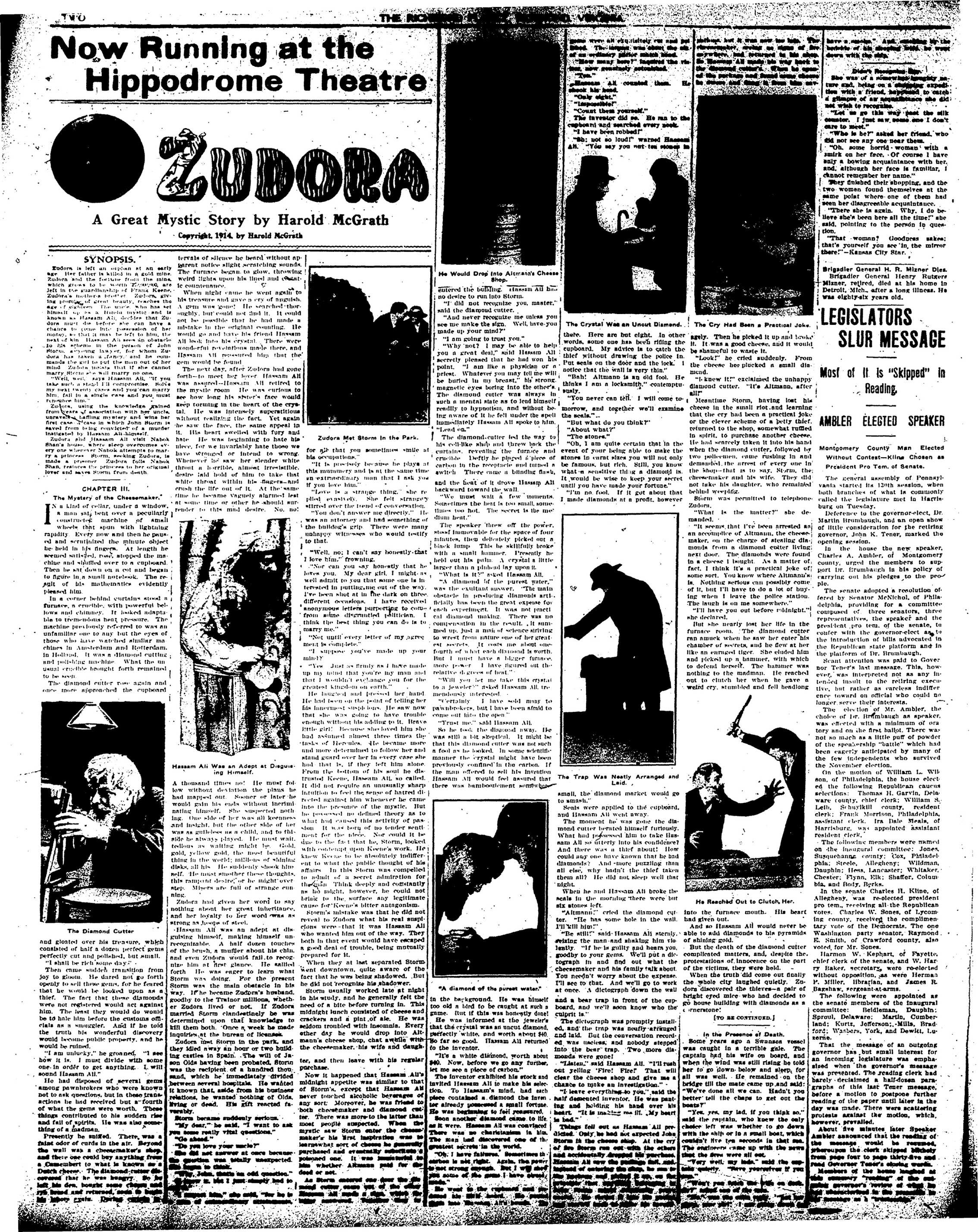
Now Running at the Hippodrome Theatre
A Great Mystic Story by Harold McGrath
SYNOPSIS.
Zudorn is left an orphan at an early age. Her father is killed in a gold mine. Zudorn and the fortune from the mines which grows to be worth Zudorn, are left in the guardship of Frank Keene. Zudora's mother brother Zudorn, giving promise of great business, teaches the mines how to operate a Hirada mystic and is known as Hassam Ali. He describes that Zudora must before she can have a chance to come into possession of her money, so that it may be left to him, the next of kin. Hassam Ali sees an obstacle to his scheme in the pursuit of John. Zudorn has taken a fanny, and he commands the girl to get the man out of her mind. Zudorn insists that if she cannot marry, Storm she will marry no one.
"Well, well," says Hassam Ali. "If you take such a stall, I will compromise. Soil my next twenty cases and you can marry him. Fall in a single case and you, must remember him."
Zudora is being the knowledge gained from years of association with her uncle, unraveling a hailing mystery and winer his first case. Please in which John Storm is saved from being convicted of a murder instigated by Hassam Ali himself.
Zudora and Hassam All visit Nabok Shan's house, where sleep overcomes every one whenered. Nabok attempts to marry him. He makes a trainee. Zudora folls Nabok Shan, restores the princess to her original lover and saves Storm from death.
CHAPTER III.
The Mystery of the Cheesemaker.
In a kind of collar, under a window,
a man sat bent over a peculiarly
constructed machine of small
wheels that spun with lightning
rapidity. Every now and then he pussed
and serrulized the minute object
he held in his fingers. At length he
seemed satisfied, rose, stopped the machine and sibilized over to a cupboard.
Then he sat down on a cot and began
to figure in a small notebook. The result of his mathematics evidently
pleased him.
In a corner behind contains stood a furnace, a crutchble, with powerful belows and chimney. It looked adaptable to tremendous heat pressure. The machine previously referred to was an unfamiliar one to any but the eyes of those who have watched similar machines in Amsterdam and Rotterdam, in Holland. It was a diamond cutting and polishing machine. What the usual capable brought forth remained to be seen. The diamond cutter rose again and once more approached the cupboard.
A.
The Diamond Cutter
and gloated over his treasure, which
consisted of half a dozen perfect gems
perfectly cut and polished, but small.
"I shall be rich some day."
Then came sudden transition from
joy to gloom. He dared not go forth
openly to sell these gems, for he feared
that he would be looked upon as a
thief. The fact that these diamonds
were not registered would act against
him. The least they would do would
be to hide him before the customs officials
as a smuggler. And if he told
the truth his wonderful discovery
would become public property, and he
would be ruined.
"I am unlucky," he groaned. "I see
how it is. I must divide with some
one in order to get anything. I will
sound Hassam All."
He had disposed of several gems among pawnbrokers who were known not to ask questions, but in these transactions he had received but a fourth of what the gems were worth. These things contributed to his sudden rise and fall of spirits. He was also something of a madman. Presently he smiled. There was a faint odor of curds in the air. Beyond the wall was a cheesemaker's shop and there one could buy anything from a Camembert to what is known as a Dutch cheese. The diamond cutter discovered that he was hungry. So he left his den, bought some chops and rye bread and returned, soon to bring his history again. During the night
Copyright, 1914, by Harold McGrath
terrals of silence he heard without apparent notice slight scratching sounds. The furnace began to glow, throwing weird lights upon his lined and countle countenance.
When might came he went again to his treasure and gave a wry of anguish. A gem was gone! He searched thoroughly, but could not find it. It could not be possible that he had made a mistake in the original counting. He would go and have his friend Hassam All look into his crystal. There were wonderful revelations made there, and Hassam All reassured him that the gem would be found.
The next day, after Zodion had gone forth—to meet big lover Hassan All was assured—Hussam All retired to the mystic room. He was curious to see how long his sister's face would keep forming in the heart of the crystal. He was intensely superstitious without realizing the fact. Yet again he saw the face, the same appeal in it. His heart swelled with fury and hate. He was beginning to hate his niece, for we invariably hate those we have wronged or intend to wrong. Whenever he saw her slender white throat a horrible, almost irresistible desire laid hold of him to take that white throat within his fingers—and crush the life out of it. At the same time he became Vaguely alarmed at some time or other he should surrender to this mad desire. No, no!
```markdown
```
Hassam Ali Was an Adopt at Disguising Himself.
A thousand times no! He must follow without deviation the plans he had mapped out. Sooner or later he would gain his ends without inerminating himself. She suspected nothing. One side of her was all keenness and insight, but the other side of her was as gullible as a child, and to this side he always played. He must wait, tellons as waiting might be. Gold, gold, yellow gold, the most beautiful thing in the world; millions of shining disks, all his. He suddenly shook himself. He must another these thoughts, this rampant desire; or he might overstep. Mysers are full of strange running.
Zudora had given her word to say nothing about her great inheritance, and her loyalty to her word was as strong as home of steel.
Hassam All was an adept at disguising himself, making himself unrecognizable. A half dozen touches of the brush, a muffler about his chin, and even Zudora would fall, to recognize him at first glance. He sailed forth. He was eager to learn what Storm was doing. For the present Storm was the main obstacle in his way. If he became Zudora's husband, goodbye to the Trainer millions, whether Zudora lived or not. If Zudora married Storm clandestinely he was determined upon that knowledge to kill them both. Once a week he made innquiries at the bureau of licenses.
Zudora must storm in the park, and they idled away an hour or two building cartles in Spain. The will of Jason Olda having been probated, Storm was the recipient of a hundred thou-sand, which he immediately divided between several hospitals. He wanted it known that, aside from his business relations, he wanted nothing of Olda living or dead. His gift reacted favourably.
Storm became suddenly serious.
"My dear," he said, "I want to ask you some really vital questions."
"Go ahead."
"Do you love your uncle?"
She did not answer at once because the question was totally unexpected. She began to think.
"Why, John, there an odd question."
She answered, but I just simply had to
THE MAYOR OF THE CITY OF NEW YORK IS SEEING A MAN IN A HAT AND A WOOLEN COAT TO SEE THE MAN.
Zudora Met Storm in the Park.
for gib that you sometimes smile at his occupations."
"It is precisely because he plays at this mummery and is at the same time an extraordinary man that I ask you if you love him."
"Love is a strange thing," she replied evasively. She felt strangely stirred over the trend of conversation.
"You don't answer me directly." He was an attorney and had something of the bulldog's grip. There were many unhappy witnesses who would testify to that.
"Well, no; I can't say honestly that I love him," frowning.
"Nor can you say honestly that he loves you. My dear girl, I might as well admit to you that some one is interested in putting me out of the way. I've been shot at in the dark on three different occasions. I have received anonymous letters purporting to come from some disgruntled politician. I think the best thing you can do is to marry me."
"Not until every letter of my agreement is complete."
"I suppose you've made up your mind."
"Yes. Just as firmly as I have made up my mind that you're my man and that I would not exchange you for the greatest kingdom on earth."
He laughed and pressed her hand. He had been on the point of telling her his innermost suspicions. He saw now that she was going to have trouble enough without his adding to it. Brave little girl. Because she loved him she had assumed almost three times the tasks of Hermules. He became more and more determined to follow her and stand guard over her in every case she had that be, if they left him alone. From the bottom of his soul he distrusted Keene. Hassam All so called. It did not require an unusually sharp intuition to feel the sense of hatred directed against him whenever he came into the presence of the mystic. But he possessed no defined theory as to what had caused this activity of passion. It was borne of no tender sentiment for the idea. Nor could it be due to the fact that he, Storm, looked with contempt upon Keene's work. He knew Keene to be absolutely indifferent to what the public thought of his affairs. In this Storm was compelled to admit of a secret admiration for the pain. Think deeply and constantly as he might, however, he could not bring to the surface any legitimate cause for Keene's bitter antagonism.
Storm's mistake was that he did not reveal to Zudora what his real suspicions were - that it was Hassam Ali who wanted him out of the way. They both in that event would have escaped a good deal of trouble, being mutually prepared for it.
When they at last separated Storm went downtown, quite aware of the fact that he was being shadowed. But he did not recognize his shadower.
Storm usually worked late at night in his study, and he generally felt the need of a bite before turning in. This midnight lunch consisted of cheese and crackers and a pint of ale. He was seldom troubled with insomnia. Every other day he would drop into Altmann's cheese shop, chat awhile with the cheesemaker, his wife and daughter, and then leave with his regular purchase.
Now it happened that Hamam All midnight appetite was similar to that of Storm's, except that Hamam All never touched alcoholic beverages of any sort. Moreover, he was friend to both cheesemaker and diamond cutter. There was more to the latter than most people suspected. When the mystic saw Storm enter the cheesemaker's his first inspiration was to learn what sort of cheese he generally purchased and eventually substituted is poisoned one. It was immeasured to him whether Allmann paid for the dead or not.
As Storm entered one hour the mind content came out of the other. Allmann All made a shock which the bigger man answered. Therefore they
1. 2. 3. 4. 5. 6. 7. 8. 9. 10. 11. 12. 13. 14. 15. 16. 17. 18. 19. 20. 21. 22. 23. 24. 25. 26. 27. 28. 29. 30. 31. 32. 33. 34. 35. 36. 37. 38. 39. 40. 41. 42. 43. 44. 45. 46. 47. 48. 49. 50. 51. 52. 53. 54. 55. 56. 57. 58. 59. 60. 61. 62. 63. 64. 65. 66. 67. 68. 69. 70. 71. 72. 73. 74. 75. 76. 77. 78. 79. 80. 81. 82. 83. 84. 85. 86. 87. 88. 89. 90. 91. 92. 93. 94. 95. 96. 97. 98. 99. 100.
He Would Drop Into Altmann's Cheese Shop.
He Would Drop Into Altman's Cheese Shop.
entered the building. Hissam All bin no desire to run into Storm.
"I did not recognize you, master," said the diamond cutter. "And never recognize me unless you see me make the sign. Well, have you made up your mind?" "I am going to trust you."
"Why not? I may be able to help you a great deal," said Hassam All secretly pleased that he had won his point. "I am like a physician or a priest. Whatever you may tell me will be buried in my breast," his strong, magnetic eyes boring into the others. The diamond cutter was always in such a mental state as to lend himself readily to hypnotism, and without being aware of it he fell under the spell immediately Hassam All spoke to him. "Lead on."
The diamond-cutter led the way to his cell-like ship and threw back the contains, revealing the furnace and crucible. Definitely he played a piece of carbon in the receptacle and turned a switch. There came a blinding flash, and the heat of it drove Hassam All backward toward the wall.
"We must wait a few moments.
Sometimes the heat is too small, sometimes too hot. The secret is the medium heat."
The speaker threw off the power, stood humovable for the space of four minutes, then deliberately picked out a black lump. This he skillfully broke with a small hammer. Presently he held out his palm. A crystal a little larger than a pinhead lay upon it.
"A diamond of the purest water," was the exultant answer. The main obstacle in producing diamonds artificially has been the great expense for each experiment. It was not practical diamond making. There was no compensation in the result. It summed up, just a man of science striving to wrest from nature one of her greatest secrets. It costs me about one-fourth of what each diamond is worth. But I must have a bigger furnace, more power. I have figured out the relative degrees of heat."
"Will you let me take this crystal to a jeweler?" asked Hassam All, tremendously interested.
"Certainly. I have sold many to pawnbackers, but I have been afraid to come out into the open."
"Trust me," said Hassam All.
So he took the diamond away. He was still a bit skeptical. It might be that this diamond cutter was not such a fool as he looked. In some scientific manner the crystal might have been previously confined in the carbon. If the man offered to sell his invention Hassam All would feel assured that there was bambooelement somewhere.
```markdown
```
"A diamond of the purest water."
In the background. He was himself too old a bird to be caught at such a game. But if this was honestly done. He was informed at the jewelers that the crystal was an uncut diamond, perfectly white, and worth about $40. So far so good. Hassam All returned to the inventor.
"It's a white diamond, worth about $40. Now, before we go any further, let me see a piece of carbon."
The inventor exhibited his stock and invited Hassam All to make his selection. To Hassam's mind, had each piece contained a diamond the inventor already possessed a small fortune. He was beginning to feel reassured. Soon another diamond came to life, as it were. Hassam All was convinced There was no charisma in him. The man had discovered one of the greatest secrets in the world.
"Oh. I have failure. Sometimes the carbon is not right. Again, the power to not strong enough. But I will help you some of the games I have given."
He went on the expedition and pro-
duced his MIM. journal. He passed
him both. He was AFI's best.
some were all rigidly run and put blind. The lioness was about the size of an ordinary gopher which blind.
"How many have?" insisted the vision, now genuinely astonished.
"Two."
Hannam all counted them. He shook his head.
"Only eight."
"I impossible!"
"Count them yourself."
The inventor did so. He ran to the cupboard and searched every book.
"I have been robbed!"
"Oh; not so loud!" warned Hannam all. "You say you must ten stones in
The Crystal Was an Unout Diamond. there. Here are but eight. In other words, some one has been riding the cupboard. My advice is to catch the thief without drawing the police in. Put seals on the door and the lock. I notice that the wall is very thin." "Bah! Altmann is an old fool. He thinks I am a locksmith." contemptuously. "You never can tell. I will come tomorrow, and together we'll examine the scals." "But what do you think?" "About what?" "The stones." "Oh, I am quite certain that in the event of your being able to make the stones in curat sizes you will not only be famous, but rich. Still, you know what a sensitive thing a diamond is. It would be wise to keep your secret until you have made your fortune."
"I'm no fool. If it got about that
I made diamonds at a profit, however
```markdown
```
The Trap Was Neatly Arranged and Laid.
small, the diamond market would go to smash.
Seals were applied to the cupboard, and Hassam All went away.
The moment he was gone the diamond cutter borne himself furiously. What had possessed him to take Hassam All so utterly into his confidence? And there was a thief about! How could any one have known that he had diamonds? And more puzzling than all else, why didn't the thief taken them all? He did not sleep well that night.
When he and Hassam All broke the scals in the morning there were but six stones left.
"Altmann" cried the diamond cutter. "He has some hole in the wall. I will kill him."
"Be still!" said Hassan All eternely, seizing the man and slinking him violently. "If he is guilty and hears you, goodby to your gems. We'll put a dictograph in and find out what the cheesemaker and his family talk about. You needn't worry about the expense. I'll see to that. And we'll go to work at once. A dictograph down the wall and a bear trap in front of the cupboard, and we'll soon know who the culprit is."
The dictograph was promptly installed, and the trap was neatly arranged and laid. But the conversation recorded was unclear, and nobody stepped into the bear trap. Two more diamonds were gone!
"Listen," said Hassan All. "I'll rush out yelling 'Fire! Fire!' That will clear the cheese shop and give me a chance to make an investigation."
"I leave everything to you," said the half demented inventor. He was panting and holding his hand over his heart. "It is making me ill. My heart is bad."
Things fell out on Hannah All predicted. Only he had not expected John Storm in the cheese ship. At the cry of five storm run out with the others and accidentally dropped his purchase. Hannah All saw the passing fist, and heaped of entering the ship, he ran to the problem and plunged it up, on the precipice that immediately beating him, water made him suddenly pop up, the fury of it gave the problem a new form and made him fall.
pathways but it was now too high. The choreographer, moving on signs of fire anywhere, had returned to his office. He knocked All made the way back to the damaged rotary. When he opened the pathway and found many others he drove and threw it from the new
1. 2. 3. 4. 5. 6. 7. 8. 9. 10. 11. 12. 13. 14. 15. 16. 17. 18. 19. 20. 21. 22. 23. 24. 25. 26. 27. 28. 29. 30. 31. 32. 33. 34. 35. 36. 37. 38. 39. 40. 41. 42. 43. 44. 45. 46. 47. 48. 49. 50. 51. 52. 53. 54. 55. 56. 57. 58. 59. 60. 61. 62. 63. 64. 65. 66. 67. 68. 69. 70. 71. 72. 73. 74. 75. 76. 77. 78. 79. 80. 81. 82. 83. 84. 85. 86. 87. 88. 89. 90. 91. 92. 93. 94. 95. 96. 97. 98. 99. 100.
The Cry Had Been a Practical Joke.
agely. Then he picked it up and broke it.
It was a good cheese, and it would be shameful to waste it.
"Look!" he cried suddenly. From the cheese he plucked a small diamond.
"I knew it!" exclaimed the unhappy diamond cutter. "It's Altmann, after all!"
Meantime Storm, having lost his cheese in the small riot, and learning that the cry had been a practical joke or the clever scheme of a petty thief, returned to the shop, somewhat ruffed in spirit, to purchase another cheese. He had scarcely taken it into his hand when the diamond cutter, followed by two policemen, came rushing in and demanded, the arrest of every one in the shop—that is to say, Storm, the cheesemaker and his wife. They did not take his daughter, who remained behind weeping.
Storm was permitted to telephone Zudorn.
"What is the matter?" she demanded.
"It seems that I've been arrested as an accomplice of Altmann, the cheesemaker, on the charge of stealing diamonds from a diamond cutter living next door. The diamonds were found in a cheese lought. As a matter of fact, I think it's a practical joke of some sort. You know where Altmann is. Nothing serious can possibly come of it, but I'll have to do a lot of buying when I leave the police station. The laugh is on me somewhere."
"I'll have you out before raldnight," she declared.
But she nearly lost her life in the furnace room. The diamond cutter ran unnock when he saw her enter his chamber of secrets, and he drew at her like an enraged tiger. She cluded him and picked up a hammer, with which to defend herself. The hammer was nothing to the madman. He reached out to clutch her when he gave a weird cry, stumbled and fell headlong
THE MUSICIAN
He Reached Out to Clutch Her.
into the furnace mouth. His heart had given out.
And so Hassam All would never be able to add diamonds to his pyramids of shining gold.
But the death of the diamond cutter complicated matters, and, despite the protestations of innocence on the part of the victims, they were held.
When the truth did come out finally the whole city laughed quietly. Zudora discovered the thieves—a pair of bright eyed mice who had decided to go house building with diamonds as a cornerstone.
[TO BE CONTINUED.]
In the Presence of Death.
Some years ago an Swansea vessel was caught in a terrible gale. The captain had his wife on board, and when the wind was still rising he told her to go down below and sleep, for all was well. He remained on the bridge till the mate came up, and said: "We've done all we can. Hadn't you better tell the chaps to get out the boats?"
"Yes, yes, my lad, if you think so," said the captain, who knew the only choice left was whether to go down with the ship or in a small boat, which couldn't live ten seconds in that sea. The engineer came up with the news that the crew were all out.
"Who's your boss? Are you on deck?
Are you called one of the men?
Who's your boss? Are you on deck?
Are you called one of the men?
have a smooch." And smooching by the brittle of his sleeping hold, he went down with the silt.
Didn't Receptionhip help.
She was of a somewhat humbly nature and, being on a shopping expedition with a friend, happened to catch a glimpse of an acquaintance she did not wish to recognize.
"Let us go this way past the silk counter. I just saw, some one I don't care to meet."
"Who is her?" asked her friend, who did not see any one near them.
"Oh, some horrid woman with a smirk on her face. Of course I have only a bowing acquaintance with her, and, although her face is familiar, I cannot remember her name."
They finished their shopping, and the two women found themselves at the same polist where one of them had seen her disagreeable acquaintance.
"That woman? Goodness makes; that's yourself you see in, the mirror there."—Kansas City Stnr.
Brigadier General H. R. Mizner Dles.
Brigadier General Henry Rutgers Mizner, retired, died at his home in Detroit, Mich. after a long illness. He was eighty-elx years old.
LEGISLATORS SLUR MESSAGE
Montgomery County Man Elected Without Contest—Kiline Chosen as President Pro Tem. of Senate.
The general assembly of Pennsylvania started its 120th session, when both branches of what is commonly called the legislature met in Harrisburg on Tuesday.
Deference to the governor-elect, Dr. Martin Brombaugh, and an open show of little consideration for the retiring governor, John K. Tener, marked the opening session.
In the house the new speaker, Charles A. Ambler, of Montgomery county, urged the members to support Dr. Brombaugh in his policy of carrying out his pledges to the people.
The senate adopted a resolution offered by Senator McNichol, of Philadelphia, providing for a committee composed of three senators, three representatives, the speaker and the president, pro tem, of the senate, to confer with the governor-elect and to the introduction of bills advocated in the Republican state platform and in the platform of Dr. Brumbaugh.
Scant attention was paid to Governor Tenner's last message. This, however, was interpreted not as any intended insult to the retiring executive, but rather as careless indifference toward on official who could no longer serve their interests.
The election of Mr. Ambler, the choice of Mr. Birmingham as speaker, was effected with a minimum of oratory and on the first ballot. There was not so much as a little puff of powder of the sponsorship "battle" which had been eagerly anticipated by many of the few independents who survived the November election.
On the motion of William L. Wilson, of Philadelphia, the house elected the following Republican causes selections: Thomas H. Garvin, Delaware county, chief clerk; William S. Leib, Schuylkill county, resident clerk; Frank Morrison, Philadelphia, assistant clerk. Ira Dale Meals, of Harrisburg, was appointed assistant resident clerk.
The following members were named on the inaugural committee: Jones, Susquehanna county; Cox, Philadelphia; Steele, Allegheny; Wildman, Dauphin; Heas, Lancaster; Whittaker, Chester; Flynn, Elk; Shaffer, Columbia, and Body, Berks.
In the senate Charles H. Kline, of Allegheny, was re-elected president pro tem, receiving all the Republican votes. Charles W. Sones, of Lycoming county, received the complimentary vote of the Democrats. The one Washington party senator, Raymond E. Smith, of Crawford county, also voted, for Mr. Sones.
Harmon W. Kephart, of Fayette, chief clerk of the senate, and W. Harry Baker, secretary, were re-elected without opposition, as were Herman P. Miller, librarian, and James R. Bagshaw, sergeant-at-arms.
The following were appointed as the senate members of the inaugural committee: Beldleman, Dauphin; Sproul, Delaware; Martin, Cumberland; Kurtz, Jefferson; Mills, Bradford; Warbors, York, and Dewitt, Luzerne.
That the message of an outgoing governor has but small interest for an incoming legislature was emphasized when the governor's message was presented. The reading clerk had barely declared a half-dozen paragraphs of this last Tener message, before a motion to postpone further reading of the paper until later in the day was made. There were scattering protests against the motion, which, however, prevailed.
About five minutes later Speaker Ambler announced that the reading of the message would be resumed, whereupon the clerk skipped billyhole from page four to page thirty-five and read Governor Tessar's closing words.
Members of the house lengthed at this summary "reading" of the outgoing governor's review of what he had whispered in the presumably his message as a "transcription."
The Germana Are Battling desperately to Save Railroad line on North of the Alsine.
Great Britain is now sending thousands of men into France every week, and, according to reports from Berlin, Germany, aware of this, is making great military preparations for a counter movement.
All the German reserves are being called to the colors, it is declared in London, and the further statement is made that the German generals are gathering up the reins to assume active direction of all the campaigns, that is to say, the Austro-Hungarian fight against Servia and Russia and the Turkish campaign against Russia and Great Britain.
In the western arena the points of greatest interest are in the center, near Solssons, and on the French right in Alsace.
The allies are making a hard drive against Laon, which lies northeast of Solssons, and commands railroads of vital interest to the German center. The Germans are making a series of counter attacks in that vicinity to save this important position. The Germans claim to have inflicted severe loss on their foes there as well as in Alsace.
Berlin had a dispatch from Geneva that the Germans are bombarding the town and environs of Solssons with heavy artillery.
A dispatch from Amsterdam says the great warehouse near Antwerp used by the Germans for their reserve supply of petroleum is burning, having been set on fire by a bomb dropped by a French or British aviator.
Fight Rages at Solssona.
The French war office in Paris gave out a statement as follows:
"From the sea to the Oise there was an intermittent canonading, fairly violent at certain places."
"On the Alsace, to the north of Solssons, determined attacks have been delivered against the trenches occupied by us the 8th and 10th of January. The enemy attacked our positions several times. We repulsed him and we took possession of more trenches."
"From Solssons to Rhelms there were artillery exchanges. Our heavy pieces of artillery responded efficaciously to the batteries and the mine throwers of the Germans."
"In Champagne, in the region of Souain, there was very active shooting by our artillery, directed against the positions of our adversaries near Perths.
"Le Fortin, situated to the north of the Beausejour farm, was the scene of desperate fighting. The enemy succeeded in setting up a trench at a point within a series of field works, the commanding position of which was held by us. This fighting is still going on.
"In the Argonne and as far as the Meuse there is nothing to report. On the heights of the Meuse there have been two German attacks, one at the forest of Consenvoye and the other at the forest of Bouchot. Each was repulsed.
"To the southeast of Cirey-au-Vezouz one of our detachments surprised and put to flight a German company which was pillaging the village of St. Sauveur.
"In the Vosges, and in Alsace the day passed quietly. Bad weather and the snow storm continue."
Repulse French in Alsace.
The German official statement issued in Berlin says:
"In the western theater insignificant engagements are taking place south of the canal of La Basse, but so far without result.
"French troops made an attack on our positions to the south of Cernay (Sennheim), but they were repulsed with heavy losses. The battle has been resumed in this district.
"A French attack in the region of Porthes (between Rheims and the Argonne) withered away before our fires, the enemy suffering very heavy losses.
"In the Argonne forest a French vantage point was taken on the Roman high road. In this engagement two officers had 140 men fell into our hands.
"In the battles on the eastern side of the Argonne we have taken, since Jan. 2, including those already mentioned, one major, three captains, thirteen Mottennants and 1600 men. The French total losses, including the killed and injured, in this battle area, consequently, are estimated at 350 men.
"An attempt of the French to make an attack at Alliy, to the south of St. Hildeg, on the river Meuse, failed."
untilly Occurred German soldiers have been consummated at Midea to regal the British invasion ofugal Almansa and Lovann. It is placed in a disposal received from Rath, on the Gromen Frontier.
Rain and snow have caused a constellation of horrifics on a large scale in
RECORDING HISTORY.
German Soldier on Battlefield
Writing Day's Items in Diary.
Photo by American Press Association.
Alace, which may result in a loss of some, of the advantage gained by the French, whose successes were achieved against German troops that had been weakened by heavy withdrawals.
The Germans are preparing to launch an offensive campaign in Alace to retake the ground they have lost in operations since November.
The Germans are also reported to be moving reinforcements into the Woyere district.
TURKEY APOLOGIZES TO ITALY FOR INSULT
Agrees to Salute Flag and Release British Consul
Dispatchers from Rome say Turkey has agreed to the demands of Italy in connection with the Hodeida incident. According to these advises, Turkey has ordered the release of British Vice Consul Richardson, who was arrested in the Italian consulate at Hodeida, and has promised to punish the soldiers who broke into the consulate, as well as to salute the flag when it is again hoisted over the building. Investigation of the circumstances attending the invasion of the Italian consulate is still in progress, and the incident will remain open until this inquiry has been completed. In view of these concessions, satisfactory adjustment is expected.
CRUISER BREMEN HITS MINE
German Warship, Damaged, Taken to Wilhelmshaven.
The German cruiser Bremen has arrived at Wilhelmshaven, the German naval base on the North sea, in a badly damaged condition.
The Bremen was damaged as the result of coming in contact with a mine, according to information received by the Russian admiralty in Petrograd.
The Bremen is a protected cruiser of 3200 tons, and is capable of making 33.2 knots an hour. She was laid down in 1902 and completed fifteen months later. She carries 297 men, according to the naval register.
DARDANELLES FORT SMASHED
Defense on South Side of Straits Reported Demolished.
The fort at Tehanak-Kalesi, guarding the south side entrance to the Dardanelles, was demolished by the bombardment of the allea' warships and has been evacuated by the Turkish garrison, according to a dispatch received from Salonika. Forts Elles and Seddil have been badly damaged, but are still holding out.
Japanese Seek German Cruiser.
Japanese cruisers continue active along the coast of Peru, seeking the German converted cruiser Prinz Friedrich. Late reports say the Japanese armored cruiser Acama appeared in Payta, Peru, took on provisions and left at once.
Karlsruhe Reported Sunk.
Reports are current in Panama that the German cruiser Karlsruhe was sunk after destroying a British cruiser in the Caribbean sea. The reports are said to have been received by wireless from a merchant ship. No confirmation has been received.
Mother and Five Children Burned.
Mrs. Joanie Dull and her five children, the oldest a girl of eleven, were burned to death in their barnhouse home, east of Irunon, Ohio.
Five Sole of Reward Price.
Five hundred $8.99 a barrel, the highest in pearn in Christmas Ohio. Wheat was sailing at $5.99.
EXCELSIOR SCALP FOOD
THE BEST REMEDY for Promoting the Growth and Luxuriance of the Hair and Insuring a Healthy Condition of the Scalp.
Price per box 50 cents postpaid. No stamps taken. AGENTS WANTED. Write for terms.
Excelsior Mfg. Co.,
265 S. Bland Street, Bluefield, W. Va.
WOLF BROTHERS' Improved 1918 Model, 8 oz. Solid Brass Mint Hair Straightener and Dryer Comb.
Annual Length of Comb in 9 inches
Made of solid brass and fine full round brass. Being solid and number this Comb will hold heat longer than any other Comb on the market. Other Comb sizes are advertised for $1.99.
Our Price is $19.99 Comb, and we give them Attention First.
When ordering by mail and 52 and smaller or postal. Agent Wanted.
WOLF BROTHERS, 1914 N. Spencer Street, Indianapolis, Ind.
WEDNESDAY.
The Turkish army in Trans-Caucasia has been shattered. The Russians book 35,000 prisoners. The remnants of the enemy's strength are fleeing in disorder. Germany has launched a new drive against Warsaw from north Poland. A great army is moving along the upper Vistula. Russia's reports progress in East Prussia, and Galicia. Severe fighting continues in Alsace between the French and Germans for possession of Sennahelm (Cernay). Institutions made in the course of debate in the house of lords are to the effect that Great Britain's army may soon reach nearly 3,000,000. An appalling situation among the French peasants in the valley of the Mouse was found by the. American relief commission, which found 10,000 persons without food. Many deaths from starvation have occurred.
THURSDAY
The Russians have started another drive against the German lines in North Poland. The attack is being launched in the region of Miawau, while the forces of the czar are holding the Teutons to the west and south of Warsaw.
While the French are gaining some ground in Alsace and to the east of the Argonne, the German attempt to cut the line of the allies to the north of Arras has been repulsed. Berlin claims to have repulsed the French in Alsace, while announcing gains in the Argonne.
Paris dispatches say that German aviators who attempted another raid on Dunkirk were driven off. It is also reported that German Zeppeliners are preparing to make a raid over England.
German military authorities in Belgium deny the report of the arrest of Cardinal Mercier, Belgian primate. A Netherlands dispatch confirms the report of his being held a prisoner.
FRIDAY
The Germans have driven the Roe
lands from their positions on the
Burma river and have gained a foot
hold in that region. Late dispatchs
say the Germans are only twenty-six
miles from Warsaw.
The French official communication
says the allies have captured another
town to the southeast of Cernay,
Alasce, and have made considerable
progress in that section. The dispatch
says the French are only eight miles
from Muelhauson.
Lord Haldane, in the house of lords,
declared that on Britain rested the
burden of retaining command of the
sea and that Britain was fighting for
the life of the nation.
SATURDAY
German armies are again striking at Warsaw from the north and from the west. Russian troops have crossed the Austrian province of Bukovina and invaded Transylvania.
Burnhaupt-Haut, in Alsace, has been recaptured by the Germans. French fighting is reported from Arles and Andlens, in the northern part of France.
Turning upon their pursuers, the Turkish forces in Transylvania have resumed the offensive against the Austrians.
Italy has returned to withdraw from Alyton, Albania, in reply to Austria's protest, and German troops have been sent to reinforce the Austrian troops on the Italian border.
Greece is reported near the breaking point with Turkey. Romania and Bulgaria are concentrating their armies and Persia has sent an ultimatum to Constantinople.
SUNDAY
Britain's note in reply to the protest of the United States against the seizure of cargoes, protests a spirit of friendship for the United States, but declare that belligerents are receiving shipments from this country and that they believe it their duty to examine suspect cargoes.
In the western theater of war the allies report progress along the line in France and the retention of all positions gained during theighting of the past several days. Berlin reports the repulse of French attacks in Alsace.
Reports from Poland are meager, but a dispute from Berlin says that the Russo-Japanese in the region of Mlawn, in northeastern Poland, has been checked.
A semi-official communication from Patregrua says that the Russian black pig foot has damaged the Turkish cruisers Breslan and Maridillo and also sank several Turkish vessels.
A feet of sixteen German aeroplanes, among which was said to be a Zeppelin, are reported to have been seen, Sunday, over the English channel. Dunkirk was attacked by German aviators and thirty bombs were dropped. A bomb was dropped on the French town of Malo-les-Bains.
A German force numbering 1,000,000 men has begun a drive toward Warsaw from the north, and the Russians are reported falling back obstinately before them, near Mlawa.
A fort guarding the southern end of the Darwinelles is reported to have been demolished by the French and British fleets.
A wireless dispatch from Berlin says that the French battleship Courbet had been struck by an Austrian submarine in the Adriatic. This action is said to have taken place several days ago.
GERMAN FORCES CAPTURE PLOCK
Continue Drive on Warsaw Despite Great Losses.
Continue Drive on Warsaw Despite Great Losses.
Troops In North Form Junction With Central Army and Von Hindenburg Begins Great Effort to Beat Back Muscovites. Plock, which lies fifty-eight miles northwest of the city of Warsaw, on the Vistula river, has been captured by the Germans, says a dispatch from Warsaw. Part of the town has been destroyed, and the Germans are moving forward toward the capital of Poland. The kaiser's army in north Poland, which started a drive toward Novo Georgievsk, preparatory to making a final assault on Warsaw, has formed a junction with the German forces to the west of Warsaw, so that the German battle line in Poland now extends from Milawa to a point far to the southwest of Warsaw. At the same time the Russians have assumed their offensive in Galicia, where torrential rains indicated a full in the operations against Gracow. In co-operating with the troops attacking the Austrians, those who have reached the Danube river, in Galicia, will now attack the Austro-German forces intrenched on the west bank of that stream.
News reaching Petrograd of a proposed expedition in force by the Germans and Austrians against Servia, is looked upon in Russian military circles as a transparent ruse on the part of the Germans to distract attention from the Polish campaign and to divert the government from further reinforcing the Russian armies in Poland.
The Russian general staff, it is said, is not being influenced by the reports and is continuing its campaign. In the meantime the number of German troops in Russian Poland has not diminished, but is continually being increased on the Bura and Niemen rivers; on the latter waterway as far as Tleit.
Terrific Battle West of Warsaw.
The fall on the battle front to the west of Waraw, noticeable while from Marshal von Hindenburg was concentrating a million men near Miawawor a dash from the north, has ended.
While a great battle rages in north Poland, another of almost as great intensity and of greater importance, in progressing thirty miles west of Warsaw.
The Germans have crossed the river Hawka, have gathered bed themselves on the cast bank, and are stalling the strongest line of defense between them and Warsaw.
This virtually is the last barrier in the way of the killer in his invasion, and his troops are carrying great numbers of itching men in an effort to reduce it. This use of defense includes barricades, wire enclosures and carefully built fire traps.
The enemy lost heavily in attacking this position on confluence, but the fighting go on unabated.
OFFICE ROOM, NO. 405, MECHANIC SAVINGS BANK BUILDING
'Phone, Monroe—2627.
Residence, 610 N. 1st St.—Shop in Rear. 'Phone, Monroe-2166.
Special Attention Paid to the Taking of Contracts for Building of
Any Style of Architecture Job Work a Specialty
THE MAGIC SHAMPOO DRIER AND HAIR STRAIGHTENER
MAILED DAY WHICH IN U.S. $1.00
SEND MONEY BY POST OFFICE MONEY GRIEF
Address All Letters to Magic Shampoo Drier Co.
Minneapolis, Minn. not to individuals.
A BEAUTIFUL HEAD OF HAIR is A LADY'S CROWNING GLORY.—And every lady can have it if she will use the Magic. The Magic will dry the hair after a shampoo or bath, and straighten the earliest head of hair. It will also eliminate its growth. The Aluminum Comb cannot injure the hair, because it is never heated direct, but takes its heat from the heating bar which is heated on our Alcohol Heater, or any other heater. We advise the use of Mayor's Hair Pens to Beat on the market. Price per box, $96. Alcohol Heater, price $96. Liberal terms to agents.
Write for literature today.
MAGIC SHAMPOO DRIER COMPANY, MINNEAPOLIS, MINNESOTA
the Latest, and Most Artificial than you can obtain elsewhere. Nation Paid to. Children. Bark. Be pleased to Quote you Price & Specialty.
M. Brown, PHOTO
and St.,
T. D. PE
ANTIFIC SCALP SPE
W. 35th Avenue, Denver
Perkins, of Denver, Colo., who now interesting women all over. No matter how dark your hairs and scientific method and growing the hair will grow prevent. Her treatments have d.' Have you written her? If her to-day. Be sure to enclose address very plain if you expressness.
TOP, WAIT, LIST
Are long hair, it is a Glory to Human Can Have that Glory If Sh
We will also be Pleased to Quote you Prices on Exterior and
From Old Photo. A Specialty.
Mme. T. D. PERKINS SCIENTIFIC SCALP SPECIALIST
4630 W. 35th Avenue, Denver, Colo.
Madam T. D. Perkins, of Denver, Colo., who has spent five years in study of the scalp, is now interesting women all over the globe in the care of the hair and scalp. No matter how dark your skin is, Madam Perkins' matchless scalp preparations and scientific method of treatment for cultivating, beautifying and growing the hair will grow your hair if there is no physical allure to prevent. Her treatments have been successful where all others have failed." Have you written her? If not, and you want hair like her own, write her to-day. Be sure to enclose a 4-cent stamp and write your name and address very plain if you expect a reply. Don't write unless you mean business.
WOMEN, STOP, WAIT, LISTEN, READ!
If a Woman have long hair, it is a Glory to Her: 1 Cor., 11-15.
Every Woman Can Have that Glory If She Wishes It.
Madam Perkins Before Treatment
I and scalp scurf, causes the it, no matter how harsh; thick it, no matter how kinky. First it. Do not wait if you are in over the United States by making the care of the hair, and when a 4-cent stamp is endonal history of your hair and it answered when a 4-cent stamp race growing hair to-day when was when I first began treat-ess. You can secure these p made in the world. The Madam Perkins, sole agent.
tailing hair of break
ends, removes dandruff and scalp scurf, causes the hair to grow long, no matter how short; soft, no matter how harsh; thick, no matter how thin; straight from the bulbs, no matter how kinky. First treatment will show wonderful improvement. Do not wait if you are interested in your hair. I give treatments all over the United States by mail. Write me at once. I send booklet concerning the care of the hair, and testimonials of those taking my treatments when a 4-cent stamp is enclosed. I do not have agents. I need a personal history of your hair and scalp and your physical condition.
All mail promptly answered when a 4-cent stamp is enclosed. I am the only woman of the race growing hair to-day who can show the public the real length my hair was when I first began treating it. Send for booklet if you mean business. You can secure these preparations only from me. None like them made in the world. The D. P. Scientific Scalp Preparation, Madam Perkins, sole agent.
THE ECONOMY,
327 North First Street.
FINE
TAILORING
CLEANING DYING AND
IMPARTING.
CHITMAN M. WHITE,
Proprietor.
A. Dayes,
Office and Ware-Box,
727 NORTH SHOOT STREET,
Residence—THE North Second St.
First-stage Houses and Controls of All Descriptions. I have a square room for Bedroom, when the Family have not a suitable place. All Country Orders are Given through Attention. Four Capital Attachments, in called to the New York City Office, will and may be served on Instructions.
Penny: $100.00.
This is for you, but soft, long, beau
not be put on the
Do you want this
write for particular
kins, the Scientific
Denver, Colo., who
world with her won
hair.
My own hair is
meant. With these
grizzles 17 inches it
makes on one-leaf
years. What I did
doing for hundreds
do for you, with my
Scalp Preparations.
PHOTOS.
curt, causes the hair to grow long, no now harsh; thick, no matter how thin; show kinky. First treatment will show if you are interested in your hair, red States by mail. Write me at once of the hair, and testimonials of those first treated it. I do not have your hair and scalp and your physical upon a 2-cent stamp is enclosed. I am hair to-day who can show the public first treated it. Send for book-secure these preparations only from world. The D. P. Scientific Scalp cent.
Other People Judge You by Your Furniture Now
When you can get FURNITURE and RUG from an Old established house like JURORNE—that' known to sell the best quality goods just as reasonable no elsewhere—why not give your friends a good impression; it will give us the greatest pleasure to show you our wonderful stock of home-making comfort giving Furniture and Bags and—don't fail to ask our salesmen about our heating plan which gives you 5. 10 or 15 months in which to pay for any purchase
CHAS. G.
JURGENS SON,
ESTABLISHED 1880.
No more ironed hair,
tifful hair that need
dresser on retiring,
kind of hair? If so,
to Madam T. D. Per-
Scalp Specialist of
is astonishing the
dertal art of growing
my best advertise-
treatments my hair
two york. It had re-
(four Inches) for 16
for my hair I am
of others, and will
Matchless Scientific
My treatment stops
+1.40 A.H. Byrd St. S.m.
+0.05 A.H. S.m. St. S.m.
+7.10 A.H. Byrd St. S.m.
+7.27 A.H. S.m. St. S.m.
+0.40 A.H. Byrd St. S.m.
+10.35 A.H. Byrd St. S.m.
+12.01 A.H. Byrd St. S.m.
+1.00 F.M. Byrd St. S.m.
+1.50 F.M. Byrd St. S.m.
+14.15 F.M. Kiba.H.ta.S.m.
+1.15 F.M. Hain.H.ta.S.m.
+0.50 F.M. Byrd St. S.m.
+11.35 A.H. Byrd St. S.m.
+1.10 F.M. S.m. S.m.
+1.10 F.M. S.m. S.m.
+0.50 F.M. S.m. S.m.
+10.00 F.M. S.m. S.m.
+11.15 F.M. S.m. S.m.
+11.30 F.M. S.m. S.m.
+12.55 S.m. S.m. S.m.
+13.40 S.m. S.m. S.m.
ACCOMMODATION TRANS - WEEKDAY.
Louro Byd Sth. N., 6.00 P. M. for Prodromianty.
Arrive Byd Sth. N., 5.50 P. M. for Abhb.
Arrive Byd Sth. N., 5.50 P. M. for Abhb.
Arrive Kibu Sth. N., 5.00 P. M. for Abhb.
*Daily, 1 weekday, 1 Sunday only,
& Commencing January 8th, rpg.
All to be or from Bydr street Station
stop at Kibu, and departures
not guaranteed. Read the signs.
N. & W.
ONLY ALL RAIL LINE TO NORFOLK.
Schedule in Effect December 1, 1918.
Leave Bird Street Station, Richmond, FOR
NORFOLK: "9:00 A. M., "9:00 P. M., "9:10 P. M.
FOR WICHITO UNIVERSITY AND THE WEST": "6:15 A
M., "6:15 P. M., "8:10 P. M.
Arrive Richmond From New York: "11:00 A.
M., "11:00 P. M., "M. From the West:
"9:40 A. M., "9:30 P. M., "N1:00 P. M., "9:50
P. M., "9:00 P. M.
*Daily*, a Daily Bx. Sunday, a Sunday Only
W. B. BEVILL, Traffic Manager Traffic Manager
W. C. SAUNDERS, S. P. A., Rancho, Va.
C. H. BOLLEY, D. P. A., Bidmore, Va.
ATLANTIC CCAST LINE
EFFECTIVE APR. 12, 1914
TRAINS LEAVE, RICHMOND DAILY.
For Florida and South: 8:18 A. M. and 8:20
P. M.
For North: 8:00 A. M. P. M. 8:10 P. M.
For N. & W. Ry. West: 8:18 A. M. 8:20 P. M.
8:00 P. M. 8:20 P. M.
For Petersburg 12:30 A. M. 6:15 A. M. 1:20
9:00 A. M. 8:00 A. M. 8:00 P. M.
4:10 P. M. 8:00 P. M. 8:25 P. M. 8:30 ' M.
11:48 P. M.
For Goldbear and Payetteville: *10:10 P. M.
Trains Arrive Richmond Daily: 8:35 A. M.
10:18 A. M. 8:50 A. M. 8:27 A. M. *7:08 A. M.
10:18 A. M. 8:50 A. M. *8:10 P. M. *1:40 P. M.
10:18 A. M. 8:50 P. M. 8:30 P. M. 9:00 P. M.
11:00 P. M.
*Knapp Sunday. *"Bunny only.
Time of arrival and departure and noonment
not guaranteed.
C. B. CAMBELL, D. P. A. 1000 1000
SOUTHERN RAILWAY.
SOUTHERN RAILWAY.
Pronier Carrier of the North.
Trains Leave Richmond—Main Street Station.
N. N.—Following schedule figures published
in information and set guaranteed:
F. F. the South-Daily: 8:58 A. M.—Local: 8:58
A. M.—Local: 8:59 P. M.—Midway with Electric
Lighted Carry-On Care at Albany and
Birmingham. 12:59 P. M.—Birmingham. Work Week
8:00 P. M.—Local.
YORK RIVER LINE.
1:18 P. M. A. camp train (parker car), around
Sunday; no local.
local—Connecting for Baltimore, daily, around
Sunday. 7:18 A. M.—around Sunday.
From the South: 7:00 A.M. and 6:00 A.M.
2:15 P.M., 8:00 P.M., daily: 1:00 Mr. Sunday
From West Point: 8:45 A.M. (of the sameัน, but by daily excerpt Monday: 9:40 A.M., daily: 9:00 P.M., except Sunday.
H. L. BEMOF, D. P. A.,
047 M. Main St., Phone: 844-200-
C. & O.
19:00 A. - Kx. - Daily - Norfolk and Old Peden.
19:10 A. - Kelly - Lyndsburgh, Lexington.
5:00 P. - Local - Dy. - Newport Newa, Old Point
5:15 P. - Local - Ez. Sunday - Gordovenville.
*5:15 P. - Local - Week Days - Lynchburg.
*5:15 P. - Local - Ez. Sunday - Lynchburg and Clifton Forge.
*6:40 P. - Limited - Daily - Clincmanni, Chicago and St. Louis.
*71:00 P. - Express - Daily - Clinsmanni, Louisville Sleepers. 1 Parker Ours.
TRAINING ARRIVE BIRDHAM-Docal from
Kart: 10:18 A. M.; 8:10 P. M. Through
Kart: 11:30 A. M.; 2:00 P. M. 8:30 P. M.
Local from West: 8:30 A. M.; 7:00 A. M. and
7:00 P. M. Through: 8:30 A. M. 12:30 Nose
and Ear. James Pierce 8:30 A. M.
James River Line: *0:35 A. M., 6:00 P. M.
dally.
SEABOARD AIR LINE
Northbound train scheduled to have Ridgemond daily: 9:00 A. M.-Local to Northim. 1:10 P. M.-Sleepers and coaches, Albums, Miningham, Branach, Jacksonville, Hall M.-Sleepers and coaches, Albums, Braningham, Memphis. 1:00 A. M.-Sleepers and coaches, Jacksonville, Memphis. Northbound train scheduled to arrive in Brush and daily: 9:35 A. M., 7:40 A. M., 8:00 P. M., 9:00 P. M. Local.
Subscribe to the Richmond Planet.
ALPHEUS SCOTT
CHURCH HILL
Funeral Director and
Embalmer
OPEN DAY AND NIGHT.
Office, 1006 P. St., Phone Mid. 35879
Residence, 1015 St. James St.
Phone, Mad. 6019
Parish church, Material and
Service of the Best, Religious
Service, Moderate Rates.
MADAMS SCOTT, Richmond Inn
for Women and Children and in
attendance at funerals.
JOHN M.
Higgins,
BRAILLED IN
CHOICE GROCERIES,
WINES, LIQUORS
and CIGARS.
1610 West Franklin Street,
new the dining
Published every Saturday by John Mitchell, Jr., at 811 N. 4th St., Richmond, Va.
JOHN MITCHELL, JR. . EDITOR.
All communications intended for publication should be sent so as to reach us by Wednesday.
Entered at the Post Office at Richmond, Va., as second-class matter.
SATURDAY, JANUARY 16TH, 1915.
Honesty is the best policy. Don't forget that.
Politeness will always pay off big dividend invest in it.
Some people prefer to dress than to eat. These are the kind that the undertakers keep in one upon
It will pay you to save your money,
even though you think some one
else may pay it when you die.
They may die first .
Some people's friendship is worth much and some other people's friendship will cost you more than the friendship is worth.
When you have no money, be sure usually polite away from home and remarkably submissive at home. Women and money and sweet temper usually go together, but women, poverty and sour temperatures are usually found in the same establishment.
We have received a bound book entitled, "An Open Letter to the Nation with Regard to a Peace Plan," James Howell Keller. His suggestions are unique. He proposes that the War Department be known as the Peace Department, and that the Secretary of war be known as the Secretary of Peace. The idea is unique and brings to us the question, "What's in a name?" It may be that we shall soon find that the work salon, will be eliminated from our whisky stores of business and that Temperance Stores will take their place, even though we see occasionally an old toper reading into the place to get a glass of water or other beverage in order to emphasize the fact that he is still respectable.
It will be gratifying news to the Baptist fraternity to know that the disagreements between the National Baptist Convention and the National Baptist Publishing Board are being harmonized. We have always believed that President E. C. Morris was enough of a diplomat to do this. He is a leader, possessing great executive ability, unquestionable integrity and a pulse of character that enables him to easily hold his slight advance beyond his associates. As for Dr. Boyd, he is a leader, who does things in an entirely different field and there is really no ground for competition between them.
If the conservative men of the convention will assert themselves under the leadership of President Morris, all of these frictions can be eliminated forever. Where there are vital questions of right and wrong, there can be no ground for compromise, but where the disagreements are those of manner and method and finance, the adjustments can be made without difficulty. We have become so accustomed to work without so much talking that we expect even preachers to do the same thing. The National Baptist Convention and its leaders have the opportunity of making the printing plant of the National Baptist Publishing Board either a loss or an asset. It will not profit them to do the one and it will pay them to do the other.
PRESIDENT WILSON'S SPEECH
We have read carefully the speech of President Woodrow Wilson made at Indianapolis, Jan. 28th, 1915 and we are of the opinion that it does not conform to these rules of propriety, which are presumed to govern the Chief Institution of the Nation. Candidate Woodrow Wilson is the first different paragon from First
gone Woodrow Wilson. In other words, this speech reads like, the Woodrow Wilson, who spoke immediately after the National Democratic Convention at Baltimore and put like the President of the United States, who has been directing the policy of the United States at Washington.
It shows too that he feels keenly the criticisms of his political enemies. We have never been able to understand how a President of the United States, who is not supposed to be a rank partisan, but a President of all the people, Democrats and Republicans, could openly assail another political Party while occupying this high-position. It is generally presumed that he will permit his supporters to do this, but as for himself, he will remain silent. His threatening attitude towards the members of his own party, who have seen fit to disagree with him shows an intolerant spirit, which will certainly be resented by those members, who are independent enough to express themselves.
It is but fair to say that President Wilson's administration has been noticed for its practical achievements. Whether or not these achievements will result in the weal or woe of the country time alone can tell. We hardly think that his threats and his declarations will help either himself or his party in the opinion of that army of American citizens who are independent in their thought and action. They are looking for results rather than for a mass of legislation, that does not accomplish results.
President Wilson declared that he had a legislative panacea for the high cost of living and the high protective tariff was cited as the great evil which robbed the poor man market basket. The tariff has been modified and reduced and the contents of the market basket are as limited now as before, with a lessening tendency in sight, which will lead eventually to both privation and starvation. President Wilson declared that he would not kill business, but would benefit it and give it a new lease of life. The financial legislation has presented an absolute break down in business, but it has not given to it that upward tendency, which presages early prosperity.
Men and women are out of work, not by the thousands, but by the hundreds of thousands on account of business and industrial depression. Because, he has not seen personally the gaunt wolf of want, President Wilson announces that this view of the situation is largely imaginary. In other words, the alleged grievous conditions are largely psychological. We do not see how any thing can save the country, but a radical change in its present policy, which should supplant the one now in vogue by the recognition of actual conditions and make a double sensible effort to improve them.
It has been only by the combined efforts of Democrats and Republicans, rich and poor that one of the greatest financial calamities of the century has been averted. Playing with fate is a dangerous procedure and it will be well for the distinguished occupant of the White House to understand it.
Staunton (Va.) Noter.
Dear Mr. Editor:
It has been some time since you have heard from me. So I thought I would write you the happenings around and about the city.
On Dec. 20, there was a beautiful marriage solitement at John Wesley M. E. Church. Contracting parties being Miss Geraldine Jennette Taylor and Mr. Thomas Wood, At the Monsellson play played by Professor S. R. Ware, "The Bridal party entered first the ushers, Dr. J. L. Martin and Mr. Emmett Shelton, Mr. Willie Winston, and John Payne, Mr. Reshee Monsellson, came the first bride maid, Miss Lalokalnahal Allen wearing satin mea-seline with lace and pearls with Mr. Winfred Williams, Noxi Miss Erma Payne wearing white mea-seline with pearls, then came the bride leading on the bride, Miss Virginia Becks in shadow late, with Mr. Walter Smith, then the matron of honor, Mrs Ludell Tayler wearing Satin mea-seline with pearls, then came the bride leading on the bride, Miss Virginia Becks. Payne wearing Duchess Satin, with pearls. Her vell being caught with a diamond broach. She carried a shower bouquet of sweet peas. She was proceeded by two little flower girls. The bride was accompanied by Becks. The bride was met at the altar by the groom and his best man Mr. Ludell Taylor. "The marriage was performed by the brides pastor Rev. G. W. W. Genkins assisted by the brides' wedding ceremony grand reception was tendered at the Brides parents residence.
A large number of students from the various schools were home for the holidays. Miss Lizzie Brown of bittreville and Mrs. Price of Lexington were a few days guest of Dr. and Mrs. Pannell.
Mr. O. C. Childs of Boston, Mass. was in the city for a few days visiting his father and relatives.
Mrs. Lewis of Lexington, Va. was the guest of the Misses Allens.
Mrs. J. H. Allen and her sister Mrs. Charles Thompson entertained in honor of their brother Mr. O. C. Charles of Lexington, Ohio Lewis of Lexington, Va. Pridy Browning Jan. 1st.
Quietly, a large number of students left school morning for Washington D. C. returning to their schools. 7. H. A.
Dr. J. E. Stenner, Chairman of the Board of Directors of the National Association for the Advancement of Colored People who put touring the Middle West in the Indiana state, on Sunday, January 17, will address three meetings in Springfield, Ill. Here in the home of Abraham Lincoln he will tell how the National Association was organized in 1865. He will tell how in Springfield in the summer of 1908 which shocked the entire country. It will be remembered that a mob containing many of the town's "best citizens" raged for two days killing a man and driving thousands from the city.
Dr. Spingarn will tell of the great work the Association is now carrying on through its Washington Branch and through its legislative agents in the capital who keep the deep-seated work of the department Congress. Last week the Washington Branch did a characteristically brilliant piece of work. The amendment to the immigration bill proposing to exclude Negro allons regardless of their ability to meet the bill, by the Railroad Road of Missouri who was conducting a general flibuster against the bill and who brought in his amendment to delay a final roll call. It passed the Senate by a vote of 20. On receipt of the final roll call, the National Association wired all its branches, with the National officers, - immediately got in communication with members of Congress. A committee from the Washington Branch literally made a door-to-door canvas of the House and also called Congressmen from the floor of the House. A brief against the amendment was prepared by a committee from the Branch and placed on the desk of every member of Congress. The same day the committee defeat the amendment 252 to 75.
Dr. Spingarn will also tell of the fight the Association is now making to defeat the anti-intermarriage bill which is in the Senate, having passed a bill that would treat a triplet of Columbia Jim Crow Bill also now in the House. He will also tell of the important-work the Association did in connection with the Smithsonian Museum of Natural History a bill which was introduced to aggregate colored employees throughout the federal service of the United States. After leaving Springfield Dr. Spingarn, he will be working at Molines, Omaha, Minneapolis, St. Paul, Toledo and other cities. The committee who are arranging the meetings in Springfield are Mrs. J. T. Johnson, Major George W. Ford, Dr. Ewing, Mrs. Emmy Singleton, Dr. Ewing, Mrs. Emma Singleton, Dr. Ewing, Mrs. Emma J. Goems, and others.
Wanted Help.
Unemployed Men and Women
$2.00 A day. Experience not necessary, must have help at once. "Get out of the break line." Don't hang out of the break line. You have to take every one class. Hit up the pace. Break out of the rear ranks and dash a head for the front of the parade, where you can hear a music in the band will all you need to work the whole year.
Wages mailed To You Every Saturday
"I will give every unemployed man and woman in your city a job. The question for every man and woman to settle, is not what they would do if they had money, time and education now. I make a living with what I have."
"A Job Within 24 Hours
No red tape. I have given employment to hundreds of jobless people all over the United States. I am reducing the out of work army and over the country. I am recruiting a hundred a day to the good living army. Will you join us? Send 10 cents for registration, number and particulars.
Do it now. Address American Imp. Agency.
P. O. Box 530, Cincinnati, Ohio.
MT. CARMEL NEXT SUNDAY.
Sermons by the pastor, Rev. E. D.
Coffee.
8:00 A. M. "Tjeehap's Vault."
"have opened My mouth unto the
Lord.".
8:00 P. M. "Ananias." "The Sip
off of the cup" (head of the price).
Public Notice Committee.
The Civic Improvemont League will hold a public meeting in the interest of colored teachers in the Armstrong High School at the Ebenesher Baptist Church, Wednesday evening, The President, Rev. S. J. Morris will preside and the invocation will be by Rev. D. J. Brudford. Music . . . Harmony Quartette Paper . . . Mr J. Milton Sampson. Solo . . . Madame C. B. Gilpin. Bocches by the others. The Address of the evening will be delivered by Lawyer James H. Hayes.
Rev. J. A. Bowler at Fifth Street
Rev. J. Andrew Bowler, pastor of Mt. Olivet Baptist Church will preside a special normat on Fifth Street Baptist Church, Sunday evening, three o'clock, benefit Carpet Club, Mrs. Mattie Reed, Friends of Golden Lee, Secretary, Bessell, "God's Other Another Man." He will be assisted by the Young Men's Sabbath Gloe Club, that unique body of worship.
Twenty-four minutes to. twelve another runner came, running to: Dr Boyd's office, asking him to come out and be prepared, that a crowd, of men was. coming from the B. Y. P U. headquarters to the Publishing House, and best made it convenient to get on a beet made it convenient to get on a beet - by corner, and seeing Dr. Boyd walking slowly and whistling, they beckoned to him to come to the fence asking him if there was any danger up and why the people were so excited, that they were going to police regulations required. Dr. Boyd told them if they would just wait a few minutes they would hear singing and praying in the chapel, for this was a Baptist meeting. The brethren marched in and began to open the services by Scripture vowes, short verses singing, few minutes a carriage of white men drove up. Some said these were sheerers, others that they were lawyers, and still others that they were court officials or receivers, appointed by the court to come down, and that the Publishing House was going to turn into the hands of white men.
Dr. Boyd's attention was called to the men. Looking out he saw the familiar faces of Dr. J. M. Frost, the secretary of the Haptitat Sunday School team at the First Baptist Church. Shaking hands with them, he accompanied, them through the building and to seats in the chapel. By this time the prayer meeting was brought to a close. Pastor from all over the city rathered with Board members of the chapel was full to overflowing.
been able to be admitted into the room and to meet the commission, he had been carried out by Dr. Bryan amused in the manner of the B. Y. P. U. Board, and for many reasons, those brethren who had come for prosecution should not be allowed seats in the building. That the commission were there to attend the prosecution, and that others be present, the chairman then ordered the brothers to vacate the room. Dr. J. M. Frost, of the Sunday-School Board, rose and asked permission to make a state-of-the-art room. The chairman readily granted the request. Dr. Frost stated very clearly and aministikably that he was nothing more or nothing less than a Baptist, an ex-pat, that he could not be any privileges accorded to him, and would be denied his colored room. In their own meeting and that he felt that the brethren were compelled to feel it very keenly, and therefore led the brethren to excuse him when he reported that there were certain prosecutions armed with firearms, and he feared that if these people were allowed to occupy seats, they would attempt to intimidate the members of the commission, who were there to carry out the prosecution. He was certain of the authority of the commission. Dr. Boyd then rose to a privileged question on behalf of the brethren and said that he knew each brother, knew him to be a Christian and an active minister who were in the church and on behalf of the brethren, and known and worked with all these years, he protested against such unwarranted romarks and challenged Dr. Griggs to name his informer and the men accused of carrying weapons and firing at his out and would not hear further discussion on that subject.
President Morris then arose with the names of a list of brothers whose faces he had caught as they had passed out and made a special motion that fate following named them, giving their names, be invited to visit them and brothel. This motion was tabled. After some discussion a number of the brothel grew dissatisfied and finally a motion 'was made that a line of demarcation be drawn a cross the chapel and the visitors who were there, captains, either minister or layman, be invited to stand, be invited to fill the giant seats. This motion was carried and a runner sent to call the brothel back. Some had left the place. Those that could be overtaken by the runner accepted the invitation and those who did not return continued 'scatter' rumors over the city of what was expected to take place.
The chairman appointed Dr. Williams as secretary. The secretary passed around a typwritten program that had been agreed upon by the caucus of the chairman notified the only member who was the program, that no member would be allowed to speak on any subject more than once and only three minutes would be given or allotted unless such person was called to make certain statisticons. Protracted debate of the chair, but the same unchanged vote, eleven to sustain the chair and eight to sustain the motion. This showed that the line was definitely drawn and now for the first time the Chairman Parrish read over the program very carefully and then called for the first item of business. President E. C. Morris here arose to a personal privileged question in which he set forth that he had never attended any cancus and never of any matters were to be passed upon.
At this point, Dr. Campbell, of Texas, made another point of order, that the recommendations and resolutions of the National Baptist Conference forth that it should elect a chairman and secretary, and that Dr. Parrish, of Kentucky, who was not the Vice president from Kentucky, was not a member of the secretary elected last year was absent, therefore, he contended, that it was the first duty of the commission to elect a chairman and secretary to the commission overruled by the chairman declaring himself chairman. Dr. Campbell was allowed the privilege of handing in a written protest. Then came the commission's business report by the commission, the last listing of the National Baptist Convention.
Dr. Sutton E. Griggs cross and made a statement concerning copy rights and produced a copy of one of the books copyrighted in the name of R. H. Boyd. After some short discussion, Dr. Boyd was called on who made a clear and satisfactory statement, showing that if the brethren had known or had made inquiries of the Board or had consulted the minutes of the past year they would have fully understood the conglomeration of books upon which the Publishing Board did. IV.D. to print on the state of publicat's rights. He stated first, that—withstanding he has prepared at nights and quiet leisure hours more than sixteen books and booklets, which the Publishing Board has or is责任编辑的 rights upon and is publishing and circulating, he has never received or accepted one dime of royalty; that there is still both in his possession and in the permission of the Board, a written contract setting forth that the Publishing Board has had on his own rights. He has been the copy-rights for which he holds copyright so long as he is the secretary of the Board. He then explained the sense of the contract, the limited the texture to turn to the point of use of the book on the state of copyrights and the use of the book. He said the
would ever be suppressed, but that by the Publishing Board should be in the name of the author, or owner of such books. The Publishing Board reported this to the Home-Mission board; it the early part of 1904. The Home-Mission board in turn made a fellow and close companion at its session in Richmond, Va., which report was adopted, and therefore, has been the standing law of the Board from that day until now. Dr. Boyd explained all the details surrounding this contention. Many questions remain, both with the answer, and with the answer.
When the question of the Union Review was taken up, Dr. Roye again made a clear explanation on the off the Board, and it was for them "Union-Roye was started and for a 1606 time was run, first, as the organ of one Board; second, as the organ of two Boards; then, as the organ of three Boards; but in 1910 upon recommendation of the president running a petition to decide on the entire convention. The commission then gave its consent that the Publishing Board should again have their permission to run the publishing and carry at a mainhead the cover of the NATIONAL BAPTIST CONVENTION." It was shown that each of the other Boards had some designated paper as the organ of that particular Board; that the Publishing Board, but the same right as other Boards, but the most extensive of the Union-Review, was the best printed paper among Baptist Negroes in America, that each state acquiesced in the sentiment that it should be the organ of entire denomination. Dr. Roye had thoroughly to say that the Board would do this, but that he would lay the matter before the Publishing Board at its next meeting, that he was in a position to know that the Publishing Board would be glad to do any and everything that was lawful to satisfy and make the hearts of the great Baptist family.
There arrose some questions concerning the editor of the Union-Review. Dr. Boyd again stated that it is impracticable for the Board to furnish the editor with a paper or whose editorial column it has did not and could not control. Dr. Isaac, of the B. Y. P. U. Board, stated that he had had considerable experience of this kind and knew for a long time that he was the successively run by any Board company who did not have the right to elect and control both the editor and the policy of the paper. He said he never, that he favored the convention, and that he had money, electing both an editor and a manager and running a paper of its own. The vote was then taken and was unanimous that the Publishing Board should have the privilege of electing the Convention. Dr. Boyd assured the Commission that he would lay this before the Board at the next session, and he also felt sure that the Board would offer the opportunity. This brought forth the opportunity all the brethren, and the support cyclone commenced to be a jovef test.
The question was raised concerning the printing of the minutes, and there were some sharp questions. He was asked if the manuscript had ever been presented to him for printing. He no. He was further asked if he had been ordered or had any written authoritative order or demand made to print the minutes or proceedings, of the convention. He said that he had not. He was however, that the Publishing Board had printed the minutes with but two exceptions, since 1900. That is, in the Publication Board had years the Publishing Board had printed the minutes, and while each of them posed to be accepted an equal proata, and while the Convention was supposed to have raised money in for printing this printing, that his Board printed the print. He said that in 1908 the Memphis session he brought a bill of $1,640 to the Convention; when the Executive Board showed that he did not have the money with which to print, he denied this amount and erupted in up to a dividend. At the $114 he summed he carried up a bill of $2,960 for printing, payment, etc. for the bureau of it he insisted and not a dollar of it he insisted.
After the appointment of several committees, one to revise or write a new constitution, another to prepare charters to incorporate the conveniences of the new constitution, resolutions, the commission adjourned and the brethren left, some on the night train and others on the next morning train, everybody relocating to the more harmonious than was expected—National Baptist Union-Review.
Illiteracy in the United States is doomed. Statistics compiled by the United States Bureau of Education for use at the Panama-Pacific Exposition, show that of children from to 14 years of age there were in 1900 about one hundred of every 100 could not be read by an adult. In 1900 there were of the same class 42 per 1,000. If reduction in illiteracy is still proceeding at, even the same rate, the illiterate children in this country between the ages of 10 and 14, inclusive, now number not more than 15 out of every 1,000. The proportional reduction of illiteracy Oklahoma leads all the States of the Union. In 1900 this State had 124 illiterate children of the ages named. In 1910 it had but 17; Delaware had 20 in 1900 and 4 in 1910; New Hampshire reduced from 4 to 1; New Jersey reduced from 35 to 1; Montana from 1 to 1; Oregon from 3 to 1; Vermont from 6 to 2; who from 5 to 2.
The following States report only 1 child in 1,000 between the ages of 10 and 14 as illiterate: Connecticut, Columbia, Massachusetts, New Mexico, Louisiana, Minnesota, Montana, New Hampshire, North Dakota, Oregon, Utah, and Washington.
Some of the States have reduced their literacy by one-half or a little more, California, Colorado, Connecticut, District of Columbia, Kansas, Maryland, Massachusetts, Michigan, Minnesota, Mississippi, North Dakota, Tennessee, Utah, and West Virginia, only one State, Nevada, has lost ground since 1900. Its illiteracy was then 4; in 1910 it was 5. Two States, South Dakota and Nebraska, have reduced the rate of 2 per 1,000 report in the reduction in illiteracy between 1900 and 1810.
The States having the largest proportion of illiterate children per 1,000 are, Louisiana, with 115 (from 174 in 1900); South Carolina, 84; New Mexico, 74; from 157 in North Carolina, 68; from 167 in Kentucky, 59; from 79; Georgia, 59; from 106, and Virginia, 57; from 97; Tennessee, 54 from 119; Florida, 50 from 73; Arkansas, 47 from 113. It is evident that the public schools are short time practically eliminate illiterate children. But according to Bureau of Education officials there are between 4 and 5 millions of adults that are illiterate and that can not be reached by the public schools. To wipe out illiteracy in the United States one of two must, happen. Either the country must, for the generation of present adults, do off, or by some extraordinary means, reach these illiterate millions.
On the basis of these figures Dr. P. P. Claxton: Commissioner of Education estimates that with an average annual expenditure of $20000 a year he could put forces to work that work, by means of night schools and other agencies, eliminate illiteracy among the adults of this country. H. A. Ackroyd, illiteracy Bill. H. R. 18470, Congress requires the Bureau of Education to undertake this work in any State upon request of the proper authorities and makes an appropriation of $14000 a year, $500 for each succeeding year until 1920; and $17,500 for each year, thereafter until 1925, at which date, it is believed, illiteracy would be eliminated.
Chicago Agency.
SATURDAY, JANUARY 16TH, 1915.
The war-drum beats no longer. The battle-flag has been furled. The merry war between the perforid advocates of the industrial and higher education of the Negro has ended. The irreconcilables have become reconciled and would fain forget the folly of their former frenzy.
Some dozen or so years ago, the writer appeared before a Boston audience, and presented two briefs, pointing out the relative sphere and function of the two types of education in the general scheme of racial upift. It stated that there no ground in favor of the controversy between the advocates and promoters of industrial and higher education, but that they were both complimentary factors of a common product; that Hampton and Howard Fiske and Tuskegee should live on terms of good neighborhood and cheerful co-workers, as co-wirkers in the same vineyard of service; and that the relative importance of the two types of education as a matter of ratio and proportion, and should never be made an issue of fundamental controversy.
It is interesting now to recall the vials of righteous wrath that were poured upon my defenseless head beause of this judicious attitude. How I, a professor in the leading institution of the higher learning, could advocate, excuse or justify industrial training, was more than the bopuzed understanding of the oveyship's bigotrys could comprehend. Of course, as terms as "cowards," "stranded," "immer" and even "torner," travor, were piled. The free and limited indulgence in denunciation and epithet is a very present help to those who are burdened with plethora of passion and paucity of logic. It is so much easier to call names than to answer argument, that the impassioned controversialists are prone to assume omniscience without taking the pains to acquire intelligence. They indulged in all sorts of extravagant assertions and verbal maledictions as to the fate of the higher education and the doom of the colored race. We were told, with all or the assurance of infallible dogma, that the triumph of Hampton meant the downfall of Howard, and that if Tuskogoo succeeded Fisk must fall.
On the other hand, the industrial advocates were resorting to ridicule and irony; the oakest avenues of approach to the interest and attention of the unthinking and the unsympathetic. The devotoes of the higher education were called impractical doctrinaries who, with fatuous philosophy, were leading their race away from the fold of actual opportunity into the fairy-like domain of impotent culture.
I have recently had occasion to review my own contributions to the literature of this subject through the channels of such publications as the Transcript, Forum and the Educational Review. I am satisfied almost to the point of surprise at the sanity and soundness of judgment which I strove to maintain midst the heat of that irrational controversy. All right-minded students of the subject stand in nineteen fourteen where I stood in nineteen fourteen. Both types of education are now fully recognized and appreciated in their proper place and proportion. A far
reaching understanding will always triumph eveness occasion. The general Education Board has just made an allotment of over $700,000 to Negro schools, assigning one fourth of this amount to institutions of the higher learning. The barren issue of a discredited controversy is recalled only to emphasize the solidity of the basis upon which all right hearted and right-minded Americans stand today. Let now the wastedology and the old education of the decade in which it was born, whilo all press forward to the mark and the high calling where onto we are called.
For the past twenty four years I have been professor in the College of Arts and Sciences in Howard University, Washington, D. C. During the last seven years I have been dean and executive head of that department. For well-nigh a quarter of a century, I have devoted my chief energies to the uplift of my race through the instrumentality of the higher education. My collateral contributions, by way of books, public documents, magazine articles, pamphlets, lectures, circulars and leaflets have had, the same end in view. I have assumed it to my mission to point out to colored youth, and at the same time to interpret to the white race, meaning, mission and practical value of the higher education in the application to the present situation of the Negro race. I can speak, therefore, on this subject with fullness of conviction and out of all abhordness experience.
An illustrative of the almost amusing growth of the higher education during the last ten years. I will cite the name of the College of Arts and Sciences of Howard University, since admitting headship of this department seven years ago. I have had exceptional opportunity to work advantage of the higher education and for better knowledge the general nature of the rule.
In 1907, there were 79 people enrolled in the College. In 1914, there were 717; the enrollment more than quadrupling itself in seven years. But only then, by the addition of three new students, did the number and enrollment of the student body increase.
in between with former purpose and a later college degree. The Prudhams class of 1014 numbers 14, the entrances piling from 50 high schools academies and colleges. A large proportion of these come from high schools and academies in the North and West where there is no scholastic separation of the race. There are now some forty graduates of this College pursuing their degree in Law, Medicine, and Engineering, in the different professional schools of Howard University. In addition to these goodly number are prosecuting their professional studies in larger universities of the country, including such institutions as Harvard, Columbia, Cornell, University of Chicago, North Boston, University of Boston, University of Texas, Theological Seminary, Rochester Theological Seminary, General Theological Seminary and McCormick Theological Seminary.
The last graduating class contained forty final members. This constitutes the largest number of Negro men and women to receive the baccalaureate degree in purely academic subjects in one year from a single institution within recorded time, if not within all time. The distribution of these graduates the several pursuits and callings of life furnishes a sufficient answer to the sequestering query: "What can the educated Negro do?" Of these, 49 graduates, 14 entered at once upon the work of teaching in colleges and high schools, 13 are pursuing, the study of science are preparing the ministry in North theological seminaries; 3 are preparing for the profession of Law; 2 for engineering; 2 have entered upon business careers as bookkeepers; 2 are pursuing graduate studies in different universities, while the other six are at work to earn sufficient money to enter upon their chosen profession next year.
I keep in my office a list of all of the graduates of this department and their occupations. Almost without exception they are serving their race in the high places of intellectual, moral, social, spiritual and practical leadership. The advancement of the College lifes the life of the whole University of the professional departments and rushes up the standard and enriches the life of the whole University.
The rapid growth of the higher education at Howard University is but typical of what has taken place in every well-ordered college for colored youth. The rapid growth in general intelligence of the people and the increasing standards of professional schools demand a correspondence with the present time applicants for admission to any well-ordered medical school must present part or all of a preliminary collegiate training. We can easily predict the time when like requirements will be exacted of applicants for degrees in law or theology. In the very near future every colored youth, as every white youth, who aspires to serve his people on the high ground, must needs pass through the Samaria of a college education. Several suggestions grow out of this discussion:
1. Every colored youth who possesses the ability and ambition to abre his race on the high level of intellectual, moral and social leadership and who is able to secure the means, should prepare himself for this high calling, just as the wisdom of the greatest democratic document it is necessary for white youth to prepare themselves for function, through the instrumentality of a college education. Let each individual get the best knowledge and give the best service.
2. Colored college calculated to do competent work of that grade should make a self-justifying appeal to the philanthropy and statemanship of the nation.
3. Colored men of means should see the necessity of liberally to support of the institutions wherein their sons and daughters are to be prepared for their highest usefulness in the world.
KELLY MILLER
Y. M. C. A. Noten
The Y. M. C. A. Literary was a live wire last Friday Night. We were glad to welcome the fellows from the Union.
Last Saturday the attendance was excellent for the explanation on the Sunday School Lesson. We were glad to see strangers. Come again.
Last Sunday was a full day for service.
9:30 A. M. at the Y. M. C. A. the workers' meeting was well attended and the hour was well spent.
A large number of boys was out 4 P. M. to hear the address by Committeeman B. L. Allen, who said many things to help the boys. Mothers were thank you.
The gospelatic meeting was a good one 3:30 P. M. at the 3rd St. Bethel A. M. B. Church. Rev. Stephenson was at his best. Col. Thomas M. Crump sang with his nasal effort to reach the hearts of men. The men were out in full.
Come to the explanation on the Sunday School Lesson today 5 P.M. at the Y. M. C. A. and bring a friend. This is an opportunity to be helped. Men be on time Sunday ready for hard work and the other man. Come to the special meeting for workers 9:30 A. M. at the Y. M. C. A. Building. Committeeman C. B. Gaston will address the 4 P. M. at the Y. M. C. A. All boys are invited.
At the 6th Mt. Zion Baptist Church the great evangelistic meeting for men under the auspices of the Church and the Y. M. C. A. Rev. E. M. Mitchell, pastor of the Leigh St. Methodist Church will deliver a song to come. Special music. Bring your song book. Cards will be on hand. Come and help to make this meeting a great success.
The work in the city home 10 A. M. was a success. The committee is happy.
The Committee in the city fall 10 A. M. 5 princes for Christ. Keep at it men and you will win every time.
We with the great. Baptist host are rejoicing over the marvelous way the Lord has led us during the past year; it was indeed prosperous in this our Mit. Zeen under the pastorate of Dr Junius C. Austin. From beginning to the end, the church has been blessed with great Christian achievements. In all of its endeavors. Every phase of our Christian work has shown signs of growth, from the regular preaching services to which member friend and stranger rushes each Sunday to hear the sermons. We have our mission through the Sunday school. B.-Y.-P. U., Missionary Society, subordinates busy working clubs, and 'Official boards, all must insure the glory of Zion's success and join in their common praise to our God.
More than $3,600.00 (chdirty- six hundred dollars) has been raised during the past year and applied to the direct obligations of the church, all help paid in full, from the shepherd to the sexton, and all obligations well in hand. For the noedy of our field in general, Conventions, Associations, Missions, Education and help to noedy ministers, nearly $500.00 has been given, and more ounces still is the fact that eight-oneo ounces will be the ranks of Zlon, whose activity has much to do with our success. The attendance, at devotional and preaching, services is the largest in the Valley of Virginia, and still they come, and still we grow.
The Christmas week at Zion will never be forgotten. Dr. Austin started us off with a stirring sermon, at 6 o'clock Christmas morning, upon the subject "A Desire to See Jesus:" he brought this DE-12 from the fall of man, through prophecy the cradle in David's ancient city. On the path of the same day, Superintendent of Swans and his force of earnest Christian workers, presented our children who rendered the Christmas exercises in a most masterly and pleasing manner. The Lord Bless Our Sunday School. On the Christmas Sunday morning Dr. Austin announced that he was not tired the subject and would preach a longer song on "The Nativity of Christ." Only why was not tired, for this effort was far more good first. The text was "Glory to God in the Highest, Peace on Earth good will to men." Zion heard, saw felt and was glad.
On the night of the same Sabbath, one of our Lynchburg students a most promising young man, Rev. Steward Davenport, preached from the subject "The Reward Given by the World for Godly Living;" well did he treat the text "All who would live God must suffer persecution." Zion is praying this and all such young men of the man. On December the 29th, Mrs. Declina Higgerbottham, one of our unrilling workers with her Missionary band of which Sister Maggie Reid is president, and other added talent gave one of the richest dramas ever staged in Zion's reception room before, the subject was, "Out in the Street." They raised a nice sum for the church, for which Zion thanks them.
During the Christmas many gifts were made by our Sunday school and church to the poor and needy of this city, the pastor who is a liberal giver along this line has done much to get us to catch this Christian like spirit.
The Sunday school under the successful leadership of Brother Swans gathered $208.57 during the year, cleared up all obligations, and turned over to the church the sum of $35.00 for which the church tendered him and the school a standing vow of the wife of our pastor. Sister Inez Klokping Austin has been very ill for the last two weeks or more, but she is convalescing, which gives joy to us who have prayed for her recovery.
We are concerned not only in our selves here, but the churches at large; as we read of some whose shepherds have been removed by death, some by choice of the shepherds and some by choice of the sheep, we can only say let us pray in the movement the Lord's hand may be seen and the cause greatly blessed.
The future holds out to us bright hopes—Rev. Dr. Austin will always be admired here as a wonderful and great preacher and pastor. Dr. J. C. Austin R. C. Woods and W. H. Moses constitute a noble trio of ministers of the Gospel in the estimation of Mt. Zion church.
Praying with you for greater achievements in the churches of our God this year than ever before, I beg to be counted a co-worker.
J. H. BECKS, A. M.
Church Editor and Church Clerk.
No. 24 Tams St.
Staunton, Va.
The work for the new year has been veryOccurringly launched, and we go forward with the blessed assurance and hope of doing a greater work along all christian lines. We feel assure of doing more constructive work for the Master if we follow the instructions given us by our pastor in his last Sunday morning's sermon. It was indeed an ideal proclamation for the beginning of the year from the text; I Kings VI:7. Subject "God's Temple." Collection for the day $84.50.
CRISIS IN NATIONAL FINANCES
How does the administration propose to raise revenue for the government? Will it ask for an increase of the corporation and individual income tax, and for a continuation of the war tax? Will other kinds of tax be added to the solution? The Treasury is growing worm. Meanwhile corporations are doing less business this year than last, and they did last year than the year before. The income from the corporation tax will decrease. With the shrinkage of the business of corporations, individual income shrink also. Therefore Chevron will be able to increase its tax base. Will the administration and the government increase the tax base, expenses and upon legislation? Will government health care be raised?
make no the defect? Will the war tax be appealed to take in more articles, so that American industry will be tamed "all the traffic will bear." The party in control of the government is confronted with a most serious situation. All the statesman ship and teamwork that it can command will be required to extricate it from financial difficulties. In the two years that it has been in power it has managed to slow down American industry and create a deficit of $65,000,000, which it is trying to make up by new and burdenone taxes. How will the Democratic party answer the indictment of financial incompetence and mismanagement? Democracy that its opponents will not make an issue of the great down of government. Why? Does it suppose that the people will approve of additional taxational taxation. At the very time when American industry has been disabled by tariff and other laws?
If the cost of living had been so reduced, there, would have been some excuse for the legislation of the last two years. But the cost of living has increased along with the increased taxes and the increasing deficit in the Treasury. There is only one remedy for the situation confronting the Democratic party, in our opinion. This is the issuance of several hundred millions of dollars of bonds at low interest. The government's credit is good. The people are willing to lend all the money needed. The money would mainly be United States. It would be devoted to building up the national defense, constructing warships, making internal improvements, and vitalizing the nation. When a solvent business man is in need of money to carry on his business he borrows it on his credit. Why should not the solvent nation do the same thing?
One reason for the deficit in the Treasury is found in the fact that the people have paid out $212,000,000 for the Panama Canal. This money, taken out to current revenue, instead is invested for by bonds. The present generation has impoverished itself for the sake of posterity, which will enjoy more benefit from the canal than those now living. Why not distribute the burdens as well as the bounties? Why, not relieve the people now? Why, not relieve the posterity to pay its share of the cost of the canal—Washington Post.
CITY ATTORNEYS RULING
Mass-Meeting of Protest Against Negro Invasion Held at High School.
(Richmond Va. Times Dispatch, Jan. 9, 1915.)
Another broadside against the City Attorney's interpretation of the segregation ordinance and the colored managemen- which, it was charged, was taking place in the section east of First Street and North of Broad, under the protection that Mr. Pollard's opinion afforded, was delivered last night in the John Marshall High School Auditorium at a meeting of citizens and property owners called to device means for opposing the invasion. About 200 were present.
To the meeting came representative of the Eagles and Eagles fraternal orders, which maintain club houses in the district of civilization, who plodged the support of their organization in the fight against further negro encroachment. Benjamin Lovenstein spoke for the Eagles and John Allen for the Elks.
SEVERAL OF THE COUNCILMEN
OCCUPY SEATS ON PLATFORM
On the platform with former
Councilman A. L. Vonderlehr who
prosided, were seated Councilmen
Jones, Fuller and Cheatwood, of
Madison Ward; Councilman Butler,
of Leo Ward; Councilman English,
of Clay Ward; former Councilman
Umlauf, of Clay Ward, and J. P.
Richardson, secretary of the meeting
Each of the Councilmen spoke
briefly.
After discuscing ways and means for *staying the "colored invasion"* the meeting voted unanimously to retain counsel to fight *city Attorney Pollard interpretation of the segregation ordinance* in the courts. The meeting of a negro arrested for an infraction of the law will be贴立 in the Hustings' Court this month. It was proposed to employ an able lawyer to aid in prosecuting this case until it is finally passed upon by the State Supreme Court of Appeals. Nada of those present was quite clear as to how counsel could proceed, in view of the fact that the City Attorney commissioned the law is opposed, himself be the prosecutor in the case, but it was the general belief that a way would be found.
WILL RAISE FUND TO RETAIN COUNSEL.
In order to provide a retaining fee for the lawyer whom it is proposed to employ and to pay the other costs incident to carrying the case to the State Supreme Court of Appeals, the meeting subscribed at once about $100. A committee of tea was appointed to canvass the property owners in the threatened district and secure other contributions. It was stated that the cost of the litigation would be about $300.
The segregation ordinance closes to colored colonization any block in which a majority of the houses are occupied by white people. Conversely, the same inhibition applies to white colonization of a block in which a majority of the residences are occupied by colored people. The City Attorney's much-criticized opinion holds the word "residence" in the ordinance means "homestead." The fact that one house frequently contains several colored families, operated, it is charged, under the City Attorney's ruling, to block colored, which equally contains a larger number of white residences than colored residences.
Chairman Vondervoorl hold the meeting of a convention that he had with Attorney Charles V. Kowalski, in which the latter declared that he could not see how Paul would possibly give the ordinance to the corporation by letter. Kowalski then saw the document and said, Vondervoorl
in of the equation that the word "residence" in the ordinance can only mean separate houses—not families. The meeting adopted resolutions expressing its conviction as follows. "That the establishment of a colored church at Fifth and Leigh streets, and the invasion of white neighborhood by negro occupants, are fragrant violations of the law and should not be allowed. "That we reject the recent ruling on the segregation law by the City Attorney, as being incorrect, and tending practically to nullify the operation of the ordinance in the city. "That we immobilize on behalf the City Council, the Administrative Board, the Mayor, the City Attorney, the Chief of Police, and all the city officials, whose business it is to interpret and enforce the laws." COMMITTEES NAMED. TO CARRY ON APPEAL.
The resolutions which were prepared by committee composed of M. Salomonsky, Misa Julia R. Hennling and Mrs. P. H. Elllett, were profiled by a long preamble declaring the condition of racial segregation east of First Street and north of Board a serious menace to that section of the city, and expressing the fear that unless something is done to check the invasion the negro race will soon overrun the entire central portion of the city.
The following ways and means committee was appointed to devise means to carry out the plans approving Salomonsky, A. L. Vondette, H. S. Lorinateon, Mrs. P. H. Elllett, Misa Julia R. Hennling and Mrs. W. T. Woolfolk.
Mr. Vonderlehr announced the following general committee: H. S. Wallerstein, Joseph E. Powers, L. J. Cheatwood, L. T. Christian, J. M. Allen, P. H. Ellott, Mrs. P. H. Helley, J. P. Richardson, Miss Julia R. Hennink, Charles Millhiser, Mrs. W. Hoffner, John B. Gayle, John B. Goddin, J. C. John B. Hulley, Joseph Billoy, Mrs. Gorinhofer, Mrs. E. J. Reynolds, David H. Loake, Benjamin Lovenstein, William Lowery, Rand Welford, M. Salomonsky, C. E. Tompkins, Jr., A. L. Vonderlehr, G. R. Tabb, B. Valentino, Carter C. Jones, Joseph E. Folkos, Henry P. Beck, C. L. Denkert, Reddin James, J. Burke, John T. Gorinhofer, Rydew, Gilbert K. Pollock, Phillip Feige, Joseph Baker, E. R. Fuller and Mrs. E. R. Fuller.
Real Human Creole Hair
HAND MADE
BEAUTIFULLY
ILLUSTRATED
CATALOGUE
FREE
COLORED WOMEN'S HAIR
This Company is SOLID BRASS
EXTRA HEAVY DUECH 89 Cents
Shows all latert styles in colored Ladies' hair and Taillet Articles. The above is but four of the many styles available. We are positively the largest manufacturer and importers of natural silk hair and importers of natural silk hair, sold or money refunded. Don't be mised in the buying of hair, as many of our small companies, like the hair, which will not stand washing and combing, buy the best quality hair at manufacture prices, also hair new and turtles. We have been doing business for
We have been doing business for years and we have not had a dimato. best customer.
SEND TWO CENT STAMP TO DAY FOR BOOK AGENTS WANTED
HUMANIA HAIR Co.
Dept. D 23 Duano St. New York City.
Agricultural & Mechanical College,
FOR THE COLORED RACE.
Open all the year round. For
Male Only. Maintained by the
governments of the United States and
of North Carolina.
Three strong departments—Academic, Mechanical, Agricultural.
Board, Lodging and Tuition, $2.00
per month.
Write for further information or
catalog.
JAMES B. DUDLEY, President,
Greensboro, M. C.
EXCURSION FARES TO HAVANA,
CUBA AND RETURN
January 7th to January 25, 1915.
RICHMOND, Va. Dec. 18, 1914
SOUTHERN KAILWAY announces
very low round trip fares from points
on its lines to Havana, Cabe and
return. Jan. 7, 1915, with dual limit to
reach original starting point prior to
midnight Jan. 25, 1915. Tickets to
be routed via Jacksonville, Key West
or via Jacksonville and Port Tampa
these PORSO, in either one, Meals
and birth, white at all, in each included.
Round trip from Richmond will be
$89.55. Alleviation $48.50. Burritoville
$47.50. Chase City $45.45. Chastanilla
$49.55. Dumurville $47.54. Keswick
$49.50. South Bend n. $49.50. West
Fulton $12.55.
For detailed information, trade ser-
vices, commissions with K. L. Bishop,
907 N. Hwy. Richmond, Va.
QUINADE
QUINADEAP
QUINADEMB
DELBY DRUG COMPANY, NEW YORK, N.Y.
AT LAST THE THINGS YOU HOPED FOR!
Our New Brilliantine "OLIVETTE" will impart softness and lustre
suiting from perspiration. Bene Price $50 a Jar. $2.50 for 6 Jars
Ladies: Our New PERSPHO CREAM. Quickly removes odora reso-
ro-the hair. Equitely Scented official to the Complexion. An Ex-
quisite Perfume. Price: $1.00 a Jar. $5.00 for 6 Jars.
Our New MOSQUITO CREAM will keep Mosquitos and Flies away.
A Great Relief. Very agreeable to use. Price: 25c. a Tube.
$2.50 for 12 Tubes.
Ferreira Chemical Company
P. O. (K) BOX 502. NEW YORK CITY.
NO MORE
Ekenton Medicine
Cour Your Eskewen
too hair grower
which will do what
it does. It sure made
mine hair grow very
well. It the dandruff and
frooper's hair
wook using it. I am
loving it. I am
you will be how long
WILLIE GRAY
Your Ezeken-
linne Pointe
bake growers
will do what
claim it will
have inside
hair grow very
and cleaned
dinner and
ed my hair
falling in a
bine you my
graphy? You
are how long
are my
LIE GRAY.
AGENTS WANTED EVERYWHERE
Write for particular today
AT LAST THE THINGS
Our New HAIR CREAM—"SUPERIOR"
Will keep your hair in any desired
make the hair sticky to cause dand
will pass easily thru it.
A COSMETEIC.
For Gentlemen and Ladies w
Price: $1.00 a Jar; $5.00 for 6 Jars.
Our New Brilliantine "OLIVETTE"
suiting from perspiration. Bene P
Ladies: Our New PERSPIRO CREAM
to the hair. Equally Scented and
qualite Perfume. Price: $1.00 a Jar.
Our New MOSQUITO CREAM will keep
A Great Relief. Very agreeable to.
$2.50 for 12 Tubes.
Quality is the Important Factor in
SATISFACTION GUARANTEED.
Ferreira Chemical
P. O. (K) BOX 562,
Factory. 508-510
RELIEVES QUICKLY COUGHS
COLDS, HOAR8EN88.
JEFFRIES NO.1
No1
TRADE
MARK
COUGH MIXTURE.
GUARANTEED.
Prompt and positive results given
by taking Jeffree' No.1 Cough Mixture.
If coughing at night, one does will relieve you and make you sleep well. Has been tested and found to be the most tested Cough Remedy on the market.
214 K. Brood St. Richmond, Va.
Goods sent by parcels post upon
receipt of price, st nps or money
order.
Edw. Stewart
203 S. Second St.
Richmond, Va.
Dealer in
FANCY, GROCERIES, FRESH
MEATS, VEGETABLES, FISH
AND OYSTERS,
Phone Madison 1637.
KINKYHAIR
Don't be fooled by using some fake pre-
hair. Hair, hair, hair! Kiny hair cannot be made nightmares
you are just failing yourself by using it.
Before you can straighten it, now this
Excuse me Quinina Pomade is a Haircutter's Pomade and roots of the hair and make the hair grow very fast and you can soon get a wonderful Hair Grower. It clean dandruff leaves, haircuts, hairstyles, leaves, hairstubbons, happy looking haircut and silky, and you can fit up your hair with a new pomade. Money back if it don't do the way we claim. Trya Box, price $2 by mail, on www.trya-box.com.
EXCELENTO MEDICINE CO., Atlanta, Ga.
SINGS YOU HOPED FOR!
SUPERIOR!"
Aired position—It will not dandruff and falling hair—the Comb.
A PERFUME
Dries wishng STRAIGHT HAIR.
6 Jars.
TEE' will impart softness and lustre.
Price 50c a Jar. $2.50 for 6 Jars
CREAM. Quickly removes odors re-afficial to the Complexion. An Ex-a Jar. $5.00 for 6 Jars.
Will keep Mosquitos and Flies away.
To use. Price: 25c. a Tube.
in this Class of Goods!
AGENTS WANTED.
Chemical Company
NEW YORK CITY.
510 Broome St.
S. W. ROBINSON & SON
INCORPORATED
DEALERS IN
HIGH GRADE LIQUORS.
PHONE RANDOLPH 2313
19 and 21 N. 18th St., Richmond, Va.
H.M.WILLIAMS.JR.
Exercise sound wisdom and intelligence by having us examine your eyes. It will be a thorough painstaking, examination, that will put you on the right track of sight.
H. M. WILLIAMS, JR.,
OPTICAL CO.,
502 N. 2nd. Street, at Clay Street,
Richmond, Va. Ph no Randolph, 2755
Something New.
Readers of The Richmond PLANET can always find copies of the paper on mike. Subscriptions and advertisements and journal news are taken at office Plaza.
THE STANDARD NEWS CO. Chap.
Gary, President and General Manager,
122 W. 800d St., New York.
NOVENBER
JOE
The Detective
of the Woods
by Hesketh
Prichard.
Copyright. 1913. by
Hesketh Prichard
PROLOGUE.
One of the most interesting characters in fiction, November Joe, well deserves to take his place in the hull of fame along side his more famous prototype, Sherlock Holmes. In the woods Sherlock Holmes no doubt would have been of little value in ferreting out criminals, because woodcraft was not in his line. In the city, too, November Joe would not have compiled in merit of achievement with Holmes, but in the woods every leaf and twig, stone and bit of moss where it has been in contact with human beings or animals tells its story to the keen eyes and analytical mind of November Joe.
CHAPTER I
November Joe
I happened that in the early autumn of 1951, James Quaritch of Quebec, went down to Moppeil. I was at the time much engaged in an important business transaction which after long and complicated negotiations appeared to be nearing a successful issue. A few days after my arrival I dined with Sir Andrew Moberick, the celebrated nerve specialist and lecturer at Mottil university, who had been for many years my friend. On similar occasions I had usually remained for half an hour after the other guests had departed, so that when he burned from saving his last goodbye, Sir Andrew found me choosing a fresh cigar. "I cannot call to mind, James, that I invited you to help yourself to another smoke," he said.
I laughed.
"Don't mention it, Andrew; I am ac-
ustomed to your manners. All the
same!"
He watched me light up.
"Make the most of it, for it will be some time be-
fore you enjoy another!"
"I have felt your searching eye upon
me more than tonight. What is it?"
"My dear James, the new mating
amalgamation the papers are so full of,
and of which I understand that you are
the leading spirit, will no doubt be a
great success, yet is it really worth the
acrifice of your excellent health?"
"But I feel quite as usual."
"Sleep as much as usual."
"Perhaps not." I admitted I unwill
ingly.
"Appetite as good as usual!"
"Oh, I don't know."
"Tush, man, James." Stand up "Thereupon he began an examination which merged into a lecture, and the lecture in the course ended in my declaration to take a vacation immediately a long vacation, to be spent beyond reach of letter or telegram in the woods.
"That's right! That's right!" commented Sir Andrew "What do the horns of that fellow with the big bell, which you have hanging in your office, measure?"
"Fifty nine inches."
"Then go and shoot one with a spread of sixty."
"I believe you are right," said I, "but the worst of it is that my guide, Noel Tribonet, is laid up with rheumatism and will certainly not be fit to go with me just now. Indeed, I doubt if he will ever be much good in the woods again."
"But what if I can recommend you a new man?"
"Thanks, but I have had the trouble of training Noel already."
"I can guarantee that you will not find it necessary to train November Joe."
"November Joe?"
"Yes, do you know him?"
"Oursibly enough, I do. He was with me as dabwisher when I was up with Tom Todd some years ago in Maine. He was a boy then. Once when we were on the march and were overtaken by a very bad snowstorm, Todd and the boy had a difference of opinion as to the direction we should take."
"And Joe was right?"
"He was," said I. "Todd didn't like it at all."
"Tom Todd had quite a reputation, he'd be? Naturally he would not like being put right by a boy. Well, that must be ten years ago, and Joe's twenty-four now."
"And a good man in the woods, yet any?"
"More better. The most capable on the continent. I verily believe. If Joe is in Dan and can go with you, you will get your moose with the sixties inch bear. I understand that, he has enlisted into some sort of contract with the government police."
"With the police?" I repeated.
"Yes. He is to help them in much more than he is within the scope of an amy."
His special experience. He is, indeed, the very last person I should like to have upon my trail had I committed a murder. He is a most skilled and minute observer, and you must not forget that the speciality of a Sherlock Holmes is the everyday routine of a woodman. Observation and deduction are part and parcel of his daily existence. He literally reads as he runs. The floor of the forest is his page. And when a crime is committed in the woods these facts are very fortunate. There nature is the criminal's best ally. She seems to league herself with him in many ways. Often she delays the discovery of his ill doing; she covers his deeds with her leaves and her snow; his track she washes away with her rain, and more than all she provides him with if vast areas of refuge, over which she sends the appointed hours of darkness, during which he can travel fast and far." / "All things considered, it is surprising that so many woods crimes are brought home to their perpetrators."
"There you are forgetting one very important point. I have been present at many trials and the most dangerous witnesses that I have ever seen have been men of the November Joe type that is, practically illiterate woodmen. Their evidence has a quality of terrible simplicity. They give minutes but an answerable details. All their expert eyes are first hand. They bring for ward naked facts with sludge hammer results. Where a town breed, man would see nothing but a series of blue footsteps in the murging dawn, an ordinary dweller in the woods could learn something from them, but No venerable Joe can often reconstruct the man who made them, sometimes in a manner with an eye attitude that has struck me is little short of murvars." I have been interested you said.
"I must be satisfied, indeed, I consider the perfect product of his environment. There are few things I would enjoy more than to watch November using his experience and his super normal senses in the unraveling of some time of the woods."
"I threw the stump of my cigar into the fire."
"You have persuaded me! I suspect it will try to make a start by the end of the week. Where is Joe to be found?"
"As to that, I believe you might get into touch with him at Harding's farm, Silent Water, Beauce."
"I will write to him."
"Not much use. He only ends for letters when he feels included."
"Then I'll go to Harding's and arrange the trip by word of mouth."
"That would certainly be the best plan, and, anyway, the sooner you go into the woods the better. Respect you will be more likely to secure you by doing that, as he is inclined to be a boy of strangers."
I rose and shook hands with my host
"Remember me to love," said he. "I like that young man. Goodly and good luck."
Along the borders of Bemour and Maine, between the United States and Canada, lies a land of spruce forest and of hardwood ridges. Here little farms stand on the edge of the big timber, and far beyond them, in the depths of the woodlands, lie timber camps and the wide dung paths of trappers and pelt hunters.
I left the car at Stillet Water and rode off at once to Headings, the house of the Beauce farmer where I meant to put up for the night. Mrs. Harding received me genially and placed an excellent supper before me. When I was eating it, a squall blew up with the fall of darkness, and I was glad enough to find myself in safe shelter.
Outside the wind, was swishing among the pines which inclosed the farmhouse, when inside the telephone bell rang, which connected us with St. George, forty miles distant, rang oddly and in incongruously high above the clamor of the forest noises. Mrs. Harding took up the receiver, and this is what I beard.
"My husband won't be home tonight; he's gone into St. George. No, I have no one to send. But how can I? There is no one here but me and the children. Well, there's Mr. Quarritch, a sport, staying the night. No, I couldn't ask him."
"Why not? I inquired. Mrs. Harding shook her head as she stood still holding the receiver. She was a matron of distinct connecions, and she cooked amazingly well. "You can ask me anything," I urged. "They want some one to carry a message to November Joe," she explained. "It's the provincial police on the phone."
"Doe made me promise not to send
any sports after dinner," she added doubt.
Silly. "They all grin with new hair combs."
"But November Joe in rather a friend of mine. I loved with his young age when he lived on the Montgomery. "Is that so?" Her face relaxed a little. "Well, perhaps—also entered. "Of course I'll carry the message." "It's quite a way to his place. November doesn't care about strangers. He's a solitary man. You must follow the tote road you were on today fifteen miles, turn west at the deserted lumber camp" cross Charley's brook. Joe lives about two acres up the far bank. She lifted the receiver. "Shall I say you go?" "By all means."
A few seconds later I was at the phone taking my instructions. It appeared that the speaker was the chief of police in Quebec, who was of course well known to me. I will let you have his own words.
"Very good of you. I'm sure. Mr. Quartich. Yes. we want Nogumber Joe to be told that a man named Henry Lyon has been shot in his camp down at Big Tree portage, an Depot shelter. The news came in just now, telephoned through by a lumberjack who found the body. Tell Joe, please, success means $50 to him. Yes, that's all. Much obliged. Yes, the sooner he hears about it the better. Good night."
I hung up the receiver, turned to Mrs. Hardling and told her the facts. "So November is connected with police work now?"
"Didn't you read in the newspapers about the 'Long Island Murder?' I remembered the case at once; it had been a nine days' wonder of headline and comment, and now I wondered how it was that I missed the mention of Jack's name.
"November was the man who put to gether that puzzle for them down in
M. C. C. C. D.
"And placed an excellent supper before me."
New York." Mrs. Harding went on
"Ever since they have been wanting
him to work for them. They offered
him $10 a month to go to New York
and take on detective jobs there."
"Ah, and what had he to say to that?
"Said he wouldn't leave the woods
for a thousand."
Well?
"They offered him the thousand."
"With what result?
"He started out in the night for his
shack. Came in here as he passed and
told my husband he would rather be
tied to a tree in the woods for the rest
of his life than live on Fifth avenue.
The lumberjacks and the guides here
abounds think a lot of him. Now you'd
beat saddle Laum—that's the big gray
mame you'll find in the near still of the
stable—and go right off. There'll be a
moon when the storm blows itself out."
By the help of the laintern I saddled Laura and stumbled away into the dark and the wind. For the chief part of the way I had to lead the mare, and the dawn was gray in the open places before I reached the deserted lumber camp, and all the time my mind was busy with memories of November. Boy though he had been when I knew him, his personality had impressed itself upon me by reason of a certain adequate quietness with which he fulfilled the duties, many and disagreeable, which bearded old Tom Todd book a delight in laying upon his young about ders.
I remembered, too, the expression of honor and mocking tolerance which used to invade the boy's face whenever
old Tom was overtaken by one of his habitual habit of talking big. Once when Tom spoke by the camp fire of some lake to which he desired to guide me and of which he stated that the shores had never been trodden by white man's foot Joe had to cover his month with his hand. When we were alone, Todd having departed to make some necessary repairs to the cane, I asked Joe what he meant by laughing at his elders.
"I suppose a boy's foot aln't a man's anyways," remarked Joe launcently, and more he would not say.
The sun was showing over the tree tope when I drew rein by the door of the shack, and at the same moment came in view of the slim but powerful figure of a young man who was bery roiling, some gear into a pack. He raised himself and, just as I was about to speak, drawn out: "My! Mr. Quinquish, yeah! What'd it thought it?"
The young wygandian also served with a hary scribes and gave me welcome with a curious gentleman, that was one of the documentation, but which left me to decide as to his goodness.
I think that I must never be alone in a house without someone. But it is easy that the living land I I remember had development, one of the most specimens of mankind that ever grew up among the human trees; near six feet tall, tall, and powerful, with a neck like a coliseum and a straight featured face, the sheer good looks of this son of the woods were disturbing. He was clearly also not only the product but the master of his environment. "Well, well, Mr. Quaritch, many's the time I've been thinking of the days we had with old Tom way up on the loftsik." "They were good days, Joe, weren't they?" "Sure, sure, they were!" "I hope we shall have some moru together."
"If it's hunting you want, I'm glad you're here, Mr. Quiritch. There's a one buck using around by Wildeney pond. Maybe we will get a look at him come sunset, for he most always morges up of the thick bush about dark." Then humor lit a spark in his splendid gray eyes as he looked up at me. "But we'll have a cup o' tea first."
November Joe's (by the way, I ought to mention that his birth in the month of November had given him his name), as I say, November Joe's weakness for ten had in the old days been a target upon which I had often exercised my faculty for irony and banter. The weakness was evidently still alive, "I had hoped to have a hunt with you, November," said I. "indeed, that is what I came for, and there's nothing I'd like better than to try for your red deer back tonight, but while I was at Harding's there was a ringup on the phone, and the provincial police went through a message for you. It appears that a man named Henry Lyon has been shot in his camp at Big Tree portage. A lumberman found him and phoned the news into Quebec. The chief of police wants you to help on the case. He told me to say that success would mean $50."
"That's too bad." said Joe. "I'd sooner hunt a deer than a man any day. Makes a fellow feel less badgie when he comes up with him. Well, Mr. Quartich, I must be getting off, but you'll be wanting another guide. There's Charley Paul, down to St. Amiel."
"Look here, November, I don't want Charley Paul or any other guide but you. The fact of the matter is that St. Andrew McLerrick, the great doctor who was out with you last fall, has told me that I have been overdoing it and must come into the woods for rest. I've three months to put in, and from all I hear of you you won't take three months finding out who murdered Lyon."
Joe looked grave. "I may take more than that." said he. "for 'may I'll never find out at all. But I'm right pleased, Mr. Quartich, to hear you can stay so long. There'll plenty of grub in my shack, and I dare say that I shan't be many days gone."
"How far is it to Big Tree portage?"
"Five miles to the river and eight up it."
"I'd like to go with you."
He gave me one of his quick smiles.
"Then I guess you'll have to wait for your breakfast till we are in the canoe. Turn the mare loose. She'll make Hallowing's by afternoon."
Joe entered the shack and came out again with one or two articles. In five minutes he had put together a tont, my sleeping things, food, nutrition and all necessaries. The whole bundle he secured with his packing strap, lifted it and set out through the woods.
CHAPTER II
The Crime at Big Tree Portage.
HAVE sometimes wondered whether or he was not licked at the prospect of my proffered companion
ship and whether he did not at first intend to shake me off by obvious and primitive methods. I had my work and more than my work, cut out for me in keeping up with November, who as though he was carrying a pack while I was unloaded, traveled through the woods at an astonishing pace.
He moved from the thighs, bending a little forward. However thick the un derbush and the trees, he never once halted or even wavered, but passed onward with neither check nor pause. Meanwhile, I blundered in his tracks until at last, when we came out on the bank of a strong and swiftly flowing river. I was fairly done and felt that had the journey continued much longer I must have been forced to give in.
November throw down his pack and signed to me to remain beside it, while he walked off downstream, only to reappear with a choice.
The rustle of the water as it hissed against our stem and the wind in the birches and juniper on the banks soon pulled me. I was only awakened by the canoe thuching the bank at Big Tree. Big Tree portage is a recognized camping place situated between the great main lumber camp of Briston and Harpur and the settlement of St. Amelie, and it lies about equidistant from both. A small shelter of boughs stood beneath the spreading branches of a large air; the ground all about was stwn with tires and debris. On a bare space in front of the shelter, beside the charred logs of a campfire, a patch of blue caught my eye. This, as my sight grew accustomed to the light, received itself into the shape of a huge man. He lay upon his face, and the wind futtered the blime blossom which he was warning. It clime upon me with a shock that I was looking at the body of Henry Leary, the murdered man.
November, standing up in the jeans, a wood picture in his backpack start, and jeans, surveyed the scene in skies, then pushed off again and peddled up and down, starting at the bank. After a bit he got in and waded before. In obedience to a sign I stayed in the creeks, from which I watched the movement of my companion. Then he went to the body and commenced it with swinging; need I be displeased within their creeks, come on and stood for a minute stretching palm the river finally he called for a swim to arrive.
Milena.
I bid some birthday cake the day
of a great gift to me. I was aware
of a great gift being handed to
by pale, exquisiting the sky. It was
necessary to me how the man had died,
the bullet had turn a hole at the base
of the neck. The ground inside, his
were turned up an if by some small sharp
instrument.
The idea occurred to me that I would tray my hand at detection. I went into the shelter. There I found a blanket, two freshly dried bearkine and a pack, which lay open. I came out again and carefully examined the ground in all directions. Suddenly looking up, I saw November Jos watching me with a kind of grim and overt amusement.
"What are you looking for?" said be.
"The tracks of the murderer."
"He didn't make none."
I pointed out the spot where the ground was torn.
"The lumberman that found him-apled boots." said November.
"How do you know he was not the murderer?"
"He didn't get here till Lyon had been dood for hours. Compare his tracks with Lyon's—much fresher. No, Mr. Sport, that cock won't light. Lyon reached in the afternoon of the day before yesterday. He'd been visiting his trape upstream. He hadn't been here more than a few minutes and was lighting his pipe in the shelter there when he heared a voice hall him. He comes out and sees a man in a canoe shored into the bank. That man shot him dead and cleared off—without leaving a trace."
"How can you be sure of all this?" "Because I found a pipe of tobacco not rightly lit, but just carried on top beside Lyon's body, and a newly used match in this shack. The man that killed him come downstream and purified him."
"How can you tell he came down stream?"
"Because it had come upstream Lyon wound a scar from the shock," said November with admirable patience.
"You say the shot was fired from a cannon."
"The river is too wide to shoot across, and, anyway, there's the mark of where the cannon rested against the bank. No, this is the work of a right smart woodman, and he's not left me one clew as to who he is. But I'm not through with him, mister. Such men as he needs, catching-let's bolt the kettle."
We and the dead man inside the shack, and sat down beside a fire which we built among the stones on the bank of the river. Here November made tea in true words fashion, drawing all the strength and bitterness from the leaves by holding them. I was wondering what he would do next, for it appeared that our chance of catching the murderer was infinitudinal, since he had left no clew save the mark on the bank where his cannon had rested among the roots while he fired his deadly bullet. I put my thoughts into words.
"You're right," said November "When a chap who's used to the woods like takes to crime, he's harder to lay hands on than a lynx in a older patch." "Why did not the murderer slink Lyon's body in the water? It would have been well hidden there."
"He couldn't trust her; the current sharp and would put the dead man ashore as like a nut," he replied. "And if he'd landed to carry it down to his canoe, he'd have left tracks. And more'n that, Lyon might 'a' lain that clearing till he was a skeleton, but for the chance of that number jack happening along. There's one, fact you haven't given much weight to. This shooting was premeditated. The murderer knew that Lyon would camp here. The chances are a hundred to one against their having met by accident. The chap that killed.him followed him downstream Now, suppose I can find Lyon's last camp, I may learn something more. It can't be very far off, for he had a tiddy sized pack to carry, besides those green skins, which loaded him a bit. And, anyway, it's my only chance."
So we set out upon our walk. November soon picked up Lyon's trail, leading from Big Tree portage to a disused tote road, which again led us due west between the sides of the forest. From midday on through the whobs of the afternoon we traveled until Joe found the deserted camp.
"This very first thing my eye lit upon caused me to cry out in excitement. For side by side were two beds of balam branches that had evidently been placed under the shelter of the same teat cover. November, then, was right. Lyon had camped with some one on the night before he died.
I called out to him. His quiet patience and an attitude as if rather detached from events fell away from him like a cloak, and with almost unannoying swiftness he was making his examination of the cump. But I was destined to disappointment, for, as far as I could see, Joe discovered neither clew nor anything unusual.
To begin with, he took up and sifted through the layers of balam boughs which had composed the bed, but apparently made a ne find. From them he turned quickly to kneel down by the soak remains of the fire and to examine the charred logs one by one. After that he followed a well marked trail that led away from the lake to a small marsh in the farther part of which marsh of dead timber were standing in a number of stumps, showed where the campers had chopped the wood for their fire.
After looking closely at these stumps November went swiftly back to the camp and spent the next ten minutes to following the traps which led to all directions. Then more more he came back to the fire and methodically lifted off the channel stick after another. At the time I could not imagine why he, did this her, when I understood it the traps were simple and obvious as any kind of of every action scene now is not explained. Shouldn't we have camp goose
Women with Beautiful Hair!
NELSON'S HAIR DRESSING will make you proud of your hair
It is unsurpassed for making harsh, blaky and stubborn hair—soft, glossy and luxurious.
It not only beautifies the hair—but also keeps it in good condition.
Price, 25 and 50 Cents Everywhere
NELSON MFG. CO., RICHMOND, VA.
It's Always Fair Weather If You Have A Bank Account
WINGS of misfortune generally blow upon EVERYBODY sooner or later in life. If you are prepared to meet trouble by having a GOOD BANK BALANCE you can weather any GALE. A bank book is the SUREST protection against the tempest of ill luck. If you are not a depoisoner here start AT ONCE. We are the financial weather vane of hundreds of SATISFIED PERSONS. Prepare NOW for the storm that is SURE to come.
ДЕСКА.
"Why did not the murderer sink Lyon's body in the water?"
"Why did not the murderer sink Lyon's body in the water?"
they do not require or wish to carry on with them in the fire, which is generally expiring, for a first axiom of the true camper in the woods is never to leave his fire allight, behind him in case of a chance ember starting a forest confession
In this case November had taken off nearly every bit of wood before I heard him utter a anothered exclamation as he held up a piece of stick.
I took it into my own hands and looked it over. It was charred, but I saw that one end had been split and the other end sharpened.
"What in the world is it?" I asked, pussed.
November smiled. "Just evidence," he answered.
I was glad he had at last found something to go upon, for, so far, the camp had appeared to produce paradoxically little that was suggestive. Nevertheless, I did not see how this little bit of spoon, creatively fashioned and split as it was, would lend us very far.
November spent another few minutes in looking everything over a second time, then he took up his ax and split a couple of logs and it the sun. Over it he hung his invisible bottle and bolted up the leaves of our morning brew with a liberal handful freshly added.
"Well," I said, as he touched the end of a burning ember to his pipe, "the this camp helped you!"
"Dear," said November. "And you."
He put the question quite seriously, though I support not without some inward bravery.
"I am one that two women do together and one that opposes them and the people we oppose in that mind yet put forth."
and that they were here for a day,
perhaps two."
"One was here for three days, the
other one night," corrected November,
"How can you tell that?"
November pointed to the ground at
the far side of the fire.
"To begin with. No. I find his camp
pitched over there," said he; then,
seeking my look of perplexity, he added
pityingly: "We're a westerly wind
these last two days, but before that
the wind was fast, and he camped the first
night with his back to it. And in the
(Continued on seventh page.)
An attempt to blow up St. Joachim's Roman Catholic church in Trenton, N. J., was frustrated by the failure of a fuse to ignite twenty-six ounces of dynamite in a can, found in the vestibule of the church by the janitor. The fuse had been ignited, but was extinguished before it had burned its full length. The police are investigating the finding of the explosive.
$1,000,000 Order From Russia
A $1,000,000 contract with the Russian government for horseshoe calks was announced in New Brunswick, N. J., by a local manufacturing company, which will work day and night forces on the contract.
Heads Philadelphia Schools.
William C. Jacobs was chosen superintendent of schools of Philadelphia.
Dr. Jacobs has been associate superintendent for nine years. He will succeed Governor-elect Brumbaugh.
GENERAL MARKETS
PHILADELPHIA — FLOUR quiet;
winter clear, $4.90¢/10; city mills,
fancy, $6.35¢/6.65.
RIZ FLOUR quiet; per barrel, $6
¢/50.
WHEAT strong; No. 2 red, $1.32¢
1.34.
CORN steady; No. 2 yellow, 77¢
77¢/100.
OATS firm; No. 2 white, 56¢
56¢/100.
PATATOES steady, at $8¢/60. per bushel.
POULTRY Live steady; beans, 13¢
13¢/100.
old roosters, 10¢; Dried dum;
choice fowls, 15¢; old roosters, 12¢;
turkeys, 12¢/20.
BUTTERHIM: fancy creamy, 27c.
BUTTERHIM: 47c 47c 47c
userby, 44c, western, 44c.
W. M. Robinson
WHOLEBALL & BOWTIE, DRAFT,
Fish, Oysters and Game,
120 N. 17th St.,
RICHMOND, VIRGINIA
We Train the Heart and the Mind
GO TO THE
Industrial
Bring
Institute
SATURDAY, JANUARY 16TH, 1915.
November
Joe
The Detective of the
Woods
By HESKETH PRIGHARD
Copyright, 1913.
By Hesketh Prichard
(Continued from sixth page.)
new camp one bed o' bought is fresher than the other."
The thing seemed so absurdly obvious that I was netted.
"I suppose there are other indications I haven't noticed." I said.
"There might be some you haven't mentioned," he answered warily.
"What are they?"
"That the man who killed Lyon in thick set and very strong; that he has been a good while in the woods without having gone to a settlement; that he owns a blunt hatchet such as we wood chaps call 'tomahawk No. 2'; that he killed a moose last week; that he can read; that he spent the night before the murder in great trouble of mind and that likely he was a religious kind o' chap."
As November recalled off these details in his quiet, low keyed voice it stared at him in amusement.
"But how can you have found out all that?" I said at last. "If it's correct it's wonderful!"
"I'll tell you, if you want to hear, when I've got my man—if I ever do get him. One thing more is sure, he is a chap who knew Lyon well. The rest of the job lies in the settlement of St. Amiel, where Lyon lived."
We walked back to Big Tree portage and from there ran down in the canoe to St. Amiel, arriving the following evening. About half a mile short of the settlement November landed and set up our camp. Afterward we went on. I had never before visited the place, and I found it to be a little colony of scattered houses strangling beside the river. It possessed two stores and one of the smallest churches I have ever seen.
"You can help me here if you will," said November as we paused before the larger of the stores.
"Of course I will. How?"
"By letting 'em think you've engaged me as your guide, and we've come in to St. Amiel to buy some grub and gear we're run short of." "All right." And with this arrangement we entered the store.
I will not make any attempt to describe by what roundabout courses of talk November learned all the news of desolate little St. Amiel and of the surrounding countryside. The provincial police had evidently found means to close the mouth of the numberjack for the time at least, as no hint of Lyon's death had yet drifted back to his native place.
Little by little it came out that only five men were absent from the settlement. Two of these, Fitz and Haster Gurd, were brothers who had gone on an extended trapping expedition. The other absentees were Highamson, Lyon's father-in-law; Thomas Miller, a professional guide and hunter, and, lastly, Henry Lyon himself, who had gone up river to visit his traps, starting on the previous Friday. The other men had all been away three weeks or more, and all had started in canoes, except Lyon, who, having sold his, went on foot.
Next, by imperceptible degrees, the talk silk round to the subject of Lyon's wife. They had been married four years and had no child. She had been the belle of St. Amiel, and there had been no small competition, for her hand. Of the absent men both Miller and Fits Gurd had been her suitors, and the former and Lyon had never been on good terms since the marriage. The younger Gurd was a wild fellow, and only his brother's influence kept him straight.
No sooner were we away than I put my eager question, "What do you think of it?"
Joe shrugged his shoulders.
"Do you know any of these men?"
"All of them."
"How about the fellow who is on bad terms with"—
ENGLISH MACHINE GUN DRAWN BY DOGS.
The image provided is too blurry and low-resolution to accurately recognize any text. It appears to be a blank or heavily distorted image with no discernible content.
THE
"No hurt."
"That notices it," said November. "If he speaks the truth, as I believe he does, it wasn't allotted of the Gavin must Lyon."
"Why not?"
"Didn't you hear him say they hadn't seen any mess? And I told you that the man that shot Lyon had killed a bruise quite recent. That leaves foot Miller and Highsmith—and it weren't Miller."
"You're sure of that?"
"Stark certain. One reason is that Miller's above six foot, and the man as camped with Lyon wasn't as tall by six inches. Another reason. You heard the storekeeper say how Miller and Lyon wasn't on speaking terms. Yet the man who shot Lyon camped with him—sleep beside him—must 'a talked to him. That weren't Miller.'"
His clear reasoning rang true.
"Highamson lives alone away up above Lyon's." continued November. "He'll make back home soon." "Unless he's guilty and has fled the country," I suggested. "He won't a' done that. It ud be as good as a confession. No. he thinks he's done his work to rights and has nothing to fear. Like as not he's back home now." The night had become both wild and blustering before we set out for Highamson's hut, and all along the forest paths which led to it the sleet and snow of what November called "a real mean night" boost in our faces. It was black dark or nearly so when at last a building loomed up in front of us, a faint light showing under the door. "You there, Highamson?" called out November.
As there was no answer, my companion pushed it open, and we entered the small wooden room, where on a single table a lamp burned dimly. He turned it up and looked around. A pack lay on the floor unopened, and a gun leaned up in a corner.
"Just got in," commented November. "Hasn't looked up his pack yet." He turned it over. A hatchet was thrust through the wide thong which bound it. November drew it out.
"Put your thumb along that edge," he said. "Illust? Yes? Yet he drove that old hatchet as deep in the wood as Lyon drove his sharp one. He's a strong man."
As he spoke he was burying himself with the pack, examining its contents with deft fingers. It held little save a few clothes, a little tea and salt and other fragments of provisions and a bible. The finding of the last was, I could see, no surprise to November, though the reason why he should have suspected its presence remained hidden from me. But I had begun to realize that much was plain to him which to the ordinary man was invisible.
Having satisfied himself as to every article in the pack, he rapidly replaced them and tied it up as he had found it, when I glanced out of the small window, saw a light moving low among the trees, to which I called November Joe's attention.
"It's likely Highmanson," he said, "coming home with a lantern. Get you into that dark corner."
I did so, while November stood in the shadow at the back of the closed door. From my position I could see the lantern slowly approaching until it flung a gleam of light through the window into the hut. The next moment the door was thrust open, and the heavy breathing of a man became audible.
It happened that at first Highamson saw neither of us, so that the first intimation that he had of our presence was November's "Hello."
Down crashed the lantern, and its bearer started back with a quick, hoarse grasp.
"Who's there?" he cried. "Who"—"Them as is sent by Hal Lyon."
Never have I seen words produce so tremendous an effect.
THE EXTREME IN ACTION?
1914 by American Press Association
STEER
And the Next Instant He and November Were Struggling Together.
Highamson gave a bellow of fury, and the next instant he and November were struggling together.
I sprang to my companion's aid, and even then it was no easy task for the two of us to master the powerful old man. As we held him down I caught my first sight of his ash gray face. His mouth grinned, gagged, and there was a terrible intention in his staring eyes. But all changed as he recognized his visitor.
"November! November Joe!" cried he. "Get up." And an Highamson rose to his feet. "Whatever for did you do it?" asked November his quiet voice. But now its quietness carried a menace.
"Do what? I didn't—I... Higham son paused, and there was something unquestionably fine about the old man as be added: "No, I won't lie. It's true I shot Hal Lyon. And what's more if it was to do again I do it again. It's the best deed I ever done. Yes, I say that, though I know it's written in the book. Who so shedded man's blood, by man shall his blood be shed."
"Why did you do it?" repented Noember.
Highsmison gave him a look.
"I'll tell you. I did it for my little Janey's sake. He was her husband. See here! I'll tell you why I shot Hal Lyon. Along of the first week of last month I went away back into the woods trapping muskrats. I was gone more'n the month, and the day I come back I went over to see Janey. Hal Lyon weren't there. If he had been shouldn't never 'a needed to travel so far to get even with him. But that's neither here nor there. He'd gone to his bear traps above Big Tree. But the night before he left he'd got in one of his quarrels with my Janey. Hit her, he did. There was one tooth gone where his—but fell."
Never have I seen such fury as burned in the old man's eyes as he groaned out the last words.
"Janey, that had the prettiest face for fifty miles around. She tried to hide it from me she didn't want me to know. But there was her poor face all swole and black and blue and the gap among her white tooth. Bit by bit it all came out. It weren't the first time Lyra'd took his hands to her, no, nor the third nor the fourth. There on the spot as I looked at her I made up my mind I'd go after him, and I'd make him promise me, say, swear to me on the Holy Book, never to lay hand on her again. If he wouldn't swear I'd put him where his hands couldn't reach her. I found him camped away up alongside a backwater near his traps, and I told him I'd seen Janey and that he must swear. He wouldn't. He said he'd learn her to tell on him. He'd smash her in the mouth again. Then he lay down and slep'. I wonder now he weren't afraid of me, but I suppose that was along of me being a quiet. God fearing chap. Hour by hour I lay awake, and then I couldn't stand it no more, and I got up and pulled a bit of candle I had from my pack, fixed up a candlestick and looked in my Bible for guidance. And the words I lit on were 'Thou shalt break them with a rod of iron.' That was the gun clear enough. Then I blew out the light, and I think I slep', for I dreamed.
"Next morning Lyon was up early. He had two or three green skirts that he'd took off the day before, and he said he was going straight home to smash Janey. I lay there, and I said nothing, black nor white. His judgment was set. I knew he couldn't make all the distance in one day, and I was pretty sure he'd camp at his Tree. I arrived there just after him, as I could travel faster by canoe than him walking, and so kept near him all day. It was nigh sunset, and I bent down under the bank so he couldn't see me. He went into the old shack I called out his name. I heard him curring at my voice, and when he showed his face I shot him dead. I never landed; I never no tracks. I thought I was safe sure. You've took
Me; yet only for Janey's sake I wouldn't care. I did right, but she won't like them to say her father's a murderer. That's all."
November sat on the edge of the table. His handsome face was grave. Nothing more was said for a good while. Then Highamson stood up.
"I'm ready, November, but you'll let me see Janey again before you give me over to the police."
November looked him in the eyes. "Expect you'll see a good deal of Janey yet. She'll be loneless over there now that her brute husband's gone. She'll want you to live with her," he said.
"Dye mean"—
November nodded. "If the police can catch you for themselves, let 'em, and you'll lesson the chance of that a wonderful deal if you was to bury them moose shank moccasions you're wearing. When did you kill your moose?"
"Tuesday's a week. And my moocasin was wore out, so I fixed 'em up woods fashion."
"I know. The hair on 'em is slipping. I found some of it in your tracks in the camp, away above Big Tree. That's how I knew you'd killed a moose. I found your candlestick too. Hygre it is." He took from his pocket the little piece of spruce stick, which had puzzled me so much, and turned toward me.
"This cedar's sharp to stick into the earth; that end's a slit, and you fix the candle in with a bit o' birch bark. Now it can go into the stove along o' the moocasin." He opened the stove door and thrust in the articles.
"Only three know your secret. Highamson, and if I was you I wouldn't make it four, not even by adding a woman to it."
Highamson held out his hand.
"You always was a white man. Nov." said he.
Hours later, as we sat drinking a final cup of tea at the campfire, I said "After you examined Lyon's upper camp you told me seven things about the murderer. You've explained how you knew them, all but three." "What are the three?" "First, how did you know that Hugh hanson had been a long time in the woods without visiting a settlement?" "His muscadins was wore out and patched with raw muscadins. The tracks of them was plain," replied November. I nodded. "And how could you tell that he was religious and spent the night in great trouble of mind?"
November paused in filling his pipe
"He couldn't sleep," said he, "and so
he got up and cut that candlestick.
What'd he want to light a candle for
but to read by? And why should he
want to read in the middle of the
night if he was not in trouble? And
if he was in trouble, what book would
he want to read? Besides, not one
trapper in a hundred carries any book
but the Bible.
"I see. But how did you know it
was in the middle of the night?
"Did you notice where he cut his
candle-stick?"
"No," said I.
"I did, and he made two false cuts
where his knife slipped in the dark
you're wonderful at questions."
"And you at answers."
November stirred the embers under
the kettle, and the firelight lit up his
fine face as he turned with a yawn.
"My," she said he, "but I'm glad Hig
happen bad this reasons. I'd n" hated
to think of that old man shut, in where
he couldn't see the sun rise. Wouldn't
you?"
5
HAT
W will stretch the most kninky and stubborn hair
W will dry the hair after Shampoo. W will cultivate
the hair and make it grow long and beautiful.
The Best and Only Solid Bread Comb Made
SPECIAL PRICE COMPLETE B2.80
Best of the Best Importers and Manufacturers
of Colored Poppy Seeds and 2e stamper
for our beautiful illustrated Catalogue
THE OLD BRILLIANT
A
FemaleE
FemaleEmbalmer
MADAM LUCIE CHRISTIAN SOOTT is associated in business with her husband Mr. Alphonse Scott Madam Scott claims the honor of being the only Negro woman in the State of Virginia—holding a State House to practice Embalming and is judged one of the few women in the United States Embalming and Conducting Minerals. She ranks with the best in her profession.
She is prominent in freemasonry and yankees, namely Courts of Canterbury I. O of St Luke I. O of St Samaritans Household of Truth, Tentia Sons and daughters of Richmond Shepherds of Bettleigh and Ideal Benefit Society.
Your patronage and enquiries will be greatly appreciated. Please remember that she is always at your service
Reliable Service at Moderate Rates
OFFICE: 4000 Post Road Phone
Madison 2337
RESIDENCE 1014 St James St
Phone Madison 6419
M.
munkind, or no charge, no matter whi-
tion may be, and store you to perfor-
the best and leading ones in the Unite
that I am one of the most wonderful
world. I use nothing but herbs, roo-
se seeds, hortiles, flowers and plants in
thousands that the most skillful phy-
clans in America and Europe have gt
no cure for them.
My Medicine Cure the Followin-
sumption, Blood, Kidney, Bladder, Str
Quinney, Sore Throat, Lung, Dyspepsia
matism in any form, Pains and Ache
Troubles, Sore, Skin Diseases, all it
plaints, La Gripe or Pneumonia, Ulo-
worst form without the use of a knife
Face and Body, Diabetes of Kidney-
neys. My Medicine cure any disease
orhoe and Syphilitic troubles a spe
Medicines sent anywhere. For f
in person on
munkind, or no charge, no matter what your disease, sickness or affliction may be, and restore you to perfect health. Thousands of people the best and leading ones in the United States and Europe will testify that I am one of the most wonderful healers of all complaints in the world. I use nothing but herbs, roots, barks, gums, balsams, leaves seeds, herbs, flowers and plants in my medicine. They have cured thousands that the most skillful physicians and the best hospital physicians in America and Europe have given up to die, and said there was no cure for them.
My Medicine Cure the Following Diseases—Heart Disease, Consumption, Blood, Kidney, Bladder, Stretch, Piles in any form, Vertigo Quinney, Sore Throat, Lung, Dyspepsia, Indigestion, Constipation, Rheumatism in any form, Pains and Aches of any kind, Colds, Bronchial Troubles, Sore, Skin Diseases, all Itching sensations, all Female Complaints, La Grippe or Pneumonia, Ulcer, Carbuncles, Bolls, Cancer in the worst form without the use of a knife or instrument, Eosema, Pimples or Face and Body, Diabetes of Kidneys, or Bright's Disease of the Kidneys. My Medicine cure any disease, no matter of what nature. Goorhoehs and Syphilitic troubles a speciality.
Medicines sent anywhere. For full particulars. send. write or call in person on
L.J.HAYDEN,
220 West Broad St.
'Phone, 577.
A. D. P.
Funeral Director, Embank
All Orders Promptly Filled at M. phone. Halls rented for meeting. Family of room with all necessary a. Bind Witness for life at reaggregate. Gurkha, Bengal, etc. Long term memphis.
No. 212 Rest L.
Phone, 577 Richmond, Va.
A. D. PRICE,
Funeral Director, Embolner and Liveryman.
All Orders Promptly Filled at Rent Tillmen by Embolner or Liveryman. Halls rented for meetings and also Funeral Services. Vault of room with all necessary equipment. Large Baskets or Fund Wheels for Lire at restorable price and sacking for Embolner Services. Bungles, etc. Keep constantly on hand for funeral supplies.
No. 212 East Leigh Street.
(Stanton Road,)
CITY ALL DAY AND NIGHT ON SUN 9 TO SUN 11.
P
AMERICAN HAT COMPANY, 591 R. Marshall St. "Corner Hat Store." Men's Silk, Stiff and Soft Hats cleaned, Dyed, Stiffened, Blocked and Retrimmed. Latest shapes equal new. Up-to-date workmanship. Call and see work and prices. Established since 1895. Bring along your hats. Don't delay.
Own Idea Patented
HAIR STRAIGHTENING COW 8
Follicuro.
A Great Discovery.
Applied under a Patented Method.
Straightens and grows long hair on
the heads of Colored People.
It Grew. This Head Of Hair In
Fifteen Months.
Write for FREE particulars, proof,
pictures, testimonials, addresses.
Price 50 cents, $1.00, $1.50. By
Parcel Post. Order 20-day
Radio Herbo Remedy Co
52 Broadway, New York.
Embalmer
```markdown
```
L. J. HAYDEN
MANUFACTURER OF
Pure Herb
Medicines.
TO CURE ALL DISEASES
OR NO CHARGES
DO YOU LOVE HEALTH?
If so, call and see L. J. HAYDEN
Manufacturer of Pure Herb Medicines, 220 West Broad Street. My Medicines cure all diseases known to
What your disease sickness or affliction perfect health. Thousands of people fitted States and Europe will testifyful healers of all complaints in the roots, barks, gums, balsams, leaves on my medicines. They have cured physicians and the best hospital physician given up to die, and said there was living Disease:—Heart Disease, Constriction, Piles in any form, Vertigo, India, Indigestion, Constipation, Rheumatics of any kind, Colds, Bronchial itching sensations, all Female Comforer, Carbuncle, Bolls, Cancer in the life or instrument, Eosema, Pimples or eyes, or Bright's Disease of the Kidney, no matter of what nature. Gon-specialty, full particulars, end, write or call
Richmond, Va.
PRICE,
Amcr and Liveryman,
Mature Yates by Amcrm or lift
and with gathermy, marmor,
marmor. Large Mains or
a rover and stealing the Gathermy
simply on land this month.
P
---
New York City, January 11, '15.
The St. Marks Brotherhood of
St. Marks' M. E. Church is one of
the strongest brotherhood organization
in Methodism. This organization
is one of the most active of the
many auxiliaries of the church, and
is made up of a group of young men
who actuated by a desire to help their
"fellows." The organization which
was formed October 10th, 1911 was
organized primarily for mutual benefit
of its members and the young
a wide scope, which is directed un-
men of the church. Its work con-
der through various department. The
heads of the various departments
are as follows: Rollins Department,
J. G. Sawyer, Social-Service
department B. W. H. Turner, Fellow-
ship department, Charles Turner,
Membership department A. B. Smith,
A. D. Department, John H.
Books,—each one of those departments
are under the direction of
capable heads, who are especially fit-
ted by temperament for their work.
Matters coming up before the organiza-
tion for actions are referred to
the particular department under
which the matter belongs, and in this
the organization has reduced its busi-
ness to a science.
STRONG MUTUAL AID DEPARTMENT
One of the strongest departments of the organization is the Mutual Aid department which was formed about three years for the purpose of providing a helpful beneficial society for its members. This department pays both a sick and death benefit. This department has become an active part of the organizations work, and has met the hearty approval of the members and pastor of the church. John H. Becks the head of this department is doing much to build up this department. To assist the organization in its work of uplift, in 1913 an auxiliary among the women was organized which is known as the Sorosis. Mrs. Mary J. Turner is the president of this division.
The women have done much for the success of the work, and one of the most inspiring of the church socials is when the Sorosis and Brotherhood come together once a month for a monthly social. The organization is far reaching-in its influence, and most of the brightest and most active young men of the church are Brotherhood men. It has had a remarkable growth and tenure, has a membership and tenure, has a body of men ready to do what their hand finds to do. The president of the organization is R. T. Browne, one of the most prominent young men of the church and race. Mr. Brown came to this city in 1910 from Texas with the spirit of service. And one year after he reached this city he called the young of St. Marks together and told of the necessity of a church the size of St. Marks' having an organization of young men for the purpose of maintaining a brotherhood movement. Mr. Brown was born in Lagrange, Texas, and at the age of sixteen graduated from the High School of his native city. He later entered Sam Huston College from which he graduated in 1933. After serving various points in Texas, he entered the employ of the government in the War department at Fort. San Antonio San Antonio Texas. He was transferred to the department in this city in 1910. Mr. Brown is one of the most capable employees in the government service of this city.
Since coming to this city he has studied further in the College of the City of New York. Mr. Brown is of great service to St. Mark's church and is doing much to inspire men to higher endeavor. His work among the men of the church has been telling, and the strength of his personality is seen in the splendid way he has served the men of the brotherhood. He has this wonderful perjuece. When the church recently opened its parish house for the beginning of institutional work. Mr. Browne was appointed director of the institutional work of the church. The parish house contains forty rooms, and will have a gymnasium, employment office, library, day nursery, educational classes and other institutional features which will be under the direction of Brotherhood in the church. The Brotherhood in the parish trusts on a new era of its work, and has the opportunity to influence the young men the church and community to longer endeavor. The brotherhood is a fine movement and is a credit to the church. Mr. Brown is also the editor of Church Life the official church paper.
BISHOP WALTERS OFF TO
ATTEND BOARD MEETING
Diobop Alexander Walters, the distinguished Hon. churchman, after resting from his ordons took through the balldors, back up the greatest again last week, when he left Tuesday for Pinehurst. Vs. where he goes to meet the South-Australian minister of Finance and Commerce, Mr. the Hon. in the House of Parliament, and will meet with the Governor of the State and will
the only ever question of the church.
The eight bishops of the church and
obligated general officers will be pres-
sident. President among them to be
president will be Rev. Dr. J. Jackson,
the efficient financial secretary of the
connection, who has done such good
work for the connection.
Professor Joel E. Spingarn, left this city last, week for his second tour of the country, where he goes out on mission to arouse the conscience of the nation against the presence of the enemy in the judiciary. Spingarn will cover a wider area than he covered last year, when he went on the first of these tours.
Prof. Spingarn will speak in the following cities Pittsburgh, Springfield Illinois, Columbus, Ohio, Cincinnati St. Joseph, Mo; Deamolones, Ia; Omaha, Minneapolis, St. Paul, Milwaukee, Toledo, ending in Buffalo January 27th. In each of these cities large meetings will be addressed by Prof. Spingarn and his coming is being watched with great attention. Prof. Spingarn will call attention to the unseen way in which the conscience of this country, and how that treatment reflects on the national conscience of the nation. Prof. Spingarn feels the treatment against the Negro very keenly, and pays his own expenses on his trips. Prof. Spingarn is a national figure and is one of the most active members of the National Association for the Advancement of Colored People. The great climax of his tour will end in this city at the Lincoln Day celebration under the auspices of the National Association, to be held at the Ethical-Culture hall. At this meeting the Gold medal for man or woman who achieves the most for the race ruding the year will be presented. Prof. Spingarn will be remembered, for his controversy with members of the faculties of Columbia University. The treatment of colored students at Columbia is much better as the result of the agitation of Prof. Spingarn.
Your correspondent acknowledges the receipt of an interesting little booklet on Dunbar from President Scarborough of Wilborforce University. The little booklet is fine appreciation of the lamented poet shows fine silhouettes on the poets' character and is written by President Scarborough, Mrs. Alice Dunbar, and Rev. R. S. Ransom. A poem pendent applauded very much this little booklet from Dr. Scarborough.
Over 500 communicants of St. Mark's M. E. Church took communion last Sunday evening. It was the largest communion in the history of the church.
The residence of Bishop Waters is being thoroughly renovated, and when completed will be one of the largest weddings held in the city occupied by our people. The Bishop's residence is known as "The Pilgrims Rest" and not as "The Haven of Rest" as previously reported by your correspondent.
Last Tuesday evening at the literary society of the Y. M. C. A. the Real Estate Men of the city held a meeting. Prominent Real-Estate men of the race were present and discussed problems affecting their interest. Your correspondent had the pleasure of talking with Larry Pollard the President of the National Staff, and the crack Dartmouth athlete, Mr. Pollard suggests the typical college man in appearance and enthusiasm. He is well versed in Athletics and during the fall was the coach of the Lincoln University foot-ball team. Mr. Pollard is among the few young men of the race who left records at Eastern colleges. This Bureau acknowledges the receipt of Western World a live journal published in Memphis, Tennessee.
Your correspondent has succeeded in placing the Christian Advocate one of the most influential publications in the country an article on the work of St. Marks M. E. Church. The article is the seventh in a series of articles on Unique Churches in Methodism and your correspondent is the first colored contributor.
Professor William Pickens, writes from Wiley University that all is well at that institution. The school is in good condition, and the students enthusiastic. Wiley University is one of the largest schools under the Freedmen's Aid Society.
Royal F. Nash, of the National Association for the Advancement of Colored People was the speaker at the Y. M. C. A. last Sunday afternoon.
Newspapers of the race throughout the country desiring news from this city, may write this Bureau for terms.
CLEVELAND G. ALLEN.
The annual meeting of the State Teachers' Association will open in Richmond, March 4th which is one week later than its regular time. The date is changed to accommodate Sept. of Public Instruction, R. C. Sisaras and other officers of the Department who wanted to attend and yet who could not do so last Thursday and Friday in February owing to the meeting of the National Association on that date.
The citizens of Richmond are planning to break all records in the matter of entertainment of the Association. The host homes in the city have been opened for the reception of visiting students and only a nominal sum of $1.99 a day will be charged for 'award' and lodging.
After overpowering and killing him and foot, an armed nightwatchman and a shop foreman, four long-term white convicts, serving tenure for fecury, murder and robbery, slid down a rope from fourth-century window of the State Penitentiary early night night and, scaling a thirty-foot wall, made a clean break for liberty. At an early hour this morning the men were still at large, with the police of the county, city and State completely in the dark as to the county, where one of the most sensational and deadly, manoeuvred in the history of the penitentiary. All evidences point to a carefully laid plan, which, from all appearances, was carried out exactly as its framers intended. The four convicts left behind them a signed note attaining a mutual agreement to make a break for liberty as the only recourse left to them to obtain justice.
THOSE WHO EFFECTED
REMARKABLE ESCAPE
The men who effected the clean cat "get away" in Virginia Penitentiary annals are:
H. L. Hamilton, No. 11,264, twenty four years old, sent up from Dauville on two charges of forgery, including extra time for a second conviction. Hamilton had still about seven years to serve.
Sir Atkins, No. 8,115 twenty-seven years old, sentenced in Lee County for second-degree murder, to serve eighteen years. He had about ten more years to serve.
A. Burton, No. 7,462, thirty-one years old, sentenced in Russell County in November, 1907, for two charges of second-degree murder, to terms of ten and eighteen years, respectively. With good behavior, his term could have expired on March 23, 1922.
E. B Hanley, No. 10,992, twenty eight years old, given eight years in Norfolk County for robbery. He had about five more years to serve.
ALL FOUR MEN OF MORE
THAN USUAL INTELLIGENCE
All four men were white prisoners of more than ordinary intelligence, ranking in the penitentiary world as men of the better class. They were skilled workmen, and were employed as cutters in the shirt and overall shops operated by contract with the State by the Star Clothing and Manufacturing Company, of Jefferson City, Mo. The men possessed, good voices and sang regularly as the quartet in the penitentiary choir.
The shop in which the first act of the escape was staged is devoted to manufacturing' purposes exclusive to the company' is separated' from the penitentiary proper, in which the cells and barracks are located, by a locked barrier. In the cutting room of the fourth floor of this building, are employed ordinarily a large force of men. The regular force, however, stops work at 5 o'clock, and is marched back to the penitentiary proper for the night.
Under a special arrangement with the manufacturing company, it has been permitted-for a limited period to operate the cutting department for two extra hours between 5 and 7 o'clock. The company paid the convicts employed during these extra hours special wages. The arrangement was only temporary, and was approved by the penitentiary authorities as mutually beneficial to the company and the men employed.
FOUR MEN WERE GUARDED BY
J. T. BULLOCK, OF SOUTH RICH
MOND.
At 6 o'clock yesterday evening there were present in the cutting room the four convicts, who have been named, and the armed guard, J. T. Bullock, of South Richmond. The men were performing their tasks with accustomed emency, and the guard was unarmed. According to Mr. Bullock one of the men at about 6:15 o'clock stepped behind him, ostensibly to get a bolt of cloth lying on a table to the rear. A moment or two later the others approached from the front, as if to assist, in the task of carrying the bolt. In another moment Bullock was sleezed from behind and pinned to his sides. Simultaneously, the assistant jumped to their comrade's assistance, disarming the guard and throwing him upon the floor.
The men tied him securely with ropes taken from the bales of cloth used in the shop and gragged him to prevent an outcure. In this helpless condition they dragged him to a corner of the room and left him to await the arrival of the watchman; who was due in a few minutes.
The night watchman, George Cardona, an employee of the manufacturing company, began his rounds of the four-story building about 6 o'clock. Within a few minutes after the overpowering of Bullock he entered the cutting room, on the fourth floor, only to be confronted by a pistol aimed point-blank at his heart, in the hands of one of the convicts. The weapon was the one that was taken from Bullock.
THREATENED WITH DEATH
IN NEBRASKA
THE RESISTED
Cardons was there instantly
instant death if he offered any
resistance. While one of the four kept
the revolver levelled at the watchman
the other three securely bound and
gagged him and took away his revolver.
This completed, they thanked
him to the side of the bound and
gagged guard and left him at the
sight of the return of the squawman of
the cutting room, who had left the
shop for a few minutes.
The Armenian, Mr. Eskinder, also employed by the manufacturing company, arrived within a few minutes after the dispatching of Cordesau, and was confronted with two revolvers, the military model. When the man on the floor, Mr. Eskinder, The Armenian, and guard of honor, entered the room, he was struck by the revolver and his gun. He shot the man with the revolver and his gun.
Before helping the building they disbanded, helping their mated sister garments behind them. They stained themselves in the shirts and overalls which were dislaced about in profusion in the shop. One of the men appropriated Bullock's hat and another the hat of the foreman. The right-hand bib of the hat probably became a cap would have attracted attention, was left behind. The other two convicts left the shop hereheaded.
The tying and gripping episode was not without several touches of sardonic humor. When all three had been securely tied and disposed of, Hamilton, the boy forger from Dauville, survived the handwork of the quartet and inquired of the bound man if possibly unfoldable. Noticing an incentive gesture by one of the men, he and his companions gathered some loose overlapping material lying on the tables, and forming them into impromptu pillows; laid them under the bound men's heads.
DANVILLE BOY KIIS88
QUARD GOOD-BY.
This done, Hamilton approached Bullock, lying flat on his back on the floor.
"Tura over on your side," he commanded. The guard complied. Hamilton bent down and kissed him on his back.
"By, by, old sport," he said, "and good luck."
In the course of the gagging, one one of the men, fearful lest the convicts might do them harm as an act of revenge or for some other reason, implored the prisoners to commit no deed of violence. They assured him that they had no intention of doing any of the men any harm if no resistance were offered. The promise was kept to the letter.
In gagging cardona, an act that was accomplished by stuffing a handkerchief in his mouth and trying another over it, the convicts overlooked the fact that the night watchman was a tobacco-chewer, and that at the moment of his gagging he was masticating a mouthful of the weed. When he was discovered, an hour later, he was in a half-guillotated condition from the pressure of the handkerchief ball on quid to tobacco-
TOOK CHANGE FROM
POCKETS OF VICTIMS
Before leaving the cutting room the convicts rified the pockets of their victims, taking with them the small amount of money their pockets contained. Nothing else, besides the hats of the guard and foreman was taken.
Once on the ground, the quartet made its way to the thirty-foot wall to round the entire penitentiary plant. They and their abbot along with them a long rope, to measure of which they now attached a beak. One of them swung the brick-welled end to the parapet that guards the walkway on top of the wall. The rope caught fast, and was found by the penitentiary guards when the escape was discovered.
One after the other the convicts scaled the fence, hand over hand on the wall, and the simple matter, with the aid of the door, drew thirty feet to the ground and liberty. The rope was found dangling on the outer side of the wall.
ESCAPE DISCOVERED BY
TRUSTED PRISONER
The escape was discovered through William Bailey, a trusty, whose duty required him to be at work in the yard of the overall factory. He became unasy when the night watchman failed to put in an appearance at the regular time. When more than half an hour had passed and the watchman had not appeared, Bailey struck out on a tour of investigation. In the cutting room the overall department, on the fourth floor, he discovered the watchman and his two silent companions. He lost no time in cutting the bonds which held them removing the cags from their mouth. Leaving the men to regain the use of their cramped limbs, Bailey rushed down to the yard to raise alarm, but was stopped short by the locked barrier which separates the factory from the penitentiary proper. He succeeded in attracting the attention of Lee Wryck, who carried the news to the night keeper. J. P. Mullins. Superintendent J. B. Wood, of the penitentiary, was at once notified, and the alarm became general.
Major Wood immediately notified the city police, and a general alarm was spread from headquarters. Early in the night the news of the escape was known to every police officer in the city and county, and had been sent by telephone and telegraph to all near-by stations. The city detective and police officer kept close watch last night at the railroad freight yards to prevent escape by outgoing trains. Under the direction of Major Wood, a sentient premise were subjected to thorough search, as was also the testimony in the immediate vicinity. No evidence in the rebuke was disproved. The police were of the helpless night that the convicts will not be able to trade romance.
TUESDAY AND WEDNESDAY. "THE PRICE HE PAID."
The most gripping Drama ever written, based on the famous poem by Ella Wheeler Wilcox.
NEW VAUDEVILLE: Those Two Noisy Musicians. GRANSTAFF & DAVIS Presenting A,COMEDY THAT IS DIFFERENT. Dancing and playing Trombone at same time. Playing two Cornets at same time. Rendering Rags and the Classics in an eccentric and Original Style.
no one. Why we go to such extremes is, briefly, that is the only way we can get justice. Three of us at least have made applications for executive clemency, and found none. The fourth is as any one can see, serving an unjust additional term of five years. It is true we have almost confidence in Major Wood, yet we are assured he cannot change the laws and customs we have taken nothing from either good or foreman—if so, such must be returned by mail. (Sigmatrotes.)
"H. A. BURTON.
HARRY HAMILTON.
SILVER ATKINS.
E. B. HANLY."
Statement of the Financial Condition Of The
Mechanics Savings Bank of Richmond, Va. located at Richmond in the county of Henrico, State of Virginia, at the close of business, December 31st, 1914, made to the State Corporation Commission.
Resources
Loans and discounts . . . $87,652.28
Overdrafts, secured, $55.31;
unsecured, $208.11 . . . 263.48
Bonds, securities, etc, owned,
including premium on
same . . . 1,630.00
Banking house and lot . . 41,053.99
Other real estate owned . 56,080.76
Exchanges and checks for
next day's clearings . . 2,370.05
Other cash items . . . 66.63
Due from National Banks 10,330.01
Furniture and fixtures . 5,232.11
Paper currency . . . 3,741.00
Fractional paper currency,
nickels and cents . . 165.66
Gold coin . . . 4,307.50
Silver coin . . . 905.25
MASQUIDER
Capital stock paid in. $ 33,800.00
Surplus fund. 8,000.00
Undivided profits, less amount
paid for interest, expense
and taxes. 1,120.90
Individual deposits, including
mavings deposits ..... 158,067.15
Time certificates of deposit ..... 500.00
Certified checks ..... 194.86
Unearned Discount ..... 12,085.96
Cashiers checks outstanding ..... 29.60
Total $213,798.78
I Walter T. Davis Cashier do sol-
sely swear that the above is a true
statement of the financial condition
of the Mechanics Savings Bank of
Richmond, Va. located at Richmond
in the County of Henrico State of
Rhode Island. On the 31st, day of December 1814,
to the best of my knowledge and belief.
E. C. MEYER JEWELRY CO.
21 WEST BROAD STREET. ESTABLISHED 1865.
Robert C. Scott
Funeral Director, First Class Live
Telephone, Randolph, 20 75
All night and Sunday, call R
Funeral Director, First Class Livery. Office 2220 E. Main St.
Telephone, Randolph, 20 73, Richmond Va.
All night and Sunday, call Randolph, 2702.
Killed His Wife and Baby.
Web Matthew, a teamster, residing in Whitley, a suburb of Munce, Ida, killed his wife and yearold babe, shee cut his own throat. He is in a local hospital and will probably die.
ry. Office 2220 E. Main St.
Richmond Va.
Indolph, 2702.
"BEAUTY DRAWS MORE THAN OXEN"
Improve your looks by using BILLSINE BEAUTY PREPARATION
Successfully used by thousands
BILISINE Safety Comb for
proving the Bikr $5.00
Billiese Made Tens $75
Billiese Pass Lotion $50
Billiese Fins Funder $50
Billiese Grip Food $50
Billiese Skies Food $50
The quick brown fox jumps over the lazy dog.
The quick brown fox jumps over the lazy dog.
The quick brown fox jumps over the lazy dog.
The quick brown fox jumps over the lazy dog.
```markdown
```