Richmond Planet
Saturday, March 13, 1915
Richmond, Virginia
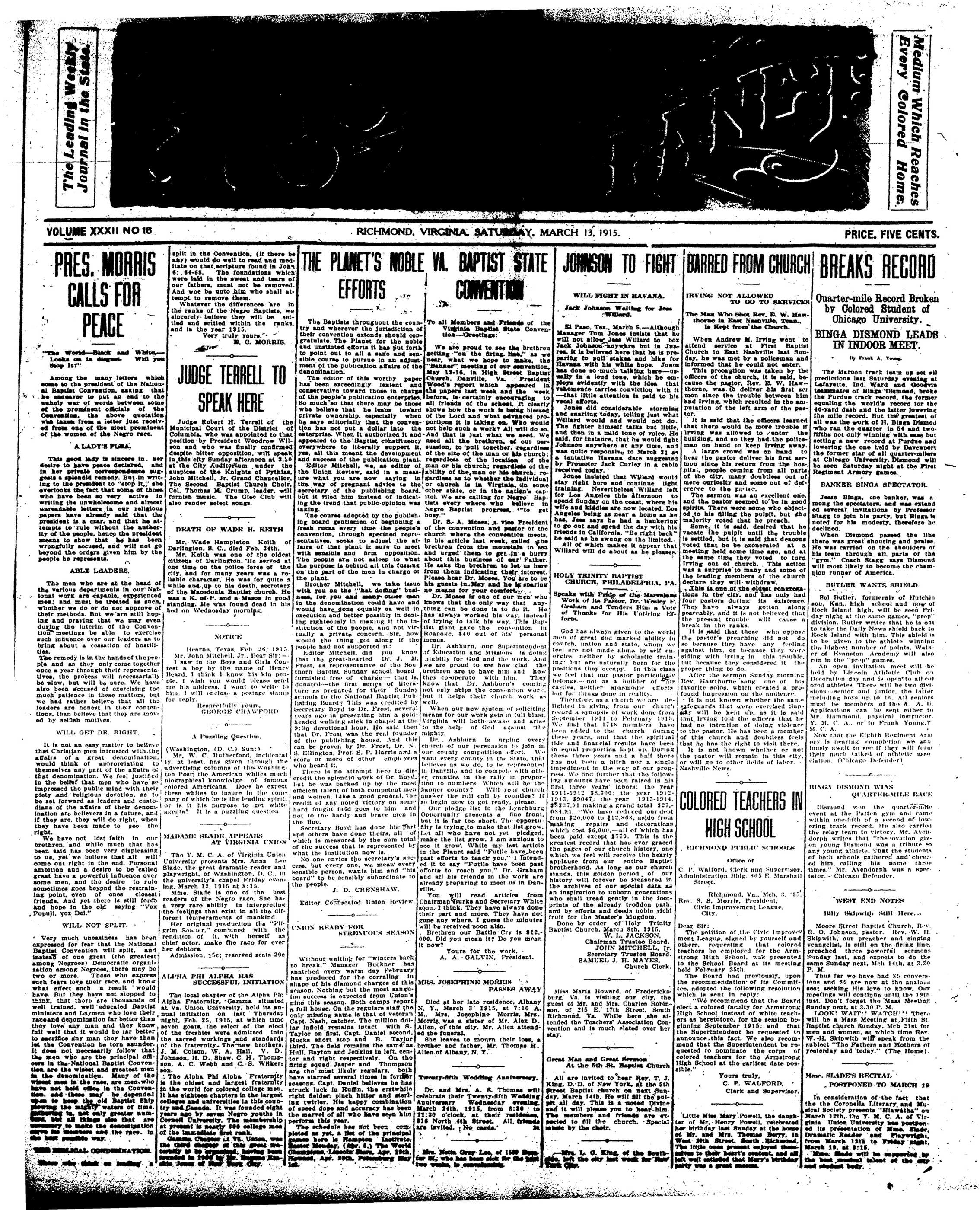
Page text (machine-generated)
The Leading Weekly Journal in the State.
Medium Which Reaches Every Colored Home.
VOLUME XXXII NO 16
RICHMOND, VIRGINIA, SATURDAY, MARCH 13, 1915.
PRICE. FIVE CENTS.
PRES. MORRIS CALLS FOR PEACE
"The World-Black and White—
Looks on in disgust. Will you
Stop It?"
Among the many letters which
come to the president of the Nati-
onal Baptist Convention, asking that
he encounter to put an end to the
usually war of words between some
of the prominent officials of the
Convention, the above quotation
was taken from a letter just receiv-
ed from one of the most prominent
of the women of the Negro race.
A LADY'S PLAZA
This good lady is sincere in her desire to have peace declared, and in her private correspondence suggests a splendid remedy. But in writing to the president to "stop it," she overlooks the fact that some of those who have been so very active in writing the unwholesome and almost unreadable letters in our religious papers have already said that the president is a clear, and that he attempts to rule without the authority of the people, hence the president means to show that he has been wrongfully accused, and will not go beyond the orders given him by the people he represents.
ABLE LEADERS
The men who are at the head of the various departments in our National work are capable, experienced men; and must be treated as such, whether we do or do not approve of their methods. But we are still hoping and praying that we may even during the interim of the Convention meetings be able to exercise such influence over our leaders as to bring about a cessation of hostilities. The remedy is in the hands of the people and as they only come together once a year through their representatives, the process will necessarily be slow, but will be sure. We have also been accused of exercising too much patience in these matters, but we had rather believe that all the leaders are honest in their contentions, than believe that they are moved by selfish motives.
WILL GET DR. RIGHT.
It is not an easy matter to believe that Christian men intrusted with the affairs of a great denomination, would think of appropriating to themselves any part of the affairs of that denomination. We feel justified in the belief that men who have so impressed the public mind with their piety and religious devotion, as to be set forward as leaders and custodians of the affairs of their denomination are believers in a future, and if they are, they will do right, when they have been made to see the right.
We have not lost faith in our brethren, and while much that has been said has been very displeasing to us, yet we believe that all will come out right in the end. Personal ambition and a desire to be called great have a powerful influence over some men, and the desire to rule sometimes goes beyond the restraining point, even of ones closest friends. And yet there is still force and hope in the old saying "Vox Populi, vox Del."
WILL NOT SPLIT.
Very much unassainess has been expressed for fear that the National Baptist Convention will split, and instead of one great (the greatest among Negroes) Democratic organization among Negroes, there may be two or more. Those who express such fears love their race, and know what effect such a result would have. But they have not stopped to think, that ther are thousands of well trained, well educated Baptist ministers and Laymen who love their race and denomination far better than they love any man and they know full well that it would be far better to sacrifice any man they have than let the Convention be torn aound. It does not necessarily follow that the men who are the principal officers in the National Baptist Convention are the wisest and greatest men in the denomination. Many of the wisest men in the race, are men who have not held office in the Convention, and these may be depended upon to keep the old Baptist Ship plowing the mighty waters of time, gathering in, not only greater numbers, but all things else that are necessary, to make the denomination serve its members and the race, in the best possible way.
split in the Convention, (if there be any) would do well to read and meditate on that, scripture found in John 6: 54-55. The foundations which were laid in the sweet and tears of our fathers, must not be removed. And bee be unto him who shall attempt to remove them. Whatever the differences are in the ranks of the Negro Baptists, we sincerely believe they will be settled and settled within the ranks, and is the year 1915. Very truly yours. E. C. MORRIS.
JUDGE TERRELL TO SPEAK HERE
Judge Robert H. Terrell of the Municipal Court of the District of Columbia, who was appointed to that position by President Woodrow Wilson and who was finally confirmed despite bitter opposition, will speak in this city Sunday afternoon at 3:50 at the City Auditorium under the auspices of the Knights of Pythias, John Mitchell, Jr. Grand Chancellor, The Second Baptist Church Choir, Col. Thomas M. Crump, leader, will furnish music. The Glo Club will also render select songs.
DEATH OF WADE H. KEITH
Mr. Wade Hampton Keith o
Derlington 8. Cledd. Feb. 24th
Darlington, N. C., died Feb. 24th.
Mr. Keith was one of the oldest citizens of Darlington. He served at one time on the police force of the city, and for many years was a reliable character. He was for quite a while and, up to his death, secretary of the Macedonia Baptist church. He was a K. of P. and a Mason in good standing. He was found dead in his bed on Wednesday morning.
NOTICE
Hearne, Texas, Feb. 26, 1915.
Mr. John Mitchell, Jr., Dear Sir:
I saw in the Boys and Girls Contest a boy by the name of Henry Beard. I think I know his kln people. I wish you would please send me his address. I want to write to him. I will enclose a postage stamp for reply.
A Puzzling Question.
(Washington, (D. C.) Sun:)
Mr. W. C. Rutherford, incidentally, at least, has given through the advertising columns of the Washington Post; the American whites much biographical knowledge of famous colored Americans. Does he expect these whites to insure in the company of which he is the leading spirit, or is it his purpose to get white agents? It is a puzzling question.
MADAME SLADE, APPEARS
AT VIRGINIA UNION
The Y. M. C. A. of Virginia Union University presents Mrs. Anna Lee Slade, the great dramatic reader and playwright, of Washington, D. C., in the university's chapel Friday evening, March 12, 1915 at 8:15.
Mme. Slade is one of the best readers of the Negro race. She has a very rare ability in interpreting the feelings that exist in all the different temperaments of mankind.
Her original production the "Pilgrim Sorcerer" combined with the rendition of it, with herself as chief actor, make the race for ever her debtors.
Admission, 15c; reserved seats 20c
ALPHA PHI ALPHA HAS
SUCCESSFUL INITIATION
The local chapter of the Alpha Phi Alpha Fraternity, Gamma situated at Va. Union University, hold its annual initiation on last Thursday night, Feb. 25, 1915, at which time seven goats, the select of the elect of the freshies were admitted into the sacred workings and standards of the fraternity-The new brothers, J. M. Colson, W. A. Hall, V. D. Johnson, H. D. Shaw, C. H. Thompson, A. C. Webb and C. S. Wmkerson.
The Alpha Phi Alpha Fraternity is the oldest and largest fraternity in the world for colored college men. It has eighteen chapters in the largest colleges and universities in this country and Canada. It was founded eight years ago by seven Negro youths in Cornell University. The membership at present is nearly 640 college men of the immediate first rank.
Gamma Chapter at Vt. Union, was the third chapter of this great fraternity to be organized, having been founded in 1909 by Mr. Benjamin Klee- shie Jones of New York City.
RICHMOND, VIRGINIA, SATURDAY, MARCH 13, 1915.
The Baptists throughout the country and wherever the juridiction of their convention extends should congratulate. The Planet for the noble and unstinted efforts it has put forth to point out to all a safe and sensible course to pursue in an adjustment of the publication affairs of the denomination.
The editor of this worthy paper has been exceedingly lenient and conservative toward those in charges of the people's publication enterprises. So much so that there may be those who believe that he leans toward private ownership, especially when he says editorially that the convention has not put a dollar into the enterprise. When it authorized it and appealed to the Baptist constituency everywhere to liberally support it, yes, all this meant the development and success of the publication plant.
Editor Mitchell, we, as editor of the Union Review, said in a measure what you are now saying in the way of pregnant advice to the secretary of the publishing board, but it riled him instead of indicating the trend that public-opinion was taking.
The course adopted by the publishing board gentlemen of beginning a fresh rucas every time the people's convention, through specified representatives, seeks to adjust the affairs of that plant is sure to meet with sensible and firm opposition. The people are not aloose to what the purpose is behind all this fussing on the part of the men in charge or the plant.
Brother Mitchell, we take issue with you on the "that doing" business, for you and many other men in the denomination could have and would have done equally as well in execution and better possibly in dealing rightously in making it the institution of the people, and not virtually a private concern. Sir, how would the thing go along if the people had not supported it?
Editor Mitchell, did you know that the great-hearted Dr. J. M. Frost, as representative of the Southern Baptist Sunday school board furnished free of charge—that is, donated—the first series of literature as prepared for their Sunday schools to the National Baptist Publishing Board? This was credited by secretary Boyd to Dr. Frost, several years ago in presenting him a gold-headed walking stick in chapel at the 9:30 devotional hour. He said then that Dr. Frost was the real founder of the publishing house. And this can be proven by Dr. Frost, Dr. N. S. Ellington, Prof. S. P. Harris and a score or more of other employees who heard it.
There is no attempt here to discredit the splendid work of Dr. Boyd, but he was backed up by the most efficient talent of both competent men and women, take a good general, the credit of any noted victory on some hard fought field goes to him and not to the hardy and brave men in the line.
Secretary Boyd has done his part and others have done theirs, all of which is measured by the sum total of the success that is represented by what the institution now is.
No one envies the secretary's success, but every one, we mean every sensible person, wants him and "his board" to be sensibly subordinate to the people.
J. D. CRENSHAW.
Editor Confiscated Union Review
Without waiting for "winter back to break," Manager Buckner has anatched every warm day February has produced for the corraling in shape of his diamond charges of this season. Nothing but the mostanguinous success is expected from Union's nine this season. Both camps report a full house. On the regular staff the only missing name is that of veteran Capt. Nash, catcher. The million dollar infield remains intact with S. Taylor on first, Capt. Daniel second, Hucks short stop and B. Taylor third. The field remains the same as Hull, Bayton and Jenkins in left, center and right respectively. On the firing squad Jasper and Thompson are the most likely regulars, both have starred several times in forlier seasons. Capt. Daniel believes he has struck luck in Ruffin, the erstwhile right fielder, plush hitter and sterling twirler. His happy combination of speed dope and accuracy has been the marvel of all who have seen him perform this year.
The schedule has not been completed as yet, a list of the principal games here in Hampton Institute: Easter Monday, (Apr. 6.) The World Champions, Lincoln State, Apr. 19th, Newman, Apr. 20th, Petersburg May
To all Members and Friends of the Virginia Baptist State Convention—Greetings:
We are proud to see the brethren getting "on the firing line," as we near, what we hope to make, the "Banner" meeting of our convention, May 12-16, in High Street Baptist Church, Danville, Va. President Wood's report which appeared in the papers last week and the week before, in certainly encouraging to all friends of the school. It clearly shows how the work is being blessed of the Lord and what advanced proportions it is taking on. Who would not help such a work? All will do so. And that is just what we need. We need all the brethren, regardless of the size of the man or his church; regardless of the location of the man or his church; regardless of the ability of the man or his church; regardless as to whether the individual or church is in Virginia, in some other state, or in the nation's capitol. We are calling for Negro Baptists everywhere who believe in Negro Baptist progress, "to got busy."
Dr. S. A. Moses; a vice President of the convention and pastor of the church where the convention meets, in his article last week, called the brethren from the mountain to be and urged them to get in a hurry about this business of our Father. He asks the brethren to let us here from them indicating their interest. Please hear Dr. Moses. You are to be his guests in May, and he is sparing no means for your comfort.
Dr. Moses is one of our men who knows that the only way that anything can be done is to do it. He has always worked his way, instead of trying to talk his way. This Baptist giant gave the convention in koanoke, $40 out of his personal means.
Dr. Ashburn, our Superintendent of Education and Missions is doing mightily for God and the work. And we are proud to see how glad the brethren are to have him and how they co-operate with him. They know that Dr. Ashburn's coming not only helps the convention work, but it helps their church work as well.
When our new system of soliciting means for our work gets in full blast, Virginia will both awake and arise to the help of God against the mighty.
Dr. Ashburn is urging every church of our persuasion to join in our county competition effort. We want every county in the State, that believes as we do, to be represented in Danville and to compete with other counties in the rally in proportion to numbers. Which will be the banner county? Will your church answer the roll call by counties? If so begin now to get ready, please.
Our pledge list in the Lynchburg Opportunity presents a fine front, but it is far too short. The opportunity is trying to make that list grow. Let all who have not yet pledged, make the list grow. I am anxious to see it grow. While my last article in the Planet said "Futile have been past efforts to teach you." I intended it to say "Futile have been past efforts to reach you." Dr. Graham and all his friends in the work are already preparing to meet us in Danville.
You will read articles from Chairman Turks and Secretary White soon. I think. They have always done their part and more. They have not gone any where. I guess the minutes will be received soon also.
Brethren our Battle Cry is $12,000. Did you mean it? Do you mean it now?
Died at her late residence, Albany
N. Y., March 3' 1915, at 7:10 A.
M., Mrs. Josephino Morris, Mrs.
Morris, was a sister of Mr. Alex D.
Allen, of this city, Mr. Allen attended
the funeral.
She leaves to mourn their loss, a
brother and father, Mr. Thomas H.
Allen of Albany, N. Y.
Twenty-fifth Wedding Anniversary.
Dr. and Mrs. A. S. Thomas will
celebrate their Twenty- fifth Wedding
Anniversary Wednesday evening.
March 24th, 1915, from 8:30 to
11:30 o'clock, at their residence,
818 North 4th Street. All friends
are invited. No cards. 28
Mrs. Netta Gray Lea, of 1598 Bremen
st. who has been sick for the past
two weeks, is convalescent.
C. P. Walford, Clerk and Supervisor,
Administration Bldg. 805 E. Marshall
Street.
Richmond, Va., Meh. 3, "L.
Rev. S. S. Morris, President,
Civic Improvement League,
City.
Dear Sir:
The petition of the Civic Improvement League, signed by yourself and others, requesting that colored teachers be employed for the Armstrong High School, was presented to the School Board at its meeting held February 26th.
The Board had previously, upon the recommendation of its Committee, adopted the following resolution which is sent in reply:
"We recommend that the Board elect a colored faculty for Armstrong High School instead of white teachers as heretofore, for the session beginning September 1915; and that the Superintendent be requested to announce, this fact. We also recommend that the Superintendent be requested to nominate the corps of colored teachers for the Armstrong High School at the earliest date possible."
Little Miss Mary Powell, the daughter of Mr. Henry Powell, celebrated her birthday last Sunday at the house of Mr. and Mrs. Thomas Berry, in West 90th Street, South Richmond. The little ones present enjoyed themselves to their heart's content, and all well satisfied that Mary's birthday party was a great success.
JOHNSON TO FIGHT
WILL FIGHT IN HAVANA.
Jack Johnson Waiting for Jesus Willard.
El Paso, Tex. March 5.—Although Manager Tom Jones insists that he will not allow Jess Willard to box Jack Johnson anywhere but in Juarez, it is believed here that he is preparing to pull stakes and hike for Havana with his white hope. Jones has done so much talking here—usually in a loud tone, which he employs evidently with the idea that vehemence carries conviction with it—that little attention is paid to his vocal efforts.
Jones did considerable storming and snarling today, telling just what Willard would and would not do. The fighter himself talks but little, and then in a mild tone of voice. He said, for instance, that he would fight Johnson anywhere at any time, and was quite responsive, to March 31 as a tentative Havana date suggested by Promoter Jack Curley in a cable received today.
Jones insisted that Willard would stay right here and continue light training. Nevertheless Willard left for Los Angeles this afternoon to spend Sunday on the coast, where his wife and kiddies are now located. Los Angeles being as near a home as he has, Jess says he had a hankering to go out and spend the day with his friends in California. "Be right back" he said as he awoke on the limited
All of which makes it appear that Willard will do about as he pleases.
HOLY TRINITY BAPTIST
CHURCH, PHILADELPHIA, PA.
Speaks with Pride of the Marvellous Work of its Pallor, Dr. Wesley F. Graham and Tenders Him a Vote of Thanks for His Untiring Efforts.
God has always given to the world men of great and marked ability in church, nation and state, whom we feel are not made alone by self energies, neither by scholastic training: but are naturally born for the positions they occupy. In this class we feel that our pastor particularly belongs... not as a builder of our castles, neither spasmodic efforts, but for things done in reality.
Therefore, as a church we are delighted in giving from our church record a synopsis of work done from September 1911 to February 1915. We find that 1748 members have been added to the church during these years, and that the spiritual tide and financial results have been in equal proportion kept up. During these three years and a half there has not been a hitch nor a single impediment in the way of our progress. We find further that the following amounts have been raised in his first three years' laborers: the year 1911-1912 $8,700; the year 1912-1913. $9047; the year 1913-1914. $537.91 making a grand total $27.048.31. We have reduced our debt from $20,000 to $12,868, aside from making repairs and decorations which cost $6,000—all of which has been paid except $779. This is the greatest record that has ever graced the pages of our church history, one which we feel will receive the hearty applause from our entire Baptist brotherhood. As long as our church stands, this golden period, of our history will forever be treasured in the archives of our special data as an inspiration to unborn generations who shall tread gently in the footprints of the already trodden path, and by efforts and deeds noble yield fruit for the Master's kingdom.
Done by order of Holy Trinity
Baptist Church, Marca 8th, 1915.
W. L. JACKSON.
Chairman Trustee Board.
JOHN MITCHELL, Jr.
Secretary Trustee Board.
SAMUEL J. H. MAYES.
Church Clerk.
Miss Maria Howard, of Frederickburg, Va. is visiting our city, the guest of Mr. and Mrs. Charles Robinson, of 215 E. 17th Street, South Richmond, Va. While here she attended the Teachers' Association Convention and is much elated over her stay.
Great Man and Great Sermon
All are invited to hear Roy. T. J. King. D. D. of New York, at the 5th Street Baptist church on next Sunday, March 14th. He will fill the pulpit all day. This is a noted Divine and it will please you to hear him. The members and friends are expected to fill the church. Special music by the choir.
BARRED FROM CHURCH
IRVING NOT ALLOWED
TO GO TO SERVICES
The Man Who Shot Rev. E. W. Hawthorne in East Nashville, Tenn., Is Kept from the Church.
When Andrew M. Irving went to attend service at First Baptist Church in East Nashville last Sunday, he was met by a policeman and informed that he could not enter.
This prosecution was taken by the officers of the church, it is said, because the pastor, Rev. E. W. Hawthorne, was to deliver his first serion since the trouble between him and Irving, which resulted in the amputation of the left arm of the pastor.
It is said that the officers learned that there would be more trouble if Irving was allowed to enter the building, and so they had the policeman on hand to keep Irving away.
A large crowd was on hand to hear the pastor deliver his first serion since his return from the hospital, people coming from all parts of the city, many doubtless out of mere curiosity and some out of defence to the pastor.
The sermon was an excellent one, and the pastor seemed to be in good spirits. There were some who objected to his filling the pulpit, but the majority voted that he preach.
Some, it is said, desired that he vacate the pulpit until the trouble is settled, but it is said that deacons voted that he be exonerated at a meeting hold some time ago, and at the same time they voted to turn Irving out of church. This action was a surprise to many and some of the leading members of the church declare they will withdraw. This is one of the oldest congregations in the city, and has only had four pastors during its existence. They have always gotten along peaceably, and it is not believed that the present trouble will cause a break in the ranks.
It is said that those who oppose the pastor's preaching did not do so because they have any feeling against him, or because they were siding with Irving in this trouble, but because they considered it the proper thing to do.
After the sermon Sunday morning Rev. Hawthorne sang one of his favorite solos, which created a profound impression on the audience. It is not known whether the same safeguards that were exercised Sunday will be kept up, as it is said that Irving told the officers that he had no intention of doing violence to the pastor. He has been a member of this church and doubtless feels that he has the right to visit there.
It is not known whether or not the pastor will remain in this city, or will go to other fields of labor. Nashville News.
COLORED TEACHERS IN HIGH SCHOOL
RICHMOND PUBLIC SCHOOLS Office of
PRICE, FIVE CENTS.
BREAKS RECORD
Quarter-mile Record Broken by Colored Student of Chicago University.
BINGA DISMOND LEADS IN INDOOR MEET.
Hy Frank A. Young.
The Maroon track team up set all predictions last Saturday evening at Lafayette, Ind. Ward and Goodwin teammates of Binga 'Dismond, broke the Purdue track record, the former equaling the world's record for the 40-yard dash and the latter lowering the mile record. But the greatest of all was the work of H. Binga Dismond who ran the quarter in 54 and two-fifths not only winning with ease but setting a new record at Purdue and lowering the one held by Davenport the former star of all quarter-milers at Chicago University. Dismond will be seen Saturday night at the First Regiment Armory games.
BANKER BINGA SPECTATOR
Jesse Binga, one banker, was among the spectators, and was extend ed several invitations by Professor Stagg to join his party, but Binga is noted for his modesty, therefore he declined. When Dismond passed the line there was great shouting and praise. He was carried on the shoulders of his team through all, parts of the "gym." Coach Stagg says Dismond will most likely to become the champion runner of America.
BUTLER WANTS SHIELD
Bol Butler, formerly of Hutchin son, Kan, high school and now of Rock Island high, will be seen Friday night at the same games, "prop" division. Butler writes that he is out to take the Daily News shield back to Rock Island with him. This shield is to be given to the athlete winning the highest number of points. Walker of Evanston Academy will also run in the "prop" games.
An open invitation meet will be held by Lincoln Athletic Club on Decoration day and is open to all coed athletes. There will be two divisions—senior and junior, the latter including boys up to 16. All seniors must be members of the A. A. U. Applications can be sent either to Mr. Hammond, physical instructor, Y. M. C. A., or to Frank Young, Y. M. C. A.
Now that the Eighth Regiment Armory is nearing completion we anxiously await to see if they will form their much talked of athletic association (Chicago Defender).
---
BINGA DISMOND WINS
QUARTER-MILE RACE
Dismond won the quarter-final event at the Patten gym and came within one-fifth of a second of lowering track record. He also carried the relay team to victory. Mr. Avendorph writes that "the ovation given young Dismond was a tribute to any young athlete. That the students of both schools gathered and cheered him, calling his name three times." Mr. Avendorph was a spectator. Chicago Defender.
WEST END NOTES
Billy Skipwith Still Here...
Moore Street Baptist Church, Rev. R. O. Johnson, pastor, Rev. W. H. Skipwith, our preacher and singing evangelist, is still on the dring line, preached three powerful sermons Sunday last, and expects to do the same Sunday next, Mch 14th, at 3.30 P. M.
Thus far we have had 85 conversions and 36 are now at the anxious seat seeking His love to know. Our meetings will continue until the 19th last. Don't forget the Mass Meeting Sunday next, at 3.30 P. M.
LOOK! WAIT! WATCH!!! There will be a Mass Meeting at, Fifth St. Baptist church Sunday, Mch 21st for men and women, at which time Rev. W.-H. Skipwith will speak from the subject "The Fathers and Mothers of yesterday and today." (The Home).
Mmc. SLADE'S RECTAL
In consideration of the fact that the the Coronella Literary and Musical Society presents "Hiawatha" on March 12th, the Y. M. C. A. of Virginia Union University has postponed its presentation of Mme. Slade, Dramatic Reader and Playwright, from March 12th to Friday night, March 19, at 8:15.
Mme. Slade will be supported by the best musical talent of the city and student body.
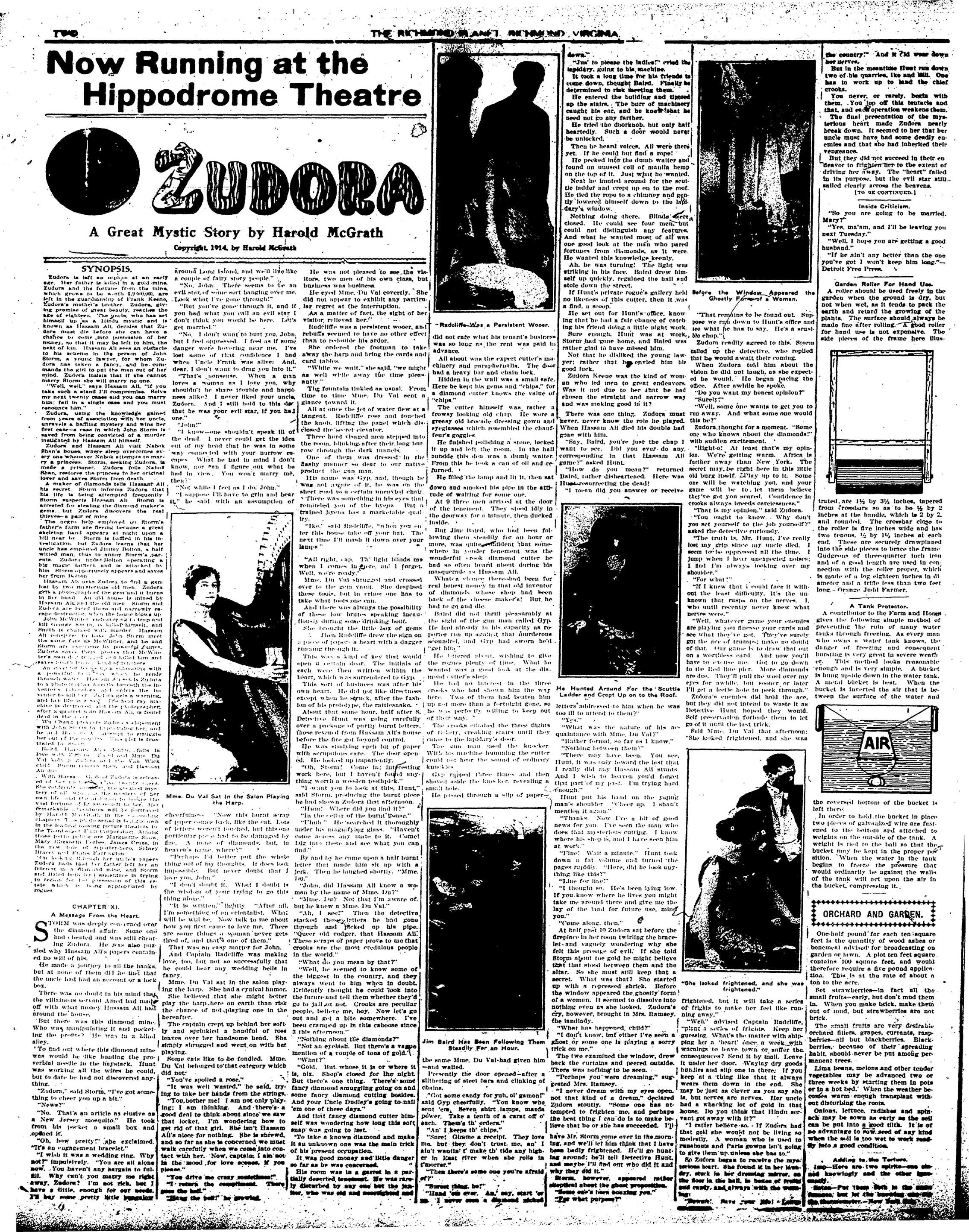
Now Running at the Hippodrome Theatre
SYNOPSIS
Zudora is left an orphan at an early age. Her father is killed in a gold-mine. Zudora and the fortune from the mines which grows to be worth $10,000,000, are left in the guardship of Frank Keenan. Zudora's mother's brother, Zudora, giving promise of great beauty, reaches the mines and himself up in a lilim mystic and is known as Hassam All, decides that Zudora must die before she can have a chance to come into possession of her money, so that it may be left to him, the next of kin. Hassam All has an obstacle to his scheme in the person of John Storm, a young lawyer, for whom Zudora has taken a fancy, and he commends himself to the man of her mind. Zudora insists that the man cannot marry Storm she will marry no one.
"Well, well," says Hassam All, "If you take such a stand I compromise. Solve my next twenty cases and you can marry him; fail in a single case and you must renounce him."
Zudora, using the knowledge gained from years of association with her uncle, unravels a baffling mystery and wins her heart. Zudora saves from being convicted of a murder instigated by Hassam All himself.
Zudora and Hassam All visit Nabok Bhan's house, where sleep everly every one whenever Nabok attempts to marry a princess. Storm, seeking Zudora, is a prisoner. Zudora tells Nabok Bhan, restoring the princess's original lover and saves Storm from death.
A maker of diamonds tells Hassam All his secret. Storm informs Zudora that his life is being attempted frequently. Storm suspects Hassam All Storm is arrested for stealing the diamond maker's gems, but Zudora discovers the real diamond. The negro help employed on Storm's father's farm are fleeing because a great skeleton hand appears at night upon a bill near by. Storm is baffled in his investigation, but Zudora learns that her uncle has employed Jimmy Bolton, a half witted man, thus to annoy Storm's parents. Zudora finds Bolton operating a machine and is attacked by him. Storm apparently appears and saves her from Bolton.
Hassam Al asks Zudora to find a gem
gift by two mysterious old men. Zudora
gets a photograph of the gem and it burns
in her hand. An old house is miled by
Hassam Alk and the old men. Storm and
Zudora are buried there and narrowly escaped
by a fire. A boy blows a stone into John
McWinter's ear, who is killed Russell, and
Smith is charred with moulder. Hassam
All congratulates to have John Storm meet
the same fate as McWinter, and he and
Storm are overcome by powerful gunmen.
Zudora saves them, proves that McWinter's
two friends are trapped and killed him and
saves them from the land of tanners.
Alk is in a moulder with a powerful
through water. Hassam Alk is Zudora to
a photographic detail beneath the inventor's laboratory and orders the inventor to kill her. Zudora gets a warning,
and her life is saved. The heat ray machine is destroyed and the photographer, after a quarrel with Hassam Alk, is found dead in the water.
Wyeth Obama provides Zudora a shipment
with the firearms he has prepared for her, and
he and Hassam Alk attempt to enough
her out of the house. This plot is fras-
rated by Storm.
Haird, Harriet Alex Schouten, falls in love with Zelina Fiorina and Mme Du Valalope Zelina and the Van Wick child. Born presumed, she was presumed, and Jason Alford. With Harriet, Michael Zelina is presented by her father, Zelina Fiorina. She confesses, the greatest mystery of all who is the master of her own life, and the addition to secure the vast fortune of the fortune left to her. Her remarkable adventures will be portrayed by Harald Nielsenhoff. In the accompanying book, the poetic serial is based shown in the beautiful picture theaters by the Thoughtful House. Those portraits are Margaret Shaw Mary Elizabeth Farches, James Cruise, in the raw tone of reporter-shero, Solney Brae and Frances Patterson. On looking through her uncle's papers Zelina mobs that her father left her an interest in a charitable cause, and Storm and her brother assist in trying to retain her possession of this estate which is being appropriated by rogues.
CHAPTER XI
A Message From the Heart.
STORM was deeply concerned over the diamond affair. Some one had cheated and was still cheating Zandora. He was also puzzled why Hassan All's papers contained no will of his.
He made a journey to all the banks, but at none of them did he find that the uncle had had an account or a lock box.
There was no doubt in his mind that the villain servant Amed had made off with what money Hassan All had around the house.
But there was this diamond mine. Who was manipulating it and pocketing the profits? He was in a billed alley.
"To find out where this diamond mine was would be like hunting the proverbial needle in the bigattack. Hunt was working all the wires he could, but to date he had not discovered anything."
"Zudorn," said Storm, "I've got something to cheer you up a bit."
"News?"
"No. That's an article as elusive as a New Jersey mosquito." He took from his pocket a small box and opened K.
"Oh, how pretty?" she exclaimed.
"It's an engagement bracelet."
"I wish it was a wedding ring. Why not?" impassionately. "You are all alone now. You haven't any bargain to fulfill. Why can't you marry me right away. Zudorn? I'm not rich, but I have a little, enough for our needs. I'll buy some pretty little hummingbirds."
around Long Island, and we'll live like a couple of fairy story people."
"No, John. There seems to be an evil star, of some sort hanging over me. Look what I've gone through."
"But you've gone through it, and if you had what you call an evil star I don't think you would be here. Let's get married."
"No, I don't want to hurt you, John, but I feel oppressed. I feel as if some danger were hovering near me. I've lost some of that confidence I had when Uncle Frank was alive; And, dear, I don't want to drag you into it."
"That's nonsense. When a giant loves a woman as I love you, why shouldn't he share trouble and harpiness alike? I never liked your uncle, Zudorn. And I still hold to this day that he was your evil star, if you had one."
"I know—one shouldn't speak ill of the dead. I never could get the idea out of my head that he was in some way connected with your narrow escapes. What he had in mind I don't know, nor can I figure out what he had in view. You won't marry me, then."
"Not while I feel as I do, John."
"I suppose I'll have to grin and bear it" he said with an assumption of
W
Mme. Du Val Sat in the Salon Playing
the Harp.
cheerfulness. "Now this burnt scrap
of paper comes back, like the cat. Lots
of letters weren't touched, but this one
particular piece had to be damaged by
fire. A mine of diamonds, but, in
heaven's name, where?"
"Perhaps I'd better put the whole
thing out of my thoughts. It does look
impossible. But never doubt that I
love you, John."
"I don't doubt it. What I doubt is
the wisdom of your trying to go this
thing alone."
"It is written," lightly. "After all,
I'm something of an oratoralist. What
will be will be. Now talk to me about
how you first came to love me. There
are some things a woman never gets
tired of, and that's one of them."
That was an easy matter for John. And Captain Radcliffe was making love, too, but not so successfully that he could hear any wedding bells in fancy.
Mme. Du Val sat in the salon playing the harp. She had a cynical humor. She believed that she might better play the harp, here on earth than risk the chance of not playing one in the hereafter.
The captain crept up behind her softly and sprinkled a handful of rose leaves over her handsome head. She simply shrugged and went on with her playing.
Some cats like to be fondled. Mme. Du Val belonged to that category which did not
"You've spoiled a rose."
"It was well wasted," he said, trying to take her hands from the strings. "You, bother me! I am not only playing; I am thinking. And there's a good deal to think about since we saw that locket. I'm wondering how to get rid of that girl. She isn't Hassan Ali's niece for nothing. She is shrewd, and so far as she is concerned we must walk carefully when we come into contact with her. Now, captain; I am not in the mood for love access, if you please."
"You drive me crazy sometimes!"
"I return the compartment. There goes the hell."
"Hang the bell!" he growled.
THE RICHMOND MANFT. RICHMOND, VIRGINIA
He was not pleased to see the visitors, two men of his own class, but business was business.
As a matter of fact, the sight of her visitor, relieved her.
Rindliffe was a persistent wooer, and rebuffs seemed to have no other effect than to rebel his ardor.
She ordered the footman to take away the harp and bring the cards and card tables.
"While we wait," she said, "we might as well while away the time pleasantly."
The garden tinkled as usual. From time to time Mine, Du Val sent a glance toward it.
All at once the jet of water drew at a tangent. Rindliffe rose and touched the knob, lifting the panel which disclosed the secret elevator.
Three hard vexed men stepped into the room, blinking after their long burrow through the dark tunnels.
One of them was dressed in the shaky manner so dear to our native product the sun man.
His name was Slyp, and, though he was not aware of it, he was on the short road to a certain unsettled chap.
"Ikey," said Radcliffe, "when you enter this house take off your hat. The next time I'll mash it down over your lamps."
"All right, cap. The light blinds me when I comes in here, and I forget. Well, we're ready."
Mine. Du Val bruggest and crossed over to the gem vault. She desplaced these tools, but in crime one has to take what tools one can.
And there was always the possibility of those low brutes speaking incautiously during some drinking bout.
She brought the little box of gems.
Then Radcliffe drew the sign on a piece of paper a heart with a dagger running through it.
This was a kind of key that would open a certain door. The initials of each were then written within the heart, which was surrendered to Gyp.
This sort of business was after his own heart. He did not like directness except when he struck, after the fashion of his prototype, the rattlesnake. About that same hour, half after 8. Detective Hunt was going carefully over a package of partly burnt letters, those rescued from Hassam Alt's house before the fire got beyond control. He was studying each bit of paper with serpulous care. The door opened. He looked up impatiently. "Oh, Storm! Come in! interesting work here, but I haven't found anything worth a wooden toothpick." "I want you to look at this," Hunt said. Storm, producing the burnt piece he had shown Zudora that afternoon. "How will that work?"
In the rear of the mansion house.
"Thuh!" He searched It thoroughly under his magnifying glass. "Haven't come across any mate to it. Come! Dig into these and see what you can find."
By and by he come upon a half burnt letter that made him sit up with a jerk. Then he laughed shortly. "Mme. Du."
"John, did Hassam All know a woman by the name of Mme. Du?"
"Mme. Du? Not that I'm aware of, but he knew a Mme. Du Val."
"Ah, I see!" Then the detective, stacked those letters he had gone through and hacked up his pipe. "Queer old codger, that Hassam All. These scraps of paper prove to me that crooks are the most credulous people in the world."
"What do you mean by that?"
"Well, he seemed to know some of the biggest in the country, and they always went to him when in doubt. Evidently thought he could look into the future and tell them whether they'd go to fall or not. Crooks are peculiar people, believe me, boy. Now let's go out and get a bite somewhere. I've been cramped up in this caboose since 3 this afternoon."
"Nothing about the diamonds?"
"Not an ephish. But there's a vague mention of a couple of tons of gold."
"What?"
"Gold. But whose it is or where it is, nix. Shop's closed for the night. But there's one thing. There's some fancy diamond smuggling going on and some fancy diamond cutting bores. And your Uncle Dudley's going to nail 'em one of these days."
And that fancy diamond cutter himself was wondering how long this soft snap was going to last.
To take a known diamond and make it an unknown one was the main trick of his present occupation.
It was good money and little danger so far as he was concerned.
His room was in a carrot in a partially deserted tenement. He was rarely disturbed by any one but the junior, who was old and misnagged and
A
Rudcliffe Was a Persistent Wooper.
did not care what his tenant's business was no long as the rent was paid in advance.
All about was the expert cutter's machinery and paraphernalia. The door had a heavy bar and chain lock.
Hidden in the wall was a small safe.
Here he kept his gems and "chips," for a diamond cutter knows the value of "chips."
The cutter himself was rather a frowny looking old chap. He wore a groany old brocade dressing gown and eyeglasses which resembled the chauffeur's goggles.
He finished polishing a stone, locked it up and left the room. In the hall outside this den was a dumbbell waist.
From this he took a can of oil and returned.
He filled the lamp and lit it, then sat down and smoked his pipe in the attitude of waiting for some one.
At 9 three men arrived at the door of the tenement. They stood idly in the doorway for a minute, then ducked inside.
But Jim Baird, who had been following them steadily for an hour or more, was quite confident that somewhere in younger tenement was the wonderful rock diamond cutter he had so often heard about during his masquerade as Hussum All.
What a chance there had been for real honest money in that old inventor of diamonds whose shop had been back of the classie maker's! But he had to go and die.
Baited did not thrill pleasurably at the sight of the gun man called Gyp. He had already in his capacity as reporter run up against that thurderous sounded, and Gyp had sworn he'd "get him."
He uttered absent, wishing to give the regimes plenty of time. What he wanted was a good look at the diamond cutter's shop.
He had no interest in the three cracks who had shown him the way here. Two of them had beaten him up not more than a fortnight gone, so he was perfectly willing to keep out of their way.
The cracks dilated the three flights of tickery, cracking stairs until they came to the lapidary's door.
The gun man used the knocker. With his machine hamming the cutter could not hear the sound of ordinary knuckles.
Gip: ripped three times, and then
shoved aside the knuckle, revealing a
small hole.
He passed through a slip of paper.
1
Jim Baird Has Been Following Them
Steadily For an Hour.
Jim Baird Has Been Following Them Steadily For an Hour.
the same Mme. Du Val-had given him—and waited.
Presently the door opened—after a alluring of steel farn and clinking of chains.
"Got some candy for yuh, ol' gamon!' said Gyp cheerfully. "You know who sent 'em, Seven shirt, lamps, mazda power. Take a tenth of a carat off o' each. Them's th' orders."
"An' I keeps th' chips."
"Snee' Glame a receipt. They love me, but they don't trust me, an' I ain't wantin' t make th' tide any higher in East river when she rolls in t'morrer."
"Then there's some one you're afraid of"
"Borrow thing, be?"
"Hand 'em over. An, any, start or me. I never seen a diamond matched
"Jun' to please the ladies!" cried the lapidary, going to his machine.
It took a long time for his friends to come down, thought Baird. Finally he determined to risk meeting them.
He entered the building and tipped up the stairs. The burr of machinery caught his ear, and he knew what he need not go any farther.
He tried the doorknob, but only half hearted. Such a door would never be unlocked.
He peeked into the dumb waiter and found an unused coll of manila hemp on the top of it. Just what he wanted.
Next he hunted around for the nautile ladder and crept up on to the roof. He tied the rope to a chimney and gently lowered himself down to the laidary's window.
Nothing doing there. Blinds were closed. He could see four men, but could not distinguish any features. And what he wanted most of all was one good look at the man who pared fortunes from diamonds, as it were. He wanted this knowledge keenly.
Ah, he was turning! The light was striking in his face. Baird drew himself up quickly, regained the ball and stole down the street.
If Hunt's private rogue's gallery held no likeness of this cutter, then it was a find, a groove.
He set out for Hunt's office, knowing that he had a fair chance of catching his friend doing a little night work. Sure enough. Hunt was at work. Storm had gone home, and Baird was rather glad to have missed him. Not that he disliked the young lawyer; rather that he envied him his good luck. Zudora Keene was the kind of woman who led men to great endeavors. Was it not due to her that he had chosen the straight and narrow way and was making good in it? There was one thing. Zudora must never, never know the role he played. When Hassam All died his double had gone with him. "Say, Baird, you're just the chap I want to see. Did you ever do any, corresponding in that Hassam All game?" asked Hunt.
"How do you mean?" returned Bainl, rather disheartened. Here was Hustl, resurrecting the dead!
"I mean did you answer or receive
P
He Hunted Around For the Scuttle Ladder and Crept Up on to the Roof.
letters addressed to him when he was too ill to attend to them?
"Yes."
"What was the nature of his acquaintance with Mine, Du Valy?"
"Rather formal, so far as I know."
"Nothing between them?"
"There may have been. You see, Hunt, it was only toward the last that I really did any Hassam All stunts. And I wish to heaven you'd forget that part of my past. I'm trying hard enough."
Hunt put his hand on the young man's shoulder "Cheer up. I shan't mention it again."
"Thanks. Now I've a bit of good news for you. I've seen the man who does that mysterious cutting. I know where his shop is, and I have seen him at work."
"Fine! Wait a minute." Hunt took down a fat volume and turned the pages rapidly. "Here, did he look anything like this?" "Line for line."
"I thought so. He's been lying low. If you know where he lives you might take me around there and give me the lay of the land for future use, mind you."
"Come along, then."
At half past 10 Zudora sat before the fireplace in her room twirling the bracelet and vaguely wondering why she felt this presage of evil. If she told Storm about the gold he might believe that that stood between them and the altar. So she must still keep that a secret. What was that? She started up with a repressed shrick. Before the window appeared the ghostly form of a woman. It seemed to dissolve into nothing even as she looked. Zudora's cry, however, brought in Mrs. Ramsey, the landlady.
"What has happened, child?"
"I don't know, but either I've seen a ghost or some one is playing a sorry trick on me."
The two examined the window, drew back the curtains and peered outside. There was nothing to be seen.
"Perhaps you were dreaming," suggested Mrs. Ramsey.
"I never dream with my eyes open, not that kind of a dream," declared Zudora stoutly. "Some one has attempted to frighten me, and perhaps the best thing I can do is to make believe that he or she has succeeded. I'll have Mr. Storm come over in the morning, and we'll let him think that I have been badly frightened. He'll go hunting around; he'll tell Detective Hunt, and maybe I'll find out who did it and why they did it."
Storm, however, appeared rather shoddy about the ghost proposition. "Some one's been booing you." "For what purpose?"
THE LIGHT OF THE WORLD
Before the Window Appeared the Ghostly Form of a Woman.
"That remains to be found out. Suppose we rush down to Hunt's office and see what he has to say. He's a sensible chap."
Zudora readily agreed to this. Storm called up the detective, who replied that he would await their coming.
When Zudora told him about the vision he did not laugh, as she expected he would. He began pacing the office. After awhile he spoke.
"Do you want my honest opinion?"
"Surely!"
"Well, some one wants to get you to run away. And what some one would this be?"
Zudora thought for a moment. "Some one who knows about the diamonds!" with sudden excitement.
"Right to: At least that's my opinion. We're getting warm. Africa is farther away than New York. The secret may be right here in this little old burg itself. 2 Play up to it. Some one will be watching you, and your game will be to, let them believe they've got you scared. Confidence in crooks always breeds carelessness." "That is my opinion," said Zudorn. "You ought to know. Why don't you set yourself to the job yourself?" asked the detective curiously. "The truth is, Mr. Hunt. I've really lost my grip since my uncle died. I seem to be oppressed all the time. I jump when I hear unexpected noises. I find I'm always looking over my shoulder." "For what?"
"If I knew that I could face it without the least difficulty. It's the unknown that rushes on the nerves. I, who until recently never knew what nerves were."
"Well, whatever game your enemies are playing you finesse your cards and see what they're got. They've surely got the age of trumpets; make no doubt of that. Our game is to draw that out on a worthless card. And now you'll have to excuse me. Got to go down to the Red line pier. More diamonds are due. They'll pull the wool over my eyes for awhile, but sooner or later I'll get a bake hole to peck through."
Zulora's enemies did hold the ace, but they did not intend to waste it as Detective Hunt hoped they would. Self preservation forbade them to let go of it until the last trick.
Said Mine, Lou Val that afternoon:
"She looked frightened, and she was
THE
"She looked frightened, and she was frightened."
Frightened, but it will take a series of frights to make her feel like running away."
"Well," advised Captain Radeliffe, "plant a series of frights. Keep her guessing. What's the matter with shipping her a 'heart' once a week with warnings to leave town or suffer the consequences? Send it by mail. Leave it under her door. Waylay dry goods bundles and slip one in there; if you keep at a thing like that it always wears them down in the end. She may be just as clever as you say she is, but nerves are nerves. Her uncle had a whacking lot of gold in that house. Do you think that Hindu servant got away with it?"
"I rather believe so. If Zudora had that gold she would not be living so modestly. A woman who is used to runahouts and Parts gowns isn't going to give them up unless she has to." So Zudora began to receive the mysterious heart. She found it in her laundry, stock in her dressing mirror, on the floor in the hall, in boxes of truss and candy, and always with the wooing:
the country." And it did wear down her nerves.
But in the meantime Hunt run down two of his quarries, like and mill. One has to work up to land the chief crooks.
You never, or rarely, begin with them. You top off this tentacle and that, and each operation weakens them.
The final presentation of the mysterious heart made Zudora nearly break down. It seemed to her that her uncle must have had some deadly enemies and that she had inherited their venomance.
But they did not succeed in their endeavor to frighten her to the extent of driving her away. The "heart" failed in its purpose, but the evil star still sailed clearly across the heavens.
[TO BE CONTINUED.]
"So you are going to be married, Mary?"
"Yes, ma'am, and I'll be leaving you next Tuesday."
"Well. I hope you are getting a good husband."
"If he isn't any better than the one you've got I won't keep him long."—Detroit Free Press.
A roller should be used freely in the garden when the ground is dry, but not when wet, as it tends to pack the earth and retard the growing of the plants. The surface should always be made fine after rolling. A good roller for hand use is not expensive. The side pieces of the frame here illus-
```markdown
```
truted, are 1½ by 3½ inches, tapered from crossbars so as to be ½ by 2 inches at the handle, which is 2 by 2, and rounded. The crossbar cloak to the roller is five inches wide and has two tenons, ½ by 1½ inches at each end. These are securely drawplanned into the side pieces to brace the frame. Gudgous of three-quarter inch iron and of a good length are used in connection with the roller proper, which is made of a log eighteen inches in diameter and a trifle less than two feet long. Orange Judd Farmer.
A Tank Protector.
A contributor to the Farm and Horses gives the following simple method of preventing the rule of many water tanks through freezing. As every man who owns a water tank knows, the danger of freezing and consequent bursting is very great in severe weather. This method looks reasonable enough and is very simple. A bucket is hung upside down in the water tank. A metal bucket is best. When the bucket is inverted the air that is between the surface of the water and
AIR the reversed bottom of the bucket is left there.
In order to hold the bucket in place two pieces of galvanized wire are fastened to the bottom and attached to weights on the outside of the tank. A weight is tied to the ball so that the bucket may be kept in the proper position. When the water in the tank begins to freeze the pressure that would ordinarily be against the walls of the tank will act upon the air in the bucket, compressing it.
One-half pound for each ten square feet is the quantity of wood ashes or bone meal advised for broadcasting on garden or lawn. A plot ten feet square contains 100 square feet, and would therefore require a five pound application. This is at the rate of about a ton to the acre.
Set strawberries—in fact all the small fruits—early, but don't mud them in. When you make brick, make them out of mud, but strawberries are not brick.
The small fruits are very desirable orchard filers, grapes, currants, raspberries—all but blackberries. Blackberries, because of their spreading habit, should never be put among permanent trees.
Lima beans, melons and other tender vegetables may be advanced two or three weeks by starting them in pots or in a hot bed. When the weather becomes warm enough transplant without disturbing the roots.
Onions, lettuce, radishes and spinach may be sown as early as the soil can be put into a good tilt. It is of no advantage to sow seed of any kind when the soil is too wet to work readily into a good condition.
Adding to the Torture.
Imp. Here are two spirits—one should knowingly and the other knowingly.
Motton—Put Team Born in the same
Somerset, but let the bravery carry
the momentum—New York City
REPLY BRIEF FOR THE CITY OF RICHMOND In the Case of Mary S. Hopkins, et als. vs. City of Richmond.
The Judgment of the Hustings Court of the City of Richmond is assailed on this writ of error on two grounds:
(1). That the Council of the City of Richmond had no power to pass the "Segregation Ordinance"; and
(2). That the ordinance itself is violative of the provisions of both the State and Federal Constitutions. The ordinance so assailed is in
"AN ORDINANCE
(Approved April 19, 1911)
"To secure for white and colored people, respectively, the separate location of residences for each race.
Be it ordained by the Council of the City of Richmond:
1. That it shall be unlawful for any white person to occupy as a residence or to establish and maintain as a place of public assembly, any house upon any street or alley be tween two adjacent streets on which a greater number of houses are occupied as residences by colored people be occupied as residences by white people.
2. That it shall be unlawful for any colored person to occupy as a residence or to establish and maintain as a place of public assembly, any house upon any street or alley between two adjacent streets on which a greater number of houses are occupied as residences by white people than are occupied as residences by colored people.
"3. That no person shall construct or locate on any, block or square on which there is at that time no residence, any house or other building intended, to be used as a residence without declaring in his application for a permit to build, whether the house or building is to be stated is designed to be occupied by white or colored people, and the Building Inspector of the City of Richmond shall not issue any permit in such case unless the applicant complies with the provisions of this section.
"4. That nothing in this ordinance shall affect the location of residences made previous to the approval of this ordinance, and nothing shall prevent the occupation of residences by white or colored servants or employees, on the square or block on which they are so employed.
"5. Every person either by himself or through his agent violating, or any agent for another violating, any one or more of the provisions of this ordinance, shall be liable to a line of not less than hundred dollars recoverable before the Police Justice of the City of Richmond, and, in the discretion of the Police Justice, such person may, in addition thereto, be confined in the city jail not less than thirty nor more than ninety days.
"6. This ordinance shall be in force from its passage."
The court will recognize at once, taking judicial notice of social and economic conditions and the trend of legislation relative to the separation of the white and colored races in this country, and the declarations of the courts relative to such legislation, that the ordinance is intended to be a police response since such dealt with in the determination of the questions here to be determined.
There is nothing in the record to raise the slightest question as to the entire good faith of the Council in passing the measure, and there is nothing to raise any question as to the wisdom or necessity therefore even if this latter question were only for judicial consideration. The court will take judicial notice, we think, of the actual relation existing in the State of Virginia and the South as well between the white and colored race; the effect upon property where negroes move in and occupy property values, and not, infrequently the bitter racial antagonism that inevitably results from the intermingling of residences, some of which are occupied by colored people and some by white people. If, therefore, authority can be found in the Charter or general laws for the government of the cities and towns of this Commonwealth to justify the exercise of the police power to remove these evils, and if the mode adopted was not so arbitrary and unreasonable as to violate the constitutional guaranties, then the ordinance must be made in a timely fashion. We not only believe that the ordinance as passed was fair and just in its operation, but that its enactment in this city amounted to a duty which the City Council would have shirked if it had not adopted the measure.
The most critical examination of the ordinance itself will show that it goes not a whit beyond what was absolutely necessary in order to accomplish the end in view of disrupting or disabling private activity that not operate on or prohibit the absolute ownership of property, either prospectively or retrospectively, and does not desire to oust the qualified ownership which any tenant may have acquired previous to the enactment of the ordinance. It excludes from its operation the leisure activities of employees or employees on the square or block on which they are employed.
It was evidently intended to evolve by its operation a process of elimination, by which sections where there was an intermingling of the races, may eventually become exclusively inhabited by the numerically predominating race, and by this means compelling each race, as its natural growth may demand, to cooperate in which to house, assimilate of the other races, and so remain.
The ordinance does not move a single negro or a single white person from the home in which they may be living at the time of the enactment of the ordinance. They may continue to live in this place until the end of time, so far as the ordinance is concerned. This limited operation of the ordinance is helpful of the natural segregation which has existed since the freedom the country has known that the tendency been for negroes to live in tenements in the towns and cities of the South quite distinct from districts in which whites had their residences. This natural segregation may be said to be the racial barrier which Providence and not human law has erected. The court will take judicial notice of the fact that race riots have occurred in many sections of the country. The riots in Coatesville, Pa. might be mentioned as a recent illustration. In Baltimore, Md., and in several racial antagonism made it necessary to enact ordination in that city, culminating in a riot. The President of the United States recently said to a negro delegation waiting on him and protesting against a form of segregation in Washington City:
"This is a home problem and not a political problem. While the American people wanted to support the advancement of the negro, as practical men everybody knows there is a point at which friction is apt to curb the question that must be strived for its settlement, viewed in its facts, because the facts get the better of the individual whether one desires it or not." Coming now to the consideration of the legal aspect of the question under the two heads hereinafter mentioned, we submit: First. That the Council of the City of Richmond was fully authorized under the Charter of the City of Richmond and the general statute of this State to enact the ordinance of Section 19 of the Charter of the City of Richmond provides, as follows:
"See 19. The Council of the City of Richmond shall have power to enact suitable ordinances to secure and promote the general welfare of the inhabitants of the city, by them deemed proper for the safety, health, peace, good order and morals of the community, and to make and adopt ordinances for the concerning the control and management of the fiscal and municipal affairs of the city, and of all property, real and personal, belonging thereto, deemed proper to secure the selection of honest and competent officers and to promote efficiency and integrity in the discharge of official duties. They shall, in addition, likewise have power to make such ordinances as they may deem desirable and suitable to carry out the following specific powers which are hereby vested in them:
.....
"19x. To prevent vice and financiality, to preserve public peace and good order; to prevent and quell riots, disturbances and disorderly assemblies; to suppress houses, of all-fame and gaining houses; to prevent lewd, indecent and disorderly conduct or exhibitions in the city, and to expel therefrom persons guilty of such conduct which shall not have reedited therein as much as one year before the act approved March 14, 1908 it is, provided as follows:
"Sec. 1028. General and enumerated powers of councils of cities and towns.—In addition to the powers conferred by other general statutes, the council of every city and town shall have the power to * * protect the property of the city and preserve peace and good order therein." (Acts 1908 no. 6234)
Section 20 of the Charter of the City of Richmond fully authorizes the imposition of fines for the violation of ordinances passed in pursuance of the Charter. It is in the following language:
"Sec. 20. Where, by the provision of this act, the city council has authority to pass ordinances on any subject, they may prescribe any fine or penalty, not exceeding five hundred dollars (except where a fine or penalty is heroin otherwise provided for), for a violation thereof, and may provide that the offender, on failing to pay the fine penalty imposed, shall be imprisoned in the fall of the said city for any term not exceeding three calendar months. The offender must be to be with without labor; when ordered to be with labor the council may by ordinance declare what kind of labor be done for the city by such offenders either at said fall or elsewhere, in the said city. And the city council may subject the parent or guardian of any minor, or the master or mistress of any apprentices, to any such fine, for any such offense committed by such minor or apprentices. From any fine or imprisonment imposed an appeal lies to the hustings court of the city as in cases of misdemeanor. Whenever any fine or penalty shall be imposed but not paid, the police justice, if he should not order the city fall, may unlease an appeal be taken forthwith, issue a writ of fieri facias for said fine, directed to the sergeant of the city. Such writ must be made returnable to the said police justice within sixty days from its issuance." (Acta 1897-8, p. 543.)
We digress at this point to answer the contention made by the learned counsel in this case and, in the case of the Coleman Town of Anchorage, that the Council of the Charter of the City of Richmond, hereinafter quoted, which they are pleased to call the "General welfare clause," is of no force and effect unless in other sections of the Char. specific powers are granted to effectuate the clause in the "General welfare clause." Possibly the contention would have had
THE RICHMOND PLANET, RICHMOND, VIRGINIA
Agents' Contest.
VOTING COUPON.
Name
Address
(GOOD FOR 16 VOTES.)
WOLF BROTHERS'
Improved 1915 Model, 8 oz. Solid Brass
Mant Box Strengthener and Dryer Comb.
50 ounces.
Actual Length of Comb is 9 inches.
Made of solid brass and has full round handle. Being solid and durable this Comb will hold longer than any other Comb of this market. Other Comb's are good are advertised for $4.00.
Our Price is Fully Good, and we give Lamp Attachment Free.
When ordering by mail until 5 2nd stamps for postage. Agents Wanted.
WOLF BROOK, 1214 N. Senate Ave., Indianapolis, Ind.
some force under section 19 of the Charter of the City of Richmond as it stood previous to the Act of March 3, 1908, hereinafter quoted from that section previous to the said act was in the following language: "Sec. 19. The Council of the City of Richmond shall have power to enact suitable ordinances to secure and promote the general welfare of the inhabitants of the city, and shall also have, subject to the provisions herein contained, the control and management of the local and municipal affairs of the city, and of all property, real and personal, belonging to the said city; and may make such ordinances and adopt such resolutions relating to the same as they shall likewise have the power to make such ordinances, resolutions and regulations as the municipality desirate and suitable to carry out the following special powers, which are hereby vested in them." (Acts 1906, p. 78.)
The court will observe that a change was made in the last sentence whereby it was expressly provided that the subsequent "special powers" were to be "in addition" to those granted in the section as amended. Surely this change is strikingly significant and competently disposes of the contention made by the learned counsel. Coming now to the discussion of what power may be delegated by the State Legislature to help legislative body, we beg to quote from Mr. McQuillin in his work on Municipal Corporations, where he says:
"Ordinances may be passed, first by virtue of express grant of power; second, under a grant of power general in its nature; or, third, under incidental or implied municipal powers. Where passed by virtue of express power, not inconsistent with the Federal Constitution or laws of the Stags' Constitution, and such power is substantially followed, or is exercised in a reasonable manner, the ordinance will be sustained regardless of the opinion of the court respecting its reasonableness. " In brief, if passed by virtue of express power, an ordinance cannot be set aside by a court; there unreasonableness, since question as to the wisdom and expediency of a regulation rest alone with the lawmaking power. But whether or not the municipality had power to enact an ordinance, or whether the ordinance is valid and constitutional, is for the courts.
"Where the power to enact the particular ordinance is specifically conferred on the municipality, the question whether it is reasonable can no more be raised so as to affect its validity than could the same objection be raised against the statute so as to affect its validity. The power of a court to declare an ordinance unreasonable and therefore void is practically restricted to cases in which the legislature, has enacted nothing on the subject matter of the ordinance, and consequently to cases in which the ordinance was passed under the supposed incidental power of 2 McQuillin on Municipal Corporations section 724, p. 1570 and cases cited: See also 2 Dillon on Municipal Corporations, section 600.)
The same author (Mr. McQuillin) in the third volume of his work, in section 895, lays down the following:
"The exercize of power under the general welfare clause, or the nature of ordinances that may be enacted and enforced by the municipal corporation by virtue of a general law, the moral health, peace and good order of the community, to promote its welfare in trade, industry, commerce, manufactures, education and morals, and to carry out the object of the local corporation, will indicate more clearly the scope and nature of the police which the courts recognize as belonging to such a local governmental organ
"In brief, under this general grant of power, ordinances may be passed which are necessary and beneficial and they may be judged valid by the courts, provided they are reasonable and consonant with the general powers and purposes of the local corporation, and not inconsistent with the laws and policy of the State. Hence, rights recognized by the general laws cannot be restrained by ordinances, without legislative grant, proper action. The rule is sometimes enforced that, unless authorized, ordinances cannot create offenses. And this limitation exists: All ordinances must be restricted to corporate affairs, nor can ordinances unduly interfere with the use of private property." (III McQuillin on Municipal Ordnances, section 895, p. 1899.)
In L. & N. Rd. Co. V. Ky., 161 B. 667, it was said: Whatever is contrary to public policy, public policy is important is subliter to the public power
of the State and within legislative control, and in the counties of such power, the balance is tested with more incarceration than with more bona fide for the protection of the public, is beyond the reach of judicial inquiry." In the case of Elaner Bros. vs. Hawkins Comr. 113 Vs. 4, the validity of an ordinance passed by the Council of the City of Richmond, placing stringent regulations on the public payers who was called in question, and it thereafter that, "Municipal corporations are prima facie the sole judges respecting the necessity for and the reasonableness of their ordinances. Every intendment is to be made in favor of the lawfulness of the exercise of municipal power making regulations to promote the public health and safety of the courts, except in other cases, to interfere with the exercise of that power."
Citing McQuillin on Ordinances,
sec. 186; 2 Dillon on Mon. Cov. (55n
cd.). sec. 649; California Red. Co. v.
Sanitary Red. Works, 199, U. S. 306,
319; Wagner v. Bristol Belt Line
Co. 408 Va. 594, 598.
In the last cited case at page 598
it was said by Cardwell, Judge.
"It has been repeatedly decided by this court, and well recognized by text writers and in the decided cases in other juridictions as the settled law, that courts can interfere only to prevent a fraudulent or manifestly abusive or oppressive exercise of the powers conferred upon the council of a city by its charter or the general law, since the discretion of municipal corporations, within the sphere of their powers, is as wide as the sphere of any given measure of a State. This discretion is to be exercised according to the judgment of the corporation as to the necessity or expedition of any given measure. The general assembly is a coordinate branch of the government, and so is the law-making power of a municipal corporation, within the prescribed limits, and it is no more competent for the judiciary to interfere with the legislative acts of the one than the other. Hence, the supreme the learned judge (Harrison) delivering the opinion of the court at page 51, speaking of the extent of the police power, uses the following language:
Nothing is better settled than that wherever an ordinance is passed in pursuance of a "specific power" that the courts are powerless to set it (continued on sixth page.)
RENDENKER—610 N. First St.—Shop in Rear. 'Phone. Randolph 2166.
Special Attention Paid to the Taking of Contracts for Building of
Any Style of Architecture. Job Work a Specialty.
THE MAGIC SHAMPOO DRIER AND MARBY BITTIGHTENER
MAILED BY MAYOR IN U.S.A.
SENIOR MAYOR IN POST OFFICE, HONEY ORDER
Address all letters to MAGIC SHAMPOO DRIER Co.
Minneapolis, Minn. not to individuals.
A BEAUTIFUL HEAD OF HAIR IS A LADY'S CROWNING GLORY. And every lady can have it if she will use the Magic. The Magic will dry the hair after a shampoo or bath, and strengthen the curly head of hair. It will also stimulate its growth. The Akishah Cush can not knot the hair, because it is in upper heated direct, but takes its heat from the heating bar which is heated on our Alcohol Heater, or any other heater. We advise the use of Mayer Hair Poms to Best on the market. Price per box, $8e. Alcohol Heater, price $8e. Liberal terms to agents.
Write for Literature today.
MAGIC SHAMPOO DRIER COMPANY, MINNEAPOLIS, MINNESOTA
Mme. T. D. PERKINS
4630 W. 35th Avenue, Denver, Colo.
Madam T. D. Perkins, of D. study of the scalp, is now interested of the hair and scalp. No matter matchless scalp preparations and vating, beautifying and growing physical allure to prevent. He all others have failed. Have you like her own, write her to-day, write your name and address verailess you mean business.
WOMEN, STOP, W.
If a Woman have long hair, Every Woman Can Have
T. D. Perkins, of Denver, Colo., who has spent five scalp, is now interesting women all over the globe and scalp. Now matter how dark your skin is, Madeline scalp preparations and scientific method of treatment stiffening and growing the hair will grow your hair if treatment to prevent. Her treatments have been successful have failed. Have you written her? If not, and you can, write her to-day. Be sure to enclose a 4-cent name and address very plain if you expect a reply. Mean business.
EN, STOP, WAIT, LISTEN, R
Woman have long hair, it in a Glory to Her: 1 Cor. 10; every Woman Can Have that Glory If She Wishes It.
Madam T. D. Perkins, of Denver, Colo., who has spent five years in study of the scalp, is now interesting women all over the globe in the care of the hair and scalp. No matter how dark your skin is, Madam Perkins matches scalp preparations and scientific method of treatment for cultivating, beautifying and growing the hair will grow your hair if there is no physical aliment to prevent. Her treatments have been successful where all others have failed. Have you written her? If not, and you want hair like her own, write her to-day. Be sure to enclose a 4-cent stamp and write your name and address very plain if you expect a reply. Don't write unless you mean business.
```markdown
```
```markdown
```
break. Madam Perkins treats treatment. off, on dandruff and scalp scald, causes the hair to grow short, soft, no matter how barbish; thick, no matter how the bulb, no matter how kinky. First treatment provement. Do not wait if you are interested in mats all over the United States by mail. Write me at concerning the care of the hair, and testimonial treatments when a 4-cent stamp is enclosed. I do a personal history of your hair and scalp and you promptly answered when a 4-cent stamp is enclosed. Man of the race growing hair to-day who can show my hair was when I first began treating it. Send an business. You can secure these preparations as they made in the world. The T. D. P. Scientiad Perkins, sale agent.
M. HIGGINS
OTHER PEOPLE J
you by your Furniture
ends, removes dandruff and scalp matter how short; soft, no matter straight from the bumble, no matter wonderful improvement. Do not I give treatments all over the Unit I send booklet concerning the car taking my treatments when a 4-6 minute need a personal history of condition. All mail promptly answered the only woman of the race growl the real length my hair was when let if you mean business. You can see. None like them made in the Preparation, Madam Perkins, sole m
JOHN M. HIGGINS
DEALER IN
Choice Groceries, Wines Liquors and Cigars
PURE GOODS, FULL VALUE FOR THE MONEY.
1610 East Franklin St.
(Near Old Market)
RICHMOND VIRGINIA
A. HAYES,
OFFICE AND WAREROOMS:
727 N. Second St.
ends, removes dandruff and scalp scurf, causes the hair to grow long, no matter how short; soft, no matter how harsh; thick, no matter how thin; straight from the bumble, no matter how kinky. First treatment will show wonderful improvement. Do not wait if you are interested in your hair. I give treatments all over the United States by mail. Write me at once. I send booklet concerning the care of the hair, and testimonials of those taking my treatments when a 4-cent stamp is enclosed. I do not have agents. I need a personal history of your hair and scalp and your physical condition. All mail promptly answered when a 4-cent stamp is enclosed. I am the only woman of the race growing hair to-day who can show the public the real length my hair was when I first began treating it. I can let if you mean business. You can secure these preparations only once me. None like them made in the world. The T. D. P. Scientific Scalp Preparation, Madam Perkins, sale accent.
A. HATES,
OFFICE AND WARROOMS:
727 N. Second St.
RESIDENCE-725 N. SECOND ST.
First-class Hacks and Cookets of all descriptions. I have a spare room for bodies, when the family have not suitable place. All Country Orders given Special Attention.
Your special attention is enclosed to the New Style Oak/Cookets. Call and see me and you shall be visited in individually.
CHAS. G. JURGENE
Established 1888
ADAMS AND BE
SUBSCRIBE TO
WARROOM PLAN
attention is called
Oak <Oakstown. Call
you shall we waited
Marson 2796
SUBSCRIBE TO
MICROSOUND PLAN
This is for you.
but soft, long, beau
not be put on the
Do you want this
write for particular
kins, the Scientific
college, who
world with her wan
hair.
My own hair is
meat. With these
grew 17 inches in
maimed one length
years. What I did
doing for hundreds
to do for you with my
failure, fallipit hair, or break
ever, Colo., who has spent five years
singing women all over the globe in the ca-
sar, how dark your skin is, Madam Perkin,
scientific method of treatment for cute
the hair will grow your hair if there is a
treatments have been successful when
written her? If not, and you want ha-
be sure to enclose a 4-cent stamp and
plain if you expect a reply. Don't writ
WAIT, LISTEN, READ!
It is a Glory to Her: 1 Cor. 11-15.
That Glory If She Wishes It.
No more trounced hair, tiful hair that need dresser on retiring, kind of hair? If so, to Madam T. D. Per scalp Specialist of is astonishing the derful art of growing my best advertisement treatments my hair two years. It had re-(four inches) for 15 for my hair I am of others, and will achles Scientific My stoping off curves
curf, causes the hair to grow long, no
how barb; thick, no matter how thin;
how kinky. First treatment will show
that if you are interested in your hair.
State by mail. Write me at once.
choose the appropriate office of
nont stamp is enclosed. do not hone
if your hair and scalp and your physical
when a 4-cent stamp is enclosed. I am
hair to-day who can show the public
first began treating it. Send for book-
cure these preparations only from
world. The T. D. P. Scientific Scalp
cent.
OTHER PEOPLE JUDGE
you by your Furniture now!
When you can get Furniture and Rugs from an Old Established house like JURGENS—that's known to sell the best quality goods, just as reasonable as elsewhere—why not give your friends a good impression. It will give us the greatest pleasure to show you our wonderful stock of homemaking comfort giving Furniture and Rugs and—and don't fall to ask our salesmen about our banking plan which gives you 5, 10 or 16 months in which to pay for any purchase.
CHAS. G. JURGENS SON
Established 1880.
ADAMS AND BROAD
THREE
Richmond, Frederick's G & Potomac R. H.
TO AND FROM WASHINGTON AND BEYOND.
Leave Holmond Arrive Holmond.
+67 A.N. Byrd N. S. N.
+68 A.N. S. S. N.
+70 A.N. Byrd N. S. N.
+72 A.N. Byrd N. S. N.
+64 A.N. S. S. N.
+65 A.N. S. S. N.
+60 A.N. S. S. N.
+59 A.N. S. S. N.
+57 A.N. S. S. N.
+56 A.N. S. S. N.
+55 A.N. S. S. N.
+54 A.N. S. S. N.
+53 A.N. S. S. N.
+52 A.N. S. S. N.
+51 A.N. S. S. N.
+50 A.N. S. S. N.
+49 A.N. S. S. N.
+48 A.N. S. S. N.
+47 A.N. S. S. N.
+46 A.N. S. S. N.
+45 A.N. S. S. N.
+44 A.N. S. S. N.
+43 A.N. S. S. N.
+42 A.N. S. S. N.
+41 A.N. S. S. N.
+40 A.N. S. S. N.
+39 A.N. S. S. N.
+38 A.N. S. S. N.
+37 A.N. S. S. N.
+36 A.N. S. S. N.
+35 A.N. S. S. N.
+34 A.N. S. S. N.
+33 A.N. S. S. N.
+32 A.N. S. S. N.
+31 A.N. S. S. N.
+30 A.N. S. S. N.
+29 A.N. S. S. N.
+28 A.N. S. S. N.
+27 A.N. S. S. N.
+26 A.N. S. S. N.
+25 A.N. S. S. N.
+24 A.N. S. S. N.
+23 A.N. S. S. N.
+22 A.N. S. S. N.
+21 A.N. S. S. N.
+20 A.N. S. S. N.
+19 A.N. S. S. N.
+18 A.N. S. S. N.
+17 A.N. S. S. N.
+16 A.N. S. S. N.
+15 A.N. S. S. N.
+14 A.N. S. S. N.
+13 A.N. S. S. N.
+12 A.N. S. S. N.
+11 A.N. S. S. N.
+10 A.N. S. S. N.
+9 A.N. S. S. N.
+8 A.N. S. S. N.
+7 A.N. S. S. N.
+6 A.N. S. S. N.
+5 A.N. S. S. N.
+4 A.N. S. S. N.
+3 A.N. S. S. N.
+2 A.N. S. S. N.
+1 A.N. S. S. N.
+0 A.N. S. S. N.
+1 A.N. S. S. N.
+0 A.N. S. S. N.
+0 A.N. S. S. N.
+0 A.N. S. S. N.
+0 A.N. S. S. N.
+0
ACCOMMODATION TRAINS—WEEKDAYS.
Leave Byrd N. Nia. 6.00 P.M. for Fredericksburg.
Leave Kibeta Nia. 7.65 A.H., 2.16 P.W., 6.30 P.W. for Ashland.
Arrive Byrd N. Nia. 9.25 A.M. from Frederickburg.
Arrive Kibeta Nia. 6.30 A.M., 11.25 A.M. 8.45 P.W. from Ashland.
Sunday acreomoda loss to leave Kibeta 4.15 P.W. for Fredericksburg 1 arr.ve Kibeta 11.25 A.M. from Fredericksburg.
Daily. 1 Weekdays.
All trains to or from Byrd Street Station stop at Kiba. Time of arrival is mid-departure not guaranteed. Read the signs.
N. & W.
ONLY ALL RAIL LINE TO NORFOLK
Schedule in Effect December 1, 1914.
Leave Byrd Street Station, Richmond, FORN
NORFOLK: *9:00 A.M., *9:00 P.M., *4:10 P.M.
FOR LYNCHBURG AND THE WYST: *9:15 A.M., *9:00 A.M., *9:00 P.M., *9:20 P.M.
Arrive Richmond from Norfolk: *11:40 A.M.,
*9:55 P.M., *11:20 P.M. From the West: *9:00 A.M., *2:10 P.M., *1:40 P.M., *6:06 P.M.
*Daily*, *Daily except Sunday*, *Bunny only*
*BRAINDEES*
P. T. M. Roakau, O P.
ATLANTIC COAST LINE
Ner Cortell: 9:00 A.M. M: 8:00 P.M. M: 4:10 P.M.
9:00 P.M. M: 8:10 P.M. M: 0:00 A.M.
9:00 P.M. M: 8:10 P.M. M: 0:00 A.M.
For Petersburg: 15:50 A.M., 6:15 A.M., 7:10 A.M., 9:00 A.M., 9:00 A.M., 10:00 A.M., 11:00 A.M., 12:00 A.M., 13:00 A.M., 14:00 A.M., 15:00 A.M., 16:00 A.M., 17:00 A.M., 18:00 A.M., 19:00 A.M., 20:00 A.M., 21:00 A.M., 22:00 A.M., 23:00 A.M., 24:00 A.M., 25:00 A.M., 26:00 A.M., 27:00 A.M., 28:00 A.M., 29:00 A.M., 30:00 A.M., 31:00 A.M., 32:00 A.M., 33:00 A.M., 34:00 A.M., 35:00 A.M., 36:00 A.M., 37:00 A.M., 38:00 A.M., 39:00 A.M., 40:00 A.M., 41:00 A.M., 42:00 A.M., 43:00 A.M., 44:00 A.M., 45:00 A.M., 46:00 A.M., 47:00 A.M., 48:00 A.M., 49:00 A.M., 50:00 A.M., 51:00 A.M., 52:00 A.M., 53:00 A.M., 54:00 A.M., 55:00 A.M., 56:00 A.M., 57:00 A.M., 58:00 A.M., 59:00 A.M., 60:00 A.M., 61:00 A.M., 62:00 A.M., 63:00 A.M., 64:00 A.M., 65:00 A.M., 66:00 A.M., 67:00 A.M., 68:00 A.M., 69:00 A.M., 70:00 A.M., 71:00 A.M., 72:00 A.M., 73:00 A.M., 74:00 A.M., 75:00 A.M., 76:00 A.M., 77:00 A.M., 78:00 A.M., 79:00 A.M., 80:00 A.M., 81:00 A.M., 82:00 A.M., 83:00 A.M., 84:00 A.M., 85:00 A.M., 86:00 A.M., 87:00 A.M., 88:00 A.M., 89:00 A.M., 90:00 A.M., 91:00 A.M., 92:00 A.M., 93:00 A.M., 94:00 A.M., 95:00 A.M., 96:00 A.M., 97:00 A.M., 98:00 A.M., 99:00 A.M., 100:00 A.M., 101:00 A.M., 102:00 A.M., 103:00 A.M., 104:00 A.M., 105:00 A.M., 106:00 A.
SOUTH'RN PAILWAY.
Premier Carrier of the South
Tony Leave Richmond Main Street Station
www.tonyleave.com.au published as
information and advice sources
com A M-daily Local for Charlotte and Durald, 1050 A M. Daily, Located For all points South 3 on P M. Except Sundays, Local for hours of, Datham and intermediate stations on P M. Dals For Danville, Australia and Birmingham, with electric lighted drawing from sleeping cars 11:20 P M. Dals Located for all points South, Dallman road by P M.
5-10 P M Steamer train Charler car Daily local To West Point, connecting for Baltimore daily except Sunday.
25 A.M. Daily Local to West Point
TRIM ARRIVE RIHONDON
From the South to 25 A.M. M. 20 A.M. A.
25 A.M. M. and 30 P.M. M. daily to 25 A.M. A.
evented Sunday.
From West Point 10 D, M, 4, M, 5 P, M daily
907 Last Main St 7, Phone, Malt 773
C. & O.
7:18 A.—Local—Daily Ex. Ben.—K. News.
8:00 A.—Local—Daily—Charlotte. Ex. Ben.
Clifton Forge.
10:00 A.—Fa.—Daily Norfolk. Old Point.
10:00 A.—Local—Daily—Lyachburg. Laz. &
Forge.
"13:00 Noon -Kipress -Daily Ex. Sum -Nor-
folk, Old Point.
5:00 P - Jarrett - Jalone - Ct. L.ville, Chicago
5:00 P - Jarrett - Jalone - Ct. L.ville, Chicago
5:00 P - Express - Norfolk - Norfolk. Old Pt.
5:00 P - Local - Daily. Kt. Bus. - N. Kruen.
5:00 P - Local - Kt. Bus. - Gordonville.
5:10 P - Local - Kt. Bus. - Clebgr. C. Fargo
5:10 P - Local - Kt. Bus. - Clebgr. C. Fargo
5:10 P - Slippee. - Porter Cov.
TRAINS ARRIVE RICHMOND-Local Train
*Part* **1:45** A. M. **1:45** B. P. M. Through Drain
*Part* **1:10** A. M. **1:45** P. M., **8:10** P. M.
*Part* **1:10** A. M. **1:45** P. M., **8:10** P. M.
*Part* **1:20** P. M. **1:20** A. M. **1:45** A. M. and
**1:20** P. M. A. M. and **1:45** P. M.
*James River Line* **1:45** A. M. **1:45** P. M.
*Daily except Busday.*
SEABOARD AIR LINE
"The Programme Railway of the South" and "The Programme Railway of the North"
daily: 09:00 A.M. M. Local to Norfolk, Birmingham, Jude
sleepsper and coaches, Atlanta, Birmingham, Jude
coaches to Atlanta and Birmingham, 11:37 P.M.
M Florida Limited: 16:35 A.M. M. sleepsper, Atlanta,
coaches to Atlanta, Jacksonville, Tampa
coaches Jacksonville.
Northbound trains scheduled to arrive in Baskett daily: 8:05 A.M., 7:25 A.M., 8:15 A.M., 5:00 P.M., 6:45 P.M. Local.
ALPHEUS SCOTT
(CHURCH HILL)
Funeral Director and
Embalmer
OPEN DAY AND NIGHT
Office, 3006 P. Street, Phone,
Mad. 2577-Residence, 1015
St. James St., Phone,
Madison 6619
Paraphernalia, Material and Service of the Best Reliable Service Moderate Rates
MAJOR MORTGHT Enabler for Women
and Children and an attoreace at
Punisal.
THE ECONOMY
327 N. FIRST ST.
Fine Tailoring
Cleaning, Dyeing and
Repairing
CHITMAN M. WHITE
Proprietor
Published every Saturday by John Mitchell, Jr.
at 311 N. 4th St., Richmond, Va.
JOHN MITCHELL, JR. — EDITOR
All communications intended for publication should be sent as to teach to by Wednesday.
Entered at the Post Office at Richmond, Va.
as a circulation matter.
SATURDAY.....MARCH 13, 1915
Worries upset the mind and if not controlled will lead to lunacy.
```markdown
```
Practice good manners, colored felks, for it will pay in the long run.
Whisker is getting some hard knocks those days, but thousands continue to call for it.
---
It never pays for a colored man to look at a white woman. If you know her, how and turn your head the other way.
When the time comes that you find you have no trouble, and that you need not expect any in the future, you will find yourself dead.
```markdown
```
God has promised His people a rest beyond the grave. But the trouble about the thing is that there are no few of us who want that kind of rest.
---
Editor T. Thomas Fortune is no longer connected with the Washington Sun. He is now located in Indianapolis, Ind. Ill. Health is assigned as the reason for his change of location. We wish him success.
Those white folks who are most anxious to get farther away from colored folks in the day-time are most anxious to get closer to them in the night-time. Hypocrisy, the game is easy prejudice.
According to the newspapers, the warring nations of Europe are firing away at each other. Three nations are plotted against seven and the three nations appear to be as strong as the seven. Strange things are happening nowadays.
```markdown
```
So far as we can see the white people and the colored people are getting on well together down here. One seems to be helping the other. The colored folks are helping the white folks with their labor and the white folks are helping the colored folks with their money.
.
City Attorney H. R. Pollard quotes Mr. Justice Holmes upon the aggregation question. What does Massachusetts jurist know about the white and colored folks in the Southland? They have not only been living next door to each other, but in the same house and some of them have been sleeping in the same bed.
-
That was quite a tribute tendered the colored teachers of Richmond by Superintendent J. A. C. Chandler in speaking of the degree of efficiency attained by them and the high grade of the certificates, which they had accrued. It created a profound impression and went far towards confirming the fact that Richmond city has a corps of colored instructors that will compare favorably with the best in the land.
There can no longer be any doubt, but what Richmond city is singularly blest in the matter of having secured on its City School Board citizens of the highest type. The letter to Rev. S. S. Morris, President of the Civic League announcing that the School Board had previously decided to place colored teachers in the Armstrong High School was indeed a pleasant surprise. In view of existing conditions, no one will question the wisdom of the School Board's course.
Mr. S. D. Turser, the present
principal, has been forward to
music.
tuting practical reforms in this institution and there can be no doubt, but what he will co-operate with the patrons in doing everything in his power to promote the welfare of the hundreds of colored children who are in his charge. The action of the City School Board is highly satisfactory and the colored citizens should not be backward in letting the gentlemen in question know that they appreciate the favor.
---
THE AUDITOR'S REPORT.
We have received the annual report of Mr. Geo. S. Cronshaw, Auditor of the City of Richmond. It is the best and most comprehensive report we have ever seen issued from that office. The preliminary statement is especially interesting, giving as it does a synopsis of the financial condition of this municipality. The total appropriation on account of the general funds of the city aggregated $4,177,137.85. This product an apparent deficit in the city's revenues of $547,917.74. The prospective increase in assessed valuation is the hope of the City Fathers to bring them out ahead in the next year to come.
We see, or think we see, a marked improvement in the statistical arrangement of this report and in the amount of valuable detailed information it contains. Whoever prepared it in its minutest detail is a master at the business and is entitled to the thanks of the public for information given. It does not require an expert to secure information upon any one of the tables or financial statements. Auditor Crenshaw is to be congratulated upon the completion of the task.
```markdown
```
THE SOLUTION OF A GREAT QUESTION.
There is no more so friendliness but we can find a friend amenable enough to tell him disagreeable truths. DAYS
The National Baptist Union Review is not altogether pleased with our comment relative to the disagreement between the Commission of the National Baptist Convention and Rev. Dr. R. H. Boyd and we did not expect it to be. In fact, we were not particular whether the Commission and Rev. Dr. E. C. Morris on the one hand and the National Baptist Publishing Board and Rev. R. H. Boyd on the other were pleased. Our desire was to occupy the broad platform of a conservative striving to end the unhealthy disagreements and discussions about matters which should be settled by arbitration.
We are not advised as to just who the "present editor" of the National Baptist Union Review is at the present time, although we regret to lose oneota of his good opinion of us and our work. His remarks in the lecture of Feb. 26th, 1915 have occasioned this comment. He said:
The present editor of this paper has always held John Mitchell, Jr. in highest regard. Truly he is to be commended for the courage ordined that has given him a unique place in American history. We have often wondered why the powers that be powers that work in secret and darkness (beg pardon) have never had the National Ballet Convention except in an incidental way. Our criticism of both Dr. Booker Washington and Editor John Mitchell, Jr., is that being Baptists they do not work at the Baptist job; they stand aloof contenting themselves with, respectfully, an annual address compensating in its results, and some enterials in the Plan-written so far from the scene that they are comfortable for their lack of first-hand information. Brother Mitchell, you are a business man too well versed in practical affairs to talk like you do.
admit that he is about as deficient in first hand information relative to
Our esteemed friend must Baptist affairs in Richmond as we seem to be relative to the business Baptist affairs in Nashville. We have been a little too active in Baptist affairs in this neighborhood for our own peace of mind and financial betterment. We are at present Moderator of the Fifth Street Baptist Church and we are at present wearing a Baptist "harness," too tight to be kicked off and too strong to be broken.
We have not participated in the affairs of the National Baptist Convention for the reason that we delegated others from the Church to do the work and we regarded, what they did, we did.
Instead of regretting our lack of interest in the affairs of the National Baptist Convention, we are even now doubtful of the wisdom of our saying anything on the subject. While we may not have had first-hand information, we have published the statement in full of those who have such information. We regard Rev. R. H. Boyd, D. D., as a truly great divine and a business man of the first magnitude. For this reason, we are not able to understand how he can descend to the level of some of the leaders, who are attacking him. We are frank to condescend that we are of the opinion that some of his truths may be activated by mercenary powers, but we do not believe this to be true of the President of the National Baptist
Convention, who is endeavoring to advance the cause of the great organization which he represents. Dr. Boyd his the work of a lifetime at stake and this fact may cause him to be unduly radical and transcendently uncompromising.
Several propositions which he has made seem to us to open the way to the solution of the whole question, provided he is sincere in making them. Some of his enemies are of the opinion that the National Baptist Publishing House is a veritable gold mine. We have endeavored to disbuse their minds of any such idea. It may be an asset today and a liability tomorrow, depending altogether upon who has the management and control of it. Dr. Boyd knows more about that, business than any living man and he can do more with it than anybody else.
If the business is turned over to other hands, it will require much money to run it before the new management can "learn the ropes" so to speak and the creditors would close in and cause much trouble. As the National Baptist Convention is without money, it could not come to the relief of the new management in the time of distress and financial disaster would necessarily follow this mode of procedure.
This is the warning that we have sounded from a high platform, where we have been sitting and carefully observing the contest. As we have not been actively supporting either side, we were of the opinion that our advice might be heeded by both.
As we understand it, the National Baptist Convention authorized the establishment of a National Baptist Publishing House with Roy, Dr. R. H. Boyd in charge. It appropriated new money for this purpose and the founder of the plant used his time, labor and such funds as he could raise himself and from other outside sources and built up the establishment with its mammoth equipment and business as it stands today. It could never have attained its present immense proportions without the aid, good-will and co-operation of the national organization.
On the other hand this aid, good-will and co-operation, would, have been worthless without the guiding hand and resourcefulness of Rev Dr. Boyd, who placed not only all of his personal funds into the venture but also those of his friends. As Long-fellow says in "Hiawatha."
"Useless each without the other."
Then came the question of absolute control. Dr. Boyd has been master of the situation and his word. In the affairs of the concern has been law. He has managed the concern just as though it was his own business. In times of stress, he had to do in order to keep it going. A friendly National Baptist Publishing Board which had charge has encouraged him as he was succeeding. Then came a question of compensation. Some members of the National body thought that if the business was a financial success, the National Baptist Convention and some of the members connected with it should profit directly, financially by it and not Rev. Dr. R. H. Boyd, and his board of immediate advisers.
As a result assets were maximized and liabilities minimized. Boyd was getting wealthy at the expense of the National Baptist Convention and the National Baptist Convention was getting poorer, with one of its most valuable channels for securing money being manipulated for the benefit of a private individual and his immediate friends. As a result, a Commission was appointed to find out, if the National Baptist Convention really owned and controlled its own publishing house and "there you are."
What is the result? It reminds us of the story of two gangs of boys, butting as to which gang could deliver first the death blow to a frog. It was remarked that it was fun for the boys, but death to the frog. So it is in this instance. This agitation over the publishing house at Nashville is in the nature of death-blows by both sides, it is fun for Dr. Boyd's partisans and the. National Baptist Convention's-champions, but it is death to the National Baptist Publishing House. We have found that the men who do not contribute one cent to the support of a business enterprise can tell how to run it without actually running it.
For this reason, we proposed that President Morris call off his extremists and that Dr. Boyd do the same thing. Submit all questions at issue to an impartial board of business men and adjust the differences along the lines recognized as sound in the business world. Ascertain just what is due the National Baptist Convention as a result of its good-will and support of the enterprise and find out just what Dr. Boyd has contributed to make the plant a success. Specify this in dollars and cents and let either Dr. Boyd compensate the National Baptist Convention and own the plant or let the National Baptist Convention compensate Dr. Boyd and take over the plant under its direct management.
First: stop all of this "hot air," by mea
like ourselves, who know but little
concerning the inner workings
of the whole air. This is the so-
lation of the question proposed by
one without first hand information
in our contemporary asserts, but who has in his storehouse a hoghead of business common sense. If anyone has any better proposition, the columns of the Planet are open to him. It is natural to suppose that Dr. Boyd is not going to turn over his years of labor to his alleged enemies without a struggle. Sooner than do this, it is evident that like Samson, he will pull down the temple on his own head and die amidst the ruins.
We do not wish him to do this and for this reason, we are entreating the brethron to have peace. If it is decided to go on with the "light to the death" we do not know of one better suited for the task than our brilliant oratorical luminary, Rev. Sutton E. Griggs, D. D. We suggest that he be placed in charge of the war department of the National Baptist Convention. When it comes to defensive fighting, we suggest that "Von Hindenburg" Boyd be continued at the task. The National Baptist Convention should have the right to own and control its own National Baptist Publishing House. What is in the way, blocking this control can be removed with money. Let us ascertain just how much and proceed to pay this money and have peace.
"O for a ladder in some vast wilderness
Some boundless contiguity of shade,
Where rumors of oppression and de-
celt,
Of unsuccessful and successful year,
Might never reach me more."
CITY ATTORNEY POLLARD'S
REPLY BRIEF
"Law, to have its effect, must be permanent and stable. It may be said, in the language of the schools—Irresonant receipt may at minus, we may have a law, or we may have no law, but we cannot have half a law. We must either have a rule of action, or be permitted to act by direction and force. Declinations from the law must be uniformly punished, or no man can be certain when he shall be softer." Du Johnson.
Hon. H. R. Pollard, the scholarly City Attorney, in his reply brief, says:
"The judgment of the Hustings Court of the City of Richmond is annalled on this writ of error on two grounds:
"(1) That the Council of the City of Richmond had no power to pass the ordinance known as the "Segregation Act," and
(2) That the ordinance itself is violative of the provisions of both the State and Federal Constitutions."
Those two reasons are enough. He says further:
"The ordinance so assailed is in the following language: "An ORDINANCE (Approved April 19 1911) To secure for white and colored people, respectively, the separate location of residences for each race."
The title or statement of the ordinance emphasizes its unconstitutionality. How can you constitutionally limit the rights and privileges of a citizen by radically prescribing where he shall live and assigning to him a separate area in a free country. This is restrictive of their right to come and go and their right to liberty and pursuit of happiness. How could a council, devoid of legislative powers, do such a thing? Mr. Pollard says further in quoting the ordinance:
"He it ordained by the Council of the City of Richmond:
"1. That it shall be unlawful for any white person to occupy a residence or to establish and maintain a place of public assembly, any house upon any street or alley between two adjacent streets on which a greater number of houses are occupied as residences by colored people than are occupied by residences by white people.
"2. That it shall be unlawful for any colored person to occupy a residence or to establish and maintain a place of public assembly, any house upon any street or alley between two adjacent streets on which a greater number of houses are occupied as residences by white people than are occupied as residences by colored people.
A white man is, told that a lawful thing is unlawful. The Constitution provides that he shall have the right to purchase and own a residence. The right to own carries with it the right to exercise ownership, to occupy and to dispose of as the owner sees fit, but a non-legislative body tells a white citizen, and a colored one that neither shall live in his own house and makes it a crime for him to exercise a fundamental constitutional right.
No wonder City Attorney Pollard has a difficult task and a more difficult argument, basing his plea upon the opinions of men rather than upon the mandates of the law. He says further:
"2. That no person shall construct or locate on any block or square on which there is at that time no residence, any house or other building intended to be used as a residence, without desiring in his application for a permit to build, whether the house or building so to be constructed is designed to be occupied by white or colored people, and the Building Inspector of the City of Richmond shall not issue any permit in such case unless the applicant complies with the provisions of this section."
This ordinance makes aliens of both white and colored citizens for its intention to both safely on the
ground of race and color the right to make a lawful use of his own property. Because a white man is put into jail without due process of law is no justification for the placing of a colored man in jail under similar circumstances. The point is that there is no reason why either should be in jail.
He says further:
"4. That nothing in this ordinance shall affect the location of residences made previous to the approval of this ordinance, and nothing herein shall be so construed as to prevent the occupation of residences by white or colored servants or employees, on the square or block on which they are so employed."
This then is a nullification of the previous provisions. After providing that white and colored people cannot live together on the same block, the ordinance provides that they can live together on the same block. City Attorney Pollard quotes further:
"6. Every person either by himself or through his agent violating, or any agent for another violating, any one or more of the provisions of this ordinance, shall be liable to a fine of not less than one hundred nor more than two hundred dollars recoverable before the Police Justice of the City of Richmond, and, in the discretion of the Police Justice, such person may, in addition thereto, be confined in the city jail not less than thirty nor more than ninety days.
"8. This ordinance shall be in force from its passage."
Here, then, is the penal provision, whereby a property-owner is visited with heinous punishment should he live in his own house. The absurdity of the proposition is apparent upon its face. A white man buys a house and lot on laker street and moves into it. A Police Justice has the power under this ordinance of fining him as much as two hundred dollars for so doing and he may, in his discretion, confine him in the city jail for ninety days. A colored citizen may be treated in the same way. Because a white citizen is liable to this unjust punishment, City Attorney Pollard argues that a colored citizen should not complain if he is treated in the same way. But what is the plan set up in this case? City Attorney Pollard says:
"The court will recognize at once taking judicial notice of social and economic conditions and the trend of legislation relative to the separation of the white and colored races in this country, and the decisions of the courts relative to such legislation, and the enforcement of police regulation, and as such must be dealt with in the determination of the questions there to be determined.
He argues that a public regulation can set aside constitutional property rights, that a police regulation is supreme. That a usurpation of power is justified upon a plea of regulating social and economic conditions and this argument is put up by one of the proud sons of Old Virginia, "to the manor born," who himself was nursed and coddled by a black mammy and who has lived with colored people ever since he was brought into the world by doting parents. The task assigned him must have been distasteful.
The Pollards rank high in this Commonwealth and in their veins course the best blood of our, mother State. He continues:
"There is nothing in the record to raise the slightest question as to the entire good faith of the Council in passing the measure, and there is nothing to raise any question as to the wisdom or necessity thereof, even if this latter question were only for judicial consideration."
It may not be in the record, Mr. Pollard, but it is only because you and your associates have not seen it to place it there. You know that there is no friction between the white and colored people of this city and that there has been no encroachment upon the white section by the colored people. It has been a case where white people, who have removed to the West End and to the suburban districts are anxious to dispose of their property on the border line and they have sold to well-to-do people.
Those white people, who are holding their property at exorbitant figures are entering a protest against those sales and incidentally called in the City Council to assist them in stopping the transfer. The entire segregation centre is embraced within a radius of six blocks, and in order to please these few people a population of more than one hundred and twenty-seven thousand has been upset by parsimonious white property owners. Matters of this kind have always regulated themselves. These people have endangered the property rights of the white man in order to strike at the property rights of the colored one. But iton. H. R. Pollard's argument is based transcendently upon race and color when he says:
"The court will take judicial notice, we think, of the actual relation existing in the State of Virginia and the South as well between the white and colored races; the effect upon property where Nostromo move into white sections in the depreciation of property values, and not infrequently the better racial antagonism that inevitably results from the intermingling of racemen, some of which are occupied by colored people and some by white people. It; therefore, must be found in the Chester or garrison town for the government of the state and town of the Commonwealth to issue
HOTEL DALE, Cape May, N. J.
OPENS APRIL 1.
By the exercise of the police power to remove even and, if the most adopted was not so arbitrary and unreasonable as to violate the constitutional guarantee, then the ordinance must stand as a valid piece of legislation. We not only believe that the ordinance as passed was fair and just in its operation, but it is also moral and just as accounted to a duty which the City Council would have shirked if it had not adopted the measure."
Upon what ground can this argument be defended? Certainly not upon constitutional grounds. The fact is that property rented to colored people pay a higher rental than property rented to white people in the same neighborhood. It is a fact too, that colored people pay more for old property than white people are willing to pay.
We would call our distinguished friend's attention to the fact that the question is not only whether the ordinance is fair and just, but whether it is constitutional or unconstitutional, whether a city council can exorcise legislative powers under its charter and whether it can set aside constitutional rights and prerogatives upon the plea that it is only exorcising police powers, when that exercise of police power goes so far as to provide for the incarceration in a common jail of a white or a colored citizen for exercising the right to enjoy and exercises the right of ownership over his own property and the right to occupy his own home without fear of molestation by a minor official.
The position is plain and it is not at all surprising that oyen southern jurists have balked at such outrageous interpretations of the law. He continues:
"The most critical examination of the ordinance itself will show that it does not bear on boyhood and that it was not necessary in order to accomplish the end in view in disrupting or disturbing private rights. It does not operate on or prohibit the absolute ownership of property, either prospectively or retrospectively, and does not desire to oust the qualified ownership which any tenant may have acquired previous to the enactment of the ordinance. It excludes its operation the location of residences of white or colored servants or employees on the square or block on which they are employed."
This is the most astounding statement in the whole brief. It is closely akin to the reputed argument of Robin Hood, the robber charon, who declared that he only robbed his victims of enough money to meet his own immediate wants and those of the poor to whom he gave a large proportion of his ill-gotten gain. City Attorney Posthard says that the ordinance does not operate on or prohibit the absolute ownership of property, either prospectively or retrospectively, and does not desire to out the qualified ownership which any tenant may have acquired previous to the enactment of the ordinance.
This is equivalent to saying that the ordinance does operate on and prohibit the absolute ownership of property prospectively or retrospectively, and does desire to oust the qualified ownership which any tenant may have acquired subsequent to the enactment of the ordinance. The Constitution of the State of Virginia absolutely prohibits and forbids any such restriction of the right of ownership.
Webster defines "ownership" as being "exclusive right of possession; lawful claim or title; property proprietorship; dominium." "Dominium" is defined as "unrestricted in power of disposition, unlimited in duration." City Attorney Pollard admits that the ordinance is a violation of all of these guarantees. How then can the ordinance stand in law? But enough for this week. We shall pursue this discussion further in our next issue.
"My conscience is my crown
Contented thought my rest;
My heart is happy in itself.
My bliss is in my breast:
Few things in my health.
A mean the sweet lot;
That lice too high for base contempt,
Too low for envy's shot."
-SOUTHWELL
Two desirable flats for rent.
534 North 2nd St.
119 E. Leigh St.
BRAGG BROS & CO.
Sunday, March 7, at 11:45 A.M. A M. Rev. Davis Bled the solit and preached an able sermon. His subject was, "I know Thy works." Rev. 2-3. The church was filled, for God blessed us with a beautiful day. Our service was very spiritual. Our Sunday school consisted of songs, praise and testimonials. We are trying to build up Christianity among our people here as well as among the children.
Sunday evening at 7:45 P.M. M. our Pastor filled his pulpit again, taking for his subject, "A sleeping soldier on the water." Jonah I-0. the pastor said the trouble with the folks here in Albany was that they have not heard the true gospel of Jesus for so long that they had become a sleeping soldier on the water. He said it is true now for them to wake up and be about their Father's business. He preached an eloquent sermon. The deacons were in their respective places as usual. The church was filled with strangers' because the day was a cold, cold, cold. For the day was quite large, owing to the fact that we have so recently started to build.
On last Thursday evening, March 4th, we had a parlor social at 240 Livingston Ave. the home of Deacon and Sister Cruise. We had a large gathering. Piano solos, duets, and readings occupied the early hours of the evening. After which refreshments were served. At a late hour all repaired their several homes, doomed them and enjoyed time. Proceeds were clear. Sister Fannie Cook is resting comfortably at the Albany Hospital. Mrs. Coger is much improved. Rev. Nelson E. Smith's baby is very much better at this writing. Mrs. Rogers is still at the Albany Hospital, and seems to be in a sinking condition. At St. Peters Hospital there is a young coed, man by the name of Breden, who is left arm and left leg. He is not a Christian. Please pray for him. Our Prayer meeting every Friday evening at 8 P. M.
FINANCIAL STATEMENT
STATEMENT OF THE FINANCIAL
CONDITION OF MECHANICS SAV
INGS BANK OF RICHMOND, VA.
LOCATED AT RICHMOND, IN
THE COUNTY OF HENRICO,
WEST VIRGINIA, USA.
CLOSE OF BUSINESS MARCH 4,
1916, MADE TO THE STATE
CORPORATION COMMISSION.
Resources
Loans and discounts..... $36,430.13
Overdrafts, secured, $64.54;
unsecured, $457.80..... 522.34
Bonds, securities, etc, owned
including premium on same 1,630.00
Banking house and lot..... 41,053.99
Other real estate owned..... 56,080.75
Furniture and fixtures..... 5,144.98
Exchanges and checks for
next day's clearings..... 1,705.85
Other cash items..... 359.35
Due from National Banks..... 622.63
Paper currency..... 1,836.00
Fractional paper currency,
nickels and cents..... 185.00
Gold coin..... 4,465.00
Silver coin..... 1,814.50
Total..... $201,210.57
Liabilities
Liabilities
Capital stock paid in.....333,810.00
Surplus fund.....5,000.00
Undivided profits, jobs amt.
paid for interest expenses
and taxes.....3,020.90
Dividends unpaid.....424.60
Individual deposits, includ-
ing savings deposits.....151,736.64
Demand certificates of de-
posit.....100.00
Certified checks.....36.65
Reserved for accrued interest
on deposits.....606.00
Reserved for accrued taxes.....160.00
All other items of liability
viz. unearned discount.....7,315.88
I, Walter T. Davis, Cashier, do solemnly swear that the above is a true statement of the financial condition of Mechanics Savings Bank of Richmond Va., located at Richmond, in the County of Hentzert, State of Virginia, at the close of business on the 4th day of March, 1915, to the best of my knowledge and bolief.
Correct—Attest:
WALTER T. DAVIS, Cashier.
JOHN MITCHELL, Jr.
D. J. CHAVES
JOHN T. TAYLOR
Directors.
State of Virginia, City of Richmond.
S sworn to and subscribed before me by John Mitchell, Jr., D. J. Chavers and John T. Taylor, this 11th day of March, 1915.
J. THOMAS HEWIN, Notary Public.
My commission expires April 8, 1918.
Cape May, N. J.
APRIL 1.
SATURDAY, MARCH 12, 1915
DANVILLE PREPARES FOR CONVENTION
On Thursday night, March 2nd, there assembled in the High Street Baptist Church the largest number of church officials ever gotten together for a similar purpose in this city. It was a most representative crowd, including some of every kind of an official found in well ordered churches. Of pastors there were many, preachers who were not pastors, licensed preachers and deacons in profusion, trumpets, ushers and sextons, Sunday School superintendents, assistants, teachers and officers. B. Y. P. U. presidents and officers of missionary and educational clubs. They were there for business, to entertainment and contribution to churches to do effective work, both as the real object: of the meeting was to organize the official force of the coming convention.
THE OFFICIAL CONTRIBUTION
LIST.
The official contribution list
amounted to almost Three Hundred
Dollars. If that is the official con-
ribution what may we not expect the
rank and file to do? The list attached
herowith speaks for itself:
Pledges of Churches, Pastors and
Preachers—Loyal Street and Pastor,
$150; High Street and pastor, $100;
Shiloh, pastor, $10; White Rock, $16;
Rev. S. W. Coates, $6; Rev. I. G. Hara-
way, $2.50; Rev. G. R. Shade, $2; Saint
James and Pastor, $6.
Deacons—William J. Simon, $5; J.
P. Jones, $3; S. J. Logan, $3; Joshua
Williams, $3; J. L. W. Staples, $2;
James Newton, $2; Frederick Joffreas
and wife, $2; J. H. Holland, $1; R. L.
Easley, $1; D. W. Parker, $1; Peter
Doun, $2; Green Bethel, $2; W. G.
Lockett, $2; Walker Brandon, $2; J.
R. Bethel, $1; Peter White, $2; Samu-
uel Bailey, $2; G. B. Inge, $2; Thomas
W. Jones, $1.
Trustees—W. J. Hubbard and wife, $2; W. W. Davis, $2; Abner White, $2; James H. Harris, $2; C. H. Barkley, $2; James Harris, $1.
Sunday School, Supta, and Teachers H. E. Love, Shiloh S. S., $25; J. M. Clark, Astet. Supt. High St. S. S., $25; G. W. Woodie, Supt. Loyal St. S. S., $25; C. B. Inge. Supt. White Rock S. S., $5; Carrie C. Moees, $1; Mrs. J. F. Harraway, $1; Manie Luck, $1; M. Love, $1; A. M. Morton, $1; M. M. Jones, $1; Delacy Harrison, $1; S. H. Williams, $1; Verale Cornitcher, $1; Jinnie Jamerson, $1; Myrtle Clark, $1; Nathalle Taylor $1; Sylvia Miller, $1; R. D. Cole, $2; W. P. Allen, $3; A. L. Toran, $2; Wise Martin, $2; J. H. Williams, $2; John Townes and wife, $2; Thomas Cobb and wife, $2; John Goyle, $2; Keen Townes and wife, $2; Alexander Green and wife, $2; Mary Newton, $2; Thora Johnson and wife, $2; L. L. Logan, $2; F. E. Carrington, $1; L. C. Owens, $1; Clem King, $1; Abner Lawson, $1.
Ushers and Other Club--Millie J. Thompson, $2; H. T. McCain, $2; Christopher Grasty and wife, $2; Nannie B. Harris, $1; Morton Edwards, $1; James Jones, $1; Thomas Walters, $1; Lloyd Davis, $1; Mott Jamerson, $2; Eliza W. Grasty, $1; George Holland, $1; Hagwood Luck and wife, $2; Nannie Williams, $1; Rosa Corbett, $1; Kathrine Morman, $1; Henry Fuller and wife, $2; Thomas Davis, $1; Julia Clark, $1; John Anderson and wife, $2; Pearl Chandler, $1; M. C. Robinson and wife, $1; B. H. Harrington and wife, Marcellus Luck, $2.50.
---
NOTES BY THE WAYSIDE
(By Rev. Richard Carroll of Columbia, S. C.)
Mr. Editor:—
We are in Birmingham, Alabama. Have been here three days. We are on our way to Austin, Tex, where we are going to have a religious campaign for three months. Birmingham is one of the finest places I have ever been. Dr. J. A. Whitted is pastor of the 16th St. Baptist church. This house of worship cost $65,000, and the parsonage cost $8,000. This building has a soaring capacity of two thousand five hundred people. It is one of the finest structures I have ever been in. I preached there Sunday morning. Feb. 28, and lectured there in the afternoon. There were two thousand people present when I lectured. Although it rained, I had a large crowd.
Monday afternoon I gave humane lectures in all the colored schools in the city. Monday night I lectured to men only. I had the largest number of men I have ever spoken to in my life. I was scheduled to leave here Tuesday for New Orleans, but this number of men, more than one thousand in number, voted that I remain here and give another lecture Tuesday night. I spoke in all the schools; I addressed the Ministers Conference.
Mr. J. O. Diffey is President of the Alabama Penny Savings Bank. This is the only bank I have ever seen competing with your bank there in Richmond. It is a live bank. The people are depositing and drawing money from the time the bank opens until it closes.
There are a number of prominent divines here of all denominations.
One of the best preachers I have seen, I mean one of the greatest all-round men, is Dr. J. A. Whitted, pastor of the 15th Street Baptist church of this city. He is respected by both those; a man of great ability, and a man with a fine reputation.
Time will not allow me to stop in Richmond as long as I wish. The educated people here are not
tinally doing well. I will invade here by the president of the American Cast Iron & Pipe Company to speak to the colored department of the T. M. C. A. These capitales are northern men. The president Mr. J. A McWalia is a Virginian. This company has spent more than forty thousand dollars to build a Y. M. C. A. for their six hundred colored employees, and they have as many white employees. Prof. T. S. Kemp has charge of the colored branch of the Y. M. C. A. White and colored are treated alike, but they have Jimcrow features. I will write more about this institution later.
I have never seen so much Jim-crowism as I have seen since I reached the State of Georgia. The colored people are not allowed to ride in the same elevators in the skyscrapers of Atlanta. In Birmingham, the colored people are not allowed to go through the same passageway to and from the trains. I learn that the colored people go up and down the fire escapes to and from the theaters. I don't see why fool-negroes will patronize such theaters. I expeit to meet more Jim-crowism as I travel toward Texas. This is worse than South Carolina.
OURTH STATE SUMMER NORMAL
St. Paul Normal and Industrial
School, Lawrenceville, Va.
June 22nd July 21st
June 22nd July 21st
Regular state Examinations 21st,
Lind and Lord.
An experienced Faculty.
Pleasing rooms.
Painful work will result in most
cases in passing examinations and
securing better certificates. This is
the special purpose for which the
normal is held.
We can help you to secure better
positions.
Healtnful recreation: Tennis, Croquet, Golf, out-door excursions, bix Formal Lectures.
Special Feature: Advanced School of Dramatic Art, J. M., Pollard, Director.
This school is the beginning of an effort to make for the Negro a legitimate place in the Modern Drama. Original unpublished dramas of real worth will be purchased. Ideas for Scenarios and Plots of plays suitable for presentation by Negroes will be paid for. That such a study will be pleasing and cultural is not to be doubted, but the director believes that it will also prove a source of profit to those who complete it. For special bulletin, write to Principal James S. Russell, Conductor, Lawrenceville, Va.
FUNERAL NOTICE.
(Albany, N. Y.)
Mrs. Josephine Morris of 25 Monroe Street, departed this life on Wednesday morning at 2 A. M. She had been a great sufferer for some little time. Rev. J. H. Holden called in to see her during her illness, and she related much of her sufferings to him. She also told him that should her Master call her at any time, she was willing and ready and resigned to her fate.
The funeral was solemnized Friday, March 5th from her late residence at 2 P. M. Rev, J. H. Holden officiating. Hymn, Jesus Lover of My Soul. Prayer by the Rev, Scripture, I. Cor. 15. Hymn, Safe in the Arms of Jesus. Mrs Josephine Morris was the daughter of Mr. Thomas H. and Abbie Allen. Born in Richmond, Va. 1875. She embraced the religion of Jesus Christ at the age of 16 years. was baptized and joined the Fifth Baptist Church of Richmond, Va. She came to the city of Albany in the year 1910. At the time of her death she was 39 years, 8 months and nine days old. She leaves to mourn their loss a devoted father, and a loving brother, A. D Allen of Richmond, Va. She was kind to her father, doing all she could to make life comfortable for him.
Rov. J. H. Holden took his text from the 13th Chapter of Rev. 13th verse. He said in part: The very friends that sit by your side today would turn to be your enemy tomorrow. He said this was a cold, cruel world at its warmest. He also urged the importance of attaching ones self to some church, matters, not where you go, even though it may not be the church of your choice. His subject was: "Our Works Do Follow Us." After the sermon hymn, Nearer, my God to Thoe, was sung. While the reviewing of the corpse the hymn, Shall we meet beyond the River? was sung. The floral tributes were many and beautiful. J. Palmer, undertaker in charco. Interment was in Rural Cemetery, North Albany.
Pocomoke Notes
Mrs. Leah Whealton, the wife of Sir George Whealton, departed this life Sunday, January 31st, 1915 after an illness of four weeks, with pneumonia. She leaves to mourn their loss, husband, seven sons and eight daughters, mother, three brothers and one sister, thirty grandchildren, and a host of friends. She has been a member of. Mt. Sinai Baptist Church for thirty years and has been one of the day stars among the mothers. Mt. Sinai has lost one of her strongest posts. She was the well beloved of all who knew her: Sir George H. Whealton, her second son, was the administrator. She was a member of the order of St. Luke council. The funeral took place Tuesday, February 2nd at the above named church. Rev. J. W. White officiated and he preached a divine sermon from the Psalms.
The small pox has been raging in Pocomoke city and also in New Church, Va., but it is dying out now.
The churches have been closed but are now open.
Rev. Wm. Perry of Washington. D. C. has held a most successful revival in Pocosoke city for the past two weeks and has had over one hundred convictions. All pray for him and his good work.
The attention of the public is called to the fact that the Samaritan Hall, at the corner of 6th and Duval Streets has been thoroughly renovated from top to bottom and made a strictly modern up-to-date hall in every respect. To this end, we are offering to the public, to societies, lodges, beneficial clubs, social parties, to all persons and organizations who desire an excellent place to have evenings of pleasure and entertainments, the privilege of renting rooms in the Samaritan Hall.
These lodge rooms and the main hall which is used for entertainments, are for rent at strictly modern prices. We are ready and prepared to serve the public along this line. Let us have your application. For full information apply at the office of State Grand Lodge No. 6, I. O. of Good Samaritans and D. of Samaria, at the corner of 6th and Duval Streets. Address all communications to J. W. THOMPSON, Grand Secretary.
BUILDING COMMITTEE,
J. N. MYERS,
ISHAM MANN,
W. H. HATCHER,
Mrs. M. J. WASHINGTON,
MRS. F. E. DAMMELL.
WIN FAME AND
HILL FORTUNE.
Learn Moving Picture Acting
Learn the greatest profession now
open to everybody regardless of
color, education or where you live
and earn the highest salaries ever
paid in any business.
THE COLORED RACE possesses
more talent for singing, dancing,
acting, than any people on earth.
The Lincoln National Film Co.
conducting the International School
of Motion Picture Acting offers to
assist in developing this talent.
You may be able to make money and not even leave your own home Enclose stamp for full details. Address. Dept. (G) Lincoln National Film Co., Chicago, Ill.
COURT NOTICES
VIRGINIA:
VIRGINIA:
In the Law and Equity Court of the City of Richmond, the 2nd day of March, 1915.
Ruth Alice Bajes, Plaintiff.
Clarence A. Bates, Defendant.
In Chancery.
The object of this suit is to obtain an absolute divorce from the bond of matrimony by the plaintiff from the defendant, on the ground or desertion.
And an amdavit having been made and filed that the defendant is not a resident of the State of Virginia. It is ordered that he appear here within fifteen days after due publication of this order, and do what may be necessary to protect his interest herein.
A Copy—Teste:
LUTHER LIBBY, Clerk.
J. E. BYRD, P. Q.
TO CLARENCE A. BATES:
You will take notice that I will on the 20th day of April, 1915, at the office of Phil B. Shield's room number 701. Travelers Building, situated on the north side of Main Street, between 11th and 12th St., in the City of Richmond, Virginia, between the hours of 9 A. M. and 6 P. M., of that day, proceed to take the depositions of witnesses to be read as evidence in my behalf in a certain suit in Chancery, depending in the Law and Equity Court for the City of Richmond, Virginia. Wherein you are defendant and I am plaintiff, and if from any cause the taking of said depositions be not commenced on that day, or, if commenced, be not concluded on that day, the taking of the same will be adjourned and continued from day to day, or from time to time, at the same place, and between the same hours, until the same is concluded.
RESPECTUALLY,
RUTH ALICE BATES.
By Counsel
J. E. BYRD,
502 N. 3rd Street.
VIRGINIA:
In the Law and Equity Court of the
City of Richmond, the 17th
day of February, 1915.
Annie Scott, Plaintiff.
The object of this suit is to obtain an absolute divorce from the bond of matrimony, by the plaintiff from the defendant, on the ground of desertion. And an indawat having been made and that the defendant is not a resident of the State of Virginia, it is ordered that he appear here within sixteen days, after due publication of this order and do what may be necessary to protect his interests herein.
A Copy—Teate:
LUTHER LIBBY. Clerk
J. E. Byrd. p. q.
TO CHARLIE SCOTT:
You will take notice that I shall, on the 14th day of April, 1915, at the office of Phil B. Shield's room, number 701. Travelers Building, situated on the north side of Main Street, between 11th and 12th St., in the City of Richmond, Virginia, between the hours of 9 A. M. and 6 P. M., of that day, proceed to take the depositions of witnesses to be read as evidence in my behalf in a certain suit; in chancery depending in the Law and Equity Court for the City of Richmond, Virginia, where you are dependent and I am plaintiff, and I from any cause, the taking of such depositions be not cured.
mankind, or no charge, no matter what your disease, sickness or affliction may be, and entere you to perfect health. Thousands of people the best and leading ones in the United States and Europe will testify that I am one of the most wonderful healers of all complaints in the world. I use nothing but herbs, roots, 'barks' gums, baums, leaves, seeds, berries, flowers and plants in my medicines. They have cured thousands that the most stifilful physicians and the best hospital physicians in America and Europe have given up to die, and said there was no cure for them.
My Medicine Care the Following Diseases—Heart Disease, Consumption, Blood, Kidney, Bladder, stricture, Piles in any form, Vertigo Quinny, Sore Throat, Lung, Dyspnea, Indigestion, Consipation, Rheumatism in any form, Palms and Ashes of any kind, Colds, Bronchitis, Troubles, Sore, Skin Disease, all itching, sensations, all Female Complaints, La Gripe or Pneumonia, Ulcer, Carbuncles, Bolls, Cancer in the worst form without the use of a knife or instrument, Bosnia, Pimples on Face and Body, Diabetes of Kidneys or Bright's Disease of the Kidneys. My Medicine cure any disease, no matter of what nature. Gonorrhoea and Syphilis trouble a Specialty.
Medicine sent anywhere. For full particulars, send write or call in person on
220 West Broad St. Richmond, Va.
```markdown
```
mankind, or no charge, no matter
tion may be, and cater you to p
the best and leading ones in the U
that I am one of the most wond
world. I use nothing but herba
seeds, berries, flowers and plants
thousands that the most skillful
clan in America and Europe have
no cure for them.
My Medicines Cure the Full
sumption, Blood, Kidney, Bladder,
Quiney, Sore Throat, Lung, Dyspne
matias in any form, Palms and
Troubles, Sore, Skin Disease, all
plants, La Gripe or Pneumonia,
worst form without the use of a h
Face and Body, Diabetes of Kid
neys. My Medicines cure any dis
orrhoe and Syphilis trouble a
Medicines sent anywhere. P
in person on
L. J. H.
220 West Broad St.
Mme. Baum's O
SHAMPOO DRIER AND HA
---
menced on that day, or, if commenced, be not concluded on that day, that taking of the same will be adjourned and continued from day to day, or from time to time, at the same place, and between the same hours; until the same is concluded.
Respectfully.
ANNIE SCOTT
By Counsel.
J. E. Byrd, 502 N. 3rd St.
In the Law and Equity Court of the City of Richmond, the 13th day of February, 1916. Florence Freeland, Plaintiff.
The object of this suit is to obtain an absolute divorce from the bond of matrimony by the plaintiff from the defendant on the ground of adultery.
An amdavit having been made and filed that the defendant is not a resident of the State of Virginia, it is ordered that he appear here within fifteen days after due publication of this order and do what is necessary to protect his interests in this suit.
A Copy—Toate:
LUTHER LIBBY,
J. E. Byrd, p. q.
Clork.
TO WILLIAM C. FREELAND:
You will take notice that I shall, on the 30th day of March, 1915, at the office of Phil B. Shield's room, number 701. Traveler Building, situated on the north side of Main street, between the hours of 11th and 12th streets, in the City of Richmond, Virginia between the hours of 9 A. M. and 6 P. M., of that day proceed to take the depositions of witnesses to be read as evidence in my behalf in a certain suit in chancery, depending in the Law and Equity Court, for the City of Richmond, Virginia.
Wherein you are defendant, and I am plaintiff, and if from any cause the taking of said depositions be not commenced on that day, or, if commenced, be not concluded on that day, that taking of the same will be adjourned and continued from day to day, or from time to time, at the same place, and between the same hours, until the same is concluded.
Respectfully
FLORENCE FREELAND
By Counsel,
J. E. Byrd, 502 N. 8rd 8t.
DO YOU KNOW THEM?
I would like to know, the whereabouts of my brothers, Tom and Gabe Williamson. My mother's name was Sarah Williamson, father's name Scott Williamson. My home is Lynchburg, Va. An yinformation will be gladly received.
Miss Bertha Williamson,
1314 Poplar Street
Philadelphia, Pa.
FOR SALE OR FOR RENT.
Anyone desiring to do a small business. I have the Stand, my Ice Cream and Soda Water Business, I will rent or sell to any reliable person. My reason for selling is, I want to devote my whole time to the Grocery Business. Here is an opportunity for pass. you that you cannot afford to 100 Apply to J. H. COLLMAN, 125 West Grand Rapids
TO CURE ALL DISEASES,
OR NO CHARGES.
DO YOU LOVE HEALTH?
If so, call and see L. J. HAYDEN.
Manufacturer of Pure Herb Medicines.
220 West Broad Street. My
Medicines cure all diseases known to
for what your disease, sickness or affliction, perfect health. Thousands of people United States and Europe will testify wonderful healers of all complaints in the area, roots, bark's gums, balsams, leaves, in my medicine. They have cured physicians and the best hospital physicians given up to die, and said there was Bowling Disease:—Heart Disease, Convulsion, Stricture, Piles in any form, Vertigo, Epilepsia, Indigestion, Consipation, Rheumatism, Ashes of any kind, Colds, Bronchitis, All itching, sensations, all Female Combs, Ulear, Carbuncles, Bells, Cancer in the knife or instrument, Biosma, Pimples on kidneys or Bright's Disease of the Kid Disease, no matter of what nature. Gown Specialty.
For full particulars, send, write or call
MAYDEN,
Richmond, Va.
Own Idea Patented
HAIR STRAIGHTENING COMB
4 April 1914
Hinky and stubborn hair
shampoo. With cultivate
looks and beautiful
old Bress Comb Made.
COMPLETE $25 80
pairs and Manufacturers
Genres. Bend 2x stamp
Calibogue.
RELIABLE
Hair Emporium
New York City
After Usher
RICHMOND POLICE ON LOOKOUT
FOR HENRY LEWIS OF ASHLAND
The local Police Department was requested by the Ashland police last night to ordinance to arrest Henry Lewis, colored, who shot his wife to death on the platform of the Richmond and Cheesapeake Bay Railway station in Ashland early last night. Domestic trouble is said to have caused the murder. The only eyewitness to the shooting was the woman's small brother.
After the shooting, Lewis made his escape, and is thought to have started for Richmond. He is said to have fired three shots, two of which took effect. Lewis was described as being thirty-five years old, rather small, with a slight mustache and a long scar, starting just beneath the right ear and extending across the jaw. He was wearing a felt hat and brown coat. Up to an early hour this morning he had not been arrested in Richmond.
Jeffries Pharmacy
For Pure Drugs and Good
Service. Special Attention
in Filling your Prescriptions
We carry a large stock of Toilet
Articles, such as Talcum Powder,
Face Creams and Lotions, Perfumery,
Hair Preparations, Hair Brushes and
Combs, Stationery, Mirrors, Theatrical
Goods and other things in the line.
Also Large Stock of Shoe Polish and
Brakes, Whisk Brooms, Trusses, Rubber
Goods, Fine Razors, Pocket
Knives, Etc. Will be pleased to serve
you with any and everything carried
in an up-to-date Drug Store.
Goods delivered when requested or sent you by Parcel Post.
THOS. TABB JEFFRIES
Prescription Druggist
214 E. Broad, Richmond, Va
JAMES H. COLEMAN
DEALER IN
FANCY GROCERIES.
CONFECTIONERIES, MEATS
AND VEGETABLES.
All Goods Promptly Delivered.
Phone. Randolph 3266
126 VEST DUVAL STREET
1.
Please send the Planet for ..... Months to
---
BEGIN TOWN and district to ride and exhibit a sample Latest Model making money fast. Write for all participants and special offer of orders. **HOUSE REQUIREMENT** until you receive and approve your bicycle. We ship to anyone anywhere in the U. B. without a gasket deposit in which time you may ride the bicycle and put it on any test you wish. If you are then not perfectly satisfied or do not wish to keep the bicycle ship it back to on at your expense and you will not be out one cent. **FACTORY PRICES** possible to make at one small profit above actual factory open. You save $10 to middlemen's profits by buying direct of us and have the manufacturer guarantee behind your purchase. You receive a $100 price until you receive our catalogues and learn our unheard of factory prices and remarkable offers.
porous and which closes on small pumplings. We will ship the tire no more than an ordinary tire, the puncture resisting qualities being given by several layers of thin, specially designed rubber. The tire is $10.00 per pair, but for advertising purposes we ship a single, early proof to the price of only $8.00 per pair. All orders must be received. We will ship C.O.D. on approval. You do
not need to pay a coin until you execute and add them
you send FULL CASH WITH ORDER and choose this ad
sending us an order as the tires may be returned at OUR exp
and pay a pair of tires, you will find that they will ride easier
than any tire you have seen or seen at any price. We know that
if you NEED TIRES
IF YOU NEED TIRES
DO NOT WAIT
but write us a personal lottery. DO NOT T
It would only be to hear ourselves. Write it here.
J.L. MEAD CYCLE COMPANY
ROBERT C SCOTT, Fun
FIRST CLASS LIVERY. OFFICE
TELEPHONE, RANDOLPH 207
AND SUNDAY, CALL RAND
RICHMOND, VA
COMPANY, CHICAGO, ILL
T, Funeral Director
OFFICE 2220 E. MAIN ST.
DOLPH 2073. ALL NIGHT
LL RANDOLPH 2703.
OND, VA.
We Train the Heart and the Hand
We will allow a ease discount of 6 per cent (thereby making the price $4.60 per pair) if you send FULL CASH WITH ORDER and enclose this advertisement. You run no risk in sending us an order as the tire may be returned at OUR expense if for any reason they are not available on the site. If you can be sent to our address at the address of our money store, your hostel, last longey and look there at a pair of the time you will find them with ride easier, run faster, wear better, last longey and look there at a pair of the time you have to send or even all any price. We know that you will be used to send them when you want a hirley you will give you order. We want you to send us a trial order at one, hence this remarkable time for. IF YOU NEED TREAS PANATA-Freest Sites on approval and trial at the special laboratory price quoted above, or write for our big Tire and Bandry Catalogues which deseribes and quotes all makes and kind of tire and big-type equipment and oundesies at about half a week. DO NOT THINK OF BUYING, a bicycle or a pair of the time you have to send them.
ROBERT C SCOTT, Funeral Director FIRST CLASS LIVERY. OFFICE 2220 E. MAIN ST. TELEPHONE, RANDOLPH 2073. ALL NIGHT AND SUNDAY. CALL RANDOLPH 2703. RICHMOND. VA.
Not the largest college, but one of the best Training School in the South. Parents send your children to us. He is affiliation in the south. Terms are subject to change. Mr. B. Bors, President. P. B. Box. 305, Sparths Park, M. C.
Those sojourning in Chicago and desire the PLANET weekly, may obtain the same at W. H. Robinson jeweler and art dealer, 1937 West Lake street, phones, Sealey 4541; Auto $5.613. Our agent, Mr. Robinson, will give prompt attention to any one desiring the PLANET.
Dealer in Fancy Groceries
Fresh Meats, Vegetables,
Fish and Oysters.
'Phone, Madison 1637.
AGRICULTURAL AND
MECHANICAL COLLEGE
FOR THE COLORED RACE
Open all the year round. For Males Only. Maintained by the governments of the United States and of North Carolina.
Three Strong Departments—Academic, Mechanical, Agricultural. Board, Lodging and Tuition, $7.00 per month. Write for further information or catalog.
JAMES B. DUDLEY, PRESSMAN,
Greenbore, N. C.
Y. M. C. A. NOTES.
The Women's Auxiliary of the Y. M. C. A. met last Tuesday evening and much business was accomplished. The ladies are planning for some special work.
Last Friday night was stormy yet the Blues and Reds fought well. The Reds are now looking for the Blues and the wheeling around the corner will be done by the Blues.
The class for the explanation on the Sunday School Lesson was well attended last Saturday, and all were helped.
Last Sunday was a day of much service.
9:30 A. M. the workers held a good meeting and the number was large.
10 A. M. the committee held special meeting with the inmates of the City Home.
The committee on the prison work held several meetings with the prisoners of the city jail at 10 A. M. and four were lead to accept Christ.
Committeeman C. B. Gaston helped the boys much by the very timely address which he gave them. Subject: Solomon.
The men were out in large numbers to hear Rev. Joseph H. Brown, who spoke from the shoulder. Subject: Man Has a New Job. Mr. R. A. B. Crump accompanied by Mr. Richard S. Johnson, sang from his heart.
5 P. M. (Saturday) come to the Y. M. C. A. to hear the explanation on the Sunday School Lesson by Prof. J. W. Barco. Come.
Men, be on time Sunday ready for hard work and the other man.
Come to the workers' meeting at 9:30 A. M. at the Y. M. C. A. building.
Committeeman B. L. Allen will address the boys at 4 P. M. at the Y. M. C. A. Mothers, send your boys.
A special meeting for men at 5:30 P. M. at the Y. M. C. A. Rev. W. M. Johnson will speak. Subject: The Power of Thought. Live singing. Come and bring the other man.
Every home is asked to have special prayers for the Y. M. C. A.
Complications.
A porch swing in the lobby of a furniture store here the sign. "Made In America."
Soon so many people gathered about the spot and began to laugh immoderately that one of the salesmen went out to investigate.
"What is the matter?" asked the store manager.
"A tramp is asleep in the swing," and the salesman, "and the sign is in the lap." Judge.
Muffles the thick rubber trump
"A** and furniture stripe "B**
and "** and rim parity "C
the tire will corrugate any other
mud—SOFT, ELASTIC and
EASY BINDING.
THE UNIVERSITY OF
MICHIGAN
S. W. Robinson and Son, Inc.
Dealers in HIGH GRADE LIQUORS 19 and 21 North 18th Street Richmond, Va. Phone, Randolph 2313
Chicago Agency
EDW. STEWART
203 SO. SECOND ST.
Richmond, Va.
aside on the ground of unreasonable
assurance, and that it can only be declared
invalid upon it violates some State or
Federal constitutional inhibition.
"The courts," says Keith, President,
in Danville v. Hatcher, 101 V. at
page 529. "have nothing to do
with the question whether or not
the legislation contained in its provisio-
sions is wise and proper. The only
reason for this is that one of
one of power." **If** the statute,
the validity of which is attacked, is
not in conflict with the State or
Federal Constitution, the courts have
no power to declare it invalid, how-
ever well satisfied they may be that
it is unlawful or violous legislation."
And at pages 530-531, the follow-
"In the absence of constitutional restrictions it is competent for the legislature to confer its police power upon municipal corporations in such measure as it deems essential of the power of the State to greater power than the State itself possesses; and it must keep within the limitations, if any, imposed by the organic law. Subject to these restraints, it is within the province of the legislature to invest such corporation with the power of the State in whole or in part.
"The language in which the grant of power is couched in this case is unmistakable, and too plain to admit of elucidation. It leaves it absolutely within the control of the Council to determine whether they should exercise such privilege, subject to such restrictions, as they may fit to impose."
Within the sphere of their delegated powers, municipal corporations have as absolute control as the General Assembly would have if it had now delegated such powers, additional powers, and the courts can no more interfere with the acts of the one than the other. To permit such interference would be to deny the existence of a discretionary power, and transfer its exercise from one coordinate branch of the government to another. The contention that the ordinance of the City of Richmond was the outcome of a deep-seated belief in the public mind that there should be a segregation of the races with reference to their residences is fully vindicated by the fact that on March 2, 1912, an act of the General Assembly of Virginia was approved, providing for the designation by either the city or the county for residences of white and colored persons. (Acta 1912, p. 320.)
Reading the ordinance in question in connection with the act of the General Assembly on the same subject, we submit that the court in the case at bar is without authority to inquire into the reasonableness of the ordinance.
In writing for the sake of the argument that this contention cannot be sustained, we, in the next place, submit:
Second: That the ordinance in question is reasonable in its terms.
Mr. McQuillin in his work on Mud-discusing the exercise of the discussing the exercise of the implied powers of municipal corporation.
"The legislature may determine the exigency, that is the occasion for the exercise of the police power, but under our constitutional system, the judiciary determines what are the subjects and objects upon which the power is to be exercised and the reasonableness of that exercise."
With the latter clause of this enactment we are concerned under this.
Further on in the same section Mr. McQuillin says:
"Laws, whatever may be the intent of the framers, which authorize the confiscation of private property for the mere protection of private rights will be condemned as unconscionable, and will be virtually admitted that however broadly the constitutional principles may be expressed there exists ex necessitate, in every government, the power to impose restrictions upon individual life, liberty and property, which it is not within the meaning and scope of the constitution, or restrain. So universal and long continued has been this construction of constitutional inhibitions against governmental deprivation of life, liberty and property of citizens that it may now be considered as written in every constitution." The same author at Section 186, AVE.
"It has been well said that the legal rule that by laws must be reasonable is perhaps as definite as it can be made with safety. " It it must appear from the Inherent that, the operation of the ordinance, that it is unreasonable. " It the ordinance must be reasonable as applied to the particular subject-matter, Judicial authority to declare an ordinance unreasonable in a power to be cautiously exercised. The rule is gen-
portions are prima facie the sole judges responding the necessity and reasonableness of their ordinances, and hence the legal presumption is in their favor, unless the contrary appears on their face or is established in the court. The courts of doubt the courts are imitated to deter to the discretion and judgment of the municipal authorities. We arrive at a correct decision whether the by-law be reasonable or unreasonable must be had to its objection and necessity. Litigative regulations may be in great city where we would be obliged to enforce a reasonable regulation, intended to compel a domestic corporation to
of a city, might be unreasonable as part of the same city generally populated. Therefore, all of the surrounding conditions must be carefully considered. It is thus smallest that, as a rule, the municipal authorities are more competent in judicial tribunals. In recognition of this fact, the rule is of universal application that a clear case should be made out to authorize the court to interfere with the exercise of the police powers of a municipal corporation on the ground of unreasonableness." This same author, in his work on municipal corporations, cited 732, volume II, in discussing this question says: "The court will have to regard all the circumstances of the particular city or corporation, the object sought to be obtained, and the necessity which exists for the ordinance. Implied power springs from necessity. The city may not be necessary for a small city or borough. That which is not necessary cannot be implied.
"Likewise a reasonable regulation intended to operate in a densely populated part of a city, might be unreasonable as applied to parts of the same city sparsely populated. There fore art of the surrounding conditions is it thus manifest that, as a rule, the municipal authorities are more competent to pass on such questions than judicial tribunals. In recognition of this fact the rule is of universal application that a clear case should be made out to authorize the court to interfere with the exercise corporation in the ground of unreasonableness." In Adams v. Milwaukee, 228 U. S. 572, 581, Mr. Justice McKenna said: "The requirements are not unreasonable; they are properly adaptive to the conditions. They are not discriminatory; they have proper relation to the purpose to be accounted for; they are not unfairly for it we cannot question." Citing many cases on this particular point.
In Schmidtinger v. Chicago, 226 U. S. 558, Mr. Justice Jay, delivering the opinion of the court, said: "This court has had frequent occasion to declare that there is no absolute freedom of contract. * * * So long as such action has a reasonable relation to the exercise of the power belonging to the local legislative body, and is not so arbitrary or excusional as to be a deprivation of the due process of law, freedom of contract is not interposed with in such cases. Directly related to the class of cases here under discussion is the case of Pleassey v. Ferguson, 192 U. S. 552, Say. In this case Mr. Justice Brown says:
"The case reduces itself to the question whether the statute of Louisiana is a reasonable regulation, and with respect to this there must necessarily be a large discussion on the question of reasonableness in the question of reasonableness it is at liberty to act with reference to the established usages, customs and traditions of the people, and with a view to the promotion of their comfort and the preservation of the public peace and good order. Gauged by the law which authorizes or even requires the separation of the two races in public conveyances is unreasonable or more objectionable to the 14th Amendment," etc., which difference is quoted and approved by the Court. C & O. R. Co., 218 U. S. 71, 77.
In deed we do not understand the learned counsel for the plaintiffs in error in either of the cases as seriously contending that the ordinance in its operation could be pronounced illegal because of its unreasonable, unreasonable, unreasonable only as an ingredient in its unconstitutionality — that is, being violate of certain rights secured under the State and Federal Constitutions. We, therefore, come to the consideration of the constitutionality of the ordinance. Third. We submit that the ordinance in question is constitutional and valid. The police power is defined in § Cyc. 862. as "The name given to that inherent sovereignty which is the right and duty of the government or its agents to exercise whenever public policy, in a broad sense, demands for the benefit of society at large, regulations to guard its morals, safety, health order, or to insure any damage to property, in a advancing civilization of a higher complex character requires."
In Louisville, etc., v. Mississippi, 133 U. S. 587, a act of the Legislature of Mississippi, requiring all railroads carrying passengers in that State to provide equal and separate accommodations for white and colored races was upheld. Mr. Justice Brewer, in delivering the opinion of the court: "So far as the first section is concerned, (and it is with that alone we have to do), its provisions are fully complied with when 'to trains within the State is attached a separate car for colored passengers. This may cause an extra expense to the railroad company, but no more so than State statutes requiring certain accommodations at depots, that we can consider is whether the railroad trains within her limits to have separate accommodations for the two races."
In C. & O. Ry. Co. v. Ky., 179 U. G. 388, Mr. Justice Brown delivering the opinion of the court reviewed all of the cases up to that time which had been brought to the Supreme Court, and re-affirmed the holding of that court in Half v. Decur. supra, Louisville v. Miss. supra, and Pleasy v. Ferguson, supra. B. 45, a legislative act of the State of Kentucky made it unlawful for any person, corporation or association to maintain or operate any college, school or institution where persons of white and negro race are both received as pupils for instruction, and imposed a fine on any person who violated said provision. Berea College undertook to receive for instruction both white and negro children and was indicted for a violation of the Kentucky statute was unconstitutional, and that it prohibited the right to follow a lawful parent, it being, as consummated, an inadmissible right of all children to do so. Mr. Justice
We need concern corrective only with the inquiry whether the first section can be upheld as coming within the power of a State over its own corporate creatures. We are of opinion, for the reason, that power, and, on this ground, the judgment of the court of appeals of Kentucky is affirmed.'
It was sought, when this case was before the Supreme Court of Kentucky, (123 K. 209) to distinguish it from the separate coach law cases, and the public school cases, on the ground that in the cases of common law, and of earlier Carriers, the State was merely preventing an enforced association by the two races, while by the statute under consideration the power was attempted to be extended to prevent their voluntary association. But the court refused to recognize this as a ground of distinction, saying that the thing aimed at the legislature has that it has alienated something deeper, and more important. Speaking by Judge O'Rear, the court said:
"The separation of the human family in a race distinguished no less by color than by temperament and other qualities is as certain as anything in nature. Those of us who believe that all of this was divinely ordered have no doubt that there was wisdom in the provision; that there was guidance why it is so. Those who see in it only nature's work must also concede that in this order, as in all others in nature, there is an unerring justification. There exists in each race a homoeosis by which it will perpetually reproduce itself. If unadultateded its instinct is greatest. As a check there is another, an antipathy to nature, and a resentment in the normal mind. It is incompatible to the continued being of the races, and is repugnant to their instincts. So such mating is universally regarded as deflatory of nature, and the animals this would be more effective in the preservation of distinct breeds. But among conventional decrees in the form of governmental prescriptions are to invest in aid of right power to preserve the purity of blood. No higher welfare of society can be thought of than the preservation of the best qualities of manhood of all races. It is universally the exercise of the police power of government to prevent the mixing of the races in crossbreeding. It would seem to be equalizing in the same power to regulate that character of association which tends to a branch of the main desideratum" the purity of racial blood. In a civilized society the stronger would probably annihilate the weaker race. Human nature's edulis as to the preservation of race identity in a different way. Instead of one exterminating the other, it is attempted to so regulate their necessary intercourse as to preserve each in its integrity."
much more important is to ensure that the government is aware of the changes under certain conditions is therefore enforced, where it is believed that their making would tend to produce the very conditions which it is found to be at the base of the trouble. More serious measures are necessary that the overmastering principles included in the police power of the government be firmly recognised, so that a clashing of race prejudices, or race destruction, may be lawfully averted: * * * It has two great objects. One, the ability of the race; the other, the avoidance of clashes between the races by preventing their most fruitful sources." The court took occasion in this opinion to answer the stock argument that to uphold the law in then, the government should adopt a type of freak legislation that might be proposed, the court saying:
"Counsel resort to conjecture concerning other legislation of this character which they fear might follow that now involved. It is suggested that the State might attempt to regulate, under the same power, the activities of the public in the same fields or factories, or to mingle together at all. A sufficient present answer to this is that each proposed application of the power is to be determined upon the circumstances under which it is sought to be applied. If it is arbitrary, unreasonable or oppressive, it will be denied. Nor is it a legitimate argument for showing where in the law be abused. If it be conceded, as we think the fact, is that the ultimate object of this legislation providing separate schools for the two races was to separate the youth of each during the most impressionable and least responsible period of their lives and until ripened judgment and observation can have set them well in the mind of the public. The dangers of the shame and distress which errors of immaturity might entail would be avoided."
If there is danger of conflict, and peril to the preservation of the purity of the race, where there is merely the brief and temporary and almost casual association in the schools and in the vehicles of public travel, how much greater must he this same danger where the relation is the fixed and permanent and uninterrupted one of immediate neighbors on the same block.
Coming now to a consideration of the cases which have passed on the validity of ordinances which segregate the races in their residences, we find that thus far there have appeared three reported cases on the subject: State v. Gurry, 121 Md. 221, S. C. 47 L. R. A. (N. S.) 1087; Town of Ashland v. Coleman, 19 Va. Law Reg. 427, and State v. Darnell, 165 N. C. 300; S. C. 818, E. 338.
(TO BE CONTINUED)
PRIDE AND THE FARMER.
A large proportion of men who are engaged in farming are content to live and die with but a very limited reward in wealth for a lifetime of strenuous effort, but let their pride be aroused, their ambition for distinction as farmers come to the surface, and we will see at once a wonderful change in results. It quickens their intellect, it sharpens their perceptions, it stimulates their desire for knowledge, knowing as they do that knowledge is the source of power. At once the farm presents a new aspect, new avenues for effort, new purposes to be achieved, new sources for financial profit. The farmer is transformed at once into a master over the forces that lie all about him. He rises to the real meaning and measure of his calling. The farm shows at once that here is a man who has a vision of what it is capable of. More love of money will do none of these things. It is too sordid, too narrow even to see how to make money in the best and most profitable manner. - Hoard's Dairyman.
---
All He Wanted to Know.
"Do you remember that $3 you lent me a few weeks ago?"
"Yes, perfectly. Have you come to repay it?"
"No. I just dropped in to see if you had forgotten it."—Detroit Free Press
Have you lost anything?
Don't sit down and mourn with a "I'll never get it back" expression on your face.
Cheer up! Put out a dragnet for it.
That means use a lost and found ad. in this paper.
Most people are honest, and few want rewards, so the cost to you is trifling.
Mr. Bowser was just leaving the office the other afternoon when Perkins came along and said:
"If it gives milk I'll take a quart a day."
"What is it?" was queried.
"Your goat!"
"But I have none."
"Then Mrs. Bowser has. There is one tied up in your back yard."
"Then he'll be untied darned quick after I get home!"
As he entered the car he saw a woman who lived on his block and had been shopping. She came over and sat beside him and asked:
"Will you have any goat butter to sell Mr. Bowser?"
"How can I have?"
"Why, isn't that a nanny in your back yard? A boy was leading him in just as I came along."
"He was, eh? Well, that goat will be led out again on no fast that his head will swim! I am not in the goat business!" At the corner when he got off a boy stood there to ask: "Mr. Flower can we get up a fight between us and my dog?" Mr. Bowser turned pale and passed on without answer. He kicked ones
PAID $12 FOR A THREE DOLLAR FIG.
the gate, rushed down the hall and looked out of a rear window and then turned to Mrs. Bowser with:
"So it's true?"
"What?"
"That you have buying a goat! There's a goat out there."
"Yes, durn his hide, I see there is and of all the silly things you ever did this is the worst! Got a goat, ebil Probably paid $10 or $12 for him, and of all the mean and useless animals on the face of the earth a goat is the eli max. If you are ever left a widow you'll run through every dollar in three months."
"Mr. Bowser, calmly replied Mrs. Bowser as the goat left some stove pipe to hunt for fish bones, 'do you remember when you bought a horse for $200?'
"What of it?"
"Nothing, except that in about ten days you sold him for $100 to get rid of him. You bought him for a sound home, but it turned out that he was wind broken, spaynined, ring boned, nearmighted, vicious and twenty years old, and"—
"It didn't turn out anything of the sort! You got afraid to ride after him, and what did I do but sell him? And what has a horse to do with a goat? Of all the silly, senseless things a woman ever did this is the capesthe. I'll bet $100 to a cent you paid as much as $15 for him."
"And after a horse came a cow," quietly observed Mrs. Bowser. "I coaxed and argued, but you were bound to have a cow. You paid $40 for a red cow. She was guaranteed a new milk cow. The seller guaranteed that she would give ten quarts of milk a day. In one week"—
"In one week, Mrs. Bower, you drove me into parting with her! You were obstinate and determined. You used to go out and annoy and torment her until she was half crazy. I sold her for $20 to save her life, poor brute. Look at that goat chewing an oyster can! Of all the fool things in creation a goat takes the cake. I can get a carload of goats for $2 apiece, but I suppose you paid $20 for this one!"
"And after the cow came a pig, continued Mrs. Bower, with a sigh of regret. "You paid $12 for a three dollar pig, went to an expense of $5 for a pen, and in four days you sold the pig for $2.50 and amused the pen into kindling wood. You thought it would be homelike to have a pig. You figured out a profit of $30 in three months, but—
"But what?" aboutted Mr. Bower at the top of his voice. "You were down on that pig from the hour that I got him. You used to go out and pound him with the hive handle and throw boiling water on him. I found marks on him where you knocked him down with a crowbar. I sold him out of a boiling of merry, and you know I. Whatever put it into your hand to pay $20 or $25 for a good for nothing, against op, nap handed bristle of a goat." "Then came chickens, Mr. Bower—$25 for chickens and $10 or $12 for a coop, to my nothing of poultry bacon and patent food. You wanted to hear your own twowheel row in the morning. You wanted fresh eggs from your own coop. You were going to make
THE LADIES WOMEN
with
Beautiful
Hair!
NELSON'S
HAIR DRESSING
will make you proud of your hair
It is unperfused for making hair, blaky and
stubborn hair—soft, glossy and humricia.
It not only beautifies the hair—but also keeps it
in good condition.
Price, 25 and 50 Cents Everywhere
NELSON MFG. CO., RICHMOND, VA.
The Mechanics Savings Bank, North-West Cor. Third & Clay Streets.
SAVING SPELLS SUCCESS
D0 you know what a bank account means? It means; Safety for your money; Utilization of full earning power; Credit increased; Chances of loss avoided; End to care and worry; Sound standing in the community; Satisfaction and contentment. You will notice that the capitals spell SUCCESS. SAVING spells SUCCESS. Start an account in this RELLIABLE and PROGRESSIVE institution. It will spell SUCCESS for YOU. A bank account is life's best defence.
enough point on eggs in three months to pay, for everything. In ten days you."
"Yes, in ten days I had to sell what few beens remained alive for a quarter sphere. But why was it?" he almoezy yelled. "Who went out to that coop with a baseball bat and pounded those pore flowers into the earth? Who snuck out and mixed pork green with their food? Who jabbed 'em with the clothes pail until the neighbors threaten to have her arrested? I host money. But why? And what's that malicious critter of yours trying to do now bucking against the barn in that fashion? Of all the ally, blitotic things I ever heard of in my life this buying a glove sweeps the board. If I'd even paid $2 for him you'd have brained him with a spade."
"And then you bought a dog," continued Mr. Bower, with a little patha in her toes. "He was a sitter. He sat and howled all night. Then came a patent fire escape, which escaped $10 out of your pocket. Then you bought some microbe killer and almost killed the cook and he to pay her $4 damages. Then some one told you to sleep in a hammock, and you felt and broke your leg. Was it after that you stood in to inflict the wound on it fire and caused us a loss of $90?"
That was an awful dose for Mr. Bower. He gulped and swallowed and turned pale, but he felt that the goat was the key of the situation. Just then, as if to favor him, the animal got a beef bone stuck in his throat and opened a circus of the funniest kind.
"Bebold your purchase, Mrs. Bower. Isn't he funny? Why don't you laugh? Better send up word to the idiot asylum and have about a hundred of the inmates come down and enjoy it with you. I suppose your next purchase will be a baby rhinoceros or a five legged giraffe. If I hadn't more sense than to"—
At that moment, a neighbor's boy called to get the goat, saying he was much obliged to Mr. Bower. Bowering it for an audience when he was making it for an audience, the girl also announced that lionchin was on, and further conversation was suddenly dropped. It was nearly night before Mr. Bower could figure up results with any satisfaction to his side, and given as he checked a little be felt bound to cannon himself:
"Mighty close shave that was. I made my mistake in jumping on to the goat too soon. Cutious woman Mrs. Bowser is. She can remember every little thing, thing clear back to the flood, and I've got to hold the retains of government with a tight hand or she'll get the better of me some day."
DRINKING CUPS FOR HORSES.
Individual Business Should Replace the
Common Drinking Household.
Common Drinking Powder.
Common drinking cups for individuals of the Human race have been under a ban for a number of years. In the meantime homes have been drinking from the community trough at the road crossing, many a countristwo to the Farm and Fleashe.
Himself, through the state board of agriculture, in new taking, the stance that humans should have individual habits. It maintains that open wa-
For facilities are inducted and greatly facilitate the special of glaucoma and other contagious diseases among live stock.
Glaucoma is an awful disease, and, if it is impossible to control it when the common trough is used, then individual buckets should be installed upon.
Says the Missouri state board: "The wrong kind of apparatus caused approximately 500 cases of glaucoma in the limits of Kansas. Each year for five years the first buck that resulted in reducing the number of cases to ten or twelve each year."
If this be true, the common drinking trough must be a great danger to borax when disease of any sort is prevalent. The cautious owner will carry his own bucket.
TIMELY POULTRY HINTS.
The way to have eggs in winter is to hatch pullets early. It is the early hatchens from which the early pullets are derived that are the largest money makers for the poultry producer. The early, hatched pullets if properly grown should begin to lay in the fall at the time when eggs are scarce and high in price. Pullets that start to lay in the fall before cold weather sets in will, as a rule, lay all winter. February, March and April are the months to do hatching in order to secure early hatched pullets.
The hen that pays high commission should lay the bulk of her yearly out put between the first week of December and some time along in May. After that she usually slows up in finishing her early record until molting end of that year. Give considerable meat food to the growing pullets now and they will lay earlier on account of it. Commercial prepared beef scraps or cut fresh bone will be satisfactory for this purpose and skimmilk will be of great assistance.
If you poultry stock is limited, so that mating the males you have will result in breeding, dispose of them and get males from another breeder of the same breed. If you breed the males made with other breeder with advan tags on both birds.
Untrained
Mr. Bridemore—Since you press me, this dinner is a bit disappointing.
His Wife—Wall, how could you expect me, to know anything about housekeeping when her foretress I've had to slave my life away teaching domestic science?—New York Globe.
Panthered Pruit!
"Does papa's little boy want to go to the country tomorrow to see his grandma?" asked six-year-old Tommy's father.
"Burn,addy, if the chickens are ripe now," the youngster replied.—Philadelphia Ledger.
SATURDAY, MARCH 18, 1915
A Train to Happiness
After the Crash There Came a Surprise.
Yes, she wore the blue and white dress which had been her wedding gown, much against Aunt Nyklik's will, and the latter had said disagreeable things in consequence, even going so far as to prophesy that something would happen.
But what could "happen?" Simply nothing. Was not this the old reliable evening train, forever on time and without a hint of hoodoo or any other bloodcurdling thing in its record?
Of course! Rose Engle settled the question satisfactorily in her own mind and from a multitude of feminine trinkets in her wrist bag flashed out her ticket and waited complacently for the conductor. By and by, as the "old reliable" rolled along, the moon came up, revealing the landscape in pictureque panorama, and the owner of the blue and white gown laughed at the prophecy, flattened her pretty nose against the dusty pane and fell to enjoying the acency. Suddenly above the peaceful hum of the train rose demonic shrieks from two locomotives. The next moment a terrific shock sent the passengers in all directions.
Out from beneath the wreckage of the shattered northbound crawled a half dozen men and women, one with a cruel slash across the left cheek and another with a broken arm, while the remaining four were only "shaken up." Among the latter Rose Engle struggled to her feet and stood, white and trembling, endeavoring to grasp the possibility of the "old reliable" making such a departure.
While the others began the search for their belongings or for friends less lucky than themselves she stood still, wondering whether it was the blue and white gown or the wickedness of her intention which fulfilled Aunt Nykirk's prophecy.
Not since the "word from up north" that Jack had gone back to his old habits and was actually "snowing his earnings broadenst" had she taken time for sober second thought. A year ago, when she kissed him goodbye in the low doorway before he went to the Klondike, he had pledged himself to continue in well doing, and she had rested in his promise.
Often she entertained herself picturing the home they planned to have on his return, one with a large, airy kitchen, plenty of sunshine and lots of happiness.
But when the "word" came she decided that Jack Engle's wife was a shamefully neglected woman, especially as he had not written for months. Then a wild determination to be free from the man who had gone back to his old habits and didn't care seized her, and—well, here she was on her way to begin legal proceedings for a separation and stranded and alone!
Aunt Nykirk's parting shot rang in her ears as she clung to a twisted section of the vestibule.
"I'd expect something to happen if I should start on such an errand, banking only on hearty and wearing my wedding dress. Bless me! When folks take the bit in their teeth and rush heading I always think of Jonah."
Shaky little Mrs. Engle, cast a horrified glance down over the blue and white gown, now stroked with dust and grime and torn in several places. Some one beckoned to her from the farther end of the wreck. Why did she stand there like a dummy when people needed help? Away she went over broken ties and around an overturned boiler from which the steam blissed vindictively, the blue and white gown fluttering in the moonlight like a flag of truce. Ah, there they were—a man prone on the ground, and kneeling by his side was a physician with his open medicine case.
"Stay by this poor fellow," said the doctor as she came up. "while I go for water," and he was gone.
In a few moments he returned and pouring something from a vial into a basin of water, gave it to her to hold while he bathed the unconscious man's face.
She turned her head away. She could not bear to look upon another victim of the headlaugh—
"Too bad!" broke in the physician on the self condemnation. "It is really too bad! He was going home with a year's hard earnings with which to surprise his wife."
The slender hands trembled and the basin came near falling to the ground. Jack could have saved, too, if he had loved his wife, but he hadn't.
"The doctor was so interested in his patient that he did not notice her agitation, so he followed his thoughts quietly and continued "Engle in a first follow. I'll mention this wife as a point of him."
LUSITANIA, WHICH RAISED AMERICAN FLAG TO ESCAPE ATTACK FROM FOE.
THE RMS QUEEN ELIZABETH
```markdown
```
"You must be further than that," she sternly. "It may be that my friend's life depends on your quiet courage." With a temperate effort she realizes the basin and resumed her position but now her gaze was fixed on the up turned face so familiar in every outline.
It depended on her, did it? Surely this was the atoning hour! Heaven heard Jonah in his extremity. Would her petition of agonized silence prevail?
As if in answer the man to be proud of slowly opened his eyes and made an attempt to rise.
"Ah, Jack, old boy, you're coming around all right!" cried the doctor, supporting him and giving him a reviving draft.
After a few minutes, when the other grew stronger, the physician continued in tender, kindly tone: "I am glad I was with you, soothing we were booked for casualties. Some one might have taken your money and left you to die. As it is, everything is all right." "Oh, Horton, I am so glad, too, for my wife's sake!" And Jack's hand sought that of the doctor. The blue and white gown drew back into the shadows. "Here we are!" exclaimed the doctor as the rumbling of the relief train came to their car. "Now let us see how well you can walk." The blue and white gown, torn and bedraggled, followed closely in the wake of these devoted friends, and little Mrs. Engle climbed the steps of the homeward bound coach behind them.
After Jack was comfortably settled his friend said, "Now I must look after the lady who so bravely helped bring you back from the borderland."
The gown with the medicine splashes on it slipped into the seat just behind them, and Rose looked up as Dr. Horton rose to go.
"Ah!" he said, "Pardon me, madam, for my seeming neglect. I was so taken up with Jack that I nearly forgot you."
She smiled faintly in answer, and he resumed his seat. Presently a hand was laid timidly on his shoulder, and he looked around.
"Would a surprise—a glad one—hurt him?" she naked tremulously.
The wondering doctor shook his head in the negative and waited for her to go on. Leaning forward a tride, she whispered something in his ear.
With a misty gladness shining in his eyes Dr. Horton grasped the situation as best he could and asked, "You don't expect to meet your wife on this train, do you, Jack?" "Oh, no; she is safe at home!" was the quick reply. "But suppose now," continued the doctor, "that she is here somewhere. Would you know her, old fellow, if you saw her in this car?" "Horton, what makes you talk that way?" queried the other, sitting erect and growing curious. A movement behind them drew Jack's attention, and his question was answered, so Dr. Horton simply changed places with the owner of the blue and white gown, leaving his friend to solve the problem of Mrs. Engle's presence at his own sweet will.
When Aunt Nyklrk opened the door at midnight for her niece she grumbled in sleepy disgust. But little Mrs. Engle throw her arms around her neck. "Hush!" she whispered imperatively. "Here comes Jack!"
The Future Belongs to Russia.
Whatever may happen to the other
RK HMUND PLANET, RICHMOND, VIRGINIA.
THE WORLD'S MOST FAMOUS MOVIE STUDIO.
Company F of the Seventy-first regiment. New York national guard, trying out winter clothes which may be adopted by the regular army.
nations whose swords are crowned in the great conflict that is now waging, no one expects that the destiny of the colonies of the north will be seriously interfered with. France may be overrun, or a similar fate may overtake Germany: Austria may disappear from the map, or the British empire may be broken up, but between Russia and any great harm still lie those impenetrable squares where the armies of Napoleon lie buried—those armies that Europe has not forgotten. When the swords that are now clashing are put up and the game is over Germany and Austria or England and France may divide the present, but the future belongs to Russia. - Edwin Davies Schoonmaker in Century.
They Change Quickly.
"Doesn't she dress in the latest
style?"
"She did up to yesterday afternoon."
-San Francisco Chronicle.
NEW ARMY WIN
Photo by American Press Association.
Company F of the Seventy-first reeling out winter clothes which may be a CH RAISED AMERIC E ATTACK FROM
PRACTICAL HEALTH HINT.
Dropsy is an accumulation of watery fluid beneath the skin or in one or more of the cavities of the body. Like some other symptoms, it is often mistaken for a disease in itself, and we constantly hear it said that some one has "died of dropsy." But people do not die of a symptom; they die of the disease that lies back of the symptom. Any disorder that causes the blood to become impoverished and watery and at the same time to flow through the veins with increased pressure can cause dropsy. For that reason it is often associated with serious forms of heart or kidney disease.
When the dropy is a symptom of organic disorder it is the disease that must receive treatment. At the same time much can be done to alleviate the drupsical condition. That part of the body which contains, the excess of fluid should be kept elevated. If it is the abdomen the patient should remain lying down. When the kidneys are at fault there are certain drugs that can be taken, always under the advice of the physician. They will increase the action of the kidneys and reduce the blood pressure. When the accumulation of fluid is excessive and does not yield to treatment, and especially when it is in the abdomen, it can be relieved by "tapping," a process that can be repeated as often as the physician thinks it wise.
---
Christmas Savings Club? YOU SHOULD DO SO AT ONCE.
Santa Claus is driving his sleigh full of gifts.
There are Four Classes. You can join either one or all of them Get ready to Accumulate and Save up Money for next Christmas.
CLASS 1—1 cent and increases 1 cent each week for 50 weeks, will give you a check for $12.75 in December, 1915.
CLASS 2—You can start with 2 cents for the first week. Monday, December 28th, the amount payable is 4 cents. You increase the payment each week until it reaches $1.00 per week. You will draw $25.50 next Christmas, which amount will be increased by 3 per cent. interest. You can take out a 2 cent descending card. You can start with $1.00 per week. The last payment is 2 cents, payable November 29, 1915.
CLASS 2A.—For the benefit of those who prefer to pay the larger sum first, we have arranged for the 2 cent card to have a downward movement, by permitting you to pay the largest amount first. The last amount to be paid on the card in Class 2, is $1.00, payable Nov. 29, 1915. You can pay this as of Dec. 21, 1914. Dec. 28, 1914, the amount is 98 cents; Jan. 4, 1915, the amount is 9 cents; Jan. 11, 1915, the amount is 94 cents, until the last amount payable Nov. 29, 1915 is 2 cents. You will receive $25.50 and interest to be included if you keep up the payments you will receive all that you paid into the Class.
CLASS 5-You can start by paying 5 cents the first week. Monday, Dec. 28th, the amount to be paid will be 10 cents. It increases 5 cents each week. The last payment is $2.50. The total amount that you will receive i fyou keep up the payments will be $63.75. You can start by paying $2.50 the first week and the amount will be 5 cents less each week until the last payment will be 5 cents. You get 3 per cent. interest if you make all payments.
CLASS 5A-For the benefit of those who desire to pay the largest amount first, we have arranged the descending card in this class. You can pay $2.50, as of Dec. 21, 1914; $2.45 as of Dec. 28, 1914; $2.40 as of Jan. 4, 1915; $2.35 as of Jan. 11, 1915, and so on until the amount will be only 5 cents Nov. 29, 1915, the date of the last payment. Checks for all Classes are mailed Dec. 7, 1915, in time for Christmas shopping. The total amount you will receive is $63.75 to which will be added 3 per cent. interest.
CLASS 25-You pay 25 cents the first week and 25 cents each week thereafter. $12.50 will be paid by check with interest next December.
CLASS 50-You pay 50 cents the first week and 50 cents each week thereafter. The amount you will receive next Christmas by check with interest is $25.00. YOU CAN JOIN NOW!
MECHANICS SAVINGS BANK, N.W. CORNER 3RD & CLAY STS.
MECHANICS SAVINGS BANK, N.W. CORNER 3RD & CLAY STS.
RICHMOND, VIRGINIA.
Agents' Contest.
OPEN TO EVERYBODY. MEN, WOMEN OR CHILDREN.
First Prize A ROUND TRIP TICKET TO THE PANAMA EXPOSITION, OR TO THE PANAMA CANAL, OR THE EQUIVALENT. WINNER FOR THE FIRST PRIZE MUST POLL NOT LESS THAN 25,000 VOTES.
EIGHTH PRIZE—$1.00 in Silver. Winner must poll not less than 750 votes.
WHEN CANDIDATES HAVE POLLED AS MANY AS ONE HUNDRED VOTES THEIR NAMES WILL BE PUBLISHED IN THE PLANET.
Value of Votes Send 2 Months Subscription, 25 cents and get 15 Votes. 4 Months Subscription, 50 cents and get 45 Votes. 8 Months Subscription, $1.00 and get 135 Votes. 12 Months Subscription, $1.50 and get 225 Votes. For each back paying subscriber or money paid into the office, a Vote will be allowed for each cent paid, whether advertisement or job work.
THE COUPON WILL BE FOUND IN THIS PAPER.
THE PLANET, 311 NORTH FOURTH STREET, RICHMOND, VIRGINIA
```markdown
```
LEESBURG, VA.
Tuesday, March 2, 1915
The funeral of Miss Tena Jackson was held at Mt. Zion M. E. church, Rev. J. E. Dotson officiating usin Hebrews 13-14. "For here have we no continuing city, but we seek one, to come." Rev. W. Sidney and Bro. C. Randall, our licenclate, was on the rostrum. She had recently oiled that church and had been a great sufferer. She leaves one brother, nephew, hece, Fannie Adams, of Washington, D. C. and a host of friends to mourn their loss.
Mrs. Belle Edmonds was called to Alexandria to the bed side of her sister. Friday of last week.
Mr. and Mrs. Henry Berry are all amiles, a fine girl was born to them.
Mr. John Berry and Miss Susie Washington were quietly married in Washington this week.
Mrs. Clara Corum is on the sick list. Other week ends, Mr. William Neal and Mrs. Loanna Washington, Mrs. Lucy Harris and Mrs. John C. Walker, Mrs. Lucy Summera, Sister Martha Edmonds.
Dr. Tyler will be on hand Sunday, at which time we will start our revival. We want every soldier on the firing line.—Your reporter. W. L. N.
ALBANY, N. Y.
ALBANY, N. Y.
First Disciple Baptist Church, Monroe Street and Sheridan Place, Rev A. A. I. Davis, Pastor.
Our Sunday morning services at 11:45 A. M. were well attended. The pastor filled his pulpit, preaching from the subject: The Spirit of the Lord God was upon me; because the Lord hath, anointed me to preach good tidings into the meek; Isa. 61-1. The Sunday school hour was devoted to singing and prayer.
Sunday evening the 7:46 services the church was crowded. The pastor taking for his subject: And as Thy Soul Liveth, there is but One Step Between me and Death. I Samuel 20-3.
Prayer meeting every Friday evening at 8 P. M.
SICK LIST
Mr. William Van Holter returned from St. Peters Hospital last week very much improved. He is sufering from a broken leg. Will be glad to see his friends at his residence. 168 Third St.
Mrs. Mary Walker of 36 Monroe St., this city, and her three children, Helene, Johnnie and Georgia, have been on the sick list for the past one or two weeks. But at this writing they are much improved. Helene is able to go to school again, and mingle with her playmates.
Mrs. J. C. Scott, also of the same house has been somewhat under the weather, but is able to be out again.
Rev. N. E. Smith's baby girl is critically ill at this writing.
Mrs. Coger still remains confined to her room, but is able to sit up a little while each day.
Mrs. Fannie Cook has gone to the Albany Hospital, still remaining quite sick.
Sister Elizabeth Anthony is on the sick list this week.
Mrs. M. Dorsey of 240 Livingston Ave. is somewhat ill, but nothing serious we trust.
Mr. William Conix whom we reported to be sick last week, died Wednesday 1:30 P. M. at the Homeopathic Hospital. Funeral services were from the Morning-Star Baptist church on Second St. below Lark St. Rev. E. T. Curtis, pastor, Sunday Feb. 28 at 2 P. M. Rev. Nelson E. Smith offered prayer at the house of the deceased before going to the church. Ministers officiating were Rev. E. T. Curtis, who took for his subject "Watch" Matt. 25-13: Rev. A. A. I. Davis prayed the closing prayer. Rev. J. H. Holden pronounced the benediction. Floral tributes were beautiful. He leaves to mourn their loss a loving and devoted wife, one son, a brother and a host of friends. His last words were that he felt safe, and if the Lord should call him, he was perfectly resigned to his fate for he was happy. Mrs. Mary Vernell died at St. Peters Hospital and the funeral services were held from Campion and Sons undertaking establishment Monday. Feb. 22 at 2:30 P. M. Rev. A. A. L. Davis officiating. Interment at Graceland Cemetery.
Miss Mabel Jones of Glens Falls is visiting Mrs. J. C. Scott of 36 Monroe Street.
The Parlor Social that was to have been given on last Thursday, Feb. 25 was postponed, owing to the indemnity of the weather. The Social was for the benefit of the First Disciple Baptist Church, Sunday, Feb. 25 the full financial report was read by Mrs. A. A. I. Davis, Church Secretary. We had a full house, and all listened attentively while the report was being read. The report was received and adopted by the church, after which Deacon J. W. Fitch made the motion, and Deacon H. B. Clayborn seconded it. It was carried.
Deacon Cornellus Cruise made a statement that all members and well wishers of the church should pay 25c each Sunday. Deacon H. B. Clayborn voiced the sentiment of Deacon Cruise and it was voted upon and carried.
WANTED—Colored men in own
locality to operate a profitable bus-
ness. No capital required, no co-
vancing, great revenue given owed
to conditions men. Investigate
guide before it is too late. Adjourn
S. B. HERM, 3427 Free St., St. Louis.
Associated Doctors.
SMEFFIELD, ALA.
SMEFFIELD, ALA.
The Educational Rally at the A. M. R church last Sunday was met with success, being able to reach the required amount of $23.65 to. be raised at this charge. We also thank members and friends of both the Ganaton's chapel, and Cavairy Baptist churches for their presence and assistance in our great effort. Rev. W. M. Keller, pastor of the latter, preached an able sermon at 11 A. M., which was full of logic, and too was enjoyed by all.
REV. L. V. LOVE.
ROANOKE, VA.
Mr. Lee Terry of Roanoke, was severely beaten and robbed of his money to the amount of $18,00. He runs a pool room on Norfolk Ave. as proprietor. He had just closed his place Saturday night, March 6, and was on his way home when attacked by some unknown person near his home. The crimes of Mrs. Agnes Saunders of 603 6th Ave. n. w. near the scene, aided in frightening the robber away.
Mr. Chas. Morton and Mina Dora Pinkard, son of Mr. and Mrs. Rouert Saunders, of Roanoke, Va., were married at the groom's parents, 603 6th ave. n. w. Sunday evening, March 7th. The ceremony was performed by Rev. J. Y. King. Fifty or more guests were present to witness the newly wed.
Guests were: Mr. and Mrs. Wm.
Holland, Mr. and Mrs. Belcher, Mr.
and Mrs. Abram Lash, Mr. and Mrs.
Walter Johnson, Mr. and Mrs. Frank
Kines and brother, Mr. and Mrs.
Becker, Mr. and Mrs. E. F. Rewer,
Mrs. Anna Gravely, Ella Austin, Mrs.
Webb, Alberta Clarke, Mrs. Sam
Stockton, Miss Martha Pinkard, Mr.
and Mrs. John Watkins and others.
Quite a number of presents were
presented to the couple by their
many friends. (Finia) were the table
of the evening for the guests,
by the world's renown waiter,
Mr. Jeremiah Holland. The bride and
groom and party left for Kimball,
W. Va. March 8 to spend a
week with relatives, Mr. and Mrs.
Elijah Porkins. We, the family and
friends wish Mr. and Mrs. Charles
Morton many happy days of married
life.
—Menu: —
Soup. Oysters
Roast Chicken. Pork Beef
Salad. Potato. Fruitt. chicken.
Dessert, Ice Cream, Cake, pudding Coffee
Music was remodeled by Mr. Black.
The St. Luke's hospital at 4th st. and Walker ave., n. e. Roanoko, Va. opened Fob. 10th. The building was presented by the Mayor of the city at a service held at the Mt. Zion Hanit church previous to the opening.
This being the first hospital building ever erected for Negroes in this city, naturally wo feel grateful.
The building has ten rooms and will accommodate 30 patients.
Four patients have already been treated and are improving so rapidly that all except one will be discharged this week. We have in the board of directors, Trustees, Matrona and Physicians, some of the best of our race. Rev. T. P. Thomas is President and prime mover of this at institution.
Mrs. P. W. Chesar and interesting little daughter, Julia, visited Mrs. R. L. Clark, 33-4th Avenue, n. w. last week.
Fire of unknown origin destroyed
the garage of Mr. A. F. Brooks, de-
stroying an automobile, two planes
and other valuable effects estimated
at about $3,000, partly covered by
insurance.
All Knights of Pythias and courts of
Calanthe requested to meet in a
joint session Wednesday, March 17,
at 7:30 o'clock, business of vital im-
portance.
Mrs. Mary Watkins of 153-3rd
Ave. N. W. in Hl. Her many friends
hope for her an early recovery.
J. H. Fowkes is confined, suffering
a slight attack of the gripe. The result
of being caught in a snow
storm at Buena Vista last Friday.
We hope he will be out in a few days
WILLIAMSBURG, VA.
Rov. Dr. Graham's Sermon...The Business Men.
To the Editor of the Planet:
Dear Sir: We take this method of thanking you for your kind considerations of the past, and to assure you that we still have hopes for the future.
Williamsburg is occupying the same old place on the map of Virginia and though we have not done ourselves felt in the progress of the age, we are now making all that we might have done to make a more strenuous effort than ever before to find out what our people are doing elsewhere, and to do some things ourselves to push forward the line of progress. As an evidence of which we had two of our teachers to go from this point to the State Teachers Meeting which convened in Richmond on the 4th inst. in the persons of Mrs. G. V. Wilson and
Hours 9 to 1-2 to 5.
ANNOUNCEMENT.
We have located a permanent institute in Richmond.
We desire to secure a few cases in each community within 100 miles of this city. We want these few cases at once for advertising purposes. We want these cases that are incurable by ordinary methods. We want to prove what the United System will do. To get these we are going to make the following
PUBLIC OPERATION.
Until February 5th we will give free commissions and free contests.
Miss T. B. Carter, Miss Wilson reported an excellent session. Miss Carter did not return, an enquired on account of the illness of her sister. We were also fortunate in having Dr. A. A. Graham of Phoebe, Va. to address us at our regular school league meeting on Monday night on the subject of clean up week. He said some good things to us and we think that they were well taken, only we regretted that a timely suggestion was not taken, that the league allow him to speak about 45 minutes before he did, at the close of the talk made by Dr. Bennett, the superintendent. However, we took another stop forward by our league becoming a member of the "Nogroca Organization Society." We have some good people here, but we feel that there could be much good done here if more of our leading people would drop in and speak to us from time to time.
We have three or four colored merchants here, and they report as doing a fair business for the times, and they are nice, polite and refined men. Mr. John Anderson and John Armstead will deliver your groceries anywhere in the city, and Mr. Robert Smith can furnish you with as good fresh meats as can be found in any market in town.
All of these gentlemen are reading the Planet each week and are learning the value of a good, uptodate colored weekly journal. And we are glad to report that our people in general are beginning more and more to enjoy the Planet as they read it from week to week.
We hope that the Editor of the Planet will soon visit our city and speak to our people We are appealing to our representative men and women to come to our town, because we feel that they can do us good.
Of course we know that there is good fighting all along the line, but we sometimes feel that our best women and men should fall in where the cannonading seems to be heaviest.— A FRIEND TO PROGRESS.
FLORENCE, S. C.
March 9. 1915.
Mrs. S. W. Wright passed through the city on March 3d enroute for Timmonsville, S. C.
Mr. J. S. Marshall left the city on Wednesday the 3rd to spend a while at Wilmington, N. C.
Miss Florence Houghes with the theater company today left for Sumter, S. C., on train 61.
Mr. N. J. Taylor who for 15 years has driven the N. S. between Smith Mill and Outland, was in the city today in attendance upon the U. S. court. He was held up by a white man. The case was tried here. He is quite reliable and enjoys the confidence of the business men in his community.
Mr. Elias Sawyer, a successful farmer of Darlington county, spent Monday the 9th in, the city. Mr. Sawyer has planted two acres of wheat and will plant 20 acres of corn and 30 acres of cotton this year.
Mr. Peter Pake, of Fork, S. C., passed through the city today enroute to Charleston, S. C., on business.
Mr. Solomon Mack served on Sunday morning as helper in collecting the missionary collection at Trinity Baptist church.
Mrs. Mary Adams of Cokesbury, S. C. passed through the city Sunday morning the 7th inst., returning from a trip to New York where she had been to see her son. She was en route for home.
Rev. J. M. A. Jston left the city on Monday morning for Sanford, N. C. He will return in a few days.
Mrs. G. James of New York passed through the city Sunday morning enroute to Charleston to be at the burial of her mother, Mrs. Viola White of Morris Street Baptist church, Charleston, S. C.
Master Robert Webster was elected vice president of the Band of Mercy No. 7 of the city Graded School.
Mr. James Mason regularly reads the Planet.
Mr. and Mrs. M. W. Wilson living near the city, sold five bales of cotton today, receiving $153.42. They are prosperous farmers. This year their farm produced 20 bales of cotton, 500 bushels of corn, 39 gallons of syrup, 100 bushels of potatoes, 5000 lbs of oats. Also a quantity of peas and vegetables. Mr. Wilson had a serious accident to happen to him during the fall. His arm was caught in a cane mill cutting him gVMFW in a cane mill, causing him great suffering, but he is almost well now.
Mr. Charlie Williams one of our enterprising citizens, left for Mars Blaff recently to visit his farm. Mr. Williams predicts much economy in his dealings.
Mrs. Nora Coakley left the city Monday Feb. 8 over the Seaboard to visit Darlington.
Mrs. Alice Lee of Bishopville,
spent Monday Feb. 8th in the city.
She left over the Seaboard at 3:50
P. M. She is a prosperous farmer
near Bishopville, B. C.
Mrs. Hattie Russell of Hartaville
spent a few days recently, visiting
her brother Mr. Alston of this city.
She was accompanied by her little
son, Leroy.
Rev. A. B. Thomas of Sellers,
passed through the city Monday,
Feb. 8th, returning from his work
at Edgefield, B. C.
Mr. W. D. Bristow of Darlington
Thursday and Saturday 7 to 5 P. M.
tation to all comers. Those cases
which are curable we will accept for
treatment absolutely free of charge,
except for the medicines used.
We treat diseases of the nerves,
blood, skin, heart, liver, stomach,
kidneys, including rheumatism,
paralyx, goitre, constipation, anorex,
epilepsy, indigestion, dyspepsia, weak
back, bleeding, droopy, omen, nervous,
pain, hernia or rupture, diseases of women and diseases of men.
We make no inflows. We can't
affair to. We accept for treatment
only curable cases and take no
money from them that are inapp
county farm business for one year.
Mr. Burrough is a cooperative farmer.
This business produces 100 bushels of
bales of cotton, 100 bushels of
made 600 bushels of cotton, 100 bushels
sweet potatoes 50 bushels of corn,
has stored bury 1500 pounds of pork.
Mr. D. B. Rogers from the same
section produced on his farm this
year 24 bales of cotton, 100 bushels
of corn, 100 bushels sweet potatoes.
Will save 900 pounds of home raised
meat.
Mr. D. B. Burrough of the Darlington
county is well pleased with
his efforts this year. His farm
produced 100 bales of cotton, 600
bushels of corn, 100 bushels of sweet
potatoes, 50 bushels peas. This year
he will store away 1500 pounds of
pork.
These three gentlemen came down
on business and loft on the west-
bound Columbia mail.
Rev. E. W. Dix. Field Agent and Financial Secretary of the Watertree L. D. of Sumter county, passed through the city today enroute for Sumter. B. G. He was quite cheerful. Mrs. Nancy Reform and Mrs. Catherine Chambers of Marshville, N. C. passed through the city March 8th enroute to Charleston, S. C. on train 89.
Dr. W. L. Sellers of Kingsfree, S. C., passed through the city recently, returning from Raleigh, N. C., where he took a patient to the hospital to be operated upon.
Yours respectfully,
E. B. WEBSTER.
TROY. N. Y.
The Emmanuelan Baptist Church meetings, the Rev. J. A. Taylor pastor; are going on every evening including Saturday evening at the Gospel chapel, 54 Harrison Place. North of Jacob St. The meetings are very interesting every night. There are about 14 have made a profession of faith in the Lord Jesus, five were baptized today at 3 p. m. by Rev. J. A. Taylor. There may be more than five next Sunday. The persons who were baptized today are Mrs. Walter Nanolias and her daughter, Etta L. Vanallar, Mrs. Martin V. Jackson, all of No. 1631 Union St. Myrtle A. Collins, daughter of Mr. and Mrs. Wm. Collins of Harrison Place, and Alexander Duncan of Harrison Place. There were fasting and prayers with testimonies of all, from 6 A. M. to 12 Noon. 3 P. M. preaching and baptism. Subject: The One Baptism! (Text Eph. 4:5 One Lord. One Faith, One Baptism.) and 7:30 P. M. preaching and the Lord's supper and who is entitled to it. Reading of the Baptist Covenant. Subject "Jesus on Pilate's Hands."
Mrs Walter Vanallar was confined for one week to her sick room but the Lord had her aright for the bapstism. We have not baptized so many happy sons for many years. The whole church was filled with God's Sunlight, and we all rejoiced together a blessed meeting throughout the day.
Mrs. Geo. Vanderpool of No. 16 Franklin St. is still ill but we rejoice to see there is improvement and Mr. Samuel Vanackl at No. 14 Franklin St. whose eyes are affected so he can not see to work. He and his wife have confessed faith in Christ and may be baptized Sunday March 14.
Mr. James P. Chew died Saturday morning, March 6, 1915, aged 64 years. Friends are invited to attend funeral services at the residence, 634 Fifth avenue, North. Tuesday afternoon at 2 o'clock. Burial at Mount Ida cemetery.
Mrs. Emma L. Oatfield of No. 1532
Fifth avenue departed this life Mich.
33. Wednesday, and the funeral took
place at St. Paul's Episcopal church
Friday at 2:30 P. M. Rev. Dr. Edgar
A. Enos officiating. The interment
was in the Albany rural cemetery.
Bearers were members of the family.
We delight to see in this week's
Planet. (March 6) A glance at fund-
amental Rich Citizenship and the
Privileges. We think it is the best
eye opener we have ever seen for the
betterment of our people in this coun-
try. We wish it could be so that. The
Planet could come out just like this
every week until we have the law
and privileges of every State in the
Union. then all our people can see
readily where and upon what we
stand in this country.
AGENTS WANTED
I want Colored Agents, male on
female, to sell to all nations one of
the Best Hair Ointments on the mark-
et. Large profits.
JAMES P. CLEARY,
1760 Bank Street,
4t pd
Baltimore, Md.
FOUNTAIN & KEEL
WE HAVE OPENED A APRT-CLASS GROCERY
STORE AT
405 WEST LEIGH STREET.
(Near Brook Avenue)
Healing in All Kinds of Meats and Domestic
Canned Goods
Good Land, 11c per Ib. Good Ball Pork, 11c per
Ib. Silver Flour Pillow, 40c per bag. Articouch
Coffee, 11c per bag. Ice Cream, 11c per Ib. Han, 11c
per Ib. Noodles, 14c per bag. Breakfast Haven,
10c per Ib. Mackerel, 7 for 2c.
Your Patronage Solicited.
W. S. FOUNTAIN
S. M. KEEL
Phone: Madison-2374.
Sunday 10 to 12.
To prove to you that chronic diseases are our life study, and that we know the human body to the most minute detail, we will undertake to diagnose any case in a few minutes, describing every nose and pain, without making the patient a single question. We add to our diagnosis we have performed of our own, need by the other doctor.
If you have any chronic or long standing trouble and all acute pain, then advantage of this Dramal From other.
W. B. Brown, Richmond.
R. W. Mose, Richmond.
Thomas Page, of Putnam.
Mrs. Rowena White, Lynchburg.
James H. Smith, Richmond.
E. B. Webster, Florence, S. C.
E. B. Johnson, Buckner, Va.
Rev. J. J. Nickerson.
Williamaburge, Va.
W. L. Jones Leesburg, Va.
J. H. Fowlkes, Roanoke, Va.
J. A. Tylor, Troy, N. Y.
Ned McKlever, Newport News.
E. K. Thumm, Pittsburg, Pa.
J. H. Mattox, Brooklyn, N. Y.
J. E. Schmidt, New York
Quaker City Adv. Co., Phila, Pa.
Wm. H. Moore, Wilm'st'n. N. G.
Rudolph Grates, Elizabeth City,
N. C.
Samuel Hobbe, New York, N.Y.
D. W. Shoemaker, Sheffield, Al.
T. W. Towlesay, Washington
Mra. L. Langen, Brooklyn, N.Y.
Frank N. Wilson, Washington
DO YOU KNOW THEM?
I desire (to know the whereabouts of my uncle, David Cross. His sister is my mother and her name is Martha Booker. I have not heard from my people in 20 years. My name is James Jackson although they need to call me James Cross. My address is 2377 E. 31st. St., Cleveland, O.
DO YOU KNOW THEM
I desire to know the whereabouts of my aunt, Mrs. Louisa Cary who lived in Sydney. I also had a cousin named Jennie Cephas. When last heard from she lived on Henry St. Any information concerning them will be gladly received by.
JENNIE CHAMPION,
1727 N. Woodstock St.
Philadelphia, Pa.
WANTS TO FIND THEM.
My father Eli Smith, now dead was born and reared in the State of Virginia. He was sold as a slave to the State of Louisiana. There were three brothers and one sister, all sold as slaves in Louisiana. Eli John, James, and Emily Smith. I am the only living son. Any information concerning the whereabouts of any member of the family will be gladly received.
DR J. MITCHELL, SMITH.
955 1-2 Naemi Ave. Los Angeles.
California.
JEFFRIES NO.1
No.1
TRADE
MARK
COUGH MIXTURE
GUARANTEED SAFE, PURE, EF-
FICIENT. RELIEVES QUICKLY.
Coughs, Colds, Hoarseness, Sore
Throat and all affections of the
Throat and Lungs.
Recommended to SPEAKERS and
SINGERS it relieves the Throat and
strengthens the VOICE you can
depend on it.
25c-50c- and $1.00 sizes.
Sold at all Drug Stores.
THOS. TABB JEFFRIES.
Mfg. Chemist.
214 E. Broad St.
Richmond, Va.
Goods sent by parcel post upon
receipt of price, stamps or money or-
der.
BARBER WANTED.
A good barber wanted at once.
Will pay $10.00 per week or 60c
on the dollar. One who understands
the business and is not afraid to
work.
JESSE TURNER,
398 Mason Street.
Harrisonburg, Va.
W. L. BRASCH.
Executive Director and Enrollment
For First Class Services that Call
you Lounge, Enrollment Quarterly
tank, Office and Public 9:30
8:30 S. Place No. 1139.
HIPPODROME THEATRE WHERE THE CROWD GOES.
COMPLETE. CHANGE OF
VAUDEVILLE EVERY
MONDAY OF BROADWAY
TALENT.
VAUDEVILLE—W
The Return and Fare
ALLEN &
In a New Act, "TWO
EDWARDS
SINGING & DANCING M
SPECIAL FOR
The Chinatown Mystery.
THE 20 MILLION
Every Thursday—
Every Friday—"The
GREAT DETECT
VISIT OUR POPULAR SATURDAY
ANCE. SPECIAL FOR L
MATINEE
All Children, 5c; Adults, 10c.
—WEEK MARCH 15TH
and Farewell Engagement of
LEN & WIGGINS
"TWO FOOLS & A FIDDLE."
HARDS & HARDEE
ING MUSICAL SKETCH ARTISTS
NAL FOR WEDNESDAY
Mystery.—A Thrilling Broncho Drama.
LION DOLLAR MYSTERY
sday—Matinee and Night
"The Exploits of Elaine"
DETECTIVE SERIAL.
SATURDAY —MATINEE & NIGHT PERF.
AL FOR LADIES AND CHILDREN.
Night
s. 10c.
Admission, 10c.; Reserved Boats, 13c.
e Embalmer
The Return and Farewell Engagement of ALLEN & WIGGINS In a New Act, "TWO FOOLS & A FIDDLE."
EDWARDS & HARDEE SINGING & DANCING MUSICAL SKETCH ARTISTS
The Chinatown Mystery.—A Thrilling Broncho Drama.
THE 20 MILLION DOLLAR MYSTERY
Every Thursday—Matinee and Night
Every Friday—"The Exploits of Elaine"
GREAT DETECTIVE SERIAL.
VISIT OUR POPULAR SATURDAY—MATINEE & NIGHT PERF.
ANCE. SPECIAL FOR LADIES AND CHILDREN.
MATINEE
```markdown
```
FemaleEmbalmer
M.E. LUCIE CHRISTIAN SCOTT is associated in business with her husband, Mr. Alpheus Scott. Madam Scott claims the honor of being the only Negro woman in the State of Virginia—holding a State license to practiceEm balming, and is indeed, one of the few women in the United States, Embalming and Conducting Funerals. She ranks with the best in her profession.
A. D. PRICE, 212
FUNERAL DIRECTOR
LIVERY
All orders promptly filled at se-
phone. Halls rented for meet-
Plenty of room with all necesa-
or Band Wagons for hire at rea-
first class Carriages, Buggies, et
fine funeral supplies.
Open All Day and Night
PHONE. MONROE 577
(Residence n
212 EAST LEIGH STREET.
DIRECTOR, EMBALMER AND
DLIVERYMAN.
filled at short notice by telegraph or tel-
for meetings and nice entertainments.
necessary conveniences. Large Picnic
ire at reasonable rates and nothing but
uggies, etc. Keep constantly on hand
and Night—Man on Duty All Night,
E. 577 RICHMOND, VA.
residence next door.)
AIR GROWER
A. D. PRICE. 212 EAST LEIGH STREET.
FUNERAL DIRECTOR, EMBALMER AND LIVERYMAN.
All orders promptly filled at short notice by telegraph or telephone. Halls rented for meetings and nice entertainments. Plenty of room with all necessary conveniences. Large Picnic or Band Wagons for hire at reasonable rates and nothing but first class Carriages, Buggies, etc. Keep constantly on hand fine funeral supplies.
Open All Day and Night—Man on Duty All Night,
PHONE:MONROE 577 RICHMOND, VA.
(Residence next door.)
THE STAR HAIR GROWER
A WONDERFUL HAIR DRESSER AND GROWER.
One thousand agents wanted. Good money made. We want agents in every city and village to sell THE STAR HAIR GROWER. This is a wonderful preparation. Can be used with without straightening iron. Bells for 250 per box—one like box will prove valuable. Any person that will use a dike box will be convinced. No matter what hay failed grow your hair just give THE STAR HAIR GROWER a total coat and be convinced. Bind the box well also neat. If you wish to be an agent $1.50 and we will send you a full image of you and begin work with of dike box grown person. Good price money by Henry Gates.
One thousand agents wanted. Good money made. We want agents in every city and village to sell THE STAR HAIR GROWER. This is a wonderful preparation. Can be used with or without straightening frost.
Sells for 250 per box—one life box will prove its value. Any person that will see a life box will be convinced. No matter what hay should be grown your hair just give THE STAR HAIR GROWER a trial and be convinced. Need life bar hair also here. If you wish to be a agent send $1.00 and we will send you a life bar that you can wear with such a life bar againmer because. Could get money by buying them.
---
She is prominent in fraternal organizations, namely: Courts of Calanthe, I. O. of St. Luke, I. O. of Good Samaritans, Household of Ruth, Tents Song and Daughters of Richmond, Shepherds of Bethlehem and Ideal Benefit Society.
Your Patronage and Influence will be greatly appreciated. Please remember that she is always at your service. Reliable Service at Moderate Rates.
RESIDENCE
1015 St. James St., Phone, Mad. 6619.
```markdown
```
PICTURES CHANGED EACH
DAY. PRODUCTIONS FROM
THE WORLD'S BEST
PRODUCERS.
1.