Richmond Planet
Saturday, March 20, 1915
Richmond, Virginia
Page text (machine-generated)
The Leading Weekly Journal in the State.
DIDN'T LIKE REMARKS
PROTEST. PRESENTED. Richmond Teachers Indignant—Appoint Large Committee.
Quite a sonnation was caused in this city at the Ebonezer Baptist Church, Thursday, March 4, 1915, when, at the opening session of the Nogro-Teachers' Association, Rev. Z. D. Lewis, D. D., in making his address of welcome on behalf of the ministry of the city attacked certain teachers' aliening improper conduct on their part. As Superintendent J. A. C. Chandler sat upon the platform and other white visitors were present, the teachers became not only wrathy, but after the exercise openly indignant.
INDIGNATION MEETING
It was decided not to permit the matter to rest here, and accordingly a call meeting of the Richmond Teachers' Association, with Mr. Nelson Williams, Jr. presiding, was held at the Armstrong High School building, Friday night, March 12th. The following special committee was appointed to wait upon Rev. Z. D. Lewis, D. D., and present the views of the teachers upon the subject.
The interview was arranged for last Tuesday.
Rev. Dr. Lewis promised to make a reply to the communication. The following are the names of the special committee appointed at the teachers meeting to take charge of the matter: Mrs. Octavia L. Hughes, Nelson Williams, Jr., Miss Carrilla L. Barrett, Rev. J. Andrew Bowler, Miss Viola Gray, Miss Mary E. Morrie, Miss Bortha Sweet, Prof. J. H. Blackwell, Mrs. Mollie Cephas, Miss Mabel Harris, Miss Estelle Ward, Mr C. L. Winfree, Miss Annie E. Augustus, Mrs. Q. W. Moon, Mr Abram L. Morton.
ATTEMPTED MURDER
TRIED TO KILL HIM.
SHOT HIM THREE TIMES.
An Ex-Convict Has A Narrow Escape.
Elijah Gray, colored, was shot three times by another colored man, said to have been Henry Jackson, Monday, and walked to Police Headquarters from 743 North Second Street, where the shooting occurred, to make a report of the assault Gray claimed that Jackson had shot him because he believed him to be a "stool pigeon" for the police Jackson later surrendered himself at the Second Precinct Station, where he is being held until today, when he will be arraigned in the Police Court.
Gray was taken to Virginia Hospital by Ambulance Surgeon Walker. The surgeon found that the man had been shot twice through the body and once through the left arm. One of the body wounds is regarded as serious, but it was said at the hospital early this morning that the man was doing well.
According to the story told by the man as he sat in Police Headquarters yesterday, Jackson found him sitting in front of the barber shop at 743 North Second Street and immediately opened fire, accusing Gray of being a "spotted." Jackson, however, claims that Gray attempted to cut him with a knife and that he shot in self-defense. He exhibited several cuts in his clothing as evidence to this effect.
Major Werner was instrumental in having Gray released from the penitentiary on parole, after he had served seven months of a two-year sentence. The Chief of Police said yesterday that Gray was a quiet, law-biding person so far as he knew, and that the negro had been reporting regularly since being placed on parole.
DR. BROOKS TO PREACH.
Rev. Walter H. Brooks, D. D., will preach at the Fifth St. Baptist Church, Sunday, March 28, 1915 at 8 P. M. The public is invited to hear him.
REV. GOODALL HERE.
Rev. L. B. Goodall, of Baltimore, Md., is here conducting revival services at the New Baptist Church, Rev T. J. J. Mosby, pastor.
Rev P. M. Robinson, Manager of the American Beneficial Insurance Co., Paranville, Va., was in the City last week on business.
THE PYTHIANS' ANNUAL MEETING.
Officials to Decide on Place for Next Supreme Lodge Session.
Cincinnati. Supreme Grand Chan collor Green of New Orleans, General R. R. Jackson of Chicago, head of the uniform rank Knights of Pythias. Vice Supreme Grand Chancellor Joseph L. Jones and State Grand Chancellor William Anderson of this city were in conference at Columbus recently to straighten out the tangled condition in which the local committee on arrangements here appears to have got.
The Supreme grand lodge and supreme grand encampment. Knights of Pythias are scheduled to convene in Columbus, O. In August. The local committee apparently was unable to raise the necessary funds to properly entertain the gathering. The state grand lodge offered to finance the meeting and consider the supreme grand lodge the guest of the state grand lodge. But the local committee on arrangements wants Columbus to serve as host, though unable to finance the affair.
The local committee got itself into another tangle when through its representative, the Rev. Mr. Gilliam, it signed to use the local driving park for the encampment grounds. The Rev. Mr. Gilliam permitted himself to be euchred into accepting these grounds and agreeing to pay $1,200 rental for a week's use without any privileges concessions. This aroused considerable criticism among the Knights of Pythias.
When Supreme Grand Chancellor Green went to Columbus and discovered that the driving park ground had a saloon on it he emphatically informed the local committee that it was against the principles of the order to use grounds on which liquor was sold and before he would permit it to use the driving park he would take the meeting away from O. The belief prevails among the rate and file of the members that because of the hard times and especially in the south, in which section the Knights of Pythias' largest membership is located, and because many brothers are out of employment Supreme Grand Chancellor Green should advise doing away with all fuss and feathers this year, abandon the encampment, if possible, and simply hold a business session in the briefest time possible.
JUDGE TERRELL TO SPEAK HERE
Judge Robert H. Terrell of the Municipal Court of the District of Columbia, who was appointed to that position by President Woodrow Wilson and who was finally confirmed deepest bitter opposition, will speak in this city Sunday afternoon at 3:30 o'clock, March 25th, 1925 at the City Auditorium, Cary St., under the auspices of the Knights of Pythias, John Mitchell, Jr. Grand Chancellor, The Second Baptist Church Choir, Col. Thomas M. Crismp, leader, will furry music. The Gloe Club will also render select songs.
MEMORIAL SERVICES AT 31
ST. BETHEL CHURCH
Sunday, March 21st, from 7 to 8 P.
M. Ior the Late Dr. A. L.
Phillips, D. D.
Under the auspices of the Allen
Christian Endeavor League, the fol-
lowing exercises will be held at 3d
St. Bethel A. M. B. Church, between
Leigh and Jackson Streets.
PROGRAM
Hymn - Safe In the Arms of Jesus
League
Scripture Lesson and Prayer
F. L. Bryant
Solo - When I Survey the Wondrous
Cross... Mrs. F. P. Clarko
Address - Dr. Phillips as a Christian
Endeavorer.
Miss Anna Branch Blinford
Solo ... Mr. Wm. B. Smith
Eulogy ... Mr. Wade C. Smith
Reminiscences of His Last Visit
Hymn - Bear the Cross ... League
Remarks ... Rev. S. S. Morris
Mr. J. B. Pryor, Jr., of Westhampton, and Miss Eva V. Jones, of Hanover, were quietly married in Richmond on January 8th, 1915.
RICHMOND, VIRGINIA, SATURDAY, MARCH 20, 1915
BAPTIST BROTHERHOOD,
TAKE NOTICE!
Dear Brochren:
Within the short space of a few weeks the delegates from every part of Virginia augmented by the vanguards outside of the State, will assemble in the historic High Street Baptist church, Danville, Va., for the purpose of holding the forty-eighth annual session of the Virginia Baptist State Convention.
Wednesday, May 12th, 1915 is the date. The extension of the Kingdom of God in the hearts of men through the medium of preaching the gospel, and sustaining home and foreign missions with Christian education, are the objects.
The officers and members of the convention are expecting you in this session to be represented without fail.
President Galvin and Commissioner Ashburn, with a host of loyal brothren within and without the State, are working like Trojans to make this the banner meeting of our convention. The ministry and laymen of Danville are preparing a royal entertainment for the delegation. So send the names of delegates to Rev. S. A. Moses, D. D., 632 High St. Danville, Va., and be prepared to answer the roll-call in May.
Is the wish of yours for a successful meeting.
4t THOS. H. WHITE, Cor. Sec.
A MULES KICK.
Richard Ford, a colored man who resides at 1523 Ashland St., was kicked. In the head by a mule last Tuesday at about half past two o'clock, near 25th and Franklin St. His skull was spit open. It is thought though that he will recover.
HIS THROAT SLASHED
HIS THROAT SLASHED
DIES FROM STAR WOUND
John Crump Had His Throat Cut—
Mleged Assault in Hospital.
Henry Malloy, colored, lay on a bed in a ward of Ward 1 Hospital yesterday morning and watched John Crump, whom he is allowed to have cut severely, the Malloy himself self was severely injured by Crump before the light stopped, and curry poets at the hospital found it necessary to take ten stitches in the back. Crump's throat was cut practically from ear to ear. A warrant charging Malloy with the murder of Crump was served on the media last night by Poloemen Tomlin on Barley and Tanner, who arrested each of the men after their fight Monday night.
Ambulance Surgeon Walker who was simmered to Crump, found the man so badly injured that he was rushed to the operating room at the hospital without delay. The surgeon was later summoned to the Auckland again and this time got Malloy. The surgeon learned that the men were fighting over a woman at the time the cutting took place. Crump is said to have lost about a half gallon of blood. Times-Dispatch, Men 17.
The congregation of the 5th St. Baptist church was well pleased on last Sunday. In the morning Rev. Dr. King preached a most acceptable sermon to a large congregation. They were so well pleased that a large crowd came out at night to hear him. This is certainly a wonderful Divine and all who heard him seemed to have enjoyed themselves. All are invited to attend the services on next Sunday, Rev. J. J. Nickerson of Williamsburg, will fill the pulpit, morning and night. The church is planning for a twelve weeks' rally and some of the most noted, divines of the country will be present and preach for the church. God is with old Zion and she is moving on.
I AM GOING
To cook my dinner Saturday. Why? Because—I am going to Fifth Street Baptist Church Sunday afternoon to hear Rev. Skipwith proach and sing. Will you be there?
WILL SPEAK IN NORFOLK
Editor John Mitchell, Jr., has accepted an invitation to speak at the St. Johns A. M. E. Church, Rev. E. H. Hunter, D. D. pastor, tomorrow (Sunday) night. A men's platform rally is in progress. His subject will be "The Hand, Writing on the Wall."
A GREAT DAY COMING.
At Fifth Street - Baptist church
Sunday, March 21st, 1915 at 10
P. M, at which time the key. W. H.
Skipwith, B. D., our leadin, preacher
and singing evangelist, will speak
from the subject of the "Mothers and
Fathers of Yesterday and Today"
(The Home.) under the auspices of
the carpet club, Mrs. M. Kidd, pres-
ident. Special music will be furnished
by both the speaker and the
choir. Let every mother and father,
married or single, young and old, be
present, and I am sure you will no
away greatly helped.
Arthur R. Denman Mistress Mysterious Death on Board Chesapeake and Ohio Train
GREENUP, N.Y. MAY 20, 1918
Morty wrestles the train at Ashland H. Denman, SAT. JUNE 25, 1918
Ashland, Va. WEEKLY JUNE 25, 1918
this morning in a car of the Coast peake and Ohio Coast No.
The man boarded the train at Ashland, Va. on Monday night. He had a towel for Dayton, O. A. what time he met death is not known. None of the other passengers on the train saw or tried anything unusual during the night. When the train reached a point, a ticket of the place, the dead body was discovered. To add to the mystery, the weather on which caused Denman's death could not be found, a thought state was made. The body was removed from the train at Greenup, and as being held for relocation.
Cash to the amount of $2,200. he was found seized up in a small cell back, which in turn was sewed to the man's undershirt. The bag also contained certificates of deposit on banks of Ashland, Va., Medina, O. and Pittford, Mich. The man was also found a deed and mortgage from his brother, George H. Denman as guardian of A. B. Denman, showing that Arthur B. Denman was once declared by a court to be of unsound mind and George H. Denman appointed his guardian, that, in September, 1914, he was adjudged by another court to be of sound mind, and his guardian transferred his property back to him.
Ashland, Va., March 16. Arthur B. Denman, found dead on a Chesapeake and Ohio train in Kentucky yesterday, came to Ashland several weeks ago and had been with his sister, Mrs. Sarah Barnes, and his daughter, Miss Rosa Denman, who reside about three miles west of Ashland. He came here from Ohio intending to establish an apology in which business he had been very successful elsewhere. Later he decided to return to Ohio and remain another year before settling permanently in Ashland. His sister and daughter were notified of his mysterious death today.
Chesapeake and Ohio detectives were here today seeking, some clue which might lead to a solution of the mystery surrounding his death.
SEGREGATION
The Citizens of Richmond are hereby called to meet in Mass Meeting Sunday evening, March 21st, at 3:30 P. M. at the Hippodrome Theatre. The Attorneys who argued the recent test cases in the Supreme Court, will address the meeting. Citizens-Committee: George W. Bragg, E. W. Johnson, BenJ. F. Kerssey, D. P. Bragg, William Miller, William Winston, Henry B. Huckle, D. J. Farrar, Dr. R. E. Jones, B. R. Giles.
ORDERED TO MOVE
SEGREGATION CASE HEARD.
Samuel Harris, Colored, Ordered to
Move From White Block on
Southside.
At the request of a number of
white citizens living on the same
block, Samuel Harris, colored, was
arraigned before Justice H. A. Martine
yesterday morning in Police
Court. Filed II-11, on the charge of
violating the race segregation ordinance. The negro was ordered to move from 2902 Hall Street. If he does not leave within ten days he will be fined $100.
Harris was arrested by Detective
C. T. Tinsley on Monday night. The white people on the 290p block had
stremously objected to the negro's encroachment.
March 17, 1915.
NEGRO RECLUSE CALLS
CIVILIZATION SLAVRY
His Philosophy Impresses Sheriff, but
His Sanity Will Be Tested.
Santa Barbara, Cal. March 11:
"There's rich living in garbage,
says Orren Swift, negro reducte, who
has just come into publicity through
the lodgment of a complaint questioning his sanity. He has for twenty years lived in a little cave on the mountainside, between Rimson and Ventura.
When the officers went out to investigate they found him curled up in a corner of the cave sleeping the morning away. The place was littered with tin cans. When arrested Swift greeted his visitors cordially and explained to them his mode on life and the reason therefor.
JONES-WILLIAMS
Mr. Mary L. Williams announces the marriage of her daughter, Lilian Edith, to Mr. William Henry Jones. The ceremony will be performed on Tuesday evening, March 10th, 1915, at 9 o'clock, at 508 W. Raker Street. Friends are invited. No cards.
Mr. Arthur L. Macbeth, of Baltimore. Md., the noted photo-artist was in the city this week.
REAL ESTATE
We have recently added to our list some very desirable homes that we are offering at hard time prices. Will be glad to talk with any who has a home on his mind.
B. A. CEPHAS,
Cor. 2d and Leight Streets.
Twenty-fifth Wedding Anniversary
Dr. and Mrs. A. S. Thomas will celebrate their Twenty-fifth wedding Anniversary Wednesday evening, March 24th, 1915, from 8:30 to 11:30 o'clock, at their residence, 816 North 10th Street. All friends are invited. No cards.
—Rev. T. H. White, D. D., pastor of the First Baptist Church, of Clifton Forgo, Va., was in the city last Monday.
Oratorical Contest at Hartshorn College Mar. 26, in the College Chapel. All are invited. Admission 16cts.
JACK JOHNSON SAYS HE'LL WIN
CUBANS WELCOME JESS
WILLARD IN HAVANA
Jack Johnson Says Nothing Can Kill Him From Handling Him Beating.
Havanna, March 17. All Havanna locked to Miramar today to get a glimpse of the white giant who is to battle Jack Johnson for the world's championship April 17.
Jess Willard, accompanied by his manager, Tom Jones, and a retinue of trainers, arrived in Havanna last night and went at once to Miramar, where training quarters had been reserved for him.
Willard was scheduled to work out today and the Chicago, anxious to see how he stacks up, fairly swamped his training quarters. The giant white man weighs 200 pounds. It was announced on his arrival.
His work in the next two weeks is expected to bring him down to 200 pounds, which figure, he expects to make by the day he meets the black Johnson expressed satisfaction that Willard has arrived.
"Now I guess nothing can happen to keep me from handing him a beating," was the way he commented on it.
"BIRTH OF A NATION"
AN INTERVIEW WITH MISS JANE ADDAMS
Firmly aware of the Nor-
prow race is the way in which Mr.
Jane Addams, of Hastings, Ohio,
goes over her opinion of the
nation's posture drama. The birth
of a Nation, now being shown in
New York, in which is told a story
of reconstruction days and Kakao-
Klan violence in the South following
the Civil War. After having seen
him, Mr. Addams continued no further
in her consideration of it.
The producer claims to have followed the principle of gathering the most videos and pictures of details that he could find among other people, and showing them as representative of the truth about the nature race" she said in describing her impressions of the play. It is both impact and intrigue. The same method could be followed to smear the reputation of any race. For instance, it would be easy enough to so about the slims of a city and bring together some of the criminal and demagogue, and take pictures of them putting to show the charer of the white race. It would no more be the truth about the white race than this is about the black "One of the most important things about this film is that it appeals to race prejudice upon the basis of conditions of half a century ago, which have nothing to do with the facts we have to consider today. Even then it does not tell the whole truth. It is claimed that the play is historical, but history is easy to misuse. It is undoubtedly true that some of the elements of the plot are based on actual events, but they are only a part of the picture. You can use history to demonstrate anything when you take certain of its facts and emphasize them to the exclusion of the rest.
Nobody denies that in the last and confusion of the period after the Civil War, the men in control of politics did very tyrannical and short-sighted things and made a great many mistakes. The "carpet baggers" from the North, who went in and influenced the Negroes against the interests of the whites unquestionably did a great deal of harm but to present the tendency they represented as the only one is as unfair to the North as to claim that all southernners wanted to oppress the Negroes would be to the South. Then the film shows a ridiculous scene in a southern legislature, to which the election of a majority of Negroes has been obtained by defrauding whites of their votes. Negro legislators are shown taking off their shoes at their decks, drinking whiskey from flasks while making speeches, acting in all sorts of uncouth ways. It is laughably false to the whole truth.
"Then there is the impression that is created of the Ku Klux Klan — perfectly ridiculous. The Klan takes the place of the melodrama hero, always doing the noble thing and rescuing the horrine in distress. There are the revolting scenes of the pursuit of one white girl, which rouse feeling against the Neo-gro: and then there follows a second similar scene of attempted forced marriage between a powerful mulatto politician — there may have been such vicious individuals as this
PRICE, FIVE CENTS
man is shown to be; but they were certainly exceptions and a white girl. Of course, the Klan breaks in just in time to prevent the success of the design. At every turn the Klan is made to appeal to the enthusiasm of the spectator as the heroic defender of a victimized people. None of the outrageous, vicious, misguided outrages, which it certainly committed, are shown. I am not interested in loading blame for those outrages on the men who made up the Klan: it was natural that in the heat of the times, they made mistakes, just as did the men of the North. I am simply extending that what this play tells of it is not the whole truth.
"Of course the spectators applaud the Klan; it is not shown to them except to stir their sympathy. Of course they applaud slights and contempt for the Negroes; they are shown only as despicable brutes.
"It is certainly to be hoped that such a film can be suppressed. As an appeal to race prejudice, it is full of danger."
"Do you recall any portions of the play that you found particularly objectionable?" she was asked.
"No: it was rather the whole tone of the second part," was the reply "Of course, there are the unpleasant episodes, in which white girls figure; but the evil is rather in the dominant attitude of mind toward the Negro. As I have said, it seems to me an attempt to make him appear worse than childish and brutal and vicious actually grotesque and primitive and contemptible."
"How far did you observe that this attitude of mind influenced the spectators?"
"It is hard to tell, of course. Certainly I felt that they were made to feel a prejudice against Negroes some showed approval in applause when the hero refuses to shake hands with the mulatto politician, and they were roused to the point of clapping enthusiastically, before the end of the ploturps, whenever the Ku Klux Klan appeared. That was the noticeable thing about the play the success of the glorification of the activities of the Ku Klux Klan contrasted with the base and elemental character of the Negroes, misrepresented in the indiscretiously perversal scenes of plantation life. The production is the most subtle form of untruth in a half-truth."
The National Association for the Advancement of Colored People is now taking active steps to have the plays suppressed and has issued a commons out of the Magistrate Court against David W. Griffith and Mr. Atkinson, the producer and owner of the film, to have them prosecuted for maintaining a public nuisance on the grounds of endangering the safety of the public and offending public decency.
IDEAL BENEFIT SOCIETY
NATIONAL IDEAL BENEFIT
SOCIETY OF THE DIST. OF
COLUMBIA HOLDS MEETING
Mr. A. W. Holmes of Richmond, Supreme Master, Addresses a Large and enthusiastic crowd Meh. 9.
The meeting was opened by Mr. A. S. Rogers, who conducted the devotional exercise.
Mr. J. W. Stockton, Councilor of St. John's Lodge, No. 43, called the meeting to order and introduced a Mistress of Ceremony, Mrs. Rosa Thompson, National Supreme Lecturer.
Miss Amanda F. Stockton the Senior Guardian of the Nursery, delivered the address of welcome.
Mr. W. G. Smith, past deputy Grand Master of F. A. A. M., delivered the response.
Repetitions were given by Mrs. Richardson, Mrs. Webb and Miss Doughass.
The report of the secretary, Mrs. S. M. Stockton, showed the wonderful progress made by the St. John's Lodge, during the past eightteen months.
The Honorable Mr. Holmes electrified the crowd with a pleasing address, which told only too well of the progressiveness of the Ideal Society since its birth.
He showed that the Ideal had paid every death claim to date, and that a host cash balance still remains in bank to the credit of the death claim fund. He stated that the society had recently purchased a new home for the headquarters. This news so pleased the audience that several of them came forward immediately and took out applications for membership, one of, the new applicants was Mr. John W. Lewis, owner of True Reformers Hall and president of the Industrial Savings Bank. Mr. Lewis gave an interesting address. The charges were given to the new officers, after which they passed in review. The program was brought to a delightful closing by the rendition of several solos and selections. Much honor is due Mrs. Hattie Smith and her assistants for their wonderful manipulations of the refreshments.
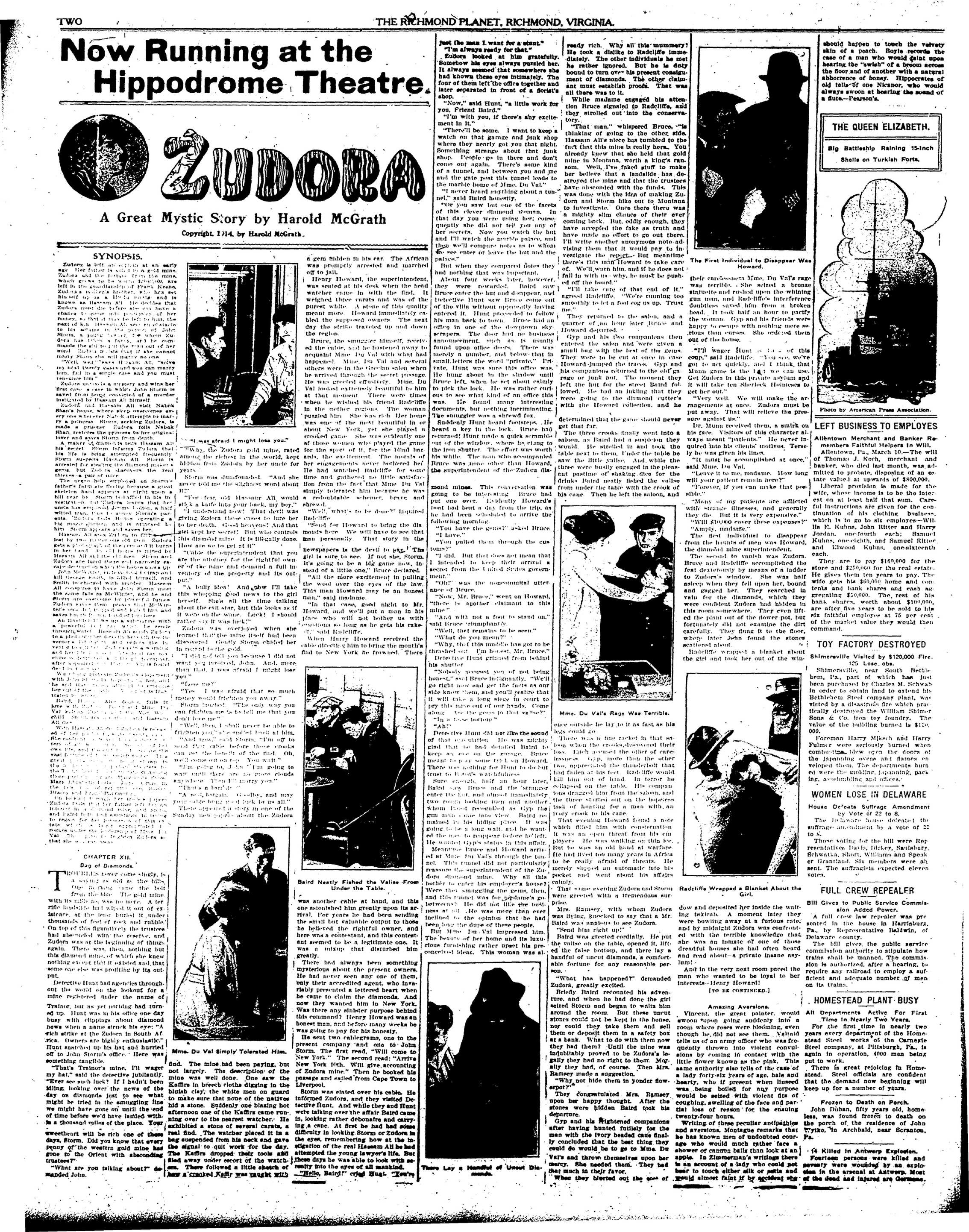
Now Running at the Hippodrome Theatre.
ZUDORA
A Great Mystic Story by Harold McGrath
TWO
SYNOPSIS.
Zudone is left an open air at an early age. Her father is called in a gold mine. Zudone and the buttress from the mine, which grows to be worth $100,000, are left in the guardianship of Frank Keen. Zudone is a mother's brother, who has set himself up as a Hilda maid and is known as Hilda Maid. He decides that Zudone will be given the chance to become into possession of her money, so that it may be left to him, the next of kin. All she is in place to his autumn in the person of John Storm, a young lawyer, for whom Zudone has taken a fancy, and he commands the aid to get the man out of her mind. Zudone tries that if she cannot marry Storm she will marry no one. "Well, we need!" I claim All. "Solve my next twenty cases and you can marry her." A single case and you must renounce him. Zudone uncovers a mystery and wins her first case a case in which John Storm is saved from being convicted of a murder instigated by Hassan All himself.
Zoolander and Hassam All visit Nabok Shan's house, where sleep overcomes every one who whisper Nabok attempts to marry a princess. Storm, seeking Zudora, is made a prisoner. Zudora fills Nabok Shan, restores the princess to her original body, makes him fearless, heals Shan. All his secret Storm invades Zudora that his life is being attempted frequently. Storm suspects Hassam All. Storm is arrested for stealing the diamond maker's gem, but Zudora discovers the real thieves a pair of mice. The negro help employed on Storm's father's farm are Being because a great skeleton hand appears at night upon a bishop. By Storm is killed in his hands. Uncle has imposed Storm's bishop a half witted man, thus to accompany Storm's parents. Zudora finds Storm operating a big maze glutton, and is attacked by him Storm appears and saves her. Hassam All visits Zudora to find a lost by two possessed old men. Zudora gets a maze glutton and it burns in her hand. As all men is binned by Hassam All and the old men. Storm and Zudora and are held nearly equally captive.
John McWalter, on leave to try an
kill George Smith, is killed himself, and
Smith is charged with murder. Hassan
All comprobes to have John Fiorum meet
the same fate as McWinter, and he and
Storm are overcome by powerful fumes.
Zudora saves them, protects that McWinter
and makes them free of harm, and
makes them safe from harm.
An invader lays up a submarine with
a powerful jet raft which he sends
through water. Hassan Abu Abdul Zudora
to a platoon directs both the inventor
lifts the raft and orders the invader
to inventor lifts the raft and orders the invader
and her heliopter to lift the raft away.
after a captured Ploe, the invader found
dead in the raft.
Walter's private pilot disembarked
with the invader lays up the invader, and
he and the invader are captured by the
invader of the invader and is freed
trained in the raft.
Raid, He also disembarked in
bomb wreck. He and Mine Val
Val chill. Storm is captured and Hassan
All the
CHAPTER XII
Bag of Diamonds
TROUBLES never come singly, in a saying as old as the hills. One in thing came the boil from the blue. The gold mine with its milibuns, was no more. A for rifle handheld what it out of existence, at the least burdened it, under thousands of feet of rock and rubble. On top of this figuratively the trustees had accompanied with the reserve, and Zudora was at the beginning of things again. There was, then, nothing but this diamond mine, of which she knew nothing except that it existed and that some one else was profiting by its output.
Detective Hunt had agonies throughout the world on the lookout for a mine registered under the name of Trainor, but as yet nothing had turned up. Hunt was in his office one day busy with clippings about diamond news when a name struck his eye: "A rich strike at the Zudora in South Africa. Owners are highly enthusiastic." Hunt snatched up his hat and hurried off to John Storm's office. Here was something tangible.
"That's Trainor's mine, I'll wager my hat," said the detective jubilantly. "Ever see such luck? If I hadn't been killing, looking over the news of the day on disguises just to see what might be tried in the smuggling line we might have gone on until the end of time before we'd have landed with a thousand miles of the place. Your
sweetheart will be rich one of these days. Storm. Did you know that every penny of the western gold mine has gone to the Orfent with abscending trustee?" "What are you talking about?" demanded John.
Copyright, 1)14, by Harold McGrath
A
"I was afraid I might lose you."
"Why, the Zudora gold mine, rated among the richest in the world, kept hidden from Zudora by her uncle for years.
Storm was dismounded. "And she never told me the slightest word about it."
"For fear, old Hassan All, would stick a knife into your back, my boy."
"I understand now! That devil was giving Zudora these assets to lure her to her death. Good heavens! And that girl kept her secret! But who controls this diamond mine? It is illegally done. How are we to get at it?"
"Unable the superintendent that you are the attorney for the rightful owner of the mine and demand a full inventory of the property and its output."
"A bully idea! And now I'll take this whipping good news to the girl herself. She's all the time talking about the evil war, but this looks as if it were on the wane. Luck! I should rather say it was luck!"
Zuben was overjoyed when she learned that the mine itself had been discovered. Gently Storm chided her in regard to the gold.
"I did not tell you because I did not want you protected. John. And, more than that, I was afraid I might lose you"
"I love me!"
"Yes, I was afraid that so much money would frighten you away."
Storm laughed. "The only way you can frighten me is to tell me that you don't love me."
"Well, then, I shall never be able to frighten you," he smiled back at him.
"And now," said Storma. "I'm off to send that table before those crooks can get the benefit of the time. Oh, well come out on top. You wait."
"I'm going to, John," he going to wait until there are no more clouds anywhere. Then I'm sorry you."
"That's a hard job."
"A real brag, Goodby, and may your table be brought back to us all."
These appear in a story in one of the Sunday news stories about the Zodora.
THE KARATE KING
Mme. Du Val Simply Tolerated Him.
find. The mine had been paying, but not largely. The description of the mine was well done. One saw the Kaffirs in breech cloths digging in the blush clay; the white men on guard to make sure that none of the natives hid a stone. Suddenly one blazing hot afternoon one of the Kaffirs came running over to the nearest watcher. He exhibited a stone of several carats, a real find. The watcher placed it in a bag suspended from his neck and gave the signal to quit work for the day. The Kaffirs dropped their tools and fled away under escort of the watcher. There followed a little sketch of how a cranked Kaffir was caught with
THE RICHMOND PLANET, RICHMOND, VIRGINIA
a gem hidden in his ear. The African was promptly arrested and marched off to jail. Henry Howard, the superintendent, was seated at his desk when the head watcher came in with the find. It weighed three curds and was of the purest white. A stone of this quality meant more. Howard immediately cabled the supposed owners. The next day the strike traveled up and down the region.
Bruce, the smuggler himself, recently the cable, and he hastened away to acquaint Mine Du Val with what had happened. Mine. Du Val and several others were in the Greenan salon when he arrived through the secret passage. He was greeted affectionally. Mine. Du Val looked extremely beautiful to him at that moment. There were times when he wished his friend Raddele in the another region. The woman puzzled him. She was rich. Her home was one of the most beautiful in or about New York, yet she played a rooked game. She was evidently one of those women who played the game for the sport of it, for the blind hazards, the excitement. The morals of her engagements never bothered her. He had watched Raddele for some time and gathered no little satisfaction from the fact that Mine Du Val simply tolerated him because he was a rebellant schemer, brave and abrew.
"Well, what to be done?" Inquired Radcliffe. "Send for Howard to bring the diamonds here. We will have to see that man personally. That story in the newspapers is the devil to pay." This girl is sure to see. If not she, Storm. It's going to be a big game now, instead of a little one, Bruce declared. "All the more excitement in pulling the wool over the eyes of the law. This man Howard may be an honest man," said madame. "In that case, good night to Mr. Howard, and we'll put a man in his place who will not bother us with questions so long as he gets his sake off." Said Radcliffe. When Harry Howard received the cable directing him to bring the month's find to New York he frowned. There
THE MASTER
Baird Nearly Fished the Valise From Under the Table.
was another cable at hand, and this one astonished him greatly upon its arrival. For years he had been sending the small but valuable output to those he believed the rightful owner, and here was a contestant, and this contestant seemed to be a legitimate one. It was a mixup that disturbed him greatly.
There had always been something mysterious about the present owners. He had never seen any one of them, only their accredited agent, who invariably presented a lettered heart when he came to claim the diamonds. And now they wanted him in New York.
Was there any sinister purpose behind this command? Henry Howard was an honest man, and before many weeks he was going to pay for his honesty.
He sent two cabllegram, one to the present company and one to John Storm. The first read, "Will come to New York." The second read: "Arrive New York 10th. Will give accounting of Zudora mine." Then he booked his passage and enlisted from Cape Town to Liverpool. Storm was elated over his cable. He informed Zudora, and they visited Detective flunt. And while they and Hunt were talking over the affair Baird came in, looking rather debonair and carrying a cane. At first he had some difficulty in looking. Storm or Zudora in the eyes, remembering how at the instantation of the real Hassam All he had attempted the young lawyer's life. But these days he was able to look with serenity into the eyes of all mankind. "Hello Baird!" cried Winston.
just the man I want for a stunt."
"I'm always ready for that."
Endora booked at him gratefully. Somehow his eyes always puzzled her. It always seemed that somewhere she had known these eyes intimately. The four of them left the office together and later separated in front of a dorist's shop.
"Now," said Hunt, "a little work for you, Friend Baird."
"I'm with you, if there's any excitement in it."
"There'll be some. I want to keep a watch on that garage and junk shop where they nearly got you that night. Something strange about that junk shop. People go in there and don't come out again. There's some kind of a tunnel, and between you and me and the gate post this tunnel leads to the marble home of Mme. Du Vul."
"I never heard anything about a tun
"Or you saw but one of the facets of this clever diamond woman. In that day you were using her; consequently she did not tell you any of her secrets. Now you watch the but and I will watch the marble palace, and then we'll compare notes as to whom you see enter or leave the but and the palace."
But when they compared notes they had nothing that was important.
About four weeks later, however, they were rewarded. Bald said Bruce enter the hut and disappear, and detective Hunt saw Bruce come out of the villa without apparently having entered it. Hunt proceeded to follow his man back to town. Bruce had an office in one of the downtown sky scrapers. The door had no business announcement, such as is usually found upon office doors. There was merely a number, and below that in small letters the word "private." Private. Hunt was sure this office was. He hung about in the shadow until Bruce left, when he set about calmly to pick the lock. He was rather curious to see what kind of an office this was. He found many interesting documents, but nothing incriminating. The smugger was a shredd fox.
Suddenly Hunt heard footsteps. He heard a key in the lock. Bruce had returned? Hunt made a quick scramble out of the window, where he climbed to the iron shutter. The effort was worth its while. The man who accompanied Bruce was none other than Howard, the superintendent of the Zudora dis-
mond mines. This conversation was going to be interesting. Bruce had put one over. Evidently Howard's boat had beat a day from the trip, as he had been scheduled to arrive the following morning.
"You have the guns?" asked Bruce.
"I have."
"You pulled them through the customs."
"I did. But that does not mean that I intended to keep their arrival a secret from the United States government."
"Oh!" was the noncommittal utterance of Bruce.
"Now, Mr. Bruce," went on Howard,
"there is another claimant to this mine."
"And with not a foot to stand on," said Bruce triumphantly.
"Well, that remains to be seen."
"What do you mean?"
"Why, that this middle has got to be thrashed out. I'm honest, Mr. Bruce."
Detective Hunt grimmed from behind his shutter.
"Nobody accused you of not being honest," said Bruce indignantly. "We'll go right now and get the facts as our side know them, and you'll realize that it will take a long slide in court to pry this out of our hands. Come along. Are the points in that vise?" "In a loose bottom."
Detective Hunt did not like the sound of that circulation. He was rightly glad that he had detailed Baird to keep an eye on the garage. Baird meant to pay some tribute on Howard. There was nothing for Hunt to do but trust to Baird's watchfulness.
Sure enough, half an hour later, Baird saw Bruce and the 'stranger enter the hall, and almost immediately two rooms looking men and another whom Baird recognized as Gyp the gunman came into view. Baird remained in his hiding place. It was going to be a long wait, and he wanted the men to reappear before he left. He wanted Gyp's status in this affair.
Meantime Bruce and Howard arrived at Mine. Dan's through the tunnel. This tunnel did not particularly reassure the superintendent of the Zundra diamond mine. Why all this bother to enter his employee's house? Were they smuggling the gems, then, and this tunnel was for pridame's go between? He did not like the business at all. He was more than ever inclined to the opinion that he had been born into the dupe of these people.
But Mme Jin-Val impressed him,
the beauty of her home and its luxurious furnishing rather upset his pre-conceived bleak. This woman was al
THE RIGHTS OF THE WORLD
There Lay a Handful of Unsort Diamonds.
ready rich. Why all this mummery?
He took a dialike to Radcliffe immediately. The other individuals he met he rather ignored. But he is duty bound to turn over his present consignment of diamonds. The other claimant must establish proofs. That was all there was to it.
While madame engaged his attention Bruce signaled to Radcliffe, and they strolled out into the conservatory.
"That man," whispered Bruce, "is thinking of going to the other side. Hassan Ali's niece has tumbled to the fact that this mine is really here. You already knew that she held that gold mine in Montana, worth a king's ransom. Weel, I've faked stuff to make her believe that a landslide has destroyed the mine and that the trustees have absconded with the funds. This was done with the idea of making Zudorn and Storm hike out to Montana to investigate. Once there there was a mighty slim chance of their ever coming back. But, oddly enough, they have accepted the fake as truth and have made no effort to go out there. I'll write another anonymous note advising them that it would pay to investigate the report. But meantime there's this man Howard to take care of. We'll warn him, and if he does not fall in with us—why, he must be pushed off the board."
"I'll take care of that end of it," agreed Rudolfife. "We're running too smoothly to let a fool cog us up. Trust me."
They returned to the salon, and a quarter of an hour later Brune and Howard departed.
Gyp and his two companions then entered the salon and were given a small bag with the best of the genus. They were to be cut at once in case Howard jumped the traces. Gyp and his companions returned to the old garage or junk hut. The moment they left the hut for the street board followed. He had an inkling that they were going to the diamond cutter's with the Howard collection, and he determined that the game should never get that far.
The three crooks finally went into a saloon, as Baird had a suspicion they would. He strolled in and took the table next to them. Under the table he saw the little yulse. And, while the three were busily engaged in the pleasant pastime of shaking dice for the drinks Baird neatly lished the yulse from under the table with the crook of his cape. Then he left the saloon,
A
Mme. Du Val's Rage Wae Terrible.
once outside he lay to it as fast as his legs could go.
There was a fine packet in that saison when the crooks discovered their loss. Each accused the other of carelessness, cyp. more than the other two, appreciated the thunderbolt that had fallen at his feet. Bad life would kill him out of hand. In terror he collapsed on the table. His companions dragged him from the saison, and the three startled out on the hopeless task of hunting for a man with an antery crook to his cane.
That evening Howard found a note which filled him with consternation. It was an open threat from his employers. He was walking on thin ice. But he was an old hand at warfare. He had lived too many years in Africa to be really afraid of threats. He merely shipped an automobile into his pocket and went about his affairs calmly.
That same evening Zudora and Storm were greeted with a tremendous surprise.
Mrs. Ramsey, with whom Zudora was lying, knocked to say that a Mr. Baird was anxious to see Zudora.
"Send him right up."
Baird was greeted cordially. He put the naile on the table, opened it, lifted the false bottom, and there lay a handful of uncut diamonds, a comfortable fortune for any reasonable person.
"What has happened?" demanded Zudora greatly excited.
Brichy Baird recounted his adventure, and when he had done the girl seized Storm and began to walk him around the room. But those uncut stones could not be kept in the house, nor could they take them and sell them or deposit them in a safety box at a bank. What to do with them now they had them? Until the mine was inubitably proved to be Zudora's legally they had no right to them. Morally they had, of course. Then Mrs. Ramsey made a suggestion. "Why not hide them in yonder flowerpot?" They congratulated Mrs. Ramsey upon her happy thought. After the stones were hidden Baird took his departure.
Gyp and his Brightened companions after having hunted futility for the man with the ivory beaded case finally concluded that the best thing they could do would be to go to Mma. Du Val's and throw themselves upon her mercy. She needed them. They had that much in their favor. When they bleed out the rest of
THE
The First Individual to Disappear Was Howard.
their carelessness Mine, Du Va's rage was terrible. She seized a bronze statuette and rushed upon the whining gun man, and Ruddliffe's interference doubtless saved him from a broken head. It took half an hour to pacify the woman. Gap and his friends were happy to escape with nothing more serious than curses. She ordered them out of the house.
"I'll wager Hunt is like of this coup," said Ruddliffe. "You see, we've got to not quickly, and I think that Munn game is the last we can use. Get Zudora in this private agility and it will take ten Sherlock Holmeses to get her out."
"Very well. We will make the arrangements at once. Zudora must be put away. That will relieve the pressure against us."
Dr. Munn received them, a smirk on his face. Visitors of this character always meant "patients." He never inquired into his clients' motives. Tersely he was given his lines. "It must be accomplished at once," said Mune, Du Val.
"Leave it to me, madame. How long will your patient remain here?"
"Forever, if you can make that possible."
"Many of my patients are afflicted with strange illnesses, and generally they die. But it is very expensive."
"Will $10,000 cover these expenses?"
"Amply, madame."
The first individual to disappear from the haunts of men was Howard, the draped mime superintendent.
The second to vanish was Zudorm, Bruce and Radliffe accomplished the feat dexterously by means of a ladder to Zudorm's window. She was half asleep when they fell upon her, bound and gagged her. They searched in vain for the diamonds, which they were confident Zudorm had hidden in this room somewhere. They even lifted the plant out of the flower pot, but fortunately did not examine the dirt carefully. They flung it to the floor, whey later John found the stones scattered about. Radliffe wrapped a blanket about the girl and took her out of the win-
C
Radcliffe Wrapped a Blanket About the Girl.
dow and deposited her inside the waiting taxi cab. A moment later they were bowling away at a furious rate and by midnight Zudora was confronted with the terrible knowledge that she was an inmate of one of those dreadful houses she had often heard and read about—a private insane anylum!
And in the very next room paced the man who wanted to be loyal to her interests—Henry Howard!
[to be continued.]
Amazing Axelone
Vincent, the great painter, would swoon upon going suddenly into a room where roses were blooming, even though he did not see them. Valind tells us of an army officer who was frequently thrown into violent convulsions by coming in contact with the little flower known as the pink. This same authority also tells of the case of a lady forty-six years of age, hale and hearty, who if present when linseed was, being boiled for any purpose would be seized with violent fists of coughing, swelling of the face and partial loss of reason for the ensuing twenty-four hours.
Writing of these peculiar antipoiks and aversions. Montague remarks that he has known men of undoubted courage who would much rather face a shower of cannon balls than look at an apple. In Zimmerman's writings there is an account of a lady who could pet bear to touch either silk or patina and would almost faint if by accident she
should happen to touch the velvety skin of a poach. Royle records the case of a man who would paint upon hearing the "swish" of a broom across the floor and of another with a natural abhorrence of honey. Hippocrates of old tells of one Nicanor, who would always swoon at hearing the sound of a flute. Pearson's.
THE MARINE
LEFT BUSINESS TO EMPLOYES
Allentown Merchant and Banker
Remember Faithful Helpers Jo Will
Allentown, Pa., March 10.—The will of Thomas J. Koch, merchant and banker, who died last month, was admitted to probate, disposing of an estate valued at upwards of $800,000. Liberal provision is made for the wife, whose income is to be the interest on at least half that sum. Careful instructions are given for the continuation of his clothing business, which is to go to six employees—Willia R. Kuhna, John Ritter and Harry Jordan, one fourth each; Samuel Kuhna, one eighth, and Samuel Ritter and Ilwood Kuhna, one-sixteenth each.
They are to pay $160,000 for the store and $200,000 for the real estate. He gives them ten years to pay. The wife gets his $60,000 home and contents and bank shares and cash agreeing $100,000. The rest of his bank shares, worth about $100,000, are after five years to be sold to his six faithful employer at 75 per cent of the market value they would then command.
TOY FACTORY DESTROYED
Shimeraville Visited by $120,000 Fire.
125 Lose, obs.
Shimeraville, near South Bethlehem, Pa., part of which has just been purchased by Charles M. Schwab in order to obtain land to extend his Bethlehem Steel company plant, was visited by a disaster fire which practically destroyed the William Shimer Son& Co. iron toy foundry. The value of the building burned in $120,000.
Foreman Harry Mlksch and Harry Fulmer were seriously burned when combustion blew open the doors of the japanning ovens and flames enveloped them. The departments burned were the molding, japanning, packing, assembling and offices.
WOMEN LOSE IN DELAWARE
House Defeats Suffrage Amendment by Vote of 22 to 8.
The Delaware house defeated the suffrage amendment by a vote of 22 to 8.
Those voting for the bill were Representative, Davis, Dickey, Saugust, Schwatka, Short, Williams and Speaker Grantland. Six members were absent. The suffragha expected eleven votes.
FULL CREW REPEALER
Bill Gives to Public Service Commission Added Power.
A full crew law repealer was presented in the house in Harrisburg, Pa., by Representative Baldwin, of Delaware county.
The bill gives the public service commission authority to stipulate how trains shall be manned. The commission is authorized, after a hearing, to require any railroad to employ a sufficient and adequate number of men on its trains.
HOMESTEAD PLANT BUSY
All Departments Active For First Time in Nearly Two Years.
For the first time in nearly two years every department of the Home-stead Steel works of the Carnegie Steel company, at Pittsburgh, Pa., is again in operation, 4000 men being put to work.
There is great rejoicing in Home-stead. Steel officials are confident that the demand now beginning will keep up for a number of years.
Frozen to Death on Porch.
John Diban, fifty years old, homeless, was found frozen to death on the porch of the residence of John Wryko, in Archbald, near Scranton, Pa.
14 Killed in Antwerp Explosion. Fourteen persons were killed and poverty were wounded by an explosion in the arsenal at Antwerp. Most of the dead and injured are Germans.
REPLY BRIEF FOR THE CITY OF RICHMOND In the Case of Mary S. Hopkins, et als. vs. City of Richmond.
CONTINUED FROM LAST WEEK
(1) In the Gurry case was involved the validity of a residence secrecy ordinance passed by the City of Baltimore. The court, after holding that it was clearly within the charter power of the City of Baltimore to pass upon such an ordinance, goes on to discuss the various objections raised to its constitution, and finds that it was a discrimination against the nero, the court says:
"As we have seen, the avowed object of the ordinance is to preserve peace, prevent conflict and ill-feeling between the two races, and thereby promote the welfare of Baltimore; and, whatever other objections may be urged against it, it cannot be truly said that there is any discrimination in the ordinance against the colored race. Indeed, in its practical operation it would be more burdensome on white people than on colored people, for it is well known that white people, own the great bulk of property in Baltimore City, and hence, where the property of one colored person would be affected by such an ordinance, of many people, would what is denied one class is denied the other, what is allowed one class is allowed the other. There is, therefore, no such discrimination as is prohibited by the Constitution or statutes securing civil rights, and it is not necessary to discuss that question further."
Passing, then, to a consideration of the purpose sought to be accomplished by the ordinance, the court says:
"No intelligent observer in communities where there are many colored people can fail to notice that there are sometimes exhibitions of feelings between members of the two races which are likely to, and occasionally do, result in outbreaks of violence and disorder. It is not possible to be liable to but the fact remains—however much it is to be regretted—and if a negotiation of the races to such extent as may be permissible under the constitution and laws of the land will have a tendency, not only to avoid disorder and violence, but to make a better feeling between the races, every one having the interests of the colored people as well as of the white people at heart ought to be aware of the situation. Mr. Justice, Brown said in Pleasay, v. Ferguson, 163 U. S. 5, 337, 16 Sup. Ct. 115N, 41 L. Ed. 256; "The object of the amendment (correndum) was undoubtedly to enforce the absolute justice of the court and enforce the law; but in the nature of things it could not have been included to abolish distinctions based upon color, or to enforce social, as distinguished from political, equal, or a committing law; races upon terms unsatisfactory to other."
or the welfare of the city in the mines of the Council, demanded that the two faces should be thus, to this extent, no jailed, and thereby a cause of conflict removed, the court cannot doleate their action unreasonable. It was acknowledged by the Council for the two in both the civil and legal arguments that for years, there had been more or less friction resulting from the occupancy by colored people of houses in blocks therefore occupied wholly by white people. With this acknowledgment, how can it be contended that the City Council, charged with looking to the welfare of the city, is seeking to make an unreasonable use of the police power, and a legal which, in their opinion, will tend to prevent the conflict.
"Penalties in criminal laws are not only imposed to punish violators, but to deter the commission of crime. If, as is practically conceded in this case, the living in such close proximity produces friction that is liable to result in open clashes and disorder, why should not the governing body take cognizance of it, and legislate to avoid it, and thereby promote the general peace? It seems that it would be the better exercise of their discretion, for the public welfare, to discourage by removing the cause than to trust to deterring by the fear of punishment. "Illustrations of the exercise of the police power, we are of the opinion that the object sought to be accomplished by this ordinance is one which properly admits of the exercise of the police power. It only remains for us to determine whether the ordinance as drawn should be sustained."
The court in the latter part of the opinion points out that the ordinance was defective in that it wholly ignored all vested rights, which existed at the time of its passage, as it prohibited an owner of property, for instance, from living in his own house. The court, for the guidance of those who might draft a future ordinance, points out in what particulars the ordinance then before it could be improved. Immediately upon the condition of this opinion the council of Baltimore passed another ordinance, which has now been in effect for more than a year, and, accordingly, recent information only evidenced by the written evidence even been contested, but has been uniformly enforced by the police court of Baltimore.
(2) The second case. Town of Abkhalil, Coleman, is now under consideration with this case. The opinion of the judge (Chichester) who decided the case in the court below, printed on pages 42-60 of the record, is of unusual ability and strength.
We beg to bring specially to the attention of the court the following quotation from his opinion: "The central idea of the ordinance under consideration seems very manifest. It is to prevent too close association of the races, which discriminate the races or tends to result, in breaches of the peace, morality and danger to the health the history of legislation on this subject, therefore adverted to, as well as the phrasology of the credit-
nance itself, confirm this view. The attainment of the objects in view of one much to be desired, and if the ordinance is not necessarily oppressive, or unreasonable, it is the duty of the court to hold it valid, provided it does not conflict with the limitations placed upon legislative bodies by the Constitution of Virginia, or that of the United States (which proposition will be considered later). An analysis of the ordinance in the light of the facts entered on the actine this question. The ordinance is therefore in its application. It does not affect rental contracts existing at the time of its passage. It does not divest any person of his property or rights therein at the time of the passage of the ordinance. Any white person owning property and occupying it in a street, or block, at the passage of the ordinance known, after the passage of the ordinance as a colored block, is not affected by the ordinance as to his ownership, or occupancy, but if he wills, continue to own and occupy his property as before its passage. The same thing applies to colored or white persons, after the passage of the ordinance, purchase and hold property wherever they may desire, within the corporate limits. The only right affected by the ordinance is the right to occupy his residence, and to make his residences, and this regulation the use of property applies without discrimination to all white and colored persons alike within the Town of Ashland.
"It would seem that, if a municipal corporation has authority to provide for separation of the races within its limits no more reasonable or less oppressive ordinance could be devised than the one under consideration."
Continuing, the court says:
"In the case at bar there is no evidence of any sort whatsoever appearing in the record to show that the ordinance complained of was unreasonable, or unnecessary. On the contrary, the court would take notice of the fact that the unrestrained form of public morals, public health and order in the cities and towns of the State is endangered by the residence of white and colored people in close proximity to one another." Acts 1912, p. 230.
(3) The third case is that of State vs. Darnell, 166 N. C. 300; S. C. 81 S. E. 323.
This case turned principally on the extent of the charter powers of the Town of Winston-Salem, N.C. The court held that there was not in the charter of that town to authorize the adoption of the ordinance, and for that reason held it invalid, that the court expressly refrained from passing upon the power of the State to authorize such an ordinance. Whether the General Assembly has passed a statute conferring on town or county commissioners the power to make such an ordinance as this, it would have been constitutional, is not now before us."
In the light of this deliverance anything that the Court said concerning the constitutionality of the law must be accepted as mere detain. The court attempted to justify its conclusion that the public policy of the State of North Carolina was against the thing sought to be attained by the segregation ordinance of Winston-Salem, founding its opinion on an act of Legislature of that State penalizing anyone who might seek to induce colored laborers to leave the State. In this it took a long leap. Viewed from a purely psychological standpoint, it seems so that an enforcement of such a regulation would more likely drive the negroes from the towns than induce their going to the towns.
It is a well known fact, of which the court will take judicial notice that the separation of the races on the railroads of the country has had a marked effect upon their conduct when traveling. The best element among them is a stride in malice, deference of respect, and good order in the coaches assigned to them, that they may compare favorably with the conditions in coaches assigned to the white people. It is high time, after fifty years of freedom, that the negro should stand alone in residential communities as well as in public schools and public conveyances. The language of Mr. Justice Brutley in the rights Cases, E. K. S. written to Mr.
"When a man has emerged from slavery, and by the aid of beneficent legislation has shaken off the insuperable concomitants of that state, there must be some stage in the progress of his elevation when he takes the rank of a mere citizen, and ceases to be the special favorite of the laws, and when his rights as a citizen, or a man, are to be protected in the ordinary modes by which other men's rights are protected."
Coming now to a further examination of the analogous cases concerning the separation of the races, we beg to say that:
It may not be without interest to mention that the first aggregation case in the United States was decided by the Supreme Court of Massachusetts. In Roberta v. City of Boston, 5 Cush. 198, decided in 1849, was held that the school committee of Boston had the power under the Constitution and laws of the Commonwealth to make provision for the instruction of colored children in separate schools established exclusively for them and to prohibit their attendance upon other schools. Charles Sumner appeared for the negroes, and the opinion of the Chief Instructor delivered by the great Chief Instructor Shaw.
"It is urged," he court said in its opinion, "that this maintenance of separate schools tends to depren and perpetuate the odious distinction of caste, founded in a deep-rooted prejudice in public opinion. This prejudice, if it exists, is not created
THE RICHMOND PLANET, RICHMOND, VIRGINIA.
50 cents. Actual Length of Comb is 9 inches. Made of solid brass and has full round back. Being solid and massive this Comb will hold heavier than any other Comb on the market. Other Combs not as good are advertised for $1.80. Our Price is Fifty Cents, and we give Lamp Attachment Free. When ordering by mail send 5-2 sent stamps for postage. Agent's Wanted. WOLF BROS. 1214 N. Senate Ave., Indianapolis, Ind.
by law and probably cannot be changed by law. Whether this distinction and prejudice, existing in the opinion and feelings of the community, would not be as effectually fostered by compelling the colored and white children to associate together in the same schools, may be doubted; at all events it is a fair and proper question for the committee to consider and decide upon, having in view best interests of both classes of children placed under their superintendence. We cannot say that their decision upon it is not founded on just grounds of reason and experience, and in the results of a discriminating and sound judgment."
It is a matter of history that the first "separate coach" regulation was enacted in the City of Boston, and then the second term "Jim Crow" originated. We simply mention these facts to show that race prejudice is not by any means a fault peculiar to the South, if indeed it is a fault.
Curiously enough the case of Halv. v. Decuir, 95 U. L. 485, 508, arose as to the legality of an act passed by the Legislature of the State of Louisiana during the "Reconstruction period, which statute as construed by the court sought to take away from the oeder of a steamboat operating beyond the State of Louisiana, the right white within the limits of the State of Louisiana, to separate white persons from colored ones on his steam-boat. In this case the court construed the Civil Rights Act passively by Congress for the purpose of the amendment of the Fourteenth Amendment to the Constitution. Concerning the force and effect of that act and of that amendment, Mr Justice Clifford uses the following language:
Colored persons, it is admitted are citizens, and that citizens, without distinction of race or color or previous condition of servitude, have the same right to make and enforce contracts, to sue, be parties and give notice to inherit, purchase, lease, sell, and convey real and personal property to the court and equal benefit of all laws and powers for the security of personal property, as is enjoyed by white citizens. 11 Stat. 27. States are also forbidden to make or enforce any law which shall abridge the privileges or immunities of citizens of the United States, nor shall any State deprive any person of life, liberty, or property without due process of law, nor shall any person within its jurisdiction be protected of the laws Enforcement Act, 16 id. 11 to Fourteenth Amendment to the Constitution.
Wrong reference is made to the Civil Rights Act and, to the preceding amendment to the Constitution as if that act or the said amendment may supersede the operation and legal effect of the consting If cause as applied to the case before the court, but it is clear that neither of those provisions, nor both combined, were intended to accomplish and such purpose. Enough appears the language employed in those provisions to show that their principal object was to confer citizenship, and the right which belong to citizens as such, upon people, and in that manner to gate the rule previously adopted by this Court in the Dred Scott Case.
But the leading case on this subject is that of Pleasy V. Ferguson 165, F. S. 527, in which there is a full review of the rights of the new gro under the Thirteenth and Fourteenth Amendments, with respect to laws which seek to suppress him, his whites, and which simply resemble the social barriers which nature itself has had between the white and colored race. The supreme court speaking by Mr. Justice Brown, says:
The object of the amendment was undoubtedly to enforce the absolute equality of the two races before the law, but in the nature of things it could not have been intended to imply distinctions based upon color, or to enforce social, as distinguished from political equality, or a committing from political equality, or a committing from the two races upon term unsatisfactory, or law permitting, or even requiring separation in places where they are available to be brought into contact, do not necessarily imply the inferiority of either race to the other, and have been generally, if not universally, recognized as within the competency of the State Legislatures in the exercise of their police power. The most common instance of this is connected with the establishment of separate schools for white and color children, which have been held to be the exercise of the legislative power over the State where the political rights of the colored race have been longest and most earnestly enforced. * * *
"So far, then, as a conflict with the 144th Amendment is concerned, the case reduces itself to the question whether the statute of Louis-
ana is a reasonable regulation, and with respect to this there must necessarily be a large discretion on the part of the legislators. In determining the question of reasonableness, it is at liberty to act with reference to the established usages, customs, and traditions of the people, and with a view to the promotion of their comfort, and the preservation of the public peace and good order, gutted by this standard, we cannot say that a law which authorities or even requires the separation of the two regions conveyes an unreasonable or more arbitrary measure to the 14th Amendment than the Congress requiring separate schools for colored children in the district of Columbia, the constitutionality of which does not seem to have been questioned, or the corresponding acts of the State legislatures.
"We consider the underlying fairness of the plaintiff's argument to consist in the assumption that the enforced separation of the two races stamps the colored race with a badge of inferiority. If this be so, it is not by reason of anything found in the act, but solely because the colored race chooses to put that construction upon it. The argument necessarily has been more than once the case, and is likely to be so again, the colored race should become the dominant power in the State Legislature, and should enact a law in precisely similar terms. It would thereby relegate the white race to an inferior position. We imagine that the white race, at least, would not acquiesce in this assumption. The argument also assumes that social prejudices may be overcome by legislation and that some rights cannot be secured to the people, and consequently committing of the two races, would not accept this proposition. If the two races are to meet on terms of social equality it must be the result of natural affinities, a mutual appreciation of each other's merits and a voluntary consent of individuals. As was said by the Court of Appeals of New York in People v. Gallagher, 93 N. Y. 43S, 418, this end can neither be accomplished nor promoted by laws which conflict with the general moment of the community upon whom the defendant to operate. When this government has secured to each of its citizens equal rights before the law and equal opportunities for improvement and progress, it has accomplished the end for which it is organized and performed all of the function of respecting social advantages with which it is endowed." Legislation is powerless to eradicate racial institutions or to abolish distinctions based upon physical differences, and the attempt to do so can only result in acquittal situations. If the citizen and civil rights of both races be equal, the inferior to the other civil rights politically. If one race be inferior to the other social, the accusation of the United States cannot put them upon the same plane."
ends, removes dandruff and scalp matter how short; soft, no matter straight from the bulbs, no matter wonderful improvement. Do not I give treatments all over the U. I need booklet concerning the taking my treatments when a 4 august. I need a personal history condition.
All mail promptly answered the only woman of the race grows the real length my hair was when let if you mean business. You me None like them made in the preparation. Madam Perkins, sole
JOHN M. HIGGINS
MADE IN
Choice Groceries, Wines Liquors and Cigars
PURE GOODS, FULL VALUE FOR THE MONEY
1610 East Franklin St.
(Near 03 Market)
RICHMOND · VIRGINIA
A. HAYES,
OFFICE AND WAREROOMS:
727 N. Second St.
RESIDENCE—225 N. SECOND ST.
First-class Hacks and Caskets of all descriptions. I have a spare room for bodies, when the family have not a suitable place. All Country Orders given Special Attention.
Your special attention is called to the New Style Oak Caskets. Call and see me and you shall we waited on, individually.
The court also in the opinion an
swers the faneal argument of which
is probably advanced whenever a
regulation of this sort is proposed,
that if the negroes can be made to
accept separate accommodation,
then the State might require people
who live in one of a different color,
or who are of another race who belong
to certain religions, to or to require
the same manner; or to require the
whites and negroes to paint their
houses or places of business a certain
color. etc. But police regulations
must stand or fall on the
ground of their own innate reason
ableness and necessity and not on
the ground of some possibly freak
legislation of the future, which an
illusor mind may deem justified by
a precedent which they establish.
And the Supreme Court,
answering such the case, is not
lowering language, citing the insult
Yek Wo. Hopkins, to which counsel
ordinarily appeal for comfort.
"The reply to all this is that every exercise of the police power must be reasonable, and extend only to such laws as are enacted in good faith for the promotion of the public good, and not for the annoyance or oppression of a particular class. Thus in Yick Wo W. Hopkins, 118 C. S. 256, it was held by this court that a municipal ordinance of the City of San Francisco to regulate the carrying on of public laundries within the limits of the municipality violated the jurisdiction of the Constitution of the United States" if conferred upon the municipal authority power, at their own will, and with out regard to discretion, in the legal sense of the term, to give or withhold consent as to persons or places without regard to the competency of the persons applying, or the propriety of the places selected for the carrying on of the business. It was held to be a covert attempt on the part of the municipality to make an arbitrary and unjust discrimination against the Chinese race." (continued on sixth page.)
Office: Room, No. 405, Mechanics' Bank Building
THONE, RANDOLPH 2637.
Responce-610 N. First St., Shop in Rear. Thompson Randolph 2165.
Special Attention Paid to the Taking of Contracts for Building of
Any Style of Architecture. Job Work a Specialty.
THE MAGIC SHAMPOO DRIER AND HAIR STRIGHTENER
MAILED ANY WHERE IN U.S. 100 POSTAGE PAID
SEND MAIL BY POST OFFICE MONEY ORDER
Address all letters to Magic Shampoo Drier Co.
Minneapolis, Minn. not to individuals.
A BEAUTIFUL HEAD OF HAIR IS A LADY'S CROWNING GLORY. And every lady can have it she will use the Magic. The Magic will dry the hair after a shampoo or bath, and mince the length by the POST OFFICE MONEY ORDER.
It will also stimulate growth. The Alamidium Comb cannot injure the hair, because it is never heated direct, but takes heat from the heating bar which is heated on our Alcohol Heater, or any other heat. We advise the use of Bayou' Rair Pome to best on the market. Price per box, $50. Alcohol Heater, price $60. Literal terms to agents.
Write for literature relay.
Mme. T. D. PERKINS
SCIENTIFIC SCALP SPECIALIST
4630 W. 35th Avenue, Denver, Colo.
Makam T. D. Perkins, of Denver, Colo., who has spent five years in study of the scalp, is now interesting women all over the globe in the care of the hair and scalp. No matter how dark your skin is, Makam Perkins' matchless scalp preparations and scientific method of treatment for cultivating, beautifying and growing the hair will grow your hair if there is no physical allure to prevent. Her treatments have been successful when all others have failed. Have you written her? If not, and you want hair like her own, write her to-day. Be sure to enclose a 4-cent stamp and write your name and address very plain if you expect a reply. Don't write unless you mean business.
THIS TELLS THE STORY
COPYRIGHTED-1910.
A
Madam Parkin Before Treatment
and scip surf, cause the
no matter how harsh; thick
no matter how kinky. First.
Do not wait if you are in
over the United States by mail
the care of the hair, and
when to 4-cent stamp is an
history of your hair and is
answered when a 4-cent stair
race growing hair to day when
was when I first began treat-
ments. You can secure these p-
made in the world. The T.
kins, sole agent.
GGINS
OTHER P
you by you
ends, removes dandruff and scalp scurf, causes the hair to grow long, no matter how short; soft, no matter how harsh; thick, no matter how thin, straight from the bulbs, no matter how kinky. First treatment will show wonderful improvement. Do not wait if you are interested in your hair, give treatments all over the United States by mail. Write me at once. Give booklet concerning the care of the hair, and testimonials of those taking my treatments when a 4-cent stamp is enclosed. I do not have agents, need a personal history of your hair and scalp and your physical condition.
All mail promptly answered when a 4-cent stamp is enclosed. I am the only woman of the race growing hair today who can show the public the real length my hair was when I first bought treating it. Send for booklet if you mean business. You can secure these preparations only from me. None like them made in the world. The T. D. P. Scientific Scap preparation, Madam Perkins, sole agent.
This is for you, but soft, long, beauty not he put on the Do you want this write for particular the Scientific Denver, Colorado, who world with her won hair.
My own hair is meant. With these grew 17 inches in mained one length years. What I did doing with sheets do for you with Scalp Preparations, falling hair or break
accur, causes the hair to grow long and
how harsh; thick, no matter how thin,
how kinky. First treatment will show
what if you are interested in your hair.
United States by mail. Write me at once,
e of the hair, and testimonials of those
ent stamp is enclosed. I do not have
of your hair and scalp and your physical
when a 4cent stamp is enclosed. I am
my hair to day who can show the public
first began treating it. Send for book-
a picture these preparations only from
world. The T. D. P. Scientific Scale
agent.
OTHER PEOPLE JUDGE
you by your Furniture now!
When you can get Furniture and Rugs from an Old Established house like JPRGENS that's known to sell the best quality goods. Just as redoubles as elsewhere, why not give your friends a good impression. It will give us the greatest pleasure to show you our wonderful stock of home making comfort giving Furniture and Rugs and don't fall to ask our salesmen about our banking plan which gives you 5, 10 pr 15 months in which to pay for any purchase.
CHAS. G. JURGENS SON
Established 1880.
ADAMS AND BROAD
No more frond hair,
tiful hair that need
dresser on retiring
kind of hair? If so,
to Madult F. D. Per
Scalp Specialist of
b is astonishing
the derful art of growing
my best advertis-
tments my hair
two years. It had re-
four inches) for 15
for my hair I am
of others, and will
Matchless Scientite
My treatment stop
THREE
RAILROADS
ACCOMMODATION TRAINS - WEEKDAYS
Liverpool Dfn. Nm. 4.00 P.M. A. from Frederickhale
Liverpool Dfn. Nm. 7.55 A.M. B. 1.18 P.M. G. 3.00 P.M. A.
Abbelland
Liverpool Dfn. Nm. 7.55 A.M. B. 1.18 P.M. from Frederickhale
Arrielle Nm. Nm. 11.25 A.M. B. 1.18 P.M. A. 3.45 P.M. from
Abbelland
Nandy accommodates Inn to no later than 4.18
P.M. accommodates Inn to no later than 11.25 A.M. from
Frederickhale
* Daily. * Weekdays.
All trains to or from Djid Street Bertion
involves travel in trains and departures
not guaranteed. Read the
NORFOLK & WESTERN.
ONLY ALL RAIL LINK TO NOBROKE
Schedule in Effect December 1, 2014.
Lease Bird Street Station, Rithmuth, FOR
NOBROKE. 9:20 A.M. 9:20 P.M. 4:10 P.M.
9:20 A.M. 10:20 P.M. 11:20 A.M.
9:20 A.M. 10:20 P.M. 11:20 A.M.
Arrive Train Station from Nobroke: "11:20 A.M.
6:20 P.M. 7:10 P.M. M. From the West: "8:00
6:20 P.M. 7:10 P.M. M. From the West: "8:00
6:20 P.M. 7:10 P.M. M. From the West: "8:00
ATLANTIC COAST LINE.
JANUARY 4, 1915
M. 6.20
```markdown
```
SOUTHERN RAILWAY
Premier Corner of the South
Doris, Texas, Richmond, Main Street Station, N.Y. Following schedule, figure published as below:
For A&M Daily Local for Charlotte and Peacock, North 30th P.M., Daisy's Loved For All Lead for keynote, Daphan and Intermediate Series, or P.M. Daily For Danville, Arbor, and Barclays with electric lighted series, according to the D.D.P. Daily Order for Peacock South, Pollinan, ready to go.
YORK RIVER LINE
To: P.M., event train, P.R.R. of car, Daily Line, West Point, conducting for Baltimore, S.S.W.
To: A.M., Daisy's Loved for West Point
THAINS ADDITIVE, RICHMOND
To: P.M., to N.Y. D.A.M., to N.Y. A.M., to P.M. and to P.M. others, N.Y. A.M., Court Sunday.
11 West Port Park 2924 M 6 15 P M 1219
11 West Port Park 110101 M 6 15 P M 1219
11 West Port Park 110101 M 6 15 P M 1219
CHESAPEAKE & OHIO
CHESAPEAKE & OHIO
7 13 A -Local-Daily Ex. Bus -N. News.
P 03 A Local-Daily-CDville.
Cultton Forge.
+2 on A 3 x Ds.y. Norfolk, Ost Point
10 on A -Local-Daily-Lyachburg, Lax. Q.
Forge.
*12 00 Neum-Express-Daily Kz. Sun—Nur-
folk Old Point.
*12 00 Neum-Express—Cn. Lville, Chicago
Old Point.
*12 00 P. Express-Daily-Nurfolk Old Point.
*12 00 P. Express-Daily Kz. Sun—N. New-
ork Old Point.
*12 00 Local-Kz. Sun—Gonellonville.
*12 15 Local-Kz. Sun—Lvbbg. C. Ferguson
*12 15 P. Express-Jalal-Lville, Chicago
*12 15 Naylor
TRAINS ARRIVE HICHIGON - Leland from
Last: **"55 A. M."** 8:00 P.M. Through
First: **"50 A. M."** 8:45 P.M. M., 8:58 P.M.
Leland from first: **"55 A. M."** 8:58 P.M. A. and
Leland from first: **"55 A. M."** 8:58 P.M.
Ton P. M. Through: **"80 A. M."** and 8:49 P.M.
James River Line: **"80 A. M."** 9:09 P.M.
"Molly" justly Sunday.
SEABOARD AIR LINE
The Progressive Railway of the South. "I
would like to thank Richard Hewlett and
daily 9:00 a.m. Local to North Carolina,
Jacobers and coaches, Atlanta, Birmingham, Jake-
berers and coaches, Atlanta, Birmingham, Jake-
berers and coaches to Atlanta and Birmingham, 11:11 a.m.
Limited: 12:45 A. M., sleeper, Atlanta, Birmingham, Jackoerville, Tampa and coaches Jackoerville.
round train scheduled to arrive in Leib-
steinental station on Friday, 11:15 A.M.
15:15 P.M. M. 6:40 P.M. Local.
ALPHEUS SCOTT
(BUREAU DELL)
Funeral Director and
Embalmer
OPEN DAY AND NIGHT
Office, 2005 P Street, Phone,
Mad. 2577 - Residence, 1015
St. James St., Phone,
Madison 6619.
East Side Funeral Home
The Best Place to Remember the Loved One
MADAMUS SCOTT, Dedicated for Woman
with Children and Children of Children
THE ECONOMY
327 N. FIRST ST.
Fine Tailoring
Cleaning, Dyeing and
Repairing
CHITMAN M. WHITE
Proprietor
Published every Saturday by John Mitchell, Jr.
at 311 N. 41st M., Robinson, Va.
JOHN MITCHELL, JR. EDITOR
SATURDAY, MARCH 20, 1915
Bad companionship runs more people than the bar rooms.
No child, male or female present
the streets at night and remain good
Make friends with the white fledgling
colored mong and continue to lay
tand.
Look at it from any angle and you will find that the colored people are their own worst enemies.
There would be very little in the world if national would not ever hope for and love the truths of the life.
The wager of life is doubtless
as true now as when it was
announced in Holy Writie.
The highest ambition of some of the lower classes is to drink, gamble, cut and shoot and take the chances of getting out of the State or into the electric chair.
The motto of some people is, "Give money, no matter how you get it not money." The orders to death concerning three kind of people is, "Get them for the grave yard, no matter how you get them, get them for the grave yard."
---
"The Silver Chord" is the title of a neatly bound book of attractive poems by Adolphus Johnson, 71st St. Philadelphia, Pa. The work may be obtained from the author. Many of the poems are of the folks lore variety and are interesting.
---
With mills and factories fill and business men trying to figure out how they can continue business President Wilson announces that those signs of depression are purely psychological and that good times are in the land.
Governor Charles S. Whitman will unquestionably be the choice of New York State for the presidency. His remarks upon the great question of human rights show that he is sound and that should he be nominated and elected great principles will have a hearing at the capital of the nation.
If half the money we spend on trying to reform a girl or boy after they have passed 16 years of age were spent on them during their babyhood, the improvement in our racial condition would be so improved that our march to general prosperity would be increased by at least fifty years.
```markdown
```
The Vice Commission has named three Police Commissioners in their report as being liable to investigation for improper conduct and Mayor George Annalie has passed the report up to the city council. There are no Republicans to fight in Richmond and so the Democrats, like the Re-publicans, are having the "time of their lives" fighting each other.
The National Baptist Publishing House at Nashville is undergoing abuse and discussion about twice as severe as that which the A. M. E. Church visited upon its own publish-
ing house at Philadelphia. Up this time, though, there has been scandal connected with the affair.
^
The Roman Catholics and kindred organizations believe in looking after the infants and leading them along the paths of rectitude. The religious denominations among our own people believe in leaving these same infants in the hands of worthless mothers, and then, when the child grows to youth to get up in the pulpit and condemn them, telling them about hell fire and all of its terrors.
It seems to us that at Rev. Dr R. H. Boyd and Rev. Dr Sulton E. Groes would license the services of some of the automobile machinists in their respective cities to "cause" at each other for them that peace would reign in their respective publications for it has been said that you could repair an automobile motor without "cause" and the strongest kind of "cause" at that. This is why few products own an automobile unless they can affect each or a chainfit to the driving and the "cause."
.
The separation between the United States and Great Britain is unimportant initially, but it is a breaking point. That the Congress have been in session when the report represents nations to Great Britain would mean and a reply would demonstrate there would have been no separation in the United States Senate. We are more confident in our report than our adversary nation officials care to admit.
```markdown
```
you come the information that Lieutenant Governor J. Taylor Ellison is invited and del presale at the recent meeting of the Anti-Slavery League at Norfolk. This was very unkind on the part of Mr Ellison to go into Attorney General Pollard's territory and before his people and everyone his influence when he is a candidate for the same Gov. endorsement that Mr. Pollard is secreet.
---
We called upon the colored people of this city to pray for the return of Police Justice Joan Jeter Crittinhead to the Police Court, where Magistrate Wmur J. Greggs, the Company's representative, is presiding. At the time the physicians had about given up hope for Justice Crittinhead and his family silently shook their heads when they were asked about the prosecution for his recovery. Now, it is announced that he will soon be out of the hospital. You may say what you wish, but there is something in prayer and good nursing work when the doctors say the patient has progress, personal and many other things.
Justice Crutchfield has his notions and his prejudice, but he has a heart in his body and while he talks one way concerning the colored folks in public, his well-spring of sympathy for them in private, is known by all who know him. All we ask is that Manifesto Griggs come down from "his high horse" and understand that colored people are citizens and are entitled to all the rights and privileges of citizens. He should draw a line between the crap-shooting, insulting colored people and the respectable, good-mannered, laboring, business elements among the same class of people.
Evaluate the expression.
"THE STORY OF WENDELL PHILIPPS."
We have received "The Story of Wendell Phillips," by Charles Edward Russell. Those who have heard of the great abolitionist orator and his work will note with interest this contribution to literature, having for its purpose the dissemination of knowledge concerning this lower man-kind and advocate of human rights everywhere. In the opening chapter, describing a scene at one of Wendell Phillips' meetings, Mr. Russell says:
Men and women are under the away of a passionate excitement, many half manicual with rage, have crowded the hall to the limit of the capacity. All are upon their feet surging, shouting, screaming, gesticulating. On the platform before them is a tall, grave, handsome man, waiting to be heard. Without bravado, without concern, he stands and waits. Part of the audience desires to hear him; part desires to drowa his voice with clamor, part is determined to take his life. He stands and waits. Even his foes, looking upon him there, admit it is a remarkable figure against which they storm.
His stature suggests strength and repose, but something more than bulk impresses the men gazing upon him. What moves them in spite of themselves is the manifest attitude of the man unafraid, sincere and intent upon his message, not upon himself. After a time, a lull comes in the rioting tornado of noises that has shaken the building. Instantly,
this man, standing there so quietly shoots into the opening a shining arrow of a sentence, straight, barbed and singing as it flies. At the sound of it, uproar redoubles.
On the platform the speaker stands and waits, an archer with bow drawn. At the next hill almost before the crowd is aware, he has loosened two of his burning shafts, at the next three.
At the next, the clamor files away and friends and foes stand under the caarm of a silver voice that rings forth one fascinating period after another. Hole forceces cease to contend on the floor. After a moment or too comes a ripple of involuntary appliance, before long the whole audience is cheering.
there is an intermingling of the races, may eventually become exclusively inhabited by the numerically predominating race, and by this means compelling each race, as its natural growth may demand, to look and obtain new and undeveloped territory in which to locate, exclu- sive of the other race, and so re- main.
This consummation, devoutly to be wished for, is proposed to be accomplished only by the regulation of occupancy.
This is shrewdly stated and might impress an irresponsible jury, but what effect must it have upon the learned minions of the law? The of these
Then follows a history of soups of the battles and an account of the John Brown Raid. The book is published by the Charles H. Kerr Company, co-operative of Chicago, B.I., with John F. Higgins, 375 N. Monticello St., Chicago, Ill. Printers. It will readily pay a personal
---
"THE BLACK MAN'S BURDEN."
We have received "The Black Map's Burden" by William H. Holtzclaw of Utrea, Miss. It contains an introduction by Dr. Boomer T. Woehnton. This should make a most favorable impression among the people generally as that name is the one with which to charm the average citizen. It is in reality a historical sketch of the work of Prof. William H. Holtzclaw at Utrea, Miss. The following information will of interest:
In literary style as well as in substance this volume describes that same article the prose writings of the long-faced America. Incidentally, too it reveals the great achievements of Boomer T. Washington in behalf of his race for Holtzclaw was graduated from this degree, class 12.
Young Holtlaw, returning to the county, a member of the Tolkien family when he arguated, went to Mississippi, where he felt that his services were most needed. He made his way to Tulsa, through a wild and unexpected part of Mississippi, and in a cabin nearby established the Uta Normal and Industrial Institute for Colored Young Men and Young Women Only a few years have claimed since then so few in fact that Mr. Holtlaw paid a young man, but in these few years he has created a great institution, with an enrolment of more than 500 pupils, taught by 35 instructors, with property comprising 1,700 acres of land, on which he and his pupils have erected 14 buildings with their own hands. The entire property of the institution is now valued at $100,000, to which important additions are yearly being made.
The work is published by The
Seale Publishing Co., Union Square,
New York, Price $1.00.
---
COLLECTOR ANDERSONS
REMOVAL
President Wesley Wilson has recently removed Hon. Charles W. Anderson as collector of Internal Revenue at New York. Mr. Anderson's the record is a tribute to his efficiency and places him high in the niche of fame provided for those who have acquitted themselves well in the service of Uncle Sam. We think President Wilson is entitled to much praise for having continued Mr. Anderson so long in this office. It is to be regretted, that he did not see fit to name as his successor some one of the very able colored Democrats for which New York State is noted.
There can be no question, but what President Wilson, while wishing to recognize them has weakened perceptibly in his position on the race question. He evidently intended to accord substantial recognition to his colored supporters, but the pressure has been too great from all parts of the country and rather than risk an open fight in his championship of the cause of the black man, he has decided to face the disapproval not only of the colored people, but of his own conscience in the matter.
All of this is done as a sacrifice to political expediency. We must admit that we have thought well of the distinguished occupant of the White House and we have noted with surprise his failure to uphold great principles and constitutional rights in his discussion with the advocates of race prejudice.
---
CITY ATTOISEY FOLLARD'S RE
FLY BRIEF.
The very able City Attorney, Hon. H. It. Pollard in his reply brief does not stop at legal argument, but proceeds to discuss social conditions, practically putting in a plea in abeyance as grounds for the learned jurists to disregard the plain provisions of the law. He said:
It was evidently intended to evolve by its operation a process of elimination, by which sections where
there was an intermingling of the races, may eventually become exclusively inhabited by the numerically predominating race, and by this means compelling each race, as its natural growth may demand, it seek and obtain new and undeveloped territory in which to locate, exclusive of the other race, and so remain. This consummation, devoutly to be wished for, is proposed to be accomplished only by the regulation of occupancy.
This is shrewdly stated and might impress an irresponsible jury, but what effect must it have upon the learned minions of the law? The exact condition described by Mr Pollard has already been consumed in every city, town and village in the South land without violating the plain constitutional provisions of the law. The races automatically separate, not by correction, but by choice and by the exercise of common-sense.
Even now in Richmond, there is no friction between the races, save that produced by these white property owners, who wish to sell their property at exorbitant prices to these same colored people. Their white neighbors have been more successful and they are seeking to restrain them from disposing to war, the colored people at a fair value property that they have decided to abandon for the reason that they wish to remove to more congenial neighborhoods.
Mr. Pollard continued
The ordinance does not move a whole negro of a white person from the home in which they may be living at the time of the enactment of the ordinance. They may continue to live in this place until the end of time, so far as the ordinance is concerned. This limited operation of the ordinance is helpful of the natural segregation which has existed since the freedom of the slave, for it is a matter of common knowledge that the tendency has been for negroes to live in tenements in the towns and cities of the South, quite distingished from districts in which whites had their residences. This natural segregation may be said to be the racial barrier which Providence and not human law has erected. The court-all take judicial notice of the fact that race riots have occurred in many sections of the country. The riots in Coatesville, Pa. might be mentioned as a recent illustration in Baltimore, Md., an acute condition of racial antagonism made it necessary to pass a segregation ordinance in that city, culminating in a riot. The President of the United States recently said to a negro delegation waiting on him and protesting against a form of segregation in Washington City:
"This is a home, problem and not a political problem. While the American people wanted to support the advancement of the negro, as practical men everybody knows there is a point at which friction is apt to occur and the question must be stripped of its sentiment and viewed in its facts, because the facts get the better of the individual whether one desires it or not."
When the distinguished attorney says that "the ordinator does not move a single Negro or a single white person from the house in which they may be living at the time of the enactment of the ordinance," he in effect says also that the ordinance does move a Negro or a white person from the house in which he was not living at the time of the enactment of the ordinance. This fact then violates that liberty guaranteed to a citizen regardless of color by the Constitution of Virginia. We have no need to refer to the Constitution of the United States.
Citizenship carries with it the right to come and go, to have free action and to live wherever one's ownership rights give him the right to live. While colored people have always had this right, they have not cared to exercise it. City Attorney Pollard did not say that if a colored person moved out of the house in which he had been living prior to the enactment of the ordinance. If only for one week's time, he cannot under the ordinance move back into his own house.
What becomes of the well known legal declaration. "Every man's home is his castle" and this carries with it the right to defend the same against all unlawful invaders. Mr. Pollard departs from the law to argue social conditions. To argue that rioters have sought to overturn the law and therefore learned jurists should proceed to do the same thing in order to prevent other riots is to put a premium upon lawlessness. There have been riots of colored folks in the various parts of the country too, but they were handled with the repeating rifle and the gallows and the electric chair.
It seems to us that under the provision of equality before the law that white rioters should be treated in a similar manner. The fact is that these incidents have been magnified in order to produce impressions not justified by the facts and the promotions of those deeds of lawlessness have never been punished. The attempt to use President Wilson and his unfortunate blunder with reference to departmental segregation is indeed unfortunate. City Attorney Pollard must know that all Federal officials are sworn to recognize the civil and political equality of all men before the law and to make no discrimination in their official duties on account of race, color or previous condition of servitude.
Virginia jurists have always been careful to observe this part of their oath of office, no matter how distasteful it may have been to them in so doing. Sogregation in the departments at Washington was a political problem and dot a home problem for the home problem did not commence until the white and colored clerks reached home. Social conditions regulate themselves. A white man in this city in moderate circumstances is more a stranger on Franklin and Graco streets, than are the Negroes, who can get inside of these palatial mansions as a servant, while these white men cannot get there in any capacity whatever.
Southern white men like southern colored folks and southern colored folks like southern white folks, who have grown up with the soil, who have owned negroes and who know the value of one. This is why we have read with interest this remarkable production of this southerner, this Hon. Henry R. Pollard, who stands in the limelight as a worthy son of Old Virginia and who under this cold argument has a kindly disposition and a heart for the colored people as tender as that of a woman. The idea of his arguing for the separation from the black folks, when his happiest moments are those spent with the race which for half a century has loved and adored him
Mr. Pollard says that he is now coming to the legal aspect of the question. Let us see. He is quoted further:
Coming now to the consideration of the legal aspect of the question under the two heads herein mentioned, we submit:
First. That the Council of the City of Richmond was fully authorized under the Charter of the City of Richmond and the general statutes of this State to enact the ordinance of April 19, 1911.
This reminds us of the story of a man, who had beastish a house, he and adjacent houses. He was about to pull down one of these structure when he was stopped by the owner. The lease on the property did not confer any such drastic authority. He had a perfect right to improve the property, but he had no authority to destroy any part of it. The city of Richmond has a right, to improve the rights of property and to increase the liberties of its citizens, but it has no right to destroy any of these rights or to limit the constitutional rights of this same class of people.
City Attorney continued
(4) Section 19 of the Charter of the City of Richmond provides an
"Sec 19. The Council of the City of Richmond shall have power to enact suitable ordinances to secure and promote the general welfare of the inhabitants of the city, by them deemed proper, for the safety, health, peace, good order and morals of the community, and to make and adopt ordinances and resolutions concerning the control and management of the fiscal and municipal affairs of the city and of all property, real and personal, belonging thereto, deemed proper to secure the selection of honest and competent officers and to promote efficiency and integrity in the discharge of official duties. They shall, in addition, likewise have power to make such ordinances, resolutions and regulations as they may deem desirable and suitable to carry out the following specific powers, which are hereby vested in them:
Could the Legislature of Virginia confer upon the City of Richmond any greater power than itself possessed? To ask this question is practically to answer it. The above extract provides for the control and management of all property, real and personal belonging to the city. It does not provide for any such control and management of the property, real and personal belonging to individuals. And again:
"19x. To prevent vice and immorality; to preserve public peace and good order; to prevent and quell riots, disturbances and disorderly assemblages; to suppress houses of all-fame and gaming houses; to prevent lewd, indecent and disorderly conduct or exhibitions in the city, and to expel thereof persons guilty of such conduct who shall, not have rested therein as much as one year." (Acts 1908, pp. 152, 157-8).
This then contains a provision to quell the very disorders, which City Attorney Pollard argues should be pandered to and condoned by agreeing with the rioters and by carrying out the wishes of the lawless elements, thus legalizing anarchy. By his argument, respectable white and colored people are put on the same level with the occupants of houses of ill-fame and gaming houses for the law provides only for the expulsion of persons guilty of immoral conduct and who shall not have resided therein as much as one year.
This ordinance puts the respectable property owners on a par with those people and provides that if they have lived in their own houses prior to the enactment of ordinance, they need not move out of their own property as a result of the enforcement of it. A family who, went north a few months ago and who leased their property to either white or colored tenants and who wish to return, having made enough money to complete the payments, is barred from entering his own home by the
HOTEL DALE, Cape May, N. J. OPENS APRIL
This Magnificent Hotel, located in the heart of the most beautiful southern resort in the world; replete with every modern improvement and service in construction, appraisements, survey and related patronage. Orchestra-daily, garages with house, Lanka etc., expatriate special attention given to ladies and children. Read for booklet.
arbitrary mandate of a non-legislative body.
And again:
(b) By Sec. 1038 of the Code of Virginia, 1058, as amended by the act approved March 14, 1906 it is provided as follows:
Dec. 1038. General and enumerated powers of councils of cities and towns.—In addition to the powers conferred by other general statutes, the council of every city and town shall have the power to protect the property of the city or town and its inhabitants, and preserve peace and good order therein. (Acts 1038, pp. 623-4.)
Any City Attorney Pollard should have cited this extract from the statute: "Is a mystery to us. Congress have the power to protect the property of the 'citizens,' not to destroy it, or to deny the citizen the right to occupy and enjoy undisturbed possession of his own household. What kind of protection are we getting here? Justice Wilbur J. Griggs, who is ready an ordinary magistrate acting as Police Justice, takes with him a squad of officers and without 'their or House' or a search-warrant into the houses of the residents in North Fifth St., in this city, just beyond Leigh St., a colored section of the city, and lines them up to determine just how many colored families reside therein.
He then orders the colored folks to move out and assesses a fine one hundred dollars upon one of them for living in a quiet, lawful way upon premises, which had been leased to him and of which for the time being, he was the lawful possessor. Was he protecting the property of all of the inhabitants of the city as provided in the authorised conferment by the Statutes of the State of Virginia? It was a grievous abuse of authority and a deplorable exercise of power, not to be tolerated for a moment by a free people. It was an effort to stir up strife rather than an attempt to preserve order. Living as we have been in the midst of these white and colored people here all of our lives, we never expected to see Virginians engage in any such outragous practices for the purpose of humiliating and harassing one of the kindest rates of people on the face of the globe. And this was done too by white men who had assured the colored people of this community that their retirement from politics would result in their racial betterment and that they would protect them in all of their
We never believed it and so stated. What is the result? Our political rights have been virtually relinquished. Our liberties as citizens have been curtailed and now, the last right, that of property, is being swept away by various subterfuge and we are told that what is, is not, and that what we experience and know is only a dream. So far as we are concerned, we shall oppose the double dealing policy to the end of the chapter. We shall cry aloud and spare not believing that relief will come, that the days of retribution will not forever remain in the distance and that God's wrath will finally assert itself upon those who so wilfully persecute and oppress us.
And then Mr. Pollard cited the authority of the council for imposing heinous punishment for the violation of the law. He should have known that those punishments were never intended to be visited upon people, who were only exercising their constitutional rights, which constitutional rights could not be nullified or set aside by the Council of the City of Richmond, the Legislature of Virginia or the Congress of the United States. It is plainly stated that these penalties were intended to punish rioters, like those in Baltimore and at Contestville, Pa., keepers of houses of ill-fame, better known as houses of prostitution, and gamblers, who pass their time off in riotous living.
These penalties were never intended to apply to a law-abiding, industrious colored man, who does not seek to intrude upon the white section of the city, but who seeks only a home in which to live in peace with his wife and children. But City At-torney Pollard insults his intelligence and preys upon his intellect by including him in this disreputable class and condemning him upon the mere mandate of Magistrate Wilbur J. Griggs to serve not less than thirty or more than alntery days in the city jail.
This ordinance gives Justice
Griggs the power and authority to fine a white man and to fine and jail a colored one. Under the ordinance, so far as his court is concerned, who can hinder? This is enforced in Richmond city, in a Council, where we spent ten of the best years of our lives and where we are voiceless in administering the city's affairs, although we pay taxes upon property, real and personal, valued at ($3,180,662) three million, one hundred and eighty thousand, six hundred and sixty two dollars, besides by our labor adding to the material wealth of this municipality. And the men, who do these things, call themselves Christians.
But enough for this week, we are well-night overcome, when we think of the injustice of it all. Go on, Mr. City Attorney, bred as you have been, cast your powerful influence with the oppressors of an humble but down-trodden people, but somehow God will bring all things right and by his transcendent power will aid us and, in his own time, wipe all of the tears from our eyes.
"God shame and scorn be on ye all Who turn the good to evil. And steal the litle from the Lord. And give it to the Devil!
"Then garbled text or parchment lose I own a statute higher. And God is true, though every book And every man's a liar."
— SHAKESPEARE
Y. M. C. A. Noten
The Rods rendered a special programme last Friday night, assisted by the Blues. New members are joining under the Blues. You will hear from the Rods later.
The class for the explanation was well attended last Saturday and all were encouraged to come again. This is a very profitable hour to all Christian workers.
Last Sunday was a day of much work and all were busy.
9:30 A. M. the workers' meeting was a live one and the men were out in good numbers.
The boys enjoyed the address which was delivered to them by Committeeman B. H. Gaston. The attendance was good. Mothers, we thank you. Send us again.
50 30 P. M., at the Y. M. C. A.
Mr. W. M. Johnson delivered a
very timely address; Subject: "The
Power of Thought." Every man was
helped. The singing was good.
---
The work in the city home and city Jail 10 A. M. was excellent, prisoners were won for Christ.
Come to the Y. M. C. A. today at 5 I. M. (Saturday) to hear the explanation on the Sunday school lesson by Prof. J. W. Barco, of the Virginia Union University.
Men, be on time Sunday ready for hard work and the other man.
All workers are invited to the workers' meeting at 9:30 A. M. at the Y. M. C. A.
A Special meeting for boys at 5 P. M. at the Y. M. C. A. conducted by Committee C. B. Gaston. All boys are invited.
Director Robert Gray will address the men at 5:30 P. M. at the Y. M. C. A. Tell the other man and see that he comes. Live shouting.
Watch for the launching of the Greater Meetings Sunday, March 28
3:30 P. M., at the Richmond Beneficial Insurance Co. Auditorium
Help us to make these meetings a help to Richmond.
Do not stop praying for the Y M.
C. A.
OFFICERS INSTALLED.
The officers of the First Battalion of the First Regiment, U. R. K. of P., were installed at the Pythian Castle, Thursday night, March 4th by Col. R. C. Mitchell, Major James H. Ammons, Jr., commanding the Battalion, acted as Master of Ceremonies. Auxiliary Co., Petersburg, Va., under command of Capt. Williamson were over in full Addresses were made by the staff officers present. After the exercises, refreshments were served by a committee under Commissary Sergeant Norman Bowers. Music was furnished by Municipal K. of P. Bland, Capt. Moses Johnson, Leader and the Cadet Blue Ribbon Quartette.
---
GIRL WANTED
As a helper in a home. A rare opportunity. Very best possible surroundings. 514 North 2d St. 1t
---
IF YOU WANT TO BUY, RENT OR SELL, see us. We promise you a square deal—recollect this. Bragg Brids. & Co. 52
SATURDAY, MARCH 20, 1915
FISHERMAN HAS NARROW
ESCAPE FROM DROWNING
Thousands' From James River
Bridge View Rescue of
John Ford.
While hundreds of people looked on with bated breath, fearing he would be swept away at any moment, John Ford, twenty-five years old, a Southside fisherman, was rescued from drowning yesterday afternoon about 4 o'clock in the James River, at the foot of Ninth Street, after he had battled for more than an hour with the strong and treachous current. With the combined aid of several policemen, the Fire Department and a number of excited spectators, Ford was finally pulled to a place of safety on the South Richmond bank by means of a rope hitched to his armpits. He was beumbed and chilled from his long exposure, but in a short while had fully recovered.
Great excitement was created by the accident in the vicinity of the river. Traffic on the Free Bridge was blocked for some time, every one stopping to watch the struggling man, who could be plainly seen. He was gesticulating wildly, and yelling loudly for help. His cries brought more people to the scene every minute, and soon both banks of the river, the Atlantic Coast line viaduct and the Free Bridge were lined with a dense throng.
BOAT CAPSIZES IN SWIFT-FUNNING WATER
Ford had been fishing up the river, and was crossing the falls when his boat, caught in a rapid eddy, was capsized. This was at a joint between the railway viaduct and the dam, where the current is very swift and there are numerous whirlpools and rapids. He landed on his foot on a slippery rock. While the water was only a trifle above his waist, all around him the depth was over his head. The young man could not swim, and had he not clung to his footing with all his strength, he would have perished in the muddy waters of the James.
As soon as their craft turned turtle, Ford's two companions, who had been fishing with him, by desperate efforts managed to reach the shore. They were exhausted, but called for help—for their comrade. The alarm was soon taken up, and all South Richmond was aroused. Both the patrol and Engine Company No. 13 were summoned.
ROPE IS FLOATED ON PLANK FROM ROCKS ABOVE
Two men, standing near by—C. M. Dickinson, of 2007 Seminole Woodland Hills, and Eddie Bowman, of the Southside, secured a rope, which, after many trials, was floated out to Ford on a plank. Instructions were shouted to him to tie this around his waist. So swag was he from exhaustion, however, that he was able to make but little effort to reach the shore. His rescuers were compelled to drag him through the water by main force, his body being like a log. They had great difficulty in keeping his head above water. A fire ladder was lowered from the bank, and several policemen carried him to safety. The officers who assisted in the rescue were G. L. Williams and W. H. Metcalf, of the First Precinct, and M. J. Moore, H. H. Witzgall and C. T. Tinsley, of the Third Station.
After taking stimulants, Ford do-
clared he felt fine, but as a preca-
tion, he was taken to the Virginia
Hospital. He was later removed to
his home, 1222 Decatur Street.—
Richmond Times-Dispatch. March
16 1915.
TROY, N. Y.
March 15. 1915.
The meetings carried on by Rev. J. A. Taylor at No. 54 Harrison Place are very encouraging. All day Sunday (March 14) was a glorious time for all at the church. 10:30 A. M. subject: "Puro Religion." Text James 1:27. 3:30 P. M. Subject: "Obedience." Text I Samuel. 15:22. After preaching Mrs. Fanny Wegor and Mr. Martin N. Jackson were baptized. They were two very happy souls, putting on Christ in baptism Mrs. Weger stopped the preacher while in the pool (he did not know what she intended to do) and held up her right hand and sang the last verse of Oh, How I Love Jesus, and then she was baptised.
7:30 P. M. subject: "The Church of Christ." Text, Matt. 16:18. A collection of $7.00 was taken for a building fund for the Emmanuel Baptist church, Troy, N. Y., and put in the bank and the bank book was handed to Sister Martin N. Jackson to see how much she and the friends of the Emmanuel Baptist church of Troy will add to it in one year's time. The bank book was given to her because she was the first to suggest the plan. Mrs. Iabella Pearce from Catskill is here in Trop visiting her daughter, Saturday and, Sunday, and leaves for Catskill again Monday, March 15th. Rev. J. A. Taylor made over eight calls Monday, the 15th. Sister Walter Vanalla of No. 163 Union St., is not very well, but moving-around in her home. Mrs. George Vanderpool, of No. 16 Franklin St., is still confined to her room, but is greatly improved.
Mr. Samuel Vanlack of No. 14
Franklin St., is a very happy man
in his condition, on the account of
his eyes. He expects to be bantised
Sunday, March 21st, by the Rev. J.
A. Taylor, the Lord being willing.
The reverend called in to see a very sick child, the grandson of
Mrs. Vanhoake of No. 12 Franklin
St. He also called to see Mrs J. P.
Chew, widow of the late James P.
Chow of No. 173 Church St. She is ill.
The meeting at 54 Harrison Place
will go on this week. A. wining.
except Monday and Saturday evenings. Meetings all day Sunday, Mch.
21, baptism at 3:30 P. M. The meetings have been a great success for
the last two weeks. Every one who wishes to attend these meetings is
made welcome.
A special notice was given out that all the friends of the Emmanuel Baptist church will please help to make as large a donation as can be made for the benefit of the church on the First Sunday in April (Easter Sunday.) We are praying that the Lord will greatly bless us that day in every way we need. Mr. Joseph Sullivan of No. 151-9th St. a successful business man, the manager of the Yoyo Window and House Cleaning Co., office 1627 Fifth Ave., Phone 2127. Floors scrubbed and waxed, also oiled Windows, walls and all general house cleaning, wall paper. Why not give him a trial at your homes and stores; also shops. We are very glad to say he has paid for The Planet for one year.
FARMVILLE, VA.
March 15, 1915
In the religious circle the atmosphere is still pregnant with enthusiasm of the Holy Spirit, the effect it has here growing out of the revival services conducted at the A.M. E. church by the Evangelist, Rev McDuffie. This being a Baptist community the congregation was largely made up of the members of Baptist churches.
The effect has been so great among the membership of the Baptist church that they have taken on new life in Sunday school, B. Y. P. P., prayer services and church. Rev. Adams, as well as the rest of the pastors and midsters of the town, attended each meeting. At the First Baptist church on Sunday at 11 A. M. the pastor, Rev. R. G. Adams, spoke from Subject "Experimental Knowledge" to the delight of all present.
At 7:30 P. M. subject: "Follow Jesus."
Rev. Adams will, in a few weeks, celebrate his seventh anniversary as pastor of this church. This is breaking the record of nearly thirty years. Of the six ministers this church has had during the period above mentioned, Rev. Adams has been with us longer than any. This speaks well for him, having followed some of the most profound pulpits of Virginia, such as Dr. H. H. Mitchell, J. W. Kirby and E. A. P. Cheek.
A dinner party was given at the home of Miss Evelyn Hairston on Main St., in honor of her guest, Miss Miriam Jenkins of Warrenton, Va. The following were present: Mr. and Mrs. E. Stanley Clark, Dr. and Mrs. J. A. Baker, Miss Josephine Hughes, Messrs. Moseley, J. W. Bland, B. S. Blue, Philips Bland and Jackson Glaze. The evening was pleasantly spent.
The Court of Calanthe initiated nineteen new members last week. The deputy, Mrs M C' Adams, is arranging to celebrate the Thanksgiving Anniversary.
FOR RENT.
N. 4th St., 5 room flat.
N. 5th St., 2 room flat.
N. 6th St., 3 room flat.
W. Leigh St., 2 room flat
Catherine St., 3 room flat.
W. Jackson St., 3 room flat.
Cor. Dineon & Thomas Sts., 2
room flats.
Ashland St., 2.2 room flats.
Lombardy St., 2.3 room houses
N. 3rd St., 3 room house.
Williams St., 3 room house.
St. James St., 2.3 room houses
N. 2d St., 3 room house.
N. 8th St., 6 room house.
N. 7th St., 3 room house.
W. Charity St., 5 room house
N. 3rd St., store and 1 room
Ronne St., store and 2 rooms.
E. Leigh St., 2 stables
Apply to B. A. CEPHAS, Cor. 2nd
and Leigh Sts.
WE CA., SAVE YOU MONEY
Place your loans with us. We will treat you right. TRY US. BRAGG BROS. & CO. 2t
ROANOKE, VA.
From Roanoke Va.—Mr. Fowlke'
Illness.—Interesting Items
March 18, 1915.
Mr. J. H. Braxton, a prominent real estate agent of Richmond, Va., was in the city this week. He was enroute to Christonburgh, Va. where he disposed of some very valuable property.
Mr. Henry Leftwich, of 7th Ave., N. W., died Thursday, March 11th. He leaves a son and a host of friends to mourn their loss.
With the consent of Dr. J. B. Clayton on Thursday, March 11th, J. H. Fowkles was moved quietly to the St. Luke's Hospital. The nurses, Mrs. S. C. Medley and Miss B. A. Jones, have spared no pauses to make him comfortable.
Miss Eliza Baker of Kyle, W. Va., is visiting her relatives and friends in the city.
1. The Burrell Memorial opened its doors Monday, March 15th, for inspection. The spectators were highly gratified with the accommodations other have.
THE RICHMOND PLANET, RICHMOND, VIRGINIA.
ANOTHER JOLLY TIME!
We are off to Panama Canal and we wouldn't like to be without you. The Chauffours last bazaar will be given at Price's Hall Thursday night: March 25th. Given by the Richmond Chauffours Club. Good music and refreshments in abundance. Admission 15 cents. Committee: John'W. Jackson, Hubert Bland, John Foray, Rufus Hollman, Joe Bates, Lindsey Hill, Junius Johnson, Rose Hill, O. H. R. Alexander, T. A. Coleman, F. L. Harris, Willie Joynor, T. D. Dabney, chairman: Peter King, secretary.
West End Notes.
Moore St. Baptist church, Rev. R. R. O. Johnson, pastor.
We are still living on the halleluja jah side, the colored Bully Sunday, (Rev. W. H. Skipwith) is still with us and drawing large crowds. Thus far there have been 145 conversions and still they come. Rev. Skipwith spoke three times last Sunday to a large and appreciative audience, numbering about 3000. On Sunday next he will speak at Fifth Street Baptist Subject: "The Fathers and Mothers of Yesterday and Today." (The Home.)
All are cordially invited. Rev. Skipwith and the choir will furnish the music. Services begin at 3:30 P. M. 1000 fathers and mothers wanted; and others.
EVILS OF ENFORCED SEGREGATION.
The Negro and White people of the South have come up under the same ties a desire for education which fills every Negro school as soon as it is opened, and a hunger for land which makes them eager to secure their own homes and farms. The South blooms laborers. Its resources have only just begun to be developed. There is wealth in the soil and under the ground that has scarcely been touched. The Negro and white people of the South have come up under th same traditions, and except as they have been disturbed by politicians and demagogues they have lived side by side in the greatest harmony. The right sort of education which emphasizes Christian service, makes white men and black men better and more helpful neighbors.
In some parts of the South the Negroes of their own accord have settled in certain sections by themselves. In Mound Bayou in Mississippi and in other places they have their towns governed by Negroes. It is well that they should have the opportunity which these Negro settlements afford of developing and demonstrating their powers of self-government but any enforced segregation will result as Dr. Weatherford shows only in harm to both whites and blacks. It would end the Negro moving in large numbers to the cities, which do not afford him as good opportunities as country for the development of integrity thrift, and character. It would thus deprive the Southern white man of the labor he needs. H. B. Frissell in the Southern Workman
REV. TRIGG HERE
Rev. C. Y. Trigg, pastor of the Warren M. E. Church of Pittstburg, Pa., was in the city last week. He preached at the Leigh Street M. E. Church last Thursday night. His wife and two children are with him.
AGENTS WANTED.
I want Colored Agents, male or female, to sell to all nations of the Best Hair Ointments on the market. Large profits.
JAMES P. CLEARY,
1750 Bank Street.
4t-7d
Baltimore, Md.
FOR REST: FOR REST!
Something New Under the Sun!
The attention of the public is called to the fact that the Samaritan Hall, at the corner of 6th and Duval Streets has been thoroughly renovated from top to bottom and made a strictly modern up-to-date hall in every respect. To this end, we are offering to the public, to societies, lodges, beneficial clubs, social parties, to all persons and organizations who desire an excellent place to have evenings of pleasure and entertainments, the privilege of renting rooms in the Samaritan hall.
These lodge rooms and the main hall which is used for entertainments, are for rent at strictly modern offices. We are ready and prepared to serve the public along this line. Let us have your application. For full information apply at the office of State Grand Lodge No. 6, I. O. of Good Samaritans and D. of Samaritah, at the corner of 6th and Duval Street. Address all communications to J. W. THOMPSON, Grand Secretary.
BUILDING COMMITTEE.
J. N. MYERS,
ISHAM MANN,
W. H. HATCHER,
Mrs. M. J. WASHINGTON,
MRS. F. E. DAMMELL.
Learn Moving Picture Acting
Learn the greatest profession now open to everybody regardless of color, education or where you live and earn the highest salaries ever paid in any business.
THE COLORED RACE possesses more talent for singing, dancing, acting, than any people on earth.
The Lincoln National Film Co., conducting the International School of Motion Picture Acting offers to assist in developing this talent.
You may be able to make money and not even leave your own home.
Enclose stamp for full details. Address: Dept. (G) Lincoln National Film Co., Chicago, Ill.
or no charge, no matter what your disease, sickness or affliction may be, and restore you to perfect health. Thousands of people, the best and leading ones in the United States and Europe will testify that I am one of the most wonderful healers of all complaints in the world. I use nothing but herbs, roots, barks, guins, balsams, leaves, seeds, berries, flowers and plants in my medicines. They have cured thousands that the most skillful physicians and the best hospital physicians in America and Europe have given up to die, and said there was no cure for them.
My Medicines Cure the Following diseases:—Heart Disease, Consumption, Blood, Kidney, Bladder, Stricture, Piles in any form, Vertigo, Quaily, Sore Throat, Lung, Dyspepsia, Indigestion, Constipation, Rheumatism in any form, Palms and Aches of any kind, Colds, Bronchial Troubles, Sorex, Skin Diseases, all Itching Sensation, all Female Complaints, La Gripppe or Pneumonia, Ulcer, Carbuncles, Bolls, Cancer in the worst form without the use of a knife or instrument, Eczema, Pimples on Face and Body, Diabetes of Kidneys or Bright's Disease of the Kidneys. My Medicines cure any disease, no matter of what nature. Gonorrhoea and Syphilis troubles a Specialty.
Medicines sent anywhere. For full particulars, send, write or call in person on L. J. HAYDEN, 220 West Broad Street, Richmond, Virginia.
L. J. HAYDEN, 220 W. BROAD, RICHMOND, VA.
Mme. Baum's Own Idea Patented
SHAMPOO DRIER AND HAIR STRAIGHTENING COMB
Pristated April 24, 1914
Will straighten the most kinky and stubborn hair
Will do the hair after Shampoo. Will cultivate
the hair and make it grow long and beautiful.
The best and only Solid Base Comb Made
SPECIAL PRICE COMPLETE $9.00
We are the largest Importers and Manufacturers
of Colored People's Hair Goods. Send Zostamps
for our beautiful illustrated Catalogue.
THE OLD RELIABLE
Mme. Baum's Hair Emporium
486 - 8th Ave. New York City
Before Using
After Use
Applied under a Patente, Method Straightens and grows long hair on the heads of Colored People.
M.
or no charge, no matter what you and restore you to perfect health, leading ones in the United States of the most wonderful healers of nothing but herbs, roots, barks, flowers and plants in my medicine most skillful physicians and the Europe have given up to die, and.
My Medicines Cure the Follow- tion, Blood, Kidney, Bladder, Stri Sore Throat, Lung, Dyspepsia, Indi form, Palms and Aches of any kind Diseases, all Itching Sensations, all monia, Ulcer, Carbuncles, Bolls, Ca of a knife or Instrument, Eczema, P Kidneys or Bright's Disease of the sease, no matter of what nature. O Specialty.
Medicines sent anywhere. FN person on L. J. HAYDEN, 220 W.
L. J. HAYDEN, 220 W.
Mme. Baum's O SHAMPOO DRIER AND HA Poisted
Will strengthen the most Will do the hair, either of the hair and make it grow The heat and Only 5 We are the largest impor of Colored Beauty trai for our beautiful illustra TIME OLD Mme. Baum's 486 - 8th Ave.
Before Using
1
COURT NOTICES
In the Law and Equity Court
of the City of Richmond,
the 2nd day of Maren,
1915.
Roth Alice Bates Plaintiff.
vs.
Clarence A., Bates, Defendant
In Chanery.
The object of this suit is to obtain
an absolute divorce from the bond
of matrimony by the plaintiff from
the defendant, on the ground of
desertion.
And an all-day having been
made and filed that the defendant
is not a resident of the State of Virginia. It is ordered that he appear
here within fifteen days after due
publication of this order, and do
what may be necessary to protect
his interest herein.
A Copy—Teste:
LUTHER EBBBY, Clerk.
J. E. BYRD, P. Q
TO CLARENCE A. BATES;
You will take notice that I will on the 20th day of April, 1915, at the office of Phil B. Shield's room number 701. Travelers Building, situated on the north side of Main Street, between 11th and 12th Sts. in the City of Richmond, Virginia, between the hours of 9 A. M. and 6 P. M. of that day, proceed to take the depositions of witnesses to be read as evidence in my behalf in a certain suit in Chancery, depending in the Law and equity Court for the City of Richmond, Virginia. Wherein you are defendant and I am plaintiff, and if from any cause the taking of said depositions be not commenced on that day, or, if commenced, be not concluded on that day, the taking of the same will be adjourned and continued from day to day, or from time to time, at the same place, and between the same hours, until the same is concluded.
RUTH ALICE BATES.
By Counsel
J. E. BYRD.
502 N. 3rd Street
VIRGINIA:
In the Law and Equity Court of the City of Richmond, the 17th day of February, 1915.
Annie Scott, Plaintiff.
Charlie Scott, Defendant.
In Chancery.
The object of this suit is to obtain an absolute divorce from the bond of matrimony, by the plaintiff from the defendant, on the ground of desertion. And an odeavit having been made and filed that the defendant is not a resident of the State of Virginia, it is ordered that he appear here within fifteen days, after due publication of this order and do what may be necessary to protect his interests herein.
A Copy—Testo:
LUTHER LIBBY, Clerk.
J. E. Byrd, p. q.
TO CHARLIE SCOTT:
You will take notice that I shall,
To Cure All Diseases or no Charges.
DO YOU LOVE HEALTH?
If so, call and see L. J. HAYDEN,
Manafeturer of Pure Herb Medicines,
220 West Broad Street. My Medicines
cure All Diseases known to mankind.
Your disease, sickness or affliction may be
Thousands of people, the best and
and Europe will testify that I am one
of all complaints in the world. I use
guins, balsams, leaves, seeds, berries,
gines. They have cured thousands that the
best hospital physicians in America and
I said there was no cure for them.
Living diseases: Heart Disease, Consumpti-
picture, Piles in any form, Vertigo, Quilay,
igestion, Constipation, Rheumatism in any
kind, Colds, Bronchial Troubles, Sores, Skin
All Female Complaints, La Gripe or Pneum-
cancer in the worst form without the use
Pimples on Face and Body, Diabetes of
Kidneys, My Medicine, any diag-
gonorrhoea and Syphilis trouble a
or full partitions, send, write or call in
West Broad Street, Richmond, Virginia.
BROAD, RICHMOND, VA.
Own Ide Patented
HAIR STRAIGHTENING COMB
1st April, 1914
Kinky and stubborn hair
Nampon. With cultivate
new long and beautiful.
Good Breast Combs Made
Compartments and Manufacturers.
Hair Goods. Send 2 stamps
and Catalogue.
RELIABLE
Hair Emporium
New York City
FOLLICURO.
A Great Discovery.
A Patente Method Straightens and
in the heads of Colored People.
Dead Of Hair in Fifteen Months
5E particulars, proof, pictures, testimon-
Price 50 cents, $1.00, $1
cost. Ordert-day.
Remedy Co. 52 Broadway, New York.
on the 14th day of April, 1915, at the office of Phil B. Shield's room number 701. Travelers Building, attached on the north side of Main Street, between 11th and 12th Sts. in the City of Richmond, Virginia between the hours of 9 A. M. and 6 P. M., of that day, proceed to take the depositions of witnesses to be read as evidence in my behalf in a certain suit in chancery depending in the Law and Equity Court for the City of Richmond, Virginia, where you are defendant and I am plaintiff, and if from any cause the taking of said depositions be not commenced on that day, or, if commenced, be not concluded on that day, that taking of the same will be adjourned and continued from day to day, or from time to time, at the same place, and between the same hours, until the same be concluded.
Respectfully.
J. E. ftyrd. 502 N. 3rd St.
VIRGINIA:
In the Law and Equity Court of
the City of Richmond, the 13th
day of February, 1915.
Florence Freeland, Plaintiff,
against
William C. Freeland, Defendant.
In Chancery.
The object of this suit is to obtain an absolute divorce from the
bond of matrimony by the plaintiff
from the defendant on the ground
of adultery.
An anti-flaiv having been made
and filed that the defendant is not
a resident of the State of Virginia,
it is ordered that he appear here
within fifteen days after due pub-
lication of this order and do what is
necessary to protect his interests in
this suit.
A Copy Teste:
LUTHER LIBBY,
J. E. Byrd, p. q.
Clerk.
TO WILLIAM C. FREELAND:
You will take notice that I shall,
on the 30th day of March, 1916, at
the office of Phil B. Shield's room,
number 701. Travelers Building, situated on the north side of Main street, between the hours of 11th and 12th streets, in the City of Richmond, Virginia between the hours of 9 A. M. and 6 P. M., of that day proceed to take the depositions of witnesses to be read as evidence in my behalf in a certain suit in chancery, depending in the Law and Equity Court, for the City of Richmond, Virginia.
Wherein you are defendant, and I am plaintiff, and if from any cause the taking of said depositions be not commenced on that day, or, if commenced, be not concluded on that day, that taking of the same, will be adjourned and continued from day to day, or from time to time, at the same place, and between the same hours, until the same is concluded.
FIORENCE PREELAN
By Counsel,
J. E. Byrd, 502. N. 3rd St.
AGENTS' CONTEST.
Please send the Planet for ..... Months to
---
EASON TOWN and district to ride and exhibit a sample Latest Model Manager's bicycle furnished by us. Our Rider Agents ever were making money fast. First for full portfocars and special offer at once, BO MONEY REQUIRED until you receive and approve your bicycle. We ship to anyone anywhere in the U.S. without a cent deposit in advance, prepay/freight, and allow TENDAYS FREE TRIAL during which time you may ride the bicycle and put it to any test you wish. If you are then not perfectly satisfied or do not wish to keep the bicycle ship it back to us at our expense and you still not be out one cent.
FACTORY PRICES We furnish the highest grade bicycles it is possible to make at one small profit above actual factory cost. You save $10 to $25 middlemen's profits by buying direct of us and have the manufacturer's guarantee behind your bicycle. DO NOT BUY a bicycle or a pair of tires from anyone at any price until you receive our catalogues and learn our unheard of factory prices and remarkable special offers.
YOU WILL BE ASTONISHED when you receive our beautiful collection of logos and study our expert mobile app. We will be happy to help you find the perfect business for less money than any other factory. We are satisfied with $8.99 per hour above factory cost. BOTTLE DEALER, you can sell our bottles under your own palm at double our prices. Orders like this day received. BOTTLE DEALER, but you have a number on hand in trade by our California retail stores. There we are sure our property at prices ranging from $8 to $80 or $100. Descriptive harpals like native free, coasters, coasters, coasters, and antiquities for your repair and maintenance of your beautiful bottles.
```markdown
```
pursues without allowing air to escape. They weigh no more than an ordinary tire, the puncture resisting popular fabric on the tread. The regular price of these tires is $10 per pair, but for advertising purposes we charge $20 per pair. All orders shipped same day letter is received. We will ship C.O.D. on approval. You do
and find them strictly as represented
(thereby making the price $4.88 per pair) if
you wish to purchase them. We will not
attend at OUR expense for any reason they arrive
at our expense for any reason they arrive.
Do not pay for any reason they arrive.
We know that you will be well pleased that when you pay
for a trial order at our office, hence this remarkable offer
will be extended to you. We extend this approval and trial at the special all-history
business which we have established and quiesce in all lines and
shall have the permission of our buying a business or a pair
to sell you the new and wonderful business we are making.
COMPANY, CHICAGO, ILL
FT, Funeral Director
OFFICE 2220 F. MAIN ST.
DOLPH 2073. ALL NIGHT
ALL RANDOLPH 2703.
OND, VA.
IF YOU NEED TIRES
PRINT QUOTED ABOVE, OR WRITE OUT AND ENCLOSURE TIME APPROXIMATE. DO NOT WAIT. BUT WELCOME TO HOWEVER YOU HAVE THOUGHT.
J.L. MEAD CYCLE COMPANY
ROBERT C. SCOTT, Fur
FIRST CLASS LIVERY. OFFICE
TELEPHONE, RANDOLPH 20
AND SUNDAY, CALL RAN
RICHMOND, VA
Jeffries Pharmacy
For Pure Drugs and Good
Service. Special Attention
We will allow a cash discount of $1.25 cent (thereby making the price $4.85 per pair) if you will满ALL CASH WITH ORDER and enclose this advertisement. You run no risk in sending us an order as the tires may be returned at OUR expense if for any reason they are not in stock. If you wish to receive a pair of tires, you will find that they will ride easier, wear faster, last longer and be cheaper than any tire you have ever seen or at any price. We know that you will be well pleased when you wish to receive a pair of tires. If you need TIRES they deny any kind at any price until you send for a pair of tires. If YOU NEED TIRES Puncture lined tires on approval and trial at the special introductory price quoted above. Puncture lined tires on approval and trial at the special introductory price quoted above. Puncture lined tires on approval and trial at the special introductory price quoted above. Puncture lined tires on approval and trial at the special introductory price quoted above. DO NOT WAIT but write us a portal today. DO NOT THINK OF BUYING a bicycle or a pair of tires. It costs only a portal to learn every detail. MAY BE OVERPRINTED. J. L. MEAD CYCLE COMPANY, CHICAGO, ILL
ROBERT C SCOTT, Funeral Director FIRST CLASS LIVERY. OFFICE 2220 E. MAIN ST. TELEPHONE, RANDOLPH 2073. ALL NIGHT AND SUNDAY, CALL RANDOLPH 2703. RICHMOND, VA.
S. W. Robinson and Son, Inc.
AGRICULTURAL AND MECHANICAL COLLEGE
FOR RENT
FOR THE COLORED RACE
---
NO MORE TROUBLE FROM PUNCTURES
WITH, Tanks or Gloss will not let the air out.
A hundred thousand pairs sold last year,
DESORIPTION is lively and easy
riding, very durable and lined inside with
combs, furrows and which clowns up small
in Filling your Prescriptions
We carry a large stock of Toilet Articles, such as Talcum Powder, Fage Creams and Lotion, Perfumery, Hair Preparations, Hair Brushes and Combs, Stationery, Mirrors, Theatrical Goods and other things in the line Also Large Stock of Shoe Polish and Brushes, Whisk Brooms, Trusses, Rubber Goods, Fine Razors, Pocket Knives, Ele. Will be pleased to serve you with any and everything carried in an up-to-date Drug Store
Prices Low, Quality Considered.
Goods delivered when requested or sent you by Parcel Post.
THOS, TABB JEFFRIES Prescription Druggist
214 E. Broad, Richmond, Va
HAIR
REAL HUMAN CREOLE HAIR
HARD TO VAGE
FREE
COLORED WOMEN'S HAIR
HUMAN HAIR Dept. D
Two desirable flats for rent.
534 North 2nd St.
119 E. Leigh St.
BRAGG BROS & CO
A good barber wanted at once.
Will pay $10.00 per week or 60c
on the dollar. One who understands
the business and is npt afraid to
work.
JESSE TURNER.
298 Mason Street.
Harrisonburg, Va.
Notice the thick rubber tread
"A" and puncture stripe "B"
and "D" also rim strip "W"
the tire will outlast any other
make- SOFT, ELASTIC and
EASY RIDING.
We Train the Heart and the Hand
GO TO THE
Industrial
Union
Institute
Not the largest college, but one of the best Training Colleges in the South. Parents and your child will be satisfied with the training. Welcome to Rye, James M. Henderson, M. M. President, P. D. Dox, $05. Southern Pines, M. C.
HIGH GRADE LIQUORS
19 and 21 North 18th Street
Richmond, Va.
Phone. Randolph 2313
JAMES H. COLEMAN
DEALER IN
FANCY GROCERIES,
CONFECTIONERIES, MEATS
AND VEGETABLES,
All Goods Promptly Delivered
'Phone, Randolph 3266
125 WEST DUVAL STREET
EDW. STEWART
203 SO. SECOND ST.
Richmond, Va.
Dealer in Fancy Groceries
Fresh Meats, Vegetables,
Fish and Oysters.
'Phone, Madison 1637.
Open all the year round. For Males Only. Maintained by the governments of the United States and of North Carolina. Three Strong Departments—Academic, Mechanical, Agricultural, Board, Edging and Tuition, $7.00 per month. Write for further information or catalog.
JAMES B. DUDLEY, PRESIDENT,
Greenaboro, N.C.
```markdown
```
Certainly in the case of bar it cannot be said in the light of ordinary human experience that this or ordinance is not reasonable in the purpose which it aims to accomplish, or that it was not enacted in good faith for the protection of the public good, or that it was enacted for the annoyance of a particular class on the contrary, it is clear that the ordinance has in view as much the good of the metro as the good of the white for each alibi is limited by any law which seeks to perpetuate or preserve the good for the forewet the rays, and the provision of friction or conflict.
It will be kept in mind that the ordinance under consideration provides essentially a manual way for each class and theatre to be white and colored in practice, the same way in every detail of its provisions what is forbidden to one class to Gerlitz, to the other granting this. It is legally impossible to say that the law is discriminatory on its face or that it then enabled in good faith for the public good. The legislation must be allowed a later discretion in the matter.
In Childs v C & O Rv Co. 215 U.S. 71, 77, Mr. McKenna McKenna delivering the opinion of the court, has the following remarks in connection to the case of Ellis v Berkson supra:
"Mr. Justice Thomas reviewed the cases and not only the law, but pointed us to resemble the distinction between the true account of which the state is pleased and enforced. It is true that the power of a defendant to prosecute a criminal distinction was the only considered but if the test of reason ablances in his relation to it was deferred to be, the result had been, customs and traditions of the people" and the "promotion of their comfort and the preservation of the public peace and good order" this must also be the test of the reason ablances of the regulations of a carer, maid for the purposes and to serve the result. Reasons where are induced by the general sentiment of the community for whom they are made and upon whom they operate cannot be said to be unreasonable." Citing the case of C & O. Ry Co. v. Ky. 179 V. S. 229.
The court in this case, evidently string of the persistence on the part of the members of the nero race in bringing similar questions to that court, in conclusion uses this law clause.
The extent of the difference, based upon the distinction between the white and colored races which is observed in the constitution or in the regulations of court, has been caused so much that it has relieved from further lawsuits the burden.
Statute 1811 should to prevent a concession consist to another class of legislation which has been severely assaulted, as the discriminatory against the nero race.
Concerning such laws it is laid down in 27 Cyc. at p. 706, as follows:
"State laws are not information to not discriminate against non-Caucasian races, but are equally prohibitive against the white races, and therefore are not in conflict with the Federal Constitution, and the 18th and 15th Amendments thereto, or with the State Constitutions and laws abolishing slavery and conferring upon the negro race equal rights and privileges, with other races. The making of race or color an element of an offense is nowhere prohibited." Citing many cases among them a Virginia case, ex parte Kinney, 3 Hughes 9.
In Pace v. Alabama, 106 U. S. 153, it was held that a statute of Alabama which prohibited a white person and negro from living with each other in adultery or fornication is not in conflict with the Constitution of the United States, although it prescribes penalties more severe than those to which the parties would be subject were they of the same race and color.
We come now to the discussion of the question how far, in the exercise of the police power, can a legislative act disturb vested rights, or injure private property without compulsion.
It is a mistake to suppose that the fundamental principal involved in the exercise of the police power has been of late enlarged. There has been no enlargement. Its application only has been made more comprehensive.
Mr. Justice Holmes, now of the Supreme Court, formerly of the Supreme Judicial Court of Massachusetts, speaking on this subject said:
"It may be said that the difference is only one of degree, most differences are when nicely analyzed. At any rate difference of degree is one of the distinctions by which the right of the Legislature to exercise police power is determined. Some small limitations of previously existing rights incident to property may be imposed for the sake of preventing a manifest evil, larger ones could not be except by the exercise of the right of eminent domain" (Rideout v. Knox, 148 Mass, 368).
What this learned judge said in Hudson County Water Co. v. McCarter, 209 U. S. 349, is an affirmation of what he said in the case of Rideout v. Knox, supra. The language is as follows:
"All rights tend to declare themselves absolute to their logical extreme. Yet all, in fact, are limited by the neighborhood of principles of policy which are other than those on which the particular right is founded, and which become strong enough to hold their own when a certain
point is reached. The limits set to property by other public interests present themselves as a branch of what is called the police power of the State. The boundary at which the conflicting interests balance cannot be determined by any general formula in advance, but points along the line, or helping to establish it, are fixed by decisions that this or that concrete case fails on the nearer or farther side. * * * It constantly is necessary to reconcile and adjust different constitutional principles, each of which would be entitled to possession of "the disputed ground but for the presence of the others." In another recent opinion the same jurist observes.
"And yet again the extent to which legislation may modify and restrict the uses of property consistently with the Constitution is not a question for more abstract theory alone. Traditions and the habits of a community count for more than logic" (Laurel Hill Geometry v. San Francisco, 226 S. 258). "In the long run" says Professor Scherman, "the economic interests of a community must prevail for law is nothing but the crystallization of economic and social interests" (C. Political Science Quarterly, 217). In the year 1948 Chief Judge Myshall uses the following language:
The power of bedurned, was consequently of taxation, overtaxation, and the persons and property, but the more to they hold public. This is a original principle which has the condition in society itself. It is to be all for the benefit of all it is, except in personless as part of itself, and need "not be reserved when property or life is de려ment or the right to use it in any manner, e.g., to be used to make a bad. Here, from above the right of an inlief, it is to be "in itself" in the nature of all rights of all most, and a portion of the whole burden, and in the form of power to be reserved to the persons of the old power may be added, but the constitution of an United States has not intended to follow the correct for every a good power with no way to come to such a state of government, or to act on and down the potential of the State and its relations with a constituteable firm. It is not only where there is no use of interest in land and a place to a person as well as a person to the rest of the country. There is a "Ford" in France.
Another one of the earlier cases
Committed with the Alder C. Cush
in 1852 was described in 1853. It
was argued that by an or
direction of the legislative body
in the Colony of Massachusetts,
the proper state of uplands bounded
on the sea and an estate in fee in the
atlantic that abound low water
masses and within low rods of the
upland with high power to erect
waters and of other buildings thereon
obtained to represent and the public
infield properties and the public
purposes of navigation. Subsequently,
the Law statute of the
State of Massachusetts played an
important role in the harbor of
Boston, bounded which no wharf
would be erected extended or mean-
tained and to the shore, any wharf
obtained or maintained beyond
a mile in distance. It was
required that the state had the comp
sion for the protection of the water was an
unjustified and unlawful property
and constituting it to make an
appropriate constitution in violation
of the rights under
Writings that if impaired the
Colony ordinance and thus trans-
scribes the Constitution of the United
States against passing laws impair
the civilization of contracts. The
Supreme Judicial Court of Massachusetts overdid these contents
and hold the constitutional
Saw Chief Justice in an opinion
among the all but ever delivered
from any bench, used the following
instruments:
The manifest object of these characteristics is to prevent injurious objections in the harbor of Boston, and to secure the free, common and unrestricted use thereof for the citizens of the Commonwealth and all other persons for navigation with ships, boats and vessels of all kinds as a common and public right. If this can be done, without an unwarrantable entrenchment on the rights of private property, it is an object of great importance, and one in which the holders of riparian rights, as well as all other holders of real estate, and the whole community, have a deep and abiding interest.
"We think it is a settled principle growing out of the nature of well ordered civil society, that every holder of property, however absolute and unqualified may be his title, holds it under the implied liability that his use of it may be so regulated, that it shall not be injurious to the equal enjoyment of other having an equal right to the enjoyment of their property, nor injurious to the rights of the community. All property in this Commonwealth, as well that in the interior as that bordering on tide waters, is derived directly or indirectly from the government, and held subject to several regulations which are necessary to the common good and general welfare. Rights of property, like all other social and conventional rights, are subject to such reasonable limitations in their enjoyment as shall prevent, them from being injurious and to such reasonable restraints and regulations established by law as the legislature, under the governing and controlling power vested in them by the Constitution, may think necessary and expedient.
This is very different from the right of eminent domain, the right of a government to take and appropriate private property to public use, whichever the public exigency requires; which can be done only on condition of providing a reasonable compensation therefor. The power we allude to is rather the police power; the power vested in the legislature by the Constitution, to make, ordain and establish all manner of wholesome and reasonable laws, statutes and ordinances, either with penalties or without; not repugnant to the Constitution, as they shall judge to be for the good and welfare of the Commonwealth, and of the subjects
THE RICHMOND PLANET, RICHMOND, VIRGINIA.
THE COLORED PEOPLE OF THIS CITY SHOULD BE AWARE OF THE FACT THAT THE RICHMOND EVENING JOURNAL
Is one of the best evening Journals in the South selling at any price. The news published is "up to the minute." The editorial columns are fair and are devoted to the best interests of all the people of Greater Richmond. It is not generally known, but it is a fact that Journalist and Editor ALFRED B. WILLIAMS, formerly with the Richmond, Va., News-Leader is now associated and is actively engaged on the Richmond, Va., Evening Journal.
For Live, Crisp City News, read the Evening Journal. Tell your carrier about it and he will bring you the paper to your door. If you do not get prompt service, 'phone to the Business Office and the management will see to it that you are supplied daily with the best evening journal in the Southland.
Buy the Evening Journal because it is the best and it has always been kept at a price that a poor man can pay and a rich man can afford.
Read the Evening Journal because it was the leader in a low price for the laboring man and his family.
Read the Evening Journal because through this medium you can obtain work. Its "Want Columns" have been tested and the results have been satisfactory.
Read the Evening Journal because its advertising columns are the poor man's hope. It's "Dollar Day" innovation has been a boon to every householder, who wanted to economize and save money. It made the merchant and the purchaser better acquainted.
WE WANT TO INCREASE OUR CIRCULATION. WHICH IS ALREADY LARGE. WE WANT TO MAKE IT LARGER. Read The Richmond Evening Journal. Remind your carrier that you want it. Make it your Family Paper. RICHMOND EVENING JOURNAL. 9th St., between Main and Cary Sts. Telephone, Madison 5061.
```markdown
```
does the prohibition of such possession use of property, a prohibition not because such a use would be inaccess to the public, although it may diminish the profits of the owner, make it an appropriation to a public use, so to entitle the owner to compensation. If the owner of a vacant lot in the midst of a city could erect there a great wood on building, and cover it with shingles, he might obtain a larger profit of his land than if obliged to build of stone or brick, with a slated roof. If the owner of a warehouse in a cluster of other buildings could store quantities of gunpower in it for himself and others, he might save the great expense of transportation. If a landlord could let his building for a small-pox hospital, or a slaughterhouse, he might obtain an increased rent. But he is restrained, not because the public have occasion to make the like use, or to make any use of the property, or to take any benefit or profit to themselves from it, but because it would be a noxious use, contrary to the maxim sie utere two, ut alienum non hedas. It is not an appropriation of the property to a public-use, but the restraint of an injurious private use by the owner, and is therefore not within the principle of property taken under the right of eminent domain. The distinction, we think, is manifest in principle, although the facts and circumstances of different cases are so various, that it is often difficult to decide whether a particular exercise of legislation is properly attributable to the one or the other of these two acknowledged powers."
Another decision which ranks as a land-mark in determining the limits of the police power is the case of Health Department v. Rector, 115 N.Y. 52, 12.43; S.C. 27 L.R. A.710.
The statute there called in question as unconstitutional was a requirement 'that improvements and alterations should be made in existing houses at the owner's expense so that houses in the City of New York should be furnished with water facilities on each floor occupied or intended to be occupied by one or more families, Peckham, Judice, subsequently an associate Justice of the Supreme Court, said:
"We may own our property absolutely and yet it is subject to the proper exercise of the police power. We have surrendered to that extent our right to its unrestricted use. It must be so used as not improperly to cause harm to our neighbor, including in that description the public generally. There are sometimes necessary expenses which inevitably grow out of the use to which we may put out property and which we must incur, either voluntarily or also under the direction of the legislature, in order that the general health, safety or welfare may be conserved. The legislature in the exercise of this power may direct that certain improvements shall be made in existing houses at the owners' expense, so that the health and safety of the occupants and of the public through them may be guarded. These actions must be regarded as legal
WHY NOT NOW?
so long as they are equally upon all members of the same class, and their cost does not exceed what may be termed one of the conditions upon which individual property is held. It must not be an unreasonable action, either with reference to nature or its cost. Within this reasonable restriction the power of the State may, by police regulations, arrest the and enforce of the property of the citizen that it shall not prove pernicious to his neighbors or to the public generally.
"Laws and regulations of a polite nature, though they may disturb the enjoyment of individual rights, are not unconstitutional, though no provision is made for compensation for such disturbances. They do not appropriate private property for public use, but simply regulate its use and enjoyment by the owner. If he suffer injury, it is either damnable injustice, or, in the theory of the law, he is compensated for it by sharing in the general benefits which the regulations are intended and calculated to secure. I Dillon on Mun. Corp. (4th ed.), see 141 and note 2; Con v. Alger, 7 Cush 83, 84, 86; Baker v. City of Boston, 12 Pick. 184, 193; Clark v. Mayor of Syracuse, 17 Barb, 32, 36.) The State or its agent in enforcing its mandate, takes no property of the citizen when it simply directs the making of these improvements. As a result thereof, the individual is put to some expense in complying with the law by paying mechanics or other laborers to do that which the law enjoins upon the owner, but so long as the amount exacted is limited as stated, the property of the citizen has not been taken in any constitutional sense without due process of law.
In Welch v. Swisey, 211 F. S. 91, this same judge uses the following language.
It might well be supposed that taller buildings in the commercial section of the city might be less dangerous in case of fire than in the residential portion. This court is not familiar with the actual facts, but it may be that in this limited commercial area, the high buildings are generally of fire proof construction; that the fire engines are more numerous and much closer together than in the residential portion, and that an unlimited supply of salt water can be more readily introduced from the harbor into the pipes, and that few women and children are found there in the day time, and very few people sleep there at night. And there may, in the residential part, be more wooden buildings, the fire apparatus may be more widely scattered, and so situated that it would be more difficult to obtain the necessary amount of water, as the residence quarters are more remote from the water front, and that many women and children spend the day in that section, and the opinion is not strained that an undiscovered fire at night might cause great loss of life in a very high apartment house in that district. These are matters which, it must be presumed, were known by the legislature, and whether or not such were the facts was a question, among others, for the legislature to determine. They are asserted as facts in the brief of
the counsel for the City of Boston. If they are, it would seem that simple postification is there in mind for the passage of the statutes, and that the plaintiff in error is not entitled to compensation for the reasonable interference with his property rights by the statutes. That in addition to these subsequent facts, considerations of an act the nature also entered into the reasons for their passage, would not invalidate them."
Men Admire Women with Beautiful Hair!
NELSON'S HAIR DRESSING
will make you proud of your hair
It is unsurpassed for making barah, kinky and stubborn hair—soft, glossy and luxurious.
It not only beautifies the hair—but also keeps it in good condition.
Price, 25 and 50 Cents Everywhere
NELSON MFG. CO., RICHMOND, VA.
The case almost universally referred to when the question of the legality of the execution of the police power is under discussion, as the Slaughter-House cases, 16 Wall St. One reason for this, no doubt, is the great ability of the jurist who delivered the opinion of the court in the case, as well as the great ability of the counsel who participated in the argument Mr Justice Miller, in delivering the opinion of the court, cut deep into the contention of the able counsel who maintained the unconstitutionality of the Louisiana statute, when he said:
"The power here exgrised by the legislature of Louisiana is, in its essential nature, one which has been, up to the present period in the constitutional history of this country, always conceded to belong to the States, however it may now be questioned in some of its details."
and on the same page (62).
"This power is, and must be from its very nature, incapable of any very exact definition or limitation. Upon it depend the security of social order, the life and health of the citizen, the comfort of an existence in a thickly populated community, the enjoyment of private and social life, and the beneficial use of property. It extends, says another amputation judge (Commonwealth v. Alger, 7 Cush. 81), "to the protection of the lives, limbs, health, comfort, and quiet of all persons and the protection of all property within the State; * * * and persons and property are subjected to all kinds of restraints and burdens in order to secure the general comfort, health, and prosperity of the State. Of the perfect right of the legislature to do this not question ever was, or, upon acknowledgment general principles, ever can be made, so far as natural persons are concerned."
The Mechanics Savings Bank.
North-West Cor. Third & Clay Street.
A BEACON OF HOPE!
Denying that the result of the Civil War had deprived the States of the Union of their right to exercise the police power, at page 82, the great judge says:
(TO BE CONTINUED)
FOUNTAIN & KEEL
405 WEST LEIGH STREET.
(Sny Street Airport)
WHEN the storm rages and the ornel sea roars as though in ghoulish glee the lighthouse is truly a beacon of hope. And when the storm of financial trouble beats upon you and the horrible pit of disaster yawns before you a bank account is your SUREST beacon of help. You know this. You have heard it a thousand times. But are you really saving all you OUGHT to save! Are you actually laying a solid foundation for your beacon of hope? THINK THIS OVER.
Dealing in All Kinds of Meats and Domestic
Garned Goods.
Good Lent, 15c per lb. Good Salt Pork, 15c per lb.
Nivea Lent, 15c per lb. Beef, 15c per lb.
Ring, 15c per lb. Ringer, 15c per lb. Ham, 15c per lb.
Bhunkaes, 15c per lb. Breakfast Bacon,
15c per lb. Markets, 7 for 1c.
W. 8. POUNTAIN 8. M. KEEL
Theo, Medicine 874.
```markdown
```
REPORT MADE ON MONTGOMERY CO.
ONLY TEXTILES AFFECTED
Declares Manufacturers Need More Careful Attention to Business Rather Than Change in the Tariff.
Secretary of Commerce Redfield accuses the Manufacturers' association of Montgomery county, Pa., of misrepresenting industrial conditions in that county in an effort to discredit the Underwood-Simmons tariff law.
A letter written by the manufacturers' association to President Wilson last December attracted nation-wide attention because of the forceful statements it contained. The association called Mr. Wilson's attention to the fact that the business depression it had predicted when the tariff bill was pending, was now a reality in Montgomery county and that the industries which the association represented were suffering the natural effects of foreign competition.
This letter was a source of considerable annoyance to the administration and it was finally decided to send a special agent from the department of commerce to Montgomery county to make an investigation. This special agent has now reported, and Secretary Redfield contends that his findings fall absolutely to sustain the statements made by the association. It is noted, however, that the report deals only with the direct effect of the tariff law on Montgomery county industries. There is no mention of the possible indirect effects caused by business stagnation in other lines. In his letter to President Wilson, submitting the report, Secretary Redfield concludes:
"In view of the facts submitted respecting the negligible importation, the injurious trade customs and the unintelligent competition in certain lines, it is evident that such of the manufacturers in this district as may have suffered need rather careful attention to business methods than the imposing of a tariff to sustain them while carrying on business under conditions that are essentially un sound."
D. M. Barclay, agent of the bureau of foreign and domestic commerce, made the investigation. None of the information was obtained from the books of the concerns belonging to the Manufacturers' association, because they had not decided to open them to confidential inspection. All data were gathered by interviews with the manufacturers.
Barclay visited thirty manufacturing plants, all but twelve of which belong to the Manufacturers' association.
"Of the thirty concerns," says Barclay, "fifteen admit that their business could not be directly affected by the tariff; twelve state that foreign-made goods could come, into direct competition with their products; three refused any information.
"Of the twelve firms which claim that they could be hurt by foreign competition, five produce low price seamless hoodyery, five medium and low priced woolen cloth, one cottonade and cotton worsted and one manufacturing woolen and worsted carpet yarns, and knitting yarns."
The investigator pointed out that it was only the textile industries which complained of being affected by the tariff.
Killa Wife and Himself.
Frank Duncan, a farmer, of Blenheim, near Camden, N. J., and his wife, Pattience, were found dead in their home.
Detectives say Duncan shot his wife to death and then ended his own life. A revolver was found alongside Duncan's body. The farmer is said to have left a short note, which read: "Financial troubles caused this act."
A daughter, nine years old, and a son, six years old, came home from school and discovered the bodies of their dead parents.
Word was immediately sent to detective headquarters in Camden, and Detectives Doran, Levins and Gibbons, of the murder squad, were sent to investigate the crime.
Blenheim is a small settlement near Blackwood, in the lower end of Camden county.
Margaret Albright, eighteen years old, of West Pittston, Pa., died as the result of a practical joke played upon her by her brother a week ago. Calling his sister 'on the telephone from the Cotton yards of the Lehigh Valley railroad, where he is employed, the brother told her that he had met with an accident in which both of his legs had been cut off. The young woman was shocked into a faint and fell to the floor, striking her head and suffering an abrasion of the scalp. Errypelas has developed. Tin Dipper Saves Life. Choking on a piece of meat and too abuse to summon aid. Charles-
Geiso, of York, Pa., was near suffocation, when his eyes fell on a tin dip per with a long handle. With his remaining strength he rammed this down, his throat, dislodging the obstruction. Though the crude operationore several ligaments of the throat,it saved his life.
BARON VON DER GOLTZ
German Who Is Adviser to Turkey Is Refused Ald.
J.
Photo by American Press Association. "Do your best."
"This, it is said from sources of the allies, was the tense reply made to a request from Field Marshal Baron von der Goltz for more forces to resist attacks of the British and French forces that have been landed at the Dardanelles preparatory to an attack on Algiers andople. Von der Goltz was sent to Turkey by the kaiser when that country first entered the war, with instructions to aid in every possible manner and to act as military adviser to the Turkish government.
Killed by Train After Wedding.
As Benjamin Snyder, a Grand Army man, of Shamokin, Pa., was on his way home from the wedding of his daughter Emma to Silas McMutt, he was killed by a passenger train on the Reading railway. A heavy snowstorm prevailed at the time, and when the train stopped at the station an extra engine was coupled on to help it out of the suburbs.
Negro Kills White Woman.
Harry R. Gorman, a negro, shot and killed Mrs. tierride Stanley, white; cut the throat of Mary, Mrs. Stanley's fifteen year old daughter, and then committed suicide by hanging himself to the hall banister in the Stanley home at Shoan, a suburb of Buffalo, N. Y. The girl is in a critical condition.
Governor to Invite Taft
Governor Humbaugh, of Pennsylvania, received the legislative resolution requesting him to invite ex-President William Howard Taft to visit the capitol and address the general assembly when he comes to Harrisburg on April 15. The governor said that he would be glad to do so.
Killa Parents and Himself.
J. A. Cooper, a retired newspaper man; his wife and their son, L. A. Cooper, were found dead in their home near Anniston, Ala. The positions of the bodies indicated that the son had shot his parents as they lay in bed and then had committed suicide.
Only 17 Vermont Towns Vote "Wet."
The number of cities and towns in Vermint entitled to grant liquor licenses was reduced to seventeen as a result of the elections. This is three less than last year. Burlington voted for license y a majority of 25. Rushland y 12 and Vergennes by 2.
$Uldc Tics Up Panama Canal
Another slide took place at the Culebra cut, on the Panama canal, on Wednesday night. The canal was tled up on Thursday and no vessels were able to go through.
2-Cent Rate Illegal in West Virginia.
The West Virginia two-cent passenger rate was annulled as unconstitutional by the United States supreme court ra to the business of the Norfolk & Western Railroad company.
Mother and Children Killed by Gas.
A woman and three children were found dead in a house at Rochester, N. Y. They had been killed my illuminating gas.
GENERAL MARKETS
PHILADELPHIA — FLOUR quiet;
winter clear, $9.15@6.40; city mills,
fancy, $7.25@7.75.
OATS firm; No. 2 white, 61$\textcircled{1}$62c.; lower grade, 60c.
POULTRY: live steady; hone, 16 $\textcircled{1}$81c.; old roosters, 111$\textcircled{1}$12c. Dressed firm; choice fowls, 19c.; old roosters.
BUTTER firm; fancy creamery, 32c.
EGGS steady; selected, 23$\textcircled{2}$26c.; nearby, 21c.; western, 21c.
Live Stock Brices
- CHICAGO — HOGS 10c. higher,
mixed and butchers. $6.70/7.05; good
heavy. $6.55/67; rough heavy. $6.25/6
; light. $6.70/7.05; plga. $6.25/6
; bnlk. $6.80/68.5.
CATTLE 10c. lower; beeves. $6.75
@cows, cows and buffers. $6.80;
stockers cows and buffers. $4.50;
Texas. $6.10/7.40; calves. $8.50/10
SHKEP altity; native and western.
$4.75/76; jamba. $6.50/7.75.
THE RIGHMOND PLANET, RICHMOND, VIRGINIA.
WEDNESDAY.
The fleet operating against the Dardanellies has been strengthened and fifty-two warships are now said to be on the scene. Bombardment of the forts is resumed.
The Germans, whom the Russians previously had declared thrown back to the frontier from Przasnysz, were said to be retiring rapidly on Mlawa, which is a few miles south of the Prussian border.
In the Champagne district in France the Germans assert that the French troops again have been driven back to their positions with heavy losses. Paris, however, declares that the first line of German trenches from a point northwest of Forthes, to north of Beausejour, is held by the French, with some positions further advanced.
THURSDAY
The bombardment of the Dardanelles fortress was continued during daylight Wednesday with success. The arrival of a large land force under the French General D'Amade on the peninsula of Gallipell is reported. Petrogral dispatches predict the fall of Stanislau, in Hukowina, within a short time. In the Carpathians, the Russians advance. It is thought that Marshal von Hindenburg will need reinforcements in northern Poland sone, as the Russians there are pressing him hard. The French general staff announces still further progress in the Champagne district and says that the Prussian Guard has suffered severe loss. The Germans have captured a trench near Arras and the Allies on the dunes inlanders. Rheims is being systematically bombarded.
FRIDAY
Russian troops are waging the offensive all along the long line from the Carpathians to North Poland. Austrian attacks in the central Beskid Pass have moderated. Sultan is reported to have fled from Constantinople and Russian Black sea fleet is said to be headed for the Bosphorus to join in the attack on the Turkish capital. Bombardment of the Dardanelles forts continues. Berlin asserts that 1000 French dead are lying before German positions o'nights near Gelles, in the Vosges mountains, just west of the Lorraine frontier as the result of repeted but tittle French attacks. Parts asserts that most of the trenches lost to the Germans near Notre Dame de Lorette have been recovered and 150 prisoners taken by French counter attacks. Berlin says these aliens were repulsed.
SATURDAY.
Having successfully countered the Austro-German attempts to outflank him in eastern Galicia and from East Prussia, Grand Duke Nicholas, Russian commander in chief, is said to be thrusting again at the center of the Teutonic allies in Poland. The Russians also have been attacking along the Dnieper, in western Galicia, but apparently without making any impression on the Austrian defences, which are very strong on this river. In northern Poland the Russians are still striving hard to drive the Germans back to East Prussia and prevent them from entrenching in Russian territory, as they have done south of the lower Vistula. The allied fleet recounted bombarding the Turkish forts in the Paraná nelles and claim several have been allied.
SUNDAY.
The homeland of the Turks works in the Darlamelle by the big British broadnought Queen Elizabeth and other vessels of the French British fleet continues. Reports are current that all foreigners and Christians in Constantinople are in grave danger. 4
In Russia a great battle is developing on the left bank of the Volga and along the Hiltiza, southwest of Warsaw. The Russians claim that they are forcing the Germans back northwest of Groino and in the region of Miwa. The German statement on this point says the operation north and west of Groino are proceeding in accordance with the arranged schedule. The Russians also stae that Austrian forces which had crossed the San were annihilated by a counter attack by the Russians.
MONDAY.
The British admiralty announced that the bombardment of the Dardanelles has reached the narrows fifteen miles in, where two forts have been allied by the long range guns of the allied warships. The French official statements announce progress in the Champagne district and in the Voages by the French army. The principal advances were in the vicinity of Perthes and about St. Mihiel. Berlin reports gains in both the eastern and western war zones. All attacks were repulsed in the Champagne district, while to the east of Le Meshil a night counter attack of the Germans resulted in the capture of forty Frenchmen. In the east the statement deals with the repulse of Russian attacks all along the line.
Petrograd tells of a repulse of a German attack on the Pillitz river around Nowo Miesto and the checking of a new drive towards Waraw. In other sections of the battle front there were German repulses.
Bank Official Ends Life
Walter L. McJunkin, assistant cashier at the Cicarfield, Pa., National bank, shot and killed himself in his room at the Diamond hotel in Clearfield. His name at time McJunkin has been the subject because of ill health. According to his friends, he has been subject to attacks of melancholia.
STRONGHOLDS ARE SILENCED
Two Forts and a Battery Are Destroyded as Work Becomes More Hazardous.
Relinforcements have arrived in Turkish waters for the mighty Anglo-French fleet under Vice Admiral Sackville Hamilton Carden, which is trying to smash its way through the Dardanelles, according to information received in London from Athens.
It is reported that the battleships Irresistible and Majestic have joined the international fleet and are now taking part in the terrific cannonade against the Turkish forts on the Dardanelles and the coast of Asia Miner. The Daily Telegraph's Athens correspondent also reports that another super-dreadnought of the Queen Elizabeth type, mounting fifteen-inch guns, has arrived at the straits.
Although official information states that the strong Dardancles forts of Rutpill Medjdileh Tabla, Hamidleh I and the Mount Dardanus battery had been silenced, it also indicated that the fleet had not been able to penetrate the waterway for sixteen miles, as had been unofficially reported from Athens and Salonika.
Fort Sonatin Dere, opposite Mount Dardanus, evidently has not been silenced. There remain on both sides of the narrow many defenses to be overcome, some of which cannot be attacked by indirect fire.
Vice Admiral -Carden announces that practically all the ships which have been actively engaged in the operations have been struck by Turkish projectiles, but the news that none of the warships had been seriously damaged was received with great joy in London. The slight damage to the ships and the lightness of the casualties form a remarkable feature of this mighty action in which the cream of the British navy is engaged. According to an unofficial telegram from Albuqa, the double bombardment of the Turkish inner forts on the narrowes of the Daranelles has been resumed with renewed vigor, while the East Indies fleet, under Sir Richard Pierce, is standing off Simyra ready to reopen the bombardment of that city.
Although struck by several Turkish shells, the superdread night Queen Elizabeth, which has been throwing shells twelve miles across the peninsula of Chilipell from the Gulf of Saros, has not been damaged had enough to cause a occasion of this indirect fire. Some of her crew were wounded, but none was killed outright.
The French war ship Suffren has played an important part in the bombardment of the Mount Bardanus batteries, which were cleverly concealed by the Turks. The Turks have proved themselves, ministers at concealing their batteries, and it has caused the war fleet to expend an enormous amount of ammunition in instances where the fleet commanders were not sure whether a latter had been silenced or was merely shamming alliance.
NEW BATTLE IN POLAND
Great German and Russian Armies Locked In Polica Region.
Two great German and Russian armies are locked in the grip of battle in the Filaica region, south of the Vastula river, in Poland, where the forces of Grand Duke Nicholas are striving to dislodge the soldiers of Field Marshal von Hindenburg.
A German offensive in that region having failed, the Germans retired to a strong position along a series of helbts, and the Russians are now shelling these positions with the utmost vigor, preparatory to an attempt to carry them with the bayonet. A big battle is developing there along a seven mile front.
But in the meantime heavy fighting is in progress south of the East Prussian border, near Lomiza, Plock and Prziasnysz. The Russians are maintaining a strong offensive all along this line from Augustowo, down along the Bohr and Narew rivers, to a point south of Plock.
It was with the intention of lessening Russian pressure in this region that the Germans attacked so vigorously south of the Vistula. With the German efforts in the region of the Pilica a failure, the situation between Plock and Augustowo is now serious for the invaders. It is now believed that the Russians will be able to start a march into East Prussia within the next ten days. The German bombardment of Ossowlie has been without effect. Russian sorties, coupled with efficient fire of the guns of the Russian forts, caused great losses to the Germans.
REJECTS LARGE WAR ORDERS
Sharon Concern Refuses Shell Contracts Worth Millions.
John Stevenson, Jr., president of an ammunition manufacturing company of Sharon, Pa., said that the concern has just turned down orders for millions of dollars worth of war munitions during the last two months.
"Agents of the Russian, French and British governments have for months past been trying to get us to manufacture shells for them," said Mr. Stevenson, "but just as persistently as they come the orders are all rejected.
"Our corporation will take me part in this bloody business."
Christmas Savings Club? YOU SHOULD DO SO AT ONCE.
There are Four Classes. You can join either one or all of them Get ready to Accumulate and Save up Money for next Christmas.
CLASS 1-1 cent and increases 1 cent each week for 50 weeks, will give you a check for $12.75 in December, 1915.
CLASS 2- You can start with 2 cents for the first week. Monday, December 28th, the amount payable is 4 cents. You increase the payment each week until it reaches $1.00 per week. You will draw $25.50 next Christmas, which amount will be increased by 3 per cent. interest. You can take out a 2 cent descending card. You can start with $1.00 per week. The last payment is 2 cents, payable November 29, 1915.
CLASS 2A- For the benefit of those who prefer to pay the larger sum first, we have arranged for the 2 cent card to have a downward movement, by permitting you to pay the largest amount first. The last amount to be paid on the card in Class 2, is $1.00, payable Nov. 29, 1915. You can pay this as of Dec. 21, 1914. Dec. 28, 1914, the amount is 98 cents; Jan. 4, 1915, the amount is 9 cents; Jan. 11, 1915, the amount is 94 cents, until the last amount payable Nov. 29, 1915 is 2 cents. You will receive $25.50 and interest to be included if you keep up the payments you will receive all that you paid into the Class.
CLASS 5. You can start by paying 5 cents the first week. Monday, Dec. 28th, the amount to be paid will be 10 cents. It increases 5 cents each week. The last payment is $2.50. The total amount that you will receive i fyou keep up the payments will be $63.75. You can start by paying $2.50 the first week and the amount will be 5 cents less each week until the last payment will be 5 cents. You get 3 per cent. interest if you make all payments.
CLASS 5A. For the benefit of those who desire to pay the largest amount first, we have arranged the descending card in this class. You can pay $2.50, as of Dec. 21, 1914; $2.45 as of Dec. 28, 1914; $2.40 as of Jan. 4, 1915; $2.35 as of Jan. 11, 1915, and so on until the amount will be only 5 cents Nov. 29, 1915; the date of the last payment. Checks for all Classes are mailed Dec. 7, 1915, in time for Christmas shopping. The total amount you will receive is $63.75 to which will be added 3 per cent. interest.
CLASS 25. You pay 25 cents the first week and 25 cents each week thereafter. $12.50 will be paid by check with interest next December.
CLASS 50. You pay 50 cents the first week and 50 cents each week thereafter. The amount you will receive next Christmas by check with interest is $25.00. YOU CAN JOIN NOW!
MECHANICS SAVINGS BANK. N.W. CORNER 3RD & CLAY STS.
RICHMOND. VIRGINIA.
Agents' Contest. OPEN TO EVERYBODY. MEN, WOMEN OR CHILDREN.
First Prize A ROUND TRIP TICKET TO THE PANAMA EXPOSITION, OR TO THE PANAMA CANAL, OR THE EQUIVALENT, WINNER FOR THE FIRST PRIZE MUST POLL NOT LESS THAN 25,000 VOTES.
SECOND PRIZE A Suit of Clothes, a Dress, a Cloak, an Overcoat, a Gold Watch, a Diamond Ring or a Loving Cup. Winner must poll not less than 10,000 votes.
THIRD PRIZE Fifteen Dollars in Silver. Winner must poll not less than 5,000 votes.
FOURTH PRIZE Ten Dollars in Silver. Winner must poll not less than 4,000 votes.
FIFTH PRIZE Five Dollars in Silver. Winner must poll not less than 3,000 votes.
SIXTH PRIZE--$2.50 in Silver. Winner must poll not less than 2,000 votes.
SEVENTH PRIZE----$1.50 in Silver. Winner must poll not less than 1,000 votes.
EIGHTH PRIZE----$1.00 in Silver. Winner must poll not less than 750 votes.
WHEN CANDIDATES HAVE POLLED AS MANY AS ONE HUNDRED VOTES THEIR NAMES WILL BE PUBLISHED IN THE PLANET.
Value of Votes Send 2 Months Subscription, 25 cents and get 15 Votes. 4 Months Subscription, 50 cents and get 45 Votes. 8 Months Subscription, $1.00 and get 135 Votes. 12 Months Subscription, $1.50 and get 225 Votes. For each back paying subscriber or money paid into the office, a Vote will be allowed for each cent paid, whether advertisement or job work.
THE COUPON WILL BE FOUND IN THIS PAPER.
THE PLANET, 311 NORTH FOURTH STREET, RICHMOND, VIRGINIA
SATURDAY, MARCH 20, 1915
FLORENCE, S. C.
March 16, 1915.
Mrs. Annie Moses lett the city Wednesday morning on train 99 to visit her brother at Petersburg, Va. She was accompanied by her little daughter, Bertha.
Mrs. Mary Jenkliss passed through the city March 10th, en route to Richmond, Va.
Mr. E. D. Nelson of Endfield, N. C., a reliable employee of the Coast Line for more than seven years, is in the city with his crew.
Mr. L. C. Wright of Boston, S. C. is employed in the Coast Line shops as machinist.
Miss Gusle Gowans, of Conway, S. C. is visiting Miss Mabel Howard of this city.
Mr. Paul Reed, one of the Coast Line baggage men, was once a pilot of mines. He knows how to secure a job and hold it.
Prof. A. T. Costly was in the city Saturday.
Mrs. Mabel Doster closed her school at Cowards on Friday night the 12th inst. The exercises were grand.
Miss Catherine Gentry is employed in the office of the N. C. Mutual Ice Co. He asked that a planner be left at the office every Saturday.
Mr. Roster L. Dumps representing the firm of Herborn and Greentree, of New York, Lattes and Misses cater garments, passed through the city Wednesday the 10th first enroute to Jacksonville. Florida points so a H. H. Johnson train 89, southbound.
Mr J. S. Smith left this morning Thursday the 11th inst. for Columbia. S. C. to attend the district meeting of the Masons of South Carolina. He represents local lodge No. 269 of this city.
Mr J. Richardson R. P. C. leads me out of Montgomery, Va., in the city visiting Mrs. J. H. Goefer Mrs. Richardson spent the winter here.
New E. S. Youngblood Co. Charleston, S. C. here as a witness at the Court of Common Pleas. Rev. Youngblood is superintendent of the Charleston division of the Mutual Relief Insurance Co. He is president of the Enterprise Mercantile Co. of Charleston and for quite a while pastor of the First Baptist Church at Maryville, S. C. He is an old Charlestonian and highly respected. Mr. Thos. C. Rivers of Eastover, S. C., passed through the city the last inst. enroute to New York. Mr. Robert McIlride has been kept on the run this week. He made a trip south to Savannah on train S. north on train S. south on train S. then north of train S. When seen on Wednesday he said a story much enjoyed his edition. Mrs. Julia Brennan of Orlando burnt. S. C. passed through the city Wednesday the fifth inst. refr. from Marion, S. C., enroute for home.
Mr. Jessie Stroum, of Dillon, S. C. was buried at Carserville, S. C. Friday the 12th.
Merrie E. J. Tatan, Frank Fiora, F. C. Orteva, R. H. Sinclaircy, Mr. Foothie Stroum and Mrs. Willie Jones is accompanied the body. Rea, H. G. Robinson of Marion, part of through the city Friday the 12th arrive to Hartsville, S. C. to attend the interment meeting at that place.
Mr. R. D. Gaines of Society Hill, S. C. was in the city Thursday the 11th inst. Mr Gaines is a race mat. He said we ought to have a daily newspaper and if any one should establish a daily he would be counted upon for a liberal support. Mr Gaines is in good circumstances and can assist in a move of this kind with case.
Mr. Wim Giles of Silver Hill, passed through the city Thursday, the 11th, enroute for Fayettesville, N. C. Mr. Giles is a member of the Good Samaritan Lodge at his home. He will be away for some time.
Mr. I. P. Hostock of Savage, was in the city the 11th inst. on business. He is an industrious farmer of the county.
Mr. W. A. Jackson of Seraceton, S. C., was in the city the 11th inst. on business. He is a liaison of St. Paul Baptist church and Senior dean. He is always for the upbuilding of the race and does his part willingly.
Miss I. P. Eaddy, principal of the Jefferson High School at Jefferson, N. C., has been granted one month extra teaching this year.
Mrs. E. J. Calhout, principal of the public school at Tatum, S. C., is doing a good work and highly respected by all.
The body of Mrs. McNeill, of McCall, after lying in a pond for three weeks, was found. Her throat was cut from ear to ear. Her husband and four women have been placed in the county jail at Bennettsville, S. C.
Mr. J. H. Henryhand of Efinkham apart the week here in attendance at court. He is an industrious farmer. This year his farm produced eight bales of cotton. 1651 bushels of corn, 30 bushels sweet potatoes and lot of poultry was raised. He is a licentiate of St. Paul A. M. E. church, Florence county.
Rev. W. M. Jackson was busy at court this week. He well understands his business and is well thought of by the court.
Mrs. E. M. Robinson, wife of Rev. Robinson, passed through the city Sunday morning enroute to Timonville to visit her husband's work. Mrs. D. P. Hector accompanied her this far.
Miss Siller Wilson, Mrs. Hattie and Millie Gregg were received in the church on Sunday morning as members of Trinity Baptist church.
Mr. S. J. Richardson has completed a dwelling in East Florence. He is kept quite busy.
Miss C. E. Alfred passed through the city March 13th returning from her school at Mill Branch, S. C. for several years she has conducted a school successfully there.
Mrs. Sue Staggers has closed her school at Pamlica, S. C.
The Odd Follows Lodge and The Joint Stock Lodge are building, jointly, a hall at Center school.
jointly, R. K. Hall at Center for Education, Rev. T. M. Boyklin, of Batesburg, S. C., will conduct a two weeks meeting for Rev. J. R. Brooks, at Mullins, S. C. commencing March 15. Rev. Grant Robinson, president of the Carolina Convocation of S. C., in company with a large delegation enroute to Marlton, S. C., passed through the city Monday, March 15. They were returning from the ministerial meeting which convened at Hartsville, Saturday, March 12th. Hartlington, Florence and Marlton counties were represented. Rev. Grant Robinson is president of the conference, Rev. C. H. White, secretary. Rev. W. M. Sergans is treasurer. We mention some of those attending the conference, Rev. S. Brower, of Melleu, J. W. Jackson, Ashland, J. S. Meadow, Ashland Sandy McCox, Ashland, J. G. Seegath, Marlton, S. C., Jacob Taylor, Ashland and Rev. Allen Samuel. Also a large number of ministers and laymen attended the convocation and a blind invitation was extended by the people at Hartsville to return. Rev. W. R. Reese conducted a memorial at Sassanqua Grove Baptist church on Monday the 16th of March for Rev. J. R. Brooks.
Rev M M Eddy's brother, Rev W M R Faddy, of this city will graduate at Gamman Theological Seminary at Atlanta, Ga., this year. Rev J M Stokes has been appointed notary public by Gov Manning. He is ready to do business. Mr J M Manning, an employee of the Novelty Mill at Hartsville, S.C. spent Mouflay the 15th inst. in the city. Rev S C Coplin passed through the city Monday, March 15th, en route to Ternbortown, N. C., his home. Mr H H Darran and H Hodson were in town Saturday
ALBANY. N. Y.
Mystery and Allegation of M
hury
Rev A. A. L. Davis, pastor of the First Disciple Baptist church preaches an able person Sunday night. Min. 14th, to a large audience. He subject was the Mystery and Abomination of Albany. The pastor salute in part. We often wonder as we travel through the world, why the term "ship" is used. A ship and a train is generally spoken of as "ship" for instance, that great ship that sailed the deep, who seas named the Titanic was spoken of as "sail" as she emerged into the sea. It is considered by captains of sailing vessels and even little crafts to be honoring a woman by calling them by their names. For instance, if a ship or craft is to be launched, it always lady or young girl the hoor or is conferred upon, because the ship is named for her Babylon was a wicked city. It abounded with wicked people. Some you could reason with and some you could not reason with Albany today can be joined into Babylon in certain respects because it abounds with wickedness and sin. The Mystery and Abomination of Albany the mystery is this. Most of the people here in Albany are from the South States. They were raised well by good Christian parents. They were good church members. They would soon cut their heads off to participate in worldly things. A time comes when they leave that Southern home, and come to Albany. The atmosphere here seems to change that Christian brother or sister, so much so, until when one who is an Evangelist and Missionary trying to Evangelize the world steps into one of those used to be church member's homes, finds he or she has left the Old Landmark, and has joined hands with the World. It is a mystery why they do such things and it is an abomination to Albany. There are about 1500 names here, and out of that number there are not a hundred steady church goers. It becomes a mystery why they refuse to attend the churches. Here is another mystery: A Methodist church in this town gave a grand concert last Thursday night, and to our great surprise, they opened the exercises without a prayer to Almighty God who rules this Great Universe, went through the whole performance, and ended without a word of God. The only time God was mentioned was when it was spoken of in mockery. By the way, I forgot to state that this concert was a Tom Thumb wedding. Do you wonder then that so many people are drifting down to a Devil's Hell? Such things as that are an abomination to Albany. In our travels from home to home we find there when we enter, a one-time church member participating with the world. They have the assurance that mother, father or other relatives in the Southland will not know what they are doing out here, but they seem to forget that one day or one night they promised God that if He would convert their souls from a burning hell, that they would serve and trust. Him as long as they live. The mystery is why, because they have left their Southern homes they should come to Albany and participate with the world. Those same people when asked to attend a church always has an excuse ready. The excuse they make and the lies they tell, are told to and before God who is able to snatch the breath from their bodies or paralyze their tongues in a twinkling of an eye. When death comes to their homes, the very preacher who went day after day and pled with them time after time, they want him to preach them in Heaven and say they died a good, consistent Christian.
We cannot fathom out these mysteries and abominations ourselves, but as Paul says, through Jesus Christ, I can do all this thing. So through Christ we will be able to fathom out these mysteries and
THE RICHMOND PLANET, RICHMOND, VIRGINIA, SATURDAY.
JUDGE ROBERT H. TERRELL, OF THE MUNICIPAL COURT OF THE DISTRICT OF COLUMBIA, WILL DELIVER AN ADDRESS OF HIS OWN CHOOSING.
The occasion is the Anniversary Exercises of the Knights of Pythias and Order of Calanthe, N. A. S. A., E., A. & A: The Second Baptist Church Choir, Col. T. M. Crump, leader, will furnish music. The Sabbath Glee Club. Under the direction of Mr. Joseph Matthews, will render selections.
JUDGE ROBERT H. TERRELL was unanimously recommended by the Bar of the District of Columbia and was highly praised by Attorney General McKennaffs, who declared him to be the best Municipal Judge in the District, although all of the others were white-President Woodrow Wilson nominated him and with the aid of the Republican Senators and some of the Democratic Administration supporters he was confirmed by the United States Senate
A Fine Program has been arranged. The Public is invited. Admission free. The Exercises will commence on time. The Grand Chancellor will preside.
JOHN MITCHELL, JR., Grand Chancellor.
THOMAS M. CRUMP, G. Keeper of Records & Seal.
MISS M. L. CHILES, G. W. R. of D. of Grand Court.
To whom it may concern
Please help me to locate these people Mrs. Anna Banks of Huntington, Tennessee, county seat, had thousands, namely, King, Wesley and Ernest. Ernest left home first and is now living at 59 Third St., Albany, N.Y. The mother is dead and the three sons are living Ernest, the one now living in Albany, wishes very much to locate his two brothers or even one of them, King or Wesley. Any news of their whereabouts will be thankfully received, and you will gracefully give me communications will please be sent to Rev. A. I. Davis, pastor of First Bible Baptist Church, Monroe, St. and Sheridan Place, Albany N.Y.
CHURCH SERVICES
Sunday, March 14th, at First Desi-
ple Baptist Church, at 11:00 A.M.
M. Rev. A. W. Davis preached at
a first house his subject was. Sleep-
ing in Between Two Soldiers.
The Sunday school hour was also
for song and praise service
Sunday, . . . I P M the pastor fell
his palpit again, preaching to a
crowded house. The congregation,
members and well-wishers were out
in till to listen to an obsequient
and able person. Subject. The Mystery
and Accompaniment of Albany. The
deacons were on time, in their re-
spective places, performing their
annual duties. The opening of the
evening service follows our song and
praise service. We believe in plenty
of prayers. We have organized what
is known as the Ladies Union Club
of the First Episcopal Baptist chur-
chis purpose is to aid the pastor, and
help bear the current expenses of
the church. Our prayer meeting last
friday night was well attended, be-
ing led by our life deacon, J. W
Fitch. A very spiritual meeting was
agreed by all present.
SICK LIST.
We had the pleasure Sunday of visiting the hospitals. It was a beautiful day. We found in the Albany hospital, Mrs. Fannie Cook is sitting up and is still trusting in the Lord. Mrs. Rogers is still in a sinking condition. She asked that we pray and sing with her, which we did most joyfully. Mrs. Fannie Cook had six visitors last Sunday, all of which offered a word of prayer. In the ward for men we found a young man, who was operated on for falling glands. He is getting along nicely and expects to return to his home this week.
Rev. N. E. Smith's little baby girl is much improved at this writing. Mrs. Elizabeth Anthony is much better, and is in a cheerful mood. Mrs. Rogers is able to be up in her room, but cannot go out yet a while.
At St. Peters' Hospital we find Mr. Edward Brown, who met with a railroad accident a few months ago, in cheerful spirits, rejoicing over the idea of being able to use the crutch that Rev. A. A. I. Davis presented to him, through subscription of friends and well-wishers of the young man.
He has lost his left arm and left leg. He too will be out soon.
Mr. William Van Houter of 168 3d St. is still confined to the house with his legs. He will be glad any time to see his many friends.
At the Hamilton St. A., M. B. Church a concert was given by the Rose Bud's Auxiliary last Thursday night, March 11th, entitled "Tom Thumb Wedding," It was a grand affair, and a full house, Committee: Mrs. M. Molson, mother of the Auxiliary; Mrs. E. Johnson, Mrs. E. Cole, Rev. J. H. Holden, pastor, Rev. E. T. Curtis, pastor of the Morning Star Baptist Church, was awarded a verdict of $750 last week. He used the Argus, a daily newspaper here, for skinder. Mr. Tillman, of Montreal, Can, is conducting a barber show in one
city at 14 Van Trump St. We wish
for him a great success in his busi-
ness.
SHEFFIELD, ALA.
The pastor and members of the Gaston's Chapel, P. B. Church of this city, which was organized a few months ago, and their grand rally Sunday, March 11th, and same proved a success. The amount being raised was $8.51. They also thank the members and friends of various churches for their assistance in this great effort of buying and erecting a new church. Sunday evening at two o'clock Rev. Matt Jones, pastor of the P. B. church of Hilderbrook, preached an able sermon, which was enjoyed by the congregation. I feel safe in saying that Rev. William Gaston, who is pastor, has done a great work in his church since it was organized, and among his membership I shall make mention of leading contributors in this rally. 25 follows. Brothers Marshall Palmer, $5.50. Robert Griffin $1.25. Johnnie Gaston $3.10. Tom Valentine $3.00. Ben Dennim $2.50. James Dirkle $1.50. Samuel Simpson $2.50. Clarence Gigton $2.50. Lee Reiser $2.50. Also many who participated in the $10 and 50 cents and 25 cents classes.
Yours truly,
D. W. SHOEMAKER
LEESBURG, VA.
(11y W. L J)
Mr. John Roberts of Bethlehem, Pa., spent a week with his parents, Mr. Edward Roberts of Washington, and his brother, John, spent Sunday the 7th, with their brother, William Roberts.
Mrs. Jas. C. Walker and Mrs. Wm. Valentine spent Tuesday in Washington shopping.
Mrs. Mary E. Washington of Connecticut, who was stopping here with her sister, Mrs. Kate Sims, departed this life very suddenly Wednesday morning. The remains were sent home.
Miss Agnos Johnson of Alexandria Va., departed this life Thursday and was brought here and laid to rest by her sister, Mrs. Belle Edmonds. A devout Christian, a great church worker, has gone and left many friends to mourn their loss.
Sunday our pastor, Rev. E. D. Tyler, was sick. At night, we found ourselves at church, Our Bro. Rev. W. R. Manley was with us. Subject: True Greatness. Phil. 2.7. All seemed to be benefited. Our pastor having been on the sick list for a week and is still convalescing. We are praying for his early recovery. We are glad to see Mrs. Philip Harris out again. Mrs. Wm. Roberts is convalescing. Deacon Williams is out again. We are glad to say other sick are improving.
Mr. John L. Sims was very painfully crippled while driving his team. A rain broke and lost control and foll and was cut about the face and leg. He will be in a few days.
WANTED—Colored men in each locality to operate a profitable business. The capital required, no convincing, greatest chance, ever offered to ambitious men. Investigate quick before it is too late. Address B: B. IHMS, 2687 Pine St., St. Louis, Mo.
W. E. Brown, Richmond.....7685
James H. Smith, Richmond.....5025
R. W. Moss, Richmond.....5020
Thomas Page, of, Fulton.....3795
Mrs. Rowena White, Lynchburg.....2925
E. B. Webster, Florence, S. C.....1425
E. B. Johnson, Buckner, Va.....990
Rev. J. J. Nickerson,
Williamsburg, Va. 765
J. E. Schmidt, New York. 500
W. L. Jones Leaaburg, Va. 500
J. A. Taylor, Troy, N. Y. 470
Ned McKlever, Newport News. 450
E. K. Thupm, Pittsburg, Pa. 435
J. H. Mattos, Brooklyn, N. Y. 400
Quaker City Adv. Co., Phila, Pa. 315
Wm. H. Moore, Wilmington, N.C. 300
Randall Graves, Elizabeth City,
N. C. 220
T. W. Townsley, Washington. 215
Samuel Hobbs, New York, N.Y. 175
D. W. Shoemaker, Sheffield, Al. 170
Mrs. L. Langon, Brooklyn, N.Y. 120
Frank N. Wilson, Washington. 100
DO YOU KNOW THEM?
IF SO, WRITE AND LET
THEM KNOW.
I desire to know the wherecabouts of my uncle, David Cross. His sister is my mother and her name is Martha Booker. I have not heard from my people in 20 years. My name is James Jackson although they used to call me James Cross. My address is 1277 E. 31st St., Cleveland, O.
DO YOU KNOW THEM.
I desire to know the whereabouts of my aunt, Mrs. Loung Cary who lived in Sydney. I also had a cousin named Jerrine Copenhagen. When last heard, from she lived on Henry St. Any information concerning them will be gladly received by:
JENNIE CHAMPION
1727 N Woodstock St.
Philadelphia, Pa.
WANTS TO FIND THEM.
My father Ell Smith, now dead was born and reared in the State of Virginia. He was sold as a slave to the State of Louisiana. There were three brothers and one sister, all sold as slaves in Louisiana. Ely John, James and Emily Smith. I am the only living son. Any information concerning the whereabouts of any member of the family will be gladly received.
DR J. MITCHELL, SMITH
955 1-2 Naomi Ave. Los Angeles
California
DO YOU KNOW THEM?
I would like to know the whereabouts of my brothers, Tom and Gabe Williamson. My mother's name was Sarah Williamson, father's name Scott Williamson. My home is Lynchburg, Va. An information will be gladly received. Ming Bertha/Williamson, 1371 Poplar Street Philadelphia, Pa.
No1
TRADE MARK
FICIENT. RELIEVES QUICKLY.
Coughs, Colds, Hoarseness, Sore Throat and all affections of the Throat and Lungs.
Recommended to SPEAKERS and SINGERS it relieves the Throat and strengthens the VOICE you can depend on it.
25c-50c- and $1.00 sizes.
Sold at all Drug Stores.
THOS. TABB JEFFRIES.
Mfg. Chemist.
214 E. Broad St.
Richmond, Va.
Goods sent by parcel post upon receipt of price, stamps or money order.
O
W. L. BRANGH,
Funeral Director and Embalmer.
For First Class Service that Cost
you Lam. Satisfaction Guaranteed.
Office and Poster. 905 N.
2nd St., Phone Rm. 1150.
READ ZUDORA IN THE PLANET—Page 2.
HIPPODROME THEATRE FEATURE VAUDEVILLE ATTRACTION Week of March 22nd.
ETHELYN & LUKE In THE EGYPTIAN VAMPIRE Featuring the Barefoot Passion Death Dance. Special Scenery and Electrical Effects.
EXTRA SPECIAL-MONDAY One Day Only. A Great Farce Comedy "ALADIN JONES" A two-reel Colored Comedy, featuring Burt M and an All Star Colored Company. Don't this Great Feature.
EXTRA SPECIAL-MONDAY Day. Only. A Great Farce Comedy. "ALADIN JONES" Colored Comedy, featuring Burt Murphy Star Colored Company. Don't Miss this Great Feature.
EXTRA SPECIAL-MONDAY One Day Only. A Great Farce Comedy. "ALADIN JONES" A two-reel Colored Comedy, featuring Burt Murphy and an All Star Colored Company. Don't Miss this Great Feature.
TUESDAY & WEDNESDAY.
Biblical Picture, "MA
In Three Parts. Special
Mission Society. First
THE 20 MILLION
Every Thursday—
Every Friday—"The
GREAT DETECT
VISIT OUR POPULAR SATURDAY
ANCE. SPECIAL FOR L
MATINE
All Children
Female E
Picture, "MARY MAGDALENE," Parts. Special Music and Song. Benefit in Society. First Presbyterian Church.
MILLION DOLLAR MYSTERY
Thursday—Matinee and Night
Friday—"The Exploits of Elaine"
GREAT DETECTIVE SERIAL.
TULAR SATTERDAY. MATINEE & NIGHT PERFORM.
SPECIAL FOR LADIES AND CHILDREN.
NIGHT
Admission, 10c.; Reserved Seats, 15c.
male Embalmer
Biblical Picture, "MARY MAGDALENE," In Three Parts. Special Music and Song. Benefit Mission Society. First Presbyterian Church.
THE 20 MILLION DOLLARMYSTERY Every Thursday—Matinee and Night
Every Friday—"The Exploits of Elaine"
GREAT DETECTIVE SERIAL.
VISIT OUR POPULAR SATURDAY MATINEE & NIGHT PERFORMANCE. SPECIAL FOR LADIES AND CHILDREN.
MATINE
All Children
10c: Admission, 10c: Reserved Sent, 15c
---
FemaleEmbalmer
FemaleEmbalmer
M.E. LUCIE CHRISTIAN SCOTT is associated in business with her husband, Mr Alphens Scott, Madam Scott claims the honor of being the only Negro woman in the State of Virginia holding a State License to practiceEm balming, and is indeed, one of the few women in the United States, Embalming and Conducting Fenerals. She ranks with the best in her profession.
She is prominent in fraternal organizations, namely: Courts of Calanthe, I. O. of St Luke, I. O. of Good Samaritans, Household of Ruth, Tents Sons and Daughters of Richmond, Shepherds of Bothelehem and Ideal Benefit Society.
Your Patronage and Influence will be greatly appreciated. Please remember that she is always at your service. Reliable Service at Moderate Rates.
OFFICE
3006 P Street, Phone, Madison 2337.
RESIDENCE
1015 St. James St., Phone, Mad. 6619.
A. D. PRICE, 212
FUNERAL DIRECTOR
LIVERY
All orders promptly filled at a
ephone. Halls rented for mee
Plenty of room with all necesar
or Band Wagons for hire at re
first class Carriages, Buggies, e
fine funeral supplies.
Open All Day and Night
PHONE. MONROE 577
PRICE, 212 EAST LEIGH STREET,
GENERAL DIRECTOR, EMBALMER AND
LIVERYMAN.
promptly filled at short notice by telegraph or tel-
lalls rented for meetings and nice entertainments.
from with all necessary conveniences. Large Picnic
lagons for hire at reasonable rates and nothing but
marriages, Buggies, etc. Keep constantly on hand
supplies.
All Day and Night—Man on Duty All Night.
MONROE 577
RICHMOND, VA.
A. D. PRICE. 212 EAST LEIGH STREET.
FUNERAL DIRECTOR, EMBALMER AND LIVERYMAN.
All orders promptly filled at short notice by telegraph or telephone. Halls rented for meetings and nice entertainments. Plenty of room with all necessary conveniences. Large Picnic or Band Wagons for hire at reasonable rates and nothing but first class Carriages, Buggies, etc. Keep constantly on hand fine funeral supplies.
Open All Day and Night—Man on Duty All Night.
PHONE, MONROE 577 RICHMOND, VA.
(Residence next door.)
DREAMS HE'S IN COFFIN;
MAKES WILL AND DIES.
Montanna in Vision Sees Himself in
Casket, Seeds for Lawyer and
Welcome Death.
Butte, Mont., March 13. - A remark
able case of a dream coming true and
a wish being gratified as a result of
his dream vision happened when Pat
rick Joseph Graham a resident of this
city for twenty-six years, died at the
home of his sister Mrs. Mary Wolden
The strange story of Graham was dis-
closed when attorney Louis E. Haven
appeared at the courthouse to record
a will written by Graham a few hours
1
prior to his death.
Mr. Graham, who had been ill for several weeks, took a nap shortly before supper and dreamed that he saw himself laid out in a casket. So impressed was Graham that after supper he summoned Attorney Haven to his office and related his experience, insisting that the lawyer draw up a will. The attorney laughed and in an Oxford to case Graham's mind suggested there was no no d to hurry, but this client was noodled and the will was drawn up. Graham leaving his property to his sister.
"I wish I would die before morning Graham told the lawyer up he was leaving. I never thought of death with a feeling of pleasure before, slow that my will is made I'm ready. Early the next morning, Mr. Graham was informed that Graham had died."