Richmond Planet
Saturday, April 10, 1915
Richmond, Virginia
Page text (machine-generated)
The Leading Weekly Journal in the State.
Medium Which Reaches Every Colored Home.
VOLUME XXXII. NO. 20
DR. GRAHAM RESIGNS
To all District Managers and all Policy holders in the American Beneficial Insurance Company
This is to inform you that at a special meeting of the Board of Directors of the American Beneficial Insurance Company, held on the 26th day of March is year, as President of said Company, tendered my resignation to the Board of Directors. The Board of Directors immediately elected J. Thomas Hewin, Equity who has been counsel for the Corporation from the time it was organized up to the present time as President of the company, which action met my hearty approval.
In the City of Philadelphia, there is a large influx of people of my own race who have come up from the Southland, and they need some men who are flesh of their flesh and bone of their bone, right in their midst to guide them in proper channels. Being fully cognizant of this fact, and feeling that I could flatter serve them by bending all of my energy upon my pastoral duties here in the City of Philadelphia, I have tendered my resignation from the office of President of the American Beneficial Insurance Company.
Having the very best feelings for the company and its present corps of officers and directors, I aks every district manager and every policy holder to stand by them loyally and support them. The company has de- posited with the State of Virginia $10,000 in bonds for the protection of its policy holders and real estate valued at more than $15,000 and I can see no reason why you should not give the company your loyal and undivided support and help it come to a lasting and permanent power for good. I remain. Yours sincerely and truly, W. F. GRAHAM. 1631 Christian Street, Philadelphia, Penna. April 1, 1916.
K. OF P. IN ZIONTOWN
ZIONTOWN, Va. NOTES.
The K. of P. and Court of Calanthe hold their Thanksgiving service March 28 at Quoc. Baptist church, J. A. Carter, Master of Coremonies, Devotional exercise conducted by Sig. J. M. Norrell, prayer, by Scott Hart, Welcome address given by C. C. F. Fontaine. Recitation by Mrs. O. H. Payne. Mrs. Henrietta Lambert and Miss Sarah McCray. Solo by Sir Mad. Dandridge. Preacher was introduced by Sir Dandridge in person of Rev. D. A. Brown who preached one of the most powerful and soul stirring sermons that have ever been preached in that church. Subject of the text was "Friendship" found in the book of Proverbs: A sermon that will be long remember among its hearers.
After, which came very brief and timely remarks spoken for the welcome of the Dodge and Court by P. W., M. L. Carter and P. C., P. M. Norrell.
Collection was raised by Deacon
Willie Johnson and T. W. Taylor.
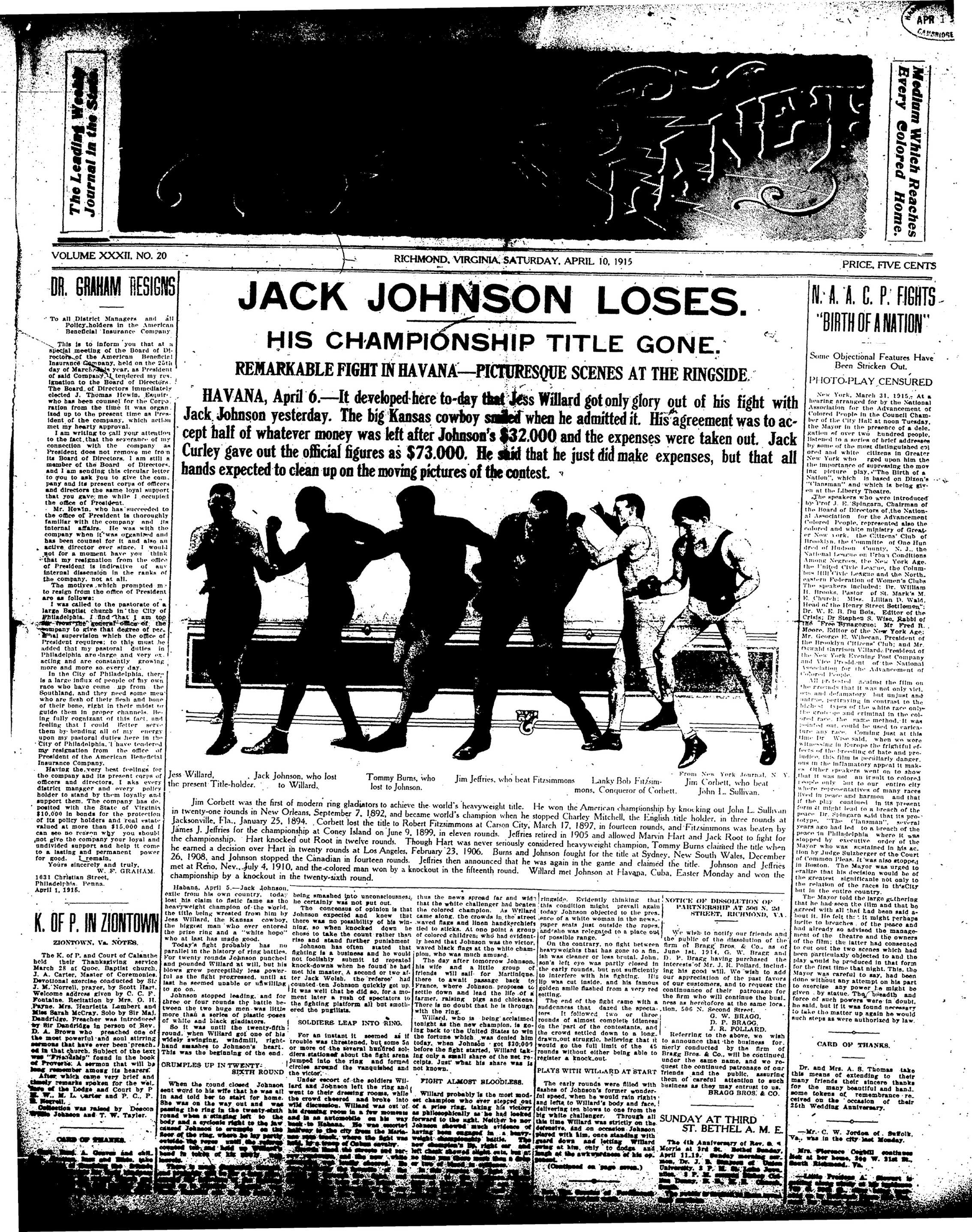
JACK JOHNSON LOSES.
REMARKABLE FIGHT IN HAVANA-PICTURESQUE SCENES AT THE RINGSIDE HAVANA, April 6. It developed here to-day that Jess Willard got only glory out of his fight with Jack Johnson yesterday. The big Kansas cowboy smiled when he admitted it. His agreement was to accept half of whatever money was left after Johnson's $32.000 and the expenses were taken out. Jack Curley gave out the official figures as $73.000. He said that he just did make expenses, but that all hands expected to clean up on the moving pictures of the contest.
THE BOXING FIGHT
Jess Willard, Jack Johnson, who lost Tommy Burns, who Jim Jeffries, who beat Fitzsimmons, Lanky Bob Fitzsimmons, Conqueror of Corbett, Jim Corbett, who beat John L. Sullivan, the present Title-holder, to Willard, lost to Johnson.
Jim Corbett was the first of modern ring gladiators to achieve the world's heavyweight title. He won the American championship by knocking out John L. Sullivan in twenty-one rounds in New Orleans, September 7, 1892, and became world's champion when he stopped Charley Mitchell, the English title holder, in three rounds at Jacksonville, Fla., January 25, 1894. Corbett lost the title to Robert Fitzsimmons at Carson City, March 17, 1897, in fourteen rounds, and Fitzsimmons was beaten by James J. Jeffries for the championship at Coney Island on June 9, 1899, in eleven rounds. Jeffries retired in 1905 and allowed Marvin Hart and Jack Root to fight for the championship. Hart knocked out Root in twelve rounds. Though Hart was never seriously considered heavyweight champion, Tommy Burns claimed the title when he earned a decision over Hart in twenty rounds at Los Angeles, February 23, 1906. Burns and Johnson fought for the title at Sydney, New South Wales, December 26, 1908, and Johnson stopped the Canadian in fourteen rounds. Jeffries then announced that he was again in the game and claimed the title. Johnson and Jeffries met at Reno, Nev., July 4, 1910, and the colored man won by a knockout in the fifteenth round. Willard met Johnson at Havana, Cuba, Easter Monday and won the championship by a knockout in the twenty-sixth round.
Habana, April 5.—Jack Johnson, exile from his own country, today lost his claim to flatten fame as the heavyweight champion of the world. The title being wrestled from him by Jess Willard, the Kansas cowboy, the biggest man who ever entered the prize ring and a "white hope" who at last has made good.
Today's fight probably has no parallel in the history of ring battles. For twenty rounds Johnson punched and pounded Willard at will, but his blows grew perceptibly less powerful as the fight progressed, until at last he seemed unable or unwilling to go on.
Johnson stopped leading, and for three or four rounds the battle between the two huge men was little more than a series of plastic poses of white and black gladiators.
being smashed into unconsciousness, he certainly was not put out.
The concensus of opinion is that Johnson expected and knew that there was no possibility of his winning, so when knocked down he chose to take the count rather than rise and stand further punishment. Johnson has often stated that fighting is a business and he would not foolishly submit to repeated knock-downs when he found he had his master. A second or two after Jack Wolsh, the referee, had counted ten Johnson quickly got up. It was well that he did so, for a moment later a rush of spectators to the fighting platform all but smothered the pugilists.
SOLDIERS LEAP INTO RING thus the news spread far and wide that the white challenger had beaten the colored champion. As Willard came along, the crowds in the street waved flags and lion handkerchiefs tied to sticks. At one point a group of colored children, who had evidently heard that Johnson was the victor, waved black flags at the white champion, who was much amused.
The day after tomorrow Johnson, his wife and a little group of friends will sail for Martinique, there to await passage back to France, where Johnson proposes to settle down and lead the life of a farmer, raising pigs and chickens. There is no doubt that he is through with the ring.
ringside. Evidently thinking that this condition might prevail again today Johnson objected to the presence of a white woman in the news, paper seats just outside the ropes, and she was relegated to a place out of possible range.
On the contrary, no fight between heavyweights that has gone to a finish was cleaner or less brutal. John, D. P. Bragg having purchased the interests of Mr. J. R. Pollard, including his good will. We wish to add to interfere with his fighting. His lip was cut inside, and his famous golden smile flashed from a very red continuance of their patronage for the firm who will continue the busilessness that dazed the spectators. It followed two or three rounds of almost complete idleness.
So it was until the twenty-fifth round, when Willard got one of his widely swinging, windmill, right-hand smashes to Johnson's heart. This was the beginning of the end.
ORUMPLES UP IN TWENTY:
SIXTH ROUND
When the round closed Johnson sent word to his wife that he was all in and told her to start for home. She was on the way out and was passing the ring in the twenty-sixth round when a singing left to the body and a cyclone right to the law caused Johnson to example on the floor of the ring, where he lay partly outside the ropes until the reflections counted ten, and hold up Williams head in tokes of his newly born knaves.
Jenson, who lost Tommy Burns, who lost to Johnson.
of modern ring gladiators to achieve the w
Oreans, September 7, 1892, and became w
1894. Corbett lost the title to Robert F
orship at Coney Island on June 9, 1899.
Ked out Root in twelve rounds. Though
in twenty rounds at Los Angeles, Februa
the Canadian in fourteen rounds. Jeffri
0, and the-colored man won by a knockout
the twenty-sixth round.
The concensus of opinion is that Johnson expected and knew that there was no possibility of his winning, so when knocked down he chose to take the count rather than rise and stand further punishment. Johnson has often stated that fighting is a business and he would not foolishly submit to repeated knock-downs when he found he had met his master. A second or two after Jack Welsh, the referoro' had counted ten Johnson quickly got up. It was well that he did so, for a moment later a rush of spectators to the fighting platform all but smothered the pugilists.
SOLDIERS LEAP INTO RING
For an instant it seemed as if trouble was threatened, but some 50 or more of the several hundred soldiers stationed about the fight arena jumped into the ring and formed circles around the vanquished and the victor.
Under escort of the soldiers Willard and Johnson left the ring and went to their dressing rooms, while the crowd cheered and broke into wild discussion. Willard was out of his dressing room in a few moments and in an automobile on his way back to Hohana. He was escorted halfway to the city from the Martinez area break, where the fight was held, for a group of Cuban cavalry.
Sherwin flamed the streets and carried you down, and the new, white camouflage was badly scarred. He marched toward the front of the city, through the city, and down of the river.
RICHMOND, VIRGINIA, SATURDAY, APRIL 10, 1915
thus the news spread far and wild that the white challenger had beaten the colored champion. As Willard came along, the crowds in the street waved flags and lined handkerchiefs tied to sticks. At one point a group of colored children, who had evidently heard that Johnson was the victor, waved black flags at the white champion, who was much amused.
The day after tomorrow Johnson, his wife and a little group of friends will sail for Martinique. there to await passage back to France, where Johnson proposes to settle down and lead the life of a farmer, raising pigs and chickens. There is no doubt that he is through with the ring.
Willard, who is being acclaimed tonight as the new champion, is going back to the United States to win the fortune which was donned him today, when Johnson got $20,000 before the fight started. Willard taking only a small share of the net receipts. Just what his share was is not known.
FIGHT ALMOST BLOODLESS
Willard probably is the most modest champion who ever stopped out of a prize ring, taking his victory as philosophically as he had looked forward to the night. Neither he nor Johnson showed much evidence of having been engaged in a heavyweight championship battle. The new champion's hip, right car and left chin showed slight cuts, but no time in those moments than a drop or two of blood in collision. In this engagement, he was not
ringside. Evidently thinking that this condition might prevail again today Johnson objected to the presence of a white woman in the newspaper seats just outside the ropes, and she was relegated to a place out of possible range.
On the contrary, no fight between heavyweights that has gone to a finish was cleaner or less brutal. Johnson's left eye was partly closed in the early rounds, but not sufficiently to interfere with his fighting. His lip was cut inside, and his famous golden smile flashed from a very red settling.
The end of the fight came with a suddenness that dazed the spectators. It followed two or three rounds of almost complete idleness on the part of the contestants, and the crowd settled down to a long, drawn-out struggle, believing that it would go the full limit of the 45 rounds without either being able to register a knock_out.
PLAYS WITH WILLARD AT START
The early rounds were filled with flashes of Johnson's former wonderful speed, when he would rain rights and lefta to Willard's body and face, delivering ten blows to one from the big white challenger. Through all this time Willard was strictly on the defensive, and on occasion Johnson played with him, once standing with guard down and letting Willard swing at him, only to dodge and laugh at the awkwardness of his op-
From New York Journal, N. Y.
Jim Corbett, who beat
Corbett. John L. Sullivan.
up by knocking out John L. Sullivan
ish title holder, in three rounds at
s, and Fitzsimmons was beaten by
in Hart and Jack Root to fight for
tommy Burns claimed the title when
ney, New South Wales, December
d the title. Johnson and Jeffries
iba, Easter Monday and won the
NOTICE OF DISSOLUTION OF
PARTNERSHIP AT 500 N. 20
STREET, RICHMOND, VA.
We wish to notify our friends and
the public of the dissolution of the
firm of Bragg Bros. & Co., as of
June 1st, 1914. G. W. Bragg and
D. P. Bragg having purchased the
interests of Mr. J. R. Pollard, including
his good will. We wish to add
our appreciation of the past favors
of our customers, and to request the
continuance of their patronage for
the firm who will continue the busi-
ness as heretofore at the same loca-
tion. 506 N. Second Street
Referring to the above, we wish to announce that the business for morly conducted by the firm of Bragg Bros. & Co. will be continued under the same name, and we request the continued patronage of our friends and the public, assuring them of careful attention to such business as they may entrust to us.
BRAGG BROS. & CO.
SUNDAY AT THIRD
ST. BETHEL A. M. E.
Medium Which Reaches Every Colored Home
PRICE, FIVE CENTS
N. A. A. C. P. FIGHTS "BIRTH OF A NATION"
N. A. A. C. P. FIGHTS "BIRTH OF A NATION"
Some Objectional Features Have Been Stricken Out.
PHOTO-PLAY CENSURED
New York, March 31, 1915. At a hearing arranged for by the National Association for the Advancement of Colored People in the Council Chamber of the City Hall at noon Tuesday, the Mayor in the presence of a delegation of over two hundred people, listened to a series of brief addresses by some of the most distinguished colored and white citizens in Greater New York who urged upon him the importance of suppressing the moving picture play, "The Birth of a Nation", which is based on Dixon's "Clanman" and which is being given at the Liberty Theatre.
The speakers who were introduced by Prof J. E. Spingarn, Chairman of the Board of Directors of the National Association, for the Advancement Colored People, represented also the colored and white ministry of Greater New York, the Citizens' Club of Brooklyn, the Committee of One Hundred of Hudson County, N. J., the National League on Urban Conditions Among Negroes, the New York Age, the United Civile League, the Columbus Hill Civile League and the Northeastern Federation of Women's Clubs. The speakers included: Dr. William H. Brooks, Pastor of St. Mark's M. E. Church; Miss. Lillian D. Wald, Head of the Henry Street Sottilomon"; Dr. W. E. B. Du Bols, Editor of the Crists; Dr Stephen S. Wise, Rabbi of the Free Brynagogue; Mr Fred R. Moore, Editor of the New York Age; Mr. George E. Wibecan, President of the Brooklyn Citizens' Club; and Mr. Oswald Garrison Villards, President of the New York Evening Post Company and Vice President of the National Association for the Advancement of Colored People.
All is tested against the film on the grounds that it was not only violent and defamatory but unjust and unfair, portraying in contrast to the highest types of the white race only the grievous and criminal in the colored race, the same method. It was pointed out, could be used to caricature any race. Coming just at this time Dr. Wise said, when we were witnessing in Europe the frightful effects of the breeding of hate and prejudice, this film is peculiarly dangerous in the inflammatory appeal it makes. Other speakers went on to show that it was not an insult to colored people only but to our entire city where representatives of many races lived in peace and harmony and that if the play continued in its present form it might lead to a breach of the peace Dr. Spingarn said that its prototype, "The Clansman", several years ago had led to a breach of the peace in Philadelphia where it was stopped by executive order of the Mayor who was sustained in his action by Judge Sulzberger of the Court of Common Pleas. It was also stopped in Boston. The Mayor was urged to eralize that his decision would be of the greatest significance not only to the relation of the races in this City but in the entire country.
The Mayor told the large gathering that he had seen the film and that he agreed with all that had been said about it. He felt that it might perhaps invite to breaches, of the peace and had already so advised the management of the theatre and the owners of the film; the latter had consented to cut out the two scenes which had been particularly objected to and the play would be produced in that form for the first time that night. This, the Mayor was careful to say, had been done without any attempt on his part to exorcise any power he might be given by statute. The breadth and force of such powers were in doubt, he said, but if it was found necessary to take the matter up again he would such steps as were authorized by law.
---
Dr. and Mrs. A. S. Thomas take this means of extending to their many friends their sincere thanks for the many beautiful and hand-some tokens of remembrance received on the occasion of their 25th Wedding Anniversary.
Wolk,
ay.
in ses
Rt.,
it is
measured
by
—Mr. C. W. Jordan of. Buffalo.
Va., was in the city last Monday.
CARD OF THANKS
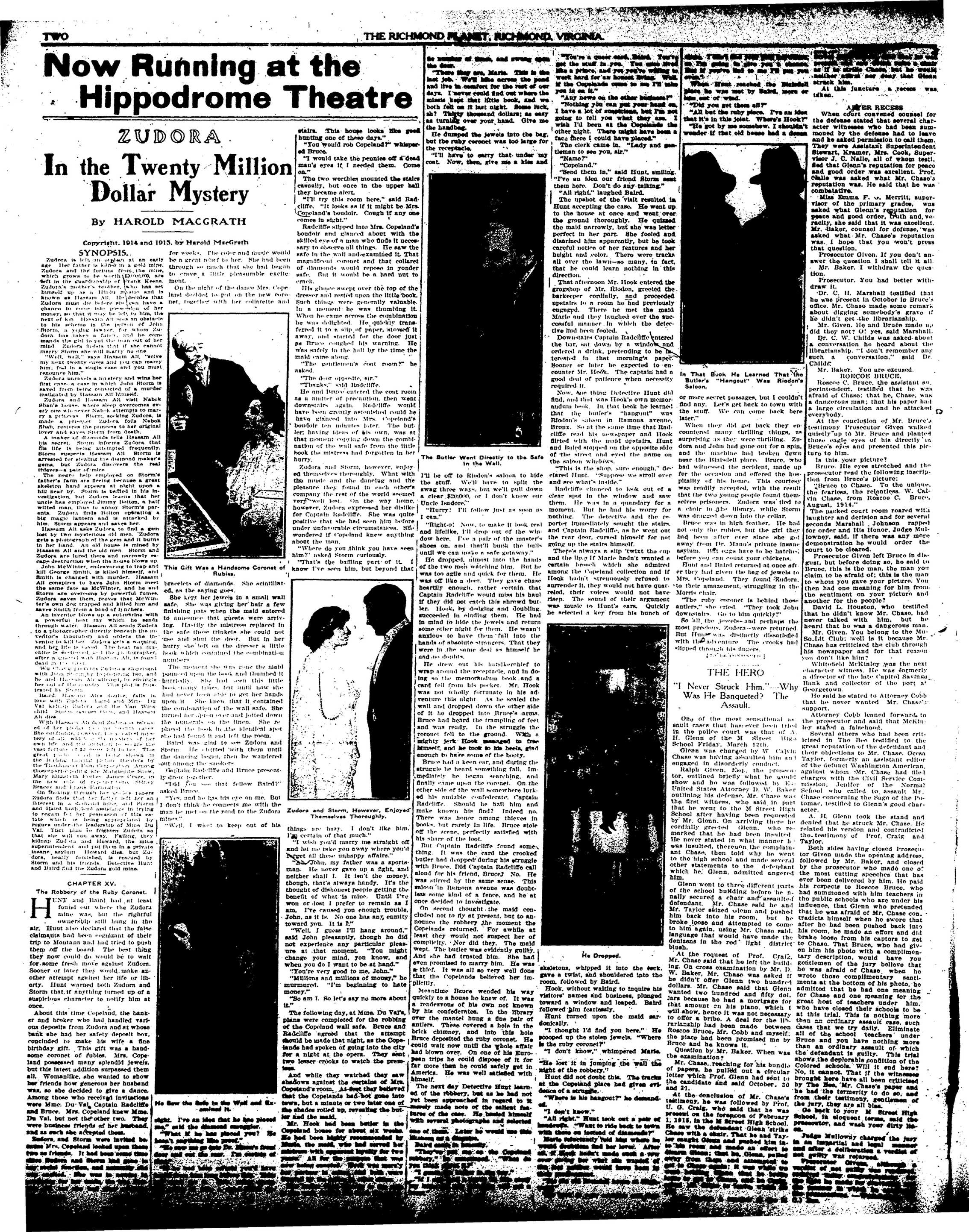
Now Running at the Hippodrome Theatre
ZUDORA In the Twenty Million Dollar Mystery
By HAROLD MACGRATH
Copyright, 1914 and 1915, by Harold MacGrath
SYNOPSIS.
Zudora is left an opaque at an early age. Her father is killed in a gold mine. Zudora and the fortune from the mine, which grown to be worth $100,000, are deft in the guardianship of Frank Keene. Zudora's mother's brother, who has set himself up as a Hindu mystic and is known as Hassam All, he decides that Zudora must die before she can have a chance to come into life. When she left him, the next of kin, Hassam All, sees an obstacle to his scheme in the person of John Storm, a young lawyer, for whom Zudora has taken a fancy, and he commands the girl to put the man out of her mind. Zudora insists that if she cannot marry Storm she will marry no one. "Well, well," says Hassam All, "solve my next twenty cases and you can marry him, feel in a single case and you must renounce him." Zudora unravels a mystery and wins her first prize in which John Storm is taken from being constricted of a murder narcissist by Hassam All himself.
Zudora and Hassam All visit Nabok Shan's house, where sleep overcomes every one who whenever Nabok attempts to marry a princess. Storm, seeking Zudora, is made a priestet Zudora fols Nabok Shan, restores the princess to her original lover and saves Storm from death.
A maker of diamonds tells Hassam All that her niece is being attempted frequently. Storm suspects Hassam All Storm is arrested for stealing the diamond maker's gem, but Zudora discovers the real thieves—a pair of mice.
The negro help employed on Storm's father's farm are fleeing because a great skeleton hand appears at night upon a hill near by. Storm is baffled in his investigation, but Zudora learns that her uncle has employed Jimmy Button, a harrier, to capture Storm's parents. Zudora finds Bolton operating a big magic lanten and is attacked by him. Storm appears and saves her.
Hassam All asks Zudora to find a gem lost by two mysterious old men. "Zudora gets a photograph of the gem and it burns in her hand. An old house is mined by Hassam All and the old men. Storm and Zudora are hired there and mowwow encounters a house blowing. John McWinter, endearing to trap and kill George Smith, is killed himself, and Smith is charged with murder. Hassam All conspires to have John Storm meet the same fate as McWinter, and he and Storm are overcome by powerful fumes. Zudora saves them, proves that McWinter's own dog trapped and killed him and saves Smith from a band of lynchers. An inventor buys up a submarine with a machine that sends through water. Hassam All sends Zudora to a photographer directly beneath the inventor's laboratory and orders the inventor to kill her. Zudora gets a warping, and her life is saved. The heat ray machine is deployed, and the photographer, after a quip with Hassam All, is found dead in the house. Wu Guangping proves Zudora's disappearance with two mysterious old men, protecting her, and he and Hassam All allow him to escape her out of the country. The plot is framed by Storm.
Hard, Hassan Ali, doubles, falls in love with Zainab Zahra and Mine Du Val kibbah Zahra, and the Van Winn child, Storm receives them, and Hassan Alameh. With Hassan Alameh Zahra is released of her拍手 to the world. She confides, however, to her mystery of all who is the mysteries of her own life and the secrets to secure the vast features of the world. The great picture is being shown in the teaching training picture by the shahabat Pam Cipriani. Among Mary Bracey and Jalaluddin the Snow, Mary Bracey and Jalaluddin in the new role of top lady, Sibylla Bracey and Frank Farrington.
On looking through her office papers Zudora finds that her father left her an interest in a criminal mime, and Storm and Haird both hold assistance in trying to regain for her possession of this estate which is being appropriated by Rogues under the leadership of Mine Du Tal. They plan to fight Zudora so she can be away and, if they kidnap Zudora and be reward, they superintend and put them in a private insane, agyrium Howard dies, but Zudora, nearly finished, is rescued by Storm and his friends. Detective Hunt and Haird and the Zudora gold mine.
CHAPTER XV.
The Robbery of the Ruby Coronet.
HUNT and Baird had at least found out where the Zudora mine was, but the rightful ownership still hung in the air. Hunt also declared that the false claimants had been cognizant of their trip to Montana and had tried to push them off the board. The best thing they now could do would be to wait for some fresh move against Zudorn. Sooner or later they would make another attempt against her life or liberty. Hunt warned both Zudorn and Storm that if anything turned up of a suspicious character to notify him at once.
About this time Copeland, the banker and broker who had handled various deposits from Zudora and at whose bank she had her safety deposit box, concluded to make his wife a fine birthday gift. This gift was a handsome coronet of rubies. Mrs. Copeland possessed many splendid jewels, but this latest addition surpassed them all. Womanlike, she wanted to show her friends how generous her husband was, so she decided to give a dance. Among those who received invitations were Mme. Du Val, Captain Badcliffe and Bruce. Mrs. Copeland knew Mme. Du Val, but not the other two. They were business friends of her husband, and as such she accepted them.
Kendron, and Storm were invited because Mrs. Copeland looked upon them two as friends. It had been some time since Kendron and Storm had gone to any social function, and automatically they asked. Also was it necessary to prescribe for her study the same kind of course, after had already been
for weeks. The color and music would be a great relief to her. She had been through so much that she had begun to crave a little pleasurable excitement. On the night of the dance Mrs. Copeland decided to put on the new cornet, together with her collarette and
THE
This Gift Was a Handsome Cornet of Rubies.
bracelets of diamonds. She scintillated, as the saying goes.
She kept her jewels in a small wall safe. She was giving her hair a few finishing pits when the maid entered to announce that guests were arriving. Hastily the mistress replaced in the safe those trinkets she could not use and shut the door. But in her hurry she left on the dresser a little book which contained the combination numbers.
The moment she was gone the maid poured upon the book and thumbed it hurriedly. She had seen this little book many times, but until now she had never been able to get her hands upon it. She knew that it contained the combination of the wall safe. She turned her arm over and lotted down the minerals on the linen. She replayed the book in the identical spot she had found it and left the room. Baird was glad to see Zudora and Storm. He chatted with them until the dancing began, then he wandered out among the smokers.
Captain Badlife and Bruce presently drew together.
"Did you see that fellow Baird?" naked Bruce.
"Yes, and he has his eye on me. But I don't think he connects me with the man he met on the road to the Zudora mines."
"Well. I want to keep out of his
THE
MISSING
MEN
OF
THE
WORLD
He saw the Safe in the Wall and Examined it.
right. I've an idea that he has placed me," said the diamond maggier.
"What if he has placed you? He hasn't anything like proof."
"He now me go into Dr. Menner's front Door and out the door. I'm certain of it."
THE RICHMOND PLANET, RICHMOND, VIRGINIA.
stairra. This house looks like good hunting one of these days."
"You would rob Copeland?" whispered Bruce.
"I would take the pennies off a dead man's eyes if I needed them. Come on."
The two worthies mounted the stairs causally, but once in the upper hall they became alert.
"I'll try this room here," said Radcliffe. "It looks as if it might be Mrs. Copeland's boudoir. Cough if any one comes in sight."
Radcliffe slipped into Mrs. Copeland's boudoir and glanced about with the skilled eye of a man who finds it necessary to observe all things. He saw the safe in the wall and examined it. That magnificent cornet and that collaret of diamonds would repose in yonder safe. But it would be a hard nut to crack.
His glance swept over the top of the dresser and rested upon the little book. Such things were generally valuable. In a moment he was thumbling it. When he came across the combination he was delighted. He quickly transferred it to a slip of paper, stowed it away, and started for the door just Bruce coughed his warning. He was safely in the hall by the time the maid came along.
"The gentlemen's coat room" he asked.
"The door opposite, sir."
"Thanks," said Radcliffe.
He and Bruce entered the coat room as a matter of precaution, then went downstairs again. Raddliffe would have been greatly astonished could he have glanced into Mrs. Copeland's bouncer ten minutes later. The butler, having ideas of his own, was at that moment copying down the combination of the wall safe from the little book the mistress had forgotten in her hurry.
Zudora and Storm, however, enjoyed themselves thoroughly. What with the mude and the dancing and the pleasure they found in each other company the rest of the world seemed very well best. On the way home, however, Zudora expressed her dislike for Captain Itadliffe. She was quite positive that she had seen him before under unfavorable circumstances. She wondered if Copeland knew anything about the man.
"Where do you think you have seen him?" asked Storm curiously.
"That's the battling part of it. I know I've seen him, but beyond that
THE WEDDING OF THE MARRIED GIRL
Zudora and Storm, However, Enjoyed
Themselves Thoroughly.
things are bazy. I don't like him.
I can't certain of that much."
"I wish you'd marry me straight off
and let me take you away where you'd
not forget all these unhappy affairs."
"Ah John, my father was a sport-
man. He never gave up a fight, and
neither shall I. It isn't the money,
though, that's always handy. It's the
thought of dishonest people getting the
benefit of what is mine. Until I've
won or lost I prefer to remain as I
am. I've caused you enough trouble,
John, as it is. No one has any, enmity
toward you. It is K."
"Well, I guess I'll hang around,"
said John pleasantly, though he did
not experience any particular plea-
ure at that moment. "You might
change your mind, you know, and
when you do I want to be at hand."
"Millions and millions of money," he murmured. "I'm beginning to hate money."
"So am I. So let's say no more about it."
The following day, at Mme. Du Vara, plans were completed for the robbing of the Copeland wall safe. Bruce and Radilliffe agreed that the attempt should be made that night, as the Copelands had spoken of going into the city for a night at the opera. They sent two lesser crooks to watch the premiers.
And while they watched they saw shadows against the curtains of Mrs. Copeland's room. At first they believed that the Copelands had not gone into town, but a minute or two later one of the shades rolled up, revealing the butter and the maid.
Mr. Hook had been better in the
Cleveland house for about six weeks.
He had been highly recommended by
Micha, the model, who had served her
minute with augment luxury for two
years. All for the purpose that we
now better served. Both were nearly
her minute in action, and both were
trained by the instructors at our office.
be members of them, and strong open
the door.
There they are, Maria. This is the last job. We'll hike across the pond and live in comfort for the rest of our days. I never could find out where the misiss kept that little book, and we both fell on it last night. Some luck,否? Thirty thousand dollars; as easy as turning over your hand. Give me the handbag.
He dumped the jewels into the bag, but the ruby cornet was too large for the receptacle.
"I'll have to carry that under my coat. Now, then, give me a kiss and
5
The Butler Went Directly to the Safe in the Wall.
I'll be off to Riodon's saloon to hide the stuff. We'll have to split the swag three ways, but we'll pull down a clear $20,000, or I don't know our Uncle Isadore."
"Hurry! I'll follow just as soon as I can."
"Right-o! Now, to make it look real and lifelike, I'll drop out of the window here. I've a pair of the master's shoes on, and that'll bank the bulbs until we can make a safe getaway."
He dropped, almost into the hands of the two mob watching him. But he was too agile and quick for them. He was off like a deer. They gave chase heartily enough, rather certain that Captain Radelfeil would miss his haul if they did not catch this shrewd butler. Hook, by dodging and doubling succeeded in cluding them. He had in mind to hide the jewels and return some other night for them. He wasn't anxious to have them fall into the hands of absolute strangers. That they were in the same deal as himself he and no doubts.
He drew out his handkerchief to wrap around the receptacle, and in doing so the memorandum book, and a card fell from his pocket. Mr. Hook was not wholly fortunate in his adventure this night. As he scaled the wall and dropped down the other side of it he dropped into Bruce's arms. Bruce had heard the trampling of feet and was ready. In the struggle the coronet fell to the ground. With a mighty jerk. Hook managed to free himself, and he took to his heels, glad enough to have some of the booty.
Bruce had a keen ear, and during the struggle he heard something fall. Immediately he began searching, and finally came upon the coronet. On the other side of the wall somewhere lurked his amiable confederate, Captain Radellie. Should he hall him and make known his find? Indeed no. There was honor among thieves in books, but rarely in life. Bruce stole off the scene, perfectly satisfied with his share of the loot.
But Captain Radellie found something. It was the card the crooked butler had dropped during his struggle with Bruce. Did Captain Radellie call aloud for his friend, Bruce? No. He was stirred by the same sense. This saloon in Ramona avenue was doubtless some kind of a fence, and he at once decided to investigate.
On second thought the maid concluded not to fly at present, but to announce the robbery the moment the Copelands returned. For awhile at least they would not suspect her of complexity. Nor did they. The maid wept. The butter was evidently guilty. And she had trusted him. She had even promised to marry him. He was a thief. It was all so very well done that the Copelands believed her implicitly.
Moantime Bruce wended his way quickly to a house he know of. It was a rendezvous of his own not known by his confederates. In the library over the mantel hung a fine pair of antlers. These covered a hole in the brick chimney, and into this hole Bruce deposited the ruby coronet. He could wait now until the whole affair had blown over. On one of his European trips he could dispose of it for far more than he could safely get in America. He was well satisfied with himself.
The next day Detective Hunt learned of the robbery, but as he had not yet been approached in regard to it newly made note of the silent features of the case. He hung himself with several photographs and selected one of them. Later he would use this likeness as a disguise.
"They're put me on the Copeland robbery," he unstressed. "What do you think about it?"
"You're a queer card. Blind. You've got the stuff in you. You must live like a place, and yet you're willing to work hard for an honest living. Well, if the Oepalands come to me I'll take you in on it."
"Any news on the other business?"
"Nothing you can put your hand on. I have a lot of stampeans, but I'm not going to tell you what they am. I wish I'd been at the Oepalands the other night. There might have been a face there I could have placed."
The clerk came in. "Lady and gentleman to see you, air."
"Name?"
"Copeland."
"Send them in," said Hunt, smiling. "I've an idea our friend Storm sent them here. Don't do any talking." "All right," laughed Baldr. The uphot of the visit resulted in Hunt accepting the case. He went up to the house at once and went over the ground thoroughly. He quizzed the male narrowly, but she was letter perfect in her part. She fooled and disarmed him apparently, but he took careful notice of her features and her height and color. There were tracks all over the lawn—so many, in fact, that he could learn nothing in this direction.
That afternoon Mr. Hook entered the grogshop of Mr. Rhodon, greeled the barkeeper cordially, and proceeded upstairs to a room he had previously engaged. There he met the maid Marle and they laughed over the successful manner. In which the detective had been fooled.
Downstairs Captain Radcliffe entered the bar, sat down by a window and ordered a drink, pretending to be tenanted in that morning's paper. Booner or later he expected to encounter Mr. Hook. The captain had a good deal of patience when necessity required it.
Now, anything Detective Hunt did find, and that was Hook's own memorandum book. In that book he learned that the butler's "hangout" was Rhodon's saloon in Ramona avenue, Bronx. So at the same time that Radcliffe read his newspaper and Hook flirted with the moll upstairs. Hunt and Infield stopped on the opposite side of the street and eyed the name on the saloon windows.
"This is the shop, sure enough," declared Hunt. "Suppose we stroll over and see what's inside."
Radiello chanced to look out of a clear spot in the window and saw them. He was in a quarantine for a moment. But he had his worry for nothing. The detective and the reporter immediately sought the stairs and Captain Radiello, as he went out the rear door, cursed himself for not going up the stairs himself.
There's always a slip 'twixt the cup and the lip if Marle hadn't wanted a certain brooch which she admired among the Copeland collection and if Hook hadn't strenuously refused to surrender it, they would not have quarreled, their voices would not have risen. The sound of their argument was music to Hunts ears. Quickly he selected a key from his bunch of
12
akalestons, whipped it into the sock, gave a twist, and shouldered into the room, followed by Baird. Hook, without waiting to inquire his visitors' names and business, plunged toward a window and leaped. Baird followed him fearlessly. Hunt turned upon the maid sardonically. "I thought I'd find you here." He scooped up the stolen jewels. "Where is the ruby coronet?" "I don't know," whimpered Maria. "He lost it in jumping the wall the night of the robbery." Hunt did not doubt this. The tracks at the Copeiand place had given evidence of a struggle. "Where is his hangout?" he demanded. "I don't know."
"All right." Hunt took out a pair of handcuffs. "Want to ride back to town with them on faraway of diamonds?" Marle subtractively told him where he would dvide them and her lower. After all, Marle hadn't made such a row over going her what she wanted of the best punter would have been in their possession.
"And she will be mistaken here on filly."
didn't I think she just didn't know me
I'm going to give you a chance,
But if you've had to me I'll put you
over?
When Hunt reached the Baskell
place he was not by Bald, more or
less out of wind.
"Did you get them all?"
"All but the ruby piece. I've an idea that it's in this joint. Where's Hook?"
"He got by me somehow. I shouldn't wonder if that old house had a damn
THE MYSTERY OF THE MONKEY
In That Book He Learned That 'the Butler's "Hangout" Was Riedon's Saloon.
or more secret passages, but I couldn't find any. Let's get back to town with the stuff. We can come back here later."
When they did get back they encountered many thrilling things, as surprising as they were thrilling. Zudora and John had gone out for a spin, and the machine had broken down near the Hildsell place. Bruce, who had witnessed the accident, made up for the occasion and offered the hospitality of his home. This courtesy was readily accepted, with the result that the two young people found themselves prisoners. Zudora was tied to a chair in the library, while Storm was dragged down into the collar.
Bruce was in high feather. He had not only the rubies, but the girl they had been after ever since she got away from Dr. Mann's private innane asylum. Itt eggs have to be hatched before you can count your chickens.
Hunt and Bafrel returned at once after they had given the bag of jewels to Mrs. Copeland. They found Zudorn, to their amazement, struggling in the Morris chair.
"The ruby coronet in behind those antlers," she cried. "They took John downstairs. Go to him quickly."
So all the jewels—and perhaps the most precious. Zudorn—were returned. But Hum was distinctly dissatisfied with the adventure. The crooks had slipped through his fingers.
THE HERO
"I Never Struck Him."----Why Was He Banqueted? The Assault.
One of the most sensational assault cases that have ever been tried in the police court was that of A. H. Glenn of the M. Street High School Friday, March 12th.
Glenn was charged by W. Calvin Chase was having assaulted him and engaged in disorderly conduct.
Ralph Given, Esq., the prosecutor, outlined briefly what he would show and he was followed by E. United States Attorney D. W. Baker outlining his defense, Mr. Chase was the first witness, who said in part that he went to the M Street High School after having been requested by Mr. Glenn. On arriving there he cordially greeted Glenn, who remarked that he had been insulted. He never stated in what manner he was insulted, thereon the complainant Chase, then told why he went to the high school and made several other statements to the defendant which he; Glenn, admitted angered him.
Glenn wont to three different parts of the school building before he nally secured a chair and assaulted defendant. Mr. Chase said he and Mr. Taylor seized Glenn and pushed him back into his room, but he broke loose and attempted to come to him again, using Mr. Chase said, language that would have made the denizens in the rod light district blush.
At the request of Prof. Craig, Mr. Chase said that he left the building. On cross examination by Mr. D. W. Baker, Mr. Chase was asked if he didn't offer Glenn two hundred dollars. Mr. Chase said that Glenn wanted two hundred and fifty dollars because he had a mortgage for that amount on his piano, which I will show, hence it was not necessary to offer a bribe. A deal for the librarianship had been made between Roscoe Bruce, Mr. Cobb and myself; the place had been promised me by Bruce and he knows it.
Question by Mr. Baker. When was the examination?
Mr. Chase, reaching for his bundle of papers, he pulled out a circular letter which Prof. Glenn had sent to the candidate and said October. 30 and 21.
At the conclusion of Mr. Chase's testimony, he was followed by Prof. U. G. Craig, who said that he was present on the forecon of February 1, 1915, in the M Street High School. He saw the defendant Glenn's strike Chase with a chair. That he and Taylor caught Glenn and pushed him into his room and made an effort to disarm Glenn; that he, Glenn, pulled away from them and attempted to get to Chase again; it was while we were holding Glenn that he being here to get to Glenn, and he Chase here to get Glenn for torture which he
BROTHER, I have been told that he will present and say some truth to us earlier as if he strife Chaco, but he would neither affirm nor deny that Glen struck him.
At this juncture a recess was taken.
AVER RECESS
When court convened counsel for the defense stated that several character witnesses who had been summoned by the defense had to leave and he asked permission to call them. They were Assistant Superintendent Stewart, Kramer, Mrs. Cook, Supervisor J. C. Nalle, all of whom testified that Glenn's reputation for peace and good order was excellent. Prof. Challe was asked what Mr. Chase's reputation was. He said that he was combatative.
Miss Emma F. v. Merritt, supervisor of the primary grades, was asked what Glenn's reputation for peace and good order, truth and veracity, she said that it was excellent. Mr. Baker, counsel for defense, was asked what Mr. Chase's reputation was. I hope that you won't press that question.
Prosecutor Given. If you don't answer the question I shall tell it all. Mr. Baker. I withdraw the question.
Prosecutor. You had better withdraw it.
Dr. C. H. Marshall testified that he was present in October in Bruce's office. Mr. Chase made some remarks about digging somebody's grave if he didn't get the librarianship.
Mr. Given. He and Bruce made up did they not? O! yes, said Marshall.
Dr. C. W. Childs was asked about a conversation he heard about the librarianship. "I don't remember any such a conversation," said Dr. Childs.
Mr. Baker. You are excused.
ROECOE BRUCE.
Roscoe C. Bruce, the assistant so perintendent, testified that he was afraid of Chase; that he, Chase, was a dangerous man; that his paper had a large circulation and he attacked everybody.
At the conclusion of Mr. Bruce's testimony Prosecutor Givon walked quietly up to Mr. Bruce and planted those eagle eyes of his directly in Bruce's eyes and presented this picture to him.
Is this your picture?
Bruce. His eyes stretched and the prosecutor read the following inscription from Bruce's picture:
"Bruce to Chase. To the unique, the fearless, the relentless. W. Calvin Chase, from Roscoe C. Bruce, August, 1914."
The packed court room roared with laughter and derision and for several seconds Marshall Johnson rapped for order and His Honor, Judge Mullowney, said, if there was any more demonstration he would order the court to be cleared.
Prosecutor Given left Bruce in disgust, but before doing so, he said to Bruce, this is the man, the man you claim to be afraid of; this is the man to whom you gave your picture. You then had one meaning for him from the sentiment on your picture and another for the people?
David L. Houston, who testified that he didn't know Mr. Chase, had never talked with him, but he heard that he was a dangerous man.
Mr. Given. You belong to the Mu-
So-Lit Club; well is it because Mr.
Chase has criticized the club through
his newspaper and for that reason
you don't like him.
Whitfield McKinley was the next
character witness. He was formerly
a director of the late Capitol Savings
Bank and collector of the port at
Georgetown.
He said he stated to Attorney Cobb
that he never wanted Mr. Chase's
support.
Attorney Cobb leaned forward to
the prosecutor and said that McKin-
ley staked a falsehood.
Several others who had been criticized in The Boe testified to the great reputation of the defendant and their objections to Mr. Chase. Oceana Taylor, formerly an assistant editor of the defunct Washington American, against whom Mr. Chase had filed charges with the Civil Service Commission, Junior of the Normal School who called to assault Mr. Chase concerning the Saga of the Potomac, testified to Glenn's good character.
A. H. Glenn took the stand and denied that he struck Mr. Chase. He related his version and contradicted the testimony of Prof. Craig and Taylor.
Both sides having closed Prosecutor Given made the opening address followed by Mr. Baker, and closed by the prosecutor who made one of the most cutting speeches that has ever been delivered by him. He paid his respects to Roscoe Bruce, who had summoned with him teachers in the public schools who are under his influence, that Glenn who pretended that he was afraid of Mr. Chase, contradicted himself when he swore that after he had been pushed back into his room, he made an effort and did brake loose from his captors to get to Chase. That Bruce, who had given him his photo with a complimentary description, would have you gentlemen of the jury believe that he was afraid of Chase, when he wrote those complimentary sentiments at the bottom of his photo, he admitted that he had one meaning for Chase and one meaning for the great host of teachers under him, who have closed their schools to be at this trial. This is nothing more than an ordinary assault case, such cases that we try daily. Eliminate all of the school teachers under Bruce and you have nothing more than an ordinary assault of which the defendant is guilty. This trial shows the deplorable condition of the Colored schools. Will it end here? No, it cannot. That if the witnesses brought here have all been criticised by The Hoe, Mr. Chase's paper and he had the termitery to do so, and from their testimony, gentlemen of the jury, they are all bias.
Go back to your M Street High School, in eloquent terms, said the prosecutor, and wash your dirty linens.
Judge Mellowny charged the jury in an impartial and legal manner and after a deliberation a verdict of not guilty was returned.
Prosecutor Groom, although a verdict of not guilty was readied, pointed out today, congratulations, for the judge to make her decision and the prosecution in which he committed the proceedings. — Washington Post, G. J. Brown.
SATURDAY, APRIL. 10. 1915.
KUGENE H. BERGUSON
PLACED UNDER ARREST
Charged With Imperson Advances to Sixteen, Year-old Gli.
Surprised in a small room on the second floor of the house at 715 as Franklin Street by two sisters of the sixteen-year-old girl he is allowed to have enticed there "for vicious and immoral purposes." Eugene H. Ferguson, manager of the Richmond Window Cleaning Company of 631 North Eighth Street, was arrested last night by Detective Sergeants Wiltshire and Bailley. Mrs. Virginia Kalser, sister of Janie Jackson, who was found in the room, charges Ferguson for assaulting and choking her when she attempted to provoke this escape from the room before the police arrived. Ferguson characterizes the charge against him as a "frame-up" and as an attempt on the part of the sisters to force him to pay them $800.
Detective Sorgeant Wiltshire was summoned to the house about 11 o'clock last night by C. W. Phillips, who maintains a boarding-house at that address, and who complained to the police that he discovered in his house attempting to commit a crime. He informed the police that the man carried a revolver, and asked that the greatest speed he used in getting an officer to the place. The patrol was summoned from the first Station, with several men, while Detective Wiltshire headquarters. There he found three young women apparently preventing the escape of the man.
STORIES TOLD BY PARTIES
VARY GREATLY
Stories told by the various partly connected with the affair vary.
Mrs. Kalser maintained that her sisters, Janie and Christine, came to this city, searching for work, about a month ago. Christine arriving here first, Jater Jante came to the city from her home in Goshen, and was followed by Mrs. Kalser, who intended keeping a watchful eye over them. She maintains that Ferguson succeeded in inducing Jante to come and live in his family. Later, Mrs. Kalser says, he employed her to help him in his office and then sugared him with a bottle of no longer keep him at his home, before secure her a room elsewhere. This was done yesterday, according to the sister, and during the afternoon her trunk was taken there.
Ferguson and Janie Jackson left the home of Mrs. Kalner, 2208 East Leigh Street, about 9:30 o'clock last night for the furnished room, it is claimed. They are said to have arrived in good time. However, before the departure Mrs. Kalner claims to have discovered a note which the young girl had tossed into a stove, and which is said to have been written by Ferguson. This note is said to have familiarized the elder sister with unexpected details of the arrangement. She took her other sister, Christine, with her, and started for the room.
TUSSELED WITH FERGUSON
FOR POSSESSION OF REVOLVER
According to their statements to Detective Wiltshire and Captain Sowell last night, they arrived in time. They claim to have found Ferguson insisting on remaining at the boardinghouse. They claim that when permission was refused him by Janie, he drew a revolver from his pocket and threatened her life. It was just at this time that the elder man are with White Hill, Katie tussled with Ferguson, Mrs. Copeland of the revolver. Christing dashed from the room in search of an officer, Mr. Phillips, in the meantime, had heard the disturbance, and telephoned headquarters.
The story told by Forguson is vastly different from that told by Mrs. Kaiser and witnessed by her sisters. The man claims that he took Christine Jackson from a house of questionable character on West Broad Street and brought her into his home for the purpose of giving her a more Christian environment. That is said to have occurred before Mrs. Kaiser or Janie came to Richmond. After they arrived, and Forrest was unable to care for the extra burden, he claims. Mrs. Kaiser sent Janie to the house when Christine left her claims, with the plea that she be allowed to res. main for two weeks, as she was unable to care for her.
FERGUSON ALLEGES
EFFORT TO EXTORT MONEY
This time is alloged to have been overstayed. Ferguson claims that he secured work for the girl at the Richmond Press, and that she quit after working two days. He then suggested that he secure a room for her, until she was able to get other work, and this was agreed to. The man made no mention of taking her into his office. He claims that the appearance of the sisters in Janie's room last night was by a prearrangement, with the idea of forcing him to pay them money.
"We had hardly arrived," Ferguson enclosed, "when Virginia, Mrs Kahn, bolted into the room with a revolver in her hand and ordered me to write her a check for $800. I asked her why I owed her money and she replied, 'as the price of my water,' I told her I would pay her nothing, as I had done no wrong, but as she threatened me with the plight I thought it might be best to give her the shock and later stop payment at the bank: So Christmas was meant to my office for my stockpile, but before I resumed I grabbed the bank and opened it.
remained no cartridge. While the
three women were fighting me in an
wetht to recover the weapon, the
odor appeared.
"It was nothing more than a "frame-up," such as these three men have worked on another man here in Richmond. That man was forced to give notes for $500 to Christine, and is still paying them in monthly installments. I know his name, but will not make it public unless it is absolutely necessary in order to prove their character.
TOLD PHIILIPS HIS WISHED
ROOM FOR HIS NIECE
To these varying stories is added that of the police. Detective Wiltshire learned from Phillips that Ferguson had come there yesterday afternoon with a story that he was expecting a niece from the country, and was wished to secure a room for her. He was able to secure employment at one of the five and ten cent stores within a short time and that he would be responsible for her room rent until she was able to pay for it, herself. Wiltshire was unable to find the checkbook which Ferguson declared had been brought from his office by Ferguson. Ferguson had not been bailed up to an early hour this morning. He will be arraigned in the Police Court on the charge against him tomorrow. - Times Dispatch, March 21, 1915.
TOM COLES FOSESSES
TO ASSAULTING GIRL
Negro Murderer Tolla Officers About Crime, Rich and Carter
CHASE CITY, V., March 3. —Tom Cole, nego, who was arrested yesterday near Clarksville, charged with criminal assault on Miss Georgia Royster, lies at the point of death in the Petersburg jail, where he was taken last night by Sheriff W. R. Beales for safe keeping. It being deemed unsafe to try to keep his prisoner in the Boydton jail, Sheriff Beales, after having had him murdered examined by a physician, left in an automobile for La Crosse, and there caught a noughtbound train for Petersburg, Coles, while on route, the nausault, as well as the murderer, January 31. He denied that Richard Carter, who was arrested on the train near Danville by Police Officer Vaughan, was an accomplice.
Miss Roxster, who is in a very nous condition as in the result of her experience, was able to talk with friends today. She stated that one of the norgreens did not put his hands or her, but that he stood guard while the other dragged her into the bushes. Her loud screams. In spite of the 'assailants' threat of death if she resisted, brought to her rescue John Sizemore, a nero farm hand. He realizing what had happened as he drew near, started in pursuit of the two norgreens, who left the girl in a semi-consoless condition. Although he stated that he was in the velocity in which the crime happened, Richard Carter positively denoted any knowledge of it, saying that he was simply on his way to Danville to find work. He worked differently and will hold him pending a preliminary hearing. Feeling is still running high, and should Tom Coles survive the bullet wounds, one of which passed through the abdomen it is believed that he will have to be carefully guarded when brought back for trial.
NEGROWILL HARDLY
Petersburg, Va., March 23. --- Tom Coles, the Mecklenburg negro murderer and assailant of Georgia Royster, was brought to the Petersburg hall this morning in desperately, and it is thought, fatally, wounded condition. In view of the excitement and indignation aroused by his crimes and the apprehension that he might he taken out of the hands of the law and summarily dealt with. Coles has hurried to the Petersburg jail for the murder of this morning in the custody of Sheriff Beales. In resisting arrest he was shot three times by a member of the pose pursuing him. One of the balls penetrated the abdomen, one the lungs and one the liver. Realizing his condition, Coles has voluntarily confessed to the crimes charged against him, admitting the murder of the colored woman, Rahe Chandler, at Boydton on January 31, and the assault yesterday on the fifteen-year-old daughter of Mrs. L. A. Royster, the son of the man who he absoletes Richard Carter, who was arrested at Danville, from any pretension in the assault on the girl. He says Carter was not with him, and that he does not know him. Coles says that after the murder of the Chandler woman he left the county and went to Florida, remaining there until his return to Mecklenburg several days ago. He was in trouble because of the murder, and did not care much as to the consequences of the hospital undergone this morning, and operated upon his life. The negro talked in the most accustomed way of his crimes. He says he killed the woman at Boydton because she cried him, and that, he might have killed the pleading girl whom he outraced yesterday but that he had nothing to kill her with.
Mayor Cabanis this afternoon received a message from "Adjutant General Sales," stating that reports had reached the Governor that a party from Mecklenburg was forming to come to Petersburg for the purpose of lynching Coles, and asking if any military was needed. Mayor Cabanis replied that he has no apprehension whatever of any such party coming to Petersburg for such purpose.
A report was received here that a lynching party had started, or would start, for Petersburg, but no confidence was placed in it. Such party people have a difficult: if not perilous in leading and lynching a prisoner here. The probability is that Coles will die of his wounds during the night.
At 10 o'clock the condition of Coles was reported as homicide. It is not believed he will live through the night. As a precaution, members Lieutenant Brent Jones of the Petersburg Battalion have been
Agents' Contest.
VOTING COUPON.
Name:
Address:
(GOOD FOR 16 VOTES.)
WOLF BROTHERS' Improved 1916 Model, 8 oz. Bulldog Brown
Meat Bowl Straightnear and Dryer Bowl.
50 cents. 2¢
Actual Length of Cord in 9 inches
Made of solid impenetrable jute full round bask. Being solid and durable the Cord will hold heat longer than any other Cord on the market. Other details are provided on advertising for $1.00.
Our Prices to Flly Bask, and we give long additional Fund.
When putting in cord and 8 oz. Bulldog Bask for basking, Agents' Contest.
WOLF BROTHERS, 1824 St. George Street, Baltimore, Maryland.
sumbled on the armory in youngest should they be called on. Kenneth Jones was prompted to this action by rumors of threatened mob violence. However, at a late hour quiet prevailed.
CARTER FINALLY ADMITS
THAT HE KNOWS COLES
Danville, Va., March 22—Richard Carter, the nugro who is being help here for the Mecklenburg County authorities, tonight admitted in his cell that he know Tom Colez, who is in Petersburg fall, charged with an offense against Georgia Royater of Buffalo Junction. Earlier in the day Carter reheumately donned knowledge of such a poison as Coles, but when he saw his fallal, that he had been thinking, that he was membered working with' him near Buffalo last week. Carter still denies participation in the crime, and hopes to prove an alibi by the keeper of a toll bridge near Clarksville. Sheriff Beales is expected here tonight
PLEA FOR COLORED PEOPLE
In Ordinances to Attend the Segregation Law.
That the segregation law operates to keep thousands of colored people amid unhealthy and unsanitary surroundings, not only endangering their personal health, but the health of many white citizens by whom they are employed, was the declaration in the First, Branch City Council last week. S. Cummings, City Councilman Harry S. Cummings, introduced ordinance to repeal the two segregation measures now on the books.
The laws are entitled "An ordinance to prevent conflict and ill-feeding between white and colored races in Baltimore city, and to preserve the public peace and promote general welfare making reasonable provisions requiring the use of separate blocks for residences by white and colored people, respectively." The respective measures were signed on September 25, 1913, and November 8, 1913, and are similar except that the latter has a provision for schools and churches. It was agreed upon at the Colored Hotel Conference, held last week at Bethel Street, Baltimore, on August 15, Lane street and Drumlin Hill, Maryland, segregation tends to unhealthy conditions and it was due to the action taken at the conference that Councilman Cummings introduced the ordinance yesterday. In his statement of explanation he said, in part,
The health conference was held under the auspices of the Medical and Chirurgical Faculty of Maryland and was assisted by such an eminent physician as Dr. Wm. Welch. It received the official sanction of Governor Goldsborough and Mayor Preston, and commanded such widespread interest among my people result in calculated to do great good towards the betterment of health conditions in our city: provided the information given and the advice offered are put into practical operation. If it finds itself unable to give sufficient financial assistance to relieve conditions, surely no excuse can be given, nor not passing suitable laws which will help matters, and repealing existing laws which admittedly have a tendency to interfere with the fundamental conditions which make for health. Neither produce passion politics or any other operation should be tautamount to the community's health, under the present conditions in the present temper of the public mind. (Baltimore American March 21, 1915)
AGENTS FOR PLANET
You Can Secure The Planet Any Week From These Agents In Various
Cities.
Won S. Brown, 1214 E. 9th St. Los
Angeles, CA
J. M. Infard, Fulpak, Va.
Rollin Bros., 137 E. 9th St. Chat-
tanooga, Tenn.
R. M. Harvey, 2924 State St., Chicago, Illinois.
Columbia News Agency, Inside Mall,
Washington, D. C.
M. C. Waller, 1100 W. Leigh St., City,
Clarence Williams, 1411 Ross St., City,
Charles Luding, P. O. Box 1776, Salt
Lake City, Utah.
William H. Moore, Wilmington, N. C.
E. P. Mackens, 1115 Pine St., Phila, Pa.
by Douglas A. A. R. A. care F. P. Purnell,
Providence, R. I.
pre- Thomas E. W. Perry, 2 Jones Place,
Thomas E. W. Perry, 2 Jones Place,
E. A. Williams, 200 W. 63rd St., New
York City.
J. E. Schmidt, 263 W. 35th St., New
York City.
Jearce W. Sheaves, 99 Lippincotti Ave.,
Long Branch, N. J.
held by A. A. Laby, 106 Walworth Street,
Brooklyn, Y.
his A. O. Smith, 717 St. Claude St., New
who Orleans, La.
ver Louis Goodman, 1307 Ave. F., Birmingham, Ala.
and Charles A. Starkes, 1521 E. 18th St., Kansas City, Mo.
and Rev. J. J. Nickerson, Box 441, William Hamburg, Va.
and Josse F. Brown, 1216 W. Green Street, Louisville, Ky.
and Saul A. Lucas, 3943 Central Avenue, Cleveland, Ohio.
and J. H. Mattox, 57 Ann St. New York City.
all Lewla Jones, Leoburg, Va.
of William H. Greene, 61 Favor Street, Rochester, N. Y.
Mrs. John De Bona, 718 Queen St., Norfolk, Va.
and Frank N. Wilson, 1761 L. St., N. W., Washington, D. C.
and Hal. Lucas, 10515 Summer Street, Charleston, W. Va.
J. H. Jordan, 36-11th St. Wheeling.
West Va.
Dr. J. Mitchell Smith, 9551, Naopi
Ave. Los Angeles, Cal.
Allen Henry, 299 Antone St., Detroit,
Mich.
C. Mason, 2850 Wilton St., Denver,
Col.
Roy A. A. I. Davis, General Delivery.
Albany, N. J.
M. L. Brown, Box 325, Staunton, Va.
R. L. Kennedy, 26 Eagle St., Asheville,
N. G.
Contest.
COUPON.
VOTES.)
Peter Thompson, 710 N. 1st St, City,
Stoufford, 120 S. Augusta Street,
Staunton, VA.
Wm. H. Scott, 2218 E. Main St, City,
N. Winston, 537 Brook Ave, City,
J. S. M. Singleton, 28th and Nine Mile
Road, City,
Harold P. Douglas, 11 N. Kentucky
Avenue, Atlantic City, N. J.
J. A. Stokes, 1411 Fitzwater St., Philadelphi, Pa.
Frank H. Weaver, 3315 Central Ave.
Columbus, Ohio.
J. C. Allon, 2107 Marshall Ave. Newport
News, Va.
J. E. Braham, 4401 Central Avenue
Columbus, Ohio.
Quaker City Adv. Co. 1221 Pine St.
Philadelphia, Pa.
Dayton Negro News Bureau, 623 S.
Webster Ave., Dayton, Ohio.
Charles H. Brownling, 802-14th Street.
Des Moines, Iowa.
D. W. Shoemaker, Sheffield, Ala., Box
No. 45.
Charles Robinson, 124 W. Battle St., Talladega, Ala.
Rev. J. A. Taylor, Owen-Hol. Troy, N. Y.
Ned McKlever, 2115 Madison Avenue,
Newport News, Va.
Rufus Wade, Blue Ridge Springs, Va.
J. M. Anderson, 330 Liberty Street,
Plainfield, N. J.
J. H. Mattox, 57 Ann St. New York
City.
B. H. Burnett, 562 Marion St. Columbia, Ohio.
C. F. Graves, Elizabeth City, N. C.
W. Harris, R. F. D. No. 1, Box 99, Norfolk, N. C.
R. Bell, 571 Sylvan Ave. Asbury Park, N. J.
L. H. Walker, 2038 Wylie Ave., Pittsburgh, Pa.
SEVENTEEN BELGIANS SHOT
Executed by Germans After Belng Found Guilty of Boying.
"Seventeen Belgians, most of whom were young peasants, were shot at daybreak on Tuesday in the Ghent barracks, after having been found guilty by a court martial of espionage in the interest of the allies," says a dispatch to the London Exchange Telegraph company, from Amsterdam.
Worry Causes Suicide
Worried by the obligations fache him on April 1, the annual "settlement day" in York county, William Schultz, fifty year old, an Adam county farmer, near York, Pa. lay out his breaks. He tied the shotgun to the bedpost and pulled the trigger with his toe.
February Exports Total $298,727,757
February exports this year wer $298,277,757. This is almost $100,000 above the highest record shown by any previous February.
Office: Room, No. 405, Mechanics' Bank Building
'THONE, RANDOLPH 2637.
RESIDENCE—610 N. First St.—Shop in Rear. Phone, Randolph 2166.
Special Attention Paid to the Taking of Contracts for Building of
Any Style of Architecture. Job Work a Specialty.
MAILED DAY IN MAIL. POST OFFICE MONEY ORDER
Address in Mack Shampoo Dairy Co.
Minneapolis, Minn. not to individuals.
A BEAUTIFUL HEAD OF HAIR IS A LADY'S CROWNING GLORY. And every lady can have it if she will use the Magic. The Magic will dry the hair after a shampoo or bath, and straighten the earliest bend of hair. It will also attenuate its growth. The Almondium Comb can be used with alcohol Kerosene or oil, but takes its heat from the heating bar which is heated on our Alcohol Kerosene or oil. The use of Mack Hair Pins is best on the market. Price per box, $64. Alcohol lilies, price $84. Liberal terms to agents.
Write for literature today.
MAGIC SAMPOO DRIER COMPANY. MINNEAPOLIS, MINNESOTA
PHOTOS-We Offer you the Latest and Most Artistic Photos at
More Moderate Figure than you can obtain elsewhere. Special
Attention Paid to Children. We will also be Pleaseed
to Quote you Prices on Exterior and Interior
View Work.
ENLARGING AND COPYING FROM OLD PHOTOS A SPECIALTY.
GEORGE O. BROWN, Photographer
603 NORTH SECOND ST., RICHMOND, VA.
Mme. T. D. PERKINS SCIENTIFIC SCALP SPECIALIST 4630 W. 35th Avenue, Denver, Colo.
Madam T. D. Perkins, of Denver, Colo., who has spent five years in study of the scalp, is now interesting women all over the globe in the care of the hair and scalp. No matter how dark your skin is, Madam Perkins matches scalp preparations and scientific method of treatment for cultivating, beautifying and growing the hair will grow your hair if there is no physical alliment to prevent. Her treatments have been successful where all others have failed. Have you written her? If not, and you want hair like her own, write her to-day. Be sure to enclose a 4-cent stamp and write your name and address very plain if you expect a reply. Don't write unless you mean business.
```markdown
```
```markdown
```
Madam Perkins Before Treatment
I and scalp stint, cause the
I no matter how harsh; thick
I no matter how kinky. First.
I. Do not wait if you are in
I ever the United States by ma-
ing the care of the hair, and
when a 4-cent stamp is an
national history of your hair and s
answered, when a 4-cent star
race growing hair to-day when
was when I first began treat-
ess. You can secure those p
made in the world. The T.
kinks, sole agent.
BEGINS
OTHER, P
you by your
ends, removes dandruff and scalp matter how short; soft, no matter straight from the bulls, no matter wonderful improvement. Do not I give treatments all over the U.S. I send booklet concerning the care taking my treatments when a 4-armed dog needs a personal history condition.
All mail promptly answered, the only woman of the race grow the real length my hair was when let if you mean business. You o me. None like them made in the Preparation. Madam Perkins, sole
JOHN M., HIGGINS
DEALER IN
Choice Groceries, Wines Liquors and Cigars
PURE GOODS, FULL VALUE FOR THE MONEY.
1610 East Franklin St.
(Near Old Market)
RICHMOND . . . VIRGINIA
A. HAYES,
OFFICE AND WARKROOMS:
727 N. Second St.
ends, removes dandruff and scalp agaric, causes the hair to grow long, no matter how short; soft, no matter how harsh; thick, no matter how thin; straight from the bulbs, no matter how kinky. First treatment will show improvement. Do not wait if you are interested in your hair. I give treatment to the United States by mail. Write me at once. I send booklet concerning the care of the hair, and testimonials of those taking my treatments when a coat stamp is enclosed. I do not have agents. I need a personal history of your hair and scalp and your physical condition.
* All mall promptly answered, when a 4-cent stamp is enclosed. I am the only woman of the race growing half to today who can show the public the real length my hair was when I first began treating it. Send for booklet if you mean business. You can secure these preparations only from me. None like them made in the world. The T. D. P. Scientific Scalp Preparation, Madam Perkins, sole agent.
d St. CHAS. G. J
RESIDENCE—725 N. SECOND ST.
First-class Hacks and Cookets of
all descriptions. I have a spare room
for bedins, when the family have not
t suitable place. All Country Orders
given Special Attention.
Toy special attention is called
in New Style City Campus. Call
and sub me and you shall we waited
in individually.
in called
posts. Call
two waited
possess
This is for you, but soft, long, beau not be put on the Do you want this write for particulars in the Scientific Dender, Colo., who world with her won hair. My own hair is ment. With these grew 17 inches in malmed one length years. What I did doing for hundreds do for you with my Seal Preparations. falling hair.
scurf, causes the hair to grow long, no how harsh; thick, no matter how thin; how kinky. First treatment will show wait if you are interested in your hair. State by mail. Write me at once of the hair, and testimonials of those of the stamp is enclosed. I do not hear if your hair and scalp and your physical then a 4-cent stamp is enclosed. I am g hair to-day who can show the public first began treating it. Send for book-secures those preparations only from world. The T. D. P. Scientific Scalp cent.
OTHER, PEOPLE JUDGE you by your Furniture now!
When you can got Furniture and Rugs from an Old Established house like JURGENS—that's known to sell the best quality goods, just as reasonable as elsewhere—why not give your friends a good impression. It will give us the greatest pleasure to show you our wonderful stock of homemaking comfort giving Furniture and Rugs and—don't fail to ask our salesmen about our banking plan which gives you 5, 10 or 15 months in which to pay for any purchase:
CHAS. G. JURGENS SON
Established 1880.
ADAMS AND BROAD
No more troned hair, tiful hair that need dresser on retiring, kind of hair! If so, to Madam T. D. Per scalp Specialist of an art making the derful art of growing my best advertise treatments my hair two years. It had re-four inches) for 15 for my hair I am of others, and will will Scientin My treatment. My treatment, off, curtails
Leave Richmond
Arrive Richmond
*5.69 A.H. Byrd St. Sina
*6.66 A.H. Main St. Sina
*7.10 A.H. Byrd St. Sina
*7.27 A.H. Main St. Sina
*8.66 A.H. Byrd St. Sina
*9.66 A.H. Main St. Sina
*10.25 A.H. B.rd No. Sina
*12.01 noon Byrd St. Sina
*2.51 P.M. Byrd St. Sina
*3.15 P.M. Main St. Sina
*4.10 P.M. Byrd St. Sina
*7.10 A.H. Byrd St. Sina
*1.10 P.M. Main St. Sina
*2.15 P.M. Byrd St. Sina
*3.25 P.M. Main St. Sina
*4.20 P.M. B.rd No. Sina
*10.00 P.M. B.rd No. Sina
*11.14 P.M. Main St. Sina
*12.35 night Sina St. Sina
*12.60 night B.rd No. Sina
ACCOMMODATION TRAINS—WEEKDAYS.
Leave Byrd St. Ha. 6.00 P.M. for Fredericksburg.
Leave Kibe N.A. 7.45 A.H., 2.15°F.H., 6.80 P.H. For
Ashland.
Arrive Byrd St. Ha. 8.25 A.H. from Fredericksburg.
Arrive Kiba N.A. 6.30 A.H., 11.25 A.H. 5.65°F.H.
from Ashland.
Sunday acommodation to no leave Kibbs 6.15 P.M. for Fredericksburg arrive Kibbs 11.25 A.M.
from Fredericksburg.
Daily, t Weekdays.
All trains to or from Byrd Street Station stop at Kiba. Time of arrivals and departures not guaranteed. Read the signs.
NORFOLK & WESTERN.
ONLY ALL RAIL LINE TO NORPOLE
Schedule in Effect December 1, 1914.
Leave Hyrd Street, Mason, Richmond, FOR
NORPOLE. "0:00 A.M. M." "0:00 P.M. "4:10 P.M.
NORPOLE. "0:00 A.M. M." "0:00 P.M. THE WEST "9:18 A.M.
NORPOLE. "0:00 A.M. M." "0:00 P.M. THE WEST "9:18 A.M.
Alive Richmond from Norfolk: "11:40 A.M.
"8:00 P.M. "11:30 P.M. M. From the West: "8:58
P.M. "8:00 P.M. "**1:40 P.M. "8:00 P.M.
"0:00 P.M.
W. "Maily," "Maily except Sunday," ***Bunny only.**
W. "Maily," "Maily except Sunday," ***Bunny only.**
P. T. M., Imanoake, O. P. A. Bonham
ATLANTIC COAST LINE
ATLANTIC COAST LINE
EFFECTIVE JANUARY 4, 1016.
TRAINS LEAVE RICHMOND DAILY.
For Florida not the Booth: 8:15 A.M., 6:56 P.M., 11:10 P.M., 12:50 A.M.
For Norfolk: 9:00 A.M., 8:00 P.M., 4:10 P.M., 9:00 A.M., 8:00 P.M., West: 6:15 A.M., 9:20 P.M., 10:00 P.M., 11:00 A.M., 12:50 A.M., 13:00 P.M., 14:00 A.M., 15:00 A.M., 16:00 P.M., 17:00 A.M., 18:00 P.M., 19:00 P.M., 20:00 P.M., 21:00 P.M., 22:00 P.M., 23:00 P.M., 24:00 P.M., 25:00 P.M., 26:00 P.M., 27:00 P.M., 28:00 P.M., 29:00 P.M., 30:00 P.M., 31:00 P.M., 32:00 P.M., 33:00 P.M., 34:00 P.M., 35:00 P.M., 36:00 P.M., 37:00 P.M., 38:00 P.M., 39:00 P.M., 40:00 P.M., 41:00 P.M., 42:00 P.M., 43:00 P.M., 44:00 P.M., 45:00 P.M., 46:00 P.M., 47:00 P.M., 48:00 P.M., 49:00 P.M., 50:00 P.M., 51:00 P.M., 52:00 P.M., 53:00 P.M., 54:00 P.M., 55:00 P.M., 56:00 P.M., 57:00 P.M., 58:00 P.M., 59:00 P.M., 60:00 P.M., 61:00 P.M., 62:00 P.M., 63:00 P.M., 64:00 P.M., 65:00 P.M., 66:00 P.M., 67:00 P.M., 68:00 P.M., 69:00 P.M., 70:00 P.M., 71:00 P.M., 72:00 P.M., 73:00 P.M., 74:00 P.M., 75:00 P.M., 76:00 P.M., 77:00 P.M., 78:00 P.M., 79:00 P.M., 80:00 P.M., 81:00 P.M., 82:00 P.M., 83:00 P.M., 84:00 P.M., 85:00 P.M., 86:00 P.M., 87:00 P.M., 88:00 P.M., 89:00 P.M., 90:00 P.M., 91:00 P.M., 92:00 P.M., 93:00 P.M., 94:00 P.M., 95:00 P.M., 96:00 P.M., 97:00 P.M., 9
For Goldstein and Fayetteville: 410 P. M.
M. 10.10 A. M. 6.00 P. M. 8.00 P. M.
10.10 A. M. 6.00 P. M. 11.00 A. M. 720 P. M.
11.00 A. M. 6.00 P. M. 11.00 A. M. 720 P. M.
11.00 A. M. 6.00 P. M. 6.53 P. M. 800 P. M.
11.00 P. M.
Wednesday Sunday * Sunday only
connections not guaranteed
Halloween DLL. H. P. A. 2033 Monarch
SOUTHERN RAILWAY
Premier Carrier of the Bomb
Traverse Lake Richmond- Main Street Relation.
N. H. Mining schedule figure published as information and details.
6 001 A. M—Daily—Local for Charlotte and Durham. 10:30 A. M—Daily—Limited—For all Durham. 10:30 A. M—Except Sunday—Local for Keswick, Durham and Intermediate stations. 6 001 P. M—Daily—For Danville, Bittingham, with electric lighted driving light, with paint south. 11:30 P. M—Daily—Limited—For all paint south. Pulman ready. 9 001 P. M.
WORK RIVER LINE.
5 100 P. M. Stratford train (Pulley car—Daily local to West Point, connecting for Baltimore daily travel Sunday.
15 A M. Daily Local to West Point.
THE ARRIVE RICHMOND
From the South 7:06 A.M. 8:00 A.M.
7:35 P.M. M and 8:30 P.M. M, daily 8:40 A.M.
except Sunday.
From West Joint 9:10 8:10 A. M. 6:10 P. M. dally
607 East Main St. "Dpope, Mad 773
CHESAPEAKE & OHIO.
CHESAPEAKE & OHIO.
10:10 A: Local-Daily Ek. Bn.-N. New.
10:10 A: Local-Daily Ch.ville. Ek. Bn.
Clifton Forsyth.
Clifton Forsyth.
10:10 A: Local-Daily, Norfolk. Old Patent.
10:10 A: Local-Daily, Lyndsburgh. Laz.,
Lyndsburgh.
Forge.
12:00 Noon - Express - Dally Ex. Sun - New
folk, Old Polish.
*I O O P - Express - Daily - Clin. - L'ville, Changé
and St. Louis
*** 4:10 P. - Express-Daily - Norfolk, Old P.
6:00 P. - Local-Daily - Kz. Bun. - N. Horne,
Old Point.
6:15 P. - Express-Daily - Gordonville.
* 5:15 P. - Local-Kz. Bun. - Labb G. F. C. Purgse
* 11:00 P. - Express-Daily - Chas. Loodville.
* 11:00 P. - Express-Daily - Patrón Corp.
*Parker Corr*
TRAINS HISTORY HWNDON Local from
East: *"*8:58 A.M. M, *"*28:58 P.M. 8:39 P.M.
East: *11:20 A.M. M, *"*28:58 P.M. 8:39 P.M.
From West: *8:58 A.M. M, *"*28:58 A.M. M and
1:00 P.M. M, A, K and 8:39 P.M.
James River Line: *"*28:58 A.M., *"*19:48 P.M.
*Daily except Sunday.*
SEABOARD AIR LINE
"The Progressive Railway of the South."
Richmond, Va. - Richard Rice, who received Richard D. Daly: 8:00 a.m. A. M., Loch Leven, Gortlinville, sleeps and coaches, coachers, Birmingham, Jackson, and coaches to Atlanta and Birmingham; 11:19 p.m. Amled: 18:35 a. M., A. M., sleeps, Atlanta, Birmingham, Jacksonville, Tampa and coacher Jacksonville.
model bound trains scheduled to arrive in Rich
obtained by M. B. M. 8:18 A.M. 8:18 A.M.
5:00 P.M. 8:48 P.M. Koola.
ALPHEUS SCOTT
(CHURCH HILL)
Funeral Director and
Embalmer
OPEN DAY AND NIGHT
Office, 3006 P. Street, Phone,
Mad. 2377—Residence, 1015
St. James St., Phone,
Madison 6819.
Paraphernula, Material and Service of
the Best. Reliable Service. Moderate Rates.
MADARK SCOTT. Embalmer for Women
and Children and its attendance at
Funerals.
THE ECONOMY
327 N. FIRST ST.
Fine Tailoring
Cleaning, Dyeing and
Repairing
CHITMAN M. WHITE
Propristor
Published every Saturday by John Mitchell, Jr. at SIL N. 4th St. Richmond, Va.
JOHN MITOHELL, JR.——EDITOR
All communications intended for publication should be erect as to reach us by Wednesday.
Entered at the Post Office at Richmond, Va. at second class matter.
SATURDAY, APRIL 10, 1915.
THE DOWNFALL OF JOHNSON.
"Abash'd the devil stood!
And fell how awful goodness is and saw.
Virtue in her shape how lovely.
No one who will read impartially the reports of the championship fight at Havana last Monday will doubt but what Jack Johnson "had drawn" or in the language of the mourning colored brother, "he sold out." In discussing this phase of the subject, the Associated Press, representative says:
When the round closed John's sent word to his wife that he was all in. He told her to start for home. She was on the way out, and was passing the ring in the twenty-six round when a stinging left to the body and a cyclonic right to the Jacques Johnson to crumple on the floor of the ring, where he lay, partly outside the ropes, until the refuge counted ten and held up Wallard's hand in token of his news won laurels.
There is much discussion today among the followers of the fighting game as to whether Johnson was really knocked out.
In the sense of being smashed in to unconsciousness, he certainly was not put out. The concensus of opinion is that Johnson knew there was no probability of his winning, so when knocked down he chose to take the count rather than rise and stand further punishment. A second or two after Jack Welsh, the referrer had counted ten, Johnson up.
The following account too will be of special interest:
Johnson did not seem to be totally unconscious, recovering soon after his seconds gathered him up. He stood for a minute in the centre of the ring with a white towel wrapped around his black face, blinking his eyes at the sun and listening to the roar about him. Then he went to his corner.
Meanwhile Willard would have been lost in the great warm in his corner, but for his great height. The big farmer grinned amiably while fronzed men reached for his hand.
Cuban soldiers had to pile into the ring with drawn sabers to rescue both of the fighters from the crush.
When Jack Curley went over to Johnson's corner to cut the glove off his hands the negro looked up smiled feebly and said: "Let me keep those." "How do you feel?" asked Curley "All right," said Johnson, "every thing is all right, the best man won." Later Johnson told Tom Flanagan that he was glad he had lost. He said: "Now all my trouble will be over they will let me alone." Johnson know he was gone sooner than anybody else. In the rest he tween the 21st and 22nd rounds he sent for Harry Frazier and asked him to find Curley. Soon afterwards he told Flanagan he was getting weak and could not last much longer. or. "I want you to get my wife out of here," he said. Flanagan told him to go a few more rounds and see how he felt
Between the 25th and 26th Curley was found and Johnson repeated his request to him.
Curley went to the box occupied by Johnson's wife, back of Willard's corner, and told her what Jack had said. He offered to take her out and she agreed to go.
A correspondent in describing the 24th and 25th rounds, which were next to the last round in which the fight ended, says:
Willard is slowing up to a walk. Johnson kids him and asks him if he wouldn't like a siling for his arm.
Johnson jabbed Willard in the stomach with his left. In the clench Johnson told the timekeeper to get ready with his counting arm. Johnson tapped Jeas on the nose with a left and danced back smiling.
Johnson eased toward the centre and, blocking Willard's left, held him in a clinch. He yelled over to his corner to Armstrong: "Bob, run over to the house and get them car, pet slippers. Cutey Willard's feet are tired."
Willard paid no attention to the kidding, but drove a stiff right to the heart as Johnson bent over. He hooked the champion on the chin with a right, and Johnson swung back wildly.
Another report says that Jack Johnson was on the streets of Havana the next day, not showing a single sign of the encounter. He is quoted as having said:
"As he unwinding, discussion. I am his
greatest friend. For him here is the
shadow of suffering giving me a light. When
We know that that I would take his title away from him in jig time if we met again. I will never be a ham and egg fighter, though, for I have enough monoy to keep me the rest of my life.
Evidently without intending so to do, Jack Johnson has told the whole story. With his lavish expenditures of money $30,000 would not take care of Jack Johnson the remainder of his natural life. As for Champion Jess Willard, he is the laughing stock of every first class pugilist in the country. To fight Sam Langford would be for him to lose the title and to fight, and first class white pugilist would be for him to do the same thing. He is admittedly untrained and awkward as first class pugilists go. It was Jack Johnson's purpose to lose out to just such a character.
Willard's long reach and height were only to aid the deception. The colored people have mistakenly idolized Jack Johnson. He was the creature of white men in the beginning and he is the tool of white men at the close. If this case will serve to lift our people to higher ideals and bring them to appreciate true worth in their own race leaders, then this "slump" of Jack Johnson will not have been in vain.
RLA, DR. MORRIS AND THE
PUBLISHING HOUSE.
SUNDAY, JULY 10TH
But this ownership and authority are largely spiritual. It is intricately analogous to the contention of the Italian Government in its dealing with the Church of Rome. The temporal power of the Church is densely in this case the actual ownership of the plant of the National Baptist Publishing Board is by influence denied by Rev Dr R. H. Browd and his friends on the National Baptist Publishing Board at Nashville. They are virtually in revolt against the orders of the National Baptist Convention, which orders are subversive of the powers of a regularly incorporated enterprise in the State of Tennessee.
This condition has been brought about by blundering on the part of somebody somewhere. President Morris does not allege that the National Baptist Convention has ever put as much as one dollar in the enterprise. On the other hand, he states that it was openly asserted that the Convention did not have any money with which to start the enterprise. He claims that $28,000 was netted in an investment with "white men's brains and Negro backs" as these publications were called. This then disposes of any claim to property rights in the plant of the National Baptist Publishing House, which is controlled by Rev Dr. R. H. Boyd and a Board elected by the National Baptist Convention.
That body controls the Board, but it does not own the plant under the charter unless it can show that it furnished the money with which to purchase it. That money was furnished by somebody goes without question and it is not believable that a plant worth approximately $200,000 could be built up without some body's money. Who furnished the money? Was it done without money? Was it built up only through the influence and good will of the National Baptist Convention? Perhaps so. In that case, it is the marvel of the century, the wonder of the age and should stand as a wonderful example of God's power and the influence of the National Baptist Convention.
While President Morris does not say so, he evidently infers that while the National Baptist Convention did not put any money into the publish- ing house, his associate and ma- ger, Rev. Dr. Boyd, did not put any money into it either and that with the aid of a white corporation or business concern, the print grew to its present huge proportions. We are satisfied to believe though that when he is through training and
examining Manager M. H. Boyd's books which are now in Manager Boyd's possession, he will find that Manager Boyd by Manager Boyd's own records has not only put his own money and that of his family in the concern, but that his time, labor and the "best years" of his active life have all gone into the enterprise to make it a success.
We conclude then that from a moral standpoint, the National Baptist Convention owns the National Baptist Publishing House, the National Baptist Publishing Board and all of the rights, titles and interests of the publishing concern at Nashville, Tennessee. It should not shirk its responsibility as owner, for in this case it is liable for all of the indebtedness of the concern to Rev. Dr. R. H. Boyd and his employees, and to all other creditors of the National Baptist Publishing House.
It should demand a complete accom-
puting and take over the plant leag-
ally in its own right and take the
necessary legal steps so to do, but
the action should not be in a fight-
ing or in all antagonistic spirit. If
I owes any man, it should pay him.
When this is done "peace will rejoice
in Warsaw". If we may be pardoned
for the observation, the mistake
made was in the appointment of an
informative commission to super-
code and exercise a lordship over
one of the standing boards of the
National Baptist Convention, which
board had been given specific pos-
ses by the Constitution of the Nat-
onal Baptist Convention.
The most that he can ask is that he be compensated for his service and that the members of his family be reimbursed for any outlay of money that they may have legitimately advanced to the publishing house. It was to determine these questions that we suggested that a Board of Arbitration of business men be selected to pass upon the questions at issue, both sides agreeing to be bound by its findings. If Rey Dr. Boyd owes the National Baptist Convention, let him pay, and if the National Baptist Convention owes Rey Dr. Boyd or anybody else it pay in the meantime, let able attorneys untangle the legal tangle and let the National Baptist Convention come into its own.
"Hot air" discussions by preachers in the journals controlled by themselves will do more harm than good and no progress will be noticeable. We are willing to lend our aid to stop this unsuccessful wrangle, "with malice towards none, and charity for all."
When he night, the frogs are cracking, kindle that a torch is fire. He how soon they all are silent? Thus truth silence the fire.
---
A WORD ABOUT JACK JOHNSON
It will be remembered that it was openly charged that James Jeffries would never have been induced to go into the ring and face Jack Johnson, but for the fact that he had been assured that the whole thing had been fixed and that Jack Johnson would "lay down." He was given a fortune to meet Jack Johnson, it was charged that Jack Johnson "double crossed." Jeffries and when he got him into the ring gave him such a walloping that to this day he has a feeling of bitter enmity towards the shaky ex-champion.
Down in Havana Inst Monday, it seems that a similar arrangement was made, but the money was so placed that only by carrying out the bargain could Jack Johnson come into possession of the fortune. Even at this Jose Willard was nervous. He did not know at what time Jack Johnson would forget his agreement and then there would be "sad news to carry to Hannah." The moving picture syndicate figured that they could afford to make it profitable for Johnson for the reason that moving pictures showing the triumph of a white man over a black one would take all over the world.
Some say Johnson was given fifty percent royalty on the moving picture profits and some say twenty-five percent. The moving picture syndicate is figuring on making one million dollars out of the pictures taken at Havana. Johnson is report ed to have refused an offer of two hundred thousand dollars for his part of the moving picture contract. It will be seen, then, that Johnson will consent when he meets
and so he will remember to know him the remainder of his life" and "he isn't going to work no more." It was a great temptation, equal to that which Adam underwent in the Garden of Idea. Adam couldn't stand it and neither could Jack Johnson. As for the colored folks, thousands of them are still "cussing." Farewell, Jack Johnson!
PERSECUTING A CHURCH
The following clipping from the Richmond Times Dispatch of Sunday, April 4th, 1915, will explain itself:
Rev. E. M. Mitchell, Robert Eldridge, William Tyler, Rutherford Sampson, Benjamin Oary, Albert Boyle, T. C. Gaddy and Sam Fisher, all colored, were fined $25 and costs each in the Police Court yesterday on a charge of violating the segregation ordinance by holding services in the Leigh Street Memorial church formerly Immauuel Baptist Church, on the night of March 17.
The church was recently sold to the colored people, and the sale caused considerable litigation as to the right of the former owners to make the sale. Policemen Bailey and Tanner arrested the persons fined and were witnesses in the case yesterday.
Considerable time was taken in the hearing. The defense claimed that only the Fifth Street entrance had been used at the meeting on March 17, while the prosecution maintained that both entrances of the church had been used. Arthur Coles, colored, arrested by Patrolmen Hickman and Thomas was also in court yesterday on a charge of violating the segregation ordinance. The man was fined $100 and costs by Justice Griggs.
These people are law-abiding citizens. They have committed no crime. They were found guilty of occupying their own property and yet they were subjected by Acting Police Justice Wilbur J. Griffgs to unlawful punishment. So far as the damage to their reputations is concerned, they have no redress in law and in a civil suit would be compelled to use their individual money to fight the whole treasury of the City of Richmond. What have the white people of this community to say now? We refer to those who have expressed a friendly interest in our welfare? What about those who have given alms to our churches and who have shown an integst to improve our condition?
A white congregation decides to rid itself of an old church edifice and seeks the colored congregation to aid them. They take the hard, earned dollars of these people and leave on their hands this burden. In a spirit of concession, this colored congregation expended more than five hundred dollars changing the entrance, and they do not even go out of the front gate of the church. They do not even open the wide doors which face on the street on which white people live, but so in and out from the street side occupied by colored people. Acting Police Justice Griggs is reported to have declared that this was an evasion or attempted evasion of the law.
He fined, not the Leigh St. M. E. Church, but the officers as individuals. If he will explain how he could lawfully do this, it will be a source of gratifying information to legal minds everywhere. According to his ruling, he had the right to put any of the persons so fined in jail. He fined Rev. E. M. Mitchell, a gentleman of high character, a man who had never been in a court house as a felon. He fined Mr. R. B. Sampson, a reputable business man, who is conducting one of the best appointed shops among the race in the city. He is law abiding and is showing his worth by doing all in his power to improve his people in this community by church work.
He fined Mr. Robert Eldridge, a hardworking Godfearing citizen, who has just come from under a great calamity, having buried a loving daughter. But why continue the re-cital? This was done by Acting Police Justice W. J. Griggs, the President of the Eagles, where the clinic of the glasses and the clash of the pool table balls are heard through out the night at the corner of Thirlid and Marshall streets in that palatial edifice erected for the purpose, where the "feast of reason and flow of the soul" is unknown. The President of the Eagles, upon the advice of the able City Attorney, hauls these people of God into the Police Court of the City of Richmond and fines them for serving God' Almighty in their own place of worship.
White people of Richmond, this thing will not do. Colored people of Richmond, this is carrying the iron heel of oppression too far. There should be a strong protest voiced against it by the Christian people of this community, regardless of race or color. We never expected to see such a condition of affairs in this city. Acting Police Justice Willbur J. Griggs knows that the Eagles of which whiskey club he is President, took active steps against the purchase by the colored people of the Immunal Baptist church. He knows that he committed this action and therefore supporting, in all of the rules of propriety, that organization set in place by the authority of
the condition with which he is of the most remarkable failure ever delivered from the Police Court bench in this city.
He holds the individuals responsible for the action of the Leigh-St. M. E. Church. How can he be so this? By what scheme of reasoning can he constitutionally criminally punish a few individuals for lawfully obeying the orders of the body? He might fine the church, but in what way can they be made personally responsible for obeying the orders of a church in the absence of a specif. life injunction to the contrary? His Honor, Judge D. C. Richardson, has vacated the bench in cases of less importance than this and if we are not mistaken did so in a segregation case that came before him.
Colored people, will do well to take notice of this case. There is no use cringing or yielding fundamental rights. The many way is to stand up and be counted, to face the issue and stand up for every right guaranteed to citizens by the Bill of Rights of Virginia. We are not writing this article in any fictious spirit. It is more in sorrow than in anger that we discuss the questions at issue. God holds the destiny of nations in his hands. Let every church in Richmond pray for our enemies and those who despitefully use us. Let us pray for the white members of the Elks and the Eagles, that God may touch their stony hearts and cause the well-springs of sympathy to be moved in our behalf. O. the pity of it.
Be pete and obliging. Do not forget that.
Buy land, colored folks, and increase your real estate holdings.
When colored children are well raised their conduct reflects the wisdom of their parents.
Colorful folks are mighty good people, but don't let them get "down" on you.
```markdown
```
Jack Johnson may well exclaim,
"The white folks gave me the cham,
plonship title and the white folks
have taken away from me the cham,
plonship title. Blessed be the white
folks."
Some folks are so mean that you can see the meanness oozing out of the porous of the skin, but there is plenty of it left behind to cause trouble.
---
When we look to God for relief, if means that we have exhausted our credit with the Devil. This is a strange world and there are strange people in it.
REPUBLICANS WIN
COLORED CANDIDATE
ELECTED IN CHICAGO
The Republicans carried Chicago last Tuesday and elected William Hale Thompson, Mayor by a plurality of 138,891, the largest ever given a candidate for that office. He carried with him the entire Republican ticket to victory. For the first time in the history of Chicago, Oscar De Priest, a colored man, was elected to the City Council.
St. Louis, Mo. went overwhelmingly Republican. There is great rejoicing over the result.
RENT LIST.
104 E. Leigh St., rooms; bath,
gas; $35.00 month.
119 E. Leigh St., flat 5 rooms:
$22.50 month.
— North 24th St., Five rooms
pantry, $12.00 month.
1208 N. 25th St., five rooms, $10
month.
534 N. 2nd St., Stores; $16.50 mo.
524 N. 2nd St., flat; 3 rooms; $11
month.
217 W. Leigh St., flat; downstairs
3 rooms, range, stationary tubs;
$15.00 month.
2127 Henrico St., rooms; $8 mo.
724 N. 5th St., flat; 4 or 5 rooms.
823 Brook Lane, house; 4 rooms:
$6.00 month.
825 Brook Lane, house; 4 rooms,
$6.00 month.
700 St. James St. 2 rooms, $4.50.
And other suburban properties.
BRAGG BROS. & CO.
506 N. Second St.
NATIONAL IDEAL
The National Ideal Benefit Society was organised July 19th by A. W. Helman, with his broad experience and with a host of friends through out the country it has made great. He being with the name "Ideal." It was organised with the most Praise, thanks and with pleasure to him.
HOTEL DALE, Cape May, N. J.
OPEN APRIL 1.
paid all the money needed. The or-
gination, not three years old, has
recently purchased a beautiful piece
of property at 318 N. Gray St. This
is a most central location, just two
blocks from Broad St., and in a
close reach to all street car lines,
just two doors from the Mechanics
Bank.
The officers and members of the order consist of some of the best people of our race.
ZION BAPT. CHURCH.
At 11:30 Dr. W. T. Anthony, our pastor, prescribed on the resurrection now is He risen from the dead and has become the first fruit of them that slept. 1 Cor. 15.
At 4 P. M. B. Y. P. U. convened with a large attendance and an excellent programme was rendered. Miss Ruth Robinson, mistress of ceremony.
At 8:15 our revival began. The pastor prescheduled 16:06. Seeking the Lord a great service.
Dr. J. C. Brown of Philadelphia, will be with us in this meeting, for two weeks. All are welcome.
D. B. GLENN, Scrib
MR. TROTTER'S TOUR
"Editor William Monroe Trotter has evidently gotten on "the blind side" of Hon. Harry C. Smith, editor of the Cleveland (O.) Gazette. That journal in a recent issue says:
Editor Wm. Trotter kept the largest audience he has had (on his recent tours) outside of New York City and Chicago, waiting from 7:30 p. m. to 10:30 p. m., last Sunday evening, in this city, and failed to give any good reason for so doing. The result is he has left a "feeling" in this city, who regret greatly, because The Gazette did all in its power to secure the attendance upon the meeting, he characterized as we have in the opening sentence of this leader. His absence compelled those in charge to hastily substitute a "speaker" who failed utterly to "rise to the occasion" and who only helped to make "bad matters worse." in that he was neither wise in the selection of what he said, nor consistent. Mr. Trotter arrived just as the pastor of the church was about to dismiss the large audience which had given an exhibition of patience, etc. that was simply wonderful.
What does all this mean? Has Editor Smith interviewed the committee of arrangements to see if the financial part of the bargain was all right in advance? If there was no "blitz" in money, matters and then Mr. Trotter disappointed his audition, we can but exclaim. May God have mercy on Brother Trotter, when his wife meets him.
It was a cruel punishment to require Mr. Trotter to speak to an audience in Cleveland, when that audience had been waiting, for him three hours. Even a woman's love will grow cold at such treatment and he must have found himself within an ice-house the night that he ascended the rostrum. -Richmond Va. Planet.
Editor Trotter got on "the blind side" (didn't know we ever had such a "side") by arriving so late.
"The committee of arrangements" and Mr. Trotter claim that the financial and all other parts of the bargain were "all right in advance" and otherwise. There was absolutely no "hitch" in money matters. All the blame for the audience's long wait rests upon Mr. Trotter, who instead of leaving Cincinnati for Cleveland on an early morning train, as he should have done, waited for a near-night train and then missed that one, so he informed members of the local committee of arrangements. "Brother Trotter's wife" has our best wish, as when she "starts something" on his return home and an accounting of his Cleveland engagement is asked for. His late arrival practically wiped out his receipts for the engagement here. So, there undoubted, will be "something doing" on his return to Boston, if the domestic conditions there are as indicated by our esteemed confrence. Editor John Mitchell of the Planet.
The "cruel treatment" who visited on the audience, only, and in the shape of that long wait and the "speech" of the individual who was expected to entertain it in Trotter's absence. In spite of all this, no speaker could have been more enthusiasmately greeted and more magnanimously treated than he was on his late arrival and during his hour's talk. It certainly is about time he was thanking that audience of which, luckily, we were not one. See letter elsewhere in this paper.—Cleveland (O.) Gazette.
Y. M. C. A. NOTES.
- Last Friday night found the Blues at their best and the climax program was rendered by them. They have declared by no means are they to wheel the Reds around the corner so long as a man can be found in Richmond for membership. This is war blood. The Reds are not taking the rear but are working
Began be even more active this week. And I think it will be for the winter term.
Last Sunday was a Sunday day but the class for the examination on the Sunday school house must just the same and prof. J. W. Burco explained the lesson.
Easter Sunday was a great day with the Y. M. C. A.
9:30 A. M. the workers held a special meeting at the Y. M. C. A. building.
The city home at 10 A. M. was visited by the committee and special meetings were held with the inmates.
The prisoners were not forgotten in the city jail. 10 A. M. the committee was busy helping them to know that Christ had risen that they might ever live. Five were won for Christ. A happy Easter.
10 A. M. in the penitentiary the women had special Easter exercises. Quartette, duets, guitar accompanist, and recitations were rendered by the prisoners. Director N. W. Bouldin and Deacon Isaiah Scott were happy, to have had the privilege of witnessing such a program. They made some very encouraging remarks to the women.
The boys under the directions of Committeeman C. B. Guston ren-
sored a special program. Master Thomas. Hein read a paper on Eas-
ter. Master Paul Morton sang a solo
accompanied by Master George R. P. Burrell. Master Glen Carrington
rendered a violin solo. Piano solo,
by Master George R. P. Burrell. The hour was concluded with a special
address by Con. C. B. Guston. Every body was happy. Mothers, we thank
you; send your boys again.
Easter with the men at 3:30 P.
M. was a happy hour at the Rich-
mond Memorial Ins. Co. auditorium.
The address by Col. Roscoe C. Mitchell was in keeping with the day
and he said many things that will be of strength to the men for the
future. One of our own men from the boys' department, thus he knows what to say to men. The singing was good.
We are expecting you and your friend to the explanation on the Sunday School Lesson today at 5 P. M. at the Y. M. C. A. building Come.
Men, be on time Sunday ready for hard work and the other man.
A meeting will be held at the Y. M. C. A. for workers at 9:30 A. M. Come.
Committoeman B. L. Allen will address the boys at 4 P. M. at the Y. M. C. A. building. Every boy is invited. Mothers, help us to reach your boys.
The President of the Va. Union University will address the men at 3:30 P. M. at the Richmond Bene-
ficial Ins. Co. auditorium, 2nd and Jackson Ss. (Dr. George Rice Hoover.) The University quartette will sing under the direction of Mr. C. S. Johnson. Every man is asked to come to this meeting, undor the aus-
pieces of the Y. M. C. A. and bring a man. Men, come.
Do not forget to pray for the Y.
M. C. A.
---
FOR RENT.
K. OF P. AND COURTS
Blackstone. Va. March 28, 1915.
Blackstone Lodge, no. 70, Notto-
way Lodge, no. 79 and Evening Star
Court, no. 77 met at the Castle Hall
at 12 o'clock and observed the Pytha-
tian anniversary with appropriated
ceremonies. District Deputy Grand
Chancellor J. L. Royal presided. Sir L.
A. Spiceely, Sir J. F. Bowman,
Mrs. Anna Ledy, Sir E. H. Fitzgerald,
and Sir M. F. Bowman took
part in the exercises. Sir John L. Roy
al, Mrs Jennie V. Jackson, Sir W. H.
Fitzgerald Sir Paul Greenhill and Sir
A. L. Lewis occupied seats on the pla-
gform. A grand time was spent here.
Cape May, N. J.
```markdown
```
MUCH, SPICY TESTIMONY
KRENGEL BRINGS CHARGES
AGAINST WELL AND MCCARTHY
Detective Sergeant Subject to Grilling Fire of Cross-Examination.
Under a gruelling cross-examination last night, Police Sergeant Fred L. Krengel, star witness of the sitting, launched, without solicitation, upon a confession of his own indiscreations when he was "nowing his wild oats," made public profession of penitence for his youthful follicles, and avowed an eagerness to enter upon a recital of his knowledge of the transgressions of other men of the department.
KRINGEEL MAKES ACCUSATIONS AS, TO GAMBLING AND POLICY
He accused Police Sorgent Wiltshire of having been drunk while dotted with himself and Policeman Tucker to capture threeygmen; accused Detective Sorgent Wily of having challenged him to inspect a room in the Commercial Hotel where according to Kroneng. gambling was conducted; accused Police Commissioner McCarthy of having voluntarily informed him that what Wily said was true; told the committee investigating the Police Department that James Stewart, familiarly known to him as "Smut" Stewart, funnled a policy game "Brook Auntie for invaded Harke Corrife, Griffith and a combination of the policy writers of Richmond," and admitted that Jim Stewart is his "pretty good friend," and that he had jewelry to the alleged policy man, who paid him several hundred dollars for a pair of earrings, two diamond finger rings and another ring.
SAYS LETTER FROM NEW YORK IS "PUT-JP JOB"
Krengel explained that the public confession of his past representable actions was made to Forestall all due respect regarding his conduct, which he anticipated would be made later in the investigation, if he did not himself volunteer the information.
Krengel said he had recently received a letter, from a woman with whom he at one time associated, who is now living in New York, reminding him of their former friend, ship and requesting the loan of $200. He exhibited the letter. He is reminded in it of former generosity, and that when he needed money to join a fraternal organization, he had borrowed it from her. Krengel said he believed this letter was a "part-up job" because he had never borrowed a dollar from the woman. The testimony of the police sergeant, who was the second and last witness examined last night, was the most accustomed episode yet developed in the investigation.
KRENGEL'S TESTIMONY
SHARPLY CHALLENGE
The testimony of Krengel was challenged by the lawyers representing the accused police commissioners at almost every response to a direct question.
City Attorney, Henry R. Pollard, counsel for the investigating committee, and the attorneys for the accused men engaged in frequent and prolonged arguments over the admissibility of statements made by Krengel, Murray M. McGuire, counsel for Commission, and David Meade White, for the Social Service Federation likewise participated with great animation in three clashes, which consumed about an hour of the three hours given to the examination of Krenkel and the testimony of Chief of Police Werner, who preceded him in the witness chair.
Much of the evidence adduced last night had been discounted by previous publicity.
The hearing was delayed about twenty minutes by the absence of Councilman Edgar B. English, who was detained by an important Council committee meeting in another part of the City Hall. A crowd of more than 300 spectators, including four women connected with local organisations, filled the Circuit Court chamber, when Chairman Barton H. Grundy called the investigating body to order.
CHIEF OF POLICE WERNER
AGAIN IN WITNESS CHAIR
The investigators adopted a motion at the suggestion of Attorney Leigh H. Page, counsel for Commission尔 Well, under which the rule of depriving the witness of hearing the testimony preceding their own, was enforced. The fourteen new witnesses were, accordingly, sworn in a bench by Clark Alfred H. McDowell, and resumed its retrace.
Steve Lindsay had since returned, and many leading former slaves, some of whom he had been uneducated, were had wholly had. He feared the moral effect of exposing women who had fallen once, but had redeemed themselves.
COMMENDED ALL MEN
IN ANNUAL REPORT
Alderman Workman objected. He did not desire; he said, that publicity be given to the list, but he thought the investigating body should have it on file for information. It developed that Chief Werner had two lists. One the chief called the "census of January" and the other the "census of December." The two lists which were eventually filed with the committee, carry the names of about 600 women, who lived in two houses, inside and outside the segregated district. Taking in hand the Chief of Police, after the lists had been filed, Attorney Hiram M. Smith said from the report of his report to the chief, directing attention to the fact that in this report Chief Werner extended his personal thanks to "all members of the Police Department" for their "loyal support and prompt and cheerful obedience to orders" during the year.
"Do you want to retract that or any part of it?" Mr. Smith demanded. Major Werner replied in the negative. Further questioning elicited the information that the report was written almost entirely by Captain George E. Pollock. Assistant Chief of Police, Mr. Smith's obvious purpose was to show that Chief Werner in his report commended the police commissioner. The chief finally admitted that he did not intend his complimentary references and his commendation and gratitude to apply to Commissioner Goode. Otherwise he stood put on the report. Asked by Mr. Smith if he had read the report carefully before signing it, the witness provoked an outburst of laughter with "Yes. I read all of it, and after I read that part, I didn't like it."
ADMITS HE GAVE NO WRITTEN ORDER FOR SUPPRESSION
Mr. Smith questioned the witness regarding Nannie Cole's house, bringing forth the admission that no written order had been given to any police captain to break up that report. The chief repeated that he had told Captain Epps to break up the house, but he had never given the written order required by the department rules.
"Didn't Colonel Boykin come to your office and call your attention to the houses of Nannie Cole and those other women?" Mr. Smith persisted.
Major Werner admitted that it was true, and added, that he had spoken to Captain Epps about the cases. He was severely grilled by the lawyer, who finally demanded sharply: "Then you admit that you violated the police regulations sometimes?"
"Yes," responded the chief, "maybe I do."
Mr. White wanted to know more about the "thanks for obedience and love support" referred to earlier in the examination and asked if the chief did not mean when he signed the report to exclude those members.
"Yes," answered Major Werner.
"Yes," answered Major Werner.
"I would leave out Mr. Goodie."
KRENGEL TESTIFIES AS
TO WEIL'S CONDUCT
Sergeant Fred L. Krengei was then called to the chair. He said, responding to the fire of questions that he had first joined the police force in 1904. After serving about a year he resigned. A year later he was reinstated as a member of the force.
City Attorney Pollard asked witness if the statements given by him to the Vice Commission, as contained in the report, telling of his having seen Police Commissioner Wellgo to different houses were true. The witness replied in the affirmative.
Attorney Robert E. Scott objected amitently to the line of testimony. He insisted that the witness be made to confine himself to the official acts of the commissioners. He argued that under the Council resolution creating the committee and defining its duties, only such evidence as bore upon the official conduct of a commissioner, such acts as constituted misfeasance or malfeasance in office was admissible.
Mr Pollard argued that no law would justify a city official in visiting a house that existed in violation of the law; that it was the duty of any officer having knowledge of the existence of such a house to suppress it; that failure to do this constituted a cause for removal from office by a two-thirds vote of the City Council.
"Therefore," he concluded, "I insist that the questions I am asking be allowed."
VIEWS OF VICE COMMISSION
AS TO OFFICIAL MISCONDUCT
Attorney McGuire informed the committee that the Vice Commission had considered that point and that the commission contended that the presence of any member of the Police Board is such a house constituted official misconduct. "But," interjected Mr. Scott, "I submit that the Vice Commission is not sitting as judge here. This committee is the court." He further contended that the inquiry could not be the private lives of the commissioners, any number of the department without, exceeding the scope, of authority given the committee by the Council. The point was vigorously contested by the attorneys.
"It's a nice point of law, but I am willing to vote to support our City Attorney," said Councilman Ferguson. Councilman Rogers said he was ready to sign a call for a special meeting of City Council to extend the scope of the inquiry. He Pollard finally won his point, and got the questions which brought forth Sergeant Krennell the statement that he had seen Councilman Well go before someone in the Vise Commission's report, previously questioned.
he had been intertwined with one of the commissioners. He replied that Commissioner Goods had interested with him, and that Commissioner McCarthy had spoken to him on occasions. He then told of his meeting with Mr. Goods in a house in the segregated district, when he went there to "check up" new inmates of the house, whose apprehension had been reported, as required by a Federal law. He also told of being on friendly terms with Commissioner or McCarthy. He said he had many times taken a julep with Mr. McCarthy on Sunday morning at a club of which both are members, and where liquor is allowed to be kept by the members for their individual use in lockers.
Sergeant Krengel was showing the effects of the gruelling to which he had subjected at this stage of his examination. Suddenly he sprang his sonation.
SAYS M'CARTHY SAID GAMBLERS COULD AFFORD TO LOSE
He related that during the Tailors' Convention at the Jefferson Hotel he was dotted with Detective Sergeant Atkinson by Captain of Detectives McMahon for duty at the Hotel. While they were there Detective Sergeant Wily joined them. He said that, Wily, apparently serious, pulled a key from his pocket, and said: "Are you follows game? Here is a key that will open a room at the Commercial Hotel, where you can find all sorts of gambling apparatus."
Kreengle, continuing said: "I told him I was not assigned to that. I was assigned to the. Tallors' Convention." Questioned closely as to this incident, Kreengle was unable to say of his own knowledge that the gambling house existed. He said he had believed it because Commissioner McCarthy had told him the following: "The banker played these men who could afford to lose the money they dropped, and that he should waft for orders from the Police Board.
Asked if he had received orders about closing disorderly houses, witness said he recalled that Captain McMahon had jailed an order on April 5. 1911 which plainly ordered patrolmen to report to their captains such houses on their respective beats. This order from McMahon, he said, concluded with the pointed reminder that "No excuse, such as ignorance of the house, will be tolerated. And yet," he added, "a house kept at Morris and Cary Streets continued to run, and it is still there I believe."
SAYS WOMAN THREATENED TO REPORT HIM TO McCarthy
He also related that in the early part of 1912 he had been sent for by a woman in the segregated district. She told him that two men had given her a bad check, two prominent married men in payment for beer and wine. She wanted him, to help her collect the money. He reminded her that she had violated the law by selling whiskey and beer. During the conversation the woman told him that unless he took some money he would complain to her friend, who was a Police Commissioner. He understood she meant McCarthy.
"What is your duty as an officer?" Alderman Workman demanded.
"To arrest violators of the law," replied witness.
"Why didn't you, pull those houses?"
"Well, if you were working for a man, getting a pretty good salary, you wouldn't want to do anything to displease him," was Krengel's reply. Workman: Then you admit you violated your oath of office? Krengel: "No; I wouldn't call it that."
Workman: "What commissioner interfered with you?"
Krengel: "Goodo and McCarthy."
SPECTATORS HELD SPELLBOUND
DURING CONFESSION
He was then asked if he knew of any misconduct in office on the part of any other member of the Police Department besides those he had named. Then came the explosive confession with which he startled the investigators and the throng of spectators, proclaiming with an earnestness and fervor almost dramatic "I want everybody to know it." The profession of the witness that he was deeply sorry for his escapades held the big crowd in the chamber spellbound through the rebellion. It was immediately following this climax that Attorney Smith taxed the witness with having dealings with the alleged policy man. The lawyer laid the diamond earrings and finger rings Krengel had sold to Stewart on the table, and also displayed the receipt given by Krengel to Stewart.
...Times Dispatch, April 2, 1915.
FOR RENT: FOR RENT:
Something New Under the Sun!
The attention of the public is called to the fact that the Samaritan Hall, at the corner of 6th and Duval Streets has been thoroughly renovated from top to bottom and made a strictly modern up-to-date hall in every respect. To this end, we are offering to the public, to societies, lodges, beneficial clubs, social parties, to all persons and organizations who desire an excellent place to have evenings of pleasure and entertainments, the privilege of renting rooms in the Samaritan Hall.
These lodge rooms and the main hall which is used for entertainments, are for rent at strictly modern prices. We are ready and prepared to serve the public along this line. Let us have your application. For full information apply at the office of State Grand Lodge No. 6. I. O. of Good Samaritans and D. of Samaritans, at the corner of 6th and Daval Street, New York, New York, and Hamiltonian to J. W. TROMPSON. Grand Secretary.
BULLDOG CORPUSITHER.
J. N. MURRAY.
BREAK-UP.
W. P. WILSON.
N. P. WILSON.
BREAK-UP.
KIEL, March 24 (via London, March 27.)—"Every day that our submarine warfare against the British amhercina marine come paw wam lish mercantile marine continues the more effective will our navy be come. War under the sea is new to us: it is new to the world. There are no past experiences to learn from or profit by. We confront conditions entirely new and must learn everything from the behaviour of our craft under adverse conditions. War under the sea is as new as war in the air, and it follows that as boats come in and make reports and compare experiences our work becomes more effective and the ring around England becomes tighter." These words were spoken by Lieutenant-Commander Claus Hauson, commanding the U-16, when sank the British steamer Dulwich and the French steamers Villa de Lille and Dinorah. Wearing his Iron suit to the first class, he sat opposite to me to discuss submarines from the standpoint of experience. He was resting rope another cruise beneath the sea from which he might never return. Through a friend who had met him in Berlin I obtained, after much difficulty, permission to visit Kiel and learn what sort of men they are, whose ships pass under the sea and are writing now naval history.
"You don't consider in England's shipping circles that we have made any impression," he added, "but I say, what any logical person will understand as logical, that as we become familiar with conditions undersea, and with our boats, as our boats will become even more effective." "What about the danger to American ships?" I naked.
"The chief danger to American ships," he roplied, "lives in British ships trying to disguise themselves by neutral flags and other devices and the fact that it is reported that they will, when ordered to halt, ram or fire upon submarines. Other commanders often haunt, take long chances, given time and opportunity, it follows that if British ships resort to that practice we will be compelled to take less risk." Would you sink an American ship?
"Certainly not, if I knew it was American," he said, adding with a smile, "You have so few we have them photo-printed in our minds."
Submarines appear to have called into existence a brand new type of man, especially in the class of officers. Hansen, a splendid specimen of manhood about 32 years old, looks like others I met. He has smooth, finely chiselled, sensitive features, clear, steady eyes, a slender figure, is remarkably elastic, supple and agile. He has steel-like nerves, capable of instant action. He shows great concentration of mind and quick decision, being constantly on the alert. On the whole, he makes the indelible impression of being part of the delicate mechanism of his submarine, whose eyes and brain are in a few hours among them to hear their experiences after a cruise is a rare privilege and creates the impression that those men are as human as the men in other branches of the service.
Owing to the rush of applicants to serve in the submarines the Admiralty has a selection of the very finest. A majority of them are taken from the torpedo boats rather than from the battleships, their experience showing them to be more adaptable for the new work. Commander Hansen explained that each submarine has a definite area to cover. On his last cruise he was assigned to the English Channel.
He related to me the sinking of several vessels, as follows:
"The weather was so thick that we couldn't see far and were compelled to submerge for hours. Finally we came up in the vicinity of a small English ship. We ordered the crew to take to the boats and then we torpedoed her. A number of French destroyers gave chase but we escaped by going down. In the same evening, opposite Havre, we stopped the Pulwah. We gave the crew ten minutes to get into the boats and they were so than five. Our torpedo tore a hole clear under the Pulwah's smoketack.
"The next day we came up in front of Chorbour to have a look around just as the French steamer Ville le Lillo was coming out of the harbor. Evidently believing that it was a French submarine which suddenly came out of the water the steamer displayed the French flag, but then started to flee regardless of our signals. I saw two women and two children on deck. Of course I could not torpedo a ship with women and children aboard, so I gave chase.
FINDS TERRIER ABOARD.
"The Ville de Lille finally stopped and twenty-four women and men clambered into the boats. I sent four men aboard and they placed bombs in the bottom and sank the steamer. It had been abandoned and fought the men with its teeth, but was captured and brought along and ever since has been the mascot of the U-16.
"I gave the women and children blankets and food for themselves and the crew and then took two boats in tow of the U-16 and towed them opposite Cays Barfour, close to the land, from where there was no difficulty in rowing in."
"Two days later the submarine torpedoed the French steamer Dinorah off Dijppe. The vessel was loaded with horses and artillery.
Describing life on a submarine during the present blockade, Lieutenant-Commander Hansen said:
"It is fearfully trying on the nerves and every man does not stand it. When in the vicinity of the enemy or where, weather conditions make it necessary, we submerge. Then we close all openings and then pumme in air at a certain pressure. I observe the biphasic for several minutes to see if the pressure drops. If it does not drop then the air is still moving. We close the air."
"Running undersea there is a death-like silence in the boat. The electric machinery is noiseless. Water is a good sound medium, and it is not unusual to hear the propeller of a ship passing over or near us. We steer entirely by chart and compass. As the air heats it gets poorer and when mixed with the odors of the oil from the machinery the atmosphere becomes fearful.
HARD TO KEEP AWAKE.
"Overpowering sleepiness often attacks new men and it requires the utmost will power to remain awake. I have had men who did not eat for the first three days out because they did not want to lose that time from sleep. Despite the chemical purification of the atmosphere the air gets very bad. On many it has the same effect as rolling waves and produces scaldness. The story that there is no scaldness on submarines is untrue.
"When the weather is bad or we are in proximity to the enemy we remain down so long that the air becomes unusually bad. Every man except those actually on duty is or ordered to lie down and remain absolutely quiet, making no unnecessary movements, as such exertions cause the lungs to use more oxygen, and oxygen must be saved. Just as famishing man must find a treat to make him drop of water go the farthest. At there can be no fire because fire burns oxygen, and the electric power from the accumulators is too precious to be wasted for cooking, we have to dine cold when cruising. As you have seen, a kitchen and dining room do not exist on our U bongs.
"Day after day, in such timpelquarters, where there is hardly room to stretch our legs, and being constantly on the alert, there is a tremendous strain on the nerves. I have sat or stood for eight hours with my eyes glued to the periscope, and I have peeled into the brilliant glass until my eyes and my head ached. When the crew is worn out we seek a good sleep and rest under water. With the host often rocking gently the movement is something like that of a cradle.
"Before ascending I always order silence for several minutes so that I can hear any propellers in the vicinity through the shell-like sides of the submarine, which acts like a sounding board."
MEST WORLD IN UNISON
Asked how I felt to torpedo a vessel, Hannel said:
"It gives one a peculiar uneasy feeling beneath the water to see and not be seen. I have passed near ships and have seen the officers on the bridge and the people on the deck. They had not the slightest idea that there was anything like a submarine in the vicinity. Successful torpedoing depends on the working of crew and machinery in absolute unison. I might compare the U boat to a human body. The commander at the periscope is the brains and eyes, the crew the various important nerve centres and the machinery and mechanism the various anatomical parts and their functions."
"Boat and crew should answer instantly every order of the commander at crucial moments just as a body answers the mentality."
Asked what was the greatest danger in submarines, the commander answered:
"Some water. There is always danger from a leak. Water is our worst enemy."
Germans's unterseebooten are strictly prohibitionist. They carry no bar and they are as dry as a Kansas town. Observing that the Lieutenant Commander did not drink anything alcoholic at the dinner where we were both guests, I called the subject to his attention.
"With very few exceptions the U boats carry no liquor." he explained. "There are no regulations forbidding it, but there is not a drop of liquor on my boat, and the same is true of a majority of the others."
CARRY NO DOCTOR
German submarines do not carry a doctor. The commander is directed to give a few instructions in first aid and carries a few medicines, but the Lieutenant Commander explained, this also in a cool matter of fact tone and a little smile.
"We do not need doctors," he said calmly. "no, do we need an undertaker. If anything goes wrong with our craft when we are down no doctor can help us, and we carry our own coffin with us."
Speaking generally, he said the U-16 is somewhat smaller than the U-32, which he had some time ago. The U-16, he said, has an orchestra of five pieces, three harmonicas, a triangle and an accordion. The men are not allowed to play the harmonicas when they are under water because it uses up oxygen.
"The submarine commander denied firing a torpedo as sink the British ship acctected which got away from him in February.
"We are not extravagant with torpedoes," he said.
He explained that the speed of Germany's latest submarines is so much greater than that of the U-16 that it will avail a steamship little to attempt to flee. He confirmed the reports that the latest models carry a small gun.
"What's the longest time you have been out?" he was asked.
"I am not sure - the Admiralty would like me to talk how long I have been out," he answered doubtfully.
"I have been out ten days." He would not say whether this was a record.
"How about that secret rendezvous the U-boats are supposed to have somewhere on the coast of England?" he was asked.
Commander Hansen laughed. "Let England think so," he commented. "The more torpedo boats that keep hunting the secret rendezvous the fewer we will have to dodge.
To the question of how long a submarine can keep under water, he shock his head. "That is one of the secrets of the Admiralty I cannot violate." he replied.
Discussing the report that the British intend to treat the officers and captains of captured German submarines not at all presumption of war, the British commander said he would
English, he declared, are too chivalrous.
"They know we only obey orders," he added. "Anyway, it would not allow us to prove if, they hanged those captured. We shall come to do our duty."
Having been introduced to the other submarine men as the man who started the blockade "with an interview," the officers talked to me freely and interestingly of their experiences—how they disguise their periscope until they are hardly discernible even close by, how they maneuver a U-boat and how torpedo doing can beat be avoided, all of which is the reason for fascinating chapter of the history of the naval warfare—when the history of the war may be written. New York Sun.
MAY CLOSE NEGRO SCHOOL
Pine Bluff, Ark., March 30. An investigation of the recent strike of negro students in the Branch Normal School here was conducted to day by George B. Cook, state super. intendent; J. C. Futrell, president of the University of Arkansas; A. B. Banks of Fordyce and Frank Peace of Little Rock, sitting with a local committee, composed of Coun. B. Bloom of the chamber of commerce; Ferd Davis; J. F. Jones and J. W. McCrary, the last three being Negroes.
The findings of the board were not announced, but it is believed that the report will exonerate Superintendent W. S. Harris, of the school. Accepting this as a fact, it is announced by Attorney H. Kemp Toney, retained by the no- gross that 100 students met this afternoon and adopted a resolution that they would not return to the school until the "trouble is adjust- ed" which is interpreted to mean until Superintendent Harris is dispos-
ROANOKE, VA.
ROANOKE, VA.
Dr S. C Medley returned home last Friday, April 24, from Houston Va. where he attended the funeral of his mother, Mrs. Lella Medley.
The Ninth Avenue Christian church gave a... act play at True performers Hall on Easter Monday night, April 5th. Subject of play, "Out in the Street." The play was beautifully rendered by all who took part in our imagination. We saw some of the life of a real large city. We want to take this means of letting the performers know how fine the play was and hope they will give it again in the near future.
The St. Paul A. M. E. church has a conference rally and carnival val which will last through this week ending with the pastors fare, well sermon on next Sunday, April 11th, Pastor P. T. Thomas.
The University Club gave their Easter dance on last evening, April 5th at the Pierce Hotel. The dance was a fitting function for the occasion. The decorations were all that they were needed for. The young ladies were dressed up, the most fitting evening attire and look, the loveliest strolling about the ballroom or the arms of their escorts who also were attired in full evening dress.
The St Luke Hospital has discharged three patients this week and is doing well under the cremum stance as it is operated properly on gifts from the generosity of the public.
Mrs. Victoria Molley of 519th Ave. N. E., is still on the rick list. Sir Alvin Coleman has just returned from Houston, Va., where he attended the funeral of his grandmother, Mrs. Lolla Molley. Are glas to note that J. H. Fowler was born to a patient in the St. Luke Hospital, is very much improved so until he is able to go hope this week.
COURT NOTICES
VIRGINIA:
In the Law and Equity Court
of the City of Richmond,
the 2nd day of March,
1915.
Ruth Alice Bates, Plaintiff.
vs.
Clarence A. Bates, Defendant.
In Chancery.
The object of this suit is to obtain
an absolute divorce from the bond
of matrimony by the plaintiff from
the defendant, on the ground of
desertion.
And an amidavit having been
made and filed the defendant is
not a resident of the State of Virginia,
it is ordered that he appear
here within fifteen days after due
publication of this order and do
what may be necessary to protect
his interest herein.
A Copy—Teste:
LUFTER LIBBY, Clerk.
J. E. BYRD, P. O.
TO CLARENCE A. BATES:
You will take notice that I will, on the 20th day of April, 1915, at the office of Phil B. Shield's room, number 701. Travelers Building, situated on the north side of Main Street, between 11th and 12th St. in the City of Richmond, Virginia, between the hours of 9 A. M. and 6 P. M. of that day, proceed to take the depositions of witnesses to be read as evidence in my behalf in a certain suit in Chancery, depending in the Law and Equity Court for the City of Richmond, Virginia. Wherein you are defendant and I am plaintiff, and if from any cause the taking of said depositions be not commenced on that day, or, if commenced, be not concluded on that day, the taking of the same will be adjoined and continued from day to day, of from time to time, at the same place, and between the same hours, until the name is concluded.
MERCHANTLY,
RUTH ALICE BATHER.
By Council—
J. H. BYRD.
200 N. 20d Street.
WILMINGTON.
For Pure Drugs and Good Service. Special Attention in Filling your Prescriptions
We carry a large stock of Toilet Articles, such as Talcum Powder, Face Cream and Lotions, Perfumery, Hair Preparations, Hair Brushes and Combs, Stationery, Mirrors, Theatrical Goods and other things in the line. Also Large Stock of Shoe Polish and Brushes. Whisk Brooms, Trusses, Rubber Goods, Rasors, Pocket Knives, Etc. Will be pleased to serve you with any and everything carried in an up-to-date Drug Store.
Prices Low. Quality Considered.
Goods delivered when requested or sent to you by Parcel Post.
THOS. TABB JEFFRIES
REAL HUMAN CREATION
COLORED WOMAN'S HAIR
HUMAN HAIR DEPT. D
Two desirable flats for rent.
534 North 2nd St.
119 E. Leigh St.
BRAGG HROS & CO.
I want Colored Agents, male or female, to sell to all nations one of the Best Hair Ointments on the market. Large profits.
JAMES P. CLEARY,
1760 Bank Street
4t pd
Baltimore, Md.
We Train the Heart and the Hand
GO TO THE
Industrial
Union
Institute
Not the largest college, but one of the best Trainees in the South. Parents send your child down to us. Health location in the South. Verse presented to Writer Ray. James M. Henderson, M. W. President, P. O. Box, 305, Southern Pines, N.C.
S. W. Robinson
and Son, Inc.
Dealers in
HIGH GRADE LIQUORS
19 and 21 North 18th Street
Richmond, Va.
Phone: Randolph 2313
JAMES H. COLEMAN
DEALER IN
FANCY GROCERIES
CONFECTIONERIES, MEATS
AND VEGETABLES
All Goods Promptly Delivered.
Phone: Randolph 3266
125 WEST DUVAL STREET
EDW. STEWART
203 SO. SECOND ST.
Richmond, Va.
Dealer in Fancy Groceries
Fresh Meats, Vegetables,
Fish and Oysters.
'Phone, Madison 1637.
AGRICULTURAL AND MECHANICAL COLLEGE
FOR THE COLORED RACE
Open all the year round. For Males Only. Maintained by the governments of the United States and of North Carolina.
Three Strong Departments—Academic, Mechanical, Agricultural, Board, Lodging and Tuition, $7.00 per month. Write for further information or catalog.
JAMES B. DUDLEY, Furniture, Greenwich, N. G.
```markdown
```
BRAZIL HEARD FROM
Bahia, Brazil
Jan. 11, 1915
To the Richmond Planet
Richmond, Va. N. S. A.
Dear Editor: It is hardly necessary that I give any news on the doing here, as your organ has been introduced to most of the papers here, and through them I suppose the matters of particular import you learn through them. The greatest trouble with the American colors journalist is that they do not even anxious to show up their own people so favorable as they should. Thus many persons fail to understand that you are an up-to-date people generally speaking. It is like the man who has a good article but never advertises it nor bother about his competitors who do advertise. This is an inherited trait which should be exceeded by modern ideas. We seem to think that if we know a thing and our door neighbor knows it too there is no more need to tell any one else. There is the great mistake. A good story requires telling again and again that its most may be properly appreciated. And furthermore it should be daily compared with all the other stories, which may be told. It is quite often we read of an old story creating immense excitement in a very popular circle. But the Bible a very common book indeed, but the more we read it thus trated, the more we become interested in it. Now when we have perfectly comprehended this idea we will know something else too. That it means peculiar advantages, money, why. There is no people more advertised than the white race. But they are continually inventing new ways to discover themselves to others. I noted in one of your white man's works on Richmond, Va. which was produced for the benefit of your bankers' convention, 1911 that after giving a general view of our very historic city, noting the general and particular progress, we were reminded that this bespoke the greatness of the Anglo-Saxon race that was the great point. And it meant money and considerable on for the people of Richmond, and for the great Anglo-Saxon race. It is not always what you are, many times it is what others think about you. One
we must admit, but in the case
convinced that said one is guilty, he
will pay the penalty just the name.
And so it is with the different race
nations, etc. And especially is it with
the black race. And more especially
is it with those in the U. S. A. That
work of Booker Washington "Up
from Slavory," did you all million
of dollars' worth of damage, and the
one published in Nm H. This name,
was the fore runner for which
sale aggregation but you all had
no attention to it Now, for one
of all which is said in that
true, with the black race and so
with the whites, is there no the
strongest grounds for which the
regitation of the races, not only
in America, but all over the civilized world?
Then once this idea is entertained it is not easy to justify a white man for whatever crime he may commit against you, while your greatest virtues be overlooked. And is this not what you have been, and are now experiencing? Holder and holder grow your adversaries, until you were told by your present governor that you are to have no part in the government under which you live. And by your federal government that no colored man should hold an important public (or government) position (or government) position unless it was minister to Halty or Laderla.
And yet you all say that your most class of white southerners best understand you. And are your best friends. Well, taking that for granted, those who wish you well, would naturally want to see the demo rate in power all over the country. This being true, why should you complain that Negroes are hurting your cause by voting for democrats? (I am a little plainer than what you would like to publish, perhaps, but I tell the truth. It may be bitter to the mouth, but it will prove healthy when it has gone down!) This in view of the fact that the method of democracy is the good South. This should I warn you editors to be careful what you say in your editorials, and your speakers and writers in all other places. Now, we must learn to say about what we mean: to have the world to believe. I have noted with interest the great change in the spirit of your courts and public generally towards the Negroes since 1910. Your papers are more prosperous; your schools seem to be coming together, and they are beginning to legislate for your comfort in the cities, instead of driving you all to the woods, etc. And there is a remarkable reduction in the rate of lynchings. Since then you have learned that some of the good white ladies lied: upon themselves and colored men, just to be sensational. And you paper must did not go behind public sentiment to prove one case, or many at the most. There was Booker Washington, and a few others going to and fro, teaching "South Before the War," ima. While every right was being taken and it was quite impossible for an honest colored man to make a decent living in America. And if one made it fair, or soul, there were growing doubts about his privileges to enjoy it as a free man. Now I shall make a practical economic social suggestion, which, if it had been practiced by one or two men no longer as Booker Washington has been begging and promising retribution, the race would have been ten times better off.
while harmony would have reigned supreme between the two races there throughout the U. B. A. Now, my advice is simply this: cut out public begging, for what ever purpose to benefit Negroes, (because this is a humiliation to any healthy people) then organize all the colored people) not as a separate race, (nor in a secret body to be robbed by a few wise guys.) but into classes of honest endeavor to make a living. Let them be organized according to their occupations, yes, in the form of unions where he is known by men of his profession with whom he can be benefited by association, while adding grace to his profession. Let them pay for halls, just as you do now for your many lodge rooms, where no real and lasting good for the people is done, and in those halls they discuss matters pertaining to their particular professions relative to general society, etc. Thus, why each class of workmen and workwomen, likewise professionalists, be provided with places of meeting those of a similar vocation, where they can transact business to the interest of their particular work, business or profession. Then delegated and other necessary officers be appointed to look after their cooperative business with their similar classes of workmen, and workwomen and to care for struggling operators of the various classes, seeing that they always have work, at what they can best do for living wages.
Likewise, their traveling cards, e.g., giving not only a true identification as to his standing in the union, but also guarantee the public against protections non skilled operators in the various lines. Thus prices could be established according to the individuals class of work and personal expenses, thus giving him a chance to pursue his or her vacation to a scientific determination, in comparative happiness. Thus, when one enters a stranger place with his traveling credentials they could find friends who could give them their required attention and find employment for them, or ship them on to the next best place.
At this the race would not need a man going around beginning in the name of the race for any cause whatsoever, and instead of one or two trailers traveling from one end of the country to the other representing the people, as self appointed delegates who really know nothing about the serious class of people in any new walk of life. But they make big speeches at church, etc., get their names in the papers as a better right to be when they have really done nothing and show sometimes much better. Now, in my way, when a matter concerned the people at larger they appoint their own delegates up whom they can rely to meet a national council and discuss the matter in a general way, and after the calling upon what should be done, they nominate and elect officers from among them who are best fit to represent their interests to the people. Thus, in a few years you will have a leadership of able men and women who know the people and their needs as well as being known by the people. These men would not be so apt to sell the interests of the people that they represent as their long roads from the apprehension to state or national delegates would not only account them with their responsi- bility but acquaint the people with their need of the people. Thus to do a worthy thing one would only have to notice the general counsel of that party that construct of his propaganda through a self-written letter or a circular in and a meeting would be called to meet with men who were real representatives of the people's best interests. And where word of their do- ways could be passed on ahead of the new propagandist, that no mistake be made. Thus, you would find that our social, political, and financial mo- interests would go playwards in a short while and booer Washington always soon get a day off from his very long and tiresome one horse she representation. Thus, let the work of organizing the various classes of am- industrial and professional oper- tors begin at once. And let it not upon only be done in your various cities. And counties. States and country, but let man it extend from nation to nation so soon as possible. Now, do not spoil the whole thing by standing in it to capital letters with the word NE- can GROES. No, but chose some indigene- by which you all will know each oth- ma- er and others will know you. And with this united force push your way honestly into every field of dig- tified endeavor. And earn your liv- forths by your own prowess and not prey by begging. There is no better time soon than to begin this movement, to And the especial benefit of the darker ra- ces. And it will surprise the most. That of you how fast wealth and respect will come your way, sufficient for all And necessary purposes. This is my suggestion for 1915. I am for absolute dree social equality to all under similar man- conditions. Respectfully yours. A
U.S. MOORE
H. S. Some of you seem to blame the colored democrat for your sad conditions at the capital city, but you are very wrong. Wonder who's authority were the colored soldiers in Texas, so cruelly dealt with? And could Roosovelt and Taft, both been so amply dealt with without this division? The trouble is, that all of them are against you because that you do not seem capable of punishing your enemy. I think that Mr. Wm M. Trotter did a very noble deed. And he was right for several reasons. Mr Wilson began to ignore the equal rights of more than one tenth (1.10) of the nation's population; while he was their chief servant. These people pay a large revenue to the support of the government, and thus should not be jacked about by the whims of the few. That form of segregation was to no particular advantage to the government, while it prejudiced greatly, many of the citizens in both races: particularly the black race: besides being illegal. And that Mr. Trotter, being one of the leaders of that party, at least among those of the race he represents. It was surely his duty to be one of the first to complain, to the office holder whom he had favored with his afference. And Mr. Wilson, well know that it was a political question, since that his office was the highest in the ranks of national politics. And Mr. Trotter, as a member of that party, and a member of the country,
```markdown
```
test against the minuses of his office by permitting open discrimination against some of the people on behalf or certain some others. Mr. Wilson so acceeds to have forgotten that he was the chief servant dictating to the people, his master; his friends who by their force put him there to do their bldings, in so much as they did not conflict with the laws of the land or infringed upon the rights of of others. Thus, it would seem too that it was Mr. Wilson who forgot the propriety of his office, and not Mr. Trotter. And again Mr. Trotter was not alone, as certain other parties have been known to visit said office. He was with a delegation of nationally educated men representing a cause which concerned every one of them in their private lives, as citizens. And they should have been heard with patience. Therefore, notwithstanding that some of you disagree with the force of Mr. Trotter's argument, it was his only chance and Mr. Wilson had gone a long way to spoil it, by ignoring the importance of the case. While Mr. Trotter had to speak then or acknowledge a defeat. And he spoke to the discomfort of the distinguished occupant of the white house. And the disapproval of many who were unable to see, call for prompt and decisive actions. But I say, let some good Republican Nogro, do half as well, when his side is up and matters will soon begin to come up anywhere again. And the colored democrats can do this much better than the colored Republicans at that. Yet, out of the three principal candidates for the presidency, you did well to choose Mr. Wilson. There is no reason for the colored people to regret on that score. Only keep your little axes well grown so as to chop them down one by one until they realize your power to hurt or help as the case may be. So let Mr. Trotter go back to Boston, combine stronger with his democratic friends to never let Wilson's name appear again for anything important. While the rest of you see that he does not win even if he is proposed. That is the way to play politics. And the way to teach Mr. Wilson, that was really a political issue. The thing was well done, taking it as a whole. You all are winning and you don't know it. I am really glad of the result. Patient and a strong nerve will do the trick. Stand your ground very seriously. And prepare for the rattled risk.
Baham, Brazil
Feb. 14th, 1915
To the Richmond Planet
Richmond Va. U S A
My dear Editor
May I be permitted to say to your colored gentlemen, especially those in South Smith that they should not mistake the difference between sympathetic the charity and the rights of full helped citizens. And above all, there is one point to hold in view when considering an education. Pros and cons, what is up of education, after all. Education better fits an individual to do the most possible good in rendering the most valuable service to one's God, society general, one's country, and one's self. This is to be reclaimed from one's place in the beginning of life. Thus we must say. To enable one to unfold their better nature and get the most out of their lives, for the benefit of themselves and society general: in honor, and of God and their country. But if one after having an education becomes subject to one or more less rational, it was better that they had no education at all. It is always better to give than to receive gifts. Therefore every man should have the privilege of becoming a profitable donor in his youth and activity.
That he may not become a charge upon others at a more remote date. And it thus becomes the duty of all manly men to not only lift themselves above taking charity; but to help all with whom they associate to come to the same level. Then, how can you people expect to be respected and given an equal chance to make your Hikings while one moment you brag about how much you have and what you are doing, and the next moment you are begging for charities? Now can you truly appreciate a habitual beggar as your social equal? ever how capable he is. And this is the stand generally taken by the white man in your country. That if you got the chance you would shame the nation by begging. And when you beg money to educate your children you make your children obligated to their benefactors many generations to come.
As I have often heard in the northern states of your union, a white man in effort to compel a negro to respect him as a superior, say "I fought for you!" And the younger ones would say "Why, my father fought for you." Now how can a man retain dignity when this is constantly hurled at him. And many times to a gentleman, by a very ordinary individual of a white man. And I could never sign my name to such articles as I have written for your publication, was I afraid that some one who had helped me to get an education might disagree with my views. I am very poor; but I have enough dignity and independence to refuse your charity and say let us work together for a mutual benefit. I recognize only one God. The rest of us are dependents. Learn to pay for your educations and let Mr. Wilson or any other man or men know that you are not looking for sympathy but human rights and respect. As you are willing to work for your livelihoods. It is a rank shame that so fast as you grow intelligent and capable, at the same rate you are limited or even prohibited from an even chance to apply your acquired abilities to maintain your independence. You have not the courage to run as a candidate for public office nor have you the courage to recommend another colored man to a first class paying position which you know that he is capable of doing so as an independent man.
'10 22 Nodgathorn Puncture-Proof Self-boiling Three 4 GALLON PANE
NO MORE TROUBLE FROM PETROLEUM
This regular retail price of them
there is little per pair but to keep
them we will sell you a sample pair for half each
with no trouble.
The regular retail price of them
there is little per pair but to keep
them we will sell you a sample pair for half each
with no trouble.
A hundred thousand pairs sold last year.
DECOMPTION in lively and easy
riding, very durable and hard inside with
special quality of rubber, which never be
comes spurious and which choose
panosteres without allowing air to escape.
They weigh no more than an ordinary tire, the pressure rating
will being given by several layers of this, normally
prepared hard on the inside. That makes the tire
is $80.00 per pair, but for advertising purposes we
are making a special factory price to the rider of only
$80 per pair. All orders shipped same day letter is
ready with a 0.50 aporow. You do not need to pay a cent until you arrive and the
... Please send the Planet for ..... Months to
able to earn your living in society, you are asking your children's hands for many generations to come. Not to mention how hard you are tired in the present day. It must be understood that the black man can farm, wait a table or do any other thing which may be required of a citizen in his country when the time and conditions demand it of him. I am glad to see such many editorials as that in The Amsterdam News, Jan. 22d, 1915. We should be well ashamed of this disgraceful leadership. And when Mr. R. H. Hall can understand this he will know that the name Negro, or Negress, is so good as of Blanko, or Blanka, which means white. It is your cowardly reputation and not the name. And if they called you Gods and you had no dignity it would soon amount to the same. So let us not be fooled in the belief that any one thing is an all-cure. Let us be men and resent insults even if it comes in the way of a financial bribe. I want my rights and not the sympathy of men who morally, mentally and physically are not better than I am. I may not be able to compete with him in worldly possession on account of the softness of my predecessors, but I can ignore his power in a glorious death. And while I shall always give honor to such men as Wm. M. Trotter, who had been so clean of bribes that he could tell Mr. Wilson that it was not a favor, but a right, he was demanding, and not begging. Bribe-takers could not do this nor could they see it in such a light. But all of us may learn ere long, that it is cheaper to be known as men than as puppets. What is the good of money, what is the use of education, or what is life, without a privilege to enjoy either. It was nothing to me that I was born. Nor is anything to me how or when I shall die: the great question is how I shall live, and for what?
Thus I again sign as for absolute social equality to all under similar conditions. And I don't give a snap for the man who denies me that right either.
When education ceases to be an advantage, it has lost its saviour, and is good for nothing! And money which cannot be spent for what one wants is also useless.
I. S. MOORE.
BAHIA, BRAZIL.
A good barber wanted at once
Will pay $10.00 per week or $95
on the dollar. One who understands
the business and is not afraid to
work.
SIR WILLIAM ROBERTSON.
New Chief of British Staff Succeeds Sir A. J. Murray.
=
RUSSIA ORDERS SHELLS
Mannufacturers Discuss Plans For
Filling $32,000,000 Contract.
American capitalists and manufacturers niet in Ottawa, Ont., to discuss plans for filling a large order for shells, placed by the Russian government with the Canadian Car and Foundry company.
Under the Russian order contracts already have been let for $32,000,000 of the work. The total is said to be practically unlimited.
CALIF. EXPOSITION VIA SOUTHERN RAILWAY
Greatly reduced fares in effect March 1 to November 30, with three months return, limit and very liberal stop-over privileges. Variable route tickets will be sold enabling purchaser to make going trip via Memphis or New Or. loans or Shreveport or St. Louis, returning via anyone of these gateways or any other regular ticketing route.
The "Land of the Sky" in Western North Carolina is very inviting the year through and a trip through this country, at least in one direction, should prove very enjoyable.
The Washington-Squam Rock is also operated over the Southern Railway through Atlanta and New Orleans. This company a duty Pukahau State Tankard pay service with through personal equipment.
The Washington information company makes calls to M. H. L. Laundry, New York, and to M. H. L. Laundry, New York, for information.
ROBERT C. SCOTT, Funeral Director FIRST CLASS LIVERY. OFFICE 2220 E. MAIN ST. TELEPHONE, RANDOLPH 2073. ALL NIGHT AND SUNDAY. CALL RANDOLPH 2703. RICHMOND, VA.
The Mechanics Savings Bank, North-West Cor. Third & Clay Streets.
SAVE IT NOW! You'll need it Later!
YES, by all means, SAVE IT NOW! Over 40,000,000 farmers in the United States have had a wonderfully prosperous year, with prices way up for the biggest crop of wheat in years. Perhaps you are one of these LUCKY persons. If so SAVE IT NOW! Don't spend it. Make hay out of it while the sun SHINES. Next year may not be so good, although we hope it will be. Take time by the forelock. SAVE IT NOW! Tomorrow may be TOO LATE.
or no charge, no matter what your disease, sickness or affliction may be, aid restore you to perfect health. Thousands of people, the best and leading ones in the United States and Europe will testify that I am one of the most wonderful healers of all complaints in the world: I use nothing but herbs, roots, barka, guma, balsamia, leaves, seeds, berries, flowers and plants in my medicines. They have cured thousands that the most skillful physicians and the best hospital physicians in America and Europe have given up to die, and said there was no cure for them.
My Medicines Cure the Following diseases:—Heart Disease, Consumption, Blood, Kidney, Bladder, Stricture, Piles in any form, Vertigo, Quinay, Sore Throat, Lung, Dyspepsia, Indigestion, Constipation, Rheumatism in any form, Pains and Aches of any kind, Colda, Bronchial Troubles, Sorex, Skin Diseases, all Itching Sensations' all Female Complaints, Le Grippe or Pneumonia, Ulcer, Carbuncles, Bolla, Cancer in the worst form without the use of a knife or instrument, Eczema, Pimples on Face and Body, Diabetes of Kidneys or Bright's Disease of the Kidneys. My Medicines cure any disease, no matter of what nature. Gonorrhoea and Syphilitic troubles a Specialty.
Medicines sent anywhere. For full particulars, send, write or call in person on L. J. HAYDEN, 220 West Broad Street, Richmond, Virginia.
PETER H.
To Cure All Diseases or no Charges.
DO YOU LOVE HEALTH?
If so, call and see L. J. HAYDEN,
Manufacturer of Pure Herb Medicines
220 West Broad Street. My Medicines
cure All Diseases known to mankind
---
NOTES BY THE.WAYSIDE
(By Rov, Richard Carroll, of Colum-
bria, B. C., now in Austin, Tex.
Our revival is at its height. Sunday, March 24th, was a great day, great crowds and a great meeting. The opera house was packed again. Additions and confessions to the church where I am up to date, 155. Other confessions amount to over 100. Some of them joined other churches. Monday, 22d. I lectured by request to women. Every seat was taken in the large building. I speak again to them Friday, 26th. I do not like to lecture to women, but it seems that I am forced. Friday night, I hold my farewell meeting in Austria and will address the young men. I receive many lotters from fallen woes and gamblers. A noted gambler was converted. A man who said in his confession that he had never attended church or Sunday school. He has traveled, and Wendy and Sam made his living by gambling—he hired himself to a synthetize of gamblers and is noted as having made as much as $2700 in one year for his white managers. His name is August McCockrell. He told me that he had on several nights while I preached, been in the congregation with a pistol in his pocket. The story of his life as he told it in our meeting is remarkable. Now he is working to save other gamblers and turn them to Christ.
Rev. L. L. Campbell in whose church I have been preaching, is a remarkable man and warrior. He is president of the Missionary Baptist General Convention of Texas, pastor of Ebenezer Baptist Church, moderator of St. John Association and promoter and founder of the St. John Orphanage. He has a great deal of real estate, good company and good conduct, and is very helpful.
We move on to too Dallas, Texas, April 1st, to 1909 Preston Street. After two weeks' campaign in Dallas go to Ft. Worth.
Texas is in a great state to an outsider after you get into it. The educational facilities for colored people surpass those of any other Southern state that I have been in. Teachers are better paid than in other states. They have better school houses. It seems to me that colored men in other cities who run automobiles could make money as well as they do here in Austin. The automobile line runs on certain streets, as a rule on street car lines. The fare is five cents, the same as street-car fare, from a certain point in the city to the post office. The man who runs this automobile tells me that he averages seven and eight dollars a day by charging each passenger five cents.
The election was held in Austin Monday for Mayor. The colored people voted solidly for the administration, and their choice was elected by an overwhelming majority. Dr. W. H. Crawford, a prominent physician and surgeon, spoke to the men in the opera house last Sunday afternoon just before I got to speak, and urged the colored citizens to vote Monday for the administration because it stood for righteousness and a clean city. He also begged them not to receive any money for their votes. He pleaded to have new school buildings and other more valuable considerations for colored people. Our Dallas religious committee promises to give a great one. We will be in our campigs there Dr. C. S. Morris of Norfolk, Va.; Dr. W. H. Moses, president of Guadalupe College, Soguin, Texas, and other colored evangelists. Five in all, besides 24 white evangelists and singers, I have three churches in the city at my centre.
There is one colored gentleman who has a bar-room in Austin. I have been bold enough to go into this bar-room, and speak in some pool rooms. I preached on the streets, called at the homes of the unsaved, the sick and the afflicted. Spoke in all the schools and colleges. Prof. R. S. Lovinggood is a native South Carolinian and is president of Sam'l Houston college. Miss Minnie Minus of S. C., and Mr. Wm. Smalls, Jr., are teachers in this college. Tillotson college is controlled by the congregationalists, nearly all the teachers are white. I have held religious meetings in this college. I am very much impressed with Prof. Lovinggood. The Superintendent of Education broke the rules and allowed me to speak whenever I wished at all the educational schools and there are several in this city. The high school is under the management of Prof. L. C. Anderson, an old schoolmate of Mr. J. J. Durham, of Columbia, S. C., and a native Tennessee. The high school building is certainly a desirable city. The H. H. church has many congregations and a fine church. Of course, African-American churches are very important.
Industrial Institute, take the business ground. They have a white state building which cost $600.00. All money was used for Negroes. Mr. Falkner had financial supervision, and his wife is corresponding secretary to the Woman's Auxiliary to the General Convention. He told me that last year the Baptists of his convention raised $57,000.00, and that this year they are making an effort to raise $100,000.00. His wife is certainly a power. She is a hustling woman. She seems to attend to her own business and assists her husband in his business. It is a strong team. Colorored people of Texas raise money for education and missions. They do not make a great effort at their general meetings, but raise money all the year and send in.
Dr. Campbell's church, where I am preaching, takes up the regular collections every Sunday from eighty to ninety dollars. Think of it, the Sunday school collects on Sundays reports from fifteen to twenty ($15) ($20) dollars. Some Sundays the Sunday school puts down fifty ($50) dollars. The boys march in and out of the church under the sound of the bugle. Captain Lott, a prominent member of the K. of P., is the drill master. It is interesting to hear the horns blow at the church on Sunday morning calling the boys from every section of the city to Sunday school, and to get in line. The teachers of the Sunday school never end a lesson without making an appeal to the scholars to come to Christ. The Sunday school at the Ebenezer Baptist Church is so large that they have to rent halls on the outside for class work. Dr. W. H. Crawford in superintendent.
REV. RICHARD CARROLL.
8
A Great Woman Commended.
(By Geo. C. Smith, in the Washington Bee.)
Fifty years is a long time to enjoy the friendship of a woman such as was Mrs. Langston.
Nearly fifty years ago, September next, she came into my life when she was a young woman. 31; just at a time, the formative period of a young man's life, away from home and its influences most needed: a guide, advisor and protector, such was she in that most critical period of my life.
On that beautiful Sunday morning upon my arrival at Oherlin, I wendet my way from the depot to the Langston home where I was met by a little girl—Nettie—scarcely tall enough to reach the door knob. She ran upstairs to announce my arrival for I was expected. Soon the father came down, then the mother and her two brothers, Arthur and Ralf, to each of whom, with as much grace as the mother, introduced me and joined in the conversation as eagerly as the mother and father; just as she has always done since. I thought she was the most remarkable child I had ever known.
When the family had retired to prepare the children for Sunday school and church. Mrs. Langston brought in paper, pen, ink and stamps and said, "Now write to your mother while we get ready for church."
I obeyed that first command from her and just as I had finished the letter she entered the room and began to question me of my home life. She had for nearly eight years known of us from a member of our fathily who had entered her home.
As I told her of that beautiful home life in which I had never heard a harsh or unkind word — that I had never known the rod—she saw the tears swelling up and quickly wiped them away and said most tenderly, "don't cry, I will be a mother to you," and for the seven years I was in and out of that home until she came here to reside in 1872, she was induced to me a kindhearted mother. So whom I always went for courses, when her husband was gathering up all the students, boys, at Oberlin in 1869, to open up Howard University, when I asked her what to do she said, "I a measure that your mother would prefer Oberlin, so you stay here, George," and I did or I would have been one of Howard's first graduates.
Whether I was absent from her, whether I saw her after or not, I always felt, always knew that I had a safe anchorage in her life, in her heart. No one can miss her more than I—this beautiful character: No one loved her better than I. Why should I not have loved her? If there is any thing in my life good that did not come from the influence of my father, I should go to this mother. But she was a mother to so many students at Oberlin just as she has always been to the student life at Howard.
She could easily devote her life to, for she did not strive to or give thought to being a social leader in society, and yet, whether at Oberlin or her, she was unconsciously the virtable queen of society. She was the best equipped in every way as such that the race has produced. Coming from distingished parentage, inheriting strength of character that developed as she grew and at the early age of eight placed in a Quaker family in Ohio and later at Oberlin as a student, she and her sister being the first Colored girls in this country to enter College of the class of 1886, added to her untimely was in every respect the most finished of social leaders.
At Oberlin in the college social life none was complete without the presence of her and her husband. Indeed, they were regarded and held as the foremost citizens of that cultured college town which did so much to fit so many young women and young men for the life that afterwards came to them.
Mrs. Langston in the life she lived showed the greatness of goodness; showed the power and influence such a life has upon others. Here was not a negative goodness; it was a positive one that, you always with her, would be difficult to prove and be dismayed. It was the irresponsible beauty that wanted to temper the kindness of all who had the power to change the world. That power was the power to change the world.
THE RICHMOND PLANET, RICHMOND, VIRGINIA.
had young girls and boys into the house, and they came away from her when they came away from their lives had been sweetened and sweetened from the wrist. It was hard to so characters growing by watering them by the purity of her daily life. Her life purified society and made it better; for she shed the surplus of the sunshine in her life with others to drive away the shadows. Here was a soul born to the real responsibility and beauty of living. Nor could the influence and power of such a woman be hedged in, but given out freely to all who were fortunate to enjoy an entro to the inner circle of that charming home life. Every one was made to look up to her radiance, and was made glad and better. She lived in a high atmosphere, and thus gave to the womanhood. She made others feel better—to think better of themselves. She inspired others with hope; she made hearts glad and gentle. She stood behind the door of others' successes and triumphs, and never knew how many hundreds she had molded into a better womanhood, a better manhood. She was the guardian angel who gently, led them without their knowledge; and how, willingly they held them to the right. All these shed their light, and thus by her purity life filled the world of others with love and light that sweetened many lives; and how they loved her. She lived to love, and was fondly loved by all. Never an unkind word of anyone; never an unkind word of her all the years I knew her. When the candle in her life went out in this life, the world was darker and sadder, so that another life can be her place. I do love. Her life was the growth of an ancient; and it will require another century to grow another like hers. The value of her life was the powerful factor that entered into and shaped so many lives—molded and not so many characters growing. Looking back fifty years, and knowing the many lives, some of them that she touched and shaped even when she was young, seems almost incredible, but I speak of a knowledge of fifty years.
The most remarkable thing about her home was that at the age of 31 was as perfect then in all of its parts as she left it at the ripe age of 51. In the light in-which I have known and loved her have I written, no words of mine can add to or tell the story of this honed life. For this splendid woman there is no death; immortal she lives on forever, and yet we wonder why she should be taken away from us. Life is a mystery and death is even more so and beyond it is the unknown land; yet the secret of the mystery called death shall at some time, in His own way, be revealed to us. But it is enough that, in faith we trust, whether He has given to us to know or withheld, we know that He, in love, doeth all things in wisdom and justice to the sons of maure. Our eyes question the everlasting depths; our hearts yearn for a voice from the eternal silence; but in vain. But we know that the reward of this good woman is sure and rest is eternal beyond the grave.
JACK JOHNSON LOSES
CONTINUED FROM INTIAL
In many respects the fight resulted just as many predicted. Willard and his friends particularly prophesying that if the battle lasted twenty rounds Johnson could not win. This was based partly on the belief that Willard could guard all the punishment Johnson could inflict, and partly on the doubt as to Johnson's condition and his ability at his age to fight a long battle against the odds of superior height, weight, reach and youth.
Willard said before entering the ring that he expected to take a beating for ten or fifteen rounds at the hands of his faster and more skilled opponent, and had trained to withstand it. As a matter of fact, he took twenty rounds of severe punishment, but laughed the blows aside and kept standing up against the rushes of his opponent, who several times in each of the earlier rounds swept Willard before him to the ropes. Willard's back showed numerous wells raised by the ropes as he fell into them. In the middle Johnson would attack Willard in the body, and when the latter's hands and arms came down to guard that part of his anatomy, Johnson would swing rights and left to the unprotected jaw and face. After each of these attacks Willard cheerfully came back for more.
Johnson's continual grin through the early rounds began to change to a look of wonderment as the battle turned into the twenties, and it was evident to the spectators when the champion came to the conclusion that it was useless for him to try to knock out the young Western giant. Johnson also seemed to know that he was in no condition to fight 45 rounds. His blows lacked the force which sent Jeffries to tapping from the topmost rang of the pugilistic ladder at Rono. Time had done its work.
It had been the opinion of Johnson and many of his friends that he did not have to be in the best condition to whip Willard, underrating the latter's splendid condition and youthful stamina.
The fight was all Johnson's during the first twenty rounds. Willard only once or twice taking the aggressive, and then swinging clumsily and wildly. Meanwhile, his body was growing pink under the blows that seashed from Johnson.
In these rounds Willard took a heating which would have put an ordinary Kettle down and out. The crowd got used to seeing him throw off these thinking blocks and appeared to say, "How am I the more when I turned away, like right to the end!"
CROWD BEGINS TO HOOT.
From the twentieth round to the final the fight looked slow, and the crowd began to boot and ask that somebody do something. There was a single cry of "fake," but it was not taken up by the other spectators. The reason it looked slow was because Johnson, who had been doing all the fighting, suddenly stopped and began sparring for time. It was some time before Willard or his seconds realized that Johnson was through and only needed a blow or two to send him to pugilistic oblivion.
During the early part of the fight Johnson carried all his old-time con, fidence, and self assertiveness. He held his hands behind his spectators about the ring; and talked steadily at. Willard, who heeded his chatter about as little as he did his blows.
Willard's seconds were after Johnson all the time, warning him to keep away from Willard's terrified right. It was in the sixteenth round that one of Willard's seconds shouted: "Jack, you run into Jess right; we will pick you up right over here." He sure you take good care of me, said Johnson. It appears that when Johnson went down for the count it was in Willard's corner.
When a spectator, called out "Johnson, you will get yours today" Johnson replied. "Well, there is good money in it, it isn't there."
CHAMPION WILL NOT
Willard probably will take his own time in accepting any challenge. He already has announced that if he won, he would not fight another colored man. There is no doubt that today's fight will do the new champion a world of good. Today he was palpably nervous, and at first was afraid to go at Johnson. He constantly jabbed or lunged and then backed, instead of following up an advantage when it came to him. It can hardly be said at present that Willard is a great fighter, but he is a wonderful specimen of physique, manhood, and is likely to develop aggressiveness and skill that may make him invincible for years to come. Willard looked very, clumsy against Johnson today. A more skill, for man might have knocked John, son out after the twelfth round, for after that he was going on speed and nerve and skill.
Throughout the fight, the Cuban kept shouting words of encouragement to Willard, such as "Kill the black bear!" and "Knock him out, and let us go home!" When one spectator shouted at Johnson that he was an old man he replied: "You just watch the old man," and with that he chased Willard twice across the ring, knocking his head first to the right and then to the left with a series of cross blows. Through the 21st, 22nd, 23rd and 24th Johnson hardly struck a blow he felt foiling at Willard who was ever ready to break ground. When Johnson finally went down in the 26th round he fell into his back. The sun was hosting down with terrific intensity, and his arms drew up as though to shield his eyes from the glare, while the referee counted him out.
15,000 TO 20,000 SEE FIGHT
There was virtually no big betting on the flight. The odds for small wagers today varied from 5 to 5 to 6 to 5 on Johnson.
The setting for the big contest could hardly have been more picturesque. It was held in Oriental park, the race course at Marlano, 12 miles from Habana. This park, in a sort of natural amphitheater, is surrounded by verdant hills, with here and there a towering palm tree standing sentinel. The ring was constructed of diathely in front of the grand stand, and was surrounded by temporary boxes and bleachers, put up creear fashion over night.
The crowd which posed to see the flight would be difficult to estimate, but it looked to number between 15,000 and 20,000 addition, fully 5,000 persons viewed flight from the distant slopes and hills. The Cubans, who made up a large contague of the crowd, were much excited. Many women, both Cuban and American, were present, as well as all the notables in the island.
Habana itself was deserted during the battle, a half holiday having been declared informally. Tonight, however, the streets are allaze with lights, and the Cubans are celebrating Willard's victory. Several thou-ands of them blocked the plaza in front of Willard's quarters at the hotel when the new champion returned triumphant from the battle. The police had to clear a passage through the cheering crowd of men and women. Willard was wearing the same old sweater, blue trousers and felt hat which had become familiar through his training work on the road.
FIGHT SHOWS YOUTH IS MASTER OF AGE AND RING SERVICE.
The Fight by Rounds
First Round—Johnson jointed and landed his left on Willard's jaw. Repeated uppercuts with right to Willard's jaw. The latter was very nervous. Johnson was laughing. Willard drove two leftovers to Johnson's body. Johnson drove right to Willard's body.
Second Round—Johnson easily blocked Willard's leads, feinting him out of position and scoring right and left to the law. Willard replied with a thrashing right to Johnson's body. Johnson then hooked a left to the stomach. Johnson landed three leftovers to the body. Willard laughed Johnson drove Willard to the ropes with a tattoo of leftovers to the feet.
Third Round—After much feinting, Willard missed a right swing, and both laughed. Johnson rumbled and covered a left on the body and a right to the law. Johnson landed left on body. Willard rumbled, and the one does not
Agents' Contest. OPEN TO EVERYBODY. MEN, WOMEN OR CHILDREN.
EIGHTH PRIZE—$1.00 in Silver. Winner must poll not less than 750 votes.
WHEN CANDIDATES HAVE POLLED AS MANY AS ONE HUNDRED VOTES THEIR NAMES WILL BE PUBLISHED IN THE PLANET.
Value of Votes Send 2 Months Subscription, 25 cents and get 15 Votes. 4 Months Subscription, 50 cents and get 45 Votes. 8 Months Subscription, $1.00 and get 135 Votes. 12 Months Subscription, $1.50 and get 225 Votes. For each back paying subscriber or money paid into the office, a Vote will be allowed for each cent paid, whether advertisement or job work.
THE COUPON WILL BE FOUND IN THIS PAPER.
left to the body and his left at Willi
lard's face. Williard's lip was bleed-
ing. Williard scored a left to John.
son's nose.
WILLARD WEAK IN FIFTH.
Fifth Round—Johnson poked a
light left and right to Williard's face.
The referee ordered the fighters to
break from a clinch. Johnson smashed
hard to Williard's ribs and drove
three blows to the cowboy's stomach.
The champion rushed Williard to the
ropes, scoring punches to the head
and to the body. Williard was badly
distressed. The challenger was rat-
tled, and boxed like an amateur.
Sixth Round—Johnson was calm
at the opening of this round. He
beat Williard to the ropes with a
fusiliade of lefts, on the break John.
son landed on the giant's jaw. John.
son rubbed Williard's cut lip at every
compromise. Johnson landed three
crashing blows to Williard's unpro-
tected body. At the body Johnson
was hammering third at Williard's
body. The cowboy's left cheek was
cut.
Seventh Round—Johnson was using every artifact to force the fighting. He rushed Willard to the ropes slugging with both hands repeatedly. Willard's long left temporarily blinded Johnson's left eye. Johnson came back with a series of swords to Willard's body. It was a very clean light so far.
Eighth Round - Willard was gaining confidence, and tried his hand at facing the price. Johnson accepted his face, and pugilists battled each other across the jaws. Johnson having the better of it, Willard landed on Johnson's mouth. Then Johnson uppered Willard over the heart. Willard bounced off the ropes and landed a left to the jaw. The round ended with Johnson swinging blows to Willard's head.
WILLARD RECOMES AGGRESSIVE
Ninth Round: Willard assumed the aggressive. The champion handed frequently, but his blows appeared to lack their old, time power. Amidst feinting, the crowd shouted "Kill the black bear." Johnson immediately started a rally by driving three hard books to Willard's stomach. A left by Willard started Johnson's mouth bleeding. The latter shugged the white man to the ropes.
Tenth Round: Johnson was shot in coming from his corner. Willard scored two lefts to the face. Jess was blocking better as his nervousness wore off. Johnson swing a left to Willard's ribs and sent half a dozen blows to Willard's body and jaw. Johnson knocked Willard to the ropes with right and left swings to the stomach. A hard right chop staggered Willard.
Eleventh Round. The crowd de-
divided Johnson, who was fighting and
answering their sallies at the sun-
time. Willard drove a left to John-
son's mouth, and took a right hook to
the 2 body in return. Johnson
smashed the cowboy with a left to
the jaw. Jesus blocked several swings:
Johnson then tried to rattle Willard
by talking. The latter angrily re-
plied. Johnson tapped the ginnete
shoulder at the bell. It was a slow
round.
Twelfth Round--Johnson opened
with a left to the body and a right to
the body in a chuck he smashed
Willard three times. Johnson then drove a right to the
body and a left to the head. His
blaws apparently had no effect on
Willard. Johnson drove Willard to a
corner with a swing to the head
Willard's ear and check were bleeding.
He walked sprightly to his corner
at the bell.
JOHNSON PLAYS FOR BODY
Thirteenth Round Willard's body
now was red from the effects of
punishment. Johnson, ducking under his opponent's leads, continued to play for the stomach. Willard drove Johnson into a corner with a left hook to the jaw in return. He next hooked his left to the white man's body, repeating this blow a minute later. The champion landed right and left to the head as the bell rang. Fourteenth Round—The round opened with Willard rushing and missing a right upper arm. The challenger was the aggressor, and tried to force the fighting. Johnson slammed Willard on the mouth with a left. Jess only laughed. Johnson was beginning to miss his leads. Willard drove a hard right to Johnson's cap. Johnson smashed hard left to the body at the bell. Ninth Round—The crowd kidled Johnson who rushed Willard to the ropes and scored five, hard swings, remarking, "What a Reinhold old man." Willard grinned at the remark, and also at the blows accompanying it. The bell found the pu-gillts fighting in the center of the ring.
Sixteenth Round Johnson missed a left to the head, and they clinched. The challenger blocked Johnson's run. Amid much lighting, the blazer man said, "Willard is a good kid, and then rushed Jess to the rope, scoring to hard punches to the front, and then scoring to hard punches to Willard's side. The challenger was a trifle unsteady in going to his corner at the end of this round.
JOHNSON SCORES IN 17TH.
Seventeenth Round Johnson hooked a left to his opponent's jaw and a right upper arm to the sample place. Willard landed a right to Johnson's body and a left to the head. Willard again scored a right to the body, and blocked Johnson's return. Jack drove Willard to a corner and landed two swings to the head. Johnson again hooked a right to the body, and followed it up with two punches to the head.
Eighteenth Round After playing a tattoo on Jess' chest and stomach, Johnson drove Willard to a corner, where Johnson smashed him twice on the jaw. Willard's heads were wounded off the opponent's side. Three tries Jess landed a straight left to Johnson's face and a right swing to the 'gaw'. At the bell Johnson landed a punch to the body and another to the law.
Nineteenth Round Both puikists showed up a bit Willard; now was the aggressor. Johnson stood in the middle of the ring and blocked Willard's blows. Durd, a first minute not a single hit, punch landed, and Johnson seemed able to divide Willard's every lead. Johnson then started a rally, landing two left to the body and a right to the jaw.
Twentieth Round - Willard opened the round with two light blows to Johnson's face. The latter laughed and said, "Lead again, kid." Willard did, and smith also. The crowd around the ring yelled, "Hurry we want to see the races." Willard stabbed and pawed the air until he landed a swing on Johnson's jaw. Johnson immediately cut loose, and they battled across the ring. The crowd went frantic when Willard drove a hard right and left to Johnson's body at the belt.
Twenty-first Round. After a minute of posting and foisting, Johnson hooked his left to Willard's body and sent a right swing to the head. Willard replied with a straight left to Johnson's face. Jack rushed, but Willard protected himself well, and they fell into a clinch Johnson walled around the ring. Willard misused a right swing, and they both hunged. Both were fighting for an opening at the bell.
PACE TELLS ON JOHNSON
Twenty second Round. The two
at this point had degenerated into a slow sparring and clenching battle. Neither pugilist appeared particularly tired or injured by the blows of his opponent. Willard tried setting the pace. In a clutch, he battered Johnson's body with rights and lefts. Johnson only grinned. Willard continued working for Johnson's stomach. Jack grinned at the shrieking crowd. Nevertheless Johnson was showing the effect of the pace. Twenty.third Round — Willard rushed into a clench. Johnson held on until ordered to break by the referee. The challenger shot two lefts to Johnson's face. They clinched again and wrestled about the ring. Jess added two more lefts to Jack's face and clinched. Up to this point Johnson had not struck a blow in the round.
Twenty-fourth Round—The crowd yelled to the men in the ring to fight, but instead they clinched. Will hard laid his weight on Johnson at every opportunity in the clinches. Johnson pushed Willard backward in the same manner as he did Jeffries at Reno. Johnson missed two weak swings. The crowd, howled with disapproval. Willard then smashed Johnson with a left to the face at the bell.
Twenty-fifth Round—Johnson's actions might have indicated that he thought he could not knock Willard out and was trying to get the decision on points at the end of the 15th minute. Willard shook the negozi with a right to the point, and clipped Johnson on the jaw with a fast left and started forcing the pace. Johnson was sonserving every bit of his energy. Willard again landed a left to the mouth and then repeated it. Johnson stepped around backward at the bell and dropped heavily into his seat.
Twenty-sixth Round - Johnson rose slowly from his chair and Willard met him more than two-thirds of the way across the ring. Willard stabbed a loot left into Johnson's face, sending his head bobbing back. Before the champion could recover his position Willard swung a smashing right, which landed full on Johnson's stomach. Johnson was tung against the ropes by the force of the blow and he clenched on the rebound. The bouncy tried to tear loose, but Johnson grimly, with eyes closed and legs shaking. Just before the referee broke them Johnson looked over Willard's shoulder toward the box where his wife had bounced, his eyes showing a dazed, tired, puzzled expression.
As soon as Welsh had broken the elitch Jess rushed again, forcing Johnson into Willard's corner, where the finish came. Johnson was slow to guarding, and his strong, youthful opponent hooked a swinging left to the body. The fading champion's loss quivered, and again the towering giant pointed for the body. Johnson dropped his guard, and Willard won the title with a quick, hard swing to the exact point of the jaw. Johnson's keens folded up under him and he sank slowly to the floor and rolled over on his back, partly under the rope. Willard back and he began to count. Up and down swing the referee's hand, but Johnson new, or moved. His eyes were glassy, only the whites being visible.
At the count of "tion" Welsh turned and held up Willard's hand, and a new champion replaced Johnson, who was still stretched on the floor of the ring. Time, of round, 1 minute, 26 seconds.
Books and all kinds of printing.
SATURDAY, APRIL 10th, 1915
25th ANNIVERSARY OF REV. A.
8. THOMAS AND MRS. KATE
8. THOMAS.
Rev. A. S. Thomas D. D. pastor of Sharon Church and his wife, Mrs Kate S. Thomas, celebrated their 25th anniversary of their marriage, with a silver wedding at their residence, 816 N. 4th S. Wednesday, March 24, 1916.
The parlor, library and dining room were beautifully and tastefully decorated with palms, forms, rubber plants and cut flowers.
Dr. Thomas wore a haudous new black broad cloth suit, while the bride was most becomingly attired in baby blue crope de chine with silver passementre and pearl trimmings and looked as charming as the happy bride of 25 years ago. Miss Annie Thomas, their daughter, had on white mossaline and shadow lace over pink satin pearl trimmings and assisted in receiving the guests.
The house was thronged with their many admiring friends from evening until 11:30 P. M.
Among the guests that honored the occasion were the deacon board of Sharon, Hon. John Mitchell, Jr., and the members of the various fraternal order.
The affair was admirably handled and "long life and much happiness for many years to come" were the words from the lips of the friends as they left their "good night" wishes for the happy couple.
Among the many valuable tokens of appreciation were the following: Silver Service, Sharon Baptist Church, led by Mrs. Catherine Cook and Mrs. Ellen Brown.
Fruit Stand, Mr. John Mitchell, Mr. Chocolate Set, Grand Court O. flors led by Miss M. L. Chloe, Silver Tray, Hollotone Counsell O. St. Luke No. 160, Water Pitcher, neighbors and friends, led by Mrs. Lillie Hardy and Mrs. Maggie Philips, Vegetable Dish, Narcissus Court No. 229, Vegetable Dish, Mr. and Mrs. W. H. Jackson. Fruit Stand, Invincible Lodge O. F. No. 1674, Table Spoons, Mrs. R. E. Hairth, Nockenb, Va. Salt Culfers, Mrs. Fannie B. Smith, Orange Spoons, Miss Nellie Owens, New Dochelle, N. Y. Silver back comb and brush, Mrs. Va. Taylor, Newark, N. J. Fern Dish, Dr. and Mrs. W. P. Grahnain, Philadelphia, Pa. T器,rons, Mr. and Mrs. Alona Terrell and Miss Mary E. Willis, Syrup Descantertray Mr. Walter Davis, Cold Meat Fork Mrs. W. L. Taylor, Tea spoons, Mr. and Mrs. Allen Good-Bordon, Va. Sandwich Plate, Mr. avl Mrs. T. H. Wyatt, Sugar Spoon, Rev. and Mrs. S. Morris, Ladle Mr. and Mrs. A. D. Price, Butter Chus, Mrs. Louisa Hallard, Cold Meat Fork, Rev. and Mrs. G. W. Goode, Danylie, V. Clothes brush,
Park, Mrs E. B Brown, Covington,
Va., Pineapple Spoon, Lawyer and
Mrs. J. C. Robertson, Pie Spoon,
Miss Sadie B. Hayes, South Orange
N. J. Purse, Rescue Council I. O
St. Luke, Purse, Ministers' Conference;
Mrs. Susie B. Williams, Mrs.
Virgio Minor, Mrs. Maggie Mr.
Smith, Mrs. Lillian Harper, Mrs.
Hattie Booker, Miss Lula Watkins,
Mrs. Laura Banks, Mrs. Nannie
Jones, Mrs. Mary B Johnson, Mrs.
Mary L. Mosby, Mrs. Iabella Bottle,
Mr. and Mrs. W. S. Cowan, Mrs.
Fannie Banks, Mrs. Catherine Massey, Mr. Doc Redd, Mr. Thomas
Harris, Mrs. Martha Epps, Mrs. Ardella Huell, Mrs. Bottle Carter, Miss Clara Mickons, Miss Mary Wade, Miss Rebecca Robinson, Mr. and Mrs. James R. Plenty, Mrs. Belle Hinton, Mrs. Nannie Harris, Miss Fannie Woodford, Rov. Luke Jones, Prof. J. E. Jones, Mr. Ellijah Jimmerson, Mrs. Susie Denny.
---
ISAAC CRUMP
LAID TO REST
The funeral of Isaac Crump, father of Mr. Thomas M. Crump took place Saturday April 3rd from the Ehemenze Baptist Church. He departed this life Thursday, April 1, 1915 after a protracted illness at his residence 603 W. Leigh St. He was a man possessing sterling qualities and had been a doacon of the Ehemenze Bap-Church for many years Rev. W. H. Stokes, D. D. delivered the funeral discourse. The Scriptures were read by Rev. Dr. Stokes after which Rev. Scott C. Burrell offered a forwent prayer. The able divine took as his text St. Luke II chapter: 43v. "Pleased is that servant, whom his Lord when he cometh shall find so doing. Of a truth I say unto you that he will make him ruler over all that he hath."
He said that 'Jacon Crump's faithfulness to his dudes had impelled him to select the text in question. He closed his remarks with a glowing tribute to the deceased and to his family. The Ebenezer Baptist Church choir which had rendered selection, closed with "My days are gilding Swiftly By." The floral designs were numerous and costly although there would have been many more but for the fact that the Easter demand had made it impossible for the florists here to fill all the orders. The honorary pall-bearer were Wesers Watt Jefferson J. O. Harris Christopher C. Kemp W. H. Isham S. S. Richardson Active Meers William Hills Jr. W. A. Page Rev. J. J. Carter Mergers A. C. Mathews S. J. Brancher, Carroll Blind. The deceased left a wife, one daughter and two sons to mourn their loss.
Union dropped a most excitable game to Hampton to the tune of 4 to 0 last Monday. The home team's failure was due to their weakness with the ash; their best hitters continually whiffed the ozone. Hucles made the longest hit of the game, which netted him a two-bagger. Jasper, for Union, pitched excelent ball, he sent ten men over the strike, out route, and did not give a single man a free ticket, to the initial station: his opponent, Wright, struck out eight men and walked five. The honors for Hampton seemed to be equally distributed, while the stellar sensations fall to Huches, Jenkins and "Sam" Taylor.
The vernattle squad of Howard University will journey south next week to engage in a battle with the nine of Va. Union University. The contest will be staged in Hovey Park, University Grounds, Saturday, April 17, 1915 at 3 P. M. Howard stands at the forefront in athletics of the colored colleges; and this reputation is by no means daubed by her baseball timerey this season. As this is the first time Howard has appeared on the diamond here for four seasons, a record breaking crowd is expected.
ON TO ALABAMA
Rev. W. H. Skipwith, our preach-
er and singing evangelist, is now en-
route to the Dexter Avenue Baptist
Church, Dr. R. C. Judkins, pastor,
Montgomery, Alabama.
The Emmanuel Baptist church weekly meetings came to an end Sunday for a while. The meetings will be now at the Gospel Chapel, M Harrison Place Preaching every Sunday 10:30 A. M. Sunday school 2:50 P. M. and Young People's Meeting at 6 P. M. Prayer meeting Friday at 6 P. M. On Easter Sunday we had good meetings all day Fasting and prayer from 6 A. M. to 12 Noon Lord's supper 2:30 P. M. Text Ye Cannot Drink the Cup of the Lord, and the Cup of Death. Ye cannot be Partakers of the Lord's Table and of the Table of Death. I Cor. 10:21.
The Lord has greatly blessed us in these meetings. There will be a meeting held in the home of the Baptist people as evening they may find it convenient. There will be a meeting at Bro. Samuel Vanlake's every Monday, evening at S. P. M. No. 11 Franklin Street, between 26 and 28 Streets, near Ferry St. The meeting was held at Bro. Reed's home Monday evening (April 5th). There were 16 adults and five children present. Rev. J. A. Taylor read third chapter of Malachi and spoke from that book and the 1st chapter of Job. The meeting was held at Bro. Reed's because he is sick. We promised to have in the Planet this week about the ministers condensation about there are more than one baptism. We are kindered this week, but we will see that it comes out next.
All our stock people are not awaited except Brood of No. 12 Franklin and Sarah Vamperpond on No. 2169 with Ava. She is very seen at her home.
LEESBURG, VA.
LEESBURG, VA.
Our recival closed Friday night at Baptist church, Rev. A. L. Mukke preached the sermon of his life Eater. Sermon long to be remembered. He left Saturday for Alexandria, Va where he is pastoring. Pastor E. D. Tyler is much im proved. Mrs. Eliza Ann Carter of Wash. ington, was the guest of Mrs. French Stanton Sunday. The sunrise pray er meeting at Mt. Zion M. E. church was quite a success. Rev. J. E. Dotson visited us several times during our meetings. He is now getting ready for confornce. We wish he with some hope.
ference. We hope he will come back.
Rev. Dr. D. G. Henderson, of
Washington, dropped in with us
Friday, and preached for us Sun-
day morning a very acceptable sermon from John 3:16. God so loved the world, etc. At 2:30 the children had their exercises. Supt. Roberts, leader; Mrs. Pauline Spiller at the organ; and solo by Miss Irene Bailey. Two soles by Mrs. Garnet Diggs which captivated the entire audience. Solo by Miss Elizabeth Leo to a full house. We had a grand time. Dr. Henderson also gave to the school some pointed facts. At 8 o'clock he again spoke to us from John 5:39. Search the Scriptures for we think we have eternal life, etc. We had another feast. Part of our folks went up to M. E. church exercises and had a good time.
The Rev. Henderson will leave for Alexandria today. Mr. Ernest Gilbert and Miss Josephine Cheeks were quietly married Saturday, eve at her residence.
MR. TROTTER'S THANKS.
Indianapolis, Ind., McB. 29. '15
Deak, Editor Smith—Will you
please permit me through your col-
umns to thank the pastor of Cory
M. E. church, the Cleveland Asso-
cation of Colored Men, and the 1200
citizens of Cleveland who came out
to hear me, for their great patience
in waiting till 10:30 p. m. to see
me and meet with them to hear me.
Let me explain that I simply hear
my letters, due to poor hearing, and
my comments on the importance of the
pastor.
THE RICHMOND PLACE
Watch for the Ad in Next Week's Paper
537 N. Second Street
READ ZUDORA IN
HIPPO
THEA
THE 20 MILLION
Every Thursday—
Every Friday—"The
GREAT DETECT
VISIT OUR POPULAR SATURDAY
ANCE. SPECIAL FOR L
MATINEE
All Children, 5c; Adults, 10c.
ALBANY, N. Y.
READ ZUDORA IN THE PLANET-Page 2.
HIPPODROME THEATRE THE 20 MILLION DOLLAR MYSTERY Every Thursday-Matinee and Night
VISIT OUR POPULAR SATURDAY -- MATINEE & NIGHT PERFORMANCE. SPECIAL FOR LADIES AND CHILDREN.
MATINEE
NIGHT
All Children, 5c; Adults, 10c. Admission, 10c.; Reserved Seats, 15c.
First Disciple Baptist Church, Monroe Street and Sheridan Place, Rev. A. I. D. A.刘. D. A. pastor Sunday being Easter and a beautiful warm day, our folks came out in full bloom. Our paer took for his subject, "The Glory of God in a Man's Face," Matt. 17:2. We had lovely services. In the evening, our crowd was very large and we had quite a few strangers in our untidy. The subject by the Pastor was, "Nobody in Hell." It was a very deep and interesting subject, and he held an audience spellbound as usual. That subject was taken from Job 26:1. The pastor succeeded in proving to his hearers that his text was evidently true. We had our song and praise service before the preaching service, as usual. During the collection time, different bells were sung.
We are buying a piece of property for our new church, 112 Third Street, and we are asking through your columns, the aid of all the churches at large to please help us in this struggle as we are very anxious by the help of Almighty God to build a Negro Baptist Church here in Albany, as there is not one here. We earnestly desire the different Negro churches everywhere to help us raise the sum of $500.00 by the first of June, our first payment. All checks, or any amount will be thankfully received at the parsonage, Rev A. A. I. Davis, pastor.
Our prayer meeting was largely attended last Friday night. The leaders were Sister Mamie Simmons and Bro. Fenton Simms. On next night, April 11, we are going to open wide our doors for revival meetings and will hold them just as long as all remain interested and we can gather in souls for the Kingdom. We ask an interest in your prayers during our struggle.
Easter Services, Sunday, April 4th, at the Morning Star Baptist Church, Second Street, below Lark, Rev. E. T. Curtis, Pastor.
The pastor preached in the morning from the subject, "Christ Himself in the Walk to Emmaus." Baptism and the hand of fellowship, followed by the Lord's Supper was administered. This service was largely attended, accompanied by the Holy Spirit. In the evening at 8 P. M. the time was given to the Sunday School for the Easter program, entitled, "Easter Glory." At this service there was an unusual attendance. The exercises were timely and interciting, uplifting and helpful. Solos rendered by Mrs. N. C. Lester and Miss Mabel Jones were very sweet and inspiring. The floral display was grand. The Easter offering was good.
Some of our sick are improving at the Homeopathic and Albany Hospitals Little Berta Eldrige was taken to the Homeopathic Hospital, Saturday, April 3rd. We hope for her speedy recovery
Mrs. Susie Ragers, who has been sick in the Albany Hospital for a year or more passed away Sunday, April 4th at 1:30 A. M. Funeral arrangements later.
Rev. R. O. Adams of Farmville, Va., was in the city in company with Miss Adel, his daughter and Miss Violet Moore.
DEATH NOTICE.
AGENTS CONTEST
W. E. Brown, Richmond..... I
R. W. Moss, Richmond..... I
J. James H. Smith, Richmond..... I
Thomas Page, of Fulton..... I
Mrs. Rowena White, Lynchburg..... I
E. B. Webster, Florence, S. C..... I
Thos. E. W. Perry, Norfolk, Va..... I
E. B. Johnson, Buckner, Va..... I
Rev. J. J. Nickerson, Wilmington
burg, Va..... I
J. H. Fowlkes, Roanoke, Va..... I
J. E. Schmidt, New York..... I
Quaker City Ady Co, Phila, Pa..... I
J. A. Taylor, Troy, N. Y..... I
Ned M. Klever, Newport News Va
W. L. Jonos Leesburg, Va..... I
Mrs. L. M. Ellis, N. News, Va
E. K. Thumm, Pitttown, Pa..... I
J. H. Mattok, Brooklyn, N. Y
Wm. H. Moore, Wilm'gnt, N.C.
Rudolph Graves, Elizabeth City,
N. C
Samuel Hobbs, New York, N. Y.
Mrs. Alfred Preston, York, Pa.
T. W. Townsley, Washington.
E. F. Boyd, Cleveland, O.
D. W. Shoemaker, Sheffield, Al.
Mrs. L. Langon, Brooklyn, N.Y.
Frank N. Wilson, Washington
NOTICE TO BAPTISTS
NOTICE TO BAPTISTS
RAPTIST BROTHERHOOD
TAKE NOTICE!
Dear Brethren:
Within the short space of a few weeks the delegates from every part of Virginia augmented by the vanguards outside of the State, will assemble in the historic High Street Baptist church, Danville, Va., for the purpose of holding the forty-eighth annual session of the Virginia Baptist State Convention.
Wednesday, May 12th, 1915 is the date. The extension of the Kingdom of God in the hearts of men through the medium of preaching the gospel, and sustaining home and foreign missions with Christian education, are the objects.
The officers and members of the convention are expecting you in this session to be represented without fall.
President Galvin and Commissioner Ansburn, with a host of loyal brethren within and without the State, are working like Trojans to make this the banner meeting of our convention. The ministry and larym of Danville are preparing a royal entertainment for the delegation. So send the names of delegates to Rev. S. A. Moses, D. D. 632 High St. Danville, Va., and be prepared to answer the roll-call in-May. In the wish of yours for a successful
in the wish of yours for a successful meeting.
WANTED—Colored men in each locality to operate a profitable business. No capital required, no coercing, greatest chance ever offered to ambitious men. Investigate quick before it is too late. Address B. B. DIMS, 3437 Pine St., St. Louis, Mo.
WANTD—High School, Music, Domestic Art and Domestic Science
Instructors. P. P. G. Box 275,
Ocala, Fla.
Sick Benefits range from Three, to Four Dollars a week. Male and Female are paid alike. Death Benefits range from Sixty to One Hundred Dollars. All Death Claims are paid in full after twelve months' membership in this Order. All Death Claims are due and payable sixty days after satisfactory proof has been received in the Supreme Office. All Sick Claims are paid to the individual member by the RICHMOND INDUSTRIAL BENEFICIAL CLUB or VA. SUPREME LONDON, Inc. through its Subordinate Clubs; which means the members are absolutely protected for their Sick Dues by the Supreme Lodge. All Claims are paid according to age. Ages ranging from 16 to 59 years.
Full Sick Dues are paid Ninety Days after your first financial meeting from the time you become a member. All persons joining this Order shall pay at least three months' dues before they are entitled to Sick Benefits. And shall stand square on the books of the Order within the time the ninety days expire. All new members failing to become square on the books shall be excluded from all benefits offered by this Order. This also applies to new members joining under special terms and rates, for ninety (90) days. All persons joining the Order under the old joining rates of two dollars and fifty ($2.50) cents will receive full sick benefits sixty days from their first financial meeting.
All persons joining the Order shall comply with the By-laws, Rules and Regulations governing new members in regards to paying Sick and Death Claims. It only costs you Eight Dollars and Eighty ($8.80) Cents to keep benefited in this Order for a year. This includes semi-annual tax. Monthly Dues only Sixty-five ($.65) Cents. Semi-annual tax twice a year. No carriage or death tax, other than your Monthly Dues.
Persons of Good Character and Standing are Requested to Come and Join Us.
DEPUTIES WANTED TO ORGANIZE SUBORDINATE CLUBS IN ALL PARTS OF THE STATE.
For further information, apply to
JOHN R. HOLMES, Supreme President and Organizer
TEMPORARY HEADQUARTERS: 1518 WEST LEIGH STREET
Supreme Recording Secretary, E. C. ELDRIDGE. Supreme Financial Secretary, J. E. SHELL
DO YOU KNOW THEM?
IF SO, WRITE AND LET THEM KNOW.
I desire to know the whereabouts of my uncle, David Cross. His sister is my mother and her name is Martha Booker. I have not heard from my people in 20 years. My name is James Jackson although they used to call me James Cross. My address is 2377 E. 31st St. Cleveland, O.
I desire to know the whereabouts of my aunt, Mrs. Louis Cary who lived in Sydney. I also had a cousin named Jenice Coha. When last heard from she lived on Henry St. Any information concerning them will be gladly received by.
JENIE CHAMPION.
1727 N. Woodstock St.
Philadelphia, Pa.
My father Ell Smith, now dead was born and reared in the State of Virginia. He was sold as a slave to the State of Louisiana. There were three brothers and one sister, all sold as slaves in Louisiana. Eliz John, James and Emily Smith. I am the only living son. Any information concerning the whereabouts of any member of the family will be gladly received.
DR J. MITCHELL SMITH.
$55 1-2 Naomi Ave. Los Angeles.
California.
I would like to know the whereabouts of my brothers. Tom and Gabe Williamson. My mother's name was Sarah Williamson, father's name Scott Williamson. My home is Lynchburg, Va. An information will be gladly received. Miss Bertha Williamson. 1214 Poplar Street Philadelphia, Pa.
W. G. BARNOL,
Funeral Home of Fulton
P.O. Box 1000, Fulton, MO 63031
Supreme Financial Secretary, J. E. SHELL
FemaleEmbalmer
A. D. PRICE. 212 EAST LEIGH STREET.
FUNERAL DIRECTOR, EMBALMER AND LIVERYMAN. All orders promptly filled at short notice by telegraph or telephone. Halls rented for meetings and nice entertainments. Plenty of room with all necessary conveniences. Large Picnic or Band Wagons for hire at reasonable rates and nothing but first class Carriages, Buggies, etc. Keep constantly on hand fine funeral supplies.
Open All Day and Night-Man on Duty All Night PHONE. MAD. 577 RICHMOND. VA.
Real Estate Agents and Brokers Accuracy in Statement, under All Circumstances, to Buyer-to Seller-to Borrower-to Leader. 508 N. SECOND ST. Phone, Rem. 4500
I
JOHN R. HOLMES, FOUNDER
to Four Dollars a week. Male and Female Dollars. All Death Claims are paid in due and payable sixty days after satisfaction paid to the individual member by the Rise Subordinate Club; which means the judge. All Claims are paid according to age. Days after your first financial meeting pay at least three months' due before the Order within the time the ninety days excluded from all benefits offered by the and rates, for ninety (90) days. All paid ($2.50) cents will receive full sick benefit. All comply with the By-laws, Rules and Laws. It only costs you Eight Dollars and includes semi-annual tax. Monthly Duce or death tax, other than your Monthly and Standing are Requested to ORGANIZE SUBORDINATE OF THE STATE.
y to MES, Supreme President
HEADQUARTERS: 1518 WEST
C. ELDRIDGE. Supreme F
Female E
ME. LUCIE CHRISTIAN SCOTT is associated in business with her husband, Mr. Alpheneus Scott. Madam Scott claims the honor of being the only Negro woman in the State of Virginia—holding a State license to practiceEm balming, and is indeed, one of the few women in the United States, Embalming and Conducting Funerals. She ranks with the best in her profession.
She is prominent in fraternal organizations, namely: Courts of Calanthe, I. O. of St. Luke, I. O. of Good Samaritans, Household of Ruth, Tents Sons and Daughters of Richmond, Shepherds of Bethlehem and Ideal Benefit Society.
Your Patronage and Influence will be greatly appreciated. Please remember that she is always at your service. Reliable Service at Moderate Rates.
RESIDENCE
1015 St. James St., Phone. Mad. 6619.
A. D. PRICE, 2121
FUNERAL DIRECTOR
LIVERY
All orders promptly filled at sl
ephone. Halls rented for meet
Plenty of room with all necessary
NOTE- Our Special Terms and Joining Rates. You can Join any branch of this Order for the small sum of One Dollar and Ninety Cents. ($1.90) within the next 90 Days.
male are paid allike. Death Benefits full after twelve months' membership factory proof has been received in the RIMOND INDUSTRIAL BENEFICIAL CLUB or members are absolutely protected for life. Ages ranging from 16 to 59 years. From the time you become a member, they are entitled to Sick Benefits. And expire. All new members failing to this Order. This also applies to new persons joining the Order under the old sixty days from their first financial regulations governing new members in and Eighty ($8.80) Cents to keep bene- only Sixty-five ($.65) Cents. Semi-ly Dues.
Come and Join Us.
E CLUBS IN ALL PARTS
Cent and Organizer
LEIGH STREET
Financial Secretary, J. E. SHELL
1. 2. 3. 4. 5. 6. 7. 8. 9. 10. 11. 12. 13. 14. 15. 16. 17. 18. 19. 20. 21. 22. 23. 24. 25. 26. 27. 28. 29. 30. 31. 32. 33. 34. 35. 36. 37. 38. 39. 40. 41. 42. 43. 44. 45. 46. 47. 48. 49. 50. 51. 52. 53. 54. 55. 56. 57. 58. 59. 60. 61. 62. 63. 64. 65. 66. 67. 68. 69. 70. 71. 72. 73. 74. 75. 76. 77. 78. 79. 80. 81. 82. 83. 84. 85. 86. 87. 88. 89. 90. 91. 92. 93. 94. 95. 96. 97. 98. 99. 100.
EAST LEIGH STREET,
EMBALMER AND
MAN.
port notice by telegraph or tel-
ings and nice entertainments.