Richmond Planet
Saturday, June 19, 1915
Richmond, Virginia
Page text (machine-generated)
The Leading Weekly Journal in the South.
Modern Which Reaches Every Colored Home.
VOLUME XXXII, NO. 30
RICHMOND, VIRGINIA, SATURDAY, JUNE 19, 1915
KNIGHTS OF PYTHIAS IN SESSION AT ROANOKE
Great Meeting-Prosperous Year Passed Fine Reports-Many People There. Grand Chancellor Mitchell Unanimously Re-elected-Female Department in Session Too. Fine Camp for Uniform Rank.
Roanoke, June 15, 1915.
Delegates to the Grand Lodge Knights of Pythias of Virginia, N. A., S. A., E. A., A. and A. have been coming in here steadily since yesterday morning. Grand Chancellor John Mitchell, Jr., arrived here yesterday afternoon with three coaches packed with delegates and members of the Uniform Rank from Richmond.
OTHER DELEGATES. -
They had been joined by the delegates from Petersburg, Farmville and Lynchburg. The Pythlan Cadet from Lincoln attracted much attention, as they were led by Eureka Co. No. 1 and Planet Co. No. 8 on the way to Camp I. D. Burrell. The tent had been pitched by members of the local company here.
WELL LOCATED CAMP.
The camp is located on high ground, while just below near the roadway is a spring of sparkling cool water. The local committee quickly designed the visitors to their homes. Grand Chancellor Mitch-H is located at the residence of Rev. J. H. Burks, D. D., and is accordingly next to the meeting place which is next to the High Street Baptist Church.
---
OFFICERS THERE.
The Grand Lodge was called to order this morning promptly at A. M. Grand Chancellor John Mitchell, Jr., presiding, with Grand Keeper of Records and Seal Thomas as M. Crump in charge of the minutes. He was assisted by Sir R. H. Fauntleroy. The following Grand Lodge officers answered the rollcall: John Mitchell, Jr., Grand Chancellor. Thomas M. Crump, Grand Keeper of Records and Seal; U. S. G. Patteroom, Grand Vice-Chancellor; B. H. Peyton, Grand Master of Exchaper; Rev. Thomas H. White, Grand Prelate; William H. Willis, Grand Master at Arms; J. E. Byrd, Grand Inner Guard; W. T. Stokes, Grand Outer Guard; Dr. F. G. Elliott, Grand Medical Register; T. J. Press, grand Lecturer; William M. Reid, Esq., Grand Master of Works; W. H. Jones, Grand Marshall; J. A. Moss, Grand Trust Attendant; Edward W. Wood, Grand Second Attendant; R. B. Mosby, Grand Third Attendant; George Williams, Grand Fourth Attendant.
COMMITTEE MAKES REPORT.
CHAIRMAN CROWELL PRESIDENT
S. P. M. Grand Chancellor John Mitchell, Jr., called for the Chautauqua salute to the visitors. This was given by all present and it made a most impressive scene as the delegates to the Grand Lodge and the Grand Court joined in doing honor to the guests.
AN IMPRESSIVE SCENE
As they retired the singing of "God be With You 'Till we Meet Again" and its refrain produced a profound impression. The body then adjourned until 4:30 P. M. for the Knights and 5:00 P. M. for the ladies.
The Grand Lodge was called to order promptly at 4:30 P. M. by Grand Chancellor John Mitchell, Jr. After the reading of the minutes, Grand Chancellor Mitchell rendered his report. Past Chancellor W. T. Johnson presided. The past year had been a successful and profitable one despite the heavy death rate.
MUCH MONEY RAISED.
The amount collected during the past year in the State of Virginia was $22,770.66. Expended. $17,236.54. Balance for the year $5,534.12.
The total cash in bank including amount brought forward was $16,000.00.
On the completion of the report of Grand Chancellor John Mitchell, Jr., the greatest enthusiasm prevailed. The rules were suspended by a two-thirds vote, after which Sir Mitchell was unanimously elected by rising vote. The body then adjourned until tomorrow morning at 9 o'clock. A "Get Acquainted" meeting will be held tonight at the High Street Baptist Church. It promises to be a most novel afair.
THE UNIFORM RANK
The Uniform Rank is quartered at the old Eagle Dairy Grounds and the knights and cadets are, doing well despite the showers of rain.
The following is the roster of the camp:
Headquarters:
Col. R. C. Mitchell.
Capt. David Allen.
Lieut. Wilkerson.
Sergt. Sumpter Roane.
Battalion Headquarters:
Maj. James. H. Ammons. Jr.
Capt. W. Jerome Davis.
Captain Leclaire L. Green.
Capt. Charles McClainborne.
Sergt. M. J. Barlett.
Pythian Cadets, Richmond:
Comdr. Robert Green.
Adjutant Robt. U. Smith.
Quartermaster, Joseph Givens.
Capt. Ellaworth Washington.
Capt. L. G. Woodson. Lieut. Lee.
Johnson. Lieut. Robinson Davis.
Roanoke Cadets:
Capt. Roy Haden.
Lieutenants Brown and Barksdale.
Staunton Company will be in Camp from Wednesday A. M. They will be accompanied by the Staunton Cadets.
OTHER COMPANIES COMING
Companies from Newport News Portsmouth, Norfolk, Suffolk, Staunton, Charlotteville and Lynchburg are expected here tomorrow. Every one seems to be happy and the outlook is bright for a most profitable week of instructions in military science as well as a most healthy outing.
LADIES IN SEMINON, TOO
The Grand Court met this morning at 10 A. M. with a large delegation present, John Mitchell, Jr., General Worthy Counselor, provided by M. L. Cahill, the Grand Wor-
ther of Boona, had charge in the incident. The following were present: Mrs. Anna Taylor, G. W. Searle, Streatman; Mrs. M. H. W. Searle, Streatman; Mrs. Kild Bennett, G. W. Inspector; Mrs. Shannon, G. W. Newviver of De-
winton, Mrs. A. G. Crown, G. W. Inspector; Mrs. M. Fusilin, G. W. Inspector; Mrs. Lore Chow, G. W. Inspector; Mrs. F. B.
RICHMOND, VIRGINIA, SATURDAY, JUNE 19, 1915
Sarah J. Holbrook, G. W. Lecturer.
THE COMMITTEE REPORTS.
The Committee on Credentials with Mrs. Lizzie Howard, chairman, Mrs. A. H. Lee and Mrs. Drucilla Gilpen made its report. At its conclusion, the roster of Courta was called and the members responded. The body adjourned at about 7 P. M. to meet tomorrow morning at 10 o'clock.
Grand Chancellor Mitchell, D. J. Chavers, T. J. Pree, W. Henry Jones and C. W. Jordan are under the same roof, so to speak.
Mrs. Sarah J. Wilson and Mrs. Bergeenta Nush are visiting the Grand Court sessions
0
TWELVE-YEAR-OLD BOY
BITTEN TWELVE TIMES
Archie Dandridge, a twelveyear-old boy living with his parents at 805 North Fourth Street, was severely bitten by a pet dog Sunday afternoon at his home. One of the boy's legs was badly lacerated from the hip down. Dr. Pitkowitz counting twelve wounds. The ambulance surgeon cauterized the wounds. The dog showed no symptoms of rabies and no danger is anticipated. This was the second time the dog had attacked the boy. Ada Thomas, aged twenty-five, became suddenly ill while descending the stairs at 2113 East Franklin Street Sunday morning and fell. Both bones of her right leg were broken. Dr. Pitkowitz took her to Virginia Hospital in the city amu-
lance.
Phyllis Gardnor, colored, aged fifty-five years, was prostrated by heat at her home: 102 Pullman Street, Sunday afternoon. Dr. Pirkowitz administered restoratives and she received within a short time.
```markdown
```
Gives Life For Another
Atlantic City, June 8. Edward Brady, 29, an art glass worker, who recently came to this city from New England, was drowned this afternoon while trying to save Miss Mary Donovan, of Springfield, Mass. from a like fate. She was rescued by John Steubal, another bather, and J. E. Stoner, a one-armed colored roller-chair pusher.
---
5 THE FRANK CASE
(Knoxville, Tenn., Poopier Advocate).
We have never been able to see where Frank's case differed from that of any other man convicted on a charge of murder. He had the ablest and most astute lawyers that money could employ, with in and out of Georgia. They resorted to every defense, and made use of every technicality and practice that keen minds could plan and devise—the chief witness against Frank was a Negro man, a man of the despised race who count for so little in public estimation in the state of Georgia; and yet, with money, with influence, with business prestige and social standing, Frank was duly convicted of the heinous crime with which he stood charged. Why, then, so much effort to change the verdict of three courts? Many a Negro in the state of Georgia who has trembled and cowered in the presence of a bloodthirsty mob would have been only too glad to have had one court pass upon his innocence or guilt. Many a Negro, with guilt less clear, has gone to the sofafold without a protest in his behalf.
But, without any feeling in the matter against Frank, either, because he is of another race or because he seeks to put the burden of his crime upon the sherger, it would seem the Board of Pardons of the state of Georgia would be trivial with justice should they alter or change the verdict of three courts. Personally, money and because should amount for nothing alike them; for Pardons is always kind and the equality of the law would always prevail.
Prof. John M. Gandy, President of the Virginia Normal and Industrial Institute, Dyersers Annual Address at Office of N. and I. Institution, of Clifton Fence.
g the aiding Mr. Fred Booker is visiting in Walkertown. The Outlaws second base ball team, of West Point, defeated the Barhamsville team Saturday. The score was 10 to 8 in favor of West Point.
in your hunt for a desirable house?
We have exactly what you want.
B. A. CEPHAS.
Real Estate Agent:
Cor. 2d and Leigh. Phone Ran. 583.
Filled for Attacking School - Teacher.
Mrs. Mary Johnson, colored, who waited outside Baker School for Elm Frances Olsen, one of the teachers, who simply kept the woman's daughter in after school, and who never mounted her, was fired 885 and made in the Police Court.
Subject—Cooperation and Negro Progress.
"Cooperation is a fundamental element in nature, the growth and development of vegetation is brought about by the cooperation of heat, moisture, and light. The principle of cooperation is shown also in the working of the human body. While it is composed of organs, each with its special work to do, the health of the body is the product of the cooperation of all the organs.
"The various elements of nature must work together. This was decreed in the making of the world. Man has the choice of cooperating with others or of the reverse. Because of this choice three distinct theories of social relationship have held away at various times—the individualistic, Socialistic and organic. On the whole the organic theory has been most powerful in inspiring men to life of social progress brought on by making the most of oneself and also by aiding the upbuild of society.
Achievements of great proportions have been accomplished by cooperation of money and mutual power. The construction of the railroad system, great mercantile enterprises, and the like, one example of this fact is that the Negro has achieved most along lines in which he has been most capable of working together. In 1863 he had only 550 church organizations carrying a membership of 550,000. The church property was valued at $1,000,000. In 1913 there were 41,000 church organizations with a membership of 4,200,000. The church property was valued at $70,000,000. This rapid growth both in membership and the amount of church property was due to the ability of the people to work in cooperation.
"The progress of the various correct societies is due to a so to cooperation of the people along defini-
tions as well as the future advancement of the Negro homen on his ability to come together as a nation and work for the meeting of certain fundamental needs. The whole future outlook is conditioned on the improvement of the health life of the race. This can be done only as the Negro consequence is en-
livened to his duty in this respect. The race must get together as a unit to meet this great need. In the south $50,000 Negro are seriously sick all the time, entailing an economic loss of $75,000,000. Likewise $225,000 Negro die annually. This rapid and excessive loss of Negro life can be met only by cooperation on part of the entire race.
"Education is another fundamental need of the Negro. In 1910. was found that of all the color children in the United States, between the ages of 6 and 20, only 47.3 per cent attended school at all and 53.7 per cent were out of school. The attention of the race must be directed towards better public schools, longer forms, and the need of every Negro child getting at least a good common school education. This can be done only by the cooperation of the entire Negro public.
"The rapid increase in the price of land and the development of unfavorable conditions in buying land make it almost impossible for the Negro to continue to get homes and farms unless he will combine in the way of land companies, buy-up large tracks of land and sell them off in small plots. There is a crying need today in the way of cooperation among Negroes.
"In addition to land companies the future of the race in mercantile enterprises hangs on the ability of the race to get together and form stock companies to operate large stores. This is essential that a store of this nature will cope with other stores in the same community."
By pre-arrangement dry / Rev. W. Hill, President Gandy and the pleasure of addressing the people of Hot Springs on the subject: What is Life? Those, of Warm Springs, Education as a Dynamic Adjustment. Upon returning he again visits the institution and addresses the teachers and clergy of Clifton Forge, in the institute chapel, upon the subject Conservation of Negro Children. After the serving of refreshments—at the close of the address—he expressed himself as being closed over the trip in company with Rev. Hill, who spared no pain in making it pleasant for him. He, do the more afterthought, left for Stamford, Va., and there delivered a refreshing address in the Monsieur Baptist Church.
SUTTON—In loving remembrance of my dear mother, Patsey A. Sutton, who departed this life one month ago, May 17, 1915.
Mother, we were long together.
Through pleasant and though cloudy weather;
Twas hard to part-with you as dear—
Of course it caused a slight, a tear.
Say not Good-Night but in some brighter clime.
Bid me Good Morning.
Her daughter.
ROSA B. SUTTON.
WEST POINT, VA., NOTES.
Rev. Shaffer preached a soul-stirring sermon Sunday night. His subject was Unity. A large crowd was present.
Rev. W. W. Harris, of New Kent, was a guest of Mrs. Helen Williams Tuesday.
Mr. George Edwards, Jr., Mr. Otway Harris and Mr. Walter Williams, each of Newport News, made flying trips here Sunday.
Mr. Mack Merridy, of Pearl Neck, visited his family this week. The lawn party given for the night of the cemetery Monday night was largely attended. Mrs. Rosa Davis and Mrs. Dolly Bray are on the sick list.
Mr. Silas Wormley continues very
ill in his home.
Mrs. Patty Martin was called to her home Monday by the illness of her father.
---
EIGHT NEW WOMEN DOCTORS
Graduated by Medical College of
The State University
Eight young women, in cap and gown, stepped up to the platform in the Astor Gallery of the Hotel Waldorf-Astoria last night and allowed Dean, Cornelia C. Brant, M.D. to place over their heads so that they might hang down the back academic hoods lined with blue and gold colored silk to indicate that they were graduates of the New York Medical College and Hospital for Women, on West 101st Street, a corporate part of the University of the State of New York, the only Women's Medical College in this State and one of but two colleges in the English-speaking world today where women may pursue the study of medicine in an institution limited to women students.
Prior to the conferring of the degree of Doctor of Medicine on the young graduates they took the Hypocratic Oath, repeating the classic phrases in solemn unison after the Dean. The diplomas which conferred the degree were handed to the graduates by Mrs. John Fradier Yawger, president of the Board of Trustees. The newly fledgled doctors are:
Mary R. Anderson, Nona Smith Gould, B. S., Francis B. Isaacson, Margaret McCarthy, Ida B. Pasternack, Louise Rosenzweig, Isabella Vandervall.
Special prizes were conferred as follows: The member of the senior class obtaining the highest average for the four years was Isabella Vandervall: the member of sophomore class obtaining the highest average for the two years was Madeline F. Kahra: the member of freshman class obtaining the highest average for one year was Faith C., Shelford.
The address to the graduates was delivered by the Rev. John Haynes Holmes, of the Church of the Messiah in this city. A reception followed the graduation exercises, during which Treatees and members of the Faculty met the parents and friends of the graduates.—New York Times.
WHY GO ANY FURTHER
East Orange Medical School First Negro Graduate.
The image provided is too blurry and pixelated to accurately recognize any text. It appears to be a blank or heavily distorted rectangle with no visible content.
Besides receiving the degree or doctor of medicine, Miss Isabella Vandervall, daughter of Mr. and Mrs. James N. Vandervall, of Ashland Avenue, East Orange, carried off honors at the commencement of the New York Medical College and Hospital for Women, held in the Astor galleries of the Waldorf Astoria last night. Dr. Vandervall was the first colored student to matriculate in the volleyball organization fifty-two years ago. She received the prize for having matriculated the highest offence during the four years of the college course. She attained a general average of 95.5 per cent.
The young woman was graduated
BRIDE OF THREE WEEKS
TAKES LYSOL AND DIES
Mrs. Kate Evans Swallows Deadly
Add at Ninth Street House
Mrs. Kate Evans, a bride of three weeks, committed suicide Sunday night by drinking an ounce and a half of lysol in her home in the old Foster Building, 199 North Ninth Street. Amblance Surgical Pitkowitz, who, with Chaufeur Rey Ford, worked over the unconscious woman for more than an hour before taking her to Virginia Hospital, was unable to learn any cause for the suicide.
Mrs. Evans was the wife of W. C. Evans, a chauffeur for the Richmond Transfer Company. The husband was off duty last night and was not at home when his wife drank the poison. She died without his knowing anything of the suicide.
The young woman, who was twenty-three years old, drank the poison about 7:25 o'clock Sunday night. She informed Mrs. Lona Matthews, who lives in the house and who was a close friend, of what she had done, but refused to give any reason for her desire to end her life. Mrs. Matthews became hysterical and screamed from a front window, attracting the attention of Policeman Goldsby and Campodonica, who hurried to the house and telephoned for the ambulance.
SURGEONS WORK IN VAIN
TO SAVE WOMAN'S LIFE
Dr. Pitkowitz found the woman unconscious, and was unable to revive her. He rushed her to Virginia Hospital, where other surgeons took her in charge and made every effort to save her life. However, she died at 11:20 o'clock without having regained consciousness. The husband of the woman was located early Monday morning, and went to Virginia Hospital at once in company with the young woman's mother. At his direction the body was turned over to Undertaker Billie to be held pending orders from Coroner Taylor. Neither Irvans nor the young woman's mother could offer any reason for her suicide, and both were little inclined to discuss it.
Mrs. Matthews informed the pro-
fess and Dr. Pithawits that..Mrs.
Brynn had been living at the North
North Street house for more than a
year..She said that the woman was
from the East Orange High School of 1910, when she was sixteen years old. As she was too young to enter the medical college, she devoted the next year to a post graduate course in the high school. From the start of her college course, Dr. Vandervall has been at the head of a class of ten women, and was the youngest students in the class. At each of the last three commencements she was awarded prizes offered undergraduates.
Miss Vandervall has been officially notified of her appointment as an intern at the Hospital for Women and Children at Syracuse, N. Y., where she will begin work July 2.
had been married about three weeks and appeared to be in the best of spirits. This was especially true of her Sunday afternoon, it was said, and Mrs. Matthews was at a loss to account for her act. It was said that Mrs. Evans kept lysol in the house for the purpose of burning warts off her hands. The drug has derivative of carbolic acid, and its effects are practically the same.
MAP OF BERING RIVER
COAL FIELD, ALASKA
A new map of the Bering River coal field in Alaska has just been issued by the United States Geological Survey which is in some features a departure from previous publications. This map shows the areas underlain by the various grades of coal and the formations underlying and overlying the coal measures and gives also structure sections. The results of the provisorate or exact analyses of coal from different parts of the fields are printed on the face of the map. All this information is given on a base map which shows the topography of the coal field and of adjacent areas. A small insert map indicates the geographic position of the coal field in Alaska.
The data thus presented have been taken from Bulletin 335, published in 1908. This report contains a complete account of the Bering River coal field but is now out of stock. The new publication, which is entitled "Map of the Bering River*Coal Field, Alaska," can be purchased from the Director of the United States Geological Survey for 15 cents.
---
TO ATTEND SUMMER SCHOOL
Misses Lillian Moore and Mamie Knox left the city Wednesday morning, June 14th, for Hampden, Va., to attend the Summer School at Hampton Institute.
THE MASTER MIND
Novelized by
Marvin Dana, author
of "Within the Law,"
from the suc-
cessful play by >
Daniel D. Carter
Copyright, 1913, by the H. K. Fly company.
SYNOPSIS.
Henry Allen, a young married man, is sentenced to be executed for killing the man who won the affections of Allen's wife. Allen's brother, Andrew, known to his experimental world as The Master, determined that Allen's brother. He writes the district attorney that he will send him white, red and black blank cards indicating the progress of his plans for revenge.
Andrew discovers that the district attorney who convicted Henry is in love with an orphan girl who once saved his life. The district attorney, Wainwright, searches for this girl, but cannot find her.
Andrew finds the girl and after concluding to send her to prison gets her released. He then educates her.
The Master Mind, Andrew, then provides a family and a house for the girl, Lucene. The members of the "family" are crooks lying under assumed names. Lucene, however, does not know of their past. Andrew takes the position of butler in the house.
Lucene's three associates represent themselves as her father, mother and brother. Lucene, however, draws commands. Finally, unknown to Lucene, they quarrel among themselves.
Waltwright, the district attorney, is killed in the Blount establishment by Antoine and accomplices. Waltwright is a leading attorney for governor of New York state, Andrew puts his ruin. Lucerne meets Waltwright. It is a case of love at first sight. Each rememberes the loss of a loved one, and he is building a joint pursuit as a whistle-infired in an automobile accident. They burry.
CHAPTER IX.
The Advent of Creegan.
ALTER sought the library immediately after dinner, to smoke and to brush over various personal concerns of his own. He found, indeed, that his moods were stable to such an extent that he hardly knew how to hour to hour whether he was kind or wrathful. Always, at the back of his thought, there was the humming drumming of the detectives that sent his trail.
On account of them he was grateful for this refuge. But on the other hand, he experienced a growing alarm over this intimate relation. With. With weight, the renowned foe of certainly such as he. There was something not strong to. Whether in the fact that he the thief, was here posing openly. If not boldly, as the brother below of the most effective district attorney. New York had ever possessed, whose poor parity this secured little fair now to make the turn the thief's executive of the state. This association with Wain weight kept the youth in a constantफ़िल्man of oppreశுlation lost the worst behalf. He exp�estated in vain with Andrew, who treated him and his air gunners with a gailing contentment. His offset to the disdain of the Master lay in the patent admiration accorded him by Helen Wainweight, the great mauseter, who, to be sure, was merely a schongelf of sixteen, on her variation, yet the helpless to a tidy fortune and remarkably pretty. If not especially burdened with brains. With something of her brother's power of idealization, though with a less worthy subject, she was able to see in Walter excellence enough to make him the hero of her first foolish maddenly dreaming.
On his part, Walter, drawn by her
fainty face and demure manner, was included to think that he might make himself a safe position in the world and secure a satisfactory living without work by marrying this bread and butter miss. Unfortunately, however, he soon found that the carrying out of his design was beet with difficulties, for somehow latterly it seemed that he was never to see Helen for a moment alone, much less given opportunity for an elopement even were the preliminary arrangements made.
As he, meditated now, it was clear to him that he must appeal directly to Lecone for aid in the execution of his purpose. Under this peculiarity he was irritated by the fact that already, under Andrew's compulsion, he had set himself before his putative sister in a remarkably bad light. He had been forced to pretend financial distress to her and beg her to help him in saving him from exposure and disgrace. Naturally, to save the possibility of baring the whole historical truth to her husband, Mrs. Wainwright had yielded to his demands and supplied him repeatedly with money without her husband's knowledge. The fact increased her self contempt. But Walter's sole concern in the matter was disdistance over the effect these transactions must have in making her hostile to himself and so on. Charlton, not a help, in his plan to possess Helen.
Walter crowded as he rebounded on the
first that the financial integrating
with Lucene was altogether an amin-
ance to him since even the money in
volved did not remain with him, but
in invariably turned over to Andrew
by that taskmaster's orders. "Devilish
poor pickings," I call it." was the
thief's unspoken comment, with a
sneer. Anyhow, he decided he must
make the effort to entitle Lucene's as-
sistance in his wooing of Helen. With
this resolve he looked up to behold
Parker in the doorway.
"A gentleman to see you, sir," was
the announcement.
Walter was astonished and alarmed,
for he knew of no inquisition likely
to be within miles of this neighbo-
hood and certainly none aware of his
identity as Walter Blount. But be-
fore he could determine an answer to
the waiting servant Andrew himself
appeared.
"Tamlin me, sir," he said in tones of the almost respect; "but perhaps you had better leave the matter to me. I think I know the man's business. It is really not of the least importance, sir." He gave a low order to Parker. "Oh, all right, if you say so," Walter returned, grumpily, cooing the relief he felt in learning that this was probably another of his tenant's convictions rather than a purifier on his own trail. "Who is the guy?" he asked, as Parker disappeared after the low spoken command from his employer.
Andrew repulsed the young man with winter eyes, through narrow fists.
"That," he said gently, but with an inflection that was convincing, "is one question to many." Then, he turned slowly, and winked out of the room, unhappily of the screaming thief, who crushed her and killed her domination. And then, she leaving the library, ascribed the thief to the room at the corner of the room she found the emperor's palace. Father had just guided the thief:
"My wife," she somewhat roughly appeared, the trembled, amabilly, as the Nestor Mold entered. "This is someone two years old."
"Mr. Wainright will be pleased with your assistance, sir." An-
A
"Who is the guy?"
drew answered, with a manner of habitual serrility.
"Say, don't you get fresh, old greezer?" the visitor exclaimed angrily.
"And, anyhow, why am I tucked up here in the attic. What's the game, eh?"
He stood for a moment, blinking thoughtfully at the butler of the household, and a sudden recollection anselmed him. "Waltwright's just got married—what?"
"Tee, sir." Andrew replied, still in his assumed character. "Mr. Waltwright was married about six months ago, sir."
"Some class to him," the caller declared, with much respect, if little adoration. "Married and nominated for governor all in the same month. That's going none, believe me!" He pushed toward the window, and there was a national apprehension in his voice when next he spoke. "Hey, he, what's that building all across there in the mall? I don't go around here in ever I breathe." "No, sir," he answered. "That is the
AUTHORIZED EDITOR, THE NEW YORKER
for the publication of the supplement by
Penguin. Although a change occurred
by amount of his engraving, and his
upon to the stocky body and strong
body with an inclusive direction that
enclosed the sharply featured features of his
listener to express a new, suspicious
shortcut. "You are from Chicago,
air."
"What's that to you?" the fellow married, his small eyes lowering. Andrew wanted not time.
"Your name is Croegan," he said coldly. "You were sent here by Mr. Whitcomb."
"Well, now, Mr. Know-it-all," was the insolent retort, "maybe I was, and maybe I wasn't. What's the answer?"
"You were to inquire for Walter Blount, but another person was to give you a sign." Andrew set the fingers of his right hand to the familiar symbol of protection against the evil eye.
The heavy face of the visitor relaxed instantly, and he breathed a sigh of relief.
"So you're the guy!" he growled.
"I'm the man, yes." Andrew corrected.
Croegan went close and spoke in a whisper, his face lighted now with a slow of aversion.
"Listen!" he said rapidly. "The boss said this was a pipe, that there'd be ten thousand in the haul for me, and even if I was pinched they wouldn't do anything to me. That gets my nanny. Say, is it on the level?"
"It is."
"Just the same." Creegan insisted violently, "you got to show me. I tell you I can't a bit stuck on it. Yep, you got to show me. If it's such a pipe why did you send all the way to Chicago for me, when New York's full of smooth propositions just askin' for the chance?"
Andrew made no answer in words, but went to his bureau, from which he took out a Japanese tin box, which he unlocked with a key from his ring. He brought forth a photograph, which he paused to the curious Creegan.
A single glance suffice the man. He stared at Andrew in stark amazement. "Well, I'll be ——," he gasped. "Maggie—Maggie Flint." He regarded the photograph again, astounded. "Say," he demanded clearly, looking up again, "how did that come here?" Andrew put forth his hand, possessed himself of the photograph and restored it to the box, which he carefully locked and replaced in the drawer before answering; then at last he turned to the impatiently waiting Crogan, whose thick lips were twitching from nervous excitement. "Now suppose," he said evenly, "for example, that you planned to steal some valuable jewels you have heard spoken of?" Crogan's eyes grew furtive. "Like the Wainwright sparklers, hey?" And let us suppose further. And drew continued imperturbably, "that you were apprehended in the act."
The supposition appeared to disconcert Ursgan, if one might judge by the thick furrows in his forehead and the savage tightening of his lips.
"Say, you," he grunted. "Just you parade the kind of talk I know. Get that!"
"Suppose you get pinched, collared," Andrew amended tranquilly. "And, furthermore, let us suppose that the owner of the jewels was of an old and honorable family and at this particular time a nominee for high office. Now, do you think he would risk scandal by presenting you if it so changed that you recognized in his wife some one you had known in very different circumstances, some one named, let us say, Maude Fitzpatrick."
A silence fell, in which Andrew stolmed humiliate, impassive, regarding his new tool with a calm yet piercing scrutiny, and Creegan rested nape, his widened eyes fast on the other, striving dumbly to digest the bewildering fact that the girl with whom he had wandered fondly in the streets of Chicago years before was become in very truth the mistress of this mansion. At last he shook his head incredulously.
"No," he murmured, "it can't be Maggie—the wife of that swell guy, Wainwright."
"But it is!" Andrew retorted sharply, and the words carried conviction.
"Goe! Maggie!" he mumbled confusedly. "Well, I'm a son of a gun."
"I am to understand, then," the Master Mind suggested surively, "that you know the lady?"
Creegan's dull face lightened instantly. Something of the bestiity bred out of evil years fell from him.
"Do? Why. I knew her from 'way hack. Guess she come from pretty good stock, though her old man was down and out when I know 'om. She had darn poor plekin's. Maggie had. Any other skirt with her looks would have gone to the bad luckie split; but not her! Worked in factories and then got a job after her father died as nurse girl. Kept straighter'n a string all the time. I got foolish over that kid myself. I'd just about made up my mind to marry her when she was caught with the goods and sent to stir. Never could see why she did it. It wasn't like her to steal. I tried to find her when she come out, but there wasn't nothin' done'. And I was dippy over her. Gee! he concluded sheepishly. "Can you see me bein' dippy over a skirt?"
Andrew then said:
"And, if you should be caught, for a further defense you might perhaps say that robbery was not your intent, but that instead you were here for a meeting with the lady—at her request."
Once again Creegan gaped abeer amusement. Then, swiftly, the light of understanding twirled in the Irish eyes.
"I'm wise, he—I'm wise!" he drilled, with a winksmask. "Now, where do they keep the question?"
Puffwith Andrew entered into a detailed explanation concerning the plan of the house, with particular reference to the library. In my absence of which the sale was not.
"And now," he coached, "to the time when you should start operations, I have only to make a suggestion. This sum of money, so you perceive, is situated in the capital of the house, with windows on each side."
"What is a leading question," was the answer, with a noncommittial smile.
```markdown
```
"That's a leading question."
"I shall put out my light tonight probably about 2 o'clock."
"Yes, yes!" George agreed, hastily.
"I got all that. But about her, now? Do you think there's a chance of her skipping' out with me? What?"
"A true lover should never be discouraged," came the cryptic reply. As he spoke, Andrew opened the door, and motioned that his visitor should leave the room. "Till 2 o'clock," he said.
A 8 Cresigan, the chief, went out of the door opened for him by Parker, Walter sought Andrew and addressed him jocularly. "That guy's my visitor. I'm hep. What?"
"Being some more of that stuff that's none of my business, eh?"
"Your powers of the armament show a decided improvement, Walter," the Master Mind said dryly.
"Come into the library a minute" the thief suggested. "I've got something for you, you know." Then, when they were alone together in the room, Walter took a sheaf of banknotes from his pocket, and gave them to Andrew.
"There's four hundred more I got from sister Lucone." Say, she's sure easy. Same old story. Told her I had to have it was in trouble. And you see they are marked, like the others. Watnwright is getting wise, that's a chuck. Did you notice, he only began marking the money two weeks ago? Say, Andrew, what's the hay, anyhow? Put me next."
"It doesn't concern you, Walter," was the sharp answer.
"Oh, the dork!" the thief examined, in exasperation. "You make me sick. Well, anyhow, that makes forty-six hundred. I've got from her, and green to you in the last month." "You shall be reimbursed, sir, tomorrow." Andrew promised gravely.
"Oh, there's no have." Walter rejoined carollsly.
"Really, you are improving greatly." the butler said commendingly. "Environment has worked wonders in you. It's rather a pity that you cannot remain here to complete your sadly neglected education in the niceties of breeding. You go tomorrow."
"Tomorrow!" Walter rewrote the word with an inflection of incredulous dismay.
"Yes. You and the Blounts have been the guests of the Walnwrights now for a month. There is such a thing as abusing hospitality."
"But-but where am I going?"
"Whatever you please." Andrew turned curly toward Parker, as the servant entered the room.
"Mrs. Wainwright wishes to see Mr. Andrew."
Walter interposed excitedly:
"I my, Parker; just tell my sister I'd like to see her for a minute first, will you?" Then as the servant withdrew he faced Andrew eagerly. "Look here, he urged desperately, "I don't want to quit just yet. I've come across for me. Now I want you to come across for me. Won't you? I want to marry Helen."
The Master Mind contemplated his puppet with a suspicious stare.
"You grow ambitions, Walter. Ms Wainwright gives a child."
"The kid's diggy over me," the young man continued warmly. "Any how, she's glamour. Of course I knew Wainwright would be more on the game. But I believe the kid would slip out to the person with me at the drop of the fist if only Ledoux would pass the wield. Now, I want you to speak on my chile to Leucane. He a good pal, won't you, Andy?" He can put Andreas familiarly on the shoulder.
the general amount from the amount
of the amount
you present it to me. Then you
will thank me.
Walter climbed slightly, "I'm sorry, I forget," he panicked. Without another look grinned him the Master Mind went out of the room. Lucene entered. "You wished to speak to me?" she inquired indifferently. "I want to speak to you about Helen." "It is absolutely prompt, Walter," Luceno declared promptly, with weariness in her voice. "The idea is aburd. Helen is only a child." "She's old enough to know what she's doing anyhow," Walter argued.
Lucene shook her head emphatically,
"That just it isn't" she said, resolutely.
"She isn't." She welcomed the coming of
Mr. and Mrs. Blount, which put an
end to this intolerable tete-a-tete.
Mrs. Blount spoke to Lucene with a
half serious playfulness:
"He's such a naughty boy! Has he
been worrying you, dearly?" Suddenly
her greedy eyes fell on a bracelet that
the young wife was wearing for the
first time. "Oh, what a lovely bracelet!" she exclaimed, and now her sones were whecledly soft and sweet. She placed a hand on the ornament careingly, but the slender, skilled fingers were busy.
Lucene, however, was in no mood to
be patient under the impositions of this woman. She drew her arm away quickly.
"No, you shouldn't have it!" she declared spiritually.
"Why, dearie!" Mrs. Blount cooed
pleasingly, the heavy lids drooping
low over her big, slumbrous eyes. "I only wanted to—"
Lucene was ruthlessly frank. "No, I tell you. You've taken almost everything I have already." The husband fairly glanced at his wife. "You told me she gave 'em to you!" he growled bitterly. "And you did, didn't you, dearie?" the wife persisted, alarmed. But any hope of help from the girl as an ally was disqualified on the instant. "I did not!" Lucene exclaimed with a vehemence rare in her. The cold voice of Andrew sounded dominant through the room: "Mrs. Blount." All turned to face the speaker where he stood just within the doorway, but the woman he addressed turned much more slowly than did the others. Blount, nevertheless, made hold to speak up manfully in behalf of his erring spouse. "Oh, that'll be all right," he declared, with an effort toward assurance. "She'll give them back, of course."
Andrew, however, made no answer.
For that matter, he was no longer giving attention to the woman or her husband. He was, instead, listening to the dialogue between Walter and Lucene, for the young man had sensed this opportunity to continue his pleading with the girl.
"Say, if you'll do this for me," he was urging, "I'll never bother you again. Come on now! Won't you?" "No," was the standfast answer, "I will not. During the last month you have made my life miserable by forcing me to get money for you from my husband to save you from disgrace, and incidentally myself. But you may threaten me as much as you like—you shouldn't have Helen. No, not."
"Why not, I like to know?" Walter demanded insistently.
The reply was explicit: "Because you're not fit."
The contemptuous words caused the thief's furry to press all bounds.
"Oh, I am a kid?" he stared. "Well, I'd have you know I'm just a teenager Helen as you are for Waltwright See? And, if you don't help me, why, my fine lady, I'll just."
Andrew's voice broke off the half spoken threat.
"That will do, Walter," he commanded. "Lincoln is right."
The young man protested.
"But I only want to marry Helen." "It is impossible." Andrew retorted. Walter threw again.
"So that, the game, is it?" he sneered. "well I don't go tomorrow" the thief cried, wrathfully.
Andrew turned blandly toward Blount.
"When you go out will you be so good as to send Parker here as your son will wish to give some orders about his packing. By the way," he added carelessly. "you and Mrs. Blount also will be leaving tomorrow. Have you by any chance an objection to make?"
"Objection? No!" Blount said vigorously. "Lord, we'll be tickled to death to go home."
Blount led her from the room. But before the pair had quite reached the door the Master Mind called again to the westerner:
"Oh, Blount! And tell Parker also to send Mr. Marshall here."
Lucene salk down wearily in a chair. But Walter approached Andrew aggressively.
"Now, look here!" he exclaimed trucuently. "I don't scare worth a cent, and I'm advising you these you'd better go light too. I know a thing or two." He grinned evily.
Andrew regarded his rebellious tool with undisguised disgust.
"Very well, Walter. When Mr. Marshall comes we are going to allow you to confide in him at your pleasure."
"Aw, let him come!" Walter declared vailantly. "What do I care for him? Where does he get off, anyhow?"
Then Andrew replied in a whisper, "Mr. Marshall is a detective—in the Pinkerton service."
Walter was unable to control a start, and a cigarette fell from fingers, that trembled. Andrew stopped and picked it up, and as he returned it to the young man he added in his most耐寒 manner:
"Pardon me, sir. Was it my wardroom, or are you perhaps a little窘, sir?" Again, he shrugged his face and spoke now as the Minister turned toward the wrestling girl. "I know that it is painful. Walter will give all details to Giorgio hiding somewhere." He faced the region and asked the third with curved eyes.
"To may be the best."
Walter's face me up while with terror now.
"Don't give me up, Andrew," he begged.
"Oh, for God's sake don't give me up! Locuse!" he called in despair.
Her heart was moved.
"Let him go, Andrew," she interceded.
"I don't want any trouble, for my own sake."
The Master Mind made no direct answer to her plea. Instead, he turned and spoke to Parker, who appeared in the doorway, following the message he had received from Blount.
"I think it was Mr. Walter who wanted you, Parker," Andrew said in an expressionless voice.
Walter assisted with feverish haste.
"Yes, Parker. I'm going away in the morning early. I want you to help me pack."
Lucene, left alone with Andrew, gazed at him with miserable eyes.
"Oh, those dreadful people" she cried distractedly. "I can't understand how you"-- She checked her outburst with an effort out of respect for the man, she esteemed so highly. Andrew walked to her, and stood looking down commemorating at the delicate face, in which just now the blue eyes shone a little, more dimly than was their wont. He regretted profoundly that the necessities of his vengeance must thus involve in suffering the girl whom he had come to christian very fondly—more fondly than any other living thing. Sometimes even there stirred in the man's heart a suspicion that perhaps he was growing to liven on her a love like that he had borne his brother. But always he crushed back the thought as something wickedly disquieted to that brother who was dead—dead at the hands of an enemy who must pay the penalty, though it were to write this girl's heart, though it were to destroy her every hope of happiness.
"I'm sorry you have been annoyed, more sorry than I can say. But don't waste a thought on Walter. He's not worth it." "It is all horrible," the girl exclaimed. "Sometimes I give up—hope. It is all so false." Andrew viewed this emotion with alarm. At what cost this instig
"I'm sorry," he stammered.
ment of vengeance must be controlled now, when the hour of victory was close.
"It's true," he confessed, with evident conviction in voice and manner, "that I've been greatly impaired by his these persons. You see my dear, I couldn't be too particular about the sort of fall. I engaged to play a spurious part like theirs. Tomorrow they shall be gone, and you'll be left to yourself in peace."
"In peace," I Anne repeated wistfully, and her face was very sorrowful. "I wonder Oh!" she went on in a burst of feeling. "I know, Andrew, that it was wrong not to tell Cortland everything at the beginning. This accor- cies between him and me is a poison that must cut out the heart of our happiness."
"Perhaps it was wrong," the Master Mind agreed unhesitatingly. "In point of fact, I am beginning to regret I advised you as I did." He added very gravely. "I am afraid that now, after all, you may be compelled to be quite cuddled with him."
The sudden possibility of having to do what she had so drenched, yet desired for convenience's sake, filled Lucene with terror. She stared at Andrew. The color flowed from her chocks and left them ashen.
"What do you mean?" she panted.
The Master Mind hesitated for a little, from aberer pity for the stricken creature before him, whom now he must hurt again. He had need to recall all his love for the dead brother to strengthen his will in order to strike the next blow on the already bruised heart of this woman toward whom all the tenderness of his nature streamed.
"Do you remember Cregan?" he asked significantly.
"Creegan!" she gasped.
"Yes," Andrew went on; "Jim Creegan of Chicago. I see that you do remember him. Well, he has discovered that you are Mrs. Walnwright, and he is coming here tonight."
A cry broke from the palid lipe, "Here? What for?"
"Hobbery." The single word came hiden with horror to the girl's ears, the proclamation of her own degradation. "No, no!" she protested in despair. "It can't be true. It must not! I won't believe it."
Andrew maintained an attitude of sympathetic regret on he stood, a little bowed, before her. Under the pious pounding in her arms he did his remembrance slipping from him. He would then have taken her in his arms, to comfort bodily, or might a father. But he ignored himself to repaint, though he continued gratefully as having to continue her burthens on the rock of his own dwelling.
I have never needed you. Let me
be your friend.
Motivation and (a)
You Can Secure The Planet Any Week From These Agents In Various Cities
Wm. S. Brown, 1814 R 9th St. Los
Angeles, Cal.
J. M. Baford, Palmack, Va.
Rollins Brea, 187 R 9th St., Chatt
anagooga, Teen.
R. M. Harvey, 3834 State St., Chicago,
Illinois.
Rev. R. G. Adams, 218 South Street,
Farmville, Va.
Miss Adelie Adams, 218 South Street,
Farmville, Va.
Columbia News Agency, Inside Mall,
Washington, D. C.
M. C. Waller, 1100 W. 1413 St. City,
Clarence Williams, 1413 Rose St. City,
Charles Luding, P. O. Box 1776, Salt
Lake City, Utah
Douglas A. A. R. A. care F. P. Purnell,
Providence, R. L.
Thomas E. W. Perry, 2 Jones Place,
Norfolk, Va.
E. A. Williams, 200 W. 63rd St., New York City.
J. E. Schimdt, 263 W. 15th St., New York City.
Jess W. Sheaves, 29 Lippincott Ave., Long Beach, N. J.
John S. Ashby, 206 Walworth Street,
Brooklyn, N. Y.
A. O. Smith, 717 St. Claude St., New
Orleans, La.
Gerald H. McKinney, 710 N. 1st St., City.
J. H. Allen, 130 B. Augusta Street,
Staunton, Va.
Wm. H. Scott, 2118 E. Main St., City.
N. Winston, 537 Brook Ave, City.
J. S. M. Singleton, 28th and Nine Mile Road, City
Harold P. Douglas, 11 N. Kentucky
Ave. Atlantic City, N.J.
J. A. Stokes, 1411 Fitswater St., Philadelphia, Pa.
Frank H. Weaver, 3215 Central Ave. Columbus, Ohio.
Columbus, Ohio.
J. W. Nuby, 1738-7th St., Oakland, Cal.
J. C. Allen, 2107 Marshall Ave., Newport News, Va.
J. E. Braham, 4401 Central Avenue, Columbus, Ohio.
E. B. Webster, Florence, B. C.
E. K. Thumm, 1403 Wylie Ave.,
Pittsburg, Pa.
Quaker City Adv. Co., 1231 Pine St. Philadelphia, Pa. Dayton Negro News Bureau, 623 S. Webster Ave., Dayton, Ohio.
James S. Rawlings, 1609 Arctic Avo.
Atlantic City, N. J.
T. W. Tinsley, 1030-26th St. N. W.
T. W. Duncan, D. C.
Charles H. Browning. 802-418th Street,
Des Moines, Iowa.
Mrs. L. Langon, 518 Classon Avenue, Brooklyn, N. Y.
Charles Robinson, '134 W. Battle St.,
Talladega, Ala.
Rev. J. A. Taylor, Gen. Del. Troy, N. Y.
Ned McKiever, 3115 Madison Avenue,
-Newport News, Va.
Rufus Wada, Haze Ridge Springs, Va.
J. M. Anderson, 380 Liberty Stroct,
Plainfield, N. J.
Louis Goodman, 1107 Ava F. Birmingham, Ala.
Charles A. Starkes, 1621 E. 18th St. Kansas City, Mo.
Rev. J. J. Nickerson, Box 411, WIL-
hamsburg, Va.
Josee E. Brown, 1316 W. Green Street.
Louisville, Ky.
Saul A. Lucas, 2943 Central Avenue,
Cleveland, Ohio.
J. H. Mattox, 57 Ann St, New York
City.
Lewis Jonee, Leesburg, Va.
William H. Greene, 61 Favor Street,
Rochester, N. Y.
Mrs. John De Bona, 718 Queen St.
Norfolk, Va.
Frank N. Wilson, 1761 L. St. N., W., Washington, D. C.
Hal Lucas, 106% Summers Street, Charleston, W. Va.
B. H. Burnett, 562 Marion St, Columbia, Ohio.
C. F. Graves, Elizabeth City, N. C.
W. H. Harris, R. F. D. No. 1, Box 49, Norfolk, Va.
R. Bell, 35 Sylvan Ave, Ashbury Park, N. J.
J. H. Jordan, 36-11th St, Wheeling, West Va.
Dr. J. Mitchell Smith, 955% Naomi Ave, Los Angeles, Cal.
Allen Henry, 299 Antone St, Detroit, Mich.
T. C. Mason, 2850 Wilton St, Denver, Colo.
Rev. A. A. I. Davis, General Delivery,
Albany, N. J.
M. L. Brown, Box 233, Stauon, Va.
R. L. Kennedy, 26 Eagle St., Asherville,
N. C.
L. H. Walker, 2028 Wylie Ave., Pitts-
burg, Pa.
BRITISH FACE GAS
Germans Release Poison Fumes on
Vast Scale East of Ypres.
Huge clouds of asphylating gas were thrown against the British lines east of Ypres by the Germans, and the atmosphere was rendered so poisonous that a portion of the first line trenches had to be evacuated.
Before the stifling fumes had been cleared away by a rising breeze the German forces had dashed in and so strongly occupied the desserted embankments that the allied forces have not yet been able to occupy them.
But while the attack entailed losses of not very great importance, one fact of a highly encouraging nature was established. It is that over a considerable portion of the trenches enveloped in the asphylating gas the troops were able to withstand the outcasting atmosphere and retains their positions in spite of a vigorous onslaught.
This fact is brought out in a report from Field Marshal Sir John French and is taken by him to indicate that the machines devised for rotating prismatic gases will shortly prove extremely useful.
Never before have the Government released a greater quantity of gas in any given area. It was announced recently over a front of the Empire that some three million gases had burst into his body.
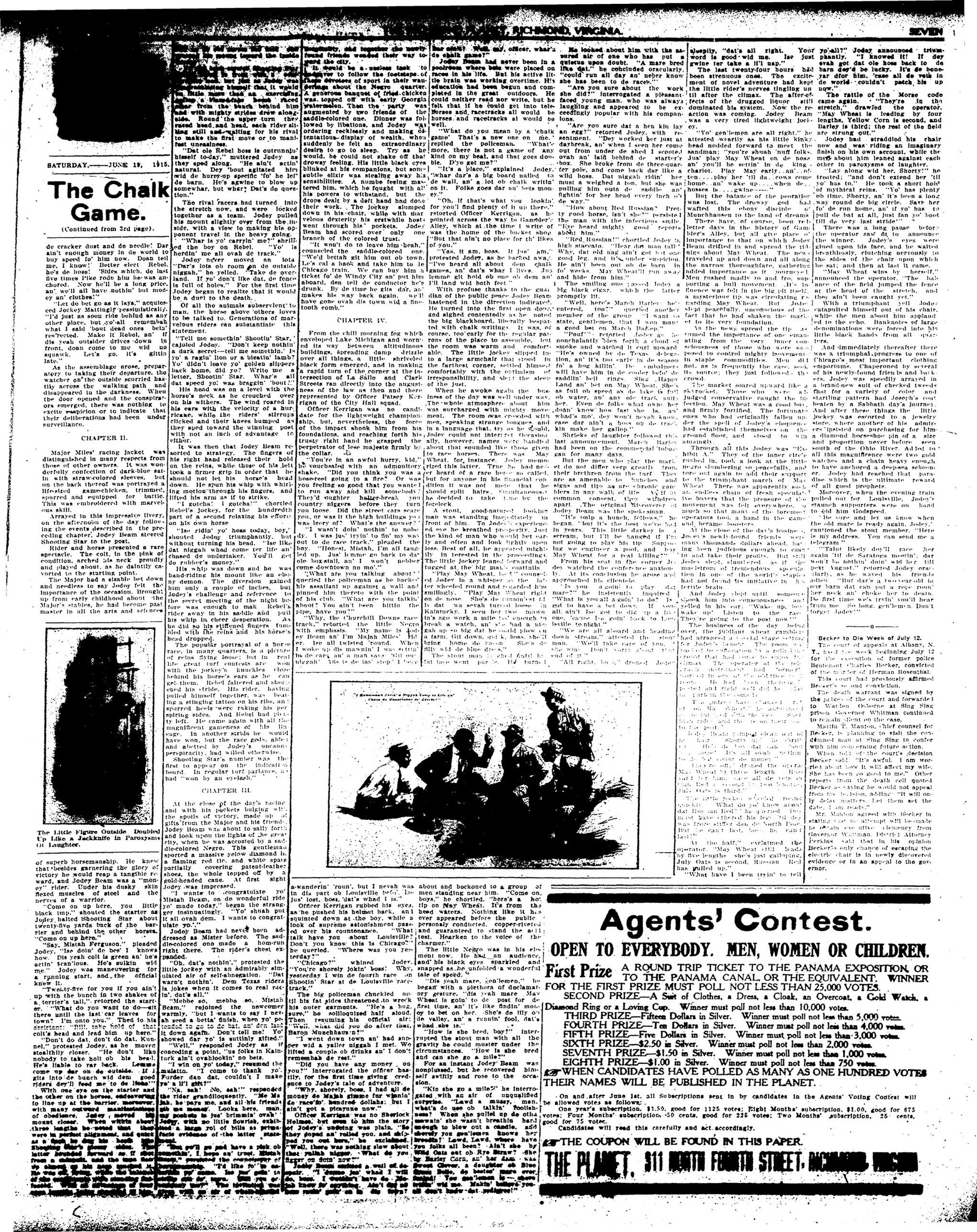
THE WORLD'S FINEST ARTIST
"I want to Congrulate Yo', Mistah Boom, on de Wonderful Ride Yo'
Made Today"
(From the Saturday Evening Post)
"Oncet upon a time I remembah soeing a nigghah" Jockey Monk Mattingly droned his words slowly as if to clothe them with impenetrable mystery.
He paused in the midst of the sentence, and with one black finger poised in the air, lent dramatic assistance and unusual weight to the statement he was about to make, while four ebony faces, clustering about, bent eagerly forward.
"Whad did yo' alisee, Monkey?"
"Oncet upon a time," continued the first speaker, looking around impressively, "I remembah seen' a nigghah come to life an' chase do undertaker fo' blocks."
The lanterns, awaying from the rafters overhead, through six, begrimed chimney cast a flickoring, uncertain light on the group below. The whites of four pairs of eyes, dilated to the utmost, gazed with awe, and consternation upon the speaker. For a moment or two the mantle of silence enveloped all things, and the atmosphere was heavily laden with thought.
"Whar at, Monkey? Whar was dat at?" uttered Jockey Plecco Perkins. His words sounded faraway, and his voice wavered in querulous staccato as he spoke with assumed nonchalance.
"At Columbus, Mississippi," returned the oracle. "Yas, sir, dat niggah was done sent to de barn! An' jus, when dey was a-goin' to sing de closin' hymn, he riz up an' stepped to town faster dan a rabbit goin' to a frolic! Huh! Show me a dead one, an' I'll show you sumpin' its liable to come to life."
From his seat in the farthest corner or Jockey Johnson stirred uneasily. Ages of superstitious forbears were asserting themselves and rattling his personality from its moorings. "Is de doah barred?" he quarred. "Bettah lock de doah tight an' let's get down to business. Dat ole wind shuah does sound kinder moo-ouful." For more than half a century the race problem has drifted, derelict, upon a wide ocean of surmise, shifting uneasily about without satisfac-
"I want to Congratulate Yo', Mistah Boo
Made Today
tory solution. Right here, however, a commission of truth-seekers, aided by those of the inner circle, provided they could have been prevailed upon to speak out in meeting, might have unearthed expert and valuable testimony, testimony based upon such clandestine meetings as the one onew in progress because the organization known as the Colored Jockeys' Trust was about to go into executive session.
There was nothing to distinguish the Separation Park Racetrack from other places of the kind devoted to the sport of kings. The same long rows of stables standing in parallel lines, the same regulation speedway, and the same magnificent distances inclosed by a high board fence. Now that the heavy pail of night had settled down, the surrounding silences were disturbed occasionally by the tramping of a restless horse and the eternal croak of a bullfrog chorus down at the pond in the inner field. Farther back, the grandstand and betting ring loomed up in ghostly half-fights. An atmosphere of loneliness permeated everything, because with the exceptions already noted, occupants of barn and stable were sleeping the sleep that comes only to those of strenuous endeavor.
The room in which the meeting convened was the ordinary one which is a part of the entourage of every racing stable. The contents were scanty—a couple of coats against either wall, a few common chairs, a trunk or two, some cheap prints of racing scenes, and a long row of saddles and bridles stood for both furniture and decorations.
Hardly had the business of the evening commenced, however, when a diminutive personality tiptoed round the corner and for an instant silhouetted itself against the gloom beyond. The newsome took careful cognizance of his bearings, and then. Rattening himself against the rough pinching, blended into the shadows and crept steadily toward the door. He did not seek admission, however, but obliged his way worthy, until by dust of entering investigation he discovered a friendly hostage in the side of the well from which water of poison he would pass through the gate and then escape. He then moved by such illumination as
"Fo' why?' emphasized Jocky-Skeets Mosby, with impressive conviction, as the meeting regaled it milk of the cocoanut. "Fo' why?' Dar alin' no use clarin' dirk niggah in. He alin' entitled to no divide 'Sides which, he don't count, anyway. It's all right for Monk to talk' bourd dead ones comin' to lifo, but dar alin' no danger 'bout di horse. I seen him workin' yistday, an' he couldn't outrun a mudturtle. Is yo' all wild me?"
Mistah Beam, on de Wonderful Ride Yo' de Today"
A bouquet of wearessed black faces nodded a solemn assent.
"Dat moke don't know a saddle an bridle from a boss an 'buggy,' supplemented Jockey Hill loftily.
"What do he come from, anyway?
He ain't got burrs out ob his mane yet, an' fo' dollahs in real money would make him die ob heart disease! I'll bet he can't lead a hose to watch!"
"Sides which," interpolated Jockey Piccolo Perkins oracularly and assisted by salient argument-"sidea which, de money has to go five ways now. What's de use on carvin, a watermelon till it ain't got no regular name? Let him be de tincereent bystander, dat's what I say."
With dusky hand uplifted, Jockey Perkins paused, assuming the air of one who has pronounced the very last word.
"Yo folks is jus wastin' time argufyn' in bout every nigghah gash gets by do gate. I doesn't care what he comes frum, or whad's his name, or why he left dat place." Interrupted a fourth delegate, who had hitherto been a silent spectator.
"He inn de dope at all, at all!" attested Jockey Moseby. "I spec he's just been ridin' round de bush meetin', short hones wif popcorn pedigrees.' His name's Jockey Beam, an rides hir to an ole man named Miles. Dey just landed, an' I figgers he too dumb to job wif anyway."
"He'll low he's joined de Suicide Club fo' we gits tru wif him." chortled Jockey Perkins. "Watch me make him take back de firs' time he hooks up wif me." Huh! Just-lock him once and pinch him close to de rails. He'll think he couldn't ride a wagon."
In pantomime Jockey Perkins gave an impersonation of that awes-inspiring maneuver, "If he gets to dance' we'll educate him proper." he concluded.
But he it recorded that Jockey Piccolo Perkins witted not that through a knot-hole in the plank an eye was glaring balefully at him. And perhaps it is just as well that was blissfully ignorant of the fact that almost simultaneously the humor of the situation seemed to take possession of the little figure crouching on the outside, because it doubled up like a jackknife in silent paroxysms of laughter.
"Let's hear from Monk again," suggested the first spokesman "Monk is settin' dar like a terraplin on a log. Al he thinks 'bout it' funerals. If yo' ain't tongue-tfed, Monk, rise an' shine!"
A lean, solemn-looking young Ne
gro, black as ebony and as silent as
the Sphinx, was sitting all humped
up on a cot in the farthest corner,
with his chin resting on his knee.
As he unwound himself leisurely he
regarded the black faces about him
with the impersonal air of one who
hold his companions cheaply when
it came to weighing their lack of
mentality against absolute experience.
"Yo' wants me to gib it a name,
chir' he interrogated, noncandidly.
"Dat's it, Monk, dat's it! Gib it
a name!" This latter with intense
eagerness and with one accord in
chorus.
"I war jus' settin here a-thinkin'."
he drewled. "I war jus' studyin'
while yo' folks was talkin'."
"Studirin' bout what?"
"My ole mamma mater may," resumed
the solemn one. "dat case a
duck is hatched by a hen it dont
pervient him bain' able to swim de
first time him bain' do water."
"What's got get to do wid it Monk?!" posted Jocky Moore. "To just get long way 'round Why don't you learn him?"
"It don't get long to do wid it, responds the first speaker, 'copia!' but didn't do the good rider comes from do burglar. How does you'll call he can't what? As' support' he had run and been under him, what did? Just his higher dept. no problem' an old boy will on the floor."
"What would just the Monk say?"
We have a fine line of Calendars for 1916, both imported and domestic and they are now ready for the inspection of the Public. We can quote prices that will be of special interest to those who buy these kind of souvenirs. A visit is requested even if you are not ready or are not prepared to purchase now.
THE LINE IS ATTRACTIVE AND THE DESIGNS ARE NEW AND SURPRISINGLY BEAUTIFUL. THE J. W. BUTLER PAPER CO., OF CHICAGO, ILL. HANDLES THE FINEST LINES OF CALENDARS. COLLEGE COMMENCEMENT PROGRAMMES AND FOLDERS OF ANY HOUSE IN THE COUNTRY. TO SEE THEM IS TO REALIZE TO THE FULLEST EXTENT THE FORCE OF THIS DECLARATION.
him in for an even divide an 'split
wid him?" Piccolo Perkins was
volving his sentiments in tones of
reolent of intense indignation.
"Not 'actly'" amended the rider
whose synonym was Monkey. "Just
sweetin' him up a lil' gob he ain't
in do way."
"Gib him dat money: Is dat what
yo' mean?" Piccolo's voice was
again lifted in vigorous protest.
"No-o!" drowned the dusky philos-
opher, looking up at the ceiling.
"I'd gib him a pleasant smile, an' a
bate o' hay, an' a jewsharp, but Ise
done talkin'. I allus sticks my the
gurs under de girths befo' I mounts,
dat's all. I've had dem fall wid me,
de baddies neber allipped. Ise
done talkin'. Wha's de name ob de
hose he' got. anyway?"
"His name's Shootin' Star, an hea a fo-yebahole malen. He ain't neher seen de barrier yet, an he'll be as green as grass at de post. Even if he was any 'count we could take care ob him. Whad's de matter wad yo' Monk, anyway? Is yo' seein' things?"
"I ain't seein' nothin'," returned the rider so addressed, solemnly and without animation. "But its all right wid me. Whenever de pleickin' is good I likes to be de first to all down an' de last to shove my chair back from de table.
"All right, Monk, all right," counseled Jockey Moseby, "de day ob judgment is a long ways off. An' when Gabriel blows his trumpet you'll quit runnin' an' go to flyin'. We'll leave dis niggah out, an' elect one right now. Who'll we elect? What does yo-all say?"
As if with one accord voices were lifted in unison.
"Ole Rebel! He's de boss! He's de boss!"
"Wid Pike up he could fall down a couple ob times an' den come home on do bit."
"How 'bout Gold Bug?" interrogated Monkey. "Last time I rode that horse he acted as if he was 'bout ready."
"I seed him pin his ears an' sulk more dan once," returned Jockey Moseby. "An' what's more' he's a hopper since he was a two-year-old. He's had de battery an' (Continued on 7th page).
CALIF. EXPOSITION
VIA SOUTHERN RAILWAY
Greatly reduced three in effect March 1 to November 30, with three months return halt and very liberal step-over pritiliness. Virginia route tickets will be held shipping purchaser to make going trip via Huntington or New Orleans or Newport or at L.L. London, returning via outside of those porters to any other hitherto shuttled route.
"The Land of the Star" in Wingham town Churchton in Wingham town Churchton and in the Borough of New York and in the Bronx.
1916 Calendars Now Ready
CALL AT THE PLANET OFFICE.
Office: Room, No. 405, Mechanics' Bank Building PHONE. RANDOLPH 2637.
RESIDENCE----610 N. First St. Shop in Rear. Phone, Randolph 2168 Special Attention Paid to the Taking of Contracts for Building of Any Style of Architecture. Job Work a Specialty.
THE MAGIC SHAMPOO DRIER AND HAIR STRAIGHTENER
MAILED ANY WHERE IN U.S. COUNTY SEND MONEY BY POST OFFICE HONEY ORDER
Address all letters to Mask Shampoo Drier Co.
Minneapolis, Minn. not to individuals.
A BEAUTIFUL HEAD OF HAIR IS A LADY'S CROWNING GLORY.—And every lady can have it if she will use the Magic. The Magic will dry the hair after a shampoo or bath, and straighten the curled head of hair. It will also stimulate its growth. The Alumalum Comb can and injure the hair, because it is never heated direct, but takes its heat from the heating bar which is heated on our Alcohol Heater, or any other heater. We advise the use of Mayor's Hair Pens 64. Best on the market. Price per box, $64. Alcohol Heater, price $64. Liberal terms to agents.
Write for literature today.
MAGIC SHAMPOO DRIER COMPANY, MINNEAPOLIS, MINNESOTA
country, at least in one direction, should prove very enjoyable. The Washington-Sunset Route is also operated over the Southern Railway through Atlanta and New Orleans. This constitutes a daily Pullman Steel Tourist car service with through personal conductor. For further information, descriptive matter, apply to H. L. BISHOP, Div Pass. Art, Southern Railway, 907 E. Main St, Richmond, Va.
EXCURSION TO ROANOKE;
Arrangements have been completed for an excursion from Richmond to Roanoke, Wednesday night, June 16th, 1915, by the N. & W. R. R. Summer excursion fare to Roanoke is $7.15 for the round trip, but on this excursion the rate will be only $3.00 for the round trip. Tickets will be good only on this special train, but excursionists will have the privilege of returning on any of the regular trains of the Norfolk and Western Railroad.
The train will connect at Petersburg with the one leaving Nortfolk—the same night. The round trip fare from Nortfolk will be $3.50. The Uniform Bank, Knights of Pythias, of Newport News, will go over to Nortfolk and join with the Uniform Bank from Nortfolk and Porsmouth. This conversion is open to all who wish to go and it is a financial opportunity to see the annual parade of Rancho Thursday, June 17th, as well as to see a fun-filled trip in the most popular open season of Virginia. Go and enjoy your journey.
YOU CAN FIND HERE ADVERTISING CALENDARS SUITABLE FOR ALL LINES OF BUSINESS AND AT PRICES THAT WILL SURPRISE YOU.
THERE IS ALSO A LINE OF "LEFT OVER" 1915 CALENDAR BACKS. WHICH CAN BE SOLD AT A SACRIFICE TO LARGE PURCHASERS. WHO DESIRE TO SAVE MONEY.
Submarine Sinks Russian Cruiser.
The following statement was given out in Berlin: "A German submarine on June 4 sank the Rusalan cruiser Amur, of the second class, near a Baltic port."
3,000,000 'Shells Fired in a Battle.
The French artillery fired more than 3,000,000 shells within fifty-five hours in the recent battle to the north of Arras.
GENERAL MARKETS
PHILADELPHIA FLOUR quiet;
winter clear, 6:35, 6:50; city
milkery, 7:55, 7:75.
RYE FLOUR quiet, at $6@6.25 per
barrel.
WHEAT quiet; No. 2 red, $1.33@
1.36.
CORN quiet; No. 2 yellow, $1.12@
83.
OATS quiet; No. 2 white, $6@
56½; lower grades, 55¢.
POULTRY Live steady; hons, 16@
17¢; low rosters, 11½@12¢. Dresses
firm; choice fowls, 19¢; old rosters,
13½¢.
BUTTER steady; fancy creamery
30 1/4c. per lb.
EGGS steady: selected, 26@27c;
nearby, 24c; western, 24c.
Live Stock Prices
CHICAGO—HOGS slow; bulk, $7.58
$7.85; light, $7.45; $7.75; mixed, $7.35
$7.72; heavy, $7.10; $7.66; rough,
$7.10; $7.25; plight, $5.75; $7.40.
CATTLE weak; native beef steak,
$7.30; water chestnuts, $6.58
$6.98; cow and heifers, $6.30; $6.75;
calves, $7.06; 10.75.
BEEP steady; above, $4.40; 10.30;
humbo, $7.75; 10.75.
RICHMOND PLANET
Get the habit of reading The Planet.
Subscribe now. $1.50 per year. Single copies, 5 cents each.
JOHN M. HIGGINS
DEALER IN
Choice Groceries, Wines
Liquors and Cigars
PURE GOODS. FULL VALUE
FOR THE MONEY.
1610 East Franklin St.
(Near Old Market)
RICHMOND - VIRGINIA
A. HAYES.
OFFICE AND WAREROOMS:
727 N. Second St.
RESIDENCE—725 N. SECOND ST.
First-lians Hacks and Caskets of all descriptions. I have a spare room for bodies, when the family have not t suitable place. All Country Orders given Special Attention.
Your special attention is called to the New Style Oak Caskets. Call and see me and you shall we wait on individually.
PHONE: MADISON 2783
OTHER PEOPLE JUDGE
When you can get Furniture and Rugs from an Old Established house like JURGENS—that's known to sell the best quality goods, just as reasonable as elsewhere—not give your friends a good impression. It will give us the greatest pleasure to show you our wonderful stock of homemaking comfort giving Furniture and Rugs and—don't fall to ask our salesmen about our banking plan which given you 5, 10 or 15 months in which to pay for any purchase.
CHAS. G. JURGENS SON
Established 1892.
ADAMS AND NEAD
THRE
RAILROADS
Richmond, Frederick's & Fortress R. R. TO AND FROM WASHINGTON AND BEYOND.
Leave Richmond
Arrive Richmond
*4.05 A.N. Hsin Si Ss.
*1.20 A.N. Byrd St. Sia.
*1.40 A.N. Byrd St. Sia.
*2.20 A.N. Byrd St. Sia.
*2.25 A.N. Byrd St. Sia.
*2.35 A.N. Hsin St. Sia.
*12.01 eem Byrd St. Sia.
*2.20 P.N. Hyrd St. Sia.
*4.20 P.N. Hsin St. Sia.
*12.05 P.N. Byrd St. Sia.
*12.25 eem Byrd St. Sia.
*12.40 eem Byrd St. Sia.
ACCOMMODATION TRANS.—WERKDATE.
Leave Bryd St. Nr. 4.00 F.M. From Prod. Frederickb.
Artrie Bryd St. Nr. 4.25 A.M. From Prod. Frederickb.
Leave Bryd St. 7.30 A.M. 8.18 F.M. For P. Har-
Arrive Kibu Ria. 6.80 A.M., 11.25 A.M. 6.49 P. M.
From Aitibah.
Sunday accommodation train leave Kibu 4.15
P. M. for Frederickburg; arrive Kibu 10.60 A. M.
From Frederickburg.
*Daily. All trains to or from Byrd Street
Station stop at Kibu. Time of arrival and
departures not guaranteed. Read the signs.
NORFOLK & WESTERN.
ONLY ALL RAIL LINE TO NORFOLK
Schedule on April 1, 1913
Leave Jord Street Station, Richmond, for
NORFOLK 10:00 A.M. 13:00 P.M. 14:00 P.M.
NORFOLK 10:00 A.M. 13:00 P.M. 14:00 P.M.
NORFOLK 10:00 A.M. 13:00 P.M. 14:00 P.M.
Arrive Richmond from Norfolk. 11:40 A.M.
M. P. 11:30 P.M. From the West. 10:00
A.M. M. *11:30 P.M. From the West. 10:00
A.M. M. *11:30 P.M. From the West. 10:00
M. P. 10:00 P.M.
DALLY, Evan, SUNDAY, SUNDAY, SUNDAY
W. H. BAILL, W. C. SAUNDERS
P. T. M. KARABA, G. P. A. KARABA
C. H. OLDEY, D. P. A. RUTLAND, VA
ATLANTIC COAST LINE
P.M., 12:50 A.M., 6:50 A.M., 6:52 P.M., 12:50 A.M., 6:50 A.M., 3:00 P.M., 4:00 P.M., 1:00 P.M., 6:00 P.M., 6:00 A.M., 2:00 P.M., 9:00 P.M., 12:50 A.M., 1:00 A.M., 1:00 P.M., 2:00 P.M., 3:00 A.M., 4:00 P.M., 4:00 P.M., 5:00 P.M., 6:00 P.M., 6:00 P.M., 7:00 P.M., 8:00 P.M., 9:00 P.M., 10:00 P.M., 11:00 P.M., 12:00 P.M., 13:00 P.M., 14:00 P.M., 15:00 P.M., 16:00 P.M., 17:00 P.M., 18:00 P.M., 19:00 P.M., 20:00 P.M., 21:00 P.M., 22:00 P.M., 23:00 P.M., 24:00 P.M., 25:00 P.M., 26:00 P.M., 27:00 P.M., 28:00 P.M., 29:00 P.M., 30:00 P.M., 31:00 P.M., 32:00 P.M., 33:00 P.M., 34:00 P.M., 35:00 P.M., 36:00 P.M., 37:00 P.M., 38:00 P.M., 39:00 P.M., 40:00 P.M., 41:00 P.M., 42:00 P.M., 43:00 P.M., 44:00 P.M., 45:00 P.M., 46:00 P.M., 47:00 P.M., 48:00 P.M., 49:00 P.M., 50:00 P.M., 51:00 P.M., 52:00 P.M., 53:00 P.M., 54:00 P.M., 55:00 P.M., 56:00 P.M., 57:00 P.M., 58:00 P.M., 59:00 P.M., 60:00 P.M., 61:00 P.M., 62:00 P.M., 63:00 P.M., 64:00 P.M., 65:00 P.M., 66:00 P.M., 67:00 P.M., 68:00 P.M., 69:00 P.M., 70:00 P.M., 71:00 P.M., 72:00 P.M., 73:00 P.M., 74:00 P.M., 75:00 P.M., 76:00 P.M., 77:00 P.M., 78:00 P.M., 79:00 P.M., 80:00 P.M., 81:00 P.M., 82:00 P.M., 83:00 P.M., 84:00 P.M., 85:00 P.M., 86:00 P.M., 87:00 P.M., 88:00 P.M., 8
SOUTHERN RAILWAY
Trains Leave Richmond, Main Street Station.
Following schedule figures published as
11.15.15. P M—Daily for Danville
11.15.15. A M—Daily for Danville
11.15.15. A M—Daily—Limited for all points South
11.15.15. A M—Daily—Limited—Local for Chase
City, Durham and New York
11.15.15. P M—Daily—For Danville, Atlanta
and Philadelphia, with Pollitt observation sleeping
11.15.15. P M—Daily—Limited—For all points
South. Pullman ready 9:00 P. M.
YORK RIVER LINE
10:10 AM W - Wemmer train (Darley car) Daily
10:10 AM L - Lennard connecting for Baltimore
10:10 AM S - Sunday
From the South: 7:06 A. M., 8:00 A. M.
From the North: 12:00 P. M., daily, 8:40 A. M.
except Sunday
From West Point: 9:10 A. M., 9:15 P. M.
daily.
H. L. DISHOP, D. P. A.
097 East Main St.
CHESAPEAKE & OHIO.
Cantonah, Lincolnville A West, 25'00 P. *12'00 P.
Main Lair Lake, 5'00 A. *22'00 P. *15'50 P.
Lawn River Lake, 10'00 A. *25'50 P.
N Newport, North (11'11 P. *12'12 M. *4'50 P.
Newport, Newport, 15'50 A. *25'50 P.
Travis arrive from North, 11'50 A. *25'50 P.
*25'00 P. Newport News, 25'50 A. *25'50 A.
From West, 25'50 P. James Island, 25'50 A.
*13'50 P. Daily **Except Sunday**
SEABOARD AIR LINE.
THE PROGRESSIVE RAILWAY OF THE SOUTH
Southbound train scheduled to leave Richmond
daily. 2:35 A.M. Local to Norfolk. 1:20 P.M.
Jacksonville and coaches. Atlanta. Birmingham.
Jacksonville and coaches. Atlanta. Birmingham.
Jacksonville and coaches. Atlanta. Birmingham.
Jacksonville. Tampa and coaches.
Birmingham. Jacksonville. Tampa and coaches.
Northbound train schedule to arrive in Irish
P. 30, M. 30, M. 30, M. A. M., Local.
P. 33, M. 33, P. 37
ALPHEUS SCOTT
(CHURCH HILL)
Funeral Director and
Embalmer
OPEN DAY AND NIGHT
Office, 3006 P Street, Phone,
Mad. 2377—Residence, 1015
St. James St., Phone,
Madison 6619.
Paraphernalia, Material and Service of the
Boston Bath Service, Moderate Rates
MADAMK SCOTT, MODERATE RATES
and Children and in attendance at
Puntsie.
THE ECONOMY
327 N. FIRST ST.
Fine Tailoring
Cleaning, Dyeing and
Repairing
CHITMAN M. WHITE
Prepriest
---
```markdown
```
Published every Saturday by John Mitchell, Jr. of M.I. K. 4th St. Richmond, Va.
JOHN MITCHELL, JR.——EDITOR
All communications intended for publication should be sent so as to reach us by Wednesday.
Kented at the Post Office at Richmond, Va., as second-class matter.
SATURDAY.——JUNE 19, 1915.
Some people want work until they see it coming and then they hurriedly get out of the way of it.
Wisdom comes with old age, but much of it can be obtained during the days of youth and it will pay some of this "wild cat" population to find it out.
Solemons was the wisest man that ever lived, but there are numbers of this "batter day" population who have their doubts about it.
They are charging Hon William Jennings Bryan with disclosure of financial secrets. It is not necessary to charge it for Mr Bryan virtually by admits it himself and he is still talking.
The public would like to know who changed that American note to Germany. The note was certainly changed for Mr. Bryan, has said that it was changed and he ought to know all about it.
Hon William J Bryan got off that Wilson Special bound for the "War with Germany" station in a hurry. When he left, somebody throw the train on a side track and it is still there.
J. E. Stoner, a colored roller chair man at Atlantic City, who has but one arm is a hero. He saved Miss Mary Donovan of Springfield, Mass., from drowning Tuesday, June 11, 1915, after Edward Brady white with two arms had lost his life in trying to do the same thing. There are some remarkable people in this world and J. E. Stoner is one of them. His praises are being sung throughout the country although he is "only a Negro."
We received the Census Bulletin, No. 129 on "Nugroes in the United States." It is a comprehensive analysis of the subject and it contains much valuable information which will place this part of our population in a more favorable light. It shows that these people, despite misrepresentation, ridicule and persecution have been laboring practically uncomplainingly in this broad land of ours and have made a record of which the people of the United States and themselves may well be proud.
The management of the Census Bureau has rendered a real service in this matter and the able officials composing it have our congratulation upon their success in dealing with the task. We understand that a more complete report will be issued later.
Money is not as plentiful as all of us would like to see it, but there is enough of it in sight to meet our absolute necessities.
312 BREYAH REKIGNATION
A careful analysis of Hon. William Jennings Bryan's resignation as Secretary of State discloses the fact that the insultingulled Commander, did not resign on his own motion but rather on the motion of his Chief, President Woodrow Wilson. The resignation specified that it would become effective when the American note to which he objected was sent to Germany. To show that this was his purpose we reproduce the sentence:
I therefore respectfully tender my resignation, to take effect when the note is sent, unless you prefer an earlier hour.
It will be seen that if President Wilson had withheld the note, he would have at the same time withheld Secretary Bryan's resignation. Instead, he modified the terms of the note and sent it. As
---
retary Bryan had not made any specifications in his letter as to the modification of the note, the sending of it even in its modified form put him out of office and severed the ligament binding him to the official family of the President of the United States. It became that President Wilson had become disgusted with Secretary Bryan and Secretary Bryan had become distrustful of President Wilson.
No stronger argument in favor of peace need be adduced than the following telegraphic dispatch:
New York, June 13.—"Fifty percent of the Canadian forces were killed, wounded or captured in the battle of Ypres, which lasted three days, beginning April 22," declared Captain Gordon C. Hunt, of the First Canadian Battalion, who returned on the Cymric today.
Major Emile Ringer, of the Fourteenth Battalion, who returned on the same ship, said:
"I was in the trenches during the battle. We were bombarded by gas, which the Germans directed against us from tubes at a distance of twenty or thirty paces.
"This gas, which was chlorine, prostrated us for about twenty minutes. At the end of that time we began to recover, and were able to move."
Asked if he had heard the report that the gas liquified the tongues, he recalled that he doubted it. He said he had obtained leave of absence for two months and added, "My advice is, don't go to war." Lieutenant Colonel Auntius Jarvis of Toronto, who has been with the Russian and French armies as military observer, returned on the Saint Paul, of the American Line. He lost his younger son in the battle of Ypres, while his elder son is still in the field. He declared the French are short of ammunition, due to incessant fighting. J. L. Poulle, an American automobile agent, on the same ship, said.
"Great Britain has an army of 70,000 men in training who are yet without equipment. The British forces in the held number about 750,000 men. An average of 200 wounded reaches London each day, and this does not include the seriously wounded."
It emphasizes famous statement, "War is Hell." With every modern facility to save life, men in a spasm of brutality have brought into operation everything to destroy it. There is no surprise that Hon. William J. Bryan aroused popular feeling in his remarkable address to the American people and that President Wilson was not slow to place his administration upon a similar basis by the modification of that note to Germany.
Army and navy men want huge appropriations but they must find other means to get them.
THE AMERICAN NOTE TO GERMANY.
---
We have read carefully the American note to Germany. We cannot understand how such a communication could have brought about the resignation of the distinguished statesman from Nebraska. It is conservative in tone, argumentative in character and lacking in the use of any language which might be construed as an insult by the high-tempered government to which it is addressed. We cannot conceive that this note in its present shape brought about Sec-
Prelature of State Bryan's resignation.
We take it that the original document containing virtually an ultimatum was changed and modified. Certain it is that in the light of the language of the document, the charge that President Wilson and his associates would plunge us into war is not sustained. Was this a shrewd movement to rob Hon. William Jennings Bryan of an issue before the American people? Did the distinguished Nebraskan accomplish his purpose by the horrible treatment which threatened to wreck the political prospects of the Administration?
That Mr. Bryan realized the full force and effect of this new note, robbing, as it does his statement to the American people, of its full force and effort of his remarkable declaration that the note would bring on war and he wanted to prevent it, goes without question. His appeal to German-Americans to support President Wilson in his effort to prevent war and to preserve peace shows, too, that he found it necessary to revise his statements.
President Wilson out-generalized him in this movement and Mr. Bryan has hastily reformed his lines to meet the attacks. The modification of the American note has been met by a modification of Mr. Bryan's attitude towards the master in the White House. The end is not yet put. The peace post between the two great leaders is only temporary. The partisan of both will so be in
ship shall not be healed. In the meantime, ex-President Roosevelt is heard from in Louisiana, where he is temporarily sojourning. He pledges support to President Wilson. He evidently believed that the American note would contain the objectionable ultimatum condemned by Mr. Bryan. But the note did not contain it. Mr. Bryan's objections have been met and his policy of peace recognized. It will be in order for the great New Yorker to withdraw his offer of support. There can be no doubt but what this country wishes to maintain its position of absolute neutrality.
Mr. Bryan's action in retiring from President Wilson's cabinet to being enthusiastically endorsed by the business interests of the country. He has performed a service free of charge that could have commanded many thousands of dollars if a monetary value had been set upon such a performance. Hon. William J. Bryan's position originally stated has met a corollary response from the masses of conservative American people. The basic principle of that position has been adopted by President Wilson in its latest American note to Germany: "And there we are."
NORMAN WATKINS DROWNS
IN FATAL DIVE FROM BOAT
Eleven Year-Old Boy Lost His Life
IN James River.
---
Norman Watkins, eleven years old, the son of Mrs. Eliza Watkins of 582 Hull Street, was drowned in James River Sunday afternoon about 1 o'clock near Joy Water Camp, a well-known spot on the river bank close to the Petersburg Electric Line. County Officer W. Taylor, in company with Claudia D. James, Johnson and several other men, spent all of the early night dragging the river in the vicinity, in an effort to locate the body. They were unsuccessful because of the rising tide, the rocks and the date the waterfall will return to the work this morning.
The boy, who carried a route of morning papers, left home early Sunday in company with George and Randolph Moore, of West Thirteenth Street; Walter Shepperson, 21 East Fifth Street, and Willie McCronney, 17 East Fourth Street, in a hired boat. They started on the trip without the consent of their parents, and intended going but a short distance and a night. However, they said that the current made progress easy, and continued their trip until near the scene of the accident.
COMPANIONS BREAK NEWS
TO ANUNITED MOTHER
It was not until late Sunday afternoon, when the three other boys returned to South Richmond with the clothes of young Watkins, that Mrs. Watkins learned of her south death. She became hysterical and neighbors and friends found the greatest difficulty in counseling her. Stories as to the manner in which Watkins was drowned vary), each of the boys telling somewhat different tales. Randolph Moore said that boy, his siblings, his ability. He said that young Watkins took off his clothing, and, mounting the rear seat of the rowboat, dived off into the river. He disappeared almost immediately, and did not reappear. At that time the boat was near the shore, and all of the boys, with the exception of seven-year-old Randolph Moore, were on the shore. Randolph Moore said he cried for help to his companion, who rushed out to bfm. Walter Shepperson dived into the river, where he saw bubbles rising, and claimed to have caught hold of a foot, but to have been unable to bring the body to the surface.
OFFICERS WORK IN VAIN
TO RECOVER BODY.
Clorks from the general offices of the Chessapake and Ohio Railroad were having an quiting near the scene of the accident and several of them were informed of the drowning by the boys before they started their return to Richmond. Several of the men made shorts to loachte the body, while others telephoned th county and city police. Policeman Traylor then hurried to the spot and endeavored to recover the body.
The first definite news of the accident was brought to the city by the boys several hours after the accident and after they had been freed stream and against the title, the four or five miles back to Richmond. The Shepperson boy reported the drowning to his home, and persons there claimed that Watkins was hanging out of the rear of the boat and trying to touch bottom with his foot when he slipped and went down.
Watkins had been cautioned by his mother, when he left home Sunday morning, to deliver his papers and to return as quickly as possible. He met the other boys, however, and they secured the boat near Mayo's Bridge between 6 and 7 o'clock. The spot at which the drowning occurred is extremely rocky at points, it is said, while at others the mud is very thick. It is the belief of those who endeavors to recover the body they sighted by day to deep enough to sink his head into the mud or to strike his head against one of the rocky ledges. The river at this point is not swift, and it is believed that the body will be recovered today unless it becomes loosened and drills with the current.
NEUTRAL EUROPEAN NATIONS to Proceed on Own Initiative.
By Karl H. Von Wiegand.
Berlin June 11, via The Hague.
June 12.—The great role of peacemaker of the world has allied from the hands of the President Wilson, and will hands into the hands of some neutral nation in Europe.
This neutral nation will take the initiative toward peace—that is, will take the preliminary steps, at least, to restore the peace for the world.
AMERICA'S ROLE SECONDARY.
America, as personified by Wood row Wilson, will play but a secondary role.
Such is the opinion held in neutral European countries, I am informed by parties who have just finished a tour of these neutral countries, sounding their diplomatic on the neutral's view of calling a conference in the endeavor to bring the war to a close.
NO ENCOURAGEMENT HERE.
These persons claim they have received encouragement and support everywhere except in Washington.
WILL MEET IN TEN DAYS.
Consequently, the European neutrals have about decided that Europe will have to look to herself to make the move toward peace, and they contemplate taking steps in that direction without President Wilson. According to these petitions not only the European neutrals, but even the belligerents have from the beginning of the war, looked upon President Wilson as the man and upon America as the country which would take up which is characterized as "the greatest mission in the history of the world since Christ" that of bringing peace to a warring world. Even now it is said that the neutrals of Europe have not lost faith in the European Union, but they give up hope that the will be the great prophet and father of the world's peace.
WILL LEAVE WILSON OUT
I am informed that so far three of the European neutrals have agreed to sign a call for a conference to discuss ways and means of sounding the belligerents as to the possibility of belonging about peace speedily. This plan originated with President Wilson. It appears. He in turn called a calling a conference of the neutrals.
But Mr. Wilson has failed to act, and it is also being appreciated that since the Lusitania was torpedoed he is not in the position to be the prophet of peace. So it is planned that the five European neutrals jointly sign a call or invitation, instead of giving one of the neutrals the leading Initiative role. Whether America will be invited now is said to be under consideration, but the least being more or less indifferent whether she is invited or not, while one of two urges that she be included in the conference.
THREE NATIONS ARE READY.
I understand those working on the conference plan, who have been sounding the neutral government, will meet either in Holland or Switzerland within the next ten days to decide on the next steps. The conference will not be called until assurances can be brought that such a move will not be regarded as unfriendly in London, or in Berlin especially.
William Jennings Bryan, lately American Secretary of State, was extremely anxious, I am informed, that such a conference be held in Washington, because the ideas of holding the conference Washington is not being entertained. Most probably, if the conference be held at all, it will be in Christiana or Stockholm.
Mrs. Gilliam, who has been very ill since the 20th of March, is a little improved. Mrs. Gilliam, though born in Virginia, has Hved in Brooklyn for a number of years. She was one of the first of the race to open up a full-fledged restaurant. This illness has been quite a calamity, so of them as they were running two places, he was pleased to hear from friends at 99 Rockwell Place or 544 Clasmon Avenue, Brooklyn, N. Y.
"NOT INCONSISTENT."
MR. JR. ANSERTS
First Louisiana Note Stood on Different Footing.
(Washington, D. C., Post, Jun 13, 1915.
In a statement issued last night Mr. Bryan replied to published charges of inconsistency because he signed the first note following the Louisiana incident and refused to sign the second.
"The notes," he said, "must be considered in connection with the conditions under which they were sent. The first note presented the case of this government upon such evidence as we the had. It was like the plaintiff's statement in a case, his claim being based upon the facts he presents them.
"I did not agree entirely with the language of the first note, but the differences were not so material as to justify a refusal to sign it. Then, too, I was at that time hoping that certain things would be done which would make it easier for Germany to sequence in our demands."
SHOULD EMPLOY INVESTIGATION.
Mr. Brown then resumes in his
assuming the three things he now emphasized in his present, namely, that he must employ the principle of investigation embodied in his treaties with other nations, take action which would prevent American citizens from travelling on belligerent ships or American ships carrying contraband and that this government should protect against inter-communication with American trade with neutrals.
"No one will be happier than I," said Mr. Bryan, "if the President's plan results in a peaceful settlement but no one was in a position to say what effect our note would have upon Germany or what results would follow if she in anger broke off diplomatic relations, and I was not only unwilling to assume the response for the risks incurred by killing which no one could with any degree of accuracy measure—but I felt that, having done all I could in the cabinet, it was my duty to undertake outside the cabinet the duty upon which I have entered.
WOULD LESSEN PERIL.
"I have no doubt that the country will unanimously support the President during the war, if so great a misfortune should overtake us; but I believe that the chances of war will be lessened in proportion as the country expresses itself in favor of peace—not "peace at any price"—but peace in preference to a war for the redress of such grievances as we have against Germany, at least against war until we have given Germany the oppo-ration which we are obliged to give Great Britain, France and Russia to have every difference of every character submitted to an international commission of investigation."
IMPORTANT CHANGE MADE IN
WAS ACCEPTED, SAYS BRIAN
Revision Softened the Text. But
Not Enough Change His
Text.
(Washington Post, June 17, 1913)
Official announcement of the delivery of the American note to the German government, riltering insistence that submarine warfare conform to the laws of humanity and international law, was received yesterday from Ambassador Gerard at Berlin.
The message came at the close of a day marked by a more optimistic feeling in official quarters that the German answer would forestall any possibility of war between the nations and also avoid a breach of diplomatic relations.
EXPECT GERMANY TO WAIT.
Apparently there was a general relaxation of tension in the international situation. President Wilson spent part of the day at golf, and let it be known that later in the summer he planned to take a short vacation at his summer home in Cornish, N. H.
No answer to the American rejoinder is expected for 40 days at least, and there is conviction here that the Berlin authorities will assist the arrival of Dr. Antoine Meyer, a representative of Ambassador Bernstuff, before their answer is framed.
NOTE CHANGED. SAYS BRYAN.
Former Secretary of State Bryan, who resigned his portfolio rather than sign the second note to Germany, issued another statement late yesterday, declaring that the note was materially revised following the post-revision of the revision, Mr. Bryan averred, softened the note, but was not sufficient to justify him in withdrawing his resignation.
"It is true," said Mr. Bryan, "that I saw the final draft of the note just before my resignation took place but I contained an important change. I would like this change at the time my resignation was tendered and accepted.
SHOULD HAVE ARBITRATED
"This change, while very much softening the note, was not, however, sufficient, in my judgment, to justify me in asking permission to withdraw my resignation.
"As Germany had suggested arbitration, I felt that we could not do less than reply to this offer by expressing a willingness to apply the principle of the peace treaties to the case."
WILL NOT INDICATE CHANGE.
"What was the change in the note?"
Mr. Bryan was asked.
"I cannot discuss that," he replied.
It was suggested that the clause added to the note was that saying the United States would entertain any evidence Germany might have that officials of this government had not thoroughly performed their duty in examining the Iranian be before her departure to see that she was not armed for offensive action.
Mr. Bryan only smiled at the suggestion.
Secretary Lanning also declined to
discuss changes made in the note.
FINED FOR ASSAULT
Mrs. Mary Johnson, who assaulted Miss Frances Giles, a teacher in Baker School, was fined $25.00 and costs Saturday, 5th inst., by Justice Crutchfield. The charge of trepass was dismissed.
Dey Kill of Swinging in Park.
J. Harold Harland, Jr. threw
years of woe, was killed at Spartell
quart, at Boston. With the other
begins he was swinging, when the berry
boom supporting the swing fell and
pluck him in the chest, causing internal injuries.
The Good Samaritan held their annual services here 9-10 at the Mt. M. E. Church, Rev. J. K. Dotson, pastor. Rev. Paul Poliott read scripture prayer by Rev. Alexander Tucker, of Whitestone, Va. Welcome address by Rev. Dotson, which was timely. Rev. J. E. Wood was introduced to the audience to preach the sermon and well did he handle his subject, using Matt. 22:39—and the second is like unto it. That soul will be saved by him, so he said he in part in church, in state, it is love that moves the world. We want more love as a race, as Christians, as a nation.
Our pastor, Rev. Dr. Tyler was at his best morning and evening at 11 o'clock. Text 92 Pauls, 12th verse. A very acceptable sermon. At 8. Prov. 1-5 a wise man will hear and will increase learning and man of understanding shall attain his master's well attained he handle his subject to a good audience. Many strangers worshipped with us.
The Children's Day exercises were in full blast at 2:30 owing to the storm made us a little late. Superintendent Wm. Roberts and teachers were all aglow in their new costumes. The recitations were fine. The most noticeable of all was little Colland Jackson and Colland Tyler. Solo by Mrs. M. Colins only a touch. Solo by Miss Irene Bailley, entitled a little while. Solo by Mrs. Henry Robinson his eye is on thee. Professor J. C. Walker, the principal of our public school, gave a short address to the children. Solo by Mrs. P. Spiller, Teach me to pray, which was enjoyed by all. Solo by Mrs. C. Spiller left on a late train for the city. Capt. C. F. Sims, of Mount Vernon, Va., was in town Sunday.
Mr. Ricks, who has been town for three days soliciting funds for the Manassas Industrial School. Next Sunday Children's Day will be at the M. E. Church. We are expecting a great time.
Mr. Brooks and wife, of Warrenton, are guests of Mrs Joshua Williams.
Mr. and Mrs James Gaskins were guests of Mrs. Lucy Summer Sunday.
We are hardly preparing for our fourth Sunday rally at the Baptist Church, when the gleaners will be turned in. The one raising the highest amount will receive a gold watch.
Reporter W. L. JONES.
WEST POIST. V.A. COTES.
Rev. Shaffer and family left here for Gloucester where he preached Rev. Hoard's anniversary. They returned Tuesday.
The children's day entertainment Sunday night was fine and a large crowd attended. Little Gladys Walker won the prize.
Mr. Lloyd Walker, of 12th Street, left here Saturday for Providence, R.I. where he is expecting to spend the summer.
The good friend under charge of the teachers was beautifully rendered by the children last Friday night. A large crowd witnessed the interest.
An excursion left here last Thursday for Richmond. They reported a fine time.
Mr. Lottie Braxton entertained the Magnolia Club last Thursday night.
In sad but loving memory of our dear mother and grandmother, Sarah Phillips, who departed this life one year ago, June 18.
None but aching hearts can tell.
We have lost but Heaven has gained.
Joanne does all things well.
Jesus does all things well.
By her child and Grandchildren.
RICHMOND TO BALTIMORE
An Excellent Over-Night Winter Trit
Effective Sunday, June 27, 1915
the Southern Railway in connection
with the York River Line will be
establish its special steamer train as
between Richmond and West Point for
the Summer Season. This train
to leave Main Street Depot, Rich-
mond. 6:10 P. M., arriving West Point. 6:15 P. M., and connecting
at that point with the modern new
steamers of the Chesapeake Steam-
ship Co. for Baltimore, arriving
7:00 A. M. the following day.
This same fast steamer train service
will be operated in the rear
direction, that is, West Point to Rich-
mond. One way fare Rich-
mond this route is
$2.50; $4.50 round trip. Limited
thirty days, and $4 round trip
sold on Fridays and Saturdays. Limited returning to reach Rich-
mond following Tuesday morning.
For further information call on
nearest Southern Railway Agent, or
write H. L. Bishop, Division Pass-
enger Agent, Richmond Nc.
F. M TIDY, NEW YORK
(For the Planet)
Troy, N. Y., June 15.—Mr. Thomas
is Read, of 132 Congress Street, left
this city to take up his home in
Kingston, N. Y., a few weeks ago.
His wife and daughter will soon
join him.
Miss. M. H. Harder, of 2169 6th
Avenue, daughter of Mr. and Mrs.
R. B. Harder, married to Mr.
A. D. Coles, of South Boston, Va.
by Rev. J. G. Carille, pastor of
the Liberty Street Presbyterian
Church of this city Thursday, 8:30
P. M., June 10th, at the residence
of the bride. Mr. and Mrs. Coles
will reside in the city.
My. D. Dixon of 2859 5th.Avenue
spent Sunday. (June 13th), with his
family in Bound Lake, N. Y.
Male Tries to bring Stag from O. Storm to Winnabore, S. C.
Winnsboro, S. C., June 14.—A. D. Hood, sheriff of Fairfield County. Clyde Isaenhower and Jules Smith, a Negro, who was to have been tried today on a charge of attempted assault, were killed, and seven other men were more or less seriously wounded as a result of an attack upon the shefft's party as the Negro was being taken into court here this morning.
Clyde Isenhower, alleged leader of the mob, and a relative of the woman Smith was charged with attacking; Ernest Isenhower, his brother; William Morris, a brother-in-law, and James Rawls, aate to murder, indicted on the charge of murder, as the result of the attack.
ANOTHER DYING
J. R. Boulware, a deputy sheriff, received a bullet wound in the stomach, and is believed to be fatally wounded. Smith was arrested in April, and officials here, fearing an attempt at lynching, placed the Negro in the State penitentiary at Columbia, for safe keeping until time for his trial here.
TRY TO SEIZE PRISONER.
Sheriff Hood and his deputies, with Smith under close guard, had reached the court house this morning, when a mob of approximately one hundred armed men attempted to seize the prisoner. The Sheriff warned the mob to cease, but ordered the mob to disband, and someone fired a shot at the Negro. The firing immediately became general, and lasted for about ten minutes.
DEPUTY SHERIFF WOUNDED
Of the six others wounded, Earle Stevenson, a young deputy sheriff, received two bullet wounds through the left arm, one severing an artery. A special train was hurried from Columbia here 'immediately after the tragedy, and Sheriff Hood 'and his deputy were taken to a Columbia hospital forurgery on the left arm. Sheriff Hood died, tonight. Jacobhower and Stevenson were taken to Chester for surgical attention.
---
Despite his weakened condition from the half dozen bullet wounds in his body, Sheriff Hood led the prisoner up the stairs into the court room. The Negro dropped dead beside the dock, and Sheriff Hood stepped in to the bar where a court official cased him to the floor.
From Philadelphia. Pa.
From Philadelphia. Mrs.
Mr. J. B. Johnson, Mrs. E. M.
Richardson, Mr. John, S. Jordan.
Mrs. John, S. Jordan, S. J. W.
Troegie, Mrs. J. P. Hudgens, Mr. J.
Thomas, Mrs. Geeroy, B. Burrell.
Mrs. E. F. Greene, Mr. Thomas
G. Coaton, Mr. J. M. Monk, Mr. H.
H. Cooper, Lewis E. Allen, Mr.
Brewford Gale.
From Camden, N. J.
Mr. W. F. Powell, Mr. E. A.
Polk, Mr. T. A. Shorter, Mr. E.
A. Turpin.
Miss E. Richardson, Everington.
Mt.; Miss Hasel Wells, Chicago, Ill.
Mt.; V. Plumsoch Bailey, D. D. S.
Germantown, Philadelphia, Mr. and
Mrs. R. G. Brown, Washington, D.
C.; Mr. and Mrs. R. L. Vance, Pittsburgh.
12:51
SOCIAL JUSTICE AS A MILITARY DEFENSE
The Berlin magazine, Bodeneform, in its issue of April 20, gives the following interesting account which illustrates how social justice is the best public policy: "The seaport city of Tanga in German East Africa, a place of 12,000 inhabitants, is the first city in Africa which has become, in a corporate capacity, a member of the League of German Land Reformers. An enthusiastic member had brought about local adoption of reforms in the land system. This broke up a ring of speculators who had located in the growing town, right under city ownership two-thirds of the municipal area, brought about taxation, communal values, and, most noteworthy all, had secured equal rights for the natives. For the first time these were conceded rights to the soil that afforded them security of possession of their homes. The gratitude of the Negroes has since been most clearly manifested.
"The English attacked the place with an overpowering force of 8,000 men, against whom the Germans could bring but 1,000. Successful resistance depended entirely from betrayal; the Germans would refrain from betrayal, so the Germans had set for the superior English army. And the Negroes proved faithful. In the greatest battle that has so far been fought on African soil, the English lost 3,000 men. The rest were compelled to retreat to their ships. Tanga remained free because Soo Ling had awakened and strengthened the affection of the natives. Strength In War is ever where one of the results of Social Justice."
WANTED
Several wide awake colored agents. Liberal compilation. A postal brings information
THE PATRICK-LAS REALITY CO.
1765. Washington, N. I.
(Dept L).
BRIAN ACKS MINDICATION FOR HIS REFUSAL TO SIGN WILSON NOTE BASED ON WAR SYSTEM AND ADVOCATES A MORE PERSUASIVE POWER.
The Real Issue.
TO THE AMERICAN PEOPLE
You now have before you the text of the note to Germany—the note which it would have been my official duty to sign had I remained Secretary of State. I ask you to sit in judgment, upon my decision responsibility for it. I am sure you will credit me with honorable motives, but that is not enough. Good intentions could not atone for a mistake at such a time, on such a subject and under such circumstances. If your verdict is against me, I ask no mercy: I desire none if I have acted unwisely. A man in public life must act according to his conscience, but however consciously he acts he must be prepared to accept without complaint any condemnation which his own errors may bring upon him; he must be willing to bear any deserved punishment from ostracism to execution. But hear me before you pass sentence.
---
DIFFER ONLY ON METHODS.
The President and I agree in purpose; we desire a peaceful solution of the dispute which this arisen between the United States and Germany. We not only desire it, but with equal fervor we pray for it, but we differ irreconcilably as to the means of securing it. If it were merely a personal difference, it would be a matter of little moment, for all the presumptions are on his side—the presumptions that go with power and authority. He is your President; I am a private citizen without office or title—but one of 100,000,000 inhabitants. But the real issue is not between persons; it is between systems, and I rely for vindication wholly upon the strength of the position taken.
Among the influences which governs employs employ in dealing with each other there are two which are preeminent and antagonistic—force and persuasion. Force speaks with firmness and acts through the utilitarian; persuasion employs argument, courts investigation and depends upon negotiation. Force represents the old system—the system that must pass away; persuasion represents the new system—the system that has been growing, all too slowly, it is true, but growing for 1,900 years. In the old system which at its best is little better than war at its worst; the new system contemplates an universal brotherhood established through the unbuffeting power of example.
BASED ON WAR SYSTEM.
If I correctly interpret the note to Germany, it conforms to the standards of the old system rather than to the rules of the new, and I cheerfully admit that it is abundantly supported by precedents precedents written in characters of blood upon almost every page of human history. Austria furnishes the most recent precedent; it was Austria's firmness that dictated the ultimatum against Serbia which set the world at war. Every ruler now participating in this unparalleled conflict has proclaimed his desire for peace and denied responsibility for the war, and it is only charitable that we should credit all of them with good faith. They desired peace, but they sought it according to the rules of the old system. They believed that firmness would give the best assurance of the maintenance of peace, and faithfully following the precedent, they went so near the fire that they were, one after another, sucked into the cone.
ALL VIE IN CRUELTY.
war is the chief cornerstone—war Never before have the frightful follies of this fatal system been so clearly revealed as now. The most civilized and enlightened—aye, the most Christian—of the nations of Europe are grappling with each other as if in a death struggle. They are sacrificing the best and bravest of their sons on the battlefield; they are converting their gardens into cemeteries and their homes into houses of mourning; they are taxing the wealth of today and laying a burden of debt on the toll of the future; they have filled the air with thunderbolts more deadly than those of Jove, and they have multiplied the perils of the deep. Adding fresh fuel to the name of hate, they have daily devised new horrors, until one side is endeavoring to draw noncombatant men, women and children at sea, while the other side seeks to starve noncombatant men, women and children on land. And they are so absorbed in alternate retaliations and in competitive retaliations that they seem, for the time being, blind to the rights of neutariis and deaf to the appeals of humanity. A tree is known by its fruit. The war in Europe is the ripened fruit of the old system.
This is what firmness, supported by force, has done in the old world. Should we invite it to cross the Atlantic? Already the digress of our own country have caught the rabies from the dogs of war. Shall the appointees of organized slaughter be silent while the disease spreads?
FOLLOWS PRINC OF PEACE
As an humble follower of the Prince of Peace, as a devoted be-
some in the Philippines that "they shall kill the world and perish with their sword." I beg to be reminded of among these who can normally urge the abstraction of a return in this matter which will leave no doubt of our government's willingness to continue negotiations with Germany until an amicable understanding is reached, or, at least, until, "the stress of war over, we can appeal to Philip drunk with carnage to Philip sobered by the memories of an historic friendship and by a recollection of the innumerable ties of kinship that bind the Fatherland to the United States.
Some nation must lead the world out of the black night of war into the light of that day when "words shall be beaten into plowshares." Why not make that honor ours? Some day—why not now—the nations will learn that enduring peace cannot be built upon fear—that good will does not grow upon the stalk of violence.
Some day the nations will place their trust in love, the weapon for which there is no shield; in love, that suffereth long and is kind; in love, that is not easily provoked, that bearest all things, believeth all things, hopeth all things, enduring its best is little better.
whichever its best is little better
shipers of Mars, abjbeth when all things in love, which, though depraised as weakness by the work of all things,
---
Berlin Claims Right to Sink Any American Ships Carrying Contraband; Will Pay U. S.
The text of the German reply to the American demands in connection with the sinking of the American sailing ship William P. Frye is as follows:
"The German government cannot admit that, as the American government assumes, the destruction of the sailing vessel mentioned constitutes a violation of the treaties concluded between Prussia and the United States at an earlier date and now applicable to the relations between the German Empire and the United States or of the American rights derived therefrom.
"For these treaties did not have the intention of depriving one of the contracting parties engaged in war of the right of stopping the supply of contraband to his enemy when he recognizes the supply of such detrimental to his military interests.
"On the contrary, Article 13 of the Prussian-American treaty of July 11, 1799, expressly reserves to the party at war the right to stop the carrying of contraband and to detain the contraband, it follows then that if it cannot be accomplished in any other way the stopping of the supply may in the extreme cases be effected by the destruction of the contraband and of the ship carrying it.
"As a matter of course, the obligation of the party at war to pay compensation to the parties interested of the neutral contracting party remains in force whatever be the manner of stopping the supply."
"According to general principles of international law, any exercise of the right of control over the trade in contraband is subject to the decision of the prize courts, even though such right may be restricted by special treaties. At the beginning of the present war Germany, pursuant to these principles, established by law prize jurisdiction for cases of the kind under consideration. The case of the William P. Frye is likewise subject to the German prize jurisdiction, for the Prussian-American treaties mentioned contained no stipulation as to how the amount of the compensation provided by Article 13 of the treaty cited is to be fixed.
"The German government, therefore, complies with its treaty obligations to a full extent when the prize courts instituted by it in accordance with international law proceed in pursuance of the treaty stipulations and thus award the American interested an equitable indemnity. There would, therefore, be no foundation for a claim of the American government unless the prize courts should not grant indemnity in accordance with the treaty; I nauch event, however, the German government would not hesitate to arrange for equitable indemnity, notwithstanding. "For the rest, prize proceedings of the case of the Frye are indispensable, apart from the American claims, for the reason that other claims of the neutral and enemy interested parties are to be considered in the matter.
"As we stated in the note of April 4, last, the prize court should have to decide the question whether the destruction of the ship and cargo was legal, whether and under what conditions the property sunk was liable to confiscation, and to whom and in what amount indemnity is to be paid, provided application therefor is received.
"Since the decision of the prize court must first be awaited before any further position is taken by the German government, the simplest way for the American interested parties to settle their claims would be to enter them in the competent records in accordance with the provisions of the German code of prize proceeding."
The STANDARD NEGRO PREFERNAL ORDER OF THE WORLD
#
Organizers make big money organizing Lodges and Courts for this Order. Good organizers (men and women) wanted every whee. Liberal Commission.
Write for terms
Address Rev. A. Fitzbeam Wallace
SUPERIOR GRAND GENERAL
M O Brow, N. W.
Rev. Dr. C. Leroy Butler, Noted Evangelist, Ends Noteworthy Religious Campaign that Covered Six States In a Portion of Ten Months—Thousands of Mon and Women Lub to Christ Through Powerful Plea of Dr. Butler—At Jacksonville, Fla., where one of the Meetings was Held, 1100 Joined Christian Band-Dr. Butler Holds Special Campaign for Students, Where Many Young Men and Women Testify for Now Life—Dr. Butler Assisted by Mrs. Butler, Who Plays and Sings at His Services—Ex-Congressman Bennett says Christian Religion Will Solve Race Problem-A. M. E. Zion Conference Condemns Nation for Not Providing Military Training For Negro—Report of the State of the Country Says There Are 2,000,000. Men of the Race Who Will Take up Arms for the Nation, But Only 6,000 Prepared—Miss Ovlington Condemns "The Birth of a Nation."
(Allen's National News Bureau, 252
West 53rd Street.)
New York City, June 14, 1915.
Rev. Dr. C. Leroy Butler, formerly pastor of the St. James Presbyterian Church and the foremost evangelist of the race is back home from one of the most remarkable religious campaigns that has ever been conducted in this country, and which spread a religious awakening in its wake that will live for many days to come. It was a campaign that will mark a new epoch in the religious life of the thousands of people that he reached on this religious tour. The tour that Dr. Butler has just ended was a tour to reach the slimmers, and in the many cities where the meetings were held Dr. Butler is being informed that his work has left its impression and that his good work is being left after him. The campaign was a distinct success in that it met the approval of all the denominations who cooperated and joined in making it noteworthy. It was an almost nation wide effort, and the Southern States where the bulk of the meetings was held white and colored joined together and realized that it was religion such as taught by Christ that made mankind one.
Dr. Butler began his campaign last August 18, 1914, and ran it successfully to June 1, 1915. It began at Sumter, S. C., and ended at Madison, N. J. The tour of Dr. Butler covered over 50 cities. In many of the cities the religious thusiasm was especially remarkable and was well worked up by the various pastors.
At Jacksonville, Fla., Dr. Butler was assisted by Revs. Drs. M. C. B. Mason, the noted Methodist clergyman, and Rev. J. B. Ford, pastor of the large Baptist Church in that city. One of the meetings was held in his church, and Dr. Butler described this meeting to your correspondent as one of the most effective he has ever seen. In Birmingham Dr. Butler met with the same success, and was assisted by Revs. J. A. Whitted, C. L. Fisher and T. J. Mappin. Another successful meeting was held at Sumter, S. C., where 600 converts were secured.
In Charlotte, N. C., the leading white citizens of the city joined in the effort and at the Charlotte meeting one of the most prominent and wealthiest white women of Charlotte was converted at one of the mootings. Dr. Butler was splendidly assisted in Charlotte by Bishops Warrior and Clinton of the Zion Church. A feature of Dr. Butler's campaign was the special services held in many of the colleges throughout the South where hundreds of students were converted and which resulted in a religious awakening in the institutions.
Among the 'institutions where special services were conducted are Biddle University, Edward Waters College, Florida Baptist College, Baldwin Industrial Institute, Central Alabama College, Haines Institute, Georgia State College and Barber Memorial Seminary. This effort to reach the students of these institutions has made Dr. Butler known and felt to hundreds of young men and women who would not have the opportunity of feeling his power in any other way. Your correspondent called on Dr. Butler at his beautiful home in Brooklyn last Monday and the noted evangelist reluctantly told of his great success. When your correspondent finally persuaded him to make a statement of his campaign for the benefit of the colored press and the race at large, Dr. Butler said it was only from that viewpoint would he consent to talk. He described his meetings as being the most inspiring sight he had ever witnessed, and said that he was glad that his efforts had reached so many strong and useful men of the race. He said that the way the men of the race joined in the meetings was indeed inspiring and encouraging.
HURBAH FOR CHRIST
Dr. Butler said one of the inspiring incidents of his trip was at Jacksonville, Fl., where in the heat of his preaching in the large church of Dr. Ford an enthusiastic man cried out Hurrah for Christ. Dr. Butler is the foremost evangelist of the race and among the leading evangelists of America. His method of reaching the masses is unique and effective and is being sought throughout the country to conduct services. His powers as a preacher was recognized in this city several years ago when he was pastor of the St. James Presbyterian Church for ten years. During his pastorate at this church St. James's had its greatest period of success and was recognized as one of the Presbyterian strongholds in the North among our people.
Dr. Butler came to the church when it had 47 members and, during his reign he added over 600 members to the church, and raised $42,000. While serving as the pastor of St. James he was called by the Brangalistic Committee of the General Assembly of the Presbyterian Church to conduct the campaign among the colored men
Do You Want an Umbrella?
Well, here it is. The Hull Bros. Umbrella Company will guarantee them. The Detachable Handle enables you to reduce its length and put it into your traveling bag or trunk without injury to the Umbrella. We have ordered a consignment of these Umbrellas, all of which are excellent quality. Twenty-five Dollars worth of Umbrella Coupons entitle you to one Umbrella, lady or gent. Specify the kind you want and we will send the Umbrella upon receipt of the Coupons.
For every cent paid on a subscription or job work you are entitled to a coupon for that amount. Our customers who pay for their work can get Coupons and secure an Umbrella. We do not allow Umbrella Coupons and Voting Coupons, too. You can get the one or the other. Call at The Planet Office and inspect the Umbrellas. When you purchase a copy of The Planet for five cents, this gives you five cents worth of Coupons. When the number you have equals $25.00, bring them to The Planet Office and get a Ladies' or a Gent's Detachable Handle Umbrella.
The Planet will be sent to you four months for fifty cents; six months for eighty cents; one dollar and fifty cents per year. We Print Bills, Tickets, Letter-heads, in fact, everything. We do Linotype Work for the Trade, at the Lowest Prices.
THE PLANET
311 N. Fourth St. Richmond, Virginia
---
tions. Dr. Butler was especially successful in this city and carried the gospel to many of the dark sections of the city like San Juan Hill, a district where live 15,000 members of the race and a section particularly hard to be reached. Your correspondent forgot to state in the body of his article that at Jacksonville. Fla., the meeting at that point resulted in 1100 men and women accepting Christ. Dr. Butler was born in Alabama, and his friends of the Negro took their seats with the colored delegation.
A. M. F. ZION CONFERENCE CON-
DEMNS THE NATION.
The New York annual conference of the A. M. E. Zion Church which ended its session last Monday evening at the Bridge Street A. M. E. Zion Church, condemned this nation last Saturday morning when Hon. J. C. Damey, former recorder of deeds, read the report of the State of the Country, in which it scored the country for its failure to provide adequate military training for the Negro. The report also stated that there were over 2,000,000 men of the race, who stood ready to defend this nation in the time of war and there were but 6,000 of them who had anything like adequate military training. The report asked that larger provision be made for the military training for the Negro, who in the time of war are invariably sent to the front to bear the brunt of the war's burden. "If the Negro is to fight for his country," stated the report, "it should provide the same training for colored men as for other men. Colored men should get the advantage of training such as is given at West Point and Annapolis."
The report also scored the country for its failure to give the Negro proper political recognition, and said in the large districts where live hundreds of Negroes who could elect their own Congressmen, the votes of the Negroes were not counted up. Bishop Hood, the senior bishop of the connection, who presided at the conference, stated that this was a deplorable condition and that the Negroes should protest against this state of affairs. The report of the State of the Country created a stir and was discussed freely from the floor. Rev. Dr. S. L. Corrothers, pastor of the Zion Church in Philadelphia in discussing the question said that this was a most deplorable condition for a country such as America, and it placed the Negro in a great disadvantage in the event of war.
Dr. Carrothers said that the present war would have a tendency to settle the question of race and castle and when the smoke cleared away it would pave the way for a brotherhood. Rev. Dr. W. H. Lee also spoke and emphasized the remarks of Dr. Corrothers, claiming that the war would prove the greatest leveler.
MISS OVINGTON CONDEMNED
THE CLANSMAN.
Miss Mary White Ovington, of vanced through the infamous film
How To Get One.
Phone, Randolph 2213
play "The Birth of a Nation." Miss
the propaganda of Thomas Dixon as ad-
cet the country in attacking before the
memo. Saturday morning condemned the
par-twisted out of all proportion. Miss
Your Ovington described The Birth of a
the Nation as the most pernicious at-
tempt and scheme to work up sent-
timent against the Negro that has
ever been devised. She told of the
effort of the National Association
ama. For the Advancement of Colored
took People to suppress it, and that in
delie- all of the cities where the film is
being shown the local branch of
the association has been vigilant in
its effort to suppress it.
She called attention to the pastor to join in this effort with the association to work up sentiment against a play that is doing so much harm to the Negro and the nation. Miss Ovington is one of the most conscientious white women of America, and has been untiring in her efforts to suppress this violent film.
CLEVELAND G. ALLEN
FROM ALABAMA
(Special to the Planet).
Sheffield, Ala. June 14, 1915
Shoemouth, Aix., June 14, 1915.
The sources of pleasure have been plentiful this past week. The young men of this city, and the young men of Iuka, Miss., played ball three days in succession, viz.; Thursday, Friday and Saturday, Sheffield winning each day.
A number of church entertainments given, and also a dance. The most entertaining social that was given was the false wedding given at the First Baptist Church on Thursday night. A large audience was present and enjoyed the fun.
The past week in this city Mr. Robert Easte, the son of Mr. Manual Easte, departed this life on June 12. His remains were deposited in the city cemetery.
Saturday morning, June 12. Miss Lillie Belle Abernathy, the daughter of Mr. and Mrs. James Abernathy, departed this life. Her remains were deposited in Mount Pleasant Cometery. Each of these leave many friends and relatives to mourn their loss.
The entertainment given by Mr. James Fields, Jr., at the home of Mr. and Mrs. J. H. Fields, for the benefit of his church, last Monday evening, June the 7th, was attended by a large number of young boys and girls, who seem by their reports to have enjoyed the occasion.
NOTICE
Sunday, June 20, 1915, 3:20
o'clock, P. M., at 3rd Street, Bethle
a. M. E., Church, between Jackson
son and Laugh Streets, Mr. A. T.
Nelson, Sunday School Field Secre
tory, East Hanover Presbytery, expe
rent Blackboard Demonstrator, will
demonstrate under the auspices of
the Christian Endamor Society. A
good program will be rendered. All
pros cordially invited.
REV. S. S. MORRIS, pastor.
UMBRELLA COUPON
GOOD FOR 5 CENTS
The Planet, 311 N. 4th St.
FOLLICUBO.
A Great Discovery.
Used under a Patente. Method. Straightens and
long hair on the heads of Colored People
New This Head Of Hair in Fifteen Months
for FREE particulars, proof, pictures, testimon-
dresses.
Price 50 cents, $1.00, $1
Parcel Post. Ordert day.
Oberbo Remedy Co. 52 Broadway, New York
A Great Discovery.
Applied under a Patentee Method. Straightens and grows long hair on the heads of Colored People.
It Grew This Head Of Hair in Fifteen Months
Write for FREE particulars, proof, pictures, testimonials. addresses.
Price 50 cents, $1.00, $1
66. By Parcel Post. Ordert-day.
Radio Herbo Romedy Co. 52 Broadway, New York.
FOR RENT! FOR RENT!
The attention of the public is called to the fact that the Samaritan Hall, at the corner of 6th and Duval Streets has been thoroughly renovated from top to bottom and made a strictly modern up-to-date hall in every respect. To this end, we are offering to the public, to societies, lodges, beneficial clubs, social parties, to all persons and organisations who desire an excellent place to have evenings of pleasure and entertainments, the privilege of renting rooms in the Samaritan Hall.
These lodge rooms and the main hall which is used for entertainments, are for rent at strictly modern prices. We are ready and prepared to serve the public along this line. Let us have your application. For full information apply at the office of State Grand Lodge No. 6, I. O. of Good Samaritans and D. of Samaria, at the corner of 6th and Duval Streets. Address all communications to J. W. THOMPSON.
ALBANY, N. Y.
our midst. excellent s sermon. the man Pa. 32-1. ay School We Train the Heart and the Hand
1
Something New Under the Sail
W. H. HATCHER.
Mrs. M. J. WASHINGTON.
MRS. F. E. DAMMELL.
ISHAM MANN.
J. N. MYERS.
First Disciple Baptist Church, Monroe Street and Sheridan Place, Albany, N.Y.
CHURCH NOTES
Sunday; June 13th, was a beautiful warm day and our services at 11:45 were largely attended, having as usual strangers in our midst. The pastor was feeling in excellent spirits and did justice to his sermon. The subject was-Blessed is the man whose sins are forgiven—Pa. 32-1. At 1:30 P. M. our Sunday School convened with the regular order of services. We had a large attendance. The superintendent being absent the pastor taught the class. Next Sunday the lesson will be reviewed by Mrs. A. A. I. Davia.
At 7:45 P. M. our services opened promptly with the singing of the Doxology. Our house was full with even more strangers than in the morning. Rev. T. H. Alston, of Washington, D. C., was to have spoken for us, but owing to his illness he was unable to do so. The pastor then filled the pulpit and
took for his subject. The voice of one crying in the wilderness.Matt. 3-3.
SICK LIST
At the Albany Hospital, Mrs. Farinle Cook is sinking every day.
The Homeopathic Hospital, Mr. Oscar Dixon is still confined there, Rev. T. H. Alston, of Washington, D.C., was in the Homeopathic Hospital for three days but is able to be out again.
Little Jimmie Johnson, the son of Mr. and Mrs. Johnson, of 11 Congress Street, is quite sick.
VISITORS.
Mias Neabitt, of Washington, D. C., is stopping with Mrs. Anna Van Duzor at 32 Monroe Street.
Mrs. Clara Blackburn, of North Carolina, is stopping with her brother at 4 Dove Street.
Mrs. Pearl Evans, of New York, is spending the summer with her sister, Mrs. Mary Russell, 49 Jackson Street.
Mr. and Mrs. Elting, of Rhine Beck, N. Y., but lately of Albany, paid a flying visit to Cataskill, N. Y., to see their daughters.
Phone Connections: 502 12 12
2nd St. Richmond, Va.
DR GIVEN8.
Specialist.
Strictures. Prostatic involvement, Kidney and Bladder affections, Worknesses, acute and chronic. Special DISEASES OF MEN treated by latest scientific methods. Hours----10:1; 4:8. Sundays 1:3.
GO TO THE
Industrial
Union
Institute
Not the largest institution, but one of the best. Truly
bring dreams to the depart. Provides good young
and established students. Institutional support by
associates. Write to: B. A. Saw, BK, Southern Plains, N. C.
President, P. & Saw, BK, Southern Plains, N. C.
```markdown
```
BRYAN'S STATEMENT GOES TO
COUNTRY FOR ITS JUDGMENT
ON HIS ATTITUDE
Official Washington Receives His
Statement With Undisguised
Amazonert.
First Act As Private Citizen Is To Tell Why He Left Wilson's Cabinet.
Washington, June 26, William Jennings Bryan retired today. Secretary of State. His first act as a private citizen was to issue a statement explaining his reasons for leaving the Wilson Cabinet and announcing that he intended to lay his view of what the American policy toward Germany should be before the public for judgment. The statement came as a situational climax to a day of farceful speeches and good wishes from President Wilson, and executive colleagues of the retiring secretary.
In his exhalation on Mr. Bryan he revealed that the President had felt justified in adopting two questions made by his Secretary of State that an offer should be made to Germany to send the questions in dispute with the United States in an international commission for investigation during a year's time, and that many Americans should be proclaimed warmed not to take passage on any subterranean ships or American canoes' carrying armaments. These impressions Mr. Bryan seeks to convey to the people of the United States an expression of public sentiment as well as the President in employing the promises of the future in the state with which he has been involved.
BRYAN'S NOT RECOVERED WITH
UNDERSTUDIED AMMUNCIATION
Mr. Bresnan's statement was written with undisclosed ammunition in official quarters. No ammunition was made at the White House, the high office, and that they believed it most unjustified that so profound an expression of opinion should be made public. But the discussion with their history was in progress. It became known to me that Mr. Bresnan took his colleagues in a general way of the contents of his statement, and some believed against it.
The principle advocated by Mr. Wilson is offered in treaties negotiated by the United States with thirty nations and was accepted by Germany, though no treaty was ever drafted. The statement is a condemnation of the argument which Secretary Bryan has been making repeatedly to President Wilson in the last few weeks and urge which he hopes to build up a public sentiment in the United States that will make war with Germany impossible.
TELLS WHY HE COULD NOT CONTINUE IN CARRIES
The text of the statement follows.
My reason for responding is because I stated in my letter of reposition, namely, that I may employ as a private citizen, the mean-which the President does not feel at liberty to employ. I honor him for doing what he believes to be right and I am sure that he desires as I do, to find a peaceful solution of the problem which has been created by the action of the submarine.
Two of the points on which we differ, each consentiation in condition, are first, as to the suggestion of investigation by an international commission, and second, as to warning Americans against traveling on belligerent vessels or with cargoes of ammunition. I believe that this nation should frankly state to Germany that we are willing to apply in this case the principle which we are bound by treaty to apply to disputes between the United States and the thirty countries with which we have made treaties providing for investigation of all disputes of every character and nature. These treaties, negotiated under this administration, makes war practically impossible between this country and these thirty governments, representing nearly three-fourths of all the people of the world.
OFFER SHOULD BE MADE TO GERMANY
Among the nations with which we have these treaties are Great Britain, France and Russia. No matter what disputes may arise between us and these treaty nations, we agree that there shall be no declaration of war and no commencement of hostilities until the matters in dispute have been investigated by an international commission and a year's time is allowed for investigation and report. This plan was offered to all the nations without any expressions whatever, and Germany was one of the nations that accepted the principle, being the twelfth. I think, to accept. No treaty was actually entered into with Germany; but I cannot see that that should stand in the way when both nations indorsed the principle. I do not know whether Germany would accept the offer, but our country should, in my judgment, make the offer.
"Such an offer, if accepted, would at once relieve the stenosis and silence all the jingoes who are talking war. Germany has always been a friendly nation, and a great many of our people are of German ancestry. Why should we not deal with Germany according to this
plan to which the nation has pledged its support?
"The second point of difference is as to the course which should be pursued in regard to Americans traveling on belligerent ships or with cargoes of ammunition.
"Why should an American citizen be permitted to involve his country in war by traveling upon a belligerent ship when he knows that the ship will pass through a danger zone? The question is not whether an American citizen has a right under international law to travel on a belligerent ship, the question is whether he might not, out of consideration for his country, if not for his own safety, avoid danger when avoidance is possible.
CITIZENS SHOULD GUARD
WELFARE OF GOVERNMENT
"It is a very one-sided citizenship that compels a government to go to war over a citizen's right and yet relocate the citation of all obligations to consider his nation's welfare. I do not know just how far the President can legally go in actually preventing Americans from traveling on belligerent ships, but I believe the government should go as far as it can, and that in case of doubt it should give the benefit of the doubt to the government."
"But even if the government could not legally present citizens from traveling on belligerent ships, it could, and, in my judgment, should earnestly advocate Americans not to risk themselves or the peace of their country, and I have no doubt that these warnings would be heard."
President Taft asked Ameri-
cans to leave Macao when impor-
tion restraints out their, and President Wilson has rejected the ad-
vice. The advice in my judgment
was eminently wise, and I think
the same course should be followed
with warning Macao to take ove-
rse support to attack.
I think that American pa-
sioners should be prohibited
from carrying ammunition. The
loss of peace might not to
be morphed into the care of am-
munition, whether that danger
from possible explosions with
these attacks from
passengers and ammunition
could not travel together. The
attempt to prevent American cit-
tizens from bringing these risks as
they do not with the effort
to prevent infection by mold
to prevent attack from molds
USE OF GENE PROMEDY
DOES NOT EXCLUDE OTHER
It is the duty of one person does not
involve the use of the other. The
most famous illustration let to be
observed is the action taken by man-
ipal after attending a raid. If it is
the duty of the Mayor to suppress
the mob and to prevent violence,
he does not hesitate to warn
attempts to keep off the streets dur-
ing the riots. He does not question
their right to use the streets,
but for their own protection and in
the interests of order, he warns them
not to incur the risks involved in
going upon streets when men are
having at each other.
"The President does not feel
fearled in taking the action about
suggestion that is, he does not feel
fearled, first in suggesting the
inclusion of the controversy to in-
vitation, or second, in warning
the people not to utter the entry
beards in travel on horseback in
the care of an ambulance. And he
may be right in the position he has
had, but as a private citizen I
are free to urge both of these pro-
tensions and to call public attention
to these remedies in the hope of
alternate such an expression of pur-
sentiment as will support the
President in employing these re-
morse if in the future he finds a
commitment with his sense of duty
to serve them."
---
PARTY RUCTURE LIKE
G. O. P.S NOW FEARED
Bryan is Expected to Oppose Wilson in the 1910 Campaign.
Prohibition and Peace His Slogan:
Washington, June 18 Official Washington was profoundly impressed tonight with the political possibilities that are forehanded by the sovereance of the ties that bound the fortunes of Woodrow Wilson and William J. Bryan.
Prediction is made that the break between Press, Wilson and Joe Bryan will project itself far into the politics of the future and result in as wide a breach in the Democrat-party as the circumstances that led to the downfall of the Republican party in 1912. That the consequences will be as serious from a party standpoint is generally feared by Democratic Leaders.
Mr. Wilson and Mr. Bryan came together as a result of one of those mysterious happenings in politics that sometimes unite mutually antagonistic in habit, thought and irritably.
The union of their interests in the Baltimore convention of 1912 was dictated by political expediency. Once Bryan became convinced that the Presidential nomination was beyond his grasp he made a fight for Wilson that was dramatic in the extreme.
The final separation of the two men is equally dramatic, coming as it does at a time when an international crisis threatens, and portending for a certainty a desperate contest between determined men and factions.
"COCKED HAT" NOTE.
The same hand that a few years ago planned the famous political note which suggested that for the good of the party Mr. Bryan should be "knocked into a cocked hat" today signed the document that probably makes certain a historic political struggle. No one in Washington doubts that from this time forth Mr. Bryan will speak his mind fairly on the Administration. In fact the belief is quite general that Mr. Bryan, who excels in attack, is more contented tonight than he has been at any time since March 4, 1913, when
he became Secretary of State. There is reason to believe that Mr. Bryan felt out of joint with his surroundings from the beginning of the Administration. He was compelled to play a subordinate part in politics as well as studecraft, and the role was a new one for the Peerless Leader. He did not perform well, and those who knew Mr. Wilson and Mr. Bryan, their temperaments and their ideals, were convinced from the beginning that their political associations would not endure for the entire term of the Administration.
Democratic leaders are careful that the dominance of their party will come to an end on March 1, 1917, as a result of the break between Mr. Wilson and Mr. Bryan. They admit that Mr. Bryan has a large personal following, large enough to encompass the defeat of the ticket in 1916 should Mr. Wilson be a candidate, for reelection, unless in the meantime there should be a political understanding, between them.
They will not be surprised if Mr. Bryan is a candidate for the Presidential nomination with "peace and prohibition" as his issues. They think they foresee a fight in the party convention of 1916 with Bryan, as in 1912, playing a leading role, but perhaps arrayed against the man whose fortunes he made and whose Administration served until tonight.
There is good reason to believe that Mr. Bryan has been restless for more than a year over the failure of President Wilson to say something in public on the one-term declaration in the Baltimore platform. Mr. Bryan wrote this declaration, which committed the candidate to the one term principle. Mr. Bryan waited in vain for a pronouncement by Mr. Wilson that he would not seek another term in fact it became more apparent, at time passed, that Mr. Wilson would stand for renomination and that he would be named unless there was a schism in the party.
No one here believes that the Secretary of State deliberately sought a quarrel with the President, but Democrat leaders, who discussed the subject tonight expressed the belief that a difference over a matter of principle having arisen. Mr. Bryan did not overlook the possibility that a break might benefit his own political fortune.
These leaders insisted that Mr. Bryan a tall uncle from his own and a party standpoint. They insisted that he may swetch Woodrow Wilson in 1856 but that if he does the party will vacate the seats of the majority.
Wade Democrat's thought that Mr. Wilson made a bid to take in inviting Mr. Bryan into the Cabinet. They were especially critical of the action of the President in entrenching Mr. Bryan with the State portfolio. But there was method in Mr. Wilson's course in taking the risk of having Mr. Bryan at his council table. The Nebraskan was then at the height of his power. Mr. Wilkson is said to have figured that with Mr. Bryan in the Cabinet his power to harass the administration would be destroyed. He would have to play the game.
This theory worked out well in practice well for a long time. Under ordinary conditions Mr. Bryan might have served out his term without any serious differences with his chief. With the developments incident to the war threatening Mr. Bryan's peace policy the Nebraskan became restless and dissatisfied. In the event of a serious political break between President Wilson and Mr. Bryan speculation in Washington is already rife with the possibilities of the alignment of the German Americans behind the man from Nebraska.
It is not suggested that Mr. Bryan is playing politics with the idea of bidding for the support of German Americans, but at the same time it is recognized as altogether probable that the natural inclination of many German Americans in this country will be to stand politically with the man who was so anxious to avoid a rupture with Germany that he left the President's Cabinet under the most dramatic conditions imaginable.
Up to the present time there has been a disposition among German Americans to criticize Mr. Bryan, and they have not failed to point to the fact that he has a son-in-law who is an officer in the British army.
During his incumbency of the Cabinet post Mr. Bryan is said to have succeeded in landing more of his political proteges in Federal offices than any other man identified with the Administration. In his now famous letter relative to Santo Domingo affairs Mr. Bryan took the position that "deserving Democrats" were to be taken care of under any and all circumstances. Anti-Bryan Democrat say that the Bryan definition of a "deserving Democrat" is one who supported the Nebraskan in each and every one of his numerous campaigns for the Presidency. Mr. Bryan has many active lieutenants now on the public payroll. That they will go to the front for him whenever his hat is in the ring is taken for granted.
It is suggested in Washington, however, that Mr. Bryan may forsake the ordinary political arena and round out his career by making a fight for the cause of prohibition and peace. There is no doubt of his earnest advocacy of prohibition, but there are so many other issues upon which he has taken an equally strong stand that it is doubled whether or not he can confine himself to a single cause.
That the Democratic party now finds itself in a position the Republican party occupied in 1912—owning two men too big and too antagonistic to work together harmoniously for the common party cause—is the one comment offered in Washington tonight.
In 1912 the Republicans had Taft and Rosevelt. The result was that each man had to have a party of his own. Now the Democratic party has Wilson and Bryan.
It is well within the range of possibilities that each will have a party of his own in the 1918 fight. The Democratic party has no before with results that were朵朵
U. S. WILL ACT TO SAVE MEXICO
American Support Pledged to Any Man or Group Who Can Bring Order Out of Chaos.
In a statement to the American people President Wilson served notice on facultate leaders in Mexico that unless in "a very short time" the upite to set up a government which the world can recognize, the United States "will be constrained to decide what means should be employed by the United States in order to help Mexico save herself and serve her people."
Signalizing a change from the "watchful waiting" policy which has guided relations with Mexico for more than two years, the president's statement was regarded everywhere in official and diplomatic quarters as notice of a new and rigorous policy to restore peace below the Rio Grande.
The statement, which goes to Carranza, Villa, Zapata and Garza, the principal leaders, not an a diplomatic note from the United States, but as a declaration of President Wilson's attitude expressed in a statement to the American people, follows:
"For more than two years revolutionary conditions have existed in Mexico. The purpose of the revolution was to rid Mexico of men who ignored the constitution of the republic, and to attack the institutions in the hands of its people, and with these purposes the people of the United States instinctively and generously sympathized.
"But the leaders of the revolution in the very hour of the success have disbanded and turned their arms against one another. All professing the same objects, they are, nevertheless, unable or unwilling to cooperate. A central authority at Mexico City is no sooner set up than it is undermined and its authority decided once who were expected to support it.
"Mexico is apparently no nearer a solution of her tragic troubles than she was when the revolution was first kindled. And also has been swept by her crops are destroyed, her fields lie unmused, her work cattle are confiscated for the use of the armed factions, her people flee to the mountains to escape being drawn into unavailable bloodshed, and no man seems to know the way to peace and settled order. "There is no proper protection for her own citizens, or for the citizens of other nations resident, and at work within her territory, as a starving, impoverished government. In these circumstances, the people and government of the United States cannot stand indifferently by and do nothing to serve their neighbor. They want nothing, or themselves in Mexico to do anything to keep her affairs for her, or claim any right to do so.
But neither do they wish to see utter rain come upon her, and they deem it their duty as friends and neighbors to help them in their instrumentality which promises to be effective in bringing about a settlement which will embody the real objects of the revolution—constitutional government and the rights of the people. The real objects are stalk at heart and cry out for peace and for every self-sacrifice that may be necessary to procure it. Their people cry out for food and will presently hate as much as they fear every man in their country or out of it, who falls between them and their daily bread.
"It is time, therefore, that the government of the United States should frankly state the policy which, in these extraordinary circumstances, it should presently do what it has not hitherto done or felt at liberty to do, lend its active moral support to some man or group of men, if such may be found, who can rally the suffering people of Mexico to their support in an effort to end the war, warring factions of the country, return to the constitution of the republic so long in abeyance and set up a government at Marble City which the great powers of the world can recognize and deal with, a government with the program of the revolution will be a business and not merely a platform.
"I, therefore, publicly and very solemnly, call upon the leaders of factions in Mexico to act, to act together, and to prompt them for the relief and emption of their people, in order to try it. to be my duty to tell them that, if they cann'g accommodate their differences and unite for this great purpose within a very short time, this government will be conceived and employed to be employed by the United States in order to help Mexico save herself and serve her people."
Brakeman Gata Double Compensation.
The supreme court of New Jersey decided in Trepton that under the New Jersey workman's compensation act a man employed in New Jersey and hurt in Pennsylvania is entitled to recover compensation in both states.
The case was that of George A. Rounasville, a Jersey Central brakeman, who was hurt at Odenweller, Pa., last January. The lower court held that because of the federal liability law the plaintiff was not entitled to payment under the New Jersey act.
The higher court uphold Rounasville's contention, and also declared that for him to recover in two states would not necessarily be more unjust than for an injured man to collect on two insurance policies.
A GENERAL SURVEY OF THE WAR
Rome reports that Italian forces now hold the entire first line of defenses in Austria, and that the advances on Trieste and Trent continue. Official dispatches from Petrograd announce that the Germans have begun a new aggressive west of Warsaw and that heavy fighting, in which the Germans are using poisonous gases, is in progress near Sochacrew. Six persons were killed and a score injured by bombs dropped in Warsaw. Berlin declares that the Austro-German army in Galicia has captured three outer defenses of Przemysl and that 300,000 Russian troops were captured in May.
Capture of Ablain-St. Nazaref by the French is reported by Paris. The Germans also are said to have been driven back at Sonchez, but Berlin declares the lost ground has been regained.
THURSDAY.
Preemysal captured seventy days ago by Russia, has been retaken by the Apostro-German army, which is sweeping the czar's army back in Galicia. Russian military and civil headquarters in Galicia have been removed from Lemberg.
Italian batteries are shelling Trieste from a distance of ten miles. Torpedo boats, in a raid on Trieste, are reported to have sunk two merchant vessels. Being Victor Emmuanal is said to have offered to not as mediator in negotiations between Russia and Rumania which may lead Rumania into the war.
A British submarine is reported to have sunk a German transport in the Sea of Marmora.
Heavy fighting continues in France, north of Arras, and east of Notre Dame de Lorette. Reported British gains near Ypres are disputed in dispatches from Berlin.
FRIDAY
Italian forces operating against Trent, Austria, have reached a point twenty-two miles northeast of the city and threaten its link of communications.
A squadron of French alarms dropped 178 bombs and thousands of steel arrows in an attack upon the headquarters of the German crown prince near Verdun. The French report slight gains north of Arras.
Vienna official statements announce that a decisive conclusion of the campaign against the Russians in Galicia is in sight. Austro-German troops are within twenty-five miles of Lemberg, according to Portsmouth London bears the Russians have surrounded the Germans holding Libau, on the Baltic sea.
SATURDAY.
Relieved by the successes on the eastern front, Germany is rushing heavy reinforcements to the western battle line, and the allies in France are looking for another vigorous offensive. The French are shelling the outer forts of Metz.
The Russian army in west Galicia is making a stand near Przemysl, and is presenting a determined defense to the Austro-German move upon Lemberg.
Italian troops have gained the summit of Mont Nero, 7400 feet high, overlooking Trieste. The Austrians are determinedly resisting the movements upon both Trieste and Trent.
A general advance has been undertaken by the allied troops against the Turkish positions on the Gallipoll peninsula, in the Dardanelles operations.
SUNDAY
The allies at the Dardanelles took two Turkish trenches over a front three miles long and captured many prisoners.
The governor of Aamara, Il Asiatic Turkey, surrendered with over 700 soldiers. A large stock of war munitions was captured.
German attacks of unusual violence in the region north of Aras, in northwestern France, was made, but the offensive broke down everywhere, the French report says.
The Russians in Galicia are being maneuvered out of one position after another and are already in full retreat east of Przemysl, according to Austrian advice, and it is considered as doubtful if they can make a stand at Moskiska.
MONDAY
Five persons were killed in a Zeppelin raid, on Harwich, on the east coast of England, on Sunday night. Meeting a stiffened Austrian defense, Italian troops are advancing on a forty-mile front over the Isonzo river, while engaged in a severe battle for the possession of Tolmino, a railroad center north of Trieste. Severe artillery engagements are reported from the region north of Arms, France. Paris reports that two German attacks in that field have been repulsed. Russia announces that the Austro-German offensive in Galicia has been checked. Berlin reports that the Russian cruiser Amur was sunk in a battle in the Baltic. Copenhagen bears that the Austro-German army in Galicia is within ten miles of Lemberg.
THE WORLD'S MOST VALID FREE TO COLLECT WOODS
This beautiful book above cycles of the very best quality smoke hair, that is guaranteed to stand comfort and washing the same on your own. We are the largest manufacturers and importers of this hair and can sell you the best creole hair obtainable at prign lower than you pay elsewhere for cheap and inferior hair.
We fully guarantee every article sold, and if you are not fully satisfied your money will be refunded.
This straightening comb is made of solid brass with an extra heavy back and is the best and most serviceable made. Sent postpaid for 89c.
We also sell hair by the pound, hair mats, brushes, combs, and other toilet articles at astronomical low prices.
Send two cool stamps for beehair, microfiber pieces of this paper.
AGENTS WANTED
HUMANIA-HAIR CO. Department D
23 Duane Street, NEW YORK
AGENTS' CONTEST. SUBSCRIPTION COUPON.
Please send the Planet for
M
Address
I vote for
ROBERT C SCOT
FIRST CLASS LIVERY
TELEPHONE, RAN
AND SUNDAY, C
RICH
WOLF BROTHERS
No more breaking of lamp chimneys. W
Straightening Comb or Curling Iron quick
Alcohol Moisturizer 20 cents
Add Ten Cents for Postage
Length 455 inches. Weight 5 oz.
Thousands are using these outfits and r
WOLF BROS. 1214 N. Senn
PHOTOS--We Offer you the L
More Moderate Figure than
Attention Paid to Child
to Quote you Price
Vie
ENLARGING AND COPYING F
GEORGE O. BR
603 NORTH SECOND S
C. SCOTT, Funeral Livery. OFFICE 21 NE, RANDOLPH 2073 SUNDAY, CALL RANDOLPH RICHMOND, VA.
OTHERS Hair Straighteners. With one of our Patent Aids, stirring Iron quickly and safely. Sanitary.
GIANT or Solid Brass
ALCONOL HEAT DIANT COMB
Weight 5 oz.
M. Senate Ave., Indiana
you the Latest and Most A figure than you can obtain eld to Children. We will alter you Prices on Exterior and. View Work.
COPYING FROM OLD PHOTO
D. BROWN, Ph.
SECOND ST., BIG
... Please send the Planet for ..... Months to
---
ROBERT C SCOTT, Funeral Director FIRST CLASS LIVERY. OFFICE 2220 E. MAIN ST. TELEPHONE, RANDOLPH 2073. ALL NIGHT AND SUNDAY, CALL RANDOLPH 2703. RICHMOND, VA.
WOLF BROTHERS Hair Straightening Outfit
No more breaking of lamp chimneys. With one of our Patent Alcohol Stoves you can beat your Straightening Comb or Curling Iron quickly and safely. Sanitary and just the thing for traveling
GIANT 8 oz. 9 inch Comb 50 Cents
Solid Brass
Add Ten Cents for Postage
ALCOHOL HEATER
DIANT COMB, both
$1, Complete
Mail Orders include Ten Cents for postage
Alcohol Heater 50 cents
Add Ten Cents for Postage
Length 4½ inches. Weight 5 oz.
Thousands are using these outfits and recommending them to friends. Agents Wanted
WOLF BROS. 1214 N. Senate Ave., Indianapolis, Ind., U. S. A.
PHOTOS--We Offer you the Latest and Most Artistic Photos at a More Moderate Figure than you can obtain elsewhere. Special Attention Paid to Children. We will also be Pleased to Quote you Prices on Exterior and Interior View Work.
ENLARGING AND COPYING FROM OLD PHOTOS A SPECIALTY.
GEORGE O. BROWN, Photographer
603 NORTH SECOND ST., RICHMOND, VA.
```markdown
```
or no charge, no matter what you and restore you to perfect health. leading ones in the United States of the most wonderful healers of nothing but herbs, roots, barks, flowers and plants in my medicine most skillful physicians and the Europe have given up to die, and My. Medicines Cure the Follow- tion, Blood, Kidney, Bladder, Stri Sore Throat, Lung, Dysppepsia, Indi form, Pains and Aches of any kind Diseases, all Itching Sensations, all monts, Ulcer, Carcinoma, Bola
or what your disease, sickness
fect health. Thousands of o
United States and Europe will
healers of all complaints in
barks, barks, gums, balsams,
my medicines. They have cu
s and the best hospital physi
to die, and said there was no
the Following diseases:—Hoe
adder, Stripture, Piles in any
hope, Indigestion, Constipati
of any kind, Colds, Bronchial
contusions, all Female Complain
s, Bolls, Cancer in the worst
Peeps, Pimples on Face.
or no charge, no matter what your disease, sickness or addiction may be, and restore you to perfect health. Thousands of people, the best and leading ones in the United States and Europe will testify that I am one of the most wonderful healers of all complaints in the world. I use nothing but herbs, roots, barks, gums, balms, leaves, seeds, berries, flowers and plants in my medicines. They have cured thousands that the most skillful physicians and the best hospital physicians in America and Europe have given up to die, and said there was no cure for them.
My Medicines Cure the Following Diseases:—Heart Disease, Consumption, Blood, Kidney, Bladder, Stricture, Piles in any form, Vartigo, Quinny, Sore Throat, Lung, Dyspnea, Indigestion, Constipation, Rheumatism in any form, Pains and Aches of any kind, Colds, Bronchial Troubles, Sorex, Skin Diseases, all Itching Sensations, all Female Complaints, La Gripe or Pneumonia, Ulcer, Carbuncles, Bolls, Cancer in the worst form without the use of a knife or instrument, Eczema, Pimples on Face and Body, Diabetes of Kidneys or Bright's Disease of the Kidneys. My Medicines care any disease, no matter of what nature. Coporrhoea and Syphilitic troubles a Specially.
Medicines sent anywhere. For full particulars, send, write or call in person on L. J. HAYDEN, 399 West Broad Street, Richmond, Virginia.
Mima, Baum's Own Idea Patented
SHAMPOO DRIER AND HAIR-STRAIGHTENING COMB
Published April 11, 1914
We are offering the most jittery and tightening comb
for the hair and skin of our customers. This comb
is designed to provide maximum comfort and ease
of use. Our customers will be able to enjoy
the comfort and smoothness of their hair with
this comb. We are proud to offer this product
for our customers. Please contact us at
Mima, Baum's Own, 400-800-8000, New York, NY
Dorothy Ging
TT, Funeral Director
OFFICE 2220 E. MAIN ST.
ROLPH 2073. ALL NIGHT
ALL RANDOLPH 2703.
MOND, VA.
Hair Straightening Outfit
Cost of our Patent Alcohol Stores you can beat your
and safety. Sanitary and just the thing for traveling
SOLID BRASS
SOLID COMB 50 CENTS
Mail Orders include Two Centes for postage
ALCOHOL HEATER
DIANT COMB, both
$1. Complete
Mail Orders include Two Centes for postage
Remanding Oven to friends. Agents Wanted
Ave., Indianapolis, Ind., U. S. A.
Bet and Most Artistic Photos at a
you can obtain elsewhere. Special
n. We will also be Pleaseed
in Exterior and Interior
Work.
FROM OLD PHOTOS A SPECIALTY.
OWN, Photographer
RICHMOND, VA.
L. J. HAYDEN
MANUFACTURER OF
Pure Herb Medicines
To Cure All Diseases or no Charges.
DO YOU LOVE HEALTH?
If so, call and see L. J. HAYDEN,
Manufacturer of Pure Herb Medicines,
220 West Broad Street. My Medicines
cure All Diseases known to mankind,
disease, sickness or affliction may be,
thousands of people, the best and
and Europe will testify that I am one
complaints in the world. I use
usims, balpams, leaves, seeds, berries.
They have cured thousands that the
first hospital physicians in America and
did there was no cure for them.
disease:—Heart Disease, Consumpt
Piles in any form, Vertigo, Quinny,
Constipation, Rheumatism in any
Golds, Bronchial Troubles. Sorries, Skin
Female Complaints, La Gripe or Pneum-
in the worst form without the use
The Chalk Game.
(Continued from 3rd page).
de cracker dust and do needle! Dar ain't enough money in de world to buy me so far! him now. Donn tell my boy know! Better elect Rebel. he's de hoast! 'Sites which, do last five times Pike rode him he was anchored. Now he'll be a long price, an' we'll all have nothin' but money an' clothes!"
'Let do bet go as it lays,' acquiesced Jockey Mattingly persuisimidally, 'I just as soon ride bohind as any other place, but go-all remember what I said bout dead ones bela' if restricted. Make it bohind, if ochot ones drives down to front, donn come to me wild no squawk. Let's go. It's glitto late!
As the assemblage rose, preparatory to taking their departure, the watcher on the outside scurried hastily across the walking path and disappeared in the darkness. When the door opened and the conspirators emerged, there was nothing to excite suspicion or to indicate that their deliberations had been under surveillance.
CHAPTER II.
Major Miles' racing jacket was distinguished in many respects from those of other owners. It was wonderfully confection of dark-blue satin in with straw-colored sleeves, but on the back thereof was portrayed a life-sized game-chicken, trimmed, spurred and equipped for battle. This was embroidered with marvelous trays in this impressive livery, on the afternoon of the day following the events described in the preceding chapter. Jodey Beam steered Shooting Star to the post. Rider and horse presented a rare spectacle. The colt, in the pink of condition, arched his neck proudly and played about, as he daintily cavorted to the starting point. The Major had a sizable set down and needles to say goodbye to the needles of decoration. Brought up from early childhood about the Major's stables, he had become past master in all the arts and sciences.
```markdown
```
The Little Figure Outside Doubled Up Like a Jackknife in Paroxyam or Laughter.
of superb horsemanship. He knew that besides garnering the glory of victory he would reap a tangible reward, and Jody Beam was a "money" rider. Under his dusky skin flexed muscles of steel and the nerves of a warrior, "Come on up here, you little black pig!" shouted the starter as Jody halted Shooting Star about twenty-five yards back of the barrern and behind the other horses. "Come on up here."
"Say, Mistah Ferguson," pleaded Jody. "Iae doin' do bee!" I knows how. His yea colt is green an' he's actin' scantious. He's sulkin' wid me." Jody was maneuvering for a running start, and the official knew it.
"Twenty-five for you if you ain't up with the bunch in two shakes of a terrier's tail," retorted the starter. "What do you want to do—sthere until the last car leaves for town?" I'm onto you. "Thed to his assistant: 'Bill, take hold of that colt's head and lead him up here.' 'Don't do dat, don't do dat, Kunnel,' protested Jody, as he moved stallthly closer. 'He don't like nobody to take holt ob his beak.' He's liable to tar back. Lemme come up dar on de outside. If I gits into de bunch wid dem good riders devil feed me to de lions."
With one eye on the starter and the other on the horses, endeavouring to line up at the barrier, moreover, with many outward manifestations of obedience, Janey, moved his mount closer. When within about three lengths he noed that they were in perfect alignment, and got as a quick as he did the horse. He then moved his mount forward, and later lowered forward so if it flew from a obstacle and the top now so always on his legs grasped it. He was on lying, while the balance of the equipment was standing fixeded. With all advantages of four horse training, Janey moved all his
he was born in Birmingham, but just as he was preparing himself that it would be little more than an exercising趴 a blimp-clips behind raceer from the beach behind him and with mighty strides drew along side. Round the upper turn they raised head, and head, each rider sitting still and waiting for his rival to make the first move or to manifest uneasiness.
"Dat ole Rebel boss is outrunning himself to day," muttered Jodey as they sped along. "He isn't actin' natural. Dey 'bout agitated him wid de hurry-up specific 'fo he left dearn. He's agawine to blow up someone, but whar' Dals do question."
The rival racers and turned into the stretch now, and were locked together as a team. Jodey pulled his mount slightly over from the inside, with a view to making his opponent travel in the heavy going.
"What is yo' carryin' me?" shrillied the boy on Rebel. "Yo' is herdin' me all ovah de track."
Jodoy never moved an lota "Dar's lots ob room en de outside niggah." he yelled. "Take de overland. If you don't like dut, de fence is full of holes." For the first time Jodey began to realize that it would be a duet to the death.
Of all the animals subservient to man, the horse above others loves to be talked to. Generations of marvelous riders can substantiate this statement.
"Tell me somethin' Shootin' Star," cailed Jodoy. "Don't keep nothin' a dark secret—tell me somethin.' Is yo a ragn' lion or a bleatin' lamb? Yo' leave yo' golden slippers back home, did yo?' Write me a letter, Shootin' Star. What's a latd speed yo' was braggin' bout!"
His head was on a level with the horse's head as he held over the withers. The wind roared in his ears with the velocity of a hurricane, while the riders' stirrups clicked and their knees bumped as they sped toward the winning post with not an inch of advantage to either.
It was then that Jodie Beam resorted to strategy. The fingers of his right hand released their hold on the reins, while those of his left took a firm grip in order that he should not let his horse's head down. He spun his whip with whirling motion through his fingers, and lifted his arm as if to strike. "I gotcha!" I gotcha!" chortled Rebel's jockey, for the handheld part of a second relaxing his effort on his own horse. "I see ridin' yo' hoos today, boy," he said triumphantly, but without turning his head. "I like dat niggy whad come ter life anchaed de undertaker. You'll get dat niggy's money."
His whip was down and he was hand-riding his mount like an ebony demon. The diversion gained him only a couple of inches, but Jodey's challenge and reference to the secret meeting of the night before was enough to mak Rebel's rider away in his saddle and pull his whip in cheer desperation. As he did so his stiffened fingers fumbled with the reins and his horse's head dropped.
The popular portrayal of a horse race, in many quarters, is a picture of reins flying loose; but in real life great turf contests are won with the jockey's knuckles close behind his horse's ears as he can get them. Rebel good and shrewd, after his race, having pulled himself together, was beating a stinging tattoo on his ribs, and spurred heels were raking his perishing sides. And Rebel had plenty left. He came again with all the magnificent gameness of his life. In another stride he would have won, but the race gods, olden and abetted by Jockey's uneasy periphrasis, had numbered Star's number was the first to appear on the flickering board. In regular turf parlance, he had "won by an eyelash."
CHAPTER III.
At the close of the day's rainier
and with his pockets bulging with
the spoils of victory, made up
of gifts from the Major and his friend,
Jody Beam was about to sally forth
and look upon the lights of the great
city, when he was accosted by a saint-
died-colored Negro. This gentleman
sported a massive yellow diamond in
a flaming red tie, and white space
partially covering patent-leather
shoe, the whole topped off by a
gold-headed cane. At first sight
Jody was impressed.
"I want to congratulate yo'
Mistah Beam, on do wonderful ride
yo' made today." began the stranger
insinuatingly. "Io' shuh put
it all ovah dem. I wants to congratulate yo'
Boam had never been
addressed as Mister before. The saint-
died-colored one made a hom-rim
right there. The rider's chest expended.
"Oh, dat's nothin'," protested the little jockey with an admirably simulated air of self-abnegation. "Dat warnn't nothin'. Dem Texas ridera jokes when it comes to real racin' dat's all."
"Mebbe so, mebbe so, Mistiah Beam," rejoined the newcomer warmly, "but I wants to say I need a beetle finish, when you beaped to go to do bat, an" denish it down again. Don't tell me! You showed do ye, is autunly gifted." "Well," responded Joder as, "if
"Well," responded Jody as if
conceding a point, "I am a knall-
er, and I am working on it."
"I win on yo' today," resumed the mulatto. "I come to thank yo'. Furder dan dat, couldn't I make ye a'il gritt!"
"Na, sah! No, sah!" responded the rider grandiloquently. "Me Ma mah, he pays me, and all his friends gab me memoir. Looka here, man. Leggat with no little flourish, exhibited a large roll of bills as prima-face evidence of the latter statement.
"But you'll go and have a pick job
something," he has an answer. Mitch
hunt, persuaded the comedian of
compromising, "Td like to be
an entertainer of men. So put me
to bed and go to work. Will you
be seriously hurt? The following are
the things you should do."
"I Homemann Joan" a Muppah Comes to Life on
Chau de Camartamer by Elvira!"
Bringability, and together the newly found friends wended their way to guard the city.
It would be a unless task to recover to follow the footsteps of those devotees of sport in their wan portraits about the Negro quarter. A generous banquet of fried chicken was topped off with early Georgia watermelon. Then the party was augmented by two friends of the saddle-colored one. Dinner was felt ordering recklessly and making obstinate display of wealth, when suddenly he felt an extraordinary desire to go to sleep. Try as he would, he could not shake off that drowning feeling. His little black eye blinked at his companions, but some subtle olixir was stealing away his sensibilities. A numbe feeling mastered him, which he fought with all his powers to withstand, but the drops dealt by a deft hand had done down in his chain. Jockey skimmed down in his chain, his velous dexterity his erstwhile host went through his pockets. Jodely Beam had scored over only one branch of the colored trust.
"It won't do to leave him beehah," counseled the saddle-colored one. "Wed bettah git him out ob town. Lea's call a back and take him to Je Chicago train. We can buy him a bike. Do wiñky City an' put him aboard, don'n tell me drunk. By de time he gills dar' and makes his way back again, we'll have gone oval dis town wid a fin-tooth comb."
CHAPTER IV.
From the chill morning fog which enveloped Lake Michigan and wormed its way between altitudinal buildings, spreading damp drizzle over all things, a little shrieked black form emerged, and in making a turn of the corner at the intersection of the streets ran directly into the augustness of the law as then and there represented by Officer Patney Kerrigan of the City Hall squad. Officer Kerrigan was no candidate for the lightweight championship, but, nevertheless, the force of the impact shook him from his truss right hand he reached out his truss right hand he majestically the perpetrator of lesse majeste firmly be the collar.
"You're in an awful hurry, kid," he vouchailed with an admonitory shake. "Did you think you was a hosseelie going to a fire? Or was you feeling so good that you wanted to run away and kill somebody? They'd ougher huller-break you country niggers before they turn you loose. Did the street cars care you, or was it the high buildings you were leery of? What's the answer? "I wasn't doin' nothin' to nobody. I was jus' tryin' to fin' my way to do race track," pleaded the boy. "Honest, Mistah, I'm all tangled up. Just' umme go back to da' ole box still, an' I won't' norber come here, an' me! What are you talking about?" queried the policeman as he backed his assailant up against a wall and pinned him thereto with the point of his club. "What are you talkin' about? You ain't been hittin the plue, you have?"
"Why, the Churchill Downs race track," retorted the little Negro with emphasis. "My name is Lobey Beam an 'im Myajah Miles' Hitter. Use all twisted 'round. When I woke up the mawniw I was setting in de carg an a man says 'Got out english.' Is de la stan' I ever
I Rewarnanah Jari in Dipkan Cemerlang
Chama de Gunakan for G
a-wandering 'rout', but I never was in dia part of Louville beast, beil Jus' lost, boss, dat's what I is."
Officer Kerrigan rubbed his eyes, an he pushed his helmet back, while a squinted down at the boy, while a look of supreme astonishment passed over his countenance. What talk have you about Louisville know this is Chicago? he queried. "Where was you yesterday?"
"Chicago?" whined Joder. "You're shorely jokin' boss! Why, yesterday I win de fourth race on Shootin' Star at de Louville racetrack."
The big policeman chuckled until his fat side threatened to wreck his outer garmonts. "He's a bug, sure," he弥积ized half aloud. Then resuming his official air: "Wein. that did you do after that, Ben Mackayh." I went down town an' had amur wid a yaller nigab I met. We lifted a couple of drinks an' I don't remember de rest."
"Did you have any money, on you?" interrogated the officer hastily, for the first time giving credence to Jodye's tale of adventure.
"Why, shortly, boss, I had all die money de Mahah gimme for winlain' de race to' hundred dollars; but I ain't got a picayune now."
Office Kerrigan was no Sherlock Holmes, but even to him the story of Jodye's unending was plausible; they doped up rotten milk with infiltration, you see, exclaimed.
"Well, there was nothing slow about that pulah nigger. What do you finger on dots now?"
Jodye Boom enclosed a wall of deparr. "I dumme jee' whad I will do, hew. I wouldn't have do. Mahah knew for anything. And't no pulah nigger on in to the top?
her chalk game?" Well, my officer, what'd do chalk game?
Jody Began had never been in a poolroom where balls were placed on races in his life. But his active little brain was working overtime. His education had been begun and completed in the great outdoors. He could neither read nor write, but he that if he were to get into tele-phones and tracks all would be horses and racetracks all would be well.
"What do you mean by a 'chalk game' That's a new one on me," replied the policeman. "What' more, there is not a game of any kind on my beat, and that goes double. Dye get me."
"It's a place," explained Jody. "what dar' is a big board malled to do all, or a lot eb chalk writin' on it. Folks go dar' an 'bots money."
"Oh, if that's what you lookin' for you'll find plenty of it up there," retorted Officer Kerrigan, as he pointed across the way to Gambler's Alley, which at the time I write of was the home of the bucket shop "But that ain't no place for th' likes of you."
Yes, it am, boss. It jams 'am' protected Jodey, as he backed away "I've heard all about dem chalk games, an' dat's what I likes. Just lemme gib hold ob one ob dem an' ILL land woth both feet."
With profuse thanks to the guardian of the public peace Jodey Beam hastened in the direction indicated. He turned into the first open door, and sighed contentedly as he noted the big blackboard. Liberally bespotted with chalk writings. It was, of course, too early for the regular patrons of the place to assemble, but the room was warm and comfortable. The Little Jockey slipped in a large interior corner, the farthest corner, settled himself comfortably with the ottimism of irresponsibility, and slept the sleep of the first.
When he awoke again the bus
loss of the day was well under way.
The whole atmosphere about
him was surcharged with mighty move-
ment. The room was crowded with
men, speaking strange tongues, and
in a language that, try as he could,
Jodee could not intercept. Occasio-
ally, however, names were bandled
about that sounded like those given
to race horses. There was May
Wheat, for instance. Jodee memorized
this latter. True he had no
heard of a race horse so called,
but for anyone in his financial con-
dition it was not more that he
should split hairs. Simultaneously,
he decided to take time by the
forelock
about. good-natured, looking
man was standing immediately
front of him. To Jodee experienced
ove he breathed properly. Just
the kind of man who would bet
early and often and look tightly
upon loss. Best of all, he appeared
mightily in terrested in the proceed-
ment. The little Jockey leaned forward
and tugged at the big man's coattails.
"Play May Wheat, he'll" counseled Jodie in a whisper as the latter wheeled round and recorded him smiling. "Play May Wheat right on de nose. She's de rumin't till it dat wa sevah turred house in Kaltucky. I seen her two mawnin' ago work a mille 'enough to break a git, an 'en', and a mule to a farm. Git down, ok, k, boss, shell bring home de tacon. She a detty will dye de blue dress." The stout man he shaded faint but fat he went par. He turned
the Camp to Elie on
Mr. Zebulon!
about and bockoned to a group of men standing near him. "Come on, boys," he chortled. "here's a hot tip on May Wheat. It's from the heed waters. Nothing like it has ever appeared before the public personally conducted, copper-rivened and guaranteed to stand the act of marking to the voice of the charmer.
The little Negro was in his element now. He had an audience, and his black eyes sparkled and snapped as he unfolded a wonderful tale of speed.
"Dis yeah mare, gentlemen," he began with a plethora of declaratory gesture. "Dis yeah mare. Max Wheat is goin' to de post for defirst time, an' it's like findin' money to bet on her. She's de illly to de valley, an' a runnin' fool, dats she is."
"How is she, brood, boy?" interrupted the stout man with all the gravity he could muster under the circumstances. "How is she brood and can she go a mile?"
For an instant Jodye Beam was nonplussed, but he recovered himself swiftly and rose to the occasion.
"Kin she go a mile?" he interrogated with an air of unqualified surprise. "Lawd a massey, man! what do we use ob talkin' foolishness? When she pulled up de other mowain she wasn't breathin' hard enough to blow out a candle, and sherely you goumleance, knows her to be a fool! When you folks all been? Alln't she by Wild Oats out ob Ry Rye? She by Barry Corn, an' her dam was sweet Cower, a daughter ob Blue Bane Belle, do beater' more ever!颁! You goumleance is—show bright wi me. Makin' believe you don't dull bed, seduced!"
Agents' Contest.
OPEN TO EVERYBODY. MEN, WOMEN OR CHILDREN.
He looked about him with the assured air of one who has put a quietus upon doubt. "A mare bred like dat," he concluded oracularly, "could run all day an neber know she has been to de race." "Are you sure about the work she did?" interrogated a pleasant-faced young man, who was always laughing and appeared to be ex-familiarly popular with his companions. "Are you sure dau a hen klin lay an egg?" retorted Jodey, with resentment. "Dey worked her just at daybreak, an' when I seen her come out from under de shed I scooted ovah an' laid behind de startur' box. She broke from de three-quarter pole, and come back dur like a wild hoss. Dig niggh ridin' her must a welghed a ton, but she was pulling him outa de saddle an' sightin' for her head every inch of de day. "How about Red Russian? Pretty good horse, isn't she?" perished the man with the infections saddle. "Ike heard mighty good reports about him."
"Red, Russian" charlton Jodie in high stanceo. "Hear dat man talk!" Why, dat old nag isn't got but one good leg, and it's under suspicion. He ain't been out ob de born in 10' weeks. May Wheat'll run away and hide from him.
The smiling one passed Jodie a big black cigar, which the latter probably lit.
"Well be her," March Harley be' entered, "too!" quiried another member of the group. "I want to state, gentlemen, that I won man a good, bet on, that Mash Baken."
"Pouf," reported Jodie as nonchalantly slew forth a cloud of smoke and watched it curl upward. "He's owned by de Texas. delegation, an' it's too early in de season for a hog killin'." The embalmer will have him in de cooler before de saddlin' hell rings. Sing. Happy Land an' bet on May Wheat. She's as full ob speed as he is lake full ob water, an' any one track sniff her. Even de folks what own her doan' know how fast she is, an' whad's mo' die won't mind know, case darn't a hoos on de track knn make her gallop." Shreaks of laughter followed this last announcement. March Harries had been on the commercial togain many days. But she play the mark, do not differ wipe greatly from their brethren from the turf. They are as amenable to hutches and signs and this are chrome gambles in any walk of life. Niff in common consent, they withfret apart. The original discoverer of Jodie Beam was the snookman.
"It's omp a bunch, follows," he began. "but it's the best we've had in years. This little darkey is a scream, but I'll be hanged if I not going to play his tip. Supposing we engineer a pool, and buy Mr. Mcheese for real killing?" From his host in art, he watched the conference anxiously. At its conclusion he arose and approached his clientele.
"Is you a goin't to play dat mare?" he hastily inquired. "What is you all a goin't to do?" Is got to have a bet down. If you all ain't be got to dig up a life, you ain't be got to dig up a life, back to love, be told to night.
"We are all ahead and headin down stream," attested the stont man. "We'll take care of you. She wint. Don't worry about the end of it."
"All right, I'll drenched Jupiter
sleepily, "date all right. Your word is good-wid me. I see just gwine ter take a ll nap."
The last twenty-four hours had been strenuous ones. The excitement of novel adventure had kept the little rider's nerves tingling until after the climax. The after-effects of the drugged liquor still dominated his system. Now the reaction was coming. Jodey Beam was a very tired lightweight jockey.
"You gentlemen are all right," he attested wearily as his little kinky head nodded forward to meet the sandman: "you're shunh nuff fools. Just play May Wheat on de nose, you'll be settin' in de king-chariot. Play May early, an' offen, play her ti' da flowers come home, an' wake up, when de honesies an' gwine."
But the balance of the persecution was lost. The drowny god has wafted this ebony disciple of Munchausen to the land of dreams. There have, of course, been redetter days in the history of Gamblers Alley, but all give place of importance to that on which Jodie Bentley had been held for miles about May Wheat. The new travelled up and down and all along the narrow thoroughfare, gathered added importance as it journeyed Men rushed madly to and fro, supporting a built movement. It's influence was felt in the big pit itself, a mysterious tip was circulating regarding May Wheat. But Jodie slept peacefully, unconscious of the fact that he had shaken the market to its very foundation. As the news spread the tip as caused the importance of one emanating from the very inner consolence of those very men supposed to control mighty commerce in staple commodities. Men did not, as is frequently the case, seek its source; they just followed the crowd.
The market sourced upward like a skivocket. Those who were all judged conservative caught the infection. May Wheat was a good buy, and firmly fortified. The fortunate ones who had originally fallen under the spell of Jodey's eloquence had established themselves on the ground floor, and stood to win amassily. Through all this Jodey was "Exhibit A." They of the inner circle rushed in, took a look at the little-micro slumbering so peacefully, and for the trumpet march of Mac Wheat. They applied firmly, so an endless chain of fresh buyers, the buyers that the pressure of the movement was felt everywhere, so much so that many of the tormented operators took a hand in the game and became looters.
At the close of the day's business, Jodye's newly-found friends were many thousands dollars ahead, having been judicious enough to ease in and take their profits. But still Jodye slept, clumbered as if the maelstrom of tremendous speculation in one of the world's staple had not found its initiative in his tortile brain.
And Jodye slept until someone shock him into consciousness and yelled in his ear: "Wake up, be wake up, listen to the race. They're going to the post now."
The business of the day began over, the faithful wheat gambler arranged a social stage setting for Jodye's dinner. The room was filled with people, a roller coaster that had once been on the altimax. The operator at the television set had had normal control of the one of the old-theatre rooms. He had been the crew's point of contact and right well did he stay in the room.
The publisher have obtained rat-
er on Ma Wheat still leads
to the pub and the hay loaf.
Sister Ride and the brown loaf
to the post."
In the Bomb camp clean out of
the hair. Shortly up he shirred
at. He did the hat and used
moustache. He all oath within
the hat. Count the money.
Heavy coat drilled the oat-
ma Wheat by three length. Ras-
ward. He all oath within the
hat. Red second. New bob.
Dust Oats is third.
The little bob is selected round
opinions. What do you know about
drat the nut Kell? He carried it
must have other his life. He
was free suffer dan the North Poor.
But he can't last, he he can't
last."
At the half, exclaimed the
operator. "May Wheat still leads
to the length she's just galloping.
July Oats is second. Russian Red
has pulled up."
"What have I been train' to tell
SEVEN
yo'all?" Joday announced triumph phanty. "I knew it! It! day evah got dat ole hoss back to do barn deyd' be lucky. It's de boney for him. case all de wd in the world. couldn't patch his up nqw."
The rattle of the Morse code came again. "They're in the stretch," drawled the operator. "May Wheat is leading by four lengths, Yellow Corn is second, and Barley is third; the rest of the field are stung out."
Joday had straddled his chair now and was riding an imaginary finish on his own account, while the marty about him leaned against each other in paroxysms of laughter.
"Lay along wid her. Shorty!" he treated; "and don't extend her 'til yo has to." He took a short hold of mythical reins. "Yo has plenty ob time. Shorty, an' it's been a long way round de big circle. Save her fo' de run home, an' if yo has to put de bat at all, just fan yo' boot till de very last stride. The operator has a long pause before the winner. Jodey's eyes were glued upon his face, and he waited breathlessly, clutching nervously to the sides of the chair upon which he sat, and then at last it came. "May Wheat wins by horse," announced the operator. "The balance of the field jumped the fence at the head of the stretch, and they aren't been caught yet." With a triumphant yell Jodey captured himself out of his chair and pulled to the echo. Banknotes of large denominations were forced into his little black hands from all quarters.
And immediately thereafter there was a triumphal progress to one of Chicago's most important clothingemporiums. Chaptered by several of his newly-found friends and backers, Jodie was speedily arrayed in a brand-new suit of checked tweeds that for a variety of color and startling pattern had Joseph's coat batten by a Sabath day's journey. And after these things the little Jodie was escorted to a jewelry store, where another of his admirers趴ped on purchasing for him a diamond housechest pin of a size and proportion never before seen with the Ohio River. Adled to all his watchs and two goggles watches and a chain heavy enough to have anchored a deepen schooner, Jodie had reached that paradise which is the ultimate reward of all good prophets.
Moreover, when the evening train pulled out for Louisville, Jodie's staunch supporters were on hand to kid him Godpeed.
"Be sure and let us know when the baby is ready again, Jodie," cautioned the stout member, "here is my address. You can send me a telegram."
"Talut likely doy'll race," her again "tit de Saratoga meetin', dar won't be nohint' doin' wil her till port August." retorted Jodie orally, as he waved his friend admonition. "But dar' a two year old in our barn dart can put a rope rope' her neck an' choke her to death. Do first time we's tryin' you'll hear from me. So long, gentlemen. Don't forget Jodie."
---
Becker to Die Week of July 12.
The court of appeals at Albany, N. Y., held the week beginning July 12 for the execution of former police lieutenant Charles Becker, convicted of the murder of Herman Rosenthal. This court had previously affirmed Becker's second conviction.
The death warrant was signed by the justice of the court and forwarded to Warden Olbersee at Sing Sing prison Governor Whitman continued to remain client on the case.
Martin T. Manton, chief counsel for Becker, is planning to visit the condemned man at Sing Sing to confer with him concerning future action.
When told of the court's decision Becker said, "It's awful. I am worried about how it will affect my wife. She has been so good to me." Other reports from the death cell quoted Becker as saying he would not appeal from the execution, adding, "It will only delay matters. Let them set the date. I am ready."
Mr. Minton agreed with Becker in stating that no attempt will be made to obtain executive clemency from Governor Waltman Dietrich. Attorney Perkins said that in his opinion Becker's only change of escaping the electric chair is in newly discovered evidence or in an appeal to the governor.
SATURDAY.----JUNE 19, 1915.
PRESIDENT, IN NOTE TO GERMANY, "VERY EARNESTLY AND SOLEMNLY" RENEWS PRIOR REPRESENTATIONS ON GROUND OF DUTY TO HUMANITY. Department of State, Washington, June 9, 1915. American Ambassador, Berlin.
You are instructed to deliver textually the following note to the minister of foreign affairs:
In compliance with your excellency's request I did not fall to transmit to my government immediately upon their receipt your note of May 28 in reply to my note of May 15, and your supplementary note of June 1, setting forth the conclusions so far as reached by the imperial German government concerning the attacks on the American steamers Cushing and Gulfill. I am now instructed by my government to communicate the following in reply:
The government of the United States notes with gratification the full recognition by the Imperial German government, in discussing the cases of the Cushing and the Gulftight, of the principle of the freedom of all parts of the open sea to neutral ships an the frank willingness of the Imperial German government to acknowledge and meet its liability where the fact of attack upon neutral ships "while have not been guilty of any hostility" by German aircraft or vessels of war is satisfactorily established, and the government of the United States will in due course lay before the Imperial German government as it requests, full information concerning the attacks on the grimmer Cushing.
SURPRISED AT VIEWS
ON FALABA
With regard to the sinking of the stainer Fabula, by which an American citizen lost his life, the government of the United States of surprised to find the imperial German government contending that an effort on the part of a merchantman, to escape capture and secure assistance alters the obligation of the officer seeking to make the capture to respect of the safety of the lives of those on board the merchantman, although the vessel had ceased her attempt to escape when torpedoed. These are not new circumstances. They have been in the minds of statesmen and international jurists throughout the development of naval warfare, and the government of the United States does not understand that they have ever been held to alter the principles of humanity upon which it has insisted. Nothing but actual torrible resistance or continued efforts to escape by flight when ordered to stop for the purpose of visit on the part of the merchantman has ever been held to forfeit the lives of her passenger or crew. The government of the United States, however, does not understand that the imperial German government is seeking in this case to relieve itself of liability, but only intends to set forth the circumstances which led the commander of the submarine to allow himself to be hurried into the course which he took.
DENIES LUSITANIA WAS ARMED
Your excellency's note in disclen-
length to certain information which
the Imperial German govern-
ment has received with re-
gard to the character and outfit
of that vessel, and your excellency's
preserves the fear that this informa-
tion may not have been brought to
the attention of the United State.
It is stated in the note that the Lus-
tania was undoubtedly equipped
with masked guns, supplied with
trained gunners and special amu-
nition, transporting troops from
Canada, carrying a cargo not
permitted under the laws of the United
States to a vessel also carrying
passengers, and serving, in virtual
effect, as an auxiliary to the naval
forces of Great Britain. Fortunately
these are matters concerning
which the government of the United
States is in a position to give
the imperial German government
official information. Of the facts
alleged in your excellency's note, if
true, the government of the United
States would have been bound to
take official cognizance in performing
its recognized duty as a neutral
power and in enforcing its national
laws. It was its duty to see to it
that the Lusitania was not armed
for offensive action, that she was
not serving as a transport, that she
did not carry a cargo prohibited by
the statutes of the United States,
and that, if in fact she was a naval
vessel of Great Britain, she should
not receive clearance as a merchant-
man; and it performed that duty
and enforced its statutes with scrupulous vigilance through its regularly constituted officials. It is able, therefore, to assure the Imperial German government that it has been misinformed. If the Imperial German government should deem itself to be in possession of convicting evidence that the officials of the government of the United States did not perform these duties with thoroughness the govern-
ment of the United States incorrectly
wishes that it will submit that evidence for consideration.
only be held that in the view of this government these contensions are irrelevant to the questions of the legality of the methods used by the German naval authorities in sinking the vessel.
But the sinking of passengers involves principles of humanity which throw into the background any special circumstances of detail that may be thought to affect the cases, principles which lift it, as the imperial German government will no doubt be quick to recognize and acknowledge, out of the class of ordinary subjects of diplomatic discussion or of international controversy. Whatever be the other facts regarding the Louisiana, the principal fact is that a great steamer, primarily and chiefly a convoy for passengers, and carrying more than 1,000 souls who had no part or lot in the conduct of the war, was torpedoed and sunk without so much as a challenge or a warning, and that men, women and children were sent to their death in circumstances unparalleled in modern warfare. The fact that more than 100 American citizens were among those who perished made it the duty of the government of the United States to speak of these things and once more, with solemn emphasis, to call the attention of the imperial German government to the grave responsibility which the government of the United States conceives that it has incurred in this tragic occurrence, and to the indisputable principle upon which the responsibility rests.
HIGH AND SACRED
The government of the United States is contending for something much greater than mere rights of property or privileges of commerce. It is contending for nothing less high and sacred than the rights of humanity, which every government honors itself in respecting and which no government is justified in resigning on behalf of
1930
Dr. Glvens has opened an office at 503 1-2 Second Street. Because of experience and special training, he specializes on diseases of men and their complications.
He invites all men suffering from any acute or long standing amnesia to consult him. Foekner assured that he is fully prepared to give them the latest and most scientific treatment.
He will meet briefly to Nashville, Teen to bring his wife who was Miss Alma Wells of Spellinan Seminary and Howard University, the daughter of the late female physician and servant of Nashville, Teen.
Those under the safe and authority only for actual resistance to capture or refusal to stop when ordered to do so for the purpose of visit could have afforded the commander of the submarine an assurance for so much as putting the lives of those on board the ship in jeopardy. This principal the government of the United States understands the explicit instructions issued on August 5, 1917, by the imperial German admiralty to its commanders at sea to have recognized and embodied, as do the naval codes of all other nations, and upon it every traveler and seaman had a right to depend. It is upon this principle of humanity as well as upon the law founded upon this principle that the United States must stand.
The government of the United States is happy to observe that your excellency's note closes with the intimation that the Imperial German government is willing, now as before, to accept the good offices of the United States in an attempt to come to an understanding with the government of Great Britain by which the character and conditions of the war upon the sea may be changed. The government of the United States would consider it a privilege thus to serve its friends and the world. It stands ready at any time to convey to either government any information or suggestion the other may be willing to have it convey and cordially invites the imperial German government to make use of its services in this way at its convenience. The whole world is concerned in anything that may bring about even a partial accommodation of interests or in any way mitigate the terrors of the present distressing conflict.
OFFER TO MEDIATE WITH ENGLAND.
In the meantime, whatever arrangement may happily be made between the parties to the war, and whatever may in the opinion of the imperial German government have been the provocation or the circumstantial justification for the past acts of its commanders at sea, the government of the United States confidently joins to see the justice and humanity of the government of Germany vindicated in all cases where Americans have been wronged or their rights as materially invaded.
1. 2. 3. 4. 5. 6. 7. 8. 9. 10. 11. 12. 13. 14. 15. 16. 17. 18. 19. 20. 21. 22. 23. 24. 25. 26. 27. 28. 29. 30. 31. 32. 33. 34. 35. 36. 37. 38. 39. 40. 41. 42. 43. 44. 45. 46. 47. 48. 49. 50. 51. 52. 53. 54. 55. 56. 57. 58. 59. 60. 61. 62. 63. 64. 65. 66. 67. 68. 69. 70. 71. 72. 73. 74. 75. 76. 77. 78. 79. 80. 81. 82. 83. 84. 85. 86. 87. 88. 89. 90. 91. 92. 93. 94. 95. 96. 97. 98. 99. 100.
This Magnificent Hotel, located in the heart of the most beautiful countryside in the world, replets with every modern improvement, superlative in amenities, appointments, services and refined patronsage. Orchestra daily, garage, bath house, etc., special attention given to irides and children. Send for booklet. E. W. K. O'Keeffe.
This Magnificent Hotel, located in the heart of the most beautiful countryside in the world, replets with every modern improvement, superlative in amenities, appointments, services and refined patronsage. Orchestra daily, garage, bath house, etc., special attention given to irides and children. Send for booklet. E. W. K. O'Keeffe.
THE PLANET AGENTS' CONTEST
R. W. Moss, Richmond, Va. 43,222
W. E. Brown, Richmond, Va. 42,096
Mrs. Rowena White, Lynchburg, Va. 21,590
Thomas Page, (Fulton) Richmond, Va. 19,635
James H. Smith, Richmond, Va. 12,115
E. B. Webster, Florence, S. C. 2,885
John S. Ashby, Brooklyn, N. Y. 2,125
E. B. Johnson, Buckner, Va. 1,875
Thomas E. W. Perry, Norfolk, Va. 1,300
Rev. J. J. Nickerson, Williamsburg, Va. 1,250
J. A. Taylor, Troy, N. Y. 1,045
Rev. A. A. I. Davis, Albany, N. Y. 1,000
Rev. R. G. Adams, Farmville, Va. 1,000
Ned McKiéver, Newport News, Va. 920
W. L. Jones, Leesburg, Va. 900
Quaker City Advertising Co., Philadelphia, Pa. 845
J. E. Schmidt, New York. 790
J. H. Fowlkes, Roanoke, Va. 685
J. H. Mattox, Brooklyn, N. Y. 600
C. Branum, Boston, Mass. 500
J. A. Stokes, Philadelphia, Pa. 500
Mrs. Lillie M. Ellis, Newport News, Va. 495
E. K. Thumm, Pittsburgh, Pa. 435
T. W. Townsley, Washington, D. C. 420
Rudolph Graves, Elizabeth City, N. C. 390
William H. Moore, Wilmington, N. C. 300
Thomas Johnson, West Point, Va. 280
Samuel Hobbs, New York, N. Y. 270
Mrs. John DeBona, Norfolk, Va. 270
Mrs. Alfred Preston, York, Pa. 225
Mrs. L. Langon, Brooklyn, N. Y. 215
E. F. Boyd, Cleveland, Ohio. 210
D. W. Shoemaker, Sheffield, Ala. 200
Jesse E. Brown, Louisville, Ky. 200
William H. Green, Rochester, N. Y. 155
L. H. Walker, Pittsburgh, Pa. 111
Frank N. Wilson, Washington, D. C. 100
People's Drug Company, Cleveland, Ohio. 100
the imperial German government on the 15th of May, and collies in these representations upon the principles of humanity, the universally recognized understandings of international law, and the ancient friendship of the German nation
The government of the United States cannot admit that the proclamation of a war zone from which neutral ships have been warned to keep away may be made to operate in any degree an abbreviation of the rights either of American shipmasters or of American citizen-bound on lawful errands as passengers on merchant ships of belligerent nationality. It does not understand the Imperial German government to question those rights. It understands it, also, to accept as established beyond question the principle that the lives of non-combatants cannot lawfully or rightfully be put in jeopardy by the capture or destruction of an unrestricted merchantman, and to recognize the obligation to take sufficient precaution to assert whether a suspected merchantman is in fact of belligerent nationality or is in fact carrying contraband of war under a neutral flag. The government of the United States therefore does not reasonable to expect that the Imperial German government will adopt the measures necessary to put these principles into practice in respect of the safeguarding of American lives and American ships, and asks for assurances that this will be done.
Secretary of State ad Interim.
The Tag Day for the Colored Old Folks' Home and Friends Orphan Asylum, which was granted to the committee to be held May 29th, 1915, by the Hon. George A. Ainslie, Mayor of the city was also called in by him on that day owing to the inclementy of the weather, to be held Saturday, June 19th, 1915, and we are asking everyone to please buy and wear a tag to aid these two worthy institutions.
Respectfully, the Committee:
Rev. Delaware Williams, who is a member of the Shiloh Baptist Church of Baltimore, Md., a few months ago was licensed to prescribe the gospel of our Lord Jesus Christ, by the said church. Health having become poor, the doctor recommends that he go to Virginia. Desires a small charge, as pastor, nearby. Apply 1105 Bruid Hall Avenue, Baltimore, Md.
Dr. John C. Carper, who broke his arm recently while crauking his Ford car, is well enough to use the broken limb again. He rides in his buggy now.
---
Negro Lynched in Georgia.
Toccona, Ga., June 14.—Sam Stevens, a Negro, was removed from the Stephens County jail early today by a mob of more than 100 armed men changed to a nearby tree and shot to death. The Negro was said to have attacked the sixteen-year-old daughter of a farmer Sunday while the family was absent from home. He was arrested at Madison, S. C., Sunday night, and was brought to Toccona, where he was said to have been identified by the farmer's daughter as the Negro who assaulted her.
EDW. STEWART
203 SO. SECOND ST.
Richmond, Va.
Dealer in Fancy Groceries
Fresh Meats, Vegetables,
Fish and Oysters.
Phone, Madison 1637.
State Summer School
SIXTEENTH ANNUAL SESSION
WILL BEGIN JULY 4, 1915 AT THE
AGRICULTURAL AND
TECHNICAL COLLEGE
(PRESENTED BY THE CITY
AND ORGANIZED BY THE
WYRE SCHOOL ASSOCIATION,
IN ADVANCE OF THE DEPARTMENT
Director, JOHN M. MAYER, SCHOOL
SURA, K.
JOHN R. HOLMES, FOUNDER
For further information, apply to
JOHN R. HOLMES
Temporary Headquai
Supreme Recording Secretary, E. C. E.
207 NORTH FIRST STREET
(Between Broad & Marshall St.)
Meals Served At All Hours. Fine
Service at Low Prices. Call and
See Me and Be Convinced.
OPEN DAY AND NIGHT
JAMES H. COLEMAN
DEALER IN
FANCY GROCERIES.
CONFECTIONERIES, MEATS
AND VEGETABLES
All Goods Promptly Delivered.
Phone, Randolph 3256.
125 WEST DUVAL STREET
12 Post Cards 150
All Nogne Cake
Springs.
Has cured thousands.
PRICE $1.00.
8. D. LYONS, 310 E. 2nd St.
Oklahoma City, Okla.
DONATIONS TO THE
---
M.
O
Funeral Director and Embalmer For First Class Service that Cost you Less. Satisfaction Guaranteed. Office and Parlor, 905 N. 2nd St., Phone Ran. 1158. LONDON—PARIS—LONDON
One hand colored. A money making plan for you, your church, lodge or club.
Agents Wanted everywhere! Send 15c today in stamps or corn for outfit Afro-American Novelty Co., 119 W. Fifth St., Topeka, Kansas.
A MEDICAL RECEPTION
For men and women suffering from Unnatural Discharges. Great. Chronic Gonorrhoea. Stricture. and all Urinary Troubles. I will send a Receipt and Directions for curing any case in 1 to 3 days.
The first treatment gives great relief, and if continued will cure you forever.
Better than Doctor.
SEGREGATION FUNDS
Major. Callahan ..... $ 3.00
Independent Ben. Club ..... 10.00
THE CHRISTIANSBURG STATE
SUMMER SCHOOL
Up In The Mountains.
If you are planning to attend a Summer School why not go to a place where there is comfort as well as profit. The month of July is hot and at best studying at most places is a burden. At Christiansburg, however, on the top of the Blue Ridge Mountains, two thousand feet above the sea, study becomes a delightful recreation.
The faculty has been, carefully chosen and it is the most competent that could be secured. The work will be principally a review of the subjects upon which teachers will be examined, and the
STATE EXAMINATION
will be held at the close of the Normal.
Rates are reasonable. First class
accommodation. Facilities are
limited. Only those who apply in in-
vance and pay a part of their board
will be sure of accommodation.
Better attend to it today. Write to
H. A. Leag, Conductor.
S. W. Robinson and Sea, Inc.
Dearborn in
HIGH GRADE LIQUORS
19 and 21 North 10th Street
Richmond, Va.
Phone: 212-850-1111
NOW IS THE TIME TO LAY IN YOUR SUPPLY. THE BEST ANTHRACITE ON THE MARKET. BITUMINOUS AND STEAM COAL ALSO READY FOR DELIVERY.
Female Embalmer
FUNERAL DIRECTOR, EMBALMER AND LIVERYMAN.
All orders promptly filled at short notice by telegraph or telephone. Halls rented for meetings and nice entertainments. Plenty of room with all necessary conveniences. Large Picnic or Band Wagons for hire at reasonable rates and nothing but first class Carriages, Buggies, etc. Keep constantly on hand fine, funeral supplies. Open All Day and Night—Man on Duty All Night. PHONE, MAD. 577 RICHMOND, VA.
in associated in business with her husband, Mr. Alphous Scott. Madam Scott claims the honor of being the only Negro woman in the State of Virginia—holding a State license to practiceEm balming, and is indeed, one of the few women in the United States, Embalming and Conducting Funerals. She ranks with the best in her profession.
She is prominent in fraternal organizations, namely, Courts of Calanthe, I. O. of St. Luke, I. O. of Good Samaritans, Household of Ruth, Tents Sons and Daughters of Richmond, Shopherds of Bethlehem and Ideal Benefit Society.
```markdown
```