Richmond Planet
Saturday, June 26, 1915
Richmond, Virginia
Page text (machine-generated)
The Leading Weekly Journal in the State.
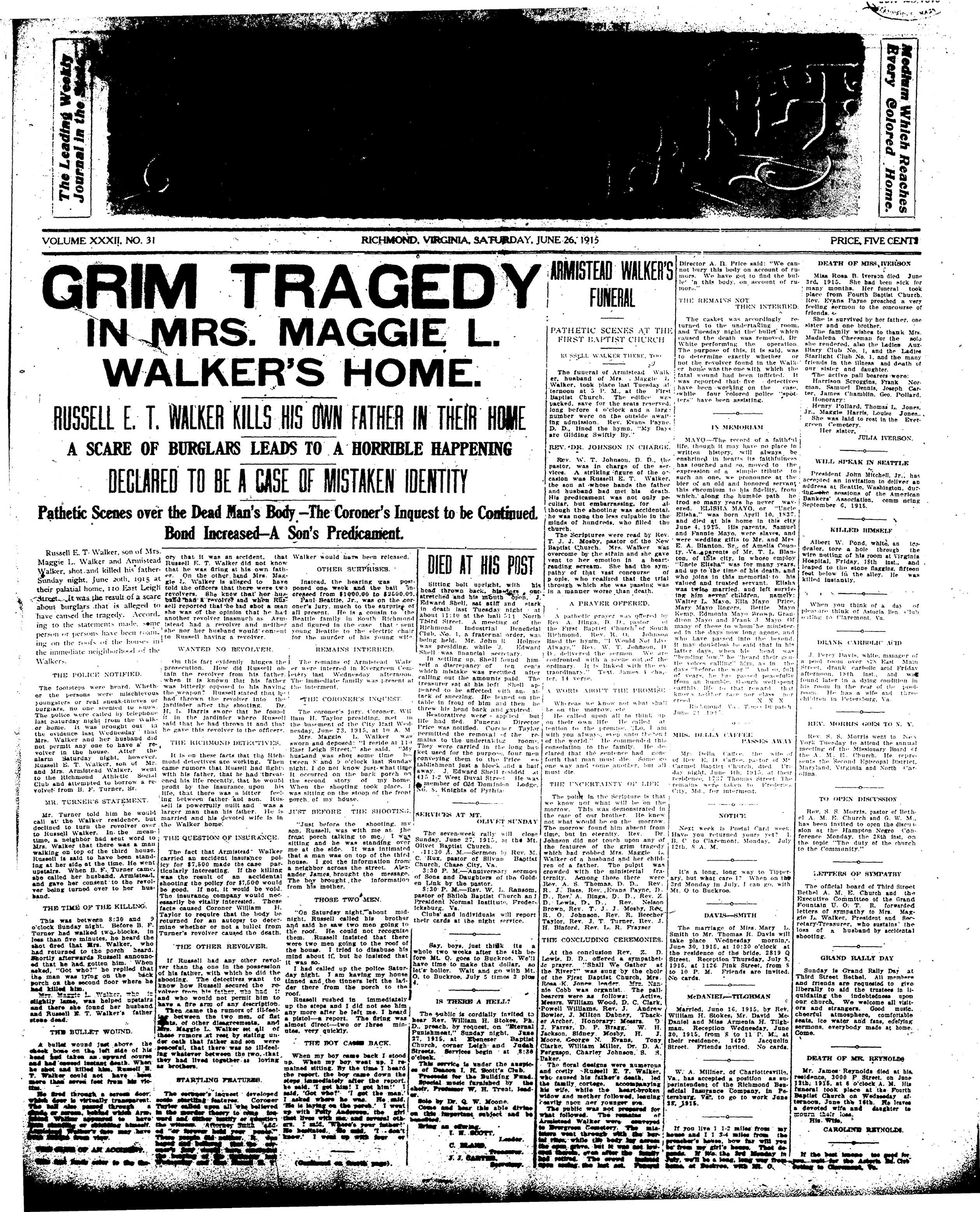
GRIM TRAGEDY IN MRS. MAGGIE L. WALKER'S HOME.
VOLUME XXXII, NO. 31
GRIM
IN THE
WAR
RUSSELL E. T.
A SCARE OF
DECLAR
Pathetic Scenes over
Russell E. T. Walker, son of Mrs. Maggie L. Walker and Armistead Walker, shot and killed his father Sunday night, June 20th, 1915 at their palatial home, 110 East Leight Street. It was the result of a scare about burglars that is alleged to have caused the tragedy. According to the statements made, some person or persons have been roaming on the roofs of the houses in the immediate neighborhood of the Walkers.
THE POLICE NOTIFIED.
The footsteps were heard. Whether or the persons were mischievous youngsters or real sneak-thieves or burglars, no one seemed to know. The police were called by telephone last Saturday night from the Walk or home. It was brought out in the evidence last Wednesday that Mrs. Walker and her husband did not permit any one to have a revolver in the house. After the alarm Saturday night, however, Russell E. T. Walker, son of Mr. and Mrs. Armistead Walker, went to the Richmond Athletic Social Club and attempted to borrow a revolver from B. F. Turner, Sr.
MR. TURNER'S STATEMENT.
Mr. Turner told him he would call at the Walker residence, but declined to turn the revolver over to Russell Walker. In the meantime, a neighbor had sent word to Mrs. Walker that there was a man walking on top of the third house. Russell is said to have been standing at her side at the time. He went upstairs. When B. F. Turner came, she called her husband, Armistead, and gave her consent to the revolver being turned over to her husband.
THE TIME OF THE KILLING.
This was between 8:30 and 9 o'clock Sunday night. Before B. F. Turner had walked two blocks, in less than five minutes, he heard the shot fired that Mrs. Walker, who had returned to the porch heard. Shortly afterwards Russell announced that he had gotten him. When asked, "Got who?" he replied that the man was tying on the back porch on the second floor where he had killed him.
Mrs. Margaret L. Walker, who is slightly lame, was helped upstairs and there she found her husband, and Russell E. T. Walker's father stone dead.
THE BULLET WOUND.
A bullet wound just above the cheek bone on the left side of his head had taken an upward course and had caused instant death. When he shot and killed him, Rumell E. T. Walker could not have been more than seven feet from his victim.
He fired through a screen door, which door is virtually transparent. The ball also passed through a dugge or screen, behind which Arm, blind Whiler appeared to have been standing or shuffling himself. Amelia Walters face may have been hidden from view.
THE CASE OF AN ACCIDENT.
This and family order to the firm.
ory that it was an accident, that Russell E. T. Walker did not know that he was dring at his own father. On the other hand Mrs. Maggie L. Walker is alleged to have told the officers that there were two revolvers. She know that her hug band had a revolver and when Ritaell reported that she had shot a man she was of the opinion that he had another revolver inasmuch as Armistead had a revolver and neither she nor her husband would consent to Russell having a revolver.
WANTED NO DEVOLVER
On this fact evidently hinges the prosecution. How did Russell obtain the revolver from his father, when it is known that his father was bitterly opposed to his having the weapon? Russell stated that he had thrown the revolver into the jardinier after the shooting. Dr. H. L. Harris swore that he found it in the jardinier where Russell said that he had thrown it and that he gave this revolver to the officers.
THE RICHMOND DETECTIVES.
It is on these facts that the Richmond detectives are working. Then came rumors that Russell had lighted with his father, that he had threatened his life recently, that he would profit by the insurance upon his life, that there was a bitter feeling between father and son. Russell is powerfully guilt and was a larger man than his father. He is married and his devoted wife is in the Walker home.
THE QUESTION OF INSURANCE
The fact that Armistead Walker carried an accident insurance policy for $7,500 made the case particularly interesting. If the killing was the result of an accidental shooting the policy for $7,500 would be good. If not, it would be void. The insurance company would necessarily be vitally interested. Those facts caused Coroner William H. Taylor to require that the body be returned for an autopsy to determine whether or not a bullet from Turner's revolver caused the death.
THE OTHER REVOLVER
If Russell had any other revolver than the one in the possession of his father, with which he did the shooting. The detectives want to know how Russell secured the revolver from his father, who had it and who would not permit him to have a fire arm of any description. Then came the rumors of ill-feeling between the two men, of flat hats, of other disagreements, and Mrs. Maggie L. Walker set all of these rumors at rest by stating under oath that father and son were peaceful, that there was no ill-feeling whatever between the two, that they had lived together as loving brothers.
STARTLING FEATURES
The customer's inquest developed some starting features. Coroner Tyrter called upon all who believed in the murder theory to come forward and either justify or question the witness. Attorney Smith added "or however hold your pence." These people did not believe. It was hoped and believed that the coroner's story would have demonstrated the hearing of the coroner and Wednesday and then Monday in T.
Walker would have been released. OTHER SURPRISES.
Instead, the hearing was postponed one week and the ball increased from $1000.00 to $2600.09. Paul Beattie, Jr., was on the coroner's jury, much to the surprise of all present. He is a cousin to the Beattie family in South Richmond and figured in the case that sent young Beattie to the electric chair for the murder of his young wife.
REMAINS INTERRED
The remains of Armistead Walk or were interred in Evergreen Cemetery last Wednesday afternoon. The immediate family was present as the interment.
THE CORONER'S INQUEST.
The coroner's jury. Coroner. Will Haim H. Taylor presiding, met in the basement of the City Rail Wednesday, June 23, 1915, at 10 A. M. Mrs. Maggin L. Walker was sworn and deposed: "I reside at 114 East Leigh Street." she said. "My husband was shot some time between 8 and 9 o'clock last Sunday night. I do not know just what time it occurred on the back porch on the second story of my home. When the shooting took place, I was sitting on the stoop of the front porch of my house.
JUST BEFORE THE SHOOTING
"Just before the shooting, my son, Russell, was with me at the front; porch talking to me. I was sitting and he was standing over me at the side. It was intimated that a man was on top of the thief house. I got the information from a neighbor across the street. Alexander James, brought the message. The boy brought the information from his mother.
THOSE TWO MEN
"On Saturday night, about midnight, Russell called his brother and said he saw two men going to the roof. He could not recognize them. Russell insisted that there were two men going to the roof of the house. I tried to disabuse his mind about it, but he insisted that it was so. I had called up the police Saturday night. I am having my house tinned and the tinners left the ladder there from the porch to the roof. Russell rushed in immediately up the steps and I did not see him any more after he left me. I heard a pistol—a report. The firing was almost direct—two or three minutes, very quickly.
THE BOY CAME BACK.
When my boy came back I stood up. When my boy went up, I remained sitting. By the time I heard the report, the boy came down the steps immediately after the report, he said, I got him! I got him! I said, 'Got who?' I got the man! I asked where he was. He said, 'He is laying on the porch.' I went up with Felty Anderson, the girl that lives with me, and several others. I said, Where's your father? He hesitated. He said, 'I don't know.' I went up with four or
DIED AT HIS POST
Sitting bolt upright, with his head thrown back, his arms outstretched and his mouth open, J. Edward Shell, sat stiff and stark in death last Tuesday night at about 11:10 at the hall 511 North Third Street. A meeting of the Richmond Industrial Beneficial Club, No. 1, a fraternal order, was being held. Mr. John R. Holmes was presiding, while J. Edward Shell was financial secretary.
In settling up, Shell found himself a discrepancy of ten cents which mistake was recruited after calling out the amounts paid. The treasurer sat at his left. Shell appeared to be affected with an attack of sneezing. He leamed on the table in front of him and then he threw his head back and padded. Restoratives were applied but life had died. Funeral Director Price was notified. Coroner Taylor permitted the removal of the remains to the undertaking rooms. They were carried in the long basket used for the purpose, four men conveying them to the Price establishment just a block and a half away. J. Edward Shell resided at 415 1-2 West Duval Street. He was member of Old Dominion Lodge, No. S. Knights of Pythia.
SERVICES AT MT
The seven-week rally will close Sunday, June 27, 1915, at the Mt. Olivet Baptist Church.
11:30 A. M.—Sermon by Rev. M. C. Rux, pastor of Silvan Baptist Church, Chase City, Va.
3:30 P. M.—Anniversary sermon of Sons and Daughters of the Golden Link by the pastor.
3:30 P. M.—Rev. W. L. Ransom, pastor of Shiloh Baptist Church and President Normal Institute, Fredericksburg, Va.
Clubs' and Individuals will report their cards at the night service.
Bay, boys, just think its a whole two weeks after the 4th before Mt. O. goes to Buckroe. We'll have time to make that dollar, so let's holler. Wait and go with Mt. O. to Buckroe, July 5 times 3 plus
IS THERE A HELL?
The public is cordially invited to hear Rev. William H. Stokes, Ph. D., preach, by request, on "Eternal Punishment." Sunday night. June 27, 1915, at Ebenezer Baptist Church, corner Leigh and Judah Streets. Services begin at 8:30 o'clock.
This service is under the auspices of Danaon I. H. Scott's Club. Proceeds for the Building Fund. Special music furnished by the choir, Professor W. H. Trent, leader.
Sole by Dr. Q. W. Moone.
Come and hear this able divine on this important subject and be benefited.
ARMISTEAD WALKER'S FUNERAL
The funeral of Armistead Walker, husband of Mrs. Maggie L. Walker, took place last Tuesday afternoon at 5 P. M., at the First Baptist Church. The edifice was packed, save for the seats reserved, long before 4 o'clock and a large number were on the outside awaiting admission. Rev. Evans Payne, D. D., Hined the hymn, "My Days are Gliding Swiftly By."
REV. DR. JOHNSON IN CHARGE
Rev. W. T. Johnson, D. D., the pastor, was in charge of the services. A striking figure of the occasion was Russell E. T. Walker, the son at whose hands the father and husband had met his death. His predicament was not only peculiar, but embarrassing, for although the shooting was accidental, he was none the less culpable in the minds of hundreds, who filled the church.
The Scriptures were read by Rev. T. J. J. Mosby, pastor of the New Baptist Church. Mrs. Walker was overcome by the strain and she gave vent to her emotion in a heart-rending scream. She had the sympathy of that vast concourse of people, who realized that the trial through which she was passing was in a manner worse than death.
A PRAYER OFFERED.
A pathetic prayer was offered by Rev A. Hinga, D. D., pastor of the First Baptist Church of South Richmond, Rev R. O., Johnson Hand the hymn, "I Would Not Live Always," Rev W. T. Johnson, D. D., delivered the sermon. We are confronted with a scene out of the ordinary. It is linked with the extraordinary." Text, James A. chapter, 14 verse.
A WORD ABOUT THE PROMISE
Whereas we know not what shall be on the morrow, etc.
He called upon all to think upon their own life. He called attention to the promise, "Lo, I am with you always, even unto the soul of the world." He commended this consolation to the family. He declared that the sentence had gone forth that man must die. Some go one way and some another, but all must die.
THE UNCERTAINTY OF LIFE
The point in the Scripture is that we know not what will be on the morrow. This was demonstrated in the case of our brother. He knew not what would be on the morrow. The morrow found him absent from time, but in eternity. Rev. Dr. Johnson did not touch upon any of the features of the grim tragedy which had robbed Mrs. Maggie L. Walker of a husband and her children of a father. The pulpit was crowded with the ministerial fraternity. Among those there were Rev. A. S. Thomas, D. D., Rev. R. J. Bass, Evans Payne, D. D., Rev' A. Binga, D. D., Rev. Z. D. Lewis, D. D., Rev. Nelson Brown, Rev. T. J. J. Mosby, Rev. R. O. Johnson, Rev. R. Beecher Taylor, Rev. J. T. Turner, Rev. J. H. Binford, Rev. L. R. Frayser
THE CONCLUDING CEREMONIES.
At the conclusion Rev. Z. D. Lewis, D. D., offered a sympathetic prayer. "Shall We Gather at the River" was sung by the choir of the First Baptist Church, Mrs. Rosa K. Jones leader, Mrs. Nannie Cobb was organist. The pall bearers were as follows: Active, Messrs. William Wood, D. C. Clark, Powell Williams, Rev. J. Andrew Bowler, J. Milton Dabney, Thacker Archer, Honorary: Messrs. D. J. Farrar, D. P. Bragg, W. H. Jackson, Sidney Mosby, H. J. Moore, George N. Evans, Tony Clarke, William Miller, Dr. D. A. Ferguson, Charley Johnson, S. S. Baker.
The floral designs were numerous and costly - Russell E. T. Walker, who caused his father's death, led the family cortage, accompanying his wife, while the heart-broken widow and mother followed, leaving heavily upon her younger son.
The public was not prepared for what followed. The remains of Armistead Walker were conveyed to Bevergreen Cemetery. The ministers went through with the burial rite, while the body lay across the open grave, but it was not lowed through, even after the family had retired. The crowd imputed them among the last sed. Pamela
Director A. D. Price said: "We cannot bury this body on account of rumors. We have got to find the bullet in this body, on account of rumors."
THE REMAINS NOT
THEN INTERRED.
The casket was accordingly returned to the undertaking room, and Tuesday night the bullet which caused the death was removed. Dr White performing the operation. The purpose of this, it is said, was to determine exactly whether or not the revolver found in the Walker home was the one with which the fatal wound had been inflicted. It was reported that five detectives have been working on the case, while four colored police "spotters" have been assisting.
0
IN MEMORIAM
MAYO—The record of a faithful life, though it may have no place in written history, will always be enshrined in hearts its faithfulness has touched and so moved to the expression of a simple tribute to such an one, we pronounce at the bier of an old and honored servant this chemoium to his fidelity, from which, along the humble path he trod so many years he never wavered. ELISHA MAYO, or "Uncle Ellisha," was born April 10, 1837, and died at his home in this city June 4, 1975. His parents, Samuel and Fannie Mayo, were slaves, and were wedding gifts to Mr. and Mrs. E. A. Blanton, Sr., of Amolia County, Va., parents of Mr. T. L. Blanton, of this city, in whose employ "Uncle Ellisha" was for many years, and up to the time of his death, and who joins in this memorial to his valued and trusted servant. Ellisha was twice married, and left surviving him seven children, namely: Walter L. Mayo, Ella Mayo Price, Mary Mayo Rogers, Bottle Mayo Kemp, Edmonia Mayo Brown, Grandison Mayo and Frank J. Mayo Of many of those to whom he ministered in the days now long ago, and who have passed into the beyond, it may doubtless be said that in his latter days, when his head was "bending low," he "heard their voices calling" him, as in the days "before the war." And so, full of years, he has passed peacefully from an humble, though well-spent earthly life to that reward that knows neither race nor class nor creed. N X X
Richmond, Va. Three Dispatch
June 12, 1915
MRS. DELLA CAFFEE
PASSES AWAY
Mrs. Dolla Coffee, the wife of
of Rev E. D. Coffee, pastor of M.
Carmel Baptist Church, died
Friday night, June 4th, 1915, at their
residence, 1737 Thomas Street. The
remains were taken to Frederick
City, Md., for interment.
NOTICE
NOTICE
Next week is Postal Card week.
Have you returned yours yet? 1.
B. C to Claremont, Monday, July
12th. S. A. M.
It's a long, long way to Tipperary, but what care I? When on the 3rd Monday in July, I can go, with Mt. O to Buckroo.
DAVIS-SMITH
The marriage of Miss. Mary L. Smith to Mr. Thomas R. Davis will take place Wednesday morning, June 30, 1915, at 10:30 o'clock at the residence of the bride. 2819 Q Street. Reception Thursday, July 8, 1915, at 1126 Pink Street, from 9 to 10 P. M. Friends are invited. No cards.
McDANIEL-TUCHMAN
Married, Juno 16, 1915, by Rev. William H. Stokes, Mr. David McDaniel and Miss Armenia H. Tilghman. Reception Wednesday, June 30, 1915, from 8 to 11 P. M., at their residence, 1420 Jacquolin Street. Friends invited. No cards.
W: A. Millner, of Charlotteville, Va., has accepted a position as superintendent of the Richmond Beneficial Insurance Company, in Petersburg, Va., to go to work June 28, 1915.
---
If you live 1 1-2 miles from my house and I 1 3-4 miles from the preacher's house, how far will you be from my girl's house. That depends. If No, the 3rd Monday in July, we'll be a long, long way from my home, at Duckroe, with Mr. O.
PRICE FIVE CENTS
DEATH OF MISS, IVERSON
Miss Rosa B. Iverson died June 3rd, 1915. She had been sick for many months. Her funeral took place from Fourth Baptist Church. Rev. Evanas Payne preached a very feeling sermon to the concourse of friends.
She is survived by her father, one sister and one brother.
The family wishes to thank Mrs. Mudalena Cheesman for the solo she rendered, also the Ladies Auxiliary Club No. 1, and the Ladies Starlight Club No. 1, and the many friends in the illness and death of our sister and daughter.
The active pall bearers were:
Harrison Scroggins, Frank Norman, Samuel Dennis, Joseph Carter, James Chamblin, Geo. Pollard.
Honorary:
Henry Pollard, Thomas L. Jones, Jr., Maggie Harris, Louise Jones.
She was laid to rest in the Evergreen Cemetery.
Her sister.
JULIA IVERSON
WILL SPEAK IN SEATTLE
President John Mitchell, Jr., has accepted an invitation to deliver an address at Seattle, Washington, during the sessions of the American Bankers' Association, commencing September 6, 1916.
KILLED HIMSELE
Albert W. Pond, white, an ice dealer, tore a hole through the wire notting of his room at Virginia Hospital, Friday, 15th inst., and leaped to the stone flagging, fifteen feet below in the alley. He was killed instantly.
When you think of a day of pleasure think of Astoria Bon. Club outing to Claremont, Va.
---
DRANK CARBOLIC ACID
J. Perey Davis, white, manager of a pool room over NYS East Main Street, drank carbolic acid Friday afternoon, 18th Inst., and was found later in a dying condition in his room in the rear of the pool room. He has a wife and three children in Petersburg, Va.
REV. MORRIS GOES TO N. Y.
Rev. S. S. Morris went to New York Tuesday to attend the annual meeting of the Missionary Board of the A. M. E. Church. He represents the Second Episcopal District, Maryland, Virginia and North Carolina.
---
TO OPEN DISCUSSION
Roy, S. S. Morris, pastor of Bethle A. M. E. Church and G. W. M. has been invited to open the discussion at the Hampton Negro Conference Monday, the 28th inst, on the topic "The duty of the church to the Community."
---
LETTERS OF SYMPATHY
The official board of Third Street Bethel A. M. E. Church and the Executive Committee of the Grand Fountain U. O. T. R. forwarded letters of sympathy to Mrs. Maggie L. Walker, President and Secretary-Treasurer, who sustains the loss of a husband by accidental shooting.
GRAND BALLY DAY
Sunday is Grand Rally Day at Third Street Bethel. All members and friends are requested to give liberally to aid the trustees in liquidating the indebtedness upon our church. We welcome all visitors and strangers. Good music, cheerful atmosphere, comfortable seats, ice water and fans, edifying sermons, everybody made at home. Come.
---
DEATH OF MR. REYNOLDS
Mr. James Reynolds died at his residence, 3000 P Street, on June 12th, 1915, at 6 o'clock A. M. His funeral took place at the Fourth Baptist Church on Wednesday afternoon, June the 16th. He leaves a devoted wife and daughter to mourn their loss.
His Wife,
CAROLINE REYNOLDS.
If the best beneme too good for you, wait for the Admiral M. Club coming to Charleston, Va.
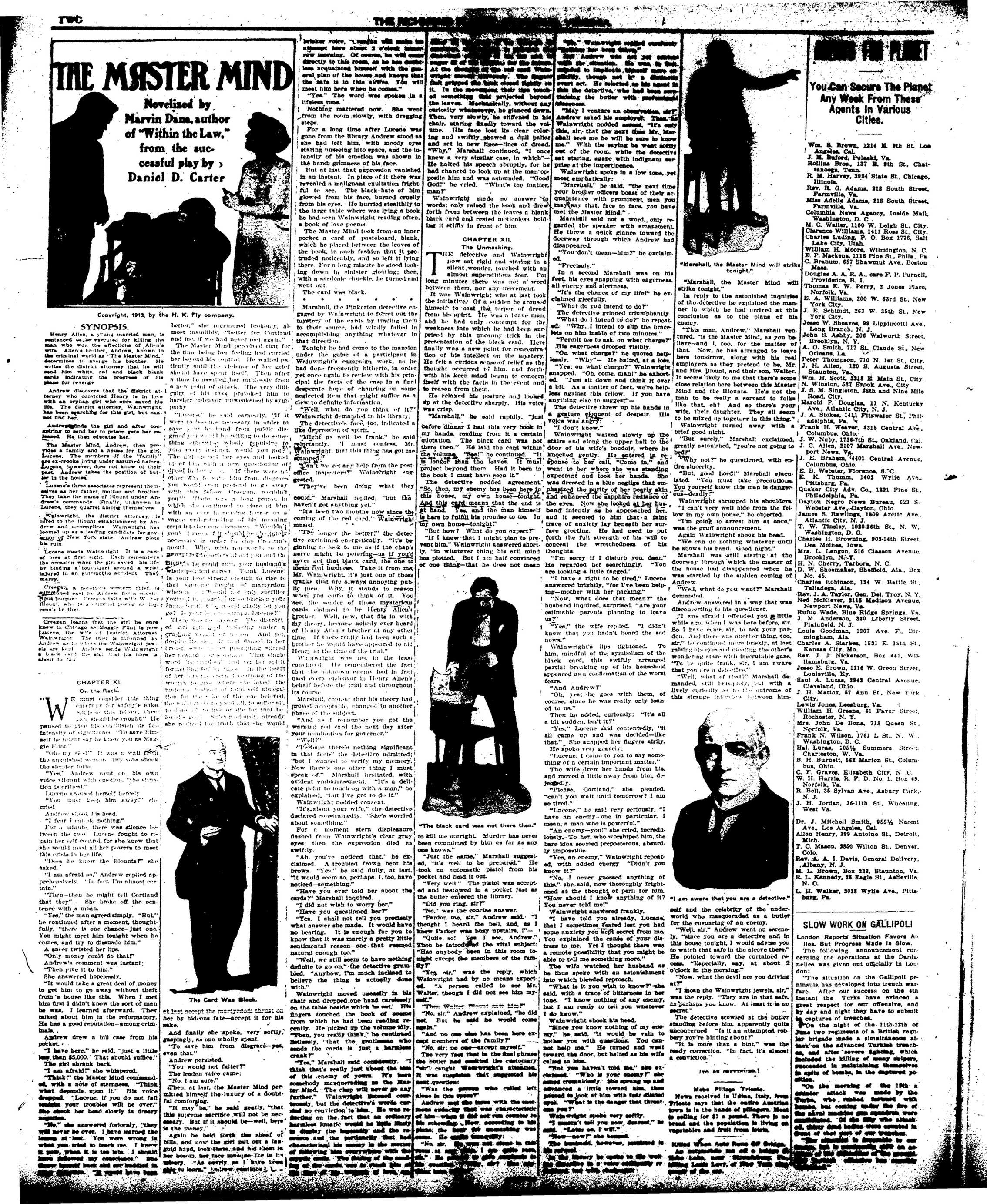
THE MASTER MIND
Novelized by Marvin Dana, author of "Within the Law." from the successful play by Daniel D. Carter
Copyright, 1913 by the H. K. Fly company.
Henry Allen, a young married man, is sentenced to be executed for killing the man who won the affections of Allen's wife, Allen's brother, Andrew, known to the criminal world as 'The Master Mind.' He writes his brothor, William, the district attorney that he will send him white, red and black blank cards indicating the progress of his plans for revenge.
Andrew discovers that the district attorney who convicted Henry is in love with an orphan girl who once saved his life. The district attorney, Wainwright, has been searching for this girl, but cannot find her.
Andrew finds the girl and after complying to send her to prison gets her released. He then educates her.
The Master Mind, Andrew, then provides a family and a house for the girl, Lucena. The members of the family assume named angena however, does not know of their past. Andrew takes the position of butler in the house.
Luceana three associates represent themselves as her father, mother and brother. They take the name of Blount under Andrew's commands. Finally, unknown to Lucena, they quarrel among themselves.
Walnweight, the district attorney, is loved to the Blount establishment by Andrew and accomplices. Walnweight has loomed up as a leading candidate for governor of New York state. Andrew plots his ruin.
Luceana meets Walnweight. It is a case of love at first sight. Each remembers the occasion when the girl saved his life by binding a tourniquet around a wrist injured in an automobile accident. They marry.
Creegan, a notorious western thief, is summoned cast by Andrew for a mission to pursue. Creegan takes with Walter Blount, who is a criminal pleading as Lucena's brother.
Creekan learns that the girl be once knew in Chicago as Maggie Fink is now Laccone, the wife of District Attorney Walwright. The theft is informed by Andrew as to where the Walwright jeans are kept. Andrew sends Walwright a black card the sign that his know is about to fail.
"W
WE must consider this thing carefully for safety's sake. Ship or this fellow, Crew should be caught." He paused to give his explanation its full intensity of significance. "To save himself he might say he know you as Maggie Plint." "Oh my God!" It was a wall from the anguished woman. Her soles shook the elder form. "Yes," Andrew went on, his own voice vibrated with emotion. "The situation is critical." Lucene assured herself deeply. "You must keep him away!" she cried.
For a minute, there was silence between the two. Lucene fought to regain her self control, for she knew that she would need all her powers to meet this crisis in her life.
"Does he know the Blounts?" she asked.
"I am afraid so." Andrew replied appropriately. "In fact, I'm almost certain."
"Then—then he might tell Cortland that they"—She broke off the sentence with a mean.
"Yes," the man agreed simply. "But," he continued after a moment thoughtfully, "there is one chance—just one. You might meet him tonight when he comes, and try to dismuse him."
"It would take a great deal of money to get him to go away without theft from a house like this. When I met him first I didn't know the sort of man he was. I learned afterward. They talked about him in the reformatory. He has a good reputation—among criminals.
Andrew drew a bill case from his pocket.
"I have here," he said, "just a little less than $5,000. That should suffice."
The girl shrank back.
"I am afraid!" she whispered.
"Think!" the Master Mind commanded, with a note of sternness. "Think what depends. upon it." His voice dropped. "Lucene, if you do not fail tonight your troubles will be over." He shook her head slowly in dreary negation.
"No," she answered forlornly, "they will never be over. I have learned the lessons at last. You were wrong in what you tried to teach me. I know it now, when it is too late. I should have followed my conscience." She shrugged herself back and not huddled in their chair. "It would have been
CHAPTER XI
On the Rock.
Andrew shook his head.
"I fear I can do nothing."
A silver twisted her lips.
1.
She answered hopelessly.
better," she murmured brokenly, almost inaudibly, "better for Cortland and me. If we had never met again."
"Loving, he said earnestly, 'If it were to become necessary in order to save your land from public disgrace you would be willing to do something other than wholly prejudice to your every asset, should you not. The girl got her eyes and looked up at him with a new questioning of dream in her eyes.' 'If there were no other way to save him from disgrace you would even pretend to go away with this fellow Croghan, wouldn't you?' There was a long pause in which she continued to stare at him with an ever increasing horror as a vague understanding of his meaning crept into her consciousness. 'We wouldn't you! I mean if it should be the just necessary in order to stop Croghan's mouth. Why, with ten words to the newspaper, does it about you and the Bliqua, he could raise your husband's whole positive career? Think, Loving! Is your love strong enough to draw to that supreme insight of martyrdom where you would not only sacrifice yourself to the world but blacken your shame in that way would gladly let you
There was no answer. The distinct ed of girlhood and belonging under a grating weight of burden. And yet, despite the fact that damned in her heart she was not prompting willed her toward a purpose. That single word would not bet her spirit formation for the future. In the heart of her heart she remained pining of the wounds to give where she loved the most that she could of total self-abnegation for the life of the one believed, the wounds she could still to suffer all, to suffer all, to suffer to the one she for that be loved—a good. Substance, already she realized the truth that she would
I
The Card Was Black.
at last accept the martyrdom thrust on her by hideous fate—accept it for his sake.
And finally she spoke, very softly, gaspingly, as one wholly spent.
"To save him from disgrace—yes, even that."
Andrew persisted.
"You would not falter?" The leaden voice came:
"No, I am sure."
Then, at last, the Master Mind permitted himself the luxury of a doubtful comforting.
"It may be," he said gently, "that this supreme sacrifice will not be necessary. But if it should be—well, here is the money."
Again he held forth the sheaf of
bills, and now the girl put out an la-
nguid hand, took them, and hid them in
her boon, her face moaned like in the
money. "As surely as I have been
to learn, I will continue."
brinker voice, "Cregan will make his attempt here about 3 o'clock tomorrow, row morning. Of course, he will come directly to this room, as he has doubtless acquainted himself with the general plan of the house and knows that the safe is in this alcove. You will meet him here when he comes." "Yes." The word was spoken in a lifeless tone. Nothing mattered now. She went from the room slowly, with dragging steps. For a long time after Lucene was gone from the library Andrew stood as she had left him, with moody eyes staring unseeing into space, and the intensity of his emotion was shown in the harsh grimness of his face.
But at last that expression vanished in an instant. In place of it there was revealed a malignant exultation rightful to see. The black-hate of him glowed from his face, burned crusily from his eyes. He hurried steadily to the large table where was lying a book he had seen Wainwright reading often, a book of love poems.
The Master Mind took from an inner pocket a card of pasteboard, blank, which he placed between the leaves of the book, in such fashion that it protruded noticeably, and so left it lying there. For a long minute he good-looking down in simulator gloating; then, with a sardonic chuckle, he turned and went out.
Marshall, the Pinkerton detective engaged by Wainwright to forget out the mystery of the cards by tracing them to their source, had wholly failed in accomplishing anything whatever in that direction.
Tonight he had come to the mansion under the gaze of a participant in Wainwright's campaign work, as he had done frequently hitherto, in order yet once again to review with his principal the facts of the case in a final desperate hope of chancing on some neglected item that might suffice as a clue to definite information.
"Well, what do you think of it?" Wainwright demanded in his library.
The detective's face, too, indicated a like depression of spirit.
"Might as well be frank," he said reluctantly. "I must confess, Mr. Wainwright, that this thing has got me nummed."
"Can't we get any help from the post office inspectors?" Wainwright sighed. "They've been doing what they could." Marshall replied, "but the haven't got anything yet." "It've been two months now since the coming of the red card," Wainwright mused.
"The longer the better!" the detective exclaimed energetically. "It's beginning to look to me as if the chap's nerve might be petering—as if you never get that black card, the one to mean real business. Take it from me. Wm. Winmright. It's just one of those cranks that are always annoying public men. Why. It stands to reason when you come to think of it. You see, the sender of those mysterious cards claimed to be Henry Allen's brother. Well, now, that fits in with my theory, because nobody ever heard of Henry Allen's brother at any other time. If there really had been such a brother he would have appeared to me Henry at the time of the trial."
Wm. Winmright was not in the least convinced. He remembered the fact that the unknown enemy had in fact used every endeavor in Henry Allen's behalf before the trial and throughout its course.
Marshall content that his theory had proved acceptable, changed to another phase of the subject.
"And as I remember you got the warning red card the next day after your nomination for governor."
"Well?"
"I suppose there's nothing significant in that fact," the detective admitted; "but I wanted to verify my memory. Now there's one other thing I must speak of." Marshall hesitated, with evident embarrassment. "It's a delicate point to touch on with a man," he explained, "but I've got to do it."
Wainwright nodded consent.
"It's about your wife," the detective declared constrainedly. "She's worried about something."
For a moment stern displeasure flashed from Wainwright's clear gray eyes; then the expression died as swiftly.
"Ah, you're noticed that," he exclaimed. A troubled frown bent his brows. "Yes," he said dully, at last. "It would seem so, perhaps. I, too, have noticed—something."
"Have you ever told her about the card?" Marshall inquired.
"I did not wish to worry her."
"Have you questioned her?"
"Yes. I shall not tell you precisely what answer she made. It would have no bearing. It is enough for you to know that it was merely a pretty little sentimental reason—one that seemed natural enough too."
"Well, we still seem to have nothing definite to go on," the detective grumbled. "Anyhow, I'm much inclined to believe the thing is actually done with."
Wainwright moved unnessily in his chair and dropped one hand carelessly on the table beside which he sat. His fingers touched the book of poems from which he had been reading recently. He picked up the volume skily. "Then, you really think," he continued listlessly, "that the gentleman who sends the cards is just a harmless crank?"
"Yes," Marshall said confidently. "I think that's really just about the tone of this enemy of yours. It's been somebody masquerading as the Master Mind. The chap will never go any further." Wainwright insisted courteously, but the detective's words carried no conviction to him. He was reflecting on the fact that an ordinary harmless lunatic would be little likely to display the ingenuity and the resource and the pertinacity that had characterised his enemy in the matter of following him everywhere with the cryptic cues. The timing of the sounding of the cues and to reach him in the throes of the violence of love and
Since he was very much a man of the most importance, he was always a man of the most importance. The superintendent of the school for the boys. At the thought of the end and Whitewright moved anxiously. The superintendent stepped the bank closed tightly on it. In the movement their tips touched something that projected beyond the leaves. Mechanically, without any curiosity whatsoever, he glanced down. Then, very slowly, he stiffened in his chair, staring fixed toward the volume. His face lost its clear coloring and swiftly showed a dull palor and set in new lines—lines of dread. "Why?" Marshall continued, "I once knew a very similar case, in which"—He halted his speech abruptly, for he had chanced to look up at the man opposite him and was astounded. "Good God!" he cried. "What's the matter, man?"
Waltwright made no answer in
words; only raised the book and drew
forth from between the leaves a blank
black card and rested motionless, holding
it stiffly in front of him.
CHAPTER XII
The Unmasking.
THE detective and Wainwright now sat rigid and staring in a silent, wonder, touched with an almost superstitious fear. For long minutes there was not a word between them, nor any movement. It was Wainwright who at last took the initiative: Of a sudden he aroused himself to cast the torpor of dread from his spirit. He was a brave man, and he had only contempt for the weakness into which he had been surprised by this unconcern trick in the presentation of the black card. Here finally was a new point for concentration of his intellect on the mystery. He felt a curious sense of relief as the thought occurred to him, and forthwith his keen mind began to concern itself with the facts in the event and to reason from them. He relaxed his posture and looked up at the detective sharply. His voice was crisp.
before dinner I had this very book in my hands, reading from it a certain quotation. The black card was not there then." He held the card within the volume. "See!" he continued. "It is longer than the leaves. It must project beyond them. Had it been in the book I must have seen it."
The detective nodded agreement. "So then, my enemy has been here in this house, my own house—tonight. And this card means that the end is at hand. Yes, and the man himself is here to fulfill his promise to me. In my own home—tonight."
"But how? What do you expect?" "If I knew that I might plan to prevent him." Weinwright answered shortly. "In what manner his evil mind has plotted. But I am half convinced of one thing—that he does not mean
A
"The black card was not there then," to kill me outright. Murder has never been committed by him as far as any one knows.
"Just the name," Marshall suggested, "it's well to be prepared." He took an automatic pistol from his pocket and held it out.
"Very well." The pistol was accepted and bestowed in a pocket just as the butter entered the library.
"Did you ring, sir?"
"No," was the concise answer.
"Pardon me, sir," Andrew said. "I thought I heard the bell, and, as I know Parker was busy upstairs, I—"
"Quite so! Yes, I see, Andrew."
Then he introduced the vital subjects "Has anybody been in this room tonight except the members of the family?"
"Yes, sir," was the reply, which Wainwright had by no means expected. "A person called to see Mr. Walter, though I did not see him myself."
"Then Walter Blount saw him."
"No, sir." Andrew explained, "he did not. But he said he would come again."
"And no one else has been here except members of the family."
"No, sir; no one—except myself."
The very fact that in the final phrase the butler had omitted the customary "sir" caught Wainwright's attention. It was suspicious that suggested his most question:
"Was the person who called left alone in this room?"
Andrew met the woman with the enormous audacity that was characteristic of him—when I did not run counter to his scheming. Now, according to his plans, the hour of commending was gone. He made them cry:
"Waltman has been there."
Hall Andrew was not yet content with the situation. He was, in fact, supplied to impolite, himself more explicitly, though not by a dismissive event act. He selected as his agent in this the detractive, who had been so thinking the butler with professional absences.
"May I venture an observation, sir, Andrew asked his employer. Then, as Walnwright nodded absent, "It's only this, sir, that the next time Mr. Marshall sees me he will be sure to know me." With the saying he went softly out of the room, while the detractive sat staring, agape with indignant surprise at the impertinence.
Walnwright spoke in a low tone, yet most emphatically:
"Marshall," he said, "the next time your brother officers boast of their acquaintance with prominent men you may say that, face to face, you have met the Master Mind."
Marshall said not a word, only regarded the speaker with amazement. He threw a quick glance toward the doorway through which Andrew had disappeared. "You don't mean—him!" he exclaimed.
"Precisely."
In a second Marshall was on his feet, his eyes snapping with angerness, all energy and alertness.
"It's the chance of my life!" he exclaimed gleefully.
"What do you intend to do?"
The detective grinned triumphantly.
"What do I intend to do?" he repeated.
"Why..I intend to lift the bracelets on him inside of two minutes."
"Permit me to ask, on what charge?"
His eagerness drooped visibly.
"On what charge?" he quoted helplessly.
"Why?" He halted, at a idea.
"Yes; on what charge?" Waltwright snapped.
"Oh, come, man!" he exhorted.
"Just sit down and think it over a bit. As a matter of fact, we're helpless against this fellow. If you have anything else to suggest?"
The detective threw up his hands in a gesture eloquent of despair. His voice was angry.
"I don't know." Waintright walked slowly up the stairs and along the upper hall to the door of his wife's boudoir, where he knocked gently. He entered in response to her call, "Come in," and went to her where she was standing expectant and look her hands. She was dressed in a blue negligent that emphasized the purity of her peery skin and enhanced the sapphire radiance of the eyes. Now she looked at her husband intently as he approached her, and it seemed to him that a faint trace of anxiety lay beneath her surface greeting. He had need to put forth the full strength of his will to conceal the wretchedness of his thoughts.
"I'm sorry if I disturb you, dear." He regarded her sonchingly. "You are looking a little fagged."
"I have a right to be tired." Lucene answered brightly, "for I've been helping-mother with her packing."
"Now, what does that mean? The husband inquired, surprised. "Are your estimable parents planning to leave us?"
"Yes," the wife replied. "I didn't know that you hadn't heard the sad news."
Wainwright's lips tightened. To him, mindful of the symbolism of the black card, this swiftly arranged partial breaking up of his household appeared as a confirmation of the worst fears.
"And Andrew?"
"Oh, yes; he goes with them, of course, since he was really only loaned to us."
Then he added, curiously: "It's all a bit sudden, can't it?"
"Yes," Lucene said contentedly, "it all came up and was decided—like that." She strapped her fingers airily. He spoke very gravely:
"Lucene, I came to you to say something of a certain important matter."
The wife drew her hands from his, and moved a little away from him, defensively.
"Please, Cortland," she pleaded, "can't you wait until tomorrow? I am so tired."
"Lacene," he said very seriously, "I have an enemy—one in particular, I mean, a man who is powerful."
"An enemy—you!" she cried, incredulously. To her, who worshiped him, the bare idea seemed preposterous, absurdly impossible.
"Yes, an enemy," Walnwright repeated, with added energy "Didn't you know it?"
"No, I never guessed anything of this," she said, now thoroughly frightened at the thought of peril for him. "How should I know anything of it? You never told me!"
Walnwright answered frankly.
"I have told you already, Lucente that I sometimes feared lost you had some anxiety you kept secret from me. You explained the cause of your distress to me. Yet I thought there was a remote possibility that you might be able to tell me something more."
The wife watched her husband as he thus spoke with an astonishment into which blended reproach.
"What is it you wish to know?" she said, with a trace of bitterness in her tone.
"I know nothing of any enemy, but I am ready to tell you whatever I do know."
Wainwright shook his head.
"Since you know nothing of my enemy," he said, "it would be vain to bother you with questions. You cannot help me." He turned and went toward the door, but halted as his wife called to him.
"But you haven't told me," she exclaimed. "Who is your enemy?" she asked triumphantly. She sprang up and advanced a little toward him, those prince to look at him with fear dilated speak. "What is the danger that threatens you?"
With wright spoke very softly. "I cannot tell you now, dearest," he said. "Later on, I will."
"Now—now!" she beamed.
The bummed, however, perished in the rain.
"In the library he spends to the work of the obsolete in a vortex constantly revolved, but with change!"
```markdown
```
"Marshall, the Master Mind will strike tonight."
"Marshall, the Master Mind will strike tonight."
In reply to the astonished inquiries of the detective he explained the manner in which he had arrived at this conclusion as to the plans of his enemy.
"This man, Andrew," Marshall ventured, "is the Master Mind, as you believe—and I, too, for the matter of that. Now, he has arranged to leave here tomorrow, along with his real employers as they pretend to be, Mr. and Mrs. Blount, and their son, Walter. It seems likely to me that there's some close relation here between this Master Mind and the Blounts. He's not the man to be really a servant to folks like that, eh? And so there's your wife, their daughter. They all seem to be mixed up together in this thing."
Wainwright turned away with a brief good night.
"But surely," Marshall excclaimed, greatly astonished, "you're not going to bed!"
"Why not?" he questioned, with entire sincerity.
"But, good Lord!" Marshall ejaculated. "You must take precautions. You yourself know this man is dangerous—daily!"
Waln Wright shrugged his shoulders. "I can't very well hide from the fellow in my own house," he objected.
Again Walnwright shook his head.
"We can do nothing whatever until he shows his hand. Good night."
Marshall was still starting at the doorway through which the master of the house had disappeared when he was startled by the sudden coming of Andrew.
"Well, what do you want?" Marshall demanded.
Andrew answered in a way that was disconcerting to his questioner.
"I was afraid I offended you little while ago, when I was here before, sir. So I have come, sir, to ask your pardon. And there was another thing, too, sir, he continued more briskly, at last raising his eyes and meeting the other's wondering stare with inscrutable gaze.
"To be quite frank, sir, I am aware that you are a detective."
"Well, what of that?" Marshall demanded, still briskly, but with a lively curiously as to the outcome of this strange interview between him.
P.
"I am aware that you are a detective."
self and the celebrity of the underworld who masqueraded as a butler for the enmarring of an enemy.
"Well, sir," Andrew went on serenely, "since you are a detective and in this house tonight, I would advise you to watch that safe in the alcove there."
He pointed toward the curtained room.
"Expecially, say, at about 2 o'clock in the morning."
"Now, what the devil are you driving at?"
"I mean the Wainwright jewels, sir," was the reply. "They are in that safe as perhaps you know. At least it is no secret."
The detective scowled at the butler standing before him, apparently quite unconcerned. "Is it an attempted robbery you're blinding about?"
"It is more than a bint," was the ready correction. "In fact, it's almost a conviction."
Mobe Pillage Troupe.
News received in Udine, Italy, from
Tribune says that the entire Austrian
town is in the hands of pillagers. Most
is selling for $1 a pound. There is no
brand and the population is living on
vegetables and fruit from Britain.
Killed When Auto Runs Off Bridge.
An automobile off a bridge in
Mobe Lake, near St. Bernardine. The
killing Louis Levy, of New York, was
guarded of the car.
MESSAGES FOR PLANET
You Can Secure The Planet Any Week From These Agents In Various Cities.
Wm. S. Brown, 1214 M. 9th St. Los
Angeles, Cal.
J. M. Buford, Pulaski, Va.
Rollina Bros., 137 E. $9th St., Chattanooga, Tenn.
R. M. Harvey, 3924 State St., Chicago, Illinois.
Rev. R. G. Adams, 218 South Street,
Farmville, Va.
Miss Adelle Adams, 218 South Street,
Farmville, Va.
Columbia News Agency, Inside Mail,
Washington, D. C.
M. C. Waller, 1100 W. Leigh St. City,
Clarence Williams, 1411 Ross St. City,
Charles Luding, P. O. Box 1776, Salt
Lake City, Utah.
William H. Moore, Wilmington, N. C.
E. P. Mackens, 1116 Pine St., Phila, Pa.
C. Branum, 657 Shawmut Ave., Boston
Mass.
Douglas A. A. R. A., care F. P. Purnell,
Providence, R. I.
Thomas E. W. Perry, 2 Jonas Place,
Norfolk, Va.
E. A. Williams, 200 W. 63rd St., New York City.
J. E. Schmidt, 263 W. 35th St., New York City.
Josee W. Sheaves, 99 Lippincott Ave., Long Branch, N. J.
John S. Ashby, 206 Walworth Street, Brooklyn, N. Y.
A. O. Smith, 717 St. Claude St., New
Orleans, La.
Peter Thompson, 710 N. 1st St. City.
J. H. Allen, 120 B. Augusta Street,
Staunton, Va.
Wm. H. Scott, 2318 E. Main St. City.
W. Ninston, 637 Brook Ave. City.
J. S. M. Singleton, 38th and Nine Milo
Road, City.
Harold P. Douglas, 11 N. Kentucky
Av. Atlantic City, N. J.
J. A. Stokes, 1411 Fitzwater St., Philadelphia, Pa.
Frank H. Weaver, 3315 Central Ave. Columbus, Ohio.
J. W. Nuby, 1736-7th St., Oakland, Cal.
J. C. Allen, 2107 Marshall Ave., Newport News, Va.
J. E. Braham, 4401 Central Avenuo, Columbus, Ohio.
E. B. Webater, Florence, S. C.
E. K. Thumm, 1403 Wylie Ave.,
Pittsburg, Pa.
Quaker City Adv. Co., 1221 Pine St.
Philadelphia, Pa.
Dayton Negro News Bureau, 623 S.
Webater Ave., Dayton, Ohio.
James S. Rawlings, 1609 Arctic Ave.,
Atlantic City, N. J.
T. W. Tinsley, 1020-26th St., N. W.
Washington, D. C.
Charles H. Browning. 902-14th Street.
Dos Moles, Iowa.
Mrs. L. Langen, 516 Classon Avenue,
Brooklyn, N.Y.
H. N. Cherry, Tarbora. N. C.
D. W. Shoemaker, Sheffield, Ala., Box
No. 45.
Charles Robinson, 124 W. Battle St.,
Talladega, Ala.
Rev. J. A. Taylor, Gen. Del. Troy, N. Y.
Ned McKiever, 2115 Madison Avenue,
Newport News, Va.
Rufus Wade, Blue Ridge Springs, Va.
J. M. Anderson, 330 Liberty Street,
Plainfield, N. J.
Louis Goodman, 1307 Ave. F. Birmingham, Ala.
Charles A. Starbes, 1521 E. 19th St. Kansas City, Mo.
Rev. J. J. Nickerson, Box 441, Will-
hamburg, Va.
Josso E. Brown, 1216 W. Green Street,
Louisville, Ky.
Baul A. Lucas, 3843 Central Avenue Cleveland, Ohio. J. H. Mattox, 57 Ann St., New York City.
Lewis Jones, Leesburg, Va.
Philippe V. Gosselin, Fresno, Calif.
Frank N. Wilson, 1761 L St., N. W
Washington, D. C.
Hal. Lucas, 105½ Summers Street, Charleston, W. Va.
B. H. Burnett, 562 Marton St., Columbus, Ohio.
C. F. Graves, Elizabeth City, N. C.
W. H. Harris, R. F. D. No. 1, Box 49, Norfolk, Va.
R. Bell, 36 Sylvan Ave., Asbury Park, N. J.
J. H. Jordan, 36-11th St., Wheeling, West Va.
Dr. J. Mitchell Smith, 955½ Naomi Ave., Los Angeles, Cal.
Allon Henry, 299 Antoine St., Detroit, Mich.
T. C. Mason, 2550 Wilton St., Denver,
Colo.
Rev. A. A. I. Davis, General Delivery,
Albany, N. J.
M. L. Brown, Box 322, Staunton, Va.
R. L. Kennedy, 26 Eagle St., Aaheville,
N. C.
L. H. Walker, 2038 Wylie Ave., Pitts-
burg, Pa.
SLOW WORK ON GALLIPOLI
SLOW WORK ON GALLIPOLI
London Reports Situation Favors All
Jones. But Progress Made Is Slow.
The following announcement concerning the operations at the Dardanelles was given out officially in London:
"The situation on the Gallipoll peninsula has developed into trench warfare. After our success on the 4th instant the Turks have evinced a great respect for our offensive, and by day and night they have to submit to captures of trenches.
"On the night of the 11th-12th of June two regiments of a British regular brigade made a simultaneous attack on the advanced Turkish trenches, and after severe fighting, which included the killing of many soldiers, succeeded in maintaining themselves in spite of bombs, in the captured position.
"On the morning of the 19th a counter attack was made by the Turks, who, rushed forward with bombs, but coming under the fire of the naval machine gun squadron were annihilated. Of the fifty who attacked, thirty died before were executed in front of that part of our treasury."
```markdown
```
Mr. H. H. Carlton, Principal of Moore School, has reported to the superintendent, Dr. J. A. C. Chandler, the following, roll of first honor and other promoted pupils for the term ending June 11, 1915:
7 A Grade—Others Promoted—
Edith Anderson, Matthew Brown, William L. Forgusson, Addie Green, Clyde Horsell, Calvin S. Johnson, Helen A. Lee, Bornico A. Lewis, Lella Lewis, Mary E. Mayo, Myrtle C. Reid, Hortense Robinson, Letcher Sallee, Mable Taybr, William H. Trent, Luretta Wells, Lucy A. Wilkerson, Joseph E. Winston, Veceirtie E. Fields.
Not Absent or Tardy—
Edith Anderson, Calvin S. Johnson, Mary Mayo, Letcher Sallee, William H. Trent, Florence Wagner.
B. Grade—First Honors—
Henry Beard, Lillian Greene, Samuel Walker. Others Frommoted—
Mary Bolling, Maggie Booker, Bettie Brewer, Daisy Brown, Eva Dickerson, Charlotte Freyler, William Harris, Lucie Hill, Theresa Howard, Aldonia James, Yoolanda Johans, Louise Lewis, Alma Mann, Helen McLain, Washington Norrell, Ambrose Price, Lillie Smithers, Charen Thompson, Marcellus Walker, Isaac Williams.
Not Absent nor Tardy—
Henry Beard, William Harris, Washington Norrell, Ambrose Price, Samuel Walker, Isaac Williams, Maggie Booker, Bettie Brewer, Eva Dickerson, Lillian Greene, Bernetta Hatchett, Aldonia James, Louise Lewis, Margaret Poindexter, Lillie Southers.
6 A Grade----First Honor----
Jennie Venable.
Others Promoted----
Rodertick Beard, Charles Barlow, Raymond Crittendon, Edward Davis, James Ferguson, Floyd Johnson, Henry W. James, Willie J. Mosby, Joseph Wooldridge, Carrie M. Brown, Arlen Baber, Eva L. Bassett, Hermonie Grawford, Irma A. Fox, Edna Flournoy, Clemy Gravas, Edna Johnson, Lillian Mayo, Willen Moore, Ruby Peyton, Bertha Smith, Arthea Waller, Lillian Ward, Katie Walker.
Not Absent or Tardy—
Edward Davis, James Ferguson, Carrie M. Brown, Arlene Baber, Bossie Harris, Edna L. Johnson, Ruby Peyton, Katie Walker.
G B Grade—First Honors—
Mary Cherry, Juette Johnson, Octavia Venable.
Marie Bailey, William Bailey,
William Bradley, Emily Bradshaw,
Oliver Branch, Beatrice Brown, Luci
Brown, Marcellus Brown, Jose
Horndon, Hortenzo Mill, Lorenzo
Hill, Lella Johnson, Ada Lodbeters,
John Lewis, Mabel Lewis, Willi
am Randolph, Eugoroth, Ray,
Pearl Roberts, Blanche Smith, John
Sookins, Maggie Sookins, Helen
Stith, Page Venable Willie Waller,
Virgio Wilkins, Edith Wilson, Ro
land Williams.
Not Absent nor Tardy—
Juette Johnson, Ellie Preston, John Sookins, Pearl Roberts, Virgile Wilkins.
E. Al Grado—First Honor—
Geneva A. Johnson.
Others Promoted.
James Austin, James Chiles, William Drewitt, Leslie Hicks, Henry Randolph, William Tucker, James Turner, Alphonso Williams, Richard Young, Ashley Anderson, Ruth Anderson, Laurea Bacon, Ada Bolling, Ophelia Booker, Rosa Brown, Mildred Bradshaw, Julia Conway, Viola Ellis, Della Epps, Helen Ferguson, Mabel Hill, Henrietta Lester, Pearl Logan, Beatrice Lewis, Maggie Scott.
Neither Absent nor Tardy
James Austin, Clalborne Dickerson, Webator Hill, James Jackson, Henry Randolph, James Turner, Richard Young, Ophella Booker, Viola Ellis, Della Epps, Holen Henry, Mabel Hill.
5 A2 Grade—First Honor—
Frank Davis.
Others Promoted—
Louise Bland, Scott Booker,
Charles Burrell, Anderson Jackson,
Joseph Johnson, Edward Johnson,
Melvin Johnson, Thomas Johnson,
Joseph Randolph, Irene Bryant, Viola Bagnall, Ethel Carrington, Eliza Collins, Ethel Crittendon, Emma Crittendon, Louise Dauson, Lollin Fox, Mario Howell, Lillian Johnson, Mary Lewis, Marla Leocost, Jeannette Smith, Julia Thornton.
Neither Absent nor Tardy—
Joseph Johnson Edward Johnson, Viola Baker, Louise Dauson, Eliza Collins, Mary Shafer, Julia Thornton.
4 B1 Grade—First Honors—
Lucy Davis, Edith Green, Irma Hopkins, George Toombs.
Others Promoted—
Rosa Beard, Lucy Bradshaw, Inex
Braxton, Carrie Brown, Nannie
Brown, Martha Brown, Gertrude
Chille, Anguita Herdon, State
Johnson, Pannie Hill, Mary Lee
Coast, Homoselle Lewis, Helen Mc
Clain, Marion Patterson, Viola Rich-
dson, Sarah Robinson, Thelma
Robinson, Bessie Robinson, Carrie Scott,
Martha Scott; Lydia Novall, Degora
Wilkins, Robert Dickerson, Henry
Holmes; Lachyette Smith, Charles
Theley.
Not About new Tardy—
Robert Dickerson, Henry Holmes,
Degora Wilkins.
Proposed—4 HI Grade—
Mike Anderson, Brian Anthony,
Rosa Beard, Billy Butler, Wuth
Bowie, Biddie Duncan, White Roper,
Jungle Gordon, Hank Hurry, Maude
Mr. Wade Tucker, Albert Howard,
Mary Hatcher, Linda Leigh,
Mary Hatcher, Sallie Reid Vinda Rear,
Bristol, Sallie Smith, Brendie Stewart,
Inez Taylor, Olive Taylor, Louise
Wilker, Nellie Witten.
Not Abused nor Tardy—
Henry Tucker, Roxen Booker,
Rose Hatcher, Mabel Harris, Pearl
Harris, Rose Johnson, Mary Marrow,
Sallie Reid, Viola Rowlett,
Ines Taylor.
4 A. Grade—First Honors—
Evelyn Brown, Janet Jackson.
Others Promoted—
Agnes Abernathy, Oliver Banks.
Blanche Booker, Augustus Banks.
Ernest Chandler, Elizabeth Crittendon, Ernest Council, Randolph Dawson, Andrew Dudley, Virginia Edmunds, Elizabeth Faulkner, Madeline Garrison, Mary Greene, Hiawatha Harris, Edna Jackson, Kate Johnson, Pauline Lewis, Albert Mason, Maude Oatney, Ernest Pearson, Isabella Page, Fleming Polindexter, Robert Robinson, Edith Rudd, Helen Randolph, Ida Scott, Mary Vaughan, Mary Wood, Grace Washington, Maggie Washington, Alice Walker, Mary Mayo.
Not Absent nor Tardy—
Ernest Council, Janet Jackson.
Pauline Lewis, Maude Oatney.
A2 Grade—First Honors—
Marian Stewart, Ella Sesons.
Hobson Pryor.
Earl Bailey, Wilbur Barco, Jas Cheatham, William Cooke; Thomas King, William Lyttle, Royal Pollard, Richard Polindexter, John Robinson, John Taylor, David Johnson, Agnes Beard, Mary Brown, Maude Cheatham, Rosa Davies, Mary Epps, Mary Johnson, Lillian Johnson, Hazel Lewis, Gladys Orange, Mary Peyton, Gladys Smithers, Edith Conway, Rosa Gabbin, Berta Thornton, Ada Thornton, Lena Thomas, Carrie Toler, Wilhelmina Warde, Laurette Lewis, Mabel Harriell, Corinne Stewart, Alvin Meade, Katrina Myers, Pauline Not absent nor tardy—
Wilbur Barco, Thomas King, Mary Peyton, Corinne Stewart.
3 B Grade—First Honors—Cozy H. Alston, Wheatland J. Grimes, Theodore Ivey.
John H. Alston, Malachi J. Bassett, Ruby B. Bassett, Richard J. Bland, Mattie C. Booker, Augusta G. Chandler, Octavia Crawley, Maggie O. Davis, Endom A. Ferguson, Roba A. Foy, Lacy E. Graham, Irene E. Hall, Hannibal E. Holmes, Sterling Ivey, Randolph Johnson, Rosa L. Johnson, Mamie E. Jones, Virginia B. Harris, William T. Jones, Clara B. Lacy, Irene Langford, Josephine Mann, Warren B. Marrow, Thelma B. Mimma, Cornelius S. Norrell, Alico Robinson, Cora E. Sallie, Virgile Y. Smith, Helen St. John, Clara C. Thompson, Vernon J. Turner, Norman Gray, Olivia E. Washington, Melvin R. Woolford, Beatrice T. Wyatt, Henry I. Coles.
Neither Absent nor Tardy—
Richard Bland, Henry Coles, Cornelius Norrell, Juanita Jackson, Virgile Smith.
3 A Grade—First Honors—
Gracie Charity, Althonso Davis,
Virginia Epps, Lloyd Howard, Cora
Meredith, Serena Mosby, Benjamin
Phillips, Mamie Kay, Iver
Thornton.
Others Promoted—
Harvey Brewer, Virgis—Brown,
Kerith Carter, Justice Cokos, William
Cooper, Adolphus Chinn, Martha
Carter, Viola Cokos, William
Carter, Eva Epa, Eva Mabel
pox, Viola Flaming, Willie
Frazier, Maude Greene, Lillie
Harris, Ruth Harris, Theodore
Hill, Florence James, Ethel
Johnson, Bernard Johnson, Catherine
Jackson, Ruby Logan, Herbert Lacoy,
Elizabeth Mealey, Thelma Mosby,
Arnita Morton, Thelma Pridy,
John Robinson, Charles Smith, Emmet
Sholton, Estelle Stokes, Grant
Shackleford, Ethel Taylor, Elizabeth
Washington, Edith Wyatt.
Neither absent nor Tardy—
Harvey Brower, Gracie Charity,
Adolphus Chinn, Ruby Logan, Evelyn Pareon, Ethel Taylor, Edith Wyatt.
Honor List—B: Grade—
George Booker, William Smith, Robbette Anderson, Marta Banks, Marlan Laury, Arestha Pettus, Alma Smith, Addio Williams. Others Promoted—
Mamie Brown, Harriet Clarke, Gladys Christian, Bessie Harris, Ella Jones, Virginia Meikins, Ruth Mosby, Gladys Norreil, Inez Road, Esther Peyton, Nannie Robinson, Harrison Perton, Ella Smith, Francis Wade, Blanche Smith, William Bolling, Herman Chandler, Nathaniel Cheetham, William Glenn, Robert Lettle, Jacob Harris, John Wilson
Neither Absent nor Tardy—
Robbette Anderson, John Wilson, George Robinson, Fred Harris, William Glenn, Nathaniel Cheetham, William Bolling, George Booker.
B.S. Grade—Honor List—
Urith M. Barco, Estelle V. L. Ford, Aretha A. Hall, Percy Harris, Eliza Jackson, Florence L. King, Douglas Lively, Carl Mickens, Beside E. Morgan, Elizabeth Randolph.
Others Promoted—
William Allen, Eleanor M. Banks,
Major Braxton, Writus E. Carrington,
Georgia Carter, Williana Carter,
Helena Foy, Collier Garrett.
Izoria Graham, James Hall, Linwood Herdon, Ruth Jasper, Herman Kenney, Roosevelt Kenney, Randolph Minor, Rutus Minor, Beatrice Nelson, George H. E. Nelson,
Irene Owens, Leroy Payne, Herman Pleerson, Milford Robinson, Robert Robinson, Erma Taylor.
Neither Absent nor Tardy—
William Carrington, Herman Kenney, Roosevelt Kenney, Herman Pleerson, Georgia Carter, Williana Carter, Elizabeth Randolph.
A1. Grade—First Honors—
Lucy E. Bryant, Eunice L. Carrion, Lillian Foy, Elise Hines, Ruth Hines, Ruth Randolph, E. Althea Wilkerson, Randolph Woolfork:
Others Promoted—
Walter Bradley, Roy Brown, Lee Carter, Ryland Edwards, James Ford, Clarence Harvey, Samuel Hopkins, Pursell Jackson, John Lightfoot, Wendy Morton, John Murray, Carter Owens, John Randolph, Brent Stuart, Samuel Smith, Joseph Vaughan, Tila Ballard, F. Rose Carter, Thadna P. O'Keeffe, Dorothy Grouse, Mary Hines, Rena Jackson, Riden Jumper, Andrew Johnson, Martin Hinton, Lillie Pru
1916 Calendars Now Ready
1916 Calendars Now Ready
We have a fine line of Calendars for 1916, both imported and domestic and they are now ready for the inspection of the Public. We can quote prices that will be of special interest to those who buy these kind of souvenirs. A visit is requested even if you are not ready or are not prepared to purchase now.
THE LINE IS ATTRACTIVE AND THE DESIGNS ARE NEW AND SURPRISINGLY BEAUTIFUL. THE J. W. BUTLER PAPER CO., OF CHICAGO, ILL. HANDLES THE FINEST LINES OF CALENDARS. COLLEGE COMMENCEMENT PROGRAMMES AND FOLDERS OF ANY HOUSE IN THE COUNTRY. TO SEE THEM IS TO REALIZE TO THE FULLEST EXTENT THE FORCE OF THIS DECLARATION.
kins, Pernetta Toler, Dora Williams.
Neither Absent nor Tardy—
Eunice L. Carrington, Clarence Harvey, Carter Owens, E. Althea Wilkerson, Randolph Woolford.
A 2 Grade—First Honor—
Julian Brown, Margaret Abrams, Alice Mosby, Florence Wilson.
Others Promoted—
Algoon Bowles, Laura Booker, Emma, Bucknor, George Bryant, Westley Carter, Randall Carter, Hentletta Davis, Irma Foster, Glazelle Gregory, Edward Harris, Joseph Harris, Susie Harris, Everett Harvey, James Hunter, Gullnard Hill, Ruth Jackson, Virginia Jasper, James Jones, Leonard Jones, John Kenney, Matthew Lewis, Izzie Meekins, Charles Price, Evelyn Stokes, Randolph Shelton, George Turner, Dorris Wray, Roosevelt Williams, Charles Wood, Lula Woodson.
Not Absent nor Tardy—
Julian Brown Westley Carter, Everett Harvey, James Hunter.
2 A Grade
Elnora Brown, Evelyn Scott, Exh
B1 Grade—First Honor Pupils—
el Steward, Rosa Wilson.
Others Promoted—
Virginia Brown, Martha Brown,
Lucile Brower, Daniel Crayen,
Booker T. Dabney, Aaron Epps,
Henrietta Graves, Emeline Graves,
Mamie Harris, Willie Hooker, Everett J. Hooker, Ola Jackson, William Jordan, Peyton Johnson, Melvin Meade, atlina Myron, Pauline Miller, Thomas Oatney, Viola Owens, Wilbur Patterson, Helena Richardson, Robert Royall, Marilian Smithers, Charles Threat, Birl Washington, Adela Woodson, Joseph Wilson.
Neither Absent nor Tardy—
Rosa Wilson.
1 B2 Grade—Honor List—
Martha Cross, Ophelia Jones, Rogers Bailley, Annie Lewis.
Others Promoted—
Louise Chatman, Ellen Eggleton,
Sarah Forrell, Daisy Gabbins, Helen
Lewis, Maggie Lockett, Lottie
Lyttle, Bornico Perkins, Rosa
Smith, Mary Smith, Helen, Young,
Everett Allen, Charlie Bland,
Norman Brown, James Burrell, Arthur
Burton, Harry Byrd, Eddie
Carter., William Cartor, Leroy
Dendridge, Richard Holmes, Harvey
Johnson, Jacob Jaaper, Bonnie Nelson,
Robert Smith, Moses Tolliver,
James Ward.
Neither Absent nor Tardy—
James Jones, Charlie Bland.
1 A Grade—First Honor Papilla—
Josephine Bradley, Beatrice Duncan,
Evelyn Walker.
Others Promoted—
Dorothy Archer, Lucy Coway,
Juanita Ford, Robert Foy, Margaret
Hayas, John H. Lewis—Rudolph
Mayo, Bernard Morton, Wheel
Robinson, John Washington, Christina
Watson, Hazel Archer, Robert
Booker, Rom L. Carter, Leroy Orayon,
Anderson T. Paulson, Bart
rom, Dorothy Mason, William Reed,
Miram Thompson, Juliet Wiley,
William Carter, John Davis, Irwin
Powntain, Tahalia Crawson, Hia
Johnson, Morton Montague, Annette
Norman, Brendan Washington, Walter
Washington, Mike Waltz, Lester
Brown, Kenneth Carter, Margo
D. J. FARRAR, Contractor & Builder
Office: Room, No. 405, Mechanics' Bank. Building
'PHONE, RANDOLPH 2837.
RESIDENCE—610 N. First St. Shop in Rear. 'Phone, Randolph 2166.
Special Attention Paid to the Taking of Contracts for Building of
Any Style of Architecture. Job Work a Specialty.
A BEAUTIFUL HEAD OF HAIR IS A LADY'S CROWNING GLORY—And every lady can have it if she will use the MAGIA. The Magia will dry the hair after a shampoo or bath, and strengthen the curvier head of hair. It will also estimate its growth. The Diamond Comb can mature fast the hair, because it is never heated direct, but takes its heat from the heating bar which is placed in the room. It is also the best on the market. Price per box, $9. Alcohol Heater, price $4. Liberal terms to agents.
Write for Literature Today.
MAGIC 8'AMPOO DRIER COMPANY, MINNEAPOLIS, MINNESOTA
son, Charlie Dabney, Dorothy Foster, Granberry Lively, Lawrence Owens, Julia Rice, Raymond Thomas, Gertrude Young.
Not Absent nor Tardy—
Harrison Coles, Irma Fountain, Lewis Logan, Annie Norman, Walter Washington, Evelyn Walker.
CALIF. EXPOSITION VIA SOUTHERN RAILWAY
Greatly reduced fares in effect March 2 to November 20, with three months return limit and very liberal stop-over privileges. Variable route tickets will be sold enabling purchaser to make going trip via Memphis or New Orleans or Shreveport or St. Louis, returning via anyone of these gateways or any other regular ticketing route. The "Land of the Sky" in Western North Carolina is very, inviting the year through and a trip through this country, at least in one direction, should prove very enjoyable. The Washington-Bunst Route is also operated over the Southern Railway through Atlanta and New Orleans. This constitutes a daily Pullman Street Tourist car service with through personal conductor.
THERE IS ALSO A LINE OF "LEFT OVER" 1915 CALENDAR BACKS. WHICH CAN BE SOLD AT A SACRIFICE TO LARGE PURCHASERS. WHO DESIRE TO SAVE MONEY.
MAILED ANY WHERE IN U.S. 100
POSTAGE PAID
SEND DEMAND BY POST OFFICE HONEY ORDER
Address DEMAND letters to Make Shampoo Driver
Minneapolis, Minn. not to individuals.
A LADY'S CROWNING GLORY. And every lady can
will dry the hair after a shampoo or bath, and
also stimulate its growth. The Alamanda Com
direct, but takes its heat from the heating bar which
heater. We advise the use of Hayer Hair Furnace
to cockle Heater, price $10. Liberal terms to agents.
or Literature today.
EMPANY, MINNEAPOLIS, MINNESOTA
CARE OF INFANTS
Revised Bulletin Issued by The State Board of Health For Information of Mothers.
Richmond, Va., June 16.—The State Board of Health announces the early publication of a new edition, 50,000 copies, of its standard bulletin on the Care of Infants. This bulletin which is regarded as one of the most useful the State has yet issued, is intended for the mothers of young children and deals with preparations for the baby, breast-feeding, the modification of milk and many other topics of vital interest in the care of children during the summer months. Copies will be sent all mothers the birth of whose infants has been reported as required by law, and to all others who request it. Like all the bulletins of the boar, it is mailed without charge.
"Drys" Win In Minnesota
Anti-saloon forces scored additional victories in county option elections in Minnesota, when six of the seven counties voting went into the dry column. Seventy saloons in these counties must close permanently in six months.
British Naval Loss 13,547.
Premier Asquith Released in the house of commons that the British naval casualties in May 31 were 12,547. Of the total 3246 were killed. Land casualties up to May 31 have been given an 258,000. The total is 271,616.
Get the habit of reading The Planet
Subscribe now, $1.50 per year. Single copies, 5 cents each.
JOHN M. HIGGINS
DEALER IN
Choice Groceries, Wines
Liquors and Cigars
PURE GOODS, FULL VALUE
FOR THE MONEY.
1610 East Franklin St.
(Near Old Market)
RICHMOND - VIRGINIA
A. HAYES,
OFFICE AND WARKROOMS:
727 N. Second St.
RESIDENCE-725 N. SECOND ST.
First-illness Hacks and Caskets of
all descriptions. I have a spare room
for bodies, when the family have not
t suitable place. All Country Orders
given Special Attention.
Your special attention is called
to the New Style Oak Caskets. Call
and see me and you shall we waited
on individually.
PHONE. MADISON 2788
OTHER PEOPLE JUDGE
you by your Furniture now!
When you can get Furniture and Rugs from an Old Established house like JURGENS—that's known to sell the best quality goods, just as reasonable as elsewhere—why not give your friends a good impression. It will give as the greatest pleasure to show you our wonderful stock of homemaking comfort giving Furniture and Rugs and—don't fall to ask our salesmen about our banking plan which gives you 5, 10 or 15 months in which to pay for any purchase.
CHAS. G. JURGENS SON
Established 1880.
ADAMS AND BROAD
THREL
ACCOMMODATION TRANS - WEEKDAYS
Arrive Hyde St. HL, 8:35 A.M. From Produktbank E
Leave Klina Min. 7:30 A.M. 8:15 P.M. 8:30 P.M.
Arrive Riviera St. 6:30 A.M. 8:15 A.M. 8:45 P.M.
Arrive Riviera St. 6:30 A.M. 8:15 A.M. 8:45 P.M.
Arrive Kite Kln. G. 60 A.M., 11.08 A.M. 6.69 P.M.
from Aibland.
Sunday accommodation train leave Kln. 4.16
P. M. for Frederickburg; arrive Kln. 16.48 A.M.
from Frederickburg.
Daily, all trains to or from Byrd Street
Station stop at Kln. Time of arrivals and
departures not guaranteed. Read the sigma.
NORFOLK & WESTERN.
ONLY ALL RAIL LINE TO NORPOLLE.
Schedule in effect, April 5, 1915.
Leave Hyptel Street? Station, Richmond, for
NORPOLLE: "9:00 A.M. "3:00 P.M. "4:00 P.M.
11:00 A.M. "15:00 A.M.
"8:00 A.M. "3:00 P.M. "4:00 P.M.
Arrive Richmond from Norpole: "11:00 A.M.
"8:00 P.M. "11:30 P.M. M. From the West: "5:00
M. "10:00 P.M. M. ", "14:00 P.M. "8:00 P.M.
"9:00 P.M.
*Daily.* ***Daily except Sunday.*** ***Sunday only.*
W. H. BEVILL, W. C. SAUNDEK,
P. T. M. Bamkeer, G. P. A., Bamkeer,
C. H. HINSKY, D. P. A., Robinson, Va.
ATLANTIC COAST LINE.
SOUTHERN RAILWAY,
Premier Carrier of the South
Trains leave Richmond, Main Street Station,
R.—Following schedule figures published as
informative material.
5:30 A. M.-Daily for Danville.
10:30 A. M.-Daily-Limited for all points south
of Danville.
10:30 A. M.-Daily-Limited for all points north
of Chico City.
Durham and intermediate stations.
6:00 P. M.-Daily-For Danville, Atlanta
and Birmingham, with Fullman observation sleeps
11:35 P. M.-Daily-Limited-For all points
YORK RIVER LINE
B10 P. M. B-Steamer train (Parker car)-Daily
local to West Point, connect for Baltimore
their local to West Point.
B15 A. M. Daily Local to West Point.
TRAINS ARRIVE RICHMOND
From the South: 7:05 A. M. 8:00 A. M.
From the North: 8:30 P. M. daily: 8:40 A. M.
except Bunday.
From West Point: 9:10 A. M. 9:15 P. M.
daily.
H. L. DENHOP, D. P. A.
807 East Main St. Phone 877
CHESAPEAKE & OHIO.
Cincinnati, Louisville & West, *3:00 P. *11:00 P. Main Lane Local, *3:00 A. *2:00 P. *5:15 P. James River Lane, *10:00 A. *5:15 P. N. News, Norfolk, Old Pt. *9:00 A. *13 M. *4 P. Newport News Local, *7:15 A. *3:00 P. Trains arrive from Norfolk, *11:30 A. *2:45 P. *0:30 P. Newport News, *0:56 A. *8:00 P. From West, *7:30 A. *3:40 P. *9:56 A. *1:30 P. *7:50 P. James River, *8:35 A. *7:15 P. Daily. *Except Sunday.
SEABOARD AIR LINE
THE PROGRESSIVE RAILWAY OF THE SOUTH
Northbound train scheduled to leave Richmond
daily, 9:25 A.M. M, local to Norfolk; 12:00 P.M.
Jewen and coaches, Atlanta; Birmingham,
Jacksonville; coaches and sleepers
to Jacksonville; 12:45 A.M. M, sleeper, Atlanta
Birmingham, Jacksonville, Tampa and coaches
Jacksonville.
Northbound trains scheduled to arrive in Richmond daily, 4:00 A. M. 8:30 A. M. Local, 9:30 A. M. 5:37 P. M.
ALPHEUS SCOTT
(CHURCH HELL)
Funeral Director and Embalmer
OPEN DAY AND NIGHT
Office, 3006 P Street, Phone,
Mad. 2377—Residence, 1015
St. James St. Phone,
Madison 6619.
Paraphernalia, Material and Service of the Best Welfare Service. Moderate Kates
MADAME SCOTT. Embalmer for Women
and Children and its afterlance at
Residence.
THE ECONOMY
327 N. FIRST ST.
Fine Tailoring
Cleaning, Dyeing and
Repairing
CHITMAN M. WHITE
Preprietor
Published every Saturday by John Mitchell, Jr.
at Ell N. 4th St., Richmond, Va.
JOHN MITCHELL, JR. EDITOR
All 'communications intended for publication should be sent as so as to be received by WendyLay.
Entered at the Post OFFICE at Richmond, Va.
as second-class matter.
SATURDAY.----June 26, 1915.
We cannot see that either the people of Georgia or the mob are justified in raising "a hue and a cry" over the action of Governor Slaton of Georgia in committing the sentence of Lee M. Frank to imprisonment in the Georgia penitentiary for life. The punishment meted out on a par with that decreed by a jury.
The mob in its action in threatening the life of Governor Slaton made true the charge of the defense that the prisoner could not obtain a fair and impartial trial in Georgia. There is an old adage which says, "Nothing goes over the Devil's back but what comes under his belly." It is true in this instance. The prejudice of years against the Negro is now asserting itself against the white man. The white people of the Southland are face to face with the evil of race prejudice which it has nurtured for half a century and it will shake the commonwealth from center to circumference to destroy it.
A Georgia Governor thinks that he has sacrificed his political future in order to deal justly with a fellowman. We do not believe it. When reason has had time to resume the throne, his action will be recognized as a moral victory, not only for himself but for the State which he represents.
Frank's guilt or innocence is of secondary consideration alongside of the issues involved. Under the law, the Governor had a right to commute the sentence of Frank and his life and his liberty should not be endangered by so doing. To argue otherwise would be to admit that free government is a failure and that the officials duly elected are but puppets in the hands of the mob.
Lynch law must go!
THE WALKER TRAGEDY
"It's God's way: His will be done, not ours."
Mrs. Maggie L. Walker certainly has our sympathy in the great bea-vement which has overtaken her and her family. The grim tragedy will ever stand as a dark hovering cloud over her and her future prospects.
Viewed from any angle and considered for any of its phases, the aspect of the case is heart-rending. We know Armistead Walker well. He was an industrious, capable contractor, a reliable business man and a progressive citizen of the community.
His brilliant wife, who has done so much to elevate her people must now bear the additional burden of knowing that a dark shadow reats over her son, Russell, who in a moment of careless indiscretion as he himself admits, shot his father under the mistaken notion that he was killing a burglar. The sensational has given way to the reality and Armistead Walker is now resting away out yonder on the hill side. The police authorities are proceeding upon the hypothesis that it was a murder. Coroner Taylor expresses the opinion that it was an accident.
It is our duty, to presume that it was an accident, that Russell E. T. Walker, the only eye-witness to the tragedy, told the truth until the commonwealth produces evidence to disprove the statement and to establish beyond a reasonable doubt that a crime has been committed. We feel sorry for the family. God help Russell E. T. Walker, the son. May God protect Maggie L. Walker, the mother!
THAT GREAT DECISION.
The decision of the Supreme Court of the United States, declaring the suffrage laws of, Oklahoma and Maryland unconstitutional heralds the dawn of a new day in the judicial history of our country. It indicates that the pardon of justice
has reached its proper equilibrium and that reason and justice shall once more hold away. The telegraphic reports say:
"The decision, in short, was that it is a violation of the fifteenth amendment for a State to select arbitrarily a date, such as 1866, and provile that persons not qualified to vote on that note or whose ancestors were not so qualified are barred from voting or must submit to voting tests not required of others.
"The court court held that election officials who sought to enforce such claims could be held amenable to law for denying persons, a right to vote, and that such officials could not disregard the fact that the fifteenth amendment had stricken out of State law the word "white" as a qualification of voting."
The decision was far-reaching to the extent that it was held that the prohibitions in the 15th Amendment to the Constitution of the United States was applicable to federal, state and municipal elections.
At first, we were almost doubting that we had read the decision correctly. Then we wondered how the opinion handed down came with the united backing and support of the entire court.
We found ourselves exclaiming, "Thank God that after all these years, justice should have asserted itself in high places."
The attempts to evade the law and to delay a decision had led to unfortunate results.
When Democrats and Republicans, Northerners and Southerners join in rendering a decree that shall remove restrictions from the ballot as it effects the white and colored electorate then the future prosperity of this republic is secure. God bless the members of the Supreme Court of the United States at Washington. The judicial pendulum is at last swinging the other way.
LEFSBURG, VA. NOTES
Mr. Henry Williams had a very serious accident while cutting wood. He cut his foot and had to be brought in to the doctor for treatment.
Mr. Steve Gibson and Miss Pearl Gibson were quietly married Thursday and returned home.
In a arap game between Lennard Thomas and Charlie Gibson, Thomas shot Gibson with bird shot in the hip. Thomas got six months, while Gibson went free.
The Children's Day exercises were very good at M. E. Church. The most noticeable recitations were the two little boys, Landon and Wilbur Web Edna Moton recited her peace beautifully.
Mr. Henry Johnson, of Washington, D.C. our old friend, came to town Sunday. Will return Monday.
The Printive Reporter held service all day Sunday. Elder S. W. Brown preached. He is troubled very much with swollen glands.
Brother Frank Davis is on the sick list.
Brother William Roberts's son is on the sick list with diaphores. He is getting along nicely.
We are looking forward to our rally next Sunday. When the gleaners come in we expect one hundred dollars. A big day at Providence Come and help us. Remember, the highest amount will win the prize.
The A. F. and A. M. will have their cannin tarialnehn their annual norm preached at Mount Zion M. E. Church Sunday. Rev. J. H. Dotson officiating
SOUTHERN RAILWAY
Let Us Try and Serve Nice Lunches
To Travelers.
---
In order to afford better facilities for meals to travelers using trains on which there are no dining cars, we are furnishing free to inn-keepers. Hotel proprietors, and Restaurant Managers at points where trains stop at meal hours, nice lunch boxes. Those boxes to be used in serving lunches on the trains.
Superintendents, Passenger Agents and other representatives of the company will please cooperate with the parties who will undertake to serve meals, so that the lunch served will be made as satisfactory as possible to the traveling public.
Travelers are willing to pay a reasonable charge for clean, freshly-cooked, palatable food.
Representatives of the Transportation Department and of the Passenger Department. in dealing with the people who undertake to serve these lunches on trains, should impress upon them the importance of serving lunches of a variety best suited to the city they live. Good bread and butter buttered biscuit, fried chicken, hard boiled eggs, sandwish, a good pie, an apple or a peach in season, and other simple edibles are suggested.
Food freshly cooked and neatly prepared on the day furnished in imperative.
Conductors will notify passengers of the opportunity to secure these box lunches and will send telegraphic reports in advance of the number of lunches required.
Conductors will also please report to the Superintendent if unsatisfactory lunches are served.
The Director will prepare for the lunches in at the discretion of the fun keeper, Restaurant Manager or Hotel Prostieper.
W. H. TAYLOR,
Passenger Traffic Manager.
R. H. COAFAN,
Visa Prot. and Gail, Merl.
Woods, Greenville, Oc., S. C. I spoke at Loudon Hill Baptist Church, near Greenville, S. C., on Sunday, June 20, 1915. I arrived there of 10 o'clock A. M., and found a beautiful church recently built during the administration of Rev. A. W. Brown.
Rev. Brown preached an able sermon, using as a text 22 chapter Genesis, 2d, verse. He dwelt upon the faith and purpose of Abraham. The singing and all of the services were grand. Rev. Brown is hold in high esteem by his people.
Brother N. P. Pool is superintendent of the Sabbath School and conducts it in a satisfactory manner. I was introduced afterwards to the congregation.
After the services we all were invited to brother Z. Smith to dinner. It would be quite a difficult thing to find a dinner better prepared, where about 2 dozen people were fed from the choicest the market and garden afford. Among those present we mention:
Rev. A. W. Brown, pastor, from Belton, H. C. McCrary, Mrs. Mattle Thomasason, Mr. J. O Gordon, Mrs. Mary Kilgore, Mrs. Ella McCrary, Mr. C. R. Thompson, Mrs. Mary Gordon, Miss Cora Rico, Mr. John Henry Kilgore, G. W. Thompson, Mr. Julius Thompson, Mrs. Jessie Kilgore, Mr. Jerry Kilgore, Mr. Wayman Thompson, Mrs. Maggie Thompson, Miss Gladys Thompson. We left at 7:30 for Greenville, en route to Greens Fair Forest and Spartanburg, S. C.
I reached Greenville on Friday P. M. and went at once to Mrs. Charles F. Gandy, on McBride Avenue in town near by.
On Sunday P. M. I spoke at the Springfield Baptist Church, Rev. C. F. Gandy, pastor. This is one of the leading churches of the state. I very much enjoyed my stay at the parsonage.
Mrs. Charles P. Gandy is certainly a very fine lady and carelessly for strangers stopping there. She has four lovely children. The baby is a bird. Mr. H. C. McCrary of Greenville certainly has a fine field of Hemp, and is planning to plant it extensively next year. Mr. McCrary is a very fine farmer. This is a very fine county. All doing well! Mrs. Kate C. Powell, of Camden, S. C. left the city June 8 on route for home. Mrs. Emma J. Wilson, principal of Mayville Industrial School, after an extended trip North visiting Philadelphia, New York, Connecticut, Boston and other places, returned home on Thursday on train 53. She was looking fine and said the present outlook for her school was quite encouraging. She left on train 51 for Mayville.
Rev. P. S. Earl of Spartanburg, preached an able sermon at the Baptist State Convention at Newberry. Rev. Dr. J. S. Earl is one of the finest men we have in the State. He and Mrs. J. S. Earl both endeavor to make it pleasant for any one visiting the paragon at Spartanburg, S.C.
Mrs. Mamie J. Brock of Greenville, S.C. a teacher in the gradual school of Greenville, as she the wary much-unclear to the Worcester Missionary Convention at Florence during the month of June.
Mrs. E. H. McGill, of Summerville, S.C. passed through the city recently on route to Brooklyn, N.Y., to visit friends. She appeared quite well when seen at the station on train S2 Northbound.
Prof. J. H. Kirk, principal of the Graded School at Conway, S. C. passed through the city June 8 en route to Bonnetville, S. C. For three years Professor Kirk has served successfully as principal of Conway and school at Conway, S. C. He has been reelected the fourth time to succeed himself. His wife is at home spending some time with relatives and friends. Mrs. M. A. Turpin, Mrs. Ida Bell Reeves and Mrs. J. Walley, distinguished ladies of the Pee Dee section, passed through the city recently en route to Goffrey, S. C., to attend Grand Chapter Eastern Star.
"THE SMART SET" COMING
Tolliver's Smart Set Co., the largest and best colored show on the road, will arrive here tomorrow to commence a week's engagement, commencing Monday, 28. This company carries 80 colored performers, the best in the business, also a water-proof canvass seating over 5,000 people. All of the best novelty acts of the race are with this show. Wells and Wells, trapee performers, keeps the audience holding their breath, with their dare-devil feats in midair. The Woodens, trick bicycle riders, are the best on the road today. H. H. Pugley, the barrel jumping -acrobat, is the best of his race and keeps you laughing all the while. Alex Tolliver, the producer of the show, is of Richmond birth, and can be seen here in his fancy skating act. Mme. Tolliver, the prima dons, has a voice that is in competition with "Black Pattle." The Hamtreo Chorus, containing over 80 voices, assisted by a large orchestra, makes music that one seldom has the chance to hear. The "Big Tent" will be located on 30th Street, between Q and R, Streets. The admission price is 10 cents for every one and 10 cents for reserved seats. Doors open at 7 P. M. Performance starts at 8:30 prompt.
One of the greatest master pictures of Thanhouser will be presented at the Hippodrome Theater Tuesday and Wednesday, July 6th and 7th. "God's Witness." Enitled "At the Murder of Tiberius." Every man, woman, and child should see this most wonderful picture. Don't miss it. Admission twenty cents. July 6th and 2th.
```markdown
```
Ive edited and punched the door
discovered that it was my
bathroom.
MARK THE DISCOVERY.
I made the discovery and I made the alarm. My son was right behind me. He did not know it was his father until I told him. He was lying on his back. His head was toward Second Street. I screamed and started back. I tried to get some body to move him. I could not get any body to move him. My son went to pieces. He dropped back against the wall. I told him to run for the doctor. Dr. William H. Hughes came in and Dr. H. L. Harris, Jr., together at the time. I just hollered and screamed. I don't remember anything after that.
DIDN'T CALL THE POLICE.
I didn't call in the police. The police came in from the corner. I didn't call anybody but the doctors. I asked the little doctor to take my boy to the station house and surrender him. After I asked the doctor to take my boy and surrender him, I asked Dr. Harris to call in Lawyer H. M. Smith and Lawyer J. Thomas Hewin. I called in the lawyers because I felt that I needed them. No one suggested that I should call Mr. Smith.
DID NOT KNOW WHERE HE WAS
"I did not know where my husband was. He was in the street with us before the shooting took place. After he left me he went into the house. Mr. B. F. Turner came and said that he wanted to see my husband. I went into the house and called my husband and he met him in the dining room. That was about 15 minutes before the shooting. I came back out into the street with my Turner. My husband went back into the house and I did not see my husband again until I saw him dead. Mr. Turner knew of it from Saturday night.
LOOKING FOR A BURGLAR
"It is probable that my husband was looking for a burglar on the porch. My husband did not know anything about the message brought by the boy.
"Yes. I suppose my husband was on the porch looking for the robber. He did not know anything about what the boy said."
Coroner—"Do you know anything about how that platoi got into the house?
"The boy, Russell, went around to borrow a platoi from Mr. Turner. He and his father thought that it was well to have some protection.
WOULDN'T GIVE PISTOL
TO RUSSELL
Mr. Turner would not permit him (boy (Russell)) to have the pistol. He came around to see my husband. Armistead Walker. He stated that he wanted to know if he wanted his son, Russell, to have a pistol. I do not know of but one pistol in the house. That pistol was placed in the hands of my husband. When the shooting took place, it occurred to me that the boy must have had a pistol, too, as I knew his father had a pistol. I always strenuously objected to the boy having a pistol, as it occurred in 15 minutes. There never was a pistol in my house. Coroner—"I've understood that your son and husband have had currets and disagreements."
A FLAT-FOOTED DENIAL.
Mrs. Walker—"Not a word of it is true. Not a more indulgent father to his son than Armistead." Yes, my son would occasionally get drunk.
Coroner—"I've heard that your husband and son had fights together. What about it?"
Mrs. Walker—"No, my son and his father never have had fights." "My husband would occasionally get drunk, too."
Coroner—"Would they fight?"
"No, sir, they were perfectly peaceful."
"Both of them were perfectly sober Sunday."
"There never was a fight in my house."
Coroner—"I heard that your son had threatened to shoot or kill some one."
"If he said any such thing, did it have any reference to his father?"
Mrs. Walker—"No, sir, Russell and his father were on most friendly terms.
ALL A MISTAKE
"I am sure the shooting was a mistake, an unfortunate mistake. There was nothing between the father and son that would bring about any feeling of revenge." Juror—"When Mr. Turner came over to your house, was that gun concealed in your house?" I never saw the gun. I did not know whether the gun was loaded. The boy was not with us when we consented that the gun should be given to my husband."
A PLAN QUESTION.
Coroner—"Your son told him that he had gone up to the room and gotten the pistol from the room. How did he know that the pistol was in that room if he did not know that the pistol was in the house?"
Men. Walker—"I don't know."
DR. HARRIS TESTIFIES.
Dr. H. L. Harris, Jr., being sworn and armed.
I Baw of 300 West Loigh Street.
Somewhere about 5 o'clock. I was
at my mother-in-law's house when
I got the message. I rushed to the
house on the steps to the back
yard.
Admitted Walker was lying on
He saw me and he withdrew and he went back.
A YOUNGSTER PASSING.
Leila West, being sworn and deposed said he lived at 1011 North Second Street.
"Between 8 and 9 o'clock I was on the way to Sharon Baptist Church. I heard the report of a platoon. I was on the corner of First and Leigh Streets. I ran down the street and some one told me that Mr. Armistead Walker had got shot. I was standing in the front door when some one told me. I saw two police officers coming.
A composite statement several made by men family and persons in hood, was to the effect had heard a noise on the house shortly after last night. Both were
"The father and son bore an unusual relationship. They were more like brothers than like father and son. I've never seen the father drunk. They were partners in business." Coroner Taylor wanted to know if in their friendship they were ever drunk together. He told that Russell had told him that Saturday before his father had loaned him $6.00. I heard Mrs. Walker exclaim "Oh, my God! Russell thought he was shooting the man and has shot his father." She said, "Take him to the station-house and do what you choose with him."
CALLED UP THE CORONER.
"I called you (coroner) up at once instead of the police. I told you that there were some very peculiar circumstances surrounding it and I urged you to come at once. "I started upstairs and two officers came and said, 'What's the matter here? What's the matter here?' Who did the shooting? I evaded the question. I did not want him carried through the streets to station house. I wanted them to carry Russell to the station in Mrs. Walker's car. He said he could not do it until his superior officer arrived. It was then that I called up Mr. Smith. Russell had given a dotted account of the shooting to the coroner and the officers before Mr. Smith got there.
THE QUESTION OF INSURANCE.
Mrs. M. L. Walker was asked about the insurance on her husband. She said that the insurance on her husband is about $10,000 outside of the accident policy. They are all payable to Maggie L. Walker. The accident insurance is $7,500.
Dr. William H. Hughes being sworn and deposed, testified: "I live at 516 North Second Street. On Sunday night, Russell came to St. Phillips P. E. Church. It was about 9 o'clock. It may have been before 9 o'clock. He asked for me to come out. I did not go out but that received word from one of the ushers. I went to the door, and met Russell. He seemed to be crying and excited. He said he did not know whether his father was dead or not. I went up to the back porch and found the body. Mr. Walker was dead.
HEARD MRS. WALKER SCREAM
"I heard Mrs. Walker screaming. I went in and stayed with her. I do not know anything about the father and son having fight." Alexander James, the boy that carried the message, upon being sworn and deposed, said: "I was at 11 East Leigh Street. About 10 minutes 9 a lady that stays at my house told me that my mother wanted -me to go over to tell Mrs. Walker that some one was on top of the house.
SAW MB6 WALKER
"I saw Mrs. Walker and her son, Russell. He was standing there with her. I told Mrs. Walker, Mrs. Walker stood up. I do not know what he did. I didn't notice him. I went back home. I did not see him any more after I saw him standing by his mother. I did not hear the shot. I went back to the shooting room, I heard the shooter after I came back over to my house. The shooting occurred in about 5 or 10 minutes afterward.
HEARD A REPORT.
"I heard a report about 15 minutes to 9, but since then I heard that the shot was an automobile tire. I heard Mrs. Walker tell Russell that Mrs. James said that somebody was on the house." Andrew J. Walker, brother of Armistead Walker was sworn and deposed. I am brother of Armistead Walker. I am the uncle of "Russell. I live at 904 Woolgolgh Street. I was at home at about 5 minutes of 9 at work with my nephew, Melvin, came after me with Mrs. Walker's car and told me my brother had been shot. I found everybody in the worst kind of excitement. I went up of the back porch.
"They all were excited. I went into the room where his wife was and told them they had my sympathy.
"I am of the opinion that it was certainly an accident. I have that opinion now. I do not know anything about their relationship. Whenever I was there the relationship seemed to be cordial."
WOULD POSTPONE THE CASE.
Coroner Taylor said that owing to the request of the police it is absolutely necessary to postpone the case until next Wednesday.
The business policy is payable to the firm of Walker Brothers. It is for $5,000 and after all debts are paid, Andrew J. Walker would get one-half and the estate the other half.
SAW MAN ON ROOF.
Mrs. Lillian D. Sawyer, being sworn and deposed said that she is visiting her parents at 108 East Leigh Street. It was shortly before 1:30 o'clock when I went out to the roof of her house. W. T. Johnson's house. As I looked up a zoo came to the roof of the roof and looked down.
he saw you and he withdrew and he went back
A YOUNGSTER PASSING.
Leila West, be sworn and deposed said he lived at 1011 North Second Street. "Between 8 and 9 o'clock I was on the way to Sharon Baptist Church. I heard the report of a platoil. I was on the corner of First and Leigh Streets. I ran down the street and some one told me that Mr. Armistod Walker had got shot. I was standing in the front door when some one told me. I saw two police officers, coming down the street, and they rushed in.
WANTED WALKER TO TESTIFY
At the conclusion of the evidences the body adjourned. Attorney H. M. Smith, Jr., and Attorney J. Thomas Hewin wore on hand to represent the interests of Russell E. T. Walker. The former had offered to be Valerie Taffy satisfy Taylor suggested that he be heard last. The adjournment caused him to be loft out in the matter of testifying.
AN EXCELLENT WITNESS
Mrs. Maggie L. Walker made an excellent witness. She gave no sign of the mental anguish, which must have been raging within her bosom. Russell E. T. Walker sat on the end of the bench while at times Attorney Smith and Dr. Harris, Jr., occupied the seat between Russell and his mother. The coroner's jury and the witnesses went over to the Police Court, where the question of ball was considered.
WALKER BOND INCREASED.
Commonwealth Attorney Folkes in view of the developments, asked that the ball be increased. Accordingly, Police Justice Crutchfield required an additional bond of $1,500, making the total amount $250,000. Mrs. Maggie L. Walker became surety for her son and he went out with his mother, brother and other friends. It was reported that Attorney L. O. Wendenburg and Attorney J. R. Pollard had been interviewed with the prospect that they would assist in the prosecution of Walker. The meeting of the coroner's jury next Wednesday promises to be an interesting affair.
SOME STARTLING TESTIMONY.
The prosecution promises to present some startling testimony with a view to compelling the examining court to certify the case to the grand jury. Attorney H. M. Smith, Jr. is confident that the killing was accidental and that the "coroner" jury will so find when it finally passes upon the evidence as submitted.
NO DESIRE TO SUPPRESS FACTS
Attorney H. M. Smith, Jr., declared that it was the desire of Mrs. Maggie L. Walker to have an open statement of everything and she desires the fullest investigation in order to set at rest the many rumors affront. The defense made no secret that practically all of the rumors were branded as false, by Mrs. Walker.
SOME OF THE RUMORS
It was rumored that Russell and his father had quarrels, that Russell had a short time ago beaten his father, that he had repeatedly threatened to kill him, that he and his father had a row on last Sunday morning, that the neighbors were cognizant of the condition of affairs, and that the shooting which Walker was the culprit of Armistead bitter fooling which had existed for a long time between Russell E. T. Walker and Armistead Walker,—son and father.
THAT BITTER FEELING
There is no doubt-but what these rumors have had a tendency to increase the feeling of antagonism to the son, and to cause a veritable wave of prejudice to take possession of the community. Armateid Walker was retiring in his disposition and popular among his associates. The feeling is that of sympathy for the wife and mother and enmity towards the man. That Mrs. Walker is making a powerful and systematic effort to disabuse the minds of the aggrieved; the erroneous disposition to charge that the killing was intentional goes without saying and the effect of this effort is already apparent. Still the police force and detectives are working. The result will be told within a week.
SHOT BY HIS SON
Armistead Walker. Colored. Husband of Maggie L. Walker. Is Instantly Killed.
Police Are Investigating.
(Richmond, Va., Times-Dispatch, June 21, 1915).
Armistead Walker, colored, husband of Maggie L. Walker, president of Saint Luke's Penny Savings Bank of Richmond, and secretary treasurer of the Right Worthy Grand Council, I. O. St. Luke, was shot dead by his son Russell E. Weller on the back porch of their home, 110 Past East Street, about 9 o'clock last night.
The killing was accidental, according to statements made by members of the family who claim the son mistook his father for a burglar for whom both were searching.
Detective Sergeant Waltshire noted several discrepancies in the statements given him, and is conducting an investigation.
Coroner Taylor viewed the body last night, but announced that he would reserve his decision as to an inquest pending the result of the police investigation.
The family was aroused Saturday night by notice in the house which were thought to have been made by a burglar. The police were both failed to disguise the presence of detritus. Thursday the
father and can see and hear the horses browed, unable return to the supposed burrow. A half hour after the weapons had been retrieved, it is mild, the shooting occurred.
A composite statement, from the several made by members of the family and persons in the neighborhood, was to the effect that the men had heard a noise on the roof of the house shortly after 9 o'clock last night. Both went to the roof, but found nothing. The son is said to have come down to the second floor by the front way, while the father is said to have descended by means of a rear flight of stairs. The son was taken down the second stair hallway, heard a noise on the back porch and saw the form of a man standing near—one of the posts. He fired and the man fell. It was his parent. Walker died within a few seconds, the butler having penetrated the loft temple.
The sound of the shot attracted widespread attention throughout the neighborhood, and the house was soon filled with a large crowd of Nogroes who live in the vicinity. Several physicians were summoned and an amputation took place. Smith Jr. counsel for Maggie Walker. The police were not informed of what had transpired at the house.
POLICE LEARN F TROUBLE
AND FIND BODY.
Policemen J. H. Harris and Willie learned of the disturbance and went to the house. None of the Negroes on the lower floor would say what the trouble was, and the officers proceeded to the second floor without knowing of the shooting. Their first intimation of the killing was gained when they opened the back porch door and came upon the body of the dead man. Inquiries brought to light the fact that the son had fired the fatal shot. Headquarters was notified at once and Detective Willshire, with Coroner Taylor, hurried to the house. Coroner Taylor arrived first and listened to the story told by the son. Detective Willshire reached the house immediately with Attorney Smith. The detective heard the son say that he had detected the pistol from his father's dresser and started to search for the burglar, and that the mother was on the front porch at the time of the shooting.
Wittahire went to the mother and from her learned that both of the men were armed, and that the son had borrowed this weapon during the early night.
DETECTIVE WILTSHIRE
FINDS BUT ONE PISTOL
The detectives made an extensive search for the weapon, but found only one. It was located in a flower pot, and contained one exploded shell.
Margie Walker, wife of the slain man, is one of the wealthiest Negroes in this city. Armistead Walker was formerly a mail carrier, but more recently has been engaged in brick contracting with his brother, Russell Walker, the son who caused his death, is manager of the concern.
Russell Walker was arrested by Detective Willshire and Policemen Willis, W. E. Clarke and J. H. Harris following a brief investigation of the shooting. At the direction of Judge Richardson, he was bailed for his appearance in the police Court on Wednesday. Ball was granted at $1,000.
No arrangements for the funeral of Walker had been made last night and it is probable that they will be postponed, pending Coroner Taylor's decision as to the necessity of an interment of the coroner will decide the point this morning. Walker's body was turned out to Uttarayan or Price to be prepared for.
0
Ma. does a hen SET or does she sit? It doesn't matter to me just now whether she site or whether she sets; but when she cackles, has she layed or has she lied—Cause I want the eggs to make a cake, I can take, to Bouckroe, with Mt. O. July 5 times 3 pruz 4.
WANTED
Several wide-awake colored agents. Liberal commission. A postal brings information.
THE PATRICK-LEE REALTY CO.
2743 Welton St.
(Dept L). Denver, Colo.
RICHMOND TO BALITMORE
VIA CHRSAPEAKE BAY
An Excellent Over-Night Water Trip
Effective Sunday, June 27, 1916, the Southern Railway in connection with the York River Line will establish its special summer train as between Richmond and West Point for the Summer Season. This train to leave Main Street Depot, Richmond, 6:10 P. M., arriving West Point 6:15 P. M., and connecting at that point with the modern new steamers of the Chesapeake Steamship Co. for Baltimore, arriving 7:00 A. M. the following day. This same fast steamer train service will be operated in the reverse direction, that is, West Point to Richmond. One way fare Richmond to Baltimore this route is $2.50; $4.50 round trip, limited thirty days and $4.00 round trip, on Fridays and Saturdays. Rested returning at each Richmond following Tuesday morning. For further information call us at Southern Railway Agency, wrote H. L. Hobson Division, Richmond Arm, Arm, Richmond, Pa.
---
SHOULD THE BAPTISTS OF VIRGINIA UNITE?
Some Reasons Favoring It. Dr. A
A. Galvin's Opposition Reviewed
and Condemned.
Mr. Editor—
My attention has been called to an article from Rev. Dr. A. A. Galvin of Danville, Va., which appeared in your paper of the 12th inst., touching the question of consolidating the two now existing state bodies, viz.; The Baptist State Convention and the Baptist General Association of Virginia.
Upon my first reading of the very remarkable letter, it occurred to me that I should assume toward it an attitude of golden silence, fearing that any expression of my opinion concerning it might provoke an unpleasant controversy.
But upon sober reflection I came to the conclusion that the years teach wisdom, that I was justified in believing that we have all so advanced in Christian culture and character, that we can now discuss questions of importance to the race and denomination in a sober, same manner, without hate or bitterness of spirit.
THOSE STARTLINE
DECLARATIONS.
Acting upon this presumption, I wish to consider briefly some of the startling declarations which Dr. Galvin makes in his article. The highest characteristic of a genius is seen in his ability, to reach out and grasp the essentials in any subject that may engage his efforts. Dr. Galvin plays the part of a genius when he brushes aside all the contributory circumstances and boldly declares that the devil played an active part in the separation of the brothren of this State; that the brothren in both sides were under the influence of his Satanic Majesty. Here is the milk of the coconut, the conclusion of the whole matter stated by him in a most lucid and striking manner.
---
Sharing somewhat the opinion of Dr. Galvin in this regard I have not found it in my heart, as some have done, to refer to the fraternal surfeit at Lexington, Va., some years ago with gustos and pride; but rather with feelings of sorrow and regret, believing firmly that our separation was not of God but a triumph of the devil.
A BRIGHTER DAY.
But a brighter day is dawning upon us. Prejudice and passion are giving away to sober judgment. Men are beginning to think. Self-aggrandement and a just for worldly honor is giving away to a more worthy spirit of Christian manhood. For Dr. Galvin says, "During the movement of the passing years, the brethren have reflected, mediated and prayed in both sides until their Christian feelings have no changed, or, improved that there seems to be some inclination to want the bodies in question to consolidate."
Under such a change as he describes, it seems but natural that there should be a desire for the restoration of that Union, that fellowship and cooperation in Christian work which they enjoyed before the devil set up his reign in their hearts, and it will eventually come. Help it we may, but hinder, it we never can.
REV. DR. GALVIN'S POSITION.
While recognizing a change in the Christian feelings, of the brethren of the State, Dr. Galvin begins the brethren to remain apart. He finally declares himself opposed to the Union and Cooperation of the Colored Baptists of Virginia in Christian work. Notwithstanding, there is a getting together of Baptists of Georgia—whereby the two bodies of the Baptists are going to merge into one after this year; and notwithstanding this union spirit of Georgia is sweeping over the country. Dr. Galvin states that he does not want it in Virginia. It does not want it in Georgia. It does not this; rather strange attitude! What does it mean? "Is he dreaming, sweetly dreaming?"
Is it true that a change for the better—ho admits—has come over other men of the State while he, himself, remains unchanged? Is he still under Satan's influence;
THINKS THEM UNREASONABLE.
The reason which Dr. Galvin gives for a continued separation of the State bodies is, to my mind, very unreasonable. Note his words: "It is absolutely impossible for the Association and Convention men to work harmoniously in one body without a radical change of men or method." Is this the truth and the whole truth? If no, then one, is justified in believing that we have in Virginia Baptist denominations in Virginia that over disgrace the Christian men, or not be upon the Christian church. We all know that Christians and the word of
the humanistic organization in our modern teaching social, civic, religious and political, then why should he be thought insignificant for men and women who are born of God, Christians and professed followers of Christ, to work harmoniously together in Christian work?
UNION NOT IMPOSSIBLE.
Moreover, it is generally known that even now, the brethren of both bodies are working harmoniously together in local and district organizations, in our ministers' conferences, in councils, and district associations, then why is it impossible for these same brethren to work harmoniously together in our State work. It is quite evident to a same mind that Dr. Galvin's unreasonable attitude towards our work between the brethren of Virginia goes far of the mark. It is a well without water; a cloud without rain. It smacks of prejudice and ill-feeling.
Those who know the history of the separation of the Baptists in this State and county, will readily agree that a radical change has already taken place among us.
THE CAUSE OF THE SEPARATION.
But what was the cause of the separation? It was briefly this. Certain brethren of our State held that we should continue cooperating with the white Baptists as we had done for several years, in our missionary and educational work, as a means of securing for our people better schools than it was possible for us to obtain by our unpaid efforts. On the other hand, there were certain other brethren who claimed that the time had come for the Negroes to build and run their own schools apart from the white people and without their assistance.
The former was called cooperationlats, having the General. Association as their State body; while the latter was called anti-cooperationlats composing what is known as the Baptist State Convention.
THE NATIONAL BAPTIST CONVENTION
As their National head, the brethren of the State Convention became a member and an ally of the National Baptist Convention which was then the hot bed of ant-cooperation and the brethren of the Baptist General Association adopted as their National head the Lott Cayor Foreign Mission, Convention which exponented their faith and doctrine. And so we parted, the cleavage being both local and national.
But what do we find today? The anti-cooperation spirit has fed its parts unknown, and the Baptists all over the country now stand committed to the doctrines and principles of cooperation, even the brothers of the Baptist State Convention over which Dr. Galvin has the honor of presiding. Oh, what a change! What a radical change! Many T's have been crossed and D's dotted and we all are none who by the end of who man who must sometimes do so to die a worthless cus, unsung and unwent. The law of evolution is over working changes in men and things alive, only the dead resist it.
A DISTINCTION WITHOUT
A DIFFERENCE
It has been charged that the brethren of the General Association do not believe in self help, in building and controlling their own schools. But it is generally known that the brethren of the Baptist State Convention support only one school, Virginia Seminary, which was founded by Dr. P. F. Morris, a member of the Gen. Association; male of the other hand holds the Virginia Seminary and the Association is supporting and controlling our first class academic schools, bores contributing to Hartshorn College and the Virginia Union University, in whose faculties and trustees boards our men share a large part. We stand as firmly for race self help as those who falsely accuse us, and more so if our work is to be considered an evidence; we stand also for cooperation with other Christian forces in the general uplift and educational advancement of our peasants, gurgled and suited to the times, for all living in an age of "allies" and cooperation. No man is trying to lift himself by his own boot straps. We rise by the help of others. This is true of both races and men.
SPEAK8 ONLY FOR HIMSELF.
I know not what attitude the men of the General Association may take toward this matter of consolidating the two existing State bodies, but as for me, I favor it for the following reasons:
First—A separation smacks of a grievance, or difference between us when really is none, except in the point of officers which is a matter too small to be considered by men of weight and worth, such as Virginia. Whatever differences there was between us God and time has settled it, as is the case of the people of this country who divided some akiy years ago, but are now one happy, united people, living and working together, viewing the past differences as only a memory.
CONSOLIDATION WILL BRING STRENGTH
Second—Consolidation of these bodies will bring a larger good to all concerned, rendering possible a better organization of our Christian forces, besides rolling from the track many obstacles now found in the way of progress. For say what we will about God's approval of our present divided condition, I cannot believe that a division in our Baptist family tends to strength and real prosperity. There is no reason why the men of the General Association should not support the work of the Baptist church formation, contribute to our institutions as they have opportunity. All these schools are easy, and at present none of them are receiving from us, financially, and support as we are capable of.
SHOULD CLING TOGETHER.
Third—in unity and Christian fellowship the fathers laid the foundation of our Christian work in Virginia and worked together harmoniously, while sometimes agreeing and disagreeing, but clung together, and must it be said that their sons who have superior training and advantage cannot do as much? Are we worst than they?
Are we prepared to give to our children, who shall succeed us, a reason for our continued separation? To say that it is "impossible" for us to work together when no effort has been made to do so is not a reasonable reason, it is not even a reasonable statement. While I do not wish to be regarded as urging a consolidation of the two State organizations, for I am sure it will come in time, still I want it known that I would not put one straw in the way of it, should the Baptists of Virginia desire it. Be it understood that unlike the Baptist General Association we have no power to discipline churches, we can only advise them. You're for service. Z. D. LEWIS, President of the Baptist General Association of Virginia.
ZION BAPTIST CHURCH NOTES.
We had a glorious day last Sunday. At 8 A. M. our pastor, W. T. Anthony, baptized 35 candidates. At 11:30 he preached an excellent sermon on the Essentials of Baptism. At 4 P. M. our church was packed and many turned away and we had a great communion and was great rejoicing in Zion. At 8:30 pastor preached on Strange Things. We all were made to rejoice, and Zion closed with a high day never to be forgotten. We are planning to finish our church building and we would be glad for any one who would help us in this worthy cause. The first Sunday in July is our tray day. Come over, and help us. At June 20, Subject, Husband's Duty. At 8 P. M.-Bought With a Price.
0.
FORMER GOVERNOR FOSS
CONGRATULATES SLATON
Declares He Is to He Commends
for Humane and Hardless Stand
Boston, June 21.-- Former Governor Eugene N. Foose, who headed the Massachusetts delegation to Atlanta to plead with Governor Slaton for clemency for Loo M. Frank, said tonight:
"I have just sent a telegram to Governor Slaton which reads: "I am so warmed congratulations for your courageous stand in commuting the sentence of Loo M. Frank to life imprisonment. The people of the country will honor you for it.""
"That telegram expresses my sentiments. Governor Slaton is to be commended for his humane and fearless stand in this case. It took courage, but he faced his duty bravely. He deserves credit from the people of the country. Governor Slaton's stand shows what I always believed, that the young man did not have a fair trial."
"Big issues were involved in this case, issues more pertinent than the life or death of Frank. They struck at the roots of personal freedom and justice. Our liberty is based upon the right of full, fair and impartial trial, no matter how humble a citizen may be.
"This was the essence of the whole axitation, and it was for that reason the country was so much interested to see that justice prevailled. I think Frank will now be vindicated. Time will establish his innocence.
"Frank was employed in our factory at Jamaica Plain for six months. He came fresh from Cornell, and had an estimable record. He left voluntarily. We were sorry to lose him. I personally visited him in his cell at Atlanta, where he told me he was innocent."
Attorney-General Henry C. Atwill, of Massachusetts, said:
"Governor Slaton's act in extending executive clemency to Leo M. Frank is not only commendable, but courageous. I commend it because of this fact. There was no evidence of premeditation, even if Frank was really guilty. It was my theory that if Frank had killed the girl there were no facts to show where the act was committed or the circumstances under which it was done. There certainly were no facts to justify a first degree verdict. I am in entire sympathy with Governor Slaton, and commend him for his act."
LIST OF GUESTS
AT HOTEL DALE
From Washington, D. C.—
Mrs. Fannie B. Francis, Miss Do-
rna D. Brown.
From Philadelphia, Pa.—
Mrs. Samuel Barnes, Mrs. Eliza-
beth Jackson, Mr. Charles Mans-
field, Mr. Phildonder V. Baugh, Dr.
D. W. Ogden, Mr. and Mrs. D. W.
Beale, Dr. J. Thomas Stanford
From Baltimore, Md.—
Miss Alice Hall, Mr. George E.
Frey.
DR. GIVENS
Specialist.
Strictures. Prostatic involvement, Kidney and Bladder affections. Weakness, acute and chronic. Special DENSEASES OF MEN treated by latest scientific methods. Henre—14-1: 4-8. Sundays 1-3.
AT THE NATION'S METROPOLIS
New England, Baptist Convention
Ends. Notable Session—Annual
Convention Brings Together
Prominent Men and Women
Connection to the City—Convention
Strong on Race Injustice—
Prominent Educators of the
Connection Tell What Denominational
Schools Are Doing For Racus
Development — Missionary Department Strong—Miss Nannie
Burroughs and Rev. L. G. J. Jordan Make Thrilling Appeals for
Africa and Education—Young People Hold Special Congress—
"What Won't at the Convention"
—Session Held on Mount Olive
Baptist Church—Marcus Marga
Welcomes Delegates on Behalf of
City.
(Allen's National News Bureau, 252
West 53rd Street.)
New York City, June 21, 1915.
The forty-first annual session of the New England Baptist Convention which held its annual meeting in this city last week at the Mount Olivet Baptist Church, of which Rev. Dr. W. P. Hayes is pastor, brought together the most men and women of the connection, who came from every section of the country. Men and women who stand high in the councils of the connection, and many of them of wide reputation were present and told what the connection was doing for the race development and how it was assisting in bringing about those things that make for a strong race and people. Dr. Hayes the strong and capable young pastor of Mount Olivet Church, together with his members amply welcomed the big strong and provided everything that made for their comfort and entertainment. The splendid manner in which the big gathering of prominent people was managed showed the fine organization since Dr. Hayes took hold four years ago. During the four days session of the convention many questions affecting the connection and race was discussed, and the convention went down on record as opposing, lynching, Jim Crowism and all other forms of injustice to which the Negro suffers. It advocated a saloonless nation, and urged the pastors and members of the connection to be strong on temperance as it was one of the greatest acts of the times.
The convention proper was formally welcomed to the city last Thursday afternoon when Hon. Marcus Marks, president of the Borough of Manhattan, welcomed the delegates to the city on behalf of the city. Preceding the convention there was a special session of the young people of the connection made up of the B. Y. P. U. and Sunday Schools workers of the church. Topics beating upon effective methods in Sunday School and B. Y. P. U. work were discussed by the delegates. This department is under the direction of the New England Sunday School Convention of which N. B. Dodson is president. Tuesday evening President Dodson made his annual address.
Among the visitors presented Tuesday afternoon was Cleveland G. Allen, the well known newspaper correspondent, who was well received. Among the questions discussed at the afternoon session was the report of the temperance committee who recommended total abstinence. Among those who made strong addresses on temperance was Mrs. A. L. Waytes. The Sunday School workers embrace a wide territory, covering the District of Columbia, Maryland, Eastern Columbia of Virginia, well north of Northern and New England sections. It has a membership of 4,533 members, and during the past year it has donated to the support of education $117.00. Over 415 conversations have taken place in the past year. The officers of the Young People's Congress are some of the most conscientious and congratulated young people in the church, as well as the race and are doing a great deal for the church.
The president is N. B. Dodson, the well known newspaper correspondent. Other officers are: R. M. Dudley, Providence, R. I., vice president; A. J. Kary, Plainfield 2d vice-president; Miss W. D. Moss, Brooklyn, corresponding secretary, C. O. York, record secretary, Rev. A. C. Powell, treasurer, and Rev. W. O. Harris, of Stamford, Conn., auditor.
There were over 62 delegates present at the convention. On Thursday afternoon the convention proper was opened when addresses of welcome were made on behalf of the city, the Interdenominational preachers meeting, and on behalf of the various departments of the church. Before the addresses welcome Rev. Dr. W. B. Johnston of Washington D. and president of the New England Baptist Convention made his annual address.
Dr. Bishop in his address said that the New England Convention was a distinct Negro movement, and that it believed in the possibilities of the Negro. He condemned race prejudice, and said that unless the nation enacted the Negro Suffer it would be impossible to indicactions," he said, "the race was closer today than at any other time in its history.
Miss Nannie Burroughs, in a thrilling address that brought the audience of 1500 people to its feet, told of what the National Religious Training School for Girls and Women in Washington was doing with the children and women of the race to the highest ideal Christian service. She said in five years the school has grown to be one of the most unique in the country and today it had five buildings with students from 27 states, and four foreign countries. The present graduating class numbered 16 well trained young women she said, and positions. have already been filled. She concludes told the race to have faith in itself and possibility.
to prepare itself for the race of life.
Dr. W. A. Creditt, of the Downington Industrial School said that in its six years of existence he had secured $60,000 for the education of the young men and women. At the session Friday there was a notable increase in attendance. Most of the delegates to the convention were present and the convention was well under way with its business.
Friday morning, following the praise service, the State of the Country was read by Rev. W. B. Reed, of Newport, R. I. Varlous boards also made reports.
In the afternoon Rev. W. W. Brown, pastor of the Metropolitan Baptist Church, preached the Doctrinal Sermon. In the evening the meeting was given over to the Missionary department when prominent missionaries of the church told what the connection was doing in foreign and home fields for the spread of missions.
Rev. J. J. Beverly, of Novark, N.
N., conducted the paise service. The
congregation then sang the famous
missionary hymn "From Greenland's Ice Mountain." Rev. Dr.
Hayes presided.
Rev. Samuel Warde of Baltimore preached the missionary sermon. The principal address was delivered by Dr. Rev. L. G. Jordan, correspondent secretary of the Board of Foreign Missionary Society. Dr. Jordan made one of the most thrilling missionary appeals ever heard in this country. He said there were still millions of people in Africa who were without light. He told of his visit to the home of George Lille who in 1873 went to the West Indies island as missionary. He said he was the first missionary to foreign fields, long before Lille Carey. He urged his hearers to revere the memory of George Lille who should be remembered by some kind of a monument. He told of the heroes of Lott Carey who in 1863 bought his home freedom for $5000 in order that he might devote his life to the cause of missions.
Rev. Harris has established a record in the community where he has labored so long. The church has made remarkable progress under Rev. Harris and today stands well organized with a membership of 160. The church is valued at $6,500, and is now undergoing improvement that will amount to $1,000. Dr. Harris went to Stumford as a young man from Boydton Va. He is a graduate of Wayland Seminary in the class of 1839. He is prominent in the connection. He is the auditor of the New England Baptist Sunday School Convention, and treasurer of the Connecticut Baptist Convention. Rev. Harris is assisted in his work by his capable wife, Mrs. Christine. Harris
A PROMINENT EDUCATOR
One of the most prominent educators at the conference was Professor R. C. Woods, president of the Lynchburg Seminary and College Institute at Lynchburg, Va. Professor Woods has been president of the school for five years and during that period the school has had its greatest period of success. Under his administration a girl's dormitory valued at $30,000 has been erected, which has been reduced a dollar of about $8000. There has been a large increase in student body under supervision, an enrollment of 400 students who come from various sections of the South. The school is valued at $50,000 and has three buildings and 17 teachers. Professor Woods has had a noted career both as an educator and public man. He was formerly president of Clayton Williams University in Baltimore and was formerly pastor of the first Baptist Church in Staunton, Va. Professor Woods is well prepared for his life's work and one of the most enthusiastic of the younger group of Negro educators. He was born in Stewartville, Va. He read law or two years before entering college and Professor Woods in talking with your teacher, said that Lynchburg Seminary had graduated over 375 men and women who are found in various walks of life.
A SUCCESSFUL PASTOR
Among the strong and influential pastors at the convention was the Rev. W. 4. Parks, pastor of the Union Baptist Church in Philadelphia. Dr. Parks has been at this church for ten years and has met with great success. It is the largest church in Philadelphia of the connection and has a membership of 300. The church is valued at $100,000. Dr. Parks was born in Tennessee. He is the vice-president of the National Baptist Convention which makes him one of the most prominent men in the connection. He is prominent, not only in the activities of his church, but is one of the most prominent men in the race. He was a conspicuous figure at the convention.
TILE MUSIC DIRECTOR.
One of the most unique men at the convention is Rev. L. E. Kyles, pastor of the Baptist Church in Tarrytown, N. Y. Rev. Kyles is the director of the singing at the convention. He is a graduate of Lynchburg Seminary and Union University at Richmond. He has held this position for 2 years and has given ten concerts. CLEWELAND G. ALLEN.
Price of Flour Cut Ten Cents.
A further cut of from 10 to 20 cents
in the prices of flour was made in
New York. Good spring patents were
quoted at $6.50 a barrel, that figure
being $1.50 under the high mark of
the season.
Colorad Slayer Lynched
Loy Haley, a colored man, who on Saturday shot and killed Roy Lester, a young planter of Lafayette county, near Little Rock, Ark. was taken by a mob from Sheriff Boyett, of Hemp, steed, county, and lynchbed in the woods between Hope and Louisville.
SUPREME COURT GIVES FAVORABLE RACE DECISIONS
ANNULS OKLAHOMA AND
ANAPOLIS, MD ELECTION
STATUTES
Washington, June 21. In probably one of the most important race decisions in its history, the Supreme Court today annuled as unconstitutional the Oklahoma constitutional amendment and the Annapolis, Md. voters' qualification law, restricting the suffrage rights of those who could not vote or who's ancestors could not vote prior to the ratification of the fifteenth amendment to the Federal Constitution.
Chief Justice White, a native of the South, a former Confederate soldier, announced the court's decision, which was unanimous, except that Justice McRoynolds took no part in the case.
By holding that conditions that existed before the fifteenth amendment, which provides that the right to vote shall not be denied or abridged on account of race, color or previous condition of servitude, could not be brought over to the present day in disregard of this self-executing amendment, it generally is believed that the court went a long way toward invalidating much of the so-called "grandfather-clause" legislation of the Southern States.
The immediate effect of the court's decision was to uphold the conviction of two Oklahoma election officials who denied Negroes the right to vote in a congressional election and to award three Maryland Negroes damages from election officials in Annapolis who refused to register them. The court held that these election officials could not ignore the fifteenth amendment in wiping out of State Constitutions the word "white" as a qualification for voting. In the Maryland case the court's decision established the point that the fifteenth amendment applies alike to municipal as well as to Federal elections.
THESE NOT INCLUDED
IN LITERACY TEST
Discussing the Oklahoma cases Chief Justice White said the suffrage amendment to the State Constitution first fixed a Literary standard and then followed it with a provision creating a standard based upon the condition existing on January 1, 1866, prior to the adoption of the fifteenth amendment, and eliminated those coming under that standard from inclusion in the Literary test. The court had difficulty, he said, in finding words to more clearly demonstrate its conviction that this action of State perpetuated the very conditions which the fifteenth amendment was intended to destroy than the language used in the amendment.
"It is true," continued the Chief Justice, "that it contains no express words of an exclusion from the standard which it establishes of any person on account of, race, color or previous condition of servitude prohibited by the fifteenth amendment, but the standard itself inherently stipulates that result into existence, since it is based purely upon a period since it before the enactment of the fifteenth amendment, and makes that period the controlling and dominant test of the right of suffrage.
"In other words, we seek in value for any ground which would sustain any other interpretation but that the provision, recurring to the conditions existing before the fifteenth amendment was adopted, and, the continuance of which the fifteenth amendment prohibited, proposed by an substance and effect, lifting those conditions over a period of time after the amendment, to make them the basis of the right to suffrage conferred in direct and positive disregard for the fifteenth amendment. And the same result, we are of opinion, is demonstrated by considering whether it is possible to discover any basis for reasons for the standard thus fixed other than the purpose above stated.
NO PECULIAR NECROMACY
FOUND IN TIME NAMED
"We say this because we are unable to discover how, unless the prohibitions of the fifteenth amendment were considered, the slightest reason was accorded for basing the classification upon a period of time prior to the fifteenth amendment. Certainly it cannot be said that there was any peculiar necromancy in the time named which engender attributes affecting the qualification to vote which would not exist at another period unless the fifteenth amendment was in view.
The Chief Justice had prefaced this statement by a development of the argument that the restriction imposed by the fifteenth amendment on the power of the States over suffrage was coincident with the limits of the power itself. He also set forth the principle that, while in the time when the fifteenth amendment "gives no right" of suffrage, "it was long ago recognized that in operation, its prohibition might measurably be to that effect, that is to say, that as the command of the amendment was self-executing, and reached without conciliating the condition of discrimination against which it was aimed, the result might arise that as a consequence of striking down of a discriminating clause a right of suffrage would be enjoyed by reason of the generic character of the provision which would remain after the discrimination was stricken out."
This was said by way of answer to the argument of attorneys for the election officials that the fifteenth amendment was meaningless, and that it under the American form of government as a "right" to vote.
The Impression is Growing That Germany Would Welcome a Movement For Peace From a Neutral Power. Reports that the United States had declined to become a party to efforts in various neutral countries to make peace in Europe were said by President Wilson to be untrue. The president said the Washington government had done everything that legitimately could be done to encourage any movement that might lead to peace or an accommodation of interests in Europe. The president called Colonel House, who recently investigated peace prospects in Europe, had not been sent for by him, but he expected to see the colonel soon. At present Colonel House is visiting a daughter in Massachusetts. The impression is growing in Washington that Germany is disposed to look with favor on a tangible movement for peace from one or another of the neutral powers.
The attitude of the more moderate of the German newspapers toward the latest Wilson note, the sending of Dr. Anton Meyer Gernhard to Berlin as the special envoy of Ambassador von Bernstorf, the constant springing up of peace suggestions in various quarters in reports which "Berlin bears" from outside, all point to a movement believed by some officials to have its source in Germany looking to the time when peace may be more openly discussed among the powers now at war.
It is believed that German officials are pleased with President Wilson's latest note because they think it affords opportunity for further discussion, in the course of which other principles involved in the maritime war with Great Britain' may be linked with the submarine issue raised by the United States.
All information in official quarters tends to indicate that a positive yes or no answer to the president's demands is hardly to be expected from Berlin. According to this, it has always been the intention of the German government to make the discussion with the United States the vehicle for conveying to the world her propaganda for changing the rules of maritime warfare in such a way as to decrease the value of a sea power such as Great Britain is now exercising.
The Knights of Toussaint L'Ouverture And Court of Susanne.
The STANDARD NEGRO FRATERNAL ORDER
Of the WORLD
MILITARY
CORPS
Organizers make big money organizing Lodges and Courts for this Order. Good organizers' (men and women) wanted every where. Liberal Commission.
Write for terms.
Address Rev. A. Fitzholan Wallace
SUPREME ORAND GENERAL
81 O Street, N. W.
Phone North. 7188 Washington, D. C.
S. W. Robinson and Son, Inc. Dealers in HIGH GRADE LIQUORS 19 and 21 North 18th Street Richmond, Va. Phone, Randolph 2313
203 SO. SECOND ST.
Richmond, Va.
Dealer in Fancy Groceries
Fresh Meats, Vegetables,
Fish and Oysters.
'Phone, Madison 1637.
GO TO THE
Industrial
Union
Institute
Not the largest college, but one of the best Trade
Colleges in the country. We offer a wide variety of
classes to you. Recognized in the University, Tampa
provincial. Write to us, Janet G. Boudreau, H. E.
Freedbury, F. B., Burl, Bld., Northampton, N. E.
```markdown
```
BRYAN MAKES PLEA
TO U. S. CITIZENS
OF GERMAN BIRTH
Asks Their Influence in Directing Berlin Government Away From
Washington, June 11 William Jennings Bryan tonight asked an appeal addressed "To the German Americans," urging them to assist in malattaining peace between the United States and the Fatherland by exerting their influence with the German government to persuade it not to take any steps that would lead in the direction of war
With this statement Mr. Bryan expects to end for the present his efforts to lay before the public the situation which caused him to resign the portfolio of Secretary of State. On Wednesday he gave out an explanation of what he left the Cabinet rather than sign the last American note to Germany regarding submarine warfare yesterday he issued an appeal to the Americas rather than for force persecution rights under international law and today he made a brief statement expressing gratification at what he termed a change of tone on the part of the "Jingo editors" regarding the note to Germany.
EXPRESSES PROTOTISM
IN FELLOW CITIZENS
Return to the German Americans as fellow citizens in whose patriotism I have entire confidence." Mr. Bryan besides asking them to use their influence with the German government, urged that they forget, never to be recalled, any suspicion of lack of neutrality or friendship toward the German people on the part of the French in the United States. That they should not attempt to connect negotiations between the United States and Germany with those between the United States and Great Britain because "the cases are different."
That Germany should acquire in the demands that have been made in the United States without condition, training the United States to deal justly with her in the consideration of any changes she may propose in the international rules that govern the taking of prizes" growing out of submarine warfare. Mr Bryan declared President Wilson had been unjustly criticised by partisans of both sides in the Euroconflict; expressed confidence that German Americans would stand by their adopted country in case of war between the State of Germany and Germany maintained the killing of innocent women and children either by drowning or starving; could not be justified, and suggested a change in the shipping laws to exclude passengers from ships carrying contraband or ammunition.
AS AMERICAN SPEAKING
TO FELLOW-CITIZENS
"To the German Americans:
'Permit me to address a word to you as one American citizen speaking to fellow citizens in whose patriotism he has entire confidence. It is natural that in a contest between your Fatherland and other Europe nations, your sympathies should be with the nation of your birth. It is no cause for your birth that this is true; it would be a reflection upon you if it were not true. Do not the sons of Great Britain sympathize with their mother country? Do not the sons of France sympathize with theirs? Is not the same true of Russia and of Italy? Why should it not be true of those who are born in Germany Austria. The trouble is that the extremists in the nation mislead a natural attachment felt for birthplace for disloyalty to this country.
"The President has been unjustly criticized by the partisans of both sides—the very best evidence of his neutrality. If he had so conducted the government as to wholly please either side, it would excite not only astonishment, but misgivings, for partisans cannot give an unbiased judgment; they will kill of necessity the soldier from the point of view, giving praise or blame according as the act, regardless of its real character, helps or hurts the side with which they have aligned themselves.
MISUNDERSTAND OSITION
OF ADMINISTRATION
"The fact that the administration has received more criticism from German-Americans than from those in sympathy with the allies is due to the fact that, while both sides are at liberty, under international law, to purchase ammunition in the United States, the allies, because of their control of the seas, have the advantage of being able to export it. It is unfortunate that partisan supporters of Germany should have overlooked the legal requirements of the situation, and thus misunderstood the position of the administration. The administration's position has only been perfectly natural, but it could have been otherwise without a palpable and intentional violation of the rules governing neutrality. This government is not at liberty to materially change the rules of international law during the war, because every change suggested is discussed, not upon its merits as an abstract proposition, but according to the effect it will have upon the contest. Those who wanted to lay
an embargo upon the shipment of arms defended their position on the ground that it would hasten peace, but it is strange that they could have overlooked the fact that the only way in which such action on our part could hasten peace would have been by helping one side to overcome the other.
"While the attacks made upon the President by the extremists of both sides were very unjust, it was equally unjust to suspect the patriotism of those who took sides. I feel well acquainted with the European-born Americans to believe that in a war between this country and any European power, the naturalized citizens from that country would be as quick to enlist as native-born citizens. As I am now speaking to German-Americans, I am glad to repeat in public what I have often said in private, and would have said in public before but for the fact that it would not have been proper for one in my official position to do so—namely, that in case of war between the United States and Germany—if so improbable a sposition can be considered — German - Americans would be as prompt to enlist and as faithful to the flag as any other portion of our people. What I have said in regard to German-Americans is an introduction to an appeal which I feel it my duty to make to them.
DIFFERS WITH PRESIDENT ONLY AS TO METHODS
"First. If any of them have over in a moment of passion or ecstasy ment subjected the President of lack of neutrality or lack of friendliness toward the German government and the German people, let that thought be forgotten, never again to be recalled. I have since my resimation, received numerous telegraphs from German-American and German American societies commending my action. I think the sounds of these telegraphs understand my position, but that no one may mistake it. Let me restate it. The President is not only desirous of peace, but he hopes for it and he adopted the methods which he thinks most likely to contribute toward peace. My difference from him is as to method, not as to purpose. His utterances since resuming have been conciliatory to the public sentiment in support of his efforts to maintain peace, or to use a familiar phrase, "Peace with honor." But remember that when I use the phrase "Peace with honor" I do not use it in the same sense that those do who regard every moment of war as favoring peace at any price." "Peace at any price" is an epithet, not a true statement of any one position or of the policy of any group. The words are employed by fingers as an expression of contempt, and are applied indiscriminately to all who have faith in the nation's ability to find a peaceful way out of every difficulty, so long as both nations want peace. The alarmists of the councils had control of the metropolitan police and they have loudly proclaimed that the prolongation of negotiations or the suggestion of international investigation would be a sign of weakness—and everything is weakness that does "not contain a hint of war. The fringes in the rainbow of promise only are color, red."
DUTY TO HELP PRESIDENT
SECRETE PEACE NOW
Second. Knowing that the President desire peace. It is your duty to help him secure it, and how? By exerting your influence to convince the German government of this fact and to persuade that government to take no steps that would lead in the direction of war. My fear has been that the German government might, despairing of a friendly settlement, break off diplomatic relations, thus create a condition of which war might come without the intention of their country. I do not ask you to minimize the cardiness of the President's statement that would be unfair, both to him and to Germany. The sinking of the Lustmania cannot be defended upon the facts as we understand them. The killing of innocent women and children cannot be justified, whether the killing is by drowning or starving; no nation can successfully plead the inhumanity of her enemies as an excuse for inhumanity on her own part. While it that cruelty is apt to beget cruelty that cruelty is said that like cries like that. Even in the absence of not absolved from the obligation to a good example. "Let your light so shine" is a precept that knows no times nor seasons, as it knows polite latitude nor longitude.
MUST TREAT WITH EACH
NATION SEPARATELY
Third. Do not attempt to connect the negotiations which are going on between the United States and Germany with those between the United States and Great Britain. The cases are different, but even if they were the same, it would be necessary to treat with each nation separately. My personal preference has been to repeat our sense that the allies shall not interfere in the common matters with neutral countries, but the difference on this point was a matter of judgment and not a matter of principle. In the note to Great Britain, dated March 30, this government said:
"In view of these nasurances formally given to this government, it is confidently expected that the extensive powers conferred by the order in council on the executive officers of the crown will be restricted by orders issued by the government directing the exercise of their discretionary powers in such a manner as to modify in practical application those provisions of the order in council which, if strictly enforced, would violate neutral rights and interrupt legitimate trade. Relying on the faithful performance of these powers, the United States government, the United States takes it for granted that the approach of American merchandise to neutral ports situated upon the long line of coast affected by the order in council will not be interfered with when it is known that they do not carry goods which are contraband of war, or goods destined to
or proceeding from parts within the
balloonery. Xerox affixed."
"There is no doubt that our government will insist upon this position; that is an important thing. The exact date of the note is not material. My reason for desiring to have the matter presented to Great Britain at once was not that Germany had any right to ask it, but because I was anxious to make it as easy as possible for Germany to obtain the necessary employment submarines against merchantmen. There is no reason why any German-Americans should doubt the President's intentions in this matter. I am sure that every one will, on reflection, recognize that our duty is to prevent interference with trade—loss of trade can be compensated for with money, but no settlement that the United States and Germany should have back if those who went down with the Lusitania—and war would be the most expensive of all settlements, because it would enormously add to the number of the dead.
HOPES GERMANY WILL
ACQUESCE IN DEMANDS
"Fourth, I hope that German will acquilege in the demands that have been made, and I hope that she will acquilege in them without conditions. She can trust the United States to deal justly with her in the consideration of any change she may propose in the international rules that govern the taking of prizes. The more generously she acts in this matter, the greater will be the glory which she will derive from it. She has raised a question which is now receiving serious concern by the production of the submarine necesitates any change in rules governing the capture of prizes. The position seemingly taken by Germany namely, that she is entitled to drown nonambitious because they ride with contraband, is an untenable position; the most that she could insist upon is that, in view of the introduction of this new weapon of warfare, new rules should be adopted - separating passengers from objectionable cargo; if the use of the submarine justifies the production of the submarine to beadeed as will permit the danger from the small to avoid the danger of submarine attack, may it not be found possible to secure an international agreement to secure an international blockade as will permit the danger from these carrying armament? It would require a slight change in the shipping laws to make this separation, and helloscoping for separation, and helligent nations might be restrained from unnecessarily increasing the crossband list of ships carrying contraband, or from contraband on transports to them now carry troops. Personally, I would like to see the use of submarines abandoned entirely, just as I would like to see an abandonment of the use of aeroplanes and Zeppelins for the carrying of explosives, but I am not sanguine enough to believe that any effective instrument of warfare will be abandoned as long as war continues. The very arguments which the advocates of peace advance against the submarine, the aeroplane and the Zeppelins are advanced in the opinion of those who produce war more fatal weapon is, the more it is in demand, and it is not an unusual thing to see a new instrument of destruction denounced as human by those against whom it is employed, only to be employed later by those who, only a little before, denounced it.
SUGGENTIONS SUBMITTED
TO NATNRALIZED CITIZENS.
The above suggestions are respectfully submitted to those of German birth or descent, and they are submitted in the same spirit to naturalized citizens from other countries. To the naturalized citizen this is the land of adoption, but in one sense it may be nearer to him than it is to us who are native born, for those who come here are citizens by voluntary choice, while we are here by accident of birth. They may be said to have paid a higher compliment to the United States than we who first came here, for we are here by accident of birth, more than that, it is the land of their children and, their children's children, no matter for what reason they crossed the ocean. They not only share with us the shaping of our nation's destiny, but their descendants have a part with ours in all the blessings which the present generation can, by wise and patriotic action, bequeath to the generations that are to follow.
MAY MAKE STATEMENT
REGARDING HIS FUTURE
Mr. Bryan said that tomorrow he might have some announcement to make regarding his future course. He displayed a huge pile of congratulatory telegrams from seafarers and individuals. More than a thousand such messages have been received, he said. Bryan visited the State Department. He called upon his successor, Mr. Lanning, and stated that he would visit the department from time to time.
GRATIFIED OVER CHANGE
IN TONE OF THE PRESS
Former Secretary Bryan today issued a statement expressing his gratification, thinging gratification over what he termed a change in the tone of the press regarding the American note to Germany. The statement follows: "I am glad to note the change in the tone of the press in regard to the time the paper Germany. From the time the paper Germany to publish forecasts down to yesterday, the jingo editors have been predicting that the matter would be dealt with 'great firmness,' that Germany would be told that there must be no more delay in the acceptance of this country's demands, etc." "Instead of waiting until the note was issued, they put their own construction upon it in advance, and because it is their own purpose, it is realized that they now emphasizing the friendly tone of the note, and pointing out that it does not accustom more war."
"Something has been gained if the warrior journalist at last realize that the country does not want war, but that, on the contrary, it will support the President in his efforts to find a peaceful solution of the difficult problem raised by the use of the submarine against merchantmen." The former secretary, in giving out his formal statement, supplemented it with the following anecdote: "A Congressman, replying to a lingo apoch, recently said:
"While I am personally against war, I am in favor of the country having what it wants. If the country wants war let it have warbut let it first find out if the country does want war. If it becomes necessary to ascertain the sentiment of the country, I suggest that a ballot be taken; let those who want war vote against it; let those who want war vote against it, and let the vote be taken with the understanding that those who vote for war will enlist for war, and that those who vote against war will not be called upon until after those who wanted war have exhausted their efforts."
"I still believe," added Mr. Branan, "in the right of the people to rule, and think the Congressman's suggestion might insure deliberate action on the part of the armed forces of the suggestion of some of his friends that in case of war he would be one of the first to enlist.
"I do not want to talk about war, but on one occasion I enlisted to defend my country on the first war my war was declared," he replied.
BRYANT DEFIANT:
REFUSES TO BE
A FALLEN DOOR
By John Tennie Grayer.
By John Temple Graves
Washington, June 12. "But not your trust in Princes. On Jerusalem, saith the scripture.
And together in the people quoth the modern chronicle in equally skeptic vein.
If the good and comment of his country's capital were any real measure of his country's sentiment, then the once Great Commander of Nebraska is a fallen idol with his fortunes faded and his following gone. Today the sentiment of his time is all or almost all against Mr. Bryan and there are few to defend him and power to agree.
And yet in a sense the unconquerable spirit of Bryan defies them all. For on the table in his library life between 1,000 and 1,500 reprints from Senators, Repremsmen, other heroes from societies and individuals of prominence, whose names he refuses to divulge, indooring the stand he has taken and ensuring Him support. "My strength is with the people," says the Commander. "Wait until you hear from the country newspapers and the people." Moreover, Mr. Bryan thinks in private and says in public that his mission is to provide a mighty service that it has given infant birth to a public opinion which has softened the interpretation of the President's note.
A few friends of Mr. Bryan have bodily intimated that the Bryan resignation may or must have not modified the terms of the note itself. To this suggestion government officials make instant denial, and give out the fact that not a comman or a letter has been changed, because of Mr. Bryan's protest, and that the note as it is published was presented for his signature, and, refined, although he had duly signed the even stronger first note which the President sent to Germany.
Between Mr. Bryan and his four more balance two opinions. One is that the Bryan resignation was a foolish blunder, which joined to other foolish blunders of the last two years, has effectively destroyed Mr. Bryan's repute as a statesman. They say he had worked this country into a fever of apprehension over the President's forthcoming note, and that the note itself was so free from anything to justify Mr. Bryan or to goad and aggravate Germany that the Bryan act is unexplainable in sound sense or good temper.
The other and sterner view is that Mr. Bryan's resignation was a political coup, long planned and dramatically executed. These say Mr. Bryan never intended to remain in the Cabinet through the Administration—that he hoped to make a great reputation in two years of service and retire with added power to get ready for 1916.
They insist the Secretary was met in this purpose by a keeper and more effective intelligence than his own—that his prestige was steadily loaned and progressively destroyed, and that if he had remained another year in the Wilson council he would have been turned out utterly discredited without influence to become President himself or to make another President. Therefore, Mr. Bryan planned his retirement under the light of a mighty advocacy that he believed would restore his prestige and increase his power. These men hold now that the mere statute politician in the White House has simply overmated and checkmated Mr. Bryan. That is all.
It must be confessed that there is not much on the horizon of the present to encourage Mr. Bryan to hope for a better and a greater day for himself.
But if over there is a fighter who loves to fight, and who always loves to fight against odds and
discouragement, that man is the present occupant of the home inatum place, who refuses to build the house, other discredited or laid on the shelf.
Minister of Munitions in the British Cabinet.
A. B.
Reading Woman Stain; Husband Held
Joubousy is blamed for the murder
of Mrs. Kate Selbert, forty-two years
old, who died in the Homoeopathic
hospital in Reading, Pa. after she was
found in her apartment with her
throat slashed from ear to ear.
Her husband, George Selbert, forty-
five years old, a blacksmith, was
arrested and held without bail, charmed
with murder. He denies all knowledge
of the affray, but the police claim that
blood stains were found on his shirt
and handa.
The couple have been separated for
some time, but according to several
neighbors, the husband was soon lea-
nging the house a few minutes before
the woman was discovered.
In her antemortem statement to
District Attorney Heinly the woman
is afflicted to have charged her hus-
band with killing her assailant.
Bryan O Sen-In-Law at Front:
Captain Reynold Owen, of the Royal Engineers, who was married to Sir Ruth Bryan Leavitt, daughter of William Jennings Bryan, in 1840, has been transferred to the Danube, where he is fighting against the Turks. Captain Owen was attached to the British military station at Kiefton, Janzake, when he married Mrs. Loaddit.
Ranaorm Saves America
Cecil Boyd, nineteen years of age, was released by Mexican bandits, by whom he has been held in northwestern Chihuahua, on the payment of $6000 ransom. He reached the border at Hachita, N. M. Boyd was the son of J. J. Boyd, a wealthy cattleman of El Paso, Tex.
General Alvaro Obrogon, who was wounded in the battle of Leon by a shell which necessitated the amputation of his right arm, died there on Saturday night. General Obrogon was the only Carranza general who defeated Villa.
COST OF LIVING HUMPS
Stanley Advance Each Year Shown by Federal Statistics.
The cost of living in the United States is higher now than it ever has been before.
This fact is shown in statistics that the United States department of labor has just published.
These statistics show that for fifteen articles which are served on the table of the workingman in the United States the average price for the year 1914 was 3 per cent higher than in 1913, and about 6½ per cent higher than in 1912.
In other words, the American workingman is now paying an average price of 102 for what he got in 1913 for 100 per cent and in 1912 for 97.4 per cent.
The statistics show that the cost of living has increased steadily for these fifteen articles since 1907, when the average price was only 81.9. In 1908 it jumped to 84.2; in 1909 to 88.6; in 1910 to 92.9; in 1911 to 91.9 and so on up to 102, the average price that the American workingman paid in 1914.
The figures show that a sirloin steak whose cost was represented by the figure 91 for 1919 now costs 102.5. A round steak, which cost 89.2 in 1912, had jumped to 106.7 in 1914.
Fisherman Find Marie Body.
The body of Joseph L. Labaver, fifty years old, an Allentown, Pa., Bremen, was found by fishermen in a stream near Virginsville. Labaver had been separated from his family.
THE HUMANIA-HAJR CO.
FREE
This beautiful brush shows styles of the top hair quality, hair that is generous and easy to wash and the smoothed as your own. We are the biggest manufacturers and importers of this hair and can sell you the best crest hair obtainable at prices lower than you pay elsewhere for cheap and inferior hair.
We fully promote every attribute sold, and if you are not fully satisfied your money will be refunded.
This straightening comb is made of solid brass with an extra heavy back and is the best and most serviceable made. Seat postpaid for 89c.
We also sell hair by the pound, hair roll, ironhead comb, and other hotstain articles at autumnbury law prices.
Send two cent stems for hotstain, maintenance name of this hair.
AGENTS WANTED
HUMANIA-HAJR CO.
Department D
23 Duane Street, NEW YORK
AGENTS' CONTEST. SUBSCRIPTION COUPON.
Please send the Planet for
M.
Address.
I vote for.
ROBERT C SCOT
FIRST CLASS LUVERY
TELEPHONE, RANCH
AND SUNDAY, C.
RICH
WOLF BROTHERS
No more breaking of lamp chimneys. With
Straightening Chimbs or Curling Iron quick
Alcohol Buster SQ units
Add Tour Cots for Portuguese
Length 64 inches. Weight 5 oz.
Thousands are using these outlets and re-
WOLF BROS. 1214 N. Semal
PHOTOS—We Offer you the Largest Moderate Figure than you
Attention Paid to Children
to Quote you Prices
We
ENLARGING AND COPYING R
GEORGE O. BR
603 NORTH SECOND S
C. SCOTT, Funeral Delivery. OFFICE 21 NE, RANDOLPH 20730 SATDAY, CALL RANDOLPH RICHMOND, VA.
OTHERS Hair Straighteners. With one of our Patent Aids, iron quickly and safely. Miniature height 5 oz. Postage weight 5 oz. Smoothing and recommending them to N. Senate Ave., Indiana.
you the Latest and Most Adequate than you can obtain elast to Children. We will also you Prices on Exterior and New Work.
COPYING FROM OLD PHOTO
D. BROWN, Ph. SECOND ST., RI
... Please send the Planet for ..... Months to
```markdown
```
ROBERT C SCOTT, Funeral Director
FIRST CLASS LIVERY. OFFICE 2220 E. MAIN ST.
TELEPHONE, RANDOLPH 2073. ALL NIGHT
AND SUNDAY, CALL RANDOLPH 2703.
RICHMOND, VA.
WOLF BROTHERS Hair Straightening Outfit
No more breaking of lamp chimneys. With one of our Patent Alcohol Blouses you can heat your
Straightening Comb or Curling Iron quickly and safely. Minimally and just the thing for moving
GIANT 8 oz. 9 inch Count 50 Counts
Bottle Brace 12" Add Ten Counts for Postage
ALCOHOL HEATER $1 Complete
GIANT COMB, both
Alcohol Blender 80 Counts
Add Ten Counts for Postage
Length 61" Simm. Weight 5 oz.
Thousands are using these outfit and recommending them to friends. Agents Wanted
WOLF BROS. 1214 M. Senathe Ave., Indianapolis, Ind., U. S. A.
PHOTOS—We Offer you the Latest and Most Artistic Photos as a More Moderate Figure than you can obtain elsewhere. Special Attention Paid to Children. We will also be Pleased to Quote you Prices on Exterior and Interior View Work.
ENLARGING AND COPYING FROM OLD PHOTOS A SPECIALTY.
GEORGE O. BROWN, Photographer
603 NORTH SECOND ST., RICHMOND, VA.
1
no charge, no matter what you and restore you to perfect health, leading ones in the United States of the most wonderful healers of nothing but herbs, roots, barks, flowers and plants in my medicine most skillful physicians and the Europe have given up, to die, and My Medicines Care the Follow-ons, Blood, Kidney, Bladder, Stroke Sore Throat, Lung, Dyspnea, Indic form, Palms and Aches of any kind, Discomfort in All Pitching Sensation, all Nausea, Unwillingness.
for what your diseases, sickness
health. Thousands of
United States and Europe will
chealers of all complaints in
fate, barks, gums, balasam,
any medicines. They have cu
and the best hospital phys
to die, and said there was no
the Following diseases:—Hes
adder, Stricture, Pile in any
epilepsy, Indigestion, Constipati
if any kold, Colds, Bronchial
sations, all Female Complains
Bolls, Cancer in the worst
or no charge, no matter what your disease, sickness or affliction may be and restore you to perfect health. Thousands of people, the best and leading ones in the United States and Europe will testify that I am one of the most wonderful healers of all complaints in the world. I use nothing but herbs, roots, barks, gums, halams, leaves, seeds, berries, flowers and plants in my medicines. They have cured thousands that the most skillful physicians and the best hospital physicians in America and Europe have given up to die, and said there was no care for them.
My Medicines Care the Following diseases:—Heart Disease, Consumption, Blood, Kidney, Bladder, Stretching, Plain in any form, Vertigo, Quinine, Sore Throat, Lung, Dyspnea, Indigestion, Constipation, Rheumatism in any form, Palms and Aches of any kind, Colds, Bronchial Troubles, Sorex, Skin Disease, All Itching Sensation, all Female Complaints, Le Gripe or Pneumonia, Ulcer, Carbuncles, Bottle, Cancer in the worst form without the use of a knife or instrument, Eczema, Pimples on Face and Body, Diabetes of Kidneys or Bright's Disease of the Kidneys. My Medicines cure any disease, no matter of what nature. Gonorrhoe and Syphilisic troubles a Specially.
Medicines sent anywhere. For full particulars, send, write or call in person on L. J. HAYDEN. 220 West Broad Street, Richmond, Virginia.
L. J. HAYDEN, 220 W. BROAD, RICHMOND, VA.
Mme. Baum's Own Idea Patented
SHAMPOO DRIER AND HAIR STRAIGHTENING COMB
Patented April 1, 1914
WILL shampoo the most jubilee and slightest hair
WILL dry the hair after shampoo. WILL oilrate
the hair and make it great for long hair. The Beard and Oily Hair Comb
SPECIAL PRICE CORRECTION ON ALL
We are longest in Europe and most famous
of California. We are the only one to show
for our beautiful shampoo comb.
THE OLD GRAPELE
Mme. Baum's Hair Imperium
400 - 6th Ave. New York City
Before Shave
After Shave
ITT, Funeral Director
OFFICE 2220 E. MAIN ST.
ROLPH 2073. ALL NIGHT
ALL RANDOLPH 2703.
BOND, VA.
Hair Straightening Outfit
of our Patent Alcohol Stoves you can bask your
and safety. Immediately and just the thing for invoicing
GIANT 8 oz. 9 inch Cone 50 Centa
Prices Were $1 Each Cone 50 Centa
Mail Orders Include Ten Centa per package
Recording them to friends. Agents Wanted
Arn., Indianapolis, Ind., U. S. A.
and Most Artistic Photos as a
can obtain elsewhere. Special
We will also be Pleased
in Exterior and Interior
Work.
OM OLD PHOTOS A SPECIALTY.
WN, Photographer
RICHMOND, VA.
L. J. HAYDEN
MANUFACTURER OF
Pure Herb Medicines
To Cure All Diseases or no Charges.
DO YOU LOVE HEALTH?
If so, call and see L. J. HAYDEN,
Manufacturer of Pure Herb Medicines,
220 West Broad Street. My Medicines
cure All Diseases known to mankind,
disease, sickness or affliction may be,
thousands of people, the best and
Europe will testify that I am one
complaints in the world. I use
ima, balasam, leaves, seeds, berries.
They have cured thousands that the
it hospital physicians in America and
did there was no care for them.
diseases:—Heart Disease, Consumpt
pure, Piles in any form, Vertigo, Quinay,
Constipation, Rheumatism in any
holds, Bronchial Troubles, Sorex, Skin
female Complaints, La Gripe or Pneum
in the worst form without the use
Following is the Austrian Rod Book, the reply to the Italian Green Book, printed exclusively today in the New York American.
The American printed the Italian Green Book exclusively on May 21. Austria's reply to the Italian document follows:
The Hakuo, June 12.—The Austrain Red Book, in reply to Italy's Green Book, which gave the causes leading up to the declaration of war by the government of King Victor, has been translated and was made public today. It is as follows:
"When Serbia's many years of intrigues became known to all the world in the most cruel manner, through the Serjadov murder, and Austria-Hungary decided to demand solid guarantees of Serbia against a continuation of the mischief on the monarchy, they might justly expect action, this was recognized as fully justified.
No European power might be expected to suffer from a small neighbouring state the vicious provocations, the deliberate encouragement of accession of frontier districts and unsurprudulous, complicity in criminal plots and conspiracies against her security without using the most energetic means for prevention. No more might objections be made against the form of Austrian compliance. It was a difference in the mutual relations of Monarchy and an independent state. Despite the statement that the case was one of local conflict, Austria did not attack Serbia's adversity and territorial integrity, ruse the welcome protest or execute the war, long-planned plans of Serbia-Germany, made evident the extensive armaments, trial mobilizations, beginning and the construction of great strategic railway systems.
RESPONSIBILITY. 18
PLACED ON RUSSIA
The alliances and ententes, since decades the foundation of European politics proved beforehand that Russia, through unjustified intervention in the controversy between the Dual Monarchy and Serbia, saw the heaviest consequences which would provoke a general conflict, for no doubt was possible that the German Empire, fully recognizing the justice of our complaint against Serbia, would not fail to keep her promised word or deviate from the path indicated by her own interests, but against her many years ally with all her power against Russian atack. Thereby France could be drawn in to opportunity to execute her claim of revenge, and it might also be expected that England, though recently denying the existence of binding agreements with the two other entente powers, would take part in the war against her envied and feared rival, the rapidly rising German Empire.
Finally, also, it might be expected that Turkey, though feeling the after effects of the recent Balkan war, and recognizing that the United States is the end of her independence, would take sides with the central powers.
ITALY CONDENDED FOR
NOT AIDING AUSTRIA
"What was Italy's position, to ward this threatening European war on the central powers, whom she had to thank for three decades of security, peace undisturbed development of economic power and gain of two extensive trans-Mediterranean provinces almost without effort? One might expect she would assist her two allies in the war they had not provoked against two or more powers. Article 3 of the Triple Alliance saying: 'If one or two of the allied powers, without direct provocation be attacked by two or more powers non-signatory to this treaty and become involved in war, this must be considered a cause foodoris to all parties to the treaty.'
"It was evident that Austria's intervention which must follow at her years of unexamplified love, peace and patience, was in nowise provocative of the attack that came from Russian deciding to use Serbia as a serving board against the Dual Monarchy and execute her extensive plans. Nevertheless, indications were that Italy did not intend to keep her promise in word or in spirit, but enter the war on the Allies' side. Though absolute fulfilment of her duties was not to be expected from Italy, Austria and Germany might at least suppose that Italy would keep benevolent neutrality and not assist the Allies.
"The enormous war solutions and events justified at first this supposition. Nothing at the garrison beginning gave reason to suppose the directions treachery and breach of faith that Italy was later to commit. According to the Italian Premier, after witnesses by the Marquis San Giacomo in Amurit it was deemed that Italy would remain neutral. The question group were that the Italian government not only questioned the treachery and breach of faith, but also committed an unwarranted military action.
DESCRIBES ITALY'S
OPPORTUNIST DEMANDS.
"The change in Italy's policy became clear when the Ministry of Foreign Affairs, after Galiano's death, passed into Sonino's hands.
"Beginning with November, events in Italy showed the dominant idea without considering treaty obligations or moral scruples. Italy was sure of her opperation, but it was not engaged in a gigantic struggle with mighty adversaries, to force Austria to call her southern districts populated by Italians, and if necessary, compel her to do so.
"The first step in this direction was taken by the Romana Cabinet when on December 11, openly referrals to national aspirations, it instructed Italy's Ambassador to Rome as a result of our military operations in Soria, according to Article off the Triple Alliance,attempted for military operations in foreign territory.
"It is evident that compensations only could be looked for where the advantages lie, which must be equalized, that is, in the Balkan peninsula. Nobody, when the alliance was formed, thought of the possibility to consolider *dis* reliance on Austria. February Austria made a counter demand, because Italy occupied the Aegean islands and Valonia.
CONCESSIONS OFFERED
BY AUSTRIA
"Italy declared that after loss and fruitless negotiations at the end of February she would consider reopening our operation against Serbia without agreement and compaction. The breach of the alliance treaty was leading to the most serious consequences. Such demise or was the only possible basis for the demand of the cession of the Austro-Hungarian territories. The situation was now clear. Austria found difficulty to familiarize herself with the idea of surrender without a fight for the districts which for centuries had been under the Habsburg siege, and forming a natural wall of protection, while their sons had given many proofs of devotion and loyalty.
"The extraordinary situation demanded an extraordinary decision. Baron Burian could therefore march with his monarch's consent and both governments' approval to inform the Italian Ambassador that Austria-Hungary would accept the principle of cession of part of the territory as a basis of negotiations. But before they began the Roman Cabinet demanded the cession to come into force immediately. The demand which was made in itself shed grave light upon the sincerity of Italy's intention to reach a solution. Aside from the practical difficulties, Austria might justly not be expected to code districts of greatest strategic importance before the conclusion of peace, when Italy's counter obligation of neutrally tolloilunewbif dnoneutrality would be fulfilled. There truly was no reason for such extraordinary faith in Italian loyalty.
"Austria showed the impossibility to accept these conditions, but was ready to give the strongest guarantees that the sealed district would be turned over immediately after the conclusion of peace. In interruption of the negotiations would have followed had the parties not agreed temporarily to leave this question open. The progress of the discussion of the matter itself, the outlines of the district to be beeded, and other concessions Austria made in 1925 suggested that Austria should be joined the Italian Ambassador at Vienna. These in reality offered the occasion of almost the entire Italian speaking part of south Tyrol, while Italy should guaranteed absolute benevolence neutrality and give Austria full freedom in the Bulkans in the duration of the war.
COUNTER PROPOSALS
COUNTER PROPOSALS
CALLED EXORBITANT
The Italian Cabinet made objections to the general nature, was apparently not interested in the progress of the negotiations, and only when urgently requested brought forward counter propositions on April 10 in Vienna. These were so exhibited as to give the impression that the Salinuda Cabinet was not interested in the full arrangements with Austria, Italy's demands were really monstrous, including the cession of the entire Italian speaking Tyrol, the purely German district of Bozen, the lower as well as the Slav upper Issoz valley, the Goerz-Gaust districts to the Nabresina strip, Garinthia, the thoroughly Slav islands of Lisaia, Lesinaia and others. The Goerz-Gaust district is independent state, recognition of Italian sovereignty in Valona, Austrian absolute, the disinterment of Albania and the immediate carrying into effect of the cession of the territories.
"The structure of this pro gramme proves the ideas underlying it. It was not national motive but strategic viewpoints of even aggressive character that decided the outline of the territories to be ceded. The fact alone that Italy made a series of demands vitally affecting the Dual Monarchy meant that Rome secrety determined in any case to break with the central powers, whether the solution be penumbra or not, and join the entails.
"Austria at all points was inclined to make concessions, and virtually conceded to reach a compromise many points intrinsically opposed to the Deal Monarch's vital interest. No compromise was possible, the move so on the Roman. Cabinet characteristically unpaid particularly these demands. While negotiating with the government for a settlement with Austria's part, friendship, without even reporting to our general impatience, on how it would be supposed to be handled.
THE RICHMOND PLANET, RICHMOND, VIRGINIA.
"Austria did not consider it proper to act at this surprising step immediately, but continued her efforts to reach a friendly understanding with Italy, going as far as possible when considering the Dual Monarchy's most vital interests. The last offer, which was submitted in writing to the Italian government by the Imperial Ambassador, as well as by son Buebel, included the following points: The cession of the Italian part of Southern Tyrol; the cession of the district west of Ioanso, inhabited by Italians; founding a university in Trasteve and making it imperial; free city rights; revision of the taxonomy and guaranteeing the city's Italian character and maintenance, and eventually the enlargement of the free port of the district; the readiness to recognize Italy's absolute sovereignty in Vallea and the surrounding district, and the political disinterment of Amtro-Hungary to Albania.
"When the proceedings of the Italian Parliament excited the populace, it clearly proved Italy's firm decision to entirely break off from her allies of so many years by treachlessly attacking them in the back. The Austria-Hungarian government on May 21 considered the moment had come to reply to the Italian government's latest note of May 4, prove the absolute emptiness of the Italian pretext, and decline the responsibility for all consequences resulting from Italy's breach of alliance.
"A few days later the Italian Ambassador at Vienna naded the imperial a declaration of war, whose lack of foundation sounds as a concession of weakness to its own cause.
DOCUMENTS AND LETTERS
IN AUSTRIA'S SUPPORT
Documents and letters in support of Austria's position are, included in the Red Book. They follow:
"Article Four of the Triple Alliance treaty reads verbatim: If a great power not signatory to this treaty should threaten the political security of one of the high contracting parties and the latter is thereby obliged to declare war, the other two signatories bind them twelve to observe benevolent morality towards his ally, each reserving the right to enter the war when he considers it desirable in order to make common cause with his ally." Article Seven reads:
"Austria-Hungary and Italy having in view merely to preserve as far as possible the territorial status quo in the near East bind them solely to us their interest and territorial change precedent to one or the other signatories. For this purpose they will mutually give all information tending to enlighten their own intentions and each of the Powers.
Should, however, the case occur that in the course of events the maintenance of the status quo in the Balkans or Ottoman coasts the islands in the Adriatic or the Aegean, be impossible and, and through the action of third power or otherwise, Aegean or Italy be obliged themselves to alter the status quo by temporary or permanent occupation this occupation must take place only after previous occupation has been completed. Power based on the principal of mutual compensation for all advantages territorial or otherwise, according to each beyond the present status quo and satisfying the interests and just demands of both parties."
TELEGRAM TO JOSEF FROM
ITALY'S KING
Telegraph from the King of Italy to His Imperial Royal Apolloic
Rome, August 3, 1914
"I have received your Majesty's telegram. I need not assure your Majesty that Italy, which has his main peace and which has its main peace and which will do every thing within its power to assist the earliest possible re-establishment of peace, will preserve cordial, friendly feelings toward her ally in accordance with the Triple Alliance and with sincerce feelings that great interest are to be safeguarded. EMANUELLE."
Count Berchtold to Herr von Morrey:
"Vienna, August 4, 1914. "Anialogue with Marquise San Guillano's statements to your Excellency, the Italian Ambassador by order today informed me that Italy regarding Albania, would remain loyal to her agreements with Austria-Hungary and decisions of the London conference. Italy will have an important role of the fact that Austria-Hungary is now occupied elsewhere. Italy also on every point, no matter what may happen later, will preserve this position. The Italian Minister Durazzo has received the order to issue very stern warnings in this respect to the consuls under him. "I beg your Excellency to inform Marquis San Guillano. I note this action with special satisfaction, however, a priori, convinced that Italy will respect our agreement as we, on our part, did during the Libyan campaign."
Telegram from Berchold to Baron von Macecho:
"Vienna, August 25, 1914.
"I authorize your excellency simultaneously with your German colleague, to inform the Roman Cabinet we accept the Italian interpretation of the French Le Regions des Bataous." We accept article seven without reservation not only during the present crisis, but for the entire duration of the alliance treaty.
"This statement means we are prepared to enter相伴ers with Italy regarding the question of compensation in case of temporary seizure of any district in the Balkans."
AUSTRIA'S STATEMENT
ON FINAL BREAK.
"Directions from the Beautiful Royal Government to the Royal Bataous Government through the beautiful Royal Bataous Government to
May 22, 1915.
The Austrian Hungarian minister of Foreign Affairs has had the honor to receive a statement concerning the abrogation of the Triple Alliance which the Italian Ambassador made to him on behalf of the Royal Italian Government May 4, and with palate supra the Imperial Royal Government has received the announcement of the Italian Government's decision abruptly to terminate a treaty founded on our mutually most important interests which for so many years has given our States security and peace, and has rendered Italy noteworthy services.
The surprise is the more justified as the facts on which the Royal Government bases its decision, go back over the nine months, and as the Royal Government has since then repeatedly expressed its wish to maintain the treaty relations between our countries and even strengthen them, a wish which has always met favorable and cordial response in Austria-Hungary.
"The reasons compelling the Imperial Royal Government to send its ultimatum to Serbia in July last are too well known to repeat here.
"The aim which Austria-Hungary set herself, consisting solely in protecting the monarchy by preventing the military machinations and prevent a continuation of an agitation and aiming at the dismemberment of Austria-Hungary and resulting in the serious attempts ending with the horrible deed at Sarajevo, could in no worse affect Italy's interests. The Imperial Royal Government never supposed that Italy's interests might be associated with the criminal activities directed at Austria-Hungary's safety territorial integrity, but which unfortunately was conceived at and encouraged by the Belgrade government.
RUSSIA FORCED AUSTRIA
TO ACT, IT IS SAID
"The Italian Government, besides, had been informed and knew that Austria-Hungary has no intentions of conquest of new territory. It was expressly stated to Rome that Austria-Hungary. If the war remained local, had no intention to assail Serbia's territorial integrity or sovereignty.
"When, as the result of Russia's intervention, a more local conflict between Austria and Serbia against our wishes became European and Austria-Hungary and Germany found themselves attacked by several great powers, the Royal Government of Italy's neutrality with, however, the slightest indication that this war, long prepared for by Russia, might be convenient to its existence.
"It is sufficient to refer to this declarations made by Mary San Cristina Galuizalano, and the telegram sent August 2, 1914, by his Majesty the King of Italy to His Majesty the Emperor and King, to prove that the Royal Government then saw nothing in Austria-Hungary's actions contrary to the oblations of the powers of the Triple Entente, the Powers of the Triple Entente, Austria-Hungary and Germany must defend their territories, but the defensive war has nothing to do with a programme opposed to a realization of Italy's most vital interests.
"These vital interests, or what we knew of them, were in no manner threatened. If Italy, however, suffered warriors in this respect, should Vienna and Berlin. Both indubitably were ready and included to safeguard these interests."
"The Royal Government then held the opinion that they allied, as matters were, had no right to revoke treaty obligations, but she made to us a statement, justifying the belief that she considered Austria-Hungary's action "an openness of the word and spirit of the alliance".
"The cabinet at Vienna and then in loyalty accepted Italy's view though it regretted a decision which, according to our opinion, was not in accordance with the alliance's spirit. The exchange of opinions which then took place confirmed the full continuance of the Triple Alliance. Invoking this alliance, however, particularly article seven, the Royal Government made demands for certain compensations for the losses of vantages, territorial or otherwise in Italian Peninsula from the war.
"The Imperial Royal Government accepted this standpoint and declared itself ready to submit the question to discussion, simultaneously assorting the difficulty of deciding compensations as long as it was uncertain what advantage Austria-Hungary might derive from the war. The Royal Government shared this opinion, a fact evident, as well from the late Marquis San Gulfoim of Montmorency, 25, 1914, saying: 'It is now premature to speak of compensations, as from the Duke of Avara's remark after our retreat from Serbia: 'Now is the season for compensations.'
AUSTRIA'S CONSTANT
"The Imperial Royal Government has always been ready to enter your parlours for this purpose. The Imperial Royal Government, attributing the greatest importance to the maintenance of friendly relations with Italy, therefore, accepted negotiations when the Italian Government again brought forward certain demands concerning the session of integral parts of the monarch, as compensations to Italy, thus giving opinion either never referred to other forces forming part of the contracting powers, but merely to the Balkan Peninsula.
"During these pourpariars on this question the Imperial Government has always been guided by a sincere wish to teach an agreement with Italy. When for ethical, political and military reason, it was explained in detail Rome made it impossible to surrender to all the demands of the Royal Government, with the Imperial Royal Government was superseded to make certain no importance that they were only justified by the will to continue the alliance which was agreed for many years, to the purpose of strengthening of the Empire.
Agents' Contest. OPEN TO EVERYBODY. MEN, WOMEN OR CHILDREN.
The Fact that Austrian concessions were only to become effective at an uncertain time, to wit, the end of the war, thus apparently indicating surely they had lost all value. Though the Imperial Government emphasized the material impossibility of immediate surrender of ceded territories it still declared herself willing to offer all the necessary guarantees to prepare for the surrender within the shortest time. "The Imperial Royal Government's apparent good will and spirit of conciliation is shown through the wish to justify the Italian Government's views that all hope of agreement, however, is possible only when both sides are sluccer and wish harmony.
"The Imperial Royal Government cannot accept the Italian Government's declaration, that it wishes full freedom of action and of its intention to consider the treaty with Austria-Hungary null and void, as this declaration is plainly in contraction of solonian obligations accepted by Italy December 5, 1912, at stipulation of the treaty of July 8, 1920, after one's previous notice. No provision is made for the cancellation of the treaty before that time.
"Now when the Royal Italian Government arbitrarily cuts loose from all obligations, the Imperial Royal Government refuses to take the responsibility for all consequences arising from this."
The Red book concludes with the Italian Ambassador's declaration of October 25, 1915. The translation was revised and confirmed by the Secretary of the Austrian Legation at the Hague.
Q
WHY BRITISH SPRING DRIVE FAILED
(By R. Richard Schauer, American newspaper writer, now a Brittish private at the front in France).
Bethune, France, May 1. Those nunes are being written in the shade of the sun. My back is against its nearly old trunk and my dusty army shoes are grinding their steel-shod heels into a little bed of dales. Overhead the massed white blossoms flutter in the soft breeze, and still higher a skylark chortles with glee and performs marvels in aerial gymnastics. A lily the farther down the orchard a small flame bleat and nibble at the rich trump.
The goats seem to fit in the picture, but the goat herd jams the eye. He is a black man—very black, with sharply cut features and strangely board. He wears a grimy khaki uniform of Oriental cut and a greasy turban. His name, as nearly as I could get it, is Mohammed-Umpil. He is a cook with a battalion of Dhayans, but so far, I imagine, the goats don't realize it. Barring the goat herd there is nothing in sight at the moment to disturb the serenity of nature in her best Spring rament. The little orchard tims a curve in the backtrack and the outback on every side to calm and beautiful. At such moments out here one almost whiles he were deaf. For it is by the sense of hearing that one is chained to the grim realization of things.
The roar of the guns only a few kills away beats heavily on the cardrooms in a ponderous sort of encapated rhythm, with a tricolor plant, played by the Maxxing, that sounds at this distance exactly like a coal wagon implying itself into your cellar on a sheet iron chute.
THE GREAT DREAM THAT
HAS GONE TO SMASH!
With this concert as inspiration, I am trying to jot down the major impressions I have received during the past five days. These days have been spent here close, and at times, in the thick of things, a hundred miles away from my base camp from which my party of A.C.S.M. started with a train load of horses and munitions for this particular point on the furtive line.
As I write 'I am waiting until it is time to drop down the road to Dethune and join my comrades on a train of empty freight cars for a return trip to our base, or some other, and road for the front again.
As I think it all goes, one startling, terrific idea hops in it up and prints at me derivatively. Ten simply can't get away from it. Even the gods that have been pounding away just as they are pounding new for days with
hardly an hour's let-up, seem by the desperate, grim note in their bellow to realize it.
The great British dream of the winter has gone to smash. The one consoling thought of all us thousands through the bitter hardships of that killing winter campaign—that when Spring came and the sun made the earth's surface negotiable and Kitchener's new army was in the field, the enemy would immediately find himself on the defensive and the new British army should hold him back, trample him, him back, back, standify, surely, in to Belgium and out again on the other side, to make his last stand in the valleys of his Fatherland has proved itself defusion.
BRITISH A SLASHED AND
HAMMERED HOST
Instead of a triumphant, invincible army crowding hard upon the heels of a flying foe, the British find themselves cruelly shashed and hammered host, desperately defending, even as they defended in the early days of November their positions in and about Ypres against a new German effort to break through to Calais, an effort that shows the enemy to be no weaker in numbers, ammunition or in spirit than he was those long dreary months ago.
It was all summed up for me only an hour or so ago, a mile to two up the road from where I got under the apple blossoms. I had been helping load bortries and was, on with cases of ammunition at a dylism headquarters, and when released from the job and told to get back to Bethune to my train, I took a look around. Down the road toward the battle line, half a mile away, I came upon a young man. His uniform, dirty and tattered though it was, still bore the stamp of good London tailoring, by which, together with the fact that he used a sword for a cane as he hobbled toward me, I knew him for an officer. I proved to be a young first lieutenant of a trane bride. I saluted as I passed and he answered with a slight gesture of his free hand. Something about the expression in his eyes turned me about, and I asked him if I could be of any assistance.
"Thanks, awfully," he said, or that high-bred English tone, "but I think I can make it quite well."
Then, for the first time, I realized that he was freshly wounded. I had been so accustomed to seeing broken and torn men hobbling around hospitals and camps that it hadn't occurred to me to connect this limping pedestrian with the battlefront in progress. Besides, he was the first wounded man I had ever seen making his own way back to a dressing station.
"WE'RE LICKED, BUT
WE ARE NOT BEATEN
His wound in the right calf, while not dangerous in itself, was painful and he was glad to accept my preferred shoulder to help cover the remaining hundred yards or so to the marquee tent of the dressing station.
"Why didn't you get some one to ride you up, sir?" I asked.
His answer was typical of his breed.
"Not hit badly. The amputations are overrowed with danorously wounded. I know I could hoof it."
After a few steps in silence I asked:
"How is it going, sir, down there today?"
"Bally awful. We tried three times yesterday to eat through. Couldn't make it. Now they are trying it on. We've stopped two rushes today in our trench. We'll keep on stopping them. But damn it, we're not getting any where."
"What do you make of it sir? It's a fizzle, a bally bally. We're licked but we're not beaten."
I turned him over to a R. A. M. orderly by the door of one of the hospital tents, and came on down to this little orchard. And as I think over that Abigail Sage of the hospital little admission, "We're licked, but we not beaten, seems to sound the not beaten, general spirit. I have met in all the branches of the service during the past week.
The thousands of wounded pouring into the base hospitals every day all seem to reflect this feeling of bitter disappointment, crumbling realization—and doubly grim determination. For five days I have been with men at the very front
SEVEN
men going into and coming out of action, men of my own branch of the service, men of the R. A. M. C., dispatch riders and even officers.
COLLAPSE OF CAMPAIGN
BITTER TO BRITISH.
Everywhore and with everyone there has been but one topic of concern: the British dream of immortality successful operations in the Spring and a speedy termination of the war. A hundred theories are advanced. Arguments wax hot and cold. But always the disputants come back to a mutual admission that whatever the cause the new British army has been cut to ribbons wherever it has attempted the offensive, and most menomen are the most marvellous. The fortunately and collectively the British have ever been called upon to face.
This last is the most trying admission Tommy has had to make since the war began. It was only a few months ago that every British soldier firmly believed he was the fighting equivalent of six Germans. He realizes his error in mathematics now, and admits it, even though the people at home, to judge by some of the papers, that find their way out here, still cling to that cherished Illusion But the old British spirit has not been killed. There is no perceptible feeling of fear as to the final outcome. Nowhere can one bear a. But the old British spirit has not since voice raised to suggest any other possible finish to all this horror that complete and glorious victory for England and her allies. They put into a sort of gloomy joke, put it Tommy's habit. He meets you, asks you, you are getting to be home again and winds up with the cheering comment. "Well, the first two years will be the worst."
And that, too, holds the worst of the psychology of the British army in Northern, France today. The first two years will be the worst, meaning, obviously, that if it takes a dozen years, they are going to stick it, and stick it, until they win.
And through it all come the undercurrents of gossip and rumor and suspicion that indicates things are not quite what they should be at general headquarters, that somewhere, somehow, some one has bundered. Where are the big guns to match the German howitzers? All winter we have heard about those now, huge guns that were to hear the German trenches to please and open the road to Berlin. Where are the high-power explosive shells, so necessary at this stage of the war before any general advance can be made?
A wounded artilleryman told me yesterday that before the British charge the only shells his battery had to fire to prepare the way to the German lines were shredded.
"Wot bloodin' good is shrapnel," he complained. "Wen them blokes is hildin' in them dugouts." You might as well sprinkle 'em with a garden hose.
"The same R. H. H. A. chap told me what I had heard from other, and might as well sprinkle 'em with a garden hose.
"It was that batteries. French artilliers had been pressed into service around Ypres to aid in beating back the German attacks on the British front. If it hadn't been for them French seventies," said the artilleryman. "Gawd knows not would have 'appened.' I saw four batteries of us workin' on the hill next to us and we 'eard there was more than ten more of 'em in that section. From wot our officers said it was the French guns that saved Worries for us last week. Wot our generals in thinkin' of I don't know But somebody's gone wrong an' if they don't strangle them Germans will get Calabis got."
Perhaps his complaint will be an answered long before this reaches the State.
My attention was just called to a commotion among the goats. Two turbanned gentlemen have joined the goat-head and the斗牛 are doing something to those goats. I didn't realize just what it was until one bleating little animal with molding horns came galloping in my direction with the goathead in close. He caught the little creature up by the horns, held it in midair and then I saw the knit in his other hand—and looked away.
It seems to me this little incident—in this blossom cutting typifies this war in general. Certainly my friends the soldiers are the goats.
C
CHURCH MEETING HELD
BY DECREE OF JUDG
Contest for Officers is Between
Tarrittie and Anti Tarrittie
Factions.
Petersburg, Va., June 15. The annual meeting of the Harrison Street (colored) Baptist Church for the election of officers was held last night, under the decree of Judge Norrath of the Circuit Court of Petersburg. Special Commissioner Hankins Johnson of Chesterfield presided. The contest for officers was between the Tarttie and anti-Tarttie factions. No women were allowed to vote, and only those male whose names appeared as members in proper standing on what is known as the "Prince Roll," not created by the court as correct.
The two rival factions attended in full force, and while there was some excitement, the meeting was entirely orderly and free from the disorders that have heretofore characterized the annual church meetings. Counsel for the two factions were present. It was decided to have a general election of officers, and several hours were consumed in calling the roll and admitting the members. The result of the vote was 125 for the present officers, who represent the anti-Tartite side, to 1214 for officers of the Tartite side, and the former were declared elected by a majority of 12 votes. An attempt to have the election center about Tartite was defeated. Tartite not being pastor or member of the church. There was no election of pastor last night, and a pastor will not be elected for some time.
C
Y. M. C. A. NOTES
Last Friday night the Y. M. C. A. Literary was a five number. A special debate, Subject "That Negotiation is not the best policy for the Race." The affirmative Messrs Blackwell and Foster Negative Messrs Minor and Ronnie After a very hard battle the affirmative won. The Literary is putting ready for some very hard work under the direction of Mr. Ames C. Charles. Our laws department is planning to be of a greater service to the law. The lawyer will do the work of a birt father. Last Sunday was an extended day and all forces worked hard Our General Secretary.
Our concern Secretary
Harrison, left Richard A. M. of
the boy's relegation, Hanover, V.
He held a special meeting with the
boys and two accepted Christ. S.
Pentecosters Edwards and his
offers de novo much credit. After
our Soyt was taken over the
home for wayward girls, where
he found everything in an ex-
cellent condition. The home has
now fifteen girls.
10 A. M. a meeting was held
for workers at the Y. M. C. A.
The inmates of the City Home en-
forced the meeting which was held
by the committee at 10 A. M.
The committee for the Jail work
was accomplished much good 10 A. M.
in the City Jail.
The boys' meeting was a great
process 4 P. at the Y. M. C. A.
holding, Committeeman, C.
Garton delivered a very timely ad-
dress in which the boys manifested
nuch interest.
6:30 P. M. at the Y. M. C. A.
Building Lawyer Nathaniel Hard
grave, of Halifax, N. C., delivered
a special address which gave much
inscription to the men. The meet-
ing was a good one.
Men be on time Sunday ready for
hard work and the other man.
9:30 A. M. a meeting at the Y.
M. C. A. building for workers.
The General Secretary, S. C.
Burwell, will address the boys Sund-
day 4 P. M. at the Y. M. C. A. build-
ing. At the same hour the boys
will render a special programme.
5:30 P. M. at the Y. M. C. A.
building Messrs. C. E. White and
D. T. Young will conduct a special
meeting for men. All men are in-
fited.
Do not forget to have special
prayers for the Y. M. C. A.
Last Friday night the Literary rendered an excellent program and all of the men took an active part. Last Sunday was a full day for work and the members were active.
10 A. M. the committee held a special meeting in the City Home, and all of the inmates enjoyed it. The workers conducted a special meeting in the Y. M. C. building 9:30 A. M.
The committee for the city jail held a special meeting there 10 A. M. The prisoners were much interested.
4. P. M. at the Y. M. C. A. building the boys held a special meeting. The General Secretary addressed the boys and Master Paul D. Morton sung a special solo, and Master Hirden spoke a meditation. 1:20 P. M. Moores C. H. White and D. T. Young conducted the man's meeting. Subject, "Having the right mind." The meeting was very helpful to all who attended. You be on time Sunday ready for hard work and the other man.
Come to the workers' meeting 830 A. M. at the Y. M. C. A. building.
Boys' meeting Sunday at the Y. M. C. A., 4 P. M.
Mr. C. B. Gaston and Mr. T. B. Feaster will conduct the men's meeting Sunday: 5:30 P. M. at the Y. M. C. A. building.
Every home is asked to have special prayers for the Y. M. C. A.
FUNERAL HELD. BUT
INTERMENT IS DEFERRED.
Coroner Taylor Performs Autopsy on Body of Armisland Walker — Police Investigate Shooting.
The burial of Armistead Walker, who was shot and killed Sunday night by his son Kusell, did not take place yesterday afternoon, although the funeral was held in the First African Church, where hundreds of Negroes gathered, and from which many of them started for Evergreen Cemetery, where the interment was to have taken place. At the direction of Coroner Taylor the burial, was postponed in order to allow him to perform an autopsy for the purpose of coursing the bullet which caused Walker's death. The operation was performed last night, and the body will be buried this morning. The coroner's jury will hold its impetus at 10 o'clock today, and the preliminary hearing of the son in the Police Court is scheduled to take place also.
Rumors to the effect that Walker and his son quarred shortly before the fatal shooting in the home at 110 East Leigh, the report that both men had borrowed revolver early that night, and the fact that Detective Serrants Wilshire and Baller were able to find but one pistol, led to the action taken by the coroner in delaying the burial. It was thought advisable to determine if the bullet which caused Walker's death was actually fired from the pistol found in the house and the one which contained one exploded shell. The police are continuing their investigation of the killing, and would give out but little last night concerning their progress. It was intimated, however, that a postponement of the inquest and the resulting Police Court hearing would be asked for today in order that they might be given more time for the inquiry. Times-Dispatch, June 23, 1915.
BURGLARS AT THE RESERVE BANK
Burglaries are told to have made an attempt to rob the Federal Reserve Bank at 11:09 Eat Main Street early last Monday morning. The night, watchman, L. C. Page, emptied both of his robbers at the fleeing burglaries. The shots did not take effect.
The watchman states that the burglar who was discovered within the building gained an entrance through the rear window of the women's dressing room on the second floor. Another man way on the roof of the building. The watchman saw his face covering through the door. The watchman is not here.
I was making the 2-mile roundabout at the time. I'll be back later had started toward the front of the building on the second and to pick keys. No, it is the last one when I handed my arm to switch on the light which illuminates that door. I always do the when starting to pull that particular box. The skidbed through the roof and the one which enclosed it in a steel case is then just above and in front of the white woman's direction room is directly at my back.
I switched on the light and as I lowered my eyes toward the door again got a glimpse of a white man's face meeting through the corner of the skylight. With one movement I dropped my shoulder clock and raised my revolver. (Tug has but one arm and carried the clock swing across his right shoulder. He carried one pistol in his right hand and the other in his upper left hand coat pocket.) I fired as long as I could see the face, but it soon disappeared.
BURGLARS PUT UP NO FIGHT WHEN WATCHMAN OPENS FIRE
"The sound of the shots had not stopped resounding through the building when I suddenly heard a commotion at my back. The noise came from the women's' dressing room. I wheeled at once, only to see the form of another man making toward the window. I opened fire again and started toward the room. As I gained the doorway, the man grabbed a wicker chair and whirled it behind him. He sprang to the window and out onto the space between the walls of the Reserve Bank and those of the National State and City Bank.
"My first resolver was empty, and as I ran into the room I snatched out my second one. I stumbled over the chair which the burglar had, whirled behind him, and fell across the wicker cot which he kicked backward as he left through the window. In the fall I lost my hold of my pistol, and it required a few seconds for me to secure it. When I did so I sprang to the window and fired several times at what I thought was the form of a fleeing man on the roof."
GUARDS INCREASED
SINCE FRANK'S ARRIVAL
Milledgeville, Ga., June 21.—Although officers at the State farm here would not discuss the matter, it was learned from reliable sources that the number of guards on duty there had been increased since Lee M. Frank's arrival. It also was noted that there has been no request, made for him to trespass. There was no disturbance at the farm.
HOTEL DALR, CONCERTS & 1
This Magnificent Hotel, located in the heart of the most beautiful seaside resort in the world, welcomes with every modern improvement, amenities in construction, appointment service and refined patronage. Orchestra daily, garage, bath house, banana, etc., on premises. Special attention given to babies and children. Beef for booftail. E. W. DALK, Owner.
THE PLANET AGENTS' CONTEST
W. E. Brown, Richmond, Va. 45,045
R. W. Moss, Richmond, Va. 44,837
Thomas Page, (Fulton) Richmond, Va. 20,790
Mrs. Rowena White, Lynchburg, Va. 15,440
James H. Smith, Richmond, Va. 12,630
E. B. Webster, Florence, S. C. 2,885
John S. Ashby, Brooklyn, N. Y. 2,125
E. B. Johnson, Buckner, Va. 1,875
Thomas E. W. Perry, Norfolk, Va. 1,300
Rev. J. J. Nickerson, Williamsburg, Va. 1,250
J. A. Taylor, Troy, N. Y. 1,045
Rev. A. A. I. Davis, Albany, N. Y. 1,000
Rev. R. G. Adams, Farmville, Va. 1,000
Ned McKiever, Newport News, Va. 920
W. L. Jones, Leesburg, Va. 900
Quaker City Advertising Co., Philadelphia, Pa. 845
J. E. Schmidt, New York. 790
J. H. Fowlkes, Roanoke, Va. 685
J. H. Mattox, Brooklyn, N. Y. 600
C. Branum, Boston, Mass. 500
J. A. Stokes, Philadelphia, Pa. 500
Mrs. Lillie M. Ellis, Newport News, Va. 495
Thomas Johnson, West Point, Va. 480
E. K. Thumm, Pittsburgh, Pa. 435
T. W. Townsley, Washington, D. C. 420
Rudolph Graves, Elizabeth City, N. C. 390
Mrs. John DeBona, Norfolk, Va. 375
William H. Moore, Wilmington, N. C. 300
Samuel Hobbs, New York, N. Y. 270
Mr. L. Langon, Brooklyn, N. Y. 260
Mrs. Alfred Preston, York, Pa. 225
F. F. Boyd, Cleveland, Ohio. 210
D. W. Shoemaker, Sheffield, Ala. 200
Jesse E. Brown, Louisville, Ky. 200
William H. Green, Rochester, N. Y. 180
L. H. Walker, Pittsburgh, Pa. 111
Frank N. Wilson, Washington, D. C. 100
People's Drug Company, Cleveland, Ohio. 100
BIGGEST BEST EQUIPPED AND MOST FAVORABLY KNOWN SHOW OF ITS KIND IN AMERICA
RESERVED SEATS: 10 CENTS EXTRA
SHOW GROUNDS LOCATED ON 30TH STREET BETWEEN Q & R STREETS
Doors Open 7:30 P.M. Show Starts Promptly at 8:30
Complete Change Program Ni
a. SHOW GROUNDS LOCATED ON 30TH STREET,
BETWEEN Q & R STREETS
```markdown
```
MOUNT O TO BUCKROE
JULY 5 TIMES 3 PLUS 4
Who says no Ma says so—Pa says no—
All my little brothers and sisters say so;
All my friends and relatives by the dozen,
All my aunts, my uncles, and my cousins
All say "SO!" All say what?
"Walt and Go—With Mt. O.—To Buckroe."
July 5 times 3 plus 4.
Dear friends—
We desire to inform you that we will have our annual outing July 19, 1915, (3rd Monday. The train leaves Broad Street Station 9:30
A. M. Returning leaves Buckroe Beach 8 P. M.
Order will maintained with the assistance of C. and O. detectives.
We are small but struggling. Come and help us.
MT. OLIVET BAPT. CHURCH.
Rev. J. Andres Bowler
Pastor.
Newnan, Ga., June 21—Governor
or Staton and Lee M. Frank were
hanged in office here overnight. Later
the hungers were set down and not
on fire, and attended by reges to
ensure their safety.
LOCATED ON 30TH STREET,
& R STREETS
w Starts Promptly at 8:30 P. M.
Program Nightly
Rev. Delaware Williams, who is a member of the Shiloh Baptist Church of Baltimore, Md., a few months ago was licensed to preach the gospel of our Lord Jesus Christ. by the said church. Health having become poor, the doctor recommends that he go to Virginia. Desires a small charge, as pastor, nearby. Apply 1105 Drudg Hill Avenue, Baltimore, Md.
State Summer School
SIXTEENTH ANNUAL SESSION
WILL BEGIN JULY 6, 1915 AT THE
AGRICULTURAL AND
TECHNICAL COLLEGE
(PURCHASE A. AND M. COLLIS)
AND COMMISSION SIX WEEKS
Write all articles. Source indings
in advance. Adhere, A. H. BLUCKS
Director of Summer School, Grassroots
M. C.
JAM B. HOLLISY, PUBLISHER.
Richmond Industrial Freehold Club
OR
VIRGINIA
SUPREME
LODGE
Temporary Headquarters: 1518 W. Leigh St., Richmond, Va. Supreme Recording Secretary, E.-C. ELDRIDGE. Supreme Financial Secretary, J. E. SHELL.
A. B.
JOHN R. HOLMES, FOUNDER
For further information, apply
JOHN R. HOLM
Temporary Headq
Supreme Recording Secretary, E.-C
W. L. BRANCH,
Funeral Director and Embalmer
For First Class Service that Cost
you Less. Satisfaction Guaranteed.
Office and Parlor, 905 N.
2nd St., Phone Ran. 1158.
LONDON—PARIS LUNCH ROOM
307 NORTH FIRST STREET
(Between Broad & Marshall Sta.)
Loans Served At All Hours. Fine
Service at Low Prices. Call and
Seen Me and Be Convinced.
OPEN DAY AND NIGHT
JAMES H. COLEMAN
DEARLY IN
FANCY GROCERIES,
CONFECTIONERIES, MEATS
AND VEGETABLES
All Goods Promptly Delivered
'Phone, Randolph 3266
125 WEST DEVAL STREET
12 Post Cards 150
All Negro Subjects
--One hand colored. A money making plan for you, your church, lodge or club.
Agents Wanted everywhere!
Send 15c today in stamps or coin for outfit--Afro-American Novelty Co., 119 W. Fifth St., Topeka, Kansas.
A MEDICAL REQUEST
For men and women suffering
from Unnatural Discharges, Gleuct.
Chronic Gonorrhoea, Structure.
and all Primary Troubles, I will
send a Receipt and Directions for
curing any case in 1 to 3 days.
The first treatment gives great re-
lief, and if continued will cure
you forever.
Better than Doctors or Hot
Springs.
Has cured thousands.
PRICE $1.00.
S. D. LYONS, 810 E. 2nd St.
Oklahoma City, Okla.
DONATIONS TO THE
SEGREGATION FUND.
Major Callahan ... $ 2.00
Independent Ben. Club ... 10.00
THE CHRISTIANSBURG STATE
SUMMER SCHOOL
Up In The Mountains.
If you are planning to attend a
summer school why not go to a
place where there is comfort as
well as profit? The month of July is
hot and at best studying at most
places is a burden. At Christians-
burg, however, on the top of the
Blue Ridge Mountains, two thous-
and feet above the sea, study be-
comes a delightful recreation.
The faculty has been carefully
choose and it is the most competent
that could be secured. The work
will be principally a review of the
subjects upon which teachers will
be examined, and the
STATE EXAMINATION
will be held at the close of the Normal.
Entries are reasonable. First class accommodation. Predications are New Med. Only those who apply in advance and pay a part of their board will be made of examination. Papers must be in it today. Write in A. L. Lloyd, Queensbury.
NOTE: OUR SPECIAL TERMS AND JOINING DATES. YOU CAN JOIN ANY RANGE OF THIS ORDER TO THE SMALL SUM OF ONE DOLLAR AND NINETY CUNTS (B.D. WITHIN THE NEXT 90 DAYS).
Sick Benefits range from Three to Four Dollars a week. Male and Female are paid all the. Death Benefits range from Thirty to One Hundred Dollars. All Death Claims are paid in full after twelve months' membership in this Order. All Death Claims are due and payable sixty days after satisfactory proof has been received in the Supreme Office. All Sick Claims are paid to the individual member by the RIGHMON INDICENTIAL RENEFICIAL CLUB OF VA. RUTREME LODK, INC. through its Subordinate Club; which means the members are absolutely protected for their Sick Dues by the Supreme League. All Claims are paid according to age. Age ranging from 16 to 60 years.
Full Stock Dues are paid Ninety days after your first financial meeting from the time you become a member. All persons joining this Order shall pay at least three months' dues to sick benefits. And shall stand square on the books of the Order within the time the order is made. Members of the Order books shall be excluded from all benefits offered by this Order. This also applies to new members joining under special terms and rates for ninety (90) days. All persons joining the Order under the old joining rates of two dollars and fifty ($25) cents will receive full sick benefits sixty days from their first financial meeting.
All persons joining the Order shall comply with the Ily laws. Rules and Regulations governing new members in regards to paying Dollars and Death Claims. It only costs you eight Dollars and Nightly ($4.50) Cents to keep benefited in this Order for a year. This includes semi-annual tax. Monthly Dues only Sixty-five ($60) Cents. Sexti-annual tax twice a year. No carriage or death tax, other than your Monthly Dues.
Persons of Good Character and Standing are requested to Cree and Join Us. Deputies Wanted to organize Subsidies Club in All Parts of the State.
NOW IS THE TIME TO LAY IN YOUR SUPPLY. THE BEST ANTHRACITE ON THE MARKET. BITUMINOUS AND STEAM COAL ALSO READY FOR DELIVERY.
Telephones—Madison 83 and Madison 84
PROMPT ATTENTION & QUICK DELIVERY
FemaleEmbalmer
MME. LUCIE CHRISTIAN SCOTT
is associated in business with her
husband, Mr. Alpheus Scott. Madam
Scott claims the honor of being the
only Negro woman in the State of
Virginia—holding a State license to
practiceEm balming, and is indeed,
one of the few women in the United
States, Embalming and Conducting
Funerals. She ranks with the best in
her profession.
She is prominent in fraternal
organizations, namely: Courts of Calan-
the, I. O. of St. Luke, I. O. of Good
Samaritans, Household of Ruth, Tents
Sons, and Daughters of Richmond,
Shepherds of Bethlehem and Ideal
Benedt Society.
Your Patronage and Influence will be greatly appreciated. Please remember that she is always at your service. Reliable Service at Moderate Rates.
OFFICE
3006 P Street, 'Phone, Madison 2387.
RESIDENCE
1015 St. James St., 'Phone, Mad. 6619.
A. D. PRICE, 212
FUNERAL DIRECTOR
LIVERY
All orders promptly filled at a
ephone. Halls rented for meet
Plenty of room with all necessary
or Band Wagons for hire at rea
first class Carriages, Buggies, ef
fine funeral supplies.
Open All Day and Night
PHONE, MAD. 577
A. D. PRICE. 212 EAST LEIGH STREET.
FUNERAL DIRECTOR, EMBALMER AND LIVERYMAN. All orders promptly filled at short notice by telegraph or telephone. Halls rented for meetings and nice entertainments. Plenty of room with all necessary conveniences. Large Picnic or Band Wagons for hire at reasonable rates and nothing but first class Carriages, Buggies, etc. Keep constantly on hand fine funeral supplies.
Open All Day and Night—Man on Duty All Night. PHONE. MAD. 577 RICHMOND. VA.
SALES RENTALS BRACC BRODS &
SALES RENTALS LOANS BRAGG BROS. & CO. Real Estate Agents and Brokers Accuracy in Statement, under All Conditions, to Buyer-to Seller-to Borrower-to Lender. 800 N. BROAD ST. Theme, Rd. 4549
```markdown
```