Richmond Planet
Saturday, October 23, 1915
Richmond, Virginia
Page text (machine-generated)
The Leading Western Journal in the Country.
Modham Which Reaches Evory Colored Home.
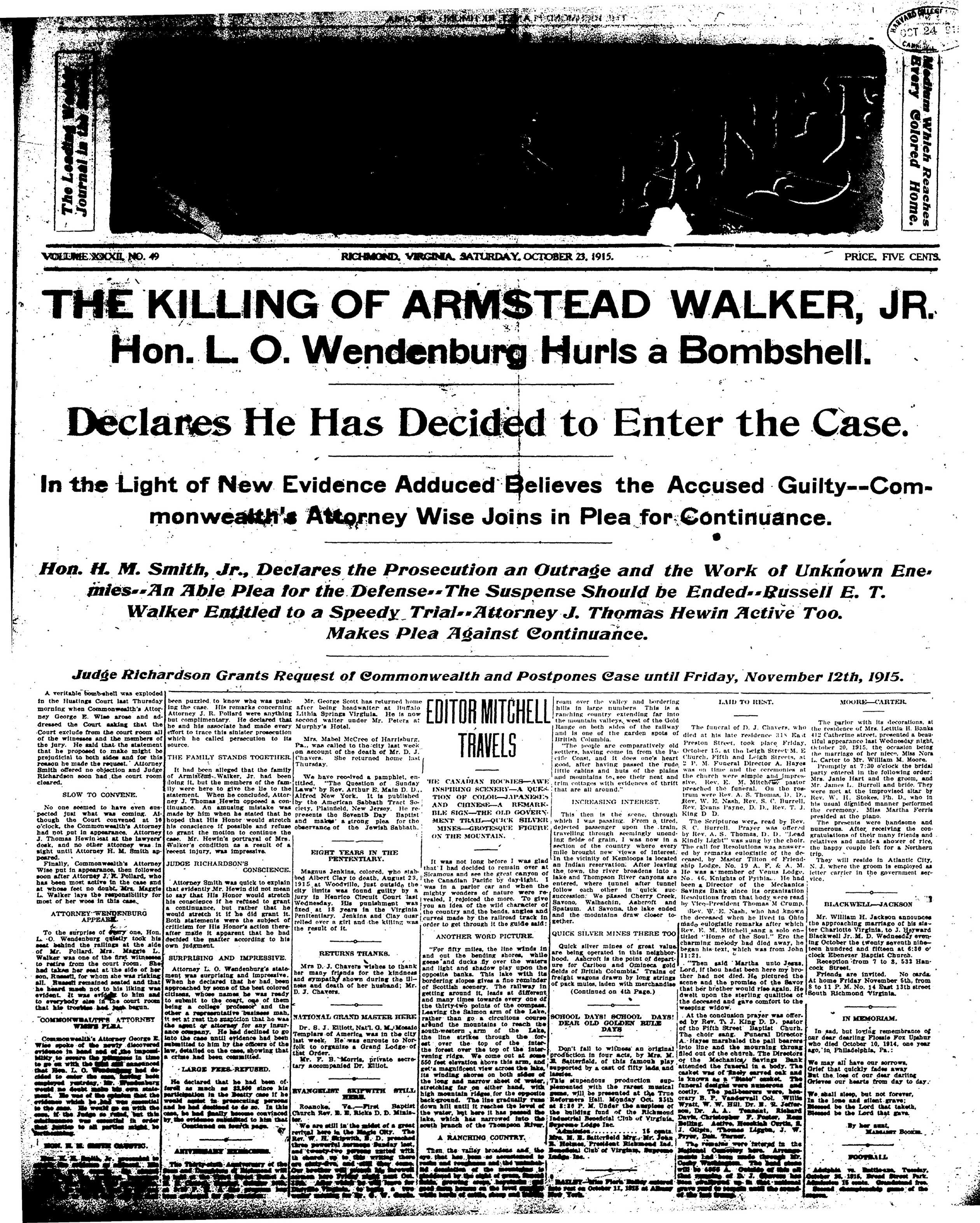
THE KILLING OF ARMSTEAD WALKER, JR. Hon. L. O. Wendenburg Hurls a Bombshell.
Declares He Has Decided to Enter the Case.
In the Light of New Evidence Adduced Believes the Accused Guilty--Commonwealth's Attorney Wise Joins in Plea for Continuance.
Hon. H. M. Smith, Jr., Declares the Prosecution an Outrage and the Work of Unknown Enemies--An Able Plea for the Defense--The Suspense Should be Ended--Russell E. T. Walker Entitled to a Speedy Trial--Attorney J. Thomas Hewin Active Too. Makes Plea Against Continuance.
Judge Richardson Grants Request of Commonwealth and Postpones Case until Friday, November 12th, 1915.
VOLUME XXXXII NO. 49
THE KING
HOUSE
Decla
In the Light
Hon. H. M. S.
mies--A
Wal
Judge Richa
A veritable bomb-shell was exploded in the Hustings Court last Thursday morning when Commonwealth's Attorney George E. Wise arose and addressed the Court asking that the Court exclude from the court room all of the witnesses and the members of the jury. He said that the statement that he proposed to make might be prejudicial to both sides and for this reason he made the request. Attorney Smith offered no objection and Judge Richardson soon had the court room cleared.
SLOW TO CONVENE
No one seemed to have even suspected just what was coming. Although the Court convened at 16 o'clock, the Commonwealth's Attorney had not put in appearance. Attorney J. Thomas Howin sat at the lawyer's desk, and no other attorney was in sight until Attorney H. M. Smith appeared.
Finally, Commonwealth's Attorney Wise put in appearance, then followed soon after Attorney J. K. Pollard, who has been most active in the case and at whose feet no doubt, Mrs. Maggie L. Walker lays the responsibility for most of her woes in this case.
ATTORNEY-WENDENBURG
APPEAR.
To the surprise of every one, Hon. L. O. Wendenburg quietly took his seat behind the railings at the side of Mr. Pollard. Mrs. Maggie L. Walker was one of the first witnesses to retire from the court room. She had taken her seat at the side of her son, Russell, for whom she was risking all. Russell remained seated and that he heard much not to his liking was evident. It was evident to him and to everybody else in the court room that his troubles had just begun.
COMMONWAIHTS ATTORNEY WINDS PLEA.
Commonwealth's Attorney George E. Wise spoke of the newly discovered evidence in hand and of the impossibility to secure the prizes in time to go on with the guilt and announced that Hoe, L. O. Wendemburg had decided to enter the case, having held employed yesterday. Mr. Wendemburg would no doubt make his own statement. He was of the opinion that the evidence which he had was essential to the case. He would go on with the case, if the judge so ruled, but this substance was essential in order that justice to all parties might be forthcoming.
HON. H. H. SMITH CAUSTIC.
Hon. H. H. SMITH, Jr. presented to examine the evidence of admitted. His report was complete. He stated that the evidence was sufficient to prove the guilt of the defendant.
been puzzled to know who was pushing the case. His remarks concerning Attorney J. R. Pollard were anything but complimentary. He declared that he and his associate had made every effort to trace this sinister prosecution which he called persecution to its source.
THE FAMILY STANDS TOGETHER
It had been alleged that the family of Armistend-Walker, Jr. had been doing it, but the members of the family were here to give the lie to the statement. When he concluded, Attorney J. Thomas Hewm opposed a continuance. An amusing mistake was made by him when he stated that he hoped that His Honor would stretch his conscience if possible and refuse to grant the motion to continue the case. Mr. Howin's portrayal of Mrs. Walker's condition as a result of a recent injury, was impressive.
JUDGE RICHARDSON'S CONSCIENCE
Attorney Smith was quick to explain that evidently Mr. Hewin did not mean to say that His Honor would stretch his conscience if he refused to grant a continuance, but rather that he would stretch it if he did grant it. Both statements were the subject of criticism for His Honor's action thereafter made it apparent that he had decided the mafter according to his own judgment.
SURPRISING AND IMPRESSIVE.
Attorney L. O. Wendenburg's statement was surprising and impressive. When he declared that he had, been approached by some of the best colored citizens, whose names he was ready to submit to the court, one of them being a college professor and the other a representative business man, it set at rest the suspicion that he was the agent or attorney for any insurance company. He had declined to go into the case until evidence had been submitted to him by the officers of the law, detailed on the case, showing that a crime had been committed.
LARGE FEES. REFUSED.
He declared that he had been offered as much as $2,500 since his participation in the Beatty case if he would not act in prosecuting persons and he had declined to do so. In this case, he had finally become convinced by the evidence submitted to him that
The Thirty-third Anniversary of the
Paws and Dungshoes of Midwinter will
be held at the Queen Street United
Aid & Church, Midway, October 20th,
at 8:00 P.M. It is the program key
Mr. George Scott has returned home after being headwaiter at Buffalo Lithia Springs Virginia. He is now second waiter under Mr. Peters at Murphy's Hotel.
Mrs. Mabel McCree of Harrisburg, Pa., was called to the city last week on account of the death of Mr. D. J. Chavers. She returned home last Thursday.
We have received a pamphlet, entitled, "The Question of Sunday Laws" by Rev. Arthur E. Main D. D., Alfred New York. It is published by the American Sabbath Tract Society, Plainfield, New Jersey. He represents the Seventh Day Baptist and makes a strong plea for the observance of the Jewish Sabbath.
EIGHT YEARS IN THE PENTENTIARY.
Magnus Jenkins, colored, who stabbed Albert Clay to death, August 23, 1915, at Woodville, just outside the city limits was found guilty by a jury in Henrico Circuit Court last Wednesday. His punishment was fixed at 18 years in the Virginia Penitentiary. Jenkins and Clay quarrelled over a girl and the killing was the result of it.
---
RETURNS THANKS.
Mrs D. J. Chavers wishes to thank her many friends for the kindness and sympathy shown during the illness and death of her husband; Mr. D. J. Chavers.
NATIONAL GRAND MASTER HERE
Dr. S. J. Elliott, Natl. G. M. Mosaic
Templars of America was in the city
last week. He was enroute to Norfolk
to organize a Grand Lodge of
that Order.
Mr. F. B. Morris, private secretary
accompanied Dr. Elliott.
EVANGELIST SKIP WITH STILL HEAR
Roanoke, Va.—First Baptist Church Rev. B. E. Ricka D. D. Minister.
We are still in the midst of a great revival here in the Magic City. The Rev. W. H. Skipwith, B. D. preached three powerful sermons Sunday last, and twenty-two persons joined with th church up to this writing there are only five, and still they come. Our brother will pitch his brewwell sermon here Friday night next Oct. 15th. After which he will leave for Dauville Virginia, to begin a two week meeting for Mr. G. W. Church.
THE CANADIAN ROCKIES—AWE
INSPIRING SCENERY—A QUEST
TION OF COLOR—JAPANESE
AND CHINESE—A REMARK-
BLE SIGN—THE OLD GOVERN-
MENT TRAIL—QUICK SILVER
MINES—GROTESQUE FIGURE
It was not long before I was glad that I had decided to remain over at Sicamous and see the great canyon of the Canadian Pacific by day-light. I was in a parlor car and when the mighty wonders of nature were revealed, I rejoiced the more. To give you an idea of the wild character of the country and the bends, angles and curved made by the railroad track in order to get through it the guide said:
ANOTHER WORD PICTURE.
"For fifty miles, the line winds in and out the bending shores, while geese and ducks fly over the waters and light and shadow play upon the opposite banks. This lake with its bordering slopes gives a fine reminder of Scottish scenery. The railway in getting around it, leads at different and many times towards every one of the thirty-two points of the compass. Leaving the Salmon arm of the Lake, rather than go a circultious course around the mountains to reach the south-western arm of the Lake, the line strikes through the forest over the top of the inter-forest over the top of the intervening ridge. We come out at some 550 feet elevation above this arm, and get a magnificent view across the lake, its winding shores on both sides of the long and narrow sheet of water, stretching far on either hand, with high mountain ridge, for the opposite back-ground. The line gradually runs down hill until it reaches the level of the water, but here it has passed the lake, which has narrowed into the south branch of the Thompson River.
A RANCHING COUNTRY.
Then the valley broadens and the eye that has been as accustomed to roads and roughness and the uninhabited denudation of the mountains is gladdened by the sight of grass, fluffy fields, growing crops, hayfields and good farm homes on the level surface while burial of cedars, stones and bark.
roam over the valley and bordering hills in large numbers. This is a ranching country extending far into the mountain valleys, west of the Gold Range on both sides of the railway and is one of the garden spots of British Columbia.
"The people are comparatively old settlers, having come in from the Pacific Coast, and it does one's heart good, after having passed the rude little cabins and huts of the plains and mountains to, see their neat and trim cottages with evidences of thrift that are all around."
INCREASING INTEREST
This then is the scene, through which I was passing. From a tired dejected passenger upon the train, travelling through seemingly unmounting fields of grain, I was now in a section of the country where every mile brought new views of interest. In the vicinity of Kemloops is located an Indian reservation. After leaving the town, the river broadens into a lake and Thompson River canyons are entered, where tunnel after tunnel follow each other in quick succession: We passed Cherry Creek, Savono, Walhachin, Ashercroft and Spatsum. At Savonna, the lake ended and the mountains draw closer together.
QUICK SILVER MINES THERE TOO
Quick silver mines of great value are being operated in this neighborhood. Ashcroft is the point of departure for Caribou and Omineca gold fields of British Columbia. Trains of freight wagons drawn by long strings of pack mules, laden with merchandise (Continued on 4th Page.)
SCHOOL DAYS! SCHOOL DAYS!
DEAR OLD GOLDEN RULE DAYS
Don't fall to witness an original production in four acts, by Mrs. M. R. Satterfield, of this famous play supported by a cast of fifty lads and ladies.
This stupendous production supplemented with the rare musical genres, will be presented at the True Reformers Hall. Monday Oct. 25th at 8:30 P. M. Under the auspices of the building fund of the Richmond Industrial Benedictal Club of Virginia, Supreme Lodge Inc.
Admission..... 15 cents.
Mrs. M. R. Satterfield Mgr., Mr. John R. Holmes, President Richmond Ind. Benedictal Club of Virginia, Supreme Lodge Inc.
BAILLEY—Wife Pierce Holley entered
fate past on October 11, 1915 at Albany
New York.
LAID TO REST.
The funeral of D. J. Chavers, who died at his late residence 318 East Preston Street, took place Friday, October 15, at the Leigh Street M. E. Church, Fifth and Leigh Streets, at 2 P. M. Funeral Director A. Hayes was on time and the ceremonies at the church were simple and impressive. Rev. E. M. Mitchel pastor preached the funeral. On the rostrum were Rev. A. S. Thomas, D. D. Stev. W. E. Nash, Rev. S. C. Burrell, Rev. Evans Payne, D. D., Rev. T. J. King D D.
The Scriptures were read by Rev. S. C. Burrell. Prayer was offered by Rev. A. S. Thomas, D. D. "Lead Kindly Light" was sung by the choir. The call for Resolutions was answered by remarks eulogic of the deceased, by Master Tilton of Friendship Lodge, No. 19 A. F. & A. M. He was a member of Venus Lodge, No. 46, Knights of Pythia. He had been a Director of the Mechanics Savings Bank since its organization Resolutions from that body were read by Vice-President Thomas M Crump.
Rev. W. E. Nash, who had known the deceased when he lived in Ohio made eulogistic remarks after which Rev. E. M. Mitchell sang a solo entitled "Home of the Soul." Ero the charming melody had died away, he began his text, which was from John 11:21.
"Then said Martha unto Jesus, Lord, if thou hadst been here my brother had not died. He pictured the scene and the promise of the Savor that her brother would rise again. He dwelt upon the sterling qualities of the deceased and gave comfort to the weeping widow.
At the conclusion prayer was offered by Rev. T. J. King D. D. pastor of the Fifth Street Baptist Church. The choir sang. Funeral Director A. Hayes marshaled the pall bearers into line and the mourning throng fled out of the church. The Directors of the Mechanics/Savings Bank attended the funeral in a body. The casket was of Thyly carved oak and is known as a "State" casket. The funeral designs were numerous and costly. The pall bearers were, honorary B. P. Vanderwall Col. Willis Wyatt, W. W. Hill. Dr. B. R. Jefferson, Dr. A. A. Teenant, Richard Davin, Christopher F. P. Foster, Rex Bellling, Active, Henkiah Curtin, R. J. Otlyn, Thomas Liggun, J. W. Pryor, Daim, Tarner.
The remainder were intered in the National Cemetery here. Arrangements had been made through Mr. Cushy Washington. The hand stone will be 4455 A. Cushion of this all that spanning of D. J. Gleaves has been well upward up in that national grave yard to repose until the sound of the last tremor.
PRICE, FIVE CENTS.
ER, JR.
hell.
Case.
uilty--Com-
ce.
Unknown Ene-
sell E. T.
Too.
er 12th, 1915.
MOORE—CARTER
The parlor with its decorations, at the residence of Mrs. Lettitta H. Banks 412 Catherine street, presented a beautiful appearance last Wednesday night, October 20, 1915, the occasion being the marriage of her niece, Miss Nora L. Carter to Mr. William M. Moore. Promptly at 7:30 o'clock the bridal party entered in the following order: Mrs. Janie Hart and the groom, and Mr. James L. Burroll and bride. They were met at the improvised altar by Rev. W. H. Stokes, Ph. D., who in his usual dignified manner performed the ceremony. Miss Martha Ferris presided at the piano. The presents were handsome and numerous. After, receiving the congratulations of their many friends and relatives and amid-a shower of rice, the happy couple left for a Northern trip. They will reside in Atlantic City, N. J. where the groom is employed as letter carrier in the government service.
BLACKWELL JACKSON
Mr. William H. Jackson announces the approaching marriage of his sister Charlotte Virginia, to J. Hoyward Blackwell Jr. M. D. Wednesday evening October the twenty seventh nineteen hundred and fifteen at 6:30 o'clock Ebenezer Baptist Church.
Reception from 7 to 8, 532 Hancock Street.
Friends are invited. No cards. At home Friday November 5th, from 8 to 11 P. M. No. 14 East 13th street South Richmond Virginia.
IN MEMORIAM.
In sad, but loving remembrance of our dear dearling Floasie Fox Upahur who died October 10, 1914, one year ago, in Philadelphia, Pa.:
We may all have our sorrows,
Grief that quickly fades away
But the loss of our dear darling
Grieves our hearts from day to day.
We shall sleep, but not forever,
In the lone and silent grave;
Blessed be the Lord that taketh,
Blessed be the Lord that gave.
By her saint,
MARGARET BOOKER.
FOOTBALL
Adelphia vs. Battle-area, Tuesday,
October 26, 1916, Broad Street Park.
Association 15 cents. Grandstand free.
Second championship game of the
rugby.
SYNOPSIS.
Brick Wilkinson, high school, saves one Gleibware and a baby girl from being murdered by his fellow outlaws on the river. Wilkinson flees to the mountains and blinds to escape the wrath of the outlaws he had outlived. He learns that some one has discovered his hiding place. Red Feather, an Indian chief, brings Wilkinson a little white girl, named Lahoma. Wilkinson learns that she's her father is living with Indiana.
CHAPTER IV.
ATN'T got the tools yet, hooey," went on Brick. "Thy's not breaking up and enriching land that ain't never bore nothing but buffalo grass without I have picks and spades and plows and harrow. I got to get my tools to begin."
She stiffened herself. "You shouldn't be afraid I'll cry. I want you to hurt me, if that the way."
"It ain't like a pain in the stomach, Lahoma. All I get for you will be some books."
"Booka. What are booka?"
"Books?" What are books?
"Books?" Willock rubbed his bushy head in desperation. "Books?" Why. they is just thoughts that somebody has ketched and put in a cage where they can't get away. If you want to be civilized you got to lasse other people's thoughts—people as has want to and fro and has learned life—and you got to dehon them ideas and tame 'em.
Lahoma examined him with new interest. "Are you civilized?" Her countenance fell.
"Not to no wide extent, but I can ford tolerate deep stream that would drown you, honey. I can write my own name and your too. I reckon. Lahoma Glidelware—yes, I'm tolerate well versed on a capital G; you just make a gap with a flying to it."
"My name not Lahoma Glidelware," she interposed in some severity. "My name Lahoma Willock. Beautiful name—lovely, like flower—Willock. Call me Lahoma. Willock like a giant of little stream; Glidelware—hard, rough."
Brick Willie stared at her in amazement. "Where'd you get that from?"
"My name Lahoma Willock—Red Feather tell me."
He shudded in silence, puffing rapidly. "How come you to be named Lahoma Willock?"
Lahoma suggested thoughtfully, "All white people named Willock?"
"There's a law—Willock shook his head—" with less aggressive names. But, after all, I am glad you have my name. Well, hello, this is enough talk about being civilized. Now let's make the first move on the way. You want to see your parents' flowers and lay some of these flowers on it. That's a part of being civilized, caring for graves. It just savages for forget the past and consequently never learns nothing. Come along. These monuments will do famous until I can get you show from the settlements. But I got a pony the first time I ventured to Doane's town, and it will carry you if I have to walk at your side. We'll make a festive march of that journey and lay in clothes as a girl should wear and book to last the winter."
Wilkie rose and explained that they must cross the mountain. As they traversed it he reminded her that she had not gathered any of the flowers that were scattered under sheltering bowlers.
"Why?" asked Lahoma, showing that her neglect to do so was intentional.
"Well, honey, don't you love and honor that mother that bore so much pain and trouble for you, travelling with you in her arms to the Oklahoma country, trying to make a home for you up there in the wilderness and at last dying from the hardships of the plains?" Ain't she worth a few flowers?
"She dead. She not see flowers, not smell flowers, not show."
Wilkie said nothing, but the next time they came to a clump of blooms he made a nosegay. Lahoma watched him with a face as calm and unemotional as that of Red Feather himself.
"What you do with that?" She pointed at the flowers in his rough hand.
"I'm going to put 'em on your mother's grave."
"She not know, not see, not smell. She dead; mother dead."
"Lakahm, do you know anything about God?"
"Yes-Great Spirit. God make my path white."
"Well, I want God to know that somebody remembers your mother. It's God that smells the flowers on the graves of the dead."
They walked on. Pretty soon Lahopa began looking about for flowers, but they had reached the last barren ledge, and no more came in sight.
"No. 'Couldn't fool God.' They began the last descent. Willock suddenly discovered that tears were slipping down the 'girl's face.' Suddenly she cried joyfully, "Oh, look, look!" She darted toward the spot at the feet of a tall cedar where purple and white blooms showed in profusion. She gathered an armful, and they went down to the plains.
"Hat, head's toward; the wunt," he said as they stood beside the pile of stones. Lakoban pinned the twoviews of the wavy terrain of the prairie.
JOIN BRECKENRIDGE ELLIS
Wilcox laid his at the foot of the grave.
During the two years passed by Brick Wilcox in dreary solitude conditions about him had changed. The hardships of pioneer life which fifty years ago had obtained in the middle states yet prevailed in ISS2 in the tract of land claimed by Texas under the name of Greer county, but the dangers of pioneer life were greatly lessened. As Lahoma made the acquaintance of the mountain range and explored the plain extending beyond the natural house-shoe, Wilcox believed she ran little danger from Indiana. He himself had ceased to preserve his relaxing watchfulness. After all, he had been the highwaymen rather than the red men whom he had most feared, and after two years it did not seem likely that such volatile men would preserve the feeling of vengeance.
With the wisdom derived from his experience with wild natures, he carefully abstained from any attempt to force Lahoma's friendship; hence it was not long before he obtained it without reserve. In the meantime he talked increasingly, and to his admiration he presently found her manner of speech wonderfully like his own—both fluent and ungrammatical.
He knew nothing of grammar, to be sure, but there were times when his mistakes, taken from her lips, struck upon his ear, and, though he might not always know how to correct them, he was prompt to suggest changes, testing each as a natural musician judges music by ear. Dissatisfied with his own standards, he was all the more impatient to depart on the expedition after mental tools, despite the dangers that might beset the tourner.
His first task, prompted by the coming of Lahoum, had been to partition off the half of the dugout containing the stove for the child's private chamber. Cedar posts set in the ground and plastered with mud higher than his head left a space between the top and the apex of the ceiling that the temperature might be equalized in both rooms. That held, however, they did not stay in the dugout except long enough to eat and sleep, for the autumn had continued delightful, and the cove seemed to the child her home, of which the dugout was a sort of cellar. Concerning the stone retreat in the crevice she knew nothing. Willock did not know why he kept the secret since he trusted Lahoum with all his treasures, but the unconscious reticence of the man of great loneliness still rested on him.
"Lahoum," he said one day, "there's a settler over yonder in the mountains across the south plain. How'd you like to tray him a shift?"
"I don't want anybody but you," said Lahanna promptly. Willek stood on one leg, rubbing the other meditative with his delightful foot. Not the glove of a muscle, however, revealed the fact that her words had bounded his heart with sunshine "Well, honey, that's in reason. But I've got to take you with me after books and winter supplies, and I don't like the idea of traveling alone. It come to me that I might get Mr. Settter to go to you. Time was not so long ago when印姆 hands was coming and going, and, although old Greer in beginning to be sprinkled up with setters here and there, I can't get over the feel of the old times. They ain't no sensation as sticks by a man when he's come to be wedged in between forty-five and fifty as the feel of the old times."
"Well," said Lahoma earnestly, "I wish you leave me here when you go after them books. I don't want to be with no strangers. I want to just squat right here and bear myself company."
"That's in reason. But, honey, while you might be safe enough while bearing the same I would be plumb crazy worrying about you. I might not have good cause for worrying, but worrying—it also' no bird that spreads its wings and goes north when cold weather comes; worrying—it's independent of causes and seasons."
"If you have got to be stayed with to keep you from worrying they ain't nothing more to be said."
"Just so. That there old settler, I have crossed a few words with him, and I believe he would do noble to travel with. He's as gruff and growly as a grizzly bear if you say a word to him, and if he'll just turn all that temper he's rented on me to on any strangers we may run up against on the trail he'd invaluable."
"I'll go catch up the pony," said Lahoma briefly, "For I see the thing is to be did. This will be the first visit I ever made in my life when I wasn't drug by the Injuns."
"You mustn't say drug, honey, unless specifying medicines and herbs. You must my dragged." The Injuns dragged you from one village to another. He paused meditatively, mattering the word to himself, while Lahoma run away to catch the pony. When she came back he said: "You been a weighing that word, Lahoma, and it doesn't seem to see that dragged sounds proper. What do you think?" "I don't like, the sound of it matter," said Lahoma, shaking her head. "I think drug is safer. It harder moves in the ear, and dragged stains."
"Well, don't worry one other till I am sure you cut." Freud, he was still
By this person he plains forward the most outstanding range, while the girl had more length than on the page.
Willock and the man he had come to us were very good types of the first, motters of Great County or a highwayman, hiding from his kind, the other a trapper by occupation, trying to keep aboard of the pursuing waves of immigration. It was the first time Lahoma had seen Bill Atkins, and as all she caught sight of him before his dugout her eyes brightened with interest. He was a tall, lank man of about sixty-five, with a huge gray muscat and bushy hair of iron gray, but without a beard.
But Lahoma was not afraid of coyotes, catamounts or mountain lions, and she was not afraid of Bill Atkins. Her eyes brightened at the discovery that he held in his hand that which Willock had described to her as a book. "Does he read?" she naked Willock breathlessly. "Does he read, Brick?"
breathlessly. "Does he read. Brick?" The man looked up, saw Willock and spent over his book—discovered Lahoms on the pony and looked up again, unwillingly but definitely. "You never told me you had a little girl," he remarked grumily. "You never naked me," said Willock. "Get down, Lahoma, and make yourself at home." The man shut his book. "What are you going to do?" "Going to visit you. Turn the pony poose, Lahoma. He won't go far."
poose, Lahoma. He won't go far."
"Haven't you got all that north range so yourself." Bill Atkins asked begrudgingly.
"Yap. How're you making it, Atkina?"
"Why, as long as I'm let alone I'm making it all right. It's being let alone that I can't ever accomplish. I no sooner get settled and make my turf dugout than here comes a stranger."
"Name of Brick Willock, if you were forot." interpolated Willock generally.
"I'll just light my pipe, as I reckon there's no objections."
The man turned his back upon Willock, opened his book and read.
CHAPTER V.
Lahoma's Education Advances
AHIOMA approached the block of wood that supported him, white. Willie calmly, stretched him.
wet out on the grass. "Is that a book?" she asked, by way of opening up the conversation.
The man gripped it tighter and moved his lips busily. As she remained at his knee, he presently said, "Oh, no, it's a hand organ."
Labios smiled pityingly. "Are you afraid of me, Atkinst?"
The man looked up with open mouth. "Not exactly, kid." There was something in her face that made him lose interest in his book. He kept looking at her.
"Then why don't you tell the truth? Wo won't hurt you."
The man opened his mouth and closed it. Then he said, "It's a book."
"Did you ever read it before?"
"This is the third time I read it."
"Seems as it hasn't accomplished no good on you, as you still lies."
good on you, as you still tell lies."
The man must abruptly and hold the book on the seat. His manner was quite as discouraging as it had been from the start.
"Honey," interponed Willock, "that ain't to say a lie, not a real lie."
"Is it a hand organ?" Lahoma demanded steadily.
"In a number of speaking, honey, it is a hand organ in the sense of shouting you off from asking questions. You learn to distinguish the sounds of speech as you gets older. Out in the big world you don't say this or that according as it is. They steeps their words in a sense as suits the digestion. Don't be quick to call 'lie' till you learn the flavor of a fellow's meaning, not by his words, but by the sauce he steeps 'em in."
"Don't get mad at me," said Lahoma to the trapper. "I want to be civilized, and I am investigating according."
The trapper, somewhat conciolated, rescaped himself. He regarded the girl with greater interest, not without a certain approval. "How comes it that you aren't civilized, living with such a knowing specimen as your father?"
"My father's dead. Brick is my cousin, but I not knowing nothing of him till he saved my life two years ago and after that, me with the Indians and him all alone. Would you like to hear about it?" "I wouldn't bother him, honey, with all that long story," interposed Willock, suddenly grateful. "Yes, tell me," said the trapper, moving over that she might find room on the block of wood beside him.
"We was crossing the plains—father, mother and me—in a big wagon. And mother dressed up like Indians, they come whooping up and shooting, and father turns around and drives with all his might—drives clear to yonder mountain. And mother dies, being that sick before, and the soiling too much for her. So father takes me on his horse and rides all night, and I all asleep. Well, those same men dressed like Indians, they was in a cabin 'way up north and had put their wigs and feathers off and was gambling over what they stole from the other wagons. So father he sees the light from the window and rides up with me. And they takes him for a spy, and says they in a voice awful force just this way, 'Kill 'em both!'"
The trapper gave a start at the explosiveness of her tone. Lahoma aboutted as harshly as she could, "Kill 'em both!' says they. Then she turned to Willeck. "Did I put them words in the correct sense, Brick!"
"You done noble honey."
"You done noobs, nobody."
Labina required: "Now it was in a member of happening that Brick, he was riding around to have a look at the country, and when he rides up to the cabin, why, right outside there, was me and father and two of the robbers about to kill me. What do you decide up to? I says Brick. Takes up to — where the leading man is. That's where we're going to send this guy and his little girl, says he. 'You go to — and maybe you'll meet, and then — he goes. And with that he runs and then."
on the back, and he was still laying there on your back just as you fell."
"Did I, honey? Well, I reckon I was, then, for when I told you about it it was more recent."
"It's awful interesting," the trapper remarked dryly.
"Yes; didn't it?" Laboma glowed. "Then father jumped on one horse with me, and Brick put out on another, and when I woke up the Indians were all everywhere, but Brick come here and lied all alone and nearly died because he didn't have me to comfort him. So the Indians took me, and they killed father, and for two years I was moved from village to village till Red Feather brought me to Brick. And then we found out we are cousins and he is going to civilize me. Brick, he remembers about a cousin of his, Coulin Martha Willock. Her sister went driving out to the Oklahoma
CHELLE MAYER
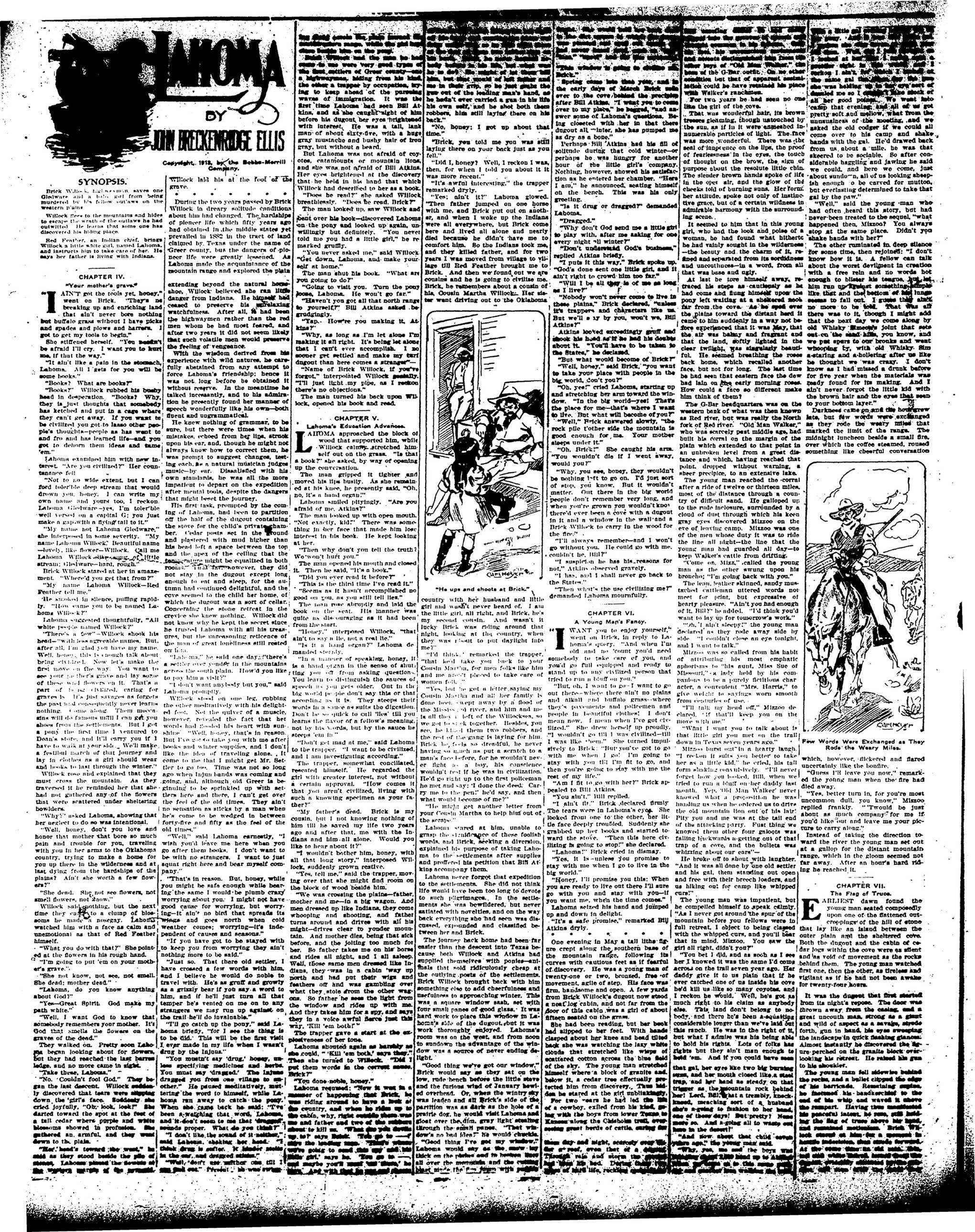
"He ups and shoots at Brick," country with her husband and little girl and wasn't never heard of. I am the little girl, all right, and Brick, he was, outstretched, wasn't lucky. Brick was riding around that night, looking at the country, when they was rushed to put daylight into me!
"I'd think," remarked the trapper, "that need take you back to your cousin Martin, for men folks like him and me need placed to take care of women folk."
"Yes, but he got a letter saying my Cousin Martha and all her family is done been swept away by a flood of the Misses' oak river, and him and me in all the left of the Willockes, so we got to suck together. Besides, you see he killed them two robbers, and the root of the gang is laying for him. Brick he fell so dreadful, he never having so much maw put a scratch to a man's face before, for he wouldn't never fight in a boy, his conscience wouldn't rest if he was in civilization. He'd go right up to the first policeman he met and say: I done the deed. Carry me to the pen" he'd say, and then what would become of me?
"He might get another letter from your Cousin Martha to help him out of the scrape."
Lahoma scared at him, unable to grasp the stifness of these foolish words, and brick, seeking a diversion, explained his purpose of taking Lahoma to the settlements after supplies and proffered his petition that Bill Atkins accompany them.
Lahoma never forgot that expedition to the settlements. She did not think life would have been too long to devote to such pliements. In the settlements she was bewildered, but never satiated with novelties, and on the way back everything she had seen was discussed, expounded and classified between her and Brick.
The journey back home had been far easier than the descent into Texas because both Willock and Atkins had supplied themselves with popes-animals that sold ridiculously cheap at the outlying posts of the settlements. Brick Willock brought back with him something else to add cheerfulness and usefulness to approaching winter. This was a square window sash, set with four small panes of good glass. It was hard work to place this window in Lahoma's side of the dugout, but it was work thoroughly enjoyed. Lahoma's room was on the west, and from noon to sundown the advantage of the window was a source of never ending delight.
"Good thing we got our window," Brick would say as they sat on the low, rule-bench before the little stove and the furious wind of January bowled overhead. Or, when the wintry sky was leaden and all Brick's side of the partition was as dark as the hole of a prairie dog, he would visit Lahona and gloat over the dim, gray light stealing through the small windows. "That window's bad fillet," he would chuckle. "Good thing I've got my window," Lahona would say as the snow thick on the plains and to hobble them all over the mountains, and the cutting blast that the fire with paddle
---
"This window is going to shuffle me back."
Spring came late this year, and in the early days of March Brick made over to the cove, behind the precipice after Bill Atkins. "I want you to come over to my place," he begged, "and answer some of Lahoma's questions. Being cloaked with her in that there dugout all—inter, she has pumped me as dry as a bone."
Perhaps Bill Atkins had his all of solitude during that cold winter—or perhaps he was hungry for another hour of the little girl's company. Nothing, however, showed his satisfaction as he entered her chamber. "Here I am," he announced, seating himself on the bench. This was his only greeting.
"It is drug or dragged?" demanded Lahoma.
"Dragged."
"Why don't God send me a little girl to play with, after me asking for one every night all winter?"
"Don't undawward God's business," replied Atkins briefly.
"I put it this way." Brick spoke up. "God's done sent one little girl, and it ain't right to crowd him too far." "Will I be all they is of me as long as I live?"
"Nobody won't never come to live in these plains," Brick declared, "unless its trappers and characters like us. But we'll try by you, won't we, Bill Atkins?"
Atkins looked exceedingly gruff and booked his head as if he had his doubts about it. "You'll have to be taken so the states," he declared.
"But what would become of Brick?"
"Well, honey," said Brick, "you want to take your place with people in the big world, don't you?"
"Oh, yes!" cradled Lahoma, starting up and stretching her arm toward the window. "In the big world—yeah. That's the place for me—that's where I want to live. But what will become of you?"
"Well," Brick answered slowly, "the rock pile tother side the mountain is good enough for me. Your mother sleeps under it."
"Oh, Brick!" She caught his arm. "You wouldn't die if I went away, would you?"
"Why, you see, honey, they wouldn't be nothing left to go on. I'd just sort of stop, you know. But it wouldn't matter. Out there in the big world people don't remember very long, and when you're grown you wouldn't know there'd ever been a cave with a dugout in it and a window in the wall and a Brick Willow to carry in the wood for the fire."
"I'll always remember—and I won't go without you. He could go with me, couldn't be. Hill?"
"I suspicion he has his reasons for not." Athens observed gravelly.
"I has, and I shall never go back to the States."
"Then what's the use civilizing me?" demanded Lahoma mournfully.
CHAPTER VI.
A Young Man's Fancy.
"I WANT you to enjoy yourself," went on Brick. In reply to Laoman's query, "And when I'm old and no count you need somebody to take care of you, and you'd go full equipped and ready to stand up to my civilized person that tried to run a bluff on you."
"But, oh, I want to go—I want to out there—where there aren't no plains and alkali and buffalo grass—where they're pavements and policemen and people in beautiful clothing. I don't mean now, I mean when I've got civilized." She drew herself up proudly. "I wouldn't go till I was civilized—I was like 'bum.' She turned impatiently to Brick: "But you're got to go with me when I go." I'm going to stay with you till I'm fit to go, and then you're going to stay with me the rest of my life."
"Am I fit to go with her?" Brick appealed to Bill Atkins.
"You ain't." Bill replied.
"I don't fit." Brick declared firmly. The tears were in Lahona's eyes. She looked from one to the other, her lit face deeply troubled. Suddenly she grabbed up her books and started to ward the stove. "Then this here civilizing is going to stop!" she declared. "Lahona." Brick cried in dismay. "Yes, it is—unless you promise to stay with me when I go to live in the big world." "Honey, I'll promise you this: When you are ready to live out there I'll sure go with you and stay with you—if you want me, when the time comes." Lahona selzed his hand and jumped up and down in delight. "It's a safe promise," remarked Bill Atkina dryly.
One evening in May a tall little figure crept along the southern base of the mountain range, following its curves with cautious feet as it fearful of discovery. He was a young man of twenty-one or two, bronzed, free of movement, agile of step. His face was firm, handsome and open. A few yards from Brick Willock's dugout now stood a neat log cabin, and not far from the floor of this cabin, was a girl of about fifteen seated on the gras.
She had been reading, but her book had slipped to her feet. With hands clasped about her knee and head tilted back she was watching the lily white clouds that stretched like wipers of scattered cotton across the blue field of the sky. The young man stretched himself where a block of granite and below it, a cedar tree effectually protected him from discovery. Thus hidden he stared at the girl unblinking. For two years he had led the life of a cowboy, exiled from his kind, along with the boys from lower Texas to Kansas along the Cahabon trail, ever seeing great herds of cattle, caring for them day and night, scarcely ever at her rest, even that of a disgusted Through rage and storm the grass had been his bad. During their life, rocking
first meeting DICKI. In the early spring he entered into the process of growing and dividing common in his laboratory. With the help his uncreative enthusiasm and accents displeased him from the latter boys of "Old Man Walker," the son of the G-Bar cocktail. On no other condition but that of apparent astonishment he have retained his place with Walker's ranchmen. For two years he had seen no one like the girl of the cove.
That was wonderful hair, its brown tresses gleaming, though untouched by the sun, as if in it were enmeshed in innumerable particles of light. The face was more wonderful. There was the seal of impression on the lips, the proof of fearlessness in the eyes, the touch of thought on the brow, the sign of purpose about the resolute little chin. The slender brown hands spoke of life in the open air, and the glow of the cheeks fold of burning suns. Her form, her attitude, spoke not only of instinctive grace, but of a certain wildness in admirable harmony with the surrounding scene. It seemed to him that in this young girl, who had the look and pulse of a woman, he had found what hitherte be had vainly sought in the wilderness—the beauty and the charm of it, refined and separated from its sorrowness and uncoathness—in a word, from all that was base and ugly.
At last he tore himself away, retracted his steps as cautiously as he had come and funged himself upon the pony left writing at a sheltered hook far from the cave. As he sped over the plains toward the distant hard it came to him suddenly in a way not before experienced that it was day, that the air was balmy and fragrant and that the land, softly lighted in the clear twilight, was singularly beautiful. He seemed breathing the roses back home, which recalled another face, but not for long. The last time he had seen that eastern face the dow had lain on the early morning roses. How could a face so different make him think of them?
The G-Bar headquarters was on the western bank of what was then known as Red river, but was really the North fork of Red river. "Old Man Walker," who was scarcely past middle age, had built his corral on the margin of the plain which extended to that point in an unbroken level from a great distance and which, having reached that point, dropped without warning, a sheer precipice, to an extensive lake. The young man reached the corral after a ride of twelve or thirteen miles, most of the distance through a country of difficult sand. He galloped up to the ride inudexion, surrounded by a cloud of dust through which his keen gray eyes discovered Mizzoo on the eye of leaving camp. Mizzoo was one of the men whose duty it was to ride the line all night—the line that the young man had guarded all day—to keep Walker's cattle from drifting. "Come on, Mizz," called the young man as the other swung upon his bronche; "I'm going back with you."
The lean, leather skinned, sandy man matched cattleman uttered words not meet for print, but expressive of hearty pleasure. "Ann't you had enough of it. Bill?" he added. "I'd think you'd want to lay up for tomorrow's work." "Oh,n't ain't sleepy?" the young man declared as they rode away side by side. "I couldn't close an eye tonight, and I want to talk." Mizzoo was so called from his habit of attributing his most emphatic aphorisms to his aunt, Miss Sue of Missouri," a lady held by his companions to be a purely fertile character, a consequent "Miss, Harris," to give weight to sayings worn smooth from centuries of use. "I'll talk my head off," Mizzoo declared, "if that'll keep you on the move with me." "What I want you to talk about is that little girl you met on the trail down in Texas seven years ago."
Mitzzo burst out in a hearty laugh. "I reckon it suits you better" to take her as a little kid, he eried, his tall form slapping convulsively. "I'll never forget how you looked, bluff, when we tried to run a bluff on her daddy last month. Yep, Old Man Walker" never knew what a proposition he was handling us when he ordered us to drive the old mountain out of his lair! Pity you and me was at the tail end of the attacking party. Fust thing we knowled them other four gobots was falling backwards a getting out of that trap of a cove, and the bullets was whizzing about our cars"—
He broke off to about with laughter. "And it was all done by one old settler and his gal, them standing out open and free with their breech banners, and us hiking out for camp like whipped curs"
The young man was impatient, but he compelled himself to speak calmly. "As I never got around the spur of the mountain before you fellows were in full retreat, I object to being clamped with the whipped curs, and you'll bear that in mind. Mizuno. You saw the girl all right, didn't you?" "You bet I did, and as such as I see her I know it was the same I'd come across on the trawl seven year ago. Her daddy give it to us plain that if he ever caught one of us inside his cove he'd kill us like so many coyotes, and I reckon he would. Well, he's got a much right to his claim as anybody else. This land don't belong to nobody, and there he's been a squatting considerable longer than we've laid out this ranch. He was in the right of it, but what I admire was his being able to hold his rights. Lots of folks has rights but they ain't man enough to hold 'em. And if you could have seen
that girl, her eyes like two big burning sum, and her mouth closed like a steel trap, and her hand as steady on that trigger as the mountain rock behind her! Lord, Belf. what a trembly, knuckleknack, meaching sort of a husband she's a going to fashion to her hand, one of these days! But pretty? None more so. And a going all to wamp out here in the desert!
"And now, about that child, seven
years ago, the young man said,
"Wiz, you, me and the boys were
wrestling when 2,200 head up to Abilene,
then proceed on to Ole. Some people
were just too good at wrestling."
With a little gall and winking at the pony. And it just bent and laid me down and ate me away with pleasure and delight. With all my best efforts we I learned at home I must have a proper sight in the world, and I looked I am. For which I learned at the same gal the lesson, for the girl she was holding up to her ear sort of meadow so I could take a mouth of all her good points. We went into camp that evening, and all of us got pretty soft and mellow, what from the unusualness of the moosing, and we asked the old codger if we could all come over to his camp and shake hands with the gal. He'd drawn back from us about a mile, he was that skewed to be sociable. So after considerable haggling and jawing he said we could, and here we come, just about sundown, all of us looking sheepish enough o be carried for mutton, but everlasting determined to take that gal by the paw."
"Well," said the young man who had often heard this story, but had never been treated to the sequel "what happened then, Mixzoo? You always stop at the same place. Didn't you shake hands with her?"
The other rummated in deep silence for some time, then rejoined: "I don't know how it is. A fellow can talk about the worst devilment in creation with a free rein and no words hot enough to blister his tongue, but let him run up to hurt something simple like that, and the bottom of his lungs seems to fall out. I guess that all too no more to be told. That was all there was to it, though I might add that the next day we come along by old Whisky Jimmy Jones joint that sets out on the sand hill, you know, and we put spurs on our brocks and want wheooping by, with old Whisky Jimmy starling and a-hollering after us like he thought we was crazy. I don't know as I had missed a drunk before for five year when the materials was peady found for its making. And I ain't never forgot the little kid with the brown hair and the eyes that seen to your bottom layer."
Darkness came up and the book grew late, but few words were exchanged as they rode the weary miles that marked the limit of the range. The midnight luncheon be beside a small fire, over which the coffee steamed, roused something like cheerful conversation
CARINGER
Few Words Were Exchanged as They Rode the Weary Miles.
which, however, flickered and flared uncertainly like the bonfire.
"Guess I'll leave you now," remarked the young man when the fire had died away.
"Yes, better turn in, for you're most uncommon dull, you know." Mizcozo replied frankly. "Twould be just about as much company" for me if you'd like "out and leave me your picture to carry along."
Instead of taking the direction toward the river the young man set out at a gallop for the distant mountain range, which in the gloom seemed not far away. After an hour's hard riding he reached it.
EARLIEST dawn found the young man seated composely upon one of the flattened outcroppings of the hill of stone that lay like an island between the outer plain and the sheltered cave. Both the dingout and the cabin of cedar logs within the core were as silent and his roid of movement as the rocks behind them. The young man watched first one, then the other, as tireless and vigilant as if he had not been awake for twenty-four hours.
It was the dingout that first started from its night's repose. The door was thrown away, from the ceasing, and a great uncount man, strong as a giant and wild of aspect as a naval, strode forth, gun in hand, his eyes sweeping the landscape in quick fashing glance. Almost instantly he discovered the figure-perched on the granite block overlooking his retreat. He raised his gun to his shoulder.
The young man fell downive behind the rock, and a bulley clipped the edge of his barricade. Remaining motion, he steamed his handkerchief to the end of his wip and waved it above the rampart. Having them mounted his powerful intent, he rose, still holding the flag of truce above his head, and remained motionless. Brick Whitbeth entered at him for a moment in his house motionless, then came forward. As the other thundered, he fell into the water, which laughed loudly, giving the impression, suddenly animated by the sound of water.
```markdown
```
opened, and the girl of the cove looked out inquiringly.
In the meantime the young man slowly descended the hill to the oval valley, while Willock hurried forward to meet him.
"Don't you come no futher?" Willock commanded, threatening with his gun. "Keep your hands above your head until I can ship your cargo."
Obviously he stood while the great whiskered fellow took the weapons from his belt and dived into his hip pockets.
"That'll do. Now, what do you want?"
"It's hard to put it into a few words," the other complained. "I'd like to have a little talk with you."
"You are one of them follows that come here to run us out of the country, aren't you? Are your pants outside there, waiting for a message?"
"Nobody knows I'm here or thought of coming. Let me put that affair in its true light. The boys are all under our boss, and when he lays down the law it isn't for us to argue with him. We carry out orders"—
"Unless there's a Brick Willock involved in their orders," returned the man, with a grim smile.
"But it's our duty to try to carry out the orders, whether we like 'em or not. So you won't hold that against me—that little scrimmage of last month, especially as you came out best man."
"I used to have a boss myself," Willock spoke uncompromisingly, "but when he give me certain orders one particular night that I recollect I knocked him on, the head and put out for other parts. I guess your boss knowled this wasn't his land, didn't be. What's going to become of this count?"
when a man isn't satisfied with what is his n't. Well, now you've had a little talk with me you can just mosey along. I'll send your weapons after you by a messenger."
The young man cast a despairing glance toward the girl, who stood in her doorway gravely listening. The man with the bushy white hair had drawn near, but evidently with no thought of interfering.
"Willock" the voice came so eager, so impetuous, that the words were somewhat incoherent—I've got to talk to your daughter. Hold on; don't shoot; listen! That's what I've come for, to see her and—and meet her and hear her voice. I can't help it, can I? It's been two long years since I left home back east, and in all these two years I've never seen anything like your little girl, and—and what harm can it do? I can't have pity on a follow, and do him the biggest favor he could enjoy on this earth when it won't cost you a penny or a turn of your hand! I'm just so lonely, so lonely, so dead killed by all those wars and skulls and skulls and nothing to talk to from one year's end to the next but men and cattle."
Willock glared at him in silence, fingering the trigger thoroughly.
"There I've sat on that hill, he continued, "since 2 o'clock last night, waiting for daylight so I could ask you to help a miserable wretch that's just starving to death for the sound of a girl's voice and the sight of a girl's smile."
"It is kinder lonesome," remarked the other grudely. "He lowered his gun and leaned on it irresolutely. "You've sure touched me in the right spot, son, for I knows all you mean and more that you ain't even ever dreamt of; but, you see, we don't know nothing about your name, your character, if you've got one, nor what you really intends."
"My name is Wilfred Compton. I—I have a letter or two in my pocket that I got a long time ago. They'd tell something about me, but I'd rather not show 'em, as they're private"—
"From your gal, I reckon" naked Willock more mildly.
"Yes," he answered gloomily.
"Carried 'em as long as a year?"
"Nearly two years."
"Mean to still bug 'em around?"
"Of course I am gelfig to keep 'em."
"Well, I don't deny that's pretty favorable. Now look here, son, I've been half crazy from loneliness, and I don't believe I've got the heart to send you away. That gal of ours—she's just a kid, you understand. Now you wouldn't be taking up no idea that she was what you'd classify as a young lady or anything like that, eh?"
"Of course not. She's fifteen or sixteen, I should think. Upon my honor, Willock, any thought of sentiment or romance is a thousand miles from my mind."
"Yes; just so. But such thoughts travel powerful fast. Don't take 'em long to lap over a thousand mile."
"But it's because she is a young girl, fresh and unartificial as the mountain breeze, that I want to be with her for a little while—you get to know her, if I may."
Willock turned to the taciturn old man standing a little behind him. "Bill Atkins, what do you say?" "I say are him, and do it quick!" was the instant rejoinder, accompanied by threatening twitchings of the huge white mustache. Willock was not convinced. "Son, if you get here till we have had our breakfast and has hold a cancer over you I'll bring you the restrict in about an hour. If you don't like that they're sticking to do but just out for your money." "I go on duty at V," replied the young man complaining, "but I have a little thing like the like that's easy with
I come. So I'll walk for you
success.
"That friend—one of them devils I shot at the other day?"
Wilfred Compton smiled with sadness sunshine. "Yes."
Somewhere beneath the immense whiskers an answering smile alipped like a breeze, stirring the iron gray hair. "I klinder believe in you, son. Nobody can gnaw say that you've played the man in this matter. Now, just one thing more. You must sweep here before me, with Bill Atkins for an unwilling witness, that should we let you make the acquaintance of our little gal and should you get to be friends, you two, that the very first minute it comes to you that she isn't no little gal, but is in the way of being food for love—Bill Atkins, air I making myself plain?"
"You ain't," returned the old man sourly. "You're too complicated for ordinary use."
"Then you tell him what I mean." The old man glared at Wilfred fiercely. "If we decide to grant your request, young man, swear on your honor or that the second you find yourself thinking of our little girl as a woman, to be wooded and won, you'll put out and never stop till you're so far away you'll be clear out of her world. And not one word to her, not so much as one glint, mind you as to the reason of your going. It'll just be goodbye and farewell."
"You see." Willock interpolated, "she is nothing but a little girl, and we don't want no foolish ideas to the contrary. You takes her for what she is, nothing took from nor added to. In course she'll be grown up some day, I rock on, though may the 'good Lord take a good long time finishing up the work he's begun so noble. When she's grown up, when she's a woman, it isn't for us to say how you come and how you go, take from or add to. But while she's a kid it is different, according."
"You have my word of honor to all those conditions." Wilfred cried lightly. "As a child of the mountains I ask for her acquaintance. If I should ever feel differently about her I go away and stay away until she's a woman."
The two men went into the cabin. An hour later they reappeared, accompanied by the girl. Wilfred was still seated obediently on the rook.
"Come over here in the shade," Wilkock called as he strode toward a grassy bank that sloped up to a line of three color trees of interlocked branches. "Come over here and know her. This is our gal." Lahona looked at the young man with grave interest as he advanced, taking note of his garments and movements as she might have examined the skin and actions of some unknown animal. Bill Atkins also watched him, but with suspicious eye. "Set down," said Wilkock, slinking on the grass. "The last man up is the biggest fool in Texas." Lahona and Wilfred instantly dropped as if shot, at the same time breaking into laughter that caused Wilkock's beard to quiver sympathetically. Bill Atkins, sour and unresponsive, stood as stiffly erect as possible, added no little in this obstinate attitude by the natural uncleavity of age.
The young man examined boyishly, still smiling at the girl. "We're friends already because we've laughed together."
"Yes," cried Lahoma, "and Brick is in it too. That's best of all."
"I don't in it!" cried Bill Atkins so fiercely that the young man was somewhat discomposed.
"Now, Bill," exclaimed the girl reprovingly, "sit right down and make the move."
"This is Miss Lahoma Willock," growled Bill, "and this!" waving at the young man disapprovingly—says he is Wilfred Compton. Know each other?
"I am glad to know you," Lahoma declared frankly. "It might lucky you came this way, for, you see. I just live here in the cave and never touch the big world. I believe you know a thousand things about the world that we ain't never dreamed of."
"That we have never dreamed of?" corrected Bill Atkins.
"That we have never dreamed of," resumed Laboma weekly, "and that's what I would like to hear about. I'm just a little girl now, but when I am of age I'm going out into the big world, so that's why I'm so glad to know you, to use you like a kind of dictionary. Are you coming back here again?"
"I hope so," he exclaimed fervently.
"And so do I. In my cabin I have a long list of things written down in my tablet that I'd like to know about—questions that come to me as I sit looking over the bill into the sky, things Brick doesn't know and not even Bill Atkina. So that's why I'm glad to know you." Laboma said gravely.
"But why did you want to know me?" She fastened on him her luminous brown eyes, with red lips parted, awaiting the clearing up of this mystery.
Wiltred preserved a solemn counterance. "I've been awfully lonely."
Lahoma, the last two years, because up to that time I'd lived in a city with friends all about town and no and of gay times, and these last two years I've been in the terrible desert. You are the first girl I've seen that reminded me of home. When I saw you and knew you were my kind, the way you held yourself and the smile in your eyes"— "Oh, is that it? But I want to ask you all about yourself," remarked Lahoma thoughtfully, "because I can see from your face" and the way you talk that you're a real sample of the big world. If I tell you all about myself, will you do the same?"
Wilfred promised, and Labone entwined on the history of her childhood. Wilfred looked and listened joyfully, concious of the unusual scene, alive to the subtle charm of her fairness open, her nurtured confidence, the meeting harmony, of her musical tenor. To be sure, she was only a child, but he saw already the promise of the woman. The gentle way we put with delight and the tender heartfelt warmth were already easy.
THE RICHMOND PLANET, RICHMOND, VIRGINIA
We have a fine line of Calendars for 1916, both imported and domestic and they are now ready for the inspection of the Public. We can quote prices that will be of special interest to those who buy these kind of souvenirs. A visit is requested even if you are not ready or are not prepared to purchase now.
THE LINE IS ATTRACTIVE AND THE DESIGNS ARE NEW AND SURPRISINGLY BEAUTIFUL. THE J. W. BUTLER PAPER CO., OF CHICAGO, ILL. HANDLES THE FINEST LINES OF CALENDARS, COLLEGE COMMENCEMENT PROGRAMMES AND FOLDERS OF ANY HOUSE IN THE COUNTRY. TO SEE THEM IS TO REALIZE TO THE FULLEST EXTENT THE FORCE OF THIS DECLARATION.
KILLS TWO SONS AND HIMSELF
Scranton Man First Beat Father-in-Law Unconscious.
WIFE FOUND THE BODIES
She Heard Reports of Shots Upstairs and Burst Open the Door of Death Room.
Leasing his two children, Robert, three years old, and Rawson, four years old, into a bedroom at his home, N3 Laine Street, Scranton, Pa. Robert Org, thirty-seven years old, shot and killed both and then killed himself. While he was firing the fourta shot his wife sought to break into the room.
"Keep out," shouted the husband and he fired twice more. When the woman entered the room the three bodies were lying in a heap on the floor. Each had been shot twice, in each case, one bullet entered the head just over the left eye and another pierced the heart.
Orr came home and quarroiled with his father-in-law, Henry Rawson. He grabbed a convenient club and struck Itawson over the head, beating him to unconsciousness. Then he threw him out into the yard. Next, the man took his two children to the room on the second floor, explaining to them that he had something for them. A couple of minutes later his wife heard the reports of pistol shots, and rushed to the room, which was locked. It wasn't until after the triple tragedy had been enacted that she was able to batter her way into the room of death.
The belter is that Orr had worked himself into a frenzy, of rage during the quarrel with his father-in-law and became crazed.
Rev. Jyron Holley, rector of St. George's Episcopal church, one of the most fashionable congregations in New Orleans, shot and killed Lansing Fearshall, son of a prominent railroad man.
Rev. Mr. Holley told the police that he shot Pearlall thinking he was a burglar.
About six o'clock in the morning Dr Holley telephoned police headquarters that he had shot a man in the factory study. The minister told the police that white in his office he heard one in his study adjusting. This a pivotal step in the study and saw a man near the door.
CALL AT THE PLANET OFFICE,
Out of Town Orders Solicited.
questions as to who he was and what he wanted. Dr. Holley said, "and when I ordered him out he made a motion as if to draw a weapon. I fired and the man fell." Police found a window in the restory parlor had been opened. Young Pearsaill lived several books from the Holley home on the next street.
Wlnes Out Entire Family
A whole family, was wheeled out
when Frans, Grimes, need forty-two
years, of 11th grade, near Patterson,
more, shot and fatally killed I. L.
wife and to our H. pastor, Ger
trude, and then committed suicide.
Sudden in injury, only known
reason for the tragedy, Grimes had
been under a to care for nery
nourness for some time.
He was visited by Frank M.
Methodt l library, probably was
the last per son to be family alive.
As the very young child, it to leave
the house Grimes called to Min. "Mas-
tor, I feel as though I must to kill
some one, and I am of myself.
I don't know what I want to do."
The chirman looked upon this statement as a gift, but took Grimes back into the house and talked to him for some time, with a view of quieting his nerves and turning his thoughts into normal channels. The man seemed a little better and more composed when he left.
Wheat at Billion Mark
The 1915 American wheat crop will total 1,002,200,000, according to October crop estimates of the department of agriculture. This estimate is an increase of 122,700,000 bushels over the September estimates. Details of the report were as follows:
Corn condition on October 1 was 79.7; month ago, 78.8; year ago, 72.3; ten year average, 78.
Indicated corn crop, 3,026,159,000 bushels; month ago, 2,985,000,000; year ago, 2,676,000,000; 1914 final, 2,673,000,000.
Spring wheat crop preliminary estimate, 345,162,000 bushels; month ago, 322,000,000; year ago, 217,000,000; 1914, final, 206,000,000.
Preliminary estimate all wheat crop, 1,002,208,000 bushels; month ago, 981,000,000; year ago, 892,000,000; 1914, final, 891,000,000.
Preliminary estimate of oats crop
1,157,478,000 bushels; month ago. 1,
488,000,000; year ago. 1,127,000,000;
1914. final. 1,141,000,000.
Prince to, Join Russian Embassy
Prince Peter Lieven, son of one
of Russia's great land owners,
arrived on her on the Italian steam-
ship Ancona on his way to Wash-
ton, where he is to become an attache
of the Russian embassy.
Chinese Voter a Democrat
Bendix, Pa., has a Chinese voter.
He is Wah Obuy, born in San Francisco,
in 1894, and naturalized in that
city. He registered in the state wired
on a Democrat.
YOU CAN FIND NERE ADVERTISING
THERE IS ALSO A LINE OF "LEFT OVER" 1915 CALENDAR BACKS, WHICH CAN BE SOLD AT A SACRIFICE TO LARGE PURCHASERS, WHO DESIRE TO SAVE MONEY.
[Name]
Photo by American Press Association.
King George hold Premier Asquith he would abdicate if the government consented to "inconclusive peace," as that would mean defeat.
Wilson for Votes for Women
President Wilson will vote for the woman suffrage state constitutional amendment in New Jersey, his home state, at the special election, October 19.
He said he would vote, not as the leader of the Democratic party, but as a private citizen.
Secretaries Garrison, McAdoo, Redfield and Wilson, who will also vote on the question in the near future, have declared in favor of equal suffrage.
Italian King Nearly Killed
King Victor Emmanuel recently had a narrow escape from death or serious injury by abull fire while close to the ringing fire. His horse was wounded by spinters of shrapnel, but the king was unhurt.
Five Races Two-thirds of Town
The town of Stamford, in Queens, about nine miles from Newbury. The man was by fire, and two-thirds of the town was destroyed. Mice from the buildings were destroyed.
Get the habit of reading The Planet. Subscribe now, $1.50 per year. Single copies, 5 cents each.
JOHN M. HIGGINS
DEALER IN
Choice Greceries, Wines
Liquors and Cigars
1610 East Franklin St.
(Near Old Market)
RICHMOND. . . VIRGINIA
A. HAYES,
OFFICE AND WARKROOMB:
727 N. Second St.
RESIDENCE—725 N. SECOND ST.
First-line Hooks and Caskets of
all descriptions. I have a spare room
for bedroom, whom the family have not
suitable place. All Country Orders
given Special Attention.
Your special attention is called
to the New Style Oak Caskets. Call
and see me and you shall we waited
on individually.
Рисов. Магазин 2758
OTHER PEOPLE JUDGE
you by your Furniture now!
When you can get Furniture and Rugs from an Old Established house like JUMGENS—that's known to sell the best quality goods, just as reasonable as elsewhere—why not give your friends a good impression. It will give on the greatest pleasure to show you our wonderful stock of homemaking comfort giving Furniture and Rugs and—don't fail to ask our salesmen about our banking plan which gives you 5, 10 or 15 months in which to pay for any purchase.
CMS. G. JUMGENS SON
ESTABLISHED 1895
ADAMS AND BROAD
Richard, Frederick & Potomac R.L.
TO AND FROM INDUSTRY AND CITY AND
Leave, Mohammad,
April 1, 2023
+4.05 A.H. Hsin Sa. Sao
+5.00 A.H. Byrd Sq. Sao
+6.00 A.H. Byrd Sq. Sao
+8.00 A.H. Byrd Sq. Sao
+9.00 A.H. Sya Sao
+12.01 Sao Syrd Sq. Sao
+2.00 F.H. Sya Sao S.Sao
+3.00 F.H. Sya Sq. Sao
+4.67 F.H. Sya Sq. Sao
+5.00 F.H. Sya Sq. Sao
+12.06 S.S. Sya Sq. Sao
+12.40 S.S. Sya Sq. Sao
ACCOMMODATION TRANS. WEEKDAY.
Leave Kibu K1.4.00 A.M. P.M. From Predorickshahr.
Arrive Kibu K1.51 A.M. 8.25 A.M. From Predorickshahr.
Leave Kibu K1.50 A.M. 7.30 A.M. 8.15 A.M. 6.00 A.M. P.M.
Arrived.
Leave Kibu K1.00 A.M. 6.30 A.M. 11.35 A.M. 6.40 P.M.
From Anlahad.
Sunday accommodation jamae Kibu K1.55
P.M. From Predorickshahr; jamae Kibu K10.45 A.M.
From Predorickshahr.
*Daily. All train to or from BDStreet
Bration stop at Kibu. Time of arrival and
departures not guaranteed. Read the signs.
NORFOLK & WESTERN.
ONLY ALL RAIL LINE TO NORFOLK.
Schedule in effect, April 6, 1914.
Leave Bryd Stain Station, Richmond, for
NORFOLK: "7:00 A. M.; "7:00 P. M.; "7:40 P. M.
M.; "7:00 A. M.; "7:00 P. M.; "7:00 P. M.
M.; "7:00 A. M.; "7:00 P. M.; "7:00 P. M.
Arrive Richmond from Merkel: "11:40 A. M.
Arrive Richmond from Merkel: "11:40 A. M.
Arrive Richmond from Merkel: "11:40 A. M.
M.; "7:10 P. M.; "7:10 P. M.; "7:00 P. M.
M.; "7:00 P. M.
*Daily.* *Daily except Sunday.* *Sunday only*
W. S. BRVILLE, W. C. RAUNBERG,
P. T. M. Monakke, O. P. A. Reeves,
P. H. HOSLEY, D. P. A. Richmond, Va.
ATLANTIC COAST LINE
EFFECTIVE APRIL 6, 1918.
TRAINS LEAVE MICHMOND DAILY—
For Florida and the South: 8:15 A. M., 6:18
P. M., 12:30 A. M.
For Norfolk: 8:00 A. M., 8:00 P. M., 4:00
P. M., 10:30 A. M.
For N. & W. R. W. West: 8:15 A. M., 9:20
A. M., 8:00 P. M., 9:20 P. M.
For Peterborough: 8:15 A. M., 8:15 A. M.
A. M., 8:15 A. M., 8:15 A. M., 8:15 A. M.
*4:00 P. M., *4:10 P. M.; 8:15 P. M., 8:40 P. M.
M., 9:30 P. M., 11:50 P. M.
For Gulliboo and Payetteville: *4:00 P. M.
TRAINS LEAVE MICHMOND-DAILY—
8:00 A. M., 8:15 A. M., 8:00 A. M., 7:57 A. M.
A. M., 8:15 A. M., 8:15 A. M., 7:57 A. M.
*1:40 P. M., 8:17 P. M., 8:18 P. M., 8:50
P. M., 9:00 P. M., 11:50 P. M.
For Sunday—*Sunday only.
Time of arrival and departure and connection
not guaranteed.
O. K. CAMMELA, D. P., 8:38 Mia
THE SOUTHERN
SR
SERVES THE SOUTH
10:30 A. M.-Daily-Limited - Lakeville
10:30 P. M.-Nepentex Sunday - Loon Lake
Chennai City, Putham and intermediate stations.
Bengaluru, with Pullman observation sleeps
1:15 P. M.-Daily-Limited - Palm Beach
1:15 P. Pullman ready 10:30 P. M.
YORK RIVER LINE
6:10 P. M.-Steamer班 (Purser arr.)-Daily
local-To West Point, connect for Baltimore,
daily except Sunday.
7:45 A. M.-Daily-Local to West Point.
TRAINS ARRIVE RICHMOND
From the South: 7.02 A. M. 9:00 A. M.
3.50 P. M., and 3.50 P. M., daily; 3.40 A. M.
except Sunday.
From West Point: 0:10 A. M., 0:15 P. M.
daily.
H. L. BISHOP, P. A. P.
807 East Dahlia H.
CHESAPEAKE & OHIO.
Gloondamatt, Ludoville & West, *23.00 P.* *21.00 P.*
Main Line Local, *23.00 A.* *20.00 P.* *25.00 P.*
James River Line, *23.00 A.* *21.00 P.*
New York, Old Clt. *23.00 A.* *15.00 P.*
Newport News Local, *23.00 A.* *11.00 P.*
Trains arrive from Berkalf, *23.00 A.* *20.00 P.*
*23.00 P.*; Newport Known, *23.00 A.* *20.00 P.*
West, *23.00 A.* *20.00 P.*
*23.00 P.*; *23.00 P.* James River, *23.00 P.*
*21.00 P.* Daily. **Exempt Sunday.**
SEABOARD AIR LINE.
THE PROGRESSIVE RAILWAY OF THE SOUTH
Southbound train scheduled to leave Richmond
daily, 8:30 A. M., local to Hartford, 1:50 P. M.
Alabama, Jacksonville, 8:30 P. M., Alabama,
Jacksonville, 8:30 P. M., K. M., sleepout, Alabama,
Jacksonville, Jacksonville, Tampa and coast
Jacksonville.
Southbound train scheduled to arrive in Richmond
daily, 8:30 A. M., 8:30 A. M., Loos
8:30 A. M., 8:30 P. M.
ALPNEUS SCOTT
(OHIOON HILL)
Funeral Director and
Embalmer
OPEN DAY AND NIGHT
Office, 2000 P Street, Phane,
Mid. 2297 - Bendham, 1015
St. James St., Phane,
Madison 6019.
Prayerfully, Sincerely and Sorrow of
the Blessed Sacrament, Mary Ann Jones
Makellan 6019, Bendham for Women
and Children and all members of
friends.
Subscribe to the Richmond Phane,
only once $1.50 per year in per-
Published every Saturday by John Mitchell, Jr. or R.L. K. 4th St. Richmond, Va.
JOHN MITCHELL, JR.——EDITOR
ALL communications intended for publication
should be sent as to reach us by Wednesday.
Entered at the Post Office at Richmond, Va.
as second claim matter.
SATURDAY OCTOBER 23 . . . 1915
Money that comes easy goes the
same way.
When adversity comes, some people commence to grumble.
Sickness and death are among the punishments of this life.
Woman suffrage advocates were badly defeated in New Jersey this week.
Times are so hard that most of us do not believe that they can get any harder.
The triumph of wrong over right is often noticeable in this world. The triumph, though, as a rule is short-lived.
People who are believed to have money are constantly haunted by people who want money. Sometimes they take human life in order to get it
People who think much talk little and people who talk much think little. There are, of course, brilliant exceptions to this rule.
---
We have received The Commonwealth a newsy and ably edited journal al. published at Baltimore Md with Rev. Du Essay Laye as editor. We wish it success.
COLORED FOLKS AND THE
' . MONEY
The Treasury Department has issued a statement designed to different the attorneys who have filed a suit for the recovering of sixty-eight million dollars alleged to be due former slaves The Washington D.C. Post in its issue of the 17th inst. says
The Treasury Department last week started out to defeat the scheme of certain persons operating in the South, who are collecting money from former slaves by telling them they are entitled to share in a fund of $68,000,000, an amount said to have been collected in civil war times as an internal revenue tax. "There is no fund of $68,000,000 or any other sum in the Treasury of the United States for former slaves or their heirs, or for any other persons who worked in the cotton fields of the South" declared an official statement issued over the signature of Secretary McAdoo.
The former slaves, according to the statement, are informed by the persons behind the project that a part of the alleged fund is due them on account of labor performed by them during the year, from 1859 to 1868. Those who would make the collections for the former slaves or their heirs generally propose the institution of a suit in the District Supreme Court against the Secretary of the Treasury with utter disregard, it is said, of the fact that it is a familiar law that a suit of this nature against an officer of the government staff, is a suit against the government staff, and the government cannot be sued. Suit already has been filed by four persons. The Treasury statement, how ever, expressed the opinion that it is more than probable that the case will be dismissed by the court on a preliminary motion."
---
We started to reprint Brother Mitchell's "Remarkable Conditions" editorial, but changed our mind and shall say: God isn't going to do what you "hope." The only change that will bless the race and is sure to come is the death of "your dog in the manger class."
It's all the cause of slavery and along with the death of the "If I can't you shant," the old master class must die off too, for so long as a slave lives to tell how his back was beat and braised and a master to tell how he did it, those "conditions" will live.
Martinsburg West Virginia Pioneer Press.
Better Mitford's mind belongs to him and he can change it whenever he can ask. He has joined the "hunger club" and we are full of life.
Last Friday night was a live hour with the Y. M. C. A. Literary. Every man enjoyed the lecture by Mr. William Perguson. Subject: The Fusanam Exposition. This was a work by John B. Byrne. Thomas Barrett accompanied by Master George Howell added much to the occasion.
The class for the explanation on the Sunday School Lesson last Saturday.. was well attended and yet there is room for you. Come
Last Sunday was a full day for service. Everybody was busy.
service. Everybody was busy.
9:30 A.M. at the M. Y. C. A. the workers met and held an excellent meeting.
Mr. Robert Porvall conducted the boys meeting 4 P. M. at the Y. M. C. A. The boys were out in large numbers. The Subject; was The Lad And Jesus. A Special solo was sung by Mr. Porvall. Mothers we thank you for sending your boys.
The meeting for men 5:20 P. al. at the Y. M. C. A., was a good one. President John S. Powell spoke very plainly to the men and said many things that will bring forth much fruit if put into practice. Subject. THE MAN THAT WINS. The singing was a live number. Mr. Robert Hamilton said some helpful things to the men right from the Shoulder. Our brother, is one of the International Secretaries.
The work in the city jail, Home, and penitentiary was good. The committee was well paid. Two prisoners were led to accept Christ.
Men be on time Sunday ready for hard work and the other man.
Come to the special meeting for workers 9:39 A. M. at the Y. M. C. A.
Committeeman B. L. Allon will conduct the boys' meeting 4 P. M. at the Y. M. C. A.
Director C. N. Jackson will address the men 5.30 P. M. at the Y. M. C. A. Subject: The secret of happiness. Special salos will be sung by Mr. Robert Coles accompanied by Prof. E. T. Pollard. This is a special meeting for men. Tell the other man to come and meet you. Be on time.
The Y. M. C. A. Night School is opened for the body, needs help. Tell your friends to come.
You and your friend are invited to the explanation on the Sunday School Lesson today 5 P. M. at the Y. M. C. A.
Every house is asked to have special prayer for the Y. M. C. A.
LEESBURG (VA.) ITEMS.
There was a shooting scrap Saturday, October 16th in a drunken brawn at Luckett, Va. by Beverly Jackson. It seems that Will Adama went to Jackson's house drunk and started the affray, whereupon Jackson shoots him. He falls down the floor. He falls down the floor. Jackson came to town and gave himself up.
We have three persons in fall here for sitting. Lem Thomas was run in Saturday for robbing Realous Brown of fifty dollars. The body of the deal was taken to Potter's Field. Mr. William Washington, of Gloucester, who has been in the hospital here sick for some time, departed this morning. The funeral will take place on Sunday. Church, Monday at 2 eclock. Rev. J. E. Dotson will officiate. He was a consistent Christian in the M. E. Church. He leaves a large family and many friends to mourn their loss. He was a member of the G. U. O. O. F. He will be missed in the community. Brother Lane Law preached at the Baptist Church last night, a very good sermon from Job 31.7. We heard him gladly. Rev W. R. Manley missed the postmorning with him. He was in Washington, left Saturday for her home.
Mrs. M. V. Roberts and Mrs. Garner
Browns spent Wednesday of this week
at the Fairfax Fair. She was much
climated over the races progress.
Res. J. E. Bolton had the wheels
of Zion moving yesterday, preaching
two very able warmos to an appre-
cable audience.
The Primitive Basket Rally was very
good Elder S. Brown officiated all
day.
Mrs. C B Ashle is conviense.
---
VIRGINIA... In the Law and Equity
Court of the City of Richmond,
the 14th day of October, 1915.
Delaware Bowles.....Plaintiff
Hiram H. Allen.....Defendals.
The object of the above styled suit is to enforce the partition and sale of a certain piece of real estate, lying and being in the City of Richmond, Virginia, being the western portion of the lot described in the tax bill of 1865 against John Adams, as lot between corporation line and Brook Road Alley, which said lot now has frontage or approximately twenty-two and one half (22-12) feet by 100 feet and is now assessed in the name of Jones Allen as 22-12 by 100 feet and has improvements there on known as 704-706 and 708 Munford Street, and was formerly assessed in the name of Hiram H. Allen.
An affidavit having been made and filed that Mary Johnson one of the defendants in a non-resident of the State of Virginia; it is ordered that the said Mary Johnson as defendant and parity in interest and all other parties in interest though unknown to the plaintiff and upon whom process has not been served, do appear in the Clerk's office of our said Court within fifteen days after due publication of this order and to do what is necessary to protect their interest in this suit.
LUTHER LIBBY
Clerk.
George C. Fitzbugh, P. Q.
A girl, raised by regard, dressed in one of the great Marian Fraternity, living out her childhood in private baths and cottage; blossoming into a beautiful woman, brought to Laundry now spanning on page 70.
depart from and arrive here almost daily. At Spence's bridge; the old gargoyle and old gate valley to the Carthay from the car window, be plainly seen from the car window.
A MAGNIFICENT VIEW.
The train was now running upon a sinuous ledge cut out of the bare rocky hills on the side, of the winding cliffs of richest yellow, streaked and stream. Sometimes the banks are rounded cream-white slopes; next dashed with maroon, and put out, then come masses of rust-red earth, suddenly followed by an olive green grass slope, or, by some white exposure. "With this fantastic coloration to which the brilliant emerald river opposes a striking contrast, and over which bends a sky of deepest violet, there height and width of prospect, and a constantly changing grotesqueness of form caused by the wearing down of rocks of unequal hardness by water, and wind, unto tower, monuments, goblins and grimm. The strange forms and gaudy hues of the rocks and scantily herbaged terraces impress themselves most strongly on the memory.
GOLD FIRST DISCOVERED.
At Niopem, a little mining town, I was told, I could see on the opposite bank of the river where gold was first discovered in British Columbia, in 1857. I could see the mountains coming together again and the train wound its way along the side of the towering mountain, while hundreds of feet below could be seen the rushing, struggling waters of the river. This is known as Thompson's canyon. The gorge rapidly narrowed and deepened and the scenery begged description. I sat in silent wonder feasting my eyes upon the magnificent grandeur of the scene and forgetting that every mile I was travelling hurried me away from home.
ANOTHER WORD PICTURE
Looking upwards, the frowning elfs opposite were mottled and streaked in many striking colors, and now and then broke through in the high escarpment, while snowy peaks could be seen above the clouds. From Lytton, we passed to Fraser, the chief river of the province, which comes down from the north between two great lines of mountain peaks, and whose turbid flood soon absorbs the bright green waters of the Thompson River. The train then entered the canyon of the united Rivers and the scenes became more picturesque before we pulled into the last station the train crossed the Fraser River on a steel cantilever bridge, high above the water, plunged into a tunnel and came out at Cisco, where it followed the river on the right hand side of the canyon and I could see the rushing water surging below.
NO COLORED PASSENGERS
I had not as yet seen a colored passenger. I walked out upon the platform at the stations and at times I saw persons, who I took to be members of my race, but they were either Japanese or Chinamen. The blank stare they gave me and that familiar garment of the original spotted the question. I saw yellow women or other men wearing women pants as you chose to call them. They were both of good texture and pants. Their hair at the told that they were women. They were Chinese women. Their children accompanied them. These children were invariably attired in American costumes.
RACE PREJUDICE AT GOLDEN
It was at Golden, British Columbia, that I had noticed a large sign upon a large frame building. It read, "The Royal Bakery and Restaurant. The only place in town employing all white help. Men's 35 cents." I had been told of race prejudice, but this ravaged anything I had ever seen in the Southland. In fact, it went a bow shot beyond it. I spoke to the porter about it.
"That sign does not mean what you think it means," he said. "Out here they have coolie (Chinese) labor in competition with white labor and that means that no Chinese or Japanese are employed there. They would serve me or serve you in that restaurant."
PECULIAR CONDITIONS
I carefully thought of what he said, and I believe him. From the sign I drew the following deduction. A colored man would be permitted to spend his money in that restaurant, but he would be denied the privilege of earning money there. If the sign told the truth black labor was barred there, the injustices of labor. Such are the inconsistencies of law. Such are the whether directed at the black man or the Chinaman, the Japanese of Indian. It, was Sunday. In many of the towns through which I was passing I could not tell but what it was the middle of the week. They all were working. I talked with the railroad employees. In discussing the travel, I gleaned the information that while travel had been heavy, it was largely composed of teachers. They have no knowledge of the work. "They bring lunchon," said one of the dining-car employees, and when they come into the dinner, they buy as little as possible and there are no type."
A WORD ABOUT THOSE TEACHERS
"Some of them do not care how they get by and their conduct is not always the best in their effort to secure favors without paying for them" "This complain was, of course, against white teachers. I met Mr. Frederic Hart Williams, of Montreal. He was a porter and was acquainted with my late uncle's wife, Mrs. Sarah Mitchell. He was struggling to make money to improve his condition educationally and professionally. I was caught putting the money in my trust-conditioned lawyer. I had come interested in the old government realt. It was built in the early 60's, the middle old. It was almost
A SECHELIAR WAGON ROAD.
Tough twisting and turning about the cliff. It sometimes ventures down to the river's side, where it is quickly driven by an angry turn of the waters. Six miles below Kanaka, where it follows the cliff, opposite to the railway, it is forced to the height of a thousand feet above the river, and is pinned by seemingly slender sticks to the face of the gigantic precipice. The canyon alternately widens and narrows. Indians are at times seen on scattered cliffs, the steep cliffs, or scooping them out with dipnets and in many spots the salmon are drying on poles. Chinamen are noticed on the occasional sand and gravel bars washing for gold; and irregular Indian farms or villages alternate with the groups of huts of the Chinese.
THAT AWE INSPIRING SCENERY
This then was the land through which I was travelling. Some of the Indians on the banks of the river, hun dreds of feet below could be seen in caves of the solid rock that lined the river bank. The guide in describing it said: "Ten miles below North Bend is Holl Gate, noar which a projecting narrow rock is called Lady Duttering cliffs, 200 feet or more above, and the jutting spurs of rock are pierced by tunnels in close succession. Near Spruzzum, the Government road, as if seeking company in this awful place, crosses the chasm by a suspension bridge to the side of the railway, and keeps with it, above or below to Yale. Ten miles from Spruzzum, the enormous cliffs apparently shut together and seem to bar the way. The river makes an abrupt turn to the left, and the dwarfs jump into the river, and peaks into a long tunnel emerging into daylight and rejoining the river at Yale."
At one point, the attention of the passengers was called to the huntman and his dog. Sure enough away up on the very top of a mountain cliff could be seen the form of a man seated with the form of a dog on his haunches. It was realistic and impressive. I looked at it until the train had gone far down the mountain gorge and with a turn in the river had shut the objects from view. It is a long story and I am endeavoring not to worry the reader with a narrative which is as impressive upon me today as it was on that Sunday afternoon in the Canadian Rockies, where I had time to meditate upon the wonders of nature and God's goodness to me.
FIFTH STREET BAPTIST CHURCH
The installation exercises will take place at the Fifth, Street Haptian Church, during the week commencing November 7, 1915. Rev. T. J. King, D. D., has already taken charge but the official exercises will be witnessed by the people of the city at that time. Many able dwellers have consented to take part in the exercises. The installation sermon will be delivered by Rev. W. F. Graham, D. D., pastor of the Holy Trinity Baptist Church, of Philadelphia.
Moderator John Mitchell, Jr., presided at the regular meeting of the church last Monday night. It was a veritable hope feast and a committee appointed to draw up resolutions expressive of the church's purpose for his services. At the conclusion, Rev. Dr. King was induced into the office as Moderator of the church.
SPORTS
(By i Robert H. Smith)
The Virginia Normal and Industrial Institute of Petersburg Virginia won the game from the Olympia Athletic Club of this city on last Friday by a score of 7 to 9. It was reported by many of the spectators that the Olympias out-played the V. N. and I. L., but that their opponents were too heavy. The game was played on the Campus of the School.
There has been much comment on the issuing game of the Battle Axe and the Adelphias. The game that has stifled up so much interest among the beast fans will be staged in Broad Street Park, on Tuesday Oct. 26th at 3:3. P. M. A Jargo crowd is expected to be present to witness this game, as both of these teams have a high standing and are known to have some of the best material that the city can furnish.
Caption Leonard Cephas of the Battle Axe Foot Ball Team wishes to announce that his team are ready and awaiting any challenges that may be forthcoming.
The Olympia Athletic Club of this city will have a game with the St. Paul Normal and Industrial Institute of Lawrenceville Virginia, on Monday November 1st, in the Broad St. Park. (city)
The local-foot fans are making anxious inquiries regarding the Superba Foot Ball Team. They say that it seems to them, that the Superba have either disbanded or evaporated. But we feel disposed to think different. We believe that after their humiliating defeat by the Adolphias, The Superba have "knuckled" down to hard training, and are waiting to spring a disagreeable surprise on some of the local Foot Ball Teams.
The Evening Journal of this city has offered a beautiful loving cup through the Richmond Tennis Club, (colored). for a competition in singles beginning October 11, ending October 23, on the court of the tennis club.
This beautiful cup is on display at King's Confectionery corner 2nd and Leigh streets, you are invited to call and impress it.
We have received a communication from the Young Men's Athletic Club of Williamsburg, per Mr. & L. Vaughten requesting a football game with the P. G. A. A. team. The answer is to be submitted to the university team can be submitted.
The Mining of Arsenicated Walker, Jr,
(Continued From 1st Page.)
Russell E T. Walker was guilty of the murder of his father and only the day before he had consented to enter the case without compensation, and he only wanted time in which to prepare himself for that purpose as he could not undertake the task without due preparation.
MORE DISCUSSION
As for Attorney Boliard, he remained silent. Judge D. C. Richardson reviewed the facts in the case. He declared that as a rule it was the lieface, that asked for continuances and that in order that justice be done that he was of the opinion that this continuance should be granted. Commonwealth's Attorney Wise in his remarks had stated, too, that they had been unable to secure the presence of Mrs. Elizabeth Mitchell, that an officer, who had gone to Mrs. Maggie L. Walker's house to serve the process had been denied admission although he afterwards was permitted to do so.
POSTPONEMENT GRANTED
Judge Richardson, in line with Attorney Heinw's plea decided that the commonwealth should submit an amdavit of what was expected to be proven by the new witnesses. This was done and submitted to the Court, when the case was postponed until Friday, November 12, 1916.
A DETAILED ACCOUNT
The Hustings Court, Judge D. C. Richardson presiding was convened Thursday, October 21st, at 10:00 A.M. After, some delay, the Commonwealth's Attorney, Mr. Wise appeared. There was silence when he arose and said: "If your Honor please, I want to make a statement in the court in justice to counsel and before I make the statement I ask that all of the witnesses and all of the jurors be sent out of the court room. The statement might be prejudicial to one side or another and therefore as it is a public statement I ask permission to make this motion." He turned to Mr. Smith and asked if he had any objection. "Not at all! Not at all," responded Mr. Smith.
MR. WISE'S STATEMENT
Mr. Wise: "If your Honor please, I want to state you I stated at the calling of the case, I was anxious to try this case before and I am anxious to try it now. This morning I have received information and traced it out. There is a witness whose whereabouts we did not know. We have tried to find him, but I have just found that he is not important that I get the witness. His name is Thomas Smith. His residence at Meherrin, Va.
MRS. WALKER'S MOTHER.
"Another witness is Elizabeth Mitchell, when I am told is not here. She was summoned today. An officer went to the residence and he was refused admittance, although she was finally seen.
"In addition to this, Mr. L. O. Wendenburg came to my office and said that he had been employed to assist in the case. He states that he could not go into this case on this short notice. I am anxious to have Mr. Wendenburg associated with me.
"This is a very important case that has attracted widespread attention. I think that it should have all of the time and attention necessary. I am ready.
John L. O. Wendenburg said:
"If your honor please, shortly after the death of Walker, I was waited upon by some of the very best citizens in Jackson Ward, who felt that it was their duty to see that this death should be investigated and if facts warranted that they should see to it that the guilty party should be punished."
"Since the Beauty case, I have been approached by many parties to participate in the prosecution of a murder case. In one case, I was offered as much as $2,500. I have refused to accept such employment, because the others came from families of the men interested.
HAD AGREED TO ACT
But in this case, I agreed that if this committee would acquaint me with evidence that was of sufficient gravity to satisfy me that a crime had been committed, I would enter the case. Since that time they have submitted to me evidence, which, if true leaves no doubt in my mind but this man is guilty of a helmous murder. Based on these facts, I have agreed to assist in the prosecution, provided I could acquire sufficient time in which to prepare for the prosecution of the case."
ATTORNEY SMITH SPEAKS.
Attorney H. M. Smith, Jr. arose and said that repeated continuances had been sacked for.
"The coroner's jury had examined the case. The Police Court has investigated the case and the accused has been dismissed. We do not know who is behind the case. Mrs. Elizabeth Mitchell is a paralytic. Every prominent colored person knows this. We have doctors, ministers and prominent who know that these facts are true.
He insisted that the immediate family, is here and no one is to say who Pollard represents. He had heard but he did not know who they were. He had heard that an accident insurance company was behind it, but he did not know. It was his right to know who is behind this prosecution.
ROUGH ON ATTORNEY POLLARD.
We only know that J. R. Pollard is employed. He is here. We do not know this Thomas Smith. If Pollard furnished the name of the witness, I view it with suspicion.
Mr. Smith then speaks of the anxiety to which Mrs. Walker had held subjection, of the condition of Rumelia. We see no ill man, the victim of laborious torture, that he was entitled to a speedy trial. He demanded that to proceed the same indictment of another man
the damage and that Mrs Walley and her son should be supported by such treatment. He strongly opposed the motion insisting that he was ready for immediate trial.
MR. WISE'S REJOINDER.
Commonwealth's Attorney. Who stated that he did not know anything about any accident insurance company. The evidence submitted to him, was from the officers, Police Sergent Bailey, and Wiltshire, Mr. Wendenburg had stated that he had declined monetary consideration and in justice to all parties, he asked that Officers Bailey and Wiltshire be called before His Honor to say what they expected to prove by the witnesses in question. Hon. L. O. Wendenburg quietly arose and said:
"If your Honor please. I know nothing about any insurance company. I have heard that there was an insurance company, but I have not been employed by it or any of its agents. I was approached by two prominent colored citizens, one is a college professor and another is a prominent business man of this city. He said he represented some of the best and most influential colored citizens of Richland, and opposed that that to their minds a definite crime had been committed. Evidence was submitted which convinced me and I consented to assist the prosecution in this case."
Attorney J. Thomas Hewin said that it had always been a rule to require an attorney to state the nature of the evidence which he expected to prove by the witness. He told Mrs. Walker's condition. She was injured some time ago and now it is required that she have a physician to come with every time she comes into court. Her condition was such that it was very injurious to have her come to the court-room. He hoped that His Honor would not grant a continuance of the case and he hoped that he would stretch his conscience and decline to grant the motion to continue it.
Hon. H. M. Smith, Jr. was on his feet in an instant. He declared that his counsel counsel (H. Hewin) evidently meant to say that he hoped that His Honor would not stretch his conscience by granting a continuance. He was of the opinion that if these people had the evidence the officers should come into court and state the nature of it.
To this Mr. Wise assented until Mr. Wendenburg whispered to him. In an instant he was on his feet and it was agreed that the nature of the testimony be submitted in the form of an affidavit. He said that Russell Walker was out on bail and no harm could come to him by delay. Judge D. C. Richardson spoke in measured language: "I do not think," said he, "that it would be just-to force this case and go into a trial in the face of the statements made. I think there should be a fair and impartial trial and I think the prosecution is entitled to a maintenance. In cases that come up here, the adjudicants are asked for by the defense. I know that the Commonwealth's Attorney has been very busy. He was working until a late hour last night. The affidavit of the officers will be made out and the motion for a continuance will be granted."
Judge Richardson-spoke in a kindly tone to Mr. Smith, but he was positive in the position that he had taken. It was shortly afterwards that a continuance was agreed upon and the case continued until November 12, 1915, at which time it is practically certain that the case will be tried. Hon. L. O. Wendenburg and Atorney J. R. Pollard did not lose any time in getting to work on the case. The witnesses summoned for the commonwealth were detained until a late hour. It was after a clock before the last one was permitted to leave the City Hall. The detectives had "acquired" Richmond, so to speak and they had many witnesses there to testify.
The companies that had insured Armistead Walker, Jr. have already paid approximately seven thousand and five hundred dollars of the money due. The total amount approximates nineteen thousand dollars and the indications are that if all goes well tails sum will also be collected. The defense was deeply disappointed at the outcome as the almost universal opinion seemed to be that regardless of the merits of the case, Russell E. T. Walker would walk out of the Huntings Court of Richmond, a free man, acquired by a jury of his peers. The sudden turn in the case was heart-breaking to the mother and distressing to the friends of the family.
NEWS OF SOUTH CAROLINA
Florence, S. C., October 20.—Mrs. Hester S. Garrett passed through the city today enroute to Phoenix, N. C. She was returning from a visit to her home, Hartsville, S. C.
Saturday, the 16th fmat., after spending a few hours at Society Hill, I left for the country in company with Mr. and Mrs. Smith. At the Young home I was met by-Mrs. Sue Young, Mrs. Metta Brawley and others. After chatting pleasantly 'for a while, I retired for the night. I felt quite like a youngster the next morning. After breakfast, little Miss Mame Young and my mother Sunday School at Hopewell Baptist Church; I met a student the school. I met Miss S. J. McLeod the amiable superintendent and her faithful teachers. They purchased from me and Rev. A. L. Wilson presented a vest pocket-dictionary to Miss McPhall.
Rev. Wilson preached an able sermon. Subject, Necessity for Regeneration. I was asked to preside at the meeting to elect a pastor. I did so and Rev. A. L. Wilson was reelected pastor for the fifth year. After this service Mrs. Young took me in her auto to her home, where Mrs. Awade had prepared an enjoyable dinner for my friend Mrs. Young took me in her auto to Doviewille, S. C., where I hopped an outbound passenger train to Florence. Rev. L. L. Thomas of Little Rock, S. C. panned through the city recently returning from a pleasure trip to Jacksonville and Tampa, Fla.
Image. A.B. The late Rev. Bray
town and provincial minister of the new
union with him.
Mr. Bray formerly minister of
B.C. in the province of British
Columbia. He was the minister
in both of offices from a point of
60 years. He also minister of ovaria
revenue.
Miss South Biller, of Manitoba, N.
J. passed through the city recently
returning from Waycross, Ga., where
she had been visiting relatives.
E. B. Wasserman.
BOBBER THE HOUSE
A colored man entered the house of Mr. and Mrs. Charles H. Smith in Washington Park last Monday at about 4 P. M. He played with the dogs and went in through the back door. Mr. William White, who was at a building near-by saw him and Mr. Smith were away from home became suspicious and followed him on a bicycle.
It was found that he had ransacked the house and stolen all of the money belonging to Mr. Smith. The affair has been reported to the police authorities. Nothing was taken but the money and the rower. Another house in that neighborhood was robbed a short time before.
GONE BEFORE
The funeral of Louisa Payne, wife of Mr. James E. Payne took place Wednesday, 20th inst. at 3:00 P. M. from the Ebenezer Baptist Church. Rev. W. H. Stokes, D. D. officiated, assisted by Rev. S. C. Burrell, who read Psalm XC. 12. He offered prayer after which Dr. Q. W. Moon sang with deep feeling, "Safe in the Arms of Jesus." Rev. Stokes called for resolutions and Watson's Council, No. 224, I. O. of St. Luke responded. Resolutions were also read from Old Dominion Court, No. 114. Rev. Dr. Stokes delivered the sermon from Philipsians 4:19. He paid a glowing tribute to the deceased and made a profound impression upon all who heard him. The choir sang, "My Days are Gilding Swiftly by the Director, A.D. Price officiated. The deceased passed away last Sunday night. She had been a patient sufferer. She-leaves a husband, two sons, one daughter, father, slater and two grand children to mourn their loss.
Interment in Evergreen Cemetery.
The floral designs were numerous and
costly.
0
WOMAN PARALYZED 9 YRS.
recover's strength after using the wonderful MIN-RAL-COP. Read this wonderful statement:
Mrs. Maria Simmons, whose address is 837 Gladstone Avenue, Petersburg, Va. said in the presence of over 2,000 people, who both saw and heard her, that her mother hadn't used her arm in nine years. "I had to dress her all these years. She used one of your wonderful cups, and she arose this morning and dressed herself unassisted. My mother was paralyzed."
On the 28 instant a lady writes from Nunley, C. "Send me five cups. The one I have proved very satisfactory. I feel better than I have for two or three years."
For Indigestion, Rheumatism and Heart Trouble the Min-Ral-Cop has proved a blessing to the sufferers. Go to Thompson's Drug Store, Daval and St. James, Price. by mail 55c, or 2 for $1.
R. J. STONE, Sole Proprietor and Manufacturer, 808 North Fourth St., Richmond, Virginia.
BANERI WEECK AND KILL
Mexicoans Farm Train Stay Engineer
and U. S. Soldier.
Sixty Mexicans, most of them dressed in the uniforms of Carranza soldiers, wrecker and "shot up" a southbound passenger train on the St. Louis, Brownaville & Mexico Railroad, killing two Americans and wounding four others.
They escaped after robbing the passengers and looting the baggage car. According to meagre reports it appears that the bandits were passengers on the train and that they brought it to a halt on arriving on the outskirts of Olmite. After robbing the passengers they set fire to the cars and made sure they were all destroyed.
As soon as the news reached Brownaville, four companies of United States infantry went to the scene of the wreck by special train. Two troops of cavalry followed. It is reported the bandits were overtaken and ten were killed.
The dead are Corporal McInnis and P. H. Kendall, engineer. The wound of are N. J. Welfy, C. S. McCain, G. L. Hornsley and Claude J. Brushwood. Several other passengers were hung with survivor bells.
```markdown
```
SHOT AND KILLED FATHER
Croton-on-Hudson, Oct. 13. Thirteen year old Eva Tice who shot and killed her father while he was choking her mother, was set free here today by Dr. J. Russell Fooshay, Westchester Coronor, who decided that the shooting was "justifiable homicide."
The rather small girl in a cheap white frock, with the shortest of skirts and hair in little braids, obviously had no real comprehension of what she had done. It was plain that she could hardly recall what happened.
As she sat without any emotion attentively answering the questions put to her the Coroner and others crowded in the parlor of Judge B. J. Decker's home latened with astonish ment and compassion.
"When I pulled the trigger then he didn't talk any more, said the small girl in the matter of the way. She didn't remember whether her father was choking her mother she just chanced upon the pistol while they were quarreling, and running into the room cried: 'I'll shoot you papa!'
"I think he heard me," said Evie to the Coroner. "No he didn't turn his head. But I think he heard. I don't know why I thought so.
DIDN'T MEAN TO KILL HIM
"I didn't expect the pistol to go on I didn't aim it."
The child's story was told just after her mother had testified in an agony or tears that the husband had seized her by the throat, jammed her against the stove and then against the wall and exclaimed:
"Some day I'll put a little hole in you, first witness, after medical testimony to the facts of Edward Tice's death by a bullet, was Mrs. Alice Delaney, a neighbor. She said she heard the pistol shot, and that a minute or to later, Eva Tice rushed into her kitchen and throw her arms about her crying hysterically. Mrs. Delaney put her down on a couch, where the girl lay in tears without saying anything.
Mrs. Delaney told the Coroner that she knew Tice crank and had heard Mrs. Tice speak of her husband spending his money on a girl she gave her to work to support the family. Tice made $12 a week and there were six children.
Edward Tice a 19 year old man, said he had heard his father threaten his mother and call her vile names. It added that there was hrdly night when his father was sober. Mrs Tice told her story in a quivering voice. "I got up and was looking for matches. I didn't find any and looked in my husband's clothes," she said. "There I found $4 that I thought he had taken from the boys. I took it. When he asked about it later I said I hadn't seen it. He thought he had lost it and went away to work very ugly. He came home at 4:30. We never have supper till 7. He said: Give me something to eat. I told him he'd have to awalt a few moments, he put out in the yard, washed up, and played with the children. He kept going down collar to drink from a bottle of whiskey. I found the bottle afterward empty." "When my husband drank beer I could do anything with him, but when he drank whiskey I couldn't do a thing."
"He came in and said: I want my supper and I want it damned quick. I told him only the meat was cooked. He took the knife and fork to cut the meat and I took them from him. I said: I'll cut it." He said: Lay them down." When he sat in the iron face, the children screamed, Eva said, "Don't hit mamma paps." "Eva ran out, I don't know where she went. My husband jammed me up against the stove and then against the wall. He had hold of my throat. He was just about to hit me, and there was a shot —oh—oh!" The wife shrieked her anguish, and for several minutes the inquiring halted. Tice was asked about the pistol when she had recovered her self somewhat. It was one picked up in the country and the dead man had often pointed it at her and the children.
EVA ON WITNESS STAND.
Eva was called. She knew what an oath was she said, but couldn't ex plain it.
"Some in and papa and mamma were 'guarrelly.' her 'story' ran:
I came in in the hall, were quarrelling, her story ran: "Papa struct me on the head when I asked what was the matter. I ran out of the room and began to look for a magazine in the dresser in the room when I found the pistol. I picked it up and ran in and told papa that I was going to shoot. Then I pulled the trigger and he didn't talk any more."
She did not fire to save her mother, said Eva, or to punish her father for striking her, but just because she didn't like to hear them quarrel. She had no idea the pistol would shoot. She said since her father had tried unsuccessfully to kill chickens with it.
"Clearly not responsible, and the verdict is one of justifiable homicide," said the Copper—The Sun, New York N. Y. October 14, 1915.
DEPUTY WANTED.
Wanted a Deputy to work the State of Virginia for the Faithful Ship and Lodge of Regency. A good Substitute for a good and faithful Ship. Applicants must be at least 18 years of age and possess a Bachelor's degree or equivalent. 914 of these applicants will be considered.
Mrs. Venelle Davis is still confined to her bed.
The Magnolia Club was nicely established last week at Miss Maria Walkers on, E. Street.
Mr. Maderson Sergee of Nesex who has been employed for years by Mr. George Allen died here last week he was buried in the West Point Cemetery.
Mrs. Beuhak Armastond of New Kent was the guest of Mrs. Lonisa Walker on 12th Street.
Mrs. Lillian Lacy and children spent Sunday with her sister, Mrs. Billips in King and Queen.
Rev. James Ducan - Pastor of Ephesus Church died last Monday. His death was very shocking as he attended church Sunday.
Mr. James Jackson was called to Baltimore last week by the. death of his father Mr. Ed. Jackson. His remains were brought and laid to rest in West Point Cemetery his wife child and sister in law accompanied his remains here.
Mrs. Curtis, wife of the ox pastor of Ephesus died last week in her home.
Mr. Laphaetto Turner continues very sick.
Mrs. Blanche Billips, of King and Queen is visiting her mother here, Mrs. Jerry Wiley.
Miss Anna Jonos left here Saturday for Baltimore.
The Fairmount people arrived here last week. Their names will be published later. Ms. John Lacy attended the fair in Richmond last week.
AT THE STAR THEATRE
The Star Theatre, corner 201a and Hull streets, Southside, is drawing large crowds this week. The vaudeville artists, Walton and Duo in a high class musical act are winning new hauels and the show is an all round good one. The pictures are up to a high standard and create great interest in this playhouse. Next week Mr. Gibson will present Johnson and Baylor in their screaming comedy act.
THE GREAT BABY CONTEST
We will commence a Baby Voting Contest, open to all babies of two years and under at the time of entrance. The ballots will be printed weekly in The Planet and no baby will be obligate for a prize that does not poll thirty thousand votes. All that is necessary to enter the contest will be to file the names in The Planet office with 100 votes. These ballots must be cut out of The Planet. The same rules will govern in the matter of securing subscriptions to the Planet as heretofore. The baby who enters, before the content is decided, upon the payment of $2.50, together with the photograph. Joyous mothers and happy fathers can now come into the timelimelight.
REAL ESTATE.
Our clients boost our business that's why you see us grow.
Place your Real Estate business with us, and you will find our service better than any other.
CEPHAB,
335 1-2 North 2nd Street.
MADAM MARY CHURCH TERRELL
TO ADDRESS RICHMOND
When the Y. M. C. A. of Virginia Union University secured the services of Madam Mary Church Terrell, of Washington D. C., it afforded Richmond the pleasure of listening to one of the greatest speakers of our race today. When Madam Terrell graduated from one of the best Universities or this country not long ago, her intellectual attributions were acknowledged to take chair in the university she had just completed. Instead she married the brilliant young Harvard man to whom she was engaged, and who is now Judge Terrell, of Washington bench. Everywhere Madam Terrell has told the story of what her race has done, is doing and hopes to accomplish. Not long ago at the International Congress in Paris, she recited the story in simple beautiful French. In italics. To us she will tell it in strong forceful English. Women Orators are comparatively rare, but without doubt, Madam Terrell is one of them.
---
UNION SPECIAL TO WASHINGTON
Plays St. Paul Today
Secret practices were begun on Howe Field this week, no one being admitted to the park but players and officials. Extensive drills in signals and fakes were undergone.
The first maneuver of the season is staged in Lawrenceville with St. Paul aggregation today. Coach Pollard of the enemy's team promises to lay many obstacles in the Union's path to victory.
When Coach Robinson transports his Unclesites to Washington on Oct 50th to contact with Howard, for the interim coach, it is indicated that a large number of roosters from Richmond will accompany him. Manager C. S. Johnson has made special arrangements for a private coach for Richmond athletics and has changed the team will leave on Friday, October 5th at 5:10 P.
THE RICHMOND PLANET, RICHMOND, VIRGINIA.
CHARLESTON, W. Va., Oct. 14. Since West Virginia has been in the "dry" column curious and devious devices have been resorted to by those desiring to "nap" in the morning. Intoxicants are coming into the State in spite of every effort to prevent it.
"Liquor is brought here in motor boats, automobiles and on freight trains in large quantities," said a city official. "The little fellows get caught, but the big ones are making a great deal of money.
"One man who never sells direct to the consumer operates three automobiles and a motor boat, but he can doed a certain here because he'd does not deliver it to the limits. His agents receive it outside the city line under a cover of darkness and later dispose of it at $1 a plnt.
When Willis Howo was arroasted recently in Tyler county with twenty gallons of whiskey in tubes used ordinarily; for the transportation of nitroglycerine for use in shooting oil and gas wells, the prohibition officers admonished the public. He would not have been caught had he not been unduly reckless in handling the tubes-supposed to contain explosives.
TOO ANXIOUS ABOUT PIANO.
On one occasion at Fairmount the prohibition officers confiscated a whole box car loaded with whiskey of a very good brand. On one occasion a carload of the whiskey was received in Charleston consigned from a mail order store to contain a piano box of whiskey in pints. A few days ago a man of good address registered at one of the Parksburg hotels. He had two large trunks like those carried by traveling salesman. He had a sample room reserved, yet took no prospective customers to it. After the man had left it it was learned that the supposed man had a sample room of the first class and had disposed of a large amount of whiskey at $3 a quart.
NEW AND FIERCE DRINKS
In some sections of the State the creation of new drinks has been reported. One concession was of, sum of strength to cause the temporary insanity of one of its users. This liquid was made fiery and effective by a process of fermentation which followed a combination of red palm oil, rain water and a few ingredients known to none but the maker. It requires about one month for this stuff to get "right," and when it does reach its real point of "excellence" its consumption would make a tortoise run a foot race with a fox. During idle times many miners have succeeded in making more money selling whiskey than they would in the mines. A great many of these miners have acquired their acquaintances, their only dimly being in transporting the goods into the coal rests.
. They have devised various means of getting it to points of safety, some working in two, or three, getting the goods to one point and allowing some one else to take it further along. The other point is the way it was originally shipped. One popular manner of shipping has been in linseed oil cans.
MOURNERS IN HIGH SPIRITS
In the smaller towns the old-fashioned way the moonahinners had of dispensing whiskey has been utilized with a certain element of success. One man will casually ask a prospective customer if he would like to have a drink. An affirmative answer brings in a certain amount of luck in a certain situation, surprise might result. The surprise is a pint of whiskey. The man who talks too much has more or less trouble in getting whiskey. The others do not. One rather ghastly device that was successful for a long time was brought to light because one man in the secret became too talkative. The family gathered at a railroad station and received a casket supposed to contain the remains of a relative who had died in Nebraska.
URBANNA NEWS
Mr. and Mrs. William Payne and Mr. and Mrs. Levi Thomas, were the guest of Mr. and Mrs. Christian Washington, Sunday October 3rd.
Mr. and Mrs. R. Walker Harris and Mr. and Mrs. L. Thomas were callers at "Woodgrove" the home of Miss Salona Wood last Sunday.
The Pine Grove School opened Monday the 4th with an enrollment of 33 pupils. Miss M. E. Wormley, of Mascot, Principal, Miss Sallio S. Woods of Urbanna assistant teacher, Rev. J. W. Tynes preached an excellent sermon Sunday at the Antoch Bancet Church.
Mr. E. Howard General Supt. of the American Beneficial Insurance Company was in the county recently in the interest of the Company.
Mr. E. Washington Groene of Urbana is teaching near. Harmony Village this term.
Mrs. Emily Williams who has been quite sick, is now improving.
Mr. J. W. Howard of Richmond gave an inspiring address at the Lebanon Baptist Church last Sunday. Miss M. E. Wormley and Miss Silie S. Wood were the guest of Mr. and Mrs. Henry Jackson of Toppin, while attending the Teachers' Institute, at Graffton Church.
Mrs. Margret Wood visited Mrs. Rachel Steptoe Sunday October 10th. Misses Sarah and Mattie Ward spent Friday night with their aunt Mrs. Margret Wood.
Mr. Harry Cook Jr., is home for the winter, he has been staying in Alantic City during the summer.
Mr. Robert Gatewool of Churview and Mrs Tennie D. Fields of Waterview are gullie skis at this writing.
There was an all day meeting at M. Zien October 19th. The pastor Rev. B. W. Brown preached an excellent sermon in the morning. In the afternoon, Rev. W. W. Jobber preached an able sermon.
On Sunday night, Rev. J. A. Martin pastor of the Lehman-Sagittarius Church observed a storm and beneficial sun.
men, he used as a subject: 'When you board a plane, change your boarding place.' In that he pictured the evil of riding to temptations. And the consequences: If we fail to change our boarding place and yield to temptations. The sermon as both spiritual and moral.
CHIEF RAM COLONY FAILS TO REACH SHORE.
New York, Oct. 5.—With the arrival hero Tuesday night of the steamer Norsman from Liverpool with eight Americanons on board forming what is left of the crew of the British steamer Liboria a dramatic chapter was written into a colonization scheme headed by Alfred Charles Sam, said to be chief of an African tribe to transport Nogroes from Texas. Overseas to the scheme of Africa. The capture by the British authorities or the colonization ship and the subsequent chasing of the crew by a German submarine were among the adventures of the Libería's sailors.
The project as described by Sam was to enable Nogroes to go to West Africa, join in the colony and live in comparative luxury. Before the Liberia sailed on its first, trip Sam wide-ly announced his "plan."
The Liberia, financed it was said, by Nogroes, left Portland, Me, in May, to go to Galveston,folk. It was ceeded to Galveston, Texas, where it was reported to have taken on forty Nogroes and started on its voyage to the west coast of Africa.
At Anamabu on the African coast the Liberia was seized by British authorities as the owner plus a British subject. While thorog the crew was stricken with fever and removed to a hospital. After their recovery they were discharged. They then went to Liverpool whence they were sent back to prison. Many Oklahoma Negro farmers from Oklahoma and other eastern Oklahoma counties sold all their possessions and joined Alfred. Charles Sam's African colonization party when the plan was launched In this state nearly two years ago. Special trains carried the Norwegians to Galveston where a large number became stranded before the steamer Liberia arrived to carry them to the alleged promised land. When returned, to Oklahoma, destitute. Only a few of the many who became members of the colony over sailed on the steamer. (Oklahoma.)
JOTTINGS FROM THE BAPTIST MINISTERS' CONFERENCE
The Baptist Minister's Conference of Richmond and vicinity met in the Second Baptist Church last Monday at 11:30 A.M. President Emmanuel Payne in the hair. The devotional exercises were conducted by Rev. Drs. J. Y. Willingham and J. H. Binford. After the reading of the minutes by secretary Thomas, the Pastors present made their reports for the past Sunday's work. Dr. H. K Williams was asked to read a paper on November 22, 1915. Subject: "Pantherism as a Religious Force."
The now Roy. Dr. William Harris the new pastor of Calvary Baptist Church of the city was asked to present a paper on November 29, 1915 on the subject: "The Christian Presacher as a Conservator of Peace." The Birth of the Nation" and the multiplication of Bd Polka Homes in the city were themes for discussion in the closing moments of the conference. Considerable opposition to both of which was expressed by the brethren. It is hoped that the church going public will be so busy with the master's business that they will not lend their aid or influence to these pernicious enterprises, which tend to disturb the peace and harmony of our community, although the Mayor of the city and his associates grant permission over our united protest. The general protest expressed was that entire people would be better off if they could give more serious thought to the aims, objects and purpose of the various things that spring up in this community, from time to time, appealing to them for support.
The Negro Baptist Old Folks Home 505 West Baker Street and the Friend's Orphan Asylum 112 West Charity Street, are remarkable example or charitable institutions right here in our midst. We know the men in charge, we know the workthey have done, and what they are doing now. The books of these institutes are at our disposal for perusal as well as for study and city authorities. The conference has under advertisement a 'Union Evan galactic movement' to be launched soon. The Rev. W. H. Branch Pastor 81 Street Baptist Church was admitted to membership in the conference.
---
Y.W C A OPENING.
You are invited to attend the Greater Meeting on Sunday, October 31, 1915. 230 P. M. at 51th Mount Zion Baptist Church. Miss Delia F. Ruffin a regular trained Secretary has been secured to take charge of the work. She will deliver an address, subject: What Y. W. C. A. Means to Our People. Officers from the Central Association (white) will be present. Music under-direction of Mrs. Louise Tilton Deane. Recitations and poles. Mrs. L. B. Lewis, President, Miss Bessie Edwards, Secretary; Mrs. M. C. Braxton, Corresponding Secretary; Mrs. A. G. Thompson, Treasurer. Bring a friend
JAMES H. COLEMAN
BROKEN IN
FANCY GROCERIES,
COMPROTOTOMERIES, MEATS
AND VEGETABLES
All South Primate District.
THE MUNICIPAL STREET
125 WEST DUVAL STREET
THE STAR HAIR GROWER
```markdown
```
THE NEW STYLES ARE IN
FREE
This beautiful book shows stylish
quality creole hair, that is guaranteed
and washing the same as your own,
manufactured and imported of this
hair the best creole hair obtainable at price
pay elsewhere for cheap and inferior
We fully guarantee
not fully satisfied
This straightening comb is made of
with an extra heavy back and is the
most serviceable made. Suit postpaid
We also sell hair by the
and other told articles
Send two cost stamp for booklet, measuring
pounds of this paper.
HUMANIA-HAIR C
$500 REWARD IF I
HAIR ROOT
THE NEW STYLES ARE IN THIS BOOK
FREE TO COLORED WOMEN.
This beautiful book shows styles of the very best quality creole hair, that is guaranteed to stand combing and washing the same as your own. We are the largest manufacturers and importers of this hair and can sell you the best creole hair adhensive at priced lower than you pay elsewhere for cheap and inferior hair.
We Jelly guarantees every article sold, and if you are not fully satisfied your money will be refunded.
This straightening comb is made of solid brass with an extra heavy back and is the best and most serviceable made. Sent postpaid for 89c.
We also sell hair by the groom, hair cut, brushes, combs, and other toilet articles at extraordinary low prices.
Send two cost stamps for booklet, miscellaneous payment of this paper.
AGENTS WANTED
HUMANIA-HAIR CO.
Department D
23 Duane Street, NEW YORK
$500 REWARD IF I FAIL TO GROW HAIR HAIR ROOT HAIR GROWER
A
Mrs. Julia Luffetto, 13s St., N. Y. City
Traveling Agent
Serial No. 5255
ROYAL CHEMICAL COMPANY
P. O. BON 81. STATION E..
Buy The Planet every Saturday at
Washington Square 1060 N. 106th St.
South, Philadelphia.
SPECIAL BUSINESS COURSE.
Van de Vyver College will give a course in stenography and typewriting beginning November, 1st, 1915. For particulars apply to the Francisco Sisters 713 N. 1st St. Richmond Va.
CARRANZA RULE
IS RECOGNIZED
Mexico Again Takes a Place
Among Nations.
SEVEN COUNTRIES ACT
Notes Are Sent to the Mexican
Executive's Agent by the Pan-American
Conferences.
General Venustiano Carranza was recognized as the head of the facio government of Mexico by the United States, in a note sent to Eliseo Arrondoelo, Carranza's confidential agent in Washington, by Secretary of State Lansing.
The note said the government of the United States was going to recognize the government of which Carranza is the head, and that it is ready at any time to receive an ammunition from that government, and it will send a United States ammunitor to Mexico City as soon as possible. Arredondo was asked to communicate this information to Carranza.
Secretary Lansing's note was taken to Carranza's agent by a state department messenger. It was then learned that the ministers from Uruguay, Bolivia and Guatemala and the ambassadors from Brazil, Chile and Argentina, had taken similar action. Boehc cover wrote his own note, although they were generally alike in writing. Mr. Arreoundo confessed with Mr.
---
A WORTHFUL HAIR DRESSER AND GROWER
One Thousand Agents Wanted. Good Money made.
We want Agents in every city and village to sell
THE STAR HAIR GROWER. This is a wonderful pre-
paration. Can be used with or without straight-
tense irons. Sales for $5c per box—one $5c box will
prove its value. Any person that will use a $5c
box will be convinced. No matter what has failed
to grow your hair, just give the Star Hair Grower
a trial and be convinced. Send $25c for full size
box. If you wish to be an agent, send $1 and we
will send you a full supply that you can begin work
at once; also agents' terms. Send all money by
Money Order to THE STAR HAIR GROWER, Mrr.
Northern Branch:—1113 Clark St., Evanson, Ill.
Southern Branch:—Box 813, Greenaboro, N. Q.
Norse—Persons living in the South can get their
goods three days earlier if they will order from
The Star Hair Grower, Mrr. Box 813, Greenaboro,
North Carolina.
is a scientific vegetable compound of hair root and Alno Qil, together with several other positive herbs, therefore making the most powerful harmless Hair Grower known, actually forcing hair to grow in most obstinate cases. Unexcelled for Dandruff, Itching, Sore Scalp, Falling Hair. Will grow moustache and eyebrows like magic. It must not be put where hair is not wanted. Mas. Lerwerts writes: "After having used every known advertised hair grower for years with no results I use Hair Root Hair Grower and continued faithfully for 16 months, now my hair is 29 inches (it was 4 inches when I started.) I believe every woman can grow her hair one half to two inches a month by using Hair Root."
HAIR ROOT GROWER IS 50c. A BOX
Agents Wanted Everywhere. Make Big Profits. Address all mail and money orders to
Launding, he said he had called only to pay his respects. It is said he probably will be named ambassador by General Curranza.
Henry P. Fletcher, ambassador to Argentina, is among several who are being urged for this post. Fletcher served in the army in Cuba and in the Philippines, and in minor diplomatic posts in China, Portugal and Cuba.
No decision has been reached as to an embargo. Mr. Launding said it was likely an embargo will be placed on all arms and ammunition for Mexico, except to those addressed to the Curranza government. The $1,000,000 of customs duties collected by the United States at Vera Cruz and now held in New Orleans banks, will be turned over to Curranza soon. Arrendondo will start for Mexico soon, personally to deliver the notes of recognition to General Curranza.
Great Britain, France, Spain, Germany, and Japan, which have awakened the action of the United States, are expected to resume diplomatic relations with Mexico soon. The new Chinese minister to Mexico, who recently arrived in this country, will be accredited to the Carranza government without delay.
JERSEY DEFEATS SUFFRAGE
Amendment to Give Woman Ballot
Rejected by: Over 50,000
The voters of New Jersey defeated the woman suffrage amendment to the state constitution at a special election.
The proposition was rejected by a majority estimated at more than 50,000.
The refusal of the men of New Jersey to share with women the responsibility of governmental affairs will it is believed, have a far-reaching influence on equal suffrage campaigns now being carried on in New York, Massachusetts and Pennsylvania.
The woman suffragists of New Jersey who had made a vailant fight in a campaign that attracted much attention all over the country, were greatly disappointed over the result as the promises they had recieved led the leaders of the cause to believe that they were surely going to win.
Two German Ships Tornadoed
Two German ships Torpeded
The German steamships Pernambuco,
4788 tons, and Soederhamn, 1499
tons, were torpeded by a British
submarine, off Grekoesund, on the Baltic coast of Sweden. The Pernambuco
mask. The Soederhamn was kept
absent by her cargo of wood. Both
vessels were bound for Germany.
COLUMBUS, OHIO
The Bishop K. J. Coppa lectured Thursday evening at My Neighbors A. M. E. Church, subject, The Hundredth Milestone in African Methodism of the Great A. M. E. Church and Its Standing in the World as a Church of Great and Trying Struggles through which it has Fought for its Place in the U. S. and the Tales of the Sea. Bishop L. J. Coppin made a lasting impression on the adherents of the Church he represents, asking those who would feel disposed to sang in Philadelphia in 1916 and attend the Centennial of the African Methodist Episcopal Church. He made some interesting statements as to the organization of the Church.
Mr. Thomas Payne was killed by End No. 18 Friday morning at West End office just as he had gone to receive his check or pay for the month's service. He was a young man recently married. He is said to have been a devout Church worker and Christian gentleman. His funeral took place at Jerusalem Baptist Church in the West End, on Norfolk Avenue, N. W. We deeply sympathize with the mother and family, also the heartbroken young widow.
Mrs. Annie E. N. Martin of 626 Fairfax Avenue, N. W. died Saturday at twelve o'clock and will be buried Tuesday. Funeral from the High Street Church, of which she was a member for a number of years. She leaves a host of friends to mourn their loss.
The Rev. J. H. Burks is reported much improved today. We hope for him continued good health.
Rev. Holland of our church at Martinsville, Va. A. M. E. Church. He preached, "For the Love of Christ Constrainteth us. Paul going to Damascus to bind all whom he found serving God. Which subject he handled with great force and all who heard him were profited thereby. Our Honorable Mayor Moormaw, of Roanoke city passed away to the great beyond that night from the hospital. It throws a gloom over our city like the death of no other officer does. The excellent head of the city has fallen, who will fill his place in the thought that comes to all concerned.
State Summer School
SIXTEENTH ANNUAL SESSION
WILL BEGIN JULY 5, 1915 AT THE
AGRICULTURAL AND
TECHNICAL COLLEGE
(PORTRAKE A. AND M. COLLEGE)
AND CONTINUE FIVE WEEKS.
Write for catalog. Secure lodging
in advance. Address. J. H. BLUPORD
Director State Summer School, Green-
boro, N. C.
JAS. B. DUDLEY, PRESIDENT.
Toussaint L'Ouverture
And Court of Susanne.
The STANDARD NEGRO PRATENAL ORDER
of the WORLD
MUSEUM OF THE ARTS
MUSEUM OF THE ARTS
Organizers make big money organizing Lodges and Courts for this Order. Good organizers (men and women) wanted every where. Liberal Commission.
Write for terms.
Address Rev. A. Fitzholan Wallace
SUPREME ORAND GENERAL
81 O Street, N. W.
Phone North, 7188 Washington, D. C.
S. W. Robinson and Son, Inc.
Dealers in
HIGH GRADE LIQUORS
19 and 21 North 18th Street
Richmond, Va.
'Phone. Randolph 2313
EDW. STEWART
203 SO. SECOND ST.
Richmond, Va.
Dealer in Fancy Groceries
Fresh Meats, Vegetables,
Fish and Oysters.
Phone, Madison 1637.
---
The Scrap Book
This Was Fine Diplomacy.
Here is a story about a diplomatic negro waiter, also about two well known Kansas men, who can go by the names of Smith and Jones just to tell the yarn.
Smith and Jones look much alike and are frequently taken for each other. One day Smith was in a certain big hotel not a thousand miles from Kansas City and went into the dining room for dinner. The negro waiter basically brushed off the crumbs and said, "Why, how is it, Mr. Jones, how is it?" I'm glad to see you. I haven't seen you since I waited on your table when you all used to have a little game upstairs."
"I am afraid you are mistaken," said Smith very quietly. "My name isn't Jones. You have the wrong man."
"Nuff salt!" Nuff salt!" smiled the
never, with much bewailing and scraping
"All knows all right when to
keep me off my feet. Ah knows all
right, Mr. Jones." Kansas City Journal.
Breaking the Road.
One man with the breast of a turtle
cries out for the united road.
The skirts and men are gathered, and the
dogs shall carry the load.
The whips are cracked and the leath-
ness set, forward the eager paws.
But only the one who drives them is
praised when they bring him back.
Ah, forgotten shall be the heroes who
answer another call!
They are servitors, dumb if loyal, to be
nothingness, one and all.
But the road cannot be broken except
by the road the man builds.
Of the nameless, unthanked tollers who
but their lords' commands.
—Louis Worthingham Smith.
No Headdress.
A prominent New York business man, who declines the use of his name for reasons most obvious, is telling this one on his wife:
On his return from a long tour of the west this business man's wife was harring to him the delightful times she had while he was away.
"One night I was invited to a dinner party at a smart cafe," she said, "and one of the guests was the Turkish man bassador. He was well informed on every subject and was one of the most entertaining dinner companions I ever knew."
"Did he wear a fez?" asked the husband.
"No, indeed!" she replied. "He was clean shaven." Saturday Evening Post
The Least Straw.
Mary Jane's master is a slightly over-centric bachelor. He has one need of riting habit. Instead of telling her what he wants done by word of mouth he leaves on his desk or on the kitchen table or anywhere else where she is likely to see it a note curtly directing her to "Just the dining room" or "Turn out my upholster," and so on. The other day he bought some note paper with the usual die dunk address imprinted upon it from the stationery and ordered it to be sent home.
Mary Jane took it in, and the first thing that caught her eye was a note attached to the package. She read it open eyed.
"Well," she said, "he's asked me to do a few things in his blessed notes, but this is the limit. I won't stand it no longer."
For the note read:
A great sensation was created the other day at a station just previous to the starting of the morning express for London. The guard was about to start the train when a fussy and fat old gentleman trotted up to him and said:
"Wait a minute, will you, please while I—"
"Iimpossible, sir," said the guard, putting the whistle to his lips.
"But you must wait!" cried the old gentleman excitedly. "There's a man's leg under the wheel."
"Good gracious! Where is he?" quired the horror atricken guard "Hold on, there."
He hurried after the old gentleman while a couple of porters jumped down on to the line amid great excitement. After a short search one of the porters handed up a rush basket containing a large leg of mutton.
"Thank you," said the old gentle man.
"What do you mean, sit?" roared the guard.
"You said"
"I said a man's leg was under the wheel, and so it was. I paid for this leg, and if it itmine I should like to know to whom it belongs."
Then the train moved on—London Answers.
Toothache Reason:
During the reign of Charles II., the age of gallantry, it was the custom among gentlemen when, they drank a lady's health in order that they might do her still more honor to destroy at the same time some part of their clothing.
Upon one occasion Sir Charles Soddy was dinging in a tavern and had a particularly naughty on, while upon one of his friends to play him a drink drank to the health of a certain lady, of the same time throwing his moustache to the sun. Of course the
Charles had to do likewise, but he go even, for not long after that, dining with the same company, he drank the health of a far one, at the same time ordering a dentist whom he had engaged to be present to pull out a refractory tooth which had been troubling him. Every one else was obliged in this manner to mourn a molar.
CORNERED HIMSELF.
There Was Only One Way Out, and He
Just Had to Take it.
William F. Cody one day engaged in a
spirited tabletalk with a white hatred,
gray boarded trumpet, who was by way
of being the greatest and most unsuccessful bar in the locality.
"She, Cody, that there bar story of
yours isn't puppy high to a little science
I hold with之 she gizzy back some
twenty years ago. I come that
pizen critter at th' mouth of a canon.
Bing! I plops a shot from my of uncle
leader into her, but she don't even
tarry. On she comes 't that givn me
mary clamst 't load. I throws th' gim
at her, his her on th' smoot'm takes
out up th' canyon with th' sold gal,
plum' mad, pitty patty' after me.
"We runs for 'about a mile, she padlin' along behind an 'galin' a lot. Then cargon walls skip gettin' bighere an' smoother an' narrower 'til they were about a thousand' feet up, my I'e'd most touch each side. I couldn't a clim 'en if I did trip, an' that she warmtin' wasn't giving me no chasm. All of a suddth' the path got still narrower till me an' the bar had to most squeeze through, an' then I come slip into a straight up walling front of me. These I wise, slick as glass walls on these sides and that need bluehair pattie ten feet in in rear. Couldn't go alged, turn round me go straight up."
The tragic plausible, enjoying the deep silence of the crowd.
"Yes, but what did your bear do?" naked God.
The old man's face began to take on the purity of love of poet wisdom.
His feature strained and twisted as his brain could a way out of his own mundanity. The face. Looking helplessly arrogant and meeting no friendly glance from the audience, he finally blurted out.
"By gun, she killed me!" Samuel J. Lewis in Harper's.
Transitions
Transitions are ever full of pain.
Thus the cycle when he meets her,
and to create his new look, must
harbly ditch off the old one upon the
rocks of Carville.
A Social Tragedy.
Jean's brother is kind particularly active
with Jean. She is keep pretty busy
with Jean who is just over three years
old. But she keeps to the truth well
D. B. BURTON
STARTLED THE LADY.
friends who still mingle in the smart set, and just a night or so she can over to see how Mrs. Nexdore looked in her war point for Some officer or other. She took Joan with her.
Mrs. Nexdore was dressed in the manner that once tempted Nora Bayes to say of herself, "I don't know whether I am dressed for an opera or an operation."
And gathered about her was a flimsy sort of a wrap or cloak that seemed to bring something to little Deans mind. The latter looked up at Mrs. Nexdore wonderingly and started the lady by saying: "Is no goin' to take a bath?"—Detroit Saturday Night.
Making It Plain.
An Irish drill sergeant was instructing some recruits in the mysteries of matching movements and found great difficulty in getting a countryman of his to halt when the command was given. After explaining and illustrating several times he approached the recruit, sized him up silently for a couple of minutes, then demanded his name, "Fitzgerald. nor," was the reply. "Did you ever drive a donkey, Fitz? " "Yes, nor. " "What did you say when you wished him to stop?" "Whoa!" The sergeant turned away and immediately put his squad in motion. After they had advanced a dozen yards or so he bowed out at the top of his lungs: "Squad, halt! Whoa, Fitzgerald!"
A Wise Precaution.
Very few people are amblebletrous that is able to use the left hand as readily and skillfully as the right—but there is an amusing story of one Irish man who was careful to cultivate that art. When he was signing articles on board a ship he began to sign his name with his right hand and then changed the pen to his left hand and finished it. "So you can write with either hand, Pat?" asked the officer.
"Tix, sort," replied Pgt. "Whin I was a bboy my father always said to me. Pat, learn to cut your finger nails wid yer left hand, for some day ye might lose yer right."
COLORED MOVING PICTURES
New Method by Which Striking Results Are Attained.
The marvelous accuracy of modern machinery has made possible a new form of colored moving pictures which have now passed the experimental stage and are in the course of production on a large scale.
Every color of the rainbow can be reproduced accurately by the new films, and the pictures can be displayed from an ordinary moving picture machine, but the new films are bound to be expensive.
Colored moving pictures that have been displayed successfully in recent years are made up of two sets of pictures, one taken for red light and one taken for a blush green light, and the colors produced are simply combinations of these two colors. Most ordinary colors can be reproduced fairly well by this means, though a few do not appear right. In producing these two color films first one color is thrown on the screen and then the other color, leaving it to the eye to mix the two colors unconsciously.
In the new colored movies three colors are used—red, blue and yellow from which any other color may be obtained with reasonable accuracy. Instead of three films, however, each bearing one color, all three colors are placed on one film in three very thin layers. Thus white light passing through such a film will reproduce the colors.
The great problem is to make the hyenas "register". Each liger must be placed above the lower one with perfect accuracy. A sloped a length of an inch would make the cover up so badly that the piles would be freaks. Assuming in the dealing of appearance to tan well, the register which has made the new pictures possible, Saturday, February 10.
Human Health Care
Before the Hour they sent away from Scotland to the parish priests, relieving the Lord's Church, what had been kept in the church of the Holy Trinity, in the church of Moscow. It is now in a museum at Moscow. Shackley heart was preserved in a casket. When Isidore Robert Bruce of Scotland died in 1767 his heart, too, was preserved in a casket. It was given to his friend Sir James Douglas, to be buried in Jerusalem. On his way out of Palestine Sir James Douglas fell, taking against the Mosque, and as he fell he threw the precious relic before him on the battlefield, crying out, "Now, pass onward as then wert sount, and Douglas will follow these or die." The heart was found next day by Sir Stuart Leigh, who brought it back to Scotland, where it was buried in the monastery of Moscow. London Chronicle.
Transparent Accompliance
Of late there have been made at
attempts to construct metaplates of a
transparent material one of the inter-
sides of the kind said to be an aeroplan
plane which use nonimmiscible col-
lubid for the wings and other parts
and when doing in a few hundred feet
in the air the apparatus to quote in
visible accord to reports. A new
mulling basis for the matter comes to
deaden the need and some advantage of
the transpiration state that observations
can be made in a real setting.
A Valuable Tree
Whither in Los Angeles, city, can perching on the roof of an apple fruit tree in California, it is an availble installer obligatoris and is treated against wind and tide by floods of London to the amount of $1000. This tree has four year produced $1000 points, which averaged the greater 20 cents each. It also produced $1.20 worth of bad wood, making a total production of $3.00 for the year. Argent.
Bubbah Hean Treasure
The St. Vincent de Paul society of Brooklyn, by way of a service to the people, looks over the city's waste to recover articles that have been thrown away unintentionally. Things found last year ranged from a $500 roll of bills and a solid gold watch in an old west pocket to two healthy specimens of the rubber plant. Bundles of laundry are the most frequent item.
PRACTICAL HEALTH HINT.
Danger In Overweight. "Laugh and grow fat" is not good advice for the man or woman who is fuelled to be heavy. Arthur Hunter, chairman of the central bureau of medico-actuarial mortality investigation and actuary of a big life insurance company, states that there is no doubt that marked overweight has a material effect in decreasing length of life, especially at the middle and older ages. Among men forty pounds above the average weight the lifetimes of those who entered the companies at forty-five was about four years less than that of men of normal weight. The public should understand that marked overweight is a serious handicap to length of life. Diabete, Bright's disease, heart disease and apoplexy cause a large proportion of the deaths among overweights. While the overcaster is not such a bad social influence as the excessive drinker, the former is also shortening his life by lack of moderation. Insurance companies will be glad to give to the public such information needed to overcome incorrect living and methods by which improvements may be made.
1444444444444444444444444444
Get Himself Dialled
"Why does the bride hate him?"
"He's one of those practical jokers whom everybody hates. The bride asked him to come over and try some of her bluestuff."
"Didn't be go?"
"Yes, and took a hammer and a cold rifle with him."—Henryson Pike.
You Can Secure The Planet Any Week From These Agents In Various Cities.
W. H. Greon 752 N. 8th st., Stouponville, Ohio.
Columbia News Agency Insido mall.
Washington D. C.
M. C. Walter 1100 W. Leigh St. city.
Chronec Williams, 1411 Ross St.
city.
William H: Moore, Wilmington, N. C.
E. P. Mackens, 1116 Pino St., Phila.
Pa.
Harry A. Clark, 117 Craghead St.,
Daville, Va.
C. Branum, 6*7 Shawmut Avenue Boston Mass.
Longliss A. A. P. A., care F. R. Purnell, Providence R. I.
Thomas E. W. Perry, 2 Jones Place, Norfolk Va.
E. A. Williams, 200 W. 63rd St., New York City.
J. E. Schmidt, 263 W. 35th St., New York City.
Jesse W. Shreaves, 99 Lippincott Ave. Long Branch N. J.
John S. Ashby, 212 Walworth Street, Brooklyn, N. Y.
A. O. Smith, 717 St. Claude St., New Orleans La.
Peter Thompson, 710 N. 1st St., City J. H. Allen, 120 S. Augusta Street Staunton Va.
Wm H. Scott, 2218 E. Main St., City N. Winston, 537 Brook Ave., City J. A. Stokes, 1411 Fitzwater St., Philadelphia Pa.
Frank H. Weaver, 3215 Central Ave. Cleveland Ohio.
J. W. Nuby, 1736 7th, st., Oakland Cal.
J. C Allen, 2107 Marshall Ave., Newport News Va.
J. E. Branham 4491 Central Ave. Cleveland Ohio.
A. D Hayes, 3640 State St., Chicago Ill.
E. B Webster, Florence S. C.
E. K Thumm, 1492 Wylie Ave. Pittburg Pa.
Quaker City Adv. Co., 1221 Pine St. Philadelphia Pa.
T. W. Townsley 1020 You St. Washington, D.C.
Charles H. Browning, 902 14th St. Place, Des Moines Iowa.
Mrs. L. Langon, 516 Classon Avenue Brooklyn N. Y.
Charles Robinson, 124 W. Battle at
Talladega Ala.
Roy J. A. Taylor, Gen Del. Trog.
N. Y.
Ned McKlever, 2115 Madison Ave.
Newport Nowa Va.
Rufus Wade, Blue Ridge Springs
Va.
W Gaughan, 2636 State st., Chicago
M
W L. Jones, P. O. Box, 260 Loosburg,
Va.
William H. Greene, 61 Favor Street
Rchester, N. Y.
Mrs John De Bona, 718 Queen St.
Norfolk Va.
R H Burnett, 562 Marion St., Colum-
bus Ohio.
R Bell 35 Sylvan Ave., Asbury Park
N. J.
Dr J Mitchell Smith, 955 12 Naomi
Ave. Los Angeles Cal.
Alen Henry, 299 Antoine St. Detroit
Mich.
R L Kennedy, 22 Eagle St., Asso-
ville N. C.
L H Walker, 2038 Wylie Ave., Pitts-
burg, Pa.
E F Bovel 2604 Central Avenue
Cleveland Ohio.
Samuel Holt, 228 E. 127 St., New
York N. Y.
James Evans, Box 28 Stewartsville, Ohio
Thomasm Johnson, Box 212 West
United New Agent, 906 Market
St. San Francisco, Cal.
C. P. Graver-Ebily City N. C.
John H. Williams Box 102 New
Orleans La.
Hurbert Grose, 674 Broadway, Albany
N. Y.
H L. May, 435 St. Antoine Street,
Detroit-Mich.
Thomas P. Mitchellson, 438 Lenox
Ave. New York N. Y.
J. J. Amos 1963 N. 7th St., Paducah, Ky.
W. D. Greene 17 Dundee St., Boston, Mass.
W. B. Trevillian, Outside Mail Charlotton West, Virginia.
Willie Tolliver, 707 Depot St., Winston, N. C.
Madison Stanfield, 153 Wells Alley, Roanoke, Va.
J. C. Boyd, Urbanna Va.
C. J. Taylor, 75 W. 135th St., New York, N. Y.
Abo M. Long, 309 Church St., Winsor ton Salem N. C.
Warren W. Leo, Fredericksburg, Va.
A. Elchelburger and Co., 142 Lenox St.
St. Boston, Mass.
Austin Roane Lexington Virginia.
Colored News Agency, P. O. Box 85.
Danville, Va.
James H. Wilson, 743 Carlisle Ave.
Cincinnati Ohio.
Heard & Robinson, 2159 State St.
Chicago, Ill.
Frank Williams 1906 Hull St., South
Richmond Va.
Steven Francis, 2148 5th St., New
York, N. Y.
Harry Jackson, 131 Willoughby St.
Brooklyn N. Y.
Owl Drug Co. Boynton, Okla.
Miss Pearl Woodson 2251 5th Ava.
New York N. Y.
THE ECONOMY
327 N. FIRST ST.
Fine Tailoring
Cleaning, Drying and
Repairing
OHITMAN M. WHITE
Furniture
CALIF. EXPOSITION
VIA SOUTHERN RAILWAY
Greatly reduced fares in effect March 1 to November 29, with three months return limit and very liberal stop-over privileges. Variable route tickets will be sold enabling purchaser to make going trip via Memphis or New Orleans or Shreveport or St. Louis, returning via anyone of these gateways or any other regular-delivery route.
The "Land of the Sky" in Western North Carolina is very inviting the year through and a trip through this country, at least in one direction should prove very enjoyable.
The Washington-Sunset Route is also operated over the Southern Railway through Atlanta and New Orleans. This constitutes a daily Pullman Stee Tourist car service with through per sonal conductor.
For further information, descriptive matter, apply to H. L. BISHOP, Div. Iana. Agt., Southern Railway, 907 M Main St, Richmond, Va.
RICHMOND PLANET
LUCK OF AN ADMIRAL
An Apparently Fool Order That Won
Him Fresh Laurels.
Among the stories in J. B. Thornhill's "Adventures in Africa" is an amusing one that was told by Captain Ghouur, the Belgian chef the zone of the Haiti Unipolice zone of Kataanga. It followed a discussion on the way office boys rise to preferment while really pool outside men make no headway.
"A young cadet. In the Portuguese navy was given work at the admiralty office, where he remained, and, with out ever having been on board ship rose through influence to be captain and ultimately admiral. When the king and queen of Portugal went on a visit to Tangier he was charged with the duty of taking them there and hoisted his sailing aordingly. The captain of the boat naturally went to him for orders as to which the office bred admiral was in a state of hopeless innocence. He parried questions and solved difficulties by telling the captain to not for himself. On arrival at Tangier the captain asked how many cables he should put out, and the admiral in a quandary answered:
"The order was obeyed, and the Portuguese boat became the laughing stock of foreign battleships as cable after cable was run out. That night a hurricane came on. An English cruiser slipped her cable and put to sea—and safety. The French, German and Italian vessels snapped their cables and were driven on the beach. The Portuguese vessel plunged out the gale. The admiral was given descriptions in recognition of his fore sight, was promoted to naval commander in chief and was congratulated by every one.
"What a head that man has" was the universal comment."
Help Others.
No man can live happily who regards him self alone, who turns every thing to his own advantage. They must live for another if then wish to live for their self. Senan.
Off With the Old—On With the New.
In a Georgia town the darlings were out for their Saturday afternoon good time. A middle woman, whose name discused with wealth of crops butolened recent last moment, attended by a man on each side and two in the rear all chanting for the pleasure of taking her to the picture show came down the street. A plainly clad man stepped out of a carved, accusingly fronting her.
"Say, how's this, Mimble! Mistah Saal sklessly colt in its grave, an you 'celvin' de 'toumous o' gentemonous!"
"Huh?" fired back Minnie with a toss
of her head that swished her vell
"I ain't crazy about no dead man!"—
Saturday Evening Post.
Select
Once when passing through a cemetery in Leuco Elliot Gregory was surprised to see that the members of one old New England family had been her led in a circle, with their feet forward its center. He asked the reason for this arrangement, and a witt of that day, daughter of Mrs. Stowe, replied "So that when they rise at the last day only members of their own family may face them."
Among the things which show Carranza up as a man of brains as well as a nation was his occupation of all the news centers in the war zone with loyal troops to control the output of news.
People who have the urge for Red Cross work may find plenty to do in assanging hurts on the gridiron right at home, where charity and all that properly begin.
Should the "ignorant bratander" in Mexico shoot for redress he would find his voice drawn in the hullabaloo raised by his contrales in the submarine zone.
Anyway Stefansson had no bother with clibering contradictory war reports, denials and notes up there in the arctic wilds.
More horse sense in the too proud to
fight doctrine than in being too proud
to quit when ticked.
Print on the cranberry stamp should
be used more to the custom.
* Resinwood—610 N. First St.—Shop in Rear, 'Phone, Randolph 2166.
* Special Attention Paid to the Taking of Contracts for Building of
* Any Style of Architecture. Job Work a Specialty.
ROBERT C SCOTT, Funeral Director FIRST CLASS LIVERY. OFFICE 2220 E. MAIN ST. TELEPHONE, RANDOLPH 2073. ALL NIGHT AND SUNDAY: CALL RANDOLPH 2703. RICHMOND, VA.
BEAUTIFUL HEAD OF HAIR IS A LADY'S CROWNING GLORY.—And every lady can have it if she will use the Magic. The Magic will dry the hair after a shampoo or bath, and straighten the curled head of hair. It will also eliminate its growth. The Aluminum Comb can maintain the hair, because it is never heated direct, but takes its heat from the heating bar which is heated on our Alcohol Bottle, or any other heater. We advise the use of Mayor Hair Pens. Best on the market. Price per box, $6. Alcohol heater, price $6. Liberal terms to agenda. Write for literature today.
MAGIC SHAMPOO DRIER COMPANY, MINNEAPOLIS, MINNESOTA
PHOTOS-We Offer you the Latest and Most Artistic Photos at
More Moderate Figure than you can obtain elsewhere. Special
Attention Paid to Children. We will also be Pleased
to Quote you Prices on Exterior and Interior
View Work
or no charge, no matter what your disease, strep or infection may be, and restore you to perfect health. The thousands of people, the best and leading ones in the United States and Europe will twitty that I am one of the most wonderful healers of all complete in the world. I am nothing but herbs, roots, herbs, gums, botanicals, leaves, flowers and plants in my medicine. They have saved thousands that the most skilled physicians and the best hospital physicians in Antarctica and Europe have given up to die, and sold them you no care for them.
In estimating Carranza's character by what he says and does it is necessary to have in mind that he assumes he and tries to represent a republic where the people's will is law. The will of the great Porto Frio Diaz was law unto the whole Mexican nation when it came to a test, and that, has been the rule whenever dictators were in the saddle there. The theoretically the clause of Constitutionalism, of which Carranza is chief champion, stands for just what its name indicates—a constitutional system of government with a law behind it and the people behind the law. Carranza appears to go through the form, at least, of referring important matters back to the people, although in the turmoil of war this can only reach to the subchiefs or generals and compulsors who speak for the people of their several districts. If Carranza has this much of an organized government, faulty as it is in our eyes, it is a nuisance around which better things can be built as soon as the anarchy whih his foes find profitable is suppressed.
The accident which befell the new subway construction in New York have no relation to the stability of the finished tubes. The incidents took place in a section where the channel is cut through a table of rock, and blasting would be likely to unsettle the rock on the sides. Before the tube is constructed the work of "shooting up" against safe pressure is difficult. Furthermore, motion or unstable place of
D. J. FARRAR, Co.
Office: Room, No. 405, M.
PHONE, RANE
RESIDENCE—610 N. First St.—Shop
Special Attention Paid to the Take
Any Style of Architecture.
ROBERT C SCOTT
FIRST CLASS LUVERY. C
TELEPHONE, RANDOL
AND SUNDAY; CALL
RICHMON
BEAUTIFUL HEAD OF HAIR IS A LADYT
have it if she will use the Magic. The Magic will
straighten the earliest head of hair. It will also sit
not injure the hair, because it is never heated direct,
is heated on our Alchebal Heater, or any other heater
Best on the market. Price per box, see. Alcohol I
Write for international
MAGIC SHAMPOO DRER COMPANY
PHOTOS—We Offer you the Latest
More Moderate Figure than you can
Attention Paid to Children.
To Quote you Prices on R
View We
ENLARGING AND COPYING FROM
GEORGE O. BROW
603 NORTH SECOND ST.,
```markdown
```
or no charge, no matter what your diet and restore you to perfect health. These leading ones in the United States and I of the most wonderful leaders of all are nothing but herbs, roots, herbs, flowers and plants in my medicine. The most skilful physicians and the best Europe have given up to die, and sold a My Medicines Care the Fellowship duration. Bred, Hilary, Blindee, Bristol, Sone Threat, Lena, Syprague, Bristol, form, Palms and details of my kind. Diseases, all Beding Diseases, all Diseases, Unure, Cordillera, Born, Cordillera of a Born or Inhibition, Bristol, Fungi, Kidney or Bristol Fungus of the Born, does no number of what matters, directly.
Bristol will sell all medicines of all kinds to you.
rock adjoining the sides, but out of sight, may give way under the pressure if traffic brings a heavy weight to hear overhead. In general the subways have stood the enormous strain put upon them very well, and it is to be supposed that accidents like those in the Seventh avenue and Broadway sections are avoidable and will be avoided now that the constructors are wise to hidden danger spots.
A Modern Bard.
"Fortune smiled and bade the poet write his name upon the scroll of fame."
"I'll dictate it to my stenographer," baughtily replied the poet, for he was a poet of today.—Puck.
Lost.
Mary had a little lamb.
Two sheep as a pup.
When Mary took it out one day
The beef must grabbed it up.
—Pittsburgh Press.
Human Nature.
"I care not for the filings of fate."
Said William Henry Gore.
But when his train changed to be late He'd have and troop and rear.
—Birmingham Age-Herald.
His Mascot.
Mrs. Farmer-Why is it a big, strong man like you doesn't get work?
Trump-Why, it's dis rabbit's foot, mum! Let's all wot saves me!-Boston Journal.
His Mascot.
A la Mode.
She who works and gets divorce.
Will live to wed again, of course.
-Judge.
Contractor & Builder
255, Mechanics' Bank Building
RANDOLPH 2627.
Shop in Rear. 'Phone, Randolph 2166.
The Taking of Contracts for Building of
Secture. Job Work a Specialty.
OTT, Funeral Director
Y. OFFICE-2220 E. MAIN ST.
RANDOLPH 2073. ALL NIGHT
CALL RANDOLPH 2703.
RIMOND, VA.
THE MAGIC SHAMPOO
AND HAIR STRAIGHTENER
MAILED ANY WHERE IN U.S. 400 POSTAGE PAID SEND MONEY BY POST OFFICE MONEY ORDER Address all letters to Mack Shampoo Drier Co. Minneapolis, Minn. not to individuals.
LADY'S CROWNING GLORY. And every lady can will dry the hair after a shampoo or bath, and also stimulate its growth. The Aluminium Comb can direct, but takes its best from the heating bar which her booster. We advise the use of Mauro Hair Powder in cocktail theater, price $40. Liberal terms to agenda or literature today.
EMPANY, MINNEAPOLIS, MINNESOTA
WEARY MOTHER SLAYS FAMILY
KILS Herself and Three Children With Gas.
Mourning Death of Husband, Philadelphia Woman Beasis Room and Turns On the Gear.
Mrs. Rosa Hagar, killed herself and her three little children at their home, 2026 South Cleveland avenue, Philadelphia, by virtually sealing the two upstairs rooms and turning on the gas.
When found, the children lay, as they had slept their night clothes, like waken dolls, their faces innocent of troubles, while the mother were a those look, as did who had fought.
Tiny jewelry bedacked the arms and necks of the tots, who wereatherine, five years old; Arthur, four, and Harvey, Jr., seven months, and named after his father, who died last Thanksgiving of appendicitis.
Two other children, wards of charitable societies, who boarded with Mrs. Hagar, played in the parlor, while the deadly gas seeped in upon them. But they were not overcome. Mrs. Anna Craig, a neighbor, who discovered the tragedy, rescued the little boarders, one of whom is Benny Coleman, of. Alentown, a cripple of two years, and the other, Anna Stone, eight months old. Mrs. Craig says Mrs. Hagar, who was about thirty years old, had talked often of death those last few months, naming it as the only surcease for her troubles. She had grieved over her husband's death and her consequent financial straits, which were complicated when a woman boarder gave up her room Saturday.
Mrs. Craig, who lives at 2028-South Cleveland avenue, thought she smoked gas. Tracing its odor she came to the Hagar home, which she found locked and silent. She broke the front parlor window and came upon Benny Coleman, who held out his arms to her. The other little one crawled slowly about the floor. Mrs. Craig found the door locked, and burst it open, only to be thrown back by the rush of gas, which filled the house, though the supply from the quarter had long since given out. She throw open the windows, olimbed the stairs and, breaking another door in the second story middle room, saw what had happened.
In the centre of the bed lay the mother, by her side Arthur and Harvey. On a bureau propped up so as to be seen at all angles, was a picture of the family, before Harvey, Jr., was born. Mrs. Craig throw open the window and galanced the front room, where lay Catherine, on a couch, her arms and hair tossed in the position of natural sleep. The woman tried in vain to awaken Catherine and ask what had happened.
Then reaction gripped Mrs. Craig and she screamed again and again before she reached the street. Mrs. Mary Walters, another neighbor, caught her as she collapsed and some one telephoned Dr. A. P. Charlton, who came and pronounced the mother and children dead. They must have been that way for three or four hours, the police said.
ASKS MAYOR FOR HUSBAND
Girl Without a Home Wants to Set
tle Down.
Florence Evans, aged twenty-two
of Oakland, Alleghany City, has writen Mayor Joseph U. Armstrong, of Pittsburgh, to find her a husband.
The letter follows:
"I have been without a home since
I was eighteen years old. Now I am
twenty-two, and sick of the life.
I want to settle down. I want to know
if you would mind finding me a good,
reputable man, who is willing to/be
good to a good girl and treat her as
a husband would treat a good wife,
not one who is married on Sunday
and divorced on Monday.
"I am willing to make a comfort-
able home for any man willing to
work and help make a home com-
fortable. Please answer soon, as I am
married."
She Fumes Kill Four
Otto Hardekopf, proprietor of a small meat market in Chicago, his wife and two daughters met death from suffocation. The family lived in apartments over the shop. According to a physician who examined the bodies, the oxygen in the apartment, doors and windows of which were closed, was entirely consumed by gas jets burning under a wash-bolier in the kitchen. The absence of this element from the air which the victims breathed caused death, he said.
With every return of his birthday the swimmer-inspired emperor of Austria Himmler, Francis Joseph, can always himself find his own pearl life with immortality through his death.
President Wilson's. Flighted,
Whom He's to Wed in December.
3
Formally Announces His Engagement
to Mrs. Norman R. Galt
Woodrow Wilson, the president of the United States, announced his engagement to Mrs. Norman R. Galt, of Washington.
The date of the wedding has not been fixed, but it probably will take place in December, at the home of the bride's sister.
Mr. Dahl comes from a widely known old Virginia family. She is a daughter of the late Dr. George Bollig, and lives with her mother, on Twentyth street. Mrs. Galt is a personal friend of Mrs. Helen Woodrow Bone, a cousin of President Wilson, and has attended the majority of the White House receptions and parties within the past year.
Members of the president's family have known for months that Mrs. Galt and President Wilson were contemplating matrimony and the affair is acceptable to them.
Mrs. Ellen Louise Azeen Wilson, the president's wife; died August 6, 1914. She was fifty-four years old, and the mother of three daughters, two of whom are married.
ALLIES POUNDING GERMANS
Fighting Continue Along Trenches
Fighting continues along French captured in Flanders and France. Fighting continues northeast of Souchez and on the heights of La Folle, according to the announcement given out by the French war office. This is the region in which the British and French are co-operating in an effort to break the German hold in French Flanders. Progress by the allied forces in Artois and Champagne was recorded in the French official communication and in a report from Field Marshal Sir John French. Paris reported perceptible gains in the Souchez Valley and the capture of the whole German fortified works south of Tahure, in Champagne. Berlin reports the repulse of allied attacks near Souchez and violent bombardments in Champagne.
Figuring on the basis of 7000 to 8000 Germans killed in the recent fighting about Loos, it is believed that the losses in wounded must have ap proximated 20,000. From this may be judged the seriousness of the Germans of the check administered and the importance of the victory to the allies.
According to a dispatch from Amsterdam, admission that German losses have been very heavy in the past few days on the western front is made by the correspondent of the Berlin Tageblatt, who declares French attacks were carried out with "unprocedent vigor and courage." He estimates that within a brief period the French have fired more than three million shells against the German lines.
The president has notified the belligerents that this country is determined to defend the freedom of the seas "without compromise and at any cost." He has also protested to Great Britain for months against the British blockade, against tyrannical orders in council, against interference with our commerce with neutral nations and against its arbitrary classification as contraband of certain articles produced here for export. The public has indoors these declarations with emphasis upon the clause quoted, "without compromise and at any cost."
The problem of pacifying Mexico and restoring a decent semblance of order is sure to tax the powers of the agents selected to the utmost. Mexico has always had a strong hand government, will respect and support no other, and the better it is for internal business and foreign interests the more will it be medical by sporadic revolutions. Every government on earth has passed through the primitive stage of first faintly creeping, then feebly tottering and finally standing firm on its feet.
Science has a way of turning nature to account, and there are great possibilities in the control of Panama canal blinds. For instance, an enemy war fleet could be turned back and perhaps bearmed in by simply pushing an electrical button on the bank, the way sunken torpedoes are sometimes exploded.
Great educational possibilities are believed to exist in the movies. But the audience who pays his 10 cents wants to be amazed the same as the "tired business man" who supports the remote machine that almost unheard.
THE RICHMOND PLANET, RICHMOND, VIRGINIA
And He Meets Up With Several Adventures.
By M. QUAD
Copyright, 1915, by the McClure
Newspaper Syndicate.
Mr. Bowser had simply read the heads of the items in his evening paper and laid it on the floor, where the cat came and rolled upon it and flattered herself that she had at last become a literary feline.
He was uneasy. He walked back and forth. He looked out of a back window and sniffed and sniffed.
Mrs. Bowser was reading a book, but she saw it all from the corner of her eye, and out of pity she asked:
"Do you think the house is on fire that you sniff and sniff?"
"Mr. Bower," he replied as he came back and sat down. "I almost think I smell the weeds. I want to ask you a question."
"Go ahead."
"We had no vacation this summer, and I worked very steadily every day. I have not got rheumatism; I have not
C.
EAT ABOUND THE CAMPFIRE AND TOLD STORIES.
got the backache; I'm not going into consumption, and I am not on the brink of the grave."
"I am glad to hear it," smiled Mrs. Bowser.
"But I want to take a vacation for a few days," he said.
"Well, why not?"
"There are four men of my acquaintance going up to the North woods to camp and hunt and fish for a few days.
I should like to go, with them, I think it would do me good."
"Of course it would, and if I were a man I should certainly go along. As I am not, I shall stay home and run the house. I am feeling very well this fall and shall be content to remain right here."
"You say I may go?" anxiously, inquired Mr. Bowser.
"Why, of course. I will do all I can to help you get ready, and hope that you will have a good time."
Mr. Bowser looked at her in amazement with mouth half open, and for a long minute he could not believe that he heard night. Then he tinted said: "We may be gone two weeks."
"I hope you will," was the reply. "If five men of you are going to camp out that long you'll have to take a cook with you."
"Oh, no, we shan't. It's all settled that I am to do the cooking. That makes my share of the expenses the less, you know."
"What can you cook?" was queried, with a smile of doubt.
"I don't profess to be a head cook, but I can get a meal to satisfy hungry men. Most of the food will be canned stuff and will simply have to be warmed over. Any child can do that."
"Well, I guess you will get along," said Mrs. Bowser, after a silence.
"Sure to, sure to, my dear. Everything will go as slick as grease, and we'll all come back rolling fat. By George, but I wish we were to start tomorrow; I haven't been in the woods since I was a boy. I want to hear the leaves whisper—the squirrels chatter and the doe calling to her fawn again. It will be a tremendous change from the routing of office work."
Three or four days later Mr. Bowser was off. He was armed with a new blanket, seven sorts of liniment and salves, and he counted on killing no less than five deer with his own hands. It would make venison scarce and high for the rest of the state, but it was everybody for himself when the deer killing sensor was on. Behold, Mr. Bowser and his four companions in a tent set up in a dell in the forest. There were no squirrels to chatter; the leaves were falling instead of whispering, and if a doe was calling to her fawn she was no far away that they couldn't bear her. The woods were rather damp. There were also a hundred thousand mosquitoes to every hunter.
It was the forest, however, and after a picked up supper the men sat around the campfire and, told stories in true hunter's style. Your true hunter always lies when he smokes at the campfire, and the Browner crowd followed suit. When the chill air of evening had taken them cold noses and their supply of him and run low they retired to their tent and on their beds of bush twig. They slept the sleep of mighty Nimrod—and then some more.
Mr. Browner's cooking was not quite up to the mark for breakfast, but the other few men were in a hasty to bring down their feet quick, and no excitement were made. He was left to a midnight glum and curtsey.
Do You Want an Umbrella?
Well, here it is. The Hull Bros. Umbrella Company will guarantee them. The Detachable Handle enables you to reduce its length and put it into your traveling bag or trunk without injury to the Umbrella. We have ordered a consignment of these Umbrellas, all of which are excellent quality. Twenty-five Dollars worth of Umbrella Coupons entitle you to one Umbrella, lady or gent. Specify the kind you want and we will send the Umbrella upon receipt of the Coupons.
For every cent paid on a subscription or job work you are entitled to a coupon for that amount. Our customers who pay for their work can get Coupons and secure an Umbrella. We do not allow Umbrella Coupons and Voting Coupons, too. You can get the one or the other. Call at The Planet Office and inspect the Umbrellas. When you purchase a copy of The Planet for five cents, this gives you five cents worth of Coupons. When the number you have equals $25.00, bring them to The Planet Office and get a Ladies' or a Gent's Detachable Handle Umbrella.
The Planet will be sent to you four months for fifty cents; six months for eighty cents; one dollar and fifty cents per year. We Print Bills, Tickets, Letter-heads, in fact, everything. We do Linotype Work for the Trade, at the Lowest Prices.
THE PLANET 311 N. Fourth St. Richmond, Virginia
---
Were they out of sight when he set about it. It was unanimously agreed that they should have a boiled, smoked ed ham for dinner, but they had not brought a kettle large enough to hold it. Or yet a saw to sever the home. Mr. Bowser studied over the problem for two or three minutes and then soiled it. He would boll that ham by sections, the end of it would go in the dish they had, and when it was cooked the other end would take its place. Some way would be found to cook the malt port next day.
There were to be potatoes with the meal. Any man could a potato-even Mr. Bowser. He peeked what he thought would be required and put them on the fire to boil. On the way up they and bought a mince ple of a farmer's wife. Mr. Bowser now brought it out of the tent and placed it on a big ship and gave it the right stant to be warmed through. The coffee would be made later on.
There was a creek a few rods away, and Mr. Bowser had brought along his fishing outfit. While he waited for time to pass he went fishing, and he had the luck to catch a minnow all of three inches long. He was seeking to catch another inch longer when a distant shout in the woods told him that four hungry men were on the way to camp to partake of his banquet. Mr. Bowser and the four arrived almost simultaneously, but the cook was far enough ahead to step on the mince pie in his haste and flatten it out into nothing. Then his companions came up and broke forth as the waters did at the Johnstown flood.
The potatoes had boiled dry!
That ham had melted into grease!
"Bowser, you swore you could cook!"
"He is a liar and a fraud!"
"He left our dinner to spoil and went fishing!"
"Let's throw the old fraud into the creek!"
A hungry man will accept of no excuses or protestations. Mr. Bowyer urged the want of necessary utensils to do his cooking, but it was no go. The four half starved men seized him and coiled him about that wildwood dell, while the dog pleaded for her young, and when they had wrestled him and tired themselves out they opened a can of beans and devoured them and—"Resolved, That as Mr. Samuel Bowyer joined this happy band through chicery and fraud he be deposed as cook and that he be sentenced to be chained to ailog during the rest of the happy days of our stay here and that he be fed nothing but dill pickles."
But the sentence was not carried out, though Mr. Bowyer was made to feel that he had disgraced the camp. An hour after noon three of the four men, the other having been appointed as cook, took out guns and sought for games again. When they were well out of sight Mr. Bowyer took his firearms and waited by himself. He had come to kill deer as well as to prepare banquets.
After he had left camp a mile behind and while he was wrestling through the woods in true buck style, he began light of a big buck deer, with a
How To Get One.
Phone, Randolph 2213
seven feet long. His heart jumped into his mouth, and there was a cold chill running up and down his spine, but he was Bowser. Sammy Bowser, and he was not going to let a little thing like that hurt him. He drew a long breath and bowled his gun and fired. The report shot screamed on the woodland air, when there was a loud yell, and two of the attackers came crashing toward him, one of them had his cap in his hand and pointed to a hole in it and stabbed him out: "See that scarred assasin you deplored, you tried to put a bullet through my head!" "He did, he did, he did!" exclaimed the other man. "I did that seem to do anything of the kind!" proceeded Mr. Bowser. "I thought it was a bit hard deer."
"You blamed blah! Don't you tell a deer from a haze! If you can't, what in the Old Harry are you doing here? Suppose your bullet struck an inch lower?"
"I—I—"
"You wanted to kill him for what he said about your cooking!" shouted the other man. "Maybe he's a dangerous man to let loose in the woods. Darn his old hide, but he may try to kill me next!"
"No, he won't," determinedly answered the man whose cap had been perforated and whose skull had been tickled by a bullet. "Browser, you can't stay here. You are dangerous. You must go home!"
"But I—I—I—I came for two weeks," stammered the would be assassin.
"It makes no difference. You must pack up and go. You can walk the five miles to the house where you got the horse and wagon, and before midnight you can be at the railroad station. If you don't go we will. You are a good neighbor, at home and a safe man around town, but you are as dangerous as a grizzly bear in the woods."
Mr. Bowser arrived home three days after he had left it. Mrs. Bowser elevated one eyebrow as he entered the house, but she asked no questions. She didn't even observe that he was looking 50 per cent better and that he had gained at least fifteen pounds in weight, and Mr. Bowser hasn't yet explained why he left the wildwood and its healthy evening air so much sooner than he had planned for.
A good wife never "piles it on to a husband," and Mrs. Bowser is a good wife.
GORZ NEAR ITS FALL
Key to Trieste Under Borbardment at Five Points and About to Yield.
The Austrian city of Gorsz, twenty two miles northwest of Trieste, is about to fall, according to a telegram received in Geneva from Breccia.
The Italians, the despatched says, have brought up a large number of heavy guns and are bombarding the town from five different points. At the same time the Italians are attacking the inner defences of Tolentino, while on the Carvo the Austrians are said to have been forced to abandon several miles of trench.
UMBRELLA COUPON GOOD FOR 5 CENTS The Planet, 311 N. 4th St.
Scrap Book
Mr. Cleveland entered the club a few mornings ago, his children and checks showing plainly that he was freeily committed from the hands of the barber.
"Been having a shave, old man?" asked Dubbins lazily.
"Yes, and had my hair cut, too," was the reply.
"Always have my hair cut when I have a shave."
"And how often do you get shaved?" was the
languid hospitality from his friend.
"every morning," answered Clever-
lough.
"What! Only 15 cents for a shave and hair cutting?"
Getting His Hair Cut.
Mr. the entered his few morn his chin checks plainly was for manips the hand barber.
"Been shave, oh a asked fairly.
"Yes, a my hair cut was the "Always hair cut have a s "And he do you go
"HAD MY HAIR CUT
700."
"And have your hair cut, too, every day?" said the other.
"Yes."
"Don't you find it rather expensive?"
"No; it only cost 15 cents."
"That's all. Barber couldn't shave me without cutting my hair, you know." And it took poor Dubblins seven and a half minutes by the club clock to see why.
Teara.
If every wish were granted,
If every hope came true,
If every seed we planted
A lovely blossom grow,
If every day were sunny
And every one were wise,
There'd be no sweet in honey,
There'd be no joy to prize.
If we know that tomorrow
Would be just like today,
With not one touch of sorrow,
No care to spoil our play,
No doubt and no misgiving,
No heartaches and no fears,
Then vain were all our living,
Wed crave the joy of tears.
We'd wish for sacred sorrow,
Wed long to feel the rain,
And we should yearn to borrow
The blessness of pain,
For more than all the pleasure
That came and quickly fled
Adown the years we were
The tears that we have shed.
—Pedger, A. Guert.
Wise Joseph.
Monsieur wanted the picture hung to the right; madame wanted it on the left. But monsieur insisted that the servant should hang the picture according to his orders. Consequently Joseph stock a nail in the wall on the right, but this donor he also wrest and snuck another in on the left. "What is that second nail for?" his master in-
SEVEN
quired in astonishment. "It's to save me the trouble of fetching the ladder tomorrow when monsieur will have come round to the views of madame." —Argonaut.
One of Dr. Hale's Jokes.
When he was quite a young man the late Dr. Edward Everett Hale played a practical joke on some girls who were members of a party with whom he was summoning on the Massachusetts coast. All these girls were reading the same exciting novel, and one day at dinner it was a leading tople. Knowing that none of them had finished it, Hale, unknown to them, carried it away with him the next morning when he went to the city. On the train he wrote an absurd conclusion to the novel, laying the final scene at the summer resort. Carrying this begins conclusion to a publisher, a friend of his, he had it put in type, and then, carefully removing the tonal file conclusion, he pasted in his own. On his return he placed the book on the plaza and wattled. The look which spread over a girls face as she read that last chapter was Dr. Hale declared, worth going far to
A Job of Branding.
The government official had been telling a simple old Scotch man what he must do in the case of a man in a land on the east coast of Scotland. "An't be lttly the case of a man in a land in the Getaway." The official informed him that he naked the old show at the beach. The official informed him that he the law. "All the laws of law of description must be branched out and laid en inland." "Wred, I'm thinking I have an awful job wif m laws."
A Grey; Beij.
An old organ blender lay on his deathbed. He was a good old feller and everybody liked him. He had all ways been ready to do anything and everything connected with the church without complaining, but had evidently Lad his own troubles which he had kept locked in his breast."
The curate was with the old man, soothing and comforting him as just he could.
"Would you mind, sir," said the sick man, "asking the organist to play the dead march over me? I just love that dead march."
"Certainly, with pleasure. Mr. Jones," replied the curate.
"Thankee, sir; none of that there tweediedur Beethoven, you know, but Handel's."
"I can promise that muh b, a good man," said the curate.
The old man lay placidly for a white and then exclaimed with force, "How thankful I am that I shall have to blow for him when he plays the loud part at the end."
When war ridden Europe asks this country to send over a billion or so to put it on its business feet again no voice will be heard in opposition.
SATURDAY OCTOBER 23 ... 1915
"A place of which every man in Richmond should be ashamed and a place such as I never dreamed existed in Virginia is our city jail," declared James E. Tyler, president of the Legal Aid Society, in speaking of the little house under the hill. Mr. Tyler has made a thorough inspection of the place and tells of what he discovered in the following manner: "I went to the Jail last Sunday morning, after receiving a letter from one of the inmates asking that the society to help him obtain his liberty. My visit however, was purely a pornal one and not in any way connected with the work of the society. I really can't begin to describe to you the horrors which I found existed there.
I honestly didn't dream that such a place could exist in Virginia, and I firmly believe that if the citizens of Richmond were acquainted with the facts they would wipe the place off the face of the earth.
"Understand me from the beginning. I am in no way criticizing the officers of the institution but merely the system under which it is operated a system in vogue here these many years.
"The jail itself reminded me of a large bookcase and each prisoner a volume from which one could read a story complete in itself, a story of untold trials, downfalls and efforts to regain place in society.
IN THE WORST SECTION
"The building, an old affair, is located in the worst section of the city surrounded by a most disreputable neighborhood, in which the very atmosphere breathes flth. and crime. Surrounded on all sides by the city stables, the city incinerator in which all of the city garbage is burned, and other such places, its atmosphere at best is enough to make a dog sick.
"Here cooped up in cells so small that when 2 men are placed in them one has to stand on the outside while the other dresses. I found 325 pris oners, of which sixty were white. Housed in a foul dark place, they had no place in which to be turned while their cells were being cleaned, consequently the cells were not cleaned.
Now you can imagine men in a place like that! A place in which men live like animals, eating and sleeping within the four rows of bars composing their case!"
The building is overrun with vex min and the odor sickens you when you enter the door. There is no provision to separate the diseased from the well, except in cases of extreme illness, and then the prisoner is shunted into a place called the hospital which is really no better than the others.
WOMEN HOUSED TOGETHER.
"The white women and Negro women are kept in the same dormitory, only a row of bars between them, and to see three or four white women lolling on their fifty bunks, surrounded by a slatternly group of Negroes is something that I have no words to describe. The women? They were mostly in for drunkenness a crime in which they harm only themselves and yet are given the same treatment that is accorded the man who has committed some despicable crime.
"I stayed around the place talking to first one prisoner and then another or until the hour for dinner had come determined to see what they had to eat, and I honestly wish I had not. While waiting for 2 o'clock, the time they get their second meal—you know they only get two aday—I talked with R. P. Lord, deputy jailor and he told me of the workings of the gaol."
"Mr. Lord described the place as vigorous as I did, but said that it was the old system and could not be changed until vigorous action was taken. Under this system, which I have said before has been in vogue these many years, this jalior is allowed 50 cents a head for each prisoner registered and is allowed 18 cents per day on which to feed them. Out of this 18 cents he has to pay running expenses. It is figured heat and light, feed the inmates, pay his deputies and save enough to pay his own expenses. It is figured that it takes 150 boarders to pay expenses.
POLICE IN BAD LIGHT.
That is the system and it has a far reaching effect. Think of the position in which it places the police force and the judge of the police court. Could it not be made to their advantage to keep the place well filled? Of course. I am not intimating that this is done, but this is merely the position such a system places them in and I have heard several policemen say that they wish it was abolished.
When dinner time came I went to the cellar where the food is prepared and it was here that I found the place the most sickening. In a black caulron was boiling a mass of watery looking stuff, which I found out was cabbage and when it was done, it was conveyed to the upper floors by Negroes in big dirty looking buckets. Pans for the prisoners had been dung onto the table and the meat was dumped into them the huge dippers full, the dipper being not overly clear looking.
'Then came a Negro loaded down with potatoes, which were dumped into the swimming pans and the receptacles were then passed through the bars to the waiting hands. As each man stood in his place, another Negro passed by with
a tray loaded with evil looking corn bread, which was half pitched through the bars, just as you and I have seen, farmers, feed their hogs. The small square pines were counted to see that no man got more than his share.
"The prisoners themselves are a dirty lot, no especial effort being taken to keep them clean apparently. There is a bath in the jail, it is true but such a bath as I would not wash a dog in. The inmates are never given fresh out-door air, and how they manage to keep a semblance of health is beyond me. Day after day they sit in their cells looking at the fifth around them, their hands idily laying in their laps, brooding over the fact that this is what society has dealt out to them. Can you wonder that they come out determined to get revenge for such treatment? For the most part, they are ignorant. They cannot express that feeling that has grown up in them under such roundings except in violence and that is how day after day you see the same names on the register of men returning to jail.
The jail is run as a business proposition, out of which the keepers are to make a profit. It is not run as a governmental institution. It is to the advantage of the men in charge to keep the place as full of prisoners as they can as every prisoner means that much more in pocket. And yet even with this, I am told that Ser. Satterfield, who has the contract, would like to see things different. Every man in his employ declare they would rather their jobs were on salary basis and the prisoners made to work for their maintenance.
MAYO'S ISLAND THE PLACE.
"Is there a remedy? . . Yes Mayo's island would solve the problem. It could be turned into a regular Black-well's island, where the air would be pure and clean, where the surround ing would be all that any one could ask. The jail could have a big yard into which the inmates could be turned until their cells are washed out daily, and the prisoners could break rock enough each day to pay for their food.
"As it stands now the jail is a 'is grace to the city and the state at large, and I believe the time is not far distant when the good citizens will rise up and demand that these frightful conditions be abolished." (News Leader, Oct. 13, 1915)
Mr. Junius Hatcher, of 437 West Baker street, who has been quite sick the past ten days is greatly improved and will be glad to see any of his many friends.
---
SELECT CITY EMPLOYEES BY CITY
SERVICE PLAN
Chairman Carter C. Jones of the Charter Change Committee will at the next meeting of that body introduce a resolution providing for an amendment to the charter creating a civil service commission which shall not lose the members of the Police Fire and Health Departments and perhaps all other city employees. Mr Jones was ready to introduce the paper last night, but the committee failed to muster a quorum. Only four of the nine Council members reported for the meeting, and four of the five citizen members. Upon the motion of Councilman Haddon, the committee voted to adjourn to meet again at No clock Monday night.
"I am in favor not only of a permanent civil service commission, but also a permanent city planning commission" said Mr. Jones last night. "The need for the former commission is perhaps more immediate. We ought to have a regularly constituted body to handle all applications for positions in the Police Fire and Health Departments and possibly all other departments—which will take the responsibility off the heads of the departments and to which employees, if they desired to do so, could appeal in case of discharge.
SAYS RACE QUESTION WILL NOT INTERFERE
"It has been objected that we cannot have civil service here because of the race factor. I am informed by the City Attorney that it would be a comparatively simple matter to devise a civil service system for the municipal departments whose operation would not be hampered by the Negro question any more than the race consideration interferes with the present system. There is nothing to compel us to adopt in its entirety the Federal civil service system which makes appointment dependent solely upon precedence in filing the application and examination rating. We can incorporate these features, too but with provisions which will practically eliminate the race question."
While Mr. Jonas is in favor of a civil service commission of three members appointed by the Mayor, he will consent, he said, to, any other plan of selection that seems wise. Such questions as the salary to be paid the members of the commission, the length of their term of service, and the actual machinery of operation, he said, will have to be worked out by the Charter Change Committee and the City Attorney.
The police were yesterday notified to look for John Johnson, colored, aged twenty-six years, who escaped from the State Farm. A reward of $28 is offered for his arrest. He is described as having cheatnut eyes, black hair, yellow skin, of slender build, weighing 148 pounds, and being five feet six inches in height with a small scar in the outer end of his right eyebrow.
TEXAS OTIMENS ASK HELP
To whom it may concern; We have not received any aid on account of Texas City Storm. We need help. We have no money to fight the case in court. WILL THE RACE LOVERS HELP US?
B. C. BRANCH 2705 Ave.
G., (Roar) Galveston Tunes.
Our Next Serial
Full of Snap and Go!
A GOOD PLACE FOR A GOOD WOMAN
A Clean, Industrious, Middle-aged, Intelligent, Unmarried Woman, who is a first-class cook, can secure a position as cook in an institution by writing, THE PRESIDENT. The National Training School for Women and Girls, Lincoln Heights, Washington, D. C. A good place for a good woman.
Girls and Ladies! Why not earn money independently! In your own home. Learn the Agt of Growing Hair and Beauty Culture at moderate rates. Easy Terms. Diplomas awarded to each graduate with a handsome steel Pressing Comb and Pressing Outfit. Evening Classes a Speciality. Lessons taught by mail. Write or call for private information. MME. M. PAGE HEATH. President. 1425-A W. Leigh Street, Richmond, Va.
A
How much could you do if you were unable to see to read clearly? File-U Spectacles adjusted according to the results of my scientific examinations, may be just what your boy needs to help him in his studies. Cross-eym straight-eyed without DRUGS or KNIFE. Broken lenses duplicated. EXAMINATION FREE.
EYEIGHT SPECIALIST AND OPTORISTRIST,
114 North Fifth Street.
On the 2nd Floor is the Professional Building.
```markdown
```
COLORED MEN
COLURED MEN
Wanted to prepare
as SLEEPING CAR
PORTERS and TRAIN
PORTERS. No
experience necessary.
Positions pay from
$50 to $80 month.
Southern, Northern
and Eastern Roads.
Age limit 20 to 35
years. Railroad
passes from your
home to your position
and uniforms
arranged for, if
necessary. Write at
once.
INTER RAILWAY
Keep Your Valuables In Our Deposit Vaults
```markdown
```
A GIRL, reared by rugged, elemental men of the great Western frontier, living out her childhood in mountain hollow and cabin; sent to a great city to learn its ways; blossoming into a most beautiful woman—that is Lahema! ss Reading ea
Blast Kills Man and Son
W. L. Kivist, a prominent church worker and prosperous farmer, near High Point, N. C., and his ten-year-old son, Burns, were blown to atoms by twelve sticks of dynamite while attempting to blow up a stump. Fragments of clothing and flesh were scattered for 100 yards around on trees and the ground.
Buya a $10,200 Bull
Herman C. Reinhold, representing the Hershey Chocolate company near Lancaster Pa., purchased a Holstein-Pfaffin bull at Cortland, N.Y. for $162,000 to improve the breed of the 1500 grade cattle on Hershey's Dampin county farm.
Calf Selle for $10,300
An eight months old calf was sold at the Holstein sale at Court- land, N. Y., for $10,000. The calf's aire is King Segis Pontiac Alcarita, and his dau, Woodcrest Peterje Elma. He was bred at Middletown, N. J.
Readthe First Chapter
each Issue.
If your Eyes are weak
CALL AND HAVE THEM EXAM
INED AND GLASSES MADE AT
THE MOST REASONABLE
PRICE FOR HIGH CLASS
WORLD
RUCTENSON TO H. M. WILLIAMS, O. G.
EYE SIGHT SPECIALIST—502 N. 2D
Comfortable Furniture
COMFORT and happiness go hand-in-hand. Comfortable Furniture therefore means much in the happiness of your home. All up-to-date Furniture nowadays is built for comfort as well as for show. Come in and let us show you some of the latest.
CASH OR CREDIT
FemaleEmbalmer
A. D. PRICE. 212 EAST LEIGH STREET.
FUNERAL DIRECTOR, EMBALMER AND LIVERYMAN. All orders promptly filled at short notice by telegraph or telephone. Halls rented for meetings and nice entertainments. Plenty of room with all necessary conveniences. Large Picnic or Band Wagons for hire at reasonable rates and nothing but first class Carriages, Buggies, etc. Keep constantly on hand fine funeral supplies.
Real Estate Agents and Brokers Accuracy in Statement, under All Circumstances, to Buyer-to Seller-to Borrower-to Lender. 506 N. SECOND ST. Thomp, Ran. 4569
M. LUCIE CHRISTIAN SCOTT is associated in business with her husband, Mr. Alpheus Boott. Madam Scott claims the honor of being the only Negro woman in the State of Virginia—holding a State license to practiceEm balming, and is indeed, one of the few women in the United States. Embalming and Conducting Funerals. She ranks with the best in her profession.
She is prominent in fraternal organizations, namely: Courts of Calanthe, L.G. of St. Luke, I. O. of Good Samaritans Household of Ruth, Tents Sons and Daughters of Richmond, Shephards of Bethlehem and Ideal Benefit Society.
Your, Patronage and Influence will be greatly appreciated.Please remember that she is always at your service. Reliable Service at Moderate Rates.
```markdown
```