Richmond Planet
Saturday, November 20, 1915
Richmond, Virginia

Page text (machine-generated)
HARVARD COLLEGE
NOV. 22 1915
CAMBRIDGE, MASS.
When I awoke in Seattle the next morning, I went downstairs and then out upon the lawn. Mr. and Mrs. John O. Lewis own a bungalow, admirably situated. From the rear, may be obtained a magnificent view of the bay. On the front, flowers bloomed, forming a kind of hedge be-tween the residences. There were no colored residents in this section and as both Mr. and Mrs. Lewis resemble Spanishards, it looked at one tome as though I was the only colored person in that neighborhood. Mr. Lewis took me to the rear of his cottage, and to my surprise, picked for me luscious black berries.
A LARGE STRUCTURE:
After breakfast, in his company, I went down to the head-quarters of the American Bankers Association. A large temporary structure had been erected with every department furnished to accommodate the large number of visitors. I found, too, that the entire place had been decorated with cedars, palms and ferns and it presented a tropical appearance. Lady stenographers were there to register the bankers. I passed up my card and it was accepted and the registration proceeded. They handed me my allotment of souvenirs, together with the official badge or button of the Association.
THE SAVINGS BANK SECTION
I passed on to the department set apart for the Savings Bank Section and received the Simpson bow, of that department, together with other literature. With this accomplished, I felt all right and went out to find the meeting place of the American Bank's Association. Going over to Moore's Theatre, we found out that the Savings Bank Section would meet there at 10 o'clock. I walked down the street with Mr. Lewis to his shop and came back in time to attend the session.
A BRILLIANT SCENE.
The inside of Moore's Theatre was one of transcendent beauty. The stage had been decorated and footworked. Flowers, ferns and green foliage constituted a feature. After routine business, announcement was made that ex-President William H. Tart would deliver an address at 1 o'clock. There would be no tickets of admission. The bankers and their guests would be admitted. That American Bankers' Association pin was the "open sesame" to everything. As a rule, ladies are not admitted to the floor of the American Bankers' Association, but are assigned seats in the balcony or in the boxes, from when vantage points they gaze down upon their husbands or brothers.
ALL HAPPY
I had invited Mrs. John O. Lewis to attend the meeting and she arrived there on time. She was the only lady of color in the theatre. I heard ex-President Taft speak and it is needless to say that he had the assemblage with him. They were outspoken in their approval of his utterances. The Governor of Washington was present. Ex-President Taft humorously referred to his defeat and insisted that no ought to know what he was talking about. He was almost merciless in dealing with the socialistic propaganda of the Progressives and the Democrats. He saw hope of coming prosperity with the elevation of a safe and sane administration at Washington.
THE RETURNING CONFIDENCE.
There was much Taft sentiment out on the Coast and many spoke of him as a probable nominee of the Republic. can Party for President of the United States next time. President Taft gave no intimation whatever that he expected or even hoped for such manifestation of returning confidence in him. He kept the audience in good humor throughout, and although he had spoken about an hour, no one seemed to be tired. When all was over, we passed out. I had to be ready for the afternoon session and accordingly did not go home to dinner. I found a restaurant where I was served by white waitresses, no colored ones being in sight.
RACIAL CONDITIONE.
They soon found out that I was a banker, and with the tip I handed, I soon found out that I was rebeling the best of attention. Some white gentlemen also became interested in the booklet of the Mechanics Savings Bank and I had to explain in detail some of its workings. I was for a few days home, but I could detect, or thought I detected, the coloured men in the same room preparing up in the booklet, with the superimposed images and faces of people whom he had worked with, and I was now more
the border land of Canada and at a place where ships ply direct between this country and Asia.
PR428. MITCHELL APPPOINTED.
John Mitchell, Jr., President of the Mechanics Savings Bank of this city has been notified by M. W. Harrison, Eq. Secretary of Savings Bank Section of the American Bankers Association that President N. F. Hawley, of that Section has appointed him Chairman of a Committee on Thrift for the dissemination of information to the Colored people of the South how to save. He has been authorized to prepare plans for the dissemination of printed information through out the Southland, with a view to improving the condition of the Colored people. Mr. Harrison will be in Richmond shortly and will confer with Mr. Mitchell upon the subject. This is the first time that any movement in this direction has ever been taken by this great financial organization.
CARD OF THANKS
Mr. J. W. Thompson and Harriett E. Thompson destro through these columns to express their sincere gratitude to the neighbors and many friends for their numerous acts of sympathy and kindness shown at the time of the brief illness and death of their beloved son—Charles C. Thompson.
May God richly bless every one for every thought, word or act shown to us in our sad bereavement.
SLAKE DN JONNY RYBRIAN
Announcements of the marriage of Miss Cornelia Flor Dawley to Mr. Walter R. Henry, of Norfolk, Va.
November 29, 1915, and Miss Ethel Lucie Drew to Mr. Eugene Riley,
November 30, 1915, at Portsmouth, Va., are out.
Mrs. John W. Howard, who has been misused, is much improved.
MAKES A CORRECTION.
Editor of the Richmond Planet:
Providence, R. J.—Sir—There appeared in your paper last week an article under the caption of a pastor ousted. This article was written over the signature of one Engene Watson. Now, Mr. Editor, I would not take the time to answer this if it were not for the fact that I want your readers to know whom Watson is. Now, Watson is the man who has sent this le to all of the papers around; he is a vagrant, having been arrested for the same, not having any visible means of support, he is now under bonds for slander. His case comes up next month, after which he will be arrested on a more serious charge. He has no home. He sleeps in a small office and lives on cheese and crackers. Now, Mr. Editor, you might well afford to find out something about these reports before publishing them. My church has never voted to oust me as he calls it. If my pastorate terminates at the time that your in-former says, it will be unanimous. Watson has nothing to do but run around and look up this kind of news and send it to our leading papers that he has never done one thing to help build up, for he has nothing to help anyone, because he looks as if a good square meal would kill him.
HARRIS—COLEMAN.
Mr. and Mrs. W. H. Hayes request the presence of their friends at the marriage of their sister, Miss Harriet R. Coleman to Mr. Goldburg B. Harris Wednesday, December 1, 1915, 7:30 P. M. at their residence 706 N. Fifth Street
11:30 A. M.—The Pastor, Rev. J.
Andrew Bowler, will preach. Subject:
"Pick Your Company."
8:30 P. M.—Sacred Concert under
the management of M. Elsa Carter.
All are welcome.
Housekeeper Wanted.
WANTED-An intelligent house
keeper. Address in own hand, writ-
ing. The Industrial Union Of
America. P. O. Box, 906. Southern
Pines, N. C.
THE UNION CONSERVATORY OF
MUSIC.
Department of the Industrial Union
Institute, Southern Pines, N. C. Music.
Mountain, Lampang, Latest Con-
servatory Method. Turns very res-
sultable. Winter term begins Dec. 1,
1915. Turns very reasonable.
For particular address.
Improving Union instruments.
P. O. Box, N. C. Southern Pines,
N. C.
RICHMOND, VIRGINIA, SATURDAY, NOVEMBER 20, 1915.
FINE JOURNALISTIC WORK
FINE JOURNALISTIC WORK
Not since the celebrated Lunenburg Case, twenty years ago, has there been as much interest in The Planet as there was in the issues carrying accounts of the Russell E. T. Walker Case. Few people believed that The Planet office could prove equal to such an emergency and respond to the demands of the people. Editor John Mitchell, Jr. reported the case and sent his notes direct from the court room, by runners, who in turn delivered them to the linetype operators, who in turn put it into type. During the trial ten editions were issued, as many as four editions being issued in one day.
NEWSBOYS IN EVIDENCE
The newshors thronged The Planet office. The work was done on a two revolution press, at a speed of 1920 per hour. John R. Cogbill had charge of the composing room, Roaccon C. Mitchell operated the New Model No. 14 lintotype and C. C. Williams, the No. 3 lintotype. The press was operated by Robert Alexander and the folder, by John R. Cogbill and Tobinon Davis. Miss Eva G. Davis dealt with that yelling army of news boys. Two editions were issued Sunday to satisfy the unprecedented demand of the public.
MÁNY COMPLIMENTS TENDERED.
Planets were purchased by both white and colored people. Cheri Walter Christian and other court officials complimented Editor John Mitchell, Jr. upon the accuracy and fairness of his reports. When the verdict was rendered, it was after 11 o'clock when Editor Mitchell left the court room and Planets were on the streets containing the information by 12:30 o'clock, thus invailing the daily press. It may be well to state that J. H. Chappell carried the papers from the press to the folder.
Met to Ordnain Him
Rev. John Clinton, Jr., at one time an attorney at law and a resident of this city appeared before a council of ordination November 10th at the Mt. Carneal Baptist Church, Philadelphia, Pa.
NATIONAL IDEAL BENEFIT SOCIETY TO HOLD ANNUAL THANKSGIVING SERVICE
The National Ideal Benefit Society, Richmond District, will hold its Fourth Annual Thanksgiving Service Sunday, November 28, at 3 P. M. at Calvary Baptist Church, Fulton, Rev. William Harris, D. D., Pastor. All members, Male and Female, to assemble, in the Auditorium of the Church at 2:45 o'clock with Regina. Dr. W. H. Dixon, Master of Ceremony. Sermon will be preached by Rev. W. Harris, D. D. Short Addresses will be made by Mr. A. W. Holmes, Sup. prome Master, Mr. A. D. Daniel, Rev. N. B. Brown, D. D. Mrs. Rosa Thompson, Sup. National Lecturer and others. The National Ideal Choir will furnish Music. The Public is invited. 2t.
REV. KING RETURNS THANKS.
Permit me to express through your paper my sincere gratitude to my brethren, who contributed towards making my welcome to the pastorate of the Fifth Street Church and the city of Richmond, such a cordial and happy one.
Three States and five cities were represented on the program, and all of the preachers filled their engagements and delivered masterly sermons.
All of the choirs and choruses were present with one exception, and we have certainly enjoyed a musical as well as a Gospel feast.
The people were out in good numbers each night, and contributed their share towards welcoming the new pastor.
But Friday night crowned all. The good people of Fifth Street tried them selves.
After an excellent sermon by Dr. T. H. White, the line was formed and soon entered, the spacious dining hall where we were simply overwhelmed by the some. The tables formed a horse shoe about the room—one hundred and fifty sittings in length, most beautifully decorated elaborately served. The banquet was far beyond the average. The service was excellent and everybody seemed happy. It was one of the rare occurrences of my life.
Youkens was represented most ovel-
tually by our friend Dr. J. A. Morgan.
We shall endeavor to express our
gratitude by our services.
Dear to serve,
P. J. Kane.
NATIONAL EQUAL RIGHTS CONVENTION IN PHILADELPHIA.
"Freedom 'Contennial Week,' the week ending December 19, 1915, and including December 18, which is the exact 50th anniversary' date of the enactment of the 13th amendment, has been chosen as the time, and Philadelphia, chief city of the State of Thad. deus Stévona, where the Declaration of Independence was framed and declared, has been taken as the place, by the National Independent Equal Rights League for its 5th Annual Meeting: This League, which started in 1908 on a protest against the Brownville discharge and won most fame by its protest against Federal segregation to the face of a Southern Democratic president who broke his pledges, believes that this real 50th anniversary year of freedom should end with a civic observance by means of a great National meeting, together in conference of the Colored people of this country.
This 5th annual meeting will be held December 15, 16, in the beautiful Allen A. M. E. Church, pastored by the militant race champion, Rev. W. S. Carpenter. All Colored Americans who will, whether they are members of this particular league now or not, but who are honestly and carpently contending in the cause of full liberty and full equality of rights are invited. As the Jewish, Americans will meet in a National Congress, so let Colored Americans meet in a race conference, with no white true friends interested come in Allen Church, Philadelphia, on December 15. December 15 will be a general citizens' celebration of the soul, contentual of the treatment of the 13th amendment.
DECEMBER 19, SEMI CLEAR TENNIAL
SUNDAY.
The League calls upon the Colored people in every city to owe locally the son-in-law of the Fifth amendment, enactment in Church office afternoon or evening of the League's request.
Dear Sir, Would you be so kind to
find out the where loins of Robert
Brown or his brother, Aestas Brown
and send word to his sister, Mr.
Ophelia Ayers (née) Brown.
Last heard of them they were in
the undertaking business.
Remaining faithfully.
Miss. Ountia Ayers.
851 Morris Ave. New York City
A RARE OPPORTUNITY
to ensure a home modern brick
Leitch Street corner, between 1st and
1st Street. It's cheap
B01465005 405 406 N 26 St
JURY ACQUITS MRS. HUNT OF
INSURANCE CRUD.
Lury Ruffin Hunt, colored, was acquitted by a jury in the Huaitinga Court yesterday of the charges of defrauding the Metropolitan Life Insurance Company of $384.60. The woman collected this amount under a policy on the life of John Cappa, a kinsman, said to have been killed in a railway accident.
The Commonwealth attempted to prove that the man killed in the accident, upon whose life insurance the defendant realized the sum of $384.60, was not John Cappa, the insured, but quite another man, believed to be one Ed Williams. The John Cappa who testified before the grand jury and who, it was claimed by the Commonwealth, is the insured, alive and well, was claimed by the defense to be another map—not the John Cappa whom the Hunt woman insured.
It was brought out during the trial that the accused never saw the body of the man killed by the train, being ill at home at the time. She ordered the body buried on the strength of a death certificate signed by Dr. J. A. Lewis, a colored physician, certifying to the fact that the body was that of John Cappa. These circumstances were stressed by the defense to show that the accused never saw the body frang, the court's instruction being that intent to commit fraud must be shown in order to convict.
The accused was defended by Attorney Louis O. Wendenburg. The case was given to the jury at 6 o'clock, and it returned a verdict of acquittal with in fifteen minutes. The woman was remanded to jail to await trial on the charge of conspiracy to defraud the Metropolitan Life Insurance Company out of $180 collected, by her or a policy on the life of Emily Cappa. The Commonwealth claims that Emily Cappa, the insured, is alive, and that the money was fraudulently collected. Richmond (Vp.). Timon.Dispatch—Nov. 17, 1915.
Rev. C. D. Cuejay, Superintendent of the Chattanooga Institute, Cogee County. You were in the city this week and called us at.
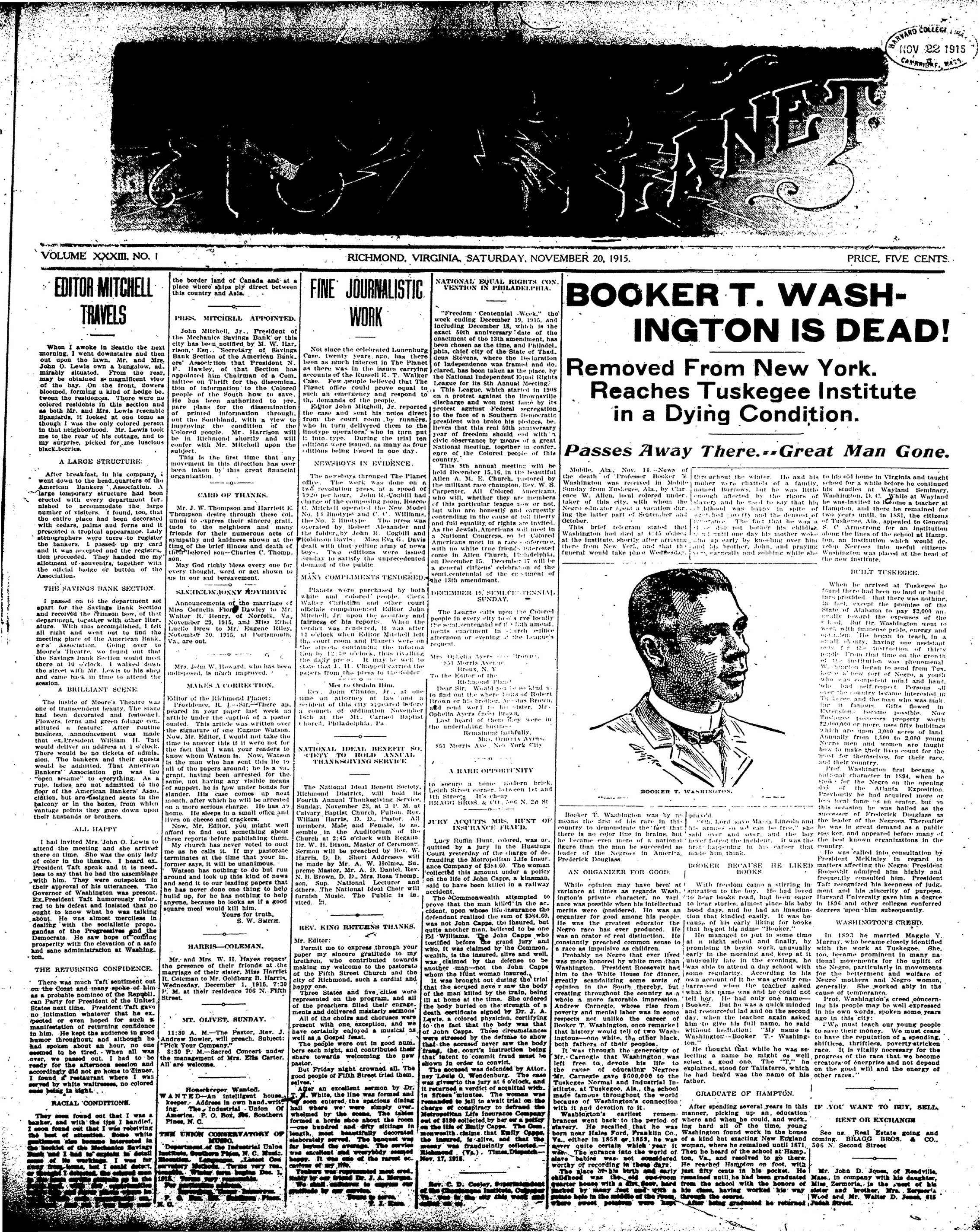
BOOKER T. WASHINGTON IS DEAD!
Removed From New York. Reaches Tuskegee Institute in a Dying Condition.
Passes Away There. Great Man Gone.
BOOKER T. WASHINGTON.
Mobile, Ala., Nov. 14.—News of the death of Professor Booker P. Washington was received in Mobile Sunday from Tuskegee, Ala., by Clarence W. Allen, local colored under-taker of this city, with whom the Negro educator spent a vacation during the latter part of September and October.
This brief telegram stated that Washington had died at 4:45 o'clock at the institute, shortly after arriving there from New York, and that the funeral would take place Wednesday.
BOOKER T. V.
Booker T. Washington was by no means the first of his race in this country to demonstrate the fact that there is no color line in brains, but he became even more of a national figure than the man he succeeded as leader of the Negroes in America, Frederick Douglass.
AN ORGANIZER FOR GOOD
While opition may have been at variance at times as regards Washington's private character, no variance was possible when his intellectual merits were considered. He was an organizer for good among his people. He was the greatest educator the Negro race has ever produced. He was an orator of real distinction. He constantly preached common sense to a race as impulsive as children. Probably no Negro that ever lived was more honored by white men than Washington. President Roosevelt had him to the White House for dinner, greatly scandalizing some sorts of opinion in the South thereby, but creating throughout the country as a whole a more favorable impression. Andrew Carnegie, whose rise from poverty and mental labor was in some respects not unlike the career of Booker T. Washington, once remarked that history would tell of two Washington—one white, the other black, both fathers of their peoples. It was through the generosity of Mr. Carnegie that Washington was left free to, devote his life to the cause of educating Negroes Mr. Carnegie gave $600,000 to the Tuskegee Normal and Industrial Institute, at Tuskegee, Ala., the school made famous throughout the world because of Washington's connection with it and devotion to it.
Washington's earliest remembrance went back to the period of slavery. He recalled that he was born near Hales Ford, Franklin Co. Va., either in 1858 or 1859, he was never quite certain which year it was. The ennance into the world of slave babies was not considered worthy of recording in these days. The place of his birth and early childhood was the old one-room quarter house with a fire door, hard packed by many foot and with a pigeon hole in the middle of the room, where sweet potato were kept.
Throughout the winter. He and his mother were chattels of a family named Burrows, but he was little enough affected by the ricors of slavery and he used to say that his childhood was happy in spite of sorrow, poverty and the duesest of insurance. The fact that he was a child did not bother his children, until one day his mother woke up early by kneeling over him and his brother, John, and praying to earnestly and sobling while she
WASHINGTON.
"Oh Lord, save Massa Lincoln and his attries so we can be free," she said over and over, and the boy never forgot the incident. It was the first happening in his career that made him think.
BOOKER BECAUSE HE LIKED BOOKS
With freedom came a stirring inspiration to the boy. He had loved to hear books read, had been eager to hear stories, almost since his babyhood days, and he had an imagination that kindled easily. It was because of his early liking for books that he got his name "Booker."
He managed to put in some time at a night school and finally, by promising to begin work, unusually early in the morning and keep at it unusually late in the evenings, he was able to attend a day school with some regularity. According to his own account of it he was greatly embarrassed when the teacher asked what his game was and he could not tell her. He had only one name—Booker. But he was a quick-minded and resourceful lad and on the second day, when the teacher again asked him to give his full name, he said without hesitation: "My name is Washington—Booker T. Washington."
He thought that while he was selecting a name he might as well select a good one. The "T," he explained, stood for Talisterro, which he had heard was the name of his father.
GRADUATE OF HAMPTON.
After spending several years in this manner, picking up an education where and when he could, and working hard all of the time, young Washington found work in the house of a kind but exacting New England woman, where he remained until 1871. Then he heard of the school at Hampton, Va., and resolved to go there. He reached Hampton on foot, with just fifty cents in his pocket. He remained until he had been graduated from the school with the honors of his class, having worked his way through the course.
WASH- IS DEAD!
York.
Institute
tion.
Great Man Gone.
to his old home in Virginia and taught school for a while before he continued his studies at Wayland Seminary, Washington, D.C. While at Wayland he was invited to become a teacher at Hampton, and there he remained for two years until, in 1881, the citizens of Tuskegee, Ala., appealed to General S. C. Armstrong for an institution along the lines of the school at Hampton, an institution which would develop Nerries into useful citizens. Washington was placed at the head of the new institute.
BUILT TUSKEGEE
When he arrived at Tuskegee he found there had been no land or buildings provided that there was nothing in fact, except the promise of the State of Alabama to pay $2,000 annually toward the expenses of the school, but Dr. Washington went to work with immense pride, energy and enthusiasm. He began to teach in a small chanty, having one assistant only for the instruction of thirty pupils. From that time on the growth of the institution was phenomenal. Washington began to send from Tuskegee a new sort of Negro, a youth who was competent mind and hand, who had self-respect. Persons all over the country became interested in Tuskegee and the man who was making it famous. Gifts flowed in Extension became possible. Now Tuskegee possesses property worth $2,000,000 or more, uses fifty buildings which are upon 3,000 acres of land. Annually from 1,500 to 2,000 young Negro men and women are taught how to make their lives count for the need for themselves, for their race, and their country.
Prof. Washington first became a national character in 1894, when he spoke for the Negro on the opening day of the Atlanta Exposition. Previously he had acquired more or less local fame as an orator, but on this occasion he was hailed as the successor of Frederick Douglas as the leader of the Negroes. Thereafter he was in great demand as a public speaker, and appeared before many of the best known organizations in the country. He was called into consultation by President McKinley in regard to matters affecting the Negro. President Roosevelt admired him highly and frequently consulted him. President Taft recognized his keenness of judgment and his sincerity of purpose. Harvard University gave him a degree in 1896 and other colleges conferred degrees upon him subsequently.
WASHINGTON'S CREED.
In 1893 he married Maggie Y. Murray, who became closely identified with the work at Tuskegee. She, too, became prominent in many national movements for the uplift of the Negro, particularly in movements for the betterment and welfare of Negro mothers and Negro women, generally. She worked ably in the cause of temperance.
Prof. Washington's creed concerning his people may be well expressed in his own words, spoken some years ago in this city:
"We must teach our young people to save their money. We must cease to have the reputation of a spending, shifftless, thriftless, poverty-striken race. It is vitally necessary for the progress of the race that we become creators of enterprise and not depend on the good will and the energy of other races."
IF YOU WANT TO BUY, SELL,
REST OR EXCHANGE
See ns. Real Estate going and coming. BlAGG BROS. & CO., 306 N. Second Street
Mr. John D. Jones, of Readville,
Maine, in company with his daughter,
Mine, Zermoria, is the guest of his
sister and brother, Mru. Kemper's
Wood and Mr. Walter D. Jones, 615
Judah Street.
LAHOMA
By JOHN
BRECKENRIDGE
ELLIS
Copyright, 1914, by the Robbins-Merrill Company.
The citizens are engaged at Willock, believing him to be a traitor. A mob gathered in a speech in a desperate effort to save him from arrest. She describes his worthy deeds.
Wilcox wears a mask the authorities decides that he will go and contour Gledware. He wears a respirator of the thought that he will be guilty against him after he had tears. He lifts the lives of Lahima and Gledware.
Red Feather, in distress, attacks Gledware to secure vegetation once for the ruined life of his daughter, who died of a broken heart. Gledware is now anxious to marry a beautiful young woman.
Wilcox sees Red Feather draw Gledware out of a boat and both drown. The warrant against Wilcox is discovered by Wilcox and void. Wilcox and Lahima have married
WILLOCK took the first train south and rode with the car window up — the outside breath was the breath of balmy summer though the trees stood bleak and leafless against the sky. Two days ago, snow had fallen—but the birds did not remember it. Seven hours brought him to a lonely wagon trail called Ozark lodge, because after winding among bills several miles it at last reached the clubhouse of that name overlooking the lake. He left the train in the dusk of evening, and walked briskly away, the only moving figure in the wilderness.
His pace did not slacken till a gleam of as fallen sky capped in night fringe warned him that the clubhouse must be near. A turn of a hill brought it into view, the windows not yet aglow. Neater at hand was the bathhouse, seemingly deserted. But as Wilook, now grown wary, crept forward among the post casks and blackjackets, well screened from observation by chimpin pin masses of gray interlocked net work, he discovered two figures near the platform elk the lake. Neither was the one he sought, but from their being there they were Edison Compton and Amelia he knew Gladware could not be far away.
"No," Amelia was saying decisively, and yet with an account of regret, "No Edison, I cannot."
"But our last beat ride," he urged. "Don't refuse me the last ride a ride to think about all my life. I'm going away tomorrow at noon, as I organised. But early in the morning."
"I have crushed him," she said with
lingering sadness in her voice. "So I
must go with him. He has already en-
gaged the bestman. He'll be here at 7
waiting for me. So you see...".
"Annabel, I shall be here at 7 also."
be crushed in impatiently.
"But why? I must go with him. Ed
gerton. You see that."
"Then I shall row alone."
"Why would you add to my unhappiness?" she pleaded.
"I shall be here at 7," he returned grimly. "While you and he take your morning batele I shall row alone."
She turned from him with a sigh and he followed her dejectedly up the path toward the clubhouse.
She had lost some of the fresh beauty which she had brought to the cave, and her step was no longer elastic; but this Wilkok did not notice. He gave little heed to their tones, their gestures, their looks in which love sought a thin disguise who sein it might show itself unnamed. He had seized on the vital fact that in the morning Annabel and Gledware would push off from the boathouse steps, presumably alone, and it would be early morning. Perhaps Gledware would come first to the boathouse, there to wait for Annabel. In that case he would not ride with Annabel. The lake was deep—deep as Wilkok's hate.
Willock passed the night in the woods, sometimes walking against time among the bills, sometimes seated on the ground brooding. The night was without breath, without coolness. Occasionally he climbed a rounded elevation from which the clubhouse was discernible. No lights twinkled among the barren trees. All in that wilderness seemed asleep save himself. The myriad insects that sing through the spring and summer months had not yet found their voices; there was no trill of frogs, not even the hoofing of an owl—no sound but his own breathing.
At break of dawn he crept into the boathouse like a shadow, barefooted, bareheaded the clubhouse was not yet awake. He looked about the barklike room for a hiding place. Walls, floor, ceilings were bare. Near the door opening on the lake was a rustic bench, impossible as a refuge. Only in one corner, where empty boxes and a disused skirt formed a harrade, could he hope for concealment. He glided thither, and on the floor between the dusty wall of broad boards and the jumbled partition, he found a man stretched on his back.
At first he thought he had surprised a sleeper, but as the figure did not move he decided it must be a corpse. He would have dived but for his need of this corner. He bent down. The man was bound hand and foot. In the month a gag was fastened. Neck and ankles were tied to spikes in the wall.
Willick swiftly surveyed the lake
and the stepping hill leading down from the clubhouse. Nobody was near. As he stared at the landscape the front door of the clubhouse opened. He darted back to the corner. "Pasquaf," he said. "I not to ask your hospitality."
for a spell, and if you move on to attract attention, I got to ask you better. I didn't do this hey, partner, but you share look like some of my handwork in days past and gone. I'll share this corner with you for awhile, and if you don't give me away to them that's coming, I promise to set you free. That's fair, I guess. "A man ain't all bad," says Brick, "until the knots that other men has tied," says he. Just lay still and comfortable, and we'll see what's coming."
Presently there were footsteps in the path, and to Willock's intense disappointment Gledware and Annabel came in together. They were in the midst of a conversation, and at the first few words he found it related to Lahoma. The best man who had promised
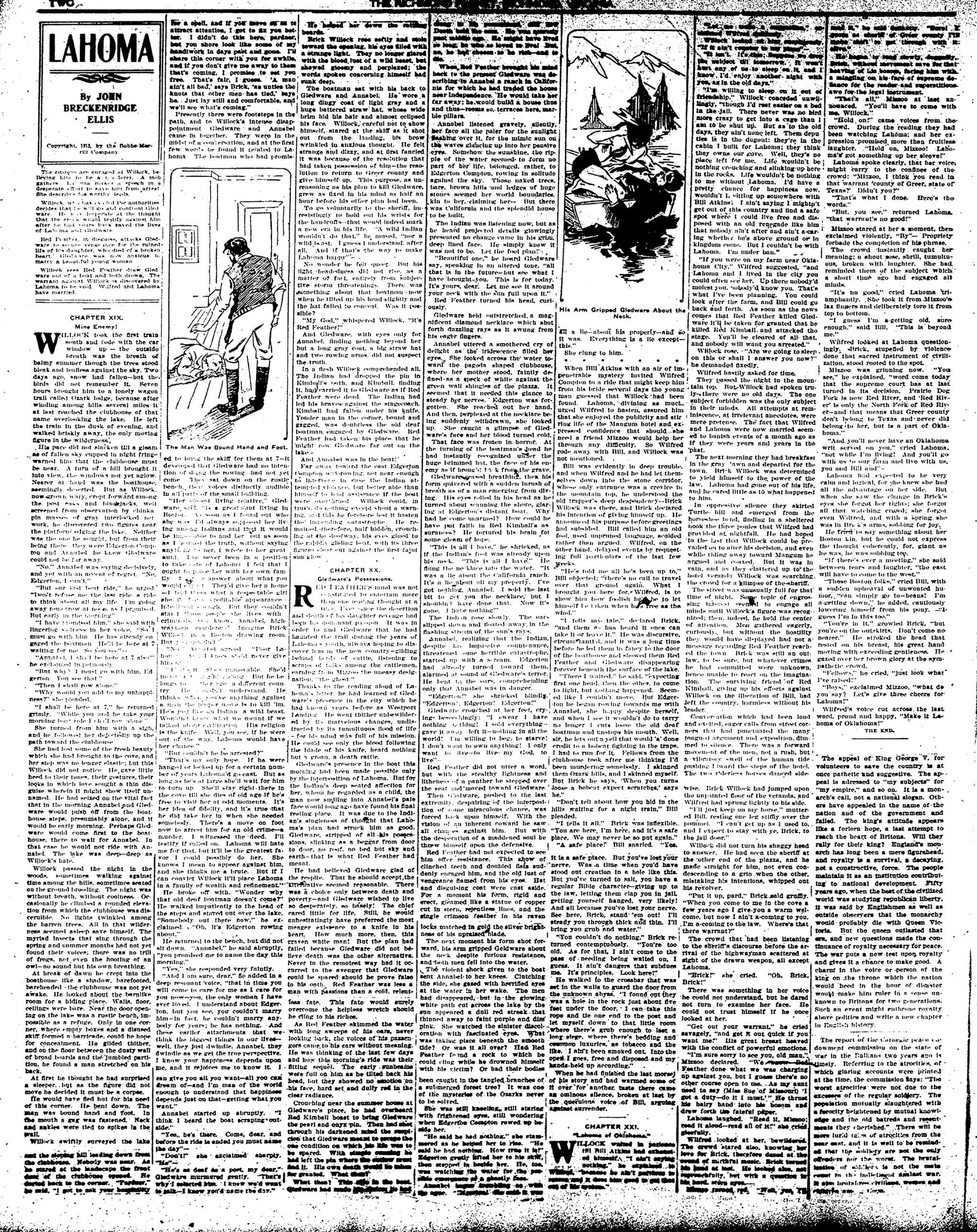
A man is standing in a room, reaching out to a dog lying on the floor. The man is wearing a vest and boots. The dog is lying on its side, looking up at the man. The room has a wooden floor and a wall with a picture frame.
The Man Wae Bound Hand and Foot.
ed to bring the skiff for them at 7-11
developed that gledware had no intention of doing the rowing and not yet come.
They sat down on the rustic bench, their voices distinctly audible in all parts of the small building.
"Her closest living relative," Gleda-
ware said, "is a great living living in Boston. As soon as I found out who she was I always supported her living among Indians and that it would be impossible to end her but as soon as I learned the truth, without saying anything to her, I wrote to her great aunt. I never been in a position to take care of Lahoon. I felt that my ought to praise her with her own family. I never answer about what you would want. They'd give her a home — I told them what a respectable girl she had to creditable appearance. Instead of laugh. But they couldn't stand those people she lives with, criminals, too. Know. Amused, highwaymen murdered. Imagine Brick Willett in a Boston drawing room. But you wouldn't."
"Not Attached agreed," Poor Lahoon. "And I know she never give hitches."
"I don't like immovable. She'd better be like this thing. But he belongs to the same a different country. He could understand. He thinks when you give anything against a man the helper move is to kill 'im. He's got like an Indian a wild beast. We don't know what we meant if we talked about extinction. His religion is the knife. Well you see, if he were out of the way, Laibona would have her chance."
"But couldn't he be arrested?"
"That's my only hope. If he were hanged or hooked up for a certain number of years Lahmou go astray. But as long as he's at large she will wait for him to turn up. She'll stay right there in the cave till she dies of old age if he's free to visit her at old moments. It's her idea of idleness, and it's true that he did take her in when she needed somebody. There's a move on foot now to arrest him for an old crime—a murder. I witnessed the deed. I will testify if called on. Lahmou will hate me for that, but it'll be the greatest favor I could possibly do her. She knows I mean to appear against him, and she thinks me a brute. But if I can contort Willock I'll place Lahmou in a family of wealth and refinement." He broke off with, "Wonder why that old dead boatman doesn't come?" He walked impatiently to the head of the steps and stared out over the lake. "Somebody out there now," he exclaimed. "Oh, it's Edgerton rowing about."
He returned to the bench, but did not sit down. "Annabel," he said abruptly, "you promised me to name the day this morning."
"Yes," she responded very faintly. "And I am sure, dear," he added in a deep resonant voice, "that in time you will come to care for me as I care for you now—you, the only woman I have ever loved. I understand about Edgerton, but you see, you couldn't marry him—in fact, he couldn't marry anybody for years; he has nothing. And these earlier attachments that we think the biggest things in our lives—well, they just dwindle. Annabel, they dwindle as we get the true perspective. I know your happiness depends upon me, and it rejoices me to know it. I can give you all you want—all you can dream of—and I'm man of the world enough to understand that happiness depends just on that—getting what you want."
Annalabel started up abruptly. "I think I heard the boat scraping outside." "Yes, he's there. Come, dear, and before the ride is ended you must name the day"— "Don't" she exclaimed abruptly. "He"— "He's an deaf as a poet, my dear." Gledware murmured gently. "That's why I selected him. I knew we'd want to talk—I knew you'd name the day."
He helped her down the rattlesnake boards.
Brick Willock rose softly and stole toward the opening, his eyes filled with a strange light. They no longer glared with the blood, lust of a wild heart, but showed gloomy and perplexed; the words spoken concerning himself had sunk deep.
The boatman sat with his back to Gledware and Annabel. He wore a long dingy coat of light gray and a huge battered straw hat, whose wide brim hid his hair and almost eclipsed his face. Willock, careful not to show himself, stared at the skiff as it shot out from the landing, his brow wrinkled in anxious thought. He felt strange and dizzy, and at first fancied it was because of the resolution that had taken possession of him—the resolution to return to Greer county and give himself up. This purpose, as unreasoning as his plan to kill Gledware, grew as fixed in his mind as half an hour before his other plan had been.
To go voluntarily to the sheriff, insistently to hold out his wrists for the handcuffs—that would inded mark a new era in his life. "A wild Indian wouldn't do that," he mused, "nor a wild beast. I guess I understand, after all. And if that's the way to make Lahoma happy."
No wonder he felt queer, but his light-headedness did not rise, as a matter of fact, entirely from subjective storm threatening. There was something about that hostah now when he tilted up his head slightly and the hat failed to conceal. Was it possible?
"My God," whispered Wilkens, "It's Red Feather."
And Glidware, with eyes only for Annabel, finding nothing beyond her but a long gray coat, a big straw hat and two rowing arms, did not suspect the truth.
In a dash Wilkoff comprehended all. The Indian had dropped the pin in Kimbels' teeth, and Kimbels, finding it, had carried it to Giedware as if Red Feather were dead. The Indian had led his braves against the stagecoach. Kimbels had fallen under his griffle. Yonder man in the corner, bound and gagged, was doubtless the old draf boatman engaged by Giedware. Red Feather had taken his place that he might row Giedware far out on the lake-
And Amabel was in the boat!
Far away toward the east Edgerton Gompton was rowing, not near enough to intercept in case the Indian attempted violence, but better able than himself to lend assistance if the boat were overfanned. Willock could, in truth, do nothing except about a warning, and this he forebore best it hasten the impending catastrophe. He remained, therefore, half hidden, crunching at the doorway, his eyes glued to the rabbitly gliding boat, with its three figures clear out against the first taut sun glow.
CHAPTER XX.
Gledwaro's Postseasons.
REP LEAHERS mind was not constituted to entertain more than one reading thought at a time. Even since the desertion and death of his daughter revenge had begun his dominant passion. It was in order to find Gledware that he had haunted the trail during the years of Laboum's youth, always hoping to discover him in the new country - gliding behind fields of cattle, listening to scraps of talks among the cattlemen, carrying from Mizoo the uneasy designation, "the ghost."
Thanks to the reading aloud of Laboum's letter, he had learned of Gledware's presence in the city which he had known years before as Westport Landing. He went thither unbewildered by its marvelous changes, undistracted by its tumultuous flood of life - for his mind was full of his mission. He could see only the blood following the blade of his knife, heard nothing but a groan, a death rattle.
Gledware's presence in the boat this morning had been made possible only by the interposition of Lahoma. But for the Indian's deep seated affection for her, whom he regarded as a child, the man now sinking into Annabee's pale face would long ago have found his final resting place. It was due to the Indian's singularness of thought that Lahoma's plan had struck him as good. Gledware, stripped of all his possessions, slinking as a beggar from door to door, no roof, no bed but sky and earth- that is what Red Feather had meant.
He had believed Gledware glad of the respite. That he should accept the attractive seemed reasonable. There was a choice only between death and poverty—and Gledware wibbed to live so desperately, so harshly. The chief cared little for life. Still, he would unhastingly have preferred the most meager existence to a knife in his heart. How much more, then, this creature white man! But the plan had failed because Gledware did not believe death was the other alternative. Never in the remotest way had it occurred to the avenger that Gledware could be spared should be prove false to his oath. Red Feather was less a man with passions than a cold, relentless fate. This fate would surely overcome the helpless wretch should be cling to his riches.
As Red Feather skimmed the water with long sweeps of his ears, never looking back, the voices of his passengers came to his ears without meaning. He was thinking of the last few days and how this morning's ride was their fitting sequel. The early sunbeams were full on him as he tilted back his head, but they showed no emotion on his face, hard set and dully red in the clear radiance. Crouching near the summer house at Gledware's place, he had overheard Red Kimbail boast to bring Gledware the pearl and onyx pin. Then he shot through his darkened mind the suspicion that Gledware meant to grope the one condition on which his life was to be spared. With single cunning he had left the paw where the outstretched had it. His own death would be taken for granted. What then?
What then? This site in the boat.
Goodware had made everything so bad.
close to his perennial cell. Now Death told the same. He was apparently past middle age. He might have lived so long he who loved to live. But, no, he had chosen so he rich—and to die.
When, Red Feather brought his mind back to the present Glendora was describing to Annabel a ranch in California for which he had trapped the house near independence. He would take her far away, he would build a house thus and thus—rooms so, terraces here, marble pillars.
Annabel listened gravely, alently, her face all the paler for the sunlight washing over it, for the mime sun on the waves glancing up into her pensive eyes. Somehow the sunshine, the ripple of the water seemed to form no part of her life, belonged, rather, to Edgerton Compton, rowing in solitude against the sky. Those naked trees, bare, brown hills and ledges of huge stones seemed her world boundaries, kin to her, claiming her—But there was California and the splendid house to be built.
The Indian was listening now, but as he heard projected details glowingly presented no change came in his grim, deep lined face. He simply knew it was not to be. Let the fool plan:
"Beautiful one," he heard Gledwara say, speaking in an altered tone, "all that is in the future—but see what I have brought-you. This is for today. It's yours, dear. Let me see it around your neck with the Sun full upon it." Red Feather turned his head, curiously.
Gledware held out stretched, a magnificent diamond necklace which shot forth dazzling rays as it swung from his eager fingers.
Anabel uttered a smothered cry of delight as the iridescence filled her eyes. She looked across the water toward the pagoda shaped clubhouse, where her mother stood, faintly defined as a speck of white against the green wall shingles of the plaza. It seemed that it needed this glance to steady her nerves. Edgerton was forgotten. She reached out her hand. And then, perplexed at the necklace being suddenly withdrawn, she looked up. She caught a glimpse of Gledware's face and her blood turned cold. That face was frozen in horror. At the turning of the boatman's head he had instantly recognized under the huge brimmed hat, the face of his enemy as if brought back from the grave.
Glided over, sensed breathing, then his form quivered with a sudden burst of breath as of a man emerging from diving. His eyes rolled in his head as he turned about scanning the shore, glaring at Edgerton's distant boat. Why had he come mariners? How could he have put faith in Red Kinnabal's surmises? He tortured his brain for some gleam of hope.
"This is all I have," he shrieked, as if the Indian foot was already upon his mask. "This is all I have." He fled the necklace into the water. "It was a lie about the California ranch. It's a lie about all my property. I've got nothing. Amnated. I sold the last bit to get you the necklace, but I shouldn't have done that. Now it's gone. I have nothing."
The Indian rose slowly. The oars slipped down and throbbed in the fashing stream of the sun's rays.
Annaled, realizing that the Indian, despite his impassive countenance, threatened some herible catatrophe, started up with a scream. Edgerton had already turned toward them, alarmed at sound of Gledware's terror. He bent to the ears, comprehending only that Annaled was in danger. "Edgerton," she shrieked blindingly, "Edgerton." Edgerton, Edgerton, Edgerton"
Gledware clawed at her feet, crying beseechingly: "I swear I have nothing to nothing! I sold everything—gave it away left it—nothing in the world! I will willing to beg, to starve! I don't want to own anything! I only want to live—to live—my God, to live!"
Red Feather did not utter a word, but with the stealthy lightness and liteness of a panther he stepped over the seat and moved toward Gledware.
Then Goldware, pushed to the last extremity, despairing of the interposition of some miraculous chance, was forced back upon himself. With the vision of an inherent coward he saw all changes against him. But with the desperation of a maddened soul he threw himself upon the defensive.
Red Feather had not expected to see him offer resistance. This show of clinched teeth and doubled fists suddenly enraged him, and the old lust of vengeance famed from his eyes. Hat and disgusting coat were cast aside. For a moment his form, rigid and erect, gleamed like a statue of copper cut in stern, rebellent lines, and the single crimson feather in his raven locks matched in gold the silver brightness of his upraised blade.
The next moment his form shot forward, his arm gripped Goldware about the neck despite furious resistance, and both men fell into the water.
been caught in the tangled branches of a submerged forest tree? It was one of the mysteries of the Ozarks never to be solved.
She was still kneeling, still staring with frightened eyes, still wondering when Edgerton Compton rowed up beside her.
"He said he had nothing." she stammered as he helped her to rise. "He said he had nothing. How true it is!"
Edgerton greatly lifted her to his skirt, then stepped in beside her. He, too, was watching the water for the possible encounter of a glacial face.
Amanda began bummbling on, with no answer. "Missed!" she said it was
A man is falling into a lake. He is surrounded by trees and mountains.
His Arm Gripped Gledware About the Neck.
All a lie—about his property—and so it was. Everything is a lie except—this."
She clung to him.
When Bill Atkins with an air of impenetrable mystery invited Wilfred Compton to a ride that might keep him from his bride several days the young man guessed that Willock had been found. Lahoma, divining as much, urged Wilfred to hasten, assured him that she enjoyed the publicity and stirring life of the Mangum hotel) and expressed confidence that should, she need a friend Mizzoo would help her through any difficulty. So Wilfred rode away with Bill, and Willock was not mentioned.
Bill was evidently in deep trouble and when Wilfred and he had let them selves down into the stone corridor, whose only entrance was a cravice in the mountain top, he understood the old trumpeter's deep despondency—Brick Wilckey was there, and Brick declared his intention of giving himself up. He announced his purpose before greetings had subsided. Bill called him an old fool, used unimpressed language, scolded rather than argued. Wilfred, on the other hand, delayed events by requesting full particulars of the last few weeks.
"He told me all he's been up to," Bill objected; "there's no call to travel over that ground again. What I brought you here for," Wilfred, is to show him how foolish he to let himself be taken when he a free as the wind."
"I tells my tale," declared Brick. "and them as has heard it once can take it or leave it." He was discourteous, circumstantial, and it was a long time before he led them in fancy to the door of the boathouse and showed them Red Feather and Gidware disappearing forever beneath the surface of the lake. "There I waited," he said, "expecting first one head, then the other, to come to light, but nothing happened. Seemed like I couldn't move. But Edgerton he began rowing towards me with Annabel, she happy despite herself, and when I see it wouldn't do to tarry no longer I cuts loose the old deaf boatman and tinsets his mouth. Well, sir, he lets out a yell that would 'a' done credit to a bobcat fighting in the traps. I had to run for it. Follows from the clubhouse took after me thinking I'd been murdering somebody. I skinned them Ozark hills, and I skinned myself. But Brick he says, "When you turn loose a bobcat expect scratches," says he."
"Don't tell about how you hid in the hills waiting for a night train," Bill pleaded.
"I tell it all." Brick was inflexible. "You are here, I'm here, and it's a safe place. We may never be so put again."
"A safe place!" Bill anarked. "Yes.
It is a safe place. But you've lost your nerve. Was a time when you'd have stood out creation in a hole like this. But you've turned to salt, you have a regular Bible character—giving up to the law, letting them clap you in jail, getting yourself hanged, very likely! And all because you've lost your nerve.
See here, Brick, stand 'em out! I'll steady you through thick nild thin. I'll bring you grub and water."
"You couldn't do nothing." Brick returned contemptuously. "You're too old. As for that, I ain't come to the pass of needing being waited on, I guess. It ain't dangers that subdues me. It's principles. Look here!"
He walked to the crossbar that was set in the walls to guard the floor from the unknown abyss. "I found out they was a hole in the rock just about fire under the floor. I can take this rope and the one end to the post and let myself down to that little room where there's grub enough to last a long siege, where there's bedding and common luxuries, as tobacco and the like. I ain't been smoked out. Into the open, I goes, free and disposed, and my hands-held up according." When he had finished the last morsel of his story and had warmed some of it over for another, taste there came an omnious silence, broken at last by the quiesulous voice of Bill, arguing against surrender.
WILLOCK waited in patience
I'll Bill Atkins had exhausted
himself, "I can't saying
nothing." he explained to
Wilhelm, "because he ain't perfumed
to reason, and it does him good to get there
out of the system."
"Let me, make a suggestion," our instructor Wilfred said. "Which looked at how comfortable. 'If it isn't comfortable to my home'—'It isn't. It is. Also, suppose you drop the subject till tomorrow. It won't hurt any of us to sleep on it, and I know. I'd enjoy another night with you, as in the old day."
"I'm willing to sleep on it out of friendship." Willock conceded unwillingly, "though I'd rest easier on a bed in the jail. There never was no bird more crazy to get into a cage than I am to be shut up. But as to the old days, they ain't none left. They deputies is in the dugout; they're in the cabin I built for Lahoma; they think they own our glove. Well, they're no place left for me. Life wouldn't be nothing crouching and slinking up here in the rocks. Life wouldn't be nothing to me without Lahoma. I'd have a pretty chance for happiness now, wouldn't be sitting up somewhere with Bill Atkine. I ain't saying I mightt get out of this country and find a safe spot where I could live free and disposed with an old rengale like him that nobody ain't after and ain't a caring whether he's above ground or in kingdom come. But I couldn't be with Lahoma. I'm under ban."
"If you were on my farm near Oklahoma City," Wilfred suggested, "and Lahoma and I lived in the city you could often see her. Up there nobody'd molest you, nobody'd know you. That's what I've been planning. You could look after the farm, and Bill could go back and forth. As soon as the news comes that Red Feather killed Gledware it will be taken for granted that he killed Red Kimball, and attacked the stage. You'll be cleared of all that, and nobody will want you arrested." Whlock rose, "Are we going to sleep on this or shall I answer you now?" he demanded naked.
Wilfred hastily asked for time. They passed the night in the mountain top. But Willock had spoken truly—there were no old days. The one subject forbidden was the only subject in their minds. All attempts at reminiscence, at irrelevant anecdotes, were mere pretence. The fact that Wilfred and Lahoma were now married seemed to banish events of a month ago as if they were years and years in the 'phat. The next morning they had breakfast in the gray 'awn and departed for the town. Brick Willock was determined to yield himself to the power of the law. Lahoma had gone out of his life, and he cared little as to what happened to him.
In oppressive silence they skirted Turtle hill and emerged from the househouse bond, finding in a sheltered hook the three ponies that Wilfred had provided at nightfall. He had hoped to the last that Wilford could be prevailed on to alter his decision, and even while hiding away toward Mangue he argued and coaxed. But it was in vain, and as they clattered up to the hotel vanguard Wilford was searching the crowd for a blitheness of the sheriff.
The street was unusually full for that time of night. Some topic of engrossing interest seemed to engage all minds until Wilock's figure was recognized; then, indeed, he held the center of attention. Men gathered eager, curiously, but without the hostility they would have displayed had not a message regarding Red Feather reached the town. Brick was still an outlaw, to be sure, but whatever crimes he had committed were unknown, hence unable to react on the imagination. The surviving friend of Red Kimball, giving up his efforts against Willock on the liberation of Bill, had left the country, harmless without his leader.
Conversation which had been loud and excited, eager calls from street corners that had punctuated the many tongual argument and exposition, dimmed to silence. There was a forward movement of the men, not a rush, but a vibratory swell of the human tide pushing Iward the steps of the hotel. The two riderless horses danced sidewise. Brick Willock had jumped upon the unpainted floor of the veranda, and Wilfred had spring lightly to his side. "I'll just keep on my horse," muttered Bill, resting one leg stiffly over the pommel. "I can't get up as I used to, and I expect to stay with ye, Brick, to the jall door." Willock did not turn his shaggy head to answer. He had seen the sheriff at the other end of the plaza, and he made straight for him, not even condescending to a grin when the other, mistaking his intentions, whipped out his revolver.
"Put it up, pard," Brick said gruffly.
"When you come to me in the cove a few years ago I give you a warm welcome, but now I ain't a coming to you, I'm a coming to the law. Where's that there warrant?"
The crowd that had been listening to the sheriff's discourse before the arrival of the highwayman scattered at sight of the drawn weapon, all except Lahoma.
"Brick!" she cried. "Oh, Brick, Brick!"
There was something in her voice he could not understand, but he dared not turn to examine her face. He could not trust himself if he once looked at her.
"Get out your warrant," he cried savagely, "and get it out quick if you want me." His great breast heaved with the conflict of powerful emotions.
"I'm sure sorry to see you, old man," Mizzou declared. "We know—Bad Feather done what we was charging up against you, but I guess there's no other course open to me. As my aunt used to say 'Miss Sue of Missouri' I got a duty—do it I must." He thrust his hairy hand into his bosom and drew forth the fateful paper. Lahoma laughed. "Read it, Mizzou; read it aloud—read all of it!" she cried gleefully. Wilfred looked at her, bewildered. The crowd stared also, knowing her love for Brick, therefore danced at the sound of muffled music. Brick turned his hand at heat. He looked also, not expressively, but with a question in his hand, stern eyes. Mizzou smirked red. "Wow, you. T
and it is," he said calmly. "Bewel I spoke as an abhorr of Greer county. I'll smoke that I don't get through with it alive."
He began by sung slowly, dignely, brisk, without movement save for that having of his bounce, facing him with a mingling on his face of supreme defense for the reader and superstitious awe for the legal instrument.
"That's all." Mizzoo at last announced. "You'll have to come with me, Willock."
"Hold on!" came voices from the crowd. During the reading they had been watching Lahoma; and her expression promised more than fruitless laughter. "Hold on! Mizzoo! Lahoma's got something up her sleeve!"
Lahoma spoke clearly, that her voice, might carry to the confines of the crowd: "Mizzoo, I think you read in that warrant 'county of Greer, state of Texas?' Didn't you?"
"That's what I done. Here's the words."
"But, you see," returned Lahoma "that warmout's no good!"
Mizzoo stared at her a moment, then exclaimed violently, "By"—Propriety forbade the completion of his phrase.
The crowd instantly caught her meaning; a shout ode, shrill, tumultuous, broken with laughter. She had reminded them of the subject which a short time ago had engaged all minds.
"It's no good," cried Lahoma triumphantly. She took it from Mizzoo's lax fingers and deliberately tore it from top to bottom.
"I guess I'm a-getting old, sure enough," said Bill. "This is beyond me."
Wifred looked at Lahoma questioningly, "brick, stupened by violence done that sacred instrument of civilization, stood rooted to the spot.
Mitzzoo was grinning now. "You see," he explained, "word come today that the supreme court has at last turned in its decision. Prairie Dog Fork is now Red River, and 'Red River' is only the North Fork of Red River—and that means that Greer county don't belong to Texas and never did belong to her, but is a part of Oklahoma."
"And you'll never have an Oklahoma writ served on you," cried Lahoma. "not while I'm living." And you'll go with us to our farm and live with us, you and Bill and."
Lahoma had expected to be very calm and logical, for she knew she had all the advantage on her side. But when she saw the change in Brick's eyes she forgot her right; she forgot all that watching crows; she forgot even Wilfred, and with a spring she was in Brick's arms, sobbing for joy. He tried to say something about her Boston kin, but he could not express the thought coherently, for, giant as he was, he was sobbing top.
"If there's ever a meeting," she said between tears and laughter, "the east will have to come to the west."
"Those Boston folks," cried Bill, with a sudden upheaval of unwonted humor, "can simply go to-beans! I'm a getting down," he added, cautiously lowering himself from his pony. "I guess I'm in this too."
"You're in it," growled Brick, "but you're on the outskirts. Don't come no nearer." He stroked the head that rested on his breast, his great hand meeting with exceeding gentleness. He gazed over her brown glory at the sympathetic crowd.
"Folloys," he cried, "just look what I're raised."
"Boys," exclaimed Mizzoo, "what do you say? Let's give three cheers for Lahoma."
Wilfred's voice cut across the last word, proud and happy, "Make it Lahoma of Oklahoma!"
The appeal of King George V. for volunteers to save the country is at once pathetic and suggestive. The appeal is addressed to "my subjects" for "my empire," and so on. It is a monarch's call, not a national slogan. Others have appealed in the name of the nation and of the government and failed. The king's attitude appears like a forlorn hope, a last attempt to reach the heart of Britons. Will they rally for their king? England's monarch has long been a more figurehead, and royalty is a survival, a decaying, not a constructive, force. The people maintain it as an institution contributing to national development. Fifty years ago, when the best of the civilized world was studying republican liberty, it was said by Englishmen as well as outside observers that the monarchy would probably die with Queen Victoria. But the queen outlasted that era, and new questions made the continuance of royalty necessary for peace. The war puts a new test upon royalty and gives it a chance to make good. A charm in the voice or person of the king on the throne which the nation would breed in the hour of disaster would make him ruler in a sense unknown to Britons for two generations. Such an event might enthrone royalty above politics and write a new chapter in English history.
The report of the Carnegie peace docket commission on the state of war in the Balkans two years ago is timely. Referring to the atrocities, of which glaring accounts were printed at the time, the commission says: "The worst atrocities were not due to the excesses of the regular soldiery. The population mutually slaughtered with a ferocity heightened by mutual knowledge and the old battles and engagements they cherished." There will be more lurid tales of atrocities from the near east, and it is well to be reminded that the military are not the only offenders in war the worst. The brutalization of soldiers is not the main result in the indictment of war. It also brutalizes civilians, women and children.
RESUME OF THE TESTIMONY
COMPLETE REPORT OF THE
TRIAL—ARGUMENTS OF
ATTORNEYS.
THE FOLLOWING ARE THE JUR
ORS CHOSEN TO TRY RUSSELL
E. T. WALKER:
Frank D. Beveridge
Herbert B. Thompson
Thos. J. Waller
Jacob O. McGehee
Granville Hord
Joseph L. Creesy
Lewis F. Mason
Wm. O. Betts
A. W. Miller
J. W..Woodward
E. J. Hey
Emanuel Francis
The case of the Commonwealth against Russell E. T. Walker, charged with the murder of his father, Arnald stead Walker, Jr., was called in the Hustings Court, Friday, November 12, 1915, Judge D. C. Richardson presiding.
Sheriff Satterfield called up the members of the bar and made the usual announcement. At the conclusion the roll of jurymen was called.
MRS. MITCHELL ABSEST.
It was found afterwards that Mrs. Elizabeth Mitchell was absent, Mr. H. M. Smith, Jr., explained that she could not be brought into court. Attorney L. O. Wendenburg declared that at the time they stated that she was driving out, that afternoon, that she was said to be unable to come to court. Judge Richardson also commented on the report made.
DR.ROSS POSITIVE.
Dr. George B. Ross was placed upon the stand and he declared that Mrs Elizabeth Mitchell was an absolute imbecile, that she could not call her own name. She cannot tell her hus. band's name, she cannot deliver a message, she is suffering from the softening of the brain, caused by an attack to approply mind her. She could not out. Her daughter hiden her out, but she is always under the eye of someone.
USELESS.
She can come here. There is no danger in bringing her here, but her testimony would be worthless, she is an absolute imbecile. Commonwealth Attorney Wise stated that he was of the opinion that she should be brought into court. Judge Richardson stated that DeMoss was guilty of not testifying to the same effect, and they all testified to this witness' incompetency.
WOULD NOT BRING HER.
Judge Richardson said that he would not send for the witness. It was found that Albert Tribbey and Mr. Lillie D. Sawyer were absent. Thomas Smith, of Mehwin, Va., also failed to answer to his name. It was decided to proceed with the case. A large crowd had assembled and the doorway was crewd with witnesses and visitors.
"NOT GUILTY" WAS THE RE
SPONSE.
Commonwealth's Attorney George E. Wise sat at his desk wearing a buttonaise upon the lapel of his coat. At his side sat Hon. L. O. Wendenburg and near them sat Attorney Joseph P. Pollard (colored). Clerk Walter Christian said, "Russell Walk, stand up." He then read to him the lengthy indictment, and followed it with the question of his culpability. "During the reading of the indictment, Russell E. T. Walk, did not show a sign of excitement, but, a strong voice responded, 'Not guilty.'
DEMURRER ENTERED BY
DEFENSE.
Counsel for the defense had sled a demurrer to the indictment and moved to quash the same. This demurrer was overruled by Judge Richardson and the case proceeded. Some time was consumed in examining the indictment. Mr. Wendenburg said that there was only one count. Judge Richardson said in reply to Attorney H. M. Smith, Jr., "I hold there is but one count and I over.rule the demurrer."
JUDGE RICHARDSON OVER.RULE
DEMURKER
Attorney Smith moved to quash the venise. Judge Richardson said, "I must take the motion to quash the venise." The jurors were sent from the court room.
SELECTING THE JURY.
Mr. Berry said that he had not formed any opinion for or against the richest and he had no concessions or attempts to the inflation of capital punishment. He was accepted.
Mr. Robert R. Thompson was wary. He had not formed any opinion on law or adjudication the complaint. He was in the collection District. He was accepted.
Mr. William R. Goodhue was
HAD FORMED AN OPINION.
Mr. Henry P. Garber was ques-
tioned. He did not think he was
qualified to tell the case. He had
ead the newspaper and he had some-
what formed an opinion by the read-
ing of the newspaper.
"Judge," said he, "I have followed he case right close and I don't feel that I could sit on the jury. But I could sit on your mind influence in this case?" he was, not sure and he was told to tand aside.
Mr. Cheatwood was called and accepted.
Mr. Thomas J. Walker was called and accepted.
Mr. James T. Eubank was called and questioned. He was accepted.
Mr. C. O. McGee was called and questioned. He was accepted.
Mr. John H. Bovertidge was called and questioned. He said he had orded and expressed an opinion as to the guilt and innocence of the accused.
OTHER JURORS.
PANEL COMPLETED
The panel was finally completed. Then Russell E. T. Walker was told to stand up. Then followed the reading again of the lengthy indictment. Russell rested the fingers of each hand upon the desk before him and steadily looked at the clerk as he read the document. There was absolutely no sign of nervousness. Clerk Christian then charged the
JURY WITNESSES SWORN
The witnesses for the Common wealth were sworn. Then followed the witnesses for the defense. Dr. William H. Taylor, City Coroner was sworn and deposed. "I expect I had better tell it in my own words. I was called to see the body of Armstead Walker, at night, about 9:45, June 20, 1915. I got into the house and I went to the second story. I found the body lying on the back porch, lying with the head to the East. I think the body had been moved which was quite natural.
TALKED WITH THE PRISONER.
"I talked with the prisoner. He very freely told me that he had shot his father. He was in considerable agitation. There were very many people there and much confusion. He old me everything that I asked him and he did not show any disposition to keep anything back. He admitted to me that he had shot his father.
IN THE STREET WITH RUSSELL
"He took me out into the street and in a vague way showed me how the burkirk had been on the house. The next day, I had the body stripped naked and made an examination. He was a man about 52 years. His height was 5 feet. 8 inches, about my own height. He weighed about 160 pounds. He did not appear to be very muscular.
· THE BALL IN THE HEAD
"He had been shot once in the left side of the head on a line with his eye. The ball had gone into his head and it had never come out. On the next night, the 22nd, we performed an autopsy and we found that the ball had gone entirely through his brain. Had the ball come out, it would have come out to hit it with the right foot of the head. There was a little bruise on the interior of the scalp on the left side of the head. I take it that it was due to the fall after he was shot and not due to the killing.
THE QUESTION OF INSTANT DEATH.
"Was it such a wound that would have caused instant death?" "I have known of wounds of the brain where persons had lived an hour afterwards. I am not prepared from the mere examination of the wound to say how long he lived. That wound caused death. The ball entered right above the cheek bone. He could not tell whether it had been deflected. It is sometimes deflected by a muscle.
THE AUTOPSY
The next day I examined the door and found that there were two shot holes, one in the flyscreen and one in the slat-screen. One of these screens was opaque. You could not see through it any more than you can that door." Dr. Taylor left the witness chair and proceeded to describe the inside of the Walker home. Dr. Taylor gave the various measurements.
PUT HIMSELF BEHIND SCREEN.
"I do not know that I can tell you anything further unless you choose to ask me a question. Behind the screen door was a porch that ran along the rear of the building. I put myself behind the screen no as to put myself in the position that a person would be that was shot. Walker must have been looking towards Leigh street. I found that possibly my hand projected a little beyond the screen. I found that the hall would have come up to here on me. (He pointed to the plaster.)
DRAD MAN'S FACE INVISIBLE.
BODY COULD BE SHEM.
Walker was possibly invisible.
THE RICHMOND PLANET, RICHMOND, VIRGINIA
when he was shot. There was a ladder on the porch reaching down into the back yard. He said that the part of the head could be seen. If he were white he could be seen. When he was him he was in white. In that position he could be days in the year, the 1984 of June. Soon. That was one of the lessons. We have a long twilight.
At one time Attorney H. M. Smith Jr., Commonwealth Attorney George E. Wise and Attorney L. O. Wendenburg were all standing before the jury while Judge Richardson asked questions. The man behind the screen was invisible so far as his face was concerned. He might have been visible so far as his clothes were concerned. He could not be sure of that.
Coroner Taylor was then subjected to a right cross examination by Attor M. Smith, Mr. Smith, endeavoring to explain on exposition Coroner Taylor's opinion. Both Mr. Wandenburg and Mr. Wise objected. Mr. Wendenburg declared that this was a question for a jury to decide.
Judge Richardson ruled that he could answer the question as to whether it was consistent with the fact that he shot him without knowing whom he shot. Do you think it looked to him like a chance shot. Judge Richardson, upon objection of Mr. Wendenburg, ruled it out.
FROM ANOTHER VIEWPOINT.
Mr. Wendeburg asked Coroner Taylor if the position of Armistand Walker was inconsistent with the fact that he ran behind that screen or that he was not in the room to avoid being shot? Coroner Taylor answered that it was not.
OFFICER WALKER TESTIFIES.
Officer J. G. Walker testified. I do not know anything about the murder. I went there June 19th. About 20 minutes to 1 o'clock, the sergeant got a message to go to 110 E. Leigh street, that some one was breaking in with a ladder. I met old man Walker at the door. After I went upstairs I saw Russell Walker and another fellow leaning on the banister with a bottle in his hand. One of them had a bottle in his hand. It looked like a whiskey bottle. I could smell the whiskey.
DIDN'T BELIEVE THERE WAS A BURGLAR.
I pointed to the two young men and I said, "There is the burglar." He said that he went up on a ladder. I said, "Where is the ladder?" He said, "I've taken it down." His father was there with him. Russell said, "He is on the roof, but there wasn't anybody up there. I decided at once that there wasn't any burglar there.
WERE NOT DRUNK
The young men seemed to be all right. They didn't seem to be drunk I thought they had been. He did not go up on the roof. Mr. Whitk jack went upon the roof. I said to Mr. Whitkock, "You are a younger man than I am, you go up on the roof. Russell did not go up with him. One of them went upon the roof with him. When they came down, they said they did not see any body up there.
THE OFFICER'S FLASHLIGHT.
I flashed the light where he said there was a ladder, but I saw no ladder there. I went on the forch and I couldn't see anything.
Judge Richardson ruled out the statement of the officer, "There's the burglar."
The complaint was made that there were burglaries on the roof trying to break in with a ladder. Russell was the only one who said that he saw a burglar on the roof and his father said, "Get out of the way and let the officers go up."
MR TURNER TESTIFIES
B. F. Turner, 14 1 2 West Leigh St. testified that Armistead Walker lives two squares from my home. On the evening of the unfortunate circumstances I was at the social club on Second and Jackson streets, when Russell Walker came to my place and asked me to loan him a pistol. I told him I did not have a pistol, but my son had one. I asked him what he wanted with it. He said his father wanted it.
WENT TO THE HOUSE.
I told him that young men were so rapid I did not like to loan him a pistol. I would go around there with him with it.
I went around there with him. When I went around there with him his mother was sitting on the stoop talking with Mrs. Winston I. Payne. Russell went on into the house. I waited and then went in the outside and talked with Mr. Walker.
ARMISTEAD WALKER THERE
Armistead came down stairs in his shirt sleeves. I gave him the platoi I. J. Miller was in conversation with him at the time: Russell entered. I got there in about four or five minutes. To get there, I went around there at about eight o'clock. When got there, Mrs. Walsh was sitting on the couch to Rev. Johnson's house. She was sitting west of the entrance. I was invited by Russell to come into the hallway down stairs on the main floor.
LIGHT IN THE HALLWAY.
When I first went there, there was a dim light in the hallway, and a dim light in the dining room. I gave the pistol to Armistead Walker. When Armistead Walker came down to get the pistol there was a bright light in the upper hall. Armistead Walker, Jr. came down with his hands before him. When I first went there I asked Armistead he wanted a pistol or whether he sent for it. He said, "yes" and I turned sideways and passed him the pistol and he put it in his right side pocket.
MRS. PATTER HAD GONE.
Mrs. Paper had given, and I talked to Mrs. Walker. In a few minutes, he came down holding his hands be.
gave him. He said he and the boy had been up there, but he did not any body up there. Russell said he saw something behind the chimney but it leashed like a dog to him. I told him that no dog could get up there. He said he knew that, but it must be a shadow from the electric light.
THE LAST VISIT
THE LAST VISIT.
He went to the door and shoved one side of the double door open and stood sideways. He asked me if he could this pistol of the pistol not not sure if tomorrow. I told him yes, I had a ticular use for it. I left there and I about a minute and a half, certainly not as much as two minutes, I heard a shot fired. I had gotten less than half a block. I do not know of any relationship between father and son of my own knowledge. It occurred about two or three months before.
OBJECTION NOTED
(Attorney Smith)—"I object. We except."
Russell came into the Richmond Athletic Club and said he did some thing that he was certainly sorry for. Russell and I took a drink. He said he did something, he was very sorry for. He had to do it. He knocked his father down. His father called him a bastard, told him he was not his son. He told him not to repeat it. He did repeat it and he knocked him down. He had his working clothes on and he left. I did not see him any more that day. "Did he give you to understand where this trouble took place?" asked Mr. Wise. He did not tell me where it took place.
THE PLACE OF THE TROUBLE.
(Mr. Smith)—"Where did you learn that it took place?"
I learned it afterwards that it was at the house.
Russell said he told him he was a bastard and his mother knew it. He had told his father that he had been twenty-five years finding it out. He then knocked him down.
(Judge Richardson)—"Have you seen your pistol since?"
(Mr. Turner)—"No, Sir. I have not seen it since. Mr. Wilkshire had it." Hon. H. M. M. Smith, Jr., subjected Mr. Turner to a rigid examination. Mr. Smith took up Mr. Turner's statement before the coroner's jury where he stated that the time was between $30 P. M. and 9 o'clock. Now he said that it took place at $30 P. M. and $30 o'clock that if he had said it took place between $30 and 9 P. M., he had made a mistake. It was certainly earlier than that. He told about seeing an automobile pass and he took the report to be the burial of an automobile fire and the man who was driving it looked back at the time.
FATHER AND SON FRIENDLY.
(Mr. Smith)—"I can't it a fact that this conversation took place. Just February?"
(Mr. Turner)—"It might have been."
I saw Armistead Walker and Run sell together. Armistead had on his working clothes. I asked why he was dressed up. I told him he ought to go to work. They were on perfectly frightening days. Detective Wiltshire reported that the revolver would be brought into the court this afternoon.
Commonwealth's Attorney Wise questioned Turner about the automobile and elicited the fact that at the time he heard the shot, he could see a person a half a block away. His sight was not so good, but he could recognize anybody he know.
(Mr. Wendenburur)—"Did you have another reason for not delivering that pistol to Russell?"
(Judge Richardson) "You can state what that reason was if you can testify that a reason is based upon your own knowledge."
(Mr. Turner)—"I cannot state on my own knowledge."
Judge Richardson then adjourned the court for dinner, and to visit the Walker residence. The court, was declared adjourned until 4 P. M.
COURT BE CONVENES.
The Hustings Court reconvened at 4:10 P. M. Officer G. L. Wills testified that he was a police officer of the city of Richmond. June 20, 1915, J. H. Harrison and I were walking the beat that night, we got a message from the police and found numbers of people on the outside. We knocked on the door and there was no response. We knocked again and someone opened the door.
BUSSELL WALKER'S PRE.
DICAMENT.
Mr. Harrison went on the lower floor. I went upstairs and Dr. Harris said that Armistead Walker had been killed. I went on upstairs and I found Armistead Walker dead on the back porch. I met Mr. Harrison, we took Russell Walker and went into a side porch. He asked me what it was. He said that it was in a flower urn. Dr. Harrison wont down and got the platoil. I told Mr. Harrison to call up headquarters and I sat down with Russell Walker.
ASKED THE QUESTION.
When I asked Russell as to how it occurred, he broke down and said he did not know how he could face his mother any more. He seemed to me to be; under the influence of some thing. I didn't know what. His wife came in. His brother came in and I did not have an opportunity to speak to him any more. He simply appeared to be very much distressed. When I asked him the direct question as to why he killed his father, he did not answer, but he seemed to break down.
OFFICER WILLS TESTIFIES.
(Mr. Wilts)—"Did he enter into any explanation after the shooting?" (Answer)—"He did not." He described the position of the body of Armistead Walker. His feet were about two feet and a half from the side of the porch. He was lying on his back with his hands folded on his breast. There was a bank about half full of bloody water near his head. I did not see any clothes or anything else. I was staring at the box on Second Street, between Leigh and Johnson, when a man came up and got into the street. Then someone wiped out them. I had been in that neighborhood.
about an hour. I was with Officer J. H. Harris. We heard a report at about 8:45. It is a greet. We heard a report, something like a pistol shot or an automobile tire. (Commonwealth's Attorney Wise) "Do you remember having seen a woman there named Elizabeth Mitchell? (Answer)—"I saw her in the upper hall but did not hear her say anything." Russell Walker made the statement to Coroner Taylor that he saw a man coming down a column or climbing over those railings at the time he shot him. I am certain of that. (Commonwealth's Attorney Wise) "Do you remember what he told you that he said to his mother after coming down the steps?"
OFFICER HARRIS' STATEMENT.
Officer J. H. Harris testlist:
"I was there on the night of the murder on the corner of Second and Jackson. It was about 20 minutes to 9 o'clock. We went to the house at about a quarter of 9 o'clock. We did not hear but one report that night. We went into the house, Mr. Wills and myself. Mr. Wills took the upper part of the house and I took the downstairs. Nobody would give any information and I said if somebody don't give me some information I am going to lock up everybody in the house.
They then said a man had been killed upstairs and the man that killed him was upstairs. We put Russell under arrest in a room at there. He didn't deny killing his father. He said the revolver was in a vase downstairs. I first saw Russell upstairs. Dr. Harris brought him out of a room upstairs. He told me about the revolver. His wife was with him. He said he had killed his father and he did not see how he could face his mother again. Russell seemed to be under the influence of something. I didn't smell any whiskey on him. Sometimes he would be in a rapid rate, then he would be calm. I didn't hear during the whole time. It seemed to be put on to me. A colored woman, who may have been the one downstairs. She made a statement downstairs.
In reply to Attorney Smith, he was of the opinion that he was pretending to be ering, but there were no tears. He didn't execlise his sympathy
OFFICER WHITLOCK TESTIFIES
Officer Whitlock testified that he did not know anything about the facts in the case. I was at the station house Sunday morning at about 12:15. The desk sergeant got a phone message that a man was on the house. When we got to the Walker home, I saw old man Walker on the outside in his shirt sleeves. When we went inside we saw two young men. One of them said that there is a man on top of the house. I went on top of the house with one of them. If I am not mistaken, both of them went on top of the house with me. Russell went on top of the house with me. I know. Russell carried me through the skylight. There was a roll of old tin on top there. He said. There is no tin on it now. I saw a roll of tin that had been recently trimmed. I found a roll of tin and I told him that it was only a roll of tin. I saw no indication that any one was drinking. Officer Walker said he smelt whiskey. He made the statement as he came out. He did not see any bottles at all.
DETECTIVE SERGEANT WHAT
SHIRE TESTIFIES
Detective Sergeant J. L. Wiltshire testified:
"I don't know the exact time of my arrival. I got a call at 9:05 at home. When I got there, a man was standing at the door and the house was well packed with people. Mr. Wills and Mr. Hatris were there. They took Russell out in the street. He said he was standing there with his hands on the fence and he saw a man in the door, the opening he went into the two houses.
Dr. Highes moved upstairs and we went upstairs. We met Mr. Smith. Dr. Taylor and Mr. Smith were in there. I was not satisfied.
TOLD NOT TO TALK.
I said something about murder and the prisoner started to say something and Mr. Smith told the prisoner not to talk. When they took Russell out they went to the front. He stood at the alley where you could see between the two houses. He told how he saw a man step from the West side over to his house. At this point the distance between the two houses is about 18 or 20 feet. He said that the man stepped from the house to the back porch. The distance at this point is from 15 to 18 feet.
RUSSELL'S STATEMENT.
In reply to Mr. Smith's quirks, he said that the distance between the two houses was three feet. He had said that no one could step across the opening without flying.
When Russell made that statement, it looked suspicious to me, and I went upstairs to see Mrs. Walker. While I was with him, he was very cool and quiet. Dr. Taylor didn't ask him any questions. He said where he saw a man step across from the house to the back porch.
Russell said that he was standing on the front with his hands in the front, looking between the two houses when he saw a man step across the opening. Russell Walker said that he got the gun out of his father's drawer where he kept it.
SOME POINTED QUESTIONS.
(Mr. Smith)—"Did you think that he was under the influence of some thing?"
(Answer)—"I certainly did think that he was under the influence of something, either whiskey or dope."
(Mr. Smith)—"Did you smell any whiskey on him?"
(Answer)—"I did not get close enough to him to smell it."
William Jones testified. I've known Armistead Walker for about twenty years. I had a talk with Russell on Thursday night, before the hitting took place. I had a conversation with him on Bob Nelson's hug, given throw on Second Street. I had some text a decade of witness when they were
Russell Walker come in. He knew
me well and he asked if I would take
a drink with him. I told him I had
one drink, but I can take an
other.
WAS TALKING ABOUT HIS FATHER.
He came out with me, and he said, "I am going to kill a damned s—of a b—. I am tired of the old man talk to me. I am not bound to work any more, as long as my old lady has got a dollar. I told him not to talk that way. He said that I am going to kill the d—s—of a b—, and leave Richmond. He said I am going on, home to dinner. This was outside on the street.
Under cross_examination by Mr. Smith he said he did not say that he said that he said that he intended to kill his father. I did not bolieve that he meant his father then, but I believe it now. He said that after the killing took place, he exclaimed, "Russell said he was going to kill somebody!"
ATTORNEY SMITH ACTIVE
Attorney Smith subjected him to a rigid cross-examination.
He told Russell that what his father said was for his good. I did not believe that he was going to kill a man, but when he killed his father, I said that My God, that boy said he was going to kill a man. Albert Tribble testified, I am but, ler for Mr. —————— 609 W. Grace Street. Sunday afternoon, June 29. I heard a conversation with Russell Walker. It was between 4 and 6 o'clock, at the Richmond Athletic Club. On Sunday afternoon, Joseph Bunny and Ira Pleasants were to together on the corner. We heard Rus, soil say that he was tired of the way his father had been treating him and before long Ira Pleasants and myself, other fellows, were standing on the corner. He said he was going to kill the son of a b—— before long.
TALKING IN BOTH PLACES.
He had a conversation first in the street, and then in the club. He seemed to have been a little drunky. I didn't hear the pistol shot that night, but coming down to First and Broad streets, I heard someone say that Russell the police had killed his father. Smith the police had killed his sister to a rigid cross examination. He gave the witness a copy of his test, nony as made before the coroner's jury. Court waited as he casually read it on the witness stand.
ATTACKING THE WITNESS.
Albert Tribley stuck to his present statement and finally, Judge Richardson suggested that Attorney Smith go back behind the bar on the method of cross examination tended to provoke controversy. No amount of discussion changed the witness, and he finally said that he had not been correctly quoted, and that the statement was wrong, although he had signed the same. Tribley insisted that he was telling the truth.
FIVE MINUTES APART
When Russell made the statement,
(Continued on Page Six)
Get the habit of reading The Planet.
Subscribe now, $1.50 per year. Single
copies, 5 cents each.
JOHN M. HIGGINS
DEALER IN
Choice Groceries, Wines
Liquors and Cigars
PURE GOODS, FULL VALUE
FOR THE MONEY.
1610 East Franklin St.
(Near Old Market)
RICHMOND . . . VIRGINIA
A. HAYES,
OFFICE AND WARKROOMS:
727 N. Second St.
RESIDENCE—725 N. SECOND ST.
First-class Hacks and Caskets of all descriptions. I have a spare room for bodies, when the family have not t suitable place. All Country Orders given Special Attention. Your special attention is called to the New Style Oak Caskets. Call and see me and you shall we waited on individually. PHONE, MADISON 2738
OTHER PEOPLE JUDGE
you by your Furniture now!
When you can get Furniture and Rugs from an Old. Established house like JURGENS—that's known to sell the best quality goods, just as reasonable as elsewhere—why not give your friends a good impression. It will give us the greatest pleasure to show you our wonderful stock of homemaking comfort giving Furniture and Rugs—and don't fail to ask our salesmen about our banking plan which gives you 5.,10 or 15 months in which to pay for any purchase.
CHAS. G. JURGENS SON
ESTABLISHED 1800
ADAMS AND BROAD
d take
I had
take an.
Northampton Election, Judge
Boston, Pa. Nov. 3—Returns Indicate the election of William M. McKeen, of Easton, as judge of the Northampton county courts over Judge J. Davis Broadhead, in a still fight.
Howard A. Hartzell appears to have been elected for mayor of Easton by David W. Newlin, candidate for reelection.
Mr. the former railway county tickeer, but several others.
RAILROADS
Richmond, Frederick sburg & Potomac R. R.
I and Co. from Burlington &
*4.10 AM †4.30 AM, †8.60 AM, †7.50 AM, ∗1.10 PM, †2.50 PM, †9.21 AM ∗9.35 AM, †12.01 PM, †6.25 PM, ∗6.10 PM, †9.00 PM, †3.10 PM ∗5.47 PM, †8.20 PM, †9.10 PM, ∗12.35 PM, †12.40 PM, Abilized Act. work days, 1v. 10a 30 AM, 11.25 AM, 5.47 PM, 15.00 AM, 2.15 PM, 8.10 PM, 16.00 AM, 17.14 AM, 18.18 AM. Sounders 1v. 10a 4.15 PM, 16.10 AM, 18.00 AM, *Ken St. St. †Bye St. St. (standing at Dha).
NORFOLK & WESTERN.
ATLANTIC COAST LINE.
TRAINS LIVE GROUND DAILY
P. M. 6:30 a.m. and the North: L. A. M. 6:30
P. M. 12:30 a.m. and the North: L. A. M. 6:30
P. M. 12:30 a.m. and the North: L. A. M. 6:30
P. M. 12:30 a.m. and the North: L. A. M. 6:30
P. N. A. W. H. West: 6:15 A. M.
THE SOUTHERN
SERVES THE SOUTH
Trains leave Richmond, Mala Street Station.
N. H. - Following schedule figures published as information and not guaranteed:
6:00 A. M. - Daily - Limited - For all parts South
10:00 A. M. - Daily - Limited - For all parts South
3:00 P. M. - Except Sunday - Local for Owes
City, urban and intermediate station.
6:00 P. M. - Daily - For Owes, Atlanta and
Huntington, with Pullman observation along
11:15 P. M. - Daily - Limited - For all parts
South. Pullman really 0:00 P. M.
YORK RIVER LINE
110 - To Wash. - Reamer train (Polaror car)-Daily
120 - To Wash. - Reamer train (Polaror car)-Daily
130 - Earned Sunday.
From the South: 7:05 A. M., 8:09 A. M.
10:30 F. M., Daily: 8:49 A. M.
Sunday: 8:49 A. M.
West Point: 9:10 A. M., 8:15 F. M.
daily
UNIHOP, D. F. W.
East Main St. W.
CHESAPEAKE & OHIO
Ocinnati, Louville & West. "20:00 P." "11:08 P."
Main Line Local, "8:00 A." "20:00 P." "11:18 P."
New York, North, Old Pt. "20:00 A." "11:38 P."
Newport News Local, "7:15 A." "6:08 P."
Trains arrive from Norfolk, "11:30 A." "20:45 P."
From West, "20:45 A." "20:45 P."
From West, "20:30 P." "20:45 P."
From West, "20:30 P." James Ilver, "20:88 P."
"Daily," "Knott Sunday."
SEABOARD AIR LINE
THE PROGRESSIVE RAILWAY OF THE SOUTH
Northbound train scheduled to leave Richmond
daily. 9:25 A. M. local to Norrland; 1:39 P. M.
allevior and coacher. M. Atlanta. Hiramgham,
M. Atlanta. M. coacher and sleeper
to Jacksonville; 12:55 A. M. Hiramgham,
Hiramgham. Jacksonville. Tampa and sleeper
Jacksonville. Northbound train scheduled to arrive in Richmond
daily. 4:00 A. M. M. 1:39 A. M., Lonsdale.
9:30 A. M. 5:17 P. M.
ALPHEUS-SCOTT
(CHURCH HILL)
Funeral Director and
Embalmer
OPEN DAY AND NIGHT
Office,* 3006 P Street, Phone,
Mad. 2337—Residence, 1015
St. James St. Phone,
Madison 619.
Paraphernula, Material and Services of
the Best, Reliable Service. Madison Rates
MADAM SCOTT. Responder for Women
and Children and in Occupations at
Punahulu.
Subscribe to the Richmond Planet,
It only quotes $1.50 per year in ad-
```markdown
```
Published every Saturday on John Mitchell, Jr. at 8 H. 6th St., Richmond, Va.
JOHN MITCHELL, JR.... EDITOR
All communications intended for publication should be met so as to reach us by Wednesday. Entered at the Post Office at Richmond, Va as second class matter.
SATURDAY, NOVEMBER 20, 1915
White folks say that all women should vote and all colored folks shouldn't.
When a law is made too unreasonable and too drastic, it becomes a "dead letter."
Crime carries with it its own penalty, either in this world or in the world to come.
Some of our people always stop within one block of success, instead of halting one block beyond it.
---
When a colored man falls in every thing else, his thoughts automatically turn to religion and the pulpit
The Germans and their allies may be losing out on the other side, but it certainly does not look like it.
Matrimony is a divine institution, but most people marry nowadays make it an annex for the good
When we get to Heaven we did not want to tell God all about it. He will tell us more than we can tell Him.
Young girls marry for love and when they find that they cannot live off it more than two weeks, they separate for pleasure.
We can pray without coaxing during our waking hours, but we cannot work without coaxing. Most colored folks stop work to pray, for many of them are always tired.
Colored folks can beat any nation of people on earth, when it comes to singing and praying. When it comes to manufacturing, banking and saving money, they are content with the fifth place in the list.
---
Some people do not know any more about when to stop spending money than they do about when to stop eating. As long as there is any money in sight, they spend and as long as there is any food in sight, they eat.
```markdown
```
JUST WANT TO KNOW.
We would like to know what has become of that annex Bionthek A. L. Vondelmann and his Negrohating associates were advocating for the colored people, when they were pressing that aggregation ordinance to a passage in the City Council. We would like to know also what has become of the park for colored people that was to be established in Jackson Ward, at a cost of approximately fifty thousand dollars. When a large proportion of the colored folks called their hand and asked for the park; there was a "rumbling in Zion." The mountain labored and brought forth a monsoon.
These politicians can fool some people, but hardly those who have lived long enough to know them. There is more deception now that there was during the time of Cimarron. Everybody seems to be after the "all-mighty dollar" and they do not care how they get it. Colored people permit themselves to be divided up those amusing and impotent propositions, and this is done on account of the vanity of some people, who seem to be anxious to pose in the role of leaders.
Leadership is a natural attribute and it is seldom acquired. When men attempt to lead too large a body of people, they become ridiculous in the eyes of the populace, whereas, if they would limit their leadership to their ability to control, they would sooner attract attention. But we did not intend to disarm this phase of the subject. What we want to know is "What has become of that annex for colored folks and that park for the same race of people that their white friends were preparing to so generously give to them?"
BOOKER T. WASHINGTON.
Death is the crown of life;
Were death deny'd, poor men would
die in vain;
Were death deny'd, to live would not
be life;
Were death deny'd, cuv'n fools would
need to die
The death of Dr. BOOKER T. WASHINGTON removes from public life one of the most remarkable characters, his race has ever produced. His transcendent ability and marvelous diplomacy were admitted by all who took the time to pause and observe his meteoric career, lasting almost as it did, a decade. His common sense propositions made friends and his object humility held them. He had absolutely at his command, the power of self-control and the possession of this trait of character enabled him to succeed where others would fail.
Smarting under, what to him appeared to be unjust criticism and filled up to the throat with rage at merciless attacks by his traduccers, he was able to appear outwardly calm and to emerge with a smiling face after the storm of agitation that passed over. Some people called him a hypocrite, but statesmen in the arena of nations called him a diplomat. Some people said he was selfish, but in this they must include the institution, which he founded, as a part of himself in order to make good the claim to the possession of such a trait of character.
No one can charm that he accumsulated vast wealth at the expense of that institution. During his many years as a leader, no suspicion of dishonesty has even floated in the direction of himself or his household and no enemy, however merciless, has shown a disposition to impute to him the possession of such a trait of character. He was the most powerful man in public life and in many parish dollars, he had no equal in either place up to the time of his death, he was the popular ideal of both races.
other leaders of the race aspired to the possession of his mantle, but they faced some one trait or another and they could not supplant him in the affection of the public. The most serious problem presented is the finding of a successor. His associates were so far below him in the possesion of the traits, which we have outlined that they look like pygmies, when considered in connection with the position, which he lately occupied. For our part, we believe that the opportunity and the man came upon the scene of action at the same time, and they both passed away when the clock of destiny sounded the demise of Issanu T. Wassimovich;
He stood still in suspense,
but his eyes with sorrow round
the face of the dead.
But upon the sound into his
palm all they that take the sword
shall perish with the sword." Matt.
NAV 5.12
The National Baptist Convention is
now in the throes of a lawsuit, ex-
hausting and expensive. We have not
been able yet to see why intelligent,
God fearing Christian men should not
have settled their difficulties at Chi-
cago last September. We take it that
the first for gold and the wiles of the
devil have been predominant instead
of a meek spirit and due humility
being transcendently in evidence.
There should be enough wisdom and
Godiness in this organization and in
these fighting preachers to cause them
to halt and consider the interests of
the people.
For this reason, we are calling a conference of leaders on both sides. Let President E. C. Morriss agree to name a conference committee of not less than five nor more than nine to meet a similar committee from the other side and let this body meet at some centrally located point to devise ways and means to reach an agreement. As we understand it, Rev. Dr. R. H. Boyd does not deny that the National Baptist Convention owns the National Baptist Publishing House. He only insists that his property rights shall be safe guarded.
He declines to permit new men to come in and snatch the results of his years of toll, without due compensation. If he is right in this let it be ascertained by an impartial tribunal to be afterwards agreed upon by both sides. If the facts show that he is in error in his position, that he has been already generously compensated and that he owes the National Baptist Convention instead of the National Baptist Convention owing him, then the investigation will disclose this fact.
We have had some experience in law, in legal contentions, in the expense of counsel, in the aggravating delays and last, but not least, in the vitiation of friendships of a life's standing. Why not agree to settle all of this upon a common sense basis, or let us agree to separate in peace? We know that Pineau R. C. Monny is a man of stern integrity, that he
then the benefit of mind and wisdom of meil to do right in the face of carping criticism on his own face. We have reason to believe that Rev. R. H. Born is leaning the same way.
We believe that our present dis-agreements can be settled. Let us get together in the matter. We again remind the Baptists of the country that it is cheaper to buy Rxv. Da R. H. Born out than it will be to fight him out of his clitadel at Nashville. Let us have peace.
And like a lane of beams across the sea!
—TENNEYSON.
DR. W. F. GRAHAM MAKES A CORRECTION.
---
His Great Work in Richmond—Paid
Off $21,000 Church Debt.
Editor Richmond Planet:
Philadelphia, Pa., Nov. 13, 1915.
I am very jealous of the record on my long pastorate in the grand old Fifth Street Baptist Church; to her I am largely indebted for my standing in the Baptist family today.
I feel very proud of the fact that it was mine to pastor so great a church, $2 the splendid, write-up of last week in which I have the honor of being mentioned, there is one error which I wish to call attention: "He declared that he found the church $12,000 in debt when he first took charge, and that it was reduced to about $2,500 when he left the church."
That is not the record; but the debt was $12,000, and under my pastorate the last cent was paid and we had a mortgage burning in honor of the same. After that we spent $9,000 in repairs and beautifying the church building. All of that included a new ceiling, steam heating plant, $2,000 organ, remodeling, painting, carpeting, and frescoing. The debt on the church when we left in 1911 was due on the new work.
COMPLIMENTARY REFERENCES
You have many words of praise from the ministers in these parts for the good work you have done in presiding over the business meetings of that great church until they could call a pastor. It is believed also, that the church will now take on new life and move on to victory under the leadership of Dr. T. J. King. One thing I do know, and that is, he who has John Mitchell, Jr., in his church membership has a right to feel proud. You have been a great help to the Baptists of Virginia, both in their state and local work. You have been a veritable power for good to the National Baptist Convention; and had they listened to you in the course you took in the questions leading up to the Chicago meeting there would have been no splitting of that great body. You can yet do good in bringing them together. So we want to hear from you again on the best way to peace and harmony. We need the aid of our brilliant laymen in such matters we preachers can't do it all, nor do we know it all.
Yours for the Baptists.
W. F. GRANUM.
O
ADELPHIAS DEFEAT OLYMPIAS
On last Monday, promptly at 4:00 P.M. the Olympia Athletic Squad and the Adelphias lined down in the Broad Street Park to compete for the championship game of football of the season. The Adelphias, in their dazzling colors of white and blue and the Olympias in their magnificent colors of white and red, made an impression on the many spectators that will long be remembered. Both teams were in the best of trim, ready to battle for the title of superiority. As the referee blew the whistle, the contest began. The Olympias kicked off to the Adelphias. It was Henry Grant's ball. He gained about ten yards and then the serif mages commenced. The Adelphias succeeded in getting within 5 yards of the goal when they lost the ball.
The Olympics now had the ball and were putting forth every effort to reach the goal. However, the Adelphis were determined not to let this happen. After many efforts the Adelphis succeeded in sending the ball to goal by Ulysses Payne and the very efficient back, Melvin Walker succeeded in toeing the oval, with a lame foot.
The playing of Melvin Walker, Henry Grant, Samuel Thomas and Ulysses Payne for the Adelphias was a feature of the game. This is not to say that the rest played bad. Ulysses Payne succeeded in carrying the ball to goal both times, and deserves much credit. Full back Melvin Walker, with his lame foot, was a real star of the game. Samuel Thomas (captain) who always plays well was doing even more to show the Olympians that his team was superior, and last, but not least, Henry Grant, the efficient end, was using his utmost skill, to down their opponents. Ammons, Fields and Whiting were stars for the Olympians.
This game was really the best of the season. These two teams have been considered about even in standing and naturally the game on Monday, stirred up a great deal of interest. As the Adelphias won they are the recognized champions of this city.
R. S.
IN MEMORIAM
In sad, but loving remembrance of my dear daughter and our sister, Lillian Turner Mayo, who departed this life one year ago. November; 16, 1914:
One and year, has passed, and still we miss you.
Miss you more than tongue can tell. But you know that you are happy. In that kind, where there's no fare well.
"I am simply checked and grieved at the death of Dr. Booker T. Washington. He was one of the distinctions of citizens of the United States, a man who rendered greater service to his own race than had ever been rendered by anyone else, and who, in so doing, rendered great service to the whole country. I mourn his loss, and feel that one of the most useful citizens of our land has gone."
New-York, Sunday, Nov. 16, 1916—Hours after the polite and an ambiance surgeon blanketed the very, very nude form of Percy Faskally last night in the cellar of the New York Theatre and removed him to a private room in the Polyclinic Hospital the employees in the theatre building were still trying to puzzle out how a man whose costume, or absence of it, was suitable only for a bathroom, could get himself into the basement of a Broadway theatre (without being ob-served.
Mr. Faskally is an Englishman who deals in railway supplies and lives with his wife at 70 East Sixty-fifth street. The engineer of the New York Theatre Building, John Jones, discovered Mr. Faskally at 6:10 o'clock late evening standing just by the door of the engine room and wearing abso-lutely nothing but a friendly smile. Jones shouted for help and employees came running to the collar. They had no difficulty in handling Mr. Faskally, but neither they nor the police knew what to make of the situation.
He was able to tell them where he lived, that he was 40 years old and that he was in the railway supply business, but regarding other matters his mind seemed to be utterly blank. He couldn't remember where he had come from or what he was doing in the cellar. He didn't recall just how long he had been in the cellar. But the greatest mystery of all was the absence of Mr. Faskally's clothes. He didn't seem to think it at all remarkable that he was wearing nothing whatever.
The engineer couldn't understand how Mr. Faskally ever got to the building in a state of such complete nudity, and yet there was no trace of the clothing to be found, although the building was searched from cellar to roof. Jones said it was impossible for Faskally to have burned his clothing because he. Jones, had been in the furnace room and Faskally had not been near the furnace at any time. The police joined in the search and they also gave it up as a bad job. The clothes simply were not to be found.
Dr. Glenn removed Mr. Faskally to the Pollinic Hospital after ascertaining from Mrs. Faskally that Dr. M. Cowles, under whose care Faskally has been recently, desired that his patient be sent to a private room in the Pollinic. Dr. Cowles, whose office is at 07 Central Park West, visited Faskally later in the evening, but was not able to learn what had become of the missing garments. Mrs. Faskally drove to the hospital in a limousine and saw that her husband was comfortably cared for and that apparently he had suffered no serious harm from his curious adventure. Dr. Cowles satisfied himself that Mr. Faskally's mind was not unbalanced and that the phenomenon of his appearance in the cellar of the theatre was not one difficult to explain. In fact, they were quite sure at the hospital that Mr. Faskally would be all right today and perhaps be able to tell what became of his clothes.
Mrs. Fuskally said that her husband had been in poor health for three months and that he was probably suffering from indigestion last night. Previous to taking an apartment at 50 East Sixty sixth street the Fuskally lived at 1 West Fifty, eighth street.
(Washington (D. C.) Post—Nov. 16.)
A request from the Congressional Union for Woman Suffrage for permission to allow the principals of the white schools to distribute to teachers circulars announcing the program for the suffrage convention to be held here next month nearly caused a break between the white and colored members of the board of education at a meeting yesterday at Franklin School, of a letter from Miss Paul, secretary. The request was submitted in the form C. W. Childa objected to the granting of the request on the ground that it tended to draw the color line. "The colored teachers in our schools," said Mr. Childa, "are as much interested in suffrage as the white teachers, and I am opposed to granting this request if the colored teachers are to be discriminated against."
OBJECTS TO COLOR LINE.
Chairman Henry P. Blair suggested that it would be better to consider the request as it was written and that the request as it was written and that the were to be sent to white teachers only. The question was finally settled by Vice Chairman E. H. Daniel, who said there was no need to ask the principals to distribute the circulars, inasmuch as there was an authorized list of teachers published, by the board and that the Congressional Union could take what names they wanted from that list. "I sincerely hope that this board will not attempt to draw the color line at this late day," interrupted Mr. Childs, "and if the union is given this list I would suggest that nothing on it could be construed as separating the names of white and colored teachers."
Upon recommendation of R. C. Bruce, sage on all the vocational high and normal schools were placed at half, most out of request to Buster T. Washington, out of Sunday.
to the University of North Carolina at Chapel Hill. As president the board itself would award a gold medal to the high school pride who wrote the best essay on some revolutionary topic.
Committee on award of the Gold prize, assigned to Business High School announced the following awards: In commercial geography first prize, $30, Mimi Loca Bookwish; second prize, $20, Mimi Louise Apply; In commercial history and sociology—First prize, $50, Artur Knabe Fox; second prize, $20, Miss Rosie Wolf.
The request of Gora W. Wilkinson that she be allowed to use the Barney School for social center work connected with "Paradies of Childhood" Association was referred to the committee on sites and buildings.
CHANGES IN PERSONNEL
The following appointments, resignations, promotions and transfers were approved. Appointments—Miss A. L. Crew, teacher of the second grade; Fillmore School; Miss H. D. Wise, now on leave of absence, teacher at Wilson Normal School temporarily; Miss F. C. Wallace, teacher of the first grade, Madison School; Miss Milfred Phoebus, substitute teacher of German, French, Spanish, English and history in the white high schools; Miss R. L. Aylier, substitute teacher of French, English, history and German in the white high schools. Transfers—Miss Amella, Rakeman, teacher of second grade, from Petworth School to Dennison School; Miss M. G. Masson, teacher of third grade, from Wheatley School to Buchanan School. Resignations—Miss A. C. Rathvon, teacher of second grade; Fillmore School; F. D. Morton, teacher Armstrong Night School; Miss S. C. Coffer, teacher Armstrong Night School; Miss L. P. Beck, teacher of third grade, Buchanan School; Miss F. M. Linkins, from second to third grade, Wheatley School. Promotion—Miss E. C. Magruder, from first grade to second grade, and transfer from Madison School to Wheatley School.
JEFFRIES NO. 1
No.1
TRADE MARK
Cough Mixture
GUARANTEED
RELIEVES QUICKLY, COUGHS,
COLDS, HOARSENESS, CROUP,
SORE THROAT.
and All Affections of the Throat,
Chest and Lungs. Stops your Coug
soon after taking. Especially reco-
dited to Speakers and Singers. It
relieves the Throat and strengthens
the Voice. Has been tested and
found to be the best and purest
Couch. Remedy on the Market.
All Druggists, 25c, 50c, $1.00.
If your Druggist hasn't it, call,
phone or write to,
THOS. TADD JEFFRIES
Manufacturing Pharmacist
214 E. Broad St., Richmond, Va.
Goods sent by parcel post or ex
press, upon receipt of price, stamps
or money order.
```markdown
```
COLORED MEN
Wanted to prepare as SLEEPING CAR PORTERS and TRAIN PORTERS. No experience necessary. Positions pay from $50 to $80 month. Southern, Northern and Eastern Roads. Age limit 20 to 35 years. Railroad passes from your home to your position and uniforms arranged for, if necessary. Write at once. INTER RAILWAY
HERB RENOVATOR.
Cleanse the inner man, restores the tired glands and organs that have long been unable to perform their full duty. Take a full box of Herb Renovator and you will be healthier, happier and better looking.
SPECIAL OFFER
Send 25c, silver or postage stamps and we will send postpaid a dollar size box containing 180 tablets. Take one tablet a day for 30 days and if it doesn't do you more good than any medicine you ever took, send back balance of tablets and we will return money.
DEPUTY WANTED.
Wanted a Deputy to work the State of Virginia for the Faithful Sir and Ladies of Harmony. A good inducement for a good and faithful worker. For further information write, GEORGE B. PAXTON, 614 N. East, E. Indianapolis, Ind.
"ALER APLOTEVEH"—"TO EXCEL ALWAYS"
The Only Thing Missing About Our Pictures is the Voice.
Having Skilled Artists, we make a specialty in all
branches of the photographic art.
Special Rates for the Christmas Season
Phone Randolph 5933 for appointment
PERCE.TAPPIN, Proprietor 534 N. SECOND ST.
NOUT
Mrs. Julia Luffetta, 138 St., N. Y. City
Traveling Agent
Serial No. 52335
P. O. BOX 81, STATION E.
NEW YORK
FRENCH ART
"ALER APLOTEVEH"—
The Only Thing Missing About
Having Skilled Artists, with
branches of the
Special Rates for the
Phone Randolph 59
PERCE.TAPPIN, Proprietor
WE DO REAL EST
on the
SQUARE
Place your Business with Us.
B. A. CEPHAS. 5351/
WHY LET YOUR EYES WORRY YOU?
When you can obtain service and quality to fit your pocket book at
ELLIS KAY FISHER, O. G. place of business at 502 N. 2nd St. and dent科 with the people traveling around with a grip or heap glasses, because you can sell glasses yourself. Here is an ad, cut out of a paper where a lady in Pennsylvania was mistreated. Read it for yourself:
OPTIONAL FARES BUY IN PENNSYLVANIA 12AM CAPITAL—WILL THE GOVERNOR NOW REALIZE HIS MISTAKET
A news report from Harrisonburg, Pa. under the Police Captain Thompson last night issued a warning to residents of the city requesting them to be on the lookout for men who are traveling from the town to the nearest house as opticians, and only yesterday an uptown woman was forced out of $20 by them.
The men told her they were "informed she was suffering from weak eyes." As she had had eye trouble, she admitted it. The men examined the woman, who was suffering from cataracts which she is not, persecuted her to purchase a pair of glasses. They told her that the lenses in these glasses were the only ones she had. The woman took the glasses, for which the men charged $20. These were later examined by a real optician and found to be ordinary window glasses.
Optometrists who have been reading reports like this in the daily papers of the capital and other cities wonder if the Governor will not realise his mistake in optometry rules.
We are fighting for a bill in the State of Virginia in February. Help us to get it through for the public's benefit. It is just as much needed as our physician's bill in the 1800's and our dentist's bill, just a few years ago. Come, see us and get service where it enlists and stays always. Eyes tested by a graduate and glasses made in our manufacturing plant.
BOARD AND LODGING
BY THE DAY OR WEEK.
family Service in Good Locality.
Terms Reasonable.
MRS. BOOKER T. LEFTWICH,
16 N. Second Street, Richmond, Va.
Mrs. Luffertte writes: "After having used every known advertised Hair grower for years with no results I tried Hair Root 'Hair Grower and continued faithfully for 16 months, now my hair is 29 inches (it was 4 inches when I started.) I believe every woman can grow her hair one-half to two inches a month by using Hair Root."
HAIR ROOT GROWER IS 50a. A BOX
Agents Wanted Everywhere. Make Big Profits. Address all mail and money orders to
COLUMBUS, OHIO
VIRGINIA
ART STUDIOS
"TO EXCEL ALWAYS"
About Our Pictures is the Voice.
We make a specialty in all
photographic art.
The Christmas Season
1933 for appointment
534 N. SECOND ST.
STATE BUSINESS
the year
ROUND
and we, will Please You.
½ N. SECOND ST.
FREE TO COLORED
WOMEN OUR
1910 STYLE BOOK.
```markdown
```
colored woman should have one. We guard
anter every article we sell or move refinished.
All hair will positively tie combing and
washing the same as your own.
We manufacture a STRAIGHTENING COMB
of solid brass, with extra heavy body, also
lately the best and most serviceable made,
fully guaranteed. With each comb we sell
at 80 cents, we give a lamp cup free. Send
your order for this straightening comb today.
For sale at 80 Cents.
A FULL LINE of Hair Brushes, Nets and
Toilet Articles is illustrated and can be
bought for less than offered elsewhere.
Send two or more for book to day.
AGENTS WANTED
HUMANIA HAIR COMPANY,
DEPT. D-181-187 Park Row, New York.
EDW. STEWART
206 SOUTH SECOND STREET
RICHMOND, VA.
DEALER IN FANCY GROCERIES
FRESH MEATS, VEGETABLES
FISH AN DOYSTERS
PHONE, MADISON 1637.
Invest $5 A Month
and become a property owner. Plant at Little
bury in LORD at TANNER PARK, LONG
LAND, NEW YORK, and watch it GROW.
Property overlooks the beautiful town of
STREET.
In order to get the Public better acquainted with the different brands of goods that we are advertising we have arranged with the Manufacturers to furnish us with samples of their goods to be given away at different times. Monday we will give each Lady calling at Contest Headquarters a nice cold bottle of delicious Perfecto Soda, and a sample of Honey Fruit Chewing Gum. Each Child will be given a sample of Honey-Fruit Chewing Gum, and other things that will amuse them. Each Gentleman will be given a sample of Whip or Queed Smoking Tobacco, or a sample of Life Panatelas. Hours from 3 P. M. to 7 P. M.
Don't think that we are going to ask you to buy a single thing, or that IT WILL COST YOU ONE CENT TO ENTER THIS GREAT CONTEST. All that we want you to do is to use the articles advertised on this page, save the labels, bring them to 613 North Second Street, and exchange them for votes.
The prizes that we are going to award March 2nd, 1916 are worth your while to consider. Does your Church need $350.00? Do you want a $125.00 Motorcycle, or a $125.00 Diamond Ring or $100.00 in cash? Could your child use $50.00 in cash, or a dandy Bicycle, or a Gold Watch? If you could use any of these prizes you should send in the nomination blank below at once.
SAVE THE LABELS FROM PRODUCTS AS SHOWN BELOW
Better Housing Conditions For Colored People.
After a thorough investigation, we recommend WASHINGTON PARK LOTS as the best Suburban property for colored people to buy
Second:The property is highly improved with well graded streets, wide cement side walks and shade trees in front of the lots, and cement side walks all the way to a Five Cent car line in Ginter Park, with a Two and One-Half Cent labor tickets and transfers to all parts of the City.
The price for lots range from $150.00 to $225.00 each, according to location, and $25.00 extra for corner lots. Terms:- $10.00 cash and $5.00 per month. The Land Company pays the taxes until you finish paying for the lot, and you do not have any interest to pay. If you de sire to pay cash, 10 per cent. discount will be allowed. We will be glad to show you Washington Park, and recommend the purchase of these lots to our friends and the public generally, believing that they will prove a profitable investment, and feeling satisfied that they are better located for convenience to car lines, and reached quicker from the heart of the City, than any lots offered for sale in Northwest Richmond, where the City is growing more rapidly and property increasing in value.
BRAGG BROS. & CO., Real Estate Agents, Phone, Randolph 4569.
```markdown
```
BROWN'S CLEANING & PRESSING COMPANY
932 West Broad Street. Save Cou-
pons. 10 Votes for each Cent paid.
MADAME HAWKINS—JOHNSON
BEAUTY PARLOR
532 1.2 N. Second Street. Save
Coupons. 10 Votes for each cent paid.
WHIR AND QUEEN STORING
TOBACCO
Save Cartons, 50 and 100 Votes each.
King's Court Cigars. Save Bands, 60
Votes each. Life Panitillas • Cigars.
Save Cartons, 150 Votes each.
NOAH'S LINIMENT
NOAH'S • HAIR DRESSING
Save Cartons. 250, 500 and 1000
Votes each.
JENNING'S FISH COMPANY
Second Market. Save Cash Register
Receipts. Good for 10 Votes for each
cent paid.
After a thre
WASHING
urban p
tles to this property a
property is highly imp
e way to a Five Cent o
and lays high, dry and
Park. A plenty of go
colored families. There
and is built of stucco, w
conditions, and have a
lots range from $150
month. The Land Com
10 per cent. discount
and to show you Washin
ove a profitable invest
the City, than any lot
buying lots will be a
RAGG E
Better
After
WAS
Suburb
First:—The titles to the
Second:—The property
side walks all the way to
Third:—The land lays
Church in Ginter Park.
ty recently by colored fa
and industrial, and is bu
and unsanitary condition
The price for lots ran
and $5.00 per month.
sire to pay cash, 10 per
We will be glad to sh
that they will prove a pr
from the heart of the City
in value.
Parties buying
BRA
SO. CAROLINA ITEMS
First:-The titles to this property are perfectly good and guaranteed.
Parties buying lots will be assisted financially in building homes.
Frances Keith won the prize for rapid sowing and also being the most popular young lady.
Mr. Charley McAlster, an old mail clerk and citizen of Cheraw, died here Sunday, the 14th.
Rev. H. J. Streeter, of East Florence is quite ill.
At the annual conference of the A. M. E. Church here recently, Rev. D. C. Deas, of Marion charge was made Precluding Elder of the Marion District. For many years, Rev. Deas was secretary of the N. E. South Carolina A. M. T. Conference.
Mr. Clarence Benjamin, of Lewiston, Maine and Mr. Henry Skinner, of Bath, Maine passed through the city recently enroute to Mayesville, S. C., on a visit.
Mrs. Rose McDaniels, of Datona, Fla., after visiting Asbury Park and Spring Lake, N. J., passed through the city recently enroute home.
Rev. C. G. Horn, of this city has been selected to serve at Rev. A. J. Streeter's church, while he is ill.
B. B. WRESTER.
URBANNA NEWS.
Urbana, Va., November 19, 1915.—
Florence, S. C., Nov. 15. I spent Sunday, the 14th inst. in Dar-
lington. I went to Macedonia Baptist Church. The annual sermon was preached to the Joint Stock Society in the afternoon by Dr.
T. A. Callaham.
He gave a very fine talk and all present very much enjoyed it, after which a collection of $12.35 was raised and handed him. His charm ing young daughter, Miss Vivian, played the piano. The choir renamed some very fine music and Macedonia Baptist Church is one of the Street service churches in the State. More than $2,600.00 was raised at the Annual Meeting and more than $2,000.00 was paid out as death claims by the Joint Stock Society of South Carolina at this sit ting.
Miss Lillian Tindel sang a beautiful salute and Mrs. Frances Keith played the piano.
Mav. C. C. Scott of the St. James M. H. Church told me his church had named him.
BROWN'S PHOTOGRAPH STUDIO
603 North Second Street. Save Coupons. Good for 10 Votes for each cent paid.
THE DIXIE THEATRE
Save $1,000 Book Covers. Good for 1000 Votes if bought at Contest Head. quarters. 613 N. Second Street.
SCHOOL TABLETS
Save Covers from the following Tablets. 50 Votes each;
The Flag & Examination Tablets.
Seal of Virginia Tablets. Jefferson Examination Tablets. John Marshall High School Tablets. Lillian Hair Nets. Save Wrappers. 100 Votes each.
HOME FURNISHING COMPANY
305 West Broad Street. Save Coupons. Good for 10 Votes for each cent paid.
HONEY FRUTT CHEWING GUM
The Gum with the Flavor that you
will like. Save Outside Wrappers
50 Votes each.
Housing
for a thorough
WASHINGTON
an property
this property are perfect,
is highly improved with
a Five Cent car line in the
high, dry and level, being
plenty of good water
families. There is also a
of stucco, with slate
and have a uniform
e from $150.00 to $2
the Land Company pays
nt. discount will be all
you Washington Park
fitable investment, and
than any lots offered f
ts will be assisted fin
GG BRO
Pho
using Co.
borough in
BINGTON
property
are perfectly good and
proved with well graded
car line in Ginter Park
level, being well drained
good water and electric
is also a handsome
with slate roof and hard
uniform building line
0.00 to $225.00 each
company pays the taxes
will be allowed.
Bington Park, and recon-
tment, and feeling sat
is offered for sale in N
assisted financially in
BROS. &
Phone, P
Miss Etta Thornton, the daughter of Mr. and Mrs. Rivan Thornton, was married November 10, to Mr. James C. Johnson. The ceremony was performed by Rev. H. T. Harris. After the ceremony a luncheon was served to the wedding party, at the home of the bride's parents.
Rev. J. W. Tynes, of Richmond County, has accepted a call to the Antioch Baptist Church, Salda. He was present Sunday, November 7, rally day, and preached an excellent sermon. Text, St Luke 16:9, Subject: "Making friends on earth." The collection amounted to $138.68.
Miss Sarah C. Campbell, of Amburg, is spending the week in Hampton and vicinity.
Mr. W. P. William, the city barber, is also a corn grower. He has some fine ears on exhibition at his shop.
Mr. Henry Fisher, of Richmond, and J. C. Boyd drove to Mt. Zion November 10, to a harvest home entertainment, but the entertainers failed to show.
Mr. William B. Thornton, Jr., of
Borvyn, Pa. was called home sed-
dently last week, in account of the
death of his son, William.
Mr. and Mrs. Tom Carter returned
Monday, November 7, from California
that we are advertising we have arranged a
table of delicious Perfecto Soda, and a sample of
Whip or Quee Smoking Tobacco; or a sample
WILL COST YOU ONE CENT TO ENT
for votes.
uile to consider. Does your Church need $35
could use any of these prizes you should send in
WE THE LABELS FROM PRODUCTS
GERM-FREE DISINFECTANT
Save Cartons 150, 250 and 600 Votes
TIP TOP & BUTTERNUT BREAD
Save Wrappers and Labels, 50 Votes
each. Nolde's Found Cake. Save
Wrappers—250 and 600 Votes each.
CAPITAL PORTO RICO MOLAUSES
Save Wrappers from Cana. 100, 250
and 500 Votes each.
E. P. MURPHY & SON
Coal and Wood
Save Bags, 100 Votes each. Save
Coupons, 1000, 2000, 3000, 4000, 5000,
6000; 7000, 8000 Votes each.
502 North Second Street. Save Coupons, Good for 10 Votes for each cent paid.
PIEDMONT, CHESTERFIELD AND FATIMA CIGARETTES
Save Coupons, 10 Votes each.
Conditions
high investiga-
tion PARK
party for co-
ood and guaranteed.
well graded streets, wide cement
er Park, with a Two and One
well drained, with no objectiona-
tive electric lights can be had on
some new public school for
and hardwood floors, and win-
ing line, which makes them e-
100 each, according to locati-
t taxes until you finish paying
1.
and recommend the purchase o
ling satisfied that they are b
ale in Northwest Richmond, w
ally in building homes.
. & CO., Re-
e, Randolph
FREE
County, where they have been visiting the latter's relatives. They reported an enjoyable time.
Mr. and Mrs. J. B. Johnson, of Streets, visited relatives and friends in Webb.Town last week.
Mr. Robt. Gatewood is yet on the sick list. Mrs. Sarah Harris is also quite sick.
Mr. and Mrs. Lee Walker, of West Point, worshipped at the Antioch Baptist Church, Sunday, November 7.
The Lebanon Sunday School will entertain the public on November 18, with a concert and parcel post-sale.
Mr. Clarence Holliday had the misfortune to cut his arm while trimming some trees last week.
Mr. G. S. Bundy, of Tappahannock, is erecting the school building near Lots.
For expert tonorsorial work, cleaning, pressing and repairing work, to make old clothes look like new, call to see Mr. J. B. Johnson, of Streets.
(ATTENTION, PROOF_READER!)
Mr. William K. Thurson, who was called home by the death of his son, left Tuesday the Barrya, Pa., where he now resides. J. C. R.
KOINERS' VIRGINIA CORN MEAL
Save Cartons, 100 Votes each and
96 Pound Bags, 2000 Votes each.
Kolner's Self Rising Buckwheat Flour.
Save Cartons, 100 Votes each.
Savo Labels as shown: Swift's Pride Washing Powder. Savo Cartons, 50 Votes Each. Arrow Borax Soap. Save Wrappers, 50 Votes Each. Swift Pride Cleanser. Save Cartons, 50 Votes Each. Swift Wool Soap. Save Cartons, 50 Votes Each. Magnet Napthaline Soap. Save Wrappers, 50 Votes Each. Maxine Elliott Toilet Soap. Save Wrappers, 100 Votes Each.
THE PERFECTO LINE OF SORT DRINKS
Manufactured by the Southern Birch Beer Company. Save Coupons, 50 Votes each.
IS THERE A CHURCH OR OR GANIZATION THAT COULD USE $350.00 IN CASH?
SAVE THE COUPONS.
For C
ation, we have
LOTS of
colored p
ment side walks and sha
One-Half Cent labor ticket
manable surroundings, and
on the property. Fifteen
or colored children on the
wired for electric lights.
in especially attractive to
ation, and $25.00 extra
ing for the lot, and you d
e of these lots to our fr
better located for conv
where the City is growi
Real Estate
ph 4569.
SATURDAY. 15
CHILDREN'S DAY
DON'T SEND THE LITTLE ONES TO SCHOOL HANDICAPPED WITH POOR EYESIGHT.
Clear vision means quick thought and to think quickly brings success. Parents, who realize their responsiblity for the future success of their children, will not delay in having this very important question decided at once.
THERE IS NO EXCUSE FOR POOR EYESIGHT WHEN IT CAN BE PREVENTED. For the benefit of School Children I shall examine the eyes of every child who comes to my office, every Saturday, between 10:00 A. M. and 4:00 P. M. Free of Charge. DR. M. M. SPIGHL. Bright Specialist and Optometrist. 114 N. Fifth Street, Professional Institute.
Ready and Tailor-Made Suits for Ladies, Gents and Children. $1.00 per week. Also Furnishings. 10 Votes for each cent paid. N. LEVENSOHN. 306 West Broad Street (Between Madison and Monroe)
THE GREAT BABY CONTEST
We will commence a Baby Voting
Contest, open to all babies of two years
and under at the time of entrance.
The ballots will be printed weekly in
The Planet and no baby will be eligible
for a prize that does not poll thirty
thousand votes. All that is necessary
to enter the contest will be to file the
names in The Planet office with 100
votes. These ballots must be cut out
of The Planet. The same rules will
govern in the matter of securing sub-
scriptions to The Planet as herefore.
We will publish the picture of any
baby who enters, before the contest is
decided, upon the payment of $8.50,
together with the photograph. Joyce
mothers and happy fathers can now
come into the Light.
SACRED CONCERT AT-FIFTH ST.
The Sabbath Bath Club, assisted by local talent will give a Sacred Concert tomorrow (Sunday) evening, 3:30 at Fifth Street Baptist Church.
THE DIAMOND HILL CLUB
Lexington, Va., Nov. 16. —A score of public spirited colored people, male and female, on Diamond Hill, constituted themselves into a club with Harry L. Johnson as president and turned out in mass Wednesday after noon at 3 o'clock and by nightfall fall had their caruthers made clean. All stones, rubbish and refuse were quickly put out of sight. So much satisfied were the members that line may be expected from the club.
That evening they celebrated their work by partaking of a delightful supper at the home of Grant Johnson one of their members.
Miss Boley, district nurse, appreciates the club as a valuable asset in her work.
---
RUSSELL WALKER ON TRIAL
(Continued from Page Three)
I said, "Ira that boy must be going crazy." Mr. Wise asked him of the true statements we made about two minutes apart. Mr. Smith objected but Judge Richardson permitted the question. Mr. Smith was wrought up over Albert Tolkien's testimony and tartly exclaimed, "I have no further questions."
REV. DR. JOHNSON AND
RUSSELL
William Brown trained I have a
152 W Leigh Street I know Rut
roll and I father pew or eight
years I am a cook by trade I look
for Mrs Barley at 50 E Glaze Street
Sunrise I was coming from at
Mr Fowler Post Church about I love
and I was standing with Mr
The smith on corner C and Lace
and we heard a fuss when Row
W Johnson walked up between
Tressel and his father 'Russell ran
down the street and he said 'I'll
not be before night.'
CALLED DOWN LEFT STREET
How he bumped watched on down
Saint Joseph towards the undertaker
at the back. Johnson was near
a touch to hear. I don't know which
or where he heard it or not. He still was
raised on around the corner. His
well looked like he was about to
be a father. His father was not
standing up. He was standing up.
It was after morning
service. Thomas Smith heart it. He
bumped on the railroad. I have not
woken him since.
THE POLICE GOT INFORMATION
The police got the information about Thomas Smith through me
(Mr. Smith) Do you know Rev
Johnson?
(Answer) Yes, sr
(Mr. Smith) Bring Rev John son in here.
Rev Dr W T Johnson was brought in
(Mr. Smith) Is that the Rev Johnson of whom you speak?
(Answer) Yes, sr
The witness said that it happened at 1.2 or 3 o'clock. P happened between their home and the corner. In right to Attorney J Thomas Hown, he said he had been living in Richmond often and on since 1901. He had not seen Thomas Smith since he left that statement in the detective office. He worked with him at Memorial Hospital last winter.
MISS ROBINSON TESTIFIES
Miss Halle B Robinson testified:
When I heard the report I was sitting on my porch at 113 E Leigh St. It was about dusk. I saw him come out of the house and go in the direction of Second street. I should imagine that it was about 15 minutes. He went out and crossed diagonally on the South side and he came back on the same side. He went in the direction of First street. I saw him when he passed my gate.
ANOTHER WITNESS
Mrs. Violet B. Robinson testified:
I heard the report of the pistol.
It was not dark and it was not very light. As well as I can remember, it was between 8 and 16 minutes past 8. I looked out. I did not see anything. I saw Walker sitting on the stoop. When I heard the report, I got up and went to the window and saw Mrs. Walker sitting on the stoop. I don't know how long she stayed there. I went back to bed.
It was twelve minutes to twelve o'clock Saturday night, 13th inst. when Judge D. C. Richardson interrupted Senator L. O. Wendenburg who was in the midst of a great argument for the prosecution in the Walker case. He wanted to know just how much more time, the distinguished attorney would need to complete his argument. With his face showing the depth of his feeling and his regret at in any way embarrassing the Court or further detaining the jury, he replied, "It will be utterly impossible, your Honor, for me to conclude before 12 o'clock. I am performing a duty and I have much here to say in this case.
THE JURY'S PREDICAMENT
Judge Rihoardson, who had done all in his power to prevent the jury from being locked up over Sunday, said, wearily, "Very well. Mr. Wendenburg, you can proceed until five minutes to 12 o'clock. We cannot continue this case after 12 o'clock. Mr. Wendenburg proceeded.
The court room was rammed, jammed and packed. The City Sergeant had been lamented and even space usually reserved was thrown open to both white and colored people. Mr. Wendenburg had enlisted Russell Walker. He had charged decisive old man Walker, as he sailed that all of the talk about burglaries was a plot on the part of Rihoard
the deceased.
MR. WENDENBURG SORRY.
When the hands of the clock reached 11:55, Judge Richardson again interrupted. "I am sorry," said Mr. Wendenburg, "that I cannot conclude tonight, but I have a solomn duty to perform. I hope that the jury will not blame me." His face was flushed with emotion, his language was impressive. Ominous silence provailed as he took his seat and Judge Richardson directed that City Sergeant Satterfield arrange for the care of the jury. Then there was a hurried consultation between Commonwealth's Attorney Wise and Mr. Wendenburg.
DECIDES TO SUBMIT THE CASE.
The latter arese and addressed the Court. It was now three minutes of the time of midnight by the clock "If your Honor please," he said, "I will submit the case to the Jury if they can agree within this time." The suggestion or offer was at once accepted and the Documents carried the jury out. There was a buzz of excitement. The Jury had not been inside of the room more than two minutes before the Honor directed, "My Ser., and Ser. would to frame in the Jury." "Gentlemen," he said, "have you agreed?" "We have not," was the response of the foreman.
DEY OF CIVIL INJESTED REPORTED.
This report is for matter and is not not to be for the two people to open the most for their health.
In June, we will be held on the 10th of May 2023, at the 10th public event.
For the Richard and I. Equipment, the report is the thing of a second trial. The report is must be retained for the meeting and I that can be in the form of a letter of reprint. The撰者's share of reprint is the only one of the most important.
RUSSELL GOES TO FAIL MIN.
Pleased U. F. W. Walker was taken down to the City Jail. During the awful association of her and the terrible analysis of the testimony, Mrs. Walker was commended and animated and the begin to show the mental strain under which she had been accustomed. Her female friend had provided all her and two of them had sworn upon the arms of the court in violation of the penal rule of the Court, but even this was permitted by the indefinite court officers, who did not have it. Colored fists of blood had thrown into the court room, and when court was finally discharged, somebody face the charges. If there were any colored fell left in Jackson Ward.
DEFINED DISAPPOINTED
It was evident that the failure of the jury to arrest a word of apology was a disappointing blow to the defense. The impression had been that Russell E. T. Walker would "win in a walk" to seal, but Commonwealth's Attorney George E. Wise's masterly array of facts and Hon. L. O. Wendenburg's eloquent plea for the punishment of Russell Walker must have had a telling effect upon the jury. Still, Attorney J. Thomas Howe gave a fine exposition of the evidence and the law and Hon. H. M. Smith, Jr. showed his intense interest by his telling and impressive plea for Mrs. Maggie' L. Walker, whom he claimed was being persecuted rather than sheer son being prosecuted.
When the Commonwealth indicated a desire to rest Friday night at about 6:50 o'clock, Judge, D. C. Richardson nodded grievance. The day had been a most embarrassing and damaging one to Russell E. T. Walker. The brilliant attorney, Hon. H. M. Smith, Jr. had devoted his time to attempting to discredit witnesses for the prosecution, who regardless of anything they had said at the Coroner's jury or in the Police Court now insisted that they were telling nothing but the truth to the interested twelve white jurors, who were anxiously "drinking" every word of the testimony.
ABLE ATTORNEYS.
The Commonwealth is represented by Hon. George E. Wise, recently elected Commonwealth's Attorney over the regular Democratic nominee, State Senator Louis O. Wendenburg, one of the most able attorneys in this country and Attorney J. R. Pollard, colored. Attorney Wendenburg is in the case at the request of prominent colored agents to the claimed desire to go justice done. On the other side, Hon. H. M. Smith Jr., whose reputation as a skillful and resourceful criminal attorney is known from ocean to ocean, is conducting Russell E. T. Walker's defense.
OTHER FACT8.
The case is one of unusual interest as the two leading attorneys, whether erroneously or not are considered to legal law counsel. Attorney J. Thomas Brown, a coedored attorney for the defense is a graduate of the Boston Law School and stands high in his profession. Attorney Pollard is an attorney, too of recognized ability.
the Hunting Court, Saturday morning 12th inst. Some delay was on perienced in getting the witnesses into the court-room. Some surprise was expressed when many new witnesses were summoned for the prosecution.
RUSSELL GOES TO JAIL.
Russell E. T. Walker had an unique experience. Friday night, when he spent his first night in the city jail as a prisoner. It is not customary to grant bail while a prisoner is on trial. When he appeared in the court-room Saturday morning, he was somewhat defected in appearance. His wife sat almost directly behind him. It was evident that Hon. H. M. Smith, Jr., would spend his efforts in breaking down the testimony of Amm Brown, the ex-convict R.W. T. Smith, had separated father and son, going between them as he expressed it on the afternoon of the evening of the killing and that he had heard Russell say that he would get his father that night.
THE DEFENSE ANXIOS
That the defense realizes the importance of the case is evident. A court stemographer, evidently employed by the defense, sits to the right of the witness chair.
Ira Covington testified:
I saw Russell Walker on the event Armistead Walker was killed. I wore at H. W. Rountree's Trunk Factory. I've been there about 11 hours. I saw him between 1 and 2 as near as I could not at it. I saw Simpson right on the corner of Second and Jackson. I heard him as he was coming to kill somebody. I did not know of whom he was killing. I went away and when he came back Rountree had gone.
OBJECTED TO QUESTION.
In reply to a question of Mr. Wen-
nickley of the bar he was going to
bet even with somebody. Mr. Smith
objected to the question allowing that
it was a headline question. Indus-
Richardson ruled that a question in
this form was sometimes admissible
the answer to the question. Mr.
Smith based an opinion. The will
was sent to the bar. Mr. Smith
must answer it before he made the
last decision. He had the choice
between the two. He and the door.
Mr. Wennickley asked him if he
had a chance of winning at the bar he said he would take.
NOR WENDENBERG'S PLEA
I am commensurably reacquainted with the statement that they had another witness.
If your Honor please, this is a very worth case, the commonwealth has had the case in the Delaware Court. It has been called in this court, and we do not think we have right to sue. We have to look at His Honor forces us to no into this case. It is unfair to our client to put our witness on the stand.
Attorney Wendelburg stated that he had never known of a case where a witness would not be permitted to testify if he could be brought into the court at any time. We are ready to let a witness testify at any time for either side.
Judge Richardson, I do not know of a case where a witness were wrong to testify in recital where any evidence that would throw light upon the case was available. I think it is proper.
(Mr. Smith) If your Honor, please we note an exception.
MR. WAGG CAUSES COMMOTION
D. P. Braun testified:
"I am in the real estate business. I have lived here about 20 years. I knew Armistead Walker ever since I have lived in Richmond. He was a friend of mine. I recollect his calling be up on a Sunday morning, a month or two months previous. He joined the Citizen's Club on the street. "Mr. Wendenburg?" "What was his condition?"
(Mr. Smith)—I object.
(Mr. Wendenburg)—Was he crying?
(Mr. Smith)—I object. He warned the wart as not to say anything about what he had said.
(Mr. Wendenburg)—Now state if he told you anything about his son having attacked him with a knife.
(Mr. Smith)—I object to the question even in the absence of the jury. I object to its being even stated here where it will get in the newspapers.
(Mr. Wendenburg)—I insist that the witness answer the question in order for His Honor to determine whether it is a proper one.
QUESTIONS OF LAW
(Mr. Wendenburg)—Will the Sergeant please bring me Stir Virginia? The book was sent for and Mr. Wendenburg proceeded to read therefrom. While they were waiting, the Deputy reported that Sergeant Waltihre had the pistol with which Armistead Walker, Jr. was killed. Mr. Wendenburg examined himself carefully, taking it critically. Russell E. T. Walker watched him with interset. B. F. Turner examined it, having been called over and he identified it. (Mr. Wendenburg)—If your Honor, please, there are some exceptions to a general rule.
ACCIDENT OR MURDER?
"The transaction that is being investigated in the death of Armistead Walker and the motive. The point is whether it was a malignant purpose to destroy his father. Anything that will show the purpose, the motive for the killing of his father, becomes direct testimony. In this particular, the limits are set to the Claviere case, Allison Madison and the Claviere case, Allison Madison were allowed to state that she said in January that she was going to Richmond to marry her cousin, Tennys. She wasn't killed until March. A note, purporting to come from her cousin was admitted.
would he not be permitted to show that the boy had been accused of kill him? Wendell, he be permitted to testify that when the old lady went away he was afraid to go to sleep in the house? Norbert's Law of Evidence, Section 514, supported his conclusion. He read the section showing that the matter must be determined by each particular case. It showed that time did not but the evidence. He referred to what Mrs. Dickinson said, that Lillian Madison did two months' before the commission of the tragedy. He quoted Mr. Taylor on evidence, Section 588.
TIME HAD ELAPSED
The evidence in this case is that two months previous, this boy had been called a bastard, and he knocked him down. We expect to prove that after that he attacked him with a knife when the old Ady was away, he had the boy from at night. He was afraid to sleep at home at night.
OTHER AUTHORITIES
He cited many other authorities in support of his contention. This was called in him ros gested.
His contention was to show the motive, purpose for coming to her death.
He can't hold that under the general rule that it was hearsay evidence, but in this case there is no reason for putting up a job. Here is a case where a man calls up a friend and in tears tells him of his fears and of his troubles. It shows that there was a motive. It discloses the purpose of the accused to destroy his father.
There was no reason for Walker's going there and telling a descentible life of an attempt upon his life. Judge J. H. Smith "shave you anything to help Mr. Smith."
(Mr. Smith)—"Duck your Honor with me to say anything in this case." I did not deem it necessary. The facts are so plain as to need no argument."
WOULD VIOLATE CONSTITUTION.
AL PROVISION
This would violate the constitution, provided that a man has a right to be confronted by witness against him, to let Braga come here to testify something that was said two months before, would be unjust to the accused. I am perfectly willing to submit authorities or will have my argument upon the case itself.
He read the law submitted by Mr. Wendenburg and commented at length upon it. He drew a detailed analysis of the opinion rendered, arguing that the acts submitted in this case were not similar.
At times the judge attorney read the law while the court room was silent enough to hear a pin drop. He was making a serious attempt to exclude D. P. Braga's testimony.
FURTHER DISCUSSION UN.
NECESSARY.
(Mr. Wiseo)—"Mr. Wendenburg has so fully covered the matter that I hardly cover their further discussion necessary. Not only is the declaration important, but also the condition of Armistead Walker. Suppose that the statement had been made just before the killing, there would be no question about the matter, but the condition of the father is an additional reason for the admission of the evidence." As Mr. Wendenburg has shown, it is a continuing matter. We have laid the ground work for this case. It would have been brought between father and son, and this is a continuation of the same.
(Judge Richardson) "I haven't had time to examine the authorities upon the subject, but it seems to me that the action must be made contentaneously or nearly at the time of fabrication."
TESTIMONY TOO REMOTE
He then reviewed the Cluverius case, alleging that in the admission of the letter it was to show preparation to get Lillian Madison to come to Richmond. The testimony is too remote to admit that testimony to prove motive.
We have another witness to prove that the father said that he would never sleep in the house for fear that he feared the boy would kill him.
(Mr Smith) - it doesn't matter how close it is to the killing of Walker.
Judge Richardson stated that he would sustain the objection.
The jury was then brought into the court room.
Mr. Wendenburg gave notice that he would make an attempt to get in the evidence from another angle.
REV. W. T. JOILNSON TESTIFIES
Rev. W. T. Johnson, D. D., testified I live at 110 E. Leigh Street. I have lived next door to the Walkers about ten years. "Mr. Smith told of William Brown's testimony. Not a word of truth in it. I cannot conceive of a man's making any such a statement. I did not go that way that day. It never happened on that day or any other day. (Mr. Smith)—"Whore-were you at one o'clock" (Rev. Johnson)—At the First Baptist Church between one and two o'clock. I was in after two o'clock. got off at First and Leigh streets. I got to that way, either going or coming. Mr. Wendenburg called attention to the fact that witness had said that it was between one, two or three o'clock. I saw a sofm upon the Walker house round about 12 o'clock Sat urday night that I took to be a man on the roof of the Walker house. I never saw William Brown before until I saw him in the corridor with the witnesses the other day.
WENT TO WALKER HOME
I didn't go over to the Walker home, until after 10 o'clock Sunday night! I get off the car, looked down the street and asked what had happened. I went over to the house then. Mr. Wendelberg then cross-examined the witness.
was asked about it. He got the with-
northside of Leigh street, between
1st and 2nd St. on that day. Rev.
W. T. Johnson insisted that statement
was untrue.
ARMISTEAD WALKER'S BROTHER
Andrew Walker 'testified': Arml
stead Walker, was my brother. He
and I were partners in business. I
was at my mother's house from half
past eleven to a quarter after three
o'clock. A funeral was going on of
my nephew's son. It could not have
been true on that day. I have never
seen them on any fight. Russell and
his father were very friendly—almost
chummy. I went to their house after
the shooting.
If my brother had any difficulty with Russell, I certainly think he would have told me.
(Mr. Wendonburg)—Do you re-member telling "Mr. Pollard" that if your brother had any trouble with Russell, he would not have told you because he know you would resent it.
A FLAT DENIAL
(Answer)—"No Sir, I deny telling him so." He admitted that Beverly Turner had told him what Russell told him, and Beverly Turner that Armistead would not have told you because it would
WANTED.—First barber at once. Good wages paid the right amount. Artist at once to E. E. Stewart, 247 Artist, Street, Newport, R. I. 4t.
CALIF. EXPOSITION VIA SOUTHERN RAILWAY
Greatly reduced fare in effect March 10 to November 30, with three month return limit and very liberal stop-over privileges. Variable route tickets will be sold enabling purchaser to make going trip via, Memphis or New Orleans or Shreveport or St. Louis, returning via anyone of those gateways or any other regular ticketing route. The "Land of the Sky" in Western North Carolina is very inviting the year through and a trip through this country, at least in one direction should prove very enjoyable.
The Washington-Sunset Route is also operated over the Southern Railway through Atlanta and New Orleans a daily Pullman Steel Tourist car service with through personal conductor.
For further information, descriptive matter, apply to H. L. BISHOP, Div Pass, Agt., Southern Railway, 907 Main St., Richmond, Va.
RICHMOND PLANETA
AGENTS FOR PLANET
You Can Secure The Planet Any Week From These Agents In Various Cities.
W. H. Green 752 N. 8th st., Steubenville, Ohio.
Columbia News Agency Inside mail,
Washington D. C.
M. C. Waller 1100 W. Leigh St. city,
Clarence Williams, 141f Ross St.
city.
William H. Moore, Wilmington, N. C.
E. P. Mackons, 1116 Pine St., Phila.
Pa.
Harry A. Clark, 117 Craghead St.
Danville, Va.
C. Branum, 6*7 Shawmut Avenue
Boston Mass.
Douglas A. A. P. A., care F. R. Purnell,
Providence R. L
Thomas E. W. Porry, 2 Jones Placs,
Norfolk Va.
E. A. Williams, 200 W. 63rd St., New York City.
J. B. Schmidt, 263 W. 35th St., New York City.
A. O. Smith, 717 St. Claude St., New
Oriens La.
eter Thompson, 710 N. 1st St. City
J. H. Allen, 120 S. Augusta Street
Staunton Va.
Wm. H. Scott, 215 E. Main St. City
N. 1st St. 537 Fitkwater Ave., City
J. A. Stokes, 1431 Fitkwater St.
Philadelphia Pa.
Frank H. Weaver, 3315 Central
Ave., Cleveland Ohio.
J. W. Nuby, 1736 7th, st., Oakland Cal.
J. C. Allen, 2107 Marshall Ave., Newport News Va.
J. E. Branham 4411 Central Ave., Cleveland Ohio.
A. D. Hayes, 2640 State St., Chicago Ill.
E. B. Webster, Florence S. C.
E. K. Tumm, 1402 Jylie Ave., Pittsburg, Pa.
Quaker City Adv. Co., 1321 Pine St., Philadelphia Pa.
T. W. Townsley, 1020 You. St., Washington, D.C.
Charles H. Browning, 802 14th St., Place, Des Moines Iowa.
Mrs. I. Leason, 516 Closson Avenue
Brooklyn N. Y.
I. N. Cherry, Taboro, N. C.
D. W. Sibemaker, Sheffield, Ala.
'ex No. 45.
Charles Stainson, 124 W. Battle st.
Tulsaidge Ala.
Roy J. A. Taylor, Gen. Del. Troy,
N. Y.
Ned McKelvey, 3115 Madison Ave.
Newport News Va.
Rebecca Wade, Blue Ridge Springs
W. Gunderson, 1838 State st., Chicago
MI.
Russell S. Brown, 1816 W. Green St.
Louisville, Ky.
R. M. Blyton Vt. Ann St., New York
NY.
Office: Room, No. 405, Mechanics' Bank Building
'PHONE, RANDOLPH 2627.
Residence—610 N. First St.-Shop in Rear. 'Phone, Randolph 2166.
Special Attention Paid to the Taking of Contracts for Building of
Any Style of Architecture. Job Work & Specialty.
ROBERT C SCOTT, Funeral Director
FIRST CLASS LIVERY. OFFICE 2220 E. MAIN ST.
TELEPHONE, RANDOLPH 2073. ALL NIGHT
AND SUNDAY. CALL RANDOLPH 2703.
RICHMOND, VA.
THE MAGIC SHAMPOO DRIER AND HAIR STRAIGHTENER
MAILED ANY WHERE IN U.S. $100
SEND MONEY BY POST OFFICE HOME ORDER
Address all letters to Mark Shampoo Drier Co.
Minneapolis, Minn. not to individuals.
4 BEAUTIFUL HEAD OF HAIR IS A LADY 4 CROWNING GLORY. And every lady can have it if she will use the Magic. The Magic will dry the hair after a shampoo or bath, and straighten the earliest head of hair. It will also stimulate its growth. The Alchemist Comb can not injure the hair, because it is never heated direct, but takes its heat from the heating bar which is heated on our Alcohol Heater, or any other heater. We advise the use of Hayer Hale Pens 5, Best on the market. Price per box, $4. Alcohol Heater, price $8. Liberal terms to agents.
Write for literature today.
MAGIC SHAMPOO DRIER COMPANY, MINNEAPOLIS, MINNESOTA
ENLARGING AND COPYING FROM OLD PHOTOS A SPECIALTY GEORGE O. BROWN, Photographer 603 NORTH SECOND ST., RICHMOND, VA.
or no charge, no matter what your disease, sickness or infection may be, and restore you to perfect health. Thousands of people, the best and leading ones in the United States and Europe will testify that I am one of the most wonderful healers of all compilations in the world. I am nothing but herbs, roots, herbs, gums, balms, leaves, roots, flowers and plants in my medicine. They have saved thousands that the most skillful physicians and the best hospital physicians in American and Europe have given up to 60, and said there was no care for them.
My Medicine Care The Following Success—Hear Disease, Consumption, Blood, Kidney, Bladder, Stroke, Film in any form, Purple, Quinine, Sugar Threat, Long, Dyspnea, Indigestion, Constipation, Hemorrhage in any form, Failure and any kind of Gina, Brominated Twister, Bone, Bile Dissepion, All Biting Sections, All Fusible Osmolites, Le Cigarette or Pomegranate, Thyme, Curcumin, Puff, Capsicum in the worst form without any of a knife or instrument, Bromine, Fluorine on Pumice and Body, Bilirubin of Kidneys or Bright's Disease of the Milkman. My Medicine care was no excuse, no matter of what nature, Constipation and Hypotensive treatment is special.
W. L. James, P. C. Box, 200 Lexington
W. William H. Greene St. Percy Street
R. Houston, M. Y.
Mrs. John De Bona, 716 Green St.
Mortlock Va.
B. H. Burnett, 563 Marion St. Columbia
bus Ohio.
R. Bell 56 Sylvan Ave., Ashbury Park,
N. J.
Dr. J. Mitchell Smith, 956 1-2 Naomi
Ave. Los Angeles Cal.
Allen Henry, 293 Antone St. Detroit
Mich.
R. L. Kennedy, 22 Eagle St., Ashe
ville N. C.
L. H. Walker, 2038 Wylie Ave. Pittsburgh,
Pa.
E. F. Boyd 2604 Central Avenue
Cleveland, Ohio.
Samuel Hobbs, 238 E. 127 St., New
York N. Y.
Mrs. Lenna Hamilton 253 W. 134
St. New York N. Y.
James Evans, Box 28 Stewartsville,
Ohio.
Thomasast Johnson, Box 213 West
United News Agent, 906 Market
St. San Francisco, Cal.
C. F. Gravos Elizabeth City N. Y.
John H. Williams Box 103 New
Orleans La.
Hurbert Gross, 674 Broadway, Albany
N. Y.
H. L. May, 435 St. Antone Street,
Detroit Mich.
Thomas P. Mitchellson, 435 Lenox
Ave. New York N. Y.
J. J. Amos 1063 N. 7th St., Paducah,
Ky.
W. D. Greene, 17 Dundee St., Boston,
Mass.
W. B. Trovillian, Outside Mall Charl
eston West Virginia.
Willie Tolilrue, 707 Dopot St., Winston
N. C.
Madison Stanfield, 153 Wells Alloy,
Roanok Va.
D. J. FARRAR, Com-
Office: Room, No. 405, M.
PHONE, RANDO
RESIDENCE—610 N. First St.—Shop
Special Attention Paid to the Take-
Any Style of Architecture.
ROBERT C SCOTT
FIRST CLASS LIVERY. O
TELEPHONE, RANDOL
AND SUNDAY, CALL
RICHMON
BEAUTIFUL HEAD OF HAIR IS A LADY
have it if she will use the Magic. The Magic will
strain the earliest head of hair. It will also etim-
not injure the hair, because it is never heated direct-
ly, is heated on our Alcohol Heater, or any other heater
Best on the market. Price per box, etc. Alcohol He-
Write for Inter-
MAGIC SHAMPOO DRIER COMPANY
PHOTOS—We Offer you the Latest a
More Moderate Figure than you can
Attention Paid to Children. W
to Quote you Prices on Ex-
View Wor
ENLAROING AND COPYING FROM
GEORGE O. BROW
603 NORTH SECOND ST.,
```markdown
```
or no charge, no matter what your diet
and restore you to perfect health. Thou-
leading ones in the United States and B
of the most wonderful healers of all oce-
nothing, but harb, roots, hark, game,
flowers and plants in my medicine. The
most skilled physicians and the best he
Europe have given up to do, and send
My Medicine Care the Following Fun-
tion, Blood, Kidney, Bladder, Strokes, I
Sye Threat, Lung, Dyspnea, Indigestion,
Form, Fetus and Adenae of any kind, Colon,
All Lymphatic System, all Pancreas,
Meads, Uvea, Ocular, Pelvis, Gastroe
of a Bundle or Instrument, Bone, Kidney,
Kidney or Bridge's Disease of the
same, no matter of what nature. Genuine
Specialty.
Medicine and everything. For self
practice on L. J. HARRIS, the Wing Wing
J. G. Boyd, Delaware Va.
G. J. Taylor, 75 W. 180th St., New York, N. Y.
Abe M. Long, 309 Glenwood St., Winston Salem N. C.
Warren W. Lee, Frederickburg, Va.
A. McBuckley, and Co. 148 Lennox St., Mason, N. C.
Wilmer G. Pox, P. O. Box 899, Phila. Pa.
Anstia Roane Lexington, Virginia.
Colored News Agency, P. O. Box 86, Dauviller Va.
James H. Wilson, 743 Carlisle Ave. Cincinnati, Ohio.
Heard & Robinson, 3159 State St., Chicago, Ill.
Frank Williams 1906 Hull St., South Richmond Va.
Steven Francis, 2148 5th St., New York, N. Y.
Harry Jackson, 131 Willoughby St., Brooklyn N. Y.
Owl Drug Co., Boynton, Okla.
Miss Pearl Woodson, 2251 5th Ave., New York N. Y.
THE ECONOMY
327 N. FIRST ST.
Fine Tailoring
Cleaning, Dyeing and
Repairing
CHITMAN M. WHITE
Proprietor
Contractor & Builder
Mechanics' Bank Building
RANDOLPH 2627.
Shop in Rear. 'Phone. Randolph 2166.
Taking of Contracts for Building of
uro. Job Work & Specialty.
TT, Funeral Director
OFFICE 2220 E. MAIN ST.
RANDOLPH 2073, ALL NIGHT
ALL RANDOLPH 2703.
LOND, VA.
THE MAGIC DRIER
HAIR STRAIGHTENER
AILED ANY WHERE IN U.S.A.
POSTAGE PAIR
AND MAY BE POSTED ON POPE MOUNT
address all letters to Mack Shannon Dyer Co.
minneapolis, Minn. not to individuals.
ADT 4 CROWNING GLORY. And every lady can
will try the hair after a shampoo or bath, and
estimates its growth. The Aluminum Comb can
cut, but takes its heat from the heating bar which
heater. We advise the use of Hayer Hair Pumps in
hot theater, price $64. Liberal terms to agents.
literature today.
ANY, MINNEAPOLIS, MINNESOTA
best and Most Artistic Photos at a
can obtain elsewhere. Special
We will also be Pleased
in Exterior and Interior
Work.
OM OLD PHOTOS A SPECIALTY.
BWN, Photographer
RICHMOND, VA.
L. J. HAYDEN
MANUFACTURER OF
Pure Herb Medicines
To Cure All Diseases or no
Charges.
DO YOU LOVE HEALTH?
If so, call and see L. J. HAYDEN, Manufacturer of Pure Herb Medicine, 130 West Broad Street. My Medicines secure All Diseases known to mankind, disease, sickness or affliction may be thousands of people, the best and Europe will testify that I am one complacate in the world. I see men, behawen, leaven, scotch, burrow. They have cured thousands that are at hospital physicians in American and there was no cure for them.
Pharmacist—Heart Disease, Occupation, Flint in any form, Vitreus, Quinine, Penicillin, Constipation, Rheumatism in any form, Bromeliad Troubles, Sore, Bilirubin Occupation, Grape or Plumber in the west from without the map on Bristol and Body, Bilirubin of Mongo. My Medicines cure any ailment and Syphilis treatment in all parts of the world, using or calling to
SATURDAY....NOVEMBER 20, 1915
have made you go after that boy!"
(Answer)—"I may have told him
so, but don't remember.
He will tell you why
that he was not at his own home, and
put his wife into her automobile that
afternoon."
(Answer)—"Yes, Sir. He was at
the firm till quarter after the
time. Mr. Smith)—"When Beverly Turn.
or told you about the trouble, did you
ask your brother about it?"
(Answer)—"I object."
(Mr. Richardson)—"I maintain the
object."
Mrs. Maggie L. Walker testified:
I have lived in Richmond ever since
I was born—49 years. I am acting,
secretary, treasurer of the I. O. St.
Luke. I am President of the St. Luke
Penny Savings Bank. I have been in
dovece for fifteen years, and the other,
twenty-eight years. Twenty-eight years. Russell is my
first-born 'child. Russell and his
father were congenial and kind. They
were more like friends than like
father and son. There is no truth in
the report of ill-feeling between them.
On that Sunday, we were attending
uners at my husband's mother's
house. He was 84. He and he came back and went out about
one 'o'ckee to the funeral, with our
son and my daughter.in-law.
PARTICULARLY PLEASANT
Our home was particularly pleasant because none of the meat had been drinking. My husband hadn't been drinking for three weeks. He was drinking because he hadn't seen me. I may he had not been drinking. I do mean he had not taken a drink, but that he had not been drinking heavily. There had never been any trouble between father and son. I have never heard about the conversion, but I heard that my son a bachelor until I heard it here in the courthouse.
NEVER USED VULGAR LANGUAGE
My husband never used any vulgar language and I did not believe he used any such language.
We lived very pleasant. I never know that there was any discord. There was never any reason for it.
On Saturday night, about midnight I heard my old boy whittle, the younger boy got up and went into dussell's room. They were talking together. A telephone message was given, not door, calling for assistance. Two people came after a conversation and went to an upper room.
AN OFFICER'S STATEMENT
One of the officers said there are no bargains on your house. We see something on the third house. On Sunday evening Russell called my house upon taking upon the next house to mine. I said that there are no moss up there.
THE FATAL SUNDAY.
On Sunday, I was seated on my front stoop when my husband came up. In the meantime, I asked him to put a light on the car and to make a dim light on the car. A few minutes Russo came out of the house and stood in front of the Soccer Court. Soon afterward I saw Russell coming back in the lead with Mr. Turner. Mr. Turner asked for Armistead. He staged there longer than he should have stayed. as he was not a regular visitor at our home. I said, "Have you seen him?" He said, "In the dining room. He said that Emsell had come for the plato."
HAD BROUGHT THE PISTOL.
He said that he had brought the pistol. I told him that I did not want a pistol in my house. I had never had a pistol in the house. Mr. Turner said that he did not give Russel) the pistol but if Armstead wanted a pistol, he would give it to him. He did not have given hunting hoted boys with a pistol. He two boys himself. I consented that Armstead should have the pistol. I did not know that he had already gotten the pistol. Mr. Turner went out and I went out upon the stoop.
STOOD AT HER SIDE.
Russell came down and stood at my side. Mrs. James sent her boy over to say that there were two men on top of Dr. Johnson's house. Russell darted upatairs and shortly got him! I've got him!" I said, "Got who?" He replied, "The burglar. He is up on the back porch." I hurried up and I said, "My God, Russell, you have killed your father." Russell said, "I opened the door. I took a rifle and killed the door to him to run for the doctor. The doctor reported that he was dead. He didn't die instantly but he was dead. He went after Dr. William H. Hughes and incidentally Dr. H. L. Harvett. He got the message and both into our house at the same time.
The very important note from the time I saw Armistead. To the time of finding him on the porch would be five minutes. Yes, sir, before the accident, Russell drank too much sometimes. It was a sad fact. On the porch and on that particular day, Russell was on the porch. There had never been previous to that time, any disagreement between Russell and his father.
Under cross-examination, Mrs. Baker stated that it was about two小时 when she came in from driving; that she came in to the bathroom and then on the porch where Russell was lying upon a couch reading. She spoke to him about a meeting at the First Church. Russell said to her: "Ma, those men are upon one. One of them looked over the house and on my face. I said to him, 'Russell, the house into the house and have everything in it.' And I went down stairs.
Attorney Wendensburg seemed to en-
joy the opportunity to attempt to em-
barrass the prisoner.
Was Mrs. Walker very hysterical
when she was discussing with the em-
ployment of two lawyers?
(Mr. Wendensburg)—"What was the
necessity for two lawyers?"
(Dr. Harris)—The necessity for having two lawyers was because she resisted it.
The attorney for the coroner later said the lawyer had
Dr. Wright insisted, "I am in Peking Church when I received him when I got there, there were many a number of people in the house. I was pleased enough for all to be here proud and say the pledge of
She explained that she had not made any reference to this in her previous testimony. She thought she could get Mr. Wendenburg straight.
· GETTING IT STRAIGHT
Mr. Wendburg retorted that she
needn't try to get him straight, she
needed to get herself straight.
| .Mr. Smith)—"You needn't expect to get Mr. Wendenburg straight."
The controversy-lasted for some moments. Mrs. Walker was explaining that there was no conflict in her teetle. Mrs. Wendenburg insisting that there were no conflicts. Finally, she said, "I'll tell it to you straight if you will let me."
(Mr. Wendenburk)—"You can tell it any way you want to tell it."
Finally, Mrs. Walker answered all of the questions with, "I don't remembr. me." (Mr. Wondchburg)—"What's the matter with you?" (Mr. Walker concealed her vexation by a long sigh and a shrug of her shoulders.
When Armstead was found, he was
wearing a white shirt, white tie and black
pants. He was
tunnel. (Mr. Wendenburg)—"You want to say that the boy came over told you that men wore on the roof and then after that you heard the shot? Suppose we prove by Mrs. James that the boy was not at home when she saw the shot and that she went for her boy go over and tell you, what about that? "No one could make such a statement." was Mrs. Walker's reply.
(Mr. Wendendtburg)—If other wifes were to go on this stand and state that the shot was fired before what would you put to that?
DENIED THAT IT WAS TRUE
(Mrs. Walker)—They couldn't make any such statement. It isn't true.
(Mr. Wendenburg)—Was there any insurance on your husband?
Mr. Smith objected, but Mr. Wendenburg was to proceed.
(Mrs. Walker)—He had $10,000 worth of insurance and I was afterwards told that he carried $7,500 accident insurance.
(Mr. Wendenburg)—Don't you know that he carried $7,500 accident insurance?
(Mrs. Walker)—I gave the answer because the face of the polley road $5,000 and this was increased by accrued benefits.
MRS. WALKER BENEFICIARY
(Mr. Wendenburg)—Who is the beneficiary?
(Mr. Walker)—The $10,600 policy was in favor of Mackie L. Walker
the policy was made out to Mackie L. Walker
(Mr. Wendenburg)—Has the accident policy been paid? Isn't it a fact that the policy is not payable should this killing prove not to have been an accident? She applied she did not know.
Give the names of all of the persons who wore in your house when the pistol went off and killed your husband.
There was not a soul in the house. My mother was out on the front with me.
MAURICE PALNE AS A TENANT.
Mr. Wendonberg then investigated the residence of Pollie Anderson Payne in her house. He wanted to know why Maurice Payne was permitted to act as guard in the house, exclude officers of the law from the house, and claim that she did this appon advice of counsel that he moro to be careful as to whom she let enter the house. She was called up about it and she directed that they be admitted.
Quite a ripple of excitement was caused when, under the sharp cross-examination Mrs. Walker made the her that the accident insurance company had expended $1590 the ward to influence public sentiment against her.
John Mitchell, Jr. stated that her reference was not to him.
There was immediate objection to the statement. It was ordered stricken out.
INTUITION A FEATURE.
He brought out the fact that she went up on the back porch. She claimed that intuition told her that it was her husband. She would know him on the darkest night.
Mr. Wise devoted his time in showing alleged inconsistencies in her statement. He spoke of the ladders, Mr. pistols, when the only one shot (Mr. Wise). "I'm not a time was less than two minutes from the time Beverly Turner left the house and the time your husband was shot!" (Mrs. Walker)—Yes, I know that's true.
Commonwealth's Attorney Wise then subjected Mrs. Walker to a rigid question.
Mrs. Pelleo Payne Payne was on the stand at the afternoon session, which covered at 2:30 a.m.
he shoved himself and swallowed what was inside him and swallowed himself and swallowed the person he did not know whether she was or not. Mrs. Mitchell was on the porch. We went upstairs through the other porch. Russell said, "I got the man."
The witness was subjected to a gruelling cross-examination by Commander Wise. The Attorney Wise, the witness that after the door, the Mrs. Walker, Russell and herself were upstairs, they were looking for matches and that they were ten minutes looking for matches. She said that about five minutes after Turner left the James boy came up and reported what his mother had seen. Mrs. Walker raised her. Her husband had not been working for Mrs. Walker. He has been working for an undertaker.
(Wendenburg)—Has your husband been watching the house?
"Not that I know of," was her reply.
(Mr. Wendenburg) Why did you loave the Walkera?
(Mr. Wise)—"You stated that when you were drinking you talked all over your mouth. Do you deny the state, ment the witness said?" (Russell)—"I don't say that I didn't say these things when I am drinking. I've said many abused things when I am drinking." (Russell) said that I said I went to Dr. Bowman and he said that I had lungs the size of two scrambled eggs. In reply to questions, he said if he made the statement, as testified by witnesses, I was both, drunk and lying.
Commonwealth's Attorney George R. Wise conducted the cross-mountain
trip and family belts the witness up to the point where he asked him did
he know that when the boy, Alton, suddenly came across the street,
he had been food.
OTHER QUESTIONS
(Answer) I wanted to go to myself
(Mr. Wendenburg)—Did you leave
because you were angry?
(Answer)—No, nir.
(Mr. Wendenburg)—Did you move
back after the homeclub?
(Answer)—Yes, sir.
(Mr. Wendenburg)—You all looked for the matches before you looked for the body?
(Answer)—Yes, sir.
Under cross-examination by Mr. Smith, she said all of them wou
there, Mrs. Walker going first.
Alexander James testified:
I live at 111 E. Loigh Street.
I wont over to carry a message my
house to send me. I wont over
there to tell Mr. Smith that there
was somebody on top of the house.
Did you know it?
(Mr. Smith)—Did you hear any
nose after you carried the message.
No, sir. Rumell was standing by
mother's side when I carried the
lady that lives at our
house gave me a heard a report when I was at First
and Leigh streets and I did not deliver the message until after I got
home. The report sounded like a pistol or like an automobile tire.
(Mr. like)—When you delivered
the message, she was sitting down
in a chair and when you left she got up.
"I am the mother of Alexander James. I told a young lady in the room and told her if the boy wore there I would send him to tell Mrs. Walker. It was between 8 and 3:36 I called the children. This lady went down to the door to see some one out and the boy came in and she told me. The man I saw seemed to have been in his shirt sleeves; I hagged an explosion of some kind. I don't know what it was. I suppose it was about 10 or 15 minutes. It was after the explosion was before I told the lady to send the message to Mrs. Walker. I am sure that the friend came in after the explosion. I did not hear any other explosion that night. After that explosion, and the young lady told me that she had sent the message, I got up and went to the window and I saw Mrs. Walker get up and go into the house. When I came back in my boy was coming back accustomed to the crowd, heard her hollowing and screaming and that drew the crowd.
Dr. H. L. Harris, Jr. testified
Some one came into my mother in law's home and told me that Mr. Walker had been shot and asked me what thing for him. I could do some attention to him. It was dark. I stuck a match and found he was dead. I sent for a lamp. Russell was not in the house. He came back in the house after dinner and brought Dr. Hughes with him. Russell was somal, hysterical. I gave him medicine. He seemed hysterical, very much overwrought and grieved. I gave him bromidia sometime after. I gave him ammunoa at once. A physician came and appeared doped. I saw that Armil, stead Walker did not need my attention and I frected my attention to the rest of the family. Dr. Hughes attention to Mrs. Walker and I looked after Russell.
I 'phoned for the coroner. Dr. Troy lor got there about a half or three quarters of an hour after I got there. Dr. Troy lor got there and Russell told how it happened, talking very fine. Mr. Walker was hysterical. Russell was looking under stress of great emotion, which he could not assimilate.
COMMONWEALTHS ATTORNEY
CROSS.EXAMNED
Mr. Wise cross-examined Dr. Harris, and then criticised him in saying that he knew which wore vague to Dr. Taylor, that he was wise and nice. He finally stated that he did not know that he better was able to pass upon this question than Dr. Taylor. Russell had said, "Take me to the station house, do anything to me, and I thought it best to call up a lawyer, called up Mr. Smith and Mr. Kewin. (Mr. Wendenberg)—"You had charge there, didn't you? (Answer)—"In a measure, yes." (Mr. Wendenburg)—"Why didn't you answer the questions the officers asked?" (Answer)—"I wanted time to think. Mr. Wendenburg wanted to know what had happened there that made it necessary to think? Then followed a verbal sparring match.
didn't learn. I went to see me five times. He was highly nervous and anguished. I told him that his father came for me. He told me that his father came for me. Russell was in front of me, urging me to come.
I first learned that Russell had shot his father, while I was at St. Phillips Church, on his night-of-the shooting. Mr. Smith came from the report of Dr. Hughes before the shooting. Russell E. T. Walker was told by Mr. Smith to go around and be a servant I am twenty-four years old. I worked for Walker Broe, brick contractors by whom I would get my money, whether I work with him, the relation between my father and me was most friendly. I have never raised my hand to hit him. I have never hit him at any time, and anywhere. It is well known that when I am drunk I talk all over my mouth. I don't remember it. If Russell that it, was a lie. That Sunday I was in the house lying down.
(Mr. Smith)—"Does his Honor wish to hear from me? It is preoccupation to think that each hearay testimony he has submitted feels. Sir. Walker the relation was friendly. They cannot bring in testimony in relation. These have been repeatedly suspended. Every testimony has been submitted by this people who assisted us in this relation was submitted."
TALKED WITH TRIBBEY ONCE
I went out of the house that Sun day at quarter of five. I had an engagement to meet a fellow at five I never had but one talk with Albert Abbey in my life. I could not say that our relationship was very pleasant. I told William Jones that I wasn't going to work any more while I had money. I said I wasn't going to lay any more bricks. I said I was going to Roanoke to work. I was going to Roanoke to said nothing of the kind in the club. I was going to get the s- of bat when he comes off the roof tonight.
NO FUSS WITH FATHER
I never have had any fuss with my father. Saturday night, when I was getting ready to go to bed about 12 o'clock, I saw a man ascending the ladder to the roof of the house. I saw him on the ladder. I whistled to his brother and he came in. Mother told me to stand up on top of the house. We looked to the of the house and we saw a man behind a chimney, but we thought we saw a man. The police came. They looked over there. We went up. I helped the policeman up first. We had been sitting in the form for about the last 15 minutes. We had a pistol in the house. We did not find any one there. When we went down, father was coming into the door. After that we took the ladder down and laid it down in the gutter on the tin porch. The ladder went up on top of the house. It was sometime before 8 when we went up there first time.
WOULD NOT LOAN PISTOL
We talked about the danger of being in the house without a pistol. I went to Mr. Turner and asked him to loan me a pistol. He would not loan me the pistol. Mr. Turner came back with me and brought the pistol. Father came upstairs and decided to take a picture, collect dust and account of our little brother. We did not see anybody when we went up on top of the house. It looked like somebody behind the chimney on the third house, but he didn't seem to think so. I did not hear the conversation between my father and Mr. Turner. Mr. Turner told me the pistol when his first came. When we went on top of the house, father had the pistol.
FIRED AT A FORM.
The last time I saw my father he was going into his room and I went into my room. I went into my room and got my hat and went on down stairs where my mamma was, looked at her, looked at me, and looking up I saw a man stepping across the two houses. I ran upstairs went into my father's room and got the revolver and ran out on the porch and fired at a form. I saw a form and ran out on the porch and down bobbing that curtain. All I could see was a little of his arm. I ran down stairs to the front and said to mamma, "I've got him! I've got him!" She ran upstairs and we went upstairs, looked, we my mother's boulder and I saw my father. I think my mother called Armistead.
HUNTING FOR MATCHES.
(Mr. Smith)—Pollie Anderson Payne, said you all were all hunting for matches.
(Russoell)—No杏 thing. We went at once to the porch. I thought my father had gone on out to the lake. When I found it my father, I went to pieces. I starped up to Dr. Hughes residence, but from information received I went on up to St. Phillips Church where I knew he worshipped. I asked Dr. Harris if my father was dead. Dr. Harris said "No, go and lay down." When Dr. Hughes came, he said he was dead. Dr. Hughes came, from long trouble and I gave to two or three years.
NO REASON FOR KILLING
FATHER
I had no reason whatsoever for killing my father. I don't believe that half a dozen words have passed be. tween me and my father since I had a small size. That Saturday night I had just gotten six dollars from him.
CROSS-EXAMINATION
he knew you hadn't seen him come out?" (Answer) —"Yes, sir." (Mr. Wise) —"Just before you went to Turner's you had seen him stand, where he had been shot?" (Answer) —"No, sir." (Russell) —"I said when I went to Turner's I came back, I saw him standing on the porch. Runall said he did not find him at the same spot. He was on the porch. He admitted that he was on the porch. He said he wont out on the porch the first time and told him that Mr. Turner was down stairs How long was it from the time you saw him out on the back porch the first time you shot him?"
May it please the court and gentle, men of the jury, the law of this case as embodied in these instructions, they have been read in your hearing by the judge. They are papers which you are entitled to take with you to your room.
The theory of the defense on this case is one of accidental shooting, or of shooting a burglar. The accused states that he did not intend to shoot the man at all. The burden of his defense was that he was defending a home from invasion by a burglar. The skeleton of the defense bears upon its face something more than unreasonable.
A REMARKABLE TIME
It this house was invaded by burglar B was the most remarkable and plausible. It is in a very unlikely position. It was on Sunday.
(Answer)—"Yes, air."
WAS NOT ARMED
it. (Mr. Wise)—"The man you saw it, wasn't armed, he did? Did you give him any chance, when you had the chance, (Russell)—"He had been up there twenty,four hours, and I wouldn't take any chances."
(Mr. Wise)—"You had been up on top of the house and you found that, didn't anybody on top of that, house, house. Mr. Wise then coaxed him about his going down stairs.
(Mr. Wise)—"When you got up, stars, did you look for matches?" (Russell)—"No. I didn't look for matches."
(Mr. Wise)—"Then, the statement that Pollie Payne unde about you and your mother looking for matches is not true?"
(Russell)—"I am the best judge of my matches. Pollie Payne cannot bring a mess, ago from the telephone and take it back. She will get it mugged up.
(Mr. Wise)—"You told William Jones that you were going to Roanoke, but you don't remember your telling him. You were going to kill, some body."
(Russell)—Yes, sir. I told him. I told him I got my money when I worked, and when I didn't. I was kidding William Jones. I was running on. I had no idea that any accident like this would happen."
He said Jones told a part of the trunk made, up a part of it, just as Tribbey did. I wanted to go to Roanoke, because I could get more money.
THE CROSS EXAMINATION
(Mr. Wendenburg)—If you told
Turner the conversation he said you
told, you were drunk.
(Mr. Wendenburg)—Yes, sir.
(Mr. Wendenburg)—Can you ex-
plain why you said that your father
called you a bastard as you deny it?
(Answer)—No, sir.
(Mr. Wendenburg)—When you
say that you told your father if he
said it欺诈 and you knock him
down, it was a drunken dream?
(Answer)—Yes, sir.
(Mr. Wendenburg)—If you did
have any such conversation with
Jonny, you were drunk and you
do not remember.
(Answer)—I didn't remember the
conversation.
(Mr. Wendenburg)—Had you got
tornado that you did not re-
member it.
(Answer)—I said I did not remen-
der.
STILL OTHER QUESTIONS
(Mr. Wendemburg) If you said you were going to kill the son of a boy and going away and this was on the Thursday before the killing you were frustrate. (Answer) No, sir. I said I didn't remember it.
(Mr. Wendemburg) ...When the officers came there, you couldn't find any burghar. There were three dogs in the yard and yet you led the old man to where there was a burghar in the town. (Answer) ...Yes, sir.
Mr. Wendemburg asked him if he didn't know that there was no burghar there, that he wanted to lead the old man to believe that there was no burghar there. He asked him if he wasn't trying to leave a burghar out up there on top of the hill.
RUSHED DOWNSTAIRS
Russell explained that after he shot his father, he did not wait for the body to fall, but rushed down stairs and dropped the plaster in the flower pot among the pinstags. He hit him crumpling before he left, but he saw he see him fall. He admitted that he was over his mother's shoulder and saw his father. He was standing with one foot on the sill of the door and the other foot on the porch.
His mother was just a stop in front of him. H₀ could see that it was his father. When his mother put on her shoes went to the end or the floor called for Mr. Andrew Bower and he not know who had the water and out there or who rendered first aid.
OTHER OBJECTIONS
(Mr. Wendenburg)—Suppose first your father told Dorsey Bragg—
(Mr. Smith)—I object. The Judge has ruled that out.
(Mr. Wendonburg)—That's all right. He ruled it out on another ground. We are entitled to it now. (Mr. Smith)—Let the jury go out. (Judge Richardson)—"Take the jury." (Mr. Wendonburg)—"This witness and his mother have testified that the relationship between the father and son had always been friendly. It is intended to prove in rebuttal, that the father did not have any such feeling. We intend to prove by I. J. Miller and Dorsay Bragg that this feeling did not exist. We want to know that he and she had the feeling that the boy and she had him with a knife. It is not to prove the fact, but to prove that the father was in fear of the boy."
POINTED QUESTION.
(Mr. Wise)—"If your Honor please, this is not of hearty testimony. They have come in here with testimony as to the friendly relationship between us and you, much as to what Armistead Walker said, but what Armistead Walker said."
Anyone else deceived about that attack of burglars? His mother tells you that she tried to disabuse his mind of burglars. Why, a man would melt on the roof such a day! That shows the absurdity of his statement to Sergeant Wiltshire that he stopped across ten or fifteen feet. That boy Alexander James tola you facts that never can be controverted. He went home and got a message. He went across the street to deliver the message and when he got there he found Mrs. Walker sitting on the front porch.
Another witness said that she heard a report and Mrs. Walker was sitting on the front porch when Russell (Continued on Page 888)
TESTIMONY NOT ADMISSIBLE.
Judge Richardson ruled that it was a part of hearsay testimony, and he had ruled that it was not a case of the testimony that his opinion that it was not admissible.
The jury was brought in again.
Melvin Walker testified: I was not at home when the shooting took place, and said that he was eighteen years old when he went to church at elven o'clock and himself took twelve o'clock, we went to a funeral.
We went to the house to the funeral.
We did not go to the burial ground.
The funeral was to take place at one o'clock through at about three o'clock. It was place later. We were in the house, waiting for the preacher to come from the church.
Nevada Willeshire was recalled.
Mr. Wendenburg asked him about the testimony of Rev W. T. Johnson. Smith questioned the statement of Mr. Wendenburg.
Rev Johnson testified that the first heard it was in the court house, and that Rev. Thomas told him about it.
Judge Richardson said that his recollection was that he said that the first time he saw this man to know him was when he was pointed out to him in the corridor of the City Hall. HAD NOT HEARD OF IT BEFORE Mr. Wendenburg was of the opinion that Rev. Johnson said he had not heard of it before.
JUDGE RICHARDSON RULES
(Mr. Wendenburg)—"Mrs. Walker has been on the stand and asked if she had seen that Armstad and her son were watering her gardens with plants. What about it?"
CONTENTION SUSTAINED
The stenographer read from the record and Mr. Wendenburg's contention was found to be true. Mr. Smith was told that it be stricken out. He asked that it be stricken out. Judge Richardson overruled the motion to strike out, and Mr. Smith noted an exception in Sergeant Wilkerson's charge in the denial of Mrs. Walker, that she and made the statement about the boys being on the back porch with the pistols; that she did tell him so when he was at the Walker residence that night.
A QUESTION OF VERACITY
(Mr. Wendenburg) — Mrs. Walker was further asked if you did not, in consequence in having told him that she had been down in the yard to log for the plasterer, as was annaed and the stenographer revered that Mr. Wendenburg's version of the statement was correct.
Sergent Wiltshire swore that she did make the statement to him that she denied making. He found three dogs two small dogs and a cottle dog, and he testified that on that night the dogs were on the street. Sergent Wiltshire said they barked so much that he wouldn't go out there.
BEGGED HIM·NOT TO DO IT
Miss Mabel Harris testified: I am a teacher at Navy Hill School. I had been on Second Street when I came out of Mr. Fry's office. I supposed that Mr Walker had been shot. I did not come by there. I did not hear Mr Walker say that I told you not to shoot your father.
TOLD HIM NOT TO DO IT
tertically. I begged him not to do it. I did hear someone crying by. I stood in front of the house. Mrs. Walker said that if anyone said it, she was the only one that could have said it or did not did not say it. William Miller testified: I was at my place at the time that Amistad Walker was shot. I thought it was the back fire of an automobile. It was between 8:20 and 8:25. Mr. Smith objected to the testimony, declaring that it was not rebuttal testimony. Mr. Wise insisted that it was testimony. (Mr. Wendenburg) "We want to rebut Mr. Walker's testimony to two particulars." I want to fix the time of the explosion, and that Mrs. Walker remained on her stoop ten minutes." Judge Richardson sustained Mr. Wendenburg. Mr. Miller could not say how long he remained on his stoop after the explosion, or reason that he did not pay any attention to it. This ended the testimony. Counsel submitted instructions to His Honor.
COURT RE.CONVENES
After a recess, court re-convened at 5:40 P. M. Judge D. C. Richardson actions.
Mr. Smith said that it is now 9 o'clock, and it would be woll to have some limit as to time.
Mr. Wise said that he would endure. Commonwealth's Attorney George E. Wise arose and said:
the day of all days, when coloured people were upon their porches. It was in broad daylight when we hear the story of burglar passing from root to root. I call your attention to when the burglar first was said to hold up in broad daylight. You have heard the question as to the theory of accidents.
DR. TAYLOR'S STATEMENT
Dr. Taylor said that it might be an accident, but he said that it was not inconsistent with the theory of an illusion that would wipe even more. There was a significant difference that while the prisoner talked to him, there was no hesitation. Dr. Taylor says he talked vaguely. Dr. Taylor said he put into the street with him and Sidney Russell talked to Coroner Taylor coolly and calmly. But he stopped when he attempted to explain the passing of a man across an impossible burglary? Two officers passed. They were Officers Walker and Whittock.
THAT WHISKEY BOTTLE
Officer Walker tells you that when he reached the house, he saw two men leaning over the rolling, one of them with a bottle in his hand. Russei said you the same thing except that for a 20 minutes he had been throwing bottles at the object. Russell said there was a ladder there. Officer Whitlock said that he had knocked his light and there was a ladder. They were throwing bottles, gentlemen, but the at a burglar. Remember the testimony of the witness who has most at stake in this case. I have never seen a witness display more engaged on a witness stand and she said that she tried to get the impression of a burglar out of his mind.
A ROLL OF TIN
The officers searched and they found only a roll of tin, and although Walker said they had thrown a dozen and a half bottles on the roof, the officer said he did not find a single bottle on the roof. There is the testimony of Heverly Turner. He says him in the Club at about 8 o'clock. It took him 5 minutes to get to the Walker house. Done that fix the time?
SLIGHTLY TWILIGHT
Turner tells you that either when he went in or came out it was slightly illight. He saw an automobile and he went in in his car when he heard this report. Turner tells you that the shot was fired about dusk and she saw Russell Walker come out and go across the street, when Jason says she heard the fire and it was on. Fanny James saw a man on the Walker house in his shirt sleeve. It was light enough to go across the street. And so the testimony, it was a large number of witnesses. It was on the side of the street particularly on that side of the street.
THE LOAN OF THE PISTOL
Turner boomed the platol, not to Russell Walker, but to Armistead Walker. He would not loan a revolver to not headed boys. He was not in any other reasons. The facts that I have heard the facts in this case show that they were not chummy and they were not friendly. There were three men to testify to that point. The first one was William Walker, who would he was going to kill a - - of - - there he said he was tired of the old man talking to him as he does. He is not bound to work as long as the old lady has a dollar. The records show that he admits that he may them what they said and if he did, he was either drunk or lying.
TESTIMONY CORRORORATED
Gentlemen of the jury, when a man comes upon the witness stand and makes such a statement, the witness is corroborated. He said he will kill him. I'm going to kill him tonight and his father was killed in the same spot in which he said a burglar was coming down. He said he will kill him when he comes down tonight. I asked him how he know it and he said, "I am going to kill him if he comes down tonight." Beverly harrison was from the roof and the woman witnesses said that she saw a man on the roof.
WAS A GOOD MAN
Armistead Walker, I believe, was a good man. He was deceived into believing that a burglar was on the roof, and was dropped into Armistead Walker'. In less time than it took Beverly Turner to get to the corner, his father was killed. I am glad that you went to the house to see the place where he stood, and that was he doing there? Armistead Walker was looking for the burglar. He goes into his father's room. Why did he go into that room and get that pistol? Did your father go down stairs? No. Did you see you go down stairs? No. Did you go and got this pistol and walked the door and simply fired the shot. I challenge that the physical fact is that he was in a stooping posture: The holes are in such a position that when you stoop, those two holes are in the stooping position. You can stoop down and look through the two holes.
MOTHER NOT DECEIVED
```markdown
```
RUSSELL WALKER ON STAND
(Continued from Pare Seven.)
Walker came down and said, "Ma, I've got blim!" "Got who?" He disregits one of the witnesses for the defense, the word of Mrs. Walker, and a woman who had lived in the house for nineteen years. She demolished the story of Mrs. Margle L. Walker, and he demolished the story of the other witness Mrs. Walker tells you that the went up, stairs, three or four together, and she went back. Why did she go back?
THAT QUESTION OF INTUITION
She went right back to this door and she went back by intuition and found his dead body on the floor. Fulke Anderson Payne says that she went up there with them and looked for matches. That they were three ten minutes looking for matches. And yet you are told that this witness cannot carry a message, Roth, Rugged and Mrs. Walker, would have you believe that she is not to be believed. One word of rebuttal testimony You gestured to救 the testimony that I asked her how it happened, that Beverly Turner had only gotten half a square when the pot was fired.
BOTH ON THE PACK PORCH
I showed you where she said that her husband and ten were on the back porch when the shed was fired. She denied that the dogs were barking. Then comes Maitel Harry, who whooo one has made a retort. She said she was pay for the house, she heard someone her brother crying, "I begged you not to do it." I asked Ms. Walter about it, and she said that she was the only one that could have been hit. If it was a ball, but she did not say it. She had heard a rumor about it.
AHEART RENDING POSITION
Gentlemen, this is to tell you that most heart료 should be placed. No to whether she would be a fan. I leave it to you.
Stemons, D. Whitemore, Hچین پران و نگوید راه شامل به شایستهتر به شایستهتر.
Of Quality: I am not in order to be your. He related the experience of the U.S. history. If you become involved in this procedure, to the degree of the need for this information, I do not believe the confidence of the people in your condition should be given. He related the experience of the people who they believed he had had in a person when he believed to be a person. You must accept him.
REVIEW OF THE FACTS
What are the facts?
In the first place, Mr. Johnson read the phone call the station how Saturday night. He thought there were burglar in this house. If this man tried at a man that he believed to be a burglar, it is your duty to acquit him. I believe Polly Payne is a good girl. They did get Polly bothered just a little bit. Do you believe that Mrs Walker would have raised a girl like her without educating her? Is it not a fact that her mind was weak? Polly said they had moved St Phillips Church. It had never been moved. Gentlemen, a great deal of stress is laid upon what 'Albert Tribhey said. I have nothing in common against liquor. I have no recipe for a man who hangs around a bar, room and sips whiskey. I met a man who hangs around a bar, room singing. "Jesus made me what I am."
THAT MINUTE AND A HALE
Mr. Turner told you that it took a minute and a half to walk the distance. Why didn't Mr. Turner run up the steps and see how long it would take him, and give the prisoner the benefit of the doubt?
There is talk about Mrs. Walker being no slow. Mrs. James said that when her boy delivered the message, Mrs. Walker went up the steps.
(Mr. Smith)—"And she heard Mrs. Walker's scream?"
Mrs. Walker tells you that an investigation was made, and that she found that the glass had been broken into, and that the blankets had been made into bedding.
Russell said he wouldn't drink. He was going to shoot that man if he came off that house tonight.
Gentlemen, here is the chart to go by. You should acquit him.
He told what Coronel Taylor had in order to show how the firing was done.
THE CORONER'S TESTIMONY
He analyzed the testimony of Dr. Taylor. He emphasized the fact that a muscle is sufficient to deflect a bullet, from its course. He declared the case not to be a prosecution of Russell Walker. It was a persecution of Maggie L. Walker. Gentlemen of the jury, give to that home this son. Hon. H. M. Smith addressed the jury. He said: May it please your Honor, and gentlemen of the jury, it may not be impaired for me to compliment my amico-state for such a good argument for such a short period of time. Counsel for the prosecution said he wanted to make a fair statement for the defense, but he failed in one per-
DIDN'T BELIEVE THE THEORY.
I had understood that if Russell Walker was guilty, Mrs. Maggie Walker was guilty also. He argued that she didn't believe in the theory of the burglar. She tried to disabuse his mind of the burglar. If she is a party to the crime, why should she have tried to disabuse his mind of the burglar theory? Mr. Wise did not have the nerve to do Mr. Bender's job. Evidence that they present, leads to the impression that if Russell Walker is guilty, then Maggie L. Walker is guilty, too.
The whole idea of the prosecution is that she is part of crimes to the affair. She is the Secretary of the great St. Luke organization. She is President of the St. Luke Penny Savings Bank. These positions make enemies. There is a drag down feeling among niggers. The common classes have that feeling and every successful colored man knows it. This thing may have been some prank. It may have been done in fun, but it is a fact that some one was seen upon these houses. You have heard Rev. Johnson's statement: He is pastor of the First Baptist Church. It is a church of historic interest. He told you that he sent to the alarm. He did not do it in consequence of what Russell Walker told him. He called the offenders himself.
A MAN COULD BE SEEN
A man could be seen on top of the house on a skyline. It was easier to see a man than it would be to see a man on a back porch with the covering. Mrs. James saw the barbular. The next question is, what was the mother? Is there a motive? They are two motives. The bad feeling between Russell and his father and that she carried a great deal of his satisfaction for her husband. She could a woman in her position since the love and affection of her husband for money. Gentlemen, do you think they had William Brown other than a man from Golgknows who to say that he saw Rev. Robert Ammond Walker and he fell on that Sunday.
REX JOHNSON'S DENTAL
The Johnson said that it was an absolute falsehood. Brown is from the news where he has had had taken was in North Carolina.
He analyzed Albert's Tribeca's line (Amely).
William Jones, said he did not believe that he was talking about his first, most after he was told from Albert Tribeca, see the statement of absolutely, contain no what he said here.
He analyzed America's list of his money and also that of Mrs. Mcneil is Waller and Andrew. Watson, who is the deposed. There is the most and the brother, who became but the one of the present of any intention to left his father.
He曰: John is a great the people who were friendly. Dr. Hanford says he is the most likely expert to have a good job.
I know that I have a lot of income. My Waller was in North Carolina for the first time in the year he was called.
from the life. He commented upon the evidence in the station of the prosecution. They are now contending that the boy is a murderer, and that the boy's mother is so deep in the murk.
It is at short notice looking for matches. He contended upon the confession of Russell Walker. Some policemen go to think that they are not performing their duty unless they can get a ding at the prisoner, yet the offers said he was charming. He analyzed the question of two putti.
He explained Mabel Harrell's testimony. I don't it reasonable to presume that Mabel was talking about the pistol, if she did say "I learned you not to do it!"
DISCUSSED THE INSTRUCTIONS
He then dealt with the instruction: Great sorrow has come upon this house. The son is charged with being a murderer and his mother is charged with being an accomplice. Gentlemen, I believe I see in your face that he will use it to that justice will be done the way and that justice will be done this boy. Hon. L. O. Wendenburg then proceeded. He said:
May I please the Court, the gor-
theman stated that he did not know
who employed me. I told him that
a committee of prominent, represen-
tative colored citizens waited on me
and asked me to associate myself
in this case. I told them that
I did not accept compensation in
such cases. I came here because I
had a duty to perform. I never
allow a private citizen to employ me
in a murder case.
TO ARGUE THE FACTS
Gentlemen. I do not expect to wove any wreaths in this case. I want to call your attention to the facts in this case to show you that a crime has been committed. The commonwealth's case is that of a man who has declared he would kill a man and he kills him. When poor old Armistead Walker's life was blown out that night it was with the suggestion that an error had been committed. The cause for their friend, Dr. Harris, and he takes charge of the house and when the officer of the law come there, they cannot get any information until they threaten to arrest every person in the house Dr. Harris, when asked about said that he did it because he wan't time to think.
Why did they send for two in-
to ball a man? It shows that
was something wrong in that
They sent for the ablest is
The law is that when a life
is mortal. Now, what is
destroyed, the law is
in murder in second of
the commonwealth war.
to prove that it was a pistol in the
hand of the prisoner that destroyed
that life.
PROSECUTION MUST ELEVATE.
To elevate it to murder in the first degree the commonwealth must prove malice. A man is presumed to intend that which he does. He then analyzed the instructions. The defense is that it was the accidental killing, which was caused by his thinking that he was firing at a burglar. All that is expected of you gentlemen, is a careful painstaking dissection of all the evidence you have heard and then give the result of your honest conviction and then no more or less is expected of you.
I have seen many cases, but never one like this. Here is a man who threaten that he may have made the threat that he was going to take the life of his father, but he told a lie, he didn't mean to do it. Unbounded credibility was an attribute of a weak mind, said Greenleaf. The case of the commonwealth exhibits all the evidence of guilt. Every piece of the evidence submitted by the commonwealth shows guilt.
NO REASON TO SWEAR FALSELY
The life of a citizen is taken and it is supposed to be an accident.
Why should William Brown and Thomas Smith testify, unless it was a case of good citizenship? Why should men come into court and testify in order to take the prisoner's life? When a humour life is destroyed, the machinery is put into motion to assert whether a crime has been committed.
They find William Jones who says that he met this man in a bar room. He has no reason to come into court and tell a lie. He was a friend to the prisoner. Do your duty. Give one more convincing proof that a friend by jury is not a farce.
This man says he heard the prisoner saying that he was going to take the life of his father and he was going to leave. That was the trouble with him. Too much money, too much money for a Negro to have. He makes no explanation except that he was drunk.
THE SECOND DRINK
Jones took the second drink and Russell took one drink. Then he handed him a blank. He remembers that he used a language about his father. In there a man on that parry who believes that there was a barrister in the case. How was he going to kill him? He did it. That he was named to kill him on that parry on Sunday he kills. And two months before he gave his father called him a name and he knocked his father down. I don't blame his father. He could get his money when he worked and he got his money when he didn't work. He may have planned this thing from the time he was in that bar room.
A WISE THEORY
He thought it would be a whole thing to let hisself go upon the theory that he took him to her home or, though an old talk. A man who to going to go in a room will include the room. To you are in fact health.
The netted and becom a man go the upon Ladder. There could be two to place in there, through that income control. He took the Ladder of a. The last the other set led.
He did not find the off. The color of the second word of the keynote was the second word of the keynote, and the only network in which he took the end of the end was the end of the
He found them up there in the back. Thes are to a copy which he left to the next end and the other says he must after match and be old.
The last together in there
HAL FOOLLED HIS ENTHER
Faridah James never teached that he had seen a burglar on top of the house. He had found the old man, making him believe that burglaries were up on top of the roof to eat for food and dew for water. Burglaries do not go up on top of houses. What would he go up there for? To get fresh air? Is there any one who believes that a burglar would go up on top of a roof in the day time? They can get the burglar in the daytime; but they must go up and put him at night.
A WORD ABOUT TRIBBEY.
This man had been employed by good white citizens for 12 years. He could not have stayed there that long if he were not a reliable man. He is a good citizen. He heard the prisoner say that he intended to kill his father.
TRIBBEY'S TESTIMONY
Tribbey testifies that he heard him repeating that he was going to kill him. It was then from 4 to 6 o'clock and he was going to kill him. Do you believe that Jones and Tribbey would come here to risk their liberty in order to lie? They are the servants of some or our bevy white citizens. And yet theigner says that he doesn't romen say.
William Brown says that he was a cook at the Memor sal Hospital. He says that Rev. Jr. Anson separated them from 1 to 2 to o'clock and we proved that Rev. Johnson was on Leigh street at 2 o'clock. Rev. Johnson is the friend of the family, do they help rich woman. Why tions. The in answering questions why this man can't understand and deny minister should come here.
going to
lam it
take his father's life. Witting
hown has no purpose in com-
the
re. He comes only to tell you
for truth. Started two months be-
an the killing, rushing by two men
a and he was going to kill him
but he does kill him by 8:25 that
light.
SEEN AT SIX O'CLOCK.
He says that at 6 o'clock, he saw this burglar on the wing of Rev. Johnson's house—bright day. Twilight lasts at least an hour. He saw him up there at 6 o'clock. At that hour he had him trapped. He must have thrown a obelisk storm bottle up there. He never made any effort to get the police. Rev. Johnson's family sent for the patrol. They tell you they throw, bludgeon of him. At 6
a wook they saw him in night thy light, and again they failed to send for an arrest. His mother says that he said that he saw a hurricane stopping from Johnson's house to his own house. Why this fabrication—this fairy tale? His mother says he was lying down reading. He says he was reading. His mother says that he was on the back porch and denies it. he says he was in his porch room.
WAITED FOR,DARKNESS.
He is laying down until its dark. He doesn't want to kill him when its light. He wants to kill him when the old man comes home. When the old man can come he makes him up on the roof and he pointed to someone on the roof. The old man was satisfied that there was no one on the roof. Now they decide that they needed a platoat. He made no effort to get a platoat at 6 o'clock, when he could see the man. He attempted to make his mother believe that there was a burgear upon the house. No one has alleged that she is a party to their transaction. Her interest in this case is to save him, and in saving him, she will save $7,500.
No one charges that she is a party to the crime. Now he has got the old man up there and he couldn't see anything that wasn't two or three houses off. Then he goes around to bring Beverly Turner around.
TURNER'S OTHER REASON.
What was the reason that Beverly Turner, the undisclosed reason why he would not trust that boy with that pistol? The boy goes upstairs. He went up to the old man. He cannot testify. His lips are scaled. The boy seeks his lips. They didn't need anything the night before, but they need a pistol. The old man went up there and put a pistol on the man there until he got a pistol. Why did he go up there a second time? It was because the boy made him be, here that there was a burglar up there.
(Judge Richardson) "I shall have to stop at five minutes to twelve." Old old man Walker believe that when Beverly Turner gave him that pistol to have it for any other purpose than for a protection and a guard, went up there for the purpose of protecting him. He brought it down to the man who boasted it to him and naked him if he could keep it until morning.
WANTED TO PUT ON A BLACK COAT
One of the tests of testimony is whether it was reasonable or not. He wanted to get a black coat on him. His father was killed without a coat.
The Hustings Court of the city of Richmond convened promptly at 10 A.M. Monday, November 12, 1915. Judge Richardson inspired if Mr. Smith had accused Attorney Howlin related that he would not be present this morning.
After amortishing the crowd to refrain from any demonstration, he said to the City Screamant "Bring in the jury." Then the line dug in, led by the deputy sergeant.
"Gentlemen, answer to your names," said the clerk. After the roll call, he said, "Gentlemen of the jury, have you arrived upon a verdict?" "We have arrived upon a verdict."
RELEASE AGAIN TO CONSIDER
The jury again retired. There had been quite a lot of oblique damage; there had been moments. Mrs. Marissa L. Washburn or her husband absolutely defended. She stepped her head upon her satchel and trapped as she was in black presence a most monumental appearance. For the first time, Russell E. D. Washburn gave signs of impatience, and his faithful wife moved nervously as she sat on his side. After the retirement of the jury, Judge D. C. Critch, adorned in petticoats and a yellow cape, a copy of the Planet. The Hustings Court room was packed. Out in the corridors a solid mass of humanity waited for the Walker verdict. Evidently some people had quit work in order to get first hand information as to the outcome of this truly celebrated case.
When the jurors were in the court room during the brief time that they were in the box, one of them had asked for a copy of the instructions, "I have them," responded the foreman and they all filed out. It was interesting to see someone who said that the jury would agree, but no one would venture an opinion that Russell E. T. Walker would be acquitted.
ROON CLEARED
Finally it it was decided to clear the room adjoining, occupied by the efficient clerk, Walter Christian, Esq. and his deputies. Two officers detailed for this service performed the task in a manner that caused no friction or ill-feeling. It had been raining and it was cloudy, but later the sun broke through the rift of clouds and then went back again.
THE JURY IS READY.
There was a commotion. "The jury is ready, Judge," said the Deputy. The twelve, Jurora fled in wearily. Again there was a roll call.
"Gentlemen have you agreed upon a verdict?" "We have."
The foreman passed the paper up to Clerk Walter Christian, who read: "We, the jury, find the prisoner not guilty."
Mrs. Walker broke down and gave full vent to her emotions. Russell was crying, too.
The jury stood nine to three for acquittal. The three jurymen positively refused to vote for an acquittal. Finally it was urged by the majority of their colleagues, that they must either acquit or send him to the electric chair and while they believed he should have some punishment, they joined their associates in rendering a verdict. Long lines of colored people entered the courthouse, great leading men the court room, most of them for the friends of law enforcement. Weather, they were pitted and compelled in expressing their views.
The Y. M. O. A. Literary was a live wire last Friday, night, and every fellow got in a lick. Subject: "Pre-pardness." Men, keep at it!
The explanation on the Sunday School Lesson last Saturday by Prof. J. W. Barco was a help to all who attended. Did you know that you are invited to come?
Last Sunday was a great day with the Y. M. C. A.
The World-wide Week of Prayer began 9:30 A. M. at the Y. M. C. A. Building, lead by Secretary Scott C. Burrell. This was a live hour.
10:00 A. M. the committee did excellent work in the city jail.
The meetings in the city jail 10:03 A. M. were of much help to the inmates.
4:00 P. M. at the Y. M. C. A. Building, Committeeman B. L. Allen ad-dressed the boys. Subject: "The Seven Points of Help." Every boy was happy.
The meeting at the 4th Baptist Church, 8:30 P. M., was a great success. Dr-Evans Payne, pastor of the church, delivered a sermon which was full of the best of advice and will bring forth much fruit. The music by the choir was excellent, and Dr. Director Scott was at his best. The collection and subscription were good. We thank you.
Come to the Y. M. C. A. Building today, 5:00 P. M., to hear the expla. and the Sunday School Lesson. Bring a friend. Be on time Sunday ready for hard work and the other man.
9:30 A. M. at the Y. M. C. A. Building, a special meeting for workers. Come.
Committeeman C. B. Gaston will conduct the meeting for boys, 4:00 P. M., at the Y. M. C. A. Building. Mothers, send your boys.
] South Richmond at the First Baptist Church S 15 P. M. the 26th Ancient versary Exercises of the Y. M. C. A. will be continued. Rev. A. D. Daly, pastor of the Fifth Baptist Church, will preach a special sermon. The choir of the church will sing, lead or Prof. Frank Nelson. Every woman and man is invited. Come!
] Do not forget to have special prayer for the Y. M. C. A. Let every home grant this request.
IF YOU WANT
To buy or rent, borrow or sell, loans. We have the tenant for you and the money to loan on good security. BRAGG BROS & CO
506 N. Second Street
State Summer School
EXTEENDE ANNUAL SESSION
WILL BEGIN JULY 6, 1915 AT 1
AGRICULTURAL AND
TECHNICAL COLLEGE
AND CONTINUE FIVE WEEKS
Write for catalog. Secure lea-
dvance. Address. J. H. BLUCK.
Director State Summer School, Oi-
tro, N. C.
JAN H. DUDLEY. PRESIDENT
The Knights of
Toussaint L'Ouverture
And Court of Susanne.
The STANDARD NEGRO PRATERNAL ORDER
OF THE WORLD
THE
UNION
OF
THE
UNION
OF
THE
UNION
Organizers make big money organizing Lodges and Courts for this Order. Good organizers (men and women) wanted every where. Liberal Commission.
Phone North, 7188 Washington, D. C.
We Train the Heart and the Hands
GO TO THE
Industrial
Union
Institute
Not the largest college, but one of the best from-
ng schools in the South. Parents send your chil-
dren to us. Fully accredited by the American
Institute. Write to Rev. James W. Sanders, N. H.
Pradisert, P. O. Bez, 385, Southern Pines, N. C.
A GOOD PLACE FOR A GOOD WOMAN
A Clean, Industrious, Middle-aged,
Intelligent, Unmarried Woman, who is
a first-class cook, can secure a position
as cook in an institution by writing,
THE PRESIDENT. The National
Training School for Women and Girls,
Lincoln Heights, Washington, D. C.
A good place for a good woman.
TEXAS CITIZENS ASK HELP
To whom it may concern; We have
not, received any aid on account of
Tennessee City Storm. We need help.
We have no money to fight the siege
to arrest. WILL THE MAGS
LOVENES HELP US?
B. C. SEASON 2706 Ave.
O. (Knox) Coventry Town.
is associated in business with her husband, Mr. Alphene Scott. Modern Scott claims the honor of being the only Negro woman in the State of Virginia—holding a State License to practiceEm baling, and is indeed, one of the few women in the United States. Embalming and Conducting Funerals. She ranks with the best in her profession.
She is prominent in fraternal organizations, naturally parts of Calanthe, I. O. of ... L. O. of Good Samaritana, Hor. Ruth, Teens Sona and Dangue or Richmond, Shepherds of Botelehem and Ideal Benefit Society.
Your Patronage and Influence will be greatly appreciated. Please remember that she is always at your service. Reliable Service at Moderate Rates.
OFFICE
2006 P Street, Phone, Madison 2387.
RESIDENCE
1015 St. James St., Phone, Mad. 6619.
A. D. PRICE, 212
FUNERAL DIRECTOR
LIVERY
All orders promptly filled at a
sephone. Halls rented for meet
Plenty of room with all necessary
or Band Wagons for hire at rea
first class Carriages. Buggies, et
fine funeral supplies.
Open All Day and Night.
PHONE, MAD. 577
CE, 212 EAST L
DIRECTOR, EMBA
LIVERYMAN.
apply filled at short notice
printed for meetings and
with all necessary conveni
for hire at reasonable ra
s, Buggies, etc. Keep
a day and Night—Man o
D. 577 RIC
A. D. PRICE, 212 EAST LEIGH STREET.
A. D. PRICE, 212 EAST LEIGH STREET.
FUNERAL DIRECTOR, EMBALMER. AND LIVERYMAN. All orders promptly filled at short notice by telegraph or telephone. Halls rented for meetings and nice entertainments. Plenty of room with all necessary conveniences. Large Picnic or Band Wagons for hire at reasonable rates and nothing but first class Carriages. Buggies, etc. Keep constantly on hand fine funeral supplies.
Open All Day. and Night—Man on Duty All Night.
PHONE, MAD. 577 RICHMOND, VA.
(Residence next door.)
SALES RENT
BRAGG BR
Real Estate Agent
Accuracy in Statement, u
to Buyer-to Seller-to
506 N. SECOND ST.
KEEP A RO
YOUR
BANK
GOOD BUSINESS
LIVING RES
CONDUCTING YOUR
AFFAIRS THE
RESPONSIBLE
THE MECHANICS
NORTH-WEST CORNER THINK
RENTALS
AGG. BROS. &
rate Agents and
statement, under All
Seller-to Borrower
ST. 'P
A ROOF
K ACCO
BUSINESS A
G RESULT
ING YOUR F
RS THROU
CONSIBLE
MANICS SAVING
WNER THIRD AND
Accuracy in Statement, under All Circumstances, to Buyer-to Seller-to Borrower-to Lender. 506 N. SECOND ST. 'Phone, Ran. 4569
KEEP A ROOF OVER
YOUR HEAD
BANK ACCOUNT
GOOD BUSINESS AND GOOD LIVING RESULT FROM CONDUCTING YOUR FINANCIAL AFFAIRS THROUGH A RESPONSIBLE BANK
SAYS COUNTRY BUFFERS LOSS IN WASHINGTON'S DEATH.
New York, Nov. 14.—Oswald G. Villard, an old friend of Booker T. Washington, said today:
"In the death of Booker T. Washington the entire country suffers a grievous loss, because no other man white or black, has been so successful in interpreting one race to another. This missionary work that he has done, particularly of late, in his trips to various Southern States has outweighed even his great educational achievements.
"I wish that his death would bring home to American citizens, on the lesson of his Life, that in the hope of our colored Americans We should great talents bound to make ample direct contributions to His Majesty, the arm and money, by the right to rule in giving to the poor."
The image provided is too blurry and low-resolution to accurately recognize any text. It appears to be a blank or heavily distorted image with no discernible content.
22 EAST LEIGH STREET,
DR. EMBALMER AND
RYMAN.
A short notice by telegraph or te-
reetings and nice entertainments.
rary conveniences. Large Picnic
reasonable rates and nothing but
etc. Keep constantly on hand
night—Man on Duty All Night.
RICHMOND, VA.
RENTALS LOANS
BROS. & CO.
ents and Brokers
under All Circumstances.
Borrower-to Lender.
'Phone, Ran. 45C9
ROOF OVER
HEAD
ACCOUNT
ESS AND GOOD
RESULT FROM
OUR FINANCIAL
THROUGH A
BLE BANK
SAVINGS BANK,
BIRD, AND GLAY STREETS
BEGINN LIFE IMPRUSIONMENT
FOR MURDER OF HIS FATHER.
Winchester, Va., November 13.
William Jennings Bryan Brown, aged
his fifteen years, who shot and killed
his father, John W. Brown, early in
August, following a quarrel during
which the youth resented his father's
action in ordering Mrs. Brown away
from home, began his service of a
life sentence in the penitentiary at
Richmond tonight. He was taken
there today, by a priest guard.
Although he has many relatives and
sympathetic friends, his mother was
the only person to say good by at the
situation.
The older Brown's body was found
hidden under loose earth and leaving
his home to move three months
after. The dead man was found
in the same prison yard, where he
was murdered, during Christmas
morning.