Richmond Planet
Saturday, November 27, 1915
Richmond, Virginia
Page text (machine-generated)
NET
SCENES IN MOORE THEATRE THE AMERICAN BANKERS' ASSOCIATION-GREAT SPEECHES PRESIDENT OF THE SOUTH ERN PACIFIC RAILROAD ELECTION OF OFFICERS.
(CONTINUED FROM LAST WEEK)
I saw Mr. William Sproule, the President of the Southern Pacific Railroad for the first time, when he arose to address the 'Savings Bank Section of the American Bankers' Association, Tuesday, September 7, 1918, in Moore Theatre, Seattle, Washington. He is a gentleman of commanding appearance and he made a most favorable impression upon all who heard him. He stated the railroad side of many great questions and he made a profound impression upon all who heard him. His subject was "The Railroads and the People." He made some interesting statements and he used the following epigram: In a kingdom of the blind, a one-eyed man is king.
HARD TO CORRECT IT.
He cited this to show that it is a hard task on the part of the railroads to correct among the people an impression when they have but one eye to their own selfish interests. He declared that there are over a quarter of million miles of steam railroads in this country, which have about 600,000 shareholders. These railroads employ about a million and a quarter persons. He emphasized his statement by saying that the average shareholder if lined out upon the tracks of the railroads of the country would stand within 700 yards of each other and that in level country every shareholder would be in plain view of two other shareholders.
MANY OWN RAILROADS
He made this statement in order to disabuse the minds of many, of the idea that a few persons owned the railroads of the country. In discuss ing savings banks he declared that savings banks depositors were the users of the railroads. He stated that eleven million people deposited in the savings banks of the country, and they relied upon the savings banks to parm with safety and certainty enough money to pay them a satisfactory rate of interest with such banking profit as to enable them to maintain their solvency. These savings banks carry, between eight and nine hundred million dollars in railroad stocks and bonds.
BAVINGS BANKS INTERESTED
Upon the earnings derived from them, these savings banks make a profit. Every depositor should be interested in protecting the stocks and bonds that safe-guarded his deposit. At the conclusion of his remarque, President William E. Knox paid a glowing tribute to the address. Dr. John Wesley Hill, of New York, de-livered an able address. He declared that the amount on deposit in the savings banks and trust companies of the United States amounted to eight and a half billion dollars. There are 24, 159, 439 depositors. Dr. Hill told several amusing anecdotes to illustrate his point.
A SURGEON'S BLUNDER
An old fellow went to a surgeon in New York the other day for the diagnosis of a large growth on the side of his head. The doctor examined it carefully and said; "It is a wen. It must be removed immediately. Your life is in danger." The patient stretched out on the table and said, "I am ready, hurry up." The surgeon did hurry—that was his mistake, and becoming confused in the opera, that cut off the patient's head, leaving the wen on. That is Socialism, Dr. Mill declared.
THE BULL AND THE TRAVELLER
He declared that the people were recruiting the call of exalted leadership. Describing the unrestraint conditions confronting the mailcars in the matter of State and Federal conservation, he told the following story: Two travellers on the Western Plains in the early days saw a buffalo which charged upon them. In building safety one of them spring into a tree and the other one family dug into a cave as the infuriated man went roaring by.
grim in the tree shouted: "You in-
fernal fool, you, while you are in
there, why don't you stay there?" To
which the exasperated man below re-
plied: "What the devil do you know
about this cave? There is a bear in
there."
A FINANCIAL QUESTION.
Mr. George E. Edwards, President of the Dollar Savings Bank of New York, discussed, "Liquidity of Savings Bank Investments." Mr. Milton W. Harrison, who had been named to succeed Mr. E. G. McWilliams, who had resigned to accept a position with the Security Trust and Savings Bank of Los Angeles, Cal., won instant favor among the members of the Savings Bank Section. Mr. McWilliams was a popular favorite, second only to the lamented William Hanhart, of New York.
NATIONAL BANKS ORGANIZED
Mr. Harrison's report was brief, but pointed, and it contained the financial information desired. The appropriation for the past year amounted to $11,000.00. Of this amount $8,112.27 had been expended leaving a credit balance of $2,902.13. A national bank section was organized September 7. Mr. F. W. Hyde, of Jamestown, N. Y., was chosen President. The election of officers in the Savings Bank Section took place when the Nominating Committee had made its report. The bankers chosen were as follows:
PRESIDENT HAWLEY CHOSEN.
President N. F. Hawley, Treasurer
Farmers and Mechanics Savings Bank,
Minneapolis, Minn.; Vice President,
George E. Edwards, President Dollar
Savings Bank, New York. The officers
were duly inducted into office. I re-
mained until the exercises were over
and the session had adjourned. Then
I hastened to my temporary residence,
being thoroughly tired out by the
day's experiences. I had nothing to
re remind me of my race or of my color.
COLORED FOLKS INTERESTED.
The bankers are diplomatic enough to see and not see. Now and then, someone of them not so well trained may show his astonishment, but as for me, I paid no attention to any such exhibitions of surprise on the part of either the members or of any of the populace. The colored folks of Seattle were thoroughly aroused over my presence in the city as an associate of the moneyed men of the country and invitations came and engagements multiplied.
A FINE RECEPTION.
I turned them all over to Mr. and Mrs. John O. Lewis and agreed to fulfill any engagements that they might see fit to make for me. I relieved me of lots of trouble and added much to their many embarrassments. I all tended a reception at Grace Presbyterian Church, 22d and Cherry Streets, of which Rev. E. A. Johnson is Pastor. Attorney Andrew R. Black was Master of Ceremonies during the magnificent repeat which was tendered. Mr. S. T. McCance and Rev J. H. Edwards spoke there.
A COLORED WATCHMAN.
I met Mr. I. Allen, the colored watchman in the National Bank of Commerce. He is the 'only colored person in Seattle, with police powers. It was some time before I realized the difference in time. I would awake at 3 o'clock, which meant 6 A. M. in Richmond, Va., for there is a difference of three hours in Eastern time and Pacific Coast time. One morning I strolled around the neighborhood, long before my host and hostess had arisen for they are not early risers. I found myself on the outside of two cemeteries, one adjoining the other. I almost involuntarily strolled into them and noted the well-kept graves and the many fine monuments which had been erected.
A GRAVEYARD REVERIE
"In the midst of life, we are in death." I finally came to a large structure, which with the letters theremonied told the story. It was a crematory for the reduction of human bodies to ashes. I had no recollection of ever having seen one before. The workmen were busy, even so early in the morning, turtling graves and cutting and trimming the grass upon those sections that needed it. I finally returned to the house, cheerful, but thoughtful, for indeed, in the midst of life, we are in the midst of death.
JOHN MITCHELL, JR.
THE UNION CONSERVATORY OF MUSIC.
Department of the Industrial Union Institute, Southern Plains, N. C. Music. Education. Longueau. Latest Conservatory Method. Terms very reasonable. Winter term begins Dec. 1, 1915. Terms very reasonable. For particular address. Incorporated, Union Institute. P. O. Box 985, Southern Plains, M. C.
The key note of the first annual meeting of the Richmond Negro Welfare League, which took place last Thursday evening, November 18, at the Bethel A. M. E. Church, was "Co-operation". Every speaker, in his remarks, brought out this point forcibly; while President J. M. Candy, of the State Normal School, Petersburg, and Executive Secretary of the Negro Organization Society, in a comprehensive address told what co-operation had meant for the Negro and what could be accomplished by concerted effort for the advancement of the race.
Mr. W. N. Colson, the Director, together with the Chairmen of the committees, explained what the League was striving to do:
Among other speakers who joined in the occasion were Mrs. B. B. Munford, of Richmond; Miss Eva Bowles, visiting secretary of the Y. W. C. A., and the Terrestrial S. S. Morris, of the Bethel A. M. B. Church.
The League is planning to bring before the public, in its monthly meetings, competent and profitable speakers.
On Tuesday, November 30, at Eight o'clock, the Library Association will hold a meeting at the Armstrong High School for the purpose of entertaining plans for the establishment of a Free Public Library. Every organization in the City, favorable to this movement, is asked to send a representative
The annual business meeting of the Richmond Nogro Welfare League will take place on Saturday, December 4, at seven o'clock in the evening, at the Armstrong High School. At this time, officers for the ensuing year will be elected. According to the constitution, an Executive Committee will be elected also. Each member, asked to be present to cast his vote. The officers for the present year are: Mrs. Maggie L. Walker, president; Dr. J. E. Jones, vice-president; Dr. W. H. Hughes, treasurer, and Dr. H. L. Harris, Jr., secretary.
Mrs. Deano Pictures Away.
DEANE—Died suddenly at her residence, 1117 W. Boyd street. Thursday morning, November 18, 1915, at 9:30 o'clock, Mrs. Emma Walker Deane. She leaves to mourn their loss, a devoted husband, Mr. William Washington Deane, Jr., four sisters, Mrs. Annie Walker Jones, of Philadelphia, Pa.; Mrs. Carrie Walk er Berry, or Atlantic City, N. J.; Mrs. Nancy Walker Scott, of Balti more, Md.; Mrs. Phoebe Walker Branch, Richmond, Va., and one brother, Mr. Irvin Walker, of Amelia Courthouse, Va., all of whom attend ed the funeral, also Miss Ellen Walker and Mr. John Walker, of South Boston, Va.
The funeral services were conducted ed from the Leigh Street Methodist Church. Sunday, November 21, 1915 at 3:00 o'clock, Rev. E. M. Mitchell officiating.
The pall bearers were, Aaron Reddy, John Johnson, Ellis Frazier, Charles Taylor, Chris Brown and Edward Saddler. The interment was in Evergreen Cemetery. Funeral Director Z. D. Lewis, Jr.
Atlantic City, N. J., Philadelphia. Pa., Baltimore, Md. and Washington D. C. papers, please copy.
Fell to His Death
Robert Alexander, (white) was fatally injured last Saturday night at 9:25 o'clock, when he fell from the seventh story of the Richmond Hotel where he was cleaning windows. He was removed to Virginia Hospital where he died a few hours later.
---
WANTS TO FIND HIM
If Mr. Robert Steward' will com muncite with Mr. J. P. Leach, 89 Wilkinson street, Putnam, Conn. he will learn something of interest to him.
Housekeeper Wanted.
WANTED—An intelligent house-
keeper. Address in own hand, writ-
ing. The Industrial Union Of
America. P. O. Box, 305. Southern
Pines, N. C.
PETERS—Died Nov. 11th, 6:30 at
the residence of her sister, Mrs.
Francis Watkins. 1 Oakwood Place,
Orange, N. I., Mrs. Hattie Paterna.
She leaves a husband and daughter,
three sisters, Mrs. Francis Watkins,
Mrs. Clara Washington, of Orange,
Mrs. Sallie Lomax, a brother and a
niece, Mrs. Noble Boyer of Richmond
and a host of friends and rela-
tives to mourn their loss. Funeral
from Oakwood Ave. Baptist Church
Sunday, Nov. 14th, at 2:00 P.M.
FIFTH STREET BAPTIST CHURCH
INSTALLATION EXERCISE.
The devotional exercises were con ducted Monday night, November 8th by Rev. John O. Cook. Welcome address on behalf of the Sunday School was delivered by Mr. R. H. Fauntleroy, Acting Superintendent. The music was furnished by the Juni for Choir of the Moore Street Baptist Church. Rev. W. T. Anthony, Pastor of the Zion Baptist Church of South Richmond, preached a soul stirring sermon. A solo was rendered by Mrs. Cora E. Hill. Sisters Rebecca Doyle and Lille Gray lifted the collection.
OTHER EXERCISES
On Tuesday night, Doacon Obadiah Warc conducted the devotionals.
Welcome to the Church on behalf of the B. Y. P. U. was extended by Sister M. Kate Doyle, the President, after which the Assembly Chorus rendered a selection. Roy S. A. Brown, Pastor of Giffeld Baptist Church of Petersburg aroused the congregation by his enthusiastic utterances. Sisters Estelle D. Ward and Emily Williams were assigned to lift the collection.
REV. DR. BROWN HERE
The devotional exercises were conducted Wednesday night by Rev. E. D. McCreary. Mrs. Rosa E. Lovings delivered a welcome address on behalf of the Missionary Society of which she is President. Rev. W. W. Brown, who brought the message from New York, then delivered a sermon which was very effective and which held the audience spellbound for more than an hour. He paid a glowing tribute to Rev. Dr. T. J. King and expressed the regrets of the Baptists of New York State at losing him. Music was rendered by the Invincible Chorus.
CONCLUDING EXERCISE 38:
Rev. Brown is pastor of the Metropolitan Baptist Church, of New York. The collection was lifted by Mrs. Andrew Walker and Sister Mamie King. On Thursday night, the welcome address on behalf of the Usher Board was delivered by Chairman Fred E. Mangrum. Music was Furnished by the Choir of the New Baptist Church. Rev. T. J. J. Mosby, Pastor of the New Baptist Church delivered an impressive sermon. The congregation was well pleased and the meetings for the week had been a success.
REV. DR. WHITE HERE.
After the devotional exercises on Friday night, Rev. Thomas H. White D. D., Pastor of the First Baptist Church of Clifton Forge, V. deliv ered one of the most powerful ser mon of the week. He was congratulated upon his effort. A solo was reordered by Mr. Joseph Matthews.
Dr. F. A. Morgan, one of the leading physicians of Yonkers, N. Y., was present, representing the citizens of Yonkers. He made a most pleasing address, was rendered by Mrs. Ida K. Mills. Music was furnished by the Fifth Street Baptist Sunday School Choir. The members were attired in white and made a very creditable showing upon their first public appearance.
THE RECEPTION.
The members of the church had arranged for a reception and it was the crowning event, or the week. Rev. D. King and his Madame were delighted. Refreshments were served and all heartily enjoyed themselves. It was at a late hour that the last words of congratulation were said. Rev. Dr. King has begun his pastoral work under auspicious circumstances. His congregation is steadily increasing and many have already connected themselves with the Fifth Street Baptist Church.
The committee, which bandled the arrangements for the week was in charge of Messrs. Nelson G. Booker, chairman and Roscoe C. Mitchell, secretary.
SERVICE MEETING AT BETHEL
If you want a life job with an appreciative Employer, where there are no strikes or lay-offs, with a constant change of scene, plenty of amusement, healthy work—then come to the Service Meeting, marking Third Anniversary of Young Men's League, Sunday, November 28. 1915 at the Third Street Bethol A. M. B. Church, 2:00 o'clock P. M. Men and women fresh from the fringe line will tell you all about it. Enlist in some branch of the service.
COLORED MEN AND WOMEN
d strong of Good Wives and Hisbands
some with money and land, write
MANAGER B, Bus 267, LaFayette,
Abdulham.
The 10th annual conference of principals and teachers of the higher colored schools of the State of Virginia will be held at Virginia Union University beginning Monday, December 27, at three o'clock in the afternoon and closing Tuesday afternoon, the 28.
Many of the leading colored educators of the State are on the program. Officers of prominent white organizations are also expected to be present.
The conference will give larger opportunity than usual for the expression of opinion by the members of the conference and for full discussion of the topics, and a smaller portion of the time will be given to set papers and addresses.
It is believed that a free interchange of opinion will prove very helpful to the principals and teachers of the State.
The conference topics will be grouped under the general subject "How to Keep for Graduation Those who now Drop Out" and "How to Secure Satisfactory Recognition for Our Secondary Schools." Many practical suggestions will be made which can be carried out to the profit of many of the schools.
All principals and teachers of secondary and higher colored schools of the State are welcome at the conference. Last year about eighteen such schools were represented, almost all of the leading colored schools of the State. An equally large representation is expected this year.
DR. Z. D. LEWIS (CONGRATULATES LAWYER HEWIN
Richmond, Va., Nov. 14, 1915
Attorney J. Thomas Howin,
City.
Dear Sir, of upon you brilliant effec-
in the defense of Russell Walker, I de-
ire to tender you my personal
congratulations. Your splendid grasp
of facts in the evidence, your whie
emphasis on the main feature of the
court's instructions, your keen con-
ception of the plot and scheme of
the prosecution and your convincing
oratory have not been equalled by
the colored legal talent of this com-
munity, and, in my opinion, rarely
surpassed by whites. I am proud of
writ
You're respectfully,
Z. D. Lewis
November 15. 1915.
Dear Sir,—I am in receipt of your communication of the 14th inst. I certainly appreciate your compliment on the part which I took in the Ruse: sell Walker case. I was ignorant of the fact that what I had said and done had attracted any special attention from anybody.
For the past three weeks, I have been under the constant attention of my physician, Dr. H. L. Harris, who has been treating me for a severe cold, which I recently contracted.
The case, as you know, dragged along through two long days and nights. During neither day did I have time to get any dinner, so that on Saturday night when the hour arrived for the argument, I was almost a nervous wreck.
I am truly glad of the recognition and compliment which you give me. The recognition in my profession is coming slowly, but I am beginning to feel that after fifteen years of hard, patient work and study, that my own people are beginning to recognize my ability at the Bar. I am.
Truly yours,
J. THOMAS HEWIN.
HARRIS-COLEMAN.
Mr. and Mrs. W. H. Hayes request the presence of their friends at the marriage of, their sister, Miss Harriet R. Coleman to Mr. Goldburg B. Harris. Wednesday, December 1, 1915, 7:30 P. M. at their residence 705 N. Fifth Street.
DR. KING'S THANKSGIVING.
Members of the Fifth Street Baptist Church led a surprise on Rev. T. J. King, D. D., and his family at their residence, 207 E. Clay Street last Thursday night. Flour, ham, vegetables and other catables were carried to the Fifth Street Baptist Church, where the procession formed and marched to the pastor's residence. There was much rejoicing. A barrel of flour was given by the deacons.
Mr. C. W. Jordan, of Suffolk, Pa.
was in the city this week.
The Standard Accident Insurance Company has not as yet settled the claim for insurance upon the life of Armistead Walker, Jr. The matter is in the hands of the legal department of the company. The question involved is whether or not the company is liable if Russell E. T. Walk or intended to kill the man, he saw upon the back porch of his home, not knowing that he was his father. If he killed the man he intended to kill, the point raised is that it is no accident. If he had been shooting at another man that he intended to kill and had shot and killed his father, whom he did not intend to kill, then the killing of his father would have been accidental in the meaning of the provisions of the company. Final action has not been taken, but it is said that this phase of the question is causing a delay in the settlement of the claim in question. The Company has not decided that it will not pay the claim and on the other hand has not reached a decision that it will pay it. The amount involved is ($7,500.00) seven thousand, five hundred dollars. Mrs. Maggie L. Walker, the widow is the beneficiary.
---
PERSONALS AND BRIEF'S.
Mr. W. J. Gunnell, of Charlotteville, Va., called qn us.
Mr. W. J. Coleman of the South side, visited our office last week.
Mr. William H. Thorogood and Dr. G. Jarrys Bowen of Norfolk, Va., were in the city this week.
Miss Maria L. Reid, of Baltimore, Md. and Mrs. Sallie Morton, of Cumberland, Va., called on us.
Mr. W. H. Ramsey, James A. Smith and Thomas H. Brown, of Dawson, Pa. were visitors to our office.
We received an invitation to the marriage of Miss Carolyn Steward, of Louisville, Ky., to Mr. John Oliver Blanton, November 24th, 1915 at the Fifth St. Baptist Church, of Boutisville, Ky.
Mr. E. D. Nelson, a well known citizen of Surry Co., Va., was in the city this week. He was accompanied by his wife, Mrs. Rosa Nelson. Both looked the picture of health. They were the guests of Mr. and Mrs. John H. Jones, of 200 W. 21st St., South Richmond.
BOOKER T. WASHINGTON
MEMORIAL EXERCISES
Memorial exercises in honor of the late Dr. Booker T. Washington were held at the Armatrong High School Building on last Wednesday afternoon. The following program was excellently reudered;
Song, "Lead Kindly Light," School; Opening Remarks, Mr. Turner; Life of Booker T. Washington, Abra Hartra; Instrumental Solo, Ethel Robinson; Reading, Selection from Duarab, Emma Brown; Instrumental Solo, George Howell; Washington's Contribution to the Negro Race, Rosetta Nimes; Instrumental Solo, Blanche Watkins; Pcm, Original, Brozella Ward; Instrumental Solo, Helen Wad, dell; Vocal, Mary Eldridge.
LAID TO REST.
Fine Creek Mills, Va.-Richard Jasper died November 20, 1915 at Richmond Hospital. He was 21 years old: He had been a student at Virginia Union University for two years. Was sick only a few days. He was a member of Shiloh Baptist Church, Powhatan County, Va. His funeral was preached from the above named church by the Pastor, Rev. Robert Burton, who spoke of him as a model young man. A body of students accompanied the remains from W. I, Johnson's Hall to the C. & O. Station, together with Mr. A. W. Holmes, Mrs. Estelle Beauford, Mrs. Eliza Norrell and others, who attended the funeral. Suitable and appropriate resolutions were read from the University. An address by Prof. Barco who said, among other things, that Mr. Jasper was a young man that was loved by all the students of the school. The floral designs were beautiful. He leaves a father, two brothers and six sisters, many relatives and friends. Remains were interred in church cemetery.
DO YOU KNOW HIM?
I would like to know the whereabouts of Harrison Hurbert, who was discharged from the Petersburg Insurance-Aspylum in the year of 1913 as armed, MRS. C. GOODLETTE, 131 Main Street, New Bedford, M. Y.
PRICE. FIVE CENTS.
TALKS ON THRIFT
(American Bankers Association)
Third Annual Series.
No. 32—The Farmer's Opportunity.
"I believe that the greatest constructive service the bankers of any city, or any state, or of any nation can perform at this time is to endeavor, by every means at their command, to impress upon the minds of the people the necessity for each individual man, woman and child striving to practice the virtue of thrift."—James G. McNary, El Paso, Texas.
This should be a golden year for American agriculture.
The farmers of the United States are now engaged in harvesting enormous crops—perhaps the greatest ever produced in this country. Government forecasts indicating $12,000,000,000 crop yield for 1916.
Big crops and good prices will quickly make better business for the railroads, for manufacturers, and for wholesale and retail business generally. There ought, therefore, to be increased prosperity, for all of us, and that is why both city and country are interested in the crops.
Nature has been kind to us. Should we not be equally kind to ourselves in the matter of waste—prevention?
American farmers will burn thousands of tons of straw that, in Europe, war-made thrift would cause to be saved for various uses.
According to one student of the value of by-products, allowing corn stalks to evaporate and decay causes an annual waste of $200,000,000. But progressive farmers are reducing this waste by using silos to preserve chopped corn stalks and other fodder crops. The humble hen is a first aid to the thrift of the farmer's wife, but the Department of Agriculture estimates as annual loss of $40,000,000 from unaccessibly spoiled eggs.
The annual shipment of potatoes from Maine is 25,000 cars, and it is said that the average waste is 20 bushels per car, or a total of 700,000 bushels.
The yearly waste of vegetables of all kinds is duplicated by that of fruit. The Government specialists estimate that home canning on the farm of what otherwise be wasted ought to save at least $100,000,000 annually. But these are large and general statements. To get right down to "brass tacks," as they say, how can the farmer actually save money?
He must not be tight-fated or his farm will not be kept up; he must not be a spendthrift or he will get into difficulties that way. In approaching a bank for a loan the man without a bank account is handicapped.
The farmer who says, "I wish to buy twenty stewers to fatten for market; will you loan me some money?" will stand a good chance of getting the loan. If he says, "Our best horse died and we are hard up; the rent is coming due and the insurance expires tomorrow; won't you please loan me $2007" the banker says very sorry for him, but dislikes to risk two hundred perfectly good dollars on a farmer with such an unpromising outlook.
Close co-operation between farmer and banker ought to enable most tenants to become owners if they really want to own their farms, as they should.
Many farmers as well as their wives try to save money by doing all the work themselves, and after a few years spend more money than they saved on both hired help and doctors' bills. Sometimes they get beyond the doctors' help in carrying out this plan for saving money. Some people save by not insuring their property and lose everything when their house or barn burns.
Common sense saving is the thing and it is good for everybody, city-dweller and farmer alike.
T. D. MACGREGOR.
NATIONAL IDEAL BENEFIT SO
CLIENT TO HOLD ANNUAL
TRANKS GIVING SERVICE
The National Ideal Benefit Society, Richmond District, will hold its Fourth Annual Thanksgiving Service, Sunday, November 23, at 7 P. M. at Calvary Baptist Church, Fulton. Rev. William Harris, D. D., Pastor. All members. Male and Female, to assemble in the Auditorium of the Church at 2:45 o'clock with Regalta. Dr. W. H. Dixon, Master of Ceremony. Sermon will be preached by Rev. W. Harris, D. D. Short Addresses will be made by Mr. A. W. Holmes. Supreme Master, Mr. A. D. Dantel, Rev. N. B. Brown, D. D., Mrs. Rosa Thompson, Sup. National Lecturer and others. The National Ideal Choir will furnish Music. The Public is invited. 2t.
TEFFT CHAPTER NUMBER TWO.
All graduates and ex-students of Hartshorn are cordially invited to attend the regular monthly meeting of the Tefft Chapter, Wednesday, December 8, 1915 at 5:00 P. M. in the reception room of the College. Miss Rachel Tharpe, President; Miss Bentley J. Whiting, Secretary.
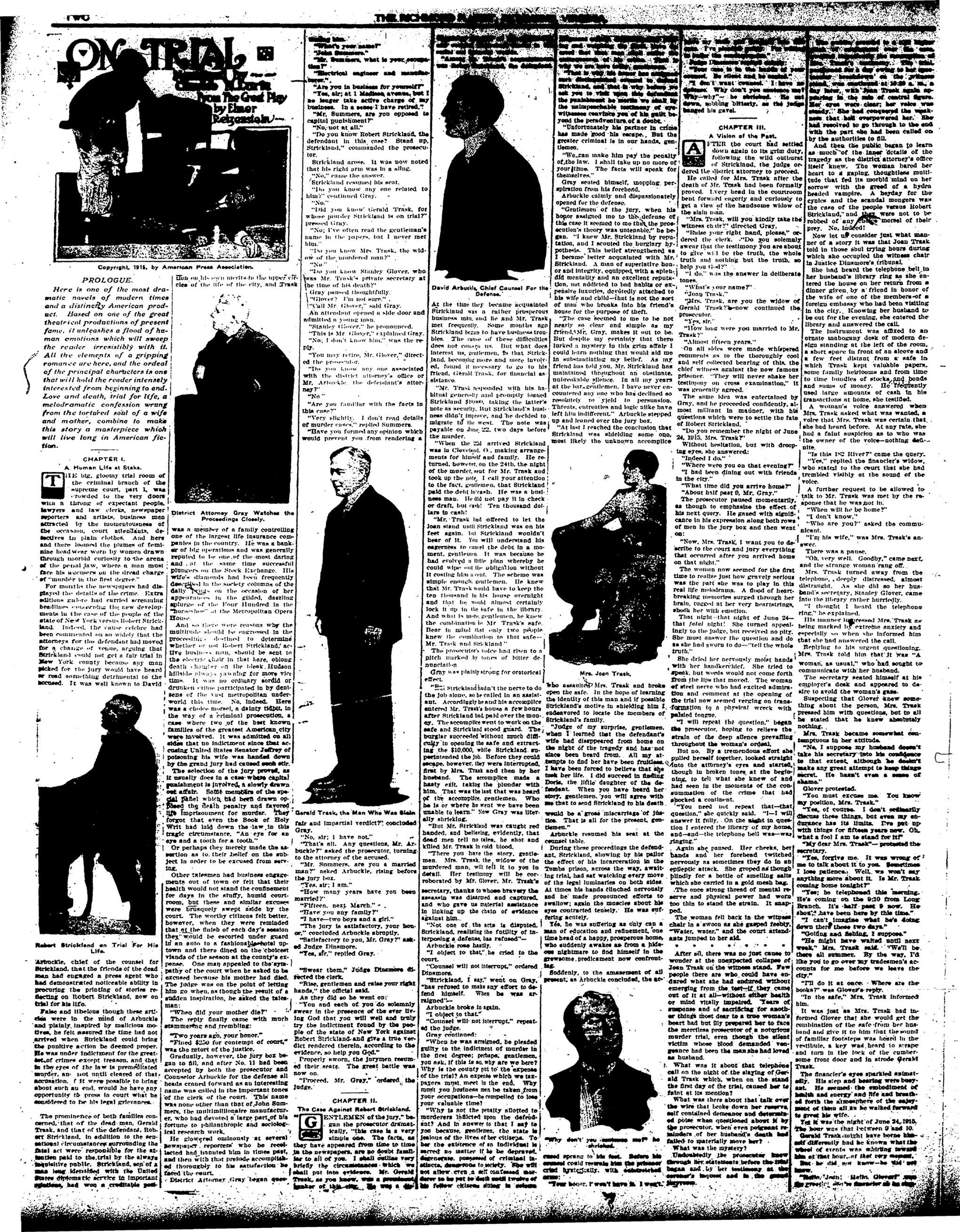
ON TRIAL
From The Great Play
by Elmer Reigansie in...
Copyright, 1915, by American Press Association.
PROLOGUE
Here is one of the most dramatic novels of modern times and a distinctly American product. Based on one of the great theatrical productions of present fame, it unleashes a flood of human emotions which will sweep the reader irresistibly with it. All the elements of a gripping romance are here, and the ordeal of the principal characters is one that will hold the reader intensely interested from beginning to end. Love and death, trial for life, a melodramatic confession wrung from the tortured soul of a wife and mother, combine to make this story a masterpiece which will live long in American fiction.
A. Human Life at Stake.
THE big, gloomy trial room of the criminal branch of the supreme court, part I, was crowded to the very doors with a throng of expectant people, lawyers and law clerks, newspaper reporters and artists, business men attracted by the momentousness of the occasion, court attendants, detectives in plain clothes. And here and there loomed the plumes of female head wear worn by women drawn through morbid curiosity to the arena of the penal law, where a man must face his accusers on the dread charge of "murder in the first degree."
For months the newspapers had displayed the details of the crime. Extra editions galore had carried screening headlines concerning the new developments in the case of the people of the state of New York versus Robert Strickland. Indeed, the cause celebre had been commented on so widely that the attorneys for the defendant had moved for a change of venue, arguing that Strickland could not get a fair trial in New York county because any man picked for the jury would have heard or read something detrimental to the accused. It was well known to David
THE
Robert Strickland on Trial For His Life.
Arbuckle, chief of the counsel for Strickland, that the friends of the dead man had engaged a press agent who had demonstrated noticeable ability in procuring the printing of stories refecting on Robert Strickland, now on trial for his life.
False and libelous though these articles were in the mind of Arbuckle and plainly, inspired by malicious motives, he felt assured the time had not arrived when Strickland could bring the punitive action he deemed proper. He was under indictment for the greatest set of crimes except treason, and that in the eyes of the law is premeditated murder, and not until cleared of that accusation, if it were possible to bring about such an end, would he have any opportunity to press in court what he considered to be his legal grievances.
The prominence of both families concerned; that of the dead man, Gerald Trask, and that of the defenders, Robert Strickland. In addition to the sensational circumstances surrounding the fatal act were responsible for the attention paid to the trial by the alwaysquisitive public. Strickland, son of a man long. Identified with the United States diplomatic service in important situations, had won a creditable post-
0
CHARTER I
Hon on his own merit in the upper circles of the life of the city, and Trank
THE LORD'S SUNDAY
District Attorney Gray Watches the Proceedings Closely.
was a member of a family controlling one of the largest life insurance companies in the country. He was a banker of big operations and was generally reputed to be one of the most daring and at the same time successful plumbers on the Stock Exchange. His wife's diamonds had been frequently described in the society column of the daily Times on the occasion of her appearances in the gilded, dazzling splurge of the Four Hundred in the Horsehead at the Metropolitan Opera House.
And so there were reasons why the multitude should be engrossed in the proceeding, deified to determine whether or not Robert Strickland, active business man, should be sent to the electric chair in that bare, oblong death chamber on the bleak, Hudson hillebile valley, yawning for more vice time. It was no ordinary sordid or drunken crime participated in by densens of the vast metropolitan underworld this time. No, indeed. Here was a choice mormon, a dainty tint, in the way of a criminal prosecution, a case where two of the best known families of the greatest American city were involved. It was admitted on all sides that no indictment since that accusing United States Senator Jefrey of poisoning his wife was handed down by the grand jury had caused such str.
The selection of the jury proved, as it usually does in a case where capital punishment is involved, a slowly drawn out affair. Some members of the special panel which had been drawn opposed the death penalty and favored life imprisonment for murder. They forgot that even the Book of Holy Writ had laid down the law, in this tragic circumstance. "An eye for an eye and a tooth for a tooth." Or perhaps they merely made the assertion as to their hollow on the subject in order to be excused from serving.
Other talesmen had business engagements out of town or felt that their health would not stand the confinement for days in the stuffy, humid courtroom, but these and similar excuses were bruisely swept aside by the court. The worthy citizens felt better, however, when they were reminded that at the finish of each day's session they would be escorted under guard in an auto to a fashionable hotel uptown and there dined on the chosen vlands of the season at the county's expense. One man appealed to the sympathy of the court when he asked to be excused because his mother had died. The judge was on the point of letting him go when, as though the result of a sudden inspiration, he asked the talesman:
"When did your mother die?"
The reply finally came with much stammering and trembling.
"Two years ago, your honor."
"Fined $250 for contempt of court," was the retort of the justice.
Gradually, however, the jury box began to fill, and after No. 11 had been accepted by both the prosecutor and Counselor Arbuckle for the defense all heads craned forward as an interesting name was called in the important tone of the clerk of the court. This name was none other than that of John Sommers, the multimillionaire manufacturer, who had devoted a large part of his fortune to philanthropic and sociological research work.
He glowered ominously at several newspaper reporters who be recollected had hummed in times past, and then with that prelude accomplished thoroughly to his satisfaction he faced the court.
District Attorney Gray began ques-
"Electrical engineer and manufacturer."
"Are you in business for yourself?"
"Yes, air; at 1 Madison avenue, but I no longer take active charge of my business. In a sense I have retired."
"Mr. Summers, are you opposed to capital punishment?"
"No, not at all."
"Do you know Robert Strickland, the defendant in this case? Stand up, Strickland," commanded the prosecutor.
Strickland arose. It was now noted that his right arm was in a sling.
"No," came the answer.
Strickland resumed his seat.
"Do you know any one related to him?" continued Gray.
"No."
"Did you know Gerald Trask, for whose pundertail is on trial?" pressed Gray.
"No; I've often read the gentleman's name in the papers, but I never met him."
"Do you know Mrs. Trask, the widow of the murdered man?"
"No."
"Do you know Stanley Glover, who was Mr. Trask's private secretary at the time of his death?"
Gray paused thoughtfully:
"Glover? I'm not sure."
"Call Mr. Glover," said Gray.
An attendant opened a side door and admitted a young man.
"Stanley Glover," he pronounced.
"This is Mr. Glover," explained Gray.
"No, I don't know him," was the reply.
"You may retire, Mr. Glover," directed the prosecutor.
"Do you know any one associated with the district attorney's office or Mr. Arbuckle, the defendant's attorney?"
"No."
"Are you familiar with the facts in this case?"
"Very slightly. I don't read details of murder cases." replied Summers.
"Have you formed any opinion which would prevent you from rendering a
1930
Gerald Tractk, the Man Who Was Stain
fair and impartial verdict? concluded
Gray.
"No, sir; I have not."
"No, sir. I have not.
"That's all. Any questions, Mr. Arbuckle?"
asked the prosecutor, turning to the attorney of the accused.
"Mr. Summers, are you a married man?"
asked Arbuckle, rising before the jury box.
"Yes, sir; I am."
"How many years have you been married?"
"Fifteen, next March." . . .
"Have you any family?" . . .
"I have two boys and a girl." . . .
"The jury is satisfactory, your bon
or," concluded Arbuckle abruptly.
"Satisfactory to you, Mr. Gray?" asked Judge Dinsmore.
"Yes, sir," replied Gray.
"Swear them," Judge Dinsmore directed the clerk.
"Rise, gentlemen and raise your right hands," the official said.
An they did so he went on:
"You and each of you do solemnly swear in the presence of the ever living God that you will well and truly try the indictment found by the people of the state of New York against Robert Strickland and give a true verdict rendered therein, according to the evidence, so help you God." Properly sworn, the jurymen resumed their seats. The great battle was now on. "Proceed, Mr. Gray," ordered the judge.
CHAPTER II.
The Case Against Robert Striakland.
ENTLEMEN of the jury," began the prosecutor dramatically, "this case is a very simple one. The fact, as they have appeared from time to time in the newspapers, are no doubt familiar to all of you. I shall outline very briefly the circumstances which we shall put into evidence. Mr. Gerald Trusk, as you know, was a prominent leader of this city. We was a
1910
David Arbuski, Chief Counsel For the Defense.
At the time they became acquainted Strickland was a rather prosperous business man, and he and Mr. Trask met frequently. Some months ago Strickland began to have business troubles. The cause of these difficulties does not concern us. But what does interest us, gentlemen, is that Strickland, becoming more and more involved, found it necessary to go to his friend, Gérard Trask, for financial assistance.
"Mr. Trask responded with his habitual generosity and promptly bounced Strickland $1000, taking the latter's note as security. But Strickland's business didn't improve, and he decided to migrate to the west. The note was payable on June 22, two days before the murder.
"When the 201 arrived Strickland was in Cleveland, O., making arrangements for himself and family. He returned, however, on the 24th, the night of the murder, sent for Mr. Trank and took up the note. I call your attention to the fact, gentleman, that Strickland paid the debt breach. He was a business man. He did not pay it in check or draft, but cash! Ten thousand dollars in cash!
"Mr. Trask had offered to let the Joan stand until Strickland was on his feet again. But Strickland wouldn't hear of it. You will understand his eagerness to cancel the debt in a moment, gentlemen. It was because he had evolved a little plan whereby he could wipe out the obligation without it costing him a cent. The scheme was simple enough, gentlemen. He knew that Mr. Trask would have to keep the ten thousand in his house overnight and that he would almost certainly lock it up in the bate in the library. And what is more, gentlemen, he knew the combination to Mr. Trask's safe. Bear in mind that only two people knew the combination to that safe--Mr. Trask and Strickland."
The prosecutor's voice had risen to a pitch marked by tones of bitter denunciation.
Grey was plainly strong for oratorical effect.
"But Strickland didn't the nerve to do the job alone, so he called in an assistant. Accordingly he and his accomplice entered Mr. Trask's house a few hours after Strickland had paid over the money. The accomplice went to work on the safe and Strickland stood guard. The burglar succeeded without much difficulty in opening the safe and extracting the $10,000, while Strickland superintended the job. Before they could escape, however, they were interrupted, first by Mrs. Trask and then by her husband. The accomplice made a hasty exit, taking the plunder with him. That was the last that was heard of the accomplice, gentlemen. Who he is or where he went we have been unable to learn." Now Gray was literally shrieking.
"But Mr. Strickland was caught red handed, and believing, evidently, that dead men tell no tales, he shot and killed Mr. Trask in cold blood.
"There you have the story, gentlemen. Mrs. Trank, the widow of the murdered man, will tell it to you in detail. Her testimony will be corroborated by Mr. Glover, Mr. Trank's secretary, thanks to whose bravery the ammunition was disarmed and captured, and who gave us material assistance in linking up the chain of evidence against him.
"Not one of the acts is disputed. Strickland, realizing the futility of interposing a defense has refused."
"Arbuckle rose hastily.
"I object to that," he cried to the court.
"Counsel will not interrupt," ordered Dinamore.
"Strickland, I say," went on Gray, "has refused to make any effort to defend himself. When he was arraigned."
Arbuckle broke in again.
"I object to that."
"Counsel will not interrupt," repeat
ed the judge.
Gray continued:
"When he was arraigned, he pleaded guilty to the indictment of murder in the first degree; perhaps, gentlemen, you ask, if this is so, why are we here?
Why is the county put to the expense of the trial? An expense which we taxpayers must meet in the end. Why must you business men be taken from your occupations—be compelled to lose your valuable time?
"Why is not the penalty allotted to murderers inflicted upon the defendant? And in answer to that I say to you because, gentlemen, the state is jealous of the lives of her citizens. To bar the existence of an individual is sacred no matter if he be deprived, degenerate, possessed of criminal instincts, dangerous to society. He will not allow, even a self confessed murderer to be put to death until twice of the following citizen duties in society."
1. What was it about that telephone call on the night of the slaying of Gerald Trak which, when on the stand the first day of the trial, caused her to faint at its mention?
What was there about that talk over the wire that broke down her reserve, self contained demeanor and deterred poise when questioned about it by the prosecutor, when even pogrom reminders of her husband's death had failed to materially move her?
What was the mystery?
Undoubtedly the prosecutor knew through her statements before the trial began and, by her testimony at the court's request and in the grand
Your honor, I won't have it. I won't. Sleeproom
The most painful disgraceful thing and wiping the flesh have ever been that men shall suffer the entanglement of his wrath. That is why we are here today, gunmen. That is why the enemy has assigned such distinguished courage to defend Stirkland, and that is why before we ask you to visit upon the defendant the punishment he mortals we shall the unimpossible testimony of eyewitnesses convince you of his guilt beyond the adventure of a doubt.
"Unfortunately his partner in crimes has made good his escape. But the greater criminal is in our hands, gentlemen.
"We can make him pay the penalty of the law. I shall take up no more of your time. The facts will speak for themselves."
Gray seated himself, mopping perspiration from his forehead.
Arbuckle calmly and dispassionately opened for the defense.
"Gentlemen of the jury, when his honor assigned me to the defense of this case it seemed to me that the prosecution's theory was untenable" he began. "I knew Mr. Strickland by reputation, and I escaped the burglary hypothesis. This belief strengthened as I became better acquainted with Mr. Strickland. A man of superlative honor and integrity, equipped with a splendid mentality and an excellent reputation, not audited to bad habits or expensive luxuries, devotedly attached to his wife and child—that is not the sort of man who breaks into his friend's house for the purpose of theft.
"The case seemed to me to be not nearly so clear and simple as my friend, Mr. Gray, makes it out to be. But despite my certainty that there lurked a mystery in this grim affair I could burn nothing that would aid me in substituting my belief. As my friend has told you, Mr. Strickland has maintained throughout an obstinate, unbreakable silence. In all my years at the bar gentlemen, I have never encountered any one who has delicately so resolutely to yield to persuasion. Threats, cuttiness and logic alike have left him indifferent." Arbuckle stepped up and leaned over the jury box.
"At last I reached the conclusion that Strickland was shielding some one, most likely the unknown accomplice
THE
Mrs. Joan Trask.
who assaulted Trank and broke open the safe. In the hope of learning the identity of this man and if possible Strickland's motive in shielding him I endeavored to locate the members of Strickland's family.
"Judge of my surprise, gentlemen, when I learned that the defendant's wife had disappeared from home on the night of the tragedy and has not since been heard from. All my attempts to find her have been fruitless. I have been forced to believe that she took her life. I did succeed in finding Doris, the little daughter of the defendant. When you have heard her story, gentlemen, you will agree with me that to send Strickland to his death would be a gross miscarriage of justice. That is all for the present, gentlemen."
Arbuckle resumed his seat at the counsel table.
During these proceedings the defendant, Strickland, showing by his pallor the effect of his incarceration in the Tombs prison, across the way, awaiting trial, had sat watching every move of the legal luminaries on both sides. At times his hands clinched nervously and he made pronounced efforts to swallow; again the muscles about his eyes contracted tensely. He was suffering acutely. Yes, he was suffering as only can a man of education and refinement, one time head of a happy, prosperous home, who suddenly awakes as from a bideous nightmare to himself in the growsome, predicament now confronting. Suddenly, to the amazement of all present, as Arbuckle concluded, the se
"Why don't you sentence me?" he shrieked.
cured spring to his foot. Before his counsel could retrieve him the prisoner crieled historically, with ostracinated arms:
half my back, and brought his still face. I've pinned grief. For nothing to bother the encampment."
Judge Dumaine waited calmly:
"Your case is in the hands of your counsel. Be silent and be mindful."
"I don't want counsel. I have no defense. Why don't you sentence me? Why-why-why" be silenced. He met down, sobbing bitterly, as the judge hanged his gavel.
CHAPTER III
A Vision of the Past.
TTER the court had settled down again to its grim duty, following the wild outcourt of Strickland, the judge or
FTER the court had settled down again to its grim duty, following the wild outcultures of Strickland, the judge ordered the district attorney to proceed.
He called for Mrs. Trask after the death of Mr. Trask had been formally proved. Every head in the courtroom bent forward eagerly and curiously to get a view of the handsome widow of the slain man.
"Mr. Trask, will you kindly take the witness chit?" directed Gray.
"Ruise your right hand, please," ordered the clerk. "Do you solemnly aware that the testimony you are about to give will be the truth, the whole truth and nothing but the truth, so help you God?"
"I do," was the answer in deliberate tones.
"What's your name?"
"Joan Trask."
"Mrs. Trask, are you the widow of Gerald Trask?"—now continued the prosecutor.
"Yes, Mr."
"How long were you married to Mr. Trask?"
"Almost fifteen years."
"On all sides were made whispered comments as to the thoroughly cool and self collected bearing of this, the chief witness against the now famous prisoner. "They will never shake her testimony on cross examination," it was generally agreed.
The same idea was entertained by Gray, and he proceeded confidently, almost militant in manner, with his questions which were to settle the fate of Robert Strickland.
"Do you remember the night of June 24, 1915, Mrs. Trask"
Without hesitation, with drooping eyes, she answered:
"Indeed I do." "Where were you on that evening?" "I had been dining out with friends in the city." "What time did you arrive home?" "About half past 0, Mr. Gray." The prosecutor paused momentarily, as though to emphasize the effect of his next query. He gazed with significance in his expression along both rows of men in the jury box and then went on: "Now, Mrs. Trask, I want you to describe to the court and jury everything that occurred after you arrived home on that night." The woman now seemed for the first time to realize just how gravely serious was the part she was to play in this real life molodrama. A flood of heart-breaking memories surged through her brain, tugged at her very heartstrings, shocked her with emotion.
That night--that night of June 24--that fatal night! She turned apparently to the judge, but received no pity. She must answer the question and do as she had sworn to do—"tell the whole truth."
She dried her nervously moist hands with her handkerchief. She tried to speak, but words would not come forth from the lips that moved. The woman of steel nerve who had excited admiration and comment at the opening of the trial now seemed verging on transformation to a physical wreck with palmed tongue.
"I will repeat the question," began the prosecutor, hoping to relieve the strain of the deep silence prevailing throughout the woman's orded.
But no. By a tremendous effort she pulled herself together, looked straight into the attorney's eyes and started, though in broken tones, at the beginning, to tell what she knew of and had seen in the moments of the consumption of the crime that had shocked a continent.
"You need not repeat that—that question," she quickly said. "I—I will answer it fully. On the night in question I entered the library of my home, and—and—the telephone bell was—was ringing."
The once strong thread of mental reserve and physical power had worn too thin to stand the strain. It snapped.
The woman fell back in the witness chair in a swoon as she gasped feebly, "Water, water," and the court attendants jumped to her aid.
After all, there was no just cause to wonder at the unexpected collapse of Joan Trak on the witness stand. Few people there are who could have endured what she had endured without emerging from the test—if they came out of it all—without either health or mind vitally impaired. Years of suspense and of sacrificing for another thing most dear to a true woman's heart had but silly prepared her to face the merciless prosecutor of a notorious murder trial, even though the silent victim whose blood demanded vengeance had been the man she had loved as husband.
She gently provided to a still higher pitch. Her unimpressed face, the one preoccupied beginning the assumption of love. Truss's testimony. The third person for a day owing to her unrequited breakdown on the prince's mind, was onwarded at 10:29 a.m. a day later, with Jean Truss again appearing in the midst of central figure. Her eyes were clear; her voice was steady. She had conquered the weakness that hall overpowered her. She had resolved to go through to the end with the part she had been called on by the authorities to fill.
And then the public began to learn as much of the inner details of the tragedy as the district attorney's office itself knew. The woman barred her heart to a raping, thoughtless matitude that fed its morbid mind on her sorrow with the greed of a hydro headed vampire. A heyday for the crypil and the scandal mongers was the case of the people versus Robert Strickland, and there were not to be robbed of any choice morsel of their prey. No, indeed!
Now let us consider just what manner of a story it was that Joan Trask told in those soul trying hours during which she occupied the witness chair in Justice Dinnore's tribunal.
She had heard the telephone bell in her husband's library ring as she entered the house on her return from a dinner given, by a friend in honor of the wife of one of the members of a foreign embassy who had been visiting in the city. Knowing her husband to be out for the evening, she entered the library and answered the call.
The instrument was affixed to an ornate inabagany desk of modern design standing at the left of the room, a short space in front of an alcove and a few feet distant from a safe in which Trask kept valuable papers, some family heirlooms and from time to time bundles of stocks and bonds and sums of money. He frequently used large amounts of cash in his transactions at home, she testified. A woman's voice answered when Mrs. Trask asked what was wanted, a voice that Mrs. Trask was certain that she had heard before. At any rate, she had a faint suspicion as to who was the owner of the voice—nothing adnite. "In this 182 River 7" came the query. "Yes," replied the financier's widow, who stated to the court that she had trembled visibly at the sound of the voice.
A further request to be allowed to talk to Mr. Trask was met by the response that he was not in.
"When will he be home?"
"I don't know."
"Who are you?" asked the communicant.
"I'm his wife," was Mrs. Trask's answer.
There was a pause.
"Oh, very well. Goodby," came next, and the strange woman rang off.
Mrs. Trask turned away from the telephone, deeply distressed, almost distraught. As she did so her husband's secretary, Stanley Glover, came into the library rather hurriedly.
"I thought I heard the telephone ring," he explained.
His manner impressed Mrs. Trask as being marked by extreme anxiety and especially so when she informed him that she had answered the call.
Replying to his urgent questioning, Mrs. Trask told him that it was "A woman, as usual," who had sought to communicate with her husband.
The secretary seated himself at his employer's desk and appeared to desire to avoid the woman's gaze. Suspecting that Glover knew something about the person, Mrs. Trask pressed him with questions, but to all he stated that he knew absolutely nothing.
Mrs. Trask became somewhat contemptuous in her attitude.
"No, I suppose my husband doesn't take his secretary into his confidence to that extent, although he doesn't make any great attempt to keep things secret. He hasn't even a sense of shame."
Glover protested.
"You must excuse me. You know my position, Mrs. Trask."
"Yes, of course. I don't ordinarily discuss these things, but even my endurance has its limits. I've put up with things for fifteen years now. Oh, what a fool I am to stand for it."
"My dear Mrs. Trask"—protested the secretary.
"Yes, forgive me. It was wrong of me to talk about it to you. Sometimes I lose patience. Well, we won't say anything more about it. Is Mr. Trask coming home tonight."
"Yes, he telephoned this morning. He's coming on the 9:10 from Long Branch. It's half past 9 now. He shouted, have been here by this time."
"I can't imagine what he's doing down there these two days."
"Goling and fishing, I suppose."
"He might have waited until next week." Mrs. Trask said. "We'll be there all summer. By the way, I'd like you to go over my tradesmen's accounts for me before we leave the city."
"I'll do it at once. Where are the book?" was Glover's reply.
"In the safe." Mrs. Trask informed him.
It was just as Mrs. Trask had informed Glover that she would get the combination of the safe from her husband and give it to him that the sound of familiar footsteps was heard in the vestibule, a key was heard to scrape and turn in the lock of the cumbersome front door and in strode Gerald Trask.
The financier's eyes sparkled animatably. His step and hearing were buoyant. He seemed the embodiment of health and energy and life and breathed forth the atmosphere of the enjoyment of them all as he walked forward to greet his wife.
Yes it was the night of June 24, 1915. The hour was that between 9 and 10. Gerald Trask might have borne himself differently had he known what the wheel of events was whirling toward him at that hour, of that very moment. But he did not know—he did not know.
"Bette," Joan! Heilin, Glowert, says the greetest, is to be mannered as he goes.
SATURDAY...NOVEMBER 27, 1915
On the part of the private secretary was seen the curious mixture of obese
will soon be the curious mixture of our
Stanley Glover, Secretary to Gerald Trask.
Stanley Glover, Secretary to Gerald Trask.
quoliousness which marks the employee who is at once the servant and the confidant of his employer. There was evident perturbation in his manner, as that of one who was oppressed perhaps by a secret of his own. But there was plainly apparent, in addition, the great desire to please.
Glover stood in parlous case. Without willing it he had been forced to witness the outbreak of a wife against her husband, and that husband the man on whom his own prosperity depended. Not knowing what might be future developments in the relations between Mr. and Mrs. Trask he must perform maintain a discreet distance between the two.
"Good evening, Mr. Trash," was his greeting to the man who entered. But the wife who had voted but a few moments before her dissatisfaction with her husband's conduct did not reply to his "Hello."
---
Her silence was noticeable. Turning to her, Trask, with a mixture of sympathy and contempt, asked, "Well, what's wrong with you again?"
The disdainful "again," implying that the man lazed in mind their long courage or disagreement, sting the woman to the quick. It looked as though there would be a stormy scene, and Glover took hold of the edge of the desk with both hands as if to brace blisself against the gathering storm.
With an effort Mrs. Trask controlled herself, and she turned away with a brief "Nothing."
"Oh, is that all?" replied Trask, and then Stanley Glover, again the snave, cool, collected petate secretary, his tension relaxed, stepped into the breach.
"Allow me," he said, stepping to the side of Trask and taking his hat and overcoat. He deposited them on a chair.
"Anything new. Glover?" asked Trask.
"No, air," replied Glover.
Throughout the scene the telephone call from "the other woman" had been
E
The Telephone Call For "the Other Woman."
sanging to and fro in the mind of Mr. Truck. Now she turned again to her husband, and, looking directly at him, she said:
Forlance with the memory of similar scenes in mind the wife answered: "I suppose you know well enough." "If I knew I wouldn't ask you. Who was it?"
CHAPTER IV.
AND then Stanley Glover, scanting the approach of the storm, again interposed hastily:
"Do you mind opening the safe, Mf. Trask? I want to get Mrs. Trask's account books."
With an "All. right" Trask began feeling in his pockets. He explored one after another without result. "What did I do with that cann'!' he said. "I had a card with the combination written on it. That's a funny thing. Where the devil did I put it?"
"Maybe it's in another suit," suggested Mrs. Trask, while Glover asked: "When did you have it last?"
When you have it last.
To the secretary Trask replied:
"Yesterday morning before I left. I opened the safe to get my check book."
Agrin from Mrs. Trask:
"Terhaps you left it down at Long Branch."
The mention of the watering place seemed to irritate the financier. There were associations with its name, perhaps, which made the mention by his wife doubly disagreeable. On the lips of others "Long Branch" was merely a name on a map, a pleasant place wherein to while away a holiday. There was something in "Long Branch" from her which made him turn on her and say savagely, with no attempt to conceal his irritation:
"That's ridiculous! Why should I leave the combination to the safe at Long Branch."
She did not reply to his outburst of temper. He stood thinking intensely for a moment, and then exclaimed: "Oh, I know what I did with it! I gave it to Strickland. I've just come from there. I invited him to come down to Long Branch on Sunday, and I wrote the address on the card for him."
"Are you sure the combination was on that card?" asked Glover.
"Yes. I never stopped to look at the other side. Very careless of me. You'll have to wait until tomorrow for the books."
To this the secretary replied, "Well, there's no hurry about it," but his employer raised his hand, with "Wait a minute. I believe I can get that combination."
He walked past Glover to the safe, bent down to the knob and began to manipulate it. For a moment his memory failed him, and he said to himself, "No, that's not it." "Don't bother about it," said Glover, and the choker of the older man again found vent. Was there something in the surcharged domestic atmosphere that irritated him? Was it the presence of his wife, standing silently by while he tried to open his safe, or was it the shadow of impending doom which darkened his soul on this night? "Say," he snapped to the waiting Glover, "you know if you're going to talk I never can remember these numbers. I've got it. There you are." Turning the handle of the safe and pulling the door toward him, he said to Glover, "Help yourself."
With the books in his hand, Glover said to Trask, "Do you want to do any work tonight?" "No, I don't think so. I want to turn in early. I've been golfing all day, and I'm tired." For some minutes, while the safe was being opened, Joan Trask had sat silent. Only the nervous working of her hands, twisting and untwisting a handkerchief and the slight frown on her face told that she still thought of the mysterious telephone call. But it was not of that she spoke, but of her disatisfaction with her husband's conduct. In the words which arrested Glover as he was about to leave the room and which brought anew the contemptuous look to the face of her husband.
"Seems to me you might have waited until we all went down to Long Branch," she said.
"When are you going?"
"Monday. Aren't you coming with us?"
"I'm going down Saturday night. I've got up a fishing party for Sunday morning. Like to join me, Glover?"
Like to join them! Why. It was meat and drink to the young private secretary to sit and stand and walk and break bread with his wealthy employer and the set with whom Trask surrounded himself. They were Stanley Glover's folks—the "big fellows" of the "street"—there is but one street in New York that is known without its distinguishing name—who manipulated millions. Despite his repression and quiet exterior young Glover was consumed by a burning desire to be as they were. His salary was simple for his needs, and his position in the Trask establishment was not a mean one. But in his heart of hearts he cherished the ambition to acquire wealth such as was possessed by his employer and the men with whom he associated and to have a private secretary of his own. No more ardent worshiper of Mammon, albeit in a carefully concealed fashion, than Stanley Glover existed in New York. Picking the figurative crumbs from his employer's table, he had begun to "play the market." But luck had been against him, and he had lost.
Like to join them! Gratification beamed from every feature of the young man's face as he replied:
"Thanks! I'll be glad to!"
"Strickland's coming with on," said Trank.
"When did he get back from the wort?"
"Tonight. He wired me to meet him at his home."
"What are you going to do about that note of his? It was due on the 22d, you know."
"He paid it," said Trank. "I have the ten that and here."
THE RICHMOND PLANET, RICHMOND, VIRGINIA.
1916 Calendars Now Ready
We have a fine line of Calendars for 1916, both imported and domestic and they are now ready for the inspection of the Public. We can quote prices that will be of special interest to those who buy these kind of souvenirs. A visit is requested even if you are not ready or are not prepared to purchase now.
THE LINE IS ATTRACTIVE AND THE DESIGNS ARE NEW AND SURPRISINGLY BEAUTIFUL. THE J. W. BUTLER PAPER CO., OF CHICAGO, ILL. HANDLES THE FINEST LINES OF CALENDARS, COLLEGE COMMENCEMENT PROGRAMMES AND FOLDERS OF ANY HOUSE IN THE COUNTRY. TO SEE THEM IS TO REALIZE TO THE FULLEST EXTENT THE FORCE OF THIS DECLARATION.
CALL AT THE PLANET OFFICE, 311 N. 4TH ST., (BET. BROAD AND MARSHALL STS.) RICHMOND, VIRGINIA. Out of Town Orders Solicited.
With that he reached into an inside pocket, took out a thin package of bills and placed them on the desk.
"I'm surprised," Glover said. "I thought he would fall down."
"He got it from these business connections in Cyprus. When I got to his home tonight he had the ten thousand. I didn't want to take it. I told him I knew he was hard pressed and that I didn't mind holding off for awhile."
A smile passed over the face of the financier, which was turned for the moment away from his two companions in the room. It was not a benevolent smile, telling of the applause of the inward voice for a good deed well performed. Rather was there something sinister and crafty about it. Treacherous, perhaps, as was the smile of Joan when he took Abner inside in the gate.
T
"Strickland's awfully fond of his wife."
"Strickland's awfully fond of his wife."
"to speak with him quietly and snote him there under the fifth rib, that he died."
The smile passed unnoticed of Mrs. Trask and Glover, and the secretary asked:
"What did he say?"
"He wouldn't hear of it. Wants to begin with a clean slate, he says."
The usually quiet secretary permitted himself for once to approach the border of euthusiasm.
"That's like Strickland, straight clean through," he exclaimed. "He's a fine chap. Too bad he couldn't make things go."
The "business man" came uppermost in the mind of Trask. He shrugged his shoulders as he answered:
"Well, that's business. Somebody's got to go to the wall."
got to go to the wall.
"Brickland takes it pretty hard. On account of his wife, I grade. He's aw-
fully fond of her."
While business was being discussed Mrs. Traworth had set up. Now the mention of another woman aroused her perplexity. It was the thought of a woman's presence which had been denied to her, the friend of the full and faithful wife of the man and she resisted.
"Is she a true woman?"
Was it the intention of golf, the winters or the hours of travel or something else which made Trask your objection be referred to his wife? Certain it was that the mention of an action, in which he would not tire him, the man, who continued keen attention in that affair with a pursuit of palace that would have done credit or the result to a woman of the days of imperial endeavour.
"Couldn't say. Never not her," he answered. Then he turned to Glover, saying:
"You better put that $1000 in the safe, Glover."
"Why the cash?" asked the young man.
Again the smile appeared on the lips of Trask.
"Well, he said it had been so darned hard for him to get it that he wanted the pleasure of handling it to me in ten $1,000 bills. He sure to deposit it in the morning."
Glover took the money and went to the safe. Mrs. Trask sat quietly, notiding nothing, distracted by thoughts of "the other woman." Trask sat at the desk, stretching his limbs and yawning. Neither saw that the money was deposited securely in the inner compartment of the safe. Glover turned his head to ask, "Shall I lock it, sir?" "Yes," said Trask, and Glover rose, with the words, "Anything else?" "I don't think so. Oh, yes." Better remind he to get that card from Strickland in the mail.
"All right, said Gloster. "I'll go to my room now." He picked up Mrs. Trask's account books from the table and said to her, "I'll have these ready for you in the morning, Mrs. Trask." She thanked him, and there were three "Good nights" as he left the room. When he had gone there was a brief skit, broken only by a prodigious and discourous yawn from Trask. It was plainly to be seen that between Gerald and Joan Trask there was nothing of the sweet confidence and intimacy of married life which make happy lock the nearest earthly approach to heaven. Long before she had begun to love him, Years before he had forfeited his ability and indifference the love she had once felt for him. But it not was dead. It needed but the spark of renewed affection, respect and trustworthiness on his part to bring it into full blaze. Joan Trask was a good woman, a wife of who any man might have been proud. Even in physical attractions she was not wanting, and strangers seeing her decked in costly culiment and jewels curried Gerald Trask his consort. Her face told nothing of the grounds which her husband's success
YOU CAN FIND HERE ADVERTISING
CALENDARS SUITABLE FOR ALL LINES OF BUSINESS AND AT PRICES THAT WILL SURPRISE YOU.
THERE IS ALSO A LINE OF "LEFT OVER" 1915 CALENDAR BACKS, WHICH CAN BE SOLD AT A SACRIFICE TO LARGE PURCHASERS, WHO DESIRE TO SAVE MONEY.
of slights and insults, contended
with misdeeds had made on her
spirit.
"For the sake of the children, she
potent distinction of love and vile
great women" "she had house with"
"But tough" "she now had wife with"
"forest. Her soul was consumed by a
burning desire to know who the other
woman" "was. Not that it matters I
much. Who are she was she was but
the latest of a long line. But John
Trask is the latest this time. He was
her lawful husband and he must come
out into the world.
As answer, Glover was out of one hat
she turned to himself.
"Glover who is this woman?" she
asked.
"Oh what woman?" The words were
drawled in a tone which might
have been loud and weariness of either
body or spirit.
"The one who called up awhile ago."
Trail put his hands into his trousers
pockets and rose, stretching. "Say,
aren't you close with that yet? I told
you I don't know," he replied.
She reached out. "You do know."
TO BE CONTINUED.
Robert Burns' Father.
In boyhood Robert Burns saw his father distressed by landbords and their factors upon a rack renting intent. Upon evil days had agriculture then fallen. Markets were limited or remote and inaccessible. The hydraheaded industrialism, flourishing now upon iron ore and coal in Ayrshire and Lanarkshire and consuming the produce of the farms, had not then emerged in history.
Although descended from Highland clansmen, William Burns, the poet's father, had outgrown the feudal loyalty which works out as sheer flunkeyism, accepting the cuffs and kicks of the superior person with the inverted pride which counts it a distinction even to be kicked by the foot of an aristocrat.
"I have not with fewer wrote the poet of his father in the autobiographical letter to Dr. Moore, "who understood men, their manners and their ways equal to him; but stubborn, ungainly integrity and headlong, ungovernable insavibility are qualifying circumstances; consequently I was born a very poor man's son."
The public spiritual citizen who is worrying over national preparedness can set a good example by looking to his own coal bin.
Deer chasing often turns out to be dear sport, even dearer than buying one's venison at the butcher shop.
Ten years of recuperation may make good for Mexico's three years of revolution, and again they may not.
Mexico now has counterfeit money. But no have we, no thereof.
DEALER IN
Choice Groceries, Wines
Liquors and Cigars
PURE GOODS. FULL VALUE
FOR THE MONEY.
1610 East Franklin St.
(Near Old Market)
RICHMOND VIRGINIA
A. HAYES,
OFFICE AND WAKEROOMS;
727 N. Second St.
RESIDENCE—725 N. SECOND ST.
First-illass Hacks and Caskets of
all descriptions. I have a spare room
for bodies, when the family have not
suitable place. All Country Orders
given Special Attention.
Your special attention is called to the New Style Oak Caskets. Call and see me and you shall we waited on individually.
'PHONE, MADISON 2788
OTHER PEOPLE JUDGE
you by your Furniture now! When you can get Furniture and Rugs from an Old Established house like JURGENS—that's known to sell the best quality goods, just as reasonable as elsewhere—why not give your friends a good impression. It will give us the greatest pleasure to show you our wonderful stock of homemaking comfort giving Furniture and Rugs and—don't fail to ask our salesmen about our banking plan which gives you 5, 10 or 15 months in which to pay for any purchase.
CHAS. G. JURGENS SON
ESTABLISHED 1899
ADAMS AND BROAD
WANTED—First class—burrow once. Good wages paid the right party. Ideal location. Write off once to R. R. Stewart, 247 Thames Street, Newport, R. I. 4t.
RICHMOND PLANET
RICHMOND PLANET
RAILROADS
Richmond, Frederickburg & Potomac R. R.
To and From Washington and beyond
Leave Richmond daily
* 6:20 AM 10:00 AM 12:00 AM 1:50 PM
* 9:23 AM 10:35 AM 12:01 PM 1:25 PM 8:30 PM 9:00 AM
* 9:23 AM 10:35 AM 12:01 PM 1:25 PM 8:30 PM 12:40 AM
* 8:20 AM 10:20 AM 12:00 AM 1:25 PM 8:30 AM 12:40 AM
Included午休, work days, Jr. Time 7:30 AM 7:15 AM 6:30 AM
For 6:30 AM, 11:25 AM, 5:02 PM. Frederickburg, work days, Jr. 1:40 PM, Jr. 19:25 PM. Frederickburg, work days, Jr. 1:40 PM, Jr. 19:25 PM. Ripley R. R. (shopping at Dix). Big Red sign.
NORFOLK & WESTERN.
ONLY ALL RAIL LINE TO NORFOLK.
Schedule in effect, April 8, 1918.
Leave Byrd Street Station, Richmond, for
NORFOLK: 9:00 A. M. 9:30 P. M. 10:40 P. M.
For LYNCHBURG AND THE WEST: 9:15 A. M.
For ATLANTA: 9:30 P. M.
Arrive Richmond from Norfolk: 11:40 A. M.
8:30 P. M. 11:30 P. M. From the West: 9:45 A. M. 11:10 P. M. 11:40 P. M. 9:45 P. M. 9:00 P. M.
*Daily.* **Daily:** except Sunday. **Dunday only**
W. H. BEVILL, W. G. BAUNDER
P. T. M. Roanoke O. P. A. Roanoke
C. H. BOLLEY, D. P. A. Richmond, Va.
ATLANTIC COAST LINE.
EFFECTIVE APRIL 6, 1915.
TRAINS LEAVE RICHMOND DAILY—
For Florida and the South: *8:15 A. M., 6:18*
P. M., 12:20 A. M.
For Norfolk: 9:00 A. M., 8:00 P. M., *4:00*
P. M., *4:10 P. M.
For N. & W. Ry., West: 6:15 A. M., 6:08
A. M., 8:00 P. M., 6:20 P. M.
For Patterson, I75. A. M., 6:15 A. M.
5:15 A. M., 9:00 A. M., 9:00 A. M., 2:00 P. M.
*4:00 P. M., *4:10 P. M., 6:55 P. M., 6:58 P. M.
9:20 P. M., 11:50 P. M.
For Goldshore and Payetteville: *4:00 P. M.
TRAINS LEAVE RICHMOND-DAILY:
5:20 A. M., 9:18 A. M., 6:20 A. M., *8:27 A. M.,
**10:45 A. M., 11:40 A. M., *21:10 P. M.,
*14:40 P. M., 6:17 P. M., 6:20 P. M., *0:60 P. M.,
P. M., 11:50 P. M.
Except Sunday **Sunday only.
Time of arrival and departure and connections
not guaranteed.
C. B. CAMPBELL, D. P. A., 800 Main
THE SOUTHERN
SR
SERVES THE SOUTH
10:30 A. M.-Daily-Limited-For all points South
3:00 P. M.-Except Sunday-Local for Chester City, Durham and intermediate stations.
6:00 P. M.-Daily-For Danville, Atlanta and Burningham, with Pullman observation along our.
11:15 P. M.-Daily-Limited-For all points South. Pullman ready 8:00 P. M.
YORK RIVER LINK.
6:10 P. M.-Streamer train (Parlor car)-Bully local To West Point, connecting to Baltimore daily except Sunday.
7:30 A. M.-Daily-Local to West Point.
TRAINS ARRIVE RICHMOND
From the South: 7:05 A. M., 8:00 A. M.
3:00 P. M., and 8:30 P. M., daily; 8:40 A. M., except Sunday.
From West Point: 8:10 A. M., 6:15 P. M., daily.
H. L. BIEHOP, D. P. A.
407 East Main St. Phone, Med. 109
CHESAPEAKE & OHIO.
Cincinnati, Louisville & West, 7:00 P. 11:00 P.
Main Lane Local, 7:00 A. 7:00 P. 8:25 P.
James River Line, 10:00 A. 5:15 P.
N. News, Norf, Old Pt. 9:00 A. 13 M. 4 P.
Newport News Local, 7:15 A. 5:00 P.
Train arrive from Norfolk, 11:00 A. 7:05 P.
6:00 P. Newport News, 8:05 A. 8:00 P.
From West, 7:00 P. 8:40 P. 9:15 A.
1:00 P. 7:00 P. James River, 7:25 A.
7:15 P. Daily. **Exempt Sunday.**
SEABOARD AIR LINE
THE PROGRESSIVE EAILWAY OF THE SOUTH
Northbound train scheduled to leave Richmond
tally, 0:35 A. M., local to Norfolk; 1:30 P. M.
Jacksonville, 0:35 A. M., Atlanta, Birmingham,
Jacksonville, 0:35 P. M., Tampa, Birmingham,
Jacksonville, 1:45 A. M., a sleeper, Atlanta,
Birmingham, Jacksonville, Tampa and condo
Jacksonville.
Northbound train scheduled to arrive in Richmond
tally, 4:00 A. M., a sleeper, Atlanta, Loud,
9:20 A. M., 9:27 P. M.
ALPHEUS SCOTT
(CHURCH HILL)
Funeral Director and
Embalmer
OPEN DAY AND NIGHT
Office, 3006 P Street, Phone,
Mad. 2337—Residence, 1015
St. James St., Phone,
Madison 6619.
Paraphernalia, Material and Service of
the Best. Solvable Service. Moderate Rate.
MADAME MOOTT. Embalmer for Women
and Children and its attendance at
Funeral.
Subscribe to the Richmond Planet,
It only spends $1.50 per year in ad-
vance.
Z BAe A Sa SS
reamed crap‘ Gemmene Oe, seme site,
a yw. oe Be, Miaeond, Vas
JOHN MITCHELL, JR..... EDITOR
Ail tommantetlons intenSed_ for pubtication
wabals So erat oe arto reach we by Wiedrnday.
Totes cite Pod Gir at Nicumonl Ve
oe SOK Sa mater.
SATURDAY....NOVEMBER 27, 1915
ee
+ Some people cannot tell the truth
“from the nose to the chin”
Many colordd folks believe in church
and in quarrelling in churches
wo. 3
Se a
“he hil of progress Je steep and
laay people vo not care to climb we
* nine
ry Pe.)
Poople marry for better or for worse.
Nowadays, most of them marry tor
weorne.
‘
——=
Life as long when you peer Inte the
future and short when you lok at Me
past . : :
< Mont peoples inake themselves un.
ber une and everytedy ele, sumber
tre,
Some people are never se bapoy
when thes are altending ty other peo
Ben bustieas aid Weber Ro thiserate
ne when they are attendant Mier
own, business.
Even Borrow Winey, Mosier Tet.
dat wrote an enlogy upor Di Horatt
7. Wasiiaates
The demaxoxuen have bad their day
In politics and the poople are ragertid
aw a result of i
‘Trouble ix for everybody ae des
world Thin ax a warn of trout,
(rials and tribulations:
Whenever pefnene nieasure Meir
Rointe by manebeddy elses yard ste
there wild be fhanctad treulele
The erserinnis paid te Been“
Wasta nines atten deathly euteaated
any evterded te kin darig les hte
tine
The noxt legieiature of Virginia 0 ti
no doubt pass liws te entirely elitid
hate the sale of whiskey, but not ite
Colored folk have wll the rights in
law when they read them and very
few rights In law when they ge ts
et ther 1
lie ,
C0 —_——==—— | cs
ue tebe howe BN BOS
The only evidence that some pena
will have in the Eereafter: that they
are in tivaven willbe that they are
antianied. y
Too many people are xatistied wit:
an ordinary living. They do not
strive to Ket to the top, becaure it am
diMeult to get there
-Poople who live toe enjoy got
health up to seventy five years ate
ready and willing t6 enjoy go!) health
for “seventy-five years more.
sn)
Wo can gauge the years of our Ht
by the rising generation. Apparently,
persons who were children yesterday.
are men and women today.
*Gop has been good and kind to us
and Jt was richt and proper that » day
was set forth for extending Him a
grateful acknowledgment of our,
thanks.) e "7
Pararsext | Woovrow Witsox has |yoty
recognized Paxswesr Camsanra 10 | wor;
Mexico and Parwexs Cassarta bas] aor
recognized him, but Gey. Viiz4 does ears
M0t soem to be recognizing either. J- ony
—— Foun
® Ba Lee
Most of the colored editors would } justi:
Mie to write eulogies upon Srxatoa| the
Jaume K Vamamax, Samaton B. R. | baste
‘Tmasan and Ma. Tomas Drier, Jn.,| wiee
et thess mes will not die. _ pom
pig cia bits vad yeas angel
| Wien ‘some folks lose all’ their
money or get in trouble, thel “ran to
Jnsus:" As soon as they ‘get moro;
money or get out of trouble, they
“run from Jnack.” |
“Thousands of people in this wor!d
fare on a lookout for pleasures whicti
they “believe will, bring Rappiness.
True happinass is mot secured that
way. It Nes tn contentment.
4 eS
Somo folka think “erap.shooting” In
a colored folks’ game. This in all o
mistake. No one ikea it better than
tho average white man who lx wedded
to a chance proposition.
One writer Rax sald, “If relixion
wan o thing, that money could buy,
the rich would lve and the , poor
‘would die.” Yet there are plenty of
rich people trying to buy this wane
vatteton. f
A perso, who Is a fallure” in well.
nigh everything can unually pray best.
They run and tell Gob alt about tt
They do not hnprove thelr condition
and Gol does not help them to fm.
prove it either.
When Dro Booxne T. Wanitxenes
died, many n flitte man came out
from hiding inlordef to bank in the
Hmelight of bigreatness, Many of
thom\do Cin simply by aquiaing han
{n death, white they eared ttle or
nothing fr him In ite
Witness atind lying ix becoming
very papular and seme people do not
care auymiore abent an oath than they
Ho about a xerap of paper upon the
ride walk Thin is why Jestien Joy
J Curren bas In xome ‘earnes
walved fhe nse of the Bible In dealing,
Gaittapetiiee bean
Americans, who were most anaton:
that the Late pie Disz be ph
wut af eiek In MetinJaeemed to have
meerlocked the fact that they aid not
have anybody that could he put ite
TES era of lawlessness, which has
fitivweil hay vent the crowkern te a
place where they sheald “ea way
back ond ait dawn
PDair sr Wansas's aulmtutetration
ix ratitag belind ta revenue at thy
Tate of over thirty mullten dutlare per
year War ties have been levied
hyen the people and State's righty
Wiarenardet in xe doing and even: with
Uhh owsh money fe net in steht te
Fun the fovernmenb This ta why
rete peeps ate camerins fur a
eicaengee
Po We hove reeetved ae empe of ote
Mesnaie of the Breetent of Lileri
Tie Extetlenes Basie Hewat
Tepresented on tis cogntey by Hos
Enaver Paves. whe resides in alt,
sore, Ms and dx known as the Later
rau Consul General ‘The message ty
Interesting and tustructive and sles:
that Pareto sg How 9p i therountt
alive ty the needs of hit country ie
tells of troubles along the frontier
The Liberian Army conninta of sty
coe men and be recommends item.
steam to twelve hundred. Leprosy
sevins te have seouted a foot hold an
Maryan! County and he reconert
fie faolation of the vietins
There ta muslexpecutatton as to Just
Hho will aueeéed Die Boon T. Wasgt,
Ayuruy as Principal of Tuskegee Inst
[tate. We have not conatitered the
matter for the reason that we are of
the opinion that the Board of Trustees
of that Institution and those of his
aixsoclates, who knew Bim best are
better ablo .to decide this question
than the keneral public, We venture
‘he opinion that there is no man nov
Hving who can fill bia place, althoush
there are many who will try Ho to d>
It Wook Du. Waxitisatos the greater
part of a Mfettme in order to learn
how to Ml bin o%D place and he war
a eltiren of genius and innate ability.
It in ridiculoun to xay,thon that these
Intterday educatora can do at the
start what ho was doing at the fintsh.
1f Mo mMlonatres of the country wilt
yield up a largo proportion’ of their
fortunes to finance the Institute, the
work will bo made plainer and almpler
for bis successoy. But-ah! There's
tho rub! . :
——_——
REDDER BLOOD.
We bave received a most interesting {4
volume, entitled “Redder Blood™ by| EST
Wusiad M. Asnur. The author, un.
der the caption of “A word. ploase”}.
says:
" “Whoever reads thie story must}
remember that is does not advocate
miscegenation mor does it hint at the
justification of intermarriage between | vio
the raeep axeopt on sentimental :
basis, and wheever interprets it uther!: Be
wiee reade into ihe story, ‘thet which | 7.2
fo met there. se Pgere
sa . gis is sai ty icezs.
pales CHaane ee ee ee mg i ee eee Pat Akers
@] A WOMERFUL HAIR DRESSING & GROWER
One Thousand Agenta Wanted. Good Money made
We want Agents ta very city end village to sell
The Star Hair GrowerThis ia a wondertul prepa:
ration, Can be used with or without straighten
ing trons. Sellx for 25¢ per box—one 26c box will
Prove ttx value. Any person that wi]! use a 25¢
box will be convineod - No matter wit has failed
to grow your hair, juat give Tho Star Hair Grow:
er-a trial and be convinced. Gond 26¢ for full
+ size box. If you wish to bo an agent, send $1 and
We will send you a fall suppiy that-you can begin
work at oncé: nlso agenta’ terms. -
Send all money by Money Order to THE STAR
HAIR GROWER, Mfs., Northern Branch, 1113
Clark St., Evanston, 11.; Southern Branch,
Box.$12, Greenaboro, ‘N.C.
* Note—Porsons ving in the Soath can got
Re their cooda 3 days earller if they. will order from
‘The Star Hair Grower, Nfr., Box 812 Greensboro
North Carolina.
712—SEVENTH -STREET,: WASHINGTON, "D. C.
ESTABLISHED 1856. OLDEST HAIR STORE IN THE SOUTH.
Yom Cam Have Straight Hair, You Want le -
=> ee
‘Brase Comb will be
™ ‘sent to your address
“+ prepaid) for @@e,
‘The Comb. thetwit Cive Batiefaction. . Send Mamge or P. O. MUney Order.
Bend $1.48 for our Special Crooleyy : Send 91.69 pet fine Creste 3
Transformetign—eutra heavy and¥stem . Switeh. from Hemen
wayy--Will go round the head Sew eo end Finffy, in dieck =
arrange ia amy style. * -, Wdeowne, kere
|) The peck dogs: say, however,—and,
1} Rope, -etromgiy,—that where ~ twa
herscas love wach other deeply;*nelthor
custom, ‘nor convention, nor luw are
qreat, snow darker to keep fheri
apart, clse We shoul! never have had
an OTHE110 and = Drspewoxa.
Probibitive legislations are not tho
best means to promote moral growth,
for where! attraction {s strong, even
in tho: face of law, gubterfuges and
iilelt, dealings abound greatly.” ‘
‘The book js intensely interesting
and relates in a velled manner to the.
inarriage of a northerner to a white
girl, who was afterwards found to bo
& mulatto, a-descendant from one of
tho first families of Virginia. The
northerner left hem when ho found ‘it
out then after wandering in Europe
returned to her again In order to tind
ropose, Publishers, Cosmopulltan
Press, New York, -
—_—_=_—_
PRESIDENTIAL OUTLOOK, .
Tho Republican Party bax alway
been prolific in good presidential nin
lerial, but now it scems a diMmeut
proposition to find statesmen ©
presidential’ size. Hox. Eun Roc
loome head and shoulders above on:
other candidate mentioned dy elite
party, Ho bus declared that he
not @ candidate for the position. 1:
| schioe tn supporting the work of te
jCourtitutiona Convention in New
jYork has nmiterislty injured bts
chances for the nomination, 10 he eve:
‘hud any.
] “This {9 an cru where brains, whiet
prive ability are not wanted, The
demagogue now ban full wway to the
rulnation of the fnanctal interests of
the country. Men, who recognize tu
Kreuthexs and real atatesmanship wl.
Have no hesftatlon in xupporting
IAN of Mie Rear s character and alat
Hy. Sti. he might be alaughtered at
the polly by an unreasening elect.
orate, whe would conjure up in Cele
aiinds fanetfal hobgubbiius and dire
Aikaster should he enter the portals of
the White House ax ite master,
Hos. Crnns So Wires, Gaver.
nor of Nge York, Ie certainly ae most
probate candidate. soutalle of the
distingubiied New Yorker we. have
naked, Some aswrt thot he in not
of presidential wiza. Thin may ‘or
may net be true, bUt who eine bs no
near presidential slze un he? He has
«mind of his own and he in permeated
by raht prinviples, which command |
respest. He ean carry New York unt |
Hii bea ANMefent Fearon for his nomt, |
nation, all elxe being vaual, Dhio!
iftets Sry ato Heatex |
Hote a statesman above the averarej
Hin ry erd tn wtanding up for human
Fights and great principles fs not the
west. but hile Republican in un.
Inextloned Fle ean bring atrensth to
he national tieket, elther we ite head
PS IS Cold Sethe -peapte “betave
hat Wantees and) Bestex weuht
write pieeens “and others belfeve thie
Wtes and Witrwax wobhd do the
athe Meme Tt may bie that dark
eres RHE theyre, tn the net Ns
coat Hepubdivan Convention
Whetier “Mis be trie er not, the
vitlosk new Iv that the Republeans
SHE amie Che abit President of the
Toilet States Tharsins st Wists has
se well, but hundreds of thausaneds
Ppeople believe that the Reputitien s |
andidate could have done mueh bet. |
He that as it may, there ina fool. |
oc efunrest In the alr. People want |
change now worre than they did |
hen they elected Hox, Woonnow Wit
Hout New Jersey. Males all slg
GL Mn Wizsus wilt be mucceedad by
Republican,
One of those named will heat the |
thet elae Ex Awiassapon Hesaex. of |
Mio or Gov. Waitt of the same State
be strafted for xervice St int |
alnly evident that sa Kora News 974”,
id Ohio, 40 Quen the Union ‘
£
CONTEST ~
We will commence a Baby Voting
Contest, dyen to all bables of two yewrs
and: under at the time ‘of ‘entrance.
The Ballets will be pethted weekly in
Toe Planet and no baby will be oliei.
ble for a prise that dees not poll thirty
thousand Votes. "All that ts necesmery
to enter-the contest will be to. ale the
bames in The Planet office with 100
votes, Thees ballota must.be cut yuc
of The Planet. The same reles will
govern in the matter of securing su>.
scriptions to The Planet as heretotors.
We will publish the picture of any
baby who eaters, before the contest 1s
decided, upon the payment of $2.50,
together with the photograph. Joyous
mothers and happy fathers can now
come into the limelight:
MME. G. COLEMAN.
+ QUKEN HAIR GROWER
Selentific and Sanitary Treat
sment of the Scalp, promoting
health and a wealth of beautiful
hair, Stops hatr from breaking
off and falling out. It fs the
moat powerful: hair grower
known to science. It is unsur
passed. Positively will give big
results aftor the first courtg of
treatment for three months at’
$2.20, Agent Wanted,
3755 Lafayette Are., Chicago, UL
THE “BLACK HOWLER.”
Queer South American Monkey That
4 Roars Like © Lion.
* Widtie thirre Ly Uttie Hiketthued of aay
secl tof fanosi ving within the
Jungle becwioina extinet, It would pe
culiire bur littie Tort ts make the Ga-
tun dake renin uw wealertus outdoor
seologleal gore Mhat wuld prove al
Wert as hiterestine te visitors an the
Kithe Fett. ates the government
Tatlrogd tn Liritish East Aftien.
While breS.tustinz on the houseboat
2 xtrange. uneenth sound enine from
the Dilla te tie west, rising aud falling
th a torrent of guttural notes: Hwan
the tirxt gieefas of the “black bowl
ef the largest of the South American
monkeys, Whine Gpreartons conduct,
whether hn tritsel conversation, tu pro-
tentation asctiet main or dhe weather,
Way A NOME of ustenishinent Chere
after.
My felend Vertes, te bint artint
fil naturalist, wtese miniery of bled,
hoter be qtite eqnal to the thlehty of
bis brush, deeiarey thie the noise of
(he Lewier” be by far Me must strik.
tng sowind Ee the Atnettsun tres, be |
tng “a Mery. tareaty, basy roar, wath
Des er et Loo berhtiar bellow af a bull
uiltsater ar am ede Mus neice wan
We Weed ex the Prd throated roars of
Wotie. cited I BiAENe Gouin Cateye pos
Crowe Ereyientiy attested when we
heard i five the tur side of nome
creat Atuden vlies |
AC ta Loumiior belle en the Isthinus
that tio “bltek bow ier ts uta ifaltible
Wentlet prophet, and expecially no to
presi that a Swe er. :
Se far We We mould discover, It wan
aaly when the Couts ticketed over:
pasted uwt the first pretiitnary drops!
eat ty fall that Chis precnosticator
‘onsutered I sate Ge eentuit himself,
a the forecast. eure Shien Sd ta”
National Geexraphde: Massazine, 1
Artificial ‘Cottec.
A seung Japanese in Hyaxo In re
Iorted:to bave luventad artitell cof.
for almost euttal In every: respect to
hatuiat Emuulian comtee N4 the reqult
ef cheniteal aualysts by exporoe tt i
Sakd that the gels ow ninuticared
Ly the you Inventor are tere whole
Stee Uni the nitural bean, white te
taluing all fer Gaver and quattey.
en Ae anon PLAS
_, Resco Aybuchio WW Me There
Probably Bo higher or more Satter.
ing praise of the great Triangle plays
that have ‘created much comment since
their’ introduction last Week nt: the
Bijou theatYe could be quoted thun
that given by the'New York Eveaing
‘Sun recently, Thé Sus maid: “The
marvel about the Trisxgte bills is th
uniform high quality, the equat high
teasion in their iatereet. Other photo.
play programs have: thelr. high and
Jow spots; some very. high and some
‘very low, but (he Triaagte keeps up a
standard of interest that varies very
Lightty from week to week, and is
always a criterion. The result ‘s
more wonderfal, when one considers
the manufactyrigg conditions, the
Triangle putting {te pihys on the
screen in many cases immediately
they are finished, whfle most pro.
srams hold their product for weeks if
not months”: .
‘The high quality 90 commended wis
very evident in the program at the
Bijou last week, and for the coming,
week evemthe three first offerings will
‘be gurgessed, it 1s. promised. On tho
program for the week beginning to.
morrow with the matinve there will
de four stars in four strong attrac.
tions. They will be Eddie Foy, Franx
Keenan, Dorothy Gish and Roscoo
Arpuckle. -- ) ‘N*
= ‘
eee
CHRISTMAS MONEY
Ladies, Men, Girls, Boye & Students!
EARN if $6 per day or ovening.
At home of in sparo time or aftor
school hours. No canvassing or in-
terforenco with the other duties. Be
independont of hard work and poor
pay. Get dut of the rut. Write to
dny for free bogklet to the ;
IDEAL CO., Bx 70, Station G,
New York. City
JEFFRIES WO. 1
: e
race /f. el) MARK
p
Cough Mixture
GUARANTEED
RELIEVES QUICKLY COUGHS,
COLDS, HOARSENESS, CROUP, _
SORE THROAT,
ant All Affectionn of the Throat,
Chest and Lungs. Stops your Couga
soon after taking. Especially recom-
Jed to Speakers and ‘Singers, It
relleves the Throat and strengthens
the Voice, Has been tosted and
found to be the beet and purent
Cough, Remedy on the Market.
All ‘Druggists, 25c, S0c, $1.00.
If your Druggist baan't it, call,
aoe, siarsiails
Manufacturing Pharniaciat
214 KE. Broad St., Richmond, Va.
Goods sent Dg parcel post or ex
prese, upon receipt cof price, stamps
Wf money order, ‘ . es {
oo COLORED MEN
a3 '¢ Wanted to prepare
Ry as Sueerinc Car
ate Porters and Train
SP) Porters, No! ex-
"ERK GSA perience necessary.
= 44 Positions pay from
4 i $50 to $80 month.
\" 4 P| Southern, Northern
BS ott} and Eastern Roads.
INS cof! {J Age limit 20 to 35
BAT! years. Railroad
passes from your
home to your posi-
tion and uniforms:
Hi arranged for, if ne-
f cessary. Write at
fl. once.
| y INTER RAILWAY
Ee Dept. 175,
g Indianapolis, Ind.
—_—
HERB RENOVATOR.
Cleanses the {nner man, restores the
tired glands ‘and organs that have
Jong deen unable to perform thelr
fall" duty, Take a full box of Herd
Renovator and you will be healthier,
happier and better looking.
SPECIAL OFFER :
Send 26c, silver or postage stamye
rand we Will send postpaid a dollar
size box.containing 180 tableta, Take
one tablets day for 30 days and-if it
doeén't do you more good than any
medicine you ever took, send back
balance of tablets and we will return
money.
DR. J. M. THORNBER - «
DRIGGUS & McCOY
+ DISTRIBUTORS
3327 N. Orkney Strom... Philedelphis
en
: DEPUTY WANTED.
F Wanted a Deputy to work the
‘State of Virginia for the Faithful
Sire ind Ladies of Harmony, A good
indwcement for a good amd fakthtn!
worker. For further tnformation
write, GEORGE B. PAXTON, 614 N.
Roet,. Ot.> Indianapetia, Ind.
a een Geman
sea eee epee
you.ove ro - #
with ua, and you will fag cur cervies
pa. omesiag, |
OS 1.3 Werth Bnd Sipeet: |
aes 3h ceeagmghy eal Wyse
Ss RWG os eee > Eo ak 2s Pe EEN Cr Se Ce es
re F ARRME Relies diel ae anmer
Bayon Gin sala aie on: Re
Or ies re
euug Mm a Bas an > af
; Veo gk Rag ee eee.
ue ae 3 2 Ber TN
Be Coe Er CAM REA LTT
4 Ral ret: ont Asus ‘Om, woleiner, wen
iy . Boverel ether pealtive beri, theredere
sl 7.) maltng the. meAdt= powertel : harestens
y e hale to grow in mest obstinate ences.
4 >. . Unexcelied tor Daséraff, Ttehing, Sere
4 ee Scalp, Falling Hair. Wil-growmoes-
H* taghe amd eyebrows Ike magic. It
tg . must mot be pat where hair to met
a wanted. s .
ens [7 Maa: Lovewrrs writes: “After Bav-
ee. : "tng used gvery known advertise’ batr
ae grower for yeare with no results I
| el tried Hatr. Reot Hair Grower sad
a q [continued faithfully for 16 monthe, -
i now my‘halr te 29 inches (it was 4
A { . inches when 1 started.) I telieve
y 4 / every woman cas grew her hair one-
4 Aalf to two inches a month by uatng
i. ’, Hair Root“
—P, . 7 mi
Ye. we HAIR ROOT GROWMR 18 Ho. 4 BOX
bs ee.
Mrs. Jylla Luttetts, 128 St, N. Y.-city Agents Wanted Brerywhere, Make
Traveling Agent Big Profits. address all mail and
: Serial No. 5853S money orders te i
ROYAL CHEMICAL COMPANY
P, O. BOX 81, STATION E, “COLUMBUS, OHIO
laser as” \ Sopcerennanienies tesacaaniiat as ELByFyELPGELSE SEAT BE BGT as TINT
NEW YORK : VIRGINIA
FRENCH ART STUDIOS .
“ALER APLOTEVEH"—"TO EXCEL ALWAYS"
{ The Only Thing Missing About Our Pictures is the Voice.
Having Skilled Artists, we make a specialty in all
branches of the photographic art.
{ + ay’Special Rates for the Christmas Season-{2%
; = Phone Randolph 5933 for appointment |
{ PERCE TAPPIN, Proprietor 534 N. SECOND ST.
! ON THE. EJ THE “O
Place your Business with’ Us, and we will Please You.
| . _B. A. CEPHAS, 53514°N. SECOND ST.
WHY LET YOUR EYES WORRY
You?
Whon you can obtain sorvice afd,
quality tO ft your pockot book at’
ELLIS RAY FISHER, O. G.
aco of business at 503 N. 2nd Bt.
and dont fool with the people
traveling around with a grip or
| heap glasses, bocause you can sell
| Insses yoursolf. Hero Ys an ad.
‘cut out of a paper where a lady
in Ponnsyivania was mistreated.
Road it for yourself:
OPTICAL PAKYRS AUSY IN PEXYRYLVAN-
TAN CAMITALOWILL. THE. GOVERNOR
‘SOW RKALUA tS" MISTAKE?
A news repaet from 2 Pa. under
aa Wogaer Bead
Police Captain Thompson last night lemed
a, ataing 00 deat OF tbe ty teausatiog
hem to be om Oe lookout fermen who are
tnvelltg trom doer to doot ewindling people
She men ‘Teprmrat ‘themeriees ae opeicaae,
wel ody peteriay an uptown woman wad
Brrord oot of $30 by thems
metoid hee They ware cinta ‘te ne
Riertegstros, weak eyeu” ho, oot baw Bed
Fre tiene, abe edited Mt. Toe wen ee
Tnined the woman's eyes ead after tellog
arte ‘wae aterine Hom cians Se
soe ites rom tsla ar ‘Chet the eso in
those glames were the oaly kind that would
core ter avant an operation, The rons
{Sek the glamrn tor which tbe moro. couered
$20. Thewe were later examined by & real
erick aed Yovad te be airy window
PO Se es Sa Se
Ut Stee etiee wonder if the Gorerasr wil
Soy ene hs mina (0 vetoing ootoaee7
bil. :
‘We are fighting for arbill in the
State of Virginia in February. Help
us to got it through for the public's
benefit. It ix just as much needed
as our physician’s bill in the 1800's
and our dentiste’s dill Just a few
years ago. Came, see us and get |
service whero jt enlists and stays
always. Eyos tested by a graduate |
and gisases made {n our manu:
facturing plant.
.BOARD AND.: LODGING
BY THE DAY OR WEEK.
‘amily Service’ in Good Locality.
+ _ Terms Reasonable.
MRS. BOOKER T. LEFTWICH,
16 N, Gecond Street, Richmond, Ve.
2
19 and 21 Nevth 16th Stiest
° Richmond, .Va:
TO COLORED
| FREE soxex'oor
1916 STYLE BOOK.
| Fewretae
ae
oe
ons
Smeg
een
Se
| facia
fae
fad
eiare
; at
Teste
satase
tes
mort
ie
| Se 25
core woman shed re ove, We em
eerste, ae,
MOSSE Eat pi lates sa
"HE tee aealoitrn
er Ra ak aes Sg ON
S
Het at ean ak Ten
fully guaranteet. With each comb we sali
Toe oe ot al stub aaty Set
Ne Postpaid 89 Cente. =
ere
ibid ieee
eaeet cy a
4A 7UT, LEME of Tar Brat, es and
geht pide a eat MS
Toe AIS Haas ee, a
lise at ingens
ABE ee”
HUMANIA HAIR COMPANY,
Jone Dancin rut Renee
DET. D=im.te art Romy New York |
Re an cp seer
EDW. STEWART
206 SOUTH SECOND STREET
RICHMOND, VA.
DEALER IN FANCY GROCERIES
FRESH MEATS, VEGETABLES
. a
FISH AN DOYSTERS
‘PHONE, MADWON 1687, |
sPHONR; MADIBON 1687,
Invest $5 A Moath
Feather =
ARORA
f Jame a commas
DA mace
FANCY GROCERING, .
Inductive Columbia University Instructor Pays a Wonderful Tribute to Man Who Led Movement For Co-ordinating Organization For Education In the South—Beloved by Both Rees
BY TALGOTT WILLIAMS
The auditorium pbe erected at Hampton Institute, Hampton, Va., is memory of Robert Curtis Ogden, will be less the memorial of a man than the monument of an epoch. In the light of a world war, in the presence of great events thick sown from the hand of time on the field of the presen- it, it is plain that Mr. Ogden and those who labored with him at the opening of this century were the in- instruments of far wider and more far-reaching labors than they were aware, or even those now laboring can themselves know or perceive.
The Spanish war was much more than a conflict with a European power, the redemption of Cuba, or the acquisition by the United States of its first colonial and insular possessions. War tries all and reveals all, and the Spanish war revealed the United States to itself. General Wheeler in federal uniform was the outward sign of the common purpose of all Americans to look forward and not back, to talk less of the past and act more in the present and to decide and determine once for all that there was nothing in any state which was not important to every state.
The hour was fit. Those who were close to the heart and progress of affairs from the panic of 1833 to the revival from 1857 to 1860 in all the framework of production, transportation, distribution and consumption know how dire was the last decade of the nineteenth century for all the land and most of all for the south. Railroads had gone into the hands of receivers along the South Atlantic coast, on the broad uplift beyond the Appalachians, along the gulf and in the southwest. The expectation of great mineral and fuel development in the south, incomparably rich at these points, began in 1870.
The cotton crop had grown in volume and fallen in price. Education in all its grades, elementary, secondary and higher, had made great advance over the past. The southern taxpayer had accomplished a great task in the education of the Negro at the public expense, patiently hearing the burden of those unable to educate themselves, but this work was unorganized, insufficiently recorded and known, unappreciated by the country at large. In the education of the white race a gap still remained in almost every southern state between the public school system and higher education.
The public schools themselves had grown, advanced, improved and multiplied in the period between 1806 and the close of the century on a scale not to be equiled in the annals of a territory as large, a population as great and with a division as fundamental in the all history of education, but the south of itself knew not its own progress, and the educational forces of the north were in greater ignorance. What the south had done for itself was not known to organized education in the north, and what the north had done in the south through many agencies, by schools like that of Hampton, by funds like the Slater fund and by widespread contributions, was not known by the body of public sentiment in the south. Often, because those in charge of this work had not interlinked their efforts with local education.
The reconciling word was needed and Robert C. Ogden spoke the reconciling word. Co-ordinating organization was demanded, and he led the movement which brought that. In successive conferences for education in the south, begun at Capon Springs in 1808 and continued to the end of his life, one city after another, one state after another, were aroused to a consciousness of its own efforts—the work already done, the need that remained and the necessity for co-operation and organization.
Robert C. Ogden was not himself present at the great meeting of county superintendents of public education from all over the south hold just before his death at Hampton institute to consider the joint problems of southern education. Such a conference at such a place for such a purpose, marshalling that great and noble army of superintendents, who county by county aboard the hardest and most difficult of national tasks—the education of two men—would have seemed inconceivable twenty years before, when Mr. Ogden began his work of organization, organization and reconciliation. - For this task he had every training provided not by schools or by wisdom and direction of man, but by Providence. Born in 1838 in Philadelphia and his life reading in 1973, his common years behind all the march of crises from the period before the civil war to the days which saw the first major naval and geographical
He had fought in the civil war with he had become a trustee of Birmingham Institute in 1914 and the president of the board a quarter of a century later. He had seen himself the work of admiring the Negro from the schools of the freedmen's bureau to the provision made today by public agencies and private beneficence. He was a business man. He knew business methods. He had personally shared in the work of organizing the scattered and fluctuating retail trade of the sixties into the great department stores of today. No one who knew his work in the establishment founded and still headed by John Wanamaker but saw in that work the training and ability which later fruited in a great national task. Above all, he was a large minded, large hearted Christian to whom all men were brothers and all work divine services.
This task was as simple in its elements as it was difficult in its solution. There were the great, liberal, but uncoordinated expenditure of southern states for white and black, effective and useful, but twenty years ago out of the current of national educational movements and development. There were the institutions for the Negro founded by northern benevolence and too often for various reasons now happily disappearing apart from the communities in which they were. There were the southern colleges and universities, the academies and lesser institutions, old and new, which before the civil war had given the south a larger proportion of college graduates than any other section, but whose work at the opening of this century was not in many cases interwoven with the new education of the south.
Contributions on a large scale came as a result of Mr. Ogden's labors. He was a member of the General Education board, with the Rockefeller fund to disburse, and be inspired its work in the south, a work with grants in aid of institutions, long continued expenditure for agricultural training, sod, more lately, the sanitary campaigns against the hookworm and other maladies. The Jeanes fund of $1,000,000 for adding rural Negro schools in the south is in the outcome of the movement of which Mr. Ogden was the head, and is spreading industrial training. There are other great gifts.
But gifts are nothing unless in them ablides the soul of good, born of good men working together to good ends in noble self sacrifice. Mr. Ogden developed a new tool and instrument of national education and self knowledge. Year by year, at his own cost and an expenditure out of all proportion to his means and income, an lesser and narrower men reckon values, he took a trainload of northern and southern men and women, those who gave largely of their means and those who gave largely of themselves, from one southern city to another. In each—in Winston-Salem, N. C.; in Athens, Ga.; in Richmond, Va.; in Birmingham, Ala.; Columbia, N. C.; Lexington, Ky.; Pinehurst, N. C.; Memphis, Tenn.; Atlanta, Ga.; Little Rock, Ark.; Jacksonville, Fla., and Nashville, Term—there was held a conference of the Southern Education board, which he had organized and to a large extent supported.
The press of the south gave these conferences a wider and more liberal report than have the newspapers of any part of the United States given to an educational movement. These reports educated a public of newspaper readers no halls could hold and no city could gather. The work which the south itself had done grew plain. Needs still greater became visible. This new movement in education (valued less but, for the work already done, supported and continued by southern taxpayers and southern educators, coordinated, inspired, and made of national knowledge all that was in progress for white and black alike. [Professor Tacott Williams is the director of the school of journalism of the Pulitzer foundation in Columbia university, New York.]
SOJOURNER TRUTH HOUSE.
National League Successes In Founding Home For Delinquent Girls.
New York.-At the meeting of the board of directors of the Sojourner Truth House, which was held recently in this city, Miss Era G. Burleigh was elected superintendent and Mrs. Lola Johnson Guent matron of the home. The institution comes as a part of the new work of the National League on Urban Conditions among our people. The Sojourner Truth House will be located at 15 West 131st street. The house has been renovated from top to bottom, steam heat installed and new decorations placed upon the walls of the rooms.
The committee in charge of the home has been incorporated under the laws of the state of New York with the full sanction and approval of the state board of charities and the judges of the children's court.
It is not the plan of this institution to receive full or final commitments from the court or the department of charities, but this institution is to be a home where no more than twelve girls may be received voluntarily and where their needs and characters may be carefully studied, so that each case may be cared for and disposed of by the proper authority to the best interest of each child.
The officers of the committee are Mrs. George W. Seligman, president, and Mr. E. K. Jones, secretary. The idea of a suitable home of this kind has engaged the attention and efforts of the officials of the National league for several years. The outcome is therefore a matter of much satisfaction at this time.
Wild Buffalo Increasing
Government authorities of Alberta, Canada, have made as reliable a census as possible of the wild buffalo of the province and announce that the number is not less than 400, probably nearer 500. The greater portion of these range in northern Alberta and the remainder in the Mackenzie district. Hunting, of course, is prohibited. The Royal northwest mounted poles have the animals under their protection, and any infestation of the law prevents them in severely punished.
Ex-Slave's Suit For Millions Has No Merit:
United States Supreme Court May Dismiss Action Brought Against the Government by Attorney For Four Former Slaves to Recover $68,000,000 Case Creates Unusual Interest.
Washington.—Secretary of the Treasury McAdoo has, earned the everlasting gratitude of the colored people of the entire country. The latter part of October he released an official statement to the effect that there is no fund of $68,000,000 or any other sum in the treasury of the United States for ex-slaves or their heirs or for any other persons who worked in the cotton fields of the south.
Secretary McAdoo thus sounds a timely note of warning that payments made by individuals to defray costs and expenses of suits against the government to recover any part of any such fictitious fund is a waste of money. This is intended to shut off the financial supply of promoters of the action against the government, who it is said, have sent circulars broadcast over the land calling for contributions of $1.75 each from those who might be supposed to have an interest in pressing the claim.
The record shows that suit was brought last July in the supreme court of the District of Columbia in the names of four persons—H. N. Johnson of Louisigna, R. Rowers of Texas, C. B. Williams of Mississippi and Mamie Thompson of Tennessee—for themselves and all others who have similar interests as plaintiffs, in which the secretary of the treasury of the United States of America is made defendant, the purpose of the suit being to have the sum of $85,000,000 pro rated and paid to claimants and all ex-slaves who helped to produce certain cotton or to their heirs.
The cotton in question was produced by slave labor between the years 1858 and 1888 or the period between 1882 and 1888, and the $800,000 represents the internal revenue tax on the raw cotton under the law and is now held in the treasury among the general funds of the government. It is the view of the treasury department that there is no legal or just basis for the suit filed in the supreme court, and that it or any other suit brought for the same purpose will prove unfounded and fruitless.
The treasury holds that the tax was collected lawfully, as determined by the courts years ago, and no one who is familiar with the law on the subject and the decisions of the courts thereon, would think of bringing suit for the recovery thereof. Even if those who were slaves were entitled to compensation for their work, their claim would be against their former masters, and they would have no recourse at this late day against such masters or for the prosecution of the cotton produced by their labor. A contention that they could now collect anything for such service would be fraudulent and absurd. Secretary McAdoo explains, this point at length because the statements of the promoters of the suit are liable to mislead persons unacquainted with the facts.
Cornellus J. Jones of Memphis, Twin, is chief counsel for the ex slave claimants. He has been in this city recently and delivered a speech on the matters at issue. He made no attempt, however, to answer leading questions raised just after the filing of the suit. Theittimore speech of Lawyer Jones was published in the Washington Bee. The treasury calls attention to a circular sent out by the said C. J. Jones purporting to give "instructions what to do to make claim to share in $60,000" sued for by persons who labored in the production of said cotton." The department has also received another circular issued by C. B. Williams of Clarksdale, Misc., which is headed "Make a Just Claim," embodying therein a copy of the bill of complaint filed in the court in Washington.
When the suit was died by Lawyer Jones in July he had associated with him former Judge J. M. Hewlett, a prominent member of the District bar, Judge Hewlett, in view of all the facts, has now made additions that his confidence has been aluded and that he now sees no merit in the suit and, further, that in view of the statements made in the printed circulars put into circulation in the south advising the colored people to give money to conduct the suit, etc., he has withdrawn from the case.
Judge Hewlett is a man of the highest standing, and his action is asserted to be an indication that an honest man cannot afford to be identified with the proceedings as conducted by the promoter in chief. The treasury warning concludes with the declaration that as the pending suit is against the secretary of, the treasury it is a familiar law; that a suit of this nature is a suit against the government.
It is therefore more than probable that the case will be dismissed by the court on a preliminary motion. The papers of the country published by our people should give Secretary Meadoon plain and timely warning the widest and fullest publicity.
---
Curtis Appointed Minister to Liberia.
President Wilson after much watchful waiting has at last recognized the colored electorate for appointing Lawyer James L. Curtis, member of the New York bar as minister and consul general to Liberia. The appointment was first offered to Bishop Alexander Walters, who declined.
Five Record of a Northwestern University Graduate at Birmingham, Ala.—The large number of well qualified men and women of our race in the south who have made and are making their mark in the various professions, religious work and in business has often been the subject of comment in other sections of the country. Not only have these persons risen to prominence in their own local sphere, but their influence in many instances is national. Be it said also to their credit that they come from some of the best institutions of learning in both the south and the north.
The fact that so many of them have settled in the south to work, out their destiny among our people, where in many instances they may the better serve the race, is a high compliment to their education and desire for racial advancement. The same may be said of hundreds of the same class in the north, but not to such high degrees when the matter of remuneration for service is taken into consideration. In both the south and the north the duty for religious and educational development is rich in opportunities. In this city the race has in the person of young Dr. Henry Clay Bryant one of the best prepared and most energetic physicians to be found among
HENRY CLAY BRYANT, M. D.
any people anywhere. He bears, with possibly four other professional men of the race in medicine, the unique distinction of holding a membership in the national surgical congress and was present at the recent meeting of that body, which was held in Boston. Dr. Bryant is well and favorably known to the medical profession among the leaders in both races.
Although comparatively young in years, he is wise in that kind of medical experience and skill which counts for so much to his work. The heights to which he has already attained in his profession and the large place which he has made for himself among the public would be considered by some a fitting climax with which to close a career of great usefulness. He is uniting in his efforts to excel in his chosen line, hence he has made good use of every opportunity for study and contact by which he may gain more knowledge and experience.
Henry Clay Rivett received his first college training at the famous Piskel university at Nashville, Tennessee. On leaving LSU for Bryant entered the medical school of Northwestern university at Chicago, in which he was graduated with honors. His first service as a physician was as an intern at the Presbyterian hospital, Chicago, where he made an available record, and held it. It were the foundation for his future as a practicing physician.
Dr. Bryant is the chief surgeon at the George A. Hall hospital. In this city, and one of the surgical staff of the John A. Andrew Memorial hospital, at the Tuskegee (Alma) hospital. He is undest and setting in demeanor, but his success does not permit his talents or his great work to be hidden. He is happily married to Miss Myra G. Jones, the daughter of Mr. and Mrs. Joseph L. Jones of Cincinnati. Mr. Jones is chairman of the executive committee of the National Negro Press association. Dr. and Mrs. Bryant are the proud parents of a son, Henry Clay, Jr.
Students at University of Pittsburgh.
The following named young men and women of our race are students at the University of Pittsburgh thus far registered for this School year: Miss Zerobo Turley, Frank A. Turner, Joseph P. Dancey, James Ray, Chamney Dewpey, Richard Orkin, Charles Florence, William Douglas, A. R. Browne, W. R. Brown, Walter Cocke; John Barnett. In the medical department is John H. Eckes; law department Arthur D. Stevenson; dentistry; Frank Norris and James M. Burwell; chemistry, P. Green; pharmacy; Leon Williams, Richard Carter; Miss Charlotte Austin; in the elementary school. Miss Vivian Coites, Miss Mgrion Nohlas; engineering, Wray M. Banks; Constantine Webster, R. Cutt.
---
Normal College Students on Tour.
President Johnson S. Hull of the Normal and Industrial college at Morristown, Tenn., and a group of singers, students of the school, are making a tour of the north and east in the financial interest of the school. Philadelphia. New York and Boston are among some of the cities to be visited by the student singers.
---
Hoppers Awarded First Prize at Fair
At the recent El Paso county fair at
Callahan, Colo., Mr. and Mrs. A. C.
Hopper were awarded first prize for
the best outfit, hay and potatoes
exhibited. They were the only colored
people to enter the contests.
A New York city judge has decided that a bully has a right to cry any where, everywhere. The decision is highly significant in New York, but the rest of the country never included bullys in the anti-murder enquiries.
Twentieth Annual Session Held at the Holy Trinity Baptist Church Was Characterized by Harmony—Rev, Dr George H. Sima Re-elected President. Good Work of the Auxiliaries.
BY A. G. MATTHLWS. B. D.
Brooklyn.-The New York colored Baptist state convention met in the Holy Trinity Baptist church, in this city, Dr. S. W. Thums minister for three days, the last week in October. It was the twentieth annual session, and it was about the best session in the history of the convention. Though war and confusion are raging in most all parts of the world, the convention had perfect peace and harmony, because we are serving a God of peace. Not even when the time for the election of officers arrived was there a ripple to disturb the peace and harmony of the convention.
So well pleased was the convention with the work of the present incumbents that the committee made only a few changes, and these came about by two of the officers changing their fields of labor. Dr. George H. Sims was reelected president for the third time of this progressive Christian body. The other officers are: Dr. L. E. Kelser, first vice president; Dr. C. S. Farris, second vice president; Rev. A. C. Matthews, B. D., corresponding secretary, to succeed Dr. T. J. King, who has been called to the pastorate of the Fifth Street Baptist church of Richmond, Va; Rev. J. E. Robinson, recording secretary, with Dr. W. H. Thater as his assistant, Dr. S. W. Thimma, treasurer to succeed Dr. Granville Hunt, who is now missionary for the Evangelical Association of Washington.
With these brothers at the helm and with a competent board of managers composed of such men as Dr. W. M. Moss, Dr. R. J. Brown, Dr. J. W. Brooks, Dr. H. A. Booker, Dr. K. L. Warren, Dr. W. W. Brown, Dr. W. A. Harris, Dr. M. B. Hodes and the following brothers as chairmen of the different departments of the work: Dr. W. P. Hayes, chairman of educational board, Dr. A. C. Powell, chairman of the foreign mission board, and Dr. J. B. Beddle, chairman of the home mission board, we see nothing but continued success for the convention.
The state convention is blessed with two auxiliaries that reach some of the phases of Christian work that would be hard for the convention proper to reach. These auxiliaries are live and wide awake. We speak first of the state Sunday school and R. Y. P. E. convention, with Mr W. H. Johnson president. They held a splendid session in July. This auxiliary reaches our young folks, the race's greatest asset. They have imaged what is known as Bible day demonstration. This service takes place the third Sunday in June of every year, and the most characteristic feature about this service is the entire state is divided up into districts, and there is a place centrally located in each district, and the schools meet in their respective churches, and the scholars, with Bible in hand, mar h in a body to the general meeting place in their district.
This makes quite an impression. It shows the world tools army out on dress parade. They rested $100 out of this service this year for mission purposes, and they donated $20 of this amount to the Baton Baptist church, a church that was struggling to keep the meeting house from being sold. This auxiliary raised over $200 in its session.
Specially a most special one of our women, God used them for forging our convictions to lead the city and the battle against the injustices of giving the women the rights. The women's auxiliary is the first in the two women's congregation programs. We not only speak of the people and the women among them, for it is well known that people are the crowning character of the women's convention. This auxiliary under the efficient leadership of Mrs. S. D. Richardson, who has been the pilot and guiding star of the women's convention for over eight years and has her children, to see the dawn of a new day, and every woman in nearly every city, town, village and hamlet of the stage has been inspired to higher thoughts and has been quickened to greater joy because of the new vision every one has had. They had their birth in the Holy Trinity church fourteen years ago. In their session they rushed over $100.
The address of welcome to the general convention were made by Judie B. Robert I. Roy in behalf of the borough of W. H. Jones, J. D. in behalf of the Methodists; Dr. E. P. Fariband in behalf of the Baptists of John L. and M. John Wooten in behalf of the church. The convention felt it very much at home, and its setting is here expressed in bedding work by Dr. W. W. Brown. President Sims delivered his annual address, which was inspiring and upifting. The retiring corresponding secretary, Dr. T. J. King, read the annual report of the board of managers, and the work of this board was very highly commended. Rev. W. A. Campbell delivered the introductory sermon from the subject "I Will Not Forsake You."
The Rev. A. C. Matthews, B. D. preached the doctrinal sermon from the subject: The Sacredness and Importance of the Lord's supper. He brought to Ektav some of the cardinal principles of doctrinal teaching and gave a new version of the Lord's sermon.
Dr. R. C. Woods, president of Virginia Theological Seminary and College, the school that the convention has adopted to support, made an appeal for education. In his appeal he told the convention that we ought to largely support a school owned and controlled by our people that stands for higher Christian education. Dr. J. E. Love, president of the New Jersey state convention, and representing the Northern university movement, laid out the plans for the Northern university and urged the people to establish in the north a university to train our young people. There was an offering of $13.50 with several hundred dollars in pledges for this movement. Rev. J. W. Bright preached the missionary sermon. Dr. L. G. Jordan made a plea for foreign mission.
The entire convention was inspired to do greater and more tangible work for the common cause of humanity when it was remembered that "the destiny of the Negro must be worked out right here in America." Instead of dreaming about some distant Utopia, he must girl on his sword and light down the obstacles which prevent him from coming into his own in this country. "Eternal vigilance is the price of liberty." The Negro must keep up the fight against all forms of discrimination in this country on account of race. He must stand unanimously opposed to everything that is un-American and unchristian.
WORK FOR HUMAN JUSTICE.
Notable Achievement of the Columbus (D.) Branch of National Association
(O.) Branch of National Association.
Columbus - The local branch of the National Association for the Advancement of Colored People in this city has made good, and its activity in sewing justice for the race has borne excellent fruit. The local branch numbers 200 members, and with the campaign now on for additional members it is quite probable that a total of 200 members will be its record for this the first year of its existence. The first time the local branch manifested an interest in was a case in which a white police officer in pursuit of a colored man only suspected of peddling police to be trickly fired several times. The doing suspect, one of the shots, fled. Being and wounding A passing colored woman and the other shot passing through the dress of another colored woman who happened to be passing.
The local branch of the National Association for the Advancement of Colored People immediately filed charges against the police officer, the legal side of the case being presented by Attorney Robert Barnes of the association, and the police officer was found guilty of reckless shooting and was dismissed from the force. Seven after this another white police officer unjustifiably arrested two young colored men while they were peacefully on their way home from an entertainment one evening.
The local branch took up this case, filed charges against the officer and pressed the charges, and the officer was found guilty and suspended from the force. This case was hardly filed before "The Birth of a Nation" had made application to the state board of cases to show its films in Ohio. The local branch, with but a few hours to prepare its light against these films, instituted a vigorous fight against them, led by former Secretary of State Bernard J. Ryan and Robert B. Barrows, both officers in the local branch, the latter being colored, and succeeded in having the films barred from Ohio.
These victories achieved by the local branch have made it more popular than any organ of the city affected in this city for years. Mrs. Meryl Childs Nearney, the national secretary of the National Association. For the Advancement of Colored People who was recently here for several addresses, highly commended the activity of the local branch and the good work it achieved. George D. Jones, a prominent white attorney and member of the state legislature, is president of the local branch, and it numbers many prominent white men of influence, among the others being Daniel J. Ryan, former secretary of state and Ohio historian; Councilman at Large Louis Alcott and Mr. Wheeler, head of the Goodman guild of this city. Mrs. Meryl, wife of Dr. George Mosby, is the local secretary and a very active and efficient officer.
---
Jenkins Orphanage at Charleston, B.C.
The Rev. D. J. Dekins, founder and president of the orphanage institution at Charleston, S.C., which leaves his name has begun his Winter campaign for money and other supplies for the hundreds of orphan boys attached to his care to feed, abide and educate. The institution is one of the most worthy to be found in all the southland, and it richly deserves support. Besides the school, its industrial work and the care of buildings, the institution conducts a large orphanage farm, where all education is taught.
---
Makura Coffins of Glass
Made of two pieces, which are bound together by heavy metal bands, a glass casket has been invented which will soon be introduced for burial purposes. This serves both as a coffin and vault, as it requires no protection against the chemical action of the earth. When closed it is hermetically sealed, and is proof against both air and water. The two sections are molded in heavy glass, which gives the casket great strength. Its general form is the same practically as that of other burial receptacles. The chief point advanced in its favor is its obvious qualities of durability. Popular Mechanics Magazine
Green Proper Color For Freshmen
"Resolve," what green is the proper color with which to adorn the members of the freshmen class of Hamline university.
"Resolved further. That since heals are the most conscientious portion of the anatomy of said persons green caps shall cover the domeys of all freshmen hereafter and that the caps be decorated with a button." This, in effect, is a resolution passed recently by the student council of Hampton university.—St Paul Phoebe Proms
X
by American Press Association.
The little girl in the picture lives on the east Side of New York city, where also live many thousands more like her. She, in company with a large class, is going through the dumbbell drill at one of the playgrounds provided for their amusement and instruction. The little girls and boys are taught folk dances and athletic exercises by a competent instructor, and many of them become very proficient. The drills and exercises are usually done to the accompaniment of music, and the little folks enjoy them hugely. When the children get tired of an exercise they choose to others and either skip in range, chase the folk dances or the instruction.
Bebuked by a Donhey.
John and James were tramping through a lime tree one day when they spied a little toad in the road.
"Look, boy!" he claimed John. "Here is a toad. Let's come him."
"Why?" asked James. "He isn't hurting you, to be."
"No; but it would be fun to see hms jump. Come on, so if you can aim straight."
James felt that it would be wrong to hurt the mine out thing, but John had often called him "hunt" and "oward," so to avoid a repetition of these remarks he took up a stone and was about to throw it when a donkey cart came up the lime. The cart was well laden, and the donkey's burden was heavy, but the donkey trudged on, his head down, and thus it happened that the animal sped the toad almost under his foot. He stopped short and kept his foot up the toad tapped safely out of his way. Then the donkey moved on with his foot.
James dropped the stone without attempting to run.
"Ridiculously bearded," "pronounced by a
doukey." I say, John, that doukey has
more horse sense than you and I.
"Yes," answered John, blinking for
something, "that doukey has taught us a
lesson in how to handle creatures."
Hul Gut
A very good game to play is bulgul. The players are supplied with an equal amount of beans. The leader takes a certain amount in his or her hand and says, "Bulgul, hand full. How many?" Each player guesses how many beans the leader holds in his list. If the player guesses more than is in the hand he must give the difference; if less, the leader must give him the difference. At the end of fifteen minutes the game is finished. The beans are counted, and the player who has the lesser number of beans is the loser and pays a forfeit to the leader. The person having the most beans is the leader for the next game.
Saturday.
Saturday is named from Saturn, a very disagreeable god of the southland. He was so unpleasant that the people made his day in holiday to make it pleasanter. The last day of the work is Saturn day. Now, spell it and then leave off the "n" at the end and there you have Saturday. In the older days this was a disagreeable day, but we feel very differently about it nowadays, don't we? John Martin's Book.
Somebody's Birthday.
This is somebody's birthday.
Just as sure as fate.
Some little girl is six years old.
Some little girl is eight.
Some little girl is three today.
Some little girl thirteen.
Some little twins are exactly two—
Two apiece, I mean.
Some one is eating his birthday cake
And laughing over the plums.
Some one is eating his birthday dolls
On all her dinners and thurds.
Some one is bounding his birthday ball
Or winding his birthday top.
Some one is not too wise or fall
For birthday buttercuits.
Think of the beautiful birthday book
Think of the birthday sheet.
Think of the birthday happiness
Every day in the year.
Every day we share.
Every day we share.
Some happy child is one or two.
Or three or four or five.
—Advocate and Guardian.
```markdown
```
Anniversary of Sunshine Rosebud.
The work of the Grand United Order of True Reformers among children is in a prosperous condition at Homewood, Pa. Sunshine Rosebud nursery, No. 1537, recently celebrated its first anniversary with a large attendance.
The exercises were held in the Park Place A. M. E. church. Mrs Agnes Goldstein is the chief.
SATURDAY...NOVEMBER 27, 1915
Bowser Won't Lecture
Copyright, 1915, by the McClure
Newspaper Syndicate.
Mr. Bowser had carried a very sober
face for two or three days.
He had not lost his wallet, fallen down the cellar status of missed a chance to go to the north pick. Yet he talked very little and seemed to be thinking deeply.
The cook was worried for fear that her last applique had brought indignation upon him, in which case she might expect to be served for heavy damages.
Mrs. Rowser was puzzled, but not worried. Mr. Rowser can keep a secret sword locked up in his manly breast only two or three days. Then it comes out. If he should be guilty of murder he would be forced to make a confession and thereby hang himself. In this case she gave him rape and said nothing. She did not even pre- tend to notice that a horse blanket had settled over his usually happy life.
The hour came when the cat bid away under the plane, the nighttime ceased his song and the moon went behind a dark cloud to agitate events.
"Mrs. Rowser," began Mr. Rowser after a long and silky silence, "several
CAMY
TWO HUNDREDS AND PETTIE INLAWS A
SIGHT
years ago, words and metts on your
part spanned the prospect of my reaping
a fortune.
"I don't remember any such event,"
replied Mrs. Bowser.
"Then let me call your memory to
the fact that I had a great offer from a
lecture bureau. I was to receive $200
a night, but you promptly ried me
down, as you generally do, rather
than have a family row I gave up the
project and have had to work like a
man. I was the chief of the
tam, Mrs. Bowser. Why the weak
heart? Why this torpedy liver? Why
the first step of consumption?"
"Because you didn't go on a lecturing
tour, quickly replied Mrs. Bowser,
with signs of a smile on her face.
"Of course it was of course" half shouted Mr. Bower, with his face growing red under the excitement. "I could have got $12 a night for two hours' work. Figure on that a week. Mrs. Bower. It is $1,200 a week. For fifty two weeks it is $2,400. Think of that, Mrs. Bower, and let it curl your hair. In ten years we would have owned a solid brick block. In twenty years our names would have been mentioned among the Rockefellers of the earth. You spilled it all, you did." "Well, let us see if I did," said Mrs. Bower. "The man who made you the offer was not a responsible person. I saw you against him at first sight of the man. He arrested and sent to prison as a condescence man. Don't you remember that they wanted you to go as a witness against blim? Was I to blame that he was any such man." Mr. Bower remembered. He had to acknowledge to himself that Mrs. Bower was right. He got off his high horse little, but replied:
"This is an entirely different case."
"I will be glad to hear your
statement."
"But you will oblige it."
"Perhaps I shall not. You have ever deeply received a new offer. Let us hear all about it. It is the duty of a wife to help and encourage her husband. You have never found me backward in these ditties." "Yes, I have received a new offer," said Mr. Bowser after bickling around in an uneasy way. "Mr. Charles Lightfoot, president of the Lightfoot lecture bureau, called me on the other day. His call was for the purpose of making me an offer. After a short talk he made it. What do you think it was?" Mr. Bowser wanted to reply that she thought it was an offer to borrow $10, but she did not want to hurt Mr. Bowser's feelings, and she therefore answered: "Perhaps he made you an even better offer than the other." "Two hundred and fifty dollars a
night is the offer" abouted Mr. Bowser in tones that could be heard at the front gate.
"But your first offer was no offer at all, and how do you know that this man is not of the same stripe as the other?"
"My Lord, woman, haven't I got his business card here? There it is. Doesn't it say 'Charles Lightfoot, President of the Lightfoot Lecture Bureau?' And doesn't it give the street and number of his office?"
"Yes, it does," replied Mrs. Bowser after looking at the card. "But have you been up there to see it is such a burent? Have you made any inquiries about this Mr. Lightfoot?"
"No!" thundered Mr. Bowser as he waved his arms about and stamped up and down the room.
"Mr. Howerz," quietly said Mrs. Howerz, after a moment, "let us talk this thing over in a sensible manner. It is a matter of interest to me as well as to you. I do not pretend to be a business woman, but you must admit that I have at least a fair amount of common sense. Don't get excited while I ask you a few questions. Will you talk with me?" "Go ahead!" growled the would be lecturer as he folded his arms and stood with his back against the mantel. "There are four or five good business men who have offices near yours. Have you told them of this offer?" "I can't say that I have. But what business is it of them?"
"I will venture to say they would tell you the same as I shall. Is he a responsible man?" Hns he a lecture bureau? Why did he come to you and make such an unheard of offer? Don't you know, Mr. Bowser, that the lecturer thinks himself well paid if he gets $50 or $75 a week? And he must be a well known lecturer to receive that. What sort of lecture have you got up your sleeve to be paid $200 a night? Perhaps Mr. Bryan would get that for one night, but I can't think of any other person who would.
"Find all the traffel you can" growled Mr. Bowser.
"Did this Mr. Lightfoot claim that he has heard of you as a noted lecturer?" continued Mr. Bowser.
"I told him that I had never lectured, but he could I break into the field in a week and was sure I would be a drawing card."
"Weh, take it that Mr. Lightfoot has a bureau and would sign a contract with you and carry out his part of it, there is still another side to which I wish to refer. You must take it kindly, Mr. Bowser. You must remember that as a wife I have your interests at heart. There are certain spots in your personal armor which would work against your success as a lecturer. Don't erroneously now when I say that you are not a magnetic man." "Oh, you have made a discovery, have you?" heartily whispered Mr. Bowser.
"I have always known it, but you people have always I loved and married and have an Italian wife. Very poor voice for delivery. Sometimes your voice is away down to the top button of your neck, and sometimes it is away up back. It is often very hard for the cook to understand you. There would be times if you are speaking in the hull when people only ten feet away could not make out what you are saying. If it was a funny feature they might laugh in the wrong place. The first people, as I understand it, is a good voice for delivery and that you sure have not got. President Wilson can speak to people, but you cannot speak to forty. I see that you are humble and indignant, but it is not your fault. Mr Bowser made no reply to this, but he took it out to glaring at the wise little wife.
"There is one more point," said Mrs Bowser. As she made her voice as soothing as possible, "You must have an original place. Where are you going to get it?" It must be your own brain work, and you'll be angry with me when I doubt that you could write a lecture that would interest five people. What is to be the title of the lecture? And how do you propose to handle it? Come, now, cognite in me and let it see if I could possibly did you." "Never mild my dear woman," replied Mrs Bowser, with a half smile on his face. "I am expecting President Lightfoot at any moment, and I will let him answer all your questions. In this case, Mrs Bowser, a humbling surprise always you. There's the bell." The cook was just coming up the basement room, and it was she who opened the door to the great beet bureau man. He was ushered into the sitting room and seemed greatly embarrassed at sight of Mrs Bowser. On her part she gave him a keen look over and then turned to Mr. Bowser and said.
"Do you remember about six months ago I told you that I saw a man arrested for packet picking on a street car? This 45-year man!"
The embarrassment was bigger than a house. Mr. Bowser tried to say something, but his tongue refused to act as usual. Mr. Lightfoot turned seven different shades of color and lemon yellow in addition, and in backing down the hall to get out of the house as soon as possible he shuck a chair with his heed and fell and rolled over twice. Mr. Bowser was silent and immortable.
Mrs. Bowser was silent, but her face wore a smile. When the gate was hanging to and the echo did die away Mrs. Bowser sat down and began reading a book.
Mr. Bowser softly took his way to the library, and an hour later, when Mrs. Bowser looked in on him, he had chewed up five better pads and was then, work on his third penholder. He will not take the lecture field for Mrs. Bowser, but will rather wrong for him to lay up against Mrs. Bowser.
Phone Wire Electrocutes
Lena Harron, sixteen years old of Somerset, Pa. was electronically climbing over a rail fence when her foot became entangled in a broken telephone wire which had come in contact with a high-tension circuit.
Her sister, Annie, nineteen years old, was knocked to the ground, but was not hurt. sortely.
Most mothers and housekeepers should give much more time than they do to the study of what is the right food for their children. It is a forgone conclusion that the young child needs plenty of pure, rich milk, but the time comes when milk should be supplemented by other food. Many mothers err in one of two directions, either in depriving their children of simple nourishing food, which is so necessary to the building up of nerves and muscle, or in overfeeding their youngsters. When your child reaches the age of fifteen month old is extremely important, as has three good meals a day, with a glass of milk between dinner and supper and at bedtime. Breakfast may be served at 8 o'clock. It may include stewed fruit or orange juice, cereal, an egg, bread and butter and milk.
Your child should have his chili
meal between 12 and 1. This should
include a meat or vegetable soup,
a small amount of meat, a chop or a
piece of rare steak shredded, baked potatoe,
two vegetables and a simple
dessert.
BREAKFAST
Hewed Fruit or Oranges Juice.
Cereal. Alternate, Soft Bowl or Toasted
Ice.
Bread and Butter or Toast
Milk or Weak Cocoa.
DINNER
Meat or Vegetable Soup Thickened With
Lamp Chip, Screw Bed of Chicken
Gelatin. Custard. Pudding.
After your child is a year old you can continue the usual amount of milk you are an adult giving him, but it is no less important that he have a milk diet. The breakfast foods, especially oatmeal, farfad and boiled rice, are extremely important for the building of the body. Since these foods are sustaining and rather filling, they should be given at breakfast and supper instead of at the main meal. Animal food is also necessary for the making of blood and muscle, but the amount of meat should be carefully considered. Crisp bacon, to alternate with soft boiled eggs, is nourishing. If you find that your child is not getting all the blood he needs you can put butter in mashed potatoes, mixing it with vegetables. An added amount of butter can be put on the chips, the beef or the minced chicken, which children should have once a day at least. When you have no meat at hand you can make an excellent soup out of chicken tails, sliced with vegetables or bits of beef.
Instead of boiling cool milk may be the base of vegetable puries. A soup of rice boiled in boiling milk is easily made and is containing. The same may be used of cornelial broth, provided it is boiled with plenty of butter. Cornmeal may also be to highly recommended in the end of the long cooking. From what has been said about soups it may be inferred that bread is an excellent food for your child. It contains many nitrogenous substances and it is rich in starch, but it is lacking in fat, which should be supplied by the using of plenty of better. Simple custards make excellent desserts for the young child if you can make them with good milk and fresh eggs; otherwise they had better be left alone. Orange juice and scraped apples are also excellent food. They aid assimilation and help to purify the blood.
Should you find that your child loves to eat in a harry you can teach him to instillate his food well by giving dry crusts of bread or hard baked biscuits. He will be forced to chew this. One of the great dangers is monotony in the menu. A child, no matter how busy and strong, can become just as quickly tired of a continued menu as his elders. If you want your child to be strong nerved and robust do not send him to bed with a heavy meal lying on his stomach asking to be digested.
N. J. Gunner Shot Through the Thigh James Kobler, twenty-four years old, of Atco, N. J., while gunning for deer, was accidentally shot through the thigh by a companion named Duble.
Nobel Prize for Edison Thomas A. Edison and Nikola Tesla were mentioned here as likely recipients of the Nobel peace prize for physics.
GENERAL MARKETS
PHILADELPHIA. — FLOUR quiet
winter. city mills
great. 5.20; city
1.50
RYE FLOUR-Quiet; per barrel
$65.25.
WHEAT firm. No. 2 red, new
$1.111111113.
COHN quiet: No. 2 yellow, 75@76€
OATS firm: No. 2 white, 45@46€, lower trades, 45€.
POULTRY: 45 live steady; heen, 14@16
roosters, 14@12€. Dressed steady; choice fowls, 19€; pld roosters, 13€.
Butter firm: fancy creamy, 32c. per lb.
Live Stock Quotations
CHICAGO--HOGS--Steady to 6c.
bearer, misc. and hawk; 6.55$4.14; cost
7.50; heavier; 6.55$4.14; cost
8.50; heavier; 6.55$4.14; cost
9.50; pig; 5.40$6.50; bulk; 6.40$7.26.
CATTLE--Steady to 6c. lower;
beowens; 5.40$10.40; corn and hair;
6.40$10.40; corn and hair;
5.40$10.40; sheep; 5.40$10.40;
SHREP--Steady medium; 6.25$2.18; lamb; 6.15$8.50.
savest; 6.25$16.50.
Some startling theories have of late been brought out as to the part played by bad teeth upon the welfare of the human race. It is indeed about time that people were made to realize the importance of sound teeth and the proper care of decayed teeth. In no line of physical development is the ounce of prevention of more importance than in the mouth. Not only is an unclean mouth a hard borage for germs of any and all descriptions, but many authorities now defective in their result in moral turpitude as well as in physical diseases. This is by no means impossible, for since degenerates are usually found to have been the victims of improper nourishment as well as wrong influences which might not have harmed them had they been rightly built up mentally and physically, what can be more to blame then the teeth which, being decayed, could not properly masticate the food which passed through the mouth?
If poor teeth can cause disease's entrance to the heart, lungs, digestive tract and the like it is safe to assume that the malnutrition and infection will affect the brain as well.
Therefore look to the children's teeth from the moment they are born, and before that see that the parent's own teeth are well looked after as well. The example set by indifferent parents to their own mouths is not apt to encourage the youngsters to be careful. Do not think that the first teeth can be neglected because they are to come out. The second teeth mature so close in proximity to the roots of the first crop that the decay and infection of the first teeth can easily be transmitted to the second teeth beneath.
Before the baby has any teeth at all the little mouth should be wiped out gently but, thoroughly morning and evening, with a gift rag or piece of cotton wrapped around the mother's finger get with a solution of wash borax acid—one teaspoon of powder to a plot of boiling water. Small pieces of rag are preferable because they do not shed small particles as cotton is not to do, but in either case what is once used should be thrown away and fresh prepared for the next time.
When a child is old enough to use a brush and powder teach him to brush his teeth regularly every day after breakfast and at bedtime, with dental floss added, as soon as he can manipulate it.
A CHRISTMAS HINT.
Knitted Sweater For Dolly That Breeds
Girls Can Make.
Any little girl over seven years old
may be taught to knit, and the homely
accompaniment may be her her
from borsonium puff a time later on her
life. Here is a simple direction for
making a knitted sweater for dolly,
a task that will be quite to the fancy
of the youthful knitter. The centally
she will learn a lot about knitting.
Use one pink of Sheetland wool in any pretty color and a pair of knitting needles about No. 5 size. Cut two twenty stitches for the back of the sweater and knit twenty rips. Then cast on ten more stitches, knit and cast on ten at the opposite side. You have on the needle now forty stitches, which gives the width from sheave edge to sleeve edge. When you have knit ten rips the sleeves will be finished up as far as the shoulder line. About eight stitches may be bound off for the back of the neck. Eight stitches from the forty on the needle leaves thirty-two stitches. So when you have knit half of the thirty-two or sixteen stitches bind off eight for the neck and continue to knit across the remaining sixteen stitches.
You must now abandon work on the whole sweater and finish each front separately. To do this slip off the sixteen stitches on the opposite side of the bound off portion on a big safety pin and fasten securely. Take the empty needle and commence knitting where the end of your worsted in Knit as far as the bound off place and back twice, which will give you two rips for the shoulder. Now cast on six stitches to make the front wide enough and knit across the twenty-two stitches for ten rows. This completes the sleeve. Hind off under the sleeve for ten stitches the original number you cast on for the sleeve and then knit across and across, straight down the front until the front is as long as the back. Finish the opposite front in the same way and sew up the underarm seams with a bit of worsted. Cuffs may be knitted on the sleeves, if desired, and even a little collar added.
Old Time London Bank Clerks.
The former dress of the ordinary bank clerk was knee breeches, silk stockings, with silver buckle, tail coat and often a white tie. Measures. Coutts drew the line at the clean share and a freck coat. Hitsure ornaments were regulated by strict orders from headquarters, boards or the mustache not being tolerated for many years. Nearly every one walked to and from business at that time, three, four or five miles being no uncommon distance. One gentleman lived in Friday street, Cheapelite. He used to saunter down to the bank about 830 in dressing gown and slippers, sign the "appearance book" and then return home to shave and breakfast at his leisure—London Express.
Shoots Father by Miletake
Edward Wiley, a young son of
Charles Wiley, near Portland, Pa.
found a revolver and playfully points
it at the head of his father pulled the
gun and loaded the bullets, struck the
head above the light top, insisting a
dangerous wound.
Boy Lines Arm in Most Grinder
Luther Bader, three-year-old son
of Arthur Bader, of Richmondown,
near Quakerstown, Pa. was seriously
injured while mitigating his father,
whom he had seen feeding meat into
a grinder.
The boy put his hand in the mouth
of the machine and before the grinder
could be stopped his hand and the
greater part of his forearm were
ground up.
The only thing that saved the boy's
life was presence of mind on the part
of Vincent Faust, twelve years old,
a Boy Scout. Young Faust applied
first aid methods to his arm, putting
on it a tourniquet to stop the flow
of blood. The lad was taken to the
Grand View hospital, Sellerville,
where the arm was amputated above
the elbow.
The states of Europe are in a far way of disarming, whether they will or not. After that a United States of Europe would be much cheaper than rearmament.
If this war begets a worldwide longing for war we should expunge from our copybooks the axiom, "We can judge of the future but by the past."
CALIF. EXPOSITION VIA SOUTHERN RAILWAY
Greatly reduced fares in effect March 1 to November 30, with three months return limit and very liberal stop-over privileges. Variable route tickets will be sold enabling purchaser to make going or Shreveport or St. Louis returning via anyone of these gateways or any other regular ticketing route. The "Land of the Sky" in Western North Carolina is very inviting the year through and a trip through this country, at least in one direction should prove very enjoyable. The Washington-Benet Route is also operated over the Southern Railway through Atlanta and New Orleans. This constitutes a daily Pullman Steel personnel conductor. For further information, descriptive matter, apply to H. L. BISHOP, Div Pass Agt., Southern Railway, 907 B Main St, Richmond, Va.
AGENTS FOR PLANET You Can Secure The Planet Any Week From These Agents In Various Cities.
J. M. Buford, Pulaski, Va.
W. H. Green 752 N. 8th st., Steuben-
ville, Ohio.
Columbia News Agency Inside mail.
Washington D. C.
M. C. Waller 1100 W. Leigh St. city.
Charence Williams, 1411 Ross St.,
city.
Charles W. McGillis, P. D. Box 1776
Salt Lake City, Utah.
William H. Moore, Wilmington, N. C.
P. Mackens, 1116 Pine St., Phila. P.
Harry A. Clark, 117 Craghead St.
Danville, Va.
C. Binnum, 6'7 Shawmut Avenuco
Boston Mass.
Douglass A. A. P. A. care F. R. Purnell,
Providence R. I.
Thomas E. W. Perry, 2 Jones Place,
Norfolk, Va.
E. A. Williams, 200 W. 63rd St., New
New York City.
J. E. Schmidt, 263 W. 35th St., New
New York City.
Josee W. Shreaves, 99 Lippincott Ave.,
Long Branch N. J.
John S. Ashby, 212 Walworth Street,
Brooklyn, N. Y.
A. O. Smith, 717 St. Claude St., New
Orleans La.
Peter Thompson, 713 N. Second St.
City.
J. H. Allen, 12 S. Augusta Street
Straunton Va.
Wm. H. Scott, 2218 E. Main St., City
N. Winston, 537 Brook Ave., City
J. A. Stokes, 1411 Fitzwater St., Philadelphia Pa.
Frank H. Weaver, 3315 Central Ave., Cleveland Jake.
J. W. Nuby, 1736 7th, st., Oakland Cal.
J. C. Allen, 2107 Marshall Ave., Newport News Va.
J. E. Branham 4401 Central Ave.,
Cleveland Ohio.
A. D. Hayes, 3640 State St., Chicago
A. B. Webster, Florence S. C.
E. K. Thumm, 1403 Jylle Ave. Pitts-
burg, Pa.
Quaker City Adv. Co., 1321 Pine St.
Philadelphia Pa.
T. W. Townsley 1020 You St.
Washington, D.C.
Charles H. Brownings 902 14th St.
Place, Des Moines Iowa.
Mrs. L. Langson, 516 Clasmon Avenue
D. J. FARRAR, Contractor & Builder
Office: Room, No. 405, Mechanics' Bank Building
'PHONE, RANDOLPH 2687.
RESIDENCE-610 N. First St.-Shop in Rear. Phone, Randolph 2166.
Special Attention Paid to the Taking of Contracts for Building of
Any Style of Architecture. Job Work a Specialty.
ROBERT C SCOTT, Funeral Director
FIRST CLASS LIVERY. OFFICE 2220 E. MAIN ST.
TELEPHONE, RANDOLPH 2073. ALL NIGHT
AND SUNDAY, CALL RANDOLPH 2703.
RICHMOND, VA.
THE MAGIC IS 9 1/2 OZ.
THE MAGIC SHAMPOO AND HAIR STRAIGHTENER
MAILED ANY WHERE IN U.S. GO
250 MONEY BEST POST OFFICE HONEY ORDER
Address All letters to Magic Shampoo Drier Co.
Minneapolis, Minn. not to individuals.
4 BEAUTIFUL HEAD OF HAIR IS A LADY'S CROWNING GLORY. And every lady can have it if she will use the Magic. The Magic will dry the hair after a shampoo or bath, and straighten the earliest head of hair. It will also stimulate its growth. The Aluminum Comb cannot failure the hair, because it is never heated direct, but takes its heat from the bar which is heated on our Akkabel Hater, or any other heater. We advise the use of Mayor's Hair Pumps. Best on the market. Price per box. 56c. Alcohol heater, price $8a. Liberal terms to agents.
Write for literature today.
MAGIC BYAMPOO DRIER COMPANY, MINNEAPOLIS, MINNESOTA
PHOTOS—We Offer you the Latest and Most Artistic Photos at a More Moderate Figure than you can obtain elsewhere. Special Attention Paid to Children. We will also be Pleaseed to Quote you Prices on Exterior and Interior View Work.
ENLARGING AND COPYING FROM OLD PHOTOS A SPECIALTY.
GEORGE O. BROWN, Photographer
603 NORTH SECOND ST., RICHMOND, VA.
or no charge, no matter what your disease, stigma or addiction may be, and restore you to perfect health. Themands of people, the best, and leading ones in the United States and Europe will testify that I am one of the most wonderful healers of all complaints in the world. I am nothing but herbs, root, bark, gum, balmine, leaves, seed, burries, and all the useful physicians my medicine. They have saved thousands that they should still physician, and have hospital physicians in America, and Europe have given us so die, and said there was no cure for them.
My Medicine Once the Following Diseases, Commutation, Blood, Kidney, Bladder, Stomach Film in any form, Foreign Guest, Sore Throat, Long, Dyspnea, Indigestion, Constipation, Knee Pain, Fainn and Ashes of any kind, Gout, Spinal Treadmill, Burn, Skin Dissension, All-Relieving Stimulation, All-Purpose Compound, Le Grape or Pomegranate, Uricer, Carbamide, Beta, Glycerin in the worst form without the use of a ketone or instrument, Benzene, Phenol in Plate and Body, Diabetes of Kidney or Bright Diseases of the Milkman. My Medicine cure any disease as master of what nature, Constipation and Syphilis treat a Symptom.
Medicines and remedies. For all diseases, cure or will be present on L. 2, HALFWAY, 89 West 18th Street, Madison, Virginia.
C. F. Graves Ellisabeth City M. C.
103 New Orleans Box 103 New Orleans
Hurbert Gross, 674 Broadway, Albany N. Y.
H. L. May, 435 St. Antoine Street, Detroit Mich.
J. I. Amos 1063 N. 7th St., Paducah, K.
W. L. Staggs, Suffolk, Va.
W. B. Trevillian, Outside Mall Charleston West Virginia.
Willie Tolliver, 707 Depot St., Winston, N. C.
Madison Stantfield, 163 Wells Alley, Roanoke, Va.
J. C. Boyd, Urbanna Va.
C. J. Klayer, 75 W. 136th St., New York, N. Y.
Warren W. Lee, Fredericksburg, Va.
A. Nicholberger and Co., 143 Lenox St. Boston, Mass.
Wilmer O. Fox, P. O. Box 829 Phila. Pa.
Austin Roane-Laxington Virginia.
D. J. FARRAR, Co.
Office: Room, No. 405, M. PHONE, RANCH
Residence—610 N. First St. Shop
Special Attention Paid to the Talk
Any Style of Architecture
ROBERT C SCOTT
FIRST CLASS LIVERY. O.
TELEPHONE, RANDOM
AND SUNDAY, CALL
RICHMOND
A BEAUTIFUL HEAD OF HAIR IS A LADY
have it if she will use the Magic. The Magic will
straighten the earliest head of hair. It will also give
set failure the hair, because it is never heated direct.
is heated on our Alchebal Heater, or any other heat.
Best on the market. Price per box, $6. Alcohol II
Write for litera
MAGIC STAMPOO DRIER COMPANY
PHOTOS—We Offer you the Latest
More Moderate Figure than you can
Attention Paid to Children.
to Quote you Prices on E.
New Woo
ENLARGING AND COPTING FROM
GEORGE O. BROW
603 NORTH SECOND ST.,
```markdown
```
or no charge, no matter what your diet and restore you to perfect health. The leading ones in the United States and in the world are the mastery of all of us nothing but herbs, roses, flowers, Sewers and plants in my medicine. most skillful, physician and the best. Europe have given us to die, and said: My Medicine Care The Followingition, Blood, Kidney, Bladder, Stomach, Same Throat, Lung, Dyspnea, Indigestion, Fur, Arthus and Aches of any kind, Gird Disease, all Hating Sensation, all Furiness, Dizziness, Carotiditis, Bells, Cough of a Rhinop or Instrument, Burns, Pleuron Kidney or Brightness of the Bladder, master of what nature, Great Speech.
THE ECONOMY
327 N. FIRST ST.
Fine Tailoring
Cleaning, Dyeing and
Repairing
CHITMAN M. WHITE
Preprietor
Contractor & Builder
Mechanics' Bank Building
RANDOLPH 2057.
Shop in Rear. Phone, Randolph 3164.
Taking of Contracts for Building of
Furniture. Job Work a Specialty.
TT, Funeral Director
OFFICE 2220 E. MAIN ST.
RANDOLPH 2073. ALL NIGHT
ALL RANDOLPH 2703.
BOND, VA.
MAILED ANY WHERE IN U.S. DO
POSTAGE PAID.
MONEY BY POST OFFICE MONEY ORDER
address all letters to Mail Shampoo Deter
minneapolis Minn. not to individuals.
ADDIT'S CROWNING GLORY.—And every lady can
will dry the hair after a shampoo or bath, and
attain its growth. The Aluminum Comb can
direct, but takes its heat from the heating bar which
theater. We advise the use of Hayer Hair Pumps in
hot heater, price $84. Liberal terms to agents,
literature today.
ANY, MINNEAPOLIS, MINNESOTA
best and Most Artistic Photos at a
can obtain elsewhere. Special
We will also be Pleased.
in Exterior and Interior
Work.
FROM OLD PHOTOS A SPECIALTY.
WN, Photographer
RICHMOND, VA.
L. J. HAYDEN
MANUFACTURER OF
Pure Herb Medicines
To Cure All Diseases or no
Charges.
DO YOU LOVE HEALTH?
Well-Known Colored Educator Was Under Care of Specialty in New York Until Friday.
Booker T. Washington, the noted negro educator of the people of his own race, died Sunday at Tuskegee, Alabama, where he made his home, a few hours after his arrival abro from New York. Death was due to arterio sclerosis.
Mr. Washington had been ill for some months. He left New York Friday for Tuskegee, accompanied by Dr. John A. Kenny.
Uu to the time he left New York in care of Dr. Kenny, to go to Tuskegee, Mr. Washington had been a patient at St. Luke's hospital, after several weeks in the Rockefeller Institute, and up to the middle of last week it was hoped that his condition would yield, temporarily, at least, to treatment and that he might recover sufficient strength to resume his labors at Tuskegee, where he was the head of the Tuskegee institute, organised by him for teaching negroes along scientific lines, according to their capabilities.
When it was found that he was growing weaker it was decided to take him to Tuskegee, and Dr. John A. Kenny, his local physician, decided to accompany him. The hardening of the arteries from which he was suffering had been made worse by overwork in the last few years and the patient did not have enough strength to rally from the acute attack which caused him to go to St. Luke's for medical care.
Booker Taliaferro Washington was born near Hale's Ford in 1859. He was graduated from the Hampton Institute, Virginia, in 1875. He remained at Hampton a teacher until he was chosen to organize Tuskegee Institute. He was head of the Tuskegee Institute from 1881 until he died. He was a prolific writer on the problems confronting the negroes, and was noted for his ability as a public speaker and lecturer.
It was through the generosity of Mr. Carnegie that Washington was left free to devote his life to the cause of educating negroes. Mr. Carnegie gave $600,000 to the Tuskegee Normal and Industrial Institute at Tuskegee, Ala., the school made famous throughout the world because of Mr. Washington's connection with it and devotion to it.
$1,000,000 Fire Raxes Rope Shop.
Approximately $1,000,000 damage was done by fire which destroyed one of the wire rope shops of the John A. Roebling Sons' company plant in Trenton, N. J.
The fact that the company has orders for war material for European countries has caused rumors that the fire was of incendiary origin, but nothing has been found to substantiate such reports.
The building destroyed was of brick construction, and was four stories in height. The first floor was of concrete, and the other three floors were built of wood, and were thoroughly soaked with oil from machinery. The shop was used for the manufacture of wire rope in slimes from one-sixteenth of an inch to one inch in diameter, and, according to officials of the concern, was exclusively for domestic trade. The building in which the company is planning to make gun barrels for European bellarvents is some distance from the burned structure.
Bethlehem Fire Loss Shrink
Charles M. Schwah, chairman of the board of directors of the Bethlehem Steel company, held a conference with the head officials of the company at South Bethlehem Pa., relative to the reconstruction of machine shop No. 4, which was destroyed by fire. The loss to the company will be less than a million dollars, not nearly as large as was estimated. There were no big guns in the shop, only field pieces of a small calibre, and many of those were not completely damaged. Most all of the men yed in the destroyed shop, were given work in other departments. It will take two months to rebuild the shop.
P.
GREECE FRIENDLY TOWARD ENTENTE
Serbians' Main Army is Retreating
Toward Montenegro Before Furious
Onslaughts of Invaders.
The French government received
from M. Swouloudi, head of the
Greek cabinet, formal assurances of
"our neutrality with the character of
sincerest benevolence oward the entente powers."
The communication was in the
form of a telegram from the premier
to Athos Romanos, Greek minister at
Paris. It said:
"Please give to the president of the
council the most formal assurance on
my part of our firm resolution to
continue our neutrality, with the character of the sincere benevolence toward the entente powers."
"Pleas add that the new cabinet accepts as its own the declarations of former Premier Zalmis regarding the friendly attitude of the royal government as to the allied troops at Salonika." It is too conscious of the road interests of the country and of what it owes to the powers which are protecting Greece, to swerve from this line of conduct. It hopes that the friendly feeling of these powers for Greece will not for a moment be influenced by malicious and misleading news purposely circulated with the main object of changing the good relations that exist between the entente and Greece.
England, France and Russia are expected to protest to Greece against the presence there of German army officers. It is said that within the past forty-eight hours a number of German officers in "mubiti" have arrived at Athens and are fraternising with Greek military men.
SERB ARMY BETREATS
Bulk of Defenders Retire to Moostenegro before Furious Onslaught. Shattered by their five weeks of fighting with the Austro-Germans and Bulgarians, the bulk of the enemy's forces in northern Serbia are retreating toward Montenegro. Their course is taking them into Banjak, of Novjazar, where though the Austrians are striving strenuously to cut them off, the country is broken and almost impossibly difficult for regular campaigning, there are reasonable chances of their escape. The Teutonic and Bulgar armies in northeastern Serbia are devoting themselves to clearing that section of the country of scattered Serb bands, whose guerrilla attacks are still troublesome. The Austrians have before them an offensive campaign to complete their conquest of the northwestern portions of the Serb kingdom.
Terrific fighting continues in half a dozen different zones in Serbia. The Bulgarians claim to have inflicted heavy losses upon the Anglo-French forces, south of Veles. (Kopsulu) and west of the Varder valley.
Newspapers of Berlin, as quoted by the correspondent at Copenhagen of the Exchange Telegraph company say that the allies already have landed 100,000 men at Salonika.
Offers Child to Pay Tax
When Tak Collector Zerby went to the home of an alien woman in Summit Hill, Pa., who conducts a boarding house in this village and asked her, to pay her taxes, she told him she had no money, and proposed that he take one of her numerous children in payment. Mr. Zerby has five children of his own, and declined the offer. The woman's husband recently was discharged from an insane asylum and as all her boarders had left the house she was without money.
Soy Hunter Killed
William, fourteen-year-old, son of Luther Purdum, Calif. Grove, near
Kingstown, N.J. W. W. H. and his wife of good standing on Arthur R. Washington farm. The boy was with his older brother and the latter's beloved son-in-law hunting rabbit. The children feed in a rabbit and poultry. Parson received the load in his right thigh. He died at Germantewn while preparations were being made to take him to a hospital in Washington.
Shot Box In Race Blet
Shot Boy in Race Riot
Samuel Gunning, aged twenty-two, was fatally shot and Chief of Police Hilary and Policeman Ruffle were injured as the result of a race riot at Middletown, Del.
Gunning, bystander, was shot in the left lung, the bullet going completely through his body. He was brought to a hospital in Wilmington. The other victims will live. The trouble started when Ruffle attempted to arrest a colored man for carrying a concealed weapon. The assailants escaped.
Two Killed in Boiler Explosion
Two men were killed instantly and four injured by an explosion of a steam boiler at the Stiffier saw mill at Cross Keys, near Altoona, Pa.
The dead are: Howard Brubaker, eighteen, of Cross Keys, head blow off, and William Knott, forty-two, of Altoona, head blow off.
Bud Osborne sustained a broken leg and three others were injured less seriously. Nób of the workmen could assign a reason for the explosion.
Child Drinks Whiskey and Dies
Victor Vineskey, three and one-half years old, found a pint bottle of whiskey on the kitchen table of his parents' home, in Chelsea, Mass., drank some and died of convulsions.
Lynch Man Critic of Women's Dress
Unfavorable criticism of the prevailing styles in dresses worn by white women cost the life of John Taylor, colored, at Aberdeen, Miss. Taylor volted his views on white wo-
GENERAL MARKETS
PHILADELPHIA—FLOUR steady;
milies, $4.99/5.10; city milies,
$4.99
RYF. FLOUR—Quitet; per barrpl
$665.25.
WHEAT firm; No. 2 red, new
$1.14\%$ of $136\%$.
CORN quiet: No. 2 yellow, $75\%$ of $76\%$.
OATS quiet: No. 2 white, $45\%$ of $46\%$.
lower grade: $43\%$.
upper grade: steady, hems, $14\%$.
$18\%$; old roosters, $116\%$; Dressed
steady; choice fowls, $19\%$; old roosters,
$13\%$.
BUTTER firm: Fancy creamery
22c. per lb.
EGGS steady; selected 44@46c;
nearby, 42c; western, 42.
Live Stock Quotations
CHICAGO—HOGS 15c, lower;
mixed and butcherb, ..6.10@7.10c;
and butcherb, ..6.10@7.10c;
heavy berry
6.10@6.25; light, $7; plks, $6.15;
bulk, $6.30@6.85.
CATTLE—10@6.10c, lower; heavens
6.10@5.3; cow and heifers, $6.26;
Texans, $5.00@8.40; calves, $6.10.75.
SHEEP-10-16¢. lower; native
and western, $3&.8; lambs, $16.10¢
WIFE, CAUGHT, KILLS SELF
Shoota. Herself With Companion's
Pistol When Husband Enters Room.
Caught by her husband with Joseph
Schmicker, prominent in Shamokin
society circles. Mrs. Joosh Simpson,
twenty-six years old, shot herself and
died in a few minutes. A coroner's
jury called the case suicide.
No arrest was made. According to
the husband's account, he took the
motor car of Mrs. Sarah W. Kulp to
Philadelphia, expecting to be gone
over night, but changed his mind and
returned shortly after midnight. He
may a light in the house, and looking
through a keyhole saw his wife with
Schmicker.
He burnt open the door and while
he was struggling with Schmicker
Mrs. Simpson grabbed Schmicker's
revolver and shot herself through the
heart.
Schmicker is a son of Anthony
Schmicker, a hotel man.
German Soldiers Killed in Air Raid
A number of German soldiers
were killed, thirty were wounded
and ten military automobiles were
destroyed when an allied fleet
bombarded Lichtverde, Belgium,
says the Telegraf. Lichtverde
is seventeen miles northeast of Ypres.
Conscription Not Needed
Conscription is not yet necessary in England, Premier Anquit told the house of commons. He added that he hopes and believes it will not have to be resorted to at all.
Excusable Leadwaste
Excuseable advantages.
"Machinery seems almost endowed with intelligence."
"That's right," replied Farmer Cortesuel.
"Sometimes I ketch myself unin' the same language to our automobile that I use to the mule."—Washington Star.
WILKES-BARRE CARS CRASH
Four Members of Craws Taking Strike-ir's Places Hurt.
Four trolley, men were injured, one badly, when two cars on the Nantucket, line of the Wilkes-Barre Railway company, came together about six niles from Wilkes-Barre.
The cars crashed on a curve which runs between a high hill on one side and a steep embankment on the other. The cars stopped on the edge of the bank.
The men hurt were, taking the place of strikers. The collision occurred when the north-bound crew used a south-bound track because a trolley wire was down. The crew was advised by the state police along the line of the danger, but the authorities may they ignored the warning. The operation of the line was discontinued after the accident.
The scene of the wreck is in an included section, and the injured were taken away before crews gathed.
Do You Want an Umbrella?
Well, here it is. The Hull Bros. Umbrella Company will guarantee them. The Detachable Handle enables you to reduce its length and put it into your traveling bag or trunk without injury to the Umbrella. We have ordered a consignment of these Umbrellas, all of which are excellent quality. Twenty-five Dollars worth of Umbrella Coupons entitle you to one Umbrella, lady or gent. Specify the kind you want and we will send the Umbrella upon receipt of the Coupons.
For every cent paid on a subscription or job work you are entitled to a coupon for that amount. Our customers who pay for their work can get Coupons and secure an Umbrella. We do not allow Umbrella Coupons and Voting Coupons, too. You can get the one or the other. Call at The Planet Office and inspect the Umbrellas.
When you purchase a copy of The Planet for five cents, this gives you five cents worth of Coupons. When the number you have equals $25.00, bring them to The Planet Office and get a Ladies' or a Gent's Detachable Handle Umbrella.
The Planet will be sent to you four months for fifty cents; six months for eighty cents; one dollar and fifty cents per year.
We Print Bills, Tickets, Letter-heads, in fact, everything. We do Linotype Work for the Trade, at the Lowest Prices.
THE PLANET
311 N. Fourth St. Richmond, Virginia
UMBRELLA COUPON
GOOD FOR 5 CENTS
WEDNESDAY.
French troops are landing at Kavala, Greece. Premier Briand has announced to the French chamber of deputies that France and England have agreed upon steps to rescue Berbia, and that France will not accept any peace terms which do not include restoration of French territory by the Germans. Berlin says General von Hindenburg has had to withdraw frm positions south of Dvinsk. London despatches say the German movement upon Rigt from the west is progressing slowly. The Berlin was office-daily report admits the loss of a German trench northeast of Souchez. Amsterdam hears the Germans are: massing troops along the line between Ypres and Souchez, France, preparatory to another vigorous offensive. Italian troops have taken heights commanding Gorz, Austria, by storm.
THURSDAY.
Russia is concentrating forces along the Danube, opposite Rumania, and is reported in one official despatch to have recaptured Cserowitsv, in the Austrian province of Bukowina, in an advance to break through the Teuton lines to hard-pressed Serbia. Austro-German forces have captured Krallevo, twenty miles southeast of Carach, along the road to Nish, and Bulgarian troops have stormed Kalafat, six miles from the Serbian capital. Allied reinforcements are in Serbian Macedonia.
Petrograd announces officially that the Gormans have been driven back fifteen miles south of Dvinsk, and that the movement upon Riga has been brought to a standstill. The Germans are reported "digging in" for the winter. An official announcement from Vienna admits Russian successes along the Stirla river, in east Galicia, but says Russian attacks on the Styr have been repulsed.
FRIDAY.
An uncondirmed rumor reached Berlín that Nish, Serbia, has fallen. The Berlán army is, giving ground before the Austro-Bulgarian and Bulgarian armies, but is still intact. Berlán announces that a French force has been defeated at Philip, Macedonia. Two divisions of British troops (24,000 men) are reported moving through Greece to the Bulgarian border.
A despatch to Berlín says German troops have pierced the Rusian lines along the Stira River, in east Galicia. London hears the Germans south of Dvinak have regained loot ground, but that the Russians have begun a new offensive. German forces moving on Riga are reported checked.
Paris says a German attack between the Oise and the Alpine rivers failed, and that two attacks in the Champagne region have been repulsed.
SATURDAY.
Boris official statement announces
that, in the temporary quarantine of
custodians.
How To Get One.
Phone, Randolph 2213
Serbia, has been captured by Bulgarian troops, this success opening an all-rail route from Germany to Constantinople.
Russian warships co-operating with land forces have assisted in checking the German forces which recently began a movement against Riga. The German army south of Dvinsk is reported to have been driven back, and the Russians say they have advanced in the region of the river Styr. Official reports from Berlin and Vienna say the Russians have been severely beaten on the Stripa in eastern Galicia, and that the Teuton forces have captured fifty officers and more than 6000 men.
SUNDAY
The United States in a note, to Great Britain insists on trade rights and declares order in council blockado illegal and ineffective.
France aviators destroy poisonous gas factory in Alaace, forty-three persons losing their lives.
Russian soldiers have won a striking victory on the line of the Stripa river, capturing 8500 prisoners, including many officers and a number—not yet ascertained, of cannon and machine guns. Furious counter attacks made by the Germans were repulsed by the Russians. Efforts of the Germans to prevent the carr's troops from sending their prisoners across the Stripa to prison camps ended in failure.
On the western battle front Saturday night was marked by extremely violent artillery combats at various points along the line, the severity of the exchanges being notably great in the district north of the river Alame.
MONDAY
Landing a large body of allied troops at Salonika, Greece is reported to London, and it is predicted that this, together with the departure of Lord Kitchener for the near east, means a general advance to the aid of Serbia in the near future. German forces have captured Krushevac, Serbia, fifty miles northwest of Nish and 4500 prisoners.
Official statements from Petrograd report Russian victories along the Stria river in east Galicia, with the capture of 8500 prisoners, and a success east of Great-Litovsk, in which 744 men were captured. Berlin official reports say Russian attacks south of Dvinsk and west of Riza continue. The center of activity on the western front has shifted to the region between the Summe and the Oise rivers. A German position north of Roya has been captured by the French, Paris reports.
Fuolitive Germans Captured
That the five officers who escaped from the interned German erasers at Norkalf recently were captured near Bermuda by a British warship and are now held as prisoners on the island, is the information brought by Mr. J.-G. Menna, who has just returned from Bermuda.
UMBRELLA COUPON GOOD FOR 5 CENTS The Planet, 311 N. 4th St.
The Italian line streamship Ancona has been sank in the Mediterranean sea by a submarine dying the Austrian flag, and 356 persons, chiefly women and children passengers on their way to America, are reported lost. Several Americans are said to have been on board. London announces that two German submarines have been sunk in the Straits of Gibraltar by a British warship, and that the British torpedo boat destroyer Louis has been wrecked in the Mediterranean. Allied progress, including the capture of Veles by the French, and a British success at Dolran, is reported from southern Serbia, but in the north the Serbs are seeing before the Austro-Germans and Bulgarians. The dissolution of the Greek parliament is reported to have been decided upon by the Skouloudis cabinet. Greece has obtained the $8,000,000 loan it has received of the allies.
The captain of the Italian line steamship Ancus denies he was warmed before his vessel was sunk in the Mediterranean by a submarine. His first notice of the presence of a foe, he said, was when shells were fired at the vessel. Many persons were killed by gunfire while leaving the ship. Late despatches place the death list at 336, and indicate that nearly thirty were of American citizenship.
The allies are advancing in southern Serbia, and Bulgarian forces are trying desperately to keep them from uniting. German invaders are advancing into the mountains in north Serbia, and report the capture of 4000 prisoners.
Russian attacks have driven the Germans back near Jacobstadt and along the river Aa, according to a Petrograd official statement. Berlin admits the withdrawal of German forces west of Riga as a result of heavy rains.
The main Serbian army is in danger of being surrounded between Nish and Kraljevo, by the Bulgars on the east, and the Austro-German army on the west, according to a despatch to Milan.
Two hundred and eighty-five survivors from the torpedoed steamship Ancona have been landed. Estimates of the dead range from 150 to 250. Rome says some of those lost were American citizens. There were seventy babies in the Ancona's steerage.
Germany has been compelled to give up her offensive toward Riga, London hears. Austrian reports a victory over the Russians along the Styr river.
Italian forces have begun a new offensive toward Gorz, and heavy fighting is in progress.
THURSDAY
FRIDAY.
New York is that General Joffre has been placed in command of the armies of all the allies' forces.
Bulgarian forces in southwest Serbia are hard pressed by the Anglo-French are Serbian armies, but in the north, the Austro-German invasion of Serbia progresses.
Turks have sunk the British submarine EKo in the sea of Marmora, capturing nine of her crew.
Reports of survivors of the Ancona, among, them Dr. Cecilia L. Grefl, of New York; reiterate that the submarine which sank that vessel, shelled the ship while the passengers were embarking in small boats.
Night fighting at close range, with hand' grenades, is reported from France.
SUNDAY.
Forty-eight persons were killed and fifty injured in an air raid by three Austrian, aeroplanes on the Italian fortified town of Yetqua. Many buildings were destroyed by the bombs. Only one of the ten American passengers on the Ancona was saved when the liner was sunk by an Austrian submarine, the Italian emigration department reports. The total death list on the Ancona has been placed officially at 308. The Austro-Hungarian admiralty declares the Ancona tried to escape after being warned, and that ample time was given for the rescue of the passengers and crew. Reports from Petrograd say the Germans continue to retreat from Dvinsk and Riga. A general battle in raging in Serbia, the French and British pushing the offensive to join the Serbian forces.
MONDAY.
Italy has entered the Balkan operations by sending a warship to assist in the bombardment of Dedeagatch, Bulgaria. The Austro-German and Bulgarian invaders of Serbia announce the capture of 8000 prisoners. Vienna reports the defeat of the Italians in the third big battle on the Isonzo front. Twenty-eight persons were killed in an Austrian air attack upon Vienna. A severe engagement in which large numbers of men are engaged has been rising in the "Labyrinth," northeast of Armas, France, since Sunday morning. Berlin reports the capture of a French trench. Petrograd despatches report a success south of Riga, and say the Germans, after heavy losses, have been driven back to within ten miles of Mitan. The Germans also are checked near Drinsk.
What Ha Broke
There was a man in our town.
And he was wondrous wise;
He went and bought an auto car.
Much to his friend's surprise.
And when he tried to crank the thing.
He did not think of harm;
He broke a known commandment, then
Two stories and an arm.
SATURDAY, NOVEMBER 27, 1915
AT THE NATION'S METROPOLIS
Three Thousand People Crowded Bethel A. M. E. Church Last Sunday Afternoon to Hear Prominent Men Extol Life of Great Leader—Acting Mayor of New York Speaks for the Great Metropolis—Jacob Schiff, and Henry Clewa, New York's Noted Bankers, John L. Lowe's Life of Ancient Unique Favor, Andrew Carnegie Sends Regrets—Prominent Colored Men Speak—Favorite Jubilee Songs of the Educator Sung Amidst Ears From Audience—John Wanamaker Contributes Floral Decorations.
( Allen's National News Bureau
321 West 59th Street. )
New York, N. Y., Nov. 21, 1915.
It was a touching scene last Sunday
afternoon at Bethel A. M. E. Church
in West, 132d Street, when an aud
enance ceremony took place, overlowed the edifice of the
church at the first memorial service
held in this city in honor of the great
American the nation is still mourning.
If the church had been larger it
would have been safe in saying that
twice the number of people would have
been present. It was a great tribute
and was a pronounced indorsement
of the work of Booker Washington.
The church was beautiful, the
greatness possible, the generosity
of John Wanamaker, one of the
most ardent admirers of the late educ
ator in this city.
Men of national character, like Jacob Schiff, Henry Clews, New York's great bankers, and Thos. W. Churchill of the Board of Education of this city cancelled important engagements to be present and extol the life and achievement of the late educator. They told of the high regard that they had for the education of the poor rise to a place in American life, and that they were pleased to call him their friend. The great city of New York was represented by its Acting Mayor George McAneny, who for twenty years has been one of the trustees of the Tuskegee School. Together with these spoke "eminent colored men closely associated with the educator, and who made up the committee that greeted him when he came to this city. In the audience were friends of the educator in this city. Sacred music for the occasion was furnished by the band of the Hebrew Orphan Asylum.
A touching feature of the meeting was the singing of favorite jubilee songs of the educator, led by Rev. Dr. B. W. Arnett, pastor of the church. Hon. Frank Wheaton, one of the most accomplished lawyers of the city, presided. Rev. Dr. Arnett was the first speaker. Dr. Arnett told of his long, long acquaintance with Dr. Washington and said that his life was the refutation of the charges made that the Negro could not achieve. He said that Dr. Washington died in the service of the race. "He was born amidst stirring times and was a scholar and patriot", declared Dr. Arnett. Hon. George McAnany was the next speaker. He said in paying touching tribute to Dr. Washington that he knew Dr. Washington twenty years. It was just twenty years ago today" he said. He held a charity event and I spent some time as his guest at Tuskegee. Our country needs to be thankful for Hooker Washington.
Mr. McAheney said that Dr. Washington was a familiar figure in this city, and that he is perhaps as well known here as in Tuskegee. The band then played "Load Kindly Light." One of the most touching tributes was paid by Harry Clews, the aged New York banker, who gave Dr. Washington a letter of introduction to Mrs. Russell Sage which resulted in the first $20,000 contribution to Tuskegee. Mr. Clews, now well up in years, made a picturesque figure as he told of his long and pleasant acquaintance with Dr. Washington and how his death comes to him as a great shock.
"At the conclusion of Mr. Clews' tribute, a letter of regret was read from Andrew Carnegie, who upon instruction from his physician, was advised not to attend the meeting. Jacob Schiff, honored among Jews for his brood philanthropy, paid a glowing tribute to the memory of Dr. Washington when he said that hooker Washington was like Moses, in that he led his people almost to the promise land but never saw there himself.
He said he was glad to number Dr. Washington among his staunch friends, and that this nation is the better for him having lived: Mr. Schiff told of the unique place that Dr. Washington holds in American Life and praised him as one of the greatest men that America has produced. Mr. Schiff referred touchingly to the many conferences that he and Dr. Washington often held in this city at his office downtown.
Thomas W. Churchill, of the Board of Education of this city, said that Dr. Washington had made popular a system of education that made him one of the leading educators of his time. Mr. Churchill told of his invitation to Dr. Washington to come to this city to lecture to the teachers of the city under the board of education on the methods he had adopted in making the system at Tuskegee such a success. On the rostrum not many influential men of both races among them P. O. Morton/J. D. Carr, A. B. Ocney, Major Charles Pillmore and other leading citizens. The meeting was arranged by Major Hart and Mr. Milliken, two enterprising young men of the race. It was a wonderful trio to the memory of the late
**BENNETT**
Your correspondent was taught
with this magnificent outpouring
which plainly told of the place that
Missouri T. Washington lay in the
hearts of his race.
The death of Dr. Washington, has strikingly affected this city and men, women of both races have grown in their expressions of sorrow for their loss.
The daily newspapers of this city have given up valuable space in order to give due credit and praise to the matchless achievement of this wonderful soul. The colored newspapers of this city are equally loyal to the great chieftain and have issued special editions. For some time your correspondent will be sending out various expressions from this city as vote for memorial meetings statement and other expressions of sorrow over the loss of Dr. Washington. This city will be for some time honoring the memory of Dr Washington where he was best known outside of the South.
OTHER MEMORIAL MEETINGS
BEING ARRANGED.
Last Sunday afternoon there was another meeting held in memory of Dr. Washington. It was held at pub school 89, in the heart of the Negro section of the city. The meeting was under the auspices of the Negro Civic League of which John Royall is president. A large gathering was present at this meeting.
A notable memorial meeting will be held under the auspices of the Interdenominational Preachers' Union at St. Mark's M. E. Church Thursday evening, November 28.
This will doubtless be a touching tribute. Cleveland G. Allen, the news paper correspondent is arranging memorial services to be held at Baptist Temple Tuesday, December 30. Other meetings will be mentioned each week.
Roanoke, Va.,—Sir John Chappell died November 18, 1916. He was Initiated in Roanoke Lodge, No. 51 K. of P. in the year of our Lord, 1903 and remained a faithful member of the Lodge until the mortal casket was stilled by that tyrannical destroyer of men. Death.
Brother Chappell, we feel, took hold on faith just a day before step ping in the unknown step that of me the "which step" from the unknown shores. He got up like a hero and played this old favorite hymn or his life on his piano. "Yield Not to Temptation, for Yielding is Slim," dropped his hands and gave up the cause into the hands of Him that liveth and, reigneth and governeth all things. In his last moments he said to his comrades who were left, to meet him in Heaven. He was very conscious of his end. About seven days before his death he served notice on Roanoke Lodge, No. 51 K. of P. in the year of our Lord, would not be with them long. This notice came through Rev P. G. Graveyley, the Keeper of Records and Seal. It proved true.
Rev. W. D. Woods was at his side together with Sir B. T. Wade, when the end came: On Sunday, Nov. 21st the funeral services took place at 1 o'clock. Rev. W. D. Woods made a brief statement of the life and character of the deceased, having been so closely associated with him for many years, and our dear friend, Seventh Avenue, at the time of his sickness and death.
The funeral eulogy was preached by Rev. G. C. Taylor, D. D. in the Mt. Zlon A. M. E. Church by request of the family. "The worthy divine seemed at his heart and took for a text 'Why at we here until we die.' He made a serious picture of the text and caused. I am sure, all that heard him to realize the importance of getting up and moving toward God order, they they they health at that had secured a place for the soul's rest when done with time and things of this present world.
The remains were solomly laid to rest in Midway Cemetery. The pall bearers were Thomas P. Watkins, J. W. English, Charles Harris William Martin and Oscar Ferguson. Honorary flower bearers, W. B. F. Crowell, D. D. G. C., J. E. Brown, Sir John Calloway and Madison Stan field. The church was filled to the gallery.
Rev. Valentino filled the pulpit of Mt. Zion A. M. E. Church at 11 o'clock Sunday morning. He used for a text, Luke 24th chapter and latter part of the 49th verse, "But tarry ye in 'the city of Jerusalem until ye be enbued with the power from on high. The divine made it plain to his heartwish that we fell to tarry long enough to receive that spiritual blessing promised by the Great Giver of every good and perfect gift that the Father bestoweth on those who wait on him and tarry until He gives orders from on high to move onward. We so frequently move according to man's order and lose our reward, but we can never while we trust God and obey His commandments.
LEESBURG, VA.
Mr. Edward Roberts, of Washington, was the guest of his mother today (Sunday).
Mrs. Emily Roberts and Mr. Riley Jackson, of Phillipsburg, Pa., having spent some time at San Francisco Exposition, arrived in town Saturday on his return trip, stopping with Mr. Wm. Calvary. He will leave for his home this week.
Mr. Joseph Williams has been on the rink list for the week and
The Friendship Baptist war in full
must have taught, other Bailley and
Johnson diting the guilt. Our pray-
er meetings are being on new life.
Southern Bills, Tennessee and Tulsa graph Company, has written to the Atlanta Constitution, offering to be one of 100 men to subscribe 910 each to the erection of a suitable monument to preserve the memory of Booker T. Washington's ability and achivement. It would be a fine gift if such memorabilia could be scoured through the initiative and by the efforts of Southern white men. In his letter to the Constitution, Mr. Gentry says:
Hooker T. Washington was born in Franklin County, Va., on a plantation a few miles from where I was raised, and I naturally kept up with his career I had known him well for thirty years or more, and he always commanded my highest respect and admiration. he believed he was, up to that point, the most intelligent race has ever produced, and he did work of inestimable value to both races.
This is true in the broadest sense. The South owes a debt to Booker T. Washington scarce less weighty than that owed by the Negro race. His great talents were devoted in large part to maintaining friendly relations between the races; his voice always opposed those who sought to fan the ember of hate into flames of defiance.
A native Virginian has suggested, what the white men of the South should not neglect—Richmond, (Va.) Times. Dispatch.
Negro Who Bought Reserved Boat
Ticket Gets $200 Damages.
Riverhead, L. I.—Nov. 19.—Georges W. Queen, a Negro, won a verdict of $200 under the equal rights act hero today against the owner of a moving picture theater at Bay Shore. He bought a reserved seat ticket, but the owner of the theater put him back in the ten-cent seats, claiming that he would drive away trade if he sat in the reserved section. The case was tried before Supreme Court Justice Kelly and a jury. It was announced that the verdict will be appealed.
NEW INDICTMENTS IN ALLEGED
INSURANCE FAUD.
Mrs. Lucy Ruffin Hunt and Dr. J. A
Lewis Charged With Collecting
Policy on Living Woman.
A joint indictment was returned by the Hustings Court grand jury yester day against Lucy Ruffin Hunt and Dr. J. A. Lewis, both colored, charging them with conspiring to defraud and defrauding the Metropolitan Life Insurance Company of the sum of the manned the manned the custody of the police for some time. A capita was issued for Dr. Lewis's arrest.
It is charged by the Commonwealth that the woman collected $188.10 on a policy which insured the life of Emily Cappa, who was represented by Luzy Ruffin Hunt, to have died. The insurance company claims that Emily Cappa, the insured, is alive, and that the insurance money was obtained by fraud. The certificate attesting to the death of Emily Cappa is signed by Dr. Lewis, and the physician is charged with conspiracy in the alleged fraud. The woman was tried two weeks ago an the charge of defrauding the same company of more than $200, which represented the value of a policy on the life of John Cappa. The Commonwealth was unable to prove fraud to the satisfaction of the jury, which r. turned a verdict of not guilty.
A blanket indictment was returned against John A. Crockett, alias David Crockett, and Mr. and Mrs. G. K. Welsh, charging them with assaulting Henry Goes and robbing him of a watch and money valued at $60. It is charged that Goes was robbed after he was indicted to engage in a game in a downtown hotel on October 25. All three of the accused are out on ball—Richmond, (Va.) Times. Dis-patch—Nov. 23, 1915.
Last Friday night was a very profitable hour with the Y. M. C. A. Literary and every man was well paid for coming out.
We were glad to see new members to the explanation on the Sunday School. Lesson last Saturday, and Prof. J. W. Barco was at his best for he is always helpful.
Last Sunday was a full day for hard work and the men were out.
9:30 A. M. the men came to the meeting for workers and left for the many places of service.
Committeeman C. B. Gaston conducted the meeting for the boys. 4 P. at the Y. M. C. and it was a good one. Mothers we thank you.
8:15 P. M., at the First Baptist Church, the Y. M. C. A. held special services. Rev. A. D. Daly prescheduled a special sermon which was crowded many practical thoughts. The choir of the church sang from the soul and helped much in this meeting. The subscriptions and collection were good. We thank everybody.
5 P. M. today, at the Y. M. C. A.
Building, come to the explanation on
the Sunday School Lesson, by Prof.
J. W. Barco. Come and bring a
friend. Be on time Sunday, ready, for
hard work and the other man.
"A special meeting for workers 9
A. M. at the Y. M. C. A. Building.
1:30 P. M. at the 60th Mt. Zim
Baptist Church, the Y. M. C. A. will
close its 50th Anniversary Bureau,
Dr. R. V. Payton will present a special
subject, will present in Your
Prefect.
Made by the chair, Women,
and men are invited. Help to make
these a helpful team.
Every home is needed to have
local movement in local movement, been launched in the reformation of The Spartans. They have made booking and will be heard tomorrow.
In the event of the Olympics by the strong diplomatic team he took marked the final of the last of the "Old Guard." The Olympics had been playing classic football since the days of the Manhattan—some nine years ago. They have made the best record for long service ever made, by any team in this city. Much of their success was due to Manager "Tub" George H. Johnson, the old Manhattan star centre.
Speaking of The Manhattans—the old line-up would look good in print now. They never lost a game. Some football then, too.
The Battle Axe, Team journeyed to Williamsburg, Thanksgiving Day to battle with the strong Athletic Association team in that burg.
The Pythian Cadet team has been going some this season. Both senior and junior teams have not been defeated as yet.
The Y. W. C. A. girls have fine basket ball material. They will be heard from soon. Basket ball will be very popular here this season.
The Pythian Cadet senior team and the Tigers fought to a draw on Thanksgiving morning at the "Polo Grounds." Score 0-0.
Y. W. C. A.
Miss Eva D. Bowles, National Secretary in charge of work among colored women in classes, was with us November 15.21 directing a campaign for funders.
We have had hearty response from those approached. Everything points to a successful close, November 28.
The Week of Prayer was observed November 14. A short service of prayer and song was held every night.
A number of visitors from the Central Association—among them Miss Hawes, president, and Miss Smith, general secretary, came to our meeting on Friday night. We heard several cheering tables from these ladies.
Miss Elizabeth Wilson, of the National Staff, and Miss Hawes were present to hear our reports on Sautr. day night.
The Girl Club is preparing a public entertainment.
Basketball still proves attractive despite many difficulties as to a place for practice.
Dr. W. T. Johnson, pastor First Baptist Church, will address our meet-ing November 28, 5:30 to 6:30 P. M. Bible Study Class, every Wednesday at 5 o'clock P. M. You are welcome
BIJOU Triangle PLAYS
A THREE HOUR Entertain- ment.
Change of Programmè Weekly. All Reserved Seats, 10cts.
BIJOU Theatre Broad St.,
Bet. 8am & 9am
RALPH PARLETTE, OF CHICAGO
ILL., NOTED LECTURER, JAN. 10
BOSTONIA SEXTETTE CLUB,
STRING MUSIC, FEB. 1
DUNBAR QUARTETTE AND BELL
RINGERS, FEB. 11
GRAND OPERA SINGERS, FEB. 17
HETTIE JANE DUNAWAY, IN
DADDY, LONG HEUS, FEB. 28
BRUSH, THE GREAT MAGICIAN,
MARCH 23
A Season Ticket to this Wonderful Course in Balcony, only 50
cents. Tickets on sale at
Single Night. Admission, 15 cts.
Somewhere, pro or con, in the prepairedness problem must belong the example of the 'dendlock between the German and British navies, facing and scowling and shirking fight, but where?
After the novelty is worn off from this national defense business it will probably resolve itself into the old dispute us to whose turn it is to go to the front and dig trenches.
Soldiers on the northerly battle fronts are looking less to Christmas presents and goodies and more to sing Christmas quarters before the great freeze-in.
SATURDAY IS
CHILDREN'S DAY
DON'T SEND THE LITTLE ONES TO SCHOOL HANDICAPPED WITH POOR EYESIGHT.
Clear vision means quick thought and to think quickly brings success. Parents, who realize their responsibilty for the future success of their children, will not delay in having this very important question decided at once.
THERE IS NO EXCUSE FOR POOR EYESIGHT WHEN IT CAN BE PREVENTED. For the benefit of School Children I shall examine the eyes of every child who comes to my office, every Saturday, between 10:00 A. M. and 4:00 P. M. Free of Charge. DR. M. M. SPIGEL. Eyesight Specialist and Optometrist, 114 M. Fifth Street, Professional Building.
YORK RIVER LINE to BALTIMORE
NEW STEAMERS
"CITY OF RICHMOND"
"CITY OF ANAPOLIS"
Leave Richmond.... 5:10 P. M.
(Main Street Station)
Arrive Baltimore.... 7:00 A. M.
SPECIAL AND EXOELLENT
ACCOMMODATIONS FOR COLORED
PEOPLE
Staterooms—Men's Smoking Room—
Women's Saloon—Spacious Deck.
Blendid Meals—Table D'hote and
A Carte.
$2.60 First Class—$2.00 Second,
Richmond to Baltimore.
For information, tickets, state-
rooms, etc., communicate with
MAGRUDER DENT, District Passen-
ger Agent; S. D. KISER; City Ticket
Agent, Phone Madison 272, 907 East
Main Street, Richmond.
TEXAS CITIZENS ASK HELP
To whom it may concern; We have
not received any aid on account of
Texas City Storm. We need help.
We have no money to fight the case
in court. WILL THE RAOS
LOVERS HELP US?
B. C. BRANCH 2705 AVENUE
G., (Rear) Galveston Tunas.
State Summer School
SEVENTH ANNUAL SESSION
WILL BEGIN JULY 6, 1915 AT THE
AGRICULTURAL AND
TECHNICAL COLLEGE
A. D. PRICE, 212 EAST LEIGH STREET.
FUNERAL DIRECTOR, EMBALMER AND LIVERYMAN.
All orders promptly filled at short notice by telegraph or telephone. Halls rented for meetings and nice entertainments. Plenty of room with all necessary conveniences. Large Picnic or Band Wagons for hire at reasonable rates and nothing but first class Carriages, Buggies, etc. Keep constantly on hand fine funeral supplies.
Open All Day and Night—Man on Duty All Night.
PHONE MAD 577 BIGHUMOND VIC.
Real Estate Agents and Brokers Accuracy in Statement, under All Circumstances, to Buyer-to Seller-to Borrower-to Lender. 506 N. SECOND ST. Phone, Ran. 4569
to secure a home—modern brick.
Leigh Street corner, between 1st and
18th Streets. It's cheap.
BRAGG BROS. & CO., 506 N. 12d St.