Richmond Planet
Saturday, December 11, 1915
Richmond, Virginia
Page text (machine-generated)
NET
VOLUME XXXIII, NO. 4
Pres. Morris Meets the Issue
Will Submit to an Im- partial Tribunal.
Gives His Views Upon the Situation—Resents Con- duct at Chicago.
Editor Richmond Planet:
Helena, Arkansas.—My Dear Sir—
The very high esteem in which you
are held by me, and the unselfish
interest you have manifested in all the
general affairs of the Baptists since it
has been my pleasure to know you,
prompt me to write wou this brief
article in answer to your splendid edi-
torial under the caption "The Baptists
And Their Troubles."
BELIEVES IN OUR SINCERITY
I am quite sure that you are entirely sincere in all you say should have been done, by God-fearing 'Christian men at Chicago,' and I fully agree that such a course should, if possible, have been pursued, but I beg to state that so far as a settlement of the controversy among Baptists is concerned, that a complete settlement would have been had at Chicago had all been willing for a settlement in a Christian way, or upon the New Testament plan. But I regret to say that the public has not been fully and truthfully informed as to what prevented such a settlement and on the plan suggested by you in your editorial of November 20th.
THE ALLEGATIONS ABOUT THE CHARTER
The entire Baptist family had been wrought up to almost a frenzy over what was called a Charter, which it was said would turn over all the affairs of the Baptists to seven men. As a matter of fact, all that was said in that regard was a subterfuge, and would have been exposed at Chicago had the parties sending out such publications remained in the Convention; but unwilling to face a true statement of the facts. An effort was made to prevent an enrollment of the messengers on the first day of the Convention, and those opposed to a peaceable settlement kept up an uproar for a whole day.
THE ORGANIZATION OF THE CONVENTION.
On the second day an enrollment was had and the Convention proceeded to organize, when the same people who attempted to break up the meeting the previous day went into the courts and swore out an injunction against the officers of the Convention, which if it had not been dissolved would have prevented any of the persons enjoined from any participation whatever in the affairs of the denomination any where in the state of Illinois, which as you can readily see, would have prevented some of the "God fearing Christian men" from having any part whatever in the settlement of the affairs. You will perhaps be surprised when I tell you that when those parties failed to destroy the organization, that they went somewhere in the city (Chicago) and denominated themselves the National Baptist Convention.
DR. WASHINGTON TRIED, TOO.
Whether men of that type would subscribe to such a proposition as you submit, remains to be seen. That you may know that you are not alone in your effort for peace, I would say, Dr. Booker T. Washington just before his fatal illness wrote Dr. Boyd along the same line, a copy of which letter he sent me. But when men will defy such an organization as the National Baptist Convention for years, and refuse to obey its orders, one could hardly believe they could be induced to submit their matters to a conference of Christian men and abide their decision.
DR. MORRIS IS REGRETFUL
No one regrets more than the president of the National Baptist Convention, that it is necessary to resort to the courts to get possession of the people's property, but if it will not be surrendered without them what can be done? The Convention has sent two Commissioners composed of the wisest and most God fearing man in the De nomination to confer with the gentleman in possession of the Publishing Plant, and each time the Commission has been appealed, and its report sought in the Convention.
WILL NOT FORGET DE BOTH SEEKS.
In this to the primary subject the Commission wanted to see one man, so men in the Commission in the same hope as the men in the Convention.
which belongs to him, nor was there a desire to remove him from office. But no man who knows the truth about the Publishing Plant at Nashville, Tenn., will concede that the gentleman referred to was the sole promoter of the enterprise, or that it was started on any money furnished by him.
WILL SUBMIT TO AN IMPARTIAL
TRIBUNAL
Your suggestion to the effect "Let President Morris agree to name a Conference Committee of not less than five," etc., is indeed an evidence of confidence in me on your part, and I thank you for it, but I would go a step farther and say, that President Morris would submit to a verdict found by a Committee appointed by any non-partisan man out of non-partisan men, but President Morris is only one man, and cannot speak for the National Baptist Convention.
WOULD NOT OBEY ORDERS.
As to new men attempting to snatch from the gentleman referred to, the result of his years of toil, would say, the new men were duly elected by the National Baptist Convention as the Publishing Board of the Convention, and when they found, as has been found on many occasions, that the gentleman would not obey the orders of the Convention; they proceeded in an orderly way to prepare a series of Sunday School periodicals, and will be prepared to furnish all Sunday Schools with literature who may give to the denomination which they represent; their patronage.
GREAT HOPES FOR THE FUTURE
My knowledge of the affairs of the controversy, and my faith in the loyalty of the Baptist Churches and their Sunday Schools to stand by righteous principles force me to predict that the New Board will go to Savannah, Ga. next year with all debts paid and a large surplus on hand.
Very truly yours,
E. C. MORRIS.
TENNESSEE COLORED CITIZENS
ACCORDED RECOGNITION.
On Republican Executive Committee
—Knoxville Editor Chosen As
Secretary.
Knoxville, Tenn., Dec. 6.—Colored Republicans of East Tennessee were accorded signal recognition by the party when Editor W. L. Porter, of The East Tennessee News, a colored publication of Knoxville, was selected as one of the secretaries of the executive committee at the convention held last Saturday. The colored citizens are granted every right in politics, in this section and they are now beginning to demand that more official recognition be accorded them. Esq. W. F. Yardley, at one time a candidate for governor in the state and the first colored lawyer to be admitted to the bar in Tennessee, appeared before the committee and asked that Editor Porter be elected to the office of secretary, that the colored people may have a representative on the committee. His plecction was unanimous.
Astbury M. E. Church, Sunday, December 12, 1915, 11:00 A. M. preaching by the pastor, 3:00 P. M. Rev. E. M. Mitchell, his choir and congregation will be with us. 8:00 P. M. Special Sermon by the pastor, Rev. C. E. Jones.
NOTICE OF REMOVAL
Dr. Hughes announces the removal of his residence and office to 508 St. James Street.
LITERARY UNION OF MIDDLESEX
The Literary Union of Middlesex met at the Cratton Sunday School last Sunday, December 5. Everything was carried out well. The Committees on Nomination of Officers made their report, which resulted as follows: President; Mr., H. N. Lockley; Vice-President, Mr. Eddie-Wood; Secretary, Mrs. Mattie J. Brockenborough; Assistant Secretary, Miss M. K. Robinson; Treasurer, Mr. Howard Hill. The officers were installed in a very appropriate manner by Rev. Theos. Harris. Rev. Dr. R. E. Berkley preached a strong and helpful sermon. Text: "Thy word is a lamp into my feet and a light unto my path." The Union closed, to meet with the Mt. Zion Sunday School the 4th Sunday in January 1816.
DO YOU KNOW HIM?
I would like to know the whereabouts of Barnes Murchard, who was arrested from the Pennsylvania Board and arrested in the year of 1811 by the Squad. C. G. Browning, 1813 by the Squad, New Hampshire, N. Y.
Supreme Lodge Officials on Trial They Arrive in Washington, D. C. Va. Makes Rapid Headway.
Supreme Lodge Records in Evidence.
Contention of Grand Lodge of Virginia Borne out by Record Evidence.
The Supreme Court of the District of Columbia, Equity No. 2, Mr. Justice Walter I. McCoy, Associate Justice of the Supreme Court of the District of Columbia presiding, met at 10 A. M. in the city of Washington, Tuesday, December 7, 1915. Other business was transacted, after which the case of the Grand Lodge, K. of P. of Virginia, versus the Supreme Lodge, K. of P. was called.
the Attorneys for the Supreme Lodge called Supreme Chancellor S. W. Green to the stand. He was cross-examined by his counsel and he admitted that Virginia had protested against the payment of the tax, that he had suspended the Grand Lodge, K. of P. of Virginia, for the failure to pay it and for the lasuance of the circular. He also admitted that the questioned Supreme Chancellor Green about the resolutions offered at the Indianapolis session and the state of Grand Chancellor Mitchell, that although the resolutions for re-trenchment and reform had been offered at the Indianapolis session of the Supreme Lodge in 1911, referred to the proper committee and reported back
MANY PRESENT
Later, Grand Chancellor J. S. Johnson, of the District of Columbia, Supreme Chancellor S. W. Green, Supreme Attorney S. A. T. Watkins, Supreme Keeper of Records and Seal, E. E. Underwood; Supreme Vice Chancellor Joseph L. Jones and Attorney James A. Cobb entered. Later, Attorney Gilles B. Jackson entered and became an interested spectator. Attorney William C. McCard was also present, and then came in Attorney Henry E. Davis, chief counsel for the Supreme Lodge, Past Supreme, E. A. Williams was also present.
THE OPPOSING COUNSEL
On the other side sat Attorney Clarence R. Wilson, Attorney James F. Minor, Attorney Paul E. Leah, and Attorney William H. Stanton, of Pittsburgh was also present. When the case was called, Dr. E. R. Jefferson was called to the witness stand. He replied to queries relative to the conference in Columbus, Ohio, last August with the conference committee from the Supreme Lodge. He was questioned by Attorney Davis. He made a good witness.
ATTORNEY STANTON THERE, TOO
Attorney William H. Stanton, who represented the Grand Lodge, K. of P Virginia, at Columbus, Ohio, then took the witness stand. He told of the efforts made by him to secure admission of the Supreme Representatives into the Supreme Lodge at Columbus. He also told of the resolution passed by the Supreme Lodge, permitting Virginia to come before the members of the Supreme Lodge after that body had taken a recess, the alarah had been dismantled, and the body so prepared that any one not a member of the Order might be admitted.
PROVED THE CONTENTION.
He described the scene, and also stated that he was in the Supreme Lodge session when this took place. This proved Virginia's contention that they were not treated as members of the Order as was directed by the injunction issued by the Supreme Court of the District of Columbia. He was cross-examined by Attorney Davis, but his testimony remained unshaken. He was then permitted to retire.
RECALLED TO THE STAND.
Grand Chancellor John Mitchell, Jr., was recalled to the stand to answer some questions relative to the session at Kansas City. Attorney Henry E. Davis failed signally in his efforts to either confuse the witness or to shake his evidence that Virginia had always protested against the legality of the per capita tax in states having Grand Lodges when the tax was lovied by the Supreme Lodge.
THE GRAND LODGE MINUTES
He insisted that Virginia had levied the tax in her own right. Minthes of the Grand Lodge, K. of P. of Virginia, were submitted to prove this contention. Attorney Davis wearily said that he was through with the witness. Later, upon the adjournment of the Court for the day, this able attorney humorously asserted, in speaking to Mr. Mitchell, that he intended to recommend him to President Whitten to maintain his Montana policy.
the Attorneys for the Supreme Lodge called Supreme Chancellor S. W. Green to the stand. He was cross-examined by his counsel and he admitted that Virginia had protested against the payment of the tax, that he had suspended the Grand Lodge, K. of P. of Virginia, for the failure to pay it and for the issuance of the circular. He also admitted that the tax was the primary cause of Virginia's suspension. He was examined on the action of the Supreme Lodge, since the St. Louis session in 1908.
CHANGE OF CONSTITUTION
He admitted that the attempt to change the Constitution of the Supreme Lodge commenced at this session. This was the session when the Pythian Temple and Sancterium tax was first submitted. Titles between counsel were frequent. When the Britton more session was reached the question as to the legal adoption of the new constitution was raised. Attorney Davis contended that it was legally adopted by a unanimous vote. He proposed to prove this by the witness. Then counsel for the Grand Lodge, K. of P. of Virginia, threw a veritable bombhell, when Attorney J. P. Minor objected to the line of questions and insisted that the official records of the Supreme Lodge must show what was done.
A VITAL POINT.
Attorney Davis was on his feet at once and declared that he would do this. He passed a copy of the Baltimore minutes to the Supreme Chancellor Green and he, after adjusting his spectacles, looked for it in vain. Counsel assisted him and he could not find anything else in the records but the statement that the Constitution had been adopted. Counsel for the Grand Lodge of Virginia read the law which provided that the Constitution could only be amended by a two third vote or by a unanimous vote after a notice had been given of the proposed change of the Constitution at a previous session.
MUST LIE OVER ONE YEAR
This would make it necessary for the change or amendment to lie over for two years. Attorney Henry E. Davis was worried, and he declared that there was "a cat in the wood-pile somewhere" and he proposed to find it. There was a sensation when Attorney James F. Minor arose and called MF. Justice McCoy's attention to a decision of this very court bearing upon a case that was upon all fours with the Virginia case, which decision was that the minutes or records of the body must show that the constitutional amendment was adopted by the vote required in its Constitution.
SUPREME COURT DECISION
He showed also that an appeal had been taken from this decision and that the Supreme Court of Appeals had upheld that decision Justice McCoy stated that in changing fundamental law, all of these safeguards were essential. He referred to rules governing the House of Representatives. If the decision quoted was in a case similar to the one before him, he did not see that he could do, otherwise than regard this decision as a command, directing his course of action in this case.
JUSTICE MCCOY-TO READ THE LAW.
He made a memorandum of where the decision could be found and said he would read it after the adjournment of the court. This phase of the case and confirmation into the court of the Supreme Court occurred Attorney Dervis also stated that he was resting his name upon the old court tribunal. This was just what the obligeance for the Second Judge, K. of P. Virginia, commanded him to do.
questioned Supreme Chancellor Green about the resolutions offered at the Indianapolis session and the statement of Grand Chancellor Mitchell, that although the resolutions for reenforcement and reform had been offered at the Indianapolis session of the Supreme Lodge in 1911, referred to the proper committee and reported back by the committees and rejected, these resolutions had been expunged from the minutes:
EXPUNGED FROM THE MINUTES
He was asked if this was true. He admitted that it was. He had ordered all of the resolutions expunged from the minutes, but the Supreme Keeper of Records and Seal had permitted two or three of them to get into the minutes. He gave as the reason for the expunging of these resolutions from the minutes, that they would make the minutes too cumbersome. Court adjourned at about 3 P. M. Tuesday, to meet again Wednesday morning, December 8, at 10 o'clock. The Virginia delegation here fraternized with the visitors in the courtroom, and then went to their temporary quarters at the home of Attorney Shelly J. Davidson, 1911 Eighth Street, N.W.
WEDNESDAY'S SESSION
The Supreme Court of the District of Columbia, Equity Division No. 2. did not convene Wednesday, Decem-
(Continued on Fourth Page.)
MARRIAGE PROPOSITION :
I am a Minister of the Gospel, and a fair brown; about forty years old; with property, money, business and ability. Would like to have the photo of some virtuous girl, or young widow with best character, education and of some attainment, that wants to marry. Must be a neat, good-looking, fair brown or mulatto. If interested, write to A. C. W., 3412 R Street, Richmond Va.
Cincinnatt, O., November 29, 1915.—Miss Florence Pervall, formerly of Richmond, Va., now a resident of Cincinnatt, Ohio, has been slightly ill for the past two weeks, but she is improving now. Mrs. Rosy Symmes, also formerly of Richmond, has been confined to her bed, owing to a slight illness for the past month, but she is recovering rapidly at this writing. Mrs. Symmes is now located at her brother's restaurant, 705 W. 5th Street.
Eddie Foy, the prince of stage pierrots, who has made more fun with his clowning and his acrobatics than any other comedian of the present day, was engaged by the Sennett Keystone forces for the new series of Triangle film plays. Mr. Foy will be seen in "A Favorite Fool," a dramatization of a circus life similar to some of the stages plays in which he was so popular. Mr. Foy took, with him to the studio his entire family of seven little Foys. They all appear in this picture with alongside of Polly Moran, Charles Arling, Mao Busch and other Keystone actors.
Like all Keystone comedies, which are under the sign of the Triangle, "Tickle Fatty's Fall" will appear exclusively at the Wells theatre. Jolly, but Rocco Arbuckle keeps things moving from start to finish as the hero Fatty, and his mischief, from which he backtracks to come out of with flying colors, are breathtaking in provoking laughter. While it is comedy, there are some breathless and hairy-growing adventures in runaway cities and falls all the time and reason from drowning, but the mystery of the perishable bodies all thought of peacefully.
THE KRU WAR
(Buchanan Liberia African Leaguer) Again the people are annoyed with another Kru war in Liberia. It has actually begun in Since. It began on the 12th ult. The Government has been very tolerant with the Kru people. It is hard to see what morgan can be done to keep in peace with them, but to hand them over the reins of Government and let them administer it. In 1909 the trouble began with the Kru, and every year thereafter it was trouble with Kru people except in 1914. They threaten the existence of the people from year to year, having the people keep watch nightly; they disturb the quietness and peace of the people ever and anon. And the Government simply attempts in a quiet way to persuade them to be good. Major Ballard went to Rockeas and fought them to bring them to terms, and barely escaped with his life. Captain Steward, shot almost to death by them; and Major Young went down there later and persuaded them to come and go with him to Monrovia and let peace be restored. So they did, that is, the Rockeas Kru. And peace was declared by the Government with the Kru again. But the great head of that tribe of the Kru was at their Capital at Pickananyness, where they did not have any thing to do with the peace terms, and hence, apparently repudiated it and killed Doe Johnson, the Government's man about six months later, and have sworn to catch other loyal Kru as soon as possible and throw them in the water, so the friendly Kru say.
Along in July, probably, the Carbors and Bwatar tribes of the Krus who have been fighting war among themselves for nearly a half century, it is said, have made friends and have agreed now to make war against the Americo-Liberians; they have one word to that effect. That news was recently dispatched to Bassan from Sinoe, and soon after that the war commenced in Sinoe, and it has since been threatened in Bassa, in harmony with the rumors of the plan to carry the war all along the coast as far up as Little Bassa. It seems to be a general confederacy of the Krus.
About the 10th of September, the Krus were taking away their women from Timbo to Rockees' and they whispered as the cause, that the Krus would bring war on the whole coast, and of course at Timbo. And on the night of the 22nd they went back to Timbo and fired two medicine or war guns.
There is a general unrest; some are saying that they have been threatened with war so many times by the Krus; that they want the war to come at once and let it be finished. The more sober minds say let peace abide as long as possible. On the night of the 23rd ult, a Krumman and woman got a slight wound, it appears, from the effect of a bullet from a gun of some of the watchers. This was condemned by the men who stand for justice and order, and those charged have been arrested and are now out on bond.
They have since been arrested on the charge of treason, so they named the shooting, coupled with some other threats, but the J. P. could not see treason in any of them except one man Logan, and many say that there is not a shadow of treason in the act that Logan is charged with, that he is simply held to appease the matter of a few men. Of course Logan did not quietly surrender himself to the ministerial officers when they wanted him as the other young men did, and the Sheriff took a posse with him to get Logan.
The manner of bringing this posse has made, a little sectional strife, because some of the men in lower Buchanan say that it was done in a way to infer that there were no loyal men in Lower Buchanan, whereas, Mr. J. E. Smith, of Lower Buchanan, says he offered his service to go and arrest Logan with six men of Lower Buchanan but the service was not accepted. On the other hand the Sheriff declares that his action was prompted by the officer of the state who resides in Lower Buchanan. At any rate the man was arrested, and a Lower Buchanan man led the van, and peace prevails, and Logan with the other men to stand their trials like men.
But the war still prevails in Since, and no reliable information has thus far been received.
WANTS TO FIND THEM.
I would like to know the whereabouts of Mitchell W. Borne and Hannah Borne. They left Independence, Va., about sixteen years ago and came to Richmond, Va. With them was a girl by the name of Ellen Maxwell. Any information of any of them will be gladly received.
CALVIN MAXWELL
Galax, Va., Grayson County.
WANTED—Two Colored Busshers, must read and write, be of other habits, and well recommended. Will consider partnership with right party in old established business, located in grazing city of South. Address O. Curo Shark, main Street.
PRICE. FIVE CENTS
Haunted by Specter for 15 Years
Haunted in his dreams by the specter of the man he had murdered and in his waking hours by the memory of his crime, Howard Washington, a Negro, who fled from Leesburg fifteen years ago, leaving Ernest Campbell, his employer, weltering in his blood and in the throes of death, has surrendered himself to the police at Galveston, Tex., and confessed his crime. According to telegraphic advice received by Sheriff T. W. Edwards, of Loudoun County, the Negro walked into the Galveston police station several days ago, physically exhausted, footore and in tatters, and asked to be sent back to Virginia. He said he had wandered around the country for fifteen years haunted by the ghost of Campbell. He could bear the sight of the spectral form that was continually rising before him no longer.
DESCRIPTION TALLIES WITH
THAT OF MAN UNDER ARBERT
When the Loudoun sheriff was advised of the confession of the Negro he was inclined to discredit it. He investigated the case and learned that the story of the murder was true. Washington quarreled with his employer while he was assisting Edward丝 mending a stove, and seizing the oven door he struck the white man down, crushing his skull. He fled and the county police were unable to find any trace of him. Search for the fugitive murderer was aban doned within a few weeks. Sheriff Edwards telegraphed a minute description of Washington to the Galveston police, and received the assurance that it tallied exactly with the appearance of the man in custody. The sheriff arrived here yesterday and compaled by J. H. Leslie, deputy sheriff, and obtained a requisition on Governor Ferguson, of Texas, for Washington. They left for the Long Star State last night.
WINKLER—ARCHER
Mr. and Mrs. J. F. Archer request the honor of your presence at the marriage of their daughter, Fannie L., to Mr. W. E Winkler, Wednesday, December twenty second, nineteen hundred and fifteen at 3 P. M., Mt. Hermon Presfysterian Church, Chuta, Va. Reception at the residence of Mr. T. P. Archer, 1701 W. Leigh Street, Richmond, Va. Thursday night, December 30, 1915 No cards
Q
CARNIVAL POSTPONED
The Fall Carnival, to be given at Rythian Castle by Ronett's Court,
No. 173, Monday, Wednesday and Friday,
December 13 15 17, 1915, has been
postponed until a later date
GREEN—STORRS.
Mrs. William H. Storrs announces the engagement and approaching marriage of her daughter, Ruth Mabel, to Mr. Alfred E. Green, of Hayonne, N. J. The ceremony will be performed by the Rev. Evans Payne, D. D., of the Fourth Baptist Church, at the home of the bride's sister, 1117 N. 314f Street Tuesday, December 23th, at 8 o'clock. Owing to the recent death in the family, the affair will be quiet. Friends invited.
NEGRO BAPTIST CHART
A Negro Baptist Chart is being made. It will bear the faces of a hundred or more of the preachers and laymen who have in the past and are still, loyal supporters of the educational and missionary work of the Virginia Baptist State Convention. The chart is to be 36x25 inches and contain the names of the men, together with a word of advertisement relative to the Jubilee Year of our Convention, which is August, 1917. Among the number will be lawyers, doctors, merchants, business, and professional men in all walks of life, who are prominent in church affairs. Personal letters have been sent to a large number of brethren and responses are being received every day. Those desiring to take part in the Jubilee and who wish to be included in the chart are sincerely requested to send at once their photograph, together with $1.50 for making a cut, to S. A. Moses, Box 531, Danville, Va.
---
Master Precious Alexander Stewart,
who has been quite sick with pneumonia
at his residence, 709 N. 59th
Street, is improving. His attending
pyschiatician, Dr. W. H. Dixon, states
that he is getting on nicely.
IF YOU WANT
To borrow, buy, rent or sell, see us.
Most services at moderate charges.
BRAGG BROS. & CO.
709 N. 59th Street.
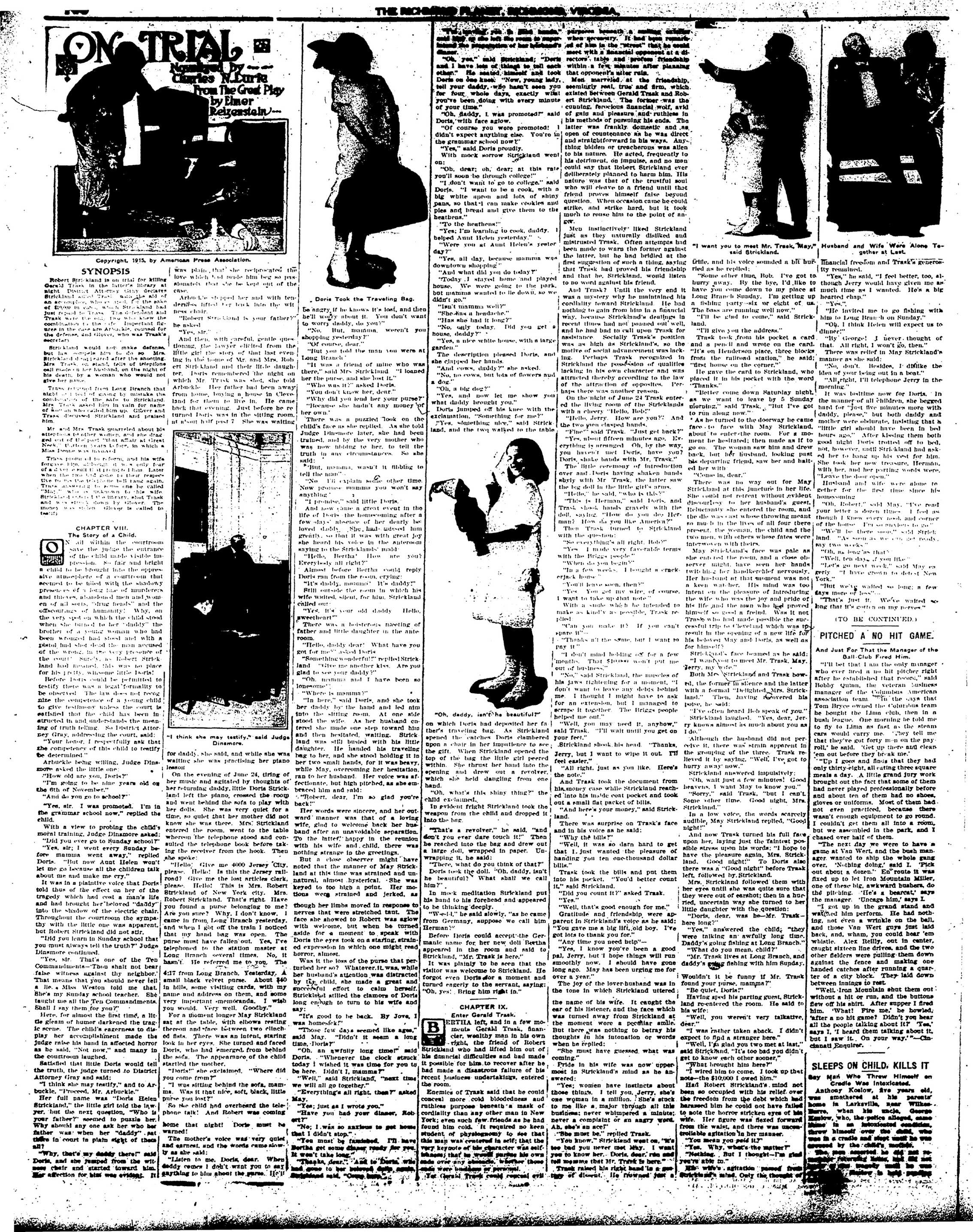
ON TRIAL
Narrated by ---
Charles N. Durfe
From The Great Play
by Elmer Relgenstein---
Copyright, 1915, by American Press Association.
Robert Strickland is on trial for killing Gerald Strickland in the latter's library at night. Distinct Attorney Giny declares Strickland asked Trask, with the aid of an accomplice, who took the aid of the snow in one of his work. Strickland had bad news about the death of Trask wrote the call, the who knew the combination to the safe. Important figures in the case are Arbuckle, counsel for the defense, and Gliver, who was Trask's secretary.
Strickland would not make defense, but law compels him to do so. Mrs Strickland departed after the shooting. Mrs Trask on stand, tells of telephone calls made in her husband, on the night of his death, by a woman who would not give her name.
Trask returned from Long Branch that night, not out of giving by mistake the complaint, and the safe to Strickland. Strickland and of her who called him up, Gliver and Trask discussed Strickland and praised him.
Mr. and Mrs. Trask quarrelled about his attentions to other women, and she dragged out of the post "that affair at Great Neck." The thirteen years to be, in which a Miss Done was invaded.
Trass pointed to reform, and his wife forgave him, although he was only four of a dozen but that prevailed him. Later when the two bad guys to their respective to the telephone bill sang again, Trass answered to summon one he called "Magic," who was unknown to this wife. Striker entered the library, shot Trask and was struck down by Glover. The money was stolen. Glover is called to tow it!
CHAPTER VIII.
The Story of a Child.
N all within the courtroom save the joke the entrance of the child made visible impassion. So fair and bright a child to be brought into the oppressive atmosphere of a courtroom that seemed to be filled with the shadowy presence of a long line of murderers and the thieves, abandoned men and women of all sorts, "drug friends" and the offcourts of humanity! Why, on the very spot on which the child stood when she turned to her "daddy" the brother of a young woman who had been wronged had stood and with a pistol had shot dead the man accused of the wrong, in the very presence of the court! Surely, as Robert Strickland had meant, this was no place for his pretty, whimsical little Dory!
Before Judy could be permitted to testify there was a legal formality to be observed. The law does not recognize the competence of a young child to give testimony unless the court is satisfied that the child has been instructed in and understands the meaning of truth telling. So District Attorney Gray, addressing the court, said: "Your honor, I respectfully ask that the competency of this child to testify be determined."
Arbuckle being willing, Judge Dinamore asked the little one: "How old are you, Doris?"
"I'm going to be nine years old on the 6th of November."
"And do you go to school?"
"Yes, sir. I was promoted. I'm in the grammar school now," replied the child.
With a view to probing the child's moral training, Judge Dinamore asked: "Did you ever go to Sunday school?"
"Yes, air; I went every Sunday before mamma went away," replied Doris. "But now Aunt Helen won't let me go because all the children talk about me and make me cry."
It was in a plaintive voice that Doris told thus of the effect on her of the tragedy which had cost a man's life and had brought her beloved "daddy" into the shadow of the electric chair. Throughout the courtroom the sympathy with the little one was apparent, but Robert Strickland did not stir.
"Did you learn in Sunday school that you must always tell the truth?" Judge Dinamore continued.
"Yes, sir. That's one of the Ten Commandments—Thou shalt not bear false witness against thy neighbor. That means that you should never tell a lie. Miss Weston told me that. She's my Sunday school teacher. She taught me all the Ten Commandments. Shall I say them for you?"
Here, for almost the first time, a little gleam of humor darkened the tragic scene. "The child's angerless to display her accomplishment made the judge raise his hand in affected horror as he said, "Not now," and many in the courtroom laughed.
Satisfied that little Doris would tell the truth, the judge turned to District Attorney Gray and said:
"I think she may testify," and to Arbuckle, "Proceed, Mr. Arbuckle."
Her full name was "Doris Helen Strickland," the little girl told the lawyer, but the next question, "Who is your father?" seemed to puzzle her. Why should any one ask her who her father was when her "daddy" sat there in court in plain sight of them all?
"Why, that's my daddy there!" said Doris, and she jumped from the witness chair and started toward him. Her affection for him was evident.
---
O
was plain, that she representated the love which had made him beg so passionately that she be kept out of the case.
Arbuckle stopped her and with tenderness lifted her back into the witeness chair.
"Robert Strikland is your father?" he asked.
"Yes, sir."
And then, with careful, gentle questioning, the lawyer elicited from the little girl the story of that last evening in the home of Mr. and Mrs. Robert Strikland and their little daughter. Doris remembered the night on which Mr. Trisk was shot, she told Arbuckle. Her father had been away from home, buying a house in Cleveland for them to live in. He came back that evening. Just before he returned Doris was in the sitting room, at about half past 7. She was waiting
THE
"I think she may testify," said Judge Dinimore.
for daddy, she said, and while she was waiting she was practising her piano lesson.
On the evening of June 24, tiring of her music and agitated by thoughts of her returning daddy, little Doris Strickland left the piano, crossed the room and went behind the sofa to play with her dolls. She was very quiet for a time, so quiet that her mother did not know she was there. Mrs. Strickland entered the room, went to the table whereon the telephone stood and consulted the telephone book before taking the receiver from the hook. Then she spoke:
"Hello. Give me 4000 Jersey City please. Hello! Is this the Jersey railroad? Give me the lost articles clerk please. Hello! This is Mrs. Robert Strickland of New York city. Mrs Robert Strickland. That's right. Have you found a purse belonging to me? Are you sure? Why. I don't know. I came in from Long Branch yesterday, and when I got off the train I noticed that my hand bag was open. The purse must have fallen out. Yes, I've telephoned to the station master at Long Branch several times. No, it hasn't. He referred me to you. The 4:17 from Long Branch. Yesterday. A small black velvet purse. About $40 in bills, some visiting cards, with my name and address on them, and some very important memoranda. I wish you would. Very well. Goodbye."
For a moment longer May Strickland sat at the table, with elbows resting therone and face between two clenched fists. There was an intent, staring look in her eyes. She turned and faced Doris, who had emerged from behind the sofa. The appearance of the child startled the mother.
"Doris!" she exclaimed. "Where did you come from?"
"I was sitting behind the sofa, mamma. Was it that nice, soft, black, little pulse you lost?"
"So the child had overheard the telephone talk! And Robert was coming home that night! Doris must be warned!
The mother's voice was very quiet and earnest, and the words came slowly as she said:
"Listen to me. Doris, dear. When daddy comes I don't want you to say anything to him about the game. He'll
A
Doris Took the Traveling Bag.
Be angry, if he knows it's lost, and then he'll worry about it. You don't want to worry daddy, do you?
"No. But, mamma, weren't you shopping yesterday?"
"Of course, dear."
"But you told the man you were at Long Branch."
"It was a friend of mine who was there," said Mrs. Strickland. "I loaned her the purse, and she lost it."
"Who was it?" asked Dohrs.
"You don't know her, dear."
"Why did you lend her your purse?"
"Because she didn't any money of her own."
There was a puzzled look on the child's face as she replied. As she told Judge Dilmore later, she had been trained, and by the very mother who was now tibbing to her, to tell the truth in any circumstances. So she said:
"But, mamma, wasn't it tibbing to tell the man."
"No. I explain some other time. Now promise mamma you won't say anything."
"I promise," said little Doris. And now came a great event in the life of Doris the homecoming after a few days' absence of her dearly beloved daddy. She had missed him greatly, so that it was with great joy she heard his voice in the anteroom saying to the Strikers' maid:
"Hello, Bertha! How are you? Everybody all right?"
"Almost before Bertha could reply Doris ran from the room, crying: 'It's daddy, momma! It's daddy!' Still outside the room in which his wife wilted, silent, for him. Strickland called out: 'Yes, it's your old daddy! Hello, sweetheart!' There was a boisterous nesting of father and little daughter in the ant-room.
"Hello, daddy dear! What have you got for me?" asked Doris.
"Something wonderful!" replied Strickland. "Give me another kiss. Are you glad to see your daddy?'
"Oh, mamma and I have been so lonely!"
"Where is mamma?"
"In here," said Boris, and she took her daddy by the hand and led him into the sitting room. At one side stood the wife. As her husband entered she made one step toward him and then hesitated, wailing. Strickland was still busied with his little daughter. He handed his traveling bag to her, and she stood holding it in her two small hands, for it was heavy, while May, overcoming her hesitation, ran to her husband. Her voice was affectionate, but high pitched, as she embraced him and said:
"Robert, dear, I'm so glad you're back!
Her words were sincere, and her outward manner was that of a loving wife, glad to welcome back her husband after an unavoidable separation. To the latter" happy in the reunion with his wife and child, there was nothing strange in the greetings.
But a close observer might have noted that the manner of May Strickland at this time was strained and unnatural, almost hysterical. She was keyed to too high a point. Her motions were strained and jerked, as though her limbs moved in response to nerves that were stretched taut. The face she showed to Robert was aglow with welcome, but when he turned aside for a moment to speak with Doris the eyes took on a staring, strained expression in which one might read horror, almost.
Was it the loss of the purse that perturbed her so? Whatever it was, while her husband's attention was distracted by the child, she made a great and successful effort to calm herself. Strickland stilled the clamors of Doris long enough to turn to his wife and say:
"It's good to be back. By Jove, I was home!"
"Those few days seemed like ages," said May. "Didn't it seem a long time, Dorita?" "Oh. an awfully long time!" said Dorita. "Whenever the clock struck today I wished it was time for you to be here. Didn't I, mamma?"
"Well," said Strickland, "next time we will all go together."
"Everything's all right, then?" asked May.
"Yes; just as I wrote you."
"Have you had your dinner, Rob
ert?"
"No; I won no anxious to get home
that I didn't stop."
"The beautiful girl, in kind humour," and kindly on the left the room to superintend the preparation of her birthday dinner.
"Oh, yes," said Strickland; "Doris and I have lots of things to tell each other." He seated himself and took Doris on one knee. "Now, young lady, tell your daddy, who hasn't seen you for four, whole days, exactly what you've been doing with every minute of your time."
"Oh, daddy, I was promoted!" said Doris, with face aglow.
"Of course you were promoted! I didn't expect anything else. You're in the grammar school now!"
"Yes," said Doris proudly.
With mock sorrow Strickland went on:
"Oh, dear; oh, dear; at this rate you'll soon be through college!"
"I don't want to go to college," said Doris. "I want to be a cook, with a big white apron and lots of shiny pans, so that I can make cookies and pies and bread and give them to the heatens." "To the heatens!"
"Yes; I'm learning to cook, daddy. I helped Aunt Helen yesterday."
"Were you at Aunt Helen's yesterday day?"
"Yes, all day, because mamma was downtown shopping?"
"And what did you do today?"
"Today, I stayed home and played house. We were going to the park, but mamma wanted to lie down, so we didn't go."
"In't mamma well?"
"She has a headache."
"Has she had it long?"
"No, only today. Did you get a house, daddy?"
"Yes, a nice white house, with a large garden."
The description pleased Doris, and she clapped her hands.
"And cows, daddy?" she asked.
"And cows, didn't" said Hank.
"No, no cows, but lots of flowers and a dog."
"Oh, a big dog?"
"Yes, and now let me show you what daddy brought you."
Doris jumped off his knee with the explanation, "Something for me?"
"Yes, something else," said Strikeland, and the two walked to the table.
```markdown
```
"Oh, daddy, isn't he beautiful?"
on which Doris had deposited her father's traveling bag. As Strickland opened the catches Doris chambered upon a chair in her impatience to see the gift. When Strickland opened the top of the bag the little girl peered within. She thrust her hand into the opening and drew out a revolver, which she held dangling from one hand.
"Oh, what's this shiny thing?" the child examined.
In evident fright Strickland took the weapon from the child and dropped it into the bag.
"That's a revolver," he said, "and don't you ever dare touch it!" Then he reached into the bag and drew out a large doll, wrapped in paper. Unwrapping it he said:
"There, what do you think of that?"
Doris took the doll. "Oh, daddy, we can't be beautiful? What shall we call him?"
In mock meditation Strickland put his hand to his forehead and appeared to be thinking deeply.
"We well," he said slowly, "as he came from Germany, suppose we call him Herman?"
Before Doris could accept the Germanic name for her new doll Beetha appeared in the room and said to Strickland, "Mr. Trask is here."
It was plainly to be seen that the visitor was welcome to Strickland. He forgot even Doris a moment and turned eagerly to the servant, saying: "Oh, yes! Bring him right in."
CHAPTER IX.
Enter Gerald Trask.
BERTHA left, and in a few moments Gerald Trask, financier, wealthy man in his own right, the friend of Robert Strickland who had lifted him out of his financial difficulties and had made it possible for him to recover after he had made a disastrous failure of his recent business undertakings, entered the room.
Enemies of Trask said that he could conceal more cold bloodedness and ruthless purpose beneath a mask of cordiality than any other man in New York; even such few friends as he had found him cold. It required no keen student of physiognomy to see that this man was centered in self; that the very keynote of his character was selfishness; that he would pursue his own ends over any chance, whether those were boundaries or personal.
Yet Gerald Trask could recount evil
purpose beneath a madding calflier when precariety. It had been remembered of him in the "street" that he could meet with a financial opponent at a director's table and profess friendship within a few minutes after planning that opponent's alter rule.
Men marvelled, at the friendship, seemingly real, true and firm, which existed between Gerald Trask and Robert Strickland. The former was the counting, ferocious financial wolf, avid of gain and pleasure, and ruthless in his methods of pursuing his ends. The latter was frankly domestic and as open of countenance as he was direct and straightforward in his ways. Anything hidden or treacherous was alien to his nature. He acted, frequently to his detriment, on impulse, and no man could say that Robert Strickland ever deliberately planned to harm him. His nature was that of the trustful soul who will choose to a friend until that friend proves himself false beyond question. When occasion came he could strike, and strike hard, but it took much to rouse him to the point of anger.
Men instinctively liked Strickland just as they naturally disliked and mistrusted Trask. Often attempts had been made to warn the former against the latter, but he had bridled at the first suggestion of such a thing, saying that Trask had proved his friendship and that he, Strickland, would listen to no word against his friend.
And Trask? Until the very end it was a mystery why he maintained his cordiality toward Strickland. He had nothing to gain from him in a financial way, because Strickland's dealings in recent times had not punched out well, and he had had to call upon Trask for assistance. Socially Trask's position was as high as Strickland's, so the motive of social advancement was lacking. Perhaps Trask recognized in Strickland the possession of qualities lacking in his own character and was attracted thereby according to the law of the attraction of opposites. Perhaps there was another reason.
On the night of June 24 Trask entered the living room of the Stricklands with a chery "Hello, Bob?"
"Hello, Jerry. How are you?" And the two men clasped hands.
"Else," said Trask. "Just get back?"
"Yes, about fifteen minutes ago. Everything is arranged. Oh, by the way, you haven't met Doris, have you? Doris, shake hands with Mr. Trask."
The little ceremony of introduction over and Doris having shaken hands ably with Mr. Trask, the latter saw the big doll in the little girl's arms.
"Hello," he said, "who is this?"
"This is Herman," Doris, and Trask shook hands gravely with the doll, saying, "How do you do Herman? How do you like America?"
Then Trask turned to Strickland with the question:
"So everything's all right, Bob?"
"Yes. I made very favorable terms with the Briggs people."
"When do you begin?"
"In a few weeks. I bought a crackerjack house."
"You'll leave soon, then?"
"Yes. You got my wire, of course. I want to take up what note."
With a smile which be intended to make as kindly as possible, Trask replied.
"Can you make it? If you can't spare it..."
"Thanks all the same, but I want to pay it."
"I don't mind holding off for a few months. That $1000 won't put me out of business."
"No," said Strickland, the muscles of his jaws tightening for a moment, "I don't want to leave any debts behind me. I thought I might have to ask for an extension, but I managed to scrape it together. The Briggs people helped me out."
"Well, you may need it, anyhow," said Trask. "I'll wait until you get on your feet."
Strickland shook his head. "Thanks, Jerry, but I want to wipe it out. I'll feel easier."
"All right, just as you like. Here's the note."
And Trask took the document from his money case while Strickland reached into his inside cont pocket and took out a small flat packet of bills.
"And here's your money," said Strickland.
There was surprise on Trask's face and in his voice as he said:
"Why the bills?"
"Well, it was so darn hard to get that I. just wanted the pleasure of handling you ten one-thousand dollar bills."
Trask took the bills and put them into his pocket. "You'd better count it." said Strickland.
"Did you count it?" asked Trask.
"Yes."
"Well, that's good enough for me."
Gratitude and friendship, were ap-
parent in Strickland's voice as he said:
"You gave me a big lift, old boy. I've
got lots to thank you for."
"Any time you need help!"—
"Yes, I know you've been a good pal, Jerry, but I hope things will run smoothly now. I should have gone long ago. May has been urging me for over a year."
The joy of the lover-husband was in the tone in which Strickland uttered the name of his wife. It caught the ear of his listener, and the face which was turned away from Strickland at the moment wore a peculiar smile. But there was nothing to betray his thoughts in his intonation or words when he replied:
"She must have guessed, what was coming."
Pride in his wife was now upper most in Strickland's mind as he answered:
"Yes; women have instincts about those things. I tell you, Jerry, she's one woman in a million. She's stuck to me like a major through all this business; never whimpered a minute, never a complaint or an angry word. Ah, she's an ace!"
"She must be" replied Trask.
"You know." Strickland went on, "It's too bad you never met May. I want you to know her. Doris, dear, run and tell me that Mr. Trink is here." Track raised his right hand in a gesture of disent. He rrowned just a
A
"I want you to meet Mr. Trask, May," said Strickland.
Griffle, and his voice sounded a bit hurried as he replied:
"Some other time, Bob. I've got to hurry away. By the bye, I'd like to have you come down to my place at Long Branch Sunday. I'm getting up a fishing party—six or eight of us. The bass are running well now."
"I'll give you the address."
Trask took from his pocket a card and a pen and wrote on the card. "It's on Henderson place, three blocks from the railroad station," he said; "first house on the corner."
He gave the card to Strickland, who placed it in his pocket with the word "Thanks."
"Better come down Saturday night, as we want to leave by 5 Sunday morning," said Trask. "But I've got to run along now."
"As he turned to the doorway he came face-to-face with May Strickland, about to enter the room. For a moment he hesitated; then made as if to go on. The woman saw him and drew back, but her husband, looking past his departing friend, saw her and halted her with
"Come in, dear."
There was no way out for May Strickland at this juncture in her life. She could not retreat without evident discontent to her husband's guest. Reluctantly she entered the room, and the she was cast whose throwing meant so much in the lives of all four there present, the woman, the child and the two men, with others whose fates were interwoven with theirs.
May Strickland's face was pale as she entered the room, and a close observer might, have seen her hands twitching her handkerchief nervously. Her husband at that moment was not a keen warrior. His mind was too intent on the pleasure of introducing the wife who was the joy and pride of his life and the man who had proved himself so good a friend. Was it not Trask who had made possible the successful trip to Cleveland which was result in the opening of a new life for his beloved May and Boris, as well as for himself?
Strickland's face beamed as he said: "I want you to meet Mr. Trask May, Perry, my wife."
Both Mrs. Strickland and Trask bowed, the former in silence and the latter with a formal "Delighted Mrs. Strickland." Then, having covered his noise, he said:
"I've often heard Bob speak of you."
Strickland laughed. "Yes, dear, Jerry knows almost as much about you as I do."
"Although the husband did not perceive it, there was strain apparent in the grouping of the three. Trunk relieved it by saying, 'Well, I've got to hurry away now.'"
Strickland answered impulsively: "Oh, wait just a few minutes! Good heavens, I want May to know you."
heaven I will want to show you
"Sorry," said Trask, "but I can't
Some other time. Good night, Mrs.
Strickland."
In a low voice, the words scarcely
audible, May Strickland replied, "Good
night!"
And now Trask turned his full face
upon her, laying just the faintest pos-
sible stress upon his words: "I hope to
have the pleasure again, Mrs. Strickland.
Good night!" To Doris also
there was a "Good night" before Trask
left, followed by Strickland.
Mrs. Strickland followed them with
her eyes until she was quite sure that
they were out of earshot; then in a hurried, uncertain way she turned to her little daughter with the question:
"Doris, dear, was he—Mr. Trask—
here long?"
"Yes," answered the child; "they
were talking an awfully long time.
Daddy's going fishing at Long Branch."
"What do you mean, child?"
"Mr. Trank lives at Long Branch, and daddy's fishing with him Sunday.
Wouldn't it be funny if Mr. Trank found your purse, mamma?"
"Be quiet, Doris."
Having sped his parting guest, Strickland re-centered the room. He said to his wife: "Well, you weren't very talkative, dear."
"I wired him to come. I took up that note—the $10,000 I owed him."
Had Robert Strickland's mind not been so occupied with his relief over the freedom from the debt which had harassed him he could not have failed to note the horror stricken eyes of his wife. Her figure was dressed forward from the waist, and there was uncontrollable agitation in her manner.
"You mean you paid it?"
"Yes. Why, what's the matter?"
"Nothing. But I thought—I am glad you're able to."
Jill, who's agitation passed fresh
strength in mind. Only the thought of
=
Husband and Wife Were Alone Together at Last.
Financial freedom and Trask's generosity remained.
"Yes," he said, "I feel better, too, although Jerry would have given me an much time as I wanted. He's a big hearted chap."
"Yes."
"He invited me to go fishing with him to Long Branch on Sunday." "Oy. I think Helen will expect us to dinner." "By George! I never thought of that. All right, I won't go, then."
There was relief in May Strickland's manner as she said:
"No, don't. Besideth, I dislike the idea of your being out in a boat." "All, right. I'll telephone Jerry in the morning."
It was best time now for Doris. In the manner of all children, she begged hard for "just five minutes more with daddy, please," but both daddy and mother were obdurate, insisting that a "little girl should have been in bed hours ago." After kissing them both good night Doris trailed off to bed, not, however, until Strikland had asked her to hang up his vest for him. She took her new treasure, Herman, with her, and her parting words were "Leave the door open."
Husband and wife were alone to gether for the first time since his homeschoning.
"Oh, Robert," said May, "I've read your letter a dozen times. I feel as though I knew every mesh and corner of the house. I'm so nervous to go."
"Oh, no longer that."
"Well, ten days, if you like"
"Let's go next week," said May en-
gely
"I have grown to detest New
York."
"But we've waited so long; n few
days more or less"...
"That's just it. We've waited so
long that it's gotten on my nerves."
PITCHED A NO HIT GAME.
And Just For That the Manager of the Ball-Club Fired Him.
"I'll set that I am the only manager who ever fired a no hit pitcher right after he established that record," said Bobby Quinn, the veteran business manager of the Columbus American association team. "In the says that Tom Bryce owned the Columbus team he bought the Linn club, then in a bush league. One morning he told me to fly to Linn as fast as the steam car would carry me. 'They tell me that they've got forty men on the payroll,' he said. 'Get up there and clean 'em out before they break me.'
"Up I goes and finds that they had only thirty-eight, all eating three square meals a day. A little grand jury work brought out the fact that some of them had never played professionally before and about ten of them had no shoes, gloves or uniforms. Most of them had not even practiced, because there wasn't enough equipment to go round. I couldn't get them all into a room, but we assembled in the park, and I chased over half of them.
"The next day we were to have a game at Van Wert, and the bush manager wanted to ship the whole gang over. 'Nothing doing,' said I. 'Pick out about a dozen.' En route it was fixed up to let iron Mountain Miller, one of these big, awkward bushers, do the pitching. 'He's a bearcat,' says the manager. 'Uncage him,' says I.
"I got up in the grand stand and watched him perform. He had nothing, not even a wrinkle on the ball, and those Van Wert guys just laid back, and, wham, you could hear 'em whistle. Alex Reilly, out in center, caught sixteen line drives, and the two other fielders were pulling them down against the fence and making one handed catches after running a quarter of a city block. They laid down between innings to rest.
"Well, Iron Mountain shut them out without a hit or run, and the buttons flew off his shirt. After supper I fired him. 'What! Fire me,' he howled; after a no hit game? Didn't you hear all the people talking about it? 'Yes,' says I. 'I heard them talking about it, but I saw it. On your way.'"—Cincinnati Enquirer.
Anthony Koelow, five years old, was smothered at his parent's home in Larksville, near Wilkes-Barre, when his uncle, George Koelow, who, the police alleged, came home in an interrogated condition, throw himself over the child, who was in a cradle and slept until he was crowded by the child's mother. The man reported, he did not remember interacting with, and did not know of the tragedy until he was crowded in bed.
Women Killed In Collision.
PASSENGER: TRAIN CRASHER INTO STREET CAR AT HAN- COCK AND BROAD STREETS.
Train No. 80 of the Richmond, Fred
ericksburg and Potomac Railroad Company
crashed into Broad and Main
Street car No. 922 at Hancock and
Broad Street at 8:41 o'clock last night,
killing Cornelia Johnson, colored. The
street-car register showed that thirty-four passengers had boarded the car
after it left the car barns on the
eastbound trip, and it is believed all of this number were aboard when the
accident occurred.
C. S. Powers, a life-insurance agent,
had two ribs broken. His son's hand
was cut. Another man, whose name
had not been ascertained last night,
was slightly injured. A man named
Wills was cut about the hands and
arms by flying glass. These injuries
were reported by officials of the street-
car company, and constitute all of
those hurt in the accident, so far as
could be determined last night.
CAR SPLITS SWITCH INTO
HANCOCK STREET.
The street car is said to have split the switch through which Clay Street cars turn into Hancock Street. At this time the train is said to have been passing Laurel Street going north, having just left, Elba Station when the street car attempted to cross the tracks and continue down Broad Street. A Westhampton car was stopped by the east gate on Broad Street and narrowly avoided being caught in the collision. Police Captain Epps and Sergeant Zimmer made no arrests last night. They allowed Engineer C. M. Moncurc, of 100 North Granby Street, to continue on his trip after he had promised to surrender himself to the police when he returns to the city today. Coroner Taylor authorized the removal of the Johnson woman's body to the undertaking rooms of A. D. Price. The coroner said last night that he had set no definite time for the inquest, and would not do so until he had learned what evidence the police had secured.
WITNESSES AGREE ON DETAILS OF ACCIDENT.
Descriptions of the manner in which the accident occurred as told by witnesses and as given by representatives of the street-car company agree. The story told by Gateman W. N. Burnette, S11 South Meadow Street conforms to that told by the motorman and conductor. Their information is to the effect that the train was just leaving Elba Station when the street car reached the crossing. Conductor P. O. Duling, 2508 Boverley Street went in front of the car and waved it ahead. Motorman M. V. Peterson, 3 South Mulberry Street, started his car forward, and reached the switch which deflects Clay-Street cars down Hancock Street. The front trucks of the street car crossed the switch and started down Broad Street, but the rear trucks, for some reason, followed the curve. The car stopped of its own accord, as it was impossible for it to proceed with the front truck headed in one direction and the rear truck in another.
TRAIN MAKING SPEED FOR
GRADE TO YARDS.
At this time the train had left Elba and had reached Laurel Street. The heavy train of Pullmans, drawn by one of the largest locomotives on the division, was getting up speed for the grade into the railroad yards, and w. approaching rapidly. Peterson realized the danger. Dulling had already done so, and was running down Broad Street waving his arms wildly. Peterson leaped from front platform of the car and rushed after the conductor. He called to Dulling to return and rush the passengers from the car, while he ran toward the approaching train.
Gateman Burnette had taken in the situation, and was running as rapidly as possible toward the train. He swung a red tinten and signaled wildly for the train to stop. No slackening in the speed of the train was noticed, and it bore down upon the stalled car and the helpless passengers. Conductor Dulling reached them a bare minute before the engine struck the car. His warning is supposed to have been just in time to start the Johnson woman, who was standing near the rear door, from the car.
LOCOMOTIVE SWIPES STREET
CAR ON SIDE.
In the opinion of those who were in the car and those who witnessed the accident from the street, the colorful woman must have been on the plaf for at the time the car was struck. The crook-beam of the locomotive struck the street car on the side near the front door. The car was hurled backward, and the crook-beam as well as the pilot buried itself again in the car's side, this time near the rear door. The car careened and appeared to be about to turn ever. However, one of the steel light poles in the middle of the street caught it and held it fast.
Person who witnessed the accident were of the opinion heat night that the engine stepped almost immediately after it had struck the car. The Johnson woman had been buried from the car and was found buried beneath the plot of the engine. She was killed instantly. Dangerous effects were begun to subsurface her, and this was done before Ambulance Storm Survived Grafted. The woman was not run over, but a number of her家人 are
MOST OF PASSENGERS ESCAPE INJURY.
How-other passengers escaped carl-
ous injury is not known. The car
register showed that thirty-four people
had boarded the car after it left the
car harms, but, with the exception of
threes or four, who were located by
representatives of the street car compa-
ney late, last night, all of them escaped
injury. These were only in-
fured slightly.
After the accident Policeman Latham took charge of the situation until Captain Epps and Sergent Zimmet arrived. Persons who had been in the car scattered in all directions as soon as they were able to drag themselves from the damaged vehicle, and but few of them could be located by the police. The police witnesses of the accident consist of the train and street car crews and several Negroes.
The steel pole against which the street car was flung was bent and broken almost off about ten feet from its base. As it toppled, it brought down the main trolley line along Broad Street and all of the network of auxiliary wires close to the switch. The current was cut off from these wires as soon as possible and before the wrecking crew of the street car company began to clean the line.
PASSENGER TRAIN SUFFERS
THIRTY MINUTE DELAY.
In order not to delay the train, Trainmaster E. K. Grady directed that the train be backed down to the switch at Laurel Street and that it proceed on its way over this sliding. This was done the train passing the scene of the accident at a distance of a few feet. No statement was secured from Engineer Moncure nor from Fireman J. L. Cato or Conductor E. Dickerson. The train was delayed about thirty minutes.
A much greater delay was experienced by the street car company. The accident occurred at 8:41 o'clock, and completely blocked all of the Broad Street traffic, the Clay Street line and the Westhampton line. The damaged car was towed back to the shed at 10:20 o'clock, but the line was not opened until some time afterward. Passengers were transferred across the blockade along the Broad Street lines and along the Clay Street line. Westhampton cars were switched on Main Street along Laurel and proceeded west along Main. It was not until early this morning that the trotley and other wires had been repaired and the line made ready for the day's traffic.
MOTORMAN TELLS HOW ACCL.
DENT HAPPENED.
Motorman Peterson said last night, "We had crossed the railroad's western gate in safety and had plenty of time to cross the tracks had it not been for splitting the switch. After Duling waved me ahead, and I discovered that the roar trucks had turned along the curve. I shut off the current and hastened along the tracks waving my hands in an effort to stop the train. I sent Duling back to warn the passengers off the car when I saw that the train was not stopping. The crash made when the car was hit was terrific and the entire car seemed to have been lifted bodily and hurled against the steel pole. I do not know if the Johnson woman was on the car. It was more than half full, and a great many of the passengers wore white. So far as I could see the locomotive's steam was not cut off until after the train had hit the car."
Gateman Burnette was of the same opinion. "I saw the danger of the car soon after I had closed the eastern gate and had stopped the Westhampton car," he said, "and grabbed my red lantern. I ran down the street and signalled time after time for the train to stop. It continued though, and I realized that the car must be struck. I do not think that the brakes were applied to the locomotive until it was within a few feet of the car."
COLORED MAN SAYS WOMAN WAS ON CAR
Roy Fleming, colored, employed by the railroad, and who was with the Johnson woman at the time she was killed, said last night that he and the woman had entered the car but a few blocks distant from the scene of the accident. The car was slightly crowded, according to Fleming, and they were standing near the rear door. Fleming was unable to tell how he managed to get from the car. He did not know if the Johnson woman had attempted to leave before the accident or whether she had been hurled from the door when the engine struck. He waited about the scene, making a vain effort to locate the Johnson woman for a few minutes, and when he was informed that she was beneath the engine he rushed to Henry Randolph, colored, and told him of the death of their friend.
Arthur Bass, 526 North Second Street; Patty Weaver, 1116 St. James Street; and William McGriff, 1103 West Franklin, where he is employed, are the names of the witnesses secured by the police. None of them had been questioned about the accident last night, and it is probable their first testimony will be given at the company's interest.
Engineer Moncure has been driving Train No. 80 for some time, and the accident of last night is said to have been the first serious one in his career. He is said to have remarked to representatives of the street car company immediately after the accident last night that he did not see the car until he was about forty feet away. His train, the engine of which was No. 87, is one of the heaviest and fastest which leave this city during the early night. It makes through connection with New York, and consists chiefly of Pullman.
The Johnson woman is said to have been about twenty-five years old and unarmed. She has a sister named Jones living at 1515 Taylor Street, another sister named Johnson and two others whose names could not be learned last night. No arrangements for the funeral will be made until after the outcome of the coroner's investigation.
FULLER SURPRISED WRECK HAS NOT OCCURRED BEFORE.
"I am only surprised that this has not happened before," said Alderman Orford. Feller had night, commemorated
THE RICHMOND PLANET, RICHMOND, VIRGINIA
We have a fine line of Calendars for 1916, both imported and domestic and they are now ready for the inspection of the Public. We can quote prices that will be of special interest to those who buy these kind of souvenirs. A visit is requested even if you are not ready or are not prepared to purchase now.
THE LINE IS ATTRACTIVE AND THE DESIGNS ARE NEW AND SURPRISINGLY BEAUTIFUL. THE J. W. BUTLER PAPER CO., OF CHICAGO, ILL. HANDLES THE FINEST LINES OF CALENDARS, COLLEGE COMMENCEMENT PROGRAMMES AND FOLDERS OF ANY HOUSE IN THE COUNTRY. TO SEE THEM IS TO REALIZE TO THE FULLEST EXTENT THE FORCE OF THIS DECLARATION.
CALL AT THE PLANET OFFICE, 311 N. 4TH ST., (BET. BROAD AND MARSHALL STS.) RICHMOND, VIRGINIA. Out of Town Orders Solicited.
on the accident. "I have always held the conviction that the railroad crossings in Broad and Belvidero Streets are a menace to life and property. They should have been removed long ago.
"Not long ago I called the company's attention to the fact that trains were being operated over the Broad and Belvidere tracks after midnight with not a single watchman at any of the crossings. It is a mere providence of God that people haven't been slaughtered at these crossings before.
"Shortly after the organization of the present Council, I introduced a resolution looking to the removal of all railroad tracks from Broad and Belvidero Streets. The war followed soon after, and I was prevailed upon to hold the matter in abeyance at least until conditions adjusted themselves and the outlook in the railroad busi- that steps should be taken at once improved. I am still of the opin- to remove the grade-crossing menace that exists on our busiest thorough- fare, and which daily threatens the lives of our citizens."
The resolution to which Mr. Puller refers is still on file with the Council Street Committee, which is now con- considering also the adjustment of the Belt Line crossing problem—Times-Dispatch—Dec. 2, 1915.
Fredericksburg. Va. Nov. 27, 1915.
The Supreme Lodge of the People's Benevolent and Fraternal Society meet in this city on November 26 and 26, at the Kenmore Hall. The attendance of delegates was quite large. The welcome address was made by Stater, Julia S. Ross, of Piedmont Lodge No. 9. Response by Stater Mary Combs, of Courthouse Lodge No. 3. The report of President D. M. Kay, showed the society to be in a prosperous condition. The joint report of the Secretary and Treasurer was read and showed the Society to be in a strong financial condition, with all claims paid to date and the Order not owing anyone, one cent. The Society stands second to none in its assets per captain. After the business sessions were over, brief but impressive Memorial Services were held for the following deceased members: Sisters Sarah Brooks, of Piedmont Lodge, No. 9: Georgianna Acors, of Oak Grove Lodge, No. 11, and Maria Jones, of McDuff Lodge, No. 12. On motion, memorial exercises were held in memory of Dr. Booker T. Washington and enlogies were made by, O. M. Burrell. R. A. R. Jackson, Rev. W. M. Washington, Mrs. M. E. Combe, Mrs. Julia S. Rose, D. M. Kay, Warren W. Lee and Joseph F. Walker. The meeting closed with a grand banquet.
Bey. 11. Immarred
Heven-year-old Earl Huber, son of Edgar Huber, of West Readink, Pa., was baptized in the ice waters of the Schuylkill rivers while a little group from the Menonate Brethren in Christ church stood on the bank singing hymns. Rev. W. J. Fretz, pastor of the church, waded into the river with the little boy; and accompanied him three times.
1916 Calendars Now Ready
Greek Letter Fraternities.
The first and oldest of any Greek letter fraternity in the United States was the Phil Beta Kappa society founded at William and Mary college, Virginia, in 1776, from which sprang a chapter at Yale in 1780 and later chapters at other colleges. This was the only Greek letter society in the United States until 1823, when the Kappa Alpha was formed at Union college, New York. Several other college societies were formed during this period, with such names as Philomelan, Ernestophan, Hermosurian, etc., but these were not Greek letter societies. The first women's Greek letter fraternity was the Kappa Alpha Theta, founded at De Pauw university in 1870. The record shows it was founded by Battle Louse, class of 71; Alice Allen, 71; Bettie Tyson, 71; and Hanna Fitch, 73—Philadelphia Press.
SERB'S DEATH STRUGGLE
King Peter and Type of His Soldiers.
Daisy by American From Association
SER3 ARMY ESCAPES
being reorganized.
Eighty-three and Serbian troops escaped, into the mountains of Albania and Macedonia, according to official reports which reached the alley
YOU CAN FIND HERE ADVERTISING
CALENDARS SUITABLE FOR ALL LINES OF BUSINESS AND AT PRICES THAT WILL SURPRISE YOU.
THERE IS ALSO A LINE OF "LEFT OVER" 1915 CALENDAR BACKS, WHICH CAN BE SOLD AT A SACRIFICE TO LARGE PURCHASERS, WHO DESIRE TO SAVE MONEY.
Headquarters at Salonisa, a town to a despatch.
They are being organized into an effective army which will take the offensive as soon as supplies which are now on the way arrive.
In escaping the Teuton-bulgarian the Serbians had to abandon most of their cannon and ammunition, but saved their light artillery.
All the members of the Serbian government have arrived at Sevastan where they will be joined by the entire ministers now at Podgoritz.
Berlin announced the capture, on November 25, of Prilzend, near the Anatian border, by the Bulgarians, who took 300 artillerymen. General von Galtitz's troops took 100 more.
According to Soda's announcement, the Bulgarians in southern Serbia have resumed their offensive operations against the Anglo-French forces. French troops have had to evacuate positions on the south bank of the Cerna, the Bulgarians crossing the stream under the protection of their artillery.
The defensive fighting for Monastir on Friday and Saturday last centered around a bridge at a crossing on the route to the city. The Serbians were compelled to retire, and made unsuccessful efforts to blow up this bridge before falling back.
The way the shells knock things down in the war zone, human muscles developed in digging trenches will be useful to put the piles of brick and stone back where they were before the war.
The attitude of the British foreign office on the issue of the "freedom of the seas," as announced recently, is that "the whole question of international agreements and how they can be made worth anything in the future may reasonably form the subject of discussion between nations after the war." Much has been said about violations of international law and of national rights as defined by that law by belligerents, but nothing could be more frank than this declaration by a government which our state department has demonstrated with upon this very point. Our meat packers, farmers and cotton planters have found their rights upon the seas interfered with right along. To help them in their dilemma the issue cannot be decided too soon one way or the other.
It has been officially announced that over 3,000 games of football were on the list for the season ending on Thanksgiving day. This is a record and argue, in the opinion of football authorities, that the public finds the game attractive. Under the new rules it is a game which, like baseball, can be followed and understood by the layman. As new played it is a game for skill and muscles combined rather than a tangle of brute strength.
PURE GOODS. FULL VALUE
FOR THE MONEY.
1610 East Franklin St.
(Near Old Market)
RICHMOND VIRGINIA
A. HAYES,
OFFICE AND WARKROOMS:
727 N. Second St.
RESIDENCE—726 N. SECOND ST.
First-class Hacks and Caskets of
all descriptions. I have a spare room
for bodies, when the family have not
suitable places. All Country Orders
given Special Attention.
Your special attention is called
to the New Style Oak Caskets. Call
and see me and you shall we waited
on individually.
PHONE, MADISON 2788
OTHER PEOPLE JUDGE
When you can get Furniture and Rugs from an Old Established house like JURGENS—that's known to sell the best quality goods, just as reasonable as elsewhere—why not give your friends a good impression. It will give us the greatest pleasure to show you our wonderful stock of homemaking comfort giving Furniture and Rugs and—don't fall to ask our salesmen about our banking plan which gives you 5, 10 or 15 months in which to pay for any purchase.
CHAS. G. JURGENS SON
ESTABLISHED 1890
ADAMS AND BROAD
RICHMOND PLANET
RICHMOND PLANET
RAILROADS
Richmond, Fredericksburg & Potomac R. R.
To and From Washington and beyond
Lunar Relief daily
4:30 AM 14:30 PM 6:00 AM 17:54 PM 1:10 PM 2:50 PM
19:25 AM 9:35 PM 11:01 PM 18:25 PM 8:30 PM 9:00 PM
12:10 PM 9:47 PM 8:29 PM 19:10 PM 12:35 PM 12:40 PM
Lunar Relief daily
4:30 AM 14:30 PM 6:00 AM 17:54 PM 1:10 PM 2:50 PM
19:25 AM 9:35 PM 11:01 PM 18:25 PM 8:30 PM 9:00 PM
12:10 PM 9:47 PM 8:29 PM 19:10 PM 12:35 PM 12:40 PM
NORFOLK & WESTERN.
ONLY ALL RAIL LINE TO NORFOLK.
Schedule in effect, April 8, 1816.
Lawrence, N. W. "Norfolk Railroad, Richmond, Soy
NORFOLK; M. W. "Norfolk Railroad, Richmond, Soy
FOR LYNCHBURG AND THE WEST; "11:08 A. M.
; "7:00 A. M., "10:00 P. M., "10:00 P. M.
Arrive Richmond from Norfolk; "11:08 A. M.
; "7:00 A. M., "10:00 P. M., "10:00 P. M.
From the West; "11:08 A. M., "10:00 P. M., "10:00 P. M.
; "7:00 P. M.
"Daily," "Daily except Sunday," "Sunday only
W. H. BEVILLE,
W. G. SAUNDERS,
W. A. ROMANO,
W. H. HOLLEY,
ATLANTIC COAST LINE.
EFFECTIVE APRIL 6, 1915.
TRAINS LEAVE RICHMOND DAILY:
For Flinders the South: 8:15 A.M. M, 160 M.
P, 18:50 A.M.
For Norfolk: A, M, 8:00 A.M. P, 160 M.
P, 18:50 A.M.
For Norfolk: A, M, 8:00 A.M. P, 160 M.
P, 18:50 A.M.
For Norfolk: A, M, 8:00 A.M. P, 160 M.
P, 18:50 A.M.
For Petersburg: 12:50 A.M. M, 6:15 A.M.
8:15 A.M. M, 9:00 A.M. M, 8:50 A.M. M, 8:00 P.
M, 8:50 A.M. M, 6:50 P. M, 6:00 P.
M, 9:20 P. M, 11:50 P. M.
For Goldbabor and Flytterville: 4:00 P. M.
TRAINS LEAVE RICHMOND DAILY:
4:20 A.M. M, 18:50 A.M. 9:00 A.M.
M, *10:40 A.M. M, 11:40 A.M. M, *21:00 P. M.
*14:40 A.M. M, 6:17 P. M, 6:25 P. M.
M, 8:00 P. M, 11:30 P. M.
*20:00 P. M. Sunday only.
Time of arrival and departure and connection not guaranteed.
C. E. GAMBELL, D. P. A., 805 Main D.
THE SOUTHERN
SR
SERVES THE SOUTH
Trains Leave Richmond, Main Street Boulder,
Lakeview Follow schedule schedules posted on
Information Network A. M.—Daily local for Darrville.
5:00 A. M.—Daily—Limited for all polite calls
10:00 A. M.—Daily—Limited for all polite calls
City, Durham and intermediate cities
6:00 P. M.—Daily—For Darrville, Atlanta
Birmingham, with Fullman observation shows
11:15 P. M.—Daily—Limited for all polite calls
YORK RIVER LINE
6:10 P. M.-Stanley train (Purcell inn)-Ballard
-Local To West Point, connecting for Ballard
daily except Sunday.
7:25 A. M.-Dalley-local to West Point
From the South: 7:05 A.M. 8:00 A.M.
8:50 P.M. and 8:50 P.M. daily; 8:40 A.M.
East Bay Day.
From West Point: 9:10 A.M. 8:15 P.M.
daily.
H. L. BISHOP, D. P. A.
007 East Main St.
Phone: 800-800-8000
CHESAPEAKE & OHIO.
Cincinnati, Louisville & West. 7:00 P. *11:00 P.
Main Line Local, 7:00 A. *2:00 P. *7:00 P.
James River Line, 7:00 A. *2:00 P.
N. New York Old Pl. 7:00 A. *13 M. *8:00 P.
Newport News Local, 7:15 A. *8:00 P.
Trains arrive from Northeast. 7:15 A. *8:00 P.
*5:00 P. *Newport News. *2:35 A. *2:00 P.
West. *5:00 P. *2:40 P. *2:00 A.
*7:10 F. *7:10 F. *James Bay. *2:00 A.
*7:18 F. *Daily. **Receipt Sunday.**
SEABOARD AIR LINE
Northbound train scheduled to leave Richmond
daily, 1:20 A.M. local to Norfolk; 1:25 P.M.
sleepover and coach, Atlanta, Mirmingham;
coach, Atlanta, Mirmingham; coach and sleeper
to Jacksonville; 1:24 A.M. local to
Birmingham, Jacksonville. Traps and coaches
Jacksonville.
Northbound train scheduled to arrive in Rich-
mond daily, 1:20 A.M. local to Norfolk; 1:25 P.M.
sleepover and coach, Atlanta, Mirmingham;
coach, Atlanta, Mirmingham; coach and sleeper
to Jacksonville; 1:24 A.M. local to
Birmingham, Jacksonville. Traps and coaches
Jacksonville.
ALPNEUS SCOTT
(CHURCH HILL)
Funeral Director and
Embalmer
OPEN DAY AND NIGHT
Office, 2006 P Street, Phone,
Mad. 2287—Residence, 1015
St. James St. Phone,
Madison 6018.
Pupillary, Material and Service of
the Bost. Religious Service, Madrone Baptist
MADAMS SCOTT. Residence for Women
and Children and its affiliates, on
Pennsylvania.
Subscribe to the Richmond Flames
It only costs $1.50 per year in advo
venue.
---
SATURDAY, DECEMBER 11, 1915
We shall win if we persevere and faint not
Every day carries us nearer to eternity. Do not forget that
When we pray, there is no need to stop working in order to do it
Colored folks, the white folks are not half so mean to us as we are to each other
We are having much trouble in this world and we hope that we shall have none in the world to come
If we work, we have a right to expect a proper compensation. If we fail, then we should not expect a reward.
The National Democratic Convention will be held in St Louis, Mo. President Winston Witts will be nominated there.
---
Colored politicians are getting busy They are seeking the candidate who will recognize them when he gets into the White House
---
Women are the best workers Gun
over created. When they become
thoroughly interested in a movement
success is already assured.
Colored folks should register and vote. They should exercise the right of franchise if they have to vote for themselves.
We should increase the number of our white friends, and decrease the number of our white enemies. We can do this by upright conduct
Some folks work just enough to do something to eat and something to wear and a dollar or two, and then they sit down to rest until they really drive them to work again.
---
PRESIDENT MORRIS MELIN THE
ISSUE
Hew. K. G. Monroe, D.D., of Helena, Ark., President of the National Baptist Convention, sends us a communication, which speaks for itself. He accepts the suggestion offered by us and states plainly that he will appoint a conference committee to meet a like committee from the other side. He states plainly his position personally, but disavows any intention of declaring just what the body of which he is the official head will do.
This is all that we asked. Our idea was to indulge in a preliminary discussion of ways and means, with a view to evolving a plan which the leaders on either side of the content believed their respective followers would accept. We are free to admit that we believe that as the trouble on both sides started at the head, it can be settled at the same place. We mean by head, those divides on both sides, who are the leaders.
PRESIDENT MORRIS' open declaration that he is willing to submit his kid of the contention, together with the facts and abide by the action of the body, to whom the questions had been submitted is in line with our estimate of his high character as a gentleman, and a leader. It is a fact that there is much sympathy in the country for Rev. R. H. Born, D. D., whether mistakenly or erroneously or not, that an effort is being made to dispose him of the fruits of his labor for a life time.
Of course President Morris disavows any such intention, and to prove it, avers that he is willing to submit the case to an impartial tribunal, pledging himself to submit to the findings thereof. We are in a position to state that Rev. Du. R. H. Born is willing to do the same thing, but we desire him so to state over his own signature and in a manner as publicly
as PRESIDENT E. C. MORRIS has done.
What we want is one great National Baptist Convention. We have that already, but we want one that is accepted and recognized by all factions. We believe that we are sufficiently advanced in intelligence and finance to see our desire realized. Will Rev. Dr. R. H. Boyd come along with his letter? We hope so.
---
THE QUESTION OF LEADERSHIP
Under the caption, "We Can't But Kick," the Washington (D. C.) Bee says:
"The New York Times in a news item of November 23 states that at an informal meeting of the Board of Trustees, of Tuskegee, it was necessary to select a leader of the colored race and a principal of Tuskegee at once, and they named three men being considered, Missus. Morton, Scott and Logan."
Against either of these men the Bee knows, nothing, and it has no suggestion to offer to the Honorable Board of Trustees, as to who would be the best fitted as principal to succeed Da Wastinisory; but we do most earnestly protest in behalf of the Negro race against the statement that the man selected will be the leader of the Negro race. It is a preposterous statement, and we doubt seriously if the man selected will aspire to race leadership, and if he, could command a considerable following if he did. There are several tried leaders now, and no Board of Trustees of any one institution can say this or that man shall be the Leader. We can make predictions, but not command. White this Board of Trustees is distracting a leader, what would DuBois, Miljman, Bruner, Watkins, Shriverman, and a score of others be doing?
Our able contemporary seems oblivious of the fact that the influential New York Times is not authorized to speak either for the Board of Trustees of the Tuskegee Institute or for the Negro race. The report was evidently a mistake made by a reporter at Tuskegee whose line of vision was limited. The Negro race has been putting along for about fifty years, without having any chosen leader other than the one the white folks saw fit to choose for him, and this poor fellow evidently didn't know.
URBANNA NEWS
Urbanna, Va., December 3, 1915—Thanksgiving Day was celebrated at the Emmanuel Baptist Church November 25. Rev. Young, of Lancaster, was present to assist in the exercise. On Thanksgiving night the Union Grove School league had a necktie sale for the benefit of the school.
An interesting concert and debate was witnessed at the Mt. Zion Baptist Church on the same night. The debate was, Resolved, "That Woman Should Vote" Miss Sarah C. Campbell, affirmative; Mr. James C. Boyd, negative. After a vigorous argument by both sides, the judges retired for a considerable time. They rendered a decision in favor of the affirmative
Rev. C. D. Jones, of King and Queen, preached at the Lebanon Baptist Church last Sunday, November 28. He preached a strong sermon Text, Matt. 16, 18 Subject: "Christian Church"
Mrs. Leanna Thornton is quite sick at this writing.
Mr. Rott Gatewood and Mrs. Sarah Harris are set on the sick list.
The teachers of the Pine Grove graded school gave an excellent concert November 26, at the school building.
Mrs. Emily Williams, left here fast
Tuesday, November 30, for Baltimore
where she will undergo an operation.
She was accompanied by her husband,
Mr W. P. Williams.
Missers, Jeff Braxton and J. C. Boyd
were visiting near Nebastond Sunday
afternoon.
Mrs. Fannie and Retia Taitferro-
visited Mrs. Pearle Prazzer and Ella
Easton last week.
J. C. B
. PROVIDENCE R. L NEWS
Providence, R. I., Dec. 7, 1915
Three deputy sheriffs attended the morning services at the Congdon St. Baptist Church on Sunday last in case the expelled pastor, Rev. Sidney W. Smith should carry out his threat to occupy and preach in the church pulpit in spite of the fact that as far as the members are concerned his pastorage ceased on Tuesday, November 30, according to a recent ousting process of the members held at a church meeting about a month ago.
At a church meeting held on last Tuesday evening. November 30, all of the expator's money was ready for payment, but the necessary payment papers were not honored, being not properly made out.
It is said that Rev. Smith became enraged and thoroughly aroused when he yalled to get his money, and declared he was still the pastor and would accept his pulpit as usual Sunday, December 5th. Instead Rev. Dr. W. S. H. Holland, principal of the Watchman Industrial School, preached at the several services to the largest number of worshipers that have assembled at the church for some time, and the presence of the expaint. Rev. Smith as a pulpit participant, failed to materialize. In the meantime, three of Sheriff Wicox's men on the inside plus several able bodied policemen on the outside doing patrolling duties, saw that the dove of peace in and around Congdon Street Baptist Church should not be disturbed, molested or any way scared by the threatening attitudes of the expaint, Rev. Smith, of this city.
Judge Douglas of the Supreme Court of Rhode Island and a leading official in Baptist doings here, and other white men of prominence, are directing affairs at the church.
BENNETH A. WATSON
ber 8, 1918, until about 10:15. Mr. Justice McCoy, wearing the imposing judicial black robe, ascended the bench and the official promptly declared the court open. The attorneys were soon in their places.
CLOSE CONSULTATION.
Prior to this time Attorney Henry E. Davis (white) was in a close con- veration with Supreme Chancellor S. W. Green and Supreme Attorney S. A. T. Watkins. When the attor- nery announced that they were ready S. W. Green took the witness chair preparatory to an examination at the hands of his own attorneys. They were showing by him that the tax was levied originally in Kansas City, and was known there as the Emergency Tax.
DID NOT PROTEST.
He declared that Virginia had protested against the payment of the balance of the tax due the Supreme Lodge by virtue of the 1911 tax levy, but insisted that its representatives had not done so on account of its alleged unconstitutionality. Frequent legal tails took place between counsel for the Grand Lodge, K. of P. of Virginia, and those for the Supreme Lodge.
WITNESS PROCEEDS
Finally, it was decided that the witness should be permitted to explain the history of the tax in his own way, and he proceeded so to beginning with the St. Louis session of the Supreme Lodge when the Pythian Temple and Sanitiorum Commission was appointed, of which commission John Mitchell, Jr., was a member, but who was unable to attend the meeting of the Commission on account of pressing engagements in Virginia.
TANES BY COMMISSION
The Commission levied a per capita tax upon each member of the Order in grand jurisdictions and elsewhere John Mitchell, Jr., submitted a minority report which declared that the tax as levied was in violation of the Constitution of the Supreme Lodge and recommended that before it be entered that the constitution be amended so as to make such a levy constitutional.
TRACED BACKWARD
The tax was traced down to the Indianapolis sessionals Supreme Chancellor Green then asserted that the protest of the, Supreme Representatives from Virginia was based upon the fact that the money collected to defend the Order against law suits had been used for salaries and other general expenses. The Grand Lodge of Virginia had been suspended for issuing what was known as the "Shocking Conditions" circular.
HAD NOT HEARD OF IT
He declared that the first that he had heard about any protest about this particular tax was when he received a copy of the circular in question. This circular was distributed in New Orleans, and it had a tendency to disrupt the Order. On this account he had suspended the Grand Lodge of Virginia. He was interrogated relative to every phase of the question, and finally at 12:30 P. M., the court took a process until 1:30 P. M.
A RIGID CROSS EXAMINATION
The feature of this day's proceedors was the superb, relentless, merciless cross examination of the witness by Hon. Charlene R. Wilson, Ex United States District Attorney. In a most pleasant tone he called his attentive to correspondence between S. W. Green, Supreme Chancellor, and John Mitchell, Jr., Grand Chancellor, relative to the Indianapolis meeting taxes. He forced the witness to admit that he was mistaken when he had testified that he had not known of any protest previous to the issuance of the "Shocking Conditions" circular. He reviewed every phase of the law, demanded that he point out to him the section of the Constitution of the Supreme Lodge under which the Supreme Lodge, had made the Defense Fund levy
NEW METHOD FOR AMENDING CONSTITUTION.
Supreme Chancellor Green declared that a resolution, when passed by a two thirds vote of the Supreme Lodge or by a unanimous vote, became a constitutional enactment. He declared that this was the way they had been doing and he thought it was all right. Attorney Wilson took up each tax levy and demanded to know by what constitutional authority it had been levied. He wanted to know if the witness did not know it was in violation of the Constitution of the Supreme Lodge. Supreme Chancellor Green said he did not.
WHAT HE THOUGHT
He had always thought that all that was necessary in order to make it constitutional was to have the resolution passed by a two-thirds or by a unanimous vote as required by the Constitution, provided it was levied for a special purpose and it had been levied in order to save the life of the Order.
IMPROPER CONDUCT BY COUNSEL
Attorney Henry E. Davis made strenuous efforts to protect his client but to no avail. At one time, he went so far as to answer a question for him. It was then that Attorney Clarence R. Wilson arose, thoroughly angered by the occurrence, and notified the Court that he would stand upon his rights and that he would not tolerate any further interruptions from Mr. Davis while he was examining the witness.
The Richmond Planet is always now. Read our serial stories.
Last Friday night was a live wire with the F. K. M. G. A. Library and every man was at his post ready to render his part.
The explanation on the Sunday School London last Saturday was enjoyed by everybody who attended and we were glad to see strangers. Come again and bring a friend.
Last Sunday found every man ready for work, thus the day was a full one.
8:30 A. M. at the Y. M. C. A. Building the meeting for the workers was a strong one.
The inmates of the city home were made happy by the work which was done by the committee. 10:00 A. M.
10:00 A. M. in the city jail, much good was accomplished by the work of the committee.
General Secretary S. C. Burrell conducted a special meeting for women in the penitentiary, 10:00 A. M., and one woman was lead to accept Christ. The meeting was a live one.
4:00 P. M. Committeeman C. H. Gaston gave the boys a very timely address and every boy gave the very best attention. The singing lead by Master Paul Morton was good. Mothers, we thank you for sending your boys and you are kindly invited to ask your neighbors to send their boys. Help us to reach the boys.
Rev. E. H. Mitchell, pastor of the Leigh Street Methodist Church, spoke to the men from his shoulder, 6:30 P. M.; at the Y. M. C. A. Subject: "Be Strong," which was very timely. The Reverend sang a new song, accompanied by Prof. C. B. Gaston, which reached the hearts of the men. The meeting was one of the best in the history of the Y. M. C. A. Strangers from afar work present and expressed themselves as having been helped.
Please remember that you and your friend are invited today, 6:00 P. M.; to the Y. M. C. A. Building to hear the explanation on the Sunday School Lesson.
Committeeman B. L. Allen will conduct the meeting for boys 4:00 P. M at the Y. M. C. A. Building, Mothers, send your boys.
An open meeting for men, 5:30 P. M., conducted by Committeeman A. C. Clarke, Subject; "The End." Every man is asked to come to this meeting.
Women and men are invited to the Sharon Baptist Church to hear special sermon by Dr. D. S. Freeman, Sunday, December 19, 8:00 P. M. The choir will sing special songs. The quarretto that the Doctor claims as his, will sing for him, (The Eutepa) at the same hour. The Church and Y. M. C. A. are working together. Come early that you may get a seat. Free for everybody.
Every home is asked to have special prayer for the Young Men's Christian Association.
JOHN MITCHELL, JR
(Baltimore (Md.) Commonwealth)
Editor John Mitchell, Jr., of the Richmond Planet, that strong and influential race journal of the Old Dominion, writes interestingly of his travels. His description of men, conditions and things are graphic and picturesque, and transports you, as it were, to the scenes and into the presence of those who form the subject of his analytical mind. But John Mitchell is a great character from any angle from which any one may choose to take observation. The recognition he has commanded from the great captains of finance and industry, as the only Negro member of the National Banking Association, is an honor of which not only he himself, but of which the whole race may well be proud. We have visited the magnificent office, the domicile of the Charles Bank, of which he is the successful president, and there is nothing in Baltimore, of its kind, to surpass it for beauty of architecture and for uniplexness in its appointments. It is a gem, enhancing the attractiveness of the city and the credit of the race.
ADELPHIA CHAMPIONSHIP
RECORD
Adelphia ..... 17
Adelphia ..... 0
Adelphia ..... 26
Adelphia ..... 13
Adelphia ..... 0
Total ..... 56
Superbas ..... 0
V. N. I. L. ..... 0
Battle Are ..... 0
Olympias ..... 0
Eagles ..... 0
Opponents ..... 6
WON'T WHIP HUSBAND
Small Wife Promises Not to Beat
250-Pound Spouse.
Mr. and Mrs. William Heim, of
Hermond, were before Judge Moer,
in Northumberland county court,
at Sumbury, Pa., the husband being
charged with desertion.
"I want you to make her promise
to let me alone," the husband, who
weighs 250 pounds, pleaded as he
looked down on the woman, who
isn't more than ninety pounds in
weight.
Asked what she did, he replied that
she was cruel to him. Pressing his
questions, court forced the admission
out of the woman that she occasionally
spanked her husband. He made
her promise no more whippings and
sent them home.
New York to Hear "Billy Sunday
Billy / Sunday will conduct a
revival in New York city in Jan-
uary, 1917. Sunday telegraphed the
announcement to Rev. C. F. Reisner
Dr. Retnerer was one of a committee
of twelve which recently invited Sun-
day to come to New York. A tab-
ernacle to accommodate 90,000 will be
built.
M.
U. 8. Steamer Sunk By U-Boat
The American Steamer Communal
paw has been sunk by a submarine
in the Mediterranean, near Tobruk
Tripoli.
No information has been received
concerning the crew or the nationality
of the submarine.
Man Found Dead at Roadside
Edward T. Pence, died on 14 years
of age, on 14 May in New York,
wife of William Pence, six miles from
York.
THE GREAT BABY CONTEST
We will commence, a Baby Voting Contest, open to all babies of two years and under, at the time of entrance. The ballots will be printed weekly in The Planet and no baby will be eligible for a prize that does not poll thirty thousand votes. All that is necessary to enter the contest will be to file the names in The Planet office with 100 votes. Those ballots must be cut out of The Planet. The same rules will govern in the matter of securing subscriptions to The Planet as heretofore.
We will publish the picture of any baby who enters, before the contest is decided, upon the payment of $2.50, together with the photograph. Joyous mothers and happy fathers can now come into the limelight.
MME. G. COLEMAN
QUEEN HAIR GROWER
Scientific and Sanitary Treatment of the Scalp, promoting health and a wealth of beautiful hair. Stops hair from breaking off and falling out. It is the most powerful hair grower known to science. It is unsurpassed. Positively will give big results after the first course of treatment for three months at $2.20.
Agent Wanted.
525 Lafayette Ave. Chicago, Ill.
CHRISTMAS MONEY
EARN $4 to $6 per day or evening.
At home or in spare time or after
school hours. No canvassing or
interference with the other duties. Be
independent of hard work and poor
pay. Get out of the rut. Write to
day for free booklet to the
IDEAL CO.; Box 70. Station G.
New York City
JEFFRIES NO. 1
NO.1
TRADE MARK
RELEVES QUICKLY COUGHS,
COLDS, HOARSEENING, CROUP,
SORE THROAT,
and All Affections of the Throat,
Chest and Lungs. Stope your Cough
soon after taking. Especially recou-
dent to Speakers and Singers. It
relieves the Throat and strengthens
the Voice. Has been tested and
found to be the best and parent
Cough Remedy on the Market.
All Drugists, 28c, 50c, $1.00.
If your Drugist hasn't it, call,
phone or write to.
THOR. TARS JEFFRIES
Manufacturing Pharmacist.
214 N. Broad St., Richmond, Va.
Goods sent by parcel post or
express, upon receipt of price, shampo
or money order.
---
NEW YORK VIRGINIA
FRENCH ART STUDIOS
"ALER APLOTEVEH"—"TO EXCEL ALWAYS"
The Only Thing Missing About Our Pictures is the Voice. Having Skilled Artists, we make a specialty in all branches of the photographic art.
Special Rates for the Christmas Season
Phone Randolph 5933 for appointment
PERCE TAPPIN, Proprietor 534 N. SECOND ST.
WE DO REAL ESTATE BUSINESS
ON THE SQUARE THE YEAR ROUND
Place your Business with Us, and we will Please You.
B. A. CEPHAS, 535½ N. SECOND ST.
A
Mrs. Julia Luffetta, 138 St., N. Y. City
Traveling Agent
Serial No. 52555
ROYAL CHEMIST
STA. J. BOX 36.
NEW YORK
FRENCH ART
"ALER APLOTEVEH"—
The Only Thing Missing Above
Having Skilled Artists, with
branches of the
Art Special Rates for the
Phone Randolph 59
PERCE TAPPIN, Proprietor
WE DO REAL EST
ON THE Square
Place your Business with Us.
B. A. CEPHAS, 5351/
BOARD AND LODGING BY THE DAY OR WEEK
family Service in Good Locality.
Terms Reasonable.
MRS. BOOKER T. LEFTWICH,
816 N. Second Street, Richmond, Va
```markdown
```
COLORED MEN
Wanted to prepare as SLEEPING CAR PORTERS and TRAIN PORTERS. No experience necessary. Positions pay from $50 to $80 month. Southern, Northern and Eastern Roads. Age limit 20 to 35 years. Railroad passes from your home to your position and uniforms arranged for, if necessary. Write at once.
HERB RENOVATOR
Cleanse the inner man, restores the tired glands and organs that have long been unable to perform their full duty. Take a full box of Herb Renovator and you will be healthier, applier and better looking.
SPECIAL OFFER
Send 25c, silver or postage stamps and we will send postpaid a dollar size box containing 180 tablets. Take one tablet a day for 20 days and if it doesn't do you more good than any medicine you ever took, send back balance of tablets and we will return money.
DR. J. M. THORNBER
DRIGGUS & McCOY
DISTRIBUTORS.
2337 N. Orkney Street ... Philadelphia
DEPUTY WANTED.
Wanted a Deputy to work the State of Virginia for the faithful Sirs and Ladies of Harmony. A good inducement for a good and faithful worker. For further information write, GEORGE B. PAXTON, 614 N. East, St., Indianapolis, Ind.
REAL ESTATE.
Our clients boost our business that's why you see us grew.
Place your Real Estate business with us, and you will find our service better than others.
B. A. CEPHAR,
555 1.2 North 2nd Street.
course in stenography and typewrite-
Mas. Lurferte writes: "After having used every known advertised hair grower for years with no results I tried Hair Root Hair Grower and continued faithfully, for 16 months, now my hair is 29 inches (it was 4 inches when I started.) I believe every woman can grow her hair one half to two inches a month by using Hair Root."
HAIR ROOT GROWER IS 500. A BOX
Agents Wanted Everywhere. Make Big Profits. Address all mail and money orders to
NEW YORK CITY
VIRGINIA
ART STUDIOS
"TO EXCEL ALWAYS"
About Our Pictures is the Voice.
we make a specialty in all
photographic art.
the Christmas Season
1933 for appointment
or 534 N. SECOND ST.
STATE BUSINESS
THE YEAR
ROUND
s, and we will Please You.
1/2 N. SECOND ST.
FREE TO COLORED WOMEN OUR
1916 STYLE
colored woman should have one. We guarantee every article we sell or money refunded. All hair sells positively, your stand combing and washing the name of your owner. We manufacture a STRAIGHTENING COMB of solid brass, with extra heavy back, absolutely the best, and most serviceable made, fully guaranteed. With each comb we sell at 80 cents, we give a lamp cup free. Send your order for this straightening comb today. Postpaid 10 Dents.
A FULL LINK of Hair Brushes, Nets and Touls for Hair Brushes, and can be bought for less than offered prices. Send two cent stamp for book to-day.
AGENTS WANTED.
HUMANIA HAIR COMPANY,
DEPT. D-231-187 Park Row, New York.
EDW. STEWART
208 SOUTH SECOND STREET
RICHMOND, VA.
DEALER IN FANCY GROCERIES
FRESH MEATS, VEGETABLES
FISH AN DOYSTERS
PHONE, MADISON 1687.
```markdown
```
Hampton Wins Championship
DEFEATS HOWARD 18 to 0
(By Charles H. Williams, Physical Dl. rector, Hampton Institute.)
More than three thousand lovers of the great gridiron sport, from all sections of the country, witnessed the annual classic between Hampton Institute and Howard University on Thanksgiving Day, on the Hampton Athletic Field, wheniam became the champion of the Middle Atlantic States while Howard was crushed by the most overwhelming defeat of all the years of her gridiron activities.
The weather man seemingly made the day to order, for under clear skies, no wind, and a temperature agreeable to both players and spectators, the greatest conflict of a decade was pulled off before a crowd wildly enthusiastic, including hundreds of rooters for Howard. News had gone out from Washington that Howard had put on the field the fastest team the university had seen in five years—one trained in the intricacies of play, experts in hand, ling double, triple, and forward passes—so the great throng gathered to see a heart thrilling contest between three well-matched rivals, neither of which had met defeat in this season's series.
The loss of eight variety players by Hampton last season was sufficient excuse for her opponents to think her chances for a good team wore slim. Hampton's season began with almost an entirely new line-up, some of the men not even having played on the school's second eleven last year. But by the hard work of Captain Gaylo and the coach, the predecessor machine the day of the school was turned out a machine which showed mastery of the game and possessed both a wonderful defense and a superlative offense.
The great offensive work that Howe had promised crumbled before the mighty charging of Hampton's forwards and the fast, hard tackling of the Howard runners was blocked by Hampton's secondary defense even behind the line of scrimmage.
At no time during the game was Howard dangerous. Only four first downs allowed us to push the ball by Howard backs during the entire game. From the spectators' point of view the game was a fine piece of straight football playing, without any attempt at individual starring, the members of each team working together like the well-oiled parts of some great machines. It was a hard fought battle throughout, but all times a splendid spirit was in evidence, which is characteristic of Hampton-Howard McCain. The work ofenden about for Howard, while Rigney, Atkins, Coleman, and Harvey did excellent work for Hampton.
This game ends the career of three men well, known in football circles all over the country—Bryce and Heamon, for Howard, and Gayle, the most wonderful player Hampton has ever produced. Hampton justly claims the championship of the Middle Atlantic States, having defeated Shaw, Union, and Howard, none of these teams having been allowed to cross her goal line.
FIRST QUARTER
Kick off, by Howard, Hampton advanced ball back 35 yards. Hampton gained downs for a first down. Hampton's second attempt at forward pass, on fourth down, failed and ball went to Howard on her 15-yard line. Howard punted to midfield; Hampton advanced ball back to Howard's 20-yard line. Hampton failed on a forward pass on Youth down and went to Howard on her 20-yard line. Hampton downed in traction on North down, ball went to Hampton hammered. Although Howard for long gains and Atkinson carried the ball for touchdown. No goal. Hampton kicked off, Howard advanced ball to her 25-yard line, them punted to midfield. End of first quarter with ball in Hampton's possession. Score, Hampton 6, Howard 0.
SECOND QUARTER
Hampton's pass on fourth failed, she punted, and Howard made a fine end run for long, gain. Howard gained on downs for a first down on Hampton's 20-yard line. 'No gain on downs; her pass failed on fourth down, ball went over. Hampton punted from her 20-yard line. Howard received ball, lost it on second down by a fumble in midfield. Hampton made long gain on downs for a first down and brought ball to Howard's 10-yard line. Here Hampton made two fumbles and ball went to Howard on her own 10-yard line. Howard punted to midfield and Hampton failed on three successive passes. Hampton's quarter back changed. First half ended with ball in Hampton's possession. Score, Hampton 6. Howard 0.
THIRD QUARTER
"Hampton's kick-off, Howard ad-
vanced to midfield and punted to Hampton's. 26-yard line. Hampton
penalised for off-side playing. Hampton
made first down on downs and
then lost ball in her own territory.
Howard advanced to Hampton's 28-
yard line and again lost ball. Hampton
made a gain of 30 yards but
missed the ball in her own midfield.
Howard dwindled and lost ball on first
down; a successful punt brought the
ball to Hampton's 26-yard line; by line
plunging the ball was brought to wit-
h just a kick of Hampton's good line.
Time called for end of third quarter
Game, Mammington 4, Howard 6.
FOURTH QUARTER
One half-minute after game started Harvey made a touch down for Hampon. No goal. Hampton kicked off; no gains down; Howard punted to midfield. Hampton in turn punted in to Howard's territory. Howard re-entered with Hampton penalized 15 yards. Balls hit the ball a successful pass to Gayle of 25 yards brought the ball to the 20-yard line. Another touch-down was made for Hampton by Mundy. Hampton kicked off; Howard made a number of unsuccessful runs; pass failed, punted. Hampton penalized for roughing; punted to 35-yard line. Howard now put forth a pass to score. A successful ball, Hampton 22-yard line; another successful pass but gain; third pass failed. The game ended with ball in Howard's possession. Score, Hampton 18, Howard 0
Line-Up: Howard Hampton
L. E. McCain White
L. T. Waters Coleman
L. G. Hill Givens
C. Beamon Dabney
Robinson
R. E. Williams Gayle
R. T. Matthews Dixon
R. G. Bagley Banks
Q. Bryce Harvey
L. H. Grinnage Atkins
R. H. Stratton Meadows
R. H. Stratton Mundy
F. R. Penderhueus Birney
* Score—Hampton 18, Howard 0.
* Touchdowns for Hampton, Atkins,
Harvey, Mundy.
GREEK ENVOYS
SENT TO SALONIKA
FRENCH FORCED TO RETIRE
Berlin Says Foe Was Driven Back
In Vardar Region—Bulgars Are Defeated.
A Greek military commission has left Athens for Salonika to discuss personally with representatives of the allies; the Bulkani situation as far as Greece is involved.
There is strong presumption that members of the commission will inform the representatives of the allies that the Greek general staff has advised against the demand of the entente powers that Greece demobilize and withdraw her forces from Greek Macedonia.
Five members of the Greek general staff have recently accepted special decorations sent to them by Emperor William according to a despatch from Milan.
The Athens correspondent of the Paris Matin airlines that the only effective course for the entente is to apply a bake sale to Greece, and add:
"It will be all the more frustful in results since popular discontent with the royal policy is growing perceptibly. If the elections had been held three weeks ago the Venetian party would have been beaten but now, without understanding the extraordinary conditions under which they will be held he is likely to get a majority. A blockade not only would starve the population but would ruin the mercantile marine, Treasure's sole source of wealth. Consistently the general public is deeply affected and business circles are anxious."
Berlin announces that the French forces in southern Serbia have been compelled to give up their positions in the salient formed by the Cerns and Vandafir rivers owing to threatened envelopment.
The report further says:
"Ipkc (Montenegro) has been evacuated. Prisoners brought in during yesterday's fighting numbered 1250." Defect of the Bulgarians in attacks last Sunday on the French line at three points, at Abozarki, Demi-Kapru and Costmorino, is reported in a decomp from Athens to Paris. The Serbian retreat into Albania says the decomp, in proving difficult because of the cold weather and the bad state of the roads, and also is hampered by the presence in the Serbian ranks of more than 10,000 Austrian prisoners. There are now 100, 000 Serbian troops and 20,000 refugees gathered in Albania, the Athens advises state. A Bueharest despatch says that according to estimates from German sources the central powers lost only 7000 men in the Serbian campaign.
Athens reported that British transports landed additional allied divisions at Salonika on Sunday. Artillery are armored automobiles are being hurried to the front. (A division is 12,000 men.)
Report 300 Mutineers Shot
Three hundred Bulgarian soldiers of an infantry regiment which mutinied when ordered to Gallipoli to fight with the Turks were immediately shot, according to a Central News dispatch.
Bumala Extende Army
The Rumanian government has or
dered the mobilization of all natural
land forefighters under the protection
of the Rumanian laws up to forty
years old.
Britain Bare Picture Post Cards
Announcement was made at the
world office in London that in future
all pictorial postcards addressed to
neural countries will be shipped by
camera.
THE RICHMOND PLANET, RICHMOND, VIRGINIA
A GENERAL SURVEY OF BOY-ED MUST GO.
WEDNESDAY.
Closely following the visit of Emperor William to Vienna comes the news that three members of the Austrian cabinet have resigned. Their successors have been named.
When the entente allies have concentrated 500,000 men in the Balkans, Rumania will deliver an ultimatum to Austria, according to a report current in Bucharest.
Capture of 15,000 Serbs by the Bulgarians when they took Prizren is announced by Berlin.
According to Sofia, Bulgarian troops are operating successfully against the allied troops in southern Serbia. The left bank of the Corna is reported cleared of the Anglo-French forces. Rome claims further progress for the Italian armies in their desperate struggle for Gorz.
THURSDAY
Earl Kitchener is understood to have declared against the abandonment of the Gallipoli peninsula campaign, on the ground that it is a guarantee against a Teuton-Turk movement upon Egypt. Bulgarian troops are reported to have been sent to aid the Turks at Gallipoli. Austrian forces have captured two towns in Montenegro territory. Italy formally announces that an agreement was reached Monday by the Rome government not to conclude a separate peace with Austria. Dospatches to London say the Russians have retaken Czernowitz, the capital of Bukowina, and have achieved other successes. Vienna officially reports the capture of 12,000 Russians in November.
FRIDAY
The state department, at Washington is understood to have notified Ambassador von Bernstorf that Captain Karl Roy Edl, the German naval attacker, is persona non grata to the United States government.
A report from Salonika says Russian forces have invaded Bulgaria. London accepts as authentic the report that Austrian and German troops have occupied Monastir, Serbia. Count Goluchowski, former foreign minister of Austria, is in Athens, supposedly on a diplomatic mission.
Turkish despatches say the British troops in Mesopotamia have been routed with losses of 5000 men. It also is reported from Constantinople that an allied cruiser has been silenced in the Daranelles.
A German submarine is reported sunk by British shore batteries in the Straights of Gibraltar. A British gunboat and several more British merchantment have been sunk by U-boats in the Mediterranean.
SATURDAY
From Germany comes the report that Greece has virtually turned over Grecian Macedonia as a base of operations to the entente allies, besides giving them free use of the railroad and the harbors on the Aegean, including Kavala.
According to an Athens despatch, Serbian soldiers who fell back into Greek territory after Menastir were evacuated were not disarmed.
London is still in the dark as to the reported Russian invasion of Bulgaria. On the other hand there are rumors that 36,000 Bulgarian soldiers have been sent to the Italian and French front. It is again reported that Italy is about to land forces in Albania for use in the Bulgars.
London has a report, which lacks confirmation, that twelve miles of German trenches have been taken by the Russians along the road to Tukum, west of the Itaian.
SUNDAY.
Dilatory policy of King Constantine and his ministers has aroused the allied nations and drastic action is planned to make Greece reply to all demands.
Several hundred persons were killed by an explosion in an ammunition factory at Halle, Prussian Saxony, a Kolding despatch says.
Sir Edward Grey announces that Britain, France, Russia, Italy and Japan have now signed a pact against concluding a separate peace or making peace demands without the consent of all of the allies.
Franco-British state and war chiefs hold long conference at Calais.
Russia claims to have captured several important German trenches in the Riga district.
Artillery duels marked the day along the front in Belgium and France.
MONDAY.
M. Venizelos, former premier of Greece, has issued a manifesto advising the National Liberty party, which has heads, to abstain from voting in the coming elections, and charging virtual suppression of the constitutional regime in the dissolution of the chamber and the ordering of new elections. Greece still delays her answer to the demands of the entire powers.
There is no news from Rumania and still no advice as to the Russian move against Bulgaria. Serbians refiring from Monastir have arched at Glevgeli to join the French troops under General Sarrall.
Enrollment of the Rugian army class of 1917 next year, a year in advance of the ordinary time, is ordered in an imperial ukase issued in Petrograd.
Ayylum Patient a Suicide
Slipping away from the attendants in the dead of night, Raymond E. Yerger, a well-known young Allentown bookkeeper, twenty-two years old, committed suicide by hanging with a towel held in the mouth of the State hospital at Allentown, near Allentown, where he had been an inmate a year.
BERNSTORFF IS NOTIFIED
Naval and Military Envoys of Embassy Objectionable Because of "Improper Activities."
The state department announced formally that it had asked for the recall of Captain Roy-Ed and Captain von Papen naval and military attaches, respectively, of the German embassy, because of "objectionable activities in connection with military and naval matters." The state department's announcement came soon after the cabinet meeting. Secretary of State Lansing has communicated to Count von Bernstorf, the German ambassador, that the attaches are no longer persons grata to the United States. The usual diplomatic procedure is for the ambassador to dislodge them from the embassy. They may or may not leave the country, although they probably will.
Secretary Lansing issued this statement:
"On account of what this government considers improper activities in military and naval matters, this government has required the immediate recall of, Captain Boy-Ed, the German naval attache, and Captain von Papen, the German military attache, as they are no longer acceptable to this government."
Captain Boy-Ed's activities have for some time attracted the attention of the government in connection with alleged misuse of American passports, and more recently in connection with disclosures at the trials of officials of the Hamburg-American Steamship line in New York.
The name of Captain von Papen, the military attache, has been brought to official attention in connection with charges of plans to cripple American munitions plants, and most recently in connection with the recall of Dr. Constantin Dumba, the Austrian ambassador.
Letters which were seized upon James F. J. Archbold, an American war correspondent, which disclosed the activities of the Austrian ambassador, mentioned Captain von Papen's name. It was said at the state department that Count von Bernstorff had been notified of the government's attitude, and that announcement had been withheld to give the ambassador opportunity to communicate with his home government. It is understood Count von Bernstorff notified Berlin, but so far has received no reply. It was said at the state department that its action was taken because of the general activities of the two German officers and that the result of the trial of officials of the Hamburg-American line was merely incidental.
800 Pupils Schoolless
Two large school buildings in Pittaton township, near Pittston, Pa. have both wracked badly by mine caves and see children are without public school accommodations. The foundations of both buildings have been damaged, plaster has dropped from the walls and the structures are unsafe. The caves occurred in the mines of the Pennsylvania company. School buildings are crowded almost to their capacity and school directors are puzzled to find room for the children out of school as a result of the cave. It will be some time before the wracked buildings can put into shape for use.
Arrest Three Plot Suspects
Acting under instructions from William Flynn, chief of the secret service, detectives in New York took to police headquarters for investigation. Enginee Kluger, described as a Hungarian typesetter, his wife, and Anton P. Mente, an Austrian, in Kluger's apartment, the detective was sent to the segment of chemicals and explosives. They say they watched Mente's acts at steamship docks in New York and Hoboken.
Adenta Third Child
Having already adopted two children, a boy and a girl, John B. McKnight, a Pennsylvania brakeman, living in Junista, near Altoona, Pa., took steps to adopt a third, which was left on his doorstep. When Mrs. McKnight responded to a slight knock, she found the child in a basket, with a slip of paper bearing the word "Marlon," and the date of birth, October 26, 1915. A second basket contained the infant's clothes.
Lack of Arm Costs Life
One armed Michael McCarthy was shot and killed by two men who held up a saloon it St. Louis, because at their command of "hands up" he raised only the arm left him. One sleeve of McCarthy's coat hung empty, its end in the coat pocket. The robbers apparently thought he was reaching for a revolver.
4 Children Burned to Death News reached Huntington, W. Va. that four children had been burned to death in Logan county. The little son and daughter of Henry Prichard, of Holden, were fatally burned while playing Indian and the two children of James Lowe, of Rum Creek, lost their lives when their home was destroyed by fire.
Pardon for Unique Litter Frank Johnson, Inventory of Wheel
fig. W. Va., convicted of stealing a dinner basket and a coat, and sentenced to life imprisonment under the habitual criminal act, has been pardoned by Governor H. D. Hailfield. Johnson served eight years of his sentence.
CAPTAIN VON PAPEN
German Military Attache Whose Recall Is Asked.
JOHN H.
WILSON PLEADS FOR U.S. DEFENCE
Urges Congress to Assemble All Resources of Nation.
President Would Meet Expense by
'New Taxes on Incomes, Luxuries
and Industry—Scores "Hyphen"
"Americanism.
Standing behind the reading desk
in the house of representatives, President Wilson delivered in person to a joint session of the congress, and through it to the people of the United States, his third annual message, possibly one of the most remarkable in recent years.
With national preparedness as his theme, the president called upon congress to unite in assembling all the resources of the nation into a mighty weapon for its defence. Not only did he call for the expected increases in the army and the navy, but he also demanded the mobilization of the industries and resources of the country as another step in the direction of preparedness.
In words of vitellic force, he denounced citizens of the United States who have taken part in the various attempts to violate neutrality. At many pity, he was interrupted by applause.
The following are the main points in the measure.
The president presents, and urges for adoption, the plans of the war department, providing for an increase of the regular army to 7136 officers and 134,707 men, and a supplementary force of 40,000 citizens trained in military discipline and evolution; also the navy department program to construct ten battalships, six battle cruisers, ten boat cruisers, fifty deestroyers, two fleet and coast submarines, and other vessels, during the next five years.
To raise money for these expenditures and to cover a deficit in the national treasury, he suggests.
Lowering the limits of exemption in the income tax.
Continuance of the duty of one cent a pound on sugar.
Tax of one cent a gallon on gasoline and naphtha.
Tax of fifty cents a horse power on motor cars and internal explosion engines.
Stamp tax on bank checks.
Tax of twenty-five cents a ton on pig iron.
Tax of twenty-five cents a ton on fabricated iron and steel.
He declares the purpose of the United States to continue to uphold the Monroe doctrine.
He defends the course of the administration in Mexico, saying this policy has resulted in gaining the friendship of the Central and South American republics, thus creating a true Pan-Americanism.
He reasserts the neutrality of the United States in the world war and expresses hope that this nation may be of service in bringing about the economic readjustment and recuperation which must follow the conflict.
He bitterly scores "hyphenated" Americanism as a greater menace to the United States than any foreign influence, and urges the enactment of laws providing adequate punishment for disloyalty, whether by Americans or aliens.
He urges the passage of the bill to create an American merchant marine —rejected at the last session—to develop American commerce, particularly in South America, and to aid the navy in case of war.
He urges plans for the mobilization of the nation's industrial and natural resources, monitoring in this connection the treatment of rural meridite defection.
The Lincoln Contest.
Save the labels, and cash tickets from the products shown below, and win one of the prizes that we are going to award March 2nd, 1916.
$350.00 in Cash for Organizations, Churches and Lodges.
$125.00 Motorcycle, or $125.00 Diamond Ring, or $100.00 in Cash for Individuals.
$50.00 in Cash, $25.00 Bicycle and three Gold Watches to Children.
Remember at all times, that these prizes will be given away absolutely free, and will not cost you one cent. Nominate your favorite Organization, Church or Lodge today.
Perhaps you or some friend would like one of the Individual, or Children's prizes. If so, get in this great label saving game today, and be one of the happy winners, March 2nd.
See next week's Planet for Vote Standing and full List of Products.
NOMINATE YOURSELF TO-DAY!
SAVE LABELS FROM PRODUCTS AS SHOWN BELOW
Nelson's Hair Dressing.
NOMINATION BLANK
1,000 VOTES.
THE LINCOLN SALES COMPANY, INC., 613 N. SECOND STREET
ORGANIZATION.
ADDRESS.
INDIVIDUAL.
ADDRESS.
CHILD.
ADDRESS.
SIGNED.
ADDRESS.
HELLER'S HUMAN HAIR STORE
HELLER'S HUMAN HAIR STORE
712—SEVENTH STREET, WASHINGTON, D. C.
ESTABLISHED 1850. OLDEST HAIR STORE IN THE SOUTH.
You Can Have Straight Hair, If You Want It.
This One Dollar Brass Comb will be sent to your address prepaid for $6c.
The Comb that will Give Satisfaction. Send Stamps or P. O. Money Order.
Send $1.48 for our Special Creole $ transformation—extra heavy and wavy—will go round the head and arrange in any style.
Send $1.69 for our fine Creole $ stem Switch. Made from Human Hair—Full and Fluffy, in black and browns.
BROWN'S CLEANING & PRESSING
COMPANY
932 West Broad Street. Savo Cou.
pous. 10 Votes for each Cent paid.
532 1.2 N. Second Street. Save Coupons. 10 Votes for each cent paid.
WHIP AND QUEED SMOKING TOBACCO
Save Cartons. 50 and 100 Votes each.
King's Court Cigars. Save Bands. 50 Votes each. Life Panitillana Cigars.
Save Cartons. 150 Votes each.
NOAH'S LINIMENT
NOAH'S HAIR DRESSING
Save Cartons. 250, 500 and 1000 Votes each.
JENNING'S FISH COMPANY
Second Market. Save Cash Register
Receipts. Good for 10 Votes for each cent paid.
BROWN'S PHOTOGRAPH STUDIO
603 North Second Street. Save Coupons. Good for 10 Votes for each cent paid.
THE DIXIE THEATRE
SAVE $1,000 Book Covers. Good for
100 Votes if bought at Content Head.
quarters, 613 N. Second Street.
Save Covers from the following
Tablets. 50 Votes each:
Tablets, 50 Votes each:
1. The Flag & Examination Tablets.
2. Seal of Virginia Tablets. Jefferson Examination Tablets. John Marshall High School Tablets. Lillian Hair Nets. Save Wrappers. 100 Votes each.
HOME FURNISHING COMPANY
306 West Broad Street. Save Coupons. Good for 10 Votes for each cent paid.
HONEY FRUIT CHEWING GUM
The Gum with the Flavor that you will like. Save Outside Wrappers 50 Votes each.
Have your Furniture insured in the Southern Mutual Fire Insurance Co. and save the coupons good for 10 votes for each cent paid.
Nelson's Ha
Save empty boxes
NOMINAT
1,000 V
THE LINCOLN SALES COMPANY.
ORGANIZATION.
ADDRESS.
INDIVIDUAL.
ADDRESS.
CHILD.
ADDRESS.
SIGNED.
ADDRESS.
HELLER'S HUMAN
712—SEVENTH STREET.
ESTABLISHED 1850. OLDEST H.
You Can Have Straight B
The Comb that will Give Satisfaction.
Send $1.48 for our Special Creole
Transformation—extra heavy and
wavy—will go round the head and
arrange in any style.
VILLA EXECUTES 14 WOMEN
Convicted by Court-martial of Spying They Are Shot, to Death. Fourteen women were shot to death at Casma Granules, Chihuahua, on Sunday, by Villa military authorities, according to a despatch received by the Carranza consultate in El Paso, Tex. The women were court-martialled and convicted of being spies in the pay of the facto government. At the court-martial letters were produced, allowed to have been taken from the women which were to be delivered to Villa, the officers suggest delivering to them that the Carranza government would be willing to extend amnesty if they were to surrender their swords, or would grant, them comprisings in the federal army if they delivered (as Das Geso into, the de facto government's nails).
GERM FRHE DISINFECTANT
Savo Cartona. 160, 150 and 500. Votes
TIP TOP & BUTTERNUT BREAD
Save Wrappers and Labels. 50 Votes each.
Nolde's 'Pound Cake. Save Wrappers—250 and 600 Votes each.
SILK VELVET CORN SYRUP
CAPITAL, PORTO RICO MOLA 4482
100, 260 and 500 Votes each.
Savo Bags, 100 Votes each. Savo Coupons, 1000, 2000, 3000, 4000, 5000, 6000, 7000, 8000 Votes each.
502 North Second Street. Save Coupons, Good for 10 Votes for each cent paid.
PIEDMONT, CHESTERFIELD AND FATIMA CIGARETTES
Save Coupons, 50 Votes each.
KOINER'S VIRGINIA CORN MEAL
Save Cartons, 100 Votes each and
96 Pound Bags, 2000 Votes each.
Kolner's Self-Raiting Buckwheat Flour.
Save Cartons, 100 Votes each.
SWIFT AND COMPANY
Sea Products
Save Labels as shown: Swift's Pride Washing Powder. Save Cartons, 50 Votes Each. Arrow Borax Soap. Save Wrappers, 50 Votes Each. Swift Pride Cleanser. Save Cartons, 50 Votes Each. Swift Wool Soap. Save Cartons, 50 Votes Each. Magnet Napthaline Soap. Save Wrappers, 50 Votes Each. Maxine Elliott Tollet Soap. Save Wrappers, 100 Votes Each.
THE PERFECTO LINE OF SOFT DRINKS
Manufactured by the Southern Brew Beer Company. Save Coupons, 50 Vote each.
N. LEVENSOHN, 800 W. Broad St. Bet. Madison & Monroe. Ready & Tailor Made Suits for Ladies. Gents and Children. 10 votes for each cent paid.
SMITHFIELD SAUSAGE. Save wrap pens, 200 votes each.
EASLEY'S ICE CREAM
615 N. Second St. Save tags and
paid bills. 10 Vote for each
cent paid
Hair Dressing.
es. 250 Votes each.
ATION BLANK
VOTES.
NY, INC., 613 N. SECOND STREET
AN HAIR STORE
C. WASHINGTON, D. C.
HAIR STORE IN THE SOUTH.
At Hair, If You Want It.
This One Dollar Brass Comb will be sent to your address prepaid for 66c.
Send Stamps or P. O. Money Order.
Send $1.69 for our fine Creole $ stem Switch. Made from Human Hair—Full and Fluffy, in black and browns.
Describing the execution, the ad vices said that the women, ranging from girls to grandmothers, all is peon garb, were led from the court martial room. Some wept but most were stolcal. All were herded in line against a long adobe wall. Some hid their faces with their hair as the rifle squad, chosen by the commander of the district, raised their guns. Not all fall at the first volley, but the remainer sank to the ground with the second round of fire.
CHICAGO HONDS—15.6t.
Mixed and butchers, $5.50 $6.80; good
heavy, $8.40 $6.80; heavy broth, $6.60
; light, $5.60 $6.66; plums, $4.50
; bulk, $6.10 $6.55.
Bowery, $4.50 $10.45; cows and heifers, $3.25
; 8.16; Tuxana, $4.50 $5.25; calves,
$4.50 $10.
SILKP-Life, lower. Native
western. $3.25/$4.15; jamaica. $4.15
SATURDAY, DECEMBER 11, 1915
FROM BAHIA, BRAZIL
To The Richmond Planet
this method, we can better determal nate upon our own parts according to our instruments.
Now as the colored people are not generally known as a competitive people, can actually appreciate the full value of a newspaper. And I wish to remind them, therefore, that the use of the one brings success to the other; as the practice of one teacher the necessity of the other.
The newspaper gives so much valuable information that a person is of times, persuaded, without the least hesitation for the lack of experience. If in business one fails to read the leading papers of their particular lines of business, they had as well shut up shop, if any keen competitors are anxious for his trade. Then, to the business man, the announcements and general developments, the most important part of paper, and I should also say that it gives far more encouragement to the editor, too.
Now, it is of equal importance for a man of business to read the ads, and announcements of others, as to advertise himself for others to read his advertisements. Then when men advertise they induce trade for them, themselves while giving others an idea about what is possible in business, to advertise himself for others to see if they could not do something with some the other fellow has, which was not expected at all. Now, since they came together so, both begin to think and many times a new business takes birth from no greater premeditations. The advertiser may not be in position to make use of the opportunity for himself, but he has read of another or probably of someone who would be only too glad of those who are interested in the progress of the colored people to call their attention once and again about these matters. And then the editors must realize that to have the advertiser well benefited, his paper requires large circulation, as the greater the circulation the more persons may be expected to consult the advertiser, which oftimes brings new ideas in to the great question is with the editor many times how he shall create this circulation in actual preparation for the advertiser, without a great loss to his own business.
His paper is well known and is as cheap as any other paper of its kind and instead of its subscription increasing, it not only decreases, but many of the subscribers fail to pay. For if they would make a good show, along these two lines, the editor would be indulged and only too glad to do little more digging up news for them, but as it is, the thing will go going, going, going goes out of existence, right here is where the disgusting part comes in. This part often ruins a good man and a good business.
What is to be done about it? Well get a bead on something which appeals to everybody and write it up with a bit of spice in it, and to partly pay yourself, give your good neigh a call to your apprentice, a call to your apprentice, which will be of advantage parties. In one of the main columns of the periodical give the people a bit of shaking up about what they are missing by not being in fastness and others about not advertising the businesses which they are in, etc; while showing what some other people are competitive level, etc. Then give them some good and sound schooling about our sad conditions.
The great trouble with your people, Mr. Editor, is, they are not educated up to the times, and some of these fellows in the school are so doff-minded by other narrow minds that they are not much able to practiced things about the world. And some of them grew up into such small confines themselves, that they practically know nothing about the practical side of life to tell the pupils, and if this awful spell is not broken, I want to know just where you all going to fetch up. It is your inexpensive duties to take a hold of all the people right where you find them and begin to educate them to take advantage of their conditions. Men who think should snatch a little time to write, and when they write, they should not give us so much of femininity, because in your race, Mr. Mitchel, there are some very hard men and women who are strong that they do not know really what to do with themselves.
Many of your good, lady like writers seem entirely unable to tell them what to do and how to do it, and this thing must be outgrown. The world is on the move and we must be on the move, too and the black man must be outgrown. We must just where he stands and how he looks to the world while he is standing there.
The race needs, more thinkers and writers, who are not afraid to shock the world with a bit of practical truth. Science of all kinds must have a footing in common sense; and if not, it is bound to fall through. Our young are to show the old as well as to know this, and to tell them that we know it, too.
Now we want those good colored people to read the colored people's papers, and if it does not suit them, to tell the editor, in a private letter, just what is wrong with it. And he must do like the wise hotel man; see how many of his customers think the same way. When he is convinced that he must do something, another dish in its stead, and warn them that every plate has its merits as food.
Then the good class of business people should put a few ads in the colored papers once and again and when your paper is well laden with ads, it really looks like an invitation to do something; just as a well-arranged bill of fare so often tempts one to cat if only to try something which catches the eye rather than excludes a very strong appetite.
The colored man in business of any kind must learn the vital importance—advertising; and the newsman must learn the vital importance of telling them about it, and to make inducements to get them started in this line.
The colored man in any kind of business, must learn that it always pays to advertise, and then try al. quick to ease his customers' second and more leading form of ad. advertisement.
A man with a good line of stock on a good street, with over so good a front, even should his advertise; and shows no further wish to please
his customers with his food and in different manner of treatment them after they have come in; in like ones who sees a飞树, trap and pads, she sugar and all in its place, and then stands by with a long fly brush in his hand to beat the flys away. The business without an advertisement is like a man who set a trap and pooled kerosene on the bait. There are not many animals attracted to the smell of kerosene.
We often read where many colored people in their enthusiasm, say let us make this or that paper our cur, circular organ, and thus they send in a year's subscription and the paper is printed while the editor, even sometimes think that they are wage earners in the employ of others. If these people really knew how little ice that a year's subscription cuts in the printing business for a year, they would some times be ashamed to mention it. But if they were interested in a paper and wishes to be a part of their neighborhood, let them send in their advertisements, demanding large print in a prominent part of the paper for about so long. In this way the advertiser helps the paper financially much more than several subcribers, while helping himself by the circulation of his paper. This is what some one pelleb.
Because, if often advertises, he is very apt to read, if only to see how his ad appears, and all who read are very apt to notice a good looking advertise-ment, and will many times seek busi-ness relations with the advertiser in pure sympathy with the paper. And again, colored people should be given an idea once and again about how much money is spent by white people in advertisements. Why there are actually many business houses with as much money invested in advertise-ment as in stock-ment and more times, more! Another thing, an interesting newspaper writer is one of the most valuable men in the world. This too, is little known to colored people of any class.
There are not a dozen colored editors in the whole United States of America who knows the actual value of a writer who can always get the attention of the reading public, because to do this in a periodical, book more than once may be years compiling a book because it only a very few thousands of pages, and the greater portion of that may simply be a collection of copies and quotations.
There are many celebrated authors who are quite unable to write a single page from their own heads. Like many great speakers, they are nothing more than readers, writers, a street artist, a copy, and some of them if they got their copies spotted, you would never hear any speech from them on that day. An article writer must show some originality in his style and matter. There must be some ginger in his work, or people will get tired of hearing of his work. But if he can keep the people awake, they will tell you about the ability to criticise him. Those who do not like him will have to read to see in which direction he is heal ing.
Now if your advertisements are close by when they have finished they will read your aid, if only to forget what the writer has said, because they sometimes have private motives in reading after certain writers, and in writing after certain writers, like an actor, must know his end and keep hard to it. He must also have a great range of practical knowledge about people, places and things. It is not so with a reporter, who only has to learn what is going on, and then simply reduce it to a precise sense. But the man who can write compositions which people know more than one thing to start with, and then he must be able to make people anxious to know it, too. This is the simplest part of the whole thing, which I shall write some day just to help the yourg beginners. I would do it now, but there are always some people who want to know how a thing is only to ask them, and they may have a good speaker, like a good speaker, should always endeavor to enlighten his readers.
An able editor, and an active artisan are very, very much of the same temperament. They both are trying to show to the common mind the important part of what they all ready know, but fall to give it its merited attention. Now you good folks seem to live and die in the church if we were to judge by your papers, and if this is true, I wonder how the ministers get their salaries. They ought to know, too, that if you all did more business and made more money there would most naturally be in it for them. Some of them know these things very well. Every will not permit them to tell you. And whether they can believe it, many judge his has to go to church judge his creditors, while some of you good people, with a pocket full of money, are patting him on the back and calling him good names.
Therefore, I want the colored people to know that the minister or the edi- tor can neither live on good talk. While I know, too, that you have but little to spare him out of ninety cents per day or two dollars, either. It is my aim to help you to get more, and then you can give more. I dare say, that not one colored minister in the whole country, who has a clean in- come of $500.00 fifty dollars per person, but gamblers, rum-sellers, price fighters, actors singers, etc. may afford them more money a year, and this is a shame; when so many of you are always talking and writing church etc.
Then how in the name of God, do you expect the man of God, to be above temptations and devote his time to. prayer, study, preaching, etc., at that rate of things. Some of them are compelled to preach to you such sermons, some times, as are dictated by the white man or somebody else. Because many times the man is a better friend than the church, and a better wolf from the door, some times even the man of God must yield; or chest his wash.woman. In that rate of calculating you all seem to have very little profound race integrity at anything.
Your lawyers and doctors often have to resort to pure trickery to make a decent living, and some of you are talking about reducing this. Then what do you expect that an honest professionalist is going to live now. Then, Mr. Editor, I think that it is up to your class of men to and stay keep the average men
Individual will be one of president in formation wherever they may go how he to get more; so that they may pay means for what is done for them, and that have some left for themselves. For pray tell me, what is the name of a man walking barefoot, and carrying his boots on his back? Is that, what some of you people mean by economy? Well, if that is what you call economy, it is not what I call economy.
As the wise hotel man studied his dishes, so I advise all of you to study your various businesses, and learn as you go. Always try to get more money out of your time and everything else you can find in your possession, and then after carefully searching, do not think any kind of a necessity is too expensive for your comfort. Work harder to get more and then enjoy it without waste is my motto. I am now informed that England, alone, is spending five billions of pounds per year to train German Austrian and Turkish, and if England alone is spending so much, what must the whole force of allied nations be spending? Then, just how much is being spent by the other side? And again, how much must it be when put together? This being a fact when this money is being used to kill, why should you all die there in America, with tuberculosis as a result of poor nourishment, in times of peace?
I say, colored folks, where are your brains? The world is full of money! Don't let anybody fool you all. With the exception of them killing men by the millions, the world has never seen better times. Learn to control, good people! Learn to control: Get a strong finger into the stock exchange! Don't be fooled by daily talk, world is rich enough! Get some for them that is it! For absolute social equality to all-unfer similar situations, I am
Yours very respectfully. I. S. Moone
P. S.—What I mean in the above article, is that; what is most needed by the Negro, is logical suggestions from one step to another in the march of progress. The Negro is able, willing and ready to make the greatest advance of any race yet; but where is the breadth?
The Negro has hoped and hoped in the darkest night of despair; he has waited in marvelous patience; he has thrown himself helplessly at the feet; of this one or that one, this group or that group, one nation or the other to no avail! He has trusted in money and grandure; he has loved ceremony; he has believed implicitly in the fidelity of man, but, he has not wholly trusted in God! He has not loved equality among men, nor did he rely wholly on the God of equal justice. He has thought that God, his respecter of persons, should be a just and economical ruler of the universe. They have thought themselves cursed above all races; and therefore cursed one another. The shepherds have sold and betrayed their own flocks; for no less reason*
Let me remind you here, my friends, that when you have trusted God as you have man, the shackles will be broken and the scale fall from your eyes. When you have hated all things, including your own life, for Him and His righteousness, and loved your neighbors as yourselves, believing in simple righteousness; God will perfect His promise to you; though heaven and earth must move that it be done!
The great and last promise of this world is to you, and it will come to its place; though devils try to prevent it.
Get richen all you can, but do not trust in them. Get them because other people trust in them. You must gather them as a wise woman would thorns, that they will not hurt the feet of the tender babies. Gather wealth so that your people may not become slaves to its influence. Think and do what is right, and that alone, and press forward to the elevation of the soul by great works and eternal activity and victory in your
Now call upon all your scientists and propropagists. I will stand with this weapon and fight the world and the devil included; in defense of righteousness, truth and justice! For absolute social equality to all
For absolute social equality to all under similar conditions, I am.
Yours very respectfully,
L. S. Moor
P. S.—This really means to say the black race can hardly hope for true and lasting progress without keeping themselves always well informed upon the movements of all the world in every step, and about the most economical one, is a good newspaper. There is no kind of news but what is good for somebody; therefore, the newsman should be ample in his provision. And for a civilized people of more than ten millions in number, to be aware of progress these days, a rapid com- action; and to not have one up-to-date daily paper which is published more than once a day, is decidedly ridiculous.
No people can keep up to-date without being well informed, and no people can hope to be well informed without a first-class daily paper, of at least two issues per day. Thus I say that journalism is a field poorly cultivated by the colored man in every part of the world; yet, it is one of the most lucrative services of all. But Negroes are the worst educated of all the five races. I mean that they are the most unevenly educated of them all, and that is why there is no adhesion among them. I. S. MOORR
LEAKING GAS CAUSES SERIES OF
EXPLOSIONS.
A series of explosions of leaking gas at Tenth and Main, at Eleventh and Main and Grace Streets last night just before & o'clock, when the Main Street office buildings were emptying of their later workers, caused a scare among pedestrians, and in one instance in a fire dam. The explosion sounding on the report of one of the biggest German shells is described, brought people pell-mell from everywhere, all wondering what had happened. A second explosion, loader than the first, followed immediately, and there were others further up Main Street and then up Ninth, just opposite the Richmond Hotel. Police officers back from the inner corner, which had been blown in
the bench.
At the first, however, it was not necessary that the police to be present and God be in every direction, and one man, skimming at the corner of Truth and Main Street, pulled his overcoat about his ears and sped up Main, to be met with a second shot, a square away.
Then he ran back. He made the trip several times, until he was exhausted. Then he took refuge in a doorway, and said he was prepared for the worst.
EXPLOSIONS CAUSED BY LEAK II
GAS MAIN
The explosions were occasioned by the ignition of leaking gas in the vvlcity, it is believed, of Tenth and Main Street. Officers of the Gas De.partment stated that the gas might have been ignited by a spark dropping into one of the manholes, or by a spark from a defective underground cable. It is probable that the gas had been leaking for some time, and that it had accumulated in large quantities in all the manholes affected. When the first explosion occurred at Tenth and Main the others followed in quick success. sion, and there was some alarm. The tops of the manholes were blown in every direction, and small sections of paving were torn up. At Tenth and Main the manholes on the south side of the street were up in the American National Bank Building. It may take a day and a half, it is said, to locate the leak, as the pipes, from Seventh to Twelfth, are laid be low a heavy lining of concrete. Excavations will be made at different points.
Superintendent W. P. Knowles, of the Gas Department; City Engineer Boiling and Superintendent E. W. Trafford, of the Electrical Department, with inspectors Bowry and Speights, visited the scenes of the explosions, and said there was no further danger. Men were stationed at the manholes to prevent carolles passerbys from throw, lighted matches into them, and kept kops on their feet to relation to the darts below the street level.
Edward B. Snyder, twenty-five years old, and Charles Norton, thirty-eight, employed in the firefighters, take a Wilkesboro, were found baked up, to their aid in under a fall of fire after they had been held prisoners six hours. Both were arrested and the third birth of the body are not yet known.
Westerd a Bargain.
Fanhandler Snyder, could you give a guy a nickel for a bed?
Hard Hearted Party—Let's see the bed—Buffalo Express.
AGENTS FOR PLANET
You Can Secure The Planet Any Week From These Agents In Various Cities.
J. M. Buford, Pultaski, Va.
W. H. Green 752 N. 8th st., Steuben
ville, Ohio.
Columbia News. Agency Inside mall,
Washington, D. C.
M. C. Walter 1100 W. Leigh St. city.
M. C. Walter Willis, 1411 Ross St.
Charles W. McGillis, P. O. Box 1776
Salt. Lake City, Utah
William H. Moore, Willington, N. C.
B. P. Mackens, 1116 Pine St., Phila.
Douglas A. A. P. A. care F. R. Purnell, Providence R. I.
Thomas B. W. Perry, 2 Jones Place, Norfolk Va.
E. A. Williams, 200 W. 63rd St., New York City.
J. E. Schmidt, 263 W. 35th St., New York City.
Josee W. Shreaves, 99 Lispincott Ave., Long Branch N. J.
John S. Ashby, 212 Walworth Street, Brooklyn, N. Y.
A. O. Smith, 717 St. Claude St., New Orleans La.
Peter Thompson, 713 N. Second St. City.
J. H. Allen, 12 S. Augusta Street Staunton Va.
Wm. H. Scott, 2318 R. Main St., City N. Winston, 587 Brook Ave., City J. A. Stokes, 1411 Fitzwater St., Philadelphia Pa.
Frank H. Weaver, 2815 Central Ave, Cleveland U.S.
J. W. Nuby, 1736 7th, st., Oakland Cal.
Cleveland Ohio
A. D. Hayes, 3640 State St. Chicago
Il.
B. B. Webster, Florence S. C.
M. K. Thumm, 1403 Jville Ave. Pitt-
burg, Pa.
Quaker City Adv. Co., 1321 Pine St.
Philadelphia, Pa.
F. W. Townley, 1620 You St.
Washington, D. C.
Charles H. Brownkirk, 902 14th St.
Philadelphia Mountaineer Iowa.
Mrs. L. Lange, 516 Classon Avenue
Brooklyn N. Y.
H. N. Cherry, Taboro, N. C.
D. W. Shemaaker, Sheffield, Ala.
Or No. 45.
Bryson Robinson, 124 W. Battle st.
Tallahassee Ala.
Rev. J. A. Taylor, Gen. Del. Troy,
Nel McKlower, 2115 Madison Ave.
Newport News Va.
Rufus Wada, Mine Ridge Springs
Va.
D. J. FARRAR, Contractor & Builder
Office: Boom, No. 405, Mechanics' Bank Building
THONE, RANDOLPH 2637.
Resumes—610 N. First St—Shop in Rear. Phone, Randolph 2166.
Special Attention Paid to the Taking of Contracts for Building of
Any Style of Architecture. Job Work a Specialty.
ROBERT C. SCOTT, Funeral Director
FIRST CLASS LIVERY. OFFICE 2220 E. MAIN ST.
TELEPHONE, RANDOLPH 2073. ALL NIGHT
AND SUNDAY. CALL RANDOLPH 2703.
RICHMOND, VA.
THE MAGIC SHAMPOO DRIER AND HAIR STRAIGHTENED
MAILED EVERY WHERE IN U.S. $4.00
POST OFFICE HONEY ORCH
ADDRESS ALL INSTRUCTIONS MAGIC SHAMPOO DRIER CO.
Munneapolis, Minn. not to individuals
A BEAUTIFUL HEAD OF HAIR is a LADY'S CROWNING GLORY. And every lady can have it if she will use the Magic. The Magic will dry the hair after a shampoo or bath, and straighten the curled head of hair. It will also stimulate its growth. The Alabamian Curb cannot failure the hair, because it is server heated direct, but takes its best from the heating bar which is located on our Alcohol Buster, or any other heater. We advise the use of Hayer Hair Pumps to Best on the market. Price per box. Sec. Alcohol Buster. price $8.00. Liberal terms to agents.
Write for literature today.
MAGIC SHAMPOO DRIER COMPANY, MINNEAPOLIS, MINNESOTA
PHOTOS—We Offer you the Latest and Most Artistic Photos at a More Moderate Figure than you can obtain elsewhere. Special Attention Paid to Children. We will also be Pleased to Quote you Prices on Exterior and Interior View Work.
ENLARGING AND COPYING FROM OLD PHOTOS A SPECIALTY.
GEORGE O. BROWN, Photographer
603 NORTH SECOND ST., RICHMOND, VA.
or no charge, no matter what your disease, sickness or infection may be, and restore you to perfect health. Thousands of people, the best and leading ones in the United States and Europe will benefit that I am one of the most wonderful healers of all complete in the world. I will not nothing but herbs, roots, berries, gums, balms, leaves, berries, flowers and plants in my medicine. They have a very deep connection that the most skilled physicians and the best hospital physicians in America and Europe have given up to die, and did there no cure for them.
My Medicine Oure the Following *Discours*:—Heart Disease, Consumption, Blood, Kidney, Bladder, Strokes, Plasma in any form, Vortices, Quake, Sore Throat, Lung, Dyspnea, Indigestion, Constipation, Rheumatism, in any form, Palms and Aches of any kind, Colds, Brouhail Trouble, Sore Dizziness, all Nothing Sensations, all Female Complications, La Grange or Bromeliad, Ulcer, Carbunosis, Bells, Cancer in the worst form without the use of a knife or instrument, Bursa, Fingers on Fins and Body, Diabetes of Kids and Bright Diseases of the Kidney. My Medicine oure any disease, no matter of what nature, Governments and Syphilis treaties a Specialty.
and also built to hold yet hollow shell
Dr. John Dr. Bann, 718 Queen St. Norfolk Va.
R. H. Burrows, 563 Murton St. Columba, Ohio.
R. Bail, 35 Bryan Ave. Adriary Park, N. J.
Dr. J. Mitchell Smith, 955 1-3 Neason Ave. Los Angeles Cal.
Alan Henry, 299 antelope St. Detroit Mich.
R. L. Kennedy, 228 Eagle St., Asheville N. C.
L. H. Walker, 2028 Wille Ave. Pittsburgh, Pa.
E. F. Boyd 2604 Central Avenue Cleveland, Ohio.
Samuel Hobbs, 225 B. 127 St., New York N. C.
James Evans, Box 28 Stewartsville, Ohio.
Thomas Johnson, Box 312 West United News Agent, 906 Market St. San Francisco, Cal.
C. F. Graves Elizabeth City N. C.
John H. Williams, Box 103 New Orleans La.
Hurbert Grose, 674 Broadway, Albany N. Y.
H. L. May, 435 St. Antolne Street, Detroit Mich.
J. J. Amos 1063 N. 7th St., Paducah, Ky.
W. L. Staggs, Buffalo, Va.
W. B. Trevillian, Outside Mall Charleston West Virginia.
Wille Tolliver, 707 Depot St., Winston N. C.
Madison Stanfield, 153 Wells Alley, Roanoke, Va.
J. C. Boyd, Urbana Va.
C. J. Faylor, 75 W. 135th St., New York N. Y.
Warren W. Lee, Frederickaburg, Va.
A. Eicketburger and Co., 142 Lenox St. Boston, Mass.
Wilmer G. Fox, P. O. Box 329 Phila., Pa.
Austin Roelex Lexington Virginia.
D. J. FARRAR, Co.
Office: Room, No. 405, M.
PHONE, RANE
Residence—610 N. First St.—Shop
Special Attention Paid to the Tak
Any Style of Architecture.
ROBERT C. SCOTT
FIRST CLASS LIVERY. C
TELEPHONE, RANDOL
AND SUNDAY, CALL
RICHMOND
MAGIC IS 9 INCHES
4 BEAUTIFUL HEAD OF HAIR IS A LADY'S
have it if she will use the Magic. The Magic will
strengthen the earliest head of hair. It will also omit
not injure the hair, because it is never heated direct,
is heated on our Alcohol Heater, or any other home
Best on the market. Price per box, $6c. Alcohol H
Write for Interest
MAGIC SFAMPOO DRIER COMPANY
PHOTOS—We Offer you the Latest
More Moderate Figure than you can
Attention Paid to Children. V
to Quote you Prices on En
View Work
ENLARGING AND COPTING FROM
GEORGE O. BROWN
603 NORTH SECOND ST.,
```markdown
```
or no charge, no matter what your dis and restore you to perfect health. Those leading ones in the United States and I of the most wonderful bealys of all con nothing but herbs, roots, banks, gums, flowers and plants in my medicine. T most strilful physicians and the best by Europe have given up to die, and said t
My Medicines One to the Following is aத்தion, Blood, Kidney, Badder, Bristle, Sore Throat, Lung Dyspnea, Induction form, Palms and Ashons of any kind, Osteo Disease, all Taking Serenities, all Fums mona, Uter, Carvment, Bells, Cancer I of a knife or instrument, Bowen, Pimples, Kidneys or Bright's Disease of the Kids sense, no matter of what nature. General Specialty.
Medicines most anywhere. For all person on L. J. HAYDEN, 180 West 8th
Colored News Agency, P. O. Box 31
Burwood, Va.
Miss Pearl Woodson, 749 Carrindle Ave
Chipmandale, Ohio.
Heddle & Bordman, 2109 State St.
Chicago, JK.
Frank Williams, 1008 Boll St., South
Richmond Va.
Steven Francis, 1168 6th St., New
York, N. Y.
Harry Jackson, 151 Willoughby St.
Brooklyn N. Y.
Owl Drug Co. Boynton, Okla.
Miss Pearl Woodson, 2251 6th Ave.
New York N. Y.
Claybroun Shelly, 2319 Market St.,
St. Louis, Mo.
Chaun, F. Wall, Maharry Medical
Cellege, Nahville, Tenn.
C. Ford, 1318 Valencia St., San
Francisco, Cal.
Rev. C. H. Harmon, 139 Mt. Vernon
Avo., Camden, N. J.
Mrs. A. D. Bordon, 274 N. Main
St., Cambridge, Mass.
D. Collins, Post Office, Newport R. I.
THE ECONOMY
327 N. FIRST ST.
Fine Tailoring
Cleaning, Dyeing and
Repairing
OHITMAN M. WHITE
Proprietor
Contractor & Builder
Mechanics' Bank Building
RANDOLPH 2637.
Shop in Rear. Phone, Randolph 2164.
Taking of Contracts for Building of
Furniture. Job Work a Specialty.
TT, Funeral Director
OFFICE 2220 E. MAIN ST.
RANDOLPH 2073. ALL NIGHT
ALL RANDOLPH 2703.
MOND, VA.
THE MAGIC SHAPER
AND HAIR DRYER
MAILED ANY WHERE IN U.S.A.
OVERSTAGE PAID
AND HONEY BY POST OFFICE HONEY ORDER
Address alliterate to Mask' Shampoo Drier Co.
Minneapolis, Minn. not to individuals.
ADDIT'S CROWNING GLORY. And every lady can
will dry the hair after a shampoo or bath, and
estimate its growth. The Almondium Cush
crest, but takes its heat from the heating bar which
shatters. We advise the use of Hayer' Hair Pumps in
Hotel Water, price $80. Liberal terms to agents.
Interest today.
PANY, MINNEAPOLIS, MINNESOTA
best and Most Artistic Photos at a
can obtain elsewhere. Special
We will also be Pleased
in Exterior and Interior
Work.
OM OLD PHOTOS A SPECIALTY.
OWN, Photographer
RICHMOND, VA.
L. J. HAYDEN
MANUFACTURER OF
Pure Herb Medicines
To Cure All Diseases or no
Charges.
DO YOU LOVE HEALTH?
If so, call and see L. J. HAYDEN, Manufacturer of Pure Herb Medicine, 230 West Broad Street. My Medicine cure All Diseases known to mankind, diseases, sickness or affliction may be, Promisable of people, the best and most Europe will treat that I am one and comrade of the world. I am one, balances both medicine, berries, They have ourd Themes that the best hospital physicians in America and did there was no cure for them.
Pharmacies:—Hart Disease, Gummervera, Flies in my farm, Vertigo, Ocular, Oculoplasty, Oculoplasty, Oculoplasty in any Brendal Trusting, Sore, Elm Female Compounds, La Glypse or Pamure in the worst form without the use on Fans and Body, Diabetes of My Medicine cure any diversion and Syphilitic troubles a well percussion good, write or call in Broad Street, Baltimore, Virginia.
CARNEGIE GAVE AWAY FORTUNE
Vast Wealth of Ironmaster Drops To $20,000,000.
Very Little Will Go to His Family,
Thus Making Good His Boast of
Dying Poor.
Andrew Carnegie has a fortune today
of $20,000,000.
Of the vast wealth which the fron-
master possessed when he started
giving away his fortune twenty years
ago, in conformity with his principle
of dying poor, that is all he has left.
He is now far down on the list of
America's millionaires.
Mr. Carnegie has given away about $350,000,000. If interest were to be included on some of the funds he has not aside, the total would reach nearly $400,000,000. This sum kb has given away in pursuance of his belief, as expressed by Dr. Henry S. Pritchett, president of the Carnegie Foundation, in his address on Wednesday in Pittsburgh, "that the map who dies possessed of great wealth and who devotes no part of it to the public has failed in life."
The fortune of $20,000,000 which Mr. Carnegie has left he has devoured in his will almost entirely to charity. Very little will go to his family. Thus, when his will is made public, it will be found that he really made good his boast of dying poor. There is, strictly speaking, no record like his in this or any other country.
The virtual amount of Mr. Carnegie's present fortune was disclosed by one of the ironmaster's closest friends, a man who has had the direction of the disposal of much of this great wealth. While preferring that his name not be used, this friend made it clear that he believed the time had come to make known the extent of Mr. Carnegie's wealth today in proof of his deep sincerity of purpose and of the manner in which he had carried out his formula of the responsibility of private wealth.
Mr. Carnegie's immediate family consists of his wife, who was Miss Deane Whitfield, and their daughter, Margaret, now 18 years old. He has two nephews, Thomas Morrison and William Coleman Carnegie, the son of his brother Tom. It will be only a comparatively small inheritance which these will receive when the one-time Carnegie fortune is taken into consideration.
It was explained by this friend of Mr. Carnegie's that not since he first started giving away his fortune has the ironmaster attempted to make money. He has refused, for example, to buy a single share of stock in any corporation or to go into anything, which, while promising increased wealth for him, involved the hazards of business.
Two Girls Burned to Death
Burned to a crisp, the bodies of two girls, five and seven years old, daughters of Mr. and Mrs. George Ostrom, were found in the remains of their bed at the Ostrom home in Pitton, Pa., following a fire in the double dwellings, part of which the family occupied.
The fire started in the section of the house occupied by the family of Peter Poplar when the parents of the Ostrom children were visiting frisads. The fire had its origin from an overheated stove in the Poplar home. The names quickly enveloped the one side of the double frame building and spread to the other.
Firemen worked about the fire for several hours before Mr. and Mrs. Ostrom returned and learned that the children were in the house.
KILLS WIFE BEFORE CHILD
While his six-year-old daughter romped about the room, and his other two children were asleep in an adjoining room, Albert Hughes, thirty years old, shot and killed his wife, at their home in Auburn Corners, Susquehanna county, near Montrose, Pa. The husband shrieked to the neighbors that he had killed his wife by accident, and then gave himself up to the authorities. He said that he was cleaning his gun when it was discharged. The story of his daughter contradicts this and Hughes is in jail, charged with murder. It is said that the husband had been jealous of a neighbor.
Two Killed In Auto Crash
Loading control of his car which ran up the hill on a sharp curve on the National pike, seven miles west of Cumberland, Md., Milton Dicken, a grocer, and his sister-in-law, Mrs. Alice K. Kifer, wife of Pink R. Kifer, a grocer, were killed when the machine was swirled back by the embankment on its side in the middle of the road. The machine did not turn turtle and was but little damaged, but Dickens skill was crushed by the framework of the bed and the Kifer's neck in the jaws when he forced the car
Fatal Quarrel Over Dog
During a quarrel over the ownership of a dog, William Reilly, twenty-five years old, of Hawley, near Scranton; Pa., was shot to death by James McDonough, forty-seven years old.
GEORGE BERNARD SHAW
World's Peace, He Says, Can Be Obtained in League of Nations.
[Image of a man with a bald head and a mustache].
Photo by American Press Association.
In a London speech Mr. Shaw said, "I do not believe there can be any peace in the world until there is between England France and Germany. If Great Britain defeated Germany very heavily the latter might try to seek a combination with the United States. In fact, Britain might drive Germany and America into one another's arms by carrying victory too far."
The shooting occurred in one of the principal stores of the town. According to witnesses, Rolly just had threatened to take the dog at the first opportunity, when McDonough drew his gun and shot him near the heart. Rolly staggered from the store, walked a couple of hundred feet and fell dead. McDonough gave himself up.
Hunter Bleeds to Death
Glarence Green, eighteen years old, was injured fatally while hunting near Franklin, Pa.
He chased a rabbit under an abandoned building and leaned his cocked gun against the wall. Either Green or his dog knocked the gun over and Green received the charge in his right leg above the knee.
Robert Jennings, a quarter of a mile away, heard his call for help, but thought boys were playing about the building. Half an hour later, Jennings answered the call, but Green had lost so much blood that he died two hours later.
Boy Burned to Death
John Leonard, six years old, was found burned in a clump of willow trees beyond Third street bridge, in Wilmington, Del., and a short time after he had been admitted to the Delaware hospital he died. The boy was unconscious and the police have been unable to find any witnesses who could tell how his clothing was ignited.
Cat's Bite Killing Him
William Cardine, aged nineteen, is in a hospital in Willamaport, Pa., suffering from lockjaw, and probably dying. Last August a cat hit him in one of his hands, the wound healing quickly and Cardine felt no ill-effects until a few days ago when slight convulsions set in. Symptoms of hydrophobia developed and he is steadily growing worse.
Six Blamed for insane Man's Death Six attendants at the Danville (Pa) State hospital for the insane were held responsible by a coroner's jury for the death of William McNells, of Indiana county, a patient, who died Saturday from injuries alleged to have been indicted by them. The jury exonerated the management.
No Bed For Family
The arrest of Stinley Bogis, at Mahanoy City, Pa., charged with non-support, disclosed the fact that the family was living in a collar without even a beak. An eight-weeks-old babo slept in a scrap box, Mrs. Bogis says, drink in the cause of the situation.
Gunner Killed in Accident
Francis Baird, of Delano, near Hastleton, Pa., while gunning for rabbits in the Quakake valley, near Round mountain, slipped from a rock. His gun exploded and the load entangled his body, killing him instantly.
Sixteen Killed Playing Foot Ball
Foot ball claimed sixteen lives in the 1915 season, which has come to a close. Last year the toll was one.
GENERAL MARKETS
PHILADELPHIA. — FLOUR quiet;
winter clear, $4.90@5.10; city mills,
$8.75@6.
RYE FLOUR—Quiet; per barrel
35¢.525.
WHEAT firm: No. 2 rod, new,
31¢.15½¢.
CORN quilt: No. 2 yellow, 77¢.78¢.
OATS quilt: No. 2 white, 44¢.¢
18¢.c.; Lower grades, 43¢.
FOULTRY: Live steady; hans, 14¢
16c.; old roosters, 11¢12c. Dressed
steady; choice fowls, 18c.; old roost-
rers, 13c.
WINTER firm: Fancy creamery,
25¢1c. per lb.
Eggs steady: Selected, 44¢16a.
hearby, 43c.; western, 43c.
Live Stock Questions
CHICAGO. - HOGB - Active, 10¢
11c. higher. Bulk, $4.25¢6.25; High,
$4.25¢6.30; mixed, $4.25¢7.00; heavy,
$4.25¢7.60; rough, $4.25¢8.50; plum,
$4.25¢8.90.
GATTLE. - Steady; beef, beef
$4.25¢10.50; western plum,
$4.25¢10.90; beef, beef
THE RICHMOND PLANET. RICHMOND. VIRGINIA.
Seven Others Injured in Explosion at Dupont Plant.
VISTIMS BLOWN TO ATOMS
Parts of Workmen's Bodies Blown Across the Brandywine—Cause of Disaster Mystery.
Thirty men, nearly all of them young, were killed and seven were injured when 80,000 pounds of black powder exploded in a packing house in the upper Hagloy yard of the E. I. Dupont de Nemours & company, hear Wilmington, Del.
The cause, an official statement given out by the company says, is a mystery However, there were rumors aloft that some outside agency caused the detonation of the powder. These speculations concerning the possibility of a plot to blow up the Dupont works were based largely upon posters recently put up near the powder plant warning Germans to get away not later than January 1.
The killed are: James Baldr, Benjamin Barber, Marge Bricett, Elmer Cumpaton, James Egner, Harry Ellott, Elmer Fox, Norman Fisher, James Gemmett, Nelson Newgate, J. Maber, Freel Joffrey, B. Kelcher, Edward King, James Maliy, Bryan O'Connor, Harry Place, G. Sylvestri, Paul Smack, John Smack, Wesley Simpson, E. Springfield, Allee A. Thaster (foleman), Leslie Timmons, W. Wein, Elmer Mace, Patrick Hanrahan, C. Pleasanton, William Oliver and one man thus far unidentified. The injured are: Lewis Booker, Edward Davis, E. F. Ware, P. J. Slikes, W. H. Oliver, J. R. Meredith, all of whom are at local hospitals. Mace, a driver; Hanrahan, a carpenter; Clarence Pleasanton, fireman, and W. Oliver, machinist, among the killed, were outside the packing house.
The explosion was so severe that only a hole in the ground marks the spot. The packing house was blown to pieces, as were other structures nearby. There were twenty-five men and youths from sixteen to twenty one years at work in the packing house. None survived. They were all blown to atoms, not enough of any body being found to enable identification. The others killed were outside the building. For hours after the explosion, other workmen in the yards were busy with buckets and baskets picking up arms, legs, hands and remnants of flesh scattered over the surrounding country and hanging from trees for over a quarter of a mile.
The only body identified among those known to have been in the packing house is that of Allen A. Thaxter of Portland, Me., foreman in the mill. The trunk of his body was blown across the branly-wine creek and was identified by shreds of clothing that clung to the mangleled flesh. The men injured were at work out side the packing house or in adjoining mills. The disaster was one of the worst that has ever occurred in the history of the Dipont company. Twenty-five years ago six mills in the same plant exploded and killed fourteen men and injured a number of others. The money loss will only be a few thousand dollars. All of the injured were badly mutated, some having their eyes blown out and limbs almost torn off. Bones will die.
John Smack, one of the killed, only began work Monday. The scene about the plant was heartrending. Hundreds of relatives of workmen damored for admission or screamed in anguish.
Just before the explosion occurred a car carrying several thousand pounds of powder was run along a narrow railroad track to the door of the packing house. This was drawn by two horses. One theory is that some of the powder spilled from the car, and falling on the tracks was ignited by the car passing over it. It is supposed this flash ignited the explosive in the car and caused the disaster.
RABBITS $25 EACH
Three York Hunters Pled Gulity and Are Fined.
George L. Brown, Charles Bow man and Henry Epply, all of York, Pa., contributed $100 to the state treasury, they having pleaded guilty to charges preferred by Game Warden F. P. Gemmit that on November 21 they hunted and shot four rabbits, on the farm of Mr. Brown, in Jackson township. The four rabbits therefore cost them $21 apiece.
State Pays $1,000,000 for Schools
A million dollars in school ap propriations was paid out by the state treasurer at Harrisburg. These were due last summer, but were not paid out on account of the low state of the treasury.
1915 DECEMBER 1915
S M T W T F S
1 2 3 4
5 6 7 8 9 10 11
12 13 14 15 16 17 18
19 20 21 22 23 24 25
26 27 28 29 30 31
Do You Want an Umbrella?
Well, here it is. The Hull Bros. Umbrella Company will guarantee them. The Detachable Handle enables you to reduce its length and put it into your traveling bag or trunk without injury to the Umbrella. We have ordered a consignment of these Umbrellas, all of which are excellent quality. Twenty-five Dollars worth of Umbrella Coupons entitle you to one Umbrella, lady or gent. Specify the kind you want and we will send the Umbrella upon receipt of the Coupons.
For every cent paid on a subscription or job work you are entitled to a coupon for that amount. Our customers who pay for their work can get Coupons and secure an Umbrella. We do not allow Umbrella Coupons and Voting Coupons, too. You can get the one or the other. Call at The Planet Office and inspect the Umbrellas. When you purchase a copy of The Planet for five cents, this gives you five cents worth of Coupons. When the number you have equals $25.00, bring them to The Planet Office and get a Ladies' or a Gent's Detachable Handle Umbrella.
The Planet will be sent to you four months for fifty cents; six months for eighty cents; one dollar and fifty cents per year. We Print Bills, Tickets, Letter-heads, in fact, everything. We do Linotype Work for the Trade, at the Lowest Prices.
THE PLANET 311 N. Fourth St. Richmond, Virginia
Phone, Randolph 2213
SATURDAY.
```markdown
```
=
A GENERAL SURVEY OF THE WAR
A GENERAL SURVEY OF THE WAR
WEDNESDAY
British troops are being withdrawn from the hardnelles and sent to the Balkanans. Premier Asquith is under stood to have assured Serbia that re-inforcements are on the way to its aid. It is understood the allies plan to land Greece men in the Balkan peninsula and to have Russia attack Bulgaria; while Italy will send an expedition, the vanguard of which already is reported to have landed, through Alaania to the hard-pressed Serbs. Rome says Italian troops are within two miles of Gorz, and that this city soon must fall. Austria, on the other hand, denies that the Italians have made any progress. Russian official statements report an advance near Dvlnak, and hard fighting along the Stripa river, in Galicia.
THURSDAY
Premier Asquith announces that Greece has yielded to the entente demands and has given guarantees they will be respected. Greek ships which had been detained by the allies have been released.
Austro-German troops in north Serbia are pressing on toward Prizrenz to meet the Bulgarian forces. Berlin reports the capture of 17,400 more Serbs.
German positions on the coast of Courland have been bombarded by Russian warships. Berlin says two cruisers of the attacking fleet were sunk. The Germans report a victory over the Russians, southeast of Riga.
Riva, Austria, is being bombarded by the Italians.
FRIDAY.
Russia is declared to have 250,000 troops at Danube river points on the Rumanian border, ready to strike at Bulgaria. Rumors are heard of an impending deal between Rumania and Russia.
General von Hindenburg is reported in pnews despatches from Petrograd to have given up the Riga campaign, and to be evacuating Mitan. The German cruiser Frauenlob, according to a semi-official despatch, has been sunk in the Baltic by a British submarine. Gorz, Austria, is reported in flames, and Italian officials predict a withdrawal by the Austrians along the whole loam front within the most new town.
How To Get One.
SATURDAY.
Capture of New additional Serbia is reported by the German war office. The Germans have occupied the heights on the west bank of the Sittnea river west of Prittsia and on the west side of the Kosovo plain. Austrian troops are pushing their advance southwest of Mitrovita.
Success for the Turks on the Gallipoll position in inflicting losses upon the Austrian troops are announced by Constantinople.
A wireless message from Berlin declares the reports that the Russians have relied on Czarovsk in Volhynia are untrue.
The British expedition in Mesopotamia is back again in possession of Cteselphon, near Bagdad, after its recent temporary withdrawal a short distance because of lack of water.
Italian attacks on the defences of Gorz continue. Rome reports, they lately won positions being strengthened despite Austrian counter attacks.
SUNDAY.
seizure of all wheat in Canada. Berlin announces the capture of Rudnik and the conclusion of the operations against Serbia. The Austro-Germans effect a junction with Bulgarians and Turkey. Gorizia, Austrian stronghold, is reported captured by Indians, in a Geneva despatch. Eighteen allied steamships have been sunk by German submarines in the Mediterranean, Berlin claims. In France the German troops met defeat in a sanguinary hand-to-hand fight for the possession of trench positions north of the field work known as "The Labyrinth," in Artolus. The conflict lasted several hours, the kaiser's troops refusing to admit that they were beaten until their losses compelled them to give up the struggle.
MONDAY
Berlin reports that the Austro-German campaign in Serbia has reached its conclusion, as the way from Germany to Constantinople has opened. It is asserted that 100,000 Serbs have been taken prisoner during the last few months. Petrograd bears that Rumania is about to join actively with the allies. An unconfirmed report says Gorz has fallen to the Italian troops. Austrian troops in this field of action have received 30,000 reinforcements. Lord, Kitchener is in France. Four German aeroplanes shelled Verden, in reprisal. French aviators dropped bombs upon Brieties, south of Steenag.
Germana Rux H. & Coppe
Germany buy O. S. Copper Orders for copper aggregating about 200,000,000 pounds, nearly ninety-fifth of the annual production in the United States, have been placed by German representatives; with copper concerns in this country, it was reported:
UMBRELLA COUPON
GOOD FOR 5 CENTS
The Planet, 311 N. 4th St.
Bodies of Victims Lay Four Days
After Terrible Crime—Ghastly Find
In Home.
Five murders, the wiping out of a
family and their farmhands, were
discovered in the farmhouse of Samuel
Weltzman, which lies off the Georges
road about three miles outside of New
Brunswick. Another farmhand, apparently
the man who had killed the
others, was found dead clutching a
revolver.
The dead are Mr. and Mrs. Weltzman,
who were shot as they slept;
their son-in-law, David Kigner, and
his wife, Beatrice, and two workmen
whose names are not known.
County Physician Carroll, who went to the farmhouse with Prosecutor Florance and detectives, judged by the conditions of the bodies that they had been dead for several days, and from other circumstances the authorities have concluded that the murders took place on Wednesday evening. The discovery might have been longer postponed but for the chance meeting of a milkman who had been unable to find any one around the house with David Kligner's brother. The Weltzman farm sits back about a quarter mile from the road, on the edge of a clump of woods. There are no other houses nearby. Weltzman was fairly prosperous. He was last seen on Tuesday, when Joseph Wildgoose, one of his customers, stopped to get his milk. Wildgoose went again on Thursday, but could not find any one around the place.
---
Saturday he happened to meet Nathan Kigner, a brother of David, and told him that his brother's foks were apparently away. Kigner became alarmed, and with Maurice Kalpen and Voorhees Ragin, went over to the farm and tried to get in.
Ferguson forced the window of the bedroom and climbed in. David Kigner lay face up on the floor between the two beds with a bullet wound in his chin and forehead. On one of the beds was a farmhand, a Hungarian, on his knees as if he had been shot down as he tried to rise. In the other bed was the other hand, a Foje, crushed under the clothes, with the receiver in his hand and a wound in his right temple.
The door of this room was locked on the inside and as Ferguson opened it a dog that had been lying in a corner, came drawing itself along the floor whining and exhausted from want of food and water. In Waltzman's bedroom he and his wife were found lying on their backs with bullet wounds in their heads. Death had come to them as they slept. In the other bedroom across the hall, that of Kigner and his young wife, there were evidences of a terrible struggle. Mrs. Kigner lay dead on the bed, shot through the breast and head. The bedclothes were scattered about, and in a wall were several bullet holes, as if many shots had been fired in an effort to kill whoever had been struggling with the murderer.
The laborer had been with the Weltzmans for only a month. He was known as a surly fellow and Weltzman had much trouble with him.
BRITISH CASUALTIES 600,000
British casualty lists published during November total 1232 officers, 45,184 noncommissioned officers and men in all fields of war, bringing the total since the beginning of hostilities up to approximately 600,000.
Heavy as were the losses in killed wounded and missing for the present month, they were much lighter than in October, when the names of 8110 officers and 71,187 noncommissioned officers and men were included in the lists.
West Virginia Liquor Law Upheld
The West Virginia supreme courts declared constitutional that section of the state liquor law which prohibits liquor dealers outside the state from advertising their wares in West Virginia by circular letters, and order blanks.
German positions on the Belgian coast, from Zeebrugge to Ostend, were bombarded for two hours by a British squadron, according to a Reuter despatch from Amsterdam.
POSTMASTER A SUICIDE
John S. Weaver, of Mechanicburg,
Shoota Himself at Hla Home.
Shoots Himself at His Home.
John S. Weaver, sixty years old, for four terms postmaster of Mechanicsburg, Pa., committed suicide by shooting himself in the mouth with a revolver, as he stood on the balcony of his home.
His wife was in the house. Lack of health is assigned as the cause.
He was first appointed postmaster under President Harrison and closed his last term last January. He served as a deputy clerk of the courts of the county. He was a Republican leader in the county for thirty years, coming here from Lancaster county.
```markdown
```
AT THE NATION'S METROPOLIS
Sub Head: The Lincoln Theatre A
Unique Playhouse Theatre Named
After Lincoln Has transformed Com-
munity-Mrs. Maria C. Downs, Pro-
priress of Theatre, Praises Branham.
Ability of a Young Race Champion-
Story of A. C. Bass Fought a Vase G
Discrimination and Won Cleveland
Allen Lauds Booker T. Washington.
Newspaper Correspondent Recalls
Incidents in the Life of the Great Edi-
cator.
(Allen's National News Bureau
221 West 50th Street)
New York, N. Y., Dec. 6, 1915. The Lincoln Theatre in this city located in West 135th Street, one of the most interesting playhouses in this country. The Lincoln Theatre is unique in many ways, and it may be safe in saying that there is no house in the country that is doing more to solve the amusement question for the community than the Lincoln. The growth of the theatre has been marvelous, and so effective has been the theatre in its attempt to maintain the highest theatrical ethics until the whole tone and face of the community has changed.
Before the Lincoln moved in the neighborhood there was no provision made for the amusement and recreational life of the community, and as the result the neighborhood was the meeting place of the indifferent element of the race and community. The theatre reopened on Christmas Eve in the year of 1905 as a vaudeville and motion picture house. It soon became the center of the amusement life of the neighborhood, and so rapid was its growth until it soon outgrew its present quarters. The theatre which was opened largely as an experiment contained only 217 seats.
In order to meet the growing demands of the community, in the spring of 1915 building began for the erection of a new theatre which was completed in October. The opening of the theatre in its large and commodious quarters was one of the most notable events in the life of the neighborhood. The new Lincoln stands today as a modern well-equipped playhouse, which is addressing itself to the task of solving the question of the amusement life of a community. The theatre has now become a feature, and has done as much to solve the race problem in this city as any other agency. The theatre is not only contributing to the recreational welfare of the Negro in this city, but is contributing largely to the economic support of the race. The work of the theatre is carried on almost wholly by colored men and women, and in this direction the theatre is doing much to show the ability, of the Negro, meet competition. The pay roll which amounts to over $500,000 weekly goes into the hands of colored men and women.
The present success of this unique playhouse is due to the broad management of the proprietress, of the house Mrs Marla C. Downa, who is one of the broadest white women in America. In talking to your correspondent Mrs. Downa told of the wonderful change she has seen come over the neighborhood since the theatre moved in the neighborhood. She said that she was growing to like the work, and that she has had splendid opportunity to study the character of the Negro.
The theatre, stated Mrs. Downs, is trying to give to colored performers an opportunity to show their ability and to get a hearing, and in this direction the theatre is meeting a needed condition. Mrs. Downs who has an attractive and womanly personality, has a splendid mental balance, and shows fine fact in the management of the theatre. Thus her broad sympathy the Lincoln theatre has taken initiative in responding to many of the needs that come from the neighborhood. Families in institute condition, together with various charitable institutions have found the Lincoln theatre ready to respond to their pleas. Mrs. Downs, although born in Spain, has been in this country since her early womanhood. She was educated in the Normal College in this city. She has had fine training for her work and many years was Prima Donna for the, Edison Phonograph Company, where she sang Spanish songs. Mrs. Downs has made a close study of the ethics of the business, and in the management of the theatre this is well seen in the tone and characters of the shows that play the house. She is assisted in the management of the theatre by Billy Burke, one of the most experienced playwrights in America.
All shows playing the Lincoln come under the discriminating sense of Billy Burke which has much to do with the high tone of the theatre. Mrs. Downs has shown her appreciation for the work of Lincoln the emancipator, by naming the theatre in his honor. The Lincoln policy is readily in evidence at the theatre. The Lincoln theatre is a fine study. It is doing much to show that the Negro has the same appreciation for the reviving uplift of the stage, and the ability of the Negro to succeed in any field. In the attempt of the theatre to serve and to furnish the proper amusement for a community this unique playhouse is a success.
NEW PRESIDENT FOR ST. MARK'S BROTHERHOOD.
At the last election of officers of the St. Mark's Brotherhood of St. Mark's Church, J. S. Maxwell, one of the most brilliant young men of the
church, was elected president of the organization succeeded R. T. Browne, the founder of the movement. The election of Mr. Maxwell to the presidency of the organization has met with the general approval of the man of the brotherhood, as well as the members of the church. Mr. Maxwell is one of the strongest young men in St. Mark's M. E. Church, and is active in many departments of the church. He was a member of the official board for two years, and at the present time is class leader. In the work of the church he takes keen interest, and by his devotion and fine spiritual balance has won a large circle of friends, who wish him success in the new honor that has come to him.
Mr. Maxwell was born in Cincinnati, Ohio, but wept to South Carolina at an early age. He attended Shaw University at Raleigh, N.C., for six years. The mental training and spiritual enthusiasm so evident in Mr. Maxwell will stand him in good stead in his present office. The St. Mark's Brotherhood is one of the strongest movements of the church. It is made up of the most brilliant young men in the church. A feature of its work is its young men's Bible class, which meets every Sunday afternoon.
STORY OF HOW A YOUNG NEGRO FOUGHT DISCRIMINATION
Your correspondent, from time to time, is glad to call attention to young men of the race who have won recognition for themselves and the race one of the most signal victories won for the civil rights of the Negro in this city has just been discovered by your correspondent.
The victory shows pluck and persistence, and may be regarded as the opening wedge for the civil rights of the Negro in this city.
The case concerns itself out A C. Babb, who in company with two white acquaintances, entered a cafe in West 23rd Street in April 1913, and was charged fifty cents for a drink.
Mr. Babb decided at once to make a test case of the affair and immediately entered suit against the management.
The case came up in one of the municipal courts of the city, and Mr. Babb was awarded exdecision of $100 and cost.
The proprietor of the cafe decided to fight the case, and carried forth various courts until it reached the Supreme Court of the State, which confirmed the lower court's decision, and awarded to Mr. Babb a decision of $163, which resulted in a signal victory for Mr. Babb. Mr. Babb's lawyer was Samuel Scharberger, one of the most successful lawyers in this city.
Since the victory of Mr. Babb, Negras are served in the same cafe with out any discrimination, and the same applies to may of the other cafes of the city that heretofore refused to serve colored man. The victory was a significant one, and Mr. Babb deerves much praise for his courage in fighting this evil. Mr. Babb has been in the employ of the Robichon and Packham Company, one of the largest concerns in this city, as shiping clerk for five years. He received congratulations from many sources on being the first man of the race to contest the new Civil Rights Bill in this city.
NEWSPAPER MAN LAUDS BOOKER
T. WASHINGTON
Cleveland G Allen, newspaper correspondent, spoke at the exercises of the B. Y. P. last Sunday afternoon on the subject "Hooker T. Washington As I Knew Him."
Mr. Allen told of his personal acquaintance with the late educator, and how the death of the great leader had affected the work of the race. He told of incidents in the life of Dr. Washington gathered from his contact with the educator as a newspaper correspondent when he used to visit the city. Mr. Allen stated that Dr. Washington always placed his sympathy on the side of the weak, and that he always thought of the great masses of his race. He told Dr. Washington in conference with him several years urged him, as a newspaper writer, not to forget the man who digs in the subway, or the woman who washed at the tub. "Dr. Washington never forgot me" stated Mr. Allen, "and whenever he came to this city he always found time to give me a word with him. He appreciated the struggles of young men in what ever fields and always sought to encourage them." Mr. Allen told how the race throughout the country will miss him. Others on the program were Mrs. Rebecca Porter, Miss Marjorita Manning, Miss Daley Signlar, J. J. Yancey and Rev. R. M. Bolden
Florence, S. C., December 6, 1915.
Rev. and Mrs. S. M. Zimmerman and mother-in-law, Mrs. Bell Gillam, of Mallory, S. C., spent Tuesday, November 30, in the city. Rev. Zimmerman had about recovered from a severe wound, caused by a ankle bite.
Rev. John Wesley Gilbert, dean of Theology at Paine College, Augusta, Ga., passed through the city recently on route to Wilmington, N. C., to attend the annual conference of the white Methodist South.
Rev. Gilbert has had quite a success raising money for his school. He received his A. M. at Athens, Greece. He has crossed the ocean more than six times. He is quite a scholar and agreeable conversationist.
Madam Godwin, of Jacksonville, Fla., after spending two weeks with relatives. Mrs. Samuel Moses and others, returned home December 3. While here at Riverdale, she visited Timmonville, Darlington, Dovesville and other places. She said she enjoyed the automobile outing. Mrs. L. V. Jones, of Mt. Olive, N. C., passed through the city recently en route to Valdosta, Ga. Mrs. Eddie Whitted passed through
Mr. Eddie whitted passed through the city on rute to Narcocoosee, Fla. In the death of Rev. J. R. Brooks on Sunday evening, November 21, this community has lost a valuable citizen. Rev. Brooks was about fifty-five years old. He was married Nov. 21, 1892. Howas the father of ten children; also of whom are now living; namey, Rev. L. B. Brooks of Lincoln University, Pa.; Rev. C. M. C. Brooks of Saratone; Master L. D. Brooks, J. Q. D. Brooks Jamer
ROANOKE ITEMS FOR THE WEEK
ENDING DECEMBER 6, 1915.
Friday, December 3. Bishop J: Albert Johnson arrived in the city as scheduled, at the beautiful parson age of the A. M. E. Church. The church home of our very inattentable and beloved pastor, Rev. G. C. Taylor, D. D. At 3:30, the Bishop lectured to the colored public schools of the city in the auditorium of the Mt. Zion A. M. E. Church, on the habits and customs of the schools of Fischerland and their dress. At 5 o'clock Friday, the Bishop lectured to a packed audience of the most representative men and women of the city, including men from every calling in life, ministers, local laymen, doctors, lawyers, and teachers were highly benefited by the most touching words uttered by this wonderful orator and great hero and missionary of our race, and especially of the great A. M. E. Church, Hymn sang, "He Leadeth Me." Prayer offered by Rev. W. D. Woods. Scripture Lesson 133, division of the Psalms, read by Rev. L. L. Downing, of the 5th Avenue Presbyterian Church, at which time the choir chanted that most touching of productions put into hymnology, the 23rd Psalm. At the close of this, Mr. J. L. Reed, attorney at law, told the most attorney at law, of how he had in past years been impressed by the words of this wonderful man of God, whom you could never throo of listening to his noteworthy Instructions. We found it true. The Bishop was introduced by Mr. T. T. Traynham, trustee and treasurer of Mt. Zion A. M. E. Church, and lay delegate to the general conference, who made the welcome address to the Bishop on behalf of the ministry, of which he was the hero and leader, and on behalf of the citizens of all races of men of the city. Thrice welcomed we, you in our midst. Mr. Traynham took special care of the occasion, all will admit. The Bishop gave some of the most direct information. I verify believe, that has come to us in previous or in recent years, having so recently returned to the United States from the scene of the conflict of the great European war and on slaughter of human devastation. The destruction of proper towns and great cities, demolished and wiped off the earth, so to speak, and nothing left but ruined heaps or destruction, he having spent fourteen months in the war zone.
Before his return to the homeland, America, the Bishop prescheduled a most instructive sermon Sunday morning, at 11 o'clock, the "Subject of the Talents," showing how man, in all ages of the world, has failed to attain and obtain the best things God has arranged in creation for him. Because of his unfaithfulness to do that which God has commanded him to do, which is never unreasonable nor impossible for man to do. He made it very plain to all that when we bury our talents, we disobey the order and purpose of our Master, who knows the possibility of our doing the things He directs us to do, and showed his audience that the shortcomings of our people, and all people, are due to our weakness and accusation of God's being a hard Master. He proved conclusively that the man with the one talent could have put the talent in to other hands and not have buried it where no revenue could be accrued from it.
Mrs. Martina King, a very highly esteemed Christian lady of the Hill Street Baptist Church, died Friday, December 8, at 13:00 o'clock. The funeral services took place Sunday, December 18, from the Hill Street Baptist Church, of which she was a faithful member until her death. The Rev. J. Y. King officiated. A large crowd was in attendance. A token of the high esteem in which she was held as a noble churchwoman.
Mrs. Matilda Clark, of Toonoke, died Sunday evening at 6:55 o'clock. Left a mother and father and a host of relatives to mourn their loss. She was a member of the Lat Baptist Church for twenty years, and died at her post, aged 35 years. The remains were interred in the First Baptist Cemetery Tuesday evening, the 7th, Rev. E. E. Ricks officiating pastor of the First Baptist Church. Mrs. Lucy Staton sang a very familiar solo. "Aleep in Jeans, Blessed Sleep." The deceased was a member of the order of St. Luke.
Little Rufus Williamson, the younger son of Mrs. Lizzie Wright, who was shot some weeks ago, has been removed from the hospital to their home on 7th Avenue, N. W., and is getting along fine since the ball has been taken out of his back. The brother-in-law of Mr. Alfred Penn, who has been very ill with typhoid fever at Burrell's memorial hospital, has been removed to a private house and is getting along splendidly. We hope for him a speedy recovery from his serious illness. He was under the care of Dr. J. B. Claytor, the efficient medical doctor of Bonnoke.
Bishop J. Albert Johnson, D. D., of South Africa, will arrive in Roanoke, Friday, December 3, 1915, and will remain until December 8. Bishop Johnson is the leading orator of the A. M. E. Church. His travels are more world-wide than any other man of the church, and having just returned from the Orient or Fatherland, having spent seven years there, the entire ministry and the people as a whole deem it a rare treat to have the wonderful prelate lecture to them on the customs and habits of the race in Africa.
Friday, December 3, 8 P. M. Bishop's Reception; 1st song lined, by Dr. J. H. Burks; 2nd Invocation, by Dr. Brown; 2rd, Scripture Reading, by Rev. Loudback; 4th, Song lined, by Dr. Rieks of the First Baptist Church; 5th, The Introduction of the Bishop, by Mr. T. T. Traynham, trustees of Mt. Zion A. M. E. Church; 5th, Bishop's Address, Subject: "Africa and the Colored Man"; 7th, Benediction, by Dr. Downing, of the 5th Avenue Presbyterian Church.
Bunday, December 6, at 11 A. M., preaching by the Bishop at Mt. Zion A. M. B Church; at 3 P. M., meeting for women. All the classes of the city are invited. Bishop will have no introduction by Miss Lany Addison. At 5 P. M., worsen by the Bishop Super
The youths of Mrs. Linda Wright, who was shot by another, colored boy several days ago, were operated on Saturday, November 17, and the ball extracted. The boy is getting long nicely, all considered. The lad that did the shooting is still in the city jail awaiting trial.
The morning of November 30, seemed to forecast winter in this section of the mountains of Virginia. The snow blowing from the West and the Alleghanies whitening with snow.
WEST POINT, VA.
Rev. L. Morris, D. D., has been car-rying on the rovival for three weeks, which has been very successful so far. The meeting is still in progress. Rev. W. L. Skipwith preached a fine sermon here Thursday night. He was en route for South Boston. Miss Emily Wormley, who has been visiting her sister, Mrs. Lucy Fields, has returned to East Orange, N. J. Mr. Willie Fields, who has been sick, is out again. Mr. John L. Thompson has returned from Rosemary, N. C. Mrs. Iosas Colemas was the guest of Mrs. Mary John, Friday. Mr. Clarence Walker, of 12th Street, who has been suffering with his throat, is much better and able to be out again. Mr. Carter Gresham spent Sunday with relatives at Lester Manor.
LEESBURG, VA.
Leesburg, Va.—Mr. Moses W. Roy, formerly of Hampton, Va., after a long illness departed this life November 204 Mrs. Roy came up and waited on him very patiently through his illness, and Master Roy left a good testimony. They returned to Hampton with the remains. He was doing a very profitable business here as a cleaner and preacher. He will be missed. He leaves a wife and son to mourn their loss. We are told they will return and continue the business.
Mrs. Chas. Randall left Saturday for Washington to be the guest of her sons for a few days.
Rev. Dr. Tyler will be on the scene next Sunday at the Baptist Church. All are invited. Mr. Robert Jones is "tickled to death" over an 18-pound baby boy.
Mrs. Emily Roberts went to the Washington Hospital for treatment. She is reported as doing well. Our other sick are improving.
COLORED MEN AND WOMEN desirous of Good Wives and Husbands some with money and land, write MANAGER B, Box 207, LaFayette, Alabama.
BIJOU Triangle PLAYS
A THREE HOUR Entertain- ment.
Change of Programme Weekly.
All, Reserved Seats, 10cts. BIJOU Theatre
---
The only colored man in the South known to make a watch out and out, who has been teaching watch making in Philadelphia, Pa., for ten years, has returned to this city and opened an up-to-date Jewelry Store at 421 Brook Avenue, where he will be pleased to meet all old customers and friends. Watches fixed and warranted. Old gold wanted.
We have several sums of money to loan on Real Estate. Terms moderate. BRAGG BROS. & CO.
Southern Railway announces greatly reduced round trip fares from points on its lines to points in the South. Dates of sale, December 17th to 25th inclusive, 1915. Final limit January 10th, 1916, prior to midnight of which return trip must be completed. For further information call on nearest Southern Railway Ticket Agent, or write, Magruder Dent, Dist. Pass, Agent, Richmond, Va.
Your Table Will Not Be Complete
Without An Assortment of
These Renown Brands
I. W. Harper, Overholt, Cascade,
Holbinson's AAA Private Stock
Bumgardner Mountain Ryb, per qt, $1
Your Appetite Will Be Improved
Should You Use
Pedro Sherry (Imported) per qt. 8.75
Tokay, Catawba, Port, Sherry and
Blackberry (finest domestic) per
6. W. ROBINSON & SON, INC.
SATURDAY IS CHILDREN'S DAY
DON'T SEND THE LITTLE ONES TO SCHOOL HANDICAPPED WITH POOR EYESIGHT.
Clear vision means quick thought and to think quickly brings success. Parents, who realize their responsibility for the future success of their children, will not delay in having this very important question decided at once.
THERE IS NO EXCUSE FOR POOR EYESIGHT WHEN IT CAN BE PREVENTED. For the benefit of School Children I shall examine the eyes of every child who comes to my office, every Saturday, between 10:00 A. M. and 4:00 P. M. Free of Charge. DR. M. M. SPIGEL. Eyesight Specialist and Optometrist. 114 N. Fifth Street, Professional Building.
YORK RIVER LINE to BALTIMORE
NEW. STEAMERS
"CITY OF RICHMOND"
"CITY OF ANAPOLIS".
Leave Richmond.... 5:10 P. M.
(Main Street Station)
Arrive Baltimore.... 7:00 A. M.
SPECIAL AND EXCELLENT
ACCOMMODATIONS FOR COLORED
PEOPLE
Staterooms—Men's Smoking Room—
Woman's Saloon—Spacious Deck.
Splendid Meal—Table D'hote and
A la Carte.
$2.50 First Class.... $2.00 Second.
Richmond to Baltimore.
For information, tickets, state-
rooms, etc., communicate with
MAGRUDER DENT, District Paason
ger Agent: S. D. KISER, City Ticket
Agent, Phone Madison 272, 907 East
Main Street, Richmond.
TEXAS CITIZENS ASK HELP
To whom it may concern; We have not received any aid on account of Texas City Storm. We need help. We have no money to fight the case in court. WILL THE RACS LOVERS HELP US? E. C. BRANCH 2705 Ave. G., (Roar) Galveston Texas.
State Summer School
SIXTEENTH ANNUAL SESSION
WILL BEGIN JULY 6, 1915 AT THE
AGRICULTURAL AND
TECHNICAL COLLEGE
(PRESIDENT A. AND M. CUMMER)
AND COOPERATIVE FIVE WINES.
With the assistance of Seymour Infant
in school, Adelaide, A. M. WILKINS,
Pinehurst Summer School, Scotch
and A. M. SCOLEY, Pinehurst.
A. D. PRICE. 212 EAST LEIGH STREET.
FUNERAL DIRECTOR, EMBALMER AND LIVERYMAN. All orders promptly filled at short notice by telegraph or telephone. Halls rented for meetings and nice entertainments. Plenty of room with all necessary conveniences. Large Picnic or Band Wagons for hire at reasonable rates and nothing but first class Carriages, Buggies, etc. Keep constantly on hand fine funeral supplies.
Open All Day and Night-Man on Duty All Night PHONE, MAD. 577 RICHMOND, VA. (Residence next door)
Accuracy in Statement, under All Circumstances to Buyer-to Seller-to Borrower-to Lender. 506 N. SECOND ST. Phone, Ran. 4569
```markdown
```
For All General Banking Operations Consult Us
MR. LUCIE CHRISTIAN SCOTT is associated in business with her husband, Mr. Alphene Scott. Madam Scott claims the honor of being the only Negro woman in the State of Virginia—holding a State license to practicem balming, and is indeed, one of the few women in the United States, Embalming and Conducting Funerals. She ranks with the best in her profession.
She is prominent in fraternal organizations, namely Courts of Calantha, I. O. of ... L. O. of Good Samaritans, How Ruth, Tents Sons and Daughters or Richmond, Shepherds of Betaheen and Ideal Benefit Society.
Your Patronage and Influence will be greatly appreciated. Please remember that she is always at your service. Reliable Service at Moderate Rates.
OFFICE
3006 P Street, Phone, Madison 2227.
RESIDENCE
1015 St. James St., Thema, Mad. 6619.
A. D. PRICE, 212
FUNERAL DIRECTOR
LIVERY
All orders promptly filled at the ephone. Halls rented for meet Plenty of room with all necessary or Band Wagons for hire at real first class Carriages, Buggies, etc. fine funeral supplies.
Open All Day and Night.
PHONE, MAD. 577
(Residence
SALES RENT
BRAGG BR
Real Estate Agent
Accuracy in Statement, used to Buyer-to Seller-to
506 N. SECOND ST.
DOUBLE VAULTS
DOUBLE SAFE
For General B
Operations
THE MECHANICS
NORTH-WEST CORNER THIRD
A RARE OPPORTUNITY
to secure a home—modern brick.
Leigh Street corner, between 1st and
4th streets. It's cheap.
BRAGG BROS. &, CO, 505 N. 2d St.
To buy or rent, borrow or sell, see
us. We have the tenant for you and
the money to lend on good security.
BRAGG BROS. & CO.
566 N. Second Street.
MARRY—Many reputable educated
people and men do many. Don't
send money but your description.
FT. BRAGG, 460 N. Hart Avenue,
Youngstown, Ohio.
1. 2. 3. 4. 5. 6. 7. 8. 9. 10. 11. 12. 13. 14. 15. 16. 17. 18. 19. 20. 21. 22. 23. 24. 25. 26. 27. 28. 29. 30. 31. 32. 33. 34. 35. 36. 37. 38. 39. 40. 41. 42. 43. 44. 45. 46. 47. 48. 49. 50. 51. 52. 53. 54. 55. 56. 57. 58. 59. 60. 61. 62. 63. 64. 65. 66. 67. 68. 69. 70. 71. 72. 73. 74. 75. 76. 77. 78. 79. 80. 81. 82. 83. 84. 85. 86. 87. 88. 89. 90. 91. 92. 93. 94. 95. 96. 97. 98. 99. 100.
12 EAST LEIGH STREET,
MOTOR, EMBALMER AND
ERYMAN.
At short notice by telegraph or tele-
meetings and nice entertainments.
Essary conveniences. Large Picnic
at reasonable rates and nothing but
etc. Keep constantly on hand
Night—Man on Duty All Night.
RICHMOND, VA.
ince next door.)
RENTALS LOAN
BROS. & CO.
Agents and Brokers
at, under All Circumstances,
-to Borrower-to Lender.
'Phone, Ran. 4569
DOORED
ITS GIVE
BULED
FETY
All
Banking
Consult Us
SAVINGS BANK,
BIRD AND CLAY STREETS
WANTS TO FIND THEM.
I would like to loc. to some of my people. My father's name was Ryland Jones, my mother's name was Jones, before she was sold, and after she was sold, her name was Mary Carter. My sister's name was Janie Stokes, her brothers were named Richard and Henry Jones. Mother belonged to Mr. Charles Ebell, of Richmond, Va. Mary Carter and Andrew Carter belonged to the old Baptist Church. Any information will be gladly received.
RICHARD THOUSSEY,
Palmourville, La.
SPECIAL MINISTRY CENTER.
Van de Vyver College will give a special lecture on the importance of prayer to the congregation every day at the church.