Richmond Planet
Saturday, December 25, 1915
Richmond, Virginia
Page text (machine-generated)
167
CHRISTMAS GREETINGS
VOLUME XXXIII, NO. 6
EDITOR MITCHELL
TRAVELS
EVIDENCES OF NORTHERN RACE PREJUDICE--MR. STONE'S EXPERIENCES-EFFORTS TO OUST HIM FROM WHITE NEIGHBORHOOD--AN AUTOMOBILE RIDE AMUSING EXPERIENCES.
I had heard rumors about disagreements among the local committee that had been formed for my social entertainment while in Seattle. The fine repast tendered in the form of a banquet, in which I was toasted and dined and to all of which I finally responded in my most humorous vein has already been published in these columns. I heartily enjoyed myself, and in company with Mr. and Mrs. John O. Lowly, went home in the popular jitney. This led, however, to another repast. But I am getting ahead of my story.
THE LOCAL COMMITTEE BALKED
Mr. S. H. Stone had put in a bid for the banquet as so much per plate. It "staggered" the local committee, so to speak, and they went about the affair on their own hook. Now S. H. Stone stands at the top of the procession in the catering line. He was caterer to the entertainment Committee of the American Bankers Association and he got his price. When he looked around at the colored folks he had his price lower than for the white folks, but they could not see it that way.
EDITOR MITCHELL BENEFITED
Be that as it may, I was "mighty glad" that it all happened that way, for Mr. Stone decided to entertain me at luncheon or dinner, whatever you choose to call it, at his own residence and in his own way. Having completed his contract with the bankers and having received his pay, he could afford to entertain one of their number in his own way. He invited me to his mansion via Mr. and Mrs. John Gallowis, and I carried out the programme so far as I was concerned.
THE GUESTS THERE.
I was there, and I inspected his residence to my infinite satisfaction. When the time came for the repeat, we all sat down and after I had raised my eyes after the saying of grace, I saw again that I had much coming for which I could well afford to be thankful. I saw seated there Mr. and Mrs. S. H. Stone, our host and hostess; Mr. and Mrs. J. F. Cragwell, Mr. and Mrs. John O. Lewis, Miss Ethel A. Stone, Mr. Alex. Miles, Mr. Alex. Stone.
AN EXPENSIVE REPAST.
The dinner was superb. The price to the bankers would have been $5.00 per plate. I have travelled from the Atlantic to the Pacific. I have partaken of the best Virginia dishes. I have been in some of the finest hotels in the country, but the memory of them all afforded me no opportunity to bring to mind the service that surprised this appetizing repeat of the landing enterer in the State of Washington. He had all there. The prohibitionists had not even made an invenue upon his wine cellar, for he had the most expensive beverages prepared to the king's taste.
MUSIC AND ITS CHARMS.
His charming daughter, Miss Pibel, had commissioned her ability and love (Concluded on Fourth Page.)
New York, December 20.—Major Robert R. Moton, of Hampton Normal and Agricultural Institute, Hampton, Va., was selected to succeed Booker T. Washington as president of Tuskegee Institute, Tuskegee, Ala., at a meeting of the special committee of the trustees of the institute here today.
The choice was unanticipous. The committee making the selegion was composed of Seth Low, chairman of the Tuskegee trustees; Frank Trumbull, of the Cheapeake and Ohio Railway; Edgar A. Bancroft, W. W. Campbell and Victor H. Tulane.
Major Moton will not be installed as head of the famous Negro institute until the commencement exercises in May, 1916. Until that time he will give his services to the campaign for the Booker T. Washington memorial fund.
The new head of Tuskegee Institute has been commandant of the cadets at Hampton since 1910.
In a statement issued by the committee, it is declared that by the election of Major Moton "the policies, aims and attitude of the institute will remain unchanged."
COMMITTEE PAYS TRIBUTE TO
ABILITY OF SCOTT
The committee paid tribute to the ability of Emmett J. Scott, temporary head of the institute since the death of Dr. Washington, as follows:
"In taking this action the committee has not been unmindful of the long devotion and of the many qualifications of Mr. Emmett J. Scott for the position. The problem to be dealt with is a many-sided one, and it has seemed wise to seek a solution of it that will bring to the work of Tuskegee another forceful personality."
Major Moton is a Negro of unmixed blood, tracing his ancestry back to African slave days. He was born in Amelia County, Va., in 1867, and spent his early years at "Pleasant Shade," as the Vaughan plantation in Prince Edward. County was sled. His mother was cook at the "big house," and his father led the hands on the plantation. He was sent to a free school opened in the neighborhood, and after his first taste of knowledge he became ambitious to go to the Hampton Institute. Entering the institution in 1885, he graduated five years later, and was prevailed upon by General Armstrong to remain as drillmaster and assistant to the ommandant of the school cadets. Shortly afterward he became commandant, a position which he has held to the present day.
Major Moton and Booker Washington were intimate friends, admired and respected each other's ability, and were heartily agreed as to the best methods of dealing with the race problem. Dr. Washington founded the National Negro Business League, while his friend has developed in the Negro Organization Society of Virginia, of which he is founder and president, one of the greatest forces for the improvement of the Negro in the country.
Mr. Thorogood's Oranges.
Mr. William H. Thorogood, of Norfolk. Va., brought us specimens of the lemons and oranges raised by him at his residence in the city of Norfolk. They were fine specimens and they indicate that he would become a wealthy planter, were he to own orange and lemon groves in Cuba.
A very desirable home on Third Street between Leigh and Baker. See us quick!
BRAGG BROOK, & CO.
800 W. Second Street.
RICHMOND, VIRGINIA, SATURDAY, DECEMBER 25, 1915.
(New York Dispatch Philadelphia North American.)
A wisdom tooth which William H. Peck paid $1 to have extracted brought him $5,000 before Supreme Court Justice Glegerich. Peck is a structural engineer; now living in Baltimore. In October, 1911, while working here, one of his wisdom teeth ached. He called on Dr. Jerry R. McNellie, a dentist, and had the tooth extracted.
"I immediately after the effect of the anesthetic wore off." Peck informed the court, "I was seized with a violent fit of coughing. Dr. McNellie did not show me the tooth. I coughed all that night and the next day. A physician said I had pneumonia.
"In June, 1912, I gave up my position and went to the White Haven Sanitarium, White Haven, Pa., where my life was despaired of."
One day in December, 1913, Peck was seized with a violent fit of coughing. During a spasm, he coughed up the tooth. It had lodged in his right bronchus. He had the tooth in court as an exhibit.
Peck sued the dentist for $20,000 damages. The jury brought in a verdict for $5,000 for Peck.
Colored Prosecutor Accuson Utica Hotel.
The Supreme Court jury which heard testimony in the action brought by Cornellus W. McDougald, a Negro Assistant District Attorney, against Bagg's Hotel, of Utica, disagreed. Justice Shearn discharged the jurors. McDougald sued to recover a $500 penalty. He alleged the hotel lunch room refused to serve him with food. At the time he appeared there as a patron, he was campaigning up-Stale for former District Attorney Whitman for Governor. The hotel denied his allegation.
Y. W. C. A.
The Young Women's Christian Association is now located at 740 N. Fifth Street. The organization is prospering under its present management. The public is invited to inspect the quarters.
Rev. Dr. King Succeeding
Rev. T. J. King, D. D., is steadily increasing the attendants and the membership at the Fifth Street Baptist Church. He has given universal satisfaction. His Madame has also joined the church and is now a member of the choir.
LEWIS—MASON.
Mr. John O. Lewis and Mrs. Lavinia Mason announce their marriage, which took place Wednesday, December 22, 1915, at 8 o'clock, at 1121 St. John Street, ceremony having been performed by Dr. Z. D. Lewis. Reception at their residence, 1111 N. 5th Street, Wednesday, January 5, 1916, from 8 to 12 P. M. Friends invited. No cards.
Business Men's New Quarters.
The Business Men's Club now occupy the fourth floor of the Mechanics Savings Bank. Mr. Thacher Archer succeeded Armistead Washington, Jr., as President, and the indications are that the organization is entering upon an era of prosperity.
ECHOES FROM THE SUPREME LODGE TRIAL
INTERESTING DEBATK, BY COUNSEL CASE TO BE DECIDED AFTER THE HOLIDAYS.
The testimony of Supreme Chancellor, S. W. Green was not concluded in the Supreme Court of the District of Columbia until Thursday morning 9th last. He was followed on the stand by Supreme Attorney S. A. T. Watkins. A feature of the morning's session was the effort of Attorney James A. Cobb to frame a hypothetical question to offset the effect of the one propounded to Past Supreme Chancellor E. A. Williams the day before by Attorney Paul E. Leah of counsel for Virginia, when he had asked him if the conditions existed as it applied to Virginia and the suspending order of Supreme Chancellor S. W. Green was enforced would it not be in his opinion a violation of the injunction.
AN AFFIRMATIVE ANSWER
The witness had answered in the affirmative. Past Supreme Chancellor Williams was recalled and a hypothetical question propounded to him by Attorney Cobb. Counsel for Virginia objected upon the ground that the question was not strictly in accord with the facts. Justice McCoy, after some discussion, by counsel sustained the objection and the question was ruled out. Supreme Attorney Watkins announced that he was the official advisor of the Supreme Chancellor. He disagreed with the Supreme Chancellor though in some of his opinions as to the law. He was asked about the per capita tax, which he explained to be a tax by the head and that in that it represented each head or member, it was a representative tax.
ATTORNEY DAVIS EMPHATIC.
Later in the day, Attorney Davis, who is tireless in behalf of his clients had declared that there was "a cat in the wood-pile" about this constitution and he proposed to find it. He declared to his Honor that he was not only surprised, but amazed at the decision of the Supreme Court of Appeals of the District of Columbia in the case cited by counsel for Virginia to sustain its contention that the Baltimore constitution had not been legally adopted. He would admit that he had not heard of it before and that he had not before read the decision.
Argument of counsel was begun. It is as follows:
ATTORNEY MINOR'S ARGUMENT.
If your honor please, there was a letter offered from Joseph L. Jones, which from an oversight, we did not get in. We ask permission to now submit k in evidence. If your Honor please, many of the facts are admitted in the bill that I deem it advisable to call your Honor's attention to those facts not admitted.
His Honor: Mr. Davis you alleged in your answer that 690.30 was not paid by Virginia. The evidence shows that it was paid.
Mr. Davis: This was an error, your Honor. I found out that it was paid.
A PRINTED COPY SUBMITTED.
Mr. Minor then submitted a printed copy of the bill to Mr. Justice McGoy (Continued On P11th Pole.)
CONVENTION OF THE ALPHA
PHI ALPHA FRATERNITY.
The Alpha Phi Alph Fraternity, the largest and oldest Negro intercollegiate fraternity, will hold its annual convention at the Young Men's Christian Association Building in Pittsburgh, Penn., on the 27, 28, and 29th, 1915. A profitable session is anticipated.
THE BOOKER T. WASHINGTON
MEMORIAL FUND
The Trustees of the Tuskegee Normal and Industrial Institute met at Tuskegee Institute, Alabama, Monday, December 13th, and decided to make an effort to raise Two Million Dollars to be known as "The Booker T. Washington Memorial Fund of Two Million Dollars," in memory of the late Dr. Booker T. Washington. The statement of the Board as issued by Hon Seth Low, Chairman, follows:
Tuskegee Institute is Booker T. Washington's monument, and his most fitting memorial is the perpetuation of its great work for the benefit of the colored people and for the promotion of helpful relations between the races. The gap at present existing between the ordinary income of the Institute and its annual outgo is approximately $150,000. It is not desired to close this gap so completely as to make the Institute independent of the interest and support of the living, but it is desired to reduce this gap to manageable proportions.
The Trustees therefore propose to invite subscriptions to THE BOOKER T. WASHINGTON MEMORIAL FUND OF TWO MILLION ($2,000,000.00 DOLLARS for the continuance of the Institute and of the work for the Negro race which centers there.
It is hoped and expected that $250,000. of this sum will be given by Negroes, out of which fund a suitable memorial for Booker T. Washington will be erected on the grounds of the Institute.
The Trustees have already received subscriptions of more than $450,000, some of which, but not all, are conditional upon larger sums being raised. The Negroes may, therefore, feel that every dollar they give will be met more than dollar for dollar by gifts from white people.
The Fund to be invited from the Negro people will be managed from Tuskegee Institute and will be under the charge of Emmett J. Scott, Secretary of the Institute.
Other subscriptions to the Memorial Fund should be sent to William J. Willcox, Treasurer of the Investment Committee, 3 South, William Street, New York City, or to Warren Logan, Treasurer of the Institute, Tuskegee Institute, Alabama.
PRINCIPALS AND TEACHERS IN ANNUAL SESSION AT V. U. U.
The Tenth Annual Conference of principals and teachers of secondary schools of Virginia will open its sessions in the Lecture Hall of Virginia Union University, Monday, December 27th, at 3 P. M. Dr. George Rice Howey, president of Virginia Union University is presiding officer of the conference.
The function of these yearly sessions is to systematize secondary education in this state; to discuss problems confronting every principal and teacher of these schools; and to wage a unified fight for better educational advantages for Negro Youth.
All interested in any phase of Negro education and betterment are invited to attend the sessions.
Dr. Freeman at Sharon.
Dr Douglas S. Freeman spoke at a union meeting, at Sharon Baptist Church, last Sunday night, under the auspices of said Church and the Y. M. C. A. Rev. Dr. A. S. Thomas conducted the devotional and the speaker was introduced by Secretary Scott C. Burrell, of the Y. M. C. A. The speaker beautifully explained his subject, "The Kingdom of God is Within You," and then gave a very practical talk on how to apply the thought to our lives. Music was furnished by the Choir of Sharon and the Entere Quartette.
---
Services at Fifth Street.
Xmas Services. Saturday morning
5:30 o'clock. Public invited.
Sunday School, 9:30 A M
Special Xmas program. Two Choruses
will sing
Haptismal Services Sunday morning
11:30. Pastor King will preach
Communton, 3:30 P. M
B. Y. P. U. 6:00 P. M
Excellent
subject to be discussed
At 8:00 P.M. Special Sermon by Pastor King.
Nixon Tree Cantata. Thursday.
December 30th. 8:00 P.M. under
aupices of the Sunday School.
STAR DAY CELEBRATION.
The Annual Star Day Celebration of Richmond Chapter, No. 1; Fannie Lewis Chapter, No. 4; Hannah's Chapter, No. 26; Order of Eastern Star of Virginia will be held at New Baptist Church, December 26, 1915, at 3 P. M. All Master Masons and the public are invited.
Thanks the Ideal Society.
Richmond, Va., Nov. 26, 1915
Officers of the National Ideal
Society,
Dear Friends: I extend to you many
thanks for the kindness to me in the
loss of my beloved wife, Alice Allen
of Coronella Lodge. I also thank you
for the check of $100. I hope to join
you soon.
Very truly yours,
ALEX D. ALLEN.
714 1-2 N. 3rd St
Mr. N. G. Booker is improving the property, which he recently bought on Leigh Street, near Third Street.
Professional colored men, who do not subscribe for and pay for race newspapers, see as through a glass darkly.
Dr. and Mrs. Wm. H. Hughes will welcome patients and friends to their new home, 503 St. James Street Thursday, December 30th, from 7 to 10 P. M.
Mrs. Mattie Rudd, of North Third street, is able to be about after an illness of three weeks.
Mr. Thomas Berry, of West 20th street, South Richmond.-who has been sick for several days is convalescing.
Xmas Dinner For Poor Children
The Church Hill Day Nursery for Colored Children will serve a dinner on Xmas day to 50 poor children. This will be the beginning of social service work of the George Mason Night School Nurse's Class. Any one wishing to aid such a worthy charity can send contributions to the Day, Nursery, 703 N. 38th street, Nellie R. Taylor, secretary.
PRICE, FIVE CENTS
NGS
Y M. C. A. NOTEN.
The Y. M. C. A. Literary was a live wire last Friday night, and every fellow was active. Rev. W. B. Ball knows how to put ginger in men.
Last Saturday at the Y. M. C. A. many gathered to hear the explanation on the Sunday School Lesson by Prof. J. W. Barco, of the Virginia Union University.
Every man and boy was busy last Sunday, thus the day was a full day for service.
9:30 A. M. at the Y. M. C. A. workers' meeting good.
The work in the city fail, 10 A. M. by the committee was encouraging.
The triumph of the city home enjoyed a meeting which were conducted by the committee.
4 P. M. at the Y. M. C. A., the boys were addressed by Committeeman C. B. Gaston. Every boy was helped. We thank the mothers.
The services at the Sharon Baptist Church, under the auspices of the Church and Y. M. C. A., will not be forgotten very good. S. P. M. Dr. D. S. Freeman reached the hearts of all who heard him. The Euterpa Quartette was in the very beat of spirit, thus the singing was from the soul. The choir of the church sang with a power for good. Everybody left feeling happy over the success of the hour.
Last Wednesday, December 16th.
The Ladies' Auxiliary of the Y. M. C.
A. lead a surprise on the board of
directors. The occasion was a real
family gathering. A table well laden
with the good things of season was
the center of attraction. Every di
rector spoke in words of commendation. If you wish to see the comforts
which the ladies have added to the
building, we invite you to call.
The Y. M. C. A. wishes everybody
a Joyous Christmas!
Early Xmas morning, 10 o'clock, at the Y. M. C. A., Rev. W. B. Hall w. lead the meeting. Come.
New Year (Saturday) 5 P. M., you and your friend are invited to the explanation on the Sunday School Lesson.
We wish everybody "A happy New Year!"
Every home is asked to have special prayer for the Y. M. C. A.
Y. W. C. A.
The Young Women's Christian Association takes this method of thanking its friends for subscriptions, amounting to one thousand fifty-six dollars and cash returns, one hundred and thirty-six dollars. This, we think, is a good showing for our first campaign.
Dr. W. T. Johnson, Rev. E. M. Mitchell, Prof. and Mrs. J. M. Blackwell have been welcome speakers at our and Miss Rachel Tharps sang sweetly and Miss Rachel Thorps sang sweetly at our last meeting in November.
Hartshorn College had "White Christmas" exercises on the evening of December 19.
The service of song and speech by the white clad young ladies was beautiful and tenderly suggestive of the Christ spirit.
When the "Gifts of Substance" to the King were summed up, it was found that among the five worthy causes which the different classes had remembered, our own work, had received a gift of $31.76.
We are grateful indeed that we are thus esteemed by the Hartshorn girls.
Miss Sadie I. Daniel gave an address to the Girls' Club at their last meeting which they will not forget. Miss Daniel spoke on "The Athletic Club's Alphabet" in a bright and helpful man-
Come in. Vectors always welcome.
ON TRIAL
Novelized by
Charles N. Lurie
From the Great
Play by Elmer
Reizenstein......
Copyright, 1915, by American Press Association
SYNOPSIS
Robert Strickland is on trial for killing Gerald Trask in the latter's library at night. District Attorney Gray describes the attack as an accomplice, who escaped, for the sake of $10,000 in cash, which Strickland had not repaid to Trask. The defendant and Trask were the only two who knew the attacker, the island killed Trask, and the cases are Arbuckle, counsel for the defense, and Glover, who was Trask's secretary.
Strickland would not make defenses but law compels him to do so. Mrs Strickland disappeared after the shooting, and all made on her husband, on the night of his death by a woman who would not give her name.
Trask returned from Long Branch that night and told of giving by mistake the combination of the safe to Strickland. Mrs Trask, a woman of women who called him up, Glover and Trask discussed Strickland and praised him.
Mr. and Mrs Trask quarreled about his attention to other women, and she dragged out of the park that affair at Great Meadow, where lives in which a Miss Deane was involved.
Trask promised to reform, and his wife forgave him, although it was only fear of a divorce suit that prompted him. Later when the two had gone to their respective homes, Trask answered to some one he called "May," who is unknown to his wife Strickland entered the library, shot Trask and was struck down by Glover. The money was stolen. Glover is called to help. Glover tells of striking down Strickland and taking from his pocket a cafe bearing the combination of the safe. Strickland tried to tear the card, he said, and succeeded in tearing it almost in half. Little Doris Strickland is called to the stand against her father's agonized prosecution. Doris Strickland tells of her father's happy homecoming from Cleveland on the fatal night. Before his return, she testified, her mother telephoned to the Jersey railroad about a lost purse. Mother was downtown shopping the day before, she tells daddy. Doris investigated daddy's identity and found a shining, mobile object.
Trask called on the Stricklandts to receive from Strickland the $10.00 and was introduced to Mrs Strickland. He naked Robert to visit him at Long Branch and gave him the address on a card. Trask the attendant expressed great anxiety to leave New York. May tried to deceive her husband about her movements on the preceding day. Burke, news agent at Long Branch, returned the tatue purse. May told her husband a friend needed her at Long Branch. Strickland found in his wife's purse the address of Trask on a card. In Trask's handwriting, and forced her to admit that she went to Trask's house alone on the preceding day. Strickland had rushed from the room to kill Trask. Arbuckle produced Mrs Strickland. She has been very ill. She tells of her experience with Trask, she was seventeen, and of his inducing her to go with him, under promise of marriage, to Great Neck, L. 1.
---
CHAPTER XIV.
RANK RUSSELL, keeper of the Liberty Pole him and road house at Great Nook, Long Island, and entertained many bridal couples in his years of experience in the hotel, but never before one who appeared so young and happy as May Trank, as the register called her. Middle aged and unenthusiastic as he generally was, he declared to his wife that "the sight of that young woman lightened up the place when she got here tonight in that automobile." "But," he went on, "I can't say I think much of the looks of her husband. He looked around kind of scared when he signed the register. I hope they're all right." The brightness of the following spring morning, however, dispelled his misgivings. When the waiter entered the apartment occupied by the young couple to set the table for breakfast he was followed closely by Russell, who carried a bunch of flowers.
"Good morning, Trask, Trask," said Russell. Trask was not in sight.
"Oh, good morning, Mr. Russell," answered May.
"I just came in to supervise the laying of the breakfast. I want it to be a function."
May laughed happily. "Yes, considering it's the first."
The waiter left and Russell presented the flowers to May. "Here's the bridal bouquet. I wish you both lots of happiness. And I hope you enjoy your breakfast."
"Thank you," said May, as Russell moved toward the door. Just then Trask appeared from the other room and greeted Russell with "Hello, Russell!"
"Good morning, Mr. Trask," said Russell as he went out.
"Gerald," said May. "Look at the beautiful flowers, Mr. Russell brought me. Aren't they lovely?"
"Fine," said Trask. "That breakfast amelia very interesting."
"Before you can have a mouthful to eat you must call me where you've been all the while."
"I've been fixing up the car."
"I thought you were never coming back."
Trask laughed. "Did you?"
"Yes. That would have been a nice state of affairs, wouldn't it—on our first day?"
"Yes. Parted at the alter, oh?"
"I think you deserve a wedding for running off so long."
"Don't mind me. I hate to be unwieldy on an empty stomach."
THE WOMEN'S WEEKLY
"Oh, good morning, Mr. Russell!"
The young girl's face was radiant, although she tried to make it very severe as she went around the table to him, embraced him and asked:
"Will you promise never to do it again?" It was evident that she was much in love with this man, or at least infatuated with him.
And he? His smile was not that of truth as he replied:
"Yes, I promise."
"Oh, that, isn't enough," said May.
"You must say, 'I'm never, never, never'
M.
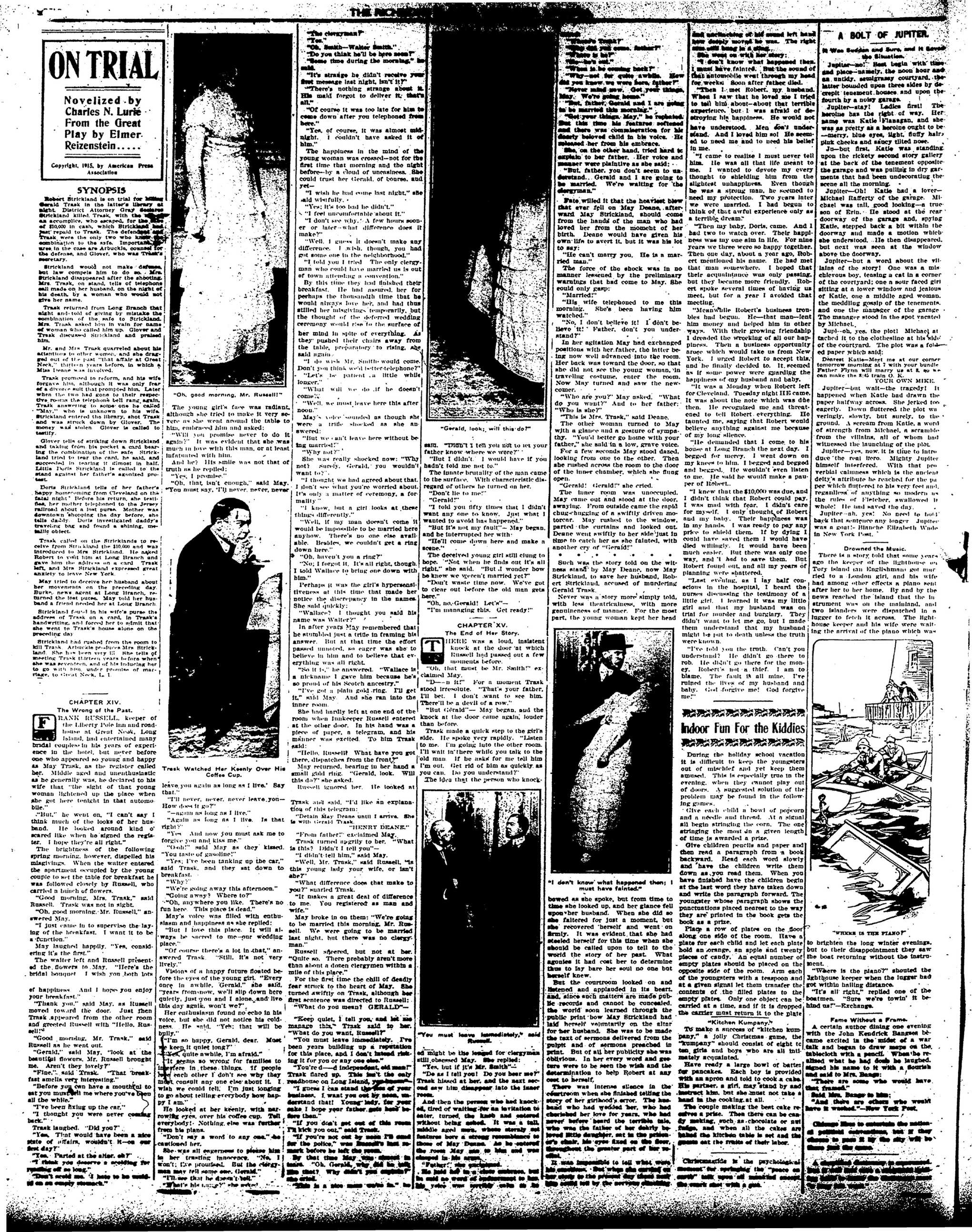
Trask Watched Her Keenly Over His Coffee Cup.
leave, you again as long as I live.' Say that.
"I'll never, never, never leave, you—How does it go?"
"—again as long as I live."
"Again as long as I live. Is that right?"
"Yes. And now you must ask me to forgive you and kiss me."
"Ooh!" said May as they kissed.
"You taste of gasoline."
"Yes, I've been tanking up the car," said Trask, and they sat down to breakfast.
"Why?"
"We're going away a afternoon."
"Going away? Where to?"
"Oh, anywhere you like. There's no fun here. This place is dead."
May's voice was filled with enthusiasm and happiness as she replied: "But I love this place. It will always be sacred to me—our wedding place." "Of course there's a lot in that," answered Trask "Still. It's not very lively." Visions of a happy future floated before the eyes of the young girl. "Every once in awhile, Gerald." she said, "years from now, we'll slip down here quietly, just you and I alone, and live this day agin, won't we?" Her enthusiasm found no echo in his voice, but she did not notice his coldness. He said, "Yes: that will be billy." "I'm so happy, Gerald, dear. Must we keep it quiet long?"
"It seems so wrong for families to interfere in these things. If people hear each other I don't see why they must consult any one else about it. I wish we could tell. I'm just longing to go about telling everybody how happy I am."
He looked at her keenly, with narrowing eyes, over his coffee cup. Tell everybody: Nothing else was further from his plans.
"Don't say a word to any one," he cautioned her.
She was all angered to please him in her trusting innocence. "No, I won't. I don't promise. But the clergy man may tell some one. Gerald." "I'll see that he doesn't tell."
What's his name? Who met him?
"I're strange he didn't receive your
first message last night, isn't it?"
"There's nothing strange about it. He mall forgot to deliver it, that's all."
"Of course it was too late for him to come down after you telephoned from here."
"Yes, of course, it was almost midnight. I couldn't have asked it of him."
The happiness in the mind of the young woman was crossed—not for the first time that morning and the night before—by a cloud of unconscious. She could trust her Gerald, of course, and yet—
"I wish he had come last night," she said wistfully.
"Yes; it's too bad he didn't."
"I feel uncomfortable about it."
"I don't see why. A few hours sooner or later—what difference does it make?"
"Well, I guess it doesn't make any difference. I wish, though, you had got some one in the neighborhood."
"I told you I tried. The only clergyman who could have married us is out of town attending a convention."
By this time they had dislushed their breakfast. He had assured, her for perhaps the thousandth time that he would always love her, and had thus stilled her misgivings temporarily, but the thought of the deferred wedding ceremony would rise to the surface of her mind in spite of everything. As they pushed their chairs away from the table, preparatory to rising, she said again.
"I do wish Mr. Smith would come. Don't you think you better telephone?"
"Let's be patient, a little while longer."
"What will we do if he doesn't come?"
"Well, we must leave here this after noon."
May's voice sounded as though she were a trifle shocked as she answered:
"But we can't leave here without being married."
"Why not?"
She was really shocked now: "Why not? Surely, Gerald, you wouldn't want to?"
"I thought we had agreed about that. I don't see what you're worried about. It's only a matter of ceremony, a formality."
"I know, but a girl looks at these things differently."
"Well, if my man doesn't come it would be impossible to be married here anyhow. There's no one else available. Besides, we couldn't get a ring down here."
"Oh, haven't you a ring?"
"No; I forgot it. It's all right, though. I told Wallace to bring one down with him."
Perhaps it was the girl's hypersensitiveness at this time that made her notice the discrepancy in the names. She said quickly:
"Wallace? I thought you said his name was Walter?"
In after years May remembered that he stumbled just a tride in framing his answer. But at that time the effort passed imputed, so eager was she to believe in him and to believe that everything was all right.
"So it is," he answered. "Wallace is a nickname I gave him because he's so proud of his Scotch ancestry."
"I've got a plain gold ring. I till get it." said May. And she ran into the inner room.
She had hardly left at one end of the room when Jinkeeper Russell entered at the other door. In his hand was a piece of paper, a telegram, and his manner was excited. To him Trask said:
"Hello, Russell! What have you got there, dispatches from the front?"
May returned, bearing in her hand a small gold ring. "Gerald, look. Will this do?'" she asked.
Russell ignored her. He looked at Trask and said, "I'd like an explanation of this telegram:
"Detain May Deane until I arrive. She is with Gerald. Thank you."
"I didn't tell him," said May.
"Well, Mr. Trusk," said Russell, "in this young lady your wife, or isn't she?"
"What difference does that make to you?" married Trusk.
"It makes a great deal of difference to me. You registered as man and wife."
May broke in on them: "We're going to be married this morning, Mr. Russell. We were going to be married last night, but there was no clergyman."
Russell suffered, but not at her.
"Quite so. There probably aren't more than about a dozen clergymen within a mile of this place."
For the first time the chill of deadly fear struck to the heart of May. She turned swiftly on Trask, although her first sentence was directed to Russell:
"What do you mean? GERALD?"
"Keep quiet, I tell you, and let me manage this." Trask said to her.
"What do you want, Russell?"
"You must leave immediately. I've been years building up a reputation for this place, and I don't intend risking it for you or any one else."
"You're d—d independent, old man! Trask fared up. This isn't the only readhouse on Long Island, you know." "I guess I can stand the price of your business. I want you out by noon, understand that! Young lady, for your sake I hope your father gets back before then."
By that time May who attended
to hear "Oh, Gerald, why did he take
him that? Why didn't you explain?"
he erred.
The image provided does not contain any text or recognizable content. It appears to be a grayscale photograph of a curved surface with a smooth texture.
said. "Didn't I tell you not to let your father know where we were?" "But I didn't. I would have if you hadn't told me not to." The funnile brutality of the man came to the surface. With characteristic disregard of others he turned on her. "Don't lie to me!" "Gerald!" "I told you fifty times that I didn't want any one to know. Just what I wanted to avoid has happened." "But it's not my fault!" - May began, and he interrupted her with "He'll come down here and make a scene." The deceived young girl still clung to bope. "Not when he finds out it's all right," she said. "But I wonder how he knew we weren't married yet?" "Don't waste time now. We've got to clear out before the old man gets here." "Oh no. Gerald! Let's"—
CHAPTER XV
T
HERE was a loud, insistent knock at the door at which Russell had passed out a few moments before.
"Oh, that must be Mr. Smith!" exclaimed May.
"D—n it!" For a moment Trask stood irresolute. "That's your father, I'll bet. I don't want to see him. There'll be a decill of a row."
"But Gérald"—May began, and the knock at the door came again, louder than before.
Trask made a quick step to the girl's side. He spoke very rapidly. "Listen to me. I'm going into the other room. I will wait in there while you talk to the old man. If he asks for me tell him I'm out. Get rid of him as quickly as you can. Do you understand?"
The idea that the person who knock-
THE FEDERAL CONFERENCE
"You must leave immediately," said Rumelian.
"You must leave immediately," said Russell.
ed might be the longed for clergyman still obsessed May. She replied:
"Yeah, but if it's Mr. Smith"
"Do as I tell you! Do you bear me?"
Trask held at her, and the next second saw him disappear into the inner room.
And then the person who had knocked, tired of waiting for an invitation to enter, turned, the knob and entered without being asked. It was a tall, middle aged man, whose sternly set features bore a strong resemblance to those of May Duncan. As he entered the room May may to him and was clamped in his arms.
"Father," she grimaced.
He held up in a close embrace, but he said no word of indifference to him, his voice was warriorly calm to him.
"What's Tankh?"
"What did you come, father?"
"Where is he?"
"How-her out."
"What is he coming back?"
"Why- not for quite awhile. How did you know, we were born, father?"
"Never mind now. Got your things, may. We're home."
"But, father, Gerald and I are going to be married the morning."
"Get your things, May," he replied.
But this time his features softened and there was commission for his clearly beloved child in his voice. He embraced her from his embrace.
She, on the other hand, tried hard to explain to her father. Her voice and manner were plaintive as she said:
"But, father, you don't seem to understand. Gerald and I are going to be married. We're waiting for the clergyman."
Date willed it that the heaviest blow that ever fell on May Deane, afterward May Strickland, should come from the hands of the man who had loved her from the moment of her birth. Deane would have given his own life to avert it, but it was his lot to say:
"He can't marry you. He is a married man."
The force of the shock was in no manner lessened by the preliminary warnings that had come to May. She could only gasp:
"Married!"
"His wife telephoned to me this morning. She's been having him watched."
"No, I don't believe it! I don't believe it!" Father, don't you understand?
In her agitation May had exchanged positions with her father, the latter being now well advanced into the room. Her back was toward the door, so that she did not see the young woman, in travelling costume, enter the room. Now May turned and saw the newcomer.
"Who are you?" May asked. "What do you want?" And to her father: "Who is she?"
The other woman turned to May with a glance and a gesture of sympathy. "You'd better go home with your father," she said in a low, grave voice. For a few seconds May stood dazed, looking from one to the other. Then she rushed across the room to the door of the inner chamber, which she fung open.
"Gerald! Gerald!" she cried.
The inner room was unoccupied. May came out and stood at the door, swaying. From outside came the rapid chug-chugging of a swiftly driven motorcar. May rushed to the window, parted the curtains and looked out. Deane went swiftly to her side just in time to catch her as she fainted, with another cry of "Gerald!"
Such was the story told on the witness stand by May Deane, now May Strickland, to save her husband, Robert Strickland, accused of murdering Gerald Trank.
Never was a story more simply told, with less theatricality, with more genuinehood of manner. For the most part, the young woman kent her head
THE MUSICIAN
"I don't know what happened then; I must have fainted."
bowed as she spoke, but from time to time she looked up, and her glance fell upon her husband. When she did so she faltered for just a moment, but she recovered 'herself and went on firmly. It was evident, that she had steeled herself for this time when she should be called upon to tell to the world the story of her past. What agonies it had cost her to determine thus to say bare her soul no one but herself knew.
But the courtroom looked on and listened and applauded in its heart and, since such matters are made public records and cannot be concealed, the world soon learned through the public print how May Strickland had laid herself voluntarily on the altar for her husband. She was to be made the text of sermons delivered from the pulpit and of sermons preached in print. But of all her publicity she was oblivious. In her every word and gesture were to be seen the wish and the determination to help Robert at any cost to herself.
There was intense silence in the courtroom when she finished telling the story of her girlhood's error. The husband who had wedded her, who had cherished her love for years, who had never before heard the terrible tale, who was the father of her dearly beloved little daughter, sat in the prisoner chair, his eyes fixed on the floor, throughout the greater part of her medical.
It was impossible to tell what were his intentions. But when she arrived on her way to the prison they almost made him call out by the prison cladding.
and unnatching of his wound left hand how deeply moved he was. The right arm still being in a swing. She was on with her story:
"I don't know what happened then. I must have fainted. But the sound of that automobile went through my head for weeks. Soon after father died.
"Then I met Robert, my husband. When I saw that he loved me I tried to tell him about--about that terrible experience, but I was afraid of destroying his happiness. He would not have understood. Men don't understand. And I loved him sol. He seemed to need me and to need his belief in me.
"I came to realize I must never tell him. He was all that life meant to me. I wanted to devote my every thought to shielding him from the slightest unhappiness. Even though he was a strong man, he seemed to need my protection. Two years inter we were married. I had begun to think of that awful experience only as a terrible dream."
"Then my baby, Doris, came. And I had two to watch over. Their happiness was my one aim in life. For nine years we three were so happy together. Then one day, about a year ago, Robert mentioned his name. He had met that man somewhere. I hoped that their acquaintance was only passing, but they became more friendly. Robert spoke several times of having us meet, but for a year I avoided that meeting.
"Meanwhile Robert's business troubles had begun. He—that man—lent him money and helped him in other ways. With their growing friendship I dreaded the wroking of all our happiness. Then a business opportunity arose which would take us from New York. I urged Robert to accept this, and he finally decided to. It seemed as if some power were guarding the happiness of my husband and baby.
"It was a Monday when Robert left for Cleveland. Tuesday night HE came. It was about the note which was due then. He recognized me and threatened to tell Robert everything. He taunted me, saying that Robert would believe anything against me because of my long silence.
"He demanded that I come to his house at Long Branch the next day. I begged for mercy. I went down on my knees to him. I begged and begged and begged. He wouldn't even listen to me. He said he would make a pauper of Robert."
"I knew that the $10,000 was due, and I didn't think that Robert could pay. I was mad with fear. I didn't care for myself. I only thought of Robert and my baby. Their happiness was in my hands. I was ready to pay any price to shield them. If by dying I could have saved them I would have died willingly. It would have been much easier. But there was only one way, and I had to save them. But Robert found out, and all my years of planning were shattered.
"Last evening, as I lay half conscious in the hospital, I heard the nurses discussing the testimony of a little girl. I learned it was my little girl and that my husband was on trink for murder and burglary. They didn't want to let me go, but I made them understand that my husband might be put to death unless the truth were known.
"I've told you the truth. Can't you understand? He didn't go there to rob. He didn't go there for the money. Robert's not a thief. I am to blame. The fault is all mine. I've ruined the lives of my husband and baby. God forgive me! God forgive me!"
Indoor Fun For the Kiddies
During the holiday school vacation it is difficult to keep the youngsters out of mischief and yet keep them amused. This is especially true in the evening, when they cannot play out of doors. A suggested solution of the problem may be found in the following games.
Give each child a bowl of popcorn and a needle and thread. At a signal all begin stringing the corn. The one stringing the most in a given length of time is awarded a prize.
Give children pencils and paper and then read a paragraph from a book backward. Read each word slowly and have the children write them down as you read them. When you have finished have the children begin at the last word they have taken down and write the paragraph forward. The youngster whose paragraph shows the punctuation placed nearest to the way they are printed in the book gets the book as a prize.
Place a row of plates on the floor along one side of the room. Have a plate for each child and let each plate hold an orange, an apple and twenty pieces of candy. An equal number of empty plates should be placed on the opposite side of the room. Arm each of the youngsters with a teaspoon and at a given signal let them transfer the contents of the filled plates to the empty plates. Only one object can be carried at a time, and if it is dropped the carrier must return it to the plate
"Kitchen Kumponx"
To make a success of "kitchen kumpon," a jolly Christmas game, the "kumpon" should consist of eight to ten girls and boys who are all intimately acquainted.
Have ready a large bowl of batter for pancakes. Each boy is provided with an apron and told to cook a cake. His partner, a girl, may stand by and instruct him, but she must not take a hand in the cooking at all.
The couple making the best cake receives a prize. Then there can be cany making, such as chocolate or nut fudge, and when all the cakes are baked the kitchen table is set and the games set the fruits of their labor.
Christmaside is the psychological moment for springing the "peace on earth" talk upon all mankind except the earth must with a smile.
It Was Sudden and Sure, and It Saved the Situation.
Jupiter—no! Best begin with time and place—namely, the noon hour and an untidy, semigray courtyard, the latter bounded upon three sides by decrepit tenement, houses and upon the fourth by a noisy garage.
Jupiter—stay! Ladies first! The heroine has the right of way. Her name was Katie Flanagan, and she was as pretty as a heroine ought to be—merry, blue eyes, light, duffy hair, plink checks and sancy tilted now.
Jn—but first, Katie was standing upon the rickety second story gallery at the back of the tenement opposite the garage and was pulling in dry garments that had been undecorating the scene all the morning.
Jupiter—Oh! Katie had a lover-
Michael Rafferty of the garage.
Michael was tall, good looking—a true
son of Erin. He stood at the rear
doorway of the garage and, spying
Katie, stepped back a bit within the
doorway and made a motion which
she understood. He then disappeared,
but next was seen at the window
above the doorway.
Jupiter—but a word about the villains
of the story! One was a mis-
chievous boy, teasing a cat in a corner
of the courtyard; one a sour faced girl
sitting at a lower window and jealous
of Katie, one a middle aged woman,
the meddling gossip of the tenements,
and one the manager of the garage.
The manager stood in the spot vacant
by Michael.
Jupil—oh, yes, the plot! Michael at
tached it to the clothesline at his side
of the courtyard. The plot was a fol-
ed paper which said:
Dearest Katie--Me meet at our corner tomorrow morning at 7 with your bundle. Father Flynn will marry us at 8. so we can make the 8:45 train to K. YOUR OWN MIKE.
Jupiter--but wait—the tragedy! It happened when Katie had drawn the paper halfway across. She jerked too eagerly. Down futtered the plot waveringly, slowly, but surely, to the ground. A scream from Katie, a word of strength from Michael, a scramble from the villains, all of whom had witnessed the unnunching of the plot.
Jupiter--yes, now. It is time to introduce the real hero. Mighty Jupiter himself interfered. With that proverbial calmness which is the ancient delity's attribute he reached for the paper which futtered to his very feet and reganless of anything so modern as the rules of Fletcher, swallowed it whole! He and saved the day.
Jupiter--ah, yes! No need to hold back that sentence any longer. Jupiter was a goat! Blanche Elizabeth Wade in New York Post.
```markdown
```
Drowned the Music.
There is a story told that some years ago the keeper of the lighthouse on Tory island an Englishman got married to a London girl, and his wife had among other effects a piano sent after her to her home. By and by the news reached the island that the instrument was on the mainland, and two islanders were dispatched in a lugger to fetch it across. The lighthouse keeper and his wife were waiting the arrival of the piano which was
A
"WHERE IS THE PIANO?" to brighten the long winter evenings, but to their disappointment they saw the boat returning without the instrument.
"Where is the piano?" shouted the Lighthouse keeper when the lugger had got within hailing distance.
"It's all right," replied one of the boatmen. "Sure we're towin' it behind us!"—Exchange.
Fame Without a Frame.
A certain author dining one evening with the John Kendrick Bangree became excited in the midst of a war talk and began to draw maps on the tablecloth with a pencil. When he realized what he had done he laughed, signed his name to it with a flourish and said to Mr. Bangue:
"There are some who would have that framed."
Said Mr. Bangue to him:
"And there are others who wouldn't have it washed."—New York Post.
Chicago likes to entertain the national political correspondents, but if they choose to pose it by the sky will be those just for them.
```markdown
```
MERRY
CHRISTMAS
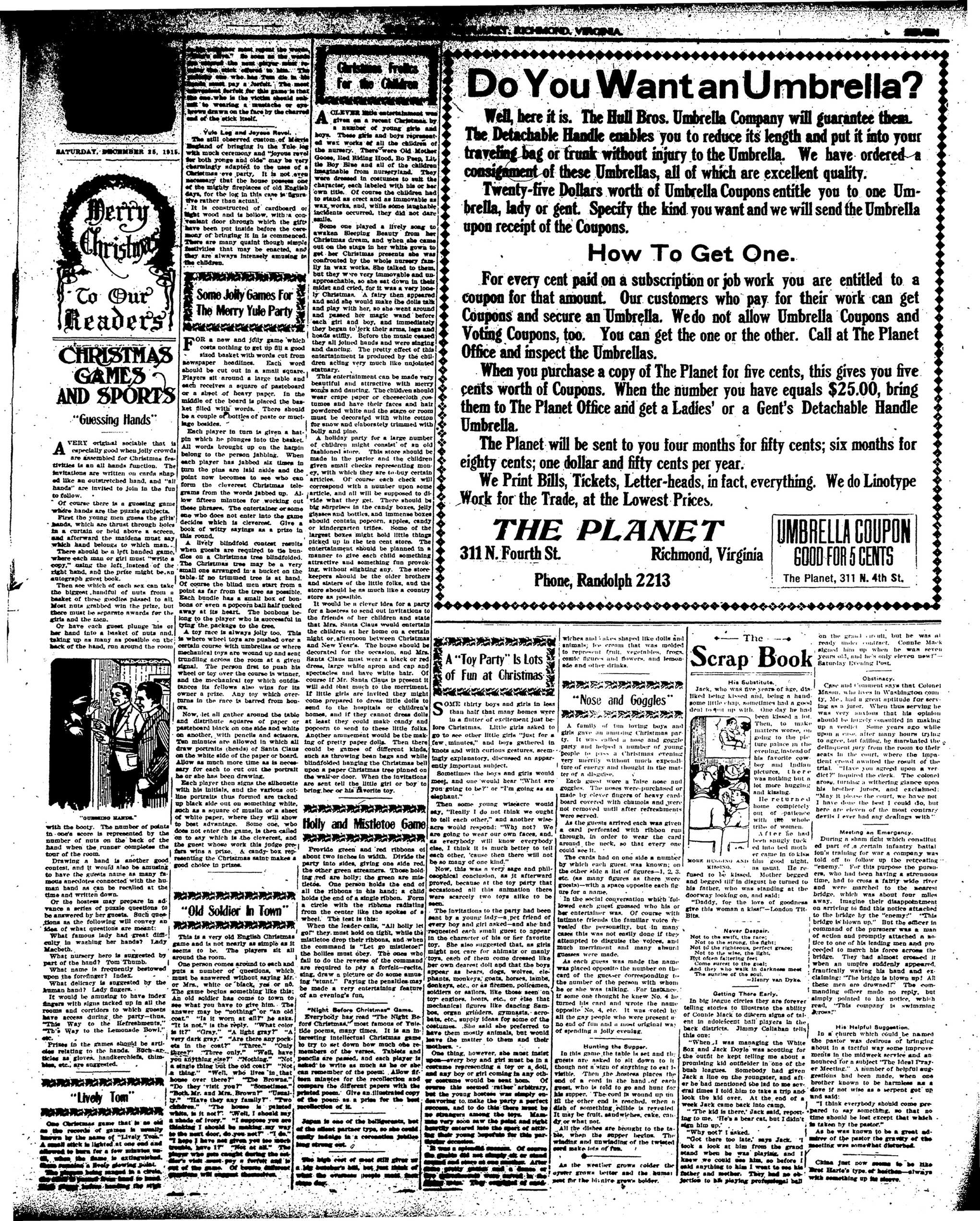
CHRISTMAS GAMES AND SPORTS Trying to Fill the Stocking
A LIVELY scramble game, due for Christmas time, is played by stretching a clothline across the room and pinning heavy worsted stockings to it, with clothsplins. A basket of rosy apples is provided and as many wooden spoons tied with holly ribbon as there will be players contesting at once. Six is a good number, for the ordinary sized living room will hardly accommodate more than half a dozen lively contestants at one time. The object is to see which of the six can once fill his or her stocking with the apples, which have to be dipped
A woman is drying a sock on a clothesline. In the foreground, there is a basket filled with apples.
TRYING TO PILL THE STOCKING.
up, carried and dropped into the stocking with the wooden spoon. Of course each player is given a certain stocking, which he or she labors to fill, receiving no assistance from any one else. A certain number of apples, according to size, is agreed on for each stocking before the fun begins.
The player who is first of the six to fill his or her is winner of that particular round and is entitled to draw for the prize, the unsuccessful five being barred.
When six have raced another half dozen take their places, and so on. The game is a screening force throughout and cannot fail to be jolly.
Games For Christmas Aft-
```markdown
```
Games fill in nicely the time "between the dark and the daylight" on Christmas afternoon. A "holly bunt" demands holly leaves cut out of green paper and placed about the house in plain sight, but in unusual places. Each child goes a hunting the leaves with a basket, and the one who finds the largest number receives a prize. For a cranberry race each couple has two bowls, one partly filled with cranberries. Each person, using the left hand, tries to see how many berries he can move from one bowl to the other with a tiny spoon. Navelopes filled with cut-up pictures of Christmas scenes pasted on cardboard and passed one to each person give quiet fun. The contest is putting the pumies together and seating who can do it quickest. A variation of the familiar "donkey" name is played as follows:
A large tree is drawn on paper and fastened on the wall. Pictures of Christmas gifts cut from advertisements and catalogues are distributed among the guests. Each is blindfolded in turn and tries to fasten the gift on the branches of the tree.
Home-inspive prison for Christmas men contain are blottern, decorated with holly in water, colors or oil, and butterfly needlesbooks. Dulaty bonies honey may be made of water color paper or of cardboard covered with single paper. These filled with homemade candies are always acceptable.
THE watch trick here described is interesting to while away odd minutes at Yuletide. Request some one to think of one of the numbers from one to twelve on the dial of your watch and ask him to add one to it every time you tap the crystal over the dial with a pencil (see illustration) until he reaches twenty, and then to notify you. Tell him that by the twentieth tap you will have read his mind so accurately that you will then strike the $^2$ he first thought of without any questions. The $^3$ of doing this trick is
DOING THE WATCH TRICK.
numbers on the watch dial, but at the eighth tap strike twelve, at the ninth, eleven; at the tenth, ten, and so on around backward until you are notified by the chooser that he has reached twenty in his count.
If the instructions have been properly followed the penill will then rest upon the chosen number, because if twelve—the highest number that can be taken—is chosen, eight taps will bring it to twenty, so that your penill, according to instructions, will then be on twelve, and any other number selected, on the dial will be less than twelve by just the amount that will cause the penill taps, to shift backward from twelve to the thought of number when the count of twenty has been reached by the chooser.
"Little Jacky Bingo," often played at Christmas parties, is a very simple game and seems rather pointless to the onlookers, but little children love it. The players form a ring, with one left out to be Little Jacky Bingo. Jacky walks round outside the ring. The players call out: "Who is that walking round my stony wall?"
Jacky answers, "Only Little Jacky
'Bingo.'
The players: "Don't you steal one of
my fat pig!"
Jacky: "I stole one last night, and
I'll steal another tonight; so come
along."
Then Jacky touches some one in the
ring, who has to fall out and walk be-
hind him. So the game goes on, the
players falling in one behind another
till at last Jacky has them all.
Game of "The Bookbinder"
"Bookbinder" is a holiday time diversion that looks simple and tame, but can be made highly exciting. Any number of persons sit in a circle, each holding a book on the back of his clinched fists. One who has been chosen bookbinder and stands in the middle of the circle goes to any players and, seizing that player's book, attempts to rap his knuckles, which the holder of the book tries to avoid by pulling back his hands quickly.
If the bookbinder succeeds in this the player whose knuckles he raps changes places with him; otherwise he replaces the book and tries to do the same with some one else. The bookbinder may pretend to seize a book without actually doing so, and if the holder pulls away his hands so that the book falls he must take the leader's place as if his knuckles had been rapped.
The leader can make this game very exciting if he runs quickly- from one to another, pretending to take up one book and then seizing another.
---
Nothing is so healing as glycerin, benzoin and water for chapping of the skin. Prepare a mixture as follows: Glycerin, one ounce; water, four ounces, and compound tincture of benzoin, one ounce. Shake these ingredients well together and rub well into the skin upon retiring at night. Housekeepers may use it twice a day, especially after dish-washing or on the family wash day. The skin becomes smooth very quickly after being treated with this lotion. If the skin is very tough and red it makes it white and soft.
THE RICHMOND PLANET, RICHMOND, VIRGINIA
1916 Calendars Now Ready
1916 Calendars Now Ready
We have a fine line of Calendars for 1916, both imported and domestic and they are now ready for the inspection of the Public. We can quote prices that will be of special interest to those who buy these kind of souvenirs. A visit is requested even if you are not ready or are not prepared to purchase now.
THE LINE IS ATTRACTIVE AND THE DESIGNS ARE NEW AND SURPRISINGLY BEAUTIFUL. THE J. W. BUTLER PAPER CO., OF CHICAGO, ILL. HANDLES THE FINEST LINES OF CALENDARS, COLLEGE COMMENCEMENT PROGRAMMES AND FOLDERS OF ANY HOUSE IN THE COUNTRY. TO SEE THEM IS TO REALIZE TO THE FULLEST EXTENT THE FORCE OF THIS DECLARATION.
CALL AT THE PLANET OFFICE, 311 N. 4TH ST., (BET. BROAD AND MARSHALL STS.) RICHMOND, VIRGINIA. Out of Town Orders Solicited.
Scrap Book
Senator Beveridge came to Washing ton heralded as the "young man eloquent." He attended his first Gridiron dinner in 1820, handicapped by his boy orator reputation. Arthur Wallace Dunn in "Gridiron Nights" thus decribes his adventures:
"When Senator Beveridge was called upon he was escorted to the area in front of the president, given a brief lecture and told how to deport himself as a United States senator. First his youth was criticised, and he was told to overcome this defect by wearing whiskers, and a disguise of whiskers was put over his face. Then he was informed that one trouble in the senate was due to an inclination to talk too long, and he was given an alarm clock and told that when the alarm sounded it was time to quit. Having received these instructions, he was allowed to proceed."
"Holding the alarm clock in one hand and waving the other with oratorical gestures, the young senator began to speak, but he had not been going more than three minutes when the alarm, which had been previously set for the occasion, went off, and as it rang loud and long everybody shouted and laughed, and Beveridge had to wait for another occasion before he was able to make a speech to the Gridiron club."
Home.
What is house and what is home
Where with freedom thou hast room,
And mayst it to all tyrants say,
This you can not take away!
Tis no thing with doors and walls
That earthquake fails;
No fair tower, nor easily fashions
Is but plunder's invitation;
No stout marble structure, where
Walls eternity do dare;
No brass gates, no bars of steel,
Though time's teeth they scorn to feel;
No power's wings it ride;
Marble's not so hard as spite
Arm'd with lawless strength and might
Seek no more abroad, say I.
House and home, but turn thine eye
Iward and observe thy breast;
That marble's not so hard;
That's a close immured tower
Which can mock all hostile power.
To thyself a tenant be
And habilite safe and free.
Home is everywhere to be
The cannot thine own bwathing be.
Barkie Wan Willer
He was traveling in an out of the way place and had to put up overnight of a several hotel. He said to the start when he entered, "Where shall I photograph?" "Autograph?" and the clerk, "Tell right my name, you know," "The right hand," as he was lying his head in the matress in each hand, reaching through the matress. Intensely humming, he sat down, shaking his head. "What is it?" he asked.
asked the clerk, his face aglow with the plague that comes from the connoisseur of intellectual superiority "Certainly," said the newcomer, his face no less radiant than that of the clerk; "mine's rye."
Major Pond and Bill Nye.
More than one successful lecture star had to thank Major Fond for his start. He had keen discrimination and not infrequently sought out and dragged upon the lecture platform an observant genius who never thought to see him self before the footlights. Such a genius was Bill Nye. When the major found him he was acting as postmaster and editing the Laramble Boom erang over a flery stable. ("Walk down the alley, twist the gray mullet tail, take the elevator immediately") Pond persuaded him to try lecturing and as there proved to be both money and useful publicity in it Nye was grateful and used for years to remember the major with characteristic note, one of which had the following exhaustive signature:
Tourna with a heart full of gratitude and a system full of drugs, paints, oil turpentine, glass, patty and everything usually kept in a first class drug store
BILL NYE
P. B.-Open all night.
More Name Than Fame.
The telegraph editor of a Denver newspaper had often complained of a country correspondent who omitted names in his stories, so he wrote the man that if he neglected the names in his next parm he would be discharged. A few days later the editor got this dispatch:
C. Coto, Colo., June 8-A severe storm passed over this section this afternoon, and lightning struck a barbed wire fence on the ranch of Henry Wilson, killing three cows, their names being Jessie, Beaise and Mary.
-Saturday Evening Post
Aqueous Humor.
While at lunch with William Abbingdon and Willie Collier, the actors, a young Englishman, also an actor, indulged in numerous criticisms of America and American institutions. It became very distasteful to Abbingdon, who is a British subject and was not permitted to join the army even though he applied.
"If you don't like America and her people," suggested Abbingdon to his younger fellow countryman, "why don't you go over to England and help fight for your own country? You could get in the army."
"No, I couldn't," the younger Englishman hastened to explain. "I tried, but they wouldn't let me in because they said I had a floating kidney."
"Well, suddenly interjected Collier, with a bite of sarment, that wouldn't keep you from joining the navy, would KF—Faturing Evening Post."
YOU CAN FIND HERE ADVERTISING
THERE IS ALSO A LINE OF "LEFT OVER" 1915 CALENDAR BACKS, WHICH CAN BE SOLD AT A SACRIFICE TO LARGE PURCHASERS, WHO DESIRE TO SAVE MONEY.
And Wanted to Do Nice and Fresh For Her New Situation.
Marinar was going. For a week, the housework had stood still, "because" as Mrs. Woodside said, "you can't ask a maid to do anything when she's leaving."
For a week the kitchen range had been cold, likewise the water tank beside it, and, there being no gas heater in the Woodside home, the growups had contented themselves with cold baths and the children with such purification as could be accomplished with occasional bedtime teakettles of hot water. "I ought to have Marinar start the fire," said the mistress, "but it means bringing up coal from the cellar, and I'm afraid to ask her."
The hour of Martian's departure had arrived. She lazied through the breakfast dishwashing, then disappeared upstairs to pack. Mrs. Woodside went into the deserted Mitchen and said: "Now I'll have a fire and a boilerful of hot water at last." She brought kindling and coal from the lower regions; she built the fire and stoked it for an hour until the water tank gave out a grateful heat. Then she went to look for Martian.
The outgoing maid was not in her room. Mrs. Woodside came down from the third floor perplexed. Could Martian have gone without saying goodby?
Then, from behind the closed door of the bathroom, came the joyous sounds of one luxuriating in a porcelain tub filled with glorious hot water. Martian was taking a bath—Newark News.
The New Butler.
We have a butler now. Good lands!
He's dummed and grim;
In fact, the entire family stands
In perfect awe of him.
He simplifies housekeeping, though,
In terror of his frown.
Each day we all discreetly go
And get our meals downstown.
-Louisville Courier Journal.
Good Work.
"Do you do anything for your Seah?"
"I should say so. I keep getting father and father."—Wisconsin State Journal.
JOHN M. HIGGINS
Choice Groceries, Wines
Liquors and Cigars
PURE GOODS, FULL VALUE
FOR THE MONEY.
1610 East Franklin St.
(Near Old Market)
RICHMOND VIRGINIA
A. HAYES,
OFFICE AND WARKROOMS:
727 N. Second St.
RESIDENCE—728 N. SECOND BT.
First-class Hacks and Caskets of all descriptions. I have a spare room for bodies, when the family have not t suitable place. All Country Orders given Special Attention.
Your special attention is called to the New Style Oak Caskets. Call and see me and you shall we waited on individually.
PHONE MADISON $758
OTHER PEOPLE JUDGE you by your Furniture now! When you can get Furniture and Rugs from an Old Established house like JURGENE—that's known to sell
the best quality goods, just as reasonable able as elsewhere—why not give your friends a good impression. It will give us the greatest pleasure to show you our wonderful stock of homemaking comfort giving Furniture and Rugs and—don't fail to ask our esteem about our banking plan which gives you 6, 10, or 15 months in which to pay for any purchase.
CHAS. G. JURGENS SON
ESTABLISHED 1899
ADAMS AND BROAD
RICHMOND PLANET
RICHMOND PLANET
RAILROADS
Richmond, Fredericksbury & Potomac R. R.
Layne Reinhardt Daily
* 4.30 K * 14.30 M * 8.40 M * 17.50 M * 1.10 P * 2.54 M
* 9.23 K * 14.30 M * 12.01 M * 19.25 M * 0.30 P * 9.00 M
* 9.30 K * 14.37 M * 8.20 M * 19.25 M * 0.30 P * 12.40 M
Included hours, week days, i.e. K, L, M, T, 7.30 K, 2.16 P, 8.50 K, E
K, 6.30 M, 11.52 M, 5.42 M, 5.18 M, Prestigious holiday, week days,
i.e. K, 16.40 M, i.e. 16.25 M, Summer K, 4.18 M, i.e. 10.45 M,
Ski R. K, Ri. K, Trial S. K, (shipping at EI). Layne Reinhardt daily.
NORFOLK & WESTERN.
ONLY ALL RAIL LINE TO NURFOLK.
Schedule in effect, April 8, 1918.
Leave for New York, New York.
NORFOLK: "8:00 A.M. M." "2:00 P.M. M." "4:00 P.M.
For LYNCHBURG, AND THE WEST: "8:15 A.M.
M." "0:00 A.M. M." "2:00 P.M. M." "8:30 A.M.
M." "0:00 A.M. M." "2:00 P.M. M." "8:30 P.M.
M." "11:30 P.M. M." From the West: "8:30
A.M. M." "2:10 P.M. M." "1:40 P.M. M." "0:60 P.M.
M." "0:00 P.M.
For D.C. except Sunday, **** Sunday only
W. H. DEVILL. W. G. BAUNDERS.
P. T. M. Branoks G. P. A. Rossoe
C. H. BORLKY, D. P. A. Richmond, Va.
ATLANTIC COAST LINE
TRAINS LEAVE RICHMOND DAILY—
P. M. Leaves the South: A. M. 1:58, M. 9:20
A. M. 12:50, M. 9:20
For Norfolk: 9:00 A. M. 8:00 P. M. *9:20
A. M. 9:20, M. W. Rye, West: 9:15 A. M. 9:20
A. M. 9:20, M. P. 9:20 P. M.
For Petersburg: 12:50 A. M. 6:15 A. M. 9:20
A. M. 9:20, M. P. 9:20 P. M. 5:50 A. M. 9:20
*4:00 P. M. *4:10 P. M. 5:50 P. M. 6:15 A. M. 9:20
P. M. 11:50 P. M.
For Goldboro and Playterville: *4:00 P. M.
TRAINS LEAVE RICHMOND-DAILY—
8:20 A. M. 9:18 A. M. 8:20 A. M. *8:20 A. M.
8:20 A. M. 9:18 A. M. 8:20 A. M. *8:20 A. M.
*1:40 P. M. *1:19 P. M. 8:20 P. M. 9:20
P. M. 9:00 P. M. 11:50 P. M.
*Except Sunday, *Sunday only.
Time travel and departure and connections
not guaranteed.
C. B. CAMPELL, D. P. A. 288 Main St.
THE SOUTHERN
SR
SERVES THE SOUTH
11:18 P. M.-Daily-Limited-For all people
Booth. Fullman ready 9:00 P. M.
YORK RIVER LINE
8:10 P. M.—Bleamer train (Parlor car)—Bright
local. To West Point, connecting for Baskin-
daily except Sunday.
7:38 A. M.—Daily—Local to West Point.
TRAINS AREIVE RICHMOND
From the South: 7:05 A. M., 8:08 A. St.
8:50 P. M., and 8:20 P. M., daily; 8:48 A. St.
except Sunday.
From West Point: 8:10 A. M., 8:18 P. M.
daily.
H. L. KEHOP, D. P. A.
907 East Main St. Phone: 800-7828
CHESAPEAKE & OHIO.
Chiccottati, Lovetville & West, 7:00 P. *11:00 P.
Main Line Local, 7:00 A. *7:00 P. *11:00 P.
James River Lines, 7:00 A. *11:00 P.
New York, Old Pt. 7:00 A. *11:00 P.
Newport News Local, 7:15 A. *11:00 P.
Trains arrive from Norfolk, 7:15 A. *11:00 P.
7:00 P.; Newport News, 7:56 A. *8:00 P.
From West, 7:56 A. *8:00 P.
7:10 P.; 7:20 P. James River, 7:00 A.
7:15 P. *Daily.* *Receipt Sunday.*
- SEABOARD AIR LINE
Bostockhound trust appointed to have Bostockhound
daily, 125 A. M. L. local to Northam; 125 P. M.
M. sleeper and coach, Atlanta, Birmingham;
Jacksonville; 125 P. M. L. coach, and sleeper
Jacksonville; 1254 A. M. M., sleeper, Atlanta,
Birmingham; Jacksonville, Tampa and coach,
Jacksonville.
ALPHEUS SCOTT
(CHURCH HILL)
Funeral Director and
Embalmer
OPEN DAY AND NIGHT
Office, 2004 P Street, Phoen,
Med. 2287—Berkshire, 1015
St. James St., Phoen,
Midlum 0019.
Purchaser, Insurer and Servi-
ce of the East Anglia Funeral Home
and BASARA COOP, Baskerville for Woman
and Children and all attendants at
Penrith.
Saturday on the Midweek Funer-
al only costs $1.50 per person in adven-
```markdown
```
JOHN MITCHELL, JR....EDITOR
All communications intended for publication should be sent so as to reach us by Wellingay.
Entered at the Post Office at Richmond, Va. on second class matter.
SATURDAY, DECEMBER 25, 1915.
Misplaced sympathy has ruined the world.
The lynchers of colored people are still roaming in the land.
If a man cannot take care of a wife, he should do without one.
A person who runs into debt becomes a virtual slave to the creditor.
Some people fuss and quarrel so much that their faces grow crooked.
People, who cannot pay house rent cannot buy property. People, who can pay house rent can buy property.
This is the season of the year that the preachers have their hands extended for help for God's servants
A child may be bad but if that child is industrious, there are hopes of him. This applies to the girls too
More children are made 'light' fingered by falling to give them enough food to eat than by any other method.
---
The theorist can always tell you how to support your family, but he does not know how to support his own family.
If you are in trouble, tell about it, but do not keep on making the same blunders that get you into trouble.
Saving money is a habit and spending money is the same thing. Practice economy and never spend all that you make.
---
Paying interest on a debt, without reducing the principal is like taking an opiate without making any efforts to cure the pain.
Many people are waiting for the time to come, when they will make enough money to save some of it. That time will never come.
Measure is all right, but for God's sake do not have too much of it. You can suffocate in a bank of sugar or you can drown in a vat of molasses. Don't forget that.
We heard a lawyer say that a crazy person will tell the truth on the witness stand, while many sane people have not learned so to do. The lawyer did not state, though, whether he was sane or crazy.
They are now saying that MAJOR R. R. Morrow is descended from an African chief, who was brought to this country. No one will doubt it after once looking at him.
When a man or woman has been educated and neither knows how to make a living, both are failures. When a man or woman has not been educated and both know how to make a living, both are successes.
Some man who want a home will marry any kind of woman in order to get one. Some women, who want a home will marry any kind of a man for the same reason. The results in both cases are military and unharmed.
Some people believe in living or
they with that in, by discovering other
people and discovering their money with
and collecting for it. Your circumstances
means for a long time at the bank
own, but the job goes on at all.
Some people, with more brains than intelligence seem to think that the greatest aim in life is getting children and not raising them properly. These kind of people are filling our jails and penitentiaries and furnishing candidates for the electric chairs.
People have been lying and misrepresenting facts ever since the time of ADAM. JESUS CHRIST came into the world and He didn't stop all of them so there is no need for you to worry about the alanderers and the back biters. Do the best you can, trust in God and you will reach heaven.
Hon. Woodrow Wilson, as a private citizen, is now in seclusion at Hot Springs, Va., enjoying a well-deserved honeymoon, basking in the smiles of one of the most attractive widows in the United States, but who now bears his name. We wish for him a Merry Christmas, and we are confident that he shall have a Happy New Year.
---
We have received an attractive souvenir booklet of the burning of the last mortgage of St. John A. M. R. Church at Norfolk, Va. December 12, 1915.
It contains pictures of Rev. E. H. Hunter, D. D., L. L. M., and his wife; Bishop L. J. Coppin, interior view of the church; Bishop John M. Brown, D. D., Rev. F. A. Seaton, Rev. W. D. Cook, D. D., Trustee Board, Steward Board, Official Board, Mixed Choir, Sunday School Officers and Teachers, the Sunday School Orchestra, and Rev A. L. Gaines, H. D., Rev. D. P. Seaton, D. D., and the four original trustees.
It contains a detailed history of the great struggle. Rev. Dr. Hunter is one of the ablest divines in the denomination and his success has been to keeping with his transcendent forelight and energy. The souvenir booklet from the press of the Norfolk Journal and Guide, and is highly creditable to that printing establishment.
In recognizing this colored firm's plant, the denomination is acting strictly in accord with the denomination's past record.
MAJOR: R. R. MOTON SELECTED
The selection of R R MOTON, Commandant of Cadets at the Hampton Normal and Agricultural Institute, as President of Tuskegee Institute will give well high universal satisfaction. The special committee took this action last Monday at a meeting held in New York. While we know of no leader in the country, who can discharge fully the duties performed by Du. Booker T. Washburn, or who can really fill his place, we believe that this well-known Virginian can come nearer doing it from all angles than any other person mentioned in connection with the position.
MAJOR MOTOR possesses a temperament that will serve him well in discharging the onerous duties of this office. He is not erratic or vindictive and he possesses charitable characterities which will serve him well in his dealing with those, who may perchance disagree with him. Hampton Institute
in continuation of the work and this of itself is a guarantee that the past friendly relationship between these two great industrial and agricultural institutions of learning will continue. We have known R. R. Moron for twenty years and he is what we first found him to be—a gentleman and a Christian. The special committee has made no mistake in the selection of an official head for Tuskegee Institute at Tuskegee, Alabama.
A GLOWING TRIBUTE
(1)
The Richmond, Va. News Leader publishes a most interesting editorial entitled, "Major Moton and Tuskegee," and then indulges in a biographical sketch of the Negroes of Virginia, which reads "mighty good" to us. If all of the colored people in the State would live up to the standard set, and cherish the traditions of the past, a different condition of affairs would exist throughout the length and breadth of our beloved commonwealth. We appreciate all that the News-Leader has said. It represents a type of white, Virginians, who unfortunately are rapidly growing less in numbers.
In their stead is appearing a kind of white Virginian, who in the language of the Scriptures, "knew not Joseph." They never owned a Negro in Virginia and never knew the value of one. They do not realise that the black Virginians sympathised with the white Virginians in their sorrows and helped one another in their sorrows. Black people evident appeal in vain to white man of this type. As for the colored people, they would remain all night at the big memorial when sickness visited the family and when daisies would wipe the cold, dummy spray. They knew the fault of communism.
for the service. A smile or a word of thanks from the white folks repaid the humble colored folks for a night of toll or for the hours of sympathy that they had voucafeaed to the stricken white family. But now, much of this is changed. It is commercialism and money at every turn. These thoughts came to us when we read the remarkable dissertation of the editor of the News-Leader upon the elevation of Major Morox to the Presidency of Tuskegee Institute. Yes, he is a type of the ante-bellum Negro. May he prove himself worthy of all that has been said of him and prove himself to be a worthy successor of the great Virginian, who has gone on before.
COLONEL ROOSEVELT AS A
CANDIDATE.
There is much discussion as to whether Hon. THOMODORK ROOSEVELT will be a candidate for the position of President of the United States at the National Republican Convention at Chicago. We do not believe that he will be. He has observed the signs of the times and it is admitted that no shrewder politician now lives in this country than he. His evident intention is to either name or dictate the Republican nominee or puta third candidate in the field. He at last realizes that the power behind the throne is greater than the throne itself.
As to just who this candidate will be is the question. Could he secure a support to justify his entrance into the next National Republican Convention as a candidate, there is hardly any question as to what his attitude would be. But he knows that he cannot secure such a support and he knows also that his Progressive Party has virtually gone to pieces as a national organization. He was the only forceful personage that kept it together so long. The rank and file of his followers believe that the Republican organization has been punished enough for its betrayal of him at the former national convention at Chicago and they are willing to let by-gones be by gones.
EDITOR MITCHELL'S TRAVELS
(Continued from First Page.)
of music on the piano. I was loath to leave, but that evening. I was booked for an address and there was nothing else for me to do. While conversing with Mr. S. H. Stone, he told me a most interesting story of race prejudice in this far northern clime. He had purchased the property which he then occupied at 3125 34th Street. It is in an exclusive white section. A committee of white citizens waited on him and advised that he vante the premises.
ACTION IN THE COURTS
A tion against him was begun in the courts, but it came to naught. Then they waited on Mr. S. H. Stone again and offered to buy him out, alleging that he had depreciated the property of his neighbors. But Mr. Stone did not want to sell. On the other hand, he submitted a counter proposition. Inaamuch as their property had depreciated, he offered to buy them out at its present value. This settled the matter, and further efforts to secure his removal were abandoned. Here was a remarkable case. The family of Stones are among the best in Seattle.
WHITE PATRONS
They deal almost exclusively with well to do white people. Their residence is kept up in a style that does not indicate the race or color of the occupants, and they have every comfort. Mr. Stone is owner and proprietor of the S. H. Stone catering Co. located at 1714 Broadway, and yet he was not an agreeable neighbor for the Negro haters of this far northern city. I began thinking again. Race prejudice in the South is bad enough, but in the North, it is well-night unbearable. The reason for this is that it is of the artificial variety.
THE GENUINE ARTICLE.
Where I lived, it is only the genuine article, with which one comes in contact. It is so marked, and distinguished that a colored citizen of the Southland can anticipate it even a half a mile away, and turn down another street or road-way to avoid it. Up here, it is hidden and you never know that you are in the midst of it until, you have sunk your foot to the ankle in its thiasmatic surface. You think you are a free American "citizen entitled to all of the rights and privileges under the law, because the State laws say so, only to wake up and find yourself "mired again."
INTERESTING INFORMATION
I was getting much valuable information. Here was a refined c citizen of color, with a highly educated family, hemmed in from his neighbors and treated as a parish in a strange land. Down in Virginia, I knew of numbers of colored people, living on the same street, in the same neighborhood with white people and all word on the most friendly terms. This friendship was only disturbed by Nazi-baiting politicians, who introduced protected institutions in order to rupture and disturb this relationship.
A PROBULAR SITUATION.
To bring it closer home, here I was a colored man, an Afro-American, an African, a Negro. If you please a member of the African-American Association, one of the world’s greatest organizations in the world, and I may not
those by the open arms of people
but not by authority. I have been
relied upon by the 'Y. P. Vvv' of Virginia,
and they devoured, not aptly to men. Here in a northern city, my newfound friend, A. H. Stone, was having trouble that down in Virginia had not as yet come to me.
STILL THINKING. :
I was still thinking. I would soon be on my way back to the Southland, where I could tell of my experiences and tell the story that "down in Dixie" was good enough for me. But I am not here to lecture. I am to tell my experiences. I was having a good time in Seattle, and the colored folks there seemed to be doing well, and this was information enough for me. I visited the L. C. Smith building. It is the tallest structure upon the Pacific Coast. It has forty stories, if I remember correctly.
NEVER PAID THE OWNER.
Unfortunately, it was erected in the wrong section of the, city and has never proved to be a paying investment. I was accompanied by Attorney Black and Dr. Cardwell. From-the top of this structure, the city could be seen spread out like a panoramic map. We remained up there for some time. It may be well to state, too, that in this building is located a wireless officer and persons can send wireless messages far and near by by paying the price. Ships at sea can be easily located and persons on board can carry on a correspondence with friends that they left behind.
THAT AUTOMOBILE TRIP
My time was nearing its close. I had expected to leave Seattle Friday night, but Sunday found me there. We were scheduled to take an automobile trip Sunday afternoon. Mr. J. L. Woodson was on hand promptly, with his son, Freddie, at the wheel and Ray, his 11 year old brother sat beside him. Attorney Andrew R.. Black and his daughter, Candace, and Mr. A. Miles, Mr. John O. Lewis and myself constituted the party. I thought I had seen the driveways of Seattle, but I found out that I had not.
PLACES OF INTEREST
I was in a Packard, handled by an expert chauffeur, and the exhilarating effect of it all soon told upon me. We went to the parks and also to the palatial residential sections. I saw the canal being built and also one of the finest pieces of woodland in that section. While in one of the parks, I met a white gentleman and his wife, engaged in selling refreshments and confectionaries. He had been all over the country, and he spoke familiarity of Richmond, Va.
"A JEW'S PACKARD."
Mr. Woodson's son, Ilay, was an expert on naming the different makes of automobiles we passed. He rarely made a mistake, and when he did, his brother corrected him. I was much amused at the colloquy between them Ray was contending that he was right. Finally, he called out, "Jew's Packard." That was a make of car of which I had never heard. All were smiling and they finally explained that when the owner of a Ford car becomes ashamed of it and wishes to conceal its identity, he changes the hood or paints it over.
LEAVING SEATTLE
Then it is called a "Jew's Packard." We visited the place where the exhibition was held in Seattle and we looked at the specimens of the mammoth trees on exhibition there. I had enjoyed the drive, and got out regretfully at Mr. and Mrs. Lewis's residence. I had to leave Seattle at 8 o'clock the next morning and I was up early for that purpose. Being unsuccessful in securing an automobile, Mr. Lewis and I made our way to the station and I passe I through the gate after the Japa nese porter had carried my luggage to the parlor car
A LADY'S OPINION
It was but a few moments before the train pulled out and I was on my way to Portland, Oregon. There I expected to stop for about three hours, the guest of Mr. Will Allen, proprietor of the beat colored hotel on the Pacific Coast, the Golden West. I was the only colored passenger. I heard a white lady speaking about the "Birth of a Nation." "And it is all true," she said to one of her associates. "You must be sure and see it." I listened with interest, little realizing that I was fated to see the play, not only in the theatre, but to visit, the moving picture plant, where the play was originally gotten up an produced.
REVERIES IN A PARLOR CAR.
I gazed out of the window, thoughts of my experience since I had left Richmond, Va., and finally sank into a spirit of reverie, from which I was aroused by the train entering the railroad yards of Portland, Oregon.
JOHN MICRILLE, JR.
WEST POINT, VA.
Much to the parrot of many friends here, Rev. Shaffer and family, who has been pastor for two years, left here Saturday for his home in Minisippi. Rev. Johnson, of Upland University, Richmond, filled our palpit Sunday. He preached a fine sermon.
Baptizing which took place here last Sunday, conducted by Rev. Shaffer, was largely attended. The number was seven, of which all were men. There are thirteen more which will be baptised later.
Mrs. George Turner left here Monday to visit her place in Philadelphia. Mrs. Nellie Calhoun is visiting her daughter, Mrs. Minnie Radcliffe, in New York.
Miss Jesse Allen and Mollie left here last Thursday to spend Xmas with her mom, Mrs. Margaret Brusley, at Red Oak, Va.
Mrs. Wade, who has been stopping for some time with Mrs. Dettie Brusley, left here for her home.
Mrs. Dove Middleton has just returned from a visit to her father in Bremen, Va.
Miss Hippy Ann Clemens is attending school in Bristol, Va.
Washington State is attending. Which is the nearest city?
SCROLLBOOK MODEL
MECHANICS SAVINGS BANK
Richmond, Va., Dec. 11, 1915.
THE regular annual meeting of the
stockholders of the Mechanics Savings Bank, of Richmond Va., for the election of directors and for the transaction of any other business which may properly come before said meeting will be held TUESDAY, January 4th, 1916, at 9 P. M. in the Pythian Castle, 727 N. 3rd Street, Richmond Va.
WALTER T. DAYIS,
DEPUTY WANTED.
Wanted a Deputy to work the State of Virginia for the faithful Sirs and Ladies of Harmony. A good inducement for a good and faithful worker. For further information write, GEORGE B. PAXTON, 614 N. Earl, St., Indianapolis, Ind.
QITRA-ZENE FACE CREAM
Removes Wrinkles, Breastfies and Clears the Complexion. It makes the Skin Soft and gives it that Clear Appearance. For sale by: the CITRA-ZENE SPECIALTY CO., 2881 Wylie Ave., Pittsburgh, Pa.
DO YOU KNOW HDM?
I would like to know the whereabouts of Harrison Hurbert, who was discharged from the Petersburg Insane Asylum in the year of 1913 assured. MRS. C. GOODLETTE, 131 Main Street, New Rochelle, N. Y
WANTS TO FIND THEM
I would like to know the whereabouts of Mitchell W. Borne and Hau nah Borne. They left Independence Va. about sixteen years ago and came to Richmond, Va. With them was a girl by the name of Ellon Maxwell. Any information of any of them will be gladly received.
CALVIN MAXWELL
Galax, Va. Grayson County.
WANTS TO FIND THEM.
I would like to locate some of my people. My father's name was Ryland Jones, my mother's name was Jones before she was sold, and after she was sold, her name was Mary Carter. My sister's name was Janie Stoker her brothers were named Richard and Henry Jones. Mother belonged to Mr. Charles Ebell, of Richmond, Mr. Mary Carter and Andrew Carter belonged to the old Baptist Church. Any information will be gladly received.
RICHARD THOMPSON.
Paincourtville. LA
---
DO YOU KNOW THEM?
Any information concerning the whereabouts of Mrs. Josephine Thompson and Mrs. Ellen Blackstalk of Richmond, Va. will be greatly appreciated by their piece, Harriet C. Riera, who is the daughter of their sister, Martha. Mrs. Thompson at one time lived on Third Street, between Leigh and Jackson. Address, Mrs. Harriet C. Riera, 996 Brook Avenue, Bronx, N. Y.
---
WANTS TO FIND MIM.
If Mr. Robert Steward will con munication with Mr. J. P. Leach, 29 Wilkinson street, Putnam, Conn. he will learn something of interest to
MME. G. COLEMAN
QUEEN HAIR GROWER
Scientific and Sanitary Treat ment of the Scalp, promoting health and a wealth of beautiful hair. Stops hair from breaking off and falling out. It is the most powerful hair grower known to science. It is unear passed. Positively will give big results after the first course of treatment for three months at $2.26.
Agent Wanted.
5725 Lafayette Ave, Chicago, MI
CHRISTMAS MONEY
Ladison, Mem, Girls, Boys & Students!
EARN $4 to $4 per day or evening.
All hours or. In some times or after school hours. No commuting or in association with the other design. No department of hard work and paper pay. One pay of the pay. Whichever be pay for their benefit to the
Midland City, Bath 79, Bristol City, New York City
WE DO REAL ESTATE BUSINESS
A
Mrs. Julia Luffetta, 135 St., N. Y. City
Traveling Agent
Borial No. $555$
NEW YORK
FRENCH ALE
"ALER APLOTEVEH"
The Only Thing Missing About Having Skilled Artists, with branches of the ALE Special Rates for the Phone Randolph 59 PERCE TAPPIN, Proprietor
WE DO REAL ES
ON THE
Place your Business with Us
B. A. CEPHAS, 5351
BOARD AND LODGING
BY THE DAY OR WEEK.
family Service in Good Locality.
Terms Reasonable.
MRS. BOOKER T. LEFTWICH,
816 N. Second St., Richmond, VI
```markdown
```
COLORED MEN
Wanted to prepare as SLEEPING CAR PORTERS and TRAIN PORTERS. No experience necessary. Positions pay from $50 to $80 month. Southern, Northern and Eastern Roads. Age limit 20 to 35 years. Railroad passes from your home to your position and uniforms arranged for, if necessary. Write at once. INTER RAILWAY
JEFFRIES NO. 1
No.1
TRADE MARK
Cough Mixture
GUARANTEED
RELIEVES QUICKLY COUGHS,
COLDS, NOARBENES, CROUP,
BOSE THROAT,
And All Affections of the Throat,
Throat and Lung. Stops your Cough
on after taking. Especially recom-
mended to Speakers and Singers. It
believes the Throat and strengthens
the Vesicles. Has been tested and
round to be the best and parent
Cough Remedy on the Market.
All Drugsets, $8s. $5c. $1.60.
If your Drugset doesn't it, call,
home or write to:
THOR, TARA JEWRIES
Manufacturing Pharmacist
is a scientific vegetable compound of hair root and Aloe Oil, together with several other positive herbal substances making the most powerful harmless Hair Grower known, actually forcing hair to grow in most obstinate cases Unexcelled for Dandruff, Itching, Sore Scalp, Falling Hair. Will grow moustache and eyebrows like magic. It must not be put where hair is not wanted.
Mas. Luvvrrta writes: "After having used every known advertised hair grower for years with no results I tried Hair Root Hair Grower and continued faithfully for 16 months, now my hair is 39 inches (it was 8 inches when I started.) I believe every woman can grow her hair one-half to two inches a month by using Hair Root."
HAIR ROOT GROWER IS 500. A BOX
Agents Wanted Everywhere.
Make Big Profits. Address all mail and
money orders to
If you wish to try agency, send us
$1.00 and receive supply. When
sold, return us our money.
NEW YORK CITY
---
ECHOES FROM THE SUPREME LODGE TRIAL
(Continued From First Page.)
and then proceeded to explain to him just what was admitted in the Supreme Lodge's answer and also what was contested.
He then that the Supreme Chancellor by the use of the appointing power nullifies the voting power of bona-fide representatives. In appointing these deputies he did multiply his voting power. The Supreme Chancellor has but one vote, by the appointing of Deputies he multiplied this voting power by many votes. He then read the bill in detail, while Mr. Justice McCoy followed him closely as he proceeded.
OTHER MEANS OF RAISING IT
He showed that the Supreme Lodge could get a revenue by the levying on a tax on Grand Lodges and from the sale of supplies. If they had a right to put a per-capita tax upon the subordinate lodges, simply by naming Grand Lodges, it could nullify the seconder forbidding the same. "I will consider first the illegality of these taxes, what they were and how they began. First, no Pythian P. and S. tax. This came up first at Chicago. This first action was taken up at Chicago in 1803. Great opposition developed to it. This was referred to a committee with power to act.
DIRECT TAXES.
This tax was laid directly upon members of the Order when it was enacted. They didn't lay it on the Grand Lodge. They had not thought to justify it. They laid it directly upon the members. The Supreme Chancellor declared the tax in effect, before it had been submitted to the Supreme Lodge. This was clearly unconstitutional. I have the authority for that and can submit the same to your Honor.
The Committee on I, and S, made a report of two to one as was testified by Witness Mitchell, and it has not been denied by the other side. The Supreme body, at a subsequent session, adopted in 1905, this new Constitution, which was eventually forced through, was brought up in 1906 and the provision in 1907. It contained the provision to legalize the tax. It was laid over because they could not force it through in the face of the opposition that had developed to it.
In 1905, an Emergency Tax was passed in Kansas City. The excuse for this is that it was claimed to be a unanimous vote. In 1911, the question came up in Indianapolis and the action came up there which caused the issuance of the "Shocking Conditions" circular.
Mr. Minor then explained the tax and his Honor made inquiries. (Mr. Davis)—"Your Honor be (Minor) is right." Mr. Minor then reviewed the payment of $690.10 to the proper Sher. He called his Honor attentive to the preponderance of the testimony conducted only by Squire Chancellor S. W. Green. He was found out to have made misstatements, due to error of recollection, which the witness admitted to be error. The defect of S. W. Green's memory is shown when he said that he had no knowledge of any protest although he afterwards admitted that a protest had been addressed dislapped by a letter addressed by Grand Chancellor Mitchell before he issued his order of suspension.
He read the first section of the Supreme Lodge Constitution. He reviewed it in detail. He showed that the only way to levy the tax was by constitutional constitutional amendment done in a constitutional way. The Supreme Chancellor sets up one reason for their action and the Supreme Attorney sets up another reason for it and the only question is which has the least foundation for it.
The Supreme Chancellor could only enforce constitutional provisions. He could not enforce any other. What becomes of the contention of one of the businesses in the stand that when the subordinate Lodge was suspended, the subordinate lodge was suspended? What the Supreme Lodge cannot do directly, it cannot do indirectly. It cannot do it under any other rules.
These taxing statutes or laws are secondary. They were mere enactments, and whether they were unanimously adopted or not makes no difference. I cannot see how these people who have shown themselves in this course could attempt to do them finally did do. The operation has been against it from the beginning. The purpose was that where the body was unanimous, working in unity and in harmony, then the rigid provisions might be disregarded.
and in order to secure admission by the Board of the Supreme Judge, Mr. Mitchell made a clear statement of opposition as they entered at the time, and his statement was only confirmed by Supreme Commissioner J. W. Gorman, with the assistance of witnesses, signed the statement made by Mr. Mitchell.
Supreme Chancellor Green justified it by saying that the passing a resolution unanimously amended the Constitution. He admitted, however, that when he got to Baltimore, he learned better. The statement of the Supreme Attorney is different. He justified it as a representative tax. Your Honor will remember that the tax levied was graded, but the Constitution does not provide for that. The tax must be laid upon each Supreme Representative, and this could not be done without changing the Constitution.
He then referred to the stenographer's report of the testimony of the Supreme Attorney. He justified it by stating that it was given the right to create departments and levied the tax under that department. A part is not greater than the whole. The action of the Department could not exceed the power granted by the Constitution. It may be a tax against the representative tax, or it may be a tax against the Grand Lodge itself.
He said the P. T. tax is not an amendment to the Constitution. It is an act in accordance with the Constitution. This is not an amendment to the Constitution.
The Supreme Chancellor said that it was. The tax against the Grand Lodge and the members of the subordinate lodge is a representative tax. When the Order to provide revenue? He has said that it was a tax upon the representatives. He then read in detail, parts of Supreme Attorney S. A. T. Watkin's testimony upon the stand.
He was asked as to what the manner of raising revenue prior to the controversy with Virginia. He showed that the Grand Lodge could pay the tax in its own way. The witness had declared that the per capita tax was also called a representative tax. He justified it upon the idea that they were returns.
There is no record of the adoption of the new Constitution by a two-third vote, as is required by the Constitution. I have cited a case which I do not see how you can get around this decision. Not that the Court wants to get around, but it is an absolute bar. The Court ruled that you could not hold a record of your form and 15. Maine 63:68, was also cited in support of the decision rendered by the Supreme Court of Appeals of the District of Columbia. A constitutional question is too important not to be done by a recorded vote by the yeas and nays. He cited Robert's Rules of Order, Section 48, Page 153. He read from Robert's Manual.
The Baltimore minutes show that there were persons there not entitled to vote. There is in the record eight Deputy Supreme Chancellors, and seven members of the Pythian Temple Commission. There were twenty-eight votes in the session. Mr. Minor held that the act of the Supreme Chancellor should hold only up to the meeting of the Supreme Lodge. The Supreme Court nullified the action of the Supreme Lodge, the act of suspension fell.
I come to the liability of the defendants under the rule. Their action is admitted: The witnesses here testify that a suspension of the plaintiff with a temporary revocation. They substantially treated the Virginia Grand Lodge, and the members attained the same suspension. There have been a revocation of the charter. "They were restrained from organizing another Grand Lodge," said His Honor. That was a stop that they were expressly enjoined from doing. What they have done is exactly contrary from that specified in Judge Gould's order. Mr. Minor dealt with the action of the Supreme Lodge at Columbus. The charge made there were unfounded. The charge were on the taxes. That was the question at Baltimore. The charge was that of the "Shocking Conditions" circular. That charge was made at Baltimore.
LEESBURG, VA.
Mrs. John Ward left Thursday, 16th for Washington to attend the marriage of her sister. Mr. W. L. Jones returned home from the Grand Lodge of the Masons at Fredericksburg. He reported a death of his son, with Rev. J. C. Diamond, leaving on the 17th. He visited his daughter and son and saw that 18 pound grand son in Washington, D. C.
Mr. William Williams is on the sick list the week end.
Mr. William Taylor is on the sick list.
Our Slater Emily Roberts, who went to the Washington hospital is reported much improved at this writing.
Elder S. Brown failed to show up yesterday so there was nothing doing at the M. Olive Baptist Church.
Rev. J. E. Dotson gave us a fine discourse Sunday morning, at the M. E. Church.
Xmas is here. Everybody is getting ready to celebrate.
Rev. Dr. Tyler will be on the scene Thursday.
Mississippi Pauline Crosby and Callie Carter will leave for Cincinnati, O. and cities West, to spend their holiday vacation.
Xmas will duly be enjoyed if you visit Travis' confectionary store and billiard parlor; on Randolph Avenue.
Mr. Alex Travis leaves for Winston-Salem where he will be married to Miss Ada Gibson, of that place. We wish them much success.
The Palahni Graded School girls have organized themselves into a Y, W. C. A. We hope each will take an active part in bringing about success to the association:
THE RICHMOND PLANET, RICHMOND, VIRGINIA
Charleston, W. Va., December 20—The photo-play, "The Birth of a Nation," which begins a week's engagement at the Burrell Opera House, this City, today, was bitterly fought by the leading colored business and professional men of this City; in fact the manager of the play said that they had never been given such a battle before. As soon as the colored citizens of the city were ready to celebrate Xmas week a committee consisting of Rev. F. H. Gow, B. R. Reed and J. S. Carroll; Profa. J. F. J. Clark, W. W. Saunders, C. W. Boyd, and R. Cheek; L. O. Wilson, State Librarian; C. H. James, wholesale produce and commission merchant; Dris. H. F. Gamble, W. L. Jones and B. A. Crichlow, and T. G. Nutter, attorney, waited upon the manager of the Burrell Opera House and registered their protest against the play, and not being satisfied with the audience in turn, George took the role up with Mayor George E. Breece and City Solicitor George McClintic, and insisted that the best interest of the City demanded that the picture should not be shown here, as it would tend to disturb the happy_relations existing between the races.
CONFERENCE CALLED.
The Mayor immediately called a conference consisting of the above named gentlemen, the manager of the Burrow and the traveling manager of the photo play to see if some understanding could not be reached. The conference proved unavailing as the committee insisted upon the elimination of the entire second part of the play, to which the management would not consent, as the elimination of it would destroy the picture. Failing to bring the parties together Mayor Breece decided to go to Parkersburg, on the 11th instant to witness the play, and was accompanied by the city solicitor, city manager, T. G. Nutter, C. H. James, Rev. F. H. Gow and J. F. J. Clark; and returning to the City Sunday morning, the Mayor announced through the papers that he could not permit the play to be shown in moral and obesece and a gross misrepresentation of the oclored people, and that if necessary, he would use the police force to prevent its presentation here.
INJUNCTION ISSUED.
On last Friday the manager of the Burlew applied to Judge Samuel D. Littlepage, of the Circuit Court, for an injunction, restraining the mayor and chief of police from interfering with the production of the play, and the case was argued by W. E. Byrne, for the Burlew, and T. G. Nutter and City Solicitor McClintic on behalf of the mayor, and chief of police. It was a forensic battle long to be remembered. Mr. Nutter made the principled speech against granting the injunction Jilia speech was characterized by the insistence of the court on the stoned appeal to the court to refuse the injunction and take no chance of having the happy relationship between the races interrupted," while the Charleston Gazette spoke of it as "a clear presentation of the law and a bitter denunciation of the parts which depicted his race."
WIRED FOR AFFIDAVITS
Mr. Nutter wired Hona, W. H. Lewis Moorfield Store and W. M. Trotter of Boston, and Chris J. Perry and Dr. St. Clair, of Philadelphia, for an audition of the Boston and Philadelphia-disturbances aused by the play, but did not receive them in time for the hearing. The temporary injunction was granted and the case was rushed to the Supreme Court of Appeals Saturday morning, in hopes that a decision might be had before Monday. A petition was filed for an appeal and supersedeas and the case was argued at ten o'clock Saturday morning. The appeal was granted but the supersedeas was denied by a divided court. Judges Mason and Lynch favoring the appeal and supersedeas, while Judges Fostenbarger and Miller favoring the appeal, both opposed the supersedeas. Other some question as to whether or not, the City of Charleston had the authority to pass the ordinance upon which the city authorities based their action, and as the court would adjourn at 2 P. M. for the holidays it would have time to make a careful examination of the subject, hence the temporary injunction of Judge Littlepage remains in force until the appeal is finally passed upon by the court.
PRAISING CITY OFFICIALS
The colored people are singing the praises of Mayor Bruce and City Solicitor McClintic for the great fight they made to keep the play out of the city. They left no one unturned in their efforts to comply with the wishes of the colored citizens.
There was not a disentaining voice among the colored people—men and women were unanimous in their condemnation of the play and were ready to spend their last dollar n order to keep it out. No such unity of action has ever been witnessed before in this oran y other city. They were backed in their efforts to every Republican office holder in the city, from the Governor on down, all of whom contributed what they could to the efforts to eliminate the play.
To Rev. F. R. Gow belongs much credit for the great fight that was made again before the war and to bring to the matter to the attention of the colored people.
The fact that the suit brought to me inside the will of Mr. Frank Lotis, widow of the publisher, by his heirs in law is based on allegations that Mr. Lotis's mother was a Negro slave and for that reason she had no legal right to inherit her business when William Nelson Greenville and Louis H. Greenville, mason and treasurer under Mr. Lotis's will, died on December 18, 1917. In connection with my writing, my parents
What Better For Christmas Than A Pair of Classes?
SERVICE QUALITY
ELLIS RAY FISHER, O. G., Optometrist and Optician
502 North Second Street
JUST A THOUGHT? Things in Optical line more reasonable for High Class Work. Why? Because I make all of my own glasses and have cheaper rent, but good work in expensive and cheap glasses are faster money. But perhaps we have but one pair of lenses, why put have variety and quality? Glasses where it exists always. Glasses in and beyond our point of view near our Jewelry Department.
Louisville is known for its infamous association to Mrs. Louise Lafayette's family history. The contention that Mrs. Louise's mother was a Negro slave and her father a white Southern planter resulted in extensive investigations by detectives employed by the exculpators on account of a similar inquiry conducted through Louisiana, by the attorney for Louisville, and by the civil attorney for Arthur Lafayette, a grandson of the publisher, and other heirs at law.
DETECTIVES INVESTIGATED BIRTH.
The accounting refers to a payment of $1,000 to the Schindler National Detective Agency "for services in connection with the investigation of Mrs. Leglie's family history," and a payment of $100 to A. S. Wrenn "for a trip to Charleston, S. C. in connection with the investigation into the family history and pedigree of Mrs. Leslie." The executors learned that Mrs. Leslie was 75 years old and that she was born in New Orleans. As to other facts in relation to the decedent the executors said: "Mrs. Leslie's family history was difficult to trace." Concerning the suit to set aside the probate of the will, leaving the bulk of the $1,800,000 estate for the cause of woman suffrage, the executors said: "The general feature of the claim was that the decedent was an illegitimate child of one Charles Follin and a Negro slave, and that she left no heirs at law or next of kin on the part of her mother." Accordingly the Frank Leslie heirs at law contend that since the decedent got her estate from her husband the property should pass to them.
The executors reported that they collected $1,838,171, and have paid out $77,620, leaving a balance of $1,748,551. The assets include bank deposits of $614,100, but the bulk of the property is in mortgages and bonds. Real estate companies have other pieces of improved property in Saratoga, the residence at 49 West Forty-eighth street, and unimproved lots at Inwood.
EXECUTOR CLAIMS $193,500.
Louis H. Cramer of Saratoga, one of the executors, who had charge of Mrs Leslie's business affairs for twenty years prior to her death on September 17, 1914, has filed a claim for $193,500 for services. The propriety of paying this claim will be passed on by the Surrogate.
The executors have rejected the following claims, on all of which suits have been brought: Annie P. Frey nurse and attendant; John E. Welch, $25,000; Dr. John E. Welch, $12,350; Dr. John Russell Kelly, $1,400; and Athes, the Baroness d'Avernaux Salvador, services as companion in Europe, $7,700. N. Y. Sun.-December 18, 1915.
MRS. LESLIE PURE WHITE, SAYS
Detroit, Mich., Dec. 19. "The charge that there was Negro blood in Mrs Frank Leslie and that she was the daughter of a slave is simply a revival of a scandal associated with many Southern families. I am certain that it was untrue," said Maynard Dauchy Follin, Detroit subway promoter and nephew of the widow of the New York publisher.
"I am sure of this," he continued, "the cause my father in speaking of Mrs Leslie apoke of her as my sister; and my grandfather, the Charles Follin who was Mrs. Leslie's father, he writing to my father, referred to her as 'your sister.'"
Notwithstanding that other Leslie heirs insisted that they had never heard of Maynard D. Follin when he laid claim to the Leslie estate a year ago. It is now understood that Mr. Follin received a substantial settlement or was promised it by the other heir after he had conferred with them. How much of the estate goes to Mr. Follin he will not say, but he declared that $50,000 it too low a figure entirely.
In telling how he obtained an agreement that he would receive a part of the estate Mr. Follin goes into his family history. When he was two years old, he said, his father, who was a railroad man, went to Guatemala, where he remained many years. Mr. Follin, now 51 years old, was brought to Detroit by his saint in 1875. The years ago I received a telephone call" said Mr. Follin. "The voice over the wire said, 'This is your father, come and see me.' Father had been to England and when he went through New York had visited his sister, Mrs. Lesile. He told me all about her, and being curious as to his side of the family, the queen was closely with him, the geology of my family knew thoroughly; she was a Daucity, a family prominent in Waterbury, Conn.
"I entered into a correspondence with Mrs. Leslie, and in the first letter she wrote me she asked me to visit her when I went to-New York: It was ten years before I got to New York, but when I did I called on her. I visited her frequently. My father always referred to her as, 'my sister.' While looking through his effects one day I found three old letters written by my grandfather to my father in which he referred to Mrs. Leslie as 'your sister.'
"My grandfather was a cotton planter and broker in South Carolina. I presume he kept slaves. I do not know. He lived in New Orleans also."
CONWAY AND FARMER FLEAD
GUILT OF THIEF.
Tempted by the greennacks that lay in neat piles on the desk of Paying Teller Grubbs, of the Merchants' National Bank, James Bradshaw, a colored porter of the bank, on an evil day last January, helped himself to $6,000 of Uclem Sams fat money, and, added to his account, in-law, hid the bills in some underbrush in Riverview Cemetery. There followed three months in which the officials of the bank working with the agents of a national detective agency, worked silently to run down the thief. Finally, troubled in spirit and beset by sleuths, Bradshaw contended with the agents of James Farmer and William Conway, the latter a descon of a colored church.
Yesterday, more than eleven months after the theft, Bradshaw and Farmor pleaded guilty, in the Hustings-Court, to the charge of grand larceny. The former was sentenced by Judge Richardson to serve three years in the penitentiary, and Farmor was sentenced to be tried by the jury and his punishment was fixed by that body at three years in the penitentiary.
BRADSHAW AND FARMER TELL
OF HIDING THE MONEY.
As witnesses in the trial of Conway, Bradshaw and Farmer roid the long story. With Farmer's assistance he smuggled the money out of the bank and hid it in the cemetery. Fearing that the bills might be hurt by rain and moisture, the two conspirators, after waiting a few days, shifted the treasure to a new hiding place, under the Rising Mount Zion Baptist Church in the heart of the Negro quarter. Under the church the money lay for several weeks. They had now taken the sexton, William Conway, into their confidence. He had agreed to hold vigil over the treasure for the sum of $300. As custodian, charged with the duty of keeping the sexton secure and silent, Conway with the consent of the other took the money to his own home where he concealed it first in the crevices of the chimney. Later he packed the bills in an old ice-cream freezer, which he hid under the stairway of the house.
About this time, Bradshaw testified, he began to have disturbing dreams. The burden of these sleep-visions, he said, was that Conway, custodian of the hidden treasure, was not entirely true to his trust—that he was squandering the treasure to his plowing. Thereupon, he said, he decided to make a clean breast of the affair and return the money to the bank.
FOUND CONWAY HAD USED PART
OF THE MONEY.
Proceeding to Conway, he continued, he and Farmer found that fully $2,000 of the treasure trove was gone. Conway had taken not only his $300 commission, but had taken more than $1,500 in addition. They had heard that he lost $500 gambling. Both Bradshaw and Farmer denied that they had used any part of the money themselves. This was the tale the two Negroes took to stand. The police narrative was simpler. When the bank was robbed suspicion turned in the direction of the Negro porter, despite the fact that he was an employee of several years' standing. He was discharged from the bank, but he soon secured another job next door. The job next door was a police frame-up. In his new position Bradshaw was put to work beside another Negro who was an agent of the local branch of Pinkertons. Pretty soon he had to buy dreams, the substance of which he conided to Bradshaw. In one of these dreams, he told Bradshaw, he dreamt that the latter had entrusted to him a mysterious black bag.
TURNS MONEY OVER TO HIS NEW
FRIEND.
Bradshaw pondered over the dreams of his fellow-employee, and concluded finally that it was a sign from heaven that he should turn the money over to his new friend. He did this, bringing the $4,000 that was left from Conway's custodianship. The money was turned over to Superintendent Erh, if the local branch of the Pinkerton, who handed it over to Cashier Thomas B. McAdams, who carried the treasure back to the bank in a shoe box. Followed Bradshaw's arrest and then the arrest of Farmer and Conway, who were sent to the United States District Court. Judge Waddill held that the Federal Court was without jurisdiction and the Negroes were reindicted by the grand jury of the Huttingts Court. About $900 was recovered from Conway when he was arrested—Richmond (Va.), Times-Dispatch—Dec. 21, 1915.
Amella C. H., Vau. R. F. D., No. 2,
Box 57. December 21, 1915. Slater
Martha Booker quietly passed away.
She was born August the 10th, 1810,
died December 12, 1915. She met
Christ in the pardon of her sins
65 years ago. She was a faithful member
during her life. She leaves five daughters
and two sons, and a host of grand-
children to mourn their loss. Her
funeral service was attended by Rev.
Bernard J. Cooke to mark the 58
chapter of Job and the 18th verse
Hymn. "Let This Feeble Body Fall"
M. FLAY. HARRISON
In 50 days by using our Scientific Face Lotion, "PLEXKOLA." Oops
that does what we made it to do. It whitens and beautifies the
skin, giving it a perfect tint, purity and clearness that is enquiries.
The first application will surprise you. Send 50 cents for
a bottle and see for yourself its wonderful properties.
It has no equal for quick and positive results. It will not
injure the skin. Agents Wanted.
712—SEVENTH STREET, WASHINGTON, D. C.
ESTABLISHED 1856. OLDEST HAIR STORE IN THE SOUTH.
Here is the Straightening COMB that will give you Perfect SATISFACTION
"TAKE OUT KINK" is the Best Hair Pomade made. It is made from the purest ox marrow. It will make the most stubborn and kinky hair straight. It makes the hair grow. Cures Dandruff, Scalp Diseases. One bottle will make the hair Soft, Fine and Silky. SENT BY MAIL PREPAID FOR 35 CENTS IN STAMPS.
A. D. PRICE, 212 EAST LEIGH STREET.
FUNERAL DIRECTOR, EMBALMER AND LIVERYMAN. All orders promptly filled at short notice by telegraph or telephone. Halls rented for meetings and nice entertainments. Plenty of room with all necessary conveniences. Large Picnic or Band Wagons for hire at reasonable rates and nothing but first class Carriages, Buggies, etc. Keep constantly on hand fine funeral supplies.
Female Embalmer
Female Embalmer
Buy Your Christmas Gifts at MEYER'S
WE ARE HEADQUARTERS FOR FINE WATCHES,
DIAMONDS, JEWELRY, SILVER TOHLET WARE,
AND NOVELTIES. OUR GUARANTEE GOES
WITH EVERY ARTICLE.
A FEW SUGGESTIONS FROM OUR LARGE STOCK
'Gents' Heavy Solid Gold Signet and Initial Rings.....$ 5.00
Gents' Elgin Watch, Guaranteed 20 Years.....$12.50
Ladies' Solid Gold Cameo Rings.....$ 4.00
Ladies' Elgin Watch, Guaranteed 20 Years.....$12.50
Solid Gold Bracelets.....$ 5.00
The Ideal Xmas Gift—A Big Ben Clock.....$ 2.50
Guaranteed Gold Watch Bracelets.....$10.00
Gents' Silver Military Sets.....$ 5.00
Diamond La Vallieres, Solid Gold.....$ 5.00
26 Pc. Chest Genuine Rogers Silver.....$ 9.50
Silver Comb, Brush and Mirror Sets, Big Line.....$ 5.00
Silver Tea Set, Specially Proved.....$10.00
Solid Silver Ladies' Umbrellas, Heavy.....$ 5.00
Silver Watch Bracelets, Guaranteed.....$5.00
WE MAKE A SPECIALITY OF ALL KINDS OF EMBLEM AND CLUB PINS AND CHARMS, CARRYING THE LARGEST LINE IN THE CITY IN STOCK. DESIGNS AND ESTIMATES GLADLY GIVEN. WE CASH YOUR SAVING CHECKS.
E. C. MEYER JEWELRY COMPANY
21 West Broad Street.
ME. LUCIE CHRISTIAN SOOTT is associated in business with her husband, Mr. Alpheus Scott. Madam Scott claims the honor of being the only Norse woman in the State of Virginia—holding a State license to practiceEm balming, and is indeed, one of the few women in the United States, Embalming and Conducting Funerals. She ranks with the best in her profession.
This One Dollar
Brass Comb will be
sent to your address
prepaid for $66.
Office Money Order.
Hair Pomade made. It is made from
box marrow. It will make the most
it makes the hair grow. Cures Dan-
it make the hair Soft, Fine and Silky.
FOR 35 CENTS IN STAMPS.
EAST LEIGH STREET,
MR. EMBALMER AND
LYMAN.
short notice by telegraph or te-
letings and nice entertainments.
very conveniences. Large Picnic
reasonable rates and nothing but
etc. Keep constantly on hand
—Man on Duty All Night.
RICHMOND, VA.
next door.)
mbalmer
1. 2. 3. 4. 5. 6. 7. 8. 9. 10. 11. 12. 13. 14. 15. 16. 17. 18. 19. 20. 21. 22. 23. 24. 25. 26. 27. 28. 29. 30. 31. 32. 33. 34. 35. 36. 37. 38. 39. 40. 41. 42. 43. 44. 45. 46. 47. 48. 49. 50. 51. 52. 53. 54. 55. 56. 57. 58. 59. 60. 61. 62. 63. 64. 65. 66. 67. 68. 69. 70. 71. 72. 73. 74. 75. 76. 77. 78. 79. 80. 81. 82. 83. 84. 85. 86. 87. 88. 89. 90. 91. 92. 93. 94. 95. 96. 97. 98. 99. 100.
Gifts at MEYER'S
ESTABLISHED 1865
FOR FINE WATCHES,
LYER TOILET WARE.
GUARANTEE GOES
han gad Sy ant hei) SRR EA ae Sea el co ie ps a. ce ee in ne re ee ge SPE SE DHE Ta nr Spee eager
mera cae Boh eee eg PRE Tine... Qa RR ARERR RES IRR SS er Hf eae ne NEE eee
hy a
oo f
an ;
“a |
ey ei
Re, FS
ea 4]
eee
‘BATURDAY, DEOMMBER 25, 1915.
f
: Co Owe
Readers!
“AND SPORES
VERY original nociable that
A caprelally good when Jolly crowd
are ainxembled for Chriatnian few
tivities ts an all bands function. Th
favitations are written on cards mbap
4 lke an outstretched hand, and “al
hands" are Invited to Join in the fur
tofoliow. +
~ Of course there 4 a guossing gam
whidre bands are the puzzle subjects,
First tho young men gues the itis
anda, Which are thrust through bolcs
fm @ cortain or held above « screen
ad afterward the maiden must aay
which hand belouxs to which man...
‘There shonld be a ipft banded game,
where each man or girl must “write «
copy,” sing the left.Instead:of the
right hand, and the price might be.np
autograph oeat book.
‘Then Ace which of cach sex can take
tho biggest handful of nuts from a
Daaket of tiene Kvodien pansel to all
Most nuts xrabbed win the prize, but
there must ho xeparnte awards for the
giria and the cca. :
Or bave cach guest plunge his or
her band into « basket of nuts nnd,
taking up ns many nu posaiblo on the
hack of the hand, ron around the room
| Age
ZS
at)
il i” at
‘with the booty. The number of point
tn-ooe’a score is represented by th
number of nuts on the beck of th
hand when the runner completes th
tour of the room. 4
Drawing a hand is another good
contest, and tt would Also de aniusing
to have the guetta naine a many fa
mous anecdotes connected with the bt.
man hand na can be recalled at the
time and written down.
Or the hostess way prepare in ad
vance a series of paxile questions £2
be answered by her guests. Sachi anes
Hons an the following will conrey an
‘Sea of what quentions are meant:
‘What famous lady had ‘great dicn-
culty in warhing her bands? Lady
Machoth. *
What nursery hero is augxested by
part of tbe hand? Tom ‘Thumb,
‘What name in frequently bestowed
pon the forefinger? Index. =~
‘What delicacy is sugweated by the
woman bani? Lady fngere.
Tt would be amurtag to have index
Angers with nigne tacked up in all the
reoma and corridors to which guest
have accers during, the party—thu,
“Thie Way to the Ietreshments,””
STD's Way to the Lemonade Bowl.”
wo ee
Prizes 5 the kamen shauld be artl-
cies relating to the hands. BOch~ar.
ticles as. glover hinndkerchtefs, ¢him-
bles, ete.) are sugrexted. =. {
“Lively Tom”
Ome Cerietmas sume that i a0 old
aa the recent: of gtmes in urmily
mown by the name of “Lively Tom.”
A een otick te lighted at one oad and
ahewes to burn for a fow minttes we-
‘when, the fame, fo axtisquiohed.
Gem vumaled 's lirels sowing point.
‘Bie deing ranged in 2 circle,
vet panet bear tend 0 bast.
ce ment repent tbe werda,
Ren Saye” So bot os te wanes
set pent player mest
ey stick ‘otfered te. him.’ The
; tie. who. hag ‘Tem Gio. ta -tihe
Menta mest. pay a Jorfelt.' The-mest
Nerieventont fortett for this sume te that
(Re ene.whe ia the victim should oub-
Mat “to wearlng a’ mustache or are
rows drawn on the face by the charred
end of! the ‘tick ttnelf.
‘Diet car week descend |
‘The still obserred custom.of Méxrk
‘Begiand of bringing fo the Tule. be
with much ceremony and “Joyous reve
fer both yonge ail olde” may be ver)
charmingly ndapted to the uses of 1
Caciotmas cove party, It is not eves
mecemary that the house possess 0m
e€ the mighty fireplaces of old Engtist
ays, for the lox in thin cane i Sgnre
‘tive rather than actual. *
It tn constructed of cardboard ot
ight Wood nnd ts bollow. with’ con-
‘wenlent door through which the gift
ave been put inside before the cere:
moay of bringing ft In ts commenced.
There are many quaint though simple
festivities that ray be enacted, and
they. are always Intensely amusing th
the children. =
pe “4
| Some Jolly Games For
The Merry Yule Party :
OR w new and jéily game ‘which
PF voce thine to act up 00 « rod
. ‘sizod basket with words cut from
Rewnspaper headlines. Each word
abould be cut out in a small square.
Playors sit around « large tablo and
each recetvex a square of pasteboard
or a abot of heary paper. In the
middle of the board Ia pinced the bas
ket filled with’ words. There should
be a couple of bottien of paste or muct-
ago bosides. ~
Each player to tum ts given « bat-
pin which he plunges into the basket.
All words Urougbt up on the harpin
Delong to the person jabbing. When
each player has jabbed nlx times in
farm tho pins aro Iald naive and the
polnt now becomes to see who can
form tho cleverest Christmas tole-
grams from the words jabbed up. Al-
low fifteen minutes for working out
these phrases, The entertainer or some
20 who docs not eater Into the game
Geckios which ts cleveront. Give a
Dook of witty sayings an a prizo in
thiz roand.
A lively bifndfold contest resvits
when guests are required to tie bun-
Ges on a Christmas tree blindfolded.
The Christinas tree may be a very
small one arranged 1o'a bucket on the
table. if no trimmed tree is at hand.
Of course the blind men start from a
point as far from the tree ax possible.
Each bundie has « small box of bon-
bons or eren a popcorn ball half tucked
away at its heart. The bonbons be-
long to the player who te auccesafa! in
tying the, package to the tree
‘A toy race ts always jolly too, This
is whero whee! toys are pushed over »
certain course with umbrellas or where
mechanical toyx are wound up and sent
trandling acrosn the room at a girev
fignal. The person fret to push bin
wheel or toy over the course is winner,
und the mechanical toy which outdis,
ances Its fellows also wins for its
gener a prize. Any toy which orer-
rns in the race is barred from hon-
r
Now, ‘let all gather around the table
nd distribute aquarea of paper of
wasteboan! black on one alde and white
@ another, with pencila and scissors,
fen minutes ate allowed In which all
raw portraits (heads) of Santa Claus
m the white side of the paper or board.
Low as much more time as ts neces-
ary for cach to cut out the portrait
@ or she hax been drawing.
Each player then signa the allbovette |
ith hin Initlalx, and the various ont- |
ine portraite thus formed are tacked
p black side out on something white, ,
gch as a nquare of muslin of a abeet |
¢ white paper, where they will abow
deat advantage. Some one, who |
cee not enter the gnme, is thea called
m to aay which ts tho clererest, and |
Ne Guent whosy work this Jodge prev]
we wins a prize. A candy box rep-
eenting the Christmas saint makes a !
sa bakes ta ediane: I
“ feos 7
| “Old Soldier in Town
| ‘This is « very old Engilsh Christmas
game and ts not nearly as simplo ax it
seems to be. The players sit all
around the room.
‘One person comes around to each und
pats 2 oumber of questions, which
must be answered without saying Mr.
or Mra, white or biack, yea or n0.
‘The game dexins something Uke this:
Ab old soldier bas come to town to
seo what you have to gite him. The
anawer may be “nothing” ‘or “an oid
coat.” “Ia it worn at afl be asks.
“Tt ts not.” Ia the reply. “What color
fo it?" “Gray.” “A light gray? “A,
very dark gray.” “Are there any pock-
eta in the cont?” “Taree.” “Only
these?’ “Three only.” “Well, have
you aiything else?’ “Nothing.” “Not,
& single thing tit the olf coatT” “Not,
a thing.” “Well, who Ives “ta, that
hoose over there?’ “The Browns.”|
“Do they ‘risit you?’ “Sometimes.”|
“Both. Mr. and Mrs..Brown?” “Usual-!
ty." “Have they any family". “Fwo
chitren.” “The boese 's patated
whita, ta ft not?": “Well, I should may,
a shade of ivory.” “I suppose you are
thatiag I shoeld be making my way
os meme Ae. os yen eT "1 én”
ope J have net given you too ech
trouble, have 17 “Mot ot all” The
pager whe gots cought Guring the ost
Miers vist aust. poy = forte and ts
pet of the game Of bows autwest
pueptions wl soggust thomscites, | .
“Fer. the: Children
OLEVER Mitte entertainment wes
_stvem qn a recent Chrjetmaa. by
© number of young’ girs asd
boys, ‘These sitte and boys repraseat-
ed waz works Of all the childrea of
the nursery.. There“were Old . Mother
Goose, led Riding Hood, Bo Peep, Lit
tle Boy Bive and all of the children
ftmaginable from nurseryland. They
ware dressed in costumes to walt the
character, cach labeled with bis or ber
‘own title, Of course the children had
to stand ax crect and as immovable ax
Tas, orks, end, wile sdane wughable
te occurred, they did mot dare
salle. :
Bome one played a lively song to
awaken Bleeping Beauty from her
Christmas dream, and when abe came|
out on the stage in her white gowa to
get bec Christmas presents abe was
confronted by tho whole nursery fam
lly in wax works, She talked to them,
but they wore very immovable and uD-
approachable, so ahe sat down in thetr
auldst and cried, for tt was a vary lone
ly Christman. ‘A fairy then sppeered
and sald she would make the dolls talk
and play with hor, so she went around
and passed her magic wand’ before
‘each ‘girl and boy, and immediately,
they began to'jerk their arms, legs and
Roads stifly. Beforo tho music ceased)
they all Jotned hands and were singing
and dancing, The pretty effect of this!
entertatament 1s produced by thé cbil-
Gren acting very much like unjotnted
statuary.
‘This entertainment can be made rery
Deautitul and attractive with merry
soniis and dancing. Tho chiidcen abonld
wear crape paper or chcesecloth ,cos-
tumes and havo ttielr faces and batt
powdered white aut tho stage or room
must be decorated with white cotton
for snow and elaborately trimmed with|
bully and pine. ;
A holiday party for a large aumber
of children might conalst’ of an old!
faabloned store. "Thin xtore should be|
made in the parlor and the children],
given saail checks representing mon-|
ey, with which they are to-buy certain
articles. Of courm cach check wil}:
correapond with a nutmber upon some.
article, and alt will be supposed to dF |,
ride what they get. There should be
big stirprines in the candy boxes, jelly| |
gigascn And bottles, and immense boxes]
should contain popcorn, apples, candy|
DF kinderearten tries. Somo of the
argest boxes might hold little tbings| ‘
picked up ln tbe ten cent store. The|
ntertainment xbould be planned in al
panner to give each child something
tractive aud something fan provok-|“
ng, without alighting any. The store-| ¢
eeepera aliould be the older brothers] .
nd alnters of the Iittle folk, and the] |
tore aboulil be ax much like a country
tore an poKnibie. 4
It Would te n clever dea for a party] ¢
or a hoxtens to xend out Invitations to
ho friends of her children and state
hat Mra. Sante Claus would entertaip| “
he childreu at her home on a certain
ight or.afternoon between Christmas
nd New Year's, Tho houno nbould be
ccorated for the occasion, and Mra,
ante Claun must wear a black oF red
rees, large white apron and cap and
pectaclex and linve white hair. Of
ourac {f Mr. Santa Claus ts present it
Al add that much fo the merriment,
fUttle girls are invited they might,
ome prepared to dreax little dolls to
md to the hoxpitals or children's| €
omes, and if thes cannot dress dolls| ©
t least they could maki candy and
apcorn (0 Nend to these little folks I
notber amuxemént would be tbe mak-| g
g of pretty paper dolls. Then there] fe
ud be Kames of different kinds, tn
ch an throwing bean begn and while| to
tndfolded hanging tbe Christmas bell} ¢2
900 & paper Christmas tree planed on] %
@ wall-or door. When the invitations
@ sent tell the Little girl or boy’ to| ™
{ng. hee or his Avorite toy. Ei me
Holly and Mistletoe Game
POREREREPPPIER
Provide green and ‘red ribbons of
aboot two inches in width. Divide the
party into sides, giving one aide red,
the other green streamers. Those hold:
ing jred are holly; the green are mis
tletée. One person holds the end of
all the ribbons ‘in is hand; a child
holds the end of a single ribbon. Form
a circle with the ribbons radiating!
from the center like the spokes of #
wheel. The test in this:
When the leader calls, “All bolly let,
gor” they. most hold on tight, while tha
mistletoe drop their ribbons, and when
the command is “Let go mistletoe!”
the hollles must obey. The ones who|
fail to do the reverse of the command
are required to pay a el
sing, draw o picture or do some amus-
ing “stunt.” Paying the penaltes may,
be made a rery entertaining feature,
of an evening's fan, . . |
“Night Before Christmas” Game
| _ Everybody hag read “The Night Be
ford Christmas,’ most famous of Tule
| Bde poems, many times. It is an tn
teresting intellectual Christmas game
Yo try to wet down bow much obe re
members of the verses, Tablets and
pencils are passed, and each player ts
maked: to write as much as be or she
¢an remember of the poem: . Aow ff.
‘teen minvten for the recollection and
compare the different papers with the
Printed poses.’ Give an.tilustrated copy
ef the poem: as.n prise for the best
yecelection of it.
Japan te one Of the deltigerents, bet
f the atlent partace type, 90 abe could,
unity indnige ins corcention Jubtion
beg ctreagestG
Feo high cost of weet stil giver we
0. big duteber’s bal, bey, just think: of
West: ho eremess eople matt,
@umeo@ep...-° +--+. 2
Do You WantanUmbrella? }
~ Well, here it is. The Hull Bros. Umbrella Company will guarantee them. ~
The. Detachable Handle enables you to reduce its length and put it into your
aes trunk without injury to the Umbrella. We have- ordered—a
consi of these Umbrellas, all of which are excellent quality. ,
Twenty-five Dollars worth of Umbrella Coupons entitle you to. one Um-
‘brella, lady or gent. Specify the kind. you want and we will send the Umbrella
upon receipt of the Coupons, =.
: How To Get One.
For every cent paid on a subscription or job work you are entitled to a
Coupon for that amount. Our. customers who pay. for their work can get
Coupons and secure an Umbrella. Wedo not allow Umbrella Coupons and
Voting Coupons, too. You can get the one or the other. Call at The Planet
Office and inspect the Umbrellas. §
. When you purchase a copy of The Planet for five cents, this gives you five
cetits worth of Coupons. When the number you have equals $25.00, bring
them to The Planet Office arid get a Ladies’ or a Gent's Detachable Handle
; Umbrella. : . :
The Planet-will be sent to you four months for fifty cents; six moaths for
eighty cents; one dollar and fifty cents per year.
We Print Bills, Tickets, Letter-heads, in fact, everything. We do Linotype
» Work for the Trade, at the Lowest-Prices, :
THE PLANET __|INBRELLACOUPON|
311 N. Fourth St ~ Richmond, Virginia | GQODFORSCENTS |
; : af Phone, Randolph 2213 a The Planet, 311 N. 4th St. -
> ; .
A “Toy Party” Is Lots ;
of Fun at Christinas:®
OME thirty boys and girls in low:
Stas nate oat nny bomes ser
in a Mutter of excitement just be
fore Christmas, Little xtels aaked t
(BO to nee other ItUe girls “Juxt for «
few minutes,” and bose gathered tr
knots and with curious geatures, seem
fngly explanatory, discussed an appar.
eatly Importaut mubject.
Sometimes the boss and girls would
meef, and one would bear “Whet are
Jou'going to be?" or “I'm going a an
elephant ~ .
‘Then some young wiseacre would
say, “Really I do not think we ought
to tell each other,” and another wire
acre would respond: “Why not? We
are golng to wear our own faces, and,
aa ererybody will know everybody
else, I think tt 11 muck Detter to teil
each other, ‘cauxe then there will not
be #0 many of onc kind.”
‘Now, this wan n very ange and phil-
Ceophical conclusion, as jt afterward
Proved, because nt the toy party that
eccasioned all this animation thera
were scarcely two tora allke to be
seen. :
. The fovitations to the party had been
sent by a younx iads—a pet friend of
every boy and girl anked—and she had
requested each «mall guest to appear
in the character of his or fier favorite
toy. Bhe alno wucgested that, an girls
might not care for ablmals or manly
toys, cach of them come dressed lke
per own dearest doll apd that the boss
appear as bears, dogs, wolves, cle
phants, monkeys, coats, horses, lambs,
donkeys, etc., or as fitemen, policemen,
poldters ‘or sailors, ke thoes: seen'“on
toy: engines, beata, ete, or else that
mechanical feurew like dancing Sam-
pos, organ xriiiders, cymnasts,- acto
bate, ete., supply ideas for some of the
cetumes. Sho said abe preferred to
pave them mostly animals, bat would
eave the matter to them and their
One thing, however, she most tnsist
pom—erery boy and girt must be in a
watume representing @ tey or a, doll,
wad any boy or girl coming tm any oth-
z cooteme would be pent bom Of
waree this seemed ‘rather’ arbitrary,
mt the young hostess was simply en-
javoring to. make the perty = perfect
wocem, and to do this’ there must be
o strange among the toys. Mam-
uae Very 2000 saw the point and right
na thate young Depetute fer this par.
‘2 was 2 splendid soeesin. Of coerve
bo. quabte 416 net aimply tt or stand
pean sed cimey ot mes mathe Aber
pane govity gnates ead a Genco or!
eam ‘wenn, aural -bai tho!
a a. ch
Wiches nnd} okes shaped lke dolls and
antmals; lee croam that wax molded
Soares Uren Gul neers aad Monee
PPE
“Nose and Goagles”
REE ae eee one eee eee eh
girin gave an auudiur Cheintman par
te. Te ws ville a nose and gonial
party and helped a number of souns
“people te etsy a Christmas event:
Rey merry Withont muck expend
I tore of enerzy aint thought in the mat:
ter of ndlszitive,
Each quest wore a Talve nose and
goggles. ‘The nones werv-purchawed oF
made by clever Sugere of heavy cant:
| Board covered with ctmunoln and er
Rot removed uutil after refrexbracnts
‘wero werved.
a the euate arzived each was given
a cand perforated with ribbon run
through, in onler to wear the card
around the neck, 90 that every onc
could ace it. * : .
‘Tee canta had on ond side a number
by which each gueat, waa known: on
the other ale m list of dgures—1, 2. 3.
ete. (as minny Agures an there sere
spestn)—with a apace opposite each Ne
ureforansme = +
In the rocial converation which ‘fol-
lowed each guest Kuossed who hin or
bee entertainer war, Of course with
tatimate friends the familiar voice ¥e-
Veuled the personeiits. but to many
cases thin wan not eaxily done if they
attempted to disguise the vojces, ani!
much merriment ant mans abwurt
foewes were made.
As cach guew was made the ancme
was place! opposite the number on thr
card of the Rucker Correapondlng t-
the number of the person with whom
be or ale wan talking. .For tastence,
if some one thought he knew No. 4 be
corned Ile cant and wrote the name
eppaaite No, 4, ete. It was voted by
all the kay people who were Prexent
no end of fin and a sont ortigioal was
Mf epending a jolly eveulgg. !
Hunting the Supper.
In thin gamo.the table tn set and th:
gaeats are nnked to sit down to It
though not a'xizn of anything to eat $
Visible, Then the shoaters places thy
eed of a cord in the hand .of erci
vest, who ls told to go and hunt fo:
his supper. ° The-conl * wonnd up tin
40 the other end In reached. when 1
Aish of something, edible ix revealed
It may be fruit, sandwiches, cake, can.
47.0F what vot.
AM the dishes are bivuxbt to the ta.
‘Ble, when the supper bectos. The
winding ard mnwiading of the twieted
cord make tots of fom
,
As the weather grows colder the
‘oyerer grows citer amd the Rumar
pent for the bisnive grews bolder.
| +— The. --~
ees sesee Tee
Hin Substitute,
Jack, who Was five sonre of Axe, din
Mked bong kissed aiid, being a hand
some Htthe ehiap, sometimes bind a good
Meal qe ay with, One dns he had
teen Kivsed a tet
TY IP gg tren, to make
pe LM atten wore, von
iil 52 " ie
mt: 7 | sets to the phe
We iy Cure paice in tthe
ay | evening. Instead of
trend ln favorite cow.
rep ERT toy nd kndian
Ti pcos chore
was nothing bnt a
JY tot more hugsin::
Sig) end Kissing.
SY te returned
home completely
S| ent oF pattenre
with (me whole
4A trite of women
After te had
been anuxly tuck
(ToT tata ted moet
er came tn (0 khhw
Amare mere ts.
YP gp tren. to sk
eee ol tom worm, +
oe SAM sus me,
Fi) 2 QAR | cots to the: i
ee 4 ture palace meh
Th : | eventng, Instend 0
DNR hin favorite com
ree I toy and tnd
Tig pictures cher:
was nothing but
JY fot more hugete:
igh an kinsing.
SQ ote returnes
home completely
S| ent oF patter
with (me whole
LA seit of wornen
After Tio tind
been snugly tuck
! (Ta T ca tito ted mots
er came tn (0 kins
MOUR HCKANY AND tlt Kod DIRht.
Ximtso. an usual, Te re.
fased to We kisned, Mother beseed
and begged tif In disgust tie tured to
Bis father, who wax standing at the
doorway looking on, and nald:
“Daddy, for the love of foodncas
give this woman a kina!"—London Tit-
Bite
* Never Despair.
Not to the swift, the race:
Rot to the mrong, the Ent:
Not (0 the righteoum perfect race:
Not to the wise, the ght.
Wit often fatterine feet
Come surent to the goal:
Aba they who walk in darkneme meet |
‘The sunsine of the woul 1
henry van Dyke
Gattis “Cnéea wrti 1
In big Inague circles they are forever
telling atorics to Hlostrate the ability
of Connie Mack to ditcern signs of tal
ent in adolescent ball’ players tn the
deck districts, Jimmy Callahan tell
this one: * :
“When I waa managing the White
Box and Jack Doylo wan scouting for
the ‘outnt he kept telling me about «
Promising kid ovthelder In“ono of the
usb leagues, Somebody had given
‘Jack a Hine on the youngster, and aft.
er bo bad mentioned the Ind to me sov-
€ra] times I told.bim to take m trip and
Jook the kid over, At the. end of a
Week Jark camo back into camp.
“The kid is there.’ Jack sald, report-
ing to me. ‘He's s bear cat, but I didn't
ago him up, . -
“Why pot? Vainked. °
“Got there too late,’ says Jack ‘1
took « look at bim from the grand
mand when be was’ playing, snd 1
kaew we could see him, so before [
aid anytbing to him I weat to ses hie
father and mother, They had no ob
Sections to bik playing professtemal bal)
on the grist cial, but be was al
ready neler contract. Connle Mack
Aigned him ap when be wan Keren
Four ot, ntl he's only eleven mew!"
Batuntay Eveutng Pow.
Oustiaaan’
Case aud Comment xaym that Colonet
Aaxou. who lives In Washington coun
ty, Me. had a great nptitude for serv
fog nna juror, When thus serving he
was very auatous that bie pinion
should be kezely conwplted fa. making
up n verdict Same years ago while
Upon nese. alter winny houne uy ln
fo agree, but Glllug, he Hiarelated the
Geltnguent jury from the reo to thelr
acaty tn the court, where the Impa-
tent crowd nwalted the rocult of the
trial. “Have you agreed upon w ver
ict? tnquired the clerk. ‘The colonet
arony, turtilns a withering glance upon
Biv brother Juror, and exclahned
“May It plete the court, we bave not
T have dene the bert 1 could do, but
here are eleven of the moxt contrars
devilv Fever had any deallogs with”
Wisetinn bs Rateaned.
' During a xham fight which conntitut
ed part of .s certain infantry Dattal
fon's tratuing for war a company was
told off tw follow up the retreating
“enemy.” For thin purpose the porai-
ere, who had teen having @ strenvoun
time, had to cross a fatrly wide river
and were marche! to the mearest
bridge, which was about foar miles
away. tmagino their disappotntment
on arriving (6 Sod this notice attached
to the Uridge by the “enemy?" “This
bridge tv blown up.” Bot the eMcer in
command of the pursuers was @ man
of action and promptly attached a ao.
tice to one of his lending men and pro
ceeded to march bis force across the
bridge. They ‘had almost crossed It
when an umpire suddenly appearct,
frantically waving bis band and er.
clatming: ‘he bridgo ts blown up! AT
these men ara drowned!” The com-
Manding ofcer mute no reply, bat
almply pointed to bts notice, which
read, “This company i swimming
Berouns .
His Helpful Suggestion.
In w church which could Le named
the pantur was desirous of bringing
about in a tactful way nome Improve
merits In the midweek rervice and an
novheed for n aubject “The Ideal Pray-
er Meeting.” 4 riumber of helpful aug
genticns bad been made, when one
brother known to be harmless as @
Gove if not wise as © serpent got’ op
and said: .
“I think everybody should come pre
pared to nay something, so that no
time should be lost except that whieh -
is taken by the pastor.”
As he wan Known {o be @ great ad-
mirey of the pastor the gravity of the
wecting wen somewhat dietorbed.
Chima just row geome te be Tike
Bret Harte's type. of beithen—atwaiye
with something up fee sleeve. 7
CHRISTOPHER
If you have not joined it, now is the time so to do. Hundreds of thrifty folks have had their Christmas Savings Club Checks cashed and they are happy. Hundreds of others left a part of it here and took out Bank-Books in order to save up for the rainy day. We have arranged it so that you can have no excuse. We have one cent cards, two cent cards, five cent cards, ten cent cards, twenty-five cent cards and fifty cent cards. If you have any desire to join, now is the time. Do not let your neighbor flaunt his check under your nose next Christmas. Have one of your own. Polite officials are waiting to serve you. Call at the Mechanics Savings Bank to-day or Monday and Join. We keep open from 9 A.M. to 2 P.M. on week days, except Saturdays, when we keep open from 9 A.M. to 8 P.M. Call and see the Cashier.
MECHANICS SAVINGS BANK,
---
John Mitchell, Jr., President
CURBING THE DRINKERS.
The New Scheme That Is Being Tried in Parts of Sweden.
The "Stockholm system" of allowing each citizen only a fixed quantity of spirituals drink, which was inaugurated just after the war started, has now been extended to thirty one of the hundred districts in Sweden. The system which is now in operation was derived by Dr. Ivan Brett. It allows every citizen in good standing to buy one liter and no more of spirituals liquor every five days.
To make this plan feasible each person is provided with a small book resembling a communication rail ticket from which a compartment to every time the consumer buys his liter of whiskey, brandy, cognac, juniper, whippa or whatever kind of alcoholic beverage he favors. At the same time his book is stamped with the date of the purchase, so that it is clear to the dealer when he made his last purchase. Without showing his book no citizen of Stockholm has the remotest chance of obtaining a bottle of liquor anywhere in the city.
It is true that in some cases, however, exceptions are made. If one can persuade the authorities that on account of his social position and the demands of constant entertainment one liter every five days is totally inadequate and if the authorities are convinced that such a person can be trusted with more liquor without abusing the privilege conferred upon him he is then given a special license to purchase two, three or more liters, according to the circumstances. On the other hand, if the person is a drunkard, has a police record or has in any other way incurred the displeasure of the authorities he is allowed no liquor at all. - Argonaut.
---
Better Than Oil on the Waters. Compressed air is said to be more effective in subsiding rough waters than oil, which has been used for centuries. It has been found that compressed air conveyed from tanks by pipes to the bottom of the ocean at a plier is a tremendous advantage in the landing of a vessel in stormy weather. It is predicted that compressed air apparatus will be installed at all well equipped docks in a short time and that the air will be used along sections of the coast which are subject to serious damage by storms. Several large vessels have been equipped with compressed air apparatus.
Our Largest Shade Tree
Generally regarded as a lawn tree, the eastern sycamore has been pronounced the largest shade tree in this country by the American Genetic association as the result of a prize contest. The valley oak has been decided by forestry officials to be the largest nut bearing tree in the United States, the largest having been found in San Benito county. It was found that in all probabilities there is no living elm
N. W. CORNER OF THIRD AND CLAY STREETS, RICHMOND, VIRGINIA
"Santa has been here!"
larger than the "great cliff at Worcestersfield. Conn., which is estimated to be 250 years old.
Snow a Curiosity
During the past southern winter the people of Kimberley, South Africa, enjoyed the unusual experience of a snowstorm. A correspondent of Seymons' Metrorological Magazine writes that "people all turned out to snowball, and the natives, many of whom had never seen such a sight before, were most excited. My native charwoman told me when she woke in the morning that she thought some one had been breaking into the shops and had scattered flour all over the place."
One Way to Get Ashore
The German mate who signed with the three masted schooner Grace Seymour was no indignant when he found she was Havre bound with oil for the allies that he packed his duds in a soap box, floated that on a life preserver and pushed it the while he swam three
Thomas M. Crump, Vice-President
Miles nshore from the anchorage on Staten Island, New York.
The World's Paper Inflation
A London estimate places the increase in the note circulation of the world's great banks since the war began, in both belligerent and neutral nations, at $0,220,000,000, or 02% per cent, and the increase in their gold holdings at $1,011,000,000, or 20% per cent.
If the new deal in Mexico should result in bringing the audacious Huerta to book for the foul taking off of President Madero he will be likely to wish that he had stuck to his snug refuge in Spain.
Carranka's new broom stops horse racing and encourages ball games. It will probably be the same old story; but, anyway, more power to the elbow behind the well meaning broom!
C. A. PURYEAR. GRAND MASTER. ST. JOHN WATCHMEN
C. A. Puryear, Gr. M. Watchman organizes New Lodge of Watchmen in the following places: Branchville, So. Boston and Richmond, Va. Followed by Mrs. Louisa Saunders and Mrs. M. J. Gibson with one senior lodge and two nurseries.
We are delighted to report that the Grand Lodge of St. John Watchmen is forging its way to the front. Since the, Independent Order of Hamites was placed in our hands we have lost no time in trying to remodel and foster the order. Our first lodge was set up at Branchville, Va. with W. H. Lifsey, Dep. Second—at So. Boston, Va.; Sallie A. Puryear, Dep. Third—Richmond to the front with Alpha lodge, composed of forty members; Mrs. Louisa Saunders, Depy.
Please allow me to nage just a few of the members of Alpha Lodge of the St. John Watchmen: Mr. and Mrs. W. B. Davesport, Mr. and Mrs. J. Thomas Hewin, Mr. and Mrs. Wm. Saunders, Mr. A. D. Price, Mrs. Artena Miller, Miss Brown, Mr. and Mrs. Stokes, Miss Mary Hughen, Revs. Mr. F. A. Brown, and Mrs. Ada Burrell, Mrs. M. J. Gibson, Mr. Darius Harris, Mr. and Mrs. Norrell and Mrs. Susie B. Voehman
This Lodge was set up in Prince's Hall. Light refreshments were served after which all went home much elated over the prospect for a bright future for the Order.
Mrs. M. J. Gibson and Mrs. Louisa Saunders made a flying trip to Stony Creek, where they set up one Senior Lodge and one Nursery.
The people of this vicinity are much pleased with work of the Watchmen. These ladies held several public meetings for the Order, visiting Cross-roads, Jarratt, Branchville and Emporis. They set apart a nursery at Branchville with 24 members. They have in Richmond a nursery to set apart in the near future. These ladies report a bright future for the St. John Watchmen in fields over which they travelled.
Traveler, they are rushing with all their might
To board the Watchmen's CAR.
Yours for the work.
C. A. PUBYKAR, G. M. W.
Send in your subscription for 1916,
in order that you may have The Planet sent to your door each and every week.
The cost is only $1.50 for the entire year.
Walter T. Davis, Cashier
Since the first meeting with the
the "Life" Society that has been famous
for "shooting up" affairs
---
No one can say that the good Indian did not show up this year and bring his summer with him.
Winter is another proposition that keeps better "on ice."
The Great Evangelistic Meetings for men will open Sunday, January 2nd, 3:30 P. M., at the First Baptist Church. Mr. H. O. Williams will give the men of Richmond a special message. The Sabbath Glee Club will sing by special request. Every man is asked to be a committee.
Sunday, every man is asked to be on time and ready for hard work 9:30 A. M., a special meeting for workers.
The boys will render a special program 4 P. M., at the Y. M. C. A. Building.
SATURDAY IS CHILDREN'S DAY
Rev. J. J. Carter will address the men, 5:30 P. M., at the Y. M. C. A. Col. Thomas M. Crump will sing. Teen every man to come.
State Summer School!
SIXTEENTH ANNUAL SESSION
WILL BEGIN JULY 8, 1915 AT TIC
AGRICULTURAL AND
TECHNICAL COLLEGE!
(FORMELY A. AND M. COLLISON)
AND CONTINUE FIVE WEEKS.
Write for catalog. Secure lodgir-
in advance. Address, J. H. BLUFOR:
Director State Summer School, Green-
boro, N. C.
JAS. B. DUDLEY, PRESIDENT
SALES RENT
BRAGG BR
RENTALS LOANS AGG BROS. & CO.
SALES RENTALS LOANS BRAGG BROS. & CO. Real Estate Agents and Brokers Accuracy in Statement, under All Circumstances, to Buyer-to Seller-to Borrower-to Leader. 506 N. SECOND ST. Thene, Ran. 4509
Y. M. C. A. NOTES.
JAS. B. DUDLEY, President
CHRISTMAS HOLIDAY FARES
Southern Railway announces greatly reduced round trip fares from points on its lines to points in the South. Dates of sale, December 17th to 25th inclusive, 1915. Final limit January 10th, 1916, prior to midnight of which return trip must be completed. For further information call on nearest Southern Railway Ticket Agent, or write, Magruder Dent, Dist. Pass, Agent, Richmond, Va.
Your Table Will Not Be Complete
Without An Assortment of
Those Remown Brands
I. W. Harper, Overholt, Cascade.
Robinson's AAA Private Stock
Bumgardiner Mountain Rye, per qt. $1
Your Appetite Will Be Improved
Should You Use
Pedro Sherry (Imported) per qt. $7.5
Tokay, Catawba, Port, Sherry and
Blackberry (finest domestic) per
qt., $50
All Goods Delivered Ran. 2313
8. W. ROBINSON & SON, INC.
DON'T SEND THE LITTLE ONES TO SCHOOL HANDICAPPED WITH POOR EYESIGHT.
Clear vision means quick thought and to think quickly brings success. Parents, who realize their responsiblity for the future success of their children, will not delay in having this very important question decided at once.
THERE IS NO EXCUSE FOR POOR EYESIGHT WHEN IT CAN BE-PREVENTED. For the benefit of School Children I shall examine the eyes of every child who comes to my office, every Saturday, between 10:00 A.M. and 4:00 P.M. Free of Charge. DR. M. M. SPIGEL. Eyesight Specialist and Optometrist. 114 N. Fifth Street, Professional Building.