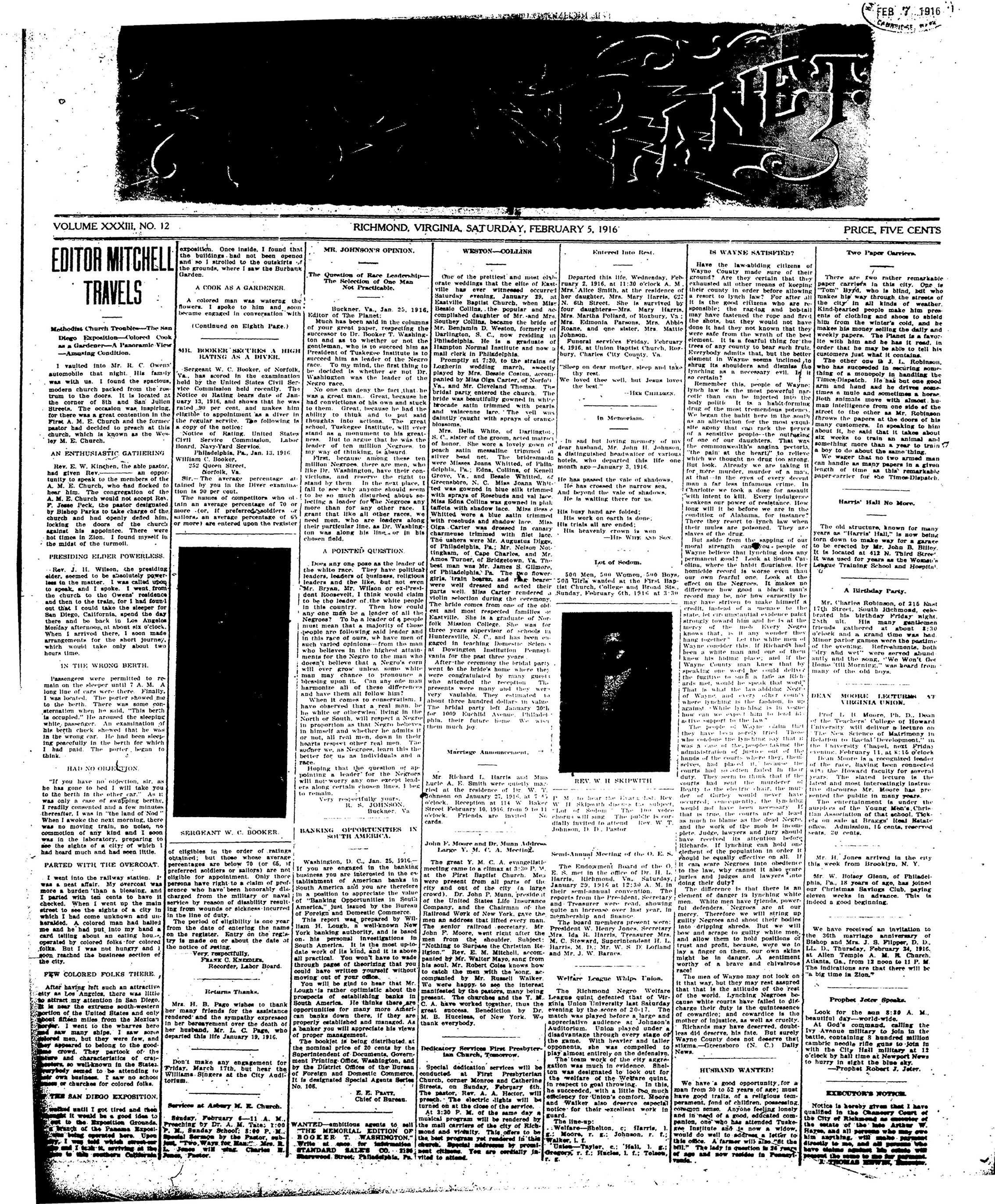
Richmond Planet
Saturday, February 5, 1916
Richmond, Virginia
Page text (machine-generated)
NET
EDITOR MITCHELL
TRAVELS
Methodist Church Troubles—The San Diego Exposition—Colored Cook as a Gardener—A Panoramic View—Amazing Condition.
I vaulted into Mr. R. C. Owens' automobile that night. His family was with us. I found the spacious, modern church packed from the rostrum to the doors. It is located at the corner of 8th and San Julion Streets. The occasion was inspiring, for there was a great contention in the First A. M. E. Church and the former pastor had decided to preach at this church, which is known as the Wesley M. E. Church.
AN ENTHUSIASTIC GATHERING
Rev. E. W. Kinchen, the able pastor, had given Rev. an opportunity to speak to the members of the A. M. E. Church, who had flocked to hear him. The congregation of the A. M. E. Church would not accept Rev. F. Jesse Peck, the pastor designated by Bishop Parks to take charge of the church and had openly defied him, locking the doors of the church against his appointee. There were hot times in Zion. I found myself in the midst of the turmoil.
PRESIDING ELDER POWERLESS.
Rev. J. H. Wilson, the presiding elder, seemed to be absolutely powerless in the matter. I was called upon to speak, and I spoke. I went from the church to the Owens' residence and then to the train, for I had found out that I could take the sleeper for San Diego, California, spend the day there and be back in Los Angeles Monday afternoon, at about six o'clock. When I arrived there, I soon made arrangements for the short journey, which would take only about two hours time.
IN THE WRONG BERTH.
Passengers were permitted to remain on the sleeper until 7 A. M. A long line of cars were there. Finally I was located. The porter showed me to the berth. There was some consternation when he said, "This berth is occupied." He aroused the sleeping white, passenger. An examination of his berth check showed that he was in the wrong car. He had been sleeping peacefully in the berth for which I had paid. The porter began to think.
HAD NO OBJECTION
"If you have no objection, sir, as he has gone to bed I will take you to the berth in the other car." As it was only a case of swapping berth, I readily consented and a few minutes thereafter, I was in "the land of Nod." When I awoke the next morning, there was no moving train, no noise, no commotion of any kind and I soon was in the laboratory, preparing to see the sights of a city of which I had heard much and had seen little.
PARTED WITH THE OVERCOAT
I went into the railway station. I was a neat affair. My overcoat was more a burden than a blessing, and I parted with ten coins to have it checked. When I went up the main street to see the sights of a city in which I had come unknown and unheralded. A colored man had hailed me and he had put into my hand a card telling about an eating house, operated by colored folks for colored folks. But I was not hungry and I soon reached the business section of the city.
FEW COLORED FOLKS THERE.
After having left such an attractive city in Los Angeles, there was little to attract my attention in San Diego. It is near the extreme south-western portion of the United States and only about fifteen miles from the Mexican border. I went to the wharves here and saw many ships. I saw some colored men, but they were few, and they appeared to belong to the good-time crowd. They partook of the nature and characteristics of crayfish, so well-known in the States. everybody seemed to be attending to their own business. I saw no school classes or churches for colored folks.
THE SAN DIEGO EXPOSITION.
We walked until I got tired and then thought it would be a good idea to go to the Exposition Grounds. A branch of the Panama Expositor was being operated here. Upon arrival, I was told which street we were and I took it, arriving at the entrance to the southern California
exposition. Once inside, I found that the buildings had not been opened and so I strolled to the outskirts of the grounds, where I saw the Burbank Garden.
A COOK AS A GARDENER.
A colored man was watering the flowers. I spoke to him and soon became engaged in conversation with
(Continued on Eighth Page.)
MR. BOOKER SECURES A HIGH
RATING AS A DIVER.
Sergeant W. C. Booker, of Norfolk, Va., has scored in the examination held by the United States Civil Service Commission held recently. The Notice or Rating bears date of January 13, 1916, and shows that he was rated .30 per cent, and makes him eligible to appointment as a diver in the regular service. The following is a copy of the notice:
Notice of Rating. United States Civil Service Commission, Labor Board, Navy-Yard Service.
Philadelphia, Pa., Jan. 13, 1916.
William C. Booker,
252 Queen Street,
Norfolk, Va.
Sir.-The average percentage attained by you in the Diver examination is 90 per cent.
The names of competitors who obtain an average percentage of 70 or more (or, if preferred, solders or sailors, an average percentage of 65 or more) are entered upon the register
```markdown
```
of eligibles in the order of ratings obtained; but those whose average percentages are below 70 (or 65, if preferred soldiers or sailors) are not eligible for appointment. Only those persons have right to a claim of preference who have been honorably discharged from the military or naval service by reason of disability resulting from wounds or sickness incurred in the line of duty.
The period of eligibility is one year from the date of entering the name on the register. Entry on the registry is made on or about the date of the notice of rating.
Very respectfully,
FRANK C. KNEDLKE,
Recorder, Labor Board.
Returns Thanks.
Mrs. H. B. Page wishes to thank her many friends for the assistance rendered and the sympathy expressed in her bereavement over the death of her husband, Mr. L. C. Page, who departed this life January 19, 1916.
Don't make any engagement for Friday, March 17th, but hear the Williams Singers at the City Auditorium.
Sunday, February 6—11 A. M. Preaching by Dr. A. M. Tate; 1:00 P. M., Sunday School; 8:00 P. M. Special Sermon by the Pastor, subject, "Two Ways for Man." Mrs. R. L. Jones will wing. Charles H. Jones, Pastor.
---
The Question of Race Leadership
The Selection of One Man
Not Practicable.
Buckner, Va., Jan. 25, 1916, Editor of The Planet:
Much has been said in the columns of your great paper, respecting the successor to Dr. Booker T. Washington and as to whether or not the gentleman, who is to succeed him as President of Tuskegee Institute is to succeed him as leader of the Negro race. To my mind, the first thing to be decided is whether or not Dr. Washington was the leader of the Negro race.
No one can deny the fact, that he was a great man. Great, because he had convictions of his own and stuck to them. Great, because he had the ability to thunk and to put said thoughts into actions. The great school, Tuskegee Institute, will ever stand as a monument to his greatness. But to argue that he was the leader of ten million Negroes, to my way of thinking, is absurd.
First, because among these ten million Negroes, there are men, who like Dr. Washington, have their convictions, and reserve the right to stand by them. In the next place, I fail to see why anyone should seem to be so much disturbed about selecting a leader for the Negroes any more than for any other race. I grant that like all other races, we need men, who are leaders along their particular line, as Dr. Washington was along his line, or in his chosen field.
A POINTED QUESTION
Does any one pose as the leader of the white race. They have political leaders, leaders of business, religious leaders and the like, but not even Mr. Bryan, Mr. Wilson or ex-President Roosevelt. I think would claim to be the leader of the white people in this country. Then how could any one man be a leader of all the Negroes? To be a leader of a people must mean that a majority of those people are following said leader and in this race of ours, we have men of such varied opinions—from the man who believes in the highest attainments for the Negro to the man who doesn't believe that a Negro's corn will ever grow unless, some white man may chance to pronounce a blessing upon it. Can any one man harmonize all of these differences and have them all follow him?
When it comes to conservation, I have observed that a real man, he be white or otherwise, living in the North or South, will respect a Negro in proportion as that Negro believes in himself and whether he admits it or not, all real men, down in their hearts respect other real men. Theother we, as Negroes, learn this the better for us as individuals and a race. Hoping that the question of appointing a leader for the Negroes will not worry any one except leaders along certain chosen lines, I beg to remain.
BANKING OPTORTUNITIES IN
SOUTH AMERICA.
Washington, D. C., Jan. 25, 1916. If you are engaged in the banking business you are interested in the establishment of American banks in South America and you are therefore in a position to appreciate the value of "Banking Opportunities in South America," just issued by the Bureau of Foreign and Domestic Commerce.
This report was prepared by William H. Lough, a well-known New York banking authority, and is based on his personal investigations in South America. It is the most up-to-date work of its kind, and it is above all practical. You won't have to wake through pages of theorizing that you could have written yourself without moving out of your office.
You will be glad to hear that Mr. Lough is rather optimistic about the prospects of establishing banks in South America. He thinks there are opportunities for many more American banks down there, if they are properly established and managed. As a banker you will appreciate his views of proper management.
The booklet is being distributed, at the nominal price of 20 cents by the Superintendent of Documents, Government Printing Office, Washington, and by the District Offices of the Bureau of Foreign and Domestic Commerce. It is designated Special Agents Series No. 108.
WANTED—ambitious agents to sell
THE MEMORIAL EDITION OF
BOOKER T. WASHINGTON.
Write at once for information
STANDARD SALES CO. 112
Parkwood Street, Philadelphia
WESTON—COLLINS
One of the prattlest and most elaborate weddings that the elite of Eastville has ever witnessed occurred Saturday evening, January 29, in Eastville Baptist Church, when Miss Bessie Collins, the popular and accomplished daughter of Mr. and Mrs. Southey Collins, became the bride of Mr. Benjamin D. Weston, formerly of Darlington, S. C., now residing in Philadelphia. He is a graduate of Hampton Normal Institute and now a small clerk in Philadelphia.
Promptly nt 7:30, to the strains of Loghern wedding march, sweetly played by Mrs. Bossie Coston, accompanied by Mias Olga Carter, of Norfolk Va., and Mr. Cleveland Thomas. The bridal party entered the church. The bride was beautifully gowned in white brocade satin trimmed with pearls and valencene lace. The vell was daintly caught with sprays of orange blossoms.
Mrs. Della White, of Darlington, S. C., sister of the groom, acted matriarch of honor. She wore a lovely gown of poach satin mossaline trimmed in silver head net. The bridesmaids were Misses Joana Whitted, of Philadelphia, Pa.; Edna, Collins, of Keneil Grove, Va., and Besale Whitted, of Greenboro, N. C. Miss Joana Whitted was gowned in blue silk trimmed with sprays of Rosebuds and valance Miss Edna Collins was gowned in plush taffetta with shadow lace. Miss Bess A Whitted was a blue satin trimmed with rosebuds and shadow lace. Miss Olga Carter was dressed in canary charmeuse trimmed with flat lace. The ushers were Mr. Augustus Digges of Philadelphia, Pa.; Mr. Nelson Notingham, of Cape Charles, and Mr. Amoon Turner, of Bridgetown, Va. The best man was Mr. James S. Glimore of Philadelphia, Pa. The two flower-girls, train bearer, and ring bearer were well dressed and acted their parts well. Miss Carter rendered a violin selection during the ceremony. The bride comes from one of the oldest and most respected families of Eastville. She is a graduate of Norfolk Mission College. She was for three years supervisor of schools in Hunterville, N. C., and has been engaged in teaching Domestic Science at Dowlington Institution Pennsylvania for the past three years.
After the ceremony the bridal party went to the bride's home where they were congratulated by many guests who attended the reception. The presents were many and they were very valuable. They estimated to about three hundred dollars in value. The bridal party left January 30th for 1009 Eichhild Avenue, Philadelphia, their future home. We wish them much joy.
Marriage Announcement.
Mr Richard L. Harris and Mina
Luice A. E. Smith were quietly ma-
ried at the residence of Dr. W. T.
Johnson on January 27, 1916, at 7
o'clock. Reception at 114 W. Baker
Street February 10, 1916, from 9 to 11
o'clock. Friends are invited. No
cards.
John F. Moore and Dr. Munn Address
Large Y. M. C. A. Meeting.
The great Y. M. C. A. evangelistlst
meeting came to a climax at 3:30 P. M.
at the Priat Baptist Church. Munn
were present from all parts of the
city and out of the city (a large
crowd). Dr. John P. Munn, presidee
of the United States Life Insurance
Company, and the Chairman of the
Railroad Work of New York, gave the
men an address that lifted every man.
The senior railroad secretary. Mr.
John F. Moore, went right after the
men from the shoulder. Subject:
"Nothing to Surprise the Christian Religion." Rev. E. M. Mitchell, accompanied by Mr. Walter Mayo, sang from his soul. Mr. Robert Coles knows how to catch the men with the song, accompanied by Mr. Russell Walker. We were happy, to see the interest manifested by the pastors, many being present. The churches and the Y. M. C. A. have worked together, thus the great success. Benediction by Dr. M. B. Hucceless, of New York. We thank everybody.
Dedicatory Services First Presbyterian Church, Tomorrow.
Special dedication services will be conducted at First Presbyterian Church, corner Monroe and Catherine Streets, on Sunday, February 6th. The pastor, Rev. A. A. Hector, will presch. The electric lights will be turned on at the close of the service. At 2:30 P. M. of the same day a musical program will be rendered by the mail carriers of the city of Richmond and vicinity. This offers to be the best program yet rendered in this church. Special addresses by prominent citizens. You are cordially invited to attend.
Departed this life, Wednesday, February 2, 1916, at 11:30 o'clock A. M. Mrs. Alice Smith, at the residence of her daughter, Mrs. Mary Harrel, 622 N. 6th Street. She is survived by four daughters—Mrs. Mary Harris, Mrs. Martha Pollard, of Roxbury, Va., Mrs. Edinonia Parsons, Mrs. Abbie Roane, and one sister, Mrs. Mattie Johnson.
Funeral services Friday, February 4, 1916, at Union Baptist Church, Roxbury, Charles City County, Va.
"Sleep on dear mother, sleep and take thy rest.
We loved these well, but Jesus loved the best."
—HCR CHILDREN.
In Memoriam.
In sad but loving memory of my dear husband, Mr. John H. Johnson, a distinguished headwaiter of various hotels, who departed this life one month ago—January 3, 1916.
He has passed the vale of shadows.
He has crossed the narrow sea, And beyond the vale of shadows.
He is waiting there for us.
His busy hand are folded;
His work on earth is done;
His trials all are ended;
His heavenly crown is won
—His Wife and Son
Let of Bodom.
500 Men, 500 Women, 500 Boys
500 Girls wanted at the First Baptist Church, College and Broad Sts.
Sunday, February 6, 1916 at 3:30
REV. W. H. SKIPWITH
P. M. to hear the Evang. last. Rev. W. H. Skipwith discurses the subject "Lot of Sedom." The 100 video chorus will sing. The public is cordially invited to attend. Rev. W. T. Johnson, D. D. Pastor
The Endowment Board of the O. E. S. met in the office of Dr. H. L. Harris, Richmond, Va., Saturday January 29, 1916 at 12:30 A. M. in their semi-annual conference. The reports from the President, Secretary and Treasurer were read, showing quite an increase over last year, in membership and finance. The board members present were: President W. Henry Jones, Secretary Mrs. Ida R. Harris, Treasurer Mrs. M. C. Steward, Superintendent H. L. Harris, M. D.; Mr. W. S. D. Lofland and Mr. J. W. Barnes.
Welfare League Whips Union
The Richmond Negro Welfare League quint defected that of Virginia Union University last Saturday evening by the score of 20-17. The match was played before a large and appreciative audience at Johnson's Auditorium. Union played under a disadvantage through every stage of the game. With heavier and taller opponents, she was compelled to play almost entirely on the defensal.
The team work of the city aggregation was much in evidence. Shelton was designated to look out for the welfare of the Welfare quint, in respect to goal throwing. In this, he succeeded, with a little too much efficiency for Union's comfort. Moore and Walker also deserve especial notice for their excellent work in guard.
The line-up:
Welfare—Shelton, c; Harris, l.
g.; Moore, r. g.; Johnson, r. f.
Walker, l. f.
Union—Taylor, c; Hall, l. g.
Gregory, r. f.; Hucas, l. f.; Tolson, r. g.
IS WAYNE SATISFIED?
Have the law-abiding citizens of Wayne County made sure of their ground? Are they certain that they exhausted all other means of keeping their county in order before allowing a resort to lynch law? For after all it is the good citizens who are responsible; the raygad and bobtail may have fastened the rope and fired the shots, but they would not have done it had they not known that they were safe from the wrath of the best element. It is a fearful thing for the trees of any county to bear such fruits. Everybody admits that, but the better element in Wayne seems inclined to shrug its shoulders and dismiss the lynching as a necessary evil. Is it no certain?
Remember this, people of Wayne-
lynch law is the most powerful narcotic than can be injected into the body politic. It is a habit-forming drug of the most tremendous potency. We began the habit here in the south as an alleviation for the most exquisite agony that can rack the perseys of a sensitive people—the outgrowing one of our daughters. That was the commonwealth's angina pectoris, "the pain" at the heart? to relieve which we thought no drug too strong. But look. Already we are taking it for more murder, murder of a man, at that—in the eyes of every decent man a far less infamous crime. In Charlotte we took a done for assault with intent to kill. Every indulgence weakens our power of resistance. How long will it be before we are in the condition of Alabama, for instance? There they resort to lynch law when their mules are poisoned. They are slaves of the drug.
But aside from the sapping of our moral strength can you people of Wayne believe that lynching does any permanent good? Look at South Carolina, where the habit flourishes. Her homelife record is worse even than our own fearful one. Look at the effect on the Negroes. It makes no difference how good a black man's record may be, nor how earnestly he may have striven to make himself a credit, instead of a menace to the state, let unanticipated evidence paint strongly toward him and he is at the mercy of the mob. Every Negro knows that, is it any wonder they hang together? Let the white men of Wayne consider this. If Richard's had been a white man and one of them knew his hiding place, and if the Wayne County man knew that by speaking one word he could deliver the fugitive to such a fate as Richards met, would he speak that word? That is what the law adding Negro of Wayne, and every other county where lynching is the fashion, is up against. While lynching is in no way how can we expect him to lend active support to the law.
The people of Wayne claim that they have been severely tried. Those who condone the lynching say that it was a case of the people taking the administration of justice out of the hands of the courts where they, their selves, had placed it, because the courts had so often failed in their duty. They seem to think that if the courts had sent the murderer of Beatty to the electric chair, the murder of Gurley would never have occurred, consequently, the lynching would not have been necessary. If that is true the courts are at least as much to blame as the dead Negro, and the work of the mob is incomplete. Judge, lawyers and jury should have received its attention before Richards. If lynching can hold one element of the population in order it should be equally effective on all. If it can scare Negroes into obedience to the law, why cannot it also genre juries and judges and lawyers into doing their duty?
The difference is that there is an element of danger in lynching white men. White men have friends, powerful defenders. Negroes are at our mercy. Therefore we will string up guilty Negroes and shoot their bodies into dripping shreds. But we will how and scrape to guilty white men, and allow them to hold positions of trust and profit, because, were we to lay a finger on them, our own skins might be in danger. A sentiment worthy of a brave and chivalrous race!
The men of Wayne may not look on it that way, but they may rest assured that that is the attitude of the rest of the world. Lynching Negroes because white courts have failed to discharge their duty is the quintessence of cowardice; and cowardice is the mother of injustice, as well as cruelty. Richards may have deserved, doubtless did deserve, his fate. But surely Wayne County does not deserve that stifra.—Greensboro (N. C.) Dally News.
HUSBAND WANTED!
We have a good opportunity, for a man from 20 to 52 years of age; must have good traits, of a religious temperament, fond of children, possessing common sense. Anyone feeling lonely and in need of a good, educated companion, one who has attended Tuskegee Institute and is now a widow, would do well to address a letter to this office. A farmer will also "fit the bill." The lady in question is 26 years of age and now resides in Pennyville.
FEB 7 1916
CAMBRIDGE
PRICE, FIVE CENTS
There are two rather remarkable paper carriers in this city. One is "Tom" Byrd, who is blind, but who makes his way through the streets of the city in all kinds of weather. Kind-hearted people make him presents of clothing and shoes to shield him from the winter's cold, and he makes his money selling the daily and weekly papers. The Planet is a favorite with him and he has it read, in order that he may be able to tell his customers just what it contains.
The other one is J. I. Robinson, who has succeeded in securing something of a monopoly in handling the Times-Dispatch. He has but one good arm and hand and he drives sometimes a mule and sometimes a horse. Both animals move with almost human intelligence from one side of the street to the other as Mr. Robinson throws the papers at the doors of his many customers. In speaking to him about it, he said that it takes about six weeks to train an animal and something more than a year to train a boy to do about the same thing.
We wager that no two armed man can handle as many papers in a given length of time as this remarkable paper carrier for the Times-Dispatch.
Harris' Hall No More
The old structure, known for many years as "Harris' Hall," is now being torn down to make way for a garage to be erected by Mr. John B. Billy. It is located at 412 N. Third Street. It was used for years as the Women's League Training School and Hospital.
A Birthday Party
Mr. Charles Robinson, of 215 Nass
17th Street, South Richmond, celebrated his birthday Friday night, 25th nit. His many gentlemen
friends gathered at about 8:30 o'clock and a grand time was had. Minor parlor games wore the pastime of the evening. Hoffmanonte, both "dry and wet" were served abundantly and the song, "We Won't Get Home till Morning," was heard from many of the old boys.
---
DEAN MOORE LECTURER AT
VIRGINIA UNION
Prof L. B. Moore, Ph.D., Dean of the Teachers' College of Howard University will deliver a lecture on "The New Science of Matrimony in Relation to Racial Development," in the University Chapel, next Friday evening. February 11, at 8:15 o'clock Dean Moore is a recognized leader of the race, having been connected with the Howard faculty for several years. The slated lecture is the latest and most interestingly instructive discourse Mr. Moore has presented the public in many years. The entertainment is under the auspices of the Young Man's Christian Association of that school. Tickets on sale at Brangra Real Estate office. Admission, 15 cents, reserved seats, 20 cents.
Mr. H. Jones arrived in the city this week from Brooklyn, N. Y.
Mr. W. Boisey Glenn, of Philadelphia, Pa. 18 years of age, has joined our Christmas Savings Club, paying eleven weeks in advance. This is indeed a good beginning.
```markdown
```
We have received an invitation to the 36th marriage anniversary of Bishop and Mrs. J. S. Flipper, D. D., LL. D., Thursday, February 24, 1916, at Allen Temple A. M. R. Church, Atlanta, Ga., from 12 noon to 11 P. M. The indications are that there will be "a big time in Zion."
Prophet Jeter Speaks.
Look for the sun 8:30 A. M. beautiful day—world-wide. At God's command, calling the Ivy Avenue military to join in the battle, containing 8 hundred million camriche needle rifle guns to join in with the City Hall military at 12 o'clock by hall time at Newport News to hurry in sight the blue sky. —Prophet Robert J. Jeter.
EXECUTOR'S NOTICE
Notice is hereby given that I have qualified in the Chancery Court of the City of Richmond as an executor of the estate of the late Arthur W. Hayes, and all persons who may owe him anything, will make payment directly to me, and all persons who have claims against his estate will present the name to me for payment. R. T. HOWARD BROWN, Attn.
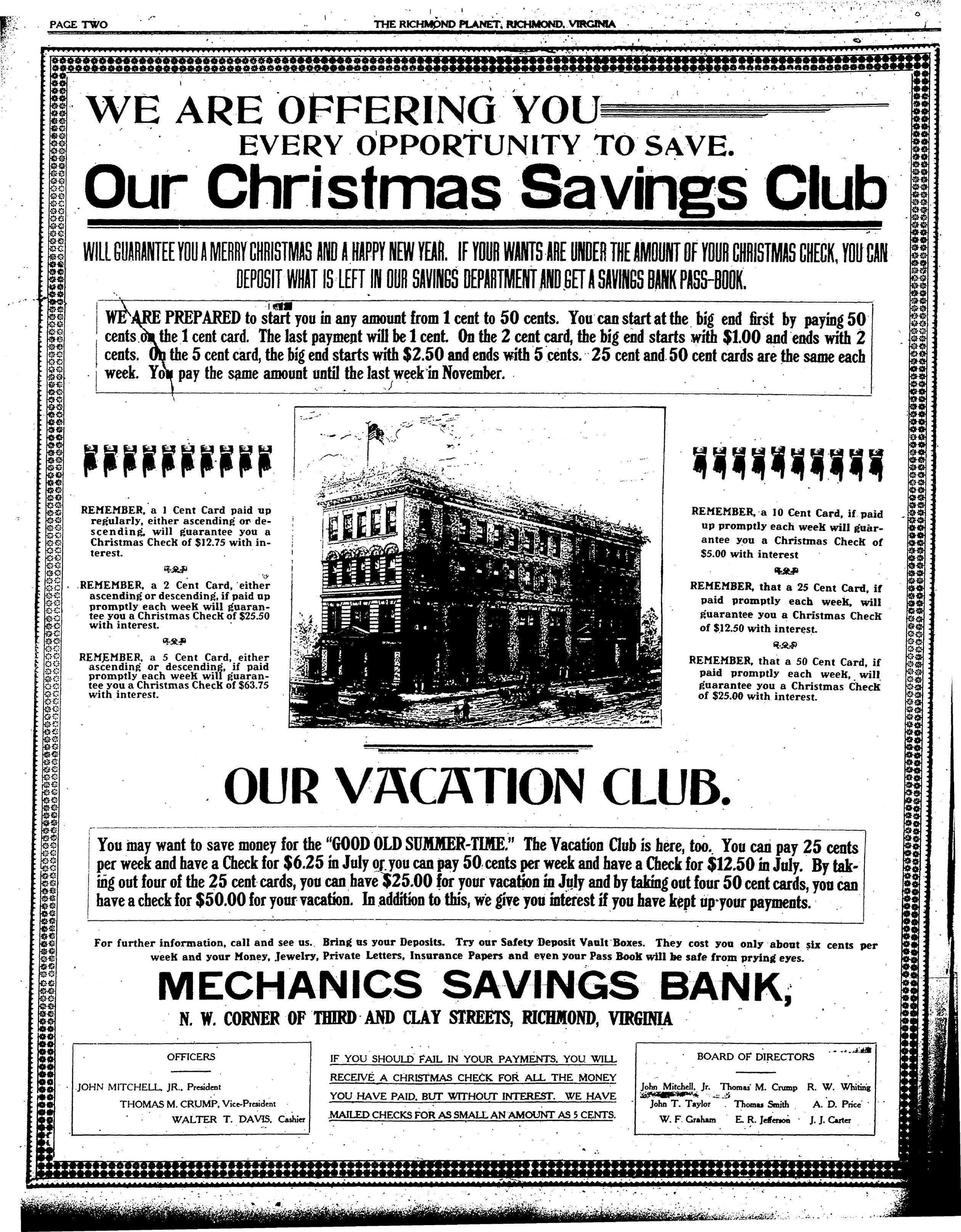
WE ARE OFFERING YOU EVERY OPPORTUNITY TO SAVE. Our Christmas Savings Club
WILL GUARANTEE YOU A MERRY CHRISTMAS AND A HAPPY NEW YEAR. IF YOUR WANTS ARE UNDER THE AMOUNT OF YOUR CHRISTMAS CHECK, YOU CAN DEPOSIT WHAT IS LEFT IN OUR SAVINGS DEPARTMENT AND GET A SAVINGS BANK PASS-BOOK.
WE ARE PREPARED to start you in any amount from 1 cent to 50 cents. You can start at the big end first by paying 50 cents on the 1 cent card. The last payment will be 1 cent. On the 2 cent card, the big end starts with $1.00 and ends with 2 cents. On the 5 cent card, the big end starts with $2.50 and ends with 5 cents. 25 cent and 50 cent cards are the same each week. You pay the same amount until the last week in November.
OUR VACATION CLUB.
You may want to save money for the "GOOD OLD SUMMER-TIME." The Vacation Club is here, too. You can pay 25 cents per week and have a Check for $6.25 in July or you can pay 50 cents per week and have a Check for $12.50 in July. By taking out four of the 25 cent cards, you can have $25.00 for your vacation in July and by taking out four 50 cent cards, you can have a check for $50.00 for your vacation. In addition to this, we give you interest if you have kept up your payments.
For further information, call and see us. Bring us your Deposits. Try our Safety Deposit Vault Boxes. They cost you only about six cents per week and your Money, Jewelry, Private Letters, Insurance Papers and even your Pass Book will be safe from prying eyes.
N. W. CORNER OF THIRD AND CLAY STREETS, RICHMOND, VIRGINIA
PAGE TWO
```markdown
```
REMEMBER, a 1 Cent Card paid up regularly, either ascending or descending, will guarantee you a Christmas Check of $12.75 with interest.
图 2.2
REMEMBER, a 2 Cent Card, either ascending or descending, if paid up promptly each week will guarantee you a Christmas Check of $25.50 with interest.
```markdown
```
REMEMBER, a 5 Cent Card, either ascending or descending, if paid promptly each week will guarantee you a Christmas Check of $63.75 with interest.
You may want to save money for the per week and have a Check for $6.25 ing out four of the 25 cent cards, you have a check for $50.00 for your v
For further information, call and see us week and your Money, Jewel
MECHA
N. W. CORNER OF
OFFICERS
JOHN MITCHELL, JR., President
THOMAS M. CRUMP, Vice-President
WALTER T. DAVIS, Cashier
THE RICHMOND PLANET. RICHMOND. VIRGINIA
FFFERING YOU
A Y OPPORTUNITY TO
Christmas Savings
AND A HAPPY NEW YEAR. IF YOUR WANTS ARE UNDER T
IS LEFT IN OUR SAVINGS DEPARTMENT AND GET A SAV
in any amount from 1 cent to 50 cents. You can
payment will be 1 cent. On the 2 cent card, the big
starts with $2.50 and ends with 5 cents. 25
until the last week in November.
VACATION C
"GOOD OLD SUMMER-TIME." The Vacation C
in July or you can pay 50 cents per week and ha
can have $25.00 for your vacation in July and b
tion. In addition to this, we give you interest if y
Bring us your Deposits. Try our Safety Deposit Vault
Private Letters, Insurance Papers and even your Pass
NICS SAVINGS
THIRD AND CLAY STREETS, RICHMOND, V
THE BANK OF NEW YORK
IF YOU SHOULD FAIL IN YOUR PAYMENTS. YOU WILL RECEIVE A CHRISTMAS CHECK FOR ALL THE MONEY YOU HAVE PAID. BUT WITHOUT INTEREST. WE HAVE MAILED CHECKS FOR AS SMALL AN AMOUNT AS 5 CENTS.
---
---
REMEMBER, a 10 Cent Card, if paid up promptly each week will guarantee you a Christmas Check of $5.00 with interest
REMEMBER, that a 25 Cent Card, if paid promptly each week, will guarantee you a Christmas Check of $12.50 with interest.
REMEMBER, that a 50 Cent Card, if paid promptly each week, will guarantee you a Christmas Check of $25.00 with interest.
LUB.
is here, too. You can pay 25 cents
a Check for $12.50 in July. By tak-
aking out four 50 cent cards, you can
have kept up your payments.
s. They cost you only about six cents per
will be safe from prying eyes.
BANK,
GINIA
BOARD OF DIRECTORS
John Mitchell, Jr. Thomas M. Crump R. W. Whiting
John T. Taylor Thomas Smith A. D. Price
W. F. Graham E. R. Jefferson J. J. Carter
1
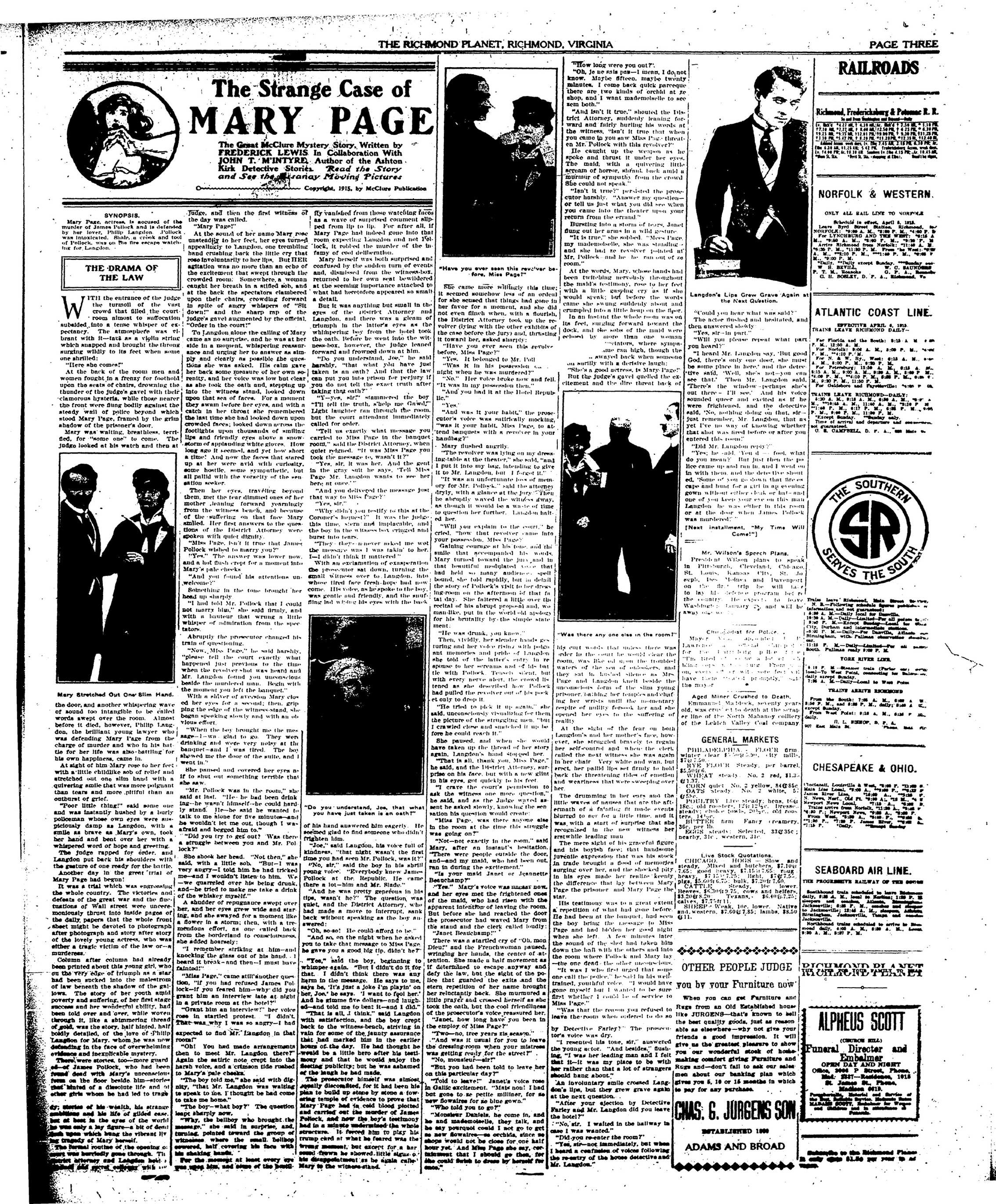
SYNOPSIS.
Mary Page, actress, is accused of the murder of James Pollack and is defended by her lover, Phillip Langdon. Pollack is implicated. Shale, a crick and tool of Pollack, on the fire escape watching for Langdon.
THE DRAMA OF THE LAW
WITH the entrance of the judge the turnout of the vast crowd that filled the courtroom almost to suffocation subaided into a tense whisper of expectancy. The atmosphere was vibrant with it—faced as a violin string which snapped and brought the throng surging wildly to its feet when some one shrieled:
"Here she comes!"
At the back of the room men and women fought in a frenzy for foothold upon the seats of chairs, drowning the thunder of the judge's gavel with their clamorous hysteria, while those nearer the front were flung bodily against the steady wait of police beyond which stood Mary Page, framed by the grim shadow of the prisoner's door.
Mary was waiting, breathless, terrified, for "some one" to come. The judge looked at his watch and then at
THE FEDERAL MARSHALS
Mary Stretched Out One Slim Hand. the door, and another whispering wave of sound too intangible to be called words swept over the room. Almost before it died, however, Philip Langdon, the brilliant young lawyer who was defending Mary Page from the charge of murder and who in his battle for her life was also battling for his own happiness, came in. At sight of him Mary rose to her feet with a little childlike sob of relief and stretched out one slim hand with a quivering smile that was more polignant than tears and more pittiful than an outburst of grief. "Poor little thing!" said some one and was instantly hushed by a burly policeman whose own eyes were suspiciously damp as Langdon, with a smile as brave as Mary's own, took her hand and bent over her with a whispered word of hope and greeting.
The judge rapped for order, and Langdon put back his shoulders with the gesture of one ready for the battle. Another day in the great trial of Mary Page had begun!
It was a trial which was engrossing the whole country. The victories and defeats of the great war and the fluctuations of Wall street were unceremoniously thrust into inside pages of the daily, papers that the whole front sheet might be devoted to photograph after photograph and story after story of the lovely young actress, who was either a tragic victim of the law or—a murderess.
Column after column had already been printed about this young girl, who on the very edge of triumph as a star had been sucked into the malestrom of law beneath the shadow of the gallows. The story of her youth amid poverty and suffering, of her first stage success and her wonderful ability, had been told over and over, while woven through it, like a shimmering thread of gold, was the story, half hinted, half bodily detailed, of the love of Philip Langton for Mary, whom he was now defending in the face of overwhelming evidence and inexplicable mystery. There were stories, too—more guarded of James Pollock, who had been dead with Mary's unconscioned form on the floor beside him—stories that hinted at a dissolute life and of other girls whom he had led to tragic
dry, mortars of his wealth, his strange ambitions and his life of glided ease, but at best in the eyes of the world, he was only a lay figure—a bit of denim cloth which being the vibrant living tragedy of Mary herself. The journal routine of the opening of court was hurriedly gone through. The court attorney and London habit had all spent college with us.
The Strange Case of MARY PAGE
The Great McClure Mystery Story, Written by FREDERICK LEWIS In Collaboration With JOHN T. M'INTYRD, Author of the Ashton Kirk Detective Stories Read the Story and See the Bizarre Moving Pictures
Judge, and then the first witness of the day was called.
"Mary Page"
At the sound of her name Mary rose unsteadily to her feet, her eyes turned appealingly to Langdon, one trembling hand crushing back the little cry that rosa involuntarily to her lips. But HER agitation was no more than an echo of the excitement that swept through the crowded room. Somewhere, a woman caught her breath in a stifled sob, and at the back the spectators clambered upon their chains, crowding forward in spite of angry whispers of "Sit down!" and the sharp rap of the judge's gavel augmented by the official, "Order in the court."
To Langdon alone the calling of Mary came as no surprise, and he was at her side in a moment, whispering reassurance and urging her to answer as simply and clearly as possible the questions she was asked. His calm gave her back some measure of her own serenity, and her voice was low but clear as she took the oath and, stepping up into the witness stand, looked down upon that sea of faces. For a moment they swam before her eyes, and with a catch in her throat she remembered the last time she had looked down upon crowded faces; looked down across the footlights upon thousands of smiling lips and friendly eyes above a snowstorm of applauding white gloves. How long ago it seemed, and yet how short a time! And now the faces that stared up at her were void with curiosity, some hostile, some sympathetic, but all palied with the cornicity of the sensation secker.
Then her eyes, traveling beyond them, met the tear dimmed ones of her mother cleaning forward yearningly from the witness bench, and because of the suffering on that face Mary smiled. Her first answers to the questions of the District Attorney were spoken with quiet dignity.
"Miss Puge, isn't it true that James Pollock wished to marry you?" "Yes." The answer was lower now, and a hot flush crept for a moment into Mary's pale cheeks.
"And you found his attention unwelcome?"
Something in the tone brought her head up sharply.
"I had told Mr. Pollock that I could not marry him," she said firmly, and with a hauteur that wrong a little whisper of admiration from the spectators.
Abruptly the prosecutor changed his train of questioning.
"Now, Miss Page," he said harshly, "please tell the court exactly what happened just previous to the time when the resolver was heart and Mr. Langdon found you unconscious beside the murdered man. Begin with the moment you left the banquet."
With a sliver of attention Mary closed her eyes for a second; then, gripping the edge of the witness stand, she began speaking slowly and with an obvious effort.
"When the boy brought me the message—I was glad to go. They were drinking and were very noisy at the banquet—and I was tired. The boy meed the door of the suite, and I went in."
She paused and covered her eyes as if to shut out something terrible that she saw.
"Mr. Pollock was in the room," she said at it. "He he had been drinking—he wasn't himself—the could hardly stand. He—he said he wanted to talk to me alone for five minutes—and he wouldn't let me out, though I was afraid and begged him to."
"Did you try to get out? Was there a struggle between you and Mr. Pollock?"
She shook her head. "Not then," she said, with a little sob. "But—I was very angry—I told him he had tricked me—and I wouldn't listen to him. We—we quarreled over his being drunk, and—be tried to make me take a drink of the whiskey myself."
A shudder of repugnance swept over her, and her eyes grew wide and staring, and she aided for a moment like a flower in a storm; then, with a tremendous effort, as one called back from the borderland to consciousness, she added horrily:
"I remember striking at him—and knocking the glass out of his hand. I heard it break—and then—I must have fainted!"
"Miss Page," came still another question, "if you had refused James Pollock—if you feared him—why did you grant him an interview late at night in a private room at the hotel?"
"Grant him an interview," her voice rose in startled protest. "I didn't. That was why I was so angry—I had expected to and Mr. Langdon in that room!"
"Oh! You had made arrangements then to meet Mr. Langdon there? Again the satiric note crept into the harbah voice, and a crimson tide rushed to Mary's pale cheeks.
"The boy told me," she said with dignity, "that Mr. Langdon was waiting to speak to me. I thought he had come to take me home."
"The boy—what boy?" The question leapt sharply now.
"Why, the bellboy who brought the message," she said in surprise, and, turning, pointed toward the group of witnesses where the small bellboy covered, half covering his face with his shaking hands.
For the message at least every eye gaze upon him, and some of the bellboy
THE RICHMOND PLANET, RICHMOND, VIRGINIA
Copyright, 1915, by McClure Publication
My vanished from those watching faces as a wave of surprised comment slipped from lip to lip. For after all, if Mary Page had indeed gone into that room expecting Lamdon and not Hollock, it roiled the murder of the infamy of cool deliberation.
Mary herself was both surprised and confused by the sudden turn of events and, dismissed from the witness-box, returned to her own seat bewildered at the seeming importance attached to what had heretofore appeared so small a detail.
But it was anything but small in the eyes of the district Attorney and Langton, and there was a gleam of triumph in the latter's eyes as the whimpering boy from the hotel took the oath. Before he went into the witness-box, however, the judge leaned forward and frowned down at him.
"Do you understand, Joe," he said harbly, "that what you have just taken is an oath? And that the law can put you into prison for perjury if you do not tell the exact truth after taking that oath?"
"Y—Yes, sir," stammered the boy. "I tell the truth, help me Gawd." Light laughter ran through the room, but the court attendant immediately called for order.
"Tell us exactly what message you carried to Miss Page in the banquet room," said the District Attorney, when quiet reigned. "It was Miss Page you took the message to, wasn't it?"
"Yes, sir. It was her. And the gent in the gray suit he says, 'Tell Miss Page Mr. Landon wants to see her here at once.'"
"And you delivered the message just that way to Miss Page?"
"Yes, sir."
"Why didn't you testify to this at the Coroner's request? It was the judge this time, stern and impacable, and the boy in the witness box ringed and burst into tears.
"They they—n never asked me wet the message was I was taken' to her. I—I didn't think it mattered."
With an exclamation of exasperation the prosecutor sat down, turning the email witness over to Langdon, into whose tired face fresh hope had now come. His voice, as he spoke to the boy, was gentle and friendly, and the snuffling had widened his eyes with the back
1930
"Do you understand, Joe, that what you have just taken is an oath?"
of his hand answered him eagerly. He soaked glad to find someone who didn't frighten him.
"Joe," said Langdon, his voke full of kindness, "that night wasn't the first time you had seen Mr. Pollock, was it?"
"No, sir," said the boy in his whirl young voice. "Everybody knew James Pollock at the Republic. He came there a lot—him and Mr. Slade."
"And he was pretty generous in his tips, wasn't he?" The question was quiet, and the District Attorney, who had made a move to interrupt, sank back without speaking as the boy answered:
"Oh, so so! He could afford to be."
"And so, on the night when he asked you to take that message to Miss Page, he gave you a good tip, didn't he?"
"Yes," said the boy, beginning to whimper again. "But I didn't do it for that. I didn't think there was any harm in the message. He says to me, says he, 'It's just a joke I'm playin' on her, Jon, he says, 'I want to fool her.' And he gimme five dollars—and laughed—and told me to beat it—and I did." "That is all, I think," said Langdon with satisfaction, and the boy crept back to the witness-bench, striving in vain for some of the jaunty assurance that had marked him in the earlier hours of the day. He had thought he would be a little hero after his testimony and that he would enjoy the feeling publicity; but he was ashamed of the laugh he had made.
The prosecutor himself was almost equally discomfited, for it had been his plan to build up stone by stone a towering temple of evidence to prove that Mary Page had in cold blood plotted and carried out the murder of James Pellock, and now the boy's testimony had in a minute undermined the whole structure. It forced him to play his trump card at what he feared was the wrong moment, but except for a harrow sound he showed little sign of his disgagement as he again called Mary to the witness stand.
THE MUSICIAN
"Have you ever seen this receiver be
- fores, Miss Page?"
"Have you ever seen this revolver before, Miss Page?"
She came more willingly this time it seemed somehow less of an ordon for she seemed that things had gone in her favor for a moment, and she did not even clink when, with a flourish, the District Attorney took up the revolver (lying with the other exhibits of the case before the jury) and thrusting it toward her, asked sharply:
"Have you ever seen this revolver before, Miss Page?"
"Yes. It belonged to Mr. Poll."
"Was it in his possession on night when he was murdered?"
"No." Her voice broke now and fell.
"It was in my possession then."
"And was it your habit," the prosecutor's voice was satirically mocking, "was it your habit, Miss Page, to attend banquets with a revolver in your handbag?" Mary flushed angrily.
"The revolver was lying on my dressing-table at the theater," she said, "and I put it into my bag, intending to give it to Mr. Langdon, but I forgot it."
"It was an unfortunate loss of memory for Mr. Pollock," said the attorney dryly, with a glance at the jury. "Then he abruptly waved the whistle away, as though it would be a waste of time to question her further. Langdon halted her.
"Will you explain to the court," he cried, "how that revolver came into your possession, Miss Page."
Gaining courage at his tone, and the smile that accompanied his words, Mary turned toward the jury and in that beautiful modulated voice that had held so many audience spell bound, she told rapidly, but in detail the story of Pollack's visit to her dressing room on the afternoon of that fat day. She faltered a little over the recital of his abrupt proposal and, we manlike, put in the world old apology for his brutality by the simple state ment:
"He was drunk, you know."
Then, vividly, her slender hands gesturing and her voice rising with polgen ant memories and pride of London she told of the latter's entry in response to her screams and of his but he with Pollack. Tense silent, but with every nerve alert, the crowd his tened as she described how Pollack had pulled the revolver out of his peek et only to drop it.
"He tried to pick it up again," she said, unconsciously visualizing for them the picture of the struggling man, "but I crawled close and snatched it up before he could reach it."
She paused, and when she would have taken up the thread of her story again, Langdon's hand stopped her.
"That is all, thank you, Miss Page," he said, and the District Attorney, surprise on his face, but with a new glint in his eyes, got quickly to his feet.
"I crave the court's permission to ask the witness one more question," he said, and as the Judge waved as he asked slowly, knowing the sensation his question would create.
"Miss Page, was there anyone else in the room at the time this struggle was going on?"
"Not—not exactly in the room," said Mary, after an instant's hesitation. "There were people outside the door, and—and my maid, who had been out, ran in during the excitement."
"Is your maid Janet or Jeannette Beauchamp?"
"Yes." Mary's voice was uneasy now, and her eyes met the frightened ones of the maid, who had risen with the apparent intention of leaving the room. But before she had reached the door the prosecutor had waved Mary from the stand and the clerk called loudly: "Janet Beauchamp!"
There was a startled cry of "Oh, mon Dieu!" and the Frenchwoman paused, wringing her hands, the center of attention. She made a half movement as if determined to escape anyway and defy the law, but the sight of the police that guarded the exits and the stern repetition of her name brought her reluctantly back. She murmured a little prayer and crossed herself as she took the oath, and the cool friendliness of the prosecutor's voice reassured her. "Janet, how long have you been in the employ of Miss Page?"
"Two—no, tree years ziz season."
"And was it usual for you to leave
the dressing-room when your mistress
was getting ready for the street?"
"No, monstieur—air?"
"But you had been told to leave her
on this particular day?"
"Told to leave." Janet's voice rose
in Gallic excitement. "Mati now! I had
but gone to so petite milliner, for so
new floweraire for so blue gown."
"Who told you to go?"
"Monster Daniels, he come in, and he and made motocycle, they talk, and he say posquoi could I not go to get to new dawaires—as orchids, since so shops would not be close for one half hour yet. And Miss Page she may, contemnt that I should go then, for she could switch to dress by herself for once."
"How long were you out?"
"Oh, je ne sais pas—I mean, I do not know. Maybe fifteen, maybe twenty minutes. I come back quick parceque there are two kinds of orchid at ze shop, and I want mademoiselle to see them both."
"And isn't it true," shouted the District Attorney, suddenly leaning forward and fairly hurling his words at the witness, "isn't it true that when you came to you saw Miss Pauz threaten en Mr. Pollock with this revolver?"
He caught up the weapon as he spoke and thrust it under her eyes. The maid, with a quivering little scream of horror, shriek back and a murmur of sympathy from the crowd. She could not speak.
"Isn't it true?" persisted the prosecutor harshly. "Answer my question—or tell us just what you did see when you came into the theater upon your return from the orchard."
Bursting into a storm of tears, Janet dung out her arms in a wild gesture.
"It is true," she sobbed. "Mess Page, my mademoiselle, she was standing and she had ze revolver pointed at Mr. Pollock and he he ran out of zero room."
At the words, Mary, whose hands had been twitching nervously throughout the malfunction, rose to her feet with a little gasping cry as if she would speak; but before the words came she swung suddenly about and crumpled into a little heap on the floor.
In an instant the whole room was on its feet, swaying forward toward the dock, and the soils of the maid were ejected by more than one woman
an outfitly with a derivative laugh: "She's a good actress, is Mary Page." But the judge's gavel quolled the excitement and the dire threat back of
THE FEDERAL NATIONAL HISTORY SOCIETY
"Was there any one else in the room?
bly curt words that unless there was order in the court he would clear the room, was like oil on the troubled waters of the sea of obliviousness, and they sat in blind silence as Mrs Lage and Langdon knelt beside the unconscious form of the slim young prisoner, building her temples and caffering her wrists until the momentary respite of mildly forcest her and she opened her eyes to the suffering of reality.
At the sight of the fear on both Langdon's and her mother's face, however, she struggled bravely to regain her self-control and when the clerk called the next witness she was again in her chair. Very white and wan, but erect her pallid lips not firmly to hold back the threatening tilt of emotion and weariness that were sweeping over her.
The drumming in her ears and the little waves of nausea that are the aftermath of a fatting fit made events blurred to net for a little time, and it was, with a start of surprise that she recognized in the new witness her gratitude leading man.
The mere sight of his graceful figure and his boyish face; that handsome juruncle expression that was his stock in trade brought a flood of memories surging over her, and the shocked pity in his eyes made her realize keenly the difference that lay between Mary Page the prisoner and Mary Page the star.
His testimony was to a great extent a repetition of what had gone before. He had been at the impromptu, had seen the boy bring the message to Miss Page and had hidden her good night when she left. A few minutes later the sound of the shot had taken him down the hall with the others and into the room where Pollack and Mary lay—the one dead, the other unconscious.
"It was I who first urged that some one call the police," he said in his well trained, youthful voice. "I would have gone myself but I wanted to be sure first whether I could be of service to Mirna Page."
"Was that the reason you refused to leave the room when ordered to do so by Detective Farley?" The prosecutor's voice was dry.
"I resented his tone, sir," answered the young actor. "And beaded, fushing. "I was her leading man and I felt that it—it was my place to be with her rather than that a lot of strangers should hang about."
"An involuntary smile crossed Langdon's lips, but they grew grave again at the next question."
"After your ejection by Detective Farley and Mr. Langdon did you leave the hotel?"
"No, sir. I waited in the hallway in case I was wanted."
Did you receive a toll call?
You, not I, not me, but when I hear the creature of voices following the re-entry of the house detective and Mr. Landon."
THE NEW YORKER
Langdon's Lips Grew Grave Again at the Next Question.
Langdon's Lips Grew Grave Again at the Next Question.
"Could you hear what was said?"
The actor flushed and hesitated, and then answered slowly.
"Yes, sir—in part."
"Will you please repeat what part you heard?"
"I heard Mr. Langdon say, 'But good God, there's only one door, she must be some place in here,' and the detective said, 'Well, she's not—you can see that.' Then Mr. Langdon said, 'There's the window—perhaps she's out there—I'll see.' And his voice sounded quiet and excited as if he were frightened, and the detective said, 'No, nothing doing on that, sir—just remember, Mr. Langdon, that as yet I've no way of knowing whether that shot was fired before or after you entered this room.'"
"Did Mr. Langdon reply?"
"Yes; he said. You did — food, what do you mean?" But just then the police came up and ran in, and I went on in with them, and the deter- tive shouted, "Some of you go down that these capes and hunt for a girl in an evening gown without either cloak or hat—and one of you keep your eye on this man Langdon he was either in this room or at the door when James Pollack was murdered!"
[Next installment, "My Time Will Come!"]
Mr. Wilson's Speech Plans.
President Wilson plans to speak in Pittsburgh, Cleveland, Chicago, St. Louis, Kansas City, St. Jo- ceph, Des Moines and Davenport on the first trip he will take to lay his defense program bet- on the country. He expects to leave Washington January 25, and will be away early.
Mayer was appointed to the Lawrence's official role of "simplified" for the Lunch being the first of "The United" of the year in the chaplainage of the Lunch. Some of the on, every other with some feel on have them heard promptly," said the mayor.
Aged Miner Crushed to Death. Emmanuel Malock, seventy years old, was crushed to death at the scraper line of the North Mahanoy collery of the Leich Valley Coal company.
GENERAL MARKETS
PHILADELPHIA - FLOUR 6m
winter deer $5,000.00 city mills.
$RYE FLOUR Steady, per barrel.
$5,004.66.
WHEAT steady. No. 2 red, $1.30
¢1.37.
CORN quiet. No. 2 yellow, $48¢86c
OATS steady. No. 2 white, $57
¢58c.
POULTRY live steady; hens, 16¢4
18¢c, old rooster, 12¢12¢2c, Dresser,
steak, large town, 20¢2c, old rooster
steak, large town, 14¢2c
BUTTER firm Fancy creamery,
36¢ per lb.
EGGS steady. Selected, 33¢35c;
nearby, 31¢, western, 31¢
CHICAGO. HOGS — Slow and steady. Mixed and butchers. $7.10/kg. Heavy hoes. $7.15/kg. Heavy hoes. $7.15/kg. Light. $7.75/kg. plgs. $5.00/kg. bulk. $7.20/kg. lower CATTLE. Steady. 10c lower Heaves. $8.30/kg. cows and heifers. $3.20/kg. Texas. $6.40/kg. Texas. $7.50/kg. lower Sheep. $7.00/kg. lee, lower Native and western. $7.60/kg. lambs. $8.50/kg.
you by your Furniture now
When you can get Furniture and Rugs from an Old Established house like JURGENS—that's known to sell the best quality goods, just as reasonable as elsewhere—why not give your friends a good impression. It will give as the greatest pleasure to show you our wonderful stock of home-making comfort giving Furniture and Rugs—and don't fail to ask our salesmen about our banking plan which gives you 5, 10 or 15 months in which to pay for any purchase.
RAILROADS
Richmond, Frederickburg & Potomac R. R.
(v. Bch'd *4.27 AM, † 4.10 AM; Jr. Bch'd † 7.50 AM, * 1.10 PM, †7.10 AM, *7.22 AM, † 8.40 AM; †2.50 PM, † 6.25 PM, * 6.30 PM, †9.23 AM, *5.15 AM, †12.01 PM, †9.00 PM, † 9.30 PM, †11.25 PM, †3.30 PM, *5.47 PM, †8.20 PM, †11.28 PM, †12.15 PM, †12.40 PM,
(Exhibit Access week days, 1v. The 7.45 AM, 2.15 PM, 6.30 PM, Jr. Ebs 6.20 AM, 11.25 AM, 5.42 PM, Frustrator's Access, web days, 1v. †4.00 PM, Jr. †5.30 AM,
(See Sun's St. St. Steps at Ebs).
(Read the signs,
NORFOLK & WESTERN.
ONLY ALL EAIL LINE TO NORPOLE
Schedule in effect, April 5, 1818.
Lewis, M. A., 7:00 P.M. *4:00 P.M.*
NONFOLK: *9:00 A.M. *7:00 P.M. *4:00 P.M.*
For LYNCHBURG AND THE WEST: *9:15 A.M.*
*9:00 A.M. *8:00 P.M. *9:00 P.M. *9:30 P.M.*
M. schoenfeld from Norfolk: *11:40 A.M.*
*9:30 P.M. *8:00 P.M. *11:40 P.M.*
A. M., *12:10 P.M. *11:40 P.M. *9:00 P.M.*
M., *9:00 P.M.*
"Daily," "Daily except Sunday" *Bunny sort-
ment*.
P. T. M. Roanak *O. F. GAUNTENFORD*
G. H. BOOKLEY, P. D. *A. LINCOLN, Voe*
ATLANTIC COAST LINE
ATLANTIC COAST LINE
EFFECTIVE APRIL 6, 1913.
TRAINS LEAVE RICHMOND DAILY—
For Florida and the South: 8:15 A M 6:00
P. M. 12:00 A M.
For Norfolk: 8:00 A M. 8:00 P. M.,
6:00 P. M. 11:00 A M.
For N. W. Ry. West: 8:15 A M. 8:00
A M. 8:00 P. M. 8:30 P. M.
For Peterburg: 12:00 A M. 8:15 A M.,
6:00 P. M. 8:30 P. M.
For Petersburg: 12:00 A M. 8:15 A M.,
6:00 P. M. 8:30 P. M.
4:00 P. M. *4:10 P. M. 8:00 P. M.,
6:00 P. M. 8:30 P. M.
For Goldsboro and Fayetteville: 8:00 P. M.
TRAINS LEAVE RICHMOND DAILY—
6:30 A M. 8:18 A M. 6:30 A M. *8:18 A M.,
8:18 A M. 11:60 A M. 8:18 A M.,
11:60 A M. 8:18 P. M. 8:18 P. M.,
8:00 P. M. 8:00 P. M. *8:00 P. M.,
8:00 P. M. 11:50 P. M.
Except Sunday. *Sunday only.
Time of arrival and departure and accommodations
not guaranteed.
O. M. OAMPELL. D. F. A. 688 Main St.
THE SOUTHERN
SR
SERVES THE SOUTH
Dale Leary, Richmond, Mata Street, Fort Wayne,
N. R.—Following schedule Agree public post-
information and not guaranteed!
6:30 A. M.—Daily local for Dawville.
10:30 A. M.—Rated for all places in
9:30 F. M.—Ecrypt Rated Local for
City, Durham and intermediate stations.
6:00 F. M.—Daily—For Dawville, Atlanta
Firmingham, with Palmette observation
out.
11:15 P. M.-Daily-Limited-For all South.
Bouth. P. Mullan ready 9:00 P. M.
YORK RIVER LINE
6:10 P. M.—Seasonal train (Porter car) arrives local to West Point, connecting for Baltimore daily; street Sunday.
7:36 A. M.—Daily—Local to West Point
TRAIN ARRIVE ECHOSOND
From the South: 7:06 A. M., 8:09 A. W.
8:09 P. M., and 8:38 P. M., daily; 8:48 A. K., except Sunday.
From West Point: 8:18 A. M., 8:38 P. M., daily.
L. L. SENOP, D. P. A.
007 East Main St.
CHESAPEAKE & OHIO.
Hortonall, Louville & West, #2:30 P. #2:30 S.
Main Line Local, #2:30 A. #2:30 P. #2:30 S.
Main Line West, #2:30 A. #2:30 P.
N.Y. News, Old Pl. #2:30 A. #2:30 S.
Newport News Local, #2:30 A. #2:30 P.
Trains arrive from Nortolk, #2:30 A. #2:30 V.
#2:30 P. Newport News, #2:30 A. #2:30 P.
Prospect, Long Island, #2:30 A. #2:30 S.
#1:30 P. #2:30 P. James River, #2:30 S.
#1:30 P. Daily. **Broadway Sunday**
SEABOARD AIR LINE
THE PROGRESSIVE RAILWAY OF THE SOUTH
Southbound train scheduled to have Baltimore
daily, 8:00 A.M. M., local to Hartford; 12:00 P.M.
M., local to Atlanta; Birmingham;
Jacksonville; 8:00 F.M. M., local to Jacksonville;
Jacksonville; 12:45 A.M. M., local to Birmingham;
Birmingham; Jacksonville; Tampa and
Jacksonville.
Northbound train scheduled to arrive in Baltimore
daily, 8:00 A.M. M., 8:30 A.M. M., local to
8:30 A.M. M., 8:27 P.M. M.
RICHMOND PLANET
ALPHEUS SCOTT
(CHURCH HILL)
Funeral Director and
Embalmer
OPEN DAY AND NIGHT
Office, 2006 P Street, Phone,
Mid. 237-Residence, 1015
St. James St., Phone,
Medison 0619.
Purchasing, Memorial and Service of
the Real Estate Service, Hammond Road
MAPLE COOT, Residence for Wages
and Children and in attendance in
Funerals.
PAGE FOUR
Published every Nationlay by John Mitchell, Jr.
All North Fourth St., Richmond, Va.
All communications intended for publication
should be sent as an e-mail to the Wesleyan
Entered at the Post Office at Hickman, Va.
as serial class matter
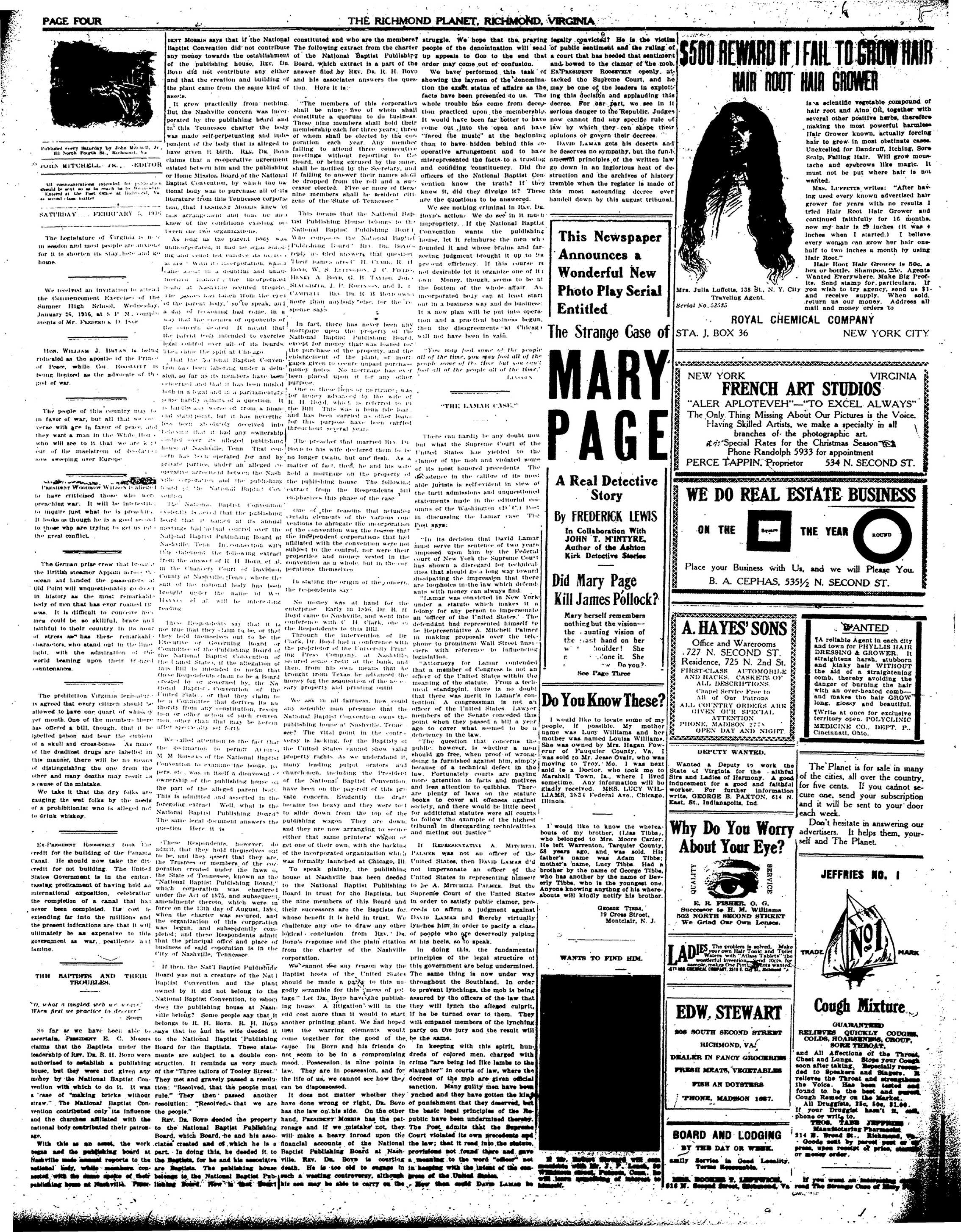
SATURDAY ... FEBRUARY 5, 1996
The Legislature of Virginia is in session and most people are anxious for it to shorten its stay, here and go home.
---
We received an invitation to attend the Commencement Exercises of the Summer High School, Wednesday January 25, 1916, at S. P. M. complements of Mr. Ferguson, D. I. Dixon.
---
Hon. WILLIAM J. BRYAN is being radicalized as the apostle of the Prince of Peace, while Cor. Roosevaker is being lionized as the advocate of the god of war.
The people of this country may be in favor of war, but all that we converse with are in favor of peace, and they want a man in the White House who will see to it that we are kept out of the maelstrom of desolation now sweeping over Europe.
PRESIDENT WOODROW WINDSOR is allied to have criticised those who were preaching war. It will be interesting to inquire just what he is preaching. It looks as though he is a good person to those who are trying to get us into the great conflict.
---
The German prize crew that brought the British steamer Appam across the ocean and landed the passengers a Old Point will unquestionably go down in history as the most remarkable body of man that has ever roamed the seas. It is difficult to conceive how men could be so skillful, brave and faithful to their country in its hour of stress and has these remarkable characters, who stand out in the light, with the admiration of the world beaming upon their beaming countenances.
```markdown
```
The prohibition Virginia legislature is agreed that every citizen should be allowed to have one quart of whisky per month. One of the members there has offered a bill, though, that it be labelled poison and bear the emblem of a skull and crossbones. As many of the deadliest drugs are labelled in this manner, there will be no means of distinguishing the one from the other and many deaths may result as a cause of the mistake.
We take it that the dry folks are gauging the wet folks by the needs of a prohibitionist who is alleged not to drink whisky.
EX-PRESIDENT RONNIE KRYST took the credit for the building of the Panama Canal. He should now take the direct credit for not building. The United States Government is in the embattling predicament of having held an international exposition, celebrating the completion of a canal that has never been completed. Its cost to extending far into the millions and the present indications are that it will ultimately be as expensive to this government as war, postlence and famine.
THE BAPTISTS AND THEIR TROUBLES.
"O, what a tangled web we weave!
When first we practice to decry!
Scorn.
So far as we have been able to entertain, PRESIDENT E. C. MOUNK claims that the Baptists under the leadership of Rev. Dr. R. H. Born were authorized to establish a publishing house, but they were not given any money by the National Baptist Convention with which to do it. It was a case of "making bricks without straw." The National Baptist Convention contributed only its influence and the churches affiliated with the national body contributed their patronage.
With this as an asset, the work chie
began and the publishing board at per
Nashville made annual reports to the th
national body, while members con-
noted with the same spoke of their be
publishing home at Nashville. Papers li
DENT MORRIS says that if the National Baptist Convection did not contribute any money towards the establishment of the publishing house, Riv. Du Born did not contribute any either and that the creation and building of the plant came from the same kind of business.
It grew practically from nothing. But the Nashville concern was incorporated by the publishing board and in this Tennessee charter the body was made self-perpetuating and independent of the body that is alleged to have given it birth. R. Dg. Hovt claims that a cooperative agreement existed between him and the publishing or Home Mission Board of the National Baptist Convention, by which the national body was to purchase all of its literature from this Tennessee corporation, that Iassonier M. Mohais knew of this arrangement and that he also knew of the conditions existing between the two organizations.
As long as the parent body was unincorporated, it had no legal standing and could not enforce its decision as law. With its incorporation, which came about in a doubtful and unintuitive manner, the unopposed leader at Nashville seemed troubled. The places had taken from the eyes of the parent body, so to speak, and a day of reasoning had come, in a way that the chemists of opponents of the convict deceived. It meant that the parent body intended to exercise legal control over all of its boards. Then came the spirit at Chicago.
That the National Baptist Convention has been laboring under a delusion, so far as its members have been concerned and that it has been misled both in a legal and in a parliamentary some hardly affords of a question. It is hardly any worse off from a financial standpoint, but it has nevertheless been absolutely deceived into believing that it had any ownership control over its alleged publishing house at Nashville, Tennessee. That concern has been operated for and by private parties, under an alleged cooperative agreement between the Nashville corporation and the publishing board of the National Baptist Convention.
The National Baptist Convention evidently believed that the publishing board that it named at its annual meetings had factual control over the National Baptist Publishing Board of Nashville, Tenn. In connection with this statement the following extract from the answer of R H Boyn, et al. in the Chancery Court of Davidson County at Nashville, Tenn., where the suit of the national body has been brought under the name of W. Haynes et al. will be interesting reading.
These Respondents say that it is not true that they claim to be or that they hold themselves out to be the Executive or Governing Board or Committee of the Publishing Board of the National Baptist Convention of the United States, if the allegation of this Bill is intended to mean that These Respondents claim to be a Board created by or governed by, the National Baptist, Convention of the United States, or that they claim to be a Committee that derives its authority from any constitution, resolution or other action of such convention other than that may be herein after specifically set forth.
We called attention to the fact that the destination to permit Attorneys M M Rosas of the National Baptist Convention to examine the books, papers, etc., was in itself a disavowal of ownership of the publishing house on the part of the alleged parent body. This is admitted and asserted in the foregoing extract. Well, what is the National Baptist Publishing Board? The same legal document answers the question. Here it is.
These Respondents, however, do admit, that they hold themselves out to be, and they assert that they are the Trustees or members of the corporation created under the laws of the State of Tennessee, known as the "National Baptist Publishing Board," which corporation was chartered under the Act of 1875, and subsequent amendments thereto, which were in force on the 13th day of August, 1895, when the charter was secured, and the organization of this corporation was begun, and subsequently completed; and these Respondents admit that the principal office and place of business of said corporation is in the City of Nashville, Tennessee.
If then, the Nat'l Baptist Publishing Board was not a creature of the Nat'l Baptist Convention and the plant owned by it did not belong to the National Baptist Convention, to whom does the publishing house at Nashville belong? Some people say that it belongs to R. H. Born. R. H. Born says that he and his wife decided it to the National Baptist Publishing Board for the Baptists. These statements are subject to a double construction. It reminds us very much of the "Three tailors of Tooley Street." They met and gravely passed a resolution: "Resolved, that the people must rule." They then passed another resolution: "Resolved, that we are the people."
Rev. Dr. Born deeded the property to the National Baptist Publishing Board, which Board, he and his associates created and of which he is a part. In doing this, he deeded it to the Baptists, for he and his associates are Baptists. The publishing house belongs to the National Baptist Publishing Board. New to that Board
constituted and who are the members?
The following extract from the charter of the National Baptist Publishing up appeals to Gou to the end that a court that has Board, which extract is a part of the order may come out of confusion. and bowed to answer filed by Rev. Dr. R. H. Bovo and his associates answers the question. Here it is:
struggle. We hope that the praying legally convict people of the denoination will send of public sentiments to Gou to the end that a court that has Board, which extract is a part of the order may come out of confusion. and bowed to answer filed by Rev. Dr. R. H. Bovo and his associates answers the question. Here it is:
We have performed this task of President showing the laymen of the denomination tacked the Station the exact status of affairs as the may be one of
"The members of this corporation shall be nine; five of whom shall constitute a quorum to do business. These nine members shall hold their membership each for three years; three of whom shall be elected by the corporation each year. Any member failing to attend three consecutive meetings without reporting to the Board, or being excused by the same, shall be notified by the Secretary, and if falling to answer their names shall be dropped from the roll and a successor elected. Five or more of these nine members shall be resident citizens of the State of Tennessee."
This means that the National Baptist Publishing House belongs to the National Baptist Publishing Board Who composes the National Baptist Publishing Board? Roy Du, Boyer replies as the answer, that question Their names are C. H. Craw, R. H. Boyer, W. S. Errysson, J. C. Forte, Hanky A. Boyn, G. B. Taylor, Jois Stavonguz, J. P. Rourson, and L. C. Camarrett Roy Du, R. H. Boyer owes more than anybody else, for the response says
In fact, there has never been any mortgage upon the property of the National Baptist Publishing Board, except for money that was loaned to the purchase of the property, and the enlargement of the plant, or mortgages given to secure unpaid purchase-money notes. No mortgage has ever been placed upon it for any other purpose.
One of these items or mortgage was for money advanced by the wife of R. H. Boud, which is referred to in the Bill. This was a bona fide loan, and has been carried as other loans for this purpose have been carried throughout several years.
The preacher that married his beloved to his wife declared them to be no longer twain, but one flesh. As a matter of fact, the he and his wife held a mortgage on the property of the publishing house. The following extract from the Respondents but emphasizes this phase of the case.
One of the reasons that actuated certain elements of the various conventions to abrogate the incorporation of the convention was the reason that the independent corporations that had affiliated with the convention were not subject to the control, nor were their properties and money vested in the convention as a whole, but in the corporations themselves.
In stating the origin of the concern, the respondents say:
No money was at hand for the enterprise Early in 1896, Dr. R. H. Boyd came to Nashville, and went into conference with C. H. Clark, one of the Respondents to this Bill. Through the intervention of Dr. Clark, Dr. Boyd had a conference with the proprietor of the University Printing Press Company, at Nashville, secured some credit at the bank, and then, from his own means that he brought from Texas he advanced the money for the acquisition of the necessary property and printing outt
We ask in all fairness, how could any sensible man presume that the National Baptist Convention owns the publishing house at Nashville, Tennessee? The vital point in the controversy is lacking, for the Baptist of the United States cannot show valid property rights. As we understand it, many leading pulpit orators and churchmen, including the President of the National Baptist Convention, have been on the payroll of this private concern. Evidently the draft became too heavy and they were to slide down from the top of the publishing wagon. They are down, and they are now arranging to secure either that same printers' wagon or get one of their own, with the backing of the incorporated organization which was formally launched at Chicago Ill.
To speak plainly, the publishing house at Nashville has been deeded to the National Baptist Publishing Board in trust for the Baptists, but the nine members of this Board and their successors are the Baptists for whose benefit it is held in trust. We challenge any one to draw any other logical conclusion from Riv. Du Boyd's response and the plain citation from the charter of the Nashville corporation.
We cannot see any reason why the Baptist hosts of the United States should be made a party to this ungodly scramble for this "mess of passage." Let Dr. Boyn have the publishing house. A litigation will in the end cost more than it would to start another printing plant. We had hoped that the warring elements would come together for the good of the cause. Dr. Boyn and his friends do not seem to be in a compromising mood. Possession is nine points in law. They are in possession, and for the life of us, we cannot see how they can be dispossessed.
It does not matter whether they have done wrong or right. Dr. Boyn has the law on his side. On the other hand, President Morris has the patronage and if we mistake not, they will make a heavy inroad upon the financial accounts of the National Baptist Publishing Board at Nashville. Rev. Dr. Boyn is courting death. He is too old to engage in such a wasting controversy, although his son may be able to carry on the
struggle. We hope that the praying people of the denomination will send up appeals to God to the end that order may come out of confusion.
We have performed this task of showing the laymen of the denomination the exact status of affairs as the facts have been presented to us. The whole trouble has come from deception practiced upon the membership. It would have been far better to have come out into the open and have "faced the music" at the beginning than to have hidden behind this cooperative arrangement and to have misrepresented the facts to a trusting and confiding constituency. Did the officers of the National Baptist Convention know the truth? If they knew it, did they divulge it? These are the questions to be answered.
We see nothing criminal in Riv. Dau. Boyd's action. We do see in it much impropriety. If the National Baptist Convention wants the publishing house, let it reimburse the men who founded it and whose brains and farsearing judgment brought it up to its present efficiency. If this course is not desirable let it organize one of its own Money, though, seems to be at the bottom of the whole affair. An incorporated body can at least start out in a business way and do business. It a new plan will be put into operation and a practical business begun, then the disagreements at (Chicago) will not have been in vain.
"You may feel some of the people all of the time, you may feel all of the people some of the time, but you can't feel all of the people all of the time."
```markdown
```
There can hardly be any doubt now but what the Supreme Court of the United States has yielded to the claimor of the mob and violated some of its most honored precedents. The Evidence in the calibre of its most able jurists is self-evident in view of the tacit admissions and unquestioned statements made in the editorial columns of the Washington (D.C.) Post in discussing the Lamar case. The Post says:
"In its decision that David Lamar must serve the sentence of two years imposed upon him by the Federal court of New York the Supreme Court has shown a disregard for technicalities that should go a long way toward dissipating the impression that there are loopholes in the law which defendants with money can always find.
"Lamar was convicted in New York under a statute which makes it a felony for any person to impersonate an 'officer of the United States.' The defendant had represented himself to Representative A. Mitchell Palmer in making proposals over the telephone to prominent Wall Street financiers with reference to influencing legislation.
"Attorneys for Lamar contended that a member of Congress is not an officer of the United States within the meaning of the statute. From a technical standpoint, there is no doubt that there was merit in Lamar's contention. A congressman is not an officer of the United States. Lawyer members of the Senate conceded this point when they passed a bill a year ago to cover what seemed to be a deficiency in the law.
"The question that concerns the public, however, is whether a man should go free, when proof of wrongdoing is furnished against him, simply because of a technical defect in the law. Fortunately courts are paying more attention to facts and motives and less attention to quibbles. There are plenty of laws on the statute books to cover all offenses against society, and there would be little need for additional statutes were all courts to follow the example of the highest tribunal in disregarding technicalities and meeting out justice."
IF REPRESENTATIVE A. MITCHELL PALMER was not an officer of the United States, then DAVID LAMAR did not impersonate an officer of the United States in representing himself to JE. MITCHELL PALMER. But the Supreme Court of the United States in order to satisfy public clamor, proceeds to affirm a judgment against DAVID LAMAR and thereby virtually lynches him in order to pacify a class of people who are deservedly yelping at his heels, so to speak.
In doing this, the fundamental principles of the legal structure of this government are being undermined. The same thing is now under way throughout the Southland. In order to prevent lynchings, the mob is being assured by the officers of the law that they will lynch the alleged culprit, if he be turned over to them. They will empanel members of the lynching party on the jury and the result will be the same.
In keeping with this spirit, hundreds of colored men, charged with crime "are being led like lambe to the slaughter" in courts of law, where the decrees of the mob are given official sanction. Many guilty men have been ynched and they have gotten the king of punishment that they deserved, but the basic legal principles of the Republic have been undermined thereby. The Post admits that the Supreme Court violated its own precedents and the law; that it read into the statute provisions not found there and gave a meaning to the word "offense" not in keeping with the intent of the congress of the United States.
legally convicted? He is the victim of public sentiment and the ruling of a court that has heeded that sentiment and bowed to the clamor of the mob. EXPRESIDENT ROOSEVELT openly attacked the Supreme Court, and he may be one of the leaders in exploiting this decision and applauding this decree. For our part, we see in it serious danger to the Republic. Judges now cannot find any specific rule of law by which they can shape their opinions or govern their decrees. DAVID LAMAR gets his deserts and he deserves no sympathy, but the fundamental principles of the written law go down in an inglorious heat of destruction and the archives of history tremble when the regulator is made of this most astounding decree ever handled down by this August tribunal.
This Newspaper Announces a Wonderful New Photo Play Serial Entitled
This Newspaper Announces a Wonderful New Photo Play Serial Entitled
The Strange Case of
MARY PAGE
By FREDERICK LEWIS In Collaboration With JOHN T. MINTYRE, Author of the Ashton Kirk Detective Stories
Do You Know These?
I would like to locate some of my people, if possible. My mother name was Lucy Williams and her mother was named Louisa Williams. She was owned by Mrs. Hagan Fowler of Faquier County. Va. I was sold to Mr. Jesse Ovalr, who was moving to Troy, Mo. I was next sold to a Doctor, who took me to Marshall Town, Ia., where I lived sometime. Any information will be gladly received. MRS. LUCY WILLIAMS, 3624 Federal Ave., Chicago, Illinois.
I would like to know the whereabouts of my brother, (Linas Tibbs), who belonged to Mrs. Moore Carter. He left Warrenton, Tarquier County, 58 years ago, and was sold. His father's name was Adam Tibbs; mother's name, Lucy Tibbs. Had a brother by the name of George Tibbs, who has another by the name of Beverly Tibbs, who is the youngest one. Anyone knowing anything of his whereabouts will kindly notify his brother.
WANTS TO FIND HIM.
If Mr. Robert Strangel will meet with Mr. J. P. Lennard, so Willingham street, Putnam, Conn., he will learn something of interest to himself.
$500 REWARD IF I FAIL TO GROW HAIR HAIR ROOT HAIR GROWER
NEW YORK VIRGINIA
FRENCH ART STUDIOS
"ALER APLOTEVEH"—"TO EXCEL ALWAYS"
The Only Thing Missing About Our Pictures is the Voice. Having Skilled Artists, we make a specialty in all branches of the photographic art.
Special Rates for the Christmas Season
Phone Randolph 5933 for appointment
PERCE TAPPIN, Proprietor 534 N. SECOND ST.
WE DO REAL ESTATE BUSINESS
ON THE SQUARE THE YEAR ROUND
Place your Business with Us, and we will Please You.
B. A. CEPHAS, 535½ N. SECOND ST.
A
Mrs. Julia Luffetts, 138 St., N. Y. City
Traveling Agent.
Serial No. 52555
STA. J. BOX 36
NEW YORK
FRENCH A
"ALER APLOTEVEH"
The Only Thing Missing Above Having Skilled Artists, with branches of the
Special Rates for the Phone Randolph 59
PERCE TAPPIN, Proprietor
WE DO REAL ES
ON THE
Place your Business with U
B. A. CEPHAS, 535
A. HAYES' SONS
Office and Warerooms
.727 N. SECOND ST.
Residence, 725 N. 2nd St.
FIRST-CLASS AUTOMOBILE
AND HACKS. CASKETS OF
ALL DESCRIPTIONS.
Chapel Service Free to
All of Our Patrons
ALL COUNTRY ORDERS ARE
GIVEN OUR SPECIAL
ATTENTION
PHONE. MADISON 2775
OPEN DAY AND NIGHT.
DEPUTY WANTED.
Wanted a Deputy to work the State of Virginia for the aithful Sira and Ladies of Harmony. A good inducement for a good and faithful worker. For further information write, GEORGE B. PAXTON, 614 N. East, St., Indianapolis, Ind.
Why Do You Worry About Your Eye?
QUALITY SERVICE
E. R. FISHER, O. G.
Successor to H. M. Williams
502 NORTH SECOND STREET
We Grind Our Own Lenses.
LADIES The problem is solved. Make your own Hair Tonic and Toilet Waters with "Atlasa Tablets" the wonderful invention. Send 10cts. for sample, makes One Pint Items wanted.
EDW. STEWART
206 SOUTH SECOND STREET
RICHMOND, VA.
DEALER IN FANCY GROCERIES
FRESH MEATS, VEGETABLES
FISH AND DOYSTERS
PHONE, MADISON 1687.
BOARD AND LODGING
BY THE DAY OR WEEK.
family Service in Good Locality.
Terms Reassurable.
BENN. BOOKER T. LEPTWICK
816 M. Second Street, Richmond, Va.
is a scientific vegetable compound of hair root and Aino Off, together with several other positive herbs, therefore making the most powerful harmless Hair Grower known, actually forcing hair to grow in most obstinate cases. Unexcelled for Dandruff, Itching, Sore Scalp, Falling Hair. Will grow mountache and eyebrows like magic. It must not be put where hair is not wanted.
MEN. LUFFETT, writes: "After having used every known advertised hair grower for years with no results I tried Hair Root Hair Grower and continued faithfully for 16 months, now my hair is 39 inches (it was 4 inches when I started.) I believe every woman can grow her hair one-half to two inches a month by using Hair Root."
Hair Root Hair Grower is 50c. a box or bottle. Shampoo, 25c. Agents Wanted Everywhere. Make Big Profits. Send stamp for particulars. If you wish to try agency, send us $1 and receive supply. When sold, return us our money. Address all mail and money orders to
NEW YORK CITY
VIRGINIA
ART STUDIOS
"TO EXCEL ALWAYS"
About Our Pictures is the Voice.
we make a specialty in all
the photographic art.
the Christmas Season
5933 for appointment
tor 534 N. SECOND ST.
ESTATE BUSINESS
THE YEAR
ROUND
Us, and we will Please You.
351/2 N. SECOND ST.
WANTED
TA reliable Agent in each city and town for PHYLLIS HAIR DRESSING & GROWER. It straightens harsh, stubborn and kinky hair WITHOUT the aid of a straightening comb, thereby avoiding the danger of burning the hair with an over-heated comb—and makes the hair GROW long, glossy and beautiful.
Write at once for exclusive territory open. POLYCLINIC MEDICINE CO. DEPT. P., Cincinnati, Ohio.
The Planet is for sale in many of the cities, all over the country, for five cents. If you cannot secure one, send your subscription and it will be sent to your door each week. Don't hesitate in answering our advertisers. It helps them, yourself and The Planet.
JEFFRIES NO. 1
No.1
TRADE MARK
Cough Mixture
GUARANTEED
RELIEVES QUICKLY COUGHS,
COLDS, ROARSENESS, GROUP,
SORE THROAT.
and All Affects of the Throat,
Chest and Lunga. Stops your Cough
soon after taking. Especially recorded
to Speakers and Stagers. B relieves the Throat and strengthens
the Voice. Has been tested and
found to be the best and purest
Cough Remedy on the Market.
THOS. TABB JEFFRIE
Manufacturing Pharmacist
214 N. Broad St., Richmond, Va.
Goods sent by parcel post or of
press, upon receipt of price, stamp,
or money order.
If you want an interisting document
read The Strange Case of Many Pieces
ROANOKE, VA.
Roanoke, Va., January 28, 1916. Roanoke Lodge, No. 51, had the honor of having present at its meeting Friday night, the District Deputy G. C. Sir Knight W. B. F. Crowell, installing and giving the P. W., and such other instructions as would foster and further the best interest of society, community, city, and the homes of all who will accept his worthy advice for their life motto—"Straight-forwardness in Every Transaction of Life." The Lodge adjourned after a most enjoyable meeting. Recolpts of the evening $54.50. Thomas Jones, C. Commander of said lodge.
Mr. J. R. Mitchell, of 7th Avenue N. W., is quite indisposed at his home, the result of an injury received in a fall from a freight train during November. He is one of the strictest members of Roanoke Lodge, No. 51, and a faithful Pythian Knight.
The Rev. G. P. Miller preached a very, soul-stirring sermon from the pulpit of the Mt. Zlon A. M. E. Church Sunday morning, which was entire satisfaction to all who heard him. He spoke of how necessarily important it is for every man to use all the power in him for good and the uplift of those around him, especially those spiritual gifts. All who listened were benefited and helped having heard this wonderful discourse. May he long live to tell the wonderful story of Jesus and His love for man.
There is a week of rallying at St. Paul's M. E. Church, beginning Sunday, January 30, 1916, and continuing the following week, for the trustees' department of said church. Ex-Pastors Rev. Williams and Rev. Virgil being present to give impetus and good cheer to the work of the church; also giving gospel encouragement to the congregation in general. Many were delighted to grasp the hand of the two divines.
The aim of the church is to raise $1,000) one thousand dollars. May their aim be reached and the name of the Lord glorified. Rev. Dr. Brown is in good spirit, hoping that all things may work together for good.
Sr. Knight G. T. Leftwich, of 57 Avenue was taken to Burrell's Memorial Hospital and operated on for serious stomach trouble on Friday last and is reported as getting on nicely. We hope for him a speedy recovery. He is a staunch member of Roanoke Lodge, No. 51, K. of P. and one we are proud to have controlled on our roster.
Mrs. Catherine Stanfield is continued to her bed at her home 153 Wells Alley, N. W., Roanoke, Va., under the medical care of Dr. George E. Moore.
Mrs. Bossie J. Curtis, or 218-75 Ave., has been sick since she returned from Raleigh, N. C., attending the funeral of her uncle, who passed away early during the month of January.
Prof. M. Traynham, who sustained a painful injury from a unashed foot, is getting along fine and expects to report soon for duty in the foundry department of Roanqke Machine Works.
Miss Hallie B. Traynham, of 10th Avenue, N. E. and one of the very efficient teachers of Ginsbhoro Avenue Public School has been confined to her bed since Saturday, January 29. We hope soon she may be at her post of duty.
PERSONAL AND BRIEF
Editor John Mitchell, Jr. visited Danville, Va. last Tuesday. He returned home Wednesday morning.
Mrs. L. J. Moris is still indisposed at the residence of her brother, Dr. E. R. Jefferson.
Dr. E. R. Jefferson has been appointed Grand Master of Exchequer of the Grand Lodge K. 6 P. of Virginia vice Benjamin H. Peyton, deceased.
Rev. T. J. King, D. I.) had a rather severe fall last Tuesday night while visiting some of the sick members of his Church. He was considerably bruised, but has been able to get about, novertheas.
More than 7,000 people joined the Christmas Savings Club and the Vacation Club at the Mechanics Savings Bank.
Mr. W. Isaac Johnson continues to improve slowly, but his physicians do not permit him to receive company, as he is not able as yet to sit up.
Rev. R. H. Boyd. D. Iy and Mr. Henry Allen Boyd spoke to a large audience at the Fifth Street Baptist Church, Thursday night, January 27. They were much pleased with their reception here. They left for Newport News, where Rev. C. E. Jordan arranged a successful meeting, Friday night. They apoke to a large crowd in Danville, Va. Sunday afternoon.
Col. Willis Wyatt has greatly improved and is able to go about again.
Dr. J. Mercer G. Ramsey has decided to remove his family from their country villa to the city, so it is reported.
Good class of Girls, who can do all kinds of home-work, are always in demand. Good wages. Apply to MNJ. J. N. RIDDICK. 1420 Lombard Street, Philadelphia, Ph.
Vessel Given Up for Lost Reaches
Hampton Rhoads, Flying Kalser's
War Flag, in Charge of Prize Crew
The British African line steamship
Appam, which had been given up as
cost at sea, steamed into Hampton
Roads flying the German naval ensign
and in charge of a German prize crew
of twenty-two men.
The Appam was captured off the
Canary islands on January, 15 by a
German raider four days after she had
sailed from Dakar, British West Africa,
for Plymouth, England.
She brought in a tale of seven vessels
destroyed by the sea raider of
the African coast. The names of the
steamships sunk by the raider are
given as the Trader, Arthur, Cor
bridge, Arladne, Dromonby, Farrington
ford and Clan MacTavish.
On board the Appam, in addition to her original 106 passengers and crew of 134 men, were 138 persons said to have been taken from the other vessels sunk by the commerce raider.
Out of a mass of conflicting tales told by the passengers and officers of the Appam and the few admissions of Lieutenant Oscar Berge, commanding the prize crew, this much seems clear:
That the Appam was overwhelmed by a trump German raider off the Canary islands; that there was a fight before the surrendered, and that the raider assumed her business of attacking British merchant vessels again, slaking at least one in view of the Appam.
The vessel sunk, all accounts agree was an Australian freighter (probably the Clan MacTavish) laden with meat. The freighter showed fight, and several of her crew were injured., The German raider put the injured aboard the Appam, took cargo of meat and steamed away, leaving Appam to proceed to Norfolk, in charge of the prize crew;
Just how much of a fight the Appam put up before surrendering is disputed. Captain Harrison, of the liner, says surrender was immediate, since he had only one three-inch gun with which to resist the raiders attack, and that the gun was unmounted. Some members of the prize crew say the British liner opened fire in answer to the first shot across her bows. The United States government will have this point to settle.
There is the widest speculation as to the identity of the mysterious raider. Many think it is the Will'o the Wisp boat reported several times in the Gulf of Mexico, just after the escape of officers from the Prinz Eitel Friedrich aboard the yacht Helpspee Captain Harrison the raider probably was conveyed by a German submarine.
It is reported that the raider was the cruiser Mowe, although this is not confirmed. According to Lloyd's register, there is a German merchant ship named Mowe, commanded by a Capt Bainge, which is the same name as that of the commander who brought the Appam into port. There is a German torpedo boat by the name of Mowe.
The Appam carries a large caro. in oluding a quantity of cocoa and other African products. Among her passangers are twenty-two women and five children. The vessel is in excel lent condition.
WEDS AS BABE LIES DEAD
Woman Unwilling to Postpone Marriage and Financial Fertility
Hage and Funeral Follows.
In order not to disappoint the invite of guests and unwilling to postpone her marriage to Stephen Gutchman, Mrs. Annie Krokus, a widow of South Bokleham, Pa., decided to have the ceremony performed, even though her three-month-old babe lay dead at her home.
Accordingly the wedding ceremony was performed at Allentown, and then Mr. and Mrs. Gutchman returned home, where a little later the funeral of the child took place. The woman became a widow on October 24 last, and five days later the child was born.
No More Canal Slides, Says Goethals
Major General George W. Gee
thalis, governor of the Panama Canal
pole, arrived in New York on his
way to Washington to appear before
the congressional committee on canal
appropriations. General Goethals said
he was unable to find any definite date
as to when the canal would be opened,
but was confident there would be no
more slides.
Notices were posted at the plants of the H. C. Frick Coke company at Connellsville, Pa., through the Connellsville region, that, effective February 1, the wages of all employees would be increased ten per cent. The advance will affect 20,000 workers and is the highest ever paid in the coke region.
Conscription Begins March 2.
The conscription law recently passed by the British parliament will be come effective on March 2, the Loon Evening Star announces.
French Leagues 2,500,000
M. Leauquet, a French Socialist's deputy, who addressed the British labor conference in Bristol, England, on being questioned regarding the French lesions, said that 200,000 soldiers had been killed, 1,000,000 had been wounded and 200,000 had been taken prisoner.
THE RICHMOND PLANET. RICHMOND. VIRGINIA
NEW GUNS FOR DEFENSE
Proposed Movable Artillery for Coast Defense.
54 KILLED IN AIR RAID
67 Others Hurt in Zeppelin Attack on England.
Fifty-four persons were killed and sixty-seven injured in Monday night's raid by Zeppelin's over Derbyshire, Staffordshire, Lincolnshire and Leicestershire, it was officially announced in London.
The number of dead and wounded may be increased in later reports, it was indicated. The official statement said that reports from cities bombarded are still incomplete.
The Zeppelin feet was the biggest that has yet attacked England. The raiders were hampered in their operations by a rust which made it impossible to hit down bombs accurately or to gauge their surroundings.
The following official statement was given out:
"An air raid Monday was attempted by the Germans on an extensive scale, but it appears the raiders were hamphed by thick mists. After crossing the coast the Zeppelinia steered in various directions, dropping bombs on several towns in the rural districts of Derbyshire, Leicestershire, Lincolnshire and Staffordshire. Some damage to property was caused, but no accurate reports were received until a very late hour. The casualties enumerated up to the time of the issuance of this statement were fifty-four killed and sixty-seven injured."
220 MIDDIES FAIL
One-Fourth Annapolis Students Must Quit for Deficiency, is Report.
Notwithstanding the particularly serious need of naval officers at this time, 220 midshipmen, about one-quarter of the whole number at the Naval academy, at Annapolis, Md., while in the regular course, will be asked to resign within the next few days, owing to their failure to pass certain subjects at the semi-annual examinations, which have just ended.
As the academic board has not passed upon these cases as yet, the academy officials are not ready to make a definite announcement as to the number and class distribution of the deficient, but it is asserted or absolute authority that the number is about 220, and that the number, in each class is about as follows: First, or graduation class, 20; second, 60; third, 60; fourth, 50.
Failure to attain a mark of 250 out of a possible 400 constitutes a "deficiency" at the academy, and in the usual course a deficiency in any branch is sufficient to bring a request for a resignation.
DUPONT SAFE STOLEN :
200-Pound Strong Box Carried From Home by Burglar.
Thieves carried a 200-pound iron safe containing $2000 in money and valuable jewelry from the residence of Mrs. Lammot Dupont in Wilmington, Del.
Mrs. Dupont had taken a valuable necklace from the safe, which she wore to dinner, but when she returned to replace it the safe had disappeared from a second floor room.
The house was searched but there was no trace of the missing strong box.
SMALLPOX AT HAGERSTOWN
Six Cases Found In One House, Which Has Been Quarantined.
Smallpox has again broken out in Hagerstown, Md.
Dr. Caleb Rohrer, of the state board of health, who is here making investigations, found six cases in one house, which has been quarantined.
The disease was brought from near Roanoke. For days the victims, little suspecting the real nature of the disease, went about the city, appearing at motion picture theatres and other public places.
Oppose Votes for Women.
Paul Littlefield, of Philadelphia representing the Anti-Woman Suffrage association of Pennsylvania and Franklin Carter, Jr., of New York, representing the Man Suffrage association, opposed the proposed constitutional amendment for woman suffrage before the house judiciary committee.
Air Raider Attacks Salonika.
A German airship has bomberded the allies' ships and stores at Salonika "with great success," the war office announced.
Governor Brumbaugh Weds.
Governor Martin G. Brumbaugh and Miss Flora Belle Parks, his ward, were married in the Germantown church of the Brethren in Philadelphia after extraordinary but futile pre-attacks had been taken to keep the wedding time and place a secret.
The governor's marriage comes as a
completed surprise to his friends and
to the public generally. From time
to time he had been reported as en-
gaged, but Miss Parks' name had
never been mentioned in this connec-
tion. She is a distant cousin of the
governor's and has been a member
of his household for more than twen-
ty years.
The wedding ceremony was per-
formed according to the curious Bunk-
hard rite by Rev. George Dilling Kuna,
pastor of the First Church of the
Brothren, of which the governor is a
member, assisted by Rev. Milton-C
Swigart, pastor of the Germantown
church. Neither the bride nor the
bridegroom had any attendants.
Train Killa Three In Auto.
Three persons were killed and three injured when a wrestound milk train on the Reading railway struck an automobile on a private crossing near Grantham, Cumberland county, Pa. The dead are: Mrs. Daniel Wingert and Mrs. John Harbaugh, Chambersburg, and Mrs. John Myers, Green Castle, and the injured, Daniel Wingert, Anna Myers and Norman Wingert.
Mr. Wingert, who was driving, had changed gear to go up grade, and the vehicle slipped back on the track in front of the approaching train. The rear of the car in which the women were seated was demolished, and the front part hurted twenty feet.
Mrs. Myers died soon after being picked up. The other two were killed instantly.
Fell 125 Feet; Will Recover.
C. H. Ice., a painter, of Donora near Mongolahela, Pa., fell 125 feet from a scaffold, sustaining a broken arm and leg and a slight concussion of the brain. Physicians predict he will recover. Ice, it is said, owes his life to the fact that he fell into mud.
New Malne Bishop
The Right Rev. Benjamin Brewster, of Glenwood Springs, Colorado, was elected bishop of the Protestant Episcopal diocese of Maine, to succeed the Right Rev. Robert Codman, who died recently. Dr. Brewster is missionary bishop of western Colorado.
Girl Gored by Bull.
Attacked by a bull while walking on the Cherry Lone road, near Stroudsburg, Pa., eighteen-year-old Rosie Young was saved by men who heard the shrieks of seven terrified companions who had taken to trees. Though gored, she will recover.
GENERAL MARKETS
PHILADELPHIA. - FLOOR quiet
clear, $5.65/hr, city mills, $7.50
$7.60
RYE FLOUR—Steady. per barrel.
15 5006 6
WHEAT steady: No. 2 red. $1:37¢
139.
CORN quiet: No. 2 yellow, 84¾¹⁶
OATS steady: No. 2 white, 59¾¹⁶
POULTRY: Live steady; hens, 14¾¹⁶
18¾¹⁶; old roosters, 12¾¹⁶; Dresser
steady; choize fowl, 20¾¹⁶; old roost
fowl, 14¾¹⁶
BUTTER firm. Fancy creamery
34¾ c. per lb.
Eggs steady. Selected. 35¾ 31¾ c.
nearby. 34¾ c.; western. 34¾ c.
CHICAGO- HOGS - Bee, higher
Mixed and butchers, $7.65/8.90; good
heavy, $7.80/9.10; rough heavy, $7.45
$7.75; light, $7.80; pigs, $6.40/8.90
$7.10; light, $7.75/8.90
$7.50; higher, Hooves,
$5.50/8.90; cows and buffers, $3.65/8.90;
Texans, $9.50/8.90; calves, $9/10.60.
SHEEP - Steady. Native and west-
ern, $4.50/8.90; lambs, $7.50/10.86.
1916 FEBRUARY 1916
SUN MON TUE WED THU FRI SAT
1 2 3 4 5
6 7 8 9 10 11 12
13 14 15 16 17 18 19
20 21 22 23 24 25 26
27 28 29
P.
William G. S. Star, the Unite. St. ambassador to France, reported to the state department on the Zeppelin raid on Paris Sunday night.
He said none of the bombs dropped by the German air machine fell near the American embassy. Ten persons were killed and twenty injured, the reported.
Paris was raided on both Saturday and Sunday nights by Zeppelins. Official reports gave the number of those killed Saturday night as thirty-four; a French official statement declared, regarding Sunday night's raid: "Lentate rep's show that no damage was done."
Bitter Fight is Expected in the Senate on Confirmation of Noted Trust Buster.
President Wilson selected Louis D. Brandles, of Boston, to be associate justice of the United States, to succeed Justice Lamar, who died recently.
Mr. Brandles' nomination went to the senate. It was a surprise everywhere in official circles. Mr. Brandles had not even been mentioned for the recency.
No sooner had the nomination been received than the senators began discussing informally the prospects of his confirmation. A bitter fight is expected. None of those who said they were opposed to the appointment were willing to be quoted to that effect, however. Senators on all hands said freely they were taken by surprise. The nomination goes to the judiciary committee, where, if there is a fight, it will first develop.
Louis Dembitz Branditz was born at Louisville, Ky., November 13, 1886, and was educated in the public and high schools of that place and at Annen Realschule, Dresden, Germany. He was graduated from the Harvard Law school in 1877 and received the master's degree in 1891.
On March 23, 1891, he married Alice Goldmark, of New York city. He was admitted to the bar in Boston in 1878, and has practiced in that city ever since.
He has taken a prominent part in legal cases of a public nature and has been regarded as a man of ultra-radical views on many subjects. He has been independent in politics, acting freely with radical elements in both parties.
In the Ballinger controversy during the Taft administration he represented Glavis, one of the chief witnesses for the former attorney general's opponents.
He was counsel for the people in the proceedings involving the constitutionality of the Oregon and Illinois women's ten-hour laws, and chairman of the arbitration board of the New York garment workers constituted after the strike in 1910.
As counsel for the shipppers, Mr. Brandies in 1910 and 1911 made a determined fight against the granting of the freight rate increase asked by the eastern trunk line railroads. He caused a stir by declarations made in November, 1810, that the railroads of the country were wasting a million dollars daily and that he could show them how to save that sum.
He was appointed special governmeat attorney in the New England railroad inquiry before the interstate commerce commission last year.
Mr. Brandies' name last came prominently before the public when he was appointed special government attorney in the Riggs National bank suit against Comptroller of the Curency John Skelton Williams.
Mr. Brandies is regarded as an au
authority on public franchises, life in
insurance, wage earners' insurance
scientific management, labor problems
and the trust question. He has writ
ten largely on these topics.
Mr. Brandies is the first Hebrew to
be named to the supreme court. He
has taken an active part in the Zion
list movement.
Supreme court justices hold office
for life. Associate justices receive
$14,500 a year.
British Losses 549.467.
Premier Asquith, in a written reply to a request for information, says that the total British casualties in all fields of operations up to January 9 were 549,467, of which 24,122 were officers and 525,345 of other ranks.
RECORD PENNSY EARNINGS
The Gross Return for 1915 Totalled $195,528,170.
Gross earnings of the Pennsylvania Railroad company. For the fiscal year ended December 31 were the largest ever reported for on year, being $196,628,170, an increase of $2,250,318 over 1914. The previous high record in gross earnings was in 1913, with $197,501,490. The net income applicable to sinking fund requirements and dividends was $40,478,681, an increase of $8,173,458, and is equivalent to more than 8.1 per cent on the stock of the Pennsylvania railroad.
In 1914 the net income was equivalent to 6.53 per cent. The dividend rate is six per cent, so that in the past year the dividend was earned and with a surplus of fully two per cent over, although this figure will probably be lowered by deductions for sinking and other reserve funds, and possibly appropriations for other corporate purposes.
Begin Uniontown Bank Probe.
The federal grand jury began an investigation into the causes leading to the failure of the First National bank of Uniontown, Pa. Many officials of the institution and prominent Uniontown business men have been subpoenaed.
Governor Samuel W. McCall, of Massachusetts telegraphed the secretary of state of Minnesota asking that his name be withdrawn as a candidate in the Republican presidential primaries of that state.
Investigate this Free Offer
Major's Oxford Hair Treatments are being discussed the world over. Each and every woman is given an opportunity of securing this System for treating the scalp and hair Free (Course ordinarily $25) Time for this offer Short. Matters not where you live, we can teach you in your spare time—after completion of course. Diploma is given each student who is under our direct supervision which means protection. Write for History and Illustrated picture of College. Major's Oxford Hair Grower, 50 cents per box—Oxford Menthol Mint Bleach Cream, 25cts.
MAJOR'S OXFORD COLLEGE
OF HAIR CULTURE
4210 W. Belle Place St. Louis, Missouri
(Owned by one of our race)
S HUMAN HAIR STREET, WASHINGTON, OLDEST HAIR STORE COMB that will give you Stamps or Post Office Mon. 19 is the Best Hair Pomade, the purest ox marrow, hair straight. It makes the One bottle will make the PREPAID FOR 35 CENTS.
MY YOUR COMPANY
our Scientific Face Lotion made it to do. It whitens perfect tint, purity and cleanliness will surprise you. yourself its wonderful pail for quick and positive agents Wanted.
BARD SUPPLY CO.
E. ROOM 25, DEPT. C
CE, 212 EAST LANE
DIRECTOR, EMBA LIVERYMAN.
Applied filled at short notice for meetings and with all necessary conveniences for hire at reasonable rates. Buggies, etc. Keep us.
May and may and Man on D. 52 RICH
ANCE Advertising Agency, 1706 Goode Avenue.
HUMAN HAIR STORE
STREET, WASHINGTON, D. C.
OLDEST HAIR STORE IN THE SOUTHE
COMB that will give you Perfect SATISFACTION
HELLER'S HUM
712—SEVENTH STREET
ESTABLISHED 1850. OLDEST
Here is the Straightening (OMB the
Send Stamps or P
"TAKE OUT KINK" is the Best
the purest
stubborn and kinky hair straight,
druff, Scalp Diseases. One bottle
SENT BY MAIL PREPAI
BEAUTIFY YOU
in 30 days by using our Scientif
that does what we made it to do
skin, giving it a perfect dint, p
ite. The first application will
a bottle and see for yourself it
It has no equal for quick
injure the skin. Agents Wante
STANDARD SU
MAFFITT AVE., ROOM
A. D. PRICE, 21
FUNERAL DIRECTOR
LIVER
All orders promptly filled a
ephone. Halls rented for m
Plenty of room with all neces
or Band Wagons for hire at
first class Carriages, Buggies,
fine funeral supplies.
Open All Day and
PHONF, MAD. 51
Arranged by the Fearance Advertising Agency, 1706 Goods Avenue.
HELLER'S HUMAN HAIR STORE
HELLER'S HUMAN HAIR STORE
712—SEVENTH STREET, WASHINGTON, D. C.
ESTABLISHED 1856. OLDEST HAIR STORE IN THE SOUTH.
Here is the Straightening COMB that will give you Perfect SATISFACTION
This One Dollar
Brass Comb will be
sent to your address
prepaid for 79c.
Pumps or Post Office Money Order.
Is the Best Hair Pomade made. It is made from the purest ox marrow. It will make the most straight. It makes the hair grow. Cures Dan-the bottle will make the hair Soft, Flue and Silky.
PREPAID FOR 35 CENTS IN STAMPS.
YOUR COMPLEXION
Your Scientific Face Lotion, "PLEXOLA." One made it to do. It whitens and beautifies theect tint, purity and clearness that is exquisition will surprise you. Send 50 cents for yourself its wonderful properties. For quick and positive results. It will not nata Wanted.
RD SUPPLY COMPANY
ROOM 25, DEPT. C., ST. LOUIS, MO.
E, 212 EAST LEIGH STREET,
DIRECTOR, EMBALMER AND LIVERYMAN.
Filled at short notice by telegraph or tel-eder for meetings and nice entertainments. All necessary conveniences. Darge Picnic hire at reasonable rates and nothing but Buggies, etc. Keep constantly on hand.
Man on Duty All Night
RICHMOND, VA
"TAKE OUT KINK" is the best Hair Pomade made. It is made from the purerot ox marrow. It will make the most stubborn and kinky hair straight. It makes the hair grow. Cures Dandruff, Scalp Discases. One bottle will make the hair Soft, Fine and Silky. SENT BY MAIL PREPAID FOR 35 CENTS IN STAMPS.
in 30 days by using our Scientific Face Lotion, "PLEXOLA." One
that does what we made it to do. It whitens and beautifies the
skin, giving it a perfect tint, purity and clearness that is exquisite.
The first application will surprise you. Send 50 cents for
a bottle and see for yourself its wonderful properties.
It has no equal for quick and positive results. It will not
injure the skin. Agents Wanted.
A. D. PRICE. 212 EAST LEIGH STREET.
A. D. PRICE. 212 EAST LEIGH STREET.
FUNERAL DIRECTOR, EMBALMER AND LIVERYMAN.
All orders promptly filled at short notice by telegraph or telephone. Halls rented for meetings and nice entertainments. Plenty of room with all necessary conveniences. Darge Pjenic or Band Wagons for hire at reasonable rates and nothing but first class Carriages, Buggies, etc. Keep constantly on hand fine funeral supplies.
Open All Day and
PHONF, MAD. 51
RICHMOND, VA
(Residence next door.)
Female E
e Emb
Embalmer
Female Embalmer
ME. LUCIE CHRISTIAN SCOTT
Is associated in business with her husband, Mr. Alphens Scott. Madam Scott claims the honor of being the only Negro woman in the State of Virginia—holding a State license to practice Balming, and is indeed, one of the few women in the United States, Embalming and Conducting Funerals. She ranks with the best in her profession.
She is prominent in fraternal organizations, namely: Courts of Cala-
the, I. O. of - I. O. of Good Samaritans, Hoe Ruth, Tents Sons and Dangers or Richmond, Shepherds of Bornlehem and Ideal Benefit Society.
Your Patronage and Influence will be greatly appreciated. Please remember that she is always at your service. Reliable Service at Moderate Rates.
OFFICE
1004 P Street, Phone, Madison 2237.
RESIDENCE
1015 St. James St., Phone, Mad. 6619.
RENTALS LOANS
G. BROS. & CO.
Agents and Brokers
ment, under All Circumstances,
teller-te Borrower-te Lender.
T. Phone, Bar. 4569
SALES RENTAL
BRAGG BR
Real Estate Agent
Accuracy in Statement, up
to Buyer-to Seller-to
506 N. SECOND ST.
RENTALS
GG. BROS. & C
te Agents and
ement, under All C
Seller-te Borrower-
0
1. 2. 3. 4. 5. 6. 7. 8. 9. 10. 11. 12. 13. 14. 15. 16. 17. 18. 19. 20. 21. 22. 23. 24. 25. 26. 27. 28. 29. 30. 31. 32. 33. 34. 35. 36. 37. 38. 39. 40. 41. 42. 43. 44. 45. 46. 47. 48. 49. 50. 51. 52. 53. 54. 55. 56. 57. 58. 59. 60. 61. 62. 63. 64. 65. 66. 67. 68. 69. 70. 71. 72. 73. 74. 75. 76. 77. 78. 79. 80. 81. 82. 83. 84. 85. 86. 87. 88. 89. 90. 91. 92. 93. 94. 95. 96. 97. 98. 99. 100.
PAGE FIVE
This One Dollar
Brass. Comb will be
sent to your address
prepaid for 79c.
PAGE SIX
WOMAN AN ETERNAL ENIGMA
MAN NEVER GUESSES HER, BUT HE NEVER GIVES HER UP.
(Ity Nixola Greeley-Smith)
New York, Jan. 22. "Woman is an eternal enigma. Man never guesses her, but he never gives her up."
The epigram came from an arm chair in the Hotel Richmond. In its velvet depths was M. Gabriel Nicole, French artist, hors concours in every salon, chevalier of the Legion of Honor, member of the Royal Society of Portrait Painters and wearer of many other honors which the cost of white paper won't permit me to enumerate. M. Nicole was extremely depressed yesterday, but it was not his honors that worried him. The voyage on the Lafayette had been dreadful, he had been so seasick that he was almost carried off the steamer, he said. But, true son of Gaul that he is, he brightly instantly when I remarked
CALLS IT "THE ENIGMA
"M Nicole, one of your most tasteful paintings of women is called 'The Emma.' Do you believe it, or did you merely paint it?"
"I painted it and I believe it," the painter answered. "The most simple of women is an enigma to the most learned man. A man may study you all his life, and at the end what does he know? The riddle is more puzzling than ever."
"Maybe because there isn't any I suggested. 'You know, Oscar Ward,' women are spitboxes without riddles."
"It may be that there are women without riddles, but I have never painted them," he answered.
GREAT PAINTER OF WOMEN
Yet M. Nicolet has painted every type of woman, from the great best ties of the English court to the mutually charming women of her own land, who seem to start with as few natural advantages as possible, just to show man what they can do. At the exhibition of his paintings, which will open in New York on January 11, every type of feminine loveliness will be represented. There will be "Bing" butterfly, "The Eternal Kiss" girl in a Red Gossip uniform while the artist completed just before leaving France for his first visit to the United States.
"The obvious, the supernatural, a woman, has never interested me. Mr Nodelt told me "I do not care to paint women who are merely pretty little animals. In 'Enigma' I have tried to suggest the unopened thoulth the speculations, of the young woman confronted with life. What is she think about? What is she deciding? Perhaps she is debating a proposal of marriage perhaps a proposal of a affair with someone unintentioned to present her indisposition, her mystery, her difficulty. For just to be a woman is a difficulty, is it not?" "It is more than a difficulty; it is a tragedy." I replied.
MORE THAN DIFFICULT
"Don't you make it more of a trapedy than it needs to be," M. Nicoleasked. "Coming over on the Lafayette there were many who trembled with fear of torpedoes because we had been warned that we would be destroyed by them—yet we areNothing worse happened to me then dreadful soakiness and I should have been spared that, if I had been a good sailor. Now it seems to me that the voyage of life is like that—even for women. The important thing is to get as much joy out of your trip as you can—to be a good sailor—and not to be afraid of torpedoes. After all, they do not happen very often, and why spoil a pleasant occasion by worrying about them."
Never having been the least bit afraid of torpedoes, I did not dispute M. Nicolelet. I said instead:
ALL BEAUTIFUL WOMEN GOOD.
"A while ago you remarked that you do not care to paint pretty little animals. Yet I read the other day in W. S. George's monograph on Anatolie France, that your great satirist and every other Frenchman would express his real views of love and women in he said, 'One beautiful woman is as good as another one.'"
"Interesting," commented M. Nicole. "But is it true? I don't think so. For me the merely beautiful woman has little value. I prefer infinitely to converse with the woman who is ugly, but intelligent, today of course." Interpolated, "becoming the touched the age of reason, but—when you were 25." "When I was 25 I was nothing but real, like every young man of 25, was the artist's answer. 'A man's opinions of women are of no value until he is 35. He does not understand. Between 35 and 50—60 even is man's golden age.'"
SPRING CHICKEN AT 21.
"And woman's? Is she, too, veal at 25?" I asked.
"No," M. Nicolei answered. "She is spring chicken." He spoke in French so he did not know that he was using the phraseology of Broadway. "But spring chicken is not very good, is N. After all, is it so very different from veal?"
I thought, but I did not say so fearing such love would not interest M. Nicolei, that chicken and veal are so much like that they are mingled invariably in the chicken.
commerce.
"Woman is most interesting after 30," the artist continued. "She has gained in distinction, in individuality, in mystery, The englina is more profound. One day a man thinks he understands her, he believes that she is utterly sympathetic with his every thought and wish, and the next day she is cold, cynical, unreasonable. He wonders where it has gone—the sympathy and understanding—but he is interested nevertheless. He wonders, he speculates. A man speculates always about the woman who interests him. He studies her. He says to himself, "What is there very special in this little woman that I love?" She is so complicated, so mysterious to him." Are men englina, too? I asked, "How do you expect a man to answer that?" Are they englina to others?"
"No," I said, "unless we make them go. I believe all our difficulties come from our trying to make riddles of you when you are in reality very simple. We pass miserable hours saying to ourselves: 'What did he think about that?' How did this after him? Did he like my dress? Does he approve of the way I do my hair? What did he mean yesterday? Is he thinking about me? Is he angry when the poor simple son said about thinking about us at all, but about something really important, something vital thrilling, passionate, like Mr. Turt thinks." "Men are simple when compared with women, I admit that." Mr. Noellet answered "But, after all, man does not have to be an enigma. It is not his business to be seductive; it is woman who must please him."
"Because, of the degeneracy of the human race," I interrupted, "you admit that the peacock must be sensitive do you not."
"Yes, but women have the more beautiful feathers, they reverse the order of nature. M. Nicole said: 'Beautiful burgundy feathers, and they borrow them from the male bird. I answered, so we tell to discuss the relative beauty of man and woman, and the artist and I agreed that man is more beautiful in motion and woman in repose.
"To educate woman must have more than beauty. M. Nicole concluded 'Charms is more than beauty. Mystery is more than charm. Beauty fades. Charms grows. Lanchar. But mystery is eternal. It is a woman's mystery which makes of her the real rubble of the universe.'"
RABIES REPORTED IN SIX W
COUNTIES
Patients Now Under Treatment by State from Different Localities.
Limestone Van Jan. 26, 1916. The arrival today of the state laboratory of a patient from Peterburg to take the antibiotic treatment necessary to satisfy the number now under treatment and bring to a like number the distribution, which has recently been reported.
The cases now under treatment are by officers of the State Board of Health to illustrate very clearly the case with which rabbits is spread when pneumonia is attached it are not taken. Each case has what officers describe as a tropical history.
The patient is from a party having southward by war, carrying a collar with them. The doctor has developed symptoms of malaria, but one of the party and them disappeared. His body was not recovered nor was known how many other animals were being by him.
Another patient from the society of Frederick burg was likewise the victim of her own dog under unintended circumstances. The family in question it appears lived in a tent and had two dogs of their own, one small lap dog and the other a giant greyhound. One night the family was arraised by the presence in the tent of a strange dog which attempted to bite the lap dog. The man of the family at once set the greyhound on the intruder and had the hound hold the strange dog until he could leave the tent and kill it. The greyhound did his duty but was evidently bitten in the fight. Thirty days afterwards while being fed, it snapped at the woman of the family and showed sign of distress. It was killed and was found to be suffering from hydrophobia.
A third case was bitten by a cat which contracted the disease in a manner that could not be determined; a fourth was bitten by a collie which likewise was not suspected of being mad.
Still another patient was bitten by a rabid animal in a most unusual manner. The patient was working at night in a powder plant on the south side when he was suddenly attacked by a bull-dog. The animal seized the hand of the man before the latter could arm himself and inflict painful injuries. The man at length had to strangle the animal and throw him in a stream to be rid of him. The body of the dog was not recovered but the symptoms were so typical that anti-rabid treatment was deemed necessary. "All the cases," says the board, "is its weekly bulletin today. "Illustrates once more the truth we have emphasized again and again. Animals that show signs of suspicious glickness should be securely chained until the nature of their complaint is certain. If this is done in every instance, rabid animals will not get at large."
GRIPPE WARNINGS IN PUBLIC PLACES
Richmond, Va., Jan. 26, 1916.—The State Board of Health is sending out today to all the railroads and to many of the county superintendents of schools brief printed warnings against the spread of bad cold, gripe and pneumonia. In an effort to acquaint the public with the means by which these diseases are conveyed. Most of the railroads of the State have already agreed to have warnings posted in all their stations, waiting rooms and passenger trains. The board has likewise written to each county superintendent a request that he will notify the board how many placards he wants in order that one may be posted in each school. Many of the superintendents have already replied and have promised to see that the placards are distributed. Copies will be sent other superintendents as soon as they will inform the board of their willingness to cooperate in preventing the spread of these diseases.
THE RICHMOND PLANET, RICHMOND, VIRGINIA
ROOSEVELT NOW CALLS WILSON'S STAND COWARDLY
EX-PRESIDENT SAYS, "WE ARE ASKED TO KISS THE BLOODY HANDS OF THE MURDER ERS OF OUR WOMEN AND CHILDREN"
The 3,000 persons who crowded into the Academy of Music in Brooklyn yesterday afternoon to hear Col. Theodore Roosevelt speak before the Institute of Arts and Science on the topic of "Promise and Performance in International Relations" expected strong language from the Colonel and were not disappointed.
In none of his utterances regarding the events of the war, the weakness from his point of view, of the present Administration, the failure of the United States to step forward courgeously as a champion of the oppressed little nations, general viciousness of the Trouble Powers, has Col Roosevelt ever expressed himself quite so savagely. There were sentiments of his long speech that hammered into the ears of his audience like the beat of a drum. Concerning the attitude of the Wilson Administration toward the Germanic Powers he said.
"We are asked to kiss the bloody hands of the murderers of our women and children and to serve as the tool of these men against those nations which have behaved more viciously and righteously than we have."
SEES ADMINISTRATION
"He accused the Administration of cowardice, saying
"Unfortunately it is evident that many of our public men are afraid of Germany, afraid of the professional German American vote and are willing to sacrifice the honor of this country to their fears."
Such deficiencies fairly leaped from the long address. He believed that the Wilson Administration had brought the nation to the lowest point of dislover and humiliation, and he said so in characteristic Rooseveltian periods. Hypocrisy, stupidity, weakness, were the mildest terms he employed in characterizing the attitude of the Government toward international problems. The situation as regards Mexico designated him.
"For five years," he should, "we have pursued a policy of both cowardice and infamy in the face of our duty toward Mexico."
Our position toward Europe reminded him of the New Testament parable of the man who fell among thieves on his way to Jericho.
"The Allies," thundered the Colonel "have played the part of the good Samaritan toward Belgium. This nation has played the part of the Levite that passed on the other side without trying to help the man."
The points of the Colonel's impassioned speech which most interested his hearers and called for the loudest applause were his arguments that the United States was actually bound by the Harare conventions to protect Belgium's neutrality, that it was an evil thing to fail a year and a half ago to stand forward in defence of international peace, that Germany is playing to give the United States a chance to crawl out of making good its fine words by offering a deceptive settlement of the Lusitania atrocity in return for an embargo on the shipment of munitions to the Allies; that preparedness must be had in the fullest sense, and that universal military training must be adopted.
Storms of applause beat against the walls of the Academy auditorium as the Colonel fiercely set forth his downright opinions. He spoke, as usual with tremendous vitm and vigor eye-gleaming, jaws snapping, clenched hands ripping the air as dramatic accompaniment to the spoken word.
At the outset he took up his familiar argument that the United States was in honor bound to stand by the Hague conventions to interpose in behalf of Belgium the instant German soldiers broke over King Albert's frontier, and that, it was dishonorable conduct on the part of the United States not to have taken action.
"A year and a half ago," said the Colonel, "the United States had a chance to show its devotion for international idealism such as had not previously occurred during the century and a quarter of our national life. We failed to take advantage of this chance."
"We failed because, among other things, when put to the test we declined to make good our international promise by our international performance. That was an evil thing on our part."
Now, Col. Roosevelt went on, there are persons in the United States who wish us to aid actively those who wronged Belgium by taking action against those who are seeking to right the wrongs of Belgium. He referred to the demands than an embargo be placed upon the shipment of war munitions to the enemies of Germany, Developing his theory of the legality and rightfulness of such shipments, Col. Roosevelt said:
"It is now proposed by those who wish us to enter into an embargo against the Allies that in addition to having played the part of the Levita toward telglium we shall do everything in our power to punish the good Samaritan. People say that in this case the motives of the good Samaritan, were not of unmixed disinterestedness. Well, I wish to heaven I could say that the motives of those responsible for our conduct in this case has in them any, leaven of disinterestedness whatever. "At any rate the facts are that Belgium, through no fault of her own, was ignominiously wronged, that the Allies have endeavored to right her wrongs, that we have refused to do so; and now it would be an act of utter infamy on our part it having declined
to interfere on behalf of Belgium, we should concretely interfere against her.
"The export of munitions to the belligerents is moral or immoral according to the purpose which is to be served. It is immoral to export munitions or materials out of which munitions can be made in order to prevent Belgium from freezing herself. It is highly moral to export munitions which will help Belgium to free herself. It is an act of gross infamy on the part of this Government and this people to take any step which will help the wrongdoer against the wronged, and such stop would be taken if we imposed an embargo in the interest of Germany against the Allies.
CALLS IT CONTEMPTUOUS
DEFIANCE.
"A year ago this Government notified Germany that it would hold her to a strict accountability if she susn passenger ships and murdered women and children. Again and again and again in contemptuous defiance of this warning Germany has sunk these ships and killed non-combatants until the number mounts up into the thousands.
"Whether the acts were done by German submarines or by Austrian submarines or, as is now claimed, by Turkish submarines or, as may possibly be claimed in the future, by Bulgarian submarines, represents merely the contemptuous desire of Germany—the directing and dictating mind of the Central Powers—to give this Government a chance to crawl out of making good its fine words.
"We took no effective action what ever to stop these repeated murders. They were finally stopped simply because the British fleet destroyed so many submarines that the warfare caused being profitable to Germany. Now, it is announced in the press that the German Government and our Government are actually hugging over the number of dollars which they think the American people will pocket as a payment for their murdered women and children, like those whose photograph I now hold before you, a Philadelphia woman and her six children who were on the Lusitania when it was sunk.
"At the same time the German and Austrian governments through their accredited representatives in the embassies here have carried on a campaign of the bomb and the torpedo against our industries. The action our Government should have taken in view of this campaign was not merely action against Dumba, Von Papen and Roy Eld, but the holding of the German and Austrian governments themselves responsible for every munition plant that was blown up or damaged.
ASKED TO KISS BLOODY HANDS
Yet now it is announced that we are to accept money for the death of our women and children and in return, we are to play the game of the murderer of these women and children by acting in their interest against the allied nations who are trying to free Belgium. We are asked to kiss the bloody hands of the murderers of our women and children and to serve as the tool of those men against those nations who have behaved more valiantly and rightly cousin that we have. It is a proposition of serodid bawness. It asks us to put dollars above lives and to consult our own cowardice and weakness instead of adhering to the eternal principles of justice. If we follow such a course, we will cover ourselves with everlasting infamy.
"Our governmental authorities be treaty, that is by the action of the President and the Senate together, by the action of the Executive and the legislative powers in conjunction with one another, concluded treaties with England, France and Russia a couple of years ago, in accordance with which we and they agreed that if any issue arose between them and us of any kind we should appoint a commission to talk over the matter for a year before warlike action was taken. This was a definite promise on our part. "I do not believe in this kind of treaty, in this kind of promise. But unless the treaties are denounced they must be kept, and it is not honorable to wait before denouncing them until some circumstance arises which makes the denunciation agree, so as to at the moment. The present Administration made these treaties, these promises. These promises must be kept at this time, unless we would incur shame and dishonor.
ATTACKS EMBARGO AS IMMORAL
"An embargo would be a fat violation of the promise." As to the gross immorality of passing an embargo, its cowardice and weakness, I have already spoken, and in addition I would refer you to the capital speeches in the Senate of the United States by Senator Lodge of Massachusetts and Senator Williams of Mississippi, who both set forth in this matter the only doctrine to which self-respecting Americans who possess courage and wish the nation to observe its plighted faith must adhere.
"The great war of the last eighteen months has been marked by the most fragrant violations of international law and the worst horrors that have been seen since the close of the Napoleonic contests, and some of the deeds have been worse than what occurred in the Napoleonic contests. In other words, it is plainly evident that we have gone backward and not forward, and that all the belief expressed by the professional pacifists that there had been progress toward peace and civilization is without foundation.
"For this result the professional pacifists themselves, are almost as much to blame as the ruthless and brutal militaria, for in signal fashion they have failed to make international performance square with international promise. A policy of milk and water in one nation encourages a policy of blood and iron in another nation. We have set by without protest while Belgium has been trampled into bloody mire by Germany and while Germany has killed literally thousands of non-combatants, men, women and children, on the high seas, including hundreds of our own citizens, and while women and children by the hundred, have been killed in the bombardment of unfortunate towns, and our failure to protect, that is so
square our performance with our promise, has made us partly responsible for these criminal misdeeds.
"If we had in effective fashion interfered when the rights of Belgium were violated by Germany and Germany" solemn promise to us broken it would then have been proper and necessary for us to have interfered in similar fashion in reference to subsequent and minor violations of the laws of international conduct and the rights of neutrals by other Powers. But when, whether because of cold selfishness, or of sheer timidity on our part, we shirked our duty as regards the first and greatest offense and the most formidable offender it would be an act of object baseness to act against less formidable offenders who were guilty, of infinitely less serious offences.
CHARGES FEAR OF GERMANY.
"Unfortunately it is evident that many of our public men are afraid of Germany, afraid of the professional German American vote and are willing to sacrifice the honor of this country to their fears. There is practically no French American or English American vote, and these politicians therefore feel that they can act against England and France with safety—and their motto is safety first."
The Colonel at this point spoke of the citizens of German birth or descent. He believed that the great mass of them were straightout Americans.
"I ask Americans of English descent to stand against England when it is wrong," said Col. Roosevelt.
"I ask Americans of German descent to stand against Germany when it is wrong. I ask that all alike stand as Americans and nothing else."
Col. Roosevelt spoke of the proposals recently made to establish a world league for the enforcement of peace. He heartily approved of the project, but only on condition that this country keep its promises and that it get ready to make its promises effective by action. No man, he said, could escape the accession of hypocrisy who at this time speaks in favor of a world peace league unless he has actively demanded that we live up to our duties to Belgium under the Hague conventions.
The Colonel struck at both ex President Taft and President Wilson when he came to a discussion of the Mexican situation.
FINDS COWARDICE IN MEXICO
TOO
"As regards Mexico," he said, "our indignation must be directed against the men of both parties who have been responsible for our shirking our duty during the last five years. For five years the representatives of our people in Washington have submitted to every species of infamy in Mexico, having allowed our men to be killed, our women to be outraged, our property to be destroyed, not once, but again and again in many hundreds of cases, and no effective steps of any kind have been taken by our representatives during those entire five years. Our policy has meant untold suffering and bloodshed not only for our people but for other foreigners, in Mexico. For five years we have pursued a policy of both cowardice and infamy in the face of our duty toward Mexico."
Taking up the topic of preparedness, Col Roosevelt said that it was foolish to say that preparedness brings war. It did not any more than fire insurance brings on fire.
The professional pacifists who argue against Uncle Sam preparing himself for self-defense," said the "Colonel" take the view that Uncle Sam's moral character is on a par with that of the individual who insures his house for the purpose of burning it down to get the insurance."
STRIKES AT CONTINENTAL ARMY
As to preparedness he said that the first requisite was to have a navy either equal to or second only to the navy of any other Power, and that the second requisite was to have a mobile army of at least 150,000 men, which would mean a total regular army of about £50,000. Half was measures were bad, he went on, and the proposal for a continental army was a proposal to arm Uncle Sam with muzzle loading 22 rifles, not with self-cocking. 45a.
"The men who advocate the so-called continental army are the real enemies of preparedness," said Col. Roosevelt. It would be thoroughly undemocratic.
"The professional pacifist who claims for a peace which will consecrate successful wrong is an ignoble creature unfit for citizenship in this republic," he added. "The materialist who for the sake of selling cotton or copper or beef wishes this country to take action that would hinder Belgium being restored to its own people is also to every principle of the great men of this republic's past. I ask that we stand for property rights, but that we put human rights ahead of property rights, and finally that we show that we have it in us to dare to risk something and to suffer some discomfort and, some loss, and if necessary some danger, on behalf of a lofty ideal. It is by no moans necessary that a great nation should always stand on the heroic level. But no nation can be called really great unless it can sometimes rise to a heroic mood."
WEST POINT, (VA.) LETTER
West Point, Va., Jan. 21, 1916—Mrs. Luerta Tuppee and Miss Eugene Coleman, of Richmond, spent Sundays here with their parents and friends.
Mr. Malory S. Walker, of 12th Street,
left here Saturday for Norfolk Mission
College, Norfolk, Va.
ROBERT C SCOTT, Funeral Director FIRST CLASS LIVERY. OFFICE 2220 E. MAIN ST. TELEPHONE, RANDOLPH 2073. ALL NIGHT AND SUNDAY. CALL RANDOLPH 2703. RICHMOND, VA.
**BEAUTIFUL HEAD OF HAIR IS A LADY'S CROWNING GLOET**—And every lady can have it if she will use the Magie. The Magie will dry the hair after a shampoo or bath and straighten the curliest head of hair. It will also eliminate its growth. The Alhambra Comb can not failure the hair, because it is never heated direct, but talks its heat from the heating bar which is heated on our Alhambra comb, or any other heater. We advise the use of the Kaye's Hair Pumice on the market. Price per box: $80. Liberal terms to agents.
MAGIC STAMPOO DRIER COMPANY, MINNEAPOLIS, MINNESOTA
PHOTOS—We Offer you the Latest and Most Artistic Photos at a More Moderate Figure than you can obtain elsewhere. Special Attention Failed to Children. We will also be Pleaseed to Quote you Prices on Exterior and Interior View Work.
ENLARGING AND COPYING FROM OLD PHOTOS A SPECIALTY.
GEORGE O. BROWN, Photographer
603 NORTH SECOND ST.. RICHMOND, VA.
or no charge, no matter what your disease, sickness or affliction may be, and restore you to perfect health. Thousands of people, the most and leading ones in the United States and Europe will testify that I am one of the most wonderful healers of all complaints in the world. I am nothing but herbs, roots, herbs, gums, balances, leaves, seeds, herbs, flowers and plants in my medicine. They have saved thousands that the most skilled physicians and the best hospital physicians in America and Europe have given up to die, and said there was no cure for them.
My Medicine Care the Fetting Disease:—Heart Disease, Constipation, Blood, Kidney, Bladder, Sturdy, Plain in any form, Vertigo, Osteomyelitis, Sore Throat, Lung, Dyspnea, Indigestion, Constipation, Rheumatism in any form., Palms and Aches of any kind, Cushion, Breast Trouble, Swell, Skin Discomfort, All Nettle Seasons, All Funnels Complaints, Le Gripe or Pneumonia, Dlur, Carburden, Both, Cancer in the weaker form without the use of Aloe or Instrument, Bison, Pimples on Food and Body, Diabetes of Kidney or Bright's Disease of the Kidney. My Medicine cure any disease, no matter of what nature. Governments and Syphilis trouble a Specialty.
Take it from the practical observer, there's altogether too much "Pupa Joffre" and Kittchever gulf in the war news and not enough "How we smashed the Teutons" to satisfy the allies.
Naturally the War college asks for everything in sight in the way of army increase. Probably, however, it is itself prepared to be satisfied with a half or even quarter loaf.
Others who make a hit by early shopping are the ones who buy the right stocks at the right time and know the right moment to unload upon late comers.
The choice of Carranza as the boss of Mexico was followed by weeks of peace, anyway. For this let us give thanks.
A bigger output of locomotives and cars in place of all that war ammunition would also boost home prosperity.
Maybe December was simply handing out last winter's "hung over."
Uncle Sam may yet be bored for "the enemies he has made."
AN AID TO MEMORY.
How to Make a Calendar That Just Fits the Kitchen.
A useful and unique calendar that is indispensable to every systematic housekeeper can easily be made without expense. A very light colored cardboard can be used, but light gray
D. J. FARRAR, Co.
Office: Roem, No. 405, M.
PHONE, RANDI
RESIDENCE—610 N. First St.—Shop p.
Special Attention Paid to the Takin.
Any Style of Architecture.
ROBERT C. SCOTT
FIRST CLASS LIVERY. O.
TELEPHONE, RANDOLL
AND SUNDAY, CALL
RICHMON
A BEAUTIFUL HEAD OF HAIR IS A LADY!
have it if she will use the Magic. The Magic will do
straighten the earliest head of hair. It will also stim
not injure the hair, because it is never heated direct.
It is beated on our Alcohol Heater, or any other heater.
Best on the market. Price per box, $4. Alcohol Heater
Write for later.
MAGIC STAMPOO DRIER COMPANY
PHOTOS—We Offer you the Latest a
More Moderate Figure than you can
Attention Paid to Children.
To Quote you Prices on Exc
View Work.
ENLARGING AND COPYING FROM.
GEORGE O. BROWN
603 NORTH SECOND ST..
---
or no charge, no matter what your disease and restore you to perfect health. These leading ones in the United States and B of the most wonderful healers of all are nothing but herbs, roots, burkins, gums, powers and plants in my medicine. The most useful physician and the best he Europe has given up to die, and made the Medicine Care the Following "in those chosen, Kidney, Bladder, Streture, Pneum Throat, Dyspnea, Indigestion, form, Palms and A of any kind, Colds, Diseases, all Nothing to Do, all Poison, Ulcer, Carbunism, Both in a knife or instrument, Bunnea, Pungent Kidney or Bright's Disease of the Kidney, none matter of what nature. General Specially.
Medicine and anyone. For all p person on L. J. KATLIN, Mr. Warner
or white is the most effective. The cardboard should be about 14 by 14 inches and should have smooth edges. First of all, rule off a border about one-third of an inch and all it in with gilt. Take but very little on the tip of your brush and run it along carefully so as not to run over the edges. Then you should obtain a pad 2 by 4 inches, containing the dates. This may be detached from some cheap calendar which you have or purchase at any bookstore. Holding the cardboard lengthwise, attach this pad so that its base will fall along the edge of the border on the base of the cardboard. in the space above the pad containing the dates form two columns. In these print neatly in alphabetical order a complete list of articles which you are accustomed to purchase from your grocer. After giving these a cost of gift you will have an attractive daily reminder for your kitchen.
THE ECONOMY
327 N. FIRST ST.
Fine Tailoring
Cleaning, Dyeing and
Repairing
CHITMAN M. WHITE
Proprietor
Contractor & Builder
Mechanics' Bank Building
RANDOLPH 2627.
Shop in Rear. Phone, Randolph 2106
Taking of Contracts for Building of
Future. Job Work a Specialty.
TT, Funeral Director
OFFICE 2220 E. MAIN ST.
RANDOLPH 2073. ALL NIGHT
ALL RANDOLPH 2703.
MOND, VA.
THE MAGIC SHAPPOON
HAIR STRAIGHTENER
HAILED ANY WHERE IN U.S. CO.
AND MONEY BY POST OFFICE HONEY ORDER
address all letters to Mack Shampoo Drier Co.
minneapolis. Minn. not to individuals.
ADY'S CROWNING GLOBE. And every lady can
will dry the hair after a shampoo or bath and
eliminate its growth. The Alkalmite Oasis
craft, but talk its heat from the heating bar which
shower. We advise the use of Hayer's Hair Pens to
ool heater, price $84. Liberal terms to agree.
literature today.
PANY, MINNEAPOLIS, MINNESOTA
Best and Most Artistic Photos at a
can obtain elsewhere. Special
We will also be Pleaseed
in Exterior and Interior
Work.
OM. OLD PHOTOS A SPECIALTY.
WN, Photographer
RICHMOND, VA.
L. J. HAYDEN
MANUFACTURER OF
Pure Herb Medicines
To Cure All Diseases or no
Charges.
DO YOU LOVE HEALTH?
If so, call and see L. J. HAYDEN, Manufacturer of Pure Herb Medicine, 120 West Broad Street. My Medicines cure All Diseases known to mankind, disease, sickness or affliction may be, the hands of people, the throat and Europe will testify that I am, and complains in the world. I am num, balmna, leave, seeda, berries. They have cured the manmade that the most hospital physicians in America and old there was no cure for them.
Disease:—Korean Disease, Occurrence, Plan in my born, Vertigo, Gauche, Cognition, Constipation, Rheumatism in my skin, Breastful Trouble, Swine, Milk Tumela Complaint, La Griffe or Pleuron in the wort born without the muscles on Fond and Body, Diabetes of Illness. My Medicines cure any darrhea and Syphilis troubles a full parturition, good, write or call in Broad Street, Richmond, Virginia.
```markdown
```
Republican Leader In House Urges U. S. to Arm.
[Image of a man with a bald head and a mustache, wearing a dark suit and a white shirt. The background is plain white. There is no text or additional details in the image.]]
MONTENEGRIN ARMY QUITS
The Austrians Now Occupy the Whole Country.
The main Montenegro army has surrendered to the Austrians and the whole of Montenegro is now held by the invaders, according to despatches received in Berlin.
Reports that King Nicholas and the Montenegro government withdrew their request for peace were again denied in despatches to the Berlin newspapers. It was stated that King Nicholas left for France under pressure of the allies, especially of Lie Italian king, because of the effect Montenegro's surrender had had upon the peoples of these countries.
"King Nicholas' travels and inter-
ances are now of less importance than
the fact that all Montenegro is now
occupied by Austro-Hungarian troops,
who nowhere have found resistance
on the part of the population." one
despatch read.
"The only rioting occurred at Pol-
goritz, between the Albanians and
Montenegrois, who fought in the
stroets until Austrian troops, called
by the inhabitants, arrived and put
an end to the disturbances. The main
Montenegro army that occupied the
line of Nijmegen-Grad-Podgoritz
Scandit is in Austrian hands."
WINS SUIT AGAINST SALOON
Proprietor Who Sold Man Drink Must
Pay $2500 for His Death
The last case in Philadelphia county in which damages were granted against a saloon keeper for the death of a patron, due to excessive use of liquor purchased in his establishment was decided in Judge Patterson's court, when a jury returned a verdict of $2500 in favor of Mrs Virginia Alexander against Jacob Bosch, the proprietor of a saloon at 2521 North Twenty-seventh street.
Mrs. Alexander sued to recover for the death of her husband, who, she claimed, died in March, 1914, after two years of excessive use of intoxicants, the majority of which she proved had been sold to him by Bosch, despite her pleadings and requests.
Several cases in which similar claims were made are recorded in the legal annals of McKean, Lebanon, Allegheny and Braddock counties, but the Philadelphia county files contain no mention of an instance where a plaintiff has obtained a verdict.
ACCUSER GETS AFFIDAVITS
claiming Alliance to Dr. S.
Maurice Zeigler, who has charged
Dr. D. C. Mebane, candidate for the
postmastership in Wilkes-Barre, Pa.
with disclaiming allegiance to the
Stars and Stripes, declared that
he had furnished federal inspectors
sent here to investigate his charge
with affidavis from William Zeigler,
his brother, and Edward Phillips, an
employe.
William Zeigler and Phillips, in
their affidavis, claim that Dr. Mebane
entered the Zeigler store and when
asked by Maurice Zeigler to subscribe
to a fund to buy a flag for a public
school building made this reply:
"This is not my flag, I am a South
enter."
AIRMEN HIT BULGARS HARD
Lose 100 Killed and Wounded In Lat-
est French Raid.
Monastir and the Bulgar cam-
at Glevgall have again been at
attacked by a squadron of French aero-
planes, sixteen in number, the Athe-
ons correspondent of the Havas
agency televirapha.
It is estimated that 100 persons
were killed or wounded at Glevgall
All the French aeroplanes returned
in safety. In some cases they cover-
ed a distance of 190 miles.
Fire, resulting from the allies' pre-
vious air attack, has partly destroyed
Monastir, according to Salonika ad-
vices.
Good Roads Bill Passes
By a vote of twenty-eight to eleven
one, the house passed the Shack
alfred good roads bill, authorizing the
appropriation of $25,000,000 to extend
federal aid in the construction of post
roads.
Sweeping Decision Handed Down by Chief Justice Sustains Government's Interpretation of Measure.
The supreme court upheld the income tax law in a decision given by Chief Justice White, which swept aside all the many objections to its constitutionality in whole or in part. Chief Justice White announced the decision in the case of Frank R. Brush aber, stockholder of the Union Pacific railroad, who sought to enjoin tax company from paying the tax on the ground that it was unconstitutional
Most of Justice White's opinion was directed toward overruling the contention that the income tax amendment provided a hitherto unknown power of taxation. Going far inti the history of the income tax legislation, the chief justice concluded the argument was without merit. Advancing to other points, the chief justice held that the tax was not unconstitutional because it was retroactive.
The argument that the law was unconstitutional because labor, agricultural and horticultural and such organizations were exempt, the chil justice hold, was answered by decisions under the corporation tax law. He said the point was only another illustration of an erroneous assumption that the tax was imposed under a new power conferred upon the government by the sixteenth amendment whereas it was a power recognized to exist from the beginning of the government, and thus decisions definite, the taxing power previously rendered were applicable to it.
Then grouping a number of other contentions against the law, all based on the clause of the constitution requiring uniformity in taxation, Chie Justice White pronounced them all lacking in merit, because of previous decisions which determined that the clause exacted only a geographical uniformity.
Bridal Couple Dead in Garage.
Married less than a week, a Bellefonte, Pa., couple met tragic death when about to start on an automobile ride from their home.
The couple, William Noll, proprietor of junetty auto service, and his wife it is believed, were killed by escaping gasoline fumes from the car they were about to use. The bodies were found in the garage located in the rear of their home. Physicians stated that they had been dead about nine hours and had smothered to death.
Mrs. Noll was sitting in their auto mobile, and the husband was standing alongside the car, leaning over the door.
Minera Oppose Taft
A resolution protecting against the appointment of William Howard Taft to the supreme court bench to succeed Justice Lamar, was unanimously adopted by the United Mine Workers of America in Indianapolis. A committee was named to see that a copy was sent to President Wilson at once. The resolution said that Mr. Taft was unfair to labor; knew nothing of the working conditions of the masses and was unsympathetic with their interests.
Gorman Lozaea 2.535.768
The total German casualties in the war up to date are 2,535,768. It was announced in the house of commons in London by H. J. Tennant, under secretary of state for war.
Of this number, Mr. Tennant said the dead are 588,986.
The wounded total 1,566,549 and the prisoners and missing 356,153. Of the prisoners 24,980 have died of wounds and sickness since they fell into the hands of the allies. These figures are compiled from the Berlin casualty lists.
Bethlehem Dylldend $30
The Bethlehem Steel corporation declared a dividend of $30 a share on its common stock, out of earnings of the year 1915, payable in quarterly installments.
The corporation also announced an increase in wages of ten per cent for its unskilled labor, which went into effect, it was said, on January 16.
The dividend represents a distribution of approximately $4,500,000. Wall street estimates as to the company's earnings have ranged from 75 to 150 per cent.
Plunges 16 Stories and Still Lives. Miss Minnie B. Werner, twenty-four years old, a stenographer, plunged from the sixteenth floor of the transportation building, in Chicago, but still lives. Her fall was broken by a motor truck loaded with paper boxes, but her skull was fractured and she was internally injured. The police say she jumped from a window. She is expected to die.
A Different Mill
"A different mill.
"Great reel I saw last night."
"What was it?"
"The Mill on the Floss."
"I thought pristigious films were barred."—Pittsburgh Post.
To Mice Joy.
You're a charming daemon, a voice like a flute.
But, also, you're too merry by half!
I certainly hoped you would smile on my suit.
But I did not expect you to laugh!"—Judson.
THE RICHMOND PLANET. RICHMOND. VIRGINIA
Woman Filler's Death Revealed by Sale of Property in London.
```markdown
```
Photo by American Press Association.
Miss Davies was the first woman to loop the loop and had in 1912 made a passenger record between Paria and London.
Mrs. Elaenberger Acquitted.
After being out almost forty-five hours, the jury in the case of Mrs. Annie Elsenberger, charged with the murder of her husband, in Lancaster, Pa., returned a verdict of not guilty. In the trial a confession, declared to have been made by her was introduced, but she repudiated it on the stand. The commonwealth asserted she shot her husband to obtain the insurance on his life.
"FORCET PARTY. AND ARM U. S."
Marn Makes Plea For Non-Political Preparedness.
SAYS WAR DANGER IS REAL
"Better Hundreds of Millions Spent Now Than Unguessed Billiones Later," Declares Republican House Leader.
Unqualified non-partisan support of military preparedness was urged by Congressman J. R. Mann, of Illinois, in a ringing speech on the floor of the house. He was heartily and repeatedly applauded by both sides of the chamber.
While it has been understood that most of the itepublicans favored army and navy increases, none of their leaders had spoken on the subject. Consequently, coming as it did on the eve of the president's departure on a preparedness speaking tour, Mann's address was regarded as particularly significant. He remarked himself that he always has been known as a "small" army and navy man.
Mann based his plan on the ground that it behooves the United States now to prepare for any eventualities that may come as a result of the European war. He said he saw no immediate danger of war and hoped peace might prevail, but that the danger of the United States being drawn into the present conflict, or one that might result from it, was too great to be disregarded.
"I have much more fear in the end of war with England than I have of war with Germany," he said. This was his only comment on this phase of his subject. Later he declined to elaborate on his remark.
Many urged no particular preparedness plan. He said he favored a standing army of 250,000 or 300,000, or even half a million men, better coast defences and a "navy which will be able to defend us on the sea." He promised to go into these details at greater length later.
"I think we ought to provide these great forces," said he, in pleading for a non-partisan view of the question; "that it ought to be considered an emergency matter, entirely apart from the ordinary routine or expense of government, without regard to partisanship, or party-line."
Touching on the cost, Mann said it would be millions now, but better than millions later.
"We can better afford," he said, "to spend hundreds of millions of dollars, or a few billions of dollars in ample preparation for trouble and avoid it, if possible, than we can to wait for trouble and then spend untold billions before we are finally victors, as we would be."
He said the world was in the worst condition in which any living person had ever seen it, and predicted it might be many years "before it is definitely determined whether one or the other, or neither side can become master." He also scouted the permanency of a paper peace.
LODGE WILL ADOPT BABY
Knights of Kherasan Will Turn Out "Goat" and Ralee a Child. Zameri Temple, dramatic order of Knights of Kherasan, of Altoona, Pa., an organization composed of Knights of Pythias, is looking for a baby to adopt. The committee appointed by the Temple is composed of County Commissioners Robert F. Bankert, Alderman Welford, E. Crampey and William C. Stuf, and N. H. Nitcodemus. They are ready to receive exhibitions of
Do You Want an Umbrella?
Well, here it is. The Hull Bros. Umbrella Company will guarantee them. The Detachable Handle enables you to reduce its length and put it into your traveling bag or trunk without injury to the Umbrella. We have ordered a consignment of these Umbrellas, all of which are excellent quality. Twenty-five Dollars worth of Umbrella Coupons entitle you to one Umbrella, lady or gent. Specify the kind you want and we will send the Umbrella upon receipt of the Coupons.
For every cent paid on a subscription or job work you are entitled to a coupon for that amount. Our customers who pay for their work can get Coupons and secure an Umbrella. Wedo not allow Umbrella Coupons and Voting Coupons, too. You can get the one or the other. Call at The Planet Office and inspect the Umbrellas. When you purchase a copy of The Planet for five cents, this gives you five cents worth of Coupons. When the number you have equals $25.00, bring them to The Planet Office and get a Ladies' or a Gent's Detachable Handle Umbrella.
The Planet will be sent to you four months for fifty cents; six months for eighty cents; one dollar and fifty cents per year. We Print Bills, Tickets, Letter-heads, in fact, everything. We do Limotype Work for the Trade, at the Lowest Prices.
Phone, Randolph 2213
```markdown
```
children, photographs, descriptions and pedigrees. The baby suggestion was made at the Installation by Grand Vizier Robert W. Smith, and was instantly acted upon
He said "Let Zameri Temple take time by the forelock. Why not turn the temple great out to grass, send the temple man out to the auction block and buy a temple baby? Thirty cents a day, or not like a year, will suffice to give a well trained child to a greater Altoona. If Zameri Temple adopts a temple child fifty other fraternal societies in Altoona will go and do likewise."
Captured 4000 Turks
Four thousand Turks, including fifty officers, were captured by Russians in the recent battle in the neighborhood of Erzerum, according to a despathe from Petrograd to Reuter's Telegraph company. The Russians are also said to have captured scores of machine guns and enormous quantities of munitions.
The Reuter despatch says:
"The rout of the Turks in the battle which resulted in them being driven in Erzerum appears from later accounts to have been even more decisive than shown in the first reports. The Russians took series of machine guns and enormous quantities of munitions.
The influx of 120,000 Turks in Erzerum is considered to reduce the defensive power of the fortress.
Girl, 10, Cete Verdict Against Boy.
Suing for $1,000, through a jurian.
Florence Miller, ten years old,
won from a jury in Reading, Pa.
a verdict for $9,500 for the loss of her arm.
Oscar Lenhart, fourteen years old, said to have struck his playmate in an Albany township school because she "tattled" was the defendant. The boy is an orphan and heir to a large estate.
Advances Pay Ten Per Cent.
Allentown, Pa., Jan. 26.—An increase in wages of ten per cent of the employer of the Bryden Horseshoe company, of Catassqua, will become effective February 1, it was announced. The concern, which employ about 700 hands.
Belleve Twelve Fishermen Drowned.
Twelve fishermen who left Mount Pleasant, S. C., Friday, in the rowboat Dart, are still missing. It was said all were negroes. It is believed they were drowned.
Lykens Valley Miners Strike.
Between 700 and 800 miners refused
the work at the Lykens Valley mines
of the Benquehanna Coal company,
near Harrisburg, Pa., because of
the retaliation of seventy-five miners to
buy mines does.
How To Get One.
Richmond, Virginia
213
PRACTICAL HEALTH HINT.
Colds frequently result where there is a deformed or diseased nose or tonsil or where there are adenoids. Frequently the bacteria get a better or easier hold there in the case of people with good noses and throats. Living and sleeping in fresh air increase one's resistance against colds. Taking a cold sponge both about the neck, arms and shoulders each morning also helps intensely. Constipation is very frequently an indirect cause of colds and should be unnusually guarded against. Overcating, overheating, especially dry steam or stone heat in winter, and underexercising are potent causes of colds. Last of all, one should avoid close association with other people having colds, coughs or grip those who cough or sneeze without holding handkerchiefs before their faces. Keep a good bunch of fresh air between yourself and the cold vietim, and you will be much safer.
```markdown
```
PLAYED THEM BOTH WAYS.
Magical Qualities of the Pyrenees Mineral Springs.
The French comedian Petlet was extraordinarily thin. A physician recommended him to try some bath in the Pyrenees, so he betook himself to the mineral springs, where he bathed unremittingly, but all in vain; he did not increase in size. "Patience," urged the doctor. "There is nothing like our baths for making people fat."
One day while Petlet was waiting philosophically in his bath for an embonpont which never came he heard a conversation in the next room, from which his own was divided by only a thin partition and which was occupied by an enormous woman, fat as the Hottentot Venus.
"Doctor," said she, "I am getting tired of this." "Why?" naked the Acusculapus. "I have been here two months." "Well?" "Well." I am as enormous as I was when I came." "A little patience, madame," urged the doctor. "There is nothing like our baths for making people thin."
The Musical Critic—Ne
here two
I am as
name." A
arged the
like our
we spring
bed home
and left
Argonaut.
The Musical Critic—Ne
sort of mezzobrow—New
Modern Mag
There was a little girl
Who had a little curl
That hued down on
That little cut was bro
Which made its owner
Twas gold ere she grew m
-Richmond Time
Perlet, hearing these words, sprang out of his bath, dressed, rushed home to his hotel, ordered his bill and left for Parts by the next train. —Argonaut.
But now, as through the town you hike
You see a new-twist on the job.
And some declare it looks, just like
As old doorknob
Preventing Colds.
Women's Back Hair
1 Killed, 2 Dying in Church Riot. One man was killed, two, including a state trooper, are dying, seven, including Captain Pitcher, Corporal Carlson and Trooper Stevenson, of the state contabulary, were injured seriously, and scores of others battled and brushed in a clash at Dupont, near Pittston, Pa., between the troopers and a mob of over a thousand persons, members of the Police, Catholic to church.
The dead, George Grieder, aged 87, died five hours afterward with bullet wounds in the thigh and abdomen. The injured, Roff Hunter, of Carlisle, state trooper, unconscious, dynin; of a compound fracture of the skull. Joseph Pitch, married, wife and sixdren; in critical condition with a bullet wound in his arm. Captain Pitcher, of state constabulary; face badly battered and head cut. Corporal Carlson, of Kingston, state trooper, arm broken. Ira Stevenson, of Butler, state trooper; fractured shoulder blade. Robert Pleton, Robert Metcalfe, Albert Heath and Thomas Butter, out and bruised about the face and arms. The riot grew out of sectional strife at the Dupont Polish Catholic church, one faction of which fighting his up Hoban's appointment of Rev. Frances Sowsnowski, as pastor about a month ago.
Classifying Him.
The Social Director—Is he a highbrow or a! whrow?
The Musical Critic—Neither. He's a sort of mezzobrow—New York Globe.
Modern Magic.
There was a little girl
Who had a little curl
That hung on her shoulder.
That little curl was brown.
Which made its owner frown;
Twas gold she grew much older.
-Hichmond Times-Dispatch.
Too Thin an Excuse.
When Shimmerpate arrived home an hour later than usual he was nibbling a clove.
"I stopped, in a concert hall for a few moments," he observed. "The music was intoxicating."
"That's right," exclaimed his better half. "Blame it on the music."—Stray Stories.
Umbrella?
any will guarantee them.
ength and put it into your
lla. We have ordered a
excellent quality.
entitle you to one Um-
we will send the Umbrella
ne.
k you are entitled to a
for their work can get
Umbrella Coupons and
other. Call at The Planet
cents, this gives you five
equals $25.00, bring
ent's Detachable Handle
fty cents; six months for
erything. We do Linotype
UMBRELLA COUPON
GOOD FOR 5 CENTS
The Planet, 311 N. 4th St.
The Strange Case of MARY PAGE
Read the Story
See the
Essanay Company's
Moving Pictures
PAGE SEVEN
Who Was the Murderer?
MARY PAGE, young, beautiful, is accused of the crime.
James Pollock, drunkard, man-about-town, pursuer of Mary Page, is dead. Mary's revolver lies beside him.
Did Mary Page kill James Pollock?
Look For the Answer
In Our New Photo
Play Serial
This story has been written by the editor of McClure's Magazine, under the nom de plume of Frederick Lewis, in collaboration with Mr. John T. Mlainte, who is best known for his Ashton Kirk Detective Stories.
SATURDAY.....FEBRUARY 5, 1910
AT THE NATION'S METROPOLIS
Reception Tendered Major R. R. Motton—Story of How F. Q. Morton Reached the District Attorney's Office—Capt. H. Herman Blunt Appointed Military Instructor for Boy Scouts of America Memorial Pew at Redel in Honor of Mrs. Luvinia Nash—General Notes.
(Allen's Nat.) News Bureau, 321 W. Fifth-11th Street)
New York City, Jan. 31.-Major R. M. R. Motton, for twenty years Commandant of Cadets at Hampton Institute, and who a few weeks ago was appointed principal of Tuskegee Institute, to succeed the lamented Booker Washington, was tendered a reception last Sunday afternoon at The Musical School Settlement for Colored People at 6 West 131st St. The reception was arranged primarily to give the many friends of Major Moton in this city an opportunity to wish him well at his new post, and to pledge his life to him, that he come to him to perpetuate the memory of the late educator Dr. Eldridge Adams of Hampton Association and the daughter of the founder of Hampon General Armattong.
A feature of the meeting was the singing of many of the familiar Negro folk songs led by J. Rosamond Johnson, director of the Musical School Settlement and Major Moton. In Bright Mansion Above, Major Moton directed a film about him. Proceeding addresses there was a musical program in which George H. Jones, Jr., Mrs. Lula Robinson Jones and Master Willie Butler participated. Dr. Erdridge Adams, long a friend of Hampton, was presented by Mr. Nicholas that he fortunately for it was for the Negro race that it had such an able leader to take up the work of Doctor Washington. He told of Major Moton's fitness for the task that has come to him and pledged his continued support to the work. He then called on Charles W. Anderson, the former collector of revival works in this city, to impart Major Moton.
Mr Anderson said. I count it among the fortunes of this race that whenever we need a leader God always find some one to take up the work. When our great leader fell asleep the other day, there stood the lifelong friend Major Moton to take up the work where he left off. Moton was praised by the champion athlete by Cleveland G. Allen, the newspaper correspondent.
Major Moton gave an informal talk in which he praised the work of Dr. Washington, and exported his lessons to dedicate them closely to the great task that so before us was called attention to the sacrifice Dr. Washington made for his race. I believe that the work of Dr. Washington, as this one, is the work of Dr. Major Moton. He made the sacrifice he meant. I do not feel that I can lift his place. It would take the whole of the race to do the work of Dr. Washington.
Major Motson told how hard it was for him to break away from Hamilton where he was asleep. He pressed the effort being made through medical school centers to save the music of the race and to place it where it properly belongs.
At the conclusion of the address and reception followed and fully hundred people shook the Majors hand.
The Rise of a Young Negro Lawyer
Last week your correspondent called at the District Attorney's office to interview F. Q. Morton, the brilliant young Negro lawyer, who was appointed at the beginning of the year, one of the deputy assistants in that office. Your correspondent told you that attorney busy looking over legal documents in preparation for the many cases that come up daily in that large law office. Mr. Morton greeted your correspondent cordially and reluctantly talked for publication. Your correspondent assured him that there were many struggling young lawyers throughout the country, who would be glad to get a court order that he came to him. Mr. Morton, who is one of the best prepared young lawyers of the race, told your correspondent that whatever success has come to him is due to close application and hard work. "Whatever success has come to me," he said, "I am proud for the sake of the race." He said that the treatment of the chief and other assistants at the office was expressive of a friendly attitude to him.
Mr. Morton has a fine background for his work, and is well prepared to handle the difficult cases that will be assigned to him. He is only 33 years of age and was born in Mishawaka, Indiana, where most of his life and is a graduate of the famous M Street High School. He went from there to Phillips Exeter Academy, where he prepared for Harvard University. While at Exeter and Harvard he made a brilliant record for scholarship. While at Harvard he was especially prominent graduate course at Boston University. He came to this city about fourteen years ago and allied
himself with the Democratic Party.
His rise in that party was rapid,
and he soon attracted the attention
of the men higher up. A few weeks
ago he was elected to the presidency
of the United Colored Democracy,
one of the most potent organizations
among colored men in the country.
The office to which he has been appointed carries a salary of $2,500 and affords fine opportunity for experience and contact. The office carries with it much prestige, and is an office in which ability and much tact must figure.
Mr. Morton comes from a fine family.
His parents, Mr. and Mrs. Edward Morton, reside at 1032 Irving Street, N. W.
His father has been a clerk in the Treasury department for many years.
His brother Frederick D. Morton is the principal of the Manassas Industrial School at Manassas, Va.
The rise to such eminence by a young man of the race should furnish stimulus for all young men who are struggling for a place in the world of affairs.
CAPTAIN BLUNT APPOINTED
MILITARY INSTRUCTOR.
Captain H. Herman Blunt, one of the most experienced military men of the race was appointed last week Miltary Instructor of the U. S. Boy Scouts of the 33d Battalion by Major General E. A. McAlpin. The 33d Battalion of Boy Scouts is one of the largest troops in this city, and is made up of boys of both races. The majority of Captain Blunt to this office will must have been a member of the work. Captain Blunt is one of the best known military men of the race and has had a long record and distinguished record as a soldier. He distinguished himself with the Ninth Immune regiment during the Spanish-American war. He is the first man of the race to hold a separate office to command a post. In 1895 he went to the Philippine Islands with the 49th Infantry volunteer, and was appointed the chief officer of command. While in the Philippines he has the distinction of having captured Acuiladelo's secretary.
Captain Blunt was born in New Orleans. He is graduate of New Orleans University. He is one of five colored cadets that attended Louisiana University. While at that, university he elected over five white competitors captain of one of the school troops. Captain Blunt is well-known in this city.
He has been active in many directions making for the civic spirit of the race in this city. He was one of the moving spirits in the organization of colored regiment in this city, and in 1933 took a leading part in the effort to elect a colored man to the Board of Alderman. His office is at 124 West 134th Street.
UNDERTAKER THOMAS DONATE.
MEMORIAL PEW
Mr. and Mrs. J. C. Thomas, well-known citizens of this city, did a noble service last week by donating a memorial pew at Bethel A. M. E. Church in honor of Mrs. Luviana Nash, one of the oldest stewardesses of the church, and the old folks home in Philadelphia January 15. She was 77 years of age.
Mr. Thomas who had charge of the remains brought the body from Philadelphia to this city, and provided a splendid burial for the deceased. Mrs. Thomas, who is the president of the Stewardess Board of Bethel Church thought that nothing more fitting could be done than to do something that would save a sainted woman, than to donate a piece in the church. Together with Mr. Thomas they donated 1996. The pew will be known as the Loving Newswear Mrs. Thomas, who is executive of the deceased estate, has provided a splendid testimony to the service of this noble woman. Mrs. Nash was one of the oldest members of Bethel Church. She came to this city forty years ago from Bethel, an imminent destination. At the funeral service a gift trainee was paid her by the pastor, Rev. W. Arnett.
IN YOUR HOME! NOW!
Take advantage of this liberal offer—order one of these labor-saving cabinets this very day!
There are several styles to choose from, each equipped with every time and labor-saving device possible. Savers time—saves men—saves labor. Makes kitchen work a pleasure. Come in—see them for yourself and make your selection now.
Only a small first payment balance weekly or monthly in convenient little sums.
ROUNTREE
Cherry Corp.
The House of Quality Furniture
111-113-115 W. BROAD ST.
Subscribe to The Richmond Planet.
Only 1.50 per year in advance.
THE RICHMOND PLANET. RICHMOND, VIRGINIA, SATURDAY.
FLORENCE, S. C. ITEMS LEESBURG, VA.
Florence, S. C., Jan. 31—A few days ago I saw a man and woman sitting together in the A. C. B. R. waiting-room. Each of them seemed to be around about sixty years old. The old lady leaning towards the old man with eyes fixed on his, was speaking fluently.
"It is against the rules of the company for one to court in this room," said I.
"I don't about your business, sir." This is my pastor, said the old lady.
"I can't help that," I said. "I've had little experience and come near knowing what courting is."
Then both stopped talking and looked at me arduously. The old lady pointed her finger in my face and said, "Young man, know what you do?" Git night to the Master "Go Run!"
It was quite amusing at a glance, but since then I have thought of the expression in connection with other thoughts. Yes, I see one true friend. I am a faithful friend if it was an individual matter, "bossing the job," to myself I say, he should "Get nigh the Master."
When I see a church official lags behind the crowd that asked him to lead them, I say, Brother think of your promise and git nigh your Master.
When I see a young man keeping late hours and spending his money for that that I cannot contract to addice with whom his friends and friends, I say, Stop and consider young man and git nigh to the Master. Go! Run!
When I see crowds of able-bodied men standing on the streets during work hours, I say, Men, stop and think, go get nigh your Master. Read what He said. Work while it is day for the night cometh when no man can work.
When a young lady bowed down at the feet of a dude to worship him I say, Desir Miss, get nigh the Master and read, Thou shall have no other God before me.
When I see fathers and mothers simply feeding and clothing their children, I say, Brethren and sisters. Ponder your ways and consider. Get nigh the Master and read. The drunkard and the glutton will come to poverty and drunkness will clothe a man with rags.
At the A. M. E Church on Sunday morning, January 20th, Bishop W. D. Chappelle preached an able sermon, using as a text, part of the ninth and eleventh verses of the fourth chapter, of the book of Genesis. He was introduced by the pastor Rev Jackson.
Sunday, January 23rd, Jes. J. B. Thayer preached an able sermon at Cumberland M. E Church.
Miss J. A Carmichael, of Dillon, S. C., after visiting Dr. Gallant's dental parlor left for home on train 92.
Mr J. F. Lowe, of the Pullman company left Thursday, January 27 for Columbus, S. C.
Mrs M. Geraldine of Columbia reposing through the city to-day for Mulholland, S. C. on her mission.
Mrs. R. K. Myers, of Darlington,
spent Saturday January 29th in
Florence on business
On Sunday January 23rd I very
much enjoyed the services at the
Cumberland M. E. Church, Rev. A.
Taylor, pastor I made a short
address relative to Negroes reading
Nerse news literature
Mrs. Rae Nelson of Savannah,
Ga. system her father on Grey
street East Florence
Mr. B. H. Williams of Timmonsville,
Ga. spent Thursday the 24th
in the city on business Mr.
Williams is a prominent farmer and
business heath of Timmonsville
Heaths W.R. of the House
of Ruth and E. S. of the Old
Pilgrims
Mr. L. Williams headman on the
W.C. was in the 6th January 28th
on business
Mr. Clem Bouches of Hartsville
was carried there Tuesday the 24th
Miss Fannie Harvin Bradley passed through the city January 20th, en route for Philadelphia, Pa. Miss Fannie taught in the graded school at Mammina for eight years and one of the best teachers in South Carolina. She is a fine woman addicted to God. Our prayer is that both she and her husband may live long and prosper.
Rev. S. Gilbert has purchased for his own use a fine turnout. He was at one time an efficient superintendent of Mt. Diaghb Baptist Church Sunday School.
Miss Laura V. Roberts, the supply teacher of Wilson-Graded School acted as substitute for Mrs. Howe, who was quite ill during the past week.
Mrs. Dr. L. Bragg Anthony, supervisor of Sumter county rural school of South Carolina; Mrs. Julia B. Dillard, supervisor of Lee county rural schools; Miss Elizabeth N. Johnson, supervisor of Chadburn, N. C.; Miss Lillian M. Reed, supervisor of Marion county rural schools and Prof. R. C. Collier, supervisor of Sillon county rural schools, passed through the city Tuesday A. M. enroute to the Supervisors' Conference at Winston-Salem, N. C.
I felt myself highly honored to have the rare privilege of meeting these distinguished educators enroute to conference at Winston-Salem, N.C. Mrs. Dr. Bragg Anthony has 70 schools in Sumter county and Mrs. Lillian Dillard has 45 schools under her jurisdiction in Lee county.
Mr. and Mrs. M. E. Jett, of Society Hill, S. C. were in our city Monday, the 31st on business.
Rev. G. D. Carnes. D. D. of Wil-
mington. N. C. is attending the Bishops'
Council at Nashville Tennessee.
Rev. Carnes is the author of a pamphlet entitled, "Good Reasons for Not Abolishing the Western Christian Recorder of the A. M. E. Church Connection." Rev. Carnes' name is placed before the delegates at the General Assembly the edificeh of the Western Christian Recorder.
E. B. WEBSTER.
Mrs. Frank Collins left Friday,
28th inst. for Richmond, Va. who
wrote a letter to Mr. Joseph Sowell of Washington
was a visitor in our town Sunday.
There have been two souls saved in the two weeks meetings at the M. E. Church. That is better than none. All sinners are very hard in these parts.
Mrs. Martha Edmons is still continued to her room. We pray for her early recovery.
Mrs. Jane Davis made a flying trip to Houston Tuesday, returning Wednesday evening with her niece, Miss Mary B. Holm, who had been visiting friends there.
STUDENT GRIMSLEY AT CAPTOR
FEW MINUTES BEFORE DL-
NESS OVERCAME HIM.
A coroner's jury today decided that the sudden death last Friday of William M. Grimesley, 30 years old, a student of William and Mary College, which was surrounded by features puzzled the police, was not the result of violence.
The jury returned a verdict that Grimesley died "from a hemorrhage of the brain, but the evidence available does not enable them to determine with certainty the cause of the hemorrhage. They are, however, of opinion that it was due to a disease, and not to violence."
Detective-Sergeant Willy, who was the last witness at the inquest, declared the police and not the least reason to police Grimesley was assaulted. He said Grimesley's presence at Mr. Street when he was stricken could be accounted for on the ground that he was on his way to commercial houses in that section of the city on business in connection with the student publication of which he was business manager.
VISIT TO THE CAPITOL
It was established at the inquiry that Grimsey visited the state capital immediately prior to being taken ill. He talked with Delegate O. E. Jordan and Richard Blankenship, an elevator conductor, Delegate Jordan's presence at the inquest as a witness was desired by Coroner Taylor, but he was excused from appearing when he sent him a report extremely busy with legislative affairs. Detective-Sergeant Wily, who had interviewed Jordan, told the coroner's jury of Grimsey's visit to the state capitol house. Wily said that Grimsey entered the elevator, after leaving Delegate Jordan, and mentioned to Blankenship that he wanted to see the governor. He decided, however, to return later, and Grimsey was asked to water and left the building about ten or fifteen minutes before he appeared at the Maya Street address.
OTHERS WHO SAW HIM
Others who saw Grimsley Friday according to Wiley, were I. H. Fult manager of the Purity Ice Cream Company, who 'had a talk with the student on a business matter in his office about noon, and the treasurer of the Medical College of Virginia who paid Grimsley an advertising bill for the movie 'The Police', who agree with Coronel Taylor that Grimsley was not a victim of foul play, were still investigating today in an effort to verify a report that the student was struck on the head about ten years ago, while on an extension to Newport News Grimsley died from a cerebral hemorrhage and it was suggested that the conditions might have resulted from an accident injury to his head. These facts has been no verification of the story.
That Grimsley suffered from a violent headache the Sunday preceding his death while at college at Witkernburg was another piece of information collected by Wily. The detective further learned that Grimsley underwent an operation on his nose a few months ago and bled profusely, indicating that he suffered from an excess of blood in his head.
LLL WHEN HE APPEARED
The first witness at the inquest was Josephine Garracel, who resided in 125 Mayo Street. She told of answering the door bell Friday afternoon and finding Grimley, who staggered into the house, saying he was ill and asking for help. She said his arms kept drawing up and that he fell on the floor, foaming at the mouth with the assistance of others in the house she hid the student on a couch, removed his coat and tried to administer ammonia to him. The woman could not force his mouth open, however.
After unsuccessful efforts had been made to summon a private physician the ambulance from the Virginia hospital, was called and he was taken there. Grimley died at the hospital at 9 o'clock without having regained consciousness.
The Garracel woman said there were no men in the house, and that Grimley was a stranger to her and the other woman.
Hortense Blair' followed her on the witness stand. She was seated at an open window on the second floor and saw Grimley walking down Ross Street, toward Mayo Street. He turned into Mayo, she said, and after walking toward Franklin Street a short distance crossed the street and waved at her with a magazine, which he held in his hand. She took the gesture to 'o a signal for her to go down' the door. She was summoned down-stairs a moment later by the Garracell woman after the latter had admitted Grimley. Dr. S. W. Budd, who was in charge of the attorney performed on Grimley' body Saturday, was the next witness. He described in detail the results of the post-mortem. There was no mark, he said, of violence on the student's scalp, skull or elsewhere. Death was due to a burned blood vessel, in the brain. -Richmond (Va.) News Leader—Juan, 31, 1916.
TROY, N. Y. NOTES.
Tron N. Y., Jah. 31.—The A. M. E. Church on Hamilton street, Albany, N. Y., closed its doors sometime in December, 1915. No preaching. Sunday School or prayer meetings were going on there. The pastor jot for parts unknown to the Church and did not say when or where he would be. Rew. Rev. J. A. Taylor offered his services to open the doors for preaching as soon as he knew of it. He preached there January 10 and 23 and last Sunday, January 30, the pastor was on hand. Sunday, January 30, was the Rev. J. A. Taylor's day in Solkirk N. Y., where he preached all day and gave the communion and had a good time in serving the Lord all day. In the morning all very well, except Mr. and Mrs. Peter Van Dozens, who are not well on account of bad colds.
The American Independent League of 1292—3rd avenue, Watervillet, N. Y., meets every Monday evening and every third Monday evening everybody who can be made welcome monthly the boys had a good time. Rev L. H. Taylor from Troy made a speech on, "The Negro as a Man." We hope to have a full house Monday night, February 14. *Let as many boys as possible, from Troy and North Troy, Alany and Schenectady, come and bring their friends and help them understand why it the Lynch-law is the crease and is killing so many of our American citizens. Is there no way to stop it? Let us see. Let each man give his view on the matter. Mr. James H. Wilson and Miss Bissie Adams, both of Watervillet, N. Y. were married from the Dutch Reform Church. Thursday, January 16, 2014, at 10:30 a.m. of Watervillet, N. Y. They will make their home in Watervillet.
Mr. Richard S. Harder of Troy and Mrs. Emily J. Johnson, daughter of the late Thomas H. S. and Isabella J. Pennington, of Saratoga Springs, N. Y., were married in the city of Albany, N. w. married in the Cathedral of Saint John, 1916; from the St. Cathedral of All Saints by Dean Brookman.
Mr. Edward J. Vanburen, of Troy who has been employed for a long time by Mr. Lynch of this city, was taken to the Troy Hospital, Tuesday, January 25, on account of being ill with Pneumonia. He died in the hospital Sunday, 3:45 P. M., January 20. He was 49 years of age. Mr. Holly was taken to N.Y. Hospital January 31, where he will be buried from the A. M. E. Zion Church Wednesday, February 2, two P. M. He leaves behind, mother, wife, three brothers and a host of friends. His wife is Mrs. Eva Vanburen, mother, Mrs. Sarah Vanburen, brothers, Peter, Joseph and Benjamin J. Vanburen. Mr. Harriet Goldman has been sick in the Samaritan Hospital of this for three weeks and is still very sick. Mrs. George Vanderpool, of 16 Franklin street is very sick.
Mrs. M. Clifton of the Congress street is very ill
EDITOR MITCHELL'S TRAVELS
(Continued From First Page)
him I asked him about some of the flowers. He did not know and he frankly said so. "I have not had here very long" he said. I got the job and I get on a well. I have a family to support "I have his previous occupation" "I am a cook" "You are it" "I am a hardy man for a colored man to get anything to do here. When I got this job at 12 per day, I found out I could make it right well."
WHITE TROOPS INSPECTED
He gave me a bright red rose and I thanked him and wandered farther over, where the United States troops were in camp. The morning reveler was under way. The band played and the white troops under their command officer were lined up for suspicion. I spook to one of the members of one of the companies and he told me that he had a friend of the men in vogue there. When it was all over, I went up to the main buildings. Here, too, was 'to be found architectural beauty. The mighty domes are high in the heacens.
FOREST FIRES
It was a peculiar splendor, and these guards were peculiar uniform that seemed to be of Spanish or of Mexican origin. I had not observed any race prejudice. I went in to a department set aside for the United States government. Here was shown the methods adopted to locate and extinguish forest fires. I gave the polite official in charge the card and asked him to bring the government used its official machinery to protect the mighty forests and the lumber interests of the Pacific Coast.
WELL TREATED THERE:
It seemed to me that it was eating time and I entered one of the palatial offices and walked up to a lunch counter. I called for what I wanted and I was politely invited to take a seat out on the pizza, where a white lady waited on me. I enjoyed the repast, and the proprietor seemed delighted with the praise and the money I bestowed. I was now ready for further service and I went out to the promenades.
A REMARKABLE SCENE.
I witnessed a wonderful sight there. A peddler sold seed to the visitors and they scattered them about only to be surrounded by a flock of pigeons that were so tame that they would alight on the bird and arms of the visitor seed from the hand, to the delight of the bird, thus infinitely enriched in this kind of posture. I was much pleased with the diversity in the buildings. This
exposition was however over-shadowed by the one at San Francisco. "We may be well to state that the white troops stationed here were of the Second Battalion, United States Marines. They had seen service in Mexico.
OLD AGE AS AN ASSET
In one of the buildings were the death and life masks of all nations of the world, together with the age of the subjects. A colored woman's name is Mabala Shrigra. They are alive at 114 years of age. The other was Mary Springs and she was alive at 144 years of age. I purchased some trinkets and then climbed up into the California building, going up the stairways until I found myself three hundred feet above the ground below.
LOOKED LIKE A MAP
I could see all of San Diego spread out like a map. Away out upon the Pacific I could see vessels. I could see San Diego Bay, with the United States war-ship lying at anchor with their dull gray bodies motionless in Southern California sun. For now I could see that the surrounding country, while the destination itself looked like a child's plaything hundreds of feet below.
EMBARRASSING SOLITUDE
I was all alone, a stranger among strangers. Sometimes I thought of the likelihood of a person's disappearing away out here in this faraway country, among those strange people and who would be any wiser as to that person's taking off. When he was in menial employment few colored men in menial employment carried a stick with a sharp point the end: With this he picked up scraps or waste paper. But in this vast collection of exhibits, this mightly assembling of buildings, I did not see a dozen colored people at work.
TIRED OUT AT LAST.
Then I went down the Zone, where all kinds of amusements were supposed to be in evidence. But the amusement department did not open until 2 o'clock and I was anxious to return to Los Angeles in the early evening. I had seen much. I had covered well-night every portion of that large reservation and now tired and somewhat faded I started to the gateway, through which about four hours previously I had entered.
THOSE MOVIE SOLDIERS
The street-car soon carried me again to the heart of the city. I saw what appeared to be United States officers in an automobile. Their faces were painted. I afterwards learned from my smiling friends in Los Angeles that they were imitation soldiers, just movie picture actors out for the portrayal scenes to the thrown upon the canon of the house, a large house, which a colored man had suggested to me by means of that card, which he had thrust into my hand.
COLORED VAUDEVILLE ARTISTS
I found the place after some enquiry. On the front porch was sitting a colored woman, who appeared to be on the vaudeville stage. She had instruments around her in their cases. A party of them had come to play and presumed that they were enroute to the Zoo at the San Diego Exposition. The man I met told me that dinner would be ready soon. I strolled around, stood on the porch and finally sat down at a table while a repair was served. In conversation with the young man, I told him I was from Richmond. He asked about the Mechanic, who was a carpenter, stated that he had the dictionary on the bank which some of the railroad men had given him.
FRIENDS GREET ME
I bid him good day and went to the railroad station, where I secured a parlor car ticket and later was on his return trip to Los Angeles. I arrived there a little late, but found Mr. Robert C. Owens, Mr. Engene Walker, Attorney Darden and others welcoming me, and soon at the Oopsy residence, and after a hearty supper, I went to my room and a short while afterwards I was again in the "land of dreams."
JOHN MITCHELL, JR.
WEST POINT, VA.
Rev. Cobb of Union University, Richmond, Va. preached a very interesting sermon Sunday. A large crowd was present.
Mr. C. W. Robinson departed this life Thursday night. He has been sick all Winter, but was still walking around. He was buried in West Point cemetery Saturday morning.
Mrs. Aggie Allen died in Baltimore Friday night. Her remains were brought here and laid to rest in New Kent. Her funeral was held at Mt. Nobo, New Kent, Sunday.
Mrs. Jane Sheppard and children, Miss Ellen Allen, Mrs. Anna Tyrep and children, Mr. Alya Richardson and Miss Josie Allen attended the funeral.
Mr. Wray Carter is on the sick list.
Mrs. Manie Wright is very sick at her mother's. Mrs. Sallie Dunger, on Seventh street.
Mr. James Jackson is on the sick list.
Mr. C. H. Clarke, Sr. is out again.
Mr. and Mrs. Jack Johnson spent Sunday with Mrs. Johnson's father, Mr. John Coleman, who is very sick in Plum Point.
Mrs. Sarah Wynn improves very slowly.
CARE OF THE BABY.
The baby's weight is perhaps the best index the mother has of his condition. The average weights of babies or given ages are now generally established, and a weight noticesably lower than the average indicates a lack of development due either to deficient diet, or to illness, while an excess of fat may point to improper feeding. If the baby's weight either remains stationary for any considerable time, or begins to fall off it is a sign that something is wrong; and the mother should seek the help of a good doctor, without delay.
The average girl weighs 7 pounds at birth, while boys average half a pound heavier.
During the first four days the baby may lose from one or two ounces to a pound, while waiting for the mother a milk to be established, but as soon as he begins to nurse regularly he should quickly regain this loss. During the first month he should gain about three-quarters, of an ounce each day; then of the sixth month, from four to eight ounces a week, and from the sixth to the twelfth month two to four ounces a week.
At three months the average baby weighs from twelve to fourteen pounds; at six months, fifteen to sixteen pounds; at nine months, seventeen to eighteen pounds; and at one year twenty, to twenty-two pounds. The baby thus usually doubles his weight at five or six months, and at the end of his first year weighs three times as much as at birth. Most babies do not gain quite steadily, week by week. During short periods, owing to excessive food, the food is reduced, a baby may not gain and may even fall off a little. A condition should be temporary and he ought to begin to gain as soon as the disturbance subsides.
Bottle-fed infants do not gain rapidly during the first months as do breast-fed babies, but after the ninth month they are apt to gain more steadily because they do not lose weight as breast-fed babies usually do at the time of weaning.
A very fat baby is not to be desired. Although mothers are prone to believe that a fat baby is a healthy one, this not necessarily true. An exclusive diet of the proprietary infant food, containing largely of sugar or of starch, is very apt to produce excessive fat, and give a false imposition of abounding health, since bones and muscles may thus be deprived of their proper nourishment. Overfat babies are very uncomfortable in the summer from prickly heat and other ills.
E. J. CRANE
The Only Colored Man in the South Known to MAKE A WATCH Out and Out. Watchmaking Taught.
MR. CRANE, who has been teaching Watchmaking in Philadelphia, Pa. for ten years has returned to this city and has opened an
UP-TO-DATE JEWELRY STORE at
421 BROOK AVENUE
421 BROOK AVENUE
Between Clay and Marshall Streets,
where he will be pleased to meet all
old customers and friends. Phone or
send postal card and I will call
for Chloe's fixes. Fixed and Warranted.
OLD COP. (Cop. ID: E. J. CRANE, RICHMOND, VA.
E. J. CRANE, RICHMOND, VA.
Phone Madison, 2000.
AGENTS WANTED—To sell Salline Pain Cure, old home remedy for burns, sores, apalne, etc. Flip for rising breast. Salline Pain Cure, 912 N. First St., Richmond, Virginia.
Your Table Will Not Be Complete
Without An Assortment of
Those Kenown Brands
I. W. Harper, Oreholt, Cascade,
Robinson's AAA Private Stock
Rungardinger Mountain Rye, per qt, $1
Your Appetite Will Be Improved
Should You Use
Pedro Sherry (Imported) per qt. $7.75
Tokay, Catawba, Port, Harb
Blackberry (Bast domestic) per
qt., $.50
All Goods Delivered Ran. 2815
B. W. ROBINSON & SON, INC.
Mrs. Eva B. Evans
SCALP SPECIALIST
10 EAST DUVAL ST.
Phone. Madison 6943-J
Mme. C. J. Walker's Improved
Hair Culture System Used.
A recent graduate from Walker's Hair Parlor and Lelia College of New York City.
Engagements strictly by appointment.
LEARN THE S. T. TAYLOR SYSTEM OF Garment Cutting, Dressmaking, Ladies' Tailoring, Millinery and Designing.
PREPARE YOURSELF TO EARN A Large Salary. We give diploma Terms reasonable. Write for catalogue.
S. T. TAYLOR SCHOOL AND PATTERN PARLORS
Mayfield R. Brown, Principal
86 N. Garfield Aye, Columbia, O.