Richmond Planet
Saturday, February 12, 1916
Richmond, Virginia
Page text (machine-generated)
VOLUME XXXIII, NO. 13
RICHMOND, VIRGINIA, SATURDAY, FEBRUARY 12, 1916
PRICE
EDITOR MITCHELL TRAVELS
A VAUDEVILLE PLAY IN LOS ANGELES—WHITE DANCERS. CLOTHED IN NAKEDNESS—HUMOROUS SCENES DEPRESSED—GOOD TIMERS IN A CAFE, SPICY DESCRIPTIONS.
I had forgotten to state that I went out Monday night with, Mr. Robert C. Owens. We visited a theatre and I had not been there very long before I realised that white-women, in this section of the country did not wear clothes or rather those that "inhabited" the stage of this particular play-house did not do so. It was a vauduille play-house, and humor was in evidence every moment of the time that we sat there in choice seats secured for our convenience.
A SCENE IN A COURT ROOM
One of the scenes related to a judge, who had faithful officers, who saw to it that only those culprits were arrested who had upon their persons anything of value which would be of service to the Court. Confiscation was in order. A New England constable was doing service and he succeeded in bringing to the bar of injustice some very amusing cases. One prisoner was brought in for having in his possession a jug of liquor. The judge was much disgusted to hear of such a thing.
MUST TASTE THE EVIDENCE.
He was unwilling to convict the prisoner, though, until the evidence had been produced in court, and so the constable brought in the liquor. He could not convict him until he
(Continued on Fourth Page)
Y. W. C. A.
The first meeting in February, Sunday, February 6, began our jubilee celebration.
The principal address was delivered by Lawyer J. C. Robertson, whose subject was "Our Heritage." The audience united in pronouncing this a spiritful, inspiring address. Tea and a social hour followed.
Come next Sunday afternoon and hear Mr. Underwood.
Our fifteenth anniversary. March 3, will be celebrated fittingly. Further notice will be given.
The finance committee announces a bazaar at our building beginning February 22, and continuing throughout the week. Special features for each evening are promised.
The Excelsior Girls' Club held its monthly meeting Monday evening. The attendance was large. An address by the Gen'l. Secretary on "Girls and Their Mathematical Symbols" was the closing number on the program.
Basketball! Wait for the notice of the contest.
Books are still coming in. We thank you.
Religious Bally
Philadelphia, Pa., Feb. 9, 1916.
Richmond Planet.
Richmond.
Dear Sir,—Appreciation of twentieth anniversary of Doctor Jordan's service to Foreign Mission Board coming in reports from Pennsylvania, Ohio, North Carolina, New Jersey, South Carolina and New York. Doctor Powell writes: "I want to thank you and congratulate you upon the great accomplishments of these twenty years I have tried to be your constant friend and supporter during these years." Doctor Leroy Butler writes: "How unselfish in you and how Christ-like that you should, prefer that the school should have preeminence instead of yourself find five dollars. Every church should honor your wishes and help.
WANTED.—A lodger for a nicely furnished room. Apply at 822 N. Sixth Street, Richmond, Va.
The Gans-Rady Company spells satisfaction and service. See their 33 1-3 per cent reduction sale, and go down and get a bargain.
—Mrs. Carrie Peyton, of West Leigh. Street has been confined to her bed the past two weeks.
—Mr. Matthew Dayte, the popular insurance collector is mentioned.
School Teachers to Play Basketball.
The staging of a basketball match between two clever quints of female schoolmistresses, is the latest attraction offered the public by the Richmond Negro Welfare League. The contest is scheduled for Johnson's Auditorium, Saturday afternoon, February 12, at 2:30 o'clock.
The school "marmas" have divided themselves into two teams, Suffragists and Feminists. The Suffragists will be chosen from the following: Misses Alice Chiles, Blanch Coles, Elizabeth Coles, Myra Colson, Mamie Dagkett, Sudie Daniel, Aurelia Edmunds, Mary Scott, Arnota Stokes and Marid Stokes.
The Feminists' quint will be selected from this aggregation: Misses Marie Bacebus, Gazelle Banks, Boatrice Edmunas, Alma Farnar, Lillian Frasier, Emily Gliplin, Elaine Huele, Ruth Huele, and Bernice Madison.
As this is the first time in the history of Negro Richmond for females to appear in a basketball contest, a very large crowd is expected. The teams are evenly matched and an exciting close game is looked for.
Union will try to avenge her defeat by the Welfare League quint next Saturday evening, February 19, at 8:30, in Johnson's Auditorium. The last game resulted in a victory for the Welfare squad by the score of 20:17.
Grand Annual Musical.
The Athletic Association of Virginia Union University presents the first annual musicale in the University Chapel. Tuesday evening, February 22, at 8:15 o'clock. The host musicale and documentary talent of Union, Hartshorn and the City will be represented.
Public Invited to Hear Union's Preliminary to Triangular Debate.
Union's preliminary contest to the Lincoln-Union Wilberforce-Triangular debate will be held in the University Chapel, Saturday evening, February 13, at 6:30. The triangular inter-collegiate debate is staged for March 17, at the following places: Union's affirmative team debates Wilberforce's negative at Wilberforce Ohio—Wilberforce's affirmative debates Lincoln's negative in Philadelphia—and Lincoln's affirmative meets Union in Richmond. The topic for argument is Resolved: That the military and naval resources of the United States should be promptly and substantially enlarged and strengthened.
Union has been preparing for this preliminary tonight for several weeks. Several practice debates have already been held between members of the College Department. In the preliminary tonight two teams of three men each will be selected from the following speakers: C. S. Johnson, U. G. Wilson, J. C. Carroll, E. E. Smith, W. A. Hall, G. W. C. Brown, C. H. Thompson, H. D. Shaw, V. D. Johnston, S. S. Campbell, J. E. Buster, J. H. Tolson, J. W. Dew and J. Davis.
Rev. Morris Returns From Nashville
Rev. S. S. Morris has returned from Nashville, Tenn., where he attended the midwinter session of the Council of Blahops of the A. M. E. Church. Rev. Morris is being spoken of as a probable successor of Dr. J. C. Caldwell, General Secretary of the Allen C. E. League. In the event that Dr. Caldwell is elevated to the blahopsite.
Mr. Heller Gone
Mr. Albert Sidney Heller, proprietor of Hellers Human Hair Store 712 Seventh St., N. W., Washington, D.C. departed this life on Monday, January 31st 1916. The business will be continued by his wife and sons.
Wedding Bells.
One of our most widely known young men in business and social circles, Mr. W. H. Jackson, many years clerk in the Richmond post office; will lead to the altar the popular school teacher, Miss Delta E. Caskie, the beautiful daughter of Mr. and Mrs. R. A. Caskie. The event has been announced to take place at Third St. Bethel A. M. E. Church, February 22, 1915, at eleven o'clock A. M. Friends are invited. No cards.
The Negro Teachers Association and School Improvement League of Virginia will hold its annual session at Dawntville, Va., March 1 to 4, 1916. Prof. B. A. Long is President. Prof. I. W. Taylor is chairman of the local association.
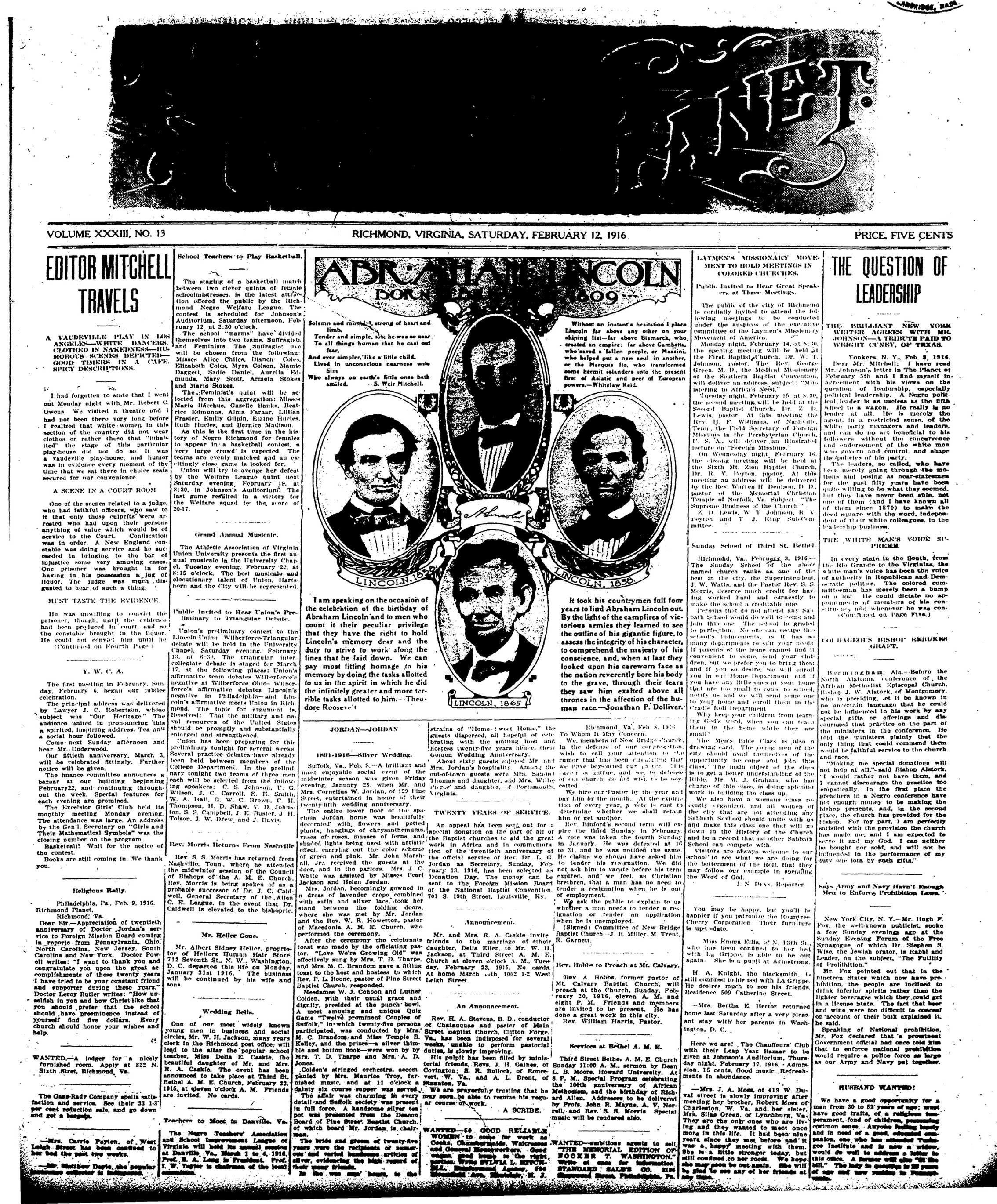
ABRAHAM LINCOLN
DOWN LAWYER 1809
Solemn and mindful, strong of heart and limb,
Tender and simple, too, he was so near.
To all things human that he cast out fear,
And ever simpler, like a little child,
Lived in unconscious nearness unto him
Who always on earth's little ones hath amiled.
S. Weir Mitchell.
Without an instant's hesitation I place Lincoln far above any other on your shining list—far above Bismarck, who created an empire: far above Gambetta, who saved a fallen people, or Mazzini, who helped put a new soul in another, or the Marquia Ito, who transformed some hermit islanders into the present first of Asiatic and peer of European powers.—Whitelaw Reid.
LINCOLN. 1859.
I am speaking on the occasion of the celebration of the birthday of Abraham Lincoln and to men who count it their peculiar privilege that they have the right to hold Lincoln's memory dear and the duty to strive to work along the lines that he laid down. We can pay most fitting homage to his memory by doing the tasks allotted to us in the spirit in which he did the infinitely greater and more terrible tasks allotted to him. Theodore Roosevelt
JORDAN—JORDAN
1891-1910—Silver Wolding.
Suffolk, Va., Feb. S. — A brilliant and most enjoyable social event of the midwinter season was given Friday evening, January 28, when Mr. and Mrs. Cornelius W. Jordan, of 129 Pine Street, entertained in honor of their twenty-fifth wedding anniversary.
The entire lower floor of the spacious Jordan home was beautifully decorated with flowers and potted plants; hangings of chrysanthemums, vases of roses, masse of ferns, and shaded lights being used with artistic effect, carrying out the color scheme of green and pink. Mr. John Marshall, Jr., received the guests at the door, and in the parlor. Mrs. J. C. White was assisted by Misses Pearl Jackson and Helen Jordan.
Mrs. Jordan, becomingly gowned in a dress of lavender crepe, combined with satin and silver lace, took her stand between the folding doors, where she was met by Mr. Jordan and the Rev. W. R. Howerton, pastor of Macedonia A. M. E. Church, who performed the ceremony.
After the ceremony the celebrants toast was made by the officiating pastor. "Love We're Growing Old" was effectively sung by Mrs. T. D. Tharpe, and Mrs. M. C. Brandom gave a fitting toast to the host and hostess to which Rev. P. L. Boone, pastor of Pine Street Randal Church, responded.
Mendames W. J. Cohoon and Luther Golden, with their usual grace and dignity, presided at the punch bowl. A most amusing and unique Quiz Game, "Twelve prominent Couples of Suffolk," in which twenty-five persons participated, was conducted by Mrs. M. C. Brandom, and Miss Temple B. Kelley, and the prizes—a silver thimble and button hook—were won by Mrs. T. D. Tharpe and Mrs. A. D. Jones.
Golden's stringed orchestra, accompanied by Mrs. Maurice Troy, furnished music, and at 11 o'clock a dalynt six course supper was served. The affair was charming in every detail and Suffolk society was present in full force. A handsome silver tea pot was presented from the Deacon Board of Pine Street, Baptist Church, of which board Mr. Jordan is chairman.
The bride and groom of twenty-five years were the recipients of numerous and varied handmade articles of silver, evidencing the high regard of their many friends.
In the two men must be so the
LINCOLN, 1865
strains of "Home sweet Home" the guests dispersed, all hopeful of celebrating with the smiling host and hostess twenty-five years hence, their Golden Wedding Anniversary. About sixty guests enjoyed Mr. and Mrs. Jordan's hospitality. Among the out-of-town guests were Mrs. Sasantha Thomas and daughter, and Mrs. Willie Pierce and daughter, of Portsmouth, Virginia.
TWENTY YEARS OF SERVICE.
An appeal has been sent out for a special donation on the part of all of the Baptist churches to aid the great work in Africa and in commemoration of the twentieth anniversary of the official service of Rev. Dr. L. G. Jordan as Secretary, Sunday, February 13, 1916, has been selected as Donation Day. The money can be sent to the Foreign Mission Board of the National Baptist Convention, 701 S. 19th Street, Louisville Ky.
Announcement.
Mr. and Mrs. R. A. Caskie invite
friends to the marriage of aethn
daughter, Della Ellen, to Mr. W. H
Jackson, at Third Street: A. M. E.
Church at eleven o'clock A. M. T.
day, February 22, 1915. No cards.
At home March 10th, 1002 1-2 West
Leigh Street
An Announcement.
Rev. H. A. Stevens, B. D., conductor of Chastauques and pastor of Main Street baptist Church, Clifton Forge, Va., has been indisposed for several weeks, unable to perform pastoral duties, is slowly improving. His pulpit has been filled by ministerial friends, Reva, J. H. Gaines, of Covington; S. R. Bullock, of Ronevert, W. V., and A. L. Brent, of Staunton, Va.
We are prayerfully trusting that he may soon be able to resume his regular course of work.
WANTED—50 GOOD RELIABLE
WOMEN to come for work as
Cooke, Chanhamales, Waltressus
and General Houseworkers. Good
wage, good brow to the right
partition. Write STLVIA L. MUPON-
MILL, Binghamton Agent, 606
Binghamton Ave, Montclair, N. J.
Without an instant's heiation I place Lincoln far above any other on your shining list—far above Bianmarch, who created an empire; far above Gambetta, who saved a fallen people, or Maximina, who helped put a new soul in another, or the Marquia Ito, who transformed some harmlit islanders into the present first of Anasiic and peer of European powers.—Whitelaw Reid.
LINCOLN, 1858.
It took his countrymen full four years to find Abraham Lincoln out. By the light of the campfire of victorious armies they learned to see the outline of his gigantic figure, to assess the integrity of his character, to comprehend the majesty of his conscience, and, when at last they looked upon his careworn face as the nation reverently bore his body to the grave, through their tears they saw him exalted above all thrones in the affection of the human race.—Jonathan P. Dolliver.
Richmond, Va., Feb. 8, 1926
To Whom It May Concern:
We, members of New Bridges Church, in the defense of our congratulation, wish to call your attention to the rumor that has been circulating that we have boycotted our pastor. This ruder is untrue, and we, to defends our church, do not wish to be boycotted.
We hire our Pastor by the year and pay him by the month. At the expiration of every year, a vote is cast to determine whether we shall retain him or get another.
Rev Binford's second term will expire the third Sunday in February. A vote was taken the fourth Sunday in January. He was defeated at 16 to 31, and he was notified the same. He claims we should have asked him to tender his resignation. We did not ask him to vacate before his term expired, and we feel, as Christian brethren, that a man has no need to tender a resignation when he is out of employment. We ask the public to explain to us whether a man needs to tender a resignation or tender an application when he is unemployed.
(Signed) Committee of New Bridge Baptist Church—J B. Miller, M Trent, R. Garnett
Rev. Hobbs to Preach at Mt. Calvary.
Rev. A. Holbs, former pastor of Mt. Calvary Baptist Church, will preach at the Church, Sunday, February 20, 1916, eleven A. M. and eight P. M. Friends and members are invited to be present. He has done a great work in this city. Rev. William Harris, Pastor
Services at Bethel A. M. E.
Third Street Bethe, A. M. E. Church
Sunday 11:00 A.M. sermon by Dean
L. B. Moore, Howard University. At
S. P. M., Special Program celebrating
the 100th anniversary of African
Methodism, and the birthday of Richard Allen. Addresses to be delivered by Profs. John R. Mayne, A. V. Norrell, and Rev. S. S. Morrilla. Special music will be rendered also.
WANTED—ambitions agents to sell
THE MEMORIAL EDITION OF
BOOKER T. WASHINGTON."
Write of course for information
STANDARD SALES CO. HIS
Grossewood Street, Philadelphia, Pa.
LAYMEN'S MISSIONARY MOVEMENT TO HOLD MEETINGS IN COLORED CHURCHES.
Public Invited to Hear Great Speakers at Three Meetings.
The public of the city of Richmond is cordially invited to attend the following meetings to be conducted under the auspices of the executive committee of the Laymen's Missionary Movement of America.
Monday night, February 14, at 8:30, the opening meeting will be held at the First Baptist Church, Dr. W. T. Johnson, pastor. The Rev. George Green, M. D., the Medical Missionary of the Southern Baptist Convention, will deliver an address, subject: "Mimicking to Africa's Need."
Tuesday night, February 15, at 8:30, the second meeting will be held at the Second Baptist Church, Dr. Z. D. Lewis, pastor. At this meeting the Rev. H. F. Williams, of Nashville, Tennessee, the Field Secretary of Foreign Missions in the Prebysterian Church, U. S. A., will deliver an illustrated lecture on "Foreign Missions."
On Wednesday night, February 16, the closing meeting will be held at the Sixth Mt. Zion Baptist Church, Dr. R. V. Peyton, pastor. At this meeting an address will be delivered by the Rev. Warren H Denison, D. D. pastor of the Memorial Christian Temple of Norfolk, Va. Subject: "The Supreme Business of the Church."
Z. D. Lewis, W. T Johnson, R. V. Peyton and T. J. King SubCommittee.
Sunday School of Third St. Bethel
Ritchmond, Va., February 3, 1916—The Sunday School of the abbreviated church ranks as one of the best in the city, the Superintendent, J. W. Watts, and the Pastor Rev. S. S. Morris, deserve much credit for having worked hard and earnestly to make the school a creditable one. Persons that do not attend any Sabbath School would do well to come and join this one. The school is graded to perfection. No one can escape this school's inducements, as it has so many departments to suit your needs. If parents of the home cannot find it convenient to come, send your children, but we prefer you to bring them; and if you do desire, we will enroll you in our Home Department, and if you have any little ones at your home that are too small to come to school, notify us and we will send one to your home and enroll them in the Cradle foll Department.
Why keep your children from learning God's word, when you can teach them in the home while they are small?
The Men's Bible Class is also a drawing card. The young men of the city should avail themselves of the opportunity to come and join this class. The main object of the class is to get a better understanding of the Bible. Mr. M. J. Graham, who has charge of this class, is doing splenite work in building the class up.
We also have a woman's class recently organized, and all women of the city that are not attending any Sabbath School should unite with us and make this class one that will go down in the History of the Church and be a record that no other Sabbath School can compete with. Visitors are always welcome to our school to see what we are doing for the betterment of the Roll, that they may follow our example in spreading the Word of God. J. N. DAVIS, Reporter
You may be happy, but you'll be happier if you patronize the Roupress-Cherry Corporation. Their furniture is up-to-date.
Miss Emma Ellis, of N. 13th St., who has been confined to her bed with La Grippie, is able to be out again. She is a pupil at Armstrong.
H. A. Knight, the blacksmith, still conned to his bed with La Grippie. He desires much to see his friends. Residence 509 Catherine Street.
—Mrs. Bertha E. Hertor returned home last Saturday after a very pleasant stay with her parents in Washington, D. C.
Here we are! The Chauffeurs' Club with their Leap Year Bazaar to be given at Johnson's Auditorium. Thursday night, February 17, 1916. Admission. 15 cents. Good music. Refreshments in abundance.
—Mrs. J. A. Moss, of 419 W. Duval street is slowly improving after meeting her brother, Robert Moss of Charleston, W. Va. and her sister, Mrs. Slims Green, of Lynchburg, Va. They are the only ones who are living and they wanted to meet once more in this life. It had been nine years since they met before and it was a happy meeting with them. She is a little stronger today, but still confined to her room. We hope she may soon be out again. She will be glad to see any of her friends at new time.
PRICE, FIVE CENTS
THE QUESTION OF LEADERSHIP
THE BRILLIANT NEW YORK WRITER AGREES WITH MR. JOHNSON—A TRIUMBATE PAID TO WRIGHT CUNEY, OF TEXAS.
Yonkers, N. Y., Feb. 8, 1916.
Dear Mr. Mitchell: I have read Mr. Johnson's letter in The Planet of February 5th and I find myself in agreement with his views on the question of leadership, especially political leadership. A Nogro political leader is as useless as the fifth wheel to a wagon. He really is no leader at all. He is merely the agent, in a restricted sense, of the white party managers and leaders, and can do no act beneficial to his followers without the concurrence and endorsement of the white man who govern and control, and shape the policies of his party.
The leaders, so called, who have been merely going through the motions and posing as near-statesmen for the past fifty years have been quite willing to be what they seemed, but they have never been able, not one of them (and I have known all of them since 1870) to make the dead square with the word, independent of their white colleagues, in the leadership business.
THE WHITE MAN'S VOICE
PREMIER
In every state in the South, from the Rio Grande to the Virginia, the white man's voice has been the voice of authority in Republican and Democratic politics. The colored committeeman has merely been a bump on a loot. He could dictate no appointments of members of his constituency and whenever he was con-
CORRAGEOUS BISHOP REBURH
GRAFT.
Her muggham, Ala.—Before the North Alabama "conference of, the African Methodist Episcopal Church, Bishop J. W. Alstork, of Montgomery, who is presiding, let it be known in no uncertain language that he could not be influenced in his work by any special gifts or offerings and discouraged that practice on the part of the ministers in the conference. He told the ministers plainly that the only thing that could commend them would be faithful service to the church and race.
"Making me special donations will not help at all," said Bishop Alstork. "I would rather not have them, and I cannot discourage the practice too empathetically. In the first place the preachers in a Negro conference have not enough money to be making the bishop presents, and, in the second place, the church has provided for the bishop. For my part, I am perfectly satisfied with the provision the church has made me, and I am expected to serve it and my God. I can neither be bought nor sold, and will not be influenced in the performance of my duty one lot by such gifts."
Says Army and Navy haven't enough
Men to Enforce Prohibition Law.
New York City, N. Y.—Mr. Hugh F. Fox, the well-known publicist, spoke in a few Sunday evenings ago at the Sunday Evening Forum of the Free Synagogue of which Dr. Stephen S. Wise, the Jewish orator, is Rabbi and Leader, on the subject, "The Fulfillment of Prohibition."
Mr. Fox pointed out that in the nineteen States which now have prohibition, the people are inclined to drink inferior spirits rather than the lighter beverages which they could get in a license State. The fact that beer and wine were too difficult to conceal on account of their bulk explained it, he said.
Speaking of National prohibition, Mr. Fox declared that a prominent Government official had once told him that to enforce national prohibition would require a police force as large as our Army and Navy put together.
HUSBAND WANTED:
We have a good opportunity for a man from 30 to 52 years of age; must have good traits, of a religious temperament, fond of children, possessing common sense. Anyone feeling beauty and in need of a good, educated companion, one who has attended Trinity College institute and is now a widow, would do well to address a letter to this office. A former will also "kill the bill." The lady in question is 20 years of age and now resides in Pennsylvania.
PAGE TWO
SATURDAY. FEBRUARY 12. 1816
BEN DAVIS WILL DEFY THE S. C. M.
MEMBERS OF ORDER IN GEORGIA
INFOMED TO MAKE PAYMENTS TO OFFICE OF
THE SECRETARY.
Atlanta, Ga. That Benjamin J. Davis and Birl S. Ingram do not intend to now without a fight to the mandates of the subcommittee of management of the Grand United Order of Old Fellows, which recently suspended them from the order of one year, and rescinded their objection. Grahame N. Byrne of Georgia is shown in that fact that Alfred D. Jones, a prominent local member of the order, has gone before Judge W. D. Ellis of the Fulton Superior Court, and prayed for the appointment of temporary receivers for the handling of the affair of the Order of the Fellows on January 14, 2013, he named the suspended officers with the other officers as receivers.
COURT NAMES INGRAM AND
DAVIES AS RECEIVERS
The court's order included the motion of March 4 for the appearance of the representatives of the opposition to show cause why the reservation should not be made permanent. The order goes further.
"In the meantime, the Court takes jurisdiction of said cases and the assets in said position up and directs that the same remain in the custody of B S Ingram, District Grand Master, J M Pitto, District Grand Master, J M Pitto, District Grand Secretary, J C Styles, District Grand Treasurer, and William Becker Johnson, District Grand Director, and that they be permitted in the meantime to carry on the ordinary business of said corporation, be restrained only from disposition of any of the assets except in the ordinary business said corporation."
"It is further considered ordained and adjudged that the filing of the petition and the taking jurisdiction of said cause and assets mentioned in the petition shall in no wise affect the rights of the benefactor and of the assured in said Association, but that their rights, until further order, shall remain as they are now, and until further order of this Court all participate the defendant herein and its assets are hereby served with the custody and control of the aloosead Ingram, Little Days, Styles and Johnson, of in any way interfering with the business of said Association.
"Leave is granted to the defendant to save days' notice to the plaintiff to move for an earlier hearing of the cause."
Messrs. Ingram, and Davis have issued a signed statement to the members of the order in Georgia, in which the action of the S C M is reviewed and information given, that while four hundred and sixty five哎哎哎 were presented to the trial body in their behalf, less than twenty per person of them alleged *not being to the order*, presented testimony against them. But the action of the S C M indicated that the twenty哎哎哎 of the four hundred and sixty five哎哎哎 were timing the officers in charge of the Order's affairs, the statement directed that the subordinate bodies will continue, under the court's order, to set all money to B J. Davis, grand secretary, instead of to the S C M, as was ordered in the filing of that body, given in The April week.
INGRAM AND DAVIS ISSUE
STATEMENT.
The statement is in full as follows: Atlanta, Ga. Jan. 27, 1976 To the Odd Fellows of Georgia Brothers and Sisters. At Athena you unanimously reelected us your officers and servants to execute the trust imposed upon us by our obligations, the rules and regulations of the order. If in the course of human events, we should be hindered in any way from a faithful and conscientious discharge of our duther or responsibilities imposed by the trust, it would be our duty to inform you thereon delay. You are invited that we had a bairdous meeting at Athens, that with the exception of the commission caused by one A. Grays, everything was peaceful and tranquil during the session.
Second, you are advised that various charges, were filed against your servants by A. Graves, B. W. S. Danielle, Morgan Williams, Jeff Powell and Pacific Lodge. These various charges, numbering possibly a dozen alleged offenses, were all tried together before the Court. You are also required to five members of the Order swore in their affidavits that your servants were innocent. Less than twenty persons, some of whom did not belong to the Order, testified, against us. Among the various charges, we were charged with contempt. We plead not guilty, and offered four hundred and sixty-five witnesses in proof of our inpacture. The Committee reached to the Court that we were guilty. First, B. S. Ingram and B. J. Davis were found guilty of contempt and their punishment fixed at suspensions for one year. The cases as to the others were dismissed.
Second. The Committee found that
a state of anarchy existed in the jurisdiction, and sought to revoke our charter, and if successful in having done so, this abolished the offices held by Brothers Pitta, Styles and Johnson and our Sinking Fund Commission and every other collateral office out of the Bristlet Grand Lodge. Under these circumstances, a member who felt that the property rights of the policyholders should be given the protection of the courts, presented his petition to the Superior Court of Fulton County. In which he prayed for the appointment of temporary represe-ntation conditions, the usual counsel, and that your rights and the rights of all persons be fully preserved and protected.
His Honor, the Judge to whom the bill was presented, took jurisdiction of your affairs, and, acting in great moderation and with perfect fairness to you and all persons concerned, appointed us whom you elected as your Executive Committee—to continue in the management of your corporation and to carry on your business in the office of your corporation. From disposing of any of the assets otherwise than in the ordinary business of your corporation, which we would have avoided with great care without being restrained. You will therefore, under the Court order, continue to send your money to B J. Davis, Secretary of the corporation and your policies will be kept alive and your death claims will be paid in the usual way without any change whatever and all your expenses will be paid by your Executive Committee acting under the court orders, with the same care hereafter.
In the meantime we will make an answer to the petition filed and give such attention to the litigation brought about as the situation requires, we are issuing this letter to you so as to remove unintended and unanticipated from your mind, and so that you can be assured that your large property integrates will not be neglected.
We will call your attention to the Court order published in this week's issue of The Atlanta Independent. It follows:
Your fraternity,
R S INGRAL, D G M
R J BAVIS, D G S
JAVIS CHARGES A CONSPIRACY
In the last year of the 1970s, he deposited the paper edited by T. J. Davis, and published as the official organ of the cold Fellows of congress Mr. Davis declares in an editorial note that no formal notice has been served by the S.C.M. either on theogram or Davis, or on any of the bodies of the State of the Republic. In respect to that it is directed by permanent officials of the order that publication of the paper in the official organ of the congress in Washington is permitted with H. P. Shanley, editor, to titrate a formal official notice from the S.C.M.
In the same issue of *The Independent* appears an editorial under the caption, *Jigram and Bayes Maryre*. In this editorial Mr. Bayes claims that the punishment inflicted was out of all proportion to the charges laid, and makes the definite charge that Jigram and Bayes are the victims of a conspiracy among men further up, he charges further that the disposal of the two Georgians was necessary for the promotion of the personal ends of ambitions individuals. Referring to the revaluation of the charter of Dr. Jigram's Grand Lodge No. 18 Mr. Bayes said.
[ The rights and liberal revolution of the Georgia warrant was nothing less than an effort born of the desire to constitute Pitton Million Dollars, worth of insurance. The fraternity has Pitton Million Dollars in its assistance outstanding, for which the corporation is liable, and has assets of more than a Half Million Dollars and an amount so great that it would be so far as the decision of the S.C. M. of leaving the corporation without an offer, without an answer. No regard was had for the interest that is deaf to the fifty thousand Georgia society men and women. Despite the fact that the women of Georgia have Five Million Dollars of insurance with the Georgia corporation, despite the fact that the laws of our State, as well as the Constitution of the States will not permit a republican to be represented, we are told that we must do that which is legally impossible, import a contract.
It is further asserted that "the two men out of society or in it have contributed more to the material and material progress of the race than lurgan and Daws. They are entitled to some consideration for their contribution to American civilization." After that they have furnished employment, means and encouragement to hundreds of men, women and children of the foundation which would be affected by the decision of the S.C.M. are trust fund for the benefit of widows and orphans; the gamlet is thrown down to the Sub Committee of Management in the following delt:
DEFY THE S C M
The order suspending Ingram and Davis is void and without force and effect, for the reason the acts with which they were charged do not constitute an offense under the law. At best, the charges were frivolous and ridiculous. The order revoking the Georgia charter is void, for the reason the committee had no jurisdiction. No process was issued, and the District Grand Lodge was not in court and The Independent advice court of the courts of the country and that the powers and authority of the S.C. M. be defined. The courts ought to say whether or not a friendly society can cloth itself with the right to communicate property, sensor, free speech and muzzle the press, depriving citizens of their constitutional rights. The Independent does not believe that the courts will sustain the S.C. M. in abridging the rights and concealing the property of the citizens if they do not submit to arbitrary and tyrannical rulings and faecal acts. The order to submit without legally prosecuting the oppressive actions of the S.C. M. The S.C. M. has gone so far as to enjoin the Odd Fellows of Georgia from
assembling in a time of peace as Odd Follows few their own moral, mental and intellectual edification. It has enjoined and restrained the Odd Follows in Georgia from conducting an industrial farm and school for the education of their children and the promotion of good citizenship; enjoined them spending a dollar upon this undertaking in July, and so tied the hands of the Georgia corporation that it cannot buy an ear of corn, bushel of meal, a blade of folder to feed a mule, cow, chicken or hog on the farm.
URBANNA, VA.
Mrs. Alice Thoraton was a caller in Wobble-Town last Sunday. Rev. J. A. and Mike Olga N. Martin visited Deacon Jack Ward on last Sunday.
LAST LIVING WITNESS
TELLS OF SHOOTING
OF LINCOLN
W. J. FERGUSON, THEN A CALL BOY IN FORDS THEATRE IN WASHINGTON, SAYS INACCUACIAS HAVE CREPT INTO HISTORY AND MOTION PICTURES.
New York Herbill
W. J. Ferguson, only surviving witness. The assassination of Abraham Lincoln at Fordy Theatre, Washington, on April 14, 1865, says that most of the American histories and all of the
weeks before I lounge and bed.
"Long after we President's little later his moved took a place we interest in the bit of linen, all it was.
"John Booth Theatre every distinctly after he was sitting the stage show afternoon procured 'He is man and we a madness, not family was to be at liberté have asked, use him. Fortune and so did no party to his ca
Many of the people of this neighborhood called to see Miss Gertrude Jones last week to express their sympathy in her recent bereavement.
The Literary Union of Middlesex met January 30, with the Mt Zion Sunday School, Mr. Garnett, superintendent.
The meeting was called to order by the president, Mr. H. L. Lockley.
Devotional exercises were conducted by brother S. J. Lewis after which they proceeded into their regular business. The Union closed to meet with the Harmony Village school the first Sunday in March.
There will be an Educational day observed at the Mt Zion Church Sunday, February 2.
A delightful concert was witnessed at the Pine Grove graded school on January 28, with Mrs. Fannie Lockley, as mistress of ceremony, everybody that was present were well pleased with the stage rendered their parts well.
Miss Gertrude Jones of Minneapolis City, N.J., was called here last week on account of the death of her brother in law, Mr. Steven Cephas.
Miss Anna L. Thornton, of Baltimore, Md. as spending some time with her parents, Mr. and Mrs Jone Joaney Harrison Village. Mr. and Martin is on the sick list. Mrs Sewell. Mr. Carrie Familley and Willow Mattess left here Wednesday. January 24 in Baltimore, Md.
SEARCH FOR OIL IN OHIO STATE
The search for new oil and gas pools in southeastern Ohio has been go through and persistent that the canal observer might conclude that the chances of finding new producing areas are slight. There is, in fact, some ground for that conclusion to parts of Monroe and Noble counties, where there is almost no area as large as I square mile that has not been built at one or more places by the drill. The most encouraging feature in this is the number of sand in which there is more than one sands being productive at one place or mother, and some single wells deriving oil from several sands. The shallow depth at which oil is found is also an indication to drilling, especially in the Caldwell district, where the Rund Run. Macsburg 500-foot, and other sands are productive within a few miles in their outter, at depths 200 to 260 feet. The Berea sand has yielded a pool output in the Woodsfield pool, the Temperanceville pool, the Barnestille pool, and the Cherry pool. It also furnishes an oil and gas pool compliant concerning the hardness that it is very "spotted" and deep that prospecting to it is rather expensive.
Recent investigations of the United States Geological Survey indicate that there are good chances of driving new productive wells to the Berea and certain other sands. Two reports covering parts of Betlem, Montana, Goreau, Sey and Noble counties have recently been prepared by D. Dale Cordit and V. Van A Mills. Each report includes a form may bearing structural coal drawn on the Berea sand and ash-shifting all of the wells, all dug up to the date of completion of the report. Certain localities that are believed to be favorable for prospecting are pointed out. The report are designated Bulletins 621 N and 621 O, "Structure of the Berea Ore Sand in the Summerfield Quadrangle-Guernsey, Noble, and Monroe Counties" and "Structure of the Berea Ore Sand in the Woodfield Quadrangle-Fetlock, Montce, Noble and Guevara Counties" Copies may be obtained free from the Director of the U.S. Geological Survey.
COLORED MAN DIES OF POISON
Urbana, Va. Stephen Cephas, a reposed and industrious man being here, who died on January 22, came to his death from poison, administered by the leads of his wife, Hirsch Cephas, according to the verifier of the Coroner's jury. She was taken into custody by Sheriff Segar and carried to the county jail to await the action of the grand jury. Chrance Faunderoy, from the eastern shore of Maryland, who was thought to be implicated in the murder, was also taken to jail for sakekeepers, was released after the jury failed to find an indictment against him. The case is set for the March term of court.
The Planet is one of the best mediums for the colors folks to get the nows. A postal card will bring it to your door and a collector will come to see it with its artistry. You can have it sent to you for 50 cents.
The Knights of Pythias 'Anniversary
will take place this year. Marvel
LAST LIVING WITNESS
TELLS OF SHOOTING
OF LINCOLN
W. J. KERGUSON, THEN A CALL
BOY IN FORDS THEATRES IN
WASHINGTON, SAYS INACCU
RACIES HAVE CREPT INTO
HISTORY AND MOTION PIC
TURES.
[New York Herald]
W. J. Ferguson, only surviving wit-
ness of the assassination of Abraham
Lincoln at Ford's Theatre, Washington,
on April 14, 1865, says the hour
the American patriot and all of the
motion pictures depicting the famous
tragedy give an altogether erroneous
imprecation of it.
Mr. Ferguson now in playing the role of George Merrie, one of the pirates, in "Treasure Island," at the Punch and Judy Theatre, and in view of the approaching celebration of Lincoln's Birthday on next Saturday he yesterday described John Wilkes Booth's murder of the president on Lincoln's Birthday. Booth saw it on that never to be forgotten night when Mkeeenew way playing "Our American Cousin" for her own benefit. Mr. Ferguson, who knew Booth well, refers to him always at "John." New histories record the fact that the box occupied by the President and Mrs. Lincoln and their party was situated at one, side of the stage, twelve feet above it, and not in the midstorium, as boxes are often built down on the actors, using the same angle of vision as if they were standing in the wings.
"A curtain was draped before President's chair," said Mr. Ferguson, "and this competently concealed its features from the audience. We on the stage could see him, but those in front could not, and for this reason the audience was not allowed to association were the occupants of his sex and Miles Keene and myself.
CALL BOY AT $ & A WEEK
"I was the call boy of the theater, at a salary of $5 a week. My duties kept me in a prompt box across the stage from the President's party much of the time that evening. I had suddenly been asked also to assume the role of Lieutenant Vernon in the play, and as I was to play a brief scene with Miss Koene she came to the prompt and was asked to hear the nearing time for us to make our entrance. I was required also to fill a desk with old papers, as Asa Trenchard, played that night by Harry Hawk, discovers a host in the library scene and destroys the document.
"About half-past nine o'clock, just as Miss Koene and myself were on the point of walking on the stage, we heard a snarp report. I thought someone had knocked over that box of paper but looking across the desk I noticed a string of tape. The same instant I noticed a string of motion in the President's box.
"Mr. Lincoln had the kindest features I ever saw and the eyes of a tawn. They became suddenly drawn to his eyes seemed to close and his head fell forward on his chest, although he did not fall from his chair. A man whom I instantly recognized as John Booth was climbing over the rafting of the box and struggling with some one in the box.
"The next instant he jumped down to the stage and hurried to where I was standing beside Miss Keepee, passed between us on his way out to the theatre and left it by a rear exit. I felt his breath on my cheek as he quizzed me. For some moments no one quite understood what had happened."
"Where and when did he show 'Nose-sumper tyrannals'?" interrupted the interviewer.
"He didn't," declared Mr. Bergman.
"Some one invented that piece of historical fiction, and in my opinion it was a newspaper man with a too vivid imagination." The quaint old player smiled.
"John was too busy getting to his horse in the rear of the building to include in absurd speculation, he continued, "He loved that animal, a yellow mare, that he knew would carry him to safety. The mare was his pet, a fast, graceful little animal worth a lot of money." The basket boy of the theatre was holding the mare's bride. I followed closely the mare's side, kick the boy aside in his excitement, and his pet back and disappear. Then I heard the familiar tat-tat-tat, tat-tat of a rapidly galloping horse, the sound gradually becoming fainter and fainter. I have infimated that noise hundreds of times behind the scenes it is known as 'taking on the horse.' "The whole incident seemed as unreal to me as though I had just made the noise myself as a part of the performance. Darting back to the prompt box, I heard the burs of excited conduction from across the footlight, and the audience began leaping to the stage. The crowd was crowded in a few minutes. Men who did it?" "Where is he?" "Did go get away?" "Which way did he go?"
I was only a call boy and no one paid any attention to me. Accordingly, I quietly slipped forward to the balcony stairs and passed along the rear wall of the balcony and so into the President's box. Just as John Booch done two few minutes earlier. The only notice he gave was through the balcony, and in going there John must have been seen by many persons sitting in the balcony.
SAW THE PRESIDENT MOVED
"With a boy's curiosity I watched the preparations to carry the mortality wounded man across the street to Peterson's lodgings. I saw a little blue mark where the bullet from Booth's derringer had entered. The wound was not bleeding. I noticed. Ladder 1000 was opened through the blubbery, down the belly, steps and across the street to an actor's boarding house. Here he was placed on a bed in an upper room in which the actor's used to leisure. Three
weeks before I had seen John Booth lounging and smoking on the same bed.
"Long after midnight I was told the President's wound was bleeding, and a little later his shirt, which had been removed, was seat down stairs and I took a piece, p fit as a souvenir, although I didn't realise the historical interest, in the tragedy and lost that bit of linen, all soiled and marked as it was.
"John: Booth was around Ford's Theatre every day. I remembered distinctly after the assassination that he was sitting at a prompt table on the stage about three o'clock on the afternoon preceding the murder.
"He was a fascinating and brilliant man and we all liked him. It was madness, nothing else. The Booth family touched us. At least I atlanta probably would have asked, me to hold his mare for him. Fortunately, I was too busy, and so did not become an innocent party to his escape.
"I said nothing about what I had seen. The excitement was intensely fervid and fanatical, and as I was only a call-boy I thought to myself that the wiseest thing for me to do was to keep my mouth closed, and I continued that policy for some years Miss Keene, on the other hand, was repeatedly called upon to give her story of what she saw."
MOTION PICTURE NOT CORRECT
"And the scene in 'The Birth of a Nation' depleting the calamity, that you see it?" asked the reporter.
"I did, with disgust," regulated Mr. Ferguson. "It was not only all wrong, but it was an asperation on the character of Abraham Lincoln. It depleted arm responding to cheers and applause and accompanied by a body guard.
"Lincoln was a simple man. He frequently came to the theatre, but he never had bodyguard. He would slip in quietly and the audience would not know he was there. We on stage could see him, of course, but he was confident that he was beaten behind that curtain. Before that time our Presidents had been free from assassins, and to set guard around him in that picture was abused. Lincoln was no Russian Tear, he trusted his public.
"And in the picture the box was placed in the audience and not above the stage. But of course those in the movies are more important than any of the great facts of history. They are more important than any history, but about acting. We of the stage are only tolerated by the master minds of the movies. It is something to make history on the screen. So easy, too."
"When the relaxed form of the kindest human being it ever has been my fortune to behold was carried out of the playhouse that night and the pleasure seeking throng which had been waiting for me and anger finally quitted the place I rang up on the curtain. It never went up on another play."
THE RICHMOND PLANET VIEWS
Photographs by P. C. Benson
Because The Richmond Planet edited by a man admired throughout the length and breadth of this country as a very worthy Baptist-dayman, the views taken by the Planet are of the same pasting interest. The Planet takes the view that no other permanent organization could have taken place at the National Baptist Convention until the report had been made of the enrollment of the delegates. The Planet has the following to say:
"We are inclined to agree with our very able friend when he declares that the real cause of the split was the effort of the convention, to subordinate all its boards to its authority and to control them. We do not understand, though how the National Baptist Convention had been made on its enrollment of delegates. Prior to that time, only routine business could be traced."
The Banner agrees with the above and therefore contends that E. P. Jones could not have been elected according to the testimony of Jones himself. For it appears he claims to have been elected on the first day before the adjournment of the first session, and this was before the enrollment including the mistakes made by the National Baptist Publishing House, at Nashville, Tennessee. The Planet says: "We have had the good fortune to converse with the able Rev. Dr. R. H. Boyd and we are of the opinion that the fundamental mistake made was in the action of the National Baptist Convention in presuming that it owned the National Baptist Publishing House at Nashville, Tennessee. We have assumed that the assumption thak it elected some members of that incorporated body, when as a matter of fact, it had never really done anything of the kind.
"The convention got credit for owning a printing plant that it did not own, that it had never owned, that it had never bought and that they had never contributed a penny to purchase. When the attempt was made to get possession of this property and to enforce its alleged rights at law by first incorporating for the purpose, then the bottom fell out of the co-operative arrangement," and the awakening came. If the National Baptist convention published books it must necessarily purchase one, either from the present de-facto owners-at Nashville or from the white folks who deal in those kinds of commodities. The one at Nashville is not worth a fight, as valuable as it is alleged to be."
Our Job Department can handle all classes of printing. Send us your by-laws and book work.
WHY J. JOHNSON
FAKED
Under the headline "Why Johnson Faked His Fight With Willard," the People's Journal of Glamour, Scotland, published an interview with Jack Johnson, in which the colored pugilist is made to say:
"I say now that there is not a man breathing whom I think I could not beat. These may be big words from the boxer who was beaten by Jesse Willard at Habana, but those in the know" will be able to read between the lines. I am not speaking discreetly of Willard, because I think he is a great fellow—as far as a man is concerned—but if he were as good a boxer as he is a nice fellow he would be a great fighter.
"My sight with Willard was a financial proposition. But the story goes back some little way. You can hardly be expected to realize how I was persecuted, after becoming champions. Yes; I suffered some at the hands of the 'dandy' people in America because 'dandy' would not find a white man to beat me.
"Well, they promised me that if I would consent to be defeated by Willard I would no longer be indebted and would enjoy the freedom any other man would. I would be allowed to see my old mother, who couldn't travel to see me. I would have my motor cars and said 'property attaches' to my property, a very attractive, but they played the double cross on me."
```markdown
```
HEALIS KILLED DR. MOHR, SAID
DEFENSE.
.
Providence, Feb. 3. The trial of Mrs Elizabeth F. Mohr, Victor Brown and Henry Spellman for the murder of her husband entered on its final stage today. With all the evidence for both the prosecution and defense presented the lawyers began arguments which will continue until the jurors enter their room probably tomorrow night to decide Rhode Island's most famous criminal case.
Opening the argument for the defense was made by William H. Lewis, a Negro, ex-Assistant Attorney-General of the United States and one of the most noted football players Harvard ever produced. His powerful frame is topped by a massive head, a face deformed and scrawny, like a dust storm. He is a man of great voice. His voice flows in deep and musical cadences. The eyes are deep set and wide apart. The square jaw and broad forehead give an impression of intellectual power.
Lawyers, and Judges from all over the State crowded into the little court room to hear the address, and were outspoken in their praise of the manner in which he built a strong armament from the scattered materials of his case. It was Lewis, not the cause he was defending, who captured the minds of the spectators. A plea for Mrs. Mohr was coupled with his plea for Brown. He declared to the jury that she had established the law that Spelmann cannot be convicted in she freed. His argument took. In the whole scope of the defense and touched upon the manner of life Dr. Mohr had lived as leading inevitably to the murder on a lonely road.
SEES HAND OF EXTE
"The people realize that behind the man or woman who strives from a path of old fashioned morality, taught at our mother's knee, taught in church prayers and the every Boy conventions of society, ever stalking with uplifted blade, is the spectre of justice," he said. "It is inevitable as death that a joy ride is a ride of death. The unknown assassin that in Harrington on the Washington road was that boy." The law has taken its course. The police, as usual, following the easiest way, have seized upon parties and facts, least and last to be suspected, the loving and devoted wife and two servants in the house who never had a grievance against the deceased. They founded their theory upon a postal card, written two years or moveago, and compassed heaven and earth to prove this theory. All the evidence in this case has been obtained, even compiled and presented to you to prove the theory which started with George Rooks. You saw him on the stand. He smiled. he smiled, like a jackal. It was George Rooks who said to Healis:
"Didn't you and Mrs. Mohr fram-up this on the doctor." The man whispered to be a friend of Mrs. Mohr. He was a high minded gentleman, and while not condoning the conduct of Dr. Mohr, he told her Go thou and do likewise. They raked over the ash of a woman's past to find some coats for her character. "Brown and Spellman said, had no motive to kill Dr. Mohr. "The State says they did it for money or the promise of money. Thugs knaves and gunmen don't commit crimes and murder on a promise. They have the cash in hand. The theory that these men committed this crime for the promise of $2,000 or $1,000 each in absolutely absurd." The chief evidence against Brown and Spellman, he pointed out, is the evidence of their confessions. Again and again he was recited to this, picturing vividly the jury if Brown might not have said almost anything under the mental and physical pounding of a heavy handed chief of police.
"Confessions are the last resort of the police," he shouted, and quoted case after case of innocent men being convicted of murder on circumstantial grounds. The police only circumstantial evidence, actually connected either Brown or Spellman with any of the events of the fatal night. It was dark and the man who did the shooting were poor men. "Henks was the guilty man." The police got Heats and Heats behind him and shot them. The man and murderer were
found in his car and it was up to him to explain. The beginning and the end of the State's case is George W. Health. I call him a dog. There was a dog in that car, a dog of gentle pedigrees who would do cunning stunts for his master, who was happiest in his master's presence, because he knew his master loved him and be loved his master.
CALLS HEALIS MURDERER
"He was a grateful little dog, George W. Healis," Lewis shouted. "He is a Beebo扎ub, he is a Sapphire and an Anantas, a whole cathedral choir of lilies rolled into one. What did he do on his own testimony? He took the man who had paid him but a few hours before, a man who had trusted his life to him, down to the Nayat road and had him foully murdered. He was a kind man, but kind. The record of slavery shows that the colored rate never betrayed a domestic trust. It was the act of an Apache (Healis is part Indian), the act of the kind or savage who would sneak up behind a settler's cabin to burn and kill, who massacred pioneers on the Western plains, in George W. Healis the police have the real murderer of Dr. Mohr." The story of Healis, said the law enforcement officer withitness including Charlie Mohr, "the little chap who came in to testify for his mother."
"There is one thing for which I am grateful, that Brown did not join that hellish pack, Rooks, Ornaby and others, to railroad an innocent woman to jail and separate her from her little son."
During rebuttal earlier in the day the State put on a dozen police witnesses to testify that Brown had said to Mrs. Mohr that she had hired them to commit the罪案.
J. Fitzgerald is to sum up for Mrs. Mohr tomorrow morning. After Attorney-General Rice has made his argument Judge Stearns will deliver his charge and give the case to the jury.
Zulu Characteristics
*Nathan W. Wilson.*
It is a recognized fact that the Zulu tribe is one of the hungest in Southern Africa. The Zulu has a sturdy frame, a strong chest, wonderful digestion, magnificent teeth and fine muscles. He can stand hunger, fatigue and exposure. While he is show to adopt modern methods of illhance, irrigation and fertilizing, he is continuing to recognize their advantages.
His hospitality, indifference to pain, sense of human, good temper, love of children and trustworthiness are all good traits in his character.
"He is a manly specimen not a cringing toady, and, in his natural state, a gentleman, every bit of him." In general he is law-abiding and obedient, and he is not purposefully cruel. He has a strong muscular and capable knowledge of time and rhythm. His powers of singing, even when but slightly trained, are extraordinary.
"The Zulu knows a good deal about some things but what he does not know of what to the white man are matters of common, everyday knowledge, is appalling. His instructor is always running up against the black wall of suspense in importance. Natal is a beautiful land. The small hills and valleys of the coast region, with their numerous clumps of trees, wild bananas, and palms, give place further inland to the open cold and the wider sweep of more woodland. The terrain continues to the majestic mountain range of the Drakenberg, reaching in places an altitude of 11,500 feet.
中: 中: 中: 中:
Y. M. C. A. NOTES
The Boys' Bible Class is still growing. Last Tuesday night was a happy hour with the boys.
The men were out in good numbers to the Bible Class for men last Tuesday night. This is your opportunity.
The Women's Auxiliary held a very important meeting last Friday night and the attendance was excellent. This department of our work is a strong factor in pushing forward the work of the Y. M. C. A. All women are invited to join. Mothers and sisters come.
Last Friday night at the Y. M. C. A. Women's Auxiliary was a live wire. President A. C. Clarke led the discussion. It was a warm hour.
The class for the explanation on the Sunday School Lesson was well attended and all were helped. No Christian worker ought miss this hour. Come.
9:30 A. M. the Workers' Meeting at the Y. M. C. A. was a good one. The team held special meetings 10:00 A. M. in the city home with the inmates.
10:00 A. M. in the city jail the Committee found much work to be done and the results were encouraging.
General Secretary S. C. Burrell addressed the boys, a P. M. at the hour the police were helpful one. Many boys were present. Right you are, mothers, in sending your boys. Please ask your neighbors to do the same.
5:30 P. M. at the Y. M. C. A., a live meeting for men was held. Rev. John Horndon knows how to talk to men, then he gave them just what he wanted. The violin solo by Prof. Thomas Melton was enjoyed by the men and he was asked to come again soon. Every man was well paid for attending this meeting.
Come to the Workers Meeting.
9:30 A. M. at the Y. M. C. A.
Committeeman C. M. will conduct a meeting for boys 4 P. M. at the Y. M. C. A. Mothers send your boys and it will pay you.
All men are invited to the Open
Meeting for men. 5:30 P. M., at the
M. C. A., led by Mr. A. C. Clarke.
Bring the other man. Be on time.
I know you are gled to hear that Miss. Nanaile H. Burroughs of Washington is to lecture for the Fifth Street Baptist Church and the Y. M. C. A. Watch for the date.
Wake for the Great Meetings for the Great Guests of the church. We kindly ask every house to have church speaker for the Y. M. C. A.
```markdown
```
8YNOPS18.
Mary Page, actress, is accused of the murder of James Pollock and is defended by her lover, Philip Langdon Pollock (1755-1825) of Pollock, was on the fire escape watching for Langdon. At Mary's trial she admits she had the revolver. Her mask was removed and she was with it previously, and Mary's leading man implicates Langdon.
"MY,TIME WILL COME!"
"KEEP your eye on this man Langdon! He was either in the room or at the door when James Pollack was murdered!" The words of the witness were like a stone flung into a pool of subtle inference that sent ever-widening ripples of possibilities to lap the very shores of suspicion itself. Every eye was on Langdon now, but except for a tightening of the muscles about the jaw he gave no sign of perturbation or anger. The actor himself was uneasy now, however, and cast apologetic glances at both Mary and Langdon, moving nervously in the witness-stand as the prosecutor took up his questioning again.
"You say you overheard only a part of what was said before the police came. Will you tell us where you stood and why you heard only a party?"
"Yes, sir. The door opens out—as I always the case in hotel rooms—and when I started to open it I was behind it and therefore not visible from the room. But I could hear what was said when Mr. Langdon and descriptive Parlay came out from the inner room of the suite where they had gone to look for Miss Page."
"And when the police came, did you remain in the room or did you join in the search for Miss Page?"
"I joined in the search, and went with the police down the fire escape and through the back street."
"What had become of Miss Page?"
"I don't know."
"Do you mean that the police did not and where she had gone?"
"Yes."
"What did you do?"
"I returned to the hotel, got my hat and coat and went home."
"That is all," said the prosecutor.
But the Judge leaned forward and voiced the question that everybody in the courtroom was mutely asking.
"Do you mean to say that a young lady in an evening gown and with no cloak walked through that street back of the hotel and that no one saw her! That you and the police got no clue in your search?"
"Yes, your Honor. Mary Page had disappeared absolutely, and no one knows where she went."
Langdon smiled, and the Judge sat back with a little exclamation that was not complimentary to the police; but when the name of the next witness rang through the room he learned for ward again and spoke with some irritation to the prosecutor.
"Is it your intention, sir, to develop through the testimony of THIS witness the whereabouts of Miss Party after the murder? It seems to me that that is the testimony that should be brought forward now."
"Tour Honor, the movements of Miss Page between the time she was left unconscious in the room at the Republic until the following morning will have to be told by Miss Page herself. They are not known to me and I have no witnesses to testify to her whereabouts or actions. I have in fact been unable to get anyone who actually saw 'prisoner' during her flight. The truth must come out, of course, and I have in the meantime called the sister of James Pollock to develop an important line in the case for the State."
Again Langdon smiled, and the Judge sat back with a little shrug, as amid a murmurous wave of comment and curiosity the name of the new witness was repeated:
"Both Pollock."
The sister of the dead man who throughout the earlier testimony had sat unnoticed among the throng, was a tragic figure in her crashing black garments as she went to the stand.
"Miss Pollock, you have known the prisoner, Mary Page, for some years, have you not?"
"Yes, we were at school together and remained intimate friends afterwards."
"Was your brother also a friend of hers?"
"He was."
"Was there ever any closer relationship than that of more friendship between your brother and Mary Page?"
"Yes. They were engaged to be married."
Even the Judge sat forward in his chair at the words, so simply uttered and yet so sharply changing the aspect of things. The prosecutor's next question came quickly.
"Was your brother happy in his engagement?" he said.
"I don't know how to answer that question. He was happy because he was asked to marry Mary, but he knew she didn't love him."
"A like. Page did not love your brother, why was she willing to be his wife?"
"The girl flushed and answered how much."
"Well you are there were reasons—and she had presented."
The Strange Case of MARY PAGE
The Great McClure Mystery Story. Written by FREDERICK LEWIS In Collaboration With JOHN T. M'INTYRE. Author of the Ashton Kirk Detective Stories. Read the Story and See the Essanay Moving Pictures
"Will you please tell us those reasons?"
A little gasping son wrenched from a woman's overburdened heart broke the stillness at that question, and Mrs. Page suddenly drooped forward, hiding her face in her hands. She knew only too well what was coming, and the courage that had kept her erect and smiling during the torture of the trial, gave way suddenly at this tearing open of old wounds. All her agony found vent in that one pleuring cry of grief. With her own eyes tear-dimmed Mary stretched out her hands yearningly, half whispering, "Mother! Mother! and Langdon was at her side in a moment. She waved him back, and, drawing her cell across her distorted face,
THE
"Do you mean that the check war forged?"
amothered the sobs that shook her thin shoulders like a storm, as the prosecutor repeated his question.
"It all happened several years ago—give—maybe six. Mary, and I were very good friends at that time, and I was at her home a great deal. So I knew that—that they were greatly in need of money. I overheard Mr. Page say that there would be ruin for all them, and that they'd be turned out on the streets unless he 'got the money' before morning. Mary over heard him, too, and when he went out abe and I sat trying to think of some way by which we could raise money. It was while we were still talking that Mr. Page came back." He he had been drinking, and he was waving a check around his head and cried. I done a good turn for a friend and I've been well paid for it. The Lord helped those who help themselves. He seemed terribly excited, and went out again almost immediately saying that he wanted to wash the check before the banks closed.
"Whose check was it?"
"My brother."
"Was he interested in Mass Page at that time?"
"Yes. He had always been, I think, but she was not at all in love with him. She had told me that."
"Yet he gave her (father a check for a large sum)."
"No." She pushed both now, and cast a timid glance at Mary as if half depreciating the mercies of the testil mony. "That was Just It. My brother had not-aligned that check."
"Do you mean, broke in the Judge, that the check was forged?"
"Yes. A detective sent by the bank came to the Page home while I was there and told Mrs Page and Mary and me. Mary didn't believe it at first, but at any rate she said she didn't know where her father was, though we both guessed he - he - was in the bar of the hotel. He was mostly there James was horrified when he found out that it was Mary's father who had caused the check because, not knowing, he had already told the police to prosecute the man to the limit. Mary cried and begged him to do something to save her father, and James said. I'll save him for your sake. Mary. If you will promise to do something for me in return."
"Did he say what that something was?"
"No. She didn't even ask. She just said she would do anything in the world he wanted if he would save her father. So he went with us to the hotel and we got there just in time to save Mr. Page from arrest."
"How did you save him," as you call it?
"James told the detective that he had forgotten about giving the check to Mr. Page and that it was perfectly good."
"And Miss Iage was naturally grateful to your brother for his having saved her father" prompted the District Attorney, as Ruth broke off, not knowing how to go on.
"Grateful! Yes. She—she promised to marry him. I heard her tell Mr. Langdon."
"Was Mr. Langdon, at the house at that time?"
"No, he came while I was sitting making to Mr. Pam. Mary and James were in the next room, so I wanted to hit Mr. Langdon in. He stepped at the gate, looking at my brother's auto-
THE RICHMOND PLANET, RICHMOND, VIRGINIA
mobile, and I walked down the path to meet him. While we were coming back toward the porch the others came to the door. Suddenly James caught Mary up in his arms and kissed her. She seemed to struggle against him and, slipping away, ran into the house. Mr. Langdon, thinking that my brother had kissed Mary against her will, rushed at him and threatened to strike him.
"Your House!" It was Langdon's voice, suddenly harsh and stern. "I protest against this evidence as entire irrelevant and leading up to nothing that has a bearing upon the case at present."
"The court cannot sustain your object," said the judge, curly. "It is very unfortunate for you, Mr. Langdon, but whatever brings out the details of the relationship between Mary Page and James Pollock is decidedly relevant."
The District Attorney smiled in triumph. He turned to Ruth, who looked started at the interruption, and said gently:
"You were saying, Miss Pollack, that Mr. Langdon threatened your brother. Was there a fight?"
"No. Mary ran between them and said that James had a right to kiss her, that--that they were engaged."
"What did Mr. Langdon say then?"
"He didn't say anything. He just turned around and walked away, and Mary began to cry."
"Was the engagement of your brother and Miss Jane made public?"
"Yes. At a dance."
"Did your brother and his flances seem happy on that occasion?"
"No. I in fact, I know they were not."
"Did they tell you so?"
"No, but I overheard. I was hiding in the conservatory."
With a smothered grasp of surprise Mary's head came up suddenly and for the first time the eyes of the two girls met; but now it was Mary's that were accustomed and Ruth's that were troubled and it was in answer to that reproach, rather than the startled look on the prosecutor's face, that made Bath add sighly: "It was all just in final. I had promised a dance to Mr. Brandon, but I had told him that if he could find me before the music was half over, I would give him two more, for I had discovered a book behind the palms which I was sure no one else could find."
She stammered over the girlish confession, a title of crimson dyeing her pale cheeks.
"While I was hidden there, Mary and Mr. Langdon, who had been dancing together, came into the conservatory. I—I didn't move because I felt I should look so silly, hiding like a kid behind the palms, and I thought they would soon go away. But—they didn't."
"IDid Miss Page say anything about her engagement?"
"They were talking about it as they came in, and the first thing I heard was, I have given my word, Philip, and I must go through with it—even if it kills me. She was half crying. Then Mr. Langdon said quietly, 'Mary, you don't love him, do you?' And Mary said, 'You know I don't, Philip. There is only one man in the world that I love.' Then he took her in his arms and she broke down and sobbed; but when he tried to make her say she would break her engagement she wouldn't, and she wouldn't tell him why she had promised to marry James. She only said that she could never be free unless James gave her back her promise."
"Do you mean to say," interrupted the judge, "that Mr. Langdon knew nothing of the episode of the forged check?"
No. Mary told me she couldn't bear to tell him about her father. Besides, James had made her promise to keep that part of their engagement a secret from everyone."
"It seems incredible!" said His Honor, settling back, and the prosecutor asked, as if suddenly seeing a new viewpoint:
"Did your brother know of Miss Page's love for Mr. Langdon?"
"I don't know whether he knew then or not, but he knew later because Mr. Langdon told him. While I was still back of the palms James came to hunt for Mary, and she didn't want him to see she had been crying, so she went out and Mr. Langdon stood waiting for James. He told my brother that Mary was very unhappy in her engagement, but felt that she was in honor bound to go through with it, and he urged James to set her free."
"What did your brother say?"
"What tu your brother say?
He, he was very angry," she answered, deprecatingly. "I—I know he thought it was just inaccessible, and he said, I suppose you want her set free so YOU can marry her." And Mr. Langdon said, I want her set free because she doesn't love you and is breaking her heart over her promise to marry you. "What is that to you? I asked James. Do you think she is in love with you? And Mr. Langdon said angrily. I know she is, but that has nothing to do with the matter. Can't you be decent for love and set a girl free when she doesn't want to marry you? That made James even more furious, and be fairly obsessed. Mary will learn to love me that anyone else was married, and I shall never set her free. She has promised and I I'm going to see that she keeps him."
grumble. Besides, do you think I'm going to let everybody say she jilted me, after we've announced our engagement this way? I should say not." "Did Mr. Langdon reply?" "No. He just turned round with a shrug and walked away, and I came out and joined my brother." "Did he ask if you had overheard?" "Yes." "Did you tell him of the conversation between Miya Iago and Mr. Langdon?" "Yes. I felt that he ought to know. You—you see, he was my brother, even though Mary was my friend." "Did your brother make any comment?"
"Did Mr. Langdon ever make any other plea to your brother, or see Misa Page again?"
"Not then, but Mr. Brandon told me—"
"Your Honor! broke in Langdon leaping to his feet. "I object!"
"The court will sustain that objection." said the Judge, promptly. "Miss Pollock, you must not repeat what you have simply heard from others, only what you saw and heard yourself."
"May it please the court!" cried the prosecutor, quickly. "I shall be glad to have all of the answer of the witness with the exception of the words 'not then' stricken out, for what Mr. Brandon said he will tell the court himself."
Brandon! Langdon wined at the name, and Mary, lifting her head, turned a pair of despairing eyes upon him that seemed to ask if all their friends' were to be leagued against them in this fight for life and liberty.
He could object—could fight to have the witness kept out of the stand—but in the end he knew that he would lose and perhaps lend added weight to the testimony. He fancied he knew what TILAT would be, and his tooth clenched in an agony of bonging and a rage against the futility of that desire to spare Mary the raking up of these old memories—memories that brought a throbbing she to his own heart that was only balanced by the bitter exultation of the thought that at least Pollock was DEAD now. And he vowed to himself that Mary should soon be free of the law as well as of James; but he did not face the fleeting thought of the price that might have to be paid for that freedom of Mary Page.
As for Mary herself, after that one fleeting glance at Langdon she dropped again like a flower cut off from rain and sunlight and air.
She would not look at Brandon when he took the stand, though his eyes as he glanced from her to Langdon were full of mute appeal as if he wanted somehow to explain that it was not by choice that he stood there; and there was an aggressive, almost a hostile note in his voice as he an
MOTHER JOHNSON
Mary Turned a Pair of Despairing Eyes Upon Him.
awered the prosecutor's first inclusive question:
"Mr. Brandon, you were present, were you not, on the night of the dance given to announce the engagement of Miss Page to James Pollock:"
"I was."
"You were well acquainted with both of them."
"We all grew up together. I was not particularly intimate with Mr. Pollock," said Brandon drily.
"Did anything occur to lead you to believe that Miss Page was not happy in her engagement?"
"Yes."
"Will you tell us what that occurrence was?"
"I had a dance with Miss Pollock, but—she hid from me and it was not until later that I found her in the conservatory. She was crying and told me that Mary didn't want to marry James and that her brother and Mr. Langdon had just quarrelled about it."
"What did you do?"
"I went in search of Langdon."
"Where did you find him?"
Brandon flushed, and again his eyes turned appealingly toward Langdon as if begging forgiveness as he said in a low voice:
"He was in the bar, drinking with a group of workmen."
"Did you join him?"
"Yes. Or, rather, I urged him to join me at one of the tables. I was surprised to see him take anything to drink, but when I said so he answered that he was drinking to forget that he had lost a girl who still loved him, though she was going to marry another man. Laked him if he meant Mary Page, and he said ye."
"Did you remain with him long?"
"No: I tried to persuade him to come home with me, and when he wouldn't, I left him. In the hall, however, I met Miss Parge. I wanted her to see Mr. Langdon at that bar. I had her to the door. I remember how her friend she seemed, and how she strung glad to control herself. I tried to steady her; but suddenly she went right over to Langdon's table; and several leaders gathered around them: she seemed not to see them at all. Other was apparently at Langdon.
Miss. Langdon was just sober enough to realise that Miss Page ought not to be in such a place. He tried to push her away; but she cried out, "Don't drink any more, Phil." "Did Mr. Langdon make any reply?" "Yes. He said, 'Why should I stop drinking?'—What have it to live for? Then she put her arms around his neck, and it was, while they sat thus that James Pollock came in. This seemed to sober Langdon completely. I rushed forward, fearing there would be a hortile scene, and urged Pollock to go away. He pushed all of go back. I want to get at him! he kept calling. Just let me get my hands on him! Langdon was trying to get Miss Page out of the place. He did succeed, while several of us held Pollock back by main force, in getting Mary into a lit the anteroom, a sort of parlor next to the cafe." "Yes, go on, Mr. Brandon," urged the prosecutor, who seemed pleased with his witness.
"Well, Pollock was determined to follow them, and we couldn't prevent him. I found myself dragged into the little room with him; and I shammed the door. But James, for some reason, was calmer now. 'What does this mean, Mary? he said.
"It means, Miss Page answered, that I can't marry anyone but Mr. Langdon, and Langdon went on. Now, James, what are you going to do about it?"
The prosecutor interrupted. "Did Mr. Langdon know at that time that Mary's father and forged Mr. Ugly's check?"
"Langdon thought he was blinding.
'You skunk!' he shoted; and Pollock waved the check in his face. Langdon grabbed it, and there was a struggle. The check tore in two and whose hangdon looked at the place he held he saw that it bore the forged signature, as Dan Page had written it. I saw him turn white as a sheet. But suddenly he smiled, and then he went calmer over to a lamp on the mantlepiece and burned it. I remember, as though it had been yesterday, how happy Miss Page looked when she thought this evidence against her father was de strooyed.
The people in the courtroom gasped with relief. They could almost shate Mary's sense of relief. But they were soon brought back with a shock as the witness went on.
"Pollock had fallen down; but he recovered himself, and began to sneer at Langdon. 'That isn't the check, any how, you fool! That's only a copy, for just such occasions as this.'"
"Was Miss Page disconnected?" the prosecutor wanted to know.
"Oh, yes, sir. She said, What shall I do, Phil? I'll do whatever you say." And he said, "I won't influence you now. Do as your conscience dictates, or something like that. I can't remember every word, of course. There was something about his not being weak again, and then he turned as if to go. He looked pretty downhearted."
"What did Pollock do all this time?"
"He jungled up then, when he saw that Langdon's back was turned, and tried to put his arms around Miss Page. She kept back as if she hated him. I remember she said something like 'Don't touch me, James Pollock.' I keep my word with you. I'll go through with this, but you'll regret this night to the end of your life.' Yes, you'll regret it. I tell you."
The prosecutor beamed satisfaction. He rubbed his hands at these hast words and asked.
"Miss Page threatened him, didn't she, Mr. Brandon?"
"Yes, I suppose you might call it that," answered the witness readily, with apparently no thought that his testimony might be reading the prisoner's down.
"That is all," said the prosecutor, looking at the jury with a triumphant expression.
"One moment," said Langdon. "I'll take the witness, if you please."
By adroit questioning the young attorney brought out the fact that Brandon, some time after the episodes he had narrated, had come to New York and served on the Daily News as a police reporter. The District Attorney objected to this line of questioning, but the Judge permitted it to go on.
Finally the witness was brought down to the night when he took Mary Page to the door of the cafe so that she might see him, Langdon, within.
"Did you notice anything peculiar about Miss Page's appearance at that time?" And if so, tell the jury what you saw.
Brandon hesitated. He acted like a man who did not care to answer this question.
"Proceed," prompted Langdon.
"Well, yes. I did notice that—" He paused.
"Go on," prodded Langdon.
"I noticed that Miss Page seemed terribly excited, and when we got to the door that led to the cafe, there was pot."
"Big Page threatened him, didn't she,
Mr. Brandon?"
She had on an evening gown, of your
and I saw=". Brandon paused again.
"Yes? What did you see?" creed
Langdon.
"I saw a strange mark on her shoulder--fingerprints that came and went in the most uncanny way. I was quite unnerved myself. Miss Page was by this time looking through the door at you, Mr. Langdon."
"I object," shouted the District Attorney. "This story has no bearing." "Overruled," his Honor calmly said. "This testimony," creed Langdon, a triumphant note in his voice, "will have an important bearing on the line of defense I shall later adopt."
"I object again," fairly yelled the prosecutor. "Such talk tends to prejudice the jury..."
"Overruled," again the Judge drawn. "Is that the first time you ever saw these marks?" Langdon asked.
"Yes, sir."
"And the last time?"
"No. Six years later."
"Fell the jury."
The witness coogled, as if preparing for an ordeal.
"It was the sight of the opening of Miss Pace in New York. I couldn't get a seat, so I stood in the fear of the theater, near the side. I was a police reporter then, and it was almost time for me to be on duty at the station. So I hurried away. Things were dull when I got there, so I sat in a corner near the stove and must have become a little drowsy. Pretty soon I can't tell what time it was, but it must have been a couple of hours later. Langdon came rushing in. He was looking for Mary Page. We recognized each other, and I was surprised to find him in such a place on such an errand. Then he told me of the murder of Pollock.
"Somehow the night wore on. I had to stay on duty. In the morning, very early, the prisoners were brought out from the pen. I hadn't slept much. A paper was brought in, and I saw the startling telling all about the murder. That woke me up. I can tell you! What was my surprise, an install later, to see Mary Page enter the room from a side door. In full evening clothes, but with no hat or coat! I could scarcely believe my eyes. I thought I'd gone mad, or something? Why, I'm just been reading about her, and there she stood, pale and beautiful, but bewildered and fatigued. A police officer took hold of her.
"Who is this woman?" the sergeant said.
"We don't know who she is," the officer answered. "She wouldn't talk. She was pulled last night with a couple of..."
"Just then I was close to her. She didn't recognize me, she seemed strangely dized, almost hypnotized. Then she might sight of the paper in my hand, with its big type running across the whole front page 'National Murder' She grabbed, and read it, horrified, and we all just stood there looking at her, without saving a word. Even the sergeant's was silent. She seemed to devour the story. And then some vision must have come before her eyes, for she whispered something about a bottle 'whiskey' and her face and arms be mine twice. I looked at her bare shoulder, and that's when I saw those strange fingerprints again. They came and went as before.
"Then the other door opened and you, Mr Langelon, came. You looked tired, hunged bedragged. You still had an evening clothes. I remembered turning directly to the jury. "What a sensation Mr Langelon's presence created, his name having been in every headline too. Miss Page saw him. He went up to her without a word, and they embraced each other. And then Miss Page stepped forward to the sergeant's desk and whispered, so low that I could hardly hear her. I give myself up." "Everybody was astonished, as you might realize. Then she turned and buried her head on Langelon's shoulder."
[Next Installment, Her Mother's Story]
Mrs. William A. Lambig, wife of a farmer near Apollo, Pa., and her baby daughter, Margaret, died from burns received when Mrs. Lambig tried to start a fire in the kitchen stove with coal oil.
One Better.
Put and Sandy were discussing the merits of their respective regiments, and each one was of the opinion that his own was the best.
"Why?" said Put. "whin our colonel is dismissal" he says to the officers. "Fall out, gidlemen."
"That dismantle count for muskle" replied Sandy. "Gin our colonel was the say that n' the regiment wad fa' out."
OTHER PEOPLE JUDGE
you by your Furniture now
When you can get Furniture and
Rugs from an Old Established house
like JURGENS-that's known to sell
the best quality goods, just as reason
able as elsewhere-why not give your
friends a good impression. It will
give us the greatest pleasure to show
year our wonderful stock of home
making comfort giving Furniture and
Rugs and-don't fail to ask our sales
men about our banking plan which
gives you 5, 10 or 16 months in which
to pay for any purchase.
CNAS. G. JURGENS SON
---
PAGE THREE
RAILROADS
Richard, Fredericksburg & Potomac R.R.
To and from Washington and Boreau-Daily
Rev'd *4,22 AM, † 6.30 AM, *4, Red 4 7.50 AM, *1.10 PM, 77.10 AM, *7.27 AM, † 8.40 AM, 12.50 PM, † 6.25 PM, *6.30 PM, 19.23 AM, *9.35 AM, 112.01 PM, 19.00 PM, † 9.10 PM, 115.25 PM, 11.30 PM, *5.47 PM, † 8.20 PM, 11.28 PM, *12.35 PM, 112.30 PM, 1st and Acon week day, Lv. Eha 7.45 AM, 2.15 PM, 6.30 PM, &c. The 6.30 AM, 11.25 AM, 5.42 PM, 7.50 AM, 7th and Acon week day, Lv. Eha 7.40 AM, 11.10 AM, 1st and Acon week day, Lv. Eha 7.45 AM, 2.15 PM, 6.30 PM, &c.
NORFOLK & WESTERN.
NORFOLK & WESTERN.
ONLY ALL RAIL LINE TO NORFOLK.
Schedule in effect, April 8, 1915.
Leave Bryd, Newt Balden, Richmond, NORFOLK.
Arrive Bryd, Newt Balden, Richmond, NORFOLK.
Fly LYNCHBURG AND P. M.
M. *:+0 A. M., *:+0 P. M., *:+0 P. M.
Arrive Richmond from Norfolk: *:+1 A. M.
Arrive Richmond from Norfolk: *:+1 A. M.
M. *:+10 P. M., *:+10 P. M.
Ilydly *:+10 D. M., *:+10 P. M.
Ilydly *:+10 D. M., *:+10 P. M.
W. B. RHVILLS,
W. O. BAUNDEL,
G. H. BOULEY, D. P. A. BAUNDEL, VA.
ATLANTIC COAST LINE
EFFECTIVE APRIL 6, 1918.
RAINE LEAVK RICHMOND DAILY—
For Florida and the South: 8:15 A. M., 8:45
* M., 12:50 A. M.
For Norfolk: 8:00 A. M., 8:00 P. M., 8:45
For N. A. & W. Ry., West: 8:15 A. M., 8:45
* M., 8:00 P. M., 8:20 P. M.
For Petersburg: 12:50 A. M., 8:15 A. M.
* M., 8:20 P. M., 8:45 P. M., 8:20 P. M.
* M., 8:45 P. M., 8:20 P. M., 8:45 P. M.
* M., 11:50 P. M.
For Calebbaker and Fayetteville: 4:00 P 12
TRAINS LEAVE RICHMOND-DAILY:
8:20 A.M. 9:18 A.M. 6:20 A.M. 9:58 A.M.
*"10:48 A.M. 11:48 A.M. 1:16 P.M. "16:16 P.M.
*"14:0 P.M. 6:17 P.M. 6:28 P.M. P.M.
P.M. 9:30 P.M. 11:30 P.M.
圣诞 Sunday. "Sunday only.
The arrival and departure and commuter
not guaranteed
C. G. PAMBRELL, D. P. A., 400 More No.
THE SOUTHERN
SR
SERVES THE SOUTH
N. B.-Pulleyworm substitute Spencer pennantier
at information and not grammarian:
6:00 M. A.-Daily Local for Burrell.
8:00 P. M.-Daily-Limited for all public buses
9:00 P. M.-Daily-Limited for all public buses
City, Durham and intermediate stations.
6:00 P. M.-Daily-Pur Burrell, Albany
Birmingham, with Pulleyworm observation dugout
11:16 P. M. with Pulleyworm observation dugout
11:15 P. M.-Daily-Lawnland-Dur all gov't
South. Pollinate ready 10:30 P. M.
JORK RIVER LUCK
8:19 P. M.-Stammer trains (Parker oak)—daily
P. M.-Daily Point, commencing for Baltimore
daily except Sunday.
7:25 A. M.-Daily Local to West Point.
TRAIN ARRIVE RESCORDONS
From the South: 7:25 A. M., 8:29 A. M., 9:29 A.
From the North: 8:29 P. M., daily; 8:29 A. M.
except Sunday.
From West Point: 9:29 A. M., 10:29 P. M.
daily.
H. L. BIRNOP, F. A. P.
807 East Main St.
CHESAPEAKE & OHIO.
Cincinnati, Louisville & West, "9:00 P. "11:00 W. Main Line, Laval, "8:00 A., "9:00 P., "8:00 W. James River Line, "10:00 A., "10:00 K. N. News, North, Old Pl. "9:00 A., "11 M., "4 N. Newport News, Laval, "7:10 A., "9:00 P. Trains arrive from North Dr., "11:00 A., "9:00 D. "0:00 F.; Newport News, "9:00 A., "9:00 F. From West, "9:00 A., "9:00 F., "9:00 F. "1:00 P., "7:00 P. James River, "9:00 L., "1:15 P. Daily. "Exceed Sunday.
SEABOARD AIR LINE
THE PROGRESSIVE RAILWAY OF THE SOUTH
Northbound truia scheduled to leave Bishmenai daily, 8:55 A.M., local to Nathana; 1:50 P.B. sleepers and coaches, Atlanta, Bishmenai; 6:55 P.M., onshore and ozone to Jacksonville; 13:55 A.M., ozone, Atlanta, Birmingham, Jacksonville, Tampa and onshore Jacksonville.
Northbound trains scheduled to arrive to Monday 4:00 A.M. 8:00 A.M. Monday 9:00 A.M. 5:00 P.M.
PICHMOND DI A NE TR
KIL PAPER FOR YOUR FAMILY TO BEAR
MILKINGE FRANCE
ALPHEUS SCOTT
(CHURCH HILL)
Funeral Director and
Embalmer
OPEN DAY AND NIGHT
Office, 2006 P. Street, Phoca,
Md. 3397—Roadhouse, 1018
St. James St., Phoca,
Madison 6019.
Puppehansville, Material and Service of
the Rev. Rudolph Service, Marianne Bates
MARANACONY, Bristol, West Virginia
and Children and in attendance of
Friends.
Subscribe to the Richmond Phoca,
in only open $1.50 per year in ad
Published every Saturday by John Mitchell, Jr.
All North Fourth St., Richmond, Va.
JOHN MITCHELL, JR. ... EDITOR
All communications intended for publication
should be paid to us to reach us by Wednesday.
Interested at the Post Office at Richmond, Va.
as second class matter.
"A lean horse for a long chase" and a hungry man for a long feed.
```markdown
```
PRESIDENT WILSON needs to be an uncertain as an April shower and about an unstable as a weather vane on a country dwelling house
People who are married, as a rule do not have to learn how to quarrel and this same thing may be said of some who are not married.
.
Colored folks, teach your children politeness and practice it yourselves. White people like it and colored people appreciate it. True politeness will often carry you much further than will money.
The A. M. E. Church Review, under the editorial management of Roy RANNOM C. RANNOM, D. D., surpasses its usual degree of excellence. Roy RANNOM indulges in a prophecy, which will appeal to every colored person in the United States. It is printed on cardboard, bears his likeness and is suitable for either framing or just tacking up. The publishing house is located at 621 Pine Street, Philadelphia, Pa.
THIRD POLITICAL SITUATION
There is no longer any doubt but what President Womow Wilson regards the one term plank in the Democratic platform as "a dead letter." He believes that he can be elected. He believes that his "wiring around the circle" in advocacy of the so-called "preparedness doctrine" has influenced tens of thousands of people to his way of thinking. It is a noticeable fact that he has not thought that way for a very long time. He is now doing the bidding of his political managers rather than listening to the voice of reason and common sense.
The Republican Party is also much enverging to handicap him in his canvass. There is no question, but what there is a dearth of material on the Republican side, just as there is a lack of the same kind of timber on the Democratic side. Hos Wittmann J. Brayan will insist upon his declaration of principles, even if such an insistence will be the forerunner of President Wilson's march to the political graveyard. Republican leaders are now using Ms. Jerryt Charles E. Hughes as a political "stalking horse" and How Elaine Roar is being utilized for the same purpose.
Both of these distinguished states men have announced that they are no candidates. We wish that some states man of the old school would arise and lead this nation along the paths of righteousness and through the broad lances to universal peace.
---
ATTY. COOKY'S GREAT WORK
We have received a unique specimen of the ability of ATTORNEY ALBERT BONROT COURT of the New Jersey Bar in the shape of a law book entitled "American and English Law on Title of Record with Practice and Procedures supported by American and English Decisions. In the preface, ATTORNEY COURT says:
The purpose of this book is to present in a condensed form the origin, history, object, use, constitutionality and construction of the American and English Recording, and Registration Laws, and record title and index thereof, the distinction between them when, how and by whom deeds and other written instruments conveying real or personal property, or interests therein shall be acknowledged, proved, witnessed, recorded, filed or title registered, the number of witnesses required, with reference to American and English Statutes and Decisions; together with the practice and procedure thereon, and the duties of the Recording officer or Register.
The advantage insured by the ownership of a copy of the treatise is set forth in the following language by the author:
The Recording and Registry Acts It are among the most important branches of the American and English Civil Law. They govern the legal, equitable and correct transfer of property, estates and inheritance therein.
The practical advantage of the work to the legal profession is, that while it is in a measure a text-book, it is also one of read reference; a digest, and a history of the subject. It enables the reader to see the law in question at a glance in a special book, thus saving time and energy in examining a number of volumes of statutes and decisions to find the point desired.
- Containing as it does, a clear treatis of the law, of Registering and Recording of written instruments conveying Real or Personal property, or interest therein, and of record title, as well as the law of assignment, cancellation, restoration and alteration of certain kind of written instruments; also a burnt, lost, destroyed, or partly burnt, or destroyed writings of record, with their practice and procedure.
ATTORNEY COSKEY states that the work is the product of an effort extending over a period of seven years and one will doubt it. In view of this veritable store-house of information contained in those pages, this work will richly repay an attorney who regards the saving of time as a saving of money. It is an ornament and a gratifying source of information to the average citizen and should be in his library as a work possessing merit, while to the average practicing attorney, it will prove to be a valuable asset to his business. Arntay A. B. Coskey, the author, resides at 222 Washington Street, Newark, N. J., and any information concerning the work may be obtained from him. Publishers, Innside Gorman Co., 200 William St., New York, N.Y.
THE BAPTISTS AND THEIR
TROUBLES.
Remember that every person, however long, has rights and feelings. In all contensions let peace be rather than object, than triumph; value triumph only as the means of peace.
— S. Smith.
The declaration of Roy, Dr R H Boye that the National Baptist Convention has never hold or possessed right, title or interest in the National Baptist Publishing House at Nashville, Tenn., that it was not the creature of that national organization and that it was never originated and put into operation by virtue of any action on the part of that great organization has caused something in the nature of a sensation in these parts. Citations from the records of the National Baptist Convention, which records are known as minutes, would seem to emphasize the fact that Dr Boye has never before made this admission.
It is hinted that letters are in existence upsetting this claim and showing that Dr. Ds. Boyn has always admitted the right, title and interest of the national body in the National Baptist Publishing House. It is asserted, too, that Dr. Boyn stated that the National Baptist Publishing Board was holding the property in trust for the National Baptist Convention. It is asserted, too, that Dr. Boyn is on record as stating that he and his wife had made a legal transfer to the Convention, that the transfer was read to the Convention in 1926 of New York.
He is alleged to have asserted that all three of the places of real estate had been properly deeded to the National Baptist Convention and the Publishing Board as its trustees. Are these statements true? If they are true, how can the distinguished churchman at Nashville maintain the plan that he has set up in his response at Nashville? The subject is a painful one and we await enlightenment on the part of Roy De K. H Boyd and his associates.
It seems to us that unless Du Boyn can meet these charges, he will possess a clouded title to the property which is now in his possession. We are still, though, of the opinion that Du Boyn, by a legal maneuver, has the law on his side and that he cannot be dispossessed. The Tennessee corporation owns that property and not an unincorporated national body or an incorporated one either for that matter. Rev E. P. Jones claims to be the president of the only, true, unadulterated, genuine, original National Baptist Convention.
But the publishing house or the National Baptist Publishing Board is not subject to the control of the organization, of which President Jones is the official head or of the National Baptist Convention over which the very able churchman, Rev. Da E. C. Monau, as President, presides. The fact stands out that there has been some splitting, but the National Baptist Publishing Board has not split. It is out looking for business, while the misled Baptists, who seem not to be able to read a document that speaks in the language of the law are splitting among themselves.
Brehren, this unseemly row has no plea of justification to sustain it. There are 'no doctrinal principles which divide the membership. The whole affair is carnal from every viewpoint. The whole affair should be compromised. PRESIDENT MONKS should consult with his supporters and advisers and PRESIDENT JONES should do the same thing. The incorporated body has national recognition. It is secure in the original name and it can proceed unafraid in the use of it. The other body must use some modified form of the same name.
the federal courts, but friends of Tennessee, Rev. Du. Born and his people are supreme. We shall be glad to hear from both sides of this controversy and we hope that, in the coming years, these preachers "will not learn war any more."
There is no sanctuary so holy that money cannot profane it, no fortress so strong that money cannot take it by storm.
JUDGE SMITH'S DECISION.
It is now admitted that the report recently sent out from Chicago relative to the action of Juzco Smith in sustaining the demurrier of the Baptists who refused to accept the charter of National Baptist Convention was misleading. As a matter of fact, the decision was to throw the case out of court. It was an action brought, which has no standing in Court unless property rights are involved. Courts have repeatedly declined to become embroiled in factual disputes between parties in bodies of this kind. The National Baptist Union Review, Rcv. Du Boyd's organ says:
In the editor's opinion, Judge
Smith's decision says.
First- There was nothing in the plea filed by E. C. Morris, K. R. Hudson, A. J. Stoken, M. M. Rodgers, Wm. Haynes, L. K. Williams, C. H. Parrish, W. G. Parks and E. W. D. Issue competent in itself to constitute a suit at law.
Second- The said petitioners being neither a single person nor a corporation could have no standing in a court of equity.
Third- There is no property or property rights in the State of Illinois, where the suit is filed that is subject to litigation.
Fourth- That the whole contention is one of a religious character, not of a property significance, and should be settled by a religious organization.
Fifth- The bill of complaint shows that defendants are doing nothing that will cause injury or loss to Baptism, or anything that will involve baptisms in litigation.
Sixth- That the said plaintiffs have not shown a single wrong act on the part of defendants that justifies a suit at law
Seventh- That the question at bar being an Inter-States' contempt, a State court can have no jurisdiction in the premises.
When Judge Smith said "Yes" to each of the demurrucer accounts, he declared that every associated merit of the plea of E. C. Morris, R. B. Hudson, A J. Stokes, M. M. Rodgers, W. Haynes, L. K. Williams, C. H. Parrish, W G. Parks, E. W. D. Isaac, was without merit, and that they, the plaintiffs, have no further recourse at law along that course of procedure, whatever amended answer or plea they may submit
The nine Baptists who assumed to themselves the rights to act for the whole Baptist denomination, as the commission and the Washington corporation did, have experienced a sweeping set back. They will now have to proceed in another way, in another character of the court, and will have to show representative authority. Perhaps they will now appear in the capacity of the Washington corporation, which is a "body corporate and politic" with capacity to sue and be used. Perhaps our good brothers will yet realize that non-Christian methods of adjusting denominational disagreements are both expensive and futile. We invite the Big Nine in out of the rain. It isn't pleasant to be out there; we know by experience; they kept us out in Chicago a half-a-day while they transacted (2) Baptist business on the inside.
We are frank to state that we do not take the optimistic view of the situation that seems to please the Tennessee brothers so well. It shows that the body unincorporated has no standing in law and it cannot enforce its degrees in law, not even upon its own creatures. To speak plainly, the National Baptist Convention, incorporated will have the right of way from legal stand point in interstate matters, while the National Baptist Publishing Board will be supreme in Tennessee under that Tennessee charter. Both sides should "quit fooling" and come to together again.
Agriculture and Distilling.
Washington, D. C.—Never before have brewers, masters, distillers and wine-makers made so large a contribution to the agricultural prosperity of the country as during the fiscal year 1913. In the course of that year—the latest for which reliable statistics are available—grain and other farm products to the value of $113,513,971.00 were used in the manufacture of liquors, and this amount does not represent the value of the products no used as reported in the markets of Chicago, Cincinnati Buffalo, Philadelphia and other commercial centers, but the actual sum received by the growers, based upon the carefully compiled reports on farm prices issued from time to time by the United States Department of Agriculture.
The full significance of this amount which represents it may be stated, a return of 5 per cent, on an investment of $2,270,279,420.00, can best be appreciated if we compare it with the reports of the last United States Census on the total values of the crops of certain typical States, which show that it exceeded the total combined crop values in the census year of Vermont, Maryland and West Virginia; of Massachusetts, Rhode Island, New Jersey and Florida; of Louisiana (with its great cotton and sugar interests), New Hampshire and Utah, or of Maine, Connecticut, Delaware, Nevada, Arisaona, New Mexico and Wyoming.
was sure that it was whisky and so he had the officers of the court taste it. They all passed it around in order that they might be able to give evidence against the prisoner. Finally, this did not satisfy the judge, and so he "took a pull" at it himself and his face was a study.
PRISONER HAD FITS
It was discovered that the prisoner had swooned and was having fits. A physician was called and he'd in turn asked if there was any whiskey around as it was very good for fits. When the liquid was given the prisoner, he at once revived. Order was restored. It lasted only a short while, however, for each court official took turns in having fits. The jug played a most important, part in restoring them. Then it was observed that the judge was having a fit, too. Unfortunately, the jug was empty.
THE STORY OF A CHINAMAN.
He immediately straightened up and resumed his station as there was no more whisky in the jug with which to cure them. It is needless to state that I laughed until my sides ached. The last humorous scene was the arrest of a Chinaman for violating the law. He brought with him a basket of pies, which he had been selling without having a peddler's license. The court and the attorneys began eating pies. When the Chinaman finally made himself understood, he assured his honor that the pies were all right.
'RAT' PIES FOR THE OFFICIALS.
He had a sign on his basket "Prosh Mince Pies," which he turned over and it read "Rat Pies." Every body in the court room tried to vomit. The Chinaman blandly insisted that he had at last displayed the right sign. The moving pictures were fine. The next morning Mrs. Robert C. Owens wanted to know where "Hob" had taken me last night. Her look of withering disgust told me in advance that she was well posted as to his peculiarities, and my laugh concluded the evidence against him.
THE HOME OF THE "MOVIES."
"I thought so," she said, as she turned away. Mr. Owens had informed me that the greater portion of all moving picture films were made in Los Angeles and in the country in the neighborhood. He had made arrangements to take me to Universal City, the home of the moving picture trust. It may be well to state that I visited the Waldorf Hotel, a place that was formerly operated by Mr. Owens and which hostelry is still owned by him. It was in the evening that I looked in there.
ATTRACTIVE COLORED COUPLES
At no place except Chicago. and Detroit Michigan, have I seen so many promising couples as I saw in this place. They were eating and drinking. The order was superb. Just a low conversation, then more food and more drink, while the waiters, or at least two of them, sang songs to the edification and satisfaction of the guests. A female, who was said to have been deceived by a man in one of the southern cities, but who had been highly educated and came from a good family, struck the keys of the piano.
WHITE VISITORS. TOO.
While I sat there, three white men came in and sat down to a table to themselves. They were out for a good time and they ordered drinks, while the tenor and harbite singers alternately sang for their amusement. These white men were free with their money and they seemed to enjoy the surroundings, smiling as they paid for what they had ordered and disapearin through the front door. I still have in my mind that picture. For I saw in this place of the good-timers, young men, whose faces were a study.
APING THE WEALTHY
They were dressed in the height of fashion and it was painful to me that they were uping and imitating the habits and practices of their white employers, many of whom, no doubt, were worth millions of dollars. The young girls, many of them were stylishly dressed and some of them possessed rare beauty, but they were drinking deep, the dregs of displacement, while friends and relatives in other parts of the country were working hard for a living.
THE END OF THE CHAPTER
These kind of people, as a rule, do not even write home, until sickness comes or death closes the revelers and money, with which the undertaker is to ship the body home," rings down the curtain upon life's scene. I sat there with Mr. Owens for nearly an hour surveying the scene and wondering to myself if an awakening for this class of people will ever come. It became "noised" around that I was the banker from Virginia, and their furtive glances were cast now and then in my direction. I talked to the proprietor, who seemed to be too busy taking in money to engage in conversation.
NO WIFE-SEEKING THERE.
Well night every one of the round tables had been occupied. These young men, attired in a manner that bespoke wealth were here with their boon companions only for a good time. Not one of them would seek a wife among that large number of pretty and attractive women, who gloried in the designation, "grit." If these women married, it would be to some hardworking one of tell, who was unmarried with their past life. White, brandy, beer, cigars, thespagnia.
---
To talk has not literature, history, mathematics or business and the ideals of the Bible would have served to have vacated this place within a few minutes. Still, I was struck with the decorum there. I heard no bad language, no boisterous talk, no shibbolest jests, but simply that quiet conversation and those touching strains of sweet music and the hand-clapping that followed the conclusion of the melody. ]
WHITE FOLKS SET EXAMPLE.
White folks were doing the same thing and a bit worse, for in my mind's eye, I could see those dancing white ballet girls in that vaudville opera house, some thirty or more of them, with no sign of skirts or dresses, but with nature's shapey limbs there displayed for inspection and almost unadorned. I left the Waldorf Cafe with Mr. Owens, thinking deeply. Where was this life leading us as a race? What could be done to turn this class of humanity into another roadway?
A PECULIAR CHARACTER
It was a serious question. These young men and young women were useless in the ordinary business of life. Most of them were employed by well-to-do white families. They believed in eating and drinking, "for tomorrow you may die." Before leaving there, however, Mr. Owens had called my attention to a well-dressed, good-featured brown-skin young man. He was at a table having a good time. I caught his eye, but I did not like the look, I saw there.
THE PORCH CLIMBER.
I told Mr. Qwens of my impression,
"That young man," said he, "is a porch-climber." He did not say more then, but later he explained, "He has been in trouble," said he, "he enters the house of wealthy people from the top of porches and robs while they are out or are in another part of the house." I was learning some more. The good times come high and he must have the money with which to have them.
THE HOME OF A GREAT COMPANY COMPANY.
It was about 11 o'clock, when I left in Mr. Robert C. Owens' automobile for Universal City. Up to this time, he would not permit me to "spend a cent." Board and lodging came free, theatre tickets and refreshments came free, "shoot the shoot" came free, and talk came free. His accomplished Madam is a native of the State of Iowa, and her mother resides with her. The Owens' home is magnificently furnished. Next door are lawn tennis grounds and the home is in an exclusive white neighborhood. I was certainly taking a mucen-needed vacation in this southern California clime. I enjoyed the changing scenes, the invigorating air, the strange attractions and with it all, the grim humor of my host, "Bob" Owens.
AT THE GATE ENTRANCE.
We were reeling off mile after mile in that automobile-five-ten-fifteen. I do not now remember the distance, but at last I leaped from the car in front of the large entrance gate to the home of the Universal Films Co. at Universal City, California Jubilant, happy and anxious, I was now about to see the place where was created, staged and put in motion that masterpiece of mirepresentation, "The Birth of a Nation."
JOHN MITCHELL, JR.
Do You Know These?
I would like to locate some of my mother name was Lucy Williams and her mother was named Louisa Williams. She was owned by Mrs. Hagan Power of Faunier County, Va. I was sold to Mr. Jesse Ovair, who was moving to Troy, Mo. I was next sold to a Doctor, who took me to Marshall Town, Ia. where I lived sometime. Any information will be gladly received. MRS. LUCY WILLIAMS, 3834 Federal Ave., Chicago, Illinois.
I would like to know the whereabouts of my brother, (Lina Tibbs), who belonged to Mrs. Moore Carter. He left Warranton, Tararquie County. 68 years ago, and was sold. His father's name was Adam Tibbs; mother's name, Lucy Tibbs. Had a brother by the name of George Tibbs, who has another by the name of Beverly Tibbs, who is the youngest one. Anyone knowing anything of his whereabouts will kindly notify his brother.
W. H. Hobson Street will come up with Mr. J. P. Lunch. To W. Hobson Street, Pitman, Cana, he will have something of interest to himself.
SALES RENTALS LOANS
BRAGG BROS. & CO.
Real Estate Agents and Brokers
Accuracy in Statement, under All Circumstances,
to Buyer-to Seller-to Borrower-to Lender.
506 N. SECOND ST. 'Phone, Ran. 4569
WE DO REAL ESTATE BUSINESS
ON THE THE YEAR
Place your Business with Us, and we will Please You.
B. A. CEPHAS. 535½ N. SECOND ST.
A
Mrs. Julia Luffetta, 138 St., N. Y. City
Traveling Agent.
Serial No. 52535
ROYAL CHEMISTRY
STA. J. BOX 36
SALES REMAINS
BRAGG B
Real Estate Agent
Accuracy in Statement,
to Buyer-to Seller-to
506 N. SECOND ST.
WE DO REAL ESTATE
ON THE
Place your Business with U.
B. A. CEPHAS, 535
A. HAYES' SONS
Office and Warerooms
727 N. SECOND ST.
Residence, 725 N. 2nd St.
FIRST-CLASS AUTOMOBILE
AND HACKS. CASKETS OF
ALL DESCRIPTIONS.
Chapel Service Free to
All of Our Patrons.
ALL COUNTRY ORDERS ARE
GIVEN OUR SPECIAL
ATTENTION
PHONE. MADISON 2778
OPEN DAY AND NIGHT.
DEPUTY WANTED.
Wanted a Deputy to work the State of Virginia for the faithful Sirs and Ladies of Harmony. A good inducement for a good and faithful worker. For further information write, GEORGE B. PAXTON, 614 N. East, St. Indianapolis, Ind.
Why Do You Worry About Your Eye?
QUALITY SERVICE
E. R. FISHER, O. G.
Successor to H. M. Williams
502 NORTH SECOND STREET
We Grind Our Own Lenses.
LADIES
The problem is solved. Make your own Hair Tonic and Toilet Waters with "Atlas Tableta" the wonderful invention. Seal it, for sample, makes One Pint. Agents wanted.
EDW. STEWART
208 SOUTH SECOND STREET
RICHMOND, VA.
DEALER IN FANCY GROCERIES
FRESH MEATS, VEGETABLES
FISH AN DOYSTERS
'PHONE, MADISON 1687.,
BOARD AND LODGING
BY THE DAY OR WEEK.
Family Service in Good Locality.
Terms Reasonable.
BRO. BENNIE W. LAPPWICHE,
816 W. Bound Street, Milkwood, Va.
is a scientific vegetable compound of hair root and Aino Oil, together with several other positive herbs, therefore making the most powerful harmless Hair Grower known, actually forcing hair to grow in most obstinate cases. Unexcelled for Dandruff, Itching, Bore Scalp, Falling Hair. Will grow mountaine and eyebrows like magic. It must not be put where hair is not wanted.
MRS. LUFFETTA writes: "After having used every known advertised hair grower for years, with no results I tried Hair Root Hair Grower and continued faithfully for 16 months, now my hair is 29 inches (it was 4 inches when I started.) I believe every woman can grow her hair one-half to two inches a month by using Hair Root."
Hair Root Hair Grower is 56e. a box or bottle. Shampoo. 25c. Agents Wanted Everywhere. Make Big Profits. Send stamp for particulars. If you wish to try agency, send us $1 and, receive supply. When sold, return us our money. Address all mail and money orders to
NEW YORK CITY
RENTALS LOANS
BROS. & CO.
Events and Brokers
under All Circumstances,
Borrower-to Lender.
'Phone, Ran. 4569
STATE BUSINESS
THE YEAR ROUND
Us. and we will Please You.
5½ N. SECOND ST.
WANTED
A reliable Agent in each city and town for PHYLLES HAIR DRESSING & GROWER. It straightens harsh, stubborn and kinky hair WITHOUT the aid of a straightening comb, thorby avoiding the danger of burning the hair with an over-heated comb and makes the hair GROW long, glossy and beautiful. Write at once for exclusive territory open. POLYCLINIC MEDICINE CO., DEPT. P., Cincinnati, Ohio.
The Planet is for sale in many of the cities, all over the country. for five cents. If you cannot secure one, send your subscription and it will be sent to your door each week. Don't hesitate in answering our advertisers. It helps them, yourself and The Planet. JEFFRIES NO. 1
No.1
TRADE MARK
Cough Mixture
GUARANTEED
RELIEVES QUICKLY COUGHS,
COLDS, HOARSEENNS, CROUP,
SORR THROAT,
and All Affections of the Throat,
Chest and Lungs. Stops your Cough
soon after taking. Especially reco-
nced to Speakers and Singers. It
relieves the Throat and strengthens
the Voice. Has been tested and
found to be the best and purest
Cough Remedy on the Market.
All Druggists, 25c, 50c, $1.00.
If your Druggist hasn't it, call
phone or write to.
THUS TAKE JEFFRIES
Manufacturing Pharmacist
214 N. Broad St., Richmond, Va.
Goods send by parcel post or or
press, upon receipt of price, stamps
Mt. Zlon A. M. E. Sunay School opened at 9:20. Rev. George P Miller. Superintendent, was present After a very careful discussion of the lesson from a spiritual point of reasoning and also from the temporal side. Rev. G. C. Taylor, D. D. presented thoughts to the school from the lesson, which if accepted, will, in coming years help all who heard his explanation on the lesson. There is none other name under Heaven given among men whereby we must be saved, for all mankind will need a God, the Redeemer of his soul and giver of life and health and all. Yet some have been weak enough to try to get along without him, yet all must come to him to obtain all they get in this world and in the world to come. There is a time, we know not when, a place we know not where.
Mrs. Mary Powoll, of Chester Spring is in the city visiting her son, Mr. Moore, of Sixth Avenue, N. W., in whose home a bouncing baby was brought by, the stalk of time. The joy and consolation of every home. Nothing can make home happier than children or cement the heart of husband and wife as they do. Any home without these God-given blessings must be minus a deal of the pleasure and happiness due. Mrs. Powoll will leave for Chester Springs Halifax county, Va., Friday, February 11, 1916.
Mrs. Beasle J. Curtis, of 218-7th Avenue, N. W., who has been much indisposed for several weeks, is out again, attending the duties of her home. Miss Ethel Cooper stays at the home of Mrs. Curtis during her sickness.
Sunday night, February 6, Mrs. Saddle Wooten passed through the city enroute for Raleigh, N. C. to visit the bedside of her brother, who is very sick. Mrs. Wooten's home at present in Columbus, Ohio. She will stop over on her return from Raleigh.
Mr. Ernest Branch, of Winnipeg Canada, the brother of Mrs. Bessie J. Curtin, of 215-7th Avenue, N. W., Roanoke, Va., was in the city last week as the guest of Mrs. Ella Lock-layer, 432-7th Avenue, N. W.
The aunt of Mrs. Carrie Bannister of 7th Avenue, N. W., Roanoke, Mrs. Mary Davenport, of Salom, Va. died Friday, February 4 and was buried Saturday the fifth. She leaves two sons and five grandsons.
Mrs. Nancy Robertson, of 122-7th Avenue, N. W., is confined to her bed and has been for the past week, not she is improving.
Mrs. Luanna Lavinder, of 20 Lynchburg Avenue, N. W. is quite indisposed.
Mrs. Sarah Copher, of Ninth Avenue, N. E. and Second Street, died Thursday, Feb. 3, of Pneumonia. She leaves 6 daughters, 2 sons, 21 grand children, 3 great grandchildren and a host of relatives and friends to mourn their loss. She was buried by the Independent Order of St. Luke and was solemnly laid to rest in Midway Cemetery. Rev. E. E. Ricks omitted, assisted by Dr. Brown, of the M. E. Church.
The Rev. Frank Patterson lost two or his children and he is still very sick himself, at Hollins, Va.
Rev. J. J. Jefferson, of Fourth Avenue, N. W. is still sick and has been for the last three weeks.
When we think of the habits and customs of prehistoric man from Adam to Moses, the lawyer, and observe the failures and short-comings of man in this our present times and compare the doings of men of those past times with our modern day customs, as we cast our mind's eye back and review the past and consider our advance in religious life, with the advanced help we have since their day, we should feel that we are greatly in the background of our predecessors, when we see how ungrateful we are for the many advantages we have enjoyed over them. Men are so inclined to selfishness that they often form those motives which will cause them to forget the real source of their help and trust too much in self, for his greatest good. The results of this and misfortune has in many instances brought disaster and destruction to individuals, families, races and nations of all ages.
As we review the past we are reminded of that Scriptural quotation which reads, "It shall be more tolerable for Sodom and Gomorrah in the day of judgment than for the generation and well might subjoin for the people of our present day. The people of those days and times repented at the proaching of Jonah and behold a greater than Jonah is here. Let us decide we will accept this greatest name as our guide through life—the name of Jesus. The High Street Baptist Church is preparing for their Spring Rally, which is always a grand success under the supervision of their most efficient pastor. Rev. J. H. Burks and his noble board of Trustees and co-workers for the Church of God in this part of His vineyard. For the help of the Lord against the misery foe or sin. We hope them a grand success in the noble efforts and labors for God and His cause.
Indianapolis, Ind. Special.—What promises to be one of the greatest events of its kind in Indiana, and probably of the country, will take place in Indianapolis, Indiana. Sunday afternoon, February 20, at Towson Hall, when there will be a joint Lincoln-Douglas patriotic Anniversary Memorial. Towson Hall
sand people, and it is expected that the most populistism will be Hon. Robert H. Terrell, Municipal Judge of Washington, D. C., on "Frederick Douglas," and Hon. James E. Wateon, former Member of Congress, from the Sixth Indiana district, on "Abraham Lincoln." Mr. Watson is one of the most eloquent orators on American soil.
There will be an extensive musical program. Delegations will be from all parts of the State. The memorial is given under the auspices of the Indiana Association of Colored Men.
THE QUESTION OF LEADERSHIP
sulted about matters of party policy the sub-committee had already threshed out that particular matter, and arranged for its adoption by a majority vote in full committee, "unbeknownst" to the colored brother. Those who voted with him knew in advance, the result. I was at the St. Louis Convention when Wright Cuney, of Texas, was turned down and I heard the bitter speech of General Charles H. Grosvenor, of Ohio, denouncing him, because he had dared to stand up, man-fashion and contend for what he believed was right. Cuney was one of the bravest and truest of the true men of color who ever came up from the South.
NEVER RECOVERED PRESTIGE
He was disillusioned after that speech, of Grosvenor, and I don't think he ever got over it. His power in Texas politics and his growing strength among the Negroes of that State, his unswerving loyalty to their interests and his fearlessness, made him in the eyes of far-sighted politicians a dangerous man and so in the zenith of his political power, he was struck down in the house of his political "friend" on the pretext that he had not kept faith. This has been the fate of every Negro leader who has run counter to the wishes or will of white men in authority. Cuney attempted to be the representative of the Republicans, white and black; of Texas. The white Republicans or that State and their Northern accomplices were determined that he should not be for long and so they knifed him, as they will any other Negro who dares to assert his manhood in a party caucus or convention.
ANOTHER REASON.
But there is another reason why no Negro, North or South, can be a leader outside of the Church. It is to be found in the studied attitude of the white South toward the race, since 1865; in its refusal to recognize the Negro as a member of the great American family; or the validity of the constitutional amendments forced upon that section by a hostile North, drunk with power and victory. The Southern whites do not elect Negroes to political office. They do not recognize socially Negroes appointed by the Federal government to offices in that section. They do not believe that the Negro is entitled to the rights and privileges and immunities guaranteed (but impossible to enforce) by the Constitution.
While this condition continues in the South the Negro leader from that or any other section will continue to be a joke. Well-meaning he may be 'and' is, his IMPOTENCY as a force in American politics will be made apparent the moment he attempts to be what he thinks he is a LEADER.
DR. WASHINGTON'S LEADERSHIP LIMITED.
The late Mr. Booker T. Washington came nearer to the mark as a leader than any of his predecessors. he was, however, only the trusted, confidential agent of a group of influential and wealthy white men, identified with the political and commercial life of the nation, and he was limited in the exercise of the power delegated to him. He was in no sense the leader of the entire Negro and his colored off-spring, nor was he no regarded, for he was not selected by his race, it did not support his propagandist financially, nor altogether endorse his policies.
He was designated by white men for the leadership and he was their agent, though they called him our Moses, our leader. It is well to keep the record straight. When Mr. Washington accepted the courtesies at luncheon of Colonel Roosevelt in the White House, those of us who recall the incident, and the comment of the press and of individuals, soon found out what is back of the white man's mind, North and South in regard to the Negro, whether of high or low degree. "Thus far shalt thou go and no further," confronts the Negro everywhere in this country, and whoever attempts to cross the dead line as a Negro is going to got bumped good and hard.
TALK WILL NOT CHANGE IT.
All the academic talk we can in-dulge in from now 'till doomsday, will not change the spirit nor the characteristics of the white man. What we must and can change, if we will, is our POINT of view. We've been fooled and those who have fooled us have done so for the express purpose of keeping us in the character of strangers and alliens in order the better to unload us when we become too assortive of what we regard "as our inaffenable rights. Watch it closely, brethren.
JOHN EDWARD BRUCE "Grit"
FOR SALE
A magnificent suburban home with all city conveniences. Near Belectric Our Line. Valuable place as a home or an investment. For rent or for sale. St.
One Hundred Clubs must be added to the 'State Federation' of Colored Women's Clubs by June .g. 1916.
A special invitation is now being extended to all organized Women's Clubs of the State which have not yet joined the State Federation, to join now during the six months Campaign for new Clubs, extending from December 15, 1915 to June 15, 1916. All Women's Clubs, such as Missionsary, Literary, Art, Sewing, Musical, Mothers', Charity or uplift Clubs of any kind are especially urged to join us. Under the leadership of Mrs. J, P. Barrett, of Hampton, Va., the State Federation of Colored Women's Clubs are conducting a work that is considered by the best thinking people of our State to be as noble, far-reaching and effective in its plans and purposes, as any of its kind in the State or country. This organization is composed of the Women's Clubs of the different sections of our State, which are laboring along various lines of uplift work in their respective communities.
The prime object of the Federation, is to unite our women, irrespective of denominations, in one common cause of race uplift, thereby raising to the highest possible standard, our Home, Moral and Civic Life.
Through the co-operative work on this body, the Industrial Home School for colored girls, has been founded at Peak, Va., Hanover County. This Institution has been founded especially for wayward colored girls. Our colored women have raised over eight thousand ($3,000) dollars, two thousand of which, was given by white people. Six thousand ($6,000) dollars with which they bought the farm of one hundred and forty-nine (149) acres, upon which the school is now rected. The Legislature of Virginia has appropriated six thousand ($6,000) dollars, and the Home School for Wayward Colored Girls in Virginia, has the endorsement, sympathy and cooperation of those who command, the complete confidence of the people of the State.
A special campaign is now being launched by the campaign committee and an urgent appeal is being made to all women of the various sections of our State, who have not as yet united with us in this great cause of Womanhood, to now join our ranks. No locality should be without an organized Women's Club. If there is one earnest soul in any community, who feels concerned about the welfare of the race, and sees the crying need in her home-town or better homes, better mothers, better school facilities and better all-around conditions for her people, and would like to take some steps to better these conditions, let her start now, by organizing a Women's Club.
A booklet has been prepared by the organizer on "How to organize and conduce Women's Clubs," with definite plans of work to follow. It is so thoroughly gotten up, that any woman who is interested in this kind of work can organize and conduct a club without the least difficulty. This booklet will be sent to any address for the small sum of fifteen cents (15c) and two cents for postage, by writing to the organizer, Miss Maude Reynolds, 18 High Street, Roanoke, Va.
Hoping the women of the State will give us their hearty support, we are, Respectfully.
Campaign Committee of State Federation of Colored Women's Clubs.
Miss Maude Reynolds, State Organizer;
Mrs. Lottie Davis, Sub-Organizer of Tidewater District; Mrs. Lola Lightfoot, Sub-Organizer of Northern District; Mrs. Ora B Stokes, Sub-Organizer Central District; Miss Maude Reynolds, Sub-Organizer Western District; Mrs. P. M. B. Hodge, Sub-Organizer Southern District
DO YOU KNOW THEME?
I would like to know the whereabouts of my aunt. Her name is Mrs Winnie Johnson, wife of the deceased Win. Johnson. When last heard of she resided in Second St., Richmond, Va. Would also like to know of any other relative.
I am the daughter of the deceased Henry Hill, and the grand-daughter of the deceased Polly, and Joseph Hill.
I also have an uncle, whose name is Thomas Hill, and his wife's name is Rena. The old homestead was on Maddox Hill. Any information concerning their whereabouts please notify ELLA IRSEY HILL BUTLER, 1683 Bergen Street, Brooklyn, N Y.
I
Photo © by Griffin, from American Front
Association
LINCOLN
William Cullen Bryant's Ode For the Martyred President's Obsequies Read In New York. April 25, 1865
OH, slow to smile,
Gentle and me
Who, in the fear of
The sword of power
In sorrow by thy
Amid the awe that
And speak the anew
That shook with
Thy task is done; the
We bear thee to a
Whose proudest m
The broken fetter
Pure was thy life;
Hath placed thee w
Among the noble
Who perished in
OH, slow to smite and swift to spare, Gentle and merciful and just,
Who, in the fear of God, didst bear:
The sword of power, a nation's trust,
In sorrow by thy bier we stand,
Amid the awe that hushes all,
And speak the anguish of a land
That shook with horror at thy fall.
Thy task is done; the bond are free. We bear thee to an honored grave. Whose proudest monument shall be The broken fetters of the slave. Pure was thy life; its bloody close Hath placed thee with the sons of light. Among the noble host of those Who perished in the cause of Right.
A GENERAL SURVEY OF THE WAR
A GENERAL SURVEY OF THE WAR
President Wilson has notified Germany that no settlement of the Louisiana controversy is possible unless Germany acknowledges the torpedoing of the liner was illegal. The latest offer of the Berlin government as a basis for settlement has been rejected.
Austrian troops have taken San Giovanni di Medua, in northern Albania, and are advancing southward. Bulgarian troops in central Albania are reported to have been checked at Elbassard, by Esasad Pasha.
The allies are expecting a determined offensive movement by the Germans in Flanders, the kaiser's birthday anniversary. Berlin reports, that French attacks near Neuville St. Vaasat have been repulsed.
A report from Sofia says former Premier Venizelos, who has been friendly to the allies, is being prosecuted by the Greek government.
Despatches from Gorman sources say that British forces in and abut Aden, in southwest Arabia, have suffered a reverse at the hands of Arab troops, and that they have been driven to the Red sea port of Arden, after losing 35,000 in killed and wounded.
Activity at points all along the western battle front is reported in despatches from Berlin. It is anounced in German official statements that 600 yards of trenches have been captured from the French between Vimy and Neuville.
Italian troops have suffered a reverse near Gorz.
In a note to all the European belligerents the United States has proposed rules for the conduct of submarine warfare which would safeguard non-combatants on merchant vessels, and prevent attacks by merchantmen upon submarines which observe these rules. Unless the belligerents reach a general agreement on some such formula as is proposed, it is intimated that armed merchant ships which enter American ports will be treated as warships.
London hears an unconfirmed report that Russian troops have occupied Erzerum, in Turkish Caucasia.
Austrian troops have advanced to a point near Durazzo, Albina, which has been left undefended by the withdrawal of Essead Pasha.
Sharp fighting is reported to be continuing in Flanders, on the western battle front.
Offensive movements on a large scale by the Germans in northern France are reported by Berlin and Paris. Numerous attacks were made on the French lines, and at two places these are declared to have been pierced. The chief success, apparently, was south of the Somme, against the village of Frite, on the Somme canal, the capture of which is claimed by the Germans, together with 1000 yards of trenches south of the village. In the operations Berlin claims the capture of more than 1100 prisoners and twenty-two machine guns.
London hears the Russian army in the Caucasus has made further advances toward Ezerum, in track-Caucasia, and that 80,000 Turks are in that city awaiting the attack of the caars' forces.
Vilma, which has been in German possession for several months, is reported by Petrograd to be in flames. It is believed the Germans may have to evacuate the city.
SATURDAY.
Twenty-four persons were killed and twenty-seven injured in thepplins riah over Paris. Three and a half tons of explosives were dropped.
Germans check all French counter attacks, and hold all ground enclosed.
WEDNESDAY
THURSDAY
FRIDAY
SATURDAY.
SATURDAY
Berlin claims.
Parts despatches say the German offensive in Neuville region and south of the Somme has been checked.
Colonel House, after long session with Ambassador Gerard, leaves Berlin for Switzerland.
The Russians are surrounding Erzerum, the Turkish fortress in Asia Minor, and other column is advancing to the Tigris Valley. Athena regis.
MONDAY
The German advances of the last few days in Flanders are reported by London to have resulted in the greatest gain on that front by the kaiser forces since last September. The attack is regarded as a movement to forestall the offensive which the allies are understood to be planning for the spring. Berlin reports that determined British and French attacks to retake the lost ground have been repulsed. Another Zippelin appeared over Paris last night and dropped bombs causing the death of ten persons, according to the United States ambassador. The deaths from another raid Saturday night are placed at thirty four.
Wage Raise for 2400
Thewyers of 2600 employer of textile mills at Passaic, N. J. were increased ten per cent. Announcement of the advance was made by the Algonquin, Gara and Passaic Cotton mills.
MR. WILSON A CANDIDATE
He Approves' Use of Name in Indiana Primaries.
President Wilson's closest advisers expect him to make his formal announcement of his candidacy for nomination within the month, when they believe Mr. Wilson will notify the secretary of state of Ohio that the voters of the state will have his consent to use his name in the primary.
Name on Indiana Ballot
On the authority of Secretary Tumulty, President Wilson's name was placed on the Indiana primary ballot as the only candidate for the Democratic nomination for President, on January 7, the last day for filing by candidates.
The petition to place the name of President Wilson on the ballot had been circulated previously, but was held up pending word from Washington.
THOMPSON INDICTED
Uniontown Banker Held by Grand
Jury on 17 Counts.
Josiah V. Thompson, former million-
aire coke and coal operator, was indicted by the federal grand jury in Pittsburgh, on seventeen counts.
The indictments grow out of Thompson's alleged manipulation of the funds of the First National bank, of Uniontown, which was wrecked January 18 of last year. Thompson was president of the bank.
One blanket indictment was returned embracing the seventeen count, which are based on charges of false certification of checks, making false entries, making false reports to the comptroller of the currency and perjury.
It is expected that Thompson will appear before the court later.
Wilson to Speak in Newark.
President Wilson tentatively accepted an invitation to go to Newark, N. J. May 13, as the guest of the chamber of commerce there. The invitation was extended by Senator Hughes and a large delegation from Newark
Eult Tomas Farmer
C. B. Kline, a dalryman of near Wrightsville, Pa., was attached by a vicious bullet, which tossed him over the gate. Several of his ribs were broken.
33 PER CENT DISCOUNT
Applies to our finest Suits and
Overcoats. Our Entire Stock is
included in this extraordinary
Clearance Sale
Gans-Rady Co.
1005 EAST MAIN STREET
The French Art Studio
PERCE TAPPIN. Proprietor
A. D. PRICE, 27
FUNERAL DIRECTOR
LIVE
All orders promptly filled on
ephone. Halls rented for me.
Plenty of room with all neces-
or Band Wagons for hire at
first class Carriages, Buggies,
fine funeral supplies.
77 Open All Day and N
PHONE, MAD. 577
(Residency
Female E
PERCE TAPPIN, Proprietor 534 N. SECOND ST.
A. D. PRICE, 212 EAST LEIGH STREET.
FUNERAL DIRECTOR, EMBALMER AND LIVERYMAN.
All orders promptly filled at short notice by telegraph or telephone. Halls rented for meetings and nice entertainments. Plenty of room with all necessary conveniences. Large Picnic or Band Wagons for hire at reasonable rates and nothing but first class Carriages, Buggies, etc. Keep constantly on hand fine funeral supplies.
Open All Day and Night—Man on Duty All Night. PHONF, MAD. 577 RICHMOND, VA. (Residence next door.)
Female Embalmer
ME LUCIE CHRISTIAN BOOTT
is associated in business with her
husband, Mr Alphens Scott. Madam
scott claims the honor of being the
only Negro woman in the State of
Virginia—holding a State license to
practiceEm balming, and is indeed,
one of the few women in the United
States. Embalming and Conducting
Funerals. She ranks with the best in
er profession.
She is prominent in fraternal or
organizations, namely arts of Calan-
he. I. O. of O. of Good
tamaritana, Hon Ruth, Tents
tons and Dang or Richmond,
thepherds of Bretalehem and Ideal
benefit Society
Your Patronage and Influence will be greatly appreciated. Please remember that she is always at your service. Reliable Service at Moderate Rates
OFFICE
006 P Street, Phona, Madison 2227.
RESIDENCE
015 St. James St., Phona, Mad. 6619.
REFUSE MINERS INCREASE
Soft Coal Industry Not Sharing In
Prosperity Operators Save
PROPERTY, Operators Say.
Operators from the central compo-
titive illuminous coal fields, em-
bracing western Pennsylvania, Ohio
Indiana and Illinois, told the min-
workers in joint wage conference
at Mobile, Ala., that the min-
owners are not sharing in the wave
of prosperity now prevailing, and for
that reason they could not see their
way clear to grant the increase in
wages asked by the men, nor accede
to the other demands of the United
Mine Workers of America.
Instead of making any concessions
whatever, the operators offered to
renew the wage rates now in effect in
the four states when they expired on
March 31.
212 EAST LEIGH STREET,
STOR, EMBALMER AND
EVERYMAN.
d at short notice by telegraph or tele-
meetings and nice entertainments.
necessary conveniences. Large Picnic
at reasonable rates and nothing but
cares, etc. Keep constantly on hand
Night—Man on Duty All Night.
RICHMOND, VA.
ince next door.)
Embalmer
```markdown
```
The mine workers, in presenting the eleven demands formulated at the Indianapolis convention of the union, asserted that the bituminous mining industry was in an exceptionally prosperous condition and that the coal diggers were justified, in asking for a wage increase and for the betterment of working conditions.
GERMAN CONSUL INDICTED
Accused at San Francisco in Connection With Anti-Munition Pike
tion With Anti-Munition Pistle.
Franz Boop, German consul, was indicted in San Francisco by a federal grand jury in connection with, the so-called Crowley plot to blow up munition plants and interfere with interstate commerce in munitions of war, according to a report received at the department of justice.
PAGE FIVE
NT
and
k is
city
D.
T
OU A BEAU
BORD STREET
DAYS, IS
$5.00
PAINTS FOR $2
MENT ONLY
LPMH 1673
ment today
ids. 75 cents
BORD ST.
STREET,
BORD
h or tel-
inments.
Picnic
ing but
on hand
Night.
VA.
He ee eee ee eee eee eee eee eee eeencee eT TE re SER
sp rent ereceneremtred i EATON ER BE OT ETT? Fe eee eT eC ETT he cP Ee pe ae
= 7 6 lhe 3 Ey oe SES Tite Sereee erent er Peele trea atiaaneyats a Suonbeetingtath. UEsgpiaronistaas Hot (stig Sart tet, Peng erie ih
: 5 a . i Pe. oer aie tee a Lat : ene
P|
<
SATURDAY, FEBRUARY 12, 1918
~. the —+
Scrap Book
Se oe ee oe
A noted Phuadelphla attorney tells
one on Miinnelf. He left hls native
town In Tennessee years ace and lo
cated fn Phyadelphla to practice law
Te bas been uniformly auceratol 1b
brother, on the other hand, remstioey
Debind at the family humestend. Ke
turning to his native town seme tne
m0, the attorney met mn old darky tn
the read.
“Heilo, uncle: be raid. tut the old
man did not recognize tte boy he used
to know fo the prosperoun lookting eft!
eu who addressed bit,
“Well” anked the lawyer, “how ate
the Blank family 7 :
“Oh, thes're all right.” xaiT the old
arks. “Jit Miank hay gene te Phil
adelpbla att duir nade a bet of mon
ey. Me'n a Inwyer, anh.”
Sin that se2" answered the attorney.
“And his Lrother Tom, how tx he?
Han he made a fortune tun?"
“Hmwdy, nol answered tie old
darky, rbaking bis head. “He atn't
ho tuwyer, Matee Tom wouldn't take
a dixtisnest peany from nebedy.”
Take Joy Home.
Take Joy home .
Andmahe a plare tn thing own heart for
her :
Amt ive her time to grow and cherist
Then wil aha often coma and ring ts thes
When thou art working In ta Carrawn
Ave, or weeding In the watant tour 0
dann
Stim m comely fanhion to texted: +
Joy athe emce wemay totied
SSean Toketow
Queered the Queen.
Many atorica bave been told of the
Diunt and trocolent manners of Dr
‘Temple, the famous archiixtioy of
Canterbury. The following ts related
by Alfred Capper {n bis book of remi-
nlecences, Mr. Capper vouches far the
trath of the ators, am he heant tt re-
lated by the servant who stood behind
Quesa Victoria on the occasion of the
incident,
Her majenty nat at Qtoner, with the
archbishop of Canterbury, the gruff
and gramps Dr. Temple, on one aide
and on the other alde Dr. ftnndall Da
vidson, who wan then bishop of Win
chester. Her masenty turned toward, a
certain coloniatrbinhop who was erated
next to the archbiahop of Canterbury
and anid, “You know, Dr. So-and «0, 1
can well remember you prenching at
Balmoral twenty-two yearn ago.”
The biabop of Wincheater then anid.
“Really, your wnajenty, your memory 1s
marveloun, alaolutely miraculous!”
“Not at al” anaried Dr. Temple tn
bia cruffeat timer, “I told her tajesty
myncif before dinzer!”* .
: Sheridan's Apology.
Richard Urinwley Khertinn once de
clined to punctuate an apulogy. In te
houxe of commons one day Sheridan
Fave an opponcat the Ile direct. Called
upon to apologtie, the offender replled
“Mr. Speaker, I anid the honorabie
member wan a lar (¢ « true and | am
sorry for 1"
‘The Inxulted party wan not satisond
and said ao.
“Bir.” retorted Bheriden, “the honor.
able member can Interpret the terms
of my atntement acconting to hin alii:
ity, and be can pot ponctuation marks
where {t plearca tim” ~
be Weuldn*e Otiine.
A very old Scot, unmed Gorton: was
very il, and bis nephew, who had “ex-
Pectations” from bim. persuaded him
to make bis will. After good deal of
healtation the eld fellow at last con-
sented to do so, and the testament was
duly drawn up. Aa he was about to
sign it, however, bis neptiew noticed
that bls band trembled and he ap-
peared to grow worse.
“George Gor”— wrote the old man at
Uhe end of bls wil, and then be atop
ped dead.
“Go 0a, uncle—4. 4!7 prompted bis
nephew in an agony of apprehension
lest the will bould not be nigned.
Rat bis uncle sat up in bed and giar
€4 at him feroctoualy.
“Dee, dee!” be sbouted. “No; 1 not
dee until I'm ready, ye aterreectous
wretchl >
And 80 determined to Ive bad thin
Incident made bim that he didn't “dee”
elther.—Dundee Advertiser, :
Why the Price Wan Low.
A shabby map entered @ small gen
eral store in a Seoteh village and asked
tho owner, a genuine Scot who wax
known fer aud wide for bin ~pawky”
humor, if he might bare Bn empty soap
box, ¥
“AN right,” nald the ahopkeeper, “se
can bare one, but the price ts two-
pence.”
“Tuppence!” ejaculated the applicant.
[That's tuo och money altogether. 1
cao get them for tess than that.”
“Leas (han twopence? You're dream:
fog. man,” replied the other, who dix:
Mked nothing #0 moch ax baggilog
“Where can se get them for tena?"
“Down at sour neighbors, Tam
con's.” was the rejoinder
“Ob.” replied tle man behind the
counter, apparently much retiered, “nv
Goadt yo would get them for lean there.
bat 1 was never fool enough to leare
my boies outside on the parement all
ait”
‘ Bounded Lime tt, |
Rie Wetidoe ie bie ~Recotler tina.
jaid ReBections™ tetls the following:
“A governess once (ried to give ber
pupis some idea of the relative aize of
jdfetant countrica by saytng. ‘Cambodia
is apout as.targe ox Stam,’ but when
thls information -wax reproduced ina
written exercise one of the girls put tt
fi the words, ‘Ste says Citabodin te
ebout ns tare we whe by’
TRYING TO PLACE HIM.
But He Didn't Goer) Qualified to Pose
For Either Role.
Iu “A Raubler'n Kecoiles thine” Mr,
Alfred Capper relates we detieuefal
story once told Lin by Sir Metbert
Tree:
You remember,” sald Sir Herbert,
“my Japanyre play settie Jeane dee
Well, when T took Wa? Mle Majenty
Treut It on tur,
“Now it happened tint a cortate
town was billed very profusely with
thin play aud witte the anuouncenents
of another play epiuity. If wet, Invest,
even more popular than my ew. Amd
both were Annome ed ax appearing on
the wame day nt thie (we chief Qeatera
in the town,
“On the Sunduy before the predue-
Yon. the day on Which the provinetal
companies iiwa3~ travel froin town to
town, there wascapttite: aceruwd gathe
Re : AE fi
ROHS
x ee hp
kay St "7
ays;
- Ge) Va
be ae bt
NE
hy {i
2 i} 1
MAM om
ered Gy witiiens the respective arrivals
Of the thw companies, who were due
to travel by the same trata
[erent but ndtelued eacitement of the
waltlog crea? ftp ramping o
certain famous apd, lee It dled, ery
stately aud particularly potnpous netor.
manager “dex ended from tus saloon,
where he tout faeu teavecin In erent
FRtate, A eonjserty th Mdy teprter atop
ped Drivkly ae Gr filo with genetl and
jtintebook reds tn ter taunt, tookead at
phim pertiy tot sak ster, with the
Pointed mish Afeted arcent of Upper
Tooting, “P bez yeur jmnion, ste. but
may Diva. ure sou The Darling of the
Gedy or “The Worst Wenan In Tat
Mon?" Landisy Tit Bites .
Every Day Is What You Make It.
Exery day that ie born iyte the
world Comes The a burst of waste aud
Hugy Mself all the day through, sini
thou MbAN mnie of Ita dance, a dire
or a Ufe match as thon wlit—Carlyte
Pree ae ne
A Rosh story fv ted of a stuttering
plete at Anuapotls whe was accosted
by an upper cluss man and ondered to
Cell him a atory oped to “tell tt quick.”
The plebe started tn nv ragidly an hie
excited alate of mint contd permit
about as follows
“LE —was wowewnlhing down the
road ata EE titthe while age mnnn
Tomet-met amet nenpper chiay nian,
AWN: he Www Wik dandy. fifellow,
Beaten be rapped rae on Cae bb bak
and anid, ‘Helle, eh) man” ann TL wan
Reno excited nnd bappy EET felt
dead."— Exchange,
+ ‘The Weakness of William.
Carefully the burclar effected an en-
trance Inte the bank. Carefully be
found hin way ti the strong ‘tom.
When the itt from his lantern fell on
tbe door te Kaw this aici
RAVE YOUR DYNAMITE:
TIUS SAFE IS NOTLOCKED
| TERN THI KNOW AND OVEN.
For a time he ramtnnted
“Anyway i re's no tari $n trying
If ft really te uutacked,”" said he.
Te grasped te knob and Corned.
Tortantly the office was Mooded orith
light, an atari bell rong loudly, an
electric shock rendered him belplens,
while a door Inthe wall flew open and
8 DIE des seized bien .
“DP know what's wrong with mes" be
nigh} un hone Mer when the cell door
closed tpn him “Fve too auch faith
iy hutnaw oatere Mas tow teosting! =
Exchanie
‘Gutsveteit
Ben Harris, the theatrival man, and
Bat Masterson, th sporting expert.
bad An utzudieot over (he name of the
eueovere ef the Misatexippt river,
Masterson sath i was Ue Sete, and
Barris thomzht Us was naebody elke
They decided tu leave the deciaion to
the next man the entered the cafe
whore (ley were spated at the tlie
{In a winute in came ao vaudertle book.
ing agent thes both knox. Musternou
beckoned him over to thelr table, and
be came.
“Ske.” be kald, “Ben here and 1 want
you to settle a dispote fdr as. Was (t
De Boto who discorered the Misatsalpy:
river or wasnt It?”
“Well, tf {t was bios 1 never bear’
him mention {t.”.said the vanderilie
@an. ~ know bim well too” 1
“Know who wellT”
“This guy De Rotu He's a trick jug,
gier:’ 1 bad Bim working for me tes]
weeks laxt seer on the eroull time.”-
Betyrdey Evesing Tost. .
. Pye =
wos, ot o- Sh @ ———7 1
Qur | aN
, eae Ce i oy RO Ea eet
a 3 Ip ell: S
- @ ry TN)
Y Hf
ye ry i i
a =p,
% ws EY |
eS irish
D rent 1 SilI
sy! ment. \
Did any of the Europsan powsrs tro} Wil you please let me know
to Prevent war between the United meaning of Hague tribunal, and whe
States and Spain? {f 20, which ones? | ft'ts located?
On Aptit 7. 1598, the ambassadom off He Haxue ‘Tritwnal {x au intern
Grevi Britain. France, Germany, Ros} tondi court of mditration extabiinbe
ain, Italy und Auxtria-Iungary called]. tg 3800 byethe fest\Wlague conrentio
upon President McKinley in a bods! amis tribunal sits at The Vague, 1c
and urged the'preservation of peace. | ion one petenn af Dance e ha lhity
WhaUis the aresent stytus sf the les
with regard to the eniletment of an
Amecican in the army of a foreign
power? :
Act of congress Gf Maret 2, 1167,
Feintive te expntriation proves th
rection 2-"tuit nny Atmeriean citizen
shall be dveted to have expatrtuted
bhineelf when tw hur been tocurltze
An auy fonden state tn cunfurilty with
ttn Inia oF when he but taken an oth
of allegiance to auy foreign state."
Enlistioent tn nome foretsn aruitex 01
fone sections of foreign arbiter does
not tuvalve taking an onth of nt}
Jecianee to a foredm state, On the]
other hand, enlistment tu uther forelxt)
Annies dees Involve liking suet ny
onth Tt follows Oat Amertenn elt
enn Wy OF thay net expatziate then
nelves b) enlfsstueut in foreizu arnites|
their stcituy depending upon the Jaws
and reculations governing the parte
lar enlistment
Pleats tett_me what in the differenc
seen Stank eta ee 7
Se eT ee ee ean
A planet tsa star reve tug In am oF
DIL There are elcht nage phinets—
Merours, Vents, the Fatth, Mars, Ju
Pier. Satars, Urine aud Neptune
There are atest chee unter planets, A
star Is any vele-thal ody whtet og
pears ns 1 funitumiy geotut, whfels won
Include % pistiet, tat the avert eine
Auppored to refer to a Bed beds,
planets tht fe steady, while that of
tar twinktew
Will you please .atate briefly whal
oausyd ihe break between the keive
and Prince Qremrarck end when it oc:
curred?
Emerg Willing EL stervested to the
throne tt ISS fint ftom the test who
edn alisywesttion toy tee bie own chan
cellor. Histante at that thru was are
entychre sens od, and the kale
fron only twenty nlins, The ald chan
colior cotta net stant dletution, Fete
Yon eser a slisageeement th polletes tn
creased tit nally tn 180 Ht ended ft
Mismarck's dltstulweal fron ufflee.
Yon over a disagreement th pelleles In
creased UI fnally in 180 1t ended f
Bisnarck's dtstnlwel fron oftiee.
4, Please give some facts about th
“S568 enorme “Pennsylvania Duteh,
Ite origin, ete.
Peonsytvanis Hotes or Pennsylvanh
German bya fish German dtilect ape
ken ehlely iy the nunthenstert: coun
ea of Penney tvanta TC Beet entered
the Uitte Stites ti TONh when emt
RTANTS fro the Lower Riitne, Alsace
Bavaria mid Saveny and espectally
from the Rhenish Mulurtuate, Wurttent
Burg and Sw ttverinnd fed to thle coun
try, The langtage te primarily a Penn
Vcontan itialeet of Germnts, although. tt
the course ef time, “funny Haslet
wonky hate been added. The term
Sputeh” fe heweser, inbnemer and
fe due merely to the fact that the Ia
migrants catted therelves Denteet
(Dotteh that &. German Owing ty
religous tedation, the Pennysivant
Dutch kag preserved thelr linscungy
with considerable purity, but tts ue
particularly in the towns, be ateadtly
Become cuore aud mare infused with]
forelgn elements, ‘The diniet haw re
ceived comparatively litte ternary
cultivation, althoujsh within revent]
Fears uo iAinber of pooma haye been]
Printed tn it, Thin neglect 1 amore}
noteworthy when ft ix borne dn mtnul
that the printing prowes of Eplenti
the venter of the early Pennaytvnrial
Ditch, inated neveral wotks, mostly
ft fe true, fn the Wterary hhgh Germany|
digteet, sone uf which are among the}
mont Valuable Americana, Further]
reference 0 the anbject mas be ent
ef by consulting Haldemann'’s “Pens
strata Dutch.” Leurned’s “Pennsy!
vanla German Dintvct." Sachse’n “Ger
man Sectarinns of Provincial Pennayt
vania” and Seldensticker'n "Fire
Century of Printing In America”
In a recent apsech the secretary of
the treasury. Mr. McAdoo, was quate
as saying that under the federal re-
serve banking law-m farmer may bor-
row money on real estate at,6 per cent
from a local bank and the’ bank cad
deporlt the security with the Federal
Reserve bank and receive money on i
at 3 par cent. fe there any auch fa
in effect?
The law provides that nny national
bank not fn central reacrra cities may|
lend money on ren} extate mortgngen t
2D amount pot exceeding 25 per cent]
of Itx capital and xurplus, or one-third}
of Hen time deporite, but no rate of in|
erent In xpecificd, and real estate fonn
cannot be ued bs niciabar banks a
security for obtaining finds trom th
federal renerve bank at 3 per cent o1
\Dy other rate.
What are the Hungarian honveder |.
A. special army under control of
Fangury alone. The Augtro-Hungart
un army fx divided {nto these classes
"The commen army. Co. Avatriar
andwelir, @i Hungarian bonvedn (thi
ast two nr apecin} armies and under
he control of Austria and Hungary
s separate states respectively) and
#)landsturm. -
ritinges 16 Stories and Still Liver
, Miss Mingle B. Werner, twen:)|
our years old, a stenographer, plurg)
4 from: the sixteenth floor of thi
Faneportation bu'iding, ta Chfeago|
rat still lives.” Her fall was broker
F & motor track loaded’ with pep].
ones, but “ber skull was fracters |
m4 she was Internally fafared. Th
etice say she jamped from 8 window!.
Ihe 1s expected to die. .
Will you please let me know the
meaning of Hague tribunal, and where
It Ie located?
‘The Haxue -Trilyinat ix ov snterna-
tonal court of mrfitration extabiisbed
{a 1800 byethe fowt \Hague convention.
This tribunal atts at The Hague, Hol-
land, in the Palace of Peace, a bullding
contributed for the purpose by n gentle
man who does not like bis name men:
tioned 1v connection with bin gifts, de-
aigned by: a French architect, Le M.
Cordonnier.
J RS OB SOR: Fee: ARO NOMT
The Matt amendment wns an amend
ment prepared by Orville Hitchcock
Piatt, Cnlted States, nenator from Con
Beeticut, on March 2 1901, to the se.
len of declarntlons adopted by the
Cubon zonvention which trained the
conatitution of Cubs, defining future
relations uf that republic with the
Cnited States. These dectarations when
asbinitted to the congress of the Calt-
ed States were amplified by the
ameudmont of Senntor Putt, whieh
wai adapted by the Uutted Stutex cn:
Kress on March 2 of that sear nnd wc.
cepted by the Cub conventton on
June 12, 1901,
What_kind of gun ie used in the
United States army? One claims a re-
peater, and | am urrder the impression
that a complicated arm, auch as a re-
eater, is not allowed.
The nrms fy uae by the United States
army arene follows: Rife--Spriuctletd
Tuncazine rifle, meted 103, manufac:
tured In the arenas of the United
Stites government at Iteck fdand, H.,
aud Sprlugtelt, Muse ‘Thin ritle te
calitwr 30, whats ateel Jacket bullets,
Joule Ave whote tute magazine from
cH, can ler used me style hot rifle
hye xtiopte manipuiathn of cutoff.
which prevents loading fram maxaztne,
Revalier amtonmntic, caller 43
How high are Niagara falle?, Are there
any higher in the United States? At
what (alle was it that # professional
jamper once lost hie life in leaping
from it?
Niagutn fits are 164 fect tush, Ther
are neveral ethers ta the United Stnter
higher, but Hone of them enrrien pearly
the volume of water. Xamucl Patel.
born in Mhede Inland tn 180%, was
killed in Jumping froin Generes tlle
at Rochester, N. ¥., Nor, 13, 1%,
Why was the Isle of Pines turned
ever to Cubs after having been on the
United States maps under ‘President
McKinley?
The Ile of Hines (vin de Pave was
never a part of the Ualted States, At
the Close af tbe Spuutlsh-Ameriean wat
capltallstn from the United Statex pur
chaned Inge hollluge of real entate on
that fdand and beenn un agitation for
{tx annexation to this conntey. On ap
pen! from the Cabut coputlte the Unit
ed Stator government fn 1s utterly
repudiated the ngitators and declared
the Island of Pines an tntesral part of
Cubs, 8 decision of the aupretie court
to that effet way handed down April
BL 17,
Can & Catholic be president of the
United States?
Yeu, If be ten native etttzen,
Could you tell me what gives a man
the right to the title of “Honorgble?”
Ye thie Utle proper merely during ten:
ure of office or during a lifetime? Is
the comptroller of the currency, the
secretary of state or any other euch
appointed office entitled to euch a title?
The title “Honorable” 18 used lone
ho the Valted Stites, being glren
ourteny to almoat nsiy one whe
holds or Who haw bekl au important
fublfe offre. ‘The tte tn expectally
beatewed usm members of congress.
gorernors, state Aenntore, Judges of the
Digher conrts find bigh federn) officials
In Grent Mritain the title “Honor:
able" Ix Qurne by the lavse of com:
mons ann body, by the members set
arately when referred to in debate, by
Judges of the Mikh court of justice,
when not peers, and by all the chil
dren of dukes, marquinen, enrla (except
the eldest sun, who bear a courtesy
title), viseounts and barons.
Please tell me what you can aboui
Valley Forge, ita location, the battle at,
ate.
Valley Forge ly a silage altuated
about twenty miles northwest of Phitn
dolphin, famous aa the xecne of Waal
fogton’s eneampmeut during the winter
Of ITT, ‘There Mis arias, reduced 10
11,000 men. wuffered every conretvalyy
hardship with Spartan herolatn,
At Valles Forge the neldter xlept
without blanket, and many had to n't
bp all aight by thelr Ores. .At one
time there were more than 1,000 with-
ont aboos, wud you might trae then
fn the anow by thelr bleeding feet.
Even the xick often had to He on the
ground, for wont of straw. They hai
searcely any hornen, and the rolitens,
mado litte carts tu’ draw thelr wool
apd provisivn (o thelr huts. Oleers
on parade rometimes wore old bian
Kets of faded Iniquilts to cover them
The troops were hardly ever pak, ant
the money in which they wer’ pat!
bad almont- loat fta valuc. Food wie
scarce. anil the gloomy eaying wax "Nn
treed, no noldiers!” — Hirginson's
Young Folks iMiatory of the United
tates.
‘Snow SUde Kills Army Lieutenant.
Livut. Joxepa K. McDonald, Twe ft
Taited States cavalry, was idl'ed >
© snow slide while cossting with fo.)
oompanions at Mamiscth Het Springs,
‘ear Fort Yellowstone, tm Yellowstong
atleast park. He was a'see-ot Mo
fer Joseph K. Mefomald, stationed ‘a
Maatle. . 7
\ . " ba
. 2 | wh
a opr
Se. AV 4 =
of et
od Tens
a ts
- | 1p
ory fe
Mr. Notact — Why, Mra. Tonnage,
bow closely yon resemble. Mra. Vao
Btout! One might take you for ber
Gouble.—Bt. Louls Post-Dispatch.
A Seream.
Ligh
an
iets :
inl 2. oats
t ‘i 7 “ ‘
, é
os ws) .. ih
Peon 4
“Eaitor—At last Dodson, the bumer:
ist, hax written us sometbing that 4
genuinely Conny.
‘Anaistant What tx it?
Editor—Ha@ wants to know why we
Gon't take aby of bis xtut -Toston
Qobe.
Not Conceited.
q
7 2
= R. OF
(iy e f TZ L
ee
(aahen Sl 4
ford aed
eden
y KK +f y
“a Kay ' ee:
Binks—1 wonder If iva true that
geniuses dé not make good huxbanda?
Tinks—Yoo might axk my wife.—
Pittsburgh [re«s.
Thoee Girlat .
Yo
'
‘or:
me r :
ee 4
San ee or
6 > TIED |
meat
ae rer)
f"/ 6 2352234
tote owe eee
et” / Sas
CA iby
Pa UO te
E ye
fh) ee
Amateur Actrew—Dhin't 1 act the!
part well?
Her Friend—When you left the stage)
the audience sald it was Oie beat thing:
you ever did. ~Howton Herald
— BNORPING aners.
ox es My o
EP SEY Bes p\
3 lee
A See
bY Rs
vn a> .
Link.
Se
‘Visitor—Liow much rent do sou pay
for thin dump? Z,
Sobbuhe—! own it. +
Visitor—Anh, { knew you were toc
wensible to rent, such a place!—New
York Globe.
us Fa-fetched, -
* | | Wi
it ;
AO BE BESO OS OE AOAS ASSAD EAL AS SEARASSSOAED AES SCOGOOOOOD
:D, J. FARRAR, Contractor & Builder
; Office: Room, No. 405, Mechanics’ Bank Building
% “PHONE, RANDOLPH 2637. % ; E
$ Hespexce—610 N. First St—Shop to Rear. ‘Phone, Randolph 2166,
¢@ «Special Attention Paid to the Taking of Contracts for Building of
$ Any Btyle of Architecture. gob ‘Work = Specialty. $
ROBERT C SCOTT, Funeral Director |
_ FIRST CLASS LIVERY. OFFICE 2220 E. MAIN ST.-
TELEPHONE. RANDOLPH 2073. ALL NIGHT
AND SUNDAY, CALL RANDOLPH 2703.
RICHMOND. VA. :
8 Being ig TAMAS BS Q0LLEHO
ees TH MALI ee
ig ee DRIED
oa nye (é] fame Maik. STRAIGHTENER,
Saale MAILED ESERET Russie’
BOAT 3
AS al END MONCY BY POST OFnCE MOMCY GREER
Wao mn Aakdire3> al letters te Mask “Shampee Drier Cay
3 apo ha Minn. not to mdrveduok.
“UBRAUTIVUL BEAD OF BAIR tS A LADTS CROWNDNO CLORY.—And omer indy ous
baroitifahe will use the Magia. The Magle will dry the balr after a shempes et Deth. and
etralghton the cartiast bend of bale. It will also octmalate ts greeth, The Atumintess Com) cam
wot lajure the lar, beenmen it la paver heated direct. but tied {ts baat from the beating bay whics
ln heated on war Aichohal Hanter, or any other heater. Wa efviee theee of Raye air Pome
Besta the market. Price pee box, He. Alcohol Heater, price te. Liberal tarma'te ageats,
@ ‘Write for Hteratare today. :
MAGIC BTAMPOO DRIER COMPANY, MINNEAPOLIS, MINWESOTA
a
More Moderate Figure than you caa obtain alsewhera Bpectal
Attention Patd to Children. We will alee be Pleased
to Quote yod Prices on Exterior and Interior
View Werk. .
ENLARGING AND COPYING FROM OLD PHOTOS A SPECLALTY |
{GEORGE 0. BROWN, Photographer {
$608 NORTH SECOND ST... RIOHMOND, VA.
L. J. HAYDEN .
2s MANUFACTURER OF
Pure Herb Medicines
a a To Cure All Diseases or ne
". Charges. .
| DO YOU LOVE HEALTH?
If 90, call and ove L..J, MAYDE,
| | Manufacturer of Pure Berd Medjeinen,
‘326 West Breeg Street. My Me@icines
Lt eure Ai} Diseases Known: to meaking,
OF me charge, wo matter what year disease, slekness or aMfiction Mey be,
Weeding once in the United Beate ond’ Berege will tectty GAT ee
fine Sieh eee tee Se
er ea ited! erases cca eee ‘They hove cured thousends thet the
most ak! paysictazs aed the Best hespftal physician ta America ane
Burope bayprgiven up te dis, amd anid there was ne cure fer thim.
ston Mpieeds Kuasay, Wiasder, Suetetie Pies ip war tor atig eee,
Sore, Palas ot hahep et ee nO iae Cuaatipetion. Rhounation tm any
cnet eee Lee Sees ate
fa: leer, Cartancien, Betis, Cancer tm tho veeat frm. ee eo
2, katte increment, Henan, Plagte at Fore and Body, Dishetws ef
es an a
os * 7 S
LJ, MOYO, 278 0 CH,
‘Tad made Linow'l a pipe with a targe
bow! which xtood on tie floor and bad
a long rubbor atew. vomething fee the
‘Turkish bubble bubble. He Meed
[an the big bow! and smoke wt ease
through the entire evening. But some
times the pipe went out, whleb meant
that he must strike a maten.and lean
far over tv apply It Jurt when be wav
mot comfortable Sain Clemens never
Uked unnecessary esection Que night
when the pipe bet gyue out for ths
mecond time he happened te hear the
young bye clerk, Brawnell, passlug
up to bla tmom nn the top Hor Sam
culled to bine
SEM, come here! *
rowel poied te bead ta she door,
The two were ercat chums, *
“What will yeu heve, Sam?" be
asked. a3
“Come in, Fd Henry's daleep, and
T'm in tremble, 1 want aumebody to
Ught ms pipe.”
“Why don't you Ught tt yourseit?”
Browbell anked.
“L would, only I knew you'd be alone |
Ina few minutes ant world do tt for
ae |
Brownell aczatebril a mateh, stooped
down anh applied tt
“What are you reading, Sam7"
“Oh, nothin much—u xo called funny
book. Oue.of those duyn TH write «
funnier boo’: myself." :
Browneil iaughed. ae
“No, you won't, Sam." he sald. “You
are too lazy ever to write a book.” |
Yeara later, In the courve of a lecture
which he dcilvered in Keokuk, Mark
Twain naif that he muppieed the mont
ontrothful man tn the world ired
right there In “Keokuk and that his
name wax Ed Rrownell.—Albert Hige-
ow Palin in St. Nicholas
* F
¥ Hed Been Higher and Lower
‘The New York Giants were exerete-
tng {0 Texas one alget. when Mike Des-
‘tin crept (ato the Pullman: that. was
aldétracked at Waco ® long white after
hours, greatly to the rage of Joba J.
McGraw, Now., according .to Dovlta.
there le Rupposrd to be but one com.
plete hurililation for a ‘ball player who
goes ayalnst the winter: training roles»
The culprit 1* asxigned to an opper
berth In the wieeper. :
SeGraw uns awakened when the be-
tated Donfin ctlinbed nto the car, and
saya be, “Just for tbat, Mike, you take
an upper” :
‘The manizer pail forgotteo the play-
ery provtoxe vers ttriien and atealths io
the Way af perwuntl tranaportation
ayrosa the connirs. Bot Mike bad not
forgotten. He xald merrity: “Allright,
John, U're rlikten ‘ent Uisber than yp
perm anid tower tien towers.” “Chiearo
Nown °
THE ECONOMY
327 N, FIRST 8T. :
Fine Tailoring —
Cleaning, Dyeing aud. |
Repairing
OHITMAN M. WHITE
‘Preprietor
10.11
SATURDAY, FEBRUARY 12, 1916
LINCOLN'S RELIGIOUS BELIEFS
In view of the much discussed question of the religious beliefs of Lincoln, this letter, recently published, is of special interest and importance.
It was written to a prominent Quaker and was quoted for the first time by Major General Grenville M. Dodge in his "Personal Recollections," issued for private circulation. The letter follows:
My Extended Friend I have not forgotten—probably never shall forget—the very impressive occasion when yourself and friends visited me on a Sabath afternoon two years ago. Nor has your kind letter, written nearly a year later, ever been forgotten. In all, it has been your purpose to strengthen my reliances on God. I am much indebted to the good Christian people of the country for their constant help and guidance, and to the men more than to yourself. The purposes of the Almighty—are perfect and must prevail, though we erring mortals may fall to accurately perceive them in advance. We hoped for a happy termination of this terrible war long before this, but God knows best and has ruled otherwise. We shall acknowledge his wisdom and our earnest effort, but must we merely in the best light he gives us, trusting that we working still conduce to the great ends he ordains. Surely he intends some great good to follow this mighty convolution, which no mortal could make and no mortal could stay?
Your people—the Friends—have had and we are having a very great trial. On principle and faith, opposed to both war and oppression, they can only practically oppose oppression by war. In this hard dilemma some have been able to win. For those appealing me on conscientious grounds I have done and shall do the best I could and can, in my own conscience, under my oath to the Lord. That you believe this I doubt not, and believing it I shall still receive for our country and myself your earnest prayers to our Father in heaven. Your sincere friend. A LINCOLN.
MADE "OLD ABE" WORRY.
Slow Returns From His Own Presidency Bothered Him on His Election Night.
Lincoln spent most of the night of Nov. 6, 1862, in an office room in the statehouse at Springfield, Ill., receiving returns from the election. That was the day he was elected president of the United States.
Late at night it was observed that the candidate was a little worried about something, despite the fact that most cheering news was coming in from New York, Pennsylvania and other big states which he expected to carry. Finally Lincoln admitted that he was worried about his own town, which was a Democratic place.
At last the news came that Lincoln had carried his own precinct. Lincoln chuckled, it is said, and then remarked that he guessed he'd go home, which he did. He appeared fabulous over having carried his own precinct and had ceased to worry about the rest of the United States.
NATION NEEDS LINCOLNS
Will Be Sad Day For America When It Fails to Produce Such Men.
At a public dinner in New York, in commemoration of Lincoln, Miss Ida M. Tarbell, author of a "Life of Lincoln," spoke as follows:
"I think I can say Abraham Lincoln is the only man living or dead, with whom I could have spent five years and not known boredom.
"Lincoln was a man who never pretended to be anything he really was not. He never found time to conform to the usages of society. He did not understand or care for its amenities. He never learned to wear his clothes properly. His trousers bagged. His coats did not fit.
"You may remember the eminent Massachusetts statesman who spent an hour with Lincoln, and the only entry he made in his journal after their discussion of great national affairs was that Lincoln wore yarn socks."
"Lincoln always was anxious to get things just right. Sometimes, in consequence, he seemed slow to the country, but he always insisted with himself that his acts must conform to the moral law. You cannot conceive of Lincoln trifling with his conscience.
"He wanted to be sure always that his decisions should ever stand as just in the annals of the world and the history of human endeavor.
"There are several instances to prove this. He was told by his supporters he would lose an election by taking a certain stand. He did lose, but he said: 'We are right. The people will recognize it by and by.' And they did, and four years later he was in the White House.
"Lincoln had real goodness—not the kind of goodness that preaches only on Sunday, but the kind of goodness that reaches out and embraces all one's fellow man. He was the tenderest man that ever lived. No one suffered more than he be during the awful four years of civil strife.
"Lincoln was the best man American institutions ever produced. It would be, indeed, a sad thing if our institutions failed at any future great crises to produce such as Lincoln."
A Visit to Lincoln In Wartime
A Visit to Lincoln In Wartime
MAJOR GENERAL GREN-
VILLE M. DODGE, famed
both as a commander in the
civil war and as the chief engi-
neer during the construction of the
Union Pacific railroad, wrote for private circulation a book of personal reminiscences of Lincoln, Grant and Sherman, each of whom he knew, the last two intimately. In the book General Dodge recounts a number of anecdotes of Lincoln not generally known.
He tells of a visit he paid to President Lincoln at the White House at a time when the chief executive was greatly worried over the command of the Union forces because he was receivin
"When I arrived at Washington and went to the White House to call on President Lincoln I met Senator Harlan of my state in the antelope, and he took me in to see the president. It happened to be at the hour when the president was receiving the crowd in the antechement next to his room Senator Harlan took up to him immediately and presented me to him President Lincoln received me cordially and said he was very glad to see me. He asked me to sit down while he disposed of the crowd. I sat down and waited. I saw him take each person by the hand and in his kindly way dispose of them. To an outsider it would seem that they all got what they wanted, for they seemed to go away happy.
"I sat there for some time and felt that I was overstaying my time with him, so stepped up and said that I had merely called to pay my respects and that I had no business and so would say goodbye. President Lincoln turned to me and said: 'If you have the time I wish you would wait. I want to talk with you.'
"I sat down again and waited quietly until he had disposed of the crowd. When he was through he took me into the next room. He saw that I was ill at ease, so he took down from his desk a little book called 'The Gospel of Peace.' I think it was written by Artemus Ward and, was very humorous. He opened the book, crossed his legs and began to read a portion of a chapter which was so humorous that I began to laugh, and it brought me to myself.
"When he saw that he had got me in his power he laid the book down and began to talk to me about my visit to the Army of the Potomac and what I saw. He did not say a single word about my own command or about the west, showing his whole interest was in the Army of the Potomac. While we were sitting there talking we were called to lunch.
"During the meal he talked about the Army of the Potomac and about Grant and finally led up to the place where he asked me the question of what I thought about Grant and what I thought about his next campaign.
"Just as he asked the question we got up from the table. I answered: 'Mr. President, you know we western
O. B. B.
WHOLE INTENTION WAS IN THE ARMY OF THE POTOMAC.
men have the greatest confidence in General Grant. I have no doubt what ever that in this next campaign he will defend Led. How or when he is to do it I cannot tell, but I am sure of it.
"He shook my hand in both of his and very solemnly said, 'You don't know how glad I am to hear you say that.'
"I did not appreciate then what a great strain he was under—not until reading Welles' celebrated diary, showing that Lincoln had no person around him to advise him; that everything he did was from his own thoughts and decision. It is a wonder to me that he ever got through the war so successfully. I did not know then that Lincoln's table was piled with letters demanding the change of Grant, declaring that his campaign was a failure and wanting to have a different commander sent, etc.
"When I was ready to leave I thanked President Lincoln for what he had done for me and asked for there was anything I could do for him. He said: 'If you don't care I would like to have you take my respects to your army.'"
Mortar May Ruin Boy's Eyes.
Karl Eifelberger, thirteen years old, of Wormleysburg, near Marysville, Pa., will probably lose the sight of both eyes, as the result of being struck in the eyes with mortar which a companion had accidently thrown.
THE RICHMOND PLANET, RICHMOND, VIRGINIA
Lincoln's Lesson Books FOR a page out of one of the "Sum Books" that Abraham Lincoln used in his studies between 1822 and 1824 a collector paid $240 at a recent sale of Lincoln's in New York city.
On one side of this defective leaf appear some examples in long division, the date 1824 and the autograph "Abraham Lincoln's Book," while on the other side is a schoolboy's jingle that reads:
Abraham Lincoln is my name,
And with my pen I wrote the same;
I wrote in both haste and speed
And left it there for fools to read.
Beneath this is another autograph signature that is rather faded.
The sum of $115 was paid for another leaf containing some examples in compound interest worked out by Lincoln and $90 for a check drawn by J. Wilkes Booth on Jay Cooke & Co., being one of the so called "blood money" checks drawn by Booth before the assassination while he was living in Mrs. Surratt's house in Washington. Three of the legal documents showing that Lincoln was associated with lawyers not known to his biographers were bought for J. Pierpont Morgan's private library. A rare Lincoln "broadside" issued in Alton in 1840 brought $210.
The Two Addresses at Gettysburg.
At Gettysburg on Nov. 10, 1863, Lincoln gave an extraordinary illustration of the strength that lies in that simplicity of speech of which he was the master. Edward Everett, the most scholarly and polished orator of his day, made the formal oration at Gettysburg that day. He spoke at great length and with studied preparation. Lincoln's speech was but "a few remarks," sharply composed on a moving train. Next day Everett wrote to Lincoln in praise of the latter's brief address. Lincoln wrote to Everett a note in which he said Everett was expected to make a long address and he, Lincoln, a short one. He added: "I am pleased to know that, in your judgment, the little I did say was not entirely a failure."
Why Lincoln Told Stories
Chauncey M. Depew of New York, a famous story teller, told thus why Lincoln was fond of "warning."
"I can remember a conversation with Abraham Lincoln, who was the original story teller of this country, in which he said to me: Depew, they say I talk too much and tell too many stories. They say it does not compart with the dignity of the presidential office and that it detracts from my personal dignity; but, Depew, the common people, the common people—like plain talk, and they understand what I mean when I tell them a story, and I don't believe I shall quit it just because it isn't considered dignified."
照新新新新新新新新
Feb. 12, 1809—Born in Hardin county, Ky.
April 21, 1832—Elected captain of a company raised at Richland, Ill., for service in the Black Hawk war.
1833—Appointed postmaster of New Salem and held the office for three years.
1834—Was elected a member of the Illinois legislature and was re-elected in 1836, 1838 and 1840, after which he declined further election.
1835—Began the practice of law in Springfield, Ill., in partnership with John T. Stuart.
1846—Elected a member of congress and on the expiration of his term was not a candidate for re-election.
1849—Offered the governorship of the territory of Oregon by President Taylor, which he declined.
1854—Began a series of carnest political discussions on the repeal of the Missouri compromise and the slavery question.
1858—Commenced his series of public discussions with Senator Douglas on the slavery question, which established his reputation as one of the leading orators of the Republican party.
May 18, 1860—Nominated by the Republican convention at Chicago for the presidency.
Nov. 6, 1860—Elected president of the United States.
March 4, 1861—In his inaugural address treated the act of secession as a nullity.
April 13, 1861—President Lincoln issued a call for 75,000 three months' militiamen.
March 8, 1862—Sent a special message to congress inlosing a resolution offering pecuniary aid to states that would adopt the gradual abolishment of slavery.
---
Do You Want an Umbrella?
Well, here it is. The Hull Bros. Umbrella Company will guarantee them. The Detachable Handle enables you to reduce its length and put it into your traveling bag or trunk without injury to the Umbrella. We have ordered a consignment of these Umbrellas, all of which are excellent quality. Twenty-five Dollars worth of Umbrella Coupons entitle you to one Umbrella, lady or gent. Specify the kind you want and we will send the Umbrella upon receipt of the Coupons.
For every cent paid on a subscription or job work you are entitled to a coupon for that amount. Our customers who pay for their work can get Coupons and secure an Umbrella. We do not allow Umbrella Coupons and Voting Coupons, too. You can get the one or the other. Call at The Planet Office and inspect the Umbrellas. When you purchase a copy of The Planet for five cents, this gives you five cents worth of Coupons. When the number you have equals $25.00, bring them to The Planet Office and get a Ladies' or a Gent's Detachable Handle Umbrella.
The Planet will be sent to you four months for fifty cents; six months for eighty cents; one dollar and fifty cents per year. We Print Bills, Tickets, Letter-heads, in fact, everything. We do Linotype Work for the Trade, at the Lowest Prices.
```markdown
```
confidence of the Republicans in congress. On one occasion an editor visiting Washington asked Senator Thaddeus Stevens to introduce him to some members of congress who were favorable to Lincoln's reelection. Stevens led him to the desk of Mr. Arnold of Illinois. "There," said he, "is the only Lincoln member of congress that I know!" Stevens himself regarded Lincoln as incompetent and weak. Henry Wilson afterward vice president spoke of him as politically a failure. Greeley had a low opinion of his ability. His personal friends, such as Washburn, Eaymood and Thurlow Weed, believed his reelection an impossibility. Even Lincoln doubted it.
When Lincoln Did Not Get His Way.
The application of a man who wanted to be chaplain in the army during Mr. Lincoln's administration was recently found. Attached to it are a number of indorsements which are not only interesting in themselves, but aid in discussing the characters of the two men whose influence largely molded the policy of the government in those turbulent times. The indorsements by President Lincoln and Secretary of War Stanton read the follows:
Dear Stanton, Appoint this man chaplain in the army.
A. LINCOLN.
Dear Mr. Lincoln, He is not a preacher.
E. M. STANTON.
The following indorsements are dated a few months later, but come just below:
Dear Stanton. He is now
A. LINCOLN
Dear Mr. Lincoln. But there is no vacancy.
E. M. STANTON
Dear Stanton. Appoint him chaplain at large.
A. LINCOLN
Dear Mr. Lincoln—There is no warrant of law for that
E. M. STANTON
Dear Stanton. Appoint him anyhow
A. LINCOLN
Dear Mr. Lincoln—I will not.
E. M. STANTON
The appointment was not made, but the papers were filed in the war department, where they remain as evidence of Lincoln's friendship and Stanton's obstinate nerve.
WHEN LINCOLN DESPAIRED.
Werried by Antietam, but Next Day Found Him Cheerful Again.
The late Robert A. Ogden, famous as an educator and philanthropist, said in a public address that on the night after the second day's fighting at Antietam Schuyler Colfax, then speaker of the house of representatives, after a valent effort to obtain news of the result of the battle, went to see the president. It was 3 o'clock in the morning, and he found Lincoln lying on a leape, with his clothes on, awaiting dispatches. When Colfax said that there was still no news the president said:
"Schuyler, what does it all mean? Are we not on God's side?" We have thought, we were right." Then, with a gesture of despair, Lincoln added, "I would gladly exchange pieces tonight
How To Get One.
Richmond, Virginia
213
with any dead soldier boy on the battlefield."
The next morning Colfax went to the capital and asked several representatives if they had any news of the battle.
"Not," was the reply. "But we have seen Lincoln, and he seems to be feeling so good and told us so many stories that every must be all right."
The House in Which LINCOLN Died
Photo by American Pro
THE house in which Abramah Lincoln died on the morning of April 15, 1851, stands up opposite Ford's theater, in which the president was shot on the preceding night. The house, known sometimes as the Petersen house, from a former captain, is now devoted to the exhibition of a wonderful collection of Lincoln rolls owned by Oxford II Oldroyd. Mr. Oldroyd has given in life since boyhood he is now an elderly man—to the study of the life of Lincoln and the collection of objects connected with the life of the president. He has rails split by Abramah Lincoln, the Lincoln family Bible, etc.
The corner policeman found Naybu leaning against a telephone pole one night about a month ago. "Well, well how'd you happen to get into this condition?" he asked as he helped Naybu bur home. "Wifeh just left for cash," explained the patient. It was just a night or two later that the same policeman found Naybu leaning in the same condition against the same pole. "What's the excuse this time?" asked the cop. "She's back," answered Naybu.
Phone, Randolph 2213
Two Reasona
HUDSON MAXIM
Noted Inventor Says U. S. Is
Helpless Against Invasion.
M. B.
Photo by American Press Association.
Powder Explodes in Far West. Three men were killed in an explosion at the Dupont Powder works at Dupont. The explosion is believed to have been accidental. The plant is thirty miles from Tacoma, Wash.
Her Best Behavior.
"I often give my pupils half of a story and ask them to finish it in their own way," said a schoolteacher in relating some of her experiences. "One day I told them about a little girl named Gertrude, who started out one Monday morning with the resolve that she was going to be as good all day long as if it were a Sunday. She started for school, but had not gone very far when she met a little girl crying. That is where I left the story for the children to finish. They were to relate what Gertrude did. This is the way the most perious boy in school completed the plot. Gertrude saw the little girl crying, so she went up to her and asked her what was the matter. "I had two pennies," said the little girl, "and a big boy took one of them away!" "Oh, that is too bad!" said Gertrude. "What did you do?" "Oh, I cried. Help help! Just like that," said the little girl. "Why is that the fondest you can call?" asked Gertrude. "Yes," replied the little girl. "I have a bad cold and can't call any looser than that." So Gertrude took the other penny away from her."
Umbrella?
any will guarantee them.
length and put it into your
la. We have ordered a
excellent quality.
entitle you to one Um-
we will send the Umbrella
e.
you are entitled to a
for their work can get
Umbrella Coupons and
ther. Call at The Planet
cents, this gives you five
e equals $25.00, bring
nt's Detachable Handle
ity cents; six months for
rything. We do Linotype
UMBRELLA COUPON
GOOD FOR 5 CENTS
The Planet, 311 M. 4th St.
Who Was the Murderer?
James Pollock, drunkard, man-about-town, pursuer of Mary Page, is dead. Mary's revolver lies beside him.
Did Mary Page kill James Pollock?
Read the Story
See the
Essanay Company's
Moving Pictures
PAGE SEVEN
?
MARY PAGE, young, beautiful, is accused of the crime.
Look For the Answer In Our New Photo Play Serial
The Strange Case of MARY PAGE
This story has been written by the editor of McClure's Magazine, under the nom de plume of Frederick Lewis, in collaboration with Mr. John T. M'laitre, who is best known for his Ashton Kirk Detective Stories.
```markdown
```
WILSON CHEERED IN INVASION OF WEST
BIG CROWDS IN CHICAGO AND MILWAUKEE, APPLAUD DEWENSE.
Present War Brought About by Rulers,
Not by People—Says No Man in
United States Has Authority to
Plunge Nation Into Conflict Without Consent of People Themselves,
Europe So Engrossed With Weight-
ter Matters It Has Not Given Our Viewpoint Fair Consideration
Chicago, Jan 31. President Wilson today addressed two huge audiences, one here and one in Milwaukee. His preparedness appeal was vigorously cheered in both cities. In Milwaukee he took up the question of loyalty of foreign born citizens, and expressed himself as pleased with the manifest approval his talk received.
In his address here tonight he followed along the lines of his Cleveland and Pittsburgh speeches.
He made back platform talks at Kenosha, Waukee and Bobot Bip crowds surrounded the special trail at these cities.
PROUD OF THE NAVY
The United States has made preparations for immediate war, as far as the navy is concerned, although the present naval force is inadequate in size, the President declared tonight in an address before several thousand persons in the Auditorium "We mean business," he said in speaking of the preparations plans of the administration.
"We have given to the present fleet of the United States an organization such as it never had before. I am told by Admiral Fletcher, the President said "And we have made preparation for immediate war, so far as the navy is concerned."
ARMY NOT LARGE ENOUGH
The army, the President said as Ms. present constituted, "it is not large enough even for the ordinary duties of peace."
The President repeated his warnings that no time must be lost in strengthening the defenses of the nation. He declared the government was doing everything it could for preparedness.
"When I see some of my fellow citizens spread tinder where the sparks are falling I wonder what their desire of Americanism is," the President said.
America, the President said, has been cruelly misjudged by the war now at war.
"I know that on the other side of the water there has been a great deal of cruel misjudgment with regard to the reasons why America has remained neutral. These looking at us from a distance do not feel the strong pulses of ideas and principles that are in us.
DO NOT UNDERSTAND AMERICA
"They do not feel the conviction of an American. Our mission is a mission of peace and that righteousness cannot be maintained as a standard in the midst of arms. They do not realize that back of all of our energy we are a body of idealists, much more ready to lay down our lives for a thought than for a dollar.
"They suppose, some of them, that we are holding off because we can make money while others are dying, the most cruel misunderstanding that any nation has ever had to face—so wrong that it seems almost useless to try to correct it, because it shows that the very fundamentals of our life are not comprehended or understood."
RULERS BROUGHT ON WAR
Rulers, not public opinion, brought about the present war. Mr. Wilson declared, "I thank God there is no man in the United States who has the authority to bring on war without the consent of the nation," he said. The test of the United States, he said, has been to assert the principles of law in a world in which the principles of law have broken down. "We are not now thinking of invasion of the territory of the United States," the President declared. "That is not what is making us think. We are not asking ourselves shall we be prepared only to defend our own homes and our own shores.
TRUSTEE FOR HUMANITY
"Is that all we stand for? To keep the door shut securely against enemies? What about the great trusteeship set up for liberty of national government in the whole western hemisphere? We stand pledged to see that both the continents of America are left free to be used by their people as those people choose to use them under a system of national popular sovereignty as absolutely unchallenged as our own.
"At this moment the Americans are growing together upon that handsome privilege of reciprocal respect and defense."
Detail and plans for strengthening the army and navy, and the aviation corps, and for making munitions and armament by the government were outlined. The President spoke for nearly an hour. He said:
"You put me under a great obligation to you by the mercy of your
reception. And I am quite aware that it is largely because you know how desirous I am to speak to you with the utmost frankness upon some of the most essential issues of our national life.
REPORT TO THE PEOPLE.
"The Constitution of the United States explicitly lays upon the President the duty of reporting at the beginning of each annual session of Congress to the representatives of the people concerning the state of the Union. And it seems to me that it is a very natural inference from that command that the President should from time to time, when unusual circumstances arise, make his report, far as it is possible for him to do, directly to the people themselves.
"It is with that conception in view that I have taken the liberty of coming to you tonight. I have not permitted myself the privilege or leaving my duties at Washington very often, because they have been very exacting and very anxious duties, and there is a very clear sense in which it is my duty to be constantly there and constantly watchful of the changing circumstances of the day.
CAME TO ENPLAIN MATTERS.
"But I thought that you would feel my justified in the unusual circumstances of the time if I left my duties there for a little while and came to explain a few matters to you.
"A year ago, when the war in Europe had been six months in progress, I take it, it would have seemed incredible to all of us that the storm should have continued to gather in intensity instead of spending its force. I suppose that 12 months ago no one could have predicted the extraordinary way in which the intensity of the struggle has increased from month to month, and the difficulties involved by reason of that war have increased beyond all calculations.
"A year ago it did seem as if America might read secure without any great anxiety and take it for granted that she would not be drawn into the muddle.
ONLY THE BEGINNING
But six months ago was merely the beginning of the struggle. Another year has been added, and now no man can competently say whether the United States will be drawn into the struggle or not. Therefore, it is absolutely necessary that we should take counsel together as to what is necessary as to what we should do. "The trouble with a great many of our fellow citizens is that they let their imaginations become so engaged in this terrible affair that they cannot look upon it as those should who wish to keep a cool head and detached judgment. So many men on this side of the water are seeing red that you seem to see in their thoughts the reflection of the blood that is being spent so copiously on the other side of the sea. It is not wise for us to let our thoughts become so deeply involved that we cannot think separately.
"I must admit to you very frankly that I have been careful to refrain from reading the details in the newspaper reports. I have wished to see the thing and realize it only in its large aspects and to keep my thoughts centered upon America, her duty, her circumstances, and her tasks and her tasks have been very difficult. They have not been merely predictable.
APPEAL TO AMERICA
Have you not realized how all the world seems to have been constantly conscious from the beginning of this struggle that America was, to say, the only audience before whom the terrible plot was being worked? How every one engaged in the struggle has seemed to turn to America for the moral judgments concerning it?"
POCOMOKE CITY
Pocomoke City Md. Edgar Aydelotte, who shot and killed its stepfather, Hiram Aydelotte on November 4, 1915, was arrested in Philadelphia on January 24, 1916, and has been turned over to the officers of Pocomoke City, Md. He has been placed in the county jail at Snow Hill Md. where he will await extradition for the crime.
Mrs. Annie Bishop, of New Church Va., died January 31, 1916 at her home. After an illness of about three months, she was removed to her native home at Girdle Tree, Md., where her remains were interred.
Rev J. H. Dodson, of Fruitland, Md. has been called to the pastorate at Mt. Sinai Baptist Church. Rev J. W. White, ex-pastor of Mt. Sinai Baptist Church, has been called to the pastorate at Crissfield, Md. Sig G. H. Wheaton has resigned his office as Church Clerk, after a term of four years and six months' service.
Willie Waters and Beesie Waters both of New Church, Va. were married in Porcimore City last week.
IN MEMORIAM
In sad, and loving remembrance of our dear mother, Leah Whealton, who departed this life one year ago January 31, 1915.
Why do we mourn departing friends
Or shake at death alarm.
'Tis but the voice that Jesus sends
To call them to His arms.
Sister, thou was mild and lovely.
Gentle as the summer breeze.
Pleasant as the air of evening.
When it floats among the trees.
Her husband, George Whealton,
Sr. and her children.
WANTED.—An enterprising young man in every locality. A liberal and permanent income insured to the, right man. Experience not necessary. Address: J. H. McCoy, 2228 Orkney St. Philadelphia, Pa.
THE RICHMOND PLANET, RICHMOND, VIRGINIA, SATURDAY.
AT THE NATION'S METROPOLIS
Mme. J. L. Crawford Opens Branch
Store—Energetic Business Woman
Extending Growing Business—Flok
University Quartette in the Metropo-
lons—Rumor That Young West Indians Are Discriminated Against At
Freedmen's Hospital—Cleveland G.
Allen Lectures On Negro Folk Songs
—Brief Notes.
Albion's National New Brunswick N.W. 308 N. New York City, N. Y., Feb. 7, 1916. Mine. J. L. Crawford, one of the most enterprising women of the race, who is the proprietress of dry goods and hair emporium at 464 Lenox Avenue, has opened a branch shop at 119 West 135th Street to enable her to meet her growing trade. The branch shop has been splendidly fitted up with a fine line of dry goods, notions and hair goods and will serve as a great convenience for the large number of customers that patronize Mine. Crawford. The growth of Mine Crawford's business is a marvel, and the success that has come to this energetic woman is a splendid tribute and testimony to her fine business acumen and insight. So complete is the stock that Mine. Crawford's carries until her store is known in this city as The Colored Department Store, and her store is one of the finest examples of the possibilities of the trained business woman of the race.
Five years ago Mune Crawford moved on Lenox Avenue, and found herself surrounded by merchants of the race, principally Jews. The prediction was that she would not be able to survive the keen competition of the Jew Merchants, and that it would be difficult for her to build up a trade. She fitted up her store so attractively, with such a thorough and complete stock of dry goods, notions and hair preparations until her store became one of the busy centers of the Avenue. Today she has a splendid trade that is fast growing to big proportions. When one enters Mune Crawford's Department store they are impressed with the completeness of the place, and the despatch-like manner in which business is done.
Her stock is valued at $3,000 and contains everything that is known to the trade. Mine Crawford is doing much for the economic solution of the race, and is providing splendid positions for several young women of the race. Her clerks are a competent, positive group of young women who take keen interest in her business. The names of her clerks are Musses Hurthma, Witghgspoon, Edith Jackson, Amelia Laurens, Lucy Mosely, Blanche Couver and Lydia Millington.
In talking to your correspondent last Saturday, Mine Crawford said that she was forced to open a branch store to most her growing trade not to accommodate her large number of customers. Mine Crawford's branch store was formerly the multimillion shop of Maust Allen and is located in West 15th Street in a section where live a large number of our people.
Your correspondent Visited the place last Saturday and found a neat, well equipped shop and two young women in charge. Mine Crawford began her business career in this city about fifteen years ago in West 50th Street as a hair dresser outgrowing her business in that place she moved to her present spot. She was born in Charlestonville, Va., and was educated in the public schools of that city. She came to New York and graduated from the New York School of Dermatology and a business school. She is a prominent member of the Metropolitan Baptist Church. Mine Crawford is a woman of strong personal character and is a woman of whom the rare should feel proud.
YOUNG WEST INDIANS BARRIED
AT FREEDMEN'S HOSPITAL
Information has reached this bureau that young West Indians who graduate from the medical school of Howard University are discriminated against at the Freedman's Hospital in the examination of internship Rumor has it that young West Indians failed to get promotion to internship even though they pass creditable examinations, and that young Americans in many cases who are inferior are given the places over their heads. Feeling is strong in this city over the matter, and influential West Indians, many of them graduates of Howard University Medical School, have become concerned over the matter, and it is believed that further investigation will be made. Your correspondent will write Dr. W. A. Warfield, Surgeon-in-Chief at the hospital and will report the results of his investigation.
NEWSPAPER MAN LECTURES ON
NEGRO FOLK SONG.
Cleveland G. Allen, the newspaper correspondent, lectured last Sunday afternoon on The History and Origin of Negro Folk Songs at Mother Zion A. M. E. Church and Harlem Congregational Church. Mr. Allen, who has made a thorough study of the Negro melodies told the history of the Negro songs, tracing its growth from Africa up to the present time. He said that the Negro songs flourish in this country, from 1619 when the little vessel brought to this country a hand full of slaves who while in slavery expressed their pent emotions in these melodies. He told of the introduction of Negro Folk Music to America in 1871 when the Jubilee Singers went out from Fisk University to properly place these songs before the nation.
He told of agencies like Fisk, Hampton and Taukegue that were assisting in preserving this music, and appealed to the audience to properly estimate the value of them.
Mr. Allen said these Negro songs were the best expression of the Negro's soul, and that they showed character and fortitude even under the most trying conditions. He said that Negro Folk Songs were divided into four classes, vis: the Spirituals, labor songs, cradle songs and illiblabism. He quoted from eminent musicians
of both races their appreciation of Negro music and how it should be treasured up as one of the greatest traditions of the race. Mr. Allen gave the correct history of many of the favorite melodies among them: "Steal Away to Jesus." "Swing Low Sweet Charlot," "Oh, Freedom" and "Nobody Knows the Trouble I See." He gave in many cases, the names of the slaves who sang these songs. A feature of his lecture was the singing of these songs in which, the audience joined. Mr. Allen will devote his time in connection with his work in journalism to lecturing upon the value of these songs. He has many engagements ahead of him, some of them being in some of the influential churches of the other race.
BRIEF NOTES
Prot. George Haynes, of Flak University is in the city on his annual visit. He spoke at Salem M. E. Church, last Sunday afternoon. Plans are all ready for the large memorial meeting to be held at Carnegie Hall next Friday evening in honor of Booker T. Washington. Eminent speakers of both races will speak. Newpapers throughout the country desiring news and information from this center will be supplied by this bureau at $2.00 per month.
U. R. Walstey
Florence, S. C., Feb. 12. I left the city Monday, the 7th inst. for Darlington, to witness the public sales. A large number of vehicles and critters' exchanged hands, either for better or for worse. I met many of my old friends on the public square, as usual.
Rev. G. W. Rogers, of N. W. part of the county was down to arrange for the settlement of an estate of Mrs. Rogers' portion. They had with them, little Mody, the baby. The Rev. was quite busy. He has charge of St. Luke's Church.
Rev. L. L. Thomas of Little Rock, S. C., has gone to Sumter, S. C. Miss Minnie Moore of Timmonsville, S. C. has gone to Richmond Va.
Rev. J. S. Earl of Spartanburg, S. C. passed through here on route home from Georgetown, S. C.
Mrs. Elizabeth Mayes, of Kingstree S. C. visited Wilson, N. C.
Misses Lillian B. Reid and Miss Elizabeth N. Johnson, County Supervisor of rural schools for Marlton, N. C and Chadburn county, N. C have returned hime from Winston-Salem, N. C. They attended a conference of Supervisors. Miss Reid asked him to address an Educational Mass Meeting at Marlton S. C. March 12th I have agreed to go. I visited Mullins Sunday, the 6th inst and spoke at A. M. E. Sunday School in the afternoon. I called to see Dr. and Mrs. W. McConliff. The Doctor as out, but I met Mrs. McConliff. Tuesday, the 5th. I visited the Graded Cumberland M. E. Church, where the first grades are taught. There I met Misses E. C. Gordon T. E. Thomas, Virginia Birch and Miss Evelyn Wilson. Teachers and pupils seemed to be doing well in their temporary location.
I left the Church and called at the home of the late Dr. J. E. Wilson on Cort Street. I found Mrs. J. E. Wilt son and her daughter, Mrs. Julia E. Stephenson at home.
Mrs. Mable Roberts Dorgan and daughter, little Myrtle left for Columbia. Monday night Miss Laura V. Roberts, her sister, Miss E. C. Gordon and Mr. Herman Terry accompanied her to the train.
Mrs. J. B. Taylor after visiting friends at Sumtow and mother and friends at Camden. S. C., arrived home Monday P. M. much improved from the journey.
Rev. J. O. Martin, of Silver, S. C. has returned home. He visited Mr. A. P. Bowman, while here. He is pastor at St. Marks' Church, at Silver, S. C.
Rev. G. W. Billips, of Wilmington, N. C. has gone to Hartaville, S. C. to assist in a meeting at Jerusalem Baptist Church.
Mrs. L. W. Rogers and children, Modie and niece, Miss Thomas, passed through here recently, enroute to Timmonsville, S. C.
Mrs. Rogers had just closed a successful school term at Snaitnera S. C.
Mr. W. M. Childs passed through the city recently enroute to Wilmington, N. C. He had visited home, Augusta, Ga. He has charge of car 308, chief engineers of the A. C. L. R. R. Co. Mr. Childs had just returned from a trip through the states of Virginia, North Carolina, South Carolina, Georgia, Florida and Alabama.
United States Army officer telegraphed Mr. Joe Buchanan, of this city of the death of his son, Willie. The body is on the way home for burial at Darlington, S. C.
Mr. and Mrs. J. L. Wilton and baby, of Conway, S. C. passed through here recently enroute for Lake, Miss, their present home.
Mrs. N. Caston has returned to Norfolk, Va. She had been on a visit to Hartsville, her old home.
Mr. Andrew Thomas brought his nephew to the hospital to be operated on for a gun-shot wound. He was accidentally shot by James Anderson a ten-year old son of his. The boy is doing well.
Rev. I. Frierson is still the trusted employer of C. L. Bornist Hardware Company and is doing well.
Mr. T. E. M. Lewin, U. S. M. Mail Service at Columbia, S. C., passed through the city recently enroute to Fayetteville, N. C.
Rev. C. S. Scott, D. D., of Darlington, S. C. recently appointed District Superintendent of the Bennottville district, by the Annual Conference of South Carolina of the M. E. Church, is making a record, of which his friends are glad to refer.
He graduated from Avery Normal Howard University, college preparatory and University of South Carolina with honors and the degree of A. B. His diploma bears the signature of Wade Hampton, then Governor. He has taught for a number of years and was for many years principal of graded school in S. C. Mr. Paul Need still handles mail for 82 Northbound train at the A. C. L. station.
soon for Richmond, Va.
Quite a large number of scales passed through the baggage department of the A. C. L. R. R. Company recently. They were sent to different points by the U. S. Postoffice Department, with which to weigh the mail. Then this is leap year and young people are known to overdoze their letters affectionately. Hence the weighing comes off just in time. Among those seen on the streets Saturday, were Mrs. Julia E. Stephanson, Mrs. Evilyn Wilson, Miss Loona Mao Wobster, Mrs. Mable Dorgan and Mrs. Mable Dosler.
Miss Maude Tedder of Society Hill, S. C. has returned home. Miss C. E. Cyrus had closed her school at Lance, S. C., passed through the city recently enroute for Tumwater. Tumwater was a student at State College, class of 1913 and is doing well as a teacher.
LEESBURG, VA.
LEESBURG, VA.
Mrs. I. F. Green, after visiting
Mr. Drew Fletcher, who has been
very ill at Aldie, Va. She left for
her home, Pottstown, Pa.
Mr. R. E. Gray visited his cousin
Sunday.
Mr. and Mrs. John Helfma and
Mr. and Mrs. N. Corum returned to
Aldie, February 3rd.
At the Conference at the M. E.
Church Thursday night, we are told
they had a very nice banquet.
Wednesday night of last week Mr.
James A. Walker was elected to the
Conference at Richmond. Mrs. An-
nie Carter was his running mate.
He beats her by only six votes. Close
margin.
Mr. Wilson Jordan, of Phillips-
burg, Pa. departed this life in Chicago, where he was residing at the time of his death, at the age of 36
years. He leaves a wife, one child
and mother. Mrs. James Forman, of
Bellefont, Pa. to mourn their loss.
He was a devoted son.
Mr. Charles Manley, of Washington
spent the day in town Sunday.
Mr. Calverton Neal, of Alexandria was the guest of his father, Saturday Mrs. Henry Robinson and Mrs. William H. Roberts were the guest of Mr. and Mrs. Richard Ellis, of Swann Place, Washington, D. C. to attend the grand song pocalyx Wednesday evening, February 2nd, 1916, at John Wesley A. M. E. Zion Church. Fourteenth and Corcoran street, N. W., to hear Madam E Azolla Hackley and Miss Pauline James Lee, of Chicago, H. They reported a fine time.
EVANGELIST SKIPWITH STILL
SUCCESSFUL.
First Baptist Church, Rev W. T. Johnson, pastor. We are still in the midst of a great revival. Evangelist Skipwell is preaching and singing to
1
REV. W. H. SKIPWITH
large and appreciative audiences every night. His tactics and "Skip withisman" are in keeping with the preaching of the gospel of today.
Men, women and children are processing faith in God at every service. Sunday next will be a great day. Rev. Skipwith will preach morning and night.
Communion at 3:00 o'clock P.M. All are cordially invited.
WEST POINT. VA.
Rev. Johnson preached for us Sunday.
Mr. Robert Hall dropped dead in the woods Thursday evening. Funeral today. Full details later.
Mrs. Dove Richardson, who is sick with the gripe, received a telegram telling of the death of her father at Brodax. Ms. Vau. Florence Morris was called home yesterday by the illness of her mother at Lester Manor.
Miss Sophonia Walker left here Sunday for Richmond.
Mr. Lewis Birdsong arrived here Monday from Emporia, Va.
Mrs. George Allen is on the sick list.
Rev. W. H. Harris was a guest of friends in town Monday.
Mrs. West is sick in the home of Mrs. Louisa Robins.
Mr. James Jackson is out again.
Mrs. Mattie Bennett, who has been sick for a week is no better.
Mr. Apple Randol is here from Baltimore.
Mr. Jessie Robinson. Mr. James Bradley and Mr. Dan Johnson left here Wednesday for New Jersey. Mrs. Mary Greasham, who has been indisposed for four days is better. Mrs. Sue Johnson was brought home, very sick from Baltimore.
Good class of Otis, who can do all kinds of house-work, are given in demand. Good wagon. Apply to MNJ, J. R. KIDDOCK, 1450 Loudoun Street, Philadelphia, Pa.
PRICES SMASHED!
IN MEYER'S GREATEST
CLEARANCE SALE
FINE WATCHES, DIAMONDS, SILVERWARE
AND JEWELRY AT BIG REDUCTIONS
IN PRICES
---
4 Pc. ROGERS TEA SET.....$10.00
SILVER WATER SET.....$ 9.00
20 Pc. ROGERS CHEST—SPECIAL.....$ 8.50
$10 COMB, BRUSH and MIRROR SET, Now.....$ 5.00
$9.50
$15 GOLD WATCH' BRACELETS REDUCED TO $9.50
Others FROM $2.50 UP.
$18 GOLD GENTS WATCHES, Warranted 20 Years, $12.50
GENTS SOLID GOLD ORDER AND INITIAL RINGS, $5.00
HEAVY GOLD BRACELETS.....$5.00
SOLID GOLD SET RINGS, $1.00 UP—BIG ASSORTMENT
Lyre
Shield
Star
21 W. BROAD ST., RICHMOND, VA.
ESTABLISHED 1865
NEWPORT R. L. NOTES.
Mrs. Frances Hill died quietly of heart disease, Sunday at the home of her sister, Mrs. C. Brown. She was the daughter of Mr. and Mrs. James Palmer, formerly of Baltimore. Md. Her funeral occurred Monday at two o'clock from her sister's residence. Rev. Whitten and Rev. H. N. Jetter officiated. The heroes of Jericho turned out in large numbers to pay their respects to their deceased sister. Mr. J. K. Jordan died January 5th at the Newport hospital.
the age of ninety. She was one of Mrs. E. Samson died Sunday, at the oldest members of the Mt. Zion Church. Hor funeral occurred Tuesday from the Church, Rev. Whitten officiating. The Henderson Lycuom is meeting with great success every Sunday afternoon at Odd Fellows Hall. Mr. Edward Dickens is president. Mrs. S. D. Gaines is confined to hor home with bronchial troubles. Mrs. Gaines was Mns Ella T. Turner before she was married to Mr. Gaines and was born in Richmond, Virginia.
Prophet Jeter.
Sun introducing Prophet Jeter as the above Missionary, February 12 14 and 15 at 10:30 A. M. over top of the City Hall clock until 4:30 P. M., second day until 2:30 P. M., third day until 4:30 P. M. Above choir opening up, "Amazing Sight the Saviour Stands, He Knocks at Every Door." Above choir sing the hymn closing on the third day, "High on the Bright Clouds, My God Shall Come. Bright Flames Prepare His Way, Fire and Darkness. Thunder and Storm load on the Dreadful Day." Rev. Jeter will join in with the Churches, then the sweet-bye and bye, will meet on the beautiful shore after which he will enter Church at 10:30 A. M., Bible in hand. Text, 136th Psalm, 8th verse.—Prophet Jeter.
Your Table WH Not Be Complete
Without An Amendment of
These Minimum Rules
I. W. Harper, Overbrook, Cranston,
Baldwin's AAA Tribute Stock
Humane Farm Remarks By, per 91
Your Appreciation WH Be Improved
Minute Run Day
Pulpure Sherry (Sweetest) per qt. 0.78
Tulip, Cinnamon Jelly, Sherry and
Mustard (Sweetest) per qt. 0.89
All Goods (Sweetest)
& W. W. Harper WH 800-800-800
VIRGINIA—In the Law and Equity
Court of the City of Richmond,
the 9th day of February, 1910.
Richetta Dodson.....Plaintiff
vs.
James H. Dodson.....Defendant
The object of this suit is to procure a divorce from the bond of matrimony by the plaintiff from the defendant on the ground of abandonment and desertion. And an affidavit having been made and filed that the defendant James H. Dodson is a non-resident of the State of Virginia, it is ordered that the said defendant do appear here within fifteen days from the due publication of this order and do whatever he may be advised to be necessary to protect his interests herein.
A Copy,
Testo: LUTHER LIBBY, Clerk.
R. W. IVEY, p. q.
Subscribe to The Risemond Planet Only 1.50 per year in advance.
Mrs. Eva B. Evans
SCALP SPECIALIST
10 EAST DUVAL ST.
'Phone, Madison 6943-J
Mme. C. J. Walker's Improved
Hair Culture System Used.
A recent graduate from Walker's Hair Parlor and Lelia College of New York City.
Engagements strictly by appointment.
LEARN THE S. T. TAYLOR SYSTEM of Garment Cutting, Dressmaking, Ladies' Tailoring, Millinery and Designing.
PREPARE YOURSELF TO BARN a Large Salary. We give diploma terms reasonable. Write for enquiries.
S. T. TAYLOR SCHOOL AND PATTERN PRESS
Newfield R. Browne, Principall
83 H. Gustavil Ave, Orlando, G.