Richmond Planet
Saturday, March 18, 1916
Richmond, Virginia
Page text (machine-generated)
NET
THAT SUNDAY NIGHT TRAGEDY
HENRY TUCKER SHOT AND KILLED BY CARRIE TUCKER.
GRUESOME SCENE AT FIRST AND BAKER STREETS—WITNESSES TESTIFY THAT SHOOTING WAS ACCIDENTAL
The Coroner's Jury Decides Accordingly.
A shot was heard in the neighborhood of First and Baker Streets last Sunday evening at about 8 o'clock. It was soon ascertained that the sound came from an alleged questionable resort-upstairs in the house on the northeast corner. This property is known as Cain's Store for the reason that a bear-beeper of that name owned the place for many years. Thanks to our segregation law, a white family is living down stairs, engaged in the grocery business and leaving at night to return again early the next morning, while in the same building, colored people are upstairs having a good time and accidentally killing one of their number.
CARD PLAYING ON SUNDAY
It was brought out, too, that while the people were going to Church, attending to religious duties, card playing was being indulged in and bottles found there or alleged to have been found there indicate that drinking of intoxicants had also been a part of the evening's enjoyment, when death came to bring consternation and misery, to those concerned.
With the rushing crowd, came the police-officers. The remains were turned over to undertaker Clarence P. Hayes. 32 playing cards were found at the head of the steps and 18 on a lounge in the room, making 52 in all.
THAT WHISKEY BOTTLE.
A whakayo bottle with about two drinks left, was also found in the room. It now transpires that Carrie, the wife of Henry Tucker had been married before. She is about 36 years of age and her mother resides at 1314 E. Leigh Street. Her name is Mrs. Adeline A. Williams. Carrie has a child named Stephenson Randolph. He is 9 years of age and he lives with his grandmother. It is now stated that Carrie Tucker was formerly the wife of John Haillie Randolph. He is dead now, but at one time he killed a man about his wife. The tragedy happened at 18th and Main. Streets. In the melo, Carrie Randolph was shot either in the arm or hand.
A FORMER TRAGEDY:
This is the report of those who profess to know. The man killed was a son of a Mr. Johnson Randolph was subsequently acquitted in the Hustings Court of this city. This affair happened about ten years ago. It is also reported that another colored man was shot by Henry Tucker and it is alleged that the trouble was about Carrie Tucker. When and where Henry Tucker was married to Carrie Randolph has not as yet been divulged. They lived as man and wife at 100 East Baker Street and the place seems to have been a popular resort for some people.
ON THE COOLING BOARD.
On a cooling board of Hayes' Undertaking establishment all that remained of Henry, Tucker rested. The Coroner had probed for the ball and the dark features of the man shown in striking contrast with the surroundings. He was clean-faced with a recording forehead. He had been employed at Pairick Young's establishment in Cory Street. They are wholesale meat dealers.
He carried an insurance policy for a small amount in the Home Benevolent Insurance Company. It had just been taken out September 27, 1916. The Coroner's jury met Wednesday, 10:00 A.M. at the City Hall. The following is the testimony: Arthur Perry, citizen, was sworn and deposited.
My group is Arthur Perry. I have
seen my wife smash the A. Bingham
head. I also Margo Tucker had been
at Sydenham all day. When we are
working with him, I am happy, joyful,
and I am sure I will be able to
continue working with him.
and Tacker came in Carrie and this lady here, Hattle, were sitting down. Carrie was reading a paper. Henry was sitting at the head of the table fronting Baker Street, and I was not sitting in front of him. I was sitting at the side of the table at his right hand. When the shooting occurred, she was near the door that heads out into the hall.
NO QUARRELING THERE
"There was no quarreling. All were there laughing and talking. The shooting did not occur while we were sitting down. I had gotten up and was laying over on the dresser, but Tucker was still sitting at the table. The way the shooting happened; Tucker spoke about greasing the gun. The gun was on the washstand or bureau. Carrie had gotten the ticker from the bureau or washstand. Tucker said it was a little tight, he did not believe it would shoot; the way that the pistol was tight. She said she didn't believe it, either. He told her to try it, but to close the door so it would not make so much noise.
CARRIE SHUT THE DOOR.
"Carrie shut the hall door. She said she was going to shoot down in the floor. When she said she was going to shoot at the floor, I turned my head and the pistol went off." Officer: "Why did she close that hall door and then come around in front to do the killing?"
Coroner Taylor: "We will get to that presently."
Witness: "I don't think she intended to shoot him."
"Tucker hollored three or four times and then fell over at the table. He lived about twenty, twenty-five or thirty minutes. After she had found that she had shot him, she came to him and commenced screaming. After he fell, he might have crawled three or four feet towards the door.
THE CROWD CAME.
"The crowd came up and we turned him over to see where he was shot at. We stripped open his shirt. "We sent for the ambulance right away. He was dead when the doctor got there."
Coroner Taylor: "What became of the pliot?"
Witness: "Carrie put the pliot on the table, but afterwards took it up and threatened to shoot herself when I told her that he was dead. Several people had come in and one of them took the pliot from her, and I have not seen it since. I don't know what became of it. I think the shooting was accidental."
CORONER TAYLOR'S QUERIES
Coroner Taylor: "How did the cards get into the hall. Part of them were out in the hall and part on the top of the table. How did they get scattered?"
Witness: "I don't know. Tucker might have had some of them in his hand."
Juror: "Was his wife drunk? Was he drunk?"
Witness: "No, sir, neither of them was drunk."
Coroner Taylor: "Have they ever had any trouble?"
Witness: "I have known them for two years, and they always got on well together."
Coroner Taylor: "The position he stated he was sitting in corresponds very closely to the position in which the woman was in at the time. The ball entered at the right nipple on the breast and went diagonally across."
HATTIE MONTAGUE WAS SWORN
AND DEPOSED.
"I live at 702 St. James Street. The statement of the witness agrees with what Perry said. I have heard the testimony, of Arthur Perry, and I agree with what he said. I was standing just opposite his wife when she shot. I say her when she shot the pistol. She was standing near the hall door. She did not point the pistol in no particular direction when she fired the pistol. She turned her head and then pulled the trigger. "Tucker said, 'Oh, honey, you have shot me.' He said this after she had fired the pistol. I am sure the shooting was an accident."
DANIEL FLIPPEN WAS SWORN AND DEPOSED.
"I live at 804 N. Adams Street. I had not been in there five minutes. I was present at the shooting. I agree with what Arthur said. You know I had only been there five minutes. They had stopped playing cards. They were looking at the cards. I heard Henry tell her to try the pistol, to shoot it, to try and see if it would go off.
"I heard Tucker tell her to start the date. I will not use her shot. I saw at the window looking for a weapon on apples. I assumed so because I heard him say he was going to shoot him. I saw many people shooting him.
EDITOR MITCHELL'S TRAVELS
MAGNIFICENT AND AWE-INSPIRING SCENES IN THE FAR WEST MAMMOTH-MOUNTAIN PEAKS—THE GREAT CANON—THE GREAT SALT DESERT AND SALT LAKE CITY-TRAVELLING EASTWARD.
This Western Pacific R. R. and the Denver and Rio Grande R. R. in the matter of through travel are fitting rivals to the magnificent Canadian Pacific. The description of the section of the road through which we were travelling is interesting. Beyond the steep Gibraltar Rock promontory came the steep declivity of Angel Slide. At Tobin, we crossed the river. Here is found fine fishing. Here may be soon an occasional miner, busily washing sand and gravel for the precious bits of gold ore. They make a good living at this.
LADY FINGER POINT.
About five miles from Tobin was seen Workman's Bar, a place that was formerly a construction camp. As we traveled, we could see on the left, numerous falls. The water came down in its natural beauty, with the spray of whites and with a stream as transparent as polished glass. We passed then through a tunnel, which had been bored, through Lady Finger Point. As we gazed upon these natural wonders, it caused an inspiration of awa; for man with his steam lines had invaded this sanctity of the mountain ranges and had given to wondering millions views that they had never seen before.
THE BEAUTIES OF NATURE:
Behind towers of stone and earth, between mighty gaps that told of the past convulsions of the earth arose the mighty peak of the great Mount Murphy. It was 6:30 P. M., and we wore in a wooded flat section which was a veritable haven for fishermen and hunters. Here the Oro Electric Company is developing power for wide distribution. Smith's Point, just beyond this place, which is known as Belden is one of the best places on the river for fishing and hunting. I had no time to stop for this. It was my mission to pass through, to hurry on to St. Louis and there send from that point, Miss Gladys M. Owens on to Fisk University at Nashville, Tennessee.
THE MAIN STREAM.
The main stream of the North Fork of the Feather River at this point, turns off to the north. Here was saw the huge Ben Lomond Mountain. Its mighty peaks penetrated the clouds. But the train was moving at a remarkable speed and we could only get glimpses now and then of these wonders of nature. A person could spend years in contemplating these magnificent scenes, which stirred the heart and caused man to see here and there evidences of God in nature. Here, the canyon grew more narrow and more rugged, with its bronze and its yellow strata announcing the approach to the Red Gorge ahead.
THE FIRST MASONIC LODGE.
We had arrived at Rich, formerly known as Rich Bar. It was formerly a mining camp. It extended a mile up and down the river and had a population of 2,000. I saw the place where the first Masonic Hall erected in California stood amidst the grove on the left of the track. Only the floor beams could be seen now. Decay had set in, and like everything else, it was evident that all signs of it would, ere many years, pass away. Looking up the hill to the right was a graveyard. Here, too, may be seen a stone dating back to 1851. Rich Bar is a Mecca for the Native Sons of the Golden West. A pioneer monument is to be placed at this point. From this point up, the place is known as Serpentine Canyon. It is narrowest at Red Gorge.
THAT RIVER CANYON.
For ten miles down in this river canyon, the railroad had been blasted through solid rock in order to secure a track bed. The prone is wet-night indescribable. We could see what was on the opposite side, where the solid stone bank goes high in the air and the wildest kind of memory was observable. Showing stones were placed and having downward could be seen from running water, pushing grass below. Without one great force leading and flare I was遍遍 of flames from home and friends in the wild country, where only a few houses are visible, remained, and there became implied in and out absence of all their carved.
SCANNED FROM GLOSS.
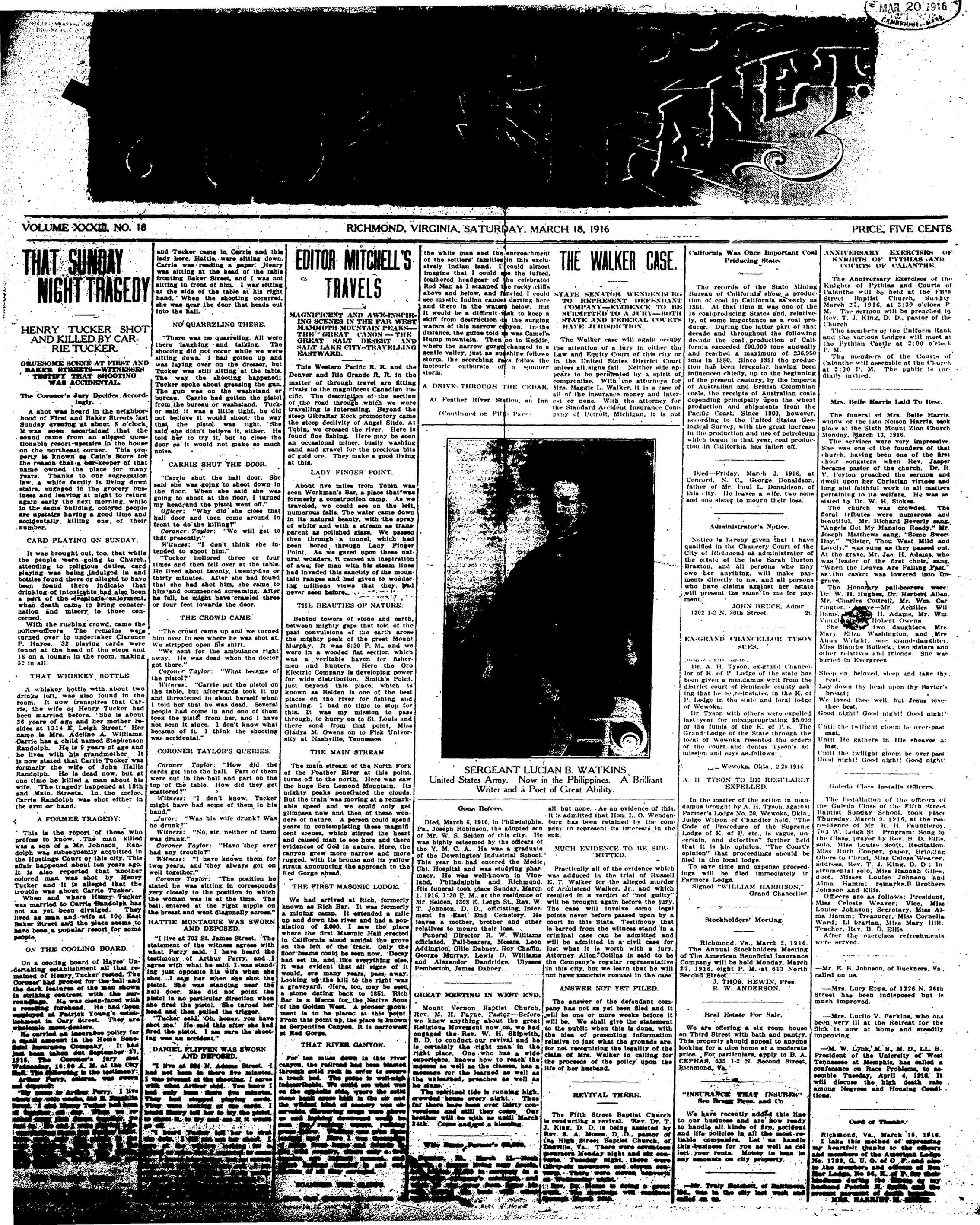
[Image of a man in a dark coat with a white hat, sitting in a chair with a decorative base.]
SERGEANT LUCIAN B. WATKINS United States Army. Now in the Philippines. A Brilliant Writer and a Poet of Great Ability.
the white man and the encroachment of the settlers' families in this exclusively Indian land. I could almost imagine that I could see the tufted, feathered headgear of the celebrated Rod Man as I scanned the rocky cliffs above and below, and fancied I could see mystic Indian canoes darting here and there in the waters below. But it would be a difficult task to keep a skiff from destruction in the surging waters of this narrow canyon. In the distance, the guide told us was Camel's Hump mountain. Then on to Keddle, where the narrow gorgon changed to a gentle valley, just as sunshine follows storm, the scorching rains follow the meteoric outbursts of a summer storm.
A DRIVE THROUGH THE CEDAR.
At Feather River Station, an Inn
(Continued on Fifth Parc.
SERGEANT LUCIA
United States Army. Now in
Writer and a Poet
Gone Before.
Died, March 6, 1916, in Philadelphia, Pa., Joseph Robinson, the adopted son of Mr. W. S. Seldon of this city. He was highly esteemed by the officers of the Y. M. C. A. He was a graduate of the Downington Industrial School. This year he had entered the Medic Chl. Hospital and was studying pharmacy. He was well-known in Vineland, Philadelphia and Richmond. His funeral took place Sunday, March 1, 1916, 1:30 P. M., at the residence of Mr. Seldon, 1308 E. Leigh St., Rev. W. T. Johnson, D. D., officiating, Interment in 'East' End Cemetery. He leaves a mother, brother and other relatives to mourn their loss.
Funeral Director R. W. Williams officiated. Pall-bearers, Mossara, Leon Addington, Ollie Dabney, Roy Chaffin, George Murray, Lewis D. Williams and Alexander Dandridge, Ulysses Pemberton, James Dabney.
GREAT MEETING IN WHAT END.
Mount Vernon Baptist Church,
Rev. M. H. Payne, Pastor—Before
we knew anything about the great
Religious Movement now on, we had
engaged the Rev. W. H. Skipwith,
B. D. to conduct our revival and he
is certainly the right man in the
right place. One who has a wide
experience, knows how to reach the
masses as well as the classes, has a
message for the learned as well as
the unlearned, preaches as well as
he sings.
The spiritual tide is running high,
crowded house every night. Thus far there have been over thirty conversions and still they come. Our brother will be with us until March 24th. Come and get a blessing.
Widy Renee Perman's Church.
Brown, St. March 11—March
18, a former living near Brook,
a former living near Brook in company in a
former company in company, and
a former company from Brook
finally coming to Brook with other
THE WALKER CASE.
THE WALKER CASE.
STATE SENATOR WENDENBURG TO REPRESENT DEFENDANT COMPANY—EVIDENCE TO BE SUBMITTED TO A JURY—BOTH STATE AND FEDERAL COURTS HAVE JURISDICTION.
The Walker case will again occupy the attention of a jury in either the Law and Equity Court of this city or in the United States District Court unless all signs fall. Neither side appears to be permitted by a spirit of compromise. With the attorneys for Mrs. Maggie L. Walker, it is a case of all of the insurance money and interest or none. With the attorney for the Standard Accident Insurance Company of Detroit, Michigan, it is not
CIAN B. WATKINS
in the Philippines. A Brilliant
set of Great Ability.
all, but none. An an evidence of this, it is admitted that Hon. L. O. Wendenburg has been retained by the company to represent its interests in the suit.
MUCH EVIDENCE TO BE SUBMITTED.
Practically all of the evidence which was adduced in the trial of Russell E. T. Walker for the alleged murder of Arinstead Walker, Jr., and which resulted in a verdict of "not guilty" will be brought again before the jury. The case will involve some legal points never before passed upon by a court in this State. Testimony that is barred from the witness stand in a criminal case can be admitted and will be admitted in a civil case for just what it is worth with a jury. Attorney, Allon*Collins is said to be the Company's regular representative in this city, but we learn that he will not have associate counsel in the case.
ANSWER NOT YET FILED
The answer of the defendant company has not as yet been filed and it will be one or more weeks before it will be. We shall give the statement to the public when this is done, with the idea of presenting information relative to just what the grounds are, for not recognizing the legality of the claim of Mrs. Walker in calling for the proceeds of the policy upon the life of her husband.
REVIVAL THERE.
The Fifth Street Baptist Church is conducting a revival. Rev. Dr. T. J. King, D. D. is being assisted by Rev. S. A. Moses, D. D., pastor of the High Street Baptist Church, of Danville, Va. There were seventeen members Monday night and six conversions Tuesday night. There were thirty-nine members and eleven conversions. There were eleven conversions on Wednesday night.
Rev. Dr. Moore is doing a great work. The meetings will continue until 50th.
The records of the State Mining Bureau of California show a production of coal in California as early as 1861. At that time it was one of the 16 coal-producing States and, relatively, of some importance as a coal producer. During the latter part of that decade and throughout the following decade the coal, production of California exceeded 100,000 tons annually and reached a maximum of 236,950 tons in 1880. Since 1881 the production has been irregular, having been influenced chiefly, up to the beginning of the present century, by the imports of Australian and British Columbian coals, the receipts of Australian coals depending principally upon the wheat production and shipments from the Pacific Coast. Since 1900, however, according to the United States Geological Survey, with the great increase in the production and use of petroleum which began in that year, coal production in California has fallen off.
Died—Friday, March 3, 1916, at Concord, N. C., George Donaldson, father of Mr. Paul L. Donaldson, of this city. He leaves a wife, two sons and one sister to mourn their loss.
Notice is hereby given that I have qualified in the Chancery Court of the City of Richmond as administrator of the estate of the late Sarah Burton Braxton, and all persons who may owe her anything, will make payments directly to me, and all persons who have claims against her estate will present the same to me for payment.
JOHN BRUCE, Admn.
1202 1-2 N. 30th Street. 2t.
EX-GRAND CHANCELLOR TYSON SUEN.
Dr. A. H. Tyson, ex-grand Chancellor of K. of P. Lodge of the state has been given a mandamus writ from the district court of Seminole county asking that he be re-instated, in the K. of P. Lodge in the state and local lodge of Wewoka.
Dr. Tyson with others were expelled last year for misappropriating $5,000 of the funds of the K. of P.'s. The Grand Lodge of the State through the local of Wewoka resented the orders of the court and denies Tyson's admission and says as follows:
Wewoka, Okka. 2.28.1916
A. B TYSON TO BE REGULARLY EXPELLED.
In the matter of the action in man-damus brought by A. H. Tyson, against Farmer's Lodge No. 20, Wowoka, Okla., Judge Wilson of Chandler held, "The Code of Procedure of the Supreme Lodge of K. of P. etc., is vague, uncertain, and defective" further, held that it is his opinion, "The Court's opinion" that proceedings should be filed in the local lodge.
To save time and expense proceedings will be filed immediately in Farmers Lodge.
Signed "WILLIAM HARRISON."
Grand Chancellor.
Stockholders' Meeting.
Richmond, Va., March 2, 1916.
The Annual Stockholders Meeting
of The American Beneficial Insurance
Company will be held Monday, March
27, 1916, eight P. M.-at 613 North
Second Street.
J. THOS. HEWIN, Press.
R. W. ANDERSON.
We are offering a six room house on Third Street with bath and pantry. This property should appeal to anyone looking for a nice home at a moderate price. For particulars, apply to B. A. CEPHAS, 535 1-2 N. Second Street, Richmond, Va.
"INSURANCE THAT INSURES"
See Brange Brom, and Co.
We have recently added this line to our business and are now ready to handle all kinds of fire, accident and life policies in all the most reliable companies. Let us handle this business for you as well as collect your rents. Money to be loan in any amounts on city property.
Mr. Truly Baldacci, of Baltimore, MD, was in the city last week and called on me.
PRICE FIVE CENTS
ANNIVERSARY EXERCISES OF
KNIGHTS OF PYTHIA AND
COURTS OF CALANTHE.
The Anniversary Exercises of the
Knights of Pythias and Courts of
Calanthe will be held at the Fifth
Street Baptist Church, Sunday,
March 27, 1916, at 3:30 o'clock P.
M. The sermon will be preached by
Rev. T. J. King, D. D., pastor of the
Church.
The members of the Uniform Bank
and the various Lodges will meet at
the Pythian Castle at 2:00 o'clock
P. M.
The members of the Courts of
Calanthe will assemble at the Church
at 2:30 P. M. The public is cordially invited.
Mrs. Belle Harris Laid To Rest.
The funeral of Mrs. Beile Harris, widow of the late Nelson Harris, took place at the Sixth Mount Zion Church Monday, March 13, 1916.
The services were very impressive. She was one of the founders of that church, having been one of the first choir songsters when Rev. Jasper became pastor of the church. Dr. R. W. Peyton preached the sermon and dwelt upon her Christian virtues and long and faithful work in all matters pertaining to its welfare. He was an assisted by Dr. W. H. Stokes.
The church was crowded. The floral tributes were numerous and beautiful. Mr. Richard Beverly sang, "Angels Get My Mansion Ready." Mr. Joseph Matthews sang, "Some Sweet Day." "Slater, Thou West Mild and Lovely," was sung as they passed out. At the grave, Mr. Jan. H. Adams, who was leader of the first choir, sang, "When the Leaves Are Falling Fast." as the casket was lowered into the grave.
The Honorary pall-bearers were: Dr. W. H. Hughes, Dr. Herbert Allen, Mr. Charles Cottrell, Mr. Wm. Carrington, Grave—Mr. Achilles Williams, H. Adams, Mr. Wm. Vaughan, Robert Owens, She two daughters, Mrs. Mary Eliza Washington, and Mrs. Anna Wright; one grand-daughter, Miss Blanche Bullock; two matrons and other relatives and friends. She was buried in Evergreen.
Sleep on, beloved, sleep and take thy rest.
Lay down thy head upon thy Navior's breast;
We loved thee well, but Jesus love-thee beat.
Good night! Good night! Good night!
Until the twilight gloom be over-past
cast.
Until He gathers in His shecavon at
last.
Until the twilight gloom be over-past
Good night! Good night! Good night!
Galesto Class Installs Officers
The installation of the officers of the Galena Class of the Fifth Street Baptist Sunday School, took place Thursday, March 3, 1916, at the residence of Mr. R. H. Fauntleroy, 703 W. Leigh St. Program: Song by the Class, prayer by Rev. H. D. Ellis, solo, Miss Louise Scott. Recitation, Miss Ruth Cooper, paper, Bringing Others to Christ, Miss Celeste Weaver, address, Rev. T. J. King, D. D.; instrumental solo, Miss Hannah Giles, duct, Misses Louise Johnson and Alma Hamm; remarks B Brothers Johnson and Ellis.
Officers are as follows: President, Miss Celeste Weaver; Vice, Miss Louise Johnson; Secretary, Miss Alma Hamm; Treasurer, Miss Cornellia Ward; Li brarian, Miss Mary Hill. Teacher, Rev. B. D. Ellis.
After the exercise refreshments were served.
Mr. E. B. Johnson, of Buckners, Va. called on us.
Mrs. Lucy Epps, of 1226 N. 26th Street has been indisposed but is much improved.
Mrs. Lucile V. Perkins, who has been very ill at the Retreat for the Sick is now at home and steadily improving.
M. W. Lynk, M. S., M. D., LL. B., President of the University of West Tennessee at Memphis, has called a conference on Race Problems, to assemble Tuesday, April 4, 1916. It will discuss the high death rate among Negroes and Housing Conditions.
Card of Thank you
Richmond, Va., March 15, 1916.
I take this method of expressing my heartfelt thanks to the officers and members of the American Lodge No. 1789, G. U. O. of O. F., and also to the members and officers of Iam Bur Lodge, No 96, K. of P. for their kindness during the illness by my husband Patrick H. Smith and the present payment of death benefits.
MRS. HARRIET M. H.
```markdown
```
Passing By.
Some of the best literature of the great war has been written by British Tommies—in the trenches or in hospitals, but nothing finer or better interpreting the psychology of the man at the front has yet appeared in print than this poem by Bombardier R. Bumpa, of the Australian contingent, wounded at Gallipoll and now convalescing in hospital at Cairo minus a leg and an eye.
Well, I went an' joined the army, an I done my little bit— 'Ere's the bloke wot put my pot on; yes, I keeps 'im in my kit— No, 'e ain't no proper soft-nose; just the end off on the sly.
'E's the only one got me--but I've 'eard 'em passing by.
God A'mighty! Yes. I've 'eard 'em passing by.
Passing by! Passing by! With a little whistlin' eigh.
'Nearly got you that time, sonny, just a little bit too high.'
Or a crack like "Jack, look out there!
Keep yer 'ead down, mind yor eye!"
But they're gone an' far behind yor fore you'll 'ear 'em passing by.
Yes. I lay from Toosday mornin' till the Wenedsay afternoon.
'On the Black Watch took their trenches, an' it woke me from a swoon.
I was damin', nearly mad wi' thrist an' pain, an' fit to cry.
But I cheered 'em as they trampled on me carcus, passing by.
God A mighty! Yes, I cheered 'em as I eard 'em passing by.
Passing by! Passing by! Trippin' fallin', getting nigh.
Gettin' nearer to the trenches, erpyou 'card a Tommy cry—
"Don't forget the Belgian wimmen, nor the little bairns forbye!"
God! I wouldn't be a German when them men was passin' by!
Then they gathered us together an' they sorted out the worst—
Wot they called the "stretcher cases"—an' they tended to us first.
They was overworked an' crowded, an' the doc 'u dug a sigh.
"Hopeless, that case"----"That one also"
"spoken in softly, passing by."
Passing by! Passing by! Curt command,
an stiffed sigh.
For it ain't no place for drama, an'
man 'as got' ter die;
'En I thought I 'eard a whimper an
a little soft reply-
"Greater love than this hath no man"
"some one speakin' passing by.
So they ships me off to "Ilighty,
'en they sticks me in a ward.
I was short a leg an peeper, but they treats me like a lord.
I'd allus bain a lonely bloke, an' so I used ter lie
An' watch the fren's of other men continual passing by.
Passing by! Passing by! With a smile
or with a sigh.
With their cigarettes an' matches
flowers or shirt or pipe or tie;
An' one 'ud sometimes stop an' speak
un' used terd wonder why...
Cos I ain't no blame' Adonis, not ter
notice passing by!
I'm thinkin' if the angles 'ave a
Union Jack around.
An' sticks it somewhere prominent when Gabriel starts to sound.
The people round that flag will be 'most half the hosts on high'
The men who've passed, or waits to pass, or now are passing by.
Big-carted men 'an' winnmen, white an' black, a-passing by!
Passing by! Passing by! Just to keep that flag on high.
An' all that flag 'as stood for in the days that'n now gone by!
An' when they pass before I'm sure
'Ell listen to their cry,
An' 'Ell treat 'em very gentle, and forgive 'em, passing by!
*Bilighty, derived from the indian word 'bilaiti', is the Tommy's nickname for home.
THE ST. LOUIS VOTE
[Mallimore, Ohio American]
St Louis has joined the ranks of cities with segregated districts. One of the ordinances provides that a Negro or white may not become a resident in a block occupied entirely by those of the opposite color. The other imposes the same restrictions in blocks containing seventy-five percent white or the like percentage of Negro residents. The issue was decided by the ballot which shows that 52,229 votes were cast in favor of, and 17,876 against segregation. Estimating the possible colored votes as 16,560, it appears that only 1,276 of the 58,228 white voters voted against the measure. Of course it is taken for granted that the colored people as a whole opposed and did their best to get others to oppose shouting them up in spite of nudities of the city.
There is nothing surprising about the outcome of the St. Louis measure for surrogation. It was accepted in advance that submitting it to a popular vote meant that the ordered people would be outvoted. The illuminating change in the percentage of white people above to bitters in the event of the end of theeleven-day non-St. of the St. Louis voting vote. It is�odated 1,276 valid for the equivalent date a here two
MAJOR W. H. LOVING PRESENTED MANY TOKENS AT GREAT FAREWELL
Fourteen Years Leader of Philippine Constabulary Band.
[Manila (1.1.1.) Daily Bulletin]
In the presence of the largest assemblage ever gathered on the Luneta on an occasion of this nature, Captain Walter H. Loving, retiring bandmaster of the famed Constabulary band, last evening conducted his last concert, at the conclusion of which he was formally presented with a handsome gold watch, suitably engraved, a platinum chain, and a purse of gold, by Judge Gilbert in behalf of the Manila community. Prior to this event he was, presented with a beautiful loving cup from the members of the organization of which he has been the head and moving spirit for nearly 16 years, this testimonial of the cateeem in which he is held by the members of the band having been displayed on the music stand during the concert.
The vast crowd began to assemble long before the nour set for the farewell concert, and by six o'clock the Luneta was packed with a multitude of people, the great majority of whom stood in rapt attention until the end. The next to the last number on the program was Sousa's Stars and Stripes Forever," following which Judge Gilbert mounted the steps of the bandstand, and, in his always fettleitic manner, made the presentation speech and handed to Major Loving the parting remembrances.
Visibly affected, Major Loving responded briefly, expressing his gratitude for the honor conferred upon him and his sincere pleasure and appreciation of the thoughtfulness and kindness of the audience. He expressed his regret in leaving the crowd of the Philippine Islands and his many friends here, and especially the members of the band which he had organized over 14 years ago. He ventured the hope that he might some day return to the islands and see all who had thus demonstrated their friendship on this memorable occasion.
At the conclusion of this affecting presentation ceremony, Major Loving took up his baton, the band arose as a body, and the sweet strains of "Auld Lang Syne" were played. A moment before the conclusion of this piece, Major Loving stepped down and handed his baton to his successor, Lieutenant Navarro, who finished the melody, while the retiring band master turned to the throng and bowed his appreciation of the ovation of cheers which follows.
Judge Gilbert said:
"Major Loving, Ladien,
and Gentlemen:
"It is my very great pleasure to have been selected to voice for the community something of its appreciation of you and of your great musical organization. Your departure at this time is a polignant grief to the community.
"As long as life shall endure with any of us, your name will be remembered and your achievements recalled with the keenest pleasure. You have accomplished a wonderful thing. Other men have directed great bands. But as a rule they have been able to select the best trained musicians from which to form them. You, in great measure have trained the individual musicians who compose your organization. It has been a unique achievement. Your name and your fame are known wherever great music is heard. But more than this, you have wrought this success with a modesty which has been becoming. Again and again you have heard the plaudits of the multitude, and yet you have preserved the unassuming demeanor of the really great man. All of us have seen many a man ruined by applause. Moderate success has frequently been transformed into utter failure, because, to use a common phrase, one could not stand success. Not so with you. Through the years you have wrought unaccentedly. Every day has brought its task, and to this task you have given your all.
"You leave us now, and you leave us all your debtors. We, none of us, can hope to ever pay that debt. The burden of the toll of many a day has been lightened for us all, by the sweet strains of your/ music. Lives have been elevated, conduct has been rectified, souls have been strengthened, and sleep has been sweetened, because you have lived and worked among us. "These souls better measure of a successful life than the amount of happiness that that life brought to others. Measured thus, you achieved a great success. No man in these beautiful islands has done more. Who has done as much?
"You are going from us. We be
beloved to soon return. We will need
you here. These men about you will
need you. They know your worth.
They know what you have done for
them. We, the citizens, will need you.
Regradless of race or color; regardless
of religious or political views;
regardless of station, high or low, we
will need you. We are selfish; we
want you back. Be assured that if
your health permits, we will have you
back. You belong to us. Our pride
in you will not permit us for long to
do without you.
"As before we are any words, in any
way those the country might
below, to show to you an inflectione-
tive regard. Yet we want you to carry
away some little thing as a memorial
of this night; but for the hostitude
worth or value, but that you may preserve
in the archives of your memory the
fleet that have your great work was wrought."
```markdown
```
Shane Pow, about twenty-six years
great, has you always have a close
friend of the bignames you have to
freely given others. God good you.
Captain Loring has been granted
leave of change, until February 21,
and will then be retired with the rank
of major. A delimiter in his honor was
given by the Headquarters staff last
night at St. Lucia Barracks.
RETIRING WITH HONOR
[Mantia (P. L.) Daily Bulletin]
When, in the presence of the great thrung that had gathered to listen to his farewell performance and to show his appreciation of the great service he had rendered the community and after partially concluding the direction of the last selection that he will probably ever officially conduct as the leader of the great musical organization that he has built up and made famous by fourteen years of strict devotion to that work, he handed over to him the work of which he had wielded for many years, Major Walter H. Loving might well be proud of the record that he has made in the Philippines Islands.
No man has accomplished more in his field of labor in these islands than Major Loving. He is retiring with honor from that work after building from the rarest material one of the most finished musical organizations that any country has known. His loss to the organization and to the community will become more apparent as time goes on. There are undoubtedly many good musical directors, but Major Loving in addition to being that, had a personality and an influence with the men under his direction that cannot be replaced by mere ability to direct or lead.
TALKS ON THRIFT
(No. 6)
Wasting A Sheet of Paper.
In the practice of economy there must be reason and due regard to relative values, for in the saving of a little there may be the wasting of much. For instance, a certain bank president drawing a goodly salary, spends a great deal of time cutting envelopes for use as scratch paper. He is wasting time, for if he is worthy of being president of a bank, his brain police is of so much greater worth than the paper. value he is trying to save, that he is penny wise and pound foolish. He should be thinking out the problems of his bank, not trying to save it a few sheets of paper. On the other hand, it would be good economy for a large department store, burning hundreds of lights daily, to pay a man ten dollars a week to watch for needless waste of light and turn out those not in use.
A certain man dropped a nickel at a railroad station. In his endeavor to find it, he lost his train, lost his temper, missed a business engagement that held up four other men, and had to spend a quarter for a telegram to hold the engagement for his late arrival. That was poor economy. The point to be emphasized in all such endeavors is to impress upon the individual who wastes that if all were to do as he does, the loss would be enormous; and if all were to do as he should, the saving would be great. We are both careless and thoughtless. We leave our lights burning when they do no one any good. We leave the water running, forgetting that the meter is not to be all the time, and every turn of the wheel means mower to some one, if not to none, if all very well to say: "It's included in the rent," yes, but the landlord has probably figured that out when he fixed his rental. You pay, not he, for every hour you burn a useless light, or let the water run to waste.
A certain school teacher, wide awake to impress these things upon her pupils, got her great chance one day. A little girl made a few figures on a sheet of paper and threw it away. The teacher asked why she wasted that sheet of paper, and the pupil replied that "it was only a sheet of paper, and besides, it was furnished by the Board of Education free." Calling the class to order, she asked them to take out their pads and count the number of sheets. Then she told them what the pad cost and asked them to calculate the cost of one sheet fraction of a fraction of a cent. She then told them how many pupils attends the schools of the city on an average of 100 years and asked them to figure the cost if each pupil wasted but one sheet a day. The total was a surprise. It's not the cost of a single sheet of paper, a single hour of useless light, a match, a cost or two, that counts—it's the commissive totals that make the astonishing losses.
There is such a thing as being mean and nigardly with yourself, eating only enough to keep body and soul together, wearing clothes until they are a mass of patches, and living a life of strict denial to all the bodily comforts. That is not the point; you ought to live well, dress decently, and have wholesome pleasure, but be careful in your wearing, last you be one of a great army, writing it may be but a match a day, but if a million others are doing the same thing, we burn up a lot of wood to no useful purpose. Light your pipe with one match!
AMERICAN BANKING ASSOCIATION.
Mr. Bolling Wins Life Certificate:
Mr. Howard A. Belling, who has been principal of the ground school in Loveland, W. Va., has been awarded by State Department of Education. Mr. Belling staff at a university in the State. Belling of University of St. Louis has been principal of the ground school in Loveland, W. Va., and has been awarded by State Department of Education.
Third District Names W. R. Vawter for Congress.
Resolutions Adopted Oppose Free Trade, Fever Preparedness, Deplore "Watchful Waiting" and Indoor State Party Organization.
[Richmond Times-Dispatch]
Joseph P. Brady was elected delegate to the National Convention to be held in Chicago in June of the convention of the Third District Republicans held yesterday in Hunting Court, Part II, South Richmond. W. R. Vawter was named alternate.
Mr. Vawter was also nominated as the Republican candidate from this district to oppose A. J. Montague, the Democratic incumbent, for Congress. Every county and the city of Williamsburg and Richmond were represented in the election. It was motion of John Thompson, of Henrico County, that Mr. Brady's name as delegate was placed in nomination. Mr. Thompson was eloquent in his reference to Mr. Brady and the Republican party.
BRADY WILL·GO AS
UNINSTRUCTED DELEGATE
"I am deeply sensible to the honour you have conferred upon me," said Mr. Brady following his election, "and it is not a little intensified by the fact, as I understand the sense of this convention, that I am to go as an uninstructed delegate.
"On June 7 next that convention will meet in Chicago, and at the same time and place the convention of the Progressives will meet, and to me it can have but one significance. It means that the representatives of those two great parties purpose to meet on common ground and nominate a candidate for the presidency, who will be satisfactory to both conventions. I do not know, and I believe no one knows, who the combined patriotism and wisdom of the delegates to those conventions' will present as the nominee, but I feel assured that whoever may be he will first of all be a great American.
"This is a great country, in which we live. We are at liberty to criticize the policies and acts of the President, and it is well that we can do so, for criticism or opposition to political measures make good laws and good government. But if a crisis should come in our now delicate international affairs, party lines will be obliterated, patriotism will supplant partisanship, Republicans would vie with Democrats, support of the President of the United States."
Joseph W. Stewart was elected chairman of the district committee, while B. B. Arnold was elected a member of the executive committee. G. A. Hanson was chosen as elector for the district.
RESOLUTIONS OPPOSE
UNDERWOOD BILL.
Before adjourning the convention adopted the following resolutions:
"First. That we are opposed to free trade or a tariff for revenue only with incidental protection, as exemplified by the Underwood bill, which, not only has been a complete failure as a revenue producer, but has failed to cheapen commodities to the consumer, and pledge ourselves to a protective tariff, which has always kept a full treasury and brought prosperity and happiness to a grateful people.
"Second. That we favor the policy of preparedness, not for the purpose of protection or aggrandizement, but to the end that this government may be ever ready to defend its honor and protect and defend the lives and property of its citizens whether, at home or abroad.
"Third. That we deplore the watchful waiting' policy of President Wilson in Mexico while American citizens are murdered, the flag of our country insulted, and the temples of God desecrated at our very door.
"Fourth. That we favor the upbuilding of our merchant marine and the improvement of our harbors and waterways, and are unalterably opposed to the un-American policy of government ownership or partnership in commercial vessels advocated by the present administration.
"Fifth. That we indorse the wise administration of party affairs in this State by the present Republican State organization, and especially commend the valuable services of State Chairman C. B. Ginsburg and Alvin H. Martin, member of the republican National Committee, and George L. Hart, the efficient secretary of the State committee, and we hereby pledge them our loyal support in all matters pertaining to the welfare of our party in the nation and state.
"Sixth. We congratulate the Republicans of the nation that the differences which divided our party four years ago are rapidly being forgotten."
Claim That Whites Denied Them Admission to the District Convention.
Following the retreat of the Republican convention yesterday, which met in the Huntington Court, Part II, to give a hearing to twenty-five colored Republican delegation, elected at a meeting held on Saturday night, a special meeting was called for 2 o'clock on Saturday afternoon in the True Returnment' Hall for the purpose of forming a government organization of colored women.
The boys were a happy bunch last Friday, P. H. at the Y. M. C. A. Building. The boys for Bible study was a five boy and every boy was active. The Boys Quintet in playing special music for the occasion. Mothers continue to good your boys. At 5 P. M. but Tuesday the Men's Bible Class was well attended. The men were interested.
General John L. Ballard lead his men to the front last Friday night and rendered an excellent program. The Boys have served notice on the Reds that they must get ready to saw wood at the close of this great battle. Chairman, Douglas Edwards, Jr., of the social committee knows how to make the fellows feel good. He served the best make and cream that could be found and the Reds have their eyes open for he is a Blue man. Everybody who attended the class for the explanation of the Sunday School Lesson, last Saturday was helped.
Last Sunday was a great day with the Y. M. C. A.
At 9:30 the workers launched the great meeting which is planned for the great religious campaign. The Y. M. C. A. is working with the churches in this effort.
The boys were happy to see Committeeman B. L. Allen who gave them a special address which did them much good. 4 P. M. at the Y. M. C. A. at 3:30 P. M. the Ebenezer Baptist Church and the Y. M. C. A. held a great evangelistic meeting for men. Rev. A. D. Daly delivered an address that we right to the hearts of the men. Mr. Richard Beverly sang songs that were in keeping with the hour, and every man voted him to come on the 4th Sunday. One man was lead to take Jesus in the Personal Savior. The inmates of the city home enjoyed the work which was done by the committee at 10 A. M.
Twenty prisoners were lead to accept Christ in the city jail at 10 A. M. and the committee is relocating.
Come to the explanation on the Sunday School lesson today, 5 P. M. at the Y. M. C. A. Bring the other woman and man.
Men, be on time Sunday ready for hard work and the other man.
Do not forget the meeting for workers at the Y. M. C. A. at 9:30 A. M. Come!
Committeeman C. B. Gaston will meet the boys at 4 P. M. at the Y. M. C. A. with a special message for boys. Mothers, help to reach the boys for this meeting.
Here we are! The great meeting for men 3:30 P. M., at the 5th Street Baptist Church. Dr. Samuel A. Moses, of Danville, will speak to the men from his shoulder. Mr. Joseph Matthaws will sing special song. Watch For My Mother's Prayer. Every man is asked to point the men of Richmond to this big meeting for men.
All women invited to the 6th Mt. Zion Baptist Church at 3:30 P. M. to big meeting for women. Dr. R. Y. Peyton will be glad to see all the women of Richmond. Come early that you may get a seat. Pray for this meeting. Bring the woman who is unassured.
April 3rd Miss Nannie H. Burroughs is coming to Richmond to deliver a special lecture. Subject: Some Things That Men Have Found Out About Women. The Sabbath Glee Club will be at her beat. Admission 15 cents. Help to make this a great success. Every home is asked to special prayer for the Y. M. C. A. every day during this great campaign at twelve o'clock. Grant us this favor.
ELUDES TWO BRITISH PATROLS.
ELUDES TWO BRITISH PATROLS.
The Stockholm is Caught, and Parcel Post Seized.
[New York Sun]
The Swedish-American liner Stockholm almost eluded the vigilance of the British patrol ships off the coast of Scotland on the trip she finished here yesterday afternoon from Gothenburg and Greenock. Capt. A. E. Hakanson said he had passed the first and second line of auxiliary cruisers, darkened lights helping him to evade them, when he was overhauled in bright daylight 146 miles west of the Hebrides, which inspired him to avow how far the jurisdiction of Great Britain extended.
One of the steamships that held him up, firing a shot across the bowes of the Stockholm, was the Anchor Liner Columbia, now masquerading as the Columbello. The Stockholm was escorted to Greenock and held three days, while all baggage was overhauled and 117 packages of parcel post taken off.
Gosta Beyer, new Swedish Vice-Consort at this port, came by the Stockholm to Washington last night with a big box of papers for the Swedish Minister.
BLACK AMERICAN
In the steerage of the Stockholm was Hugh Archer, a black American of New Orleana, who shipped as steward ahead a sailing ship from San Francisco for Malme, Sweden last year and was captured by the Germans and taken into Kiel. He was wounded sent to Stockholm and became the only black American hobo over there. He was having a fine time at the expense of Stockholm, incidentally acquiring a mastering of the language of Sweden, when the Government decided that he was an "unfriendly alien" and sent him back to American. He said he liked Sweden and "there would go there again" after the war.
THE COMMANDER
"I'M NOT HERE"
FINAL WORD—REQUESTS
THAT MAY BE LEFT
OUT PRIMARYS.
Col. Theodore Roosevelt, in a short article written for Henry L. Stoddard of the New York Evening Mail and cabled to that newspaper yesterday from Port of Spain, Trinidad, says he will not permit the use of his name in the Presidential primaries in any State of the Union.
That part of his statement was due to the movement in Massachusetts to put him on the primary ballot. But the suggestion does not appeal to the Colonel, and this year, unlike 1912, "his hat is not in the ring," "unless" as the Colonel puts it in his statement, "the country has in its mood something of the heroic—unless it feels not only devotion to ideals, but the purpose measurably to realise those ideals in action."
Col. and Mrs. Roosevelt have been spending the last few days of their tour of the West Indies in the historic island. He was met there by Mr. Stoddard, who gave him the latest political news from the United States.
WHAT THE COLONEL SAYS
For him the Cobolon dictated the following statement:
"I am deeply sensible of the honor conferred on me and of the good will shown me by the gentlemen who have announced themselves as delegates to be elected in my interest in the Massachusetts Presidential primary. Nevertheless I must request, and I now do request and insist, that my name be not brought into the Massachusetts primaries, and I emphatically decline to be a candidate in the primaries of that or of any other State. Months ago I formally notified the authorities of Nebraska, Minnesota and Michigan to this effect.
"I do not wish the nomination.
"I am not in the least interested in the political fortunes either of myself or any other man.
"I am interested in awakening my fellow countrymen to the need of facing unpleasant facts. I am interested in triumph of the great principles for which with all my heart and soul I have striven and shall continue to strive.
"I will not enter into any fight for the nomination and I will not permit any factional fight to be made in my behalf. Indeed, I will go further and say that it would be a mistake to nominate me unless the country has in its mood something of the heroic—unless it feels not only devotion to ideals but the purpose measurably to realize those ideal in action.
"This is one of those rare times which come only at long intervals in a nation's history where the action taken determines the basis of the life of the generations that follow. Such times were those from 1776 to 1789, in the days of Washington and from 1858 to 1865, in the days of Lincoln.
PRESENT ADMINISTRATION
HOPELESS.
"It is for us of today to grapple with the tremendous national and international problems of our own hour in the spirit and with the ability shown by theos who uphold the hands of Washington and Lincoln. Whether we do or do not accomplish this foot will largely depend on the action taken at the Republican and Progressive national conventions next June.
"Nothing is to be hoped from the present Administration, and the struggles between the President and his leaders in Congress are today merely struggles as to whether the nation shall adopt a governmental representative adopt an attitude of a little more or a little less hypocrisy and follow a policy of slightly greater or slightly less baseness that they offer us is a choice between degrees of hypocrisy and degrees of infamy.
"But disgust with the unmany failure of the present Administration. I believe, does not, and I know ought not to mean that the American people will vote in a spirit of more protest. They ought not to, and I believe they will not, be content merely to change the present Administration for one equally timid equally vacillating, equally lacking in vision, in moral integrity and in high resolve. They should desire, and I believe they do desire, public servants and public policies signifying more than adroit cleverness in escaping action behind clouds of fine words, in retusal to face real internal needs, and in complete absorption of every faculty in devising constantly shifting hand to mouth and day to day measures for escape from our international duty by the abandonment of our national honor—measures due to sheer dread of various foreign Powers, tempered by a sometimes harmonizing and sometimes conflicting dread of various classes of voters, especially hyphenated voters at home.
"We must clarify and define our policies, we must show that our belief in our governmental ideas is no real that we wish to make them count in the world at large and to make the necessary sacrifice in order that they shall count. Surely we of this great republic have a contribution to make to the cause of humanity, and we cannot make it unless we first show that we need more prosperity and fair dealing among our own nation and women. I believe that in a crisis we prove it is impossible to greatly to modify the mode of the company or to strongly to dwallow on the necessity of instituting and subordinating the desires of individuals.
to be president of the government and president of the university will have to be president of the institution by election following from within or without. They should be the very best man that can be found in any country, which one great nation should be to study in unqualified terms for a programme of clean air, straight cut national Americanism, in does not less than in words, and internal and international matters allied, and to choose all their constitutions of man who will not merely stand for such a programme before election but will reasonably and in good faith put it through if elected.
"These men should be men of rugged independence, who possess the broadest sympathy with and understanding of the needs and desires of their fellows; their loyalty to the nation should neither be too insignificant, but whole of the United States and the people that swell therein. They should be controlled by no man and no interest and their own minds should be open.
"June is a long way off. Many things may occur between now and then. It is utterly impossible to say now with any degree of certainty who should be nominated at Chicago. The crying, vital need now is that the man who next June assemble at Chicago from the forty-eight States and mingle the view of the entire country shall act with the same and letty devotion to the interest of our nation as a whole which was shown by the original Continental Congress. They should approach their task unhampered by any pledge except to bring to its accomplishment every ounce of courage, intelligence and integrity they possess."
MOEWE SAFE IN GERMAN HARBOR Raider Sunk 15 Ships and Seized $200,000.
NAD 300 PRISONERS ABOARD
Berlin Announces Arrival of Cruiser at "Some Home" Port After Laying Mines and Capturing Many Ships.
Official announcement was made in Berlin that the German cruiser Moewe arrived in "some" German port.
She had on board a large number of British prisoners and $300,000 in gold bars.
The announcement says fifteen vessels were sunk by the Moewe, which also laid mines at several points. One of these mines, it is stated, sank the British battle ship King Edward VII.
The statement says:
"The naval general staff states that the Moewe, Commander Burgrave Count Dohna-Schloeden, after a successful cruise lasting several months, arrived at some home port with four British officers, twenty-nine British marines and sailors, 266 men of crown of man) steamers, among them 103 Indians, as prisoners, and 1,000,000 marks in gold bars.
"The vessel brought up the following enemy steersmen, the greater part of which were bunk and a small part of which were sent as prizes to neutral ports: "The British steamship Corbridge, 3637 tons; Author, 3496 tons; Tyrader, 3608 tons; Arladen, 3035 tons; Dromonby, 3627 tons; Farrington, 3146 tons; Clan MacTavish, 5816 tons; Appam, 7781 tons; Western, 3300 tons; Hargreave, 3336 tons; Flamenco, 4629 tons; Saxon Prince, 3471 tons; the British sailing vessel Edinburgh, 1473 tons; the French steamer Monarl, 3109 tons, and the Belgian steamship Luxembourg, 4322 tons.
"At several points on enemy coast the Moewe also laid out mines, to which, among others, the battle ship King Edward VIII fell victim."
Not a life of the 777 men aboard was lost when the battle ship King Edward VII, one of the finest predreadnought men-of-war of the British fleet, struck a mine on January 9. Following its usual policy, the British admiralty did not announce where the disaster had occurred, but a trainload of survivors were landed at Chatham, thirty milion southeast of London, a few hours after the battleship was sunk.
The official announcement said: "H. M. S. King Edward was struck by mine. Owing to the heavy sea she had to be abandoned and sank shortly afterward. The ship's company was taken off without loss of life. Only two men were injured."
2180 Lost on Prevenon
Paris, March 4—Nearly 2100 men lost their lives when the French auxiliary orderer Provence, formerly the transe Atlantic line, swam the same name, was sunk in the Mother-Roman, last Saturday, according to an announcement by the ministry of marina.
The ministry made public that there were nearly 4000 men on board the Provence when she went to the bottom. The ministry previously had announced that only 290 men had been swum.
DYNAMITE PLANT EXPLODES
Three Killed, Many Mort and Thirty Newmen Wrecked.
Three persons are known to be dead, badly beaten wounded and many hurt, downstream, by the explosion of a Dominican Heart at Mangrove, a coastal town of the South.
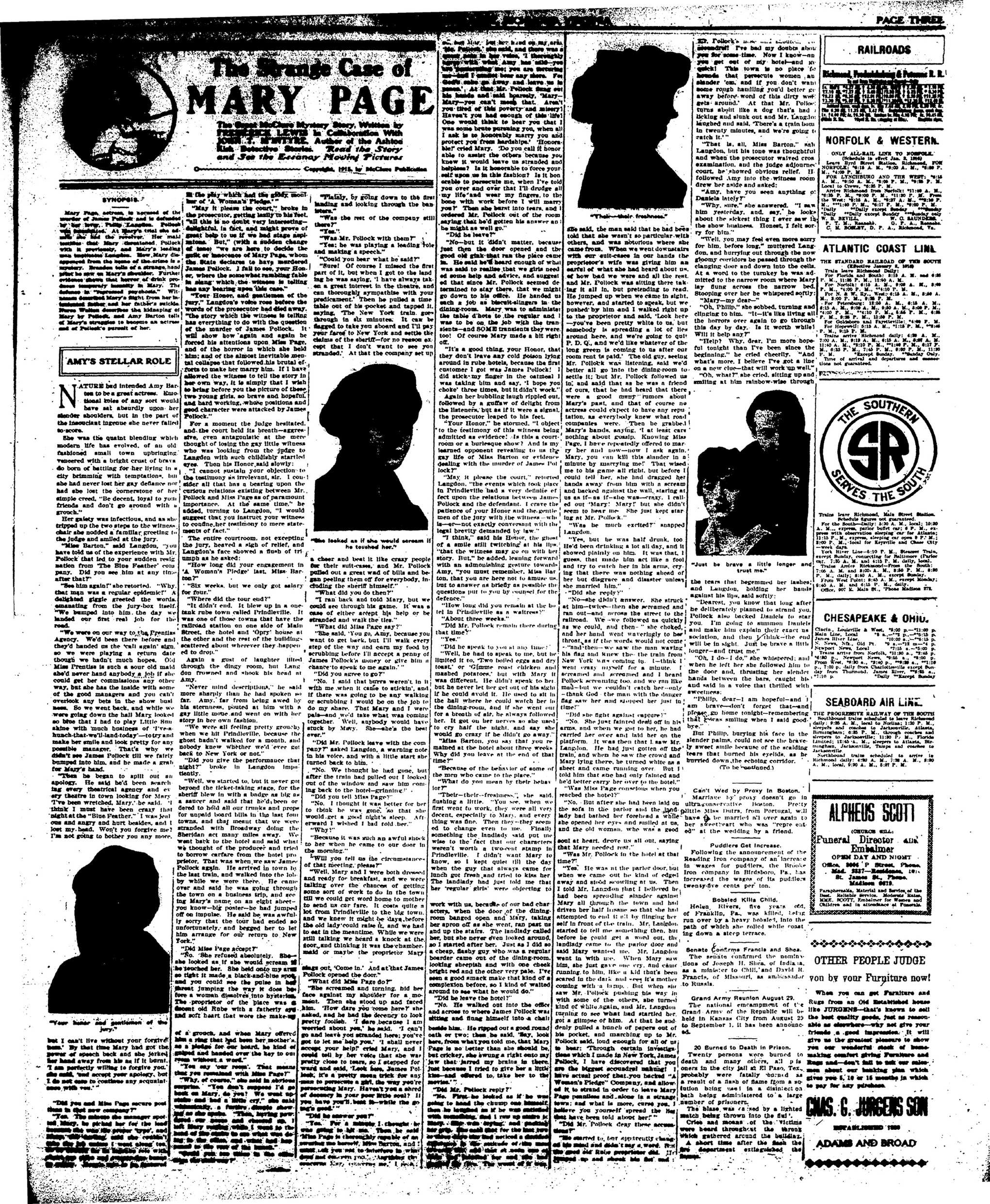
The Strange Case of
MARY PAGE
The Great McClure Mystery Story, Written by
FREDERICK LEWIS in Collaboration With
JOHN J. MENTYRE, Author of the Ashton
Risk Detective Stories. Read the Story
and See the Essay Moving Pictures
Copyright, 1915, by McClure Publication
Mary Page, actress, is accused of the murder of James Pollack and is defended by her lawyer, Philip Langton. Pollack with assistance, At Mary's trial she adduces she had the revolver. Her maliciousities that Mary devastated, Pollack with it previously, and Mary's leading man tempted Langton. How Mary disappeared from the home of the crime is a mystery. Brandon tells of a strange and plot he now on the verge of murder. Pollack with the horror of drink productions temptation immunity in Mary. The defense in "Surprised psychosis." Witnesses denounced Mary's flight from her institutional father, and her father's suicide. Nurse Wren describes the kidnapping of Mary by Pollack, and Amy Barton tells of Mary's struggles to become an actress and of Pollack's pursuit of her.
AMY'S STELLAR ROLE
NATURE had intended Amy Harte to be a great actress. Emotional roles of any sort would have sat aburdly upon her slender shoulders, but in the part of the insouciant ingene she never failed to score.
Bee was the quiet blending which modern life has evolved, of an old fashioned small town upbringing; veneered with a bright crust of brave do born of battling for her living in a city brimming with temptations, but she had never lost her gay defiance nor had she lost the cornerstone of her simple creed. "Be decent, loyal to your friends and don't go around with a groovy."
Her galaxy was infectious, and an abnipripped up the two steps to the witness, chair she nodded a familiar greeting to the judge and smiled at the jury.
"Miss Barton," said Langdon, "you have told us of the experience with Mr. Pollock that led to your sudden resignation from 'The Blue Feather' company. Did you see him at any time after that?"
"See him again!" she retorted. "Why, that man was a regular epidemic." A delighted giggle greeted the words amusing from the jury-box itself. We bumped into him, the day we handed our first real job for the road.
"We were on our way to the Prentiss Agency. We'd been there before and they'd handed us the 'call again' sign, so we were playing a return date though we hadn't much hope. Old Miss Prentiss is such a sour old man she'd never hand anybody a job if she could get her commissions any other way, but she has the inside with some of the road managers and you can't
overlook any beta in the show bush neat. So we went back, and while we were going down the hall Mary looked so blue that I had to play Little Jim shine with much business of I’ve lunch that’ll land-today—to try and make her smile and look pretty for any possible manager. That’s why we didn’t see James Pollock till we fairly bumped into him, and he made a grab for Mary’s hand.
“Then he began to spill out an apology. He said he was searchig for any theatre in town looking for Mary. I’ve been wretched, Mary, he said. I think I must have been crazy that night at the ‘Blue Feather.’ I was poutous and angry and hurt besides, and I lost my head. Won’t you forgive me. I’m not going to bother you any more.”
"Your honour and gentlemen of the jury."
but I can't live without your forgive
bom! By that time Mary had got the
power of speech back and she jerked
her hand away from his na his it burnt.
I am perfectly willing to forgive you,
she said, 'and accept your apology, but
I do not come to continue any acquaintance
with you.'"
"Did you and Mimi Ipsa secure post
them in that new company?"
"Yes. The minute she manager spotted
Mary, he pitched her for the lead
become the was the proper type, and
Mary was willing and she couldn't
like the job unless I went along too.
I would have been in love with
Mary and I would have been happy
with her and company, but she
In the play which had the gilded moorl of 'A Woman's Pledge,' "May it please the court," broke in the prosecutor, getting厉厉 to his feet. "All this is no doubt very interesting—delightful, in fact, and might prove of great help to us if we had stage apiphanes. But," with a sudden change of tone, "we are here to decide the fate of Mary Page, from the State department James Pollock. I fail to see, your Honor, where the some wretched rumbling fable in string which, the witness is telling has any bearing upon this case."
"Tour Hoon, and gentlemen of the jury," Langdon's voice rose before the words of the prosecutor had died away. "the story which the witness is telling has everything to do with the question of the murder of James Pollock. It will show how again and again he forced his attentions upon Miss Page, and of the horror in which she held him; and of the almost inevitable mental collapse that followed his brutal efforts to make her marry him. If I were to witness to the story in her own way, it is simply that I wish to be before you the picture of those two young girls, so brave and hopeful, and hard working, whose positions and good character were attacked by James Pollock."
For a moment the judge hesitated, and the court held its breath—aggressive, even antagonistic at the mere thought of losing the gay little witness who was looking from the judge to Langdon with such childishly startled eyes. Then his Honor said slowly: "I cannot sustain your objection to the testimony in irrelevant, sir. I consider all that has a bearing upon the curious relations existing between Mr. Pollock and Miss Page as of paramount importance. At the same time" he added, turning to Langdon, "I would suggest that you instruct your witness to confine her testimony to more statement of fact." The entire courtroom, not excepting the jury, heaved a sigh of relief, and Langdon's face showed a flush of triumph as he asked: "How long did your engagement in A Woman's Pledge last, Miss. Barton?" "Six weeks, but we only got salary for four." "Where did the tour end?"
"It it didn't end. It blew up in a one tank rube town called Prindieville. It was one of those towns that have the railroad station on one side of Main Street, the hotel and 'Opr's house at the other and the rest of the building scattered about wherever they happened to drop."
Again a gust of laughter lifted through the dingy room, but Langdon trunnel and shook his head at Amy.
"Never mind descriptions," he said more sharply than he had spoken so far. Amy, far from being awed by his sternness, pouted at him with a gay little nose and went on with her story in her own fashion.
"We were all feeling pretty grouchy when we hit Prindieville, because the ghost hadn't walked for a month, and nobody knew whether we'd ever got back to New York or not.
"Did you give the performance that night?" broke in Langdon impatiently.
"Well, we started to, but it never go beyond the ticket-taking stage, for the sheriff blew in with a badge as big as a saucer and said that he had been or dered to hold all our trunks and propo for unpaid board bills in the last four towns, and that meant that we were stranded with Broadway doing the Sheridan act many miles away. We went back to the hotel and said what we thought of the producer and tried to borrow carfare from the hotel proprietor. That was when we saw James Pollock again. He arrived in town to the last train, and walked into the lobby by we were there. He came over and said he was going through the town on a business trip, and seeing Mary's name on an eight sheet you know-big poster—he had jumped off on impulse. He said he was awfully sorry that the tour had ended so unfortunately, and begged her to let him arrange for our return to New York."
"Did Miss Page accept?"
"No. She refused absolutely. She shee looked as if she would scream if she touched her. She shed onto my arm so tight it made a black-and-blue spot and you could see the police in her threat jumping the way it does before a woman dismiles into hysteria. The proprietor of the place was a decent old Rube with a fatherly eye and soft heart that wore the make-up of a growth, and when Mary offered him a ring that had been her mother's, as a promise for our board, he kind of glided and handed over the key to our room without a word."
I met my friend. "That means that you renamed with Miss Page?" "Why, of course," she said invious surprise. "You don't suppose I'd go back on Mary, do you? We went upstairs and had a little cry," she said whimily, a futurity, simple show as she spoke. "Then, having power拨开 our窗户 and closed me, I left Mary running while I went to the hand of the sisters to what was doing in the office, and what had happened to the year of the break." "Would you see them in the office then the wild way?"
"Finally, by going down to the first landing and looking through the banisters."
"Was the rest of the company still there?"
"Yes."
"Was Mr. Pollock with them?"
"Yes; he was playing a leading role and making a speech."
"Could you bear what he said?"
"Could you hear what he said?" "Sure! Of course I missed the first part of it, but when I got to the landing he was saying, I have always taken on a great interest in the theatre, and I am very proud of my new predirement." Then he pulled a timed table out of his pocket and tapped it, saying, "The New York train goes through in six minutes. It can be bagged to take you aboard and I'll pay your fare to New York and settle the claims of the shiffr- for no reason except that I don't want to see you stranded." At that the company set up
"She looked as if she would scream if he touched her."
a cheer and beat it like crazy people for their suitcases, and Mr. Pollock pulled out a great wad of bills and began peeling them off for everybody, including the sherif himself.
"What did you do then?"
"I ran back and told Mary, but we could see through his game. It was a case of either accept his help or be stranded and walk the tles."
"What did Miss Page say?"
"She said, You go, Amy, because you want to get back, but I'll walk every step of the way and earn my food by scrubbing before I'll accept a penny of James Pollock's money or give him a chance to speak to me again."
"Did you answer to go?"
"No. I said that burrows weren't in it with me when it came to stinkin', and if there was going to be any walking or scrubbing I would be on the job to do my share. That Mary and I were pals—and we'd take what was coming together. Well, anybody would have stuck by Mary. She—she's the best ever."
"Did Mr. Pollock leave with the company?" asked Landon, a warning note in his voice, and with a little start she turned back to him.
"No. We thought he had gone, but after the train had pulled out I looked out of the window and saw him coming back to the hotel—grimming."
"No. I thought it was better for her to think he was gone, so that she would get a good night's sleep. Afterward I wished I had sold her."
"Why?"
"Because it was such an awful shock to her when he came to our door in the morning."
"Will you tell us the circumstances of that meeting, please?"
"Well, Mary and I were both dressed and ready for breakfast, and we were talking over the chances of getting some sort of work to do in the town till we could get word home to mother to send us car fare. It costs quite a lot from Prindleville to the big town, and we knew it might be days, before the old lady could raise it, and we had to eat in the meantime. While we were still talking we heard a knock at the door, and thinking it was the chamber-maid or maybe the proprietor Mary."
sings out, "Come in." And at that James Pollock opened the door."
"The screamed and tugging, bid her face against my shoulder for a moment. Then she stood up and faced him. 'How dare you come here?' she snaked, and he had the deveny to look pretty foolish. 'I dare because I am worried about you,' he said. 'I can go and leave you stranded here; you've got to let me help you.' I shall never accept your help! cried Mary, and I could tell by her voice that she was pretty close to tears, so I stepped forward and said, 'Look here, James Pollock, it's a pretty mean trick for any man to persecute a girl, the way you are persecuting Mary. Haven't you a shred of deoxygen in your poor little soul? If you have you'll best be while the googin good.'
"Did he answer you?"
"Ten. For a minute, I thought he was going to hit him. He said, 'My Page is thoroughly republic of an unwilling me here,' little Barton, and I asked him to interfere in what dead and coward you. 'Anything the寡寡 Mary, correct me,' I said.
Now Mar. let my hand on my arm,
the Pellucifer, she would, and there was
the Pellucifer in the white, "I thoroughly
grew up with you. Amy has made you
you are entering and I cannot be my
God's sake go away and leave us in
matter. At that Mr. Pellucifer sang
his hands and laid heartily, Mary-
Mary—you can't meet that. Aren't
you tired of this poverty and misery?
Haven't you had enough of this life?
One would think to hear you that I
some were brave pursuing you, when all
I ask is to honorably marry you and
protect you from hardships." "Honorable
cried Mary. Do you call it honor-
able to assist the others because you
knew it would have us stranded and
helpless? Is it honorable to force your
self upon us in this fashion? Is it bon-
erable to persecute me, when I've told
you over and over that I'll drudge all
my life and wear my fingers, to the
bone with work before I will marry
you? Then she burst into tears, and I
ordered Mr. Pellucifer out of the room
saying that be'd gotten his answer an
be might as well go."
"No-but it didn't matter, because just the door opened and the good old ginkgo that ran the place came in. He said he heard enough of what was said to realise that we girls need ed some help and advice, and suggest ed that since Mr. Pollock seemed determined to stay there, that we might go down to his office. He handed us each a job as bacult-singlers in the dining-room. Mary was to administer the table'dote to the regular and I was to be on the job with the transients and SOME transients they were, too. Of course Mary made a bit right out. "It's a good thing, your Honor, that they don't leave any cold poison lying around in rube hotels, because the first customer I got was James Pollock. I did stick: my finger in the oatmeal I was taking him and say, 'I hope you choke' three times, but it didn't work." Again her bubbling laugh rippled up, followed by a guffaw of delight from the listener, but as if it were a signal, the prosecutor leaped to his feet.
"Your Honor," he stormed, "I object to the testimony of this witness being admitted as evidence: Is this a courtroom or a burlesque show? And is my learned opponent revealing to us the gay life of Miss Barton or evidence dealing with the murder of James Pollock?
"May it please the court," returned Langdon, "the events which took place in Prindleville had a very definite effect upon the relations between James Pollock and the defendant. I care the patience of your Honor and the gentlemen of the jury with the witness, who must not only come with the legal brevity demanded by law."
"I think," said his Honor, the ghost of a smile still twitching at his lips, "that the witness may go on with her story. But" he added, leaning forward with an admonishing gesture toward Amy, "you must remember. Miss Barton, that you are here not to amuse us, but to answer as briefly as possible the questions put to you by counsel for the defence."
"How long did you remain at the hotel in Prindleville as a waitress?"
"About three weeks."
"Did Mr. Pollock remain there during that time?"
"Yes."
"Did he speak to you at any time?"
"Well, he had to speak to me, but he limited it to. Two boiled eggs and dry toast, or 'Gimme roast chicken and mashed potatoes,' but with Mary it was different. He didn't speak to her, but he never let her get out of his sight if he could avoid it. He used to sit in the hall where he could watch her in the dining-room, and if she went out for a breath of air, he always followed her. It got on her nerves so she used to cry half the night, and say she would go crazy if he didn't go away."
"Miss Barton, you say that you remained at the hotel about three weeks. Why did you leave at the end of that time?"
"Because of the behavior of some of the men who came to the place."
"What do you mean by their behavior?"
"Their—their freshness," she said flashing a little. "You see, when we first went to work, they were all very decent, especially to Mary, and every thing was fine. Then they—they seemed to change even to me. Finally something the landlady said put me wise to the fact that our characters prince and princess, I didn't want Mary to know, so I kept tilt the Mary to day when the lady that always came for lunch got fresh, and tried to kiss her. The landlady had just told me that her regular girls were objecting to
work with us, because of our bad chair actors, when the door of the dining-room banged oned Mary, taking her apron off as she went, ran past us and up the stairs. The landlady called her, but she never even looked around, so I started after her. Just as I did so a cheap, flashy guy who was a regular boarder came out of the dining-room, looking sheepish and with one cheek bright red and the other very pale. I've seen a good smack make that kind of a completion before, so I kind of waited around to see what he would do."
"Did he leave the hotel?"
"No. He walked out into the office and across to where James Pollok was sitting and firing himself into a chair beside him. He ripped out a good round oath or two; then he said, 'May, look here, from what you told me, that Mary Page is no better than she should be, but cricket, she swung a right onto my jaw that jarred my brains in there, just because I tried to give her a little kiss—and offered to, take her to the movie."
"No. First, he looked as if he was pointing to the chump one himself, then he laughed as if he was enticed with astonishment, and I row up another kerry, like with tying, and placing his grip. Now each that for the last two was where the third nodded a dotted applique in the midst of the man's forehead, and that at his own eye when he laughed for and who had pointed at him. The word of it was
"Their—their freshness."
He said, the man said that he had been told that she wasn't so particular with others, and was notorious where she came from. When we went downstairs with our suit-cases in our hands the proprietor's wife was giving him an earl of what she had heard about us of how bad we were and all the rest, and Mr. Pollock was sitting there taking it all in, but pretending to read. He jumped up when we came in sight, however, and started to speak, but we pushed by him and I walked right up to the proprietor and said, 'Look here—you've been pretty white to us, but somebody is spreading a lot of lies around here, and we're going to quit P. D. Q., and we'd like whatever of the long green is coming to us after our room rent is paid. The old guy, seeing Mr. Pollock was listening, said we better all go into the dining-room to settle it; but Mr. Pollock followed us in, and that said that we was a friend of ours, that he had heard that there were a good many rumors about Mary's past, and that of course no career could expect to have any reputation, as everybody knew what road companies were. Then he grabbed Mary's hands, saying, 'I at least care nothing about knowing. Knowing Miss Page, I have repeatedly offered to marry her and now—now I ask again. Mary, you can kill this slaughter in a minute by marrying me.' That wiped me to his game all right, but before I could tell her, she had dragged her hands away from him with a scream and backed against the wall, staring at us as if as if she was—tray. I called out 'Mary! Mary! but she didn't seem to hear me. She just kept staring at Mr. Pollock.'
"Was he much excited?" snapped Langdon.
"Yes, but he was half drunk, too. He'd been drinking a lot all day, and it showed plainly on him. It was that, I guess, that made him act like a fool and try to catch her in his arms, crying that there was nothing ahead of her but disgrace and disaster unless she married him."
"Did she reply?"
"No-she didn't answer. She struck at him—twice then she screamed and ran out—and across the street to the railroad. We—we followed us quickly as we could, and then—" she choked, and her hand went wavily to her throat, as if the words would not come—"and then—we saw the man waving his flag and knew the—the train from New York was coming to. I—think I went crazy myself for a minute. I screamed and screamed and I heard Pollock screaming too, and we ran like mah but we couldn't catch her—only thank God. The man with the danger flag saw her and stopped her just in time."
"Did she fight against capture?"
"No. She just fainted dead off in his arms, and when we got to her, he had carried her over and laid her on the platform. It was then that I saw Mr. Langton. He had just gotten off the train, and when he saw the crowd and Mary lying there, he turned white as a sheet and came running over. But I told him that she had only fainted and he'd better carry her over to the hotel."
"Was Miss Page conscious when you reached the hotel?"
"No. But after she had been laid on the sofa in the parlor and the lady had bathed her forehead a while she opened her eyes and smiled at us, and the old woman, who was a good soul at heart, drove us all out, saying that Mary needed rest."
"Was Mr. Pollock in the hotel at that time?"
"Yes. He was at the parlor door, but when we came out the kind of edge away and stood scowling at us. Then I told Mr. Langdon that I believed he had been spreading shatter and had driven her half insane so that she had attempted to end it all by flinging her self in front of the train. Mr. Langdon started to tell me something then, but before he could get a word out, the landlady came to the parlor door and said Mary wanted me. Mr. Langdon went in with me. When Mary saw him, she just gave one cry, and cried running to him, like a kid that’s been scared in the dark and keeps it’s mother coming with a lamp. But when she saw Mr. Pollock pushing his way in with some of the others, she turned kind of white again, and Mr. Langdon turning to see what had startled her, got a glimpse of him. At that he suddenly pulled a bunch of papers out of his pocket, and marching up to Mr. Pollock said, loud enough for all of us to bear: Through certain investigations which I made in New York, James Pollock. I have discovered that you are the biggest accouled making! I have actual proof that you backed "A Woman’s Fledge" Company, and allowed it to strand in order to leave Mary Page penalties and alone in a strange town; and what is more, curse you. I believe you yourself spread the hat that have been told about her."
"Did Mr. Pollock Gay there account?
"He started to tell apparently changed
his mind and didn't say a word. He
good old Rule proprietor did. He
grew up and shocked his first and
Mr. Pollock I've bad my doubts about you for some time. Now I know—my you get out of my hotel—and quick! This town is no place for hounds that persecute women and slander 'em, and if you don't want some rough handling you better go away before word of this dirty wiggle around. At that Mr. Pollock turns about like a dog that's bad a kicking and slunk out and Mr. Langloh laughed and said, There's a train born in twenty minutes, and we're going to catch it."
"That is, all, Miss Barton." said Langdon, but his tone was thoughtful and when the prosecutor waived cross examination, and the judge adjourned court, he showed obvious relief. He followed Amy into the witness room drew her beside and asked: "Amy, have you seen anything of Danielle lately?" "Why, sure," she answered, "I saw him yesterday, and, say, he looks about the sickest thing I ever saw in the show business. Honest, I felt sorry for him." "Well, you may feel even more sorry for him, before long," muttered Langdon, and hurrying out through the now gloomy corridors be passed through the changing door and down into the cells. At a word to the turnkey he was admitted to the narrow room where Mary lay dung across the narrow bed. Stepping over her he whispered softly: "Mary—my dear."
"Oh, Phillip," she sobbed, turning and clinging to him. "It—it's like living all the horrors over again to go through this day by day. It is worth while! Will it help any?"
"Help? Why, dear. I'm more hopeful tonight than I've been since the beginning," he cried cheerfully. "And what's more, I believe I've got a line on a new clue—that will work up well."
"Oh, what?" she cried, sitting up and smiling at him rainbow-wheeled
"Just be brave a little longer and trust me."
the team that begemned her lashes, and Langdon, holding her hands against his lips, said softly: "Dearest, you know that long after he deliberately planned to strand you, Pollock also backed Daniels to star you. I'm going to summon Daniels and make him explain their exact us sociation, and then I think—the end will be in sight. Just be brave a little longer—and trust me." "Oh, I do—I do," she whispered; and when he left her she followed him to the door and, thrusting her slender hands between the bark, caught him and said in a voice that thrilled with sweetness: "Philip, dear—I am hopeful—and I am brave—don't forget that—and please go home tonight—remembering that beas smiling when I said good-bye." But Philip, burying his face in the slender palms, could not see the bravely sweet smile because of the scalding tears that burned his eyelids, as he hurried down the echoing corridor.
---
Can't Wed by Proxy In Boston.
Marriage by proxy doesn't go in ultrasonicitative Boston. Pretty little Miss Intra, from Portugal, will have be married all over again to her sweetheart who was "pretty ene" at the wedding by a friend.
Puddle Gets Increase
Following the announcement of the Reading Iron company of an increase in wages for puddlers, the Bridge Iron company in Birdsboro, Pa. has increased the wages of its puddle twenty-five cents per ton.
Bohaled Killis Child
Helen, Rivers, five years old,
of Franklin, Pa., was killed, being
run over by a heavy boiler, into the
path of which she rolled while coast-
ing down a steep terrace.
Senate Confirms Francis and Shea.
The senate confirmed the nomin-
tions of Joseph H. Shea, of Indiana,
as a minister to Chill, and David R.
Francis, of Missouri, as ambassador
to Russia.
Grand Army Reunion August 29.
The national encampment of the
Grand Army of the Republic will be
held in Kansas City from August 29
to September 1. It has been announced.
20 Burned to Death in Prison.
Twenty persons were burned to death and many others, all of them in the city jail at El Paso, Tex., probably were fatally burned as a result of a flash of name from a solution being used in a disinfection on bath being administered to a large number of prisoners.
The blaze was caused by a lighted match being thrown into the fire.
Cries and moans of the victims were heard, which gathered around the building.
A short time after the flash the fire department extinguished the fire.
PACE THREE RAILROADS
Richard, Producing & Potence R. R.
To and from Watkins and Sewick
In: 1871 to 1877 and 1878 to 1879 to 1880
17.10 80. +7.37 80. +8.00 80.175.30 80. +8.25 80. +8.34 80.
19.23 80. +9.35 80. +12.51 80.110.00 80. +9.30 80.110.30 80.
13.30 70. +9.67 70. +9.20 70.111.20 70. +12.30 70.112.40 70.
Richard from, read by, in: 1877 to 1878 80. +9.30 80.175.30 80.
The 6.20 80. 11.25 80. 14.27 80. 14.10 80. 14.00 80.
1. 14.00 80. 14.30 80. 14.00 80. 14.10 80. 14.00 80.
10. 14.00 80. 14.30 80. 14.00 80. 14.10 80. 14.00 80.
NORFOLK & WESTERN
ONLY ALL-REAL LINK TO NONFOLK.
Leaves Bryd Street Station, Richmond, FOR
NORPOLK: "0:18 A. M. "0:00 A. M. "0:00 P. M.
FOR LYNCHBURG AND THE WEST: "0:18 A. M. "0:50 A. M. "0:00 P. M. "0:18 P. M.
Local to Crawley: "0:18 P. M. "0:18 P. M.
The West: "0:18 A. M. "0:20 P. M. "1:20 P. M. From
the West: "0:18 A. M. "0:27 P. M. "0:28 P. M.
"Daily" "Daily except Sunday" "Sunday"
"Daily" "Daily except Sunday" "Sunday only
W. BEVILL. W. C. BAUNDEM. W.
C. M. BORLAND. D. W. A. Richmond, Va.
ATLANTIC COAST LINN
ATLANTIC COAST LINN
THE STANDARD EAILROAD OF THE SOUTH
(Effective January 8, 1919)
* For Peterburg: 18:50 A. M. 6:15 A. M. 6:15 A. M.
* For St. Petersburg: 18:50 A. M. 6:15 A. M.
* *1:00 A. M. * *1:10 A. M. * *8:56 A. M.
* *1:00 A. M. * *1:10 A. M.
For Goldboro and Fayetteville: *4:38 P. M.
For Hopewell: 5:13 A. M. *7:15 P. M. *2:46
P. M. 9:23 P. M.
Trains arrive Richmond daily: 4:28 A. M.
7:00 A. M. 8:18 A. M. 6:15 A. M. 8:07 A. M.
11:04 A. M. 9:19 P. M. *1:46 P. M. 6:17
P. M. *1:23 P. M. 7:45 P. M. 8:00 P. M. 11:20
P. M. *Except Sunday. *Sunday Only.
Two of arrival and departure and encom-
sions not guaranteed.
THE SOUTHERN
SR
SERVES THE SOUTH
For the Southside area: 8:20 a.m. local; 10:20
A. M., express, parlor car; car $ P. M., ex-
press, parlor car $ P. M., ex-
press, sleeping car $ P. M.; 11:15 P. M., ex-
press, sleeping car $ P. M.; 11:15 P. M., ex-
press, local for Kerrville and Chase City
30 days.
N.Y. River Line - 6:10 P. M. Beaver Train
Train - 6:10 P. M. Beaver Train
Train - 7:30 P. M. and 6:10 P. M. daily, local.
Train Arrive Richmond—From the South:
Train - 7:30 P. M. daily, local.
Train - 8:40 A. M. except Sunday.
From West Point: 8:45 A. M. except Monday;
9:40 A. M. except Monday;
10:40 A. M. Main Rail Station N7
CHESAPEAKE ♦ OHIIU.
Glencia, Lourdite & West. "8:00 p. -"21:00 p.
Main Line, Local. "8 a.-"21:00 p. "-"21:00 p.
N. News, N.H. Old Pt. "9 a.-"21:00 m. "-"4
Newport News, Local. "7:15 a. -"21:00 m. "-"
Newport Bay, Local. "7:15 a. -"21:00 m. "-"
8:00 p. Newport News. "9:65 a. -"21:00 p.
From West. "8:30 a. -"21:00 p. "-"21:00 p.
8:00 p. daily from Glencia. "8:28 a. -"21:00
p. Thurmond. "8:28 a. -"21:00 p. "-"21:00
"Daily 'Maxpt Sunday"
"7:10 p.
SEABOARD AIR LINE
THE PROLONGIVE RAILWAY OF THE SOUTH
daily; 8:30 A. M. to local Norrland; 1:20 P. M.
sleeps and coaches to Jacksonville, Atlanta
sleeps and coaches to Jacksonville; 1:30 P. M.
sleeps and coaches to Jacksonville; 1:30 P. M.
Florida Limited; 12:45 A. M., sleeps to Atlanta,
Birmingham, Atlanta, Tampa and coaches to
Jacksonville
Northbound trains scheduled to arrive in
Birmingham; 12:45 A. M., sleeps to Atlanta, 8:30
A. M., local; 9:30 A. M., 8:27 P. M.
ALPHEUS SCOTT
(CHURCH HILL)
Funeral Director and
Embalmer
OPEN DAY AND NIGHT
Office, 9004 P Street, Phoca
Mad. 2337-Benderson, 10;
St. James St., Phoca
Madison 6079.
Paraphernula, Material and Service of the
Dust. Kellible Service. Moderate Rates.
MKE, ROOTT. Embalmer for Women and
Children and in attendance of Funeral.
OTHER PEOPLE JUDGE
von by your Furniture now!
When you can get Furniture and Rugs from an Old Established house like JURGENS—that's known to sell the best quality goods, just as reasonable as elsewhere—why not give your friends a good impression. It will give as the greatest pleasure to show you our wonderful stock of homemaking comfort giving Furniture and Rugs and—don't fail to ask our salesmen about our banking plan which gives you 5, 10 or 16 months in which to pay for any purchase.
CMS. G. JURGENS SON
ESTABLISHED 1830
ADAMS AND BROAD
Published every Saturday by John Mitchell, Jr.
MI North Fourth St., Richmond, Va.
JOHN MITCHELL, JR....EDITOR
All communications intended for publication should be sent so as to reach us by Wellington,
Kettered at the Post Office at Richmond, Va.
so second class master.
SATURDAY MARCH 18, 1916
Those of our subscribers who realize that publishing a journal costs a lot of money have been sending us some money to defray the cost. We certainly thank them.
We regard Gov. WILLIES of Ohio and Gov. WHITMAN of New York as about two of the best friends that colored folks have among those latter-day statesmen.
This is, indeed, a world of trouble; of trials and of tribulations. 'The grave is indeed the final resting place, and most of us, who suffer, should want to fall into it. But we do not wish to do.
They are having a big revival in this city, but we do not see that they are getting many whiskey-dealers up to the mourners' bench. They are to angry to even go inside of a praying edifice just now.
Well, we have two National Baptist
Publishing houses at Nashville, Tenn.
now. One is with a printing outfit
and the other is without a printing
outfit but both have an abundant supply
of Baptist literature and Sunday
School periodicals.
---
A member of the Virginia legislature wanted whiskey labelled poison, with skull and cross-bones on the label and then he voted to permit the sending of one quart of this name "poison" into every home, both white and colored, in the commonwealth of Virginia.
A "dead-beat" is a person who owes you money and who will not pay you, giving varied trumped up excuses for not doing so and then tries the same method upon some other honest "soil," who is foolish enough to trust him. A "dead-beat" may be male or female.
The colored folks have presented the naming of a leader for them by the white folks, and up to this time, we have seen no indication that they were preparing to name a leader for themselves. On the other hand, they are busily engaged in destroying the aspirations of those even now enjoying the blessings of a divided leadership.
Before the army and navy men wanted a big increase, our navy was said to be third in standing with those of the navies of the world. Now that they want more money, they are alleging that it is so far down in the list that a comparison would be ridiculous and this, too, in the face of the fact that England, France and Germany have been steadily losing their veneers. No wonder there is talk about the "pork barrel."
The Chicago Defender published the picture of a French General decorating Capt. Williams, colored, formerly a member of the Twenty-fifth United States Infantry. Captain Williams' two sons, William and Jean, are in the military academy of Paris. This was the third decoration that this brave colored man has received at the hands of the French military authorities.
The Washington (D. C.) Bee strenuously denies that Rev. S. L. C. Norrums, the brilliant pulpit orator of the A. M. B. Zion Church has decided to enter the Baptist ministry or join that denomination. Well, so much the worms for the Baptists. He would be a valuable addition to their ranks and as they are fighting and he is a fighter, it seems to me that now is an opportunity for him to "come over and join the army."
The English grammar, with a few
of idioms behind their names and other
national designations in abundance in their private "studios," should know and understand that under Baptist tenets, they should submit all disagreements to ecclesiastical councils before proceeding in the courts of the land for an adjustment of their respective grievances. The fact that all efforts to bring about peace is being more or less ridiculed by both sides shows that there is very little religion in the whole business.
---
There has been much discussion on the action of St. Louis, Missouri in adopting the segregation ordinances. The vote was 52,220 votes for the ordnances and 17,837 votes against. The total vote cost was 70,097. A constitutional right and privilege cannot legally be nullified or vitiated by the mere majority vote in an electorate.owers conferred by constitutional authority can only be legally revoked by the same mode and method by which they were conferred. But they are doing any and everything these days.
The "pork barrel," as used in connection with congressional legislation relates to bills carrying large appropriations of money, in which large corporations and individuals are interested, from the fact that they will be able to furnish supplies to the government and make thousands and millions of dollars as the result thereof. Colored folks have not had the chance or the opportunity to have a "pork barrel" even on a small scale. Money was formerly made at national convention, but even this privilege was taken away on the ground that the colored delegates were venal and corrupt. They were superceded and succeeded by white men, who were more venal and corrupt.
---
A New Orleans correspondent to the Odd Fellows Journal writes that the Order is responsible for injuries to candidates for initiation. The suit was brought against the Grand Temple and Tabernacle in the State of Texas of the Knights and Daughters of Tabor of the International Order of Twelve. The correspondent states that no such thing is possible in the Order of Odd Fellows and cites the following extract from the laws of that Order:
That candidates shall not be impressed; or in other words, no harsh, nor painful treatment shall be administered to any candidate when being initiated into the mystery of Odd Fellowship
We never knew of the existence of that law. We have been puzzled, but after thinking the matter over, we have come to the conclusion that the law must have gone into effect after we were initiated into the mysteries of the Order of Odd Fellowship. If our foretress had been as good as our hindsight, we would have waited until this law had been adopted before sending in our application for membership.
THE JACKSON WARD TRAGEDY
"The voice of sin is death."
It looks strange that on a Sunday evening, in the heart of the colored section of this city that the angel of death should hover and claim for its vietnam, Hanny Tucker, who was snatched from this world "in the gall of bitterness and in the bond of iniquity." You may look at it from any standpoint and distribution is apparent in every account of this awful affair. It is alleged that this place was a questionable resort. The moralists and opponents of vice have succeeded in spreading the evil from one section of this city to the other. You can go in a respectable house on one block and into a disreputable house next door. People, supposed to be of good character, frequent there.
be of good character. Frequent these places and, unless death catches them there, the story of their duplicity is never known. But here was, Hikny Tucken' and his alleged wife in this home. Card playing had been indulged in on a Sunday evening, when the church bells were ringing and calling saint and sinner to the anxious seat. Tucken is said to have told his wife to take the pistol and sue if it would go off.
He told her to close the door to keep the sound of the report on the inside. Neither believed that it would go off, but they would try it, although any person with three grains of sense would have known that it would have been better to have extracted the cartridges before making the trial. No wonder that one of the jurymen asked if they were drunk. What other question should be asked? Here was a house in which card-playing was going on and whiskey drinking was being practiced on a Sunday evening, and yet the proprietor is allowed, in conjunction with the proprietress, to have done a thing—fire a revolver to bring policemen there, and also to bring the public.
There were evidently people there who did not want to be found there, for there was noncompering after the killing. This strange case, this trag
only. This problem comes in a somewhat responsible neighbourhood, within two blocks of Van Dyke Park College and within two blocks of Ribbon School. What are the responsible school people of the community to think in the face of this showing? Less than four blocks away was the Fifth Mt. Ribbon Baptist Church, but these people would not visit any of these places. They preferred the good times, which led to death.
It is well that CAMBIE TUCKER has been released. She has sent to the other-world her consent and this should be punishment enough for her. Those people, who were there, have sworn that it was an accident, whatever that may have been worth. It has freed her. She is left to contemplate her own wickedness and to seek repentance for her sins at a throne of grace before it is too late. Certainly, the respectable people of the neighborhood should find out just how long this kind of conduct shall be permitted in so-called respectable neighborhoods. Campaigns are being made against whiskey and immorality, but the surface is only being scratched.
These kind of places should be blotted out from the neighborhood and these kind of places relegated to the outskirts of the city. If, as a result of this killing, an awakening shall have come to this community, then the killing of Henry Tucker, the good-timer, will not have been in vain. We conclude as we began. Let the wayward ones remember it—"The wages of sin is death."
TROUBLE IN THE CAMP.
Under the guise and preference of securing a model government and purifying politics the colored citizens of the commonwealth were virtually debied the privilege of exercising all of their rights under the Constitution of the State of Virginia and the laws of the United States. It was pointed out that this would be better for all parties concerned. The experiences of hundreds of years and the warnings of statemen were cast aside. The theorists were in the saddle and the doctrine that taxation without representation is tyranny was regarded with derision.
The following editorial from the Richmond (Va.) Times-Dispatch of the 10th inst. is interesting reading:
Few persons realize the dangerous possibilities of the closing days of a legislative body. The desire to effect the passage of favorite measures, clogged theretofore by other legislation, is natural. Demands for recognition are frequent. Debate breaks out when least expected. Interruptions for questions and explanations multiply, roll calls and reconsiderations follow, and the result is confusion and delay. It is clear understanding of the scope of the measure. Much is taken for granted. Assurances that it means only this or that are readily accepted and the mill grinds on.
And again:
The session of the General Assembly of Virginia, now drawing to a close is a case in point. Perhaps the most serious feature of all is the manner in which tax or revenue legislation is being handled. For nearly sixty days the legislature has been in session, but not until the last week have the tax bills been presented. Then the unofficial, but, nevertheless, authentic, word is passed around. "These bills come from the Auditor, and they are passed just as they are drawn!" Here is another specimen of this representative government:
It is a matter of history that at the session of 1915 more than a dozen bills "drawn by the Auditor," were passed by the House of Delegates in one roll call. Of course, this was unconstitutional, but that was a more detail. The tax officers had drawn the bills, and the legislature, abandoning entirely, it functions as a deliberative body, simply resolved itself into a registering machine and enacted the bills on bloc.
To accentuate the seriousness of the present situation, executive sessions of one of the committees to which the long-postponed tax legislation was referred have been held, and those who appeared to present, what they believed to be valid objections have been told with regret that they could not be heard—that time did not permit. It must be manifest that this is why the new tax legislation than we have no new tax legislation than we have no the real meaning and extent of which the representatives of the people cannot possibly learn in the limited time remaining. Members of the General Assembly would be wise to confine their voting in that which they clearly understand.
This then shows the kind and calibre of the white men composing the legislature of Virginia. It is an age of "little men." Those statesmen, who have ability are no longer recognized or considered. Their advice is not sought and when given is consigned to the "scrap pile." A party leader and a statesman of the calibre of How. J. TAYLOR ELLYMOR, whose service to the Democratic Party of Virginia is known of all men, and women too, for that matter, must enter into a vertable scrawl for the nomination as a party candidate for Governor in a context with men, who should only note from him the wish to secure this position of honor in order to bring about their own retirement. We believe that it is a matter of
involvement in these issues must ensure
properly use the law and administration
completely. They have been amount
to troubled and now they are the issue
of the Democracy Party in France
becoming over a question of affair,
which has been brought about by the
unfair treatment of one of the kindest
rooms of people on the face of
the globe.
THEJAUNTINTOMEXICO.
The raid on Columbus, New Mexico, by a band of lawless Mexicans and the catching of the garrison of United States troops unprepared is one of the most humorous incidents in connection with our troubles with Mexico. Were it not for the lives lost, it would occasion a broad smile from one section of this country to the other. This grim humor is emphasized by the sending of five thousand United States troops into Mexico. In doing so, Mr. Negro is given a chance to bleed and die for his country, or rather an opportunity to starve and die for the great republic.
When they found themselves in trouble, the Ninth and Tenth Cavalry were found not to have any color, so far as their white comrades could see, for these brave colored men are known to be among the best "rough and ready" fighters in the United States Army. We regard this expedition as being simply a plan to satisfy the public clamor in this country. It will entail an enormous expense with doubtful results. We shall not be surprised to hear that GEN. VILLA will be ready to prove that neither he nor the men under his direct command have been in the neighborhood of the tragedy.
Evidently, PRESIDENT WILSON will find himself doing just what he did at Vera Cruz—withdrawing United States troops from Mexican territory and being glad so to do. The rich Americans who own valuable concessions in Mexico want protection for their plants, and; if under any pretense, either five, ten or fifty thousand United States troops can be gotten into the interior to afford this protection, then the full object of this popaganda will have been attained. Certain it is, that PRESIDENT WOODROW WILSON has won for his government, the ludicrous designation, "the weather-vane administration at Washington."
Mrs. Toler Mays She Tort Up Humble
and Humble of Love Letters.
The jury before Supreme Court Justice Philinb, which has been hearing the $50,000 alienation suit brought by Mrs. Elizabeth Carey against Mrs. Minerva B. Toler over the affections of Patrick J. Carey, known as "Old Pop," retired to consider the caso shortly before 5 o'clock yesterday afternoon. At 6 o'clock it was announced that the jurors were nowhere near an agreement, so a sealed verdict was ordered for Monday.
Mrs. Toler was under cross-examination for several hours yesterday by Jerry Carey, attorney for Carey, and although he lured love letters and telegrams sent by her to Carey were read to her she insisted that all were dictated by Carey and that she was "under sentence of death," so she had to write them.
Questioning Mrs. Toler concerning a number of numerous verses in his letters to Carey, Mr. Hughes said: "It seems strange that a woman threatened with death, as Mrs. Toler contends she was, would write affectation, sympathetic notes to the man she feared." Mrs. Toler explained it as follows: "I never wrote Carey any poetry. If I did I was under his control and he made me do it. He was the poet. When I used to go skating with him would tear sonnets out of. Tom Moore's book and slip them into my hand. I didn't like it because I was out to skate and not to read poetry on the fly. That isn't the way poetry should be directed." "Mr. Carey wasn't standing over you with a gun when you wrote these letters and telegrams, was he?" asked Mr. Hughes.
"No; he was in New York and I was in Rhinebeck a great deal of the time, but still I was under his influence. I was afraid he would carry out his threat to take a train and come up from New York and murder me if I didn't do as he told me. That man wrote me I tails and bushels of love letters, but when I got them I would tear them up. Sometimes my maid would have two or three waste bags of love notes to burn." When Mrs. Toller asked if she could tell where Carry is now plied: "How should I know? His wife is asking me for alienating his affections. Why doesn't she produce him in court?"
"Ihn't it a fact," Mrs. Tolter was asked, "that shortly after you met Carry you showed him a bundle of love letters written to you by Joseph Connery, Vice-Consul to Russia, and that you told him you were going to send them back, and did send them back, because Carry was the only man you loved."
Mr. Fisher insisted that when she made her "promotional" visit to Cray in Springfield, Illinois, at St. Patrick's Day, 1866, she remained in the railway station, she denied that the path two miles off the railroad. When when she insisted, the matter decided on her in her own hands.
---
Wilson V. Brown, attorney for Mrs. Toler, on some occasion, so the best that Chrysler has been in court, although it has been charge, that the suit against Mrs. Toler was not brought in good faith and that he has been on friendly terms with his wife lately. He said Mrs. Toler tried her best to rid himself of Carey when he "butted in," but couldn't. In charging the jury Justice Philbin said that if they found that Carey was not in love with his wife when he met Mrs. Toler they must return a verdict for the defendant, even though they were together a great deal and were in love with each other.—N. Y. Sun—March 11, 1916.
Roanoke, Va.-Sir Alexander Wade of Fourth Street died here Saturday March 11, at 11:45, after an illness of 7 days. Funeral services at his late residence Monday at 9:30. The funeral sermon was preached by Rev. George C. Taylor, D. D., of Mt. Zion A. M. E. Church.
Roanoke Lodge, No. 51, of which he was a member, was in attendance and escorted the remains to the N. & W. station. A committee from Roanoke Lodge accompanied the remains to Blue Ridge Spring, Bototetow County. Va., where the burial took place. Funeral Director W. F. Hughs officiated.
Mr. Arthur Miller, of 7th Avenue, died Saturday, March 11. He had been took two years. The funeral services took place from the home March 13, at 2 o'clock. Interment in Midway Cemetery. He leaves a father and mother; four sisters, two brothers to mourn their loss.
Mr. Miller was a member of Mt. Zion A. M. E. Church. Rev. George C. Taylor officiated.
The funeral of Mrs. Press Williams took place Sunday evening from the First Baptist Church at 3 o'clock. Rev. E. E. Ricks officiating. The teammfs were interred in the First Baptist Cemetery.
Mrs. Agness Carter, of Gilmer Avenue, is quite sick.
The Odd Fellows of Rosnoke celebrated Peter Odenen's day at the High Street Baptist Church Wednesday night, March 1. Col. Downing-Chapin, General on Major Generals staff, was the orator for the occasion. He delivered an excellent address. Major W. B. F. Crowell, of the First Regiment, delivered a fine, address to the Odd Fellows at Christiansburg, Va.
He returned home feeling encour- aged over the manner and appreciation of the greatest institution and fraternal organization known to fraternal orders.
Mr. Anthony Shaw of 3rd Avenue, N. W., returned home this afternoon from the funeral of his loving sister, Mrs. Alice Walker, who died in Home Patrick's Hospital, March 8, 1916, at Pittsburgh, Pa. The remains were interred in the cemetery of Staunton, Augusta County, Va.
Mr. Washington Hall, who has been very sick on 6th Avenue, N. W., is still confined to his bed, a little improved. His son, Mr. Wylie Hall, returned home after an absence of 18 years. He is residing in New York City.
The Rev. James H. Burks, of the High Street Baptist Church, will be home to his post of duty Sunday, March 19, after an absence and rest from the church for four or five weeks. The Spring Rally begins Sunday, March 19. We hope much success may attend their labors.
Mr. Hattie B. Dugger, of 207 5th Avenue, N. W., is out again, after being confined over a week on account of illness.
The Flask Jubilee Singer, from Flisk University, Nashville, Tenn., per formed Monday night before one of the largest audiences that has gathered at the Academy of Music this season, and completely won the hearts of their hearers by their interpretation of the old and well-loved Negro folk songs. Many eyes in the vast audience were dim when the sweet notes of the last song—the familiar "Swing Low Sweet-Charlot"—died away. The entirely personal was excellent all the singers possessing good and powerful voices, while the pianist was well up in her work.
Mrs. Pauline Cosby and Miss Catherine Hill, of Pulaski, Va., were in the city visiting this week.
Dan Gaskins, of 315 Walker Avenue, N. E., the clerk of the High Street Baptist Church, and an employee of the N. & W. office, who's home was destroyed by fire and water last week, was greatly helped by his white friends. He will soon have his home repaired.
Miss Beulah Richmond, of New York, is visiting her aunt, Mrs. Thomas Griggs, 312 Band Avenue, N. W., for ten days.
Mr. Wrytte Hall, of New York, was called to the bedside of his sick father, Washington Hall, 129 Harrison Avenue, N. W.
Mohan T. McNea has charge of the gallery for colored people at the Bombe Theatre and will see that you get the best of swims. The admission is ten and fifteen cents. You can see a good show of the "Knot Kind." Bill changed every Thursday.
Mr. Bette G. Stokes, born daughter of Mrs. G. Lester Gowell hillman daughter of Mrs. Lester in 1916 as his husband Mr. North, their mother in the forty-fifth year of her life. The deceased was, and had been, a competent member of the Bible Society Church for 45 years. She was a former member of the church, a Sunday School teacher, and also president of the Dorona Circle of the church. Mr. Stokes was born in Blackstone, Va., and here she had lived with her people during the many years of her life. She was a widow of 15 years Her husband, Mr. Henry Stokes, preceded her to the grave, leaving her to battle with life as it came. She never enjoyed the best of health, and for the past three years she at times was an intense sufferer, but so sunny was her disposition and so brave her spirit, that her most intimate friends little dreamed of the cruel palms that she struggled to smile away.
She was a strong Christian character, and bore her affection patiently until the end came. The funeral service was held at the Shiloh Baptist Church Sunday, March 12, in the presence of probably one of the largest number of people that has ever assembled in Blackstone on a similar occasion. The service was solemn and very sympathetic.
As the funeral party entered the church, led by Rev. R. W. Ashburn, "Flee As a Bird to Your Mountain," was played very softly by Mrs. L. J. Fitzgerald. The service was opened by singing, "Servant of God, Well Done." Scripture lesson was read by Rev. J. M. Thomas, 90 Psalms. Prayer was offered by Rev. W. M. Ampy, after which the choir sang very sweetly, "Tis So Sweet to Trust In Jesus."
Resolutions were read from the Sunday School B. Y. P. U., and the Ladies' Auxiliary, Rev. Ashburn selected for a text, Hebrew, 4th chapter, 9th verse: "There remaineth, therefore, a rest for the people of God." The sermon was very sympathetic and consoling, beautifully portraying the life of the deceased as a strong christian character; one worthy of simulation.
Mrs. S. J. Fitzgerald sang a solo very sweetly, "Death Is Only a Dream," with Miss J. L. Cousins, of Farmville, as organist.
The doral tributes were many and beautiful from the family and friends.
The pall-bearers were: Active—Deacons Woodson, Smith, Travis, Miller, John Royal; Measles, Daniel Spicer, Benjamin Hite and Daniel Fitzgerald. Honorary—Measles. L. A. Spicely, Charlie Edmons, Landus Hicks and James Hicks.
Among the out-of-town friends that attended the funeral were Mrs. Ella Reece, of Richmond; Mr. Willie W. Wheeler and Mr. Harvie Brooks, of Farmville, and Mr. Ralph Brown, of Petersburg. The casket was steel-gray plush in design, drop side couch. Funeral Directors Thomas & Williams were in charge of the remains. Dr. T. J. Woolridge, her attending physician, who waited on her so patiently, was with the family.
She was a loving mother, devoted sister, a kind and obedient daughter. She leaves to mourn their loss, two more Maurs. Floyd R. Stokes and Willie Maurs. Richmond; one daughter, Mrs Elizabeth A Stokes, of Blackstone; a mother, Mrs. Lilzie Greenhill, of Blackston; three sisters, Mrs. Nellie C. Winston, Mrs. Asey, and Miss Saille L. Greenhill of Blackstone, Va.; three brothers, Mr. Wm. Greenhill, of Norfolk; Mr. Eddle Greenhill, of Richmond, and Paul Greenhill, of Blackston, and a host of friends and distant relatives to mourn their loss, but we feel that our loss is her eternal gain.
She was laid to rest in the family plot of Greenview cemetery.
Sleep on, loved one, we will meet
three where no farewell tears are shed.
THE FAMILY.
LEENBURG (VA.) NOTES
Mr. and Mrs. Ernest Gilbert are all smiles over a fine baby boy.
Mr. Johnnie Brooks of Washington, was the guest of Mrs. Victory Puller Sunday.
Rev. James Swan preached a very acceptable sermon at M. E. Church Sunday from Hebrews 4-9. Subject, There is a Rest for the People of God.
As our pastor, Rev. E. D. Tyler is still convalescent, we had no service, with the exception of prayer service after Sunday School.
Messrs. Wm. Roberts, Henry Robinson, Thomas Dorsay and W. L. Jones strolled over to Brother George Helms and enjoyed a fine evening.
Mrs. Nettie Heima and little son
Jonathan Washington Monday to visit
her brother.
WEST POINT (VA.) NEWS.
day.
Miae Lnzzie Johnson and Mr. Duwell Jackson were quietly married at the parsonage Saturday, March 4th. The are now stopping at the home of the groom on Thirteenth Street.
Mrs. Bottle Belcher, wife of Mr. John Bottle departed this life Saturday, March 4th. Mrs. Belcher had been asking for sometime and was not confined to bed when the messenger came for her.
Mrs. Edna Wade and Mr. George Alva Allen, of New York arrived here last week owing to the illness of their mother, Mrs. George Allen, on E Street.
Mr. Ben Tyrler died in his home in Plum Plint Tuesday, March 14th
Plum Plint Tuesday, March 14th.
The stork visited the home of Mr.
and Mrs. Ransom Brown last Friday
and Mrs. the old girl. Her name is
Every Parnell.
Mrs. Noelle Bluefoot is on the sick
list:
Third St. Bethel A. M. E. Sunday
The Sixteenth Anniversary of the Church will be celebrated Special services by pastor, 11:00 A.M. Themes "Bethel, Gods House." 3:00 P. M. Plattgen Service Adm. Rev. Scott C. Burrell, J. W. Welch, J. C. Baker, P. L. Wilkinson, R. B. H. Jones, Rev. Fannie P. Church, Prof. A. V. Murrell, Special guest.
CHEMICALS
CHEMICALS
The OLD International Chemical Company
and its subsidiaries of Benton City, LA.
EASTER B- COMPOUND
The 80th Annual Funeral Home
Luncheon will be held on Saturday, April 11, 2015, at 10:00 a.m. at the Benton City Funeral Home, 111 W. 12th Street, Benton City, LA. Live, DIE, TODAY.
WHERE: MV. L. G. COPELAND, 701 9.19th St.
GET ALL YOU NEED FREE.
A. HAYES' SONS
FUNERAL DIRRORS
727 N. SECOND ST.
Residence, 725 N. 2nd St.
FIRST-CLASS AUTOMOBILE
AND HACKS. CASKETS OF
ALL DESCRIPTIONS.
Chapel Service Free to
All of Our Patrons.
ALL COUNTRY ORDERS ARE
GIVEN OUR SPECIAL
ATTENTION
PHONE, MADISON 2778
OPEN DAY AND NIGHT
The Planet is for sale in many of the cities, all over the country, for five cents. If you cannot secure one, send your subscription and it will be sent to your door each week. Don't hesitate in answering our advertisers. It helps them, yourself and The Planet.
JEFFRIES NO. 1
NO.1
TRADE
MARK
Cough Mixture
RELIEVES QUICKLY COUGHES,
COLDS, HOARSEENESS, CROUP,
SORE THROAT.
and All Affections of the Throat,
Chest and Lunga. Stops your Coug
soon after taking. Especially reco-
nced to Speakers and Singers. It
relieves the Throat and strengthens
the Voice. Has been tested and
found to be the best and purest
Cough Remedy on the Market.
All Drugsista, 250, 500, $1.60.
If your Drugstist hasn't it, call
phone or write to.
TH08. TABB JEFFRIES
Manufacturing Pharmacist
214 E. Broad St., Richmond, Va.
Goods sent by parcel post or
ex press, upon receipt of price, stamps
or money order.
Why Do You Worry About Your Eye?
QUALITY
SERVICE
E. R. FISHER, O. G.
Successor to E. M. Williams
502 NORTH SECOND STREET
We Grind Our Own Lemon.
LADE
The program is solved. Make
Dewey's Tablet and Tape.
Watey, with "Almana Tabler" the
wonderful hygrometer. Send 10cts, for
general use. One Pk. Agents wanted.
THIS IS AN IMPORTANT COME WERE ON CHAPARRAL!
IT QUENTA BE LIKE RUN ABOUT TWICE ACROSS THE CONTINENT SO FAR
I'M AFTER THE PRESIDENT OF THIS RAILROAD!
'BETCHA DON'T FIND HIM!'
WHY NOT? — AINT WE ON HIS TRACK?
HEY BOY! — BRING YOUR LIL SQUIRREL OVER HERE — I GOT SOME NICE LUNCH FOR HIM
(Continued from First Page)
had been erected for the travelling public. We were told that at Clio after a drive through immense places and cedars, we would reach a section of the Great Divide, where is to be found a chain of forty-two lakes. It was dark when we arrived at Portsmouth. The station was througged with passengers coming and going. I get out and walked around, trying to find a letter box, but finally had to hand it in to the station agent, who promised to mail them for me. This place is a division of the Western Pacific Railroad and a terminal for the same. Here, great hunting expeditions are organized and sent out.
A MILLIONAIRES' RESORT.
Millionaires come here for recreation and for sport. I looked at that long string of coaches and then went in to find Miss Gladys died and sleepy. She told me that she did not care to get up early the next morning and I did not tell the porter to awaken her. I waited for her from 6 A. M. to 8 A. M. I still waited. I was in the observation car and no sign from the lady from California, the Angel daughter" of "Bob" Owens. I heard the last call to breakfast sounded and I still waited. Then I looked down the long, narrow alley of that Pullman car. There had been some commotion. Then I went back and waited.
THAT BREAKFAST HOUR.
Miss Gladys finally entered with a tired look upon her countenance, but so attired as to rival any of the other passengers, who were journeying in the same direction. She looked the picture of innocent loveliness. I called her, attention to the breakfast hour. She quietly informed me that she didn't want any breakfast. I sauntered into the dining car. Police waiters came forward to serve me. Inquiries were made for my travelling companion. The excuse she gave to me, I gave to them. I was not exactly annoyed and I was not exactly exasperated.
SOME FINE CANDY.
I ate my breakfast and then I thought of that box that some one of her admirers at Los Angeles had given her, when he came down to the train "to see me off." She saw me looking and she opened the box. I have a "protly good" idea as to the price of fine candies. Suffice it to say, she is slow on calling candy. I am fast on doing the same thing. From that moment all embarrassment, all exasperation over the delay at breakfast had passed away, and I felt that a happy settlement of the whole affair had at last been secured.
FOR HER TO EXPLAIN.
I can eat candy, and I ate it. I will never know just how Miss Gladys will explain how she was able to eat the whole of that large box of expensive candy herself. I know that the gentleman, who gave it to her, had superb taste in making the selection and I had excellent taste in making it disappear from the game of "Bob" Owena' daughter, who sat before me. My conscience was clear on one point — I did not fall to speak words of praise to her about the admirer, who, in attempting to please her, had administered so kindly to my wants.
THE GREAT CLOVER MOUNTAIN.
We passed Wells, the source of the Humboldt River. On the right, opposite Wells, was the great Clover Mountain, around the base of which the railroad tracks curve. We passed through Wells Pans and crossed Independence Valley. Here the train began to gradually climb the mountain. It did this in order to second, to Flower Lake Pans, which is the north end of Geohute Mountain. Oh! the right was manmade ground, as one
Charley Chaplin's Comic Capers
A FAMOUS TUNNEL.
At Jupiter, we were only a short distance from the famous tunnel. The elevation at this point is 8,997 feet above the sea level. Here, the train debounced into a smooth descent, while above could be seen the rajices of the Fah-Utte Indian, who are perceptible and content in their mountain homes. We passed Shafter, the Silver Zone and Procter, where the famous Armadillo's Loop rivals these seen on the picturesque Canadian Pacific, so difficult was this piece of engineering that the readbed leeks like a mammoth writhing serpent below. The cuts in the mountain brought to light gold, silver and copper ore.
A VAST SALT FIELD
Leaving Arnold's Loop, the train descended to the Great Salt Desert. How can I describe it? Imagine, if you will, a vast snow field, transcendently level. The snow glistens, and if the gaze is extended, it hurts the eyes. But you know that it is not snow! It is salt, yes; snow-white salt. It looks to be worthless, but it is an excellent sheep range in winter. My eyes were virtually glued to the windows now. I saw two men walking, and they appeared to be walking backwards, while holding mirrors in front of them as they took the backward stride.
THAT BLINDING EFFECT
They did this to prevent the blinding effect of that sea of salt. We passed Wendover, Utah. It is located on the west edge of the great Salt Beds. The deposits of salt are 98 per cent pure. The Salt-Bed is sixty miles in length and eight miles in breadth and the depth varies from one to fifteen feet. We were crossing this vast expanse of salt in the middle. Would you believe it? The refractive waves of light cause remarkable mirages, in which the weary traveller sees limpid blue lakes, changing gradually to jutting craggy cliffs off of the shore line and then again changing into monsters and floating islands.
FAST TIME FOR A RACER
It was no surprise then, that those lone travellers carried mirrors and tramped backwards for miles in crossing this salt desert. We were now at Salduro. At this place, on August 12, 1914, Teddy Tetziaff, the famous racing driver made a straight away mile in a Blitzen Benz machine on those salt beds in 25.20 seconds, which established a world's record. We passed across the Cedar Mountain Divide where the Salt Desert is separated from the Great Salt Lake. We were now in the valley of the Great Salt Lake. We passed up Skull Valley, where the Digger Indians buried their dead. We saw the Lombardy poplar, the favorite tree of the early settlers.
AT SALT LAKE CITY
The surrounding country began to look familiar. We were now on the outskirts of Salt Lake City, Utah. I had been here before. It was when Attorney Lawrence Marah was a great political power, but he had long since left that neighborhood after getting into trouble and was now in the neighborhood of San Francisco. I got out, and with Mias Gladys, promenced the railroad platform until the cars had been shifted, the engine changed and other arrangements made for the continuation of our long journey.
FLORENCE, S. C.
Florence, S. C., March 18—Mrs. Julia E. Stophenson informs me that the family her mother, Mrs. J. E. Wilson; alster, Miss Evelyn Wilson, and brother, Dr. R. J. Wilson, will be found hereafter in their new home—a two story building just completed. North Colt Street.
Nearly $550.00 was raised for church indebtedness at the rally on Sunday at Cumberland M. E. Church. First prize, (ladies), won by Mrs. C. R. Brown; second prize, (ladies), won by Miss Julia Peyton; first prize, (men), won by Dr. G. W. Stroker; second prize, (men), won by Wm. Gupple.
Miss Julia C. White, of Mayesville, S. C., passed through the city recently en route to Fort Pleire, Fla.
Mr. Thos. Freeman: a first-class mechanic of Wilson, N. C., went to Wadesboro, N. C. He is a graduate of Tuskegee, Ala.
Mr. Henry Clark returned from Hopewell, Va., en route for his home at Mayville, S.C.
wrote quite a message to his daughter,
G. M. R. Murray, L. Loe, R. C.
mess Monday, March 13, in the city.
Miss Minnie Harvey, a teacher in
the public school of Darlington County
for more than twenty years, passed
through the city recently, going to
Freedman Hospital, Washington, D. C.
to be operated upon. She was
accompanied by her niece, Mrs. Louise
Cooper.
Mr. Walter Davis, of Newark, N. J.
left the city on Sunday morning on
train No. 88, northbound, on route for
his home. He was a witness at the
United States District Court.
Mr. A. P. Bowman, a first-class
mechanic of this city, left Monday,
the 13th inst., for Hartaville, S. C.
Mrs. Gertrude Robinson and son,
Mahomie, accompanied by her
husband, Mr. Robinson, left the city
Saturday evening for a short visit to
Cartersville, S. C.
Mrs. L. C. Spells, of Boltins, N. C., passed through the city recently en route for Kingstree on a visit.
Miss Marie Chancellor, principal of City Grove public school, Williamsburg County, S. C., left for her home in Anderson, S. C.
She has done faithful work, having organized an extension club at her school, raising $50.00 to aid next school term. They are to build on their own land soon.
Mrs. Mary McCutcheon, of Richmond, is visiting relatives in Darlington.
Mrs. Rebecca Edwards left the city recently for a short visit to Charleston, S. C., to visit relatives.
Mr. Emanuel Cooper and Henry Wilson, of Waycross, Ga., have returned home. They raised at their church at Waycross Sunday, the 12th 1stst., $121.87. Rev. J. C. Blakeley, pastor Church of the First Church.
Mrs. Louise Dickson and S. Herman, Jr., passed through the city recently en route to Darlington, having visited Orangeburg, Barnwell and Blackwell.
Mrs. Sarah Dudley, of this city, left for a visit to her sister at Jacksonville, Fla.
Mr. John Ward; of Bennettsville, S. C., has gone to Mullins, S. C., to visit friends.
Rev. O. S. Ham, of Mullins, S. C., preached at Olive Grove Sunday, March 12th, using as a text 1st King. 8th chapter and 21st verse. He returned home Monday morning.
Rev. C. M. C. Brooks preached at Trinity Baptist Church Sunday night, the 12th inst., using as a text, St. John, 1st inst., 46th verse. Rev. Brooks left the city on train No. 50 to conduct a revival at Mt. Olive Baptist Church: Mullins, S. C.
Mrs. Gertrude Robinson left the city Saturday evening, 11th inst., to visit friends at Cartersville, S. C.
The Rev. J. L. Moore, a successful Baptist minister of Magnolia, N. C., and family, passed through the city recently en route to Valdosta, Ga., for a number of years he was the successful pastor of the Mt. Pleasant Baptist Church at Clinton, N. C. He also owns a valuable farm.
Dr. Joshua Wilson and other friends ask him to try a visit to Georgia for a change. He may locate at Valdosta, Georgia.
Miss Louise Williams, of Mars Bluff, S. C., left for Cowards, S. C., to play at Mrs. M. Dosier's school closing.
Rev. A. B. Thomas preached to a large crowd Sunday, the 5th inst., at New Hope A. M. E. Church, near Renuni, S. C.
Mr. S. D. Fulmore, of Lake City, was in the city during the week in attendance at the United States court. He has been farming more than forty years, and made a success.
Mr. Washington McEachern, a first-class plumber of Bennettsville, S. C., was a witness at the United States District Court this week. He left for home Friday morning.
Miss Lillian Harrison, having completed the course of study in the Carterville public school, has entered the Timmonsville graded school, at Timmonsville, S. C. Prof. N. G. Sparks, principal.
At Trinity Baptist Church on Sunday morning, Deacon Heed called for insurance money on the church property more than $90.00 was raised, which was a few dollars more than the insurance money due.
AGENTS, GET BUSY!
- Agents get busy. You can make $50 to $100 per week selling the wonderful Min-Ral-Cop. Thousands need it. Marvulous Invention for 'the relief of sick and suffering men and women Don't wait! Send for an appointment at once. I want bright, wide awake men and women. Here is a 'brand new field. Nothing like it before. The chance of your life. Act quickly. Write for terms to R. J. Stone, 619 N. Second Street, Richmond, Va.
Here Is The Last Call HAVE YOU TAKEN OUT A Christmas Savings Club Card?
YOU CAN JOIN NOW. PAY UP THE BACK AMOUNTS. THE CLUB OPENED DECEMBER 20,1915. YOU CAN CATCH UP AND BE IN WITH THE PROCESSION WHEN THE LAST GONG SOUNDS NEXT NOVEMBER.
You can select the Class you want to join and send or bring the amount. If you are a non-resident, send the amount by money-order or express. You will get your Christmas Savings Club Check in time for Christmas.
The Vacation Club is here, too. You can join any one of them by paying up all back dues. You will receive your check July 17, 1916. Checks on the Christmas Savings Clubs are mailed December 8th.
GET A TEN CENT SAVINGS BANK. YOU GET THE LOAN OF ONE FOR 10 CENTS AND YOU GET BACK YOUR 10 CENTS' WHEN YOU RETURN THE BANK. FAIL TO RETURN THE 10 CENT BANK AND WE KEEP THE 10 CENTS. THE BANK COSTS US JUST THAT AMOUNT.
TRY THE SAVING HABIT. IT WILL GROW ON YOU JUST AS YOUR ACCOUNT GOES. SOME PEOPLE CANNOT KEEP MONEY. THEY WILL SPEND IT. THAT IS WHY THE CHRISTMAS SAVINGS CLUB IS SO POPULAR. PEOPLE GET THEIR MONEY WHEN THEY NEED IT MOST—CHRISTMAS TIMES. OPEN AN ACCOUNT AT THE BANK. GO THERE FOR ADVICE. WE ARE DESIROUS OF SHOWING YOU JUST WHAT WE CAN DO. WE WANT YOUR CONFIDENCE AND WE ALSO WANT TO HELP YOU SAVE YOUR MONEY.
MECHANICS SAVINGS BANK, Third and Clay Sts.
---
URBANNA. VA.
Urbanna, Va., March 13, 1916.—Mr. H. C. Loe and James Chandler spent a few days with their parents last week.
Missos Sarah Campbell and Lucinda Lewis spent a few hours with Mrs. J. A. Martin last Saturday afternoon.
Mrs. Sarah Harris, after, a long illness, died March 3. Funeral services were conducted at the Lebanon Baptist Church by Rev. J. A. Martin, B. D. Text: "Set Thine House in Order, for Thou Shall Die, and Not Live."—Isa. 38:1. Her remains were laid to rest in the family cemetery.
Mr. Solomon Lewis and Arthur Epps, of Water View, while returning from the Oyster Rock last Wednesday the 9th, their boat was caught in a gale of wind and capizulated both of them were drowned.
Prof. J. H. Walker, of Amburg, spent last Friday night with Rev. J. A. Martin.
The young people of Churchview, entertained the public highly last Sunday, the 12, with an excellent concert. Mr. Llewlyn Russ was taken to a Richmond hospital March 3 to be operated on, it's reported that he is much improved. Mrs. Lelia Edwards, of Philadelphia, Pa., is visiting her parents, Mr. and Mrs. A. Taliaferro, Sr.
THE TEACHERS OF MIDDLESEX
Mr. Binford, inspector of school, addressed the teachers of Middlesex at the Saluda School last Saturday, March 11, and also Mr. E. C. Perciful, district superintendent. We were greatly inspired by having these distinguished gentlemen at our meeting.
Mr. H. Clay Lee favored the teacher with a solo. Miss S. C. Campbell, who was a delegate to the Teacher's Association, made her report which was unanimously accepted. J. C. B.
TERRIBLE SCENE AT WATER
VIEW.
When the home of Mrs. Hollorap (Reede) Keeling was burned on March 1, burning five children to death. It was one of the saddest scenes ever witnessed. The burned were Sadie Reede (a sister) aged 12 years; Herman Keeling, six; George four; Mabel, two, and Jeffery eleven months. The origin of the fire is not known. Mrs. Keeling was at a neighbor's house not far away, but when she reached the burning house it was too late to rescue anything. Mr. George Keeling, her husband, was in Norfolk at the time. The parts of the burned children that were found were buried in the Mt. Zion Cemetery on March 2. A collection of twenty dollars was raised for the bereaved mother, who is now at the home of Mrs. Percilla Felda Robinson
Your Table Will Not Be Complete
Without An Assortment of
These Remown Brands
I. W. Harper, Overholt, Cascade,
Robinson's AAA Private Stock
Bungardner Mountain Rye, per qt, $1
Your Appetite Will Be Improved
Should You Use
Pedro Sherry (Imported) per qt. $7.75
Tokay, Catawba, Port, Sherry and
Blackberry (Smooth domestic) per
All Goods Delivered Kan. 2812
A. W. ROBINSON & BON, INC.
NEVER SAY YOU CAN'T TAKE A GOOD PICTURE—WE CAN MAKE YOU A BEAC
TIFUL ONE—IF YOU DON'T BELIEVE IT, TRY US
Motto: "Alert Apolitech"—To Kelp Always
THE FRENCH ART STUDIO
524 N. SECOND STREET
OUR SPECIAL OFFER FOR A LIMITED NUMBER OF DAYS, IS
4 ART PORTRAITS, REGULAR PRICE, $10.50—FOR $5.00
1 BLACK AND WHITE, ART PORTRAIT, size 0x16
2 REPIA ART PORTRAIT, size 0x16
3 CYKO LINEN ART PORTRAIT, size 0x16
4 WATER COLORED ART PORTRAIT, size 0x16
The French Art Studio
PERCE TAPPIN. Proprietor 534 N. SECOND ST.
A. D. PRICE. 212 EAST LEIGH STREET.
FUNERAL DIRECTOR, EMBALMER AND LIVERYMAN. All orders promptly filled at short notice by telegraph or telephone. Halls rented for meetings, and nice entertainments Plenty of room with all necessary conveniences. Large Picnic or Band Wagons for hire at reasonable rates and nothing but first class Carriages, Buggies, etc. Keep constantly on hand fine funeral supplies.
Too Much Even For Charley
SATURDAY.....MARCH 18, 1916
Size Not 'All' In Ring--Tells
of Incidents To Prove It.
(Text in The Worthington Post)
New York, March 8.—"Oh, Willard's for me. Morgan. I don't see how he can loot."
That gentleman, in the spiel of the average fight man. Maybe the man is right. You never can tell.
Mike doesn't everything in a battle, however. You know a little wife can handle an awful lot of culture faded down.
A bearpard, half as big as an orange outstretched, smiles the latter up, and the outstretched, little more than a mountful for the champ, can tear Willard apart.
What do you mean he's too big?
Was Jim Jeffries, the 220-pound bolderman, too big for Joe Choynaki? The latter fought Jeffries when Jeff tipped the beam at 220, while Joe weighted 157. Jim McDonald, the baseball umpire, was referee. In the early part of the fight Joe gave Jeff his head, thinking that the bolder-make would break his hand on it. Jeff dropped Joe for the count of five, but failed to bust the manger. It was a terrific fight all the way. Joe doing all the batting. At the finish McDonald called to the referee to the referee and asked how about the draw stuff. He thought that Jim declared the fight a draw because Joe scored a knockdown and so owned things up. Choynaki asked: "Can you see anything in a ball game but a home run?"
SIZE DONT COUNT WITH DILLON
Size means very little in the game of fences unless the men are evenly matched in all departments of the game.
Was Tom Cowler, the Man Mountain of Cumberland, too big for Jack Dillon, the Indianapolis middleweight? Huh? Tom lasted two rounds, and outwielded Jack 50 pounds, besides towering over him almost a foot.
Joe Walcott, the 145-pound Kogro, took on everything that walked on its hind legs, regardless of color, size or antiquity.
The beat Dan Creedon, George Gardner, Fred Russell and Joe Choynski, and he stood a bit more than 5 feet high.
Did Joe Driscoll, the English fencerweight, figure size? Not bit. He took on Leach Cross, a husky lightweight, and beat Leach every second of their fight.
Abe Attell, weighing 118 pounds, fought Buddy Ryan, the wetterweight champion of the world at the time, and gave Buddy the beating of his young life. Was Buddy too big?
Resember Jim Flynn, the little Pimple scream, the night he fought the giant Carl Morris at the Garden. Jim was about half the size of Morris, but remember the sight? It was murder. Carl never even had a look-in and took the beating of his life. Was Carl too big? Boho answers no.
KETOHIL BEAT MANY BIG MEN
Stanley Kotchel, the Michigan assassin, didn't care how big they were. He fought two men in Boston one night and agreed to stop both, although he was outweighed 50 pounds. One of the men was Porky Flynn. That made Kotchel sick, didn't it? Yes it did! He polished off Porkey in three rounds and then called for the other fellow without even taking a swig from the water bottle. Moran isn't saying a whole lot. He expects to win. Willard's also doesn't bother him. It's what Willard has that will count. Jim Coffey is a much better fighter and boxer than Willard, yet Frank put him away twice. Willard couldn't boat Morris, but Coffey did, and Frank boat Coffey. Moran has the old kick in the right and he has shown us.
Wilford has appeared here quite often, and we have failed to see the kitten. Also means nothing if you have it on the other fellow.
JESS WILLARD CLOSE TO WEIGHT.
Just 5 Pounds Too Heavy.
New York, March 9.—After he had finished a stress-free workout at the Pleasant Athletic Club this afternoon, Joe Willard, heavyweight champion, remarked:
"Right now I want to say that I won't need to take off more than five pounds to be a real fighting shape."
Willard had been tested carefully before he made this assertion and was ringing wet with perspiration at the time. He said he felt like he had lost three pounds during the session, but that he felt "warm."
POLLOWS USUAL PROGRAM
His exercise today was no different than the usual program. His morning walk or run, for it is a mixture if both, was of about the same length; he bounced with his sparring foot, but he did not the punishing bag to little higher gear when he came to bat part of the session.
"From now on the bore will spend up to help guide my way and to lift up matters a bit," he said, and talked:
"These days in the early morning I know are doing me as much good as all the week in earnest. I don't mean that it be necessary me to work which is of as much importance. "When you get the porous open and the system throwing off all waste, you're bound to be healthy."
EXPECTS TO EARN HIS MONEY.
Frank Moran thinks he will earn $22,750, for boxing Willard. He has his reasons.
"I have been in the boxing game for about seven years," said Moran. "Before my first bout with Jim Coffee I boxed for what I could get and sometimes I didn't get even that.
"When I boxed Jack Johnson in Paris, I received exactly nothing.
"I boxed Luther McCarthy in New York several years ago, and received nothing. There are thousands of boxers who have gone through some sort of Willard bout. All that I get out of the Willard bout will be earned—every cent of it."
"About the impending fray, Moran said: 'My condition is great and I feel fine. And I'm confident that I'm going to win."
3 'WIVES' CLAIM POET.
Spouse No. 2 Asks Warrant Charging Abandonment. Won 'Divorce' From First.
Former Stenographer Declares Decree Awarded Physician Won 'Wal-legal' Paid for His Education. Same Prize Won for His Women Love - Had "Soulful Look."
Dr Washington Post
Chicago. March 4.-Dr. Pearl Wright is a love target. It is his fate that women shall fall in love with him and then give him money. Because the fascinating physician's love cools and he disappears, he is being sought by two, women, both claiming to be his wife. He is being sought by the police on a charge of wife abandonment preferred by Mrs. Wright No. 2, who undishes herself a husband and $3,000 in cash. Wright was an $11-a-week clerk when he met Nellie May Lewis, a stenographer. Miss Lewis became interested in the young man and they were married.
SENDS HIM TO COLLEGE
His wife sent him to college and worked hard to pay for his training to be a physician. He was graduated from Rush Medical College and went to California, where he obtained a divorce. The wife claimed the divorce was a fraud upon the courts.
In California Dr. Wright found his true romantic sphere. He was proficient in poetry. One evening while the ukulele was humming in the shadows and the palm trees were away in the soft breeze he met Mrs. Anthony Margaff, widow of a Chicago banker. This was on the beach at Coronado, and the doctor-poet read her a sonnet of his own composition, in which he called her "My Light."
That settled it. Mr. Margaff soon became Mrs. Muir, full Wright, two weeks ago, after they had been married six months. Dr. Wright borrowed $3,000 from his wife to use in establishing him in his profession, and made an appointment to meet her in a downtown restaurant. Mrs. Wright waited at the restaurant two hours or more for the doctor-poet, but in vain.
TELLS HER TO READ POETRY
Mrs. Wright, fearful that some ill had befallen her husband, hurried to their home in Hyde Park. She found a note saying it was better thus, and advising it to seek consolation in poetry.
Instead of turning to poetry, the second Mrs. Wright hired detectives and traced her husband to California. She has now obtained a warrant against him charging wife abandonment, and authorizes California will be asked to put Dr. Wright in some place where he can meditate and compose verse until his wife No. 2 is ready to have him brought back to Chicago.
And now appears Alma Junge, who claims to be Mrs. Paul Wright No. 2 or No. 3—not particular about the number, but sure of the facts. When Mrs. Wright, who was Mrs. Margraff, was consulting with her attorney, James E. Callahan, Mrs. Junge-Wright appeared and made a request that Calahan brought back from the glorious climate of California. Mrs. Junge-Wright declares she was married to the physician in Milwaukee in 1911.
HAD A SOULFUL LOOK.
Mrs. Junge-Wright then related her experience. She had met the young physician, and he had regarded her with a soulful look, and his lips had spoken to her an original poem, in which he called her, "My Light."
Mrs. Wright the second expresses confidence in her husband. She says, "He must have met with an accident. We never had any trouble, and I gave him all the money he needed. I went to see his sister, who is the wife of Stanley Gage, of Wilmette. She advised me to forget the doctor, and Mr. Gage told me to get a divorce. I am going to get my money back and my husband, too, if I have to toil lowin to California. I have this note for the money. He end he wanted ed it to 'get started.'"
Smallest Living Baby Weight 2 Lbs.
In Marion Lau Lau Wyckoff, six-day-old daughter of Mr. and Mrs. Edward Wyckoff, of Patterson, M. J., claims the smallest living baby in the world. Marion ties the cushion to almost two pounds, three ounces tall at birth. The baby is gently formed, healthy and will sleep. Marion head is the size of a bouncy ball. Prua keeps she is placed in a bouncy drawer apartment. till she grows big enough to be transferred to a studio.
POWED LOVE MATER
"Old Pop" Threatened to KILL Her.
[New York Sun]
A story of adultered love making was told in the Supreme Court yesterday by Mrs. Minerva B. Toler in her suit to avoid paying the $50,000 damages asked for, in the alienation suit brought by Mrs. Elimabeth Carey for the lost affections of Patrick J. Carey, father, of Mrs. Carey's thirteen children, and known to his intimates as "Old Pop."
Mrs. Toler, who is the widow on John Waste De Puyter Toler, grandson of Gen. John Waste De Puyter, told the jury before Justice Philips that she didn't know Carey was married until the last day he called on her, when he attempted to shoot her and the revealed the fact that he had kept all of her letters and that his wife knew all about their love affair. Until then, she said, he had led her to believe that he was an Irish baron with a varied assortment of castles in the old country. Mrs. Toler justified under examination her testimony, William J. Morris, that she was living at River Edge, N. J., and that she had been a widow for five years. She has a son 8 years old. She first met Carey on December 23, 1913, when she and her sister, Mrs. Florence Brundage, were occupying a box at the Riverside Theatre, and Carey, who had a seat behind her, told her she needn't remove her hat.
HE TOLD OF WEALTH, SAYS
WIDOW.
"We naturally drifted into conversation," said Mrs. Toler, "and Carey told me that he was a wealthy dealer in real estate with an office at Fifth avenue and Forty-second street. My husband's grandfather, Gen. De Puyster, owned property at Sixth avenue Forty-second street, and when I mentioned it he seemed to know all about the property, so I believed him."
Mrs. Toler said that she next saw Carey early in January, 1914. She was again in the theatre box. Carey's friend, Samuel W. Davie, a plumber, who has testified for Mrs. Toler, was with him. She testified:
"Carry asked if he could call at my apartment, at 215 West 101st street and I asked him at once if he were married," she said. "He said he was a widower with four children, so I told him he could call at a time when I knew others would be there. Instead of waiting, until the appointed time he came the next day at noon with a box of jack roses just as I was leaving for a luncheon at the Hotel Knickerbocker. He told me he was sorry that the roses were red, because they didn't match my gray gown, but I told him I didn't mind. From that day on he telephoned me three, or four times a day, and finally late in January he wrote me a letter in which he called me Paty. The next time he called he said he lived with his sisters, I was afraid of him from the second time I saw him, and got my sister, Mrs. Brundage, to live with me."
HEARS OF CASTLES IN IRELAND
Mrs. Toler said that Carey called four times in February and on Febuary 14 he invited himself to a St. Valentine's party she gave, at which her pastor, the Rov. Father Murray and her attorney, William H. Edwards, were among the guests. Carey explained his coming without an invitation by saying that he wanted to meet Father Murray.
"When the party was over," said Mrs. Toler, "Carey told me he was breaking up his shooting lodge in Malino and asked me if I wanted two mounted deer heads and I accepted them. The next morning his brother Engene called with a note and said that he was coming over later with the heads and some guns. When he arrived he told me that he had many relatives in Ireland who were dukes and lords and that he had many castles there. He said the man who brought the note in the morning was not his brother, but an old family servant who had been in his employ for years, but I remarked that there was a striking resemblance between them.
"In March Carey called on me and said he was going away because I didn't love him. He took a picture of me in a small frame from the manch and put it in his pocket over my objections. He then took one of a girl from the pocket and tore it up saying, 'This is Teasle. I am through with her.' At the same, time he walked away with a chiffon heart given to me by my friend Mrs. Slocum, which had cost 80 cents." [This was 'the heart which Carey's wife testified came to her husband through the mail and which, she said, her husband admitted came from Mrs. Toler. He also told his wife that the St. Valentin's party to which Mrs. Toler said he invited himself was a birthday party given in his honor.
THREATS OF SUICIDE IN LETTER.
"Carey went to Springfield, Mass. about this time and wrote me from there that he wanted me to come up and see him," said Mrs. Toler. "He wrote me if I didn't come he would kill himself and would pin my picture and a note on his body. He said: That would look nice in the news papers, wouldn't it? It would be fine for you and your son." Mrs. Toler hurried me to come to Springfield and finally I went there on March 21 for the sole purpose of getting my picture. I asked him for it as soon as I saw him and he said: "I'll give it to you when I get good and ready. If that's what you came for you might as well go back. Didn't you come to my good-by?" I told him no and returned home." Mrs. Toler said that Carey called to see her in April and that at his books was his sister, Sarah. She testified that Carey, writing her two books said: Oh, Carey, I'm the two brother. Can't you do something for him? Can't you tell him a few words of love?"
The widow said that a few days later Coray telegramd from New Jersey and said: "Two guys over here to get what I couldn't get in New York—a reporter. M. you watch the newspaper you'll see I did for the
You understand you were covered over by the news and didn't see me until it hit in my ear. John. How keeps these about her if the ever wrote me my letters and she rested; "Yes, I had to, under sentence of death. He distracted all those letters Mr. Hughes (Mrs. Carey's attorney) has been reading to the jury. He would write to me at my country, telling me what he was doing and just what he was in my republic. He would write, "If you don't write what I send you I'll take the next train to Rhode Island and kill you." He heard I was doing anything like going in bathing or walking he would write about these things. He said that even if he killed me he might save my child. It was nothing but 'kill' and 'murder' all the time. He made me send him many telegraphs I might like rat in a trap. Mr. Hughes wrote to me 218 letters, all of which she destroyed, telling her what to send in reply and she sent him 207 letters and telegraphs.
"I returned from Rhinebeck about the middle of September, 1814," said Mrs. Toller, "and on September 16, in the morning, Carey came into my apartment. He took off his cuffs rolled up his sleeves and said he was going to murder me. He said: 'Have you got anything to say?' and I replied: 'Are you crazy, Pat?' and he said: 'Are you going to marry me and go away with me?' and I told him no.
DESCRIBES STRUGGLE WITH
CAREY.
"Then Carey started for the closest where the guns were kept and I began to struggle with him. I tried to go to the telephone and he said: 'If you go to the phone I'll shoot you in the back, and if you come toward me I'll shoot your eyes out, and if that doesn'till hit you the butt.' He got the shotgun and I then began screaming. "What are you so unlucky in and asked, 'What are you so unlucky in and asked?' Carey then took my son into the parlor. In the struggle my skirt was torn off and my wrist was black and blue. Just then his sister came in and said Pat was dangerous.
"Finally Carey came out of the bedroom and threw a piece of paper on the table. He said: 'Read that! I've got you and that woman has got you. You're like a rat in a trap.' I proceed to be the agreement which Carey can make. The husband had forced her to sign by her she promised not to mention Mrs. Toler's name if she asked for a divorce.
Mrs. Toler testified that Carey told her that his sister had all of the letters that the widow had written him. "He told me he would cause trouble with them," said Mrs. Toler. "He had planned it when he found that I didn't care for him. The widow asked for the Carey but once after that, when he was standing on the street looking up at her apartment at 2 A. M. She denied every statement made by the witnesses for Mrs. Carey which in any way involved her. Her testimony was not concluded. Mrs. Florence Brundage, sister of the widow, was called as a witness for the Part of her testified money, was like the of Mrs. Toler. She testified that Carey said: "I love her, O God, I love her and I want to marry her."
Mrs. Brundage said that when she told Carey that he could not have Mrs. Toler he replied, "Damn it, if I can't have her no one else shall. If I can't get her by fair means I'll have her by foul. I've got the whole damn Carey family afraid of me." Mrs. Brundage said she replied: "I feel the same way. I'm afraid of you too." She said Carey told her that he was a millionaire.
William H. Edwards, who said he had been Mrs. Toler's attorney for sixteen years, testified that Mrs. Carey came to see him and asked what kind of a woman Mrs. Toler was. She told him that her husband was "mad over dress and women" and that he had been in trouble for a number of years because of his escapades with women: "He is loafed and drank while I worked." Mrs. Carey told the lawyer. The
HOME-MADE LOVE TEST.
Wife Tells How to Prove A Husband Is False.
Mrs. Carey, Mother of 13 Children,
Accuse Mrs. Toler, Wealthy Widow,
of Allenating Affections of Carey—
Postcards Among Symptoms of Mis-
placed Affection.
New York, March 11.—A homemede
test, by which all wives who suspect
their husbands of being in love with
another woman may determine the
birth, was described here by Mrs.
Elizabeth Carey, mother of thirteen
children, who recently snied Mrs. M. E.
Toler, wealthy widow of John Watta
the Peyster family, descendant of the
Peyster family, for $50,000, for
alleged alienation of the affections of
Patrick J. Carey.
The test which Mrs. Carey told Justice
Philbin and a jury in the justice
court, was infiltrible in her own case,
after she had been happily married
for 24 years, is applied as follows.
If your husband dresses, recordts of
expense, and gets a seduction, though
baleted, fancy fun, medium apparel, it
time to become sensuous.
GOES TO THEATER WITHOUT WIFE.
If he goes to the theater without you, and does not come home until early in the morning, its time to begin questioning him.
If he gives unsatisfactory answer to every question you ask him, it is time more timely to qualify of paying attention to his questions.
And, if he fails to answer point cards or bingo, continuing questioning from the beginning may be the worst in the event of the discharged.
The retiring treatment him, Cleared added, is required for the writer to complete an examination to keep off of the public.
The stalking by submarines of two British ships, one of which the crew were, was either killed or drowned, in imported London as the beginning of the new German submarine, policy of stalking, caused more than vessels without warning.
Despatches received in Berlin say the French have been forced out of France, an important highway and railroad center, in the Woeuvre region, southwest of Verdun. This victory was on Monday, it was stated.
Madrid reports that Germany has sent an ultimatum to Petrograd, demanding the release within forty-eight hours of German ships requisitioned in Portuguese harbors during the last few days.
A Vienna despatch says Prince Mikhail, second son of Klar Nicholas of Montagene, is dealing with Austrian authorities, and claims he has royal authority to do so.
THURSDAY.
The German offensive against Verdun has been renewed, the attack centering near Freesport, east of Verdun, which Berlin Monday asserted had been captured. French reports say the attacks have been repaired. Paris estimates the German casualties during the ten days of fighting at from 120,000 to 160,000 men. Berlin official reports say French attacks on Fort Doumont have been defeated, and that Fort Vaux, five miles northeast of Verdun, has been destroyed by cannon fire.
Military exports in London and Paris speculate whether the Verdun movement is the real German spring offensive. Some profess to believe another, and possibly stronger, movement may be launched at the milled lines at a point near Paris.
FRIDAY.
A renewal of the German offensive at Verdun has been begun against the French lines north of the fortress. Artillery and infantry are being used in the attack, which is being pressed with redoubled energy. Paris reports say repeated attempts by the Germans to take Vaux, five miles northwest of Verdun, failed, after the attacking forces had met with "gruel losses."
Berlin announces that the Germans took the village of Dounauon, north of Verdun, in a bloody fight. Artillery attacks were made against Malacourt and Harcourt-Lourraine, northeast of Verdun. In the meantime, the British have begun an offensive in Flanders, and Berlin admits the English forces broke through German positions south of Ypres.
A declaration in an Italian newspaper which is regarded as having been inspired by the Salandra ministry, says Italy will not declare war upon Germany at this time.
SATURDAY
Paris reports violent German artillery attacks north of Verdun, but says infantry actions have ceased. The fighting for the village of Doussan, regarded as the key to the defences north of Verdun, which Berlin claimed to have captured, is described as most desperate. The French say their guns on surrounding heights dominate this position.
Berlin wireless despatches assert that two French auxiliary cruisers and a British patrol boat have been sunk by German submarines. French newspapers deny the loss of the cruisers.
Official announcement by the French ministry of marine shows that the loss on the auxiliary cruiser Provence, which was in the Mediterranean, was about $110 men chiefly troops.
Russian forces, pressing south from Erzurum, have taken Bille, in Armenia.
SUNDAY
The great battle of Verdun for the present is a struggle of heavy artillery, with the French guns balting all German attacks. Paris reports the repulse of the only attack launched by the Teutons. Berlin despatches tell of the effective French gun fire in that region and report the evacuation of trenches in the forest of Thierville. The German commerce raider Moewe, after a cruise of several months, during which fifteen allied vessels were sunk, eluded the British fleet in the North sea and reached Wilhelmshaven. One hundred and ninety-one prisoners were aboard, together with 226,000 in gold taken from the raider's victims.
Reuter's Athens correspondent reports the Turks sweeping the mines from the Dardanelles preparatory to opening the straits.
MONDAY
Henry, artillery, action continued near Verdon, according to Paris despatches, but infantry attacks for the present have ceased. The Germans announce the capture of 1000 French officers and men near Verdon. The French shelled German positions, in the Chappy-forêt; in the Argonne region. Northeast of Vermelles, in Flanders, Berlin reports, attacks of the British have been repulsed. Twelve persons were killed and thirty three injured in a Zappell raid over the English coast coast. Trekland, the Turkish Black Sea port, has been shelled by Rumset warships. London has the Turkish government is weakening, that Ottoman troops are quitting Palestine, and that the projected attack upon Egypt has been abandoned. A new British relief expedition is being sent to Kutat-Amara, in Mozambique.
ROBERT C. SCOTT, Pensal Director
FIRST CLASS LIVERY. OFFICE 2220 E. MAIN ST.
TELEPHONE, RANDOLPH 2073. ALL NIGHT
AND SUNDAY. CALL RANDOLPH 2703.
RICHMOND, VIRGINIA
MAILMAN WORKS
MAILMAN WORKS
MARVENPOOL MARK, not to subdivide.
A BEAUTIFUL HEAD OF HAIR IN A LABY CROWNING GLOBE—And every lady can have it if she will use the Hair. The Hair will dry the hair after a chapure or bath, and shampoo the affected head of hair. It will also stimulate its growth. The Abraham Cushman coat cannot injure the hair, because it is never hated direct, but only the heat given by the house furnishers. It has a warm and soft texture, and is best on the market. Price per box, $10. Alcohol Resin, price $10. Lilium forms to apothecary.
Write for literature today.
PHOTOS—We Offer you the Latest and Most Artistic Photos at a
Mere Moderate Figure than you can obtain elsewhere. Special
Attention Filed to Children. We will also be Pleased,
to Quote you Prices on Interior and Interior
View Work.
ENLARGING AND COPYING FROM OLD PHOTOS A SPECIALTY.
GEORGE O. BROWN, Photographer
603 NORTH SECOND ST., RICHMOND, VA.
Major's Oxford Hair Treatments are being discussed the world over. Each and every woman is given an opportunity of securing this system for treating the scalp and hair Free (Course ordinarily $25). Time for this offer Glued. Mattress not place. Your live we can teach you in your spare time after completion of course. Diploma is given each student who is under our direct supervision which means protection. Write for History and illustrated picture of College. Majer's Oxford Hair Grower. 30 cents per box—Oxford Menthol Mint Bleach Cream. 26cts. MAJOR'S OXFORD COLLEGE OF HAIR CULTURE
4246 W. Belle Place St. Louis, Missouri (Owned by one of our race)
Nance Advertising Agency. 1708 Good Avenue.
Arranged by the Fearance Advertising Agency, 1708 Goods Avenue.
Female Embalmer
MADAME LUCIE CHRISTIAN SCOTT is associated in business with her husband, Mr. Alpheus Scott. Madame Scott claims the honor of being the only Negro woman in the State of Virginia—holding a State license to practice Embalming, and is indeed, one of the few women in the United States, embalming and conducting funerals. She ranks with the best in her profession.
She is prominent in fraternal organizations, namely, Courts of Calanthe, I. O. of St. Luke, I. O. of Good Samaritans, Household of Ruth, Tents, Sons and Daughters of Richmond, Shepherds of Bethlehem and Ideal Benefit Society.
Your patronage and influence will be greatly appreciated. Please remember that she is always at your service. Reliable service at Moderate rates.
HUMAN HAIR STORE STREET, WASHINGTON, D. C. OLDSTATE HAIR STORE IN SHEEK ROVER
```markdown
```
1. 2. 3. 4. 5. 6. 7. 8. 9. 10. 11. 12. 13. 14. 15. 16. 17. 18. 19. 20. 21. 22. 23. 24. 25. 26. 27. 28. 29. 30. 31. 32. 33. 34. 35. 36. 37. 38. 39. 40. 41. 42. 43. 44. 45. 46. 47. 48. 49. 50. 51. 52. 53. 54. 55. 56. 57. 58. 59. 60. 61. 62. 63. 64. 65. 66. 67. 68. 69. 70. 71. 72. 73. 74. 75. 76. 77. 78. 79. 80. 81. 82. 83. 84. 85. 86. 87. 88. 89. 90. 91. 92. 93. 94. 95. 96. 97. 98. 99. 100.
THE NORTH PARK PLANET, RICHMOND, VIRGINIA
SATURDAY..... MARCH 18, 1916
Booker T. Washington.
By Lutian B. Wetkism
High softly here, November winds, today!
Breathless and still he lies! God in his breast
Hath hushed his heart; this is his hear of rest.
His joy, his peace—his Heaven! Great woe the way.
He lived and labored. Naught of earth could stay
Him as he wrought the purpose that possessed
Him—his One Dream, his soul's eternal best.
That gave Tuskeges to the world for aye.
Mourn, people, mourn!—we of his troubled race!
Christ-like, with voice divinely sweet and low.
He taught us toil—the dignity and grate
Of "working with the Hands." Lord, we would grow
Deep in our souls his lesson, as we flog
The Present and the Future! be it so!
—Lucian B. Watkina, Sergeant Hospital Corps, U. R. Army, Warwick Barracka, Cebu, P. I.
MAN WHO TAUGHT THE GERMANS EFFICIENCY
SAYS AMERICAN WOMEN ARE TO BLAME FOR 57 KINDS OF INEFFICIENCIES
It's the Woman Who Molds the Man,
Declares Prof. Grimshaw, and So
She's at FaultTakes Rap at Anything
and Everything in Our Lives
and Then Adas a Few Opinions for
Good Measure.
Prof. Robert Grimshaw, of New
York University, was for 20 years an
efficiency expert in Germany. You
must admit that a man who can teach
efficiency to the Germans has qualified
as a super-expert.
So you will be grieved to learn that
Prof. Grimshaw thinks, the United
States has 67 varieties of inefficiency
and that American women are responsible
for every brand of it and consequently are about the worst failures
in the world.
Prof. Grimshaw, tall, gray, distinguished, and in appearance accentuating just a little bit the first syllable of his name, launched his views on the inefficiency of Americans in general, and American women in particular, at a dinner given in New York the other night.
MADE IT ALL CLEAR.
And when I asked him to tell me just how and why we were inefficient, so we may mend our manners, he did it in such a thoroughly efficient way that I felt. for a moment as if I could not get the possible result from myself without a given quantity of cyanide, so as to qualify at least as an efficient corpse.
For Prof. Grimahaw defines efficiency as "getting the best possible result with a given effort or a given result with the least possible effort—determining what are the desirable things of life and attaining them with the least expenditure of time, money and 'gray matter.'"
"Women are to blame for American inefficiency." Prof. Grimshaw told me, "because men are what women make them: You have us for the first six years of our lives entirely and partially during all the remainder. You know our weak points and appeal to them. You do not even select us efficiently. You choose the husband with the blood mustache, the pretty blue eyes and the broad moulders and the shiny white teeth."
NOT BUGENIC, NOR AFFICIENT.
"Well, why not?" I asked. "That's organic, surely."
"No, it's not," snapped Prof. Grim show. "That also eyed, yellow man often failow may not be 4 per cent efficient generally. Now, if a vulturn women figure on marrying a vulturn man she can't help having a vulturn child. New York, you know, is the rurbanest city in the world and New York women are responsible for that, too."
"What are some of the 57 varieties of instability in the United States for which American women are responsible?" I asked with impatient wobble.
SURMARIOUS WOOD SUR.
We are satisfied by your letter, we are
satisfied by your letter.
We are satisfied by your letter, we are
satisfied by your letter.
some, even a peasant man. How
you don't get any? What about
the impatient development? For
you were sure, in a damp natural
living in the chapel devoted to Dear,
Boston 47, dealt with Bent' Tula. It
consisted of one line: 'Dear have no
talk.'
SEES INEFFICIENCY EVERY
WHERE.
"We are inefficient in speech, inefficient in body, inefficient in agriculture. We per cent of the lumber out in the United States goes to sawdust. Some of it, to be sure, is utilized for strewing barrow scorn. We are agriculturally inefficient. The United States grows sixteen bushels of wheat to the acre, Germany $1 bushel on poor soil; England $2. France grows three crops to the acre. Between her grape vines she plants agaragus. And on the vine leaves she cultivates a crop of edible snails!" "But Americans don't eat snails," I protested feebly.
"Yes, they do," replied Prof. Grimshaw, firmly. "A nation that will eat cels will eat anything."
"GRAFTON" INSTEAD OF
NEW YORK.
"We are inefficient municipally," he continued. "If I ever fall so low as to be sent to the New York legislature I shall introduce a bill changing the name of New York city to Graton. There, by the way, is a branch of activity in which America leads the world—the form of a aboriculture known as grafting.
"We are physically inefficient; no man is efficient physically who cannot stand on one foot and put on the other shoe while in that position. No man is efficient who cannot run a mile. No man is efficient who cannot lie down and touch the floor with his face without breaking his back, as men with bay windows are bound to do. We are inefficient in speech. Philadelphia says. I'm going da-own to buy a pa-ound of bra-own sugar, in New York the speech of the Bowery, prevails generally, and the newspapers with their illiterate comics are doing the best they can to spread it. Do you know what a native of this country is called in Chicago? An Ammurikin!"
The professor was interrupted at this point by loud cheers from me. If any one can make the people of this country realize the frightfulness of their enunciation and pronunciation, more power to him, say I.
PROFESSOR'S JOKE WITH DIAGRAM.
"We suffer in New York from ice in our streets and slush in our subway. That," Prof. Grimshaw explained with unnecessary kindness, "is a playful allusion to the subway slush fund."
"I believe you are among those who think that America will be flooded with cheap products from the bankrupt belligerents after the war; and that we must revise our tariff to meet this emergency," I said.
"We can't build a tariff wall that will be high enough," Prof. Grimshaw replied. "If we do, Europe will boycott our products. When I was in Germany, an American sewing machine company started a plant there. It was said that 2,000 working men employed in it would put $5,000 other German workmen, out of work. Well, pages appeared in the newspaper. 'A German sewing machine in a German home.' It worked. For the Germans are patriotic. They know how to organize.
WAGES MUST COME DOWN.
"As a result of the war wages in this country will have to come down. They are three times too high now. Labor represents 80 per cent of the net cost of our products today. Do you know what all this agitation for minimum wages for women will do? If successful it will throw a lot of inefficient girls out of employment and put them on the streets. When I went to work I got 50 cents a week, but I was not worth 14 cents. I was employed in the drafting department of a shipping concern, and I was worth less than nothing because I wasted a lot of paper and the time of a $5 a week employ who had to tell me how to do things. It's useless to say that because I could not get board for less than $5 a week my employer should have paid me $5. The employer sells dollars, the employ brains or sweet. How can an employer pay a girl $8 a week who does not sell $4 worth of goods a week for him? Philanthropy is not efficiency," the professor ended.
I am'glad it's not.
GERMANS DEVISE LOWFLYING ARMORED AIR CRAFT.
Lessens Danger From An Anti-Aircraft Gun.
London, Feb. 18—No one will deny that the Germans are a very thorough people, and they are displaying their thoroughness in social matters as much as in the organization of their army and in the feeding of their people.
Comparatively early in the war we discovered in our cost that their misadventure gave emblem to our own in size and number as well as in the accuracy of their shooting, through possibly this latter quality may be attributable to the experience of their Germans rather than to any general regular workethi- ting in the police department.
In a letter of the diplomatic and
of our rapidly a growing digit on our computer. Then the Government developed at comparatively short notice the much advertised Falkner microphone, with the intention of bringing down all aircraft which were set out the effective range of anti-aircraft guns. In this phase of aircraft warfare we shall no doubt beat the enemy in time, just as we have been him on the ground with our heavy artillery, and in the art of trench warfare; but, as in usual, owing to our national characteristic of "waiting and seeing" what the other fellow does, our lesson is cooling us somewhat dearly.
OBLIGED TO FLY TOO HIGH.
As the result of our lessons in anti-aircraft gunnery we have acquired developed anti-aircraft artillery which has been, so far as its numbers permit, quite as effective as the German guns, and consequently the Germans have found that their air scouts also have to fly at enormous heights to escape being brought down whenever they cross our lines. Both sides find, somewhat naturally, that from a height of 10,000 feet or more it is exceedingly difficult to identify objects on the ground, and although it may be comparatively easy to photograph the precise lines of the enemy's trenches, or even to identify the young fortresses they have built at certain important points in their trench lines, it is far from easy to spot gun emplacements unless one can catch the enemy gun actually in the act of firing.
Therefore the ingenious German has now apparently produced a new form of aeroplane which is actually a development of very primitive ideas. This is a very fast machine, though not perhaps as fast as the Fokker 'destroyer," which is designed for the express purpose of flying so low down that it can observe our position at close range. In order to de this it is obvious that such a machine must fly where it is below the effective range of our anti-aircraft guns, that is to say, so low that it is impossible to manoeuvre the gun with any hope of soaring a direct hit, and also below the height at which shells can be burst with any accuracy.
HEAVILY ARMORED
This equally, of course, means that the machine is well inside the range of rifle and machine gun fire. Therefore this new German machine is heavily armored about the body, so that the pilot, passenger, tanks and engine are thoroughly well protected against small-arm bullets. Naturally it is impossible to arm the wings, propeller and tail part of the machine, but it has been proved by the aviators on both sides that these component parts of an aeroplane can be perforated with bullets hundreds of times without any serious effect.
Over and over again our own pilots have come in with bullet holes right through their spars and struts, and with pieces cut out of their propellers by a craspnel bullets. Even large chunks of shell have gone straight through wings without fetching the machine down. Consequently the rife bullets—which are of course the same as machine gun bullets—can punch hundreds of holes without serious effect, unless one of them happens to have the luck to hit a vital control wire or stay wire. These fittings, however, can be duplicated or multiplied, and so it is possible to produce, as Prof. Lancaster of the Government Advisory Committee for Aeronautics and over a year ago in print, an aerosplane which is impervious to bullets in its vital parts and "transparent" to bullets as to the rest of its anatomy.
THE "COPPER BELLY."
Seemingly the Germans have accomplished this with characteristic thoroughness, for I hear that an aeroplane answering exactly to this description has been seen flying regularly over that portion of the lines known as the "Ypres Salient." This machine is known to our people in that portion of the world as "copper belly," owing to the fact that the body is apparently covered with a copper colored metal. The coloring may be due either to the gleams of the sun low down in the worst reflecting on a steel body or it may be that the Germans have discovered some copper colored aluminum alloy which is found to be bullet proof as heat treated steel and yet lighter.
The Germans know, of course, the importance of the Salient, and have doublets felt on their own side of the lines the power of the British artillery located in that district. It is obviously of the greatest interest to them to discover just where our batteries are located, and presumably this low down type of air scout has been evolved expressly for that purpose. It is certainly another useful lesson for us in German efficiency.
Power to License Roll Chains.
Atlantic City has authority to license
and regulate rolling chains there
according to a decision of the court of
errors and appeals.
GENERAL MARKETS
Do You Want an Umbrella?
Well, here it is. The Hull Bros. Umbrella Company will guarantee them. The Detachable Handle enables you to reduce its length and put it into your travelling bag or trunk without injury to the Umbrella. We have ordered a consignment of these Umbrellas, all of which are excellent quality. Twenty-five Dollars worth of Umbrella Coupons entitle you to one Umbrella, lady or gent. Specify the kind you want and we will send the Umbrella upon receipt of the Coupons.
For every cent paid on a subscription or job work you are entitled to a coupon for that amount. Our customers who pay for their work can get Coupons and secure an Umbrella. We do not allow Umbrella Coupons and Voting Coupons, too. You can get the one or the other. Call at The Planet Office and inspect the Umbrellas. When you purchase a copy of The Planet for five cents, this gives you five cents worth of Coupons. When the number you have equals $25.00, bring them to The Planet Office and get a Ladies' or a Gent's Detachable Handle Umbrella.
The Planet will be sent to you four months for fifty cents; six months for eighty cents; one dollar and fifty cents per year.
Phone, Randolph 2213
New United States Ambassador to Russia.
```markdown
```
TURKS ASK PEACE
London Hussein Russia Refugee to Consider Prodider of Paris.
Tentative proposals of peace by Turkey have been rejected by the Russian government, according to persistent reports in diplomatic circles in London. Information has been received by several members of the diplomatic corps to the effect that Russia refused to consider the pretext of the ports because they ignored Russia's allies and sought peace with the Wave alone. The Daily News' Rome correspondent reports serious rioting in Constantinople, according:
"A mob set fire to different quarters of the city of Constantinople. Romans were pillaged and shone runnited. Reminders were emptied with the object of preventing the information of the troops, who accompanied by German officers freely used firearms."
How To Get One.
Richmond, Virginia
velopments of a starting character may be expected soon in the near eastern situation. The food crisis is the greatest factor in breaking down Turkish resistance. The nation faces famine. The cost of living in Constantinople has increased 155 per cent since the beginning of the war, according to confidential advisers to the state department.
ZEPPELINS KILL TWELVE
Eight English Counties Raided From Kent to Yorkshire.
Twelve persons were killed and thirty two injured in a Zeppelin and over the east coast of England S day night. Three Zeppelins took part in the attack.
An official bulletin says:
"After crossing, the coast the airships took various courses, and from the devious nature of their flight, apparently we were uncertain as to their bearings. The area visited include Yorkshire, Lincolnshire, Rutland Huntingdon, Cambridgeshire, Norfolk Easley and Kent.
"As far as it is known, about forty bombs were dropped altogether. The casualties, so far as ascertained amount to: Killed, three men, four women, five children; injured, thirty three. The material damage was Two terraced houses practically destroyed, one office, one public house, a cafe and several shops partly destroyed and a block of almhouses badly damaged."
148 Saved From Spanish Vessel Which
Struck, Rock Off Brazil.
The Spanish steamer Principe de Asturias was sunk by striking a rock of Brazil.
She went to the bottom in five minutes. Eighty-six members of the crew and fifty-seven passengers have been brought to Santos by the French steamer Viga.
The missing comprise 338 passengers and 107 members of the crew. A Spanish ship is standing by to rescue possible survivors. The steamer was wrecked of Sebastiao Point, the western extremity of the island of that name, near the entrance to Santos bay.
The nomination of Newton D. Baker,
former mayor of Cleveland, to be secretary of war, was sent to the senate and confirmed.
Broadman's commendation of Mr. Baker's appointment was approved by public members of the oblique committee. General Ralph L. Scott, commissioner of war of justice, and the general and the oblique commissioner were formally commissioned during war with
An official bulletin says:
SHIP SINKS: 445 LOST
BAKER CONFIRMED
PRESIDENT WINS ARMED SHIP FIGHT
PRESIDENT WINS ARMED SHIP FIGHT
House Tables Warning Measure by Vote of 276 to 143.
PARTY LINES WIPED OUT
Lower Chamber Follows Senate, Deciding Rights of American Citizens Must Not be Abridged.
The United States house of representatives upheld President Wilson in his position that American citizens should not be warned off armed merchantmen of belligerent nations, by tabling the McLamore resolution (which provided for stolon "warning") by an overwhelming vote — almost two to one for thus suppressing that measure. The vote was yes, 276; navy, 143.
The vote was largely on non-partisan lines, and the dominant note of the debate that proceeded the final vote was that the president should not be embarrassed in his dealings with Germany, or any other power, by the utterances or intervention of congress. The disposition of the McLemore resolution followed that of the Gore resolution, which the senate tabled last Friday by a vote of sixty-eight to fourteen; and signifies the majority in both branches of congress disproves of a "warning." Among those who voted to support the president were Republicans from Pennsylvania.
Before the final vote on tabling, two test votes had taken place. By substantial majority, each indented the president's attitude. In quick succession the house rejected proposals to allow anti-administration amendments to the McDamone resolution, and then adopted a special rule to consider the resolution itself, the administration decree hosting the opposition by votes of 366 to 160 and 371 to 124, respectively.
President Wilson remained in the cabinet ream with several members of the cabinet to hear the result of the vote on the "previous question" in the house. He was held the result was a victory for the administrations and expressed satisfaction. He did not hear the final vote on the issue.
Umbrella?
any will guarantee them.
length and put it into your
la. We have ordered a
excellent quality.
entitle you to one Um-
we will send the Umbrella
ne.
x you are entitled to a
for their work can get
Umbrella Coupons and
ther. Call at The Planet
cents, this gives you five
equals $25.00, bring
nt's Detachable Handle
fty cents; six months for
rything. We do Linetype
UMBRELLA COUPON
GOOD FOR 5 CENTS
The Planet, 311 N. 4th St.
PAGE SEVEN
Raiself, under which the McLemore resolution was to be debated four hours.
Congressman Campbell demanded the "yean" and "naya" on the special rule. The overwhelming majorities on that and the other vote showed the administration forces they could table the McLemore measure easily, which it did after hours of debate from all sides of the issue.
With the agitation for a "warning" in congress finally disposed of it was said the president and Secretary of State Lansing would now resume the submarine negotiations with Germany.
PLEADS 2D DEGREE MURDER
Trial of Slayer of Sen Twice Post
good Because of Evynolist.
John Miller, accused of killing his twenty-one-year-old son, cyrus Miller, in sight of the boy's mother and sisters, last summer in Lebanon, Pa. will not stand trial.
District Attorney Paul G. Adams, with the consent of Judge Henry, agreed to accept a plea of second degree murder.
The case attracted state-wide interest when Rev. Dr. Henry Stough attempted to preach on the subject, but was restrained by an injunction issued by Judge Henry at the instance of District Attorney Adams.
The trial of the accused father was postponed twice, owing to the motor-ly given the case by Dr. Stough's announced intention to preach on the subject. "Who Killed Cy Miller"
FALL INTO SCALDING VAT
Men Drowned During Religious Meeting in Railroad Shops.
Four men were drowned and at a number of others injured at Connellaville, Pa., when the roof covering a vat of soaking water in the Baltimore & Ohio railroad shops collapsed during a religious meeting.
The dead are: Arthur Wagner, clerk; Harry Cromeland, machinist; Harry Lucas, machinist's apprentice; John Borronee, laborer.
The men had assembled to listen to a talk by an evangelist who is conducting services in one of the local churches, and a number of them climbed to the top of the vat, which collapsed. Six were resuscitated.
Boy Killed by Chewong Gum.
John, the six-year-old son of Mr.
and Mrs. Daniel Mukbouloud, of
Tarrytown, N. Y., died from showing
gum. The boy swallowed some of
the gum, and it lodged in his intestine.
For six days he was unconscious.
Dear Admiral Walter Bond,
Dear Admiral Anne Walker, neverly
justice old, received, que of the Chewong's
museum-floor at Mukbouloud Bay, died at
Mukbouloud, after a two-week stay of
museum-floor. He remains with all Power-
house, N. I.
```markdown
```
NEWSPAPER COST IS INCREASED BY WAR
EVERY ITEM UP FROM 10 TO 20 PERCENT.
One could scarcely be blamed for jumping at conclusions and saying, "some distracted housewife has lost her shopping list," upon finding on the sidewalk a scrap of paper on which was scribbled, "blankets, felt, glycerine, rubber blanket, paper and ink, muslin." Nevertheless the finder might be altogether wrong—perhaps the shopping list belonged to the boss buyer for the mechanical department of a newspaper.
Most newspaper readers may wonder what blankets, muslin, felt, rubber sheets and other items that are handy things to have about the house have to with the mechanical end of a newspaper, but just at this time the buyer who handles the shopping list may similar things to wonder about. As the cost of the articles listed and other items too many to mention continues to climb day by day he is devoting what little time he has for subjective exercise to wondering when the housing or newspaper expense is going to stop.
Ever since the momentous August of 1914—especially during the past six months—the skycroeting of the prices of necessities around a newspaper plant has gone on with a beauty of conseniusity which arouses absolutely no enthusiasm among publishers throughout the country who have to foot the bills. Products essential to the publication of newspapers have jumped in price all the way from 10 or 15 to 3,000 and more per cent.
PRICES GOING STILL HIGHER.
War, directly or indirectly, is given as the reason for the enormous increase in the publisher's bills. And as war seems likely to continue for some time, so too the market skyrocketing promises to go to heights even beyond the present astounding prices. Nowadays it is next to impossible to obtain market quotations for even so short a time ahead as "next week."
It should be remembered also that concrete instances of the high cost of publishing given here are the lowest prices obtainable, because the publisher buys in large bulk. He cannot cut in quantity—in fast, war and rumors of more war than the printing of papers for in excess of the output of normal times, which is one, merely one, item of war time increase in expenses that the thoughtless and unformed overlook when uttering the fallacy so often heard, "the newspapers want war." And the publisher does not cut in quality of material.
Before the war, to begin with, the important item of tons upon tons of metal used by the sterotyping and linotyping departments in a great metropolitan newspaper plant, the metal, which is a composition of lead, tin and antimony, cost 8 1-4 cents a pound. A week ago today it cost 12 cents during the forecourt. In the afternoon the cost was 13 cents few days later last week it was boosted to 12 3-4 cents a pound. And so the kiting goes on, the increase in cost alone amounting to thousands of dollars a year.
The various editions of newspapers cannot, to use a shop expression, be "put to bed" without blankets any more than humans can. And the newspaper process must have the blankets in summer as well as winter ---rubber blankets that are wrapped around the press rollers first, felt blankets wound around on top of the rubber blankets and clean mualin in the covering rubber and felt. this padding is necessary if carefully under the fast moving air cut printing is to obtain. Also quantities of the ordinary army blankets must be bought and cut into given sizes for the stereotype's use.
RUBBER BLANKETS ON THE JUMP.
The increase in the cost of thusilin which the newspapers buy by the pound, has been comparatively slight—only about half a cent a pound more since the ante-bellum days of 1914. The rubber and heavy felt blanketing, however, has been jumped at least 15 per cent. The cost of the army blankets has gone up 20 per cent, the quality of the army blankets at the same time going down. Press rollers, which are made largely of glue, glycerine and molasses, have gone up, so manufacturers notified the consumers last week, 18 per cent. Glycerine—and the quality used in newspaper plants is not the pure white glycerine, one buys in drug stores, but a quality less refined—has taken one flying leap from an ante-bellum price of 18 cents a pound to 64 cents.
Only last week also the paper such as in need in the relegation section of the Sunday Sun, which them was 2 per cent, higher than it was a year or no age, was jumped to a 10 per cent, increase. No pep in coming into the manufacturer. Hints that not so long ago were selling by the team are now being written for pension funds, which are based upon up by the pension provider and now are also by larger companies in the clinical and more or less guaranteed form, are a possibility in the financial department of companies. The
price of rags has jumped just 100 per cent, or from three cents a pound to six cents. Writing paper is an important item in a publisher's paper bill, and it is worth noting that this item has gone up 25 per cent.
But it is when the consumer of anything having to do with dyes or any other department of the chemical section of printing and photographic reproduction goes out with his shopping list that his hair turns gray. Most, in the department of a paper company, got along without cost; 34 a pound before the war. Now it costs 400 a pound. Increases of 1,000 or 3,000 per cent, and more loom up all over the chemical section of the printing plant.
ENORMOUS INCREASE IN INK.
As an ink manufacturer explained a day or two ago, the acids and dyes and everything else used in the colored inks especially have exploded from 300 to 3,000 per cent. in a liffy, once the imports from Germany had been blocked. Blues that cost 65 cents before the war now cost $14 and $15 a pound, with increases in yellows all the way up to 3,000 per cent. And, what is more of moment, the manufacturers of inks fear that prospects of filling demands in the future look doubtful. Inks for Sunday Lithograph sections have more than doubled in price, with an increase on every quotation for intaglio section inks going on steadily. Eyun the common black inks are infected because the rubber manufacturers are coralling as much of the current inks they can afford it in place of zinc and lead, a detail which will account for the prependerance of rubber goods having a black cast, which shopper soon will find on the market in place of the white cast rubber they've been accustomed to see in the shops.
Type founders have increased prices 20 per cent, and no let up in the boosting in sight. Gum arabic, necessary in the making of matrices in printing plants, has jumped 100 per cent. And wrapping paper, used in the circulation departments by the tons, costs twice as much as it did before the war, with wrapping rope of silk from Yucatán and jute wrapping ropes and twines from Calcutta now selling at an increase almost as great.
WHAT BEN DAVIS SAYS
Atlanta (GA) Department
A few weeks ago a rump convention met in Savannah and elected nine men whom they called trustees for the purpose of coming to Atlanta and taking from the court the property of the District Grand Lodge. These rumpers claim that they were setting under advice of Ed Morris, who had already attempted to abolish our district organization. These fools think that Morris, not only had the power to abolish our district organization, but to abolish our charter granted by the State of Georgia. But the boldest piece of effrontery The Independent ever saw is the appeal sent out to the lodges to send $2 to their so-called secretary at 210 Auburn avenue. Not only Daniels and Ed Pharrow were both candidates for office at Athena, Buck was nominated at all; Ed was and received seven out of seven hundred votes; get up and declined and moved to make a election unanimous. They have been trying to get the Courta to put them in for some time; the Courta failed as did the Sub-Committee of Management.
Now, the have had a rump convention, self-called, self-appointed and self-elected, and Buck calls himself Chairman, M. Secretary, and Graves Treasurer, and they tell you as soon as the Sub-Committee is pleased they will be District Grand Master, District Grand Secretary and District Grand Treasurer. These are the places these three men have set their maws upon. They tell you they want $2 to pay lawyers to protect the property. Neither of these fellows are in possession of your property and are not likely to be in possession of it. In fact, they have no faith in gaining possession, themselves. Therefore, in order to get a little money, they are sending out a circular asking the lodges to send them $2 each. Neither Pharrow or Graves has any lawsuits, they say. So what lawyers are they going to pay and what suits have their lawyers brought? Tom Strickland, Morgan Williams, et al, have brought suits. These fellows have brought suits for the purpose of putting out the officers you elected at Athens and whom the Court appointed to attend to your business under its order, in lieu of Morris' effort to destroy us.
Now, is there a lodge in Georgia fool enough to send money to these people to hire lawyers for Tom Strickler Morgan Williams, et al? The Judges think not. These men are seeking to take the Order. They are seeking to take it out of the hands of the men elected by the court and appointed receivers by the Court.
In reply to the many inquiries coming to us asking us whether or not they must pay any attention to Ed Pharrows or what or what in Ed Pharrows secretary of, we have to pay any attention to his appeal; he is secretary of nothing. He is holding himself out as secretary with the hope that somebody will send some money in. He is without a job and wants something to do, just a busy-body, maddling in everybody's business, because he has none of his own to attend to.
The lawyers representing Tom Strickland, Morgan Williams, et al, are not trying to protect your property. The lawyers representing the Order and trying to protect your property, are Johnson & Goran, Bower & Hyde and Smith & Highsmith. These are the men working to protect your interest from the Strickland-Williams Gavin案.
For no intention to the pooled
self-responsible and united agency,
who alone set to your resolution
prepared in Washington, asking you
to step and meet them and return them
to him.
The following letter, which is early explanatory, and one of the same tenor, were sent, last week, to the Chairman of the Ohio Board of Film Censors and to Editor Phil Dabney of the Cincinnati Union, a member of the race:
OFFICE OF THE GAZETTE
Blackstone Building.
Cleveland, March 4, 1916.
Chairman Chas. G. Williams.
State Board of Film Censors.
No. 232 South High Street,
Columbus, Ohio.
Is it a fact that "The Birth of a Nation" was given an exhibition in Cincinnati, last Saturday evening, or recently, with the consent of the Board and Gov. Willis? I have just been sent that information from Columbus, the writer saying that this was done with the Governor's and the Board's consent, and I question it. The writer tells me that the exhibition was given in the Scottish Rite temple. Trusting to hear from you promptly, and hoping that not even a private exhibition of the miserable photoplay was given anywhere in Ohio, I am.
Yours truly,
HARRY C. SMITH.
The following are the replies, to the foregoing, received:
Cleveland, Ohio.
Private exhibition of photoplay.
"The Birth of a Nation" was given at
Scottish Rite cathedral, Saturday
night, for two thousand masons. Pro-
tests made in letters to Mayor and
Governor by Cincinnati branch of Na-
tional Association through its presi-
dent, Wm. Stevenson. Lawyers claim
right to exhibit privately.
DABNEY.
Cincinnati, O. March 6, 1816.
Hon: Harry C. Smith.
Editor, The Gazette.
Cleveland, O.
Replying to your inquiry of March 4th, I beg to advise that no exhibition of "The Birth of a Nation" has been made with the consent of this Board or of the Governor. However, I am advised that a showing of the same was made in Cincinnati on February 27th at what was claimed to be a private exhibition at a closed meeting of some secret order, the parties exhibiting it claiming that they were within their legal rights. Inasmuch as the Courts say it cannot be determined to a mathematic certainty what is a private and public exhibition, we have referred all facts that have come to our attention in connection with this to the office of the Attorney General in order to enable him to take such steps in these matters on his finds the law demands.
You may rest assured that this Board, the Governor, or the Attorney General will not consent to any exhibition of this film that is in their power to prevent.
CHAS G. WILLIAMS.
The "private exhibition" of the inaccurate photophy is now a matter for Attica General Turner to handle, and we will depel upon his doing all the law that permit him to do in the matter.
Our Columbus representative writer The Gazette, after a careful investigation and visit to the office of the Attorney General, that the only letter from a member of the race, in favor of exhibiting the miserable photoplay, he has been able to learn of, "was one from one J. W. Harrison, an attorney, of Norfolk, Va., who first represented our people of his city before its Council, to have that body reject the picture, and after failing to succeed in doing this, wrote a strong letter, in favor of the miserable photoplay, to the Epoch Film Company," which apparently is in control of "The Birth of a Nation." We did not believe that Ohio harbored that kind of an Afro-American and are glad to know that we were right in that belief. We shall leave Attorney Harrison to the "tender mercies" of our esteemed contemporary, "The Norfolk (Va.) Journal & Guide" and other race publications, particularly those in the South, Cleveland (Ohio) Gonzette.
VIROINIA BAPTIST STATM CONVENTION.
March 1, 1916.
To the Baptist Brotherhood of the 'Virginia Baptist State Convention and those affiliating—Greetings.
Dear Co-workers:
On May 10th, 1916, the Virginia Baptist State Convention will convene in its Forty-ninth Annual Session with the First (Bate St.) Baptist Church, Norfolk, Va. the young and eloquent Rev. R. H. Bowling is the honored pastor.
As Corresponding Secretary, it is my duty to call your attention to the time and place of meeting as well as to urge upon you the importance of attendance.
The work of the different boards of the convention is helped or hindered in proportion as you contribute, or fail to contribute to it. The seal and inspiration of your local church are rekindled or extinguished, in proportion to your representation by delegates, or your failure to represent by delegates. Therefore, we urge every church, if possible, to represent in the Republic. The representation fee is $5.00 per delegate and every church is at liberty to send an many delegates as the plenum. Our educational work is in expanded shape should receive your liberal support.
The urgent, any of our Foreign Mission Field is in our own care, the neglect of our Home Mission Field should average every Being child to the same of her duty.
President Salvin of the State Convention and President World of the Seminary and College have prepared to you the address of the work you have entrusted to them. Then his rise up to the stage of our duty and contribute our opinion of the World that they are willing to carry away of the work of the Joint.
Years for stucco
Tomas M. Wynn
Gene Snyder
Keeps the Scalp Clean and Healthy. The Hair Soft and Glossy THE PARMOLINE COMPANY Station "B" Richmond, Va.
Splendid examples of equitable workmanship and design that will afford you years of satisfaction and pleasure. Just what you need for the unexpected guest. A handsome davernport by day—a comfortable convenient bed at night. Come in and inspect this wonderful showing of desirable Home Furnishings. We can satisfy your every desire—in quality, style and price
E-Z TERMS
ROUNTREE
Cherry Corp.
The House of Quality Furniture
111-112-115 W. BROAD ST.
Steel Tonnage Broke Record.
The monthly statement of the unfilled orders of the United States Steel Corporation, issued in New York, broke all records. The orders stood on February 29 at 8,568,9,38 tons, an increase of 646,199 tons over January 31, and comparing with 8,469,718 tons December 31, 1906, the previous record.
Noted Surgeon Dics.
Dd. William I. Rodman, president of the American Medical association and professor of surgery at the Medico-Chi college, died suddenly. He had been ill with pleurisy a few days only. The end came at 2106 Walnut street, Philadelphia, his home.
WANTED
WANTED—A respectable, neat lady
as general clerk for coming season.
Address E. W. Dale, Cape May City,
New Jersey.
FOR RENT—One of the best paying
Corner Stores in Jackson Ward—
now occupied. See us at once.
BRAGG BROS. & CO.
Pastor Wanted.
The Missionary Baptist Church, of
Luray, Va., is without a Pastor.
WANTED—$ GOOD RELIABLE
WOMEN' to come for work as
Cooks, Chambermaids, Waitresses
and General Houseworkers. Good
wages, good home to the right.
write STYLVA L. MITCH-
ELL. Employment Agency. $66
Bloomfield Ave, Montclair, N. J.
Deputy Wanted.
Wanted a Deputy to work the
State of Virginia for the .suffi-
tiful Sirs and Lords of Harmony. A good
worker and faithful friend and
worker. For further information
write GORDON B. PAXTON, 614 N.
East St., Indianapolis, Ind.
We are making special prices on Key and Lock Work for the next 30 days. For duplicate Yale and all cylinder heads, 20 cents flat. Watches and Jewelry repaired.
RICHARD KEY WORKS
804 R. Chip St., Phone, Ran. 2877-W
Richard, Virginia
The Negro Agricultural & Technical College of North Carolina
(Pursuit of the Agricultural and
Medical Arts (College per the
National Board)
UNIVERSITY OF N.C. CALIFORNIA
SUMMER SCHOOL
For Information Seekers
SUMMER SCHOOL OF AGRICULTURE
SUMMER SCHOOL OF AGRICULTURE
SUMMER SCHOOL OF AGRICULTURE
DO YOU KNOW THEM?
I am very anxious to locate, if possible, Mika Mandy Boyd, my sister. My name was Jula Boyd. Our father was a Minister at the Baptist Church, but he and the family left Richmond, Va. some years ago. I am married now and living in Invenport, Iowa. If any one can/any way let me know anything about them, please write. MRS. JAMES WHEELER, 326 West
To伯芬bank, Alaska, Feb. 2, 1916. To the Editor of the Planet, Richmond, Va.:
Dear Sir, I am writing to locate the relatives of the late Roland Griffin. Deceased was born in Paris, Kentucky, in 1857 or 1858. He went to Chicago in the early Eighties, and there-worked as teamster for years, and also married in Chicago.
He has three brothers, to-wit: Dave, George and Al. The present whereabouts of the brothers and wife unknown to the writer.
S. B. N. P. O. Box 729
Fairbanks, Alaska 420
I desire to know the whereabouts of my daughter, Mrs. Mary Ann Terry, who went to Richmond, Va., about a year and a half ago. Any informa-
tion concerning her will be thank-
fully received by her poor old
mother.
I would like to locate some of my people, if possible. My mother name was, Lucy Williams and her mother was named Louisa Williams. She was owned by Mrs. Hagan Poweror of Fauquier County, Va. I was sold to Mr. Jesse Ovrall, who was sold to Troy, Mo. I was now sold to a Doctor, who took me to Marshall Town, Is., where I lived sometime. Any information will be gladly received. MRS. LUCY-WILLIAMS, 3834 Federal Ave., Chicago, Illinois.
Mrs. Eva B. Evans
SCALP SPECIALIST
10 EAST DUVAL ST.
'Phone, Madison 6943-J
Mme. C. J. Walker's Improved
Hair Culture System Used.
A recent graduate from Walker's Hair Parlor and Lelia College of New York City.
Engagements strictly by appointment.
COURT NOTICES
VIRGINIA—In Hunting Court, Part
No. 2, of the City of Richmond,
the third day of March, 1916.
Samuel C. Scott ..... Plaintiff
vs.
Annie Scott.....Defendant
The object of the above suit is to obtain a divorce from the bonds of matrimony by the plaintiff from the defendant on the grounds of desertion.
And an affidavit having been made and filed that the defendant is a resident of the State of Virginia; it is ordered that she appear here within fifteen days after due publication of this order and do whatever is necessary to protect her interests herein.
A Copy,
Teste: W. E. DUVAL, Clerk,
By H. G. Duval, D. C.
J. F. POLLARD, p. 6.
VIRGINIA—In Hastings Court, Part
No. 2, of the City of Richmond,
the third day of March, 1916.
The object of the above styled suit is to obtain an absolute divorce by the plaintiff from the defendant upon the grounds of wilful desertion. And an abstentive having been made and filed that two diplomas has been evidenced by the plaintiff to appertain the whimbrels of the defendant to an effect: it is ordered that the defendant appear here within three days, one petitionation of the plaintiff and so do believe in necessity to prevent his present herein.
If so, call and see L. J. Hayden, Mantzner
turer of Pure Herb Medicines, 220 West Broad
Street. My medicines will cure you or me,
no charge, no matter what your disease, sickness,
or affliction may be, and restore you to perfect
health. Hundreds of people, the best and
leading ones in the United States and Europe,
have testified that I am one of the most wonders
in the world. I use nothing but herbs, roots, be
seed, borries, flowers and plants in my medicines
ands that the most skillful and best hospital p
Europe have given up to die and said there was
MY MEDICINES CURE THE FOLLOWING
Blood, Kidney, Bladder, Stricture, Piles in any for
Throat, Dyspepsia, Indigestion, Constipation, R
Pains and Achees of any, Kind, Bronchitis,
All Itching Sensations, Female Complaints, LAC
Carbuncles, Bells, Cancer in its worst form with
ment, Exema, Pimples on face and body, Diab
Disease of Kidneys. My Medicines cure any diac
ture, or your money refunded. MEDICINES SEE
the most wonderful healers of all complaints
it herbs, roots, barks, gum, balsams, leaves
in my medicines. They have cured thousands
best hospital physicians in America and
I said there was no cure for them.
E FOLLOWING DISEASES: Heart Disease,
Piles in any form, Vertigo, Quaily, Bone
Constipation, Rhumatism in any form,
Colds, Bronchial Troubles, Skin Diseases,
Complaints, LA Grippie, Pneumonia, Ulcer,
worst form without use of knife or instr-
uand, Diabetes of Kidneys, Bright's
nice cure any disease, no matter what
NAMEDICINES SENT ANYWHERE.
have testified that I am one of the most wonderful healers of all complain in the world. I use nothing but herbs, barks, roots, balsam, leaves seed, borries, flowers and plants in my medicines. They have cured thousands that the most skillful and best hospital physicians in America and Europe have given up to die and said there was no cure for them.
MY MEDICINES CURE THE FOLLOWING DISEASES: Heart Disease, Blood, Kidney, Bladder, Stroke, Piles in any form, Vertigo, Quinay, Sore Throat, Dyspepsia, Indigestion, Constipation Rash, Diarrhea, Faina and Aches of any kind, Colds, Bronchial Trouble, Skin Dyspepsia, All Itching Sensations, Female Complaints, L'Gripe, Pneumonia, Usel, Carbuncles, Bolle, Cancer in its worst form without use of knife or instrument, Ectoma, Pimples on face and body, Diabetes of Kidneys, Bright's Disease of Kidneys. My Medicine cure any disease, no matter what nature, or your money refunded. MEDICINES SENT ANYWHERE.
Mr. L. J. Hayden, 220 W. Broad St. not suffered from the horrible disease Richmond: gravel, I desire to make a statement
Dear Sir,—I take pleasure in adding to L. J. Hayden:
Thirteen years ago twelve leading physicians of my city treated me for kidney trouble and gravel without the desired benefit. These doctors advised me to be operated on, as that was the only chance for me. I was advised to go and got some of L. J. Hayden's Herb Medicine and try before being operated on. I did so, and in twenty-four hours after getting his medicines I passed at least a half dozen gravel, some as big as a large pea. Since that time I have not suffered with the gravel. I highly recommend L. J. Hayden's medicine to all suffering humanity. I am.
Richmond, Va. July 5, 1916.
This is to certify that I have need only one bottle of L. J. Hayden's Cough, Throat and Lang Remedy for asthma, which cured me completely.
Richmond, Va., July 10, 1915.
L. J. Hayden:
-Dear Sir,-Ten years ago I suffered with rheumatism in my ankleurs. I was unable to raise my hand to my hand for using one bottle of your Blood Medicine I was completely cured and have not suffered with rheumatism since then.
THOMAS JACKSON,
309 N. Madison St. Richmond, Va.
Cancers Can Be Cured by Using L. J.
Hayden's Cancer Hospitals.
In one of the most horrible maladies known, and has been pronounced so incurable by all doctors. Here is just one of the many testimonials showing what effect L. J. Hayden's Cancer Plasters have on all external cancers, no matter how long you may have suffered without relief: Mr. E. I. Elliot Mohrfield, 808 S. Clinton Street, Baltimore, Md., testifies he was cured of cancer on the lip with one of L. J. Hayden's Cancer Plasters after suffering four years with the horrible disease and had been operated on without a cure.
Centre Cross, Va.
L. J. Hayden, Richmond, Va.
Dear Sir,—This is to certify that I have suffered with cancer on the face for 17 years, and have tried hundreds of remedies, without any relief whatever. Finally I heard of L. J. Hayden's Cancer Plaster, and only tried one plaster, and can safely say that I am perfectly cured of cancer, which covered the right side of my face, including the ear.
Respectfully,
JOHN R. WILLIAMS.
Mrs. Josephus Beard, Buena Vista, Va., was cured of cancer of the nose after suffering a long time.
Mr. James McGulgan, corner of Barsey and Hanover Streets, Baltimore, Md., was cured of cancer of the wrist after suffering six years.
Dr. I. J. Hawkins East Richmond, Va., was cured of cancer of the nose and lip by the use of L. J. Hayden's Cancer Plaster.
L. J. Hayden's Cancer Plasters are guaranteed to destroy and external cancer within twenty-four hours after application. From three to four days every particle of the cancer will drop but without losing a drop of blood.
L. J. Hayden will be pleased to prove to the public every word of the above testimonial. Write or call in person on L. J. Hayden and be convinced of the wonderful curses effected by L. J. Hayden's Pure Herb Medicines.
WONDERFUL
Are the curses effected by L. J. Hayden's Pure Herb Medicines. Mrs. Fannie Broaden, of Bowling Green, Va. wrote that she was cured of cancer of the breasts by L. J. Hayden's Canon Pillow when all other remedies failed. She takes the greatest pleasure in reconstructing them to all who have lost her.
Respectfully,
G. B. LARRICK,
Lexington, Va.
pleasure in record
who have lost it
Not only have
in the treatment
but in all cases
offers have failed
Not only have they proved superior in the treatment of cancer and drippy, but in all cases often when their remedies have failed. Handouts of test materials are received from all parts of the United States as well as abroad. You can prove for yourself by writing or calling in, person to L. J. Navette.
FOR FULL PARTICIPATION, KIND OR C
L. J. Hayden, 220 W. Broad, Ki
By Laj Patterson on new Tilly we
should all thank you. Please to y
the best of your business. - Would be tha
Broad, Richmond, Va.
Fifty cents belong Thur-
fresh to your bank, you
could for her month.
L. J. Hayden, 220 W. Broad, Richmond, Va.
Our Life Department can offer fifty cents below Thirty cents all about your life. Please in your favor make your best wish.
M. L. J. Hayden, 220 W. Broad St.
Richmond;
Dear Sir, I take pleasure in adding
my testimonial to the malay you have
already received in favor of your wow-
derful Herb Medicine.
For three years I had been a great
suffer with asthma, indigestion, and
pharmacist affection, which incapac-
tated me and of business. I called
in some of the best physicians
and specialists, both here and in
other cities; but could only get temporary
relief, and had almost despaired
of ever being a well man.
More than a year ago my attention was directed to the many cures that were being made by my medicine and, as a last resort, I concluded to try it. I found, after taking one bottle, there was a decided change for the better in my condition. I continued for several months, improving the time, and in a short time I was able to accept a light position, which I have received the present time. At present all my tissues seem to have left me, and I feel I was well as I ever did. Your medicine be too highly praised. I would therefore, earnestly advise and urge those who are similarly affected to call on L. J. Hayden, at the above number, and be permanently cured.
Mr. L. J. Hayden:
Dear Sir, I cheerfully recommend your Herb Medicine to anyone suffering from indigestion. I had an attack of indigestion, and it affected me in such a way that the very sight of food made me sick. I would go to my meals just as hungry as I could be, but after eating the smallest amount of food would be just as sick as possible. I then began taking your Herb Medicine, before I had finished taking two bottles. I could eat most anything without feeling any ill effects. Your Herb Medicine certainly did me lots of good, and I take great pleasure in recommending its use to anyone suffering with indigestion.
Yours very truly,
LOTTIE SCHUMACHER,
Baltimore, Md.
Mr. L. J. Hayden:
Dear Sir,—To whom this may concern: I beg to state I had a severe attack of yellow jaundice—in fact, I was almost dead from the awful disease. Sleep was impossible, and had no desire to eat, as everything made me sick, and I only craved drink. I almost given up hope of recovering. My complexion was as yellow as gold, physicians seemed to give no relief, I grew worse all the time. Finally I had to try a bottle of L. J. Hayden's medicine in which I found relief, greatly to my surprise. I then continued on with the medicine until I had taken ten bottle, which drove the dreadful disease from my system. I cheerfully give this testimonial and recommend this medicine to anyone suffering with the above disease or any other. Wishing L. J. Hayden, manufacturer of this medicine a prosex future, as I feel under many obligations to him for my present health
1210 W. Crona St. Baltimore, Md.
Mr. L. J. Hayden:
Dear Sir,—To whom this may concern,
I beg to state I have been a sufferer of lumbago in its worst form together with rheumatism, for about five years, and, failing to secure relief from a number of doctors, I gave up hopes of recovery, as I knew not what rest was, and upon trying a bottle of your medicine I soon found relief, and after taking two bottles I was permanently cured. I cheerfully give this testimonial and recommend this medicine to all desiring good health. Wishing you, the manufacturer of this medicine, a prosperous future for the good I have received, as I feel under many obligations to you.
Asthmene, Va., July 8, 1815.
A perfect cure has been effected by
J. J. Haydon's Pure Herb Medicine.
After waiting thirteen years and have
MAURICE BAPST,
402 W. Broad St, Richmond, Va
CANCER
Respectfully
WONDERFUL